
CONTENTS. International Assistance...Page 31 NRC Programs...Page 46 DOE Programs...Page 65. Overview (with map)...page 84
|
|
|
- Reynard Woods
- 10 years ago
- Views:
Transcription
1 Source Book Soviet-Designed Nuclear Power Plants in Russia, Ukraine, Lithuania, Armenia, the Czech Republic, the Slovak Republic, Hungary and Bulgaria Fifth Edition 1997 Nuclear Energy Institute Suite I Street, N.W. Washington, DC / FaAX 202/

2 CONTENTS OVERVIEW Soviet Nuclear Power Plant Designs (with schematics)... Page 1 International Nuclear Event Scale...Page 12 International Atomic Energy Agency...Page 14 World Association of Nuclear Operators...Page 29 ASSISTANCE PROGRAMS International Assistance...Page 31 NRC Programs...Page 46 DOE Programs...Page 65 NUCLEAR ENERGY IN THE FORMER SOVIET UNION Overview (with map)...page 84 Nuclear Energy in the Russian Federation...Page Balakovo Nuclear Power Plant...Page Beloyarsk Nuclear Power Plant...Page Bilibino Nuclear Power Plant....Page Kalinin Nuclear Power Plant...Page Kola Nuclear Power Plant...Page Kursk Nuclear Power Plant...Page Leningrad (Sosnovyy Bor) Nuclear Power Plant...Page Novovoronezh Nuclear Power Plant...Page Smolensk Nuclear Power Plant...Page 154 Nuclear Energy in Ukraine...Page Chernobyl Nuclear Power Plant...Page 182 The Chernobyl Accident...Page 190 The Chernobyl Sarcophagus...Page Khmelnitskiy Nuclear Power Plant...Page Rovno Nuclear Power Plant...Page South Ukraine Nuclear Power Plant...Page Zaporozhye Nuclear Power Plant...Page 228 Nuclear Energy in Lithuania...Page Ignalina Nuclear Power Plant...Page 245 Nuclear Energy in Armenia (with map)...page Medzamor Nuclear Power Plant...Page 256

3 NUCLEAR ENERGY IN EASTERN EUROPE Overview...Page 260 Nuclear Energy in the Czech Republic (with map)...page Dukovany Nuclear Power Plant...Page 272 Nuclear Energy in the Slovak Republic (with map)...page Bohunice Nuclear Power Plant...Page 288 Nuclear Energy in Hungary (with map)...page Paks Nuclear Power Plant...Page 303 Nuclear Energy in Bulgaria (with map)...page Kozloduy Nuclear Power Plant...Page 320 EXPERTS INDEX

4 INTRODUCTION Since the accident at Chernobyl Unit 4 in 1986, Soviet-designed reactors especially the RBMK design used at Chernobyl have been the subject of considerable scrutiny. Experts in the West from international organizations, independent groups and governments as well as specialists in the former Soviet Union and Eastern Europe have examined the designs and performance of these nuclear plants. From the time it was first issued in 1992, the Source Book on Soviet- Designed Nuclear Power Plants has tracked much of this activity, from the plants operation to efforts aimed at improving their safety. There has been forward movement on the issue of Soviet reactor safety. While neither smooth nor consistent, nor always enough to satisfy, it is progress all the same. Focusing on Chernobyl s Shutdown Eighteen months ago, those in the West who had been pressing for the closure of the Chernobyl nuclear power plant appeared to get what they wanted. After more than a year of negotiation, the Group of Seven industrialized nations and Ukraine signed a memorandum of understanding (MOU) in December 1995 that called for the plant s shutdown by the year The two sides also agreed to a restructuring of Ukraine s electric power sector and a program that included the completion of two VVER-1000 units Khmelnitskiy 2 and Rovno 4, the rehabilitation of thermal and hydropower plants, pumped storage projects and energy efficiency. To pay for all of this, the G-7 promised to provide $498 million in grants already committed, and $ billion in international and Euratom loans. Ukraine s President Leonid Kuchma took the first step in April 1996, when he pledged to shut Chernobyl s Unit 1 before the end of the year. It closed Nov. 30, The MOU moved closer to reality in the spring of 1997, when a project management team was chosen to guide the work at the Chernobyl plant. That work included short-term upgrades to Unit 3, the only operating reactor, as well as the construction of waste storage and treatment facilities and plans for the decommissioning of units 1, 2 and 3. It began to look as though the plant really would shut down by the turn of the century.

5 Page 2 Introduction Assessing the Accident s Health Effects For many in the West, Chernobyl has come to symbolize the dangers of all Soviet-designed reactors, not least because of the environmental and health effects of the accident at Unit 4 in Screening programs have revealed a sharp increase in the incidence of childhood thyroid cancer in areas of Ukraine, Belarus and Russia affected by the accident. Epidemiological studies to date have shown no increased incidence of other types of cancer or disease. The latency period for solid cancers other than leukemia and thyroid cancer is usually at least 10 years. Researchers and medical personnel have, however, observed an increase in psychological disorders, a likely result of the tremendous stress imposed on the population of the affected areas. Growing Regional Cooperation What happened at Chernobyl focused the world s attention on Sovietdesigned reactors in general, and RBMKs in particular. In response to the accident, representatives of 144 electric utility organizations with operating nuclear power plants around the world gathered in Moscow in There, they chartered the World Association of Nuclear Operators. Through international exchange visits between nuclear professionals, WANO enabled the operators of Soviet-designed plants to share experience from Western plants and to learn from one another. By 1991, teams from every nuclear power plant in Eastern Europe and the former Soviet Union had visited a plant in the West. In the early 1990s, the International Atomic Energy Agency evaluated several Soviet reactor designs the VVER-440 Models 230 and 213 and the VVER-1000 as well as the RBMK. The aim was to help countries with these plants identify design and operational weaknesses and prioritize safety improvements. Each reactor type had its own set of challenges, but a country s political, economic and regulatory climate influenced a nuclear plant s safety culture and determined how safely its reactors ran. Today, the IAEA is reviewing the safety improvements that each country has proposed or carried out. For the most part, experience has flowed from West to East. But increasingly, it is being exchanged within the universe of Sovietdesigned nuclear plants. Five years ago, Karel Wagner then-chairman of the Czech Atomic Energy Commission said to the West: Help us to help ourselves.

6 Page 3 Introduction Today, international funding is helping to support regional cooperation. The Slovak Republic, for example, has offered to help Armenia develop its own regulatory program. The Czech Republic has expressed an interest in assisting Ukraine to upgrade its nuclear power plants. Lithuanian and Ukrainian officials have shared their experience with safety-related improvements to RBMKs. Despite the improvements, obstacles remain. One is a cash flow crisis. In those countries where a market economy is developing more slowly, consumers often don t pay for the electricity they use. As a result, nuclear plants have little money to buy fuel and spare parts, pay their employees, or carry out safety upgrades. Complicating the upgrades is the liability issue. Russia, Ukraine, Lithuania, Armenia and the four Eastern European countries with Soviet-designed nuclear plants the Czech Republic, the Slovak Republic, Hungary and Bulgaria are signatories to the Vienna Convention, which is intended to ensure that the responsibility for damage caused by a nuclear accident is covered and channeled to the plant operator. However, some of these countries Russia and Ukraine, for example have yet to put in place full legal and financial protection in the event of an accident. The lack of such protection has hindered the installation by Western contractors and suppliers of safety-related equipment that directly affects reactor operation. Politics or Realpolitik? For a time, some Western governments seemed prepared to fund improvements that could prolong the operating life of Soviet-designed nuclear plants. But now there are signs of a return to the strategy of the early 90s shut down the unsafe plants. It is a strategy with a poor track record. The Slovak Republic, for example, turned down a loan from the European Bank for Reconstruction and Development because the price tag was too high. The bank wanted Slovakia to raise electricity prices by one-third and close the two older units of the Bohunice plant in exchange for funding to help complete two new nuclear units. Instead, the Czech Republic offered to complete the units, with financial assistance from Russia and safety-related upgrades provided by France and Germany. Bulgaria accepted a Nuclear Safety Account grant on the condition that it close units 1-4 of its Kozloduy plant at the earliest possible date possibly before the year But a Bulgarian energy official has said that the country plans to operate units 1 and 2 until 2004, and units 3 and 4 until 2010 to 2012.

7 Page 4 Introduction Many in the West understand the factors driving continued operation of Soviet-designed reactors: the fact that nuclear energy plays a significant role in electricity supply, the desperate state of fossil-fuel plants many of them old, inefficient and short of fuel, the lack of money to build replacement plants and, in some cases, the need to sell fossil fuels or electricity abroad for hard currency. In Russia, there is also the intangible factor of national pride in a long-established nuclear industry. Finally, as their economies begin to improve, these countries will need safe and reliable sources of electricity as an engine of growth. Few countries with Soviet-designed nuclear power plants are likely to turn their backs on nuclear energy any time soon. The transition to safer nuclear technology and a more stable economy won't happen without Western help. And much remains to be done. The U.S. nuclear industry understands this, and is actively participating in projects through the World Association of Nuclear Operators and bilateral efforts to help these countries improve the safety of their plants. A Brief Word on Terminology and Transliteration As the activity surrounding Soviet-designed reactors has increased, the Source Book has grown in size. This edition includes a new section an index to make the information more accessible to the reader. Most spellings of Ukrainian nuclear plants and place names are transliterations from the Russian, reflecting the legacy of Russian linguistic domination of the nuclear industry in the former Soviet Union. These spellings also tend to be the versions most recognizable to readers in the West. Where transliteration from the Ukrainian is used, it appears in parentheses after the Russian transliteration. Also, throughout the Source Book, the terms probabilistic safety analysis, probabilistic safety assessment and probabilistic risk analysis are used. They all mean the same thing; the terminology varies to reflect the usage of specific organizations and countries. About the Nuclear Energy Institute The Source Book is produced by the Nuclear Energy Institute. NEI, the nuclear energy industry s Washington-based policy organization, represents almost 300 companies and organizations worldwide. It focuses the collective strength of the industry to shape policy that ensures the beneficial uses of nuclear energy and related technologies in the United States and around the world.

8 Page 5 Introduction Acknowledgments NEI gratefully acknowledges the work of the many individuals and organizations that served as resources for this Source Book by researching, compiling and reviewing information. Every effort has been made to ensure the accuracy of the information presented here. However, the Source Book's information has been drawn from a wide variety of sources, with sometimes differing views on highly technical subjects, and from information available directly from newly independent countries with rapidly evolving governments and power-production systems. For Information, Contact Nuclear Energy Institute Suite I Street, N.W. Washington, D.C Telephone: (202)

9 Soviet Plant Source Book - 1 SOVIET NUCLEAR POWER PLANT DESIGNS Key Facts Western-style plants employ the design principle of safety in depth, relying on a series of physical barriers including a massive reinforced concrete structure called the containment to prevent the release of radioactive material to the environment. With the exception of the VVER-1000 design, Soviet-designed reactors do not have such a containment structure. Soviet-designed reactors are essentially variations on two basic designs: the VVER or pressurized light water type, and the RBMK the graphite moderated, channel reactor. Three generations of Soviet-designed VVER reactors upgraded over time are operating in Eastern Europe and the former Soviet Union. The first generation the VVER-440 Model V230 operates at four plant sites in three countries: Russia, Bulgaria and the Slovak Republic. The second generation the VVER-440 Model V213 operates at five plant sites in five countries: Russia, Ukraine, Hungary, the Czech Republic and the Slovak Republic. The third generation the VVER-1000 operates at eight plant sites in three countries: Russia, Ukraine and Bulgaria. At the time of the collapse of the Soviet Union, two advanced versions of the VVER-1000 were under development. Russia has continued the development of an upgraded VVER-1000, and has developed a new design for a 640-megawatt reactor with enhanced safety features. Three generations of RBMK reactors are operating in the former Soviet Union: 11 units in Russia, one in Ukraine and two in Lithuania. Despite improvements to the RBMK design since the Chernobyl accident, concerns remain about these reactors, especially the first-generation ones. Major Difference Between Soviet-Designed and Other Nuclear Power Plants

10 Soviet Plant Source Book - 2 Soviet-designed nuclear power plants differ from nuclear power plants of other countries in many respects, including plant instrumentation and controls, safety systems and fire protection systems. While Soviet-designed plants like other plants employ the design principle known in the West as defense in depth, only one reactor design includes a containment structure as part of that principle. In the unlikely event that safety systems fail, plants designed on the defense in depth principle rely on a series of physical barriers to prevent the release of radioactive material to the environment. At U.S. plants: The first barrier is the nuclear fuel itself, which is in the form of solid ceramic pellets. Most of the radioactive by-products of the fission process remain bound inside the fuel pellets. These pellets are then sealed in rods, made of special steel, about 12 feet long and half an inch in diameter. The fuel rods are inside a large steel pressure vessel, which has walls about eight inches thick. At most plants, this vessel is enclosed in a large, leak-tight shell of steel plate. All this is contained inside a massive steel and/or concrete structure called the containment with walls several feet thick. Most Soviet-designed reactors employ similar features, but only the VVER design has a containment structure like that of most nuclear power plants elsewhere in the world. Without this protection, radioactive material could escape to the environment in the event of a serious accident. Plant Location and Design Families At present, more than 70 commercial nuclear reactors of Soviet design are operating or under construction in Russia, Ukraine, Lithuania, Bulgaria, the Czech Republic, the Slovak Republic and Hungary. A two-unit Soviet-designed nuclear plant in Finland was built using the VVER-440 Model 213 basic design, but was upgraded to include a Western instrumentation and control system and a containment structure. With the exception of small nuclear units used for district steam heating and several small fast-breeder reactors which produce fuel as they generate electricity Soviet-designed commercial nuclear power plants are variations on two basic designs: the VVER or pressurized light water type, and the RBMK the graphite moderated, channel reactor. There are no RBMK plants operating outside the former Soviet Union.

11 Soviet Plant Source Book - 3 Like all nuclear units based on light water technology, the Soviet VVER design uses water to generate steam and to cool the reactor. Water also acts as a moderator, slowing down the atomic particles (neutrons) in the nuclear reaction to increase the chances of fissioning, or splitting. The moderating effect of the water adds safety, because a water loss will slow the nuclear chain reaction. In the RBMK design, graphite is used in place of water as a moderator, surrounding vertical pressure tubes which hold the nuclear fuel and the water that will be boiled to steam. Unlike light water units, the RBMK s nuclear chain reaction and power output increase when cooling water is lost. This design flaw called a positive void coefficient caused the uncontrollable power surge that led to the Chernobyl accident. The corrections and modifications made to all of the RBMKs since the Chernobyl accident are generally considered to be adequate to preclude the type of nuclear excursion a sudden, rapid rise in power level that occurred at Chernobyl Unit 4 in April The Beloyarsk fast-breeder reactor in Russia is the second-largest such unit in the world, behind the French Super Phenix, and generates new fuel as it operates. The major components of the Beloyarsk unit are submerged in a large pool of liquid sodium, which acts as a moderator and transfers heat away from the reactor to boil water to make steam. The VVER: Three Generations of Light Water Reactors, Upgraded Over Time Although it shares a basic engineering concept with its counterparts in the United States, France and Japan, the Soviet pressurized water or VVER design is very different and does not meet Western safety standards. However, second- and third-generation plants of this design the VVER-440 Model V213 and VVER-1000 are widely viewed as having a design safety basis sufficiently comparable to that used in the West to justify short-term and long-term safety and performance upgrades on both safety and economic grounds. However, regulatory requirements and the extent of plant upgrading differ from country to country and plant to plant, resulting in varying levels of safety, even for plants of the same model. First-Generation VVERs The earliest pressurized water nuclear plants were developed by the Soviets between 1956 and These plants include the following versions: VVER-210 (Prototype) Novovoronezh 1 Russia (Shut down 1984) VVER-365 (Prototype) Novovoronezh 2 Russia (Shut down 1990)

12 Soviet Plant Source Book - 4 VVER-440 Novovoronezh 3 and 4 (First standardized model V230s) VVER-440 Model V230 1) Kola 1 and 2, Russia 2) Medzamor 1 and 2 (Shut down 1989; Unit 2 restarted November 1995) 3) Kozloduy 1-4, Bulgaria 4) Bohunice 1 and 2, Slovak Republic 5) Greifswald 1-4 in the former East Germany (Shut down 1990) Principal Strengths: Six primary coolant loops (providing multiple paths for cooling the reactor), each with a horizontal steam generator (for better heat transfer), which together provide a large volume of coolant. In some respects this design is more forgiving than Western plant designs with two, three or four large vertical steam generators. Isolation valves that allow plant operators to take one or more of the six coolant loops out of service for repair while continuing to operate the plant. This feature is found in only a few Western plants. Ability to sustain a simultaneous loss of coolant and off-site power, due to coolant pumps and two internal power generators that coast down after a shutdown. Plant worker radiation levels reportedly lower than many Western plants, due to selection of materials, high-capacity primary coolant purification system, and water chemistry control. Ability to produce significant amounts of power despite design and instrumentation and control deficiencies. Principal Deficiencies: Accident Localization System which serves as a reactor confinement designed to handle only one four-inch pipe rupture. If larger coolant pipes rupture, this system vents directly to the atmosphere through nine large vent valves. Western nuclear plants have containments designed for rupture of the largest pipes. In addition, the confinement has very small volume, very poor leak-tightness and poor hydrogen mitigation. No emergency core cooling systems or auxiliary feedwater systems similar to those required in Western nuclear plants.

13 Soviet Plant Source Book - 5 Major concern about embrittlement (gradual weakening) of the reactor pressure vessel surrounding nuclear fuel, due to lack of internal stainlesssteel cladding and use of low-alloy steel with high levels of impurities. Plant instrumentation and controls, safety systems, fire protection systems, and protection for control room operators are below Western standards. Quality of materials, construction, operating procedures and personnel training are below Western standards. Second-Generation VVERs The VVER-440 Model V213 was designed between 1970 and The development of this design coincided with the first uniform safety requirements drawn up by Soviet designers. VVER-440 Model V213 units in the former Soviet Union include: Russia Kola 3 and 4 Ukraine Rovno 1 and 2 VVER-440 Model V213 units in Central and Eastern Europe include: Hungary Paks 1-4 Czech Republic Slovak Republic Former East Germany Finland Dukovany 1-4 Bohunice 3 and 4 Greifswald 5 (Shut down) Loviisa 1, 2 (includes Western I&C system and containment) Construction of a version of the Model V213 intended for export began in Cuba in 1983 but was suspended in Principal Strengths: Upgraded Accident Localization System vastly improved over the earlier VVER-440 Model V230 design, comparable to several Western plants, and using a vapor-suppression confinement structure called a bubblercondenser tower. Addition of emergency core cooling and auxiliary feedwater systems.

14 Soviet Plant Source Book - 6 Reactor pressure vessel with stainless-steel internal lining to alleviate much concern about the vessel embrittlement associated with the earlier VVER-440 Model V230 design. Improved coolant pump, and continued use of six coolant loops (providing multiple paths for cooling the reactor) and horizontal steam generators (for better heat transfer) with large coolant volume. Standardization of plant components, providing extensive operating experience for many parts and making possible incremental improvements and backfits of components. Principal Deficiencies: Plant instrumentation and controls for example, reactor protection systems and diagnostics behind Western standards. Significant variations exist among countries with VVER-440 Model V213 plants. Separation of plant safety systems (to help assure that an event in one system will not interfere with the operation of others), fire protection, and protection for control room operators improved over Model V230 plants, but generally below Western standards. Poor leak-tightness of confinement. Unknown quality of plant equipment and construction, due to lack of documentation on design, manufacturing and construction, and reported instances of poor-quality materials being re-worked at plant sites. Major variations in operating and emergency procedures, operator training, and operational safety (for example, use of control-room simulators) among plants. These aspects of plant operations depend primarily on the organization or country operating Model V213 plants rather than on the plant supplier. Some countries have added safety features to their Model V213 plants. Third-Generation VVERs The VVER-1000 design was developed between 1975 and 1985 based on the requirements of a new Soviet nuclear standard that incorporated some international practices, particularly in the area of plant safety. The VVER design was intended to be used for many plants, and 18 units now operate in two former Soviet republics. Of these, two Novovoronezh 5 and South Ukraine 1 are prototypes; three are Model V338s Kalinin 1 and 2 and South Ukraine 2; and all the rest Balakovo 1-4, Rovno 3, Khmelnitskiy 1, South Ukraine 3 and Zaporozhye 1-6 are Model V320s.

15 Soviet Plant Source Book - 7 Russia Balakovo 1-4 Kalinin 1-2 Novovoronezh 5 Ukraine Rovno 3 Khmelnitskiy 1 South Ukraine 1-3 Zaporozhye 1-6 Two VVER-1000 units were built outside the former Soviet Union: Bulgaria Kozloduy 5 and 6 Work was stopped on two other VVER-1000 units in Bulgaria (Belene 1 and 2) after public protests over claims of unsuitable soil and seismic conditions. The Hungarian government canceled Paks 5 and 6 in Construction of two VVER-1000 units at Stendal, in the former East Germany, was halted following reunification with West Germany. Two VVER-1000 units under construction at Temelin in the Czech Republic are being upgraded with Western instrumentation and control equipment and fuel. A total of 25 VVER-1000 units are at some stage of construction in the former Soviet Union 15 in Russia and 10 in Ukraine. But work on 12 of these units in Russia, and six in Ukraine, has reportedly been canceled or deferred indefinitely. Of the VVER-1000 units earmarked for completion under the 1992 Russian plan, Kalinin 3 originally scheduled to come on line in 1995 is expected to be operational by 2000, according to a Ministry of Atomic Energy official. Other units expected to come on line by 2000 are Balakovo 5, a VVER-1000, and Rostov 1, a VVER-1000 that is reportedly 97 percent complete. A second unit at Rostov is said to be 95 percent complete, but there is local opposition to both projects. Russia s new energy law requires the approval of local authorities for plant construction. Ukraine is seeking funding to complete the construction of two VVER-1000 units Khmelnitskiy 2 and Rovno 4. Principal Strengths: Steel-lined, pre-stressed, large-volume concrete containment structure, similar in function to Western nuclear plants. Evolutionary design incorporating safety improvements over VVER-440 Model V213 plants. The Soviet approach to standardization was based on continued use of components that had performed well in earlier plants.

16 Soviet Plant Source Book - 8 Use of four coolant loops and horizontal steam generators both considered improvements by Soviet designers. Redesigned fuel assemblies that allow better flow of coolant, and improved control rods. Plant worker radiation levels reportedly lower than in many Western plants, apparently due to selection of materials, high-capacity system for purifying primary coolant, and water chemistry control. Principal Deficiencies: Substandard plant instrumentation and controls. Wiring of emergency electrical system and reactor protection system does not meet Western standards for separation control and safety functions are interconnected in ways that may allow failure of a control system to prevent operation of a safety system. Fire protection systems that do not appear to differ substantially from earlier VVER models, which do not meet Western standards. Quality control, design and construction significantly deficient by U.S. standards. Protection measures for control-room operators essentially unchanged from earlier VVER-440 Model V213 design, which does not meet U.S. standards. Unlike all U.S. nuclear plants, and most in Western countries, VVER-1000s have no on-site technical support center to serve as a command post for stabilizing the plant in an emergency. Technical support centers were incorporated in U.S. and many Western nuclear plants following the accident at Three Mile Island Unit 2 in Operating and emergency procedures that fall far short of Western standards and vary greatly among operators of VVER-1000 plants. Higher power densities and the smaller volume of primary and secondary systems result in a somewhat less forgiving and stable reactor. VVER-1000 Derivatives Even before the breakup of the Soviet Union, derivative versions of the VVER-1000 were under development. In 1987, design work was begun on the VVER-1800, a VVER-1000 upgraded for greater safety and economy. The VVER-1800 design incorporated a lower-power reactor core, annual refueling, and more reliable control and protection systems. In 1989, Finland and the Soviet Union jointly announced the start of development work on the VVER-91, a VVER-1000 version that would meet stringent Finnish nuclear plant design requirements. On paper, the Soviet

17 Soviet Plant Source Book - 9 VVER-91 design is among the world s most advanced light water nuclear power plants. Development of a new VVER-1000 design, the VVER-92, was expected to be carried out with Western assistance. The VVER-92 incorporated what one Finnish nuclear expert called radically simplified plant systems that included active safety systems, a reduced-power reactor core, and a double containment structure surrounding the nuclear reactor. However, the Ministry of Atomic Energy has reportedly diverted some funding for VVER- 92 development to a pilot project for building a smaller advanced VVER, the VVER-640 or Model V407. The RBMK: The Chernobyl-Type Soviet Nuclear Power Plant The former Soviet Union built 17 nuclear units based on the RBMK design used at the Chernobyl nuclear power plant, the site of the world s worst commercial nuclear accident. There are currently 14 RBMK reactors in operation: 11 units in Russia, one in Ukraine and two in Lithuania. These units were connected to the grid between 1973 (Leningrad 1) and 1990 (Smolensk 3). During these 17 years, the design evolved significantly. In addition, following the Chernobyl accident in 1986, some major safety upgrades were implemented. Today it is generally recognized that there are three generations of RBMK nuclear power plants, although even within a given generation the units can differ substantially. RBMKs in the former Soviet republics include: Russia Leningrad (Sosnovyy Bor) 1-4 Smolensk 1-3 Kursk 1-4 Ukraine Chernobyl 1-4 (Unit 4 was destroyed in the 1986 accident; Unit 2 was shut down in 1991; Unit 1 was shut down in 1996.) RBMKs of the 1,500-megawatt class include: Lithuania Ignalina 1-2 Kursk 1 and 2 and Leningrad 1 and 2 are first-generation RBMKs. Kursk 3 and 4, Ignalina 1 and 2 and Leningrad 3 and 4 are second-generation RBMKs. Smolensk 3 is a third-generation RBMK. At the time of the Chernobyl accident, six RBMK units were under construction in the U.S.S.R.: Kursk 5 and 6 and Smolensk 4 in Russia, Chernobyl 5 and 6 in Ukraine and Ignalina 3 in Lithuania. At the Kursk RBMK plant, Unit 5 originally scheduled to come on line in 1995 could be completed by 1998.

18 Soviet Plant Source Book - 10 Since the Chernobyl accident, a considerable amount of work has been carried out both by Russian institutions and by international groups to improve RBMK reactor safety and to eliminate the root causes of the accident. Additional measures are planned or under way. But some concerns remain, particularly with respect to RBMKs of the first generation. Principal Strengths: The low core power density of RBMKs provides a unique ability to withstand station blackout and loss of power events of up to an hour with no expected core damage. The units can be refueled while operating, permitting a high level of availability. The graphite moderator design allows the use of fuel that is not generally suitable for use in conventional water-moderated reactors. Principal Deficiencies: The most significant difference between the RBMK design and most of the world s nuclear power plants is the RBMK s lack of a massive steel and/or concrete containment structure as the final barrier against large releases of radiation in an accident. The effectiveness of American-style reactor containments was shown in the 1979 Three Mile Island Unit 2 accident, when virtually all radiation was retained inside the containment building, despite considerable melting of the fuel. In the Chernobyl accident, the RBMK plant s accident localization system (the RBMK s version of containment) could not withstand the force of the accident. However, because the estimated energy released by the explosions was greater than most containment designs could withstand, it is highly unlikely that a containment structure could have prevented the release of radioactive material at Chernobyl. Accident mitigation systems are limited and ineffective. Reactor control systems are unforgiving to many potential system upsets, with a consequent potential difficulty of successful recovery. The reactor produces faster and less stable nuclear chain reactions and power increases when cooling water is lost. In technical terms, this characteristic is called a positive void coefficient. Soviet engineers sought to mitigate this tendency by backfitting RBMKs with faster-acting control rods and other improvements. Modifications made to all RBMKs are generally considered to be adequate to maintain this positive void defect at a low enough level to preclude the type of nuclear excursion a sudden, rapid rise in power level that occurred at Chernobyl Unit 4. U.S.-style light water reactors are designed with just the opposite characteristic a negative void coefficient so that the nuclear chain reaction automatically stops when coolant is lost.

19 Soviet Plant Source Book - 11 Inadequate fire protection systems. Limited capability for steam suppression in the graphite stack. Flawed separation and redundancy of electrical and safety systems. Complicated piping arrangements. March 1997

20 VVER Reactor Design (VVER-440 Model V230) Very hot, pressurized water Reactor Reactor Steam Steam generator Pressurizer Steam to turbine Core Generator Turbine Pump Pump Pump Water to steam generator Cooled, pressurized water Water from turbine Source: Nuclear Energy Institute

21 RBMK Reactor Design Steam and water from core Reactor building Steam Steam separator Steam to turbine Core Water from turbine Generator Turbine Pump Pump Water from turbine Water to core Source: Nuclear Energy Institute
22 Soviet Plant Source Book - 12 THE INTERNATIONAL NUCLEAR EVENT SCALE The objective of the scale is to promote self-assessment of the significance of an event at a nuclear facility, and to promote open communication between the nuclear community, the media and the public. Development of the Scale Events at nuclear facilities are classified in most countries according to the categories and terminology of the International Nuclear Event Scale (INES). The INES was developed under the auspices of the International Atomic Energy Agency (IAEA), an arm of the United Nations, and the Nuclear Energy Agency of the Organization for Economic Cooperation and Development (OECD). The scale was field tested in 1991, formally adopted in 1992 and is applicable to all types of nuclear facilities. INES was developed as a communication tool, not an emergency response tool. It is used to explain the safety significance of events at nuclear plants to the public and the news media. The United States did not participate in the pilot stage of INES. However, in January 1993, the U.S. Nuclear Regulatory Commission (NRC) began a twoyear limited participation in the use of INES. During the trial period, the NRC agreed to communicate, as part of a post-classification activity, the severity levels of U.S. reactor events to IAEA using the international scale. At the same time, the NRC continued to use the four-level response scale that categorizes the severity of an event for emergency planning purposes. In May 1995, after the trial period ended, the NRC decided to continue the policy of limited participation for power reactors. Fundamental differences in the U.S. and the INES systems for classifying events prevent the conversion of one classification system to the other. The INES is a tool to assess the severity of the safety consequences of events that occur at nuclear facilities. It relies on a sound technical basis the probabilistic safety assessment and employs user friendly procedures that are now computerized.
23 Soviet Plant Source Book - 13 The INES scale is primarily used to communicate information to the public. It has seven levels, ranging from Level 1, which is an anomaly with no off-site or on-site impact, to Level 7, which involves the release of large of amounts of radiation. Level 0 has no safety significance. The INES Information Service has been joined by 59 countries that are committed to the prompt communication of event consequences when they are significant for safety or for the public interest. The NRC scale categorizes the severity of an event to determine the appropriate emergency response, such as activation of response organizations and facilities. It has four levels: unusual event, alert, site area emergency and general emergency. There is one other important difference. INES is a voluntary system of reporting information to IAEA and subsequently, to the 59 member states participating in the INES information service. The U.S. system is required by federal regulation. Classifying Nuclear Events with the INES Had the INES existed at the time, these nuclear events would have been classified as follows: Chernobyl. The 1986 accident in Ukraine involved wide environmental and health effects and would have been classified as a Level 7 Major Accident. Three Mile Island. The 1979 accident that seriously damaged the core of Unit 2 at this nuclear power plant in Pennsylvania involved the release of very small amounts of radioactivity outside the plant and would have been classified a Level 5 Accident With Off-Site Risks. July 1997
24 ACCIDENTS 7 THE INTERNATIONAL NUCLEAR EVENT SCALE for prompt communication of safety significance LEVEL DESCRIPTOR CRITERIA EXAMPLES MAJOR ACCIDENT 6 SERIOUS ACCIDENT 5 ACCIDENT WITH OFF- SITE RISK External release of a large fraction of the radioactive material in a large facility (e.g. the core of a power reactor). This would typically involve a mixture of short- and long-lived radioactive fission products (in quantities radiologically equivalent to more than tens of thousands terabecquerels of iodine-131). Such a release would result in the possibility of acute health effects; delayed health effects over a wide area, possibly involving more than one country; long-term environmental consequences. External release of radioactive material (in quantities radiologically equivalent to the order of thousands to tens of thousands of terabecquerels of iodine-131). Such a release would be likely to result in full implementation of countermeasures covered by local emergency plans to limit serious health effects. External release of radioactive material (in quantities radiologically equivalent to the order of hundreds to thousands of terabecquerels of iodine-131). Such a release would be likely to result in partial implementation of countermeasures covered by emergency plans to lessen the likelihood of health effects. Chernobyl NPP, USSR (now Ukraine), 1986 Kyshtym Reprocessing Plant, USSR (now in Russia), 1957 Windscale Pile, UK, ACCIDENT WITHOUT SIGNIFICANT OFF-SITE RISK INCIDENTS 3 SERIOUS INCIDENT Severe damage to the nuclear facility. This may involve severe damage to a large fraction of the core of a power reactor, a major criticality accident or a major fire or explosion releasing large quantities of radioactivity within the installation. External release of radioactivity resulting in a dose to the most exposed individual off-site on the order of a few millisieverts. With such a release the need for off-site protective actions would be generally unlikely except possibly for local food control. Significant damage to the nuclear facility. Such an accident might include damage leading to major on-site recovery problems such as partial core melt in a power reactor and comparable events at non-reactor installations. Irradiation of one or more workers that results in an overexposure where a high probability of early death occurs. External release of radioactivity above authorized limits, resulting in a dose to the most exposed individual off site of the order of tenths of millisievert. With such a release, off-site protective measures may not be needed. On-site events resulting in doses to workers sufficient to cause acute health effects and/or an event resulting in a severe spread of contamination, for example, a few thousand terabecquerels of activity released in a secondary containment where the material can be returned to a satisfactory storage area. Three Mile Island, USA, 1979 Windscale Reprocessing Plant, UK, 1973 Saint-Laurent NPP, France, 1980 Buenos Aires Critical Assembly, Argentina, 1983 Incidents in which a further failure of safety systems could lead to accident conditions, or a situation in which safety systems would be unable to prevent an accident if certain initiators were to occur. 2 INCIDENT Incidents with significant failure in safety provisions but with sufficient defense in depth remaining to cope with additional failures. Vandellos NPP, Spain, 1989 An event resulting in a dose to a worker exceeding a statutory annual dose limit and/or an event that leads to the presence of significant quantities of radioactivity in the installation in areas not expected by design and that requires corrective action. 1 ANOMALY Anomaly beyond the authorized operating regime. This may be due to equipment failure, human error or procedural inadequacies. (Such anomalies should be distinguished from situations where operational limits and conditions are not exceeded and which are properly managed in accordance with adequate procedures. These are typically below scale ). BELOW SCALE/ZERO DEVIATION NO SAFETY SIGNIFICANCE
25 Basic structure of the scale (Criteria given in matrix are broad indicators only) Detailed definitions are provided in the INES users manual CRITERIA OR SAFETY ATTRIBUTES 7 MAJOR ACCIDENT 6 SERIOUS ACCIDENT Off-Site Impact On-Site Impact Defense In Depth Degradation MAJOR RELEASE: WIDESPREAD HEALTH AND ENVIRONMENTAL EFFECTS SIGNIFICANT RELEASE: LIKELY TO REQUIRE FULL IMPLEMENTATION OF PLANNED COUNTERMEASURES 5 ACCIDENT WITH OFF-SITE RISK LIMITED RELEASE: LIKELY TO REQUIRE PARTIAL IMPLEMENTATION OF PLANNED COUNTERMEASURES SEVERE DAMAGE TO REACTOR CORE/RADIOLOGICAL BARRIERS 4 ACCIDENT WITHOUT SIGNIFICANT OFF-SITE RISK 3 SERIOUS INCIDENT MINOR RELEASE: PUBLIC EXPOSURE ON THE ORDER OF PRESCRIBED LIMITS VERY SMALL RELEASE: PUBLIC EXPOSURE AT A FRACTION OF PRESCRIBED LIMITS SIGNIFICANT DAMAGE TO REACTOR CORE/RADIOLOGICAL BARRIERS/FATAL EXPOSURE OF A WORKER SEVERE SPREAD OF CONTAMINATION/ACUTE HEALTH EFFECTS TO A WORKER NEAR ACCIDENT - NO SAFETY LAYERS REMAINING 2 INCIDENT 1 ANOMALY 0 BELOW SCALE EVENT DEVIATION SIGNIFICANT SPREAD OF CONTAMINATION/OVEREXPOSURE OF A WORKER NO SAFETY SIGNIFICANCE INCIDENTS WITH SIGNIFICANT FAILURES IN SAFETY PROVISIONS ANOMALY BEYOND THE AUTHORIZED OPERATING REGIME OUT OF SCALE EVENT NO SAFETY RELEVANCE
26 Soviet Plant Source Book - 14 INTERNATIONAL ATOMIC ENERGY AGENCY Programs to Improve Nuclear Power Safety Around the World The International Atomic Energy Agency (IAEA), a member of the United Nations family of organizations, has played two important roles in Western efforts to improve the safety of Soviet-designed nuclear power plants. By serving as a forum where nuclear experts from the former Soviet Union and Eastern Europe can meet their Western counterparts and freely exchange views on plant design and operation, it has done much to develop and sustain an East-West dialogue. Through its program for reviewing nuclear plant design, operating practices and accident prevention programs, the IAEA has with the full cooperation of the former Soviet government and Eastern European governments provided an independent assessment of many of the nuclear plants in operation and under construction in these countries. International Meetings In August 1986, the IAEA convened a special meeting on the Chernobyl international organizations. At that gathering, Valeriy Legasov, a member of the U.S.S.R. Academy of Sciences and a vice director of the Kurchatov Institute of Atomic Energy, gave a detailed description of the accident and what the Soviets had done to deal with its consequences and prevent a recurrence. Legasov said the Soviet Union sought international cooperation aimed at improving the safety and operation of Soviet nuclear power plants. Ten years after the accident, April 1-3, 1996, the IAEA and the United Nations Department of Humanitarian Affairs sponsored an International Forum on Chernobyl s Nuclear Safety Aspects. Among the meeting s highlights:
27 Soviet Plant Source Book - 15 Causes of the Accident. Sufficient detailed information is available to identify the causes of the accident and take effective measures to prevent the repetition of such an event. Safety of RBMKs. Between 1987 and 1991, a first stage of safety upgrading was carried out at all RBMKs. The upgrades addressed the most serious problems identified: they reduced the void reactivity effect, increased the efficiency of the scram system and strengthened the operational organization. Sarcophagus. There is broad agreement on the risk of the sarcophagus partial or total collapse during its design lifetime about 30 years. The stabilization of the sarcophagus is thus a high-priority safety issue. Although the structure is currently safe from the point of view of criticality, configurations of fuel masses exist inside it that could reach a critical state when in contact with water. Thus, water entering the sarcophagus also is a significant safety issue. The same month, the IAEA together with the Commission of the European Union and the World Health Organization sponsored an international conference on the consequences of the Chernobyl accident. More than 700 people attended the April 8-12, 1996 conference, which included updates on studies or projects undertaken by the three sponsoring organizations as well as the Organization for Economic Cooperation and Development s Nuclear Energy Agency and organizations in Germany, Japan and the United States. Among the subjects addressed at the conference: initial response to the accident; releases and deposition of radioactive material; radiation doses; health effects, including the incidence of thyroid cancer, longer term effects and psychological consequences; environmental consequences; social, economic, institutional and political impact; nuclear safety and the sarcophagus (a summary of the results of the April 1-3 conference); and prognosis. For more detail on the health effects, see The Chernobyl Accident and Its Consequences in the Ukraine section of this book. Evaluation of All Soviet-Designed Plants In the late 1980s, the IAEA began receiving a growing number of requests for assistance in nuclear safety from countries operating Soviet-designed reactors. The IAEA responded in 1990 with an extrabudgetary program to evaluate the first generation of VVER-440 Model V230 reactors. The program s objective: to help countries operating Model 230s identify design and operational weaknesses, and to prioritize safety improvements. That program was expanded in 1992 to deal with VVER-440 Model V213, VVER- 1000, and RBMK nuclear power plants in operation and under construction. IAEA assistance focuses on three areas:
28 Soviet Plant Source Book - 16 Generic issues (for each reactor type) --Identification of safety weaknesses in design and operation based on current international safety standards and practices. --Categorization of safety issues according to their potential for degradation of the defense-in-depth safety concept. --Recommendation of the most effective safety improvements for reducing the overall risk of accidents. --Prioritization of recommended improvements for identified safety issues. Plant specific --Assistance to enable countries operating and/or building VVER and/or RBMK reactors to plan and evaluate safety modifications, and to verify that proposed modifications address the concerns identified through the generic activities. Training --Workshops on particular areas where safety deficiencies have been identified generically or on a plant-specific basis. By late 1994, the program had identified design and operational shortcomings of VVER and RBMK nuclear power plants, and the related safety significance. The IAEA reached international consensus on the major safety issues for all Soviet reactor types, ranked according to urgency and significance with respect to the defense-in-depth concept. For the VVER 440 Model V230, 97 safety issues related to plant design and operation were identified. For the VVER 440 Model V213, 87 issues were identified, for the VVER-1000, 84 issues, and for the third-generation RBMK, 58 issues. The IAEA is now assisting countries to review safety improvements that have been proposed and/or implemented. IAEA member countries operating VVER 440 Model V213 and VVER-1000 plants, for instance, have asked the agency to review the completeness of proposed safety improvements with respect to the agreed list of safety issues. VVER-440 Model V230 Program In September 1990, the IAEA launched the first phase of its VVER-440 Model V230 program, identifying site-specific and generic design and operational safety concerns. By the end of 1991, phase one was completed, with the publication of a document evaluating the significance of the identified safety issues. The document also provided a basis for the shortand long-term activities needed to improve plant safety. The IAEA began phase two early in Phase two activities include: Evaluating potential modifications to plant hardware and operations, Reviewing matters of generic safety concern, and establishing a consensus on needed actions.
29 Soviet Plant Source Book - 17 Some of the major safety issues in the VVER-440 Model V230s are presented in the following sections. Fuller information is contained in the relevant IAEA reports. Reactor Vessel Integrity Primary Circuits Safety and Support Systems A priority of the safety reviews and modifications has been the establishment of preventive measures that enhance defense in depth. An important part of preventing severe accidents is to ensure the integrity of the reactor pressure vessel. As such, all operating VVER-440 Model V230s except Kozloduy 4 and Medzamor 2 have been annealed to restore the material properties of the reactor vessel degraded by radiation. Measures to further reduce damage from high neutron flux and to reduce loads from cooling transients also have been implemented in the plants. The IAEA notes that further evaluation of the effects of annealing is needed. Similarly, regarding the structural response of the reactor pressure vessels, special attention has to be paid to the transients leading to pressurized thermal shock. Finally, concerning pressure vessel integrity, the agency says that completion of work to validate vessel assessment methods used to quantify safety margins and to demonstrate their conservatism is of utmost urgency. The IAEA is preparing guidelines for use in evaluating pressurized thermal shock analysis. The integrity of the primary circuit of plants also has been scrutinized. In VVER-440 Model V230s, a limited functional capability of the emergency core cooling and containment systems means that they cannot cope with large primary circuit breaks. Therefore, the IAEA is providing assistance in applying the leak-before-break concept. To date, leak-before-break application studies have been conducted on a plant-specific basis at Bohunice and are close to completion at Kozloduy; a generic study is under way for Kola and Novovoronezh. Monitoring systems have been installed or are planned to ensure prompt detection of leaks. Related integrity assessments using the leak-before-break concept are planned for steam and feedwater lines, to prevent damage to primary circuit and safety systems resulting from breaks in those lines. Further work is needed to assure the integrity of secondary piping and to evaluate areas subject to restricted inspection. Also, measures to ensure integrity of pressurizer surge lines are required. Safety and support systems is another area of concern indicated by the IAEA. Improvements have been made or are being implemented in some plants to ensure sufficient steam generator water inventory during abnormal operation; to improve the capability and redundancy of the emergency feedwater system; and to improve redundancy and separation of the residual heat removal and related support systems. Bohunice has added an
30 Soviet Plant Source Book - 18 emergency feedwater system outside the turbine hall, and it has improved the pressurizer safety valves system. Novovoronezh, Kola and Kozloduy are planning to install additional redundant emergency feedwater systems protected against internal and external hazards. Elsewhere, improvements have been completed or are planned to install remote shutdown panels, define the required post-accident monitoring instrumentation, assess the reliability of existing instrumentation and control equipment, improve physical separation, and review the control room layout. Bohunice, Kola and Novovoronezh plan to replace the reactor protection and engineered safety features actuation systems with new ones complying with current safety standards. They also plan to establish safety parameter display systems, and Bohunice intends to install a new redundant and seismically qualified water system able to provide sufficient heat sink to all safety systems. Confinement Further work is needed, according to the IAEA, in the area of safety and support systems. The design basis of new emergency feedwater systems needs to be established. The design criteria to improve the emergency core cooling systems have to be detailed and clarified and the plant response to all possible loss-of-coolant accidents further analyzed to ensure short- and long-term cooling capability. Accident analysis covering all of the locations and break sizes is needed to establish the design bases for the emergency core cooling system improvement, and IAEA has developed guidelines for such analysis. The design criteria for the emergency remote shutdown panel have to be investigated further. Conduct of Operation VVER-440 Model V230s suffer from very poor leak tightness due to their deficient containment capability. To address the problem, plants have launched a comprehensive program to detect and repair sources of confinement leaks. A first phase of improvements reduced the confinement leak rate by one order of magnitude. Improvements are planned to reduce the leak rate further. In addition, Bohunice is developing a design for confinement upgrading; Kola and Novovoronezh are considering similar modifications. The IAEA has recommended further improvement of confinement leak tightness. The agency says that structural analyses are needed to determine the ultimate pressure capability of the confinement structure and to identify limiting points and expected failure modes. The spray systems should be modified to provide two redundant and separate trains to guarantee the performance of confinement. Additional studies on the prevention of hydrogen deflagration hazards are needed. And the adoption of a negative pressure approach should be considered to limit a post-accident release of high-level radiation. As with most Soviet-designed plants, electricity production by the VVER-440 Model V230s came at the expense of safety. The lack of adequate operational and maintenance procedures and practices at the plants is being addressed through twinning programs and other technical exchange agreements with Western plants. Quality assurance programs are being implemented,
31 Soviet Plant Source Book - 19 Seismic Safety radiation protection practices have been improved, and operating and administrative procedures have been or are being prepared and reviewed. The housekeeping and material condition of the plants have improved. Most of the IAEA s recommendations on maintenance and surveillance testing practices have been addressed at Bohunice, Kola and Novovoronezh; a predictive maintenance program is planned for Kozloduy. A systematic approach for operator training has been adopted by Novovoronezh and computer-assisted training for Bohunice is under development. Kozloduy is about to begin operating its new training center. Emergency planning improvements have been carried out at Bohunice, Kola and Novovoronezh. Although restoration of Kozloduy 1 and 2 has been carried out, improvements to the material condition of the other units are needed, and emergency planning at the plant needs to be reviewed. All of the VVER-440 Model V230s need control room design/human factors reviews. The lack of a fullscope site-specific simulator at Kola is impeding progress in the operator training program and the implementation of emergency operating procedures. Further improvements also are needed at all plants in the areas of maintenance procedures, maintenance personnel training, quality control procedures, and spare parts supply and control. In 1990, an IAEA mission to Kozloduy concluded that the plant lacked a sufficient safety margin for the estimated design basis earthquake. Some improvements have been made, but structural upgrading is still required for all four units. At Bohunice, engineering and construction work has been ongoing since 1991, reducing the seismic risk of the units. In 1993, at the request of the Armenian government, the IAEA established a technical cooperation program to assist in that country s efforts to restart the two units shut down shortly after the 1988 earthquake. Although the plant was undamaged, its location in an earthquake-prone area leaves three main problems to be solved: 1. Geological stability of the site should be demonstrated. 2. Seismic design basis for the site should be re-evaluated. 3. Seismic requalification of the plant s buildings and components to the new seismic design basis should be performed. The first two problems have been resolved. Through the IAEA technical cooperation program, Armenia is receiving assistance in strengthening its regulatory body, establishing a plan of action consistent with IAEA recommendations for VVER-440 Model V230s and addressing point three above seismic requalification.
32 Soviet Plant Source Book - 20 VVER-440 Model V213 Program The VVER-440 Model V213 reactor designs incorporate substantial safety improvements compared with their predecessor, the VVER-440 Model V230. Nonetheless, the 213s still lack many safety features found in Western nuclear power plants. So, in 1993, the IAEA launched a broad safety review of these plants. Much like the program to improve the 230s, this IAEA program looks at both generic and plant-specific issues. Some of the major safety issues in the VVER-440 Model V213s are presented in the following sections. Bubbler Condenser Containment Performance VVER-440 Model V213 reactors are equipped with bubbler condenser-type containments, in which peak pressure after large-break loss-of-coolant accidents is reduced by a steam suppression system. While this approach to containment has several positive elements, it also has raised concerns. Specifically, experimental support for this type of construction is needed, since the containment design involved several original developments. The IAEA has prepared guidelines for bubbler condenser structural evaluation. The application of these guidelines has confirmed that the structure needs to be reinforced to withstand the effects of an instantaneous guillotine break of the 500 millimeter reactor cooling pipes. To address the safety concerns related to the bubbler condenser structure, large-scale experiments in natural geometry are also needed to investigate: maximum pressure difference on internal structures, uniformity of flows in the bubbler condenser structure, and pressure oscillations. To date, experimental structures have been built but are not yet operating at Zugres in Ukraine and Bechovice in the Czech Republic. IAEA also recommends that mechanical strength analyses now be performed on a plant-specific basis, and that regulatory authorities should determine the rules for bubbler condenser containment evaluation. IAEA is preparing guidelines for containment evaluation. Protection of Emergency Feedwater Systems Against Common-Cause Failures Despite being redundant and independent, the emergency feedwater systems in the 213s are wholly located within the turbine hall. As a result, the components of the systems are exposed to common-cause failures due to fire, flooding, steam line break, or a seismic event. The IAEA has proposed that the emergency feedwater systems be located outside the turbine hall, with the routing of lines so that no common-cause hazards can damage more than one line.
33 Soviet Plant Source Book - 21 Handling of Large Primary to Secondary Leakage at the Steam Generators VVER steam generators have, as a unique feature, a cylindrical primary header with a bolted flange. A rupture of this component would allow radioactive water steam to bypass the containment, because the primary water would go to the steam relief valves and to the environment a scenario not considered in the initial design of the plant. A number of corrective actions have been planned and partly implemented at the plants. They include: improving primary to secondary system leakage detection, increasing emergency core cooling system water reserves, and improving the pressurizer spray system. Protection of the Containment Sumps from Clogging During a loss of coolant accident, the containment sumps should collect water escaping the reactor coolant system and make it possible for the emergency core cooling system to recirculate the water. However, strong jets of water or steam from broken pipes could tear thermal insulation from primary piping. This insulation could clog the containment sump filters, cutting off recirculation of water for core cooling. One fix under consideration would be to replace the thermal insulation. However, that change would be costly, could introduce other problems, and would not guarantee an improvement of the situation. Other possible solutions are still being sought. Improvements in the Ventilation Systems of Control Rooms Control rooms of VVER-440 Model V213s are not equipped with separate ventilation systems capable of filtering the intake air in case of radioactivity releases outside the containment. This is a major concern, since the safety of control room operators is required for proper management of an accident. Improvements at all plants with 213-design reactors are planned. Redesigned ventilation systems should, according to the IAEA, be able to: supply the main and emergency control room with filtered air, free of radioactive material; and prevent contaminated air from entering the control room by maintaining overpressure in the rooms. Reconstruction of Instrumentation and Control The instrumentation and control (I&C) systems of the 213s represent the technical level of the early 1970s. In addition to being outdated, the reliability of the systems is questionable, and they require an inordinate amount of effort to keep them in operation. Even then, the I&C systems do not always fulfill single-failure criteria, and the physical separation of redundant trains of the reactor protection system is inadequate. Given the importance of I&C systems to the safety of nuclear power plants, reconstruction of the systems is planned at various VVER-440 Model V213s. The list of necessary work includes:
34 Soviet Plant Source Book - 22 Performing complex analyses of instrumentation and control performance in the plants. Replacing the most unreliable units. Analyzing physical separation between redundant I&C systems with respect to common-cause events. Checking full electrical isolation between control and protection functions. Exchanging the existing systems as needed, using qualified modern I&C apparatus with special attention to self-monitoring, testability and faulttolerant design of the systems. Conducting necessary environmental studies and implementing needed backfitting measures. Fire Protection Like most nuclear power plants developed during the early 1970s, the VVER- 440 Model V213s lack sufficient attention to fire hazards. However, unlike most of those plants, the 213s have incorporated few of the improvements to fire protection, detection and suppression that swept through the rest of the world following the Browns Ferry fire in The reduction of fire hazards is one of the most important tasks needed for improving the safety of these Soviet-designed plants. Systematic fire hazard analyses for each area of every 213 are needed. The analyses should identify the weak points of the fire barriers, show the need to separate redundant trains of safety important systems, and justify the acceptability of redundant train separation by distance. Additional analysis should be performed to identify the measures needed to improve fire prevention and fire suppression capability. Seismic Safety At the request of its members, the IAEA initiated the Coordinated Research Program on the Benchmark Study for Seismic Testing of VVER Type Nuclear Power Plants in Two types of reactors the VVER-440 Model V213 and the VVER-1000 were selected for a benchmarking study, which will be used to coordinate methods and criteria related to seismic safety. The Paks plant was selected as the study s 213 reference plant. The study includes a state-of-the-art seismic analysis and dynamic, full-scale testing, using explosions and/or vibration generators. After an initial meeting at the Paks plant in 1993, on-site testing of the plant s equipment was performed; preparations for the full-scale dynamic testing are under way. Also in 1993, the IAEA reviewed seismic input at Paks and conducted two seismic safety missions to review the work already done on seismic input and seismic capacity. The Mochovce nuclear plant, another VVER-440 Model V213, underwent a preliminary review of the re-evaluation of its seismic design basis in 1993.
35 Soviet Plant Source Book - 23 VVER-1000 Program In February 1992, the IAEA was asked to expand its safety program on the VVER-440 Model 230 reactors to other Soviet designs. Bulgaria, Czechoslovakia and Ukraine separately requested that the agency initiate a more comprehensive safety evaluation of VVER-1000 nuclear power plants. The VVER-1000 is a design that shares similarities with Western plants, in terms of design philosophy, design features and constructability. However, concerns remain about engineering design solutions, quality of manufacture, and reliability of equipment. The strategy for improving the safety of VVER-1000s is similar to the IAEA s plan to upgrade the VVER-440 Model V213s. The main elements of the VVER-1000 program follow. Steam Generator Collector Integrity Between 1986 and 1991, 24 VVER-1000 steam generators developed cracks in primary cold collectors; cracking occurred after 7,000-60,000 hours of operation, and was determined to be caused by environmentally assisted cracking at temperatures of about 280 degrees C. Although cracked collectors were generally replaced, and the cause identified, concern remains: As of November 1993, 19 operating VVER-1000s had been outfitted with 76 of the steam generators in question. The rupture of steam generator collectors could initiate accidents of high safety significance in two ways: The radioactive primary coolant could be discharged to the environment through the main steam atmospheric dump; and the long-term cooling of the core cannot be assured in the event of loss of primary coolant water through the main steam atmospheric dump. In addition to the existing corrective measures, the IAEA has suggested improvements related to detection, inspection, repair, material, manufacturing processes, stress relieving, accident mitigation, and operating conditions. A new, improved steam generator design is under consideration at Gidropress, a Russian nuclear components manufacturer. The following are other important future activities: All adopted measures should ensure a low probability of a catastrophic break of the collectors. The current estimates of the safety consequences of a steam generator rupture accident should be reviewed, with the aim of developing preventive and mitigative accident management procedures. In the short term, preference should be given to upgrading the main steam atmospheric dump valves for discharging of steam-water mixture and to developing procedures for better maintaining the water inventory.
36 Soviet Plant Source Book - 24 Fuel Assembly Structural Instability Deformed fuel assemblies were discovered at Balakovo and Zaporozhye 1. The problem was observed after an irradiation of two years in the core. In addition, the distance between spacer grids was no longer uniform. Preliminary results of a post-irradiation examinations by Russia s Scientific Research Institute of Nuclear Plant Operations confirmed the deformation of whole fuel assemblies; the institute continued its study in 1994, and is looking into whether the cause is a design problem. The spacer grid movement may be the result of inadequate loading. While a root cause analysis is under way, design modifications to make the fuel assembly structure more rigid and to provide dimensional stability are being considered by the Russian designer. Control Rod Insertion Reliability Seismic Safety During the refueling of Zaporozhye 1 in late 1992, it was discovered that eight control rod assemblies were not at the bottom position. Subsequently, the same problem was seen at Balakovo, Kalinin, Khmelnitskiy, Rovno and South Ukraine. In addition, an increased drop time exceeding the maximum design value was observed. Most of the problems have occurred during the third year of operating an assembly in the reactor. Root cause investigations are being conducted. A preliminary conclusion links the problem to an increase in the friction between the control rods and their guide tubes in the fuel assemblies due to shape changes of the guide tubes or possible rubbed surface roughness. There appears to be a close correlation between the control rod insertion problem and the structural instability of fuel assemblies. While the IAEA stresses the importance of determining the root cause and implementing measures to eliminate the problem, the agency notes that the final solution may rest on the new improved design of fuel and control assemblies. As part of the IAEA s benchmarking study on seismic safety, Kozloduy (units 5 and 6) was selected as the VVER-1000 reference plant. Extensive analysis and dynamic tests are planned. At Temelin, site safety has been documented, and progress review meetings were held on the topics of tectonics, microearthquake monitoring and hydrogeology. RBMK Program Fourteen RBMK (Chernobyl-type) reactors are in operation in the former Soviet Union 11 units in Russia, one in Ukraine, and two in Lithuania. The design of the reactors evolved over the 17 years between construction of the first and last units, so it generally is recognized that there are three generations of RBMKs. For the generation of each operating reactor, see the RBMK section of Soviet Nuclear Power Plant Designs.
37 Soviet Plant Source Book - 25 Shutdown System Multiple Pressure Tube Failure Major safety concerns exist with respect to the RBMK reactors particularly the first-generation designs, which lack a dedicated emergency core cooling system and a pressure suppression system. Since the 1986 Chernobyl accident, a number of safety-related improvements have been made to the RBMKs. Measures have been taken to reduce the void reactivity coefficient. The problem of reactor instability has been addressed with new operating procedures. The control rod design was improved. And some corrective measures have been implemented in the area of fire protection, detection and suppression. Despite these safety enhancements, concerns about the RBMKs persist. The IAEA program has identified the design and operational shortcomings of third-generation RBMK nuclear power plants based on a review of Smolensk 3 and the Ignalina plant. The IAEA results include insights from other national, bilateral and multilateral projects. The following are the principal areas being addressed in the IAEA s RBMK program. After the Chernobyl accident, the shutdown system of all RBMK reactors was improved by: modifying the control rod design to eliminate the positive scram effect; reducing the rods insertion time; incorporating the short bottom rods to the shutdown system; and implementing 24 fast-acting scram rods. The RBMK shutdown system consists of the fast-acting emergency protection system (which uses all fast-acting scram rods) and the emergency protection system (which uses all control rods). However, these subsystems do not fully meet the basic principles of shutdown system requirements as defined by the IAEA, nor do they comply with the licensing practices observed in Western countries. To correct the problem, Russian designers intend to develop and modernize the RBMK control and protection system. The shutdown system would adhere to recommended IAEA safety standards. The possibility of the rupture of multiple pressure tubes is one of the highestpriority safety issues related to channel-type reactors, including RBMKs. Scenarios have been developed that show the potential for such an accident. Analysis of the outcome of such an accident is needed. In addition, further experimental information is needed to better understand the physical phenomena involved. The IAEA recommends collaboration among RBMK designers and experts in Western countries familiar with modern safety analysis techniques for channel reactors. Issues to be addressed include the nature of low-flow transients in multiple parallel channels, thermal mechanical response of graphite to channel failures, and high-temperature pressure tube failure mechanisms. In 1995, the IAEA issued a report on multiple pressure tube failure, and the agency has initiated an international exercise to validate computer codes
38 Soviet Plant Source Book - 26 used to analyze multiple pressure tube ruptures. The validation work is based on experimental results made available through the IAEA by the Japanese government. Planned IAEA Activities The IAEA will provide assistance in 1997 and 1998 within the framework of three regional technical cooperation projects and its extrabudgetary program. The extrabudgetary program will be completed in After that, further IAEA assistance should be included in the agency s regular nuclear safety and technical cooperation programs. Technical Cooperation Projects. Under these projects, assistance will be provided to: enhance national capabilities for assessing the operational safety of nuclear power plants support the safety assessment of nuclear power plants, and strengthen nuclear safety legislative and regulatory infrastructures. Extrabudgetary Program. Two important areas of work are: keeping up to date the technical data base of IAEA findings and the plant-specific status of safety modifications, and helping the G-24 Nuclear Safety Assistance Coordinating Center which relies on the data base to identify gaps and overlaps in assistance projects. providing a forum for establishing international consensus and sharing information on technical measures required to resolve the highly significant safety issues identified in the nuclear plant evaluation program. In addition, the IAEA has identified several design safety issues whose resolution requires consensus on the technical approaches to be used. These include: Issues related to analysis tools and methods: accident analysis, primary to secondary leaks, pressurized thermal shock analysis, quality and reliability of in-service inspection, integrated neutronic thermohydraulic 3D codes for RMBK core and system analysis, validation of thermal hydraulic best estimate codes for RBMK LOCA analysis Issues related to containment/confinement integrity: VVER 440 Model V213 containment strength, containment improvement options for Model 440 V230 nuclear power plants, RBMK confinement improvement Issues related to reactor core: control rod insertion reliability, RBMK fuel channel integrity, RBMK shutdown system modernization.
39 Soviet Plant Source Book - 27 Operational Safety Services The IAEA carries out various types of nuclear plant services, including: Pre-OSART (Operational Safety Review Team) missions for plants under construction. The team examines construction quality, commissioning arrangements and preparations for operations that will have a bearing on eventual operational safety. OSART (Operational Safety Review Team) missions, which focus on operational safety practices. Within months of a Pre-OSART or OSART mission, IAEA conducts an on-site follow-up review to assess progress in implementing the initial proposal for improvement. ASSET (Assessment of Safety Significant Events Team) missions, which examine operating history and incident prevention programs. Under a new system introduced in 1996, much of the data on the direct cause and then the root cause of each safety-significant event procedure, personnel or equipment are gathered by the plant personnel, who then determine appropriate corrective actions. The ASSET mission then reviews the plant s self-assessment, draws conclusions and makes suggestions on enhancing operational safety and plant safety culture. The team may also suggest a follow-up ASSET mission. Prior to the introduction of this peer review system, the IAEA team reviewed the data and recommended corrective actions itself. The agency sent an ASSET mission to help plant management implement the recommendations of the initial mission, and then sent a follow-up ASSET mission to determine the effect of the implementation of recommendations. More than two dozen missions have been completed, including: One Pre-OSART (Belene), one OSART (Kozloduy) and one ASSET (Kozloduy) in Bulgaria One Pre-OSART (Temelin), one OSART (Dukovany) and two ASSETs (Dukovany) in the Czech Republic One Pre-OSART (Mochovce), one OSART (Bohunice) and one ASSET (Bohunice) in the Slovak Republic One ASSET (Greifswald) in former East Germany One OSART and one ASSET (Paks) in Hungary One Pre-OSART (Zarnowiec) in Poland One Independent Safety Review (including Pre-OSART) (Gorkiy), six OSARTs (Rovno, Kola, Novovoronezh, Ignalina, Zaporozhye and Bohunice), three Safety Review Missions (Temelin, Khmelnitskiy and South Ukraine), one Follow-Up Safety Review Mission (Bohunice) and 15 ASSETs (Kursk, Chernobyl, Ignalina, Khmelnitskiy, Balakovo, Leningrad
40 Soviet Plant Source Book - 28 [Sosnovyy Bor], Smolensk, Novovoronezh, Kola, Rovno, Zaporozhye, South Ukraine and Kalinin) in the former U.S.S.R. This list does not include missions conducted under the VVER-440 Model V230 project. Those missions, consisting of ASSET missions and Safety Review Missions (which covered both design and operational aspects), were conducted at Bohunice in the Slovak Republic, Kozloduy in Bulgaria, and Kola and Novovoronezh in the former U.S.S.R. Several missions are scheduled for 1997 and 1998: One peer-review ASSET to Bulgaria: (Kozloduy, 1997) Three peer-review ASSETs to Russia: (Balakovo, 1997; Novovoronezh, 1998; and Kalinin, 1998) Four peer-review ASSETs to Ukraine: (Rovno, 1997; South Ukraine, 1998; Chernobyl, 1998; and Khmelnitskiy, 1998) One Follow-Up Safety Review Mission to Russia (Novovoronezh 5 [a VVER-1000], 1997) One Follow-Up OSART to Ukraine (Khmelnitskiy, 1997) One Follow-Up OSART to Lithuania (Ignalina, 1997) One Follow-Up OSART to the Slovak Republic (Bohunice). May 1997
41 Soviet Plant Source Book - 29 THE WORLD ASSOCIATION OF NUCLEAR OPERATORS Improving the Safety of Nuclear Plants Worldwide Background On May 15, 1989, representatives of 144 electric utility organizations with operating nuclear power plants around the world gathered in Moscow to charter the World Association of Nuclear Operators (WANO), a new international organization intended to further enhance the safety and performance of nuclear power plants worldwide. By taking this landmark step and committing their organizations to freely exchanging and using operating information, the founders built in part on the American model for achieving excellence in nuclear plant operations the Institute of Nuclear Power Operations (INPO). WANO was formed in response to the 1986 accident at the Chernobyl nuclear power plant in the Soviet Union. That event demonstrated the need for international cooperation and information exchange in nuclear plant operations. It also created a determination among nuclear utilities worldwide to work together for improved safety and reliability in plant operations. WANO is based on the recognition that the ultimate responsibility for a nuclear plant s safety and reliability rests with the operator. Every organization in the world that operates a nuclear power plant is a member of WANO. The organization operates through four regional centers in Atlanta, Moscow, Paris and Tokyo and a small coordinating center in London.
42 Soviet Plant Source Book - 30 WANO Works to Enhance Nuclear Plant Safety and Performance Worldwide WANO s mission is to maximize the safety and reliability of nuclear power plant operation by exchanging information and encouraging communication, comparison and emulation among its members. This mission is achieved through five main programs: The Peer Review Program This program is designed to help WANO members compare their operational performance against the best international practices through an in-depth review of their operations by an independent team from outside their utility. The review, carried out at the request of the plant, is conducted by an international review team consisting of individuals from other WANO member nuclear power plants. The Operating Experience Information Exchange Program This program enables members to learn from the operating experience of other plants. WANO screens and analyzes events that occur at nuclear power plants worldwide to identify possible precursors of more serious events, and disseminates the lessons learned to its members. The Performance Indicator Program With each member providing data on its performance, WANO members can compare their performance with that of other plants around the world. Data is reported, trended and distributed for 10 performance indicators that relate to nuclear plant safety and reliability, plant efficiency and personnel safety. The Operator to Operator Exchange Program This program enables members to directly share operating experience and ideas for improvement. This occurs through face-to-face communication such as workshops and technical exchange visits and through an electronic communications system used to transmit event reports and to exchange questions and answers on routine plant operations, maintenance or technical matters. The Good Practice Program This program enables members to learn about a technique, program or process that has been proven particularly effective at one or more nuclear plants. Good practices are made available to members, who can implement them at their own plants if applicable. April 1997
43 Soviet Plant Source Book - 31 INTERNATIONAL ASSISTANCE: WORKING TO COORDINATE THE AID Since the Chernobyl accident in 1986, an increasing number of Western organizations and companies have offered to help improve the safety and operation of Soviet-designed nuclear plants. Initially, some of this assistance was slowed or stalled because of coordination problems and liability concerns. The coordination problem has been largely overcome, and progress is being made with respect to third-party liability. The Group of Seven major industrialized nations the United States, the United Kingdom, France, Germany, Canada, Japan and Italy have adopted a coordinated policy on aid. The countries of Eastern Europe and the former Soviet Union have moved to protect Western companies installing safety equipment at Soviet-designed reactors against damages in the event of an accident. Russia, Ukraine, Lithuania, Armenia and the four Eastern European countries with Soviet-designed nuclear plants the Czech Republic, the Slovak Republic, Hungary and Bulgaria are signatories to the Vienna Convention, which ensures that the responsibility for damage caused by a nuclear accident is channeled to the plant operator. In addition, Bulgaria, the Czech Republic, the Slovak Republic, Hungary, Lithuania, Ukraine and Russia all have enacted nuclear laws containing liability provisions. However, many Western contractors and suppliers remain unwilling to install safety-related equipment that directly affects Russian and Ukrainian plants reactor operation because of the lack of full legal and financial protection in the event of an accident. A major challenge now facing both East and West is the transition from government assistance programs to commercial relationships.
44 Soviet Plant Source Book - 32 G-24 Initiative and the Nuclear Safety Account Creation of Nuclear Safety Working Group In an attempt to impose order on the dissemination of aid to the East, the Group of 24 (the member states of the Organization for Economic Cooperation and Development, plus Turkey), the OECD s Nuclear Energy Agency (NEA), the Commission of the European Communities (CEC) now the Commission of the European Union and the International Atomic Energy Agency (IAEA) met in Brussels in As a result, the G-24 created a Working Group on Nuclear Safety, and asked the CEC to establish a secretariat to act as a clearinghouse, setting up meetings and collecting information. The G-24 nuclear safety working group met in February, July and September 1992, and at the September meeting it set up a 10-country executive steering committee with representatives from both East and West. The working group, which brought together aid donors and recipients, established several technical working groups to address specific issues such as improvements to VVER-440 Model V230s and RBMKs, training, and regulation. In addition, the working group asked the secretariat the Nuclear Safety Assistance Coordination Center to improve the coordination of assistance programs. Setting Up Database. To help it keep track of the bilateral aid programs, as well as the activities supported by the multilateral fund, the G-24 Nuclear Safety Assistance Coordination Center relies on a special database that it created with the IAEA. According to the database, the G-24 nations have funded or proposed to fund more than 1,000 nuclear safety-related projects 851 of which are under way or completed at a cost of 1.2 billion ECU ($1.59 billion). The G-24 Nuclear Safety Assistance Coordinating Center uses this information to identify duplication, overlap and gaps in ongoing and planned projects. The IAEA has reviewed and critiqued the database, and is adding its own database on safety issues to that for donor projects. Establishment of the Nuclear Safety Account Although many bilateral assistance programs were under way in the early 1990s, some of the G-7 nations notably Germany and France wanted to create a multilateral fund to get help flowing for short-term improvements at older RBMKs and VVER-440 Model V230s, which was not being done through bilateral efforts. When the G-7 leaders met in Munich in July 1992, they agreed to create such a fund. The Nuclear Safety Account (NSA) was established in February 1993 by the donors the countries of the G-7, plus the European Union. The NSA is open to all countries. In addition to the donors, those having pledged or made contributions include Denmark, Finland, the Netherlands, Norway, Sweden and Switzerland. The NSA was created to supplement bilateral aid efforts, in particular those activities that individual countries are unable or unwilling to undertake. The fund is being used for improvements in both operational safety (development
45 Soviet Plant Source Book - 33 of accident procedures, organizing operations hierarchy) and safety-related hardware (safety systems monitoring equipment, leak detection devices, fire detection, emergency diesels). The European Bank for Reconstruction and Development (EBRD) staffs and administers the NSA. A steering group of representatives from donor countries the Assembly of Donors identifies prospective recipient countries. The EBRD suggests country-specific projects and the Assembly of Donors has final approval of the projects. In April 1996, the bank s president, Jacques de Larosiere, said that the basic purpose of the NSA was to finance short-term upgrades with a view to increasing the safety of existing nuclear reactors. However, bank officials made clear in March 1997 that NSA donors want the fund to focus on shutdown of unsafe plants. NSA Projects. The first project approved was a 24 million ECU ($25.4 million) grant to Bulgaria for upgrading safety at the Kozloduy plant s units 1-4. A second grant 33 million ECU ($34.9 million) was awarded to Lithuania to purchase equipment for short-term safety upgrades at the Ignalina plant. A portion of the grant is being used for a safety assessment, which was completed in early The Lithuanian regulatory body will use the assessment to help make a decision on the plant s continued operation. The next two projects are in Russia, one at the Leningrad plant and the second, a joint project between the Novovoronezh and Kola plants. The Leningrad plant which has the status of a separate operating utility will receive million ECU ($32.4 million), and Rosenergoatom the operating utility for the Novovoronezh and Kola plants will receive 44.9 million ECU ($47.5 million). In addition, Gosatomnadzor the regulatory authority will receive 0.9 million ECU ($900,000) to use in setting up a full licensing system for Russia s least-safe reactors, the RBMKs and VVER-440 Model V230s. The grant agreement stipulates that this system be used to evaluate whether the plants should be shut down or permitted to operate for a limited time. In September 1996, the EBRD s Nuclear Safety Account sought bids for a Project Management Unit that would guide the work needed to close Chernobyl. Two months later, the bank offered a 118 million ECU ($125 million) grant for the Chernobyl project. It included 85.8 million ECU ($90.9 million) for the provision of an interim spent fuel facility and a liquid radwaste treatment facility, 13.5 million ECU ($14.3 million) for short-term operational safety improvements at Unit 3, and about 9 million ECU ($9.5 million) for the PMU. All grant agreements include conditions that are designed to lead to the phased shutdown of the units receiving short-term upgrades. In addition, all agreements require that recipients develop an acceptable energy-sector plan that takes into account nuclear safety.
46 Soviet Plant Source Book - 34 G-7, EU Chernobyl Package In June 1994, the European Union pledged 100 million ECU ($106 million) in grants over three years to help Ukraine develop energy-sector programs that would enable it to close the Chernobyl nuclear power plant as early as possible. The EU also offered 400 million ECU ($424 million) in Euratom loans for the reactors completion. The following month, the G-7 agreed to provide a grant of up to $200 million in support of an action plan for Ukraine s energy sector that could lead to the early decommissioning of the Chernobyl plant. At their meeting, the G-7 leaders called on other donors and international financial institutions to provide support for the action plan. During talks in the fall of 1994, Ukrainian officials reportedly told the G-7 that the country agreed in principle to close Chernobyl. In December, a joint task force was created representing the G-7 and the Ukrainian government to flesh out the action plan by deciding on specific actions, who would take them, how much they would cost and the time they would take. In April 1995, President Kuchma said that Ukraine would develop a timetable for closing Chernobyl by To effect closure, the government said $4 billion in Western aid was needed for decommissioning, fixing the sarcophagus surrounding the damaged Unit 4, developing alternative energy sources, and defraying the social costs of closing the plant. At their June meeting, the G-7 leaders congratulated President Kuchma on his commitment to shut down Chernobyl by 2000, and offered to mobilize an additional $2 billion for energy assistance to Ukraine. By the end of October, the two sides were working on a plan to provide $1.8 billion in credits and $500 million in grants to restructure Ukraine s electric power sector and shut down Chernobyl. In addition, the G-7 wanted Ukraine to contribute $900 million, according to a Ukrainian news service. In late November, Ukrainian and G-7 negotiators agreed on a draft memorandum of understanding on Western support for such a comprehensive plan. Ukraine and the G-7 signed the memorandum in December 1995 in Canada, which served as chairman of the G-7 in Under the agreement, the G-7 will provide $498 million in grants already committed, and $1.809 billion in international and Euratom loans. At the April 1996 Moscow nuclear safety summit meeting of the leaders of the G-7 and Russia, President Kuchma reiterated Ukraine s commitment to close Chernobyl by 2000, and said that the plant s Unit 1 would be shut down before the end of the year. Unit 1 was closed Nov. 30. At a February 1997 meeting, Ukrainian and G-7 officials agreed on a plan for the Chernobyl sarcophagus, and in April, the two sides reached specific agreement on implementing the MOU. Under the agreement, Ukraine is to receive $900 million in loans and grants by mid Most of the money will be spent on developing the country s energy market, restructuring its coal industry and modernizing its hydroelectric plants. A $120 million grant will be used for work at the Chernobyl plant.
47 Soviet Plant Source Book - 35 At the June 1997 summit meeting of G-7 leaders and Russian President Boris Yeltsin, the G-7 noted that it had made significant progress in implementing the MOU. The leaders reaffirmed their commitment to help Ukraine in mobilizing funds for energy projects to help meet its power needs in 2000 and beyond after Chernobyl s closure. They said that to date, projects totaling more than $1 billion had been agreed. G-24 Assistance: Other Players WANO. In addition to the OECD s NEA, the CEC and the IAEA, the World Organization of Nuclear Operators (WANO) is involved in the G-24 s activities through its special project initiated by the Moscow and Paris WANO centers to suggest improvements to reactors in Eastern Europe and the former Soviet Union. International Lenders. Although the EBRD is administering the Nuclear Safety Account, two other international lending bodies the World Bank and the European Investment Bank (EIB), which is the financing institution of the European Union also have roles to play. The EIB is considering the adoption of policies that would allow it to fund nuclear safety projects in Eastern Europe, including longer-term projects for the VVER-440 model 213 and VVER-1000 reactors. For the longer term projects, the EIB will administer a 1.1 billion ECU ($1.16 billion) loan facility for Euratom. At present, the World Bank s policy is not to fund construction of new nuclear power plants or improvements to operating units. Instead, the bank is helping countries with these reactors to strengthen other aspects of their power sectors to ensure the development of market-oriented power sectors that are capable of supporting such externalities as safety. In addition to these lending institutions, some of the export/import agencies of the G-24 nations are providing funds to guarantee loans for nuclear safety projects, according to a U.S. government official. It is U.S. policy to guarantee loans for projects involving Soviet reactors of more modern design the VVER The U.S. Export-Import Bank, for instance, is guaranteeing a $317 million loan to CEZ, the Czech national utility, for Westinghouse Electric to upgrade and complete two VVER-1000 units at the Temelin nuclear power plant. Bilateral Assistance The European Union: Two Major Programs Under its PHARE and TACIS nuclear safety programs, the European Union seeks to support and accelerate Central and Eastern European efforts aimed at: strengthening nuclear regulatory bodies, implementing operational safety improvements through on-site assistance, conducting design safety studies and providing equipment for nuclear plants.
48 Soviet Plant Source Book - 36 PHARE Program. The PHARE program, set up in 1989 for aid to Poland and Hungary, was extended in 1990 to Bulgaria, Czechoslovakia, Yugoslavia and Romania. Under the program, the EU provides at a country s request technical assistance, training, feasibility studies, and activities to improve countries regulatory framework, build institutions and launch small pilot projects. It does not, however, fund major projects, leaving such investment to the private sector and international lending bodies. In the nuclear energy area, PHARE s objective is to improve operational safety and operator training. PHARE activities in the former Czechoslovakia now the Czech Republic and the Slovak Republic include a probabilistic safety assessment for the Bohunice nuclear plant, plus instrumentation and control studies for the VVER-440 Model V213 and the VVER During , 7 million ECU ($7.4 million) was spent. In Bulgaria, a crash project was launched in 1991 involving a twinning program in which the staffs of the Kozloduy plant and Western European nuclear plants exchanged experience; a housekeeping program for Kozloduy; and a special WANO-organized, six-month safety analysis. In Lithuania, a 1.75 million ECU ($1.8 million) general energy project included a safety assessment of the Ignalina nuclear plant. The 10 operating VVER-440 Model 213 reactors in Eastern Europe four in the Czech Republic, two in Slovakia and four in Hungary will receive instrumentation and control upgrades under a PHARE project. The Cassiopee consortium created in 1993 to help the countries of Eastern Europe develop radioactive waste management systems has sent teams to Bulgaria, the Czech Republic, Hungary, Lithuania and the Slovak Republic to learn about the radioactive waste management situation. On the basis of these visits, the consortium was asked to draw up terms of reference for specific projects in these countries. Expenditures for totaled 20 million ECU ($21.2 million). Under the PHARE program, 28.3 million ECU ($29.9 million) was allocated for operation improvements, safety authorities, safety studies and regional waste policy in For both 1993 and 1994, 25 million ECU ($26.5 million) was allocated. The EU also allocated 5 million ECU ($5.3 million) of PHARE money in 1994 for the EBRD s Nuclear Safety Account. For 1995, 27 million ECU ($28.6 million) was allocated for safety-related activities. For 1996, PHARE funding was limited to an allocation of 6 million ECU ($6.36 million) for Bulgaria. TACIS Program. Under a separate program of technical assistance, in 1991 the EC allocated 54 million ECU ($57.2 million) for nuclear safety measures in the CIS (Commonwealth of Independent States) countries. This sum covered operational safety measures, mainly for the VVER-440 Model V230, training and management centers, and support of safety authorities. But with the breakup of that country, funding was delayed while the EC waited for the newly independent republics to decide how to divide up the money originally allocated to the U.S.S.R.
49 Soviet Plant Source Book - 37 By early 1993, the logjam was finally broken, and the EC began evaluating bids of about 23 million ECU ($24.3 million) for 23 projects involving safety systems upgrade work, waste management, emergency procedures, measurement technology and training at VVER plants in Russia and Ukraine. Total funding for nuclear safety under the 1991 TACIS program was 32 million ECU ($33.9 million). Among the projects was one involving the transfer of Western probabilistic safety assessment and external events methodology and experience to Russia for use in identifying weaknesses, assigning priorities to modifications and verifying the validity of proposed modifications to VVER-440s and VVER-1000s. For 1992, 80 million ECU ($84.8 million) was allocated for safety-related work under the TACIS program. An additional 20 million ECU ($21.2 million) was earmarked for the International Science and Technology Center. Of the 80 million ECU, 32 million ECU ($33.9 million) is intended for upgrades at six Russian plants Kola, Kalinin, Beloyarsk, Smolensk, Balakovo and Leningrad (Sosnovyy Bor) and two Ukrainian plants Rovno and South Ukraine. The upgrades include: the installation of computerized protection systems; the provision of inspection tools for detecting cracks, welding equipment and spare parts; and the training of operators. To carry out the work, small teams of Western European experts went to the eight plants in the summer of 1993 for assignments of six to 12 months. Another 30 million ECU ($31.8 million) was used for inspections and safety analyses of the plants. In addition to its work in Eastern Europe under the PHARE program, the Cassiopee consortium is working under the TACIS program in Ukraine, where national radioactive waste strategies are being developed, and in Russia s Kola peninsula, where an integrated management plan for a repository is being developed. For 1993, the EU allocated 88 million ECU ($93.2 million) for the TACIS program, and for 1994, 91 million ECU ($96.4 million). In addition, 7.5 million ECU ($7.9 million) was allocated in 1994 for the G-7 action plan. The EU also allocated 15 million ECU ($15.9 million) of TACIS money in 1994 for the Nuclear Safety Account. For 1995, 96 million ECU ($101.7 million) has been allocated for the TACIS program. The allocations for 1994 and 1995 included funding for the G-7 s action plan for Ukraine. The 1996 allocation was 80 million ECU ($84.8 million), including a 250,000 ECU ($265,000) grant to prepare a Euratom loan project for Kalinin Unit 3 in Russia. Joint Assistance. With 8 million ECU ($8.4 million) in funding from the EU s PHARE and TACIS programs, a Western European consortium of four companies Belgatom, Corys, Siemens and Thomson agreed to deliver multifunctional simulators for training plant operators to six nuclear plants: Kozloduy (Bulgaria), Dukovany (Czech Republic), Bohunice (Slovak Republic), Kola and Novovoronezh (Russia), and Rovno (Ukraine). The project, launched in January 1995, was slated for completion in December 1996.
50 Soviet Plant Source Book - 38 County-to-Country Aid: Still Growing In addition to participating in the Nuclear Safety Account, a number of countries have launched their own efforts to improve the safety of Sovietdesigned reactors. United States. In 1991, the U.S. government launched its first assistance program, with $3 million in funding earmarked for the three Eastern European countries with Soviet-designed reactors. In 1992, the United States held the Lisbon Coordinating Conference on Assistance to the Newly Independent States of the Former Soviet Union. One product of the conference was a three-part program covering operational safety improvements, risk reduction and regulatory assistance. The U.S. government allocated $25 million for fiscal year 1992, with about $22 million going to the Department of Energy (DOE) and about $3 million to the Nuclear Regulatory Commission (NRC). With this funding, DOE has helped to establish two training centers one for Russia (at the Balakovo plant) and one for Ukraine (at the Khmelnitskiy plant) to improve operational safety. The centers, which will be equipped with VVER-1000 simulators, will be used to train technical and maintenance staff as well as operators. The U.S. government is providing the simulator for Khmelnitskiy. Under this part of the program, DOE is also helping Russia, Ukraine and the Eastern European countries to develop emergency operating procedures as well as normal written operating procedures for three major reactor types. Joint expert working groups including Russians, Ukrainians, Americans and East Europeans have been writing procedures for the VVER-440 Model V213, the VVER-1000 and the RBMK. Emergency operating procedures for the VVER-440 Model V230 were written by Working Group 11 of the Joint Coordinating Committee on Civilian Nuclear Reactor Safety as part of the U.S. government s ongoing cooperation begun in 1988 with the Soviet Union. For risk reduction, the initial effort focused on fire detection, prevention and suppression. DOE contractors have helped design, build and install fire protection equipment in Bulgaria, Russia and Ukraine. The equipment is selected on the basis of a study of fire hazards and a walkdown at each plant. Other work involves provision of emergency diesel generators and leak-tight sealant. For details, see DOE Programs. The NRC is responsible for the regulatory assistance part of the program, which involves helping these countries to develop a regulatory management structure and establish a national basis for licensing and inspecting plants. Since 1992, Russian and Ukrainian regulators have visited the NRC each year to develop a list of activities they want to carry out under the program. For details, see NRC Programs. For fiscal year 1993, the U.S. government provided $15 million for nuclear safety assistance activities in Ukraine, and $15 million for Russia. For fiscal year 1994, the government provided about $33 million in assistance for Ukraine and about $75 million for Russia. For fiscal year 1995, the government provided $9 million for Ukraine and $8.5 million for Russia.
51 Soviet Plant Source Book - 39 Ukraine received $23.4 million and $42.5 million for fiscal years 1996 and 1997, respectively, and Russia received $26.1 million and $26.2 million for fiscal years 1996 and 1997, respectively. In addition, the government has earmarked $27 million to finance decontamination and decommissioning work and to stabilize the Chernobyl sarcophagus. The government also has a reactor safety assistance program targeted at Eastern Europe, but on a much more modest scale. Program funding for fiscal year 1992 was $4.5 million; for fiscal year 1993, it was about $3 million; for fiscal year 1994, $3.6 million; and for fiscal year 1995, $3 million. The Eastern European program received $2.46 million for fiscal year 1996, and $7.66 million for fiscal year Japan. Japan s Ministry of International Trade and Industry (MITI) together with the country s Science and Technology Agency has launched a program involving short- and long-term technical assistance and a major operator training effort. Under the training program, groups of operators, managers, maintenance personnel and inspectors from Russia, Ukraine, Bulgaria, Hungary, the Czech Republic and the Slovak Republic have taken part in various two-week training courses in Japan. Over the course of 10 years, MITI plans to train 1,000 people. As part of its short-term assistance, Japan plans to install a sophisticated early-warning system to detect coolant leakage in RBMKs and VVER-440 Model V230s. The country s long-term aid will entail the construction of an operator training center, with a simulator, at the Novovoronezh nuclear power plant in Russia. It will also include tests of VVER thermohydraulic safety. Under an agreement signed by MITI and the Russian Ministry of Atomic Energy in mid-1993, Japan has given Russia a $25 million full-scope training simulator for use at the Novovoronezh plant, which has three VVER units. Novovoronezh is the training center for Russian VVER operators. In fiscal year 1993, Japan earmarked 1.95 billion yen ($16.4 million) for seven categories of bilateral safety-related assistance to nuclear programs in the former Soviet Union and Eastern Europe. Germany. The German government first provided nuclear safety assistance for Soviet-designed reactors in 1991, when it gave Bulgaria s Kozloduy plant about DM 19.5 million ($10.4 million) worth of spare parts from the Greifswald nuclear plant in eastern Germany. Germany earmarked DM 33 million ($17.6 million) for bilateral nuclear safety assistance to the former Soviet Union in 1993 and plans to provide an additional DM 21 million ($11.2 million) in technical assistance to two VVER-1000 plants in Russia and Ukraine. In a joint venture with France, Germany will spend about $1.2 million to provide Russian nuclear regulators with a data communications network and other equipment, and about $450,000 to provide the same equipment to Ukrainian regulators.
52 Soviet Plant Source Book - 40 In 1992, German nuclear plant owner-operators launched a twinning program with VVER plants in the East. The program involves the exchange of information and temporary assignment of personnel. Through 1995, Germany will have contributed or allocated a total of DM million ($109 million) for bilateral projects and DM 64 million ($34.3 million) for the Nuclear Safety Account. France. France s utility, Electricité de France, and Russia s Ministry of Atomic Energy signed an agreement in 1992 pledging closer cooperation between nuclear plant operators in their two countries. The agreement also called for the creation of a joint venture in engineering for nuclear plant operations. EdF is also working with Russia s Rosenergoatom to develop accident procedures for the VVER-1000 and is discussing with that organization the transfer of a machine developed in France to repair vessel closure head flanges and the joint development of a mockup plant to train Russian technicians in maintenance techniques. In addition, Russian design institutes are said to be adopting EdF s double-walled containment design for a new generation of VVER-1000s, and EdF is helping the Russians with quality assurance and control for nuclear construction. In mid-1993, EdF and a group of Russian institutes and companies agreed to develop an upgrade program for the VVER The program, issued in mid-1995, provides a methodology for selecting, classifying and prioritizing all the modifications considered necessary or desirable for safety, availability and operability of the VVER By mid-1994, France had contributed a total of 230 million ECU ($243.8 million) for bilateral and multilateral projects: 65 million ECU ($68.9 million) for the PHARE and TACIS programs; 30 million ECU ($31.8 million) for the Nuclear Safety Account; and 135 million ECU ($143.1 million) for bilateral cooperation. In early 1996, the French government was reportedly seeking ways to promote partnership relations between the French and Russian nuclear industries, including cooperation with the Russian design and engineering institutes responsible for the original reactor designs. Canada. In 1992, Canada pledged Canadian $30 million (U.S. $21.9 million) to a nuclear safety initiative. The initiative includes a Canadian $11 million ($7.9 million) nuclear safety engineering program, Canadian $750,000 ($543,000) for participation in the RBMK consortium, Canadian $210,000 (U.S. $152,040) for a peer review project at Lithuania s Ignalina s plant, and Canadian $600,000 (U.S. $434,400) for the first phase of an internship and training program for regulatory staff from Lithuania, Ukraine and Russia. In May 1993, Canada contributed Canadian $7.5 million (U.S. $5.4 million) to the Nuclear Safety Account. Sweden. Sweden provided Kr 70 million ($8.7 million) in bilateral aid to Lithuania during the period. Some of the funding has gone to the Barselina project, a cooperative effort among Sweden, Lithuania and Russia (see below). Although the project was concluded in 1996, it will
53 Soviet Plant Source Book - 41 continue under the name Barselina 2000 as a cooperative Lithuanian- Swedish effort aimed at improving safety management and plant performance at Ignalina. In addition, Swedish funding has been used to aid Lithuania s regulatory agency and for upgrades at Ignalina, in particular fire safety improvements. Sweden also has contributed $3 million to the Nuclear Safety Account and has said it will contribute an additional $3 million. Sweden s Environment and Natural Resources Department requested Kr 56 million ($6.9 million) for fiscal year for nuclear safety and radiation programs in the Baltic countries. Finland. The Finnish government has provided FM 14.4 million ($2.5 million) to fund two projects in Russia, one at the Kola plant and one at the Leningrad plant. Nuclear Liability: The Search for Solutions Russia, Ukraine, Lithuania and the four Eastern European countries with Soviet-designed nuclear plants the Czech Republic, the Slovak Republic, Hungary and Bulgaria are signatories to the Vienna Convention, which ensures that the responsibility for damage caused by a nuclear accident is channeled to the plant operator. Both Russia and Ukraine have signed the Vienna Convention. In 1995, the Ukrainian parliament passed nuclear legislation that included a provision channeling legal responsibility for a nuclear accident to the operating organization. Although the measure was signed into law by President Kuchma, implementation must await the passage of a by-law by parliament. As a temporary measure, parliament gave the Ukrainian government the right to exempt foreign entities from responsibility for third-party nuclear damage. Also in 1995, both the upper and lower houses of Russia s parliament approved nuclear energy legislation that included a provision on nuclear liability. President Yeltsin signed the law in November The type and limits of liability of the operating organization will be spelled out in separate legislation. Lithuania passed a nuclear law in 1993 consisting essentially of the Vienna Convention s liability provisions. Its nuclear legislation, which includes a more comprehensive set of regulations, was approved by parliament in late The four Eastern European countries with Soviet-designed nuclear plants the Czech Republic, Slovak Republic, Hungary and Bulgaria have enacted nuclear legislation that includes liability provisions. In addition, the Czech Republic established a nuclear insurance pool in July 1995, and the Slovak Republic and Bulgaria are taking steps to set up such pools. The government-to-government agreements on liability protection signed by Russia and Ukraine with the United States in 1993 satisfied several U.S. companies, and the U.S. assistance program is operational. A memorandum of understanding signed by the European Commission and Russia in
54 Soviet Plant Source Book - 42 February 1995 under which Russia offers liability protection to companies doing safety-related work under the EU s TACIS program is considered adequate by many of those companies. The EC is reportedly engaged in discussions with Ukraine on a similar agreement. Russia also issued an indemnity statement in June 1995 that offered liability protection to all contractors doing safety-related work under the EBRD s Nuclear Safety Account grant. Separately, Germany s Siemens arranged indemnities for all third-party liability with the Eastern European countries in which it is carrying out safety-related upgrades. Most Western contractors and suppliers remain unwilling to install safetyrelated equipment that directly affects Russian and Ukrainian plants reactor operation because of the lack of full legal and financial protection in the event of an accident. IAEA Standing Committee. Between 1990 and 1994, the IAEA Standing Committee on Nuclear Liability held more than a dozen meetings in an attempt to reach agreement on amendments to the Vienna Convention that would improve its coverage and attract more signatories worldwide. In 1994, the U.S. government proposed a supplemental funding scheme an umbrella convention to break the committee s stalemate. The Convention on Supplementary Funding, together with a protocol to amend the 1963 Vienna Convention, revise the international regime for nuclear liability. The two instruments are expected to be finalized at the Diplomatic Conference on Liability for Nuclear Damage tentatively scheduled for September 1997 in Vienna. Barselina Project The Barselina project was a cooperative effort among Sweden, Lithuania and Russia to transfer the methodology for probabilistic safety analysis (PSA) from Sweden s Barsebäck plant to Lithuania s Ignalina plant. The aim of the project, run by SKI, the Swedish Nuclear Power Inspectorate, was to assess the risks of accidents occurring at RBMKs and use the results to identify areas for improvement in system design and operating and maintenance procedures. The project consisted of three phases: familiarization with safety systems, limited level 1 PSA, and full level 1 PSA. During phase 2, a qualitative PSA model of Ignalina Unit 2 was developed for testing and demonstration. Phase 3 was completed in mid-1994, and the results of the PSA identified a number of improvements in RBMK system design as well as operating and maintenance practices, some of which had been implemented by Ignalina or were under way. Among the suggested improvements: increase the capacity of the reactor cavity relief system, provide redundancy and diversity of fresh water supply, improve reliability of main steam relief valves, improve battery capacity, diversify emergency power sources and improve operating procedures.
55 Soviet Plant Source Book - 43 The project revealed the plant s weaknesses, but it also showed that the plant has advantages and good design features. If all the changes proposed by the project were made, the probability of a severe accident at Ignalina 2 could be reduced from one in 10,000 to one in 100,000 reactor years. The U.S. Department of Energy is carrying out a peer review of the results of the project. During the fourth phase which ran from July 1994 to September 1996, the Ignalina PSA was refined, taking into account plant changes, improved modeling methods and greater plant information on events and dynamic effects. The project will continue under the name Barselina 2000 as a cooperative Lithuanian-Swedish effort aimed at improving safety management and plant performance at Ignalina. Based on the work done for the Barselina project, Western experts talked with officials from Russia s Research and Development Institute of Power Engineering (RDIPE) the design institute for RBMKs and the Leningrad plant about carrying out a similar probabilistic safety analysis at the Russian plant. Work began on the project in September 1996 after more than two years of negotiations between representatives of the U.K. s AEA Technology, the U.S. Department of Energy and the Swedish International Project and plant management and RDIPE. Data collection for a level 1 PSA began in March 1997, and the project is expected to be completed in September RBMK Review In addition to the IAEA s RBMK study, discussed in the IAEA Programs section, the European Communities (now the European Union) commissioned an RBMK safety review. The purpose of the review was to develop a better understanding of the RBMK design and operation, which would enable Western experts to provide advice on safety improvements that might be funded by the West. The review brought together four EU countries the United Kingdom, France, Germany and Italy and three other countries with ongoing bilateral projects in the former Soviet Union Canada, Sweden and Finland into a seven-nation Western consortium. Working with this consortium is an Eastern counterpart a group of former Soviet design and research institutes, plant operators and regulators. The activity of the two consortia broken into nine technical task groups is guided by a steering committee under joint British-Russian chairmanship. The task groups covered: system engineering and accident progression, protection systems, core physics, external events, engineering quality, operating experience and analysis, human factors, regulatory aspects, and probabilistic safety assessments. Although the project was announced in October 1991, EU funding delays and problems in arranging terms with the former Soviet participants held up the launch of the review until early In March, the two consortia agreed to proceed with the one-year review, which was to incorporate EU-funded work at Russia s Smolensk 3, the newest generation of RBMK, work that Sweden
56 Soviet Plant Source Book - 44 has done at the Ignalina RBMK plant in Lithuania, and work that Finland has done at the Leningrad (Sosnovyy Bor) RBMK plant in Russia. The EU agreed to provide 4.4 million ECU ($4.6 million) to cover the contributions of the four EU countries plus coordination of the review, and the three other countries contributed a similar amount. The project, which was completed in late spring 1994, produced more than 300 recommendations hardware changes as well as management and operational reforms for improving RBMKs. Improvements to safety culture and management practices were considered a top priority for the improvement of safety, and the project members concluded that implementing these improvements would be highly cost-effective. Other Assistance International Science and Technology Center. Officials from the United States, the Russian Federation, Japan and the European Union have established the International Science and Technology Center (ISTC) in Russia to retrain ex-soviet weapons scientists for new jobs outside the weapons field. Biological, chemical, nuclear and missile weapons scientists are working with U.S. companies, universities and government organizations through projects approved the ISTC board of directors. Several nuclear safety projects are under way through the center. The center is headquartered in Moscow, with branch offices in Kazakhstan and Belarus. Initial funding came from the United States ($25 million), the EU ($25.2 million) and Japan ($20 million). Russia provides facilities for the center, as well as maintenance, utilities, security and related support. In addition, the United States, Sweden and Canada have established a sister facility in Ukraine the Science and Technology Center of Ukraine for similar purposes. Joint Core-Melt Experiments. The Organization for Economic Cooperation and Development s Nuclear Energy Agency is collaborating with Russia s Kurchatov Institute in experiments of the physical-chemical interactions between a molten core and reactor vessel steel. The results could be used in advanced reactor design as well as for mitigating the consequences of coremelt accidents at operating reactors. This project, which was the object of bilateral cooperation between the U.S. Nuclear Regulatory Commission and the Kurchatov Institute, was taken over by NEA s Committee on the Safety of Nuclear Installations. The Kurchatov Institute is building a facility for the experiments, which are expected to cost about $5.5 million and run for three or four years. The Russians, who want to apply the results of the experiments to both current and planned VVER-1000 reactors, are apparently willing to pay for about 40 percent of the project s cost.
57 Soviet Plant Source Book - 45 The project began in 1994, with a three-year budget of $6.9 million. The participating countries are: Belgium, Canada, Finland, France, Germany, Italy, Japan, the Netherlands, South Korea, Spain, Sweden, Switzerland, the United Kingdom and the United States. In October 1996, the first major simulation of a core melt took place at the Kurchatov Institute. The project will end in Fuel Cycle Consortium. In July 1993, five nuclear fuel cycle companies from the European Union formed the European Fuel Cycle Consortium to support EU programs aimed at enhancing the safety of Soviet-designed reactors. Safety Organization Group. In August 1993, the heads of nuclear safety organizations in France, Germany, the United Kingdom, Belgium, Spain and Italy agreed to set up the Technical Safety Organization Group. A major aim of the group is to help coordinate the EU s assistance projects under its PHARE and TACIS programs. IEC RBMK Study. In January 1992, a working group of the International Electrotechnical Commission (IEC) proposed to undertake work aimed at improving RBMK instrumentation and control (I&C) systems. The IEC approved the proposal and began work in 1993, requesting support from the International Atomic Energy Agency (IAEA). The IAEA provided financial and technical support, including Russian experts in RBMK I&C systems. The IEC and Russian project participants identified RBMK I&C safety issues and made eight main recommendations for such systems as data processing, the shutdown system, fuel cooling, power distribution, leak detection and hydrogen monitoring. July 1997
58 Soviet Plant Source Book - 46 NUCLEAR SAFETY ASSISTANCE: THE NRC S ROLE In 1988, the U.S. Nuclear Regulatory Commission (NRC) began exchanging information with Soviet nuclear experts with the aim of improving nuclear plant safety. Since the breakup of the Soviet Union, much of this activity has taken the form of nuclear regulatory assistance to Russia and Ukraine as well as the Czech and Slovak republics, Hungary, Bulgaria and Lithuania. FORMER SOVIET UNION Laying the Groundwork. U.S. representatives and officials of the former Soviet Union began exchanging information informally in the wake of the Chernobyl accident, with investigation into the causes and consequences of the event. In April 1988, they set up an official framework for information exchange by establishing the Joint Coordinating Committee on Civilian Nuclear Reactor Safety (JCCCNRS). The JCCCNRS agreement resulted in the formation of 10, later 12, working groups that would address a range of issues involved in nuclear plant operations and design. Restructuring Under the Lisbon Initiative. With the announcement of the Lisbon Initiative in 1992 by then-u.s. Secretary of State James Baker, emphasis on nuclear safety cooperation with the U.S.S.R. shifted to nuclear safety assistance for Russia and Ukraine As a result, Russian, Ukrainian and NRC representatives developed priorities that concentrated on building a regulatory program for each new nation. Each country needed, for example, licensing programs, trained inspectors, inspection methods and an emergency response center. In short, they needed all the programs necessary to regulate and inspect their nuclear plants. In addition, both Ukraine and Russia needed legislation to endow their regulatory agencies with the proper authority. Working with NRC representatives in July 1992, Russian authorities established seven (now 10) regulatory priorities, and Ukrainian authorities established 16 (now 17). The U.S. Agency for International Development (AID) began to fund the effort through annual agreements signed with the NRC beginning in
59 Soviet Plant Source Book - 47 September Cumulative funding of approximately $9 million has been provided to support regulatory assistance for Russia and Ukraine. This money does not include funds received by the U.S. Department of Energy (DOE) to improve the safety of plant operations. The U.S. nuclear safety assistance program was to be administered through the JCCCNRS. Its leadership was expanded to include DOE and the Russian Ministry of Atomic Energy because of their substantial involvement. Of the 12 JCCCNRS working groups, four are still in operation in one form or another, four have completed their work and four have been subsumed by the Lisbon Initiative. Transformation of Working Groups The assistance program led to substantial changes in the cooperative programs with Russia and Ukraine. Only two JCCCNRS working groups continue their operations as in the past Working Groups 3 and 12. Two others were transformed: Working Group 6 on severe accidents came under a cooperative research agreement between the NRC and two Russian research institutes, and Working Group 7 on health effects came under agreements between the United States and Russia, Belarus and Ukraine. Working Group 3: Irradiation Embrittlement and Reactor-Vessel Annealing Both U.S. and ex-soviet members of this working group have shared lessons learned about the effects of neutron irradiation on the embrittlement of reactor pressure vessel materials, about the methods used in each country for evaluating the structural integrity of pressure vessels, and about the ability of thermal annealing to restore the ductility of pressure vessel materials to near their as-fabricated state. During 1996, both the U.S. and the Russian sides carried out mechanical property tests on specimens of selected materials from VVER-1000 pressure vessels. U.S. interest derives from the possibility that some pressure vessels in the United States will be annealed. Data from VVER-1000 reactor types was evaluated and a benchmark was established for reactor vessel dosimetry for VVER-440 plants. Participants in the work also reported on the irradiation and annealing of steels from U.S. reactors and Russian VVER-1000 reactors. At the 1996 meeting, the two sides agreed to recommend that Working Group 3 and Working Group 12, on nuclear power plant aging and life extension, be combined. Working Group 6: Severe Accidents Working Group 6 has come under a cooperative research agreement between the NRC and two Russian agencies the Russian Research Center at Kurchatov and the Russian Academy of Sciences Institute of Nuclear Safety. Current work by Kurchatov consists of: model development and calculations on hydrogen combustion, evaluation of high burnup fuel test data, and
60 Soviet Plant Source Book - 48 investigation of mechanisms for in-vessel cooling of molten core debris. Current work by the Institute of Nuclear Safety consists of: development of models for NRC severe accident codes, development of failure data for concrete containments of nuclear power plants, investigation of uncertainties for probabilistic risk analysis techniques, and enhancement of NRC thermalhydraulic codes. Working Group 7: Health Effects and Environmental Protection Considerations Working Group 7 began with an agreement between the United States and the Soviet Union to form two subgroups to study the effects of the Chernobyl accident. One subgroup addressed health effects, and one focused on environmental effects. After the breakup of the Soviet Union, separate projects were planned with Russia, Ukraine and Belarus. In 1993, research focused on human health, restricting environmental research to that necessary for health studies. The U.S. effort involved several federal agencies, a national laboratory and several universities. Under a separate agreement with Russia, the scope was extended beyond Chernobyl to include radiological health effects in other regions of Russia. A Joint Coordinating Committee for Radiation Effects Research (JCCRER) was established in 1994 to direct the joint research, which is currently concentrating on radiation health effects in the southern Urals. Three research directions were approved at the 1994 meeting: medical aspects of radiation exposure of the affected population medical aspects of exposure of personnel and information technologies in research on radiation effects and decisionmaking support. JCCRER meetings were also held in October 1996 and April Five feasibility studies have been completed, and full-scale studies have begun or will do so shortly. The NRC is considering the management and funding of one of these studies. Epidemiological studies related to the health effects of radiation-induced thyroid disease in children in the exposed population and personnel in Belarus and Ukraine have begun. In Ukraine, studies of the occurrence of leukemia and cataracts among Chernobyl cleanup workers are also being conducted. In the Belarus study, which involves about 15,000 children, the project infrastructure has been developed and a scientific protocol has been completed. The project was officially initiated in December 1996, and initial screening of exposed individuals has begun. In Ukraine, progress includes: completion of a scientific protocol for a thyroid study of 50,000 children and completion of a pilot test for screening affected individuals
61 Soviet Plant Source Book - 49 completion of a scientific protocol for a study of leukemia in Chernobyl cleanup workers, with necessary approvals obtained continuation of a study of the incidence of radiation-induced cataracts among Chernobyl cleanup workers (a DOE-funded study). More than 50 scientists have been involved in the projects in Belarus, Ukraine and Russia. Working Group 12: Nuclear Power Plant Aging and Life Extension When Working Group 12 met in 1996, several tasks had been completed the selection of equipment vulnerable to aging, the identification of mechanisms that degrade equipment, managing the aging process,; and understanding the mechanics of the ways in which piping fractures. The combination of Working Groups 3 and 12 was recommended. The combined working group will pursue cooperative research on the effects of reactor operations on the aging and overall reliability of critical nuclear reactor systems, structures and components. Status of Other Working Groups Of the other eight working groups, four have completed their activities (Working Groups 2, 4, 5 and 10). These dealt with nuclear power safety design, fire safety, backfitting and modernization, and the effects of corrosion on piping. Four groups (Working Groups 1, 8, 9 and 11) have been subsumed by the new Russian and Ukrainian regulatory priorities under the Lisbon Initiative. These dealt with safety approaches and regulatory practices, exchange of operating experience to identify safety issues, plant diagnostics to support operations, and procedures for improving operational safety. Lisbon Initiative Regulatory Priorities for Russia/Ukraine The major focus of the joint regulatory priorities has been the transfer of approaches to and methods of safety regulation used by the NRC and the provision of related computer and communications equipment. The aim is to provide assistance that offers self-sustaining benefits. Russia Russian Priority 1: On-the-job training for Russian regulators The NRC is familiarizing the Russian regulatory agency, GAN, with NRC s process for licensing nuclear power reactors. It is doing this through training in all aspects of the process, including safety reviews, licensing procedures, licensing information management, license renewal and related economic issues.
62 Soviet Plant Source Book - 50 Over the past year, several training trips have taken place on reactor startup procedures, the development of new requirements, and licensing reviews of older plants. GAN has used this information to improve inspection approaches and develop a licensing procedure document. Russian Priority 1.1: Legislative basis for nuclear regulation and legal enforcement Legal assistance provided under this priority enabled GAN to develop draft input for Russia s nuclear law. The law, adopted in 1995, provides the legal basis for regulation of nuclear activities in Russia. The NRC has also commented on a draft federal law on the regulation of nuclear and radiation safety, and will offer comments on future nuclear safety legislation as requested. The NRC has also made recommendations on creating a Russian system of enforcement with economic sanctions, and on implementing a policy of obligations for organizations that operate nuclear power plants. Russian Priority 2: Training Russian regulators on the principles of the inspection process The NRC provides on-the-job training and technical assistance on its inspection program. The training and help cover all areas of the inspection process, including planning, resource allocation and implementation. GAN has modernized selected inspection procedures on systems testing, operational safety and maintenance. The regions have developed 43 inspection procedures. Russian Priority 3: Creation of Russian emergency support center The NRC is providing a response plan, with analytical tools, supporting facilities and equipment, and training necessary to improve Russia s ability to respond to emergencies at nuclear power plants. Emergency communications have been installed. In addition, GAN has planned and carried out an emergency response drill. Considerable progress has been made in coordinating the roles of the various Russian response organizations. Russian Priority 4: Applying U.S. analytical methodologies to Russian safety analyses The NRC has been helping GAN to establish the capability to perform accident analyses using NRC-developed codes. The effort has included: providing training and technical assistance in analysis methods, providing computer codes and related documentation, and delivering specialized computer equipment. About two years ago, these activities were refocused to support activities under Priority 8: PRA study for the Kalinin VVER-1000 nuclear power plant. Over the last year, the NRC provided codes to GAN so it could develop input decks and analytical models for Kalinin Unit 1. Russian Priority 5: Building a Russian regulatory training program The NRC is helping GAN to establish a comprehensive system for training and qualifying GAN technical personnel and for installing a training center
63 Soviet Plant Source Book - 51 for GAN personnel. This effort involves establishing a training curriculum and supplying supporting equipment. The delivery of office and training equipment was completed over the past year. GAN personnel have developed several training courses for GAN staff, and they are helping to train Russian regulators on RBMK, VVER-440 and VVER-1000 designs. In addition, plans have been made for the Russians to acquire an analytical simulator an automated system for simulating a VVER-1000 to train regulatory personnel. While the simulator is being procured and designed, GAN personnel are receiving training in simulator design and operation. Russian Priority 6: Developing a control and accounting system for nuclear materials This priority focuses on the development of regulatory approaches to assure control of and accounting for nuclear materials that could be diverted for unauthorized purposes. It complements programs being carried out by other federal agencies under the Comprehensive Threat Reduction Program. Assisted by NRC training, GAN has carried out inspections at appropriate facilities and defined an information system needed to manage the program. In addition, analytical equipment has been procured. Russian Priority 7: The inspection of fire protection systems The NRC has helped GAN in developing methodologies for Russian power reactor protection and post-fire safe shutdown licensing. The agency has provided Russian regulators with a comprehensive technical document outlining the U.S. approach to fire protection. Russian regulators visited the United States for a training course on NRC licensing requirements for fire protection that included classroom instruction and visits to U.S. nuclear plants and laboratories. GAN is currently working with the Ministry of Atomic Energy to reach agreement on approaches to fire safety. Russian Priority 8: Probabilistic risk assessment study for the Kalinin VVER-1000 Power Plant The NRC is working with GAN to support GAN s development of a probabilistic risk assessment (PRA) of Unit 1 at the Kalinin VVER-1000 nuclear power plant. The project, in which six Russian organizations are participating, seeks to advance the use of the PRA approach in GAN s regulation of Russian nuclear power plants and to demonstrate the utility of the PRA process. Specific plans for conducting the PRA have been developed and are being followed. All procedure guides for conducting the analysis have been prepared by NRC and its contractor. In addition, training courses on PRA fundamental applications and related analytical codes have been completed, and a Level 1 PRA has been initiated.
64 Soviet Plant Source Book - 52 Russian Priority 9: Licensing and inspection of radioactive materials The NRC is providing GAN with training and experience in the licensing and inspection of the non-military use and disposal of radioactive materials. This effort includes the management and transportation of radioactive wastes and spent fuel as well as radioactive sources used in industry and medicine. GAN has used the information and training provided by the NRC to develop Russian regulatory documents. Recent documents issued apply to wastes and spent fuel, and conditions for licensing fuel cycle facilities. Russian Priority 10: Institutional strengthening The NRC is providing computerized office systems to improve GAN s ability to function effectively as an organization. These systems will enable GAN to establish document control, communicate electronically, and publish safety information. All the equipment to be provided has been identified and procured, and delivery and installation should be completed soon. Ukraine Ukrainian Priority 1: General program for developing Ukraine s regulator The NRC is providing information to Ukraine s Nuclear Regulatory Administration (NRA), and discussing regulatory matters not covered by the specific priorities described below. Ukrainian Priority 2: Establishing a regulatory training program The NRC is helping to establish a comprehensive system for the training and qualification of Ukrainian regulatory personnel. These activities include: developing the ability to provide training in several scientific and engineering specialties, and delivering specialized equipment to help in implementing a regulatory training program. The NRC has delivered and installed advanced video systems and general office and training equipment. The Ukrainians have prepared several training manuals with NRC assistance. The NRC is also supplying an analytical simulator to the NRA. While the simulator is being developed, the NRC is providing training to appropriate NRA staff on the regulatory uses, as well as the operation and maintenance, of reactor simulators. Ukrainian Priority 3.1: Developing a system for safety analysis and licensing of nuclear power plants The NRC is providing on-the-job training and technical assistance on the licensing process for nuclear power plants, with emphasis on safety analysis. Of particular importance are the areas of technical review.
65 Soviet Plant Source Book - 53 Recent training has been provided in containment construction and operational safety, radiation protection, and the application of new standards to existing plants. Ukrainian Priority 3.2: Providing analytical support The NRC is helping the NRA to develop the ability to perform safety analysis using NRC-developed computer codes. As a result of the NRC help, the NRA has adapted the computer codes for the reactors at the Rovno, South Ukraine and Zaporozhye nuclear power plants. In addition, the NRC has provided computer equipment to the NRA. Ukrainian Priority 4: Joint NRC/Ukrainian inspection project Through joint inspections at Ukrainian nuclear power plants, the NRC seeks to identify inspection techniques and procedures that the NRA may adopt to enhance team and individual inspector effectiveness. The NRC participated in a joint team inspection to assess the effectiveness of inspection practices at the Khmelnitskiy nuclear power plant. The findings served as a baseline for creating the inspection procedures developed under Priority 5. Ukrainian Priority 5: Developing Ukrainian inspection activities Ukrainian regulators have visited U.S. reactor sites to observe the application of NRC inspection procedures and planning processes, and NRC inspectors have visited Ukraine to help in developing regional inspection programs. With this experience and the results of the joint evaluation of the Khmelnitskiy plant (Priority 4), the NRC is helping Ukrainian regulators to develop a process for assessing plant performance and associated inspection procedures. Ukrainian Priority 6: Establishing regulatory enforcement Ukrainian and NRC officials have been meeting since 1992 on the issue of establishing a legal framework that would enable Ukraine s regulatory agency to exercise enforcement and impose penalties on those plants that fail to meet regulatory requirements. Ukrainian Priorities 7 & 8: Securing regulations on physical protection and non-proliferation Assistance in this area is provided by the U.S. government under the Comprehensive Threat Reduction Program. The NRC is assisting in this effort by supporting the development of a regulatory program as a complement to the efforts of other U.S. agencies. The NRC has procured equipment, conducted workshops and reviewed draft documents in support of the program.
66 Soviet Plant Source Book - 54 Ukrainian Priority 9: Establishing regulatory control over waste, spent fuel and other nuclear materials The NRC is assisting in the management and disposal of radioactive waste and spent fuel. The objective is to help Ukraine in reviewing past regulations and evaluating the current situation, and to provide on-the-job training and the review of new regulatory documents. One initial project entailed making an inventory of radioactive wastes and determining how regulatory practices have affected waste management practices. Subsequently, the NRC reviewed regulatory documents on waste management and the implications of decommissioning. Ukrainian Priority 10: Fire protection regulations The NRC is helping to develop and apply methodologies for regulatory review of fire protection and post-fire safe shutdown analysis. The agency provided Ukrainian regulators with a comprehensive technical document outlining the U.S. approach to fire protection. Ukrainian regulators visited the United States for a training course on NRC licensing requirements for fire protection, which included classroom instruction and visits to nuclear plants and laboratories. Subsequent activities will be incorporated in Priority 5 activities on the development of inspection procedures. Ukrainian Priority 11: Developing an incident response center The NRC is helping to develop a response plan and the procedures, supporting facilities and equipment to improve Ukraine s ability to respond to emergencies at nuclear power plants. This effort includes the development of an integrated plan, formal training and an operational prototype, followed by a full-scale response system. The result will strengthen the ability of the NRA to maintain and improve the system after the project is completed. The NRA has conducted an exercise to help refine the requirements of the emergency response center. Basic communications equipment has been installed, and duty officers have begun to work from the new location. Ukrainian Priority 12: An incident reporting system This project involves developing and implementing a customized system for incident reporting and experience feedback based on U.S. requirements. The purpose is to improve plant safety by providing operational trending data and analysis using probabilistic safety assessment techniques. Training has been provided on root-cause investigations, human performance reliability and equipment reliability. Ukrainian Priority 13: Creating a legal framework for the Ukrainian regulatory authority The NRC has commented on draft legislation dealing with the safety regulation of the Ukrainian nuclear industry. To prepare for this assistance,
67 Soviet Plant Source Book - 55 NRC legal staff studied the government, political, economic and social conditions affecting the passage of nuclear legislation. One of the objectives of the program was to develop a national law that provides a legal framework for NRA regulatory jurisdiction and provides the NRA with adequate authority. In February 1995, President Kuchma signed nuclear legislation that provides this authority. The NRC is also commenting on other draft subsidiary nuclear laws as they are prepared. Ukrainian Priority 14: Developing research support for regulatory activities The NRC is helping the NRA to develop its technical capability for selected research to support regulatory activities. Included in the support are consultation and advice, training on analytical methodology and on-the-job training workshops to assist NRA staff in developing a PRA for an operating Ukrainian nuclear power plant (Rovno 1). A plant-specific risk model has been developed and installed at Rovno Unit 1 to facilitate the assessment of risk occurring as a result of technical design modifications and technical specification changes. Reliability data has been developed and incorporated in the plant PRA model, and an interim report has been published. Plant personnel received PRA training in the United States on implementing the PRA model. Ukrainian Priority 15: Regulating radioactive materials used in industry and medicine The NRC is helping the NRA to develop methods for regulating radioactive sources used in industry and medicine. The purpose is to provide the NRA with information needed to establish regulatory control over these sources. To achieve this purpose, past regulations are being reviewed, the current situation in Ukraine is being evaluated and on-the-job training is being provided. The NRC has commented on several regulatory documents related to licensing. Ukrainian Priority 16: Establishing regulations for the transportation of radioactive materials The NRC is helping the NRA to develop the competency to regulate and to develop appropriate regulations on the transportation of radioactive materials and the storage of spent fuel. The NRC has trained NRA staff on the use of regulatory codes, and has reviewed several draft regulatory documents on transportation and spent fuel prepared by the NRA with NRC assistance. Ukrainian Priority 17: Institutional strengthening The NRC is providing the office equipment that the NRA needs to function effectively as an organization. The project focuses on the integration of a computer network and work flow management. Virtually all the equipment agreed upon has been delivered.
68 Soviet Plant Source Book - 56 Armenia Fire Protection. In May 1995, the NRC provided training to three Armenian specialists on the history, development and implementation of the agency s fire protection-related regulations and activities. The three weeks of training included a fire protection walkdown at Duquesne Light Co. s Beaver Valley nuclear plant near Pittsburgh, and a tour of Underwriters Laboratories a fire protection equipment testing laboratory near Chicago. In December 1996, the NRC sponsored the participation of two Armenian specialists in a Department of Energy workshop on the development and conduct of fire hazards analyses in nuclear power plants. The workshop included actual fire hazards analysis walkdowns at Consolidated Edison Co. s Indian Point nuclear plant and New York Power Authority s FitzPatrick nuclear plant. Seismic Issues. In March 1996, the NRC provided a week of training to numerous Armenian specialists in Armenia. The training addressed the history, development and implementation of the NRC s regulations and activities related to seismic issues at operating nuclear plants. It also included a seismic-related walkdown inspection of Medzamor, the Armenian nuclear plant. Site Security. In three sessions one week in July 1995, one week in December 1995 and two weeks in September 1996 the NRC provided training to Armenian specialists on the history, development and implementation of the agency s site security-related regulations and activities at operating nuclear plants. The training included an overview of the NRC s site security regulations, requirements, licensing and inspection practices, and participation in actual NRC site security inspections at Florida Power & Light Co. s Turkey Point nuclear plant (December 1995) and Pacific Gas and Electric Co. s Diablo Canyon nuclear plant (September 1996). Additional site security training was planned for August Radioactive Waste and Spent Fuel Management. In October 1995, the NRC provided training to an Armenian specialist on the history, development and implementation of the agency s regulations and activities related to lowand high-level radioactive waste, spent fuel storage, and transportation of radioactive materials. The two weeks of training included a walkdown inspection of the Barnwell low-level waste disposal facility in South Carolina, a walkdown inspection of the spent fuel dry cask storage facility at Virginia Power Co. s Surry nuclear plant, and a visit to NRC s Region II office in Atlanta. Reactor Pressure Vessel Embrittlement. In December 1996, the NRC provided training in Armenia to numerous Armenian specialists on the agency s regulations, requirements and activities related to radiation-induced embrittlement of the reactor pressure vessel. The training included a demonstration of the methodology used by the NRC to determine actual reactor pressure vessel embrittlement. Safety issues and concerns unique to VVER-440 Model V230 reactors were also stressed.
69 Soviet Plant Source Book - 57 Licensing of Previously Operating Reactors. In February 1997, the NRC provided training to an Armenian specialist on techniques and procedures used by the agency in the late 1970s and early 1980s to gauge the safety of plants licensed using earlier regulatory criteria against the safety of plants licensed using newer, revised criteria (the Systematic Evaluation Program). Equipment. In March 1996, the NRC purchased a gasoline-powered generator for use at the Armenian Nuclear Regulatory Authority s headquarters in Yerevan. The NRC also plans to procure additional basic office equipment e.g., computers, printers, fax machines for the regulatory authority. Decommissioning. In April 1997, the NRC provided two weeks of training to two Armenian specialists on the agency s regulations, methodology and approach for decommissioning nuclear power plants. The training included a visit to Yankee Atomic Electric Co. s Yankee nuclear plant in Rowe, Mass., which is being decommissioned, and to the Barnwell low-level waste disposal facility. Kazakhstan Power Reactor Inspection Training. In May 1996, the NRC provided training to four Kazakh specialists on the agency s inspection program and activities with respect to operating nuclear plants. The two weeks of training included an overview of the NRC s inspection procedures and an example of a walkdown inspection at Baltimore Gas and Electric Co. s Calvert Cliffs nuclear plant. Safety issues and concerns unique to sodium-cooled fast reactors were also stressed. Research Reactor Inspection Training. In September 1996, the NRC provided training to eight Kazakh specialists on the agency s inspection program and activities with respect to operating research reactors. The one week of training included an overview of the NRC s inspection procedures and an example inspection at the Brookhaven National Laboratory s research reactor. Safety issues and concerns unique to Soviet-designed reactors were also stressed. Licensing of Previously Operating Reactors. In February 1997, the NRC provided training to two Kazakh specialists on techniques and procedures used by the agency in the late 1970s and early 1980s to gauge the safety of plants licensed using earlier regulatory criteria against the safety of plants licensed using newer, revised regulatory criteria. Demonstration Electrical Distribution System Inspection. In December 1996, the NRC sponsored a demonstration electrical distribution system function inspection at Kazakhstan s BN-350 fast breeder reactor near Aktau. The demonstration, using NRC procedures as guidelines, included the development of an inspection plan, a request for necessary design information from the plant, the actual demonstration inspection, and preparation of an inspection report. The inspection was carried out by four Kazakh inspectors and was coordinated and guided by NRC representatives.
70 Soviet Plant Source Book - 58 EASTERN EUROPE In addition to its projects for Russia and Ukraine, the NRC provides assistance to all five countries in Central and Eastern Europe with Sovietdesigned reactors: the Czech Republic, the Slovak Republic, Hungary, Bulgaria and Lithuania. By and large, the NRC s objective has been to help these countries improve their ability to regulate their plants. Programs have involved in-depth training of regulatory administrators and inspectors, the exchange of technical information, and safety-analysis tools. The first general bilateral agreement was signed in April 1989 with Czechoslovakia. A second formal bilateral agreement for assistance was signed with Hungary in September Lithuania signed its first formal agreement with the NRC in April Renewing their assistance agreement with the NRC, the new governments of the Czech and Slovak republics signed new agreements in November Hungary signed a new agreement in September Bulgaria remains on the list of NRC assistance recipients, but has not yet signed a formal agreement. Funding Levels The NRC began seeking financial assistance for its Central and Eastern European programs from the U.S. Agency for International Development (AID) in late In October 1991, AID released $575,000 in funds for NRC assistance to Czechoslovakia and Hungary. In March 1992, AID amended the agreement to provide an additional $150,000 for assistance to Bulgaria. An additional $900,000 in AID funds became available in October 1992 to fund assistance for the Czech Republic, the Slovak Republic, Hungary, Bulgaria and Lithuania. Apart from programs already in progress and supported by the 1991 budget, the 1992 AID funds were also to help finance membership by all five countries in the International Piping Integrity Research Group, a consortium of government and industry organizations that fund large-scale pipe-fracture experiments under realistic conditions. The NRC received $1.6 million in funding for fiscal year 1993, $1.5 million for fiscal year 1994, and $1 million for fiscal year It received a total of $968,000 for fiscal years 1996 and Program Development. Before funds were available, early NRC assistance programs in Central and Eastern Europe took shape through special visits by senior NRC representatives. With the first Czechoslovak agreement, for example, NRC personnel visited the Dukovany plant as well as the Skoda heavy machinery plant. With the advent of AID funding, however, more formal programs began to evolve. Among them: A nuclear safety orientation program involving discussion of a wide range of regulatory and safety issues that either U.S. or Eastern European representatives initiated. For example, summer 1992 meetings in Prague and Budapest involving Czechoslovak Federal Republic and Hungarian
71 Soviet Plant Source Book - 59 representatives centered on topics such as reactor vessel embrittlement and annealing, the integrity of plant piping, piping leaks and reconstruction of the older VVER-440 Model V230 plants. By fall 1993, as many as 14 Czech, 11 Hungarian and two Slovak regulators had visited NRC headquarters in Rockville, Md., the NRC s Technical Training Center in Chattanooga, Tenn., and the Beaver Valley nuclear power plant in Pennsylvania under the safety orientation program. An NRC fellowship program that allows regulators from Central and Eastern European countries to see the U.S. regulatory process through NRC eyes. The program began by allowing Central and Eastern European fellows to work alongside NRC staff, developing work programs and taking on projects that relate to their particular regulatory interests. The first fellows one from the Czech and Slovak Federal Republic and one from Hungary came in June 1992 and worked at the NRC for six months. Legal and regulatory assistance designed to provide Central and Eastern European counterparts with a broad picture of the legal system behind U.S. nuclear regulatory systems and practices. In 1993, for example, two Hungarian regulators and one Slovak regulator received a two-week overview on such issues as the U.S. legal framework for the NRC, approaches in making rules that govern nuclear issues, ways to involve the public in the NRC s rulemaking process and the enforcement of NRC rules. Training in the use of NRC-developed nuclear safety computer codes in such areas as thermal-hydraulics, severe accident analysis and probabilistic risk assessment. These codes provide models by which engineers design, operate and modify nuclear power plants. Codes can, for example, offer verifiable information that engineers can reference when they want to know how certain plant components or systems behave in either normal or accident conditions. Over the years, U.S. and international engineers and regulators have developed a variety of valuable computer codes. The NRC s code program helps teach Central and Eastern European representatives how to use these codes and permits them access to user groups that are composed of experienced international representatives. In January 1993, for example, the NRC sponsored a two-week course for Lithuanian regulators on thermal-hydraulic codes. These codes can provide baseline information on how piping and other plant components respond to varying water temperatures and pressures. Other Central and Eastern European representatives participated in a fall 1993 week-long course in New York City on the American Society of Mechanical Engineers boiler and pressure vessel codes and standards equipment fabrication codes that American engineers routinely apply to the design and operation of nuclear reactor vessels. A nuclear inspection program intended to educate inspectors from nuclear safety bodies in the Czech Republic, the Slovak Republic, Hungary and Bulgaria about the plant inspection procedures used by the NRC. The
72 Soviet Plant Source Book - 60 ultimate goal: to provide inspectors in these countries with approaches they can adapt to their own programs. The program involves two tracks: 1) a two-week course for chief inspectors and 2) a two-month course for resident inspectors who are located at the plant site. Chief inspectors received their first course offering in June 1993, and the resident inspectors in August The courses allow the visiting inspectors to work side-by-side with NRC inspectors; they provide on-the-job training in inspection practices; they include sessions at the NRC Technical Training Center in Chattanooga, Tenn.; and they allow participation in actual inspections. In September 1994, the NRC expanded the program with a two-month course offered to plant inspectors from all Eastern European countries that provided trainees for the 1993 courses. Assistance in regulatory rules and guidelines. This program helps Central and Eastern European countries organize their regulatory structures, review current regulatory procedures and develop new safety rules. In May 1993, for example, the NRC sponsored a month-long trip of a senior NRC specialist to Budapest, at the request of the Hungarian Atomic Energy Commission, to review Hungarian regulatory programs. Key 1995 Activities During 1995, the NRC continued to assist the development of effective regulatory organizations by: promoting safety culture awareness and practices, strengthening the legal framework and regulatory capabilities, improving analytic capabilities for performing safety analyses, and strengthening inspectorates through intensive training in NRC regulatory inspection philosophy, procedures and techniques. The NRC has emphasized a regional approach by including representatives from all Central and Eastern European countries. The need to respond quickly to the recipient countries changing assistance priorities has demanded flexibility of the agency. Among key 1995 activities: Regional Activities. The NRC offered a seismic margin analysis course in February in Budapest. Although Eastern European nuclear power plant operators are now carrying out a variety of safety reviews to reduce risks, they need training in state-of-the-art seismic evaluation techniques developed in the United States to cost effectively assess their actual seismic risk and/or vulnerabilities. Walkdowns of Hungary s Paks plant and the Slovak Republic s Bohunice plant were included in the course. The NRC conducted a tutorial on risk-based regulations in March. Participants spent one week in the NRC s Office of Research, one week in the Office of Nuclear Reactor Regulation, and one week in Atlanta at NRC s Region II office. The tutorial included many meetings with NRC technical staff and a three-day course on human reliability analysis at NRC headquarters.
73 Soviet Plant Source Book - 61 Through NRC sponsorship, several participants from Central and Eastern Europe attended a training course on U.S. commercial nuclear power plant fire protection practices conducted by Brookhaven National Laboratory. The training provided an understanding of NRC s requirements and the licensing and inspection practices for fire protection at U.S. commercial plants. Participants also learned about the U.S. nuclear energy industry s fire protection and post-fire shutdown practices. As part of the course, the participants toured the Beaver Valley nuclear plant and discussed fire protection features and post-fire safety shutdown design configurations. They also toured a fire test facility at Underwriters Laboratories. In response to a request from the Slovak Republic s Nuclear Regulatory Authority for training on formal procedures for the verification and validation of computer codes to be used in analyzing VVER reactors, the NRC hired Scientech Inc. to conduct such a course at the republic s technical training center in Trnava in September. Participants from the Czech and Slovak republics, Hungary, Bulgaria and Lithuania were shown the general methodology for applying the relevant computer code, or set of codes, to VVER reactors for a given design-basis analysis. They also learned how to verify that a given code produces valid results. NRC representatives attended the second regular meeting of the Association of the State Nuclear Safety Authorities of the Countries Operating VVER- Type Reactors, which was held in the Slovak Republic in May. Among the participants were the nuclear authority chairmen of Czech and Slovak republics, Hungary, Ukraine, the Russian Federation and Finland. Bulgaria was represented by the director of nuclear safety. Topics covered included: country reports on the safety status of nuclear facilities, information on safety significant events, illicit trafficking of nuclear and radioactive materials across state boundaries, adherence to the Vienna Convention on Nuclear Safety, and decommissioning and radwaste treatment. Four technical working groups reported on cooperative program accomplishments. The Czech Republic. The NRC has continued to support training for the Czech regulatory authority provided by the Idaho National Engineering and Environmental Laboratory and Lawrence Livermore National Laboratory in evaluating the safety of the Temelin nuclear power plant (which is being backfitted with Westinghouse instrumentation and control systems and fuel) in accordance with NRC licensing procedures. The laboratories will also provide advice to the authority on how to write a final safety evaluation report as required under U.S. practices. This training effort, which began in May 1994, is expected to be completed in late 1997 or early However, because of unanticipated delays in the plant construction phase, this program is now likely to slip by about a year. A major part of the effort is devoted to the software aspects of digital instrumentation and control systems. The Slovak Republic. The Slovak Republic s Nuclear Regulatory Authority requested assistance in planning for decontamination and decommissioning of nuclear power reactors currently operating or awaiting decommissioning. This issue is of particular importance in view of the contamination generated by the country s A-1 gas-cooled nuclear power plant that was shut down in 1976 and is due to be decommissioned. A course on decontamination and decommissioning including formal consultation sessions with NRC staff, site visits to U.S. facilities with decommissioning activities under way (such
74 Soviet Plant Source Book - 62 as Fort St. Vrain), training sessions for technology transfer, and discussion of lessons learned from U.S. experience with plant decontamination and decommissioning was held in January. The authority also requested a one-week training assignment at NRC headquarters for its director and deputy director of international relations designed to expose them to NRC s approach to carrying out international obligations and other support functions. The training included meetings with officials from the Office of Public Affairs, Congressional Affairs, Division of Contracts, Office of the Controller, Office of the General Counsel, and the Technical Specifications Branch, as well as meetings with several country officers in the Office of International Programs. The Nuclear Regulatory Authority opened its emergency operations center in May, and is now developing an efficient mode of operation and establishing written procedures. In light of this work, the authority s vice chairman asked to participate in an NRC emergency exercise. The vice chairman and two colleagues participated in an emergency exercise at the Wolf Creek nuclear power plant in Kansas in August. Technical staff from NRC s Region IV took the lead in hosting the training, escorted the Slovak visitors, and handled coordination efforts between the regional office and Wolf Creek plant staff. The NRC also arranged a two-week management assessment and training course in March in Bratislava. The purpose of the course was to help the Nuclear Regulatory Authority acquire Western management and communication tools and skills to supplant the less efficient management style and techniques of the previous communist-era regime. The new skills should allow staff to cope with increased work loads and decentralized decision-making requirements resulting from the absorption and application of Western nuclear safety concepts. A similar course, taught in Prague in October 1994, was well received by the Czech participants. Hungary. Dr. Lajos Vöröss, chief inspector at the Hungarian Atomic Energy Commission, went to the NRC under a three-week mini-fellowship for senior managers. He spent two weeks at NRC headquarters, and one week in Region IV. During this time, he learned about such subjects as NRC management techniques, organization issues and program tracking procedures. Lithuania. Two senior NRC attorneys visited Lithuania in May to meet with representatives of the Lithuanian Nuclear Power Safety Inspectorate (VATESI). The purpose of the meeting was to discuss legal issues associated with VATESI s regulatory activities. In addition, the NRC attorneys met with members of the Lithuanian Parliament and the director of the parliamentary legal staff to discuss key aspects of a law on nuclear energy that Lithuania is drafting. The NRC also contracted with Scientech Inc. to help VATESI in developing new Lithuanian safety norms and standards, preparing an Ignalina-specific inspection guidance manual, and developing an Ignalina systematic evaluation program.
75 Soviet Plant Source Book - 63 Key 1996 Activities The NRC continued to carry out work under the AID-funded assistance program for Central and Eastern Europe. Some recent developments are summarized below. The Czech Republic. In early October, the NRC conducted a peer review of the progress made by the staff of the Czech State Office for Nuclear Safety (SONS) in using NRC methodology for licensing the Temelin nuclear power plant. The SONS staff demonstrated a thorough understanding of the NRC safety evaluation process and the ability to apply it properly to close out difficult safety issues associated with the licensing of digital instrument and control (I&C) equipment. NRC contractors conducted a workshop in Prague on defense-in-depth and the diversity of digital I&C system design. As a result of delays experienced by the Czech utility CEZ in the construction phase of work at Temelin, the NRC and SONS agreed to reschedule the training effort, which is now expected to be resumed in mid Hungary. With AID funding for Hungary coming to an end, the pace of the NRC s direct nuclear safety assistance activities is decreasing. These activities will gradually be replaced by the type of cooperative activities that NRC engages in with other nuclear countries. To reinforce the relationship between Hungary and the United States, NRC Chairman Shirley Ann Jackson and George Vajda of the Hungarian Atomic Energy Commission used the occasion of the September IAEA General Conference to sign an extension to their information exchange arrangement. In September, the NRC hosted a professor from the Janus Pannonius University in Hungary who was in the United States on a grant from the U.S.-Hungary Science and Technology Program. Prof. Peter Lenkei visited the NRC for discussions on seismic issues, including earthquake design and assessment of nuclear power plant structures, and regulatory guidelines for reinforced concrete structures of existing nuclear power plants. The Slovak Republic. Jozef Misak, chairman of the Slovak Republic s Nuclear Regulatory Authority, and Stefan Rohar, the authority s chief inspector who were in the United States to attend the American Nuclear Society/European Nuclear Society meeting visited the NRC during their stay. In a meeting with representatives of the NRC, the Department of Energy, the State Department and other agencies, they explained the status of reactor pressure vessel integrity at the Bohunice nuclear power plant, and the confinement upgrades that had been made at the plant. Bulgaria. As a result of the unsettled political and economic conditions in Bulgaria, regulatory assistance activities have been put on hold temporarily. Cooperation has been complicated by changes in the leadership of the Committee on the Peaceful Use of Atomic Energy. The chairman has been replaced three times since August 1996.
76 Soviet Plant Source Book - 64 The NRC planned to use the occasion of an IAEA Operational Safety Review Team mission to the Kozloduy plant, scheduled for early 1997, to review the assistance needs of the Bulgarian regulatory authority and define assistance opportunities in consultation with other Western donor countries. But the mission was postponed at the request of Bulgaria, and is now expected to take place in the fall of The NRC will review its assistance options at that time. Lithuania. The Lithuanian bilateral regulatory assistance program for VATESI the Lithuanian regulator is moving ahead at full speed. The work is being coordinated with, and is a part of, the overall international nuclear safety assistance effort for Lithuania that is headed by the Swedish International Program. The NRC and its contractor have delivered to VATESI a set of modern Norms and Standards that are based in part on earlier Russian codes but have been appropriately augmented by IAEA and other Western regulations and practices. The NRC also has completed and delivered to VATESI a Regulatory Regime policy paper. The paper spells out, among other things, how VATESI should carry out its role of regulating nuclear facilities to ensure safety, how it should interface with the Ignalina plant and government entities, and how it should make licensing decisions, carry out inspections and enforce regulations. Frequent coordination meetings among participating donor countries help ensure consistency in the treatment of material, and reduce the chances for duplication of work or gaps in coverage. In addition, the NRC has delivered a set of regulatory inspection guides to VATESI. Because of work pressure and shortage of qualified staff, VATESI has not yet put into use any of these regulatory documents. May 1997
77 Soviet Plant Source Book - 65 NUCLEAR SAFETY ASSISTANCE: THE DEPARTMENT OF ENERGY S ROLE The U.S. Department of Energy (DOE) conducts a comprehensive, cooperative effort to reduce risks at Soviet-designed nuclear power plants. In eight partnering countries Russia, Ukraine, Armenia, Bulgaria, the Czech Republic, Hungary, Lithuania, and Slovakia joint projects are correcting major safety deficiencies and establishing nuclear safety infrastructures that will be self-sustaining. The joint efforts originated from U.S. commitments made at the G-7 conference in 1992, when world leaders agreed to collaborate with host countries to reduce risks at older Soviet-designed reactors. Since that time, DOE efforts have expanded to include safety-related activities at 20 nuclear power plants with 64 operating reactors. DOE conducts the work in cooperation with similar efforts initiated by Western European countries, Canada and Japan. DOE supports the host countries in the following efforts: conducting safety assessments improving operating procedures establishing training centers installing essential safety equipment establishing a culture in which safety takes priority over power production addressing the extraordinary problems at Chernobyl (Chornobyl). DOE received $108 million in fiscal year 1997 for its nuclear safety assistance programs. For fiscal years 1992 to 1997, DOE received a total of $240.5 million. Efforts in Russia Russia has 29 operating civilian nuclear power reactors, located at nine plants. Together, these reactors provide about 13 percent of Russia s electricity.
78 Soviet Plant Source Book - 66 The reactors follow four designs, with 11 RBMKs, 13 VVERs, four LWGRs, and one breeder reactor. (RBMKs are boiling-water, graphite-moderated, pressure-tube reactors; VVERs are pressurized, light-water-cooled and - moderated reactors; and LWGRs are light-water-cooled, graphite-moderated reactors.) DOE has undertaken safety projects at the following Russian nuclear power plants: Balakovo, Beloyarsk, Bilibino, Kalinin, Kola, Kursk, Novovoronezh, Smolensk and Leningrad. Management and Operational Safety Projects Management and operational safety projects increase the ability of plant personnel to operate reactors safely. The projects establish procedures and standards for safe operations and transfer the most effective methods for responding to abnormal conditions, including major accidents. DOE also transfers established technologies for maintaining safety equipment. Projects are organized into five areas: conduct of operations operator exchanges training and simulator development emergency operating instructions maintenance technology transfer and training. Key accomplishments through December 1996 DOE and its U.S. contractors worked with Russian personnel to establish a training center at Balakovo. The center has developed and presented nine of 12 operations and maintenance courses and five of six specialized courses. More than 800 power plant workers now have attended courses at Balakovo and its counterpart training center in Ukraine. To transfer training skills to other Russian plants, DOE sponsored workshops on the Systematic Approach to Training for three months at the end of Representatives from the Kursk, Leningrad, Smolensk and Beloyarsk plants attended, as well as staff from the Smolensk Training Center. DOE is supporting the development of plant simulators to train control room operators. U.S.-based GSE Power Systems, Inc., (formerly S3 Technologies) and the Russian Institute for Nuclear Power Plant Operations (VNIIAES) have formed a joint venture to produce full-scope simulators for Kola and Kalinin and an analytical simulator for Novovoronezh. DOE has transferred computer and hardware devices to VNIIAES for use in developing the simulators. DOE and host-country specialists have completed design specifications for an analytical simulator for Balakovo. DOE has transferred to Russian plants the methodology for developing symptom-based emergency operating instructions. Novovoronezh has
79 Soviet Plant Source Book - 67 implemented the first set of 22 instructions developed for that plant. Balakovo has completed the first draft of all 48 of its instructions. DOE is working with Russia to reduce accidents through improved maintenance programs. DOE s maintenance technology transfer and training efforts in Russia focus on the three plants with RBMK reactors: Leningrad, Kursk and Smolensk. In 1996, DOE delivered pipe lathe/weld preparation machines to all three plants, enabling workers to cut and weld main coolant pipes with the precision necessary to prevent leaks. Previously, workers made cuts by hand. With DOE support, representatives from the five RBMK sites in Russia, Ukraine and Lithuania established a Maintenance Advisory Board to provide oversight and direction for maintenance technology transfer and training projects. In 1996, the Smolensk and Chernobyl plants each hosted an information exchange meeting for RBMK maintenance managers. Sponsored in part by DOE, 50 staff members from seven Russian plants and nuclear organizations have visited eight U.S. nuclear plants to observe and discuss U.S. safe reactor operations. Balakovo has implemented nine improved operational procedures. The procedures are based on 16 standard operating guidelines for Sovietdesigned plants. Representatives from DOE, host-country plants, U.S. industry, and the Institute of Nuclear Power Operations (INPO) developed the guidelines, based on INPO s good practices standards. Work in progress The Balakovo training center is preparing to teach instructors at other plants to improve training processes. U.S. and Balakovo specialists will conduct training needs assessments at Russian plants. Two Russian design organizations, Gidropress and RDIPE, are developing the technical basis calculations needed to implement symptom-based emergency operating instructions. Balakovo training center staff are developing the remaining pilot training courses. DOE is transferring additional maintenance technologies to plants with RBMK reactors. These include vibration monitoring and shaft alignment systems, valve-seat resurfacing equipment and infrared thermography equipment. U.S. experts train maintenance workers to use the equipment before it is delivered to each plant. DOE also will provide a thermo-mechanical training loop to give workers hands-on experience in maintaining mechanical, electrical and instrumentation-control systems. U.S. and host-country experts are establishing a databank of technical information for maintaining Soviet-designed reactors. At RBMK sites, DOE will supply computers and a satellite communication system so staff
80 Soviet Plant Source Book - 68 members can access the databank, discuss problems and share information. With DOE funding, work is under way to refurbish and equip training rooms at RBMK sites and the Smolensk Training Center. Engineering and Technology Projects DOE is working with Russian personnel on the following engineering and technology projects: upgrading fire safety and radiation confinement systems performing fire hazards analyses installing back-up power systems transferring mobile pumping units for emergency water supplies developing safety parameter display systems developing indigenous capabilities to manufacture safety equipment that meets international requirements. Key accomplishments through December 1996 U.S. experts and host-country specialists developed the Reactor Core Protection Evaluation Methodologies for Fires at RBMK and VVER Nuclear Power Plants. The guidelines enable analysts to assess fire hazards and identify which changes in procedures and equipment will be most effective in preventing fires and reducing the risk of damage to the reactor core. The text will be issued in English and Russian. DOE has delivered fire-retardant materials to Smolensk to coat cables and seal the room-to-room penetrations through which electrical cables pass. The cables had been covered with a material designed to be fireproof but which proved combustible. DOE also has provided a set of fire detectors and 80 units of a self-contained breathing apparatus for Smolensk firefighters. After receiving training from U.S. specialists, Atomremmash, a Russian company, has manufactured 400 fire doors for the Smolensk plant. International inspectors have certified the doors. U.S. experts have worked with Kola staff to seal leaks in the radiation confinement system, install confinement isolation valves in the ventilation piping and set up a post-accident radiation monitor to trigger the valves. The Kursk plant has received hand-held ultrasonic test equipment for detecting leaks in the piping of reactor coolant systems. U.S. experts have trained workers to use it. DOE also will provide an automated ultrasonic test system for use in areas that are inaccessible to workers while the reactor is operating. Kola workers have installed safety-grade direct-current batteries at reactor Units 1 and 2, along with switchboards and seismically qualified
81 Soviet Plant Source Book - 69 racks. DOE has delivered similar batteries to the Kursk plant. The batteries provide backup power to control and safely shut down a reactor during an emergency. They replace systems that were unreliable, hazardous to recharge and vulnerable to earthquake damage. Kursk has received an emergency water-supply system with a mobile pumping unit. Workers at the Leningrad plant have installed a fire-detection system in reactor Unit 1. Work in progress U.S. experts are providing fire-hazards evaluation training. U.S. experts are teaching Russian plant managers to develop plant regulations based on safe-shutdown methodologies. Plans are under way to ship more fire detectors and a fire-brigade radio system to Smolensk. U.S. and Russian specialists are developing an emergency water-supply system for Novovoronezh. Westinghouse Electric Corporation is collaborating with RDIPE to develop safety parameter display systems for RBMK reactors. The systems collect and display critical safety information at a workstation in the control room, enabling operators to assess plant conditions rapidly and take quick corrective action. Development of a pilot system for Kursk Unit 2 is under way. Nine more RBMK reactors will receive display systems. U.S.-based Science Applications International Corp. is collaborating with ConSyst, a Russian company, on display systems for VVER-440/230 reactors. Russia s Novovoronezh Unit 3 will be the first to receive a system. Plant Safety Assessments U.S., international and host-country specialists are conducting in-depth safety assessments at three Russian plants to determine the most significant risks and set priorities for safety upgrades. Activities to support the assessments include the following: probabilistic and deterministic risk analyses transfer of safety analysis computer codes validation of codes training in the use of new codes performance of plant-specific safety assessments. U.S. contractors are training Russian specialists in safety analysis methodologies and the use of RELAP5 and other computer codes. The
82 Soviet Plant Source Book - 70 contractors also work with the specialists at their plants to develop computer models and perform analyses. When these tasks are accomplished, Russian specialists will assess the safety of their own reactors, determine the most significant risks and identify the most effective safety upgrades. Key accomplishments through December 1996 DOE s Argonne National Laboratory has designed a database for use in performing safety assessments. The database, which includes plantspecific information for Soviet-designed reactors, is available on the Internet at The Nuclear Safety Institute of the Russian Academy of Sciences updated a generic description of Soviet-designed VVER reactors, entitled Overall Plant Design Description: VVER, Water-Cooled, Water-Moderated, Energy Reactor. Known as the Redbook, it supports safety assessments. Work in progress U.S., Finnish and Russian personnel are conducting a safety assessment at Kola. The team has completed a thermal-hydraulic model of the plant. U.S., Swedish, British and Russian specialists are conducting a safety assessment at Leningrad. The team has completed a thermal-hydraulic model of the plant. U.S. and Russian specialists are developing project guidelines to continue an assessment at Russia s Novovoronezh plant. U.S. experts are working with Russian specialists to study the containment buildings surrounding Soviet-designed VVER-1000 reactors and develop recommendations to improve their ability to withstand pressure caused by steam buildup after a large pipe break. Nuclear Safety Institutional and Regulatory Framework DOE is supporting the development of a strong legal framework for the regulation of Soviet-designed nuclear power plants. This work is coordinated closely with the U.S. Nuclear Regulatory Commission. The legal framework will promote: Adherence to international nuclear safety treaties and liability conventions. Such adherence promotes the effective exchange of information and technology during nuclear programs, consistent with internationally recognized safety, environmental and health standards. Domestic protection from liability for nuclear-related malfunctions or accidents. Such laws will permit more extensive use of advanced safety technology.
83 Soviet Plant Source Book - 71 Establishment of strong, independent regulatory bodies with the capabilities to regulate nuclear activities. Key accomplishments through December 1996 Representatives from Gosatomnadzor (GAN), the Russian nuclear regulatory organization, have received training in the United States on emergency preparedness. GAN representatives have participated in workshops on quality assurance and safety analysis for research reactors and fuel-cycle facilities. Special Studies Leningrad s Unit 1 reactor is approaching the end of its useful life. Russian regulatory representatives and plant mangers have requested DOE assistance in studying decommissioning options. A U.S.-Russian team is identifying the regulatory and technical plans needed to develop a safe, technically feasible decommissioning strategy. The team has begun identifying legislative requirements and analyzing existing decommissioning efforts at Leningrad. Efforts in Ukraine Ukraine has 14 operating nuclear reactors, located at five plants. One is an RBMK. The others are VVER models, with two VVER-440/213s and 11 VVER-1000s. The reactors provide nearly 44 percent of Ukraine s electricity. DOE is working with Ukraine to correct major safety deficiencies at the plants and establish a self-sustaining safety infrastructure. In addition, DOE is working with Ukrainian and international experts to address the extraordinary problems at Chernobyl (Chornobyl), site of the devastating 1986 nuclear accident. DOE has undertaken safety projects at the following Ukrainian plants: Chernobyl, Khmelnitskiy (Khmelnytskyy), Rovno (Rivne), South Ukraine and Zaporozhye (Zaporizhzhya). Management and Operational Safety Projects Management and operational safety projects increase the ability of plant personnel to operate reactors safely. The projects establish procedures and standards for safe operations and transfer the most effective methods for responding to abnormal conditions, including major accidents. DOE also transfers established technologies for maintaining safety equipment. Projects are organized into five areas: Conduct of operations
84 Soviet Plant Source Book - 72 Operator exchanges Training and simulator development Emergency operating instructions Maintenance technology transfer and training. Key accomplishments through December 1996 DOE and Ukrainian experts worked together to establish a training center at Khmelnitskiy, which has developed and presented four of eight operations and maintenance courses and three of four specialized courses. More than 800 power plant workers now have attended courses at Khmelnitskiy and its counterpart training center in Russia. Khmelnitskiy s full-time instruction staff has increased from three to 19. Training personnel from Khmelnitskiy have received extensive instruction on the Systematic Approach to Training methodology. DOE is supporting the development of plant simulators to train control room operators. U.S.-based GSE Power Systems, Inc., (formerly S3 Technologies) provided a year of simulator training to specialists from the Khmelnitskiy plant and the Ukrainian State Committee on Nuclear Power Utilization (Goskomatom). The training led to the creation of a team to develop and maintain simulators for other nuclear power plants in Ukraine. The team is based in Kiev at the Engineering Technical Center for Personnel Training for Nuclear Energy. DOE has provided computer training and computers and other equipment for the Technical Center. The Technical Center s specialists are supporting GSE s work on a fullscope simulator for Khmelnitskiy. Installation of control panels is under way. GSE has shipped the computer complex, input-output devices and power distribution center required for the software/hardware integration. The Technical Center and GSE also are collaborating on full-scope simulators for Rovno Unit 3 and South Ukraine Unit 1. GSE is developing a full-scope simulator for South Ukraine Unit 3. Construction of a simulator building at the Khmelnitskiy training center is nearly complete. DOE has transferred to Ukrainian plants the methodology for developing symptom-based emergency operating instructions. Zaporozhye has drafted its complete set of 48 instructions. Rovno has drafted 19 of its 38 instructions. Sponsored in part by DOE, 42 staff members from three Ukrainian plants have visited six U.S. nuclear plants to observe and discuss U.S. safe reactor operations. Zaporozhye staff have implemented 12 improved operational procedures. The procedures are based on 16 standard operating guidelines for Sovietdesigned nuclear power plants. Representatives from DOE, host-country
85 Soviet Plant Source Book - 73 Work in progress plants, U.S. industry, and the Institute of Nuclear Power Operations (INPO) developed the guidelines, based on INPO s good practices standards. Goskomatom has approved and issued six of the 16 final guidelines for Ukrainian plants to use in developing their own procedures. Specialists from the Engineering Technical Center and the Khmelnitskiy training center are preparing to teach instructors at other plants to improve training processes. Khmelnitskiy training center staff are developing the remaining pilot training courses. Engineering and Technology Projects DOE is working with Ukrainian personnel on the following engineering and technology projects: upgrading fire safety and radiation confinement systems performing fire hazards analyses installing back-up power systems transferring mobile pumping units for emergency water supplies developing safety parameter display systems developing indigenous capabilities to manufacture safety equipment that meets international requirements. Key accomplishments through December 1996 U.S. experts and host-country specialists developed the Reactor Core Protection Evaluation Methodologies for Fires at RBMK and VVER Nuclear Power Plants. The guidelines enable analysts to assess fire hazards and identify which changes in procedures and equipment will be most effective in preventing fires and reducing the risk of damage to the reactor core. The text will be issued in English and Russian. DOE has provided fire-retardant materials at Zaporozhye to coat cables and seal the room-to-room penetrations through which electrical cables pass. DOE also has provided to Zaporozhye 50 sets of fire brigade gear, 260 fire and smoke detectors, and other fire equipment, including 1,200 sprinkler heads. Ukrainian companies are under contract to deliver fire extinguishers to Zaporozhye, as well as 300 units of a self-contained breathing apparatus for firefighters. After training from U.S. specialists, Asken Ltd., a Ukrainian company, has completed the manufacture of 125 fire doors for Zaporozhye. International inspectors have certified the doors.
86 Soviet Plant Source Book - 74 Work in progress U.S. experts are providing fire-hazards evaluation training. U.S.-based Burns & Roe is developing safety parameter display systems for VVER-1000 reactors in Ukraine. The systems collect and display critical safety information at a workstation in the control room, enabling operators to assess plant conditions rapidly and take quick corrective actions. The systems will be installed at Rovno, Khmelnitskiy, South Ukraine and Zaporozhye. Fuel-Cycle Safety Projects Fuel-cycle safety work in Ukraine has focused on providing a dry cask spent fuel storage system for Zaporozhye, which is running out of space in its storage pools for spent fuel. Key accomplishments through December 1996 Duke Engineering and Services has delivered cask liners, rebar and forms to build three casks. The company also has delivered a self-propelled transporter to move filled casks from the loading area to concrete storage pads. Duke is training staff at Zaporozhye to manufacture an additional 12 casks per year. U.S. experts have provided instruction in the safe use and monitoring of dry-cask systems. Zaporozhye staff have observed cask loading at the Palisades Nuclear Plant in Michigan. U.S. and Ukrainian experts worked together to develop cask-system operating procedures tailored to specific conditions at Zaporozhye. DOE has transferred U.S.-developed computer codes for storage system calculations to the Ministry of Environmental Protection and Nuclear Safety of Ukraine, the country s nuclear regulatory agency. Ukrainian regulators received courses in use of the computer codes and in the regulation of spent fuel transportation. Work in progress Duke is preparing to ship the first of three sealed baskets designed to hold spent fuel assemblies inside the casks. This will complete the transfer of equipment. Zaporozhye staff have poured a mockup concrete storage cask in preparation for pouring actual casks and the concrete storage pads.
87 Soviet Plant Source Book - 75 Plant Safety Assessments U.S., international and host-country specialists are planning in-depth safety assessments at two Ukrainian plants to determine the most significant risks and set priorities for safety upgrades. Activities to support the assessments include the following: probabilistic and deterministic risk analyses transfer of safety analysis computer codes validation of codes training in the use of new codes performance of plant-specific safety assessments. U.S. contractors are training Ukrainian specialists in safety analysis methodologies and the use of RELAP5 and other computer codes. The contractors will work with the specialists at their plants to develop computer models and perform analyses. When these tasks are accomplished, Ukrainian specialists will assess the safety of their own reactors, determine the most significant risks and identify the most effective safety upgrades. Key accomplishments through December 1996 DOE s Argonne National Laboratory has designed a database for use in performing safety assessments. The database, which includes plantspecific information for Soviet-designed reactors, is available on the Internet at Work in progress U.S. and Ukrainian specialists are planning assessments at the Khmelnitskiy and Zaporozhye plants. Initiatives at Chernobyl The Chernobyl plant has four RBMK reactors, only one of which is operating. In 1986, Chernobyl s Unit 4 reactor exploded, destroying the reactor core. The explosion and subsequent fires dispersed large amounts of radioactive material. Left in the ruined reactor are 190 metric tons of highly radioactive uranium. To halt the ongoing spread of contamination, workers rushed to enclose the reactor with a massive steel and concrete structure. This 20-story shelter is deteriorating and has developed cracks and holes. Water has collected inside and is turning the uranium into radioactive dust, which endangers workers and can escape through the shelter s holes. The shelter itself is unstable and could collapse in an earthquake or tornado. In 1991, Chernobyl Unit 2 was shut down after a serious turbine building fire.
88 Soviet Plant Source Book - 76 In 1995, Ukraine signed a memorandum of understanding with the G-7 countries to close the Chernobyl plant by the year Chernobyl Unit 1 was closed in November Chernobyl Unit 3 continues to operate, providing urgently needed electricity for Ukraine. Along with other G-7 countries, the United States has undertaken projects to remediate current risks at Chernobyl, alleviate the socioeconomic impacts of Chernobyl s closure and upgrade the crumbling shelter around Unit 4. The United States also has collaborated with Ukraine to establish the Chernobyl Center for Nuclear Safety, Radioactive Waste and Radioecology. Located in the city of Slavutich, near Chernobyl, the center s primary objectives include: Develop in Ukraine an indigenous expertise in safe nuclear plant operation Provide safety support to all nuclear power plants in Ukraine Provide a focal point for international cooperation in addressing the environmental, health and safety issues created by the Chernobyl disaster Reduce the socioeconomic impacts of closing the Chernobyl plant by helping to create a new economic base for the area and employing some of Chernobyl s nuclear experts. Key accomplishments through December 1996 The Chernobyl Center for Nuclear Safety, Radioactive Waste and Radioecology Experts at the Chernobyl Center are collaborating with U.S. and international specialists on several technical projects: Experts are assessing the hazard of collapse of the shelter around the ruined Unit 4 reactor. Staff at the center are characterizing the condition of spent nuclear fuel at all Ukrainian power plants and developing safe options for spent fuel management. DOE is transferring technology for the center s nuclear data analysis project, including computers, software and reactor analysis codes for performing reactor physics and particle transport calculations. The computer capabilities also will enable the center s specialists to access the databases of partnering organizations in other countries. DOE has installed a satellite-based communication system at the Chernobyl Center. Previously, unreliable telephone service hindered work on joint projects. The new microwave system provides a direct
89 Soviet Plant Source Book - 77 Work in progress connection between the center and DOE sites for voice, fax and highspeed data transfer. In coordination with Chernobyl plant staff, specialists from DOE and the Chernobyl Center have begun evaluating the requirements for deactivation, decontamination and decommissioning of reactor Units 1, 2 and 3. Key accomplishments through December 1996 Addressing current risks at Chernobyl DOE s risk-remediation projects at Chernobyl include staff training, fire safety upgrades and improvements in plant maintenance and operational safety procedures. These activities will not extend the operating life of the reactors and are consistent with plans to close the plant. Chernobyl managers established a group to develop technical training projects for plant personnel. In 1996, group members attended a fourweek course in the Systematic Approach to Training. U.S. specialists have worked with the group to develop courses for control room operators and radiation protection personnel. Staff from DOE and U.S.-based Ciel Consultants, Inc., have presented the first of three quality assurance training courses at Chernobyl. GSE Power Systems, Inc., (formerly S3 Technologies) is developing an analytical control room simulator for Chernobyl Unit 3. Nineteen Chernobyl staff members have participated in operator exchange visits to the United States. Other staff members have traveled to the United States in conjunction with specific safety projects. Chernobyl managers have created a team to draft symptom-based emergency operating instructions for the plant. Experts from DOE and Ciel Consultants have worked with the team to develop five draft instructions. DOE has delivered computer equipment for instruction development. Ciel personnel have conducted a seminar at Chernobyl in instruction validation and verification. With DOE support, representatives from Chernobyl and other RBMK plants established a Maintenance Advisory Board to provide oversight and direction for maintenance technology transfer and training projects. Two information exchange meetings for RBMK maintenance managers took place in 1996 at Russia s Smolensk plant and at Chernobyl s business offices in Kiev. In 1996, DOE delivered pipe lathe/weld preparation machines to Chernobyl, enabling workers to cut and weld main coolant pipes with the precision necessary to prevent leaks. Previously, workers made cuts by hand.
90 Soviet Plant Source Book - 78 Asken Ltd., a Ukrainian company, began manufacturing 250 fire doors for Chernobyl. Asken developed its expertise through DOE training and technology transfer. Work in progress U.S. specialists are working with Chernobyl staff to establish improved, written procedures for routine operations. The team has drafted six procedures and submitted them to Chernobyl s chief engineer for review. DOE is preparing to ship an engraver for labeling essential safety equipment, particularly valves and switches involved in carrying out emergency operating instructions. Currently, much of the plant s equipment is unlabeled, increasing the risk of operator error. DOE is transferring maintenance technologies to Chernobyl and other RBMK sites. These include vibration monitoring and shaft alignment systems, valve-seat resurfacing equipment and infrared thermography equipment. U.S. experts are training maintenance workers to use the equipment before it is delivered to each plant. DOE also will provide a thermo-mechanical training loop to give workers hands-on experience in maintaining mechanical, electrical and instrumentation-control systems. U.S. and host-country experts are establishing a databank of technical information for maintaining Soviet-designed reactors. At Chernobyl, DOE will supply computers and a satellite communication system so staff members can access the databank, discuss problems and share information. With DOE funding, work is under way to refurbish and equip training rooms at Chernobyl. On behalf of DOE, Bechtel Power Corp. has obtained bids on fire protection items for Chernobyl, including fire and smoke detectors and firefighting equipment. Through Asken Ltd., Bechtel is purchasing a fireresistant material to coat the plant s electrical cables and structural steel. Chernobyl workers are applying a fire-retardant sealant material supplied by DOE. The sealant creates a barrier in the room-to-room penetrations through which electrical cables pass. Workers also will apply fire-resistant floor-coating material to concrete floors at the plant to replace a vinyl floor covering that is combustible. U.S., Ukrainian and Russian experts are developing a safety parameter display system for Chernobyl Unit 3. Key accomplishments through December 1996 Upgrading the shelter around Chernobyl Unit 4 In 1996, experts from DOE national laboratories and six U.S. corporations joined the European Commission Shelter Project, which is
91 Soviet Plant Source Book - 79 planning strategies for upgrading the enclosure surrounding the destroyed reactor Unit 4. U.S. experts examined shelter conditions and worked with Ukrainian officials to identify the most pressing needs for protection of workers monitoring the shelter. They recommended the use of worker shielding and the addition of structural reinforcement to the roof and walls in order to stabilize the shelter. Work in progress The U.S. team is providing technical support to the European Commission Shelter Project in three areas: fuel removal technology, cost analysis, and monitoring. U.S. efforts are under way to reduce the immediate risks of working at the shelter. The U.S. team is addressing four urgent needs: radiation dose reduction, nuclear criticality assessment, dust suppression and reduction of industrial risks. Central and Eastern European Countries Key accomplishments through December 1996 DOE has delivered thermal imaging hardware to Bulgaria s Kozloduy plant, enabling personnel to check for hazardous hot spots in the plant s electrical systems. Kozloduy instructors trained by specialists from General Physics Corporation and Sonalysts, Inc., have presented courses for shift supervisors and reactor repair technicians. DOE completed the delivery of essential fire protection equipment and a backup power generator to Kozloduy in Representatives from the United States, the Czech Republic s Nuclear Research Institute and Slovakia s Nuclear Power Plant Research Institute have signed task orders for providing technical basis calculations for symptom-based emergency operating instructions for VVER-440/213 reactors. Experts from the Czech Republic and U.S.-based Science Applications International Corp. completed a Level 1 probabilistic risk analysis of the Dukovany plant. The analysis identifies conditions that could damage the reactor fuel core. As a result, plant staff have modified some operating requirements to reduce the likelihood of these conditions occurring. In 1996, specialists completed a Human Factors Training and Support Project at Hungary s Paks Training Center. The Hungarian Institute for Electric Power Research now is improving training after evaluating the performance of operators on control room simulators. A team of
92 Soviet Plant Source Book - 80 specialists from the Czech Republic and U.S.-based Scientech, Inc., developed the project. DOE supplied a bar-code reader system, developed by Scientech, that automates the training evaluations, allowing instructors to enter evaluation codes in a computerized database with speed and accuracy. Lithuania s Ignalina plant received an urgently needed pipe lathe/weld preparation machine for replacing corroded coolant-system pipes. The machine enables workers to cut and weld the pipes with the precision necessary to maintain pipe integrity and prevent leaks that could lead to a loss-of-coolant accident. Previously, workers made cuts by hand. Ignalina s request for the equipment prompted DOE to provide the machines to all plants with RBMK reactors. With DOE support, representatives from the RBMK sites in Lithuania, Russia and Ukraine established a Maintenance Advisory Board to provide oversight and direction for maintenance technology transfer and training projects. Maintenance managers from Lithuania s Ignalina plant attended two 1996 information exchange meetings. Ignalina specialists have drafted a complete set of five symptom-based emergency operating instructions. The Ignalina Plant Parameter Source Book documents descriptions of reactor safety systems. Available in English and Lithuanian, the book is the best source of data on RBMK-1500 reactor safety systems. Ongoing Efforts in Armenia Work in progress Armenia s two nuclear power reactors were shut down after a major earthquake in Armenia restarted reactor Unit 2 in 1995 and in 1996 began working on cooperative safety projects with the U.S. Department of Energy, the European Community and Russia. The Armenia Nuclear Power Station s operating VVER-440/230 reactor provides nearly 37 percent of the nation s electricity. Representatives from DOE and contractor Burns & Roe are working with plant personnel to reduce fire risks. The United States will provide fireresistant floor coating, fire-resistant doors and fire and smoke detectors. Ongoing Efforts in Bulgaria Bulgaria s Kozloduy plant has six operating reactors that provide about 42 percent of the country s electricity. Four of the reactors are VVER-440/230s. The others are VVER-1000s.
93 Soviet Plant Source Book - 81 Work in progress A team has completed the first phase of a seismic evaluation for the building that houses electrical equipment for Kozloduy units 5 and 6. The study showed certain structural supports could fail, potentially interrupting electrical service to the reactors or turbine buildings. The team, which includes specialists from DOE s Pacific Northwest National Laboratory, U.S.-based Gilbert/Commonwealth, and the Bulgarian company Risk Engineering, Ltd., will recommend measures to strengthen the structural supports and anchor the equipment. U.S. experts are working with host-country personnel to upgrade control room simulators at Kozloduy. Kozloduy personnel have completed 11 of 16 site-specific procedures for improved management and operational controls. Kozloduy specialists have completed the first draft of four of 48 symptombased emergency operating instructions for the plant s VVER-1000 reactors and the first draft of 12 of 32 instructions for the plant s VVER- 440/230 reactors. Experts from Bulgaria and DOE s Brookhaven National Laboratory are collaborating on a risk-factor analysis for Kozloduy. The team is developing two plant analyzers for use in the risk analysis, one for Unit 3, a VVER-440/230 reactor, and one for Unit 6, a VVER-1000 reactor. Experts will use the analysis in writing symptom-based emergency operating instructions for the reactors. Ongoing Efforts in the Czech Republic Work in progress Four operating VVER-440/213 reactors at the Czech Republic s Dukovany plant provide nearly 29 percent of the nation s electricity. Two more reactors are under construction at a second site, called Temelin. Science Applications International Corp. is working with Czech specialists to determine the effectiveness of Dukovany s system for confining radioactive materials. Dukovany personnel have completed 13 of 16 site-specific procedures for improved management and operational controls. Ongoing Efforts in Hungary Four operating VVER-440/213 reactors at the Paks plant provide nearly 41 percent of Hungary s electricity.
94 Soviet Plant Source Book - 82 Work in progress Paks personnel have completed 11 of 16 site-specific procedures for improved management and operational controls. U.S. and Paks experts are studying the ability of Paks confinement structures to withstand energy created in a blowdown. A blowdown occurs when excessive heat or pressure causes a water pipe to break. The released steam will carry radionuclides if the blowdown involves pipes that carry reactor cooling water. If necessary, the team will recommend improvements to the structure. Ongoing Efforts in Lithuania Work in progress Lithuania s Ignalina plant has the world s two largest operating nuclear power reactors. The RBMK-1500s each can produce 1,500 megawatts of electricity. Together, they provide almost 86 percent of the nation s electricity. Scientech has contracted to manufacture new instrumentation-control modules to replace aging, unreliable ones at Ignalina. Scientech also will train personnel from a Lithuanian electronics firm to manufacture additional modules. U.S. specialists will train Ignalina personnel to conduct quality assurance evaluations for the modules. DOE is transferring essential maintenance technologies to plants with RBMK reactors, including Ignalina. These include vibration monitoring and shaft alignment systems, valve-seat resurfacing equipment and infrared thermography equipment. U.S. experts are training maintenance workers to use the equipment before it is delivered to each plant. DOE also will provide a thermo-mechanical training loop to give workers hands-on experience in maintaining mechanical, electrical and instrumentation-control systems. U.S. and host-country experts are establishing a databank of technical information for maintaining Soviet-designed reactors. At Ignalina and other RBMK sites, DOE will supply computers and a satellite communication system so staff members can access the databank, discuss problems and share information. With DOE funding, work is under way to refurbish and equip training rooms at Ignalina and other RBMK sites. The Lithuanian Energy Institute is using a nuclear plant analyzer to predict heat and flow conditions that could affect safety. U.S. and Lithuanian specialists are characterizing nuclear fuel behavior in Ignalina s reactors. Ignalina personnel have completed 11 of 16 site-specific procedures for improved management and operational controls.
95 Soviet Plant Source Book - 83 Ongoing Efforts in Slovakia Work in progress The Bohunice plant in Slovakia has four operating reactors that provide about 50 percent of the nation s electricity. Two are VVER-440/230 reactors; two are VVER 440/213s. Four more reactors are under construction at a second site, called Mochovce. U.S. experts are providing technical assistance to upgrade Bohunice s instrumentation-control systems so a safety parameter display system can be added. A display system collects and displays critical safety information at a workstation in the control room, enabling operators to assess plant conditions rapidly and take quick corrective actions. Bohunice personnel are studying the ability of the confinement structures around reactor Units 3 and 4 to withstand energy created in a blowdown. A blowdown occurs when excessive heat or pressure causes a water pipe to break. The released steam will carry radionuclides if the blowdown involves pipes that carry reactor cooling water. To support the study, U.S. specialists have taken computer codes used for calculations in a similar study at Hungary s Paks plant and adapted them for use at Bohunice. Working with U.S. specialists, Slovakia s Trnava Training Center identified training needs for the center and the Bohunice plant. U.S. experts have provided initial courses in instructor training, including the methodology of the Systematic Approach to Training. The team now is developing training courses for Trnava. U.S. experts are working with host-country personnel to upgrade control room simulators at Trnava. Personnel at Slovakia s Bohunice plant have completed eight of 16 sitespecific procedures for improved management and operational controls. January 1997
96 Soviet Plant Source Book - 84 NUCLEAR ENERGY IN THE FORMER SOVIET UNION The nuclear energy program built by the former Soviet Union remains a major source of electricity for the now independent states of the region: Total nuclear units Nuclear percentage of total electricity production The Russian Federation Ukraine 15* 43.8 Lithuania Armenia 1 37 *Fifteen units were operating in Ukraine until Nov. 30, 1996, when Chernobyl 1 was shut down. The Soviet Nuclear Energy Legacy The governments of the Russian Federation, Ukraine, Lithuania and Armenia inherited responsibility for the nuclear energy program of the former Soviet Union. When the region s nuclear energy program was consolidated under the old regime, the Soviets maintained total control over plant operations, safety, upgrades, backfitting, power distribution, planning and all other aspects of nuclear energy. Today, these functions fall under new oversight organizations, new utility organizations and inter-republic agreements.
97 Soviet Plant Source Book - 85 Chernobyl Gives Rise to New Era The 1986 accident at Chernobyl 4 propelled the Soviet program into a new era as it drove home the need for major improvements in the Soviet nuclear energy program. Before its collapse at the end of 1991, the Soviet Union saw a flurry of international exchange activities, contracts, consortia, plant upgrades and backfits. A Growing Wave of International Assistance The Creation of WANO. A major initiative to improve Soviet nuclear power safety and operations was the establishment of the World Association of Nuclear Operators (WANO). Chartered in May 1989, WANO involves all electric utility organizations with nuclear power plants around the world. WANO s objectives are to foster open communication, the exchange of operational information, and the emulation of excellence in operations. Its objectives mirror those of the U.S. Institute of Nuclear Power Operations, which has guided the improvement of U.S. plant operations since Under WANO s programs, managers or chief engineers from every plant in the former Soviet Union have visited Western plants to observe operating approaches. To date, more than 100 formal technical exchange visits have taken place involving U.S. and Soviet-designed plants. U.S. /Soviet Working Groups. Soviet nuclear energy experts joined their U.S. counterparts from the Nuclear Regulatory Commission (NRC) in 1988 to set up subject-specific working groups to exchange personnel, technology and ideas. These groups, created under the auspices of the U.S./Soviet Joint Coordinating Committee on Civilian Nuclear Reactor Safety (JCCCNRS), addressed the repair of weakened reactor vessels, fire protection, plant backfitting, accident analysis, the health and environmental effects of radiation, the exchange of operating experience, the diagnosis of plant conditions, plant life extension and the development of symptom-based emergency operating instructions. IAEA Missions. In 1988, the Soviet government made its first request to the International Atomic Energy Agency (IAEA) to review a Soviet nuclear power plant. Since then, more than a dozen IAEA missions have visited plants in the former Soviet Union. U.S. Assistance Program. The U.S. government s nuclear safety assistance program, one product of the Lisbon Coordinating Conference on Assistance to the Newly Independent States of the Former Soviet Union, was launched in It is a three-part program covering operational safety improvements, risk reduction and regulatory assistance for Russian, Ukrainian and East European nuclear power plants. The Department of Energy is responsible for the first two elements of the program, and the Nuclear Regulatory Commission for the third. See NRC Programs, DOE Programs for details.
98 Soviet Plant Source Book - 86 Bilateral Agreements. Soviet leaders also established bilateral nuclear cooperation agreements with a number of countries, including Finland, Sweden, Italy, Germany, the United States, Canada and France. Early Soviet Initiatives to Reform Safety Practices Following the 1986 Chernobyl accident, Soviet leaders initiated programs to upgrade safety measures for all operating VVER and Chernobyl-type RBMK plants. Initial Safety Precautions. Immediately after the Chernobyl accident, the Soviets ordered new measures designed to reduce the time required to shut down RBMK reactors in response to an emergency. These measures included operating RBMK units at reduced power levels and with control rods partially inserted, and installing new fast-shutdown systems. It is not certain whether plant operators fully implemented these measures. The Soviets also announced plans to: increase the enrichment of the uranium fuel from 2 percent to 2.4 percent reduce the amount of graphite in the fuel channels install systems to prevent accidental changes in coolant flow rate in each core channel, accidental changes in neutron flux, and depressurization of piping and re-size pressure-suppression pools to handle simultaneous rupture of 10 to 14 fuel channels. Measures apparently yet to be fully implemented include backfits of rod-type control and protection system actuators and installation of planned diagnostic systems for equipment, pipes and reactor internals. A New Regulatory Agency. In response to Chernobyl, the Soviet government created a new regulatory agency, Gospromatomnadzor, to complement the work of its Ministry of Atomic Power and Industry. Programs to Improve All Reactor Types Within a year of the Chernobyl accident, a number of projects were under way to improve each of the Soviet-designed reactor types. RBMK Reactors. Seven countries formed an international consortium to focus on improvements; a contract was signed with General Physics International Engineering & Simulation Inc. (GP International) for installation of the first Western-style training simulator for the RBMK units. Soviet leaders also requested IAEA reviews of all RBMK units. Since the collapse of the Soviet Union, a number of projects have focused on RBMKs. The IAEA established a program to assist in evaluating and improving the safety at these plants. Under the program, the agency
99 Soviet Plant Source Book - 87 convened an expert consultants group to review the findings of IAEA missions to RBMK plants and determine any applicable generic insights. In addition, the Russian Institute for Nuclear Power Plant Operations issued a paper on the status of RBMK-1000 safety that identified tasks to be undertaken for improved operational safety. Following the 10th anniversary of the Chernobyl accident, GRS Germany s nuclear safety agency published a report on the RBMK reactor family, describing its inherent characteristics, the differences between various models and the extent to which improvements have been and can be made. A four-year study by the International Electrotechnical Commission suggested several upgrades to improve generic RBMK safety: backfitting with instrumentation and control systems, installation of hydrogen monitoring systems and installation of at least three separate leak detection systems. For a summary of other activities aimed at RBMK safety, see Barselina Project and RBMK Review in the International Assistance section. VVER Reactors. Soviet leaders entered into contracts worldwide with Germany s Siemens/KWU to supply reactor parts, with the U.S. company Singer-Link to develop training simulators, with Electricité de France to provide software, and with Finland s IVO International Ltd. to verify VVER safety. Soviet officials also launched a series of technical improvements to their VVER designs, including plans for steam generator replacement and generic safety system backfits, along with plans to extend the VVER operating lives. Work to upgrade the older VVER-440 Model V230s began involving WANO, Westinghouse and two German companies. Another sevencountry consortium was formed to target these older reactors. The IAEA launched a program in 1990 to evaluate the VVER-440 Model V230 reactors. The program s aim was to help countries operating these reactors to identify design and operational weaknesses, and to prioritize safety improvements. The program was expanded in 1992 to cover VVER- 440 Model V213 reactors and VVER-1000 reactors as well as RBMKs. Old Soviet Problems for New Governments The Soviet Union s energy problems did not end with the country s collapse in December Many of the difficulties electricity shortages, ethnic conflicts, public opposition to new nuclear plants were inherited by the newly independent republics. Power Shortages. According to Soviet forecasts in 1990, every regional power system in the U.S.S.R, except Siberia, was expected to face major electricity shortages by Reports before the Soviet collapse told of power rationing in areas such as Chelyabinsk Oblast in southern Russia. Planners foresaw problems with aging power resources, including 510 hydroelectric plants (out of 1,164) that were more than 30 years old. Approximately 60 nuclear, fossil and other plants were closed due to environmental protests, strikes and ethnic struggles. And local authorities wishing to distance themselves from Moscow began closing power and heating plants.
100 Soviet Plant Source Book - 88 Electricity supply problems continued, but by the mid-1990s they were often the result of the failure of consumers to pay for the electricity they used. Many nuclear plants suffered from a shortage of money to pay their staff or to buy needed fuel and spare parts, leading to extended outages for refueling and maintenance. Soviet Plans for More Megawatts. As far back as 1985, the Soviet government had set a goal of increasing nuclear energy production to 20 percent of all electricity generated. In September 1991, Soviet authorities announced plans for additional nuclear capacity as much as 7,000 megawatts by 1995, and another 12,600 megawatts by After the collapse of the Soviet Union, Russian Prime Minister Viktor Chernomyrdin announced a 20-year nuclear plant construction plan for Russia Dec. 28, The objective was to add approximately 16,500 megawatts of nuclear capacity by 2015, of which 2,000 megawatts were for heating only. But in November 1993, Russia s Supreme Soviet the parliamentary upper house canceled the 20-year plan announced in late In May 1994, the Ministry of Atomic Energy issued a draft strategy for nuclear energy through the year 2010 that sought to carry out the original 1992 plan. But in December 1995, officials at the Ministry of Atomic Energy reportedly said that financial difficulties and licensing requirements under the country s new nuclear energy law would lead to a scaling back of the original plan (for details, see the Russian Federation section.) The Chernobyl Dilemma. In Chernobyl s wake, Soviet authorities moved to cancel new nuclear plants under construction and on the drawing board both VVERs and RBMKs. In all, about 100,000 megawatts in planned capacity were lost. In 1990, the Ukrainian Parliament approved a moratorium on nuclear plant construction until 1995 and voted to shut down all of Chernobyl s nuclear units by After a 1991 fire on the non-nuclear side of Unit 2, the Parliament accelerated Chernobyl s shutdown date to In 1992, however, Ukrainian government officials began questioning whether closing Chernobyl on schedule would be possible, given the shortage of alternative power sources. A government commission held hearings in May 1993 on the issue of lifting the moratorium on plant construction, which would permit the completion of some partly built VVER-1000 units that could replace Chernobyl s production, and of extending operation at Chernobyl. In October 1993, the Ukrainian Parliament voted to continue operating the Chernobyl plant and to lift the moratorium on new plant construction.
101 Soviet Plant Source Book - 89 The Transition from Soviet Oversight to Republic Control In most cases, the independent countries of the former Soviet Union have set up their own nuclear agencies since the country s breakup. The Russian Federation, however, assumed the programs, personnel and assets of former Soviet agencies. In Ukraine, remnants of Soviet administrative functions remained, but new organizations lack the personnel and assets of the former Soviet agencies. In Lithuania and Armenia, new government agencies were formed to oversee nuclear energy issues. Minatom Russia s Ministry. In the former Soviet Union, siting, constructing and operating nuclear power plants were the responsibility of the centralized Ministry of Atomic Power and Industry (MAPI) in Moscow. In January 1992, the Russian Federation created the Russian Federation Ministry of Atomic Energy Minatom which absorbed all MAPI functions, staff and assets located in Russia. Minatom oversees nuclear safety, research and design, the modernization of the industry, and the conversion of military facilities to civilian purposes. Retaining Key Research Institutes. The premier research institute of the old Soviet Union, the I.V. Kurchatov Institute of Atomic Energy, became the Russian Research Center at Kurchatov in December The old Soviet Academy of Sciences became the Russian Academy of Sciences, and the All- Union Scientific Research Institute of Nuclear Plant Operations remained operational in Russia. This institute now called the Russian Institute for Nuclear Power Operations is responsible for improving plant operations as well as providing basic supportive research. GPAN Splits Into Two Organizations. Since the Chernobyl accident, the Soviet agency GPAN had been gaining strength in directing the upgrades in plant operations that followed the accident. This agency ceased operations and was replaced by two new nuclear regulatory organizations, one in Russia (GAN) and the other in Ukraine (GANU). In December 1994, GANU was abolished, and its functions were assumed by the newly created Ministry for Environmental Protection and Nuclear Safety. Agreement Among CIS Countries. In June 1992, the countries of the Commonwealth of Independent States signed an accord in Minsk addressing how these countries would cooperate regarding commercial nuclear power. Countries involved include Russia, Ukraine, Belarus, Kazakhstan and Moldova. Among initial issues addressed: 1) the adoption of IAEA standards and 2) the exchange of information and payment for damages in the event of an accident. In May 1996, delegates and experts from six CIS countries drew up a plan for cooperation in the peaceful use of nuclear energy. The plan covered nuclear energy development, spent fuel and nuclear waste management, the fuel cycle and safety assurance. In February 1997, prime ministers from 11 members of the CIS agreed to the plan, aimed at developing cooperation in the nuclear energy field and improving reactor safety.
102 Soviet Plant Source Book - 90 Nuclear Plans, Small-Scale Programs Belarus Considers Nuclear Energy. Belarus must import most of its energy fuel supplies and electricity. Three nuclear power plants Ignalina in Lithuania, Smolensk in Russia and Chernobyl in Ukraine supply about half of the country s electricity. However, rising costs and disruptions in natural gas supplies prompted the Belarus government to consider building its own nuclear plant. In 1992, the country s national power program called for the construction of 1,000 megawatts of nuclear capacity to come on line between 2005 and Although Ministry of Energy officials discussed reactor supply with Atomic Energy of Canada Ltd. and Electricité de France, government leaders reportedly favor Russia s VVER technology. Ministry officials continued talks with Western companies, however, including Westinghouse Electric, Siemens, Asea Brown Boveri and General Atomics. As of October 1994, no decision had been made on what type of reactor to pursue. A month later, however, Belarus minister of energy said in an interview that the country had no alternative at present to nuclear energy. In February 1996, members of the country s nuclear community formed the Belarus Nuclear Society. A month later, Energy Minister Valentin Gerasimov and other senior officials told a news conference that Belarus planned to build a nuclear power plant as part of the country s strategy to develop new energy sources. The head of the Belarusian energy institute said that of 15 possible sites for a nuclear plant, six had been selected as most suitable. Gerasimov said that the energy plan which runs to the year 2010 calls for energy conservation, the use of home-produced energy sources and the use of a broader range of Russian oil companies. He said Belarus imported 85 percent of the fuel it used from Russia, and 25 percent of its electricity from Russia and Lithuania. In May, the government ordered three ministries and the Academy of Sciences to explore the development of nuclear energy as part of the country s energy policy. In December, Energy Minister Gerasimov said that construction of the country s first nuclear plant would begin at the end of the decade, with the plant expected to come on line by He put the cost of the 2,000- megawatt plant at $3.5-4 billion. The minister added that experts had identified three possible sites, all in the eastern part of the country. In March 1997, the Belarus Nuclear Society reported that parliament planned to conduct a series of hearings on nuclear energy, beginning in May. Kazakhstan s Fast Breeder Reactor. Kazakhstan has one reactor, the BN-350, a fast breeder. The 135-megawatt reactor, located at Aktau (formerly Shevchenko), is used both to generate electricity and for desalinization. It began operating in In June 1994, however, the reactor was shut down because there was no money to buy fuel. As in other countries of the former Soviet Union, many of the BN-350 s customers were not paying for the electricity they used. In
103 Operating Nuclear Power Plants In The Former Soviet Union BILIBINO KOLA St. Petersburg Bering Sea ROVNO KHMELNITSKIY ZAPOROZHYE LENINGRAD (SOSNOVYY BOR) IGNALINA KALININ SMOLENSK CHERNOBYL Moscow Kiev KURSK NOVOVORONEZH BELOYARSK R U S S I A N F E D E R A T I O N Sea of Okhotsk SOUTH UKRAINE BALAKOVO Sverdlovsk Key VVER RMBK FBR GBWR Aral Sea AKTAU (SHEVCHENKO) Tashkent Lake Balkash Novosibirsk Irkutsk Lake Baykal
104 Soviet Plant Source Book - 91 addition, a plant official reportedly said there was no money to pay wages, and one-quarter of the plant s employees had left in the past four months. The plant was shut down for a major refurbishment program in April 1995, and came back on line in January It now participates in the International Atomic Energy Agency s International Nuclear Event Scale Information System, and is expected to join the World Association of Nuclear Operators. Russia s Ministry of Atomic Energy has proposed a joint project to the Kazakh Atomic Energy Agency for extending operation of the BN-350 by up to 10 years, decommissioning it and providing replacement power. The ministry has told the Kazakh agency that Russia has completed design work on the BNM-170, a new module breeder reactor. Nuclear Plans. According to another report, the Kazakh State Corporation for Atomic Energy plans to build a second 135-megawatt fast breeder reactor to replace the BN-350. It has also announced plans to build one 1,000- megawatt reactor or two medium-sized reactors near Semipalatinsk, and the corporation s long-term plans call for the construction of at least 8,000 megawatts of nuclear capacity at four sites. The Kazakh government adopted a resolution in October 1995 on developing nuclear energy in the country. The resolution called for, among other steps, the formulation of a law on nuclear energy, the development of a nuclear energy strategy to the year 2030, and the preparation by three government ministries of an economic and technical analysis of potential nuclear power plant sites. Separately, the government reportedly adopted a proposal to build a latest-generation nuclear plant at Semipalatinsk, the former nuclear test site for the Soviet Union. In April 1996, government authorities said they would organize an international tender for the design and construction of a nuclear power plant either one 1,000 megawatt unit or two smaller units. According to another report, Kazakhstan was reportedly considering the construction of smaller units megawatts to best meet local grid conditions. In August, Russia cut off electricity supplies to northern Kazakhstan, saying that it was owed more than $420 million for electricity already used. Russia continued to supply electricity to western Kazakhstan, where customers have been paying their bills regularly. In September, Kazakh and Indian officials agreed to hold joint consultations and exchange specialists for the development of nuclear energy for peaceful purposes. In December, Kazakhstan and India agreed to cooperate in nuclear energy research and reactor designs. In January 1997, two Kazakh officials said that the country plans to build several nuclear power plants with a total capacity of 4,000-6,000 megawatts over the next four to six years. May 1997
105 Soviet Plant Source Book - 92 NUCLEAR ENERGY IN THE RUSSIAN FEDERATION With a total nuclear energy capacity of about 21,000 megawatts, Russia is the largest producer of nuclear-generated electricity among the three former Soviet republics with operating plants. In 1996, 29 nuclear units generated 13.1 percent of the Russian Federation s power, up from 11.8 percent in Certain regions of the republic are heavily dependent on nuclear power. The Leningrad, Kola and Smolensk nuclear plants supply half of northwest Russia s electricity requirements. In Central Russia, almost one-third of the area s power is nuclear generated. In addition to nuclear power, Russia generates 69 percent of its electricity at thermal power stations (coal, gas and oil) and 18 percent at hydroelectric stations. Total overall electricity production in Russia has been falling for several years. In 1993, output was down by 7 percent; thermal power accounted for most of the decline, while nuclear generation slid less than 1 percent. In 1994, output was down by 13 percent, but nuclear production slid by 18 percent. In 1995, total electricity output was down by 2 percent, with nuclear production up by about 1 percent. Total power generation for 1996 fell by 1.5 percent, while nuclear output jumped by 9.5 percent. Nuclear Program and Plans Since the Soviet Union collapsed, the Russian Federation has faced the challenge of improving safety at its nuclear power plants, especially those of the first generation, maintaining its plants in accordance with international safety requirements, and continuing its plans for building newer models. Operating Performance. In 1992, Russian VVER reactors had an average capacity factor of 69.4 percent, while the country s RBMK reactors had an
106 Soviet Plant Source Book - 93 average capacity factor of 65.7 percent. The average capacity factor for all Russian nuclear plants rose to 67.3 percent in 1993, but fell to 52.6 percent in It rose again in 1995 to 53.2 percent and then climbed to 58.3 percent in The number of International Nuclear Safety Event reports for 1996 fell to 87 from 100 in Of the 1996 events, only two were classified as Level 1 an anomaly. The rest had no safety significance. Initial Plan for New Capacity. In a statement issued Dec. 28, 1992, Russian Prime Minister Viktor Chernomyrdin announced the republic s 20- year nuclear plant construction plan. The objective was to add approximately 16,500 megawatts of nuclear capacity by 2015, of which 2,000 megawatts were for heating only. Following the 1986 Chernobyl accident, all nuclear plant construction had been suspended. The new Russian plan revived construction on five units, including a VVER-1000 unit at Balakovo and one at Kalinin, and an RBMK unit at Kursk. Balakovo 4 came on line in April Cancellation of Plan. In November 1993, Russia s Supreme Soviet the parliamentary upper house canceled the 20-year plan announced in late According to an official of Gosatomnadzor, the Russian regulatory agency, construction of Kursk Unit 5 and Kalinin Unit 3 was stalled because of lack of funding. New Nuclear Strategy. In May 1994, the Ministry of Atomic Energy (Minatom) issued a draft strategy for nuclear energy through the year 2010 that sought to carry out the original 1992 plan. The strategy identified several new-generation reactors being designed in Russia: the NP-1000 (a 1,000-megawatt VVER with enhanced safety features), the NP-1100 (a 1,100-megawatt VVER with enhanced safety features), the NP-500 (a 640-megawatt VVER with enhanced safety features), the VPBER-600 (a 640-megawatt boiling water reactor with passive safety features), the BN-800 (an 800-megawatt fast breeder reactor), and the MKER-800 (an 800-megawatt channel-type reactor with enhanced safety features). According to a Rosenergoatom official, Sosnovyy Bor was chosen as the site for the first NP-500, Novovoronezh for the first NP-1000 or NP-1100, and the Primorskaya and Kostroma sites for the first VPBERs. Design work on the NP-500 was completed in 1993, while design work on the NP-1000 and VPBER-600 was expected to be completed by the end of 1994, and on the NP-1100 in Revised Construction Program. In December 1995, a Minatom spokesman discussed the status of Russian plants under construction and planned. He said that completion of the new 640-megawatt VVER reactor also known as the V-407 could be delayed by several years because of financial difficulties.
107 Soviet Plant Source Book - 94 The VVER-640, planned for construction at a site adjacent to the Leningrad plant at Sosnovyy Bor, was originally scheduled to come on line in 1999, but Minatom now expects start-up in If this pilot project is successful, three VVER-640s with an installed capacity of 1,935 megawatts are slated for construction 9 kilometers from the existing Kola plant. The new plant, Kola NPP-2, will provide replacement power when Kola units 1 and 2, two VVER-440 Model V230s, are shut down. In mid-1996, Gosatomnadzor (GAN) authorized construction of VVER-640 plants at Sosnovyy Bor and near the Kola plant. The Leningrad plant is reportedly planning its own reactor project to replace units 1 and 2, but has yet to decide on a reactor type. Its options are: the MKER-800, an advanced channel-type reactor; the VVER-1000; or the VVER-640. VVER-1000 Completion Plans. Of the VVER-1000 units earmarked for completion under the 1992 Russian plan, Kalinin 3 originally scheduled to come on line in 1995 is expected to be operational by 2000, according to a Minatom official. Other units expected to come on line by 2000 are Balakovo 5, a VVER-1000, and Rostov 1, a VVER 1000 that is reportedly 97 percent complete. A second unit at Rostov is said to be 95 percent complete, but there is local opposition to both projects. Russia s new energy law requires the approval of local authorities for plant construction. Two new reactors, VVER-1000s with enhanced safety features, will be built at Novovoronezh. An application for authorization of the project from GAN is being prepared, and work is expected to begin by RBMK Completion Plans. Another planned addition is Kursk 5, reportedly a third-generation RBMK unit, not the advanced MKER-800. In November 1996, plant management reportedly said that 2.3 billion rubles were needed for construction, but the money was not available. But a Minatom official said in February 1997 that the government had provided construction funding and unit could be completed in Fast Breeder Projects. Minatom also plans to build plants with an improved fast breeder reactor. GAN is reviewing applications for construction permits at Beloyarsk, site of the BN-600, an earlier model of the fast breeder, and at the South Urals site. Beloyarsk plant management reported in June 1997 that GAN, the Russian nuclear inspectorate, had approved the construction of a BN-800 at the site, provided some required changes are made in the plant s design. Construction of the unit, which is estimated to cost $1 billion, is to be financed by Rosenergoatom, the Sverdlovsk regional administration and two Russian energy companies. Construction of the unit, which is now reportedly 8 percent complete, is expected to be resumed in 1998 and be finished by about Two BN-800s rather than the three originally planned are now scheduled for construction at the South Urals site, but not until sometime after the year In late 1993, the Chelyabinsk local council approved a project to build three BN-800 units at the South Urals site. The project, shelved in 1987
108 Soviet Plant Source Book - 95 because of local opposition, was revived because of electricity shortages, but construction was not resumed because of a lack of funding. In May 1996, however, a senior Russian government official said that the government planned to provide some funding for construction of two BN-800s, adding that at least 66 billion rubles would be needed for work in Floating Nuclear Plants. To meet electricity demand in remote northern and eastern areas of Russia, the government plans to build up to 15 small floating nuclear power plants. Each plant, based on the KLT-40 design used to power Russia s nuclear icebreakers, would consist of two 35-megawatt reactors. The reactors would be installed on medium-sized vessels and towed to the areas of operation. The vessels would return to port once every 13 years for maintenance, removal of spent fuel and loading of fresh fuel. There are reportedly about 50 sites along Russia s Arctic coastline that would be suitable for such floating plants. Plans call for the first plant to operate near the Arctic seaport of Pevek on the Chukotka peninsula in northeastern Russia. Such a plant is also an option to replace power from the Bilibino nuclear plant, whose units will reach the end of their service life between 2004 and Nuclear Plant Referendum. In December 1996, the residents of Russia s Kostroma region 190 miles northeast of Moscow voted against the construction of a nuclear power plant near the town of Kostroma. Nearly 90 percent of voters opposed construction. The Soviet government originally planned to build an RBMK plant at the site, but after the Chernobyl accident proposed the construction of VVER-1000 units instead. Only a management office and living quarters were built, according to Minatom. In 1994, the regional parliament approved a plan to build two VPBER-600 units a 600- megawatt boiling water reactor with passive safety features at the site, and reportedly urged the Russian government to include the plant in its nuclear construction program. Decommissioning Plans. Rosenergoatom has reportedly announced that all first-generation nuclear units will be decommissioned by These units include the four RBMKs at the Leningrad plant, and four VVER-440 Model V230s two at the Kola plant and two at the Novovoronezh plant. These units are operating on the basis of annual permits, however, and if replacement plants are delayed in coming on line, the first-generation units could continue operating beyond their scheduled closure dates. Under an April 1997 government decree, federal executive organs responsible for the use of nuclear energy are to include the cost of nuclear power plant decommissioning in their budgets.
109 Soviet Plant Source Book - 96 Planned Additions to Russia s Nuclear Capacity Reactor Type Unit Name Operating Target Dates VVER-1000 Kalinin RBMK-1000 Kursk Pilot VVER-640 Sosnovyy Bor 2002 VVER-1000 (enhanced safety) VVER-640 (enhanced safety) Novovoronezh 6 Novovoronezh 7 Kola NPP2, Unit 1 Kola NPP-2, Unit 2 Kola NPP-2, Unit VVER-1000 Balakovo 5 Balakovo District Heating Plant (500 MW) BN-800 (fast breeder reactor) District Heating Plant (500 MW) Voronezh 1 Voronezh 2 South Urals 1 South Urals 2 Beloyarsk 4 Khabarovsk 1 Khabarovsk Operating Organizations Nuclear Electricity Generation. Rosenergoatom is responsible for operating all of Russia s nuclear power plants but the Leningrad nuclear plant at Sosnovyy Bor. The Leningrad plant has the status of a separate operating utility. Both are responsible for plant maintenance and repair, technical support, operations planning, and emergency planning. In addition, Rosenergoatom is responsible for building nuclear power plants, developing and implementing nuclear plant commissioning programs, modernizing nuclear plants, supporting the nuclear plants financially and logistically, and training operators and maintenance personnel, using VVER- 440 and VVER-1000 simulators at Novovoronezh and an RBMK simulator at Smolensk. The organization uses revenue from some of the nuclear energy it
110 Soviet Plant Source Book - 97 sells to ensure the plants safe operation, and to support the design and construction of new plants, the upgrading of older plants and the decommissioning of plants that have reached the end of their operating life. Rosenergoatom maintains a centralized system in Moscow that collects, processes and disseminates information on operational events. It also reports any event to the International Atomic Energy Agency for a rating on the International Nuclear Event Scale. The Russian nuclear plants use the information from Rosenergoatom in making equipment modifications as well as in personnel training. Organizationally, Rosenergoatom and the Leningrad nuclear plant are part of the Russian Ministry of Atomic Energy, and their activities are overseen by First Deputy Minister L.D. Ryabev. On Jan. 1, 1997, Vitaliy Ignatenko was appointed to the newly created position of Rosenergoatom general director; Erik Pozdyshev remained as president. Non-Nuclear Electricity Generation. Russia s Ministry of Fuel and Power is responsible for formulating electricity policy and supervising electricity generation at Russia s thermal and hydro power plants. Electricity Distribution and Sale. The Russian Joint Stock Company for the United Power System (RAO-YeES) distributes and sells electricity in Russia. It owns the biggest thermal and hydro plants in the country those over 1,000 megawatts, which represent about half of Russia s non-nuclear electricity generating capacity as well as all the high-voltage transmission lines of more than 300 kv in Russia. The rest of Russia s thermal and hydro capacity about 60 percent of the country s total installed capacity is owned by local power companies. Some of these companies, in turn, are owned by RAO-YeES. The Russian government owns 51 percent of RAO-YeES, with the remainder of the company held privately. RAO-YeES controls the wholesale electricity market, buying all the output of the 21 individual utility companies and most of Rosenergoatom s output. Some of Russia s nuclear power plants have attempted unsuccessfully to bypass RAO-EES, seeking to negotiate power supply agreements directly with regional and local power systems not wholly owned by RAO-YeES. Changes to Electricity Market. In July 1996, Russian President Boris Yeltsin issued an edict on guaranteeing the safe operation of the country s nuclear power plants. The decree called on the government to develop and approve by August 1 the basic principles of a wholesale electricity market for the country. Yeltsin also charged the government with defining a mechanism whereby power-intensive consumers could pay nuclear plants directly for the electricity received. He obligated the government to take steps to pay the wages owed to nuclear plant staff, and urged RAO-YeES to pay off its debts to nuclear plants. According to the edict, RAO-YeES payments to Rosenergoatom and the nuclear plants for electricity sales should be proportionate to nuclear energy s share of the total electricity market. The edict instructed that the payments be used to improve nuclear plant safety.
111 Soviet Plant Source Book - 98 In accordance with the edict, RAO-YeES should have transferred 82.1 billion rubles to the nuclear plants to cover April-May wage payments by Sept. 1. But the company had transferred only 18.6 billion rubles, said Rosenergoatom. RAO-YeES itself reportedly receives only 15 rubles for every 100 rubles of electricity it sells; the rest takes the form of barter. Under a decree issued by President Yeltsin in April 1997, electricity generators can sell their power directly to distribution companies in a regulated national wholesale market. The reform, which involves the natural gas industry and rail sector as well as the electricity industry, is expected to be completed by According to a law passed by the Duma, Russia s lower house of parliament, in June, the government will retain its 51 percent share of RAO-YeES and keep the national power supply system intact. Foreign governments, international organizations, foreign legal entities and foreign individuals can own up to 25 percent of all forms of RAO- YeES shares. Russia s upper house of parliament, the Federation Council, approved the legislation in early July. But in late July, President Yeltsin vetoed the bill. Electricity Prices. In the fall of 1995, the government froze all prices for electricity, as well as for natural gas and railroad shipping, between Oct. 1 and Jan. 1, 1996, in an effort to curb inflation. The Economics Ministry reportedly proposed a 16 percent increase in electricity prices, to take effect on or after Feb. 15, However, in August 1996 the Russian media reported that the government had frozen electricity prices until October, when it planned to introduce higher tariffs. The cost of electricity for domestic consumers, for example, was expected to rise from 68 rubles per kilowatt-hour to 200 rubles/kwh. In April 1997, RAO-YeES announced plans to reduce electricity tariffs for industrial customers by 13 percent, with a further cut of 25 percent planned for However, under a government plan to reform the national electricity system, prices for residential customers will rise at least 2½ times, while a graduated rate system will be introduced for industrial customers. Once reform of the system is completed, the average rate for industrial customers will be at least 40 percent lower than it is now. East-West Power Link. RAO-YeES together with the Belarusian Energy Ministry, Poland s PPGC power grid operation and Germany s VEAG and PreussenElektra proposed an 1,800-kilometer, 500-kilovolt power transmission line that would link the grids of Russia and Western Europe. Nuclear Energy Oversight Gosatomnadzor (GAN) the State Committee for Nuclear and Radiation Safety is responsible for regulatory oversight of Russia s civilian nuclear power plants. In July 1995, President Yeltsin issued a directive stating that GAN would be responsible for oversight of civilian facilities only; the Ministry of Defense is to have responsibility for all military nuclear facilities.
112 Soviet Plant Source Book - 99 GAN, which is headed by Yuriy Vishnevskiy, reports directly to President Yeltsin. GAN licenses all civilian facilities that use radioactive materials, develops rules and standards governing the safe use of these materials, and inspects all facilities that use these materials, including nuclear power plants. GAN is also charged with approving the design and construction of all nuclear plants. The agency sets the skill requirements of all personnel responsible for the safe operation of nuclear plants, and ensures that those requirements are met. GAN is responsible for analyzing all nuclear plant incidents and recommending any necessary corrective measures. It also provides information on events that must be reported outside the plant. GAN has the authority to shut down or withdraw the operating license of any facility that violates its nuclear safety requirements. In addition to its headquarters in Moscow, GAN has seven regional branches: St. Petersburg, Balakovo, Yekaterinburg, Khabarovsk, Moscow, Novovoronezh and Novosibirsk. There is at least one resident inspector at almost every Russian nuclear plant. At present, Russia s nuclear plants operate on the basis of temporary permits, but the permits do include requirements on improvement programs and independent assessments. According to GAN officials, the agency plans to develop a full-scope licensing regime based on that used in the United States. In November 1996, a GAN spokesman reportedly told the Interfax news agency that GAN s work was paralyzed because of lack of funding. He said the Finance Ministry had not given the agency funding allocated to it in the 1996 budget. Impact of Financial Difficulties Since the beginning of 1993, Russia s nuclear plants have failed to receive full payment for the electricity they supply to RAO-EES. RAO-EES is delaying or failing to make payments to Rosenergoatom because it is not being paid by Russia s electricity consumers. As a result, many of Russia s nuclear plants have been unable to pay their staff or purchase needed fuel and spare parts. During the winter of 1994, the directors of a number of Russian nuclear plants among them Leningrad, Smolensk, Kursk, Novovoronezh and Kola said they might have to shut down if they did not get money for fuel and spare parts. In the spring, workers from nine nuclear plants demonstrated in Moscow to demand that they be paid. By law, nuclear plant workers are forbidden to strike. The government responded by approving 50 billion rubles in emergency credit. As of mid-june, however, the money had not been transferred to the Ministry of Atomic Energy, and Rosenergoatom reported that maintenance had been suspended at many plants.
113 Soviet Plant Source Book Rising Tide of Debt. By the end of 1994, Rosenergoatom was reportedly owed 1.6 trillion rubles by RAO-EES, and Rosenergoatom itself owed 1.45 trillion rubles to other organizations. Debts to Rosenergoatom continued to rise in 1995, with nuclear electricity consumers owing 2.1 trillion rubles by October of that year In September 1995, the Kola nuclear power plant cut off power to the nuclear submarine base of the Russian Northern Fleet because the base had not paid its electricity bills. As a result of this and other similar incidents at Russian military bases, Prime Minister Chernomyrdin signed an order in late September prohibiting regional power systems from cutting off electricity to military installations. In November, the Russian government adopted a resolution effective until May 15, 1996 prohibiting the disconnection of electricity, gas, heat or other fuel supplies to the country s most important facilities, including those belonging to the Ministry of Defense. Later that month, Russia s parliament submitted a law to President Yeltsin that would make it a crime to cut off electricity supplies to military facilities. In an attempt to improve the plants financial situation, the Russian government decreed that effective Jan. 1, 1996, all enterprises must pay for electricity consumed, and nuclear power plants will be taxed on the basis of revenue received, not electricity produced. However, Rosenergoatom received only 2 percent of the money owed it in cash in 1996, with the rest in reciprocal payments, barter and promissory notes. Because of funding shortages, scheduled maintenance work was carried out at only 19 of 25 units in In January 1997, Aleksey Bolshakov, Russia s first deputy prime minister, asked the ministries of Finance and Fuel and Power Engineering and RAO- YeES to find 2 trillion rubles within five days to finance the operation of the country s nuclear plants during the coming fall and winter. Widespread Plant Protests. The year 1996 saw considerable unrest among the nuclear plant workforce. In June, workers at the Novovoronezh plant reportedly staged spontaneous protests demanding backwages for four months. The same month, Anatoliy Zemskov, head of public relations at Rosenergoatom, told the Interfax news agency that wages for staff at the Novovoronezh, Kola, Kalinin, Leningrad, Kursk and Smolensk nuclear plants had been delayed three to four months. Workers at the Leningrad plant reportedly began protesting wage delays in June, which led to the resignation of the plant director in July. They resumed their protests in the form of plant sit-ins following completion of normal shifts in August, charging that Minatom had failed to maintain the scheduled payment of delayed wages under an agreement with the atomic workers trade union. In August, workers at the Smolensk, Bilibino, Kalinin and Kola plants declared their readiness to dispute plant management over the wages issue. In late September, Rosenergoatom said that the non-payment of wages had produced a critical situation at some nuclear power plants. In mid-october, workers at the Smolensk and Kalinin plants staged brief, warning strikes. Workers at the Kursk, Kola and Novovoronezh plants were threatening to
114 Soviet Plant Source Book strike, but the strike did not materialize. As of February 1997, staff at the Novovoronezh and Kalinin plants had not been paid for three months. Workers at a division of the company that carries out repairs at the Smolensk nuclear plant went on strike March 1, 1997 because they had not been paid in nine months. The plant s chief engineer reportedly said that the strike would not affect the operation or safety of Smolensk. In April, representatives of the nuclear industry workers trade union picketed in Moscow, demanding payment of back wages. The same day, First Deputy Prime Minister Boris Nemtsov signed a protocol ordering that back wages be paid by mid-year. July Protest March on Moscow. Employees of the Smolensk plant announced in June that they were prepared to strike over back wages. The following month, Moscow media reported that about 75 workers from the plant had begun a 250-mile protest march to Moscow. Along the route, they were reportedly joined by colleagues from the Kalinin, Kursk and Novovoronezh nuclear plants. In addition, employees of the Leningrad plant reportedly started on a march to Moscow to meet their Smolensk colleagues. At a meeting in Moscow with Deputy Prime Minister Vladimir Bulgak on July 16, representatives of seven nuclear power plants signed a protocol on the allocation of money to pay plant workers. According to the protocol, 123 billion rubles will be allocated each month starting in July to pay nuclear plant employees. In the fourth quarter of 1997, this amount will be increased to 300 billion rubles. According to the ITAR-TASS news agency, President Yeltsin summoned Russian Minister of Atomic Energy Viktor Mikhaylov to a meeting at the presidential residence July 17, where he reportedly told the minister that the wage arrears needed to be paid as soon as possible. Mikhaylov said they would be. The president also said that special attention should be paid to budget financing in the ministry. First Deputy Finance Minister Aleksey Kudrin reportedly said in late July that the government would pay all back wages to the country s nuclear power plant workers by the end of the year. According to Kudrin, wages arrears totaled billion rubles, of which the Ministry of Atomic Energy will pay 25 billion and RAO-YeES will pay 63 billion. He said that the government would sell some state-owned companies to raise the money. Status of Liability Coverage In early June 1995, the Duma Russia s lower house approved nuclear energy legislation that includes a provision nuclear liability. Russia s upper house the Federation Council approved the law in mid-june, but in August President Yeltsin s office rejected the law because of judicial discrepancies, sending it back to the Duma for reconsideration. In late October, the Duma again approved the law, noting that it had taken into consideration Yeltsin s remarks and suggestions. President Yeltsin signed the law in November 1995.
115 Soviet Plant Source Book Under the law, the nuclear power plant operating organization is responsible for any damage caused by an accident at the plant. The type and limits of liability of the operating organization will be spelled out in separate legislation. According to the law, the maximum amount of liability in any single incident is not to exceed the amount specified in Russia s international treaties. In May 1996, Russia signed the Vienna Convention, which ensures that the responsibility for damage caused by a nuclear accident is channeled to the plant operator. In December, President Yeltsin sent the convention to the Duma for ratification, but it has not yet done so. Although a law spelling out the type and limits of liability for the operating organization was drafted in 1995, the Duma has yet to enact such legislation. Russia has asked for Western assistance in developing the nuclear insurance framework needed to support such legislation. The Organization for Economic Cooperation and Development s Nuclear Energy Agency and Russia s GAN jointly sponsored a seminar on nuclear liability and insurance issues in Moscow in April Russia s shortage of capital presents difficulties in setting up a Western style national nuclear insurance pool, according to some seminar participants. Russia is not a party to the 1988 Joint Protocol on Civil Law Liability and Compensation for Cross-Boundary Damage from Nuclear Accident, which resolves potential conflicts between the Paris Convention which covers 14 European countries and the Vienna Convention which has worldwide coverage. Bilateral Agreements. In late 1993, Russia signed an agreement with the U.S. government that covered nuclear safety assistance activities and the provision of liability protection. The Russian government agreed to indemnify all U.S. government contractors working on safety-related improvements at Russian nuclear power plants. Russia and the European Commission signed a memorandum of understanding on Feb. 27, 1995, that provides indemnity from nuclear liability for Western companies working on safety-related projects at Russian nuclear plants under the European Union s program. After work under earlier contracts was held up, however, Viktor Mikhaylov, head of Minatom, sent letters to major vendors and the European Commission in March 1997 confirming that Western companies would be protected from third-party claims for damage associated with work they had done under the TACIS program. European vendors considered the letter to provide sufficient coverage until Russia has a full nuclear liability system in place. Russia and the European Bank for Reconstruction and Development (EBRD) in June 1995 concluded an indemnity agreement for work done under contract at the Kola, Novovoronezh and Leningrad plants that is being funded by the EBRD s Nuclear Safety Account. President Yeltsin issued a decree in August putting the agreement into effect. Russia and Germany have been working since late 1994 on a bilateral indemnity agreement that would protect German companies supplying equipment to Russian nuclear plants.
116 Soviet Plant Source Book Fuel Supply and Waste Disposal Supply of Fuel. Following the breakup of the Soviet Union, some sectors of the nuclear fuel production complex were left outside Russia. Most of the uranium dioxide pellets for fuel assemblies, for instance, are produced in Kazakhstan, and Ukraine supplies zirconium for fuel rods. Russia has extensive uranium resources, but it has only one operating uranium processing facility. The country has four uranium enrichment plants and two major fuel fabrication facilities, the Elektrostal complex near Moscow and a plant in Novosibirsk. Fuel for VVER-440, RBMK, BN (fast breeder) and GBWR (Bilibino) reactors is produced at Elektrostal, and VVER-1000 fuel at Novosibirsk. The Ulbinskiy plant in Kazakhstan produces fuel pellets for VVER-1000 and RBMK reactors, which are sent to Novosibirsk and Elektrostal, respectively, for insertion in fuel assemblies. The fuel production cycle has been disrupted, however, by the inability of many Russian nuclear plants to pay for fuel. The Novosibirsk plant, for instance, was owed more than 70 billion rubles by plants in Russia and Ukraine in April As a result, it was unable to buy equipment and material needed for fuel production. With some Russian nuclear plants especially RBMKs facing shutdown because of low fuel stocks, the Russian government decided in April 1994 to give the plants special credits to buy fuel. According to a Russian news agency report in January 1995, Russian fuel manufacturers have been paid for only about 3-5 percent of the cost of fuel produced; they are reportedly owed 300 billion rubles by Russian nuclear plants. By May 1997, the Elektrostal plant alone was owed 400 billion rubles for fuel that it had provided to nuclear power plants and another 300 billion rubles for orders placed but not yet delivered. The Russian Ministry of Atomic Energy is responsible for operating the country s nuclear fuel facilities. Spent Fuel Storage and Disposal. The Ministry of Atomic Energy is solely responsible for handling spent fuel from Russia s nuclear plants. Spent fuel from the country s VVER-440 reactors and its breeder reactor is sent to RT-1, a reprocessing plant in Ozersk, formerly Chelyabinsk-65. The recycled uranium is used to produce fuel for RBMK reactors. At the end of 1995, RT-1 was 15 percent full, but according to a Minatom official the facility s client base was shrinking. As Russian VVER-440 reactors are decommissioned, said the official, Minatom would have to convince foreign clients to continue reprocessing spent fuel to ensure RT-1 s continued operation. In March 1997, one of the vitrification facilities at RT-1 was shut down because of a lack of money. Three months later, Minatom had reportedly begun talks with Eastern European nuclear plant operators on spent fuel reprocessing. The Czech and Slovak republics stopped sending spent fuel to RT-1 after the Soviet Union collapsed, and Hungary suspended and then
117 Soviet Plant Source Book resumed shipments. With the drop in shipments of spent fuel, plant throughput has fallen to 25 percent of design capacity. VVER-1000 Spent Fuel. Spent fuel from VVER-1000 plants is stored either at the plant sites or at a facility near Zheleznogorsk, formerly Krasnoyarsk- 26. As a result of a Russian-Ukrainian government agreement, about half the VVER-1000 spent fuel stored at the facility in the future will be from Ukrainian reactors. Even if VVER-1000 plants increase their on-site storage capacity for spent fuel, the Zheleznogorsk facility will be full by A reprocessing plant for VVER-1000 spent fuel, known as RT-2, is under construction at Zheleznogorsk, but work has been delayed because of funding difficulties, and the facility is only about 25 percent complete. In September 1995, the Russian government approved new rules on reprocessing that would allow spent fuel from foreign reactors to be stored at Zheleznogorsk until RT-2 is completed. Fees from such storage could be used for the construction of RT-2. However, local opposition to the import of foreign fuel, on the grounds that it violates Russian law, reportedly led to a collapse of talks with Germany and Switzerland on the shipment of spent fuel to Zheleznogorsk. RT-2 may thus not be operational by its target date of A Minatom official reportedly said in December 1995 that RT-2 was about 30 percent complete, and prospects for finishing it were bleak. Obstacles included a lack of funding some of it to have come from foreign contracts and difficulties anticipated in obtaining agreement on an ecological report needed to license the facility. However, according to an RT-2 spokesman, work resumed on the facility in April And in June, Minister of Atomic Energy Mikhaylov said the ministry would transfer at least $20 to the facility to finance construction. Residents in the Krasnoyarsk area collected signatures for a referendum on banning construction of the facility, but in April 1997, the regional legislative assembly declined to hold a referendum. RBMK Spent Fuel. Spent fuel from Russia s RBMKs is not reprocessed because it is considered unprofitable. Instead, the spent fuel is stored at the plant sites. Construction of a centralized long-term dry storage facility for spent RBMK fuel was planned, but has reportedly been postponed. As a result, on-site storage at RBMK plants is being expanded. The French company SGN/Reseau Aursys has been awarded a contract to build storage facilities at the Kursk and Smolensk plants. Storage facilities at the Leningrad, Kursk and Smolensk plants are nearly exhausted, and spent fuel is being compacted in cooling and storage pools to increase the original design capacity, according to the Ministry of Atomic Energy in June Imported Nuclear Waste. In addition to reprocessing spent fuel from its own VVER-440 reactors, Russia has accepted spent fuel from VVER-440 reactors in Eastern Europe for reprocessing. In May 1994, the Russian government issued a decree on an environmental protection action plan for that prohibited the import of radioactive waste. By defining spent fuel as a raw material, however, Russia s Ministry
118 Soviet Plant Source Book of Atomic Energy has continued to accept spent fuel from other countries. In June 1994, the lower house of Russia s parliament the Duma approved a draft law on handling radioactive waste that prohibited the import of nuclear waste into Russia. In November, the Duma reversed its position and, unable to support a complete ban on imported spent fuel, sent the draft law back to a parliamentary committee for revision. In July 1995, the Russian government issued a decree on reprocessing spent fuel from foreign nuclear power plants. Under this decree, all radioactive waste from the reprocessed fuel must be returned to its country of origin after 20 years. The country s new law on nuclear energy, signed by President Yeltsin in November 1995, codifies the Ministry of Atomic Energy s current practice of circumventing existing environmental legislation by defining spent fuel as a raw material. In late 1995, both houses of Russia s Parliament approved a law on radioactive waste that would ban the import of spent fuel by defining it as waste, not a raw material. But according to a report by Russian news agency ITAR-TASS in late December 1995, the bill was vetoed by President Yeltsin on the grounds that it contradicted the Russian constitution and statutes. Yeltsin reportedly pointed out in a letter to the Duma that the version submitted to him differed from that passed by the Duma. In April 1996, the Russian Supreme Court overturned part of a January 1995 presidential decree on importing spent fuel. The court ruled that spent fuel could be imported in the future only if relevant international agreements, approved by environmental experts, had been signed. In essence, the court ruling reinstated some provisions of the radioactive waste law vetoed by Yeltsin. A Minatom official reportedly said that the ruling would not affect construction of the RT-2 facility. Technical/Upgrading Activities According to Rosenergoatom, IAEA-recommended safety improvements have been made to or planned for the first-generation RBMKs and VVER-440 Model V230s. Kursk Unit 1 was shut down in April 1994 for upgrading. Upgrading of Leningrad units 1 and 2 has been completed. Principal funding for the improvements made to these RBMK units has come from the European Union s TACIS (Technical Assistance to the CIS) program and the G-24 nations. Novovoronezh units 3 and 4 and Kola units 1 and 2 are also earmarked for upgrading. According to a Rosenergoatom official, the company carried out $54 million worth of safety enhancement projects in 1996, consisting of $44 million in equipment supplied by Western companies, and $10 million in technology. The official said that Rosenergoatom is engaged in 12 international nuclear safety programs that require Russia to carry out 420 projects costing a total of $500 million.
119 Soviet Plant Source Book International Cooperation/Assistance Moscow WANO Center. The Moscow Center of the World Association of Nuclear Operators (WANO) continues to provide reports on plant operational events to the association. WANO-sponsored exchange visits also have continued. IAEA Training Seminars. Although the International Atomic Energy Agency is known for its inspection missions including its Assessment of Safety Significant Events Team (ASSET) missions to nuclear power plants, the agency also conducts ASSET training seminars at a country s request. The seminars are designed to train operators and regulators in the use of the ASSET methodology to identify safety issues, to assess their consequences and to eliminate the root causes of likely future accidents and incidents. Before the collapse of the Soviet Union, the U.S.S.R. Ministry of Atomic Power and Industry requested an ASSET seminar. The seminar, held Oct , 1991, in Kiev, was attended by 33 people representing 14 Soviet nuclear power plants, MAPI, the Soviet regulatory body and nuclear power research centers. Included in the seminar was a discussion of the compatibility of the ASSET methodology and the recently adopted U.S.S.R. regulations on investigating operational events. In addition, ASSET training missions visited the Balakovo plant (Aug. 30-Sept. 3, 1993), the Kalinin plant (Feb , 1994) and the Smolensk plant (June 6-10, 1994). U.S. Assistance Program. Under this program, the U.S. government is helping to improve the safety of Soviet-designed nuclear plants in Russia as well as Ukraine and Eastern and Central Europe. The program covers operational safety improvements, risk reduction and regulatory assistance (see the sections on NRC Programs, DOE Programs). European Union Assistance. Under its TACIS program, the EU has funded projects involving safety systems upgrade work, radioactive waste management, emergency procedures, precise measurement technology and training at VVER plants in Russia and Ukraine. Projects that have been completed include: providing a data package and set of description systems for developing a VVER-440 Model V230 simulator; providing training procedures and materials for VVER-440 Model V230 staff; and developing a methodology for drafting, checking, reviewing, validating and using all operating procedures. During 1997, Russia expected to received $24 million under the TACIS program, according to a Rosenergoatom official. (For details of this assistance, see the International Assistance section.) EBRD Nuclear Safety Account. In June 1995, Russia agreed to accept grants totaling 76 million ECU ($80.5 million) from the European Bank for Reconstruction and Development s Nuclear Safety Account for upgrades at three plants: Leningrad, Novovoronezh and Kola. In accepting the grants, Russia agreed to several conditions, including an assessment of the need for continued operation of the first generation VVER-440 Model V230 and RBMK reactors at these sites. Of the total grants, 30.6 million ECU ($32.4 million) were earmarked for the Leningrad plant, which has four RBMK reactors. Projects were expected to
120 Soviet Plant Source Book include inspection and monitoring, non-destructive examination, fire protection, and components for emergency core cooling system upgrades. A grant of 44.9 million ECU ($47.5 million) was designated to Rosenergoatom for joint projects at the Kola plant, with four reactors, two of them Model V230s, and the Novovoronezh plant, with three reactors, two of them Model V230s. Activities at these plants were expected to include inspection and monitoring, replacement valves, and fire and radiation protection. Of the 44.9 million ECU, about 20 million ECU ($21.2 million) were earmarked for the Kola plant, to be used for replacement of steam generator safety valves, reconstruction of the emergency feedwater system, erection of an emergency control room and major improvements in the instrumentation and control system. All projects were slated for completion by the end of 1997, but in May 1997 both sides were working on an agreement to extend the completion date to the end of That same month, NSA officials cancelled some equipment intended for Leningrad units 1 and 2 and Kola units 1 and 2 because of major delays in the project. In addition, the regulatory authority GAN would receive 900,000 ECU ($954,000) to use in establishing a full licensing regime for Russia s RBMKs and VVER-440 Model V230s. The grant agreement stipulated that the new system be used to evaluate whether these plants should be shut down or permitted to operate for a limited period. The new licensing procedures are expected to come into force in mid All of these first-generation units operate under a special system that includes an annual operating license issued by the regulatory authority GAN. A consortium of experts from France, Germany, the United Kingdom, Russia and the United States has been awarded a 900,000 ECU ($954,000) contract to review the short-term safety upgrades at Leningrad units 1-4, Kola units 1-2 and Novovoronezh units 3-4. Kursk units 1 and 2 both first-generation RBMKs were not included in the NSA-funded safety upgrades. But under the 1995 NSA agreement, Russia agreed not to restart Kursk 1 shut down for backfits and replacement of some fuel channels before 1998, and only if new licensing procedures were in place and an in-depth safety assessment had been carried out. The U.S. Department of Energy launched the safety assessment in March Joint Japanese and Russian Efforts. As part of its effort to support improvements in Russian plant operations, Japan has entered a joint program with Russian counterparts to develop a warning system for leaks in piping. In addition, as part of a 1993 cooperation agreement, Japan built a simulator for the Novovoronezh plant. Canadian Support. In May 1992, Canada signed a memorandum of agreement with Russia. The agreement allows Canada to assist with a full range of nuclear technology-related projects, including RBMKs, fuel cycle efforts, nuclear heating units, waste technology and decommissioning. Nuclear applications in medicine and agriculture are also included. In June 1992, Canada announced it would commit Canadian $30 million ($21.7 million) for a nuclear safety initiative aimed at improving Russian plant
121 Soviet Plant Source Book safety. In early 1993, Canada announced that it would establish the Canada-Russia Nuclear Safety and Engineering Center, with offices in Moscow and Sosnovyy Bor, near the Leningrad plant. Canada is also talking with Russia about the feasibility of building two 700-megawatt CANDU reactors near Vladivostok in eastern Siberia. Leningrad PSA Project. Based on the work done for the Barselina project at Lithuania s Ignalina 2, Western experts reached agreement with officials from Russia s Research and Development Institute of Power Engineering the design institute for RBMKs and the Leningrad plant on conducting a similar probabilistic safety analysis (PSA) at Unit 2 of the Russian plant. Data collection for a Level 1 PSA began in March 1997 and the project is expected to be completed in September Nuclear Incident Exercises. In May 1995, Russia conducted an exercise to test the readiness of its agencies responsible for transmitting information on nuclear incidents and accidents. For the exercise, Russian authorities simulated a severe loss-of-coolant accident at the Kola nuclear power plant. The exercise, held in the Murmansk region, involved observers and participants from several countries and international organizations. According to the participants, the exercise demonstrated that surrounding populations could be evacuated in the event of an accident, and that alternative communications could be established to ensure that information was available after an accident. In December 1995, Russian emergency workers carried out an exercise at the Leningrad nuclear plant to test their ability to deal with contamination from a nuclear accident. The exercise was observed by nuclear experts from several foreign countries. SWISRUS Project. As part of an ongoing project to transfer modern nuclear safety analysis methods to Russian nuclear facilities, and to assess the need for backfitting measures at these facilities, the Swiss nuclear safety authority HSK is conducting a probabilistic safety analysis at Russia s Novovoronezh 5 plant. Cooperative Agreements, Joint Ventures Russian-Cuban Project. In 1976, the Soviet Union and Cuba agreed to build a nuclear plant near Cienfuegos in Cuba. Construction of the Juragua plant two VVER-440 Model V318s (a version of the Model V213 that the Soviets planned to export) was begun in 1983 but halted in 1992 following the collapse of the Soviet Union and a lack of Cuban funding. In 1993, Russia reportedly extended a loan to Cuba to finance the maintenance of buildings and equipment at the site. In 1995, Russia sought to revive the project. Officials of Germany s Siemens said in May that the company had been asked by Russia to supply instrumentation and control (I&C) equipment for the Cuban plant under a Russian-German joint venture set up in According to a Russian atomic energy ministry spokesman, Russia granted Cuba $30 million in credit in 1995 to purchase auxiliary equipment for the plant.
122 Soviet Plant Source Book A Cuban official said in August 1995 that four Western companies had nearly completed a financial and technical feasibility study of the plant s completion. Later in the year, a Cuban deputy minister reportedly said that the study had shown the project to be viable. Russian officials visiting Cuba in October 1995 reportedly agreed to contribute $349 million to plant construction, with Cuba providing $208 million and the remainder to be raised from other sources. A Russian atomic energy ministry official said in November 1995 that an international consortium would be established in the first quarter of 1996 to build the plant, and that construction would be resumed in the first half of In October 1996, Russia extended the period during which Cuba could use the $30 million credit to the end of In mid-january 1997, Cuban President Fidel Castro reportedly said there was no hope that the plant would be completed. But a Russian delegation visiting Cuba in late January agreed to help Cuba finish the plant. According to the delegation, construction will be resumed in August, and the first unit could come on line in 3.5 years, paying back the Russian investment through income from electricity produced over seven years of operation. Construction of Unit 1 is estimated to be more than 90 percent complete, while Unit 2 is estimated to be percent complete. The cost of completing Unit 1 is estimated at between $300 million and $750 million, putting the total cost of completing the plant at more than $1 billion. Russian Atomic Energy Minister Mikhaylov said in June 1997 that Russia might lend Cuba $200 million to $300 million for the project. Russian-Iranian Agreement. The Ministry of Atomic Energy signed an $800 million agreement with Iran in 1995 to complete the construction of a 1,000-megawatt pressurized water reactor at Bushehr, where work was suspended by Germany in the wake of the overthrow of the Shah in According to Minatom, Russia would help to operate the plant for two years. Russia has also proposed to build three additional reactors a VVER-1000 and two VVER 440s at the Bushehr site. It will reportedly supply fuel for the reactors and take back spent fuel for reprocessing. Financing problems and the lack of technical documentation for the Germanmade equipment already installed at the site have delayed the project. Russian specialists have carried out engineering studies at the site, which have identified problems in matching VVER equipment to the German equipment already supplied. Experts from the International Atomic Energy Agency visited the site in 1995 to review the project, making several recommendations on seismic conditions. Because of the technical problems, Russia had not agreed to a completion deadline. In early January 1997, an Iranian nuclear official reportedly said that the first unit at Bushehr would be completed in three years, but Yuriy Vishnevskiy, head of Russia s regulatory authority GAN, said in July that the plant would begin operating in five to six years. Also in July, GAN and the Iranian atomic energy organization signed an agreement on ensuring the safety of the Iranian plant. Under the agreement, staff from GAN and the Iranian organization will analyze the
123 Soviet Plant Source Book plant design. In addition, Russian officials will inspect the Russian equipment and supervise construction. Sino-Russian Agreement. In a memorandum of understanding signed in December 1992 by the Russian and Chinese governments, China agreed to buy two 1,000-megawatt reactors of the new VVER design. In late 1995, Russian officials reportedly said that differences over contractual arrangements were delaying the project. In March 1996, a Chinese official reportedly said that Russia had offered China a $2 billion low-interest loan for the reactors An official of the Chinese Nuclear Society said in April that the two sides had agreed that the instrumentation and control (I&C) systems would be supplied by a third party. The same month, Russia and China signed a cooperative agreement on nuclear energy that included the joint development of nuclear power plants in China. In November 1996, a Chinese official said the site of the proposed Russianmade plant would be moved south to a site closer to the country s rapidly growing population centers. In December, China announced that the plant would be built near Lianyungang, a port city in eastern Jiangsu province. Following a visit by Chinese Premier Li Peng to Russia in December, the two countries agreed on a draft contract for the nuclear plant. Under the agreement, China will carry out the construction work, and Russia will be responsible for design, equipment supply and primary circuit welding. The draft contract also gives the Chinese Nuclear Energy Industry Corp. an option to buy four additional reactors. Russia and China signed a contract in May 1997 for the two units, which are expected to start operating in 2004 and 2005, respectively. Russia is also negotiating an agreement with China under which Russian specialists would train Chinese reactor personnel and supply a full-scope VVER-1000 simulator and plant operation procedures. Russian-Indian Agreement. In late 1994, the Ministry of Atomic Energy agreed to build a 2,000-megawatt nuclear power plant using Russian VVER technology at Kundamkulam in India. The eight-year construction project was expected to begin in Russia agreed to accept spent fuel from the plant for reprocessing. However, Russia s Ministry of Foreign Affairs reportedly approved the sale on the condition that India adhere to full-scope IAEA safeguards. To date, India has not done so. In October 1995, India and Russia signed a memorandum of understanding an addendum to the 1994 agreement on the construction of the nuclear plant. But in December 1995, Russian atomic energy ministry officials reportedly said that India no longer wanted a turnkey VVER plant and instead wanted to build the plant itself. According to the officials, Russia would not proceed with the project until it was assured that India could pay for the project. In October 1996, India resumed negotiations with Russia on the plant. An Indian official reportedly said that terms had to be negotiated anew, and that India wanted the plant on a turnkey basis. The reactors would be the VVER-
124 Soviet Plant Source Book design, according to a Russian news service. Once a contract is signed, two years of feasibility and design studies would be required before construction could begin, a Minatom official said in November. In January 1997, Russian Atomic Energy Minister Mikhaylov said a contract would be concluded before the end of the year. He added that financing was delaying the project, but Russia hoped to be able to offer some credit to India. According to Mikhaylov, financing problems had yet to be resolved as of June Special British, German Projects. In December 1992, British and German government organizations initiated two projects. One is designed to assist Russian authorities in controlling nuclear materials. The second project involves the construction of radioactive waste treatment facilities at the Balakovo plant. French-Russian Agreements. French and Russian authorities have continued to set up cooperative arrangements. One agreement between French authorities and Russia s Minatom will allow for the establishment of a series of twinning arrangements between Russian and French plants to promote the exchange of information on plant experience. Another agreement between Minatom and the French company Cogema allows for joint projects toward managing the nuclear fuel cycle. In March 1993, Minatom and the French Atomic Energy Commission signed an agreement that set in place the framework for cooperative work in such areas as reactor operations, the nuclear fuel cycle, plant decommissioning, safety, research, public information and training. According to an Electricité de France official, the French utility company has signed five contracts worth FF 30 million ($4.7 million) with the Russian Ministry of Atomic Energy under a 1995 cooperative agreement, and is carrying out work on nine contracts worth FF 93 million ($14.8 million) with Rosenergoatom aimed at improving safety controls at the Kalinin, Beloyarsk, Novovoronezh, Leningrad and Balakovo plants. Under an intergovernmental agreement, France in 1997 approved the allocation of $24.5 million for safety enhancement projects at Russia s nuclear plants, according to a Rosenergoatom official. The money is to be disbursed over two-three years. Franco-German Safety Office. GRS and IPSN, the German and French technical consulting bodies for nuclear safety, respectively, have formed a joint venture Riskaudit to support EU-funded safety-related activities. The two organizations have opened an office in Moscow for the joint venture. Satellite Link with Nordic Countries. Satellite communications links were established to provide Finland, Sweden and Norway with information on operating events at the Leningrad plant. Plans are to link the Kola plant as well. Converting Weapons to Fuel. In early 1993, the United States and Russia reached agreement on the disposition of highly enriched uranium (HEU) from Soviet nuclear weapons. Under the agreement, Russia is converting HEU to low enriched uranium, which is being purchased by the United States Enrichment Corp. for use in commercial nuclear power plants. Over the
125 Soviet Plant Source Book course of the 20-year agreement, Russia will deliver low-enriched uranium derived from 500 metric tons of HEU. The Russian government has agreed to use some of the money earned from sales to improve the safety of its nuclear power plants. Minatom-General Atomics Agreement. In 1993, Minatom and the U.S. company General Atomics signed a memorandum of understanding, whereby they will cooperate in designing and developing a gas-turbine modular helium reactor that would use weapons plutonium as fuel. In February 1995, the two sides agreed to invest $1 million each in the project. In September 1996, DOE approved the transfer of General Atomics technology to Russia for the design and development of the reactor. In addition to General Atomics and Minatom, France s Framatome is also participating in the project. Current plans call for a prototype to begin running by Minatom-Siemens Agreement. In 1994, Minatom and Germany s Siemens set up a joint venture company to manufacture Siemens instrumentation and control (I&C) systems for use in Russia and to design new I&C systems. In November 1995, Siemens signed a letter of intent to supply engineering services and I&C systems for a prototype 640-megawatt VVER reactor to be built at the Leningrad plant site beginning in In payment, Minatom will provide DM 15 million ($8.04 million) worth of enrichment services annually for the first five to six years of the project to the German utility Bayernwerk, which will then pay Siemens. Russian-Czech Agreement. Russia and the Czech Republic signed an agreement in 1994 to cooperate in the field of nuclear power engineering. Under the agreement, Russia will deliver fresh fuel to the Czech Republic and will reprocess spent fuel. Russian-Brazilian Agreement. In September 1994, Russia and Brazil agreed to cooperate in the peaceful use of nuclear energy. One area of cooperation is nuclear safety. During talks in April 1995, the two sides considered the construction of small nuclear power plants in Brazil using lowcapacity Russian reactors like those used on icebreakers. Russian-Hungarian Agreement. In March 1995, Russia and Hungary agreed on a means of clearing the former Soviet Union s debt to Hungary that included the delivery of Russian gas or coal to Ukrainian electric power plants and the delivery of electricity from Ukraine to Hungary. Russian-German Project. Under a joint program to monitor radiation levels around Russian nuclear plants, observation posts have been set up at the Smolensk plant. Equipment for similar posts has been delivered to the Balakovo, Beloyarsk, Kalinin and Kursk plants, but not yet assembled because of financing problems. U.K.-Russian Agreement. In September 1996, Russia and the United Kingdom signed an agreement on nuclear cooperation addressing such issues as nuclear safety, nuclear waste management and the nuclear fuel cycle. Russian-Canadian Agreement. In April 1996, Canada and Russia signed a memorandum of understanding on the peaceful use of nuclear energy. Under the agreement the two countries will carry out several joint projects.
126 Soviet Plant Source Book Russian-Armenian Loan Agreement. Under an agreement signed in August 1996, Russia will extend a 100-billion ruble loan to Armenia to ensure the safe operation of the Armenian nuclear power plant and to buy nuclear fuel. Inspections At the request of the former U.S.S.R. and subsequently the Russian Federation, the International Atomic Energy Agency has inspected operating plants and those under construction. The IAEA s missions to Balakovo, Kalinin, Kola, Kursk, Leningrad, Novovoronezh and Smolensk are discussed in the separate summaries of those plants. Operating Russian Nuclear Plants Plant Type/Model # Units MWe (net) Balakovo VVER ,800 Beloyarsk Fast Breeder Bilibino Light Water-Cooled, Graphite- Moderated Reactor 4 44 Kalinin VVER ,900 Kola VVER-440 Model V230 (two) VVER-440 Model V213 (two) 4 1,644 Kursk RBMK ,700 Leningrad (Sosnovyy Bor) RBMK ,700 Novovoronezh VVER-440 Model V230 (two) VVER-1000 (one) 3 1,720 Smolensk RBMK ,775 TOTAL: 29 19,843 July 1997
127 Soviet Plant Source Book BALAKOVO NUCLEAR POWER PLANT Type: VVER-1000 Units: Four Total megawatts (net): 3,800 (950 per unit) Location: Balakovo, Saratov (Russian Federation) Dates of initial operation: Unit 1 - May 1986 Unit 2 - January 1988 Unit 3 - April 1989 Unit 4 - December 1993 Principal Strengths and Deficiencies For an overview of the principal strengths and deficiencies of Soviet-designed plants, see Soviet Nuclear Power Plant Designs. Operating History On March 4, 1992, an electrical equipment fire forced the shutdown of Unit 3. According to the European Nuclear Society, automatic systems shut the plant down, and plant personnel had the fire under control in 40 minutes. There were reports in the Russian press in 1992 about safety-related problems, some of them serious, at the Balakovo plant. Technical/Upgrading Activities A number of upgrades have occurred or are under way at Balakovo: Damaged thermal insulation on containment equipment was repaired to help prevent strainer clogging. A linear position indicator has been installed on the control rod. Power supply cables are being replaced with fire-protected ones. The automated fire extinguishing system is being upgraded.
128 Soviet Plant Source Book Additional Plans In February 1992, Russian authorities stated their intentions to complete an additional unit at Balakovo. Work began in 1984, and Balakovo 4 was commissioned in May 1993 and began commercial operation in December It was the first unit to be completed under Russia s 20-year nuclear construction plan announced in 1992 and the first unit to go on line since the breakup of the Soviet Union. Under the United States nuclear safety assistance program, Russia s first nuclear training center is to be located at Balakovo. International Exchange/Assistance In 1993, Electricité de France and Cogema were awarded a contract under the European Union s TACIS program to help set up two nuclear public information centers in Russia. One of the centers will be located at the Balakovo plant. In October 1994, 1.5 million ECU ($1.6 million) worth of steam generator cleaning equipment was delivered to the Balakovo plant under the EU s TACIS program. The German company Nukem has agreed to build a nuclear waste treatment center at the Balakovo plant. The equipment to treat the waste will cost DM 23.5 million ($12.5 million), with the plant paying part of the cost. Germany s Siemens has a contract to supply loose parts, vibration, and acoustic leak monitoring systems to Balakovo. Germany is also providing upgraded telecommunications and radiophone gear to improve normal and emergency operations. Other European Assistance. The EU is developing a quality assurance program and appropriate training for Balakovo. An integrity assessment of reactor pressure vessels, including embrittlement aspects, is also ongoing. Water chemistry equipment and sensors for automatic fire protection are being provided. IAEA Training Seminar. Although the International Atomic Energy Agency is known for its inspection missions including its ASSET missions to nuclear power plants, the agency also conducts ASSET training seminars at a country s request. The seminars are designed to train operators and regulators in the use of the ASSET methodology to identify safety issues, to assess their consequences, and to eliminate the root causes of likely future accidents and incidents. An ASSET seminar was held at the Balakovo plant Aug. 30-Sept. 3, A seminar demonstrating the practical use of ASSET analysis procedures was held at the plant Feb. 4-6, WANO Exchange Visits. The World Association of Nuclear Operators has sponsored several exchange visits involving the Balakovo plant. The plant has hosted personnel from the following plants or organizations:
129 Soviet Plant Source Book Sweden s Nuclear Training and Safety Center (August 1992), Spain s Trillo plant (February 1993), Japan s Genkai plant (August 1993), United States San Onofre plant (September 1993), France s Paluel plant (January 1994), South Korea s Ulchin plant (October 1996). In addition, personnel from Balakovo have visited the following plants or organizations: Spain s Trillo plant (February 1992, March 1994), Sweden s KSU (May 1992, May 1993), Japan s Genkai plant (November 1993), United States San Onofre plant (November 1993), United States Beaver Valley plant (June 1994), United States Diablo Canyon plant (November 1994), United States Wolf Creek plant (October 1995, October 1996), Brazil s Angra plant (February 1996), Plant Twinning. The Balakovo plant is twinned with France s Paluel 3 and 4, with Germany s Biblis plant and with the U.S. s San Onofre plant. Under the Balakovo and Biblis twinning arrangement, a Western-style quality assurance program is being developed for Balakovo. In addition, the Biblis plant helped to install condenser cleaning equipment at Balakovo in Biblis staff are also helping Balakovo to analyze secondary-side water chemistry. Under the auspices of WANO, Biblis and Balakovo staff have met each year since 1990 to discuss such issues as simulator training, outage management, and the start-up of Balakovo Unit 4. U.S. Assistance. Under the U.S. s International Nuclear Safety Program, Westinghouse Corp. has expressed interest in supplying a safety parameter display system for Balakovo, one of five safety upgrades reportedly requested by the plant. The Department of Energy and its U.S. contractors have worked with Russian personnel to set up a training center at Balakovo. For details of U.S. assistance, see the section on DOE Programs. Inspections ASSET Mission. In February 1992, Russian leaders formally requested the IAEA to send an ASSET (Assessment of Safety Significant Events Team) mission to the plant. An ASSET mission visited Balakovo Oct. 5-16, 1992, to examine the effectiveness of the plant s policy for preventing incidents and review 14 reactor-years of operating experience. The team found plant management to be highly qualified and plant staff to be knowledgeable and dedicated to the primary safety objective of preventing accidents. The team also noted that plant management had improved plant performance with respect to safety and availability.
130 Soviet Plant Source Book According to the team, effectiveness in preventing safety-significant events had sharply improved, and the team was satisfied that most of the corrective actions carried out by plant personnel had been appropriate. However, the team identified two pending safety issues: undue challenges to the safety systems because of the poor reliability of instrumentation and control equipment, and inappropriate actions by personnel because of a lack of procedural support. The team offered an action plan that included recommendations to plant management on addressing instrumentation and control aging problems, making operating and maintenance procedures user friendly, and improving the effectiveness of operating experience feedback by paying more attention to human factors. The team said that a follow-up ASSET mission in two to three years, to assess the progress made in accident prevention, would be advisable. Follow-Up ASSET Mission. At the request of Rosenergoatom, a follow-up ASSET mission visited Balakovo Sept. 5-14, The team noted that the 14 recommendations made by the 1992 mission had been given high consideration by plant management. According to the team, systematic implementation of the ASSET process by plant staff had resulted in substantial improvements in plant safety and reliability over the two-year period. The team cited as examples the reduction in the number of unplanned shutdowns per reactor year 6.3 in 1991, 3 in 1992, 2 in 1993 and 0 as of September 1994 and in safety significant events per reactor year from 1.1 in 1992 to 0.5 in The team reviewed 215 events that had occurred at the four units since Of the 103 safety-relevant events, four were classified as Level 1. The rest were Level 0 on the International Nuclear Event Scale. The team also identified five pending safety problems: Potential for radioactive release during fuel handling because of field operator errors, Lack of reliability of safety-related systems because of inadequate maintenance procedure and personnel proficiency, Degradation of the control of reactor power safety function because of control rod insertion delays, Lack of reliability of fire-fighting systems because of electronic component failures, and Challenge to reactor safety systems because of electrical/electronic component failures. According to the team, these problems are related to a degradation of the plant s defense in depth, but have not resulted in any measurable on-site or off-site safety consequences to date. The most important pending safety problem is that of the control rod insertion delay, said the team. The problem is being treated seriously by the plant, but requires additional financial support. The pending problems can be reduced by doing more to improve maintenance procedures, replace degraded equipment, make design improvements and raise personnel qualifications.
131 Soviet Plant Source Book ASSET Mission. An ASSET peer review mission visited Balakovo June 3-10, The mission reviewed Balakovo s self-assessment of its operational safety, carried out on the basis of the operational events reflecting safety performance, safety problems and safety culture that have occurred at the plant over the period. The ASSET mission found from the plant self-assessment that a few safety issues had not been completely eliminated control rod insertion times, corrosion of upper head flanges, load transients, safety system instrumentation and control, and maintenance personnel proficiency. The action plan prepared by the plant addresses the safety issues and includes appropriate corrective actions. The ASSET mission concluded that: The defense-in-depth provisions made by plant management in the hardware areas appear to have complied with the primary intent the prevention of incidents and accidents. However, a more challenging review could have been beneficial in the software area procedures and personnel. The events that occurred over the three-year period have highlighted the vulnerability of plant provisions in the areas of qualification of maintenance personnel and vigilance of operating personnel. The plant s self-assessment provides evidence of the progress made in the plant s ability to identify its safety issues, assess their importance and learn the lessons. The ASSET has highlighted some additional lessons that can be learned from the pending safety problems and has offered recommendations to complement the plant s action plan in the areas of safety qualification of specific procedures and specific category of maintenance personnel and in the area of safety culture for timely identification of problems and their prompt elimination. Balakovo s technical director is encouraged to require plant staff to carry out an annual self-assessment of operational safety performance, which should be reviewed at the site or at company level by an independent group. July 1997
132 Soviet Plant Source Book BELOYARSK NUCLEAR POWER PLANT Type: Fast Breeder Reactor Units: One Total megawatts (net): 560 Location: Zarechniy, Sverdlovsk, Russian Federation (site of the first two commercial RBMK reactors, which no longer operate) Date of initial operation: November 1981 Design Characteristics The sole operating unit at Beloyarsk, the BN-600, is a sodium-cooled breeder reactor that generates new fuel as it operates. BN-600 is a three-loop pool design, meaning that the major components such as the reactor and recirculating pumps are submerged in a large pool of liquid sodium. BN-600 is the second-largest breeder reactor in the world, behind the French Super Phenix. The plant features a modular steam generator design that allows the steam generators to be repaired while the plant is on line. Beloyarsk has no overhead containment structure; a standard industrial building and a protective shroud cover the reactor. Operating History According to reports in 1990, BN-600 has posed no major problems and has produced 35 billion kilowatt-hours at a cumulative capacity factor of 66 percent during its first 10 years of operation. In 1993, BN-600 produced 4.2 billion kilowatt-hours of electricity with a capacity factor of 80.3 percent. Prior to commercial operation, the plant experienced early problems with leaking fuel and steam generator tube breaks resulting from faulty welds. (In breeder reactors, liquid sodium is used to transfer heat away from the reactor to manufacture steam. Volatile sodium/water interactions have occurred as a result of tube breaks in the steam generator.)
133 Soviet Plant Source Book In December 1992, radioactive water from the liquid radwaste storage tank was spilled during transfer and seeped into the plant cooling pond. The incident was classified as Level 2 on the International Nuclear Event Scale (INES). In October 1993, the plant was shut down following a sodium leak in an auxiliary system. A small fire occurred in a cleanup circuit for the primary sodium. The incident was classified as Level 1 on the INES. In November, the plant was shut down after an increase in radiation levels was detected in the exhaust fan system. The problem was traced to a sodium leak from one of the auxiliary cooling systems. The incident was classified as Level 1 on the INES. In May 1994, a fire broke out at the plant, which was shut down for repairs at the time. Sodium from the secondary circuit piping leaked and caught fire on contact with air. The incident was classified as Level 1 on the INES. In July 1995, a sodium leak from one of the reactor s secondary circuits caused a shutdown of the unit for about two weeks. International Exchange/Assistance WANO Exchange Visits. Under the auspices of the World Association of Nuclear Operators, the Beloyarsk plant hosted a visit of personnel from the Japan Atomic Power Company in June 1994, and Beloyarsk staff visited the Japan Atomic Power Company and the Monju reactor in October Personnel from Beloyarsk visited the United States Plant Hatch in March Plant Twinning. The Beloyarsk plant is twinned with France s Creys- Malville plant. Inspections In 1986, the Soviet government added BN-600 to its list of nuclear facilities subject to inspections by the International Atomic Energy Agency (IAEA). The Breeder Reactor Program: Then and Now The first Soviet breeder reactor, an experimental 200-kilowatt unit, began operating in 1956 at the research and design center at Obninsk. The reactor was eventually upgraded to a 10-megawatt model. A 135-megawatt breeder, BN-300, has operated since 1972 in Kazakhstan at Aktau (formerly Shevchenko) on the Caspian Sea. The unit also desalinates about 80,000 tons of water each year for the city of Aktau. The plant was troubled by a sodium/water reaction in 1975 that resulted in a two-hour sodium fire.
134 Soviet Plant Source Book The Soviets began work on a larger breeder reactor, BN-800, at the Beloyarsk site. According to 1990 reports, work on the unit had slowed to a near halt. In its 20-year nuclear plant construction plan, announced in December 1992, the Russian government called for completion of the BN-800 reactor after the year 2000, as well as the construction of three BN-800 units at the South Urals site by But in December 1995, an atomic energy ministry spokesman reportedly said that two BN-800s would be built at the site sometime after Beloyarsk plant management reported in June 1997 that GAN, the Russian nuclear inspectorate, had approved the construction of a BN-800 at the site, provided some required changes are made in the plant s design. Construction of the unit, which is estimated to cost $1 billion, is to be financed by Rosenergoatom, the Sverdlovsk regional administration and two Russian energy companies. Construction of the unit, which is now reportedly 8 percent complete, is expected to be resumed in 1998 and be finished by about July 1997
135 Soviet Plant Source Book BILIBINO (BILIBINSKAYA) NUCLEAR HEAT AND POWER PLANT Type: Light-water cooled, graphite-moderated reactors Units: Four Total Megawatts (electric - net): 48 (12 per unit) Location: Bilibino, Chukotka, Russia Dates of initial operation: Unit 1 - January 1974 Unit 2 - December 1974 Unit 3 - December 1975 Unit 4 - December 1976 Principal Strengths and Deficiencies Each reactor in the reactor compartment is within its own vault with reinforced concrete walls. The common reactor hall lacks biological shielding. The type of reactor at the Bilibino plant differs from the RBMK reactor. (Plant officials reportedly said a more apt comparison could be made to the Beloyarsk system than to the Chernobyl reactors.) The fuel design characterized as tubular rather than rod-type elements and uranium enrichment are not the same as for the RBMK reactor. The fuel presently used is uranium dioxide. The Bilibino reactors contain only about 4 percent as much fuel as the Chernobyl reactors. Fuel cladding is stainless steel. Other available information indicates that the main material in the primary system piping is a stainless steel with 18 percent chromium, 10 percent nickel and 0.1 percent carbon composition. Monitoring of material performance is accomplished through borescoping, visual examination when piping systems are opened for maintenance, coupons for corrosion rate measurements, and measuring iron concentration rates by the analytical laboratory. Water for the Bilibino plant comes from a pond created by a dam built at the same time as the plant in the Ponneurgen River valley. The water storage capacity is said to be quite limited. A closed-circuit technical water supply system was thus developed. Heat exchangers were designed and fabricated in Hungary. This system is said to be advantageous because it has a negligible thermal influence on the environment. However, it also reduces the efficiency of the thermodynamic cycle at some times of the year and involves additional power costs in some instances.
136 Soviet Plant Source Book Operating History Seventy percent of the energy produced by the Bilibino plant is provided for the mining industry and Pevek seaport, which is connected to the plant by a 300-mile transmission line. It is a cogenerating facility; each of the four reactors has a thermal capacity of 62 megawatts in addition to the 12 megawatt per unit electrical capacity. A paper presented at a seminar in Canada in 1990 said the installed capacity utilization factor of the Bilibino plant for the previous 10 years was 84 percent and the availability factor was percent. An emergency shutdown occurred at the plant in March Unit 3 was switched off following detection of a leak in a pipe weld. Maintenance staff was not reporting to work in the late summer of 1996 because of unpaid wages. Plant operators who themselves were just being paid for work performed in June were said to be covering for the maintenance staff. Additional Plans With an expected service life of 30 years, the Bilibino reactors have target closure dates between 2002 and The regional government plans to build three more cogenerating nuclear units. The new units would each be megawatts in capacity and similar in design to the current plant, but reportedly would include containment structures. They would become operational between 2001 and The Russian Ministry of Atomic Energy is also studying the potential for towing floating nuclear units to the region (see Nuclear Energy in the Russian Federation, page 95). Technical/Upgrading Activities A 1994 report stated that installation of automatic radiation monitoring equipment was to be completed by or during Design and planning for improvements in such areas as fire safety, plant safety, waste management and decommissioning were initiated, but stopped due to lack of funds. International Exchange Plant Twinning. The Bilibino plant is twinned with Germany s Würgassen plant.
137 Soviet Plant Source Book U.S. Visit. Eleven federal (including Nuclear Regulatory Commission and Environmental Protection Agency representatives) and state officials from the United States visited the Bilibino plant August 4-8, The visit was arranged at the request of Alaska Governor Walter Hickel through the Northern Forum, which includes Chukotka Governor Alexander Nazarov. Funding for the visit came from the U.S. Office of Naval Research. The visit s purpose, according to the trip report, was to open communications and build preparedness arrangements so that any problems arising from Bilibino s operations could be addressed. No attempt was made to assess safety of the plant or of its operations, the report said. Findings of the team included: The Bilibino plant, plant management said, does not meet the most recent upgraded Russian safety standards for nuclear power generating facilities. At least $16 million is required for upgrades needed to bring the plant up to Russian safety standards. The primary deficiencies are in the areas of fire protection, radiation monitoring, communications and waste management. Plans for decommissioning of the plant s older units, plant expansion and replacement units have been delayed indefinitely because of economic uncertainties. The same uncertainties have affected completion of waste management plans. Plant staff is well-qualified, but lacks resources to make needed changes. Recommendations. Among the team s recommendations were that a means be established for ensuring reliable communications of the plant with regulators in Moscow and with other potentially affected members of the Northern Forum. State officials from Alaska said they would work to identify sources and methods for providing the funds necessary for modifications needed to bring the Bilibino plant up to current Russian safety standards. The team also advised establishing and implementing procedures to exchange data and information from time to time in the areas of health physics and safety, system design and operation, plant modifications, decontamination and materials performance, and maintenance procedures. A list equipment and systems in which the Bilibino plant is interested was received by the team following the visit. It included: Miniature equipment on recycling or reducing solid, low-activity wastes Diagnostic equipment for monitoring materials performance Spectrometric and radiometric apparatus for control of environmental contamination Portable means of radio communications Facsimile and electronic mail equipment.
138 Soviet Plant Source Book U.S. Visit. Ten officials from the State of Alaska, the Department of Energy s Pacific Northwest National Laboratories (representing the International Nuclear Safety Program), and the U.S. Arctic Research Commission visited the Bilibino plant October 6-9, The meeting s purposes were to: Explore possibilities for direct communications between the Bilibino plant and the State of Alaska. Understand the status of radiological monitoring and emergency preparedness at the plant. (This included investigating the possibility of establishing a real-time radiation monitoring network on and around the plant site.) Understand the plant s safety status. Determine areas for possible cooperation to improve safety at the plant within the scope of the International Nuclear Safety Program. The plant director said the economic situation in Russia continues to slow progress toward needed safety improvements at Bilibino. He noted that a significant portion of the plant s costs are not being paid. Protocol Signed. A protocol was signed as a result of the trip. It provides for improved communications, including emergency response notifications, and inclusion of the Bilibino plant in activities of the International Nuclear Safety Program. The protocol also states that, according to the plant director, personnel turnover has increased, thereby reducing the level of staff experience and creating a shortage of fully qualified personnel. Training improvements were noted as a high priority. Other top priorities identified included methods of improving maintenance of power plant equipment, and obtaining and installing additional safety equipment. The plant is also planning a dry fuel storage project and is interested in cooperative efforts to ensure safety. The team reported overall waste management and monitoring activities at the plant appeared to be sufficient and did not pose significant risk to the public or environment. April 1997
139 Soviet Plant Source Book KALININ NUCLEAR POWER PLANT Type: VVER-1000 Units: Two (a third unit is under construction) Total megawatts (net): 1,900 (950 per unit) Location: Tver, Volga (Russian Federation) Dates of initial operation: Unit 1 - June 1985 Unit 2 - March 1987 Principal Strengths and Deficiencies For an overview of the principal strengths and deficiencies of Soviet-designed plants, see Soviet Nuclear Power Plant Designs. Operating History According to Kalinin management, some 40 improvements to safety and reliability have been made at the plant since it began operating, including the replacement of half-length control rods by full-length control rods and the modification of steam generator blowdown. A team of experts from the International Atomic Energy Agency that visited the plant in July 1994 reported two operational events classified as Level 2 on the International Nuclear Event Scale (INES); both occurred in The two units had an average availability factor of 68 percent for the first six months of 1994, and an average availability factor of 70 percent for the period In October 1996 Rosenergoatom reported that all operations unrelated to safety at the Kalinin plant stopped reactor operation continued when workers went on strike for back-pay. Workers had not been paid since July. Technical/Upgrading Activities A number of upgrades have occurred or are under way at Kalinin s nuclear units:
140 Soviet Plant Source Book Damaged thermal insulation on containment equipment was repaired to help prevent strainer clogging. A linear position indicator has been installed on the control rod. On-site emergency power supplies are being improved by introduction of a movable energy supply system. A water spray system is being installed in the machine hall. Additional Plans Kalinin management has announced preparations for replacing the plant s steam generators and has expressed interest in obtaining a steam generator tube inspection/repair manipulator from the French company Framatome. Under a contract signed with Framatome in September 1991, Kalinin will receive a machine to remove bolts on steam generator manhole covers. The Russian government had planned to complete Kalinin s third unit a VVER-1000 in 1996, but in early 1995 a Rosenergoatom official said that a lack of funds was preventing its completion. He added that Russia was trying to obtain $200 million in funding from several Italian banks and the U.S. company Westinghouse. Construction on a fourth unit at the site has been halted. Unit 3 could be operational in 1998, according to an official of the Ministry of Atomic Energy. Germany s Siemens is to supply some equipment for the unit, including electrical and instrumentation and control equipment, diagnostic systems, hydrogen removal systems and in-service inspection equipment. International Exchange/Assistance International activities involving the Kalinin plant have included: U.S. Assistance. A U.S. team from the U.S./Soviet Joint Coordinating Committee on Civilian Nuclear Reactor Safety Working Group 9, which targets plant-diagnostic tools, has visited the plant. In March 1992, Simulation, Systems and Services Technologies Co. (S3 Technologies) began work to support the development of a training simulator for the Kalinin site. Whittaker Electronic Resources plans to install upgraded insulated cabling at Kalinin. For details of U.S. assistance under the Department of Energy s International Nuclear Safety Program, see the section on DOE Programs. European Union Assistance. The EU is engaged in an engineering assessment and design review of backfitting measures. An integrity assessment of VVER-1000 reactor pressure vessels, including embrittlement,
141 Soviet Plant Source Book is another ongoing effort. Safety valves on the steam generator of Unit 1 are being replaced. Upgrading of emergency cooling system pumps is a planned project. WANO Exchange Visits. Under the auspices of the World Association of Nuclear Operators, the staffs of the Kalinin plant and Pennsylvania Power & Light s Susquehanna nuclear power plant have visited each others plant. In addition, Kalinin has hosted personnel from the following plant: United States Shearon Harris plant (February 1993). Personnel from Kalinin have visited the following plant: United States Shearon Harris plant (March 1992, August 1994, October 1995). Plant Twinning. The Kalinin plant is twinned with Germany s Brokdorf plant. IAEA Training Seminar. An International Atomic Energy Agency training seminar was held at the Kalinin plant Feb , The purpose of the seminar was to train operators and regulators in the use of the ASSET Assessment of Safety Significant Events Team methodology to identify safety issues, assess their consequences, and eliminate the root causes of likely future incidents and accidents. An IAEA seminar demonstrating the practical use of ASSET analysis procedures was scheduled to be held at the plant March 18-20, Inspections ASSET Mission. An ASSET mission from the IAEA visited the Kalinin plant July 4-15, The team reviewed 221 events that had occurred at the plant over the past 10 reactor years of operation. Of these events, 122 were relevant to safety and 11 exceeded the INES threshold two were classified as Level 2 on the INES and nine were classified as Level 1. The team was satisfied with the appropriateness of most of the corrective actions implemented by the plant, but identified pending safety problems in two areas control of reactivity and cooling of fuel attributed to five factors: reliability of instrumentation and control (I&C) equipment reliability of sealing of emergency core cooling system (ECCS) pumps quality verification of maintenance work reliability of operators actions and control rod insertion time. According to the team, these problems are related to a degradation of the plant s defense in depth, but have not resulted in any measurable on-site or off-site safety consequences to date. However, the problems have potential consequences for both plant safety and reliability. They have affected two performance indicators for reliability unplanned shutdowns and plant
142 Soviet Plant Source Book availability factor. According to the ASSET mission, both of these indicators showed slight negative trends for 1993 and The most important pending safety problem is that of control rod insertion time, which exceeds the limit prescribed in the technical specifications. Similar problems have been identified at other VVER-1000 plants. Kalinin has taken appropriate measures and long-term corrective actions are being determined at the national level. A second safety problem reliability of sealing of ECCS pumps will probably be eliminated soon, as new design seals have been satisfactorily tested and ordered for replacement. The other three pending problems reliability of I&C equipment, quality verification of maintenance work, and reliability of operators actions have been analyzed by plant management but are not yet under satisfactory control. The team offered an action plan to enhance incident prevention. The plan included recommendations for systematic and independent verification of the quality of maintenance work, the extension of the plant surveillance program to include closer monitoring of the operability of I&C and electrical equipment, and the enhancement of the plant s feedback program. The team recommended a follow-up ASSET mission in two years. Planned ASSET Mission. An ASSET peer review mission to Kalinin was scheduled for September 1997, but has been rescheduled for July 8-14, The mission will review the plant s analysis using ASSET methodology of 12 events that reflect safety culture issues. July 1997
143 Soviet Plant Source Book KOLA NUCLEAR POWER PLANT Type: VVER-440 Model V230 (units 1 and 2) VVER-440 Model V213 (units 3 and 4) Units: Four Total megawatts (net): 1,644 (411 per unit) Location: Polarnyye Zori, Murmansk (Russian Federation) Dates of initial operation: Unit 1 - December 1973 Unit 2 - February 1975 Unit 3 - December 1982 Unit 4 - December 1984 Principal Strengths and Deficiencies For an overview of the principal strengths and deficiencies of Soviet-designed plants, see Soviet Nuclear Power Plant Designs. Operating History In September 1992, a break in a condensate water tank resulted in a small, contained water leak. In November 1992, Unit 1 experienced an unplanned shutdown when a short circuit led to the loss of DC power supply. The unit s backup diesel generators then failed to start. The reactor remained under control throughout the incident, which was classified as Level 2 on the International Nuclear Event Scale (INES). A tornado in February 1993 damaged transmission lines supporting the Kola plant and led to turbine and reactor shutdowns at all four operating units. The event was classified as Level 3 on the INES. Emergency diesel generators for units 2, 3 and 4 were successfully started up. The diesel generators for Unit 1, however, did not start as planned, and battery power kept the plant s instrumentation in operation. That event was classified as Level 2 on the INES.
144 Soviet Plant Source Book In May 1993, pressure dropped in Kola 3 s primary circuit after a safety valve was incorrectly opened. The pressure drop activated the unit s emergency safety system. The event was classified as Level 1 on the INES. In March 1994, two leaks occurred at the plant; coolant leaked from Unit 2 s auxiliary primary circuit cleanup system after a pipe rupture, and reactor coolant leaked from a flange in a control rod drive mechanism in Unit 3. Rosenergoatom, the Russian nuclear plant operating organization, initially classified the event at Kola 2 as Level 0 on the INES. But a special team from Russia s nuclear safety inspectorate Gosatomnadzor visiting the plant in mid-march to investigate the two events reportedly said the Kola 2 event was more serious, speculating that it might have been a Level 3. The final classification, reported in July, was Level 2. According to Russia s INES national officer, such an event would normally be classified as Level 1, but it was uprated to Level 2 because of safety-culture deficiencies. In October 1994, Moscow radio reported that Kola was suffering from a shortage of spare parts and nuclear fuel, and as a result only one of the plant s four units was operating. In September 1995, Kola plant operators cut off power to the nuclear submarine base of the Russian Northern Fleet because the base had not paid its electricity bills. Power was restored to the base after the Russian military sent armed soldiers to the plant. The loss of electricity reportedly left several decommissioned nuclear-powered submarines with no means of powering the reactors cooling systems. As a result of this and other similar incidents at Russian military bases, Prime Minister Chernomyrdin signed an order in late September prohibiting regional power systems from cutting off electricity to military installations. According to the Russian press, in early October 1995 the Kola regional electricity company was owed 27 billion rubles by the military. Another report cited the Kola plant s chief engineer as estimating 500 billion rubles was owed by the station s customers for electricity already supplied. The military and state-run factories are the main customers for Kola s electricity. Technical/Upgrading Activities Kola s nuclear units have undergone a number of upgrades: In 1989, the plant s fire-fighting water supply system was improved. Other fire-protection upgrades made in 1989 included painting cables with fire-retardant materials. Engineers modified the plant s boron-injection system and annealed the welds of a reactor vessel in 1989 to correct embrittlement problems. Fast-acting, automated valves have been installed to separate steamlines for the plant s steam generators. Dummy assemblies have been installed in pressure vessels of units 1 and 2 to reduce neutron flux on vessel walls.
145 Soviet Plant Source Book For units 3 and 4, installation of a venting system to the reactor vessel head and to other high elevation points of the primary circuit was completed. A new department was created in 1988 for personnel selection and training, and psychological and physical testing facilities were installed, along with a basic principles training simulator. Under a program implemented in 1987, plant operators spend 3½ weeks annually on team training, simulator work and psychological testing. Following the 1993 tornado-related incident, emergency diesel generators received larger fuel supplies and improved to assure restarts. Additional Plans Russian authorities have announced plans to build two or three new 640- megawatt VVER reactors with enhanced safety features at the Kola site. The first of the units is scheduled to begin operating in Kola Units 1 and 2 were to be closed in as the new units came on line. Questions of funding for the new units have led to speculation about upgrading units 1 and 2 to allow continued operation for up to 10 more years beyond the mandated closing dates. International Exchange/Assistance Scandinavian Support. In November 1992, satellite links between Kola and the Nordic countries were set up. Norway announced in early 1993 that it was providing a grant of Kr 20 million ($2.6 million) for upgrading the Kola plant. The grant is intended for improvements in five areas of plant operations: emergency power supplies (diesel generators), international communications, fire protection for electrical and control panels, instrumentation renewal, and operator training in Norway. However, Norway wants a liability agreement with Russia before it begins doing work at the Kola plant. It has asked the Russian government for a written statement granting indemnity in the event of an accident. Finland announced in 1993 that it had earmarked FM 4 million ($720,040) to improve safety at the Kola plant. In January 1994, the Finnish Ministry of Trade and Industry and the Ministry of Foreign Affairs decided to finance the delivery to Kola of a simulator. The simulator is capable of handling plant design modifications and simulating various disturbances and accident situations. The Finns will train Kola operators in simulator operation. The two Finnish ministries also decided in June 1994 to finance a second project
146 Soviet Plant Source Book in which the simulator would be extended into a compact training simulator in The training simulator is expected to go on line in fall With funding from the Finnish Ministry of Trade and Industry, IVO International is involved a backfitting program at Kola that includes in addition to the provision of the simulator design of complementary emergency feedwater systems, consultations on equipment qualification and on maintenance procedures, analysis of primary-to-secondary leaks and a boron dilution study. Norway has undertaken instrumentation and control improvements at units 3 and 4 involving rotating machine monitoring and sensors for emergency conditions. It has also contributed to upgrading the chemistry laboratory. German Assistance. Under a contract with Germany s Siemens AG, Kola will receive various plant systems, along with the technical expertise that will enable Russia to manufacture these systems themselves. Equipment already provided to units 1 and 2 includes monitoring systems for loose parts, noise and vibration. Delivery of the non-nuclear-related equipment began in The supply of equipment was reportedly financed through a barter arrangement. Siemens took a large consignment of nickel ore from a local Russian mine, which it then sold on world markets; as payment for the ore, the Russian mine received electricity from Kola. In 1996, Siemens experts examined the integrity of welds on steam generator equipment at the plant, using a mast-manipulator provided by the company. The German company Nukem has agreed to upgrade Kola s radioactive waste facilities. The two-year project, which will cost DM 7.5 million ($4.02 million), involves fitting the plant s existing radioactive waste incineration unit with a modern off-gas cleaning system and building a treatment unit for liquid radioactive waste. Nukem will also supply monitoring equipment to measure the residual fuel in used fuel assemblies. European Union Assistance. The EU is involved with probabilistic safety analysis activities for Units 1 and 2, as well as investigation of and upgrades for reactor pressure vessel embrittlement concerns. It is engaged in engineering assessment and design review of backfitting measures at Units 3 and 4. A project to install a steam generator leak detection system at Units 3 and 4 is planned by the EU. Under the TACIS program, Cassiopee (Consortium d Assistance Operationelle aux Pays de l Europe de l Est) is developing an integrated management plan for a repository to be developed for waste from the Kola plant, research institutions, and nuclear-powered naval vessels. Cassiopee was formed in 1993 to help the countries of eastern Europe develop radioactive waste management systems. Member countries are Belgium, France, Germany, the Netherlands, Spain, and the United Kingdom. U.S. Aid. Under the U.S. assistance program, a U.S. company Promatec has a contract to upgrade pressure and fire barriers in the confinement area of units 1 and 2. The project entails sealing cable penetrations and weld seams. Penetration sealing gear was sent to the plant in 1995.
147 Soviet Plant Source Book WANO Exchange Visits. The World Association of Nuclear Operators has sponsored several exchange visits involving the Kola plant. The plant has hosted personnel from the following plants: Slovak Republic s Bohunice plant (June 1992), United Kingdom s Heysham plant (June 1992), Czech Republic s Dukovany plant (March 1996). In addition, personnel from Kola have visited the following plants: United Kingdom s Heysham plant (January 1992, July 1994), United States North Anna plant (November 1993, October/November 1995), United States Byron plant (October 1994), United States V.C. Summer plant (December 1996). Plant Twinning. The Kola plant is twinned with Germany s Emsland plant, U.K. s Heysham 1, and the North Anna plant in the United States. During exchange visits between Kola and Heysham, staff of the two plants have discussed such issues as quality assurance, reactor operations, mechanical maintenance and fuel-cycle management. IAEA Training Seminars. An IAEA seminar demonstrating the practical use of ASSET analysis procedures for assessment by plant personnel of operational events was held at the plant April 23-25, Inspections ASSET Mission (Units 1 and 2). At the request of the former Soviet government, an International Atomic Energy Agency (IAEA) ASSET (Assessment of Safety Significant Events Team) mission visited Kola April 15-26, The purpose of the mission was to identify operational issues relevant to safety, rate their significance to safety on the basis of the International Nuclear Event Scale, select pending safety issues for root-cause analysis, and offer recommendations on enhancing incident prevention. The team examined Kola s operating history and incident-prevention program. It said management was technically qualified and senior staff was knowledgeable. The team added that management was fully aware that Kola units 1 and 2, the V230s, did not comply with current safety standards. It said plant management recognized that staff had to be more vigilant for this reason, and was encouraging a safety-conscious attitude on the part of staff. To improve its incident-prevention program, the team recommended that plant management coordinate three activities quality control, preventive maintenance, and surveillance of plant operations to systematically remove any root causes of safety-relevant deviations. Finally, the team suggested improvement in the plant s housekeeping standards and cleanliness.
148 Soviet Plant Source Book Safety Review Mission (Units 1 and 2). An IAEA safety review mission visited the Kola plant Sept. 9-27, 1991, as part of IAEA s program on the safety of VVER-440 Model V230 reactors. The mission, composed of 15 international experts, carried out an in-depth review of 12 areas: management, organization and administration, training and qualification, operations, maintenance, fire protection, emergency planning, core design, system analysis, component integrity, instrumentation and control, electric power, and accident analysis. Based on its review, the mission concluded that some of the design deficiencies of the V230s persisted in units 1 and 2, especially in the areas of instrumentation and control, and the physical separation of safety equipment. The experts recommended that plant management focus on several areas of weakness in plant operation, including inadequate staffing of control rooms, inadequate normal and emergency operating procedures, failure to correct non-confirming conditions, and lack of a quality assurance program. The experts also identified several design upgrades that needed to be made, including modifications to the service water system, analytical studies and evaluation of proposed leak detection system, development of a systematic, comprehensive and well-documented accident analysis, and the general reconstruction of the instrumentation and control system. Follow-Up ASSET Mission (Units 1 and 2). An ASSET follow-up mission visited Kola Oct. 4-8, 1993, to assess improvements in incident prevention as a result of management s implementation of recommendations by the 1991 ASSET mission. The team evaluated plant responses to the 23 recommendations made by the first ASSET mission. It found that: In 11 cases, the recommendations had been carried out. In four cases, the recommendations had been partly carried out, but plant management was preparing a program to conclude the work. In six cases, the recommendations had been partly carried out. In one case, the recommendation had not been carried out, but some efforts to do so had been observed; the team agreed that in light of the analyses done by Kola specialists, implementing this recommendation changing the system of labeling equipment would be disadvantageous to the plant.
149 Soviet Plant Source Book In the case of one recommendation improving management coordination the plant has reached agreement with a consulting research institute in its effort to carry out the recommendation. The team also identified safety problems in three areas: inadequate procedural guidance for plant personnel; quality of operational personnel; and potential for degradation of the safety-support-function power supply to safety equipment. The team made the following recommendations: Operational personnel should be trained to improve their understanding of the priority of nuclear safety activities over protection of equipment. Instructions should be improved to identify safety-related activities. Surveillance of personnel proficiency in all emergency conditions should be improved. Plant management should establish a clear policy for carrying out personnel surveillance during design-basis emergency situations. Planned ASSET Mission. An ASSET peer review mission to Kola was scheduled for Sept. 2-6, The mission was to review the plant s analysis using ASSET methodology of 12 events that reflect safety culture issues. At present, the mission has not been rescheduled. Finnish-Led Mission. According to press reports, a Finnish-led mission visited the Kola plant in September The mission team which included six Finns, one Swedish representative, and nine Russians reviewed operational safety at the plant. Team findings were said to include high internal quality assurance, thorough reporting of safety problems, and good follow-up to ensure correction. The mission s top-ranking Finn reportedly said that all control instrumentation at units 1 and 2 had been replaced and the reactor protection system was totally refurbished. July 1997
150 Soviet Plant Source Book KURSK NUCLEAR POWER PLANT Type: RBMK-1000 Units: Four Total megawatts (net): 3,700 (925 per unit) Location: Kursk (Russian Federation) Dates of initial operation: Unit 1 - October 1977 Unit 2 - August 1979 Unit 3 - March 1984 Unit 4 - February 1986 Principal Strengths and Deficiencies For an overview of the principal strengths and deficiencies of Soviet-designed plants, see Soviet Nuclear Power Plant Designs. Operating History In January 1993, a pipe broke in Unit 3, dispersing a radioactive aerosol within the plant. The event was classified as Level 1 on the International Nuclear Event Scale (INES). Unit 2 was closed in March 1993 after a short circuit occurred during routine maintenance. In November 1995, two employees at Unit 4 received radiation doses above the permitted annual limit when they were extracting a fuel assembly from a fuel channel after a plug in a fuel rod had ruptured. The incident was classified as Level 2 on the INES. In 1991, Unit 1 s lifetime average capacity factor was 72 percent, that of both Unit 2 and Unit 3 was 71 percent and Unit 4 s was 78 percent. In March 1994, however, the plant was reportedly operating at only about 50-percent capacity because of a shortage of nuclear fuel. Additional Plans
151 Soviet Plant Source Book Upgrades similar to those completed on Leningrad Unit 1 the replacement of 1,600 pressure tubes began on Kursk Unit 1 in Pressure tube replacement is complete at Unit 1 and has begun at Unit 2. Replacement is scheduled to start at Unit 3 in 1999 and at Unit 4 in Additional backfit plans include: seismic upgrades, improved fire protection, diagnostic systems, and instrumentation and control systems for units 1 and 2. In May 1992, Minatom said that units 1 and 2 would probably be the first RBMKs in Russia to be decommissioned for safety reasons. Kursk Unit 5 which was 60 percent complete at the time of the Chernobyl accident missed its scheduled 1995 completion date because of a lack of funds. But in early 1997, a Minatom official said the government had provided construction funding and the unit could be completed in International Exchange/Assistance U.S. Aid. Under the U.S. International Nuclear Safety Program, the Kursk plant received worker protective clothing and ultrasonic inspection equipment (see DOE Programs for details). Canadian Assistance. Canadian representatives are working extensively with the Kursk plant in several areas, including operational training and transfer of Canadian operating codes, fuel channel and flow meter sealing, spent-fuel burn-up determination, spent fuel handling and decommissioning. European Union Assistance. An independent alternative shutdown system is being tested to improve redundancy and diversity. A planned EU effort involves the modernization of the RBMK training center at Desnogorsk so the program may include additional disciplines. Russian Technical Assistance. The Russian fuel manufacturer, Mashinostroitelniy Zavod Elektrostal, has modified the fuel for RBMK reactors to reduce the void coefficient and thus improve safe operation. In addition, stabilized power supply sources for control and protection systems are being introduced. WANO Exchange Visits. The World Association of Nuclear Operators has sponsored several exchange visits involving Kursk. The plant has hosted personnel from the following plants: United States Susquehanna plant (May 1991, July 1993, July 1994), United Kingdom s Dungeness B plant (July 1994). In addition, personnel from Kursk have visited the following plants: United States Susquehanna plant (August 1991, August 1994), France s St. Laurent plant (November 1992, May 1993), United States Plant Hatch (October 1996).
152 Soviet Plant Source Book Spent Fuel Facility. Rosenergoatom the Russian nuclear operating organization awarded a contract in 1994 to the French company SGN/Reseau Eurisys to build a spent fuel dry storage facility at Kursk. The facility will be capable of storing 8,000 metric tons of spent fuel. However, the contract was subsequently canceled. In December 1995, the German company Gesellschaft für Nuklear-Behälter announced that it had signed a contract to build a radioactive waste storage facility at the plant and to supply up to 240 specially built containers. The first containers will be built in Germany, with manufacturing later transferred to Russia. The company will control production quality, train specialists and provide know-how for container production. Plant Twinning. The Kursk plant is twinned with Germany s Mühlheim- Kärlich plant and the Susquehanna plant in the United States. IAEA Training Seminar. Although the International Atomic Energy Agency is known for its inspection missions including its Assessment of Safety Significant Events Team (ASSET) missions to nuclear power plants, the agency also conducts ASSET training seminars at a country s request. The seminars are designed to train operators and regulators in the use of the ASSET methodology to identify safety issues, to assess their consequences, and to eliminate the root causes of likely future accidents and incidents. An IAEA seminar demonstrating the practical use of ASSET analysis procedures for assessment by plant personnel of operational events was held at the plant April 4-6, Inspections ASSET Mission. In July 1992, the IAEA conducted its first ASSET mission to an RBMK at the Kursk plant. The purpose of the mission was to assess the plant s safety provisions for preventing incidents and accidents. Among the team s findings: The plant management is highly qualified, and the operating staff dedicated and knowledgeable. Of 153 safety-significant events over the plant s operating history, all but 21 were below the International Nuclear Event Scale, and those 21 were Level 1 events. About 25 percent of deficiencies were detected by routine surveillance, which left significant room for improvement. The team recommended: a better system to prevent equipment failures, stronger assurance that safety systems receive power supply, improvements in maintenance procedures, and better testing procedures for the emergency core cooling system. The team said a follow-up ASSET mission was advisable in two to three years.
153 Soviet Plant Source Book ASSET Topical Analysis Mission. An ASSET topical analysis mission visited the Kursk plant Sept. 4-13, The mission was part of the program launched by Rosenergoatom to consolidate safety culture at Russian nuclear power plants. The aim of the mission was to identify the root causes of safety culture issues that were the cause of events between July 1992 and July The ultimate objective was to contribute to safer electricity production through improved incident prevention. The team found that the actions taken by the plant following the first ASSET visit in July 1992 had led to visible progress in incident prevention. However, the team noted that 77 safety-relevant events had occurred since then, demonstrating the existence of plant problems that were not being addressed by management in a timely manner to prevent failures during operation. The team selected six events reflecting safety culture issues for in-depth rootcause analyses. The events were significant because of their potential impact on the safe production of electricity. Degradations of defense-in-depth resulting from safety culture issues have led either to undue activation of safety functions such as reactor shutdown or to situations where safety functions, fuel cooling and confinement were only adequate. For most of the events analyzed, the team confirmed that appropriate corrective actions had been implemented to eliminate the identified weaknesses. The team, however, recommended that: Surveillance testing of operating and maintenance personnel proficiency with respect to vigilance, safety awareness and qualification for tasks should be developed to identify in a timely manner unforeseen degradations. Training programs should include safety awareness as the most important aspect to be developed among workers and supervisors. The effectiveness of the three feedback loops to maintain effective defense-in-depth based on personnel proficiency, equipment operability, and procedure adequacy should be assessed each year on the basis of plant safety performance. The team concluded that safety culture at Kursk is developing at a reasonable pace, but noted that there is still room for improvement in specific areas as highlighted by the root cause analyses. The team suggested that the plant annually conduct its own analysis of performance using ASSET procedures, and produce its own ASSET reports for peer review every two to three years by an international ASSET team. To date, no follow-up ASSET mission to the Kursk plant has been scheduled. July 1997
154 Soviet Plant Source Book LENINGRAD NUCLEAR POWER PLANT (also known as Sosnovyy Bor) Type: RBMK-1000 Units: Four Total megawatts (net): 3,700 (925 per unit) Location: Sosnovyy Bor (Russian Federation) Dates of initial operation: Unit 1 - November 1974 Unit 2 - February 1976 Unit 3 - June 1980 Unit 4 - August 1981 Principal Strengths and Deficiencies For an overview of the principal strengths and deficiencies of Soviet-designed plants, see Soviet Nuclear Power Plant Designs. Operating History In March 1992, Unit 3 experienced a fuel channel rupture that was classified as a Level 2 incident on the International Nuclear Event Scale. A March 24 report by the Russian Ministry of Atomic Energy stated that the cause of the incident was a faulty valve. After undergoing maintenance, Unit 3 was shut down until June 1992, when it was brought back up to full power. In September 1993, the Leningrad plant reportedly had only enough uranium fuel to operate for another three months. The plant had no money to buy fuel because it was owed 26 billion rubles by electricity users. In January 1994, the plant reportedly faced shutdown because of a lack of fuel. In August, the plant director reportedly said that the plant s bank account had been closed because the plant was unable to pay its taxes. In January 1995, the plant reportedly once again faced shutdown because of a lack of fuel. In September 1995, St. Petersburg television reported that the plant had reduced its power output because of fuel shortages. In May 1995, a report was issued about a reactivity excursion and fuel failure at the plant s Unit 1. According to the Finnish Center for Radiation and Nuclear Safety, the report was a hoax. Unit 1 was shut down in November 1994 for backfitting, and was still shut down at the time of the
155 Soviet Plant Source Book report. The report was telexed to several foreign nuclear safety organizations by mistake when a plant resident inspector pushed the wrong button in trying to connect a new radiation monitoring system to the plant s satellite connection to the Finnish safety organization. The Leningrad plant acquired the status of a separate operating utility in 1992, and reports to the Deputy Minister of Atomic Energy as an independent federal enterprise. Protests Over Wage Arrears. In June 1996, the trade union leader of the Leningrad plant reportedly began a hunger strike to press demands for payment of back wages. Other plant personnel undertook a protest action, demanding the removal of the plant director. A commission of the federal tax police service investigated and was said to have found flagrant violations in economic and financial activities at the plant. The protest action was suspended after several weeks, when criminal cases were initiated against the deputy in charge of capital construction at the plant and against the plant director. Plant operations reportedly continued as normal. A small number of staffers of the Leningrad plant were reported to have started another hunger strike in November 1996, again protesting salary non-payments. Wage arrears amounted to 25 billion rubles. Several days later, more than 150 plant workers staged a warning strike and demanded resignation of the government, a trade union representative was quoted as saying. After more than a week, with the plant on the verge of a shutdown from Gosatomnadzor, the protest action ended. Partial payment of back wages was made and additional payments were promised to be made by the end of December. Plant employees participated in a protest march to Moscow in July 1997 by representatives of seven Russian nuclear power plants (see Nuclear Energy in the Russian Federation, page 101). The plant director said that in August, staff would begin receiving overdue wages for June and July. In late July, the plant was forced to reduce capacity because of a shortage of fuel. The fuel production companies agreed to provide credit for the supply of enough fuel scheduled to arrive in August for two weeks of operation. Technical/Upgrading Activities The first phase of planned upgrades, which focused on Unit 1, was completed mid Among key upgrades: A modernized feedwater system,
156 Soviet Plant Source Book Replacement of 1,600 pressure tubes, and Restoration of graphite blocks in the core and the installation of a new instrumentation and control system. Unit 1 was taken out of service again in October 1994 for additional improvements: modernization of its reactor control and protection systems, and installation of new equipment for its water-steam separators. A second phase of upgrades first for Unit 2 and then for Unit 3 began in These involve: Seismic and fire-protection improvements, and The installation of a new diagnostic system and instrument and control upgrades. As part of this phase, Unit 2 s pressure tubes were replaced. Work on Unit 2 was completed in December Unit 3 was shut down in July 1995 for replacement of its pressure tubes. The repair work and outage for Unit 3 was expected to be completed during the first quarter of In April, however, the station director announced that the unit would not restart until mid-august. During control tests it was determined that welded joints of more than 1,200 pipes should be examined, and 200 channels changed. A technology developed at the Leningrad plant for in-turn moving of the reactor graphite columns will reportedly be used for the first time in this operation. Maintenance on Leningrad s other units has been rescheduled to accommodate the prolonged shutdown of Unit 3. At present, Unit 4 is scheduled for an overhaul in October, following the restart of Unit 3. International Exchange/Assistance U.S. Aid. In the fall of 1991, the U.S. company General Physics International Engineering & Simulation was awarded a $13 million contract to design an RBMK simulator for the Leningrad station. The project was expected to take about 3½ years to complete. Plant operators began training on the new simulator in early 1996, while it was still located in St. Petersburg. The simulator was to be moved to the plant later in For details on the Department of Energy s International Nuclear Safety Program, see DOE Programs. Scandinavian Assistance. Representatives from Finland s Center for Radiation and Nuclear Safety joined Russian specialists in August 1992 to check the plant s welding joints. Technicians found no defects. Finnish and Swedish representatives reported in October 1992 that conditions at the Leningrad plant had been vastly improved. The representatives visited the plant and assessed its quality and safety using International Atomic Energy Agency (IAEA) methodology. The team found
157 Soviet Plant Source Book plant operation, maintenance and control well-organized and noted that it was being operated in strict compliance with Russian standards. The team noted that plant management had steadily improved plant safety over the past few years, despite adverse conditions in Russia. In March 1993, Finland s Center for Radiation and Nuclear Safety announced that it had earmarked FM 3.9 million ($702,390) for safetyrelated improvements at the Leningrad plant. As part of this effort, Finnish fire-fighting experts visited the plant in June 1993 to present proposals on improving fire protection measures. In October, Finland delivered about $100,000 worth of fire-fighting equipment for two units at the plant. Finland s Ministry of Foreign Affairs approved a government grant of FM 1 million ($180,100) to pay for a radiophone system for the plant. The system can be used to support fire-fighting operations as well as in other emergency situations and for testing plant systems. Other Finnish Assistance. Improvement of the integrity of pressureretaining components is an ongoing project. Upgrades to the plant s environmental monitoring system are planned. Canadian Assistance. Representatives from Canada are working extensively with the Leningrad plant in a variety of areas. These include operational training and transfer of Canadian operating codes, sealing of fuel channels and flow meters, determination of spent-fuel burn-up, dry storage and decommissioning. Japanese Support. In July 1993, Russian and Japanese experts met to discuss the installation of a hybrid sound-pressure noise detection system on Unit 2. In November 1993, Japan agreed to install the system. The cooperative effort is part of the 960 million yen ($8.1 million) cooperative agreement signed between Japan and Russia in March European Union Projects. British Nuclear Fuels plc (BNFL) and Germany s Nukem GmbH have won contracts worth about DM 4 million ($2.1 million) to manage a project to upgrade fire protection and instrumentation and control systems at the Leningrad plant. An independent alternative shutdown system is being tested to improve redundancy and diversity. A planned EU effort involves the modernization of the RBMK training center at Desnogorsk so the program may include additional disciplines. EBRD NSA Grant. In June 1995, Russia agreed to accept grants totaling 76 million ECU ($80.5 million) from the European Bank for Reconstruction and Development s Nuclear Safety Account for upgrades at three plants: Leningrad, Novovoronezh and Kola. Of the total, 30.6 million ECU ($32.4 million) were earmarked for the Leningrad plant. Projects were expected to include inspection and monitoring, non-destructive examination, fire protection, and components for emergency core cooling system upgrades. Other. The Swiss are carrying out an investigation of RBMK pressure tube failures, while Italian representatives are engaged in nuclear fuel and pressure tube upgrades for RBMKs.
158 Soviet Plant Source Book Unit 2 PSA. Based on the work done for the Barselina project, Western experts talked with officials from Russia s Research and Development Institute of Power Engineering (RDIPE) the design institute for RBMKs and the Leningrad plant about carrying out a similar probabilistic safety analysis at the Russian plant. Work began on the project in September 1996 after more than two years of negotiations between representatives of the U.K. s AEA Technology, the U.S. Department of Energy and the Swedish International Project and plant management and RDIPE. Data collection for a level 1 PSA began in March 1997, and the $4-million PSA project which is being directed by Sweden s ES Konsult is expected to be completed in September The results of the PSA will be reviewed by an independent, multinational group led by personnel from the Finnish Center for Radiation & Nuclear Safety, with representatives from Germany, Russia and Lithuania. Russian Technical Assistance. The Russian fuel manufacturer, Mashinostroitelniy Zavod Elektrostal, has modified the fuel for RBMK reactors to reduce the void coefficient and thus improve safe operation. A pilot batch of the new fuel was scheduled to be loaded in Leningrad s reactors in December The results of the test will be analyzed in WANO Exchange Visits. The World Association of Nuclear Operators has sponsored several exchange visits involving Leningrad. The plant has hosted personnel from the following plants: United Kingdom s Heysham 2 (September 1992), United States Zion plant (September/October 1994). The Leningrad plant also hosted a visit from personnel of the U.S. utility Commonwealth Edison in August In addition, personnel from Leningrad have visited the following plants: United Kingdom s Heysham 2 (September 1993), United States Zion plant (April/May 1994, June 1995, July 1995), United States Plant Hatch (October 1996). Plant Twinning. The Leningrad plant is twinned with Germany s Isar 1 and Britain s Heysham 2. Inspections ASSET Mission. An ASSET mission from the IAEA visited the Leningrad plant May 17-28, The team reviewed 327 operational events that occurred between January 1982 and April 1993, of which 152 were determined to be safety relevant. Of these, 144 were classified as Level 0 on the International Nuclear Event Scale (INES), seven were classified as Level 1 and one was classified as Level 2. The team felt it was significant that nearly 40 percent of the events had occurred at Unit 1. As a result of its analysis, the team identified five categories of recurrent events: short
159 Soviet Plant Source Book circuits, human failures, failures in electronic systems, bearing problems, and refueling problems. The team also identified five safety problems that were undermining the plant s safety performance: Compartmentalized plant organization, with complex interface problems. No obvious regular and systematic reappraisal of the safety case to identify challenges to or inadequacies of the original safety acceptance criteria. Lack of safety culture. Lack of an effective surveillance scheme to identify potential weaknesses and possible initiators of events. Lack of detailed operating procedures. The team concluded that the plant has the basic ingredients of a policy to improve safe and reliable operation, and it was satisfied with the appropriateness of most corrective actions implemented as a result of the lessons learned from the operational events. But it identified pending safety problems in the areas of reliability of equipment, personnel and procedures. The team developed an action plan with recommendations for optimizing the balance between software and hardware safety provisions, for improving the plant program to prevent latent weaknesses, for improving feedback from operating experience, and for improving the quality of documentation. The team recommended a follow-up mission in two to three years to assess the progress made by the plant. Follow-Up ASSET Mission. A follow-up ASSET mission visited Leningrad June 3-7, 1996, at the request of the Leningrad operating organization. The ASSET team consisted of seven experts selected from regulatory and operating organizations in Bulgaria, Finland, Japan, South Africa, Sweden, Ukraine, and Great Britain, supported by three IAEA professionals. The review team noted an extensive program of modification during the previous three years led to the four units being available for electricity production about 70 percent of the time. It also said safety performance improvements were significant. The positive trends came about because of the stability of plant management, its commitment to safe operation and continuous efforts in developing plant capabilities to identify safety problems, evaluate their importance and learn lessons. The objective of the plant self assessment was to answer seven basic questions: What are the pending safety culture problems? What is their significance to safety? (severity of the problems) Why did they happen? (direct causes)
160 Soviet Plant Source Book Why were they not prevented? (root causes) How to eliminate the pending safety culture problems? (repairs) How to prevent recurrence of the pending safety culture problems? (remedies) What are the corrective actions to be implemented? (action plan) The self assessment carried out thoroughly addressed the basic questions and so provided a sound basis for strengthening efforts to prevent future operational failures, the team said. Additionally, plant defense-in-depth measures taken in the hardware and software areas seemed to meet the intent of incident and accident prevention. But, the team concluded a number of minor degradations in defense-in-depth occurred because of ineffective quality control before operation and surveillance testing during operation. And feedback from degradations that were identified did not always prevent recurrence. Still, plant safety culture is moving in the proper direction and the plant s own safety assessment indicates additional progress can be made in improving its ability to identify safety issues and learn lessons. Several suggestions were made by the team to complement the plant action plan in the following areas: internal reporting events, commitment to event reporting, review of surveillance policy, procedure for document control, procedure for assessment of safety significance, system for prioritization of corrective actions, tracking of recurrence of events, staff awareness of events, targeting of effectiveness of routine surveillance, and promoting the systematic event analysis process. Finally, the team made a strong recommendation to plant management that it require each unit manager to perform an annual self assessment of safety performance for review on site by the safety inspection department. The objective should be to obtain the approval of the plant director on each unit s specific annual action plan. The team recommended that another ASSET mission be scheduled in two to three years to peer review the annual self assessment of each unit. July 1997
161 Soviet Plant Source Book NOVOVORONEZH NUCLEAR POWER PLANT Type: VVER-440 Model V230 (two) VVER-1000 (one) Units: Three operating (two early-model VVERs units 1 and 2 shut down in 1984 and 1990) Total megawatts (net): 1,720 (two units at 385 each; one unit at 950) Location: Voronezh (Russian Federation) Dates of initial operation: Unit 3 - June 1972 Unit 4 - March 1973 Unit 5 - February 1981 Principal Strengths and Deficiencies For an overview of the principal strengths and deficiencies of Soviet-designed plants, see Soviet Nuclear Power Plant Designs. Technical/Upgrading Activities Upgrades and remedial actions include: Corrective actions at units 3 and 4 (dummy fuel assemblies have been installed to reduce neutron flux) because of reactor-vessel embrittlement problems, 1979 repairs to shut-off valves in the primary loops of units 3 and 4 after faults were detected in welds, Painting of cables with fire-retardant material, and An automated radiation monitoring system has been introduced. At unit 5, A separate pipeline to provide emergency water supply to the steam generator is being installed. The control rod system now has a linear position indicator, and
162 Soviet Plant Source Book A new water chemistry purification system is under construction. Additional Plans Before the break-up of the Soviet Union, planned upgrades for units 3 and 4 included: Installation of new fast-operating valves (since completed), A new acoustic diagnostics system, Replacement of emergency boron-injection pumps, Additional training to help operators deal with severe accidents, Upgraded operating procedures, and Expansion of in-service inspection programs. In 1994, Russia s Department of Environment approved an environmental assessment needed for the construction of two new units at the Novovoronezh site. Units 6 and 7 1,000-megawatt reactors with passive safety features are scheduled to come on line between 2002 and 2005, according to a protocol signed by Russia s Minister of Atomic Energy and the head of the regional nuclear administration. An application for authorization of the project from nuclear regulator Gosatomnadzor (GAN) is being prepared, and work is expected to begin by International Exchange/Assistance U.S. Assistance. Under the U.S. government s assistance program, a working group spearheaded by the Department of Energy with the Institute of Nuclear Power Operations playing a key role has been assessing the condition of the two VVER-440 Model V230 units at Novovoronezh. The group s goal is to determine what upgrades are needed at other VVER-440 Model V230 units. Three expert groups are focusing specifically on procedures, training and management controls. When implemented, the recommended changes are expected to be applied at all VVER-440 Model V230 plants in the region and, ultimately, to all VVER-440 Model V213s and VVER-1000s. See DOE Programs. A U.S. team observed the annealing process conducted on the reactor vessel of Novovoronezh 3 as part of a working group on the subject, sponsored by the U.S. Nuclear Regulatory Commission (NRC). (Annealing is a heattreatment process that can extend the life of the reactor vessel.) The NRC working group concluded that Russian engineers used reliable equipment and exercised considerable technical expertise. See NRC Programs. German Contract. Under a contract with Germany s Siemens, Novovoronezh will receive various plant systems, along with the technical expertise that will enable Russia to manufacture these systems. Equipment
163 Soviet Plant Source Book already provided to units 3 and 4 includes loose parts, noise and vibration monitoring systems. TACIS Project. Siemens and Electricité de France have a contract, funded by the European Union s TACIS program, to provide operator training at Novovoronezh. Other EU Assistance. At units 3 and 4, operational and surveillance procedures, quality assurance programs, and fire protection equipment are all in the process of receiving upgrades. A planned project involves tightening leak confinement. At Unit 5, pilot valves for the steam generator are being replaced. A severe accident analysis is being conducted. Swiss representatives are helping to complete a probabilistic safety assessment for Unit 5. WANO Exchange Visits. The World Association of Nuclear Operators has sponsored several exchange visits involving Novovoronezh. The plant has hosted personnel from the following plants: United States Indian Point 2 and 3 (September 1992), Japan s Onagawa plant (September 1994), United States Vermont Yankee plant (June/July 1995). In addition, personnel from Novovoronezh have visited the following plants: United States Indian Point 2 and 3 (November 1992), United States Vermont Yankee plant (October 1994). Plant Twinning. The Novovoronezh plant is twinned with France s Penly plant, with Germany s Gundremmingen plant, and with the Diablo Canyon and Vermont Yankee plants in the United States. IAEA Training Seminar. Although the International Atomic Energy Agency is known for its inspection missions including its Assessment of Safety Significant Events Team (ASSET) missions to nuclear power plants, the agency also conducts ASSET training seminars at a country s request. The seminars are designed to train operators and regulators in the use of the ASSET methodology to identify safety issues, to assess their consequences, and to eliminate the root causes of likely future accidents and incidents. Inspections ASSET Mission (Units 3 and 4). At the request of the former Soviet government, an IAEA ASSET mission visited Novovoronezh May 13-24, The purpose of the mission was to identify operational issues relevant to safety, rate their significance to safety on the basis of the International Nuclear Event Scale, select pending safety issues for root-cause analysis, and offer recommendations on enhancing incident prevention.
164 Soviet Plant Source Book Among the team s findings: Industrial culture at the plant compares favourably with similar units already visited by the ASSET service. Safety culture was found generally satisfactory. Management s attitude toward improvements and operational safety was found to be very open-minded and responsible. The average capacity factor for each of the VVER-440 Model V230 units is above the world average for pressurized-water plants. Over the past 10 years, four events considered safety significant occurred at units 3 and 4, in addition to seven events considered safety relevant. According to the IAEA, programs to identify precursors to these events were not adequate. Implementation of new measures in the management of preventive maintenance programs, root-cause analysis and other areas would help avoid safety violations in the future. On the basis of its review, the team selected three safety issues for in-depth root-cause analysis: insufficient work coordination and control, insufficient procedural guidance, and insufficient reliability of a safety support function. Safety Review Mission (Units 3 and 4). An IAEA safety review mission visited the Novovoronezh plant Aug , 1991, as part of IAEA s program on the safety of VVER-440 Model V230 reactors. The mission, composed of 15 international experts, carried out an in-depth review of 12 areas: management, organization and administration, training and qualification, operations, maintenance, fire protection, emergency planning, core design, system analysis, component integrity, instrumentation and control, electric power, and accident analysis. The objective of the mission was to assess the design and operational safety aspects of the units, taking into consideration plant-specific conditions such as improvements. The team identified a number of significant areas where operational safety should be improved. The major issues included: replacement of the plant s analog VVER-440 simulator with a modern simulator; improvement of the operator training program; improvement of normal and emergency operating procedures; and achievement of a consistent standard of maintenance and housekeeping work.
165 Soviet Plant Source Book The team also identified some design weaknesses that warranted special attention, including the confinement, whose behavior under accident conditions should be analyzed, and the engineered safety features, whose deficiencies required more attention to realistic safety analyses. Follow-Up Safety Review Mission (Units 3 and 4). A consultative mission visited the plant June 28-July 3, 1993, to give advice on the actions taken in response to the IAEA s technical report on the safety of VVER-440 V230 plants as well as the 1991 Safety Review Mission s report in the context of Russia s backfitting concept for the plant. According to the team, the plant had made satisfactory progress or completed action on the 1991 mission s recommendations. In the design area, 40 percent of the issues identified in 1991 had been partly or fully addressed. All issues were expected to have been fully addressed by The team noted that extensive inspections of all safety-relevant components had been made, but that the integrity of the reactor pressure vessel needed special attention as a future critical issue. The team noted that short-term or compensatory measures planned for the plant s mechanical, electrical, and instrumentation and control systems should be implemented as soon as possible, especially those that increase redundancy and protection against common-cause failures of the safety systems that cool the core. The team identified several long-term measures of high safety significance, including replacement of pressurizer safety valves, installation of main steam line fast isolation valves, and installation of a new emergency power supply system. The team noted that about 80 percent of the operational safety issues had either been resolved or were progressing satisfactorily toward resolution. It recommended a review of operating procedures at the plant to ensure that changes resulting from backfit modifications are included in the procedures. Other recommendations included: evaluation of the proposal for a full-scope simulator to determine the need for additional technical and financial assistance, and completion of upgrading of emergency-response facilities. Follow-Up ASSET Mission (Units 3 and 4). A follow-up ASSET mission visited Novovoronezh Nov. 29-Dec. 3, The team found that considerable progress had been made in implementing the recommendations of the 1991 ASSET mission. For example, said the team, an increased proportion of events had been found by surveillance (25 percent as opposed to 4.5 percent in 1991). The team identified three safety problems that were still pending: Failures of safety-related equipment owing to problems with unreliable electrical components, Insufficient assessment of equipment conformance to working conditions (quality assurance), and Potential degradation of equipment operability owing to aging or insufficient maintenance.
166 Soviet Plant Source Book The team recommended an action plan to address these problems, which included the replacement of component electrical insulation, vigorous pursuit of a proposed restructuring entailing the introduction of a quality assurance facility, and reviewing criteria for safety equipment classification and arrangements for its periodic inspection. Technical Exchange Mission. At the invitation of the Russian government, Rosenergoatom and the Novovoronezh plant, an IAEA technical exchange mission visited the plant Nov , 1995, in the context of the IAEA s program on the safety of VVER-440 Model V230 plants. The aim of the program is to provide both a safety evaluation and advice on measures to improve nuclear plant safety. The purpose of the mission was to update the information available to the IAEA on the status of the plant s implementation of safety improvements, and to comment on the actions taken with respect to both operational and design issues in response to the IAEA s report on Model V230 plant safety. Safety Review Mission. An IAEA safety review mission March 17-21, 1997, visited Novovoronezh unit 5 the first VVER-1000 unit to operate. The objective of the visit was to identify safety issues associated with the design and operational features of this model, and to compile information on the scope and status of implementation of safety upgrades. A previous assessment of the plant identified a number of deviations of the original design from current Russian standards. A large number of safety upgrades have been carried out, are being implemented or are planned. The IAEA team identified 75 design safety issues, of which six are specific to Unit 5 and all the others are common to other VVER-1000 units. Safety issues specific to Unit 5 are lack of redundancy in the reactor protection system, lack of functional and physical separation of the emergency core cooling system, vulnerability of the feedwater system, insufficient capability of the boron injection system, and mechanical and electrical components and instrumentation and control equipment that are not designed and qualified for seismic conditions. Planned ASSET Mission. An ASSET peer review mission to Novovoronezh scheduled for November 1996 has been rescheduled for June 10-18, The mission will review the plant s analysis of 12 events that reflect safety culture issues. July 1997
167 Soviet Plant Source Book SMOLENSK NUCLEAR POWER PLANT Type: RBMK-1000 Units: Three Total megawatts (net): 2,775 (925 per unit) Location: Desnogorsk, Smolensk (Russian Federation) Dates of initial operation: Unit 1 - September 1983 Unit 2 - July 1985 Unit 3 - October 1990 Principal Strengths and Deficiencies For an overview of the principal strengths and deficiencies of Soviet-designed plants, see Soviet Nuclear Power Plant Designs. Operating History In February 1994, a transformer caught fire outside the plant complex. The fire was extinguished within 30 minutes, and the plant did not shut down. Between 1983 and 1993, the plant s availability factor averaged 76 percent. But financial difficulties have reduced output at the plant. In August 1994, some 350 of the plant s employees refused to leave the plant in protest over a four-month delay in payment of salaries. In September, the plant reportedly had only one unit on line. The other two units were down for maintenance and awaiting spare parts. Cash shortages were said to be delaying the units return to service. According to a Russian news agency report in late January 1995, the Smolensk plant was operating at about 50-percent capacity, and had enough fuel for only another 10 days of operation. In October 1996 Rosenergoatom reported that all operations unrelated to safety at the Smolensk plant stopped reactor operation continued when workers went on strike for back-pay. Workers had not been paid since June. Faults in the control system of Smolensk unit 1 reportedly forced a shutdown of the unit in December A representative of Rosenergoatom said there was no emergency, no radioactive release, and faults were being eliminated.
168 Soviet Plant Source Book A threatened March 1997 strike by contract workers who perform repair work at the Smolensk plant was not expected to affect plant operations, since it did not involve plant employees. But reports of a strike for back pay by engineering personnel in June 1997 contained no such claims. The summer of 1997 saw employees of the Smolensk plant undertaking a 250-mile march to Moscow to demand back pay. Along the route, they were reportedly joined by colleagues from the Kalinin, Kursk and Novovoronezh nuclear plants. In addition, employees of the Leningrad plant reportedly started on a march to Moscow to meet their Smolensk colleagues. At a meeting in Moscow with Deputy Prime Minister Vladimir Bulgak on July 16, representatives of seven nuclear power plants including Smolensk signed a protocol on the allocation of money to pay plant workers. According to the protocol, 123 billion rubles will be allocated each month starting in July to pay nuclear plant employees. In the fourth quarter of 1997, this amount will be increased to 300 billion rubles. The office of First Deputy Premier Andrey Pershin said that back wages for the Smolensk staff would be paid beginning July 22. And according to the plant s director, 27 billion rubles had been transferred to pay for April and May wages. Technical/Upgrading Activities Safety Analysis Report. As part of the International Atomic Energy Agency s (IAEA) program on the safety of RBMK reactors, a safety analysis report of Smolensk s Unit 3 was used as the basic document for an IAEA review of the program in June Smolensk 3 a second-generation RBMK design is one of two reference units for the program. The other is Lithuania s Ignalina 2. At the meeting, held at the Smolensk plant, 100 experts from the West, IAEA and the former Soviet Union discussed concerns raised at a review meeting a year earlier at IAEA headquarters in Vienna. Three issues from the Vienna meeting were discussed in detail: core monitoring and control, component integrity, and accident mitigation. Discussed in less detail were: support and safety systems, instrumentation and control, seismic safety, fire protection, and operational safety. The reviewers made a number of recommendations with respect to design solutions and proposed improvements to Smolensk 3, including: The feasibility of installing an additional reactor-shutdown system should be considered. Further validation of accident-analysis results should be carried out, considering in particular the adequacy of the computer codes used. Separation of plant protection and control functions should be considered a priority.
169 Soviet Plant Source Book An analysis should be undertaken aimed at reducing the number of valves in the primary circuit without affecting the functions of the circuit or making maintenance more difficult. Fire protection should be improved. The experts also made a number of observations, including: The unit s safety systems have a good level of redundancy. No major seismic problems have been identified with structures or equipment. Reactor operators are skilled and experienced, but heavy demands are placed on them by the frequent manual adjustments required to control power levels and channel flow. Many of the elements necessary for safe operation and good performance are in place, but many safety practices are dictated by rules from external organizations, which may result in a passive and unquestioning attitude toward safety. Among the Russian upgrades that have occurred or are under way at Smolensk s nuclear units are: Cable rooms are being fitted with automatic fire-extinguishing systems. Roof panels in the machine hall are being replaced with nonflammable panels. Stabilized power supply sources for control and protection systems are being introduced. Unauthorized deactivation of reactor emergency protections has been prevented. Major Upgrades. Work began on fire prevention, replacing old equipment, increasing the capacity of steam and gas dump systems, and extending the diagnostic capabilities on circulation system components at units 1 and 2 in Pressure tube replacement is scheduled to begin at Unit 1 in 1998 and at Unit 2 in International Exchange/Assistance WANO Exchange Visits. The World Association of Nuclear Operators has sponsored several exchange visits involving the Smolensk plant. The plant has hosted personnel from the following plants: United Kingdom s Torness plant (April 1992, September 1992), United States Plant Hatch (August 1992), Japan s Shimane plant (August 1994).
170 Soviet Plant Source Book In addition, personnel from Smolensk have visited the following plants: United Kingdom s Torness plant (March 1992, August 1992), United States Plant Hatch (September 1992, January/February 1994, March 1996, October 1996). TACIS Aid. Under the European Union s TACIS technical assistance program to CIS countries Scottish Nuclear was awarded a contract in 1993 to plan the installation of a system for controlling and scheduling maintenance activities at the Smolensk plant. Scottish Nuclear s Torness plant was twinned with Smolensk in Operation of the maintenance system software, called DESNA, at the Smolensk plant was described in published reports in fall Other EU Assistance. An independent alternative shutdown system is being tested to improve redundancy and diversity. A planned EU effort involves the modernization of the RBMK training center at Desnogorsk so the program may include additional disciplines. Also, protection of the cable network at Smolensk from potential fire damage is to be upgraded. Plant Twinning. The Smolensk plant is twinned with Germany s Unterweser plant and the U.K. s Torness plant. U.S. Assistance. As part of the U.S. government s assistance program, experts completed a fire-hazards walkdown of Smolensk to determine what kind of remedial equipment would be required. Under the program, the plant is receiving such equipment as sprinkler heads, control panels, self-contained breathing apparatus and sealants. Simulation, Systems, and Services Technologies Co. (S3 Technologies) received approval by the U.S. Department of Energy to support the construction of a control room simulator for Smolensk. For details of DOE s International Nuclear Safety Program, see DOE Programs. Canadian Assistance. Representatives from Canada are working extensively with the Smolensk plant in several areas. These include operational training and transfer of Canadian operating codes, sealing of fuel channels and flow meters, determination of spent-fuel burn-up, dry spent fuel storage and decommissioning. Russian Technical Assistance. The Russian fuel manufacturer, Mashinostroitelniy Zavod Elektrostal, has modified the fuel for RBMK reactors to reduce the void coefficient and thus improve safe operation. Spent Fuel Facility. Rosenergoatom the Russian nuclear operating organization awarded a contract in 1994 to the French company SGN/Reseau Eurisys to build a spent fuel dry storage facility at Smolensk. The facility would be capable of storing 5,000 metric tons of spent fuel. The first stage of facility was to have been operational in June 1995, but according to a Russian news agency report, construction was repeatedly
171 Soviet Plant Source Book delayed because of Russia s failure to maintain payment. The same report noted that the plant s existing spent fuel storage area was more than 90 percent full in June The contract has now been canceled. A new Russian-built, pool-type storage facility began operation at Desnogorsk in February 1996, relieving the Smolensk plant s immediate fuel storage problems. The facility has a storage capacity of 13,500 spent fuel rods and is projected to operate for 40 years. Inspections ASSET Mission. An IAEA ASSET mission visited the Smolensk plant July 19-30, The team reviewed 316 events that had occurred between September 1983 and May Of these, the team considered 168 to be safety-relevant events; 16 of them were classified as Level 1 on the International Nuclear Event Scale, two were classified as Level 2 and the rest were Level 0. After analyzing the events, the team identified 12 areas of recurring faults: 6 kv electrical system overvoltage, electrical cabling insulation degradation, instrumentation and control relay failures, fuel handling, electrical rectifiers and inverters, pipework weld integrity on safety-related systems, control rod and protection system, operator errors during testing, operator errors during plant transients, maintenance errors, lack of operational procedures, and inadequate maintenance procedures. From these recurring faults, the team then identified seven significant problems impinging on safety. In all cases, appropriate corrective action had been taken, but only two were considered resolved. In the case of three recurring fault areas, the team commented on plant corrective actions: 6 kv system redesign of the protection system has addressed voltage surges, and consequent cable damage is being addressed. Control rod and protection system many of the problems in this system have been addressed by installing correct capacity contractors on the 48V system. Inadequate maintenance procedures implementation of a schedule for routine maintenance and testing has improved the identification of problems before they occur in operation, but limitations in maintenance history and operational experience feedback result in too many instances of failure to operate as expected. The team identified two problems lack of quality in maintenance work and operator errors during testing as being of significant outstanding concern.
172 Soviet Plant Source Book The team noted that plant management was dedicated to the prevention of plant disturbances. In addition, the systematic surveillance program set up by management was helping to detect latent weaknesses. But further improvement is needed, and the team offered a number of suggestions and recommendations in this respect. Among them: Plant management should consider enhancing the usability of procedures by ensuring the participation of both operations and maintenance staff in their preparation. Plant management should extend the requirement for systematic requalification testing to all maintenance work. Plant management should extend the use of formal root-cause analysis to the investigation of all safety-relevant deviations. Follow-up ASSET Mission. A follow-up ASSET peer review mission visited Smolensk Feb , The mission reviewed the plant s self assessment of safety culture on the basis of operational events that occurred at the plant between July 1993 and July It found that the plant had maintained a good operating record while undertaking a large safetysignificant backfit program. The positive trend in the area of prevention of incidents demonstrates clearly the efforts made since 1993 to enhance operational safety, said the team. The team found that a few safety problems had not been completely eliminated. These were in the areas of quality of maintenance work; operators actions in the control room and on the refueling machine; and the reliability of primary coolant pipework, diesel generators, inverted convertors and spray cooling pumps. These problems have the potential to affect the availability of safety functions. The safety problems were mainly due to a number of weaknesses that were either not fully identified before operation or not addressed by the preventive maintenance program, the team said. The team found that the action plan prepared by the plant addresses the pending safety problems identified and includes appropriate corrective actions. Plant management is committed to the completion and continuing review of the prioritization of these tasks. Where some of the corrective actions need time for implementation, interim actions have been implemented to enhance the prevention of operational failures. The team concluded the Smolensk self assessment thoroughly answered seven basic questions: Plant defense-in-depth provisions made by plant management in hardware areas appear to have complied with the primary intent the prevent of incidents and accidents. The events that occurred over the three-year period highlighted the vulnerability of plant provisions in the areas of qualification of maintenance personnel and vigilance of operating personnel.
173 Soviet Plant Source Book Systematic root cause analysis of the degradations identified as a result of operational failures or surveillance testing could have led to more comprehensive measures to prevent recurrence of similar failures. The plant s self assessment provides evidence of progress made in the plant capability to identify its safety issues, to asses their importance and to learn the lessons. The team highlighted some additional lessons that can be learned from the pending safety problems and offered recommendations to complement the plant s action plan in the areas of safety qualification of specific procedures (maintenance) and specific category of maintenance personnel (electrical, instrumentation and control) and in the area of safety culture for timely identification of the problems (comprehensive testing) and prompt elimination of the problems (systematic analysis of the causes of any failure and implementation of corrective actions). The team encouraged the plant s technical director to require plant staff to carry out an annual self assessment of operational safety performance, which should be reviewed at the plant site or at company level by an independent group. These regular assessments would support the identification of common issues and permit management to set priorities for safer and reliable electricity production. Finally, the team suggested that an ASSET mission be scheduled sometime in the future to peer review the current annual self assessments of the plant s safety performance. July 1997
174 Soviet Plant Source Book NUCLEAR ENERGY IN UKRAINE Ukraine has a nuclear capacity of about 12,800 megawatts. The country s nuclear units a total of 15 until Chernobyl 1 closed Nov. 30, 1996 provided 43.8 percent of Ukraine s electricity in 1996, up from 36.7 percent in During the winter of , nuclear energy produced 41 percent of Ukraine s electricity. Thermal (coal, oil and gas) power stations supply more than 50 percent of Ukraine s electricity, and hydroelectric facilities generate about 5-6 percent. Total electricity production fell in both 1995 and 1996, but nuclear generation rose. Nuclear output increased by 2 percent in 1995 and by almost 13 percent in Nuclear Program and Plans The Ukrainian government began taking decisive steps toward managing its nuclear power plants shortly after proclamation of Ukraine s independence Aug. 24, On Nov. 1, 1991, the Ukrainian Parliament took complete ownership of the nuclear power plants in its territory. Since the Soviet Union s collapse at the end of 1991, Ukrainian authorities have been slowly building their nuclear power economy and their own oversight framework for nuclear power operations. This work has included: The formation in 1992 of a state-owned nuclear plant operating organization, Ukratomenergoprom, is a consortium of nuclear power plants and nuclear sector companies. The creation by presidential decree in 1993 of the Commission for Nuclear Policy, with responsibility for preparing proposals and recommendations on the development of a national nuclear policy, for analyzing draft
175 Soviet Plant Source Book legislation on the use of nuclear power, for evaluating the country s nuclear energy development programs against international standards and requirements, and for studying new nuclear energy design and engineering proposals. Viktor Baryakhtar was named chairman. The commission is under the office of the Ukrainian president. In March 1995, President Kuchma issued a decree changing the body s name to the Commission for Nuclear Policy and Environmental Safety, and appointed Valeriy Kukhar as chairman. The establishment in 1993 of the State Committee for the Use of Nuclear Power Derzhkomatom or Goskomatom which is responsible for the effective management of the country s nuclear energy resources. Goskomatom, which replaced Ukratomenergoprom, is also charged with assessing the prospects for nuclear energy and determining the role that the country s nuclear power plants should play in the country s program for secure energy supplies. In addition, the committee has jurisdiction over nuclear fuel production. Also charged with creating a nuclear operations entity, Goskomatom in May 1995 proposed the creation of Energoatom. In the meantime, Goskomatom served as Ukraine s de facto nuclear operating organization. Goskomatom was headed by Mykhaylo Umanets until January 1996, when he was asked to resign by Ukrainian Prime Minister Marchuk. That same month, Goskomatom first deputy chairman Nur Nigmatullin was named acting chairman, and in April, Viktor Chebrov was named chairman. In August, Nigmatullin resigned as first deputy chairman, and in April 1997, Chebrov resigned. The formation of Ukraine s own nuclear authority, GANU the State Committee for Nuclear and Radiation Safety which became an official state committee in October In December 1994, however, President Kuchma issued a decree abolishing GANU and the Ministry for Environmental Protection, and merging their functions into the newly created Ministry for Environmental Protection and Nuclear Safety. The creation by the Ukrainian Parliament in June 1994 of a Commission on Nuclear Policy and Nuclear Safety, headed by Mykhaylo Pavlovskyy. In January 1995, Pavlovskyy said that the Ukrainian government must develop a 20-year plan for nuclear energy that includes the construction of a new generation of nuclear plants. The formation in October 1996 of Energoatom, a state company responsible for selling nuclear-generated electricity as well as procuring fuel, improving nuclear plant safety, and building, backfitting and decommissioning nuclear units. The creation in May 1997 of the Ministry of Energy, which includes a State Department of Nuclear Energy, and the abolition of the Ministry of Energy and Electrification and Goskomatom Chernobyl Backlash. In planning a nuclear program, Ukraine s government faced public opposition to nuclear energy following the 1986 accident at the plant s Unit 4. In response, the Ukrainian Parliament voted in 1990 to impose a moratorium on nuclear plant construction and to close
176 Soviet Plant Source Book the Chernobyl plant in In 1991, following a fire in the turbine hall of Unit 2, the Parliament moved the date for Chernobyl s shutdown to Replacing Lost Power. As the 1993 deadline grew closer, however, Ukrainian authorities voiced concern that they may have acted too hastily with their decision to close Chernobyl. In April 1993, the chairman of Ukraine s parliamentary standing committee on basic industrial development said the committee intended to ask the Ukrainian cabinet of ministers to lift the moratorium on new plant construction. The Commission for Nuclear Policy held a public hearing in May 1993 on the issue of lifting the moratorium and extending operation of Chernobyl. After postponing a decision in the summer, the Ukrainian parliament voted in October to continue operating the Chernobyl plant and to lift the moratorium on new plant construction. Parliament cited Ukraine s energy shortage as the reason. The vote cleared the way for completion of three partly-built VVER-1000 units Zaporozhye 6, Rovno 4 and Khmelnitskiy 2. Plans for New Capacity. In February 1994, then-president Kravchuk issued a directive calling for the completion by 1999 of five VVER-1000s under construction: Zaporozhye 6, Rovno 4 and Khmelnitskiy 2, 3 and 4. In July 1994, Leonid Kuchma was elected president, defeating incumbent Kravchuk. President Kuchma has said that Ukraine s entire power sector must be modernized. In March 1995, Kuchma reportedly ordered the Ukrainian finance ministry to allocate 1 trillion karbovantsi to complete Zaporozhye 6 by the end of the year. Zaporozhye 6 is now complete, Rovno 4 is 80 percent complete, Khmelnitskiy 2 is 90 percent complete, Khmelnitskiy 3 is 50 percent complete and Khmelnitskiy 4 is 10 percent complete. Estimated start-up dates for the reactors under construction are: Khmelnitskiy 2, 1998; Rovno 4, 1999; Khmelnitskiy 3, 1999; and Khmelnitskiy 4, Funding for completion of Khmelnitskiy 2, estimated at $257 million, and Rovno 4, estimated at $267 million, is expected to come from the state budget and the sale of electricity from the Zaporozhye plant. In June 1996, Goskomatom Chairman Chebrov said his committee planned an international tender within two years to choose the type of reactor that Ukraine will use in the next generation of nuclear power plants. Nuclear Operations. In May 1995, Goskomatom proposed the creation of Energoatom a government-owned holding company that would be responsible for nuclear operations. In addition, the committee called for reform of the nuclear industry, with stock in nuclear plants and uranium enterprises sold to employees and the public. In April 1996, the Ukrainian Cabinet of Ministers adopted a draft presidential decree creating Energoatom. A month later, the Cabinet approved the reorganization of Ukraine s nuclear energy sector, including the establishment of Energoatom. Under the reorganization, Energoatom would be responsible for coordinating electricity rates with the state rate commission and for selling power in the market. It also would be responsible for procuring fuel, improving nuclear plant safety, organizing training for nuclear plant staff, building and backfitting nuclear units, developing
177 Soviet Plant Source Book strategies for waste management and decommissioning, and ensuring compliance with international agreements on nuclear safety and liability. Formation of Energoatom. In October 1996, the Ukrainian government decreed the formation of Energoatom, charging it with improving the nation s electricity supply and enhancing the efficient operation of nuclear power plants. Energoatom is responsible for running all the country s nuclear plants except Chernobyl. The same month, the Ukrainian cabinet was instructed by the National Security and Defense Council to submit to Ukraine s president proposals for reorganizing the system for controlling the nuclear energy industry, examine the expediency of creating a Ministry of Atomic Energy, and outline programs for developing a domestic nuclear fuel production industry and for managing nuclear waste. The council also authorized Goskomatom to present the cabinet with a draft program for developing Ukraine s nuclear energy complex. In early April 1997, President Kuchma officially endorsed a March decision of the National Security and Defense Council on energy supplies. In his edict, the president dismissed Viktor Chebrov as chairman of Goskomatom for failing to properly carry out the duties he was charged with. Parliamentary Resolution. Some of Kuchma s instructions to the Cabinet of Ministers were reflected in a resolution passed by the Ukrainian parliament a week later. In the resolution, parliament called on the government to update its program for nuclear energy development and related safety guidelines. It asked the government to implement a four-point action plan: adoption within a month of measures to ensure electricity bills are paid on time submission to parliament this year of a conceptual variant of the government s nuclear energy development program to the year 2010 presentation within two months of detailed draft proposals for closing the Chernobyl plant, including financing details and inclusion in the draft 1997 budget of financing for maintaining and possibly restarting Chernobyl Unit 2, as well as for maintenance work on the sarcophagus. New Ministry. In May, President Kuchma reorganized the energy sector, abolishing the Ministry of Energy and Electrification as well as Goskomatom, and creating the Ministry of Energy. He appointed Yuriy Bochkaryev as minister. Within the ministry, Kuchma ordered the formation of a State Department of Nuclear Energy, to be headed by the first deputy minister of energy. Kuchma charged the ministry with the creation of a nuclear fuel cycle and the handling of radioactive waste. In June, Kuchma appointed Mykola Fridman as first deputy energy minister and head of the State Department of Nuclear Energy. In July, Ukraine s new prime minister, Valeriy Pustovoitenko, appointed Aleksey Sheberstov as energy minister, replacing Bochkaryev.
178 Soviet Plant Source Book Operating Performance. In 1996, the average capacity factor for Ukraine s nuclear power plants was 66.9 percent, up from 61.8 percent in The number of International Nuclear Safety Event reports fell from 85 in 1995 to 82 in Most of the events were classified as Level 0 having no safety significance and only one event was classified as Level 2 an incident. Grid Difficulties. At the end of May 1995, the Ukrainian and Russian electric power grids separated since November 1993 were reunited. As a result, the risk of grid breakdowns in Ukraine was substantially reduced. While the grids were separated, Ukraine s operating frequency 50 hertz is the operating standard fell during periods of high demand, increasing the risk of automatic plant shutdowns and possible damage to plant systems. If the frequency were to drop below hertz, Ukraine s nuclear plants would automatically shut down. Russia disconnected the two systems in early December 1995, reconnected them about two weeks later, and disconnected them again in February The second disconnect occurred after Ukrainian engineers doubled the agreed amount of electricity to be transferred from Russia because of severe winter weather and a drop in thermal plant output caused by a coal miners strike. Ukraine s operating frequency fell to hertz, forcing the six-unit Zaporozhye plant off line. The two systems remained disconnected throughout On at least one occasion, the Ukrainian frequency fell to hertz according to a Ukrainian government official threatening the collapse of the country s electrical system. In January 1997, Goskomatom said that the process of reconnecting the two systems should be accelerated, which would help to reduce the limitations on nuclear units load and prevent damaging fluctuations in Ukraine s operating frequency. In June 1997, the two systems were reconnected. Ukraine s unstable operating frequency is reportedly the reason why Turkey and Bulgaria have begun importing more electricity from Russia. The export of Ukrainian electricity to those two countries fell from 593 million kilowatthours in 1994 to 123 million kilowatt-hours in Electricity Policy. In February 1995, the Ukrainian Prime Minister Vitaliy Masol said that energy rates, including electricity prices, had already been increased by 20 percent, and that by October they would have risen by 60 percent. In July 1997, Ukraine s deputy energy minister said that the country s commission for electricity regulation planned to raise electricity rates by an average of 20 percent percent for residential customers and 12 percent for industrial customers at the end of that month. In September 1995, Ukraine s energy and electrification minister Aleksey Sheberstov announced plans for the partial privatization of the electric power sector. The process would involve the creation of six power generation companies, four consisting of coal-, gas- and oil-fired plants and two consisting of hydropower plants. Eventually, 49 percent of the shares in these companies would be sold, with the state retaining 51 percent. The government would retain control of electricity transmission and distribution.
179 Soviet Plant Source Book In May 1997, Ukraine s law on privatization was amended, excluding nuclear power plants among other enterprises from privatization. Energy Sector Policy. In May 1996, the Ukrainian parliament approved a new fuel and energy program for the period The program calls for upgrading existing fossil-fuel fired power plants, and building new fossilfired and nuclear plants. Under the program, fossil-fired plants would generate 50 percent of the country s electricity by the year 2000, while nuclear plants would provide 40 percent and alternative sources, 10 percent. Nuclear Energy Oversight Until December 1994, GANU headed by Nikolay Shteinberg was responsible for the accounting and control of nuclear materials, certification of nuclear equipment, licensing activities, and organization of radiation monitoring activities. Organizations under its oversight included: the general state inspectorate for the supervision of nuclear and radiation safety; the scientific and technical center of nuclear and radiation safety; and the state center for the quality control of supplies for nuclear power facilities. In 1992, GANU reportedly launched a safety analysis program for all the country s VVER reactors. The program, due to be completed in 1994, included beyond-design-basis accident analyses, probabilistic safety analyses, operational experience analyses and the development of possible corrective measures for any problems identified. In December 1994, however, President Kuchma issued a decree creating a Ministry for Environmental Protection and Nuclear Safety. The decree abolished the Ministry for Environmental Protection and GANU, and merged their functions into the newly created ministry. Previously, GANU had been part of the Fuel and Power Board, the government body responsible for Ukrainian energy planning. In January 1995, Kuchma named Yuriy Kostenko to head the new ministry and in February, he named Aleksandr Smyshlyayev formerly first deputy chairman of GANU to head the Nuclear Regulatory Administration within the ministry. Smyshlyayev also serves as first deputy minister. In July 1995, Kostenko said that the ministry planned to begin issuing licenses to organizations operating nuclear power plants, which would help ensure safe operation. In October, a proposal on enforcement measures for license violations was submitted to the Ukrainian cabinet for approval. Under the proposal, the Ministry for Environmental Protection and Nuclear Safety would be authorized to fine nuclear plant licensees for violations of nuclear regulations and the terms of their licenses. In February 1997, the NRA s State Nuclear Inspectorate introduced a system for licensing nuclear power plant operators. During the first phase of the system, which will last two years, 284 operators will have to be licensed on
180 Soviet Plant Source Book the basis of applications from plant managers. The licenses will be valid for two years. In June, Minister Kostenko established an Advisory Council on Nuclear Safety to discuss issues proposed by the ministry or by council members. Impact of Financial Difficulties Ukrainian nuclear power plants are seriously short of money. Although electricity rates have been raised, the plants cannot charge enough for their electricity to cover costs. Moreover, nuclear electricity is priced as much as 30 percent below electricity from thermal power plants. In addition, the plants are owed millions of dollars by electricity consumers especially state-owned enterprises. In early 1996, nuclear plants were being paid for only 3 percent of the electricity they produced, Goskomatom Chairman Chebrov said in a September 1996 interview. He added that the plants were paid in the form of services for 50 percent of their electricity, and received nothing for the remainder. The situation had improved somewhat by September, with the plants being paid for 10 percent of the electricity produced. In August 1996, the government reportedly cut off power to about 30 percent of the industrial customers that had not paid their electricity bills. According to an Energy and Electrification Ministry official, electricity consumers countrywide owed the equivalent of $1.1 billion. Beginning October 1996, the government prohibited all power plants from delivering electricity to nonpaying customers. It also prohibited debt swaps between plants and their customers. In April 1997, electricity consumer debt was the equivalent of $910 million, according to the Ukrainian press. The same month, the Cabinet of Ministers drafted a resolution on stopping the supply of electricity to energy debtors. Loss of Staff. The average salary of Ukrainian nuclear plant employees is $ a month. But because of the payment crisis, many of Ukraine s nuclear plants sometimes have been unable to pay their employees at all. For example, as of early February 1997, employees of the Zaporozhye plant had reportedly not been paid in full for a year and a half. Many of the specialists at Ukrainian plants are Russians, and a number have left to work in Russian nuclear plants where they are paid up to 10 times more than in Ukraine. According to Goskomatom, by mid-1994, Ukrainian plants had lost more than 8,000 highly qualified specialists to Russia. Since then, the situation has improved and staff losses have nearly stopped. Halted Repair Work. During a press conference in January 1996, Nur Nigmatullin, acting head of Goskomatom, reportedly said that 70 percent of the equipment at the country s nuclear power plants is outdated, and that the industry could not afford to make repairs. He added that four units would be taken out of service for modernization work that might be delayed or halted because of funding difficulties.
181 Soviet Plant Source Book In early August 1996, Prime Minister Pavlo Lazarenko was briefed on the nuclear energy plants preparations for winter. According to a report of the meeting, the plants were owed trillion karbovantsi by consumers. As a result, there was no money to pay for nuclear fuel, to buy equipment needed for repairs, or to prepare for winter operation. Units at the South Ukraine, Khmelnitskiy, Zaporozhye and Chernobyl plants had been idled some for up to two months because they had no money to complete needed repairs. But repairs were completed and the units were refueled, producing 44.3 billion kilowatt-hours of electricity during the winter. In early April 1997, a Goskomatom official reportedly said that the country s nuclear plants could afford to carry out only 30 percent of necessary repair work during the summer. That same month, Minister of Environmental Protection and Nuclear Safety Kostenko said that because of funding problems, nuclear plants had not carried out planned safety improvement work. He said that failure to improve the financial situation could make it impossible to operate the plants. Kostenko also expressed concern about the age of some of the plants equipment. At the South Ukraine plant, for instance, he said that almost 40 percent of the equipment in units 1 and 2 needs to be replaced. In July 1997, the Khmelnitskiy plant had reportedly received money to buy fuel, but not to carry out repairs and maintenance work. The plant may also need to replace its steam generators sometime in the next year. Ukraine depends on foreign suppliers mainly Russia for about 70 percent of the spare parts needed at its plants, and does not have sufficient capacity to manufacture these items itself. Status of Liability Coverage The Ukrainian Parliament approved the first reading of a draft nuclear energy law in December 1994, and passed the law which included a provision channeling legal responsibility for a nuclear accident to the operating organization in April President Kuchma signed the implementing decree the same month. Parliament subsequently issued a resolution noting that it intended to pass by-laws on how to implement the law, particularly in the area of civil liability for nuclear damage. According to a Ukrainian legal specialist, a by-law on implementing the liability provision cannot be passed until the government estimates the cost of providing liability protection. In April 1995, parliament approved a decree seen as a temporary measure giving the Ukrainian government the right to exempt foreign entities from responsibility for third-party nuclear damage. In September, the Ukrainian cabinet issued resolutions releasing all foreign entities involved in technical support activities, equipment supply and installation, construction, and start-up and shut-down of nuclear facilities in Ukraine from civil liability in the event of a nuclear accident. To obtain liability release, a firm or organization had to submit required documentation to Goskomatom. The committee, and the government, would consider all submissions on a case-by-case basis.
182 Soviet Plant Source Book Ukraine is a party to the Vienna Convention, which ensures that the responsibility for damage caused by a nuclear accident is channeled to the plant operator. But it is not a party to the 1988 Joint Protocol on Civil Law Liability and Compensation for Cross-Boundary Damage from Nuclear Accident, which resolves potential conflicts between the Paris Convention which covers 14 European countries and the Vienna Convention which has worldwide coverage. In late 1993, Ukraine signed an agreement with the U.S. government that covered nuclear safety assistance activities and the provision of liability protection. The Ukrainian government agreed to shield U.S. government contractors from any liability for any future accident. Ukraine has also signed a memorandum of understanding with the European Commission, which provides some protection to the European Union and the contractors and subcontractors working on projects funded by the EU s TACIS program. Fuel Supply and Waste Disposal Supply of Fuel. Since the collapse of the Soviet Union, Russia has raised the price of the nuclear fuel it sells to Ukraine by more than 30 times. In addition, fuel deliveries have been disrupted. Fuel purchase is the responsibility of the individual Ukrainian nuclear plants coordinated by Goskomatom while the state handles the agreements that set the purchase terms. However, Energoatom the newly created, state-owned nuclear utility company has been charged with the centralized purchase of fuel for the country s nuclear plants. Under the terms of the U.S.-Russian-Ukrainian agreement on nuclear disarmament signed in January 1994, Ukraine was to receive nuclear fuel from Russia in exchange for warheads shipped to Russia. But in late January 1994, Russia told Ukraine it was halting the delivery of nuclear fuel because Ukraine had not yet ratified the Nuclear Nonproliferation Treaty. While Ukraine s VVER plants had enough fuel to operate for about six months, Chernobyl the sole RBMK plant only had enough fuel to operate for several weeks at half power. Shipments to Chernobyl were resumed in late February, supplying the plant with enough fuel to operate units 1 and 3 at full power for several months. In August 1994, Goskomatom chairman Umanets said that Ukraine had received free of charge only one-third of the fuel owed it under the terms of the U.S.-Russian-Ukrainian agreement. It had to pay in hard currency for the remainder, at a cost of about $300 million annually. In November 1994, Ukraine ratified the Nuclear Nonproliferation Treaty, and Goskomatom s Umanets said that the supply of fuel from Russia would not be a problem during the winter. Also in November, Russia s Ministry of Atomic Energy said that the January 1994 agreement under which fuel is delivered to Ukraine was valid for two years, with an automatic extension for five more years, provided Ukraine adhered to full-scope IAEA nuclear safeguards.
183 Soviet Plant Source Book According to Goskomatom, by October 1995 Ukrainian nuclear plants had enough fuel for the coming winter season, with the exception of Chernobyl (which only had enough fuel to operate until mid-january) and Rovno. Russia should have shipped 155 fuel assemblies to Ukraine s Chernobyl plant during the first quarter of 1996, but the fuel was not received at the plant until early April. By late June, Chernobyl was again running out of fuel, with units 1 and 3 reduced to 50 percent power. Plant shutdown was averted by an agreement between Goskomatom and TVEL on terms for the delivery of fuel to Ukraine over the next 10 years. In January 1996, the Ukrainian defense minister announced that Ukraine would continue to receive nuclear fuel from Russia under the U.S.-Russian- Ukrainian agreement on nuclear disarmament. The supply of fuel to Ukraine under the agreement will end in 1997, according to Russia s news agency Interfax. In February 1997, Ukrainian Prime Minister Pavlo Lazarenko reportedly said that the country s nuclear power plants had enough fuel to operate for six months. But in March, Chernobyl Unit 3 cut output in half to save fuel. The plant last received fuel in July 1996, and owed Russian fuel supplier TVEL more than $3.5 million. Fresh fuel arrived at the plant in early April. In May 1997, Ukraine and Russia agreed to develop a plan for the delivery and payment of fuel for Ukrainian nuclear plants over the period. Ukraine s Nuclear Regulatory Administration said in June that the country s nuclear plants had accumulated enough nuclear fuel for operation during the coming fall and winter. Domestic Fuel Cycle. The disruption in fuel supply from Russia in 1994 prompted the Parliamentary Committee for Nuclear Policy and Nuclear Safety to recommend the speedy preparation of legislation that would establish a domestic fuel cycle. In addition, Goskomatom chairman Umanets announced that Ukraine planned to ask for bids from foreign companies for equipment to produce its own nuclear fuel. He added that the government had launched a project to convert several industrial enterprises in Ukraine to fuel production facilities. The five-year project would cost about $900 million. Ukraine has uranium deposits, but no facilities for enriching uranium or manufacturing fuel pellets and fuel assemblies. At an October 1994 meeting of the Ukrainian Cabinet of Ministers, President Kuchma supported the establishment of a nuclear fuel production industry in Ukraine to eliminate the country s dependence on foreign fuel supplies. The cost of creating a Ukrainian nuclear fuel cycle has been estimated at $1 billion over a 10-year period. Ukraine seeks to meet percent of its fuel needs through the establishment of a domestic nuclear fuel cycle. As approved by the Ukrainian government in April 1995, such an undertaking would entail a threefold increase in the domestic mining and milling of uranium, the creation of a conversion facility, the manufacture of intermediate zircaloy products, and the construction of a fuel fabrication plant. The project would not include the development of a uranium enrichment capability. Instead, Ukraine intends to rely on foreign enrichment services.
184 Soviet Plant Source Book The government is talking with France s Cogema about developing Ukrainian uranium deposits, and sought international bids for the construction of a facility to fabricate VVER-1000 fuel. Bids were received from four organizations ABB, Westinghouse, Russia s TVEL, and European VVER Fuels. In early February 1996, Goskomatom announced that Russia had won the tender to build the plant because it offered the lowest price. But before signing a contract, Goskomatom said that Ukraine would insist the Russian government provide guarantees that TVEL would hold to the conditions of its bid. In June, Russia did so. In July, Mykola Fridman, head of the energy ministry s State Department of Nuclear Energy, reportedly said that only 55 percent of Ukraine s nuclear fuel cycle would be independent, because the other 45 percent of fuel production costs involved enrichment, and Ukraine did not plan to develop its own enrichment facilities in the foreseeable future. International Fuel Projects. The Ukrainian press reported in January 1996 that Ukraine, Russia and Kazakhstan had agreed to the construction in Russia of a plant to produce fuel for Ukrainian VVER-1000 nuclear plants. According to a Goskomatom official, building the plant in Russia rather than in Ukraine would reduce construction costs threefold. He reportedly said that the money saved would enable Ukraine to continue work on developing its own fuel cycle. In April 1997, however, the Ukrainian Ministry of Environmental Protection and Nuclear Safety said that the joint venture was inexpedient. It suggested to President Kuchma that the country continue buying fuel from Russia while working on the construction of its own fuel production facilities. At the time, the president s office had reportedly put the project on hold. But in July, Mykola Fridman, head of the energy ministry s State Department of Nuclear Energy, reportedly said that a draft agreement on the creation of the joint venture was about to be sent to ministries and departments in the participating countries. However, Ukrainian-Russian talks in late July ended only with an agreement to resume discussions at a later date. In June, Ukraine agreed to cooperate with Great Britain in the production of fuel for Ukrainian nuclear plants. The agreement was reached during a visit to Britain by the heads of the ministries of Energy and Environmental Protection and Nuclear Safety, and Energoatom. The two countries are also expected to cooperate in the reprocessing of nuclear waste. Spent Fuel Storage and Disposal. In the past, spent fuel from Ukrainian nuclear power plants was sent to Krasnoyarsk in Russia for reprocessing. But in 1992, the Krasnoyarsk local government in Siberian Russia refused to allow the Krasnoyarsk nuclear fuel cycle complex to accept Ukrainian spent fuel from VVER-1000 reactors as originally agreed. This refusal posed a major problem for those Ukrainian plants, such as the Zaporozhye complex, which were running out of on-site spent fuel storage space and faced the possible shutdown of some units as a result. One solution the construction of additional on-site storage was pursued by the Zaporozhye plant. The U.S. government provided $300,000 and Duke Engineering Services provided $200,000 for a feasibility study by Duke Engineering of building a dry storage facility at the plant. In addition,
185 Soviet Plant Source Book Ontario Hydro planned to request a Canadian $2.9 million ($2.09 million) government grant to transfer to Ukraine the technology for manufacturing dry storage containers for spent fuel. Ukraine would manufacture the containers for use at the Chernobyl and Rovno nuclear plants. However, the Canadian utility did not bid on the project. In January 1995, Russian President Yeltsin issued a decree allowing spent fuel from Ukrainian VVER-1000s to be stored at the Krasnoyarsk facility in Russia. In June, Ukraine shipped 144 spent fuel assemblies to Russia from the Zaporozhye and South Ukraine plants. In November, 72 spent fuel assemblies were shipped to Russia from the Khmelnitskiy plant, and in June 1996, some 100 spent fuel assemblies were shipped, resolving on-site storage problems for the next two years. Russia continues to accept spent fuel from Ukrainian VVER-1000 plants. In June 1995, the Ukrainian parliament passed a law on radioactive waste management. Under the law, several government bodies among them the Ministry of Environmental Protection and Nuclear Safety, the Ministry of Health, the Ministry of Internal Affairs and the Ministry for Emergency Situations and Protection of the Population Against the Consequences of the Chernobyl Catastrophe were to be responsible for establishing regulations on radioactive waste management, including the construction of storage and disposal facilities for spent fuel. The Ukrainian Academy of Sciences, Goskomatom and the State Geological Committee have reportedly identified 12 possible sites for a repository for intermediate and high-level radioactive waste. The repository would be used for all nuclear power plant waste as well as the waste from Chernobyl s decontamination and decommissioning. In June 1996, the Ukrainian Cabinet of Ministers approved a program for handling radioactive waste up to the year The Ministry for Emergency Situations and Protection of the Population Against the Consequences of the Chernobyl Catastrophe was charged with implementing the program, with almost all the waste coming from the Chernobyl plant and surrounding area. Under the program, spent fuel from the country s nuclear plants would be stored in on-site pools until 2005, while preparations are made for on-site dry cask storage. Spent fuel loading at the Zaporozhye dry cask storage facility was expected to begin mid-1997, with dry cask facilities at the Khmelnitskiy, Rovno and South Ukraine plants reportedly planned to come on line in Chernobyl Shutdown Initiatives G-7 Action Plan. In early July 1994, the leaders of the G-7 approved a $200 million grant to launch the shutdown of the Chernobyl nuclear power plant. Through the autumn, the G-7 and Kiev discussed the project, and in October the Ukrainian government agreed to shut down Chernobyl provided there was no effect on Ukraine s electricity production. The government made no commitment to a shutdown date, however.
186 Soviet Plant Source Book A task force composed of experts from the G-7, the World Bank, the European Bank for Reconstruction and Development, and the Ukrainian government was established to negotiate an implementation plan. In April 1995, the Ukrainian government stated that early closure of Chernobyl would cost the country $4 billion and was not feasible without a special fund for that purpose. The government proposed that profits from the plant s continued operation be deposited in such a fund. The same month, President Kuchma said that Ukraine would develop a timetable for closing Chernobyl by Under the timetable, announced in May, Unit 1 would close in 1997 and Unit 3, in Unit 2, scheduled for restart in 1996, would be decommissioned instead. At their June 1995 summit meeting, the G-7 leaders congratulated President Kuchma on his commitment to shut down Chernobyl by 2000, reiterated their support for the action plan proposed at the 1994 G-7 meeting, and promised to help Ukraine find the funding needed to compensate for the plant shutdown. But they failed to offer the billions of dollars that Ukraine said were needed to accomplish the shutdown. Memorandum of Understanding. During the fall of 1995, G-7 and Ukrainian negotiators developed a plan to restructure Ukraine s electric power sector and shut down Chernobyl. In early November, they agreed on a draft memorandum of understanding on Western support for a Chernobyl shutdown. Ukraine and the G-7 signed the memorandum in December 1995 in Canada, which chaired the G-7 in Under the agreement, the G-7 would provide $498 million in grants already committed, and $1.809 billion in international and Euratom loans. The loans were intended to fund a program that included the completion of two VVER-1000 units, Khmelnitskiy 2 and Rovno 4, as well as the rehabilitation of thermal and hydropower plants, pumped storage projects and energy efficiency. The $498 million in grants included $349 million for improving short-term safety at Chernobyl Unit 3 and subsequent decommissioning, $43 million for restructuring the power sector, $102 million for an energy investment program, and $4 million for planning to mitigate the social impact of the plant s shutdown. The cost of final decommissioning as well as rebuilding the sarcophagus over Unit 4 were yet to be determined. The agreement called for decommissioning in the shortest practically achievable time. MOU Implementation. At the April 1996 Moscow nuclear safety summit meeting of the leaders of the G-7 and Russia, President Kuchma reiterated Ukraine s commitment to close Chernobyl by 2000, and said that the plant s Unit 1 would be shut before the end of the year. Unit 1 was closed Nov. 30. At a February 1997 meeting, Ukrainian and G-7 officials agreed on a plan for the Chernobyl sarcophagus (see following section), and in April, the two sides reached specific agreement on implementing the MOU. Under the agreement, Ukraine is to receive $900 million in loans and grants by mid Most of the money will be spent on developing the country s energy market, restructuring its coal industry and modernizing its hydroelectric plants. A grant of $120 million will be used for work at the Chernobyl plant.
187 Soviet Plant Source Book At the June 1997 summit meeting of G-7 leaders and Russian President Boris Yeltsin, the G-7 noted that it had made significant progress in implementing the MOU. The leaders reaffirmed their commitment to help Ukraine in mobilizing funds for energy projects to help meet its power needs in 2000 and beyond after Chernobyl s closure. They said that to date, projects totaling more than $1 billion had been agreed. In late June, the Ukrainian government decreed that in accordance with the MOU Chernobyl Unit 1, shut down in November 1996, would be decommissioned without further operation. Project Funding. In September 1996, the EBRD s Nuclear Safety Account sought bids for a Project Management Unit that would guide the work needed to close Chernobyl. Two months later, the bank offered a 118 million ECU grant ( $125 million) for the Chernobyl project. It included 85.8 million ECU ($90.9 million) for the provision of an interim spent fuel storage facility and a liquid radwaste treatment facility, 13.5 million ECU ($14.3 million) for short-term operational safety improvements at Unit 3, and 8.7 million ECU ($9.2 million) for the PMU project management unit. In March 1997, the bank awarded the PMU contract to Westinghouse Electric Corp. and its subcontractors, the United Kingdom s National Nuclear Corp. and Ukraine s Kievenergoproyekt. The PMU, which is based at the Chernobyl plant, will be responsible for managing the project over the next six years. Winners of the tenders for short-term improvements at Unit 3 and for construction of the liquid radwaste treatment facility were to have been announced in July, but now will be announced in the late summer or early fall. The EBRD and the European Commission have agreed to divide the decommissioning projects between them, with each establishing a PMU to help Ukraine procure facilities and equipment for initial decommissioning of Chernobyl units 1, 2 and 3. A French-British-German team led by France s SGN-Eurisys Group won a 5 million ECU ($5.3 million) contract funded by the EC s TACIS program to serve as an on-site assistance team. The team will help the Chernobyl plant to develop specifications for facilities and equipment for decommissioning; supervise design and construction of waste treatment and facilities; and plan shutdown and cleanup of units 1, 2 and 3. Five companies U.K. s BNFL Engineering, Japan s Kobe Steel Ltd., U.S. Morrison Knudsen International, Germany s Nukem Nuklear and France s Technicatome have teamed up to bid on the NSA- and EC-funded work as well as the Sarcophagus Implementation Project (see below). Chernobyl Sarcophagus Plan (SIP). In late 1996, the European Commission began a reassessment of the terms of reference for building a new sarcophagus over the destroyed Unit 4 at Chernobyl. It awarded a contract to Germany s Trischler und Partners to prepare the design criteria for a new structure and for stabilizing the existing one.
188 Soviet Plant Source Book Trischler directed an international commission of experts, which recommended the extraction of accessible fuel-containing materials from the sarcophagus, leaving the remaining nuclear materials in the structure for several hundred years. Joint EC/U.S./Ukrainian Study. In November 1996, the European Commission, the United States and Ukraine issued the Trischler-U.S. report on the sarcophagus. It made several recommendations for reducing the probability of the structure s collapse, reducing the consequences of a collapse, and addressing nuclear, worker and environmental safety as well as the structure s long-term stabilization. The G-7 adopted the study recommendations at a meeting in Ukraine in December In February 1997, G-7 representatives and Ukrainian officials agreed on a plan to stabilize the structure. The effort, estimated to cost $600 million- $800 million and to be completed by 2005, would not involve fuel removal. In late April, Ukrainian and G-7 negotiators approved the plan, which consists of 22 tasks within five major areas: reducing the probability of sarcophagus collapse; reducing the consequences of accidental collapse; increasing nuclear safety; increasing worker and environmental safety; and long-term strategy and study of conversion of the sarcophagus to an environmentally safe site. At its June meeting, the G-7 agreed to set up a multilateral funding mechanism for the Sarcophagus Implementation Plan (SIP), and agreed to contribute $300 million over the life of the project. It asked concerned governments and other donors to join in a special pledging conference in the fall to ensure full implementation of the project, estimated to cost $780 million. Ukraine will allocate $100 million for the project. The EBRD, which will manage the SIP fund, is expected to seek bids on a PMU contract from Western companies in the fall of VVER-1000 Completion. Although completion of Khmelnitskiy 2 and Rovno 4 is part of the Ukraine-G-7 MOU, Ukraine s Goskomatom submitted a separate request to the EBRD in early 1996 for funding to complete the two reactors. Sources of financing, in addition to the EBRD, include Euratom through the European Investment Bank and major export agencies of the countries involved. Least-Cost Study. To qualify for funding from the EBRD, the project had to meet the bank s due diligence requirements, including a safety analysis, an environmental assessment, a least-cost analysis and extensive opportunity for public participation. In September 1996, the bank appointed an independent panel to determine whether the completion of the two reactors would be a least-cost electricity option for Ukraine once the Chernobyl plant is closed. An earlier least-cost assessment by Lahmeyer International, which favored completion, was criticized for lack of depth and thoroughness as well as being biased. In talks with G-7 and EU representatives in December 1996, Ukrainian officials reportedly said that if Ukraine did not receive funding to complete the Khmelnitskiy and Rovno units it could not close Chernobyl by 2000.
189 Soviet Plant Source Book The least-cost study which, because of the very short time frame only analyzed existing data was completed in early January The study questioned the economic justification for completing the two reactor units, essentially concluding that it is not the least-cost option. At a meeting later that month, the European Commission and the U.S. government refused to accept the study, however, criticizing the cost estimates used by the panel. In February, the EBRD said it would seek clarification of the panel s assumptions and underlying reasoning, and in March the G-7 asked the bank to propose its own economic analysis of the project. Loan Decision Delayed. In early June, the bank said it could not make a decision on whether the project is the least-cost option. The G-7 leaders did not consider the project at their June meeting. At a meeting in late June, the EBRD board of directors made no decision on the completion of the two Ukrainian units. It asked the bank staff to carry out a final analysis of the project. A stage-by-stage implementation of the project in two phases was proposed at the meeting, in which one unit could be completed by The European Commission has reportedly said it will finance up to 50 percent of the total project. All other studies needed by the EBRD to make a decision except for a final report on nuclear safety by Riskaudit were completed by the end of June. Those studies cover engineering, project costs and procurement issues; a financial analysis of the energy sector and creditworthiness of the borrower; environmental due diligence; and public participation. In mid-july, Moscow Interfax news agency reported that the EBRD would make a decision in September on whether to finance completion of the two reactors. If the bank approves the loan, an EBRD spokesman reportedly said, Ukraine could start receiving the money early in EU Support. In June 1994, the leaders of the European Union said they were willing to provide 100 million ECU ($106 million) in grants over three years from the EU s TACIS program to promote the G-7 plan to shut down Chernobyl and reform Ukraine s energy sector. The EU leaders also offered to raise 400 million ECU ($424 million) through Euratom loans. In September 1996, the EU signed an aid agreement with Ukraine under the TACIS program that included 22.5 million ECU ($23.8 million) for equipment needed to eliminate radiation at the Chernobyl plant and 9 million ECU ($9.5 million) to complete reactors at the Khmelnitskiy and Rovno plants. International Chernobyl Replacement Projects. In May 1995, Ukraine and an international consortium agreed to build a thermal power plant to replace the Chernobyl nuclear plant. The consortium, headed by Sweden s Asea Brown Boveri (ABB) and including at least nine companies from eight countries, proposed the construction of a natural gas-fired combined-cycle plant at the Chernobyl plant site. In June, another consortium led by Germany s Siemens proposed replacing Chernobyl s output by modernizing Ukraine s coal-fired plants. Such modernization would provide an additional 2,000 megawatts of capacity, allowing the shutdown of Chernobyl, according to Siemens. In
190 Soviet Plant Source Book September 1996, Siemens signed a contract to upgrade Ukraine s coal-fired plants. The project is estimated to cost DM 130 million ($69.6 million), with one-third of the contract work going to Ukrainian companies. According to a 1996 study by Ukraine s Energoproyekt, Chernobyl could be converted to a coal-fired plant with flue gas desulfurization equipment, a circulating fluidized-bed plant using low-quality coal, or a combined-cycle gas-fired plant. The last option was the cheapest and the quickest to build. International Cooperation/Assistance IAEA Training Seminars. Although the International Atomic Energy Agency is known for its inspection missions including its Assessment of Safety Significant Events Team (ASSET) missions to nuclear power plants, the agency also conducts ASSET training seminars at a country s request. The seminars are designed to train operators and regulators in the use of the ASSET methodology to identify safety issues, to assess their consequences and to eliminate the root causes of likely future accidents and incidents. WANO Visits. Under the auspices of the World Association of Nuclear Operators (WANO), personnel from Ukrainian plants have visited a number of nuclear plants in other countries, including the United States, and have hosted visits from staff of U.S. plants and those of other nations. NRC Working Group Activity. Working groups sponsored by the U.S. Nuclear Regulatory Commission (NRC) have observed on-site environmental and health effects of the Chernobyl accident, fire-management techniques at Zaporozhye, and loss-of-coolant studies at Rovno. U.S. Government Assistance. Select Ukrainian plants will be the target of expert groups involved in the joint U.S.-Russian-Ukrainian effort to focus on improving the various reactor types of the former Soviet Union. The U.S. program also addresses training, risk reduction and the development of regulatory functions (see sections on NRC Programs, DOE Programs). International Research Center. In May 1995, an agreement on creating an international center for nuclear research was signed. In September, the Ukrainian government asked the international community to provide technical and financial support for a planned international center to study nuclear accidents. The U.S. government, which plans to give the center $3 million, has proposed three projects for the center developing telecommunications links with U.S. national laboratories, formulating a strategic plan for spent fuel management, and setting up a database for design calculations and nuclear safety analysis. Italy has reportedly agreed to grant the center $3 million, France and Germany have jointly pledged DM 12 million ($6.4 million), and Japan has expressed interest. In late April 1996, Ukrainian President Kuchma issued a decree setting up the center, and Ukraine and the United States signed a memorandum of understanding on U.S. participation in and support of the center. In February 1997, U.S. and Ukrainian officials met to promote initial projects and to review facilities in Slavutich proposed for use by the center.
191 Soviet Plant Source Book TACIS Assistance. Under the European Union s TACIS (technical assistance to the CIS countries) program, the Zaporozhye, Rovno and South Ukraine plants have received 14 million ECU ($14.8 million) of equipment and spare parts, and the Zaporozhye plant has received 1 million ECU ($1.06 million) of materials for fireproofing girders and columns. In June 1994 the leaders of the European Union said they were willing to provide 100 million ECU ($106 million) in grants over three years from the TACIS program to promote the G-7 plan to shut down Chernobyl and reform Ukraine s energy sector. A consortium of three European companies Electricité de France, Belgium s Tractebel and Finland s IVO International won a contract in 1995 to help Ukraine complete the construction of units at Khmelnitskiy and Rovno. The 3-million ECU contract, funded under the TACIS program, covered work required to complete the units installation of project management, creation of a quality assurance program, and finalization of the planned upgrade program, for example but did not involve construction or main engineering activities. The consortium, together with Ukraine s Goskomatom, sought financing for engineering design, equipment procurement and construction from the EBRD and Euratom. Completion is estimated to take about 30 months and cost about $1 billion. In May 1996, Kiev Energoproyekt, ENAC (a consortium of West European companies), and the Russian consortium MOKhT signed a contract with the European Commission for safety-related studies under the TACIS program. Also under the program, Spain s Tecnatom, together with Siemens and EdF, was developing plans for a Ukrainian national training system for nuclear plant staff. The project was to have been completed in June The same companies also had a contract to develop a plan for creating a regional maintenance training center for power plant personnel. Project completion was expected in December In spring 1996, Goskomatom submitted to the European Commission a package of some 30 proposals for improving safety at Ukraine s nuclear plants. It suggested that the projects be considered for financing as part of the EU s TACIS program. In September 1996, the EU signed an aid agreement with Ukraine under the TACIS program that included 22.5 million ECU ($23.8 million) for equipment needed to eliminate radiation at the Chernobyl plant and 9 million ECU ($9.5 million) toward the completion of new reactors at the Khmelnitskiy and Rovno plants. Under the TACIS programs for 1992 through 1996, the European Union earmarked a total of 87.8 million ECU ($93 million) for maintenance and safety upgrades at Ukrainian nuclear power plants, according to a Moscow Interfax July 1997 report. Japanese Assistance. In April 1996, a Ukrainian official said that Japan had offered a grant of $25 million to help ensure safety standards at Ukraine s nuclear plants.
192 Soviet Plant Source Book British Support. In June 1997, British Energy announced that it had won a 1 million ($1.57 million) contract to provide consulting services to Ukraine s Energoatom for developing and improving its strategic, engineering, safety and human resources systems. The contract, awarded by the British Department of Trade and Industry, is expected to take two years to complete. Cooperative Agreements/Joint Ventures French-German Cooperative Agreement. An agreement signed by French and Ukrainian officials in August 1991 solidified a two-year program that focused on the improvement of VVER-440 and designs. Germany s GRS (Institute for Reactor Safety) and France s IPSN (Institute of Nuclear Protection and Safety) are partners in the effort. An ultimate goal is to develop secure nuclear licensing capability by Ukrainian authorities. Russian-Ukrainian Nuclear Agreement. In 1993, Ukraine and Russia signed a wide-ranging agreement on economic cooperation and joint research and development in the nuclear power field. The agreement covers the design and construction of power plants and reactor equipment, the nuclear fuel cycle (including spent fuel management), research reactors, operating procedures and staff training, decommissioning, and radiological protection and safety. Under the agreement, the two countries will provide assistance with plant operation, maintenance and spare parts supply, and will also exchange information on incidents. Ukrainian-Czech Nuclear Cooperation. A Ukrainian nuclear industry delegation met with Czech energy officials in January 1996 to talk about cooperation in the sphere of nuclear power engineering. The two sides proposed that a bilateral agreement on such cooperation be signed. In May 1997, the two countries signed a protocol on cooperation in various fields, including nuclear power engineering. The Czech Republic expressed an interest in helping to modernize Ukraine s nuclear power plants. During a visit to Ukraine by Czech President Vaclav Havel in July, the Ukrainian government offered to repay its debt to the Czech Republic by among other things supplying VVER reactor equipment for Czech nuclear power plants. Ukraine-China Nuclear Agreement. Ukraine s Goskomatom and the Chinese State Nuclear Energy Corp. signed an agreement in March 1996 on the peaceful use of nuclear energy. Under the agreement, the two countries will cooperate in prospecting for and mining uranium ore, conducting research and development on water-cooled reactors, and building and safely operating nuclear power plants. U.S.-Ukrainian Cooperation. Ukraine and the United States created a bilateral commission in October One focus of the commission s work will be nuclear power engineering. At a May 1997 meeting, the Ukrainian press reported that Ukrainian President Kuchma and U.S. Vice President Gore agreed to cooperate in improving Ukraine s energy security by, among other things, improving the ability of the country s nuclear power engineering sector to attract investments, improving nuclear safety, and cooperating in
193 Soviet Plant Source Book the production of nuclear fuel. They also agreed to cooperate in implementing the Memorandum of Understanding on closing Chernobyl. Joint Ventures. Westinghouse and Ukraine s Khartron Industries agreed in October 1994 to set up a joint venture, Westron, to design, build and install Western-designed instrumentation and control systems for nuclear power plants. In January 1995, the U.S. Trade and Development Agency awarded a $200,000 grant to Westinghouse to help fund feasibility studies on upgrading Ukraine s VVER reactors. Khartron is also setting up a joint venture with ABB Combustion Engineering to manufacture monitoring and diagnostic equipment for Ukraine s nuclear plants. In April 1996, the U.S. Department of Energy gave permission to Combustion Engineering to transfer advanced instrumentation and control technology to the Ukrainian company P.A. Monolit, set up by an ABB- Monolit joint venture. In February 1997 Ukraine s Energoatomsontrolservis and Croatia s Inetek Ltd. formed a joint venture Ineteksontrol-Servis to install monitoring equipment in Ukrainian nuclear plants. Ukrainian-Lithuanian Cooperation. A Ukrainian delegation to Lithuania in mid-1995 discussed cooperation between the Chernobyl and Ignalina nuclear plants both RBMKs in the areas of operational safety and waste management, according to the Lithuanian prime minister. Ukrainian-Bulgarian Cooperation. Ukrainian and Bulgarian officials met in August 1996 to discuss power sector cooperation. On the agenda was renewal of a contract under which Ukraine exported electricity to Bulgaria. Ukraine indicated that it would accept Bulgarian equipment as partial payment for the electricity. Ukrainian-Canadian Agreement. Ukraine and Canada signed an agreement on nuclear cooperation in December In addition, in October 1996, Canada agreed to $600 million worth of trade and investment in Ukraine, including projects aimed at improving safety at the Chernobyl plant and training nuclear regulators in improved inspection and licensing procedures. In February 1997, the two countries approved plans for setting up a Canadian $2.8 million ($2 million) environmental monitoring system for the Chernobyl area. German-Ukrainian Nuclear Safety Accord. Germany and Ukraine drafted an agreement in November 1996 on nuclear safety cooperation. The agreement, which must be approved by the German government, would focus on training Ukrainian specialists in safety assessments, and on evaluating the safety of the sarcophagus covering Chernobyl s destroyed Unit 4. Ukrainian-Austrian Agreement. In November 1996, Ukrainian and Austrian officials signed an agreement on nuclear safety cooperation.
194 Soviet Plant Source Book Operating Nuclear Power Plants in Ukraine Plant Type/Model # Units MWe Chernobyl* RBMK Khmelnitskiy VVER Rovno VVER-440 Model V213 (two); VVER ,695 South Ukraine VVER ,850 Zaporozhye VVER ,700 TOTAL: 14 12,120 *Chernobyl s Unit 4 was destroyed in 1986, Unit 2 was closed following a 1991 turbine generator fire, and Unit 1 was closed Nov. 30, July 1997
195 Soviet Plant Source Book CHERNOBYL (CHORNOBYL) NUCLEAR POWER PLANT Type: RBMK Units: One operating Total megawatts (net): 925 Location: Slavutich, Ukraine Dates of initial operation: Unit 1 - May 1978 (shut down November 1996) Unit 2 - May 1979 (shut down in 1991) Unit 3 - June 1982 Unit 4 - April 1984 (destroyed in 1986) Principal Strengths and Deficiencies For an overview of the principal strengths and deficiencies of Soviet-designed plants, see Soviet Nuclear Power Plant Designs. Operating History Only one of Chernobyl s four units continues to operate. Unit 4 was destroyed by the 1986 accident, Unit 2 has not operated since a fire occurred in its turbine building in October 1991, and Unit 1 was shut down in November Unit 3 was shut down for maintenance in April During shutdown, valve problems similar to those that had plagued the Leningrad plant were detected, extending the outage of the unit while all the fuel-channel control valves were replaced. Plant Incidents. In January 1993, two small fires occurred at the plant, one in a building housing auxiliary electrical equipment, and the other in a ventilation center in Unit 4 s sarcophagus. Both fires were classified as Level 0 on the seven-level International Nuclear Event Scale (INES). In April 1994, two incidents occurred on successive days. One involved a drop in cooling system water levels after a short circuit in a cable as workers were reconnecting Unit 3 to the grid following planned maintenance; it was classified as Level 1 on the INES. The other incident involved the failure of a controlling arm while nuclear fuel was being moved in Unit 1; it was classified as Level 0.
196 Soviet Plant Source Book In October 1994, a through-wall crack in the upper part of a fuel channel tract in Unit 3 was classified as Level 1 on the INES. In January 1995, Unit 3 was scrammed after an operator closed the wrong valve because of an incorrect inscription on a water level sensor. The event was classified as Level 1 on the INES. Removal of a suspected faulty fuel assembly in Unit 1 in November 1995 resulted in a worker receiving a radiation dose of 5.5 rem, exceeding the 5 rem annual limit. Contamination was spread to several other rooms inside the station, and the source of the radiation the bottom of the fuel assembly had become loose was not discovered for ten days. The incident, preliminarily classified Level 1 on the INES, was later classified Level 3 because of the level of contamination involved. Deliberate concealment of the incident s severity was alleged in some reports. Plant director Sergey Parashin received a reprimand for the incident, as did a number of subordinates. The head of the radiation safety section was removed from his post. During the same period, numerous unconfirmed reports circulated concerning dangerous developments at Unit 3. The chief engineer vigorously denied radiation levels around the unit were elevated beyond permissible limits. However, while air purification filters on a station serving Unit 3 and the sarcophagus were being changed on April 24, 1996, radioactive dust was released, resulting in elevated radiation levels within the plant. The incident was classified Level 1 on the INES. Repair Funding Problems. In July 1997, Unit 3 was shut down for scheduled maintenance and the replacement of 70 fuel channels about 10 percent of the unit s total. At that time, the plant had funding for only onequarter of the spare parts and equipment needed for the maintenance work, although it had the replacement fuel channels as well as the equipment needed to carry out the replacement. Unless full funding becomes available, the unit s restart scheduled for October could be delayed. Longer-Term Operation. The pressure tube replacement scheduled for 1997 is part of a project to replace all the pressure tubes that if implemented would allow Unit 3 to operate for at least another 10 years, well beyond the date set for its shutdown in the memorandum of understanding signed by the G-7 and Ukraine in Unit 2 Restart Plans. In early April 1994, the Ukrainian government approved the restart of Unit 2. A few weeks later, plant management officially applied to the Ukrainian State Committee for Nuclear and Radiation Safety (GANU) to restart Unit 2. In June 1994, GANU adopted a policy on restart that would require plant management to present an annual report of actions planned to increase plant safety. GANU further said it would make a decision on restart only after the unit had been upgraded to meet current safety standards and a technical safety report had been submitted as a basis for licensing. But in December 1994, GANU was abolished, and its functions were assumed by the newly created Ministry for Environmental Protection and Safety of Nuclear Power Utilization.
197 Soviet Plant Source Book In April 1995, plant management ordered repairs to be made to Unit 2. By May, one of the unit s turbogenerators had reportedly been repaired, and plans called for the second one to be replaced with a turbogenerator from the unfinished Chernobyl Unit 5. In October 1995, repair work at the unit had reportedly been suspended because of talks between Ukraine and the G-7 countries about funding Chernobyl s shutdown. In late November, Ukrainian Minister of Environmental Protection and Nuclear Safety Kostenko said that Ukraine had decided not to commission Unit 2 in the first quarter of 1996 as planned. But in April 1997, the Ukrainian parliament passed a resolution asking the government to implement a four-point action plan. One point called for the inclusion in the draft 1997 budget of financing for maintaining and possibly restarting Unit 2. Unless the unit begins operating in 1997, however, it would not run long enough to pay back the investment in its restart, according to a Ukrainian nuclear expert. Technical/Upgrading Activities Ukrainian safety projects completed or under way include fire protection improvements (detection, suppression, actuation logic, instruments, fireproofing, hydrogen removal), development of a quality assurance program, and upgrading of the Skala informational computer system to assist operators. The Chernobyl Accident The accident at Chernobyl Unit 4 resulted from a combination of design and technical deficiencies and operator error. In January 1993, the IAEA issued a revised analysis of the Chernobyl accident, attributing the main root cause to the reactor s design and not to operator error. The IAEA s 1986 analysis had cited the operators actions as the principal cause of the accident. Reactions to the Accident In response to the accident, the Soviet government initiated a major backfitting program to upgrade existing RBMK nuclear units, increasing control rod scram speed from 24 seconds to seconds, improving core physics and increasing the uranium fuel enrichment from 2 percent to 2.4 percent. Because of the 1991 Ukrainian parliament vote to close Chernobyl by the end of 1993, however, Ukraine had not carried out many of the upgrading activities undertaken at RBMK plants in Russia and Lithuania. But in March 1995, Ukrainian President Kuchma reportedly said that the country had allocated more than $300 million for Chernobyl safety improvements.
198 Soviet Plant Source Book He also said that replacing major components mainly pressure tubes could extend the life of operating units by 10 years, and would cost roughly the same as closing the plant. International Cooperation/Assistance U.S. Assistance. The U.S. firm S3 Technologies is assisting the Ukrainians in building a control room simulator for Chernobyl. In addition, under the Department of Energy s International Nuclear Safety Program, Unit 3 will receive fire safety upgrades, and U.S. experts are working with plant staff to upgrade operational safety at Chernobyl (see the section on DOE Programs for details). Canadian Aid. Ontario Hydro International will use some of the money in Canada s nuclear safety assistance package to Ukraine to adapt Ontario Hydro s dry storage canisters to accommodate RBMK spent fuel bundles from the Chernobyl plant. The canisters will be manufactured in Ukraine. European Union Assistance. EU projects completed or underway include fire protection training, provision of an independent alternative shutdown system, and simulator training of Chernobyl personnel at the Smolensk training center to improve normal operating procedures and add more disciplines. Other Aid. Croatia s Inetek was to deliver to Chernobyl by the end of 1996 first-of-its-kind equipment for in-service inspection of RBMK fuel channels. NSA Grant. In accordance with the memorandum of understanding signed in December 1995, a project for radwaste management and reactor safety work at Chernobyl funded by the EBRD s Nuclear Safety Account got under way in spring A project management team began operation with an ECU 118 million grant from the bank. Project elements include: establishment of an interim spent fuel storage facility; a treatment facility for liquid radwaste; and short-term operational improvements at Unit 3. For details, see Nuclear Energy in Ukraine, page 174. WANO Exchange Visits. The World Association of Nuclear Operators has sponsored several exchange visits involving the Chernobyl plant. The plant has hosted personnel from the following plant: Japan s Hamaoka plant (August 1993). In addition, personnel from Chernobyl have visited the following plants: United Kingdom s Dungeness plant (March 1992), Japan s Hamaoka plant (November 1992), United States Brunswick plant (October/November 1995), United States Plant Hatch (October 1996).
199 Soviet Plant Source Book Plant Twinning. The Chernobyl plant is twinned with Germany s Grohnde plant and with the U.K. s Dungeness plant. IAEA Training Seminar. An International Atomic Energy Agency seminar was held at Chernobyl in November The aim of the seminar which was attended by IAEA experts, specialists from Ukrainian nuclear plants, and officials from the organizations that manage and regulate those nuclear plants was to share other countries plant operating experience and develop a program for improving the safety culture at Chernobyl. A second seminar was held at Chernobyl Oct. 3-5, The purpose of the seminar was to familiarize plant personnel with the detailed ASSET analysis procedures for plant self-assessment of safety performance in advance of the ASSET peer review mission scheduled for August Inspections ASSET Mission. The IAEA conducted an Assessment of Safety Significant Events Team (ASSET) mission to Chernobyl in June 1992 to investigate root causes of the Unit 2 fire of October The fire rendered the reactor s emergency feedwater system inoperable. IAEA s goal was to issue generic recommendations and distribute those to other plants. The team s generic recommendations: Check all equipment used for disconnection and isolation of the generator from the grid for proper operation and for acceptance criteria and preventive maintenance. Check the capacity of the fire-suppression systems in the turbine hall. Check the vulnerability of emergency feedwater systems to common mode failures. Check that personnel are aware of the importance of seemingly small deviations, and that operational experience feedback programs pay attention to such small deviations. The team also made four specific recommendations to Chernobyl management, strongly advising it to implement a structured management programme that targets quality control, preventive maintenance, surveillance and the implementation of corrective actions. In general, the IAEA team reported that it did not receive a clear picture of the Chernobyl organizational structure and accountability for safe operations of the plant. It concluded that the general situation at the plant did not seem to be favorable to Chernobyl s safe operation. Safety Review Mission. An IAEA mission visited Chernobyl March 7-17, 1994, to review the scope and status of the safety modifications implemented and proposed and to review safety aspects related to operation. The team found serious safety deficiencies at the plant, identifying safety
200 Soviet Plant Source Book shortcomings in four areas: design; inspection; fire protection; and radiological protection. In the design area, the team found a number of deficiencies in the firstgeneration Unit 1 and in Unit 2: There is poor separation between control and protection systems. Main steam lines are located directly above control rooms in units 1, 2. Units 1 and 2 lack emergency control rooms. The control rooms have no filtered ventilation. The emergency core cooling system (ECCS) of units 1 and 2 cannot cope with breaks in pipes whose diameter is greater than 300 millimeters, and there are no dedicated ECCS pumps. Pressure relief capability from the reactor cavity is limited to a break in no more than four pressure tubes out of a total of 1,660. Units 1 and 2 have no check valves in the group distribution headers to protect against a break in a header or in the pressure header of the main circulation pumps. Units 1 and 2 do not have an accident localization system, so radioactive steam is released directly to the atmosphere in case of overpressure in the reactor building. Leak rates from hermetic compartments are as high as 40 percent per hour at 40 percent overpressure. Lack of redundancy and separation in various parts of the service water system makes the entire system sensitive to possible common mode failures. The team found the plant s equipment for non-destructive examination of metal components to be out of date. According to the team, defect detection is crucial at units 1 and 2 because the ECCS cannot cope with large pipe breaks. The team also found serious deficiencies in fire protection, especially at Unit 1. Plastic floor coverings in the turbine and reactor buildings can generate toxic smoke or fumes, which could add to the severity of a fire. Also, no systematic analysis has been carried out to determine needed fire prevention and mitigation measures. The team said a major and urgent reinforcement of radiation protection measures is necessary. It found serious deficiencies in: training and safety culture of radiation protection personnel, calibration of instruments, individual dosimetry and exposure control, adequacy of procedures, and contamination control.
201 Soviet Plant Source Book The team said it was also concerned about the plant s ability to obtain modern equipment and spare parts. Finally, the team cited the deteriorating condition of the sarcophagus surrounding the destroyed Unit 4, which if it collapses would have serious consequences. As a result of the mission, the IAEA considered the conditions at Chernobyl so grave that it convened a meeting of international experts and Ukrainian representatives to review the plant s safety situation. ASSET Mission. An ASSET mission visited Chernobyl April 11-22, The mission looked at the plant s management policy on safety operation and assessed the plant s performance in preventing incidents. The team reviewed 243 events reported between January 1989 and December Of these, 110 were considered to be of safety relevance, with 12 events classified as Level 1 on the International Nuclear Event Scale and two classified as Level 2. The remaining 96 were classified as Level 0. The team identified nine groups of events: pipe and seal leaks, cable and electrical supplies, instrumentation and control systems, essential diesel generators, fuel handling, operator failures, quality of maintenance, inadequate training, and procedures. The team said that fuel handling was an area of particular concern, because the fuel route is operated manually and relies on the high proficiency of operators. The team also noted that the frequency of diesel generator failures during the period was a matter of concern. The team made a number of recommendations to improve the prevention of events. Among them: Improve the maintenance and testing of fast-acting emergency core cooling system gate valves. Consider ways to improve cooperation and teamwork between operations and maintenance personnel. Ensure that all new or revised criteria for testing equipment be included during the revision of testing procedures. As part of a preventive maintenance program, schedule corrective actions as soon as possible after the detection of latent weaknesses. Plant management should consider giving further training in root cause analysis and operational feedback.
202 Soviet Plant Source Book The team also suggested that plant management consider inviting an ASSET follow-up mission to the plant in two years. In addition, the team briefly discussed with plant management the implementation of the recommendations made by the 1992 ASSET mission to the plant. Because of a lack of time, only one recommendation upgrading generator switch control circuits was reviewed in detail, with plant management providing information on the specific actions taken to upgrade the circuits. Planned ASSET Mission. An ASSET peer review of the plant s analysis of events reflecting safety-culture issues, previously scheduled for July 1997, is now planned for September 9-15, July 1997
203 Soviet Plant Source Book THE CHERNOBYL ACCIDENT AND ITS CONSEQUENCES Key Facts The April 1986 disaster at the Chernobyl nuclear power plant was the product of a severely flawed reactor design. In addition, serious mistakes were made by the plant operators, who violated procedures intended to ensure safe operation of the plant. The accident destroyed the reactor in Unit 4, killed 31 people (one immediately and 30 within three months) and contaminated large areas of Belarus (formerly Byelorussia), Ukraine and the Russian Federation. In addition, one person has subsequently died from a confirmed diagnosis of acute radiation syndrome, and three children have died from thyroid cancer. The Chernobyl accident was a unique event, on a scale by itself. It was the only time in the history of commercial nuclear electricity generation that radiation-related fatalities occurred. Epidemiological studies have been hampered in the former Soviet Union by a lack of funds, an infrastructure with little or no experience in chronic disease epidemiology, poor communication facilities and an immediate public health problem with many dimensions. Emphasis has been placed on screening rather than on well-designed epidemiological studies. International efforts to organize epidemiological studies have been slowed by some of the same factors, especially the lack of a suitable scientific infrastructure. An increased incidence of thyroid cancer among children in areas of Belarus, Ukraine and Russia affected by the Chernobyl accident has been firmly established as a result of screening programs and, in the case of Belarus, an established cancer registry. The findings of most epidemiological studies must be considered interim, say experts, as analysis of the health effects of the accident is an ongoing process. The activities undertaken by Belarus and Ukraine in response to the accident remediation of the environment, evacuation and resettlement, development of noncontaminated food sources and food distribution channels, and public health measures have overburdened the governments of those countries. International agencies and foreign governments have provided extensive logistic and humanitarian assistance, and the work of the European Commission and World Health Organization in strengthening the epidemiological research infrastructure
204 Soviet Plant Source Book in Russia, Ukraine and Belarus is laying the basis for major advances in these countries ability to carry out epidemiological studies of all kinds. The Accident: What Happened The accident, which occurred in the early morning of April 26, 1986, resulted from a safety experiment conducted in violation of the plant s technical specifications. Plant operators were testing the ability of plant equipment to provide electrical power when the main source of on-site power was lost. The plant was being run at very low power, without adequate safety precautions. The plant operators took a number of actions that deviated from established safety procedures and led to a dangerous situation. The team in charge of the test had not coordinated the procedure with the personnel responsible for the safety of the nuclear reactor. Another major cause of the accident was several significant flaws in the design of the plant, which made the reactor potentially unstable and easily susceptible to loss of control in case of operator error. The RBMK design used at Chernobyl has a positive void coefficient. This means the nuclear chain reaction and power output increases when cooling water is lost. The large value of the positive void coefficient caused the uncontrollable power surge that led to Unit 4 s destruction. The power surge caused a sudden increase in heat, which ruptured some of the fuel-containing pressure tubes. The hot fuel particles reacted with water and caused a steam explosion, which lifted the 1,000-metric-ton cover off the top of the reactor, rupturing the rest of the 1,660 pressure tubes, causing a second explosion and exposing the reactor core to the environment. The Chernobyl plant did not have the massive containment structure common to most nuclear power plants elsewhere in the world. Without this protection, radioactive material escaped to the environment. However, because the estimated energy released by the explosions was greater than most containment designs could withstand, it is highly unlikely that a containment structure could have prevented the release of radioactive material at Chernobyl. The crippled Chernobyl reactor is now enclosed in a hurriedly constructed concrete sarcophagus that is weakening over time. Ukraine and the Group of Seven industrialized nations have agreed on a plan to shore up the existing sarcophagus and build a new structure over it. Contamination, Exposures, Evacuations Soviet scientists have reported that the Chernobyl Unit 4 reactor contained about 190 metric tons of uranium dioxide fuel and fission products. Estimates of the amount of this material that escaped range from 13 percent to 30 percent. Contamination from the Chernobyl accident was not evenly spread across the surrounding countryside, but scattered irregularly depending on weather conditions. Reports from Soviet and Western scientists indicate that Belarus received about 60 percent of the contamination that fell on the former Soviet
205 Soviet Plant Source Book Union. But a large area in the Russian Federation south of Bryansk was also contaminated, as were parts of northwestern Ukraine. Short-Term Impact. Twenty-eight people died of acute radiation syndrome shortly after the accident. Another three died from other causes. In addition, one person has subsequently died from a confirmed diagnosis of acute radiation syndrome. Workers involved in the recovery and cleanup after the accident received high doses of radiation. In most cases, these workers were not equipped with individual dosimeters to measure the amount of radiation received, so experts can only estimate their doses. Also, dosimetric procedures varied. Some workers are thought to have better estimated doses than others. According to Soviet estimates, between 300,000 and 600,000 people were involved in the cleanup of the 30-kilometer evacuation zone around the reactor, but many of them entered the zone two years after the accident. (Estimates of the number of cleanup workers workers brought into the area for accident management and recovery work vary; the World Health Organization, for example, puts the figure at about 800,000.) In the first year after the accident, the number of cleanup workers in the zone was estimated to be 211,000, and these workers received an estimated average dose of 165 millisievert (16.5 rem). Some children in the contaminated areas were exposed to high thyroid doses (up to 5,000 rad) because of an intake of radioiodine, a relatively short-lived isotope, from contaminated local milk. Several studies have found that the incidence of thyroid cancer among children under the age of 15 in Belarus, Ukraine and Russia has risen sharply (see World Health Organization, page 194; European Commission, page 198; Ivanov, Tsyb Studies, page 202; and Ukrainian Studies, page 203). The childhood thyroid cancers that have appeared are of a large and aggressive type, and if detected early, can be treated. Treatment entails surgery followed by iodine-131 therapy for any metastases and then thyroid hormone replacement. Three children have died of the disease, according to the conclusions of an international conference sponsored by the European Commission, the World Health Organization and the International Atomic Energy Agency in April Longer-Term Impact. Right after the accident, the main health concern involved radioiodine, with a half-life of eight days. Today, there is concern about contamination of the soil with cesium-137, which has a half-life of about 30 years. According to reports from Soviet scientists at the First International Conference on the Biological and Radiological Aspects of the Chernobyl Accident (September 1990), fallout levels in the 10-kilometer zone around the plant were as high as 130,000 curies per square kilometer. The so-called red forest of pine trees killed by heavy radioactive fallout lies within the 10- kilometer zone. Soviet authorities started evacuating people from the area around Chernobyl within 36 hours of the accident. By May 1986, about a month later, all those living within a 30-kilometer (18-mile) radius of the plant about 116,000 people had been relocated.
206 Soviet Plant Source Book According to reports from Soviet scientists, 28,000 square kilometers (10,811 sq.mi.) were contaminated by cesium-137 to levels greater than five curies per square kilometer. Roughly 830,000 people lived in this area. About 10,500 square kilometers (4,054 sq.mi.) were contaminated by cesium-137 to levels greater than 15 curies per square kilometer. Of this total, roughly 2,700 square miles lie in Belarus, 770 square miles in the Russian Federation and 580 square miles in Ukraine. About 250,000 people lived in these areas. These reported data were corroborated by the International Chernobyl Project. Assessments by Scientific and Medical Organizations Several international organizations have studied the environmental and health impacts of the Chernobyl accident. Among them are the World Health Organization and the International Red Cross. Some of these organizations activities and projects are summarized below. The International Chernobyl Project The first major assessment of the radiological consequences of the Chernobyl accident, the International Chernobyl Project, was led by an advisory group of international experts organized by a number of agencies, including the Commission of the European Communities, the United Nations Scientific Committee on the Effects of Atomic Radiation, the World Health Organization, the Food and Agriculture Organization, the International Labor Organization, and the International Atomic Energy Agency (IAEA). The international advisory committee was chaired by Dr. Itsuzo Shigematsu, director of the Radiation Effects Research Foundation in Hiroshima, Japan. The IAEA provided the secretariat for the project. More than 200 experts in medicine, radiopathology, psychology, epidemiology, radioecology, nutrition, dosimetry and radiation protection were involved. The experts were divided into teams, which visited the affected areas around Chernobyl many times, performing medical examinations of the local population, gathering data, and taking samples of soil, water, air and food for further analysis. Because the purpose of the study was to assess the accident s radiological consequences for the people still living in the contaminated areas, it did not include the cleanup workers. Nor did the project examine what is known as the forbidden zone around the damaged reactor. The report on the project, issued by the IAEA in May 1991, contained conclusions and recommendations with respect to environmental contamination, radiation exposure to the population, health impact and protective measures. The project experts compared the health of inhabitants from the surveyed contaminated settlements with that of a similar population living in surveyed control settlements where contamination levels are lower but socioeconomic
207 Soviet Plant Source Book conditions are similar. The teams found significant health disorders in both the contaminated and control settlements, but none was radiation-related. The experts noted that, as expected, the official Soviet data they examined did not indicate a marked increase in the incidence of leukemia or other cancers. However, several researchers have pointed out that the project s sample size was too small, and the study s time frame too short, to identify an increase in the incidence of tumors with short latent periods, such as leukemia and thyroid cancer. In fact, the project s report noted that reported absorbed thyroid dose estimates in children are such that there may be a statistically detectable increase in the incidence of thyroid tumours in the future. World Health Organization Projects Childhood Thyroid Cancer Studies. In 1992, a team of medical specialists under the auspices of the World Health Organization s (WHO) regional office in Europe visited Minsk to study reports of an increase in the incidence of thyroid cancer in Belarus. The team examined 11 children in Belarus who had been operated on for thyroid cancer and were hospitalized for treatment or evaluation. The team also studied the histological slides of 104 children who had been diagnosed since January 1989 with thyroid cancer, and examined data on the incidence of thyroid cancer in Belarus. In a letter on its work published in the British science magazine Nature in September 1992, the team said that the experience in Belarus suggested that the consequences to the human thyroid of radioactive fallout are much greater than previously thought. The team concluded, The accident and its impact on Belarus poses a challenge to the international community to help...in promoting research for the understanding of the basic processes underlying the phenomenon. Understanding the consequences of Chernobyl will provide an important basis for preventive action in future. The same issue of Nature carried a letter from medical authorities in Belarus, who reported a great increase in cases of thyroid cancer among children, with the greatest increase in the Gomel region, where fallout from Chernobyl was highest. We believe that the only realistic explanation for the increase...is that it is the direct consequence of the accident at Chernobyl, wrote the authors Vasiliy Kazakov, Yevgeniy Demidchik and Larisa Astakhova. An October 1992 issue of Nature carried two letters on the subject of childhood thyroid cancer in Belarus. In one, from Valerie Beral and Gillian Reeves of the Cancer Epidemiology Unit, Imperial Cancer Research Fund, Radcliffe Infirmary at Oxford, the authors noted there was little doubt that the number of children reported to have thyroid cancer increased dramatically in radiation-contaminated areas of the Ukraine in 1990 and in Belarus in In April 1993, on the seventh anniversary of the Chernobyl accident, WHO issued a statement noting that the public health implications of the accident
208 Soviet Plant Source Book continued to cause great concern, particularly the rise in the number of thyroid cancer cases among children in Belarus. International Cooperative Program. The International Program on the Health Effects of the Chernobyl Accident (IPHECA), established under the auspices of WHO in 1991, was a cooperative effort involving Belarus, Russia, Ukraine, WHO and several other countries and organizations. The program s aim was to quantify the effects of the Chernobyl accident on the population, provide recommendations for treatment, and devise more effective programs for managing such incidents in the future. Under the program, several pilot projects were launched: on thyroid disease, hematologic disease, brain damage in utero, and oral health (in Belarus). The pilot thyroid project, which ran for three years, screened 70,000 children from the contaminated areas of Belarus, Russia and Ukraine to determine the nature of any short-term health effects. The screening identified a very large increase in the incidence of thyroid cancer in the affected countries, according to WHO. The findings of increased childhood thyroid cancer were reviewed by an international scientific panel and published in a letter in the March 25, 1995, issue of the British Medical Journal. The letter, written by scientists from Belarus, Russia, Ukraine and WHO, reported an increased incidence of childhood thyroid cancer between 1991 and 1994 of 96.4 per million in the Gomel region of Belarus, 11.5 per million in five regions in the north of Ukraine, and 10 per million in Russia s Bryansk and Kaluga regions. The authors concluded: It is notable that in the regions most affected about 2.3 million children were resident at the time of the accident. This led to unprecedented exposure of a population to ionising radiation, which demands an international response. Report on Health Consequences. These findings, along with those of the other pilot projects, were among the issues discussed at a WHO-sponsored meeting in Geneva in November The four-day meeting was attended by some 600 scientists, researchers, public health specialists and policymakers from 59 countries. A 38-page summary report of the IPHECA pilot projects and related national programs, Health Consequences of the Chernobyl Accident, was released at that time. The comprehensive 800-page report was issued in spring Although previously published works in scientific journals had discussed key findings of the studies, the main conclusions were summarized in Health Consequences: Psychosocial effects, believed to be unrelated to direct radiation exposure, resulted from the lack of information immediately after the accident, the stress and trauma of compulsory relocation to less contaminated areas, the break in social ties among community members, and the fear that radiation exposure could cause health damage in the future. National registries recorded significant increases in many diseases that are not related to radiation. This is an important health consequence of the Chernobyl accident in view of the size of the population affected and the burden on the health care systems.
209 Soviet Plant Source Book The Chernobyl accident resulted in a sharp increase in thyroid cancer, especially among children living in the contaminated areas. The total number of thyroid cancer cases reported among children (aged 0-14 at the time of diagnosis) in the three countries in the postaccident period was, by the end of 1994, 565 (333 in Belarus, 24 in the Russian Federation, 208 in Ukraine). An increase in childhood thyroid cancer to about 100 times the pre-accident levels was recorded in the Gomel oblast of Belarus which lay in the direct path of the initial cloud of radioactive fallout. There was no significant increase in the incidence of leukaemia or other blood disorders. This may be expected given the short time frame of this study. However, since the peak in the incidence of blood disorders may occur more than 10 years after the accident, long-term studies of these diseases are needed. Some evidence was found to suggest retarded mental development and deviations in behavioural and emotional reactions in a small group of children exposed to radiation in utero. The extent to which radiation may have contributed to such psychological changes cannot be determined because of the absence of individual dosimetry data. The types and distribution of oral diseases observed in the residents of contaminated areas of Belarus were the same as those of the residents of uncontaminated areas. Follow-Up to International Program. With the completion of the above project, the IPHECA was divided into follow-up programs: the International Thyroid Project, which was initiated in Belarus in 1994; accident recovery workers; dose reconstruction; and guidelines on public health action. The International Thyroid Project is addressing the public health implications of the increase in thyroid disease in children, adolescents and adults. The aim of the project is to provide early diagnosis, improved treatment, and mitigation, where feasible, of childhood thyroid cancer. Activities within the project not all of which have been fully funded include: --improving the efficiency of thyroid hormone testing; --monitoring the iodine status and goiter in children and adolescents in Belarus; --evaluating the impact of iodine supplementation in preventing thyroid disorders in Belarus; --a case control study; --a thyroid pathology pilot study; --compilation of a registry of thyroid surgeries; and --setting up a computer network for physicians. WHO was also asked to assist health care systems that provide diagnosis, treatment and rehabilitation of the accident cleanup workers in Russia, Ukraine, and Belarus. That project may also be expanded to include a program that would lay the groundwork for a system to collect data for research.
210 Soviet Plant Source Book On dose reconstruction, the role of the IPHECA would include facilitating international cooperation to encourage use of the best method or methods to achieve accurate retrospective calculations of individual doses. The project for guidelines on public health actions would assess lessons learned from Chernobyl and identify what emergency actions should be taken in the event of a nuclear accident and the best approaches for investigating the health consequences in populations. WHO maintains an inventory of ongoing epidemiological work. The 1995 edition of Catalogue of Studies on the Human Health Effects of the Chernobyl Accident includes 84 projects. The inventory consists of three main sections: studies of cleanup workers, studies of thyroid diseases, and registries. In addition, WHO has set up a separate project, together with a center in St. Petersburg, Russia, to address the problems of the approximately 800,000 cleanup workers. As part of this effort, WHO issued a final draft protocol in 1996 to guide medical institutions in monitoring the workers health. The aim of the protocol is to accumulate data in a standardized form for those on health registers in Ukraine, Russia, Belarus, the Baltic countries and emigrants in Israel. If funding is available, a data base on the clinical and epidemiological status of 125,000 cleanup workers could be established within five years, according to WHO. The data base will permit analyses of epidemiological indicators for links between morbidity, disability, psychological effects and mortality, and the doses that each person received during the cleanup operations. The clinical aspect involves relating signs and symptoms that the workers would develop, and the effectiveness of different diagnostic tools, treatment measures and rehabilitation methods. WHO has begun to maintain an inventory of ongoing epidemiological work. A draft of the inventory, which includes 40 projects, was published in November The inventory consists of three main sections: studies of cleanup workers, studies of thyroid disease, and registries. European Union, WHO and IAEA 10 th Anniversary Conference The Commission of the European Union, WHO and the IAEA cosponsored an international conference on the consequences of the Chernobyl accident April 8-12, 1996, in Vienna. More than 700 people attended the conference, which included updates on studies or projects undertaken by the three sponsoring organizations as well as the Organization for Economic Cooperation and Development s Nuclear Energy Agency and organizations in Germany, Japan and the United States. In addition, one day of the conference was devoted to presentations by experts on clinically observed health effects, thyroid effects, longer term health effects and other health-related effects: psychological consequences, stress and anxiety. At the end of the conference, the meeting s joint
211 Soviet Plant Source Book secretariat issued highlights of conclusions, including those of the accident s health effects. Clinically Observed Effects. The Chernobyl accident resulted in a total number of 237 individuals who were suspected of suffering from acute radiation sickness (ARS). Of these, 28 died due to radiation exposure....there is little doubt that the ARS patients, also those with severe skin injury, have received the best possible treatment in line with the state of knowledge at the time in the most experienced centre available. The therapy of bone marrow transplantation recommended at the time was of little benefit. Thyroid Effects. Ten years after the Chernobyl accident, the highly significant increase in thyroid cancer in those exposed as children in the three most affected countries [Belarus, Ukraine and Russia] is the only evidence to date of a public health impact of radiation exposure as a result of the accident....so far, a very small number of children (three) have died of this disease. Although only short term follow-up data are available at present, these post-chernobyl papillary thyroid cancers in children, in spite of their aggressiveness, appear to respond favorably to standard therapeutic procedures if appropriately applied. Longer Term Health Effects. Apart from thyroid cancer, there has been no statistically significant deviation in the incidence rates of other cancers attributable to radiation exposure due to the accident. In particular, to date no consistent attributable increase has been detected in the rate of leukaemia, one of the major concerns of radiation exposure....increases in the frequency of a number of non-specific detrimental health effects other than cancer among exposed populations, particularly among liquidators [cleanup workers], have been reported....if real, these increases may be attributable to stress and to anxiety resulting from the accident. Other Health Related Effects: Psychological Consequences, Stress, Anxiety. There are significant non-radiation-related health disorders and symptoms, such as anxiety, depression and various psychosomatic disorders attributable to mental stress among the population in the region. Psychosocial effects, unrelated to radiation exposure, resulted from the lack of information immediately after the accident, the stress and trauma of compulsory relocation, the breaking of social ties, and the fear that radiation exposure is damaging and could damage their and their children s health in the future....the highly politicized handling of the accident s consequences has led to psychosocial effects among the population that are extensive, serious and long-lasting. European Commission Program In 1992, the European Commission signed an agreement for international collaboration on the consequences of the Chernobyl accident with representatives of Belarus, Ukraine and the Russian Federation the Chernobyl Research Program. Under the terms of the agreement, a
212 Soviet Plant Source Book Coordination Board staffed with representatives from the three countries and the European Union approves projects and participating institutes. The aim of the projects, which are partnerships between Eastern and Western research institutions and hospitals, is to improve training for scientists in the former Soviet Union, provide financial support to institutes participating in collaborative projects, introduce new technology and train medical specialists, improve the local infrastructure, and create a regional research facility in Belarus, Ukraine and Russia. The European Commission has provided 20 million ECU ($21.2 million) for the program s operation from its inception through 1995, when the collaborative program came to an end, and EC institutes participating in the program contributed another 5-10 million ECU ($ million). The EC has suggested that projects studying the health consequences of the Chernobyl accident evaluate them for both the medium term (1-10 years) and long term (10-50 years), evaluate the consequences for the public and the cleanup workers, and establish international guidelines for treating victims (e.g., children with thyroid cancer). Three projects evaluating the health consequences of the accident were launched in 1992: biological dosimetry for people irradiated by the accident; epidemiologic investigations, including dose assessment and dose reconstruction; and treatment of accident victims. Three projects were added in 1993: molecular, cellular and biological characterization of childhood thyroid cancer; development of optimal treatment and preventive measures for childhood thyroid cancer; and dose reconstruction and retrospective dosimetry. Childhood Thyroid Cancer. In 1992, the European Commission published a report by a panel of experts on childhood thyroid cancer. According to the panel, which documented its findings on the occurrence of childhood thyroid cancer in Belarus and northern Ukraine, there was a true increase in the incidence of this cancer in areas around Chernobyl, and intensive screening programs were unlikely to have accounted for much of the increase. The panel concluded that radioactive iodine was the most likely cause of the increase. The panel also noted that affected children were not receiving optimum treatment, despite the efforts of medical authorities in Belarus and Ukraine, because of the lack of adequate surgical and therapeutic facilities. In 1994, the European Commission s European Office for Humanitarian Aid launched a project to supply specialist equipment and medicines for the diagnosis, treatment and follow-up of children with thyroid cancer in Belarus and Ukraine. The work sponsored by the European Commission, as well as by the World Health Organization, is helping to provide a foundation for advances in the capability of Russian, Belarusian and Ukrainian researchers to carry out epidemiologic studies of all kinds. The expertise these researchers develop is also likely to prove useful in conducting future clinical trials of therapy. 10 th Anniversary Conference. In March 1996, the EU, Russia, Ukraine and Belarus sponsored a conference in Minsk that summed up the results of the Chernobyl Research Program. Under the program, the EU allocated 35
213 Soviet Plant Source Book million ECU ($37.1 million) for equipment and training of scientific and medical specialists. Sixteen collaborative projects were carried out over five years, covering such topics as: studies of the pathways and transfer of radionuclides into the food chain the countermeasures to such transfer, including traditional farming practices of plowing and the use of fertilizers the efficiency of a variety of decontamination methods epidemiological studies, together with dosimetry measurements including dose assessment and dose reconstruction techniques to follow the health of the affected populations the medical treatment of accident victims the development of a real-time on-line decision support system that could assist the off-site management of any future nuclear accident or any other emergency that might have wide environmental and health consequences, and the production of a European atlas of cesium contamination. A report presented at the conference on a pilot study of 500 cleanup workers in Belarus found an above-average incidence of disease of the nervous, blood circulation and digestive systems but an incidence of cancer that was lower than that of the general population. Other Projects, Studies U.S. Studies. Under an agreement signed between the United States and the U.S.S.R. in 1988, the National Institutes of Health s National Cancer Institute (NCI) has been working with the governments of Belarus and Ukraine to prepare scientific protocols for thyroid studies in those two countries, and for studies of leukemia, lymphoma and related disorders in Ukraine. To support this work, the U.S. government has sent equipment and supplies to Belarus, and plans to send them to Ukraine. NCI is providing scientific, technical and medical expertise to Belarus and Ukraine for all aspects of the studies. In addition, Belarus and Ukraine are providing candidates for professional training in the United States. The NCI thyroid studies are long-term (10-20 years or more) and involve the evaluation and medical follow-up of about 15,000 people in Belarus and 50,000 people in Ukraine who were children at the time of the Chernobyl accident. In May 1994, Belarus and the United States agreed on a scientific protocol for the study of thyroid cancer and other thyroid disease among approximately 15,000 children. In May 1995, Ukraine and the United States agreed on a scientific protocol for the study of thyroid disease, especially cancer, among approximately 50,000 children who lived in areas of Ukraine
214 Soviet Plant Source Book heavily contaminated as a result of the Chernobyl accident. In both countries, children up to 18 years of age, and those in utero, at the time of the accident will be examined for thyroid disease at least every two years. Some 50,000 children had their thyroids measured for radioactivity during the first few weeks following the accident. The studies, which will be funded by the U.S. government, seek to quantify the thyroid cancer risk due to exposure to radioiodine, particularly iodine-131, and the role of potential cofactors, especially dietary iodine deficiency. The NCI leukemia and lymphoma studies in Ukraine will involve approximately 88,000 Ukrainian cleanup workers who worked in the Chernobyl area between 1986 and Using physical and biological dosimetry techniques to reconstruct bone-marrow doses, researchers will study the incidence of leukemia and lymphoma over the next years. International Consortium. Another project is the International Consortium for Research on the Health Effects of Radiation, which has three objectives: to acquire the knowledge needed to determine the health effects of radiation and how best to treat those who have been, or will be, exposed to it; to develop and support a cadre of world-class U.S. and foreign investigators to carry out long-range studies; and to use this knowledge for the treatment of other diseases as appropriate. The consortium arose out of an agreement between U.S., Russian and Israeli research institutions in 1992 to study the long-term health effects of the Chernobyl accident. In 1993, the U.S. Navy provided funding to launch the consortium s initial research project, which focused on putting into place basic essentials of sound research such as standardized procedures, training, data management and then testing the effectiveness of those essentials. Following two years of pilot and feasibility studies, the consortium initiated a three-year multinational project in 1996 that focused primarily on epidemiological investigations in Belarus, the Bryansk region of Russia, and Israel. The project, which focuses on childhood malignancy, has two phases: to ascertain cancer mortality and prevalence between May 1986 and April 1996, and to identify incident cases occurring between May 1996 and April 1999 among individuals exposed to the Chernobyl accident or migrants from exposed areas to Israel. Scientists from the former Soviet Union are collaborating with their U.S. counterparts on this research project. Russian scientists from Bryansk, Moscow and Obninsk have partners from the Fred Hutchinson Cancer Research Center in Seattle. Belarusian researchers from Gomel, Minsk and Mogilev are working with U.S. researchers from Connecticut s Bridgeport Hospital and Yale University Medical School. Ukrainian scientists from Kiev are working with scientists from Baylor College of Medicine in Houston. The immigrant study in Israel involves the Hadassah Medical Organization and Carmel Medical Center. Also involved in the project are the Roswell Park Cancer Institute in Buffalo and the National Marrow Donor Program in Minneapolis. German, Swiss Projects. From mid-may to early October 1991, staff from the Jülich Research Center in Germany conducted a radioactivity
215 Soviet Plant Source Book measurement campaign in four regions of Russia to provide information on the radiation exposure of the population in those regions as a result of the Chernobyl accident. The staff first measured environmental and food samples to obtain information on external radiation and on the uptake of radioactivity from the diet, and then examined more than 160,000 people, using whole-body measuring equipment. The staff concluded that the health of this part of the population was not endangered by food or environmental radioactivity. In the summer of 1991, a team of Swiss specialists from the Paul Scherrer Institute and Ukrainian specialists carried out approximately 3,400 wholebody and 1,000 food measurements in an area about 50 kilometers (31 miles) west of Chernobyl. The specialists found a wide variation in whole-body dose rates. They concluded that higher doses occurred if Ukrainian authority bans on specific foods were not observed. The specialists also found the highest concentrations of cesium-137 in foods from woodland areas, such as berries, mushrooms and wild animals. The project, which was designed to help the Ukrainian authorities carry out such measurements and to inform and educate the population about radiation, continued in In 1994, the nuclear expert committee of VDEW, the German power plant association, launched the GAST-Projekt aimed at providing health care and therapy for sick children in Belarus as well as studying the health impacts of the Chernobyl accident. Project scientists will take biological cell measurements to help predict the development of illness and define optimal treatment. The project will also provide training to doctors in Belarus and supply medicine and medical equipment. Ivanov, Tsyb Studies. In April 1993, two doctors, Yevgeniy Ivanov and Anatoliy Tsyb, reported the results of their studies of the Chernobyl accident s health effects. Ivanov, director of the Scientific-Technical Research Institute of Hematology & Blood Transfusion of the Belarus Ministry of Health, claimed that his research represented the first attempt at a systematic epidemiological study of the accident s effects on the population of Belarus. He said that his research had failed to produce any evidence of increased incidence of leukemia among the population of Belarus. His research did confirm, however, a rising incidence of thyroid cancer among children, mainly in the Gomel region. Tsyb, director of the Medical Research Radiological Center of the Russian Academy of Medical Sciences and chairman of the Russian Scientific Commission on Radiological Protection, reported that his study of cleanup workers found a 30-percent increase in diseases in this group, compared with a control group, but these diseases did not include leukemia or other diseases normally associated with radiation exposure. At an IAEA-sponsored conference on radiation and society in October 1994, Tsyb said there is strong evidence that the increase of thyroid cancer in children in Bryansk, Russia, is the result of irradiation. At the conference, Viktor Ivanov who works with Tsyb reported excess mortality of 3 percent per 10 millisievert (1 rem) among the registered Russian cleanup workers. He said, however, that the causes of death psychosomatic diseases, suicides could not be associated with radiation.
216 Soviet Plant Source Book Norwegian Study. In 1994, the Norwegian Radiation Protection Institute released the results of a study of the effects of the Chernobyl accident on Norway s ecosystem. According to the institute, radioactive cesium from the accident could remain in Norway s ecosystem for 10 to 20 years. Norwegian authorities reportedly estimate that 6-7 percent of the cesium released from Chernobyl came down in Norway. Ukrainian Studies. Anatoliy Prisyazhiuk of the Ukrainian Scientific Center for Radiation Medicine reported data in 1994 published by the center on the incidence of childhood leukemia, thyroid cancer and other cancers in three districts within 80 kilometers (50 miles) of the Chernobyl plant. According to the center, data for the period from 1981 to 1993 show a decline in the incidence rate for leukemia in children 10 to 14 years old, but an increase in the incidence rate for thyroid cancer in this age group. The three Ukrainian districts Polesskoye, Nordichiy and Ovruch were not evacuated after the accident, but according to soil testing they received the heaviest contamination in Ukraine outside the 30-kilometer (18-mile) zone around the Chernobyl plant. In a letter published in a June 1995 issue of Nature, Ukrainian and U.K. researchers reported on the increased incidence of childhood thyroid cancer in Ukraine. The authors Likhtarev, Sobolev and Kairo of the Scientific Center for Radiation Medicine, Tronko, Bogdanova, Oleinic and Epshtein of the Ukrainian Research Institute of Endocrinology and Metabolism, and Beral of the Imperial Cancer Research Fund, Cancer Epidemiology Unit, Radcliffe Infirmary, Oxford concluded that the pattern of thyroid cancer in relation to thyroid dose from 131 I suggests that the increase in thyroid cancer in childhood reported in the Ukraine is likely to be a direct consequence of the accident at Chernobyl. French-Russian Study. France s Institute of Nuclear Protection and Safety and the St. Petersburg Center for Ecological Medicine in Russia agreed in October 1994 to conduct a joint study of the cleanup workers the civilians and military personnel who participated in the Chernobyl accident cleanup. The two organizations will carry out research in biological dosimetry, which permits an estimation of the dose received by an individual by examining damage to his organism, and in digestive radiobiology, which entails the study of the effects of ionizing radiation on the digestive system. The official Russian register lists more than 160,000 cleanup workers, most of whom worked within the 30-kilometer forbidden zone in the first two years after the accident and received an estimated average radiation dose of 165 millisievert (16.5 rem). The St. Petersburg center has a Chernobyl registry with data on about 75,000 cleanup workers, and is studying about 14,000 of them. Aleksey Nikiforov, director of the center, is reported as saying that the cleanup workers being treated at the center are ill more often than the general population, suffer from old-age diseases such as arteriosclerosis before the age of 45, and have a much higher incidence of psychological disorders. In addition, the center s doctors are reportedly seeing an increase in solid tumors in the lung, bronchial tubes and stomach. Although the center has observed a higher morbidity (illness) rate among the 14,000 cleanup workers it is studying, it has not observed a higher mortality rate.
217 Soviet Plant Source Book French-German-Ukrainian Study. Scientists from Germany, France and Ukraine agreed in July 1997 to study the effects of the Chernobyl accident by validating existing research data on human health and radiation doses and harmonizing the methodologies used. The aim of the project is to draw scientifically based conclusions about the health impacts of the accident and make them public. Under the DM 12 million ($.. million), three-year project, scientists will collaborate in studying the state of the Unit 4 sarcophagus, the ecological consequences of the accident, and the health effects of the accident. Funding will come from the French and German governments, Electricité de France and VDEW, Germany s utility association. The Health Impact: Some Cautionary Notes There is no doubt that the Chernobyl accident caused enormous dislocation, stress and anxiety among the people living in the areas touched by the fallout. It has also caused an increase in the incidence of thyroid cancer among children. But radioactive contamination from the accident cannot be blamed for all the illnesses reported. Other factors must be considered: Much of the affected population had never received modern, adequate health care. The extensive medical surveillance given these people since the accident may be uncovering medical problems and conditions that have always existed. Medical data frequently do not exist for the period before the accident in As a result, it is difficult to measure the health impact of the Chernobyl accident, because there are often no baseline data to compare with post-accident statistics. The latency period for solid cancers other than leukemia and thyroid cancer to develop is usually at least 10 years. In spite of lurid reports of thousands of new cancer cases since the accident, there has not been sufficient time to determine the extent of Chernobyl-related cancers. However, several studies have found a sharp increase in the incidence of thyroid cancer among children in areas of Belarus, Ukraine and Russia contaminated as a result of the accident. The thyroid cancer latent period is likely to be shorter in children (5-10 years) than in adults (10-15 years). Medical personnel in the region are generally not well trained in radiation science. Consequently, they attribute many illnesses to radiation, when radiation is not the cause. There has been an increase based on historic rates in cases of high blood pressure, stomach ulcers, anemia and various pulmonary disorders since the accident. Although often attributed to radiation, these illnesses are more likely a result of the tremendous stress imposed on the region s population. Such stress appears to have been exacerbated by alarming and scientifically unfounded reports of the health effects of the accident.
218 Soviet Plant Source Book Also contributing to the rise in stress-related illnesses may be the widespread notion among the affected population that alcohol is an effective antidote to the effects of radiation. According to some Western researchers, cleanup workers they have met believe that death is imminent. This sense of doom, coupled with alcoholism and drug abuse among these workers, may be a factor in the reportedly high suicide rate for this group. In the longer term, the radiation doses from the accident may lead to an increase in cancers and cancer deaths. The ability to detect future excess cancers, however, will depend on whether groups that received the highest doses and those that received lower doses can be identified and followed up satisfactorily. Unless the mortality registries (and the registries of cancer incidence) and the dose reconstruction exercises are improved substantially, a good correlation between disease and dose is not likely to be achieved. July 1997
219 Soviet Plant Source Book THE CHERNOBYL SARCOPHAGUS: SEARCHING FOR SOLUTIONS The explosion of Unit 4 at the Chernobyl nuclear power plant in 1986 left the reactor destroyed, with some 180 metric tons of irradiated fuel exposed to the atmosphere. In an attempt to prevent the escape of additional radiation, the Ukrainians built a concrete sarcophagus over the unit. The sarcophagus, called a ukrytie, or shelter, by the Ukrainians, was begun in May 1986 and completed in November of that year. The sarcophagus was erected in part using remote construction methods because of the high radiation fields and without full information on the strength of the original building, which meant that its structural integrity could not be gauged. Many Sources of Radioactivity Between 1987 and 1991, Ukrainian and Russian scientists conducted research at the sarcophagus to determine the location and physical state of the irradiated fuel. The scientists found three forms of fuel, widely distributed: core fragments, which had been thrown to the upper floors of the unit by the force of the explosion; a congealed form of vitrified fuel, sand, concrete and metal structures known as Chernobylite; and several metric tons of radioactive dust from one to several microns in size. In addition to the approximately 180 metric tons of fuel or fuel-containing materials, the scientists identified 64,000 cubic meters of radioactive building materials, 10,000 metric tons of metal structures and 800-1,000 cubic meters of radioactive water in the destroyed unit. Over this period, the Ukrainians mapped the location of radiation fields within the unit, measured radiation and temperature levels within the
220 Soviet Plant Source Book sarcophagus, monitored site ground water and nearby rivers, and reinforced internal structures that had been badly damaged by the accident to prevent further failures. The sarcophagus is not leak tight. Rainwater can enter and radioactive dust can escape. The Threat of Dust, Collapse The 10 metric tons of radioactive dust within the sarcophagus represent a major threat to public health and the environment. The fear is that the movement or collapse of an internal structure like the 1,000-metric ton reactor lid sitting on edge in the mouth of the reactor vessel could stir up the dust, which could then be propelled into the atmosphere by pressure differences. In 1988, for instance, drilling equipment was accidentally dropped, sending up a thick cloud of dust and forcing the evacuation of the sarcophagus. The Ukrainians have installed a system for sprinkling water to control dust within the structure, and it reportedly works. Structural Integrity. The high radiation levels within the sarcophagus contribute to the problems with dust and structural integrity. The magma containing molten fuel is disintegrating in the high radiation fields, providing even more radioactive dust. And the reactor s original concrete and other support structures are losing mechanical strength. The Ukrainians have attempted to deal with this problem through structural reinforcements, not always with success. In one reported case, a load-bearing I-beam rests on a wall without a plate to spread the load. With no margin of safety where the I-beam rests, heavy snow or high winds could overload the wall, causing it and the roof of the sarcophagus to collapse. At a conference in Ukraine in December 1994, officials reportedly said that one of the weak points in the structure had been repaired and the sarcophagus could operate for another 10 years, provided extensive, additional repair and stabilization activities are completed. Earthquakes are the greatest concern, and stabilization to resist them is the most difficult problem. An earthquake could topple an internal structure and in the case of a 1990 earthquake create new vents in an already cracked structure. The Ukrainians reportedly admit that it is difficult for them to determine the stability of the structure using traditional monitoring instruments because some 40 percent of the reactor building within the sarcophagus is inaccessible owing to high radiation levels. Leak Tightness. Water poses problems, too. It causes corrosion, weakening the structure, and it can get into the fuel, posing a possible criticality hazard. There is no evidence of leakage from the sarcophagus into the groundwater. According to a joint Sandia National Laboratory-Ukrainian study, groundwater contamination is not, nor is it expected to be, a major problem.
221 Soviet Plant Source Book Rather, contaminated water run-off from the surface of the exclusion zone is likely to be a much worse problem. Ukrainian authorities had planned to deal with the lack of leak tightness by eliminating about 70,000 square meters (83,720 square yards) of vents in the sarcophagus, but they have postponed the work because of a lack of money. Fire Risk. Two Ukrainian academicians reported in December 1994 that the possibility of explosion or fire within the sarcophagus is increasing. They said several fires have already occurred, and one in 1993 burned for several hours and increased the radioactive discharge from the reactor building tenfold. The academicians concluded that a large fire could cause a radioactive release, in the form of fuel dust, on a scale similar to that of the 1986 accident. They urged the development and implementation of an integrated fire detection and suppression system for the sarcophagus. Criticality. According to an official from GRS Germany s nuclear safety institute it is unlikely that a large portion of the mass of fuel inside the destroyed reactor would go critical. But the Chernobylite is apparently starting to be transformed into a water-soluble, pumice-like substance. As particles of this substance are lifted into the air by heat-generated convection currents, the amount of radioactive dust inside the reactor building will increase. Since 1990, the Ukrainians have used a dust suppresser to periodically spray neutron absorbers inside the central hall, where much of the irradiated debris is located. On four occasions, an increased neutron flux was monitored in the sarcophagus in June 1990, during heavy rains, in January 1996, when snow was melting, and two incidents in September Following the September incidents, an international commission was formed to determine whether the signals activated in the sarcophagus monitoring system were caused by chain reactions in fuel remnants. The commission was unable to determine with certainty the cause of the high neutron flux measurements, but it concluded that they were probably caused by malfunctioning instrumentation, not a nuclear criticality. As a result of the incidents, Chernobyl plant management said it would replace the neutron flux monitoring system in the sarcophagus. Looking for Solutions In 1991, the Soviet government initiated a study of the costs, risks, time scales and implications of two options for dealing with the weakened sarcophagus: Build a new, separate structure over the existing sarcophagus or fill the existing sarcophagus with a special concrete. The Organization for Economic Cooperation and Development s Nuclear Energy Agency (NEA) agreed to provide experts in nuclear safety and waste management to help the Soviet panel evaluate the options. Second Shelter. In early 1992, the panel concluded that filling the sarcophagus with special concrete was the preferable option, but Moscow
222 Soviet Plant Source Book admitted that the newly independent Ukraine might not follow its advice. In fact, Ukrainian politicians said that the rapidly weakening structure needed to be either enclosed in a protective shell or, preferably, removed from the site. In July 1992, the Ukrainian government announced an international competition for the best project to provide a second shelter for the destroyed reactor that would last for 100 years or more. The aim is to first contain and then eliminate the destroyed reactor and all radioactive equipment, structures and materials. The deadline for proposals originally Dec. 31, 1992 was extended to April 26, A jury of scientists from Ukraine, Russia, Belarus and the West awarded second prize to a French consortium; there was no first prize. At a Sarcophagus Safety-94 meeting held in Ukraine in March 1994, 172 nuclear experts from 12 countries gathered to discuss the deteriorating sarcophagus. Participants also received details of the tendering process for a European Union feasibility study on dealing with the sarcophagus. The study will be funded from the 3 million ECU ($3.78 million) earmarked by the EU s TACIS program for improving the safety of the sarcophagus. The same month, following a visit to the Chernobyl plant, a team of experts from the International Atomic Energy Agency (IAEA) noted the technically confirmed accelerated deterioration of the shelter which, if it collapses, would have serious consequences. Alliance Group Study. In August, the EU awarded a 3-million-ECU contract to the Alliance Group to study the feasibility of strengthening the existing sarcophagus and building a new shelter over it. The group, consisting of two U.K. companies, three French companies and a German company, was to review all concepts that were finalists in the 1993 Ukrainian government competition, select an option and carry out a cost and design study within eight months of contract award. In March 1995, EU officials presented the results of the first phase of the Alliance Group s feasibility study to Russian, Ukrainian and Western participants. Alliance concluded that the high level of radioactivity inside the existing sarcophagus required the construction of a new shelter over it that is leak tight and would permit the dismantling of the structures beneath it. The new shelter must be built over Unit 3 as well as the destroyed Unit 4, which would require the decommissioning of Unit 3. According to Alliance, the existing sarcophagus is unstable and could collapse under external forces, especially earthquakes. Long-term stabilization of the existing structure is not a feasible option. The second phase of the study, which included a detailed examination of strengthening the existing sarcophagus, development of a design for the new shelter, identifying requirements for dismantling Unit 4, studying nuclear waste issues, drawing up a project management plan and estimating total cost, was completed in mid In July, the Alliance Group presented two options: the construction of a new shelter over units 3 and 4, and the construction of a new shelter for Unit 4 alone.
223 Soviet Plant Source Book The estimated cost $1.6 billion would cover provisional stabilization work on the existing sarcophagus, construction of a new shelter, and project management. The group proposed a two-stage funding system for the project. EC Reassessment. In late 1996, the European Commission began a reassessment of the terms of reference for construction of a new sarcophagus. It awarded a contract to Riskaudit to help the Ukrainian regulatory agency in defining safety objectives for a new structure and stabilization of the existing structure. It also awarded a contract to Germany s Trischler und Partners to prepare the design criteria for a new structure and for stabilizing the existing one. In addition, Trischler with U.S. help was asked to study other options that might cost less than the Alliance Group project. Trischler directed an international commission of experts, which recommended the extraction of accessible fuel-containing materials from the sarcophagus, leaving the remaining nuclear materials in the structure for several hundred years. They did not support the construction of a new shelter over the existing sarcophagus, as proposed by the Alliance Group. The commission s recommendation was initially opposed by Ukraine, which wanted to remove the fuel-containing materials as soon as possible. Instead, Ukraine proposed stabilizing the existing structure and extracting the fuelcontaining materials over a 10-year period. Joint EC/U.S./Ukrainian Project (SIP). In November 1996, the European Commission, the United States and Ukraine issued the Trischler- U.S. report on the sarcophagus. It made several recommendations for reducing the probability of the structure s collapse, reducing the consequences of a collapse, and addressing nuclear, worker and environmental safety as well as the structure s long-term stabilization. The G-7 adopted the study recommendations at a meeting in Ukraine in December In February 1997, G-7 representatives and Ukrainian officials agreed on the establishment of an $800 million fund to stabilize the sarcophagus. The fund, to be managed by the European Bank for Reconstruction and Development, would be separate from the Nuclear Safety Account administered by the bank. The 10-year project would not involve fuel removal. At the meeting, the U.S. government said it would allocate $27 million to develop technologies to separate and bury the spent fuel in the sarcophagus. In February and March, the EC-U.S.-Ukrainian group reassembled at Trischler und Partners in Germany to produce a detailed draft Shelter Implementation Plan (SIP). In late April, Ukrainian and G-7 negotiators approved the SIP, which consists of 22 tasks within five major areas: reducing the probability of sarcophagus collapse; reducing the consequences of accidental collapse; increasing nuclear safety; increasing worker and environmental safety; and long-term strategy and study of conversion of the sarcophagus to an environmentally safe site At its June meeting, the G-7 agreed to set up a multilateral funding mechanism for the SIP, and agreed to contribute $300 million over the life of
224 Soviet Plant Source Book the project. It asked concerned governments and other donors to join in a special pledging conference in the fall to ensure full implementation of the project, estimated to cost $780 million. Ukraine will allocate $100 million for the project. The European Bank for Reconstruction and Development, which will manage the fund for the SIP, is expected to seek bids on a project management unit contract from Western companies in the fall of The United States and the G-7 have stated clearly to Ukraine that they will not pay for the removal and disposal of the Chernobyl fuel at this time. They are committed to evaluate and develop technologies for fuel removal, and to evaluate the optimum time for fuel removal. Early fuel removal within the next 50 years is likely to cost billions of dollars and involve large radiation doses to personnel. The G-7 believes that deferred fuel removal is by far the best option. But Ukraine is advocating early fuel removal to be paid for by the G-7 based primarily on the fear of recriticality. G-7 technical experts do not think that recriticality is a significant threat. Moreover, some components of the G-7 proposed program (e.g., a better neutron monitoring system) are aimed at establishing even more firmly that recriticality is not a threat. June 1997
225 Soviet Plant Source Book KHMELNITSKIY (KHMELNYTSKYY) NUCLEAR POWER PLANT Type: VVER-1000 Units: One (three additional units are under construction) Total megawatts (net): 950 Location: Neteshin, Ukraine Date of initial operation: August 1988 Principal Strengths and Deficiencies For an overview of the principal strengths and deficiencies of Soviet-designed plants, see Soviet Nuclear Power Plant Designs. Operating History In March 1992, Unit 1 was shut down to correct a problem with piping and in May and November because of turbine vibrations. In December 1993, it was taken out of service after a hydrogen leak was detected in the cooling system. Unit 1 was shut down for five days in March 1994 following a fire in the turbine hall that was caused by a short circuit in an electrical cable. The event was classified as Level 1 on the International Nuclear Event Scale. Since 1992, the plant has been unable to ship its spent fuel to Krasnoyarsk in Russia for reprocessing. With storage space decreasing, the plant reracked the spent fuel pool, increasing capacity enough to provide an additional three years of storage. To obtain spare parts, the plant must sign an agreement with the appropriate Russian supplier. As a result, many of Khmelnitskiy s maintenance activities are now focused on the repair and refurbishment of equipment or on preventive maintenance. According to a Ukrainian news agency report in October 1994, Khmelnitskiy had been forced to suspend repairs because of a lack of funds. While unit 1 was in cold shutdown during a planned April 1996 outage, a malfunction in the reactor cooling system occurred when a pump switched off due to a pressure drop at the pump inlet. A back-up pump started and then switched off for the same reason. Primary coolant temperatures exceeded
226 Soviet Plant Source Book operational limits before the problem could be eliminated, reportedly about three hours after it began. The event was preliminarily classified as Level 1 on the INES. The unit was still in outage in July 1996 when, during preparations for primary circuit hydro-testing, a nitrogen supply pipeline was mistakenly filled with primary coolant. The pipeline, related equipment and the facility supplying the gaseous nitrogen were exposed to radiation measured at microroentgens per hour. No personnel were exposed and there was no off-site release. The event was rated Level 1 on the INES. Three hours after the incident, a pipe carrying high-pressure steam burst, striking a worker and severely burning him. He later died from the injuries. Conflicting reports called the incident a serious at least Level 3 on the INES accident, while others said it was not given an INES rating. A shipment of fresh VVER fuel reportedly was received from Russia in March 1997, making a planned refueling outage later in the year possible. The shipment was part of the agreement reached between Ukraine and Russia in which Russia would supply nuclear fuel in exchange for nuclear warheads, which Ukraine had already returned as part of a 1994 agreement. Additional Plans The Ukrainian Parliament s 1990 moratorium stopped construction on three other units at the site. In October 1993, the Ukrainian parliament voted to lift the moratorium on new plant construction, citing Ukraine s energy shortage. In February 1994, then-president Kravchuk issued a directive calling for the completion by 1999 of five VVER-1000s that were under construction, including Khmelnitskiy 2, 3 and 4. Khmelnitskiy 2 is 90 percent complete, Khmelnitskiy 3 is 50 percent complete and Khmelnitskiy 4 is 10 percent complete. Ukraine has requested a loan from the European Bank for Reconstruction and Development (EBRD) to complete Khmelnitskiy 2 and Rovno 4, another VVER-1000 unit. The bank is expected to decide in September 1997 whether to finance completion of the two reactors. If the bank approves the loan, an EBRD spokesman reportedly said, Ukraine could start receiving the money early in Technical/Upgrading Activities Ukrainian safety projects completed or under way include modification of the control circuitry for turbine valves, modernization of the ventilation systems for the unit control room and emergency control room, reconstruction of the uninterruptible power supply, and development of symptom-oriented emergency operating instructions.
227 Soviet Plant Source Book International Exchange/Assistance WANO Exchange Visits. Under the auspices of the World Association of Nuclear Operators, Khmelnitskiy plant staff have participated in several exchange visits. The plant has hosted personnel from the following plants Scotland s Hunterston plant (October 1992), Japan s Ohi plant (June 1993), United States Fort Calhoun plant (July 1995, June 1996). In addition, personnel from Khmelnitskiy have visited the following plants: United States Point Beach plant (April 1992), Japan s Ohi plant (November 1992), Scotland s Hunterston plant (May 1993, April 1994), United States Fort Calhoun plant (November 1994, February 1996), United States Seabrook plant (June 1996). Plant Twinning. The Khmelnitskiy plant is twinned with Germany s Philippsburg plant and with Scotland s Hunterston plant. IAEA Training Seminars. The International Atomic Energy Agency (IAEA) sponsored an ASSET seminar in the town of Neteshin near the Khmelnitskiy plant Sept. 7-11, The seminar was attended by 27 people representing six nuclear plants as well as regulatory bodies and research institutes. The seminar covered reporting criteria, INES event rating, ASSET root cause analysis, and the Ukrainian incident report system. An ASSET training seminar was also held at Khmelnitskiy Dec , The purpose of the seminar was to familiarize plant personnel with the detailed ASSET analysis procedures for self-assessment in advance of the ASSET peer review mission scheduled for July 1-5, U.S. Assistance. Under the U.S. government s nuclear safety assistance program, Khmelnitskiy is to be the site of Ukraine s first nuclear training center. For details on U.S. assistance, see NRC Programs and DOE Programs. French Assistance. To upgrade Khmelnitskiy plant training programs (especially for operators), normal and emergency operating procedures, France provided a simulator on workstations. British Aid. Britain contributed $80,000 for equipment for the full-scale training facility under construction at Khmelnitskiy. Proposed Joint Venture. France s Framatome and Khmelnitskiy have proposed a joint venture involving equipment repairs to the plant. Inspections ASSET Mission. An IAEA ASSET mission visited the Khmelnitskiy plant March 8-19, 1993, to assess the effectiveness of the plant s policy for preventing incidents. The team reviewed 221 events reported between
228 Soviet Plant Source Book January 1988 and February Of these, 89 were safety relevant; 16 were classified as Level 1, one was classified as Level 2 and the rest were classified as Level 0 on the International Nuclear Event Scale (INES). The team identified 11 safety problems that it considered to be the most significant. Of these, it singled out six as pending safety problems: fouling of heat exchangers in the emergency core cooling system secondary circuit chemistry problems diesel generator failures degradation of safety functions owing to circuit breaker failures deficiencies in maintenance procedures and acceptance criteria after maintenance common cause failures owing to deficiencies in instrumentation and control and electrical equipment. Among the team s recommendations for improving the prevention of incidents were: develop a new procedure for diesel generator maintenance improve plant policy and procedures for preventive maintenance and quality control develop and encourage the use of feedback mechanisms to improve the quality of procedures and surveillance programs monitor personnel proficiency and develop clear guidelines for safety issues develop a healthy no blame culture at the plant. The team found a few shortcomings in the manufacturing quality of some equipment that had degraded during operation. But it noted that plant management had taken steps to resolve these problems by paying proper attention to preventive maintenance. The team concluded that some improvements were needed in the quality of maintenance procedures. The team also concluded that management and staff were dedicated to implementing the plant s policy of preventing incidents. The team suggested a follow-up mission to the plant in about two years. OSART Mission. An Operational Safety Review Team (OSART) mission visited Khmelnitskiy Oct. 23-Nov. 9, The team found that the plant is taking initiatives with the help of the international community to increase nuclear safety. These initiatives include purchasing a full-scope simulator and upgrading operating procedures. The team noted, however, that plant management is too narrowly focused on meeting the minimum requirements for nuclear safety as set by the Ukrainian regulatory body. The team identified several areas of good performance, including: The staff is well-educated and works hard to ensure basic plant safety. The plant has developed a comprehensive vibration measurement and analysis program that applies to all plant systems.
229 Soviet Plant Source Book Partial scope simulators are being developed to train staff in activities outside the main control room. The plant fire brigade is well-trained, well-staffed and well-equipped. The team also made several recommendations: Management should establish higher expectations in the area of nuclear safety than the regulations of the Ukrainian nuclear power industry. The system of payment for electricity generated by the plant should be improved. The plant has received only about 50 percent of the income due to it for power produced in the past year, and extra care is needed to ensure that adequate funding is available for safety-related issues. The quality and use of documentation at the plant needs to be improved. Although major plant defects have been identified and a program exists to ensure they are repaired, there are many lower-level defects at the plant. The cumulative effect of these defects could affect plant safety. The development and implementation of a quality assurance program should be given high priority. The team concluded that implementation of its recommendations should result in improvements in many of the plant s programs, and should thus contribute to the plant s safe operation. Safety Review Mission. An IAEA safety review mission visited the Khmelnitskiy plant s Unit 2 June 10-16, 1996, to review progress in implementing safety improvements. Short-term measures had generally been carried out, but implementation of measures requiring major plant reconstruction was limited. Planned ASSET Mission. An ASSET peer review mission to Khmelnitskiy, originally scheduled for July 1996, is now planned for October 7-13, The mission will review the plant s analysis of events reflecting safety culture issues based on ASSET procedures. Planned OSART Mission. A follow-up OSART mission to Khmelnitskiy is scheduled for July 1997
230 Soviet Plant Source Book ROVNO (RIVNE) NUCLEAR POWER PLANT Type: VVER-440 Model V213 (Units 1 and 2) VVER-1000 (Unit 3) Units: Three (one additional unit is under construction) Total megawatts (net): 1,695 (Unit 1-361; Unit 2-384; Unit 3-950) Location: Kuznetsovsk, Ukraine Dates of initial operation: Unit 1 - September 1981 Unit 2 - July 1982 Unit 3 - May 1987 Principal Strengths and Deficiencies For an overview of the principal strengths and deficiencies of Soviet-designed plants, see Soviet Nuclear Power Plant Designs. Operating History Rovno has experienced problems with steam-generator tube breaks, which have been the subject of a number of international technical exchange activities. Two such breaks reportedly occurred at unit 3 during May The incidents were rated 0 on the International Nuclear Event Scale (INES), but rumors about a major accident at the station reportedly kept some residents indoors for days. According to the Russian news agency TASS, computers to aid plant operators were installed at one of Rovno s nuclear units by the Moscow Research Institute of Instrument-Making in 1992, marking the first use of such a system in a nuclear power plant in the former Soviet Union. The computers will help operators make correct decisions and verify their actions.
231 Soviet Plant Source Book Additional Plans The Ukrainian Parliament s 1990 moratorium stopped construction on a fourth unit at the site. In October 1993, the Ukrainian Parliament voted to lift the moratorium on new plant construction, citing Ukraine s energy shortage. In February 1994, then-president Kravchuk issued a directive calling for the completion by 1999 of five VVER-1000s that were under construction, including Rovno 4. The unit is 80 percent complete. Ukraine has requested a loan from the European Bank for Reconstruction and Development to complete Rovno 4 and Khmelnitskiy 2, another VVER unit. The bank is expected to decide in September 1997 whether to finance completion of the two reactors. If the bank approves the loan, an EBRD spokesman reportedly said, Ukraine could start receiving the money early in Technical/Upgrading Activities Ukrainian safety projects completed or under way at units 1 and 2 include replacement of electrical portions of the reactor protection system, upgrading of reactor protection system logic, upgrade of steam generator safety valves, and replacement of unit 2 s steam generator collectors. At unit 3, part length control rods were replaced with full absorber length rods, steam generator safety valves are being replaced, and capacity of the spent fuel storage pool was increased. Replacement of uninterruptible power supply units and accumulator batteries is planned. International Exchange/Assistance U.S. Assistance. Rovno s steam generator tube break was reviewed by various international working groups, including Working Group 2 of the U.S./Soviet Joint Coordinating Committee for Civilian Nuclear Reactor Safety. The working group used the Rovno station as the basis for studies of a hypothetical loss-of-coolant scenario and, in turn, compared Rovno s results with a similar study of the South Texas Project in the United States. The U.S. team also used the Rovno plant to study anticipated transients without scram when plant operators control an abrupt shift in temperature without shutting the plant down. Rovno s fire-protection techniques were studied by a working group sponsored by the U.S. Nuclear Regulatory Commission as part of an East-West exchange group on fire safety. Working group members assessed the plant s fire-protection standards to determine whether safe shutdowns could be carried out in the event of a fire. Under the International Nuclear Safety Program, U.S. experts are helping to improve fire protection and operating procedures for units 1 and 2. In addition, operators are being trained in quality assurance in the United States. See DOE Programs for details of the program.
232 Soviet Plant Source Book Canadian Aid. Ontario Hydro International will use some of the money in Canada s nuclear safety assistance package to Ukraine to adapt Ontario Hydro s dry storage canisters for use at the Rovno plant to store VVER spent fuel assemblies. The canisters will be manufactured in Ukraine. French Assistance. Electricité de France (EdF) signed a protocol of intent with the Rovno plant in April 1994 under which EdF will provide technical assistance and help open a line of credit with France. The company Coris reportedly provided a simulator to the Rovno station for modeling possible emergency situations. Help from Germany. The German government announced in September 1994 that it would give Ukraine an electric generator for the Rovno plant s VVER-440 units. The generator was originally built for the now-closed Greifswald plant. Rovno operators have also received training at the Greifswald plant s training center. In addition, Germany s Gesellschaft für Anlagen- und Reaktorsicherheit (GRS) and the Ministry of Environment and Nuclear Safety have launched a program that will include a safety analysis of all three reactors at the Rovno plant and a complete evaluation of each unit s operating records. In addition, Siemens has a contract to supply loose parts, vibration and acoustic leak monitoring systems to Rovno 3. EU s TACIS Program. Under the European Union s TACIS program, Rovno will receive about 1.6 million ECU ($1.69 million) of equipment from German companies: equipment for vibration monitoring of coolant pumps, steam generator manipulators and fire protection improvements. Also under TACIS, Germany s GRS, France s Institute for Nuclear Safety & Protection (IPSN) and EdF are instructing Rovno personnel in the methodology for deterministic and probabilistic safety analysis. Based on an evaluation of plant operations, IPSN and GRS made several recommendations on organizational structure and staff duties as well as suggestions on improving safety-related equipment such as diesel generators and instrumentation and control systems. According to a Russian news agency report in June 1994, EdF will help install fireproof systems and monitor the functioning of the main circulation pumps and the steam generators. France also is said to be providing computer programs and workstations for the plant. As part of the TACIS aid, the French company Intercontrole is supplying eddy-current inspection equipment for Rovno s steam generators. Intercontrole and Germany s Siemens will help Rovno staff carry out the first two inspections using the equipment. Other EU Assistance. The EU is also sponsoring efforts to improve instrumentation and controls design, maintainability and availability. A safety parameter display system and reactor coolant pump vibration monitor are being provided. Like the U.S., an EU program is helping Rovno upgrade its quality assurance program to IAEA standards. Czech Agreement. According to a Ukrainian news agency report in May 1994, the Rovno plant will receive approximately $2 million worth of
233 Soviet Plant Source Book equipment from the Czech Republic s Skoda company under a barter arrangement. Skoda will receive electricity or goods in return. Among the equipment are spent fuel racks, which have increased storage capacity by 20 percent and provided a solution to spent fuel storage for the next 4-5 years. WANO Exchange Visits. Under the auspices of the World Association of Nuclear Operators, Rovno plant staff have participated in several exchange visits. The plant has hosted personnel from the following plants: India s Madras plant (July 1994), United States Byron plant (November 1994). In addition, personnel from Rovno have visited the following plants: India s Kalpakkam plant (October 1992), United States Byron plant (October 1994, June 1995), United States Point Beach plant (September 1995), United States V.C. Summer plant (December 1996). Plant Twinning. The Rovno plant is twinned with Germany s Mülheim- Kärlich plant and France s Golfech plant. ASSET Training Seminar. An International Atomic Energy Agency (IAEA) training seminar was held at the Rovno plant March 26-28, 1996, to demonstrate the practical use of the ASSET analysis procedures for selfassessment of operational events. Inspections OSART Mission (Unit 3). Rovno was the site of the first OSART (Operational Safety Review Team) mission to the Soviet Union by the IAEA. The purpose of the Dec. 5-22, 1988, mission was to review operating practices at Unit 3 and allow a technical exchange of experience on pursuing excellence in operational safety. Among the team s conclusions: The plant is safely operated by a dedicated and motivated management team supported by a skilled workforce. Safety is given priority consideration. Radiation protection and environmental aspects of plant operation meet international standards. The team offered several recommendations: Plant management should be given more responsibility for decisionmaking by the Ministry of Atomic Power and Industry.
234 Soviet Plant Source Book Equipment design, manufacture, installation, operation and maintenance must be verified by more effective quality assurance activities. Plant management should revise training materials, use more modern training aids and train operators on a full-scope simulator. ASSET Mission (Units 1 and 2). An ASSET mission visited the Rovno plant Nov. 22-Dec. 3, 1993, to review the effectiveness of the plant s policy for incident prevention. The team reviewed a total of 191 events that had occurred at units 1 and 2 between August 1988 and November Of these, 117 were considered to be safety relevant. Two events were classified as Level 2 on the International Nuclear Event Scale, six were classified as Level 1 and the rest, Level 0. From its analysis of these events, the team identified 11 types or groups of recurring faults. It then identified six safety problems, singling out three for in-depth analysis: frequent failure of diesel generators owing to inadequate maintenance, potential for loss of two safety functions control of reactivity and cooling of fuel because secondary isolation, safety and dump valves were not closed, potential for operation outside the authorized regime because of noncompliance with procedures. The team noted that the plant had instituted measures to improve the quality and extent of procedures and to systematically analyze and learn from failures. The number of incidents had declined since 1990, which was an indication of the plant s effectiveness in managing safety, the team said. Nonetheless, the team concluded there was room for considerable improvement in the prevention of incidents. The team noted that while high standards of housekeeping existed in some areas of the plant, safe and economic operation could be radically improved in many areas of the plant through available low- or no-cost solutions. The team made a number of recommendations. Among its suggestions to plant management: make maintenance procedures more comprehensive and ensure that operating instructions are amended promptly, enhance quality control to ensure independent inspection of valves and pipework prior to installation or reassembly, review safety-relevant plant items to identify those at risk from internal or external corrosion, chemical attack or physical damage, and amend the preventive maintenance program to include inspection of the condition of these items, enhance the policy for training and authorization of staff to include continual monitoring of staff competence and use the results of this monitoring to modify training programs,
235 Soviet Plant Source Book consider establishing multidiscipline engineering support groups to solve specific problems. Safety Review Mission (Unit 4). An IAEA safety review mission visited Rovno Oct. 2-12, 1995, to review the modernization program of Unit 4, a VVER-1000 reactor that is under construction. The program was developed on the basis of the operating experience of VVER-1000 reactors and the results of studies by Ukrainian, IAEA and other organizations. The purpose of the mission was to review the safety aspects of the program and advise on the completeness and adequacy of the safety improvements proposed. The IAEA s draft report on VVER-1000 safety issues and their ranking served as the basis for the review. The review covered plant design and operational safety, but not upgrading measures, which are aimed only at improving plant availability. The team concluded that the modernization program is well developed and well structured with respect to design issues. Its implementation will make a major contribution to plant safety. But the team noted that the degree of detail for individual measures in the program varies, and most descriptions were not sufficient for an in-depth technical review. The mission thus focused on reviewing the safety issues identified by the IAEA for this type of reactor. The team found that a number of measures need to be improved, and some measures added, to meet the intent of the IAEA recommendations. The modernization program also covered some safety aspects not included in the IAEA s list of safety issues. Discussions revealed that the implementation of these new safety aspects could further contribute to improved safety. The team suggested, however, that the combined effects of the individual improvements be examined to ensure there would be no adverse effect on plant safety. Planned ASSET Mission (Units 1 and 2). An ASSET peer review mission to Rovno, originally scheduled for November 1996, is now set for Sept , The mission will review the plant s analysis of events reflecting safety culture issues based on ASSET procedures. July 1997
236 Soviet Plant Source Book SOUTH UKRAINE NUCLEAR POWER PLANT Type: VVER-1000 Units: Three Total megawatts (net): 2,850 (950 per unit) Location: Yuzhnoukrainsk, Ukraine Dates of initial operation: Unit 1 - October 1983 Unit 2 - April 1985 Unit 3 - December 1989 Principal Strengths and Deficiencies For an overview of the principal strengths and deficiencies of Soviet-designed plants, see Soviet Nuclear Power Plant Designs. Operating History In 1991, South Ukraine had the highest number of unplanned shutdowns among Ukraine s plants, with 3.33 per unit. A September 1992 event at the plant was classified as Level 2 on the International Nuclear Event Scale. The event was the result of defective core instrumentation and led to the failure of a steam isolation valve. After safety systems were shut off in November 1992 to boost power production, officials of GANU the Ukrainian State Committee on Nuclear and Radiation Safety wrote to the government calling for the removal of South Ukraine s plant manager, Vladimir Fuks. The committee pointed out that safety violations had increased significantly throughout 1992 and generally cited unsatisfactory safety conditions. Ukratomenergoprom, Ukraine s utility organization, responded, noting that incidents were up because of stricter domestic standards and that the reactors were being operated according to international standards. Ukratomenergoprom officials said there was no reason to change management at the plant.
237 Soviet Plant Source Book In the spring of 1993, there were reports that the plant s cooling pipes were furred up because local authorities had forbidden the plant to replace the water in the cooling system and the plant had no suitable filters. The plant was also said to be facing critical shortages of boric acid, chemical resins and chemicals needed for the water system. Repair materials were also reportedly in short supply. In May 1993, Unit 3 at the plant was shut down following the detection of a hydrogen leak in the plant s turbine cooling system. Earlier in the month, a similar leak at Unit 5 of the Zaporozhye plant in Ukraine had resulted in an explosion and fire in which one worker was killed. In April 1994, a defect in a steam generator s reactor protection system level controller was discovered on Unit 1 during a routine walkdown. The defect was corrected, but not within the time period stipulated by the technical specifications. This event was classified as Level 2 on the International Nuclear Event Scale. A month later, routine examination of the primary circuit s main gate valve components on Unit 1 revealed corrosion-induced deterioration of the gate valve main joint studs. The deterioration was caused by primary circuit leaks through the gland gasket of the main joint of the gate valves. This event was classified as Level 1 on the INES. In December 1995, radioactive liquid leaked from a pipe onto the ground at the plant, contaminating a 30-square-meter area. The leak was apparently not discovered until early January. This event was classified as Level 1 on the INES. An emergency unloading of the unit 1 reactor was reportedly necessary in September 1995 because of a breakdown in the purification system of a turbine condenser. Fuel Purchases, Plant Staffing. The South Ukraine plant reportedly received a Ukrainian bank loan of 300 billion karbovantsi in March 1995 to buy nuclear fuel from Russia. According to plant manager Vladimir Fuks, the plant is owed nearly 6 trillion karbovantsi by electricity consumers. Fuks said in August 1995 that the plant had no fuel for He also noted that more than one-third of the plant s equipment had reached the end of its service life. Fuks also said that in 1994 the plant lost a number of staff, including four engineers, six production managers and numerous other skilled workers. He explained that in Russia, salaries were one and a half to two times higher than in Ukraine, but added that the plant had a reserve of personnel. Technical/Upgrading Activities According to plant manager Fuks, the South Ukraine plant spent about $5 million on maintenance and backfits in Up to the beginning of 1995, the plant had spent about $10 million on equipment from abroad, of which $7 million was spent for reactor protection system controls from the Czech firm Skoda.
238 Soviet Plant Source Book Ukrainian safety projects completed or underway include upgrading of personnel training rooms, improvement of steam generator level monitoring, installation of hydrogen monitoring and removal systems, and development of symptom-oriented emergency operating instructions. International Exchange/Assistance EU Projects. With funding from the European Union, Spain s Tecnatom has supplied a remote primary pipework inspection system, and by the end of 1996, the company provided training, design and specification for reactor pressure vessel and primary circuit inspection. Other projects include upgrades to the plant s instrumentation and controls to improve their design, maintainability and availability; upgrading primary welding to improve non-destructive testing of the reactor coolant system and reactor vessel; and upgrading steam generator level controls. Germany assisted South Ukraine in improving physical plant security. In July 1996, Westinghouse won a TACIS-funded contract to replace the feedwater control system, related transmitters and feedwater control valves on units 1 and 2. WANO Exchange Visits. The World Association of Nuclear Operators has sponsored several exchange visits involving the South Ukraine plant. The plant has hosted personnel from the following plants: France s Blayais plant (December 1992), Brazil s Angra plant (July 1994), Switzerland s Gösgen plant (September 1994), Spain s Asco plant (September 1994), Japan s Takahama plant (October 1994). In addition, personnel from South Ukraine have visited the following plants: United States Waterford plant (February 1991), Brazil s Angra plant (June 1992), Spain s Asco plant (November 1993), Switzerland s Gösgen plant (March 1994), Japan s Takahama plant (December 1994). Plant Twinning. The South Ukraine plant is twinned with Germany s Grohnde plant. ASSET Training Seminar. An International Atomic Energy Agency training seminar was held at the South Ukraine plant March 21-25, The purpose of the seminar was to train operators and regulators in the use of the ASSET Assessment of Safety Significant Events Team methodology to identify safety issues, assess their consequences and eliminate the root causes of likely future incidents and accidents. An IAEA training seminar was held at the South Ukraine plant April 10-12, 1996, to demonstrate the
239 Soviet Plant Source Book practical use of the ASSET analysis procedures for self-assessment of operational events. Other. Westron, a joint venture between Westinghouse Electric Co. and Hartron, a Ukrainian missile control systems manufacturer, has contracts to upgrade the computer system at the South Ukraine plant. The first phase of a computer information system has been delivered to the plant, and delivery of the final phase was scheduled for mid Inspections ASSET Mission. An ASSET mission visited the South Ukraine plant Jan , The purpose of the mission was to determine the effectiveness of the plant s incident prevention policy. It reviewed all operational events reported by the plant between January 1989 and December Of 178 events, 98 were found to have safety relevance. Of these 98, six were classified as Level 1, and the remainder as Level 0 on the INES. The team found that the prevention of safety relevant events varied from unit to unit. While Unit 1 had worsened during the review period, Unit 3 had improved. The team suggested that plant management consider the reasons for the divergent performance of the units, and attempt to bring all units to the performance level of Unit 2. The team also found considerable variability among the three units with respect to the percentage of events discovered by surveillance. It recommended that plant management consider investigating the reasons for the variability of surveillance performance with a view to bringing surveillance effectiveness to a consistent, high level. The team also recommended that plant management prepare a report summarizing the problems encountered with emergency power supply cables. The team noted that plants with similar equipment and layout arrangements had not encountered as many problems, and that it would be worthwhile exchanging operating experience. In view of the recurrent cable problems, the team suggested that the plant consider establishing a pro-active policy to detect incipient failures in safety systems. The team also suggested that plant management consider reviewing the job functions of the personnel in shift operations with a view to enhancing their effectiveness in handling transients through team training and interpersonal communications. In addition, it suggested that plant management consider the advantages that might be gained by adopting symptom-based emergency operation procedures. The team commended the extensive program of improvements planned by the plant, but it noted that the timely implementation of these improvements might be jeopardized by funding constraints. It strongly urged that funding be made available to the plant. The team also noted the adverse effect of the loss of trained personnel on the plant s safety performance, and strongly urged plant management to continue its efforts to combat the loss of experienced staff.
240 Soviet Plant Source Book OSART Safety Review Mission. An OSART safety review mission visited South Ukraine July 8-19, 1996, to identify safety issues related to the VVER small series nuclear power plants. The team noted deficiencies in the physical separation of safety systems. The IAEA will complete the consolidated list of safety issues and their ranking in Planned ASSET Mission. An ASSET peer review mission to South Ukraine, formerly scheduled for March 1997, is now planned for July 22-28, The mission will review the plant s analysis of events reflecting safety culture issues based on ASSET procedures. July 1997
241 Soviet Plant Source Book ZAPOROZHYE (ZAPORIZHZHYA) NUCLEAR POWER PLANT Type: VVER-1000 Units: Six Total megawatts (net): 5,700 (950 per unit) Location: Energodar, Ukraine Dates of initial operation: Unit 1 - April 1985 Unit 2 - October 1985 Unit 3 - January 1987 Unit 4 - January 1988 Unit 5 - October 1989 Unit 6 - October 1995 Principal Strengths and Deficiencies For an overview of the principal strengths and deficiencies of Soviet-designed plants, see Soviet Nuclear Power Plant Designs. Operating History Zaporozhye s station manager has noted that the plant s steam generators have experienced corrosion problems and may have to be replaced in units 1 and 2, and possibly in units 3, 4 and 5. In January 1992, a fire extinguisher was accidentally activated in Unit 2; subsequent water damage led to a plant shutdown. The incident was classified as Level 2 on the International Nuclear Event Scale (INES). In May 1993, while Unit 5 was in a maintenance and refueling outage, hydrogen leaked from a line in the turbine generator cooling system and was ignited by a welder s torch. The explosion and subsequent fire caused the death of one maintenance worker and severely burned a second. There was no damage to equipment in the turbine hall. A state investigating commission reportedly concluded that the accident was caused by a flagrant violation of safety regulations. Also in May, Unit 2 was shut down after a group of control rods malfunctioned during planned maintenance work. A similar malfunction
242 Soviet Plant Source Book occurred in Unit 5 before it was shut down for planned maintenance earlier in the month. In June 1993, a radioactive hot spot was discovered near Unit 1. The contamination occurred after water seeped from the reactor building. A drain valve in the reactor s primary circuit make-up system apparently failed, and water seeped from the floor of one of the rooms of the reactor building onto the roof of the adjacent motor drive building. From there, heavy rains washed it to the ground. The event was classified as Level 2 on the INES. In January 1994, contaminated primary circuit water entered a compressed air system in Unit 4 because of a valve failure. The contamination affected one room and some piping inside an auxiliary building. The event was classified as Level 2 on the INES. A leak of borated primary coolant onto the vessel head delayed the restart of unit 2 following maintenance during the spring of The reported cause of the leak was failure to ensure leak-tightness of a seal between a thermocouple penetration and the lid. The lid and vessel head stud bolts are not made of stainless steel and are vulnerable to attack by the boric acid. A related incident that occurred previously at the South Ukraine plant set a precedent that the state inspection agency need not prove need for a special inspection when potentially vulnerable metal experiences acid attack. Personnel, Cash Shortages. Plant workers reportedly sent a letter to then-president Kravchuk and the Ukrainian Parliament in May 1993, saying that the entire plant might have to be shut down because of a shortage of skilled personnel. The letter asked for salary increases to bring plant workers up to the level of Russian nuclear plant personnel. According to plant manager Vladimir Bronnikov, the plant lost 427 highly qualified workers in Bronnikov also said that the plant was paid for only 40 percent of the electricity it delivered in In addition, the plant was running out of spent fuel storage capacity. Bronnikov reportedly said that without additional storage, the plant might be forced to shut down Unit 1 in 1995, and might have to close two more units in According to a Ukrainian news agency report in October 1994, units 2 and 3 at the Zaporozhye plant had run out of fuel and did not have the $ million needed to buy more. The report added that the plant also did not have the money needed to carry out maintenance work. In November 1994, plant manager Bronnikov said that Zaporozhye would use government credit to launch its 1995 engineering plans. Some plant employees reportedly held a rally in July 1995 to protest delays in the payment of wages. According to a Ukrainian news agency report, Zaporozhye s management told employees that the plant was owed 12 million rubles by its customers, and thus had insufficient funds to pay wages on a regular basis. In February 1997, state regulators denied permission for Unit 6 which began operating in December 1995 under a trial license to begin commercial operation because of the plant s failure to complete a promised work program. Goskomatom reportedly said that the $2 million program could not be completed because consumers were not paying for the electricity they used.
243 Soviet Plant Source Book The committee was expected to seek modification of the work program commitments to break the deadlock. In March 1997, the Cabinet of Ministers reportedly directed Goskomatom and the Environment and Nuclear Safety Ministry to take all necessary steps to ensure commissioning of Unit 6. The State Acceptance Commission, which had blocked full commercial operation, was said to believe all necessary work for a commercial license could be completed before planned maintenance in Within a matter of days, however, the commissioning process was divided into three stages, with the commissioning itself expected to be completed before the year Plant Performance. Zaporozhye s performance in 1995 was poor, with a capacity factor for the year of 54 percent. In addition, the plant had more malfunctions 35 than any other Ukrainian nuclear plant. Following the unplanned shutdown of Unit 1 s reactor in early December 1995, Russia disconnected its power grid from that of Ukraine. The same week, Unit 5 shut down when a steam generator feedwater regulator got stuck. Zaporozhye station manager Vladimir Bronnikov was dismissed in October 1996, charged with creating a critical energy situation in Ukraine by failing to ensure rapid repair of three disabled reactors at the plant. Grid frequency in the country reportedly fell to a level that required a large number of manufacturing facilities to suspend operations to prevent collapse of the system. Technical/Upgrading Activities A number of host country safety projects have taken place at Zaporozhye or are under way. Steam generator safety valves are being replaced. Emergency feedwater lines are being reconstructed to eliminate thermal cycling. The control system on refueling machines is being replaced with an upgraded system. Physical protection measures being undertaken include installation of television monitoring and infrared detection devices. Additional Plans The Ukrainian Parliament s 1990 moratorium stopped construction on a sixth unit at the site. In October 1993, the Ukrainian parliament voted to lift the moratorium on new plant construction, citing Ukraine s energy shortage as the reason. In February 1994, then-president Kravchuk issued a directive calling for the completion by 1999 of five VVER-1000s that were under construction, including Zaporozhye 6. The unit began operation in October According to former plant manager Bronnikov, some upgrades could not be incorporated in Unit 6 because of a lack of money and equipment. He also reportedly said that because the plant owed 2.5 billion rubles to Russian
244 Soviet Plant Source Book scientific and technical institutes, all safety upgrade programs had been halted. International Exchange/Assistance WANO Exchange Visits. The World Association of Nuclear Operators has sponsored several exchange visits involving the Zaporozhye plant. The plant has hosted personnel from the following plants or organizations: United States Duke Power headquarters (October 1992), United States Catawba plant (November 1993, September 1994). In addition, personnel from Zaporozhye have visited the following plants: United States Catawba plant (October 1992, August 1994), Spain s Almaraz plant (November 1992), United States Catawba, McGuire and Oconee plants (August 1993), United States Beaver Valley plant (June 1994), United States Catawba plant (August 1994), United States Diablo Canyon (November 1994), United States Wolf Creek plant (October 1995, October 1996). Plant Twinning. The Zaporozhye plant is twinned with France s Bugey plant, with Germany s Neckarwestheim plant, and with the Catawba plant in the United States. U.S. Assistance. Working groups sponsored by the U.S. Nuclear Regulatory Commission (NRC) have explored a wide variety of issues at Zaporozhye, including regulatory inspection practices, fire-protection approaches and internal communications. In 1993, Duke Engineering & Services (Europe) Inc. signed a contract with Zaporozhye to develop an independent spent fuel storage facility at the plant consisting initially of 14 dry storage casks. The company will provide design, fabrication, project management, technical support and training, licensing support, quality assurance and public outreach support for Zaporozhye. The contract provides for Zaporozhye to build additional casks as needed. In July 1994, the U.S. Trade and Development Agency sponsored a feasibility study for the project, which also helped Duke Engineering & Services and Zaporozhye in initial planning and project development. In July 1995, the U.S. Department of Energy agreed to provide financial support to the project through its International Nuclear Safety Program. The DOE contract provides funding for three dry storage casks, a cask transporter and miscellaneous ancillary equipment and engineering services. Also under the DOE program, basic fire protection equipment, such as sprinkler heads, control panels, self-contained breathing apparatus, and sealants, is being supplied to Zaporozhye.
245 Soviet Plant Source Book European Union Assistance. The EU is engaged in instrumentation and control upgrades at Zaporozhye, and has provided spare parts to the plant. French Assistance. Representatives of Cegelec visited the Zaporozhye plant in February 1997 to discuss a planned physical protection system for the site. The visit followed signing of a financial protocol between France and Ukraine under which France will provide about $1 million to support the site protection system and implement a related technical assistance program. Cegelec will provide the necessary equipment. Spanish Contract. The Spanish company Tecnatom has been awarded a contract for the supply of nondestructive equipment to the Zaporozhye plant. The equipment, which includes a data acquisition system for reactor pressure vessel inspection, a mechanical and electrical system for reactor vessel closure stud inspection, an automatic pipe inspection system and a containment instrumentation system, was expected to be delivered in early Zaporozhye was reportedly to pay for the equipment with money raised through barter deals involving uranium. Croatian Contract. Croatia s Inetek has a contract, running from 1995 to 2000, to carry out eddy current testing of steam generator tubing and tube plugging, and to supply four sets of eddy current testing equipment and one set of plugging equipment. IAEA Workshop. An IAEA team conducted a workshop at the Zaporozhye plant Oct. 30-Nov. 2, The purpose of the workshop was to discuss nuclear maintenance practices, especially preventive and predictive maintenance. An earlier mission to Zaporozhye had identified preventive maintenance as an area where significant improvements might be made, and the workshop was arranged as a follow-up. Zaporozhye made presentations on its maintenance programs, and the IAEA team made presentations on maintenance practices in Switzerland and the United States. The IAEA presentations included lessons learned in optimizing maintenance based on industry experience. Fifteen managers from Zaporozhye and six managers from Chernobyl attended the workshop. Inspections Safety Review Mission. An International Atomic Energy Agency Safety Review Mission visited Zaporozhye in May 1994 in connection with the IAEA s program on the safety of VVER-1000s. The team identified the main engineered safety features at the plant and pointed out aspects of plant design that reflected international practice. The team also identified design shortcomings through an examination of operational experience and a comparison with plant design in other countries. Most of the shortcomings which included fuel assembly structural instability, higher incidence of instrumentation and control system failure, and heat exchanger fouling were being addressed by the plant. The team further identified areas in which management and operational safety practices could be improved. It pointed out that some elements of a
246 Soviet Plant Source Book safety culture were in place at the plant, but a self-critical attitude needed to be encouraged and allowed to develop. ASSET Mission. An IAEA ASSET mission visited Zaporozhye June 13-24, 1994, to review the plant s management policy on safe operation. The team found that while the frequency of total plant events was comparable to that of other plants visited by ASSET missions, the frequency of safety significant events had increased in the last two years because of the problem of malfunctioning control rods. The team noted that the problem had been recognized and addressed by plant management. The team reviewed 709 events that were reported between January 1990 and March Of these, the team found 275 to be safety relevant; nine were classified as Level 2, 15 were classified as Level 1 and the rest, as Level 0 on the INES. The team identified eight safety problems, two of which potential unreliability of reactivity control because of sticking control rods and unreliability of mechanical components (pumps and valves) in safetyrelated systems were determined to be pending because corrective action had not been fully implemented. The team conducted an in-depth analysis of three events, and noted that in one case its analysis confirmed the analysis done earlier by the plant. The team considered this to be a successful application of the ASSET methodology in event analysis. Among the team s recommendations to improve the prevention of incidents were: maintenance personnel should be trained in the processes and procedures of work on sensitive devices operator response procedures for situations involving the failure of automatic control systems should be improved management should consider the development of a comprehensive quality assurance program for plant modifications the operational feedback program should be reviewed within a year for its effectiveness internal reporting criteria should be changed so that non-safety relevant events are reported separately from safety relevant events. Planned ASSET Mission. An ASSET peer review mission to Zaporozhye was scheduled for May 6-10, The mission to review the plant s analysis of events reflecting safety culture issues based on ASSET procedures has yet to be re-scheduled. July 1997
247 Soviet Plant Source Book NUCLEAR ENERGY IN LITHUANIA Since Lithuania gained its independence from the Soviet Union, it has relied increasingly on nuclear energy as the cost of imported fossil fuels has risen. At the time of the Soviet collapse, the Ignalina nuclear power plant alone provided about 60 percent of Lithuania s electricity. Thermal (coal, oil, gas) power plants generated about 39 percent, followed by hydroelectric plants at slightly more than 1 percent. In 1995, the Ignalina plant provided 87.5 percent of the country s electricity, and in 1996, 85.8 percent. The two 1,500-megawatt RBMK units at Ignalina produce about 2,370 megawatts (net) of electricity. As designed by the Soviets, the plant has the capacity to produce even more power, but safety concerns and public reaction to the Chernobyl accident prompted authorities to operate the plant below its full capacity. Lithuania assumed ownership of the plant Aug. 27, 1991, and set up its own inspectorate, the Lithuanian Nuclear Power Safety Inspectorate VATESI to oversee the plant. Today, even though most of the plant s operators are ethnic Russians, they have agreed to stay and become Lithuanian citizens. Energy Program and Plans Historically, Lithuania s neighbors Latvia, Belarus and the Kaliningrad region of Russia depended heavily on its power, which exceeded the country s demands. Since Lithuania gained its independence, the growing cost of imported fossil fuels, mainly from Russia, has made Ignalina almost 50 percent cheaper than other power sources. By 1993, Lithuania had set a world record for the proportion of nuclear-generated electricity produced in a single nation, with nuclear energy providing 88 percent of Lithuania s power, up from 60 percent in That figure slid to 79 percent in 1994, but rose again to 87 percent in 1995.
248 Soviet Plant Source Book Electricity Exports. Since the breakup of the Soviet Union, Lithuania s economy has declined, as has the demand for power in general in the Baltic countries. Countries such as Belarus have had difficulty paying for Lithuanian power. In addition, Lithuania now must compete for certain sectors of its traditional export market with Russia s Smolensk plant. In 1989, Lithuania was exporting 42 percent of its electricity, but by 1993, exports had fallen to 20 percent. In 1994, Lithuania imported about 11 percent of its electricity from Russia as payment for past Russian debts. Exports resumed in 1995, reaching 20 percent, and rose to 32 percent in In February 1995, Lithuania s ambassador to Ukraine told a Ukrainian parliamentary leader that Lithuania was prepared to sell electricity from Ignalina to his country. The ambassador said that the electricity could be paid for in part with hard currency and in part with agricultural produce. During official Lithuanian-Belarusian talks that same month, Belarus reportedly expressed an interest in buying electricity from Lithuania because it was cheaper than the power available from other countries. Lithuania began exporting electricity to Belarus in the spring. Estimated sales to Belarus for 1995 totaled 2 billion kilowatt-hours. In 1996, Ignalina sold 16 percent of its output to Belarus, 12 percent to Latvia and 4 percent to Russia. Lithuania warned Russia, Belarus and Latvia that electricity exports might be substantially curtailed or temporarily halted because of planned maintenance on Ignalina Unit 1, which was shut down in March 1997 for 108 days. Lithuania-Poland Link. In summer 1995, a Lithuanian delegation to Sweden headed by the energy minister discussed the construction of a highvoltage transmission line between Lithuania and Poland that could be used to export electricity generated at the country s hydroelectric plants. In mid- July, Lithuanian Prime Minister Slezevicius said he hoped that Sweden would provide assistance for the $150 million project. Several utilities Sweden s Vattenfall AB, the Polish Power Grid Co., Finland s Imatran Voima Oy, Germany s PreussenElektra and Denmark s SK Power have joined with electricity generators and suppliers based in Latvia, Estonia, Lithuania and Belarus to form a consortium. The consortium members seek to establish a so-called Baltic Ring electricity market. According to the Lithuanian energy ministry in January 1996, Electricité de France will study the feasibility of building a transmission line from Lithuania through Poland to permit the sale of Lithuanian electricity to Western Europe. In May 1996, the Lithuanian State Power System signed an agreement with a U.S. company, The Stanton Group, which included the construction of power lines through Poland that would allow Lithuania to sell electricity to Western Europe. Long-Term Energy Plan. Lithuania released a long-term energy plan in early 1994, developed with the assistance of two Scandinavian firms,
249 Soviet Plant Source Book Sweden s Vattenfall AB and Finland s Imatran Voima Oy. The plan projected that: Ignalina s units can operate safely until about 2005 or 2010, provided upgrade programs continue. By completing Ignalina s safety upgrades, Lithuania s electricity supply will be stable for 10 to 15 years. Ignalina s premature closure would result in an increase of $500 million in costs to the Lithuanian power supply system. Lithuania cannot expect a new nuclear unit to be as cost-competitive as gas-fired plants. The plan suggested that: The establishment of an electricity supply system over the Baltic region would allow for the trading of power; such an arrangement would help balance the supply system better at peak periods Firm long-range import/export agreements would help finance Ignalina s improvement program. EBRD Nuclear Safety Account Grant. In February 1994, Lithuanian authorities agreed to accept 33 million ECU ($34.9 million) later increased to 34.8 million ECU ($36.8 million) from the European Bank for Reconstruction and Development s Nuclear Safety Account (NSA) to support an Ignalina safety improvement program that VATESI first approved in September The EBRD, however, placed conditions on the grant. Those conditions, which Lithuania must meet if it is to receive the full amount, could affect Lithuania s long-range energy plans. The EBRD stipulated that: Lithuania must complete an in-depth safety assessment by the end of The assessment, funded in part by 7 million ECU ($7.4 million) from the Nuclear Safety Account, would help VATESI decide whether Ignalina s Unit 1 will operate beyond The operation of Ignalina Unit 1 beyond 1998 must depend on the results of the nuclear safety assessment, the cost of continued safety upgrades and the energy situation in Lithuania. To operate beyond 1998, Unit 1 will have to be relicensed by VATESI. Lithuania must close the two units when it is time to replace their pressure tubes. All RBMKs require such replacement after they have operated for about 15 years. The EBRD estimates that the deadline for Unit 1 will fall between 1999 and 2002, and the deadline for Unit 2 is The objective of the safety improvement program is to keep Ignalina operating safely until its permanent closure. When the plant originally developed the program in 1993, it called for a full range of near-term
250 Soviet Plant Source Book upgrades, including new equipment such as a refueling machine, nondestructive testing equipment, TV monitors and other equipment to inspect the plant while it is operating. The plan also recognized the need for better fire-protection systems, procedures to properly document plant equipment and an improved reactor protection system. Lithuania s original intent was to direct about $5 million of its own money toward plant improvements. Authorities expected that other bilateral agreements would help finance about $7 million in hardware and software improvements, with Sweden as the leading benefactor. As part of the overall improvement program, the EBRD funds were to support 18 projects in three areas: operational safety, technical improvements, and services. Operational safety improvements include nondestructive examinations, seals for pressure tubes, routine maintenance equipment, radiation monitors and a simulator. Near-term technical improvements include seismic, fire and explosion prevention. Services include project management and design and engineering work. By the end of 1996, 11 of 21 contracted projects were completed, and six more were completed in spring Three projects, however, may not be completed until the end of Short-term improvements will include: an emergency scram system, a neutron flux monitoring system, data processing upgrades, better fire protection and emergency core cooling system backfits. The EBRD also earmarked 100,000 ECU ($106,000) for consultancy services to prepare and carry out a public information program. The program will tell the population about the safety improvement effort, the EBRD s involvement in Lithuania s power sector, and the future of the Ignalina plant. Program Implementation. Two British companies, National Nuclear Corporation Ltd. and Scottish Nuclear, won a contract in April 1994 to organize a project management unit that would oversee the implementation of the improvement program. Funds from the Nuclear Safety Account grant had been earmarked for the 1.9 million ECU ($2 million) contract. The British team is working alongside Ignalina staff with the goal of turning all management responsibilities over to Lithuanian management when the project is complete. By mid-1996, the project management unit (PMU) had awarded 18 contracts valued at million ECU ($30.9 million) for safety-related engineering projects. Among the contractors is Westinghouse, which is supplying systems to protect against low reactor coolant flow and against a low operational reactivity margin. Westinghouse is working with the U.K. s AEA Technology and the Lithuanian Institute of Information Technology on the project. Problems developed in 1996 with one of the engineering projects the provision of sealing rings for the reactors fuel channels. The rings, made by a U.S. company, did not work properly, forcing the plant to buy ring replacements from Russia, according to Ignalina s manager. The U.S. company resolved the problems, which necessitated a design change, and carried out a trial installation in late 1996.
251 Soviet Plant Source Book One of the operational safety improvements under the Nuclear Safety Account grant with partial financing from the Ignalina plant itself is a full-scope simulator. The simulator, being supplied by Germany s STN Atlas with assistance from a Russian firm, is expected to be delivered in summer Safety Analysis Report. The plant s safety assessment was carried out by plant personnel with the help of Sweden s Vattenfall, Canada s AECL, the U.S. company Stone & Webster and Russia s Research and Development Institute of Power Engineering. The safety analysis report (SAR) was completed in late 1996 and then reviewed by Eastern and Western technical safety organizations. The report and its review were then assessed by a panel of seven international experts, which made recommendations. One improvement called for by the SAR was the installation of new secondary shutdown systems in both units. It would take 3-4 years to obtain bids on the systems, and to design and install them. According to the panel of experts, Lithuania must carry out an estimated $120 million worth of safety improvements immediately, including a shutdown system for Unit 2. The panel did not recommend the installation of such a system at Unit 1 because it is expected either to be shut down or rechanneled between 1999 and In their report, issued in March 1997, the experts recommended that neither unit be restarted after planned shutdowns for maintenance later in the year until important design and operational issues have been resolved. They criticized plant management for lack of direction and failure to promote a proper safety culture. Panel members were also critical of VATESI for not being more independent. In April 1997, the panel members met with Lithuanian government officials to present their recommendations. The government gave its support to the recommended safety improvements and, according to one official, expects to pay for most of the work. Lithuania agreed that Unit 1 would not go back on line after planned maintenance until VATESI was satisfied that safety issues including better plant management structure and the development of a safety case for the accident localization system have been properly addressed. In May, officials from the EBRD and the Lithuanian government met to discuss the implementation of the panel s recommendations. Among other issues, they considered options for alternative sources of electricity if Ignalina Unit 1 were to be closed. VATESI is to make a decision on licensing the unit by July 1, Bank officials said that one option was to use an EBRD grant of 40 million ECU ($42.4 million) to modernize the Elektrenai thermal power plant, which runs at minimum capacity when Ignalina is operating normally. Another possibility was to modernize the Achema nitrogen fertilizer plant to reduce its power consumption. In July 1997, however, the Licensing Assistance Project a group of regulators from the United States, France, Germany, Finland, the United Kingdom and Sweden said that Lithuania would be unable to meet the July 1998 deadline for licensing Unit 1. Because the English-language version of the SAR and its assessment by a panel of experts was delayed for a year, and
252 Soviet Plant Source Book has not yet been translated into Russian the language used by Lithuanian regulators and plant personnel for technical matters VATESI has said it cannot license the unit until May The EBRD reportedly has insisted that the July 1998 deadline be met. In late July, the panel of experts recommended that 21 accident initiating events be analyzed before Unit 1 is restarted. Lithuania had proposed that six events be analyzed before restart, with the remainder analyzed later. Unit 2 is scheduled to go off line for maintenance when Unit 1 restarts. If restart is delayed, Lithuania might need to import electricity or borrow money to ensure that demand is met during the winter. New Safety Improvement Plan. Based on the results of the SAR and its review by independent experts, the Ignalina plant produced a new safety improvement plan, known as SIP-2. Lithuania and Western donors have agreed on funding of 100 million lita ($24.9 million) for safety improvement work in Lithuania will finance 80 percent of the work through energy tariffs, with the remaining 20 percent coming from a combination of EBRD aid and bilateral assistance from Sweden, the United States and Japan. Special Task Force. In April 1997, a special task force consisting of representatives of Ignalina s operators, the Lithuanian Economic Ministry and the Swedish International Project was set up to implement the recommendations of the international panel of experts. Lithuania s Nuclear and Radiation Safety Advisory Committee will monitor progress in implementing the recommendations. The committee, formed in 1993, is composed of safety advisors and environmental specialists from several European countries. Power Sector Development Program. In light of the Nuclear Safety Account grant, Lithuania s Ministry of Energy (now the Ministry of Economy) together with the Lithuanian State Power System and the Lithuanian Energy Institute prepared a detailed least-cost program for the development of the country s energy sector. The first draft was submitted to the Lithuanian government and international lending institutions in November With the safety assessment of Ignalina now completed, the draft will be refined. The program will cover: demand forecasts, Ignalina operation scenarios, based on the EBRD grant agreement, analysis of capacity requirements, options for meeting capacity requirements based on a least-cost analysis, cost estimates of each option, including environmental and safety costs, and estimated financing requirements for each option. In February 1995, Lithuania s parliament ruled that the Ignalina plant should be not privatized before In June, an official of the Lithuanian State Power System (LSPS) the country s utility said that 15 percent of LSPS would be privatized.
253 Soviet Plant Source Book Nuclear Energy Oversight Lithuania s nuclear inspectorate, VATESI, faces three major tasks: Decide on a set of rules and standards to use for current regulation. Develop its own rules and standards, based on a survey and analysis of regulations from various countries, which will be codified in national legislation. Exercise regulatory control over Ignalina s operational safety. To aid VATESI in these activities, the Lithuanian government issued a decree in May 1993 establishing the Nuclear and Radiation Safety Advisory Committee. The committee, which met for the first time in October 1993, is composed of safety advisors and environmental specialists from the United Kingdom, Germany, Sweden, Finland, Ukraine, Russia and Lithuania. The committee proposed rules for the employment of Western companies at Ignalina and helped the government resolve the nuclear issue. The committee s expenses are covered by committee members and Lithuania s Ministry of Economy. The committee s agenda: to seek out regulatory information from the European community, to draw on Ukraine s expertise and to establish an independent safety group that will examine individual problems. The committee is advising Ignalina, VATESI and the Ministry of Economy on an integrated approach to safety upgrading and the development of a strong regulatory and technical infrastructure. The committee has made recommendations to the Lithuanian government on prices for Ignalina electricity, and it appointed an independent group in October 1993 to review three key safety-related issues: 1) whether Ignalina Unit 2 should have operated through 1992 despite leaks, 2) the failure of some valves owing to poor configuration documentation and 3) the possibility that a fuel assembly could have been missing in February Specialists with the review group found that Ignalina would benefit from a special safety committee that has the authority to examine management decisions. In April 1997, former Energy Minister Saulius Kutas was appointed director of VATESI, succeeding Povilas Vaishnis. Electricity Policy and Plant Operations In an April 1994 letter to the Lithuanian prime minister, the Nuclear and Radiation Safety Advisory Committee asked that the price of electricity from Ignalina be doubled to about 10 Lithuanian cents per kilowatt-hour to ensure the safe, long-term operation of the plant. The price increase was to take into account a new budget that includes upgrades, repairs, waste management and decommissioning. The Lithuanian government officially authorized a price increase for electricity July 1, 1994, raising it to an average of 8 to 12 Lithuanian cents per kilowatt-hour. In October 1994, the price rose further to an average of 12
254 Soviet Plant Source Book to 16 Lithuanian cents per kilowatt-hour, and in May 1995 it rose to an average of 20 cents per kilowatt-hour. In September 1995, the Ignalina plant sued the Lithuanian State Power System (LSPS), the national utility, for failing to pay for the electricity supplied by the plant. According to Ignalina s director, LSPS owed the plant between 230 million and 240 million litas ($ million). The plant took LSPS to court in an attempt to recover 189 million litas ($47.2 million). The same month, the government granted Ignalina a credit of $5.6 million. In December 1995, the two sides settled their dispute, with LSPS agreeing to repay the debt in installments up to the end of However, LSPS was unable to repay its debt, and a debt forgiveness plan has been worked out between the power system, the Ignalina plant and the government. In November 1996, the Ministry of Economy directed the Lithuanian Energy Institute to develop a waste management strategy, including options for decommissioning. VATESI and its technical support organizations have been charged with drawing up a detailed decommissioning plan by VATESI is using a grant from the European Union s PHARE program to develop decommissioning options. Status of Liability Coverage In January 1994, Lithuania became the first country of the former Soviet Union to ratify the Vienna Convention, which ensures that the responsibility for damage caused by a nuclear accident is channeled to the plant operator. Lithuania is also a party to the 1988 Joint Protocol on Civil Law Liability and Compensation for Cross-Boundary Damage from Nuclear Accident, which resolves potential conflicts between the Paris Convention which covers 14 countries and the Vienna Convention which has worldwide coverage. Lithuania passed a nuclear liability law in 1993 consisting essentially of the Vienna Convention s liability provisions. It has now developed nuclear legislation that includes a more comprehensive set of regulations. The draft law has been reviewed by Finnish, Swedish and German legal advisers, and approved by the Lithuanian government. The government sent it to parliament in mid-1996, and late in the year, parliament adopted the legislation. Because of Lithuania s small size, Swedish vendors want Lithuania s neighbors Estonia, Latvia and Belarus to adopt nuclear liability provisions. Estonia and Latvia have done so, but Belarus afraid it would be held retroactively liable for the Chernobyl accident has not yet acted. Fuel Supply and Waste Disposal Supply of Fuel. After investigating other sources of fuel for Ignalina, Lithuanian authorities reported they intend to keep purchasing it from Russia, which has a limited market for RBMK fuel.
255 Soviet Plant Source Book In September 1995, Russia agreed to supply nuclear fuel in exchange for electricity from Ignalina. The fuel-for-electricity swap, which involved the export of up to 4 billion kilowatt-hours of power to Russia, began in November and extended to May 1, In March 1996, however, the Lithuanian government bought fuel for Ignalina after fuel deliveries from Russia were delayed because the Lithuanian State Power System which is responsible for buying fuel could not pay for it. As a result of the delay, power at the two reactors was reduced. In April, Lithuanian media reported that Russia might revoke the fuel-forelectricity agreement. A Russian official reportedly said that if Lithuania wanted to buy fuel in April, it would have to repay a $12 million debt as well as pay nearly $20 million in advance. New Fuel. The Russian fuel manufacturer, Mashinostroitelniy Zavod Elektrostal, has modified the fuel for RBMK reactors to reduce the void coefficient and thus improve safe operation. A pilot batch of the new fuel was loaded in Ignalina s reactors in July As of April 1996, the new fuel accounted for about 10 percent of Unit 2 s fuel. According to the plant s manager, Ignalina would switch to the new fuel over the next three years. Spent Fuel Storage and Disposal. Because reprocessing of RBMK spent fuel is too costly and storage space is limited, Lithuania has entered agreements with Sweden and Germany to deal with its waste management problem. In October 1992, the Swedish firm Svensk Kärnbränslehantering AB (SKB) was awarded a contract by Lithuania s Ministry of Energy to help evaluate and select a suitable solution for interim spent fuel storage at Ignalina. Given the short time before the plant would run out of storage space, SKB considered dry storage in casks or vaults to be the only feasible option. In December 1993, Lithuania signed a contract with the German company Gesellschaft für Nuklear Behälter (GNB) for 60 CASTOR casks to be used for dry storage. At the time, the Lithuanian Ministry of Energy asked GNB to carry out research on producing a cheaper cask. Seeking to lower the cost of the project, the Energy Ministry called for new tenders that included both the storage vessels and the storage facility. In April 1996, an official of VATESI the Lithuanian regulator said the ministry had received bids from three companies to supply a complete dry storage facility Ontario Hydro, Atomic Energy of Canada Ltd. and GNB. A year later, two finalists remained: AECL and GNB. By mid-1997, GNB had delivered 20 CASTOR casks to Ignalina. In July, GNB signed a contract with Ignalina for the delivery of 40 casks of the new CONSTOR type. The company expects to begin delivering the casks in March 1999, with all casks delivered before But Lithuania has reportedly awarded a letter of intent to AECL to supply a system for storing Ignalina s spent fuel over the lifetime of the plant s two units.
256 Soviet Plant Source Book International Cooperation/Assistance Barselina Project. By mid-1994, Swedish, Lithuanian and Russian experts had completed three phases of the Barselina project in 1994 the first probabilistic safety assessment (PSA) of an RBMK reactor (see the International Assistance section). The project involved a safety comparison between the Ignalina plant and the Barsebäck plant in Sweden. During the fourth phase which ran from July 1994 to September 1996, the Ignalina PSA was refined, taking into account plant changes, improved modeling methods and greater plant information on events and dynamic effects. The project will continue under the name Barselina 2000 as a cooperative Lithuanian-Swedish effort aimed at improving safety management and plant performance at Ignalina. RBMK Safety Review Consortium. In 1993, the European Union (formerly the European Communities) launched an RBMK safety review aimed at developing a better understanding of the RBMK design and operation. The review used Ignalina 2 and Russia s Smolensk 3 as reference plants. For details, see the International Assistance section. Swedish Aid. The Swedish government increased its contribution to the Ignalina safety project by $2.1 million in early 1994 and doubled its share in the EBRD account. Sweden s EBRD contribution now totals $6 million. In addition, Sweden spent about $10 million in , $6 million for Ignalina and $4 million for VATESI. It planned to spend $7.5 million in In June 1993, Sweden s Vattenfall and ABB Atom AB decided to delay safety improvements for Ignalina scheduled for the summer because the Lithuanian government had enacted no liability laws. When Vattenfall began supplying fire protection and emergency equipment, it accepted government indemnity in the absence of an official law. After Lithuania adopted comprehensive nuclear legislation in 1996, ABB Atom supplied a pressure relief valve. For details of assistance, see the separate summary of the Ignalina plant. During Lithuanian-Swedish talks in April 1995, Lithuanian Prime Minister Slezevicius said the two sides had discussed possible studies of Ignalina by Swedish nuclear experts, including decommissioning studies. Canadian Agreement. In November 1994, Canada and Lithuania signed an agreement to cooperate in the peaceful use of nuclear energy. Under the agreement, Canada will help improve safety at the Ignalina plant by providing equipment and expertise. U.S. Assistance. Under an assistance program funded by the U.S. government, a peer review of the Barselina project and expert assistance on the RBMK s positive void coefficient are being provided. Other program activities include the provision of a full set of computer codes for safety, transient, severe accident and operation analysis; the development of an RBMK-1500 plant analyzer; the development and implementation of a management system to maintain and update key design, maintenance and safety information; and the provision of non-destructive examination equipment and training support.
257 Soviet Plant Source Book In August 1994, the U.S. Agency for Trade and Development awarded Lithuania a $175,000 grant to prepare a technical specification and a plan for modernizing the country s electrical grid. Russian Technical Support. In October 1994, Ignalina management requested assistance from Russia s RBMK institute, RDIPE, to review safety improvements planned under the EBRD s Nuclear Safety Account grant program. The objective of the review, according to Lithuanian authorities, is to examine whether safety improvements planned under the EBRDsponsored program will have any negative effect on parts of the reactor that were not the direct focus of the program. About 21,000 ECU ($22,260) from the Nuclear Safety Account grant will be used to support RDIPE s work in preparing technical specifications. In addition, 1 million ECU ($1.06 million) from the grant will be used for accident analyses in the safety assessment. Ukrainian-Lithuanian RBMK Experience. At an April 1997 meeting, Lithuania s president and the Ukrainian ambassador to Lithuania discussed the exchange of experience in enhancing the safety of RBMK reactors. July 1997
258 Soviet Plant Source Book IGNALINA NUCLEAR POWER PLANT Type: RBMK Units: Two Total megawatts (net): 2,600 Location: Visaginas (formerly Snieckus), Lithuania Dates of initial operation: Unit 1 - December 1983 Unit 2 - August 1987 Principal Strengths and Deficiencies For an overview of the principal strengths and deficiencies of Soviet-designed plants, see Soviet Nuclear Power Plant Designs. Operating History Swedish sources speculated that a faulty weld led to the release of contaminated water at Ignalina in January 1994, an event that forced one unit to shut down. Lithuanian authorities reported an energy shortage later in January 1994 after operators shut down Ignalina Unit 1 following the failure of control board instrumentation. The event was classified as Level 0 on the IAEA s International Nuclear Event Scale (INES). Cold weather in February 1994 led to the freezing of fire protection equipment. Lithuania classified the incident as Level 1 on the INES. In February 1994, Ignalina shut down so that engineers could locate and stop leaking in certain valve compartments. Plant workers determined the source of the leaks to be damaged sealing gaskets. The incident was classified as Level 1 on the INES. Lithuania classified an incident that occurred on July 11, 1994, as an IAEA Level 1 event. Engineers had incorrectly installed a new switch used to move control rods in and out of the reactor. Operators discovered the error when testing the new switch, which they then successfully replaced.
259 Soviet Plant Source Book In November 1994, authorities shut down both Ignalina units in response to a terrorist threat. Lithuania s prime minister asked Swedish authorities for help in searching the plant because they were well-acquainted with areas most vulnerable to attack. Both units returned to service after searches revealed no bombs. Following the incident, Lithuanian authorities launched a crash program to improve plant security. Their first steps included the procurement of new equipment, such as infrared binoculars for guards. Other actions included the creation of three working groups to improve security measures. The groups include representatives from the Lithuanian police, the defense ministry, the energy ministry (now the economy ministry) and the environment ministry. The groups will write bid specifications and purchase relevant equipment, train personnel in security and physical protection, write complete instructions for how to search the plant in the event of further bomb threats, and train personnel to participate in such searches. In addition, Lithuanian regulators introduced a computerized accounting system for fuel at the plant and changed personnel routines. Sweden, Finland, Germany and other observers praised the Lithuanians for their actions in response to the terrorist threat. In August 1995, the crane loading an emergency sealing plug into a refueling machine during a routine maintenance outage became entangled with the electric feed cable of another crane, causing a cut in the power supply. The incident was provisionally classified as Level 1 on the INES. In November 1995, fast-acting valves between the emergency core cooling pressurized tanks and the Unit 2 reactor spontaneously opened and roughly 12 tons of water were released. An operator noticed that the valves had opened, and shut them. The incident was classified as Level 1 on the INES. Technical/Upgrading Activities The plant has carried out numerous major upgrades since 1989, including: modification of reactor control and protection systems, replacement of fuel channel inlet flow control isolation valves, fire protection upgrading, and increasing the reliability of emergency core cooling system pumps. International Exchange/Assistance Plant Twinning. Ignalina is twinned with Germany s Krümmel plant. Swedish Assistance. The Swedish utility Vattenfall AB began supplying Ignalina emergency gear and fire protection equipment after two divers died while working in Ignalina s inlet channels. As of November 1993, Vattenfall had supplied about $125,000 worth of equipment, including protective firefighting clothing and fire extinguishers. Vattenfall has also recommended that authorities arrange for more firefighters to protect the plant in an emergency. By early 1994, Vattenfall AB had completed the installation of fire protection systems.
260 Soviet Plant Source Book Under a Swedish-Lithuanian agreement, a project to examine Ignalina s fuel channels was launched in Using non-destructive examination equipment developed by Sweden s ABB Tekniska Röntgencentralen, welds were examined in Unit 2 as the basis for a comprehensive examination program at Unit 1. In addition to conducting the examinations, ABB TRC will supply non-destructive testing equipment and train Ignalina technicians in its use. ABB TRC is providing several new manipulators for RBMKs as well as modern ultrasonic and eddy current instruments. In November 1995, Vattenfall signed a Kr 7.8 million ($971,880) contract to supply fire protection equipment, including fire doors and new fire-retardant floor covering. In December 1995, the Swedish government agreed to provide equipment to improve access control at the Ignalina plant. Among the Kr 4.5 million ($560,700) in equipment to be supplied by ABB subsidiary Trax AB are: computerized magnetic-strip ID cards, surveillance cameras, metal detectors and other security devices. In addition, the U.S. government plans to provide some assistance for the security project. A pressure relief pipe from the confinement at Ignalina Unit 1 was installed in 1996 after Belarus agreed to sign the Vienna Convention on third-party nuclear liability. Delivery of robotic installation equipment designed and made by ABB Atom had been delayed for two years because of liability concerns. A pressure relief pipe was installed at Unit 2 in late 1996, even though Belarus had not yet signed the convention. But in April 1997, an ABB Atom official said that the liability issue would have to be resolved before the company did any more safety improvement work at Ignalina. Swedish International Project (SIP). SIP, an organization established by the Swedish regulator, has a large bilateral safety assistance program in place. Its activities in Lithuania include: supplying modern inspection equipment and training Ignalina personnel in its use; supplying nondestructive testing specialists to participate in inspections during Ignalina s outages; developing a proposal for a law that would transform Ignalina into an independent state-owned limited company; and supporting an upgrade of Ignalina s communications technology. SIP reported in early 1996 that Ignalina had made significant progress in monitoring its reactors. That analysis will be used in the plant s maintenance, according to SIP. U.S. Loan. In April 1997, the United States and Lithuania finalized a $9.5 million loan agreement. The loan will be used to upgrade the TITAN plant process computer at Ignalina s Unit 1. The system supports plant operations and maintenance activities by collecting data to monitor plant heat balances, thermal efficiency and equipment failures. The U.S. company Science Applications International Corp. will provide the new system, with financing coming from the Bank of New York and the loan guaranteed by the U.S. Export-Import Bank. Finnish Help. IVO International has a contract, funded by the European Bank for Reconstruction and Development (EBRD) to carry out an engineering study and deliver a computerized technical documentation management system.
261 Soviet Plant Source Book German Aid. GEC Alsthom Energie has received a contract, funded by the EBRD, to supply equipment for in-service inspection of Ignalina s reactor channels. The equipment will include mechanical hardware and ultrasonic inspection equipment to examine fuel channels, control rod channels and graphite channels. Japanese Assistance. Under an agreement signed in July 1997, Japanese specialists will help the Ignalina plant to upgrade its computer control system. Japan reportedly also will supply equipment for the plant. Ignalina Safety Analysis Group. The Ignalina Safety Analysis Group, a component of the country s nuclear safety structure, is devoted to analyzing Ignalina s scientific and technical aspects. The group, consisting of Lithuanian experts, seeks to: gain in-depth understanding of the RBMK-1500 s physical processes, collect, systematize and verify design and operational data, quantify and prioritize Ignalina safety issues, simulate and analyze the consequences of potential accidents, and provide technical and scientific consultation to VATESI and governmental and international organizations. The group is working on cooperative projects with Germany, the United States and Sweden. The group s activities cover the following areas: analysis of safety-related operational transients and loss-of-coolant accidents, thermal-hydraulic assessment of accident confinement system, structural analysis of accident confinement system and other plant buildings, strength analysis of piping and other elements of the main circulation system, evaluation of graphite and fuel channel safety concerns, development of RBMK-1500 neutron dynamic models, probabilistic safety assessment, and development of Ignalina plant analyzer. The group took part in the Ignalina safety assessment funded by the EBRD s Nuclear Safety Account. In September 1996, the group working with the University of Maryland completed the thermal-hydraulic assessment, which was supported by the U.S. Nuclear Regulatory Commission. Also in 1996, the group initiated the structural analysis project. Inspections ASSET Mission. Ignalina was the focus of the first ASSET (Assessment of Safety Significant Events Team) review in the former Soviet Union by the IAEA. The IAEA team, which visited the plant Nov. 20-Dec. 1, 1989, studied plant operating history and incident-prevention programs.
262 Soviet Plant Source Book The team reported that Ignalina was operated at internationally acceptable standards and that the plant was one of the world s lowest in unplanned automatic shutdowns. In both 1987 and 1988, there were 40 reported events at the plant; for the first 10 months of 1989, there were only four. The team noted that while the plant s surveillance policy appeared to be sound, management needed to take additional measures to develop an effective plant surveillance program for prevention of incidents. Among the team s suggestions: Management should set up a department of surveillance with the same authority as the department of operations and department of maintenance. The department s responsibilities should include assessment of personnel proficiency, assessment of performance in areas of safety and reliability, and assessment of all operational events to ensure complete feedback. Follow-Up ASSET Mission. A follow-up ASSET mission visited Ignalina Feb. 1-12, 1993, to review the implementation of recommendations made by the 1989 ASSET mission. The team found that most of the recommendations had been considered by plant management, which had taken steps to implement them. The team identified a few areas where recommendations had not been implemented: involving the operating staff in the review of procedural revisions, evaluating the effectiveness of the surveillance program, and the frequency of control cable testing. The team also found a number of good practices, many involving the creation of special groups with responsibility for specific areas, such as the maintenance and modification of cables, the collection of reliability data, and the measurement and analysis of vibration data on rotating equipment. The team offered two suggestions: improve the revision of operating documentation by involving experienced operating staff, and further develop the surveillance program to ensure effective feedback and monitoring. The team also suggested a structured walkdown of the plant to remove any combustible material, especially material near cable trays and other safetyrelated equipment. In addition, the team reviewed a total of 173 reported events between January 1989 and October Of these, 140 were considered to be safety relevant; three events were classified as Level 2 on the International Nuclear Event Scale, 14 were classified as Level 1 and the rest as Level 0. The team reviewed two events in detail, and from the review developed four main recommendations:
263 Soviet Plant Source Book improve the primary circuit in-service inspection program, enhance the operational procedure review program, further improve the plant s newly established surveillance program, and improve coordination and communication throughout the plant. OSART Mission. An IAEA OSART (Operational Safety Review Team) mission visited the Ignalina plant Sept. 4-22, The team noted that the plant was carrying out many initiatives, with the help of the international community, to improve safety. Among the initiatives: buying a full-scope simulator and upgrading operating procedures. The team identified several areas of good performance: The Ignalina staff is well educated, with most operating staff holding university degrees. The maintenance department uses several methods of self-assessment that effectively identify and correct maintenance problems. The plant s general material condition and housekeeping are improving. Senior management is present at the plant daily and is very involved in day-to-day operations. The team also offered several proposals for improvement, including: Management should establish more challenging nuclear safety expectations and provide better guidance to staff in achieving safety performance. Plant funding needs to be improved. Plant personnel radiation-exposure levels should be reduced and radioactive-contamination practices should be improved. Organizational structure should be improved. Several aspects of emergency planning should be improved. Personnel training should be strengthened. Nuclear safety regulation should be strengthened. Follow-Up OSART Mission. A follow-up OSART mission visited Ignalina June 2-6, To date, no information on the mission has been released. July 1997
264 Soviet Plant Source Book NUCLEAR ENERGY IN ARMENIA Armenia has one nuclear power plant at Medzamor consisting of two VVER- 440 Model V230s. The units have been modified with seismic upgrades and are sometimes referred to as Model V270s. Before the plant was shut down in early 1989 following a disastrous earthquake in December 1988, it supplied 40 percent of the country s electricity. Following the collapse of the Soviet Union, a territorial dispute between Armenia and neighboring Azerbaijan led to an embargo on all energy supplies fuel and electricity to Armenia. Azerbaijan effectively blocked roads, rail lines and energy supplies, leading to severe energy shortages in Armenia. In 1993, the government decided to restart the plant, and in late 1995, Unit 2 came back on line. In 1996, the unit supplied 37 percent of the country s electricity. Nuclear Program and Plans Medzamor s Unit 2 was selected for restart because it is the newer of the two units. According to a Russian news agency report in November 1995, the Ministry of Atomic Energy had signed an agreement with Armenia s Energy Ministry on restarting Unit 1. Armenian officials have said, however, that the country s first priority is to ensure the safe operation of Unit 2 and bring it closer to Western safety standards. In March 1997, the head of the atomic energy department in Armenia s Ministry of Energy said that there were no plans to restart Unit 1. In its energy program to the year 2005, issued in 1995, the Armenian government included a two-stage plan for nuclear energy development. The first stage entails operating the Medzamor plant until 2005, and the second stage calls for bringing a new nuclear plant on line between 2005 and During a meeting between Armenian President Ter-Petrosyan and French President Chirac in June 1996, the Armenian president reportedly asked for
265 Soviet Plant Source Book help in building a new nuclear power plant; according to an Armenian news agency, Chirac said France would do its best to assist. In September President Ter-Petrossian said that Armenia would have to build a new 1,000- megawatt nuclear power plant between 2005 and 2007 to replace the 400 megawatts generated by Medzamor Unit 2 and Armenia s 600 megawatt electricity deficit. He said talks were under way with France, Germany, the United States and Russia. In May 1997, the manager of the Medzamor plant said that restart of Unit 1 would not be economical, and the country should instead plan to build a new nuclear plant. That same month, a presidential decree established the Nuclear Energy Safety Council, an advisory body to Armenia s president. The council, which consists of 14 members from various countries, met in May to discuss the safety improvement measures planned for Unit 2. The council reportedly recommended that Armenia not wait for funding promised by the European Union for safety upgrades. It suggested drawing up a list of the most urgent safety measures, which should be funded by Armenia. President Ter- Petrossian reportedly said that money would be made available from the state budget to finance the work. Formulating and Implementing Electricity Policy During the winter of , residents of Yerevan, Armenia s capital, often had only 1-2 hours of electricity daily. With the restart of Unit 2, they were expected to have electricity for hours daily. In March 1995, the Armenian minister of energy and fuel said that the country planned to increase its electricity generating capacity by building a thermal plant, adding a fifth unit to the Hrazdan gas-fired plant, and rehabilitating existing plants. The government s long-term energy program calls for nuclear energy to provide 38 percent of the country s electricity, hydropower to provide 15 percent, thermal energy, 45 percent and alternative energy, 2 percent. In September 1995, power sector officials from Armenia and Iran met to discuss cooperative activities. The two sides agreed to create a coordinating company that would develop a program for joint construction of electric power lines and use of the Araks River s hydropower potential. In the spring of 1996, Armenia sought bids on the construction of about 40 kilometers of high-voltage lines as part of the project; construction began in August. The line was completed in January 1997, and Armenia is now importing an average of 1 million kilowatt-hours of electricity daily from Iran. Nuclear Operations. In late March 1996, the government reportedly put a joint-stock company in charge of Medzamor. All of the stock, however, is reportedly held by the government, most of it by the Ministry of Power Engineering. Previously, Armatomenergo, a department within the Armenian Ministry of Energy and Fuel, was responsible for operation of Medzamor.
266 Soviet Plant Source Book Nuclear Energy Oversight Prior to its shutdown in 1989, the Medzamor plant was part of the Soviet nuclear energy system. Nuclear regulation was the responsibility of Gospromatomnadzor, a regulatory agency created by the Soviet government. After the collapse of the Soviet Union in 1991, nuclear regulation became the responsibility of the individual independent countries. With the help of the International Atomic Energy Agency (IAEA), Armenia established a nuclear regulatory body the Armenian Nuclear Regulatory Authority (NRA) in The IAEA also offered to help Armenia regulators resolve technical issues with safety implications for the plant. The Armenian NRA, which was responsible for licensing the plant s restart, developed a list of safety-related measures to be carried out either before Unit 2 s restart or at a later date. Although the G-7 (Group of Seven) countries were opposed to Unit 2 s restart, the U.S. Nuclear Regulatory Commission began providing limited regulatory assistance, not related to restart, in November During 1995, the NRC used funding from the U.S. Agency for International Development to provide training for Armenian NRA staff in the development of fire protection regulations, site security and the management of spent fuel. In 1996, the NRC plans to provide training in the regulation of seismic issues and decommissioning. It is also discussing additional activities with Armenian authorities. Status of Liability Coverage Armenia is a party to the Vienna Convention, which ensures that the responsibility for damage caused by a nuclear accident is channeled to the plant operator. It is also a party to the 1988 Joint Protocol on Civil Law Liability and Compensation for Cross-Boundary Damage from Nuclear Accident, which resolves potential conflicts between the Paris Convention which covers 14 European countries and the Vienna Convention which has worldwide coverage. Fuel Supply and Waste Disposal Supply of Fuel. As part of its agreement with Armenia on the restart of Medzamor 2, Russia is supplying nuclear fuel for the plant. The two countries signed an agreement in August 1996 under which Russia would provide a credit of 98.3 billion rubles for the purchase of nuclear fuel. However, fuel deliveries were halted during the summer of 1997 because of lack of payment. According to Armenian media, a Russian offer of credit would ensure the availability of fuel before the end of the unit s two-month outage for repair and maintenance work in September. Spent Fuel Storage and Disposal. Spent fuel from Unit 2, which was moved to the reactor cavity from the spent fuel pool after the plant was shut down in 1989, has been retransferred to the spent fuel pool. Russia has
267 Operating Soviet-Designed Nuclear Power Plants In Armenia A I N A R M E MEDZAMOR Yerevan Key VVER
268 Soviet Plant Source Book agreed to accept spent fuel generated after Unit 2 s restart, but this option requires a secure land route. In January 1996, France s Framatome signed a FF 40 million ($6.3 million) contract to design a dry spent fuel storage facility for Medzamor. The facility, to be supplied under a combined grant-loan agreement, will be operational by the end of It is based on a U.S. system adapted to meet the specifications of the Russian-made VVER fuel used at Medzamor. Technical/Upgrading Activities In December 1994, the Armenian Council of Ministers Presidium the cabinet held an extraordinary session at the plant. It decided to lift customs duties on imported equipment needed for the plant, and to create a state commission to handle the start-up of Unit 2. Armenian authorities planned to complete some safety upgrades before Unit 2 was restarted, but many improvements such as the replacement of many valves and control rod drives and the modernization of instrumentation and control systems will occur over the next three to four years. For details, see the separate summary of the Medzamor plant. International Cooperation/Assistance IAEA Membership. Armenia joined the International Atomic Energy Agency in 1993, entitling it to the agency s services. In June 1994, an IAEA team visited the plant and reported that the reactor and its basic equipment were comparable to those of other VVER-440 Model V230s. Among the issues addressed by the team were seismicity, safety conditions, reactor pressure vessel integrity, fire safety, operating procedures, radiation protection, and emergency planning. The team concluded that there were no technical obstacles to the plant s restart. During 1996, 72 specialists from the IAEA visited the Armenian Nuclear Regulatory Authority. WANO Membership. Armenia became a member of the World Association of Nuclear Operators (WANO) in August Under the auspices of WANO, personnel from the Medzamor plant will participate in international exchanges. A WANO mission visited the plant to address requalification testing of plant operators. Utility Partnerships. U.S. AID jointly sponsors a utility partnership program with the U.S. Energy Association (an association of public and private energy-related organizations that represents the United States on the World Energy Council). Staff from the Armenian utility, Armenergo, have spent several weeks at various U.S. utilities to learn about the market economy from management s point of view. U.S. Assistance. U.S. AID has earmarked $26 million for a program of energy efficiency and development in Armenia.
269 Soviet Plant Source Book EBRD Study. In July 1995, the European Bank for Reconstruction and Development (EBRD) asked a group of experts to assess the main safetyrelated issues at Unit 2. The group, which included nuclear experts from France, Germany, the United Kingdom, Russia and the EBRD, concluded that, if WANO and Russia continued to support the plant technically and if Armenia s nuclear regulatory body received support from within Armenia and from foreign advisers, Armenia should be eligible for the same nuclear safety assistance as other countries with VVER-440 Model V230s. The group suggested that rather than isolate Armenia, the international community should sponsor its participation in safety-related training and help the nuclear regulatory body maintain contact with its counterparts in other countries. EBRD Nuclear Safety Account. Armenia reportedly has applied to the EBRD for a grant from the Nuclear Safety Account. Plant Inspections In July 1994, a team of experts from the IAEA visited the plant. They reviewed technical, seismic and staff-related issues at the plant, and recommended that: safety modifications approved by the Armenian regulator be made, comprehensive tests of safety systems be done before plant restart, steps be taken to ensure a sufficient number of qualified, licensed staff, issues relating to the integrity of the unannealed reactor pressure vessel be resolved, continuous efforts be made to assess and upgrade the seismic safety of the plant, and steps be taken for emergency planning. In May 1995, a team of IAEA experts visited Medzamor to assess the seismic characteristics of the plant and site. The team concluded that the seismic protection measures were satisfactory. July 1997
270 Soviet Plant Source Book MEDZAMOR NUCLEAR POWER PLANT Type: VVER-440 Model V270 (a variant of the V230) Units: Two Total megawatts (net): 752 Location: Medzamor, Armenia Dates of initial operation: Unit 1 - December 1976 Unit 2 - December 1979 Principal Strengths and Deficiencies For an overview of the principal strengths and deficiencies of Soviet-designed plants, see Soviet Nuclear Power Plant Designs. Operating History On Oct. 15, 1982, a short circuit in a power cable of a large boron make-up pump in Unit 1 caused electrical protection failure and overheating of cable and motor. Fire started simultaneously in several places along the cable way and smoke spread through open shafts to the main control room. Fire spread rapidly to four parallel cable tunnels serving both units. The destruction of many power and control cables caused several malfunctions. The automatic fire alarm in the cable tunnels worked, but the fixed foam extinguishing system failed to discharge. The fire led to a total station blackout. The power supply from diesel generators was lost because of fires in the cable tunnels, and the external grid connections were also lost. Control of the plant was endangered because of smoke in the main control room and the total lack of emergency control provisions. After the fire, a separate shutdown train was installed in the boron pump room. In addition, cables were given a fire-resistant coating, cable penetrations were tightened and fire-fighting arrangements were improved. In 1988, Unit 1 was annealed. Unit 1 was shut down in February 1989 and Unit 2, in March 1989 following the devastating earthquake of December 1988 because of public
271 Soviet Plant Source Book concern about the plant s safety. The plant itself was undamaged by the earthquake. Unit 2 was restarted in October 1995 and connected to the grid in November; Unit 1 remains closed. Training. Prior to the restart of Unit 2, plant operating staff were trained on simulators at Russia s Novovoronezh plant, Finland s Loviisa plant (a VVER-440 V213), and Germany s Greifswald plant (now closed). In addition, selected plant staff were sent for training, under the auspices of the IAEA, to various countries, including Finland, Bulgaria, the Czech Republic and the Slovak Republic. The training covered licensing, accident management and fire protection. Operating personnel were examined by a panel of five inspectors from the country s regulatory body to qualify for a reactor operator s license. At the regulators request, the IAEA sent observers from Hungary and the Slovak Republic with experience in training VVER personnel. The operating staff of Unit 2 includes one trained Russian operator on each shift. According to Armenian radio, the country s unstable power network prevented Unit 2 from reaching its desired capacity in December The unit was operating at 310 megawatts, not the target 376 megawatts. Technical/Upgrading Activities Both units are variants of the VVER-440 Model V230 sometimes referred to as the Model V270. They have been seismically upgraded for Armenian conditions, with reinforcements made to the reactor building and structures, electrical cabinets and cooling towers. In addition, because the plant site has a remote cooling water source, the Model V270s have primary coolant pumps with longer coast-down time, an additional emergency feedwater system and an additional residual heat removal system. After the fire in 1982, several modifications were made, including installation of an additional control panel, fitting of an additional independent emergency power cable network, improved separation of safety-related cabling and the implementation of numerous fire protection measures. The main backfits approved by Armenian regulators include hardware modifications of: primary circuit, protection and control systems; emergency cooling systems; thermal insulation; and fire and explosion protection. Specific upgrades carried out or under way include new seismic-resistant storage batteries from Germany, an additional DC panel to provide backup power, a new diesel generator hookup that provides twice the redundancy of the original configuration, and rerouting of power lines to separate trains. In addition, all monitoring equipment has been replaced, and additional reactor protection system shutdown logic installed for water levels in the steam generators and for water and steam levels in the pressurizer. Sealing gaskets and other components providing isolation in the system s confinement were upgraded using materials and technology from a U.S. company, and the reactor hall sprinkler system was modernized. Following
272 Soviet Plant Source Book an inspection of the unit s steam generators, about 5 percent of the tubes were plugged. According to the plant manager, over 500 tons of equipment needed to refurbish and upgrade the unit most of it from Russia was airlifted to the site because of the land-route blockade by neighboring Azerbaijan. A system of five large basins is under construction at the plant site to upgrade the essential service water supply. It is expected to begin operating in An additional $90 million in upgrades, including a new computer system, reportedly are planned before the year International Exchange/Assistance French Study. In October 1992, the French architect-engineer Framatome was awarded a $400,000 contract by the European Communities (now the European Union) to study conditions for start-up of Medzamor. Framatome experts estimated that it would take at least two years to get the newer Unit 2 on line and longer still for the older Unit 1. The Framatome study called for a complete inspection of the primary circuitry, the annealing of Unit 2 s pressure vessel and a detailed seismic assessment of the site. In addition, France has agreed to provide FF 40 million ($6.3 million) for safety improvement work, with FF 15.5 million ($2.4 million) of that amount in grants and the remainder in 40-year loans. Some of the money will be used to build a spent fuel storage facility at the plant site. German Aid. The German government has announced it will contribute DM 30 million ($16 million) for safety improvement work at the plant. Russian Assistance. In early 1994, Armenia asked Russia for help in bringing the Medzamor plant back on line. In March, Russia and Armenia agreed to cooperate in restarting the plant; proposed activities included a full site investigation, improvements in safety standards, and maintenance and repair. The project was estimated to cost between $70 million and $100 million. Russia agreed to provide a credit of about 60 billion rubles, with Armenia providing the rest of the funding. The money was earmarked for Russian technical expertise and fuel as well as equipment. In January 1995, Russia s lower house of parliament the Duma approved a draft law ratifying the agreement to offer Armenia 110 billion rubles in credit, 60 billion of it for the restart of Medzamor. Russia is also providing training at its VVER-440 Model V230 full-scope simulator, and has made available Russian operators, shift supervisors and inspectors to draft start-up and operating procedures and review test results. Experts from Russia s Institute for Nuclear Power Operations and Gidropress, the manufacturer of the plant s pressure vessels, inspected Unit 2 s vessel to measure the extent of embrittlement.
273 Soviet Plant Source Book EU Support. The European Union has allocated 10 million ECU under its TACIS program for safety-related upgrades at Unit 2, on the condition that Armenia not restart Unit 1 and close Unit 2 in the intermediate term. The United States is providing 4.5 million ECU ($4.7 million). Much of the TACIS funding will be spent for on-site assistance provided by a consortium of European utilities led by Italy s Enel. The consortium will carry out about 10 projects identified by the plant, including the replacement of pressurizer and steam generator safety valves and improvements to instrumentation and control systems and fire protection systems. Among other projects are in-service inspection, procurement of spare parts from the decommissioned Greifswald plant in eastern Germany, and the development of normal and emergency operating procedures. A separate 1.6 million ECU contract ($1.7 million) will be awarded for the supply of a multipurpose simulator. In addition, a consortium of Western European technical safety organizations, led by Riskaudit, will help the Armenian Nuclear Regulatory Authority to analyze the upgrades that have been proposed by the plant and its consultants. Croatian Contract. Croatia s Inetek has a contract, running from 1994 to 1999, to carry out steam generator tube eddy current testing and tube plugging of Unit 2. The scope of the project depends on the tube inspection results. July 1997
274 Soviet Plant Source Book NUCLEAR ENERGY IN EASTERN EUROPE While Communist governments reigned in Eastern Europe, Soviet-designed nuclear energy technology was the order of the day. The VVER plant design the Soviet equivalent of the West s pressurized water reactor was exported to Poland, Czechoslovakia, Hungary, Bulgaria and East Germany. Principal Strengths and Deficiencies Three models of the VVER are in operation or under construction in Eastern Europe the older Model V230 and newer Model V213 of the 440-megawatt design, and a 1000-megawatt model called the VVER For an overview of the principal strengths and deficiencies of Soviet-designed plants, see Soviet Nuclear Power Plant Designs. After Chernobyl: Improving Plant Safety The countries of Eastern Europe, like the USSR itself, produced studies of the VVER that served as the basis for upgrading the plants to improve their level of safe operation. These countries also explored the impact of quality control, preventive maintenance, operator training and sound management on plant safety. Some progress was made in the years after Chernobyl. But with the domino-like collapse of the Communist regimes in Eastern Europe in 1989, nuclear safety activities proliferated. At the time the Berlin Wall fell in November 1989, 21 VVER units operated in Eastern Europe. With the exception of one 1000-megawatt unit at Kozloduy in Bulgaria, all were 440-megawatt reactors 14 the older Model V230, and six the newer Model V213.
275 Soviet Plant Source Book Units in Former East Germany Closed At the Greifswald plant in former East Germany, the four Model V230 units in operation came under increasing scrutiny after the Chernobyl accident in West German regulators and the International Atomic Energy Agency cited numerous design and operating problems that compromised safety at Greifswald. Bonn asked Berlin to close two of the units in early Then, in the wake of German reunification, Bonn closed the two remaining units. Convinced that backfitting to German safety standards was not economically feasible, the unified German government decided in early 1991 to decommission the four units, close Unit 5, which was undergoing testing at the time, and halt construction on six other units four VVER-440 Model V213s at Greifswald and two VVER-1000s at Stendal. Poland Halts Plant Construction In Poland, the only nuclear plant under construction consisting of four VVER-440 Model V213 units was canceled in The project, plagued by stop-and-start construction because of money shortages, labor strife and public protests, was rejected by Gdansk voters in a spring referendum. The Polish Council of Ministers scrubbed the partially built Zarnowiec plant in September Other VVERs Still Operating The four other countries with VVER units the Czech Republic, the Slovak Republic, Hungary and Bulgaria continue to operate them. Although levels of performance and safety vary from plant to plant, all the units have benefited from the exchange of information and experience among these countries themselves as well as between them and the West. Fuel Supply and Spent Fuel Disposal Until its collapse, the Soviet Union provided nuclear fuel for Soviet-designed reactors in Eastern Europe, and took back the spent fuel for reprocessing. But the country s disintegration, together with a 1992 environmental law prohibiting the import of nuclear waste into Russia, disrupted the traditional arrangements. Russia s Ministry of Atomic Energy has chosen to interpret the law as excluding spent fuel that is imported for reprocessing, negotiating new arrangements with the countries of Eastern Europe for fuel supply and reprocessing at market prices and in hard currency. In September 1995, the Russian government issued a decree stating that all radioactive waste received by Russia must be returned to its country of origin after 20 years. Under this decree, countries shipping spent fuel to Russia would after 20 years presumably either have to take back the fuel, if Russia were unable to reprocess it, or accept the waste, if Russia did reprocess the spent fuel.
276 Soviet Plant Source Book Russia s new law on nuclear energy, signed by President Yeltsin in November 1995, codifies the Ministry of Atomic Energy s current practice of circumventing existing environmental legislation by defining spent fuel as a raw material. In late December 1995, Yeltsin reportedly vetoed a nuclear waste law approved by both houses of the Russian Parliament that would ban the import of spent fuel by defining it as waste, not a raw material. In April 1996, the Russian Supreme Court overturned part of a January 1995 presidential decree on importing spent fuel. The court ruled that spent fuel could be imported in the future only if relevant international agreements, approved by environmental experts, had been signed. In essence, the court ruling reinstated some provisions of the radioactive waste law vetoed by Yeltsin. A Groundswell of Cooperative Efforts WANO Exchanges. Under the auspices of the World Association of Nuclear Operators, chartered in May 1989, managers or chief engineers from every nuclear plant in Eastern Europe have visited Western plants to observe operating approaches and have hosted visits by personnel from Western plants. IAEA Missions. Hungary was the first Eastern European country to ask, in 1988, that an International Atomic Energy Agency mission review operational safety practices at its nuclear plant. Since then, at the request of each country, the IAEA has reviewed safety practices, operating history and incident prevention at all operating nuclear plants in Eastern Europe. VVER Regulators Association. At the initiative of Bulgaria s regulatory agency, the Association of State Nuclear Regulatory Bodies of Countries Running VVER-Type Reactors was launched in December The association which seeks to improve the safety of VVER reactors by cooperating in the development of regulatory policy and safety requirements held its first meeting in Budapest in May Representatives of regulatory agencies in Bulgaria, the Czech Republic, Finland, Hungary, Russia, the Slovak Republic and Ukraine attended, as well as observers from the IAEA, the G-24 s Nuclear Safety Committee, the U.S. Nuclear Regulatory Commission and Germany s GRS. Connecting Eastern and Western Grids. The utilities of the Czech Republic, the Slovak Republic, Hungary and Poland created their own grid network Centrel in 1992, and in 1993 cut themselves off from the former Soviet network. Centrel s goal is to link up with UCPTE, the West European grid. But before it can do that, it must demonstrate the ability to operate autonomously without compromising customer supply. Integration is expected before the end of the decade. May 1997
277 Soviet Plant Source Book NUCLEAR ENERGY IN THE CZECH REPUBLIC The Czech Republic operates four VVER-440 units at Dukovany in south Moravia. Nuclear energy supplies 28.6 percent of the country s electricity; thermal coal, oil and gas plants, 68.6 percent, and hydro plants, 2.8 percent. Nuclear Program and Plans The Czech Republic, seeking to reduce its reliance on highly polluting brown coal, is working with the U.S. company Westinghouse to upgrade and complete two VVER-1000 units at Temelin. The first Temelin unit is expected to be commissioned in April 1999, with trial operation in March 2000; plans call for fuel loading of the second unit in May 2000 and trial operation in April Formulating and Implementing Electricity Policy Before the breakup of the Czech and Slovak Federal Republic (CSFR), the federal government decided on an energy policy that would continue the country s nuclear program and reduce its reliance on coal. The Czech government continues to support the use of nuclear energy. It advocates the completion of the Temelin nuclear power plant, the modernization of many coal-fired power plants and the closing of old fossil plants. In a 1994 review, the Organization of Economic Cooperation and Development s International Energy Agency noted that Ceske Energeticke Zavody (CEZ), the Czech utility, is closing the most polluting coal-fired plants and investing $4.5 billion in controlling emissions from the remaining coalfired plants and in safety and technology improvements to both the Dukovany and Temelin nuclear power plants. Utility Operations. CEZ is responsible for electricity generation and highvoltage transmission in the Czech Republic, and eight companies are responsible for regional electricity distribution.
278 Soviet Plant Source Book Before the breakup of the CSFR, CEZ was state-owned, although the country planned to privatize the utility as part of its move toward a market economy. Now, 32 percent of CEZ stock is publicly owned and 1 percent is held by a restitution fund to compensate people whose property was confiscated under the communist regime, while the remaining 67 percent is held by the Czech government. When privatization is complete, the Czech government will hold a 51-percent share of CEZ equity. The eight regional distribution companies also are being privatized, with an initial 20-percent stake being offered to foreign utilities or distribution companies. In addition, a 15-percent stake will be offered to the municipalities served by the companies. An additional 15 percent will be auctioned through a citizen coupon voucher scheme. Within the next five years, another 30-percent stake will be offered to foreign companies through financial markets, and the remaining shares will be offered to municipalities. CEZ has awarded a contract to the U.S. company Westinghouse to supply a plant information system to integrate maintenance, materials and documentation management and operations support for 13 of the country s power plants, nuclear and fossil-fueled. CEZ reports to the Czech Ministry of Industry and Trade. In October 1995, the Czech electricity grid was connected to the West European grid network. Nuclear Energy Oversight Like its neighbors in Eastern Europe using Soviet-designed nuclear plants, Czechoslovakia had adopted not only the technology but the regulatory model in place in the former U.S.S.R. That meant a single organization the Atomic Energy Commission (AEC) promoted nuclear power and regulated nuclear power plant operations. Reformed Federal Body. In early 1991, the CSFR redefined the AEC s duties, making it responsible for nuclear safety but eliminating any involvement in promoting nuclear power. Within the AEC, the Nuclear Safety Inspectorate (NSI) had sole responsibility for issuing safety regulations. The NSI staff included 14 resident inspectors at the country s nuclear power plants. Separate Czech and Slovak agencies supported the work of the AEC in such areas as nuclear safety, radiation protection, technical safety and fire protection. The CSFR also established a national system for collecting, analyzing and disseminating information on safety-significant events at nuclear plants. New Republic Entity. With the creation of separate Czech and Slovak republics in January 1993, regulatory bodies were established for each republic. The State Office for Nuclear Safety, headed by Jan Stuller, formerly had three technical departments one for nuclear power plant
279 Soviet Plant Source Book components and systems, one for nuclear safety assessment and one for nuclear materials each with its own director. Effective July 1, 1995, the Czech government reorganized the State Office for Nuclear Safety, combining the regulation of nuclear safety and radiation protection within the office. The office now has three divisions: one for nuclear safety, one for radiation protection, and one for administration and technical support, each with its own deputy chairman. The division of nuclear safety has four on-site inspectors at the Dukovany plant and three on-site inspectors at the Temelin plant. Status of Liability Coverage The Czech Republic drafted national legislation that includes a provision making the licensee responsible for any nuclear damage resulting from an accident at a nuclear power plant, requiring that the license holder have insurance to cover any damage, and obligating the state to provide compensation for any damage in excess of that covered by the license holder s insurance. The legislation was approved by the Czech cabinet in January 1996, and by the Czech Parliament in December. It went into effect July 1, In addition, a nuclear insurance pool was established in the Czech Republic in July Since then, insurance arrangements for third-party liability have been made for Dukovany, and coverage will soon be arranged for the two Temelin units. The Czech Republic is a party to the Vienna Convention, which ensures that the responsibility for damage caused by a nuclear accident is channeled to the plant operator. The republic also is a party to the 1988 Joint Protocol on Civil Law Liability and Compensation for Cross-Boundary Damage from Nuclear Accident, which resolves potential conflicts between the Paris Convention which covers 14 European countries and the Vienna Convention which has worldwide coverage. Fuel Supply and Waste Disposal Supply of Fuel. Nuclear fuel for the Dukovany plant is supplied by the Russian company Mashinostroyitelniy Zavod Elektrostal. Until 1993, the fuel for the plant was purchased by the Czech company Skodaexport with funds from CEZ. But according to Czech press reports, the Russian company is owed $5.7 million by Skodaexport for 1992 fuel deliveries and has said it intends to sign a contract directly with CEZ for fuel supplies through Although CEZ has invited tenders for the supply of fuel for Dukovany, any new supplier would need two to three years to develop the production technology. In 1993, the Czech Republic began buying some of the fresh fuel from the shut-down VVER plant at Greifswald in eastern Germany. This fuel gives Dukovany sufficient reserves for one year, but the plant has reportedly begun using it. In 1994, the republic signed an agreement with Russia for the supply of fresh fuel. The contract was renewed in 1996.
280 Soviet Plant Source Book Fuel for the Temelin plant is being supplied by Westinghouse as part of the plant s upgrading and completion. The fuel will be manufactured in the United States, with the Czech Republic s Skoda Plzen participating in fuel testing and development. In December 1995, CEZ signed an agreement with Canada s Cameco Corp. for the supply beginning in 1998 of uranium hexafluoride produced at Cameco s facilities in Ontario. Uranium hexafluoride must be enriched and then fabricated into nuclear fuel. The Czech Republic, Russia, Ukraine and Slovakia signed a draft agreement in September 1996 on transporting nuclear materials through Ukraine. Under the agreement, the Czech Republic will supply Russia with uranium concentrate and Russia will send nuclear fuel in return. In 1996, Russia reportedly delivered $23 million worth of fuel to the Czech Republic. CEZ, together with SEP, has bought some 400 unused fuel assemblies from the closed Greifswald plant in eastern Germany. About 200 of the assemblies will be used at Dukovany. Spent Fuel Storage and Disposal. Originally, it was agreed that spent fuel from the Dukovany plant would be sent to Russia for disposal. But in 1993, Russia decided to accept spent fuel only for reprocessing, not for disposal. Until the breakup of the Czechoslovak Federal Republic, the Dukovany plant sent its spent fuel to an interim spent fuel storage pool at the Bohunice plant. But in 1993, SEP, the Slovak utility that operates Bohunice, said it was no longer willing to accept Dukovany s spent fuel. In November 1995, the Slovak utility began shipping Dukovany s spent fuel back to the Czech Republic plant. All the spent fuel is expected to be returned by the end of To address its storage problem, Dukovany began reracking the fuel assemblies in its spent fuel pools, which will increase capacity by about 90 percent. The plant also took steps to build an on-site interim storage facility for spent fuel, a move that encountered local opposition. Although the Czech Ministry of Environment publicly expressed support for the facility and the Atomic Energy Commission approved the proposal, the licensing process required public discussion and an environmental impact study. An environmental group appealed the granting of a construction permit, but in June 1994, the Czech Economics Ministry upheld the permit, clearing the way for construction to begin. The 600-metric-ton facility began trial operation in September 1995, when the State Office for Nuclear Safety granted it an initial one-year license. The first of 60 CASTOR casks designed by Germany s Gesellschaft für Nuklear Behälter and manufactured by The Czech company Skoda Plzen were delivered to the plant in January A full license was issued in January CEZ had planned to build a central interim storage facility that could store about 12,500 fuel assemblies from the Dukovany plant and 3,000 fuel assemblies from the Temelin plant. The facility would have to be operational by 2005, when Dukovany s current and planned spent fuel storage capacity will be exhausted. During 1995, CEZ sent tender offers to 16 companies
281 Soviet Plant Source Book worldwide, and received expressions of interest from nine, which were asked to submit proposals. Six possible sites were identified for the facility, and a final site was expected to be selected in early 1997, with construction starting soon after the year The facility would meet the country s radioactive waste storage needs for about 50 years. In February 1996, CEZ had shortlisted four companies bidding on construction of the facility. The utility which was considering only technology based on dual-purpose (storage and transportation) casks will probably not make a final selection until the end of the decade. But in March 1997, the Czech government decided on a different solution for spent fuel storage, lifting a prohibition on the expansion of the 600-metric-ton interim storage facility at Dukovany and opting for the construction of a new interim storage facility at the Temelin plant. In May, CEZ said that it would ask the companies on its shortlist for a central interim storage facility to propose alternatives for expansion of the interim facility at Dukovany. The Czech Republic has launched a deep geological repository project, with the country s Nuclear Research Institute in charge. The project calls for national legislation in 1996 as a foundation for the project, with the repository becoming operational in Under the country s new atomic law, a levy on the producers of radioactive waste will be used to fund a new state organization the Radioactive Waste Repositories Management Office charged with accepting all radioactive waste and organizing its disposal. Technical/Upgrading Activities CEZ has awarded several contracts to Western firms for safety-related improvements to both its operating nuclear plant and its plant under construction. For details on specific improvements to its operating plant, see the summary sections on the Dukovany plant. Under the Communist regime, Czechoslovak equipment manufacturing companies had supplied some of the major components of VVER nuclear plants. Today, most of those companies formerly state owned are seeking to privatize, often by selling shares to foreign firms. In a bid to produce equipment that meets Western safety standards, some are exploring joint ventures with Western companies and applying for Western certification. Skoda Plzen, which makes heavy component sets for VVER reactors, has obtained American Society of Mechanical Engineers (ASME) certification, and Vitkovice, which makes steam generators and pressurizers, has been certified under the ASME code and also meets the French code for generator parts fabrication. Temelin. Westinghouse, Siemens/KWU, Sweden s Asea Brown Boveri (ABB) and France s Cegelec submitted proposals in 1991 for upgrading the instrumentation and control (I&C) systems at the two Temelin units under construction. In August 1991, CEZ asked Westinghouse and ABB to conduct
282 Soviet Plant Source Book parallel preliminary design studies of a replacement I&C system for the original Soviet-designed system. Also in August 1991, CEZ announced an audit of Temelin 1 and 2. The initial phase of the audit, which was to be completed in about three months, was to examine design analysis, safety analysis, project management, quality assurance, safety levels, licensing aspects, and economics. The audit also was to compare plant codes and operating standards with those at nuclear plants in the West. The results of the audit, to be conducted by Halliburton NUS Corp., would be used to make any modifications considered necessary for plant safety and reliability. In November 1991, a U.S. company, General Physics International Engineering and Simulation (GPI), and a Czechoslovak simulator manufacturer, Orgrez, were awarded a contract by CEZ to build a full-scope, plant-referenced simulator. GPI will provide software technology as well as computer systems. Temelin nuclear plant personnel will be trained at CEZ training centers. Temelin Audit. The results of the first phase of the Temelin audit, released in March 1992, said that the plant could meet Western safety standards if CEZ carried out such planned backfits as replacing the I&C system and making provisions for improvements to the Soviet-designed core. In addition, CEZ must make other technical and program improvements, such as conducting a probabilistic safety assessment (PSA). CEZ accepted all the recommendations. The preliminary results of the second phase of the audit, which covered management and organizational issues, scheduling and costs, indicated that the two units can be upgraded to Western safety standards without significant impact on overall plant costs or schedules, and that the plant can be licensed by the mid-1990s. In the fall of 1992, CEZ signed letters of intent with Westinghouse to supply both the nuclear fuel for Temelin and the plant s I&C system. CEZ awarded a contract for the PSA, to begin in April 1993, to Halliburton NUS. The results of the PSA were to be used to make decisions on additional proposed design improvements to Temelin. Financing. On March 10, 1993, the Czech government gave its approval for the completion and commercial operation of the Temelin plant. Citibank and a Belgian bank agreed to lend CEZ $317 million for the project, with the U.S. Export-Import Bank, Belgium s Office National du Decroire and the Czech government guaranteeing the loan. Because of delays, the cost of the project has increased from $2.3 billion to nearly $2.5 billion. Project Milestones. During 1996, the Czech Republic s State Office for Nuclear Safety the country s nuclear regulator reviewed the design changes developed by CEZ and Westinghouse to upgrade the original design to Western standards. It also reviewed Westinghouse s plans to upgrade the I&C system, and CEZ s preliminary and final safety analysis report.
283 Operating Soviet-Designed Nuclear Power Plants In The Czech Republic Prague C Z E C H TEMELIN Cesk Budejovice Brno DUKOVANY Ostrava R E P U B L I C Key VVER VVER Under Construction
284 Soviet Plant Source Book A consortium led by the U.S. company Science Applications International Corp. with Britain s Nuclear Electric as the main subcontractor has won a contract to assess and improve the protection systems software at the plant. Emergency operating procedures, contracted for in 1993, have been developed and are in place at the plant. Unit 1 s reactor pressure vessel and steam generators were installed in May Unit 2 s pressure vessel and steam generators were installed between August 1995 and November Westinghouse expects to have Unit 1 s I&C system installed and tested by the end of The Westinghousefabricated fuel is scheduled to be loaded in March At present, civil work on Unit 1 is 95 percent complete, with 75 percent of the technology installed; civil work on Unit 2 is 65 percent complete, with 15 percent of the technology installed. Plant Operating Practices The State Office for Nuclear Safety is responsible for reviewing the qualifications and performance of nuclear plant personnel. It oversees staff training, licenses control room operators and administers the work of the State Examination Committee which tests the qualifications of plant personnel. Prior to the breakup of the CSFR, there were three training centers for nuclear power plant personnel in the former federal republic, one for skilled workers in the Czech Republic, at Brno, and two in the Slovak Republic, one for skilled workers at Piestany and one for professional employees with university degrees at Trnava. Now, all Czech personnel receive classroom training at Brno and control room operators go to Trnava in the Slovak Republic for simulator training. Programs consist of initial classroom training, practical training at a nuclear power plant, and examinations. Training programs range from one to 24 months, depending on the position. Control-room operators receive about 80 weeks of training, which includes 30 weeks in the classroom, 20 weeks of on-the-job training and five weeks of training on the full-scope VVER-440 Model V213 simulator at Trnava. Then, following an examination, the operators receive on-the-job training in a main control room as well as specialized training. After that, they take a state theoretical and practical examination, followed by four to 10 weeks of supervised on-the-job training. Operators are licensed for two years and must take an examination consisting of written, oral and practical tests for renewal.
285 Soviet Plant Source Book International Cooperation/Assistance After the collapse of its Communist regime, Czechoslovakia became increasingly active in international efforts to improve nuclear power plant safety and operation. In 1991, the CSFR s deputy minister of economy requested cooperation from the West in all spheres of the country s nuclear power development policies, including upgrading nuclear units to the safety levels of Western Europe. WANO Membership. The Czech Republic utility CEZ is a member of the World Association of Nuclear Operators (WANO s) Moscow Center. Under the auspices of WANO, representatives of the Dukovany plant have visited nuclear plants in the West (see individual plant summaries). Foratom Participation. The Czechoslovak Nuclear Forum, founded in 1990, became an associate of Foratom (the umbrella group for 14 European nuclear industry forums) that same year. In 1991, the forum hosted a Foratom meeting in Prague. There is now a Foratom organization in the Czech Republic, headed by Jiri Benanek. Utility Partnerships. Under a utility partnership program jointly sponsored by the U.S. Agency for International Development and the U.S. Energy Association (an association of public and private energy-related organizations that represents the United States on the World Energy Council), the Czech utility CEZ is paired with Houston Lighting & Power Co. The partnership involves exchanges of technical and economic information, seminars, and visits by managers to one another s plants. Separately, CEZ and Germany s Bayernwerk signed a partnership agreement in 1996 between the Temelin plant and Bavaria s Isar 2. EU Assistance. As part of its program of economic assistance to Eastern Europe known as PHARE the European Communities (now the European Union) earmarked 4.5 million ECU ($4.7 million) in 1990 for improvements to Czechoslovak plants and 3.5 million ECU ($3.7 million) in In 1992, the PHARE nuclear safety program was organized on a regional basis for Central and Eastern Europe, with 20 million ECU ($21.2 million) available for the region. The 1992 funding for the Czech Republic was intended for updating nuclear regulations, improving safety at the VVER-440 Model V213s and VVER-1000s, fuel cycle and waste management activities, and offsite emergency preparedness. Czech Republic projects funded under the PHARE program include a study of I&C at the Temelin units under construction; a study of I&C replacement at the Dukovany plant; and operator training. Under the PHARE program for 1993, which also provided 20 million ECU ($21.2 million) in funding for the region, an audit of the Dukovany plant was initiated. The audit may result in a proposal for backfitting. IAEA Training Seminars. Although the International Atomic Energy Agency (IAEA) is known for its inspection missions including its Assessment of Safety Significant Events Team (ASSET) missions to nuclear
286 Soviet Plant Source Book power plants, the agency also conducts ASSET training seminars at a country s request. The seminars are designed to train operators and regulators in the use of the ASSET methodology to identify safety issues, to assess their consequences and to eliminate the root causes of likely future accidents and incidents. NEA Membership. In the summer of 1996, the Czech Republic joined the Organization for Economic Cooperation and Development s Nuclear Energy Agency. Plant Inspections At the request of the CSFR, the IAEA sent missions to both Dukovany and Temelin. The missions to Dukovany are detailed in the separate summary of that plant. Temelin Pre-OSART. At the CSFR s request, the agency sent a Pre- Operational Safety Team (Pre-OSART) mission April 23-May 11, 1990, to the two VVER-1000 units under construction at Temelin. The team evaluated 11 general areas, including project management, civil construction, mechanical and electrical equipment, training, preparation for startup and operations, and radioactive waste management. The team made several suggestions for improvements, including streamlining the plant s operating organization by separating operating, maintenance and technical support into function groups that cooperate on projects. It also urged that quality assurance be expanded into a comprehensive program in keeping with international standards, and it said that CEZ should be given the necessary tools to help contractors and subcontractors improve industrial safety and housekeeping practices on-site. Follow-Up Temelin OSART Mission. The CSFR requested a follow-up review to the 1990 mission, which was conducted Feb , The purpose of the review was to evaluate the actions taken in response to the recommendations and suggestions made during the original Pre-OSART mission. The team noted that the Czech utility and plant management were acting on, or had completed, many of the recommendations. But further efforts were needed in some areas, it added, such as: centralization of the Czech utility s nuclear activities; further development and implementation of quality assurance programs; development of a maintenance strategy; and improved implementation of industrial safety requirements. OSART Safety Review Mission. An IAEA OSART safety review mission visited Temelin March 11-15, 1996, to examine the plant s design and operational safety upgrades, with emphasis on the design upgrades. Planned Pre-OSART Mission. An IAEA pre-osart mission plans to visit the Temelin plant in July 1997
287 Soviet Plant Source Book DUKOVANY NUCLEAR POWER PLANT Type: VVER-440 Model V213 Units: Four Total megawatts (net): 1,560 Location: Dukovany, Moravia, Czech Republic Dates of initial operation: Unit 1 - August 1985 Unit 2 - September 1986 Unit 3 - May 1987 Unit 4 - December 1987 Principal Strengths and Deficiencies For an overview of the principal strengths and deficiencies of Soviet-designed plants, see Soviet Nuclear Power Plant Designs. Operating History Dukovany s operating history has been essentially free of controversy. An International Atomic Energy Agency (IAEA) mission to the plant in 1989 described it as having high availabilities and load factors, with a low and decreasing number of unplanned shutdowns. According to the IAEA team, the number of reportable events was within the normal range, and radiation exposure of plant employees was extremely low. Four events were reported at the plant in 1996, all classified as Level 1 an anomaly on the International Nuclear Event Scale. Technical/Upgrading Activities The Dukovany units are based on the second-generation VVER-440 design and share many of the generic deficiencies common to this design. Plant management and the Czech utility have turned to Western companies for help in upgrading Dukovany in an attempt to address some of these deficiencies.
288 Soviet Plant Source Book Between 1984 and 1986, Germany s Siemens/KWU supplied loose-parts monitoring systems and component-vibration monitoring systems to all four Dukovany units. Following an analysis of Dukovany s Soviet-designed instrumentation and control (I&C) system, plant management recommended replacement with a Western-designed system. Siemens/KWU was awarded a contract in 1990 to supply a new I&C system. However, the Czech and Slovak Federal Republic (CSFR) government said in April 1992 that a study of I&C system replacement in VVER-440 Model V213 reactors would be carried out under the European Communities PHARE program. The study found that extensive I&C refurbishing or replacement was needed at Dukovany, and a contract was signed with the U.K. s NNC Ltd. in 1993 to provide full technical specification of the I&C system. The replacement itself will be funded by CEZ, which expects to complete the work before the year Also under the PHARE program, NNC Ltd. is leading a consortium that will prepare the data packages needed to develop software for a simulator. The simulator is expected to be supplied by Another PHARE-funded project, expected to begin in early 1996, entails the supply of computer models for severe accidents, training in their use, and a large program of analysis and development of VVER accident management programs. The Czech Republic s Nuclear Research Institute carried out a probabilistic safety assessment (PSA) of Dukovany in 1993, which indicated areas that needed upgrading. Much of the upgrading work was carried out during the PSA, including extending the scope of the emergency operating procedures and redesigning the emergency power supply system. The PSA was then extended, incorporating equipment qualification, more detailed recognition of human factors, internal flooding and fires. In 1995, the focus was the plant s low-power and shut-down phases. The Institute and plant personnel, together with the U.S. company Science Applications International Corp., have completed the first applications. A major overhaul of Dukovany Unit 3, including a number of modifications to upgrade operational safety, was completed in Between 1994 and 1996, the plant plans to evaluate the integrity of all units primary circulation, steam and feedwater piping. According to plant management, major upgrading of all four units, based on a probability safety assessment, is planned after the year 2000, when Temelin will be in operation. The plant is also carrying out extensive reconstruction of electrical supply and distribution systems, replacing some equipment. Another major undertaking was the plant s aging control program, aimed at ensuring safe operation over the plant s design lifetime. A basic part of this program entails the systematic monitoring and evaluation of such equipment as the reactor pressure vessel, accident localization system, steam generators, main recirculation pump and turbine generator. The program was audited both internally and externally. The external audit focused on the plant s mechanical systems. It was funded with 1 million ECU ($1.06
289 Soviet Plant Source Book million) from the EU s PHARE program, and was completed by the end of In cooperation with the U.S. company Westinghouse, Dukovany plant operators have written new emergency operating procedures. Because the four units vary somewhat from one another, each unit has its own documentation. The English version of the procedures was completed in early 1997 and was then translated by the plant. Dukovany awarded a contract to NNC of the United Kingdom to review the plant s emergency operating procedures and provide consultancy services in quality assurance. In March 1996, CEZ officials said that the utility planned to invest $750 million on a hardware maintenance, backfitting and monitoring program for Dukovany. As a result of the program, the units are expected to be able to operate at least 10 years beyond their design life. The life extension program was launched in 1992 and augmented by the plant audit. A two-part IAEA safety mission in October 1995 supported the life extension program. According to a CEZ official in March 1996, the utility expected to spend about 1.3 billion Czech crowns ($37.6 million) during the year for upgrades and component replacement. Annual investments for improvements are expected to be 2.5 billion Czech crowns ($72.4 million) in 1997 and 1998, 2 billion Czech crowns ($57.9 million) in 1999 and 2000, and 2 billion Czech crowns by Through 2005, CEZ expects to spend 20 billion ($579.4 million) for upgrading and life extension at Dukovany, according to the official. International Exchange/Assistance WANO Exchanges. Under the auspices of the World Association of Nuclear Operators, Dukovany hosted personnel from the U.S. s Grand Gulf nuclear plant in 1990, and staff from Dukovany visited the Grand Gulf plant in 1990, the U.S. s San Onofre plant in March 1992 and Japan s Tsuruga plant in June Staff from Dukovany visited Russia s Kola plant in March 1996, and hosted staff from Kola the same month. Dukovany has requested a WANO peer review, which is scheduled for November Plant Twinning. The Dukovany plant has been twinned with France s Saint Alban plant, Germany s Obrigheim plant, Hungary s Paks plant and Russia s Kola plant. IAEA Training Seminar. An IAEA training seminar is scheduled to be held at the Dukovany plant Dec. 3-5, 1996, to review the findings of the October 1996 ASSET peer review mission. Inspections OSART Mission. In September 1989, an IAEA Operational Safety Review Team (OSART) mission reviewed safety practices at Dukovany 3.
290 Soviet Plant Source Book It found highly qualified management and a well-trained workforce, aware of health and safety practices. The team called Dukovany s operating history impressive and said exemplary safety practices would be communicated to other plants. Among the team s recommendations were limited streamlining of Dukovany s organizational structure and strengthening of the qualityassurance function. In addition, the team recommended an increase in control room personnel and said that operating procedures should be upgraded and expanded. Follow-Up OSART Mission. After a November 1990 follow-up visit, the team noted that improvements had been made at Dukovany: A new organizational structure was being developed, quality assurance was being improved, and more efficient feedback of operational experience was being organized. At the same time, the team found areas where little progress had been made: an on-site plant-specific simulator for training control room personnel, recording capability for plant disturbances, and an advanced training facility for firefighters. OSART Technical Exchange Mission. An IAEA Technical Exchange Mission part of the OSART program visited Dukovany Oct , 1991, to review the plant s maintenance practices. The team s overall impression was favorable. It noted that the plant s management had made major efforts to develop a modern approach to maintenance, and said that the maintenance policy compared well with those at Western plants. The team also noted that the plant s preventive maintenance program is comprehensive and effectively supports nuclear safety. The team suggested that plant management make efforts to develop a comprehensive predictive maintenance program to optimize its preventive maintenance program and the cost-effectiveness of maintenance activities. It also suggested that management use critical path analysis in the scheduling and follow-up of refueling outages. ASSET Mission. An IAEA ASSET mission visited the Dukovany plant Oct , 1993, to assess the effectiveness of the plant s policy on incident prevention. The team reviewed 476 events reported between April 1988 and March Of these, 383 were considered to be of safety relevance; one event was classified as Level 2, 19 were classified as Level 1 and the rest as Level 0. The team observed that the number of reported events rose slightly between 1988 and 1990, but fell in 1991 and again in The team identified five pending safety problems: diesel generator failures. common cause failures owing to lack of protection of electrical equipment. deficiencies in and unreliable operation of I&C systems. problems with the quality of maintenance procedures and acceptance criteria following testing. plant configuration errors following maintenance.
291 Soviet Plant Source Book The team noted that electrical system weaknesses such as cable insulation will continue to undermine the reliability of essential electrical supplies until planned improvements are implemented. The team also identified deficiencies in the quality of the procedures, maintenance and testing of 400 kv circuit breakers and their associated protective equipment. In addition, the team stated that the plant s analysis of events is inconsistent in its thoroughness, and observed that failure to effectively analyze events would undermine the plant s reliability. Among the team s comments: The plant has carried out a significant number of improvements and is to be commended for its progressive attitude, but more needs to be done. When investigating events, more attention needs to be paid to procedural aspects. CEZ s electrical transmission department and the plant need to develop an interface and a surveillance program to identify deficiencies in investigative procedures. The plant is to be commended for its willingness to enlist expert support from external sources. The team made a number of recommendations to management, including: implement plans to replace 6 kv cables and install 400 kv circuit surge suppressors, improve means of indication that a diesel generator is not in the normal stand-by mode, improve the procedures for investigating unusual events to obtain results more quickly, improve quality assurance measures that ensure goods and services provided to the plant are suitable for their intended purpose, cooperate with other VVER-440 Model V213 plants to improve the mutual exchange of operating experience, and review reporting criteria with the aim of streamlining the level of reporting. The team noted that many of the recommendations apply to improvements under way at the plant, and suggested a follow-up ASSET mission to Dukovany in months. The team also suggested that Dukovany request an ASSET seminar on the INES rating system and ASSET root-cause analysis tailored to the plant s needs. Safety Review Mission. An IAEA Safety Review Mission visited the Dukovany plant in November 1995 to review the plant modernization program prepared by Dukovany in cooperation with other Czech and
292 Soviet Plant Source Book international organizations. The team found that all safety issues identified by the IAEA for the VVER-440 Model V213 had been addressed by the plant with specific safety improvement measures. According to the team, the most important activities planned for the near future include: qualification of safety valves for steam-water flow, and installation of additional relief valves qualified for water flow both on the pressurizer and steam generators. The team found that issues in the area of component integrity were especially well addressed, and that a considerable amount of work had already been done. According to the team, the measures related to strengthening the bubbler condenser structure needed reconsideration so that weak mechanical points could be strengthened. Dukovany asked the IAEA to send a mission to review the scope of measures aimed at strengthening the bubbler condenser structure. ASSET Mission. An ASSET peer review mission visited Dukovany Oct. 7-11, 1996, to review the plant s self-assessment of operational safety performance based on ASSET procedures. The team found that the plant s detailed screening of operational events highlighted a few safety problems in reactor power control, on-site electrical supplies, operating procedures and human factors that had not yet been completely eliminated. The pending safety problems had been addressed by appropriate corrective actions, however, to eliminate the weaknesses identified in reactor power control and on-sight electrical supplies. The team noted that the plant had prepared an action plan to address the problems, which included appropriate corrective actions to eliminate and prevent recurrence of the problems. The team also reached several conclusions, among them: The plant defense-in-depth hardware provisions made by management appear to have complied with the primary intent: the prevention of incidents and accidents. While software areas procedure and personnel had been addressed, however, a more challenging review could have been beneficial. The events that had occurred over the three-year period had highlighted their vulnerability in the areas of communication, procedure adequacy and related adherence. Plant safety culture had been developing since the 1993 ASSET visit. The plant s technical director was encouraged to require an annual selfassessment of operational safety performance based on the current annual safety report, which should be reviewed at the site or at company level by an independent group. An ASSET mission should be scheduled in a few years to peer review the current annual self assessments of Dukovany safety performance. July 1997
293 Soviet Plant Source Book NUCLEAR ENERGY IN THE SLOVAK REPUBLIC The Slovak Republic operates four VVER-440 units at Jaslovske Bohunice. Nuclear energy accounted for 49.8 percent of all electricity supplied by the Slovak utility SE in 1996, compared with about 44 percent in Thermal plants accounted for 30.4 percent of the utility s electricity, and hydro plants for 19.8 percent. Nuclear Program and Plans The Slovak Republic has four VVER-440s under construction at Mochovce. To help achieve self-sufficiency in electricity generation, the country is pressing ahead with the completion of two of the four planned Mochovce units. Unit 1 is expected to be completed in 1998, and Unit 2 in Formulating and Implementing Electricity Policy Before the breakup of the Czech and Slovak Federal Republic, the Federal Assembly was considering a draft energy policy that would continue the country s nuclear program and reduce reliance on coal and oil in favor of natural gas and renewable energy sources. The Slovak government has now developed its own energy policy, and continues to support the use of nuclear energy. Without nuclear energy, the country could not meet its commitments for reliable electricity supply, the chairman of the Slovak utility said in May Completion of Mochovce. In a policy statement in January 1995, the Slovak government stated it would ensure completion of the construction of units 1 and 2 of the Mochovce nuclear plant. The same month the Slovak Ministry of Economy issued a statement in response to criticism of the Mochovce project by Greenpeace in which it defended the completion of
294 Soviet Plant Source Book Mochovce 1 and 2 as the least-cost source of electricity. The ministry also stated that the country planned to complete all four units at Mochovce. Following a visit to Austria in March 1996, Slovak Premier Meciar told Slovak radio that the country depended on nuclear energy and could not shut down a nuclear plant without having a replacement. He reportedly said that it might be possible to close Bohunice units 1 and 2 by the year In April, the premier said that Slovakia intended to complete units 3 and 4 at Mochovce, but with their completion would build no more nuclear power plants. In May, Economics Minister Jozef Ducky said that the country would close Bohunice units 1 and 2 after the Mochovce units had undergone trial runs and a year of commercial operation. Closure could occur by the year 2002, he said. Utility Operations. Slovenske Elektrarne (SE) formerly Slovensky Energeticky Podnik (SEP) the Slovak utility, is responsible for electricity generation and high-voltage transmission in the Slovak Republic. Three companies are responsible for regional electricity distribution. In September 1994, the Slovak government approved the privatization of SEP which was state-owned but the proposed plan did not go into effect, and privatization of the utility is still under discussion. At a news conference in Bratislava in June 1995, SE management reportedly described the company as being under severe financial pressure, in part because of a heavy debt burden. According to management, SE lacked the resources to replace equipment at generating plants and pay suppliers. In May 1996, the Slovak government reportedly agreed in principle to raise electricity prices. Prices were raised effective Aug. 1. SE reports to the Slovak Ministry of Economy. Nuclear Energy Oversight Like its neighbors in Eastern Europe using Soviet-designed nuclear plants, the former Czechoslovakia had adopted not only the technology but the regulatory model in place in the former U.S.S.R. That meant a single organization the Atomic Energy Commission (AEC) promoted nuclear power and regulated nuclear plant operations. Within the AEC, the Nuclear Safety Inspectorate was responsible for issuing safety regulations. New Republic Entity. With the creation of separate Czech and Slovak republics in January 1993, regulatory bodies were established for each republic. The Nuclear Regulatory Authority of the Slovak Republic, headed by Jozef Misak, has two sections: a nuclear safety policy section and a nuclear safety evaluation and inspection section. The evaluation and inspection section consists of departments for nuclear safety evaluation, systems and components, nuclear materials and physical protection, decommissioning and radioactive waste. The nuclear safety policy section consists of departments for international cooperation, legal and quality
295 Soviet Plant Source Book assurance matters, crisis management and management of the emergency response center, and general administration. In October 1996, a department of safety analysis was created; it reports directly to the authority s chairman. The authority has a staff of 80 people, six of whom serve as resident inspectors at Bohunice and Mochovce. Status of Liability Coverage The Slovak Republic has drafted national legislation that includes a provision making the license holder responsible for any nuclear damage resulting from an accident at a nuclear power plant. Pending enactment of the legislation, the Slovak government approved a declaration on civil liability for nuclear damage that makes SE liable for damage, with the government providing coverage for any claims. The legislation is expected to be approved by the Slovak Parliament in In addition, a nuclear insurance pool for the Slovak Republic s reactors was expected to be established by mid According to Prime Minister Meciar, the country has allocated 2 billion Slovak crowns ($574.4 million) to cover damages resulting from a nuclear accident. The Slovak Republic is a party to the Vienna Convention, which ensures that the responsibility for damage caused by a nuclear accident is channeled to the plant operator. The republic is also a party to the 1988 Joint Protocol on Civil Law Liability and Compensation for Cross-Boundary Damage from Nuclear Accident, which resolves potential conflicts between the Paris Convention which covers 14 European countries and the Vienna Convention which has worldwide coverage. Fuel Supply and Waste Disposal Supply of Fuel. Nuclear fuel for the Bohunice plant has historically been supplied by Russia, but in 1992 SEP requested bids from other suppliers for fuel for the two VVER-440 Model 213 units at Bohunice and the Model 213 units under construction at Mochovce. It received five bids, one from Russia and the others from Western suppliers that proposed developing the VVER fuel. In March 1994, however, during discussions of Russian assistance to the Slovak Republic for completion of the Mochovce plant, the Russian Minister for External Economic Relations agreed to continue supplying fuel to the Slovak Republic. SEP, together with the Czech utility CEZ, bought some 400 unused fuel assemblies from the closed Greifswald plant in former East Germany. In the fall of 1992, 111 of the assemblies were shipped to the Bohunice plant. Under an agreement signed in October 1995, the Slovak Republic will buy nuclear fuel from Russia for the operating life of the Slovak nuclear power plants. Either side can cancel the agreement at any time. In September
296 Soviet Plant Source Book , Slovak Premier Meciar said that the country would continue to import nuclear fuel from Russia. Spent Fuel Storage and Disposal. In the past, spent fuel from the Bohunice plant was kept for 10 years in the 600-metric-ton interim storage facility at the plant site and then sent to the former Soviet Union for reprocessing. Until the breakup of the Czechoslovak Federal Republic, the Dukovany plant sent its spent fuel to Bohunice s interim storage facility. But in 1993, the Slovak utility SEP now SE said it was no longer willing to accept Dukovany s spent fuel. In July 1995, SE began shipping Dukovany s spent fuel back to the Czech Republic plant, where an interim storage facility had been built and licensed. During the summer of 1995, Bohunice plant management was attempting to renegotiate its agreement with Russia, and Russia was reportedly reviewing the agreement. According to the Slovak press, Russia s minister of atomic energy said during a December 1995 meeting with the Slovak Republic s economy minister that Russia would take back Bohunice s spent fuel in The interim storage facility at Bohunice will run out of capacity in 1999, and SE plans to build a long-term storage facility for spent fuel from the Bohunice and Mochovce plants. In September 1996, a public hearing was held at Bohunice to discuss a project to expand the capacity of the intermediate storage facility for spent fuel and increase the facility s seismic resistance. In addition, the project would extend operation of the facility from 10 years to 50 years. Technical/Upgrading Activities SEP, the Slovak utility, awarded several contracts to Western firms for safety-related improvements to both Bohunice and Mochovce. For details on specific improvements, see the summary section on the Bohunice plant. Mochovce. Between 1988 and 1990, Siemens/KWU supplied loose-parts monitoring systems for all four Mochovce units, as well as componentvibration monitoring systems. SEP announced that it had chosen Siemens/KWU to supply instrumentation and control (I&C) equipment for the four Mochovce units, and by October 1993, I&C equipment furnished by Siemens had been installed in Mochovce units 1 and 2. Work on Mochovce was halted in 1990 because of lack of funding. In the spring of 1992, safety experts and nuclear engineers from four organizations Germany s GRS (Institute for Nuclear Safety) and Siemens, and France s IPSN (Institute of Nuclear Protection and Safety) and Framatome audited Mochovce s design, quality of construction and training needs. The results showed that the plant could be backfitted to meet Western safety standards. Joint Venture. To find ways of paying for completion of the Mochovce plant to Western safety standards, SEP engaged in discussions with Electricité de France and Germany s Bayernwerk and PreussenElektra. In January 1994, the utility signed an agreement with EdF establishing a joint venture
297 Soviet Plant Source Book EMO to finish the first two units at Mochovce. EdF owned 51 percent of EMO and SEP, 49 percent. Bayernwerk said it might also join EMO. SEP now SE approached the European Bank for Reconstruction and Development about helping to finance the plant s completion, but both the bank and EdF insisted that any aid for Mochovce be conditional on a commitment by SEP to close units 1 and 2 at the Bohunice plant. In 1994, Russia offered the Slovak Republic a credit of $450 million for the completion of the Mochovce plant. The Russian government also indicated that it might pay off some of its inherited debt to the Slovak Republic by supplying nuclear plant components. In October 1994, the Slovak Republic s Nuclear Regulatory Authority reviewed a safety improvement report on Mochovce prepared by EdF with the help of SEP, Framatome and Siemens. In December 1994, the results of several studies were presented to the EBRD at a meeting on the project. One study, a least-cost analysis by the U.S. firm Putnam, Hayes & Bartlett, concluded that completion of the two Mochovce units would cost less than the alternatives analyzed, which included converting Mochovce to a combinedcycle combustion turbine plant, importing more electricity or relying more on combined heat and power production. A safety analysis by Riskaudit, a Franco-German joint venture, noted that the bubbler condenser a vapor-suppression confinement structure had been demonstrated to reliably prevent confinement overpressure in international testing. An environmental impact assessment prepared by the U.K. s AEA Technology concluded that the two units could be upgraded to be consistent with Western safety requirements and practices. Project Costs. EMO, the French-Slovak joint venture, estimated the cost of the project at roughly DM billion ($778.2 million). The project sponsors sought DM million ($221.1 million) from the EBRD and DM million ($196.3 million) from Euratom. In early February 1995, following a meeting between Russian Premier Viktor Chernomyrdin and Slovak Premier Vladimir Meciar in Moscow, Slovak officials announced that Russia was interested in helping to complete the Mochovce units. Project Opposition. Also in February 1995, the European Parliament passed a resolution opposing the completion of the Mochovce units because the project lacked sufficient safety guarantees. The resolution is not binding on either the European Commission or the European Investment Bank. In early March, Slovak premier Vladimir Meciar said that the country could not comply with two of the EBRD s conditions for a loan for Mochovce increasing energy prices by 29 percent by the end of March, and shutting down Bohunice units 1 and 2 in , even if the two Mochovce units had not yet come on line. In mid-march, the European Parliament adopted a resolution calling for the EBRD and the European Union (EU) to freeze funds for Mochovce until the plant s economic advantages and safety could be demonstrated. In response, the Slovak Republic asked the EBRD to postpone its vote planned for late March on the loan for Mochovce.
298 Soviet Plant Source Book Czech Offer. At the end of March, the Czech company Skoda Praha offered to complete the Mochovce plant, including safety improvements, for DM 700 million ($375.2 million) about 30 percent less than the cost estimated by EMO. In early April, SE asked EdF to renegotiate its bid to lead a consortium to complete the plant. In September, the Slovak government rejected the EBRD offer to help fund Mochovce s completion, saying the conditions were unacceptable. According to a spokesman of the Slovak Ministry of Economics, the government intended to pursue the offer from Skoda Praha, with financing from two Czech banks ($400 million), the Russian government ($80 million), and other sources, including EdF, the European Commission and commercial banks. Under the Czech offer, the plant could be completed for DM 1 billion ($536 million). The Slovak cabinet instructed the economics minister and the National Bank of Slovakia to develop a financing plan by the end of the year. At the end of September, SE announced that it had chosen a Czech-Russian team Skoda Praha and Energoproject of Prague, and Atomenergoeksport and Zarubezhatomenergostroy of Russia to complete Mochovce. Germany s Siemens and France s Framatome would work with the Russian designers to provide safety upgrades. SE added that it was considering an offer of technical assistance from EdF. SE said it would sign contracts with investors at the beginning of At the end of October, the Slovak Republic and Russia signed an agreement that included a provision on the completion of Mochovce. In addition to making a loan of $150 million for completing Unit 1, Russia will supply fuel for the plant and will reprocess the spent fuel. According to Russian atomic energy minister Viktor Mikhaylov, the completion of the second unit would require about $400 million. The Slovak press reported, however, that during a meeting between Mikhaylov and the Slovak Republic s economy minister in December 1995, Mikhaylov said Russia would give the Slovak Republic fuel and labor worth $70 million to defray the trade deficit with the republic that Russia had inherited from the former Soviet Union. In December 1995, SE and EdF signed an agreement under which EdF would help with project management, quality assurance, scheduling, cost assessment, and the modernization program planned for Mochovce units 1 and 2. SE and the Slovak government were reportedly attempting to arrange for financing that would allow completion of the two units with the help of Czech and Russian engineering firms, with EdF providing technical assistance and France s Framatome and Germany s Siemens working as direct contractors to SE on safety upgrades. Revised Project Cost. In February 1996, the Slovak economics minister said that SE had initialed contracts for loans of $200 million and DM 200 million ($107.2 million) for Mochovce s completion from two Czech banks. In addition, he said that Skoda Praha would invest 300 million Czech crowns ($8.6 million) and Russia, $150 million ($70 million of that amount reportedly for nuclear fuel, $30 million as a credit for equipment and $50 million as a loan). Funding will also be provided by a German bank, a French bank and two Slovak banks.
299 Soviet Plant Source Book According to a March Slovak press agency report, the ministry of economy has put the cost of the project at 26.7 billion Slovak crowns ($766.8 million). Skoda Praha s share of the work is estimated at 10 billion Slovak crowns ($287.2 million). Eucom a consortium of Siemens and Framatome will carry out safety-related work at a cost of about 2.8 billion Slovak crowns ($80.4 million). The upgrades will include equipment for accident prevention and control, and for radiation and fire protection, as well as instrumentation and control (I&C) equipment in addition to that already supplied by Siemens. Separately, Siemens delivered a full-scope simulator in the summer of 1995, and it is being used to train the plant s future operators. Roughly 80 percent of the project cost is earmarked for engineering analyses and other studies to ensure that the units meet new safety requirements established by the Slovak Nuclear Regulatory Authority based on advice from the International Atomic Energy Agency and Riskaudit the Franco-German joint venture as well as assessments by the NRA itself. Slovak regulators must approve a final safety analysis report before the units can begin operation. In March 1996, Slovak officials reportedly said that SE had agreed to pay Russia s Atomenergoeksport $18 million for all relevant design information on the Model V213. In April, the Slovak government guaranteed loans to SE from Russian, Czech and European banks. Later the same month, SE signed final contracts with project suppliers for the completion of the two units. In June, SE signed a contract with EdF under which the French utility will provide technical assistance at Mochovce. Completion Schedule. Construction work on Unit 1 was 95 percent complete and engineering work was 85 percent complete in March Construction work on Unit 2 was 75 percent complete and engineering work, 70 percent complete. According to Slovak Prime Minister Meciar, the target date for completion of Unit 1 is June 1998, with Unit 2 to be completed in March He said that million Slovak crowns ($ million) of the project s 26.7 billion Slovak crown cost will be used to work on units 3 and 4 while the first two units are being completed. The cost of completing units 3 and 4 which are percent complete is estimated at 40 billion Slovak crowns ($1.14 billion). In November 1996, however, Meciar said that no construction permit had been issued for units 3 and 4. In June 1997, on-site electricity supply systems were successfully tested for Unit 1, the first in a series of tests leading to reactor start-up. Plant Operating Practices Prior to the breakup of the CSFR, there were three training centers for nuclear power plant personnel in the former federal republic, one for skilled workers in the Czech Republic, at Brno, and two in the Slovak Republic one for skilled workers at Piestany and one for professional employees at Trnava. The Trnava training center has a full-scope VVER-440 Model V213
300 Operating Soviet-Designed Nuclear Power Plants In The Slovak Republic S L O V A K BOHUNICE MOCHOVCE R E P U B L I C Kosice Bratislava Key VVER VVER Under Construction
301 Soviet Plant Source Book simulator. A second full-scope simulator is operational at the Mochovce plant. The Slovak Nuclear Regulatory Authority is responsible for reviewing the qualifications and performance of plant operators and other staff, approving training programs, examining licensed personnel and issuing licenses. Initial training of nuclear plant personnel consists of several phases: theoretical training - 22 weeks, on-the-job training - 15 weeks, simulator training weeks on the full-scope simulator at Trnava, certification examination, specialized training at place of work weeks, licensing examination. Operators are licensed for two years, and must pass written, oral and practical examinations for license renewal. International Cooperation/Assistance After the collapse of its Communist regime, Czechoslovakia became increasingly active in international efforts to raise nuclear power plant safety and operation. In 1991, the CSFR s deputy minister of economy requested cooperation from the West in all spheres of the country s nuclear power development policies, including upgrading nuclear units to the safety levels of Western Europe. WANO Membership. The Slovak utility SE is a member of the World Association of Nuclear Operators (WANO s) Moscow Center. Under the auspices of WANO, representatives of the Bohunice plant have visited nuclear plants in the West (see individual plant summary). Foratom Participation. The Czechoslovak Nuclear Forum, founded in 1990, became an associate of Foratom (the umbrella group for 14 European nuclear industry forums) that same year. In 1991, the forum hosted a Foratom meeting in Prague. No information is available on the status of the forum since the breakup of the CSFR. Utility Partnerships. Under a utility partnership program jointly sponsored by the U.S. Agency for International Development and the U.S. Energy Association (an association of public and private energy-related organizations that represents the United States on the World Energy Council), the Slovak utility SEP is paired with Southern Electric International. The partnerships involve exchanges of technical and economic information, seminars, and visits by managers to one another s plants. EC Assistance. As part of its program of economic assistance to Eastern Europe PHARE the European Communities (now the European Union) earmarked 4.5 million European Currency Units (ECU) ($4.7 million) in 1990 for improvements to Czechoslovak plants, 3.5 million ECU ($3.7 million) in
302 Soviet Plant Source Book and 20 million ECU ($21.2 million) in The 1992 funding was intended for updating nuclear regulations, improving safety at the VVER-440 Model V213s and VVER-1000s, fuel cycle and waste management activities, and off-site emergency preparedness. Projects funded under the PHARE program include a study of I&C replacement at Bohunice 3 and 4; a probabilistic safety assessment (PSA) of Bohunice 1 and 2; and operator training. In addition, the European Nuclear Assistance Consortium, consisting of eight European companies, was awarded a contract under PHARE to carry out engineering safety audits of Bohunice 3 and 4. The project looked for differences in plant conditions between the two units. Another PHARE-funded project, which was expected to begin in early 1996, entailed the supply of computer models for severe accidents, training in their use, and a large program of analysis and development of VVER accident management programs. PHARE also funded management training for nuclear power plant and regulatory staff. IAEA Training Seminars. Although the International Atomic Energy Agency (IAEA) is known for its inspection missions including its Assessment of Safety Significant Events Team (ASSET) missions to nuclear power plants, the agency also conducts ASSET training seminars at a country s request. The seminars are designed to train operators and regulators in the use of the ASSET methodology to identify safety issues, to assess their consequences and to eliminate the root causes of likely future accidents and incidents. In February 1992, the IAEA held an ASSET training seminar in Senec near Bratislava in the Slovak Republic. The seminar was attended by 29 people from Czech and Slovak nuclear plants, the country s regulatory agency and its research center. Included in the seminar were two workshops, one on the International Nuclear Event Scale and one on the application of the ASSET root-cause analysis to operating events at the Bohunice and Dukovany plants. An ASSET training seminar, planned for Jan. 8-12, 1996, in Bratislava, will provide guidance for the prevention of incidents. Swiss-Slovak Safety Project. Under an agreement signed in 1996, Switzerland will finance a SF 800,000 ($1.2 million) two-year project aimed at supporting the Slovak Nuclear Regulatory Authority and enhancing nuclear safety in the country. The work will involve training and the establishment of a Slovak group of experts in safety assessment. Polish-Slovak Nuclear Accord. Poland and Slovakia signed an agreement in September 1996 on timely announcements of nuclear accidents and cooperation in nuclear safety and radiation protection. Canadian-Slovak Nuclear Cooperation. Canada and Slovakia signed an agreement in October 1996 to cooperate in the peaceful use of nuclear energy. Under the agreement, inspectors from the Slovak Nuclear Regulatory
303 Soviet Plant Source Book Authority will receive training at Canada s Atomic Energy Control Board facilities. Plant Inspections At the request of the CSFR, the IAEA inspected the Bohunice and Mochovce plants. The IAEA s missions to Bohunice are detailed in the separate summary of that plant. Mochovce Pre-OSART. The Pre-OSART mission to the Slovak Republic s Mochovce plant took place in January Following the three-week mission, the team concluded that the plant management intends to improve overall performance and ensure acceptable levels of safety. It noted a commitment to nuclear safety and a willingness to make improvements. The team identified several commendable features in the plant s program, including: management s commitment to training; design-related activities such as replacement of control room panels and VVER safety improvements; improvements in the use of computers to manage plant programs; and improvements in emergency planning and preparedness. The team also suggested areas for improvement: While acknowledging the plant s new quality assurance program and its use of international experience to improve management and safety programs, the team noted some aspects of existing safety and quality standards that needed to be strengthened, such as issuing a formal policy to provide safety guidance and using a nuclear safety review committee and a self-audit program. The team suggested that staffing, training and the preparation and use of procedures all could be improved. The team recommended that the plant staff play a stronger, more responsible role in monitoring and controlling the work of contractors and suppliers. Finally, the team suggested scheduling in sufficient detail the work that remained to be done at the plant. July 1997
304 Soviet Plant Source Book BOHUNICE NUCLEAR POWER PLANT Type: All VVER-440s; Units 1 and 2 are the V230 model; Units 3 and 4 are the V213 model. Units: Four Total megawatts (net): 1,632 Location: Jaslovske Bohunice, Slovak Republic Dates of initial operation: Unit 1 - June 1981 Unit 2 - January 1981 Unit 3 - February 1985 Unit 4 - December 1985 Principal Strengths and Deficiencies For an overview of the principal strengths and deficiencies of Soviet-designed plants, see Soviet Nuclear Power Plant Designs. Operating History The Bohunice plant especially units 1 and 2, older VVER-440 Model V230s has caused some concern among the public, particularly in neighboring Austria. Although the plant was the subject of a series of programs first begun in 1984 aimed at improving safety and performance, in 1991 the Czechoslovak government launched a major program to upgrade units 1 and 2. Technical/Upgrading Activities The Slovak utility SEP now SE has contracted with Western companies for a number of safety-related improvements. In 1986, Germany s Siemens/KWU supplied loose-parts monitoring systems and component vibration-monitoring systems for Bohunice 3 and 4.
305 Soviet Plant Source Book In 1990, Siemens/KWU supplied component vibration-monitoring systems to Bohunice 1 and 2, and a year later, delivered leak-monitoring systems for the two units. In 1990, the utility commissioned Siemens/KWU to analyze the reactor safety systems at Bohunice 1 and 2. Areas covered included safetysystem design, reactor performance under accident conditions, and instrumentation and control technology. In 1997, Siemens began installing its digital reactor protection system at Unit 2. If it performs well during a year of trial operation, SE plans to install the system in Unit 1. In June 1991, SEP awarded a contract to a French consortium of Cegelec and Thermatome to supply security systems at Bohunice, including an electronic entry-control system and Thermatome, a site-surveillance system. The CSFR government said in April 1992 that a study of instrumentation and control system replacement in VVER-440 Model V213 reactors would be carried out under the European Communities PHARE program. The study found that extensive I&C refurbishing or replacement was needed at Bohunice units 3 and 4, and a contract was signed with the U.K. s NNC Ltd. in 1993 to provide full technical specification of the I&C system. The U.S. company Westinghouse signed a contract with the Bohunice plant in 1993 to help develop emergency operating procedures. The English-language procedures are now being translated at the plant. During the plant s 1996 outage, the United Kingdom s Rolls-Royce and Associates was scheduled to take material samples from the units reactor pressure vessels to enable the plant to identify the exact properties of welds for safety assessments. Units 1 and 2. The government s phased safety-related backfit program for units 1 and 2 launched in 1991 consisted of 81 improvements. Under the 2 billion crown ($57.4 million) program, which resulted from an extensive safety assessment by the Czechoslovak Atomic Energy Commission s Nuclear Safety Inspectorate, the reactor pressure vessel at Unit 2 was annealed in February Based on a decision of the Slovak Nuclear Regulatory Authority, the vessel at Unit 1 was annealed in April of the same year. In April 1992, the Slovak government reviewed a technical and economic analysis of the units operation, and requested studies on three options: safety upgrading, conversion of the units to combined cycle, and closure of the units and their replacement with a new combined cycle plant. Studies of the three options concluded that safety upgrading of the units would entail lower capital and operating costs than the other two options. In addition to allowing units 1 and 2 to operate beyond 1995, a major backfitting program would significantly decrease the core melt frequency. The Slovak regulatory authority asked that the proposed upgrading be reviewed by international experts. In July 1993, the IAEA convened such a meeting. After hearing presentations by Slovak safety authorities and
306 Soviet Plant Source Book Bohunice management on safety improvements already made and the options for future major upgrades, the experts agreed that a major safety upgrade was technically feasible and would significantly raise the plant s level of safety. The experts made a number of recommendations on various options to help Slovak authorities make a final decision. SEP proposed that upgrading be carried out gradually in two phases, during extended refueling outages. In January 1994, the republic s Nuclear Regulatory Authority laid out the conditions that would have to be met so that the two units could be licensed after each refueling. A total of 59 different sets of tasks were to be completed by December 1995, December 1996 and December SEP approached both Westinghouse and Siemens about the units reconstruction and both companies made proposals. SEP divided the project into two phases: basic engineering and implementation. In May 1994, Siemens was awarded the contract for basic engineering; this phase was completed by May Siemens also reportedly won the 5 billion Slovak crown ($143.6 million) contract for the implementation phase, which will begin in Under a European Union-funded contract, the United Kingdom s Electrowatt carried out a comprehensive Level 1 probabilistic safety assessment (PSA) of Unit 1, estimating core damage frequency and identifying major contributors to it. The company evaluated the influence on core damage frequency of various plant and procedural modifications incorporated during the reconstruction of units 1 and 2, and also transferred the PSA methodology to plant staff. According to Bohunice s manager, units 1 and 2 will have to operate beyond their original planned shutdown dates of 2003 and 2005, respectively, to cover the costs of the upgrading. But only the country s regulatory authority can renew the units licenses. In March 1996, an SE official reportedly said that the backfitting work to be carried out at a cost of about 5.5 billion Slovak crowns ($157.9 million) would be completed by The official added that the Level 1 PSA would be used to determine what weaknesses should be addressed first to benefit as much as possible from the upgrades. According to SE officials, the backfitting would allow the two units to operate until In April, SE awarded a contract to REKON a consortium of Siemens and VUJE, the Slovak Nuclear Power Plant Research Institute for the staged upgrading. The cost of the DM 275 million ($147.4 million) project will be borne by SE. Upgrading work on Unit 2 began in August Units 3 and 4. With funding from the European Union s PHARE program, the European Nuclear Assistance Consortium (ENAC) consisting of eight Western European nuclear design and engineering companies has carried out an engineering safety evaluation at the plant s two VVER-440 Model 213s. The evaluation identified several areas of concern, including failure of the emergency core cooling system because of sump screen blockage, the adequacy of instrumentation and control systems, and sufficient physical and
307 Soviet Plant Source Book functional separation of the unit main and emergency control rooms. ENAC then developed a list of ranked recommendations for the plant. Bohunice intends to use the ENAC list of recommendations as input to its own decision-making process. Key among the plant s plans is to further improve both the deterministic and probabilistic safety analyses performed by the plant. Bohunice is preparing a prioritized action plan for safety improvements that will cover plant design as well as safety analysis. International Exchange/Assistance WANO Exchange Visits. The World Association of Nuclear Operators has sponsored several exchange visits involving the Bohunice plant. The plant has hosted personnel from the following plants: Switzerland s Gösgen and Beznau plants (1990), United States Davis-Besse plant (October 1990), Germany s Grohnde plant (January 1992), Russia s Kola plant (June 1992), Japan s Tomari plant (October 1993). In addition, personnel from Bohunice have visited the following plants: Switzerland s Gösgen and Beznau plants (1990), United States Davis-Besse plant (December 1990), Japan s Tomari plant (June 1993) United States V.C. Summer plant (December 1996). Plant Twinning. The Bohunice plant has been twinned with France s Nogent plant and Germany s Grohnde plant. Simulator Trial. In December 1993, a severe accident simulator developed jointly by the International Atomic Energy Agency (IAEA) and the U.S. company Risk Management Associates entered trial operation at the Bohunice plant s Model V213 reactors. The desktop, personal computerbased simulator is used to train plant operators, but it can also evaluate accident management strategies. G-24 Assistance. Under the auspices of the G-24 group of industrialized nations, the U.K. government funded a safety assistance training project at Bohunice in March The project involved training in root cause analysis, human factors and event feedback. Inspections In 1990, the Czech and Slovak Federal Republic asked the IAEA to document the special measures that had been taken at Bohunice 1 and 2 to improve plant safety. Technical Exchange Visit. An IAEA team visited the plant Sept. 3-7, 1990, to review equipment upgrades and modifications, personnel
308 Soviet Plant Source Book qualification and surveillance, and to note the effectiveness of each safety measure. ASSET Mission (Units 1 and 2). A month later, Oct. 1-12, an IAEA Assessment of Safety Significant Events Team (ASSET) mission visited Bohunice in connection with the IAEA s project to assess the adequacy of the VVER-440 Model V230 plants. The team examined Bohunice s operating history and incident-prevention program and said that plant management deserved credit for the small number of safety-significant events. It noted, however, that the future safe operation of units 1 and 2 would require further efforts. The IAEA team recommended development of a comprehensive program for the prevention of incidents, including increased surveillance and preventive maintenance. The team also questioned the advisability of continued operation over the long term, given the design and operational deficiencies of the Model V230 units. Safety Review Mission (Units 1 and 2). As part of the IAEA s VVER-440 Model V230 project, an IAEA Safety Review Mission visited Bohunice-1 and - 2. During its April 7-26, 1991, the review team assessed not only basic design deficiencies but plant modifications. The review pinpointed shortcomings in management s identification and correction of nuclear safety issues, deficiencies in fire protection, and incomplete vital operating procedures. In addition, a seismic safety review mission visited Bohunice to review the plant s ongoing program of seismic upgrading. The team recommended the review of several measures, including the seismic ruggedness of on-site emergency power. Follow-Up Safety Review Mission (Units 1 and 2). The IAEA carried out a follow-up to its 1991 Safety Review Mission April 27-30, The team was satisfied with the progress that plant management had made in responding to many of the original mission recommendations. While the team said good progress had generally been made in addressing safety significant issues in the design area, some issues needed more urgent attention, including: the development and implementation of quality assurance programs; the development of operating procedures; the improvement of operating shift staffing; and plant reorganization efforts. Follow-Up ASSET Mission (Units 1 and 2). An ASSET follow-up mission visited Bohunice units 1 and 2 July 5-9, 1993, to assess the progress made in implementing the recommendations made by the ASSET mission that reviewed the units in The team noted that the plant had responded vigorously to the recommendations, reviewing and acting on them with thoroughness. The team reviewed 223 events that had occurred at the two units between July 1990 and March Of these, 102 were considered to be safety relevant; 10 were classified as Level 1 on the International Nuclear Event Scale and the rest as Level 0. Most of the Level 1 events were related to
309 Soviet Plant Source Book equipment failures, and the team suggested it may be necessary to review the frequency of routine maintenance. As a result of its analysis of events, the team identified only one safety problem for which it felt corrective actions both taken and planned were insufficient: the quality of work preparation and procedural guidance for plant personnel and contractors, which could lead to degradation of safety functions. To correct this pending safety problem, the team suggested that plant management: Carefully revise the procedures related to transferring ownership of equipment from one plant department to another to highlight the operational implications and avoid inappropriate transfer of responsibilities. Revise the training of contractor personnel, especially in the plant s safety aspects; end-of-training testing and periodic retesting should be considered. Should consider a means to verify compliance of contractor personnel with existing safety procedures. Final Safety Review Mission (Units 1 and 2). An IAEA team conducted a technical visit to Bohunice units 1 and 2 May 6-8, The aim of the visit made in connection with the IAEA s program on safety of Model V230 reactors was to update information on the status of the implementation of safety improvements and comment on actions taken in response to the IAEA s technical report on Model V230 safety. Of the 60 design issues reviewed by the IAEA team, 57 had been or were being resolved and 3 were being addressed as part of the units so-called small reconstruction. The team also evaluated 31 outstanding operational issues in six areas: management, operating procedures, plant operations, maintenance, training and emergency planning. The team found that although satisfactory progress had been made, much work remained to be done in upgrading maintenance working level documents. In addition, management needs to focus attention on implementing the new programs recently put in place at the plant as gradual reconstruction continues. The team encouraged management and staff to continue their efforts to complete the work necessary to resolve the longer term operational issues, especially those that directly affect the high standards of performance expected by the public and the international community. OSART Mission (Units 3 and 4). An IAEA Operational Safety Review Team (OSART) mission visited Bohunice Sept , The team found that the plant was taking many initiatives, with the assistance of the international community, to increase nuclear safety. The team identified several areas of good performance: The general material condition and cleanliness of the plant is good, and the result of a recent extensive upgrade of plant conditions.
310 Soviet Plant Source Book The plant has sophisticated diagnostic and surveillance systems that are state of the art. The radiation and contamination monitoring program outside the radiation controlled area is very comprehensive. A continuous monitoring system is installed to monitor the presence of fission products in the primary coolant system. The team also suggested several improvements: The plant should ensure that the program used to investigate events adequately addresses both the root cause and the corrective actions needed to ensure prevention of recurrence. The plant should ensure that sufficient resources are devoted as soon as possible to upgrading normal and emergency operating procedures and alarm response procedures. The plant should enhance on-site training and emergency planning to improve performance in these areas; this might best be done by an indepth review of effectiveness. Operation management should establish a policy to improve their ability to identify deficiencies and abnormal plant conditions during plant tours. The plant should improve industrial safety. Planned Follow-Up OSART Mission. An IAEA OSART mission is scheduled for Bohunice in July 1997
311 Soviet Plant Source Book NUCLEAR ENERGY IN HUNGARY Hungary operates just one nuclear power plant four VVER-440 Model V213s at Paks on the Danube River but it gets nearly 41 percent of its electricity from nuclear energy. Paks, like most of the country s thermal power stations, is part of the network of the Hungarian Power Co. (MVM) the national utility. Within this network, coal-fired power plants generate about 27 percent of the country s electricity, and oil and gas nearly 30 percent. Self-producers account for the remaining 2 percent. Nuclear Program and Plans Before the Communists lost power, Hungary had planned to build two additional units at the Paks site. In 1989, however, MVM canceled its order for the VVER-1000 units from the Soviet Union and expressed an interest in Western-made units for the site. Among the organizations that approached MVM were a consortium led by Electricité de France, a Soviet-Finnish consortium, Atomic Energy of Canada Ltd., Germany s PreussenElektra and Siemens, and a consortium that included Westinghouse and Bechtel. MVM and Paks plant management were reportedly told that they could talk with Western companies about new nuclear units but could make no contractual arrangements until Hungary s government and parliament agreed on an energy policy. A long-term energy plan developed by the Ministry of Industry and Trade foresees no construction of a nuclear plant before 2010, but the plan has not yet been approved by Hungary s parliament. In July 1995, Hungarian trade and energy officials were reported to be negotiating with Westinghouse Corp. on the possible construction of an advanced reactor based on Westinghouse s AP-600 plant.
312 Soviet Plant Source Book The Hungarian Atomic Energy Commission initiated the drafting of a new nuclear law in November 1995 that would replace the 1980 law now in force. Under the current law, the Hungarian Atomic Energy Authority is responsible for nuclear safety licensing and, on the basis of such licensing, the Hungarian Atomic Energy Commission issues licenses for the construction, commissioning, operation and decommissioning of nuclear power plants. The new law grants all licensing authority to the Hungarian Atomic Energy Authority. In addition, the new law addresses the handling of radioactive materials, including the storage and disposal of spent fuel, and requires that the cost of nuclear plant decommissioning and spent fuel disposal be accumulated during the plant s operation. Under the draft law, decommissioning costs would come from the addition of a small charge to electricity rates. The draft law also spells out the series of licenses required for the construction and commissioning of a nuclear power plant. Formulating and Implementing Electricity Policy According to a government official responsible for energy matters, the country s electricity needs can be met during the 1990s with small gas-fired combustion turbines. Hungary will not need new baseload plants nuclear or coal-fired until early in the next century. In 1993, the MVM board of directors mapped out a 10-year electricity generating strategy that included improvements to thermal plants, the construction of natural gas-fired combined-cycle plants and a coal-fired fluidized bed plant, and site studies for a new nuclear plant on the Danube River. In March 1996, Hungary s Industry and Trade Minister Imre Dunai reportedly said that the country should consider the possibility of building another nuclear power plant, although he denied that there were any plans to do so. In November 1996, the government announced a 25 percent increase in electricity prices, effective Jan. 1, Utility Operations. As the country moves toward a market economy, MVM is being restructured. Responsible for electricity generation, high-voltage transmission and distribution, MVM became a shareholder company Jan. 1, 1992, although the government held all the shares. In addition to the holding company MVM Ltd. the restructured industry consists of eight generating corporations, six regional distribution corporations and one transmission system corporation. In April 1994, the Hungarian parliament adopted a new electricity law, clearing the way for the planned sale of MVM s subsidiaries. According to MVM, up to 100 percent of the non-nuclear electricity production and distribution companies would be
313 Soviet Plant Source Book sold, with the government retaining control of the power distribution grid and the Paks nuclear plant. In September 1995, the government issued a formal tender notice for the sale of up to 24 percent of MVM, and for minority shares in six regional electricity distribution companies and seven electricity generation companies. In December, the government announced that it was selling its six distribution companies and two of its seven generation companies to German, French and Belgian bidders. However, the government chose not to sell MVM at the price that was offered. In August 1996, the Hungarian news agency MTI reported that the government planned to offer 49 percent of MVM shares to investors. A consortium of three European companies Germany s Bayernwerk and PreussenElektra, and Electricité de France International was formed recently with the aim of connecting the Hungarian electricity grid to the Western European grid. Hungary joined UCPTE the West European grid on a trial basis in October 1995, and officially joined UCPTE in Nuclear Energy Oversight Until 1991, nuclear safety licensing and inspection were carried out by the State Inspectorate of Energetics and Energy Safety s Nuclear Safety Inspectorate Department. The state inspectorate is part of the Ministry of Industry and Trade, which oversees electricity production and power plant operation. New Responsibilities. In 1991, Hungary reorganized governmental regulation of nuclear power, making the Nuclear Safety Inspectorate part of the Hungarian Atomic Energy Authority. The authority, which serves as the operating body of the Hungarian Atomic Energy Commission, is responsible for overseeing nuclear safety at operating nuclear power units and for licensing plant operators. The authority employs about 10 resident inspectors at Paks. The industry and trade minister serves as the president of the Hungarian Atomic Energy Commission. The commission signed an agreement in 1990 with the U.S. Nuclear Regulatory Commission on cooperation and the exchange of information. It is now revising the requirements for nuclear power plant design, manufacture, construction and operation to bring them into line with IAEA recommendations and Western regulations. Public Safety Measures. In 1987, Hungary s Presidential Council issued a decree amending the country s 1980 Nuclear Power Act to provide protection of the public and environment against ionizing radiation from any source, not just domestic, and to put responsibility for protective measures against radioactive pollution in the hands of the Council of Ministers. In 1990, the Hungarian government set up a national system for dealing with nuclear events, both domestic and foreign, that affect Hungarian territory. Earlier measures were concentrated only on Paks.
314 Soviet Plant Source Book Status of Liability Coverage Hungary has drafted a new atomic energy law that incorporates the basic principles of the Vienna Convention. The draft law, issued in November 1995, limits liability for nuclear damages and channels it to the licensed operator of the facility at which an accident occurs. The Hungarian Parliament adopted a final version of the law in December Under the law, nuclear facility operators must contract for insurance to cover third-party liability obligations. The Paks plant is required to take out an insurance policy for a maximum 20 billion forints ($100 million). According to Paks general manager, a domestic insurance pool led by Hungaria Biztosito will offer four billion forints ($20 million) worth of coverage, while an international pool is being organized to cover the remaining 16 billion forints ($80 million). The Hungarian government will provide an additional 15 billion forints ($75 million) in the event of an accident. The law also stipulated that the construction of new nuclear power plants, the expansion of existing units and the construction of radioactive waste storage facilities are subject to parliamentary approval. In addition, it established a Central Nuclear Fund to finance the construction and operation of radioactive waste storage facilities and nuclear plant decommissioning, and it allowed nuclear power plant privatization. Hungary is a party to the Vienna Convention, which ensures that the responsibility for damage caused by a nuclear accident is channeled to the plant operator. The country is also a party to the 1988 Joint Protocol on Civil Law Liability and Compensation for Cross-Boundary Damage from Nuclear Accident, which resolves potential conflicts between the Paris Convention which covers 14 European countries and the Vienna Convention which has worldwide coverage. Fuel Supply and Waste Disposal Supply of Fuel. In 1993, Hungary signed a two-year contract with Russia s Tekhsnabeksport for the supply of fuel. According to a March 1994 report, Germany had offered to sell 235 slightly irradiated fuel assemblies from the closed Greifswald plant in eastern Germany to Hungary s Paks plant for a nominal DM 1 ($0.53). In January 1996, Greenpeace activists blocked the train tracks from the Greifswald plant to prevent the fuel being transported to Paks. The fuel arrived safely at Paks in mid-february. Hungary s current contract with Russia for fuel supply runs until Under new legislation, the Paks plant must create a two-year fuel reserve, and must begin purchasing new fuel in In mid-1996, British Nuclear Fuels plc signed a contract with the Finnish utility Imatran Voima Oy and the Paks plant for the design, development, licensing and eventual supply of a new type of fuel assembly for the VVER- 440 units at IVO s Loviisa plant and at Paks.
315 Soviet Plant Source Book Spent Fuel Storage and Disposal. In the past, spent fuel from the Paks plant was sent to Russia for reprocessing. But after Russia passed legislation in 1992 prohibiting the import of foreign radioactive waste, Ukraine stopped the transit of spent fuel from Hungary for fear it would not be accepted at the Russian-Ukrainian border. In 1993, Russia s President Yeltsin issued a degree saying that Russia would continue to accept spent fuel from those countries that had such an obligation in their fuel supply contracts with the former Soviet Union. In 1993, Hungary reached agreement with Ukraine and Russia on shipping spent fuel through Ukrainian territory, but a Russian-Hungarian meeting in Moscow in early 1994 failed to resolve the issue of spent fuel acceptance because there was no obligation to accept spent fuel in Hungary s original agreement with the former Soviet Union. However, in March 1994 Russia signed a protocol with Hungary on the acceptance of spent fuel. At the end of 1994, Russia agreed to accept two trainloads of spent fuel from Hungary in The first train carrying 55 metric tons of spent fuel left the Paks plant for Russia in January With storage space in its spent fuel pools running low, and future acceptance of spent fuel by Russia uncertain, the Paks plant awarded a contract to GEC Alsthom Engineering Systems in 1992 for the construction of a modular vault dry storage system. The Hungarian Atomic Energy Commission issued a license in February 1995 for the construction of the facility, and construction began a month later. The Hungarian AEC issued an operating license for the facility in February The Paks plant had earlier said that it would place no spent fuel in the storage facility as long as Russia continues to accept the plant s spent fuel. But in February, a Hungarian Atomic Energy Commission official said that because of transit, financial and legal problems associated with the return of spent fuel to Russia, the plant would begin storing spent fuel in the on-site facility. However, in July 1997, Russia agreed to continue accepting spent fuel from the Paks plant for three to four more years. This arrangement, according to the Hungarian media, will give Hungary time to make alternative arrangements for the management of its spent fuel. Atomic Energy of Canada Ltd. is supporting research of a site for a high-level waste repository in the Mecsek mountains. Technical/Upgrading Activities After the accident at Chernobyl, Hungarian officials accelerated the modernization of their nuclear units already under way. For details of safety-related improvements, see the separate summary of the Paks plant. Operating Practices Training. Operators at the Paks nuclear plant receive between two and three years of classroom and on-the-job training. Operators also must
316 Soviet Plant Source Book successfully complete five weeks of simulator training on the plant s fullscope simulator before taking the licensing examination. Once licensed by the Hungarian Atomic Energy Commission, operators receive a day of refresher training every five weeks and about 80 hours of simulator training every year. Qualification Upgrading. Following a job and task analysis of controlroom operator and field operator positions by the Budapest Technical University in 1991, qualification guidelines for various operator positions are being upgraded. Maintenance Training. In April 1997, a new maintenance training center opened at the Paks plant. The center includes a dummy VVER-440 Model V213 made of parts including a pressure vessel, steam generator, main coolant pump and primary system pipes and valves from reactors never completed in Germany and Poland. The equipment was supplied by the International Atomic Energy Agency. Experts from the IAEA and specialists working under the European Union s PHARE program helped in the adoption of modern training methods, while the United States, Spain and Japan provided direct financial and expert assistance. The center is open to personnel from all countries with operating VVER reactors. International Cooperation/Assistance Since the 1986 Chernobyl accident, Hungary has sought nuclear safety expertise from the West. Among Eastern European countries, it has led the way in forging ties with public- and private-sector organizations. Safety Expertise. The Hungarian Atomic Energy Commission (HAEC) signed an agreement with the U.S. Nuclear Regulatory Commission providing for the exchange of information and cooperation on state supervision of nuclear facilities, analytical safety methods, operational experience, next-generation reactors, life extension, failures and incidents, and treatment and transportation of radioactive waste. The HAEC also signed an agreement with the French Atomic Energy Commission that covers nuclear safety, radiation protection, radioecology and waste-management research and development. Technical Services. In 1990, the Paks Nuclear Power Plant Co. and Spain s Tecnatom S.A. began negotiating to establish a joint venture for reactor pressure-vessel inspection services in Eastern Europe. The venture would combine Tecnatom s inspection equipment and expertise with Paks knowledge of the Soviet-designed VVER-440 pressure vessel. Foratom Cooperation. Hungary formed a nuclear society in 1990 and indicated its interest in forming a nuclear forum that would permit it to join Foratom, the umbrella group for 14 European nuclear industry forums. At a joint workshop of the Hungarian and American nuclear societies in April 1991, the groups agreed on a program of cooperation. The workshop itself,
317 Soviet Plant Source Book devoted to pressurized water reactor safety, included discussions on reactor safety, probabilistic safety analysis, safety features of new designs, and environmental radiation monitoring in Hungary. Two months later, Foratom s Working Group on Quality Assurance and the Hungarian AEC s Nuclear Safety Inspectorate sponsored a workshop in Budapest on nuclear quality assurance. WANO Membership. Hungary is a member of the World Association of Nuclear Operators (WANO), and personnel from the Paks plant have participated in international exchanges sponsored by WANO. Under a new WANO program launched in 1994, experienced operators conduct peer reviews of plant operations. Paks was the first plant visited by a peer review mission under the pilot phase of this program. Utility Partnerships. Under a utility partnership program jointly sponsored by the U.S. Agency for International Development and the U.S. Energy Association (an association of public and private energy-related organizations that represents the United States on the World Energy Council), the Hungarian utility MVM is paired with the New England Electric System (NEES). The partnership will focus on three main areas: an engineering, operations and managerial information exchange between NEES and MVM; the organization of regional seminars to be conducted in Eastern Europe for other interested parties; and the transfer of technical information gained from the partnership to other Eastern European utilities. Cooperative Agreements.. In 1993, Hungary and Slovakia signed an agreement on cooperation in the energy industry that included the offer of Hungarian aid in modernizing and enhancing the safety of Slovak nuclear units. The same year, Hungary s Ministry of Industry and Trade signed a technical cooperation agreement with Atomic Energy of Canada Ltd. under which AECL will transfer experience on radioactive waste management and, if requested, would provide information on CANDU reactors. IAEA Training Seminars. Although the International Atomic Energy Agency is known for its inspection missions including its Assessment of Safety Significant Events Team (ASSET) missions to nuclear power plants, the agency also conducts ASSET training seminars at a country s request. The seminars are designed to train operators and regulators in the use of the ASSET methodology to identify safety issues, to assess their consequences and to eliminate the root causes of likely future accidents and incidents. In September 1990, three lecturers from IAEA s ASSET program conducted a seminar in Budapest on training nuclear operators and regulators in the investigative methodology used by ASSET missions, and to train them in incident prevention. An ASSET seminar was also held June 15-19, 1992, at the Paks plant. It focused on extending the assessment of the safety significance of operational issues to all types of nuclear facilities, and it also covered the root-cause analysis method in preparation for the ASSET mission to the plant scheduled for later that year. An ASSET seminar was held at the Paks plant Dec. 6-7, 1994, and another in Budapest June 13-15, U.S. Aid. According to Hungarian officials, U.S. reactor safety assistance to Hungary is winding down, because the Paks plant is considered to meet
318 Soviet Plant Source Book Western nuclear safety standards. Since 1991, Hungary has received about $1.5 million, which it has used for scholarships, training, assistance to the country s nuclear safety authority, and analysis of Paks safety systems. NEA Membership. In 1996, Hungary became a member of the Organization for Economic Cooperation and Development s Nuclear Energy Agency. Plant Inspections Hungary was the first Eastern European country to request an IAEA inspection of its nuclear plant. For details of the inspection, see the separate summary of the Paks plant. July 1997
319 Operating Soviet-Designed Nuclear Power Plants In Hungary Gyr Budapest Debrecen H U PAKS Danube River N G A R Y Szeged Key VVER
320 Soviet Plant Source Book PAKS NUCLEAR POWER PLANT Type: VVER-440 Model V213 Units: Four Total megawatts (net): 1,730 Location: Paks, Hungary Dates of initial operation: Unit 1 - August 1983 Unit 2 - November 1984 Unit 3 - December 1986 Unit 4 - November 1987 Principal Strengths and Deficiencies For an overview of the principal strengths and deficiencies of Soviet-designed plants, see Soviet Nuclear Power Plant Designs. Operating History The Paks plant has an essentially untroubled operating history, with a low number of unscheduled outages and reportable events. Between 1990 and 1994, the plant had an average capacity factor of 86.4 percent, and averaged 1 automatic scram per unit year. For 1995, the scram rate was zero. Over this period, the average outage for the plant as a whole lasted 179 days; this figure fell to 136 days in Following the detection of several hundred pieces of foreign material in the primary circuit of Unit 2 during planned maintenance in August 1996, three senior maintenance officials of the plant were suspended. The partial jamming of a control rod in Unit 2 in November 1995, originally classified as Level 0 on the International Nuclear Safety Event scale, was upgraded to Level 2 in light of the subsequent August discovery of the foreign material.
321 Soviet Plant Source Book Technical/Upgrading Activities Before MVM canceled its order in 1989 for two third-generation VVER-1000 units as the fifth and sixth units at the Paks site, it had awarded several contracts to Western companies for assistance in building the units. Bechtel Power Corp. won a contract in 1988 to perform project management services for construction of Paks 5 and 6. Bechtel had already assessed management, organization and work flow at the four operating VVER-440 Model V213 units. Finland s IVO International Ltd. was awarded a contract in 1988 to deliver project-management systems to the Paks construction project. IVO International also signed a technical agreement with Paks management in 1988 under which IVO would participate in the construction and maintenance of the new Paks units. Plant Upgrades. The Paks plant has also contracted with Western firms for upgrades to the four VVER-440 Model V213 nuclear units. Finland s Nokia Oy was awarded an order for a plant full-scope simulator, and IVO International contracted to provide inspection and quality-control support, as well as safety and construction consulting, for all units at Paks. The simulator was completed in The plant has raised its performance level with the help of the new simulator, which Paks management uses not only to train staff but also to test emergency procedures. Following such a test in 1990, management made significant improvements to these procedures. In 1990, Spain s Tecnatom signed a contract with the International Atomic Energy Agency (IAEA) to supply Paks with a system for acquiring and processing data from ultrasonic in-service inspection of pressure vessels and other components. The company carried out a partial inspection of Unit 3 s reactor vessel in 1993 that showed the vessel to be in highly satisfactory condition, with no reportable defects in the inspected zones. In 1992, the Hungarian Atomic Energy Commission launched a study the Advanced General and New Evaluation of Safety (AGNES) study of Paks to ensure that the plant meets Western safety standards. Nuclear experts headed by KFKI, the country s leading atomic energy research institute, reevaluated the systems, carried out new design-basis analyses as well as severe accident analyses, and completed a level-1 probabilistic safety assessment. The report on the AGNES study, issued in June 1994, made numerous safety proposals. One major task suggested in the report was upgrading the plant s seismic resistance. Under a Belgian-Hungarian energy agreement signed in May 1993, Belgium will contribute BF 20 million ($660,000) for safety and seismological tests to support safety systems and the construction of a waste storage facility. Paks safety enhancement program was reviewed on the basis of the AGNES study recommendations, and new priorities have been established for implementing safety measures. As a result, the training simulator s functions were extended, the steam generators were protected against overpressure in a cold state, diesel generator batteries were upgraded for
322 Soviet Plant Source Book earthquake resistance, and fireproof insulation was installed on the turbine hall support pillars. In 1995, the instrumentation and control (I&C) and electrical panels and cabinets were improved, and the basic design for total separation of the auxiliary feedwater system from the normal and emergency feedwater system was completed. IVO International was awarded a contract to study the management of steam generator primary-to-secondary circuit leaks. IVO designed new clog-proof sumps for the confinement and the test of a prototype was successful. In addition, IVO was contracted to provide consultancy services on emergency procedures and severe accident management. Siemens was awarded a contract to deliver hydrogen recombiners for removing hydrogen generated in the confinement as a result of a severe accident. The Paks plant spent $9.2 million on safety-related upgrades in In September 1996, Siemens won a contract to backfit Paks reactor protection system. Under the contract, worth nearly DM 40 million ($21.4 million), new computerized instrumentation and control equipment will be installed on the four units between 1999 and The project was initiated by Paks and defined in discussions between specialists from the plant and Siemens. Studies, Training. Under a PHARE-funded project, expected to begin in early 1996, Siemens together with the Czech Republic s Rez and Hungary s VEIKI will supply computer models for severe accidents, training in their use, and a large program of analysis and development of VVER accident management programs. In addition, the plant has awarded a contract to the United Kingdom s NNC to provide an I&C training course for Paks operators. Emergency Operating Procedures. In December 1996, the Paks plant began working with the U.S. company Westinghouse to develop emergency operating procedures. The plant is financing the project. International Exchange/Assistance WANO Exchange Visits. The World Association of Nuclear Operators (WANO) has coordinated several exchange visits involving the Paks plant. The plant has hosted personnel from the following plants: United States Three Mile Island plant (July 1990), United States Limerick plant (September 1990, July 1991), Korea s Kori plant (September 1992).
323 Soviet Plant Source Book In addition, personnel from Paks have visited the following plants: United States Three Mile Island plant (April 1990), United States Limerick plant (May 1990), Korea s Kori plant (February 1993), United States V.C. Summer plant (December 1996). Following the successful completion of a series of pilot peer reviews in 1992 and 1993, WANO launched a formal program of voluntary peer reviews of WANO member plants in Under the program, experienced operators from other plants offer independent observations on plant operations, make recommendations for improvements and identify good practices to share with operators worldwide. The first review in the pilot phase of this program was carried out at the Paks plant in February Established Plant Exchanges. In addition to visits under the WANO exchange program, Paks maintains regular contact with several plants: Finland s Loviisa, Russia s Kola, Ukraine s Rovno, the Slovak Republic s Bohunice, the Czech Republic s Dukovany, Germany s Isar 2, and France s Blayais. Plant Twinning. The Paks plant has been twinned with France s Blayais plant, Germany s Isar 2, and the Limerick and San Onofre plants in the United States. International Safety Project. In early 1994, Paks launched a four-year safety project to establish a maintenance training center, introduce international training techniques and help to enhance the plant s safety culture. Funding for the $7 million project is provided by the International Atomic Energy Agency (IAEA) ($1.3 million), the U.S. government ($400,000), the European Union s PHARE program ($450,000) and Paks. Construction of the training center started in the summer of 1994 and the center opened in April IAEA Training Program. Paks will use the reactor pressure vessel, steam generator and auxiliary equipment from the canceled Zarnowiec VVER-440 Model V213 nuclear plant in Poland in an IAEA training program scheduled to begin in NDE Training. In 1996, representatives of Germany s Siemens and the Paks plant began discussions on the establishment of a non-destructive examination (NDE) training center at the plant. The two sides noted that the plant might eventually train operators of Soviet-designed nuclear power plants who want to learn the automated NDE techniques used in the West. Inspections Between 1984 and 1987, the Soviet nuclear equipment supplier carried out four reviews of the Paks plant. The aim of the reviews, requested by the plant, was to assess Paks operation in light of Soviet requirements. Paks widened the scope of successive reviews, inviting not only specialists from the Soviet Union but also from other VVER-440 plants such as Finland s Loviisa
324 Soviet Plant Source Book and Czechoslovakia s Bohunice, and comparing the plant s performance with international standards. Hungary was the first Eastern European country to request IAEA inspection of one of its nuclear plants. OSART Mission. An IAEA Operational Safety Review Team (OSART) mission visited Paks Nov. 14-Dec. 2, 1988, to review operating practices of Unit 3. The team reviewing Unit 3 in 1988 noted several indicators of good performance: The unit s cumulative availability was above 86 percent; the unit had no events requiring the use of redundant safety systems; and unplanned outages during 14 reactor-years of operation numbered 27, extremely low by international comparison. The team found safety performance at a high level and recommended a number of good techniques for worldwide use. The team also suggested improvements to enhance the plant s strong safety record: a strengthened operating organization, six-shift operation, additional independence in quality assurance, on-line chemistry control, and improved industrial safety. Follow-Up OSART Mission. In 1989, Hungary asked IAEA for a follow-up inspection to review the plant s responses to the recommendations of the 1988 OSART mission. The follow-up team visited the plant Feb. 25-March 1, 1991, and found that of the 140 recommendations and proposals made by the OSART mission, 127 had been carried out or were well under way. The team noted that management-initiated plant modifications and upgraded procedures would help Paks maintain and improve its safety record. The team also noted that management had recognized the importance of nuclear information exchange and had begun several programs to increase the flow of operating experience among plant operators. The team added that Paks management was committed to operating the plant at the highest possible safety levels. Some areas requiring improvement were mentioned, including the use of personal safety protection, the tagging process and handling human performance problems. The team underscored the progress made in fire protection and in improving operational procedures. ASSET Mission. Hungary requested an Assessment of Safety Significant Events Team (ASSET) mission to Paks to review operating experience, assess the appropriateness of corrective actions, and exchange views on further enhancing incident prevention. The team, which visited the plant Nov. 2-13, 1992, said that Paks operational statistics compared well with world averages, and the plant appeared to have entered a period of steady operation since the commissioning of Unit 4 in The team also found favorable the continuous backfitting of the plant on the basis of intensive exchange of experience with other Model V213 plants. The team suggested, however, that there was room for improvement in the prevention of incidents. The total number of safety significant events was higher than expected, and the number of events found by surveillance was low compared with the number of events originating from the operational process. But the team did observe an increase in the percentage of events found by surveillance compared with the total number of events, from 5 percent in the period to 14 percent in the period. The team identified three safety issues in its analysis of the plant s reported events: actions by staff that were contrary to written instructions or were carried out in the absence of written instructions; problems in plant operation
325 Soviet Plant Source Book associated with the vigilance of personnel and the safety culture; and problems associated with instrumentation and control equipment. The team concluded that, while many improvements had already been made and others were planned, additional improvement of plant reliability and availability could be achieved by giving full attention to the team s recommendations, concentrating on all aspects of personnel proficiency and procedural guidance. It said a follow-up ASSET mission to the plant in two to three years would be advisable. Follow-Up ASSET Mission. A follow-up ASSET mission visited the Paks plant March 6-10, The team noted that since 1992, the plant had carried out several safety upgrading measures, including: increasing the reliability of the 6 kv power supply, installing a standby uninterruptible power supply system, providing steam generator overpressure protection in cold conditions, installing an earthquake-detection system, installing fireproof doors to the cable rooms, increasing the reliability of the high-pressure safety injection pumps, and upgrading the plant simulator. The team reviewed plant events between June 1992 and December Of 160 events, the team determined that 131 were of safety relevance. Of those, six were classified as Level 1 on the International Nuclear Event Scale, and the remainder, as Level 0. The team noted that the number of safetysignificant events was considerably reduced from the number reviewed in the 1992 mission, and the effectiveness of the plant s surveillance program had improved considerably since then. The team identified several safety problems, and Paks personnel assessed the potential consequences of those problems, including: potential for degradation of on-site emergency electrical supply because of failure to start diesel generator, operating personnel s noncompliance with written procedures, poor maintenance work preparation and implementation, potential for degradation of fuel cooling during a loss-of-coolant accident because of essential cooling water valve failures, and potential for degradation of reactivity control because of insufficient reliability level of control rod drive low-frequency converters. The team concluded that the in-house ASSET review carried out by Paks was complete and comprehensive. The team made several recommendations to further enhance the prevention of incidents, including reviewing and evaluating safety culture enhancement practices from plants in other countries and formalizing procedure verification/validation arrangements in plant documentation. Safety Techniques Inspection. An IAEA team visited the Paks plant in December 1996 to inspect the plant s safety techniques. The inspection, which covered 74 issues, found problems with 17 issues. Three of the 17 required immediate attention fire risk analysis, the seismic risk of pipe rupture and improvement of covers used during maintenance. Eleven represented longer-term tasks and three were recommendations. The team
326 Soviet Plant Source Book said that the resolution of all 17 problems had been started before the inspection, in part because of Paks management initiative and in part because of findings from an inspection by the country s nuclear regulators. Other Reviews. In addition to the IAEA reviews, Paks has hosted several other international reviews and inspections. Operational Safety Review. In 1990, Paks invited an international team of experts to carry out a review similar to that of the IAEA OSART review, but with a limited scope. The review team focused on operation and technical support. Among the team s recommendations: widen the use of the full-scope simulator for preliminary checks of non-routine tests and verification of operating procedures and modify the auxiliary emergency feedwater system to avoid common-cause failures. IVO Design Review. In 1991, a team of specialists from Finland s IVO carried out a design review of the Paks plant. Using the Loviisa safety report as a reference, the team reviewed the safety features system by system and recommended some safety upgrades. Among them: improve high-pressure emergency core coolant pump reliability, control cooling water temperature for the components that feed the emergency core cooling system heat exchanger, and analyze the possibility of common-cause failures in protection systems. Hungarian Review. In 1991, Hungarian specialists carried out a review of the plant, including the reactor load, the plant s reporting activity to the Hungarian regulatory body, and plant safety. In their report of the review, the specialists said that plant safety should be upgraded in accordance with current international requirements. This review was one of the initiators of the AGNES study. WANO Peer Review. In February 1992, the first WANO peer review was carried out at Paks. The review methodology was based on the plant evaluation practice of the U.S. Institute of Nuclear Power Operations. The team identified several strengths at Paks, including good performance indicators, professional control room operation, management commitment to follow best international practices, good training program and excellent housekeeping. The team identified some areas for improvement, including procedure use, safety tagging, shift turnover, overloaded electrical cable trays, and feedback on the use of industrial experience. July 1997
327 Soviet Plant Source Book NUCLEAR ENERGY IN BULGARIA Bulgaria operates six units at its Kozloduy nuclear power plant four VVER- 440 Model V230s, and two VVER-1000s. In 1996, nuclear power supplied 47.5 percent of the electricity produced by the country s utility, the National Electricity Company (NEC). In the past year or two, that share has often risen to 50 percent because of thermal plant inefficiency, fuel shortages and inadequate rainfall for hydropower. Thermal (coal, oil and gas) plants account for about 48 percent of all electricity generated by NEC, and hydro for about 4 percent. Nuclear Program and Plans Since the collapse of the Communist regime, the Bulgarian government has cooperated with Western organizations seeking to provide help in upgrading the Kozloduy plant, particularly the older VVER-440 Model V230s. To meet projected demand especially if Kozloduy units 1 and 2 are shut down by the end of the decade the Bulgarian Energy Committee and the state utility have proposed completion of a nuclear plant at Belene, near the town of Svishtov on the Danube River. Status of Belene Plant. Construction of a VVER-1000 plant was begun at Belene in 1986 but, in light of local protests, the country s economic slowdown and concerns about seismic risks, the Bulgarian government decided in mid to stop the project. The original project called for construction of two units initially, with another four units to be built at a later date. In early 1993, however, the general director of Energoproject a Bulgarian energy research institute said that officials were considering resuming construction at the Belene site because Bulgaria has no alternative to nuclear energy. Bulgarian and Russian officials met in October 1994 to
328 Soviet Plant Source Book discuss cooperating in the completion of the plant. Russia reportedly offered to supply the major equipment for the plant. In July 1995, Bulgarian radio reported that experts from the International Atomic Energy Agency had visited the Belene site to study its seismic suitability, and reported that there were no seismological hazards. During talks in November 1995, Russian and Bulgarian officials discussed the possible supply of advanced Russian reactors for Belene as well as the upgrading of the VVER-1000 unit at the site. A Bulgarian official reportedly said that the plant could not be built unless Russian organizations were responsible for construction work and project management. According to an official of Russia s Atomenergoeksport, Russia is prepared to allocate credits for the completion of the Belene plant. In November 1996, Bulgarian Energy Minister Ovcharov and Russian Atomic Energy Minister Mikhaylov discussed construction of the Belene plant. According to Ovcharov, Russia planned to send experts to Belene to conduct a feasibility study He said an environmental assessment of the site would be required, but this would not be conducted until the project had been finalized and a construction schedule established. The plant was the subject of considerable public debate in 1997, much of it focused on whether to proceed with construction of the VVER 1000s or to build a newer design. In July, NEC Chairman Konstantin Shushulov said that a thorough seismic study of the site must be carried out before construction could resume. But he questioned the need for an additional generating source in light of the country s declining electricity consumption. Formulating and Implementing Electricity Policy Until recently, Bulgaria struggled to meet the country s demand for electricity. With little reserve capacity, it had to impose brownouts and electricity rationing when a power plant was forced off line. Bulgaria has traditionally imported electricity and coal from Ukraine. During the winter of , disruption of coal supplies from Ukraine, which provided the fuel for 1,250 megawatts of Bulgaria s thermal capacity, forced the country to increase its reliance on nuclear energy and hydropower. In a June 1996 interview, the Ukrainian ambassador to Bulgaria said that coal deliveries from Ukraine had been held up in because Bulgaria still owed Ukraine for coal delivered in According to government officials, Bulgaria intended to resolve its electricity supply problems in the near term through a combination of government expenditures and foreign assistance. The country sought to focus on upgrading its thermal and hydroelectric generating plants, improving the safety of Kozloduy and building new gas-fired power plants. Bulgaria also wants to increase its sale of electricity abroad, exporting power to Turkey and Greece. In mid-1996, Turkey s energy minister said the country had begun talks with Bulgaria on importing electricity to meet an expected shortfall in Turkey later in the year. In September, an NEC official
329 Soviet Plant Source Book said that Bulgaria had begun exporting electricity to the Yugoslav Republic. But in July 1997, NEC Chairman Konstantin Shushulov said that while Bulgaria had sufficient electricity for export, it had no foreign customers. The National Electricity Company planned to invest 70 billion leva ($37.8 million) some of it from the NEC, the rest from loans by international lending organizations to carry out several projects in 1997, according to NEC Director General Kozma Kuzmanov. Among them: completing the second stage of a pumped storage plant, installing flue gas desulfurization equipment at one unit of the Maritsa-Iztok thermal power plant, and some safety improvements at Kozloduy units 3 and 4. Energy Policy Development. In July 1995, the National Assembly s Committee on Power Supply introduced an energy strategy. Under the strategy, which addressed electricity supply to the year 2020, nuclear energy would supply percent of the country s electricity, coal would supply 30 percent, natural gas, 12 percent, and hydropower, 7 percent. Bulgaria would import the rest of the electricity it needed. The strategy was never approved by the National Assembly. In January 1996, the government s Committee on European Integration said that Bulgaria would commit itself to steadily modernizing its nuclear facilities in conformity with European standards. In February, the city council of Svishtov site of the Belene plant said it was opposed to the energy strategy because it called for completion of the plant. Energy Organizations and Personnel. In mid-1996, the government created a Ministry of Energy, and appointed Rumen Ovcharov, formerly deputy chairman of the Energy Committee, as energy minister. According to Ovcharov, one of the ministry s major tasks was to restructure the energy sector. In July 1996, Kozma Kuzmanov became director general of NEC. The previous director general, Dyanko Dobrev, resigned in September Utility Operations. The National Electricity Company is responsible for electricity generation, transmission and distribution. Although there are no immediate plans to privatize the company, it is being restructured to improve the economical generation, transmission and distribution of electricity. Electricity Pricing. In January 1993, electricity prices for residential customers were increased by 20 percent. But to qualify for a World Bank energy sector loan, the Bulgarian Energy Committee proposed raising prices again in May. Under the proposal, electricity prices for residential users would rise by 50 percent, and those for commercial users, by 5.5 percent. The committee proposed raising rates again on April 1, 1994, this time by percent for residential users and anywhere from 28 to 45 percent for industrial users, depending on the dollar value of the Bulgarian leva. The government approved the increases. In February 1995, Bulgaria s deputy prime minister announced that electricity prices would rise by an average 33 percent on March 1. Industrial customers would see an increase of 28.4 percent, and residential customers, an increase of 47 percent.
330 Soviet Plant Source Book In April 1996, the Bulgarian cabinet approved an increase in electricity prices effective May 1. Prices for residential customers were to rise by 37 percent, while prices for industrial and commercial customers were to rise by 55 percent. In July 1996, the government put in place a formula for revising electricity prices. Under the scheme, prices were revised each month, based on the inflation rate and the lev/dollar exchange rate. With inflation rising and the value of the lev falling against the dollar, in effect electricity prices rose each month under the scheme. In early October, the Commission on Protection of Competition declared the scheme illegal. That same month, Energy Minister Ovcharov said that he had withdrawn his proposal for an energy price rise in November after the country s deputy premier had opposed the pricing scheme. Nuclear Energy Oversight The Bulgarian Committee on the Peaceful Use of Atomic Energy, which is chaired by Georgi Kaschiev, has a dual role: It regulates nuclear power plant operations and promotes the peaceful use of nuclear energy. As the chief nuclear regulatory official in the country, Kaschiev is responsible for regulating the operation of the Kozloduy units. Within the committee is an inspectorate division, which is responsible for establishing safety requirements that all nuclear licensees must meet, verifying that the requirements are met, establishing licensing requirements, processing license applications and issuing licenses. One of the Inspectorate s units the division of safe operation of nuclear installations provides on-site inspectors. There are six such inspectors at the Kozloduy plant and the Emergency Response Center. In April 1995, the committee said it planned to establish a fund for decommissioning Kozloduy. Yanko Yanev was chairman of the committee until August 1996, when he was replaced by Luchezar Kostov. According to Energy Minister Ovcharov, Yanev was dismissed in connection with agreements on early closure of Kozloduy units 1 and 2 as a condition of a Nuclear Safety Account grant, and on the shutdown of Kozloduy Unit 1 to test its pressure vessel, which Ovcharov said resulted in lost electricity sales. See the Kozloduy plant summary for details. In March 1997, Kostov was replaced by Vladimir Christov, and four months later, Georgi Kaschiev replaced Christov.
331 Soviet Plant Source Book Financial Difficulties Payment for electricity produced by the Kozloduy plant is received by the National Electric Company, which because of its own debts has failed to pass on full payment to the plant. In June 1995, the Bulgarian government granted a 2 billion leva ($27.8 million) loan to NEC for use at Kozloduy. However, the money was earmarked for NEC s investment program and had to be spent on capital investments. Kozloduy, on the other hand, needed funding to buy fuel and carry out urgent maintenance work. In May 1996, the NEC said that it would be forced to impose power cuts and rationing starting in the fall if it were unable to collect some of the money owed to it by customers. The heavily indebted company was among those that the government had blocked from drawing bank credit. In September, Energy Minister Ovcharov said that the NEC had received some of the money owed to it. The same month, an NEC official said that the company planned to sign an agreement with a Dutch bank for a $4 million loan. In July 1996, the Bulgarian cabinet cut the budget for safety work at Kozloduy from 900 million leva ($486,000) to 700 million ($378,000). In November, the plant director reportedly said that some repair and maintenance work was not being completed because Kozloduy lacked funds to buy replacement equipment. In May 1997, he said that the plant needed about $50 million to pay for planned maintenance work and nuclear fuel. Staff Pay. In the past, Kozloduy had problems attracting and retaining qualified personnel because of low pay levels. In the fall of 1991, however, salaries were raised, which helped to improve plant operation by halting the departure of skilled staff. In October 1996, a Bulgarian newspaper reported that 13 operators working at Kozloduy units 5 and 6 had threatened to leave unless they received a salary increase. The plant director was said to be negotiating an increase with the government. In February 1997, however, trade unions reportedly demanded wage adjustments for plant staff to compensate for the deteriorating lev/dollar exchange rate. Status of Liability Coverage Bulgaria is a party to the Vienna Convention, which ensures that the responsibility for damage caused by a nuclear accident is channeled to the plant operator. The country is also a party to the 1988 Joint Protocol on Civil Law Liability and Compensation for Cross-Boundary Damage from Nuclear Accident, which resolves potential conflicts between the Paris Convention which covers 14 European countries and the Vienna Convention which has worldwide coverage. Bulgaria enacted national legislation on nuclear energy the Peaceful Uses of Atomic Energy Act in August Under the act, which channels responsibility for damage caused by a nuclear accident to the plant operator,
332 Soviet Plant Source Book the operator s liability is set at 15 million Special Drawing Rights (SDR) ($20.2 million). SDRs, based on the rate for a basket of currencies, are used to settle international accounts. If insurance and financial guarantees do not cover claims up to 15 million SDRs, the state will pay the difference to a total of 15 million SDRs. Bulgaria also is taking steps to set up an insurance pool to cover civil liabilities in the event of an accident at a nuclear facility. Fuel Supply and Waste Disposal Supply of Fuel. In March 1993, the Bulgarian utility NEC signed a fiveyear agreement with Russia for the supply of nuclear fuel. NEC has agreed to pay for the fuel in hard currency. In June 1995, Kozloduy Manager Kozma Kuzmanov said that the plant needed 6 billion leva ($3.2 million) to purchase fuel. By October, Bulgaria had reportedly reached agreement with Russia on the supply of, and payment for, fuel for units 4 and 5. In addition, Ukraine agreed to allow Russian fuel to cross its territory on the way to Bulgaria. The fuel arrived in late October. In late November, Romania briefly detained a ship carrying fuel for Kozloduy Unit 3. The fuel arrived at the plant in early December. Nuclear fuel intended for Kozloduy Unit 2 was delivered for the first time by air from Russia in June Previously, the fuel was shipped along the Danube. In August, the NEC had reportedly paid $12 million of the $32 million needed for fuel for Kozloduy Unit 6. The Bulgarian press reported that fuel deliveries for Unit 5 would be delayed because Russia wanted a bank guarantee for the $20 million that NEC owed for the fuel. In October, four separate shipments of fuel for Unit 6 sent by air arrived at the plant. In December 1996, Russia s Ministry of Atomic Energy agreed to supply fuel to Bulgaria on credit. To pay for the fuel, Bulgaria reportedly will have to export 2.7 billion kilowatt-hours of electricity to third countries. Bulgaria also signed a contract for the delivery of fuel for units 1 and 2. A fourcountry agreement was reportedly signed in Moscow on terms for shipping this fuel. Fuel Transshipment. In November 1994, the Bulgarian Energy Committee announced that Moldova had agreed to allow the transshipment of Russian fresh fuel across its territory to Bulgaria. The committee added that it intended to negotiate with Ukraine on a long-term agreement for the transshipment of nuclear fuel across Ukrainian territory. In June 1996, the Ukrainian ambassador to Bulgaria said that Ukraine, Russia and Bulgaria had recently signed an agreement on the shipment by rail of Russian nuclear fuel through Ukraine to the Kozloduy plant. He added that rail shipment was impractical at present, however, because Moldova and Romania had not agreed to it. In September, however, Romania approved the transit of fuel through its territory until September Spent Fuel Storage and Disposal. Until 1988, spent fuel from the Kozloduy plant was sent to the former Soviet Union for reprocessing under a
333 Soviet Plant Source Book bilateral agreement. But with the expiration of the agreement, spent fuel from the plant s four 440-megawatt VVER units was stored on site. The onsite storage facility, which cannot accommodate spent fuel from the plant s two 1000-megawatt VVER units, is expected to exhaust its capacity by the end of In 1993, Russia offered to accept spent fuel for reprocessing again, but at a cost of $1,000 per kilogram. In response, Bulgarian Energy Committee officials proposed the construction of a spent fuel storage facility near the Kozloduy plant. Nine companies responded to an international solicitation for a storage facility technology, and NEC is considering proposals from three companies, two in France and one in Spain. In May 1995, NEC chairman Dyanko Dobrev reportedly said that a decision on building a spent fuel storage facility would be made by the end of the year. In June 1994, Russia agreed to reprocess spent fuel from Kozloduy units 5 and 6, but refused to accept fuel from units 1-4. In March 1995, however, Bulgarian Energy Committee chairman Nikita Shervashidze announced that following official talks in Moscow Russia had agreed to continue reprocessing spent fuel from units 1-4. In February 1996, the NEC asked for bids to build a high-level waste drycask storage facility at the Kozloduy plant. The following month, the company said that 10 foreign firms including the U.S. company Westinghouse, Germany s Siemens, France s Framatome and Russia s Atommasheksport and Izhora were bidding on the project. However, in October the acting head of Kozloduy said that the project had been halted because of a lack of funding. In November, the director of the Kozloduy plant reportedly said that Russia was providing $100 million in credit for the construction of the facility. Technical/Upgrading Activities Between 1991 and 1993, the NEC undertook a comprehensive program for upgrading Kozloduy units 1-4. The program focused first on units 1 and 2, with the aim of restoring them to their original operating condition and improving their reliability and safety. Subsequently, units 3 and 4 were subject to a short-term upgrading effort. Bulgaria is cooperating with the International Atomic Energy Agency (IAEA), the World Association of Nuclear Operators (WANO) and other international bodies to improve the safety of its nuclear units. For details, see the separate section on the Kozloduy plant. Operating Practices Training. Kozloduy has an on-site training center, where classroom instruction is given to operators. The plant has no simulator, but operators are able to train on the full-scope simulator at Russia s Novovoronezh plant. A simulator that can handle up to design-basis accidents is being provided under the EU s PHARE program of economic assistance to Eastern Europe,
334 Soviet Plant Source Book and was to have been installed at Kozloduy by the end of It is based on Kozloduy s Unit 3. NEC has signed a contract with the U.S. firm S3 Technologies for the supply of a full-scope VVER-1000 simulator. S3 is also providing a three-phase simulator program for the plant. The U.K. government has provided equipment for the training center. In addition, the Bulgarians have drafted emergency operating procedures. Plant operators and shift supervisors spend 2½ to five years in training and must renew their licenses every five years. International Cooperation/Assistance Bulgaria has established ties with such organizations as IAEA and WANO. Under the auspices of WANO, representatives of the Kozloduy plant have visited a nuclear plant in the West (see the Kozloduy plant summary for details). Bulgaria has also appealed to the countries in the Group of 24 essentially, the members of the Organization for Economic Cooperation and Development for assistance in improving the safety of the Kozloduy plant. Through its PHARE program, the European Union (EU) organization earmarked 11.5 million ECU ($12.1 million) in emergency assistance to Bulgaria. Projects included: A study of the country s electrical grid and alternative electricity-supply options. A twinning program in which the staffs of Kozloduy and nuclear plants in Western Europe would share operating experience; a plant housekeeping program; and a special WANO-organized, six-month safety analysis. EBRD s Nuclear Safety Account. In 1993, the European Bank for Reconstruction and Development (EBRD) agreed to supply 24 million ECU ($25.4 million) to upgrade the Kozloduy plant. See the Kozloduy plant summary for details. Regulatory Support. A consortium of European safety authorities led by France s IPSN (Institute of Nuclear Protection and Safety) and including Germany s GRS (Institute for Reactor Safety), the U.K. s Nuclear Installations Inspectorate and AEA Technology, and Belgium s AIB-Vincotte Nucleaire is helping the Bulgarian authorities set up a Western-style licensing procedure. Using funding from the EU s PHARE program, the consortium has looked at the legal and regulatory framework in Bulgaria, and the approach to be used by the Bulgarian Committee on the Peaceful Use of Atomic Energy when reviewing requests for the restart of a unit or its continued operation. For example, the committee checked regularly on the
335 Soviet Plant Source Book progress in upgrading Unit 2, and issued an operating license when the work was satisfactorily completed. Under the EU s PHARE program, Bulgaria will also receive a loan of 7 million ECU ($7.4 million) to fund the work of the country s nuclear regulator. IAEA Training Seminars. Although the IAEA is known for its inspection missions including its Assessment of Safety Significant Events Team (ASSET) missions to nuclear power plants, the agency also conducts ASSET training seminars at a country s request. The seminars are designed to train operators and regulators in the use of the ASSET methodology to identify safety issues, to assess their consequences and to eliminate the root causes of likely future accidents and incidents. In March 1992, an ASSET seminar on prevention of incidents was held in Sofia. The seminar, requested by Bulgaria s Committee on the Peaceful Use of Atomic Energy, was attended by 28 people from Kozloduy, the regulatory agency and two energy research institutes. The purpose of the seminar was to familiarize participants with the ASSET approach to operational safety and the tools used by ASSET missions to identify, rate the significance of, and analyze the root causes of operational safety events. In September 1992, the IAEA held a second ASSET training seminar at the Kozloduy nuclear power plant at the request of WANO. The seminar was attended by 30 people, including representatives from WANO and the Bulgarian regulatory agency. Other Cooperative Agreements. In February 1993, Electricité de France (EdF) and NEC signed an agreement under which EdF would increase assistance to both the utility and the Kozloduy plant. EdF would contribute FF 10 million ($1.59 million) for the purchase by NEC of equipment and spare parts for Kozloduy. In addition, EdF together with the U.K. s Nuclear Electric would help Bulgaria get financing from national and international organizations for upgrading the Kozloduy reactors. Utility Grid Support. According to NEC, Bulgaria planned to complete by 1996 the preliminary work needed to connect the country s electricity grid with that of Western Europe. It has applied to the World Bank for a $93 million loan to help it rebuild the country s energy infrastructure, with some of the money going to the East-West grid link. Utility Partnerships. Under a utility partnership program jointly sponsored by the U.S. Agency for International Development and the U.S. Energy Association (an association of public and private energy-related organizations that represents the United States on the World Energy Council), NEC is paired with Central Maine Power Co. The partnerships involve exchanges of technical and economic information, seminars, and visits by managers to one another s plants. Bulgarian-Romanian Agreement. Bulgaria and Romania agreed in April 1996 to exchange technical and operating information on each country s nuclear power plants.
336 Soviet Plant Source Book Plant Inspections Bulgaria has drawn heavily on IAEA expertise in the past year, asking the agency to send inspection teams to Kozloduy and requesting IAEA follow-up to those missions. For details, see the summary of the Kozloduy plant. Pre-OSART Mission. In 1990, the Bulgarian government asked the IAEA to send a team of experts to Belene, where two VVER-1000 units were under construction. An IAEA Pre-Operational Safety Review Team (Pre-OSART) mission visited the site July 2-20, 1990, to review construction activities and preparations for plant operation. Among the team s recommendations were: Development of a comprehensive quality-assurance program. Improvement of management controls and systems. Improvement of overall safety attitudes. Provision of additional equipment and computer systems. July 1997
337 Operating Soviet-Designed Nuclear Power Plants In Bulgaria KOZLODUY Pleven A Isker River Sofia B U L G A R I Plovdi v Key VVER
338 Soviet Plant Source Book KOZLODUY NUCLEAR POWER PLANT Type: VVER-440 Model V230 and VVER-1000 Units: Six; units 1-4 are the VVER-440 Model V230, and units 5-6 are VVER-1000s Total megawatts (net): 3,526 Location: Kozloduy, Bulgaria Dates of initial operation: Unit 1 - July 1974 Unit 2 - November 1975 Unit 3 - January 1981 Unit 4 - June 1982 Unit 5 - September 1988 Unit 6 - December 1993 Principal Strengths and Deficiencies For an overview of the principal strengths and deficiencies of Soviet-designed plants, see Soviet Nuclear Power Plant Designs. Operating History Kozloduy, which is now run by the National Electric Company, had a troubled operating history in the early 1990s. Radioactive Contamination. An International Atomic Energy Agency (IAEA) mission in 1990 noted that several serious incidents had occurred, one of which resulted in the radioactive contamination of groundwater on the site. The mission also found that 217 workers had received excessive exposure to radiation over the plant s operating life. More recently, at least five hot spots areas of radioactive contamination have been found in the plant. Poor Physical Condition. A June 1991 IAEA mission found Kozloduy s four VVER-440 units in such poor physical condition, and safety deficiencies so serious, that it recommended they be shut down until improvements were made.
339 Soviet Plant Source Book Following the mission, the Bulgarian Committee on the Peaceful Use of Atomic Energy announced that Unit 4 had been shut down for safety-related improvements and that Unit 3 which was being refueled would remain shut until improvements were made. Unit 4 resumed operation in August 1991 and Unit 3 in November. Unit 1 was shut in September for backfitting, followed by Unit 2 in November. Plant Events. In August 1996, Bulgarian media reported that two grave accidents at Kozloduy had been concealed from the public. The same month, the Bulgarian official responsible for International Nuclear Event Scale reports said that the plant had reported the two events to the Bulgarian nuclear regulator. One involved a leak of radioactive water from the auxiliary building common to units 3 and 4, contaminating ground and wall surfaces. The other involved the disturbance of forced reactor coolant circulation in Unit 5 when it was in cold shutdown. The events both classified as Level 1 on the INES were reported to the International Atomic Energy Agency. Technical/Upgrading Activities In 1991, Bulgaria requested financing from international lending organizations the World Bank, the European Bank for Reconstruction and Development as well as from such bodies as the European Communities to pay for technical improvements by Western companies to the four VVER-440 units at Kozloduy. In addition, the Bulgarian Energy Committee announced plans to upgrade Kozloduy units 5 and 6. Technical improvements under way and completed are discussed in the following section. International Exchange/Assistance WANO Membership. Kozloduy is a member of the World Association of Nuclear Operators (WANO), and plant representatives hosted a visit by staff of Consumers Power Co. s Palisades plant May 5-12, Kozloduy staff, in turn, visited Palisades June of that year. Because of Kozloduy s WANO membership, plant management appealed to the organization for help following the visit of IAEA design and operational safety review teams in early WANO agreed to help, offering to provide spare parts and equipment from the closed VVER-440 units at Greifswald in eastern Germany. In November 1995, at the invitation of the Kozloduy plant management, a team of experts from WANO carried out a peer review of units 5 and 6. The review covered such areas as operating practice, maintenance, technical support, radiation protection, training, and organization and management.
340 Soviet Plant Source Book IAEA Training Seminar. An IAEA training seminar was scheduled to be held at Kozloduy April 8-10, 1997, to demonstrate the practical use of the ASSET analysis procedures for self-assessment of operational events in advance of the October ASSET peer review mission to the plant. EC Assistance. In July 1991, the European Communities (EC) now the European Union announced that it had earmarked 11.5 million ECU ($12.1 million) through its PHARE program for emergency aid to improve safety at Kozloduy. The aid focused on three areas: The immediate repairs needed to restore the units to their original operating condition. A three-year improvement program, starting with a six-month phase consisting of on-site advice by an international team of nuclear engineers to achieve two objectives: --evaluate the safety of units help Bulgarian regulatory authorities function to the IAEA s safety standards and organize safety as EC countries have done. Twinning Kozloduy with nuclear power plants in EC countries for ongoing exchanges of technical and operating information. Within a month of the EC announcement, the team of nuclear engineers had arrived at Kozloduy, and by November of that year, units 1 and 2, the two oldest, had been shut down for extensive repairs. As part of the backfit effort, Germany announced in September 1991 that it was sending $11 million worth of spare parts to Kozloduy from VVER-440s at the closed Greifswald plant. Electricité de France (EdF) had already agreed in June 1991 to twin Kozloduy and EdF s Bugey nuclear plant, making that pairing the first under the emergency aid effort. As part of the six-month safety review of units 1-4, Bulgaria s Energy Committee and the EC selected firms to carry out the most urgent work, which included assessing the structural integrity of the primary vessel and pipework and the effects of vessel annealing. Among the firms awarded contracts under the EC s 11.5 million ECU PHARE program for Bulgaria were the U.S. company Westinghouse, Empresarios Agrupados of Spain, EdF/Siemens, and Belgatom. A separate contract was awarded to a consortium of Western European nuclear safety expert organizations led by France s IPSN (Institute of Nuclear Protection and Safety). The consortium, together with WANO, Kozloduy operators and Bulgarian regulators, agreed on a three-year outage management program that would cover plant restoration, equipment requalification, engineering, documentation, operational feedback, formation of a safety committee, and training.
341 Soviet Plant Source Book In March 1992, the annealing (a heat-treatment process that can help restore the ductility of metal) of Unit 2 s pressure vessel began. Annealing was completed in April. In addition, Western non-destructive testing methods were used to check the condition of the primary circuit, and cracked isolating valves were replaced. Fire-detection equipment was replaced, and fire protection including fireproof doors and protection for electrical cables was installed. The EC provided $15 million for improvements to Unit 2, while the Bulgarian government provided $10 million. Following a full inspection of Kozloduy 2 s safety-related systems and equipment by an international consortium and a Bulgarian government commission, the unit was approved for restart in late December Following a complete check of the primary circuit and analysis of the pressure vessel, Unit 1 was restarted in December As part of the upgrading effort, a consortium of Belgatom and Finland s IVO International carried out projects aimed at improving training, operating procedures and documentation at Kozloduy. According to the Bulgarian regulatory agency, the NEC financed the upgrades for units 1 and 2, and the European Union (EU) financed the upgrades for units 3 and 4. In July 1996, Bulgaria announced that the EU would provide 7 million ECU ($7.4 million) to improve the safety of Kozloduy. Of this amount, 2 million ECU ($2.1 million) was earmarked for operational safety, 3.4 million ECU ($3.6 million) for near-term improvements to the reactors design safety, 1 million ECU ($1.06 million) for assistance to the nuclear regulatory agency, and the rest for management and monitoring operational safety. EBRD s Nuclear Safety Account. In January 1993, members of the G-24 s Working Group on Nuclear Safety met at Kozloduy to decide on the next steps in the plant s assistance program. Also in January, Bulgarian officials reported that the European Bank for Reconstruction and Development (EBRD) had agreed to supply 24 million ECU ($25.4 million) to upgrade the Kozloduy plant. The grant was conditional on the earliest possible shutdown of units 1-4. The Bulgarian government said it intended to shut down units 1 and 2 as soon as upgrading work on either unit 5 or 6 was completed and a pumped storage plant was built, probably by It added that units 3 and 4 would operate until both units 5 and 6 were upgraded and three district heating cogeneration plants were upgraded, which given sufficient financing could be done by In June 1994, tenders were invited for a wide range of equipment, most of it intended for units 3 and 4. The U.K. s Nuclear Electric received a $600,000 grant from the European Union to help the National Electric Company manage the upgrading program. Under a contract financed by the NSA grant, the French company Sebim supplied pilot-operated safety relief valves for units 1-4. The valves installed on the steam generator circuit of Unit 2 leaked initially, the result of an erroneous piping configuration supplied by NEC, according to Sebim. After
342 Soviet Plant Source Book adjustments, they worked properly. As of February 1997, valves had been installed on steam generators and pressurizers at units 1, 2 and 3. In early October 1995, Bulgarian deputy prime minister Tsochev told the managers of the EBRD s NSA that the government was prepared to place Kozloduy Unit 4 in special shutdown in the spring of 1996 for the installation of safety-related equipment financed by an NSA grant. In September 1996, Energy Minister Ovcharov said that Bulgaria had proposed to the bank that the installation of the equipment be postponed until the March-June 1997 period. The short-term upgrades were to have been completed by the end of 1997, but because of delays in the program, not all equipment may be installed by then. According to officials from the Bulgarian regulatory authority, upgrades to units 1 and 3 had been completed by February 1997; upgrading work was started on units 2 and 4 in April. As of February, about 18 million ECU ($19 million) of the 24 million ECU grant had been disbursed Although the NSA grant calls for the earliest possible shutdown of units 1-4, Konstantin Rusinov, chairman of the Energy Committee, said in June 1996 that Bulgaria planned to operate Kozloduy units 1 and 2 until 2004, and units 3 and 4 until 2010 to Other Assistance. In 1992, the Bulgarian government requested funding from the World Bank for a review of nuclear safety at Kozloduy. The purpose was not to duplicate the work planned under the EC program, but to indicate what could and should be done at the plant. The review, carried out by EQE International, identified short-term modifications and longer-term improvements to Kozloduy that would enable safety levels at the plant to approach those of nuclear plants in the West. The EQE International recommendations included four modifications that would significantly enhance safety: adding a segregated, hazard-protected bunker to house all functions needed to shut down the plant; adding fastacting main steam isolation valves; providing additional protection against hazards such as earthquakes, fires and wind; and providing a filtration system and improving the existing venting capability. According to Bulgaria s chief nuclear regulator, the study demonstrated that the difference in operational risk between units 1-2 and units 3-4 is small and does not justify the early shutdown of units 1 and 2. EQE Bulgaria was established in 1992 to provide Western seismic and safety analysis expertise to Kozloduy. Among its projects, variously funded by the International Atomic Energy Agency, the World Bank, EQE and Kozloduy itself, are: the seismic qualification of information backup system data recording equipment for units 5 and 6; the design and implementation of seismic upgrades for electrical, instrumentation and control equipment, walls and buildings and the interim spent fuel storage building; a top-level risk study of units 1-4 to analyze safety as initially built and after reconstruction work carried out between 1990 and 1994, and to identify further modifications that could be carried out in the short term; and the evaluation, design and cost-benefit studies of potential safety improvements to units 1-4.
343 Soviet Plant Source Book Electricité de France. EdF signed a cooperative agreement with the National Electric Company in 1993 to improve safety at the Kozloduy plant. EdF also contributed FF 10 million ($1.59 million) for equipment and spare parts purchases. The utility is also advising NEC on corporate strategy, fuel supply, training, pricing policy and linking the Bulgarian and Western European grids. In July 1993, the Kozloduy plant asked EdF to help analyze potential improvements to the instrumentation and control systems of units 5 and 6. In January 1994, EdF agreed to continue its cooperation with NEC aimed at improving the safety of the Kozloduy plant. Under this agreement, EdF would concentrate on upgrading the plant s two VVER-1000 units. The proposed modernization of units 5 and 6 developed by NEC, Energoproject and EdF was reviewed by an IAEA team in June 1995 during a visit to the Kozloduy plant. The team compared the proposal with an IAEA-developed list of VVER-1000 generic safety concerns, and concluded that the proposal together with some recommendations from the team itself would greatly contribute to improved plant safety. Siemens. Germany s Siemens agreed in 1993 to provide $45 million worth of equipment for Kozloduy s upgrading in exchange for Bulgarian chemical products and exported electricity. NEC, which negotiated the arrangement for Bulgaria, said it was owed several million dollars by Bulgarian chemical manufacturing companies. In June 1995, Siemens said it planned to install a newly developed water and steam leak monitoring system at Kozloduy. United States. Under the U.S. International Nuclear Safety Program, Kozloduy has received two emergency diesel generators and two fire trucks, one to pump water and one to pump chemical suppressants. In November 1993, Westinghouse won a contract to replace the feedwater control valves on units 5 and 6. The new valves were commissioned on Unit 5 in 1994 and on Unit 6 in ABB Combustion Engineering, working with Bulgaria s Energoproekt, has completed a study of confinement structures at units 1-4 to assess the technical and economic feasibility of installing a filtered vent system. The study, funded by the U.S. Trade and Development Agency, concluded that vent systems are financially and technically feasible and desirable. Inetek. Croatia s Inetek has several long-terms contracts with Kozloduy. Under one, the company will carry out eddy current testing of the plant s steam generators until Depending on the results of testing, it will also carry out tube plugging until The company will use advanced ultrasonic testing, eddy current testing and visual techniques to carry out inservice inspection of the plant s pressure vessels to the year Russia. In December 1995, Russian Deputy Minister of Atomic Energy Viktor Sidorenko reportedly said that Russia was prepared to help Bulgaria develop a modernization program for all six reactors at Kozloduy and, if Bulgaria chose to carry out such a program, to provide support. In November 1996, Russia agreed to allocate $250 million in credit for modernizing Kozloduy s four VVER 440 Model 230 reactors. An official of the Russian Ministry of Atomic Energy said in February 1997 that Russian specialists had begun installing equipment in units 1 and 4 to improve their
344 Soviet Plant Source Book safety. But in April, the Bulgarian press reported that signing of the credit agreement had been postponed. Unit 1 Restart Kozloduy s Unit 1 which underwent upgrading in 1992 was shut down in February 1995 for a five-month check of its safety systems. Two European safety institutes France s IPSN and Germany s GRS submitted a report to the Bulgarian regulatory authority in mid-september that maintained the resistance of Unit 1 s pressure vessel to large thermal shock had not been adequately demonstrated. They recommended that samples be taken from the vessel for examination and analysis before the unit was restarted. In late September, the ambassadors of the G-7 nations met with Bulgarian Deputy Prime Minister Kiril Tsochev to express their concern about Kozloduy Unit 1. They asked that the unit not be restarted unless the condition of its pressure vessel could be ascertained to the satisfaction of Western safety experts. NEC responded that it could not ensure normal power supplies if any one of the units at Kozloduy did not operate, and the Bulgarian government rejected the G-7 request. At the end of September, the Committee on the Peaceful Use of Atomic Energy issued a statement noting that all the studies carried out independently by Bulgarian institutes, the Russian designer of Kozloduy and the pressure vessel manufacturer had concluded that the pressure vessel could be operated with sufficient safety margins until the next refueling in March or April On Oct. 3, a team of IAEA experts met with representatives from Bulgarian and Russian nuclear bodies as well as IPSN and GRS in an attempt to resolve their differences over Unit 1 s restart. At the meeting, the Bulgarian nuclear safety authorities described licensing-related requirements for the unit s restart, consisting of a three-step program of operation: a reduced operating cycle of about six months; a special operating regime to include constant power operation to avoid system transients, revised operating procedures, special operator training, and increased supervisory control; and a comprehensive program to prepare to take samples and/or anneal the reactor pressure vessel after the shortened operating cycle. On Oct. 5, the Bulgarian regulator gave approval for restart. In mid-october, the European Parliament passed a resolution calling for the immediate shutdown of Unit 1. In response, the chairman of Bulgaria s parliament told the European Parliament that samples from Unit 1 s pressure vessel would be analyzed in the spring of In December 1995, Bulgarian officials reported that, following a meeting with the Commission of the European Union ( EU) in Brussels, the EU would fund the tests on Unit 1 s pressure vessel, which could cost up to $500,000. Bulgaria said it could not close the unit for tests before April or May 1996 unless the EU compensated it for electricity losses.
345 Soviet Plant Source Book EU, Bulgarian and Russian experts met in January 1996 to discuss the program of tests to be carried out on Unit 1. They agreed that six metal samples would be taken from the vessel for chemical and mechanical analyses. Bulgaria shut down the unit in mid-may. In July, the EU agreed to provide 10 million ECU ($10.6 million) to Bulgaria s energy sector to compensate for the unit s shutdown. Croatia s Inetek, under a subcontract to Westinghouse, was to take metal samples from the mid-vessel weld in August, but problems with the cutting machine developed by the U.S. company PCI Energy Services under subcontract to Westinghouse delayed the process until mid-september. Siemens, together with Russia s Kurchatov Institute and the Bulgarian Academy of Sciences, began analyzing the samples in October. In early December, representatives of the three organizations said that, based on preliminary test results, Unit 1 could be restarted without annealing the pressure vessel. After an inspection by Bulgarian regulatory authorities, Unit 1 was restarted in mid-january After the restart, IPSN and GRS the French and German nuclear safety agencies issued a statement saying that operation of the unit for more than two years should be conditional on further tests of the pressure vessel. Given the safety deficiencies of the VVER 440 Model 230s, added the agencies, Unit 1 would need major safety improvements if it were to operate for a number of years. In May, however, experts from the IAEA, the European Union, Bulgaria, Germany, Russia, the United Kingdom and the United States met for a workshop in Sofia, and reportedly said that the vessel would be good for another six to seven years of operation. Upgrading Units 5 and 6 The Bulgarian Energy Committee said in February 1996 that it would seek bids to upgrade the operational and safety reliability of Kozloduy units 5 and 6. In March, the committee said that 14 foreign firms were bidding for the project. A consortium of Germany s Siemens, France s Framatome and a Russian institute put the cost of the project at $250 million, while Westinghouse said it would cost $ million. Russia was also bidding on the project. According to the National Electric Company, the three-year project will be carried out in three stages, with the work done during refueling outages. The German-French-Russian consortium won a $250 million contract for the project. Bulgaria has reportedly applied through the European Commission for a Euratom loan to fund the work. Additional financing will be provided by loans from the consortium members. The work will focus on long-term cooling of the reactors, radiation and fire protection, instrumentation and control and electrical power supply, and improving operating performance. It will include improvements in the units seismic stability, the performance of safety and mechanical analyses, the installation of diagnostic equipment, and the improvement of components on the secondary side. In addition, the Kozloduy plant is funding a four-phase project to upgrade the autonomous radiation control system at units 5 and 6. A U.S. consortium of
346 Soviet Plant Source Book Westinghouse and Sorrento Electronics will provide 18 new detectors and 16 new radiation processors. Under the first phase of the project, the central unit and two radiation processors were to be delivered in Inspections The Bulgarian government has requested IAEA inspections of all six operating units at Kozloduy. OSART Mission (Unit 5). The first IAEA inspection was an Operational Safety Review Team (OSART) mission to Unit 5 Oct , The team focused on several key issues operations, maintenance and technical support in what it termed a mini OSART and scheduled a full-scope OSART for the following year. In its review, the team recommended: better living and working conditions for plant staff. less bureaucratic red tape. open exchange of information. simple but efficient organization structures. The team also pointed out that improvements would be difficult to make without the support of the Bulgarian government. ASSET Mission (Units 1-4). An IAEA Assessment of Safety Significant Events Team (ASSET) mission visited units 1-4 Nov. 7-21, The team noted a lack of attention to preventing operational events and said that safe operation demanded major improvements by plant management. In particular, the team criticized management s emphasis on production of electricity over operational safety. The team stressed the seriousness of the situation at Kozloduy and said that Bulgaria must supply the resources needed for the plant s safe and reliable operation. Noting that it could not complete its review because of a lack of information, the team called for another ASSET mission when the necessary information was available. OSART Mission (Units 1-4). The IAEA OSART mission to Kozloduy units 1-4 during June 3-21, 1991, identified many operational problems, including: lack of a safety culture poor work practices industrial safety hazards poor radiological protection lack of structured training for operators incomplete operating procedures. The findings were so devastating that the team suggested that continued operation of units 1-4 would be imprudent.
347 Soviet Plant Source Book OSART Mission (Unit 5). A month later, July 15-Aug. 2, an OSART mission visited Kozloduy 5. The team said that despite the unit s good operational performance, fundamental changes were needed to break with past practices and establish a safety culture. ASSET Mission (Units 1-4). An ASSET mission visited Kozloduy June 1-5, 1992, to help plant management implement previous ASSET recommendations on quality control, preventive maintenance, surveillance, root-cause analysis, and repairs and remedies. The team noted that the plant management had paid proper attention to the recommendations of the 1990 ASSET mission. Some recommendations had been carried out immediately, and others were included in general programs for improving operational safety. The team observed that plant management was fully dedicated to making technical and organization changes, and was taking full advantage of the international assistance offered for this effort. The team added that the importance of quality assurance and safety culture was understood at the top management level. Singling out the recommendation on installing fast-acting valves to isolate the main steamlines, the team emphasized that this action should have higher priority than it had been given under the plant s improvement program. The team also noted that while progress had been made in enhancing the safety awareness of maintenance personnel working on safetyrelated equipment, improvements were still needed to achieve a satisfactory level of safety awareness. In addition, the team noted that quality assurance was a relatively new concept at the plant, and suggested that while WANO exchanges had improved attitudes toward quality assurance, workshops, seminars and onthe-job training would also help. Follow-Up OSART Mission (Units 1-4). An OSART follow-up mission visited Kozloduy April 26-30, The purpose of the mission was to determine the status of actions taken in response to the findings of the 1991 OSART mission to the plant as well as the actions taken in response to the issues identified as part of the IAEA s program on the safety of VVER-440 Model V230 reactors. The team concluded that the plant had made reasonable progress in responding to the recommendations of the 1991 mission and the more generic issues identified by the IAEA program. Given the significance of the 1991 findings, the team said, the progress represented the fruits of a major effort by, among others, the Bulgarian utility, Kozloduy staff and the Bulgarian regulatory body. The team noted that about two-thirds of the operational safety issues were moving toward completion. The team identified improvements in: management s abilities, attitudes, and knowledge of safety culture principles. basic operating procedures.
348 Soviet Plant Source Book safety equipment testing program. arrangements to minimize the unavailability of safety equipment. The team pointed out, however, that a considerable amount of work remained to be done to resolve the issues raised by the 1991 mission. The team urged renewed management drive to ensure that sufficient resources were available to develop and manage the plant s training program, and that plant staff received appropriate training in emergency response when following the recently improved emergency plan. Follow-Up ASSET Mission (Units 1-4). An ASSET follow-up mission visited Kozloduy Sept. 20-Oct. 1, 1993, to review operating experience, assess the appropriateness of corrective actions, and exchange views on improving the management of incident prevention. The team noted that all 13 recommendations made by the 1992 ASSET mission had received appropriate consideration. Six had been fully addressed and carried out; progress was being made on the other seven. The team reviewed 93 reported events between December 1990 and May Of these, 73 were considered by the team to be safety relevant; 14 were classified as Level 1 and the rest, as Level 0. The team offered several recommendations: As the plant organization evolves, management should ensure that each department has a clear definition of its interfaces, responsibilities and resources. Departments within the plant should be encouraged to increase the level of shared information. Management should consider whether surveillance programs for equipment that has failed should be assessed to determine whether extensive testing is beneficial. Management should consider expanding the sharing of information with plants of similar design and origin to include the sharing of critical spare parts when necessary. The team commended three plant practices: Discussion of safe plant operation at the department management level. Establishment of significant international contact to promote exchange of safety information. Conducting root cause analysis of events on a structured basis. ASSET Mission (Units 5 and 6). An ASSET mission visited Kozloduy units 5 and 6 Nov , The team reviewed 425 reported events, of which 177 were considered to be of safety relevance. One event was classified as Level 2 on the International Nuclear Event Scale, 31 were classified as Level 1, and the rest as Level 0. The team noted that the number of events per year was declining and the proportion of events discovered by surveillance programs was rising both positive trends.
349 Soviet Plant Source Book The team identified 12 safety problems that had developed over the life of the units, of which six had been resolved. Satisfactory solutions were being implemented for the remaining six. In its recommendations, the team emphasized further enhancement of the units surveillance programs and the training of staff. Safety Review Mission (Units 5 and 6). A Safety Review Mission visited units 5 and 6 June 25-July 1, The purpose of the mission was to review the safety aspects of the units modernization program. The review covered plant design and operational safety as proposed in the program. Upgrading measures, which are aimed at improving plant availability, were not reviewed. Because of variations in the content and descriptions of individual measures in the program, the team could not judge the sufficiency of some proposals. It concluded that a certain number of measures need to be improved, and some measures need to be added to the program. The team recommended that the proposed improvements be examined to ensure that they do not cause adverse effects. Safety Review Mission (Units 1-4). A Safety Review Mission visited units 1-4 in January 1996 to review progress in implementing safety improvements. Short-term measures had generally been carried out, but implementation of measures requiring major plant reconstruction was limited. Planned ASSET Mission (Units 5 and 6). An ASSET peer review mission to units 5 and 6 is scheduled for Oct. 6-10, The mission will review the plant s analysis of events reflecting safety culture issues based on ASSET procedures. Planned OSART Mission (Units 1-4). An OSART mission to units 1-4 is planned for the third quarter of July 1997
350 INFORMATION RESOURCES ON SOVIET-DESIGNED NUCLEAR POWER PLANTS AND NUCLEAR ENERGY IN RUSSIA, UKRAINE, LITHUANIA, ARMENIA, THE CZECH REPUBLIC, THE SLOVAK REPUBLIC, HUNGARY AND BULGARIA SOVIET-DESIGNED NUCLEAR POWER PLANTS Mr. Edward Warman Vice President Stone & Webster Engineering Corp. Boston, Mass. Telephone: (617) Fax: (617) Mr. Laurin Dodd Program Information Resources Pacific Northwest National Laboratory Richland, Wash. Telephone: (509) Fax: (509) Mr. Bruce Spencer Reactor Safety Program Manager Argonne National Laboratory Argonne, Ill. Telephone: (630) Fax: (630) INTERNATIONAL NUCLEAR SAFETY PROGRAMS Mr. David Kyd Telephone: Mr. Hans Meyer Telephone: Mr. Lothar Wedekind Telephone: Fax: Public Information International Atomic Energy Agency Vienna, Austria
351 Mr. Norbert Jousten European Commission Directorate - General I - External Economic Relations Brussels, Belgium Telephone: / Fax: Mr. Henk W. Kalsbeek Principal Administrator Nuclear Safety European Commission Directorate - General XI - Environment, Nuclear Safety and Civil Protection Brussels, Belgium Telephone: / Fax: Mr. Vince Madden Director World Association of Nuclear Operators Coordinating Center London, England Telephone: Fax: U.S. Department of State Office of the Senior Coordinator for Nuclear Safety Washington, D.C. Telephone: (202) Fax: (202) U.S. Department of Energy Office of Consumer and Public Affairs Washington, D.C. Telephone: (202) Fax: (202) U.S. Nuclear Regulatory Commission Office of Public Affairs Rockville, Md. Telephone: (301) Fax: (301) Mr. Philip McCullough Director, Communications Division Institute of Nuclear Power Operations Atlanta, Ga. Telephone: (404) Fax: (404)
352 ENERGY AND ECONOMICS Mr. Robert Ebel Director, Energy and National Security Center for Strategic and International Studies (CSIS) Washington, D.C. Telephone: (202) Fax: (202) Dr. William Potter Professor of International Policy Study Director, Center for Non-Proliferation Studies Director, Center for Russian and Eurasian Studies Monterey Institute of International Studies Monterey, Calif. Telephone: (408) Fax: (408) RADIATION AND HEALTH EFFECTS Dr. Scott Davis Associate Director and Member of the Division of Public Health Sciences Fred Hutchinson Cancer Research Center Seattle, Wash. Telephone: (206) Fax: (206) Dr. Marvin Goldman Professor Emeritus of Radiobiology University of California-Davis School of Medicine Department of Radiological Science Davis, Calif. Telephone: (916) Fax: (916) Dr. John R. Harrison Assistant Director - Medical National Radiological Protection Board Chilton, Didcot, Oxon. United Kingdom Telephone: Fax:
353 Dr. Christopher Sharp National Radiological Protection Board Chilton, Didcot, Oxon. United Kingdom Telephone: Fax: Thyroid Studies Prof. E. D. Williams Head, Histopathology Addenbrooke s Hospital Cambridge United Kingdom Telephone: Fax:
354 Soviet Plant Source Book A AIEA Training, International Assistance Armenia, nuclear energy assistance Assistance EBRD nuclear safety account Fuel Cycle Consortium...45 IAEA membership U.S. assistance utility partnerships WANO membership electricity policy fuel supply spent fuel storage fuel supply inspections Medzamor nuclear plant liability nuclear operations regulatory agency (NRA) technical/upgrading activities Assistance IEC RBMK Study...45 Initiative and the Nuclear Safety Account (NSA)32 Database...32 International Science and Technology Center (ISTC)...44 Joint Core-Melt Experiments...44 NSA Projects...33 Nuclear Regulatory Commission,Armenia licensing of previously operating reactors...57 Nuclear Regulatory Commission, Armenia...56 decommissioning...57 equipment...57 fire protection...56 radioactive waste & spent fuel management.56 reactor pressure vessel embrittlement...56 site security...56 Safety Organization Group...45 WANO...35 Assistance, international...31 bilateral...35 Canada...40 France...40 Germany...39 international lenders...35 other players...35 PHARE program...36 TACIS program...36 Finland...41 Japan United States Assistance, internationalg-7, EU Chernobyl Package34 Assistance, interntional Sweden B Balakovo nuclear power plant Assistance U.S. assistance European IAEA training seminar plant twinning WANO exchange visits inspections international exchange/assistance operating history technical/upgrading activities Barselina Project Barselina Project Belarus Beloyarsk nuclear power plant breeder reactor program design characteristics inspections international exchange/assistance plant twinning WANO exchange visits operating history Bilibino nuclear heat & power plant operating history technical/upgrading activities BN Bohunice nuclear power plant inspections ASSET Missions OSART Missions Safety Review Missions Technical Exchange Visit international exchange/assistance plant twinning WANO exchange visits operating history technical/upgrading activities units 1 & units 3 & Bulgaria Belene nuclear plant electricity policy energy policy development nuclear program & plans...63, 323
355 Soviet Plant Source Book pricing Bulgaria... 63, 323 Bulgaria, Nuclear Energy Activities Assistance Bulgarian-Romanian Agreement EBRD s Nuclear Safety Account IAEA Training Other Cooperative Agreements Regulatory Support Utility Grid Support Utility Partnerships Financial Difficulties Fuel Supply & Disposal Inspections Pre-OSART Mission Liability Operating Practices Oversight Bulgarian-Romanian Agreement, Bulgaria-Nuclear Energy C Canadian Aid...143, 149, 190, 225 Central and Eastern European Countries, Nuclear Safety Assistance...79 Chernobyl Accident description of accident European Commission program European Union 10 th anniversary conference Health impact contamination, exposures, evacuations longer-term impact short-term impact International Chernobyl Project key facts other projects, studies French-Russian Study German, Swiss Projects Ivanov, Tsyb studies U.S. studies Ukrainian studies World Health Organization (WHO) projects childhood throid cancer international/cooperative follow up program201 report on health consequences Tenth anniversary conference (EU, WHO, IAEA) Chernobyl nuclear power plant Chernobyl accident inspections ASSET Missions , 193 Safety Review Missions international ccoperation/assistance U.S. assistance international cooperation/assistance Canadian aid European Union assistance IAEA training seminar Plant twinning WANO exchange visits operating history incidents repair funding problems Unit 2 restart plans technical/upgrading activities Chernobyl sarcophagus shelter implementation plan sources of radioactivity Chernobyl Sarcophagus, Searching for Solutions Looking for Solutions EC Reassessment Czech Republic electricity policy utility operations financing fuel supply & spent fuel storage inspections OSART Missions international cooperation/assistance EU Foratom Participation IAEA Training Seminars NEA Membership Utility Partnerships WANO Membership international cooperation/assistance liability coverage project milestones technical/upgrading activities Temelin nuclear power plant training D Dukovany nuclear power plant inspections ASSET missions...287, 289 OSART missions Safety Review Mission international exchange/assistance IAEA training seminar plant twinning WANO exchanges operating history technical/upgrading activities E Eastern Europe...58, 271
356 Soviet Plant Source Book closed units cooperative efforts Eastern/Western grids connection IAEA missions VVER regulators association WANO exchanges fuel supply and spent fuel disposal European Union Leningrad nuclear power plant Zaporozhye nuclear power plant European Union, Assistance, Chernobyl Nuclear Plant... 32, 34, 35 F Finland, assistance...41, 111, 112, 119 former Soviet Union...84 initiatives to reform safety practices...86 programs to improve reactors...86 France...40 G Germany...39 Germany, assistance...36 Ignalina nuclear power plant Kola nuclear plant Medzamor nuclear plant Novovoronezh nuclear plant Rovno nuclear plant H Hungary electricity policy fuel supply inspections international cooperation/assistance NEA membership utility partnershps WANO membership international cooperation/assistance liability coverage nuclear program and plans regulatory agency (HAEC) spent fuel storage technical/upgrading activities training , 313 training Hungary Hungary, Ongoing Efforts...81 I IAEA Standing Committee...42 Ignalina nuclear power plant inspections ASSET missions OSART missions international exchange/assistance Finnish help German aid Ingnalina Safety Analysis Group Japanese assistance plant twining swedish assistance Swedish International Project U.S. loan operating history Imported Nuclear Waste,Russia's Nuclear Capacity105 Inspections, International International Atomic Agency reactor evaluations VVER 440 model V reactor evaluations VVER 440 model V reactor evaluations VVER International Atomic Energy Agency extrabudgetary program technical cooperation projects International cooperation/assistance Cooperative Agreements Satellite Link with Nordic Countries Sino-Russian Agreement Inspections International Nuclear Event Scale International Science and Technology Center, Ukraine J Japan, assistance Ignalina nuclear plant Leningrad plant Ukraine K Kalinin nuclear power plant assistance European Union assistance IAEA training seminar plant twinning U.S. assistance WANO exchange visits inspections ASSET missions operating history technical/upgrading activities unit 3 status Kazakhstan fast breeder reactor licensing of previously operating reactors nuclear plans power reactor inspection training Khmelnitskiy nuclear power plant...217
357 Soviet Plant Source Book inspections ASSET missions OSART misssions Safety Review Mission international exchange/assistance British Aid French assistance IAEA training seminars plant twinning U.S. assistance WANO exchange visits operating history technical/upgrading activities Kola nuclear power plant Assistance Scandnavian Support inspections ASSET missions Safety Review Mission international exchange/assistance European Union assistance German assistance IAEA training seminars plant twinning U.S.aid WANO exchange visits New reactors operating history technical/upgrading activities Kozloduy Nuclear Power Plant Activities Assistance EBRD s Nuclear Safety Account EC Assistance Electricité de France IAEA Training Seminar Inetek Other Assistance Russia Siemens United States WANO Membership History Inspections ASSET Mission (Units 1-4) , 342 ASSET Mission (Units 5 & 6) Follow-UP ASSET Mission (Units (1-4) Follow-Up OSART Mission (Units 1-4) OSART Mission (Unit 5) , 342 OSART Mission (Units 1-4) Planned ASSET Mission (Units 5 & 6) Planned OSART Mission (Units 1-4) Safety Review Mission Strengths & Defieciencies Unit 1 Restart Upgrading Units 5 & Kursk nuclear power lant international exchange/assistance spent fuel facility Kursk nuclear power plant inspections ASSET missions unit 5 status international exchange/assistance European Union assistance IAEA training seminar plant twinning Russian technical assistance U.S.aid WANO exchange visits international/assistance Canadian assistance operating history L Leningrad nuclear power plant inspections ASSET missions international exchange/assistance Canadian assistance EBRD NSA Grant European Union projects Japanese support Other plant twinning Russian technical assistance Scandinavian assistance U.S. aid WANO exchange vists operating history technical/upgrading activities Leningrad nuclear power plant Liability overview Search for Solutions IAEA Standing Committee status of coverage, Russia Lisbon Initiative Lithuania electricity exports electricity policy energy program and plans fuel supply spent fuel storage international cooperation/assistance international exchange/assistance Baselina project Canadian agreement...252
358 Soviet Plant Source Book RBMK safety review Russian technical support Swedish aid U.S. assistance Liability Lithuania-Poland Link long-term energy plan plans EBRD Nuclear Safety Account Grant Power sector development program Lithuania M Medzamor nuclear power plant international exchange/assistance Croatian contract EU support French study German aid Russian assistance technical/upgrading activities N Novovoronezh nuclear power plant Activities Major Upgrades Safety Analysis Report Assistance , 162 Canadian Other EU Assistance Plant Twinning U.S. Assistance WANO Exchange Visits History inspections , 163 ASSET missions Follow-up ASSET Mission Safety Review Missions , 158 Technical Exchange Mission international exchange/assistance German contact IAEA training seminar Other EU assistance plant twinning TACIS project U.S. assistance WANO exchange visits Strenghts & Deficiencies technical/upgrading activities NRC Working Group Activity, Ukraine-Nuclear Energy Nuclear Energy in the Russian Federation...92 Program and Plans...92 Cancellation of Plan...93 Decommissioning Plans Fast Breeder Projects Floating Nuclear Plants Inital Plan for New Capacity New Nuclear Strategy Nuclear Plant Referendum Operating Performance Revised Construction Program VEER-1000 Completion Plans Nuclear Energy Oversight, Russia's Nuclear Capacity Nuclear Plans, Small-Scale Programs Belarus Considers Nuclear Energy Kazakhstan s Fast Breeder Reactor Nuclear Power Plant Aging Nuclear Safety Assessments (NSA) Department of Energy (DOE) Plant Safety Assessments Work in Progress Nuclear Safety Assistance (NSA) Department of Energy (DOE) Plant Safety Assessments Key Accomplishments Department of Energy (DOE) Central and Eastern European Countries Key Accomplishments Chernobyl Center for Nuclear Safety Key Accomplishments Work in Progress Chernobyl Unit Work in Progress Current Risks at Chernobyl Key Accomplishments Work in Progress Efforts in Russia Efforts In Ukraine Engineering & Technology Key Accomplishments Work in Progress Engineering and Technology Projects Key Accomplishments Work in Progress Fuel-Cycle Safety Projects Key Accomplishments Work in Progress Fuel-Cycle Safty Projects Initiatives at Chernobyl Key Accomplishments Management & Operational Safety Projects. 71 Key Accomplishments Work in Progress Nuclear Safety Institutional & Regulatory Framework... 70
359 Soviet Plant Source Book P Key Accomplishments...71 Ongoing Efforts in Armenia...80 Work in Progress...80 Ongoing Efforts in Czech Republic...81 Work in Progress...81 Ongoing Efforts in Hungary...81 Work in Progress...82 Ongoing Efforts in Lithuania...82 Work in Progress...82 Ongoing Efforts in Slovakia...83 Work in Progress...83 Plant Safety Assessments... 69, 75 Key Accomplishments...70 Work in Progrss...75 Safety Projects...66 Key Accomplishments...66 Work in Progress...67 Special Studies...71 Department of Energy's Role (DOE)...65 Department of Engery (DOE) Ongoing Efforts in Bulgaria...80 Work in Progress...81 Paks Nuclear Power Plant Activities Assistance Established Plant Exchanges Plant Twinning WANO Exchange Visits AssistanceIAEA Training Program AssistanceInternational Safety Project AssistancePaks Training Center History Inspections ASSET Mission Follow-Up ASSET Mission Follow-Up OSART Mission Hungarian Review Operational Safety Review OSART Mission Other Safety Techniques WANO Peer Review InspectionsIVO Design Review Strengths & Deficiencies Plant Safety Assessments, Nuclear Safety Assistance75 Polish-Slovak Nuclear Accord, Slovak Republic, Nuclar Energy R RBMK...45 The Chernobyl-Type Soviet Nuclear Power Plant9 Deficiencies...10 Strengths RBMK Program Multiple Pressure Tube Failure Shutdown System RBMK Reactors, Soviet Initatives to Reform Safety86 RBMK Review RBMK Spent Fuel, Russia's Nuclear Capacity Rovno Nuclear Power Plant Activities Assistance ASSET Training Seminar Canadian Aid Czech Agreement EU s TACIS Program French Assistance Germany Other EU Assistance Plant Twinning U.S. Assistance WANO Exhange Visits History Inspections ASSET Mission OSART Mission Planned ASSET Mission Safety Review Mission Plans Strenghts & Deficiences Russia Control and Accounting System Emergency Support Center Inspection of Fire Protection Systems Institutional Strengthening Kalinin VVER Legislative Basis for Nuclear Regulation Licensing and Inspection of Radioactive Materials Probabilistic Risk Assessment Study Regulatory Training Program Safety Analyses Training Training Regulators Russian Assistance, Medzamor Nuclear Power Plant268 Russian Federation cooperative agreements American loan agreement Brazilian agreement Canadian agreement Cuban nuclear plant project Czech agreement German Project Hungarian agreement Indian nuclear plant agreement Iranian nuclear plant agreement...110
360 Soviet Plant Source Book U.K. agreement Russian Technical Assistance, Kursk Nuclear Power Plant Russian Technical Assistance, Leningrad Nuclear Power Plant Russian Technical Support, Lithuania-Nuclear energy Russian-Ukrainian Nuclear Agreement Russia's Nuclear Capacity Fuel Supply and Waste Disposal Imported Nuclear Waste RBMK Spent Fuel Spent Fuel Storage & Disposal Supply of Fuel VEER-1000 Spent Fuel Nuclear Energy Oversight...99 Nuclear Impact of Financial Difficulties July Protest March on Moscow Rising Tide of Debt Widespread Plant Protests Status of Liability Coverage Bilateral Agreements Technical/Upgrading Activities Russia's Nuclear Capacity, Planned Additions...96 Operating Organizations...96 Changes to Electricity Market...97 East-West Power Link...98 Electricity Distribution and Sale...97 Electricity Prices...98 Non-Nuclear Electricity Generation...97 Nuclear Electricity Generation...96 S Safety Assistance Former Soviet Union...46 Groundwork...46 Lisbon Initiative...46 NRC's Role...46 Safety Organization Group...45 Safety Services...27 ASSET (Assessment of Safety Significant Events Team)...27 OSART (Operational Safety Review Team)...27 Pre-OSART (Operational Safety Review Team) 27 Scandinavian Assistance, Leningrad Nuclear Power Plant Scandinavian Support, Kola Nuclear Power Plant137 Sino-Russian Agreement, Joint Ventures Slovac Republic, 1995 Key Activities...61 Slovak Republic, 1996 Key Activities...63 Slovak Republic, Nuclear Energy Activities Assistance Canadian-Slovak Nuclear Cooperation EC Assistance Foratom Participation IAEA Training Seminars Polish-Slovak Nuclear Accord Swiss-Slovak Safety Project Utility Partnerships WANO Membership Electricity Fuel Supply & Disposal Inspections Mochovce Pre-OSART Liability Operating Practices Oversight Plans Slovakia, Ongoing Efforts Smolensk Nuclear Power Plant South Ukraine Nuclear Power Plant Activities Assistance ASSET Training Seminar EU Projects Other Plant Twinning WANO Exchange Visits History Inspections ASSET Mission Planned ASSET Mission Planned OSART Mission Strengths & Deficiencies Soviet Initatives to Reform Safety RBMK Reactors VVER Reactors Soviet Nuclear Power Plant Designs... 1 Key Facts... 1 Major Difference Between Soviet Designed & Western Nuclear Power Plants... 1 Plant Location & Design... 2 Soviet Oversight to Republic Control Agreement Among CIS Countries GPAN Splits Retaining Key Research Institutes Russia s Ministry Spanish Contrace, Zaporozhye Nuclear Power Plant241 Spent Fuel Storage & Disposal, Russia's Nuclear Capacity Sweden Swedish Aid, Lithuania-Nuclear Energy Swedish Assistance, Ignalina Nuclear Power Plant255 Swedish International Project (SIP), Ignalina Nuclear Power Plant Swiss-Slovak Safety Project, Slovak Republic, Nuclear Energy...299
361 Soviet Plant Source Book U U.S. Aid, Kusk Nuclear Power Plant U.S. Aid, Leningrad Nuclear Power Plant U.S. Assistance Program, International Assistance107 U.S. assistance, Armenia-nuclear energy U.S. Assistance, Khmelnitskiy Nuclear Power Plant220 U.S. Assistance, Lithuania-Nuclear Energy U.S. Assistance, Ukraine-Nuclear Energy U.S. Assistance, Zaporozhye Nuclear Power Plant240 U.S. Assistance,Novovoronezh Power Plant U.S. Loan, Ignalina Nuclear Power Plant U.S.Aid, Kola Nuclear Power Plant U.S.Assistance, Novovoronezh Nuclear Power Plant154 U.S.-Ukrainian Cooperation, Ukraine-Nuclear Energy Ukrain Inspection Activities...53 Regulatory Enforcement...53 Ukraine...52 Analytical Support...53 Fire Protection Regulations...54 Incident Reporting System...54 Incident Response Center...54 Institutional Strengthening...55 NRC/UKrainian Inspection Project...53 Regulating Radioactive Materials...55 Regulations on Physical Protection...53 Regulatory Control Over Nuclear Materials...54 Regulatory Training Program...52 Research Support for Regulatory Activities...55 Safety Analysis & Licensing...52 Transportation of Radioactive Materials...55 Ukraine Regulator Program...52 Ukrainian Regulatory Authority...54 Ukraine, Nuclear Energy Assistance IAEA Training Seminars International Research Center Japanese Assistance NRC Working Group Activity TACIS Assistance U.S. Government Assistance WANO Visits Chernobyl Shutdown EU Suppot G-7 Plan Inernational Chernobyl Replacement Projects180 Least-Cost Study Loan Decision Delayed Memorandum of Understanding MOU Implementation Project Funding Shernobyl Sarcophagus Project (SIP) VEER Cooperative Agreements French-German Cooperative Agreement German-Ukrainian Joint Ventures Russian-Ukrainian U.S.-Ukrainian Cooperation Ukraine-China Ukrainian-Austrian Ukrainian-Bulgarian Ukrainian-Czech Ukrainian-Lithuanian Ukrainian-U.S. Interstate Commission Cooperative Agreements: Financial Difficulties Fuel Supply & Waste Disposal Liability Operating Oversight Program & Plans Chernobyl Backlash Electricity Policy Energy Sector Policy Grid Difficulties Nuclear Operations Operating Performance Plans for New Capacity Replacing Lost Power Ukraine-China Nuclear Agreement Ukrainian-Austrian Agreement, Ukraine-Nuclear Energy Ukrainian-Bulgarian Cooperation, Ukraine-Nuclear Energy Ukrainian-Canadian Agreement, Ukraine-Nuclear Energy Ukrainian-Czech Nuclear Cooperation Ukrainian-Lithuanian Cooperation, Ukraine-Nuclear Energy Ukrainian-Lithuanian RBMK Experience, Lithania- Nuclear Energy Ukrainian-U.S. Interstate Commission, Ukraine- Nuclear Energy United States V VPBER VVER Reactors, Soviet Initatives to Reform Safety87 VVER-1000 Derivatives... 8 VVER-1000 Program Control Rod Fuel Assembly Structural Instability Seismic Safety Steam Generator VVER-1000 Spent Fuel, Russia's Nuclear Capacity105
362 Soviet Plant Source Book VVER-1000, Ukraine-Nuclear Energy VVER-440 Model V213 Program...20 Bubbler Condenser Containment Performance..20 Confinement...18 Containment Sumps...21 Emergency Feedwater Systems...20 Fire Protection...22 Instumentation & Control...21 Seismic Safety... 19, 22 Steam Generators...20 Ventilation Systems...21 VVER-440 Model V230 Program...16 Conduct of Operation...18 Primary Circuits...17 Reactor Vessel Integrity...17 Safety and Support Systems...17 VVER VVER-Three Generations of Light Water Reactors.3 First-Generation VVERs...3 Deficiencies...4 Strengths...4 Second-Generation...4 Deficiencies...5 Strengths...5 Third-Generation...6 Deficiencies...8 Strengths...7 W WANO Moscow Center, International Assistance107 WANO, International Assistance...85 Working Groups , Nuclear Power Plant Aging and Life Extension , Irradiation Embrittlement and Reactor Vessel Annealing , Severe Accidents , Health Effects and Environmental Protection 48 Status World Association of Nuclear Operators (WANO) 29 Background Nuclear Plant Safety and Performance Good Practice Program Operating Experience Information Exchange Program Operator to Operator Exchange Program Peer Review Program Performance Indicator Program Safety of Nuclear Plants Worldwide Z Zaporozhye Nuclear Power Plant Activities Assistance Croatian Contract European Union Assistance French Assistance IAEA Workshop Plant Twinning Spanish Contract U.S. Assistance WANO Exchange Visits History Inspections ASSET Mission Planned ASSET Mission Safety Review Mission Plans Strenghts & Deficiencies...236
FINAL REPORT OF THE PROGRAMME ON THE SAFETY OF WWER AND RBMK NUCLEAR POWER PLANTS
 IAEA-EBP-WWER-15 FINAL REPORT OF THE PROGRAMME ON THE SAFETY OF WWER AND RBMK NUCLEAR POWER PLANTS A PUBLICATION OF THE EXTRABUDGETARY PROGRAMME ON THE SAFETY OF WWER AND RBMK NUCLEAR POWER PLANTS February
Boiling Water Reactor Systems
 Boiling Water (BWR) s This chapter will discuss the purposes of some of the major systems and components associated with a boiling water reactor (BWR) in the generation of electrical power. USNRC Technical
Government Degree on the Safety of Nuclear Power Plants 717/2013
 Translation from Finnish. Legally binding only in Finnish and Swedish. Ministry of Employment and the Economy, Finland Government Degree on the Safety of Nuclear Power Plants 717/2013 Chapter 1 Scope and
8 Emergency Operating Procedures (EOPs) and Severe Accident Management Guidelines (SAMGs) - Issue 06
 8-1 8 Emergency Operating Procedures (EOPs) and Severe Accident Management Guidelines (SAMGs) - Issue 06 Table of contents 8 Emergency Operating Procedures (EOPs) and Severe Accident Management Guidelines
Russian Nuclear Power Program (past, present, and future) Dr. Igor Pioro Senior Scientist CRL AECL
 Russian Nuclear Power Program (past, present, and future) Dr. Igor Pioro Senior Scientist CRL AECL Nuclear Power Units by Nation No. Nation # Units Net MWe 1 USA 104 100,460 2 France 59 63,363 3 Japan
10 Nuclear Power Reactors Figure 10.1
 10 Nuclear Power Reactors Figure 10.1 89 10.1 What is a Nuclear Power Station? The purpose of a power station is to generate electricity safely reliably and economically. Figure 10.1 is the schematic of
HOW DOES A NUCLEAR POWER PLANT WORK?
 HOW DOES A NUCLEAR POWER PLANT WORK? O n t a r i o P o w e r G e n e r a t i o n P U T T I N G O U R E N E R G Y T O U S G O O D E O N T A R I O P O W E R G E N E R A T I O N What a Nuclear Reactor Does
INTRODUCTION. Three Mile Island Unit 2
 INTRODUCTION here was an accident at Three Mile Island Unit 2 on March 28,1979. It caused extensive damage to the plant's nuclear fuel core. Most of the plant's major systems were relatively undamaged.
REPORT FROM THE COMMISSION TO THE EUROPEAN PARLIAMENT AND THE COUNCIL
 EUROPEAN COMMISSION Brussels, 3.3.2015 COM(2015) 78 final REPORT FROM THE COMMISSION TO THE EUROPEAN PARLIAMENT AND THE COUNCIL on the implementation of the work under the nuclear decommissioning assistance
IAEA INTERNATIONAL FACT FINDING EXPERT MISSION OF THE NUCLEAR ACCIDENT FOLLOWING THE GREAT EAST JAPAN EARTHQUAKE AND TSUNAMI
 IAEA INTERNATIONAL FACT FINDING EXPERT MISSION OF THE NUCLEAR ACCIDENT FOLLOWING THE GREAT EAST JAPAN EARTHQUAKE AND TSUNAMI Tokyo, Fukushima Dai-ichi NPP, Fukushima Dai-ni NPP and Tokai NPP, Japan 24
Public SUMMARY OF EU STRESS TEST FOR LOVIISA NUCLEAR POWER PLANT
 1 (8) SUMMARY OF EU STRESS TEST FOR LOVIISA NUCLEAR POWER PLANT 1 LOVIISA NUCLEAR POWER PLANT Loviisa town is located approximately 90 km eastwards from Helsinki at the coast of Gulf of Finland. Loviisa
EMERGENCY RESPONSE FOR THE AREA SURROUNDING THE CATTENOM NUCLEAR POWER PLANT
 EMERGENCY RESPONSE FOR THE AREA SURROUNDING THE CATTENOM NUCLEAR POWER PLANT Information for the population in Rhineland-Palatinate Issued by: Supervision and Service Directorate (ADD) Willy- Brandt- Platz
Belgian Stress tests specifications Applicable to all nuclear plants, excluding power reactors 22 June 2011
 Belgian Stress tests specifications Applicable to all nuclear plants, excluding power reactors 22 June 2011 Introduction Considering the accident at the Fukushima nuclear power plant in Japan, the European
Nuclear Design Practices and the Case of Loviisa 3
 Nuclear Design Practices and the Case of Loviisa 3 Harri Tuomisto Fortum Power, Finland Third Nuclear Power School, 20-22 October 2010, Gdańsk, Poland 22 October 2010 Harri Tuomisto 1 Objectives The objective
Nuclear Power Plant Electrical Power Supply System Requirements
 1 Nuclear Power Plant Electrical Power Supply System Requirements Željko Jurković, Krško NPP, [email protected] Abstract Various regulations and standards require from electrical power system of the
Office for Nuclear Regulation
 ONR GUIDE CONTAINMENT: CHEMICAL PLANTS Document Type: Nuclear Safety Technical Assessment Guide Unique Document ID and Revision No: NS-TAST-GD-021 Revision 2 Date Issued: March 2013 Review Date: March
Nuclear Energy: Nuclear Energy
 Introduction Nuclear : Nuclear As we discussed in the last activity, energy is released when isotopes decay. This energy can either be in the form of electromagnetic radiation or the kinetic energy of
Safety of New Nuclear Power Plants
 Safety of New Nuclear Power Plants Example: VVER-1200/V491 H. Hirsch A. Y. Indradiningrat Workshop on the Paks II NPP Project Budapest, Energiaklub, 08.10.2014 New NPP in Paks: Reactor Type In the EIA
Belgian Stress tests specifications Applicable to power reactors 17 May 2011
 Belgian Stress tests specifications Applicable to power reactors 17 May 2011 Introduction Considering the accident at the Fukushima nuclear power plant in Japan, the European Council of March 24 th and
Dynamic Behavior of BWR
 Massachusetts Institute of Technology Department of Nuclear Science and Engineering 22.06 Engineering of Nuclear Systems Dynamic Behavior of BWR 1 The control system of the BWR controls the reactor pressure,
Nuclear Energy of Ukraine - History
 Nuclear Energy of Ukraine - History 1950-s Uranium Industry was started 1962 Ministry of Energy and Electrification of Ukraine was established(ukraine a Republic of Soviet Union) 1965 Unique Energy System
Nuclear Emergency Response Program
 Nuclear Emergency Response Program NUCLEAR POWER PLANTS In California, there are two operating nuclear power plant sites: Diablo Canyon in San Luis Obispo County has two active units and San Onofre Nuclear
Improving regulatory practices through the OECD-NEA Stress Corrosion Cracking and Cable Ageing Project (SCAP)
 Improving regulatory practices through the OECD-NEA Stress Corrosion Cracking and Cable Ageing Project (SCAP) A. Yamamoto a, A. Huerta a, K. Gott b, T. Koshy c a Nuclear Safety Division, OECD Nuclear Energy
C. starting positive displacement pumps with the discharge valve closed.
 KNOWLEDGE: K1.04 [3.4/3.6] P78 The possibility of water hammer in a liquid system is minimized by... A. maintaining temperature above the saturation temperature. B. starting centrifugal pumps with the
Nuclear power plant systems, structures and components and their safety classification. 1 General 3. 2 Safety classes 3. 3 Classification criteria 3
 GUIDE 26 June 2000 YVL 2.1 Nuclear power plant systems, structures and components and their safety classification 1 General 3 2 Safety classes 3 3 Classification criteria 3 4 Assigning systems to safety
Management of delayed nuclear power plant projects
 IAEA-TECDOC-1110 Management of delayed nuclear power plant projects INTERNATIONAL ATOMIC ENERGY AGENCY The IAEA does not normally maintain stocks of reports in this series. However, electronic copies The
How To Clean Up A Reactor Water Cleanup
 General Electric Systems Technology Manual Chapter 2.8 Reactor Water Cleanup System TABLE OF CONTENTS 2.8 REACTOR CLEANUP SYSTEM... 1 2.8.1 Introduction... 2 2.8.2 System Description... 2 2.8.3 Component
RENCEE SAFETY MARIES
 IAEA MINISTE ERIAL CONFE RENCEE ON NUCLEAR SAFETY Vienna,, 20 24 June 2011 CHAIRPERSONS SUMM MARIES 1 The attached texts are the Chairpersons summaries of the main proposals that emerged from the Working
NUCLEAR POWER PLANT SYSTEMS and OPERATION
 Revision 4 July 2005 NUCLEAR POWER PLANT SYSTEMS and OPERATION Reference Text Professor and Dean School of Energy Systems and Nuclear Science University of Ontario Institute of Technology Oshawa, Ontario
May 23, 2011 Tokyo Electric Power Company
 Analysis and evaluation of the operation record and accident record of Fukushima Daiichi Nuclear Power Station at the time of Tohoku-Chihou-Taiheiyou-Oki-Earthquake (summary) May 23, 2011 Tokyo Electric
NORTH CAROLINA EASTERN MUNICIPAL POWER AGENCY SHEARON HARRIS NUCLEAR POWER PLANT, UNIT 1. Renewed License No. NPF-63
 CAROLINA POWER & LIGHT COMPANY NORTH CAROLINA EASTERN MUNICIPAL POWER AGENCY DOCKET NO. 50-400 SHEARON HARRIS NUCLEAR POWER PLANT, UNIT 1 RENEWED FACILITY OPERATING LICENSE 1. The Nuclear Regulatory Commission
INES The International Nuclear and Radiological Event Scale
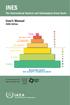 INES The International Nuclear and Radiological Event Scale User s Manual 2008 Edition Co sponsored by the IAEA and OECD/NEA INES THE INTERNATIONAL NUCLEAR AND RADIOLOGICAL EVENT SCALE USER S MANUAL 2008
International Action Plan On The Decommissioning of Nuclear Facilities
 International Action Plan On The Decommissioning of Nuclear Facilities A. Introduction Decommissioning is defined by the International Atomic Energy Agency (the Agency) as the administrative and technical
Training in Emergency Preparedness and Response
 Working to Protect People, Society and the Environment Training in Emergency Preparedness and Response Nuclear Safety and Security Programme Nuclear Safety and Security Programme Training in Emergency
The Price-Anderson Act and the Three Mile Island Accident
 The Price-Anderson Act and the Three Mile Island Accident OECD/NEA Workshop Nuclear Damages, Liability Issues, and Compensation Schemes Overview Overview of Nuclear Liability in U.S. Three Mile Island
Russian approach to organization of international cooperation in the field of nuclear infrastructure (NI)
 STATE NUCLEAR ENERGY CORPORATION ROSATOM Russian approach to organization of international cooperation in the field of nuclear infrastructure (NI) A. E. Sitnikov Rosatom/ Rosenergoatom Russia Atomex-Asia
Published in the Official State Gazette (BOE) number 166 of July 10th 2009 [1]
![Published in the Official State Gazette (BOE) number 166 of July 10th 2009 [1]](/thumbs/22/1436302.jpg "Published in the Official State Gazette (BOE) number 166 of July 10th 2009 [1]") Nuclear Safety Council Instruction number IS-22, of July 1st 2009, on safety requirements for the management of ageing and long-term operation of nuclear power plants Published in the Official State Gazette
Nuclear Safety Council Instruction number IS-22, of July 1st 2009, on safety requirements for the management of ageing and long-term operation of nuclear power plants Published in the Official State Gazette
Rosatom Investment Projects. Perspective in Europe and in the world
 ROSATOM Rosatom Investment Projects Perspective in Europe and in the world Ivo Kouklík Vice-President, Rusatom Overseas June 13, 013 Rauma PRESENTATION CONTENT ROSATOM - Introduction ROSATOM Investment
Source Term Determination Methods of the Slovenian Nuclear Safety Administration Emergency Response Team
 IAEA TM on Source Term Evaluation for Severe Accidents, Vienna, 21-23 October 2013 Source Term Determination Methods of the Slovenian Nuclear Safety Administration Emergency Response Team Tomaž Nemec Slovenian
RC-17. Alejandro V. Nader National Regulatory Authority Montevideo - Uruguay
 RC-17 Radiation Protection in Waste Management and Disposal Implementing the Joint Convention on the Safety of Spent Fuel Management and on the Safety of Radioactive Waste Management Alejandro V. Nader
APPENDIX B SUPPLEMENTAL INSPECTION PROGRAM A. OBJECTIVES AND PHILOSOPHY OF THE SUPPLEMENTAL INSPECTION PROGRAM
 APPENDIX B SUPPLEMENTAL INSPECTION PROGRAM A. OBJECTIVES AND PHILOSOPHY OF THE SUPPLEMENTAL INSPECTION PROGRAM The supplemental inspection program is designed to support the NRC s goals of maintaining
Operational Reactor Safety 22.091/22.903
 Operational Reactor Safety 22.091/22.903 Professor Andrew C. Kadak Professor of the Practice Lecture 19 Three Mile Island Accident Primary system Pilot operated relief valve Secondary System Emergency
Report WENRA Safety Reference Levels for Existing Reactors - UPDATE IN RELATION TO LESSONS LEARNED FROM TEPCO FUKUSHIMA DAI-ICHI ACCIDENT
 Report WENRA Safety Reference Levels for Existing Reactors - UPDATE IN RELATION TO LESSONS LEARNED FROM TEPCO FUKUSHIMA DAI-ICHI ACCIDENT 24 th September 2014 Table of Content WENRA Safety Reference Levels
Cyber Security Design Methodology for Nuclear Power Control & Protection Systems. By Majed Al Breiki Senior Instrumentation & Control Manager (ENEC)
 Cyber Security Design Methodology for Nuclear Power Control & Protection Systems By Majed Al Breiki Senior Instrumentation & Control Manager (ENEC) 1. INTRODUCTION In today s world, cyber security is one
Generation IV Fast Reactors. Dr Richard Stainsby AMEC [email protected]
 Generation IV Fast Reactors Dr Richard Stainsby AMEC [email protected] Contents The Generation IV international research programme on advanced reactors The case for fast reactors The technology:
Elements of the Russian Emergency Preparedness Program
 Elements of the Russian Emergency Preparedness Program Randolph L. Sullivan, NRC National Radiological EP Conference St. Louis, Missouri March 2006 2 3 4 5 6 Volgodonsk NPP 1000 MWe VVER, a PWR Large Staff
AES-92 for Belene: The Mystery Reactor
 AES-92 for Belene: The Mystery Reactor Antonia Wenisch, Austrian Institute of Ecology, Vienna [email protected] Vienna, February Summary Bulgaria decided at the end of 2006 to build a nuclear power plant
Introduction to Nuclear Fuel Cycle and Advanced Nuclear Fuels
 Introduction to Nuclear Fuel Cycle and Advanced Nuclear Fuels Jon Carmack Deputy National Technical Director Fuel Cycle Technology Advanced Fuels Program February 27, 2011 The Evolution of Nuclear Power
Long Term Operation R&D to Investigate the Technical Basis for Life Extension and License Renewal Decisions
 Long Term Operation R&D to Investigate the Technical Basis for Life Extension and License Renewal Decisions John Gaertner Technical Executive Electric Power Research Institute Charlotte, North Carolina,
IAEA Action Plan on Nuclear Safety 1
 IAEA Action Plan on Nuclear Safety 1 In June 2011 a Ministerial Conference on Nuclear Safety was convened to direct, under the leading role of the IAEA, the process of learning and acting upon lessons
IAEA-TECDOC-922 XA9743249. Performance analysis
 IAEA-TECDOC-922 XA9743249 Performance analysis The IAEA does not normally maintain stocks of reports in this series. However, microfiche copies The originating Section of this publication in the IAEA was:
Draft IAEA Action Plan on Nuclear Safety
 Atoms for Peace Board of Governors General Conference GOV/2011/59-GC(55)/14 Date: 5 September 2011 For official use only Item 3(b) of the Board's provisional agenda (GOV/2011/46) Item 14(b) of the Conference's
Introductions: Dr. Stephen P. Schultz
 Introductions: Dr. Stephen P. Schultz Vienna, Austria 1 3 September 2015 Work Experience Current Member Advisory Committee on Reactor Safeguards, U.S. Nuclear Regulatory Commission, 12/2011 Chair, Fukushima
The integrity evaluation of the reactor building at unit4 in the Fukushima Daiichi nuclear power station
 The integrity evaluation of the reactor building at unit4 in the Fukushima Daiichi nuclear power station May 2012 Government and TEPCO s Mid-to Long Term Countermeasure Meeting Management Council Outline
Science, Values and Stakeholder Dialogue: NEA Experience in Fukushima. Dr Ted Lazo Radiation Protection and Radioactive Waste Management Division
 Science, Values and Stakeholder Dialogue: NEA Experience in Fukushima Dr Ted Lazo Radiation Protection and Radioactive Waste Management Division International Experts Meeting on Radiation Protection after
GNS Activities - Solutions for Russian Spent Fuel -
 GNS Activities - Solutions for Russian Spent Fuel - Bulgarian nuclear energynational, regional and world energy safety June 09-11, 2010 Varna, Bulgaria Dr. Felix Thomas GNS Gesellschaft für Nuklear-Service
Akkuyu Nuclear Power Plant the first NPP plant configured on BOO principles
 Rosatom state nuclear corporation Akkuyu Nuclear Power Plant the first NPP plant configured on BOO principles Turkey MENA Nuclear Industry Congress 2013 Akkuyu NPP Power Generation JSC Istanbul June 18-19,
Structure and Properties of Atoms
 PS-2.1 Compare the subatomic particles (protons, neutrons, electrons) of an atom with regard to mass, location, and charge, and explain how these particles affect the properties of an atom (including identity,
GENERAL REGULATIONS ON ENSURING SAFETY OF NUCLEAR POWER PLANTS OPB-88/97, NP-001-97 (PNAE G- 01 011-97) Cover page. Contents
 GENERAL REGULATIONS ON ENSURING SAFETY OF NUCLEAR POWER PLANTS OPB-88/97, NP-001-97 (PNAE G- 01 011-97) Cover page Contents Federal Nuclear and Radiation Safety Authority of Russia (Gosatomnadzor of Russia)
The TVEL Fuel Company of Rosatom CREATING FUTURE TODAY
 The of Rosatom CREATING FUTURE TODAY For complete and current information, visit the company s website: www.tvel.ru TVEL_Nuclear 2 3 TVEL Fuel company Russian nuclear fuel designer, manufacturer and supplier
NUCLEARINSTALLATIONSAFETYTRAININGSUPPORTGROUP DISCLAIMER
 NUCLEARINSTALLATIONSAFETYTRAININGSUPPORTGROUP DISCLAIMER Theinformationcontainedinthisdocumentcannotbechangedormodifiedinanywayand shouldserveonlythepurposeofpromotingexchangeofexperience,knowledgedissemination
( 1 ) Overview of Safety Measures ( 2 ) Overview of Measures for Attaining Greater Safety and Reliability
 Contents 1 Effort for New Regulatory Requirements ( 1 ) Overview of a Gist of New Regulatory Requirements in Nuclear Regulation Authority ( 2 ) Major Requirements of a Gist of New Regulatory Requirements
The Safety of Borssele Nuclear Power Station
 The Safety of Borssele Nuclear Power Station First report of the Borssele Benchmark Committee 2 September 2013 Table of Contents Executive Summary and Conclusions 4 Abbreviations 11 1 Introduction 12 2
NUCLEAR REGULATORY COMMISSION
 GAO United States Government Accountability Office Report to Congressional Requesters October 2012 NUCLEAR REGULATORY COMMISSION Oversight and Status of Implementing a Risk-Informed Approach to Fire Safety
Preliminary validation of the APROS 3-D core model of the new Loviisa NPP training simulator
 Preliminary validation of the APROS 3-D core model of the new Loviisa NPP training simulator Anssu Ranta-aho, Elina Syrjälahti, Eija Karita Puska VTT Technical Research Centre of Finland P.O.B 1000, FI-02044
Comments on the Safety of Khmelnitsky Unit 2 and Rivne Unit 4 in the Frame of the Public Participation Procedure of EBRD
 INSTITUTE OF RISK RESEARCH OF THE ACADEMIC SENATE OF THE UNIVERSITY OF VIENNA Comments on the Safety of Khmelnitsky Unit 2 and Rivne Unit 4 in the Frame of the Public Participation Procedure of EBRD Peter
UNITED STATES NUCLEAR REGULATORY COMMISSION OFFICE OF NUCLEAR REACTOR REGULATION WASHINGTON, D.C. 20555-0001. June 1, 2005
 UNITED STATES NUCLEAR REGULATORY COMMISSION OFFICE OF NUCLEAR REACTOR REGULATION WASHINGTON, D.C. 20555-0001 June 1, 2005 NRC INFORMATION NOTICE 2005-14: FIRE PROTECTION FINDINGS ON LOSS OF SEAL COOLING
7.1 General 5 7.2 Events resulting in pressure increase 5
 GUIDE YVL 2.4 / 24 Ma r ch 2006 Primary and secondary circuit pressure control at a nuclear power plant 1 Ge n e r a l 3 2 General design requirements 3 3 Pressure regulation 4 4 Overpressure protection
Report. November 2013
 Report A comparison of U.S. and Japanese regulatory requirements in effect at the time of the Fukushima accident November 2013 Page 1 EXECUTIVE SUMMARY In the Staff Requirements Memo (SRM) to SECY-12-0110
EMERGENCY PREPAREDNESS FREQUENTLY ASKED QUESTION (EPFAQ) NEI 99 01 REVISIONS 4 THROUGH 6; NUMARC/NESP 007
 EPFAQ Number: 2015 001 DATE ACCEPTED 20 Apr 15 ORIGINATOR DAVID YOUNG ORGANIZATION Nuclear Energy Institute (NEI) PHONE # 202 739 8016 RELEVANT GUIDANCE: NEI 99 01 REVISIONS 4 THROUGH 6; NUMARC/NESP 007
L.S. de Carvalho, J. M de Oliveira Neto 1. INTRODUCTION IAEA-CN-164-5P01
 IAEA-CN-164-5P01 Advanced Technology Application Station Blackout Core Damage Frequency Reduction The Contribution of AN AC Independent Core Residual Heat Removal System L.S. de Carvalho, J. M de Oliveira
Nuclear Safety Council Instruction number IS- 23 on in-service inspection at nuclear power plants
 Nuclear Safety Council Instruction number IS- 23 on in-service inspection at nuclear power plants Published in the Official State Gazette (BOE) No 283 of November 24 th 2009 Nuclear Safety Council Instruction
English version. Manual for Determination of Combined Heat and Power (CHP)
 CEN/CENELEC WORKSHOP CWA 45547 September 2004 AGREEMENT ICS 27.100 English version Manual for Determination of Combined Heat and Power (CHP) This CEN/CENELEC Workshop Agreement has been drafted and approved
HANFORD TANK WASTE REMEDIATION SYSTEM PRIVATIZATION CO-LOCATED WORKER STANDARDS
 March 4, 1998 SECY-98-038 FOR: FROM: SUBJECT: The Commissioners L. Joseph Callan /s/ Executive Director for Operations HANFORD TANK WASTE REMEDIATION SYSTEM PRIVATIZATION CO-LOCATED WORKER STANDARDS PURPOSE:
PIONEER ROBOT TESTING PROGRAM AND STATUS
 PIONEER ROBOT TESTING PROGRAM AND STATUS Joseph N. Herndon and Dennis C. Haley Robotics and Process Systems Division Oak Ridge National Laboratory P.O. Box 2008 Oak Ridge, Tennessee 37831-6305 (865) 574-7065
AREVA NP Our experiences with Rosatom
 AREVA NP Our experiences with Rosatom Atomex Marion Horstmann Vice President Offers and Partnerships Large Projects AREVA Germany Budapest 30 November 01 December, 2015 Content AREVA in Germany Our experience
Treatment Centers for Radioactive Waste
 Treatment Centers for Radioactive Waste TREATMENT CENTERS FOR RADIOACTIVE WASTE Introduction Nuclear facilities such as nuclear power plants, reprocessing plants, nuclear fuel cycle production units, laboratories
Nuclear Safety Regulation Reform in Japan
 Nuclear Safety Regulation Reform in Japan 18th January 2012 Shuichi KANEKO Cabinet Secretariat Government of JAPAN 1 Contents Background of the Reform Process of the Reform Basic System for Nuclear Safety
Operating Performance: Accident Management: Severe Accident Management Programs for Nuclear Reactors REGDOC-2.3.2
 Operating Performance: Accident Management: Severe Accident Management Programs for Nuclear Reactors REGDOC-2.3.2 September 2013 Accident Management: Severe Accident Regulatory Document REGDOC-2.3.2 Canadian
DEMONSTRATION ACCELERATOR DRIVEN COMPLEX FOR EFFECTIVE INCINERATION OF 99 Tc AND 129 I
 DEMONSTRATION ACCELERATOR DRIVEN COMPLEX FOR EFFECTIVE INCINERATION OF 99 Tc AND 129 I A.S. Gerasimov, G.V. Kiselev, L.A. Myrtsymova State Scientific Centre of the Russian Federation Institute of Theoretical
HEALTH & SAFETY EXECUTIVE NUCLEAR DIRECTORATE ASSESSMENT REPORT. New Reactor Build. EDF/AREVA EPR Step 2 PSA Assessment
 HEALTH & SAFETY EXECUTIVE NUCLEAR DIRECTORATE ASSESSMENT REPORT New Reactor Build EDF/AREVA EPR Step 2 PSA Assessment HM Nuclear Installations Inspectorate Redgrave Court Merton Road Bootle Merseyside
July 30, 2012 Nuclear Emergency Response Headquarters Government-TEPCO Med-and-long Term Response Council
 Supplementary Document 1 Research and Development Road Map for Decommissioning Units 1 4 at TEPCO's Fukushima Daiichi Nuclear Power Plant July 30, 2012 Nuclear Emergency Response Headquarters Government-TEPCO
Holtec International. Multi-Purpose Canisters for Long-Term Interim Storage. June 17, 2015. Rick Springman, Ph.D. Director of International Projects
 Holtec International Multi-Purpose Canisters for Long-Term Interim Storage June 17, 2015 Rick Springman, Ph.D. Director of International Projects Dry Storage & Transport Projects Wet Storage Projects 1
Code of Conduct on the Safety and Security of Radioactive Sources
 FOREWORD In recent years there has been a growing awareness of the potential for accidents involving radiation sources, some such accidents having had serious, even fatal, consequences. More recently still,
Plutonium Watch. Tracking Plutonium Inventories by David Albright and Kimberly Kramer. July 2005, Revised August 2005
 Plutonium Watch Tracking Plutonium Inventories by David Albright and Kimberly Kramer July 25, Revised August 25 Plutonium is a key ingredient in nuclear weapons, making it one of the most dangerous materials
This document is the property of and contains Proprietary Information owned by Westinghouse Electric Company LLC and/or its subcontractors and
 This document is the property of and contains Proprietary Information owned by Westinghouse Electric Company LLC and/or its subcontractors and suppliers. It is transmitted to you in confidence and trust,
Nuclear Safety. Policy 2013-2016
 Nuclear Safety Policy 2013-2016 Nuclear Safety Policy 2013-2016 T he organisational principles and actions defined in the Nuclear Safety Charter and applied within the group have achieved significant improvements
AREVA: supply chain network principles and company s vision
 AREVA: supply chain network principles and company s vision Virginie MOUCQUOT-LAIHO AREVA Finland Communications Director & Vice Country Manager Oulu, Finland 18.09.2012 1 AREVA & nuclear industry The
RADIATION MONITORING SYSTEMS
 RADIATION MONITORING SYSTEMS Area monitors Process monitors In-line, Adjacent-to-Line monitors Local/remote processors, Data Acquisition Systems NUPIC Certified, NRC Approved Vendor Wide Range Sensitivity
U.S. Nuclear Regulation after Three Mile Island
 U.S. Nuclear Regulation after Three Mile Island Mark Holt Specialist in Energy Policy October 23, 2015 Agenda Setting the scene: Before TMI Three Mile Island accident and aftermath ors, 1957-2015 Presidential
Fact Sheet on U.S. Nuclear Powered Warship (NPW) Safety
 Fact Sheet on U.S. Nuclear Powered Warship (NPW) Safety 1. Commitments of the U.S. Government about the Safety of U.S. NPWs U.S. Nuclear Powered Warships (NPWs) have safely operated for more than 50 years
APPENDIX CC NUCLEAR WASTE STORAGE
 APPENDIX CC NUCLEAR WASTE STORAGE APPENDIX CC NUCLEAR WASTE STORAGE MICHIEL P.H. BRONGERS 1 SUMMARY Nuclear wastes are generated from spent nuclear fuel, dismantled weapons, and products such as radio
Nuclear Safety Council Instruction number IS-19, of October 22 nd 2008, on the requirements of the nuclear facilities management system
 Nuclear Safety Council Instruction number IS-19, of October 22 nd 2008, on the requirements of the nuclear facilities management system Published in the Official State Gazette (BOE) number 270 of November
Piping Systems for Nuclear Power Industry. Prague, October 2011
 Piping Systems for Nuclear Power Industry Prague, October 2011 Introduction of the company Leading Czech supplier of piping systems for power engineering 60 years of experience in the field of power industry
IAEA-TECDOC-1458. Effective corrective actions to enhance operational safety of nuclear installations
 IAEA-TECDOC-1458 Effective corrective actions to enhance operational safety of nuclear installations July 2005 IAEA SAFETY RELATED PUBLICATIONS IAEA SAFETY STANDARDS Under the terms of Article III of its