
Generation IV Fast Reactors. Dr Richard Stainsby AMEC
|
|
|
- Merilyn Chandler
- 10 years ago
- Views:
Transcription
1 Generation IV Fast Reactors Dr Richard Stainsby AMEC

2 Contents The Generation IV international research programme on advanced reactors The case for fast reactors The technology: Sodium cooled (SFR) Lead cooled (LFR) Gas cooled (GFR) Molten Salt Fast Reactor (MSFR) Conclusions 2

3 What is Generation IV An international R&D programme to develop the most promising six systems for the next generation of nuclear power plants 3

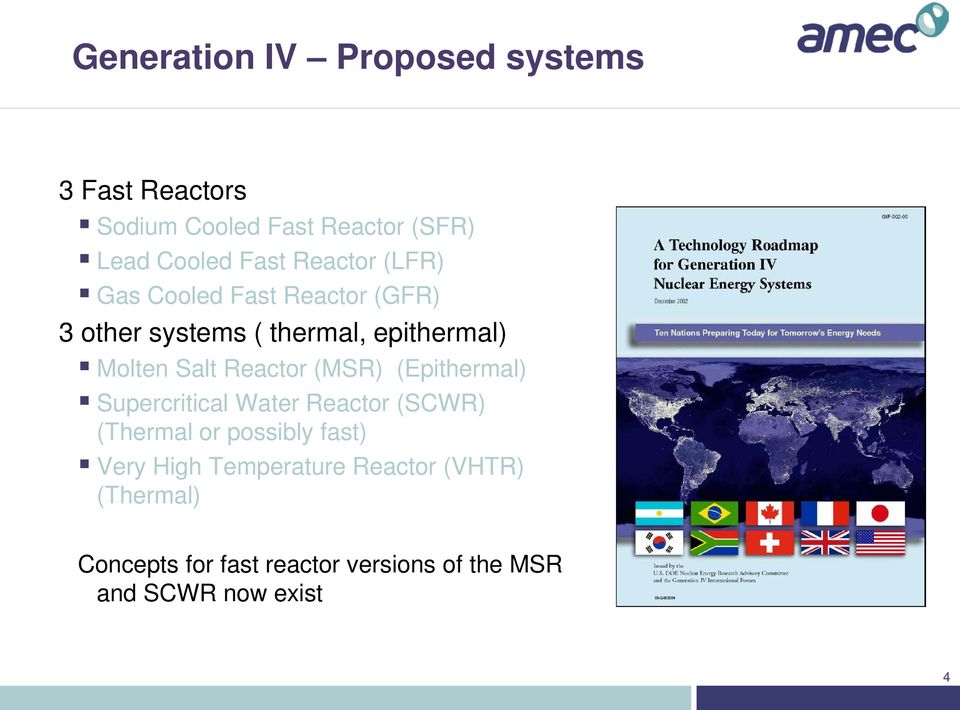
4 Generation IV Proposed systems 3 Fast Reactors Sodium Cooled Fast Reactor (SFR) Lead Cooled Fast Reactor (LFR) Gas Cooled Fast Reactor (GFR) 3 other systems ( thermal, epithermal) Molten Salt Reactor (MSR) (Epithermal) Supercritical Water Reactor (SCWR) (Thermal or possibly fast) Very High Temperature Reactor (VHTR) (Thermal) Concepts for fast reactor versions of the MSR and SCWR now exist 4
5 The Case for Fast Reactors

6 What is a fast reactor? A fast reactor makes use of fission induced by fast neutrons (E > 0.1MeV). Characterised by having a compact core (no moderator) and a high power density (~400MW/m 3 compared with ~5MW/ m 3 for thermal reactors). 6

7 Why build fast reactors? Only 0.72% of natural uranium is fissile. For nuclear power to be sustainable it is essential we make better use of the natural resource. 0.72% % % uranium-235 uranium-234 uranium-238 Breeding of plutonium from uranium-238 in fast reactors allows considerably more of the natural uranium to be used. Both breeding and the utilisation of plutonium are more efficient in fast fission systems. Long lived minor actinides that occur in nuclear waste (americium, neptunium and curium) can be burned. Reduces radiotoxicity of wastes Significantly reduces waste storage times (to about 300 years instead of years)

8 Plutonium Breeding Reaction Starts with neutron capture in uranium U + n U 92 Uranium-239 has a half-life of 23 minutes and decays to neptunium-239 by beta decay U Np β - + ν Neptunium-239 has a half life of 2.3 days and decays to plutonium 239 by a further beta decay Np Pu + β - + ν

9 Forcast demand for natural uranium and reserves Source: A technology Roadmap for Generation IV Nuclear Energy Systems, USDOE, 2002

10 Plutonium breeding in thermal reactors All reactors that contain uranium-238 will breed plutonium: Fast reactors are better at it than thermal reactors The measure of how good a reactor is at breeding is the conversion ratio (or exactly the same thing the breeding ratio), C C = number of fissile items created / number of fissile atoms consumed For thermal reactors C < 1. For fast reactors C 1 (but can be < 1 if we wish) If we start with N fissile atoms, after irradiation in a reactor core we end up with C N fissile atoms. After many recycles we get the total number of fissile atoms available to be: N T = N + CN + C 2 N + C 3 N + C 4 N +. For C < 1, N T = N / (1 - C), so for a LWR C ~ , so N T = 1.4 N 2 N Conclusion large-scale MOX recycle in LWRs allows nuclear fission power to be maintained for a short time after the exhaustion of natural uranium but precludes the future use of fast reactors

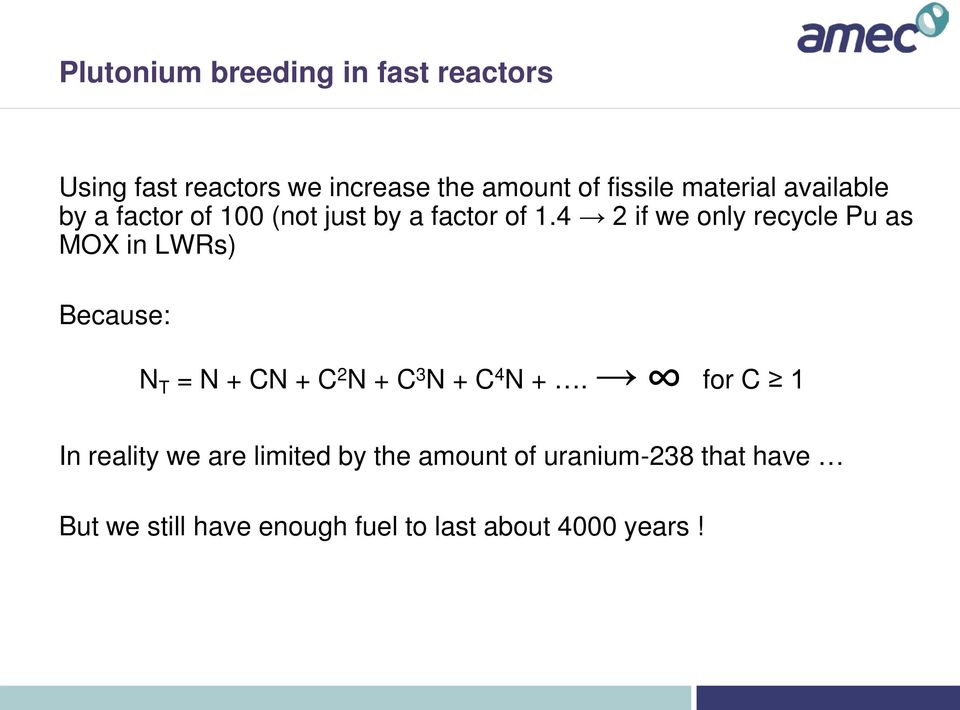
11 Plutonium breeding in fast reactors Using fast reactors we increase the amount of fissile material available by a factor of 100 (not just by a factor of if we only recycle Pu as MOX in LWRs) Because: N T = N + CN + C 2 N + C 3 N + C 4 N +. for C 1 In reality we are limited by the amount of uranium-238 that have But we still have enough fuel to last about 4000 years!
12 Global energy reserves no fast reactors
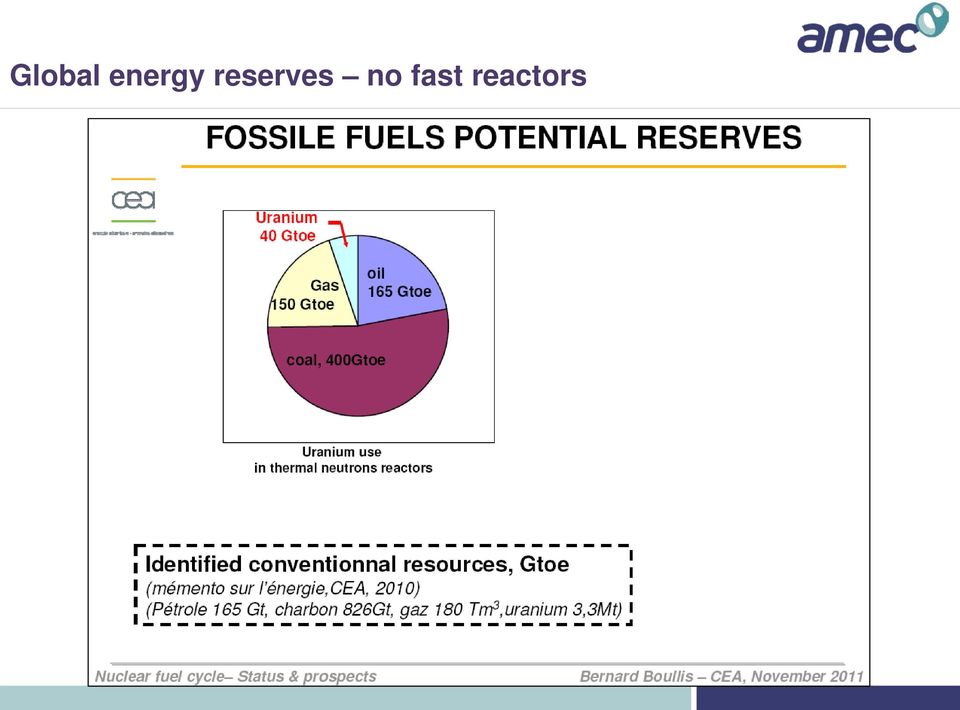
13 Global energy reserves no fast reactors

14 The bonus the ability to transmute: minor actinide burning to reduce the radiotoxicity of waste Plutonium recycling MA + FP Spent Fuel Direct disposal Pu + MA + FP Uranium Ore (mine) FP P&T of MA Time (years)

15 Closed fuel cycle (Example is for MOX recycle in LWRs) A closed fuel cycle is a necessity for a fast reactor fleet Reprocessing and fuel re-fabrictaion facilities are central parts of a fast reactor-driven nuclear park.

16 The Technology

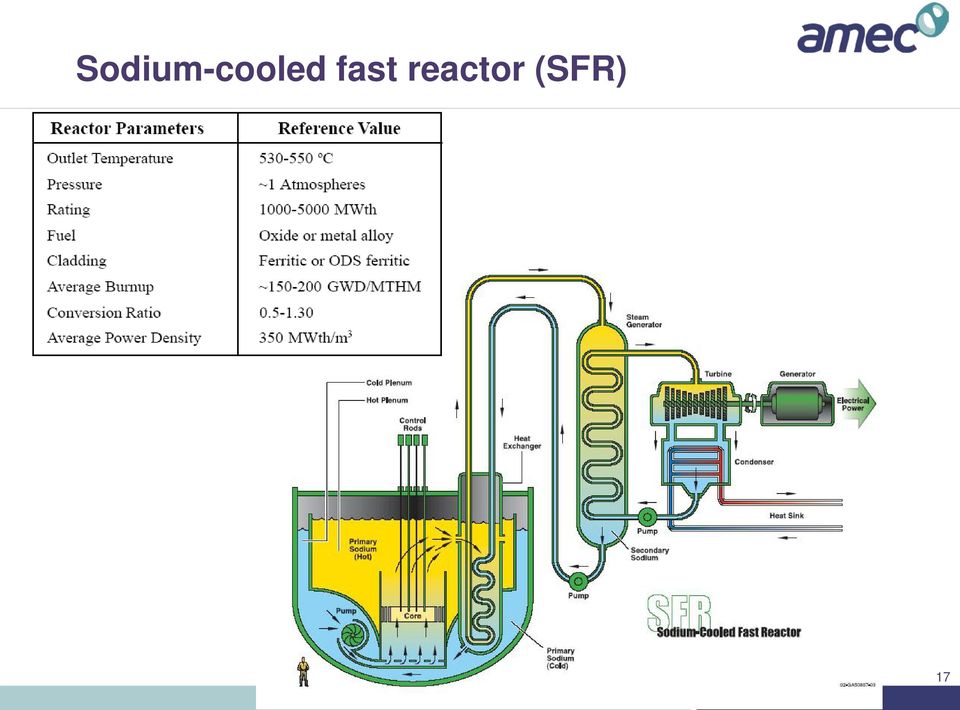
17 Sodium-cooled fast reactor (SFR) 17
18 UK fast reactors Dounreay Fast Reactor (DFR) metal fuel, highly enriched U235/U238 fuel, sodium-potassium eutectic liquid metal coolant, 72MWth ( ). Prototype fast reactor (PFR), also at Dounreay mixed oxide fuel, Pu/U238, sodium liquid metal coolant, 600MWth ( ). Both now shut down and partially decommissioned. 18

19 French fast reactors Rapsodie (at Cadarache) Pu/U238 mixed oxide fuel, sodium-cooled, 24MWth (later 40MWth), ( ) Phenix (at Marcoule) Pu/U238 mixed oxide fuel, sodium-cooled, 560MWth, ( ) Superphenix (at Creys-Malville) Pu/U238 mixed oxide, sodium-cooled, 2900MWth ( ) The need for a fast reactors to provide security of supply and management of plutonium and minor actinides is now enacted in French law. The ASTRID programme aims to deploy a Gen IV SFR demonstrator in the early 2020 s for commercialisation by

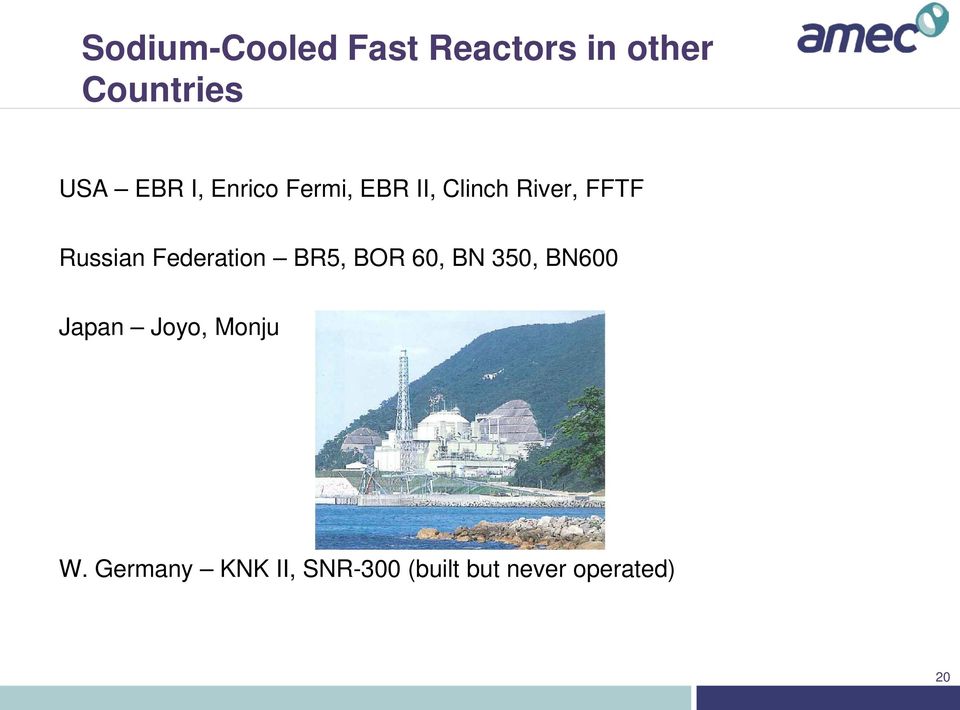
20 Sodium-Cooled Fast Reactors in other Countries USA EBR I, Enrico Fermi, EBR II, Clinch River, FFTF Russian Federation BR5, BOR 60, BN 350, BN600 Japan Joyo, Monju W. Germany KNK II, SNR-300 (built but never operated) 20
21 Superphenix 21
22 Superphenix fuel element 22
23 Superphenix core 23
24 Problems with the liquid sodium coolant Reacts violently with water, need the intermediate heat exchange loop to prevent reaction with primary coolant. High void worth leads to large reactivity insertion if gas or vapour bubbles form in the coolant, or if the coolant is lost. It is not possible to operate at higher temperatures because of sodium boiling. 24
25 Fast reactors the future beyond SFR The Generation IV programme has identified 3 fast reactor systems for further development: SFR - Sodium-cooled fast reactor LFR - Lead-cooled fast reactor GFR - Gas-cooled fast reactor Minor actinide destruction and plutonium management sustainability and proliferation benefits. + the molten salt fast reactor (MSFR) 25
26 Lead-cooled fast reactor (LFR) 26
27 Proposed LFR Operating Parameters 27
28 Lead Cooled Fast Reactor Concepts Natural convection cooled Forced convection cooled 28
29 Gas-cooled fast reactor (GFR) 29
30 Cut-away view of a proposed 2400 MWth indirect-cycle GFR main heat exchanger (indirect cycle) core barrel Decay heat removal heat exchanger steel reactor pressure vessel re-fuelling equipment control and shutdown rod drives core
31 Schematic diagram of the DHR system in natural convection mode Exchanger #2 pool H2 Exchanger #1 Secondary loop H1 dedicated DHR loops core guard containment
32 2400 MWth indirect-cycle GFR inside a spherical guard vessel
33 Current GFR concept - gas~steam turbine combined cycle main heat exchanger He-N 2 turbine steam turbine reactor primary circulator He-N 2 compressor Heat recovery steam generator feed pump condenser The indirect combined cycle is proposed for the ANTARES HTR and is the reference cycle for the GenIV GFR system
34 Molten Salt Reactor (MSR) Works with an epithermal neutron spectrum. The fuel is a liquid and the fuel is also the primary coolant. 34
35 MSR Closed On-Site Fuel Cycle (Equilibrium Conditions) U + Pu + minor actinides Fission products U238 or Th232 Molten Salt Reactor On-site reprocessing plant Fission products + U + Pu + minor actinides (Am, Np, Cm) 35
36 Molten Salt Fast Reactor (MSFR) 36
37 The European Sustainable Nuclear Industry Initiative (ESNII)
38 Conclusions The case made for the development of Fast Reactors made in the 1940 s and 1950 s is still relevant today, even though; Expansion of the global reactor fleet has been slower than anticipated originally (after TMI-2 and Chernobyl) but has resumed. More uranium has been discovered, but uranium resource is still not large. Without fast reactors, nuclear fission will simply be a interesting footnote in human history. With fast reactors we can generate 4000 years of electricity (and other energy forms) using a small refinement of 1970 s technology. A large fraction of the fuel we require in the UK is already above ground Using fast reactors, the UK is self-sufficient in plutonium and uranium-238 for at least for a few centuries.
39 Conclusions (continued) Sodium cooled fast reactor technology is suitable for reviving an industrial capability for their construction at home and internationally We have a legacy of SFR design and construction experience No large (high) pressure components are require (except for steam generator water/steam headers) The EC is supporting the development of all three fast reactor technologies (SFR, LFR and GFR) and accelerator driven systems (ADS). We have the opportunity to re-engage as partners with France in the development of ASTRID and the development of a subsequent commercial fleet (Rolls-Royce and AMEC have both signed MoUs with CEA to collaborate on the development of ASTRID)
40 Questions? 40
Introduction to Nuclear Fuel Cycle and Advanced Nuclear Fuels
 Introduction to Nuclear Fuel Cycle and Advanced Nuclear Fuels Jon Carmack Deputy National Technical Director Fuel Cycle Technology Advanced Fuels Program February 27, 2011 The Evolution of Nuclear Power
Review of Generation IV Nuclear Energy Systems R E P O R T
 Review of Generation IV Nuclear Energy Systems R E P O R T REPORT SUMMARY According to many energy foresight studies carried out in the late 1990s, a shortage of uranium can be expected during the 21st
ADS (Accelerator Driven Systems) e LFR (Lead Fast Reactor)
 ADS (Accelerator Driven Systems) e LFR (Lead Fast Reactor) L. Mansani [email protected] Workshop: La Trasmutazione ed i Cicli Innovativi del Combustibile Nucleare Roma 20 Dicembre 2010 Origin
RESULTS OF R&D ON FUTURE FUEL CYCLE AND ASSOCIATED HL WASTE DISPOSAL: THE FRENCH CASE
 IGDTP_SNETP_EF4, October 29-30, 2013, Praha RESULTS OF R&D ON FUTURE FUEL CYCLE AND ASSOCIATED HL WASTE DISPOSAL: THE FRENCH CASE Dominique Warin CEA / Nuclear Energy Direction 29 OCTOBRE 2013 14 juin
Lead-Cooled Fast Reactor BREST Project Status and Prospects
 資 料 4-3 第 11 回 GIF-LFR pssc (イタリア ピサ 2012 年 4 月 16 日 ) ロシア 側 発 表 資 料 V. S. Smirnov State Atomic Energy Corporation ROSATOM Open Joint-Stock Company N.A. Dollezhal Research and Development Institute of
DEMONSTRATION ACCELERATOR DRIVEN COMPLEX FOR EFFECTIVE INCINERATION OF 99 Tc AND 129 I
 DEMONSTRATION ACCELERATOR DRIVEN COMPLEX FOR EFFECTIVE INCINERATION OF 99 Tc AND 129 I A.S. Gerasimov, G.V. Kiselev, L.A. Myrtsymova State Scientific Centre of the Russian Federation Institute of Theoretical
Appendix 6.0 Molten Salt Reactor
 Appendix 6.0 Molten Salt Reactor A6-1 This page intentionally left blank. A6-2 CONTENTS ACRONYMS... 5 A6.1 INTRODUCTION AND BACKGROUND... 7 A6.1.1 System Description... 7 A6.1.2 Overall Systems Timeline...
The Physics of Energy sources Nuclear Reactor Practicalities
 The Physics of Energy sources Nuclear Reactor Practicalities B. Maffei [email protected] www.jb.man.ac.uk/~bm Nuclear Reactor 1 Commonalities between reactors All reactors will have the same
Technology Roadmap Update for Generation IV Nuclear Energy Systems
 Technology Roadmap Update for Generation IV Nuclear Energy Systems Preparing Today for Tomorrow s Energy Needs Technology Roadmap Update for Generation IV Nuclear Energy Systems January 2014 Issued by
On the neutronics of European lead-cooled fast reactor
 NUKLEONIKA 2010;55(3):317 322 ORIGINAL PAPER On the neutronics of European lead-cooled fast reactor Jerzy Cetnar, Mikołaj Oettingen, Grażyna Domańska Abstract. The perspective of nuclear energy development
Japan s current Nuclear Energy Policy
 Japan s current Nuclear Energy Policy Hirobumi Kayama Agency for Natural Resources and Energy, METI December, 2014 Evaluation and Policy Timeframe of Nuclear Power
The Fuel Cycle R&D Program. Systems Analysis
 The Fuel Cycle R&D Program Systems Analysis Bradley Williams Systems Analysis Federal Program Manager Office of Systems Engineering and Integration Office of Nuclear Energy U.S. Department of Energy July
Fast reactor development program in Russia
 International Conference on Fast Reactors and Related Fuel Cycles FR13 4-7 March 2013 Paris, France. Fast reactor development program in Russia Presented by Valery Rachkov ITC PRORYV Project, Moscow, Russia
ADVANCED NUCLEAR ENERGY SYSTEM FOR THE TWENTY-FIRST CENTURY
 ADVANCED NUCLEAR ENERGY SYSTEM FOR THE TWENTY-FIRST CENTURY Yoon Il Chang Argonne National Laboratory 9700 South Cass Avenue Argonne, IL USA 60439 [email protected] ABSTRACT The world needs more energy to
V K Raina. Reactor Group, BARC
 Critical facility for AHWR and PHWRs V K Raina Reactor Group, BARC India has large reserves of Thorium Critical facility Utilisation of Thorium for power production is a thrust area of the Indian Nuclear
Chapter 6 Impact of Fukushima Daiichi Accident on Japan s Nuclear Fuel Cycle and Spent Fuel Management
 Chapter 6 Impact of Fukushima Daiichi Accident on Japan s Nuclear Fuel Cycle and Spent Fuel Management Joonhong Ahn Abstract This chapter briefly summarizes the current status of spent nuclear fuel and
Fission fragments or daughters that have a substantial neutron absorption cross section and are not fissionable are called...
 KNOWLEDGE: K1.01 [2.7/2.8] B558 Fission fragments or daughters that have a substantial neutron absorption cross section and are not fissionable are called... A. fissile materials. B. fission product poisons.
Fuel Cycle R&D to Safeguard Advanced Ceramic Fuel Skills Strategic Options
 Fuel Cycle R&D to Safeguard Advanced Ceramic Fuel Skills Strategic Options Fuel Cycle R&D to Safeguard Advanced Ceramic Fuel Skills The Nuclear Renaissance and Fuel Cycle Research and Development Nuclear
Fundamentals of Nuclear Power
 Fundamentals of Nuclear Power Juan S. Giraldo Douglas J. Gotham David G. Nderitu Paul V. Preckel Darla J. Mize State Utility Forecasting Group December 2012 Table of Contents List of Figures... iii List
Global Nuclear Energy Partnership Technology Demonstration Program
 Global Nuclear Energy Partnership Technology Demonstration Program Dave Hill Deputy Director, Science and Technology Idaho National Laboratory August 10 2006 Global Nuclear Energy Partnership Goals of
Nuclear Energy: Nuclear Energy
 Introduction Nuclear : Nuclear As we discussed in the last activity, energy is released when isotopes decay. This energy can either be in the form of electromagnetic radiation or the kinetic energy of
Fukushima 2011. Fukushima Daiichi accident. Nuclear fission. Distribution of energy. Fission product distribution. Nuclear fuel
 Fukushima 2011 Safety of Nuclear Power Plants Earthquake and Tsunami Accident initiators and progression Jan Leen Kloosterman Delft University of Technology 1 2 Nuclear fission Distribution of energy radioactive
10 Nuclear Power Reactors Figure 10.1
 10 Nuclear Power Reactors Figure 10.1 89 10.1 What is a Nuclear Power Station? The purpose of a power station is to generate electricity safely reliably and economically. Figure 10.1 is the schematic of
Thorium for Use in Plutonium Disposition, Proliferation-Resistant Fuels for Developing Countries, and Future Reactor Designs
 Thorium for Use in Plutonium Disposition, Proliferation-Resistant Fuels for Developing Countries, and Future Reactor Designs Brian Johnson Oregon State University WISE 2006 e Sponsored By Executive Summary
Fast Breeder Reactor Programs: History and Status
 8 Fast Breeder Reactor Programs: History and Status Thomas B. Cochran, Harold A. Feiveson, Walt Patterson, Gennadi Pshakin, M.V. Ramana, Mycle Schneider, Tatsujiro Suzuki, Frank von Hippel A research report
TECHNICAL WHITE PAPER MARCH 2014 V 1.0.1
 TECHNICAL WHITE PAPER MARCH 2014 V 1.0.1 Transatomic Power s advanced molten salt reactor consumes spent nuclear fuel cleanly and completely, unlocking vast amounts of cheap, carbon-free energy. It solves
The Future of the Nuclear Fuel Cycle
 The Future of the Nuclear Fuel Cycle An Interdisciplinary MIT Study Ernest J. Moniz Cecil and Ida Green Professor of Physics and Engineering Systems Director, MIT Energy Initiative Study Participants Co-chairs:
Boiling Water Reactor Systems
 Boiling Water (BWR) s This chapter will discuss the purposes of some of the major systems and components associated with a boiling water reactor (BWR) in the generation of electrical power. USNRC Technical
THORIUM UTILIZATION FOR SUSTAINABLE SUPPLY OF NUCLEAR ENERGY S. BANERJEE DEPARTMENT OF ATOMIC ENERGY
 THORIUM UTILIZATION FOR SUSTAINABLE SUPPLY OF NUCLEAR ENERGY S. BANERJEE DEPARTMENT OF ATOMIC ENERGY INDIA DHRUVA CIRUS 1 PLAN OF TALK Introduction Three Stage Nuclear Power Programme Thorium Utilisation
Economics of Thorium and Uranium Reactors
 Sherman Lam HSA 10-05 The Economics of Oil and Energy April 30, 2013 Economics of Thorium and Uranium Reactors In February 2012, the Nuclear Regulatory Commission (NRC) approved a license for two new nuclear
Closing the CANDU Fuel Cycle
 WiN Canada Conference 2013 Closing the CANDU Fuel Cycle with Modified PUREX Recycling CANDU Spent Fuel Authors Juhx Pellazar Jinah Kim Alexander Koven Sameena Mulam (Presenter) Marty Tzolov Leon Wu Closing
Heterogeneous world model and collaborative scenarios of transition to globally sustainable nuclear energy systems
 EPJ Nuclear Sci. Technol. 1, 1 (2015) V. Kuznetsov and G. Fesenko, published by EDP Sciences, 2015 DOI: 10.1051/epjn/e2015-50031-2 Nuclear Sciences & Technologies Available online at: http://www.epj-n.org
DESIGN, SAFETY AND FUEL DEVELOPMENTS FOR THE EFIT ACCELERATOR DRIVEN SYSTEM WITH CERCER AND CERMET CORES
 DESIGN, SAFETY AND FUEL DEVELOPMENTS FOR THE EFIT ACCELERATOR DRIVEN SYSTEM WITH CERCER AND CERMET CORES W. Maschek 1, C. Artioli 2, X. Chen 1, F. Delage 3, A. Fernandez-Carretero 4, M. Flad 1, A. Fokau
DESIGN FEATURES OF BREST REACTORS AND EXPERIMENTAL WORK TO ADVANCE THE CONCEPT OF BREST REACTORS
 DESIGN FEATURES OF BREST REACTORS AND EXPERIMENTAL WORK TO ADVANCE THE CONCEPT OF BREST REACTORS A.I. FILIN, V.V. ORLOV, V.N. LEONOV, A.G. SILA-NOVITSKI, V.S. SMIRNOV, V.S. TSIKUNOV STATE SCIENTIFIC CENTER
Decommissioning of German Nuclear Research Facilities under the Governance of the Federal Ministry of Education and Research - 8059
 Decommissioning of German Nuclear Research Facilities under the Governance of the Federal Ministry of Education and Research - 8059 M. Weigl Forschungszentrum Karlsruhe GmbH Projektträgerforschungszentrum
DOE s Fuel Cycle Technologies Program - An Overview
 DOE s Fuel Cycle Technologies Program - An Overview William Boyle Director, Used Fuel Disposition R & D (NE-53) Office of Nuclear Energy U.S. Department of Energy ECA Las Vegas, Nevada Agenda Program Mission
LEAD-COOLED FAST REACTOR (LFR) DEVELOPMENT GAPS
 LEAD-COOLED FAST REACTOR (LFR) DEVELOPMENT GAPS M. TARANTINO Italian National Agency for New Technologies, Energy and Sustainable Economic Development, C.R. ENEA Brasimone Italy [email protected]
Minor Actinide Transmutation. Position Paper
 Minor Actinide Transmutation Position Paper Minor Actinide Transmutation A review For many years there has been a sustained international interest in partitioning and transmutation of the minor actinides
12.5: Generating Current Electricity pg. 518
 12.5: Generating Current Electricity pg. 518 Key Concepts: 1. Electrical energy is produced by energy transformations. 2. Electrical energy is produced from renewable and non-renewable resources. 4. Electrical
PHENIX: THE IRRADIATION PROGRAM FOR TRANSMUTATION EXPERIMENTS
 PHENIX: THE IRRADIATION PROGRAM FOR TRANSMUTATION EXPERIMENTS J. Guidez, P. Chaucheprat, B. Fontaine, E. Brunon, L. Martin (PHENIX) D. Warin (DDIN) A. Zaetta (DEN/CAD/DER) F. Sudreau (DEN/CAD/DEC) Abstract
Prospect of Hitachi Nuclear Business (Boiling Water Reactor)
 Prospect of Hitachi Nuclear Business (Boiling Water Reactor) 42 Prospect of Hitachi Nuclear Business (Boiling Water Reactor) Masahito Yoshimura Shoichiro Kinoshita Hiroshi Arima Nobuo Tada OVERVIEW: To
Conservative approach for PWR MOX Burnup Credit implementation
 International Conference on the Physics of Reactors Nuclear Power: A Sustainable Resource Casino-Kursaal Conference Center, Interlaken, Switzerland, September 14-19, 2008 Conservative approach for PWR
Russian Nuclear Power Program (past, present, and future) Dr. Igor Pioro Senior Scientist CRL AECL
 Russian Nuclear Power Program (past, present, and future) Dr. Igor Pioro Senior Scientist CRL AECL Nuclear Power Units by Nation No. Nation # Units Net MWe 1 USA 104 100,460 2 France 59 63,363 3 Japan
Waste management. The failure of the rational waste management policy
 The failure of the rational waste management policy Another essential outcome of processing-recycling is to facilitate the management of radioactive waste. Compared to the direct disposal of spent fuel
6-4 STATUS OF NUCLEAR FUEL REPROCESSING, PARTITIONING AND TRANSMUTATION
 November 2003 NWMO BACKGROUND PAPERS 6. TECHNICAL METHODS 6-4 STATUS OF NUCLEAR FUEL REPROCESSING, PARTITIONING AND TRANSMUTATION David P. Jackson McMaster University NWMO Background Papers NWMO has commissioned
www.universityquestions.in
 DEPARTMENT OF ELECTRICAL AND ELECTRONICS ENGINEERING QUESTION BANK SUBJECT: ME6701-POWER PLANT ENGINEERING YEAR/SEM: III/V UNIT-I COAL BASED THERMAL POWER PLANTS 1. What are the processes of rankine cycle?
The Very High Temperature Reactor: A Technical Summary
 June 2004 The Very High Temperature Reactor: A Technical Summary Prepared for MPR Associates, Inc. 320 King Street Alexandria, VA 22314 The Very High Temperature Reactor: A Technical Summary June 2004
MCQ - ENERGY and CLIMATE
 1 MCQ - ENERGY and CLIMATE 1. The volume of a given mass of water at a temperature of T 1 is V 1. The volume increases to V 2 at temperature T 2. The coefficient of volume expansion of water may be calculated
Finnish research network for generation four nuclear energy systems
 ESPOO 2008 VTT WORKING PAPERS 90 EARLY PROTOTYPES COMMERCIAL POWER REACTORS NEW GENERATION LWR- PLANTS + HTR GENERATION IV Economically Very competitive more competitive New application, Magnox (1956)
Polyvalent fuel treatment facility (TCP) : shearing and dissolution of used fuel at La Hague facility
 Polyvalent fuel treatment facility (TCP) : shearing and dissolution of used fuel at La Hague facility Frédéric LELIEVRE AREVA, Recycling Business Unit, Paris, France INTRODUCTION AREVA s current La Hague
Chapter 1 The Development of Nuclear Energy in the World
 Chapter 1 The Development of Nuclear Energy in the World Abstract In 2011 there were about 436 commercial nuclear power reactors operating in the world with a total capacity of 370 GW(e). Nuclear energy
Nuclear Energy University Programs (NEUP) Fiscal Year (FY) 2016 Annual Planning Webinar Mission Suppor+ng: Fuel Cycle Technologies (MS- FC- 1)
 Nuclear Energy University Programs (NEUP) Fiscal Year (FY) 2016 Annual Planning Webinar Mission Suppor+ng: Fuel Cycle Technologies (MS- FC- 1) David Henderson Ac+ng Director for Fuel Cycle R&D August 12,
Cyber Security Design Methodology for Nuclear Power Control & Protection Systems. By Majed Al Breiki Senior Instrumentation & Control Manager (ENEC)
 Cyber Security Design Methodology for Nuclear Power Control & Protection Systems By Majed Al Breiki Senior Instrumentation & Control Manager (ENEC) 1. INTRODUCTION In today s world, cyber security is one
Nuclear Hydrogen Production: Re-Examining the Fusion Option
 Nuclear Hydrogen Production: Re-Examining the Fusion Option [email protected] http://ottawapolicyresearch.ca May 30th, 2007 Canadian Hydrogen Association Workshop on Hydrogen Production
HOW DOES A NUCLEAR POWER PLANT WORK?
 HOW DOES A NUCLEAR POWER PLANT WORK? O n t a r i o P o w e r G e n e r a t i o n P U T T I N G O U R E N E R G Y T O U S G O O D E O N T A R I O P O W E R G E N E R A T I O N What a Nuclear Reactor Does
Dario Manara, Rudy Konings, Philippe Raison
 LFR fuel overview and perspectives Dario Manara, Rudy Konings, Philippe Raison European Commission Joint Research Centre Institute for transuranium materials (ITU) P.O. Box 2340 76125 Karlsruhe Germany
The Technology and Business of Power Andrew Valencia, P.E. Lower Colorado River Authority
 The Technology and Business of Power Andrew Valencia, P.E. Lower Colorado River Authority 1 2 What is Efficiency? Efficiency: What you get divided by what you pay for Heatrate is a measure of plant efficiency
Dynamic Behavior of BWR
 Massachusetts Institute of Technology Department of Nuclear Science and Engineering 22.06 Engineering of Nuclear Systems Dynamic Behavior of BWR 1 The control system of the BWR controls the reactor pressure,
5. State the function of pulveriser. The pulverisers are the equipments which are used to powdered coal.
 413 POWER PLANT ENGINEERING PART-A 1. Define Power. Power is the rate at which energy is used (or) Energy/time. 2. What are the types of fuels? Solid fuel Liquid fuel Gaseous fuel (Any one among the above
Nuclear Consultancy & Engineering Services
 Insert a caption to go with the photograph in here ITER, France Wednesday, 14 December 2011 Nuclear Consultancy & Engineering Services T H E N U C L E A R A T K I N S A S S Y S T E M A L L I A N C E CONSTRUCTION
Basics of Nuclear Physics and Fission
 Basics of Nuclear Physics and Fission A basic background in nuclear physics for those who want to start at the beginning. Some of the terms used in this factsheet can be found in IEER s on-line glossary.
Nuclear Waste A Guide to Understanding Where We've Been and Where We're Going
 Nuclear Waste A Guide to Understanding Where We've Been and Where We're Going National Conference of State Legislatures The presentation was created by the National Conference of State Legislatures and
Hazard Classification of the Remote Handled Low Level Waste Disposal Facility
 1 Hazard Classification of the Remote Handled Low Level Waste Disposal Facility Abstract Boyd D. Christensen Battelle Energy Alliance, Idaho National Laboratory P.O. Box 1625 Idaho Falls, Idaho 83415 208
Advanced Safeguards Approaches For New Fast Reactors
 Advanced Safeguards Approaches For New Fast Reactors PC Durst I Therios R Bean A Dougan B Boyer RL Wallace MH Ehinger DN Kovacic K Tolk December 2007 1 Advanced Safeguards Approaches For New Fast Reactors
Development Study of Nuclear Power Plants for the 21st Century
 Development Study of Nuclear Power Plants for the 21st Century Hitachi Review Vol. 50 (2001), No. 3 61 Kumiaki Moriya Masaya Ohtsuka Motoo Aoyama, D.Eng. Masayoshi Matsuura OVERVIEW: Making use of nuclear
Part 1 General and Administrative Information. Part 3 Applicant s Environmental Report Combined License Stage
 Part 16 South Carolina Electric and Gas V. C. Summer Nuclear Station, Units 2 & 3 COL Application COLA Table of Contents Navigation Page Part 1 General and Administrative Information Part 2 Final Safety
CESAR: A Code for Nuclear Fuel and Waste Characterisation
 CESAR: A Code for Nuclear Fuel and Waste Characterisation J.M. Vidal, J.P. Grouiller Commissariat à l Energie Atomique (CEA) Cadarache, 13108 Saint Paul lez Durance Cedex France A. Launay, Y. Berthion
Evaluation of Sodium-cooled Fast Reactor Neutronic Benchmarks
 Evaluation of Sodium-cooled Fast Reactor Neutronic Benchmarks N.E. Stauff a, T.K. Kim a, T. Taiwo a, L. Buiron b, F. Varaine b, J. Gulliford c a Argonne National Laboratory, Nuclear Engineering Division,
Research and Development Program of HTGR Fuel in Japan
 Research and Development Program of HTGR Fuel in Japan Kazuhiro SAWA, Shouhei UETA, Tatsuo IYOKU Masuro OGAWA, Yoshihiro KOMORI Department of Advanced Nuclear Heat Technology Department of HTTR Project
Operating Performance: Accident Management: Severe Accident Management Programs for Nuclear Reactors REGDOC-2.3.2
 Operating Performance: Accident Management: Severe Accident Management Programs for Nuclear Reactors REGDOC-2.3.2 September 2013 Accident Management: Severe Accident Regulatory Document REGDOC-2.3.2 Canadian
Outlook for RWE s nuclear operations. Prof. Dr. Gerd Jäger London, 16 January 2012
 Outlook for RWE s nuclear operations Prof. Dr. Gerd Jäger London, 16 January 2012 Overview of German nuclear power plants Power plant Net capacity MW Commercial commissioning Shutdown German nuclear power
Generating Current Electricity: Complete the following summary table for each way that electrical energy is generated. Pros:
 P a g e 1 Generating Current Electricity: Complete the following summary table for each way that electrical energy is generated. Generating Electrical Energy Using Moving Water: Hydro-Electric Generation
DOE FUNDAMENTALS HANDBOOK
 DOE-HDBK-1019/2-93 JANUARY 1993 DOE FUNDAMENTALS HANDBOOK NUCLEAR PHYSICS AND REACTOR THEORY Volume 2 of 2 U.S. Department of Energy Washington, D.C. 20585 FSC-6910 Distribution Statement A. Approved for
Retrieval of Damaged Components form Experimental Fast Reactor Joyo Reactor Vessel
 Retrieval of Damaged Components form Experimental Fast Reactor Joyo Reactor Vessel June. 8 th, 2010 Yukimoto MAEDA Japan Atomic Energy Agency (JAEA) Experimental fast reactor Joyo Joyo (Oarai R&D Center)
ANTEP 2015 Needs from China (NNSA)
 ANTEP 2015 Needs from China (NNSA) 1 Content of training/education that Decommissioning plan and technologies 2 Background of above need 1. Design life of Qinshan NPP is 30 years, and it has been put into
How To Clean Up A Reactor Water Cleanup
 General Electric Systems Technology Manual Chapter 2.8 Reactor Water Cleanup System TABLE OF CONTENTS 2.8 REACTOR CLEANUP SYSTEM... 1 2.8.1 Introduction... 2 2.8.2 System Description... 2 2.8.3 Component
NUCLEAR POWER PLANT SYSTEMS and OPERATION
 Revision 4 July 2005 NUCLEAR POWER PLANT SYSTEMS and OPERATION Reference Text Professor and Dean School of Energy Systems and Nuclear Science University of Ontario Institute of Technology Oshawa, Ontario
The Next Generation of Nuclear Reactor Designs. Prof. Sama Bilbao y León
 The Next Generation of Nuclear Reactor Designs Prof. Sama Bilbao y León Reactors Currently in Operation Source: PRIS, IAEA, 01/2012 Reactors Currently in Operation TYPE Number of Units Total Capacity [MWe]
Exploring New Paradigm of Nuclear Safety: From Accident Mitigation to Resilient Society Facing Extreme Situations. Joonhong Ahn
 Exploring New Paradigm of Nuclear Safety: From Accident Mitigation to Resilient Society Facing Extreme Situations Joonhong Ahn Department of Nuclear Engineering, University of California, Berkeley, Berkeley,
TECHNICAL MEETING ON IN-PILE TESTING AND INSTRUMENTATION FOR DEVELOPMENT OF GENERATION-IV FUELS AND STRUCTURAL MATERIALS
 651-T1-TM-42785 TECHNICAL MEETING ON IN-PILE TESTING AND INSTRUMENTATION FOR DEVELOPMENT OF GENERATION-IV FUELS AND STRUCTURAL MATERIALS I. BACKGROUND Halden, Norway 21 24 August 2012 INFORMATION SHEET