
EDUCATION: LITERACY, ELEMENTARY, AND EARLY EDUCATION (LEEE)
|
|
|
- Marcia Shields
- 10 years ago
- Views:
Transcription
1 EDUCATION: LITERACY, ELEMENTARY, AND EARLY EDUCATION (LEEE) DEPARTMENT OFFICE Stevenson 1078 (707) fax: (707) DEPARTMENT CHAIR Paula Lane ADMINISTRATIVE COORDINATOR Kathryn Teixeira Faculty Chiara Bacigalupa Susan Campbell Paul Crowley Charles A. Elster Johanna Filp-Hanke Hee-Won Kang Paula Lane Kathy Morris MaryAnn Nickel Programs Offered The Department of Literacy, Elementary, and Early Education offers the following programs: Early Childhood Minor, Child Development Permit, Multiple Subject Credential, M.A. in Education with an emphasis in Reading and Language Education, Reading Certificate (an advanced credential), Reading and Language Arts Specialist Credential, and M.A. in Education with an emphasis in Early Childhood Education. The goal of the Department of Literacy, Elementary, and Early Education is to prepare teachers to play a vital role in California public schools. The diversity of our school population in terms of culture, social class, gender, language, and race is a significant focus of our course work and field experiences. The University and the school districts within our service area view teacher education as a shared responsibility. The University provides a broad base of information about research and theory necessary for teaching, while school districts provide the classrooms for field experiences and student teaching. Collaboration between Universitybased teacher-educators and school district teachers provides a strong foundation for the program s goal of excellence. Multiple Subject Teaching Credential Program This credential authorizes the holder to teach in a self-contained classroom, preschool through grade 12. It is most frequently used for teaching in elementary classrooms and early childhood settings. Multiple Subject Credential Program The Multiple Subject Credential Program is a two semester program with additional prerequisites required. The Multiple Subject Program is based on the belief that learning to teach requires building a professional knowledge base honed by practice in varied classroom settings. Thus, our curriculum integrates course work with field study in order to develop practical theory and to promote collaboration between the University and the public schools. The Multiple Subject Program prepares candidates to provide instruction for English language development and academic language. The multiple subject emphasis prepares candidates to teach in self-contained classrooms with significant populations of students who are learning English as a second language in grades K-12. This program prepares candidates to provide instruction for language development and subject matter content in English. Because self-contained classes are located primarily in elementary schools, professional course work and field experiences focus on elementary classrooms. SB2042 Multiple Subject Program Courses The Department of Literacy, Elementary, and Early Education offers a Multiple Subjects Emphasis Certificate providing professional preparation for aspiring teachers to play a vital role in California public schools. The diversity of our school population in terms of culture, social class, gender, language, and race is a significant focus of our course work and field experiences. Upon completing the program, candidates will have both breadth and depth of knowledge about teaching and learning, and candidates will be capable of making informed decisions in diverse settings. The design of Sonoma State University s Multiple Subject Professional Teacher Preparation Program is based on models of learning, human development, and interaction supported by current policy, research and practice. The program is developmental and sequential. Prerequisites And Corequisite The prerequisites/corequisites are offered every semester and must be taken before admission into the program. EDUC 417 School and Society, or approved alternative 3 EDEC 420 Child Development in Family, School, and Community 3 EDMS 470 Multicultural Pedagogy (Corequisite) 3 Phase I Total Prerequisite/corequisites units for Multiple Subject Program 9 All Phase I courses require admission to the Multiple Subject Program or the Special Education Program. Courses are grade only. EDMS 411 Second Language Pedagogy 3 EDMS 463 Teaching Reading & Language Arts to Younger Readers 3 Page 118 Education: Literacy, Elementary, and Early Education (LEEE) Sonoma State University Catalog

2 EDMS 474 Teaching Mathematics in the Elementary School 3 EDMS 475 Teaching Science in the Elementary School 3 EDMS 476F Participant Observation 3 EDMS 476S Participant Observation Seminar 2 Phase II Total Phase I units 17 EDMS 464 Teaching Reading to Older and Struggling Readers 3 EDMS 471 Teaching Social Science in a Multicultural Society 3 EDMS 482F Student Teaching and Seminar 10 EDMS 482S Student Seminar 2 Concurrent with 482F Successful completion of Performance Assessment for California Teachers (PACT) Total Phase II units 18 Total Program 35 Field Experiences in the Multiple Subject Program The primary goal of the Multiple Subject Program is to prepare candidates to teach successfully in California s public schools. This requires both a theoretical basis for teaching and learning and a practical understanding of children, classrooms, curriculum, schools, and the society in which they all operate. For this reason, all of the curriculum courses have been designed to include significant field experiences in schools. In each phase, field experiences are coordinated with one or more academic courses to help establish the relationships between the theories and practices learned at the University and the realities of classroom life. Involvement in the schools culminates in full-time student teaching during the last phase of the credential program. Collaboration for Renewal of Education (CORE): Professional Development Through Teacher Preparation Our model of teacher preparation, Collaboration for the Renewal of Education (CORE), goes beyond that of a traditional student teaching placement. CORE has grown out of a rich history with roots in the clinical observation, peer coaching, and team models of professional development. CORE draws from this background and incorporates the best characteristics from these models. CORE is purposely structured to give equal voice to all participants, to honor all participants as lifelong learners, and to view everyone as a co-teacher. The model attempts to breakdown the stereotypes of the ivory tower and to bridge the gap between public school and university educators. Simply stated, everyone is an expert in areas of strength and everyone has something to learn. The Multiple Subject Program has developed a flexible organization for teacher preparation that acknowledges the contribution made to candidates teacher preparation by public school teachers and administrators. The program purposefully builds in time to meet with mentors at the CORE site, to hear what they are thinking, to implement their ideas into the program, and to learn together. It is not typical for university faculty to commit to spending one day a week in a public school for the purpose of supervising student teachers. That the LEEE faculty eagerly participates in this experience is evidence of the value placed on this aspect of the Multiple Subject Program. CORE School Sites The LEEE department has developed a variety of CORE sites in the SSU service area. CORE sites are established in Sonoma County (Cotati/Rohnert Park, Petaluma, Santa Rosa, Windsor), Marin County, and Alameda County (Oakland U.S.D.). Overview of Field Experiences There are two components of supervised fieldwork in Sonoma State University s Multiple Subject Credential Program, occurring in the first and second phases. These field experiences take place in a school that has been selected as a University/Public School CORE Collaboration Site. During these field experiences, the credential candidates are supervised by both a University faculty member and a mentor teacher who has met specific criteria for selection and who meets with University faculty regularly each semester. Those who opt to complete the program in more than two phases, the FLEX students, will complete these supervised classroom experiences during their last two semesters. During the two semesters that candidates are placed at a CORE site, they are expected to experience the full range of teaching that one is likely to meet as a salaried teacher: candidates are expected to teach connected reading and language arts lessons, connected hands-on math and science lessons, and culturally relevant multicultural social studies lessons. Candidates are expected to have experience working with individual students, small groups, and whole class instruction. Candidates are expected to prepare curriculum plans that reflect an understanding of first and second language learners needs and demonstrate sound methodologies and strategies. Candidates are expected to design and deliver curriculum for all learners including those with special needs such as special education students and the students who are gifted or those who are progressing at a higher rate than is typical. Candidates are expected to use the methodologies, curriculum, and strategies that introduce thematic teaching to help students make connections across subject areas. Candidates are expected to contribute to the building of community in the classroom and their curriculum should reflect sound multicultural principles. Teaching Performance Assessment A teaching performance assessment (TPA) is required for all those seeking a multiple subject teaching credential. The Performance Assessment for California Teachers (PACT) is the summative assessment employed in the Multiple Subject Program. This assessment is comprised of a teaching event that is an extended documentation of a segment of student teaching. It is the capstone performance assessment that integrates learning throughout the teacher education program. It includes 3-5 connected lessons that are videotaped and analyzed by the student teacher. It is structured in sections corresponding to developing a context for learners, planning, teaching, assessing, academic language, and reflecting on teaching. A subject Sonoma State University Catalog Education: Literacy, Elementary, and Early Education (LEEE) Page 119

3 matter expert scores the teaching event. The teaching event takes place in Phase II (student teaching) of the program. All students must pass the PACT to be recommended for a teaching credential. Early Childhood Programs The Department of Literacy Studies and Elementary Education offers a major in Early Childhood Studies (pending approval), a minor in early childhood education and a master of arts in education with concentration in early childhood education. Students may also use early childhood education courses to satisfy requirements for the Child Development Permit currently in effect for teachers of California state-funded preschool and after-school programs. Bachelor of Arts in Early Childhood Studies (pending approval; anticipated start date is Fall 2012) The Bachelor of Arts Degree in Early Childhood Studies is designed to provide graduates with the knowledge, skills, and dispositions needed to work effectively with children in early childhood (birth to age 8). Students will study multi-disciplinary theories, research, and best practices, with an emphasis on socio-cultural factors that affect learning and development. They will learn how to use theories and research from anthropology, child development, education, health, psychology, sociology, and multicultural studies to promote the cognitive, social, emotional, and physical development of diverse young children. Students will study the science of assessing children s growth and development, and they will acquire skills in effectively communicating these findings to families and community partners. The program will also focus on preparing professionals to be leaders and advocates on behalf of all children and families. Career Opportunities The program will prepare graduates for multiple career paths, including: Infant, toddler, and preschool teachers Administrators of programs for young children and families Professional in health fields, including child life specialists Pre-requisite work for the multiple subjects credential for elementary school teachers Pre-requisite work for the special education teaching credential Students may also work with an advisor to prepare for graduate studies in related fields such as education, human development, social work, and counseling. Degree Requirements Units General education 50 Lower Division 16 Upper Division 26 Electives 28 Total units needed for graduation 120 Admission Requirements For admissions to the major, students must have achieved: 2.0 GPA There is no prerequisite coursework for this major Major Core Requirements (36 units) EDEC 201 Foundations of Early Care and Education 4 EDEC 220 Observing Child Development in the First Eight Years 4 EDEC 237 Creating Environments for Young Children 4 EDEC 239 Children and Families in a Diverse Society 4 EDEC 331 Studying Children in Context 4 EDEC 420 Child Development in the Family, School and Community 3 EDEC 437 Integrated Curriculum in Early Childhood Classrooms 4 EDSP 432 Young Children with Special Needs 4 EDEC 435 Advocating for Children and Families 4 EDEC 478 Early Childhood Studies Portfolio 1 Major Electives (6 units) EDUC 417 School and Society 3 EDMS 470 Multicultural Pedagogy 3 AMCS 339 Ethnic Groups and American Social Policy 4 AMCS 374 The Multiracial Experience 4 AMCS 445 Multiculturalism and Education 4 CALS 405 The Chicano/Latino Family 4 CALS 450 Chicano/Latino Children s Literature 4 ENSP 440 Education and the Environment 4 ENSP 442 Methods and Models in Education and the Environment 4 KIN 400 Elementary School Physical Education 3 KIN 410 Lifespan Motor Development 3 PSY 409 Social and Emotional Development 4 PSY 411 Behavioral and Emotional Problems of Children 3-4 PSY 418 Psychology of the Family 3-4 PSY 431 Introduction to Art Therapy 3-4 PSY 448 Cognitive Development 4 SOCI 345 Sociology of Families 4 SOCI 445 Sociology of Childhood and Adolescence 4 Electives should be chosen in consultation with an advisor. Students interested in applying to the multiple subjects credential program should choose EDUC 417 and EDMS 470 as electives. Early Childhood Education Minor The minor in early childhood education gives students from any major at Sonoma State University a concentration in the study of early childhood development and learning. This minor is useful for students interested in pursuing careers involving work with young children from birth through age eight in fields such as education, counseling, social work, nursing, and others. For a minor in early childhood education, students must take four upper-division core courses in early childhood education (15 units) and an additional nine units of elective courses, for a total of 24 units. Complete information about the requirements for the minor and complete application packets may be found online at filp/ece/ece_minor.htm. Page 120 Education: Literacy, Elementary, and Early Education (LEEE) Sonoma State University Catalog

4 Program Course Work The early childhood education minor involves 24 units of coursework: 15 units of upper-division core courses and 9 units of electives, which may be lower-division courses. The courses can be completed in four semesters, together with the coursework for the major. CORE COURSES EDEC 420 Child Development in the Family, School and Community 3 offered every semester EDEC 331 Child Study Practicum 4 offered fall semesters EDEC 437 Integrated Multicultural Curriculum in Preschool and Kindergarten 4 offered spring semesters EDSP 432 Designing Inclusive Environments in Early Childhood Education 4 offered fall semesters ELECTIVE COURSES Select 3 courses from: EDEC 239 Introduction to Early Childhood Education EDUC 250 Teaching in a Changing World EDMS 470 Multicultural Pedagogy EDUC 417 School and Society KIN 410 Life Span Motor Development AMCS 405 Ethnic Families in America or CALS 405 The Chicano Latino Family AMCS 460 Multiethnic Children s Literature or CALS 450 Chicano Latino Children s Literature ENSP 440 Education and the Environment THAR 460 Drama for Children THAR 470 Dance for Children Other elective courses may apply; please consult with an advisor. Child Development Permit The California Child Development Permit is issued by the Commission on Teacher Credentialing (CTC). The permit is organized into different levels, each authorizing the holder to perform different levels of service in child development programs. Sonoma State University is authorized to process Child Development Permit applications at the assistant teacher, associate teacher, and teacher levels for preschool programs. Additional information and application packets are available online at htm. Permit Course Work Applicants for the Child Development Permit must complete 15 units of coursework from the following categories. Please see an ECE advisor for more information. Child Growth and Development PSY 302 Development of the Person 3 PSY 410 Child Development 4 EDEC 420 Child Development in the Family, School and Community 3 EDEC 538 The Development of Language and Thinking, Infancy through Middle Childhood 3 EDEC 532 Social-Moral Development in Childhood 3 Child, Family, and Community PSY 418 Psychology of the Family 3-4 *EDEC 420 Child Development in the Family School and Community 3 SOC 345 Family Systems 4 AMCS 405 Ethnic Families in America 3-4 Early Childhood Programs/Curriculum EDEC 331 Child Study and Observation 4 EDEC 437 Integrated Curriculum Preschool through Elementary School 4 **EDEC 537 Authentic Assessment in Preschool and Primary Programs 3 General Early Childhood Development LING 430 Language Acquisition and Communicative Development 3 PSY 411 Seminar: Behavioral and Emotional Problems of Children 3-4 PSY 448 Cognitive Development 4 EDSP 432 Designing Inclusive Environments in Early Childhood Education 4 **EDEC 531 Play and its Role in Development and Learning 3 *EDEC 420 can be used to satisfy either the child growth and development requirement or the child/family/community requirement, but not both. You must choose an additional course to satisfy both requirements. **Courses at the 500-level are graduate level courses. Master of Arts in Education - Concentration in Early Childhood Education The early childhood education concentration of the master of arts in education degree is designed to prepare teachers to work in schooland community-based programs that serve children from infancy through third grade (ages birth to age eight), and to take leadership roles in the field of early childhood education. Required coursework focuses on advanced study of development in cognition, language, physical ability, morality, and social and emotional skills; work with diverse families and young children; and improvement of classroom curriculum and assessment from infancy through the primary grades. Candidates do not need to possess a teaching credential, since they may prepare for leadership and advocacy positions in a variety of settings. However, a basic course in child development and at least one year of experience working with children in educational settings are prerequisites for admission to the program. Complete information about the program is available online at Program Coursework The total number of units of the program varies from semester units, depending on the culminating path selected by the students. The following is a list of the courses that Early Childhood Education master s candidates take. Education Core (6 units in EDUC courses) EDUC 570 Reflective Educator 3 EDUC 571 Research Paradigms in Education 3 Required ECE Core Courses in Concentration (12 units) EDEC 531 The Role of Play in Development and Learning 3 offered fall of odd numbered years Sonoma State University Catalog Education: Literacy, Elementary, and Early Education (LEEE) Page 121

5 EDEC 532 Social-Moral Development in Childhood 3 offered fall of even numbered years It will be taught in the framework of Action Research EDEC 537 Authentic Assessment in Preschool and Primary Programs 3 offered spring of odd numbered years EDEC 538 The Development of Language and Thinking in Infancy through Middle Childhood 3 offered spring of even numbered years PLUS Electives (6 units) At least two courses in the areas of special education, curriculum teaching and learning, reading and language, and/or special topics ECE-M.A. courses as offered will be chosen in consultation with the ECE advisor and the graduate advisors of the above mentioned areas. Some examples of course options are: Special Education EDSP 422 Collaborative Partnerships in Special Education EDSP 423A Assessment, Curriculum and Instructional Strategies EDSP 432 Designing Inclusive Environments in Early Childhood Education Curriculum Teaching and Learning EDCT 585 Curriculum Development: Theory, Practice and Evaluation EDCT 586 Teaching and Learning: Research and Application in the Classroom Reading and Language EDRL 507 Research in Language and Literacy EDRL 521A Language Development in First and Second Languages EDRL 524 Literature and Literacy Reading and Language Programs The Department of Literacy Studies and Elementary Education offers three graduate programs to support in-depth exploration of language development, literacy learning, and teaching. The programs feature hands-on experiences that are immediately applicable in the classroom. Many of our students earn a state license and a master s degree simultaneously. Please explore our site at The Reading and Language Program is dedicated to excellence in the preparation of teachers and the on-going professional development of practicing teachers in the areas of bilingual education, and reading and language arts education. Our programs are based on sound educational practice, current research knowledge, sensitivity to the needs of K-12 education, appreciation for diversity, and respect for all learners. M.A. in education programs are designed with both full-time and part-time students in mind. Some master s degree programs may be taken concurrently with advanced credential programs. Note: Program requirements change periodically, and current information may not be available in this catalog. For more detailed information on credentials and other education programs, please see the University s special bulletins, the University website, and the School of Education s current program brochures and policy statements. The Department of Literacy Studies and Elementary Education offers graduate programs in reading and language including the master s degree with an emphasis in reading and language; the Reading Certificate; an advanced credential; and the Reading and Language Arts Specialist Credential. Many students earn a state license and a master s degree simultaneously. These programs may be taken individually or candidates may complete the M.A. degree program and the Reading Certificate/Reading and Language Arts Specialist Credential simultaneously. Reading and Language Master s Degree Program The reading and language concentration is designed to prepare teachers for specialized teaching of reading and language arts and for curriculum and instructional leadership in the field of language and literacy. Required course work focuses on the nature of literacy development and the improvement of classroom curriculum, and methods that emphasize the relationship of reading to other language and concept learning. Program Coursework (30-36 units) Reading/Language Core Courses (9 units) EDRL 507 Research in Language and Literacy 3 EDRL 521A Language Development in First and Second Languages 3 EDRL 522 Assessment and Teaching in Reading and Language Arts 3 Education Core Courses (9-12 units) EDUC 570 The Reflective Educator 3 EDUC 571 Research Paradigms in Education 3 Supporting Course Work (9 Units) The M.A. in reading/language education allows you to take 9 elective units (three courses, typically) in the reading/language project or in other approved areas, such as bilingual education, curriculum, ESL, and early childhood education. Students who wish to pursue a Reading Certificate, Reading and Language Arts Specialist Credential, and an M.A. degree in reading and language education may complete the programs concurrently. Reading Certificate Program The Reading Certificate prepares individuals to take a leadership role at the school site and emphasizes work with students who experience difficulties with reading. Reading Certificate teachers assist and support other classroom teachers, assess student progress, and monitor student achievement while providing instruction and intervention. They also play a consultative role in materials and program selection at the district and may take leadership responsibility within the more limited realm of the school site. The Certificate is the first part of a continuum of services to students and teachers in the area of reading and language arts. Teachers completing the Reading Certificate Program are encouraged to continue to earn the Reading and Language Arts Specialist Credential (currently under review by the California Commission on Teacher Credentialing). Program Prerequisite A basic teaching credential is required for admission. Page 122 Education: Literacy, Elementary, and Early Education (LEEE) Sonoma State University Catalog

6 Reading Certificate Prerequisite Three years of teaching experience is required for awarding of the Reading Certificate, however it is not necessary to have three years of experience when entering the program. Block One: Developing a Personal Model of Literacy Spring Students take part in an integrated investigation of Literacy Research/Theories/ Beliefs/Practices aimed at developing a working understanding and reflective stance for each of these themes through in-depth case studies of English language learners. The breadth and depth of the themes ensure that candidates examine and understand the nature of fluent reading and comprehension, assessment approaches, planning and delivery of reading intervention and instruction, and best practices in assisting classroom teachers of English-only and English language learners. Focused field experiences and assessment that lead to purposeful reading instruction permeate this block. EDRL 521A Language Development in First and Second Languages 3 EDRL 522 Assessment and Teaching in Reading and Language Arts 3 On-Campus Reading and Writing Clinic Summer Public school students attend SSU for reading improvement and enrichment in a supervised clinical setting. Certificate candidates assess and teach these students, deepening knowledge of reading and language arts assessment, intervention, and instructional strategies, in collaboration with, and under the supervision of, clinical faculty, University faculty, and Reading and Language Arts Specialist candidates. EDRL 527A Clinical Field Experience in Reading and Language Arts 3 Block Two: Developing a Professional Model of Literacy Fall Investigation of research/theories/beliefs/practices in teaching reading and writing, designed to produce a professional knowledge base for each of these themes. Candidates develop a comprehensive set of strategies for promoting fluent reading and comprehension, planning and delivery of literature-based reading curriculum, and assessment-based intervention and instruction. Candidates are prepared for literacy and language arts leadership roles at the school level. EDRL 521B Reading and Language Arts in First and Second Languages 3 EDRL 524 Literature and Literacy 3 Reading and Language Arts Specialist Credential The Reading and Language Arts Specialist Credential prepares candidates to work with students in various settings and to perform multiple roles, including assisting and supporting classroom teachers in the appropriate assessment and instruction of reading and writing for all students across all grade levels. The specialist may also: Provide direct services to students to help them attain independence in reading and writing, including comprehension and critical thinking skills; Do demonstration teaching and curriculum planning for groups and individuals; Organize and manage language arts programs at the district or school level; Assess teaching strategies to assist teachers in creating a literacy learning environment; Provide leadership in materials, textbook, and program selection at the district or school level; and Plan and conduct in-service professional development activities for teachers, administrators, school board members, parents, and members of the community at the district or school level. Credential prerequisite requirements: All Reading Certificate courses including Certificate prerequisites Block Three: Developing Research-Based Literacy Theory Spring Continued investigation of research/theories/beliefs/practices aimed at developing thorough understanding and a reflective stance for each theme. Candidates examine and critique research-based curricular practices and assessment approaches in professional literature and field settings. Topics include fluent reading; comprehension, planning, and delivery of literacy curriculum; intervention strategies; best practices in assisting classroom teachers; and assessments that lead to purposeful reading and writing instruction. EDRL 523 Curriculum Development in Language and Literacy 3 EDRL 529 Evaluation in Reading and Language Arts Programs 3 Summer Reading and Writing Academy Summer Public school students attend at summer reading and writing academy in the Roseland School District. Graduate students attend for supervised and observed coursework in assessing, analyzing and teaching reading and writing to students from grades 2-8 for reading improvement and enrichment. Specialist Credential candidates supervise Certificate candidates in assessment and intervention strategies with the students with diverse reading abilities and backgrounds. Candidates also demonstrate effective teaching for second language learners of English and struggling readers, conduct clinical conferences, review clinical reports, and monitor overall clinical experiences. EDRL 527B Advanced Clinical Field Experience in Reading and Language Arts 3 Block Four: Developing Professional Literacy Models Fall Advanced and intensive investigation of research/theory/beliefs/practice. All coursework and field experiences are aimed at articulating a professional knowledge base for each theme. Candidates critique research into reading and writing for diverse student populations, conduct their own literacy studies, and hone their leadership skills for assisting classroom teachers and other educational professionals with literacy education through focused field experiences. EDRL 507 Research in Language and Literacy 3 EDRL 525 Leadership and Policy in Literacy Programs 3 Graduate Reading Advisor Dr. MaryAnn Nickel of the School of Education LEEE Department serves as the Graduate Reading Advisor. For more information, please visit the Reading Program website at or contact Dr. Nickel at [email protected]. Sonoma State University Catalog Education: Literacy, Elementary, and Early Education (LEEE) Page 123

READING AND LANGUAGE GRADUATE HANDBOOK
 Sonoma State University School of Education READING AND LANGUAGE GRADUATE HANDBOOK Revised Summer 2011 to Reflect New Program Standards Sonoma State University School of Education Reading And Language
Special Resources. Faculty. Programs Offered. Single Subject (Secondary Schools) Teaching Credential
 Education: Curriculum Studies & Secondary Education (CSSE) Department Office Stevenson Hall 1078 (707) 664-4203 fax (707) 664-2483 www.sonoma.edu/education Department Chair Perry M. Marker Administrative
EDUCATION: EDUCATIONAL LEADERSHIP AND SPECIAL EDUCATION (ELSE)
 EDUCATION: EDUCATIONAL LEADERSHIP AND SPECIAL EDUCATION (ELSE) DEPARTMENT OFFICE Stevenson Hall 1078 (707) 664-3115 fax: (707) 664-2483 www.sonoma.edu/education ADMINISTRATIVE COORDINATOR Kathryn Teixeira
Career Options. Associate Degree. Associate in Science Degree in. Child Development Emphases: Infant/Toddler
 human development School of Social and Behavioral Sciences Dean: Karima Feldhus, PhD Academic Chair: Kari Tucker, PhD Faculty: Julie Bookwalter, Marilee Cosgrove, Donna Gray, Wenli Gau Lin, Susan McClintic,
DIABLO VALLEY COLLEGE CATALOG 2015-2016
 EARLY CHILDHOOD EDUCATION ECE Obed Vazquez, Dean Social Sciences Division Faculty Office Building, Room 136 Possible career opportunities Early childhood educators focus on children from zero to age five.
Child Development and Family Studies
 Early Childhood Education (Formerly Early Childhood Education and Human Development) Program Description This program offers comprehensive study of child development, strategies for child guidance, techniques
Literacy Education. Master of Science in Education: Program Overview. Program Highlights
 Master of Science in Education: Literacy Education Program Overview The Ralph C. Wilson, Jr., School of Education offers a Master of Science in Literacy Education. The Literacy Education programs lead
EARLY CHILDHOOD EDUCATION (AS) Associate Degree, Certificate of Achievement & Department Certificate Programs (formerly Child Development)
 A Course of Study for EARLY CHILDHOOD EDUCATION (AS) Associate Degree, Certificate of Achievement & Department Certificate Programs (formerly Child Development) Early Childhood Education majors will be
Masters in. Literacy Education
 Masters in Literacy Education New York University Steinhardt School of Education, Mary Brabeck, Dean Robert Cohen, Chair, Department of Teaching and Learning Jane Ashdown, Vice Chair, Department of Teaching
Admissions Requirements
 Special Education Dickinson Hall, Rooms 300F, 304 (501) 569-3124, (501) 569-8710, (501) 569-8922 Master of Education in Special Education The Master of Education in Special Education (SPED) prepares candidates
STUDENT HANDBOOK. Master of Education in Early Childhood Education, PreK-4 and Early Childhood Education Certification Programs
 Master of Education in Early Childhood Education, PreK-4 and Early Childhood Education Certification Programs STUDENT HANDBOOK Lincoln University Graduate Education Program 3020 Market Street Philadelphia,
DIABLO VALLEY COLLEGE CATALOG 2016-2017
 EARLY CHILDHOOD EDUCATION ECE Obed Vazquez, Dean Social Sciences Division Faculty Office Building, Room 136 Possible career opportunities Early childhood educators focus on children from zero to age five.
Child Development and Family Studies
 Early Childhood Education (Formerly Early Childhood Education and Human Development) Program Description This program offers comprehensive study of child development, strategies for child guidance, techniques
BOK Course Title Course Description Access to Children
 ECE Online Courses Course Number BOK Course Title Course Description Access to Children 18CI1001 TI Educational Technology This course encompasses effectively analyzing, designing, Must videotape a developing,
CREDENTIAL PROGRAM: MULTIPLE SUBJECT. Student Handbook
 Michael D. Eisner College of Education Credential Office CREDENTIAL PROGRAM: MULTIPLE SUBJECT Student Handbook Including the following pathways: Traditional Accelerated Collaborative Teacher Preparation
EARLY EDUCATION. ADMPS 1001 SOCIAL FOUNDATIONS OF EDUCATION 3 cr. I&L 0020 DIRECTED TUTORING 1-3 cr.
 EARLY EDUCATION ADMPS 1001 SOCIAL FOUNDATIONS OF EDUCATION 3 cr. This course is a broad-based overview of education addressing education issues and policies in the United States. An interdisciplinary approach
Child Development and Educational Studies
 Degree and GAVILAN Certificate COLLEGE CATALOG Programs 2015-2017 Contact (408) 848-4719 [email protected] Degrees and Certificates Oered: Early Childhood Education: Associate in Science for Transfer (A.S.-T.)
Pacific Oaks College Academic Catalog Addendum. Effective Spring II 2015
 Pacific Oaks College Academic Catalog Addendum Effective Spring II 2015 Published: March 2, 2015 Pacific Oaks College Academic Catalog Addendum Effective Spring II 2015 Published: March 2, 2015 The updates
Master of Science in Early Childhood Education Singapore, 2004 2005
 Master of Science in Early Childhood Education Singapore, 2004 2005 Sponsored by Wheelock College s Center for International Education, Leadership, and Innovation and RTRC Asia in Singapore Background
EARLY CHILDHOOD EDUCATION
 EARLY CHILDHOOD EDUCATION This program focuses on the theory and practice of learning and teaching children from birth to age eight; the basic principles of education and development psychology; the art
Early Childhood Education
 Degree: Certificates: Early Childhood A.A. - Early Childhood A.A. - Liberal Studies for Elementary Teachers (see Social Science) Infant Specialist Master Teacher Site Supervisor Teacher School Age Specialist
Recommended Course Sequence MAJOR LEADING TO PK-4. First Semester. Second Semester. Third Semester. Fourth Semester. 124 Credits
 ELEMENTARY AND EARLY CHILDHOOD EDUCATION MAJOR LEADING TO PK-4 Recommended Course Sequence 124 Credits Elementary and Early Childhood Education majors will also complete a Reading Education minor within
TRANSFER AGREEMENT. between. College of Southern Nevada. Associate of Arts with Elementary Education Emphasis. and. Nevada State College
 TRANSFER AGREEMENT between College of Southern Nevada Associate of Arts with Elementary Education Emphasis and Nevada State College School of Education Bachelor of Arts in Elementary Education with a Concentration
School of Social and Behavioral Sciences
 human development School of Social and Behavioral Sciences Acting Dean: Daniel E. Rivas, Ph.D. Academic Chair: Kari Tucker, Ph.D. Faculty: Ingrid Anderson, Julie Bookwalter, Marilee Cosgrove, Donna Gray,
M.A. in School Counseling / 2015 2016
 M.A. in School Counseling / 2015 2016 Course of Study for the Master of Arts in School Counseling Initial License (Pre K 8 or 5 12) Candidates for the degree of Master of Arts in School Counseling are
Teacher Education. of California mandates changes in program structure and content, which the college is required to implement.
 Teacher Education Dr. Kurt Hild, Chairperson The Master s College is authorized to recommend candidates for both California Multiple and Single Subject Preliminary teaching credentials. The purpose of
Bachelor s Degrees. You may earn a maximum of 30 college credits by examination. See page 22 for further information.
 Bachelor s Degrees Maintaining Good Standing You must maintain a minimum cumulative grade-point average of 2.0 for the Bachelor of Applied Science, the Bachelor of Science in Nursing, and the Bachelor
EDUCATION. College of Education Graduate Programs
 EDUCATION College of Education Graduate Programs 2811 NE Holman Street Portland, OR 97211-6099 Local 503-280-8501 Toll-Free 800-321-9371 www.cu-portland.edu Masters of Education in Administration Concordia
The UCSC Master of Arts in Education and Teacher Credential Program Philosophy of the Master of Arts in Education/ Teacher Credential Program
 " The UCSC Master of Arts in Education and Teacher Credential Program prepares teachers for California's underserved students. Through a combination of coursework, classroom placements and research projects,
INTEGRATED CREDENTIAL PROGRAM GENERAL INFORMATION AND CURRICULUM
 COLLEGE OF EDUCATION, HEALTH, HUMAN SERVICES COLLEGE OF HUMANITIES, ARTS, BEHAVIORAL SOCIAL SCIENCES INTEGRATED CREDENTIAL PROGRAM GENERAL INFORMATION CURRICULUM BACHELOR OF ARTS IN LIBERAL STUDIES MULTIPLE
Master of Science in Education Teacher Education
 Master of Science in Education Teacher Education Program Director Marcia Matanin 2407 Beeghly Hall (330) 941-3251 [email protected] Program Description The master teacher education program provides advanced
Childhood and Special Education/Inclusive Education
 Master of Science in Education: Childhood and Special Education/Inclusive Education Dual Initial Certification Program Childhood 1-6 and Students with Disabilities 1-6 Program Overview The Master of Science
School of Education MASTER OF SCIENCE IN EARLY CHILDHOOD EDUCATION. MSED: Early Childhood Education
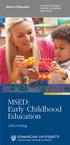 School of Education MASTER OF SCIENCE IN EARLY CHILDHOOD EDUCATION : Early Childhood Education 2012-2014 Master of Science in Education () (Early Childhood Education) Purpose The Master of Science in Education
The University of North Carolina at Pembroke 2015-2016 Academic Catalog
 338 The University of North Carolina at Pembroke 2015-2016 Academic Catalog COURSES BIRTH TO KINDERGARTEN (ECE) ECE 2020. Foundations of Early Childhood (3 credits) This course is designed to introduce
OFF-CAMPUS MASTER S PROGRAMS M.Ed. in Educational Leadership. The Head, Hand, and Heart of School Leadership. Degree Requirements:
 M.Ed. in Educational Leadership This program is for experienced classroom teachers who have an inner passion for facilitating student achievement and school improvement. These educators will find the graduate
Elementary and Bilingual Education
 Elementary and Bilingual Education College of Eduation INTRODUCTION The Department of Elementary and Bilingual Education at Cal State Fullerton provides exemplary preparation for candidates dedicated to
B.A. in Education Specialization: Early Childhood Education (P-3) Student Handbook
 B.A. in Education Specialization: Early Childhood Education (P-3) Student Handbook Rowan University College of Education Teacher Education Department 1 Table of Contents Program Description 3 ECED Program
Bachelor of Professional Studies Major in Professional Studies Concentration: Child Development and Family Studies
 Students Name: UUID#: Description of Program Bachelor of Professional Studies Major in Professional Studies Concentration: Child Development and Family Studies (formerly Child Development) 218 Brister
Pacific Oaks College Academic Catalog
 Value the child. Educate the person. Change the world. Pacific Oaks College Academic Catalog 2010-2011 School of Education Bachelor of Arts Programs -- April 2011 Addendum -- One s work may be finished
Ph.D. in Educational Theory and Practice. Emphasis Areas
 In addition to the shared core courses, doctoral students in ETAP choose an emphasis area. Emphasis areas are overlapping, of course, and should not be considered as exclusive. While the ETAP core provides
Child Development. Child Development. Associate Degrees. Contact Information. Full-Time Faculty. Associate in Arts Degrees
 Child Associate Degrees The Child program explores the social/emotional, cognitive/language, and physical/motor growth and development skills of children from conception through adolescence. Students take
Elementary Education: Teacher Leadership Track
 Elementary Education: Teacher Leadership Track Designed for: Students who have an undergraduate degree in Education and an initial teaching license for elementary grades K-6, plus a minimum of one year
School of Education MASTER OF ARTS IN TEACHING. Master of Arts in Teaching
 School of Education MASTER OF ARTS IN TEACHING Master of Arts in Teaching 2012-2014 The Master of Arts in Teaching Program The Master of Arts in Teaching program is designed for: 1. A person with an appropriate
EDUC 605 Curriculum Development and Assessment.. 3 cr
 MASTER OF ARTS IN EDUCATION The Master of Arts in Education degree program combines online learning with practical and applied learning in the classroom. The master s candidate must earn and successfully
Early Childhood Education
 Early Childhood Education Portfolio Guidelines College of Education University of Nevada, Reno Program Coordinator & Advisor: Melissa M. Burnham, Ph.D. (775) 784-7012; [email protected]; WRB 3031 P a g
SINGLE SUBJECT TEACHER EDUCATION PROGRAM
 SINGLE SUBJECT TEACHER EDUCATION PROGRAM College of Education University Coordinator: Jared Stallones Office: Teacher Preparation Advising Center (ED1-67) Telephone: (562) 985 5325 Website: www.ced.csulb.edu/single-subject
Introduction and Overview of the Program
 California State University, Fresno (07-08) Section A-1 Contextual Information Masters Degree in Education or Advanced Specialist Certification Early Childhood Education Emphasis California State University,
CREDENTIAL PROGRAM: SINGLE SUBJECTS. Student Handbook
 Michael D. Eisner College of Education Credential Office CREDENTIAL PROGRAM: SINGLE SUBJECTS Student Handbook Including the following pathways: Traditional Accelerated Collaborative Teacher Preparation
Early Childhood Education
 Early Childhood Education 233 Early Childhood Education Degrees, Certificates and Awarded Associate in Science Degree, Early Childhood Education Certificate of Achievement, Early Childhood Education Certificate
Master of Science in Education Teacher Education
 Master of Science in Education Teacher Education Program Director Marcia Matamin 2321 Beeghly Hall (330) 941-3652 [email protected] Program Description The master teacher education program provides advanced
Early Childhood Education
 ECE Degrees: A.A. Child Development A.A. Administration A.A. Teacher AA-T - for Transfer Division of Behavioral and Social Sciences Dr. Carl-Petter Sjovold, Interim Dean Rodda North 226 916-558-2401 Certificates
SECTION 4: MASTER OF EDUCATION DEGREE
 SECTION 4: MASTER OF EDUCATION DEGREE Beginning with the summer session in 1954, a fifthyear program of teacher education leading to the degree Master of Teaching was instituted at Northwestern Oklahoma
EARLY CHILDHOOD EDUCATION (AS) Associate Degree, Certificate of Achievement & Department Certificate Programs (formerly Child Development)
 A Course of Study f EARLY CHILDHOOD EDUCATION (AS) Associate Degree, Certificate of Achievement & Department Certificate Programs (fmerly Child Development) Early Childhood Education majs will be trained
Department of Interdisciplinary Learning and Teaching
 The University of Texas at San Antonio 1 Department of Interdisciplinary Learning and Teaching Mission Statement The mission of the Department of Interdisciplinary Learning and Teaching is to: Advance
Humboldt State University has a long tradition. 1914, when it first opened as a Normal. while developing a reputation for innovation
 Education Master of Arts degree in Education Elementary Education: in Multiple Subjects See also:..liberal Studies/Ele.men.tary Education. Child Development/Elementary Education Secondary Education:* Preliminary
Earn your teaching credential & master s degree in as little as 1 year.
 Earn your teaching credential & master s degree in as little as 1 year. Tuition discounts for 2013 start dates! Start our Master s Credential Cohort Program this July and graduate with a Masters in Education
Masters Degree (MEd) Individualized Plan of Study, Concentration in Early Childhood Studies
 Masters Degree (MEd) Individualized Plan of Study, Concentration in Early Childhood Studies Overview of Plan of Study: MCLA is currently conducting a needs assessment to determine the level of interest
SECTION 5: MASTER OF EDUCATION CERTIFICATION OPTIONS ELEMENTARY SCHOOL PRINCIPAL
 SECTION 5: MASTER OF EDUCATION CERTIFICATION OPTIONS NOTICE: NWOSU is proposing a Master's Degree in Educational Leadership, which will fulfill public school certification requirements. When approved,
Discuss DIVERSITY AND PROFESSIONAL DISPOSITIONS 1 SECTION I CONTEXT
 Discuss DIVERSITY AND PROFESSIONAL DISPOSITIONS 1 SECTION I CONTEXT Provide the following contextual information: 1. Description of any state or institutional policies that may influence the application
MASTER OF EDUCATION 1. MASTER OF EDUCATION DEGREE (M.ED.) (845) 575-3028 [email protected]
 MASTER OF EDUCATION 1 MASTER OF EDUCATION DEGREE (M.ED.) (845) 575-3028 [email protected] MISSION AND OBJECTIVES The Teacher Education programs offered by Marist College are integrally linked
APPENDIX A. Level II Handbook
 APPENDIX A Level II Handbook Education Specialist Mild/Moderate Level II Credential Handbook CSUCI California State University Channel Islands Fall 2006 Jill M. Leafstedt Joan Karp Maria Denney Table of
Special Education. College of Education
 Special Education College of Education INTRODUCTION The Department of Special Education at California State University, Fullerton provides exemplary preparation for special education candidates, general
I n t r o d u c t i o n
 and Mission Teachers and education leaders help to build a nation and provide the pathway for the I n t r o d u c t i o n future. They serve their country in important and lasting ways. Having good teachers
Early Childhood Education
 260 Early Childhood Education Early Childhood Education The Early Childhood Education Degree Program at Santa Barbara City College centers around the continuing experience of supervised teaching, combined
Elementary MEd I. The Relationship of the Program with the Unit s Conceptual Framework
 Elementary MEd I. The Relationship of the Program with the Unit s Conceptual Framework Shaping Tomorrow: Ideas to Action The Early Elementary Education program for prospective elementary education candidates
Master of Science in Early Childhood Education Singapore, 2005 2006
 Master of Science in Early Childhood Education Singapore, 2005 2006 Offered by RTRC Asia in Collaboration with Wheelock College s Center for International Education, Leadership, and Innovation Background
How To Become A Teacher
 THE SCHOOL OF EDUCATION The School of Education of University of the Cumberlands continually strives to keep pace with current trends and development in teacher training to meet the needs of prospective
Through the master of arts degree in education and
 Master of Arts Degree in Education (MA) Master of Arts in Teaching Degree (MAT) Master of Arts in Teaching Degree Paraprofessional Pathways to Teaching sm (MAT) Through the master of arts degree in education
SECTION 4: MASTER OF EDUCATION DEGREE
 SECTION 4: MASTER OF EDUCATION DEGREE Beginning with the summer session in 1954, a fi fth-year program of teacher education leading to the degree Master of Teaching was instituted at Northwestern Oklahoma
Undergraduate Programs
 SIMON FRASER UNIVERSITY THINKING OF THE WORLD FACULTY OF EDUCATION Undergraduate Programs 1 BACHELOR OF GENERAL STUDIES (EDUCATION) The Bachelor of General Studies (BGS) (Education) is a degree program
EARLY CHILDHOOD EDUCATION Associate Degree, Certificate of Achievement & Department Certificate Programs (formerly Child Development)
 A Course of Study f EARLY CHILDHOOD EDUCATION Associate Degree, Certificate of Achievement & Department Certificate Programs (fmerly Child Development) Early Childhood Education majs will be trained to
Educational Studies Departmental Mission Statement: Overview of Departmental Programs: Communicating Plus - Educational Studies:
 Educational Studies Professor Jeanne F. Williams (Chair); Associate Professor. Hervé Somé; Assistant Professors Kathleen Nichols; Visiting Instructor and Clinical Coordinator Jean M. Rigden; Cooperating
Masters Degree (MED) Individualized Plan of Study, Concentration in Early Childhood Studies
 Masters Degree (MED) Individualized Plan of Study, Concentration in Early Childhood Studies Overview of Plan of Study: MCLA is currently conducting a needs assessment to determine the level of interest
SECTION 5: MASTER OF EDUCATION DEGREE
 SECTION 5: MASTER OF EDUCATION DEGREE Beginning with the summer session in 1954, a fifth-year program of teacher education leading to the degree Master of Teaching was instituted at Northwestern Oklahoma
Educational Practices REFERENCE GUIDE. Aligned to the AdvancED Standards for Quality Schools
 Educational Practices REFERENCE GUIDE Aligned to the AdvancED Standards for Quality Schools Table of Contents Introduction... 3 Purpose and Direction... 4 Governance and Leadership... 5 Duties of the Governing
College. Of Education
 College Of Education Contact Us 00971-2-5993111 (Abu Dhabi) 00971-4-4021111 (Dubai) 00971-2- 5993783 (College of Education) @Zayed_U www.facebook.com/zayeduniversity www.zu.ac.ae Introduction and Mission
Child and Adolescent Studies
 Child and Adolescent Studies College of Health and Human Development INTRODUCTION The Bachelor of Science in Child and Adolescent Development (CHAD) is designed to provide students with empirically derived
Education and Counseling (M.A.Ed.)
 III: Influencing Literacy Instruction and Leadership RDG 5320 Diversity and Multicultural Education RDG 5330 Leadership in Reading RDG 5610 Diagnosis, Assessment, Instruction, and Practicum in Reading
School Counseling. Master s in School Counseling with Pupil Personnel Services Credential
 School Counseling Master s in School Counseling with Pupil Personnel Services Credential Make a Lifelong Impact as a School Counselor Master s in School Counseling and Pupil Personnel Services Credential
Chapter 9 EARLY CHILDHOOD SPECIAL EDUCATION AND SCHOOL NURSE
 Chapter 9 EARLY CHILDHOOD SPECIAL EDUCATION AND SCHOOL NURSE Section 1. Basic Programs For Those Who Do Not Hold a Teaching Endorsement. These programs are designed for persons providing professional consultation
Preschool to 3rd Grade (P-3) Early Childhood Education Teacher Preparation Program
 Preschool to 3rd Grade (P-3) Early Childhood Education Teacher Preparation Program The Preschool to Third Grade Early Childhood Education Teacher Preparation (P-3) program prepares students for a career
Pasadena City College and California State University, Los Angeles
 TEACHER PREPARATION PROGRAMS Teacher Preparation Programs The Teacher Preparation Programs offer an exciting opportunity for students because it streamlines the process of becoming a teacher. Two options
Department of Educational Foundations and Exceptionalities Dr. John T. Almarode, Interim Department Head
 78 James Madison University 205-206 Undergraduate Catalog Department of Educational Foundations and Exceptionalities Dr. John T. Almarode, Interim Department Head Phone: (540) 568-69 Location: Memorial
DEPARTMENT OF EDUCATION SCHOOL PSYCHOLOGY PROGRAM
 DEPARTMENT OF EDUCATION SCHOOL PSYCHOLOGY PROGRAM PRACTICUM 2015-2016 The Practicum To the Student: This handbook is intended to address some initial questions you may have regarding field placements.
Teaching and Learning (T&L)
 University of North Dakota 1 Teaching and Learning (T&L) Courses T&L 250. Introduction to Education. 3 This course is designed for students exploring the profession of teaching in early childhood, elementary,
4240.95 Urban Teacher Leadership (M.Ed.)
 4240.95 Urban Teacher Leadership (M.Ed.) Concentrations: Elementary Mathematics; Elementary Science; English to Speakers of Other Languages (ESOL); English Education; Leadership; Mathematics Education;
Master s Credential Cohort Program 2014-15 Supplementary Information for MCC Multiple Subject Candidates
 Master s Credential Cohort Program 2014-15 Supplementary Information for MCC Multiple Subject Candidates The student teaching component of the Masters Credential Cohort (MCC) pathway consists of one semester
Course Requirements Select 16 Credits Across All Areas
 Early Childhood Graduate Level Endorsement Program A minimum of 16 hours is required to meet TEAL 6260 the Early Childhood Endorsement guidelines of the Utah State Office of Education. This endorsement