
Master s Credential Cohort Program Supplementary Information for MCC Multiple Subject Candidates
|
|
|
- Bruce Wilcox
- 10 years ago
- Views:
Transcription
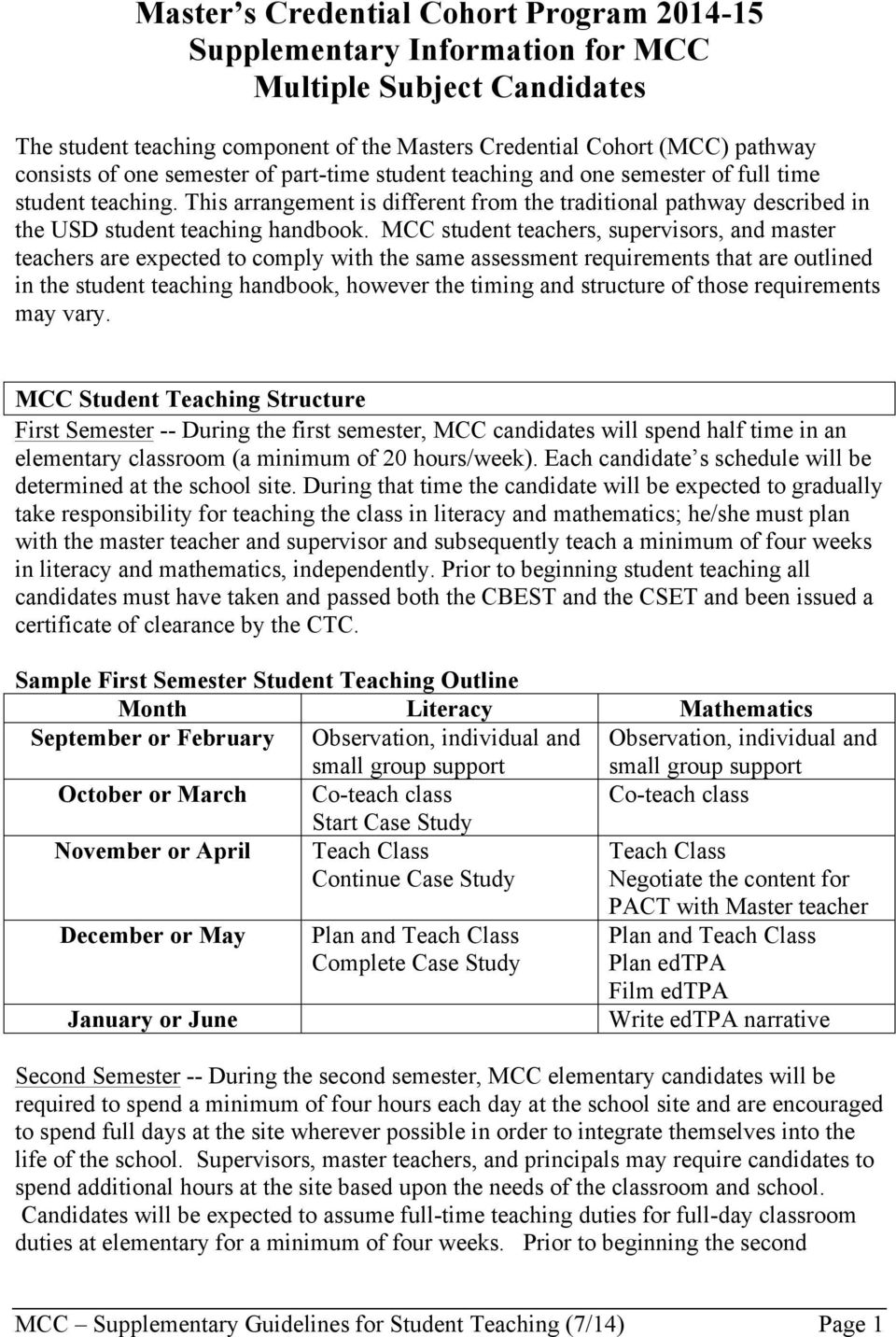
1 Master s Credential Cohort Program Supplementary Information for MCC Multiple Subject Candidates The student teaching component of the Masters Credential Cohort (MCC) pathway consists of one semester of part-time student teaching and one semester of full time student teaching. This arrangement is different from the traditional pathway described in the USD student teaching handbook. MCC student teachers, supervisors, and master teachers are expected to comply with the same assessment requirements that are outlined in the student teaching handbook, however the timing and structure of those requirements may vary. MCC Student Teaching Structure First Semester -- During the first semester, MCC candidates will spend half time in an elementary classroom (a minimum of 20 hours/week). Each candidate s schedule will be determined at the school site. During that time the candidate will be expected to gradually take responsibility for teaching the class in literacy and mathematics; he/she must plan with the master teacher and supervisor and subsequently teach a minimum of four weeks in literacy and mathematics, independently. Prior to beginning student teaching all candidates must have taken and passed both the CBEST and the CSET and been issued a certificate of clearance by the CTC. Sample First Semester Student Teaching Outline Month Literacy Mathematics September or February Observation, individual and small group support Observation, individual and small group support October or March Co-teach class Co-teach class Start Case Study November or April Teach Class Continue Case Study Teach Class Negotiate the content for December or May January or June Plan and Teach Class Complete Case Study PACT with Master teacher Plan and Teach Class Plan edtpa Film edtpa Write edtpa narrative Second Semester -- During the second semester, MCC elementary candidates will be required to spend a minimum of four hours each day at the school site and are encouraged to spend full days at the site wherever possible in order to integrate themselves into the life of the school. Supervisors, master teachers, and principals may require candidates to spend additional hours at the site based upon the needs of the classroom and school. Candidates will be expected to assume full-time teaching duties for full-day classroom duties at elementary for a minimum of four weeks. Prior to beginning the second MCC Supplementary Guidelines for Student Teaching (7/14) Page 1
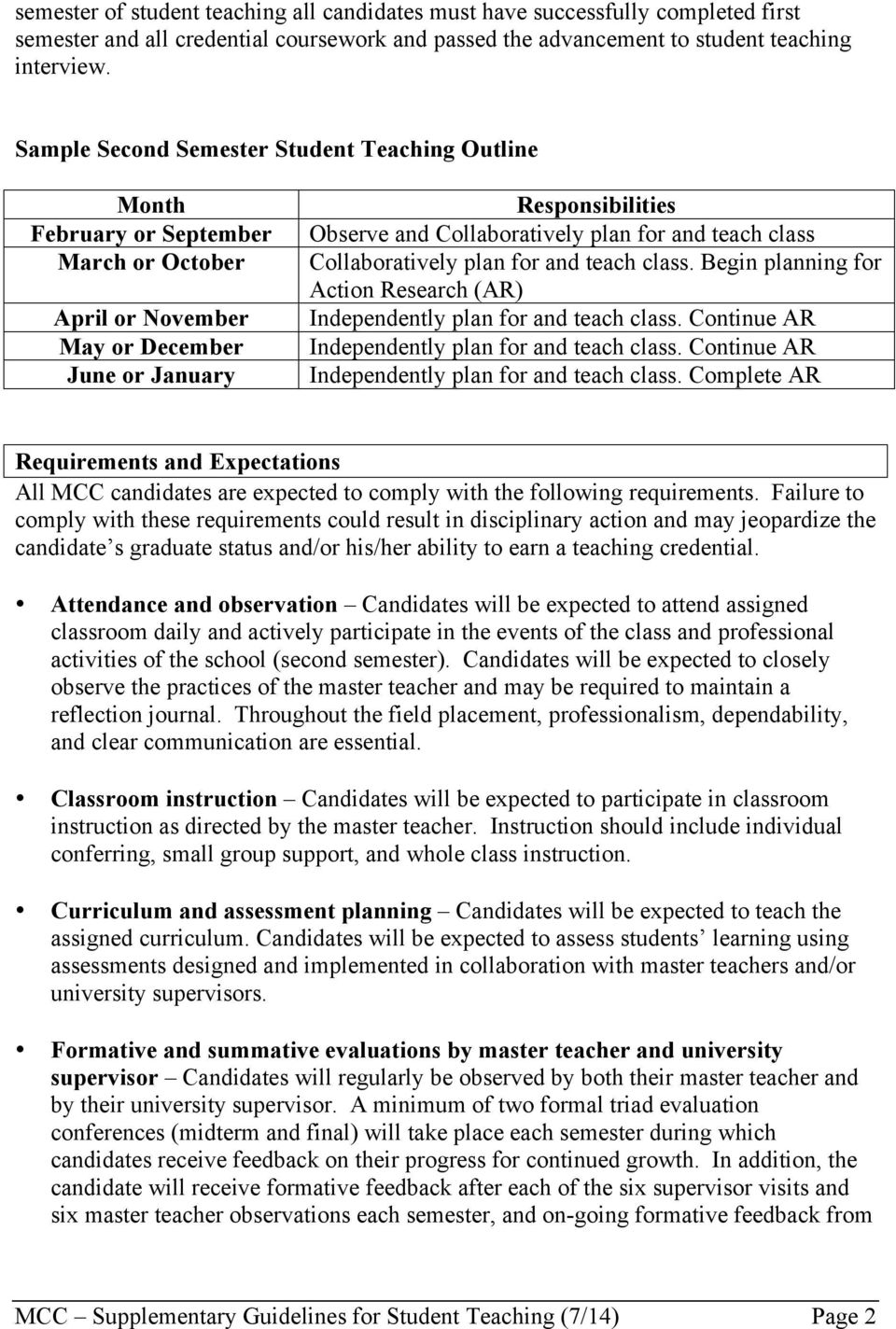
2 semester of student teaching all candidates must have successfully completed first semester and all credential coursework and passed the advancement to student teaching interview. Sample Second Semester Student Teaching Outline Month February or September March or October April or November May or December June or January Responsibilities Observe and Collaboratively plan for and teach class Collaboratively plan for and teach class. Begin planning for Action Research (AR) Independently plan for and teach class. Continue AR Independently plan for and teach class. Continue AR Independently plan for and teach class. Complete AR Requirements and Expectations All MCC candidates are expected to comply with the following requirements. Failure to comply with these requirements could result in disciplinary action and may jeopardize the candidate s graduate status and/or his/her ability to earn a teaching credential. Attendance and observation Candidates will be expected to attend assigned classroom daily and actively participate in the events of the class and professional activities of the school (second semester). Candidates will be expected to closely observe the practices of the master teacher and may be required to maintain a reflection journal. Throughout the field placement, professionalism, dependability, and clear communication are essential. Classroom instruction Candidates will be expected to participate in classroom instruction as directed by the master teacher. Instruction should include individual conferring, small group support, and whole class instruction. Curriculum and assessment planning Candidates will be expected to teach the assigned curriculum. Candidates will be expected to assess students learning using assessments designed and implemented in collaboration with master teachers and/or university supervisors. Formative and summative evaluations by master teacher and university supervisor Candidates will regularly be observed by both their master teacher and by their university supervisor. A minimum of two formal triad evaluation conferences (midterm and final) will take place each semester during which candidates receive feedback on their progress for continued growth. In addition, the candidate will receive formative feedback after each of the six supervisor visits and six master teacher observations each semester, and on-going formative feedback from MCC Supplementary Guidelines for Student Teaching (7/14) Page 2
3 both. Candidates are expected to respond to this feedback and show evidence of learning and continued professional growth. MCC Course related assignments Candidates will be concurrently enrolled in a student teaching seminar during the first semester of student teaching. Assignments in classes will support and complement students fieldwork experiences. Specific assignments that respond to candidates student teaching experiences will be assigned and monitored by instructors in the relevant courses. These include lesson and unit planning, the edtpa performance assessment, and action research design and data collection. See specific course sequence for both the 1-Year and 2-Year programs below. 1-Year Multiple Subject MCC Sequence of Courses Summer I (9 units) EDUC 581C Multicultural and Philosophical Foundations of Education (3) EDUC 582 Psychological Foundations of Education in a Diverse Society (3) EDU 558XB First and Second Language Development and Structure for the Classroom Teacher (3 CEU units) Fall I (17 units) EDUC 583P Methods of Teaching Literacy and Language Arts (3) EDUC 584C Methods of Teaching English Language and Academic Development (3) EDUC 585P Elementary Curriculum & Methods for Global Classrooms (6) EDUC 551P Student Teaching (2) EDUC 567S MCC Student Teaching Seminar I (3) Intersession I (3 units) EDSP 589 Healthy Environments and Inclusive Education (3) Spring I (12 units) EDUC 535 Curriculum Design and Evaluation (3) OR EDUC 578 Learning and Technology (3) EDUC 557 Action Research for Elementary Teachers I (2) EDUC 552P Student Teaching (6) Special topics sessions provided for no credit Summer II (7 units) EDUC 510 Cognition and Learning (3) EDUC 558 Action Research for Elementary Teachers II (1) EDUC 5XX MEd Elective (3) MCC Supplementary Guidelines for Student Teaching (7/14) Page 3

4 2-Year Multiple Subject MCC Sequence of Courses Fall I (15 units) EDU 558XB First and Second Language Development and Structure for the Classroom Teacher (3 CEU units) EDUC 581C Multicultural and Philosophical Foundations of Education (3) EDUC 582 Psychological Foundations of Education in a Diverse Society (3) EDUC 585P Elementary Curriculum & Methods for Global Classrooms (6) Spring I (13 units) EDUC 583P Methods of Teaching Literacy and Language Arts (3) EDUC 584C Methods of Teaching English Language and Academic Development (3) EDUC 551P Student Teaching (2) EDUC 567S MCC Student Teaching Seminar I (2) EDSP 589 Healthy Environments and Inclusive Education (3) Fall II (9 units) EDUC 552P Student Teaching (6 units) EDUC 557 Action Research for Elementary Teachers I (3) Spring II (10 units) EDUC 558 Action Research for Elementary Teachers II (1) EDUC 5XX MEd Elective (3) Choose 1 EDUC 535 Curriculum Design and Evaluation (3) EDUC 578 Learning and Technology (3) Choose 1 EDUC 510 Cognition and Learning (3) EDUC 511 Education Reform (3) EDUC 597 Historical Struggles for Educational Equity (3) Placement Locations Within the MCC program, student teaching will take place at carefully selected sites chosen for teaching excellence, faculty and administrative support for candidate learning, and diversity among the student body. Each MCC candidate will have one experience in a primary grade assignment (grades K-2), and another in an upper grade classroom assignment (grades 3-6). Per CTC regulations, the teaching experiences at these two sites must include at least one teaching assignment where beginning reading is taught. In addition, in response to CTC regulations, at least one semester will be spent in an urban and/or underperforming MCC Supplementary Guidelines for Student Teaching (7/14) Page 4

5 school; and at least one semester will be spent in a classroom that includes English Learners. Placement decisions will be made at the discretion of the Field Experiences Office. Although candidates are invited to share their preferences, decisions will be made in accordance with the goals of the program, the requirements of the state, and the professional judgment of the USD faculty and staff as to the placement site that best fits the experience and needs of the MCC candidate. Supervision Structure Throughout the student teaching experience, the teacher candidate, the university supervisor, and the master teacher are expected to work together to support the professional growth of the teacher candidate. Specific responsibilities are as follows: University supervisor The university supervisor is responsible for supporting and monitoring MCC candidates throughout the tenure of their student teaching experience. The supervisor provides an important link between the university and the placement sites. The multiple subject supervisor will serve as a generalist knowledgeable in all subject areas, which will support the candidate s development of subject-specific pedagogical content knowledge. The university supervisor is responsible for the following: Meeting with the candidate and master teacher at the beginning of each semester to establish an appropriate structure to support the candidate s integration into the classroom. Formally observing and providing feedback to each MCC candidate six times during each semester. Informal communication with the candidate throughout the semester. Facilitating two formal triad evaluation meetings each semester with each candidate and master teacher, and assigning final grade. Maintaining regular contact with the field experiences director and master teacher and alerting them to any concerns regarding the MCC candidate. Participating in field experience support meetings with USD faculty, the field experiences director, and the MCC program coordinator as needed. Master teacher -- The master teacher is an exemplary classroom teacher with content expertise, strong pedagogical practices, and a demonstrated ability to support adult learning. The master teacher will host an MCC candidate in their classroom for one semester. Master teachers will be responsible for the following: Establishing an appropriate structure to support candidates integration into the classroom. Providing guidance in supporting candidates planning, instruction, and assessment of students. Providing regular informal feedback to student teachers. MCC Supplementary Guidelines for Student Teaching (7/14) Page 5

6 Formally observing and providing feedback to each MCC candidate six times during the semester. Complete the midterm and final evaluation forms. Participating in two formal triad evaluation meetings with the candidate and university supervisor during the semester. Maintaining regular contact with the university supervisor and alerting he/she to any concerns regarding the MCC candidate. MCC teacher candidate -- The teacher candidate is expected to play an active role in facilitating his or her own learning. In addition to the requirements and expectations outlined above, the teacher candidate is responsible for the following: Meeting regularly with the master teacher at a time that is convenient to him/her to discuss classroom observations, curriculum expectations, instructional planning, assessment and student learning. Participating in debriefing sessions with the university supervisor and/or master teacher after formal observations and taking steps to respond to the feedback provided in those sessions. Participating in two formal triad evaluation meetings with the university supervisor and master teacher each semester. Actively participating in all aspects of classroom teaching including individual, small group or whole class instruction, instructional planning, and assessment. Maintaining a reflection journal if assigned that includes observations, questions, connections, concerns, and/or evolving views on teaching and learning. Actively participating in the life of the school through attendance at faculty meetings, professional learning community sessions, extra-curricular activities, and student outreach events. Actively seeking out resources within and beyond the school. This may include asking for targeted support from the master teacher, visiting other teachers classrooms, crafting curriculum materials using internet and library resources, and attending professional conferences and workshops. Asking questions and sharing observations and concerns with the master teacher, university supervisor, peers, and USD faculty. Alerting appropriate support providers if personal or professional concerns arise that may interfere with student teaching responsibilities and your professional growth. MCC Supplementary Guidelines for Student Teaching (7/14) Page 6

7 PLEASE NOTE: If concerns arise with regard to a candidate s performance during student teaching, the director of field experiences should be contacted immediately at the phone number below. University supervisors and/or master teachers should document concerns using the Notification of Need to Improve and/or Identification, Assistance, or Dismissal of Candidate forms found in the USD Student Teaching Handbook. Director of Field Experiences: Dr. Helene T. Mandell School of Leadership and Education Sciences University of San Diego 5998 Alcala Park San Diego, CA (619) [email protected] Assistant Director of Field Experiences: Michele L. McConnell School of Leadership and Education Sciences University of San Diego 5998 Alcala Park San Diego, CA (619) [email protected] MCC Supplementary Guidelines for Student Teaching (7/14) Page 7

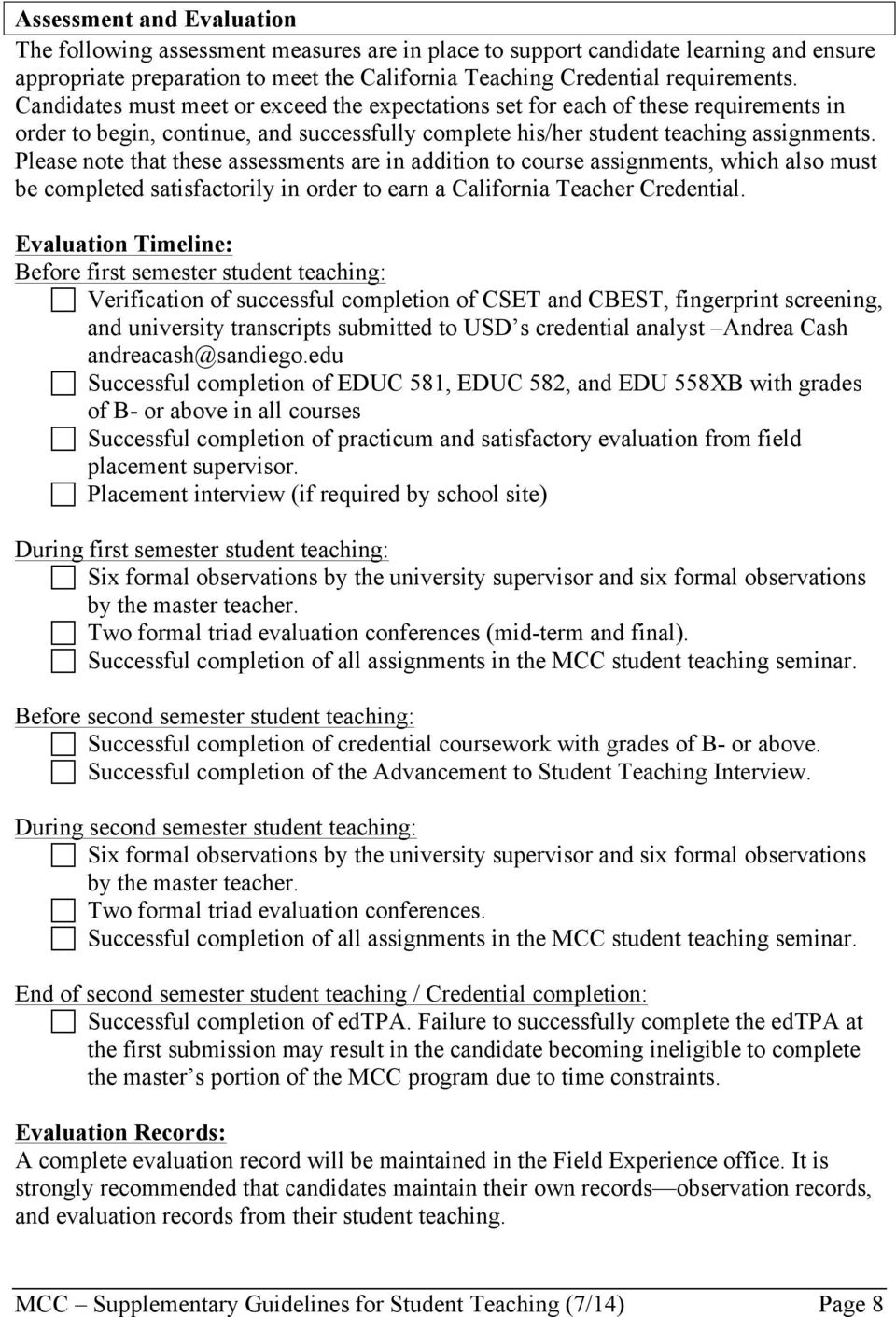
8 Assessment and Evaluation The following assessment measures are in place to support candidate learning and ensure appropriate preparation to meet the California Teaching Credential requirements. Candidates must meet or exceed the expectations set for each of these requirements in order to begin, continue, and successfully complete his/her student teaching assignments. Please note that these assessments are in addition to course assignments, which also must be completed satisfactorily in order to earn a California Teacher Credential. Evaluation Timeline: Before first semester student teaching:! Verification of successful completion of CSET and CBEST, fingerprint screening, and university transcripts submitted to USD s credential analyst Andrea Cash [email protected]! Successful completion of EDUC 581, EDUC 582, and EDU 558XB with grades of B- or above in all courses! Successful completion of practicum and satisfactory evaluation from field placement supervisor.! Placement interview (if required by school site) During first semester student teaching:! Six formal observations by the university supervisor and six formal observations by the master teacher.! Two formal triad evaluation conferences (mid-term and final).! Successful completion of all assignments in the MCC student teaching seminar. Before second semester student teaching:! Successful completion of credential coursework with grades of B- or above.! Successful completion of the Advancement to Student Teaching Interview. During second semester student teaching:! Six formal observations by the university supervisor and six formal observations by the master teacher.! Two formal triad evaluation conferences.! Successful completion of all assignments in the MCC student teaching seminar. End of second semester student teaching / Credential completion:! Successful completion of edtpa. Failure to successfully complete the edtpa at the first submission may result in the candidate becoming ineligible to complete the master s portion of the MCC program due to time constraints. Evaluation Records: A complete evaluation record will be maintained in the Field Experience office. It is strongly recommended that candidates maintain their own records observation records, and evaluation records from their student teaching. MCC Supplementary Guidelines for Student Teaching (7/14) Page 8
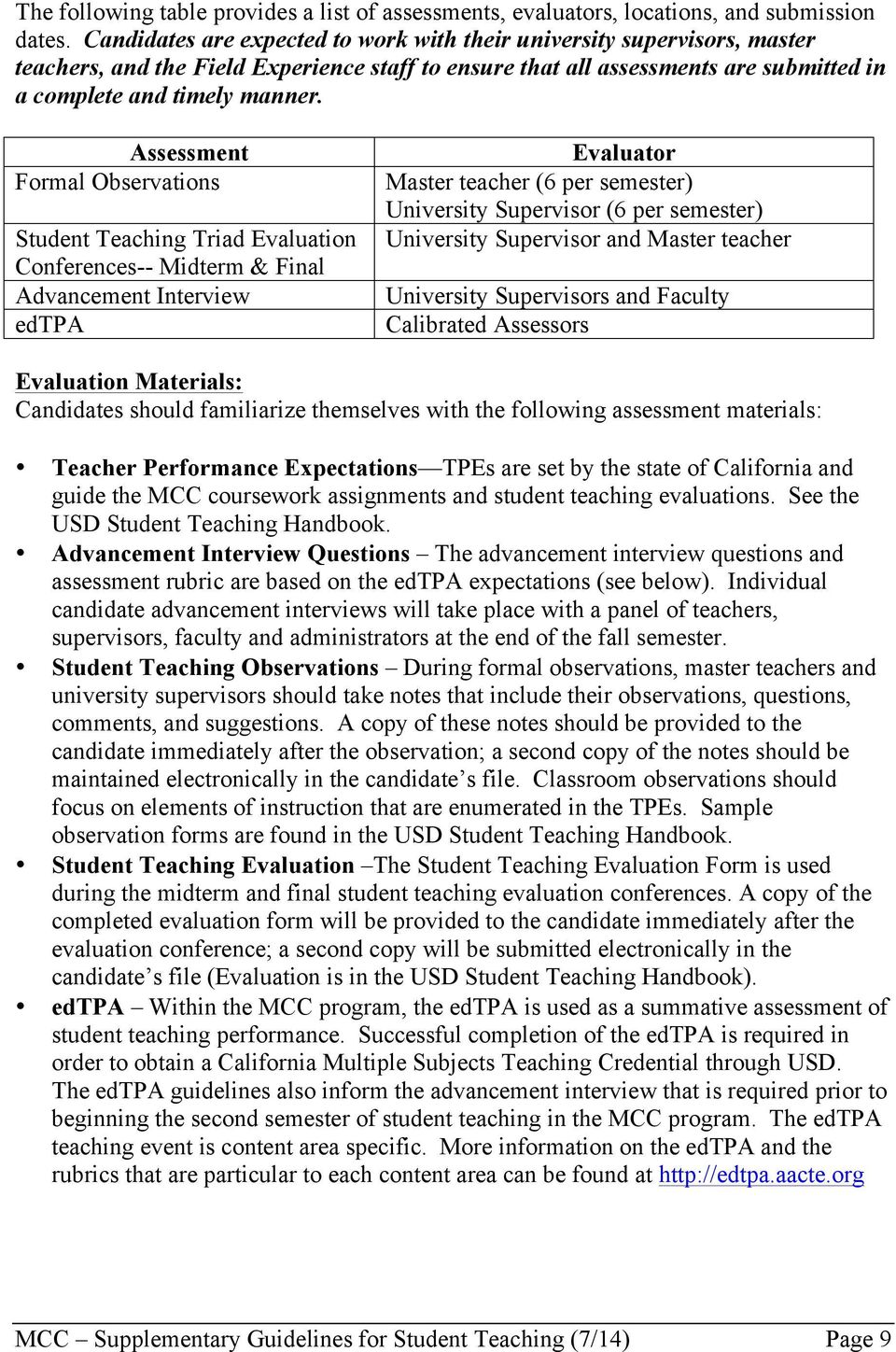
9 The following table provides a list of assessments, evaluators, locations, and submission dates. Candidates are expected to work with their university supervisors, master teachers, and the Field Experience staff to ensure that all assessments are submitted in a complete and timely manner. Assessment Formal Observations Student Teaching Triad Evaluation Conferences-- Midterm & Final Advancement Interview edtpa Evaluator Master teacher (6 per semester) University Supervisor (6 per semester) University Supervisor and Master teacher University Supervisors and Faculty Calibrated Assessors Evaluation Materials: Candidates should familiarize themselves with the following assessment materials: Teacher Performance Expectations TPEs are set by the state of California and guide the MCC coursework assignments and student teaching evaluations. See the USD Student Teaching Handbook. Advancement Interview Questions The advancement interview questions and assessment rubric are based on the edtpa expectations (see below). Individual candidate advancement interviews will take place with a panel of teachers, supervisors, faculty and administrators at the end of the fall semester. Student Teaching Observations During formal observations, master teachers and university supervisors should take notes that include their observations, questions, comments, and suggestions. A copy of these notes should be provided to the candidate immediately after the observation; a second copy of the notes should be maintained electronically in the candidate s file. Classroom observations should focus on elements of instruction that are enumerated in the TPEs. Sample observation forms are found in the USD Student Teaching Handbook. Student Teaching Evaluation The Student Teaching Evaluation Form is used during the midterm and final student teaching evaluation conferences. A copy of the completed evaluation form will be provided to the candidate immediately after the evaluation conference; a second copy will be submitted electronically in the candidate s file (Evaluation is in the USD Student Teaching Handbook). edtpa Within the MCC program, the edtpa is used as a summative assessment of student teaching performance. Successful completion of the edtpa is required in order to obtain a California Multiple Subjects Teaching Credential through USD. The edtpa guidelines also inform the advancement interview that is required prior to beginning the second semester of student teaching in the MCC program. The edtpa teaching event is content area specific. More information on the edtpa and the rubrics that are particular to each content area can be found at MCC Supplementary Guidelines for Student Teaching (7/14) Page 9
Earn your teaching credential & master s degree in as little as 1 year.
 Earn your teaching credential & master s degree in as little as 1 year. Tuition discounts for 2013 start dates! Start our Master s Credential Cohort Program this July and graduate with a Masters in Education
CREDENTIAL PROGRAM: MULTIPLE SUBJECT. Student Handbook
 Michael D. Eisner College of Education Credential Office CREDENTIAL PROGRAM: MULTIPLE SUBJECT Student Handbook Including the following pathways: Traditional Accelerated Collaborative Teacher Preparation
California State University, East Bay. College of Education and Allied Studies. Department of Teacher Education
 California State University, East Bay College of Education and Allied Studies Multiple Subject Teaching Credential Single Subject Teaching Credential Committee on Academic Planning and Review (CAPR) Five-Year
Internship Teacher Preparation Program
 Introduction California State University, Chico School of Education Internship Teacher Preparation Program For Education Specialist, Multiple Subject, or Single Subject Credentials The Internship Teacher
EXAMPLE FIELD EXPERIENCE PLANNING TEMPLATE CCSU MAT Program
 EXAMPLE FIELD EXPERIENCE PLANNING TEMPLATE CCSU MAT Program Secondary Education (Math, History/Social Studies, Science, World Languages) and Special Education (K-12) Goal: The MAT program focuses on preparing
UC Berkeley Biennial Report. Multicultural Urban Secondary English 2. Single Subject-Math and Science 17. Multiple Subject 33. Designated Subjects 46
 UC Berkeley Biennial Report Section A Reports Multicultural Urban Secondary English 2 Single Subject-Math and Science 17 Multiple Subject 33 Designated Subjects 46 Administrative Services 56 Section B
All students are admitted during the summer and begin their coursework in the fall. Students must commit to completing these courses in sequence.
 Department of Special Education Initial Licensure and Added Endorsement the Special Education Generalist Overview and Assessment Plan Purpose for Program Change In the Fall of 2013 the Department of Special
CREDENTIAL PROGRAM: SINGLE SUBJECTS. Student Handbook
 Michael D. Eisner College of Education Credential Office CREDENTIAL PROGRAM: SINGLE SUBJECTS Student Handbook Including the following pathways: Traditional Accelerated Collaborative Teacher Preparation
MASTER OF SCIENCE IN EDUCATION AND CERTIFICATION OPTIONS
 Overview MASTER OF SCIENCE IN EDUCATION (INSTRUCTIONAL LEADERSHIP) AND CERTIFICATION OPTIONS Neumann University s graduate program leading to the Master of Science in Education: Instructional Leadership
SEL Credential Candidate Enrollment by Ethnicity and Gender Total Total Total Total
 Notre Dame de Namur University From: School of Education and Leadership Credential Programs Re: HEOA Sec. 201 Amended HEA Title II, Part A Date: October 21, 2014 Section 1 Background: Credential programs
Handbook for Multiple and Single Subject Teaching Credential Students
 Handbook for Multiple and Single Subject Teaching Credential Students Handbook for Multiple & Single Subject Teaching Credential Students This handbook contains information about Multiple and Single Subject
Humboldt State University has a long tradition. 1914, when it first opened as a Normal. while developing a reputation for innovation
 Education Master of Arts degree in Education Elementary Education: in Multiple Subjects See also:..liberal Studies/Ele.men.tary Education. Child Development/Elementary Education Secondary Education:* Preliminary
INFORMATION SESSION PRELIMINARY SINGLE SUBJECT CREDENTIAL PROGRAM
 INFORMATION SESSION PRELIMINARY SINGLE SUBJECT CREDENTIAL PROGRAM MICHAEL D. EISNER COLLEGE OF EDUCATION The California State University Northridge, Michael D. Eisner College of Education is nationally
WHAT YOU TO BECOME T E A C H E R MUST KNOW EDUCATION
 WHAT YOU MUST KNOW TO BECOME A SPECIAL EDUCATION T E A C H E R NATIONAL UNIVERSITY SCHOOL OF EDUCATION TM The University of Values NATIONAL UNIVERSITY OFFERS SPECIAL EDUCATION TEACHING CREDENTIALS IN MILD/MODERATE
Student Fieldwork Manual Department of Occupational Therapy San Jose State University
 Student Fieldwork Manual Department of Occupational Therapy San Jose State University Introduction to Fieldwork Entry level education for occupational therapists requires the successful completion of both
Special Resources. Faculty. Programs Offered. Single Subject (Secondary Schools) Teaching Credential
 Education: Curriculum Studies & Secondary Education (CSSE) Department Office Stevenson Hall 1078 (707) 664-4203 fax (707) 664-2483 www.sonoma.edu/education Department Chair Perry M. Marker Administrative
MASTER OF SCIENCE IN EDUCATION AND CERTIFICATION OPTIONS
 Overview MASTER OF SCIENCE IN EDUCATION (INSTRUCTIONAL LEADERSHIP) AND CERTIFICATION OPTIONS Neumann University s graduate program leading to the Master of Science in Education: Instructional Leadership
School Counseling. Master s in School Counseling with Pupil Personnel Services Credential
 School Counseling Master s in School Counseling with Pupil Personnel Services Credential Make a Lifelong Impact as a School Counselor Master s in School Counseling and Pupil Personnel Services Credential
The UCSC Master of Arts in Education and Teacher Credential Program Philosophy of the Master of Arts in Education/ Teacher Credential Program
 " The UCSC Master of Arts in Education and Teacher Credential Program prepares teachers for California's underserved students. Through a combination of coursework, classroom placements and research projects,
A HANDBOOK FOR INTERNSHIP CREDENTIAL CANDIDATES
 LEADERSHIP DIVERSITY CARING EXCELLENCE A HANDBOOK FOR INTERNSHIP CREDENTIAL CANDIDATES SUMMER 2012 EDITION Master of Science, Educational Counseling Pupil Personnel Services Credential UNIVERSITY OF LA
Teacher Education. of California mandates changes in program structure and content, which the college is required to implement.
 Teacher Education Dr. Kurt Hild, Chairperson The Master s College is authorized to recommend candidates for both California Multiple and Single Subject Preliminary teaching credentials. The purpose of
HIGH TECH HIGH. The Implementation of a Teacher Credentialing Program
 HIGH TECH HIGH The Implementation of a Teacher Credentialing Program June 2007 High Tech High: The Implementation of a Teacher Credentialing Program Page 2 INFORMATION ABOUT THIS TOOL This case study describes
Program Handbook for Education Specialist Candidates Section 1
 Program Handbook for Education Specialist Candidates Section 1 Graduate School of Education Mission In accordance with the mission of California Lutheran University, the Graduate School of Education seeks
Teacher Candidate Handbook
 SONOMA STATE UNIVERSITY Single Subject Credential Program Teacher Candidate Handbook Curriculum Studies and Secondary Education www.sonoma.edu/education/csse Single Subject Credential Program Teacher Candidate
PRELIMINARY MILD/MODERATE EDUCATION SPECIALIST CREDENTIAL (AND INTERNSHIP PATHWAY) PROGRAM HANDBOOK
 PRELIMINARY MILD/MODERATE EDUCATION SPECIALIST CREDENTIAL (AND INTERNSHIP PATHWAY) PROGRAM HANDBOOK INTRODUCTION This handbook has been prepared for candidates, faculty, field-based supervisors (i.e.,
STUDENT HANDBOOK Graduate Programs in Special Education
 STUDENT HANDBOOK Graduate Programs in Special Education Masters Degree Programs Leading to Initial/Professional Certification & Post-Masters Advanced Certification Programs Graduate Programs in Special
EDUCATIONAL LEADERSHIP and ADMINISTRATION PROGRAM With an MA in EDUCATION APPLICATION PACKET
 California State University, Chico Chico, California 95929-0222 530-898-6421 EDUCATIONAL LEADERSHIP and ADMINISTRATION PROGRAM With an MA in EDUCATION APPLICATION PACKET Well-qualified professional school
SINGLE SUBJECT TEACHER EDUCATION PROGRAM
 SINGLE SUBJECT TEACHER EDUCATION PROGRAM College of Education University Coordinator: Jared Stallones Office: Teacher Preparation Advising Center (ED1-67) Telephone: (562) 985 5325 Website: www.ced.csulb.edu/single-subject
Post-Baccalaureate Certificate Program
 Post-Baccalaureate Certificate Program ACT PROGRAM 47 Accelerated Certification for Teaching (ACT) Program ACT is an online certificate program designed for individuals who hold a bachelor s degree and
Autistic Spectrum Disorders Endorsement Program *completion of this program does not result in degree
 has developed a program to meet the requirements for the Autism Spectrum Disorders Endorsement. It is designed to demonstrate that candidates have completed a competency-based sequence of courses totaling
School Leadership Concentration
 School Leadership Concentration The School Leadership Concentration (SLC) is designed for aspiring school leaders. Candidates will learn the necessary skills, ranging from financial management to instructional
EDUCATION: EDUCATIONAL LEADERSHIP AND SPECIAL EDUCATION (ELSE)
 EDUCATION: EDUCATIONAL LEADERSHIP AND SPECIAL EDUCATION (ELSE) DEPARTMENT OFFICE Stevenson Hall 1078 (707) 664-3115 fax: (707) 664-2483 www.sonoma.edu/education ADMINISTRATIVE COORDINATOR Kathryn Teixeira
Student Teaching Handbook
 Framingham State University Framingham, Massachusetts Student Teaching Handbook to be used in conjunction with MA DESE Candidate Assessment of Performance (CAP) for the following Initial licensure programs:
First-Time Licensure. SECONDARY EDUCATION Master s Degree Program M.Ed.
 SECONDARY EDUCATION Master s Degree Program M.Ed. First-Time Licensure College of Education Secondary Ed. Program University of Nevada, Reno 1664 N. Virginia St. Mailstop 280 Reno, NV 89557 The M.Ed. program
The California Teaching Performance Assessment (CalTPA) Frequently Asked Questions
 The California Teaching Performance Assessment (CalTPA) Frequently Asked Questions The information presented in this guide is meant to serve as introductory information. After reading this document, candidates
Department of School Psychology Field Placement Manual
 I. INTRODUCTION his manual includes pertinent information regarding requirements for practicum/field experience/internship in the School Psychology program. Be sure to read it over carefully as you are
Master s Degree Portfolio Project
 Master s Degree Portfolio Project Introduction The portfolio project serves as the capstone activity for the master s degree program in the Department of Secondary Education. The portfolio will provide
HOME AND SCHOOL VISITOR CERTIFICATE PROGRAM. BRYN MAWR COLLEGE Graduate School of Social Work and Social Research 300 Airdale Rd. Bryn Mawr, PA 19010
 HOME AND SCHOOL VISITOR CERTIFICATE PROGRAM BRYN MAWR COLLEGE Graduate School of Social Work and Social Research 300 Airdale Rd. Bryn Mawr, PA 19010 TABLE OF CONTENTS General Information and Requirements,,
PRIORITY REVIEW GIVEN TO THOSE WHO SUBMIT APPLICATIONS BY JANUARY 5, 2009. (EI AND LD ONLY.)
 SPECIAL EDUCATION Emotionally Impaired/Learning Disabled/Deaf Education Master of Arts Application Deadlines: EMOTIONALLY IMPAIRED FEBRUARY 15. LEARNING DISABLED FEBRUARY 15. DEAF EDUCATION FEBRUARY 15.
Department of Teacher Education
 Department of Teacher Education Vision The vision of the Teacher Education Department is to provide an education that prepares teacher leaders who have a deep understanding of cultural and educational
U.S. News & World Report and the National Council on Teacher Quality. National Education School Review. Survey
 U.S. News & World Report and the National Council on Teacher Quality National Education School Review Survey This is an outline of the questions and documents that will be requested during the review.
ACADEMIC SALARY SCHEDULE July 1, 2011 - June 30, 2013 (Effective July 1, 2011) STEP CLASS I CLASS II CLASS III CLASS IV CLASS V DOC
 ACADEMIC SALARY SCHEDULE July 1, 2011 - June 30, 2013 (Effective July 1, 2011) STEP CLASS I CLASS II CLASS III CLASS IV CLASS V DOC 1 67,770 70,274 72,783 75,292 77,801 80,311 2 71,451 73,961 76,468 78,974
School of Education Master of Arts Degree Handbook
 School of Education Master of Arts Degree Handbook Revised August, 2013 CONTENTS Introduction... 3 Pathways to Program Completion... 4 Thesis/Project... 5 Cognate... 5 Individualized Examination... 6 Table:
WHAT YOU A SCHOOL TO BECOME MUST KNOW PSYCHOLOGIST COUNSELOR OR NATIONAL UNIVERSITY SCHOOL OF EDUCATION. The University of Values
 WHAT YOU MUST KNOW TO BECOME A SCHOOL COUNSELOR OR PSYCHOLOGIST NATIONAL UNIVERSITY SCHOOL OF EDUCATION The University of Values An Overview of the Credential Process Step One: Getting Started Welcome
MASTER OF EDUCATION 1. MASTER OF EDUCATION DEGREE (M.ED.) (845) 575-3028 [email protected]
 MASTER OF EDUCATION 1 MASTER OF EDUCATION DEGREE (M.ED.) (845) 575-3028 [email protected] MISSION AND OBJECTIVES The Teacher Education programs offered by Marist College are integrally linked
Evaluation of Candidates in the Teacher Preparation Program College of Education
 Evaluation of Candidates in the Teacher Preparation Program College of Education 6000 J Street, Sacramento, California www.csus.edu/coe Ba c k g r o u n d Credential programs for school personnel are carefully
Informational Packet 2015-2016
 Post-Baccalaureate Certificate Elementary Education (K-6) Informational Packet 2015-2016 UAA is an AA/EO employer and educational institution. The University of Alaska Anchorage is in full compliance with
INTERN HANDBOOK for the Multiple Subject Credential Program
 1 INTERN HANDBOOK for the Multiple Subject Credential Program This and other Handbooks are available on the web at: http://www.csustan.edu/teachered/elementaryeducation.html A Program Fully Accredited
MASTER OF ARTS IN TEACHING PURPOSE
 MASTER OF ARTS IN TEACHING PURPOSE The purpose of the Master of Arts in Teaching (MAT) is to offer an alternative teacher certification pathway. REQUIREMENTS FOR ADMISSIONS Students accepted for admission
Intro d uction to Fiel dw ork. Practicum and Fiel dw ork Ex periences. Level II fieldwork
 Student Fieldwork Manual Department of Occupational Therapy San Jose State University Intro d uction to Fiel dw ork Entry level education for occupational therapists requires the successful completion
Face-to-Face M.A.Ed. in Educational Administration w/preliminary Administration Services Credential
 Face-to-Face M.A.Ed. in Educational Administration w/preliminary Administration Services Credential Experienced educators with a CA teaching credential who are interested in becoming an administrator in
Master s of Education in School Counseling. Field Experiences Handbook. Student Version
 Master s of Education in School Counseling Field Experiences Handbook Student Version Curriculum Coordinator: Alan Green, Ph.D. Fieldwork Placement Coordinator: Derek A. Sapico, MMFT University of Southern
How To Teach Math
 Students in the senior year of the UCLA CalTeach-Math program, may also participate in the UCLA Joint Education Program (JMEP). JMEP was initiated in 1986 by the Department of and the Teacher Education
KIMBERLY FERRARIO [email protected]
 KIMBERLY FERRARIO [email protected] EDUCATION RESEARCH Ph.D. Education, June 2009 Emphasis on Language, Literacy and Culture University California, Davis Advisers: Professor Sandra Murphy, School of Education,
National Board for Professional Teaching Standards Certification Incentive Program
 Certificated Personnel BP 4112.2(a) CERTIFICATION The Superintendent or designee shall ensure that persons employed in positions requiring certification qualifications have the appropriate credential or
Revisioning Graduate Teacher Education in North Carolina Master of Arts in Elementary Education Appalachian State University
 Revisioning Graduate Teacher Education in North Carolina Master of Arts in Elementary Education Appalachian State University A. A description of how the proposed program has been revisioned to reflect
College of Education University of Nevada, Reno Special Education Professional Degree Program ADVISEMENT & APPLICATION MANUAL
 College of Education University of Nevada, Reno Special Education Professional Degree Program ADVISEMENT & APPLICATION MANUAL Thank you for your interest in our Professional Degree Program in Special Education.
Bachelor s Degrees. You may earn a maximum of 30 college credits by examination. See page 22 for further information.
 Bachelor s Degrees Maintaining Good Standing You must maintain a minimum cumulative grade-point average of 2.0 for the Bachelor of Applied Science, the Bachelor of Science in Nursing, and the Bachelor
Department of School Counseling Field Placement Manual I. INTRODUCTION
 I. INTRODUCTION his manual includes pertinent information regarding requirements for practicum/field experience in the School Counseling program. Be sure to read it over carefully as you are responsible
Program Handbook for Deaf and Hard of Hearing (D/HH) Education Specialist Candidates
 Program Handbook for Deaf and Hard of Hearing (D/HH) Education Specialist Candidates Graduate School of Education Mission In accordance with the mission of California Lutheran University, the Graduate
M.Ed. Elementary Education with Certification Emphasis Information Packet & FAQs
 College of Education Department of Teaching and Learning M.Ed. Elementary Education with Certification Emphasis Information Packet & FAQs Thank your for your interest in Northern Arizona University s M.Ed.
EDUCATION (M.S./M.S.ED.) SCHOOL OF ARTS, SCIENCES AND EDUCATION
 53 EDUCATION (M.S./M.S.ED.) SCHOOL OF ARTS, SCIENCES AND EDUCATION MASTER'S DEGREE IN EDUCATION All programs in the education department are accredited by the Regents Accreditation of Teacher Education.
Commission on Teacher Credentialing Biennial Report. California State University, Fullerton REPORT OVERVIEW
 CSU Fullerton, October 2010 Overview - 1 Commission on Teacher Credentialing Biennial Report California State University, Fullerton REPORT OVERVIEW Programs Included in the Report The Education Unit at
Masters Degree (MEd) Individualized Plan of Study, Concentration in Early Childhood Studies
 Masters Degree (MEd) Individualized Plan of Study, Concentration in Early Childhood Studies Overview of Plan of Study: MCLA is currently conducting a needs assessment to determine the level of interest
Lehman College School of Education Advising Worksheet PROGRAM/CERTIFICATION REQUIREMENTS Department of Middle and High School Education.
 Lehman College School of Education Advising Worksheet PROGRAM/CERTIFICATION REQUIREMENTS Department of Middle and High School Education Student ID# Program: M.S. Ed. Program in Mathematics Education, Middle
Early Childhood Education
 Early Childhood Education Portfolio Guidelines College of Education University of Nevada, Reno Program Coordinator & Advisor: Melissa M. Burnham, Ph.D. (775) 784-7012; [email protected]; WRB 3031 P a g
Will apply content knowledge, decision-making skills and sound judgments inherent in the learning and teaching process.
 TEACHER INTERN PROGRAM DESIGN The Teacher Intern Program focuses on a way of thinking about teaching that includes planning and preparation, classroom management, instruction and professional responsibilities.
St. Joseph s College Education Department Handbook for Student Teachers Cooperating Teachers College Supervisors
 St. Joseph s College Education Department Handbook for Student Teachers Cooperating Teachers College Supervisors Brooklyn Campus Long Island Campus 245 Clinton Avenue 155 West Roe Boulevard Brooklyn, NY
Admissions Guide. Administrative Services Credential Programs
 Admissions Guide Administrative Services Credential Programs Excellence in Educational Leadership Administrative Services (AS) Credential Programs College of Professional Studies School of Education Harry
INTEGRATED CREDENTIAL PROGRAM GENERAL INFORMATION AND CURRICULUM
 COLLEGE OF EDUCATION, HEALTH, HUMAN SERVICES COLLEGE OF HUMANITIES, ARTS, BEHAVIORAL SOCIAL SCIENCES INTEGRATED CREDENTIAL PROGRAM GENERAL INFORMATION CURRICULUM BACHELOR OF ARTS IN LIBERAL STUDIES MULTIPLE
Elementary Education: Teacher Leadership Track
 Elementary Education: Teacher Leadership Track Designed for: Students who have an undergraduate degree in Education and an initial teaching license for elementary grades K-6, plus a minimum of one year
STUDENT HANDBOOK Graduate Programs in Special Education
 STUDENT HANDBOOK Graduate Programs in Special Education Masters Degree Programs Leading to Initial/Professional Certification & Post-Masters Advanced Certification Programs Graduate Programs in Special