
Bonds. Describe Bonds. Define Key Words. Created 2007 By Michael Worthington Elizabeth City State University
|
|
|
- Rolf Wheeler
- 10 years ago
- Views:
Transcription
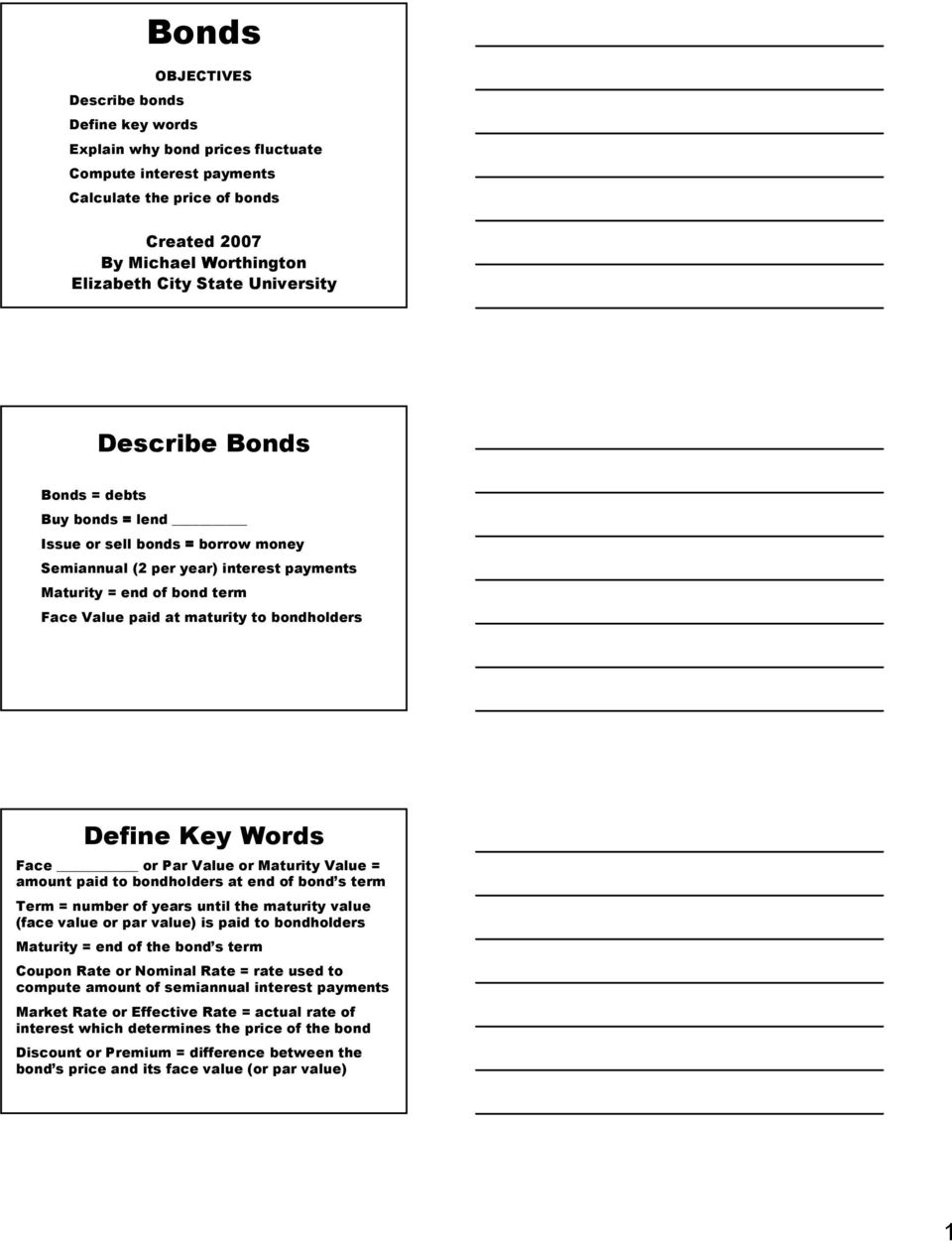
1 Bonds OBJECTIVES Describe bonds Define key words Explain why bond prices fluctuate Compute interest payments Calculate the price of bonds Created 2007 By Michael Worthington Elizabeth City State University Describe Bonds Bonds = debts Buy bonds = lend Issue or sell bonds = borrow money Semiannual (2 per year) interest payments Maturity = end of bond term Face Value paid at maturity to bondholders Define Key Words Face or Par Value or Maturity Value = amount paid to bondholders at end of bond s term Term = number of years until the maturity value (face value or par value) is paid to bondholders Maturity = end of the bond s term Coupon Rate or Nominal Rate = rate used to compute amount of semiannual interest payments Market Rate or Effective Rate = actual rate of interest which determines the price of the bond Discount or Premium = difference between the bond s price and its face value (or par value) 1
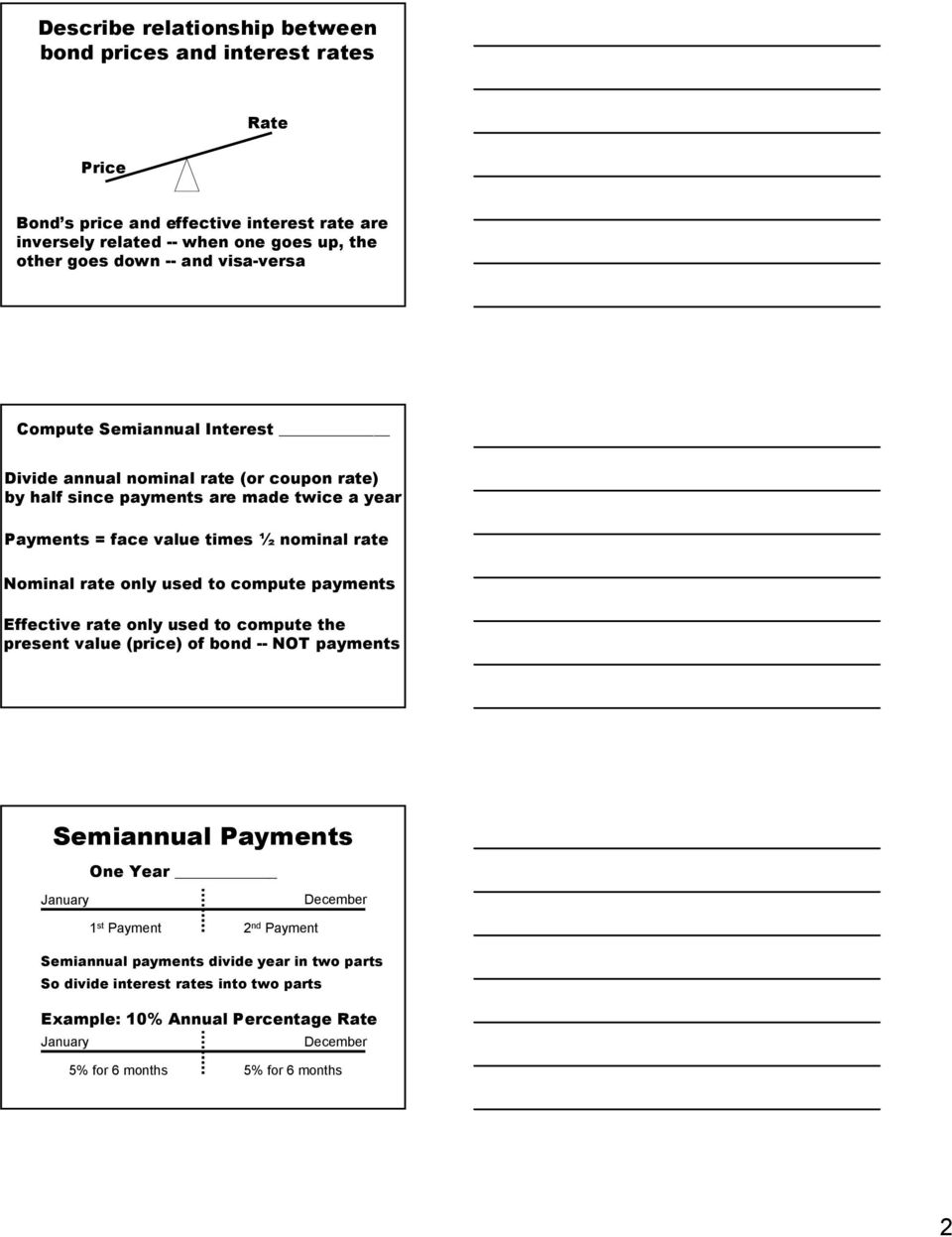
2 Describe relationship between bond prices and interest rates Rate Price Bond s price and effective interest rate are inversely related -- when one goes up, the other goes down -- and visa-versa Compute Semiannual Interest Divide annual nominal rate (or coupon rate) by half since payments are made twice a year Payments = face value times ½ nominal rate Nominal rate only used to compute payments Effective rate only used to compute the present value (price) of bond -- NOT payments Semiannual Payments One Year January December 1 st Payment 2 nd Payment Semiannual payments divide year in two parts So divide interest rates into two parts Example: 10% Annual Percentage Rate January December 5% for 6 months 5% for 6 months 2
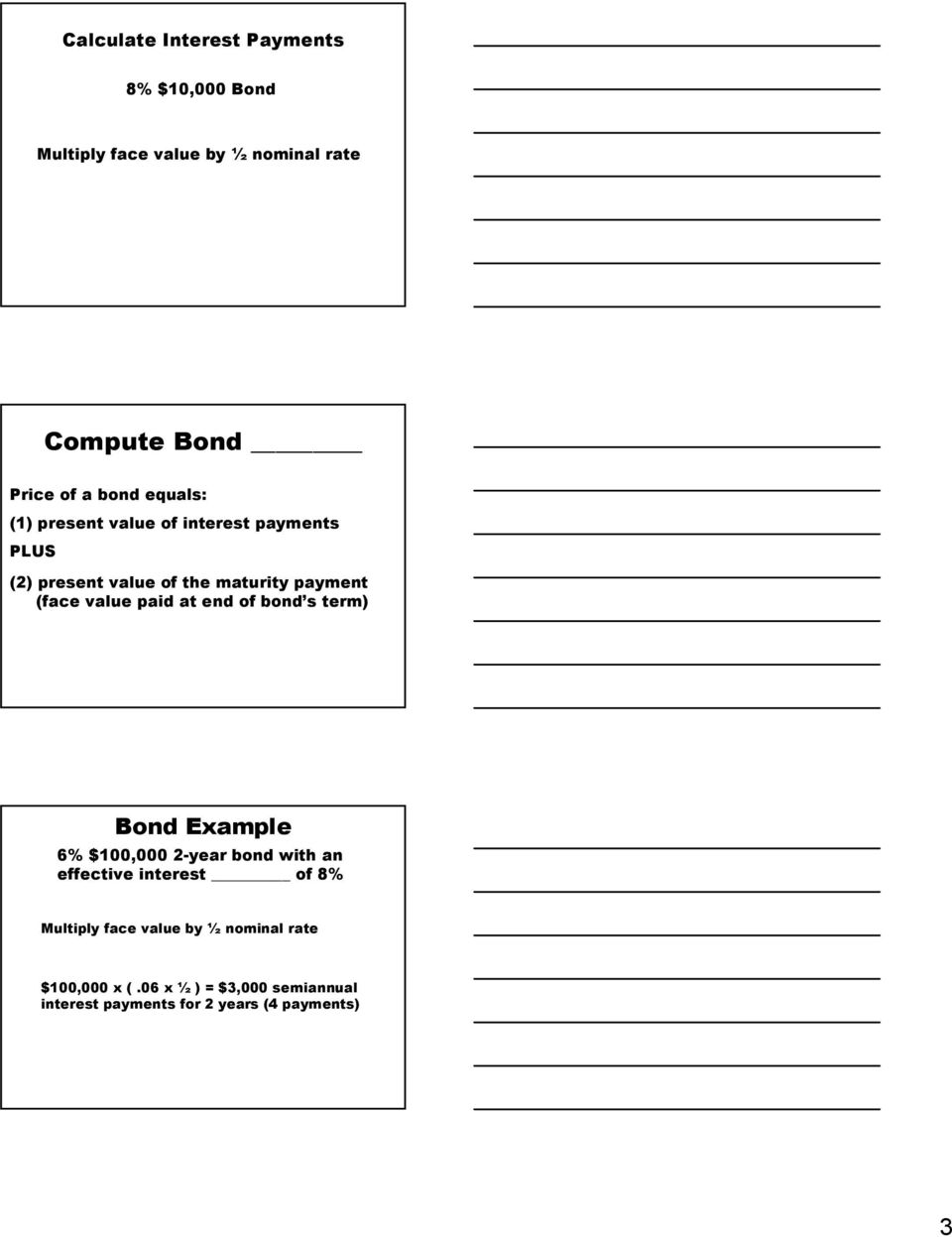
3 Calculate Interest Payments 8% $10,000 Bond Multiply face value by ½ nominal rate Compute Bond Price of a bond equals: (1) present value of interest payments PLUS (2) present value of the maturity payment (face value paid at end of bond s term) effective interest of 8% Multiply face value by ½ nominal rate $100,000 x (.06 x ½ ) = $3,000 semiannual interest payments for 2 years (4 payments) 3
4 Issue Bond effective rate of 8% 1 st semiannual interest payment TIMELINE 2 nd semiannual interest payment End of 3 rd semiannual one year interest payment 4 th semiannual interest payment End of two years Maturity Payment effective interest rate of 8% January 1, 00 July 1, 00 December 31, 00 July 1, 01 December 31, 01 December 31, 01 Issue Bond $100,000 maturity payment Interest = ordinary annuity interest rate of 8% ½ of the effective rate = 4% semiannually 4 semiannual payments over two years PV of Ordinary Annuity Table N 1% 2% 3% 4% 5%

5 effective interest rate of 8% $3,000 semiannual interest payments times factor off PV of Annuity Table $10,890 Present Value of effective interest rate of 8% The face value is paid to the bondholders when the bond matures (end of term) Since this maturity payment is only paid ONCE, use PV of Sum of $1 Table to compute its Present effective interest of 8% ½ of the effective rate = 4% semiannually 4 semiannual payments over two years N % PV of Sum of $1 2% 3% 4% %

6 effective interest of 8% $100,000 Maturity Value times.855 factor off PV of $1 Table $85,500 Present Value of Maturity Payment effective rate of 8% $10,890 Present Value of Interest Payments Plus $85,500 Present Value of Maturity Payment $96,390 Price (Present Value of Bond) Interest rate ROSE from 6% nominal rate to 8% effective rate, so the price FELL from $100,000 to $96, rates and prices move opposite directions SUMMARY Interest Payments = face value x ½ nominal rate Compute present value using ½ effective rate and twice the term (2 payments per year) Calculate present value of interest payments using PV of Ordinary Annuity Table Calculate present value of maturity value using PV of $1 Table PV of Interest Payments + PV of Maturity Value equals the bond price Bond prices and interest rates move in opposite directions -- when rates go up, prices go down, and visa versa 6

Click Here to Buy the Tutorial
 FIN 534 Week 4 Quiz 3 (Str) Click Here to Buy the Tutorial http://www.tutorialoutlet.com/fin-534/fin-534-week-4-quiz-3- str/ For more course tutorials visit www.tutorialoutlet.com Which of the following
Mathematics. Rosella Castellano. Rome, University of Tor Vergata
 and Loans Mathematics Rome, University of Tor Vergata and Loans Future Value for Simple Interest Present Value for Simple Interest You deposit E. 1,000, called the principal or present value, into a savings
Maturity The date where the issuer must return the principal or the face value to the investor.
 PRODUCT INFORMATION SHEET - BONDS 1. WHAT ARE BONDS? A bond is a debt instrument issued by a borrowing entity (issuer) to investors (lenders) in return for lending their money to the issuer. The issuer
Lesson 6 Save and Invest: Bonds Lending Your Money
 Lesson 6 Save and Invest: Bonds Lending Your Money Lesson Description This lesson introduces bonds as an investment option. Using a series of classroom visuals, students will identify the three main parts
Interest Rates and Bond Valuation
 and Bond Valuation 1 Bonds Debt Instrument Bondholders are lending the corporation money for some stated period of time. Liquid Asset Corporate Bonds can be traded in the secondary market. Price at which
Fin 3312 Sample Exam 1 Questions
 Fin 3312 Sample Exam 1 Questions Here are some representative type questions. This review is intended to give you an idea of the types of questions that may appear on the exam, and how the questions might
Prepared by: Dalia A. Marafi Version 2.0
 Kuwait University College of Business Administration Department of Finance and Financial Institutions Using )Casio FC-200V( for Fundamentals of Financial Management (220) Prepared by: Dalia A. Marafi Version
Bond valuation. Present value of a bond = present value of interest payments + present value of maturity value
 Bond valuation A reading prepared by Pamela Peterson Drake O U T L I N E 1. Valuation of long-term debt securities 2. Issues 3. Summary 1. Valuation of long-term debt securities Debt securities are obligations
CHAPTER 8 INTEREST RATES AND BOND VALUATION
 CHAPTER 8 INTEREST RATES AND BOND VALUATION Answers to Concept Questions 1. No. As interest rates fluctuate, the value of a Treasury security will fluctuate. Long-term Treasury securities have substantial
Chapter 5: Valuing Bonds
 FIN 302 Class Notes Chapter 5: Valuing Bonds What is a bond? A long-term debt instrument A contract where a borrower agrees to make interest and principal payments on specific dates Corporate Bond Quotations
BOND - Security that obligates the issuer to make specified payments to the bondholder.
 Bond Valuation BOND - Security that obligates the issuer to make specified payments to the bondholder. COUPON - The interest payments paid to the bondholder. FACE VALUE - Payment at the maturity of the
CHAPTER 14: BOND PRICES AND YIELDS
 CHAPTER 14: BOND PRICES AND YIELDS PROBLEM SETS 1. The bond callable at 105 should sell at a lower price because the call provision is more valuable to the firm. Therefore, its yield to maturity should
You just paid $350,000 for a policy that will pay you and your heirs $12,000 a year forever. What rate of return are you earning on this policy?
 1 You estimate that you will have $24,500 in student loans by the time you graduate. The interest rate is 6.5%. If you want to have this debt paid in full within five years, how much must you pay each
TIME VALUE OF MONEY #6: TREASURY BOND. Professor Peter Harris Mathematics by Dr. Sharon Petrushka. Introduction
 TIME VALUE OF MONEY #6: TREASURY BOND Professor Peter Harris Mathematics by Dr. Sharon Petrushka Introduction This problem assumes that you have mastered problems 1-5, which are prerequisites. In this
Chapter 9 Bonds and Their Valuation ANSWERS TO SELECTED END-OF-CHAPTER QUESTIONS
 Chapter 9 Bonds and Their Valuation ANSWERS TO SELECTED END-OF-CHAPTER QUESTIONS 9-1 a. A bond is a promissory note issued by a business or a governmental unit. Treasury bonds, sometimes referred to as
Module 1: Corporate Finance and the Role of Venture Capital Financing TABLE OF CONTENTS
 1.0 ALTERNATIVE SOURCES OF FINANCE Module 1: Corporate Finance and the Role of Venture Capital Financing Alternative Sources of Finance TABLE OF CONTENTS 1.1 Short-Term Debt (Short-Term Loans, Line of
2 The Mathematics. of Finance. Copyright Cengage Learning. All rights reserved.
 2 The Mathematics of Finance Copyright Cengage Learning. All rights reserved. 2.3 Annuities, Loans, and Bonds Copyright Cengage Learning. All rights reserved. Annuities, Loans, and Bonds A typical defined-contribution
FNCE 301, Financial Management H Guy Williams, 2006
 REVIEW We ve used the DCF method to find present value. We also know shortcut methods to solve these problems such as perpetuity present value = C/r. These tools allow us to value any cash flow including
Dick Schwanke Finite Math 111 Harford Community College Fall 2013
 Annuities and Amortization Finite Mathematics 111 Dick Schwanke Session #3 1 In the Previous Two Sessions Calculating Simple Interest Finding the Amount Owed Computing Discounted Loans Quick Review of
ANALYSIS OF FIXED INCOME SECURITIES
 ANALYSIS OF FIXED INCOME SECURITIES Valuation of Fixed Income Securities Page 1 VALUATION Valuation is the process of determining the fair value of a financial asset. The fair value of an asset is its
Chapter 4: Time Value of Money
 FIN 301 Homework Solution Ch4 Chapter 4: Time Value of Money 1. a. 10,000/(1.10) 10 = 3,855.43 b. 10,000/(1.10) 20 = 1,486.44 c. 10,000/(1.05) 10 = 6,139.13 d. 10,000/(1.05) 20 = 3,768.89 2. a. $100 (1.10)
Chapter 8. Step 2: Find prices of the bonds today: n i PV FV PMT Result Coupon = 4% 29.5 5? 100 4 84.74 Zero coupon 29.5 5? 100 0 23.
 Chapter 8 Bond Valuation with a Flat Term Structure 1. Suppose you want to know the price of a 10-year 7% coupon Treasury bond that pays interest annually. a. You have been told that the yield to maturity
Manual for SOA Exam FM/CAS Exam 2.
 Manual for SOA Exam FM/CAS Exam 2. Chapter 5. Bonds. c 2009. Miguel A. Arcones. All rights reserved. Extract from: Arcones Manual for the SOA Exam FM/CAS Exam 2, Financial Mathematics. Fall 2009 Edition,
Econ 330 Exam 1 Name ID Section Number
 Econ 330 Exam 1 Name ID Section Number MULTIPLE CHOICE. Choose the one alternative that best completes the statement or answers the question. 1) If during the past decade the average rate of monetary growth
Interest Rates and Bond Valuation
 Interest Rates and Bond Valuation Chapter 6 Key Concepts and Skills Know the important bond features and bond types Understand bond values and why they fluctuate Understand bond ratings and what they mean
Chapter 6. Discounted Cash Flow Valuation. Key Concepts and Skills. Multiple Cash Flows Future Value Example 6.1. Answer 6.1
 Chapter 6 Key Concepts and Skills Be able to compute: the future value of multiple cash flows the present value of multiple cash flows the future and present value of annuities Discounted Cash Flow Valuation
Chapter 4 Bonds and Their Valuation ANSWERS TO END-OF-CHAPTER QUESTIONS
 Chapter 4 Bonds and Their Valuation ANSWERS TO END-OF-CHAPTER QUESTIONS 4-1 a. A bond is a promissory note issued by a business or a governmental unit. Treasury bonds, sometimes referred to as government
Dick Schwanke Finite Math 111 Harford Community College Fall 2013
 Annuities and Amortization Finite Mathematics 111 Dick Schwanke Session #3 1 In the Previous Two Sessions Calculating Simple Interest Finding the Amount Owed Computing Discounted Loans Quick Review of
TIME VALUE OF MONEY (TVM)
 TIME VALUE OF MONEY (TVM) INTEREST Rate of Return When we know the Present Value (amount today), Future Value (amount to which the investment will grow), and Number of Periods, we can calculate the rate
Exercise 1 for Time Value of Money
 Exercise 1 for Time Value of Money MULTIPLE CHOICE 1. Which of the following statements is CORRECT? a. A time line is not meaningful unless all cash flows occur annually. b. Time lines are useful for visualizing
Bond Market Overview and Bond Pricing
 Bond Market Overview and Bond Pricing. Overview of Bond Market 2. Basics of Bond Pricing 3. Complications 4. Pricing Floater and Inverse Floater 5. Pricing Quotes and Accrued Interest What is A Bond? Bond:
CHAPTER 14: BOND PRICES AND YIELDS
 CHAPTER 14: BOND PRICES AND YIELDS 1. a. Effective annual rate on 3-month T-bill: ( 100,000 97,645 )4 1 = 1.02412 4 1 =.10 or 10% b. Effective annual interest rate on coupon bond paying 5% semiannually:
Bond Valuation. What is a bond?
 Lecture: III 1 What is a bond? Bond Valuation When a corporation wishes to borrow money from the public on a long-term basis, it usually does so by issuing or selling debt securities called bonds. A bond
Answers to Review Questions
 Answers to Review Questions 1. The real rate of interest is the rate that creates an equilibrium between the supply of savings and demand for investment funds. The nominal rate of interest is the actual
TIME VALUE OF MONEY PROBLEM #5: ZERO COUPON BOND
 TIME VALUE OF MONEY PROBLEM #5: ZERO COUPON BOND Professor Peter Harris Mathematics by Dr. Sharon Petrushka Introduction This assignment will focus on using the TI - 83 to calculate the price of a Zero
PRESENT DISCOUNTED VALUE
 THE BOND MARKET Bond a fixed (nominal) income asset which has a: -face value (stated value of the bond) - coupon interest rate (stated interest rate) - maturity date (length of time for fixed income payments)
FINC 3630: Advanced Business Finance Additional Practice Problems
 FINC 3630: Advanced Business Finance Additional Practice Problems Accounting For Financial Management 1. Calculate free cash flow for Home Depot for the fiscal year-ended February 1, 2015 (the 2014 fiscal
Name: Show critical work and then circle the answer you get.
 Math 418B Worksheet 3 Callable Bonds ame: Show critical work and then circle the answer you get. In everyday business and financial usage there are three different yield associated with a bond: 1. ominal
A) 1.8% B) 1.9% C) 2.0% D) 2.1% E) 2.2%
 1 Exam FM Questions Practice Exam 1 1. Consider the following yield curve: Year Spot Rate 1 5.5% 2 5.0% 3 5.0% 4 4.5% 5 4.0% Find the four year forward rate. A) 1.8% B) 1.9% C) 2.0% D) 2.1% E) 2.2% 2.
CHAPTER 15: THE TERM STRUCTURE OF INTEREST RATES
 CHAPTER 15: THE TERM STRUCTURE OF INTEREST RATES 1. Expectations hypothesis. The yields on long-term bonds are geometric averages of present and expected future short rates. An upward sloping curve is
Bond Valuation. Chapter 7. Example (coupon rate = r d ) Bonds, Bond Valuation, and Interest Rates. Valuing the cash flows
 Bond Valuation Chapter 7 Bonds, Bond Valuation, and Interest Rates Valuing the cash flows (1) coupon payment (interest payment) = (coupon rate * principal) usually paid every 6 months (2) maturity value
How To Calculate Bond Price And Yield To Maturity
 CHAPTER 10 Bond Prices and Yields Interest rates go up and bond prices go down. But which bonds go up the most and which go up the least? Interest rates go down and bond prices go up. But which bonds go
ECO 4368 Instructor: Saltuk Ozerturk. Bonds and Their Valuation
 ECO 4368 Instructor: Saltuk Ozerturk Bonds and Their Valuation A bond is a long term contract under which a borrower (the issuer) agrees to make payments of interest and principal on speci c dates, to
FINANCIAL MATHEMATICS FIXED INCOME
 FINANCIAL MATHEMATICS FIXED INCOME 1. Converting from Money Market Basis to Bond Basis and vice versa 2 2. Calculating the Effective Interest Rate (Non-annual Payments)... 4 3. Conversion of Annual into
Tax rules for bond investors
 Tax rules for bond investors Understand the treatment of different bonds Paying taxes is an inevitable part of investing for most bondholders, and understanding the tax rules, and procedures can be difficult
How To Calculate The Cost Of Capital Of A Firm
 Sample Problems Chapter 10 Title: Cost of Debt 1. Costly Corporation plans a new issue of bonds with a par value of $1,000, a maturity of 28 years, and an annual coupon rate of 16.0%. Flotation costs associated
Financial Markets and Valuation - Tutorial 1: SOLUTIONS. Present and Future Values, Annuities and Perpetuities
 Financial Markets and Valuation - Tutorial 1: SOLUTIONS Present and Future Values, Annuities and Perpetuities (*) denotes those problems to be covered in detail during the tutorial session (*) Problem
Chapter 16. Debentures: An Introduction. Non-current Liabilities. Horngren, Best, Fraser, Willett: Accounting 6e 2010 Pearson Australia.
 PowerPoint to accompany Non-current Liabilities Chapter 16 Learning Objectives 1. Account for debentures payable transactions 2. Measure interest expense by the straight line interest method 3. Account
CHAPTER 15: THE TERM STRUCTURE OF INTEREST RATES
 Chapter - The Term Structure of Interest Rates CHAPTER : THE TERM STRUCTURE OF INTEREST RATES PROBLEM SETS.. In general, the forward rate can be viewed as the sum of the market s expectation of the future
Bonds. Accounting for Long-Term Debt. Agenda Long-Term Debt. 15.501/516 Accounting Spring 2004
 Accounting for Long-Term Debt 15.501/516 Accounting Spring 2004 Professor S. Roychowdhury Sloan School of Management Massachusetts Institute of Technology April 5, 2004 1 Agenda Long-Term Debt Extend our
Exercise 6 8. Exercise 6 12 PVA = $5,000 x 4.35526* = $21,776
 CHAPTER 6: EXERCISES Exercise 6 2 1. FV = $10,000 (2.65330 * ) = $26,533 * Future value of $1: n = 20, i = 5% (from Table 1) 2. FV = $10,000 (1.80611 * ) = $18,061 * Future value of $1: n = 20, i = 3%
1. Present Value. 2. Bonds. 3. Stocks
 Stocks and Bonds 1. Present Value 2. Bonds 3. Stocks 1 Present Value = today s value of income at a future date Income at one future date value today of X dollars in one year V t = X t+1 (1 + i t ) where
CHAPTER 15: THE TERM STRUCTURE OF INTEREST RATES
 CHAPTER : THE TERM STRUCTURE OF INTEREST RATES CHAPTER : THE TERM STRUCTURE OF INTEREST RATES PROBLEM SETS.. In general, the forward rate can be viewed as the sum of the market s expectation of the future
3. If an individual investor buys or sells a currently owned stock through a broker, this is a primary market transaction.
 Spring 2012 Finance 3130 Sample Exam 1A Questions for Review 1. The form of organization for a business is an important issue, as this decision has very significant effect on the income and wealth of the
CHAPTER 8 INTEREST RATES AND BOND VALUATION
 CHAPTER 8 INTEREST RATES AND BOND VALUATION Solutions to Questions and Problems 1. The price of a pure discount (zero coupon) bond is the present value of the par value. Remember, even though there are
CALCULATOR TUTORIAL. Because most students that use Understanding Healthcare Financial Management will be conducting time
 CALCULATOR TUTORIAL INTRODUCTION Because most students that use Understanding Healthcare Financial Management will be conducting time value analyses on spreadsheets, most of the text discussion focuses
The explanations below will make it easier for you to use the calculator. The ON/OFF key is used to turn the calculator on and off.
 USER GUIDE Texas Instrument BA II Plus Calculator April 2007 GENERAL INFORMATION The Texas Instrument BA II Plus financial calculator was designed to support the many possible applications in the areas
Discounted Cash Flow Valuation
 6 Formulas Discounted Cash Flow Valuation McGraw-Hill/Irwin Copyright 2008 by The McGraw-Hill Companies, Inc. All rights reserved. Chapter Outline Future and Present Values of Multiple Cash Flows Valuing
Yield to Maturity Outline and Suggested Reading
 Yield to Maturity Outline Outline and Suggested Reading Yield to maturity on bonds Coupon effects Par rates Buzzwords Internal rate of return, Yield curve Term structure of interest rates Suggested reading
Time-Value-of-Money and Amortization Worksheets
 2 Time-Value-of-Money and Amortization Worksheets The Time-Value-of-Money and Amortization worksheets are useful in applications where the cash flows are equal, evenly spaced, and either all inflows or
SOCIETY OF ACTUARIES FINANCIAL MATHEMATICS EXAM FM SAMPLE QUESTIONS
 SOCIETY OF ACTUARIES EXAM FM FINANCIAL MATHEMATICS EXAM FM SAMPLE QUESTIONS This page indicates changes made to Study Note FM-09-05. April 28, 2014: Question and solutions 61 were added. January 14, 2014:
Present Value (PV) Tutorial
 EYK 15-1 Present Value (PV) Tutorial The concepts of present value are described and applied in Chapter 15. This supplement provides added explanations, illustrations, calculations, present value tables,
In October 1997, Hewlett-Packard issued zero coupon bonds with a face value of $1.8 million, due in 2017, for proceeds of $968 million.
 BE11-2 In October 1997, Hewlett-Packard issued zero coupon bonds with a face value of $1.8 million, due in 2017, for proceeds of $968 million. (a) What is the life of these bonds? The life of the bonds
Practice Set #2 and Solutions.
 FIN-672 Securities Analysis & Portfolio Management Professor Michel A. Robe Practice Set #2 and Solutions. What to do with this practice set? To help MBA students prepare for the assignment and the exams,
TVM Applications Chapter
 Chapter 6 Time of Money UPS, Walgreens, Costco, American Air, Dreamworks Intel (note 10 page 28) TVM Applications Accounting issue Chapter Notes receivable (long-term receivables) 7 Long-term assets 10
Chapter 11. Bond Pricing - 1. Bond Valuation: Part I. Several Assumptions: To simplify the analysis, we make the following assumptions.
 Bond Pricing - 1 Chapter 11 Several Assumptions: To simplify the analysis, we make the following assumptions. 1. The coupon payments are made every six months. 2. The next coupon payment for the bond is
Coupon Bonds and Zeroes
 Coupon Bonds and Zeroes Concepts and Buzzwords Coupon bonds Zero-coupon bonds Bond replication No-arbitrage price relationships Zero rates Zeroes STRIPS Dedication Implied zeroes Semi-annual compounding
The Time Value of Money (contd.)
 The Time Value of Money (contd.) February 11, 2004 Time Value Equivalence Factors (Discrete compounding, discrete payments) Factor Name Factor Notation Formula Cash Flow Diagram Future worth factor (compound
Bond Valuation. FINANCE 350 Global Financial Management. Professor Alon Brav Fuqua School of Business Duke University. Bond Valuation: An Overview
 Bond Valuation FINANCE 350 Global Financial Management Professor Alon Brav Fuqua School of Business Duke University 1 Bond Valuation: An Overview Bond Markets What are they? How big? How important? Valuation
Math Workshop Algebra (Time Value of Money; TVM)
 Math Workshop Algebra (Time Value of Money; TVM) FV 1 = PV+INT 1 = PV+PV*I = PV(1+I) = $100(1+10%) = $110.00 FV 2 = FV 1 (1+I) = PV(1+I)(1+I) = PV(1+I) 2 =$100(1.10) 2 = $121.00 FV 3 = FV 2 (1+I) = PV(1
Time Value of Money Concepts
 BASIC ANNUITIES There are many accounting transactions that require the payment of a specific amount each period. A payment for a auto loan or a mortgage payment are examples of this type of transaction.
Appendix C- 1. Time Value of Money. Appendix C- 2. Financial Accounting, Fifth Edition
 C- 1 Time Value of Money C- 2 Financial Accounting, Fifth Edition Study Objectives 1. Distinguish between simple and compound interest. 2. Solve for future value of a single amount. 3. Solve for future
NATIONAL STOCK EXCHANGE OF INDIA LIMITED
 NATIONAL STOCK EXCHANGE OF INDIA LIMITED Capital Market FAQ on Corporate Bond Date : September 29, 2011 1. What are securities? Securities are financial instruments that represent a creditor relationship
, plus the present value of the $1,000 received in 15 years, which is 1, 000(1 + i) 30. Hence the present value of the bond is = 1000 ;
 2 Bond Prices A bond is a security which offers semi-annual* interest payments, at a rate r, for a fixed period of time, followed by a return of capital Suppose you purchase a $,000 utility bond, freshly
The Concept of Present Value
 The Concept of Present Value If you could have $100 today or $100 next week which would you choose? Of course you would choose the $100 today. Why? Hopefully you said because you could invest it and make
LOS 56.a: Explain steps in the bond valuation process.
 The following is a review of the Analysis of Fixed Income Investments principles designed to address the learning outcome statements set forth by CFA Institute. This topic is also covered in: Introduction
How To Value A Bond In Excel
 Financial Modeling Templates http://spreadsheetml.com/finance/bondvaluationyieldtomaturity.shtml Copyright (c) 2009-2014, ConnectCode All Rights Reserved. ConnectCode accepts no responsibility for any
Long-Term Debt. Objectives: simple present value calculations. Understand the terminology of long-term debt Par value Discount vs.
 Objectives: Long-Term Debt! Extend our understanding of valuation methods beyond simple present value calculations. Understand the terminology of long-term debt Par value Discount vs. Premium Mortgages!
Premium-Discount Formula and Other Bond Pricing Formulas
 Premium-Discount Formula and Other Bond Pricing Formulas 1 Premium-Discount Formula 2 Other Pricing Formulas for Bonds Premium-Discount Formula and Other Bond Pricing Formulas 1 Premium-Discount Formula
5. Time value of money
 1 Simple interest 2 5. Time value of money With simple interest, the amount earned each period is always the same: i = rp o We will review some tools for discounting cash flows. where i = interest earned
Topics in Chapter. Key features of bonds Bond valuation Measuring yield Assessing risk
 Bond Valuation 1 Topics in Chapter Key features of bonds Bond valuation Measuring yield Assessing risk 2 Determinants of Intrinsic Value: The Cost of Debt Net operating profit after taxes Free cash flow
Chapter 6 Interest Rates and Bond Valuation
 Chapter 6 Interest Rates and Bond Valuation Solutions to Problems P6-1. P6-2. LG 1: Interest Rate Fundamentals: The Real Rate of Return Basic Real rate of return = 5.5% 2.0% = 3.5% LG 1: Real Rate of Interest
CHAPTER 5 INTRODUCTION TO VALUATION: THE TIME VALUE OF MONEY
 CHAPTER 5 INTRODUCTION TO VALUATION: THE TIME VALUE OF MONEY Answers to Concepts Review and Critical Thinking Questions 1. The four parts are the present value (PV), the future value (FV), the discount
Present Value Concepts
 Present Value Concepts Present value concepts are widely used by accountants in the preparation of financial statements. In fact, under International Financial Reporting Standards (IFRS), these concepts
Time Value of Money Dallas Brozik, Marshall University
 Time Value of Money Dallas Brozik, Marshall University There are few times in any discipline when one topic is so important that it is absolutely fundamental in the understanding of the discipline. The
Finding the Payment $20,000 = C[1 1 / 1.0066667 48 ] /.0066667 C = $488.26
![Finding the Payment $20,000 = C[1 1 / 1.0066667 48 ] /.0066667 C = $488.26](/thumbs/17/134163.jpg "Finding the Payment $20,000 = C[1 1 / 1.0066667 48 ] /.0066667 C = $488.26") Quick Quiz: Part 2 You know the payment amount for a loan and you want to know how much was borrowed. Do you compute a present value or a future value? You want to receive $5,000 per month in retirement.
Quick Quiz: Part 2 You know the payment amount for a loan and you want to know how much was borrowed. Do you compute a present value or a future value? You want to receive $5,000 per month in retirement.
Loan types and business terms Business customers
 Loan types and business terms Business customers Applicable as from 7. November 2015 Page 1 of 38 Welcome to Realkredit Danmark We want to provide you with all the information you need to decide on how
Fixed Income: Practice Problems with Solutions
 Fixed Income: Practice Problems with Solutions Directions: Unless otherwise stated, assume semi-annual payment on bonds.. A 6.0 percent bond matures in exactly 8 years and has a par value of 000 dollars.
Basic Financial Tools: A Review. 3 n 1 n. PV FV 1 FV 2 FV 3 FV n 1 FV n 1 (1 i)
 Chapter 28 Basic Financial Tools: A Review The building blocks of finance include the time value of money, risk and its relationship with rates of return, and stock and bond valuation models. These topics
Learning Objectives. Learning Objectives. Learning Objectives. Principles Used in this Chapter. Simple Interest. Principle 2:
 Learning Objectives Chapter 5 The Time Value of Money Explain the mechanics of compounding, which is how money grows over a time when it is invested. Be able to move money through time using time value
Final Exam Practice Set and Solutions
 FIN-469 Investments Analysis Professor Michel A. Robe Final Exam Practice Set and Solutions What to do with this practice set? To help students prepare for the final exam, three practice sets with solutions
Bonds are IOUs. Just like shares you can buy bonds on the world s stock exchanges.
 Investing in bonds Despite their names, ShareScope and SharePad are not just all about shares. They can help you with other investments as well. In this article I m going to tell you how you can use the
Module 8: Current and long-term liabilities
 Module 8: Current and long-term liabilities Module 8: Current and long-term liabilities Overview In previous modules, you learned how to account for assets. Assets are what a business uses or sells to
MULTIPLE CHOICE. Choose the one alternative that best completes the statement or answers the question.
 ECON 4110: Sample Exam Name MULTIPLE CHOICE. Choose the one alternative that best completes the statement or answers the question. 1) Economists define risk as A) the difference between the return on common
Appendix. Time Value of Money. Financial Accounting, IFRS Edition Weygandt Kimmel Kieso. Appendix C- 1
 C Time Value of Money C- 1 Financial Accounting, IFRS Edition Weygandt Kimmel Kieso C- 2 Study Objectives 1. Distinguish between simple and compound interest. 2. Solve for future value of a single amount.
Chapter. Bond Prices and Yields. McGraw-Hill/Irwin. Copyright 2008 by The McGraw-Hill Companies, Inc. All rights reserved.
 Chapter Bond Prices and Yields McGraw-Hill/Irwin Copyright 2008 by The McGraw-Hill Companies, Inc. All rights reserved. Bond Prices and Yields Our goal in this chapter is to understand the relationship
Chapter 6. Learning Objectives Principles Used in This Chapter 1. Annuities 2. Perpetuities 3. Complex Cash Flow Streams
 Chapter 6 Learning Objectives Principles Used in This Chapter 1. Annuities 2. Perpetuities 3. Complex Cash Flow Streams 1. Distinguish between an ordinary annuity and an annuity due, and calculate present
Chapter 5 Bonds, Bond Valuation, and Interest Rates ANSWERS TO END-OF-CHAPTER QUESTIONS
 Chapter 5 Bonds, Bond Valuation, and Interest Rates ANSWERS TO END-OF-CHAPTER QUESTIONS 5-1 a. A bond is a promissory note issued by a business or a governmental unit. Treasury bonds, sometimes referred