
Automotive Architectures for Interior Electronics
|
|
|
- Alexina Garrett
- 10 years ago
- Views:
Transcription
1 Automotive Architectures for Interior Electronics Disclaimer : Although every attempt has been made to make the information in this document as accurate as possible it is not guaranteed to be 100% accurate. All information is derived from public domain information and is interpreted for the purpose of this architectural study only

2 Executive Summary This document is an analysis of vehicle architectures for Interior Electronics including all electrical distribution and exterior lighting. It sets out to analyze a good cross section of architectures from all the major automotive manufacturers. However, due to the practicality of time limitations the report focuses on the mid size vehicles across as many manufacturers as possible. This is supplemented by studying vehicles above and below this baseline for select manufacturers. For each vehicle the report identifies the strategy adopted for the electrical distribution centers as well as the control electronics and communications network. Some detail is provided on the functions performed by each electrical center as well as the door strategy for windows, locks and mirrors. Not all functions are described in detail but any not studied are highlighted in a supplemental section. The first observation from the analysis is the wide range of feature content which is offered across any given manufacturer s range of models. This feature content in turn drives the electronic content and hence the architecture. There is a clear trend in the architecture adopted by most manufacturers ranging from virtually no electronics in the compact cars, to highly complex Body Control Systems with extensive use of multiplex communication in the full size. In the Mid Size we see a very large variation in the electronic content with everything from a Body Control Module (BCM) only, to a full complement of Intelligent Electrical Centers and Door Modules. This is further exaggerated by the observation that European models have a much richer electronic content than their US counterparts. It appears common for the feature content on a European Mid size to be more like that of the US full size. In terms of Body Electrical Center (BEC) architecture most manufacturers take the same approach with the intelligence (BCM) in the IP area and a slave BEC under hood. Depending on the complexity of the vehicle, they will make greater or lesser use of multiplex communication and often the Under Hood BEC (UHBEC) will be multiplexed. The window strategy often heavily influences the overall strategy and drives the architecture toward a more comprehensive communication network. A couple of exceptions to the rule are : GM, where they employ a Rear BEC to handle rear lighting and headliner functions. On the more complex vehicles this BEC is also intelligent. Ford, where their Smart Junction Box is a more highly integrated unit than the normal BCM. Clearly all manufacturers have gone to great lengths to develop scalable architectures and reusable modules that minimize the give away content yet still maintain the flexibility to meet customer demands

3 Table of Contents 1.0 Scope of Analysis Ford US Ford Taurus (2006) GM US Chevrolet Malibu (2005) DaimlerChrysler US Dodge Stratus (2005) Dodge RAM (2005) Toyota Toyota Camry (2005) Toyota Avalon (2005) Toyota Corolla (2004) Honda Honda Accord (2005) Nissan Nissan Altima (2005) Nissan Maxima (2005) Nissan Murano (2005) Nissan Sentra (2005) Ford Europe GM Europe Opel Vectra Volkswagen Volkswagen Passat Vehicle Comparison Anticipated Future Direction
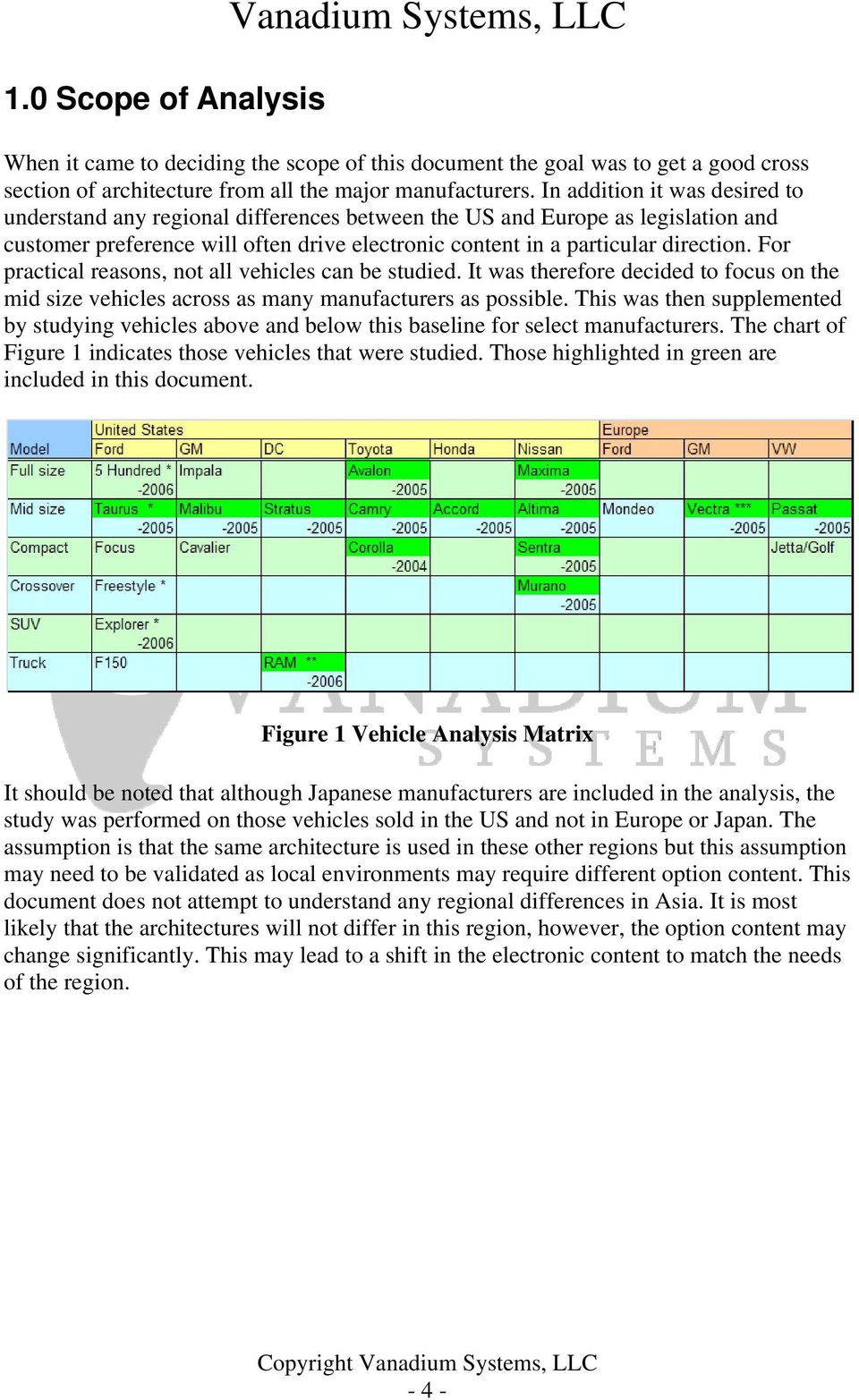
4 1.0 Scope of Analysis Vanadium Systems, LLC When it came to deciding the scope of this document the goal was to get a good cross section of architecture from all the major manufacturers. In addition it was desired to understand any regional differences between the US and Europe as legislation and customer preference will often drive electronic content in a particular direction. For practical reasons, not all vehicles can be studied. It was therefore decided to focus on the mid size vehicles across as many manufacturers as possible. This was then supplemented by studying vehicles above and below this baseline for select manufacturers. The chart of Figure 1 indicates those vehicles that were studied. Those highlighted in green are included in this document. Figure 1 Vehicle Analysis Matrix It should be noted that although Japanese manufacturers are included in the analysis, the study was performed on those vehicles sold in the US and not in Europe or Japan. The assumption is that the same architecture is used in these other regions but this assumption may need to be validated as local environments may require different option content. This document does not attempt to understand any regional differences in Asia. It is most likely that the architectures will not differ in this region, however, the option content may change significantly. This may lead to a shift in the electronic content to match the needs of the region
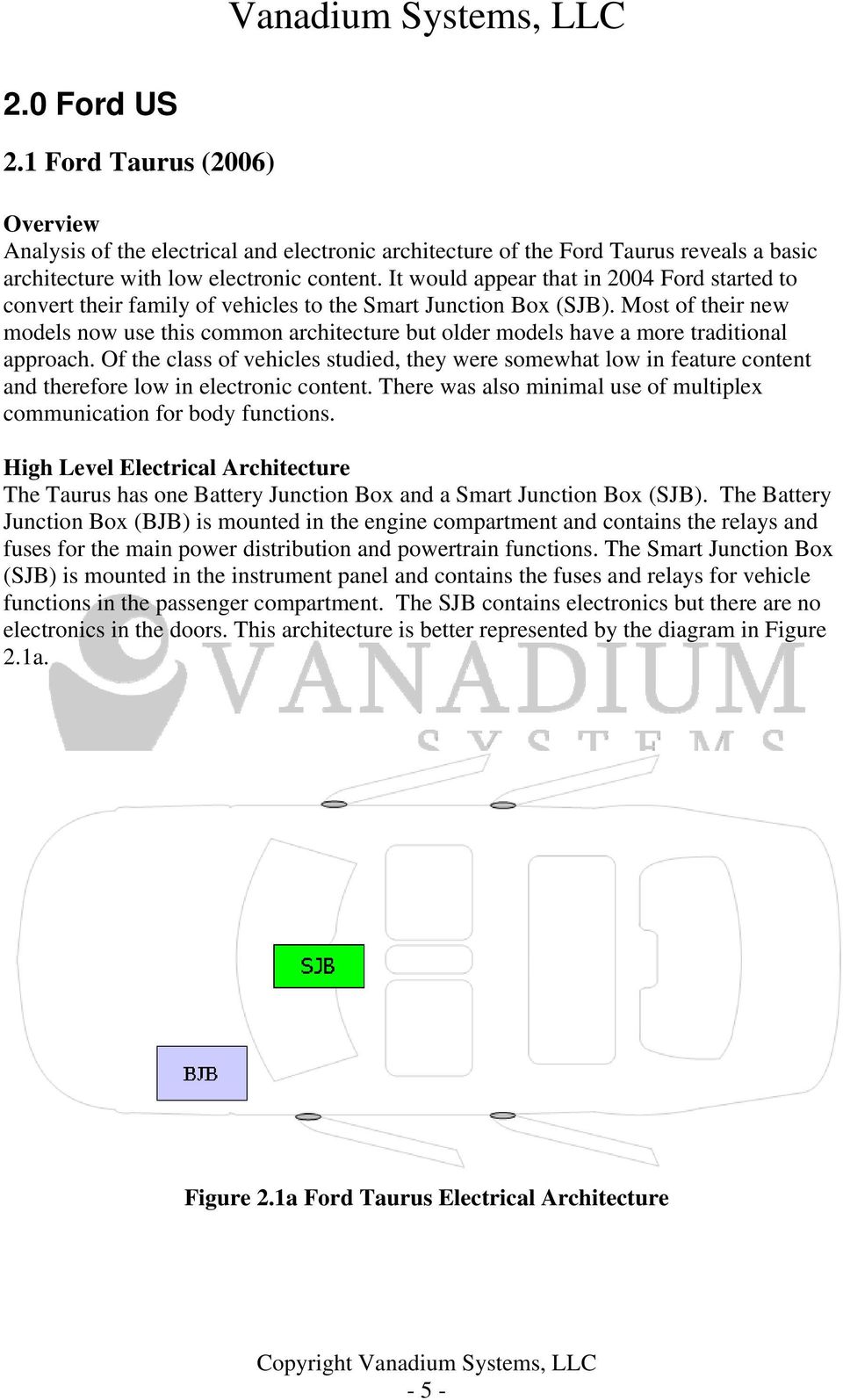
5 2.0 Ford US 2.1 Ford Taurus (2006) Overview Analysis of the electrical and electronic architecture of the Ford Taurus reveals a basic architecture with low electronic content. It would appear that in 2004 Ford started to convert their family of vehicles to the Smart Junction Box (SJB). Most of their new models now use this common architecture but older models have a more traditional approach. Of the class of vehicles studied, they were somewhat low in feature content and therefore low in electronic content. There was also minimal use of multiplex communication for body functions. High Level Electrical Architecture The Taurus has one Battery Junction Box and a Smart Junction Box (SJB). The Battery Junction Box (BJB) is mounted in the engine compartment and contains the relays and fuses for the main power distribution and powertrain functions. The Smart Junction Box (SJB) is mounted in the instrument panel and contains the fuses and relays for vehicle functions in the passenger compartment. The SJB contains electronics but there are no electronics in the doors. This architecture is better represented by the diagram in Figure 2.1a. Figure 2.1a Ford Taurus Electrical Architecture - 5 -
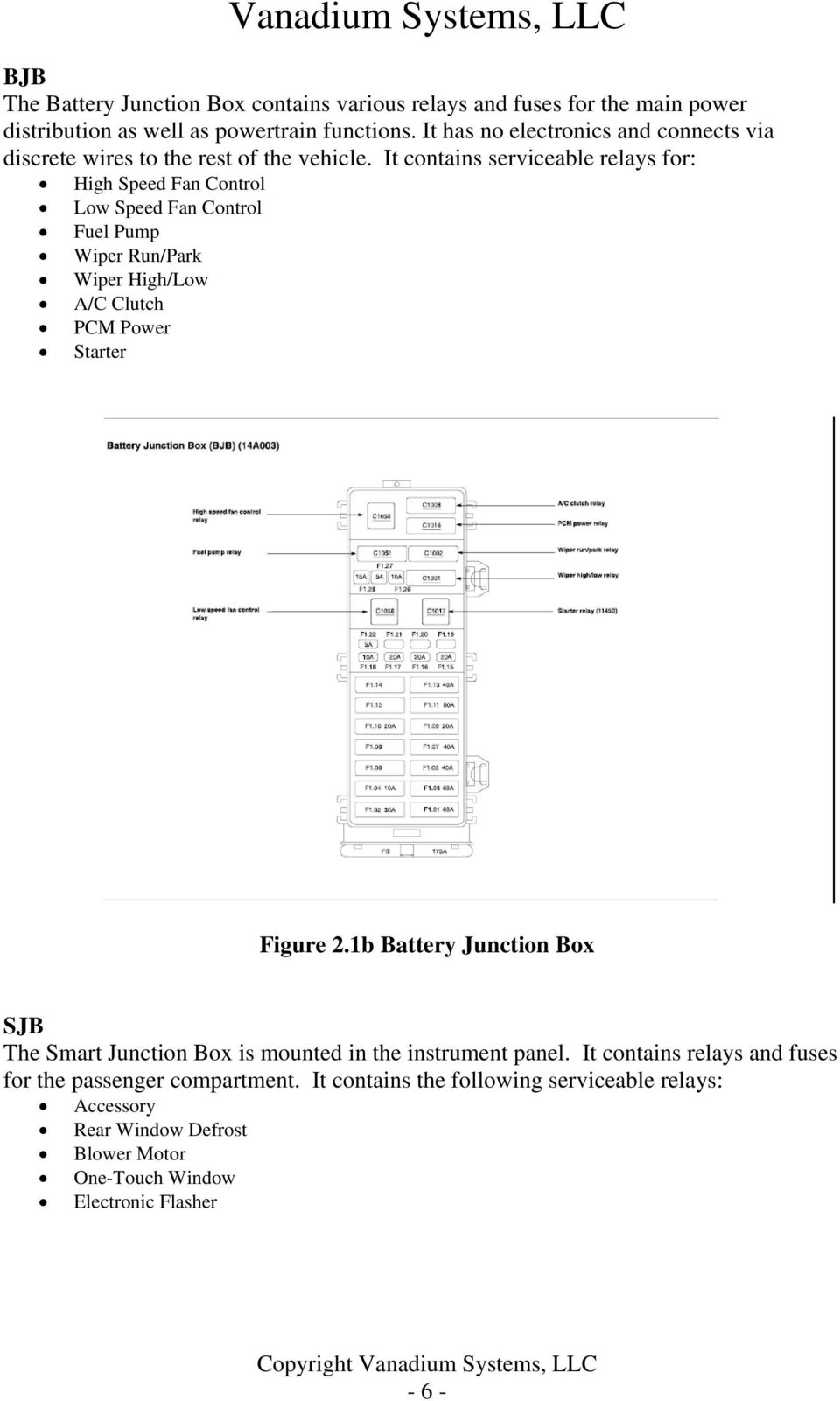
6 BJB The Battery Junction Box contains various relays and fuses for the main power distribution as well as powertrain functions. It has no electronics and connects via discrete wires to the rest of the vehicle. It contains serviceable relays for: High Speed Fan Control Low Speed Fan Control Fuel Pump Wiper Run/Park Wiper High/Low A/C Clutch PCM Power Starter Figure 2.1b Battery Junction Box SJB The Smart Junction Box is mounted in the instrument panel. It contains relays and fuses for the passenger compartment. It contains the following serviceable relays: Accessory Rear Window Defrost Blower Motor One-Touch Window Electronic Flasher - 6 -
7 It may be the point where the body, instrument panel, and engine compartment harnesses join. Functions it controls are: Rear Window Defrost Power Locks Luggage Compartment Lid Release Windshield Wiper and Washer Headlamps (w/autolamp) Horn Parklamps Delayed Accessory Driver s Window One-Touch Down Interior Lamps Battery Saver Remote Keyless Entry Keypad Keyless Entry Passive Anit-Theft - 7 -

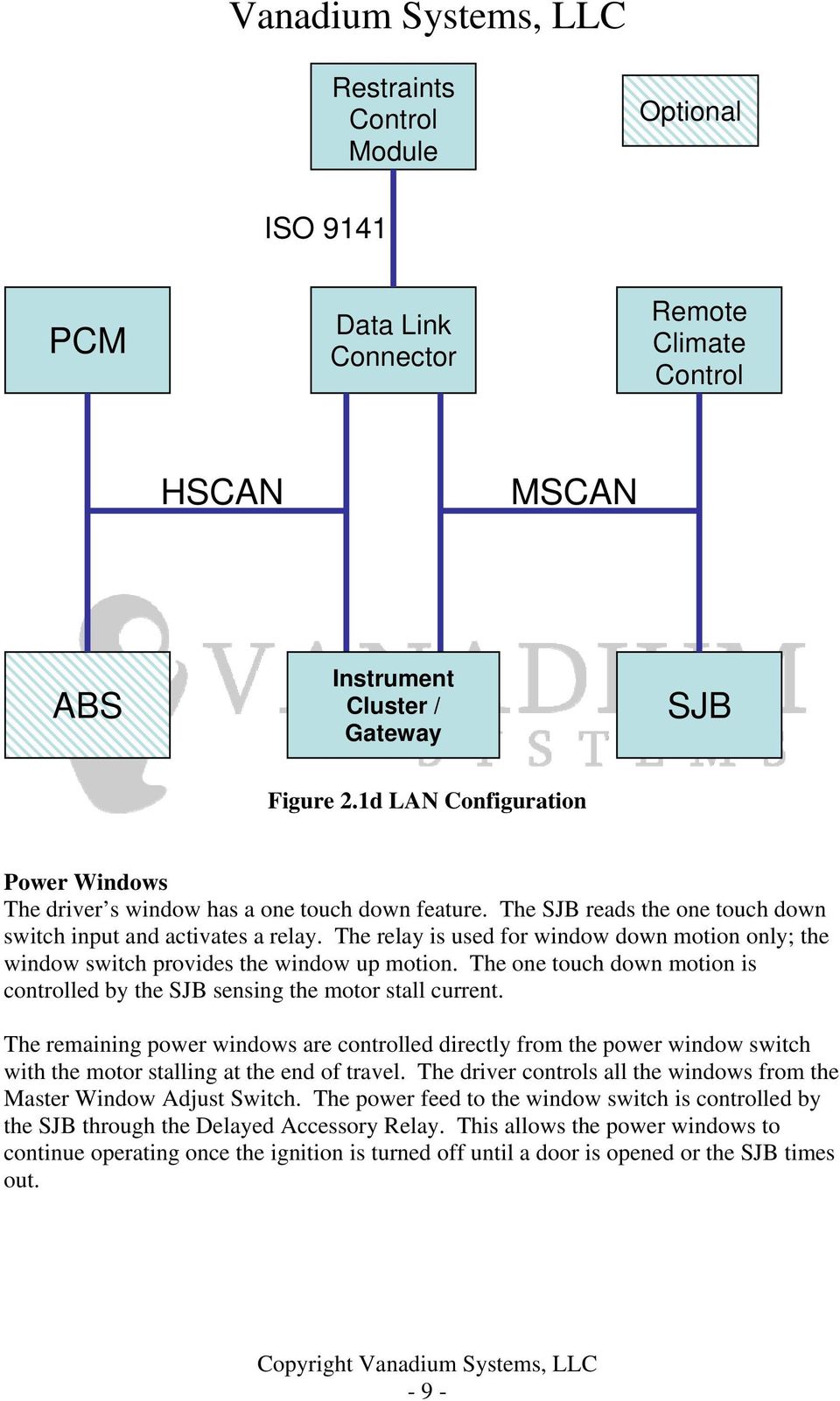
8 Figure 2.1c Smart Junction Box LAN Communication This vehicle makes use of multiplex communication in the form of High Speed, Medium Speed CAN, and ISO The modules which have a High Speed CAN interface are: Powertrain Control Module Instrument Cluster (Gateway) Data Link Connector With an optional: ABS The modules which have a Medium Speed CAN interface are: Instrument Cluster (Gateway) Smart Junction Box Remote Climate Control The module that has an ISO 9141 interface is: Restraints Control Module - 8 -

9 Restraints Control Module Optional ISO 9141 PCM Data Link Connector Remote Climate Control HSCAN MSCAN ABS Instrument Cluster / Gateway SJB Figure 2.1d LAN Configuration Power Windows The driver s window has a one touch down feature. The SJB reads the one touch down switch input and activates a relay. The relay is used for window down motion only; the window switch provides the window up motion. The one touch down motion is controlled by the SJB sensing the motor stall current. The remaining power windows are controlled directly from the power window switch with the motor stalling at the end of travel. The driver controls all the windows from the Master Window Adjust Switch. The power feed to the window switch is controlled by the SJB through the Delayed Accessory Relay. This allows the power windows to continue operating once the ignition is turned off until a door is opened or the SJB times out
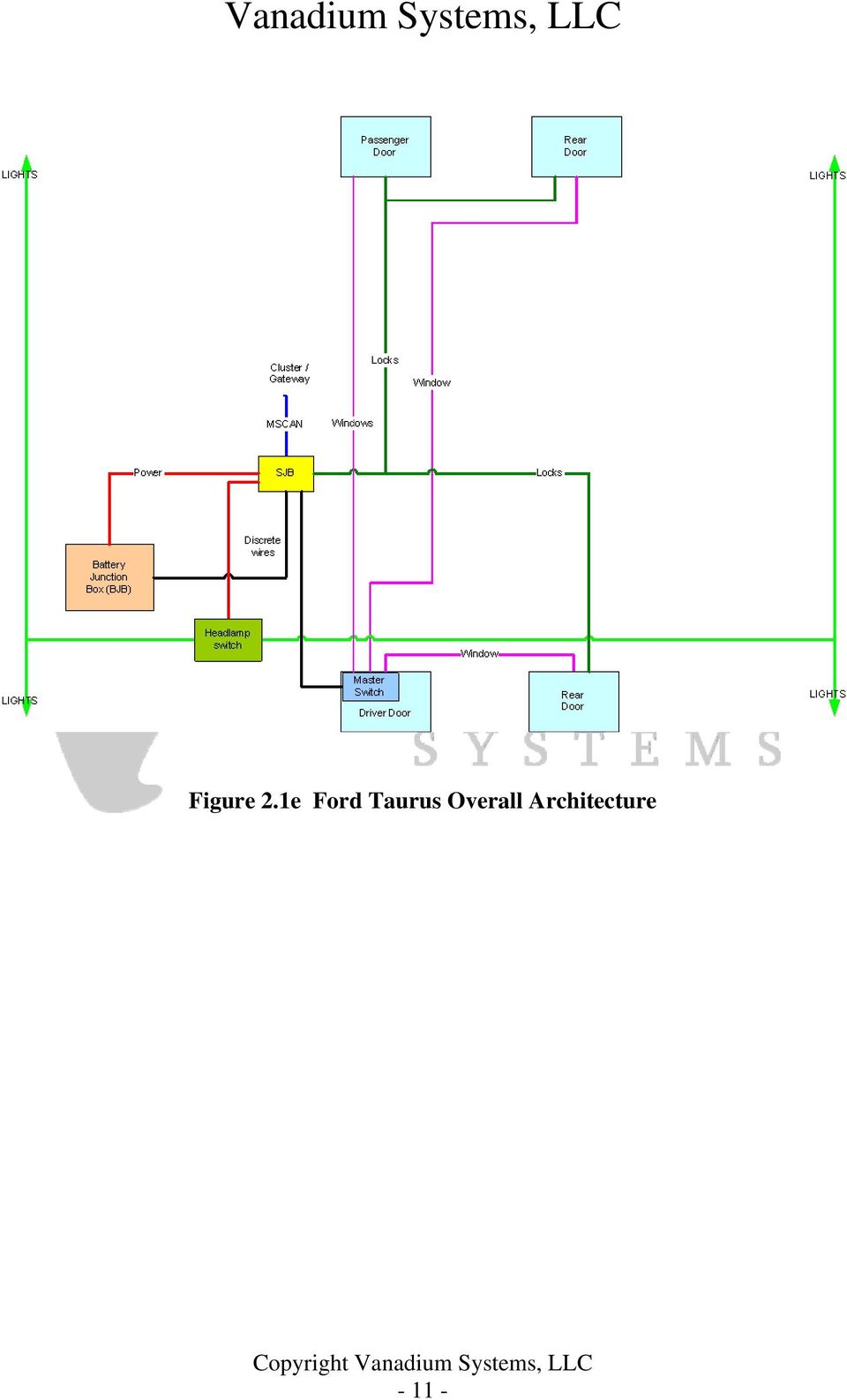
10 Power mirrors The power mirrors contain two motors that provide up/down and left/ right movement. The two motors connect to 3 wires; up/down control, left/right control, and common. They are controlled directly from the door mirror switch. There is a selector switch to choose driver s or passenger s mirror and four sets of contacts that provide the X and Y motion. Heated mirrors are an option and are fed from the Rear Window Defrost Relay. Memory mirrors and fold are not offered as options. Locks The door lock switches are wired directly to the SJB. The door lock motors are controlled by the SJB allowing the drivers door to be unlocked independently from the rest of the lock motors. The remote keyless entry receiver is a standard feature and is embedded in the SJB. The Keyless Entry Keypad is an option on the vehicle and is hardwired to the SJB when present. Door Strategy Door modules are not used on this vehicle. The control for locks and one touch down driver s window is integrated with the SJB. The passenger s window control is via the window switch. The power mirrors are controlled directly from the mirror switch. Exterior Lighting The main light switch powers the front high and low beam filaments by using the multifunction switch to steer the power to the appropriate bulb. The SJB provides a parallel power source to the multifunction switch by controlling the PCB mounted Autolamp Headlamp Relay. The Autolamp Headlamp Relay will provide power to the multifunction switch when the SJB senses the ambient light level is low. The main light switch also supplies power to the parklamp circuit. The SJB provides a parallel power source to the parklamp circuit by controlling the PCB mounted Autolamp Parklamp Relay. The turn signal and hazard warning lamps are controlled by the electronic flasher which is a serviceable component located in the SJB. Stop lamps and reversing lamps are connected directly to their respective switches. Interior Lighting Interior lighting is controlled by two PCB relays located in the SJB. One relay provides a timed battery saver function for the lamps that require additional switch activation, (ex: vanity mirror, map, and reading lamps). The second relay provides battery to the interior lamps and puddle lamps located in the exterior rear view mirror when a door is opened. Instrument panel and switch illumination is provided by a PWM signal from electronics integrated into the main light switch
11 Figure 2.1e Ford Taurus Overall Architecture
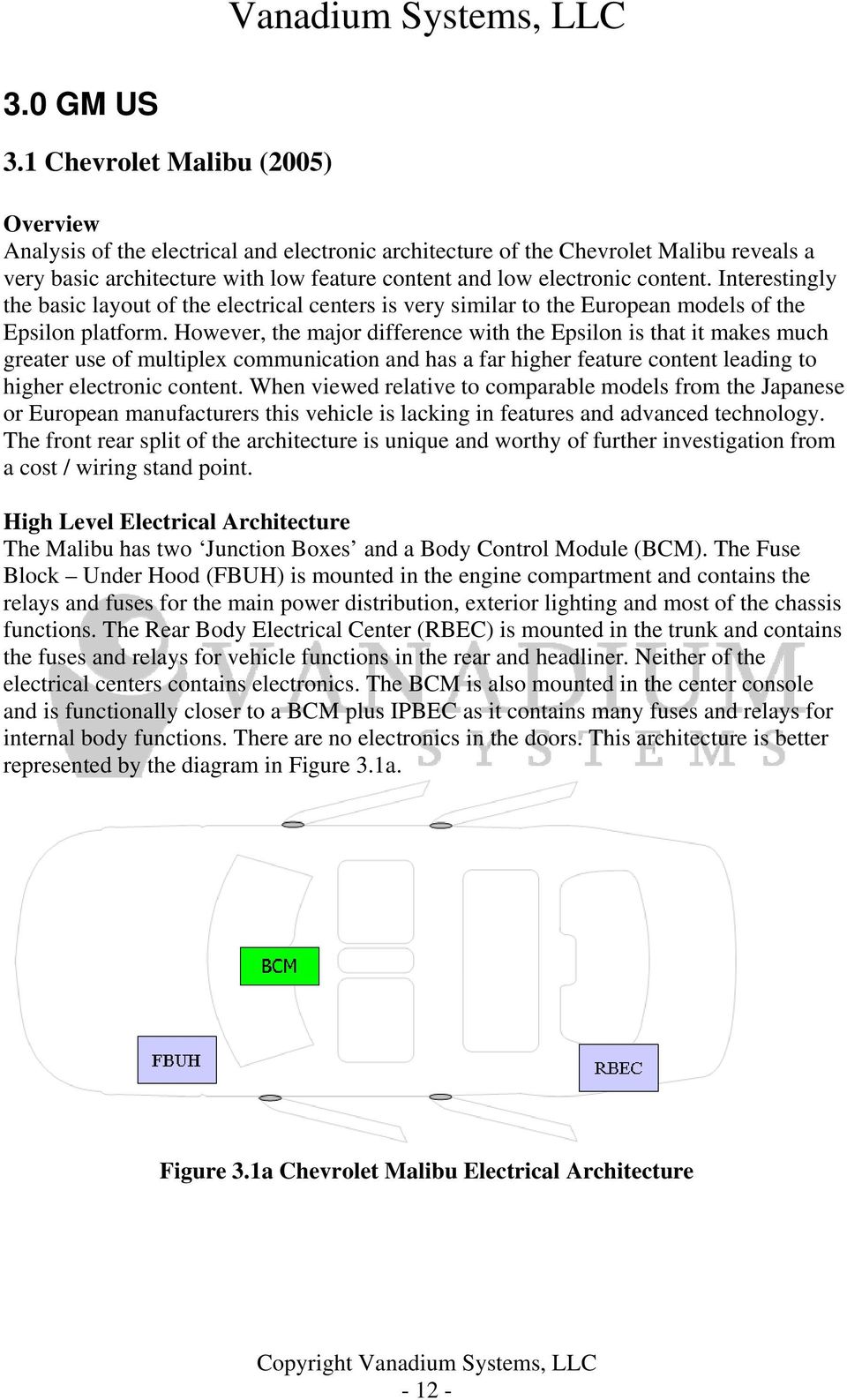
12 3.0 GM US 3.1 Chevrolet Malibu (2005) Overview Analysis of the electrical and electronic architecture of the Chevrolet Malibu reveals a very basic architecture with low feature content and low electronic content. Interestingly the basic layout of the electrical centers is very similar to the European models of the Epsilon platform. However, the major difference with the Epsilon is that it makes much greater use of multiplex communication and has a far higher feature content leading to higher electronic content. When viewed relative to comparable models from the Japanese or European manufacturers this vehicle is lacking in features and advanced technology. The front rear split of the architecture is unique and worthy of further investigation from a cost / wiring stand point. High Level Electrical Architecture The Malibu has two Junction Boxes and a Body Control Module (BCM). The Fuse Block Under Hood (FBUH) is mounted in the engine compartment and contains the relays and fuses for the main power distribution, exterior lighting and most of the chassis functions. The Rear Body Electrical Center (RBEC) is mounted in the trunk and contains the fuses and relays for vehicle functions in the rear and headliner. Neither of the electrical centers contains electronics. The BCM is also mounted in the center console and is functionally closer to a BCM plus IPBEC as it contains many fuses and relays for internal body functions. There are no electronics in the doors. This architecture is better represented by the diagram in Figure 3.1a. Figure 3.1a Chevrolet Malibu Electrical Architecture
13 FBUH The Fuse Block - Under Hood contains various relays and fuses for the main power distribution as well as chassis and lighting functions. It has no electronics and connects via discrete wires to the BCM. It contains relays for : Headlamps High and Low beam Front Fog Lamps Wipers A/C compressor Cooling fan Horn Powertrain Starter Figure 3.1b Fuse Block Under Hood (FBUH)
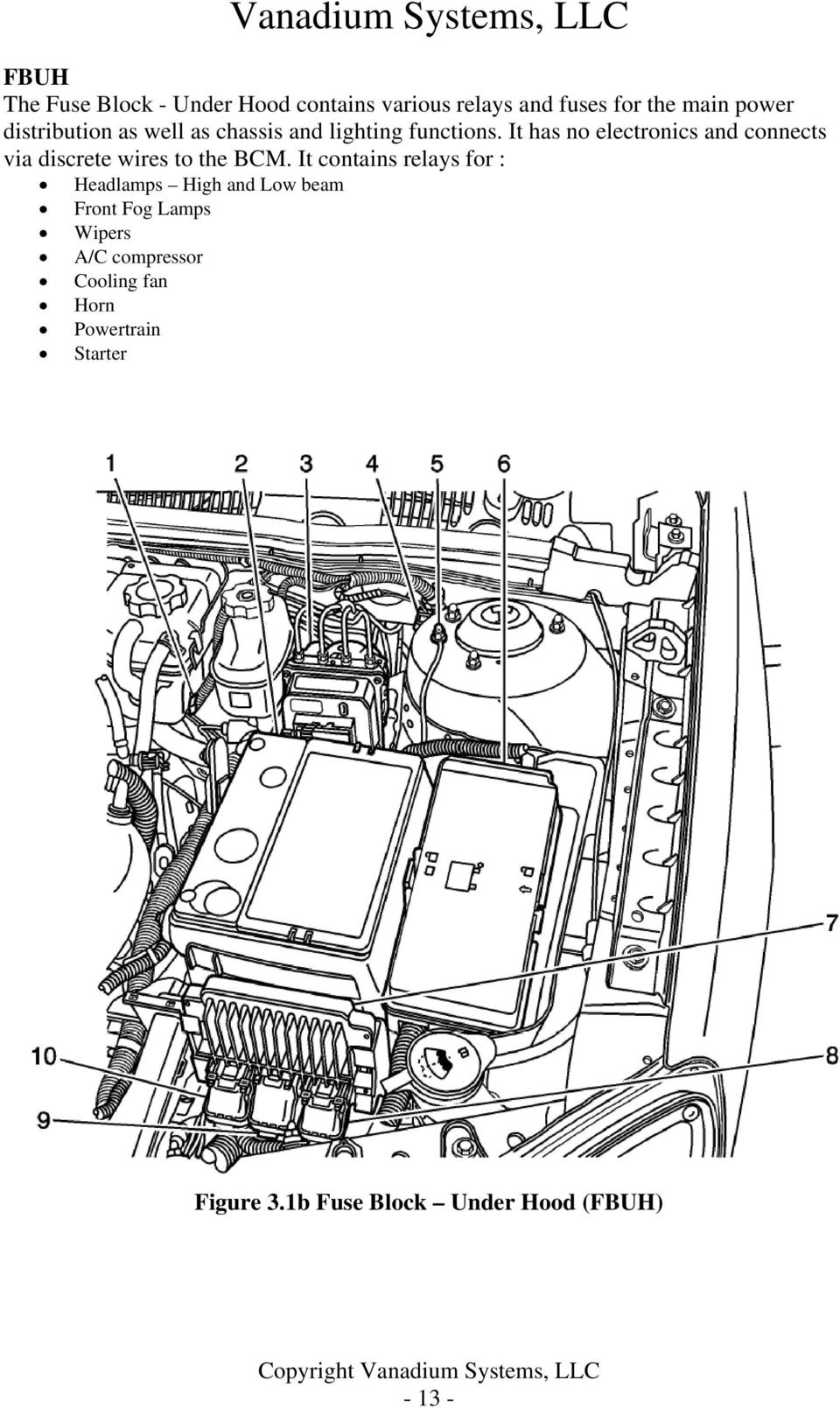
14 RBEC The Rear Body Electrical Center (item 2) is mounted in the trunk. It has no control capability and no electronics. It contains fuses for the rear and roof functions and the following relays : Back up lamps Rear defog Fuel pump Park lamps Trunk It is also the point where the body harness and roof harness join. Figure 3.1c Rear Body Electrical Center

15 Body Control Module (BCM) The BCM is mounted in the center console. In addition to controlling many of the body functions the BCM is also the LAN gateway between the Engine Control and the Body LAN. Functions it controls directly are : LAN Gateway Accessory Relay Run Relay HVAC blower relay Power Locks Keyless Entry (via serial communication to RF receiver) Multi function switch Interior Lights Sensors and Switches Turn Signal and Hazard Warning Lamps Functions it controls via the FBUH include : Headlamps Fog Lamps Wipers Functions it controls via the RBEC include : Back Up Lamps Park Lamps, license lamps Rear Defog Figure 3.1d BCM ( item 11 ) is mounted in center console

16 LAN Communication This vehicle does not use multiplex communication to control body functions but it does have three separate busses. The Powertrain Control Module (PCM) uses differential High Speed CAN (500kb) for communication with other chassis controllers and the BCM. The PCM communicates with the Diagnostic Connector via low speed single wire GMLAN (10Kb) but this bus is not used for normal vehicle operation. The BCM uses a separate single wire low speed GMLAN (33Kb) for communication with the cluster. The BCM is the gateway for all three busses. Power Windows All models of the Malibu have the same basic window operation with express down on the driver s door only. None of the windows have one-touch up or anti-pinch so no electronics are required in any of the doors. The windows are controlled from the driver s door master switch or the respective door switch and are an independent sub-system within the vehicle. The driver s door has one additional relay in the door for the express down function. There is no connection to the BCM. Power mirrors The power mirrors are controlled from the driver s mirror master switch directly as an independent sub-system. There is a selector switch for driver s or passenger s mirror and two other switches for X and Y motion. Fold is also standard. Heated mirrors are an option and are controlled by the Rear Defog Relay. Memory mirrors are not offered

17 Locks The power door lock system is controlled by the BCM. All power lock motors are controlled directly by the BCM and all lock switches connect directly to the BCM. The remote keyless entry receiver is a separate module and communicates with the BCM via a dedicated serial connection. Door Strategy The door strategy is very basic and has low feature content. There is no multiplex communication in the doors and no electronics. The only door function that is integrated with the BCM is the power locks. All other functions (windows and mirrors) are independent subsystems and do not use any form of electronic control. Exterior Lighting Most front exterior lighting control relays are mounted under-hood in the FBUH but are controlled from the BCM via discrete connections. The lighting control switch and the automatic light sensor are connected to the BCM. Most rear exterior lighting control relays are mounted in the RBEC but are controlled by the BCM. The BCM also controls several lamps directly. For details on the location of each of the control relays refer to the BCM description. Interior Lighting Interior lighting is controlled by the BCM and performs theatre dimming. The door switches also connect direct to the BCM. All dash and switch illumination are also driven directly by the BCM. Based on the position of the IP dimmer switch a variable voltage is provided to the BCM. The BCM will then change the brightness of the IP lighting when the park or headlamp switch is on
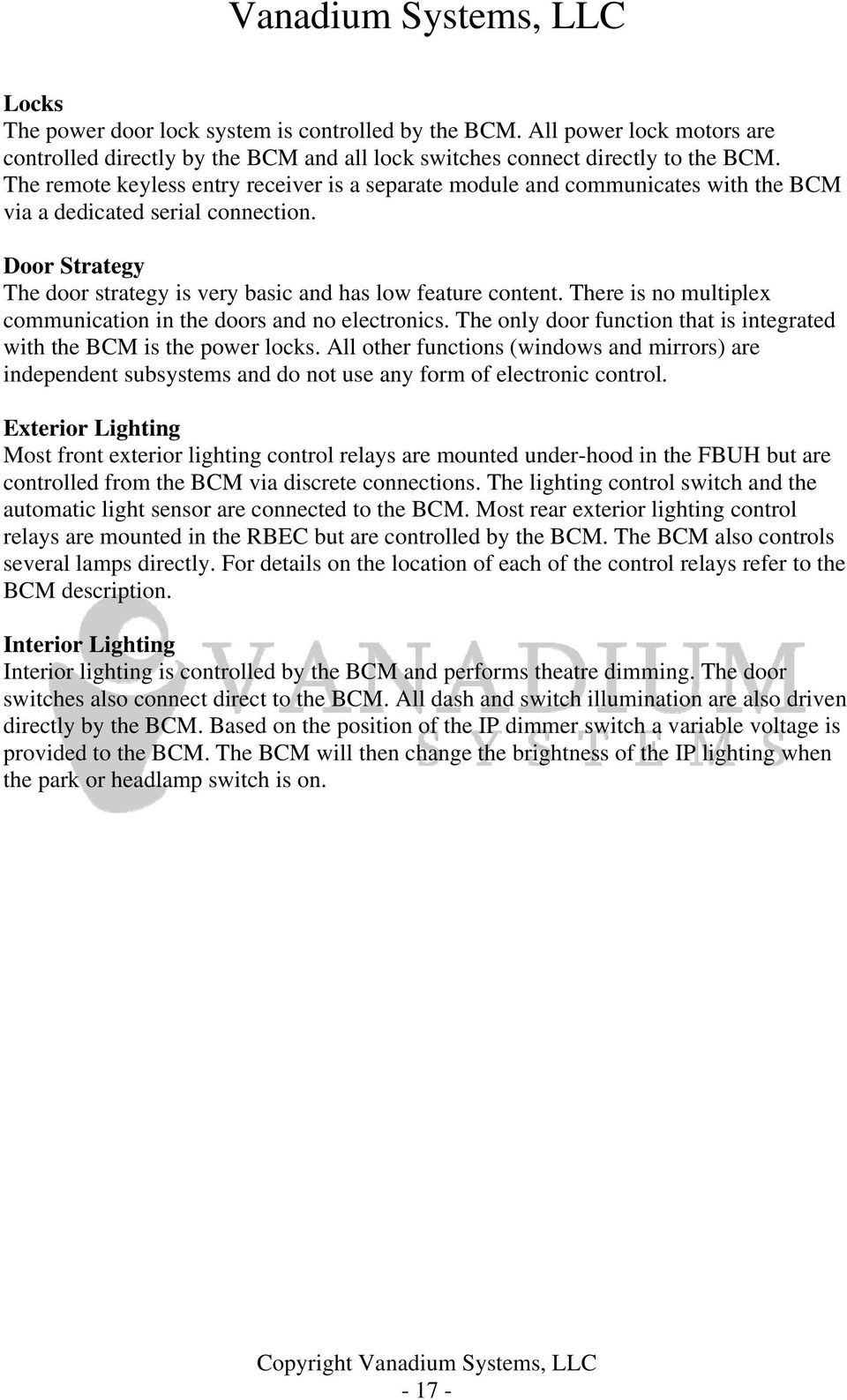
18 Figure 3.1e Chevrolet Malibu Overall Architecture Additional Vehicle Sub-systems In addition to the systems mentioned above this vehicle has options for : A Sunroof is available as an option and is a stand alone function. Power is fed via the RBEC or the BCM residual accessory power (RAP). Power seats and Heated Seats are offered as options but are stand alone functions with no connection to the BCM other than power. Memory seats are not offered as an option
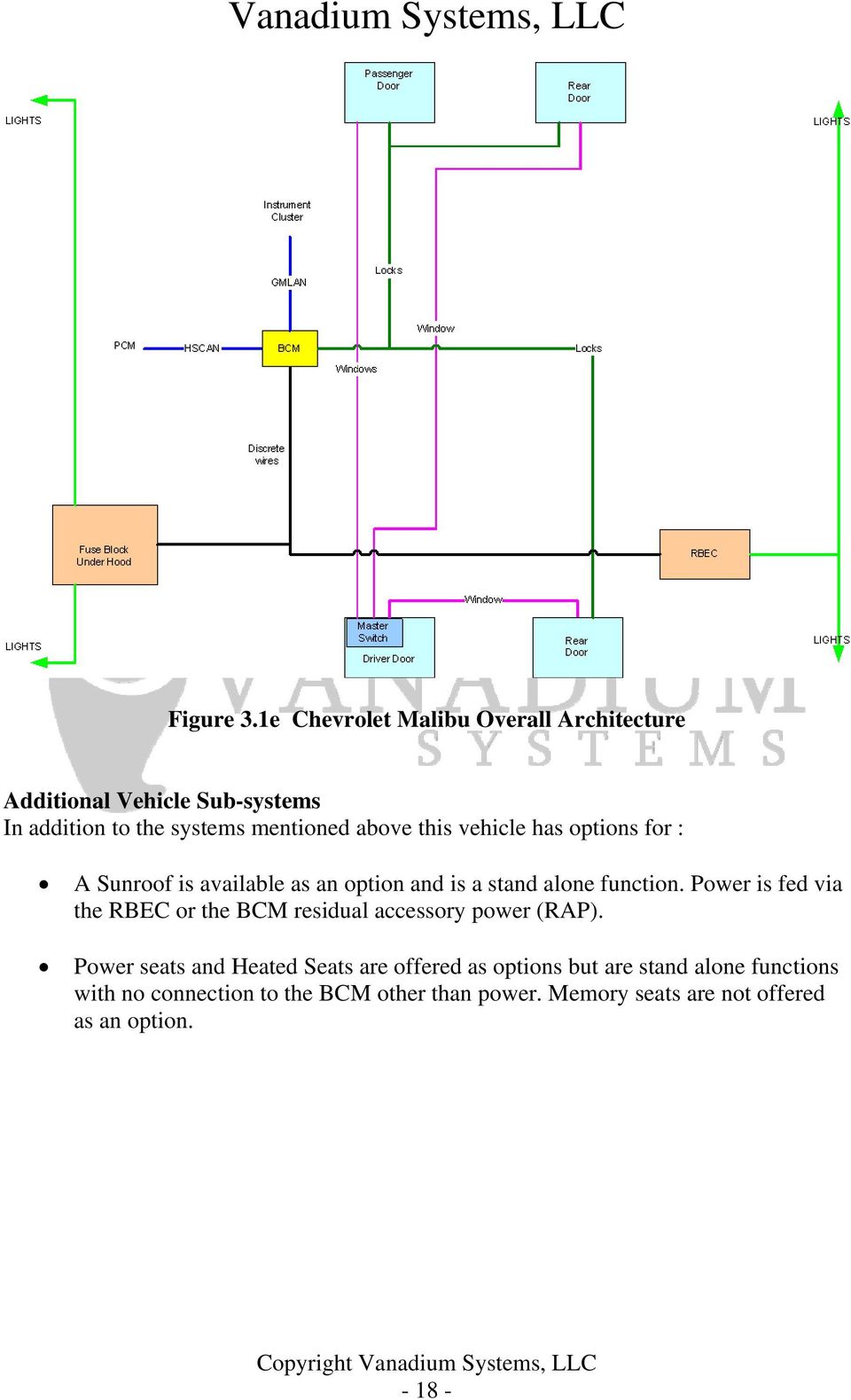
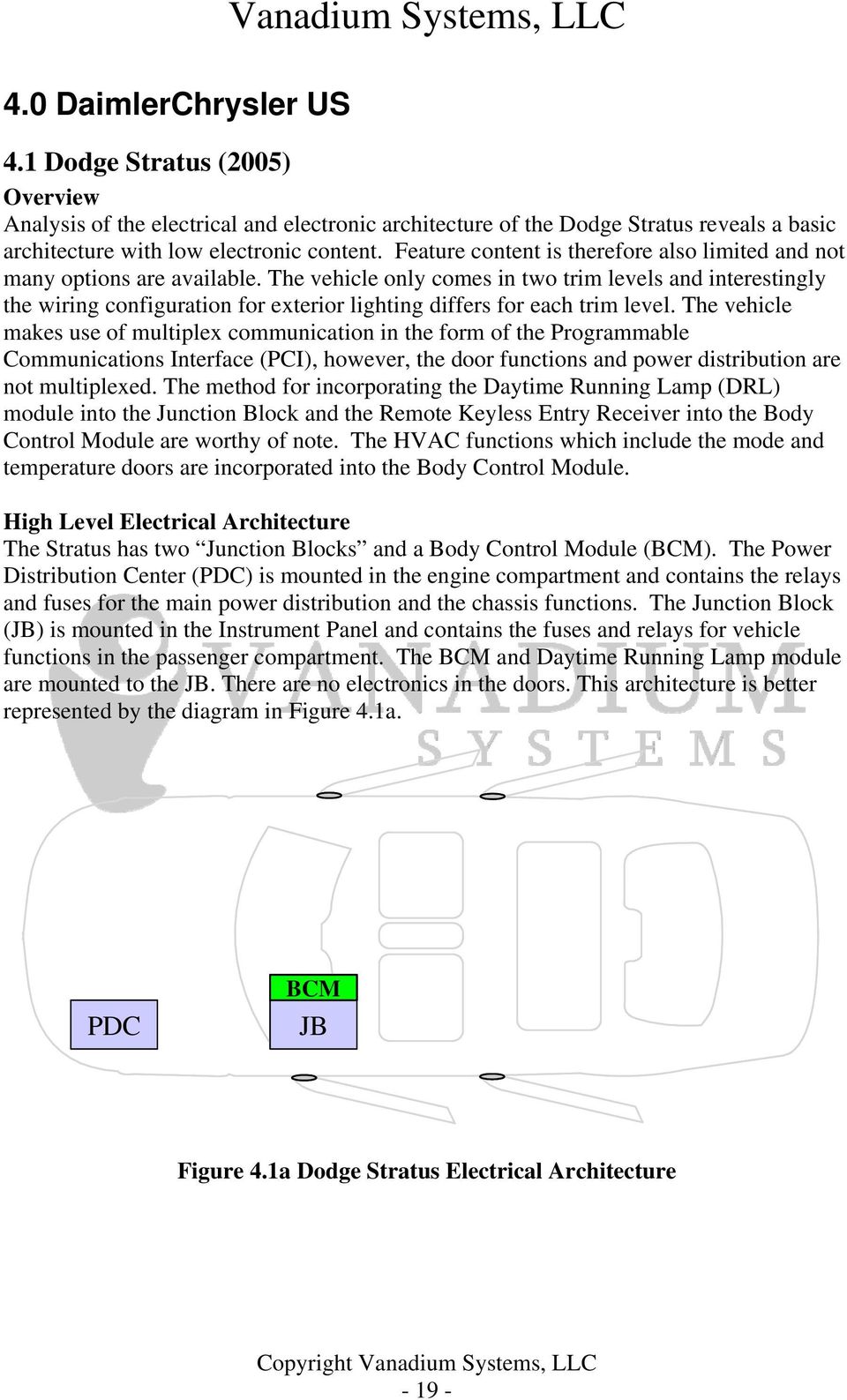
19 4.0 DaimlerChrysler US 4.1 Dodge Stratus (2005) Overview Analysis of the electrical and electronic architecture of the Dodge Stratus reveals a basic architecture with low electronic content. Feature content is therefore also limited and not many options are available. The vehicle only comes in two trim levels and interestingly the wiring configuration for exterior lighting differs for each trim level. The vehicle makes use of multiplex communication in the form of the Programmable Communications Interface (PCI), however, the door functions and power distribution are not multiplexed. The method for incorporating the Daytime Running Lamp (DRL) module into the Junction Block and the Remote Keyless Entry Receiver into the Body Control Module are worthy of note. The HVAC functions which include the mode and temperature doors are incorporated into the Body Control Module. High Level Electrical Architecture The Stratus has two Junction Blocks and a Body Control Module (BCM). The Power Distribution Center (PDC) is mounted in the engine compartment and contains the relays and fuses for the main power distribution and the chassis functions. The Junction Block (JB) is mounted in the Instrument Panel and contains the fuses and relays for vehicle functions in the passenger compartment. The BCM and Daytime Running Lamp module are mounted to the JB. There are no electronics in the doors. This architecture is better represented by the diagram in Figure 4.1a. PDC BCM JB Figure 4.1a Dodge Stratus Electrical Architecture
20 Power Distribution Center (PDC) The Power Distribution Center contains various relays and fuses for the main power distribution as well as chassis functions. It has no electronics and connects via discrete wires to the BCM. It contains relays for: Headlamp Washer (Export) Rear Fog Lamps (Export) Front Wiper A/C Compressor Clutch Radiator Fan Heated Seat Fuel Pump Transmission Control Auto Shutdown Starter Motor Figure 4.1b Power Distribution Center (PDC)

21 Junction Block (JB) The Junction Block is mounted on the driver s side end of the Instrument Panel. The Body Control Module and Daytime Running Lamp Module are both integrated within the JB. It contains fuses for the interior functions and the following relays: Horn Rear Window Defogger Headlamp Delay It is also the point where the Instrument Panel harness and Body harness join. Figure 4.1c Top of Junction Block
22 Figure 4.1d Bottom of Junction Block Body Control Module (BCM) The BCM is mounted in the Junction Block (JB) and controls many of the body functions. Functions it controls directly are: Chime Remote Keyless Entry Module plugs into BCM Power Top Up/Down Relays (Convertible) Auto Headlamp Auto Parklamp Courtesy Lamps
23 RKE External Antenna (Export) Dimmable Switch Illumination HVAC Functions Decklid Release Fuel Level Signal Door Locks Relays it controls in the PDC include: Headlamp Washer Front Wiper On/Off Front Wiper High/Low Heated Seat Relays it controls in the JB include: Horn Rear Window Defogger Headlamp Delay Vanadium Systems, LLC Figure 4.1e Body Control Module (BCM)
24 LAN Communication This vehicle makes use of multiplex communication in the form of a Programmable Communications Interface (PCI) which is implemented using J1850. However, most of the multiplexed functions are related to chassis and safety. Interestingly Chassis and Body share the same bus and the only exceptions are for option content. The PCM module also uses SCI for diagnostic communication. The modules which have a multiplex interface are: Data Link Connector Optional Instrument Cluster Sentry Key PCM BCM Immobilizer Radio Module PCI PCI PCI Compass / Mini Trip Computer Airbag Control Module Anti-Lock Brake Module Automatic Temperature Control CD Changer Figure 4.1f LAN Configuration Power Windows All models of the Stratus have the same basic window operation with express down on the driver s door only. None of the windows have one-touch up or anti-pinch so no electronics are required in any of the doors. The windows are controlled from the driver s door master switch or the respective door switch and are an independent sub-system within the vehicle. For the convertible, there is one additional relay (Window Drop Relay Assembly) that is used to lower all 4 of the windows simultaneously. The Window Drop Relay Assembly is controlled by the BCM. Power mirrors The power mirrors are controlled from the driver s mirror master switch directly as an independent sub-system. There is a selector switch for driver s or passenger s mirror and two other switches for X and Y motion. Heated mirrors are controlled by the Rear Defog Relay. Memory mirrors and power fold are not offered
25 Locks The power door lock system is controlled by the BCM. All power lock motors are controlled directly by the BCM and the analog lock switches connect directly to the BCM. The remote keyless entry receiver is a separate module but plugs directly into the BCM. Door Strategy The door strategy is very basic and has low feature content. There is no multiplex communication in the doors and no electronics. The only door function that is integrated with the BCM is the power locks. All other functions (windows and mirrors) are independent subsystems and do not use any form of electronic control. Exterior Lighting On the base vehicle the headlamp and park lamp control is provided by the multi-function switch and powers the lamps directly (no relay). However, a Headlamp Delay Relay,is mounted in the Junction Block and is controlled by the BCM to provide delayed power to the low beam headlamps. Fog lamp control is provided directly by the multi-function switch in the same way as the headlamps (no relay) but is an option. In the case of the premium vehicle, the multifunction switch connects to the BCM and the BCM controls the relays for Headlamp, Parklamp and Foglamp. The Headlamp Delay function uses the same relay. The relay s are all mounted in the IP and are controlled by the BCM. Automatic Headlamps is also an option and the sun sensor connects directly to the BCM. Headlamp leveling and rear Foglamp are available on the export vehicle and are controlled directly by their respective switches. Brake lamps and reverse lamps are controlled directly by their respective switches. Turn signals are controlled by the combination flasher. Interior Lighting Interior lighting is controlled by the BCM. The door switches also connect direct to the BCM. All dash and switch illumination are also driven directly by the BCM. There are two outputs from the BCM for switch illumination, one high side drive, the other low side drive. Based on the position of the IP dimmer switch an analog voltage is provided to the BCM. The BCM will then change the brightness of the IP lighting when the park or headlamp switch is on. The demand lamps do not have a battery saver feature and are fed directly from battery
26 LIGHTS Passenger Door Rear Door LIGHTS Window Locks PCI Junction Block Body Control Module Locks Power Distribution Center Multi-function Switch Window LIGHTS Master Switch Driver Door Rear Door LIGHTS Figure 4.1g Dodge Stratus Overall Architecture (Base model) Additional Vehicle Sub-systems In addition to the systems mentioned above this vehicle has the following options : A Power Sunroof is available as an option and is a stand alone function. Power is fed via the Junction Block while the Accessory Delay System is active. Power driver seats and Heated Seats are offered as options but are stand alone functions. The Heated Seat Power relay (in PDC) is controlled by the BCM for load shedding during low battery conditions. Memory seats are not offered as an option. Headlamp washers are available on export vehicles only and are controlled by the BCM
27 4.2 Dodge RAM (2005) Overview Analysis of the electronic architecture of the Dodge Ram reveals a highly integrated power distribution center with very high semiconductor content. There are no relays integrated within the Power Distribution Center. The vehicle makes use of multiplex communication in the form of a Controller Area Network (CAN), one high speed and one low speed. The method for incorporating the Remote Keyless Entry Receiver into the Cluster is worthy of note. High Level Electrical Architecture The Dodge Ram has a Totally Integrated Power Module (TIPM) which is mounted in the engine compartment next to the battery. It is a printed circuit board based module that contains the fuses and electronics (no relays!) to perform the main power distribution for the vehicle and controls the majority of the interior / exterior lighting, wiper, and transfer case functions. There are no electronics in the doors. This architecture is better represented by the diagram in Figure TBD. TIPM Figure 4.2a Dodge RAM Electrical Architecture
28 Totally Integrated Power Module (TIPM) The Totally Integrated Power Module contains various fuses and semiconductor switches for the main power distribution. The TIPM is mounted underhood and controls many of the body functions. Functions it controls directly are: Rear Window Defogger Ignition Switch Outputs (Protected Drivers) Fuel Pump Wiper Motor Washer Pump Motor Adjustable Pedals Switch Feed A/C Clutch Trailer Tow Transfer Case Motors Low Beam Headlamps High Beam Headlamps Fog Lamps Turn Signals Brake Lamps Park Lamps Reverse Lamps Fuel Heater (Diesel) Condenser Fan Motor Oxygen Sensor Downstream (Heater) Starter Motor Control Horn Figure 4.2b Totally Integrated Power Module (TIPM)
29 LAN Communication This vehicle makes use of multiplex communication in the form of 3 Controller Area Networks (CAN). The CAN C network operates at 500Kbps and connects the powertrain and chassis nodes. The CAN B network operates at 83.3Kbps and connects body and interior nodes. The Diagnostic CAN network is used between the TIPM and the Data Link Connector (DLC) exclusively for diagnostic information. The PCM module also uses SCI for diagnostic communication to the DLC. The TIPM is the gateway between all three CAN buses. (It would help to add Diag-CAN and SCI to the diagram below) Not shown on the diagram, only the SRT10 vehicle PCM uses the PCI (J1850) network to communicate to the DLC and must use a separate CAN gateway module to receive information from the CAN C network. The modules which have a multiplex interface are: Data Link Connector Electronic Overhead Module Sunroof Module Satellite Receiver Optional SCI Diag CAN Sentry Key PCM TIPM Cluster Remote Entry Radio Module CAN C CAN B Anti-Lock Brake Module Final Drive Control Hands Free Module Control A/C - Heater Media System Monitor/DVD Figure 4.2c LAN Configuration Power Windows All models of the Ram have the same basic window operation. None of the windows have auto down, one-touch up or anti-pinch so no electronics are required in any of the doors. The windows are controlled from the driver s door master switch or the respective door switch and are an independent sub-system within the vehicle
30 Power mirrors The power mirrors are controlled from the driver s mirror master switch directly as an independent sub-system. There is a selector switch for driver s or passenger s mirror and two other switches for X and Y motion. Heated mirrors are controlled by the TIPM and follow the function of the Rear Window Defogger. The heated mirror output driver is a separate device from the Rear Window Defogger output driver. Memory mirrors are not offered. Folding trailer tow mirrors are an option and help to improve visibility when towing wide or long trailers. Locks The power door lock system is controlled by the Instrument Cluster. All power lock motors are controlled directly by the Instrument Cluster and the analog lock switches connect directly to the Instrument Cluster. Each power lock switch position (lock, unlock, and neutral) provide a different resistance value to the Instrument Cluster. The remote keyless entry receiver is a separate module but plugs directly into the Instrument Cluster. Door Strategy The door strategy is very basic and has low feature content. There is no multiplex communication in the doors and no electronics. The only door function that is integrated with the Instrument Cluster is the power locks. All other functions (windows and mirrors) are independent subsystems and do not use any form of electronic control. Exterior Lighting The analog headlamp switch interfaces directly to the Instrument Cluster and a CAN message is transmitted to the TIPM requesting the appropriate lamps are turned on. The multifunction switch is also analog and is hardwired to the Instrument Cluster. The TIPM controls the high and low beam headlamps, parklamps, front and rear turn signals, and (except for the base vehicle) fog lamps. The brake and backup lamp switches are hardwired to the TIPM and it controls these lamps directly. Interior Lighting Interior lighting is controlled by the Instrument Cluster. The door ajar switches are connected directly to the Cluster and it provides courtesy lighting (turns on when a door is opened) as well as the demand lighting (glove box, reading, and vanity) outputs. All dash and switch illumination are controlled directly by the Instrument Cluster. There are several outputs from the Cluster for switch illumination, all high side driven. Based on the position of the IP dimmer switch an analog voltage is provided to the Cluster. The Cluster will then change the brightness of the IP lighting when the park or headlamp switch is on
31 LIGHTS Passenger Door Rear Door LIGHTS Window Locks CAN B Instrument Cluster Locks TIPM Window LIGHTS Master Switch Driver Door Rear Door LIGHTS Figure 4.2d Dodge RAM Overall Architecture (Quad Cab Model) Additional Vehicle Sub-systems In addition to the systems mentioned above this vehicle has the following options: A Power Sunroof is available as an option and is a stand alone function. Power is fed via the TIPM while the Ignition switch is in the Run or Accessory position. Power adjustable pedals are available as an option and are a stand alone function. Power driver seats and Heated Seats are offered as options but are stand alone functions. Memory seats are not offered as an option. Trailer Tow is an option and have dedicated turn lamp outputs from the TIPM. The parklamps are driven from the same output as the rest of the vehicle. Auto Dimming rearview mirror is an option and is a stand alone function
32 The Security Alarm is an option and utilizes mainly existing inputs to the Instrument Cluster and TIPM. The rear power sliding window is available as an option and is a stand alone function. The overhead console with a trip computer and a universal garage door opener are an optional upgrade to the standard overhead console. The Remote Keyless Entry and Sentry Key Engine Immobilizer theft-deterrent system with 2 encoded keys and rolling code technology is an option. This is a stand alone module that plugs directly into the Instrument Cluster. Figure 4.2e Instrument Cluster and Optional RKE Plug In
33 5.0 Toyota 5.1 Toyota Camry (2005) Overview Analysis of the electrical and electronic architecture of the Toyota Camry reveals a very simple and elegant architecture. In fact it is not very advanced in terms of electronics but would appear to be very cost effective. The vehicle is relatively low on feature content compared to many other manufacturers. Likewise the options are very limited and, if offered, are generally factory installed as part of a package. The strategy also seems to be that, where an option is selected, the lower option module is replace with the higher option module (eg a car with ABS would have an ABS only module whereas a car with Vehicle Stability Control would have a VSC module with ABS integrated). This allows Toyota to achieve virtually zero give-away on models without the option content. Likewise they minimize the number of part numbers because the number of option combinations is very small. Although the feature content is low they seem to have selected the features well. They do not offer low visibility features like anti-pinch windows on the Camry but they do offer safety features like ABS as standard on all models. They also offer advanced safety features like Vehicle Stability Control and Side Airbag as factory fitted options. High Level Electrical Architecture The Camry has two Junction Boxes and a Body ECU. The Engine Compartment Junction Box (ECJB) contains the relays and fuses for the main power distribution, headlamps and most of the chassis functions. There are no electronics in this JB. The Driver s Side Junction Box (DSJB) is mounted in the instrument panel and contains relays and fuses for the interior body functions. The Body ECU is also mounted in the Drivers Side JB. (There is a Passenger Side Junction Box but this is simply a connector.) This architecture is better represented by the diagram in Figure 5.1a. Figure 5.1a Toyota Camry Electrical Architecture
34 ECJB The ECJB is mounted under hood and contains the following relays : Headlamp Horn Fuel pump A/C clutch Radiator fan EFI DRL Adjustable Pedal Starter Air/Fuel Ratio Sensor Heater Blower Motor Figure 5.1b Engine Compartment Junction Box
35 Body ECU / DSJB The Body ECU is a relatively simple module and is mounted in the DSJB. It controls : Headlamps (relays are in the ECJB) Taillamps Interior lighting Door switch inputs Door locks Trunk lock Horn Key Reminder Hazards The Body ECU controls the hazards via the turn signal flasher relay but does not control the turn signals. It also interfaces to the remote Door Control Receiver and the Theft Deterrent ECU, which are separate modules, and are not integrated into the Body ECU. The Body ECU also has a Data Link (CAN) connection
36 Figure 5.1c Toyota Camry Body ECU and Driver s Side Junction Box Figure 5.1d Component Location Engine Compartment
37 Figure 5.1e Component location Instrument Panel
38 LAN Communication This vehicle makes very little use of multiplex communication but does use CAN. The only modules which have a CAN interface are : Steering Sensor Yaw Rate Sensor Skid Control ECU Engine Control Module Data Link Connector to the Body ECU The base vehicle only has one CAN connection from the Engine Control to the Body ECU and is used for driver information and diagnostics. All other CAN modules are related to the VSC (Vehicle Stability Control) option and would only be present where this option was factory fitted. Power Windows All windows, except the driver s door window, are controlled directly from either the Power Window Master switch in the driver s door or the individual door switches. There is no position control so the motor simply stalls at the end of travel. The driver s door window has an auto down feature so it has a position sensor and a speed sensor. So power window control is essentially a stand alone function in the vehicle. The power feed to the windows is controlled by the Body ECU. The Body ECU also has a connection to the Driver s door ajar switch so the power windows will remain active until either the Driver s door is opened or the Body ECU times out (approx 43 seconds). The implication of this design is that no electronics are required for the rear or passenger windows. Some very simple electronics (or logic) may be implemented in the master control switch to control the driver s window auto down feature via feedback from the position sensor. None of the windows have a one-touch-up so anti-pinch is not required. Power mirrors The power mirrors contain two motors (up/down, right/left). They are controlled from the driver s mirror master switch directly. There is a selector switch for driver s or passenger s mirror and two other switches for X and Y motion. Memory mirrors and Fold are not offered as options. Heated mirrors are an option and are controlled by the Rear Defog relay which in turn is enabled from the AC control assembly. Locks The door locks are controlled directly from the Body ECU. The door lock switch also connects directly to the Body ECU. The Body ECU interfaces with the Theft Deterrent ECU and the Door Control Receiver in the case of remote key entry option. The Body ECU therefore has full control over the locking and unlocking of the doors
39 Door Strategy All door functions except the locks are controlled locally with the master switch being in the driver s door. The doors therefore contain no electronics with the exception that the driver s door Power Window Master Switch may contain some logic but is unlikely to contain a microcontroller. The only system requiring electronics are the locks which are controlled directly by the Body ECU. Exterior Lighting The exterior lighting shows no evidence of redundancy or fault monitoring. The headlight control relay is mounted under-hood in the ECJB but is controlled from the Body ECU. The lighting control switch and the automatic light control sensor are also connected to the Body ECU. The rear exterior lighting and front park lights are controlled by the tail light relay which is located in the DSJB. This relay is controlled by the Body ECU based on the position of the Light Control Switch. Interior Lighting Interior lighting shows no evidence of theatre dimming. The main interior light and the ignition key illumination are controlled by the Body ECU. The door switches also connect to the Body ECU. All dash and switch illumination are fed by the tail light relay. This relay is controlled by the Body ECU based on the position of the Light Control Switch. Dimming of the dash and switch illumination is performed by the Combination Meter (cluster) via a transistor on the ground side of the illumination LEDs
40 Figure 5.1f Toyota Camry Overall Architecture Additional Vehicle Sub-systems In addition to the systems mentioned above this vehicle has an option for a moon roof. This feature is added to the vehicle as stand alone sub-system and has no connection to the other body functions either by LAN or individual wires
41 5.2 Toyota Avalon (2005) Overview Analysis of the electrical and electronic architecture of the Toyota Avalon reveals an architecture which appears to be a natural extension of the Camry. Again it is not very advanced in terms of electronics but does have a higher feature content and would appear to be very cost effective. It also makes much greater use of multiplex communication. High Level Electrical Architecture The Avalon has four Junction Boxes and a Body ECU. The Engine Compartment Junction Box (ECJB) contains the relays and fuses for the main power distribution, exterior lighting and most of the chassis functions. The ECJB contains an electronic interface in the form of the MICON device which has a CAN interface to the Body ECU. The Instrument Panel Junction Box (IPJB) is mounted in the instrument panel and contains relays and fuses for the interior body functions. The Body ECU is mounted on the IPJB. The Driver s Side and Passenger Side Junction Boxes are simply harness connectors. Figure 5.2a Toyota Avalon Electrical Architecture
42 ECJB The ECJB is the main power distribution module and has most of the relays for the under hood and chassis functions. In some cases the relays are solid state. The ECJB contains a microcontroller (the MICON) with a CAN interface and communicates with the Body ECU. The Body ECU therefore controls most of the functions and the sends commands to the MICON to control the high current loads. Figure 5.2b Engine Room Junction Box
43 Body ECU / IPJB The Body ECU is mounted on or in the IPJB. It controls the following functions either directly from the IPJB or from the ECJB via the BEAN (CAN) interface to the MICON : Exterior Lighting (via BEAN i/f solid state relays are in the ECJB) Interior lighting Door switch inputs Door locks Trunk lock Horn Key Reminder Hazards The Body ECU controls the hazards via the turn signal flasher relay but does not control the turn signals. It also interfaces to the remote Door Lock Receiver and the Theft Deterrent ECU which are separate modules and are not integrated into the Body ECU. Figure 5.2c Body ECU
44 Figure 5.2d Instrument Panel Junction Box Figure 5.2e Component Location Engine Compartment
45 Figure 5.2f Component Location Instrument Panel Figure 5.2g Component Location Rear, Headliner and Door
46 LAN Communication This vehicle has a fairly extensive communication network composed of CAN (probably High Speed CAN), AVC-LAN (Audio Visual Communication Local Area Network) and BEAN (Body Electronics Area Network). All of these busses come together at the Gateway ECU which is mounted in the Passenger s side of the Instrument Panel. CAN is used for communication between the following modules : Steering Sensor Yaw Rate Sensor Skid Control ECU Engine Control Module Data Link Connector to the Body ECU Distance Control ECU Gateway ECU AVC-LAN is used for communication between the following modules : Clock Navigation ECU Radio Receiver Assembly BEAN is used for communication between the following modules : Body ECU MICON (ECJB) Combination Meter (Dash) Gateway ECU AC Amplifier Front Controller Windshield Wiper SW Assembly Position Control ECU and Switch Outer Mirror Control ECU (Left and Right) Smart Key ECU Power Source Control ECU Rain Sensor The following systems use BEAN to function : Air conditioning Automatic light control Combination meter Data link connector 3 Door lock control Engine immobilizer system (w/o smart key) Front fog light Garage door opener Headlights Horn Illumination Interior lights
47 Key reminder Light auto turn off system Luggage compartment door opener Mirror heater Multi display (w/o navigation system) Navigation system Power seat (driver s seat w/ driving position memory) Power window defog Remote control mirror (w/ driving position memory) Seat belt warning Smart key system Tail light Theft deterrent Turn signal and hazard warning light Wiper and washer Wireless door lock control Power Windows The power windows have slightly more functionality than the Camry. Both front windows have the auto-down and auto-up features. As a result both front windows also have a Jam Protection Function (anti-pinch). The rear windows are the same configuration as the Camry and have no auto features. All windows are controlled from the Driver s Master. The rear door switches control the rear motors direct. Because of the added functionality on the Passenger s window there is an electronic module in the Passenger s Door Switch Module. The Driver s Door switch communicates via a serial connection with the passenger s door switch. The power feed to the windows is controlled by the Body ECU. The Body ECU also has a connection to the Driver s door switch so the power windows will remain active until the Driver s door is opened or until the Body ECU times out. The implication of this design is that no electronics are required for the rear windows. Some very simple electronics are implemented in the Driver s Master Switch and Passenger s Switch to control the auto-up, auto-down feature and anti pinch. Power mirrors The power mirrors are much more sophisticated than those on the Camry due to the memory seat option. Where this option is not selected they are almost identical to the Camry. Where memory seat is selected there is a mirror control ECU in each door, however, the function is controlled from the Body ECU. The mirror control switch is analog multiplexed and connects directly to the Body ECU with 3 wires. Each of the mirror control ECUs receive their commands via a serial connection (MPX1) from the Body
48 ECU. There are 9 circuits from the mirror control ECU to the mirror assembly. The memory seat switch is mounted in the driver s door and connects via 4 wires to the driver s mirror control ECU. Heated mirrors are an option and are controlled by the Rear Defog relay. Locks The door locks are controlled directly from the Body ECU. The door lock switches also connect directly to the Body ECU. The Body ECU interfaces, via a serial link, with the Theft Deterrent ECU and the Door Control Receiver in the case of remote key entry option. The Body ECU therefore has full control over the locking and unlocking of the doors. A Smart Key option exists with wireless door lock control. In this case a Smart Key ECU is present in the vehicle and interfaces with the Body ECU via the MPX1 serial link and the Door Control Receiver. Door Strategy The door strategy is very simple except where the memory options are selected although even in that case the wiring is very efficient. All systems except the locks and memory mirrors are controlled locally with the driver s door being the master. Doors and memory mirrors are controlled from the Body ECU. This is a very efficient architecture that is not the most cost effective where the options are selected but has zero give away where they are not selected. Exterior Lighting The exterior lighting control switch connects to the wiper switch assembly. This in turn has a serial connection to the Body ECU. The Body ECU therefore controls the exterior lighting functions. The actuation of the lamps is via a solid state relay located in the ECJB and controlled by the MICON device. Communication between the Body ECU and the MICON is via the BEAN interface. Tail lights are controlled by a separate relay which is also controlled by the Body ECU. The automatic light control sensor also interfaces to the Body ECU. In the case where the option for HID lamps is selected the control electronics are embedded in the headlamp assembly. In the case where the headlamp leveling option is selected a separate Headlamp Leveling ECU is present. Four circuits are required from this ECU to each headlamp. Interior Lighting The interior lighting and the ignition key illumination are controlled by the Body ECU. The door switches also connect to the Body ECU. Theater lighting is implemented in this vehicle
49 Figure 5.2h Toyota Avalon Overall Architecture Additional Vehicle Systems In addition to the systems mentioned above this vehicle has options for: Climate Control Seats. This feature is added to the vehicle by hard wiring the seat blower motors (2 per seat) to the A/C Amplifier. Driver's Seat with Memory. This feature is added to the vehicle as a stand alone subsystem and has a connection to LAN
50 5.3 Toyota Corolla (2004) Overview Analysis of the electrical and electronic architecture of the Toyota Corolla reveals a very simple and elegant architecture, even simpler than the Camry. It is not very advanced in terms of electronics but would appear to be very cost effective and optimal in terms wiring. Like the Camry the vehicle is low on feature content and does not offer many of the features of the higher end models but is consistent with it s piers. Likewise the options are very limited and, if offered, are generally factory installed as part of a package. High Level Electrical Architecture The Corolla has two Junction Boxes. The Engine Room Junction Box (ERJB) contains the relays and fuses for the main power distribution, exterior lighting and most of the chassis functions. There would appear to be no electronics in this JB. The Instrument Panel Junction Box (IPJB) is mounted in the instrument panel and contains relays and fuses for the interior body functions. There is reference to a Center Junction Box (CJB) and a Right Hand Junction Box (RHJB) but the CJB has only harness pass through connectors and the RHJB contains pass through and three relays. Figure 5.3a Toyota Corolla Electrical Architecture
51 Integration Relay There is no Body ECU in this vehicle. All vehicle sub-systems are controlled locally with the minimum of electronics. The IPJB contains an Integration Relay that controls the logical operation of the doors and a few basic functions. The Integration Relay most likely has semiconductor content but probably not a microcontroller. The Integration Relay controls : Door locks Horn Key Reminder Hazards The Integration Relay controls the hazards via the turn signal flasher relay but does not control the turn signals. It also interfaces to the remote Door Control Receiver module via 2 wires (most likely a serial link). Figure 5.3b Instrument Panel Junction Box and Integration Relay
52 RHJB The Right Hand Junction Box is primarily a harness connector with many pass through connections. However, it also contains the following three relays : Tail Relay P-Point Relay HTR Relay Figure 5.3c Right Hand Junction Box
53 Figure 5.3d Component Location Engine Compartment Figure 5.3e Component Location Instrument Panel LAN Communication The 2004 diagrams show no evidence of CAN but the 2005 does offer VSC (Vehicle Stability Control) as an option. This would suggest that it is the same configuration as the Camry. In the Camry the only modules which have a CAN interface are : Steering Sensor
54 Yaw Rate Sensor Skid Control ECU Engine Control Module Data Link Connector 3 (from Engine Control for Diagnostics) That would mean the base vehicle only has one CAN connection from the Engine Control which would be used for diagnostics. All other CAN modules are related to the VSC (Vehicle Stability Control) option and would only be present where this option was factory fitted. Power Windows The power windows are very basic in that all but the driver s door are controlled directly from the switch and the motor stalls at the end of travel. The driver s door has an auto down facility which is controlled from an IC (most likely custom and not a microcontroller) in the Driver s Door Master Switch. The driver controls all other windows from the Power Window Master Switch in the same way so power window control is a stand alone function in the vehicle. Power is fed directly from the IGN relay so windows are not active when the ignition is off. The implication of this design is that no electronics are required for the rear or passenger windows. Some very simple electronics (or logic) is implemented in the master control switch to control the driver s window auto down feature which appears to be controlled by sensing the motor stall current. None of the windows have a one-touch up so antipinch is not required. Power mirrors The power mirrors are almost identical to the Camry and are very basic in that they only contain two motors (up/down, right/left). They are controlled from the driver s master switch directly. There is a selector switch for driver s or passenger s mirror and the two other switches for X and Y motion. Memory Mirrors, Heated Mirrors and Fold are not offered as options. Electro-chromic is an option on the Interior mirror only. Locks The door locks are controlled by the Integration Relay which is located in the IPJB. The door lock switches also connect directly to the Integration Relay. The Door Control Receiver also connects to the Integration Relay in the case of the remote key entry option. The Integration Relay therefore has full control over the locking and unlocking of the doors. TVIP (Intruder Protection) is offered as an option on this vehicle and has its own ECU which in turn interfaces to the Integration Relay. Door Strategy The door strategy is very simple. All systems except the locks are controlled locally with the master switch being in the driver s door. The doors therefore contain no electronics
55 with the exception that the driver s door window master switch contains some logic but is unlikely to contain a microcontroller. The only system requiring electronics are the locks which are controlled directly by the Integration Relay. Exterior Lighting The exterior lighting is very basic with no evidence of redundancy or fault monitoring. The headlight control relays are mounted under-hood in the ERJB and are controlled by the Daytime running Lamp Relay. The rear exterior lighting is controlled by the Tail Relay (located in the RHJB) which is also controlled by the Daytime Running Lamp Relay. The Combination (Light) Switch connects via discrete circuits directly to the Daytime Running Lamp Relay. Interior Lighting Interior lighting is also very basic with no evidence of theatre dimming. The main interior light is controlled directly from the door switches via the selector switch (door/off/on). The door switches also connect to the Integration Relay. All dash and switch illumination are controlled by the Tail Relay which is controlled by the Daytime Running Lamp Relay. Figure 5.3f Toyota Corolla Overall Architecture
56 6.0 Honda 6.1 Honda Accord (2005) Overview Analysis of the electrical and electronic architecture of the Honda Accord reveals a fairly advanced electronic architecture with extensive use of multiplexing in the form of two CAN busses (one for chassis and one for body). The architecture allows for easy expansion of features yet appears to still be cost effective for low content vehicles. High Level Electrical Architecture The Accord has two electrical centers, one Under-Hood Fuse Relay/Box (UHFRB) and one Under-Dash Fuse/Relay Box (UDFRB). Both contain electronics and communicate using the B-CAN bus. The UDFRB also contains the Multiplex Integrated Control Unit (MICU) which performs the function of the body control module. Figure 6.1a Honda Accord Electrical Architecture UHFRB The Under Hood Fuse/Relay Box contains all the relays for front and rear exterior lighting and chassis functions. It also contains a Relay Control Block (a microcontroller) and communicates with the MICU via the B-CAN interface. All lighting functions are controlled by the MICU even though the relay is contained in the UHFRB
57 Figure 6.1b Under-hood Fuse/Relay Box Figure 6.1c Component Location Engine Compartment
58 Multiplex Integrated Control Unit (MICU) / UDFRB The MICU is the brain of the interior electronics system and is located in the UDFRB. It controls : Power Locks Interior Lighting Exterior Lighting Wiper / Washer Turn Signal / Hazards Figure 6.1d Under-Dash Fuse/Relay Box Figure 6.1e Component Location Instrument Panel
59 LAN Communication This vehicle makes extensive use of CAN for communication. The Multiplex Control System has two busses ; B-CAN and F-CAN. Body Controller Area Network (B-CAN) is a single wire CAN bus and connects the following modules : Gauge Control Module Relay Control Module Multiplex Control Unit (MICU) Door Multiplex Control Unit Combination Switch Control Unit Climate Control Unit Optional Connector. and is related to the following systems : Gauge assembly Exterior lights Turn signals Entry light control Interior lights Safety indicators Rear window defogger (climate control) Horns (security and panic) Chimes (key, seatbelt, lights on) Power windows Moonroof timer Wiper / washer Security Keyless entry Power door locks Climate control Key interlock Dash light brightness A redundant wire is used on the headlamp and wiper circuits for safety reasons in the case of a multiplex failure. Fast Controller Area Network (F-CAN) is a two wire differential CAN bus and connects the following modules : Gauge Control Module ECM/PCM Navigation Control Unit Traction Control System (TCS) Both busses come together at the gateway which is located in the Gauge Assembly (Cluster)
60 Power Windows The driver s door contains a Multiplex Control Module (MCM) which is integrated into the driver s switch panel. This module has a B-CAN link to the MICU although this is not used for window control. All window switches are read by the MCM and, in the case of the driver s door, this module will directly control the window motor and provide one touch operation. The movement of the window generates pulses which are read by the MCM to determine when the window has reached and of travel. All other windows (passenger and rear) are wired directly to the MCM with a pass through in the UDFRB. The passenger and rear windows are very basic and do not have one touch or anti-pinch capability. Windows remain operational for 10 minutes after key off or until either front door is opened, which ever is sooner. Power Mirrors The power mirrors are very basic and only have x and y control. They are controlled directly by the driver s mirror control switch allowing selection of left or right. The passenger s side mirror is controlled by the same switch and requires 3 wires which pass through the UDFRB as they travel from the driver s door to the passenger s door. An option exists on Canadian models for heated mirrors and is controlled by the rear defog relay. Memory seat and mirrors does not appear to be an option. Power Locks Unlike the windows the locks are controlled by the MICU. In the case of the driver s door, the lock switches and lock actuator are connected to the Driver s Door MCM. This in turn communicates with the MICU (via B-CAN) which contains the lock control software. All other lock switches and actuators are connected directly to the MICU which performs all lock control functions. Actuator control is common for the other three doors. This configuration allows for the feature where one push (or key turn) will open only the driver s door and the second will open all other doors. The locks are very simple and require 2 wires for the actuator and one for the switch in each door and are connected directly to the MICU located in the UDFRB. In the case of keyless entry, the wireless receiver is embedded in the Driver s door MCM and the command is communicated to the MICU over the B-CAN bus. Where a security system is fitted it is a separate module and interfaces with the MICU via the B-CAN bus. Door Architecture The door architecture is very cost effective in that only the driver s door contains any electronics. The driver s door Multiplex Control Module (MCM) is located within the driver s switch panel for windows and locks. The MCM also communicates with the MICU via a CAN interface. The MCM could be considered as a satellite or I/O slave to the MICU. Most of the intelligence and control resides within the MICU. The exception
61 to this is the window control where the MCM is the master. The MICU plays no part in window control. Exterior lighting Headlights are controlled by the MICU. High and Low beam relays are controlled by the Relay Control Block located in the UHFRB. The exterior lighting switch is integrated with the wiper control and uses the Combination Switch Control Unit (CSCU) to acquire switch status information. This CSCU communicates with the MICU (located in the UDFRB) via the B-CAN interface. The lighting control and wiper commands are then interpreted by the MICU. The Relay Control Block (located in the UHFRB) then receives commands from the MICU via the B-CAN interface. Tail lights are controlled in the same way from the Relay Control Block in the UHFRB. Interior lighting Interior lamps are controlled from the MICU. All door switches and lamps (except individual map and vanity lamps) are connected directly to the MICU. All dash and steering wheel illumination is controlled by the Gauge Control Module and has dimmer capability via PWM. Figure 6.1f Honda Accord Overall Architecture
62 Additional Vehicle Sub-systems In addition to the systems mentioned above this vehicle has options for: Automatic Dimming Inside Mirror. This is a Honda Accessory that replaces the inside rear view mirror and adds a jumper harness. Fog Lights. This is a Honda Accessory that adds a Fog light switch, two fog light relays, two bulbs and a harness. Moon Roof. This feature is implemented differently on the 2 door vs. the 4 door vehicles. The 2 door vehicle uses a Moonroof Control Unit where the 4 door uses two relays, Moonroof Limit Switch, and the Moonroof Motor. Outside Air Temperature Gauge Control Unit. This is a Honda Accessory that adds an Outside Air Temperature Gauge Control Unit, two fuses and a harness. The outside air temperature is communicated via the B-CAN to the Gauge Control Module. Rear Entertainment System. Heated Seat feature is added by hard wiring the heating pad to the heater switch
63 7.0 Nissan 7.1 Nissan Altima (2005) Overview Analysis of the electrical and electronic architecture of the Nissan Altima reveals a fairly advanced architecture which is similar in many ways to the Honda Accord. One thing that really stands out when you look across the range of Nissan vehicles is the consistency in the architecture. All of their vehicles have a similar architecture to the point where many vehicles use the same module. The only exception to this is the low end Sentra which has very low feature content and virtually no electronic content. Body feature content on this vehicle is quite generous compared to Toyota which may explain the more advanced architecture. Chassis features are also very advance with four wheel disc brakes as standard on all models and four wheel ABS/EBD standard on all but the base model. High Level Electrical Architecture The Altima has two Junction Boxes and a Body Control Module (BCM). The Intelligent Power Distribution Module (IPDM) is mounted in the engine compartment and contains the relays and fuses for the main power distribution, exterior lighting and most of the chassis functions. The IPDM has a CAN link to the BCM. The Fuse Box Junction Box (FB J/B) is mounted in the instrument panel and contains relays and fuses for the interior body functions. The BCM is also mounted adjacent to the FBJB but is not physically connected to it. There are also modules in both front doors to control windows and locks. This architecture is better represented by the diagram in Figure 7.1a. Figure 7.1a Nissan Altima Electrical Architecture
64 IPDM The IPDM contains various control relays and a microcontroller. It communicates with the BCM via a CAN link and is mounted under hood. It controls : Headlamps Parking Lamps Tail Lamps Front Fog Lamps Wipers Rear Defog A/C compressor Cooling fan Horn Figure 7.1b Intelligent Power Distribution Module (IPDM)
65 Fuse Block J/B The FBJB is mounted in the IP area in close proximity to the BCM. It has no control capability and no electronics. It contains fuses for the interior functions and the following relays : Blower Relay Accessory Relay It is also the point where the body harness and engine harness join. Figure 7.1c Fuse Block Junction Box
66 Figure 7.1d Component Location Engine Compartment Figure 7.1e Component Location Instrument Panel
67 Body Control Module (BCM) The BCM is mounted in close proximity to the FBJB. Functions it controls directly are : Power Locks Keyless Entry Power Windows Power Sunroof Power Interior Lights Warning Chimes Requests Turn Signal and Hazard Warning Lamps Functions it controls via the IPDM include : Vehicle Security, Panic and Immobilizer Headlamps Fog Lamps Park and Tail Lamps Wipers Rear Defog LAN Communication This vehicle makes extensive use of multiplex communication in the form of CAN. The modules which have a CAN interface are : Intelligent Power Distribution Module Body Control Module Engine Control Module Data Link Connector with options for : ABS Traction Control Module Display Control Unit Figure 7.1f Component Location LAN connected modules
68 Figure 7.1g LAN Configuration Power Windows All models except the base model have one touch up and down and are equipped with anti-pinch on both front windows. In this case there is a door module in both front doors. The Power window master switch communicates with the BCM and the passenger door module via a dedicated serial link. The rear windows are controlled directly from the master switch or the respective rear door switches and do not have one touch operation. In this way both the master switch and the BCM can control the windows so both front windows can be closed from the key fob. Power feed to the windows is controlled by the BCM so the windows will operate for a time period after key off. The base model does not have one touch operation on the passenger window. In this case there is no door module on the passenger door so there is no need for the serial link. The driver s door master switch is therefore hard wired to the passenger window motor / switch assembly. So in this option there is no electronics in the passenger door. Power mirrors The power mirrors contain two motors (up/down, right/left). They are controlled from the driver s mirror master switch directly. There is a selector switch for driver s or passenger s mirror and two other switches for X and Y motion. Heated mirrors are an option and are controlled by the Rear Defog. Memory mirrors and Fold are not offered as options
69 Locks As described for the power windows there are two configurations. In all but the base model there is a door module in the passenger door. In this case lock commands are sent via the dedicated serial link to the BCM. Control lines for the lock actuators are hard wired to the BCM for all four doors. All but the driver s door are common so the two stage open feature is available. The remote keyless entry receiver is embedded in the BCM. In the base model there is no passenger door module and no serial link so the lock functions in the driver s door are hard wired to the BCM. RKE is not an option on the base model. Control of the lock actuators are the same in both cases. Door Strategy All but the base model has door modules in both front doors. The door control for locks and windows in this case is integrated with the BCM via a dedicated serial link. The exception to this is that the mirrors are always a stand alone function and not connected to the BCM. This door strategy allows for a much higher feature content than some similar models in its class with one-touch open and close (and anti-pinch) on both front doors. It also allows features like window close from the remote key fob. In the case of the base model there is no passenger door module and the windows in that case are a stand alone function with no control connection to the BCM. Exterior Lighting Most exterior lighting control relays are mounted under-hood in the IPDM but are controlled from the BCM over a CAN connection. The lighting control switch and the automatic light sensor are connected to the BCM. Exterior lights which are driven by the IPDM include : Headlamps (high and low beam) Front Fog Lamps Parking, Tail and license plate lamps Turn signal and hazard warning lamps are driven direct from the BCM. Stop lamps and reversing lamps are not controlled by the BCM and are connected directly to their respective switches. Interior Lighting Interior lighting is controlled by the BCM and performs theatre dimming. The door switches also connect direct to the BCM as do the interior lamps and trunk lamp (the exception is the vanity lamps which are controlled by their respective switches). All dash and switch illumination are fed by the tail lamp relay in the IPDM which is controlled by the BCM based on the position of the Light Control Switch
70 Figure 7.1h Nissan Altima Overall Architecture Additional Vehicle Sub-systems In addition to the systems mentioned above this vehicle has options for : A Sunroof is available and has its own dedicated microcontroller. Power is fed via the BCM. A Driver Information System which is integrated in the Cluster and communicates with the rest of the vehicle via CAN. An immobilization system which consists of an inductive loop receiver associated with the ignition key and connected to the BCM via a SPI type serial communication. The BCM communicates with the Engine Control System to disable the engine. Power seats are a stand alone function with power fed via the BCM. Heated seats are an option and have their own dedicated relay for power
71 7.2 Nissan Maxima (2005) Overview Analysis of the electrical and electronic architecture of the Nissan Maxima reveals a fairly advanced architecture which is very similar to the Altima but is a very simple extension of the architecture. One thing that really stands out when you look across the range of Nissan vehicles is the consistency in the architecture. This is graphically demonstrated in the Maxima where the exact same module, as used in the Altima, is used in many case. Generally the only change is the population of the Altima s unused fuses or relays. For this reason this section will not cover all the detail of the Maxima but will simply highlight the differences when compared to the Altima. High Level Electrical Architecture The Maxima uses the same two Junction Boxes and Body Control Module (BCM) that we see in the Altima. The only major difference is the addition of rear door modules. The passenger door module is standard on all models and the rear door modules are standard on all but the base model. This architecture is better represented by the diagram in Figure 7.2a. Figure 7.2a Nissan Maxima Electrical Architecture
72 IPDM The IPDM contains various control relays and a microcontroller. It communicates with the BCM via a CAN link and is mounted under hood. It is identical to the one used on the Altima with the only addition being the relays and fuses to control the Cornering Lamps. The IPDM therefore controls : Headlamps Parking Lamps Tail Lamps Front Fog Lamps Wipers Rear Defog A/C compressor Cooling fan Horn Cornering Lamps Figure 7.2b Intelligent Power Distribution Module (IPDM)
73 Fuse Block J/B The FBJB is mounted in the IP area in close proximity to the BCM. It has no control capability and no electronics. Again it is identical to the one used in the Altima except for the population of a few fuses not used on the Altima. Figure 7.2c Fuse Block Relay Box
74 Figure 7.2d Component Location Engine Compartment Figure 7.2e Component Location Instrument Panel
75 Body Control Module (BCM) The BCM is mounted in close proximity to the FBJB and appears to be identical to the BCM used on the Altima. Functions it controls directly are : Power Locks Keyless Entry Power Windows Sunroof Interior Lights Warning Chimes Turn Signal and Hazard Warning Lamps Functions it controls via the IPDM include : Vehicle Security, Panic and Immobilizer Headlamps Wipers Rear Defog LAN Communication This vehicle makes extensive use of multiplex communication in the form of CAN. In comparison to the Altima two additional modules have been added (Steering Angle Sensor and Driver s Seat Control Unit) and the Combination Meter becomes a Unified Meter and A/C Amp. Therefore the modules which have a CAN interface are : Intelligent Power Distribution Module Body Control Module Engine Control Module Data Link Connector ABS Display Control Unit Unified Meter and A/C amp with options for : Driver s Seat Control Unit Traction Control Module Steering Angle Sensor Figure 7.2f Component Location LAN Connected Modules
76 Figure 7.2g LAN Configuration In addition to the extensive CAN bus this vehicle has two other communication methods. There is a single wire dedicated serial bus for windows and a two wire dedicated serial bus for memory seat, mirror and steering wheel. Power Windows All models except the base model have one touch up and down and are equipped with anti-pinch on all four windows. In this case there is a door module in all doors. The Power window master switch communicates with the BCM and all other door modules via a dedicated serial link. In this way both the master switch and the BCM can control the windows so all windows can be closed from the key fob. Power feed to the windows is controlled by the BCM so the windows will operate for a time period after key off. The base model does not have one touch operation on the rear windows. In this case there is no door module in the rear and the architecture looks identical to the Altima. Power mirrors and power seat The power mirrors are similar to the Altima and contain two motors (up/down, right/left). They are controlled from the driver s mirror master switch directly and are not on the LAN. Heated mirrors are an option and are controlled by the Rear Defog Relay. Electrochromatic door mirrors are available and are controlled directly from the interior EC mirror. Memory mirrors are offered as an option with memory seat, steering wheel position and
77 mirror retract capability. In this case there is a Driver s Seat Module which is on CAN. It connects to the driver s seat position switches and the drive motors for the seat. There is also an additional module, the Automatic Drive Positioner Control Unit which is not on CAN. It connects to the memory buttons, mirror and steering wheel position switches and the mirror and steering wheel drive motors. It has no connection with the BCM. The Driver s Seat Module and the Automatic Drive Positioner Control Unit communicate with each other over a dedicated two wire serial communication link. Locks The lock functions are identical to the Altima. Front door lock commands are sent via the dedicated serial link to the BCM. Control lines for the lock actuators are hard wired to the BCM for all four doors. All but the driver s door are common so the two stage open feature is available. The remote keyless entry receiver would appear to be embedded in the BCM as there is no evidence of a separate receiver module. Interestingly, even when there is a module in all four doors, the lock actuators are still connected directly back to the BCM. Door Strategy All but the base model has window control modules in all four doors. Lock and window control commands are communicated to the BCM and other doors via a dedicated serial link. Window actuator commands are also communicated over the same serial link however lock actuators are directly connected to the BCM. In this respect the BCM is the master for locks but the driver s door master switch is the master for windows. Mirrors are a stand alone function and not connected to the BCM except where memory seats are added. In this case the driver s seat module becomes the master for seats, mirrors and steering wheel. This door strategy allows for a much higher feature content than some similar models in its class with one-touch open and close (and anti-pinch) on all four doors. It also allows features like window close from the remote key fob. This is a very scalable architecture although it may not be the most cost effective for the high content vehicle. However, this also needs to be weighed against the volume benefit of the scalability. Exterior Lighting Most exterior lighting control relays are mounted under-hood in the IPDM but are controlled from the BCM over a CAN connection. The lighting control switch and the automatic light sensor are connected to the BCM. Exterior lights which are driven by the IPDM include : Headlamps, high and low beam (Halogen or Xenon are offered. High beam uses a solenoid operated bulb shade rather than a separate filament) Front Fog Lamps
78 Parking, Tail and license plate lamps Cornering Lamps (enabled by BCM when headlights are on simultaneous to the respective turn signal switch being on) Turn signal and hazard warning lamps are driven direct from the BCM. Stop lamps and reversing lamps are not controlled by the BCM and are connected directly to their respective switches. Interior Lighting Interior lighting (with theatre dimming), step lamps and foot lamps are controlled by the BCM. The door switches also connect direct to the BCM as do the interior lamps and trunk lamp (the exception are the vanity lamps which are controlled by their respective switches). All dash and switch illumination are fed by the tail lamp relay in the IPDM which is controlled by the BCM based on the position of the Light Control Switch. Figure 7.2h Nissan Maxima Overall Architecture
79 Additional Vehicle Sub-systems In addition to the systems mentioned above this vehicle has options for : A Sunroof is available and has its own dedicated microcontroller. Power is fed via the BCM. This vehicle has a Unified Meter and A/C Amp which is integrated in the Cluster and communicates with the rest of the vehicle via CAN. It provides all the necessary driver information monitors air conditioner sensors and controls A/C actuators. An immobilization system which consists of an inductive loop receiver associated with the ignition key and connected to the BCM via a SPI type serial communication. The BCM communicates with the Engine Control System to disable the engine. Heated seats are an option and have their own dedicated relay for power
80 7.3 Nissan Murano (2005) Overview Analysis of the electrical and electronic architecture of the Nissan Murano reveals a consistency across vehicles that is unparalleled in the industry. All of the main architectural components are identical to either the Altima or the Maxima or both. The Murano is very rich in both body and chassis feature content and has some new comfort and safety related modules not seen on the other vehicles (such as the Intelligent Key option and 4 Wheel drive). The section of the document will, therefore, focus mainly on the similarities and differences to other Nissan models. High Level Electrical Architecture The Murano has the Intelligent Power Distribution Module (IPDM), the Fuse Box Junction Box (FB J/B) and a Body Control Module (BCM). The architecture is almost identical to the Altima. This architecture is better represented by the diagram in Figure 7.3a. Figure 7.3a Nissan Murano Electrical Architecture
81 Figure 7.3b Intelligent Power Distribution Module
82 Figure 7.3c Fuse Box Junction Box
83 Figure 7.3d Component Location Engine Compartment Figure 7.3e Component Location Instrument Panel
84 Body Control Module (BCM) The BCM is almost identical to the Altima except that it accommodates the Intelligent Key option and controls the rear wiper. Functions it controls directly are : Power Locks Keyless Entry Power Windows Sunroof Interior Lights Warning Chimes Rear wiper Turn Signal and Hazard Warning Lamps Functions it controls via the IPDM include : Vehicle Security, Panic and Immobilizer Headlamps Front wipers Rear Defog LAN Communication This vehicle makes extensive use of multiplex communication in the form of CAN. In comparison to the Maxima two additional modules have been added (All Wheel Drive Control Unit and Low Tire Pressure Warning Control Unit) and TCM is standard. Therefore the modules which have a CAN interface are : Intelligent Power Distribution Module Body Control Module Engine Control Module Data Link Connector ABS Display Control Unit Unified Meter and A/C amp Traction Control Module with options for : Driver s Seat Control Unit Steering Angle Sensor AWD Control Unit Low Tire Pressure Warning Control Unit
85 Figure 7.3f Component Location LAN Connected Modules Figure 7.3g LAN Configuration Power Windows Power windows are identical in configuration to the Altima with the passenger s door window control module (which is also equivalent to the base model of the Maxima). Power mirrors and power seat The power mirrors and seat are identical in configuration to the Maxima. When the memory option is not selected they are controlled from the driver s mirror master switch directly and are not on the LAN. Heated mirrors are an option and are controlled by the Rear Defog. Electrochromatic door mirrors are available and are controlled directly from the interior EC mirror
86 When the memory option is selected there is a Driver s Seat Module which is on CAN and an Automatic Drive Positioner Control Unit which is not on CAN. The Driver s Seat Module and the Automatic Drive Positioner Control Unit communicate with each other over a dedicated two wire serial communication link. Locks Locks are identical in configuration to the Altima with one exception. The Murano offers an Intelligent Key option. The Intelligent Key is an RF device that communicates with the vehicle when in close proximity. It will automatically allow the doors to unlock when you try to open the door. In addition it will activate the memory seat and mirror functions. Door Strategy The door strategy is essentially identical to the Altima except for the option of the Intelligent Key. Exterior Lighting Exterior lighting is the same as the Altima for the standard options. However, Xenon lamps are offered as an option and in this case the configuration is the same as the Maxima Xenon lamps. Interior Lighting Interior lighting control is identical to the Maxima
87 Figure 7.3h Nissan Murano Overall Architecture Additional Vehicle Sub-systems In addition to the systems mentioned above this vehicle has options for : A Sunroof is available and has its own dedicated microcontroller. Power is fed via the BCM. This vehicle has a Unified Meter and A/C Amp which is integrated in the Cluster and communicates with the rest of the vehicle via CAN. It provides all the necessary driver information monitors air conditioner sensors and controls A/C actuators. An immobilization system which consists of an inductive loop receiver associated with the ignition key and connected to the BCM via a SPI type serial communication. The BCM communicates with the Engine Control System to disable the engine. Heated seats are an option and have their own dedicated relay for power
88 7.4 Nissan Sentra (2005) Overview The Nissan Sentra has a very basic electrical architecture with minimal use of electronics. Feature content is therefore very low on this vehicle but is similar to that offered by Toyota on the Corolla. The Sentra is clearly the odd one out in the Nissan family of products and does not have the same architecture as the more expensive models. Interestingly the feature content for chassis and safety is quite generous with options for four wheel disc brakes, ABS, EBD and Vehicle Stability Control. High Level Electrical Architecture The Sentra has two Junction Boxes and a Smart Entrance Control Unit (SECU) The Relay Box is mounted in the engine compartment and contains the relays and fuses for the main power distribution, exterior lighting and most of the chassis functions. It contains no electronics. The Fuse Box Junction Box (FB J/B) is mounted in the instrument panel and contains relays and fuses for the interior body functions. The SECU is the only electronic module and it controls the doors and security system. There are no electronic modules in the doors. This architecture is better represented by the diagram in Figure 7.4a. Figure 7.4a Nissan Altima Electrical Architecture
89 Relay Box The Relay Box contains various control relays but no electronics. It controls : Front Fog Lamps A/C compressor Cooling fan Horn Figure 7.4b Underhood Relay Box Fuse Block J/B The FBJB is mounted in the IP area. It has no control capability and no electronics. It contains fuses for the interior functions and the following relays : Blower Relay Ignition Relay Accessory Relay It is also the point where the body harness and engine harness join
90 Figure 7.4c Fuse Block Junction Box
91 Figure 7.4d Component Location Engine Compartment Figure 7.4e Component Location Instrument Panel
92 Smart Entry Control Unit There is no BCM in this vehicle. The SECU controls the locks and security system only and is the only electronic module. Functions it controls are : Power Locks Keyless Entry Interior Lights Warning Chimes Vehicle Security, Panic and Immobilizer LAN Communication This vehicle makes very little use of multiplex communication. It does have a CAN bus from the Engine Control Unit to the Combination Meter (Cluster). The modules which have a CAN interface are : Combination Meter Engine Control Module There is also an option for : TCM Figure 7.4f Component Location LAN Connected Modules Power Windows The power windows are very basic in that all windows are controlled directly from the switch and the motor stalls at the end of travel. The driver s door has an auto down facility which is controlled from a relay in the Main Power Window Switch. The driver controls all other windows from the Main Power Window Switch in the same way so power window control is a stand alone function in the vehicle. Power is fed directly from the IGN relay so windows are not active when the ignition is off
93 The implication of this design is that no electronics are required for the windows. None of the windows have a one-touch up so anti-pinch is not required. Power mirrors The power mirrors contain two motors (up/down, right/left). They are controlled from the driver s mirror master switch directly. There is a selector switch for driver s or passenger s mirror and two other switches for X and Y motion. Heated mirrors are an option and are controlled by the Rear Defog. Memory mirrors and Fold are not offered as options. Locks When power door locks are selected as an option the vehicle is fitted with a Smart Entry Control Unit (SECU). The SECU has connections to all lock switches and lock actuators so has full control over the locking system. All but the driver s door actuator are common so the two stage open feature is available. The remote keyless entry receiver would appear to be embedded in the SECU as there is no evidence of a separate receiver module. In this case the SECU also controls the trunk open solenoid. Also when the Vehicle Security (Theft Warning) System is selected the SECU performs this function and has control of the horn and interior light. Door Strategy The door strategy is very basic with no electronics in the doors. The only electronic control is for the locks and is located in the SECU. There is no BCM. Locks, windows and mirrors are all separate sub-systems that operate independently of each other. Feature content on this vehicle is very low. Exterior Lighting Most of the exterior lighting (Headlamps high and low beam, Parking, Tail and license plate lamps) is controlled directly from a high current switch and has no relay control. The exception to this are the Front Fog Lamps which have a relay located in the under hood Relay Box which in turn is connected directly to the switch. There is no capability for auto lights Turn signal and hazard warning lamps have their own timer relay and are an independent sub-system. Stop lamps and reversing lamps are also connected directly to their respective switches. Interior Lighting Interior lighting is controlled directly by the door switch or the SECU where available. No theatre dimming is available. The door switches also connect direct to the SECU where fitted. All dash and switch illumination are also fed directly from the Light Control Switch with no relay
94 Figure 7.4g Nissan Sentra Overall Architecture Additional Vehicle Sub-systems In addition to the systems mentioned above this vehicle has options for : A Sunroof is available but has no electronics and is opened and closed by holding the switch. It is a completely independent sub-system. 8.0 Ford Europe A review of Ford s European vehicles will be included in the next revision of this document
95 9.0 GM Europe 9.1 Opel Vectra Overview Analysis of the electrical and electronic architecture of the Opel Vectra reveals a high feature content and very high electronic content. In fact the Vectra has one of the highest electronic contents of all the vehicles studied. Interestingly the basic layout of the electrical centers is very similar to the US Malibu. However, the Vectra makes much greater use of multiplex communication and has a far higher feature content which leads to higher electronic content. When viewed relative to other European models in it s class it has similar feature content. The front rear split of the architecture is unique and worthy of further investigation from a cost / wiring stand point. High Level Electrical Architecture The Vectra has two Junction Boxes and a Body Control Module (BCM). The Underhood Electrical Center (UEC) is mounted in the engine compartment and contains the relays and fuses for the main power distribution, exterior lighting and most of the chassis functions. The Rear Electrical Center (REC) is mounted in the trunk and contains the fuses and relays for vehicle functions in the rear and headliner. Both electrical centers contain microcontrollers and are multiplexed on the body network. The BCM is also mounted on the IPBEC which contains the fuses and relays for internal body functions. All doors contain smart window motors with anti-pinch control and in addition both front doors contain door modules. This architecture is better represented by the diagram in Figure 9.1a. Figure 9.1a Opel Vectra Electrical Architecture
96 UEC The Under-hood Electrical Center contains various relays and fuses for the main power distribution as well as chassis and lighting functions. It has no electronics and connects via discrete wires to the BCM. It contains relays for : Headlamps (high and low beam) Front Park Lamps Front Turn signals Front Fog Lamps Wipers Horn Headlamp wash/wipe Figure 3.1b Under-hood Electrical Center (UEC)
97 REC The Rear Electrical Center is mounted in the trunk. It contains a microcontroller and communicates with the BCM via GMLAN. It contains fuses for the rear and roof functions and contains the relays for the following functions : Back up lamps Reverse lamps Stop Lamps Rear Park Lamps Rear turn signals Rear defog Fuel pump Fuel Door Release Trunk Release Rear wiper It is also the point where the body harness and roof harness join. Figure 9.1c Rear Body Electrical Center (RBEC)
98 Body Control Module (BCM) / IPBEC The BCM is mounted on the IPBEC which is mounted on the driver s side kick panel. Functions it controls directly are : Power Locks Keyless Entry Security System Interior Lights and Dash Illumination Sensors and Switches Functions it controls via the UEC include : Headlamps (high and low beam) Front Park Lamps Front Turn signals Front Fog Lamps Wipers Horn Headlamp wash/wipe Functions it controls via the REC include : Rear Park Lamps Rear turn signals Rear defog Fuel Door Release Trunk Release Rear wiper Figure 9.1d BCM mounted on IPBEC
99 LAN Communication This vehicle makes extensive use of multiplex communication to control body functions and has three busses. The Powertrain Control Module (PCM) uses differential High Speed CAN for communication with other chassis controllers. The BCM uses single wire low speed GMLAN for communication with each of the Electrical Centers and the cluster. A third Medium Speed differential CAN bus exists for infotainment and driver information. Figure 9.1e LAN Configuration Power Windows The Vectra is equipped with full feature one-touch up and down on all four windows. All doors are equipped with smart motors that perform the anti-pinch function. The rear windows are controlled from the BCM via discrete wires. The front doors contain door modules that read the switch panel status and communicate over the GMLAN to the BCM. The front door module controls the smart window motor. The rear door switches connect via discrete wires to the BCM. Power mirrors The power mirrors are controlled from the front door modules and the driver s mirror master switch connects to the driver s door module. Memory mirrors are an option and are also controlled from the door module. Heated mirrors are an option. Locks The power door lock system is controlled by the BCM. Rear power lock motors and switches are connected directly to the BCM via discrete wires. Front door lock motors and switches are connected to the door modules and communicate with the BCM via GMLAN
100 Door Strategy The door strategy uses multiplex communication for all functions in the front doors and discrete wiring for all functions in the rear doors. The front doors contain a door module which is separate and not embedded in the switch panel (see figure 9.1f). This dooe module reads the window, lock and mirror switches and controls the smart window motor, lock actuator and mirror motors. Strangely all doors contain a smart electronic window motor even though a module is present in the front. Figure 9.1f Front Door Module Exterior Lighting Front exterior lighting control relays are mounted under-hood in the UEC but are controlled from the BCM via GMLAN. The lighting control switch is connected to the BCM. Rear exterior lighting control relays are mounted in the REC and are controlled by the BCM via GMLAN. Interior Lighting Interior lighting is controlled by the BCM and performs theatre dimming. The door switches also connect direct to the BCM. All dash and switch illumination are also driven directly by the BCM
101 Figure 9.1g Opel Vectra Overall Architecture Additional Vehicle Sub-systems In addition to the systems mentioned above this vehicle has options for : A Sunroof is available as an option. It contains a microcontroller and communicates with the BCM over GMLAN via the REC. Power seats, Heated seats and Memory seats are offered as options. Where Memory seats are selected the inside rear view mirror is controlled from the driver s seat module via discrete wires. The doors mirrors are controlled as before over the GMLAN connection to the door module. Other than this seats are a stand alone sub-system
102 10.0 Volkswagen Vanadium Systems, LLC 10.1 Volkswagen Passat Overview Analysis of the electrical and electronic architecture of the Volkswagen Passat reveals a fairly advanced electrical architecture with extensive use of multiplex communication. Body feature content on this vehicle is quite generous compared to other vehicles in its class. This is no surprise from a German manufacturer and is consistent with the typical European content. However, exterior lighting is not part of the multiplexed architecture and is a completely separate subsystem. Chassis features are also fairly advanced, offering Anti-skid Braking (ABS), Electronic Differential Lock (EDL), Anti-Slip Regulation (ASR) and Electronic Stability Control (ESP) as standard on all models. High Level Electrical Architecture The Passat has one Fuse Block / Relay Panel and a Comfort Control Module (CCM). The Fuse Block / Relay Panel is mounted in the instrument panel. It contains the relays and fuses for the main power distribution and most of the chassis functions as well as the relays and fuses for the interior body functions. The CCM is mounted under the driver s seat. There are also modules in all four doors to control windows, locks and mirrors. This architecture is better represented by the diagram in Figure 10.1a. Figure 10.1a Volkswagen Passat Electrical Architecture
103 Fuse Block / Relay Panel The Relay Panel is mounted in the IP area on the driver s side. It has no control capability and no electronics. It contains fuses for the interior functions and most of the control relays for the vehicle as shown in figure 10.1b. Figure 10.1b Fuse Block / Relay Panel
104 Central Control Module (CCM) for Comfort System The CCM is mounted under the driver s seat. Most of the functions is controls are in the doors and it communicates with these via a CAN bus. It does not control exterior lighting. This means that there is not large number of wires going to the unit thereby making under seat mount more practical. This is illustrated in Figure 10.1c. Functions it controls directly are : Luggage compartment locks, light and switches RKE antenna Keyless Entry Interior Lighting Horn Functions it controls via the K-CAN bus include : Power Locks Power Windows Mirrors Sunroof is a stand alone function but there are two circuits from the CCM to the sunroof which are most likely for a global close function. Figure 10.1c Central Control Module for Comfort System
105 LAN Communication This vehicle makes extensive use of multiplex communication in the form of CAN. There are two CAN busses connected by a gateway in the instrument cluster. These are the chassis HSCAN and the body Comfort or K-CAN. The modules which have a K-CAN interface are : Instrument Panel & Diagnostic Interface Central Comfort Control Module Climatic Control Module Multi-function steering wheel Fuel Pump Control Module Radio The modules which have a HSCAN interface are : ABS Transmission Control Module Engine Control Module Steering Angle Sensor Airbag Instrument Panel & Diagnostic Interface Figure 10.1d LAN Configuration Power Windows All models have one touch up and down and are equipped with anti-pinch on all four windows. There are door modules in all four doors that are implemented using a mechatronic solution which integrates the door module with the window motor. The Power window master switch on the driver s door is connected to the door module via 6 analog multiplexed connections. Power mirrors The power mirrors contain three motors (up/down, right/left and fold). All functions,
106 including heating, are fitted as standard. They are controlled from the respective door module. There is a selector switch for driver s or passenger s mirror as well as switches for X and Y motion, fold and heating. Locks As described for the power windows, locks are also controlled by the respective door module for each of the four doors. The telematics control unit also has a direct connection to the driver s door lock presumably for opening the door in the case of a lock out. The remote keyless entry receiver is embedded in the CCM. Door Strategy All models of this vehicle have door modules in all four doors. The door modules communicate with the CCM via a common CAN bus. All door electronics are integrated in to the window motor assembly in a mechatronic configuration. The driver s door master switch panel is then connected to the driver s door module via six analog multiplexed connections. None of the door functions are stand alone. They are all integrated into the multiplex communication system and controlled by the door modules / CCM. Exterior Lighting The main light switch powers the front high and low beam filaments by using the multifunction switch to steer the power to the appropriate bulb. The DRL (Daytime Running Lamp) relay provides a parallel power source to the headlamps when the ignition is on. The main light switch also supplies power to the marker lamp circuit. The turn signal and hazard warning lamps are controlled by the flasher relay which is enabled directly by the stalk switch. The circuits for each of the turn signal lamps are also connected to the CCM. It is not clear if this connection to the CCM is to indicate that they are active or is a parallel drive from the CCM, for example, to flash the lamps during keyless entry. Stop lamps and reversing lamps are connected directly to their respective switches. Interior Lighting The main Interior light is controlled by the CCM. The door switches appear to be connected to the instrument panel and the CCM in parallel. All other lamps, such as trunk lamp, reading lamps and vanity lamps, are controlled directly by their respective switches. All dash and switch illumination are fed from the main light switch via the instrument panel dimmer switch
107 Figure 10.1e Volkswagen Passat Overall Architecture Additional Vehicle Sub-systems In addition to the systems mentioned above this vehicle has options for : A Sunroof is available and has its own dedicated control module. However it is also connected to the CCM presumably for global close feature. A Driver Information System which is integrated in the Cluster and communicates with the rest of the vehicle via CAN. An immobilization system which consists of an inductive loop receiver associated with the ignition key and is connected to the instrument cluster controller. The cluster communicates with the Engine Control System to disable and to start the engine. Power seats are a stand alone function and are standard on all but the base model. Heated seats are an option and have their own dedicated relay for power
108 11.0 Vehicle Comparison Vanadium Systems, LLC When you compare the architectures of all the different manufacturers, the first thing that becomes apparent is the wide range of feature content which is offered across their range of models. As you would expect, when you step up the range from low end compact to high end full size the feature content increases. This feature content in turn drives the electronic content and hence the architecture. There is a clear trend in the architecture adopted by most manufacturers. At the lowest level there may be virtually no electronics and all the vehicle interior systems are driven by high current switches and relays. At the next level you see a BCM which provides some modest control and allows for the interaction of features. At a minimum the BCM will control the locks and keyless entry. BCMs vary hugely in complexity and in the extreme case they will control virtually all the vehicle interior systems as well as exterior lighting. At the next level the BCM will communicate with an intelligent under hood BEC for control of exterior lighting. Generally if the UHBEC is intelligent the vehicle will be making significant use of multiplexing and therefore at least the Driver s door and possibly both front doors will have electronic modules. At the next level vehicles will have intelligence (a microcontroller) in the BCM, UHBEC and all four doors. In one case (Opel Vectra) there is even intelligence in the rear BEC. In virtually all cases the BCM is the master and all other modules in the vehicle will be a slave to the BCM in that the control algorithm for the function resides in the BCM. The one exception is that the windows are almost always a separate subsystem and the master is in the driver s door. Occasionally the BCM will have a communication link to the window system for global closing. Generally speaking the full size vehicles will have a full complement of electronics with a BCM, an intelligent under hood BEC and at least the front doors will have door modules. Likewise at the low end the Compacts will at best have a very simple BCM but no other electronics. However in the Mid Size we see a very large variation in the electronic content with everything from a BCM only, to a full complement of Electronic BECs and four door modules. This is best illustrated by the chart of Figure 11a. This chart graphically shows how each manufacturer scales the feature content and the architecture in line with the size of vehicle. Some manufacturers deliberately promote higher feature content as a competitive advantage. Interestingly two Japanese suppliers hold the high end (Nissan) and the low end (Toyota) in terms of features in any given class. It appears from the analysis that Nissan have one of the most structured architectures and the highest level of reuse of electronic modules. One anomaly that stands out in Figure 11a is that the European models have a much richer electronic content than their US counterparts. It is common for the feature content on a European Mid size to be more like that of the US full size. The VW Passat and Opel
109 Vectra are examples of this. Both have electronics in every door and make extensive use of multiplexing. This may be the result of European s preference to drive smaller, more fuel efficient cars without the desire to give up comfort features. The roads are less suited to large cars and the gas prices are much higher in Europe. It may also be a result of legislation in Europe for window control. It appears that window features will often heavily influence the overall architecture. When full feature windows are required the vehicle will generally have door modules (or smart motors) which then drive the need for multiplex communication. Having crossed this boundary the UHBEC is usually multiplexed also although the Passat has eliminated the UHBEC completely. Figure 11a Vehicle Electronic Content Comparison One point that should be noted when looking at Figure 11a is that a vehicle identified as only having a BCM can be misleading. A case in point is the Ford Taurus which has a BCM they call a Smart Junction Box. In reality this is much more than a BCM and is a highly integrated microprocessor controlled junction box. Many of the functions that other manufacturers put in the UHBEC are integrated into the SJB. For example exterior lighting relays which are normally in the UHBEC are in the SJB. This makes their UHBEC (Battery Junction Box) much simpler and the need for multiplex communication
110 diminishes. Figure 11b Matrix of modules in each vehicle and electronic content
111 Figure 11b shows a similar picture to 11a but from the point of view of how many electrical centers exist and which contain electronics. The vehicles in this analysis vary greatly in terms of their use of multiplexing and their LAN configurations. Again Nissan, with the highest electronic content, has possibly the richest LAN. They use one high speed CAN network throughout the vehicle (chassis and body). However, they have a separate serial bus for windows and another for memory seats. Most other manufacturers use two separate busses (body and chassis) and have a gateway to pass messages between. The chassis bus is always High Speed CAN. The body bus varies greatly. GM use GMLAN (single wire CAN), Toyota use BEAN, Honda use B-CAN (single wire CAN), Ford use Medium Speed CAN. The gateway usually comes in one of three forms. In cars with minimal multiplexing it is usually in the instrument cluster. More complex networks often integrate it with the BCM. In the case of highly complex networks where there are three or more busses, perhaps including audio, it may be a separate unit. In summary, the feature content a manufacturer chooses to adopt for any given model tends to dictate the electronic architecture. In terms of BEC architecture most manufacturers take the same approach with the intelligence (BCM) in the IP area (sometimes attached to the IPBEC) and a slave BEC under hood. Depending on the complexity of the vehicle, it will make greater or lesser use of multiplex communication and often the UHBEC will be multiplexed. The window strategy often heavily influences the overall strategy and drives the architecture toward a more comprehensive communication network. A couple of exceptions to the rule are : GM, where they employ a rear BEC to handle rear lighting and headliner functions. On the more complex vehicles this BEC is also intelligent. Ford, where their Smart Junction Box is a much more highly integrated unit than the normal BCM, and removes content from the UHBEC
112 12.0 Anticipated Future Direction Based on the findings in this whitepaper we can attempt to forecast where vehicle electrical architectures might go in the future. Keeping in mind that any forecast makes many assumptions and could evolve in many different directions. Remember also that the architectures are very heavily influenced by the strategy of the individual OEM for features and options, and by customer demand. For this reason the architectures which succeed in the industry are most likely those that offer the scalability across models and the flexibility to change with customer preference while maintaining the lowest cost. Having said that, the automotive industry has not been known for fast changing requirements, so changes in architecture are likely to be evolutionary rather than revolutionary. For more information on future architectures contact Vanadium Systems by going to
G PART NUMBER OF CONNECTORS
 A 1 A/C Ambient Temp. Sensor 90980 11070 Buckle SW RH (w/ Power Seat) A/C Condenser Fan Motor (1G FE) 90980 10928 B 9 Buckle SW RH (w/o Power Seat) 90980 11212 A 2 A/C Condenser Fan Motor (2JZ GE) 90980
ELECTRICAL WIRING (R.H. DRIVE VEHICLES)
 C-1 ELECTRICAL WIRING (R.H. DRIVE VEHICLES) CONTENTS GENERAL.......................... 3 WIRING HARNESS CONFIGURATION DIAGRAMS......................... 4 ENGINE COMPARTMENT................ 4 DASH PANEL...........................
BODY ELECTRICAL TOYOTA ELECTRICAL WIRING DIAGRAM WORKBOOK. ASSIGNMENT Version 1.8 WORKSHEETS. http://www.autoshop101.com
 BODY ELECTRICAL ASSIGNMENT Version 1.8 WORKSHEETS TOYOTA ELECTRICAL WIRING DIAGRAM WORKBOOK http://www.autoshop101.com Developed by Kevin R. Sullivan All Rights Reserved TOYOTA Table of Contents Wiring
Subaru Reference. This reference contains the following information: connector pinouts. connector pinouts
 Subject: Source: 1993 2010 Impreza, WRX, and Sti and 2002 07 Outback Sport ABS wiring diagrams, harness routing, and connector locations and pinouts Subaru service manuals This reference contains the following
Multi-information Display (see MID )
 Driving Position Memory (see Seats ) Power Mirrors (see Mirrors ) Indicators/Gauges (see Instrument Panel ) Multi-information Display (see MID ) HomeLink (see HomeLink ) Navigation System (see Navigation
PRACTICE ELECTRICAL WIRING DIAGRAMS
 BODY ELECTRICAL COMBINED CLASSROOM PRACTICE SHEETS VERSION 1.0 PRACTICE ELECTRICAL WIRING DIAGRAMS http://www.autoshop101.com Compiled by Kevin R. Sullivan Table of Contents I. Starting & Charging System
2009 QUICK REFERENCE GUIDE GET INFORMED. ROLL.
 xb 2009 QUICK REFERENCE GUIDE GET INFORMED. ROLL. 2009 Scion xb This Quick Reference Guide is a summary of basic vehicle operations. It contains brief descriptions of fundamental operations so you can
CIRCUIT DIAGRAMS GROUP 90 90-1 CONTENTS TAILLIGHT, POSITION LIGHT, REAR SIDE MAKER LIGHT, LICENSE PLATE LIGHT AND LIGHTING MONITOR TONE ALARM...
 90-1 GROUP 90 DIAGRAMS CONTENTS HOW TO READ DIAGRAMS.................... 90-4 ETACS-ECU.................... 90-10............. 90-14 CENTRALIZED JUNCTION........ 90-19 POWER DISTRIBUTION SYSTEM.. 90-26
VEHICLE THEFT/SECURITY SYSTEMS
 DN VEHICLE THEFT/SECURITY SYSTEMS 8Q - 1 VEHICLE THEFT/SECURITY SYSTEMS TABLE OF CONTENTS page GENERAL INFORMATION INTRODUCTION...1 VEHICLE THEFT SECURITY SYSTEM....1 ENABLING...1 ARMING...1 DISARMING...2
BODY ELECTRICAL MAZDA
 BODY ELECTRICAL ASSIGNMENT WORKSHEETS Version 1.3 MAZDA ELECTRICAL WIRING DIAGRAM WORKBOOK http://www.autoshop101.com Developed by Kevin R. Sullivan All rights reserved. MAZDA Table of Contents Wiring
SYSTEM WIRING DIAGRAMS Air Conditioning Circuits 1997 Ford Windstar
 Air Conditioning Circuits Monday, December 18, 2000 05:33PM Anti-lock Brake Circuits Monday, December 18, 2000 05:33PM Anti-theft Circuit Monday, December 18, 2000 05:34PM Body Computer Circuits Monday,
SYSTEM WIRING DIAGRAMS A/C Circuit 1994 Suzuki Swift For x Copyright 1998 Mitchell Repair Information Company, LLC Saturday, July 31, 2004 11:13AM
 A/C Circuit Heater Circuit (p. 2) Data Link Connector Circuit (p. 3) Cooling Fan Circuit (p. 4) Defogger Circuit (p. 5) 1.3L PFI, Engine Performance Circuits (1 of 2) (p. 6) 1.3L PFI, Engine Performance
OBD ll Vehicle Communications. OBD2training.com
 OBD ll Vehicle Communications by Steve Caruso This presentation is going review CAN communications and cover 4 case studies of high speed CAN communication error. These types of failures can be applied
Table of Contents. Introducing AYGO. Accessing your vehicle 2 3. Lights 9. Wipers 10. Electric windows 4. Gear change 11
 AYGO Brief Guide Table of Contents Accessing your vehicle 2 3 Electric windows 4 Steering wheel (Vehicles with an adjustable type) 4 Seat and seat belt adjustment 5 Instrument Panel overview 6 Instrument
AUTOBOSS V30 hand-held diagnostic tool developed for the European market - the true all-in-one scan tool. OEM COVERAGE FOR EUROPEAN/ASIAN/US VEHICLES
 AUTOBOSS V30 hand-held diagnostic tool developed for the European market - the true all-in-one scan tool. OEM COVERAGE FOR EUROPEAN/ASIAN/US VEHICLES Feature LARGE VGA COLOUR TOUCH SCREEN Software updates
Transporter Fitting Locations No. 804 / 1
 Page 1 of 10 Transporter Fitting Locations No. 804 / 1 Pin connector assigment of selected connections Overview: 1 - Ignition/starter switch -D- On steering column Connector assigment chapter 2 - Onboard
VEHICLE THEFT/SECURITY SYSTEM
 PL VEHICLE THEFT/SECURITY SYSTEM 8Q - 1 VEHICLE THEFT/SECURITY SYSTEM TABLE OF CONTENTS page DESCRIPTION AND OPERATION INTRODUCTION...1 VEHICLE THEFT/SECURITY SYSTEM (VTSS)... 1 (SKIS)... 2 SENTRY KEY
Schematic - 379 Model Family Electrical P94-6023 C 01
 Schematic - 379 Model Family Electrical P94-6023 C 01 SH NO. TITLE 1) INDEX 2) ARCHITECTURE 85) ENGINE - CUM ISX ( BJ SERVICES ) ( CONTINUED ) 3) LOCATION OF MAJOR COMPONENTS 86) ENGINE ECU POWER 4) LOCATION
2003 Dodge Sprinter 3500. 2003 SYSTEM WIRING DIAGRAMS Dodge - Sprinter
 Fig. 1: Automatic A/C Circuit (1 of 2) 12 ноября 2006 г. 13:57:34 Page 2 2005 Mitchell Repair Information Company, LLC. Fig. 2: Automatic A/C Circuit (2 of 2) 12 ноября 2006 г. 13:57:34 Page 3 2005 Mitchell
Hybrid System Overview
 1 Hybrid System Overview January 31, 2004 2 Chevrolet Silverado / GMC Sierra Models: Extended Cab Short Box, 2WD & 4WD Engine: VORTEC 5.3 Liter V-8 Transmission: 4-speed auto transmission Power: 295 hp
INSTALLATION GUIDE OWNER S GUIDE
 INSTALLATION GUIDE OWNER S GUIDE KEYLESS ENTRY MODELS KE100 / KE150 / 1702 CONTENTS System Features... 1 System Components... 1 Technical Assistance... 1 Before You Begin... 1 Precautions... 1-2 Making
Touareg Component Locations No. 802 / 1
 Touareg Component Locations No. 802 / 1 1 Fuses 1.1 Fuses 1.1.1 Overview of Fuses 1 - Fuses (SB) on fuse panel B on left instrument panel Location page 3 Fuse Arrangements, from November 2006 page 4 2
INSTALLATION MANUAL 3RP / 5RP 4-BUTTON SERIES VEHICLE SECURITY SYSTEMS
 3RP / 5RP 4-BUTTON SERIES VEHICLE SECURITY SYSTEMS INSTALLATION MANUAL Before you begin the installation Read the INSTRUCTIONS! Always use a multi-meter when verifying vehicle wiring. Before mounting the
1R / 4-BUTTON SERIES
 Button 1 1R / 4-BUTTON SERIES VEHICLE SECURITY SYSTEM Standard Features: Two 4-Button Remote Transmitters Status indicator (LED) Valet / override switch Multi-tone siren Dual stage impact detector Remote
Vehicle electrics in Polo Model Year 2002
 Service. Self-Study Programme 265 Vehicle electrics in Polo Model Year 2002 265_061 The range of electrical systems in new vehicles is expanding increasingly as a result of the ever more effective safety
The Crafter Electrical system
 Service Training Self-study Programme 370 Commercial Vehicles The Crafter Electrical system Design and function Innovations in automotive engineering are also taking place in the commercial vehicle segment.
1993 WIRING DIAGRAMS Volkswagen Wiring Diagrams. Volkswagen; EuroVan
 Article Text ARTICLE BEGINNING 1993 WIRING DIAGRAMS Volkswagen Wiring Diagrams Volkswagen; EuroVan COMPONENT LOCATION MENU COMPONENT LOCATIONS TABLE ÄÄÄÄÄÄÄÄÄÄÄÄÄÄÄÄÄÄÄÄÄÄÄÄÄÄÄÄÄÄÄÄÄÄÄÄÄÄÄÄÄÄÄÄÄÄÄÄÄÄÄÄÄÄÄÄÄÄÄÄÄÄÄÄÄ
SECTION 2 3 OPERATION OF INSTRUMENTS AND CONTROLS. Lights, Wipers and Defogger
 OPERATION OF INSTRUMENTS AND CONTROLS Lights, Wipers and Defogger SECTION 2 3 Headlights and turn signals................................... 92 Emergency flashers..........................................
INSTRUMENT PANEL. 1995 Volvo 850 DESCRIPTION & OPERATION. 1995-96 ACCESSORIES & EQUIPMENT Volvo Instrument Panels
 INSTRUMENT PANEL 1995 Volvo 850 1995-96 ACCESSORIES & EQUIPMENT Volvo Instrument Panels 850 WARNING: When working around steering column and before performing repairs, disconnect and shield battery ground
KEYLESS ENTRY UPGRADE SECURITY SYSTEM for 2004 TOYOTA HIGHLANDER
 KEYLESS ENTRY UPGRADE SECURITY SYSTEM for 2004 TOYOTA HIGHLANDER DEALER SERVICE AND INSTALLATION MANUAL KIT NO. 00016-30915 Contents PARTS LIST... 2 PARTS ILLUSTRATIONS... 2 VEHICLE PREPARATION... 3 INSTALLING
6-years/75,000 miles Comprehensive coverage Subsequent Owner Warranty $100 Deductible
 LINCOLN PREMIER LIMITED WARRANTY 6-years/75,000 miles Comprehensive coverage Subsequent Owner Warranty $100 Deductible Comprehensive Coverage Because Lincoln has always been a brand you can trust and respect,
Air conditioning, electrical testing
 just a test. Air conditioning, electrical testing 01-253 Wire and component test using VAG1598 A test box Special tools and equipment VAG 1598 A test box and VAG 1598/11 adapter cable and VAG 1598/12 VAG1526
Multi Function, User Configurable Remote Vehicle Security System with 4 Button Replaceable Membrane Remote Transmitter
 MODEL PRO-9744 INSTALLATION MANUAL Multi Function, User Configurable Remote Vehicle Security System with 4 Button Replaceable Membrane Remote Transmitter This System Allows The Transmitter Buttons To Be
WIRING HARNESS FOR AS635P4. BLUE PLUG RED, BLUE, BLACK, WHITE - Plug in dual stage sensor harness
 WIRING HARNESS FOR AS635P4 ANTENNA NOT USED 5 PIN WHITE PLUG 2 PIN WHITE PLUG GREEN - PARKING BRAKE INPUT (-) BLUE - NOT USED 3 PIN BLUE PLUG RED, BLUE, BLACK, WHITE - Plug in dual stage sensor harness
Scion xb. Pocket Reference Guide. <http://www.scion.com/>, Contact
 EMAIL US , Contact 2006 CHAT On weekdays you can chat with a Scion Customer Advocate. , Have a Question? or Contact CALL US For the Scion Customer Experience
PRO PLM Installation Instructions
 PRO PLM Installation Instructions PROFESSIONAL INSTALLATION STRONGLY RECOMMENDED Installation Precautions: Roll down window to avoid locking keys in vehicle during installation Avoid mounting components
Section 6. Introduction to Automatic A/C. Automatic Temperature Control
 Automatic Control Introduction to Automatic A/C The heating, ventilation and air conditioning (HVAC) system in a house contains a wall-mounted thermostat to control outlet temperatures, distribution and
MULTIPLEXED BSI OPERATING PRINCIPLE FOR THE XSARA PICASSO AND XSARA CITROËN UK LTD 221 BATH ROAD SLOUGH SL1 4BA
 CITROËN TECHNICAL TRAINING MULTIPLEXED BSI OPERATING PRINCIPLE FOR THE XSARA PICASSO AND XSARA CITROËN UK LTD 221 BATH ROAD SLOUGH SL1 4BA DEALER PERSONNEL DEVELOPMENT AND TRAINING CITROËN UK LTD. Reproduction
1995 System Wiring Diagrams Toyota - Previa. 2.4L SC, A/C Circuit ARTICLE BEGINNING AIR CONDITIONING 2.4L
 SYSTEM WIRING DIAGRAMS Article Text 1995 Toyota Previa For Tarago Prvia Estima 1990-2000 Australia Copyright 1998 Mitchell Repair Information Company, LLC Friday, March 14, 2014 06:17AM ARTICLE BEGINNING
SECTION 1-5 OPERATION OF INSTRUMENTS AND CONTROLS 06.0.711. Lights, Wipers and Defogger
 OPERATION OF INSTRUMENTS AND CONTROLS Lights, Wipers and Defogger SECTION 1-5 Headlights and turn signals................................... 76 Emergency flashers..........................................
using the Remote Touch unit and push knob to select. STEP 5 Select category and push knob to select. Scroll to specific customization setting.
 Lexus Personalized Settings Your vehicle includes a variety of electronic features that can be programmed to your preferences. Programming of these features is performed once at no charge by your Lexus
Introduction to Electronic Signals
 Introduction to Electronic Signals Oscilloscope An oscilloscope displays voltage changes over time. Use an oscilloscope to view analog and digital signals when required during circuit diagnosis. Fig. 6-01
The Child Reminder System Installation Manual
 The Child Reminder System Installation Manual Revised June, 2006 Detailed installation information can be found at www.childreminder.com. Get through your installation quickly and easily by calling 1-888-330-6786
Wiring diagrams 14 1. Component key for wiring diagrams 1 to 29 Note: Not all the items listed will be fitted to all models
 Wiring diagrams 14 1 Component key for wiring diagrams 1 to 29 Note: Not all the items listed will be fitted to all models No Description 00200 Alternator with built-in regulator 00500 Battery 01001 Starter
The Touareg Electrical System
 Service. Self-Study Programme 298 The Touareg Electrical System Design and Function Vehicles with off-road capability are no longer just utility vehicles for a limited group of people. At all levels in
2003/2004/2005 TOYOTA COROLLA
 2003/2004/2005 TOYOTA COROLLA KEYLESS ENTRY UPGRADE SECURITY SYSTEM INSTALLATION INSTRUCTIONS KIT NO. 00016-30120 SPECIAL NOTE: Installation Sequences After TMS and Safety mandated preparatory steps have
2015 Scion tc Quick Reference Guide
 2015 Scion tc Quick Reference Guide 2015 Scion tc This Quick Reference Guide is a summary of basic vehicle operations. It contains brief descriptions of fundamental operations so you can locate and use
A/C-HEATER SYSTEM - AUTOMATIC
 A/C-HEATER SYSTEM - AUTOMATIC 1995 Volvo 850 1995-96 Auto. A/C-Heater Systems Volvo 850 * PLEASE READ THIS FIRST * WARNING: To avoid injury from accidental air bag deployment, read and carefully follow
This file is available for free download at http://www.iluvmyrx7.com
 This file is available for free download at http://www.iluvmyrx7.com This file is fully text-searchable select Edit and Find and type in what you re looking for. This file is intended more for online viewing
Automatic air conditioning system
 Automatic air conditioning system Airflow and outlets are automatically adjusted according to the temperature setting. Control panel Windshield defogger Driver s side temperature control dial Air conditioning
xd 2010 QUICK REFERENCE GUIDE GET INFORMED. ROLL.
 xd 2010 QUICK REFERENCE GUIDE GET INFORMED. ROLL. 2010 Scion xd This Quick Reference Guide is a summary of basic vehicle operations. It contains brief descriptions of fundamental operations so you can
01-3 0000-00 6810-20 AIR CONDITIONING SYSTEM 1. FFH SPECIFICATION AIR CONDITIONING SYSTEM RODIUS 2004.09
 0000-00 01-3 6810-20 1. FFH SPECIFICATION 01-4 0000-00 2. SYSTEM LAYOUT AND COMPONENTS 0000-00 01-5 01-6 0000-00 3. FFH GENERAL INFORMATION The system is to increase the coolant temperature quickly by
HOW TO READ THE WIRING DIAGRAMS
 A-1 HOW TO READ THE WIRING DIAGRAMS CONTENTS COMPOSITION AND CONTENTS OF WIRING DIAGRAMS... 2 HOW TO READ CONFIGURATION DIAGRAMS... 3 MARKING FOR CONNECTOR EARTHING... 6 WIRE COLOUR CODES... 9 ABBREVIATION
QUICK GUIDE WEB EDITION WELCOME TO YOUR NEW VOLVO! VOLVO C30
 VOLVO C30 QUICK GUIDE WEB EDITION WELCOME TO YOUR NEW VOLVO! Getting to know your new car is an exciting experience. Look through this Quick Guide in order to quickly and easily learn some of the most
2012 Chevrolet Cruze Owner Manual M
 2012 Chevrolet Cruze Owner Manual M In Brief........................ 1-1 Instrument Panel.............. 1-2 Initial Drive Information........ 1-4 Vehicle Features............. 1-15 Performance and Maintenance................
Interior - Lights and Switches
 Interior - Lights and Switches Стр. 1 из 3 96-1 Interior - Lights and Switches Footwell Lights Footwell lights: Left Footwell Light W9 Right Footwell Light W10 Note: The front foot well lights are located
2014 Chevrolet Cruze Owner Manual M
 2014 Chevrolet Cruze Owner Manual M In Brief........................ 1-1 Instrument Panel.............. 1-2 Initial Drive Information........ 1-4 Vehicle Features............. 1-15 Performance and Maintenance................
MSRP* 2011 Chevrolet Equinox LTZ $35,260
 Jet Black/Brownstone MSRP* 2011 Chevrolet Equinox LTZ $35,260 1SD Package $0 19" Dual Spoke Chrome Clad Colours & Wheels Exterior: Mocha Steel Metallic $0 Interior: Jet Black/Brownstone w/perforated Leather
INTRODUCTION CONTENTS
 1 INTRODUCTION This booklet contains Wiring Diagrams for 1979 vehicles listed in the contents below. All diagrams contained in this booklet are based on the latest product information available at the
Model 124 Relay and Control Modules Locations. 00-B.2a
 00-B.2a Page No. Fig. No. K1/2 Overvoltage protection relay (87E/87L/30a, 9-pole) B.2/2 1 K2 Headlamp washer relay B.2/1 K3/1 Intake manifold preheater relay B.2/4 14 K5 Power seat relay B.2/1 K9 Auxiliary
2013 Chevrolet Volt Owner Manual M
 2013 Chevrolet Volt Owner Manual M In Brief........................ 1-1 Instrument Panel.............. 1-2 Initial Drive Information........ 1-4 Vehicle Features............. 1-16 Battery and Efficiency........
PASSKEY NO-START DIAGNOSTICS COMMU BREAK
 PASSKEY NO-START DIAGNOSTICS COMMU BREAK 28 Motor Age June 2005 www.motorage.com NICATION DOWN When the engine in a GM vehicle won t start, better check the vehicle s Passkey system. Are you ready to tackle
2012 Chevrolet Orlando Owner Manual M
 Black plate (1,1) 2012 Chevrolet Orlando Owner Manual M In Brief........................ 1-1 Instrument Panel.............. 1-2 Initial Drive Information........ 1-4 Vehicle Features............. 1-15
Jaguar XJ6 series 3 Schematic Drawings
 Jaguar XJ6 series 3 Schematic Drawings http://www.skjagtech.co.uk 1979-1986 Document date 15-May-2006 Contents Head, Side and Fog light Schematic 3 Headlamp wash wipe 4 Cruise Control 4 Wash wipe Reverse
HEATER, AIR CONDITIONING AND VENTILATION
 55-1 GROUP 55 HEATER, AIR CONDITIONING AND VENTILATION CONTENTS GENERAL DESCRIPTION 55-2 HEATER AND AIR CONDITIONING SYSTEM 55-4 HEATER CONTROL 55-6 A/C-ECU 55-7 A/C COMPRESSOR 55-9 CONDENSER 55-9 DUCT
INSTALLATION MANUAL INSIDE ENGINE COMPARTMENT ZZT22#R (1ZZ-FE / 3ZZ-FE) / AZT220R (1AZ-FE) FOR EUROPEAN SPEC. AIR CONDITIONING ENGLISH.
 HFC 134a Ozone Friendly Refrigerant ZZT22#R (1ZZ-FE / 3ZZ-FE) / AZT220R (1AZ-FE) FOR EUROPEAN SPEC. AIR CONDITIONING ENGLISH AAAMU-63 INSIDE ENGINE COMPARTMENT INSTALLATION MANUAL 2000 (EUROPE) B.V.. All
ABS- 0011 Left front wheel sensor Faulty signal. ABS- 0012 Left front wheel sensor Faulty signal. ABS- 0022 Right front wheel sensor.
 ABS- 0010 Left front wheel sensor Signal missing. Permanent fault ABS- 0011 Left front wheel sensor Faulty signal ABS- 0012 Left front wheel sensor Faulty signal ABS- 0020 Right front wheel sensor. Signal
Copyright 2002-2004 Triple S Customs
 CHEVROLET SILVERADO 1988-2005 VEHICLE WIRING Copyright 2002-2004 Triple S Customs WIRING INFORMATION: 1988 Chevy Silverado Full-Size 2- POWER DOOR LOCK (5-wire reverse polarity) POWER DOOR UNLOCK (5-wire
2014 Cadillac ATS Owner Manual M
 2014 Cadillac ATS Owner Manual M In Brief........................ 1-1 Instrument Panel.............. 1-2 Initial Drive Information........ 1-4 Vehicle Features............. 1-15 Performance and Maintenance................
Used 2015 Chrysler Town & Country Touring $21,785
 NEWLY LISTED AT Car ID: AT-191E68DA Page 1 of 7 AT Car ID: AT-191E68DA Mileage... 37631 Exterior Color... Gray Interior Color... Black Transmission... 6 Speed Shiftable Automatic Fuel Type...Flexible Fuel
Headlight switch. The daytime running. lights) turn on.
 Headlight switch The headlights can be operated manually or automatically. U.S.A. Canada The daytime running lights turn on The side marker, parking (vehicles with halogen headlights), daytime running
ARTICLE BEGINNING * PLEASE READ THIS FIRST * MODEL IDENTIFICATION VIN LOCATION VIN CODE ID EXPLANATION
 Article Text ARTICLE BEGINNING 1993-96 MAINTENANCE Volkswagen Maintenance Information Golf III, GTI (1995-96), Jetta III Cabrio (1995-96) * PLEASE READ THIS FIRST * NOTE: For scheduled maintenance intervals
HVAC SYSTEM (AUTO A/C) (DIAGNOSTICS) AC
 HVAC SYSTEM (AUTO A/C) (DIAGNOSTICS) AC Page. Basic Diagnostic Procedure.... General Description...3 3. Electrical Components Location...6 4. A/C Control Module I/O Signal...8 5. Self-diagnosis...0 6.
How To Buy A Fisker Karma Ecochic
 AT Car ID: AT-18711259 Page 1 of 11 AT Car ID: AT-18711259 Mileage... 8632 Exterior Color... Eclipse Interior Color... Glacier Tri-Tone Body Style... Sedan Transmission... Continuously Variable Automatic
In-Vehicle Networking
 In-Vehicle Networking SAE Network classification Class A networks Low Speed (
Introduction... 2. Body Specifications... 3. Technical Data... 4. Body... 5. Interior Rear Seats... 6. Center Arm Rest... 7. Child Seat Restraint...
 Table of Contents Subject Page Introduction.......................................... 2 Body Specifications.................................... 3 Technical Data........................................
535T Window Automation System
 535T Window Automation System Installation Guide NOTE: This product is intended for installation by a professional installer only! Any attempt to install this product by any person other than a trained
Used 2009 Infiniti M35 w/ Technology Package $18,991
 AT Car ID: AT-18860A6E Page 1 of 7 AT Car ID: AT-18860A6E Mileage... 52566 Exterior Color... White Interior Color... Gray Body Style... Sedan Transmission... 7 Speed Shiftable Automatic Fuel Type... Gasoline
CONTINUED COVERAGE FOR YOUR NEW, USED, OR CERTIFIED PRE-OWNED BMW.
 BMW EXTENDED SERVICE CONTRACTS FEEL THE RUSH OF ASSURANCE. CONTINUED COVERAGE FOR YOUR NEW, USED, OR CERTIFIED PRE-OWNED BMW. Whether your original 4-year/50,000-mile BMW Warranty is coming to an end,
Ell STEERING COLUMN CONTROLS STEERING COLUMN CONTROLS
 STEERING COLUMN CONTROLS Ignition Switch........ 2-1 LightinglTurn Signal Control Lever... 2-5 Windshield Wiper and Washer Lever... 2-6 Rear Window Wiper/Washer Switch (if equipped)... 2-8 Tilt Steering
Instrument panel. Volkswagen Touareg - Instrument panel. Special tools, testers and auxiliary items required. Release lever T10039
 Volkswagen Touareg - Instrument panel Page 1 / 14 70-1 Instrument panel Tools Special tools, testers and auxiliary items required Release lever T10039 Instrument panel, removing and installing Removing
2015 Scion xb Quick Reference Guide
 2015 Scion xb Quick Reference Guide 2015 Scion xb This Quick Reference Guide is a summary of basic vehicle operations. It contains brief descriptions of fundamental operations so you can locate and use
Heater and Air Conditioner, Blend Air System, Troubleshooting 83.06
 A/C Performance Diagnosis Problem Warm Airflow When the Air Conditioner is On, A/C Not Working, or Poor A/C Performance (dash outlet temperature is too high) Problem Warm Airflow When the Air Conditioner
Automatic air conditioning system (with the Lexus Display Audio system)
 Automatic air conditioning system (with the Lexus Display Audio system) Air outlets and fan speed are automatically adjusted according to the temperature setting. To display the air conditioning operation
V.A.G. Service. CLIMAtronic. CLIMAtronic USE AT YOUR OWN RISK. This document is an UNOFFICIAL translation of: V.A.G. Service
 V.A.G. Service CLIMAtronic Construction and Function Self-Study Program 135 This document is an UNOFFICIAL translation of: V.A.G. Service CLIMAtronic Konstruction and Funktion Selbststudienprogramm Nr.
510351 92970196 instruction rev 0.0 11/13/2012
 INSTRUMENT LUSTER ISNET AESSORY NETOR INITION Sheet 2 FLOOR IMMER WIPER PA AS ROUN LEFT AN RIT AN ELETRI SPEEO ROUN ORN RELAY TURN SINAL PARIN BRAE NEUTRAL SAFETY EALIT BRAE RAIO IARETTE LITER BA UP INSTALLIN
XC60. Quick GUIDE Web Edition
 XC60 Quick GUIDE Web Edition WELCOME TO THE GLOBAL FAMILY OF VOLVO OWNERS! This Quick Guide provides a brief overview of the most common features and functions in your Volvo. The Owner s Manual and the
LPE Handheld Programmer
 Lingenfelter Performance Engineering 1557 Winchester Road Decatur, IN 46733 Tel.: 260-724-2552 Fax: 260-724-8761 www.lingenfelter.com LPE Handheld Programmer Operating Instructions LPE PROGRAMMER OVERVIEW
Electronic Power Control
 Service. Self-Study Programme 210 Electronic Power Control Design and Function With the Electronic Power Control system, the throttle valve is actuated only by an electric motor. This eliminates the need
4008 FEATURES AND SPECIFICATIONS
 ACTIVE BODYSTYLE 5 door compact SUV SAFETY Driver and front passenger airbags Front side airbags Full length curtain airbags Driver knee airbag ABS with Electronic Brake Force Distribution (EBFD) Emergency
Signature and ISX CM870 Electronics
 Signature and ISX CM870 Electronics Cummins West Training Center System Description General Information The Signature and ISX CM870 engine control system is an electronically operated fuel control system
Section 7. Evaporator thermistor. Under-and-over pressure safety switches. Connections to the ECU
 Automatic Temperature Control Diagnosis and Repair Diagnosis of Automatic A/C Systems The most common automatic A/C system malfunctions tend to be the result of basic air conditioning problems. These problems
Land Cruiser Prado TX 5LE. Model code: LJ150R-GKMEE
 Land Cruiser Prado TX 5LE Model code: LJ150R-GKMEE Airbags: SRS Front Driver And Passenger ABS (Anti-Lock Braking System), BA (Brake Assist) Suspension Front: Double Wishbone Independent Suspension Suspension
INSTALLATION GUIDE OWNER S GUIDE
 INSTALLATION GUIDE OWNER S GUIDE SECURITY SYSTEM PRO-SERIES 5002 CONTENTS System Features... 1-2 System Components... 2 Technical Assistance... 2 Before You Begin... 2 Precautions... 2-3 Making Connections...
Fitting/Installation Guide - UNIVERSAL
 ATTENTION: This wiring information is being provided free of charge and on an as is basis, without any representation or warranty. It is your responsibility to verify any circuit before interfacing with
5 Mechanisms and accessories
 5 Mechanisms and accessories 51A SIDE OPENING ELEMENT MECHANISMS 52A NON-SIDE OPENING ELEMENT MECHANISMS 54A WINDOWS 55A EXTERIOR PROTECTION 56A EXTERIOR EQUIPMENT 57A INTERIOR EQUIPMENT X79 NOVEMBER 2009
Used 2008 Toyota Camry XLE $7,991
 AT Car ID: AT-19ACABA6 Page 1 of 7 AT Car ID: AT-19ACABA6 Mileage... 119567 Exterior Color... Gold Interior Color... Unlisted Transmission... Automatic Fuel Type... Gasoline Drive Type... 2 wheel drive