
SIM_ZONAL: SOFTWARE EVALUATING INDOOR TEMPERATURE DISTRIBUTIONS AND AIR MOVEMENTS FOR RAPID APPRAISALS - FIRST APPLICATION TO AN CELL.
|
|
|
- Elmer Stephens
- 10 years ago
- Views:
Transcription
1 Seventh International IBPSA Conference Rio de Janeiro, Brazil August 13-15, 2001 SIM_ZONAL: SOFTWARE EVALUATING INDOOR TEMPERATURE DISTRIBUTIONS AND AIR MOVEMENTS FOR RAPID APPRAISALS - FIRST APPLICATION TO AN CELL. Francis Déqué and Françoise Evin EDF Recherches et Développements, Département ADE B Les Renardières, Route de Sens, Moret sur Loing, France. Etienne Wurtz and Laurent Mora LEPTAB, Université de la Rochelle, La Rochelle cedex 1, France. ABSTRACT This article presents the first application of the Sim_Zonal software, a tool for evaluating indoor temperature and air flow distributions for residential and office buildings. The aim of this EDF (Electricity of France) software developed with the LEPTAB (University of La Rochelle) is to evaluate comfort problems and specially risks of discomfort (risk of draught, indoor gradient temperature, etc..) for rapid technical appraisals. The tool development - under Windows 95 - is in progress. In this paper we present our first application : an evaluation of the air temperature distribution in an cell heated with a heated floor. INTRODUCTION Sim_Zonal simulates the thermal and air flow exchanges inside a room in order to determine comfort conditions. It is a 3-dimensional simulation tool designed to appraise the quality of thermal environments within the framework of short-term studies lasting less than a week. In this article, we first briefly present the models developed in Sim_Zonal. These models are based on the following choices: the zonal method [1,2,3] is used to represent the air flows in the room, the heat exchanges by radiation are modeled by the Walton's method [4] and the heat exchanges by conduction are described with a finite differences model, reduced by Moore s method [5]. The software is then presented through the modeling of a cell 15 m 2 in area provided with a heated floor. MODELING ASSUMPTIONS The detail of the models used in Sim_Zonal is described in the reference document [6]. The main modeling assumptions are presented in the following paragraph. Zonal models The principle of the zonal method is to divide the room considered into a number of cells in which are calculated the air flow characteristics which are assumed to be constant (temperature, pressure, density, etc.). Mass and energy transfers are determined between the different zones. The division s macroscopic character is compensated by an as accurate as possible description of driving airflows. With dominant airflows, specific laws are applied; outside this range the laws are simplified as far as possible to limit calculation times [7]. To analyze the various mass and energy transfers in lowspeed zones, a pressure zonal model is considered (pressure varies hydrostatically). The laws used are then derived from mass, movement quantity and energy conservation equations. The variables of the problem are the temperature, the pressure and the density at the center of each cell, as well as the density of heat flows exchanged between one cell and its neighbors. In the dominant flow zones, equations are added describing the thermal plumes and boundary layers. Conduction models The proposed model is an approximation using the finite differences method. To reduce the system, Moore s reduction method [5] is applied. The conduction phenomena in the walls are described in dynamic mode: C. T =A.T+E.U Phi_Cond=H.T+D.U A system reduced to order 2 is obtained by applying Moore s method
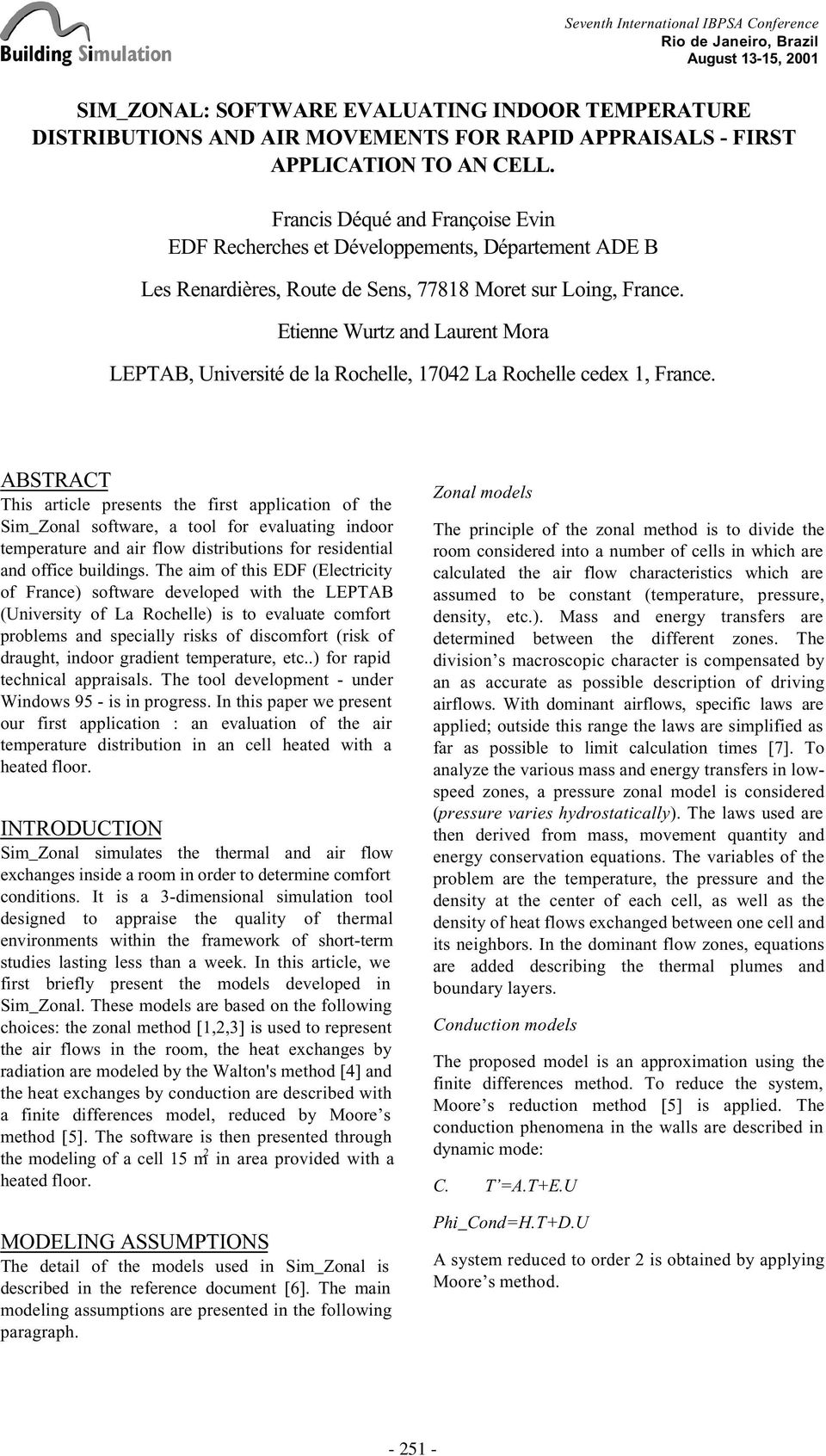
2 Radiation models The system of equations accurately describing the heat exchanges through radiation is non-linear. It was thus decided to simplify the radiation flow calculation expression, in order to make it linear and thus consistent with the other models used. For this purpose, the fictitious enclosure method proposed by Walton [4] is used. Its principle is to consider that this area i exchanges with a single fictitious gray area associated with it. CELL DESCRIPTION This cell with an area of 15 m 2 is representative of an office or a bedroom. Its dimensions are 2.90 m x 5.15 m x 2.50 m (in the West-East, South-North and Top- Bottom directions); the window is located on the North wall and the door on the South wall. The plane is shown in Figure 1. In our study, the cell is heated by a heated floor. The area of the South wall is 7.25 m and the area of the West wall is m2. Outside walls The outside walls are in contact with a seal (G11 and G2) and are well insulated. Their composition from the inside of the cell to the outside is: 10 mm plasterboard 50 mm polystyrene 200 mm Siporex Ceiling The ceiling has the following composition: 13 mm plasterboard 100 mm rock wool liquid seal system Floor Floor composition: 50 mm concrete heating electric cables 50 mm floormate 200 liquid floor Door The door has a thermal resistance of 1 m 2. C/W and its dimensions are 2m x 1m (2m 2 ). Window Figure 1: Cell description Composition and characteristics of walls Inside walls These are the walls in contact with soft seals G1 and G3. They are little insulated and their composition from the inside of the cell to the outside is: 26 mm plasterboard 108 mm rock wool 26 mm plasterboard G3 The window has double-glazing, its dimensions are 1.2m x 1.25m (1.5 m2) and its statutory characteristics are AC2-TH5. CALCULATION OF BOUNDARIES CONDITIONS The cable heating power and the temperatures outside the cell are considered as boundaries conditions. They are pre-calculated using an energy code (see figure 2). In our case, we used an air node model (single-node model). This initial simulation determined, on an hourly basis, the power delivered by the heated floor in order to obtain an ambient temperature of 19 C. The exchange coefficients are taken to be equal on either side of the wall and their value is 9.1 W/m2. C
![For this purpose, the fictitious enclosure method proposed by Walton [4] is used. Its principle is to consider that this area i exchanges with a single fictitious gray area associated with it.](/docs-images/56/7276807/images/page_2.jpg "CELL DESCRIPTION This cell with an area of 15 m 2 is representative of an office or a bedroom. Its dimensions are 2.90 m x 5.15 m x 2.")
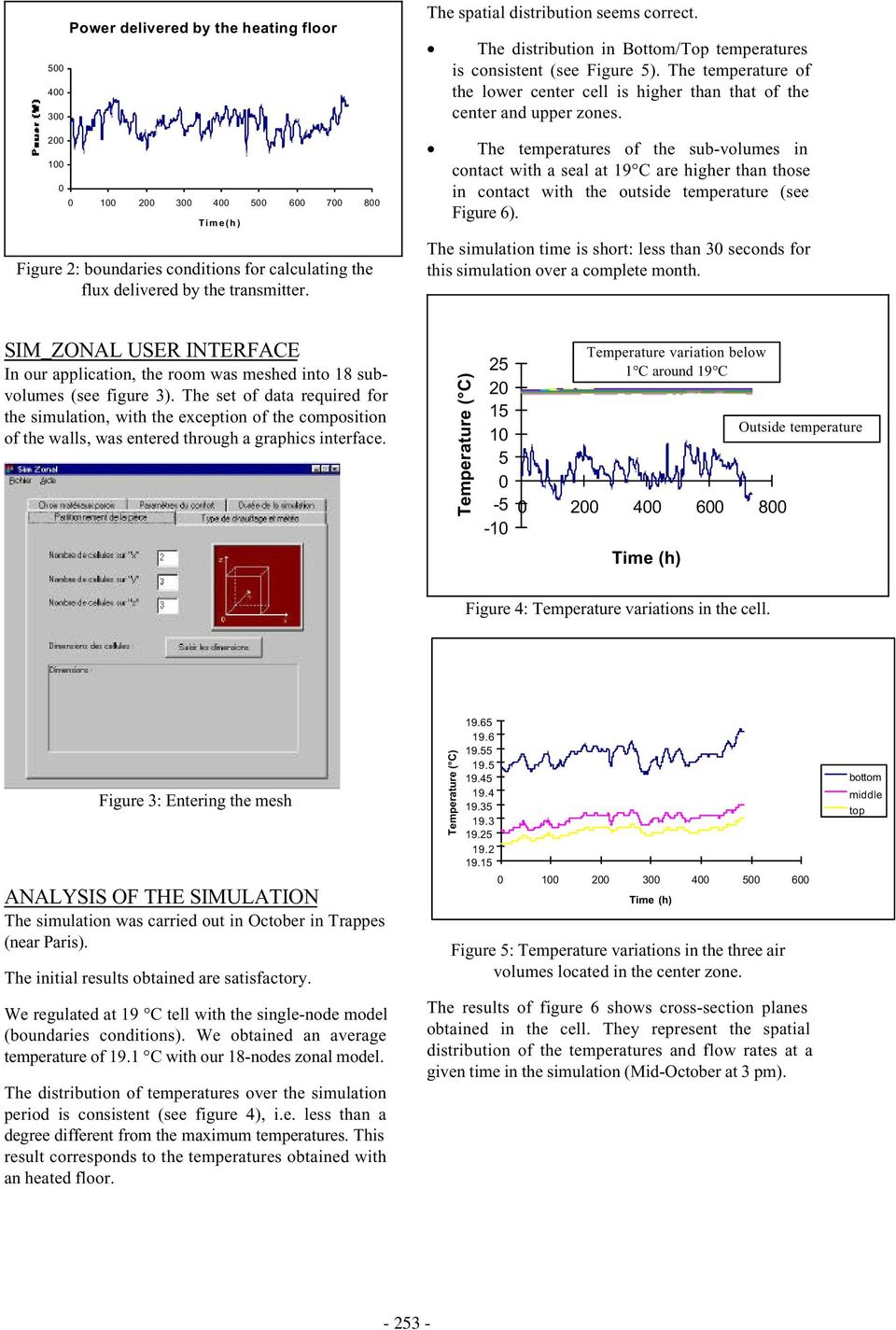
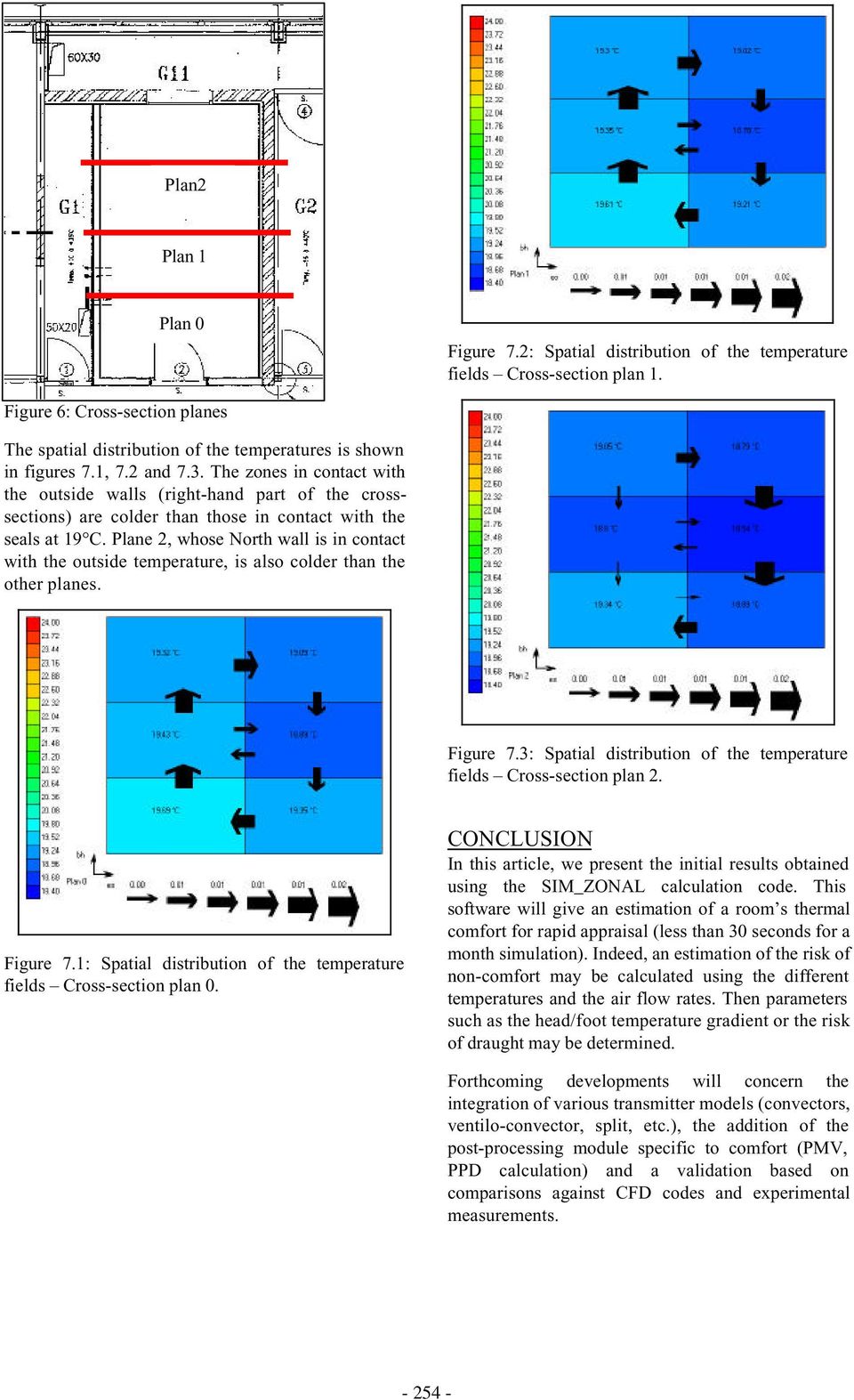
3 Power delivered by the heating floor Time(h) Figure 2: boundaries conditions for calculating the flux delivered by the transmitter. The spatial distribution seems correct. The distribution in Bottom/Top temperatures is consistent (see Figure 5). The temperature of the lower center cell is higher than that of the center and upper zones. The temperatures of the sub-volumes in contact with a seal at 19 C are higher than those in contact with the outside temperature (see Figure 6). The simulation time is short: less than 30 seconds for this simulation over a complete month. SIM_ZONAL USER INTERFACE In our application, the room was meshed into 18 subvolumes (see figure 3). The set of data required for the simulation, with the exception of the composition of the walls, was entered through a graphics interface. Temperature ( C) Temperature variation below 1 C around 19 C Time (h) Outside temperature Figure 4: Temperature variations in the cell. Figure 3: Entering the mesh ANALYSIS OF THE SIMULATION The simulation was carried out in October in Trappes (near Paris). The initial results obtained are satisfactory. We regulated at 19 C tell with the single-node model (boundaries conditions). We obtained an average temperature of 19.1 C with our 18-nodes zonal model. The distribution of temperatures over the simulation period is consistent (see figure 4), i.e. less than a degree different from the maximum temperatures. This result corresponds to the temperatures obtained with an heated floor. Temperature ( C) Time (h) Figure 5: Temperature variations in the three air volumes located in the center zone. The results of figure 6 shows cross-section planes obtained in the cell. They represent the spatial distribution of the temperatures and flow rates at a given time in the simulation (Mid-October at 3 pm). bottom middle top
4 Plan2 Plan 1 Plan 0 Figure 7.2: Spatial distribution of the temperature fields Cross-section plan 1. Figure 6: Cross-section planes The spatial distribution of the temperatures is shown in figures 7.1, 7.2 and 7.3. The zones in contact with the outside walls (right-hand part of the crosssections) are colder than those in contact with the seals at 19 C. Plane 2, whose North wall is in contact with the outside temperature, is also colder than the other planes. Figure 7.3: Spatial distribution of the temperature fields Cross-section plan 2. Figure 7.1: Spatial distribution of the temperature fields Cross-section plan 0. CONCLUSION In this article, we present the initial results obtained using the SIM_ZONAL calculation code. This software will give an estimation of a room s thermal comfort for rapid appraisal (less than 30 seconds for a month simulation). Indeed, an estimation of the risk of non-comfort may be calculated using the different temperatures and the air flow rates. Then parameters such as the head/foot temperature gradient or the risk of draught may be determined. Forthcoming developments will concern the integration of various transmitter models (convectors, ventilo-convector, split, etc.), the addition of the post-processing module specific to comfort (PMV, PPD calculation) and a validation based on comparisons against CFD codes and experimental measurements
5 REFERENCES [1] F. ALLARD and C.INARD. Natural and mixed convection in rooms : prediction of thermal stratification and heat transfer by zonal models, 1992 Int. Symp. on Room Air Convection and Ventilation Effectiveness, ISRACVE, Tokyo (Japan), July [2] E. WURTZ. Modélisation tridimensionnelle des transferts thermiques et aérauliques dans le bâtiment en environnement orienté objet, Thèse de Doctorat, Ecole Nationale de Ponts et Chaussées, [3] M. MUSY. Génération automatique de modèles zonaux pour la description du comportement thermoaéraulique des bâtiments, Thèse de Doctorat, Université de La Rochelle, [4] G.N. WALTON. A new algorithm for radiant exchange in room loads calculations. A.S.H.R.A.E. Transactions, vol 86, Part II p , 1988 [5] F.DEQUE, S. DELILLE, S.DAUTIN, Réduction de systèmes linéaires par la méthode Moore : Application la thermique du bâtiment, Rev. Gén. de Thermique, n 36, [6] E. WURTZ, F. DEQUE, M. MUSY, L. MORA, A thermal and air flow analysis tool using simplified models based on the zonal method, Clima 2000, Napoly, Sept [7] E. WURTZ, M. MUSY, F. ALLARD. Modélisation d un panache d émetteur de chaleur pour le logiciel de simulation énergétique des bâtiments SPARK, Int. J Therm. Sci n 39(3) pp , NOMENCLATURE C: the matrix of calorific, diagonal capacities defined as positive, A: the symmetrical but not positive matrix of the heat exchanges internal to the domain, E: the rectangular matrix of the thermal connections between the domain and the outside, H, D: vectors applied to the field of temperatures. T(t): field of temperatures inside the walls. Ph_Cond(t): Conduction flow (Watt) through the wall. U(t): Vector of loads. (temperatures outside and inside the walls)
![Modélisation tridimensionnelle des transferts thermiques et aérauliques dans le bâtiment en environnement orienté objet, Thèse de Doctorat, Ecole Nationale de Ponts et Chaussées, 1995. [3] M. MUSY.](/docs-images/56/7276807/images/page_5.jpg "Génération automatique de modèles zonaux pour la description du comportement thermoaéraulique des bâtiments, Thèse de Doctorat, Université de La Rochelle, 1999. [4] G.N. WALTON.")
6

Controller design for climate control in buildings using CLIM 2000
 Controller design for climate control in buildings using CLIM 2000 Kevin M. Murphy, Bernard Rémond and Francis Déqué Électricité de France / Direction des Études et Recherches Département Applications
COMPARISON OF THE THERMAL ENVIRONMENT IN ROOMS WITH CHILLED BEAM AND RADIANT PANEL SYSTEMS
 COMPARISON OF THE THERMAL ENVIRONMENT IN ROOMS WITH CHILLED BEAM AND RADIANT PANEL SYSTEMS Risto Kosonen, Panu Mustakallio Arsen Melikov 2, Marcin Duszyk 2 Oy Halton Group Ltd., Helsinki, Finland. 2 International
ME6130 An introduction to CFD 1-1
 ME6130 An introduction to CFD 1-1 What is CFD? Computational fluid dynamics (CFD) is the science of predicting fluid flow, heat and mass transfer, chemical reactions, and related phenomena by solving numerically
CFD SIMULATION OF SDHW STORAGE TANK WITH AND WITHOUT HEATER
 International Journal of Advancements in Research & Technology, Volume 1, Issue2, July-2012 1 CFD SIMULATION OF SDHW STORAGE TANK WITH AND WITHOUT HEATER ABSTRACT (1) Mr. Mainak Bhaumik M.E. (Thermal Engg.)
Eco Pelmet Modelling and Assessment. CFD Based Study. Report Number 610.14351-R1D1. 13 January 2015
 EcoPelmet Pty Ltd c/- Geoff Hesford Engineering 45 Market Street FREMANTLE WA 6160 Version: Page 2 PREPARED BY: ABN 29 001 584 612 2 Lincoln Street Lane Cove NSW 2066 Australia (PO Box 176 Lane Cove NSW
New Thermal Architecture For Future Green Data Centres
 New Thermal Architecture For Future Green Data Centres S. Le Masson, D. Nörtershäuser France Télécom R&D 2, Av Pierre Marzin 22300 Lannion FRANCE [email protected] ; [email protected],
CFD ANALYSIS CHALLENGES IN BUILDING SIMULATION FOR SIMBUILD2004 CONFERENCE. Ferdinand Schmid and Galen Burrell Architectural Energy Corporation
 CFD ANALYSIS CHALLENGES IN BUILDING SIMULATION FOR SIMBUILD2004 CONFERENCE Ferdinand Schmid and Galen Burrell Architectural Energy Corporation ABSTRACT This paper discusses the capabilities and challenges
Express Introductory Training in ANSYS Fluent Lecture 1 Introduction to the CFD Methodology
 Express Introductory Training in ANSYS Fluent Lecture 1 Introduction to the CFD Methodology Dimitrios Sofialidis Technical Manager, SimTec Ltd. Mechanical Engineer, PhD PRACE Autumn School 2013 - Industry
INTERNATIONAL ASSOCIATION OF CLASSIFICATION SOCIETIES. Interpretations of the FTP
 INTERNATIONAL ASSOCIATION OF CLASSIFICATION SOCIETIES Interpretations of the FTP CONTENTS FTP1 Adhesives used in A or B class divisions (FTP Code 3.1, Res A.754 para. 3.2.3) June 2000 FTP2 Pipe and duct
Comparison of two calculation methods used to estimate cooling energy demand and indoor summer temperatures
 Comparison of two calculation methods used to estimate cooling energy demand and indoor summer temperatures Kai Sirén and Ala Hasan Helsinki University of Technology, Finland Corresponding email: [email protected]
Module 1 : Conduction. Lecture 5 : 1D conduction example problems. 2D conduction
 Module 1 : Conduction Lecture 5 : 1D conduction example problems. 2D conduction Objectives In this class: An example of optimization for insulation thickness is solved. The 1D conduction is considered
CAN DEMAND CONTROLLED VENTILATION REPLACE SPACE HEATING IN OFFICE BUILDINGS WITH LOW HEATING DEMAND?
 Topic B3: Control of indoor environment CAN DEMAND CONTROLLED VENTILATION REPLACE SPACE HEATING IN OFFICE BUILDINGS WITH LOW HEATING DEMAND? Axel CABLE 1,*, Mads MYSEN 1,2, Kari THUNSHELLE 1 1 SINTEF,
THERMAL DESIGN AND TEST REQUIREMENTS FOR OUTSIDE PLANT CABLE TELECOMMUNICATIONS EQUIPMENT Al Marshall, P.E. Philips Broadband Networks
 THERMAL DESIGN AND TEST REQUIREMENTS FOR OUTSIDE PLANT CABLE TELECOMMUNICATIONS EQUIPMENT Al Marshall, P.E. Philips Broadband Networks Abstract Shrinking thermal margins, driven by sophisticated but thermally
TTLL301 - Heat transfer in a bar with imposed temperature (sinusoid)
 Titre : TTLL301 - Transfert thermique dans une barre avec [...] Date : 01/02/2011 Page : 1/8 TTLL301 - Heat transfer in a bar with imposed temperature (sinusoid) Summarized: This test is resulting from
CFD Application on Food Industry; Energy Saving on the Bread Oven
 Middle-East Journal of Scientific Research 13 (8): 1095-1100, 2013 ISSN 1990-9233 IDOSI Publications, 2013 DOI: 10.5829/idosi.mejsr.2013.13.8.548 CFD Application on Food Industry; Energy Saving on the
Integration of a fin experiment into the undergraduate heat transfer laboratory
 Integration of a fin experiment into the undergraduate heat transfer laboratory H. I. Abu-Mulaweh Mechanical Engineering Department, Purdue University at Fort Wayne, Fort Wayne, IN 46805, USA E-mail: [email protected]
Coupling Forced Convection in Air Gaps with Heat and Moisture Transfer inside Constructions
 Coupling Forced Convection in Air Gaps with Heat and Moisture Transfer inside Constructions M. Bianchi Janetti 1, F. Ochs 1 and R. Pfluger 1 1 University of Innsbruck, Unit for Energy Efficient Buildings,
Ravi Kumar Singh*, K. B. Sahu**, Thakur Debasis Mishra***
 Ravi Kumar Singh, K. B. Sahu, Thakur Debasis Mishra / International Journal of Engineering Research and Applications (IJERA) ISSN: 48-96 www.ijera.com Vol. 3, Issue 3, May-Jun 3, pp.766-77 Analysis of
A NODAL MODEL FOR DISPLACEMENT VENTILATION AND CHILLED CEILING SYSTEMS IN OFFICE SPACES
 A NODAL MODEL FOR DISPLACEMENT VENTILATION AND CHILLED CEILING SYSTEMS IN OFFICE SPACES Simon J. Rees and Philip Haves School of Mechanical & Aerospace Engineering, Oklahoma State University, Stillwater,
TWO-DIMENSIONAL FINITE ELEMENT ANALYSIS OF FORCED CONVECTION FLOW AND HEAT TRANSFER IN A LAMINAR CHANNEL FLOW
 TWO-DIMENSIONAL FINITE ELEMENT ANALYSIS OF FORCED CONVECTION FLOW AND HEAT TRANSFER IN A LAMINAR CHANNEL FLOW Rajesh Khatri 1, 1 M.Tech Scholar, Department of Mechanical Engineering, S.A.T.I., vidisha
Supply Air Window PAZIAUD : Comparison of Two Numerical Models for Integration in Thermal Building Simulation
 Abstract Supply Air Window PAZIAUD : Comparison of Two Numerical Models for Integration in Thermal Building Simulation F. Gloriant 1, P. Tittelein 2, A. Joulin 3, S. Lassue 4 The principle of a supply
MODELLING COUPLED HEAT AND AIR FLOW: PING-PONG VS ONIONS
 MODELLING COUPLED HEAT AND AIR FLOW: PING-PONG VS ONIONS Jan Hensen University of Strathclyde Energy Systems Research Unit 75 Montrose Street, GLASGOW G1 1XJ, Scotland Email: [email protected] SYNOPSIS
CFD Based Air Flow and Contamination Modeling of Subway Stations
 CFD Based Air Flow and Contamination Modeling of Subway Stations Greg Byrne Center for Nonlinear Science, Georgia Institute of Technology Fernando Camelli Center for Computational Fluid Dynamics, George
EXPERIMENTAL STUDY OF A DOMESTIC HOT WATER STORAGE TANK THERMAL BEHAVIOUR
 EXPERIMENTAL STUDY OF A DOMESTIC HOT WATER STORAGE TANK THERMAL BEHAVIOUR S. Amara (1)*, B. Benyoucef (2), B. Nordell (3), A. Touzi (1) and A. Benmoussat (2) (1) Unité de Recherche en Energies Renouvelables
Motor-CAD Software for Thermal Analysis of Electrical Motors - Links to Electromagnetic and Drive Simulation Models
 Motor-CAD Software for Thermal Analysis of Electrical Motors - Links to Electromagnetic and Drive Simulation Models Dave Staton, Douglas Hawkins and Mircea Popescu Motor Design Ltd., Ellesmere, Shropshire,
Heat and cold storage with PCM
 Harald Mehling Luisa F. Cabeza Heat and cold storage with PCM An up to date introduction into basics and applications With 208 Figures and 28 Tables 4y Springer Contents 1 Basic thermodynamics of thermal
Impact of Infiltration on Heating and Cooling Loads in U.S. Office Buildings
 Impact of Infiltration on Heating and Cooling Loads in U.S. Office Buildings 1 Steven J. Emmerich, 1 Andrew K. Persily, and 2 Timothy P. McDowell 1 Building and Fire Research Laboratory, National Institute
Software Development for Cooling Load Estimation by CLTD Method
 IOSR Journal of Mechanical and Civil Engineering (IOSR-JMCE) ISSN: 2278-1684Volume 3, Issue 6 (Nov. - Dec. 2012), PP 01-06 Software Development for Cooling Load Estimation by CLTD Method Tousif Ahmed Department
TEXTILE FABRICS AS THERMAL INSULATORS
 TEXTILE FABRICS AS THERMAL INSULATORS Zeinab S. Abdel-Rehim 1, M. M. Saad 2, M. El-Shakankery 2 and I. Hanafy 3 1 Mechanical Engineering Department of the National Research Center, Dokki, Giza, Egypt 2
Customer Training Material. Lecture 2. Introduction to. Methodology ANSYS FLUENT. ANSYS, Inc. Proprietary 2010 ANSYS, Inc. All rights reserved.
 Lecture 2 Introduction to CFD Methodology Introduction to ANSYS FLUENT L2-1 What is CFD? Computational Fluid Dynamics (CFD) is the science of predicting fluid flow, heat and mass transfer, chemical reactions,
Effect of Aspect Ratio on Laminar Natural Convection in Partially Heated Enclosure
 Universal Journal of Mechanical Engineering (1): 8-33, 014 DOI: 10.13189/ujme.014.00104 http://www.hrpub.org Effect of Aspect Ratio on Laminar Natural Convection in Partially Heated Enclosure Alireza Falahat
ANSI/ASHRAE Standard 140-2004 Building Thermal Envelope and Fabric Load Tests
 ANSI/ASHRAE Standard 140-2004 Building Thermal Envelope and Fabric Load Tests DesignBuilder Version 1.2.0 (incorporating EnergyPlus version 1.3.0) - June 2006 1.0 Purpose The ANSI/ASHRAE Standard 140-2004
APPLICATION OF DATA MINING TECHNIQUES FOR BUILDING SIMULATION PERFORMANCE PREDICTION ANALYSIS. email [email protected]
 Eighth International IBPSA Conference Eindhoven, Netherlands August -4, 2003 APPLICATION OF DATA MINING TECHNIQUES FOR BUILDING SIMULATION PERFORMANCE PREDICTION Christoph Morbitzer, Paul Strachan 2 and
Radiant Heating and Cooling Systems BY KWANG WOO KIM, ARCH.D., MEMBER ASHRAE; BJARNE W. OLESEN, PH.D., FELLOW ASHRAE
 TECHNICAL FEATURE Fundamentals at Work This article was published in ASHRAE Journal, February 2015. Copyright 2015 ASHRAE. Posted at www.ashrae.org. This article may not be copied and/or distributed electronically
Performance Estimation of Water Thermal Energy Storage Tank by Using Simplified Simulation
 Performance Estimation of Water Thermal Energy Storage Tank by Using Simplified Simulation M. Kubota, K. Sagara, T. Yamanaka, H. Kotani Division of Global Architecture, Graduate School of Engineering,
EVALUATION OF PHOENICS CFD FIRE MODEL AGAINST ROOM CORNER FIRE EXPERIMENTS
 EVALUATION OF PHOENICS CFD FIRE MODEL AGAINST ROOM CORNER FIRE EXPERIMENTS Yunlong Liu and Vivek Apte CSIRO Fire Science and Technology Laboratory PO Box 31 North Ryde, NSW 167, Australia TEL:+61 2 949
Determination of Thermal Conductivity of Coarse and Fine Sand Soils
 Proceedings World Geothermal Congress Bali, Indonesia, - April Determination of Thermal Conductivity of Coarse and Fine Sand Soils Indra Noer Hamdhan 1 and Barry G. Clarke 2 1 Bandung National of Institute
INTERNATIONAL JOURNAL OF MECHANICAL ENGINEERING AND TECHNOLOGY (IJMET)
 INTERNATIONAL JOURNAL OF MECHANICAL ENGINEERING AND TECHNOLOGY (IJMET) Proceedings of the 2 nd International Conference on Current Trends in Engineering and Management ICCTEM -2014 ISSN 0976 6340 (Print)
2013 Code_Saturne User Group Meeting. EDF R&D Chatou, France. 9 th April 2013
 2013 Code_Saturne User Group Meeting EDF R&D Chatou, France 9 th April 2013 Thermal Comfort in Train Passenger Cars Contact For further information please contact: Brian ANGEL Director RENUDA France [email protected]
Natural convection in a room with two opposite heated vertical walls
 INTERNATIONAL JOURNAL OF ENERGY AND ENVIRONMENT Volume 6, Issue 1, 2015 pp.81-86 Journal homepage: www.ijee.ieefoundation.org Natural convection in a room with two opposite heated vertical walls Ameer
Trace Layer Import for Printed Circuit Boards Under Icepak
 Tutorial 13. Trace Layer Import for Printed Circuit Boards Under Icepak Introduction: A printed circuit board (PCB) is generally a multi-layered board made of dielectric material and several layers of
Diego Ibarra Christoph Reinhart Harvard Graduate School of Design
 Building Performance Simulation for Designers - Energy DesignBuilder // EnergyPlus Tutorial #2 Load Schedules GEOMETRY LOADS RESULTS Diego Ibarra Christoph Reinhart Harvard Graduate School of Design OVERVIEW
RESULTS OF ICARUS 9 EXPERIMENTS RUN AT IMRA EUROPE
 Roulette, T., J. Roulette, and S. Pons. Results of ICARUS 9 Experiments Run at IMRA Europe. in Sixth International Conference on Cold Fusion, Progress in New Hydrogen Energy. 1996. Lake Toya, Hokkaido,
Introduction to CFD Analysis
 Introduction to CFD Analysis 2-1 What is CFD? Computational Fluid Dynamics (CFD) is the science of predicting fluid flow, heat and mass transfer, chemical reactions, and related phenomena by solving numerically
Essam E. Khalil [email protected]
 AIR-CONDITIONING SYSTEMS DEVELOPMENTS IN HOSPITALS: COMFORT, AIR QUALITY, AND ENERGY UTILIZATION Essam E. Khalil [email protected] PROFESSOR OF MECHANICAL ENGINEERING, CAIRO UNIVERSITY, EGYPT Abstract
NUMERICAL INVESTIGATION OF HEAT AND MASS TRANSFER IN A REFRIGERATED TRUCK COMPARTMENT
 NUMERICAL INVESTIGATION OF HEAT AND MASS TRANSFER IN A REFRIGERATED TRUCK COMPARTMENT T. LAFAYE DE MICHEAUX (a), V. SARTRE (a)*, A. STUMPF (b), J. BONJOUR (a) (a) Université de Lyon, CNRS INSA-Lyon, CETHIL,
Ampacity simulation of a high voltage cable to connecting off shore wind farms
 Ampacity simulation of a high voltage cable to connecting off shore wind farms Eva Pelster 1, Dr. David Wenger 1 1 Wenger Engineering GmbH, Einsteinstr. 55, 89077 Ulm, [email protected] Abstract:
CFD SIMULATION OF IPR-R1 TRIGA SUBCHANNELS FLUID FLOW
 2013 International Nuclear Atlantic Conference - INAC 2013 Recife, PE, Brazil, November 24-29, 2013 ASSOCIAÇÃO BRASILEIRA DE ENERGIA NUCLEAR - ABEN ISBN: 978-85-99141-05-2 CFD SIMULATION OF IPR-R1 TRIGA
CFD AND MULTI-ZONE MODELLING OF FOG FORMATION RISK IN A NATURALLY VENTILATED INDUSTRIAL BUILDING
 2000 Elsevier Science Ltd. All rights reserved., Air Distribution in Rooms, (ROOMVENT 2000) Editor: H.B. Awbi 767 CFD AND MULTI-ZONE MODELLING OF FOG FORMATION RISK IN A NATURALLY VENTILATED INDUSTRIAL
Laminar Flow and Heat Transfer of Herschel-Bulkley Fluids in a Rectangular Duct; Finite-Element Analysis
 Tamkang Journal of Science and Engineering, Vol. 12, No. 1, pp. 99 107 (2009) 99 Laminar Flow and Heat Transfer of Herschel-Bulkley Fluids in a Rectangular Duct; Finite-Element Analysis M. E. Sayed-Ahmed
HEAT TRANSFER IM0245 3 LECTURE HOURS PER WEEK THERMODYNAMICS - IM0237 2014_1
 COURSE CODE INTENSITY PRE-REQUISITE CO-REQUISITE CREDITS ACTUALIZATION DATE HEAT TRANSFER IM05 LECTURE HOURS PER WEEK 8 HOURS CLASSROOM ON 6 WEEKS, HOURS LABORATORY, HOURS OF INDEPENDENT WORK THERMODYNAMICS
How To Calculate Thermal Resistance On A Pb (Plastipo)
 VISHAY BEYSCHLAG Resistive Products 1. INTRODUCTION Thermal management is becoming more important as the density of electronic components in modern printed circuit boards (PCBs), as well as the applied
CFD Application on Food Industry; Energy Saving on the Bread Oven
 Iranica Journal of Energy & Environment 3 (3): 241-245, 2012 ISSN 2079-2115 IJEE an Official Peer Reviewed Journal of Babol Noshirvani University of Technology DOI: 10.5829/idosi.ijee.2012.03.03.0548 CFD
Pragmatic multi-scale and multi-physics analysis of Charles Bridge in Prague
 Pragmatic multi-scale and multi-physics analysis of Charles Bridge in Prague Jiří Šejnoha 1,2 Michal Šejnoha 1,2 Jan Zeman 1 Jan Novák 1,2 with Zdeněk Janda, Jiří Maděra, Jan Vorel and Jan Sýkora 1 Department
Piotr Tofiło a,*, Marek Konecki b, Jerzy Gałaj c, Waldemar Jaskółowski d, Norbert Tuśnio e, Marcin Cisek f
 Available online at www.sciencedirect.com Procedia Engineering 57 (2013 ) 1156 1165 11th International Conference on Modern Building Materials, Structures and Techniques, MBMST 2013 Expert System for Building
EVERYDAY ENGINEERING EXAMPLES FOR SIMPLE CONCEPTS
 EVERYDAY ENGINEERING EXAMPLES FOR SIMPLE CONCEPTS Thermal Properties ENGR 3350 - Materials Science Dr. Nedim Vardar Copyright 2015 Thermal Properties of Materials Engage: MSEIP Engineering Everyday Engineering
Effect of design parameters on temperature rise of windings of dry type electrical transformer
 Effect of design parameters on temperature rise of windings of dry type electrical transformer Vikas Kumar a, *, T. Vijay Kumar b, K.B. Dora c a Centre for Development of Advanced Computing, Pune University
THERMAL STRATIFICATION IN A HOT WATER TANK ESTABLISHED BY HEAT LOSS FROM THE TANK
 THERMAL STRATIFICATION IN A HOT WATER TANK ESTABLISHED BY HEAT LOSS FROM THE TANK J. Fan and S. Furbo Abstract Department of Civil Engineering, Technical University of Denmark, Brovej, Building 118, DK-28
A numerical investigation on effects of ceiling and floor surface temperatures and room dimensions on the Nusselt number for a floor heating system
 International Communications in Heat and Mass Transfer 34 (2007) 979 988 www.elsevier.com/locate/ichmt A numerical investigation on effects of ceiling and floor surface temperatures and room dimensions
Olivier Gicquel, Ronan Vicquelin, Jean Taine Phd Students : Y. Zhang, J. Kim, G. Wang, R. Goncalves dos Santos
 Développement d un code Monte- Carlo pour le calcul intensif utilisant les spécificités de la méthode ERM Olivier Gicquel, Ronan Vicquelin, Jean Taine Phd Students : Y. Zhang, J. Kim, G. Wang, R. Goncalves
INTERACTION OF LIQUID MOTION ON MOBILE TANK STRUCTURE
 Journal of KONES Powertrain and Transport, Vol. 18, No. 3 2011 INTERACTION OF LIQUID MOTION ON MOBILE TANK STRUCTURE Mariusz Domaga a, Edward Lisowski Cracow University of Technology, Department of Mechanical
Thermal environment in indoor spaces with under-floor air distribution systems: 1. Impact of design parameters (1522-RP)
 Lee, K.S., Xue, G., Jiang, Z., and Chen, Q. 0. Thermal environment in indoor spaces with under-floor air distribution systems:. Impact of design parameters (5-RP), HVAC&R Research, 8(6), 8 9. Thermal environment
COOLING AND HEATING OF BUILDINGS BY ACTIVATING THEIR THERMAL MASS WITH EMBEDDED HYDRONIC PIPE SYSTEMS -
 pcoolingandheating COOLING AND HEATING OF BUILDINGS BY ACTIVATING THEIR THERMAL MASS WITH EMBEDDED HYDRONIC PIPE SYSTEMS - Bjarne W. Olesen, Ph.D. D. F. Liedelt "Velta" Summary Due to intensive use of
NUMERICAL ANALYSIS OF THE EFFECTS OF WIND ON BUILDING STRUCTURES
 Vol. XX 2012 No. 4 28 34 J. ŠIMIČEK O. HUBOVÁ NUMERICAL ANALYSIS OF THE EFFECTS OF WIND ON BUILDING STRUCTURES Jozef ŠIMIČEK email: [email protected] Research field: Statics and Dynamics Fluids mechanics
CFD Analysis of Application of Phase Change Material in Automotive Climate Control Systems
 CFD Analysis of Application of Phase Change Material in Automotive Climate Control Systems Vijayakumar Nachimuthu 1, Prabhu Mani 2, Muthukumar. P 3 1 Flowxplore, Coimbatore, India., 2 Kathir College of
Experimental method to determine the energy envelope performance of buildings
 Experimental method to determine the energy envelope performance of buildings Julien Berger 1, Sihem Tasca-Guernouti 2, Myriam Humbert 1 1 CETE de l Ouest, Laboratoire Régional de Saint Brieuc, 5 rue Jules
CFD Grows Up! Martin W. Liddament Ventilation, Energy and Environmental Technology (VEETECH Ltd) What is Computational Fluid Dynamics?
 CIBSE/ASHRAE Meeting CFD Grows Up! Martin W. Liddament Ventilation, Energy and Environmental Technology (VEETECH Ltd) 10 th December 2003 What is Computational Fluid Dynamics? CFD is a numerical means
Keywords: Heat transfer enhancement; staggered arrangement; Triangular Prism, Reynolds Number. 1. Introduction
 Heat transfer augmentation in rectangular channel using four triangular prisms arrange in staggered manner Manoj Kumar 1, Sunil Dhingra 2, Gurjeet Singh 3 1 Student, 2,3 Assistant Professor 1.2 Department
INDOOR ENVIRONMENT OF A CLASSROOM IN A PASSIVE SCHOOL BUILDING WITH DISPLACEMENT VENTILATION. Applied Energy Research, Munich, Germany
 INDOOR ENVIRONMENT OF A CLASSROOM IN A PASSIVE SCHOOL BUILDING WITH DISPLACEMENT VENTILATION Yang Wang 1,2, Jens Kuckelkorn 1, Fu-Yun Zhao 3,4 and Hartmut Spliethoff 2,1 1 Division of Technology for Energy
HEAT TRANSFER ANALYSIS IN A 3D SQUARE CHANNEL LAMINAR FLOW WITH USING BAFFLES 1 Vikram Bishnoi
 HEAT TRANSFER ANALYSIS IN A 3D SQUARE CHANNEL LAMINAR FLOW WITH USING BAFFLES 1 Vikram Bishnoi 2 Rajesh Dudi 1 Scholar and 2 Assistant Professor,Department of Mechanical Engineering, OITM, Hisar (Haryana)
Rate of Heating Analysis of Data Centers during Power Shutdown
 2011. American Society of Heating, Refrigerating and Air-Conditioning Engineers, Inc. (www.ashrae.org). Published in ASHRAE Transactions, Volume 117, Part 1. For personal use only. Additional reproduction,
Numerical Analysis of the Resin Transfer Molding Process via PAM- RTM Software
 Defect and Diffusion Forum Vol 365 (2015) pp 88-93 (2015) Trans Tech Publications, Switzerland doi:10.4028/www.scientific.net/ddf.365.88 Numerical Analysis of the Resin Transfer Molding Process via PAM-
Crawl space heat and moisture behaviour
 Crawl space heat and moisture behaviour Miimu Airaksinen, Dr., Technical Research Centre of Finland, VTT [email protected], www.vtt.fi KEYWORDS: crawl space, moisture, evaporation from ground, ground
Lecture 3 Fluid Dynamics and Balance Equa6ons for Reac6ng Flows
 Lecture 3 Fluid Dynamics and Balance Equa6ons for Reac6ng Flows 3.- 1 Basics: equations of continuum mechanics - balance equations for mass and momentum - balance equations for the energy and the chemical
Frost Damage of Roof Tiles in Relatively Warm Areas in Japan
 Frost Damage of Roof Tiles in Relatively Warm Areas in Japan Influence of Surface Finish on Water Penetration Chiemi IBA Hokkaido Research Organization, Japan Shuichi HOKOI Kyoto University, Japan INTRODUCTION
Differential Relations for Fluid Flow. Acceleration field of a fluid. The differential equation of mass conservation
 Differential Relations for Fluid Flow In this approach, we apply our four basic conservation laws to an infinitesimally small control volume. The differential approach provides point by point details of
Introduction to CFD Analysis
 Introduction to CFD Analysis Introductory FLUENT Training 2006 ANSYS, Inc. All rights reserved. 2006 ANSYS, Inc. All rights reserved. 2-2 What is CFD? Computational fluid dynamics (CFD) is the science
Modeling and Simulation of Oil-Water Flows with Viscous Fingering in Heterogeneous Porous Media.
 ACMA 2014 Modeling and Simulation of Oil-Water Flows with Viscous Fingering in Heterogeneous Porous Media. H. DJEBOURI 1, S. ZOUAOUI 1, K. MOHAMMEDI 2, and A. AIT AIDER 1 1 Laboratoire de Mécanique Structure
Energy and Buildings
 Energy and Buildings 59 (2013) 62 72 Contents lists available at SciVerse ScienceDirect Energy and Buildings j our na l ho me p age: www.elsevier.com/locate/enbuild Experimental thermal characterization
Residential HVAC Load Sizing Training October 14, 2015. David Kaiser Green Code Plan Reviewer
 Residential HVAC Load Sizing Training October 14, 2015 David Kaiser Green Code Plan Reviewer DCRA - Green Building Division Regulations of green codes including: Green Building Act Green Construction Code
Passive Solar Design and Concepts
 Passive Solar Design and Concepts Daylighting 1 Passive Solar Heating Good architecture? The judicious use of south glazing coupled with appropriate shading and thermal mass. Summer Winter Passive solar
MODELLING SUPPLY-AIR WINDOW IN A BUILDING SIMULATION CODE
 MODELLING SUPPLY-AIR WINDOW IN A BUILDING SIMULATION CODE François Gloriant 1, Pierre Tittelein 1*, Annabelle Joulin 1 and Stéphane Lassue 1 1 Laboratoire Génie Civil et géo-environnement (EA-4515), Faculty
Adaptive strategies for office spaces in the UK climate
 International Conference Passive and Low Energy Cooling 631 Adaptive strategies for office spaces in the UK climate I. Gallou Environment & Energy Studies Programme, Architectural Association Graduate
SBi 2013:12. Use of perforated acoustic panels as supply air diffusers in diffuse ceiling ventilation systems
 SBi 2013:12 Use of perforated acoustic panels as supply air diffusers in diffuse ceiling ventilation systems Use of perforated acoustic panels as supply air diffusers in diffuse ceiling ventilation systems
Everline Module Application Note: Round LED Module Thermal Management
 Everline Module Application Note: Round LED Module Thermal Management PURPOSE: Use of proper thermal management is a critical element of Light Emitting Diode (LED) system design. The LED temperature directly
Radiant Floor Heating In Theory and Practice
 The following article was published in ASHRAE Journal, July 02. Copyright 02 American Society of Heating, Refrigerating and Air- Conditioning Engineers, Inc. It is presented for educational purposes only.
Moisture Content in Insulated Basement Walls
 Moisture Content in Insulated Basement Walls Peter Blom,PhD, SINTEF Building and Infrastructure; [email protected], www.sintef.no/byggforsk Sverre B. Holøs M.Sc. SINTEF Building and Infrastructure;
How To Model With Cfd Using Phoenics
 The Use and Application of CFD in the Air Conditioning and Fire Protection Industry AIRAH NSW February 2008 The Use and Application of CFD in the Air Conditioning and Fire Protection Industry An Introduction
NUCLEAR ENERGY RESEARCH INITIATIVE
 NUCLEAR ENERGY RESEARCH INITIATIVE Experimental and CFD Analysis of Advanced Convective Cooling Systems PI: Victor M. Ugaz and Yassin A. Hassan, Texas Engineering Experiment Station Collaborators: None
Life Cycle Assessment applied to urban settlements
 Life Cycle Assessment applied to urban settlements INTRODUCTION HERFRAY Gregory CEP, MINES ParisTech [email protected] PEUPORTIER Bruno CEP, MINES ParisTech [email protected]
Post-insulation of cellar ceiling and cellar walls
 WP5 Education and Economic Promotion Post-insulation of cellar ceiling and cellar walls Educational product: New lecture material for training modules dealing with knowledge and skills how to apply suitable
Effects of Cell Phone Radiation on the Head. BEE 4530 Computer-Aided Engineering: Applications to Biomedical Processes
 Effects of Cell Phone Radiation on the Head BEE 4530 Computer-Aided Engineering: Applications to Biomedical Processes Group 3 Angela Cai Youjin Cho Mytien Nguyen Praveen Polamraju Table of Contents I.
The calculus and simulation of underfloor heating systems
 The calculus and simulation of underfloor heating systems DORIN CRISTIAN NĂSTAC*, IOAN CĂLDARE**, IOAN GIURCA***, CORNEL MUNTEA*** * Building Services Engineering Department, Transilvania University of
STUDY OF DAM-RESERVOIR DYNAMIC INTERACTION USING VIBRATION TESTS ON A PHYSICAL MODEL
 STUDY OF DAM-RESERVOIR DYNAMIC INTERACTION USING VIBRATION TESTS ON A PHYSICAL MODEL Paulo Mendes, Instituto Superior de Engenharia de Lisboa, Portugal Sérgio Oliveira, Laboratório Nacional de Engenharia
AN EFFECT OF GRID QUALITY ON THE RESULTS OF NUMERICAL SIMULATIONS OF THE FLUID FLOW FIELD IN AN AGITATED VESSEL
 14 th European Conference on Mixing Warszawa, 10-13 September 2012 AN EFFECT OF GRID QUALITY ON THE RESULTS OF NUMERICAL SIMULATIONS OF THE FLUID FLOW FIELD IN AN AGITATED VESSEL Joanna Karcz, Lukasz Kacperski
Energy Use in Residential Housing: A Comparison of Insulating Concrete Form and Wood Frame Walls
 PCA R&D Serial No. 415 Energy Use in Residential Housing: A Comparison of Insulating Concrete Form and Wood Frame Walls by John Gajda and Martha VanGeem 000 Portland Cement Association KEYWORDS Concrete,
Battery Thermal Management System Design Modeling
 Battery Thermal Management System Design Modeling Gi-Heon Kim, Ph.D Ahmad Pesaran, Ph.D ([email protected]) National Renewable Energy Laboratory, Golden, Colorado, U.S.A. EVS October -8, 8, 006 Yokohama,