
Getting Started with WebEx Training Center
|
|
|
- Julianna Long
- 10 years ago
- Views:
Transcription
1 Getting Started with WebEx Training Center About this guide This guide introduces you to Training Center and provides basic information about using its many features. For more information about using these features, refer to the online Help on your Training Center Web site. Refer to the table below to locate the information you need. Feature descriptions and step-by-step procedures are grouped under the larger training session tasks you are performing, such as scheduling a training session, sharing information, or housekeeping and management tasks, such as muting and unmuting microphones. Set up tasks Scheduling tasks Sharing information Interacting with attendees Managing training sessions Learn about your account, Training Manager, and other features... 2 Learn about scheduling a training session and how to set up an Instant training session... 5 Review ways of sharing documents, applications, Web browsers and your desktop Enrich your training session using video, chat, and other tools Assign and remove privileges, mute attendees microphones and use other tools to control your training session Highlights: Your user account... 2 Logging in... 2 Training Manager... 3 Finding your session..4 Joining a training session 4 Highlights: Types of training sessions... 5 Scheduling a training session... 6 Adding tests Scoring tests Starting an instant training session 13 Highlights: Sharing options Sharing documents Sharing software (applications, browsers, desktops) Transferring files Recording a training session.. 22 Highlights: Sending chat...32 Using Q & A...32 Hands-on Lab...34 Breakout sessions...36 Teleconferencing...36 Using video...41 Polling participants...42 Participant roles Highlights: Assigning privileges Muting and unmuting microphones Inviting attendees during a training session Transfer host role Removing participants Ending a training session. 46 Viewing usage reports Tools you can use: Session Calendar...4 Tools you can use: Test Library Tools you can use: Annotation tools View tools UCF for multimedia Tools you can use: Panel resizing Right-click menu Video Tools you can use: Icons on the Participants panel Usage reports Training Center

2 2 of 52 Getting Started with WebEx Training Center Set up tasks Obtaining a user account... 2 Logging in and out... 2 If you forget your password... 2 Setting up Training Manager for Windows... 3 System requirements... 3 Browsing the Session calendar... 4 Joining a training session... 4 Obtaining a user account Once you obtain a user account, you can host training sessions using your training session service. You need not obtain a user account to attend training sessions. You can obtain a user account in one of two ways: The site administrator for your Training Center Web site can create a user account for you. If your site administrator has made the signup feature available, you can sign up for an account on your Training Center Web site at any time. To obtain a user account using the signup feature: 1 Go to your Training Center Web site. Your address for your site is usually in the following format: <your_company>.webex.com 2 On the navigation bar, expand Set Up. 3 Click New Account. This option is available only if your site has the self-registration feature. 4 Provide the required information, and then click Sign Up Now. Logging in and out You must log in to your Training Center Web site to schedule and start your training sessions and access your account features. Your site administrator provides you with your user name and default password for your account. Note You do not need to log in to your site to attend a training session, unless the training session host specifies that all attendees must have a user account. To log in to Training Center: 1 Go to your Training Center Web site. The address for your site is usually in the following format: <your_company>.webex.com 2 On the navigation bar, click Log In. 3 Provide your user name and password. 4 Optional. To automatically log in to Training Center whenever you access it, click the Save my user information for automatic login check box. 5 Click Log In. To log out from Training Center: To log out from your Training Center Web site, on the navigation bar at the top of the page, click Log Out. If you have forgotten your user name or password If you have forgotten either your user name or password, you can quickly obtain it.

3 Getting Started with WebEx Training Center 3 of 52 To obtain your user name or password: 1 On the navigation bar, click Log In. 2 On the Log In page, click Login Assistance. 3 Provide your address, and then click OK. Your Training Center Web site immediately sends you an message containing your account information. Setting up Training Manager for Windows Training Manager is a software program that you install on your computer and use when participating in a training session. Training Manager provides the options that you use to share information such as presentations and applications send chat messages, send and receive live video, record a training session, and so on. The Training Manager software provides the work space for your training session. System requirements Your system must meet these requirements for installing Training Manager for Windows: Microsoft Windows 2000 or XP Intel x86 (Pentium 400 MHz +) or compatible processor 32 MB RAM (64 MB recommended) Microsoft Internet Explorer 6 or later, Mozilla 1.6 or later, Netscape Communicator 7.x, Firefox 1.0 or later JavaScript and cookies enabled on the Web browser 56K or faster Internet connection To set up Training Manager for Windows: 1 On the navigation bar, expand Set Up, and then click Training Manager. The Set Up page appears. 2 Click Set Up. 3 If a security dialog box appears, do one of the following: If you are installing Training Manager on Microsoft Internet Explorer, click Yes. If you are installing Training Manager on Netscape Navigator, click Grant. Setup continues. A progress message box appears, indicating the progress of setup. Once setup is complete, the Setup Complete page appears. 4 Click OK. Important If you want to share a presentation that was created using Microsoft PowerPoint 2002 for Windows XP, an Intel Celeron or Pentium 500 MHz or faster processor is highly recommended. However, you cannot share other types of presentation or documents unless you either: Sign in to your computer as an administrator before starting or joining a training session for the first time, or Have a Windows 2000 administrator set up your computer for you. Subsequently starting or joining a training session does not require administrator privileges. You can now start, schedule, or join a training session.

4 4 of 52 Getting Started with WebEx Training Center Browsing the Session Calendar The Live Sessions page includes a training session calendar, which provides upcoming, daily, weekly, and monthly views of all scheduled or in-progress training sessions on your site, as well as a list of all training sessions being hosted on the current date. Using the calendar, participants can search for a training session obtain information about a training session register for a training session join a training session The following figure shows the Upcoming view of the Live Sessions page. Joining a training session If a training session host invites you to a training session via , the invitation message will include information about the training session, instructions for joining the voice conference, and a link that you can click to join the training session. This example of a training session invitation shows the level of detail included: Click this link to join the training session Tip A training session invitation may also include a link that you can click to add the training session to any calendar program that supports the icalendar format, such as Microsoft Outlook or Lotus Notes.

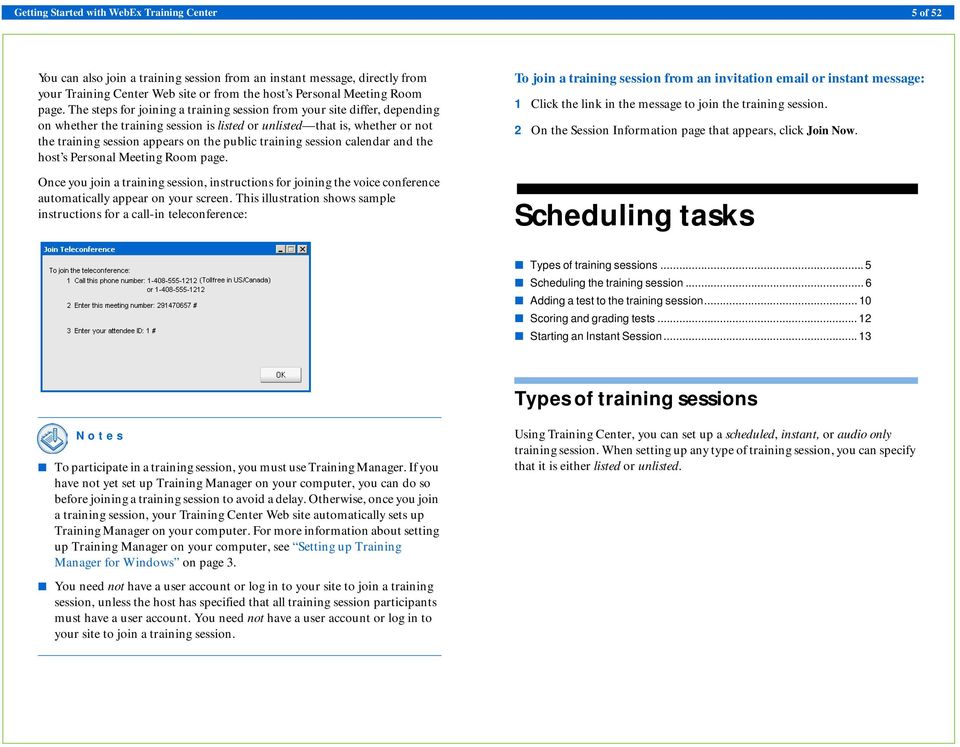
5 Getting Started with WebEx Training Center 5 of 52 You can also join a training session from an instant message, directly from your Training Center Web site or from the host s Personal Meeting Room page. The steps for joining a training session from your site differ, depending on whether the training session is listed or unlisted that is, whether or not the training session appears on the public training session calendar and the host s Personal Meeting Room page. Once you join a training session, instructions for joining the voice conference automatically appear on your screen. This illustration shows sample instructions for a call-in teleconference: To join a training session from an invitation or instant message: 1 Click the link in the message to join the training session. 2 On the Session Information page that appears, click Join Now. Scheduling tasks Types of training sessions... 5 Scheduling the training session... 6 Adding a test to the training session Scoring and grading tests Starting an Instant Session Types of training sessions Notes To participate in a training session, you must use Training Manager. If you have not yet set up Training Manager on your computer, you can do so before joining a training session to avoid a delay. Otherwise, once you join a training session, your Training Center Web site automatically sets up Training Manager on your computer. For more information about setting up Training Manager on your computer, see Setting up Training Manager for Windows on page 3. You need not have a user account or log in to your site to join a training session, unless the host has specified that all training session participants must have a user account. You need not have a user account or log in to your site to join a training session. Using Training Center, you can set up a scheduled, instant, or audio only training session. When setting up any type of training session, you can specify that it is either listed or unlisted.
6 6 of 52 Getting Started with WebEx Training Center The following table defines each type of training session. Session Type Scheduled Instant Audio Only Listed Unlisted Description A training session that you schedule for a specific date and time, using the Schedule a Training Session wizard. When scheduling a training session, you can Specify a recurrence pattern for the training session Schedule and start a training session for another user who has granted you scheduling permission Specify voice conferencing options Send invitations to participants Require attendees to register for a training session, which lets you collect information from attendees and enhances the security of your training session Choose which default training session privileges you want attendees to have Choose which training session options you want to turn on or off, such as chat, video, and so on Let attendees join the training session before its scheduled starting time that is, before you start it Choose a presentation or document to share automatically once a participant joins the training session An impromptu training session that you set up and start immediately, using the Instant Session page. When setting up an instant session, you can specify voice conferencing options only. A training session that is a standalone teleconference. A training session that appears on your Training Center Web site s calendar and your Personal Meeting Room page. Because these pages are publicly accessible, visitors can view lists of training sessions on these pages. A training session that does not appear on any pages on your Training Center Web site. To join an unlisted training session, attendees must provide the training session number. Your training session service automatically generates a unique training session number for each training session that you host. Scheduling a training session When scheduling a training session, you must specify a training session topic and starting time. You can also specify several options to provide security for and to customize your training session. You can schedule a training session quickly from the Schedule Training Session page. You can click the Start button at any time to start your training session. To schedule a training session: 1 Log in to your Training Center Web site. 2 On the navigation bar, expand Host a Session to view a list of links. 3 Click Schedule Training. 4 Scroll to Session and Access Information, enter your information, and make your selections. What you can do here Specify whether you are setting up a training session on someone s behalf and the name of that person. Define a topic for the training session. Set the training session password, if required
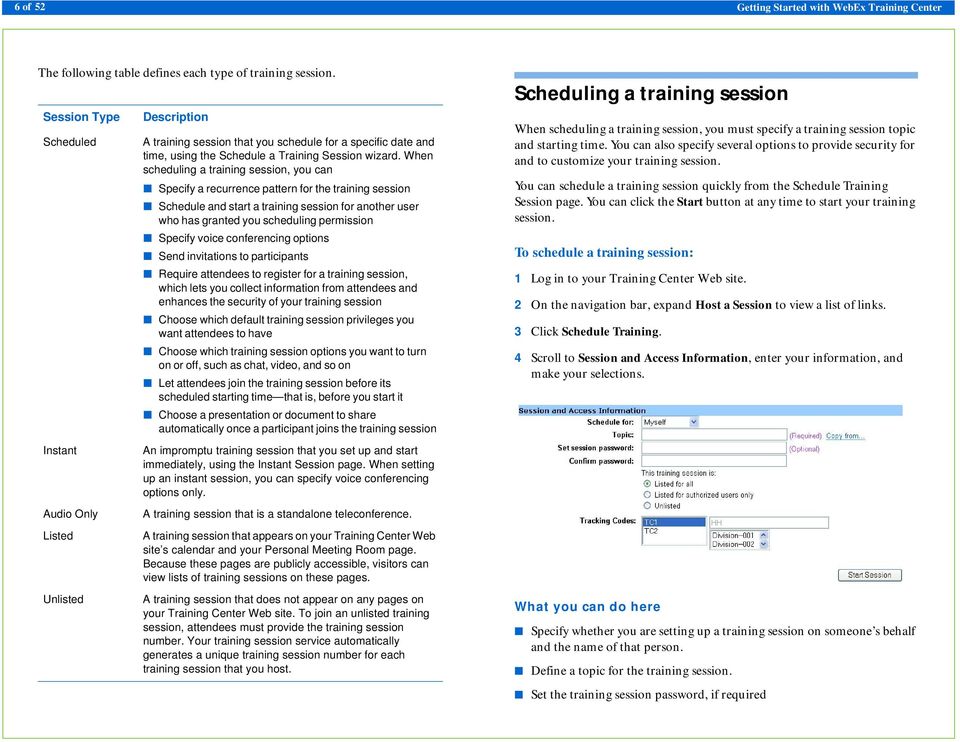
7 Getting Started with WebEx Training Center 7 of 52 Specify whether the training session is listed on the training session calendar. To enhance training session security, you can opt not to list the training session on the training session calendar. Choosing Unlisted will: Hide information about the training session, such as its host, topic, and starting time Help prevent unauthorized access to the training session Select tracking codes, if your administrator has set them up. Tracking codes may identify your department, project, or other information that your organization wants to associate with your training sessions. Tracking codes can be optional or required, depending on how your site administrator set them up. 5 Scroll to Teleconference and make your selections. To provide audio during a training session, you can use one of the following voice conferencing services: Integrated call-in teleconference If your training session service provides toll-free call-in teleconferencing, both a toll-free number and a toll number are available. The toll number allows participants who cannot call the toll-free number such as participants in countries other than the U.S. or Canada to join the teleconference. Integrated call-back teleconference A teleconference that a participant can join by providing his or her phone number when joining a training session. Third-party or internal teleconference You can use any third-party teleconferencing service or internal teleconferencing system, and provide instructions for joining a teleconference when setting up a training session. Your instructions automatically appear in a message box when a participant joins the training session. Integrated VoIP conference A voice conference in which participants use computers with audio capability to communicate over the Internet rather than the telephone system. 6 Scroll to Date and Time and make your selections. What you can do here Set up a WebEx integrated teleconference with a toll or toll-free number or use a third-party conferencing service. Opt to have attendees call in to the conference or have them receive a call back. Include an Integrated VoIP conference and a traditional teleconference in your training session. Note You start your Integrated VoIP conference after you start your training session. What you can do here Set the date and time for the training session Select the number of minutes before the training session s starting time during which attendees can join the training session and teleconference. Set an occurrence pattern for the training session.

8 8 of 52 Getting Started with WebEx Training Center Set the time zone in which the training session time will appear on the calendar. Set the duration for the training session. 7 Scroll to In-session Hands-On Lab and make your selections. What you can do here Specify whether attendees must register to attend a training session. If attendees must register, select which information attendees must provide on the registration form. Approve registration requests automatically. 9 Scroll to Invite Attendees and enter information for the attendees you wish to invite. What you can do here Select whether to use a Hands-on Lab during the training session. Check the availability of computers in the Hands-on Lab that you select. Select the number of remote computers to reserve during the training session. 8 Scroll to Registration and make your selections. What you can do here Invite attendees to your training session, by entering their names and addresses, or selecting them from your address book. Enter the number of attendees. 10 Scroll to Invite Presenters and enter information for the presenters you wish to invite. What you can do here Invite presenters to your training session, by entering their names and addresses, or selecting them from your address book. Enter the number of presenters.

9 Getting Started with WebEx Training Center 9 of Scroll to Session Options and make your selections. 12 Scroll to options and make your selections. What you can do here Select the training session privileges that attendees have once the training session starts. You can allow attendees to: Save, print, or annotate any shared documents, presentations, or whiteboards that appear in their content viewers. View the list of training session participants. Navigate independently through pages. slides, and whiteboard displayed in their content viewer Select which options, such as chat, video, and recording, are available during the training session. Require attendees to have an account on your Training Center Web site. Specify a URL destination that appears after the training session ends. Specify whether attendees can share UCF rich media files. Specify alerts that play when a participant joins or leaves the teleconference, if you use integrated teleconferencing. Include a message that appears when attendees join the training session. Note A presenter can change the default privileges for all attendees or individual attendees at any time during a training session. What you can do here Select which invitation, update, registration, or reminder s to send to attendees, presenters, or the host. Modify invitation, update, registration, or reminder s. Select when to send the reminder s. 13 Scroll to Session Information and make your selections. What you can do here Type an agenda or a description, which the attendees can view before the training session starts. Upload a photo to the Session Information page. Automatically show a document or presentation to participants once they join the training session.

10 10 of 52 Getting Started with WebEx Training Center Select whether the Quick Start page will appear upon joining a training session or a breakout session. 14 Scroll to Course Material to add files for your training session. What you can do here Upload a file to My Folders on your Training Center Web site. Publish course material for participants to download prior to the training session. 15 Scroll to Tests. Adding a Test To test attendees, you must add tests to the training session that they will be attending. Before you can add tests, do the following to turn on the Testing feature: Schedule, but do not start, a session. Require attendee registration for the session. To require attendee registration, select Attendee Registration when scheduling or updating the session. To add a test to a scheduled training session: 1 Do one of the following: From the Session Scheduled page, click Add a test. From the Session Information page for the session, click Add New Test. 2 On the Add Test page, select one of the following and click Next: Create a new test What you can do here Ensure that registration is enabled a requirement if tests will be used during the training session. Learn how to add a test to your training session once it has been scheduled. You can add a test from the confirmation page that appears, or from the Session Information page. 16 Start or schedule the training session: If the training session s starting time is the current time, click Start to start the training session. If the training session s starting time is after the current time, click Schedule. The Session Scheduled page appears, confirming that you set up the training session successfully. You also receive a confirmation . Copy an existing test from the Test Library Select the test you want to copy from the Test Library and click Next. Import test questions from saved test or poll questionnaire (*.atp or *.wxt file) Select the file and click Next. 3 Compose or edit the test, and click Save. 4 Specify delivery options, such as the test date and time limit, and click Save. The Manage Test page appears. The following figure shows an example of the Manage Test page.
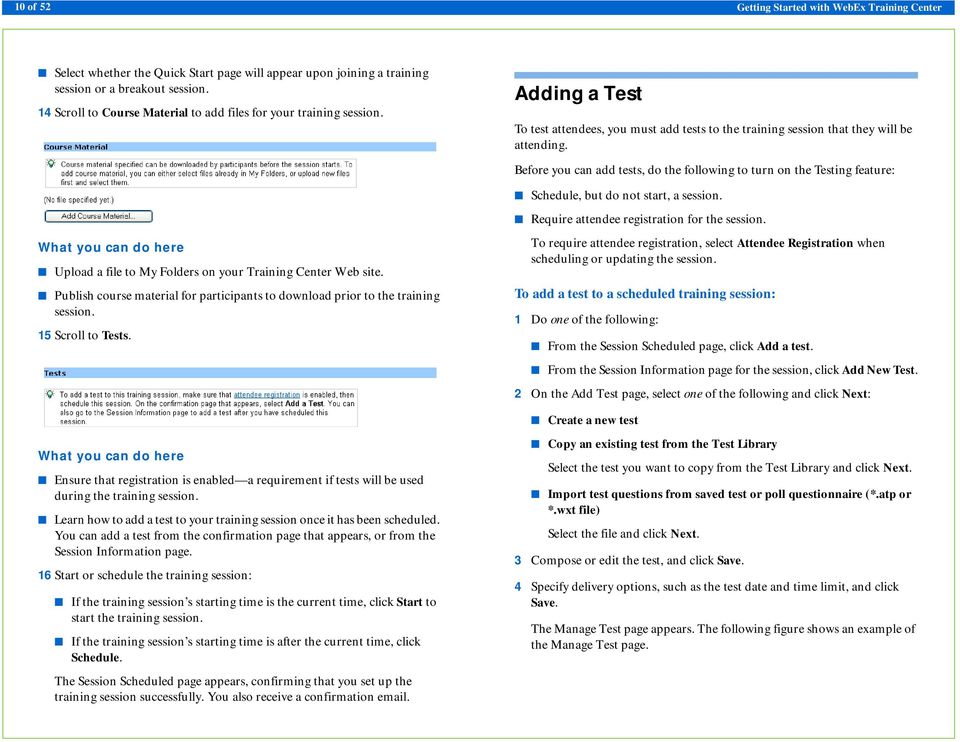
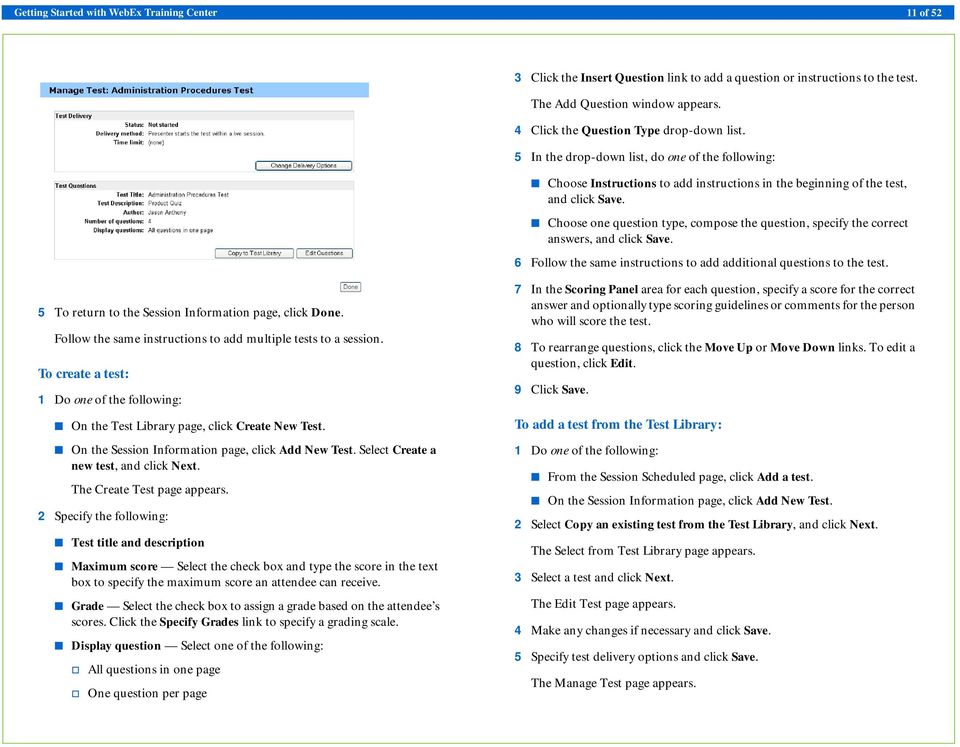
11 Getting Started with WebEx Training Center 11 of 52 3 Click the Insert Question link to add a question or instructions to the test. The Add Question window appears. 4 Click the Question Type drop-down list. 5 In the drop-down list, do one of the following: Choose Instructions to add instructions in the beginning of the test, and click Save. Choose one question type, compose the question, specify the correct answers, and click Save. 6 Follow the same instructions to add additional questions to the test. 5 To return to the Session Information page, click Done. Follow the same instructions to add multiple tests to a session. To create a test: 1 Do one of the following: On the Test Library page, click Create New Test. On the Session Information page, click Add New Test. Select Create a new test, and click Next. The Create Test page appears. 2 Specify the following: Test title and description Maximum score Select the check box and type the score in the text box to specify the maximum score an attendee can receive. Grade Select the check box to assign a grade based on the attendee s scores. Click the Specify Grades link to specify a grading scale. Display question Select one of the following: All questions in one page One question per page 7 In the Scoring Panel area for each question, specify a score for the correct answer and optionally type scoring guidelines or comments for the person who will score the test. 8 To rearrange questions, click the Move Up or Move Down links. To edit a question, click Edit. 9 Click Save. To add a test from the Test Library: 1 Do one of the following: From the Session Scheduled page, click Add a test. On the Session Information page, click Add New Test. 2 Select Copy an existing test from the Test Library, and click Next. The Select from Test Library page appears. 3 Select a test and click Next. The Edit Test page appears. 4 Make any changes if necessary and click Save. 5 Specify test delivery options and click Save. The Manage Test page appears.
12 12 of 52 Getting Started with WebEx Training Center 6 Make any changes if necessary and click Done. The Session Information page appears, with the title of your test included in the Title section. The Submitted Tests page appears. This page lists attendees who have submitted their tests and attendees who have received their scores and grades, if assigned. You can also view the questions and grading scale, if specified. To start an in-session test: 1 After the session starts, choose Testing in the drop-down list on the Participants panel. 2 Select the title of the test, and then click Launch for All. 3 On the page that appears, click Start Test. Scoring and grading answers for a test Training Center automatically checks attendees answers against the correct answers you specified when creating the test and then scores the results. If a test contains essay or fill-in-the-blanks questions, you must manually review and score the test. A complete score is unavailable until you finish scoring the essay or fill-in-the-blanks questions. To score the answers for a test: 1 From the Session Information page, in the Test section, select the test title and click View. The Manage Test page appears. 2 In the Student Answers section, click View and Score Answers. 3 To score an attendee s test, click the Score Answers link for the attendee or click the attendee s name. The Score Submitted Answers page appears. All answers, except for essay questions, are automatically scored. A partial score appears in the Results area. Although fill-in-the-blanks answers are scored automatically, you may want to review them and change the scores, if necessary. 4 Review the essays or fill-in-the-blanks answers that need manual scoring, and specify the scores for the essays. To quickly go to a question that needs manual scoring, go to the Unscored questions section, choose a question in the drop-down list, and click Go. To change the score for a fill-in-the-blanks answer, select correct or incorrect for the question. Clicking Save updates the score. 5 Optionally type comments for the attendee. 6 Click Save to update the score or your comments.

13 Getting Started with WebEx Training Center 13 of 52 The test results are updated on the View Test Results page. If you have specified to send grade reports to attendees, the attendee receives the update via . Starting an Instant Session You can start a training session at any time, without the need to schedule it first. When starting an instant training session, you can also set up an integrated voice conference. Once you start the training session, you can send invitation messages to attendees, if necessary. To start an Instant Session: 1 Log in to your Training Center Web site. 2 On the Training Center navigation bar, expand Host a Session, and then click Instant Session. 3 Specify information about the training session. 4 Click Start Session. 5 Optional. Send invitations to your training session in one of the following ways: Sharing the core of your training session Sharing options Sharing documents and presentations Accessing tools for sharing Annotation tools View tools Sharing whiteboards Sharing multimedia in a WebEx training session Granting sharing privileges Sharing software Sharing your desktop Sharing a remote computer Tips for sharing software Transferring files during a training session Recording a training session On the Participant menu, point to Invite, and then choose By . On the Participants panel, click the Invite button, and then enter an address on the window that appears.

14 14 of 52 Getting Started with WebEx Training Center Sharing options Training Center provides you with a variety of options for sharing information in a training session. The following table describes the advantages and disadvantages among these options. Sharing Option Advantages Disadvantages Presentation and document sharing Application sharing Desktop sharing Web browser sharing Web content sharing Is faster and more bandwidth efficient than application or desktop sharing. Is ideal for sharing presentations or documents that you do not want to edit during the training session. Lets you and participants annotate content. Lets you edit the content of any presentation or document open in the application. Lets you grant attendees control of the application. Is ideal for software demonstrations. Lets you and attendees annotate the application and documents that are open in it. Lets you quickly share multiple applications at once. Lets you show any part of your desktop, including file directories. Lets you grant attendees control of your desktop, access files, and run applications. Lets you and attendees annotate your desktop and any applications. Lets you guide attendees to various Web pages and sites on the Web. Lets you grant attendees control of your Web browser. Lets you and attendees annotate Web pages. Displays media effects and transmits sounds on Web pages. Lets attendees interact with Web pages independently. Does not let you edit the content during the training session. Requires more bandwidth than presentation or document sharing. Requires the most bandwidth among sharing options. Lets an attendee with remote control access any part of your computer and modify any files, which may be a security concern. Does not display media effects or transmit sounds on Web pages. Does not let attendees interact with Web pages independently. Does not let you guide participants to other Web pages.

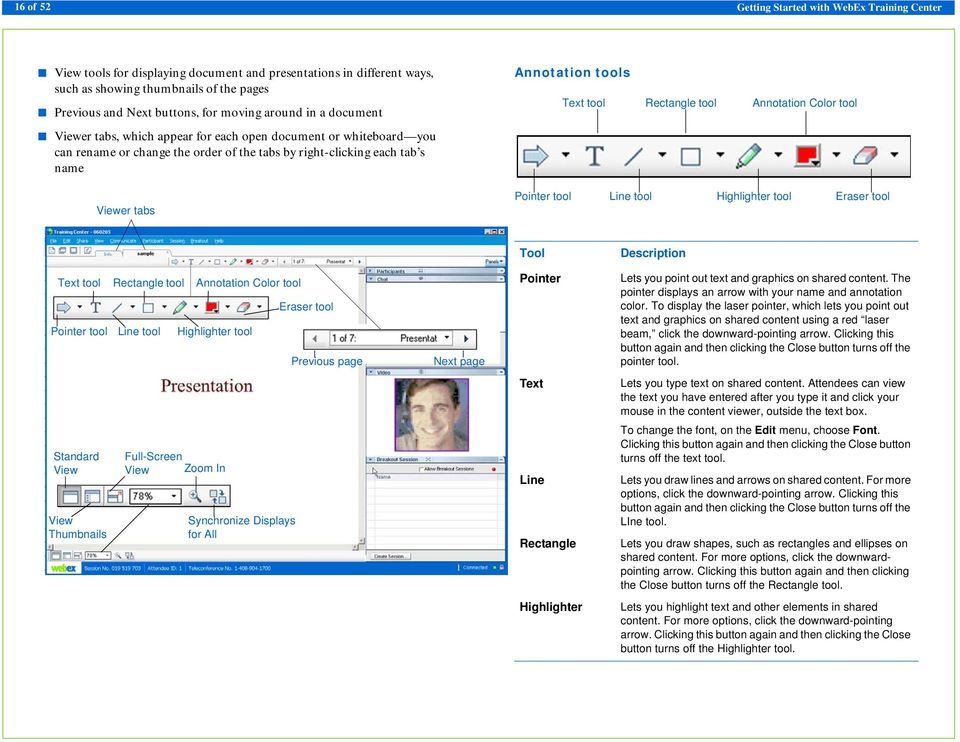
15 Getting Started with WebEx Training Center 15 of 52 Sharing documents and presentations The shared document or presentation appears in the content viewer, as in the example below: You can share one or more presentations or documents you have created using word processing, presentation, or graphics programs. Document and presentation sharing is ideal for presenting information that you do not need to edit during the training session, such as a slide presentation. Attendees view the shared document or presentation in their content viewers. They do not need to have the applications used to create the documents available on their computers. Attendees can also view any animation and transition effects on shared Microsoft PowerPoint slides. Once a training session starts, you can open a document or presentation to share. You do not need to select it or load it before the training session. While sharing a document or presentation, you can: Make annotations Use a pointer to emphasize text or graphics Save it to a file Print it Display it at various magnifications, in miniature (thumbnails), and in a full-screen view Synchronize all participants displays with the display in your content viewer At any time during a training session, you can grant attendees privileges that allow them to annotate, save, print, and display different views of shared presentations or documents. To share a document or presentation: 1 On the Share menu, choose Presentation or Document. The Share Presentation or Document dialog box appears. 2 Select the document or presentation that you want to share. 3 Click Open. Tip For tips that can help you to share documents and presentations more effectively, see Tips for sharing software on page 21. Accessing tools for sharing As you start sharing documents and applications during your training session, tools are available at your fingertips. In this example, the host has opened a presentation to share with training session participants. Notice the changes in the window. You now have access to: Annotation tools for highlighting and referring to elements in the presentation or application you are sharing

16 16 of 52 Getting Started with WebEx Training Center View tools for displaying document and presentations in different ways, such as showing thumbnails of the pages Previous and Next buttons, for moving around in a document Viewer tabs, which appear for each open document or whiteboard you can rename or change the order of the tabs by right-clicking each tab s name Annotation tools Text tool Rectangle tool Annotation Color tool Viewer tabs Pointer tool Line tool Highlighter tool Eraser tool Tool Description Text tool Pointer tool Rectangle tool Line tool Annotation Color tool Highlighter tool Eraser tool Previous page Next page Pointer Lets you point out text and graphics on shared content. The pointer displays an arrow with your name and annotation color. To display the laser pointer, which lets you point out text and graphics on shared content using a red laser beam, click the downward-pointing arrow. Clicking this button again and then clicking the Close button turns off the pointer tool. Text Lets you type text on shared content. Attendees can view the text you have entered after you type it and click your mouse in the content viewer, outside the text box. Standard View View Thumbnails Full-Screen View Zoom In Synchronize Displays for All Line Rectangle To change the font, on the Edit menu, choose Font. Clicking this button again and then clicking the Close button turns off the text tool. Lets you draw lines and arrows on shared content. For more options, click the downward-pointing arrow. Clicking this button again and then clicking the Close button turns off the LIne tool. Lets you draw shapes, such as rectangles and ellipses on shared content. For more options, click the downwardpointing arrow. Clicking this button again and then clicking the Close button turns off the Rectangle tool. Highlighter Lets you highlight text and other elements in shared content. For more options, click the downward-pointing arrow. Clicking this button again and then clicking the Close button turns off the Highlighter tool.
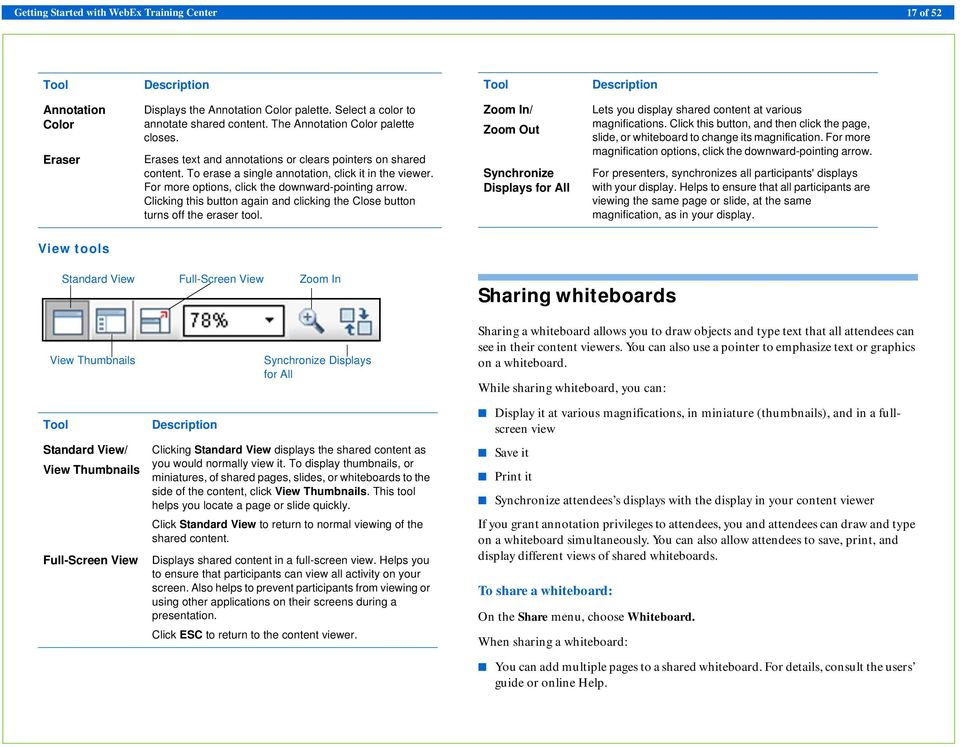
17 Getting Started with WebEx Training Center 17 of 52 Tool Description Tool Description Annotation Color Eraser Displays the Annotation Color palette. Select a color to annotate shared content. The Annotation Color palette closes. Erases text and annotations or clears pointers on shared content. To erase a single annotation, click it in the viewer. For more options, click the downward-pointing arrow. Clicking this button again and clicking the Close button turns off the eraser tool. Zoom In/ Zoom Out Synchronize Displays for All Lets you display shared content at various magnifications. Click this button, and then click the page, slide, or whiteboard to change its magnification. For more magnification options, click the downward-pointing arrow. For presenters, synchronizes all participants' displays with your display. Helps to ensure that all participants are viewing the same page or slide, at the same magnification, as in your display. View tools Standard View Full-Screen View Zoom In Sharing whiteboards View Thumbnails Tool Standard View/ View Thumbnails Full-Screen View Description Synchronize Displays for All Clicking Standard View displays the shared content as you would normally view it. To display thumbnails, or miniatures, of shared pages, slides, or whiteboards to the side of the content, click View Thumbnails. This tool helps you locate a page or slide quickly. Click Standard View to return to normal viewing of the shared content. Displays shared content in a full-screen view. Helps you to ensure that participants can view all activity on your screen. Also helps to prevent participants from viewing or using other applications on their screens during a presentation. Click ESC to return to the content viewer. Sharing a whiteboard allows you to draw objects and type text that all attendees can see in their content viewers. You can also use a pointer to emphasize text or graphics on a whiteboard. While sharing whiteboard, you can: Display it at various magnifications, in miniature (thumbnails), and in a fullscreen view Save it Print it Synchronize attendees s displays with the display in your content viewer If you grant annotation privileges to attendees, you and attendees can draw and type on a whiteboard simultaneously. You can also allow attendees to save, print, and display different views of shared whiteboards. To share a whiteboard: On the Share menu, choose Whiteboard. When sharing a whiteboard: You can add multiple pages to a shared whiteboard. For details, consult the users guide or online Help.
18 18 of 52 Getting Started with WebEx Training Center You can share multiple whiteboards. For each whiteboard that you share, Training Manager creates a new Whiteboard tab in the content viewer. Sharing multimedia in a WebEx training session During a training session, you can share the following types of media files in the content viewer: WebEx Recording Format (WRF) files video files audio files Flash movie and interactive Flash files Web pages You can share media files in either of two ways: In a Microsoft PowerPoint presentation You can share media files that play on Microsoft PowerPoint slides. Using the WebEx Universal Communications Toolkit, a plug-in for Microsoft PowerPoint, you can insert UCF media objects into your slides. Depending on the options you choose in the toolkit, the media object can either link to a media file that resides on your computer, another computer on your local network, or a remote server contain a media file as part of your presentation file You can download the Universal Communications Toolkit from your Training Center Web site. For information about using the Universal Communications Toolkit, refer to the guide Getting Started with WebEx Universal Communications Toolkit, which is available on your Training Center Web site. As a standalone file You can share a media file directly in the content viewer. Training Manager creates a UCF media object for the file automatically, which appears in the content viewer. A UCF media object contains options and controls that you can use to display or manipulate its associated media file. For more information about how UCF works, consult the Training Center User s Guide or online Help. Granting document, presentation, and whiteboard sharing privileges By default, only the presenter can share a document, presentation, or whiteboard during a training session. However, you can allow all attendees or individual attendees to share their own presentations or documents or interact with pages, slides, and whiteboards that others share. You can also remove these sharing privileges from attendees at any time. To specify attendee privileges for shared content in the content viewer: 1 In the Session window, on the Participant menu, choose Assign Privileges. The Assign Privileges dialog box appears. 2 To grant privileges to or remove them from all attendees at once, select All attendee privileges. 3 Under Document, select or clear the check boxes for any of the following sharing privileges that you want to grant to or remove from all attendees, respectively: Save Print Annotate 4 Under View, select or clear the check boxes for any of the sharing privileges that you want to grant to or remove from all attendees, respectively: Attendee list Any document Thumbnails Any page 5 Under Training session, select or clear the Share documents check box to grant to or remove the privilege from all attendees, respectively. 6 Click OK.

19 Getting Started with WebEx Training Center 19 of 52 Sharing software When you share software, attendees can follow all actions that you take. You can also annotate the software, or let an attendee annotate it or control it remotely. You can share these types of software with attendees: Applications on your computer Your computer s desktop Web browsers Remote computers, if you installed the Access Anywhere Agent on the computer To share an application: 1 On the Share menu, choose Application. The Share Application dialog box appears, showing a list of all applications currently running on your computer. 2 Optional. To view a list of applications that are installed on your computer, but not currently running, click View Application. Use this option to locate an application you want to share, but are not currently using. 3 In the list, select the application that you want to share. 4 Click Share. Your application appears in a sharing window on attendees screens. Letting an attendee remotely control shared software While sharing the following types of shared software, you can let an attendee control it remotely: application desktop Web browser An attendee who has remote control of shared software can interact with it completely. While an attendee is remotely controlling your shared software, your mouse pointer is inactive. At any time, however, you can reassume control of a shared application and regain use of your mouse pointer. While you are sharing software, any attendee can send a request to control the software remotely. You can then grant control to the attendee. Alternatively, you can automatically grant control of shared software to any attendee who requests remote control. You can stop an attendee from remotely controlling shared software at any time. To let an attendee remotely control shared software: 1 Do either of the following: On the title bar of a window that you are sharing, on the Sharing menu, point to Allow to Control Remotely.

20 20 of 52 Getting Started with WebEx Training Center To allow an attendee to control your desktop remotely: 1 On the title bar of an application you are sharing, on the Sharing menu, point to Allow to Control Remotely. In the lower-right corner of your computer s desktop, on the Sharing menu, point to Allow to Control Remotely. 2 Select an attendee to control your desktop. Sharing a remote computer 2 Select the name of the attendee whom you want to control the software. Sharing your desktop Desktop sharing lets you show all training session attendees your computer s entire desktop including any applications and windows that are currently open and all the actions that you take with your desktop. Desktop sharing can be useful for technical support. For example, you can allow a technical support representative to access your computer and fix a problem as you watch. While sharing your desktop, you can: Control attendees views of your desktop. Annotate your desktop, using a highlighter tool. Let an attendee control your desktop remotely. For example, you can let an attendee edit a document on your computer. Let an attendee annotate your desktop remotely. Remote computer sharing lets you show all training session attendees the computer s entire desktop or specific applications on it, depending on how you set up the remote computer, and all actions that you take with the computer. Remote computer sharing can be useful if you want to show attendees an application or file that is available only on that computer. You can share a remote computer during a training session for which you are the presenter, if: You have installed the Access Anywhere Agent on the remote computer. You logged in to your Training Center Web site before joining the training session, if you are not the original training session host. For information about setting up a computer so you can access it remotely, refer to the Access Anywhere User s Guide. To share a remote computer: If you have already set up a computer for Access Anywhere, you can share the computer during a training session. 1 On the Share menu, choose Remote Computer. To share your desktop: On the Share menu, choose Desktop. Your desktop appears in a sharing window on attendees screens.

21 Getting Started with WebEx Training Center 21 of 52 The Access Anywhere dialog box appears. If you chose phone authentication, provide your pass code by following the voice instructions. Notes 2 Under Remote, select the computer that you want to share. 3 Under Applications, select an application that want to share. If you set up the remote computer so you can access its entire desktop, the option Desktop appears under Applications. 4 Click Connect. Depending on the method of authentication that you specified when setting up the computer for Access Anywhere, one of the following occurs: If you chose access code authentication, a dialog box appears, in which you must provide the access code that you specified when setting up the remote computer. If you chose phone authentication, you receive a phone call at the number that you specified when setting up the remote computer. 5 Do one of the following: If you are not the original training session host, you must log in to your Training Center Web site before joining a training session in which you want to share a remote computer. If you are already in a training session, but did not log in to your site, you must leave the training session, log in to your site, and then rejoin the training session. If a password-protected screen saver is running on the remote computer, your training session service automatically closes it once you provide your access code or pass code. If the remote computer is running Windows 2000, and you must log in to the computer, send a Ctrl+Alt+Del command to the computer. If you set up the remote computer so you can access multiple applications, you can share additional applications simultaneously. Tips for sharing software These tips can help you share software more effectively: To improve the readability of shared software, attendees can use the sizing options on the View menu. To improve the quality of attendees views of a shared software, ensure that both your monitor display and attendees monitor displays are set to the same color depth for example, 16-bit color. To improve the performance of software sharing, close all applications that you do not need to use or share. Also, close any applications that use bandwidth, such as instant messaging or chat programs, and programs that receive streaming audio or video from the Web. If you chose access code authentication, type your access code in the box, and then click OK.
22 22 of 52 Getting Started with WebEx Training Center Application and Web browser sharing only: Avoid covering a shared application or Web browser with another window on your computer s desktop. Doing so prevents attendees from viewing the area of the application or browser that the other window covers. Instead, a crosshatched pattern appears in the covered area on attendees screens. You can switch your display between shared software and the Session window. To conserve bandwidth, pause software sharing before you return to the Session window, and then resume sharing once you return to the shared application. Use a dedicated, high-speed Internet connection when sharing software. Attendees using dial-up Internet connections may notice a delay in viewing or controlling shared software. If you want to share a Microsoft Word, Excel, or other document, you can improve the training session experience for these attendees by using document sharing instead of application sharing. Transferring files during a training session As a presenter, you can publish files that reside on your computer during a training session. For example, you can provide attendees with a document, a copy of your presentation, an application, and so on. Published files appear in each attendee s Session window, allowing them to download the files to their computers. To transfer files during a training session: 1 On the File menu, choose Transfer. The File Transfer window appears. 2 Click Share File. 3 Select the file that you want to publish, and then click Open. 4 Optional. Repeat steps 2 and 3 to publish additional files. The files appear in the File Transfer window in each participant s Session window. Recording a training session For details about using WebEx Recorder to record on-screen activity in a training session and capture audio in a voice conference, refer to the WebEx Recorder and Player User s Guide, or the WebEx Network-based Recorder and Player User s Guide, which are available on the Recording and Playback page on your Training Center Web site. You can access this page from your site s Support page.
23 Getting Started with WebEx Training Center 23 of 52 Interacting with attendees In this example, the Q & A panel is minimized. Click Q & A in the icon tray to restore it. Working with the panels...23 Panel overview...23 Accessing panel options...25 Sharing and full-screen view...28 Panel alerts...29 Sending a chat message...32 Using Q & A...32 Using Hands-on Lab...34 Using breakout sessions...36 Managing a voice conference...36 Adding an attendee to a call-back teleconference...40 Starting an Integrated VoIP conference...40 Setting up video...41 Polling attendees...42 To display the Select Panel menu, click Panels. You can minimize all the panels at once using the Minimize All command. The Video panel is collapsed. Use the icon on the left side of the panel title bar to collapse or expand a panel. Working with the panels Using the panels on the right side of the Session window, you can chat with attendees, poll them, send video, and start a question-and-answer or breakout session. These panels are very flexible. You can expand, close, or minimize them quickly and easily. You can also reduce the panels to icons, providing greater space for sharing documents, applications, and other items with training session participants. Panel overview Minimizing and restoring panels Minimizing and restoring panels has no effect on attendees displays. To minimize a panel: Click the Minimize icon on the title bar of the panel you want to minimize. Your service selects which panels display initially.
24 24 of 52 Getting Started with WebEx Training Center Click the Minimize icon to minimize this panel. To restore all minimized panels: The Restore All command quickly restores all panels you have minimized using the Minimize All command. 1 In the icon tray, click Panels. The Select Panel menu displays. 2 On the Select Panels menu, choose Restore All. The panel no longer displays. It appears as an icon on the icon tray at the top of the panels. Minimized panels display as icons. Minimized panels now display. Expanding and collapsing panels Expanding and collapsing panels has no effect on the attendees displays. To collapse a panel: To restore a minimized panel: Click its icon on the icon tray. Click the icon in the upper-left corner of a panel to collapse it. The panel collapses, leaving just the title bar visible. Click to restore. Use the icon on the left side of the panel title bar to collapse or expand a panel. To minimize all panels: 1 On the icon tray, click Panels. The Chat panel is collapsed. The Select Panel menu displays. 2 On the Select Panel menu, choose Minimize All. The open panels shrink to icons on the icon tray.
25 Getting Started with WebEx Training Center 25 of 52 To expand a panel: If a panel is collapsed (you only can see its title bar), click the icon in the left corner of the title bar to expand it. If you close the last remaining panel, the large panel area on the right side of the screen disappears. You still have access to the panels through the Select Panel menu, available by clicking the Select Panel button. Opening and closing panels You can hide a panel completely so it will not display as an icon on the icon tray. If you close a panel, that panel also closes for attendees. It remains closed for all attendees until you open the panel again. To close a panel: 1 On the icon tray above the panels, click Panels. The Select Panel menu displays. Panels without check marks are currently closed. Panels with check marks currently display. To open a panel: 1 On the icon tray above the panels, click Panels. The Select Panel menu displays. 2 On the Select Panel menu, click to place a check mark next to any panel you want to open. The panel or panels you selected display. This panel is now available for all attendees. Resetting the panels You can return the panels to the display settings that were preset by your service. 1 On the icon tray above the panels, click Panels. The Select Panel menu displays. 2 On the Select Panel menu, choose Reset to Default. The panels return to the display settings originally selected by your service. The size, order, and location of the panels are reset to their original settings. 2 On the Select Panel menu, click to remove the check mark next to the panel that you want to close. The panel no longer displays and it is not available as an icon on the icon bar. Accessing panel options You can easily access the options related to any panel. Simply right-click in the panel title bar to see a menu of commands related to the panel.
26 26 of 52 Getting Started with WebEx Training Center Panel Participants Chat Video Options Sound Alerts: Lets you choose a sound to play when a participant: Joins a training session Leaves a training session Assign Privileges: Available for only the training session host. Displays the Assign Privileges dialog box, from which you can set privileges for the attendees. Sound Alerts: Lets you choose the kinds of chat messages for which you want a sound to play. Select a sound from the drop-down list or click Browse to find a sound in a different location on your computer. Assign Privileges: Available for only the training session host. Displays the Assign Privileges dialog box, from which you can set privileges for the attendees. Single point video: Lets you view one participant video image. Multi-point video: Lets you view up to four participant video images. Video Options: Lets you adjust the video frame rate, video resolution, and settings for your video capture device. Drag this line to the right or left to change the size of the content viewer and panels area For details about hiding, minimizing, and closing the panels, see Panels and full-screen view, next. Panels and full-screen view Resizing the content viewer and panels area You can control the size of the content viewer by making the panel area narrower or wider. To change the size of the content viewer and panels: Click the dividing line between the content viewer and the panels. Drag the line to the left to make the area devoted to the panels wider. Drag the line to the right to make the content viewer larger. While you are viewing or remotely controlling a shared application, desktop, or Web browser, or viewing a shared remote computer, a presenter can switch between a standard window and full-screen view. In full-screen view, you access the panels on a floating icon tray located in the lower-right corner of your screen. Return to Session Window Chat Polling Video Record Session Select Pane Move Handle Participant Q & A Testing Breakout Session
27 Getting Started with WebEx Training Center 27 of 52 To display a panel in full-screen view: Click its icon on the floating icon tray. For example, to display the Chat panel, click the Chat icon. The panel floats on top of the shared document, presentation, web browser or other shared item. You can drag the panel to move it. What you can do Resize individual panels using the Resize Control in the bottom right corner of any floating panel. Drag the Resize Control to change the size of the panel. To organize the floating panels: To open all panels in full-screen view: You can have all panels float on top of the shared document, presentation, web browser, or other shared item. 1 On the floating icon tray, click the Select Panel button. It is the last button on the floating icon tray. 2 On the Select Panel menu, choose Float All Panels. As you reopen the panels to chat with a participant, you may find you need to arrange the panels. 1 On the floating icon tray, click the Select Panel button. It is the last button on the floating icon tray. 2 On the Select Panel menu, choose Open Right Panel. An empty panel appears on the right side of the screen. The icon tray now resides at the top of the right panel. All panels display, even those you had minimized previously.
28 28 of 52 Getting Started with WebEx Training Center What you can do Drag any floating panels into this larger panel. Panels resize to fill the space. Drag individual panels into the panel on the far right of the screen. The panels align and resize inside the larger panel. If you are sharing a document If you have already opened several documents, you can switch to share any of these documents. To display a different document: 1 On the floating icon tray, click the Select Panel button. It is the last button on the floating icon tray. 2 On the Select Panel menu, choose Share. You see a list of sharing commands. Drag the panel out of the larger panel to float it. Switch between full-screen view and standard view. After you return to standard view, all panels (those that are floating and those that you have minimized) return to their preset locations in the right panel. Sharing documents or software while in full-screen view In full-screen view, you have access to sharing and viewing options from the Select Panel menu. Sharing commands 3 Select Presentation or Document. The Share Presentation or Document dialog box appears. 4 Select the file that you want to share and click Open. To resize the display of attendees to match your display: 1 On the icon tray above the panels, click the Select Panel button. It is the last button on the floating icon tray.
29 Getting Started with WebEx Training Center 29 of 52 2 On the Select Panel menu, choose View > Synchronize Views. All attendees displays now match your display. All attendees displays now match your display. If you are sharing a desktop To select another sharing option: 1 On the floating icon tray, click the Select Panel button. It is the last button on the floating icon tray. 2 On the Select Panel menu, choose Share > Desktop. To resize the display of attendees to match your display: 1 On the floating icon tray, click the Select Panel button. It is the last button on the floating icon tray. Synchronize Views command 2 On the Select Panel menu, choose View > Synchronize Views. If you are sharing an application To share an application: 1 On the floating icon tray, click the Select Panel button. It is the last button on the floating icon tray. 2 On the Select Panel menu, choose Share > Application. The Share Application dialog displays. 3 Select the application you want to share or click New Application to open an application not already running on your desktop. 4 Click Share. To resize the display of attendees to match your display: 1 On the floating icon tray, click the Select Panel button. All attendees displays now match your display. Panel alerts If you have closed, minimized, or collapsed any panels, you will see an alert if a panel you no longer can see requires your attention. Some reasons for seeing alerts: A participant arrives or leaves a training session A Raise Hand indicator appears in the Participants list An attendee sends a chat message A poll opens or closes Poll answers are received It is the last button on the floating icon tray. 2 On the Select Panel menu, choose View > Synchronize Views.
30 30 of 52 Getting Started with WebEx Training Center Alerts for closed panels If you have closed a panel, the Panels button changes color to alert you to a change. For example, if a participant leaves your training session, and you have closed the Participants panel, the Select Panel menu button turns into an alert. The icon changes color to let you know you should check the contents of this panel. Panels button changes color to alert you. In this example, a poll has ended. The Polling panel is closed, so an alert is sent. The panel requiring attention is highlighted. Understanding the Participants panel In addition to the list of people currently attending your training session, the Participants panel provides other information about the attendees. Presenter Integrated VoIP Participant Speaker (Integrated VoIP) Host Ask to Speak Annotation Color Alerts for minimized panels If you have minimized a panel, the icon representing that panel alerts you of a change. The Chat icon changes color to let you know you have a new chat message. Participant Ready Muted Speaker (teleconference) Speaker (teleconference) Alerts for collapsed panels If you have collapsed a panel, the Expand/Collapse icon changes color when you need to pay attention to that panel.
31 Getting Started with WebEx Training Center 31 of 52 The following table describes the possible indicators that may appear in the participant list. Notes The Speaker indicator will show which participant is speaking during the training session: For an integrated teleconference, the participant name will turn green and the indicator will show sound waves. For an Integrated VoIP conference, the indicator will flash. Indicator Indicator name Description (host) Host indicator Indicates the training session host. Presenter indicator Indicates the current presenter. Indicator Indicator name Description Muted Speaker indicator for teleconference Speaker indicator for Integrated VoIP Integrated VoIP Participant indicator Ask to Speak indicator Right-clicking the participant s name In an integrated teleconference, indicates that the participant is connected to the teleconference but his or her microphone is muted. In an Integrated VoIP conference, indicates that the participant can speak. In an Integrated VoIP conference, indicates that the participant cannot speak. In the host s and presenter's participant list only, indicates that the participant has clicked the Raise Hand button. You can control some of the actions of an attendee directly from the Participants list. Right-click a participant s name to see a menu of commands related to the participant. Annotation Color indicator Participant Ready indicator Speaker indicator for teleconference Indicates the color with which the participant can annotate shared content. Participants can select another color with which to make annotations, but their assigned colors in the participant list remain the same. Indicates that the participant s content viewer is displaying the page, slide, or whiteboard that the presenter is sharing. Can appear in different states, each of which indicates the percentage of the content that has loaded in the participant s content viewer. In an integrated teleconference, indicates that the participant is connected to the teleconference and his or her microphone is not muted that is, the participant can speak.
32 32 of 52 Getting Started with WebEx Training Center The following table describes the right-click options for the Participants list. 2 Type a message in the Chat box. Option Change Role To Pass Mic Chat Mute Unmute Mute All Unmute All Assign Privileges Description Select to change the participant s role to Presenter, Panelist, Attendee, or Host. Options that are not available for a participant will not be selectable. Select to pass or enable a participant s microphone during an Integrated VoIP session. Select to open the Chat panel, which will have the participant s name pre-populated in the Send to box. Select to mute a participant during an Integrated VoIP session or teleconference. Select to unmute a participant during an Integrated VoIP session or teleconference. Select to mute all participants during an Integrated VoIP session or teleconference. Select to unmute all participants during an Integrated VoIP session or teleconference. Select to set privileges for the attendees. This option is available only for the training session host. 3 In the Send to drop-down list, select the recipients of the message. 4 Click Send. Select the recipients of your chat message. To send a message to everyone, including the host, presenter, panelist, and attendees, choose All Participants To send to everyone except the host, presenter, and panelists, choose All Attendees. To send a chat message to a particular participant, select the name in the list. The recipients receive the chat message in their chat viewer. Sending a chat message to participants Chat is useful if you want to: Communicate with a participant during a training session that does not include a voice conference Send a private message to another participant Send brief information to all participants Ask a question but do not want to interrupt the presenter To send a chat message: Using the Q & A panel During a question-and-answer (Q & A) session, you can respond to questions that attendees ask during the training session. A Q & A session not only provides instant text messaging similar to that in Chat, but also does the following: provides a more formal procedure for asking and answering questions in text format automatically groups questions to help you manage the queue, such as quickly identifying questions that you have or have not answered displays visual cues for the status of questions lets you assign questions to the appropriate domain expert on your team 1 In the Session window, open the Chat panel.
33 Getting Started with WebEx Training Center 33 of 52 allows you to quickly send a standard response to questions for which you cannot or do not want to answer immediately You can save the questions and answers in a Q & A session to either a text (.txt) file or a comma-separated/comma-delimited values (.csv) file for future reference. Tip If you use Q & A during the training session, WebEx recommends that the host or presenter monitor the Q & A panel at all times during the training session. To prevent participants from using Q & A sessions, clear the Q & A check box. 3 Click Apply, and then click OK. Asking a question You can pose a question to one respondent or selected respondents. To ask a question: 1 In the Session window, in the Panels drop-down list, select Q & A. Allowing participants to use Q & A sessions You can allow or prevent training session participants from using questionand-answer (Q & A) sessions during a training session. To allow or prevent Q & A sessions: 1 In the Session window, on the Session menu, choose Session Options. The Training Session Options dialog box appears. 2 Type your question in the Q & A box. 3 Optional. To edit your question before sending it, highlight the text and then right-click the mouse to see editing options. 4 In the Ask drop-down list, select the recipients. 5 Click Send. The recipients receive the question in their Q & A message boxes. 2 On the Communications tab, do one of the following: To allow participants to use Q & A sessions, select the Q & A check box.
34 34 of 52 Getting Started with WebEx Training Center Answering indicator 6 When a panelist is typing an answer to a question that no one else has responded to yet, an in-progress indicator displays under that question: Answering a question You can answer a question in one of the following ways: publicly the answer appears for all panelists and attendees. privately the answer is sent to all panelists and to the attendee who sent you the question. To answer a question: 1 In the Session window, in the Panels list, select Q & A. 2 Select the question from any of the tabs on which you received the question. For example: Using Hands-on Lab Hands-on Lab sessions allow instructors to prepare lessons or exercises that students can complete on remote computers on which training software is installed. Students can use these remote computers during a training session for hands-on learning and practice. Because instructors can control Handson Lab sessions, they can maintain an optimized lab environment that is effective, familiar, and consistent. Starting a Hands-on Lab session If you have scheduled a Hands-on Lab, you can start the Hands-on Lab session within 15 minutes of the reserved time. The presenter is responsible for managing the Hands-on Lab session. To start a Hands-on Lab session: 1 In the Session window, on the Lab menu, click Start Hands-on Lab. The Start Hands-on Lab dialog box appears showing which lab and how many computers are reserved. 3 Do one of the following: To provide a public answer, type your answer in the text box. To edit your answer before sending it, highlight the text and then right-click the mouse to see editing options. To provide a private answer, click Send Privately. In the dialog that appears, type your answer in the text box. If you want to save the answer you typed as the standard private answer for all panelists, click Save. 4 Click Send.
35 Getting Started with WebEx Training Center 35 of 52 Note If you try to start the Hands-on Lab session earlier than 15 minutes before the scheduled reserved time, an error message appears informing you to start the Hands-on Lab session during the reserved time. 2 Under Computer Allocation, select one of the following: Allow attendees to choose computers. This allows participants to choose any computer reserved for this session. Assign attendees to computers manually. When you select this option, participants can only connect to computers assigned to them. 3 Optional. Select the Record remote computers automatically when participants connect check box. When you select this option, the Record button turns on for all reserved computers. Whenever a participant logs into a reserved computer, the computer records the actions. When the participant logs out, the recording stops. Assigning computers during Hands-on Lab sessions If you selected Assign attendees to computers manually in the Start Handson Lab dialog box, you can assign computers to participants from the Start Hands-On Lab Confirmation dialog box, from the Hands-on Lab panel, or from the Lab menu. To assign computers to participants during a Hands-on Lab session: 1 From the Start Hands-On Lab Confirmation dialog box, from the Handson Lab panel, or from the Session window Lab menu, click Assign Computers. The Assign Computers dialog box appears. 4 Click Start. Training Manager contacts the remote computers reserved for your Hands-on Lab session. Once the reserved computers are contacted, the Start Hands-on Lab Confirmation dialog box appears. The Start Hands-on Lab Confirmation dialog box lists all the computers that are connected to the session and the total attendees in the session. 5 Optional. To limit the number of attendees that can connect to each remote computer, under Limit Attendees, select the check box next to Limit. Select the number of attendees that you want to limit to each computer. 6 If you selected Assign attendees to computers manually in the Start Hands-on Lab dialog box, see To assign computers to participants during a Hands-on Lab session: below. 7 Click Done. 2 Under Unassigned Participants, select the name or names of participants that you want to assign to a particular computer. Hold down the Shift key to select more than one participant. 3 Under Computers, select the computer that you want to assign to the selected participant. 4 Click Assign.
36 36 of 52 Getting Started with WebEx Training Center 5 To give control of the computer to a particular participant, click Give Control. 6 When you are finished assigning computers, click OK. 7 Click Done in the Start Hands-on Lab Confirmation dialog box. Asking all to return from labs During a Hands-on Lab session, the host can ask all the participants to return from the Hands-on Lab session to the main training session. You can choose to have the participants return immediately, or you can give them a time limit for returning. To ask participants to return: 1 On the Lab menu, choose Ask All To Return. The Ask All To Return dialog box appears. All participants receive a message asking them to return from Hands-on Lab. The Hands-on Lab sessions end either after 30 seconds or after the time you selected in the Ask All To Return dialog box. Ending the Hands-on Lab session The training session host can end the Hands-on Lab sessions at any time. To end a Hands-on Lab session: 1 On the Lab menu, click End Hands-on Lab. A confirmation message appears. 2 Click OK. The Hands-on Lab session ends for all participants. Note If you do not manually end the Hands-on Lab sessions, they end automatically when your reservation for Hands-on Lab computers expires. A message appears on your screen 15 minutes before your reservation expires. If the computers have not been reserved for another training session, you can continue to connect to the Hands-on Lab computers. If the host of the new session attempts to connect to the reserved computers, you will be disconnected from the reserved computers. 2 Do either of the following: Select within and choose a time in minutes from the drop-down list. This option gives participants time to finish the tasks that they are working on. Select immediately and end all sessions after 30 seconds. 3 Click OK. A confirmation dialog box appears in which you confirm your request to ask all participants to return from Hands-on Lab. 4 Click OK. Using breakout sessions A breakout session is a private content sharing session that includes two or more participants. Breakout sessions allow participants to brainstorm and collaborate in small, private groups that can include presenters or other students, away from the main training session. In a breakout session, small groups interact within a main Breakout Session window using much of the same features, such as sharing whiteboards and applications, as in the main training session. Multiple breakout sessions can occur at once.
37 Getting Started with WebEx Training Center 37 of 52 Allowing breakout sessions As a presenter, you can allow panelists or participants to start their own breakout sessions. To allow breakout sessions: Do one of the following: In the Session window, on the Breakout menu, choose Allow Breakout Sessions. The Breakout menu displays the breakout session options for all participants. Creating a breakout session Once the presenter allows breakout sessions, you can create your own session. To create a breakout session: 1 Do either of the following: On the Breakout menu, point to Create Breakout Session. On the Breakout Session panel in the main Session window, click Create Session. The Create Breakout Session dialog box appears. On the Breakout Sessions panel, select Allow Breakout Sessions. In the Session window, on the Session menu, choose Session Options. On the Communications tab in the Training Session Options dialog box, select Breakout sessions. Then click OK. The green indicator on the Breakout Sessions panel indicates that breakout sessions are allowed. 2 In the Topic box, type a topic name. Optional for the host, presenter, and panelists only: To include yourself in the breakout session, select the Include myself into this session check box.
38 38 of 52 Getting Started with WebEx Training Center 3 Under Participants, select the check box next to the participants that you would like to invite to the breakout session. 4 In the Presenter drop-down list, select Myself or the name of the participant whom you want to be the presenter for the session. 5 Optional. To allow participants to join the breakout session without an invitation, under Participants, select the check box next to Let others join the breakout session without invitation. 6 Optional. To limit the number of participants for the breakout session, under Participants, select the check box next to Limit number of participants who can join this session. Then, in the box, type or select a number of participants. 7 Click Create. Your breakout session automatically starts, and each invitee receives an invitation to join. The invitee can choose Yes or No. For breakout session participants, the Breakout Session window appears, listing the names of the presenter and participants of the breakout session in the Breakout Sessions panel. It also displays a chat panel in which participants can chat with other participants. Your name appears in the Breakout Sessions pane in the main Session window. Joining a breakout session The presenter determines whether a participant can join a breakout session, either by inviting participants, or by allowing participants to join without an invitation. To join a breakout session, do one of the following: On the Breakout menu, choose Join Breakout Session and then the name of the breakout session that you wish to join. On the Breakout Session panel, highlight the name of the breakout session that you wish to join and then click Join Session. Using Integrated VoIP or teleconferencing in breakout sessions You can communicate with breakout session participants using Integrated VoIP or teleconferencing. If teleconferencing is set up in the main training session, when you start a breakout session, the call-in or call-back teleconference automatically starts for the breakout session. All the teleconferencing options or Integrated VoIP options that the host set up in the main session apply to the breakout sessions. For more information on Integrated VoIP or teleconferencing, see About managing a voice conference on page 39. Notes Participants in a breakout session cannot join a breakout session teleconference until the breakout session presenter joins the teleconference. Participants cannot join a teleconference in the main session while connected to a breakout session teleconference. If teleconferencing is not available or has not been started for the main session before the breakout session is started, teleconferencing for breakout sessions is disabled also. When a participant who is in the breakout session teleconference leaves a breakout session, he or she disconnects from the breakout session teleconference or Integrated VoIP session automatically. The participant returns to the main session and can join the main teleconference or Integrated VoIP session from the Communicate menu. Leaving a breakout session If you are a participant in a breakout session, rather than the presenter, you can leave a session and return to it later.
39 Getting Started with WebEx Training Center 39 of 52 To leave a breakout session, do one of the following: Close the Breakout Session Manager window by clicking the Close button in the upper-right corner of the window. On the File menu, choose Leave Breakout Session. On the Breakout Session panel, click Return to Main Session. Asking all participants to return from a breakout session As the presenter, you can ask panelists and participants to return from their breakout sessions. To ask all to return from breakout sessions: In the Session window, on the Breakout menu, choose Ask All to Return. All participants in breakout sessions receive a message asking them to return to the main training session. They can choose to leave the session or continue. Ending your breakout session If you are the presenter in a breakout session, you can end your session for all participants. To end a breakout session: 1 Do one of the following: Close the Breakout Session Manager window by clicking the Close button in the upper-right corner of the window. On the File menu in the Breakout session window, choose End Breakout session. On the Breakout Sessions panel in the main Session window, click End Breakout Session. 2 In the dialog box that appears, click Yes. About managing a voice conference You have several options for providing audio in your training session. You can set up a phone teleconference, using the integrated WebEx teleconferencing service. With this option, you can either have attendees call a phone number to join the teleconference or have attendees receive a callback. If you prefer, you can use another teleconferencing service provider or an internal teleconferencing service. When scheduling a training session, you can choose to use Integrated VoIP in addition to, or instead of, a teleconference. This option allows attendees to speak to each other using voice over IP (VoIP) an Internet based telephony service rather than the telephone system. Up to seven participants can have a microphone during an Integrated VoIP conference. Once you set up a voice conference, you can use conference features to manage your integrated teleconference or Integrated VoIP conference. During an integrated teleconference, you can: Add an attendee to a call-back teleconference at any time. You can also add someone who is not a training session attendee to the teleconference. Control which participants can speak by muting and unmuting their microphones. During an Integrated VoIP conference, you can: Set Integrated VoIP options Start an Integrated VoIP conference Mute and unmute your microphone Mute and unmute participants microphones End an Integrated VoIP conference
40 40 of 52 Getting Started with WebEx Training Center Adding an attendee to a call-back teleconference Once an attendee joins a training session that includes an integrated teleconference, a dialog box appears in the attendee s Session window, providing instructions for joining the teleconference. However, if you set up a call-back teleconference, you can add an attendee to the teleconference at any time. You can also add someone who is not a training session attendee to the teleconference. The Country/Region dialog box appears. To add an attendee to a call-back teleconference: 1 On the Participant menu, choose Invite > by Phone. The Invite by Phone dialog box appears. b In the list, select the country in which the attendee resides. c Click OK. 5 Click Call. The teleconferencing service calls the attendee. The Status box indicates the status of the call. Once the call connects, the Clear button becomes available. 6 To call another attendee, click Clear to reset the status to the Ready state. 7 Once you have finished calling attendees, click Close. The Status box indicates that call status is Ready. 2 Type the name of the person whom you want to call in the Name box. 3 Type the attendee s area or city code and phone number in the Area/City code and Number boxes, respectively. 4 Ensure that the country or region code is that for the country in which the attendee resides. To select a different country or region code, do the following: a Click Country/Region. Starting an Integrated VoIP conference To use an Integrated VoIP conference, your computers must meet the system requirements for Integrated VoIP. Once you start an Integrated VoIP conference, any attendee whose computer has a supported sound card can join the conference. To start an Integrated VoIP conference: 1 In the Session window, on the Communicate menu, point to Integrated VoIP. 2 On the menu that appears, choose Start Conference.
41 Getting Started with WebEx Training Center 41 of 52 The Audio Setup Wizard appears if this is the first time that you have started an Integrated VoIP conference. A microphone symbol appears to the left of your name in the Participants panel. 3 Follow the instructions in the Audio Setup Wizard to set up audio options. 4 Click OK. Note these changes: The Volume dialog box appears, on which you can adjust the speaker or microphone volume. The Join Integrated VoIP Session message box appears automatically in the Session window for each attendee whose computer has a supported sound card. Attendees can then choose to participate in the Integrated VoIP conference. Setting up video If a video camera is attached to your computer, you can send live video to training session participants. Live video lets other participants see you, an object under discussion, and so on. All participants can view live video that you send, without the need for video equipment installed on their computers. To set up video, you must connect a video camera also called a webcam to your computer. Once you start or join a training session, Training Manager automatically detects your video camera. If you are using a headset, a microphone symbol and Speak now appear at the bottom of the Session window. An indicator also appears showing the level of sound as you speak. If you are using desktop or laptop speakers and your microphone is unmuted, Press Ctrl to speak appears at the bottom of the Session window. Generally, Training Manager is compatible with any video camera that connects to your computer s USB or parallel port. The quality of the video image can vary, depending on the quality of the video camera that you use. For a list of video cameras that are known to be compatible with your Training Manager software, refer to the Frequently Asked Questions (FAQ) page on your Training Center Web site. You can access this page from your site s Support page. Sending live video If the single-point video option is turned on, only the presenter or another participant selected by the presenter can send live video. If the multi-point video option is turned on, up to four participants whose computers have a video camera can send video.
42 42 of 52 Getting Started with WebEx Training Center To send live video: In the Session window, display the Video panel on the right side of the Session window. For details about using the panels, see Working with the panels on page 23. Training Manager begins sending live video immediately. To send live video, you must connect a video camera to your computer. For details, consult the documentation that accompanied your camera. Polling attendees During a training session, you can poll attendees by providing a questionnaire with multiple-choice answers. Taking a poll can be useful for gathering feedback from attendees, allowing attendees to vote on a proposal, and so on. To take a poll, you must first prepare a poll questionnaire. You can prepare a questionnaire at any time during a training session. Or, to save time during a training session, you can prepare a questionnaire before the training session starts, save it, and then open it during the training session. Once attendees complete a poll, you can view the results and share them with attendees. You can also save the results of a poll for viewing outside of a training session. Preparing a poll questionnaire During a training session, you can prepare a poll questionnaire that includes multiple-choice answers. Once you complete a questionnaire, attendees can respond to it during a training session. Managing training sessions Participant roles and privileges Granting privileges to attendees Controlling a training session Inviting attendees to a training session in progress Designating a presenter Transferring the host role Expelling a participant Locking and unlocking a training session Ending a training session Viewing usage reports Participant roles and privileges Each participant in an online training session has one of the following roles: host, presenter, panelist, or attendee. These roles determine which options you can use on your Training Center Web site and in Training Manager. Role Host Responsibilities and options A training session host must have a user account on your Training Center Web site. A host can schedule, start, and control a training session; and assign training session roles to other participants. Initially, the host is also the presenter; however, the host can make any participant the presenter during the training session. Sample poll questions
43 Getting Started with WebEx Training Center 43 of 52 Role Presenter Panelist Attendee Responsibilities and options Only one participant at a time can be the presenter, but participants can take turns being the presenter during a training session. A presenter can: Share and annotate presentations, documents, and whiteboards Share software, and grant remote control of shared software to participants Assign training session privileges to other participants Turn various training session options on or off Poll participants Transfer files to participants Send live video, and select which participants can send video An attendee who participates in a discussion to which other attendees listen, responds to chat messages, annotates shared documents, opens and closes polls, and views and answers attendees questions in Q & A sessions. A training session attendee participates in a training session but generally does not present information. Attendees can view shared information and interact with it, if the presenter assigns the appropriate privileges to them. An attendee can also perform other tasks, such as recording a training session, if he or she has the appropriate privileges. You can grant or remove privileges for the following training session activities: Document sharing, including privileges for saving, printing, and annotating shared content in the content viewer Viewing thumbnails, or miniatures, of pages, slides, or whiteboards in the content viewer Viewing any page, slide, or whiteboard in the content viewer, regardless of the content that the presenter is viewing Viewing the participant list Chatting with participants Allowing breakout sessions with participants Recording a training session Requesting remote control of shared applications, desktops, or Web browsers Granting attendee privileges during a training session During a training session, you can grant privileges to or remove them from all attendees at once or an individual attendee. About granting privileges to attendees Once a training session starts, all training session attendees automatically receive privileges: If the host scheduled the training session and specified attendee privileges, attendees receive those privileges. If the host scheduled the training session but did not specify attendee privileges, attendees receive the default privileges. If the host started an instant training session, attendees receive the default privileges. To specify attendee privileges during a training session: 1 In the Session window, do one of the following: On the Participant menu, choose Assign Privileges. On the Participant panel, right-click a participant s name, and select Assign Privileges. The Assign Privileges dialog box appears. 2 Specify attendee privileges: To grant a privilege to attendees, select its check box.
44 44 of 52 Getting Started with WebEx Training Center To grant all privileges to attendees, select the All attendee privileges check box. To remove a privilege from attendees, clear its check box. 3 Click OK. Controlling a voice conference Controlling an integrated teleconference During a training session, you can mute or unmute participants microphones. To mute or unmute specific participants microphones: In the Participant panel, select the participant and do one of the following: Right-click on the participant s name and choose Mute or Unmute. On the Participant menu, choose Mute or Unmute. To mute or unmute all participants microphones: Do one of the following: Right-click on a participant s name and choose Mute All or Unmute All. On the Participant menu, choose Mute All or Unmute All. Controlling an Integrated VoIP conference During a training session, you can start an Integrated VoIP conference, and let up to seven participants speak by passing the microphone to them. Note You can start an Integrated VoIP conference only if you selected the Integrated VoIP option when setting up the training session. To start an Integrated VoIP conference: On the Communicate menu, point to Integrated VoIP, and then choose Start Conference. A message appears on all participants screens, asking them to join the conference. To let a participant speak in an Integrated VoIP conference: In the Participant panel, select the participant and do one of the following: Right-click on the participant s name and choose Pass Mic. On the Participant menu, select Pass Microphone. Using Integrated VoIP If your training session includes an Integrated VoIP conference, you can run the Audio Setup Wizard to ensure that your computer s audio settings are appropriate for Integrated VoIP. To run the Audio Setup Wizard: On the Communicate menu, point to Integrated VoIP, and then choose Audio Setup Wizard. If you are already participating in an Integrated VoIP conference, the wizard is not available. In this case, end the conference, run the wizard, and then rejoin the conference. To join an Integrated VoIP conference: On the Communicate menu, point to Integrated VoIP, and then choose Start Conference. To leave an Integrated VoIP conference: On the Communicate menu, point to Integrated VoIP, and then choose End Conference.
45 Getting Started with WebEx Training Center 45 of 52 Controlling a training session As a training session host, you can control many aspects of an online training session. Inviting attendees to a training session in progress Once you start a training session, you can invite additional attendees to the training session, as well as remind those who you invited, but haven t yet joined. Each person that you invite receives either an invitation message or instant message that includes information about the training session including the password and a link that the attendee can click to join the training session. To remind or invite an attendee to a training session in progress: 1 On the Participant menu or from the Invite or Remind participants button on the Participant panel, do one of the following: Point to Remind, choose by , and then choose either to send via the session or from your local program. Point to Remind, choose by IM, and select a WebEx AIM Pro contact. You can also copy the session information into another IM program. Point to Invite, choose by , and then choose either to send via the session or from your local program. Point to Invite, choose by IM, and select a WebEx AIM Pro contact. You can also copy the session information into another IM program. 2 Type the attendee s screen name or address. 3 Click the appropriate button to send the reminder or invitation. Designating a presenter As a training session host, you are initially the presenter as well. However, you can designate any attendee as the presenter. You can also reclaim the presenter role or change the presenter at any time. To designate a presenter: 1 In the Participants panel, select the name of the attendee whom you want to designate as the presenter. 2 Do one of the following: On the Participants panel, click Make Presenter. Right-click the attendee s name, select Change Role To, and then Presenter. On the Participant menu, select Change Role To, and then Presenter. Transferring the host role As a training session host, you can transfer the host role and thus all control of the training session to an attendee. To transfer the host role: 1 In the Participants panel, select the name of the attendee to whom you want to transfer the host role. 2 Do one of the following: Right-click on the participant s name, select Change Role To, and then Host. On the Participant menu, select Change Role To, and then Host. Expelling a participant You can remove, or expel, a participant from a training session at any time. To expel a participant: 1 In the Participants panel, select the name of the participant whom you want to expel. 2 On the Participant menu, select Expel.
46 46 of 52 Getting Started with WebEx Training Center Locking and unlocking a training session Once you start a training session, you can restrict access to it, or lock it. This option prevents anyone else from joining the training session. You can unlock a training session at any time. To lock a training session: On the Session menu, choose Restrict Access. To unlock a training session: On the Session menu, choose Restore Access. Ending a training session Once you end a training session, the Session window closes on all participants screens. If the training session includes an integrated voice teleconference, the conference also ends. To end a training session: 1 On the File menu, choose End Training Session. 2 In the confirmation message that appears, click Yes. Viewing usage reports If your Training Center Web site includes the reports option, you can view the following types of usage reports: Live Training Usage report Contains detailed information about each training session that you host, including information about each participant. Access Anywhere Usage report Contains detailed information about the computers that you access remotely and your Access Anywhere sessions, if your site or account includes the Access Anywhere option. Recorded Training Access report Contains detailed access information about recorded training sessions on your Training Center Web site. This report includes information for each time your recorded session is viewed. To view a usage report: 1 Log in to your Training Center Web site. 2 On the navigation bar, click My WebEx. 3 Click My Reports. 4 Select the type of report that you want to view. 5 Specify a range of dates for which you want to view a report and how you want data sorted in the report. 6 Click Display Report. Contacting WebEx Communications Receiving Technical Support For information about contacting technical support for WebEx Training Center, refer to the Support page on your Training Center Web site. Providing Feedback to WebEx Communications WebEx Communications greatly appreciates any feedback that you provide about our products and documentation. Providing Feedback About Training Center You can provide feedback to WebEx Communications by sending an message to [email protected]. Providing Feedback About This Documentation If you have comments about WebEx documentation, please send an message to [email protected]. In your message, please specify the section to which your comment applies. If you would like to receive a response to your comments, please include your name and contact information in your message.
47 Getting Started with WebEx Training Center 47 of 52 Index A Access Anywhere and sharing remote computers 20 Usage report, viewing 46 account logging in 2 logging out 2 password, obtaining if forgotten 2 signing up for 2 adding tests 10 alerts for closed panels 30 for collapsed panels 30 for minimized panels 30 on panels 29 allowing, breakout sessions 37 annotation color choosing from palette 17 displaying palette 17 Annotation Color indicator, description 31 annotation tools annotation color 17 eraser tool 17 highlighter tool 16 line tool 16 overview 16 pointer tool 16 rectangle tool 16 text tool 16 answering questions 34 answers in Q & A session 34 applications advantages of sharing 14 disadvantages of sharing 14 instructions for sharing 19 tips for sharing 21 Ask to Speak indicator, description 31 assigning computers in Hands-on Lab 35 attendee role, overview 43 attendees adding to teleconference 40 expelling from a session 45 granting privileges 18 inviting to a session in progress 45 making presenter 45 remote control of shared software 19 transferring host role to 45 Audio Only training sessions description 6 B breakout sessions allowing 37 asking participants to return from 39 ending 39 leaving 38 methods for starting 37 using Integrated VoIP conferencing 38 using teleconferencing 38 C calendar 4 chat overview 32 sending messages 32 sending private messages 32 chat messages instructions 32 sending 32 closing, panels 25 collapsing, panels 24 comparing, sharing options 14 computers in Hands-on Lab assigning 35 contacting Technical Support 46 content viewer, resizing 26 controlling integrated teleconference 44 Integrated VoIP conferences 44
48 48 of 52 Getting Started with WebEx Training Center D desktop sharing advantages 14 disadvantages 14 overview 20 document sharing advantages 14 disadvantages 14 overview 15 documents instructions for sharing 15 privileges for sharing 18 tools for sharing 15 E ending breakout session 39 training sessions instructions 46 voice conferences 46 eraser tool, for annotations 17 expanding. panels 25 F feedback, providing to WebEx 46 files allowing participants to download 22 publishing 22 transferring to participants during session 22 floating, panels in full-screen view 27 full-screen view and panels 26 floating panels 27 sharing 28 G grading tests 12 granting privileges, to attendees during a session 43 H Hands-on Lab asking all to return 36 assigning computers 35 overview 34 starting 34 highlighter tool, for annotations 16 host indicator, description 31 host role overview 42 transferring to another participant 45 I indicators Annotation Color 31 Ask to Speak 31 Host 31 Integrated VoIP Participant 31 Integrated VoIP Speaker 31 Muted Speaker 31 Participant Ready 31 Presenter 31 teleconference Speaker 31 instant message 45 Instant Sessions description 6 starting 13 Integrated VoIP conferences controlling 44 joining 44 leaving 44 setting up computer for 44 starting 40 Integrated VoIP Participant indicator, description 31 invitation to training session, example 4 inviting attendees, to a session in progress 45 J joining, training session 5 L leaving breakout session 38 line tool, for annotations 16 listed training sessions, definition 6 Live Sessions page 4 locking a session 46 logging in, to Training Center 2 logging out, from Training Center 2
49 Getting Started with WebEx Training Center 49 of 52 M media files sharing in MS PowerPoint presentation 18 sharing standalone file 18 types for sharing 18 minimizing panels 23 multimedia, sharing in meeting 18 Muted Speaker indicator, description 31 muting, microphones in teleconference 44 O options changing for panels 25 setting for panels 25 P panels alerts 29 when closed 30 when collapsed 30 when minimized 30 closing 25 collapsing 24 displaying in full-screen view 27 expanding 25 floating 27 in full-screen view 26 minimizing 23 minimizing all 24 overview 23 resetting 25 resizing 26 restoring 24 restoring all 24 returning to default settings 25 setting options 25 Participant Ready indicator, description 31 participants chatting with 32 expelling from a session 45 roles and privileges, overview of 42 password, obtaining if forgotten 2 platform-specific client, setting up for Windows 3 pointer tool for annotations 16 poll questionnaire, preparing 42 polling overview 42 preparing questionnaire 42 presentation sharing overview 15 presentations advantages of sharing 14 disadvantages of sharing 14 instructions for sharing 15 overview 15 privileges for sharing 18 tools for sharing 15 Presenter indicator, description 31 presenter role designating during a session 45 overview 43 privileges for sharing documents, presentations, and whiteboards 18 granting to attendees 18 granting to attendees during a session 43 overview of 42 removing 43 Q Q & A message box 33 Q & A sessions allowing participants to use 33 answering questions 34 asking questions 33 overview 32 questionnaires for polling attendees 42 with polling feature 42 questions answering 34 asking in Q & A session 33 questions in Q & A session asking 33
50 50 of 52 Getting Started with WebEx Training Center R recording meetings. See WebEx Recorder and Player User s Guide. rectangle tool, for annotations 16 reminding attendees to join 45 remote computer sharing overview 20 starting 20 remote control of software, overview 19 removing attendee privileges 43 participant from a session 45 resetting panels 25 resizing content viewer 26 panels 26 restoring panels 24 roles and privileges, overview 42 S scheduled training sessions, description 6 scheduling Course Material 10 Date and Time 7 options 9 Hands-on Lab 8 Invite Attendees 8 Invite Presenters 8 Registration 8 Session and Access Information 6 Session Information (Agenda) 9 Session Options 9 Teleconference 7 Tests 10 scheduling training sessions 6 scoring tests 12 Session Calendar 4 sharing accessing tools 15 in full-screen view 28 remote computer 20 tips with shared software 21 types 14 types of software 19 whiteboards 17 sharing a desktop. See desktop sharing. sharing a remote computer. See remote computer sharing. sharing applications advantages 14 and remote control 19 disadvantages 14 instructions 19 overview 19 sharing desktops advantages 14 disadvantages 14 sharing documents activities 15 advantages 14 disadvantages 14 instructions 15 overview 15 sharing options, comparison 14 sharing presentations activities 15 advantages 14 disadvantages 14 instructions 15 sharing software overview 19 remote control 19 resolution settings 21 tips 21 sharing Web browsers advantages 14 disadvantages 14 sharing Web content advantages 14 disadvantages 14 sharing whiteboards actions to take 17 instructions 17 signing up for account 2 software tips for sharing 21
51 Getting Started with WebEx Training Center 51 of 52 Speaker indicator Integrated VoIP 31 teleconference 31 starting an Integrated VoIP conference 40 breakout sessions 37 Hands-on Lab 34 remote computer sharing 20 stopping breakout session 39 system requirements Training Manager 3 T Technical Support, contacting 46 teleconference adding attendees 40 controlling integrated 44 testing your participants scoring and grading tests 12 tests adding 10 scoring and grading 12 text tool, for annotations 16 tools for annotating documents and presentations 16 for sharing documents and presentations 15 Training Center logging in 2 logging out 2 Training Manager setting up 3 system requirements 3 training session invitation, example 4 training sessions Audio Only 6 calendar 4 expelling participant from 45 instant 6 instant, starting 13 instructions for scheduling 6 joining 5 listed 6 locking and unlocking 46 scheduled 6 scheduling 6 types 5 unlisted 6 Training Usage report, viewing 46 transferring files to participants 22 U Universal Communication Format (ucf), for media files 18 unlisted training sessions, definition 6 unlocking, a session 46 unmuting microphones in teleconference 44 usage reports, viewing 46 user account logging in 2 logging out 2 obtaining password if forgotten 2 signing up for 2 V video overview 41 quality 41 sending 41 setting up 41 video camera connecting to computer 41 supported models 41 view tools full-screen view 17 zoom in 17 zoom out 17 voice conferences call back 40 overview 39 See also Integrated VoIP conference voice over IP (VoIP),overview 39
52 52 of 52 Getting Started with WebEx Training Center W Web browser sharing advantages 14 disadvantages 14 tips 21 Web content sharing advantages 14 disadvantages 14 whiteboards instructions for sharing 17 privileges for sharing 18 sharing 17 Z zooming in, on content 17 zooming out, on content 17
Foot Locker Web Conferencing Service Guide
 Foot Locker Web Conferencing Service Guide For Assistance Call: 1-800-688-9137 Reservation Line: (800) 688-9137 1 WebEx Users Guide This guide provides tips and techniques that you can use to conduct effective
WebEx Meeting Center User Guide
 WebEx Meeting Center User Guide For Hosts, Presenters, and Attendees 8.17 Copyright 1997 2010 Cisco and/or its affiliates. All rights reserved. WEBEX, CISCO, Cisco WebEx, the CISCO logo, and the Cisco
WebEx Remote Access User s Guide
 About This Guide This guide introduces you to WebEx Remote Access and its features. This guide assumes that you have a user account for your Remote Access service. Note To obtain a user account, contact
WebEx Meeting Center User s Guide
 WebEx Meeting Center User s Guide Version 8 Copyright WebEx Communications, Inc. reserves the right to make changes in the information contained in this publication without prior notice. The reader should
WebEx Event Center User's Guide
 WebEx Event Center User's Guide Copyright 1997-2013 Cisco and/or its affiliates. All rights reserved. WEBEX, CISCO, Cisco WebEx, the CISCO logo, and the Cisco WebEx logo are trademarks or registered trademarks
WebEx Meeting Center User's Guide
 WebEx Meeting Center User's Guide Table of Contents Accessing WebEx... 3 Choosing the scheduler that works for you... 6 About the Quick Scheduler Page... 6 About the Advanced Scheduler... 8 Editing a scheduled
Sharing Software. Chapter 14
 Chapter 14 14 Sharing Software Sharing a tool, like a software application, works differently from sharing a document or presentation. When you share software during a meeting, a sharing window opens automatically
WebEx Event Center User's Guide
 WebEx Event Center User's Guide Version 6.5 Copyright 1997 2010 Cisco and/or its affiliates. All rights reserved. WEBEX, CISCO, Cisco WebEx, the CISCO logo, and the Cisco WebEx logo are trademarks or registered
Sharing Files and Whiteboards
 Your user role in a meeting determines your level of file sharing. The type of files you can share include documents, presentations, and videos. About Sharing Files, page 1 Changing Views in a File or
Sharing Presentations, Documents, and Whiteboards
 Chapter 19 19 Sharing Presentations, Documents, and Whiteboards Your user role in an event determines your level of sharing. Whichever role you take, the following table describes the basic tasks associated
Meeting Center 7 Foundations 1: Presenting Online
 Meeting Center 7 Foundations 1: Presenting Online Participant Guide Meeting Center 7 Foundations 1: Presenting Online Participant Guide Meeting Center 7 Foundations 1: Presenting Online Service Edition:
WebEx Meeting Center User Guide
 WebEx Meeting Center User Guide For Hosts, Presenters, and Participants 8.23 Copyright 1997 2011 Cisco and/or its affiliates. All rights reserved. WEBEX, CISCO, Cisco WebEx, the CISCO logo, and the Cisco
Setting Up a One-Click Meeting
 Chapter 10 10 Setting Up a One-Click Meeting If you want to... get an overview of starting a One-Click Meeting from your WebEx service Web site specify settings for your One-Click Meeting install WebEx
Advanced and Customized Net Conference With Cisco WebEx Meeting Center Meeting Tips
 Advanced and Customized Net Conference With Cisco WebEx Meeting Center Meeting Tips Meeting Tips for WebEx Meeting Center provides tips and techniques that you can use to conduct more efficient meetings
WebEx. Remote Support. User s Guide
 WebEx Remote Support User s Guide Version 6.5 Copyright WebEx Communications, Inc. reserves the right to make changes in the information contained in this publication without prior notice. The reader should
Cisco WebEx Training Center
 Cisco WebEx Training Center User Guide Training Center 5.17 Copyright 1997 2010 Cisco and/or its affiliates. All rights reserved. WEBEX, CISCO, Cisco WebEx, the CISCO logo, and the Cisco WebEx logo are
Training Center 4 Foundations: Facilitating Online Training
 Training Center 4 Foundations: Facilitating Online Training Participant Guide Training Center 4 Foundations Facilitating Online Training Participant Guide Facilitating Online Training Service Edition:
Getting Started with WebEx Access Anywhere
 Getting Started with WebEx Access Anywhere This guide provides basic instructions to help you start using WebEx Access Anywhere quickly. This guide assumes that you have a user account on your meeting
Successful WebEx Meetings
 Successful WebEx Meetings Tips and techniques for meeting hosts and presenters Contents About This Guide 3 Setting Up a Meeting 5 Starting and Conducting a Meeting 11 Presenting Information 15 Hosting
Getting Started Guide for WebEx Hosts and Presenters. Scheduling a Meeting in Outlook
 Getting Started Guide for WebEx Hosts and Presenters Scheduling a Meeting in Outlook First, install the WebEx Productivity Tools. Then you can schedule your online Meeting using Outlook just like you schedule
Table of Contents. Begin Here: Getting Started with WebEx. What is WebEx? Why would I use it?
 Table of Contents Begin Here: Getting Started with WebEx... 1 Scheduling a Meeting from the WebEx Website... 4 Scheduling a Meeting from Outlook 2010... 5 Selecting Audio Conference Settings... 6 Joining
Net Conference with Cisco WebEx Meeting Center
 Net Conference with Cisco WebEx Meeting Center This Cisco WebEx Meeting Center User Guide details how to access the Cisco WebEx Meeting Center service from the WebEx site directly, integration with the
Getting Started with Microsoft Office Live Meeting. Published October 2007
 Getting Started with Microsoft Office Live Meeting Published October 2007 Information in this document, including URL and other Internet Web site references, is subject to change without notice. Unless
WebEx Recorder and Player
 WebEx Recorder and Player User Guide 3.26 Copyright 1997 2011 Cisco and/or its affiliates. All rights reserved. WEBEX, CISCO, Cisco WebEx, the CISCO logo, and the Cisco WebEx logo are trademarks or registered
QBalance.com. We make QuickBooks work for you. Call Toll-Free: (800) 216-0763. Congratulations! You are using the best accounting software available!
 QBalance.com We make QuickBooks work for you CPA Call Toll-Free: (800) 216-0763 Congratulations! You are using the best accounting software available! But: you may be one of the 75% of all QuickBooks installations
WebEx Meeting Center User Guide. For Hosts, Presenters, and Participants
 WebEx Meeting Center User Guide For Hosts, Presenters, and Participants Copyright 1997-2013 Cisco and/or its affiliates. All rights reserved. WEBEX, CISCO, Cisco WebEx, the CISCO logo, and the Cisco WebEx
Advanced and Customized Net Conference with Cisco WebEx Meeting Center
 Advanced and Customized Net Conference with Cisco WebEx Meeting Center This Advanced and Customized Net Conference with Cisco WebEx Meeting Center User Guide details how to access the Cisco WebEx Meeting
WebEx Meeting Center User Guide
 First Published: March 23, 2015 Americas Headquarters Cisco Systems, Inc. 170 West Tasman Drive San Jose, CA 95134-1706 USA http://www.cisco.com Tel: 408 526-4000 800 553-NETS (6387) Fax: 408 527-0883
Getting Started with Microsoft Office Live Meeting. Published October 2007 Last Update: August 2009
 Getting Started with Microsoft Office Live Meeting Published October 2007 Last Update: August 2009 Information in this document, including URL and other Internet Web site references, is subject to change
What is Oracle Web Conferencing?
 Oracle Collaboration Suite Using Oracle Web Conferencing Release 2 (9.0.4.2.0) Part No. B12133-02 March 2004 Use this document to learn the basics of Oracle Web Conferencing. It is recommended that conference
Instant Net Conference with Cisco WebEx Meeting Center
 Instant Net Conference with Cisco WebEx Meeting Center Setting up an Instant Net Conference Subscription (first time only) Go to https://www.mymeetings.com/ Select the Manage My Meetings login link. Enter
How To Use Live Meeting On Microsoft.Com
 Microsoft Office Live Meeting User Guide Setting up Microsoft Office Live Meeting The Live Meeting Manager is a web based tool that helps you manage Office Live Meeting tasks from scheduling and joining
Reserved Net Conference with Cisco WebEx Event Center Frequently Asked Questions
 Reserved Net Conference with Cisco WebEx Event Center Frequently Asked Questions This document addresses how to use Reserved Net Conference with Cisco WebEx Event Center service from scheduling a Reservation,
Microsoft Lync 2013 TRAINING GUIDE. University Of Central Florida Computer Services & Telecommunications
 Microsoft Lync 2013 TRAINING GUIDE University Of Central Florida Computer Services & Telecommunications Table of Contents Microsoft Lync 2013... 1 Lync 2013 Main Screen... 1 Lync Options... 2 General Options...2
Cisco WebEx Event Center on the Mac OS Getting Started. Join an Event. Schedule an Event. Start an Event. Connect to the Audio Conference
 This guide covers the basic functions you will use to schedule or attend an Event Center session from your Apple computer. Also included here are instructions for using the most common tools available
Lync 2013 - Online Meeting & Conference Call Guide
 Lync 2013 - Online Meeting & Conference Call Guide Alteva Hosted Lync Version:00 QUICK LINKS Schedule an Online Meeting Change Meeting Access and Presenter Options Join from a Computer with Lync Installed
Mastering Lync Meetings
 Mastering Lync Meetings cd_mastering_lync_meetings_v2 1 8/25/2014 Course Title Contents Overview of scheduled Online Lync meetings... 3 General Best Practices... 3 Scheduling the meeting... 4 Recurring
Site Administration. User s Guide
 Site Administration User s Guide Copyright 1997-2008. WebEx Communications, Inc. All Rights Reserved. WEBEX and the WEBEX LOGO are trademarks or registered trademarks of WebEx Communications, Inc. in the
Installing Lync. Configuring and Signing into Lync
 Microsoft Lync 2013 Contents Installing Lync... 1 Configuring and Signing into Lync... 1 Changing your Picture... 2 Adding and Managing Contacts... 2 Create and Manage Contact Groups... 3 Start an Instant
Lync 2013 Quick Reference Lync Meetings. Join a Lync Meeting. Schedule a Lync Meeting. Do I need a PIN, work number or extension? Set meeting options
 Join a Lync Meeting 1. In the meeting request, click Join Lync Meeting or click Join Online in the meeting reminder. 2. On the Join Meeting Audio window, select one of the options: Use Lync (full audio
Blackboard Collaborate
 Blackboar d Collaborat e V er s ion 12 Blackboard Collaborate Level 1: Overview North Dakota University System Advanced Learning Technologies Copyright Blackboard Collaborate 09012011All Rights Reserved.
WebEx Event Center User's Guide
 WebEx Event Center User's Guide Version 6.5 Copyright 1997-2009. WebEx Communications, Inc. All rights reserved. Cisco, WebEx, and Cisco WebEx are registered trademarks or trademarks of Cisco Systems,
Unified Meeting. Easy to use, simple, reliable. Tips for a Successful Conference CONFERENCING & COLLABORATION
 U S E R G U I D E V 4. 1 1. 7 Unified Meeting Easy to use, simple, reliable Unified Meeting lets you quickly and easily bring people together from anywhere in the world. You get audio, web and video conferencing
WebEx Integration to Outlook. User Guide
 WebEx Integration to Outlook User Guide 072310 Copyright 1997 2010 Cisco and/or its affiliates. All rights reserved. WEBEX, CISCO, Cisco WebEx, the CISCO logo, and the Cisco WebEx logo are trademarks or
Site Administration. User s Guide
 Site Administration User s Guide Copyright 1997-2010. Cisco and/or its affiliates. All rights reserved. WEBEX, CISCO, Cisco WebEx, the CISCO logo, and the Cisco WebEx logo are trademarks or registered
Blackboard Collaborate Classroom in Desire2Learn. Presenters
 Blackboard Collaborate Classroom in Desire2Learn Presenters Copyright 2014 Information Technology Services Kennesaw State University This document may be downloaded, printed, or copied, for educational
MS Live Communication Server managed by TELUS. Getting Started Guide. v. 1.0
 MS Live Communication Server managed by TELUS Getting Started Guide v. 1.0 Table of Contents Getting Connected...1 Managing Contacts...2 Searching for a Contact...2 Adding a Contact to Your Contacts List...2
Leading Adobe Connect meetings
 Leading Adobe Connect meetings You have created a meeting room, scheduled an online class or meeting, invited participants, and prepared the room for the day of class by testing your computer system and
WebEx Meeting Center User Guide
 WebEx Meeting Center User Guide For Hosts, Presenters, and Participants 8.17 Copyright 1997 2010 Cisco and/or its affiliates. All rights reserved. WEBEX, CISCO, Cisco WebEx, the CISCO logo, and the Cisco
An Informational User Guide for: Web Conferencing
 Allows You to: Manage your audio conference online using easy point and click conference commands Show slide presentations and graphics to meeting participants Show your desktop to meeting participants
Using the UCF Toolkit
 The Cisco WebEx Universal Communications Format (UCF) toolkit is a plug in for Microsoft PowerPoint that enables you to add multimedia to your presentations. You can share your UCF multimedia presentation
Skype for Business: Get Started... 3. Set-up Audio... 3. Set-up Video... 3. Conversation Window... 4. Shut Your Virtual Office Door...
 Desktop/Laptop Contents : Get Started... 3 Set-up Audio... 3 Set-up Video... 3 Conversation Window... 4 Shut Your Virtual Office Door... 4 Personalise... 5 Customise What s Happening Today... 5 Profile
Sharing a Screen, Documents or Whiteboard in Cisco Unified MeetingPlace
 Sharing a Screen, Documents or Whiteboard in Cisco Unified MeetingPlace Release: 7.0 Revision Date: December 9, 2009 1:29 pm This section describes how to use the features in the Cisco Unified MeetingPlace
Cisco WebEx Meeting Center on the Mac OS Getting Started. The Meeting Center Schedulers. Start a Meeting
 This guide covers the basic functions you will use to schedule or attend a Meeting Center session from your Apple computer. Also included here are instructions for using the most common tools available
The instructions in this user guide will help make meetings easier to manage, more effective and more productive.
 User Guide for Windows ZONE Conference - Unified Meeting 5 is a web based tool that puts you in complete control of all aspects of your meeting including scheduling, managing and securing your meetings.
Web Conferencing with Microsoft Lync TM. Quick Start Guide
 Web Conferencing with Microsoft Lync TM Quick Start Guide Web Conferencing with Microsoft Lync i Contents Participate in Online Meetings with Lync Web App... 1 Check Your Meeting Readiness... 1 Join the
Unified Meeting 5 User guide for Windows
 Unified Meeting 5 User guide for Windows Unified Meeting 5, a meeting and collaboration application enhances the way you communicate by making meetings convenient and easy to manage. It improves your meeting
Dell SonicWALL SRA 7.5 Secure Virtual Meeting and Secure Virtual Assist
 Dell SonicWALL SRA 7.5 Secure Virtual Meeting and Secure Virtual Assist Document Scope This document describes how to configure and use the Dell SonicWALL SRA Secure Virtual Meeting feature and the Dell
GreenLight Web Quick Guide - Host
 This guide provides the basic information necessary to create, start, and host a GreenLight Web conference. Call (800) 839-9976 if we can be of any assistance. Thank you for using GreenLight Collaboration!
CISCO WebEx Guide for Host/Meeting Organiser. Unified Communications
 Unified Communications CISCO WebEx Guide for Host/Meeting Organiser Version: November 2014 TABLE OF CONTENTS Introducing WebEx... 2 How to create a WebEx account... 3 The first time you log into WebEx...
How to Host WebEx Meetings
 How to Host WebEx Meetings Instructions for ConnSCU Faculty and Staff using ConnSCU WebEx BEFORE YOU BEGIN PLEASE READ! On 7/30/15, the ConnSCU WebEx site was upgraded to a new version. Although the new
User Guide. Live Meeting. MailStreet Live Support: 866-461-0851
 User Guide Live Meeting Information in this document, including URL and other Internet Web site references, is subject to change without notice. Unless otherwise noted, the example companies, organizations,
Web Conferencing with WebEx
 Web Conferencing with WebEx Setting Up an Unrestricted Meeting 1. Browse to https://purdue.webex.com. 2. In the upper right, click Log In. 3. Log in with your Purdue Career Account. 4. Click the Meeting
Inter-Tel Audio and Web Conferencing
 MITEL Inter-Tel Audio and Web Conferencing User Guide NOTICE This Inter-Tel Audio and Web Conferencing User Guide is released by Inter-Tel, Inc. as a guide for end-users. It provides information necessary
IM, Presence, and Contacts
 Accept an IM request Click anywhere on the picture display area of the IM request pane. Set or change your presence Presence lets other people see at a glance whether you and your contacts are currently
Using Cisco WebEx Web Conferencing you have the ability to add a teleconference to your web conference.
 U S E R G U I D E Cisco WebEx Audio Controls Guide and Release Notes for FR29 Using Cisco WebEx Web Conferencing you have the ability to add a teleconference to your web conference. Audio controls are
Audio and Web Conferencing
 MITEL Audio and Web Conferencing User Guide Notice This User Guide is released by Mitel Networks Corporation as a guide for end users. It provides information necessary to use Audio and Web Conferencing.
Setting up for Adobe Connect meetings
 Setting up for Adobe Connect meetings When preparing to lead a live lecture or meeting, you probably ensure that your meeting room and materials are ready before your participants arrive. You run through
Genesys Meeting Center User Guide v4.11
 Genesys Meeting Center User Guide v4.11 www.intercalleurope.com Information Hotline 0871 7000 170 +44 (0)1452 546742 [email protected] Reservations 0870 043 4167 +44 (0)1452 553456 [email protected]
Web Conferencing Glossary
 Web Conferencing Glossary Ad-Hoc Meeting a meeting that can be held immediately, on-the-fly Adobe Connect Adobe Connect is a Web Conferencing solution that provides rich, interactive, multimedia experiences
Law Conferencing uses the Webinterpoint 8.2 web conferencing platform. This service is completely reservationless and available 24/7.
 Law Conferencing uses the Webinterpoint 8.2 web conferencing platform. This service is completely reservationless and available 24/7. This document contains detailed instructions on all features. Table
Audio Web Conferencing User Guide
 Audio Web Conferencing User Guide The AWC product allows you to schedule and manage Audio and Web Conferences using a Web-based interface. Carleton University 0 Table of Contents Getting Started... 4 Computer
Lync 2013 User Instructions
 Lync 2013 User Instructions 4/2/2014 What is Microsoft Lync? Microsoft Lync 2013 is an instant messenger that can be used for sending instant messages, having a voice or video chat and for conducting corporate
Avaya Flare Experience for Windows Quick Reference
 Avaya Flare Experience for Windows Quick Reference Making voice calls Making a voice call using the dialpad 1. Click the Call button under the center spotlight or press the CONTROL + D keys on your keyboard
VISUAL QUICK START GUIDE ADOBE CONNECT PRO 8
 VISUAL QUICK START GUIDE ADOBE CONNECT PRO 8 Getting started with Adobe Connect meetings Create and Access Your Meetings 1. Navigate to : https://brookdalecc.adobeconnect.com in your web browser. 2. Log
Your Assistant Collaboration Module
 MITEL Your Assistant Collaboration Module User Guide Notice This guide is released by Mitel Networks Corporation and provides information necessary to use the Mitel Your Assistant Collaboration Module.
ShoreTel 13 Conferencing User Guide. Part Number 850-1234-01
 ShoreTel 13 Part Number 850-1234-01 Document and Software Copyrights Copyright 1998-2012 by ShoreTel Inc., Sunnyvale, California, USA. All rights reserved. Printed in the United States of America. Contents
Frequently Asked Questions
 Frequently Asked Questions Minimum System Requirements What do I need to host or attend a meeting using Microsoft Windows? What do I need to host or attend a meeting using Mac OS? What do I need to host
Using WebEx. Support. Accessing WebEx. WebEx Main Screen
 Using WebEx WebEx provides a real-time, video-conferencing classroom environment. It has one application window with voice chat, text chat, an interactive whiteboard for displaying files or webpages, video,
Using Lync Web App 080813
 080813 Using Lync Web App Contents What Is It?... 3 Required Plug ins... 3 Information for Online Meetings and Conference Calls... 4 Join a Meeting... 4 Access Meeting Audio... 6 Add a Person to a Conference
Systems must meet the following requirements when using the Matrix WebConnect service: Average Network Bandwidth Utilization
 Premier Web Conferencing Quick Start Guide This guide provides the basic information necessary to start a Matrix WebConnect Web Conference. Please review the system requirements to ensure you have everything
Introduction to Adobe Connect Video Conferencing System
 Introduction to Adobe Connect Video Conferencing System Adobe Connect is the Australian National University's web conferencing solution for staff and students. It has been integrated with the University's
Site Admininstration. User Guide
 Site Admininstration User Guide Copyright 1997 2011 Cisco and/or its affiliates. All rights reserved. WEBEX, CISCO, Cisco WebEx, the CISCO logo, and the Cisco WebEx logo are trademarks or registered trademarks
Genesys Meeting Center User Guide
 Genesys Meeting Center User Guide v4.0. For more information: 866.46.797 www.genesys.com Genesys Meeting Center is your perfect everyday business conferencing tool. Our awardwinning technology integrates
Web Manual: Go To Meeting April 2015
 Web Manual: Go To Meeting Table of Contents Getting Started... 3 What is GoToMeeting?... 3 Activating Your Account... 3 What You Need for Set-up... 3 Changing Account Details (Name, Email, Time Zone, Password)...
Unified Communications Using Microsoft Office Live Meeting 2007
 Unified Communications Using Microsoft Office Live Meeting 2007 Text version of online course. Contents Unified Communications... 1 About Microsoft Office Live Meeting 2007... 3 Copyright Information...
Remote Support. User Guide 7.23
 Remote Support User Guide 7.23 Copyright 1997 2011 Cisco and/or its affiliates. All rights reserved. WEBEX, CISCO, Cisco WebEx, the CISCO logo, and the Cisco WebEx logo are trademarks or registered trademarks
Microsoft Lync 2010 The Essentials
 Microsoft Lync 2010 The Essentials Training User Guide Syed Ali Raza Director IT NUML Email : [email protected] Engr Fazal-i-Hassan UC Specialist Email : [email protected] August 29, 2011 MICROSOFT
LYNC 2010 USER GUIDE
 LYNC 2010 USER GUIDE D O C U M E N T R E V I S O N H I S T O R Y DOCUMENT REVISION HISTORY Version Date Description 1.0 6/25/2013 Introduction of the Lync 2010 to product line. 2 Lync 2010 User Guide 401
ORGANIZER QUICK REFERENCE GUIDE. Install GoToMeeting. Schedule a Meeting. Start a Scheduled Meeting. Start an Instant Meeting.
 GoToMeeting organizers on both personal and corporate plans can hold meetings with up to 25 attendees. Organizers must first create a GoToMeeting account and then download the GoToMeeting desktop application
Quick Start Guide. Web Conferencing & Secure Instant Messaging via Microsoft Office Communications Server 2007. Apptix Live Support: 866-428-0128
 Quick Start Guide Web Conferencing & Secure Instant Messaging via Microsoft Office Communications Server 2007 Apptix Live Support: 866-428-0128 Quick Start Guide / Introduction Page 2 of 6 Quick Start
Presence & IM. Quick Reference Guide. Build your Contacts list. Getting started. What does your Presence status mean?
 Getting started Status Area: Update presence status, location, or add a message View Tabs: View your contacts, activity feed, conversation or phone Lync Options: View or edit Lync options Quick Reference
Web Conferencing User Guide
 Fairpoint Business Fairpoint Business Web Conferencing User Guide Welcome to your Conference Service Welcome. Everything you need to know to begin using FairPoint Web Conferencing is contained in this
Bb Collaborate Online Rooms Faculty Support Guide
 Bb Collaborate Online Rooms Faculty Support Guide D2L Services West Chester University of Pennsylvania www.wcupa.edu/d2l 610-436-3350, option 2 Anderson Hall, room 20 [email protected] v10.3 June 2014 Contents
WebEx Meeting Center Tutorial
 VIRGINIA TECH WebEx Meeting Center Tutorial Getting Started Guide Instructional Technology Team, College of Engineering Last Updated: Fall 2014 Contents Introduction 2 Minimum System Requirements 2 How
GoToMeeting. Citrix Online. User Guide. Organizing, Conducting, Presenting and Attending Web Meetings. GoToMeeting User Guide. Version 4.
 GoToMeeting User Guide Organizing, Conducting, Presenting and Attending Web Meetings Version 4.0 Citrix Online 6500 Hollister Avenue Goleta, CA 93117 +1-805-690-6400 Fax: +1-805-690-6471 2008 Citrix Online,
WebEx Integration to Lotus Notes. Users Guide
 WebEx Integration to Lotus Notes Users Guide 072310 Copyright 1997 2010 Cisco and/or its affiliates. All rights reserved. WEBEX, CISCO, Cisco WebEx, the CISCO logo, and the Cisco WebEx logo are trademarks
Cisco WebEx Web Conferencing, provided by InterCall Audio Controls User Guide
 Cisco WebEx Web Conferencing, provided by InterCall Audio Controls User Guide For more information: In the U.S.: 800.374.2441 www.intercall.com [email protected] In Canada: 877.333.2666 www.intercall.ca