
How To Write A Microsoft Microsoft 8D (Droid) (Program) (Powerbook) (I386) (Microsoft) (Donga) (Opera) And (Dungeo) (Dugeo
|
|
|
- Bernard Summers
- 5 years ago
- Views:
Transcription
1 CPU08 Central Processor Unit Reference Manual M68HC08 Microcontrollers CPU08RM Rev. 02/2006 freescale.com

2

3 CPU08 Central Processor Unit Reference Manual To provide the most up-to-date information, the revision of our documents on the World Wide Web will be the most current. Your printed copy may be an earlier revision. To verify you have the latest information available, refer to: The following revision history table summarizes changes contained in this document. For your convenience, the page number designators have been linked to the appropriate location. Revision History Date Revision Level Description Page Number(s) February, 2006 Updated to meet Freescale identity guidelines. Chapter 5 Instruction Set Corrected description of CLI instruction. 101 N/A Freescale and the Freescale logo are trademarks of Freescale Semiconductor, Inc. This product incorporates SuperFlash technology licensed from SST. Freescale Semiconductor, Inc., All rights reserved. Freescale Semiconductor
4 Revision History Freescale Semiconductor

5 List of Chapters Chapter 1 General Description Chapter 2 Architecture Chapter Resets and Interrupts Chapter Addressing Modes Chapter 5 Instruction Set Chapter 6 Instruction Set Examples Glossary Index Freescale Semiconductor 5

6 List of Chapters 6 Freescale Semiconductor

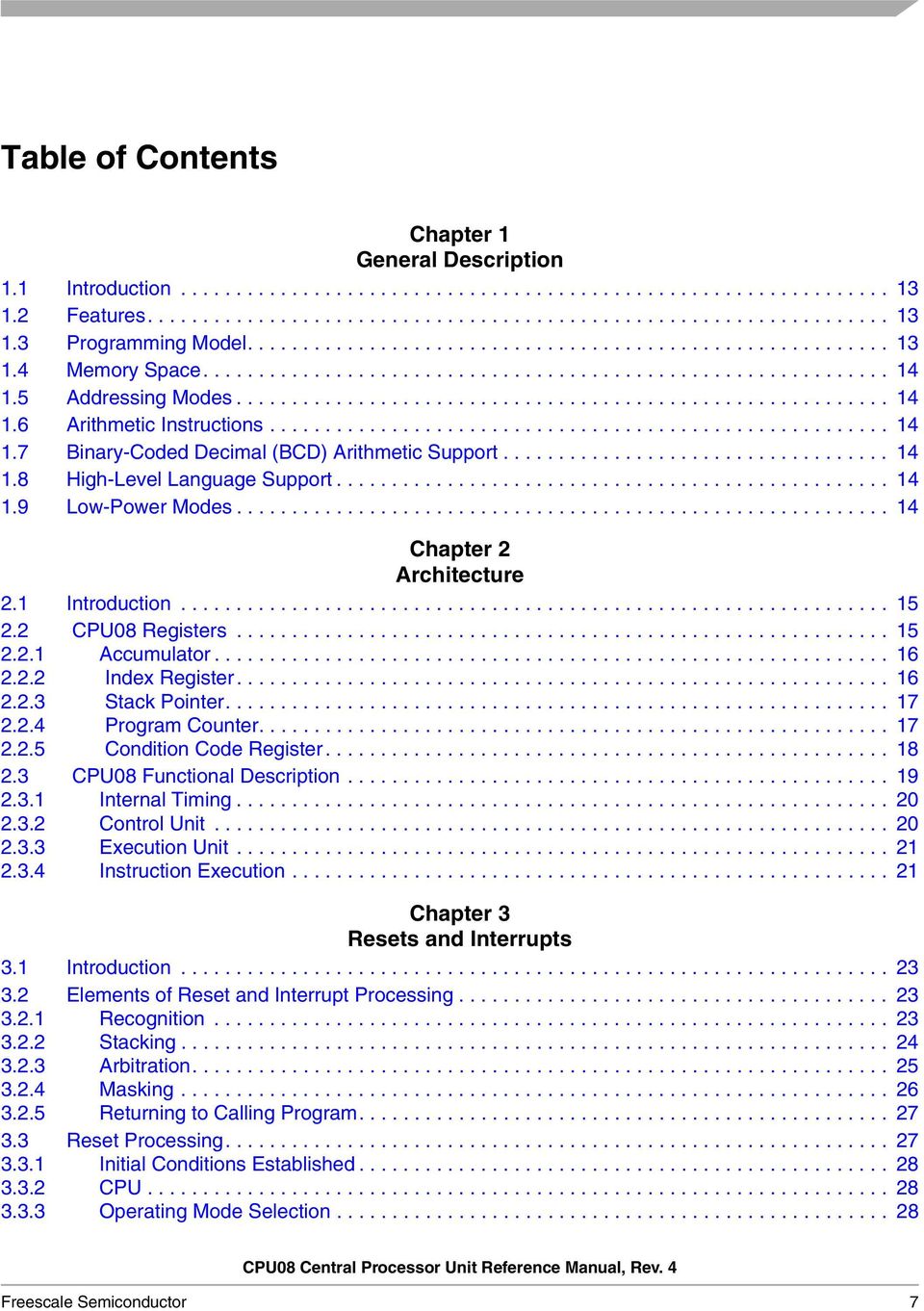
7 Table of Contents Chapter 1 General Description 1.1 Introduction Features Programming Model Memory Space Addressing Modes Arithmetic Instructions Binary-Coded Decimal (BCD) Arithmetic Support High-Level Language Support Low-Power Modes Chapter 2 Architecture 2.1 Introduction CPU08 Registers Accumulator Index Register Stack Pointer Program Counter Condition Code Register CPU08 Functional Description Internal Timing Control Unit Execution Unit Instruction Execution Chapter Resets and Interrupts.1 Introduction Elements of Reset and Interrupt Processing Recognition Stacking Arbitration Masking Returning to Calling Program Reset Processing Initial Conditions Established CPU Operating Mode Selection Freescale Semiconductor 7
8 Table of Contents.. Reset Sources External Reset Active Reset from an Internal Source Interrupt Processing Interrupt Sources and Priority Interrupts in Stop and Wait Modes Nesting of Multiple Interrupts Allocating Scratch Space on the Stack Chapter Addressing Modes.1 Introduction Addressing Modes Inherent Immediate Direct Extended Indexed, No Offset Indexed, 8-Bit Offset Indexed, 16-Bit Offset Stack Pointer, 8-Bit Offset Stack Pointer, 16-Bit Offset Relative Memory-to-Memory Immediate to Direct Memory-to-Memory Direct to Direct Memory-to-Memory Indexed to Direct with Post Increment Memory-to-Memory Direct to Indexed with Post Increment Indexed with Post Increment Indexed, 8-Bit Offset with Post Increment Instruction Set Summary Opcode Map Chapter 5 Instruction Set 5.1 Introduction Nomenclature Convention Definitions Instruction Set ADC Add with Carry ADD Add without Carry AIS Add Immediate Value (Signed) to Stack Pointer AIX Add Immediate Value (Signed) to Index Register AND Logical AND ASL Arithmetic Shift Left ASR Arithmetic Shift Right BCC Branch if Carry Bit Clear BCLR n Clear Bit n in Memory Freescale Semiconductor

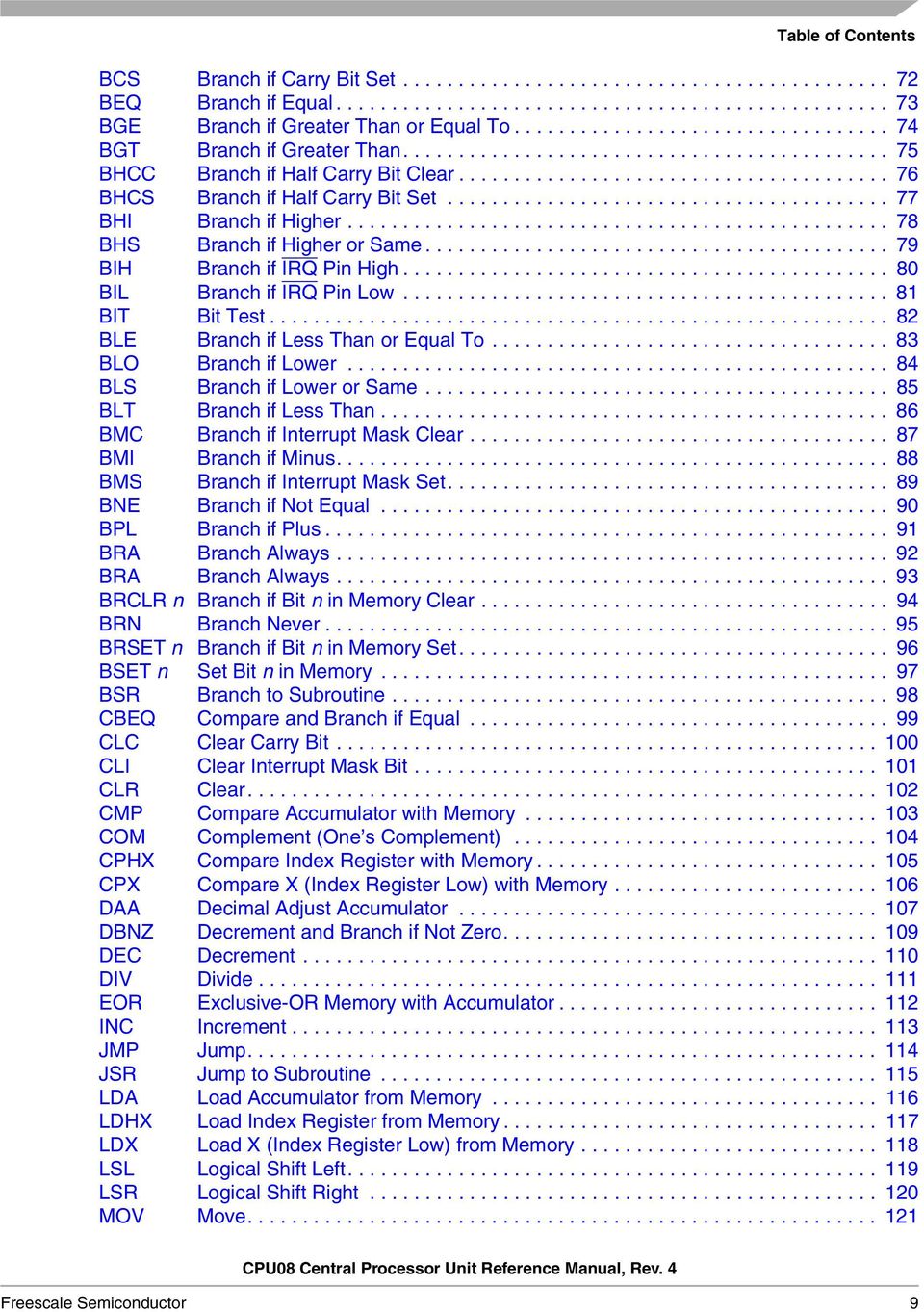
9 Table of Contents BCS Branch if Carry Bit Set BEQ Branch if Equal BGE Branch if Greater Than or Equal To BGT Branch if Greater Than BHCC Branch if Half Carry Bit Clear BHCS Branch if Half Carry Bit Set BHI Branch if Higher BHS Branch if Higher or Same BIH Branch if IRQ Pin High BIL Branch if IRQ Pin Low BIT Bit Test BLE Branch if Less Than or Equal To BLO Branch if Lower BLS Branch if Lower or Same BLT Branch if Less Than BMC Branch if Interrupt Mask Clear BMI Branch if Minus BMS Branch if Interrupt Mask Set BNE Branch if Not Equal BPL Branch if Plus BRA Branch Always BRA Branch Always BRCLR n Branch if Bit n in Memory Clear BRN Branch Never BRSET n Branch if Bit n in Memory Set BSET n Set Bit n in Memory BSR Branch to Subroutine CBEQ Compare and Branch if Equal CLC Clear Carry Bit CLI Clear Interrupt Mask Bit CLR Clear CMP Compare Accumulator with Memory COM Complement (One s Complement) CPHX Compare Index Register with Memory CPX Compare X (Index Register Low) with Memory DAA Decimal Adjust Accumulator DBNZ Decrement and Branch if Not Zero DEC Decrement DIV Divide EOR Exclusive-OR Memory with Accumulator INC Increment JMP Jump JSR Jump to Subroutine LDA Load Accumulator from Memory LDHX Load Index Register from Memory LDX Load X (Index Register Low) from Memory LSL Logical Shift Left LSR Logical Shift Right MOV Move Freescale Semiconductor 9
10 Table of Contents MUL Unsigned Multiply NEG Negate (Two s Complement) NOP No Operation NSA Nibble Swap Accumulator ORA Inclusive-OR Accumulator and Memory PSHA Push Accumulator onto Stack PSHH Push H (Index Register High) onto Stack PSHX Push X (Index Register Low) onto Stack PULA Pull Accumulator from Stack PULH Pull H (Index Register High) from Stack PULX Pull X (Index Register Low) from Stack ROL Rotate Left through Carry ROR Rotate Right through Carry RSP Reset Stack Pointer RTI Return from Interrupt RTS Return from Subroutine SBC Subtract with Carry SEC Set Carry Bit SEI Set Interrupt Mask Bit STA Store Accumulator in Memory STHX Store Index Register STOP Enable IRQ Pin, Stop Oscillator STX Store X (Index Register Low) in Memory SUB Subtract SWI Software Interrupt TAP Transfer Accumulator to Processor Status Byte TAX Transfer Accumulator to X (Index Register Low) TPA Transfer Processor Status Byte to Accumulator TST Test for Negative or Zero TSX Transfer Stack Pointer to Index Register TXA Transfer X (Index Register Low) to Accumulator TXS Transfer Index Register to Stack Pointer WAIT Enable Interrupts; Stop Processor Chapter 6 Instruction Set Examples 6.1 Introduction M68HC08 Unique Instructions Code Examples AIS Add Immediate Value (Signed) to Stack Pointer AIX Add Immediate Value (Signed) to Index Register BGE Branch if Greater Than or Equal To BGT Branch if Greater Than BLE Branch if Less Than or Equal To BLT Branch if Less Than CBEQ Compare and Branch if Equal CBEQA Compare A with Immediate CBEQX Compare X with Immediate Freescale Semiconductor

11 Table of Contents CLRH Clear H (Index Register High) CPHX Compare Index Register with Memory DAA Decimal Adjust Accumulator DBNZ Decrement and Branch if Not Zero DIV Divide LDHX Load Index Register with Memory MOV Move NSA Nibble Swap Accumulator PSHA Push Accumulator onto Stack PSHH Push H (Index Register High) onto Stack PSHX Push X (Index Register Low) onto Stack PULA Pull Accumulator from Stack PULH Pull H (Index Register High) from Stack PULX Pull X (Index Register Low) from Stack STHX Store Index Register TAP Transfer Accumulator to Condition Code Register TPA Transfer Condition Code Register to Accumulator TSX Transfer Stack Pointer to Index Register TXS Transfer Index Register to Stack Pointer Glossary Glossary Index Index Freescale Semiconductor 11

12 Table of Contents 12 Freescale Semiconductor

13 Chapter 1 General Description 1.1 Introduction The CPU08 is the central processor unit (CPU) of the Motorola M68HC08 Family of microcontroller units (MCU). The fully object code compatible CPU08 offers M68HC05 users increased performance with no loss of time or software investment in their M68HC05-based applications. The CPU08 also appeals to users of other MCU architectures who need the CPU08 combination of speed, low power, processing capabilities, and cost effectiveness. 1.2 Features CPU08 features include: Full object-code compatibility with M68HC05 Family 16-bit stack pointer with stack manipulation instructions 16-bit index register (H:X) with high-byte and low-byte manipulation instructions 8-MHz CPU standard bus frequency 6-Kbyte program/data memory space 16 addressing modes 78 new opcodes Memory-to-memory data moves without using accumulator Fast 8-bit by 8-bit multiply and 16-bit by 8-bit divide instructions Enhanced binary-coded decimal (BCD) data handling Expandable internal bus definition for extension of addressing range beyond 6 Kbytes Flexible internal bus definition to accommodate CPU performance-enhancing peripherals such as a direct memory access (DMA) controller Low-power stop and wait modes 1. Programming Model The CPU08 programming model consists of: 8-bit accumulator 16-bit index register 16-bit stack pointer 16-bit program counter 8-bit condition code register See Figure 2-1. CPU08 Programming Model. Freescale Semiconductor 1

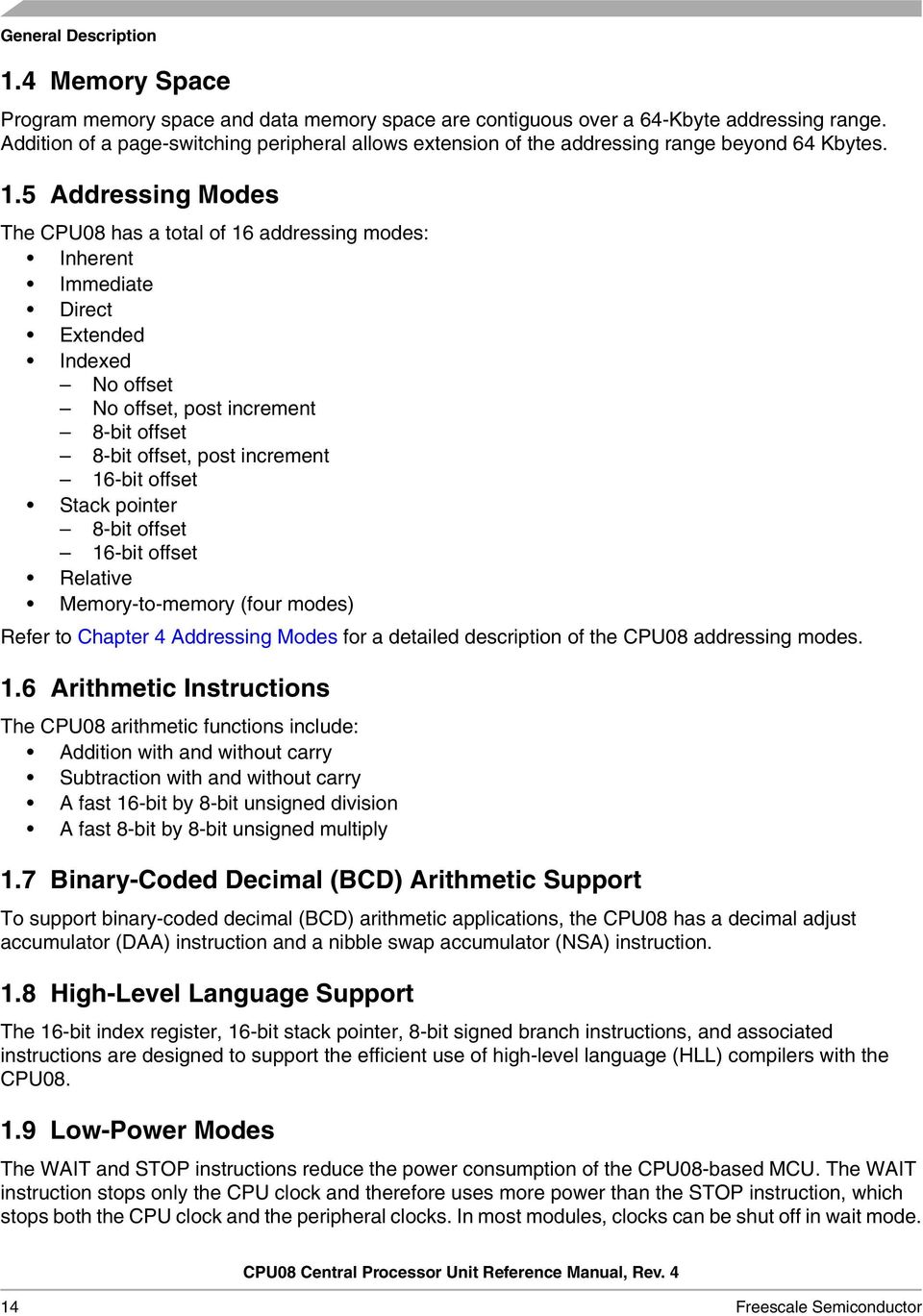
14 General Description 1. Memory Space Program memory space and data memory space are contiguous over a 6-Kbyte addressing range. Addition of a page-switching peripheral allows extension of the addressing range beyond 6 Kbytes. 1.5 Addressing Modes The CPU08 has a total of 16 addressing modes: Inherent Immediate Direct Extended Indexed No offset No offset, post increment 8-bit offset 8-bit offset, post increment 16-bit offset Stack pointer 8-bit offset 16-bit offset Relative Memory-to-memory (four modes) Refer to Chapter Addressing Modes for a detailed description of the CPU08 addressing modes. 1.6 Arithmetic Instructions The CPU08 arithmetic functions include: Addition with and without carry Subtraction with and without carry A fast 16-bit by 8-bit unsigned division A fast 8-bit by 8-bit unsigned multiply 1.7 Binary-Coded Decimal (BCD) Arithmetic Support To support binary-coded decimal (BCD) arithmetic applications, the CPU08 has a decimal adjust accumulator (DAA) instruction and a nibble swap accumulator (NSA) instruction. 1.8 High-Level Language Support The 16-bit index register, 16-bit stack pointer, 8-bit signed branch instructions, and associated instructions are designed to support the efficient use of high-level language (HLL) compilers with the CPU Low-Power Modes The WAIT and STOP instructions reduce the power consumption of the CPU08-based MCU. The WAIT instruction stops only the CPU clock and therefore uses more power than the STOP instruction, which stops both the CPU clock and the peripheral clocks. In most modules, clocks can be shut off in wait mode. 1 Freescale Semiconductor
15 Chapter 2 Architecture 2.1 Introduction This section describes the CPU08 registers. 2.2 CPU08 Registers Figure 2-1 shows the five CPU08 registers. The CPU08 registers are not part of the memory map. 7 0 A ACCUMULATOR (A) H X INDEX REGISTER (H:X) 15 0 STACK POINTER (SP) 15 0 PROGRAM COUNTER (PC) 7 0 V 1 1 H I N Z C CONDITION CODE REGISTER (CCR) TWO S COMPLEMENT OVERFLOW FLAG (V) HALF-CARRY FLAG (H) INTERRUPT MASK (I) CARRY/BORROW FLAG (C) ZERO FLAG (Z) NEGATIVE FLAG (N) Figure 2-1. CPU08 Programming Model Freescale Semiconductor 15

16 Architecture Accumulator The accumulator (A) shown in Figure 2-2 is a general-purpose 8-bit register. The central processor unit (CPU) uses the accumulator to hold operands and results of arithmetic and non-arithmetic operations Index Register Bit Bit 0 Read: Write: Reset: X X X X X X X X X = Indeterminate Figure 2-2. Accumulator (A) The 16-bit index register (H:X) shown in Figure 2- allows the user to index or address a 6-Kbyte memory space. The concatenated 16-bit register is called H:X. The upper byte of the index register is called H. The lower byte of the index register is called X. H is cleared by reset. When H = 0 and no instructions that affect H are used, H:X is functionally identical to the IX register of the M6805 Family. In the indexed addressing modes, the CPU uses the contents of H:X to determine the effective address of the operand. H:X can also serve as a temporary data storage location. See.2.5 Indexed, No Offset;.2.6 Indexed, 8-Bit Offset; and.2.7 Indexed, 16-Bit Offset. Bit Bit 0 Read: Write: Reset: X X X X X X X X X X X X X X X X X = Indeterminate Figure 2-. Index Register (H:X) 16 Freescale Semiconductor

17 2.2. Stack Pointer CPU08 Registers The stack pointer (SP) shown in Figure 2- is a 16-bit register that contains the address of the next location on the stack. During a reset, the stack pointer is preset to $00FF to provide compatibility with the M6805 Family. NOTE The reset stack pointer (RSP) instruction sets the least significant byte to $FF and does not affect the most significant byte. The address in the stack pointer decrements as data is pushed onto the stack and increments as data is pulled from the stack. The SP always points to the next available (empty) byte on the stack. The CPU08 has stack pointer 8- and 16-bit offset addressing modes that allow the stack pointer to be used as an index register to access temporary variables on the stack. The CPU uses the contents in the SP register to determine the effective address of the operand. See.2.8 Stack Pointer, 8-Bit Offset and.2.9 Stack Pointer, 16-Bit Offset. Bit Bit 0 Read: Write: Reset: Figure 2-. Stack Pointer (SP) 2.2. Program Counter NOTE Although preset to $00FF, the location of the stack is arbitrary and may be relocated by the user to anywhere that random-access memory (RAM) resides within the memory map. Moving the SP out of page 0 ($0000 to $00FF) will free up address space, which may be accessed using the efficient direct addressing mode. The program counter (PC) shown in Figure 2-5 is a 16-bit register that contains the address of the next instruction or operand to be fetched. Normally, the address in the program counter automatically increments to the next sequential memory location every time an instruction or operand is fetched. Jump, branch, and interrupt operations load the program counter with an address other than that of the next sequential location. During reset, the PC is loaded with the contents of the reset vector located at $FFFE and $FFFF. This represents the address of the first instruction to be executed after the reset state is exited. Read: Write: Reset: Bit Bit 0 Loaded with vector from $FFFE and $FFFF Figure 2-5. Program Counter (PC) Freescale Semiconductor 17

18 Architecture Condition Code Register The 8-bit condition code register (CCR) shown in Figure 2-6 contains the interrupt mask and five flags that indicate the results of the instruction just executed. Bits five and six are permanently set to logic 1. Bit Bit 0 Read: Write: V 1 1 H I N Z C Reset: X 1 1 X 1 X X X X = Indeterminate Figure 2-6. Condition Code Register (CCR) V Overflow Flag The CPU sets the overflow flag when a two's complement overflow occurs as a result of an operation. The overflow flag bit is utilized by the signed branch instructions: Branch if greater than, BGT Branch if greater than or equal to, BGE Branch if less than or equal to, BLE Branch if less than, BLT This bit is set by these instructions, although its resulting value holds no meaning: Arithmetic shift left, ASL Arithmetic shift right, ASR Logical shift left, LSL Logical shift right, LSR Rotate left through carry, ROL Rotate right through carry, ROR H Half-Carry Flag The CPU sets the half-carry flag when a carry occurs between bits and of the accumulator during an add-without-carry (ADD) or add-with-carry (ADC) operation. The half-carry flag is required for binary-coded (BCD) arithmetic operations. The decimal adjust accumulator (DAA) instruction uses the state of the H and C flags to determine the appropriate correction factor. I Interrupt Mask When the interrupt mask is set, all interrupts are disabled. Interrupts are enabled when the interrupt mask is cleared. When an interrupt occurs, the interrupt mask is automatically set after the CPU registers are saved on the stack, but before the interrupt vector is fetched. NOTE To maintain M6805 compatibility, the H register is not stacked automatically. If the interrupt service routine uses X (and H is not clear), then the user must stack and unstack H using the push H (index register high) onto stack (PSHH) and pull H (index register high) from stack (PULH) instructions within the interrupt service routine. If an interrupt occurs while the interrupt mask is set, the interrupt is latched. Interrupts in order of priority are serviced as soon as the I bit is cleared. 18 Freescale Semiconductor

19 CPU08 Functional Description A return-from-interrupt (RTI) instruction pulls the CPU registers from the stack, restoring the interrupt mask to its cleared state. After any reset, the interrupt mask is set and can only be cleared by a software instruction. See Chapter Resets and Interrupts. N Negative Flag The CPU sets the negative flag when an arithmetic operation, logical operation, or data manipulation produces a negative result. Z Zero Flag The CPU sets the zero flag when an arithmetic operation, logical operation, or data manipulation produces a result of $00. C Carry/Borrow Flag The CPU sets the carry/borrow flag when an addition operation produces a carry out of bit 7 of the accumulator or when a subtraction operation requires a borrow. Some logical operations and data manipulation instructions also clear or set the carry/borrow flag (as in bit test and branch instructions and shifts and rotates). 2. CPU08 Functional Description This subsection is an overview of the architecture of the M68HC08 CPU with functional descriptions of the major blocks of the CPU. The CPU08, as shown in Figure 2-7, is divided into two main blocks: Control unit Execution unit The control unit contains a finite state machine along with miscellaneous control and timing logic. The outputs of this block drive the execution unit, which contains the arithmetic logic unit (ALU), registers, and bus interface. CONTROL UNIT CONTROL SIGNALS STATUS SIGNALS EXECUTION UNIT INTERNAL DATA BUS INTERNAL ADDRESS BUS Figure 2-7. CPU08 Block Diagram Freescale Semiconductor 19

20 Architecture 2..1 Internal Timing The CPU08 derives its timing from a -phase clock, each phase identified as either T1, T2, T, or T. A CPU bus cycle consists of one clock pulse from each phase, as shown in Figure 2-8. To simplify subsequent diagrams, the T clocks have been combined into a single signal called the CPU clock. The start of a CPU cycle is defined as the leading edge of T1, though the address associated with this cycle does not drive the address bus until T. Note that the new address leads the associated data by one-half of a bus cycle. For example, the data read associated with a new PC value generated in T1/T2 of cycle 1 in Figure 2-8 would not be read into the control unit until T2 of the next cycle. T1 T2 T T CYCLE 1 CYCLE 2 CPU CLOCK T1 T2 T T T1 T2 T T INTERNAL ADDRESS BUS ADDR. CYCLE N INTERNAL DATA BUS EXECUTE CYCLE N DATA CYCLE Figure 2-8. Internal Timing Detail 2..2 Control Unit The control unit consists of: Sequencer Control store Random control logic These blocks make up a finite state machine, which generates all the controls for the execution unit. The sequencer provides the next state of the machine to the control store based on the contents of the instruction register (IR) and the current state of the machine. The control store is strobed (enabled) when the next state input is stable, producing an output that represents the decoded next state condition for the execution unit (EU). This result, with the help of some random logic, is used to generate the control signals that configure the execution unit. The random logic selects the appropriate signals and adds timing to the outputs of the control store. The control unit fires once per bus cycle but runs almost a full cycle ahead of the execution unit to decode and generate all the controls for the next cycle. The sequential nature of the machine is shown in Figure 2-9. The sequencer also contains and controls the opcode lookahead register, which is used to prefetch the next sequential instruction. Timing of this operation is discussed in 2.. Instruction Execution. 20 Freescale Semiconductor

21 CPU08 Functional Description CPU CLOCK T1 T2 T T T1 T2 T T T1 T2 T T IR/CONTROL UNIT STATE INPUT CYCLE N STATE CONTROL UNIT STROBE CYCLE N STROBE CONTROL UNIT OUTPUT TO EXECUTION UNIT CYCLE N EU CONTROL INTERNAL ADDRESS BUS ADDRESS CYCLE N INTERNAL DATA BUS FETCH/DECODE CYCLE N EXECUTE CYCLE N Figure 2-9. Control Unit Timing DATA CYCLE N 2.. Execution Unit The execution unit (EU) contains all the registers, the arithmetic logic unit (ALU), and the bus interface. Once per bus cycle a new address is computed by passing selected register values along the internal address buses to the address buffers. Note that the new address leads the associated data by one half of a bus cycle. The execution unit also contains some special function logic for unusual instructions such as DAA, unsigned multiply (MUL), and divide (DIV). 2.. Instruction Execution Each instruction has defined execution boundaries and executes in a finite number of T1-T2-T-T cycles. All instructions are responsible for fetching the next opcode into the opcode lookahead register at some time during execution. The opcode lookahead register is copied into the instruction register during the last cycle of an instruction. This new instruction begins executing during the T1 clock after it has been loaded into the instruction register. Note that all instructions are also responsible for incrementing the PC after the next instruction prefetch is under way. Therefore, when an instruction finishes (that is, at an instruction boundary), the PC will be pointing to the byte following the opcode fetched by the instruction. An example sequence of instructions concerning address and data bus activity with respect to instruction boundaries is shown in Figure A signal from the control unit, OPCODE LOOKAHEAD, indicates the cycle when the next opcode is fetched. Another control signal, LASTBOX, indicates the last cycle of the currently executing instruction. In most cases, OPCODE LOOKAHEAD and LASTBOX are active at the same time. For some instructions, however, the OPCODE LOOKAHEAD signal is asserted earlier in the instruction and the next opcode is prefetched and held in the lookahead register until the end of the currently executing instruction. Freescale Semiconductor 21
22 Architecture In the instruction boundaries example (Figure 2-10) the OPCODE LOOKAHEAD and LASTBOX are asserted simultaneously during TAX and increment INCX execution, but the load accumulator from memory (LDA) indexed with 8-bit offset instruction prefetches the next opcode before the last cycle. Refer to Figure The boldface instructions in Figure 2-10 are illustrated in Figure ORG $50 FCB $12 $ $56 ORG $ A6 50 LDA #$50 ;A = $50 PC=$ TAX ;A > X PC=$ e6 02 LDA 2, X ;[X+2] > A PC=$ c INCX ;X = X+1 PC = $ c STA $8000 ;A > $8000 PC = $010A Figure Instruction Boundaries OPCODE LOOKAHEAD/DECODE LDA INSTRUCTION OPCODE LOOKAHEAD INCX INSTRUCTION DECODE INCX INSTRUCTION CPU CLOCK T1 T2 T T T1 T2 T T T1 T2 T T T1 T2 T T OPCODE LOOKAHEAD REGISTER TAX OPCODE LDA OPCODE INCX OPCODE LASTBOX OPCODE LOOKAHEAD IR/CONTROL UNIT STATE INPUT TAX STATE 1 LDA STATE 1 LDA STATE 2 LDA STATE INCX STATE 1 CONTROL UNIT STROBE LDA CYCLE 1 STROBE LDA CYCLE 2 STROBE LDA CYCLE STROBE CONTROL UNIT OUTPUT TO EXECUTION UNIT INTERNAL ADDRESS BUS INTERNAL DATA BUS TAX EU CONTROL LDA OPCODE PREFETCH LDA CYCLE 1 EU CONTROL LDA CYCLE 2 EU CONTROL LDA OFFSET FETCH INCX OPCODE PREFETCH LDA OPERAND READ LDA CYCLE EU CONTROL $010 $010 $0105 $0052 $0106 LDA OPCODE INCX OPCODE $E6 $02 $5C $56 STA OPCODE PREFETCH INSTRUCTION EXECUTION BOUNDARIES TAX LDA Figure Instruction Execution Timing Diagram 22 Freescale Semiconductor
23 Chapter Resets and Interrupts.1 Introduction The CPU08 in a microcontroller executes instructions sequentially. In many applications it is necessary to execute sets of instructions in response to requests from various peripheral devices. These requests are often asynchronous to the execution of the main program. Resets and interrupts are both types of CPU08 exceptions. Entry to the appropriate service routine is called exception processing. Reset is required to initialize the device into a known state, including loading the program counter (PC) with the address of the first instruction. Reset and interrupt operations share the common concept of vector fetching to force a new starting point for further CPU08 operations. Interrupts provide a way to suspend normal program execution temporarily so that the CPU08 can be freed to service these requests. The CPU08 can process up to 128 separate interrupt sources including a software interrupt (SWI). On-chip peripheral systems generate maskable interrupts that are recognized only if the global interrupt mask bit (I bit) in the condition code register is clear (reset is non-maskable). Maskable interrupts are prioritized according to a default arrangement. (See Table -2 and..1 Interrupt Sources and Priority.) When interrupt conditions occur in an on-chip peripheral system, an interrupt status flag is set to indicate the condition. When the user's program has properly responded to this interrupt request, the status flag must be cleared..2 Elements of Reset and Interrupt Processing Reset and interrupt processing is handled in discrete, though sometimes concurrent, tasks. It is comprised of interrupt recognition, arbitration (evaluating interrupt priority), stacking of the machine state, and fetching of the appropriate vector. Interrupt processing for a reset is comprised of recognition and a fetch of the reset vector only. These tasks, together with interrupt masking and returning from a service routine, are discussed in this subsection..2.1 Recognition Reset recognition is asynchronous and is recognized when asserted. Internal resets are asynchronous with instruction execution except for illegal opcode and illegal address, which are inherently instruction-synchronized. Exiting the reset state is always synchronous. All pending interrupts are recognized by the CPU08 during the last cycle of each instruction. Interrupts that occur during the last cycle will not be recognized by the CPU08 until the last cycle of the following instruction. Instruction execution cannot be suspended to service an interrupt, and so interrupt latency calculations must include the execution time of the longest instruction that could be encountered. When an interrupt is recognized, an SWI opcode is forced into the instruction register in place of what would have been the next instruction. (When using the CPU08 with the direct memory access (DMA) module, the DMA can suspend instruction operation to service the peripheral.) Freescale Semiconductor 2
24 Resets and Interrupts Because of the opcode lookahead prefetch mechanism, at instruction boundaries the program counter (PC) always points to the address of the next instruction to be executed plus one. The presence of an interrupt is used to modify the SWI flow such that instead of stacking this PC value, the PC is decremented before being stacked. After interrupt servicing is complete, the return-from-interrupt (RTI) instruction will unstack the adjusted PC and use it to prefetch the next instruction again. After SWI interrupt servicing is complete, the RTI instruction then fetches the instruction following the SWI..2.2 Stacking To maintain object code compatibility, the M68HC08 interrupt stack frame is identical to that of the M6805 Family, as shown in Figure -1. Registers are stacked in the order of PC, X, A, and CCR. They are unstacked in reverse order. Note that the condition code register (CCR) I bit (internal mask) is not set until after the CCR is stacked during cycle 6 of the interrupt stacking procedure. The stack pointer always points to the next available (empty) stack location. 7 0 UNSTACKING ORDER CONDITION CODE REGISTER ACCUMULATOR INDEX REGISTER (LOW BYTE X) (1) PROGRAM COUNTER HIGH PROGRAM COUNTER LOW STACKING ORDER 1. High byte (H) of index register is not stacked. Figure -1. Interrupt Stack Frame NOTE To maintain compatibility with the M6805 Family, H (the high byte of the index register) is not stacked during interrupt processing. If the interrupt service routine modifies H or uses the indexed addressing mode, it is the user s responsibility to save and restore it prior to returning. See Figure -2. IRQINT PSHH Interrupt service routine PULH RTI Figure -2. H Register Storage $00FF (DEFAULT ADDRESS ON RESET) 2 Freescale Semiconductor
25 .2. Arbitration Elements of Reset and Interrupt Processing All reset sources always have equal and highest priority and cannot be arbitrated. Interrupts are latched, and arbitration is performed in the system integration module (SIM) at the start of interrupt processing. The arbitration result is a constant that the CPU08 uses to determine which vector to fetch. Once an interrupt is latched by the SIM, no other interrupt may take precedence, regardless of priority, until the latched interrupt is serviced (or the I bit is cleared). See Figure -. BUS CYCLE # 1 BUS CYCLE # LAST CYCLE OF CURRENT INSTRUCTION (A) COMPLETE NEXT INSTRUCTION FETCH (REDUNDANT) 1 1 COMPLETE NEXT INSTRUCTION (B) FETCH (REDUNDANT) UNSTACK CCR 2 UNSTACK A 2 STACK PCL RTI UNSTACK X STACK PCH UNSTACK PCH INTERRUPT PROCESSING STACK X STACK A STACK CCR UNSTACK PCL FETCH NEXT INSTRUCTION (B) FETCH VECTOR INTERRUPT HIGH BYTE FETCH VECTOR INTERRUPT LOW BYTE NOTE 1 INTERRUPT PENDING? NO YES START INTERRUPT PROCESSING 9 FETCH INTERRUPT SERVICE ROUTINE FIRST INSTRUCTION FIRST CYCLE OF NEXT INSTRUCTION (B) EXECUTE INTERRUPT SERVICE ROUTINE Note 1. Interrupts that occur before this point are recognized. Figure -. Interrupt Processing Flow and Timing Freescale Semiconductor 25
26 Resets and Interrupts.2. Masking Reset is non-maskable. All other interrupts can be enabled or disabled by the I mask bit in the CCR or by local mask bits in the peripheral control registers. The I bit may also be modified by execution of the set interrupt mask bit (SEI), clear interrupt mask bit (CLI), or transfer accumulator to condition code register (TAP) instructions. The I bit is modified in the first cycle of each instruction (these are all 2-cycle instructions). The I bit is also set during interrupt processing (see.2.1 Recognition) and is cleared during the second cycle of the RTI instruction when the CCR is unstacked, provided that the stacked CCR I bit is not modified at the interrupt service routine. (See.2.5 Returning to Calling Program.) In all cases where the I bit can be modified, it is modified at least one cycle prior to the last cycle of the instruction or operation, which guarantees that the new I-bit state will be effective prior to execution of the next instruction. For example, if an interrupt is recognized during the CLI instruction, the load accumulator from memory (LDA) instruction will not be executed before the interrupt is serviced. See Figure -. CLI LDA #$FF Background Routine INT1 PSHH PULH RTI INT1 Interrupt Service Routine Figure -. Interrupt Recognition Example 1 If an interrupt is pending upon exit from the original interrupt service routine, it will also be serviced before the LDA instruction is executed. Note that the LDA opcode is prefetched by both the INT1 and INT2 RTI instructions. However, in the case of the INT1 RTI prefetch, this is a redundant operation. See Figure -5. CLI LDA #$FF Background Routine INT1 PSHH PULH RTI INT1 Interrupt Service Routine INT2 PSHH PULH RTI INT2 Interrupt Service Routine Figure -5. Interrupt Recognition Example 2 26 Freescale Semiconductor
27 Reset Processing Similarly, in Figure -6, if an interrupt is recognized during the CLI instruction, it will be serviced before the SEI instruction sets the I bit in the CCR. CLI SEI.2.5 Returning to Calling Program Figure -6. Interrupt Recognition Example When an interrupt has been serviced, the RTI instruction terminates interrupt processing and returns to the program that was running at the time of the interrupt. In servicing the interrupt, some or all of the CPU08 registers will have changed. To continue the former program as though uninterrupted, the registers must be restored to the values present at the time the former program was interrupted. The RTI instruction takes care of this by pulling (loading) the saved register values from the stack memory. The last value to be pulled from the stack is the program counter, which causes processing to resume at the point where it was interrupted. Unstacking the CCR generally clears the I bit, which is cleared during the second cycle of the RTI instruction. NOTE Since the return I bit state comes from the stacked CCR, the user, by setting the I bit in the stacked CCR, can block all subsequent interrupts pending or otherwise, regardless of priority, from within an interrupt service routine. LDA #$08 ORA 1,SP STA 1,SP RTI This capability can be useful in handling a transient situation where the interrupt handler detects that the background program is temporarily unable to cope with the interrupt load and needs some time to recover. At an appropriate juncture, the background program would reinstate interrupts after it has recovered.. Reset Processing INT1 PSHH PULH RTI INT1 Interrupt Service Routine Reset forces the microcontroller unit (MCU) to assume a set of initial conditions and to begin executing instructions from a predetermined starting address. For the M68HC08 Family, reset assertion is asynchronous with instruction execution, and so the initial conditions can be assumed to take effect almost immediately after applying an active low level to the reset pin, regardless of whether the clock has started. Internally, reset is a clocked process, and so reset negation is synchronous with an internal clock, as shown in Figure -7, which shows the internal timing for exiting a pin reset. Freescale Semiconductor 27
28 Resets and Interrupts CPU CLOCK T T T1 T2 T T T1 T2 T T T1 T2 T T T1 T2 T T T1 T2 T T INTERNAL ADDRESS BUS INDETERMINATE $FFFE $FFFF INTERNAL DATA BUS INDETERMINATE PCH RESET PIN RESET PIN SAMPLING Figure -7. Exiting Reset The reset system is able to actively pull down the reset output if reset-causing conditions are detected by internal systems. This feature can be used to reset external peripherals or other slave MCU devices...1 Initial Conditions Established Once the reset condition is recognized, internal registers and control bits are forced to an initial state. These initial states are described throughout this manual. These initial states in turn control on-chip peripheral systems to force them to known startup states. Most of the initial conditions are independent of the operating mode. This subsection summarizes the initial conditions of the CPU08 and input/output (I/O) as they leave reset...2 CPU After reset the CPU08 fetches the reset vector from locations $FFFE and $FFFF (when in monitor mode, the reset vector is fetched from $FEFE and $FEFF), loads the vector into the PC, and begins executing instructions. The stack pointer is loaded with $00FF. The H register is cleared to provide compatibility for existing M6805 object code. All other CPU08 registers are indeterminate immediately after reset; however, the I interrupt mask bit in the condition code register is set to mask any interrupts, and the STOP and WAIT latches are both cleared... Operating Mode Selection The CPU08 has two modes of operation useful to the user: User mode Monitor mode The monitor mode is the same as user mode except that alternate vectors are used by forcing address bit A8 to 0 instead of 1. The reset vector is therefore fetched from addresses $FEFE and FEFF instead of FFFE and FFFF. This offset allows the CPU08 to execute code from the internal monitor firmware instead of the user code. (Refer to the appropriate technical data manual for specific information regarding the internal monitor description.) 28 Freescale Semiconductor
29 Interrupt Processing The mode of operation is latched on the rising edge of the reset pin. The monitor mode is selected by connecting two port lines to V ss and applying an over-voltage of approximately 2 x V DD to the IRQ1 pin concurrent with the rising edge of reset (see Table -1). Port allocation varies from part to part. Table -1. Mode Selection IRQ1 Pin Port x Port y Mode V DD X X User 2 x V DD 1 0 Monitor.. Reset Sources The system integration module (SIM) has master reset control and may include, depending on device implementation, any of these typical reset sources: External reset (RESET pin) Power-on reset (POR) circuit COP watchdog Illegal opcode reset Illegal address reset Low voltage inhibit (LVI) reset A reset immediately stops execution of the current instruction. All resets produce the vector $FFFE/$FFFF and assert the internal reset signal. The internal reset causes all registers to return to their default values and all modules to return to their reset state...5 External Reset A logic 0 applied to the RESET pin asserts the internal reset signal, which halts all processing on the chip. The CPU08 and peripherals are reset...6 Active Reset from an Internal Source All internal reset sources actively pull down the RESET pin to allow the resetting of external peripherals. The RESET pin will be pulled down for 16 bus clock cycles; the internal reset signal will continue to be asserted for an additional 16 cycles after that. If the RESET pin is still low at the the end of the second 16 cycles, then an external reset has occurred. If the pin is high, the appropriate bit will be set to indicate the source of the reset. The active reset feature allows the part to issue a reset to peripherals and other chips within a system built around an M68HC08 MCU.. Interrupt Processing The group of instructions executed in response to an interrupt is called an interrupt service routine. These routines are much like subroutines except that they are called through the automatic hardware interrupt mechanism rather than by a subroutine call instruction, and all CPU08 registers, except the H register, are saved on the stack. Refer to the description of the interrupt mask (I) found in Condition Code Register. Freescale Semiconductor 29
30 Resets and Interrupts An interrupt (provided it is enabled) causes normal program flow to be suspended as soon as the currently executing instruction finishes. The interrupt logic then pushes the contents of all CPU08 registers onto the stack, except the H register, so that the CPU08 contents can be restored after the interrupt is finished. After stacking the CPU08 registers, the vector for the highest priority pending interrupt source is loaded into the program counter and execution continues with the first instruction of the interrupt service routine. An interrupt is concluded with a return-from-interrupt (RTI) instruction, which causes all CPU08 registers and the return address to be recovered from the stack, so that the interrupted program can resume as if there had been no interruption. Interrupts can be enabled or disabled by the mask bit (I bit) in the condition code register and by local enable mask bits in the on-chip peripheral control registers. The interrupt mask bits in the CCR provide a means of controlling the nesting of interrupts. In rare cases it may be useful to allow an interrupt routine to be interrupted (see.. Nesting of Multiple Interrupts). However, nesting is discouraged because it greatly complicates a system and rarely improves system performance. By default, the interrupt structure inhibits interrupts during the interrupt entry sequence by setting the interrupt mask bit(s) in the CCR. As the CCR is recovered from the stack during the return from interrupt, the condition code bits return to the enabled state so that additional interrupts can be serviced. Upon reset, the I bit is set to inhibit all interrupts. After minimum system initialization, software may clear the I bit by a TAP or CLI instruction, thus enabling interrupts...1 Interrupt Sources and Priority The CPU08 can have 128 separate vectors including reset and software interrupt (SWI), which leaves 126 inputs for independent interrupt sources. See Table -2. NOTE Not all CPU08 versions use all available interrupt vectors. Table -2. M68HC08 Vectors Address Reset Priority FFFE Reset 1 FFFC SWI 2 FFFA IREQ[0] : : : FF02 IREQ[12] 127 FF00 IREQ[125] Freescale Semiconductor
31 Interrupt Processing When the system integration module (SIM) receives an interrupt request, processing begins at the next instruction boundary. The SIM performs the priority decoding necessary if more than one interrupt source is active at the same time. Also, the SIM encodes the highest priority interrupt request into a constant that the CPU08 uses to generate the corresponding interrupt vector. NOTE The interrupt source priority for any specific module may not always be the same in different M68HC08 versions. For details about the priority assigned to interrupt sources in a specific M68HC08 device, refer to the SIM section of the technical data manual written for that device. As an instruction, SWI has the highest priority other than reset; once the SWI opcode is fetched, no other interrupt can be honored until the SWI vector has been fetched...2 Interrupts in Stop and Wait Modes In wait mode the CPU clocks are disabled, but other module clocks remain active. A module that is active during wait mode can wake the CPU08 by an interrupt if the interrupt is enabled. Processing of the interrupt begins immediately. In stop mode, the system clocks do not run. The system control module inputs are conditioned so that they can be asynchronous. A particular module can wake the part from stop mode with an interrupt provided that the module has been designed to do so... Nesting of Multiple Interrupts Under normal circumstances, CPU08 interrupt processing arbitrates multiple pending interrupts, selects the highest, and leaves the rest pending. The I bit in the CCR is also set, preventing nesting of interrupts. While an interrupt is being serviced, it effectively becomes the highest priority task for the system. When servicing is complete, the assigned interrupt priority is re-established. In certain systems where, for example, a low priority interrupt contains a long interrupt service routine, it may not be desirable to lock out all higher priority interrupts while the low priority interrupt executes. Although not generally advisable, controlled nesting of interrupts can be used to solve problems of this nature. If nesting of interrupts is desired, the interrupt mask bit(s) must be cleared after entering the interrupt service routine. Care must be taken to specifically mask (disable) the present interrupt with a local enable mask bit or clear the interrupt source flag before clearing the mask bit in the CCR. Failure to do so will cause the same source to immediately interrupt, which will rapidly consume all available stack space. Freescale Semiconductor 1
32 Resets and Interrupts.. Allocating Scratch Space on the Stack In some systems, it is useful to allocate local variable or scratch space on the stack for use by the interrupt service routine. Temporary storage can also be obtained using the push (PSH) and pull (PUL) instructions; however, the last-in-first-out (LIFO) structure of the stack makes this impractical for more than one or two bytes. The CPU08 features the 16-bit add immediate value (signed) to stack pointer (AIS) instruction to allocate space. The stack pointer indexing instructions can then be used to access this data space, as demonstrated in this example. IRQINT PSHH ;Save H register AIS #-16 ;Allocate 16 bytes of local storage STA,SP ;Store a value in the second byte ;of local space Note: The stack pointer must always point to the next empty stack location. The location addressed by 0,SP should therefore never be used unless the programmer can guarantee no subroutine calls from within the interrupt service routine.... LDA,SP ;Read the value at a later time... AIS #16 ;Clean up stack PULH ;Restore H register RTI ;Return Note: Subroutine calls alter the offset from the SP to the local variable data space because of the stacked return address. If the user wishes to access this data space from subroutines called from within the interrupt service routine, then the offsets should be adjusted by +2 bytes for each level of subroutine nesting. 2 Freescale Semiconductor
33 Chapter Addressing Modes.1 Introduction This section describes the addressing modes of the M68HC08 central processor unit (CPU)..2 Addressing Modes The CPU08 uses 16 addressing modes for flexibility in accessing data. These addressing modes define how the CPU finds the data required to execute an instruction. The 16 addressing modes are: Inherent Immediate Direct Extended Indexed, no offset Indexed, 8-bit offset Indexed, 16-bit offset Stack pointer, 8-bit offset Stack pointer, 16-bit offset Relative Memory-to-memory (four modes): Immediate to direct Direct to direct Indexed to direct with post increment Direct to indexed with post increment Indexed with post increment Indexed, 8-bit offset with post increment Freescale Semiconductor
34 Addressing Modes.2.1 Inherent Inherent instructions have no operand fetch associated with the instruction, such as decimal adjust accumulator (DAA), clear index high (CLRH), and divide (DIV). Some of the inherent instructions act on data in the CPU registers, such as clear accumulator (CLRA), and transfer condition code register to the accumulator (TPA). Inherent instructions require no memory address, and most are one byte long. Table -1 lists the instructions that use inherent addressing. The assembly language statements shown here are examples of the inherent addressing mode. In the code example and throughout this section, bold typeface instructions are examples of the specific addressing mode being discussed; a pound sign (#) before a number indicates an immediate operand. The default base is decimal. Hexadecimal numbers are represented by a dollar sign ($) preceding the number. Some assemblers use hexadecimal as the default numbering system. Refer to the documentation for the particular assembler to determine the proper syntax. Machine Code Label Operation Operand Comments A657 EX_1 LDA #$57 ;A = $57 AB5 ADD #$5 ;A = $9C 72 DAA ;A = $02 w/carry ;bit set ½ $102 A61 EX_2 LDA #20 ;LS dividend in A 8C CLRH ;Clear MS dividend AE0 LDX # ;Divisor in X 52 DIV ;(H:A)/XÆA=06,H=02 A60 EX_ LDA #$0 ;A = $0 87 PSHA ;Push $0 on stack and ;decrement stack ;pointer by 1 Table -1. Inherent Addressing Instructions Instruction Arithmetic Shift Left Arithmetic Shift Right Clear Carry Bit Clear Interrupt Mask Clear Clear H (Index Register High) Complement Decimal Adjust Accumulator Mnemonic ASLA, ASLX ASRA, ASRX CLC CLI CLRA, CLRX CLRH COMA, COMX DAA Freescale Semiconductor
35 Addressing Modes Table -1. Inherent Addressing Instructions (Continued) Instruction Decrement Accumulator, Branch if Not Equal ($00) Decrement X (Index Register Low), Branch if Not Equal ($00) Decrement Divide (Integer 16-Bit by 8-Bit Divide) Increment Logical Shift Left Logical Shift Right Multiply Negate Nibble Swap Accumulator No Operation Push Accumulator onto Stack Push H (Index Register High) onto Stack Push X (Index Register Low) onto Stack Pull Accumulator from Stack Pull H (Index Register High) from Stack Pull X (Index Register Low) from Stack Rotate Left through Carry Rotate Right through Carry Reset Stack Pointer to $00FF Return from Interrupt Return from Subroutine Set Carry Bit Set Interrupt Mask Enable IRQ and Stop Oscillator Software Interrupt Transfer Accumulator to Condition Code Register Transfer Accumulator to X (Index Register Low) Transfer Condition Code Register to Accumulator Test for Negative or Zero Transfer Stack Pointer to Index Register (H:X) Transfer X (Index Register Low) to Accumulator Transfer Index Register (H:X) to Stack Pointer Enable Interrupts and Halt CPU Mnemonic DBNZA DBNZX DECA, DECX DIV INCA, INCX LSLA, LSLX LSRA, LSRX MUL NEGA, NEGX NSA NOP PSHA PSHH PSHX PULA PULH PULX ROLA, ROLX RORA, RORX RSP RTI RTS SEC SEI STOP SWI TAP TAX TPA TSTA, TSTX TSX TXA TXS WAIT Freescale Semiconductor 5
36 Addressing Modes.2.2 Immediate The operand in immediate instructions is contained in the bytes immediately following the opcode. The byte or bytes that follow the opcode are the value of the statement rather than the address of the value. In this case, the effective address of the instruction is specified by the # sign and implicitly points to the byte following the opcode. The immediate value is limited to either one or two bytes, depending on the size of the register involved in the instruction. Table -2 lists the instructions that use immediate addressing. Immediate instructions associated with the index register (H:X) are -byte instructions: one byte for the opcode, two bytes for the immediate data byte. The example code shown here contains two immediate instructions: AIX (add immediate to H:X) and CPHX (compare H:X with immediate value). H:X is first cleared and then incremented by one until it contains $FFFF. Once the condition specified by the CPHX becomes true, the program branches to START, and the process is repeated indefinitely. Machine Code Label Operation Operand Comments 5F START CLRX ;X = 0 8C CLRH ;H = 0 AF01 TAG AIX #1 ;(H:X) = (H:X) FFFF CPHX #$FFFF ;Compare (H:X) to ;$FFFF 26F9 BNE TAG ;Loop until equal 20F5 BRA START ;Start over Table -2. Immediate Addressing Instructions Instruction Add with Carry Immediate Value to Accumulator Add Immediate Value to Accumulator Add Immediate Value (Signed) to Stack Pointer Add Immediate Value (Signed) to Index Register (H:X) Logical AND Immediate Value with Accumulator Bit Test Immediate Value with Accumulator Compare A with Immediate and Branch if Equal Compare X (Index Register Low) with Immediate and Branch if Equal Compare Accumulator with Immediate Value Compare Index Register (H:X) with Immediate Value Compare X (Index Register Low) with Immediate Value Exclusive OR Immediate Value with Accumulator Load Accumulator from Immediate Value Load Index Register (H:X) with Immediate Value Load X (Index Register Low) from Immediate Value Inclusive OR Immediate Value Subtract with Carry Immediate Value Subtract Immediate Value Mnemonic ADC ADD AIS AIX AND BIT CBEQA CBEQX CMP CPHX CPX EOR LDA LDHX LDX ORA SBC SUB 6 Freescale Semiconductor
37 .2. Direct Addressing Modes Most direct instructions can access any of the first 256 memory addresses with only two bytes. The first byte is the opcode, and the second is the low byte of the operand address. The high-order byte of the effective address is assumed to be $00 and is not included as an instruction byte (saving program memory space and execution time). The use of direct addressing mode is therefore limited to operands in the $0000 $00FF area of memory (called the direct page or page 0). Direct addressing instructions take one less byte of program memory space than the equivalent instructions using extended addressing. By eliminating the additional memory access, the execution time is reduced by one cycle. In the course of a long program, this savings can be substantial. Most microcontroller units place some if not all random-access memory (RAM) in the $0000 $00FF area; this allows the designer to assign these locations to frequently referenced data variables, thus saving execution time. BRSET and BRCLR are -byte instructions that use direct addressing to access the operand and relative addressing to specify a branch destination. CPHX, STHX, and LDHX are 2-byte instructions that fetch a 16-bit operand. The most significant byte comes from the direct address; the least significant byte comes from the direct address + 1. Table - lists the instructions that use direct addressing. This example code contains two direct addressing mode instructions: STHX (store H:X in memory) and CPHX (compare H:X with memory). The first STHX instruction initializes RAM storage location TEMP to zero, and the second STHX instruction loads TEMP with $5555. The CPHX instruction compares the value in H:X with the value of RAM:(RAM + 1). In this example, RAM:(RAM + 1) = TEMP = $50:$51 = $5555. Machine Code Label Operation Operand Comments RAM EQU $50 ;RAM equate ROM EQU $6E00 ;ROM equate ORG $RAM ;Beginning of RAM TEMP RMB 2 ;Reserve 2 bytes ORG $ROM ;Beginning of ROM 5F START CLRX ;X = 0 8C CLRH ;H = STHX TEMP ;H:X=0 > temp LDHX #$5555 ;Load H:X with $ STHX TEMP ;Temp=$ BAD_PART CPHX RAM ;RAM=temp 26FC BNE BAD_PART ;RAM=temp will be ;same unless something ;is very wrong! 20F1 BRA START ;Do it again Freescale Semiconductor 7
38 Addressing Modes Table -. Direct Addressing Instructions Instruction Mnemonic Add Memory and Carry to Accumulator ADC Add Memory and Accumulator ADD Logical AND of Memory and Accumulator AND Arithmetic Shift Left Memory ASL (1) Arithmetic Shift Right Memory ASR Clear Bit in Memory BCLR Bit Test Memory with Accumulator BIT Branch if Bit n in Memory Clear BRCLR Branch if Bit n in Memory Set BRSET Set Bit in Memory BSET Compare Direct with Accumulator and Branch if Equal CBEQ Clear Memory CLR Compare Accumulator with Memory CMP Complement Memory COM Compare Index Register (H:X) with Memory CPHX Compare X (Index Register Low) with Memory CPX Decrement Memory and Branch if Not Equal ($00) DBNZ Decrement Memory DEC Exclusive OR Memory with Accumulator EOR Increment Memory INC Jump JMP Jump to Subroutine JSR Load Accumulator from Memory LDA Load Index Register (H:X) from Memory LDHX Load X (Index Register Low) from Memory LDX Logical Shift Left Memory LSL (1) Logical Shift Right Memory LSR Negate Memory NEG Inclusive OR Accumulator and Memory ORA Rotate Memory Left through Carry ROL Rotate Memory Right through Carry ROR Subtract Memory and Carry from Accumulator SBC Store Accumulator in Memory STA Store Index Register (H:X) in Memory STHX Store X (Index Register Low) in Memory STX Subtract Memory from Accumulator SUB Test Memory for Negative or Zero TST 1. ASL = LSL 8 Freescale Semiconductor
39 Addressing Modes.2. Extended Extended instructions can access any address in a 6-Kbyte memory map. All extended instructions are three bytes long. The first byte is the opcode; the second and third bytes are the most significant and least significant bytes of the operand address. This addressing mode is selected when memory above the direct or zero page ($0000 $00FF) is accessed. When using most assemblers, the programmer does not need to specify whether an instruction is direct or extended. The assembler automatically selects the shortest form of the instruction. Table - lists the instructions that use the extended addressing mode. An example of the extended addressing mode is shown here. Machine Code Label Operation Operand Comments ORG $50 ;Start at $50 FCB $FF ;$50 = $FF 5F CLRX BE50 LDX $0050 ;Load X direct ORG $6E00 ;Start at $6E00 FCB $FF ;$6E00 = $FF 5F CLRX CE6E00 LDX $6E00 ;Load X extended Table -. Extended Addressing Instructions Instruction Add Memory and Carry to Accumulator Add Memory and Accumulator Logical AND of Memory and Accumulator Bit Test Memory with Accumulator Compare Accumulator with Memory Compare X (Index Register Low) with Memory Exclusive OR Memory with Accumulator Jump Jump to Subroutine Load Accumulator from Memory Load X (Index Register Low) from Memory Inclusive OR Accumulator with Memory Subtract Memory and Carry from Accumulator Store Accumulator in Memory Store X (Index Register Low) in Memory Subtract Memory from Accumulator Mnemonic ADC ADD AND BIT CMP CPX EOR JMP JSR LDA LDX ORA SBC STA STX SUB Freescale Semiconductor 9
40 Addressing Modes.2.5 Indexed, No Offset Indexed instructions with no offset are 1-byte instructions that access data with variable addresses. X contains the low byte of the conditional address of the operand; H contains the high byte. Due to the addition of the H register, this addressing mode is not limited to the first 256 bytes of memory as in the M68HC05. If none of the M68HC08 instructions that modify H are used (AIX; CBEQ (ix+); LDHX; MOV (dir/ix+); MOV (ix+/dir); DIV; PULH; TSX), then the H value will be $00, which ensures complete source code compatibility with M68HC05 Family instructions. Indexed, no offset instructions can move a pointer through a table or hold the address of a frequently used RAM or input/output (I/O) location. Table -5 lists instructions that use indexed, no offset addressing..2.6 Indexed, 8-Bit Offset Indexed, 8-bit offset instructions are 2-byte instructions that can access data with variable addresses. The CPU adds the unsigned bytes in H:X to the unsigned byte following the opcode. The sum is the effective address of the operand. If none of the M68HC08 instructions that modify H are used (AIX; CBEQ (ix+); LDHX; MOV (dir/ix+); MOV (ix+/dir); DIV; PULH; TSX), then the H value will be $00, which ensures complete source code compatibility with the M68HC05 Family instructions. Indexed, 8-bit offset instructions are useful in selecting the kth element in an n-element table. The table can begin anywhere and can extend as far as the address map allows. The k value would typically be in H:X, and the address of the beginning of the table would be in the byte following the opcode. Using H:X in this way, this addressing mode is limited to the first 256 addresses in memory. Tables can be located anywhere in the address map when H:X is used as the base address, and the byte following is the offset. Table -5 lists the instructions that use indexed, 8-bit offset addressing..2.7 Indexed, 16-Bit Offset Indexed, 16-bit offset instructions are -byte instructions that can access data with variable addresses at any location in memory. The CPU adds the unsigned contents of H:X to the 16-bit unsigned word formed by the two bytes following the opcode. The sum is the effective address of the operand. The first byte after the opcode is the most significant byte of the 16-bit offset; the second byte is the least significant byte of the offset. As with direct and extended addressing, most assemblers determine the shortest form of indexed addressing. Table -5 lists the instructions that use indexed, 16-bit offset addressing. Indexed, 16-bit offset instructions are useful in selecting the kth element in an n-element table. The table can begin anywhere and can extend as far as the address map allows. The k value would typically be in H:X, and the address of the beginning of the table would be in the bytes following the opcode. This example uses the JMP (unconditional jump) instruction to show the three different types of indexed addressing. 0 Freescale Semiconductor
41 Addressing Modes Machine Code Label Operation Operand Comments FC JMP,X ;No offset ;Jump to address ;pointed to by H:X ECFF JMP $FF,X ;8-bit offset ;Jump to address ;pointed to by H:X + $FF DC10FF JMP $10FF,X ;16-bit offset ;Jump to address ;pointed to by H:X + $10FF Table -5. Indexed Addressing Instructions Instruction Mnemonic No Offset 8-Bit Offset 16-Bit Offset Add Memory and Carry to Accumulator ADC Add Memory and Accumulator ADD Logical AND of Memory and Accumulator AND Arithmetic Shift Left Memory ASL (1) Arithmetic Shift Right Memory ASR Bit Test Memory with Accumulator BIT Clear Memory CLR Compare Accumulator with Memory CMP Complement Memory COM Compare X (Index Register Low) with Memory CPX Decrement Memory and Branch if Not Equal ($00) DBNZ Decrement Memory DEC Exclusive OR Memory with Accumulator EOR Increment Memory INC Jump JMP Jump to Subroutine JSR Load Accumulator from Memory LDA Load X (Index Register Low) from Memory LDX Logical Shift Left Memory LSL (1) Logical Shift Right Memory LSR Negate Memory NEG Inclusive OR Accumulator and Memory ORA Rotate Memory Left through Carry ROL Rotate Memory Right through Carry ROR Subtract Memory and Carry from Accumulator SBC Store Accumulator in Memory STA Store X (Index Register Low) in Memory STX Subtract Memory from Accumulator SUB Test Memory for Negative or Zero TST 1. ASL = LSL Freescale Semiconductor 1
42 Addressing Modes.2.8 Stack Pointer, 8-Bit Offset Stack pointer, 8-bit offset instructions are -byte instructions that address operands in much the same way as indexed 8-bit offset instructions, only they add the 8-bit offset to the value of the stack pointer instead of the index register. The stack pointer, 8-bit offset addressing mode permits easy access of data on the stack. The CPU adds the unsigned byte in the 16-bit stack pointer (SP) register to the unsigned byte following the opcode. The sum is the effective address of the operand. If interrupts are disabled, this addressing mode allows the stack pointer to be used as a second index register. Table -6 lists the instructions that can be used in the stack pointer, 8-bit offset addressing mode. Stack pointer relative instructions require a pre-byte for access. Consequently, all SP relative instructions take one cycle longer than their index relative counterparts..2.9 Stack Pointer, 16-Bit Offset Stack pointer, 16-bit offset instructions are -byte instructions used to access data relative to the stack pointer with variable addresses at any location in memory. The CPU adds the unsigned contents of the 16-bit stack pointer register to the 16-bit unsigned word formed by the two bytes following the opcode. The sum is the effective address of the operand. As with direct and extended addressing, most assemblers determine the shortest form of stack pointer addressing. Due to the pre-byte, stack pointer relative instructions take one cycle longer than their index relative counterparts. Table -6 lists the instructions that can be used in the stack pointer, 16-bit offset addressing mode. Examples of the 8-bit and 16-bit offset stack pointer addressing modes are shown here. The first example stores the value of $20 in location $10, SP = $10 + $FF = $10F and then decrements that location until equal to zero. The second example loads the accumulator with the contents of memory location $250, SP = $250 + $FF = $F. Machine Code Label Operation Operand Comments LDHX #$ TXS ;Reset stack pointer ;to $00FF A620 LDA #$20 ;A = $20 9EE710 STA $10,SP ;Location $10F = $20 9E6B10FC LP DBNZ $10,SP,LP ;8-bit offset ;decrement the ;contents of $10F ;until equal to zero LDHX #$ TXS ;Reset stack pointer ;to $00FF 9ED60250 LDA $0250,SP ;16-bit offset ;Load A with contents ;of $F 2 Freescale Semiconductor
43 Addressing Modes Stack pointer, 16-bit offset instructions are useful in selecting the kth element in an n-element table. The table can begin anywhere and can extend anywhere in memory. With this -byte instruction, the k value would typically be in the stack pointer register, and the address of the beginning of the table is located in the two bytes following the 2-byte opcode. Table -6. Stack Pointer Addressing Instructions Instruction Mnemonic 8-Bit Offset Add Memory and Carry to Accumulator ADC Add Memory and Accumulator ADD Logical AND of Memory and Accumulator AND 16-Bit Offset Arithmetic Shift Left Memory ASL (1) Arithmetic Shift Right Memory ASR Bit Test Memory with Accumulator BIT Compare Direct with Accumulator and Branch if Equal CBEQ Clear Memory CLR Compare Accumulator with Memory CMP Complement Memory COM Compare X (Index Register Low) with Memory CPX Decrement Memory and Branch if Not Equal ($00) DBNZ Decrement Memory DEC Exclusive OR Memory with Accumulator EOR Increment Memory INC Load Accumulator from Memory LDA Load X (Index Register Low) from Memory LDX Logical Shift Left Memory LSL (1) Logical Shift Right Memory LSR Negate Memory NEG Inclusive OR Accumulator and Memory ORA Rotate Memory Left through Carry ROL Rotate Memory Right through Carry ROR Subtract Memory and Carry from Memory SBC Store Accumulator in Memory STA Store X (Index Register Low) in Memory STX Subtract Memory from Accumulator SUB Test Memory for Negative or Zero TST 1. ASL = LSL Freescale Semiconductor
44 Addressing Modes.2.10 Relative All conditional branch instructions use relative addressing to evaluate the resultant effective address (EA). The CPU evaluates the conditional branch destination by adding the signed byte following the opcode to the contents of the program counter. If the branch condition is true, the PC is loaded with the EA. If the branch condition is not true, the CPU goes to the next instruction. The offset is a signed, two's complement byte that gives a branching range of 128 to +127 bytes from the address of the next location after the branch instruction. Four new branch opcodes test the N, Z, and V (overflow) bits to determine the relative signed values of the operands. These new opcodes are BLT, BGT, BLE, and BGE and are designed to be used with signed arithmetic operations. When using most assemblers, the programmer does not need to calculate the offset, because the assembler determines the proper offset and verifies that it is within the span of the branch. Table -7 lists the instructions that use relative addressing. This example contains two relative addressing mode instructions: BLT (branch if less than, signed operation) and BRA (branch always). In this example, the value in the accumulator is compared to the signed value 2. Because #1 is greater than 2, the branch to TAG will not occur. Machine Label Operation Operand Comments Code A601 TAG LDA #1 ;A = 1 A1FE 91FA CMP BLT #-2 TAG ;Compare with -2 ;Branch if value of A ;is less than -2 20FE HERE BRA HERE ;Branch always Table -7. Relative Addressing Instructions Instruction Branch if Carry Clear Branch if Carry Set Branch if Equal Branch if Greater Than or Equal (Signed) Branch if Greater Than (Signed) Branch if Half-Carry Clear Branch if Half-Carry Set Branch if Higher Branch if Higher or Same Branch if Interrupt Line High Branch if Interrupt Line Low Branch if Less Than or Equal (Signed) Branch if Lower Branch if Lower or Same Mnemonic BCC BCS BEQ BGE BGT BHCC BHCS BHI BHS (BCC) BIH BIL BLE BLO (BCS) BLS Freescale Semiconductor
45 Addressing Modes Table -7. Relative Addressing Instructions (Continued) Instruction Branch if Less Than (Signed) Branch if Interrupt Mask Clear Branch if Minus Branch if Interrupt Mask Set Branch if Not Equal Branch if Plus Branch Always Branch if Bit n in Memory Clear Branch if Bit n in Memory Set Branch Never Branch to Subroutine Mnemonic BLT BMC BMI BMS BNE BPL BRA BRCLR BRSET BRN BSR.2.11 Memory-to-Memory Immediate to Direct Move immediate to direct (MOV imm/dir) is a -byte, -cycle addressing mode generally used to initialize variables and registers in the direct page. The operand in the byte immediately following the opcode is stored in the direct page location addressed by the second byte following the opcode. The MOV instruction associated with this addressing mode does not affect the accumulator value. This example shows that by eliminating the accumulator from the data transfer process, the number of execution cycles decreases from 9 to for a similar immediate to direct operation. Machine Label Operation Operand Comments Code Data movement with accumulator B750 (2 cycles) PSHA ;Save current A ; value A622 (2 cycles) LDA #$22 ;A = $22 B7F0 ( cycles) STA $F0 ;Store $22 into $F0 B650 (2 cycles) PULA ;Restore A value 9 cycles Data movement without accumulator 6E22F0 ( cycles) MOV #$22,$F0 ;Location $F0 ;= $ Memory-to-Memory Direct to Direct Move direct to direct (MOV dir/dir) is a -byte, 5-cycle addressing mode generally used in register-to-register movements of data from within the direct page. The operand in the direct page location addressed by the byte immediately following the opcode is stored in the direct page location addressed Freescale Semiconductor 5
46 Addressing Modes by the second byte following the opcode. The MOV instruction associated with this addressing mode does not affect the accumulator value. As with the previous addressing mode, eliminating the accumulator from the data transfer process reduces the number of execution cycles from 10 to 5 for similar direct-to-direct operations (see example). This savings can be substantial for a program containing numerous register-to-register data transfers. Machine Label Operation Operand Comments Code Data movement with accumulator B750 (2 cycles) PSHA ;Save A value B6F0 ( cycles) LDA $F0 ;Get contents ;of $F0 B7F1 ( cycles) STA $F1 ;Location $F1=$F0 B650 (2 cycles) PULA ;Restore A value 10 cycles Data movement without accumulator EF0F1 (5 cycles) MOV $F0,$F1 ;Move contents of ;$F0 to $F1.2.1 Memory-to-Memory Indexed to Direct with Post Increment Move indexed to direct, post increment (MOV ix+/dir) is a 2-byte, -cycle addressing mode generally used to transfer tables addressed by the index register to a register in the direct page. The tables can be located anywhere in the 6-Kbyte map and can be any size. This instruction does not affect the accumulator value. The operand addressed by H:X is stored in the direct page location addressed by the byte following the opcode. H:X is incremented after the move. This addressing mode is effective for transferring a buffer stored in RAM to a serial transmit register, as shown in the following example. Table -8 lists the memory-to-memory move instructions. NOTE Move indexed to direct, post increment instructions will increment H if X is incremented past $FF. This example illustrates an interrupt-driven SCI transmit service routine supporting a circular buffer. Machine Code Label Operation Operand Comments SIZE EQU 16 ;TX circular ;buffer length SCSR1 EQU $16 ;SCI status ;register 1 SCDR EQU $18 ;SCI transmit ;data register ORG $50 PTR_OUT RMB 2 ;Circular buffer ;data out pointer PTR_IN RMB 2 ;Circular buffer ;data in pointer 6 Freescale Semiconductor
47 Addressing Modes Machine Code Label Operation Operand Comments TX_B RMB SIZE ;Circular buffer SCI transmit data register empty interrupt service routine ORG $6E TX_INT LDHX PTR_OUT ;Load pointer B6 16 LDA SCSR1 ;Dummy read of ;SCSR1 as part of ;the TDRE reset 7E 18 MOV X+, SCDR ;Move new byte to ;SCI data reg. ;Clear TDRE. Post ;increment H:X CPHX #TX_B + SIZE.2.1 Memory-to-Memory Direct to Indexed with Post Increment ;Gone past end of ;circular buffer? 2 0 BLS NOLOOP ;If not, continue LDHX #TX_B ;Else reset to ;start of buffer 5 50 NOLOOP STHX PTR_OUT ;Save new ;pointer value 80 RTI ;Return Move direct to indexed, post increment (MOV dir/ix+) is a 2-byte, -cycle addressing mode generally used to fill tables from registers in the direct page. The tables can be located anywhere in the 6-Kbyte map and can be any size. The instruction associated with this addressing mode does not affect the accumulator value. The operand in the direct page location addressed by the byte immediately following the opcode is stored in the location addressed by H:X. H:X is incremented after the move. An example of this addressing mode would be in filling a serial receive buffer located in RAM from the receive data register. Table -8 lists the memory-to-memory move instructions. NOTE Move direct to indexed, post increment instructions will increment H if X is incremented past $FF. This example illustrates an interrupt-driven SCI receive service routine supporting a circular buffer. Machine Code Label Operation Operand Comments SIZE EQU 16 ;RX circular ;buffer length SCSR1 EQU $16 ;SCI status reg.1 SCDR EQU $18 ;SCI receive data reg. ORG $70 Freescale Semiconductor 7
48 Addressing Modes Machine Code Label Operation Operand Comments PTR_OUT RMB 2 ;Circular buffer ;data out pointer PTR_IN RMB 2 ;Circular buffer ;data in pointer RX_B RMB SIZE ;Circular buffer SCI receive data register full interrupt service routine ORG $6E RX_INT LDHX PTR_IN ;Load pointer B6 16 LDA SCSR1 ;Dummy read of SCSR1 ;as part of the RDRF reset 5E 18 MOV SCDR,X+ ;Move new byte from ;SCI data reg. ;Clear RDRF. Post ;increment H:X CPHX #RX_B + SIZE ;Gone past end of ;circular buffer? 2 0 BLS NOLOOP ;If not continue LDHX #RX_B ;Else reset to ;start of buffer 5 52 NOLOOP STHX PTR_IN ;Save new pointer value 80 RTI ;Return Table -8. Memory-to-Memory Move Instructions Instruction Move Immediate Operand to Direct Memory Location Move Direct Memory Operand to Another Direct Memory Location Move Indexed Operand to Direct Memory Location Move Direct Memory Operand to Indexed Memory Location Mnemonic MOV MOV MOV MOV.2.15 Indexed with Post Increment Indexed, no offset with post increment instructions are 2-byte instructions that address operands, then increment H:X. X contains the low byte of the conditional address of the operand; H contains the high byte. The sum is the conditional address of the operand. This addressing mode is generally used for table searches. Table -9 lists the indexed with post increment instructions. NOTE Indexed with post increment instructions will increment H if X is incremented past $FF. 8 Freescale Semiconductor
49 .2.16 Indexed, 8-Bit Offset with Post Increment Instruction Set Summary Indexed, 8-bit offset with post increment instructions are -byte instructions that access operands with variable addresses, then increment H:X. X contains the low byte of the conditional address of the operand; H contains the high byte. The sum is the conditional address of the operand. As with indexed, no offset, this addressing mode is generally used for table searches. Table -9 lists the indexed with post increment instructions. NOTE Indexed, 8-bit offset with post increment instructions will increment H if X is incremented past $FF. This example uses the CBEQ (compare and branch if equal) instruction to show the two different indexed with post increment addressing modes. Machine Code Label Operation Operand Comments A6FF LDA #$FF ;A = $FF B710 STA $10 ;LOC $10 = $FF E1060 MOV $10,$60 ;LOC $60 = $FF 5F CLRX ;Zero X Compare contents of A with contents of location pointed to by H:X and branch to TAG when equal 7102 LOOP CBEQ X+,TAG ;No offset 20FC BRA LOOP ;Check next location 5F TAG CLRX ;Zero X Compare contents of A with contents of location pointed to by H:X + $50 and branch to TG1 when equal LOOP2 CBEQ $50,X+,TG1 ;8-bit offset 20FB BRA LOOP2 ;Check next location 20FE TG1 BRA TG1 ;Finished Table -9. Indexed and Indexed, 8-Bit Offset with Post Increment Instructions Instruction Compare and Branch if Equal, Indexed (H:X) Compare and Branch if Equal, Indexed (H:X), 8-Bit Offset Move Indexed Operand to Direct Memory Location Move Direct Memory Operand to Indexed Memory Location Mnemonic CBEQ CBEQ MOV MOV. Instruction Set Summary Table -10 provides a summary of the M68HC08 instruction set in all possible addressing modes. The table shows operand construction, execution time in internal bus clock cycles, and cycle-by-cycle details for each addressing mode variation of each instruction. Freescale Semiconductor 9
50 Addressing Modes Table -10. Instruction Set Summary (Sheet 1 of 8) Source Form ADC #opr8i ADC opr8a ADC opr16a ADC oprx16,x ADC oprx8,x ADC,X ADC oprx16,sp ADC oprx8,sp ADD #opr8i ADD opr8a ADD opr16a ADD oprx16,x ADD oprx8,x ADD,X ADD oprx16,sp ADD oprx8,sp AIS #opr8i AIX #opr8i AND #opr8i AND opr8a AND opr16a AND oprx16,x AND oprx8,x AND,X AND oprx16,sp AND oprx8,sp ASL opr8a ASLA ASLX ASL oprx8,x ASL,X ASL oprx8,sp ASR opr8a ASRA ASRX ASR oprx8,x ASR,X ASR oprx8,sp BCC rel BCLR n,opr8a Add with Carry A (A) + (M) + (C) Add without Carry A (A) + (M) Operation Add Immediate Value (Signed) to Stack Pointer SP (SP) + (M) Add Immediate Value (Signed) to Index Register (H:X) H:X (H:X) + (M) Logical AND A (A) & (M) Arithmetic Shift Left C (Same as LSL) Arithmetic Shift Right b7 b7 b0 b0 Branch if Carry Bit Clear (if C = 0) Clear Bit n in Memory (Mn 0) C 0 Address Mode IMM DIR EXT IX2 IX1 IX SP2 SP1 IMM DIR EXT IX2 IX1 IX SP2 SP1 Object Code A9 B9 C9 D9 E9 F9 9E D9 9E E9 AB BB CB DB EB FB 9E DB 9E EB ii dd hh ll ee ff ff ee ff ff ii dd hh ll ee ff ff ee ff ff Cycles Cyc-by-Cyc Details pp prp pprp pppr ppr pr ppppr pppr pp prp pprp pppr ppr pr ppppr pppr Affect on CCR V 1 1 H I N Z C IMM A7 ii 2 pp 1 1 IMM AF ii 2 pp 1 1 IMM DIR EXT IX2 IX1 IX SP2 SP1 DIR INH INH IX1 IX SP1 DIR INH INH IX1 IX SP1 A B C D E F 9E D 9E E E E 67 ii dd hh ll ee ff ff ee ff ff dd ff ff dd ff ff pp prp pprp pppr ppr pr ppppr pppr prwp p p pprw prw ppprw prwp p p pprw prw ppprw REL 2 rr pdp 1 1 DIR (b0) DIR (b1) DIR (b2) DIR (b) DIR (b) DIR (b5) DIR (b6) DIR (b7) B 1D 1F dd dd dd dd dd dd dd dd prwp prwp prwp prwp prwp prwp prwp prwp Freescale Semiconductor
51 Instruction Set Summary BCS rel Branch if Carry Bit Set (if C = 1) (Same as BLO) REL 25 rr pdp 1 1 BEQ rel Branch if Equal (if Z = 1) REL 27 rr pdp 1 1 BGE rel Source Form Branch if Greater Than or Equal To (if N V = 0) (Signed) REL 90 rr pdp 1 1 BGT rel Branch if Greater Than (if Z (N V) = 0) (Signed) REL 92 rr pdp 1 1 BHCC rel Branch if Half Carry Bit Clear (if H = 0) REL 28 rr pdp 1 1 BHCS rel Branch if Half Carry Bit Set (if H = 1) REL 29 rr pdp 1 1 BHI rel Branch if Higher (if C Z = 0) REL 22 rr pdp 1 1 BHS rel Branch if Higher or Same (if C = 0) (Same as BCC) REL 2 rr pdp 1 1 BIH rel Branch if IRQ Pin High (if IRQ pin = 1) REL 2F rr pdp 1 1 BIL rel Branch if IRQ Pin Low (if IRQ pin = 0) REL 2E rr pdp 1 1 BIT #opr8i BIT opr8a BIT opr16a BIT oprx16,x BIT oprx8,x BIT,X BIT oprx16,sp BIT oprx8,sp Bit Test (A) & (M) (CCR Updated but Operands Not Changed) IMM DIR EXT IX2 IX1 IX SP2 SP1 A5 B5 C5 D5 E5 F5 9E D5 9E E5 ii dd hh ll ee ff ff ee ff ff pp prp pprp pppr ppr pr ppppr pppr BLE rel Branch if Less Than or Equal To (if Z (N V) = 1) (Signed) REL 9 rr pdp 1 1 BLO rel Branch if Lower (if C = 1) (Same as BCS) REL 25 rr pdp 1 1 BLS rel Branch if Lower or Same (if C Z = 1) REL 2 rr pdp 1 1 BLT rel Branch if Less Than (if N V = 1) (Signed) REL 91 rr pdp 1 1 BMC rel Branch if Interrupt Mask Clear (if I = 0) REL 2C rr pdp 1 1 BMI rel Branch if Minus (if N = 1) REL 2B rr pdp 1 1 BMS rel Branch if Interrupt Mask Set (if I = 1) REL 2D rr pdp 1 1 BNE rel Branch if Not Equal (if Z = 0) REL 26 rr pdp 1 1 BPL rel Branch if Plus (if N = 0) REL 2A rr pdp 1 1 BRA rel Branch Always (if I = 1) REL 20 rr pdp 1 1 BRCLR n,opr8a,rel Branch if Bit n in Memory Clear (if (Mn) = 0) Table -10. Instruction Set Summary (Sheet 2 of 8) Operation DIR (b0) DIR (b1) DIR (b2) DIR (b) DIR (b) DIR (b5) DIR (b6) DIR (b7) B 0D 0F dd rr dd rr dd rr dd rr dd rr dd rr dd rr dd rr prpdp prpdp prpdp prpdp prpdp prpdp prpdp prpdp 1 1 BRN rel Branch Never (if I = 0) REL 21 rr pdp 1 1 Address Mode Object Code Cycles Cyc-by-Cyc Details Affect on CCR V 1 1 H I N Z C Freescale Semiconductor 51
52 Addressing Modes BRSET n,opr8a,rel Branch if Bit n in Memory Set (if (Mn) = 1) BSET n,opr8a Set Bit n in Memory (Mn 1) BSR rel Source Form CBEQ opr8a,rel CBEQA #opr8i,rel CBEQX #opr8i,rel CBEQ oprx8,x+,rel CBEQ,X+,rel CBEQ oprx8,sp,rel Branch to Subroutine PC (PC) + $0002 push (PCL); SP (SP) $0001 push (PCH); SP (SP) $0001 PC (PC) + rel Compare and... Branch if (A) = (M) Branch if (A) = (M) Branch if (X) = (M) Branch if (A) = (M) Branch if (A) = (M) Branch if (A) = (M) DIR (b0) DIR (b1) DIR (b2) DIR (b) DIR (b) DIR (b5) DIR (b6) DIR (b7) DIR (b0) DIR (b1) DIR (b2) DIR (b) DIR (b) DIR (b5) DIR (b6) DIR (b7) A 0C 0E A 1C 1E dd rr dd rr dd rr dd rr dd rr dd rr dd rr dd rr dd dd dd dd dd dd dd dd prpdp prpdp prpdp prpdp prpdp prpdp prpdp prpdp prwp prwp prwp prwp prwp prwp prwp prwp REL AD rr pssp 1 1 DIR IMM IMM IX1+ IX+ SP E 61 dd rr ii rr ii rr ff rr rr ff rr pprdp ppdp ppdp pprdp prdp ppprdp 1 1 CLC Clear Carry Bit (C 0) INH 98 1 p CLI Clear Interrupt Mask Bit (I 0) INH 9A 2 pd CLR opr8a CLRA CLRX CLRH CLR oprx8,x CLR,X CLR oprx8,sp CMP #opr8i CMP opr8a CMP opr16a CMP oprx16,x CMP oprx8,x CMP,X CMP oprx16,sp CMP oprx8,sp COM opr8a COMA COMX COM oprx8,x COM,X COM oprx8,sp CPHX #opr CPHX opr Clear M $00 A $00 X $00 H $00 M $00 M $00 M $00 Table -10. Instruction Set Summary (Sheet of 8) Operation Compare Accumulator with Memory A M (CCR Updated But Operands Not Changed) Complement M (M)= $FF (M) (One s Complement) A (A) = $FF (A) X (X) = $FF (X) M (M) = $FF (M) M (M) = $FF (M) M (M) = $FF (M) Compare Index Register (H:X) with Memory (H:X) (M:M + $0001) (CCR Updated But Operands Not Changed) Address Mode DIR INH INH INH IX1 IX SP1 IMM DIR EXT IX2 IX1 IX SP2 SP1 DIR INH INH IX1 IX SP1 IMM DIR Object Code F F 5F 8C 6F 7F 9E 6F A1 B1 C1 D1 E1 F1 9E D1 9E E E 6 dd ff ff ii dd hh ll ee ff ff ee ff ff dd ff ff 65 ii jj 75 dd Cycles Cyc-by-Cyc Details pwp p p p ppw pw pppw pp prp pprp pppr ppr pr ppppr pppr prwp p p pprw prw ppprw ppp prrp Affect on CCR V 1 1 H I N Z C Freescale Semiconductor
53 Instruction Set Summary Table -10. Instruction Set Summary (Sheet of 8) CPX #opr8i CPX opr8a CPX opr16a CPX oprx16,x CPX oprx8,x CPX,X CPX oprx16,sp CPX oprx8,sp DAA DBNZ opr8a,rel DBNZA rel DBNZX rel DBNZ oprx8,x,rel DBNZ,X,rel DBNZ oprx8,sp,rel DEC opr8a DECA DECX DEC oprx8,x DEC,X DEC oprx8,sp DIV Source Form EOR #opr8i EOR opr8a EOR opr16a EOR oprx16,x EOR oprx8,x EOR,X EOR oprx16,sp EOR oprx8,sp INC opr8a INCA INCX INC oprx8,x INC,X INC oprx8,sp JMP opr8a JMP opr16a JMP oprx16,x JMP oprx8,x JMP,X JSR opr8a JSR opr16a JSR oprx16,x JSR oprx8,x JSR,X Compare X (Index Register Low) with Memory X M (CCR Updated But Operands Not Changed) Decimal Adjust Accumulator After ADD or ADC of BCD Values Decrement A, X, or M and Branch if Not Zero (if (result) 0) DBNZX Affects X Not H Decrement M (M) $01 A (A) $01 X (X) $01 M (M) $01 M (M) $01 M (M) $01 Divide A (H:A) (X); H Remainder Exclusive OR Memory with Accumulator A (A M) Increment M (M) + $01 A (A) + $01 X (X) + $01 M (M) + $01 M (M) + $01 M (M) + $01 Jump PC Jump Address Operation Jump to Subroutine PC (PC) + n (n = 1, 2, or ) Push (PCL); SP (SP) $0001 Push (PCH); SP (SP) $0001 PC Unconditional Address Address Mode IMM DIR EXT IX2 IX1 IX SP2 SP1 A B C D E F 9E D 9E E ii dd hh ll ee ff ff ee ff ff pp prp pprp pppr ppr pr ppppr pppr 1 1 INH 72 2 pp U 1 1 DIR INH INH IX1 IX SP1 DIR INH INH IX1 IX SP1 B B 5B 6B 7B 9E 6B A A 5A 6A 7A 9E 6A dd rr rr rr ff rr rr ff rr dd ff ff pprwp pdp pdp pprwp prwp ppprwp prwp p p pprw prw ppprw INH 52 7 pdpdddd 1 1 IMM DIR EXT IX2 IX1 IX SP2 SP1 DIR INH INH IX1 IX SP1 DIR EXT IX2 IX1 IX DIR EXT IX2 IX1 IX Object Code A8 B8 C8 D8 E8 F8 9E D8 9E E8 C C 5C 6C 7C 9E 6C BC CC DC EC FC BD CD DD ED FD ii dd hh ll ee ff ff ee ff ff dd ff ff dd hh ll ee ff ff dd hh ll ee ff ff Cycles Cyc-by-Cyc Details pp prp pprp pppr ppr pr ppppr pppr prwp p p pprw prw ppprw pp ppp ppdp pdp pp pssp ppssp ppssdp pssdp pssp Affect on CCR V 1 1 H I N Z C Freescale Semiconductor 5
54 Addressing Modes LDA #opr8i LDA opr8a LDA opr16a LDA oprx16,x LDA oprx8,x LDA,X LDA oprx16,sp LDA oprx8,sp LDHX #opr LDHX opr LDX #opr8i LDX opr8a LDX opr16a LDX oprx16,x LDX oprx8,x LDX,X LDX oprx16,sp LDX oprx8,sp LSL opr8a LSLA LSLX LSL oprx8,x LSL,X LSL oprx8,sp LSR opr8a LSRA LSRX LSR oprx8,x LSR,X LSR oprx8,sp MOV opr8a,opr8a MOV opr8a,x+ MOV #opr8i,opr8a MOV,X+,opr8a MUL NEG opr8a NEGA NEGX NEG oprx8,x NEG,X NEG oprx8,sp Load Accumulator from Memory A (M) Load Index Register (H:X) H:X (M:M + $0001) Load X (Index Register Low) from Memory X (M) Logical Shift Left (Same as ASL) Logical Shift Right Move (M) destination (M) source In IX+/DIR and DIR/IX+ Modes, H:X (H:X) + $0001 Unsigned multiply X:A (X) (A) IMM DIR EXT IX2 IX1 IX SP2 SP1 IMM DIR IMM DIR EXT IX2 IX1 IX SP2 SP1 DIR INH INH IX1 IX SP1 DIR INH INH IX1 IX SP1 DIR/DIR DIR/IX+ IMM/DIR IX+/DIR Negate M (M) = $00 (M) DIR (Two s Complement) A (A) = $00 (A) X (X) = $00 (X) M (M) = $00 (M) M (M) = $00 (M) M (M) = $00 (M) INH INH IX1 IX SP1 A6 B6 C6 D6 E6 F6 9E D6 9E E6 AE BE CE DE EE FE 9E DE 9E EE E E 6 ii dd hh ll ee ff ff ee ff ff 5 ii jj 55 dd E 5E 6E 7E ii dd hh ll ee ff ff ee ff ff dd ff ff dd ff ff dd dd dd ii dd dd pp prp pprp pppr ppr pr ppppr pppr ppp prrp pp prp pprp pppr ppr pr ppppr pppr prwp p p pprw prw ppprw prwp p p pprw prw ppprw prpwp prwp ppwp prwp INH 2 5 ppddd E 60 dd ff ff prwp p p pprw prw ppprw 1 1 NOP No Operation Uses 1 Bus Cycle INH 9D 1 p 1 1 NSA Source Form ORA #opr8i ORA opr8a ORA opr16a ORA oprx16,x ORA oprx8,x ORA,X ORA oprx16,sp ORA oprx8,sp C 0 b7 b7 Table -10. Instruction Set Summary (Sheet 5 of 8) Operation b0 b0 Nibble Swap Accumulator A (A[:0]:A[7:]) Inclusive OR Accumulator and Memory A (A) (M) 0 C Address Mode INH 62 ppd 1 1 IMM DIR EXT IX2 IX1 IX SP2 SP1 Object Code AA BA CA DA EA FA 9E DA 9E EA ii dd hh ll ee ff ff ee ff ff Cycles Cyc-by-Cyc Details pp prp pprp pppr ppr pr ppppr pppr Affect on CCR V 1 1 H I N Z C Freescale Semiconductor
55 Instruction Set Summary Table -10. Instruction Set Summary (Sheet 6 of 8) PSHA PSHH PSHX PULA PULH PULX ROL opr8a ROLA ROLX ROL oprx8,x ROL,X ROL oprx8,sp ROR opr8a RORA RORX ROR oprx8,x ROR,X ROR oprx8,sp RSP RTI RTS SBC #opr8i SBC opr8a SBC opr16a SBC oprx16,x SBC oprx8,x SBC,X SBC oprx16,sp SBC oprx8,sp SEC SEI Source Form Push Accumulator onto Stack Push (A); SP (SP) $0001 Push H (Index Register High) onto Stack Push (H); SP (SP) $0001 Push X (Index Register Low) onto Stack Push (X); SP (SP) $0001 Pull Accumulator from Stack SP (SP + $0001); Pull (A) Pull H (Index Register High) from Stack SP (SP + $0001); Pull (H) Pull X (Index Register Low) from Stack SP (SP + $0001); Pull (X) Rotate Left through Carry C Rotate Right through Carry b7 b7 Reset Stack Pointer (Low Byte) SPL $FF (High Byte Not Affected) Return from Interrupt SP (SP) + $0001; Pull (CCR) SP (SP) + $0001; Pull (A) SP (SP) + $0001; Pull (X) SP (SP) + $0001; Pull (PCH) SP (SP) + $0001; Pull (PCL) Return from Subroutine SP SP + $0001; Pull (PCH) SP SP + $0001; Pull (PCL) Subtract with Carry A (A) (M) (C) Set Carry Bit (C 1) Set Interrupt Mask Bit (I 1) Operation b0 b0 C Address Mode INH 87 2 ps 1 1 INH 8B 2 ps 1 1 INH 89 2 ps 1 1 INH 86 2 pu 1 1 INH 8A 2 pu 1 1 INH 88 2 pu 1 1 DIR INH INH IX1 IX SP1 DIR INH INH IX1 IX SP1 9 dd ff 79 9E 69 ff E 66 dd ff ff prwp p p pprw prw ppprw prwp p p pprw prw ppprw INH 9C 1 p 1 1 INH 80 7 puuuuup 1 1 INH 81 puup 1 1 IMM DIR EXT IX2 IX1 IX SP2 SP1 Object Code A2 B2 C2 D2 E2 F2 9E D2 9E E2 ii dd hh ll ee ff ff ee ff ff Cycles Cyc-by-Cyc Details pp prp pprp pppr ppr pr ppppr pppr Affect on CCR V 1 1 H I N Z C 1 1 INH 99 1 p INH 9B 2 pd Freescale Semiconductor 55
56 Addressing Modes Table -10. Instruction Set Summary (Sheet 7 of 8) STA opr8a STA opr16a STA oprx16,x STA oprx8,x STA,X STA oprx16,sp STA oprx8,sp STHX opr STOP STX opr8a STX opr16a STX oprx16,x STX oprx8,x STX,X STX oprx16,sp STX oprx8,sp SUB #opr8i SUB opr8a SUB opr16a SUB oprx16,x SUB oprx8,x SUB,X SUB oprx16,sp SUB oprx8,sp SWI TAP TAX TPA TST opr8a TSTA TSTX TST oprx8,x TST,X TST oprx8,sp TSX Source Form Store Accumulator in Memory M (A) Store H:X (Index Reg.) (M:M + $0001) (H:X) Enable Interrupts: Stop Processing Refer to MCU Documentation I bit 0; Stop Processing Store X (Low 8 Bits of Index Register) in Memory M (X) Subtract A (A) (M) Operation Software Interrupt PC (PC) + $0001 Push (PCL); SP (SP) $0001 Push (PCH); SP (SP) $0001 Push (X); SP (SP) $0001 Push (A); SP (SP) $0001 Push (CCR); SP (SP) $0001 I 1; PCH Interrupt Vector High Byte PCL Interrupt Vector Low Byte Transfer Accumulator to CCR CCR (A) Transfer Accumulator to X (Index Register Low) X (A) Transfer CCR to Accumulator A (CCR) Test for Negative or Zero (M) $00 (A) $00 (X) $00 (M) $00 (M) $00 (M) $00 Transfer SP to Index Reg. H:X (SP) + $0001 Address Mode DIR EXT IX2 IX1 IX SP2 SP1 B7 C7 D7 E7 F7 9E D7 9E E7 dd hh ll ee ff ff ee ff ff 2 5 pwp ppwp pppw ppw pw ppppw pppw DIR 5 dd pwwp INH 8E 1 p DIR EXT IX2 IX1 IX SP2 SP1 IMM DIR EXT IX2 IX1 IX SP2 SP1 BF CF DF EF FF 9E DF 9E EF A0 B0 C0 D0 E0 F0 9E D0 9E E0 dd hh ll ee ff ff ee ff ff ii dd hh ll ee ff ff ee ff ff pwp ppwp pppw ppw pw ppppw pppw pp prp pprp pppr ppr pr ppppr pppr INH 8 9 psssssvvp INH 8 2 pd 1 1 INH 97 1 p 1 1 INH 85 1 p 1 1 DIR INH INH IX1 IX SP1 Object Code D D 5D 6D 7D 9E 6D dd ff ff Cycles Cyc-by-Cyc Details prp p p ppr pr pppr Affect on CCR V 1 1 H I N Z C INH 95 2 pp Freescale Semiconductor
57 Opcode Map Table -10. Instruction Set Summary (Sheet 8 of 8) TXA TXS WAIT Source Form Operation Transfer X (Index Reg. Low) to Accumulator A (X) Transfer Index Reg. to SP SP (H:X) $0001 Enable Interrupts; Wait for Interrupt I bit 0; Halt CPU Address Mode Object Code Cycles Cyc-by-Cyc Details Affect on CCR V 1 1 H I N Z C INH 9F 1 p 1 1 INH 9 2 pp 1 1 INH 8F 1 p Object Code: dd Direct address of operand ee ff High and low bytes of offset in indexed, 16-bit offset addressing ff Offset byte in indexed, 8-bit offset addressing hh ll High and low bytes of operand address in extended addressing ii Immediate operand byte ii jj 16-bit immediate operand for H:X rr Relative program counter offset byte Addressing Modes: DIR Direct addressing mode EXT Extended addressing mode IMM Immediate addressing mode INH Inherent addressing mode IX Indexed, no offset addressing mode IX1 Indexed, 8-bit offset addressing mode IX2 Indexed, 16-bit offset addressing mode IX+ Indexed, no offset, post increment addressing mode IX1+ Indexed, 8-bit offset, post increment addressing mode REL Relative addressing mode SP1 Stack pointer, 8-bit offset addressing mode SP2 Stack pointer 16-bit offset addressing mode CCR Bits, Effects: V Overflow bit H Half-carry bit I Interrupt mask N Negative bit Z Zero bit C Carry/borrow bit Set or cleared Not affected U Undefined Operation Symbols: A Accumulator CCR Condition code register H Index register high byte M Memory location n Any bit opr Operand (one or two bytes) PC Program counter PCH Program counter high byte PCL Program counter low byte rel Relative program counter offset byte SP Stack pointer SPH Most significant byte of stack pointer SPL Least significant byte of stack pointer X Index register low byte & Logical AND Logical OR Logical EXCLUSIVE OR ( ) Contents of ( ) Negation (two s complement) # Immediate value «Sign extend Loaded with? If : Concatenated with Cycle-by-Cycle Codes: d Dummy duplicate of the previous p, r, or s cycle. d is always a read cycle so sd is a stack write followed by a read of the address pointed to by the updated stack pointer p Program fetch; read from next consecutive location in program memory r Read 8-bit operand s Push (write) eight bits onto stack u Pop (read) eight bits from stack v Read vector from $FFxx (high byte first) w Write 8-bit operand. Opcode Map The opcode map is provided in Table -11. Freescale Semiconductor 57
58 58 Freescale Semiconductor HIGH LOW A B C D E F Table -11. Opcode Map Bit-Manipulation Branch Read-Modify-Write Control Register/Memory DIR DIR REL DIR INH INH IX1 SP1 IX INH INH IMM DIR EXT IX2 SP2 IX1 SP1 IX E A B C D 9ED E 9EE F 5 BRSET0 DIR 5 BRCLR0 DIR 5 BRSET1 DIR 5 BRCLR1 DIR 5 BRSET2 DIR 5 BRCLR2 DIR 5 BRSET DIR 5 BRCLR DIR 5 BRSET DIR 5 BRCLR DIR 5 BRSET5 DIR 5 BRCLR5 DIR 5 BRSET6 DIR 5 BRCLR6 DIR 5 BRSET7 DIR 5 BRCLR7 DIR BSET0 2 DIR BCLR0 2 DIR BSET1 2 DIR BCLR1 2 DIR BSET2 2 DIR BCLR2 2 DIR BSET 2 DIR BCLR 2 DIR BSET 2 DIR BCLR 2 DIR BSET5 2 DIR BCLR5 2 DIR BSET6 2 DIR BCLR6 2 DIR BSET7 2 DIR BCLR7 2 DIR BRA 2 REL BRN 2 REL BHI 2 REL BLS 2 REL BCC 2 REL BCS 2 REL BNE 2 REL BEQ 2 REL BHCC 2 REL BHCS 2 REL BPL 2 REL BMI 2 REL BMC 2 REL BMS 2 REL BIL 2 REL BIH 2 REL NEG 2 DIR 5 CBEQ DIR COM 2 DIR LSR 2 DIR STHX 2 DIR ROR 2 DIR ASR 2 DIR LSL 2 DIR ROL 2 DIR DEC 2 DIR 5 DBNZ DIR INC 2 DIR TST 2 DIR CLR 2 DIR 1 NEGA 1 INH CBEQA IMM 5 MUL 1 INH 1 COMA 1 INH 1 LSRA 1 INH LDHX IMM 1 RORA 1 INH 1 ASRA 1 INH 1 LSLA 1 INH 1 ROLA 1 INH 1 DECA 1 INH DBNZA 2 INH 1 INCA 1 INH 1 TSTA 1 INH 5 MOV DD 1 CLRA 1 INH 1 NEGX 1 INH CBEQX IMM 7 DIV 1 INH 1 COMX 1 INH 1 LSRX 1 INH LDHX 2 DIR 1 RORX 1 INH 1 ASRX 1 INH 1 LSLX 1 INH 1 ROLX 1 INH 1 DECX 1 INH DBNZX 2 INH 1 INCX 1 INH 1 TSTX 1 INH MOV 2 DIX+ 1 CLRX 1 INH NEG 2 IX1 5 CBEQ IX1+ NSA 1 INH COM 2 IX1 LSR 2 IX1 CPHX IMM ROR 2 IX1 ASR 2 IX1 LSL 2 IX1 ROL 2 IX1 DEC 2 IX1 5 DBNZ IX1 INC 2 IX1 TST 2 IX1 MOV IMD CLR 2 IX1 5 NEG SP1 6 CBEQ SP1 5 COM SP1 5 LSR SP1 5 ROR SP1 5 ASR SP1 5 LSL SP1 5 ROL SP1 5 DEC SP1 6 DBNZ SP1 5 INC SP1 TST SP1 CLR SP1 INH Inherent REL Relative SP1 Stack Pointer, 8-Bit Offset IMM Immediate IX Indexed, No Offset SP2 Stack Pointer, 16-Bit Offset DIR Direct IX1 Indexed, 8-Bit Offset IX+ Indexed, No Offset with EXT Extended IX2 Indexed, 16-Bit Offset Post Increment DD DIR/DIR IMD IMM/DIR IX1+ Indexed, 1-Byte Offset with IX+D IX+/DIR DIX+ DIR/IX+ Post Increment Pre-byte for stack pointer indexed instructions NEG 1 IX CBEQ 2 IX+ 2 DAA 1 INH COM 1 IX LSR 1 IX CPHX 2 DIR ROR 1 IX ASR 1 IX LSL 1 IX ROL 1 IX DEC 1 IX DBNZ 2 IX INC 1 IX 2 TST 1 IX MOV 2 IX+D 2 CLR 1 IX 7 RTI 1 INH RTS 1 INH 9 SWI 1 INH 2 TAP 1 INH 1 TPA 1 INH 2 PULA 1 INH 2 PSHA 1 INH 2 PULX 1 INH 2 PSHX 1 INH 2 PULH 1 INH 2 PSHH 1 INH 1 CLRH 1 INH 1 STOP 1 INH 1 WAIT 1 INH BGE 2 REL BLT 2 REL BGT 2 REL BLE 2 REL 2 TXS 1 INH 2 TSX 1 INH 1 TAX 1 INH 1 CLC 1 INH 1 SEC 1 INH 2 CLI 1 INH 2 SEI 1 INH 1 RSP 1 INH 1 NOP 1 INH 1 TXA 1 INH 2 SUB 2 IMM 2 CMP 2 IMM 2 SBC 2 IMM 2 CPX 2 IMM 2 AND 2 IMM 2 BIT 2 IMM 2 LDA 2 IMM 2 AIS 2 IMM 2 EOR 2 IMM 2 ADC 2 IMM 2 ORA 2 IMM 2 ADD 2 IMM BSR 2 REL 2 LDX 2 IMM 2 AIX 2 IMM SUB 2 DIR CMP 2 DIR SBC 2 DIR CPX 2 DIR AND 2 DIR BIT 2 DIR LDA 2 DIR STA 2 DIR EOR 2 DIR ADC 2 DIR ORA 2 DIR ADD 2 DIR 2 JMP 2 DIR JSR 2 DIR LDX 2 DIR STX 2 DIR High Byte of Opcode in Hexadecimal Low Byte of Opcode in Hexadecimal 0 SUB EXT CMP EXT SBC EXT CPX EXT AND EXT BIT EXT LDA EXT STA EXT EOR EXT ADC EXT ORA EXT ADD EXT JMP EXT 5 JSR EXT LDX EXT STX EXT F 2 SUB 1 IX SUB IX2 CMP IX2 SBC IX2 CPX IX2 AND IX2 BIT IX2 LDA IX2 STA IX2 EOR IX2 ADC IX2 ORA IX2 ADD IX2 JMP IX2 6 JSR IX2 LDX IX2 STX IX2 5 SUB SP2 5 CMP SP2 5 SBC SP2 5 CPX SP2 5 AND SP2 5 BIT SP2 5 LDA SP2 5 STA SP2 5 EOR SP2 5 ADC SP2 5 ORA SP2 5 ADD SP2 5 LDX SP2 5 STX SP2 SUB 2 IX1 CMP 2 IX1 SBC 2 IX1 CPX 2 IX1 AND 2 IX1 BIT 2 IX1 LDA 2 IX1 STA 2 IX1 EOR 2 IX1 ADC 2 IX1 ORA 2 IX1 ADD 2 IX1 JMP 2 IX1 5 JSR 2 IX1 LDX 2 IX1 STX 2 IX1 HC08 Cycles Opcode Mnemonic Number of Bytes / Addressing Mode SUB SP1 CMP SP1 SBC SP1 CPX SP1 AND SP1 BIT SP1 LDA SP1 STA SP1 EOR SP1 ADC SP1 ORA SP1 ADD SP1 LDX SP1 STX SP1 2 SUB 1 IX 2 CMP 1 IX 2 SBC 1 IX 2 CPX 1 IX 2 AND 1 IX 2 BIT 1 IX 2 LDA 1 IX 2 STA 1 IX 2 EOR 1 IX 2 ADC 1 IX 2 ORA 1 IX 2 ADD 1 IX 2 JMP 1 IX JSR 1 IX 2 LDX 1 IX 2 STX 1 IX Addressing Modes
59 Chapter 5 Instruction Set 5.1 Introduction This section contains detailed information for all HC08 Family instructions. The instructions are arranged in alphabetical order with the instruction mnemonic set in larger type for easy reference. 5.2 Nomenclature This nomenclature is used in the instruction descriptions throughout this section. Operators ( ) = Contents of register or memory location shown inside parentheses = Is loaded with (read: gets ) & = Boolean AND = Boolean OR = Boolean exclusive-or = Multiply = Divide : = Concatenate + = Add = Negate (two s complement) «= Sign extend CPU registers A = Accumulator CCR = Condition code register H = Index register, higher order (most significant) eight bits X = Index register, lower order (least significant) eight bits PC = Program counter PCH = Program counter, higher order (most significant) eight bits PCL = Program counter, lower order (least significant) eight bits SP = Stack pointer Freescale Semiconductor 59
60 Instruction Set Memory and addressing M = A memory location or absolute data, depending on addressing mode M:M + $0001 = A 16-bit value in two consecutive memory locations. The higher-order (most significant) eight bits are located at the address of M, and the lower-order (least significant) eight bits are located at the next higher sequential address. rel = The relative offset, which is the two s complement number stored in the last byte of machine code corresponding to a branch instruction Condition code register (CCR) bits V = Two s complement overflow indicator, bit 7 H = Half carry, bit I = Interrupt mask, bit N = Negative indicator, bit 2 Z = Zero indicator, bit 1 C = Carry/borrow, bit 0 (carry out of bit 7) Bit status BEFORE execution of an instruction (n = 7, 6, 5,... 0) For 2-byte operations such as LDHX, STHX, and CPHX, n = 15 refers to bit 15 of the 2-byte word or bit 7 of the most significant (first) byte. Mn = Bit n of memory location used in operation An = Bit n of accumulator Hn = Bit n of index register H Xn = Bit n of index register X bn = Bit n of the source operand (M, A, or X) Bit status AFTER execution of an instruction For 2-byte operations such as LDHX, STHX, and CPHX, n = 15 refers to bit 15 of the 2-byte word or bit 7 of the most significant (first) byte. Rn = Bit n of the result of an operation (n = 7, 6, 5, 0) CCR activity figure notation = Bit not affected 0 = Bit forced to 0 1 = Bit forced to 1 = Bit set or cleared according to results of operation U = Undefined after the operation 60 Freescale Semiconductor
61 Machine coding notation Source forms Nomenclature dd = Low-order eight bits of a direct address $0000 $00FF (high byte assumed to be $00) ee = Upper eight bits of 16-bit offset ff = Lower eight bits of 16-bit offset or 8-bit offset ii = One byte of immediate data jj = High-order byte of a 16-bit immediate data value kk = Low-order byte of a 16-bit immediate data value hh = High-order byte of 16-bit extended address ll = Low-order byte of 16-bit extended address rr = Relative offset The instruction detail pages provide only essential information about assembler source forms. Assemblers generally support a number of assembler directives, allow definition of program labels, and have special conventions for comments. For complete information about writing source files for a particular assembler, refer to the documentation provided by the assembler vendor. Typically, assemblers are flexible about the use of spaces and tabs. Often, any number of spaces or tabs can be used where a single space is shown on the glossary pages. Spaces and tabs are also normally allowed before and after commas. When program labels are used, there must also be at least one tab or space before all instruction mnemonics. This required space is not apparent in the source forms. Everything in the source forms columns, except expressions in italic characters, is literal information which must appear in the assembly source file exactly as shown. The initial - to 5-letter mnemonic is always a literal expression. All commas, pound signs (#), parentheses, and plus signs (+) are literal characters. The definition of a legal label or expression varies from assembler to assembler. Assemblers also vary in the way CPU registers are specified. Refer to assembler documentation for detailed information. Recommended register designators are a, A, h, H, x, X, sp, and SP. n Any label or expression that evaluates to a single integer in the range 0 7 opr8i Any label or expression that evaluates to an 8-bit immediate value opr16i Any label or expression that evaluates to a 16-bit immediate value opr8a Any label or expression that evaluates to an 8-bit value. The instruction treats this 8-bit value as the low order eight bits of an address in the direct page of the 6-Kbyte address space ($00xx). opr16a Any label or expression that evaluates to a 16-bit value. The instruction treats this value as an address in the 6-Kbyte address space. oprx8 Any label or expression that evaluates to an unsigned 8-bit value; used for indexed addressing oprx16 Any label or expression that evaluates to a 16-bit value. Since the MC68HC08S has a 16-bit address bus, this can be either a signed or an unsigned value. Freescale Semiconductor 61
62 Instruction Set rel Any label or expression that refers to an address that is within 128 to +127 locations from the next address after the last byte of object code for the current instruction. The assembler will calculate the 8-bit signed offset and include it in the object code for this instruction. Address modes INH = Inherent (no operands) IMM = 8-bit or 16-bit immediate DIR = 8-bit direct EXT = 16-bit extended IX = 16-bit indexed no offset IX+ = 16-bit indexed no offset, post increment (CBEQ and MOV only) IX1 = 16-bit indexed with 8-bit offset from H:X IX1+ = 16-bit indexed with 8-bit offset, post increment (CBEQ only) IX2 = 16-bit indexed with 16-bit offset from H:X REL = 8-bit relative offset SP1 = Stack pointer relative with 8-bit offset SP2 = Stack pointer relative with 16-bit offset 5. Convention Definitions Set refers specifically to establishing logic level 1 on a bit or bits. Cleared refers specifically to establishing logic level 0 on a bit or bits. A specific bit is referred to by mnemonic and bit number. A7 is bit 7 of accumulator A. A range of bits is referred to by mnemonic and the bit numbers that define the range. A [7:] are bits 7 to of the accumulator. Parentheses indicate the contents of a register or memory location, rather than the register or memory location itself. (A) is the contents of the accumulator. In Boolean expressions, parentheses have the traditional mathematical meaning. 5. Instruction Set The following pages summarize each instruction, including operation and description, condition codes and Boolean formulae, and a table with source forms, addressing modes, machine code, and cycles. 62 Freescale Semiconductor
63 Instruction Set ADC Add with Carry ADC Operation Description A (A) + (M) + (C) Adds the contents of the C bit to the sum of the contents of A and M and places the result in A. This operation is useful for addition of operands that are larger than eight bits. Condition Codes and Boolean Formulae V H I N Z C 1 1 V: A7&M7&R7 A7&M7&R7 Set if a two s compement overflow resulted from the operation; cleared otherwise H: A&M M&R R&A Set if there was a carry from bit ; cleared otherwise N: R7 Set if MSB of result is 1; cleared otherwise Z: R7&R6&R5&R&R&R2&R1&R0 Set if result is $00; cleared otherwise C: A7&M7 M7&R7 R7&A7 Set if there was a carry from the most significant bit (MSB) of the result; cleared otherwise Source Forms, Addressing Modes, Machine Code, Cycles, and Access Details Source Form Address Mode Machine Code HC08 Cycles Opcode Operand(s) ADC #opr8i IMM A9 ii 2 ADC opr8a DIR B9 dd ADC opr16a EXT C9 hh ll ADC oprx16,x IX2 D9 ee ff ADC oprx8,x IX1 E9 ff ADC,X IX F9 2 ADC oprx16,sp SP2 9ED9 ee ff 5 ADC oprx8,sp SP1 9EE9 ff Freescale Semiconductor 6
64 Instruction Set ADD Add without Carry ADD Operation Description A (A) + (M) Adds the contents of M to the contents of A and places the result in A Condition Codes and Boolean Formulae V H I N Z C 1 1 V: A7&M7&R7 A7&M7&R7 Set if a two s complement overflow resulted from the operation; cleared otherwise H: A&M M&R R&A Set if there was a carry from bit ; cleared otherwise N: R7 Set if MSB of result is 1; cleared otherwise Z: R7&R6&R5&R&R&R2&R1&R0 Set if result is $00; cleared otherwise C: A7&M7 M7&R7 R7&A7 Set if there was a carry from the MSB of the result; cleared otherwise Source Forms, Addressing Modes, Machine Code, Cycles, and Access Details : Source Form Address Mode Machine Code HC08 Cycles Opcode Operand(s) ADD #opr8i IMM AB ii 2 ADD opr8a DIR BB dd ADD opr16a EXT CB hh ll ADD oprx16,x IX2 DB ee ff ADD oprx8,x IX1 EB ff ADD,X IX FB 2 ADD oprx16,sp SP2 9EDB ee ff 5 ADD oprx8,sp SP1 9EEB ff 6 Freescale Semiconductor
65 Instruction Set AIS Add Immediate Value (Signed) to Stack Pointer AIS Operation Description SP (SP) + (16 «M) Adds the immediate operand to the stack pointer (SP). The immediate value is an 8-bit two s complement signed operand. The 8-bit operand is sign-extended to 16 bits prior to the addition. The AIS instruction can be used to create and remove a stack frame buffer that is used to store temporary variables. This instruction does not affect any condition code bits so status information can be passed to or from a subroutine or C function and allocation or deallocation of space for local variables will not disturb that status information. Condition Codes and Boolean Formulae None affected V H I N Z C 1 1 Source Form, Addressing Mode, Machine Code, Cycle, and Access Detail Source Form Address Mode Machine Code HC08 Cycles Opcode Operand(s) AIS #opr8i IMM A7 ii 2 Freescale Semiconductor 65
66 Instruction Set AIX Add Immediate Value (Signed) to Index Register AIX Operation Description H:X (H:X) + (16 «M) Adds an immediate operand to the 16-bit index register, formed by the concatenation of the H and X registers. The immediate operand is an 8-bit two s complement signed offset. The 8-bit operand is sign- extended to 16 bits prior to the addition. This instruction does not affect any condition code bits so index register pointer calculations do not disturb the surrounding code which may rely on the state of CCR status bits. Condition Codes and Boolean Formulae None affected V H I N Z C 1 1 Source Form, Addressing Mode, Machine Code, Cycles, and Access Detail Source Form Address Mode Machine Code HC08 Cycles Opcode Operand(s) AIX #opr8i IMM AF ii 2 66 Freescale Semiconductor
67 Instruction Set AND Logical AND AND Operation Description A (A) & (M) Performs the logical AND between the contents of A and the contents of M and places the result in A. Each bit of A after the operation will be the logical AND of the corresponding bits of M and of A before the operation. Condition Codes and Boolean Formulae V H I N Z C V: 0 Cleared N: R7 Set if MSB of result is 1; cleared otherwise Z: R7&R6&R5&R&R&R2&R1&R0 Set if result is $00; cleared otherwise Source Forms, Addressing Modes, Machine Code, Cycles, and Access Details : Source Form Address Mode Machine Code HC08 Cycles Opcode Operand(s) AND #opr8i IMM A ii 2 AND opr8a DIR B dd AND opr16a EXT C hh ll AND oprx16,x IX2 D ee ff AND oprx8,x IX1 E ff AND,X IX F 2 AND oprx16,sp SP2 9ED ee ff 5 AND oprx8,sp SP1 9EE ff Freescale Semiconductor 67
68 Instruction Set ASL Arithmetic Shift Left ASL (Same as LSL) Operation C b7 b0 0 Description Shifts all bits of A, X, or M one place to the left. Bit 0 is loaded with a 0. The C bit in the CCR is loaded from the most significant bit of A, X, or M. This is mathematically equivalent to multiplication by two. The V bit indicates whether the sign of the result has changed. Condition Codes and Boolean Formulae V H I N Z C 1 1 V: R7 b7 Set if the exclusive-or of the resulting N and C flags is 1; cleared otherwise N: R7 Set if MSB of result is 1; cleared otherwise Z: R7&R6&R5&R&R&R2&R1&R0 Set if result is $00; cleared otherwise C: b7 Set if, before the shift, the MSB of A, X, or M was set; cleared otherwise Source Forms, Addressing Modes, Machine Code, Cycles, and Access Details Source Form Addr Mode Machine Code HC08 Cycles Opcode Operand(s) ASL opr8a DIR 8 dd ASLA INH (A) 8 1 ASLX INH (X) 58 1 ASL oprx8,x IX1 68 ff ASL,X IX 78 ASL oprx8,sp SP1 9E68 ff 5 68 Freescale Semiconductor
69 Instruction Set ASR Arithmetic Shift Right ASR Operation b7 b0 C Description Shifts all bits of A, X, or M one place to the right. Bit 7 is held constant. Bit 0 is loaded into the C bit of the CCR. This operation effectively divides a two s complement value by 2 without changing its sign. The carry bit can be used to round the result. Condition Codes and Boolean Formulae V H I N Z C 1 1 V: R7 b0 Set if the exclusive-or of the resulting N and C flags is 1; cleared otherwise N: R7 Set if MSB of result is 1; cleared otherwise Z: R7&R6&R5&R&R&R2&R1&R0 Set if result is $00; cleared otherwise C: b0 Set if, before the shift, the LSB of A, X, or M was set; cleared otherwise Source Forms, Addressing Modes, Machine Code, Cycles, and Access Details Source Form Address Mode Machine Code HC08 Cycles Opcode Operand(s) ASR opr8a DIR 7 dd ASRA INH (A) 7 1 ASRX INH (X) 57 1 ASR oprx8,x IX1 67 ff ASR,X IX 77 ASR oprx8,sp SP1 9E67 ff 5 Freescale Semiconductor 69
70 Instruction Set BCC Branch if Carry Bit Clear BCC (Same as BHS) Operation Description If (C) = 0, PC (PC) + $ rel Simple branch Tests state of C bit in CCR and causes a branch if C is clear. BCC can be used after shift or rotate instructions or to check for overflow after operations on unsigned numbers. See the BRA instruction for further details of the execution of the branch. Condition Codes and Boolean Formulae None affected V H I N Z C 1 1 Source Form, Addressing Mode, Machine Code, Cycles, and Access Detail Source Form Address Mode Machine Code HC08 Cycles Opcode Operand(s) BCC rel REL 2 rr See the BRA instruction for a summary of all branches and their complements. 70 Freescale Semiconductor
71 Instruction Set BCLR n Clear Bit n in Memory BCLR n Operation Mn 0 Description Clear bit n (n = 7, 6, 5, 0) in location M. All other bits in M are unaffected. In other words, M can be any random-access memory (RAM) or input/output (I/O) register address in the $0000 to $00FF area of memory. (Direct addressing mode is used to specify the address of the operand.) This instruction reads the specified 8-bit location, modifies the specified bit, and then writes the modified 8-bit value back to the memory location. Condition Codes and Boolean Formulae None affected V H I N Z C 1 1 Source Forms, Addressing Modes, Machine Code, Cycles, and Access Details Source Form Address Mode Machine Code HC08 Cycles Opcode Operand(s) BCLR 0,opr8a DIR (b0) 11 dd BCLR 1,opr8a DIR (b1) 1 dd BCLR 2,opr8a DIR (b2) 15 dd BCLR,opr8a DIR (b) 17 dd BCLR,opr8a DIR (b) 19 dd BCLR 5,opr8a DIR (b5) 1B dd BCLR 6,opr8a DIR (b6) 1D dd BCLR 7,opr8a DIR (b7) 1F dd Freescale Semiconductor 71
72 Instruction Set BCS Branch if Carry Bit Set BCS (Same as BLO) Operation Description If (C) = 1, PC (PC) + $ rel Simple branch Tests the state of the C bit in the CCR and causes a branch if C is set. BCS can be used after shift or rotate instructions or to check for overflow after operations on unsigned numbers. See the BRA instruction for further details of the execution of the branch. Condition Codes and Boolean Formulae None affected V H I N Z C 1 1 Source Form, Addressing Mode, Machine Code, Cycles, and Access Detail Source Form Address Mode Machine Code HC08 Cycles Opcode Operand(s) BCS rel REL 25 rr See the BRA instruction for a summary of all branches and their complements. 72 Freescale Semiconductor
73 Instruction Set BEQ Branch if Equal BEQ Operation Description If (Z) = 1, PC (PC) + $ rel Simple branch; may be used with signed or unsigned operations Tests the state of the Z bit in the CCR and causes a branch if Z is set. Compare instructions perform a subtraction with two operands and produce an internal result without changing the original operands. If the two operands were equal, the internal result of the subtraction for the compare will be zero so the Z bit will be equal to one and the BEQ will cause a branch. This instruction can also be used after a load or store without having to do a separate test or compare on the loaded value. See the BRA instruction for further details of the execution of the branch. Condition Codes and Boolean Formulae None affected V H I N Z C 1 1 Source Form, Addressing Mode, Machine Code, Cycles, and Access Detail Source Form Address Mode Machine Code HC08 Cycles Opcode Operand(s) BEQ rel REL 27 rr See the BRA instruction for a summary of all branches and their complements. Freescale Semiconductor 7
74 Instruction Set BGE Branch if Greater Than or Equal To BGE Operation If (N V) = 0, PC (PC) + $ rel For signed two s complement values if (Accumulator) (Memory), then branch Description If the BGE instruction is executed immediately after execution of a CMP, CPHX, CPX, SBC, or SUB instruction, the branch occurs if and only if the two s complement number in the A, X, or H:X register was greater than or equal to the two s complement number in memory. Condition Codes and Boolean Formulae None affected V H I N Z C 1 1 Source Form, Addressing Mode, Machine Code, Cycles, and Access Detail Source Form Address Mode Machine Code HC08 Cycles Opcode Operand(s) BGE rel REL 90 rr See the BRA instruction for a summary of all branches and their complements. 7 Freescale Semiconductor
75 Instruction Set BGT Branch if Greater Than BGT Operation If (Z) (N V) = 0, PC (PC) + $ rel For signed two s complement values if (Accumulator) > (Memory), then branch Description If the BGT instruction is executed immediately after execution of a CMP, CPHX, CPX, SBC, or SUB instruction, the branch will occur if and only if the two s complement number in the A, X, or H:X register was greater than the two s complement number in memory. Condition Codes and Boolean Formulae None affected V H I N Z C 1 1 Source Form, Addressing Mode, Machine Code, Cycles, and Access Detail Source Form Address Mode Machine Code HC08 Cycles Opcode Operand(s) BGT rel REL 92 rr See the BRA instruction for a summary of all branches and their complements. Freescale Semiconductor 75
76 Instruction Set BHCC Branch if Half Carry Bit Clear BHCC Operation Description If (H) = 0, PC (PC) + $ rel Tests the state of the H bit in the CCR and causes a branch if H is clear. This instruction is used in algorithms involving BCD numbers that were originally written for the M68HC05 or M68HC08 devices. The DAA instruction in the HC08 simplifies operations on BCD numbers so BHCC and BHCS should not be needed in new programs. See the BRA instruction for further details of the execution of the branch. Condition Codes and Boolean Formulae None affected V H I N Z C 1 1 Source Form, Addressing Mode, Machine Code, Cycles, and Access Detail Source Form Address Mode Machine Code HC08 Cycles Opcode Operand(s) BHCC rel REL 28 rr See the BRA instruction for a summary of all branches and their complements. 76 Freescale Semiconductor
77 Instruction Set BHCS Branch if Half Carry Bit Set BHCS Operation Description If (H) = 1, PC (PC) + $ rel Tests the state of the H bit in the CCR and causes a branch if H is set. This instruction is used in algorithms involving BCD numbers that were originally written for the M68HC05 or M68HC08 devices. The DAA instruction in the HC08 simplifies operations on BCD numbers so BHCC and BHCS should not be needed in new programs. See the BRA instruction for further details of the execution of the branch. Condition Codes and Boolean Formulae None affected V H I N Z C 1 1 Source Form, Addressing Mode, Machine Code, Cycles, and Access Detail Source Form Address Mode Machine Code HC08 Cycles Opcode Operand(s) BHCS rel REL 29 rr See the BRA instruction for a summary of all branches and their complements. Freescale Semiconductor 77
78 Instruction Set BHI Branch if Higher BHI Operation Description If (C) (Z) = 0, PC (PC) + $ rel For unsigned values, if (Accumulator) > (Memory), then branch Causes a branch if both C and Z are cleared. If the BHI instruction is executed immediately after execution of a CMP, CPHX, CPX, SBC, or SUB instruction, the branch will occur if the unsigned binary number in the A, X, or H:X register was greater than unsigned binary number in memory. Generally not useful after CLR, COM, DEC, INC, LDA, LDHX, LDX, STA, STHX, STX, or TST because these instructions do not affect the carry bit in the CCR. See the BRA instruction for details of the execution of the branch. Condition Codes and Boolean Formulae None affected V H I N Z C 1 1 Source Form, Addressing Mode, Machine Code, Cycles, and Access Detail Source Form Address Mode Machine Code HC08 Cycles Opcode Operand(s) BHI rel REL 22 rr See the BRA instruction for a summary of all branches and their complements. 78 Freescale Semiconductor
79 Instruction Set BHS Branch if Higher or Same BHS (Same as BCC) Operation Description If (C) = 0, PC (PC) + $ rel For unsigned values, if (Accumulator) (Memory), then branch If the BHS instruction is executed immediately after execution of a CMP, CPHX, CPX, SBC, or SUB instruction, the branch will occur if the unsigned binary number in the A, X, or H:X register was greater than or equal to the unsigned binary number in memory. Generally not useful after CLR, COM, DEC, INC, LDA, LDHX, LDX, STA, STHX, STX, or TST because these instructions do not affect the carry bit in the CCR. See the BRA instruction for further details of the execution of the branch. Condition Codes and Boolean Formulae None affected V H I N Z C 1 1 Source Form, Addressing Mode, Machine Code, Cycles, and Access Detail Source Form Address Mode Machine Code HC08 Cycles Opcode Operand(s) BHS rel REL 2 rr See the BRA instruction for a summary of all branches and their complements. Freescale Semiconductor 79
80 Instruction Set BIH Branch if IRQ Pin High BIH Operation Description If IRQ pin = 1, PC (PC) + $ rel Tests the state of the external interrupt pin and causes a branch if the pin is high. See the BRA instruction for further details of the execution of the branch. Condition Codes and Boolean Formulae None affected V H I N Z C 1 1 Source Form, Addressing Mode, Machine Code, Cycles, and Access Detail Source Form Address Mode Machine Code HC08 Cycles Opcode Operand(s) BIH rel REL 2F rr See the BRA instruction for a summary of all branches and their complements. 80 Freescale Semiconductor
81 Instruction Set BIL Branch if IRQ Pin Low BIL Operation Description If IRQ pin = 0, PC (PC) + $ rel Tests the state of the external interrupt pin and causes a branch if the pin is low. See the BRA instruction for further details of the execution of the branch. Condition Codes and Boolean Formulae None affected V H I N Z C 1 1 Source Form, Addressing Mode, Machine Code, Cycles, and Access Detail Source Form Address Mode Machine Code HC08 Cycles Opcode Operand(s) BIL rel REL 2E rr See the BRA instruction for a summary of all branches and their complements. Freescale Semiconductor 81
82 Instruction Set BIT Bit Test BIT Operation (A) & (M) Description Performs the logical AND comparison of the contents of A and the contents of M and modifies the condition codes accordingly. Neither the contents of A nor M are altered. (Each bit of the result of the AND would be the logical AND of the corresponding bits of A and M.) This instruction is typically used to see if a particular bit, or any of several bits, in a byte are 1s. A mask value is prepared with 1s in any bit positions that are to be checked. This mask may be in accumulator A or memory and the unknown value to be checked will be in memory or the accumulator A, respectively. After the BIT instruction, a BNE instruction will branch if any bits in the tested location that correspond to 1s in the mask were 1s. Condition Codes and Boolean Formulae V H I N Z C V: 0 Cleared N: R7 Set if MSB of result is 1; cleared otherwise Z: R7&R6&R5&R&R&R2&R1&R0 Set if result is $00; cleared otherwise Source Forms, Addressing Modes, Machine Code, Cycles, and Access Details Source Form Address Mode Machine Code HC08 Cycles Opcode Operand(s) BIT #opr8i IMM A5 ii 2 BIT opr8a DIR B5 dd BIT opr16a EXT C5 hh ll BIT oprx16,x IX2 D5 ee ff BIT oprx8,x IX1 E5 ff BIT,X IX F5 2 BIT oprx16,sp SP2 9ED5 ee ff 5 BIT oprx8,sp SP1 9EE5 ff 82 Freescale Semiconductor
83 Instruction Set BLE Branch if Less Than or Equal To BLE Operation If (Z) (N V) = 1, PC (PC) + $ rel For signed two s complement numbers if (Accumulator) (Memory), then branch Description If the BLE instruction is executed immediately after execution of a CMP, CPHX, CPX, SBC, or SUB instruction, the branch will occur if and only if the two s complement in the A, X, or H:X register was less than or equal to the two s complement number in memory. Condition Codes and Boolean Formulae None affected V H I N Z C 1 1 Source Form, Addressing Mode, Machine Code, Cycles, and Access Detail Source Form Address Mode Machine Code HC08 Cycles Opcode Operand(s) BLE rel REL 9 rr See the BRA instruction for a summary of all branches and their complements. Freescale Semiconductor 8
84 Instruction Set BLO Branch if Lower BLO Operation Description If (C) = 1, PC (PC) + $ rel For unsigned values, if (Accumulator) < (Memory), then branch If the BLO instruction is executed immediately after execution of a CMP, CPHX, CPX, SBC, or SUB instruction, the branch will occur if the unsigned binary number in the A, X, or H:X register was less than the unsigned binary number in memory. Generally not useful after CLR, COM, DEC, INC, LDA, LDHX, LDX, STA, STHX, STX, or TST because these instructions do not affect the carry bit in the CCR. See the BRA instruction for further details of the execution of the branch. Condition Codes and Boolean Formulae None affected V H I N Z C 1 1 Source Form, Addressing Mode, Machine Code, Cycles, and Access Detail Source Form Address Mode Machine Code HC08 Cycles Opcode Operand(s) BLO rel REL 25 rr See the BRA instruction for a summary of all branches and their complements. 8 Freescale Semiconductor
85 Instruction Set BLS Branch if Lower or Same BLS Operation Description If (C) (Z) = 1, PC (PC) + $ rel For unsigned values, if (Accumulator) (Memory), then branch Causes a branch if (C is set) or (Z is set). If the BLS instruction is executed immediately after execution of a CMP, CPHX, CPX, SBC, or SUB instruction, the branch will occur if and only if the unsigned binary number in the A, X, or H:X register was less than or equal to the unsigned binary number in memory. Generally not useful after CLR, COM, DEC, INC, LDA, LDHX, LDX, STA, STHX, STX, or TST because these instructions do not affect the carry bit in the CCR. See the BRA instruction for further details of the execution of the branch. Condition Codes and Boolean Formulae None affected V H I N Z C 1 1 Source Form, Addressing Mode, Machine Code, Cycle, and Access Detail Source Form Address Mode Machine Code HC08 Cycles Opcode Operand(s) BLS rel REL 2 rr See the BRA instruction for a summary of all branches and their complements. Freescale Semiconductor 85
86 Instruction Set BLT Branch if Less Than BLT (Signed Operands) Operation If (N V) = 1, PC (PC) + $ rel For signed two s complement numbers if (Accumulator) < (Memory), then branch Description If the BLT instruction is executed immediately after execution of a CMP, CPHX, CPX, SBC, or SUB instruction, the branch will occur if and only if the two s complement number in the A, X, or H:X register was less than the two s complement number in memory. See the BRA instruction for further details of the execution of the branch. Condition Codes and Boolean Formulae None affected V H I N Z C 1 1 Source Form, Addressing Mode, Machine Code, Cycles, and Access Detail Source Form Address Mode Machine Code HC08 Cycles Opcode Operand(s) BLT rel REL 91 rr See the BRA instruction for a summary of all branches and their complements. 86 Freescale Semiconductor
87 Instruction Set BMC Branch if Interrupt Mask Clear BMC Operation Description If (I) = 0, PC (PC) + $ rel Tests the state of the I bit in the CCR and causes a branch if I is clear (if interrupts are enabled). See the BRA instruction for further details of the execution of the branch. Condition Codes and Boolean Formulae None affected V H I N Z C 1 1 Source Form, Addressing Mode, Machine Code, Cycles, and Access Detail Source Form Address Mode Machine Code HC08 Cycles Opcode Operand(s) BMC rel REL 2C rr See the BRA instruction for a summary of all branches and their complements. Freescale Semiconductor 87
88 Instruction Set BMI Branch if Minus BMI Operation Description If (N) = 1, PC (PC) + $ rel Simple branch; may be used with signed or unsigned operations Tests the state of the N bit in the CCR and causes a branch if N is set. Simply loading or storing A, X, or H:X will cause the N condition code bit to be set or cleared to match the most significant bit of the value loaded or stored. The BMI instruction can be used after such a load or store without having to do a separate test or compare instruction before the conditional branch. See the BRA instruction for further details of the execution of the branch. Condition Codes and Boolean Formulae None affected V H I N Z C 1 1 Source Form, Addressing Mode, Machine Code, Cycles, and Access Detail Source Form Address Mode Machine Code HC08 Cycles Opcode Operand(s) BMI rel REL 2B rr See the BRA instruction for a summary of all branches and their complements. 88 Freescale Semiconductor
89 Instruction Set BMS Branch if Interrupt Mask Set BMS Operation Description If (I) = 1, PC (PC) + $ rel Tests the state of the I bit in the CCR and causes a branch if I is set (if interrupts are disabled). See BRA instruction for further details of the execution of the branch. Condition Codes and Boolean Formulae None affected V H I N Z C 1 1 Source Form, Addressing Mode, Machine Code, Cycles, and Access Detail Source Form Address Mode Machine Code HC08 Cycles Opcode Operand(s) BMS rel REL 2D rr See the BRA instruction for a summary of all branches and their complements. Freescale Semiconductor 89
90 Instruction Set BNE Branch if Not Equal BNE Operation Description If (Z) = 0, PC (PC) + $ rel Simple branch, may be used with signed or unsigned operations Tests the state of the Z bit in the CCR and causes a branch if Z is clear Following a compare or subtract instruction, the branch will occur if the arguments were not equal. This instruction can also be used after a load or store without having to do a separate test or compare on the loaded value. See the BRA instruction for further details of the execution of the branch. Condition Codes and Boolean Formulae None affected V H I N Z C 1 1 Source Form, Addressing Mode, Machine Code, Cycles, and Access Detail Source Form Address Mode Machine Code HC08 Cycles Opcode Operand(s) BNE rel REL 26 rr See the BRA instruction for a summary of all branches and their complements. 90 Freescale Semiconductor
91 Instruction Set BPL Branch if Plus BPL Operation Description If (N) = 0, PC (PC) + $ rel Simple branch Tests the state of the N bit in the CCR and causes a branch if N is clear Simply loading or storing A, X, or H:X will cause the N condition code bit to be set or cleared to match the most significant bit of the value loaded or stored. The BPL instruction can be used after such a load or store without having to do a separate test or compare instruction before the conditional branch. See the BRA instruction for further details of the execution of the branch. Condition Codes and Boolean Formulae None affected V H I N Z C 1 1 Source Form, Addressing Mode, Machine Code, Cycles, and Access Detail Source Form Address Mode Machine Code HC08 Cycles Opcode Operand(s) BPL rel REL 2A rr See the BRA instruction for a summary of all branches and their complements. Freescale Semiconductor 91
92 Instruction Set BRA Branch Always BRA Operation Description PC (PC) + $ rel Performs an unconditional branch to the address given in the foregoing formula. In this formula, rel is the two s-complement relative offset in the last byte of machine code for the instruction and (PC) is the address of the opcode for the branch instruction. A source program specifies the destination of a branch instruction by its absolute address, either as a numerical value or as a symbol or expression which can be numerically evaluated by the assembler. The assembler calculates the 8-bit relative offset rel from this absolute address and the current value of the location counter. Condition Codes and Boolean Formulae None affected V H I N Z C 1 1 Source Form, Addressing Mode, Machine Code, Cycles, and Access Detail Source Form Address Mode Machine Code The table on the facing page is a summary of all branch instructions. HC08 Cycles Opcode Operand(s) BRA rel REL 20 rr The BRA description continues next page. 92 Freescale Semiconductor
93 Instruction Set BRA Branch Always BRA (Continued) Branch Instruction Summary Table 5-1 is a summary of all branch instructions. Table 5-1. Branch Instruction Summary Branch Complementary Branch Test Boolean Mnemonic Opcode Test Mnemonic Opcode Type r>m (Z) (N V)=0 BGT 92 r m BLE 9 Signed r m (N V)=0 BGE 90 r<m BLT 91 Signed r=m (Z)=1 BEQ 27 r m BNE 26 Signed r m (Z) (N V)=1 BLE 9 r>m BGT 92 Signed r<m (N V)=1 BLT 91 r m BGE 90 Signed r>m (C) (Z)=0 BHI 22 r m BLS 2 Unsigned r m (C)=0 BHS/BCC 2 r<m BLO/BCS 25 Unsigned r=m (Z)=1 BEQ 27 r m BNE 26 Unsigned r m (C) (Z)=1 BLS 2 r>m BHI 22 Unsigned r<m (C)=1 BLO/BCS 25 r m BHS/BCC 2 Unsigned Carry (C)=1 BCS 25 No carry BCC 2 Simple result=0 (Z)=1 BEQ 27 result 0 BNE 26 Simple Negative (N)=1 BMI 2B Plus BPL 2A Simple I mask (I)=1 BMS 2D I mask=0 BMC 2C Simple H-Bit (H)=1 BHCS 29 H=0 BHCC 28 Simple IRQ high BIH 2F BIL 2E Simple Always BRA 20 Never BRN 21 Uncond. r = register: A, X, or H:X (for CPHX instruction) m = memory operand During program execution, if the tested condition is true, the two s complement offset is sign-extended to a 16-bit value which is added to the current program counter. This causes program execution to continue at the address specified as the branch destination. If the tested condition is not true, the program simply continues to the next instruction after the branch. Freescale Semiconductor 9
94 Instruction Set BRCLR n Branch if Bit n in Memory Clear BRCLR n Operation Description If bit n of M = 0, PC (PC) + $000 + rel Tests bit n (n = 7, 6, 5, 0) of location M and branches if the bit is clear. M can be any RAM or I/O register address in the $0000 to $00FF area of memory because direct addressing mode is used to specify the address of the operand. The C bit is set to the state of the tested bit. When used with an appropriate rotate instruction, BRCLR n provides an easy method for performing serial-to-parallel conversions. Condition Codes and Boolean Formulae V H I N Z C 1 1 C: Set if Mn = 1; cleared otherwise Source Forms, Addressing Modes, Machine Code, Cycles, and Access Details Source Form Address Mode Machine Code HC08 Cycles Opcode Operand(s) BRCLR 0,opr8a,rel DIR (b0) 01 dd rr 5 BRCLR 1,opr8a,rel DIR (b1) 0 dd rr 5 BRCLR 2,opr8a,rel DIR (b2) 05 dd rr 5 BRCLR,opr8a,rel DIR (b) 07 dd rr 5 BRCLR,opr8a,rel DIR (b) 09 dd rr 5 BRCLR 5,opr8a,rel DIR (b5) 0B dd rr 5 BRCLR 6,opr8a,rel DIR (b6) 0D dd rr 5 BRCLR 7,opr8a,rel DIR (b7) 0F dd rr 5 9 Freescale Semiconductor
95 Instruction Set BRN Branch Never BRN Operation Description PC (PC) + $0002 Never branches. In effect, this instruction can be considered a 2-byte no operation (NOP) requiring three cycles for execution. Its inclusion in the instruction set provides a complement for the BRA instruction. The BRN instruction is useful during program debugging to negate the effect of another branch instruction without disturbing the offset byte. This instruction can be useful in instruction-based timing delays. Instruction-based timing delays are usually discouraged because such code is not portable to systems with different clock speeds. Condition Codes and Boolean Formulae V H I N Z C 1 1 Source Form, Addressing Mode, Machine Code, Cycles, and Access Detail Source Form Address Mode Machine Code HC08 Cycles Opcode Operand(s) BRN rel REL 21 rr See the BRA instruction for a summary of all branches and their complements. Freescale Semiconductor 95
96 Instruction Set BRSET n Branch if Bit n in Memory Set BRSET n Operation Description If bit n of M = 1, PC (PC) + $000 + rel Tests bit n (n = 7, 6, 5, 0) of location M and branches if the bit is set. M can be any RAM or I/O register address in the $0000 to $00FF area of memory because direct addressing mode is used to specify the address of the operand. The C bit is set to the state of the tested bit. When used with an appropriate rotate instruction, BRSET n provides an easy method for performing serial-to-parallel conversions. Condition Codes and Boolean Formulae V H I N Z C 1 1 C: Set if Mn = 1; cleared otherwise Source Forms, Addressing Modes, Machine Code, Cycles, and Access Details Source Form Address Mode Machine Code HC08 Cycles Opcode Operand(s) BRSET 0,opr8a,rel DIR (b0) 00 dd rr 5 BRSET 1,opr8a,rel DIR (b1) 02 dd rr 5 BRSET 2,opr8a,rel DIR (b2) 0 dd rr 5 BRSET,opr8a,rel DIR (b) 06 dd rr 5 BRSET,opr8a,rel DIR (b) 08 dd rr 5 BRSET 5,opr8a,rel DIR (b5) 0A dd rr 5 BRSET 6,opr8a,rel DIR (b6) 0C dd rr 5 BRSET 7,opr8a,rel DIR (b7) 0E dd rr 5 96 Freescale Semiconductor
97 Instruction Set BSET n Set Bit n in Memory BSET n Operation Mn 1 Description Set bit n (n = 7, 6, 5, 0) in location M. All other bits in M are unaffected. M can be any RAM or I/O register address in the $0000 to $00FF area of memory because direct addressing mode is used to specify the address of the operand. This instruction reads the specified 8-bit location, modifies the specified bit, and then writes the modified 8-bit value back to the memory location. Condition Codes and Boolean Formulae None affected V H I N Z C 1 1 Source Forms, Addressing Modes, Machine Code, Cycles, and Access Details Source Form Address Mode Machine Code HC08 Cycles Opcode Operand(s) BSET 0,opr8a DIR (b0) 10 dd BSET 1,opr8a DIR (b1) 12 dd BSET 2,opr8a DIR (b2) 1 dd BSET,opr8a DIR (b) 16 dd BSET,opr8a DIR (b) 18 dd BSET 5,opr8a DIR (b5) 1A dd BSET 6,opr8a DIR (b6) 1C dd BSET 7,opr8a DIR (b7) 1E dd Freescale Semiconductor 97
98 Instruction Set BSR Branch to Subroutine BSR Operation Description PC (PC) + $0002 Advance PC to return address Push (PCL); SP (SP) $0001Push low half of return address Push (PCH); SP (SP) $0001Push high half of return address PC (PC) + rel Load PC with start address of requested subroutine The program counter is incremented by 2 from the opcode address (so it points to the opcode of the next instruction which will be the return address). The least significant byte of the contents of the program counter (low-order return address) is pushed onto the stack. The stack pointer is then decremented by 1. The most significant byte of the contents of the program counter (high-order return address) is pushed onto the stack. The stack pointer is then decremented by 1. A branch then occurs to the location specified by the branch offset. See the BRA instruction for further details of the execution of the branch. Condition Codes and Boolean Formulae None affected V H I N Z C 1 1 Source Form, Addressing Mode, Machine Code, Cycles, and Access Detail Source Form Address Mode Machine Code HC08 Cycles Opcode Operand(s) BSR rel REL AD rr 98 Freescale Semiconductor
99 Instruction Set CBEQ Compare and Branch if Equal CBEQ Operation Description For DIR or IMM modes:if (A) = (M), PC (PC) + $000 + rel Or for IX+ mode: if (A) = (M); PC (PC) + $ rel Or for SP1 mode: if (A) = (M); PC (PC) + $000 + rel Or for CBEQX:if (X) = (M); PC (PC) + $000 + rel CBEQ compares the operand with the accumulator (or index register for CBEQX instruction) against the contents of a memory location and causes a branch if the register (A or X) is equal to the memory contents. The CBEQ instruction combines CMP and BEQ for faster table lookup routines and condition codes are not changed. The IX+ variation of the CBEQ instruction compares the operand addressed by H:X to A and causes a branch if the operands are equal. H:X is then incremented regardless of whether a branch is taken. The IX1+ variation of CBEQ operates the same way except that an 8-bit offset is added to H:X to form the effective address of the operand. Condition Codes and Boolean Formulae None affected V H I N Z C 1 1 Source Forms, Addressing Modes, Machine Code, Cycles, and Access Details Source Form Address Mode Machine Code HC08 Cycles Opcode Operand(s) CBEQ opr8a,rel DIR 1 dd rr 5 CBEQA #opr8i,rel IMM 1 ii rr CBEQX #opr8i,rel IMM 51 ii rr CBEQ oprx8,x+,rel IX1+ 61 ff rr 5 CBEQ,X+,rel IX+ 71 rr CBEQ oprx8,sp,rel SP1 9E61 ff rr 6 Freescale Semiconductor 99
100 Instruction Set CLC Clear Carry Bit CLC Operation C bit 0 Description Clears the C bit in the CCR. CLC may be used to set up the C bit prior to a shift or rotate instruction that involves the C bit. The C bit can also be used to pass status information between a subroutine and the calling program. Condition Codes and Boolean Formulae V H I N Z C C: 0 Cleared Source Form, Addressing Mode, Machine Code, Cycles, and Access Detail Source Form Address Mode Machine Code HC08 Cycles Opcode Operand(s) CLC INH Freescale Semiconductor
101 Instruction Set CLI Clear Interrupt Mask Bit CLI Operation I bit 0 Description Clears the interrupt mask bit in the CCR. When the I bit is clear, interrupts are enabled. The next instruction after a CLI will not be executed if there was an interrupt pending prior to execution of the CLI instruction. Condition Codes and Boolean Formulae V H I N Z C I: 0 Cleared Source Form, Addressing Mode, Machine Code, Cycles, and Access Detail Source Form Address Mode Machine Code HC08 Cycles Opcode Operand(s) CLI INH 9A 2 Freescale Semiconductor 101
102 Instruction Set CLR Clear CLR Operation Description A $00 Or M $00 Or X $00 Or H $00 The contents of memory (M), A, X, or H are replaced with zeros. Condition Codes and Boolean Formulae V: 0 Cleared N: 0 Cleared Z: 1 Set V H I N Z C Source Forms, Addressing Modes, Machine Code, Cycles, and Access Details Source Form Address Mode Machine Code HC08 Cycles Opcode Operand(s) CLR opr8a DIR F dd CLRA INH (A) F 1 CLRX INH (X) 5F 1 CLRH INH (H) 8C 1 CLR oprx8,x IX1 6F ff CLR,X IX 7F 2 CLR oprx8,sp SP1 9E6F ff 102 Freescale Semiconductor
103 Instruction Set CMP Compare Accumulator with Memory CMP Operation (A) (M) Description Compares the contents of A to the contents of M and sets the condition codes, which may then be used for arithmetic (signed or unsigned) and logical conditional branching. The contents of both A and M are unchanged. Condition Codes and Boolean Formulae V H I N Z C 1 1 V: A7&M7&R7 A7&M7&R7 Set if a two s complement overflow resulted from the operation; cleared otherwise. Literally read, an overflow condition occurs if a positive number is subtracted from a negative number with a positive result, or, if a negative number is subtracted from a positive number with a negative result. N: R7 Set if MSB of result is 1; cleared otherwise Z: R7&R6&R5&R&R&R2&R1&R0 Set if result is $00; cleared otherwise C: A7&M7 M7&R7 R7&A7 Set if the unsigned value of the contents of memory is larger than the unsigned value of the accumulator; cleared otherwise Source Forms, Addressing Modes, Machine Code, Cycles, and Access Details Source Form Address Mode Machine Code HC08 Cycles Opcode Operand(s) CMP #opr8i IMM A1 ii 2 CMP opr8a DIR B1 dd CMP opr16a EXT C1 hh ll CMP oprx16,x IX2 D1 ee ff CMP oprx8,x IX1 E1 ff CMP,X IX F1 2 CMP oprx16,sp SP2 9ED1 ee ff 5 CMP oprx8,sp SP1 9EE1 ff Freescale Semiconductor 10
104 Instruction Set COM Complement (One s Complement) COM Operation Description A A = $FF (A) Or X X = $FF (X) Or M M = $FF (M) Replaces the contents of A, X, or M with the one s complement. Each bit of A, X, or M is replaced with the complement of that bit. Condition Codes and Boolean Formulae V: 0 Cleared N: R7 Set if MSB of result is 1; cleared otherwise Z: R7&R6&R5&R&R&R2&R1&R0 Set if result is $00; cleared otherwise C: 1 Set V H I N Z C Source Forms, Addressing Modes, Machine Code, Cycles, and Access Details Source Form Address Mode Machine Code HC08 Cycles Opcode Operand(s) COM opr8a DIR dd COMA INH (A) 1 COMX INH (X) 5 1 COM oprx8,x IX1 6 ff COM,X IX 7 COM oprx8,sp SP1 9E6 ff 5 10 Freescale Semiconductor
105 Instruction Set CPHX Compare Index Register with Memory CPHX Operation Description (H:X) (M:M + $0001) CPHX compares index register (H:X) with the 16-bit value in memory and sets the condition codes, which may then be used for arithmetic (signed or unsigned) and logical conditional branching. The contents of both H:X and M:M + $0001 are unchanged. Condition Codes and Boolean Formulae V H I N Z C 1 1 V: H7&M15&R15 H7&M15&R15 Set if a two s complement overflow resulted from the operation; cleared otherwise N: R15 Set if MSB of result is 1; cleared otherwise Z: R15&R1&R1&R12&R11&R10&R9&R8 &R7&R6&R5&R&R&R2&R1&R0 Set if the result is $0000; cleared otherwise C: H7&M15 M15&R15 R15&H7 Set if the absolute value of the contents of memory is larger than the absolute value of the index register; cleared otherwise Source Forms, Addressing Modes, Machine Code, Cycles, and Access Details Source Form Address Mode Machine Code HC08 Cycles Opcode Operand(s) CPHX #opr IMM 65 jj kk+1 CPHX opr DIR 75 dd Freescale Semiconductor 105
106 Instruction Set CPX Compare X (Index Register Low) with Memory CPX Operation (X) (M) Description Compares the contents of X to the contents of M and sets the condition codes, which may then be used for arithmetic (signed or unsigned) and logical conditional branching. The contents of both X and M are unchanged. Condition Codes and Boolean Formulae V H I N Z C 1 1 V: X7&M7&R7 X7&M7&R7 Set if a two s complement overflow resulted from the operation; cleared otherwise N: R7 Set if MSB of result of the subtraction is 1; cleared otherwise Z: R7&R6&R5&R&R&R2&R1&R0 Set if result is $00; cleared otherwise C: X7&M7 M7&R7 R7&X7 Set if the unsigned value of the contents of memory is larger than the unsigned value in the index register; cleared otherwise Source Forms, Addressing Modes, Machine Code, Cycles, and Access Details Source Form Address Mode Machine Code HC08 Cycles Opcode Operand(s) CPX #opr8i IMM A ii 2 CPX opr8a DIR B dd CPX opr16a EXT C hh ll CPX oprx16,x IX2 D ee ff CPX oprx8,x IX1 E ff CPX,X IX F 2 CPX oprx16,sp SP2 9ED ee ff 5 CPX oprx8,sp SP1 9EE ff 106 Freescale Semiconductor
107 Instruction Set DAA Decimal Adjust Accumulator DAA Operation (A) 10 Description Adjusts the contents of the accumulator and the state of the CCR carry bit after an ADD or ADC operation involving binary-coded decimal (BCD) values, so that there is a correct BCD sum and an accurate carry indication. The state of the CCR half carry bit affects operation. Refer to Table 5-2 for details of operation. Condition Codes and Boolean Formulae V: U V H I N Z C U 1 1 Undefined N: R7 Set if MSB of result is 1; cleared otherwise Z: R7&R6&R5&R&R&R2&R1&R0 Set if result is $00; cleared otherwise C: Set if the decimal adjusted result is greater than 99 (decimal); refer to Table 5-2 Source Form, Addressing Mode, Machine Code, Cycles, and Access Detail Source Address Machine Code HC08 Form Mode Opcode Operand(s) Cycles DAA INH 72 2 The DAA description continues next page. Freescale Semiconductor 107
108 Instruction Set DAA Decimal Adjust Accumulator (Continued) DAA Table 5-2 shows DAA operation for all legal combinations of input operands. Columns 1 represent the results of ADC or ADD operations on BCD operands. The correction factor in column 5 is added to the accumulator to restore the result of an operation on two BCD operands to a valid BCD value and to set or clear the C bit. All values in this table are hexadecimal. Table 5-2. DAA Function Summary Initial C-Bit Value Value of A[7:] Initial H-Bit Value Value of A[:0] Correction Factor Corrected C-Bit Value A F A F F 0 A F A F A F Freescale Semiconductor
109 Instruction Set DBNZ Decrement and Branch if Not Zero DBNZ Operation Description A (A) $01 Or M (M) $01 Or X (X) $01 For DIR or IX1 modes:pc (PC) + $000 + rel if (result) 0 Or for INH or IX modes:pc (PC) + $ rel if (result) 0 Or for SP1 mode:pc (PC) + $000 + rel if (result) 0 Subtract 1 from the contents of A, M, or X; then branch using the relative offset if the result of the subtraction is not $00. DBNZX only affects the low order eight bits of the H:X index register pair; the high-order byte (H) is not affected. Condition Codes and Boolean Formulae None affected V H I N Z C 1 1 Source Forms, Addressing Modes, Machine Code, Cycles, and Access Details Source Form Address Mode Machine Code HC08 Cycles Opcode Operand(s) DBNZ opr8a,rel DIR B dd rr 5 DBNZA rel INH B rr DBNZX rel INH 5B rr DBNZ oprx8,x,rel IX1 6B ff rr 5 DBNZ,X, rel IX 7B rr DBNZ oprx8,sp,rel SP1 9E6B ff rr 6 Freescale Semiconductor 109
110 Instruction Set DEC Decrement DEC Operation Description A (A) $01 Or X (X) $01 Or M (M) $01 Subtract 1 from the contents of A, X, or M. The V, N, and Z bits in the CCR are set or cleared according to the results of this operation. The C bit in the CCR is not affected; therefore, the BLS, BLO, BHS, and BHI branch instructions are not useful following a DEC instruction. DECX only affects the low-order byte of index register pair (H:X). To decrement the full 16-bit index register pair (H:X), use AIX # 1. Condition Codes and Boolean Formulae V H I N Z C 1 1 V: R7 & A7 Set if there was a two s complement overflow as a result of the operation; cleared otherwise. Two s complement overflow occurs if and only if (A), (X), or (M) was $80 before the operation. N: R7 Set if MSB of result is 1; cleared otherwise Z: R7&R6&R5&R&R&R2&R1&R0 Set if result is $00; cleared otherwise Source Forms, Addressing Modes, Machine Code, Cycles, and Access Details Source Form Address Mode Machine Code HC08 Cycles Opcode Operand(s) DEC opr8a DIR A dd DECA INH (A) A 1 DECX INH (X) 5A 1 DEC oprx8,x IX1 6A ff DEC,X IX 7A DEC oprx8,sp SP1 9E6A ff 5 DEX is recognized by assemblers as being equivalent to DECX. 110 Freescale Semiconductor
111 Instruction Set DIV Divide DIV Operation Description A (H:A) (X); H Remainder Divides a 16-bit unsigned dividend contained in the concatenated registers H and A by an 8-bit divisor contained in X. The quotient is placed in A, and the remainder is placed in H. The divisor is left unchanged. An overflow (quotient > $FF) or divide-by-0 sets the C bit, and the quotient and remainder are indeterminate. Condition Codes and Boolean Formulae V H I N Z C 1 1 Z: R7&R6&R5&R&R&R2&R1&R0 Set if result (quotient) is $00; cleared otherwise C: Set if a divide-by-0 was attempted or if an overflow occurred; cleared otherwise Source Form, Addressing Mode, Machine Code, Cycles, and Access Detail Source Form Address Mode Machine Code HC08 Cycles Opcode Operand(s) DIV INH 52 7 Freescale Semiconductor 111
112 Instruction Set EOR Exclusive-OR Memory with Accumulator EOR Operation Description A (A M) Performs the logical exclusive-or between the contents of A and the contents of M and places the result in A. Each bit of A after the operation will be the logical exclusive-or of the corresponding bits of M and A before the operation. Condition Codes and Boolean Formulae V H I N Z C V: 0 Cleared N: R7 Set if MSB of result is 1; cleared otherwise Z: R7&R6&R5&R&R&R2&R1&R0 Set if result is $00; cleared otherwise Source Forms, Addressing Modes, Machine Code, Cycles, and Access Details Source Form Address Mode Machine Code HC08 Cycles Opcode Operand(s) EOR #opr8i IMM A8 ii 2 EOR opr8a DIR B8 dd EOR opr16a EXT C8 hh ll EOR oprx16,x IX2 D8 ee ff EOR oprx8,x IX1 E8 ff EOR,X IX F8 2 EOR oprx16,sp SP2 9ED8 ee ff 5 EOR oprx8,sp SP1 9EE8 ff 112 Freescale Semiconductor
113 Instruction Set INC Increment INC Operation Description A (A) + $01 Or X (X) + $01 Or M (M) + $01 Add 1 to the contents of A, X, or M. The V, N, and Z bits in the CCR are set or cleared according to the results of this operation. The C bit in the CCR is not affected; therefore, the BLS, BLO, BHS, and BHI branch instructions are not useful following an INC instruction. INCX only affects the low-order byte of index register pair (H:X). To increment the full 16-bit index register pair (H:X), use AIX #1. Condition Codes and Boolean Formulae V H I N Z C 1 1 V: A7&R7 Set if there was a two s complement overflow as a result of the operation; cleared otherwise. Two s complement overflow occurs if and only if (A), (X), or (M) was $7F before the operation. N: R7 Set if MSB of result is 1; cleared otherwise Z: R7&R6&R5&R&R&R2&R1&R0 Set if result is $00; cleared otherwise Source Forms, Addressing Modes, Machine Code, Cycles, and Access Details Source Form Address Mode Machine Code HC08 Cycles Opcode Operand(s) INC opr8a DIR C dd INCA INH (A) C 1 INCX INH (X) 5C 1 INC oprx8,x IX1 6C ff INC,X IX 7C INC oprx8,sp SP1 9E6C ff 5 INX is recognized by assemblers as being equivalent to INCX. Freescale Semiconductor 11
114 Instruction Set JMP Jump JMP Operation Description PC effective address A jump occurs to the instruction stored at the effective address. The effective address is obtained according to the rules for extended, direct, or indexed addressing. Condition Codes and Boolean Formulae None affected V H I N Z C 1 1 Source Forms, Addressing Modes, Machine Code, Cycles, and Access Details Source Form Address Mode Machine Code HC08 Cycles Opcode Operand(s) JMP opr8a DIR BC dd 2 JMP opr16a EXT CC hh ll JMP oprx16,x IX2 DC ee ff JMP oprx8,x IX1 EC ff JMP,X IX FC 11 Freescale Semiconductor
115 Instruction Set JSR Jump to Subroutine JSR Operation Description PC (PC) + n; n = 1, 2, or depending on address mode Push (PCL); SP (SP) $0001Push low half of return address Push (PCH); SP (SP) $0001Push high half of return address PC effective addressload PC with start address of requested subroutine The program counter is incremented by n so that it points to the opcode of the next instruction that follows the JSR instruction (n = 1, 2, or depending on the addressing mode). The PC is then pushed onto the stack, eight bits at a time, least significant byte first. The stack pointer points to the next empty location on the stack. A jump occurs to the instruction stored at the effective address. The effective address is obtained according to the rules for extended, direct, or indexed addressing. Condition Codes and Boolean Formulae None affected V H I N Z C 1 1 Source Forms, Addressing Modes, Machine Code, Cycles, and Access Details Source Form Address Mode Machine Code HC08 Cycles Opcode Operand(s) JSR opr8a DIR BD dd JSR opr16a EXT CD hh ll 5 JSR oprx16,x IX2 DD ee ff 6 JSR oprx8,x IX1 ED ff 5 JSR,X IX FD Freescale Semiconductor 115
116 Instruction Set LDA Load Accumulator from Memory LDA Operation A (M) Description Loads the contents of the specified memory location into A. The N and Z condition codes are set or cleared according to the loaded data; V is cleared. This allows conditional branching after the load without having to perform a separate test or compare. Condition Codes and Boolean Formulae V H I N Z C V: 0 Cleared N: R7 Set if MSB of result is 1; cleared otherwise Z: R7&R6&R5&R&R&R2&R1&R0 Set if result is $00; cleared otherwise Source Forms, Addressing Modes, Machine Code, Cycles, and Access Details Source Form Address Mode Machine Code HC08 Cycles Opcode Operand(s) LDA #opr8i IMM A6 ii 2 LDA opr8a DIR B6 dd LDA opr16a EXT C6 hh ll LDA oprx16,x IX2 D6 ee ff LDA oprx8,x IX1 E6 ff LDA,X IX F6 2 LDA oprx16,sp SP2 9ED6 ee ff 5 LDA oprx8,sp SP1 9EE6 ff 116 Freescale Semiconductor
117 Instruction Set LDHX Load Index Register from Memory LDHX Operation Description H:X (M:M + $0001) Loads the contents of the specified memory location into the index register (H:X). The N and Z condition codes are set according to the data; V is cleared. This allows conditional branching after the load without having to perform a separate test or compare. Condition Codes and Boolean Formulae V H I N Z C V: 0 Cleared N: R15 Set if MSB of result is 1; cleared otherwise Z: R15&R1&R1&R12&R11&R10&R9&R8 &R7&R6&R5&R&R&R2&R1&R0 Set if the result is $0000; cleared otherwise Source Forms, Addressing Modes, Machine Code, Cycles, and Access Details Source Form Address Mode Machine Code HC08 Cycles Opcode Operand(s) LDHX #opr IMM 5 jj kk LDHX opr DIR 55 dd Freescale Semiconductor 117
118 Instruction Set LDX Load X (Index Register Low) from Memory LDX Operation X (M) Description Loads the contents of the specified memory location into X. The N and Z condition codes are set or cleared according to the loaded data; V is cleared. This allows conditional branching after the load without having to perform a separate test or compare. Condition Codes and Boolean Formulae V H I N Z C V: 0 Cleared N: R7 Set if MSB of result is 1; cleared otherwise Z: R7&R6&R5&R&R&R2&R1&R0 Set if result is $00; cleared otherwise Source Forms, Addressing Modes, Machine Code, Cycles, and Access Details Source Form Address Mode Machine Code HC08 Cycles Opcode Operand(s) LDX #opr8i IMM AE ii 2 LDX opr8a DIR BE dd LDX opr16a EXT CE hh ll LDX oprx16,x IX2 DE ee ff LDX oprx8,x IX1 EE ff LDX,X IX FE 2 LDX oprx16,sp SP2 9EDE ee ff 5 LDX oprx8,sp SP1 9EEE ff 118 Freescale Semiconductor
119 Instruction Set LSL Logical Shift Left LSL (Same as ASL) Operation C b7 b0 0 Description Shifts all bits of the A, X, or M one place to the left. Bit 0 is loaded with a 0. The C bit in the CCR is loaded from the most significant bit of A, X, or M. Condition Codes and Boolean Formulae V H I N Z C 1 1 V: R7 b7 Set if the exclusive-or of the resulting N and C flags is 1; cleared otherwise N: R7 Set if MSB of result is 1; cleared otherwise Z: R7&R6&R5&R&R&R2&R1&R0 Set if result is $00; cleared otherwise C: b7 Set if, before the shift, the MSB of A, X, or M was set; cleared otherwise Source Forms, Addressing Modes, Machine Code, Cycles, and Access Details Source Form Address Mode Machine Code HC08 Cycles Opcode Operand(s) LSL opr8a DIR 8 dd LSLA INH (A) 8 1 LSLX INH (X) 58 1 LSL oprx8,x IX1 68 ff LSL,X IX 78 LSL oprx8,sp SP1 9E68 ff 5 Freescale Semiconductor 119
120 Instruction Set LSR Logical Shift Right LSR Operation 0 b7 b0 C Description Shifts all bits of A, X, or M one place to the right. Bit 7 is loaded with a 0. Bit 0 is shifted into the C bit. Condition Codes and Boolean Formulae V H I N Z C V: 0 b0 = b0 Set if the exclusive-or of the resulting N and C flags is 1; cleared otherwise. Since N = 0, this simplifies to the value of bit 0 before the shift. N: 0 Cleared Z: R7&R6&R5&R&R&R2&R1&R0 Set if result is $00; cleared otherwise C: b0 Set if, before the shift, the LSB of A, X, or M, was set; cleared otherwise Source Forms, Addressing Modes, Machine Code, Cycles, and Access Details Source Form Address Mode Machine Code HC08 Cycles Opcode Operand(s) LSR opr8a DIR dd LSRA INH (A) 1 LSRX INH (X) 5 1 LSR oprx8,x IX1 6 ff LSR,X IX 7 LSR oprx8,sp SP1 9E6 ff Freescale Semiconductor
121 Instruction Set MOV Move MOV Operation Description (M) Destination (M) Source Moves a byte of data from a source address to a destination address. Data is examined as it is moved, and condition codes are set. Source data is not changed. The accumulator is not affected. The four addressing modes for the MOV instruction are: 1. IMM/DIR moves an immediate byte to a direct memory location. 2. DIR/DIR moves a direct location byte to another direct location.. IX+/DIR moves a byte from a location addressed by H:X to a direct location. H:X is incremented after the move.. DIR/IX+ moves a byte from a direct location to one addressed by H:X. H:X is incremented after the move. Condition Codes and Boolean Formulae V H I N Z C V: 0 Cleared N: R7 Set if MSB of result is set; cleared otherwise Z: R7&R6&R5&R&R&R2&R1&R0 Set if result is $00; cleared otherwise Source Forms, Addressing Modes, Machine Code, Cycles, and Access Details Source Form Address Mode Machine Code HC08 Cycles Opcode Operand(s) MOV opr8a,opr8a DIR/DIR E dd dd 5 MOV opr8a,x+ DIR/IX+ 5E dd MOV #opr8i,opr8a IMM/DIR 6E ii dd MOV,X+,opr8a IX+/DIR 7E dd Freescale Semiconductor 121
122 Instruction Set MUL Unsigned Multiply MUL Operation Description X:A (X) (A) Multiplies the 8-bit value in X (index register low) by the 8-bit value in the accumulator to obtain a 16-bit unsigned result in the concatenated index register and accumulator. After the operation, X contains the upper eight bits of the 16-bit result and A contains the lower eight bits of the result. Condition Codes and Boolean Formulae V H I N Z C H: 0 Cleared C: 0 Cleared Source Form, Addressing Mode, Machine Code, Cycles, and Access Detail Source Form Address Mode Machine Code HC08 Cycles Opcode Operand(s) MUL INH Freescale Semiconductor
123 Instruction Set NEG Negate (Two s Complement) NEG Operation Description A (A) Or X (X) Or M (M); this is equivalent to subtracting A, X, or M from $00 Replaces the contents of A, X, or M with its two s complement. Note that the value $80 is left unchanged. Condition Codes and Boolean Formulae V H I N Z C 1 1 V: M7&R7 Set if a two s complement overflow resulted from the operation; cleared otherwise. Overflow will occur only if the operand is $80 before the operation. N: R7 Set if MSB of result is 1; cleared otherwise Z: R7&R6&R5&R&R&R2&R1&R0 Set if result is $00; cleared otherwise C: R7 R6 R5 R R R2 R1 R0 Set if there is a borrow in the implied subtraction from 0; cleared otherwise. The C bit will be set in all cases except when the contents of A, X, or M was $00 prior to the NEG operation. Source Forms, Addressing Modes, Machine Code, Cycles, and Access Details Source Form Address Mode Machine Code HC08 Cycles Opcode Operand(s) NEG opr8a DIR 0 dd NEGA INH (A) 0 1 NEGX INH (X) 50 1 NEG oprx8,x IX1 60 ff NEG,X IX 70 NEG oprx8,sp SP1 9E60 ff 5 Freescale Semiconductor 12
124 Instruction Set NOP No Operation NOP Operation Description Uses one bus cycle This is a single-byte instruction that does nothing except to consume one CPU clock cycle while the program counter is advanced to the next instruction. No register or memory contents are affected by this instruction. Condition Codes and Boolean Formulae None affected V H I N Z C 1 1 Source Form, Addressing Mode, Machine Code, Cycles, and Access Detail Source Form Address Mode Machine Code HC08 Cycles Opcode Operand(s) NOP INH 9D 1 12 Freescale Semiconductor
125 Instruction Set NSA Nibble Swap Accumulator NSA Operation Description A (A[:0]:A[7:]) Swaps upper and lower nibbles ( bits) of the accumulator. The NSA instruction is used for more efficient storage and use of binary-coded decimal operands. Condition Codes and Boolean Formulae None affected V H I N Z C 1 1 Source Form, Addressing Mode, Machine Code, Cycles, and Access Detail Source Form Address Mode Machine Code HC08 Cycles Opcode Operand(s) NSA INH 62 Freescale Semiconductor 125
126 Instruction Set ORA Inclusive-OR Accumulator and Memory ORA Operation Description A (A) (M) Performs the logical inclusive-or between the contents of A and the contents of M and places the result in A. Each bit of A after the operation will be the logical inclusive-or of the corresponding bits of M and A before the operation. Condition Codes and Boolean Formulae V H I N Z C V: 0 Cleared N: R7 Set if MSB of result is 1; cleared otherwise Z: R7&R6&R5&R&R&R2&R1&R0 Set if result is $00; cleared otherwise Source Forms, Addressing Modes, Machine Code, Cycles, and Access Details Source Form Address Mode Machine Code HC08 Cycles Opcode Operand(s) ORA #opr8i IMM AA ii 2 ORA opr8a DIR BA dd ORA opr16a EXT CA hh ll ORA oprx16,x IX2 DA ee ff ORA oprx8,x IX1 EA ff ORA,X IX FA 2 ORA oprx16,sp SP2 9EDA ee ff 5 ORA oprx8,sp SP1 9EEA ff 126 Freescale Semiconductor
127 Instruction Set PSHA Push Accumulator onto Stack PSHA Operation Description Push (A); SP (SP) $0001 The contents of A are pushed onto the stack at the address contained in the stack pointer. The stack pointer is then decremented to point to the next available location in the stack. The contents of A remain unchanged. Condition Codes and Boolean Formulae None affected V H I N Z C 1 1 Source Form, Addressing Mode, Machine Code, Cycles, and Access Detail Source Form Address Mode Machine Code HC08 Cycles Opcode Operand(s) PSHA INH 87 2 Freescale Semiconductor 127
128 Instruction Set PSHH Push H (Index Register High) onto Stack PSHH Operation Description Push (H); SP (SP) $0001 The contents of H are pushed onto the stack at the address contained in the stack pointer. The stack pointer is then decremented to point to the next available location in the stack. The contents of H remain unchanged. Condition Codes and Boolean Formulae None affected V H I N Z C 1 1 Source Form, Addressing Mode, Machine Code, Cycles, and Access Detail Source Form Address Mode Machine Code HC08 Cycles Opcode Operand(s) PSHH INH 8B Freescale Semiconductor
129 Instruction Set PSHX Push X (Index Register Low) onto Stack PSHX Operation Description Push (X); SP (SP) $0001 The contents of X are pushed onto the stack at the address contained in the stack pointer (SP). SP is then decremented to point to the next available location in the stack. The contents of X remain unchanged. Condition Codes and Boolean Formulae None affected V H I N Z C 1 1 Source Form, Addressing Mode, Machine Code, Cycles, and Access Detail Source Form Address Mode Machine Code HC08 Cycles Opcode Operand(s) PSHX INH 89 2 Freescale Semiconductor 129
130 Instruction Set PULA Pull Accumulator from Stack PULA Operation Description SP (SP + $0001); pull (A) The stack pointer (SP) is incremented to address the last operand on the stack. The accumulator is then loaded with the contents of the address pointed to by SP. Condition Codes and Boolean Formulae None affected V H I N Z C 1 1 Source Form, Addressing Mode, Machine Code, Cycles, and Access Detail Source Form Address Mode Machine Code HC08 Cycles Opcode Operand(s) PULA INH Freescale Semiconductor
131 Instruction Set PULH Pull H (Index Register High) from Stack PULH Operation Description SP (SP + $0001); pull (H) The stack pointer (SP) is incremented to address the last operand on the stack. H is then loaded with the contents of the address pointed to by SP. Condition Codes and Boolean Formulae None affected V H I N Z C 1 1 Source Form, Addressing Mode, Machine Code, Cycles, and Access Detail Source Form Address Mode Machine Code HC08 Cycles Opcode Operand(s) PULH INH 8A 2 Freescale Semiconductor 11
132 Instruction Set PULX Pull X (Index Register Low) from Stack PULX Operation Description SP (SP + $0001); pull (X) The stack pointer (SP) is incremented to address the last operand on the stack. X is then loaded with the contents of the address pointed to by SP. Condition Codes and Boolean Formulae None affected V H I N Z C 1 1 Source Form, Addressing Mode, Machine Code, Cycles, and Access Detail Source Form Address Mode Machine Code HC08 Cycles Opcode Operand(s) PULX INH Freescale Semiconductor
133 Instruction Set ROL Rotate Left through Carry ROL Operation C b7 b0 Description Shifts all bits of A, X, or M one place to the left. Bit 0 is loaded from the C bit. The C bit is loaded from the most significant bit of A, X, or M. The rotate instructions include the carry bit to allow extension of the shift and rotate instructions to multiple bytes. For example, to shift a 2-bit value left one bit, the sequence (ASL LOW, ROL MID, ROL HIGH) could be used, where LOW, MID, and HIGH refer to the low-order, middle, and high-order bytes of the 2-bit value, respectively. Condition Codes and Boolean Formulae V H I N Z C 1 1 V: R7 b7 Set if the exclusive-or of the resulting N and C flags is 1; cleared otherwise N: R7 Set if MSB of result is 1; cleared otherwise Z: R7&R6&R5&R&R&R2&R1&R0 Set if result is $00; cleared otherwise C: b7 Set if, before the rotate, the MSB of A, X, or M was set; cleared otherwise Source Forms, Addressing Modes, Machine Code, Cycles, and Access Details Source Form Address Mode Machine Code HC08 Cycles Opcode Operand(s) ROL opr8a DIR 9 dd ROLA INH (A) 9 1 ROLX INH (X) 59 1 ROL oprx8,x IX1 69 ff ROL,X IX 79 ROL oprx8,sp SP1 9E69 ff 5 Freescale Semiconductor 1
134 Instruction Set ROR Rotate Right through Carry ROR Operation b7 b0 C Description Shifts all bits of A, X, or M one place to the right. Bit 7 is loaded from the C bit. Bit 0 is shifted into the C bit. The rotate instructions include the carry bit to allow extension of the shift and rotate instructions to multiple bytes. For example, to shift a 2-bit value right one bit, the sequence (LSR HIGH, ROR MID, ROR LOW) could be used, where LOW, MID, and HIGH refer to the low-order, middle, and high-order bytes of the 2-bit value, respectively. Condition Codes and Boolean Formulae V H I N Z C 1 1 V: R7 b0 Set if the exclusive-or of the resulting N and C flags is 1; cleared otherwise N: R7 Set if MSB of result is 1; cleared otherwise Z: R7&R6&R5&R&R&R2&R1&R0 Set if result is $00; cleared otherwise C: b0 Set if, before the shift, the LSB of A, X, or M was set; cleared otherwise Source Forms, Addressing Modes, Machine Code, Cycles, and Access Details Source Form Address Mode Machine Code HC08 Cycles Opcode Operand(s) ROR opr8a DIR 6 dd RORA INH (A) 6 1 RORX INH (X) 56 1 ROR oprx8,x IX1 66 ff ROR,X IX 76 ROR oprx8,sp SP1 9E66 ff 5 1 Freescale Semiconductor
135 Instruction Set RSP Reset Stack Pointer RSP Operation Description SPL $FF; SPH is unchanged For M68HC05 compatibility, the M68HC08 RSP instruction only sets the least significant byte of SP to $FF. The most significant byte is unaffected. In most M68HC05 MCUs, RAM only goes to $00FF. In most HC08s, however, RAM extends beyond $00FF. Therefore, do not locate the stack in direct address space which is more valuable for commonly accessed variables. In new HC08 programs, it is more appropriate to initialize the stack pointer to the address of the last location (highest address) in the on-chip RAM, shortly after reset. This code segment demonstrates a typical method for initializing SP. LDHX #ram_end+1 ; Point at next addr past RAM TXS ; SP <-(H:X)-1 Condition Codes and Boolean Formulae None affected V H I N Z C 1 1 Source Form, Addressing Mode, Machine Code, Cycles, and Access Detail Source Form Address Mode Machine Code HC08 Cycles Opcode Operand(s) RSP INH 9C 1 Freescale Semiconductor 15
136 Instruction Set RTI Return from Interrupt RTI Operation Description SP SP + $0001; pull (CCR)Restore CCR from stack SP SP + $0001; pull (A)Restore A from stack SP SP + $0001; pull (X)Restore X from stack SP SP + $0001; pull (PCH)Restore PCH from stack SP SP + $0001; pull (PCL)Restore PCL from stack The condition codes, the accumulator, X (index register low), and the program counter are restored to the state previously saved on the stack. The I bit will be cleared if the corresponding bit stored on the stack is 0, the normal case. Condition Codes and Boolean Formulae V H I N Z C 1 1 Set or cleared according to the byte pulled from the stack into CCR. Source Form, Addressing Mode, Machine Code, Cycles, and Access Detail Source Form Address Mode Machine Code HC08 Cycles Opcode Operand(s) RTI INH Freescale Semiconductor
137 Instruction Set RTS Return from Subroutine RTS Operation Description SP SP + $0001; pull (PCH)Restore PCH from stack SP SP + $0001; pull (PCL)Restore PCL from stack The stack pointer is incremented by 1. The contents of the byte of memory that is pointed to by the stack pointer are loaded into the high-order byte of the program counter. The stack pointer is again incremented by 1. The contents of the byte of memory that are pointed to by the stack pointer are loaded into the low-order eight bits of the program counter. Program execution resumes at the address that was just restored from the stack. Condition Codes and Boolean Formulae None affected V H I N Z C 1 1 Source Form, Addressing Mode, Machine Code, Cycles, and Access Detail Source Form Address Mode Machine Code HC08 Cycles Opcode Operand(s) RTS INH 81 Freescale Semiconductor 17
138 Instruction Set SBC Subtract with Carry SBC Operation Description A (A) (M) (C) Subtracts the contents of M and the contents of the C bit of the CCR from the contents of A and places the result in A. This is useful for multi-precision subtract algorithms involving operands with more than eight bits. Condition Codes and Boolean Formulae V H I N Z C 1 1 V: A7&M7&R7 A7&M7&R7 Set if a two s complement overflow resulted from the operation; cleared otherwise. Literally read, an overflow condition occurs if a positive number is subtracted from a negative number with a positive result, or, if a negative number is subtracted from a positive number with a negative result. N: R7 Set if MSB of result is 1; cleared otherwise Z: R7&R6&R5&R&R&R2&R1&R0 Set if result is $00; cleared otherwise C: A7&M7 M7&R7 R7&A7 Set if the unsigned value of the contents of memory plus the previous carry are larger than the unsigned value of the accumulator; cleared otherwise Source Forms, Addressing Modes, Machine Code, Cycles, and Access Details Source Form Address Mode Machine Code HC08 Cycles Opcode Operand(s) SBC #opr8i IMM A2 ii 2 SBC opr8a DIR B2 dd SBC opr16a EXT C2 hh ll SBC oprx16,x IX2 D2 ee ff SBC oprx8,x IX1 E2 ff SBC,X IX F2 2 SBC oprx16,sp SP2 9ED2 ee ff 5 SBC oprx8,sp SP1 9EE2 ff 18 Freescale Semiconductor
139 Instruction Set SEC Set Carry Bit SEC Operation C bit 1 Description Sets the C bit in the condition code register (CCR). SEC may be used to set up the C bit prior to a shift or rotate instruction that involves the C bit. Condition Codes and Boolean Formulae V H I N Z C C: 1 Set Source Form, Addressing Mode, Machine Code, Cycles, and Access Detail Source Form Address Mode Machine Code HC08 Cycles Opcode Operand(s) SEC INH 99 1 Freescale Semiconductor 19
140 Instruction Set SEI Set Interrupt Mask Bit SEI Operation I bit 1 Description Sets the interrupt mask bit in the condition code register (CCR). The microprocessor is inhibited from responding to interrupts while the I bit is set. The I bit actually changes at the end of the cycle where SEI executed. This is too late to stop an interrupt that arrived during execution of the SEI instruction so it is possible that an interrupt request could be serviced after the SEI instruction before the next instruction after SEI is executed. The global I-bit interrupt mask takes effect before the next instruction can be completed. Condition Codes and Boolean Formulae V H I N Z C I: 1 Set Source Form, Addressing Mode, Machine Code, Cycles, and Access Detail Source Form Address Mode Machine Code HC08 Cycles Opcode Operand(s) SEI INH 9B 2 10 Freescale Semiconductor
141 Instruction Set STA Store Accumulator in Memory STA Operation M (A) Description Stores the contents of A in memory. The contents of A remain unchanged. The N condition code is set if the most significant bit of A is set, the Z bit is set if A was $00, and V is cleared. This allows conditional branching after the store without having to do a separate test or compare. Condition Codes and Boolean Formulae V H I N Z C V: 0 Cleared N: A7 Set if MSB of result is 1; cleared otherwise Z: A7&A6&A5&A&A&A2&A1&A0 Set if result is $00; cleared otherwise Source Forms, Addressing Modes, Machine Code, Cycles, and Access Details Source Form Address Mode Machine Code HC08 Cycles Opcode Operand(s) STA opr8a DIR B7 dd STA opr16a EXT C7 hh ll STA oprx16,x IX2 D7 ee ff STA oprx8,x IX1 E7 ff STA,X IX F7 2 STA oprx16,sp SP2 9ED7 ee ff 5 STA oprx8,sp SP1 9EE7 ff Freescale Semiconductor 11
142 Instruction Set STHX Store Index Register STHX Operation Description (M:M + $0001) (H:X) Stores the contents of H in memory location M and then the contents of X into the next memory location (M + $0001). The N condition code bit is set if the most significant bit of H was set, the Z bit is set if the value of H:X was $0000, and V is cleared. This allows conditional branching after the store without having to do a separate test or compare. Condition Codes and Boolean Formulae V H I N Z C V: 0 Cleared N: R15 Set if MSB of result is 1; cleared otherwise Z: R15&R1&R1&R12&R11&R10&R9&R8&R7&R6&R5&R&R&R2&R1&R0 Set if the result is $0000; cleared otherwise Source Forms, Addressing Modes, Machine Code, Cycles, and Access Details Source Form Address Mode Machine Code HC08 Cycles Opcode Operand(s) STHX opr DIR 5 dd 12 Freescale Semiconductor
143 Instruction Set STOP Enable IRQ Pin, Stop Oscillator STOP Operation Description I bit 0; stop oscillator Reduces power consumption by eliminating all dynamic power dissipation. (See module documentation for module reactions to STOP instruction.) The external interrupt pin is enabled and the I bit in the condition code register (CCR) is cleared to enable the external interrupt. Finally, the oscillator is inhibited to put the MCU into the STOP condition. When either the RESET pin or IRQ pin goes low, the oscillator is enabled. A delay of 095 processor clock cycles is imposed allowing the oscillator to stabilize. The reset vector or interrupt request vector is fetched and the associated service routine is executed. External interrupts are enabled after a STOP command. Condition Codes and Boolean Formulae V H I N Z C I: 0 Cleared Source Form, Addressing Mode, Machine Code, Cycles, and Access Detail Source Form Address Mode Machine Code HC08 Cycles Opcode Operand(s) STOP INH 8E 1 Freescale Semiconductor 1
144 Instruction Set STX Store X (Index Register Low) in Memory STX Operation M (X) Description Stores the contents of X in memory. The contents of X remain unchanged. The N condition code is set if the most significant bit of X was set, the Z bit is set if X was $00, and V is cleared. This allows conditional branching after the store without having to do a separate test or compare. Condition Codes and Boolean Formulae V H I N Z C V: 0 Cleared N: X7 Set if MSB of result is 1; cleared otherwise Z: X7&X6&X5&X&X&X2&X1&X0 Set if X is $00; cleared otherwise Source Forms, Addressing Modes, Machine Code, Cycles, and Access Details Source Form Address Mode Machine Code HC08 Cycles Opcode Operand(s) STX opr8a DIR BF dd STX opr16a EXT CF hh ll STX oprx16,x IX2 DF ee ff STX oprx8,x IX1 EF ff STX,X IX FF 2 STX oprx16,sp SP2 9EDF ee ff 5 STX oprx8,sp SP1 9EEF ff 1 Freescale Semiconductor
145 Instruction Set SUB Subtract SUB Operation Description A (A) (M) Subtracts the contents of M from A and places the result in A Condition Codes and Boolean Formulae V H I N Z C 1 1 V: A7&M7&R7 A7&M7&R7 Set if a two s complement overflow resulted from the operation; cleared otherwise. Literally read, an overflow condition occurs if a positive number is subtracted from a negative number with a positive result, or, if a negative number is subtracted from a positive number with a negative result. N: R7 Set if MSB of result is 1; cleared otherwise Z: R7&R6&R5&R&R&R2&R1&R0 Set if result is $00; cleared otherwise C: A7&M7 M7&R7 R7&A7 Set if the unsigned value of the contents of memory is larger than the unsigned value of the accumulator; cleared otherwise Source Forms, Addressing Modes, Machine Code, Cycles, and Access Details Source Form Address Mode Machine Code HC08 Cycles Opcode Operand(s) SUB #opr8i IMM A0 ii 2 SUB opr8a DIR B0 dd SUB opr16a EXT C0 hh ll SUB oprx16,x IX2 D0 ee ff SUB oprx8,x IX1 E0 ff SUB X IX F0 2 SUB oprx16,sp SP2 9ED0 ee ff 5 SUB oprx8,sp SP1 9EE0 ff Freescale Semiconductor 15
146 Instruction Set SWI Software Interrupt SWI Operation Description PC (PC) + $0001Increment PC to return address Push (PCL); SP (SP) $0001Push low half of return address Push (PCH); SP (SP) $0001Push high half of return address Push (X); SP (SP) $0001Push index register on stack Push (A); SP (SP) $0001Push A on stack Push (CCR); SP (SP) $0001Push CCR on stack I bit 1Mask further interrupts PCH ($FFFC)Vector fetch (high byte) PCL ($FFFD)Vector fetch (low byte) The program counter (PC) is incremented by 1 to point at the instruction after the SWI. The PC, index register, and accumulator are pushed onto the stack. The condition code register (CCR) bits are then pushed onto the stack, with bits V, H, I, N, Z, and C going into bit positions 7 and 0. Bit positions 6 and 5 contain 1s. The stack pointer is decremented by 1 after each byte of data is stored on the stack. The interrupt mask bit is then set. The program counter is then loaded with the address stored in the SWI vector located at memory locations $FFFC and $FFFD. This instruction is not maskable by the I bit. Condition Codes and Boolean Formulae V H I N Z C I: 1 Set Source Form, Addressing Mode, Machine Code, Cycles, and Access Detail Source Form Address Mode Machine Code HC08 Cycles Opcode Operand(s) SWI INH Freescale Semiconductor
147 Instruction Set TAP Transfer Accumulator to Processor Status Byte TAP Operation CCR (A) bit bit 0 A V 1 1 H I N Z C CCR Carry/Borrow Zero Negative I Interrupt Mask Half Carry Overflow (Two s Complement) Description Transfers the contents of A to the condition code register (CCR). The contents of A are unchanged. If this instruction causes the I bit to change from 0 to 1, a one bus cycle delay is imposed before interrupts become masked. This assures that the next instruction after a TAP instruction will always be executed even if an interrupt became pending during the TAP instruction. Condition Codes and Boolean Formulae V H I N Z C 1 1 Set or cleared according to the value that was in the accumulator. Source Form, Addressing Mode, Machine Code, Cycles, and Access Detail Source Form Address Mode Machine Code HC08 Cycles Opcode Operand(s) TAP INH 8 2 Freescale Semiconductor 17
148 Instruction Set TAX Transfer Accumulator to X (Index Register Low) TAX Operation X (A) Description Loads X with the contents of the accumulator (A). The contents of A are unchanged. Condition Codes and Boolean Formulae None affected V H I N Z C 1 1 Source Form, Addressing Mode, Machine Code, Cycles, and Access Detail Source Form Address Mode Machine Code HC08 Cycles Opcode Operand(s) TAX INH Freescale Semiconductor
149 Instruction Set TPA Transfer Processor Status Byte to Accumulator TPA Operation A (CCR) bit bit 0 A V 1 1 H I N Z C CCR Carry/Borrow Zero Negative I Interrupt Mask Half Carry Overflow (Two s Complement) Description Transfers the contents of the condition code register (CCR) into the accumulator (A) Condition Codes and Boolean Formulae None affected V H I N Z C 1 1 Source Form, Addressing Mode, Machine Code, Cycles, and Access Detail Source Form Address Mode Machine Code HC08 Cycles Opcode Operand(s) TPA INH 85 1 Freescale Semiconductor 19
150 Instruction Set TST Test for Negative or Zero TST Operation Description (A) $00 Or (X) $00 Or (M) $00 Sets the N and Z condition codes according to the contents of A, X, or M. The contents of A, X, and M are not altered. Condition Codes and Boolean Formulae V H I N Z C V: 0 Cleared N: M7 Set if MSB of the tested value is 1; cleared otherwise Z: M7&M6&M5&M&M&M2&M1&M0 Set if A, X, or M contains $00; cleared otherwise Source Forms, Addressing Modes, Machine Code, Cycles, and Access Details Source Form Address Mode Machine Code HC08 Cycles Opcode Operand(s) TST opr8a DIR D dd TSTA INH (A) D 1 TSTX INH (X) 5D 1 TST oprx8,x IX1 6D ff TST,X IX 7D 2 TST oprx8,sp SP1 9E6D ff 150 Freescale Semiconductor
151 Instruction Set TSX Transfer Stack Pointer to Index Register TSX Operation Description H:X (SP) + $0001 Loads index register (H:X) with 1 plus the contents of the stack pointer (SP). The contents of SP remain unchanged. After a TSX instruction, H:X points to the last value that was stored on the stack. Condition Codes and Boolean Formulae None affected V H I N Z C 1 1 Source Form, Addressing Mode, Machine Code, Cycles, and Access Detail Source Form Address Mode Machine Code HC08 Cycles Opcode Operand(s) TSX INH 95 2 Freescale Semiconductor 151
152 Instruction Set TXA Transfer X (Index Register Low) to Accumulator TXA Operation A (X) Description Loads the accumulator (A) with the contents of X. The contents of X are not altered. Condition Codes and Boolean Formulae None affected V H I N Z C 1 1 Source Form, Addressing Mode, Machine Code, Cycles, and Access Detail Source Form Address Mode Machine Code HC08 Cycles Opcode Operand(s) TXA INH 9F Freescale Semiconductor
153 Instruction Set TXS Transfer Index Register to Stack Pointer TXS Operation Description SP (H:X) $0001 Loads the stack pointer (SP) with the contents of the index register (H:X) minus 1. The contents of H:X are not altered. Condition Codes and Boolean Formulae None affected V H I N Z C 1 1 Source Form, Addressing Mode, Machine Code, Cycles, and Access Detail Source Form Address Mode Machine Code HC08 Cycles Opcode Operand(s) TXS INH 9 2 Freescale Semiconductor 15
154 Instruction Set WAIT Enable Interrupts; Stop Processor WAIT Operation Description I bit 0; inhibit CPU clocking until interrupted Reduces power consumption by eliminating dynamic power dissipation in some portions of the MCU. The timer, the timer prescaler, and the on-chip peripherals continue to operate (if enabled) because they are potential sources of an interrupt. Wait causes enabling of interrupts by clearing the I bit in the CCR and stops clocking of processor circuits. Interrupts from on-chip peripherals may be enabled or disabled by local control bits prior to execution of the WAIT instruction. When either the RESET or IRQ pin goes low or when any on-chip system requests interrupt service, the processor clocks are enabled, and the reset, IRQ, or other interrupt service request is processed. Condition Codes and Boolean Formulae V H I N Z C I: 0 Cleared Source Form, Addressing Mode, Machine Code, Cycles, and Access Detail Source Form Address Mode Machine Code HC08 Cycles Opcode Operand(s) WAIT INH 8F 1 15 Freescale Semiconductor
155 Chapter 6 Instruction Set Examples 6.1 Introduction The M68HC08 Family instruction set is an extension of the M68HC05 Family instruction set. This section contains code examples for the instructions unique to the M68HC08 Family. 6.2 M68HC08 Unique Instructions This is a list of the instructions unique to the M68HC08 Family. Add Immediate Value (Signed) to Stack Pointer (AIS) Add Immediate Value (Signed) to Index Register (AIX) Branch if Greater Than or Equal To (BGE) Branch if Greater Than (BGT) Branch if Less Than or Equal To (BLE) Branch if Less Than (BLT) Compare and Branch if Equal (CBEQ) Compare Accumulator with Immediate, Branch if Equal (CBEQA) Compare Index Register Low with Immediate, Branch if Equal (CBEQX) Clear Index Register High (CLRH) Compare Index Register with Immediate Value (CPHX) Decimal Adjust Accumulator (DAA) Decrement and Branch if Not Zero (DBNZ) Divide (DIV) Load Index Register with Immediate Value (LDHX) Move (MOV) Nibble Swap Accumulator (NSA) Push Accumulator onto Stack (PSHA) Push Index Register High onto Stack (PSHH) Push Index Register Low onto Stack (PSHX) Pull Accumulator from Stack (PULA) Pull Index Register High from Stack (PULH) Pull Index Register Low from Stack (PULX) Store Index Register (STHX) Transfer Accumulator to Condition Code Register (TAP) Transfer Condition Code Register to Accumulator (TPA) Transfer Stack Pointer to Index Register (TSX) Transfer Index Register to Stack Pointer (TXS) 6. Code Examples The following pages contain code examples for the instructions unique to the M68HC08 Family. Freescale Semiconductor 155
156 Instruction Set Examples AIS Add Immediate Value (Signed) to Stack Pointer AIS AIS: 1) Creating local variable space on the stack SP --> ^ Local Variable Space Decreasing Address PC (MS byte) PC (LS byte) NOTE: SP must always point to next unused byte, therefore do not use this byte (0,SP) for storage Label Operation Operand Comments SUB1 AIS #-16 ;Create 16 bytes of local space.... AIS #16 ;Clean up stack (Note: AIS ;does not modify CCR) RTS ;Return 2) Passing parameters through the stack Label Operation Operand Comments PARAM1 RMB 1 PARAM2 RMB 1 LDA PARAM1 PSHA ;Push dividend onto stack LDA PARAM2 PSHA ;Push divisor onto stack JSR DIVIDE ;8/8 divide PULA ;Get result AIS #1 ;Clean up stack ;(CCR not modified) BCS ERROR ;Check result. ERROR EQU. 156 Freescale Semiconductor
157 Code Examples AIS Add Immediate Value (Signed) to Stack Pointer AIS (Continued) DIVIDE: 8/8 divide SP ---> A X ^ H PC (MS byte) PC (LS byte) Divisor Decreasing Dividend Address Entry: Dividend and divisor on stack at SP,7 and SP,6 respectively Exit: 8-bit result placed on stack at SP,6 A, H:X preserved Label Operation Operand Comments DIVIDE PSHH ;preserve H:X, A PSHX PSHA LDX 6,SP ;Divisor -> X CLRH ;0 -> MS dividend LDA 7,SP ;Dividend -> A DIV OK STA 6,SP ;Save result PULA PULX PULH RTS ;restore H:X, A Freescale Semiconductor 157
158 Instruction Set Examples AIX Add Immediate Value (Signed) to Index Register AIX AIX: 1) Find the 8-bit checksum for a 512 byte table Label Operation Operand Comments ORG $7000 TABLE FDB 512 ORG $6E00 ;ROM/EPROM address space LDHX #511 ;Initialize byte count (0..511) CLRA ;Clear result ADDLOOP ADD TABLE,X AIX #-1 ;Decrement byte counter NOTE: DECX will not carry from X through H. AIX will. CPHX #0 ;Done? NOTE: DECX does affect the CCR. AIX does not (CPHX required). BPL ADDLOOP ;Loop if not complete. 2) Round a 16-bit signed fractional number Radix point is assumed fixed between bits 7 and 8 Entry: 16-bit fractional in fract Exit: Integer result after round operation in A Label Operation Operand Comments ORG $50 ;RAM address space FRACT RMB 2 ORG $6E00 ;ROM/EPROM address space LDHX FRACT AIX #1 AIX #$7F ;Round up if X >= $80 (fraction >= 0.5) NOTE: AIX operand is a signed 8-bit number. AIX #$80 would therefore be equivalent to AIX #-128 (signed extended to 16-bits). Splitting the addition into two positive operations is required to perform the round correctly. PSHH PULA 158 Freescale Semiconductor
159 Code Examples BGE Branch if Greater Than or Equal To BGE (Signed Operands) 8 x 8 signed multiply Entry: Multiplier and multiplicand in VAR1 and VAR2 Exit : Signed result in X:A Label Operation Operand Comments ORG $50 ;RAM address space NEG_FLG RMB 1 ;Sign flag byte VAR1 RMB 1 ;Multiplier VAR2 RMB 1 ;Multiplicand ORG $6E00 ;ROM/EPROM address space S_MULT CLR NEG_FLG ;Clear negative flag TST VAR1 ;Check VAR1 BGE POS ;Continue is =>0 INC NEG_FLG ;Else set negative flag NEG VAR1 ;Make into positive number POS TST VAR2 ;Check VAR2 BGE POS2 ;Continue is =>0 INC NEG_FLG ;Else toggle negative flag NEG VAR2 ;Make into positive number POS2 LDA VAR2 ;Load VAR1 LDX VAR1 ;Load VAR2 MUL ;Unsigned VAR1 x VAR2 -> X:A BRCLR 0,NEG_FLG,EXIT ;Quit if operands both ;positive or both neg. COMA ;Else one's complement A and X COMX ADD #1 ;Add 1 for 2's complement ;(LS byte) PSHA ;Save LS byte of result TXA ;Transfer unsigned MS byte of ;result ADC #0 ;Add carry result to complete ;2's complement TAX ;Return to X PULA ;Restore LS byte of result EXIT RTS ;Return Freescale Semiconductor 159
160 Instruction Set Examples BGT Branch if Greater Than BGT (Signed Operands) BGT: Read an 8-bit A/D register, sign it and test for valid range Entry: New reading in AD_RES Exit : Signed result in A. ERR_FLG set if out of range. Label Operation Operand Comments ORG $50 ;RAM address space ERR_FLG RMB 1 ;Out of range flag AD_RES RMB 1 ;A/D result register ORG $6E00 ;ROM/EPROM address space BCLR 0,ERR_FLG LDA AD_RES ;Get latest reading (0 thru 256) EOR #$80 ;Sign it (-128 thru 128) CMP #$7 ;If greater than upper limit, BGT OUT ; branch to error flag set CMP #$8D ;If greater than lower limit ;($8D = -$7) BGT IN ; branch to exit OUT BSET 0,ERR_FLG ;Set error flag IN RTS ;Return 160 Freescale Semiconductor
161 Code Examples BLE Branch if Less Than or Equal To BLE (Signed Operands) Find the most negative of two 16-bit signed integers Entry: Signed 16-bit integers in VAL1 and VAL2 Exit : Most negative integer in H:X Label Operation Operand Comments ORG $50 ;RAM address space VAL1 RMB 2 ;16-bit signed integer VAL2 RMB 2 ;16-bit signed integer ORG $6E00 ;ROM/EPROM address space LDHX VAL1 CPHX VAL2 BLE EXIT1 ;If VAL1 =< VAL2, exit LDHX VAL2 ; else load VAL2 into H:X EXIT1 EQU Freescale Semiconductor 161
162 Instruction Set Examples BLT Branch if Less Than BLT (Signed Operands) Compare 8-bit signed integers in A and X and place the most negative in A. Entry: Signed 8-bit integers in A and X Exit : Most negative integer in A. X preserved. Label Operation Operand Comments ORG $6E00 ;ROM/EPROM address space PSHX ;Move X onto stack CMP 1,SP ;Compare it with A BLT EXIT2 ;If A =< stacked X, quit TXA ;else move X to A EXIT2 PULX ;Clean up stack 162 Freescale Semiconductor
163 Code Examples CBEQ Compare and Branch if Equal CBEQ Skip spaces in a string of ASCII characters. String must contain at least one non-space character. Entry: H:X points to start of string Exit : H:X points to first non-space character in string Label Operation Operand Comments LDA #$20 ;Load space character SKIP CBEQ X+,SKIP ;Increment through string until ;non-space character found. NOTE: X post increment will occur irrespective of whether branch is taken. In this example, H:X will point to the non-space character+1 immediately following the CBEQ instruction. Label Operation Operand Comments AIX #-1 ;Adjust pointer to point to 1st ;non-space char. RTS ;Return Freescale Semiconductor 16
164 Instruction Set Examples CBEQA Compare A with Immediate CBEQA (Branch if Equal) Look for an End-of-Transmission (EOT) character from a serial peripheral. Exit if true, otherwise process data received. Label Operation Operand Comments EOT EQU $0 DATA_RX EQU 1 LDA DATA_RX ;get receive data CBEQA #EOT,EXIT ;check for EOT NOTE: CBEQ, CBEQA, CBEQX instructions do NOT modify the CCR. In this example, Z flag will remain in the state the LDA instruction left it in. Process data EXIT RTS 16 Freescale Semiconductor
165 Code Examples CBEQX Compare X with Immediate CBEQX (Branch if Equal) Keyboard wake-up interrupt service routine. Return to sleep (WAIT mode) unless "ON" key has been depressed. Label Operation Operand Comments ON_KEY EQU $02 SLEEP WAIT BSR DELAY ;Debounce delay routine LDX PORTA ;Read keys CBEQX #ON_KEY,WAKEUP ;Wake up if "ON" pressed, BRA SLEEP ;otherwise return to sleep WAKEUP EQU ;Start of main code Freescale Semiconductor 165
166 Instruction Set Examples CLRH Clear H (Index Register High) CLRH Clear H:X register Label Operation Operand Comments CLRX CLRH NOTE: This sequence takes 2 cycles and uses 2 bytes LDHX #0 takes cycles and uses bytes. 166 Freescale Semiconductor
167 Code Examples CPHX Compare Index Register with Memory CPHX Stack pointer overflow test. Branch to a fatal error handler if overflow detected. Label Operation Operand Comments STACK EQU $1000 ;Stack start address (empty) SIZE EQU $100 ;Maximum stack size PSHH ;Save H:X (assuming stack is OK!) PSHX TSX ;Move SP+1 to H:X CPHX #STACK-SIZE ;Compare against stack lowest ;address BLO FATAL ;Branch out if lower ; otherwise continue executing ;main code PULX ;Restore H:X PULH FATAL EQU ;FATAL ERROR HANDLER Freescale Semiconductor 167
168 Instruction Set Examples DAA Decimal Adjust Accumulator DAA Add 2 BCD 8-bit numbers (e.g = 127) Label Operation Operand Comments VALUE1 FCB $78 VALUE2 FCB $9 LDA VALUE1 ;A = $78 ADD VALUE2 ;A = $78+$9 = $C1; C=0, H=1 DAA ;Add $66; A = $27; C=1 {=127 BCD} 168 Freescale Semiconductor
169 Code Examples DBNZ Decrement and Branch if Not Zero DBNZ Delay routine: Delay = N x ( )uS for 60nS CPU clock For example, delay=10ms for N=$1 and 60nS CPU clock Entry: COUNT = 0 Exit: COUNT = 0; A = N Label Operation Operand Comments N EQU $1 ;Loop constant for 10mS delay ORG $50 ;RAM address space COUNT RMB 1 ;Loop counter ORG $6E00 ;ROM/EPROM address space DELAY LDA #N ;Set delay constant LOOPY DBNZ COUNT,LOOPY ;Inner loop (5x256 cycles) DBNZA LOOPY ;Outer loop ( cycles) Freescale Semiconductor 169
170 Instruction Set Examples DIV Divide DIV 1) 8/8 integer divide > 8-bit integer quotient Performs an unsigned integer divide of an 8-bit dividend in A by an 8-bit divisor in X. H must be cleared. The quotient is placed into A and the remainder in H. Label Operation Operand Comments ORG $50 ;RAM address space DIVID1 RMB 1 ;storage for dividend DIVISOR1 RMB 1 ;storage for divisor QUOTIENT1 RMB 1 ;storage for quotient ORG $6E00 ;ROM/EPROM address spcae LDA DIVID1 ;Load dividend CLRH ;Clear MS byte of dividend LDX DIVISOR1 ;Load divisor DIV ;8/8 divide STA QUOTIENT1 ;Store result; remainder in H 2) 8/8 integer divide > 8-bit integer and 8-bit fractional quotient. Performs an unsigned integer divide of an 8-bit dividend in A by an 8-bit divisor in X. H must be cleared. The quotient is placed into A and the remainder in H. The remainder may be further resolved by executing additional DIV instructions as shown below. The radix point of the quotient will be between bits 7 and 8. Label Operation Operand Comments ORG $50 ;RAM address space DIVID2 RMB 1 ;storage for dividend DIVISOR2 RMB 1 ;storage for divisor QUOTIENT2 RMB 2 ;storage for quotient ORG $6E00 ;ROM/EPROM address space LDA DIVID2 ;Load dividend CLRH ;Clear MS byte of dividend LDX DIVISOR2 ;Load divisor DIV ;8/8 divide STA QUOTIENT2 ;Store result; remainder in H CLRA DIV ;Resolve remainder STA QUOTIENT Freescale Semiconductor
171 Code Examples DIV Divide DIV (Continued) ) 8/8 fractional divide > 16-bit fractional quotient Performs an unsigned fractional divide of an 8-bit dividend in H by the 8-bit divisor in X. A must be cleared. The quotient is placed into A and the remainder in H. The remainder may be further resolved by executing additional DIV instructions as shown below. The radix point is assumed to be in the same place for both the dividend and the divisor. The radix point is to the left of the MS bit of the quotient. An overflow will occur when the dividend is greater than or equal to the divisor. The quotient is an unsigned binary weighted fraction with a range of $00 to $FF (0.9961). Label Operation Operand Comments ORG $50 ;RAM address space DIVID RMB 1 ;storage for dividend DIVISOR RMB 1 ;storage for divisor QUOTIENT RMB 2 ;storage for quotient ORG $6E00 ;ROM/EPROM address space LDHX DIVID ;Load dividend into H (and ;divisor into X) CLRA ;Clear LS byte of dividend DIV ;8/8 divide STA QUOTIENT ;Store result; remainder in H CLRA DIV ;Resolve remainder STA QUOTIENT+1 ) Unbounded 16/8 integer divide This algorithm performs the equivalent of long division. The initial divide is an 8/8 (no overflow possible). Subsequent divide are 16/8 using the remainder from the previous divide operation (no overflow possible). The DIV instruction does not corrupt the divisor and leaves the remainder in H, the optimal position for sucessive divide operations. The algorithm may be extended to any precision of dividend by performing additional divides. This, of course, includes resolving the remainder of a divide operation into a fractional result as shown below. Freescale Semiconductor 171
172 Instruction Set Examples DIV Divide DIV (Concluded) Label Operation Operand Comments ORG $50 ;RAM address space DIVIDEND RMB 2 ;storage for dividend DIVISOR RMB 1 ;storage for divisor QUOTIENT RMB ;storage for quotient ORG $6E00 ;ROM/EPROM address space LDA DIVIDEND ;Load MS byte of dividend into ;LS dividend reg. CLRH ;Clear H (MS dividend register) LDX DIVISOR ;Load divisor DIV ;8/8 integer divide [A/X -> A; r->h] STA QUOTIENT ;Store result (MS result of ;complete operation) ;Remainder in H (MS dividend ;register) LDA DIVIDEND+1 ;Load LS byte of dividend into ;LS dividend reg. DIV ;16/8 integer divide ;[H:A/X -> A; r->h] STA QUOTIENT+1 ;Store result (LS result of ;complete operation) CLRA ;Clear LS dividend (prepare for ;fract. divide) DIV ;Resolve remainder STA QUOTIENT+2 ;Store fractional result. 5) Bounded 16/8 integer divide Although the DIV instruction will perform a 16/8 integer divide, it can only generate an 8-bit quotient. Quotient overflows are therefore possible unless the user knows the bounds of the dividend and divisor in advance. Label Operation Operand Comments ORG $50 ;RAM address space DIVID5 RMB 2 ;storage for dividend DIVISOR5 RMB 1 ;storage for divisor QUOTIENT5 RMB 1 ;storage for quotient ORG $6E00 ;ROM/EPROM address space LDHX DIVID5 ;Load dividend into H:X TXA ;Move X to A LDX DIVISOR5 ;Load divisor into X DIV ;16/8 integer divide BCS ERROR5 ;Overflow? STA QUOTIENT5 ;Store result ERROR5 EQU 172 Freescale Semiconductor
173 Code Examples LDHX Load Index Register with Memory LDHX Clear RAM block of memory Label Operation Operand Comments RAM EQU $0050 ;Start of RAM SIZE1 EQU $00 ;Length of RAM array LDHX #RAM ;Load RAM pointer LOOP CLR,X ;Clear byte AIX #1 ;Bump pointer CPHX #RAM+SIZE1 ;Done? BLO loop ;Loop if not Freescale Semiconductor 17
174 Instruction Set Examples MOV Move MOV 1) Initialize Port A and Port B data registers in page 0. Label Operation Operand Comments PORTA EQU $0000 ;port a data register PORTB EQU $0001 ;port b data register MOV #$AA,PORTA ;store $AA to port a MOV #$55,PORTB ;store $55 to port b 2) Move REG1 to REG2 if REG1 positive; clear REG2 Label Operation Operand Comments REG1 EQU $0010 REG2 EQU $0011 MOV REG1,REG2 BMI NEG CLR REG2 NEG EQU ) Move data to a page 0 location from a table anywhere in memory Label Operation Operand Comments SPIOUT EQU $0012 ORG $50 ;RAM address space TABLE_PTR RMB 2 ;storage for table pointer ORG $6E00 ;ROM/EPROM address space LDHX TABLE_PTR ;Restore table pointer MOV X+,SPIOUT ;Move data NOTE: X+ is a 16-bit increment of the H:X register NOTE: The increment occurs after the move operation is completed STHX TABLE_PTR ;Save modified pointer 17 Freescale Semiconductor
175 Code Examples NSA Nibble Swap Accumulator NSA NSA: Compress 2 bytes, each containing one BCD nibble, into 1 byte. Each byte contains the BCD nibble in bits 0-. Bits -7 are clear. Label Operation Operand Comments BCD1 RMB 1 BCD2 RMB 1 LDA BCD1 ;Read first BCD byte NSA ;Swap LS and MS nibbles ADD BCD2 ;Add second BCD byte Freescale Semiconductor 175
176 Instruction Set Examples PSHA Push Accumulator onto Stack PSHA PSHA: Jump table index calculation. Jump to a specific code routine based on a number held in A Entry : A = jump selection number, 0- Label Operation Operand Comments PSHA ;Save selection number LSLA ;Multiply by 2 ADD 1,SP ;Add stacked number; ;A now = A x TAX ;Move to index reg CLRH ;and clear MS byte PULA ;Clean up stack JMP TABLE1,X ;Jump into table... TABLE1 JMP PROG_0 JMP PROG_1 JMP PROG_2 JMP PROG_ PROG_0 EQU PROG_1 EQU PROG_2 EQU PROG_ EQU 176 Freescale Semiconductor
177 Code Examples PSHH Push H (Index Register High) onto Stack PSHH PSHH: 1) Save contents of H register at the start of an interrupt service routine Label Operation Operand Comments SCI_INT PSHH ;Save H (all other registers ;already stacked) PULH RTI 2) Effective address calculation Entry : H:X=pointer, A=offset Exit : H:X = A + H:X (A = H) Label Operation Operand Comments ;Restore H ;Unstack all other registers; ;return to main PSHX ;Push X then H onto stack PSHH ADD 2,SP ;Add stacked X to A TAX ;Move result into X PULA ;Pull stacked H into A ADC #0 ;Take care of any carry PSHA ;Push modified H onto stack PULH ;Pull back into H AIS #1 ;Clean up stack Freescale Semiconductor 177
178 Instruction Set Examples PSHX Push X (Index Register Low) onto Stack PSHX PSHX: 1) Implement the transfer of the X register to the H register Label Operation Operand Comments PSHX ;Move X onto the stack PULH ;Return back to H 2) Implement the exchange of the X register and A Label Operation Operand Comments PSHX ;Move X onto the stack TAX ;Move A into X PULA ;Restore X into A 178 Freescale Semiconductor
179 Code Examples PULA Pull Accumulator from Stack PULA Implement the transfer of the H register to A Label Operation Operand Comments PSHH ;Move H onto stack PULA ;Return back to A Freescale Semiconductor 179
180 Instruction Set Examples PULH Pull H (Index Register High) from Stack PULH Implement the exchange of the H register and A Label Operation Operand Comments PSHA ;Move A onto the stack PSHH ;Move H onto the stack PULA ;Pull H into A PULH ;Pull A into H 180 Freescale Semiconductor
181 Code Examples PULX Pull X (Index Register Low) from Stack PULX Implement the exchange of the X register and A Label Operation Operand Comments PSHA ;Move A onto the stack TXA ;Move X into A PULX ;Restore A into X Freescale Semiconductor 181
182 Instruction Set Examples STHX Store Index Register STHX Effective address calculation Entry : H:X=pointer, A=offset Exit : H:X = A + H:X Label Operation Operand Comments ORG $50 ;RAM address space TEMP RMB 2 ORG $6E00 ;ROM/EPROM address space STHX TEMP ;Save H:X ADD TEMP+1 ;Add saved X to A TAX ;Move result into X LDA TEMP ;Load saved X into A ADC #0 ;Take care of any carry PSHA ;Push modified H onto stack PULH ;Pull back into H 182 Freescale Semiconductor
183 Code Examples TAP Transfer Accumulator to Condition Code Register TAP NOTE: The TAP instruction was added to improve testability of the CPU08, and so few practical applications of the instruction exist. Freescale Semiconductor 18
184 Instruction Set Examples TPA Transfer Condition Code Register to Accumulator TPA Implement branch if 2's complement signed overflow bit (V-bit) is set Label Operation Operand Comments TPA NOTE: Transfering the CCR to A does not modify the CCR. TSTA BMI V_SET EQU V_SET 18 Freescale Semiconductor
185 Code Examples TSX Transfer Stack Pointer to Index Register TSX TSX: Create a stack frame pointer. H:X points to the stack frame irrespective of stack depth. Useful for handling nested subroutine calls (e.g. recursive routines) which reference the stack frame data. Label Operation Operand Comments LOCAL EQU $20 AIS #LOCAL ;Create local variable space in ;stack frame TSX ;SP +1 > H:X NOTE: TSX transfers SP+1 to allow the H:X register to point to the first used stack byte (SP always points to the next available stack byte). The SP itself is not modified. LDA 0,X ;Load the 1st byte in local space Freescale Semiconductor 185
186 Instruction Set Examples TXS Transfer Index Register to Stack Pointer TXS Initialize the SP to a value other than the reset state Label Operation Operand Comments STACK1 EQU $0FFF LDHX #STACK1+1 ;$1000 > H:X TXS ;$0FFF > SP NOTE: TXS subtracts 1 from the value in H:X before it transfers to SP. 186 Freescale Semiconductor
187 Glossary $xxxx The digits following the $ are in hexadecimal format. #xxxx The digits following the # indicate an immediate operand. A Accumulator. See accumulator. accumulator (A) An 8-bit general-purpose register in the CPU08. The CPU08 uses the accumulator to hold operands and results of arithmetic and non-arithmetic operations. address bus The set of conductors used to select a specific memory location so that the CPU can write information into the memory location or read its contents. addressing mode The way that the CPU obtains (addresses) the information needed to complete an instruction. The M68HC08 CPU has 16 addressing modes. algorithm A set of specific procedures by which a solution is obtained in a finite number of steps, often used in numerical calculation. ALU Arithmetic logic unit. See arithmetic logic unit. arithmetic logic unit (ALU) The portion of the CPU of a computer where mathematical and logical operations take place. Other circuitry decodes each instruction and configures the ALU to perform the necessary arithmetic or logical operations at each step of an instruction. assembly language A method used by programmers for representing machine instructions (binary data) in a more convenient form. Each machine instruction is given a simple, short name, called a mnemonic (or memory aid), which has a one-to-one correspondence with the machine instruction. The mnemonics are translated into an object code program that a microcontroller can use. ASCII American Standard Code for Information Interchange. A widely accepted correlation between alphabetic and numeric characters and specific 7-bit binary numbers. asynchronous Refers to circuitry and operations without common clock signals. BCD Binary-coded decimal. See binary-coded decimal. binary The binary number system using 2 as its base and using only the digits 0 and 1. Binary is the numbering system used by computers because any quantity can be represented by a series of 1s and 0s. Electrically, these 1s and 0s are represented by voltage levels of approximately V DD (input) and V SS (ground), respectively. binary-coded decimal (BCD) A notation that uses binary values to represent decimal quantities. Each BCD digit uses four binary bits. Six of the possible 16 binary combinations are considered illegal. bit A single binary digit. A bit can hold a single value of 0 or 1. Boolean A mathematical system of representing logic through a series of algebraic equations that can only be true or false, using operators such as AND, OR, and NOT. Freescale Semiconductor 187
188 Glossary branch instructions Computer instructions that cause the CPU to continue processing at a memory location other than the next sequential address. Most branch instructions are conditional. That is, the CPU continues to the next sequential address (no branch) if a condition is false, or continue to some other address (branch) if the condition is true. bus A collection of logic lines (conductor paths) used to transfer data. byte A set of exactly eight binary bits. C Abbreviation for carry/borrow in the condition code register of the CPU08. The CPU08 sets the carry/borrow flag when an addition operation produces a carry out of bit 7 of the accumulator or when a subtraction operation requires a borrow. Some logical operations and data manipulation instructions also clear or set the C flag (as in bit test and branch instructions and shifts and rotates). CCR Abbreviation for condition code register in the CPU08. See condition code register. central processor unit (CPU) The primary functioning unit of any computer system. The CPU controls the execution of instructions. checksum A value that results from adding a series of binary numbers. When exchanging information between computers, a checksum gives an indication about the integrity of the data transfer. If values were transferred incorrectly, it is unlikely that the checksum would match the value that was expected. clear To establish logic 0 state on a bit or bits; the opposite of set. clock A square wave signal used to sequence events in a computer. condition code register (CCR) An 8-bit register in the CPU08 that contains the interrupt mask bit and five bits (flags) that indicate the results of the instruction just executed. control unit One of two major units of the CPU. The control unit contains logic functions that synchronize the machine and direct various operations. The control unit decodes instructions and generates the internal control signals that perform the requested operations. The outputs of the control unit drive the execution unit, which contains the arithmetic logic unit (ALU), CPU registers, and bus interface. CPU Central processor unit. See central processor unit. CPU08 The central processor unit of the M68HC08 Family. CPU cycles A CPU clock cycle is one period of the internal bus-rate clock, normally derived by dividing a crystal oscillator source by two or more so the high and low times are equal. The length of time required to execute an instruction is measured in CPU clock cycles. CPU registers Memory locations that are wired directly into the CPU logic instead of being part of the addressable memory map. The CPU always has direct access to the information in these registers. The CPU registers in an M68HC08 are: A (8-bit accumulator) H:X (16-bit accumulator) SP (16-bit stack pointer) PC (16-bit program counter) CCR (condition code register containing the V, H, I, N, Z, and C bits) 188 Freescale Semiconductor
189 cycles See CPU cycles. Glossary data bus A set of conductors used to convey binary information from a CPU to a memory location or from a memory location to a CPU. decimal Base 10 numbering system that uses the digits zero through nine. direct address Any address within the first 256 addresses of memory ($0000 $00FF). The high-order byte of these addresses is always $00. Special instructions allow these addresses to be accessed using only the low-order byte of their address. These instructions automatically fill in the assumed $00 value for the high-order byte of the address. direct addressing mode Direct addressing mode uses a program-supplied value for the low-order byte of the address of an operand. The high-order byte of the operand address is assumed to be $00 and so it does not have to be explicitly specified. Most direct addressing mode instructions can access any of the first 256 memory addresses. direct memory access (DMA) One of a number of modules that handle a variety of control functions in the modular M68HC08 Family. The DMA can perform interrupt-driven and software-initiated data transfers between any two CPU-addressable locations. Each DMA channel can independently transfer data between any addresses in the memory map. DMA transfers reduce CPU overhead required for data movement interrupts. direct page The first 256 bytes of memory ($0000 $00FF); also called page 0. DMA Direct memory access. See direct memory access. EA Effective address. See effective address. effective address (EA) The address where an instruction operand is located. The addressing mode of an instruction determines how the CPU calculates the effective address of the operand. EPROM Erasable, programmable, read-only memory. A non-volatile type of memory that can be erased by exposure to an ultraviolet light source. EU Execution unit. See execution unit. execution unit (EU) One of the two major units of the CPU containing the arithmetic logic unit (ALU), CPU registers, and bus interface. The outputs of the control unit drive the execution unit. extended addressing mode In this addressing mode, the high-order byte of the address of the operand is located in the next memory location after the opcode. The low-order byte of the operand address is located in the second memory location after the opcode. Extended addressing mode instructions can access any address in a 6-Kbyte memory map. H Abbreviation for the upper byte of the 16-bit index register (H:X) in the CPU08. H Abbreviation for half-carry in the condition code register of the CPU08. This bit indicates a carry from the low-order four bits of the accumulator value to the high-order four bits. The half-carry bit is required for binary-coded decimal arithmetic operations. The decimal adjust accumulator (DAA) instruction uses the state of the H and C flags to determine the appropriate correction factor. Freescale Semiconductor 189
190 Glossary hexadecimal Base 16 numbering system that uses the digits 0 through 9 and the letters A through F. One hexadecimal digit can exactly represent a -bit binary value. Hexadecimal is used by people to represent binary values because a 2-digit number is easier to use than the equivalent 8-digit number. high order The leftmost digit(s) of a number; the opposite of low order. H:X Abbreviation for the 16-bit index register in the CPU08. The upper byte of H:X is called H. The lower byte is called X. In the indexed addressing modes, the CPU uses the contents of H:X to determine the effective address of the operand. H:X can also serve as a temporary data storage location. I Abbreviation for interrupt mask bit in the condition code register of the CPU08. When I is set, all interrupts are disabled. When I is cleared, interrupts are enabled. immediate addressing mode In immediate addressing mode, the operand is located in the next memory location(s) after the opcode. The immediate value is one or two bytes, depending on the size of the register involved in the instruction. index register (H:X) A 16-bit register in the CPU08. The upper byte of H:X is called H. The lower byte is called X. In the indexed addressing modes, the CPU uses the contents of H:X to determine the effective address of the operand. H:X can also serve as a temporary data storage location. indexed addressing mode Indexed addressing mode instructions access data with variable addresses. The effective address of the operand is determined by the current value of the H:X register added to a 0-, 8-, or 16-bit value (offset) in the instruction. There are separate opcodes for 0-, 8-, and 16-bit variations of indexed mode instructions, and so the CPU knows how many additional memory locations to read after the opcode. indexed, post increment addressing mode In this addressing mode, the effective address of the operand is determined by the current value of the index register, added to a 0- or 8-bit value (offset) in the instruction, after which the index register is incremented. Operands with variable addresses can be addressed with the 8-bit offset instruction. inherent addressing mode The inherent addressing mode has no operand because the opcode contains all the information necessary to carry out the instruction. Most inherent instructions are one byte long. input/output (I/O) Input/output interfaces between a computer system and the external world. A CPU reads an input to sense the level of an external signal and writes to an output to change the level on an external signal. instructions Instructions are operations that a CPU can perform. Instructions are expressed by programmers as assembly language mnemonics. A CPU interprets an opcode and its associated operand(s) and instruction(s). instruction set The instruction set of a CPU is the set of all operations that the CPU can perform. An instruction set is often represented with a set of shorthand mnemonics, such as LDA, meaning load accumulator (A). Another representation of an instruction set is with a set of opcodes that are recognized by the CPU. 190 Freescale Semiconductor
191 Glossary interrupt Interrupts provide a means to temporarily suspend normal program execution so that the CPU is freed to service sets of instructions in response to requests (interrupts) from peripheral devices. Normal program execution can be resumed later from its original point of departure. The CPU08 can process up to 128 separate interrupt sources, including a software interrupt (SWI). I/O Input/output. See input/output. IRQ Interrupt request. The overline indicates an active-low signal. least significant bit (LSB) The rightmost digit of a binary value; the opposite of most significant bit (MSB). logic 1 A voltage level approximately equal to the input power voltage (V DD ). logic 0 A voltage level approximately equal to the ground voltage (V SS ). low order The rightmost digit(s) of a number; the opposite of high order. LS Least significant. LSB Least significant bit. See least significant bit. M68HC08 The Motorola Family of 8-bit MCUs. machine codes The binary codes processed by the CPU as instructions. Machine code includes both opcodes and operand data. MCU Microcontroller unit. See microcontroller unit. memory location In the M68HC08, each memory location holds one byte of data and has a unique address. To store information into a memory location, the CPU places the address of the location on the address bus, the data information on the data bus, and asserts the write signal. To read information from a memory location, the CPU places the address of the location on the address bus and asserts the read signal. In response to the read signal, the selected memory location places its data onto the data bus. memory map A pictorial representation of all memory locations in a computer system. memory-to-memory addressing mode In this addressing mode, the accumulator has been eliminated from the data transfer process, thereby reducing execution cycles. This addressing mode, therefore, provides rapid data transfers because it does not use the accumulator and associated load and store instructions. There are four memory-to-memory addressing mode instructions. Depending on the instruction, operands are found in the byte following the opcode, in a direct page location addressed by the byte immediately following the opcode, or in a location addressed by the index register. microcontroller unit (MCU) A complete computer system, including a CPU, memory, a clock oscillator, and input/output (I/O) on a single integrated circuit. mnemonic Three to five letters that represent a computer operation. For example, the mnemonic form of the load accumulator instruction is LDA. most significant bit (MSB) The leftmost digit of a binary value; the opposite of least significant bit (LSB). MS Abbreviation for most significant. Freescale Semiconductor 191
192 Glossary MSB Most significant bit. See most significant bit. N Abbreviation for negative, a bit in the condition code register of the CPU08. The CPU sets the negative flag when an arithmetic operation, logical operation, or data manipulation produces a negative result. nibble Half a byte; four bits. object code The output from an assembler or compiler that is itself executable machine code or is suitable for processing to produce executable machine code. one A logic high level, a voltage level approximately equal to the input power voltage (V DD ). one s complement An infrequently used form of signed binary numbers. Negative numbers are simply the complement of their positive counterparts. One s complement is the result of a bit-by-bit complement of a binary word: All 1s are changed to 0s and all 0s changed to 1s. One s complement is two s complement without the increment. opcode A binary code that instructs the CPU to do a specific operation in a specific way. operand The fundamental quantity on which a mathematical operation is performed. Usually a statement consists of an operator and an operand. The operator may indicate an add instruction; the operand therefore will indicate what is to be added. oscillator A circuit that produces a constant frequency square wave that is used by the computer as a timing and sequencing reference. page 0 The first 256 bytes of memory ($0000 $00FF). Also called direct page. PC Program counter. See program counter. pointer Pointer register. An index register is sometimes called a pointer register because its contents are used in the calculation of the address of an operand, and therefore points to the operand. program A set of computer instructions that cause a computer to perform a desired operation or operations. programming model The registers of a particular CPU. program counter (PC) A 16-bit register in the CPU08. The PC register holds the address of the next instruction or operand that the CPU will use. pull The act of reading a value from the stack. In the M68HC08, a value is pulled by the following sequence of operations. First, the stack pointer register is incremented so that it points to the last value saved on the stack. Next, the value at the address contained in the stack pointer register is read into the CPU. push The act of storing a value at the address contained in the stack pointer register and then decrementing the stack pointer so that it points to the next available stack location. random access memory (RAM) A type of memory that can be read or written by the CPU. The contents of a RAM memory location remain valid until the CPU writes a different value or until power is turned off. RAM Random access memory. See random-access memory. read To transfer the contents of a memory location to the CPU. 192 Freescale Semiconductor
193 Glossary read-only memory A type of memory that can be read but cannot be changed (written) by the CPU. The contents of ROM must be specified before manufacturing the MCU. registers Memory locations wired directly into the CPU logic instead of being part of the addressable memory map. The CPU always has direct access to the information in these registers. The CPU registers in an M68HC08 are: A (8-bit accumulator) (H:X) (16-bit index register) SP (16-bit stack pointer) PC (16-bit program counter) CCR (condition code register containing the V, H, I, N, Z, and C bits) Memory locations that hold status and control information for on-chip peripherals are called input/output (I/O) and control registers. relative addressing mode Relative addressing mode is used to calculate the destination address for branch instructions. If the branch condition is true, the signed 8-bit value after the opcode is added to the current value of the program counter to get the address where the CPU will fetch the next instruction. If the branch condition is false, the effective address is the content of the program counter. reset Reset is used to force a computer system to a known starting point and to force on-chip peripherals to known starting conditions. ROM Read-only memory. See read-only memory. set To establish a logic 1 state on a bit or bits; the opposite of clear. signed A form of binary number representation accommodating both positive and negative numbers. The most significant bit is used to indicate whether the number is positive or negative, normally zero for positive and one for negative, and the other seven bits indicate the magnitude. SIM System integration module. See system integration module. SP Stack pointer. See stack pointer. stack A mechanism for temporarily saving CPU register values during interrupts and subroutines. The CPU maintains this structure with the stack pointer (SP) register, which contains the address of the next available (empty) storage location on the stack. When a subroutine is called, the CPU pushes (stores) the low-order and high-order bytes of the return address on the stack before starting the subroutine instructions. When the subroutine is done, a return from subroutine (RTS) instruction causes the CPU to recover the return address from the stack and continue processing where it left off before the subroutine. Interrupts work in the same way except that all CPU registers are saved on the stack instead of just the program counter. stack pointer (SP) A 16-bit register in the CPU08 containing the address of the next available (empty) storage on the stack. stack pointer addressing mode Stack pointer (SP) addressing mode instructions operate like indexed addressing mode instructions except that the offset is added to the stack pointer instead of the index register (H:X). The effective address of the operand is formed by adding the unsigned byte(s) in the stack pointer to the unsigned byte(s) following the opcode. Freescale Semiconductor 19
194 Glossary subroutine A sequence of instructions to be used more than once in the course of a program. The last instruction in a subroutine is a return-from-subroutine (RTS) instruction. At each place in the main program where the subroutine instructions are needed, a jump or branch to subroutine (JSR or BSR) instruction is used to call the subroutine. The CPU leaves the flow of the main program to execute the instructions in the subroutine. When the RTS instruction is executed, the CPU returns to the main program where it left off. synchronous Refers to two or more things made to happen simultaneously in a system by means of a common clock signal. system integration module (SIM) One of a number of modules that handle a variety of control functions in the modular M68HC08 Family. The SIM controls mode of operation, resets and interrupts, and system clock generation. table A collection or ordering of data (such as square root values) laid out in rows and columns and stored in a computer memory as an array. two s complement A means of performing binary subtraction using addition techniques. The most significant bit of a two s complement number indicates the sign of the number (1 indicates negative). The two s complement negative of a number is obtained by inverting each bit in the number and then adding 1 to the result. unsigned Refers to a binary number representation in which all numbers are assumed positive. With signed binary, the most significant bit is used to indicate whether the number is positive or negative, normally 0 for positive and 1 for negative, and the other seven bits are used to indicate the magnitude. variable A value that changes during the course of executing a program. word Two bytes or 16 bits, treated as a unit. write The transfer of a byte of data from the CPU to a memory location. X Abbreviation for the lower byte of the index register (H:X) in the CPU08. Z Abbreviation for zero, a bit in the condition code register of the CPU08. The CPU08 sets the zero flag when an arithmetic operation, logical operation, or data manipulation produces a result of $00. zero A logic low level, a voltage level approximately equal to the ground voltage (V SS ). 19 Freescale Semiconductor
195 Index A Accumulator (A) Addressing modes direct extended immediate indexed with post increment indexed, 16-bit offset indexed, 8-bit offset indexed, 8-bit offset with post increment indexed, no offset inherent memory to memory direct to direct memory to memory direct to indexed with post increment memory to memory immediate to direct memory to memory indexed to direct with post increment relative stack pointer, 16-bit offset stack pointer, 8-bit offset C Carry/borrow flag (C) Condition code register (CCR) carry/borrow flag (C) half-carry flag (H) interrupt mask (I) negative flag (N) overflow flag (V) zero flag (Z) CPU08 accumulator (A) block diagram condition code register (CCR) control unit execution unit features functional description index register (HX) instruction execution internal timing low-power modes Freescale Semiconductor 195
196 Index program counter (PC) programming model registers stack pointer (SP) D Direct addressing mode DMA (direct memory access module) E Extended addressing mode H HX (index register) I Immediate addressing mode Index register (HX) Indexed with post increment addressing mode Indexed, 16-bit offset addressing mode Indexed, 8-bit offset addressing mode Indexed, 8-bit offset with post increment addressing mode Indexed, no offset addressing mode Inherent addressing mode Instruction execution Instruction set convention definition nomenclature Interrupts allocating scratch space arbitration DMA (direct memory access module) flow and timing H register storage interrupt processing interrupt recognition masking nesting of multiple interrupts , 1 priority recognition return to calling program SIM (system integration module) sources stacking Freescale Semiconductor
197 Index L Legal label Literal expression M Memory to memory direct to direct addressing mode Memory to memory direct to indexed with post increment addressing mode Memory to memory immediate to direct addressing mode Memory to memory indexed to direct with post increment addressing mode Monitor mode N Negative flag (N) Notation Source forms O Opcode map Overflow flag (V) P Program counter (PC) R Register designators Registers accumulator (A) condition code (CCR) index (HX) program counter (PC) stack pointer (SP) Relative addressing mode conditional branch Resets arbitration CPU DMA (direct memory access module) exiting external H register storage I bit initial conditions internal local enable mask bits masking mode selection monitor mode recognition Freescale Semiconductor 197
198 Index reseting processing SIM (system integration module) , 29 sources stacking user mode S SIM (system integration module) , 29 Source form notation Stack pointer (SP) Stack pointer, 16-bit offset addressing mode Stack pointer, 8-bit offset addressing mode System integration module (SIM) , 29 T Timing control unit internal interrupt processing flow U User mode V V (overflow flag) Z Zero flag (Z) Freescale Semiconductor
199
200 How to Reach Us: Home Page: USA/Europe or Locations Not Listed: Freescale Semiconductor Technical Information Center, CH N. Alma School Road Chandler, Arizona or Europe, Middle East, and Africa: Freescale Halbleiter Deutschland GmbH Technical Information Center Schatzbogen Muenchen, Germany (English) (English) (German) (French) [email protected] Japan: Freescale Semiconductor Japan Ltd. Headquarters ARCO Tower 15F 1-8-1, Shimo-Meguro, Meguro-ku, Tokyo Japan or [email protected] Asia/Pacific: Freescale Semiconductor Hong Kong Ltd. Technical Information Center 2 Dai King Street Tai Po Industrial Estate Tai Po, N.T., Hong Kong [email protected] For Literature Requests Only: Freescale Semiconductor Literature Distribution Center P.O. Box 505 Denver, Colorado or Fax: [email protected] RoHS-compliant and/or Pb-free versions of Freescale products have the functionality and electrical characteristics of their non-rohs-compliant and/or non-pb-free counterparts. For further information, see or contact your Freescale sales representative. For information on Freescale s Environmental Products program, go to Information in this document is provided solely to enable system and software implementers to use Freescale Semiconductor products. There are no express or implied copyright licenses granted hereunder to design or fabricate any integrated circuits or integrated circuits based on the information in this document. Freescale Semiconductor reserves the right to make changes without further notice to any products herein. Freescale Semiconductor makes no warranty, representation or guarantee regarding the suitability of its products for any particular purpose, nor does Freescale Semiconductor assume any liability arising out of the application or use of any product or circuit, and specifically disclaims any and all liability, including without limitation consequential or incidental damages. Typical parameters that may be provided in Freescale Semiconductor data sheets and/or specifications can and do vary in different applications and actual performance may vary over time. All operating parameters, including Typicals, must be validated for each customer application by customer s technical experts. Freescale Semiconductor does not convey any license under its patent rights nor the rights of others. Freescale Semiconductor products are not designed, intended, or authorized for use as components in systems intended for surgical implant into the body, or other applications intended to support or sustain life, or for any other application in which the failure of the Freescale Semiconductor product could create a situation where personal injury or death may occur. Should Buyer purchase or use Freescale Semiconductor products for any such unintended or unauthorized application, Buyer shall indemnify and hold Freescale Semiconductor and its officers, employees, subsidiaries, affiliates, and distributors harmless against all claims, costs, damages, and expenses, and reasonable attorney fees arising out of, directly or indirectly, any claim of personal injury or death associated with such unintended or unauthorized use, even if such claim alleges that Freescale Semiconductor was negligent regarding the design or manufacture of the part. Freescale and the Freescale logo are trademarks of Freescale Semiconductor, Inc. All other product or service names are the property of their respective owners. Freescale Semiconductor, Inc All rights reserved. CPU08RM Rev., 02/2006
U:\montages\dominique\servo\moteur_AV_AR\program\moteur_AV_AR.asm jeudi 28 avril 2011 10:32
 Norton Junior Moteur PWM AV - AR pour SLE BRESSUIRE PORTA ------------------------------------------------------- 0 = Entrée Servo 1 = PWM moteur 2 = Strap mode 3 = 4 = 5 = Relay AV - AR $Include 'C:\pemicro\ics08qtqyz\qtqy_registers.inc'
M6800. Assembly Language Programming
 M6800 Assembly Language Programming 1 3. MC6802 MICROPROCESSOR MC6802 microprocessor runs in 1MHz clock cycle. It has 64 Kbyte memory address capacity using 16-bit addressing path (A0-A15). The 8-bit data
Microcontroller Basics A microcontroller is a small, low-cost computer-on-a-chip which usually includes:
 Microcontroller Basics A microcontroller is a small, low-cost computer-on-a-chip which usually includes: An 8 or 16 bit microprocessor (CPU). A small amount of RAM. Programmable ROM and/or flash memory.
HC12 Assembly Language Programming
 HC12 Assembly Language Programming Programming Model Addressing Modes Assembler Directives HC12 Instructions Flow Charts 1 Assembler Directives In order to write an assembly language program it is necessary
MICROPROCESSOR. Exclusive for IACE Students www.iace.co.in iacehyd.blogspot.in Ph: 9700077455/422 Page 1
 MICROPROCESSOR A microprocessor incorporates the functions of a computer s central processing unit (CPU) on a single Integrated (IC), or at most a few integrated circuit. It is a multipurpose, programmable
AN2183. Using FLASH as EEPROM on the MC68HC908GP32. Introduction. Semiconductor Products Sector Application Note
 Order this document by /D Semiconductor Products Sector Application Note Using FLASH as EEPROM on the MC68HC908GP32 By Derrick H.J. Klotz Field Applications Engineer Toronto, Canada Introduction This application
Programming the Motorola MC68HC11 Microcontroller
 Programming the Motorola MC68HC11 Microcontroller CONTENTS: COMMON PROGRAM INSTRUCTIONS WITH EXAMPLES MEMORY LOCATIONS PORTS SUBROUTINE LIBRARIES PARALLEL I/O CONTROL REGISTER (PIOC) COMMON PROGRAM INSTRUCTIONS
150127-Microprocessor & Assembly Language
 Chapter 3 Z80 Microprocessor Architecture The Z 80 is one of the most talented 8 bit microprocessors, and many microprocessor-based systems are designed around the Z80. The Z80 microprocessor needs an
THUMB Instruction Set
 5 THUMB Instruction Set This chapter describes the THUMB instruction set. Format Summary 5-2 Opcode Summary 5-3 5. Format : move shifted register 5-5 5.2 Format 2: add/subtract 5-7 5.3 Format 3: move/compare/add/subtract
Lecture 3 Addressing Modes, Instruction Samples, Machine Code, Instruction Execution Cycle
 Lecture 3 Addressing Modes, Instruction Samples, Machine Code, Instruction Execution Cycle Contents 3.1. Register Transfer Notation... 2 3.2. HCS12 Addressing Modes... 2 1. Inherent Mode (INH)... 2 2.
MACHINE ARCHITECTURE & LANGUAGE
 in the name of God the compassionate, the merciful notes on MACHINE ARCHITECTURE & LANGUAGE compiled by Jumong Chap. 9 Microprocessor Fundamentals A system designer should consider a microprocessor-based
How It All Works. Other M68000 Updates. Basic Control Signals. Basic Control Signals
 CPU Architectures Motorola 68000 Several CPU architectures exist currently: Motorola Intel AMD (Advanced Micro Devices) PowerPC Pick one to study; others will be variations on this. Arbitrary pick: Motorola
PART B QUESTIONS AND ANSWERS UNIT I
 PART B QUESTIONS AND ANSWERS UNIT I 1. Explain the architecture of 8085 microprocessor? Logic pin out of 8085 microprocessor Address bus: unidirectional bus, used as high order bus Data bus: bi-directional
MICROPROCESSOR AND MICROCOMPUTER BASICS
 Introduction MICROPROCESSOR AND MICROCOMPUTER BASICS At present there are many types and sizes of computers available. These computers are designed and constructed based on digital and Integrated Circuit
Advanced Computer Architecture-CS501. Computer Systems Design and Architecture 2.1, 2.2, 3.2
 Lecture Handout Computer Architecture Lecture No. 2 Reading Material Vincent P. Heuring&Harry F. Jordan Chapter 2,Chapter3 Computer Systems Design and Architecture 2.1, 2.2, 3.2 Summary 1) A taxonomy of
The stack and the stack pointer
 The stack and the stack pointer If you google the word stack, one of the definitions you will get is: A reserved area of memory used to keep track of a program's internal operations, including functions,
Z80 Microprocessors Z80 CPU. User Manual UM008006-0714. Copyright 2014 Zilog, Inc. All rights reserved. www.zilog.com
 Z80 Microprocessors Z80 CPU UM008006-0714 Copyright 2014 Zilog, Inc. All rights reserved. www.zilog.com ii Warning: DO NOT USE THIS PRODUCT IN LIFE SUPPORT SYSTEMS. LIFE SUPPORT POLICY ZILOG S PRODUCTS
8051 hardware summary
 8051 hardware summary 8051 block diagram 8051 pinouts + 5V ports port 0 port 1 port 2 port 3 : dual-purpose (general-purpose, external memory address and data) : dedicated (interfacing to external devices)
Z80 Instruction Set. Z80 Assembly Language
 75 Z80 Assembly Language The assembly language allows the user to write a program without concern for memory addresses or machine instruction formats. It uses symbolic addresses to identify memory locations
An Introduction to the ARM 7 Architecture
 An Introduction to the ARM 7 Architecture Trevor Martin CEng, MIEE Technical Director This article gives an overview of the ARM 7 architecture and a description of its major features for a developer new
Introduction to Microcontrollers
 Introduction to Microcontrollers Motorola M68HC11 Specs Assembly Programming Language BUFFALO Topics of Discussion Microcontrollers M68HC11 Package & Pinouts Accumulators Index Registers Special Registers
8-Bit Flash Microcontroller for Smart Cards. AT89SCXXXXA Summary. Features. Description. Complete datasheet available under NDA
 Features Compatible with MCS-51 products On-chip Flash Program Memory Endurance: 1,000 Write/Erase Cycles On-chip EEPROM Data Memory Endurance: 100,000 Write/Erase Cycles 512 x 8-bit RAM ISO 7816 I/O Port
An Overview of Stack Architecture and the PSC 1000 Microprocessor
 An Overview of Stack Architecture and the PSC 1000 Microprocessor Introduction A stack is an important data handling structure used in computing. Specifically, a stack is a dynamic set of elements in which
M68HC05. Microcontrollers MC68HC705J1A MC68HRC705J1A MC68HSC705J1A MC68HSR705J1A. Technical Data WWW.MOTOROLA.COM/SEMICONDUCTORS
 MC68HC705J1A MC68HRC705J1A MC68HSC705J1A MC68HSR705J1A Technical Data M68HC05 Microcontrollers MC68HC705J1A/D Rev. 4, 5/2002 WWW.MOTOROLA.COM/SEMICONDUCTORS MC68HC705J1A MC68HRC705J1A MC68HSC705J1A MC68HSR705J1A
8085 INSTRUCTION SET
 DATA TRANSFER INSTRUCTIONS Opcode Operand Description 8085 INSTRUCTION SET INSTRUCTION DETAILS Copy from source to destination OV Rd, Rs This instruction copies the contents of the source, Rs register
UNIVERSITY OF CALIFORNIA, DAVIS Department of Electrical and Computer Engineering. EEC180B Lab 7: MISP Processor Design Spring 1995
 UNIVERSITY OF CALIFORNIA, DAVIS Department of Electrical and Computer Engineering EEC180B Lab 7: MISP Processor Design Spring 1995 Objective: In this lab, you will complete the design of the MISP processor,
Building A RISC Microcontroller in an FPGA
 Building A RISC Microcontroller in an FPGA Name : Yap Zi He Course : 4 SEL Supervisor : PM Muhammad Mun im Ahmad Zabidi Introduction Reduce Instruction Set Computer (RISC) is a new trend on computer design.
Programmer s Model = model of µc useful to view hardware during execution of software instructions
 HC12/S12 Programmer s Model Programmer s Model = model of µc useful to view hardware during execution of software instructions Recall: General Microcontroller/Computer Architecture note: Control Unit &
6800 Basics. By Ruben Gonzalez
 6800 Basics By Ruben Gonzalez 6800 Processor Uses 8 bit words Has addressable main memory of 64k Has Memory Mapped I/O and interrupts The 6800 has the following main registers: 8- bit Accumulator A (AccA)
How To Understand All Instructions In The Power12 Program
 Module Introduction PURPOSE: The intent of this module is to present all CPU12 instructions to better prepare you to write short routines in assembly language. OBJECTIVES: - Discuss all CPU12 instruction
COMPUTERS ORGANIZATION 2ND YEAR COMPUTE SCIENCE MANAGEMENT ENGINEERING UNIT 5 INPUT/OUTPUT UNIT JOSÉ GARCÍA RODRÍGUEZ JOSÉ ANTONIO SERRA PÉREZ
 COMPUTERS ORGANIZATION 2ND YEAR COMPUTE SCIENCE MANAGEMENT ENGINEERING UNIT 5 INPUT/OUTPUT UNIT JOSÉ GARCÍA RODRÍGUEZ JOSÉ ANTONIO SERRA PÉREZ Tema 5. Unidad de E/S 1 I/O Unit Index Introduction. I/O Problem
A3 Computer Architecture
 A3 Computer Architecture Engineering Science 3rd year A3 Lectures Prof David Murray [email protected] www.robots.ox.ac.uk/ dwm/courses/3co Michaelmas 2000 1 / 1 6. Stacks, Subroutines, and Memory
Section 29. Real-Time Clock and Calendar (RTCC)
 Section 29. Real-Time Clock and Calendar (RTCC) HIGHLIGHTS This section of the manual contains the following topics: 29.1 Introduction... 29-2 29.2 Status and Control Registers... 29-3 29.3 Modes of Operation...
Microprocessor/Microcontroller. Introduction
 Microprocessor/Microcontroller Introduction Microprocessor/Microcontroller microprocessor - also known as a CU or central processing unit - is a complete computation engine that is fabricated on a single
1 Classical Universal Computer 3
 Chapter 6: Machine Language and Assembler Christian Jacob 1 Classical Universal Computer 3 1.1 Von Neumann Architecture 3 1.2 CPU and RAM 5 1.3 Arithmetic Logical Unit (ALU) 6 1.4 Arithmetic Logical Unit
Interrupts and the Timer Overflow Interrupts Huang Sections 6.1-6.4. What Happens When You Reset the HCS12?
 Interrupts and the Timer Overflow Interrupts Huang Sections 6.1-6.4 o Using the Timer Overflow Flag to interrupt a delay o Introduction to Interrupts o How to generate an interrupt when the timer overflows
CHAPTER 7: The CPU and Memory
 CHAPTER 7: The CPU and Memory The Architecture of Computer Hardware, Systems Software & Networking: An Information Technology Approach 4th Edition, Irv Englander John Wiley and Sons 2010 PowerPoint slides
================================================================
 ==== ==== ================================================================ DR 6502 AER 201S Engineering Design 6502 Execution Simulator ================================================================
Central Processing Unit (CPU)
 Central Processing Unit (CPU) CPU is the heart and brain It interprets and executes machine level instructions Controls data transfer from/to Main Memory (MM) and CPU Detects any errors In the following
Exception and Interrupt Handling in ARM
 Exception and Interrupt Handling in ARM Architectures and Design Methods for Embedded Systems Summer Semester 2006 Author: Ahmed Fathy Mohammed Abdelrazek Advisor: Dominik Lücke Abstract We discuss exceptions
Z80 Family. CPU User Manual
 Z80 Family CPU User Manual User Manual ZiLOG Worldwide Headquarters 532 Race Street San Jose, CA 95126-3432 Telephone: 408.558.8500 Fax: 408.558.8300 www.zilog.com This publication is subject to replacement
Chapter 13. PIC Family Microcontroller
 Chapter 13 PIC Family Microcontroller Lesson 01 PIC Characteristics and Examples PIC microcontroller characteristics Power-on reset Brown out reset Simplified instruction set High speed execution Up to
M A S S A C H U S E T T S I N S T I T U T E O F T E C H N O L O G Y DEPARTMENT OF ELECTRICAL ENGINEERING AND COMPUTER SCIENCE
 M A S S A C H U S E T T S I N S T I T U T E O F T E C H N O L O G Y DEPARTMENT OF ELECTRICAL ENGINEERING AND COMPUTER SCIENCE 1. Introduction 6.004 Computation Structures β Documentation This handout is
1 Computer hardware. Peripheral Bus device "B" Peripheral device. controller. Memory. Central Processing Unit (CPU)
 1 1 Computer hardware Most computers are organized as shown in Figure 1.1. A computer contains several major subsystems --- such as the Central Processing Unit (CPU), memory, and peripheral device controllers.
Application Note. General Description. AN991/D Rev. 1, 1/2002. Using the Serial Peripheral Interface to Communicate Between Multiple Microcomputers
 Application Note Rev. 1, 1/2002 Using the Serial Peripheral Interface to Communicate Between Multiple Microcomputers General Description As the complexity of user applications increases, many designers
Instruction Set Architecture
 Instruction Set Architecture Consider x := y+z. (x, y, z are memory variables) 1-address instructions 2-address instructions LOAD y (r :=y) ADD y,z (y := y+z) ADD z (r:=r+z) MOVE x,y (x := y) STORE x (x:=r)
CSE2102 Digital Design II - Topics CSE2102 - Digital Design II
 CSE2102 Digital Design II - Topics CSE2102 - Digital Design II 6 - Microprocessor Interfacing - Memory and Peripheral Dr. Tim Ferguson, Monash University. AUSTRALIA. Tel: +61-3-99053227 FAX: +61-3-99053574
AN141 SMBUS COMMUNICATION FOR SMALL FORM FACTOR DEVICE FAMILIES. 1. Introduction. 2. Overview of the SMBus Specification. 2.1.
 SMBUS COMMUNICATION FOR SMALL FORM FACTOR DEVICE FAMILIES 1. Introduction C8051F3xx and C8051F41x devices are equipped with an SMBus serial I/O peripheral that is compliant with both the System Management
MICROPROCESSOR BCA IV Sem MULTIPLE CHOICE QUESTIONS
 MICROPROCESSOR BCA IV Sem MULTIPLE CHOICE QUESTIONS 1) Which is the microprocessor comprises: a. Register section b. One or more ALU c. Control unit 2) What is the store by register? a. data b. operands
DEPARTMENT OF COMPUTER SCIENCE & ENGINEERING Question Bank Subject Name: EC6504 - Microprocessor & Microcontroller Year/Sem : II/IV
 DEPARTMENT OF COMPUTER SCIENCE & ENGINEERING Question Bank Subject Name: EC6504 - Microprocessor & Microcontroller Year/Sem : II/IV UNIT I THE 8086 MICROPROCESSOR 1. What is the purpose of segment registers
Data Cables. Schmitt TTL LABORATORY ELECTRONICS II
 Data Cables Data cables link one instrument to another. Signals can attenuate or disperse on long wires. A direct wire works best for short cables of less than 10 ft. A TTL cable connection can use a Schmitt
Computer organization
 Computer organization Computer design an application of digital logic design procedures Computer = processing unit + memory system Processing unit = control + datapath Control = finite state machine inputs
Freescale Semiconductor, I
 nc. Application Note 6/2002 8-Bit Software Development Kit By Jiri Ryba Introduction 8-Bit SDK Overview This application note describes the features and advantages of the 8-bit SDK (software development
Exceptions in MIPS. know the exception mechanism in MIPS be able to write a simple exception handler for a MIPS machine
 7 Objectives After completing this lab you will: know the exception mechanism in MIPS be able to write a simple exception handler for a MIPS machine Introduction Branches and jumps provide ways to change
COMPUTERS ORGANIZATION 2ND YEAR COMPUTE SCIENCE MANAGEMENT ENGINEERING JOSÉ GARCÍA RODRÍGUEZ JOSÉ ANTONIO SERRA PÉREZ
 COMPUTERS ORGANIZATION 2ND YEAR COMPUTE SCIENCE MANAGEMENT ENGINEERING UNIT 1 - INTRODUCTION JOSÉ GARCÍA RODRÍGUEZ JOSÉ ANTONIO SERRA PÉREZ Unit 1.MaNoTaS 1 Definitions (I) Description A computer is: A
Modbus RTU Communications RX/WX and MRX/MWX
 15 Modbus RTU Communications RX/WX and MRX/MWX In This Chapter.... Network Slave Operation Network Master Operation: RX / WX Network Master Operation: DL06 MRX / MWX 5 2 D0 Modbus Network Slave Operation
Section 44. CPU with Extended Data Space (EDS)
 Section 44. CPU with Extended Data Space (EDS) HIGHLIGHTS This section of the manual contains the following topics: 44.1 Introduction... 44-2 44.2 Programmer s Model... 44-5 44.3 Software Stack Pointer...
Microcomputer Components SAB 80515/SAB 80C515 8-Bit Single-Chip Microcontroller Family
 Microcomputer Components SAB 80515/SAB 80C515 8-Bit Single-Chip Microcontroller Family User's Manual 08.95 SAB 80515 / SAB 80C515 Family Revision History: 8.95 Previous Releases: 12.90/10.92 Page Subjects
Instruction Set Architecture. or How to talk to computers if you aren t in Star Trek
 Instruction Set Architecture or How to talk to computers if you aren t in Star Trek The Instruction Set Architecture Application Compiler Instr. Set Proc. Operating System I/O system Instruction Set Architecture
Lecture N -1- PHYS 3330. Microcontrollers
 Lecture N -1- PHYS 3330 Microcontrollers If you need more than a handful of logic gates to accomplish the task at hand, you likely should use a microcontroller instead of discrete logic gates 1. Microcontrollers
MOS T ic H N O LO O Y, INC. V A LLEY FORGE CORPORATE CENTER (216) 666 7950 950 RITTENHOUSE ROAD, NORRISTOWN, PA 19401
 PR ELIM IN A R Y DATA SHEET MOS T ic H N O LO O Y, INC. V A LLEY FORGE CORPORATE CENTER (216) 666 7950 950 RITTENHOUSE ROAD, NORRISTOWN, PA 19401 M A Y, 1976 M C S6 5 0 0 M IC R O P R O C E S S O R S The
The ARM Architecture. With a focus on v7a and Cortex-A8
 The ARM Architecture With a focus on v7a and Cortex-A8 1 Agenda Introduction to ARM Ltd ARM Processors Overview ARM v7a Architecture/Programmers Model Cortex-A8 Memory Management Cortex-A8 Pipeline 2 ARM
Real-time system programs
 by ORV BALCOM Simple Task Scheduler Prevents Priority Inversion Here is a method of task scheduling using a single interrupt that provides a deterministic approach to program timing and I/O processing.
TIMING DIAGRAM O 8085
 5 TIMING DIAGRAM O 8085 5.1 INTRODUCTION Timing diagram is the display of initiation of read/write and transfer of data operations under the control of 3-status signals IO / M, S 1, and S 0. As the heartbeat
Serial Communications
 Serial Communications 1 Serial Communication Introduction Serial communication buses Asynchronous and synchronous communication UART block diagram UART clock requirements Programming the UARTs Operation
(Refer Slide Time: 00:01:16 min)
 Digital Computer Organization Prof. P. K. Biswas Department of Electronic & Electrical Communication Engineering Indian Institute of Technology, Kharagpur Lecture No. # 04 CPU Design: Tirning & Control
COMPUTER HARDWARE. Input- Output and Communication Memory Systems
 COMPUTER HARDWARE Input- Output and Communication Memory Systems Computer I/O I/O devices commonly found in Computer systems Keyboards Displays Printers Magnetic Drives Compact disk read only memory (CD-ROM)
PROBLEMS (Cap. 4 - Istruzioni macchina)
 98 CHAPTER 2 MACHINE INSTRUCTIONS AND PROGRAMS PROBLEMS (Cap. 4 - Istruzioni macchina) 2.1 Represent the decimal values 5, 2, 14, 10, 26, 19, 51, and 43, as signed, 7-bit numbers in the following binary
The AVR Microcontroller and C Compiler Co-Design Dr. Gaute Myklebust ATMEL Corporation ATMEL Development Center, Trondheim, Norway
 The AVR Microcontroller and C Compiler Co-Design Dr. Gaute Myklebust ATMEL Corporation ATMEL Development Center, Trondheim, Norway Abstract High Level Languages (HLLs) are rapidly becoming the standard
CPU Organisation and Operation
 CPU Organisation and Operation The Fetch-Execute Cycle The operation of the CPU 1 is usually described in terms of the Fetch-Execute cycle. 2 Fetch-Execute Cycle Fetch the Instruction Increment the Program
CPU Organization and Assembly Language
 COS 140 Foundations of Computer Science School of Computing and Information Science University of Maine October 2, 2015 Outline 1 2 3 4 5 6 7 8 Homework and announcements Reading: Chapter 12 Homework:
İSTANBUL AYDIN UNIVERSITY
 İSTANBUL AYDIN UNIVERSITY FACULTY OF ENGİNEERİNG SOFTWARE ENGINEERING THE PROJECT OF THE INSTRUCTION SET COMPUTER ORGANIZATION GÖZDE ARAS B1205.090015 Instructor: Prof. Dr. HASAN HÜSEYİN BALIK DECEMBER
X86-64 Architecture Guide
 X86-64 Architecture Guide For the code-generation project, we shall expose you to a simplified version of the x86-64 platform. Example Consider the following Decaf program: class Program { int foo(int
Freescale Semiconductor, Inc. Product Brief Integrated Portable System Processor DragonBall ΤΜ
 nc. Order this document by MC68328/D Microprocessor and Memory Technologies Group MC68328 MC68328V Product Brief Integrated Portable System Processor DragonBall ΤΜ As the portable consumer market grows
HANDLING SUSPEND MODE ON A USB MOUSE
 APPLICATION NOTE HANDLING SUSPEND MODE ON A USB MOUSE by Microcontroller Division Application Team INTRODUCTION All USB devices must support Suspend mode. Suspend mode enables the devices to enter low-power
Software based Finite State Machine (FSM) with general purpose processors
 Software based Finite State Machine (FSM) with general purpose processors White paper Joseph Yiu January 2013 Overview Finite state machines (FSM) are commonly used in electronic designs. FSM can be used
Computer Systems Structure Main Memory Organization
 Computer Systems Structure Main Memory Organization Peripherals Computer Central Processing Unit Main Memory Computer Systems Interconnection Communication lines Input Output Ward 1 Ward 2 Storage/Memory
Chapter 1 Computer System Overview
 Operating Systems: Internals and Design Principles Chapter 1 Computer System Overview Eighth Edition By William Stallings Operating System Exploits the hardware resources of one or more processors Provides
Central Processing Unit
 Chapter 4 Central Processing Unit 1. CPU organization and operation flowchart 1.1. General concepts The primary function of the Central Processing Unit is to execute sequences of instructions representing
Chapter 4 Lecture 5 The Microarchitecture Level Integer JAVA Virtual Machine
 Chapter 4 Lecture 5 The Microarchitecture Level Integer JAVA Virtual Machine This is a limited version of a hardware implementation to execute the JAVA programming language. 1 of 23 Structured Computer
Overview. CISC Developments. RISC Designs. CISC Designs. VAX: Addressing Modes. Digital VAX
 Overview CISC Developments Over Twenty Years Classic CISC design: Digital VAX VAXÕs RISC successor: PRISM/Alpha IntelÕs ubiquitous 80x86 architecture Ð 8086 through the Pentium Pro (P6) RJS 2/3/97 Philosophy
HC08 Welcome Kit. Hardware- Version 2.01. User Manual
 HC08 Welcome Kit Hardware- Version 2.01 User Manual June 30 2003 HC08 Welcome Kit Copyright (C)2000-2003 by MCT Elektronikladen GbR Hohe Str. 9-13 D-04107 Leipzig Telefon: +49-(0)341-2118354 Fax: +49-(0)341-2118355
Chapter 2 Basic Structure of Computers. Jin-Fu Li Department of Electrical Engineering National Central University Jungli, Taiwan
 Chapter 2 Basic Structure of Computers Jin-Fu Li Department of Electrical Engineering National Central University Jungli, Taiwan Outline Functional Units Basic Operational Concepts Bus Structures Software
Instruction Set Architecture (ISA)
 Instruction Set Architecture (ISA) * Instruction set architecture of a machine fills the semantic gap between the user and the machine. * ISA serves as the starting point for the design of a new machine
LSN 2 Computer Processors
 LSN 2 Computer Processors Department of Engineering Technology LSN 2 Computer Processors Microprocessors Design Instruction set Processor organization Processor performance Bandwidth Clock speed LSN 2
EECS 427 RISC PROCESSOR
 RISC PROCESSOR ISA FOR EECS 427 PROCESSOR ImmHi/ ImmLo/ OP Code Rdest OP Code Ext Rsrc Mnemonic Operands 15-12 11-8 7-4 3-0 Notes (* is Baseline) ADD Rsrc, Rdest 0000 Rdest 0101 Rsrc * ADDI Imm, Rdest
Introduction. What is an Operating System?
 Introduction What is an Operating System? 1 What is an Operating System? 2 Why is an Operating System Needed? 3 How Did They Develop? Historical Approach Affect of Architecture 4 Efficient Utilization
Application Note 195. ARM11 performance monitor unit. Document number: ARM DAI 195B Issued: 15th February, 2008 Copyright ARM Limited 2007
 Application Note 195 ARM11 performance monitor unit Document number: ARM DAI 195B Issued: 15th February, 2008 Copyright ARM Limited 2007 Copyright 2007 ARM Limited. All rights reserved. Application Note
Traditional IBM Mainframe Operating Principles
 C H A P T E R 1 7 Traditional IBM Mainframe Operating Principles WHEN YOU FINISH READING THIS CHAPTER YOU SHOULD BE ABLE TO: Distinguish between an absolute address and a relative address. Briefly explain
Instruction Set Design
 Instruction Set Design Instruction Set Architecture: to what purpose? ISA provides the level of abstraction between the software and the hardware One of the most important abstraction in CS It s narrow,
8051 MICROCONTROLLER COURSE
 8051 MICROCONTROLLER COURSE Objective: 1. Familiarization with different types of Microcontroller 2. To know 8051 microcontroller in detail 3. Programming and Interfacing 8051 microcontroller Prerequisites:
Water Level Monitoring
 Freescale Semiconductor Application Note Rev 4, 11/2006 Water Level Monitoring by: Michelle Clifford, Applications Engineer Sensor Products, Tempe, AZ INTRODUCTION Many washing machines currently in production
CSC 2405: Computer Systems II
 CSC 2405: Computer Systems II Spring 2013 (TR 8:30-9:45 in G86) Mirela Damian http://www.csc.villanova.edu/~mdamian/csc2405/ Introductions Mirela Damian Room 167A in the Mendel Science Building [email protected]
M68HC05 Family. Understanding Small Microcontrollers. Freescale Semiconductor, I. For More Information On This Product, Go to: www.freescale.
 nc. M68HC05TB/D Rev. 2.0 HC 5 M68HC05 Family Understanding Small Microcontrollers nc. nc. Acknowledgment JamesM.Sibigtroth,aprincipalmemberofthetechnicalstaff at Motorola, is author of this text book.
Chapter 7D The Java Virtual Machine
 This sub chapter discusses another architecture, that of the JVM (Java Virtual Machine). In general, a VM (Virtual Machine) is a hypothetical machine (implemented in either hardware or software) that directly
Hello, and welcome to this presentation of the STM32L4 reset and clock controller.
 Hello, and welcome to this presentation of the STM32L4 reset and clock controller. 1 The STM32L4 reset and clock controller manages system and peripheral clocks. STM32L4 devices embed three internal oscillators,
CoE3DJ4 Digital Systems Design. Chapter 4: Timer operation
 CoE3DJ4 Digital Systems Design Chapter 4: Timer operation Timer There are two 16-bit timers each with four modes of operation Timers are used for (a) interval timing, (b) event counting or (c) baud rate
Chapter 5, The Instruction Set Architecture Level
 Chapter 5, The Instruction Set Architecture Level 5.1 Overview Of The ISA Level 5.2 Data Types 5.3 Instruction Formats 5.4 Addressing 5.5 Instruction Types 5.6 Flow Of Control 5.7 A Detailed Example: The
Chapter 4 Register Transfer and Microoperations. Section 4.1 Register Transfer Language
 Chapter 4 Register Transfer and Microoperations Section 4.1 Register Transfer Language Digital systems are composed of modules that are constructed from digital components, such as registers, decoders,
8-bit Microcontroller. Application Note. AVR134: Real-Time Clock (RTC) using the Asynchronous Timer. Features. Theory of Operation.
 AVR134: Real-Time Clock (RTC) using the Asynchronous Timer Features Real-Time Clock with Very Low Power Consumption (4µA @ 3.3V) Very Low Cost Solution Adjustable Prescaler to Adjust Precision Counts Time,