
Touch TD1100 Family General Purpose Corded Handheld Contact Imager Bar Code Reader
|
|
|
- Cathleen Gallagher
- 10 years ago
- Views:
Transcription
1 Touch TD1100 Family General Purpose Corded Handheld Contact Imager Bar Code Reader Product Reference Guide

2 Datalogic ADC, Inc. 959 Terry Street Eugene, Oregon USA Telephone: (541) Fax: (541) An Unpublished Work - All rights reserved. No part of the contents of this documentation or the procedures described therein may be reproduced or transmitted in any form or by any means without prior written permission of Datalogic ADC, Inc. or its subsidiaries or affiliates ("Datalogic" or Datalogic ADC ). Owners of Datalogic products are hereby granted a nonexclusive, revocable license to reproduce and transmit this documentation for the purchaser's own internal business purposes. Purchaser shall not remove or alter any proprietary notices, including copyright notices, contained in this documentation and shall ensure that all notices appear on any reproductions of the documentation. Should future revisions of this manual be published, you can acquire printed versions by contacting your Datalogic representative. Electronic versions may either be downloadable from the Datalogic website ( or provided on appropriate media. If you visit our website and would like to make comments or suggestions about this or other Datalogic publications, please let us know via the "Contact Datalogic" page. Disclaimer Datalogic has taken reasonable measures to provide information in this manual that is complete and accurate, however, Datalogic reserves the right to change any specification at any time without prior notice. Datalogic and the Datalogic logo are registered trademarks of Datalogic S.p.A. in many countries, including the U.S.A. and the E.U. All other brand and product names may be trademarks of their respective owners. Patents This product may be covered by one or more of the following patents: Design Patents: EP Utility Patents: EP B1; US ; US ; US ; US ; US ; US Additional patents pending.

3 Table of Contents INTRODUCTION... 1 About the Touch TD About this Manual... 1 Overview... 1 Conventions... 2 Technical Support... 2 Datalogic Website Support... 2 Reseller Technical Support... 2 Telephone Technical Support... 3 SETUP... 5 Unpacking... 5 Setting Up the Reader... 5 Install the Interface Cable... 5 Connect Host Interface... 7 Holder/Hands-Free Stand... 8 Interface Selection... 9 Configuring the Interface... 9 Customizing Configuration Settings Using the Programming Bar Codes...12 Interface Settings...13 Configuring Other Features...13 Software Version Transmission...13 CONFIGURATION USING BAR CODES Configuration Parameters...15 Host Commands Obey/Ignore...17 USB Suspend Mode...18 RS-232 Only Interface RS-232 Standard Factory Settings Baud Rate Data Bits Stop Bits Parity Handshaking Control RS-232/USB-Com Interfaces Standard Factory Settings Intercharacter Delay Beep On ASCII BEL Beep On Not on File ACK NAK Options ACK Character...28 NAK Character...28 ACK NAK Timeout Value...29 ACK NAK Retry Count...30 ACK NAK Error Handling...31 Indicate Transmission Failure Disable Character Enable Character Keyboard Interface Country Mode Caps Lock State Numlock Keyboard Numeric Keypad Product Reference Guide i

4 Contents Keyboard Send Control Characters Wedge Quiet Interval Intercharacter Delay Intercode Delay USB Keyboard Speed USB-OEM Interface Introduction Standard Factory Settings USB-OEM Device Usage USB-OEM Interface Options Wand Emulation Interface Data Format Global Prefix/Suffix Global AIM ID GS1-128 AIM ID Label ID Label ID: Pre-loaded Sets...56 Label ID: Set Individually Per Symbology...57 Label ID Control...57 Label ID Symbology Selection...58 Set Global Mid Label ID Character(s) Case Conversion Character Conversion Reading Parameters Double Read Timeout Label Gone Timeout Power Save Mode Sleep Mode Timeout LED and Beeper Indicators Power On Alert...73 Good Read: When to Indicate...74 Good Read Beep Type...75 Good Read Beep Frequency...75 Good Read Beep Volume...76 Good Read Beep Length...77 Illumination Control...78 Good Read LED Duration...79 Scanning Features Scan Mode...80 Stand Mode Triggered Timeout...81 Scanning Active Time...83 Stand Mode Flash...83 Flash On Time...84 Flash Off Time...84 Stand Mode Sensitivity...85 Symbologies Introduction Standard Factory Settings for Symbologies Disable All Symbologies Coupon Control UPC-A UPC-A Enable/Disable...89 UPC-A Check Character Transmission...89 Expand UPC-A to EAN UPC-A Number System Character Transmission...90 In-Store Minimum Reads...91 UPC-E UPC-E Enable/Disable...92 UPC-E Check Character Transmission...92 ii Touch TD1100

5 Contents Expand UPC-E to EAN Expand UPC-E to UPC-A...93 UPC-E Number System Character Transmission...94 UPC-E Minimum Read...94 EAN EAN 13 Enable/Disable...95 EAN 13 Check Character Transmission...95 EAN-13 Flag 1 Character...96 EAN-13 ISBN Conversion...96 ISSN Enable/Disable...97 EAN 13 Minimum Reads...97 EAN EAN 8 Enable/Disable...98 EAN 8 Check Character Transmission...98 Expand EAN 8 to EAN EAN 8 Both Guards Substitution...99 EAN 8 Guard Insertion EAN 8 Guard Substitution EAN 8 Minimum Segment Length Block EAN 8 Minimum Reads EAN 8 Stitch Exact Label Halves EAN 8 Stitch Unlike Label Halves EAN Two Label EAN Two Label Enable/Disable EAN Two Label Combined Transmission EAN Two Label Minimum Reads UPC/EAN Global Settings UPC/EAN Decoding Level UPC/EAN Correlation UPC/EAN Price Weight Check UPC-A Minimum Reads UPC/EAN Guard Insertion UPC/EAN Stitch Exact Label Halves UPC/EAN Stitch Unlike Label Halves UPC/EAN Minimum Segment Length Add-Ons Optional Add-ons Optional Add-On Timer P2 Add-Ons Minimum Reads P5 Add-Ons Minimum Reads GS1-128 Add-Ons Minimum Reads GS1 DataBar TM Omnidirectional GS1 DataBar Omnidirectional Enable/Disable GS1 DataBar Omnidirectional GS1-128 Emulation GS1 DataBar Omnidirectional Minimum Reads GS1 DataBar TM Expanded GS1 DataBar Expanded Enable/Disable GS1 DataBar Expanded GS1-128 Emulation GS1 DataBar Expanded Minimum Reads GS1 DataBar Expanded Length Control GS1 DataBar Expanded Set Length GS1 DataBar Expanded Set Length GS1 DataBar TM Limited GS1 DataBar Limited Enable/Disable GS1 DataBar Limited GS1-128 Emulation GS1 DataBar Limited Minimum Reads Code Code 39 Enable/Disable Code 39 Check Character Calculation Code 39 Check Character Transmission Code 39 Start/Stop Character Transmission Code 39 Full ASCII Product Reference Guide iii

6 Contents Code 39 Quiet Zones Code 39 Minimum Reads Code 39 Decoding Level Code 39 Length Control Code 39 Set Length Code 39 Set Length Code 39 Interdigit Ratio Code 39 Character Correlation Code 39 Stitching Code 32 (Italian Pharmaceutical) Code 32 Enable/Disable Code 32 Feature Setting Exceptions Code 32 Check Character Transmission Code 32 Start/Stop Character Transmission Code 39 CIP (French Pharmaceutical) Code 39 CIP Enable/Disable Code Code 128 Enable/Disable Expand Code 128 to Code Code 128 Check Character Transmission Code 128 Function Character Transmission Code 128 Sub-Code Change Transmission Code 128 Quiet Zones Code 128 Minimum Reads Code 128 Decoding Level Code 128 Length Control Code 128 Set Length Code 128 Set Length Code 128 Character Correlation Code 128 Stitching GS GS1-128 Enable Interleaved 2 of 5 (I 2 of 5) I 2 of 5 Enable/Disable I 2 of 5 Check Character Calculation I 2 of 5 Check Character Transmission I 2 of 5 Minimum Reads I 2 of 5 Decoding Level I 2 of 5 Length Control I 2 of 5 Set Length I 2 of 5 Set Length I 2 of 5 Character Correlation I 2 of 5 Zero Pattern I 2 of 5 Stitching Interleaved 2 of 5 CIP HR Interleaved 2 of 5 CIP HR Enable/Disable Datalogic 2 of Datalogic 2 of 5 Enable/Disable Datalogic 2 of 5 Check Character Calculation Datalogic 2 of 5 Check Character Transmission Datalogic 2 of 5 Minimum Reads Datalogic 2 of 5 Decoding Level Datalogic 2 of 5 Length Control Datalogic 2 of 5 Set Length Datalogic 2 of 5 Set Length Datalogic 2 of 5 Interdigit Ratio Datalogic 2 of 5 Character Correlation Datalogic 2 of 5 Stitching Codabar Codabar Enable/Disable Codabar Check Character Calculation Codabar Check Character Transmission iv Touch TD1100

7 Contents Codabar Start/Stop Character Transmission Codabar Start/Stop Character Set Codabar Start/Stop Character Match Codabar Quiet Zones Codabar Minimum Reads Codabar Decoding Level Codabar Length Control Codabar Set Length Codabar Set Length Codabar Interdigit Ratio Codabar Character Correlation Codabar Stitching ABC Codabar ABC Codabar Enable/Disable ABC Codabar Concatenation Mode ABC Codabar Dynamic Concatenation Timeout ABC Codabar Force Concatenation Code Code 11 Enable/Disable Code 11 Check Character Calculation Code 11 Check Character Transmission Code 11 Minimum Reads Code 11 Length Control Code 11 Set Length Code 11 Set Length Code 11 Interdigit Ratio Code 11 Decoding Level Code 11 Character Correlation Code 11 Stitching Standard 2 of Standard 2 of 5 Enable/Disable Standard 2 of 5 Check Character Calculation Standard 2 of 5 Check Character Transmission Standard 2 of 5 Minimum Reads Standard 2 of 5 Decoding Level Standard 2 of 5 Length Control Standard 2 of 5 Set Length Standard 2 of 5 Set Length Standard 2 of 5 Character Correlation Standard 2 of 5 Stitching Industrial 2 of Industrial 2 of 5 Enable/Disable Industrial 2 of 5 Check Character Calculation Industrial 2 of 5 Check Character Transmission Industrial 2 of 5 Length Control Industrial 2 of 5 Set Length Industrial 2 of 5 Set Length Industrial 2 of 5 Minimum Reads Industrial 2 of 5 Stitching Industrial 2 of 5 Character Correlation IATA IATA Enable/Disable IATA Check Character Transmission ISBT ISBT 128 Concatenation ISBT 128 Concatenation Mode ISBT 128 Dynamic Concatenation Timeout ISBT 128 Force Concatenation ISBT 128 Advanced Concatenation Options MSI MSI Enable/Disable MSI Check Character Calculation Product Reference Guide v

8 Contents MSI Check Character Transmission MSI Length Control MSI Set Length MSI Set Length MSI Minimum Reads MSI Decoding Level Code Code 93 Enable/Disable Code 93 Check Character Calculation Code 93 Check Character Transmission Code 93 Length Control Code 93 Set Length Code 93 Set Length Code 93 Minimum Reads Code 93 Decoding Level Code 93 Quiet Zones Code 93 Stitching Code 93 Character Correlation Codablock F Codablock F Enable/Disable Codablock F EAN Enable/Disable Codablock F AIM Check Codablock F Length Control Codablock F Set Length Codablock F Set Length Code Code 4 Enable/Disable Code 4 Check Character Transmission Code 4 Hex to Decimal Conversion Code Code 5 Enable/Disable Code 5 Check Character Transmission Code 5 Hex to Decimal Conversion Code 4 and Code 5 Common Configuration Items Code 4 and 5 Decoding Level Code 4 and Code 5 Minimum Reads Follett 2 of Follett 2 of 5 Enable/Disable BC BC412 Enable/Disable BC412 Check Character Calculation BC412 Minimum Reads BC412 Decoding Level BC412 Length Control BC412 Set Length BC412 Set Length Plessey Plessey Enable/Disable Plessey Check Character Calculation Plessey Check Character Transmission Plessey Length Control Plessey Set Length Plessey Set Length Plessey Minimum Reads Plessey Decoding Level Plessey Stitching Plessey Character Correlation REFERENCES RS-232 Parameters RS-232 Only RS-232/USB COM Parameters vi Touch TD1100

9 Contents Keyboard Interface Wedge Quiet Interval Intercharacter Delay Intercode Delay Data Format Data Editing Global Prefix/Suffix Global AIM ID Label ID Set Global Mid Label ID Character(s) Character Conversion Reading Parameters Label Gone Timeout Good Read LED Duration Scanning Features Scan Mode Scanning Active Time Flash On Time Flash Off Time Symbologies Decoding Levels Set Length TECHNICAL SPECIFICATIONS Standard Cable Pinouts LED and Beeper Indications Error Codes STANDARD S Default Exceptions SAMPLE BAR CODES D Bar Codes GS1 DataBar (RSS) GS1 DataBar KEYPAD SCANCODE TABLES Control Character Emulation Interface Type PC AT PS/2 or USB-Keyboard Interface type PC AT PS/2 Alt Mode or USB-Keyboard Alt Mode Digital Interface IBM XT Microsoft Windows Codepage Index ASCII Chart Product Reference Guide vii

10 Contents NOTES viii Touch TD1100

11 Chapter 1 Introduction About the Touch TD1100 About this Manual The Touch TD1100 series of linear imaging contact readers represent the Datalogic ADC solution for customers who require a cost-effective solution for close contact bar code reading without sacrificing quality and performance. Designed for low throughput applications within multiple markets, the Touch TD1100 readers provide the guarantee of contact reading with an excellent reading performance on virtually all linear bar codes, including damaged or poorly printed codes. Small, lightweight and low on energy consumption, the Touch TD1100 readers can still provide robustness and a 1.5 m / 5.0 ft drop resistance, which is typically included in a higher range of products. The Touch readers are available with the option of two different sizes of reading windows: 6.5 cm / 2.6 in (Touch 65) or 9.0 cm / 3.5 in (Touch 90), which benefits the user when reading either standard or wide bar codes. The Touch 65/90 Pro readers provide a complete all-in-one multi-interface solution, including RS-232, USB, and Keyboard Wedge Emulation, while the Touch Lite 65/90 readers provide USB-only or RS-232 / Keyboard Wedge interfaces. This Product Reference Guide (PRG) is provided for users seeking advanced technical information, including connection, programming, maintenance and specifications. The Quick Reference Guide (QRG) and other publications associated with this product are downloadable free of charge from the website listed on the back cover of this manual. Typically, units are factory-programmed for the most common terminal and communications settings. If you need to modify any programmable settings, custom configuration can be accomplished by scanning the programming bar codes within this guide. Programming can alternatively be performed using the Datalogic Aladdin Configuration application which is downloadable from the Datalogic website listed on the back cover of this manual. This multi-platform utility program allows device configuration using a PC. It communicates to the device using a serial or USB cable and can also create configuration bar codes to print. Overview Chapter 1, Introduction provides a product overview, unpacking instructions, and cable connection information. Product Reference Guide 1

12 Introduction Technical Support Conventions Chapter 2, Setup presents information about unpacking and setting up the reader, and interface configuration bar codes and details. Chapter 3, Configuration Using Bar Codes provides instructions and bar code labels for customizing your reader. There are different sections for interface types, general features, data formatting, symbology-specific and model-specific features. Chapter 4, References provides details concerning programmable features. Appendix A, Technical Specifications lists physical and performance characteristics, as well as environmental and regulatory specifications. It also provides standard cable pin-outs and descriptions of the functions and behaviors of the reader s LED and Beeper indicators. Appendix B, Standard Defaults references common factory default settings for reader features and options. Appendix C, Sample Bar Codes offers sample bar codes of several common symbologies. Appendix D, Keypad includes numeric bar codes to be scanned for certain parameter settings. Appendix E, Scancode Tables lists control character emulation information for Wedge and USB Keyboard interfaces. The symbols listed below are used in this manual to notify the reader of key issues or procedures that must be observed when using the reader: NOTE CAUTION Notes contain information necessary for properly diagnosing, repairing and operating the reader. The CAUTION symbol advises you of actions that could damage equipment or property. Technical Support Datalogic Website Support The Datalogic website ( is the complete source for technical support and information for Datalogic products. The site offers product support, warranty information, product manuals, product tech notes, software updates, demos, and instructions for returning products for repair. Reseller Technical Support An excellent source for technical assistance and information is an authorized Datalogic reseller. A reseller is acquainted with specific types of businesses, application software, and computer systems and can provide individualized assistance. 2 Touch TD1100

13 Technical Support Telephone Technical Support Introduction If you do not have internet or access, you may contact Datalogic technical support at (541) or check the back cover of your manual for more contact information. Current versions of the Product Reference Guide (PRG), Quick Reference Guide (QRG), the Datalogic Aladdin Configuration application, software/firmware and any additional manuals, instruction sheets and utilities for this product can be downloaded from the website listed on the back cover of this manual. Alternatively, printed copies or product support CDs can be purchased through your Datalogic reseller. Product Reference Guide 3

14 Introduction NOTES Technical Support 4 Touch TD1100

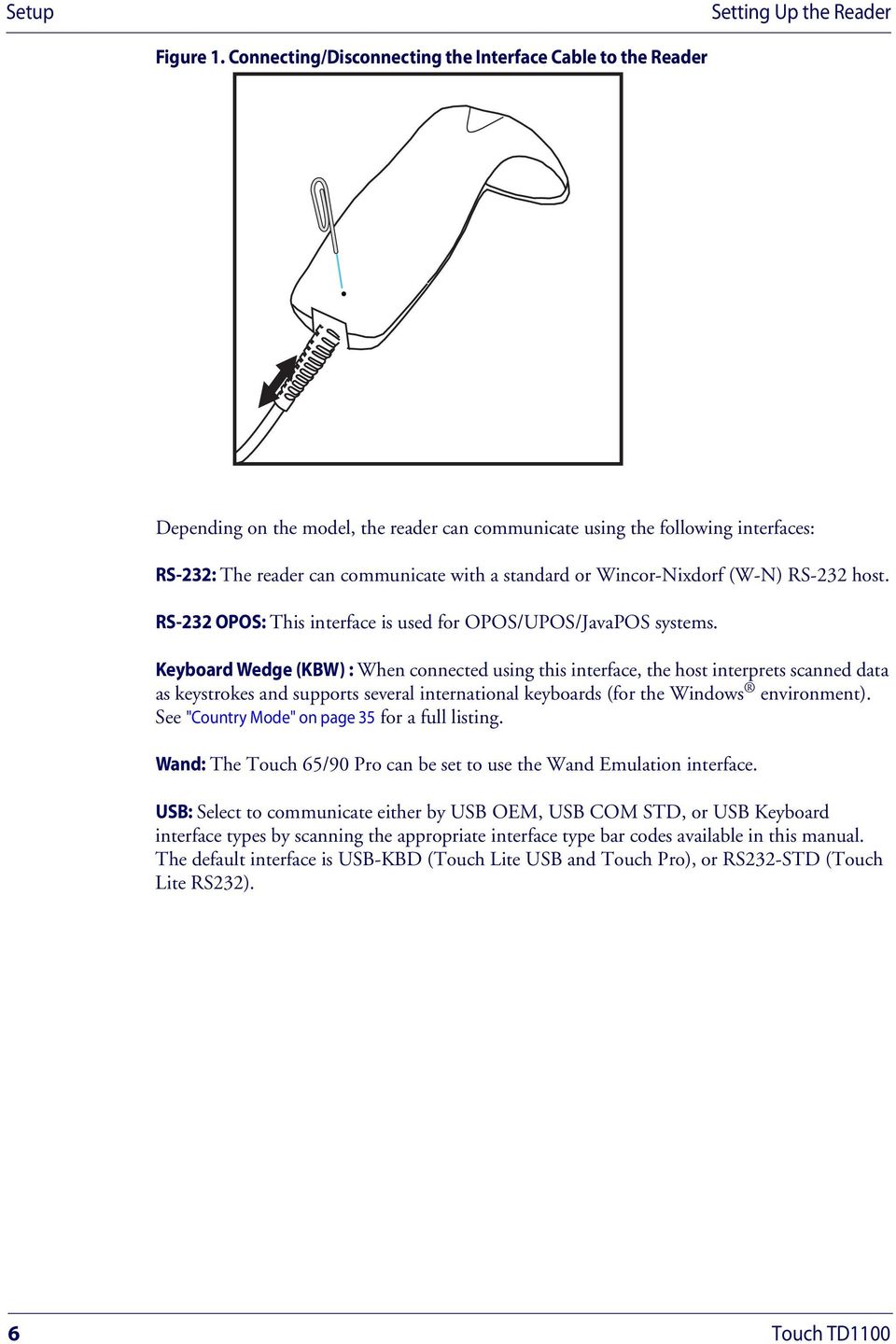
15 Chapter 2 Setup Unpacking Check carefully to ensure the reader and any accessories ordered are present and undamaged. If any damage occurred during shipment, contact Technical Support on page 2. KEEP THE PACKAGING. Should the unit ever require service, it should be returned in its original shipping container. Setting Up the Reader Follow the steps provided in this section to connect and get your reader up and communicating with its host: Install the Interface Cable 1. Install the Interface Cable (see below). 2. "Connect Host Interface" on page Modify "Customizing Configuration Settings" on page 12 (only if modifications are needed from factory settings). The reader kit you ordered to match your interface should provide a compatible cable for your installation. If not, contact Technical Support. Seat the cable assembly into the reader, aligning both the connector and the cable clip with its opening. To disconnect the cable, insert a paper clip or similar object into the opening on the reader, as shown in Figure 1 on page 6. Product Reference Guide 5

16 Setup Setting Up the Reader Figure 1. Connecting/Disconnecting the Interface Cable to the Reader Depending on the model, the reader can communicate using the following interfaces: RS-232: The reader can communicate with a standard or Wincor-Nixdorf (W-N) RS-232 host. RS-232 OPOS: This interface is used for OPOS/UPOS/JavaPOS systems. Keyboard Wedge (KBW) : When connected using this interface, the host interprets scanned data as keystrokes and supports several international keyboards (for the Windows environment). See "Country Mode" on page 35 for a full listing. Wand: The Touch 65/90 Pro can be set to use the Wand Emulation interface. USB: Select to communicate either by USB OEM, USB COM STD, or USB Keyboard interface types by scanning the appropriate interface type bar codes available in this manual. The default interface is USB-KBD (Touch Lite USB and Touch Pro), or RS232-STD (Touch Lite RS232). 6 Touch TD1100
17 Setting Up the Reader Connect Host Interface Setup RS-232 Serial Connection Turn off power to the terminal/pc and connect the reader to the terminal/pc serial port via the RS-232 cable as shown. If the terminal will not support POT (Power Off the Terminal) to supply reader power, use the approved power supply (AC Adapter). Plug the AC Adapter barrel connector into the socket on the RS-232 cable connector and the AC Adapter plug into a standard power outlet. RS-232 Interface RS-232 RS-232 Keyboard Wedge Connection The Keyboard Wedge cable has a Y connection from the reader. Connect the female to the male end from the keyboard and the remaining end at the keyboard port at the terminal/pc. Keyboard Wedge Interface Keyboard Product Reference Guide 7

18 Setup Holder/Hands-Free Stand USB Connection Connect the reader to a USB port on the terminal/pc using the correct USB cable for the interface type you ordered. USB Interface USB NOTE Specific cables are required for connection to different hosts. The connectors illustrated above are examples only. Actual connectors may vary from those illustrated, but the steps to connect the reader remain the same. Holder/Hands-Free Stand The TD1100 Holder can also be used as a hands-free stand. Insert the reader nose-first into the holder, then pass the bar code beneath the stand. Refer to "Configuration Using Bar Codes" starting on page 15 for information about programming the reader for use with the stand. Figure 2. Hands-Free Stand nds Free Mode 8 Touch TD1100

19 Interface Selection Setup Interface Selection Upon completing the physical connection between the reader and its host, proceed directly to "Configuring the Interface" on page 9 for information and programming for the interface type the reader is connected to (for example: RS-232, Keyboard Wedge, USB, etc.) and scan the appropriate bar code in tha section to select your system s correct interface type. The reader, depending upon the model, will support one of the following sets of host interfaces: USB Models (3.0 full speed) USB-KBD USB-COM STD USB-OEM USB-KBD-ALT RS-232 / Keyboard Wedge Models RS-232 (Standard, Wincor-Nixdorf, OPOS) Keyboard Wedge Wand Interface (TD1130 Pro only) Configuring the Interface Scan the programming bar code from the following section which selects the appropriate interface type matching the system the reader will be connected to. Next, proceed to the corresponding chapter in this manual (also listed in the table) to configure any desired settings and features associated with that interface. Unlike some other programming features and options, interface selections require that you scan only one programming bar code label. DO NOT scan an ENTER/EXIT bar code prior to scanning an interface selection bar code. Some interfaces require the reader to start in the disabled state when powered NOTE up. If additional reader configuration is desired while in this state, pull the trigger and hold it for five seconds. The reader will change to a state that allows programming with bar codes. Product Reference Guide 9

20 Setup Interface Selection Table 1. Available Interfaces RS-232 FEATURES $P,HA05,P RS-232 standard interface Select RS232-STD $P,HA12,P Select RS232-WN RS-232 for use with OPOS/UPOS/JavaPOS RS-232 Wincor-Nixdorf $P,HA13,P Set RS-232 Interface Features starting on page 19 $P,HA13,P Select RS-232 OPOS USB Com to simulate RS-232 standard interface USB-OEM Select USB-COM-STD a USB-OEM (can be used for OPOS/UPOS/JavaPOS) $P,HA45,P Select USB-OEM FEATURES Set USB-OEM Interface Features starting on page 47 a. Download the correct USB Com driver from KEYBOARD AT, PS/ , , 50, 50Z, 60, 70, 80, 90 & 95 w/standard Key Encoding $P,HA29,P Select KBD-AT FEATURES Set KEYBOARD WEDGE Interface Features starting on page Touch TD1100

21 Interface Selection Setup KEYBOARD (continued) FEATURES $P,HA11,P Keyboard Wedge for IBM AT PS2 with standard key encoding but without external keyboard Select KBD-AT-NK $P,HA26,P AT, PS/ , , 50, 50Z, 60, 70, 80, 90 & 95 w/alternate Key Select KBD-AT-ALT $P,HA10,P Select KBD-AT-ALT-NK PC/XT w/standard Key Encoding Keyboard Wedge for IBM AT PS2 with alternate key encoding but without external keyboard $P,HA28,P Set KEYBOARD WEDGE Interface Features starting on page 35 $P,HA35,P Select KBD-XT USB Keyboard with standard key encoding Select USB Keyboard $P,HA2B,P USB Keyboard with alternate key encoding WAND EMULATION Select USB Alternate Keyboard FEATURES Select WAND Wand Emulation Set WAND Interface Features starting on page 49 Product Reference Guide 11
22 Setup Customizing Configuration Settings Customizing Configuration Settings Using the Programming Bar Codes This manual contains feature descriptions and bar codes which allow you to reconfigure your reader. Some programming bar code labels, like "Resetting the Product Configuration to Defaults" on page 14, require only the scan of that single label to enact the change. Most of the programming labels in this manual, however, require the reader to be placed in Programming Mode prior to scanning them. Scan an ENTER/EXIT bar code once to enter Programming Mode. Once the reader is in Programming Mode, you can scan a number of parameter settings before scanning the ENTER/EXIT bar code a second time, which will then accept your changes, exit Programming Mode and return the reader to normal operation. NOTE There are some exceptions to the typical programming sequence described above. Please read the description and setting instructions carefully when configuring each given programmable feature. Datalogic Aladdin Programming can alternatively be performed using the Datalogic Aladdin Configuration application which is available for free download from the Datalogic website listed on the back cover of this manual. This multi-platform utility program allows device configuration using a PC. It communicates to the device using a serial or USB cable and can also create configuration bar codes to print. Datalogic Aladdin is a multi-platform utility program providing a quick and user-friendly configuration method via the RS-232/USB-COM interface. Aladdin is available on the CD- ROM provided with your product, and also from the Datalogic website. Aladdin allows you to program the reader by selecting configuration commands through a user-friendly graphical interface running on a PC. These commands are sent to the reader over the selected communication interface, or they can be printed as bar codes to be scanned. Aladdin also provides the ability to perform a software upgrade for the connected device (see the Datalogic Aladdin Help On-Line for more details). 12 Touch TD1100
23 Customizing Configuration Settings Setup Interface Settings The reader is typically factory-configured with a set of default features standard to the interface type you ordered. See "Interface Selection" on page 9. Global Interface Features, starting on page 17 provides settings configurable by all interface types. If your installation requires you to further customize your reader, you can select other options through use of the instructions and programming bar codes available in the appropriate section for your interface. RS-232 Only Interface, starting on page 19 RS-232/USB-Com Interfaces, starting on page 25 Keyboard Interface, starting on page 35 USB-OEM Interface, starting on page 47 Configuring Other Features If your installation requires different programming than the standard factory default settings, the following sections of this manual allow configuration of non-interface-specific settings you might require: Configuration Using Bar Codes: General Features includes programming for scanning, beeper and LED indicators and other such universal settings. Reading Parameters: Reading Parameters include programming for scanning, beeper and LED indicators and other universal settings. Symbologies: Includes options concerning the bar code label types (symbologies). These settings allow you to enable/disable symbologies, set label lengths, require check digit, etc. Software Version Transmission The software version of the device can be transmitted over the RS-232, Keyboard and USB interfaces by scanning the following label. RevA Transmit Software Version Product Reference Guide 13
24 Setup Customizing Configuration Settings Resetting the Product Configuration to Defaults If you aren't sure what programming options are in your reader, or you've changed some options and want to restore the Custom Default Configuration that may have been saved in the reader, scan the Restore Custom Default Configuration bar code below. This will restore the custom configuration for the currently active interface. NOTE Custom defaults are based on the interface type. Configure the reader for the correct interface before scanning this label. Restore Custom Default Configuration If you aren't sure what programming options are in your reader, or you've changed some options and want to restore the Factory Configuration, you have two options. You can scan the Restore USA Factory Configuration bar code or the Restore EU Factory Configuration bar code below. Both labels restore the reader configuration to the factory settings including the interface type. The USA label restores Label IDs to those historically used in the USA. The EU label restores Label IDs to those historically used in Europe. The Label ID sets for USA and EU are shown in the Label ID section of this manual. CAUTION Scanning either of the Restore Factory Configuration commands below will result in the loss of any custom configuration settings for your device. Restore USA Factory Configuration Restore EU Factory Configuration The programming section on the following pages lists the factory default settings for each of the menu commands (indicated by shaded blocks and bold text). 14 Touch TD1100
25 Chapter 3 Configuration Using Bar Codes This and following sections provide programming bar codes to configure your reader by changing the default settings. For details about additional methods of programming, see "Customizing Configuration Settings" on page 12. NOTE You must first enable your reader to read bar codes in order to use this section. If you have not done this, go to Setup, starting on page 5 and complete the appropriate procedure. Configuration Parameters Once the reader is set up, you can change the default parameters to meet your application needs. Refer to "Resetting the Product Configuration to Defaults" on page 14 for initial configuration in order to set the default values and select the interface for your application. The following configuration parameters are divided into logical groups, making it easy to find the desired function based on its reference group. Interface Configuration: "RS-232 Only Interface" on page 19 "RS-232/USB-Com Interfaces" on page 25 "Keyboard Interface" on page 35 "USB-OEM Interface" on page 47 Parameters common to all interface applications: "Global Prefix/Suffix" on page 54 "Data Format" on page 53 offers advanced configuration options for customization of scanned data output. "Reading Parameters" on page 67 control various operating modes and indicators status functioning. Symbology-specific parameters: "Symbologies" on page 87 defines options for all symbologies and provides the programming bar codes necessary for configuring these features. NOTE You must first enable your reader to read bar codes in order to use this section. If you have not done this, go to Setup, starting on page 5 and complete the appropriate procedure. Product Reference Guide 15
26 Enter/Exit Programming Mode To program features: 1. Scan the ENTER/EXIT PROGRAMMING bar code, available at the top of each programming page, when applicable. 2. Scan the bar code to set the desired programming feature. You may need to cover unused bar codes on the page, and possibly the facing page, to ensure that the reader reads only the bar code you intend to scan. 3. If additional input parameters are needed, go to Appendix D, Keypad, and scan the appropriate characters from the keypad. Additional information about many features can be found in the References chapter. NOTE If you make a mistake before the last character, scan the CANCEL bar code to abort and not save the entry string. You can then start again at the beginning. 4. Complete the programming sequence by scanning the ENTER/EXIT PROGRAM- MING bar code to exit Programming Mode. For more detailed descriptions, programming information and examples for setting selected configuration items, see References, starting on page Touch TD1100
27 GLOBAL INTERFACE FEATURES Enter/Exit Programming Mode The following interface features are configurable by all interface types. To set features specific to your interface, turn to that section of this manual: "RS-232 Only Interface" on page 19 "RS-232/USB-Com Interfaces" on page 25 "Keyboard Interface" on page 35 "USB-OEM Interface" on page 47 Host Commands Obey/Ignore This option specifies whether the reader will obey or ignore host commands. When set to ignore, the reader will ignore all host commands except for those necessary for: service mode flash programming mode keeping the interface active transmission of labels. $CIFIH00 $CIFIH01 Host Commands = Obey Host Commands = Ignore Product Reference Guide 17
28 Enter/Exit Programming Mode USB Suspend Mode The reader always goes to USB suspend mode (low power consumption) when the connected PC goes to standby mode. This setting enables/disables the ability of USB interfaces to wake up the PC by a trigger pull. When disabled, a scanner with a USB keyboard interface active will not wake up the PC by trigger pull. $CUSSE01 $CUSSE00 USB Suspend Mode = Disable USB Suspend Mode = Enable 18 Touch TD1100
29 RS-232 Standard Factory Settings RS-232 ONLY INTERFACE Enter/Exit Programming Mode Use the programming bar codes in this chapter if modifications to the standard RS-232 interface settings are necessary to meet your system s requirements. Additional settings which apply to both the RS-232 and USB interfaces are available in Chapter 3, RS-232/USB-Com Interfaces. RS-232 Standard Factory Settings Baud Rate Reference Appendix B, Standard Defaults for a listing of standard factory settings. Baud rate is the number of bits of data transmitted per second. Set the reader's baud rate to match the baud rate setting of the host device. With an improper baud rate setting, data may not reach the host correctly. $CR2BA00 $CR2BA01 Baud Rate = 1200 Baud Rate = 2400 $CR2BA02 Baud Rate = 4800 Product Reference Guide 19
30 Enter/Exit Programming Mode Baud Rate Baud Rate continued $CR2BA03 Baud Rate = 9600 $CR2BA04 $CR2BA05 Baud Rate = 19,200 Baud Rate = 38,400 $CR2BA06 $CR2BA07 Baud Rate = 57,600 Baud Rate = 115, Touch TD1100
31 Data Bits Data Bits Enter/Exit Programming Mode This parameter allows the reader to interface with devices requiring a 7-bit or 8-bit ASCII protocol for sending and receiving data. The scanner cannot support 7-bit-data when parity-none is set. NOTE $CR2DA00 $CR2DA01 7 Data Bits 8 Data Bits Stop Bits The stop bit(s) at the end of each transmitted character marks the end of transmission of one character and prepares the receiving device for the next character in the serial data stream. The number of stop bits selected (one or two) depends on the number the receiving terminal is programmed to accommodate. Set the number of stop bits to match host device requirements. $CR2ST00 $CR2ST01 1 Stop Bit 2 Stop Bits Product Reference Guide 21
32 Enter/Exit Programming Mode Parity Parity This feature specifies parity required for sending and receiving data. A parity check bit is the most significant bit of each ASCII coded character. Select the parity type according to host device requirements. Select None when no parity bit is required. Select Odd parity and the parity bit value is set to 0 or 1, based on data, to ensure that an odd number of 1 bits are contained in the coded character. Select Even parity and the parity bit value is set to 0 or 1, based on data, to ensure that an even number of 1 bits are contained in the coded character. $CR2PA00 $CR2PA01 Parity = None Parity = Even $CR2PA02 Parity = Odd 22 Touch TD1100
33 Handshaking Control Enter/Exit Programming Mode Handshaking Control The data interface consists of an RS-232 port designed to operate either with or without the hardware handshaking lines, Request to Send (RTS), and Clear to Send (CTS). Handshaking Control includes the following options: RTS RTS is asserted during transmissions. CTS is ignored. RTS/CTS RTS is asserted during transmissions. CTS gates transmissions. RTS/XON/XOFF RTS is asserted during transmissions. CTS is ignored. XON and XOFF gate transmissions. RTS On/CTS RTS is always asserted. CTS gates transmissions. RTS/CTS Scan Control RTS is asserted during transmissions. CTS gates transmissions and controls enable and disable state of reader. $CR2HC00 $CR2HC01 Handshaking Control = RTS Handshaking Control = RTS/CTS $CR2HC02 $CR2HC03 Handshaking Control = RTS/XON/XOFF Handshaking Control = RTS On/CTS $CR2HC04 Handshaking Control = RTS/CTS Scan Control Product Reference Guide 23
34 NOTES 24 Touch TD1100
35 Standard Factory Settings RS-232/USB-COM INTERFACES Enter/Exit Programming Mode The programming bar codes in this chapter allow modifications to the standard RS-232 and USB-Com interfaces. Standard Factory Settings Reference Appendix B, Standard Defaults for a listing of standard factory settings. Intercharacter Delay This parameter specifies the intercharacter delay between the end of one character and the beginning of the next. The delay can be set within a range of zero (0) to 990 milliseconds in 10ms increments. A setting of zero specifies no delay. See "Label ID: Pre-loaded Sets" on page 266 for more detailed programming instructions. $CR2IC00 Intercharacter Delay = No Delay $CR2IC Select Intercharacter Delay Setting Make a mistake? Scan the CANCEL bar code to abort and not save the entry string. You can then start again at the beginning. To configure this feature, scan the ENTER/EXIT bar code above, then the bar code at left followed by digits from the Alphanumeric characters in Appendix D, Keypad representing your desired character(s). End by scanning the ENTER/ EXIT bar code again. ~ CANCEL 00 = No Intercharacter Delay Product Reference Guide 25
36 Enter/Exit Programming Mode Beep On ASCII BEL Beep On ASCII BEL When this parameter is enabled, the reader issues a beep when a <BEL> character is detected on the RS-232 serial line. <BEL> is issued to gain a user's attention to an illegal entry or other important event. $CR2BB00 Beep On ASCII BEL = Disable $CR2BB01 Beep On ASCII BEL = Enable Beep On Not on File This option enables/disables the action of the reader to sound a three beep sequence upon receiving a Not-On-File (NOF) host command. $CBPNF00 Beep On Not On File = Disable $CBPNF01 Beep On Not On File = Enable 26 Touch TD1100
37 ACK NAK Options Enter/Exit Programming Mode ACK NAK Options This enables/disables the ability of the reader to support the RS-232 ACK/NAK protocol. When configured, the reader and/or host sends an ACK when it receives data properly, and sends NAK when the data is in error. Options are: Disable Enable for label transmission The reader expects an ACK/NAK response from the host when a label is sent. Enable for host-command acknowledge The reader will respond with ACK/NAK when the host sends a command. Enable for label transmission and host-command acknowledge $CR2AE00 $CR2AE01 ACK/NAK Protocol = Disable ACK/NAK ACK/NAK Protocol = Enable for label transmission $CR2AE02 $CR2AE03 ACK/NAK Protocol = Enable for host-command acknowledge ACK/NAK Protocol = Enable for label transmission and hostcommand acknowledge Product Reference Guide 27
38 Enter/Exit Programming Mode ACK NAK Options ACK Character This setting specifies an ASCII character or hex value to be used as the ACK character. ASCII characters or any hex value from 0 to 0xFF can be selected. See "ACK Character" on page 254 for more detailed programming instructions. NOTE Setting to previously defined characters such as XON, XOFF, or host commands conflicts with normal operation of these characters. 8- bit data is not recognized when the option Data Bits has been set as 7 Data Bits. $CR2AC Select ACK Character Setting 0x06 ACK Character NAK Character This setting specifies an ASCII character or hex value to be used as the NAK character. ASCII characters or any hex value from 0 to 0xFF can be selected. See "NAK Character" on page 255 for more detailed programming instructions. NOTE Setting to previously defined characters such as XON, XOFF, or host commands conflicts with normal operation of these characters. 8- bit data is not recognized when the option Data Bits has been set as 7 Data Bits. $CR2NA Select NAK Character Setting 0x15 NAK Character 28 Touch TD1100
39 ACK NAK Options Enter/Exit Programming Mode ACK NAK Timeout Value This option specifies the amount of time the reader waits for an ACK character from the host following label transmission. The selectable timeout range is 200 milliseconds to 15,000ms (15 seconds) in 200ms increments. A selection of 0 disables the timeout. See "ACK NAK Timeout Value" on page 256 for more detailed programming instructions. $CR2AT Select ACK NAK Timeout Value Setting Make a mistake? Scan the CANCEL bar code to abort and not save the entry string. You can then start again at the beginning. To configure this feature, scan the ENTER/EXIT bar code above, then the bar code at left followed by digits from the Alphanumeric characters in Appendix D, Keypad representing your desired character(s). End by scanning the ENTER/ EXIT bar code again. ~ CANCEL 01 ACK NAK Timeout value is 200ms Product Reference Guide 29
40 Enter/Exit Programming Mode ACK NAK Options ACK NAK Retry Count This feature specifies the number of times the reader retries a label transmission due to a retry condition. The selectable range is from 1 to 254 retries. A selection of 0 disables the count, and a selection of 255 specifies unlimited retries. See "ACK NAK Retry Count" on page 257 for more detailed programming instructions. $CR2AR Select ACK NAK Retry Count Setting Make a mistake? Scan the CANCEL bar code to abort and not save the entry string. You can then start again at the beginning. To configure this feature, scan the ENTER/EXIT bar code above, then the bar code at left followed by digits from the Alphanumeric characters in Appendix D, Keypad representing your desired character(s). End by scanning the ENTER/ EXIT bar code again. ~ CANCEL 003 = 3 Retries 30 Touch TD1100
41 ACK NAK Options Enter/Exit Programming Mode ACK NAK Error Handling This feature specifies the method the reader uses to handle receive errors detected while waiting for an ACK character from the host. Options are: Ignore errors detected Process error as valid ACK character Process error as valid NAK character $CR2EH00 $CR2EH01 ACK NAK Error Handling = Ignore Errors Detected ACK NAK Error Handling = Process Error as Valid ACK Character $CR2EH02 ACK NAK Error Handling = Process Error as Valid NAK Character Product Reference Guide 31
42 Enter/Exit Programming Mode Indicate Transmission Failure Indicate Transmission Failure This option enables/disables the reader s ability to sound an error beep to indicate a transmission failure while in ACK/NAK mode. $CR2TF00 Indicate Transmission Failure = Disable Indication $CR2TF01 Indicate Transmission Failure = Enable Indication Disable Character Specifies the value of the RS-232 host command used to disable the reader. ASCII characters or any hex value from 0 to 0xFF can be selected. See "Disable Character" on page 258 for more detailed programming instructions. NOTE Setting to previously defined characters such as XON, XOFF, or host commands conflicts with normal operation of these characters. 8- bit data is not recognized when the option Data Bits has been set as 7 Data Bits. $CR2DC Select Disable Character Setting 0x44 = Disable Character is D 32 Touch TD1100
43 Enable Character Enable Character Enter/Exit Programming Mode Specifies the value of the RS-232 host command used to enable the reader. ASCII characters or any hex value from 0 to 0xFF can be selected. See "Enable Character" on page 259 for more detailed programming instructions. NOTE Setting to previously defined characters such as XON, XOFF, or host commands conflicts with normal operation of these characters. 8- bit data is not recognized when the option Data Bits has been set as 7 Data Bits. $CR2EC Select Enable Character Setting 0x45 = Enable Character is E Product Reference Guide 33
44 Enter/Exit Programming Mode NOTES Enable Character 34 Touch TD1100
45 Country Mode Enter/Exit Programming Mode Country Mode KEYBOARD INTERFACE Use the programming bar codes in this chapter to select options for USB Keyboard and Wedge Interfaces. Reference Appendix B, Standard Defaults for a listing of standard factory settings. Information about control character emulation which applies to keyboard interfaces is listed in Appendix E, Scancode Tables. This feature specifies the country/language supported by the keyboard. Only the following interfaces support ALL Country Modes. USB Keyboard (without alternate key encoding) Keyboard Wedge All other interfaces support ONLY the following Country Modes: U.S., Belgium, Britain, France, Germany, Italy, Spain, Sweden. $CKBCO00 $CKBCO01 Country Mode = U.S. Country Mode = Belgium $CKBCO02 $CKBCO11 Country Mode = Croatia Supports only the interfaces listed in the Country Mode feature description. Country Mode = Britain Supports only the interfaces listed in the Country Mode feature description. $CKBCO0E Country Mode = Czech Republic Product Reference Guide 35
46 Enter/Exit Programming Mode Country Mode Country Mode continued $CKBCO03 Supports only the interfaces listed in the Country Mode feature description. Country Mode = Denmark $CKBCO04 $CKBCO05 Country Mode = France Country Mode = Germany $CKBCO0D Supports only the interfaces listed in the Country Mode feature description. $CKBCO06 Country Mode = Hungary Country Mode = Italy $CKBCO0C Supports only the interfaces listed in the Country Mode feature description. $CKBCO07 Country Mode = Japanese 106-key Supports only the interfaces listed in the Country Mode feature description. Country Mode = Norway 36 Touch TD1100
47 Country Mode Enter/Exit Programming Mode Country Mode continued $CKBCO12 Supports only the interfaces listed in the Country Mode feature description. Country Mode = Poland $CKBCO08 Supports only the interfaces listed in the Country Mode feature description. $CKBCO10 Country Mode = Portugal Supports only the interfaces listed in the Country Mode feature description. Country Mode = Romania $CKBCO0F Supports only the interfaces listed in the Country Mode feature description. $CKBCO09 Country Mode = Slovakia Country Mode = Spain $CKBCO0A $CKBCO0B Country Mode = Sweden Supports only the interfaces listed in the Country Mode feature description. Country Mode = Switzerland Product Reference Guide 37
48 Enter/Exit Programming Mode Caps Lock State Caps Lock State This option specifies the format in which the reader sends character data. This applies to Keyboard Wedge interfaces. This does not apply when an alternate key encoding keyboard is selected. $CKBCL00 $CKBCL01 Caps Lock State = Caps Lock OFF Caps Lock State = Caps Lock ON $CKBCL02 Caps Lock State = AUTO Caps Lock Enable Numlock This option specifies the setting of the Numbers Lock (Numlock) key while in Keyboard Wedge interface. This only applies to alternate key encoding interfaces. It does not apply to USB Keyboard. $CKBNL00 $CKBNL01 Numlock = Numlock key unchanged Numlock = Numlock key toggled 38 Touch TD1100
49 Keyboard Numeric Keypad Keyboard Numeric Keypad Enter/Exit Programming Mode This feature specifies if numeric characters will be sent using the standard keys or the numeric keypad. $CKBKP00 $CKBKP01 Keyboard Numeric Keypad = Standard Keys Keyboard Numeric Keypad = Numeric Keypad Product Reference Guide 39
50 Enter/Exit Programming Mode Keyboard Send Control Characters Keyboard Send Control Characters This feature is used by the Keyboard Wedge and USB Keyboard interfaces. It specifies how the reader transmits ASCII control characters to the host. Reference Appendix E, Scancode Tables for more information about control characters. Options are as follows: Send Ctrl+Key : ASCII characters from 00H to 0x1FH inclusive are transmitted in the format Ctrl+Key. Special keys are available in the range from 81H to A1. Send Ctrl+Shift+Key : The behavior is the same as above, but control keys are sent in the format Ctrl+Shift+Keys. Send Special Function Key : Send characters between 00H and 1FH according to the special function key mapping table (see "Microsoft Windows Codepage 1252" on page 318). This is used to send keys that are not in the normal ASCII set. A unique set is provided for each available scancode set. $CKBSC00 $CKBSC01 Keyboard Send Control Characters = 00 Keyboard Send Control Characters = 01 $CKBSC02 Keyboard Send Control Characters = Touch TD1100
51 Wedge Quiet Interval Wedge Quiet Interval Enter/Exit Programming Mode This option specifies the amount of time to look for keyboard activity before the reader breaks the keyboard connection in order to transmit data to host. The selectable range for this feature is from 0 to 990ms in 10ms increments. See "Wedge Quiet Interval" on page 260 for more detailed programming instructions. NOTE This feature applies ONLY to the Keyboard Wedge interface. $CKBQI Select Wedge Quiet Interval Setting Make a mistake? Scan the CANCEL bar code to abort and not save the entry string. You can then start again at the beginning. To configure this feature, scan the ENTER/EXIT bar code above, then the bar code at left followed by digits from the Alphanumeric characters in Appendix D, Keypad representing your desired character(s). End by scanning the ENTER/EXIT bar code again. ~ CANCEL 10 = Quiet Interval of 100 ms Product Reference Guide 41
52 Enter/Exit Programming Mode Intercharacter Delay Intercharacter Delay This parameter specifies the intercharacter delay between the end of one character and the beginning of the next. The delay can be set within a range of zero (0) to 990 milliseconds in 10ms increments. A setting of zero specifies no delay. See "Intercharacter Delay" on page 261 for more detailed programming instructions. NOTE This feature applies ONLY to the Keyboard Wedge interface. $CR21C00 Intercharacter Delay = No Delay $CR21C Select Intercharacter Delay Setting Make a mistake? Scan the CANCEL bar code to abort and not save the entry string. You can then start again at the beginning. To configure this feature, scan the ENTER/EXIT bar code above, then the bar code at left followed by digits from the Alphanumeric characters in Appendix D, Keypad representing your desired character(s). End by scanning the ENTER/EXIT bar code again. ~ CANCEL 00 = No Intercharacter Delay 42 Touch TD1100
53 Intercode Delay Intercode Delay Enter/Exit Programming Mode Specifies the delay between labels transmitted to the host for this interface. The selectable range for this feature is from 0 to 99 seconds. See "Intercode Delay" on page 262 for more detailed programming instructions. $CKBID Set Intercode Delay Make a mistake? Scan the CANCEL bar code to abort and not save the entry string. You can then start again at the beginning. To configure this feature, scan the ENTER/EXIT bar code above, then the bar code at left followed by digits from the Alphanumeric characters in Appendix D, Keypad representing your desired character(s). End by scanning the ENTER/EXIT bar code again. ~ CANCEL 00 = No Wedge Intercode Delay Product Reference Guide 43
54 Enter/Exit Programming Mode USB Keyboard Speed This option specifies the USB poll rate for a USB Keyboard. USB Keyboard Speed This feature applies ONLY to the USB Keyboard interface. NOTE $CKBSP01 $CKBSP02 USB Keyboard Speed = 1ms USB Keyboard Speed = 2ms $CKBSP03 $CKBSP04 USB Keyboard Speed = 3ms USB Keyboard Speed = 4ms $CKBSP05 USB Keyboard Speed = 5ms 44 Touch TD1100
55 USB Keyboard Speed Enter/Exit Programming Mode USB Keyboard Speed continued $CKBSP06 USB Keyboard Speed = 6ms $CKBSP07 $CKBSP08 USB Keyboard Speed = 7ms USB Keyboard Speed = 8ms $CKBSP09 $CKBSP0A USB Keyboard Speed = 9ms USB Keyboard Speed = 10ms Product Reference Guide 45
56 Enter/Exit Programming Mode NOTES USB Keyboard Speed 46 Touch TD1100
57 Introduction USB-OEM INTERFACE Feature settings for USB interfaces differ depending upon which host type the reader will be connected with. Use the feature settings in this chapter to specifically configure for the USB- OEM interface. Other USB interfaces are included in the appropriate chapter for their host type. Standard Factory Settings Reference Appendix B, Standard Defaults for a listing of standard factory settings. Product Reference Guide 47
58 Enter/Exit Programming Mode USB-OEM Device Usage USB-OEM Device Usage The USB-OEM protocol allows for the reader to be identified as one of two different types of bar code readers. Depending on what other scanners you may already have connected to a USB- OEM POS, you may need to change this setting to enable all devices to communicate. Options are: Table Top Scanner Handheld Scanner NOTE It may be necessary to switch device usage when connecting two readers/scanners of the same type to a POS system. $CIBUT00 $CIBUT01 USB-OEM Device Usage = Table Top Scanner USB-OEM Device Usage = Handheld Scanner USB-OEM Interface Options This setting provides for an interface specific control mechanism. Options are: Obey Obey Reader Configuration Host Commands Ignore Ignore Reader Configuration Host Commands $CIFO101 $CIFO102 USB-OEM Interface Options = Obey USB-OEM Interface Options = Ignore 48 Touch TD1100
59 WAND EMULATION INTERFACE Enter/Exit Programming Mode WAND SIGNAL SPEED on page 49 WAND POLARITY on page 50 WAND IDLE STATE on page 50 TRANSMIT NOISE on page 51 LABEL SYMBOLOGY CONVERSION on page 52 This chapter provides feature/settings configuration for the Wand Emulation interface. Reference Appendix B, Standard Defaults for a listing of standard factory settings. Wand Signal Speed This feature specifies the speed of the Wand output signal per nominal bar or space. Choices are: 330 microseconds 660 microseconds Wand Signal Speed = 330ms Wand Signal Speed = 660ms Product Reference Guide 49
60 Enter/Exit Programming Mode Wand Polarity This option specifies the polarity of the Wand output signal. Choices are: Quiet zones and spaces are high, bars are low Quiet zones and spaces are low, bars are high NOTE TTL logic levels: 0V <= Low <= 0.7V 2.4V <= High <= 5.25V Wand Polarity = Quiet Zones & Spaces High, Bars Low Wand Polarity = Quiet Zones & Spaces Low, Bars High Wand Idle State This feature specifies the level of the Wand output signal when the reader is idle. NOTE TTL logic levels: 0V <= Low <= 0.7V 2.4V <= High <= 5.25V Wand Idle State = Low Wand Idle State = High 50 Touch TD1100
61 Transmit Noise This option specifies the leading/trailing noise for the Wand interface. Enter/Exit Programming Mode Transmit Noise = Disable Transmit Noise = Transmit leading noise Transmit Noise = Transmit trailing noise Transmit Noise = Transmit leading and trailing noise Product Reference Guide 51
62 Enter/Exit Programming Mode Label Symbology Conversion When this feature is enabled for the Wand Emulation interface, all barcode labels are converted to a single symbology. Options are: No conversion Convert to Code 39 symbology Convert to Code 39 Full ASCII Convert to Code 128 symbology Label Symbology Conversion = No conversion Label Symbology Conversion = Convert to Code 39 Label Symbology Conversion = Convert to Code 39 Full ASCII Label Symbology Conversion = Convert to Code Touch TD1100
63 DATA FORMAT GLOBAL PREFIX/SUFFIX on page 54 GLOBAL AIM ID on page 55 LABEL ID starting on page 56 Label ID: Pre-loaded Sets Label ID: Set Individually Per Symbology Label ID Control Label ID Symbology Selection SET GLOBAL MID LABEL ID CHARACTER(S) on page 64 CASE CONVERSION on page 65 CHARACTER CONVERSION on page 66 The features in this chapter can be used to build specific user-defined data into a message string. See "References" starting on page 251 for more detailed instructions on setting these features. Product Reference Guide 53
64 Enter/Exit Programming Mode Global Prefix/Suffix Global Prefix/Suffix Up to 20 ASCII characters may be added as a prefix (in a position before the bar code data) and/ or as a suffix (in a position following the bar code data). See "Global Prefix/Suffix" on page 264 for more detailed programming instructions. To configure this feature, scan the ENTER/EXIT bar code above, then the bar code at left followed by digits from the Alphanumeric characters in Appendix D, Keypad representing your desired character(s). End by scanning the ENTER/EXIT bar code again. $CLFSU Set Global Suffix Make a mistake? Scan the CANCEL bar code to abort and not save the entry string. You can then start again at the beginning. $CLFPR Set Global Prefix To configure this feature, scan the ENTER/EXIT bar code above, then the bar code at left followed by digits from the Alphanumeric characters in Appendix D, Keypad representing your desired character(s). End by scanning the ENTER/EXIT bar code again. ~ CANCEL No Global Prefix Global Suffix = 0x0D(CR) 54 Touch TD1100
65 Global AIM ID Global AIM ID Enter/Exit Programming Mode NOTE This feature enables/disables addition of AIM IDs for all symbology types. AIM label identifiers (as opposed to custom characters you select yourself as with label identifiers) can be included with scanned bar code data. See "Global AIM ID" on page 265 for more detailed programming instructions. $CAIEN00 $CAIEN01 Global AIM ID = Disable Global AIM ID = Enable GS1-128 AIM ID If Global AIM ID is disabled, the AIM ID for GS1-128 can be enabled/disabled independently. The AIM ID for GS1-128 is a ]C1, ]C2 or ]C3. AIM IDs for other symbologies can be enabled/disabled independently as well. Contact Customer Support for assistance. $CU8AI00 $CU8AI01 GS1-128 AIM ID = Disable GS1-128 AIM ID = Enable Product Reference Guide 55
66 Enter/Exit Programming Mode Label ID Label ID A Label ID is a customizable code of up to three ASCII characters (each can be one of hex 0x01-0xFF), used to identify a bar code (symbology) type. It can be appended previous to or following the transmitted bar code data depending upon how this option is enabled. This feature provides options for configuring custom Label IDs as a pre-loaded set (see "Label ID: Pre-loaded Sets" on page 56) or individually per symbology (see "Label ID: Set Individually Per Symbology" on page 57). If you wish to program the reader to always include an industry standard label identifier for ALL symbology types, see the previous feature "Global AIM ID" on page 55. Label ID: Pre-loaded Sets The reader supports two pre-loaded sets of Label IDs. shows the USA set and the EU set. See "Label ID: Pre-loaded Sets" on page 266 for more information concerning the pre-loaded sets that are provided. CAUTION When changing from one Label ID set to another, all other reader configuration settings, including the host interface type, will be erased and set to the factory defaults. Any custom configuration or custom defaults will be lost. $AE $Ae Label ID Pre-loaded Set = USA Set Label ID Pre-loaded Set = EU Set 56 Touch TD1100
67 Label ID Enter/Exit Programming Mode Label ID: Set Individually Per Symbology This feature configures a Label ID individually for a single symbology. NOTE This setting requires the scanning of bar codes from multiple sections. See "Label ID: Set Individually Per Symbology" on page 268 for more detailed programming instructions. Label ID Control This option controls whether a Label ID is disabled, or sent as a prefix or suffix for a given symbology type. $CIDCO00 $CIDCO01 Label ID Transmission = Disable Label ID Transmission = Enable as Prefix $CIDCO02 ~ CANCEL Label ID Transmission = Enable as Suffix Make a mistake? Scan the CANCEL bar code to abort and not save the entry string. You can then start again at the beginning. Product Reference Guide 57
68 Enter/Exit Programming Mode Label ID Label ID Symbology Selection This option selects the symbology for which a Label ID is to be configured. See "Label ID: Set Individually Per Symbology" on page 268 for full instructions. $CABID $CA2ID Set UPC-A Label ID Character(s) Set UPC-A/P2 Label ID Character(s) $CA5ID $CA8ID Set UPC-A/P5 Label ID Character(s) Set UPC-A/GS1-128 Label ID Character(s) $CEBID $CE2ID Set UPC-E Label ID Character(s) Set UPC-E/P2 Label ID Character(s) $CE5ID Set UPC-E/P5 Label ID Character(s) 58 Touch TD1100
69 Label ID Enter/Exit Programming Mode Label ID Symbology Selection continued $CE8ID Set UPC-E/GS1-128 Label ID Character(s) $C3BID $C32ID Set EAN 13 Label ID Character(s) Set EAN 13/P2 Label ID Character(s) $C35ID $C38ID Set EAN 13/P5 Label ID Character(s) Set EAN 13/GS1-128 Label ID Character(s) $C8BID $C82ID Set EAN 8 Label ID Character(s) Set EAN 8/P2 Label ID Character(s) $C85ID Set EAN 8/P5 Label ID Character(s) Product Reference Guide 59
70 Enter/Exit Programming Mode Label ID Label ID Symbology Selection continued $C88ID Set EAN 8/GS1-128 Label ID Character(s) $C4BID $CXBID Set GS1 DataBar Omnidirectional Label ID Character(s) Set GS1 DataBar Expanded Label ID Character(s) $CLBID $CC3ID Set GS1 DataBar Limited Label ID Character(s) Set Code 39 Label ID Character(s) $CP3ID $CCCID Set Code 32 Label ID Character(s) Set Code 39 CIP Label ID Character(s) 60 Touch TD1100
71 Label ID Enter/Exit Programming Mode Label ID Symbology Selection continued $CC8ID Set Code 128 Label ID Character(s) $CU8ID Set GS1-128 Label ID Character(s) $CI2ID Set Interleaved 2 of 5 Label ID Character(s) $CHRID $CD2ID Set Interleaved 2 of 5 CIP HR Label ID Character(s) Set Datalogic 2 of 5 CIP HR Label ID Character(s) $CCBID $CACID Set Codabar Label ID Character(s) Set ABC Codabar Label ID Character(s) Product Reference Guide 61
72 Enter/Exit Programming Mode Label ID Label ID Symbology Selection continued $CC1ID Set Code 11 Label ID Character(s) $CS2ID $CU2ID Set Standard 2 of 5 Label ID Character(s) Set Industrial 2 of 5 Label ID Character(s) $CINID $CIAID Set ISSN Label ID Character(s) Set IATA Label ID Character(s) $CI8ID $CMSID Set Concatenated ISBT 128 Label ID Character(s) Set MSI Label ID Character(s) $CC9ID Set Code 93 Label ID Character(s) 62 Touch TD1100
73 Label ID Enter/Exit Programming Mode Label ID Symbology Selection continued $CCFID Set Codablock F Label ID Character(s) $CCRID $CCC5ID Set Code 4 Label ID Character(s) $ Set Code 5 Label ID Character(s) $CF2ID $CISID $ Set Follett 2 of 5 Label ID Character(s) Set ISBN Label ID Character(s) Set Concatenated ISBT Label ID Character(s) Product Reference Guide 63
74 Enter/Exit Programming Mode Set Global Mid Label ID Character(s) Set Global Mid Label ID Character(s) Specifies a mid-label ID that is added for transmission between the labels of a two label pair. The expected string is a maximum of 20 characters. When combining two label pairs into a single label for transmission to the host, this label ID can be added to the data, following the first label and preceding the second label. See "Set Global Mid Label ID Character(s)" on page 270 for more detailed programming instructions. $CN2MI Set Global Mid Label ID Character(s) Make a mistake? Scan the CANCEL bar code to abort and not save the entry string. You can then start again at the beginning. To configure this feature, scan the ENTER/EXIT bar code above, then the bar code at left followed by digits from the Alphanumeric characters in Appendix D, Keypad representing your desired character(s). End by scanning the ENTER/EXIT bar code again. ~ CANCEL No Global Mid Label ID Character(s) Touch TD1100
75 Case Conversion Enter/Exit Programming Mode Case Conversion This feature allows conversion of the case of all alphabetic characters to upper or lower case. NOTE Case conversion affects ONLY scanned bar code data, and does not affect Label ID, Prefix, Suffix, or other appended data. $CLFCA00 Case Conversion = Disable (no case conversion) $CLFCA01 Case Conversion = Convert to upper case $CLFCA02 Case Conversion = Convert to lower case Product Reference Guide 65
76 Enter/Exit Programming Mode Character Conversion Character Conversion Character conversion is an eight byte configuration item. The eight bytes are 4 character pairs represented in hexadecimal ASCII values. The first character in the pair is the character that will be converted. The second character in the pair is the character to convert to. If the character to convert in a pair is FF, then no conversion is done. See "Character Conversion" on page 270 for more detailed programming instructions. $CLFCH Configure Character Conversion 0xFFFFFFFFFFFFFFFF(N o character conversion) 66 Touch TD1100
77 READING PARAMETERS DOUBLE READ TIMEOUT on page 68 GOOD READ BEEP VOLUME on page 76 LABEL GONE TIMEOUT on page 70 GOOD READ LED DURATION on page 79 POWER SAVE MODE on page 71 SCAN MODE on page 80 LED AND BEEPER INDICATORS on page 73 STAND MODE TRIGGERED TIMEOUT on page 81 POWER ON ALERT on page 73 SCANNING ACTIVE TIME on page 83 GOOD READ: WHEN TO INDICATE on page 74 STAND MODE FLASH on page 83 GOOD READ BEEP TYPE on page 75 FLASH ON TIME on page 84 GOOD READ BEEP FREQUENCY on page 75 FLASH OFF TIME on page 84 GOOD READ BEEP LENGTH on page 77 STAND MODE SENSITIVITY on page 85 Product Reference Guide 67
78 Enter/Exit Programming Mode Double Read Timeout Double Read Timeout To prevent a double read of the same label, the Double Read Timeout sets the minimum time allowed between reads of labels of the same symbology and data. If the unit reads a label and sees the same label again within the Double Read Timeout, the second read of the label will be ignored. Double Read Timeout does not apply to scan modes that require a trigger pull for each label that is read. $CSNDR0A $CSNDR14 Double Read Timeout = 0.1 Second Double Read Timeout = 0.2 Second $CSNDR1E $CSNDR28 Double Read Timeout = 0.3 Second Double Read Timeout = 0.4 Second 68 Touch TD1100
79 Double Read Timeout Enter/Exit Programming Mode Double Read Timeout continued $CSNDR32 Double Read Timeout = 0.5 Second $CSNDR3C Double Read Timeout = 0.6 Second $CSNDR46 Double Read Timeout = 0.7 Second $CSNDR50 Double Read Timeout = 0.8 Second $CSNDR5A Double Read Timeout = 0.9 Second $CSNDR64 Double Read Timeout = 1 Second Product Reference Guide 69
80 Enter/Exit Programming Mode Label Gone Timeout Label Gone Timeout This feature sets the time after the last label segment is seen before the reader prepares for a new label. The timeout can be set within a range of 10 milliseconds to 2,550 milliseconds (2.55 seconds) in 10ms increments. Label Gone Timeout does not apply to scan modes that require a trigger pull for each label that is read. See "Label Gone Timeout" on page 272 for more detailed programming instructions. $CSNLG Select Label Gone Timeout Setting Make a mistake? Scan the CANCEL bar code to abort and not save the entry string. You can then start again at the beginning. To configure this feature, scan the ENTER/EXIT bar code above, then the bar code at left followed by digits from the Alphanumeric characters in Appendix D, Keypad representing your desired character(s). End by scanning the ENTER/ EXIT bar code again. ~ CANCEL 016 = Timeout of 160 ms 70 Touch TD1100
81 Power Save Mode Enter/Exit Programming Mode Power Save Mode When this feature is enabled, the reader will enter Power Save Mode (a lower power consumption state) after being idle (no scanner activity) for one second. RS-232 and USB interfaces ONLY. A reader having a Scan Mode setting of Object Sense, Stand Mode, Flashing, or Always On will not enter Power Save Mode. (The NOTE reader is always internally active when in these modes.) $CSLEN00 $CSLEN01 Power Save Mode = Disabled Power Save Mode = Enabled Product Reference Guide 71
82 Enter/Exit Programming Mode Sleep Mode Timeout Sleep Mode Timeout Specifies the timeout value for the reader to enter Sleep Mode (a very low power consumption state). RS-232 interface ONLY. NOTE A reader having a Scan Mode setting of Object Sense, Stand Mode, Flashing, or Always On will not enter Sleep Mode. (The reader is always internally active when in these modes.) $CSLTO00 Sleep Mode Timeout = Disabled $CSLTO1E Sleep Mode Timeout = 30 Seconds $CSLTO3C Sleep Mode Timeout = 1 Minute (60 Seconds) $CSLTO5A Sleep Mode Timeout = 1 Minute 30 Seconds (90 Seconds) $CSLTO78 Sleep Mode Timeout = 2 Minutes (120 Seconds) 72 Touch TD1100
83 LED and Beeper Indicators LED and Beeper Indicators Enter/Exit Programming Mode Power On Alert Disables or enables the indication (from the Beeper) that the reader is receiving power. $CBPPU00 Power On Alert = Disable (No Audible Indication) $CBPPU01 Power On Alert = Power-up Beep Product Reference Guide 73
84 Enter/Exit Programming Mode LED and Beeper Indicators Good Read: When to Indicate This feature specifies when the reader will provide indication (beep and/or flash its green LED) upon successfully reading a bar code. Choices are: Good Read = Indicate after decode Good Read = Indicate after transmit Good Read = Indicate after CTS goes inactive, then active NOTE This option, which uses CTS, is only valid for RS-232 interfaces. $CBPIN00 $CBPIN01 Indicate Good Read = After Decode Indicate Good Read = After Transmit $CBPIN02 Indicate Good Read = After CTS Goes Inactive, Then Active 74 Touch TD1100
85 LED and Beeper Indicators Enter/Exit Programming Mode Good Read Beep Type Specifies whether the good read beep has a mono or bitonal beep sound. $CBPTY01 $CBPTY00 Good Read Beep Type = Mono Good Read Beep Type = Bitonal Good Read Beep Frequency Adjusts the good read beep to sound at a selectable low, medium or high frequency, selectable from the list below. (Controls the beeper s pitch/tone.) $CBPFR00 $CBPFR01 Good Read Beep Frequency = Low Good Read Beep Frequency = Medium $CBPFR02 Good Read Beep Frequency = High Product Reference Guide 75
86 Enter/Exit Programming Mode LED and Beeper Indicators Good Read Beep Volume Selects the beeper volume (loudness) upon a good read beep. There are three selectable volume levels. $CBPVO00 $CBPVO01 Good Read Beep Volume = Beeper Off Good Read Beep Volume = Low $CBPVO02 Good Read Beep Volume = Medium $CBPVO03 Good Read Beep Volume = High 76 Touch TD1100
87 LED and Beeper Indicators Enter/Exit Programming Mode Good Read Beep Length Specifies the duration of a good read beep. $CBPLE06 Good Read Beep Length = 60 msec $CBPLE08 Good Read Beep Length = 80 msec $CBPLE0A Good Read Beep Length = 100 msec $CBPLE0C Good Read Beep Length = 120 msec $CBPLE0E Good Read Beep Length = 140 msec $CBPLE10 Good Read Beep Length = 160 msec Product Reference Guide 77
88 Enter/Exit Programming Mode LED and Beeper Indicators Good Read Beep Length continued $CBPLE12 Good Read Beep Length = 180 msec $CBPLE14 Good Read Beep Length = 200 msec Illumination Control Controls illumination during a good read beep. NOTE Setting this configuration item to turn off illumination during the beep reduces the peak current drawn by the reader in some scanning modes. $CBPIC00 Illumination Control $ = Illumination off during beep $CBPIC01 Illumination Control = Illumination and beep are independently controlled 78 Touch TD1100
89 LED and Beeper Indicators Enter/Exit Programming Mode Good Read LED Duration This feature specifies the amount of time that the Good Read LED remains on following a good read. The good read LED on time can be set within a range of 0.1 to 25.5 seconds in 100ms increments. See "Good Read LED Duration" on page 273 for more detailed programming instructions. $CLAGL Select Good Read LED Duration Setting Make a mistake? Scan the CANCEL bar code to abort and not save the entry string. You can then start again at the beginning. To configure this feature, scan the ENTER/EXIT bar code above, then the bar code at left followed by digits from the Alphanumeric characters in Appendix D, Keypad representing your desired character(s). End by scanning the ENTER/ EXIT bar code again. ~ CANCEL 020 = Good Read LED stays on for 2 seconds. Indicators are dimmed during sleep. NOTE Product Reference Guide 79
90 Enter/Exit Programming Mode Scanning Features Scanning Features Scan Mode See "Scan Mode" on page 274 for more detailed programming instructions. $CSNRM00 Scan Mode = Trigger Single $CSNRM01 Scan Mode = Trigger Hold Multiple $CSNRM02 Scan Mode = Trigger Pulse Multiple $CSNRM03 Scan Mode = Flashing $CSNRM04 Scan Mode = Always On $CSNRM05 Scan Mode = Stand Mode 80 Touch TD1100
91 Scanning Features Enter/Exit Programming Mode Stand Mode Triggered Timeout This feature specifies the time to remain in Trigger Single mode after the trigger is pulled while in Stand Mode. NOTE This timeout is only used when the Scan Mode is configured as Stand Mode. $CSNOT01 Stand Mode Triggered Timeout = 0.5 Seconds $CSNOT03 Stand Mode Triggered Timeout = 1.5 Seconds $CSNOT04 Stand Mode Triggered Timeout = 2 Seconds $CSNOT06 Stand Mode Triggered Timeout = 3 Seconds $CSNOT08 Stand Mode Triggered Timeout = 4 Seconds Product Reference Guide 81
92 Enter/Exit Programming Mode Scanning Features Stand Mode Triggered Timeout continued $CSNOT0C Stand Mode Triggered Timeout = 6 Seconds $CSNOT10 Stand Mode Triggered Timeout = 8 Seconds $CSNOT00 Stand Mode Triggered Timeout = Switch back to Trigger Single on trigger pull 82 Touch TD1100
93 Scanning Features Enter/Exit Programming Mode Scanning Active Time This setting specifies the amount of time that the reader stays in scan ON state once the state is entered. The range for this setting is from 1 to 255 seconds in 1-second increments. See "Scanning Active Time" on page 275 for more detailed programming instructions. $CSNET Select Scanning Active Time Setting Make a mistake? Scan the CANCEL bar code to abort and not save the entry string. You can then start again at the beginning. To configure this feature, scan the ENTER/EXIT bar code above, then the bar code at left followed by digits from the Alphanumeric characters in Appendix D, Keypad representing your desired character(s). End by scanning the ENTER/ EXIT bar code again. ~ CANCEL 005 = Scanning is active for 5 Seconds Stand Mode Flash Enables/disables the LED flash when the reader is in Stand Mode. $CSMFL01 $CSMFL00 Stand Mode Flash = Disable Stand Mode Flash = Enable Product Reference Guide 83
94 Enter/Exit Programming Mode Scanning Features Flash On Time This feature specifies the ON time for the indicator LED while in Flash Mode. The selectable range is 100 to 9,900 milliseconds (0.1 to 9.9 seconds), in 100 millisecond increments. See "Flash On Time" on page 276 for more detailed programming instructions. $CSNFN Select Flash ON Time Setting Make a mistake? Scan the CANCEL bar code to abort and not save the entry string. You can then start again at the beginning. To configure this feature, scan the ENTER/EXIT bar code above, then the bar code at left followed by digits from the Alphanumeric characters in Appendix D, Keypad representing your desired character(s). End by scanning the ENTER/ EXIT bar code again. ~ CANCEL 10 = Flash is ON for 1 Second Flash Off Time This feature specifies the OFF time for the indicator LED while in Flash Mode. The selectable range is 100 to 9,900 milliseconds (0.1 to 9.9 seconds), in 100 millisecond increments. See "Flash Off Time" on page 277 for more detailed programming instructions. $CSNFF Select Flash OFF Time Setting Make a mistake? Scan the CANCEL bar code to abort and not save the entry string. You can then start again at the beginning. To configure this feature, scan the ENTER/EXIT bar code above, then the bar code at left followed by digits from the Alphanumeric characters in Appendix D, Keypad representing your desired character(s). End by scanning the ENTER/ EXIT bar code again. ~ CANCEL 06 = Flash is OFF for 600ms 84 Touch TD1100
95 Scanning Features Enter/Exit Programming Mode Stand Mode Sensitivity Sets the sensitivity level for stand mode wakeup. Choices are low, medium and high. $CSMSE00 Stand Mode Sensitivity = Low $CSMSE01 Stand Mode Sensitivity = Medium $CSMSE02 Stand Mode Sensitivity = High Product Reference Guide 85
96 Enter/Exit Programming Mode NOTES Scanning Features 86 Touch TD1100
97 SYMBOLOGIES Introduction The reader supports the following symbologies (bar code types). Options for each symbology are included in this chapter. UPC-A Datalogic 2 of 5 UPC-E Codabar EAN 13 ABC Codabar EAN 13 (JAN 13) Code 11 EAN 8 (JAN 8) Standard 2 of 5 Add-Ons Industrial 2 of 5 GS1 DataBar TM Omnidirectional IATA GS1 DataBar TM Expanded ISBT 128 GS1 DataBar TM Limited MSI Code 39 Code 93 Code 32 (Italian Pharmaceutical) Codablock F Code 39 CIP (French Pharmaceutical) Code 4 Code 128 Code 5 GS1-128 Follett 2 of 5 Interleaved 2 of 5 (I 2 of 5) BC412 Interleaved 2 of 5 CIP HR Plessey Standard Factory Settings for Symbologies Default settings are indicated at each feature/option with a green arrow. Also reference Appendix B, Standard Defaults for a listing of the most widely used set of standard factory settings. That section also provides space to record any custom settings needed or implemented for your system. Product Reference Guide 87
98 Enter/Exit Programming Mode Disable All Symbologies Disable All Symbologies Scan this label to disable all symbologies. $AD Disable all symbologies Coupon Control This feature is used to control the method of processing coupon labels. Options are: Allow all allow all coupon bar codes to be decoded Enable only UPC/EAN enables only UPC/EAN coupon decoding Enable only GS1 DataBar enables only GS1 DataBar coupon decoding To set this feature: 1. Scan the Enter/Exit bar code. 2. Scan either the enable or disable bar code below. You ll need to cover any unused bar codes on this and the facing page to ensure that the reader sees only the bar code you intend to scan. 3. Complete the programming sequence by scanning the Enter/Exit bar code. $CCPCL00 $CCPCL01 Coupon Control = Allow all Coupon Control = Enable only UPC/EAN $CCPCL02 Coupon Control = Enable only GS1 DataBar 88 Touch TD1100
99 UPC-A UPC-A The following options apply to the UPC-A symbology. Enter/Exit Programming Mode UPC-A Enable/Disable When disabled, the reader will not read UPC-A bar codes. $CABEN00 $CABEN01 UPC-A = Disable UPC-A = Enable UPC-A Check Character Transmission Enable this option to transmit the check character along with UPC-A bar code data. $CABCT00 $CABCT01 UPC-A Check Character Transmission = Don t Send UPC-A Check Character Transmission = Send Product Reference Guide 89
100 Enter/Exit Programming Mode UPC-A Expand UPC-A to EAN-13 Expands UPC-A data to the EAN-13 data format. Selecting this feature also changes the symbology ID to match those required for EAN-13. $CAB3B00 $CAB3B01 UPC-A to EAN-13 = Don t Expand UPC-A to EAN-13 = Expand UPC-A Number System Character Transmission This feature enables/disables transmission of the UPC-A number system character. $CABNS00 $CABNS01 UPC-A Number System Character = Do not transmit UPC-A Number System Character = Transmit 90 Touch TD1100
101 UPC-A Enter/Exit Programming Mode In-Store Minimum Reads This feature specifies the minimum number of consecutive times an in-store label must be decoded before it is accepted as good read. In-store labels are defined as UPC-A labels with a number-system character of 2 or 4 as well as EAN 8 and EAN 13 labels with a Flag1 character of 2 or an EAN 13 label starting with the three characters '980'. $CINMR01 $CINMR02 In-Store Minimum Reads = 1 In-Store Minimum Reads = 2 $CINMR03 $CINMR04 In-Store Minimum Reads = 3 In-Store Minimum Reads = 4 Product Reference Guide 91
102 Enter/Exit Programming Mode UPC-E The following options apply to the UPC-E symbology. UPC-E UPC-E Enable/Disable When disabled, the reader will not read UPC-E bar codes. $CEBEN00 $CEBEN01 UPC-E = Disable UPC-E = Enable UPC-E Check Character Transmission Enable this option to transmit the check character along with UPC-E bar code data. $CEBCT00 $CEBCT01 UPC-E Check Character Transmission = Don t Send UPC-E Check Character Transmission = Send 92 Touch TD1100
103 UPC-E Enter/Exit Programming Mode Expand UPC-E to EAN-13 Expands UPC-E data to the EAN-13 data format. Selecting this feature also changes the symbology ID to match those required for EAN-13. $CEB3B00 $CEB3B01 UPC-E to EAN-13 = Don t Expand UPC-E to EAN-13 = Expand Expand UPC-E to UPC-A Expands UPC-E data to the UPC-A data format. $CEBAB00 $CEBAB01 UPC-E to UPC-A = Don t Expand UPC-E to UPC-A = Expand Product Reference Guide 93
104 Enter/Exit Programming Mode UPC-E UPC-E Number System Character Transmission This feature enables/disables transmission of the UPC-E system number character. $CEBNS00 $CEBNS01 UPC-E Number System Character = Do not transmit UPC-E Number System Character = Transmit UPC-E Minimum Read This feature specifies the minimum number of consecutive times a UPC-E label must be decoded before it is accepted as good read. $CEBMR01 $CEBMR02 UPC-E Minimum Reads = 1 UPC-E Minimum Reads = 2 $CEBMR03 $CEBMR04 UPC-E Minimum Reads = 3 UPC-E Minimum Reads = 4 94 Touch TD1100
105 EAN 13 EAN 13 The following options apply to the EAN 13 (Jan 13) symbology. Enter/Exit Programming Mode EAN 13 Enable/Disable When disabled, the reader will not read EAN 13/JAN 13 bar codes. $C3BEN00 $C3BEN01 EAN 13 = Disable EAN 13 = Enable EAN 13 Check Character Transmission Enable this option to transmit the check character along with EAN 13 bar code data. $C3BCT00 $C3BCT01 EAN 13 Check Character Transmission = Don t Send EAN 13 Check Character Transmission = Send Product Reference Guide 95
106 Enter/Exit Programming Mode EAN 13 EAN-13 Flag 1 Character Enables/disables transmission of an EAN/JAN13 Flag1 character. The Flag 1 character is the first character of the label. $C3BF100 $C3BF101 EAN-13 Flag 1 Char= Don t transmit EAN-13 Flag 1 Char= Transmit EAN-13 ISBN Conversion This option enables/disables conversion of EAN 13/JAN 13 Bookland labels starting with 978 to ISBN labels. $C3BIS00 $C3BIS01 EAN-13 ISBN Conversion = Disable EAN-13 ISBN Conversion = Convert to ISBN 96 Touch TD1100
107 EAN 13 Enter/Exit Programming Mode ISSN Enable/Disable Enables/disables conversion of EAN/JAN13 Bookland labels starting with 977 to ISSN labels. $C3BIN00 $C3BIN01 ISSN = Disable ISSN = Enable EAN 13 Minimum Reads This feature specifies the minimum number of consecutive times an EAN 13 label must be decoded before it is accepted as good read. $C3BMR01 $C3BMR02 EAN 13 Minimum Reads = 1 EAN 13 Minimum Reads = 2 $C3BMR03 $C3BMR04 EAN 13 Minimum Reads = 3 EAN 13 Minimum Reads = 4 Product Reference Guide 97
108 Enter/Exit Programming Mode EAN 8 EAN 8 The following options apply to the EAN 8 (Jan 8) symbology. EAN 8 Enable/Disable When disabled, the reader will not read EAN 8/JAN 8 bar codes. $C8BEN00 $C8BEN01 EAN 8 = Disable EAN 8 = Enable EAN 8 Check Character Transmission Enable this option to transmit the check character along with EAN 8 bar code data. $C8BCT00 $C8BCT01 EAN 8 Check Character Transmission = Don t Send EAN 8 Check Character Transmission = Send 98 Touch TD1100
109 EAN 8 Enter/Exit Programming Mode Expand EAN 8 to EAN 13 Enable this option to expand EAN 8/JAN 8 labels to EAN 13/JAN 13. $C8B3B00 $C8B3B01 Expand EAN 8 to EAN 13 = Disable Expand EAN 8 to EAN 13 = Enable EAN 8 Both Guards Substitution Enables/disables the ability of the reader to find an EAN/JAN8 guard pattern in cases where the EAN/JAN8 margin makes the guard look like a character. $C8BG200 $C8BG201 EAN 8 Both Guards Substitution = Disable EAN 8 Both Guards Substitution = Enable Product Reference Guide 99
110 Enter/Exit Programming Mode EAN 8 EAN 8 Guard Insertion Enables/disables the ability to insert a guard into an otherwise full-strike EAN 8 segment. $C8BGI00 $C8BGI01 EAN 8 Guard Insertion = Disable EAN 8 Guard Insertion = Enable EAN 8 Guard Substitution Enables/disables the ability of the reader to substitute guard pattern for even parity 6 when an EAN/JAN8 label is presented. $C8BGS00 $C8BGS01 EAN 8 Guard Substitution = Disable EAN 8 Guard Substitution = Enable 100 Touch TD1100
111 EAN 8 Enter/Exit Programming Mode EAN 8 Minimum Segment Length Block Specifies the minimum number of characters necessary in an EAN/JAN8 label segment in order for the reader to accept the segment for decoding. $C8BSB05 $C8BSB06 EAN 8 Minimum Segment Length Block = 5 EAN 8 Minimum Segment Length Block = 6 $C8BSB07 EAN 8 Minimum Segment Length Block = 7 $C8BSB08 EAN 8 Minimum Segment Length Block = 8 $C8BSB09 EAN 8 Minimum Segment Length Block = 9 $C8BSB0A EAN 8 Minimum Segment Length Block = 10 Product Reference Guide 101
112 Enter/Exit Programming Mode EAN 8 EAN 8 Minimum Segment Length Block cont. $C8BSB0B $C8BSB0C EAN 8 Minimum Segment Length Block = 11 EAN 8 Minimum Segment Length Block = 12 $C8BSB0D EAN 8 Minimum Segment Length Block = 13 $C8BSB0E EAN 8 Minimum Segment Length Block = 14 $C8BSB0F EAN 8 Minimum Segment Length Block = Touch TD1100
113 EAN 8 Enter/Exit Programming Mode EAN 8 Minimum Reads This feature specifies the minimum number of consecutive times an EAN 8 (Jan 8) label must be decoded before it is accepted as good read. $C8BMR01 $C8BMR02 EAN 8 Minimum Reads = 1 EAN 8 Minimum Reads = 2 $C8BMR03 $C8BMR04 EAN 8 Minimum Reads = 3 EAN 8 Minimum Reads = 4 Product Reference Guide 103
114 Enter/Exit Programming Mode EAN 8 EAN 8 Stitch Exact Label Halves Enables/disables the ability to stitch exact EAN 8 label halves with no overlapping characters. NOTE The label halves being stitched together to assemble a complete label must have the structure GddddC and CddddG. $C8BSE00 $C8BSE01 EAN 8 Stitch Exact Label Halves = Disable EAN 8 Stitch Exact Label Halves = Enable EAN 8 Stitch Unlike Label Halves Enables/disables the ability to stitch EAN 8 label halves together which may have differing characters in them. NOTE The label structure must be GddddCd... and..dcddddg. The characters dcd must match between the two segments. $C8BSU00 $C8BSU01 EAN 8 Stitch Unlike Label Halves = Disable EAN 8 Stitch Unlike Label Halves = Enable 104 Touch TD1100
115 EAN Two Label EAN Two Label Enter/Exit Programming Mode EAN Two Label Enable/Disable When disabled, the reader will not read EAN two label bar codes. $CN2EN00 $CN2EN01 EAN Two Label = Disable EAN Two Label = Enable EAN Two Label Combined Transmission This feature enables/disables transmission of an EAN two label pair as one label. The label type for EAN two label pairs is EAN 13. $CN2CT00 $CN2CT01 EAN Two Label = Disable EAN Two Label = Enable Product Reference Guide 105
116 Enter/Exit Programming Mode EAN Two Label EAN Two Label Minimum Reads This feature specifies the minimum number of consecutive times an EAN two label bar code must be decoded before it is accepted as good read. $CN2MR01 $CN2MR02 EAN 8 Minimum Reads = 1 EAN 8 Minimum Reads = 2 $CN2MR03 $CN2MR04 EAN 8 Minimum Reads = 3 EAN 8 Minimum Reads = Touch TD1100
117 UPC/EAN Global Settings UPC/EAN Global Settings Enter/Exit Programming Mode This section provides configuration settings for UPC-A, UPC-E, EAN 13 and EAN 8 symbologies, and affects all of these unless otherwise marked for each feature description. UPC/EAN Decoding Level Decoding Levels are used to configure a bar code symbology decoder to be very aggressive to very conservative depending on a particular customer s needs. See "Decoding Levels" on page 278 for more detailed programming instructions. $CUNDL01 UPC/EAN Decoding Level = 1 $CUNDL02 $CUNDL03 UPC/EAN Decoding Level = 2 UPC/EAN Decoding Level = 3 $CUNDL04 $CUNDL05 UPC/EAN Decoding Level = 4 UPC/EAN Decoding Level = 5 Product Reference Guide 107
118 Enter/Exit Programming Mode UPC/EAN Global Settings UPC/EAN Correlation When correlation is enabled, the bar code reader will combine label data from multiple scans when decoding. Enabling correlation will help the reader read labels that have some spots and/ or voids. It may also help read labels that have damaged areas. Enabling correlation will also increase the chances that a label will be read incorrectly. $CUNCO00 $CUNCO01 UPC/EAN Correlation = Disable UPC/EAN Correlation = Enable 108 Touch TD1100
119 UPC/EAN Global Settings Enter/Exit Programming Mode UPC/EAN Price Weight Check This feature enables/disables calculation and verification of price/weight check digits. Options are Disabled Enable 4-digit price-weight check-digit calculation Enable 5-digit price-weight check-digit calculation Enable European 4-digit price-weight check-digit calculation Enable European 5-digit price-weight check-digit calculation $CPWEN01 $CPWEN00 Price Weight Check = Disabled Price Weight Check = 4-digit price-weight check $CPWEN02 $CPWEN03 Price Weight Check = 5-digit price-weight check Price Weight Check = European 4-digit price-weight check $CPWEN04 Price Weight Check = European 5-digit price-weight check Product Reference Guide 109
120 Enter/Exit Programming Mode UPC/EAN Global Settings UPC-A Minimum Reads This feature specifies the minimum number of consecutive times a UPC-A label must be decoded before it is accepted as good read. $CABMR01 $CABMR02 UPC-A Minimum Reads = 1 UPC-A Minimum Reads = 2 $CABMR03 $CABMR04 UPC-A Minimum Reads = 3 UPC-A Minimum Reads = Touch TD1100
121 UPC/EAN Global Settings Enter/Exit Programming Mode UPC/EAN Guard Insertion Enables/disables the ability to insert either a missing leading or trailing guard on an otherwise complete UPC-A/EAN-13 segment. NOTE The segment must have the structure GddddddCdddddd or ddddddcddddddg. $CUNG100 $CUNG101 UPC/EAN Guard Insertion = Disable UPC/EAN Guard Insertion = Enable UPC/EAN Stitch Exact Label Halves Enables/disables the ability to stitch exact UPC-A/EAN 13 label halves with no overlapping characters. NOTE The label halves being stitched together to assemble a complete label must have the structure GddddddC and CddddddG. $CUNSE00 $CUNSE01 UPC/EAN Stitch Exact Label Halves = Disable UPC/EAN Stitch Exact Label Halves = Enable Product Reference Guide 111
122 Enter/Exit Programming Mode UPC/EAN Global Settings UPC/EAN Stitch Unlike Label Halves Enables/disables the ability to stitch two UPC-A/EAN 13 label halves together that may have differing characters in them. NOTE The label half structures must have the structure GddddddC and CddddddG. The characters dcd must match between the two segments. $CUNSU00 $CUNSU01 UPC/EAN Stitch Unlike Label Halves = Disable UPC/EAN Stitch Unlike Label Halves = Enable 112 Touch TD1100
123 UPC/EAN Global Settings Enter/Exit Programming Mode UPC/EAN Minimum Segment Length Specifies the minimum number of characters necessary in an UPC/EAN/JAN label segment in order for the reader to accept the segment for decoding. $CUNSL05 $CUNSL06 UPC/EAN Minimum Segment Length Block = 5 UPC/EAN Minimum Segment Length Block = 6 $CUNSL07 UPC/EAN Minimum Segment Length Block = 7 $CUNSL08 UPC/EAN Minimum Segment Length Block = 8 $CUNSL09 UPC/EAN Minimum Segment Length Block = 9 $CUNSL0A UPC/EAN Minimum Segment Length Block = 10 Product Reference Guide 113
124 Enter/Exit Programming Mode UPC/EAN Global Settings UPC/EAN Minimum Segment Length cont. $CUNSL0B $CUNSL0C UPC/EAN Minimum Segment Length Block = 11 UPC/EAN Minimum Segment Length Block = 12 $CUNSL0D UPC/EAN Minimum Segment Length Block = 13 $CUNSL0E UPC/EAN Minimum Segment Length Block = 14 $CUNSL0F UPC/EAN Minimum Segment Length Block = Touch TD1100
125 Add-Ons Enter/Exit Programming Mode Add-Ons The following features apply to optional add-ons. NOTE Contact Customer Support for advanced programming of optional and conditional add-ons. Optional Add-ons The reader can be enabled to optionally read the following add-ons (supplementals): P2 P5 GS1-128 NOTE If a UPC/EAN base label and a an add-on are both decoded, the reader will transmit the base label and add-on. If a UPC/ EAN base label is decoded without an add-on, the base label will be transmitted without an add-on. Conditional add-on settings (if enabled) are considered by the reader before optional add-on settings. $CADO200 $CADO201 Optional Add-Ons = Disable P2 Optional Add-Ons = Enable P2 $CADO500 Optional Add-Ons = Disable P5 Product Reference Guide 115
126 Enter/Exit Programming Mode Add-Ons Optional Add-ons cont. $CADO501 Optional Add-Ons = Enable P5 $CADO800 $CADO801 Optional Add-Ons = Disable GS1-128 Optional Add-Ons = Enable GS Touch TD1100
127 Add-Ons Enter/Exit Programming Mode Optional Add-On Timer This option sets the time the reader will look for an add-on when an add-on fragment has been seen and optional add-ons are enabled. $CADOT01 Optional Add-on Timer = 10ms $CADOT02 $CADOT03 Optional Add-on Timer = 20ms Optional Add-on Timer = 30ms $CADOT04 $CADOT05 Optional Add-on Timer = 40ms Optional Add-on Timer = 50ms Product Reference Guide 117
128 Enter/Exit Programming Mode Add-Ons Optional Add-On Timer cont. $CADOT06 $CADOT07 Optional Add-on Timer = 60ms Optional Add-on Timer = 70ms $CADOT0A $CADOT0C Optional Add-on Timer = 100ms Optional Add-on Timer = 120ms $CADOT0E $CADOT10 Optional Add-on Timer = 140ms Optional Add-on Timer = 160ms 118 Touch TD1100
129 Add-Ons Enter/Exit Programming Mode P2 Add-Ons Minimum Reads This feature specifies the minimum number of times a P2 add-on must be read before it is marked as valid and then combined with a base label. $CADM201 $CADM202 P2 Add-Ons Minimum Reads = 1 P2 Add-Ons Minimum Reads = 2 $CADM203 $CADM204 P2 Add-Ons Minimum Reads = 3 P2 Add-Ons Minimum Reads = 4 Product Reference Guide 119
130 Enter/Exit Programming Mode Add-Ons P5 Add-Ons Minimum Reads This feature specifies the minimum number of times a P5 add-on must be read before it is marked as valid and then combined with a base label. $CADM501 $CADM502 P5 Add-Ons Minimum Reads = 1 P5 Add-Ons Minimum Reads = 2 $CADM503 $CADM504 P5 Add-Ons Minimum Reads = 3 P5 Add-Ons Minimum Reads = Touch TD1100
131 Add-Ons Enter/Exit Programming Mode GS1-128 Add-Ons Minimum Reads This feature specifies the minimum number of times an GS1-128 add-on must be read before it is marked as valid and then combined with a base label. $CADM801 $CADM802 GS1-128 Add-Ons Minimum Reads = 1 GS1-128 Add-Ons Minimum Reads = 2 $CADM803 $CADM804 GS1-128 Add-Ons Minimum Reads = 3 GS1-128 Add-Ons Minimum Reads = 4 Product Reference Guide 121
132 Enter/Exit Programming Mode GS1 DataBar TM Omnidirectional GS1 DataBar TM Omnidirectional The following options apply to the GS1 DataBar Omnidirectional (formerly RSS-14) symbology. GS1 DataBar Omnidirectional Enable/Disable When disabled, the reader will not read GS1 DataBar Omnidirectional bar codes. $C4BEN00 $C4BEN01 GS1 DataBar Omnidirectional = Disable GS1 DataBar Omnidirectional = Enable GS1 DataBar Omnidirectional GS1-128 Emulation When enabled, GS1 DataBar Omnidirectional bar codes will be translated to the GS1-128 label data format. $C4BU800 $C4BU801 GS1 DataBar Omnidirectional GS1-128 Emulation = Disable GS1 DataBar Omnidirectional GS1-128 Emulation = Enable 122 Touch TD1100
133 GS1 DataBar TM Omnidirectional Enter/Exit Programming Mode GS1 DataBar Omnidirectional Minimum Reads This feature specifies the minimum number of consecutive times a GS1 DataBar Omnidirectional label must be decoded before it is accepted as good read. $C4BMR01 $C4BMR02 GS1 DataBar Omnidirectional Minimum Reads = 1 GS1 DataBar Omnidirectional Minimum Reads = 2 $C4BMR03 $C4BMR04 GS1 DataBar Omnidirectional Minimum Reads = 3 GS1 DataBar Omnidirectional Minimum Reads = 4 Product Reference Guide 123
134 Enter/Exit Programming Mode GS1 DataBar TM Expanded GS1 DataBar TM Expanded The following options apply to the GS1 DataBar Expanded (formerly RSS Expanded) symbology. GS1 DataBar Expanded Enable/Disable When disabled, the reader will not read GS1 DataBar Expanded bar codes. $CXBEN00 $CXBEN01 GS1 DataBar Expanded = Disable GS1 DataBar Expanded = Enable GS1 DataBar Expanded GS1-128 Emulation When enabled, GS1 DataBar Expanded bar codes will be translated to the GS1-128 label data format. $CXBU800 $CXBU801 GS1 DataBar Expanded GS1-128 Emulation = Disable GS1 DataBar Expanded GS1-128 Emulation = Enable 124 Touch TD1100
135 GS1 DataBar TM Expanded Enter/Exit Programming Mode GS1 DataBar Expanded Minimum Reads This feature specifies the minimum number of consecutive times a GS1 DataBar Expanded label must be decoded before it is accepted as good read. $CXBMR01 $CXBMR02 GS1 DataBar Expanded Minimum Reads = 1 GS1 DataBar Expanded Minimum Reads = 2 $CXBMR03 $CXBMR04 GS1 DataBar Expanded Minimum Reads = 3 GS1 DataBar Expanded Minimum Reads = 4 Product Reference Guide 125
136 Enter/Exit Programming Mode GS1 DataBar TM Expanded GS1 DataBar Expanded Length Control This feature specifies either variable length decoding or fixed length decoding for the GS1 DataBar Expanded symbology. Variable Length: For variable-length decoding, a minimum length may be set. Fixed Length: For fixed-length decoding, two different lengths may be set. $CXBLC00 $CXBLC01 GS1 DataBar Expanded Length Control = Variable Length GS1 DataBar Expanded Length Control = Fixed Length GS1 DataBar Expanded Set Length 1 This feature specifies one of the bar code lengths for GS1 DataBar Expanded Length Control. Length 1 is the minimum label length if in Variable Length Mode, or the first fixed length if in Fixed Length Mode. Length includes the bar code s data characters only. The length can be set from 1 to 74 characters. See "Set Length 1" on page 278 for more detailed programming instructions. $CXBL1 Select GS1 DataBar Expanded Set Length 1 Setting Make a mistake? Scan the CANCEL bar code to abort and not save the entry string. You can then start again at the beginning. To configure this feature, scan the ENTER/EXIT bar code above, then the bar code at left followed by digits from the Alphanumeric characters in Appendix D, Keypad representing your desired character(s). End by scanning the ENTER/ EXIT bar code again. ~ CANCEL 01 = Length 1 is 1 Character 126 Touch TD1100
137 GS1 DataBar TM Expanded Enter/Exit Programming Mode GS1 DataBar Expanded Set Length 2 This feature specifies one of the bar code lengths for GS1 DataBar Expanded Length Control. Length 2 is the maximum label length if in Variable Length Mode, or the second fixed length if in Fixed Length Mode. Length includes the bar code s data characters only. The length can be set from 1 to 74 characters. A setting of 00 specifies to ignore this length (only one fixed length). See "Set Length 2" on page 280 for more detailed programming instructions. $CXBL2 Select GS1 DataBar Expanded Set Length 2 Setting Make a mistake? Scan the CANCEL bar code to abort and not save the entry string. You can then start again at the beginning. To configure this feature, scan the ENTER/EXIT bar code above, then the bar code at left followed by digits from the Alphanumeric characters in Appendix D, Keypad representing your desired character(s). End by scanning the ENTER/ EXIT bar code again. ~ CANCEL 74 = Length 2 is 74 Characters Product Reference Guide 127
138 Enter/Exit Programming Mode GS1 DataBar TM Limited GS1 DataBar TM Limited The following options apply to the GS1 DataBar Limited (formerly RSS Limited) symbology. GS1 DataBar Limited Enable/Disable When disabled, the reader will not read GS1 DataBar Limited bar codes. $CLBEN00 $CLBEN01 GS1 DataBar Limited = Disable GS1 DataBar Limited = Enable GS1 DataBar Limited GS1-128 Emulation When enabled, GS1 DataBar Limited bar codes will be translated to the GS1-128 label data format. $CLBU800 $CLBU801 GS1 DataBar Limited GS1-128 Emulation = Disable GS1 DataBar Limited GS1-128 Emulation = Enable 128 Touch TD1100
139 GS1 DataBar TM Limited Enter/Exit Programming Mode GS1 DataBar Limited Minimum Reads This feature specifies the minimum number of consecutive times a GS1 DataBar Limited label must be decoded before it is accepted as good read. $CLBMR01 $CLBMR02 GS1 DataBar Limited Minimum Reads = 1 GS1 DataBar Limited Minimum Reads = 2 $CLBMR03 $CLBMR04 GS1 DataBar Limited Minimum Reads = 3 GS1 DataBar Limited Minimum Reads = 4 Product Reference Guide 129
140 Enter/Exit Programming Mode Code 39 Code 39 The following options apply to the Code 39 symbology. Code 39 Enable/Disable When disabled, the reader will not read Code 39 bar codes. $CC3EN00 $CC3EN01 Code 39 = Disable Code 39 = Enable 130 Touch TD1100
141 Code 39 Enter/Exit Programming Mode Code 39 Check Character Calculation Enable this option to enable/disable calculation and verification of an optional Code 39 check character. When disabled, any check character in the label is treated as a data character. $CC3CC00 $CC3CC01 Code 39 Check Character Calculation = Don t Calculate Code 39 Check Character Calculation = Calculate Std Check $CC3CC02 $CC3CC04 Code 39 Check Character Calculation = Calculate Mod 7 Check Code 39 Check Character Calculation = Enable Italian Post Check $CC3CC03 Code 39 Check Character Calculation = Enable Daimler Chrysler Check Product Reference Guide 131
142 Enter/Exit Programming Mode Code 39 Code 39 Check Character Transmission Enable this option to transmit the check character along with Code 39 bar code data. $CC3CT00 $CC3CT01 Code 39 Check Character Transmission = Don t Send Code 39 Check Character Transmission = Send Code 39 Start/Stop Character Transmission Enable this option to enable/disable transmission of Code 39 start and stop characters. $CC3SS00 $CC3SS01 Code 39 Start/Stop Character Transmission = Don t Transmit Code 39 Start/Stop Character Transmission = Transmit 132 Touch TD1100
143 Code 39 Enter/Exit Programming Mode Code 39 Full ASCII In Code 39 decoding, this enables/disables the translation of Code 39 characters to Code 39 full-ascii characters. $CC3FA00 $CC3FA01 Code 39 Full ASCII = Disable Code 39 Full ASCII = Enable Product Reference Guide 133
144 Enter/Exit Programming Mode Code 39 Code 39 Quiet Zones This feature specifies the number of quiet zones for Code 39 labels. Quiet zones are blank areas at the ends of a bar code and are typically 10 times the width of the narrowest bar or space in the label. $CC3LO01 Code 39 Quiet Zones = Quiet Zone on one side $CC3LO02 $CC3LO03 Code 39 Quiet Zones = Quiet Zones on two sides Code 39 Quiet Zones = Auto $CC3LO04 $CC3LO05 Code 39 Quiet Zones = Virtual Quiet Zones on two sides Code 39 Quiet Zones = Small Quiet Zones on two sides 134 Touch TD1100
145 Code 39 Enter/Exit Programming Mode Code 39 Minimum Reads This feature specifies the minimum number of consecutive times a Code 39 label must be decoded before it is accepted as good read. $CC3MR01 $CC3MR02 Code 39 Minimum Reads = 1 Code 39 Minimum Reads = 2 $CC3MR03 $CC3MR04 Code 39 Minimum Reads = 3 Code 39 Minimum Reads = 4 Product Reference Guide 135
146 Enter/Exit Programming Mode Code 39 Code 39 Decoding Level Decoding Levels are used to configure a bar code symbology decoder to be very aggressive to very conservative depending on a particular customer s needs. See "Decoding Levels" on page 278 for more detailed programming instructions. $CC3DL02 $CC3DL01 Code 39 Decoding Level = Disabled Code 39 Decoding Level = 1 $CC3DL02 $CC3DL03 Code 39 Decoding Level = 2 Code 39 Decoding Level = 3 $CC3DL04 $CC3DL05 Code 39 Decoding Level = 4 Code 39 Decoding Level = Touch TD1100
147 Code 39 Enter/Exit Programming Mode Code 39 Length Control This feature specifies either variable length decoding or fixed length decoding for the Code 39 symbology. Variable Length: For variable length decoding, a minimum and maximum length may be set. Fixed Length: For fixed length decoding, two different lengths may be set. $CC3LC00 $CC3LC01 Code 39 Length Control = Variable Length Code 39 Length Control = Fixed Length Product Reference Guide 137
148 Enter/Exit Programming Mode Code 39 Code 39 Set Length 1 This feature specifies one of the bar code lengths for Code 39 Length Control. Length 1 is the minimum label length if in Variable Length Mode, or the first fixed length if in Fixed Length Mode. Length includes the bar code s check, data, and full-ascii shift characters. The length does not include start/stop characters. The length can be set from 0 to 50 characters. See "Set Length 1" on page 278 for more detailed programming instructions. $CC3L1 Select Code 39 Set Length 1 Setting Make a mistake? Scan the CANCEL bar code to abort and not save the entry string. You can then start again at the beginning. To configure this feature, scan the ENTER/EXIT bar code above, then the bar code at left followed by digits from the Alphanumeric characters in Appendix D, Keypad representing your desired character(s). End by scanning the ENTER/ EXIT bar code again. ~ CANCEL 02 = Length 1 is 2 Characters 138 Touch TD1100
149 Code 39 Enter/Exit Programming Mode Code 39 Set Length 2 This feature specifies one of the bar code lengths for Code 39 Length Control. Length 2 is the maximum label length if in Variable Length Mode, or the second fixed length if in Fixed Length Mode. Length includes the bar code s check, data, and full-ascii shift characters. The length does not include start/stop characters. The length can be set from 1 to 50 characters. A setting of 00 specifies to ignore this length (only one fixed length). See "Set Length 2" on page 280 for more detailed programming instructions. $CC3L2 Select Code 39 Length 2 Setting Make a mistake? Scan the CANCEL bar code to abort and not save the entry string. You can then start again at the beginning. To configure this feature, scan the ENTER/EXIT bar code above, then the bar code at left followed by digits from the Alphanumeric characters in Appendix D, Keypad representing your desired character(s). End by scanning the ENTER/ EXIT bar code again. ~ CANCEL 50 = Length 2 is 50 Characters Product Reference Guide 139
150 Enter/Exit Programming Mode Code 39 Code 39 Interdigit Ratio This feature specifies the ratio between an intercharacter space and module for Code 39 labels. $CC3IR00 $CC3IR01 Code 39 Interdigit Ratio = Disable Code 39 Interdigit Ratio = 1 $CC3IR02 $CC3IR03 Code 39 Interdigit Ratio = 2 Code 39 Interdigit Ratio = 3 $CC3IR04 $CC3IR05 Code 39 Interdigit Ratio = 4 Code 39 Interdigit Ratio = Touch TD1100
151 Code 39 Enter/Exit Programming Mode Code 39 Interdigit Ratio cont. $CC3IR06 $CC3IR07 Code 39 Interdigit Ratio = 6 Code 39 Interdigit Ratio = 7 $CC3IR08 $CC3IR09 Code 39 Interdigit Ratio = 8 Code 39 Interdigit Ratio = 9 $CC3IR0A Code 39 Interdigit Ratio = 10 Product Reference Guide 141
152 Enter/Exit Programming Mode Code 39 Code 39 Character Correlation When correlation is enabled, the bar code reader will combine label data from multiple scans when decoding. Enabling correlation will help the reader read labels that have some spots and/ or voids. It may also help read labels that have damaged areas. Enabling correlation will also increase the chances that a label will be read incorrectly. $CC3CO00 $CC3CO01 Code 39 Character Correlation = Disable Code 39 Character Correlation = Enable Code 39 Stitching This option enables/disables stitching for Code 39 labels. When parts of a Code 39 bar code are presented to the reader with this feature enabled, the bar code parts will be assembled by the reader s software, and the data will be decoded if all bar code proofing requirements are met. NOTE This feature is available only on the TD1130 model. $CC3ST00 $CC3ST01 Code 39 Stitching = Disable Code 39 Stitching = Enable 142 Touch TD1100
153 Code 32 (Italian Pharmaceutical) Code 32 (Italian Pharmaceutical) The following options apply to the Code 32 symbology. Enter/Exit Programming Mode Code 32 Enable/Disable When disabled, the reader will not read Code 32 bar codes. $CP3EN00 $CP3EN01 Code 32 = Disable Code 32 = Enable Code 32 Feature Setting Exceptions The following features are set for Code 32 by using these Code 39 settings: NOTE "Code 39 Quiet Zones" on page 134 "Code 39 Minimum Reads" on page 135 "Code 39 Decoding Level" on page 136 "Code 39 Interdigit Ratio" on page 140 "Code 39 Character Correlation" on page 142 "Code 39 Stitching" on page 142 Product Reference Guide 143
154 Enter/Exit Programming Mode Code 32 (Italian Pharmaceutical) Code 32 Check Character Transmission Enable this option to transmit the check character along with Code 32 bar code data. $CP3CT00 $CP3CT01 Code 32 Check Character Transmission = Don t Send Code 32 Check Character Transmission = Send Code 32 Start/Stop Character Transmission This option enables/disable transmission of Code 32 start and stop characters. $CP3SS00 $CP3SS01 Code 32 Start/Stop Character Transmission = Don t Transmit Code 32 Start/Stop Character Transmission = Transmit 144 Touch TD1100
155 Code 39 CIP (French Pharmaceutical) Code 39 CIP (French Pharmaceutical) The following options apply to the Code 39 CIP symbology. Enter/Exit Programming Mode Code 39 CIP Enable/Disable Enables/Disables ability of the reader to decode Code 39 CIP labels. $CCCEN00 $CCCEN01 Code 39 CIP = Disable Code 39 CIP = Enable Code 128 The following options apply to the Code 128 symbology. Code 128 Enable/Disable When disabled, the reader will not read Code 128 bar codes. $CC8EN00 $CC8EN01 Code 128 = Disable Code 128 = Enable Product Reference Guide 145
156 Enter/Exit Programming Mode Code 128 Expand Code 128 to Code 39 This feature enables/disables expansion of Code 128 labels to Code 39 labels. When enabled, the label identifier for a Code 128 label shall be set to Code 39 and all Code 39 formatting control shall be applied to the label. $CC8C300 $CC8C301 Code 128 to Code 39 = Don t Expand Code 128 to Code 39 = Expand Code 128 Check Character Transmission Enable this option to transmit the check character along with Code 128 bar code data. $CC8CT00 $CC8CT01 Code 128 Check Character Transmission = Don t Send Code 128 Check Character Transmission = Send 146 Touch TD1100
157 Code 128 Enter/Exit Programming Mode Code 128 Function Character Transmission Enables/disables transmission of Code128 function characters 1, 2, 3, and 4. NOTE It is recommended that this setting be disabled for all interfaces except Wand Emulation. $CC8TF00 $CC8TF01 Code 128 Function Character Transmission = Don t Send Code 128 Function Character Transmission = Send Code 128 Sub-Code Change Transmission Enables/disables the transmission of Sub-Code exchange characters (NOT transmitted by standard decoding). $CC8SC00 $CC8SC01 Code 128 Sub-Code Change Transmission = Disable Code 128 Sub-Code Change Transmission = Enable Product Reference Guide 147
158 Enter/Exit Programming Mode Code 128 Code 128 Quiet Zones This feature specifies the number of quiet zones for Code 128 labels. Quiet zones are blank areas at the ends of a bar code and are typically 10 times the width of the narrowest bar or space in the label. $CC8LO00 $CC8LO01 Code 128 Quiet Zones = No Quiet Zones Code 128 Quiet Zones = Quiet Zone on one side $CC8LO02 $CC8LO03 Code 128 Quiet Zones = Quiet Zones on two sides Code 128 Quiet Zones = Auto $CC8LO04 Code 128 Quiet Zones = Virtual Quiet Zones on two sides 148 Touch TD1100
159 Code 128 Enter/Exit Programming Mode Code 128 Minimum Reads This feature specifies the minimum number of consecutive times a Code 128 label must be decoded before it is accepted as good read. $CC8MR01 $CC8MR02 Code 128 Minimum Reads = 1 Code 128 Minimum Reads = 2 $CC8MR03 $CC8MR04 Code 128 Minimum Reads = 3 Code 128 Minimum Reads = 4 Product Reference Guide 149
160 Enter/Exit Programming Mode Code 128 Code 128 Decoding Level Decoding Levels are used to configure a bar code symbology decoder to be very aggressive to very conservative depending on a particular customer s needs. See "Decoding Levels" on page 278 for more detailed programming instructions. $CC8DL02 $CC8DL01 Code 128 Decoding Level = Disabled Code 128 Decoding Level = 1 $CC8DL02 $CC8DL03 Code 128 Decoding Level = 2 Code 128 Decoding Level = 3 $CC8DL04 $CC8DL05 Code 128 Decoding Level = 4 Code 128 Decoding Level = Touch TD1100
161 Code 128 Enter/Exit Programming Mode Code 128 Length Control This feature specifies either variable length decoding or fixed length decoding for the Code 128 symbology. Variable Length: For variable length decoding, a minimum and maximum length may be set. Fixed Length: For fixed length decoding, two different lengths may be set. $CC8LC00 $CC8LC01 Code 128 Length Control = Variable Length Code 128 Length Control = Fixed Length Product Reference Guide 151
162 Enter/Exit Programming Mode Code 128 Code 128 Set Length 1 This feature specifies one of the bar code lengths for Code 128 Length Control. Length 1 is the minimum label length if in Variable Length Mode, or the first fixed length if in Fixed Length Mode. Length includes the bar code s data characters only. The length can be set from 1 to 80 characters. See "Set Length 1" on page 278 for more detailed programming instructions. $CC8L1 Select Code 128 Set Length 1 Setting Make a mistake? Scan the CANCEL bar code to abort and not save the entry string. You can then start again at the beginning. To configure this feature, scan the ENTER/EXIT bar code above, then the bar code at left followed by digits from the Alphanumeric characters in Appendix D, Keypad representing your desired character(s). End by scanning the ENTER/ EXIT bar code again. ~ CANCEL 01 = Length 1 is 1 Character 152 Touch TD1100
163 Code 128 Enter/Exit Programming Mode Code 128 Set Length 2 This feature specifies one of the bar code lengths for Code 128 Length Control. Length 2 is the maximum label length if in Variable Length Mode, or the second fixed length if in Fixed Length Mode. Length includes the bar code s data characters only. The length can be set from 1 to 80 characters. A setting of 00 specifies to ignore this length (only one fixed length). See "Set Length 2" on page 280 for more detailed programming instructions. $CC8L2 Select Code 128 Length 2 Setting Make a mistake? Scan the CANCEL bar code to abort and not save the entry string. You can then start again at the beginning. To configure this feature, scan the ENTER/EXIT bar code above, then the bar code at left followed by digits from the Alphanumeric characters in Appendix D, Keypad representing your desired character(s). End by scanning the ENTER/ EXIT bar code again. ~ CANCEL 80 = Length 2 is 80 Characters Product Reference Guide 153
164 Enter/Exit Programming Mode Code 128 Code 128 Character Correlation When correlation is enabled, the bar code reader will combine label data from multiple scans when decoding. Enabling correlation will help the reader read labels that have some spots and/ or voids. It may also help read labels that have damaged areas. Enabling correlation will also increase the chances that a label will be read incorrectly. $CC8CO00 $CC8CO01 Code 128 Character Correlation = Disable Code 128 Character Correlation = Enable Code 128 Stitching This option enables/disables stitching for Code 128 labels. When parts of a Code 128 bar code are presented to the reader with this feature enabled, the bar code parts will be assembled by the reader s software, and the data will be decoded if all bar code proofing requirements are met. NOTE This feature is available only on the TD1130 model. $CC8ST00 $CC8ST01 Code 128 Stitching = Disable Code 128 Stitching = Enable 154 Touch TD1100
165 GS1-128 Enter/Exit Programming Mode GS1-128 The following options apply to the GS1-128 symbology. (Also known as USS-128, GTIN-128, UCC-128.) GS1-128 Enable This option enables/disables the ability of the reader to translate GS1-128 labels to the GS1-128 data format. Options are: Transmit GS1-128 labels in Code 128 data format. Transmit GS1-128 labels in GS1-128 data format. Do not transmit GS1-128 labels. $CU8EN00 $CU8EN01 GS1-128 = Transmit in Code 128 data format GS1-128 = Transmit in GS1-128 data format $CU8EN02 GS1-128 = Do not transmit GS1-128 labels Product Reference Guide 155
166 Enter/Exit Programming Mode Interleaved 2 of 5 (I 2 of 5) Interleaved 2 of 5 (I 2 of 5) I 2 of 5 Enable/Disable The following options apply to the I 2 of 5 symbology. When disabled, the reader will not read I 2 of 5 bar codes. $CI2EN00 $CI2EN01 I 2 of 5 = Disable I 2 of 5 = Enable 156 Touch TD1100
167 Interleaved 2 of 5 (I 2 of 5) Enter/Exit Programming Mode I 2 of 5 Check Character Calculation This option enables/disables calculation and verification of an optional I 2 of 5 check character. $CI2CC00 $CI2CC01 I 2 of 5 Check Char Calc = Disable I 2 of 5 Check Char Calc = Check Standard (Modulo 10) $CI2CC02 $CI2CC04 I 2 of 5 Check Char Calc = Check German Parcel I 2 of 5 Check Char Calc = Check DHL $CI2CC08 $CI2CC10 I 2 of 5 Check Char Calc = Check Daimler Chrysler I 2 of 5 Check Char Calc = Check Bosch $CI2CC20 I 2 of 5 Check Character Calculation = Check Italian Post When disabled, any check character in label is treated as a data character. Product Reference Guide 157
168 Enter/Exit Programming Mode Interleaved 2 of 5 (I 2 of 5) I 2 of 5 Check Character Transmission Enable this option to transmit the check character along with I 2 of 5 bar code data. NOTE This feature is valid only when I 2 of 5 Check Character Calculation is enabled. $CI2CT00 $CI2CT01 I 2 of 5 Check Character Transmission = Don t Send I 2 of 5 Check Character Transmission = Send 158 Touch TD1100
169 Interleaved 2 of 5 (I 2 of 5) Enter/Exit Programming Mode I 2 of 5 Minimum Reads This feature specifies the minimum number of consecutive times an I 2 of 5 label must be decoded before it is accepted as good read. $CI2MR01 $CI2MR02 I 2 of 5 Minimum Reads = 1 I 2 of 5 Minimum Reads = 2 $CI2MR03 $CI2MR04 I 2 of 5 Minimum Reads = 3 I 2 of 5 Minimum Reads = 4 Product Reference Guide 159
170 Enter/Exit Programming Mode Interleaved 2 of 5 (I 2 of 5) I 2 of 5 Decoding Level NOTE This configuration item applies to Interleaved 2 of 5, Datalogic 2 of 5 and Standard 2 of 5. Decoding Levels are used to configure a bar code symbology decoder to be very aggressive to very conservative depending on a particular customer s needs. See "Decoding Levels" on page 278 for more detailed programming instructions. $CI2DL02 $CI2DL01 2 of 5 Decoding Level = Disabled 2 of 5 Decoding Level = 1 $CI2DL02 $CI2DL03 2 of 5 Decoding Level = 2 2 of 5 Decoding Level = 3 $CI2DL04 $CI2DL05 2 of 5 Decoding Level = 4 2 of 5 Decoding Level = Touch TD1100
171 Interleaved 2 of 5 (I 2 of 5) Enter/Exit Programming Mode I 2 of 5 Length Control This feature specifies either variable length decoding or fixed length decoding for the I 2 of 5 symbology. Variable Length: For variable length decoding, a minimum and maximum length may be set. Fixed Length: For fixed length decoding, two different lengths may be set. $CI2LC00 $CI2LC01 I 2 of 5 Length Control = Variable Length I 2 of 5 Length Control = Fixed Length Product Reference Guide 161
172 Enter/Exit Programming Mode Interleaved 2 of 5 (I 2 of 5) I 2 of 5 Set Length 1 This feature specifies one of the bar code lengths for I 2 of 5 Length Control. Length 1 is the minimum label length if in Variable Length Mode, or the first fixed length if in Fixed Length Mode. The length includes the bar code s check and data characters. The length can be set from 2 to 50 characters in increments of two. See "Set Length 1" on page 278 for more detailed programming instructions. $CI2L1 Select I 2 of 5 Length 1 Setting Make a mistake? Scan the CANCEL bar code to abort and not save the entry string. You can then start again at the beginning. To configure this feature, scan the ENTER/EXIT bar code above, then the bar code at left followed by digits from the Alphanumeric characters in Appendix D, Keypad representing your desired character(s). End by scanning the ENTER/ EXIT bar code again. ~ CANCEL 06 = Length 1 is 6 Characters 162 Touch TD1100
173 Interleaved 2 of 5 (I 2 of 5) Enter/Exit Programming Mode I 2 of 5 Set Length 2 This feature specifies one of the bar code lengths for I 2 of 5 Length Control. Length 2 is the maximum label length if in Variable Length Mode, or the second fixed length if in Fixed Length Mode. The length includes the bar code s check and data characters. The length can be set from 2 to 50 characters. A setting of 0 specifies to ignore this length (only one fixed length). See "Set Length 2" on page 280 for more detailed programming instructions. $CI2L2 Select I 2 of 5 Length 2 Setting Make a mistake? Scan the CANCEL bar code to abort and not save the entry string. You can then start again at the beginning. To configure this feature, scan the ENTER/EXIT bar code above, then the bar code at left followed by digits from the Alphanumeric characters in Appendix D, Keypad representing your desired character(s). End by scanning the ENTER/ EXIT bar code again. ~ CANCEL 50 = Length 2 is 50 Characters Product Reference Guide 163
174 Enter/Exit Programming Mode Interleaved 2 of 5 (I 2 of 5) I 2 of 5 Character Correlation When correlation is enabled, the bar code reader will combine label data from multiple scans when decoding. Enabling correlation will help the reader read labels that have some spots and/ or voids. It may also help read labels that have damaged areas. Enabling correlation will also increase the chances that a label will be read incorrectly. $CI2CO00 $CI2CO01 I 2 of 5 Character Correlation = Disable I 2 of 5 Character Correlation = Enable I 2 of 5 Zero Pattern Enables/disables ZERO-Digit decoding. This character does not represent any cipher. It allows encoding of an odd number of ciphers with Interleaved 2 of 5. It must be enabled to decode Code 2 of 5 CIP/HR. $CI2ZP00 $CI2ZP01 I 2 of 5 Zero Pattern = Disable I 2 of 5 Zero Pattern = Enable 164 Touch TD1100
175 Interleaved 2 of 5 CIP HR Enter/Exit Programming Mode I 2 of 5 Stitching This option enables/disables stitching for I 2 of 5 labels. When parts of a I 2 of 5 bar code are presented to the reader with this feature enabled, the bar code parts will be assembled by the reader s software, and the data will be decoded if all bar code proofing requirements are met. This feature is available only on the TD1130 model. NOTE $CI2ST00 $CI2ST01 I 2 of 5 Stitching = Disable I 2 of 5 Stitching = Enable Interleaved 2 of 5 CIP HR The following options apply to the Interleaved 2 of 5 CIP HR symbology. Interleaved 2 of 5 CIP HR Enable/Disable Enables/Disables ability of reader to decode Interleaved 2 of 5 CIP HR labels. $CCHEN00 $CCHEN01 Interleaved 2 of 5 CIP HR = Disable Interleaved 2 of 5 CIP HR = Enable Product Reference Guide 165
176 Enter/Exit Programming Mode Datalogic 2 of 5 Datalogic 2 of 5 The following options apply to the Datalogic 2 of 5 symbology. Datalogic 2 of 5 Enable/Disable When disabled, the reader will not read Datalogic 2 of 5 bar codes. $CD2EN00 $CD2EN01 Datalogic 2 of 5 = Disable Datalogic 2 of 5 = Enable Datalogic 2 of 5 Check Character Calculation This option enables/disables calculation and verification of an optional Datalogic 2 of 5 check character. $CD2CC00 $CD2CC01 Datalogic 2 of 5 Check Character Calculation = Disable Datalogic 2 of 5 Check Character Calculation = Enable 166 Touch TD1100
177 Datalogic 2 of 5 Enter/Exit Programming Mode Datalogic 2 of 5 Check Character Transmission This option enables/disables transmission of an optional Datalogic 2 of 5 character. $CD2CT00 $CD2CT01 Datalogic 2 of 5 Check Character Transmission = Don t Send Datalogic 2 of 5 Check Character Transmission = Send Datalogic 2 of 5 Minimum Reads This feature specifies the minimum number of consecutive times an Datalogic 2 of 5 label must be decoded before it is accepted as good read. $CD2MR01 $CD2MR02 I 2 of 5 Minimum Reads = 1 I 2 of 5 Minimum Reads = 2 $CD2MR03 $CD2MR04 I 2 of 5 Minimum Reads = 3 I 2 of 5 Minimum Reads = 4 Product Reference Guide 167
178 Enter/Exit Programming Mode Datalogic 2 of 5 Datalogic 2 of 5 Decoding Level NOTE The Datalogic 2 of 5 Decoding Level feature is set using "I 2 of 5 Decoding Level" on page 160. Datalogic 2 of 5 Length Control This feature specifies either variable length decoding or fixed length decoding for the Datalogic 2 of 5 symbology. Variable Length: For variable length decoding, a minimum and maximum length may be set. Fixed Length: For fixed length decoding, two different lengths may be set. $CD2LC00 $CD2LC01 Datalogic 2 of 5 Length Control = Variable Length Datalogic 2 of 5 Length Control = Fixed Length 168 Touch TD1100
179 Datalogic 2 of 5 Enter/Exit Programming Mode Datalogic 2 of 5 Set Length 1 This feature specifies one of the bar code lengths for Datalogic 2 of 5 Length Control. Length 1 is the minimum label length if in Variable Length Mode, or the first fixed length if in Fixed Length Mode. The length includes the bar code s data characters only. The length can be set from 2 to 50 characters in increments of two. See "Set Length 1" on page 278 for more detailed programming instructions. $CD2L1 Select Datalogic 2 of 5 Length 1 Setting Make a mistake? Scan the CANCEL bar code to abort and not save the entry string. You can then start again at the beginning. To configure this feature, scan the ENTER/EXIT bar code above, then the bar code at left followed by digits from the Alphanumeric characters in Appendix D, Keypad representing your desired character(s). End by scanning the ENTER/ EXIT bar code again. ~ CANCEL 06 = Length 1 is 6 Characters Product Reference Guide 169
180 Enter/Exit Programming Mode Datalogic 2 of 5 Datalogic 2 of 5 Set Length 2 This feature specifies one of the bar code lengths for Datalogic 2 of 5 Length Control. Length 2 is the maximum label length if in Variable Length Mode, or the second fixed length if in Fixed Length Mode. The length includes the bar code s data characters only. The length can be set from 2 to 50 characters. A setting of 00 specifies to ignore this length (only one fixed length). See "Set Length 2" on page 280 for more detailed programming instructions. $CD2L2 Select Datalogic 2 of 5 Length 2 Setting Make a mistake? Scan the CANCEL bar code to abort and not save the entry string. You can then start again at the beginning. To configure this feature, scan the ENTER/EXIT bar code above, then the bar code at left followed by digits from the Alphanumeric characters in Appendix D, Keypad representing your desired character(s). End by scanning the ENTER/ EXIT bar code again. ~ CANCEL 50 = Length 2 is 50 Characters 170 Touch TD1100
181 Datalogic 2 of 5 Enter/Exit Programming Mode Datalogic 2 of 5 Interdigit Ratio This feature specifies the maximum ratio between intercharacter space and module for Datalogic 2 of 5. $CD2IR00 $CD2IR01 Datalogic 2 of 5 Interdigit Ratio = Disable Datalogic 2 of 5 Interdigit Ratio = 1 $CD2IR02 $CD2IR03 Datalogic 2 of 5 Interdigit Ratio = 2 Datalogic 2 of 5 Interdigit Ratio = 3 $CD2IR04 $CD2IR05 Datalogic 2 of 5 Interdigit Ratio = 4 Datalogic 2 of 5 Interdigit Ratio = 5 Product Reference Guide 171
182 Enter/Exit Programming Mode Datalogic 2 of 5 Datalogic 2 of 5 Interdigit Maximum Ratio cont. $CD2IR06 $CD2IR07 Datalogic 2 of 5 Interdigit Ratio = 6 Datalogic 2 of 5 Interdigit Ratio = 7 $CD2IR08 $CD2IR09 Datalogic 2 of 5 Interdigit Ratio = 8 Datalogic 2 of 5 Interdigit Ratio = 9 $CD2IR0A Datalogic 2 of 5 Interdigit Ratio = Touch TD1100
183 Datalogic 2 of 5 Enter/Exit Programming Mode Datalogic 2 of 5 Character Correlation When correlation is enabled, the bar code reader will combine label data from multiple scans when decoding. Enabling correlation will help the reader read labels that have some spots and/ or voids. It may also help read labels that have damaged areas. Enabling correlation will also increase the chances that a label will be read incorrectly. $CD2CO00 $CD2CO01 I 2 of 5 Character Correlation = Disable I 2 of 5 Character Correlation = Enable Datalogic 2 of 5 Stitching This option enables/disables stitching for Datalogic 2 of 5 labels. When parts of a Datalogic 2 of 5 bar code are presented to the reader with this feature enabled, the bar code parts will be assembled by the reader s software, and the data will be decoded if all bar code proofing requirements are met. This feature is available only on the TD1130 model. NOTE $CD2ST00 $CD2ST01 Datalogic 2 of 5 Stitching = Disable Datalogic 2 of 5 Stitching = Enable Product Reference Guide 173
184 Enter/Exit Programming Mode Codabar The following options apply to the Codabar symbology. Codabar Codabar Enable/Disable When disabled, the reader will not read Codabar bar codes. $CCBEN00 $CCBEN01 Codabar = Disable Codabar = Enable Codabar Check Character Calculation Enable this option to enables/disables calculation and verification of an optional Codabar check character. When disabled, any check characters in the label are treated as data characters. $CCBCC00 $CCBCC01 Codabar Check Character Calculation = Don t Calculate Codabar Check Character Calculation = Enable AIM standard check char. $CCBCC02 Codabar Check Character Calculation = Enable Modulo 10 check char. 174 Touch TD1100
185 Codabar Enter/Exit Programming Mode Codabar Check Character Transmission Enable this option to transmit the check character along with Codabar bar code data. NOTE This feature is valid only when Codabar Check Character Calculation is enabled. $CCBCT00 $CCBCT01 Codabar Check Character Transmission = Don t Send Codabar Check Character Transmission = Send Codabar Start/Stop Character Transmission Enable this option to enable/disable transmission of Codabar start and stop characters. $CCBSS00 $CCBSS01 Codabar Start/Stop Character Transmission = Don t Transmit Codabar Start/Stop Character Transmission = Transmit Product Reference Guide 175
186 Enter/Exit Programming Mode Codabar Codabar Start/Stop Character Set This option specifies the format of transmitted Codabar start/stop characters. $CCBSC00 $CCBSC01 Codabar Check Character Set = ABCD/TN*E Codabar Check Character Set = ABCD/ABCD $CCBSC02 $CCBSC03 Codabar Check Character Set = abcd/tn*e Codabar Check Character Set = abcd/abcd 176 Touch TD1100
187 Codabar Enter/Exit Programming Mode Codabar Start/Stop Character Match When enabled, this option requires that start and stop characters match. $CCBSM00 $CCBSM01 Codabar Start/Stop Character Match = Don t Require Match Codabar Start/Stop Character Match = Require Match Product Reference Guide 177
188 Enter/Exit Programming Mode Codabar Codabar Quiet Zones This feature specifies the number of quiet zones for Codabar labels. Quiet zones are blank areas at the ends of a bar code and are typically 10 times the width of the narrowest bar or space in the label. $CCBLO01 Codabar Quiet Zones = Quiet Zone on one side $CCBLO02 $CCBLO03 Codabar Quiet Zones = Quiet Zones on two sides Codabar Quiet Zones = Auto $CCBLO04 $CCBLO05 Codabar Quiet Zones = Virtual Quiet Zones on two sides Codabar Quiet Zones = Small Quiet Zones on two sides 178 Touch TD1100
189 Codabar Enter/Exit Programming Mode Codabar Minimum Reads This feature specifies the minimum number of consecutive times a Codabar label must be decoded before it is accepted as good read. $CCBMR01 $CCBMR02 Codabar Minimum Reads = 1 Codabar Minimum Reads = 2 $CCBMR03 $CCBMR04 Codabar Minimum Reads = 3 Codabar Minimum Reads = 4 Product Reference Guide 179
190 Enter/Exit Programming Mode Codabar Codabar Decoding Level Decoding Levels are used to configure a bar code symbology decoder to be very aggressive to very conservative depending on a particular customer s needs. See "Decoding Levels" on page 278 for more detailed programming instructions. $CCBDL02 $CCBDL01 Codabar Decoding Level = Disabled Codabar Decoding Level = 1 $CCBDL02 $CCBDL03 Codabar Decoding Level = 2 Codabar Decoding Level = 3 $CCBDL04 $CCBDL05 Codabar Decoding Level = 4 Codabar Decoding Level = Touch TD1100
191 Codabar Enter/Exit Programming Mode Codabar Length Control This feature specifies either variable length decoding or fixed length decoding for the Codabar symbology. Variable Length: For variable length decoding, a minimum and maximum length may be set. Fixed Length: For fixed length decoding, two different lengths may be set. $CCBLC00 $CCBLC01 Codabar Length Control = Variable Length Codabar Length Control = Fixed Length Product Reference Guide 181
192 Enter/Exit Programming Mode Codabar Codabar Set Length 1 This feature specifies one of the bar code lengths for Codabar Length Control. Length 1 is the minimum label length if in Variable Length Mode, or the first fixed length if in Fixed Length Mode. Length includes the bar code s start, stop, check and data characters. The length must include at least one data character. The length can be set from 3 to 50 characters. See "Set Length 1" on page 278 for more detailed programming instructions. $CCBL1 Select Codabar Length 1 Setting Make a mistake? Scan the CANCEL bar code to abort and not save the entry string. You can then start again at the beginning. To configure this feature, scan the ENTER/EXIT bar code above, then the bar code at left followed by digits from the Alphanumeric characters in Appendix D, Keypad representing your desired character(s). End by scanning the ENTER/ EXIT bar code again. ~ CANCEL 03 = Length 1 is 3 Characters 182 Touch TD1100
193 Codabar Enter/Exit Programming Mode Codabar Set Length 2 This feature specifies one of the bar code lengths for Codabar Length Control. Length 2 is the maximum label length if in Variable Length Mode, or the second fixed length if in Fixed Length Mode. The length includes the bar code s start, stop, check and data characters. The length must include at least one data character. The length can be set from 3 to 50 characters. A setting of 00 specifies to ignore this length (only one fixed length). See "Set Length 2" on page 280 for more detailed programming instructions. $CCBL2 Select Codabar Length 2 Setting Make a mistake? Scan the CANCEL bar code to abort and not save the entry string. You can then start again at the beginning. To configure this feature, scan the ENTER/EXIT bar code above, then the bar code at left followed by digits from the Alphanumeric characters in Appendix D, Keypad representing your desired character(s). End by scanning the ENTER/ EXIT bar code again. ~ CANCEL 50 = Length 2 is 50 Characters Product Reference Guide 183
194 Enter/Exit Programming Mode Codabar Codabar Interdigit Ratio This feature specifies the maximum ratio between an intercharacter space and module for Codabar labels. $CCBIR00 $CCBIR01 Codabar Interdigit Ratio = Disable Codabar Interdigit Ratio = 1 $CCBIR02 $CCBIR03 Codabar Interdigit Ratio = 2 Codabar Interdigit Ratio = 3 $CCBIR04 $CCBIR05 Codabar Interdigit Ratio = 4 Codabar Interdigit Ratio = Touch TD1100
195 Codabar Enter/Exit Programming Mode Codabar Interdigit Ratio cont. $CCBIR06 $CCBIR07 Codabar Interdigit Ratio = 6 Codabar Interdigit Ratio = 7 $CCBIR08 $CCBIR09 Codabar Interdigit Ratio = 8 Codabar Interdigit Ratio = 9 $CCBIR0A Codabar Interdigit Ratio = 10 Product Reference Guide 185
196 Enter/Exit Programming Mode Codabar Codabar Character Correlation When correlation is enabled, the bar code reader will combine label data from multiple scans when decoding. Enabling correlation will help the reader read labels that have some spots and/ or voids. It may also help read labels that have damaged areas. Enabling correlation will also increase the chances that a label will be read incorrectly. $CCBCO00 $CCBCO01 Codabar Character Correlation = Disable Codabar Character Correlation = Enable Codabar Stitching This option enables/disables stitching for Codabar labels. When parts of a Codabar bar code are presented to the reader with this feature enabled, the bar code parts will be assembled by the reader s software, and the data will be decoded if all bar code proofing requirements are met. This feature is available only on the TD1130 model. NOTE $CCBST00 $CCBST01 Codabar Stitching = Disable Codabar Stitching = Enable 186 Touch TD1100
197 ABC Codabar ABC Codabar The following options apply to the ABC Codabar symbology. Enter/Exit Programming Mode ABC Codabar Enable/Disable Enables/Disables ability of reader to decode ABC Codabar labels. $CCBAB00 $CCBAB01 ABC Codabar = Disable ABC Codabar = Enable ABC Codabar Concatenation Mode Specifies the concatenation mode between Static and Dynamic. $CCBCM00 $CCBCM01 ABC Codabar Concatenation Mode = Static ABC Codabar Concatenation Mode = Dynamic Product Reference Guide 187
198 Enter/Exit Programming Mode ABC Codabar ABC Codabar Dynamic Concatenation Timeout This parameter specifies the timeout in 10-millisecond ticks used by the ABC Codabar Dynamic Concatenation Mode. The timeout can be set within a range of 05 to 255 in 10ms increments. A setting of zero specifies no delay. $CKBQI Select ABC Codabar Dynamic Concatenation Timeout Setting Make a mistake? Scan the CANCEL bar code to abort and not save the entry string. You can then start again at the beginning. To configure this feature, scan the ENTER/EXIT bar code above, then the bar code at left followed by digits from the Alphanumeric characters in Appendix D, Keypad representing your desired character(s). End by scanning the ENTER/EXIT bar code again. ~ CANCEL 10 = Quiet Interval of 200 ms ABC Codabar Force Concatenation Forces labels starting or ending with D to be concatenated. $CCBFC00 $CCBFC01 ABC Codabar Force Concatenation = Disable ABC Codabar Force Concatenation = Enable 188 Touch TD1100
199 Code 11 Code 11 The following options apply to the Code 11 symbology. Enter/Exit Programming Mode Code 11 Enable/Disable When disabled, the reader will not read Code 11 bar codes. $CC1EN00 $CC1EN01 Code 11 = Disable Code 11 = Enable Product Reference Guide 189
200 Enter/Exit Programming Mode Code 11 Code 11 Check Character Calculation This option enables/disables calculation and verification of optional Code 11 check character. $CC1CC00 $CC1CC01 Code 11 Check Character Calculation = Disable Code 11 Check Character Calculation = Check C $CC1CC02 $CC1CC03 Code 11 Check Character Calculation = Check K Code 11 Check Character Calculation = Check C and K Code 11 Check Character Transmission This feature enables/disables transmission of an optional Code 11 check character. $CC1CT00 $CC1CT01 Code 11 Check Character Transmission = Don t Send Code 11 Check Character Transmission = Send 190 Touch TD1100
201 Code 11 Enter/Exit Programming Mode Code 11 Minimum Reads This feature specifies the minimum number of consecutive times a Code 11 label must be decoded before it is accepted as good read. $CC1MR01 $CC1MR02 Code 11 Minimum Reads = 1 Code 11 Minimum Reads = 2 $CC1MR03 $CC1MR04 Code 11 Minimum Reads = 3 Code 11 Minimum Reads = 4 Product Reference Guide 191
202 Enter/Exit Programming Mode Code 11 Code 11 Length Control This feature specifies either variable length decoding or fixed length decoding for the Code 11 symbology. Variable Length: For variable length decoding, a minimum and maximum length may be set. Fixed Length: For fixed length decoding, two different lengths may be set. $CC1LC00 $CC1LC01 Code 11 Length Control = Variable Length Code 11 Length Control = Fixed Length Code 11 Set Length 1 This feature specifies one of the bar code lengths for Code 11 Length Control. Length 1 is the minimum label length if in Variable Length Mode, or the first fixed length if in Fixed Length Mode. Length includes the bar code s check and data characters. The length can be set from 2 to 50 characters. See "Set Length 1" on page 278 for more detailed programming instructions. $CC1L1 Select Code 11 Set Length 1 Setting Make a mistake? Scan the CANCEL bar code to abort and not save the entry string. You can then start again at the beginning. To configure this feature, scan the ENTER/EXIT bar code above, then the bar code at left followed by digits from the Alphanumeric characters in Appendix D, Keypad representing your desired character(s). End by scanning the ENTER/ EXIT bar code again. ~ CANCEL 04 = Length 1 is 4 Characters 192 Touch TD1100
203 Code 11 Enter/Exit Programming Mode Code 11 Set Length 2 This feature specifies one of the bar code lengths for Code 11 Length Control. Length 2 is the maximum label length if in Variable Length Mode, or the second fixed length if in Fixed Length Mode. Length includes the bar code s check and data characters. The length can be set from 2 to 50 characters. A setting of 00 specifies to ignore this length (only one fixed length). See "Set Length 2" on page 280 for more detailed programming instructions. $CC1L2 Select Code 11 Length 2 Setting Make a mistake? Scan the CANCEL bar code to abort and not save the entry string. You can then start again at the beginning. To configure this feature, scan the ENTER/EXIT bar code above, then the bar code at left followed by digits from the Alphanumeric characters in Appendix D, Keypad representing your desired character(s). End by scanning the ENTER/ EXIT bar code again. ~ CANCEL 50 = Length 2 is 50 Characters Product Reference Guide 193
204 Enter/Exit Programming Mode Code 11 Code 11 Interdigit Ratio This feature specifies the ratio between an intercharacter space and module for Code 11 labels. $CC1IR00 $CC1IR01 Code 11 Interdigit Ratio = Disable Code 11 Interdigit Ratio = 1 $CC1IR02 $CC1IR03 Code 11 Interdigit Ratio = 2 Code11 Interdigit Ratio = 3 $CC1IR04 $CC1IR05 Code 11 Interdigit Ratio = 4 Code 11 Interdigit Ratio = Touch TD1100
205 Code 11 Enter/Exit Programming Mode Code 11 Interdigit Ratio cont. $CC1IR06 $CC1IR07 Code 11 Interdigit Ratio = 6 Code 11 Interdigit Ratio = 7 $CC1IR08 $CC1IR09 Code 11 Interdigit Ratio = 8 Code 11 Interdigit Ratio = 9 $CC1IR0A Code 11 Interdigit Ratio = 10 Product Reference Guide 195
206 Enter/Exit Programming Mode Code 11 Code 11 Decoding Level Decoding Levels are used to configure a bar code symbology decoder to be very aggressive to very conservative depending on a particular customer s needs. See "Decoding Levels" on page 278 for more detailed programming instructions. $CC1DL02 $CC1DL01 Codabar Decoding Level = Disabled Codabar Decoding Level = 1 $CC1DL02 $CC1DL03 Codabar Decoding Level = 2 Codabar Decoding Level = 3 $CC1DL04 $CC1DL05 Codabar Decoding Level = 4 Codabar Decoding Level = Touch TD1100
207 Code 11 Enter/Exit Programming Mode Code 11 Character Correlation When correlation is enabled, the bar code reader will combine label data from multiple scans when decoding. Enabling correlation will help the reader read labels that have some spots and/ or voids. It may also help read labels that have damaged areas. Enabling correlation will also increase the chances that a label will be read incorrectly. $CC1CO00 $CC1CO01 Code 11 Character Correlation = Disable Code 11 Character Correlation = Enable Code 11 Stitching This option enables/disables stitching for Code 11 labels. When parts of a Code 11 bar code are presented to the reader with this feature enabled, the bar code parts will be assembled by the reader s software, and the data will be decoded if all bar code proofing requirements are met. This feature is available only on the TD1130 model. NOTE $CC1ST00 $CC1ST01 Code 11 Stitching = Disable Code 11 Stitching = Enable Product Reference Guide 197
208 Enter/Exit Programming Mode Standard 2 of 5 Standard 2 of 5 The following options apply to the Standard 2 of 5 symbology. Standard 2 of 5 Enable/Disable When disabled, the reader will not read Standard 2 of 5 bar codes. $CS2EN00 $CS2EN01 Standard 2 of 5 = Disable Standard 2 of 5 = Enable Standard 2 of 5 Check Character Calculation This option enables/disables calculation and verification of an optional Standard 2 of 5 check character. $CS2CC00 $CS2CC01 Standard 2 of 5 Check Character Calculation = Disable Standard 2 of 5 Check Character Calculation = Enable 198 Touch TD1100
209 Standard 2 of 5 Enter/Exit Programming Mode Standard 2 of 5 Check Character Transmission This feature enables/disables transmission of an optional Standard 2 of 5 check character. $CS2CT00 $CS2CT01 Standard 2 of 5 Check Character Transmission = Don t Send Standard 2 of 5 Check Character Transmission = Send Standard 2 of 5 Minimum Reads This feature specifies the minimum number of consecutive times a Standard 2 of 5 label must be decoded before it is accepted as good read. $CS2MR01 $CS2MR02 Standard 2 of 5 Minimum Reads = 1 Standard 2 of 5 Minimum Reads = 2 $CS2MR03 $CS2MR04 Standard 2 of 5 Minimum Reads = 3 Standard 2 of 5 Minimum Reads = 4 Product Reference Guide 199
210 Enter/Exit Programming Mode Standard 2 of 5 Standard 2 of 5 Decoding Level NOTE The Standard 2 of 5 Decoding Level feature is set using "I 2 of 5 Decoding Level" on page 160. Standard 2 of 5 Length Control This feature specifies either variable length decoding or fixed length decoding for the Standard 2 of 5 symbology. Variable Length: For variable length decoding, a minimum and maximum length may be set. Fixed Length: For fixed length decoding, two different lengths may be set. $CS2LC00 $CS2LC01 Standard 2 of 5 Length Control = Variable Length Standard 2 of 5 Length Control = Fixed Length 200 Touch TD1100
211 Standard 2 of 5 Enter/Exit Programming Mode Standard 2 of 5 Set Length 1 This feature specifies one of the bar code lengths for Standard 2 of 5 Length Control. Length 1 is the minimum label length if in Variable Length Mode, or the first fixed length if in Fixed Length Mode. Length includes the bar code s check and data characters. The length can be set from 1 to 50 characters. See "Set Length 1" on page 278 for more detailed programming instructions. $CS2L1 Select Standard 2 of 5 Length 1 Setting Make a mistake? Scan the CANCEL bar code to abort and not save the entry string. You can then start again at the beginning. To configure this feature, scan the ENTER/EXIT bar code above, then the bar code at left followed by digits from the Alphanumeric characters in Appendix D, Keypad representing your desired character(s). End by scanning the ENTER/ EXIT bar code again. ~ CANCEL 08 = Length 1 is 8 Characters Product Reference Guide 201
212 Enter/Exit Programming Mode Standard 2 of 5 Standard 2 of 5 Set Length 2 This feature specifies one of the bar code lengths for Standard 2 of 5 Length Control. Length 2 is the maximum label length if in Variable Length Mode, or the second fixed length if in Fixed Length Mode. Length includes the bar code s check and data characters. The length can be set from 1 to 50 characters. A setting of 00 specifies to ignore this length (only one fixed length). See "Set Length 2" on page 280 for more detailed programming instructions. $CS2L2 Select Standard 2 of 5 Length 2 Setting Make a mistake? Scan the CANCEL bar code to abort and not save the entry string. You can then start again at the beginning. To configure this feature, scan the ENTER/EXIT bar code above, then the bar code at left followed by digits from the Alphanumeric characters in Appendix D, Keypad representing your desired character(s). End by scanning the ENTER/ EXIT bar code again. ~ CANCEL 50 = Length 2 is 50 Characters 202 Touch TD1100
213 Standard 2 of 5 Enter/Exit Programming Mode Standard 2 of 5 Character Correlation When correlation is enabled, the bar code reader will combine label data from multiple scans when decoding. Enabling correlation will help the reader read labels that have some spots and/ or voids. It may also help read labels that have damaged areas. Enabling correlation will also increase the chances that a label will be read incorrectly. $CS2CO00 $CS2CO01 Standard 2 of 5 Character Correlation = Disable Standard 2 of 5 Character Correlation = Enable Standard 2 of 5 Stitching This option enables/disables stitching for Standard 2 of 5 labels. When parts of a Standard 2 of 5 bar code are presented to the reader with this feature enabled, the bar code parts will be assembled by the reader s software, and the data will be decoded if all bar code proofing requirements are met. This feature is available only on the TD1130 model. NOTE $CS2ST00 $CS2ST01 Standard 2 of 5 Stitching = Disable Standard 2 of 5 Stitching = Enable Product Reference Guide 203
214 Enter/Exit Programming Mode Industrial 2 of 5 Industrial 2 of 5 The following options apply to the Industrial 2 of 5 symbology. Industrial 2 of 5 Enable/Disable Enables/Disables ability of reader to decode Industrial 2 of 5 labels. $CU2EN00 $CU2EN01 Industrial 2 of 5 = Disable Industrial 2 of 5 = Enable Industrial 2 of 5 Check Character Calculation Enables/Disables calculation and verification of an optional Industrial 2 of 5 check character. $CU2CC00 $CU2CC01 Industrial 2 of 5 Check Character Calculation = Disable Industrial 2 of 5 Check Character Calculation = Enable 204 Touch TD1100
215 Industrial 2 of 5 Enter/Exit Programming Mode Industrial 2 of 5 Check Character Transmission Enables/disables transmission of an Industrial 2 of 5 check character. $CU2CT00 $CU2CT01 Industrial 2 of 5 Check Character Transmission = Disable Industrial 2 of 5 Check Character Transmission = Enable Industrial 2 of 5 Length Control This feature specifies either variable length decoding or fixed length decoding for the Industrial 2 of 5 symbology. Variable Length: For variable length decoding, a minimum and maximum length may be set. Fixed Length: For fixed length decoding, two different lengths may be set. $CU2LC00 $CU2LC01 Industrial 2 of 5 Length Control = Variable Length Industrial 2 of 5 = Fixed Length Product Reference Guide 205
216 Enter/Exit Programming Mode Industrial 2 of 5 Industrial 2 of 5 Set Length 1 This feature specifies one of the bar code lengths for Industrial 2 of 5 Length Control. Length 1 is the minimum label length if in Variable Length Mode, or the first fixed length if in Fixed Length Mode. Length includes the bar code s data characters only. The length can be set from 1 to 50 characters. See "Set Length 1" on page 278 for more detailed programming instructions. $CU2L1 Select Industrial 2 of 5 Set Length 1 Setting Make a mistake? Scan the CANCEL bar code to abort and not save the entry string. You can then start again at the beginning. To configure this feature, scan the ENTER/EXIT bar code above, then the bar code at left followed by digits from the Alphanumeric characters in Appendix D, Keypad representing your desired character(s). End by scanning the ENTER/ EXIT bar code again. ~ CANCEL 01 = Length 1 is 1 Character 206 Touch TD1100
217 Industrial 2 of 5 Enter/Exit Programming Mode Industrial 2 of 5 Set Length 2 This feature specifies one of the bar code lengths for Industrial 2 of 5 Length Control. Length 2 is the maximum label length if in Variable Length Mode, or the second fixed length if in Fixed Length Mode. Length includes the bar code s check, data, and full-ascii shift characters. The length does not include start/stop characters. The length can be set from 1 to 50 characters. A setting of 00 specifies to ignore this length (only one fixed length). See "Set Length 2" on page 280 for more detailed programming instructions. $CU2L2 Select Industrial 2 of 5 Length 2 Setting Make a mistake? Scan the CANCEL bar code to abort and not save the entry string. You can then start again at the beginning. To configure this feature, scan the ENTER/EXIT bar code above, then the bar code at left followed by digits from the Alphanumeric characters in Appendix D, Keypad representing your desired character(s). End by scanning the ENTER/ EXIT bar code again. ~ CANCEL 50 = Length 2 is 50 Characters Product Reference Guide 207
218 Enter/Exit Programming Mode Industrial 2 of 5 Industrial 2 of 5 Minimum Reads This feature specifies the minimum number of consecutive times an Industrial 2 of 5 label must be decoded before it is accepted as good read. $CU2MR01 $CU2MR02 Industrial 2 of 5 Minimum Reads = 1 Industrial 2 of 5 Minimum Reads = 2 $CU2MR03 $CU2MR04 Industrial 2 of 5 Minimum Reads = 3 Industrial 2 of 5 Minimum Reads = Touch TD1100
219 Industrial 2 of 5 Enter/Exit Programming Mode Industrial 2 of 5 Stitching Enables/disables fixed length stitching for Industrial 2 of 5. This feature is available only on the TD1130 model. NOTE $CU2ST00 $CU2ST01 Industrial 2 of 5 Stitching = Disable Industrial 2 of 5 Stitching = Enable Industrial 2 of 5 Character Correlation Enable/disables character correlation for Industrial 2 of 5. $CU2CO00 $CU2CO01 Industrial 2 of 5 Character Correlation = Disable Industrial 2 of 5 Character Correlation = Enable Product Reference Guide 209
220 Enter/Exit Programming Mode IATA The following options apply to the IATA symbology. IATA IATA Enable/Disable Enables/Disables the ability of the reader to decode IATA labels. $CIAEN00 $CIAEN01 IATA = Disable IATA = Enable IATA Check Character Transmission Enables/Disables calculation and verification of an optional Industrial 2 of 5 check character. $CIACT00 $CIACT01 IATA Check Character Transmission = Disable IATA Check Character Transmission = Enable 210 Touch TD1100
221 ISBT 128 ISBT 128 The following options apply to the ISBT 128 symbology. Enter/Exit Programming Mode ISBT 128 Concatenation Enables/disables ISBT128 concatenation of 2 labels. $CI8CE00 $CI8CE01 ISBN 128 Concatenation = Disable ISBN 128 Concatenation = Enable ISBT 128 Concatenation Mode Specifies the concatenation mode between Static and Dynamic. NOTE This option is only valid when ISBT 128 Concatenation is enabled (see page 211). $CI8CM00 $CI8CM01 ISBT 128 Concatenation Mode = Static ISBT 128 Concatenation Mode = Dynamic Product Reference Guide 211
222 Enter/Exit Programming Mode ISBT 128 ISBT 128 Dynamic Concatenation Timeout Specifies the timeout used by the ISBT 128 Dynamic Concatenation Mode. $CI8DT05 $CI8DT0A ISBT 128 Dynamic Concatenation Timeout = 50 msec ISBT 128 Dynamic Concatenation Timeout = 100 msec $CI8DT14 $CI8DT32 ISBT 128 Dynamic Concatenation Timeout = 200 msec ISBT 128 Dynamic Concatenation Timeout = 500 msec $CI8DT4B $CI8DT64 ISBT 128 Dynamic Concatenation Timeout = 750 msec ISBT 128 Dynamic Concatenation Timeout = 1 second 212 Touch TD1100
223 ISBT 128 Enter/Exit Programming Mode ISBT 128 Force Concatenation When enabled, this feature forces all ISBT 128 labels to be concatenated. NOTE This option is only valid when ISBT 128 Concatenation is enabled. (see page 211). $CI8FC00 $CI8FC01 ISBT 128 Force Concatenation = Disable ISBT 128 Force Concatenation = Enable ISBT 128 Advanced Concatenation Options NOTE Use the Datalogic Aladdin configuration application or Contact Customer Support to set up pairs of label types for concatenation. Product Reference Guide 213
224 Enter/Exit Programming Mode MSI The following options apply to the MSI symbology. MSI MSI Enable/Disable Enables/Disables ability of reader to decode MSI labels. $CMSEN00 $CMSEN01 MSI = Disable MSI = Enable MSI Check Character Calculation Enables/Disables calculation and verification of an optional MSI check character. $CMSCC00 MSI Check Character Calculation = Disable $CMSCC01 MSI Check Character Calculation = Enable Mod10 $CMSCC02 $CMSCC03 MSI Check Character Calculation = Enable Mod11/10 MSI Check Character Calculation = Enable Mod10/ Touch TD1100
225 MSI Enter/Exit Programming Mode MSI Check Character Transmission Enables/disables transmission of an MSI check character. $CMSCT00 $CMSCT01 MSI Check Character Transmission = Disable MSI Check Character Transmission = Enable MSI Length Control This feature specifies either variable length decoding or fixed length decoding for the MSI symbology. Variable Length: For variable length decoding, a minimum and maximum length may be set. Fixed Length: For fixed length decoding, two different lengths may be set. $CMSLC00 $CMSLC01 MSI Length Control = Variable Length MSI = Fixed Length Product Reference Guide 215
226 Enter/Exit Programming Mode MSI MSI Set Length 1 This feature specifies one of the bar code lengths for MSI Length Control. Length 1 is the minimum label length if in Variable Length Mode, or the first fixed length if in Fixed Length Mode. Length includes the bar code s data characters only. The length can be set from 01 to 50 characters. See "Set Length 1" on page 278 for more detailed programming instructions. $CMSL1 Select MSI Set Length 1 Setting Make a mistake? Scan the CANCEL bar code to abort and not save the entry string. You can then start again at the beginning. To configure this feature, scan the ENTER/EXIT bar code above, then the bar code at left followed by digits from the Alphanumeric characters in Appendix D, Keypad representing your desired character(s). End by scanning the ENTER/ EXIT bar code again. ~ CANCEL 01 = Length 1 is 1 Character 216 Touch TD1100
227 MSI Enter/Exit Programming Mode MSI Set Length 2 This feature specifies one of the bar code lengths for MSI Length Control. Length 2 is the maximum label length if in Variable Length Mode, or the second fixed length if in Fixed Length Mode. Length includes the bar code s check, data, and full-ascii shift characters. The length does not include start/stop characters. The length can be set from 1 to 50 characters. A setting of 0 specifies to ignore this length (only one fixed length). See "Set Length 2" on page 280 for more detailed programming instructions. $CMSL2 Select MSI Length 2 Setting Make a mistake? Scan the CANCEL bar code to abort and not save the entry string. You can then start again at the beginning. To configure this feature, scan the ENTER/EXIT bar code above, then the bar code at left followed by digits from the Alphanumeric characters in Appendix D, Keypad representing your desired character(s). End by scanning the ENTER/ EXIT bar code again. ~ CANCEL 50 = Length 2 is 50 Characters Product Reference Guide 217
228 Enter/Exit Programming Mode MSI MSI Minimum Reads This feature specifies the minimum number of consecutive times an MSI label must be decoded before it is accepted as good read. $CMSMR01 $CMSMR02 MSI Minimum Reads = 1 MSI Minimum Reads = 2 $CMSMR03 $CMSMR04 MSI Minimum Reads = 3 MSI Minimum Reads = Touch TD1100
229 MSI Enter/Exit Programming Mode MSI Decoding Level Decoding Levels are used to configure a bar code symbology decoder to be very aggressive to very conservative depending on a particular customer s needs. See "Decoding Levels" on page 278 for more detailed programming instructions. $CMSDL00 $CMSDL01 MSI Decoding Level = Disable MSI Decoding Level = 1 $CMSDL02 $CMSDL03 MSI Decoding Level = 2 MSI Decoding Level = 3 $CMSDL04 $CMSDL05 MSI Decoding Level = 4 MSI Decoding Level = 5 Product Reference Guide 219
230 Enter/Exit Programming Mode Code 93 Code 93 The following options apply to the Code 93 symbology. Code 93 Enable/Disable Enables/Disables ability of reader to decode Code 93 labels. $CC9EN00 $CC9EN01 Code 93 = Disable Code 93 = Enable Code 93 Check Character Calculation Enables/disables calculation and verification of an optional Code 93 check character. $CC9CC00 $CC9CC01 Code 93 Check Character Calculation = Disable Code 93 Check Character Calculation = Enable Check C $CC9CC02 $CC9CC03 Code 93 Check Character Calculation = Enable Check K Code 93 Check Character Calculation = Enable Check C and K 220 Touch TD1100
231 Code 93 Enter/Exit Programming Mode Code 93 Check Character Transmission Enables/disables transmission of an optional Code 93 check character. $CC9CT00 $CC9CT01 Code 93 Check Character Transmission = Disable Code 93 Check Character Transmission = Enable Code 93 Length Control This feature specifies either variable length decoding or fixed length decoding for the Code 93 symbology. Variable Length: For variable length decoding, a minimum and maximum length may be set. Fixed Length: For fixed length decoding, two different lengths may be set. $CC9LC00 $CC9LC01 Code 93 Length Control = Variable Length Code 93 = Fixed Length Product Reference Guide 221
232 Enter/Exit Programming Mode Code 93 Code 93 Set Length 1 This feature specifies one of the bar code lengths for Code 93 Length Control. Length 1 is the minimum label length if in Variable Length Mode, or the first fixed length if in Fixed Length Mode. Length includes the bar code s data characters only. The length can be set from 01 to 50 characters. See "Set Length 1" on page 278 for more detailed programming instructions. $CC9L1 Select Code 93 Set Length 1 Setting Make a mistake? Scan the CANCEL bar code to abort and not save the entry string. You can then start again at the beginning. To configure this feature, scan the ENTER/EXIT bar code above, then the bar code at left followed by digits from the Alphanumeric characters in Appendix D, Keypad representing your desired character(s). End by scanning the ENTER/ EXIT bar code again. ~ CANCEL 01 = Length 1 is 1 Character 222 Touch TD1100
233 Code 93 Enter/Exit Programming Mode Code 93 Set Length 2 This feature specifies one of the bar code lengths for Code 93 Length Control. Length 2 is the maximum label length if in Variable Length Mode, or the second fixed length if in Fixed Length Mode. Length includes the bar code s check, data, and full-ascii shift characters. The length does not include start/stop characters. The length can be set from 1 to 50 characters. A setting of 00 specifies to ignore this length (only one fixed length). See "Set Length 2" on page 280 for more detailed programming instructions. $CC9L2 Select Code 93 Length 2 Setting Make a mistake? Scan the CANCEL bar code to abort and not save the entry string. You can then start again at the beginning. To configure this feature, scan the ENTER/EXIT bar code above, then the bar code at left followed by digits from the Alphanumeric characters in Appendix D, Keypad representing your desired character(s). End by scanning the ENTER/ EXIT bar code again. ~ CANCEL 50 = Length 2 is 50 Characters Product Reference Guide 223
234 Enter/Exit Programming Mode Code 93 Code 93 Minimum Reads This feature specifies the minimum number of consecutive times a Code 93 label must be decoded before it is accepted as good read. $CC9MR01 $CC9MR02 Code 93 Minimum Reads = 1 Code 93 Minimum Reads = 2 $CC9MR03 $CC9MR04 Code 93 Minimum Reads = 3 Code 93 Minimum Reads = Touch TD1100
235 Code 93 Enter/Exit Programming Mode Code 93 Decoding Level Decoding Levels are used to configure a bar code symbology decoder to be very aggressive to very conservative depending on a particular customer s needs. See "Decoding Levels" on page 278 for more detailed programming instructions. $CC9DL00 $CC9DL01 Code 93 Decoding Level = Disable Code 93 Decoding Level = 1 $CC9DL02 $CC9DL03 Code 93 Decoding Level = 2 Code 93 Decoding Level = 3 $CC9DL04 $CC9DL05 Code 93 Decoding Level = 4 Code 93 Decoding Level = 5 Product Reference Guide 225
236 Enter/Exit Programming Mode Code 93 Code 93 Quiet Zones Enables/disables fixed length stitching for Code 93. NOTE This feature is available only on the TD1130 model. $CC9LO00 $CC9LO01 Code 93 Quiet Zones = No Quiet Zones Code 93 Quiet Zones = Quiet Zone on one side $CC9LO02 $CC9LO03 Code 93 Quiet Zones = Quiet Zones on two sides Code 93 Quiet Zones = Auto $CC9LO04 Code 93 Quiet Zones = Virtual Quiet Zones on two sides 226 Touch TD1100
237 Code 93 Enter/Exit Programming Mode Code 93 Stitching Disable/enable fixed or variable length stitching for Code 93. NOTE This feature is available only on the TD1130 model. $CC9ST00 $CC9ST01 Code 93 Stitching = Disable Code 93 Stitching = Enable Code 93 Character Correlation Enables/disables Character Correlation for Code 93. $CC9CO00 $CC9CO01 Code 93 Character Correlation = Disable Code 93 Character Correlation = Enable Product Reference Guide 227
238 Enter/Exit Programming Mode Codablock F The following options apply to the Codablock F symbology. Codablock F Codablock F Enable/Disable Enables/Disables the ability of the reader to decode Codablock F labels. $CCFEN00 $CCFEN01 Codablock F = Disable Codablock F = Enable Codablock F EAN Enable/Disable Enables/Disables the Codablock F EAN subtype (code with FNC1 in the first position). $CCFEA00 $CCFEA01 Codablock F EAN = Disable Codablock F EAN = Enable 228 Touch TD1100
239 Codablock F Enter/Exit Programming Mode Codablock F AIM Check Specifies if Check Digit calculation algorithm is AIM compliant or not. $CCFAC00 $CCFAC01 Codablock F AIM Check = Not AIM compliant Codablock F AIM Check = AIM compliant Codablock F Length Control This feature specifies either variable length decoding or fixed length decoding for the Codablock F symbology. Variable Length: For variable length decoding, a minimum and maximum length may be set. Fixed Length: For fixed length decoding, two different lengths may be set. $CCFLC00 $CCFLC01 Codablock F Length Control = Variable Length Codablock F = Fixed Length Product Reference Guide 229
240 Enter/Exit Programming Mode Codablock F Codablock F Set Length 1 This feature specifies one of the bar code lengths for Codablock F Length Control. Length 1 is the minimum label length if in Variable Length Mode, or the first fixed length if in Fixed Length Mode. Length includes the bar code s data characters only. The length can be set from 003 to 255 characters. See "Set Length 1" on page 278 for more detailed programming instructions. $CCFL1 Select Codablock F Length 1 Setting Make a mistake? Scan the CANCEL bar code to abort and not save the entry string. You can then start again at the beginning. To configure this feature, scan the ENTER/EXIT bar code above, then the bar code at left followed by digits from the Alphanumeric characters in Appendix D, Keypad representing your desired character(s). End by scanning the ENTER/ EXIT bar code again. ~ CANCEL 003 = Length 1 is 3 Characters 230 Touch TD1100
241 Codablock F Enter/Exit Programming Mode Codablock F Set Length 2 This feature specifies one of the bar code lengths for Codablock F Length Control. Length 2 is the maximum label length if in Variable Length Mode, or the second fixed length if in Fixed Length Mode. Length includes the bar code s check, data, and full-ascii shift characters. The length does not include start/stop characters. The length can be set from 3 to 255 characters. A setting of 00 specifies to ignore this length (only one fixed length). See "Set Length 2" on page 280 for more detailed programming instructions. $CCFL2 Select Codablock F Length 2 Setting Make a mistake? Scan the CANCEL bar code to abort and not save the entry string. You can then start again at the beginning. To configure this feature, scan the ENTER/EXIT bar code above, then the bar code at left followed by digits from the Alphanumeric characters in Appendix D, Keypad representing your desired character(s). End by scanning the ENTER/ EXIT bar code again. ~ CANCEL 100 = Length 2 is 100 Characters Product Reference Guide 231
242 Enter/Exit Programming Mode Code 4 Code 4 The following options apply to the Code 4 symbology. Code 4 Enable/Disable Enables/Disables ability of reader to decode Code 4 labels. $CCREN00 $CCREN01 Code 4 = Disable Code 4 = Enable Code 4 Check Character Transmission This feature enables/disables transmission of an optional Code 4 check character. $CCRCT00 $CCRCT01 Code 4 Check Character Transmission = Don t Send Code 4 Check Character Transmission = Send 232 Touch TD1100
243 Code 5 Enter/Exit Programming Mode Code 4 Hex to Decimal Conversion This feature enables/disables the conversion of hexadecimal label data to decimal label data. $CCRHD00 $CCRHD01 Code 4 Hex to Decimal Conversion = Disable Code 4 Hex to Decimal Conversion = Enable Code 5 The following options apply to the Code 5 symbology. Code 5 Enable/Disable Enables/Disables ability of reader to decode Code 5 labels. $CC5EN00 $CC5EN01 Code 5 = Disable Code 5 = Enable Product Reference Guide 233
244 Enter/Exit Programming Mode Code 5 Code 5 Check Character Transmission This feature enables/disables transmission of an optional Code 5 check character. $CC5CT00 $CC5CT01 Code 5 Check Character Transmission = Don t Send Code 5 Check Character Transmission = Send Code 5 Hex to Decimal Conversion This feature enables/disables the conversion of hexadecimal label data to decimal label data. $CC5HD00 $CC5HD01 Code 5 Hex to Decimal Conversion = Disable Code 5 Hex to Decimal Conversion = Enable 234 Touch TD1100
245 Code 4 and Code 5 Common Configuration Items Code 4 and Code 5 Common Configuration Items The following options apply to both Code 4 and Code 5 symbologies. Code 4 and 5 Decoding Level Enter/Exit Programming Mode Decoding Levels are used to configure a bar code symbology decoder to be very aggressive to very conservative depending on a particular customer s needs. See "Decoding Levels" on page 278 for more detailed programming instructions. NOTE This configuration item applies to Code 4 and Code 5. $CC5DL01 Code 4 and Code 5 Decoding Level = 1 $CC5DL02 $CC5DL03 Code 4 and Code 5 Decoding Level = 2 Code 4 and Code 5 Decoding Level = 3 $CC5DL04 $CC5DL05 Code 4 and Code 5 Decoding Level = 4 Code 4 and Code 5 Decoding Level = 5 Product Reference Guide 235
246 Enter/Exit Programming Mode Code 4 and Code 5 Common Configuration Items Code 4 and Code 5 Minimum Reads This feature specifies the minimum number of consecutive times a Code 4 or Code 5 label must be decoded before it is accepted as good read. $CC5MR01 $CC5MR02 Code 4 or Code 5 Minimum Reads = 1 Code 4 or Code 5 Minimum Reads = 2 $CC5MR03 $CC5MR04 Code 4 or Code 5 Minimum Reads = 3 Code 4 or Code 5 Minimum Reads = Touch TD1100
247 Follett 2 of 5 Follett 2 of 5 The following options apply to the Follett 2 of 5 symbology. Enter/Exit Programming Mode Follett 2 of 5 Enable/Disable Enables/Disables ability of reader to decode Follett 2 of 5 labels. $CF2EN00 $CF2EN01 Follett 2 of 5 = Disable Follett 2 of 5 = Enable BC412 The following options apply to the BC412 symbology. BC412 Enable/Disable Enables/Disables ability of reader to decode BC412 labels. $CBCEN00 $CBCEN01 BC412 = Disable BC412 = Enable Product Reference Guide 237
248 Enter/Exit Programming Mode BC412 BC412 Check Character Calculation Enable this option to enable/disable calculation and verification of an optional BC412 check character. When disabled, any check character in the label is treated as a data character. $CBCCC00 $CBCCC01 BC412 Check Character Calculation = Don t Calculate BC412 Check Character Calculation = Calculate Check Character BC412 Minimum Reads This feature specifies the minimum number of consecutive times a BC412 label must be decoded before it is accepted as good read. $CBCMR01 $CBCMR02 BC412 Minimum Reads = 1 BC412 Minimum Reads = 2 $CBCMR03 $CBCMR04 BC412 Minimum Reads = 3 BC412 Minimum Reads = Touch TD1100
249 BC412 Enter/Exit Programming Mode BC412 Decoding Level Decoding Levels are used to configure a bar code symbology decoder to be very aggressive to very conservative depending on a particular customer s needs. See "Decoding Levels" on page 278 for more detailed programming instructions. $CBCDL01 BC412 Decoding Level = 1 $CBCDL02 $CBCDL03 BC412 Decoding Level = 2 BC412 Decoding Level = 3 $CBCDL04 $CBCDL05 BC412 Decoding Level = 4 BC412 Decoding Level = 5 Product Reference Guide 239
250 Enter/Exit Programming Mode BC412 BC412 Length Control This feature specifies either variable length decoding or fixed length decoding for the BC412 symbology. Variable Length: For variable length decoding, a minimum and maximum length may be set. Fixed Length: For fixed length decoding, two different lengths may be set. $CBCLC00 $CBCLC01 BC412 Length Control = Variable Length BC412 Length Control = Fixed Length BC412 Set Length 1 This feature specifies one of the bar code lengths for BC412 Length Control. Length 1 is the minimum label length if in Variable Length Mode, or the first fixed length if in Fixed Length Mode. Length includes the bar code s data characters only. The length can be set from 0 to 50 characters. See "Set Length 1" on page 278 for more detailed programming instructions. $CBCL1 Select BC412 Set Length 1 Setting Make a mistake? Scan the CANCEL bar code to abort and not save the entry string. You can then start again at the beginning. To configure this feature, scan the ENTER/EXIT bar code above, then the bar code at left followed by digits from the Alphanumeric characters in Appendix D, Keypad representing your desired character(s). End by scanning the ENTER/ EXIT bar code again. ~ CANCEL 01 = Length 1 is 1 Character 240 Touch TD1100
251 BC412 Enter/Exit Programming Mode BC412 Set Length 2 This feature specifies one of the bar code lengths for BC412 Length Control. Length 2 is the maximum label length if in Variable Length Mode, or the second fixed length if in Fixed Length Mode. Length includes the bar code s check, data, and full-ascii shift characters. The length does not include start/stop characters. The length can be set from 1 to 50 characters. A setting of 00 specifies to ignore this length (only one fixed length). See "Set Length 2" on page 280 for more detailed programming instructions. $CBCL2 Select BC412 Length 2 Setting Make a mistake? Scan the CANCEL bar code to abort and not save the entry string. You can then start again at the beginning. To configure this feature, scan the ENTER/EXIT bar code above, then the bar code at left followed by digits from the Alphanumeric characters in Appendix D, Keypad representing your desired character(s). End by scanning the ENTER/ EXIT bar code again. ~ CANCEL 50 = Length 2 is 50 Characters Product Reference Guide 241
252 Enter/Exit Programming Mode Plessey The following options apply to the Plessey symbology. Plessey Plessey Enable/Disable Enables/Disables ability of reader to decode Plessey labels. Plessey = Disable Plessey = Enable 242 Touch TD1100
253 Plessey Enter/Exit Programming Mode Plessey Check Character Calculation Enables/Disables calculation and verification of an optional Plessey check character. Plessey Check Character Calculation = Disable Plessey Check Character Calculation = Enable Plessey std. check char. verification Plessey Check Character Calculation = Enable Anker check char. verification Plessey Check Character Calculation = Enable Plessey std. and Anker check char verification Product Reference Guide 243
254 Enter/Exit Programming Mode Plessey Plessey Check Character Transmission Enables/disables transmission of an MSI check character. Plessey Check Character Transmission = Disable Plessey Check Character Transmission = Enable Plessey Length Control This feature specifies either variable length decoding or fixed length decoding for the Plessey symbology. Variable Length. For variable length decoding, a minimum and maximum length may be set. Fixed Length. For fixed length decoding, two different lengths may be set. Plessey Length Control = Variable Length Plessey = Fixed Length 244 Touch TD1100
255 Plessey Enter/Exit Programming Mode Plessey Set Length 1 This feature specifies one of the barcode lengths for Plessey Length Control. Length 1 is the minimum label length if in Variable Length Mode, or the first fixed length if in Fixed Length Mode. Length includes the barcode s data characters only. The length can be set from 01 to 50 characters. Table 2 provides some examples for setting Length 1. See "Set Length 1" on page 278 for detailed instructions on setting this feature. Table 2. Plessey Length 1 Setting Examples STEP ACTION EXAMPLES 1 Desired Setting 01 Character 07 Characters 15 Characters 50 Characters 2 Scan ENTER/EXIT PROGRAMMING MODE 3 Scan SELECT Plessey LENGTH 1 SETTING 4 Scan Two Characters From Appendix D, Keypad 0 and 1 0 and 7 1 and 5 5 AND 0 5 Scan ENTER/EXIT PROGRAMMING MODE Select Plessey Set Length 1 Setting Make a mistake? Scan the CANCEL barcode to abort and not save the entry string. You can then start again at the beginning. CANCEL 01 = Length 1 is 1 Character Product Reference Guide 245
256 Enter/Exit Programming Mode Plessey Plessey Set Length 2 This feature specifies one of the barcode lengths for Plessey Length Control. Length 2 is the maximum label length if in Variable Length Mode, or the second fixed length if in Fixed Length Mode. Length includes the barcode s check, data, and full-ascii shift characters. The length does not include start/stop characters. The length can be set from 1 to 50 characters. A setting of 0 specifies to ignore this length (only one fixed length). Table 3 provides examples for setting Length 2. See "Set Length 2" on page 280 for detailed instructions on setting this feature. Table 3. Plessey Length 2 Setting Examples STEP ACTION EXAMPLES 1 Desired Setting 00 (Ignore This Length) 2 Scan ENTER/EXIT PROGRAMMING MODE 3 Scan SELECT PLESSEY LENGTH 2 SETTING 07 Characters 15 Characters 50 Characters 4 Scan Two Characters From Appendix D, Keypad 0 and 0 0 and 7 1 and 5 5 AND 0 5 Scan ENTER/EXIT PROGRAMMING MODE Select Plessey Length 2 Setting Make a mistake? Scan the CANCEL barcode to abort and not save the entry string. You can then start again at the beginning. CANCEL 50 = Length 2 is 50 Characters 246 Touch TD1100
257 Plessey Enter/Exit Programming Mode Plessey Minimum Reads This feature specifies the minimum number of consecutive times a Plessey label must be decoded before it is accepted as good read. Plessey Minimum Reads = 1 Plessey Minimum Reads = 2 Plessey Minimum Reads = 3 Plessey Minimum Reads = 4 Product Reference Guide 247
258 Enter/Exit Programming Mode Plessey Plessey Decoding Level Specifies the decoding level for Plessey. Decoding Levels are used to configure a barcode symbology decoder to be very aggressive to very conservative depending on a particular customer s needs. See "Decoding Levels" on page 278 for more information on this feature. Plessey Decoding Level = Disable Plessey Decoding Level = 1 (conservative) Plessey Decoding Level = 2 Plessey Decoding Level = 3 Plessey Decoding Level = 4 Plessey Decoding Level = 5 (aggressive) 248 Touch TD1100
259 Plessey Enter/Exit Programming Mode Plessey Stitching Enables/disables fixed length stitching for Plessey. Plessey Stitching = Disable Plessey Stitching = Enable Plessey Character Correlation Enables/disables Character Correlation for Plessey. Plessey Character Correlation = Disable Plessey Character Correlation = Enable Product Reference Guide 249
260 NOTES 250 Touch TD1100
261 Chapter 4 References This section contains explanations and examples of selected bar code features. See "Configuration Using Bar Codes" starting on page 15 for the actual bar code labels used to configure the reader. RS-232 Parameters RS-232 Only Baud Rate Stop Bits Parity Handshaking Control RS-232/USB COM Parameters Intercharacter Delay ACK NAK Options ACK Character NAK Character ACK NAK Timeout Value ACK NAK Retry Count Disable Character Enable Character Keyboard Interface Wedge Quiet Interval Intercharacter Delay Intercode Delay Data Format Data Editing Global Prefix/Suffix Global AIM ID Label ID Set Global Mid Label ID Character(s) Character Conversion Reading Parameters Label Gone Timeout Good Read LED Duration Scanning Features Scan Mode Scanning Active Time Flash On Time Flash Off Time Symbologies Decoding Levels Set Length Product Reference Guide 251
262 References RS-232 Parameters RS-232 Parameters RS-232 Only Baud Rate Baud rate is the number of bits of data transmitted per second. Set the reader's baud rate to match the baud rate setting of the host device. With an improper baud rate setting, data may not reach the host correctly. Stop Bits The stop bit(s) at the end of each transmitted character marks the end of transmission of one character and prepares the receiving device for the next character in the serial data stream. The number of stop bits selected (one or two) depends on the number the receiving terminal is programmed to accommodate. Set the number of stop bits to match host device requirements. Parity This feature specifies parity required for sending and receiving data. A parity check bit is the most significant bit of each ASCII coded character. Select the parity type according to host device requirements. Select None when no parity bit is required. Select Odd parity and the parity bit value is set to 0 or 1, based on data, to ensure that an odd number of 1 bits are contained in the coded character. Select Even parity and the parity bit value is set to 0 or 1, based on data, to ensure that an even number of 1 bits are contained in the coded character. Handshaking Control The data interface consists of an RS-232 port designed to operate either with or without the hardware handshaking lines, Request to Send (RTS), and Clear to Send (CTS). Handshaking Control includes the following options: RTS RTS is asserted during transmissions. CTS is ignored. RTS/CTS RTS is asserted during transmissions. CTS gates transmissions. RTS/XON/XOFF RTS is asserted during transmissions. CTS is ignored. XON and XOFF gate transmissions. RTS On/CTS RTS is always asserted. CTS gates transmissions. RTS/CTS Scan Control RTS is asserted during transmissions. CTS gates transmissions and controls enable and disable state of scanner. 252 Touch TD1100
263 RS-232 Parameters RS-232/USB COM Parameters References Intercharacter Delay This parameter specifies the intercharacter delay between the end of one character and the beginning of the next. The delay can be set within a range of zero (0) to 990 milliseconds in 10ms increments. A setting of zero specifies no delay. To set the delay: 1. Determine the desired setting in milliseconds. 2. Divide the desired setting by 10 (setting is in 10ms increments). Pad the result with leading zeroes to yield two digits. For example: 0 = 00, 5 = 05, 20 = 20, etc. 3. Scan the ENTER/EXIT PROGRAMMING MODE bar code to enter Programming Mode. 4. Go to page 25 and scan the bar code: SELECT INTERCHARACTER DELAY SET- TING. 5. Scan the appropriate two digits from the keypad in Appendix D, Keypad, that represent the duration which was determined in the steps above. You will hear a two-beep indication after the last character. NOTE If you make a mistake before the last character, scan the CANCEL bar code to abort and not save the entry string. You can then start again at the beginning. 6. Scan the ENTER/EXIT PROGRAMMING MODE bar code to exit. This completes the procedure. See the following table for examples of how to set this feature. Table 4. Intercharacter Delay Setting Examples STEP ACTION EXAMPLES 1 Desired Setting 50ms 150ms 600ms 850ms 2 Divide by 10 (pad with leading zeroes to yield two-digits) Scan ENTER/EXIT PROGRAMMING MODE 4 Scan SELECT INTERCHARACTER DELAY SETTING 5 Scan Two Characters From Appendix D, Keypad 0 and 5 5 and 0 6 and 0 8 and 5 6 Scan ENTER/EXIT PROGRAMMING MODE Product Reference Guide 253
264 References RS-232 Parameters ACK NAK Options This enables/disables the ability of the reader to support the RS-232 ACK/NAK protocol. When configured, the reader and/or host sends an ACK when it receives data properly, and sends NAK when the data is in error. Options are: Disable Enable for label transmission The reader expects an ACK/NAK response from the host when a label is sent Enable for host-command acknowledge The reader will respond with ACK/NAK when the host sends a command Enable for label transmission and host-command acknowledge ACK Character This setting specifies an ASCII character or hex value to be used as the ACK character. ASCII characters or any hex value from 0 to 0xFF can be selected. Setting to previously defined characters such as XON, XOFF, or host commands conflicts with normal operation of these characters. 8-bit data is not recognized when the option Data Bits has been set as 7 Data Bits. NOTE 1. Determine the desired character or value. 2. Use the ASCII Chart on the inside back cover of this manual to find the hex equivalent for the desired character/value. 3. Go to page 28 and scan ENTER/EXIT PROGRAMMING MODE to enter Programming Mode. 4. Scan the bar code: SELECT ACK CHARACTER SETTING. 5. Scan the appropriate two alphanumeric characters from the keypad in Appendix D, Keypad, that represent the desired character/value determined above. The second character will cause a two-beep indication. 6. Scan the ENTER/EXIT PROGRAMMING MODE bar code to exit. See the table below for examples of how to set this feature. Table 5. ACK Character Setting Examples STEP ACTION EXAMPLES 1 Desired Character/Value ACK > 2 Hex equivalent from ASCII Chart 0x06 0x24 0x40 0x3E 3 Scan ENTER/EXIT PROGRAMMING MODE 4 Scan SELECT ACK CHARACTER SETTING 5 Scan Two Characters from Appendix D, Keypad 0 and 6 2 and 4 4 and 0 3 AND E 6 Scan ENTER/EXIT PROGRAMMING MODE 254 Touch TD1100
265 RS-232 Parameters References NAK Character This setting specifies an ASCII character or hex value to be used as the NAK character. ASCII characters or any hex value from 0 to 0xFF can be selected. NOTE Setting to previously defined characters such as XON, XOFF, or host commands conflicts with normal operation of these characters. 8- bit data is not recognized when the option Data Bits has been set as 7 Data Bits. To set this feature: 1. Determine the desired character or value. 2. Use the ASCII Chart on the inside back cover of this manual to find the hex equivalent for the desired character/value. 3. Scan the ENTER/EXIT PROGRAMMING MODE bar code to enter Programming Mode. 4. Scan the bar code: SELECT NAK CHARACTER SETTING. 5. Scan the appropriate two alpha-numeric characters from the keypad in Appendix D, Keypad, that represent the desired character/value determined above. The second character will cause a two-beep indication. 6. Scan the ENTER/EXIT PROGRAMMING MODE bar code to exit Programming Mode. This completes the procedure. See the table below for examples of how to set this feature. Table 6. NAK Character Setting Examples STEP ACTION EXAMPLES 1 Desired Character/Value NAK > 2 Hex equivalent 0x15 0x24 0x40 0x3E 3 Scan ENTER/EXIT PROGRAMMING MODE 4 Scan SELECT NAK CHARACTER SETTING 5 Scan Two Characters From Appendix D, Keypad 1 and 5 2 and 4 4 and 0 3 AND E 6 Scan ENTER/EXIT PROGRAMMING MODE Product Reference Guide 255
266 References RS-232 Parameters ACK NAK Timeout Value This option specifies the amount of time the reader waits for an ACK character from the host following label transmission. The selectable timeout range is 200 milliseconds to 15,000ms (15 seconds) in 200ms increments. A selection of 0 disables the timeout. To set this value: 1. Determine the desired setting in milliseconds. 2. Divide the desired setting by 200 (setting is in 200ms increments). Pad the result with leading zeroes to yield two digits. For example: 0 = 00, 5 = 05, 20 = 20, etc. 3. Go to page 29 and scan the ENTER/EXIT PROGRAMMING MODE bar code to enter Programming Mode. 4. Scan the bar code: SELECT ACK NAK TIMEOUT VALUE SETTING. 5. Scan the appropriate two digits from the keypad in Appendix D, Keypad, that represent the duration which was determined in the steps above. You will hear a two-beep indication after the last character. NOTE If you make a mistake before the last character, scan the CANCEL bar code to abort and not save the entry string. You can then start again at the beginning. 6. Scan the ENTER/EXIT PROGRAMMING MODE bar code to exit Programming Mode. This completes the procedure. See the table below for examples of how to set this feature. Table 7. ACK NAK Timeout Value Setting Examples STEP ACTION EXAMPLES 1 Desired Setting 200ms 1,000ms (1 sec.) 5200ms (5.2 sec.) 15,000ms (15 sec.) 2 Divide by Scan ENTER/EXIT PROGRAMMING MODE 4 Scan SELECT ACK NAK TIMEOUT VALUE SETTING 5 Scan Two Characters From Appendix D, Keypad 0 and 1 0 and 5 2 and 6 7 and 5 6 Scan ENTER/EXIT PROGRAMMING MODE 256 Touch TD1100
267 RS-232 Parameters References ACK NAK Retry Count This feature specifies the number of times the reader retries a label transmission due to a retry condition. The selectable range is from 1 to 254 retries. A selection of 0 disables the count, and a selection of 255 specifies unlimited retries. To set this feature: 1. Determine the desired setting. 2. Pad the number with leading zeroes to yield three digits. For example: 0 = 000, 5 = 005, 20 = 020, etc. 3. Go to page 30 and scan the ENTER/EXIT PROGRAMMING MODE bar code to enter Programming Mode. 4. Scan the bar code: SELECT ACK NAK RETRY COUNT SETTING. 5. Scan the appropriate three digits from the keypad in Appendix D, Keypad, that represent the number which was determined in the steps above. You will hear a two-beep indication after the last character. NOTE If you make a mistake before the last character, scan the CANCEL bar code to abort and not save the entry string. You can then start again at the beginning. 6. Scan the ENTER/EXIT PROGRAMMING MODE bar code to exit Programming Mode. This completes the procedure. See the table below for examples of how to set this feature. Table 8. ACK NAK Retry Count Setting Examples STEP ACTION EXAMPLES 1 Desired Setting Disable Retry Count 3 Retries 54 Retries Unlimited Retries 2 Pad with leading zero(es) Scan ENTER/EXIT PROGRAMMING MODE 4 Scan SELECT ACK NAK RETRY COUNT SETTING 5 Scan Three Characters From Appendix D, Keypad 0, 0 and 0 0, 0 and 3 0, 5 and 4 2, 5 and 5 6 Scan ENTER/EXIT PROGRAMMING MODE Product Reference Guide 257
268 References RS-232 Parameters Disable Character Specifies the value of the RS-232 host command used to disable the reader. ASCII characters or any hex value from 0 to 0xFF can be selected. Setting to previously defined characters such as XON, XOFF, or host commands conflicts with normal operation of these characters. 8- bit data is not recognized when the option Data Bits has been set as NOTE 7 Data Bits. To set the value: 1. Determine the desired character or value. A setting of 0xFF indicates the Disable Character is not used (not available). 2. Use the ASCII Chart on the inside back cover of this manual to find the hex equivalent for the desired character/value. 3. Go to page 32 and scan the ENTER/EXIT PROGRAMMING MODE bar code to enter Programming Mode. 4. Scan the bar code: SELECT DISABLE CHARACTER SETTING. 5. Scan the appropriate two alphanumeric characters from the keypad in Appendix D, Keypad, that represent the desired character/value determined above. The second character will cause a two-beep indication. 6. Scan the ENTER/EXIT PROGRAMMING MODE bar code to exit Programming Mode. This completes the procedure. See the table below for examples of how to set this feature. Table 9. Disable Character Setting Examples STEP ACTION EXAMPLES 1 Desired character/value d } D Disable Command Not Used 2 Hex equivalent from ASCII Chart 0x64 0x7D 0x44 0xFF 3 Scan ENTER/EXIT PROGRAMMING MODE 4 Scan SELECT DISABLE CHARACTER VALUE SETTING 5 Scan Two Characters From Appendix D, Keypad 6 and 4 7 and D 4 and 4 F AND F 6 Scan ENTER/EXIT PROGRAMMING MODE 258 Touch TD1100
269 RS-232 Parameters References Enable Character Specifies the value of the RS-232 host command used to enable the reader. ASCII characters or any hex value from 0 to 0xFF can be selected. Setting to previously defined characters such as XON, XOFF, or host commands conflicts with normal operation of these characters. 8- bit data is not recognized when the option Data Bits has been set as NOTE 7 Data Bits. To set this feature: Determine the desired character or value. A setting of 0xFF indicates the Enable Character is not used (not available). 1. Determine the desired character or value. 2. Use the ASCII Chart on the inside back cover of this manual to find the hex equivalent for the desired character/value. 3. Go to page 33 and scan the ENTER/EXIT PROGRAMMING MODE bar code to enter Programming Mode. 4. Scan the bar code: SELECT ENABLE CHARACTER SETTING. 5. Scan the appropriate two alphanumeric characters from the keypad in Appendix D, Keypad, that represent the desired character/value determined above. The second character will cause a two-beep indication. 6. Scan the ENTER/EXIT PROGRAMMING MODE bar code to exit Programming Mode. This completes the procedure. See the table below for examples of how to set this feature. Table 10. Enable Character Setting Examples STEP ACTION EXAMPLES 1 Desired character/value e } E Enable Command Not Used 2 Hex equivalent from ASCII Chart 0x65 0x7D 0x45 0xFF 3 Scan ENTER/EXIT PROGRAMMING MODE 4 Scan SELECT ENABLE CHARACTER VALUE SETTING 5 Scan Two Characters From Appendix D, Keypad 6 and 5 7 and D 4 and 5 F AND F 6 Scan ENTER/EXIT PROGRAMMING MODE Product Reference Guide 259
270 References Keyboard Interface Wedge Quiet Interval Keyboard Interface Specifies the amount of time the reader looks for keyboard activity before it breaks the keyboard connection in order to transmit data to host. The range is from 0 to 990ms in 10ms increments. NOTE 1. Determine the desired setting in milliseconds. 2. Divide the desired setting by 10 (setting is in 10ms increments). Pad the result with leading zeroes to yield two digits. For example: 0 = 00, 5 = 05, 20 = 20, etc. 3. Go to page 41 and scan the ENTER/EXIT PROGRAMMING MODE bar code to enter Prog. Mode. 4. Scan the bar code: SELECT WEDGE QUIET INTERVAL SETTING. 5. Scan the appropriate two digits from the keypad in Appendix D, Keypad, that represent the duration which was determined in the steps above. You will hear a two-beep indication after the last character. NOTE This feature applies ONLY to the Keyboard Wedge interface. If you make a mistake before the last character, scan the CANCEL bar code to abort and not save the entry string. You can then start again at the beginning. 6. Scan the ENTER/EXIT PROGRAMMING MODE bar code to exit. This completes the procedure to set the Wedge Quiet Interval. See the table below for examples of how to set this feature. Table 11. Wedge Quiet Interval Setting Examples STEP ACTION EXAMPLES 1 Desired Setting 10ms 150ms 600ms 850ms 2 Divide by 10 (and pad with leading zeroes) Scan ENTER/EXIT PROGRAMMING MODE 4 Scan SELECT WEDGE QUIET INTERVAL SETTING 5 Scan Two Characters From Appendix D, Keypad 0 and 1 1 and 5 6 and 0 8 and 5 6 Scan ENTER/EXIT PROGRAMMING MODE 260 Touch TD1100
271 Keyboard Interface Intercharacter Delay References This parameter specifies the intercharacter delay between the end of one character and the beginning of the next. The delay can be set within a range of zero (0) to 990 milliseconds in 10ms increments. A setting of zero specifies no delay. NOTE To set the delay: This feature applies ONLY to the Keyboard Wedge interface. 1. Determine the desired setting in milliseconds. 2. Divide the desired setting by 10 (setting is in 10ms increments). Pad the result with leading zeroes to yield two digits. For example: 0 = 00, 5 = 05, 20 = 20, etc. 3. Go to page 42 and scan the ENTER/EXIT PROGRAMMING MODE bar code to enter Programming Mode. 4. Scan the bar code: SELECT INTERCHARACTER DELAY SETTING. 5. Scan the appropriate two digits from the keypad in Appendix D, Keypad, that represent the duration which was determined in the steps above. You will hear a two-beep indication after the last character. NOTE If you make a mistake before the last character, scan the CANCEL bar code to abort and not save the entry string. You can then start again at the beginning. 6. Scan the ENTER/EXIT PROGRAMMING MODE bar code to exit Programming Mode. This completes the procedure. See the table below for examples of how to set this feature. Table 12. Intercharacter Delay Setting Examples STEP ACTION EXAMPLES 1 Desired Setting 50ms 150ms 600ms 850ms 2 Divide by 10 (and pad with leading zeroes to yield twodigits) Scan ENTER/EXIT PROGRAMMING MODE 4 Scan SELECT INTERCHARACTER DELAY SETTING 5 Scan Two Characters From Appendix D, Keypad 0 and 5 1 and 5 6 and 0 8 and 5 6 Scan ENTER/EXIT PROGRAMMING MODE Product Reference Guide 261
272 References Intercode Delay Keyboard Interface Specifies the delay between labels transmitted to the host for this interface. The selectable range for this feature is from 0 to 99 seconds. Follow these instructions to set this feature: 1. Determine the desired setting. 2. Pad the number with leading zeroes to yield two digits. For example: 0 = 00, 5 = 05, 20 = 20, etc 3. Go to page 43 and scan the ENTER/EXIT PROGRAMMING MODE bar code to enter Programming Mode. 4. Scan the bar code: SELECT INTERCODE DELAY SETTING. 5. Scan the appropriate two digits from the keypad in Appendix D, Keypad, that represent the duration which was determined in the steps above. You will hear a two-beep indication after the last character. NOTE If you make a mistake before the last character, scan the CANCEL bar code to abort and not save the entry string. You can then start again at the beginning. 6. Scan the ENTER/EXIT PROGRAMMING MODE bar code to exit Programming Mode. This completes the procedure. See the table below for examples of how to set this feature. Table 13. Wedge Intercode Delay Examples STEP ACTION EXAMPLES 1 Desired Setting No Delay 5 Seconds 60 Seconds 99 Seconds 2 Pad with leading zero(es) Scan ENTER/EXIT PROGRAMMING MODE 4 Scan SELECT INTERCODE DELAY SETTING 5 Scan Two Characters From Appendix D, Keypad 0 and 0 0 and 5 6 and 0 9 AND 9 6 Scan ENTER/EXIT PROGRAMMING MODE 262 Touch TD1100
273 Data Format References Data Format Data Editing When a bar code is scanned, additional information can be sent to the host computer along with the bar code data. This combination of bar code data and supplementary user-defined data is called a message string. The Data Editing features can be used to build specific user-defined data into a message string. There are several types of selectable data characters that can be sent before and after scanned data. You can specify if they should be sent with all symbologies, or only with specific symbologies. The following shows the available elements you can add to a message string: Figure 3. Breakdown of a Message String Label ID Transmission: Enable this option to transmit the Label ID you configure for the scanned symbology. OR... Prefix Label ID AIM ID Bar Code Data Label ID Suffix AIM ID: This function is used to identify and display the common label identifier for its symbology. When enabled, this ID code will be transmitted before the scanned bar code data Characters (ASCII) NOTE Additional advanced editing is available. See the Advanced formatting features in the Datalogic Aladdin configuration software, or contact Technical Support (as described on page 2) for more information. Please Keep In Mind... Modifying a message string is not a mandatory requirement. Data editing is a sophisticated feature allowing highly customizable output for advanced users. Factory default settings for data editing is typically set to NONE. A prefix or suffix may be applied only to a specified symbology (reference Symbologies, starting on page 87) or across all symbologies (set via the Global features in Configuration Using Bar Codes, starting on page 15). You can add any character from the ASCII Chart (from 00-FF) on the inside back cover of this manual as a prefix, suffix or Label ID. Enter prefixes and suffixes in the order in which you want them to appear on the output. Product Reference Guide 263
274 References Global Prefix/Suffix Data Format Up to 20 ASCII characters may be added as a prefix (in a position before the bar code data) and/ or as a suffix (in a position following the bar code data) as indicated. Figure 4. Prefix and Suffix Positions OR... Prefix Label ID AIM ID Bar Code Data Label ID Suffix Characters (ASCII) Example: Setting a Prefix In this example, we ll set a prefix for all symbologies. 1. Determine which ASCII character(s) are to be added to scanned bar code data. In this example, we ll add a dollar sign ( $ ) as a prefix. 2. Go to page 54 and scan the ENTER/EXIT PROGRAMMING MODE bar code, then scan the SET GLOBAL PREFIX bar code. 3. Reference the ASCII Chart on the inside back cover of this manual to find the hex value assigned to the desired character. The corresponding hex number for the $ character is 24. To enter this selection code, scan the 2 and 4 bar codes from Appendix D, Keypad. NOTE If you make a mistake before the last character, scan the CANCEL bar code to abort and not save the entry string. You can then start again at the beginning. 4. If less than the expected string of 20 characters are selected, scan the ENTER/EXIT bar code to terminate the string. 5. Scan the ENTER/EXIT bar code once again to exit Programming Mode. 6. The resulting message string would appear as follows: Scanned bar code data: Resulting message string output: $ Touch TD1100
275 Data Format Global AIM ID References NOTE This feature enables/disables addition of AIM IDs for all symbology types. AIM label identifiers (as opposed to custom characters you select yourself as with label identifiers) can be included with scanned bar code data. AIM label identifiers consist of three characters as follows: A close brace character (ASCII ] ), followed by... A code character (see the table below), followed by... A modifier character (the modifier character is symbol dependent). SYMBOLOGY CHAR SYMBOLOGY CHAR UPC/EAN E a Code 128/GS1-128 C Code 39 and Code 32 A DataBar Omnidirectional, DataBar Expanded e Codabar F Standard 2 of 5 S Interleaved 2 of 5 I ISBN X b Code 93 G Code 11 H a. UPC-A and UPC-E labels are converted to EAN 13 when adding AIM IDs. b. ISBN (X with a 0 modifier character) Figure 5. AIM ID Prefix Label ID AIM ID Bar Code Data Label ID Suffix Product Reference Guide 265
276 References Label ID Data Format A Label ID is a customizable code of up to three ASCII characters (each can be one of hex 0x01-0xFF), used to identify a bar code (symbology) type. It can be appended previous to or following the transmitted bar code data depending upon how this option is enabled. This feature provides options for configuring custom Label IDs as a pre-loaded set or individually per symbology (see "Label ID: Set Individually Per Symbology" on page 57). If you wish to program the reader to always include an industry standard label identifier for ALL symbology types, see "Global AIM ID" on page 55. Label ID: Pre-loaded Sets The following table lists the pre-loaded label ID sets for the USA and Europe. Table 14. Label ID Pre-loaded Sets Symbology USA Label ID set EU Label ID set ASCII character Hex value ASCII character Hexadecimal value ABC Codabar S S CODABAR % R Codablock F l 6C0000 m 6D0000 Code 39 CIP Y Y Code 93 & U CODE11 CE b CODE128 # T CODE32 A X CODE39 * 2A0000 V CODE CODE5 j 6A0000 j 6A0000 CODE93 & U DATALOGIC 2OF5 s s EAN13 F B EAN13 P2 F L 4C0000 EAN13 P5 F M 4D0000 EAN13 P8 F # EAN8 FF A EAN8 P2 FF J 4A0000 EAN8 P5 FF K 4B Touch TD1100
277 Data Format References Symbology USA Label ID set EU Label ID set EAN8 P8 FF * 2A0000 FOLLETT 2OF5 O 4F0000 O 4F0000 GS1 DATABAR EXPANDED RX t GS1 DATABAR LIMITED RL 524C00 v GS1 DATABAR OMNIDIRECTIONAL R u GS k 6B0000 I2OF5 i N 4E0000 IATA IA & Industrial 2 of 5 W W Interleaved 2 of 5 CIP HR e e ISBN I ISBT128 f f ISSN n 6E0000 n 6E Z 5A0000 S25 s P UPCA A C UPCA P2 A F UPCA P5 A G UPCA P8 A Q UPCE E D UPCE P2 E H UPCE P5 E I UPCE P8 E E Product Reference Guide 267
278 References Data Format Label ID: Set Individually Per Symbology To configure a Label ID individually for a single symbology: 1. Scan the ENTER/EXIT bar code. 2. Select Label ID position as either BEFORE (Enable as Prefix) or AFTER (Enable as suffix) by scanning the appropriate bar code in the section "Label ID Control" on page 57. Reference Figure 6 for Label ID positioning options if multiple identification features are enabled. 3. Scan a bar code to select the symbology for which you wish to configure a custom Label ID from the section Label ID Symbology Selection, starting on page Determine the desired character(s) (you may choose up to three) which will represent the Label ID for the selected symbology. 5. Turn to the ASCII Chart on the inside back cover of this manual and find the equivalent hex digits associated with your choice of Label ID. For example, if you wish to select an equal sign (=) as a Label ID, the chart indicates its associated hex characters as 3D. Turn to Keypad, starting on page 305 and scan the bar codes representing the hex characters determined. For the example given, the characters 3 and D would be scanned. More examples of Label ID settings are provided in Table 15. NOTE If you make a mistake before the last character, scan the CANCEL bar code to abort and not save the entry string. You can then start again at the beginning. 6. Scan the ENTER/EXIT bar code to exit Label ID entry. 7. Scan the ENTER/EXIT bar code once again to exit Programming Mode. This completes the steps to configure a Label ID for a given symbology. Figure 6. Label ID Position Options Prefix Label ID Aim ID Bar Code Data Label ID Suffix OR 268 Touch TD1100
279 Data Format References Label ID: Set Individually Per Symbology continued Table 15. Label ID Examples STEP ACTION EXAMPLES 1. Scan the ENTER/EXIT bar code (Reader enters Programming Mode) 2. Determine placement of the Label ID characters BEFORE or AFTER with regard to scanned data using "Label ID Control" on page 57 Enable as Prefix Enable as Suffix Enable as Prefix Enable as Suffix 3. Scan the bar code selecting the symbology type you wish to designate label ID characters for using Label ID Symbology Selection, starting on page 58. GS1 DataBar Omnidirectional Code 39 Interleaved 2 of 5 Code Custom Label ID example (desired characters): Find hex equivalents from the ASCII table (inside back cover), then scan in these digits/ characters using the bar codes in the section: Keypad, starting on page 305. f you make a mistake before the last character, scan the CANCEL bar code to abort and not save the entry string. You can then start again at the beginning. D B * = C 3 + P H A 3D B Scan the ENTER/EXIT bar code (Reader exits Label ID entry) 7. Scan the ENTER/EXIT bar code once again (Reader exits Programming Mode) Result: DB*[bar code data] [bar code data]=c3 +[bar code data] [bar code data]ph Product Reference Guide 269
280 References Set Global Mid Label ID Character(s) Set Global Mid Label ID Character(s) Specifies a mid-label ID that is added for transmission between the labels of a two label pair. The expected string is a maximum of 20 characters. When combining two label pairs into a single label for transmission to the host, this label ID can be added to the data, following the first label and preceding the second label. 1. Scan the ENTER/EXIT bar code. 2. Scan the bar code in "Set Global Mid Label ID Character(s)" on page Determine the desired character(s) (you may choose up to twenty) which will represent the Mid Label ID for two label pairs. If the first character is 00, then nothing is added between the two labels. 4. Turn to the ASCII Chart on the inside back cover of this manual and find the equivalent hex digits associated with your choice of Label ID. For example, if you wish to select the characters M, I and D as a Label ID, the chart indicates its associated hex characters as 4D4944. Turn to Keypad, starting on page 305 and scan the bar codes representing the hex characters determined. For the example given, the characters 4, D, 4, 9, 4 and 4 would be scanned. More examples of Label ID settings are provided in Table 15. NOTE If you make a mistake before the last character, scan the CANCEL bar code to abort and not save the entry string. You can then start again at the beginning. Character Conversion 5. The reader will save the string and exit Programming Mode when: the ENTER/EXIT bar code is scanned a second time, or the hex values for all twenty available characters have been entered, or the first 00 hex value entered terminates the string. This completes the steps to configure a Global Mid Label ID for two label pairs. Character conversion is an eight byte configuration item. The eight bytes are 4 character pairs represented in hexadecimal ASCII values. The first character in the pair is the character that will be converted. The second character in the pair is the character to convert to. If the character to convert in a pair is FF, then no conversion is done. For example, if you have the character conversion configuration item set to the following: FFFFFFFF The first pair is 4142 or AB (41 hex is an ASCII capital A, 42 hex is an ASCII capital B) and the second pair is 3132 or 12 (31 hex is an ASCII 1, 32 is an ASCII 2). The other two pairs are FFFF and FFFF. With the label, AB12BA21, it would look as follows after the character conversion: BB22BB Touch TD1100
281 Set Global Mid Label ID Character(s) References The A characters were converted to B characters and the 1 characters were converted to 2 characters. Nothing is done with the last two character pairs, since they are all FF. To set Character Conversion: 1. Scan the ENTER/EXIT bar code. 2. Scan the bar code for "Character Conversion" on page Determine the desired string. Sixteen positions must be determined as in the above example. Next, turn to the ASCII Chart on the inside back cover of this manual and find the equivalent hex digits needed to fulfill the string. 4. Turn to Appendix D, Keypad and scan the bar codes representing the hex characters determined in the previous step. 5. Scan the ENTER/EXIT bar code to exit Programming Mode. NOTE If less than the expected string of 16 characters are selected, scan the ENTER/EXIT bar code twice to accept the selections and exit Programming Mode. Product Reference Guide 271
282 References Reading Parameters Reading Parameters Label Gone Timeout This feature sets the time after the last label segment is seen before the reader prepares for a new label. The timeout can be set within a range of 10 milliseconds to 2,550 milliseconds (2.55 seconds) in 10ms increments. Label Gone Timeout does not apply to scan modes that require a trigger pull for each label that is read Follow these instructions to set this feature: 1. Determine the desired setting in milliseconds. 2. Divide the desired setting by 10 (setting is in 10ms increments). Pad the result with leading zeroes to yield three digits. For example: 0 = 000, 5 = 005, 20 = 020, etc. 3. Scan the ENTER/EXIT PROGRAMMING MODE bar code to enter Programming Mode. 4. Scan the bar code: SELECT LABEL GONE TIMEOUT SETTING. 5. Scan the appropriate three alpha-numeric characters from the keypad in Appendix D, Keypad representing the duration which was determined in the steps above. You will hear a two-beep indication after the last character. NOTE If you make a mistake before the last character, scan the CANCEL bar code to abort and not save the entry string. You can then start again at the beginning. 6. Scan the ENTER/EXIT PROGRAMMING MODE bar code to exit Programming Mode. This completes the procedure. See the table below for examples of how to set this feature. Table 16. Timeout Setting Examples STEP ACTION EXAMPLES 1 Desired Setting 50ms 150ms 2 Divide by 10 (and pad with leading zeroes) 3 Scan ENTER/EXIT PROGRAMMING MODE 4 Scan SELECT LABEL GONE TIMEOUT SETTING 1800ms (1.8 sec.) 2550ms (2.55 sec.) Scan Three Characters From Appendix D, Keypad 0, 0 and 5 0, 1 and 5 1, 8 and 0 2, 5 and 5 6 Scan ENTER/EXIT PROGRAMMING MODE 272 Touch TD1100
283 Reading Parameters Good Read LED Duration References This feature specifies the amount of time that the Good Read LED remains on following a good read. The good read LED on time can be set within a range of 0.1 to 25.5 seconds in 100ms increments. Follow these instructions to set this feature: 1. Determine the desired setting in milliseconds. A setting of 0 means that the good read LED stays on until the next time the trigger is pulled. 2. Divide the desired setting by 100 (setting is in 100ms increments). Pad the result with leading zeroes to yield three digits. For example: 0 = 000, 5 = 000, 20 = 020, etc. 3. Scan the ENTER/EXIT PROGRAMMING MODE bar code to enter Programming Mode. 4. Scan the bar code: SELECT GOOD READ LED DURATION SETTING. 5. Scan the appropriate three digits from the keypad in Appendix D, Keypad representing the duration which was determined in the steps above. You will hear a two-beep indication after the last character. NOTE If you make a mistake before the last character, scan the CANCEL bar code to abort and not save the entry string. You can then start again at the beginning. 6. Scan the ENTER/EXIT PROGRAMMING MODE bar code to exit Programming Mode. This completes the procedure. See the table below for examples of how to set this feature. Table 17. Good Read LED Duration Setting Examples STEP ACTION EXAMPLES 1 Desired Setting Good Read LED stays on until next trigger pull (00) 200ms 1500ms (1.5 sec.) 2500ms (2.5 sec.) 2 Divide by 100 (and pad with leading zeroes) Scan ENTER/EXIT PROGRAMMING MODE 4 Scan SELECT GOOD READ LED DURATION SETTING 5 Scan Three Characters From Appendix D, Keypad 0, 0 and 0 0, 0 and 2 0, 1 and 5 0, 2 and 5 6 Scan ENTER/EXIT PROGRAMMING MODE Product Reference Guide 273
284 References Scanning Features Scanning Features Scan Mode Selects the scan operating mode for the reader. Selections are: Trigger Single: When the trigger is pulled, scanning is activated until one of the following occurs: - Scanning Active Time has elapsed - a label has been read - the trigger is released This mode is associated with typical handheld reader operation: when the trigger is pulled, scanning starts and the product scans until the trigger is released, or a label is read, or the maximum Scanning Active Time has elapsed. Trigger Hold Multiple : When the trigger is pulled, scanning starts and the product scans until the trigger is released or Scanning Active Time has elapsed. Reading a label does not disable scanning. Double Read Timeout prevents undesired multiple reads of the same label while in this mode. Trigger Pulse Multiple: When the trigger is pulled, continuous scanning is activated until Scanning Active Time has elapsed or the trigger has been released and pulled again. Double Read Timeout prevents undesired multiple reads of the same label while in this mode. Flashing: The reader flashes 1 on and off regardless of the trigger status. Flash rate is controlled by Flash On Time and Flash Off Time. When Flash is ON the reader reads continuously. When Flash is OFF scanning is deactivated. Always On: No trigger pull is required to read a bar code. Scanning is continually on. Double Read Timeout prevents undesired multiple reads of the same label while in this mode. Stand Mode: No trigger pull is required to read a bar code. Scanning turns on automatically when an item is placed in reader's field of view. While in a stand watch state, the reader illumination LED goes from dim to maximum bright. 1 Controlled by Flash On Time. 274 Touch TD1100
285 Scanning Features Scanning Active Time References This setting specifies the amount of time that the reader stays in scan ON state once the state is entered. The range for this setting is from 1 to 255 seconds in 1-second increments. Follow these instructions to set this feature: 1. Determine the desired setting. 2. Pad the result with leading zeroes to yield three digits. For example: 0 = 000, 5 = 005, 20 = 020, etc. 3. Scan the ENTER/EXIT PROGRAMMING MODE bar code to enter Programming Mode. 4. Scan the bar code: SELECT SCANNING ACTIVE TIME SETTING. 5. Scan the appropriate three digits from the keypad in Appendix D, Keypad, that represent the duration which was determined in the steps above. You will hear a two-beep indication after the last character. NOTE If you make a mistake before the last character, scan the CANCEL bar code to abort and not save the entry string. You can then start again at the beginning. 6. Scan the ENTER/EXIT PROGRAMMING MODE bar code to exit Programming Mode. This completes the procedure. See the table below for examples of how to set this feature. Table 18. Scanning Active Time Setting Examples STEP ACTION EXAMPLES 1 Desired Setting 1 Second 90 Sec. (1.5 min.) 180 Sec. (3 min.) 255 Seconds (4.25 min.) 2 Pad leading zero(es) Scan ENTER/EXIT PROGRAMMING MODE 4 Scan SELECT SCANNING ACTIVE TIME SETTING 5 Scan Three Characters From Appendix D, Keypad 0, 0 and 1 0, 9 and 0 1, 8 and 0 2, 5 and 5 6 Scan ENTER/EXIT PROGRAMMING MODE Product Reference Guide 275
286 References Flash On Time Scanning Features This feature specifies the ON time for the indicator LED while in Flash Mode. The selectable range is 100 to 9,900 milliseconds (0.1 to 9.9 seconds), in 100 millisecond increments. Follow these instructions to set this feature. 1. Determine the desired setting in milliseconds. 2. Divide the desired setting by 100 (setting is in 100ms increments). Pad the result with leading zeroes to yield two digits. For example: 0 = 00, 5 = 05, 20 = 20, etc. 3. Scan the ENTER/EXIT PROGRAMMING MODE bar code to enter Programming Mode. 4. Scan the bar code: SELECT FLASH ON TIME SETTING. 5. Scan the appropriate two digits from the keypad in Appendix D, Keypad representing the duration which was determined in the steps above. You will hear a two-beep indication after the last character. NOTE If you make a mistake before the last character, scan the CANCEL bar code to abort and not save the entry string. You can then start again at the beginning. 6. Scan the ENTER/EXIT PROGRAMMING MODE bar code to exit Programming Mode. This completes the procedure. See the table below for examples of how to set this feature. Table 19. Flash On Time Setting Examples STEP ACTION EXAMPLES 1 Desired Setting 500ms 1,000ms (1 sec.) 2 Divide by 100 (and pad with leading zeroes to yield two digits) 3 Scan ENTER/EXIT PROGRAMMING MODE 4 Scan SELECT FLASH ON TIME SETTING 5200ms (5.2 sec.) 9,900ms (9.9 sec.) Scan Two Characters From Appendix D, Keypad 0 and 5 1 and 0 5 and 2 9 and 9 6 Scan ENTER/EXIT PROGRAMMING MODE 276 Touch TD1100
287 Scanning Features Flash Off Time References This feature specifies the OFF time for the indicator LED while in Flash Mode. The selectable range is 100 to 9,900 milliseconds (0.1 to 9.9 seconds), in 100 millisecond increments. Follow these instructions to set this feature. 1. Determine the desired setting in milliseconds. 2. Divide the desired setting by 100 (setting is in 100ms increments). Pad the result with leading zeroes to yield two digits. For example: 0 = 00, 5 = 05, 20 = 20, etc. 3. Scan the ENTER/EXIT PROGRAMMING MODE bar code to enter Programming Mode. 4. Scan the bar code: SELECT FLASH OFF TIME SETTING. 5. Scan the appropriate two digits from the keypad in Appendix D, Keypad, that represent the duration which was determined in the steps above. You will hear a two-beep indication after the last character. NOTE If you make a mistake before the last character, scan the CANCEL bar code to abort and not save the entry string. You can then start again at the beginning. 6. Scan the ENTER/EXIT PROGRAMMING MODE bar code to exit Programming Mode. This completes the procedure. See the table below for examples of how to set this feature. Table 20. Flash Off Time Setting Examples STEP ACTION EXAMPLES 1 Desired Setting 500ms 1,000ms (1 sec.) 2 Divide by 100 (and pad with leading zeroes to yield two digits) 3 Scan ENTER/EXIT PROGRAMMING MODE 4 Scan SELECT FLASH OFF TIME SETTING 5200ms (5.2 sec.) 9,900ms (9.9 sec.) Scan Two Characters From Appendix D, Keypad 0 and 5 1 and 0 5 and 2 9 and 9 6 Scan ENTER/EXIT PROGRAMMING MODE Product Reference Guide 277
288 References Symbologies Symbologies Decoding Levels Decoding Levels are used to configure a bar code symbology decoder to be very aggressive to very conservative depending on a particular customer s needs. Choosing Level 1 results in a very conservative decoder at the expense of not being able to read poorly printed or damaged labels. Choosing Level 5 results in a very aggressive decoder. This aggressive behavior allows decoding of poorly printed and damaged labels at the expense of increasing the likelihood of decoding errors. Choosing Level 3, which is the default setting, allows the majority of product labels to be decoded. There are many factors that determine when to change the decoding level for a particular symbology. These factors include spots, voids, non-uniform bar/space widths, damaged labels, etc. that may be experienced in some bar code labels. If there are many hard to read or damaged labels that cannot be decoded using a conservative setting, increase the decoding level to be more aggressive. If the majority of labels are very good quality labels, or there is a need to decrease the possibility of a decoder error, lower the decoding level to a more conservative level. Set Length Length Control allows you to select either variable length decoding or fixed length decoding for the specified symbology. Variable Length: For variable length decoding, a minimum and maximum length may be set. Fixed Length: For fixed length decoding, two different lengths may be set. Set Length 1 This feature specifies one of the bar code lengths for a given symbology. Length 1 is the minimum label length if in Variable Length Mode, or the first fixed length if in Fixed Length Mode. Reference the Symbologies section to view the selectable range (number of characters) for the symbology being set. Follow these instructions to set this feature: 1. Determine the desired character length. Pad the number with leading zeroes to yield two digits. For example: 0 = 00, 5 = 05, 20 = 20, etc. 2. Scan the ENTER/EXIT PROGRAMMING MODE bar code to enter Programming Mode. 3. Scan the Select Length 1 Setting for the symbology being set. 278 Touch TD1100
289 Symbologies References 4. Scan the appropriate two digits from the keypad in Appendix D, Keypad, that represent the length setting which was determined in the steps above. You will hear a two-beep indication after the last character. NOTE If you make a mistake before the last character, scan the CANCEL bar code to abort and not save the entry string. You can then start again at the beginning. 5. Scan the ENTER/EXIT PROGRAMMING MODE bar code to exit Programming Mode. This completes the procedure. See the table below for examples of how to set this feature. Table 21. Length 1 Setting Examples STEP ACTION EXAMPLES 1 Desired Setting 01 Character 07 Characters 52 Characters 74 Characters 2 Scan ENTER/EXIT PROGRAMMING MODE 3 Scan SELECT LENGTH 1SETTING for the desired symbology 4 Scan Two Characters From Appendix D, Keypad 0 and 1 0 and 7 5 and 2 7 AND 4 5 Scan ENTER/EXIT PROGRAMMING MODE Product Reference Guide 279
290 References Symbologies Set Length 2 This feature specifies one of the bar code lengths for a given symbology. Length 2 is the maximum label length if in Variable Length Mode, or the second fixed length if in Fixed Length Mode. Reference the Symbologies section to view the selectable range (number of characters) for the symbology being set. A setting of 00 specifies to ignore this length (only one fixed length). Follow these instructions to set this feature: 1. Determine the desired character length. Pad the number with leading zeroes to yield two digits. For example: 0 = 00, 5 = 05, 20 = 20, etc. 2. Scan the ENTER/EXIT PROGRAMMING MODE bar code to enter Programming Mode. 3. Scan the Select Length 2 Setting for the symbology being set. 4. Scan the appropriate two digits from the keypad in Appendix D, Keypad, that represent the length setting which was determined in the steps above. You will hear a two-beep indication after the last character. NOTE If you make a mistake before the last character, scan the CANCEL bar code to abort and not save the entry string. You can then start again at the beginning. 5. Scan the ENTER/EXIT PROGRAMMING MODE bar code to exit Programming Mode. This completes the procedure. See the table below for examples of how to set this feature. Table 22. Length 2 Setting Examples STEP ACTION EXAMPLES 1 Desired Setting 00 (ignore second length) 2 Scan ENTER/EXIT PROGRAMMING MODE 07 Characters 52 Characters 74 Characters 3 Scan SELECT LENGTH 2 SETTING 4 Scan Two Characters From Appendix D, Keypad 0 and 0 0 and 7 5 and 2 7 and 4 5 Scan ENTER/EXIT PROGRAMMING MODE 280 Touch TD1100
291 Appendix A Technical Specifications The table below contains Physical and Performance Characteristics, User Environment and Regulatory information. Table 25 provides Standard Cable Pinouts. Table 23. Technical Specifications Item Description Physical Characteristics Dimensions Weight (without cable) Color Touch 65: 16.0 x 8.4 x 5.8 cm / 6.3 x 3.3 x 2.3 in Touch 90: 17.0 x 10.4 x 6.7 cm / 6.7 x 4.1 x 2.7 in Touch 65: g / 4.6 oz Touch 90: g / 5.4 oz Black; TD1130 (Pro) available in White ; Other colors and custom logo options are available for minimum quantity purchase. Electrical Characteristics Voltage & Current Input Voltage Operating (Typical): < VDC Standby/Idle (Typical): 20 5 VDC Max 5VDC 5 VDC +/- 0.5 V Reading Performance Imager Sensor Linear Imaging Sensor: Illumination: Red LED 640 nm wavelength Print Contrast Ratio (Minimum) 25% Roll (Tilt) Tolerance ± 45 from normal Pitch Tolerance ± 65 Skew (Yaw) Tolerance ± 70 Reading Indicators Resolution (1D Codes, Maximum) Beeper (Adjustable Tone); Good Read LED Touch 65 Minimum Resolution = 4 mil (0.102 mm) Touch 90 Min Resolution = 5 mil (0.127 mm) Product Reference Guide 281
292 Technical Specifications Reading Ranges Typical Depth Of Field Minimum distance determined by symbol length and scan angle. Printing resolution, contrast, and ambient light dependent. Touch 65 Touch 90 Code 39 5 mils: 0 to 5.0 cm (1.97 inches) cm (0.98 inches) Code mils: 0 to 10.0 cm (3.94 inches) cm (3.35 inches) Code mils: 0 to 15.0 cm (5.91 inches) cm (5.31 inches) EAN mils: 0 to 20.0 cm (7.87 inches) cm (7.28 inches) Item Description Decoding Capability 1D / Linear Codes Stacked Codes Autodiscriminates all standard 1D codes including GS1 DataBar linear codes. GS1 DataBar Expanded Stacked; GS1 DataBar Stacked; GS1 DataBar Stacked Omnidirectional Humidity 5-95% Drop specifications Ambient Light immunity Particulate and Water Sealing ESD Level Withstands repeated drops from 1.5 m / 5.0 ft onto a concrete surface 0-20,000 lux IP30 16 kv Regulatory LED Emission Class (IEC-62471: ) Exempt Risk Group (RG 0) Electrical Safety IEC , CAN/CSA C22.2 No ; UL EMI/RFI North America (FCC) : Part 15 Class B, Canada ( IC) : ICES- 003 Class B, European Union EMC Directive, Australian (Ctick), Russia (Gost); Korean KCC ; Japan (VCCI) 282 Touch TD1100
293 Standard Cable Pinouts Standard Cable Pinouts Figure 24 and Table 25 provide standard pinout information for the reader s cable. Figure 24. Standard Cable Pinouts Cable Cable Strain Relief Pin 1 Bottom of Imager Interface Cable Port Pin 10 To Host Cable Clip (Latch) The signal descriptions in Table 25 apply to the connector on the reader and are for reference only. Table 25. Standard Cable Pinouts Reader Side Pin RS-232 USB Keyboard Wedge 1 RTS (out) 2 D+ CLKIN (KBD side) 3 D- DATAIN (KBD side) 4 GND GND GND 5 RX 6 TX 7 VCC VCC VCC 8 CLKOUT (PC side) 9 DATAOUT (PC side) 10 CTS (in) Product Reference Guide 283
294 Technical Specifications LED and Beeper Indications The reader s beeper sounds and its LED illuminates to indicate various functions or errors on the reader. The tables below list these indications. One exception to the behaviors listed in the tables is that the reader s functions are programmable, and may or may not be turned on. For example, certain indications such as the power-up beep can be disabled using programming bar code labels. Table 26. LED and Beeper Indications INDICATION DESCRIPTION LED BEEPER Power-up Beep The reader is in the process of powering-up. LED flashes/blinks on power-up but this may be too rapid to view. With a USB interface, the LED blinks until enumeration with the host is completed. Reader beeps four times at highest frequency and volume upon power-up. Good Read Beep A label has been successfully scanned by the reader. LED behavior for this indication is configurable via the feature Good Read: When to Indicate The reader will beep once at current frequency, volume, mono/bitonal setting and duration upon a successful label scan. ROM Failure There is an error in the reader's software/programming Flashes 200mS on / 200mS off Reader sounds one error beep at highest volume for 200 ms. Limited Scanning Label Read Indicates that a host connection is not established when the USB interface is enabled. N/A Reader 'chirps' six times at the highest frequency and current volume. Reader Disabled The reader has been disabled by the host. The LED blinks continuously 100mS on / 900 ms off N/A Programming Mode - The following indications ONLY occur when the reader is in Programming Mode. INDICATION DESCRIPTION LED BEEPER Label Programming Mode Entry A valid programming label has been scanned. LED blinks continuously Reader sounds four low frequency beeps. Label Programming Mode Rejection of Label A label has been rejected. N/A Reader sounds three times at lowest frequency & current volume. Label Programming Mode Acceptance of Partial Label In cases where multiple labels must be scanned to program one feature, this indication acknowledges each portion as it is successfully scanned. N/A Reader sounds one short beep at highest frequency & current volume. 284 Touch TD1100
295 Error Codes Programming Mode - The following indications ONLY occur when the reader is in Programming Mode. INDICATION DESCRIPTION LED BEEPER Label Programming Mode Acceptance of Programming Configuration option(s) have been successfully programmed via labels and the reader has exited Programming Mode. N/A Reader sounds one high frequency beep and 4 low frequency beeps followed by reset beeps. Label Programming Mode Cancel Item Entry Cancel label has been scanned. N/A Reader sounds two times at low frequency and current volume. Error Codes Upon startup, if the reader sounds a long tone, this means the reader has not passed its automatic Selftest and has entered FRU (Field Replaceable Unit) isolation mode. If the reader is reset, the sequence will be repeated. The following table describes the LED flashes/beep codes associated with an error found. NUMBER OF LED FLASHES/ BEEPS ERROR CORRECTIVE ACTION 1 Configuration 2 Interface PCB 5 [Reserved] Contact Helpdesk for assistance 6 Digital PCB Product Reference Guide 285
296 Technical Specifications NOTES 286 Touch TD1100
297 Appendix B Standard Defaults The most common configuration settings are listed in the Default column of Table 27. The settings in this table are as applied to a standard RS-232 interface. See Table 1 for a listing of default exceptions to this list as applied to other interface types. Page references are also provided for feature descriptions and programming bar codes for each parameter. A column has also been provided for recording of your preferred default settings for these same configurable features. Table 27. Standard Defaults Parameter Default Your Setting Page Number GLOBAL INTERFACE FEATURES Host Commands Obey/Ignore Obey 21 USB Suspend Mode Disable 22 RS-232 Baud Rate Data Bits 8 Data Bits 21 Stop Bits 1 Stop Bit 21 Parity None 22 Handshaking Control Disable 23 RS-232/USB-COM Intercharacter Delay No Delay 25 Beep On ASCII BEL Disable 26 Beep On Not on File Enable 26 ACK Character ACK 28 NAK Character NAK 28 ACK NAK Timeout Value 600 ms 29 ACK NAK Retry Count 3 Retries 30 ACK NAK Error Handling Ignore Errors Detected Indicate Transmission Failure Enable Product Reference Guide 287
298 Standard Defaults Disable Character D 32 Enable Character E 33 KEYBOARD WEDGE Country Mode U.S. Keyboard 35 Caps Lock State Caps Lock OFF 38 Numlock Numlock Key Unchanged Keyboard Numeric Keypad Standard Keys 39 Keyboard Send Control Characters Disable 40 Wedge Quiet Interval 100ms 41 Intercharacter Delay No Delay 42 Intercode Delay 100 ms 43 USB Keyboard Speed 1 ms 44 USB-OEM USB-OEM Device Usage Handheld Scanner 48 USB-OEM Interface Options Ignore 48 WAND EMULATION Parameter Default Your Setting Page Number Wand Signal Speed 660ms Wand Polarity Quiet Zones & Spaces Low, Bars High 50 Wand Idle State High 50 Transmit Noise Disable 51 Label Symbology Conversion No conversion 52 DATA FORMAT Global Prefix/Suffix No Global Prefix Global Suffix = 0x0D (CR) 54 Global AIM ID Disable 55 GS1-128 AIM ID Enable 55 Label ID Control Disable 57 Set Global Mid Label ID Character(s) No Characters Touch TD1100
299 Case Conversion Disable 65 Character Conversion No Char Conversion 66 READING PARAMETERS Double Read Timeout 0.6 Second 68 Label Gone Timeout 160 ms 70 Power Save Mode Enabled 71 Sleep Mode Timeout Disabled 72 LED AND BEEPER INDICATIONS Power On Alert 4 Beeps 73 Good Read: When to Indicate After Decode 74 Good Read Beep Type Mono 75 Good Read Beep Frequency Medium 75 Good Read Beep Length 80 ms 77 Illumination Control Illumination Off during beep Good Read Beep Volume High 76 Good Read LED Duration SCANNING FEATURES LED on until next trigger pull Scan Mode Trigger Single 80 Stand Mode Triggered Timeout 0.5 Seconds 81 Scanning Active Time 5 Seconds 83 Stand Mode Flash Disable 83 Flash On Time 1 Second 84 Flash Off Time 600 ms 84 Stand Mode Sensitivity Medium 85 SYMBOLOGIES Parameter Default Your Setting Page Number Coupon Control UPC-A Enable only UPC/ EAN 88 UPC-A Enable/Disable Enable 89 Product Reference Guide 289
300 Standard Defaults Parameter Default Your Setting Page Number UPC-A Check Character Transmission Enable 89 Expand UPC-A to EAN-13 Don t Expand 90 UPC-A Number System Character Transmission Transmit 90 In-Store Minimum Reads 2 91 UPC-E UPC-E Enable/Disable Enable 92 UPC-E Check Character Transmission Send 92 Expand UPC-E to EAN-13 Don t Expand 93 Expand UPC-E to UPC-A Don t Expand 93 UPC-E Number System Character Transmission Transmit 94 UPC-E Minimum Read 2 94 EAN 13 EAN 13 Enable/Disable Enable 95 EAN 13 Check Character Transmission Send 95 EAN-13 Flag 1 Character Transmit 96 EAN-13 ISBN Conversion Disable 96 ISSN Enable/Disable Disable 97 EAN 13 Minimum Reads 1 97 EAN 8 EAN 8 Enable/Disable Enable 98 EAN 8 Check Character Transmission Send 98 Expand EAN 8 to EAN 13 Disable 99 EAN 8 Both Guards Substitution Disable 99 EAN 8 Guard Insertion Disable 100 EAN 8 Guard Substitution Disable 100 EAN 8 Minimum Segment Length Block EAN 8 Minimum Reads EAN 8 Stitch Exact Label Halves Disable 104 EAN 8 Stitch Unlike Label Halves Disable Touch TD1100
301 Parameter Default Your Setting Page Number EAN TWO LABEL EAN Two Label Enable/Disable Disable 105 EAN Two Label Combined Transmission Disable 105 EAN Two Label Minimum Reads 1 Read 106 UPC/EAN GLOBAL SETTINGS UPC/EAN Decoding Level UPC/EAN Correlation Disable 108 UPC/EAN Price Weight Check Disable 109 UPC-A Minimum Reads 1 Read 110 UPC/EAN Guard Insertion Disable 111 UPC/EAN Stitch Exact Label Halves Disable 111 UPC/EAN Stitch Unlike Label Halves Disable 112 UPC/EAN Minimum Segment Length ADD-ONS Optional Add-ons Disable P2, P5 and P8 115 Optional Add-On Timer 70 ms 117 P2 Add-Ons Minimum Reads P5 Add-Ons Minimum Reads GS1-128 Add-Ons Minimum Reads GS1 DATABAR OMNIDIRECTIONAL GS1 DataBar Omnidirectional Enable/ Disable GS1 DataBar Omnidirectional GS1-128 Emulation GS1 DataBar Omnidirectional Minimum Reads Disable 122 Disable GS1 DATABAR EXPANDED GS1 DataBar Expanded Enable/Disable Disable 124 GS1 DataBar Expanded GS1-128 Emulation Disable 124 GS1 DataBar Expanded Minimum Reads Product Reference Guide 291
302 Standard Defaults Parameter Default Your Setting Page Number GS1 DataBar Expanded Length Control Variable 126 GS1 DataBar Expanded Set Length GS1 DataBar Expanded Set Length GS1 DATABAR LIMITED GS1 DataBar Limited Enable/Disable Disable 128 GS1 DataBar Limited GS1-128 Emulation Disable 128 GS1 DataBar Limited Minimum Reads CODE 39 Code 39 Enable/Disable Enable 130 Code 39 Check Character Calculation Don t Calculate 131 Code 39 Check Character Transmission Send 132 Code 39 Start/Stop Character Transmission Don t Transmit 132 Code 39 Full ASCII Disable 133 Code 39 Quiet Zones Auto 134 Code 39 Minimum Reads Code 39 Decoding Level Code 39 Length Control Variable 137 Code 39 Set Length Code 39 Set Length Code 39 Interdigit Ratio Code 39 Character Correlation Disable 142 Code 39 Stitching Enable 142 CODE 32 Code 32 Enable/Disable Disable 143 Code 32 Check Character Transmission Don t Send 144 Code 32 Start/Stop Character Transmission Don t Transmit 144 CODE 39 CIP Code 39 CIP Enable/Disable Disable Touch TD1100
303 Parameter Default Your Setting Page Number CODE 128 Code 128 Enable/Disable Enable 145 Expand Code 128 to Code 39 Don t Expand 146 Code 128 Check Character Transmission Don t Send 146 Code 128 Quiet Zones Auto 148 Code 128 Minimum Reads Code 128 Decoding Level Code 128 Length Control Variable 151 Code 128 Set Length Code 128 Set Length Code 128 Character Correlation Disable 154 Code 128 Stitching Enable 154 GS1-128 GS1-128 Enable INTERLEAVED 2 OF 5 Transmit in Code 128 Data Format 155 I 2 of 5 Enable/Disable Disable 156 I 2 of 5 Check Character Calculation Disable 157 I 2 of 5 Check Character Transmission Send 158 I 2 of 5 Minimum Reads I 2 of 5 Decoding Level I 2 of 5 Length Control Variable 161 I 2 of 5 Set Length I 2 of 5 Set Length I 2 of 5 Character Correlation Disable 164 I 2 of 5 Stitching Disable 165 INTERLEAVED 2 OF 5 CIP Interleaved 2 of 5 CIP HR Enable/Disable Disable 165 DATALOGIC 2 OF 5 Datalogic 2 of 5 Enable/Disable Enable 166 Product Reference Guide 293
304 Standard Defaults Parameter Default Your Setting Page Number Datalogic 2 of 5 Check Character Calculation Datalogic 2 of 5 Check Character Transmission Disable 166 Don t Send 167 Datalogic 2 of 5 Minimum Reads Datalogic 2 of 5 Length Control Variable 168 Datalogic 2 of 5 Set Length Datalogic 2 of 5 Set Length Datalogic 2 of 5 Interdigit Ratio Datalogic 2 of 5 Character Correlation Disable 173 Datalogic 2 of 5 Stitching Disable 173 CODABAR Codabar Enable/Disable Disable 174 Codabar Check Character Calculation Don t Calculate 174 Codabar Check Character Transmission Send 175 Codabar Start/Stop Character Transmission Transmit 175 Codabar Start/Stop Character Set abcd/abcd 176 Codabar Start/Stop Character Match Don t Require Match 177 Codabar Quiet Zones Auto 178 Codabar Minimum Reads Codabar Decoding Level Codabar Length Control Variable 181 Codabar Set Length Codabar Set Length Codabar Interdigit Ratio Codabar Character Correlation Disable 186 Codabar Stitching Disable 186 ABC CODABAR ABC Codabar Enable/Disable Disable 187 ABC Codabar Concatenation Mode Static Touch TD1100
305 Parameter Default Your Setting Page Number ABC Codabar Dynamic Concatenation Timeout 200mS 188 ABC Codabar Force Concatenation Disable 188 CODE 11 Code 11 Enable/Disable Disable 189 Code 11 Check Character Calculation Check C and K 190 Code 11 Check Character Transmission Send 190 Code 11 Minimum Reads Code 11 Length Control Variable 192 Code 11 Set Length Code 11 Set Length Code 11 Interdigit Ratio Code 11 Decoding Level Code 11 Character Correlation Disable 197 Code 11 Stitching Disable 197 STANDARD 2 OF 5 Standard 2 of 5 Enable/Disable Disable 198 Standard 2 of 5 Check Character Calculation Standard 2 of 5 Check Character Transmission Disable 198 Send 199 Standard 2 of 5 Minimum Reads Standard 2 of 5 Decoding Level Standard 2 of 5 Length Control Variable 200 Standard 2 of 5 Set Length Standard 2 of 5 Set Length Standard 2 of 5 Character Correlation Disable 203 Standard 2 of 5 Stitching Disable 203 INDUSTRIAL 2 OF 5 Industrial 2 of 5 Enable/Disable Disable 204 Industrial 2 of 5 Check Character Calculation Disable 204 Product Reference Guide 295
306 Standard Defaults Parameter Default Your Setting Page Number Industrial 2 of 5 Check Character Transmission Enable 205 Industrial 2 of 5 Length Control Variable 205 Industrial 2 of 5 Set Length 1 1 Character 206 Industrial 2 of 5 Set Length 2 50 Characters 207 Industrial 2 of 5 Minimum Reads 1 Read 208 Industrial 2 of 5 Stitching Disable 209 Industrial 2 of 5 Character Correlation Disable 209 IATA IATA Enable/Disable Disable 210 IATA Check Character Transmission Enable 210 ISBT 128 ISBT 128 Concatenation Disable 211 ISBT 128 Concatenation Mode Static 211 ISBT 128 Dynamic Concatenation Timeout 200ms 212 ISBT 128 Force Concatenation Disable 213 ISBT 128 Advanced Concatenation Options Disable 213 MSI MSI Enable/Disable Disable 214 MSI Check Character Calculation Enable Mod MSI Check Character Transmission Enable 215 MSI Length Control Variable 215 MSI Set Length 1 1 Character 216 MSI Set Length 2 50 Characters 217 MSI Minimum Reads 4 Reads 218 MSI Decoding Level Level CODE 93 Code 93 Enable/Disable Disable 220 Code 93 Check Character Calculation Disable Touch TD1100
307 Parameter Default Your Setting Page Number Code 93 Check Character Transmission Enable 221 Code 93 Length Control Variable 221 Code 93 Set Length 1 1 Character 222 Code 93 Set Length 2 50 Characters 223 Code 93 Minimum Reads 1 Read 224 Code 93 Decoding Level Level Code 93 Quiet Zones Auto 226 Code 93 Stitching Enable 227 Code 93 Character Correlation Enable 227 CODABLOCK F Codablock F Enable/Disable Disable 228 Codablock F EAN Enable/Disable Disable 228 Codablock F AIM Check Enable Check C 229 Codablock F Length Control Variable 229 Codablock F Set Length 1 3 Characters 230 Codablock F Set Length Characters 231 CODE 4 Code 4 Enable/Disable Disable 232 Code 4 Check Character Transmission Enable 232 Code 4 Hex to Decimal Conversion Enable 233 CODE 5 Code 5 Enable/Disable Disable 233 Code 5 Check Character Transmission Enable 234 Code 5 Hex to Decimal Conversion Enable 234 CODE 4 AND CODE 5 COMMON CONFIGURATION ITEMS Code 4 and 5 Decoding Level Code 4 and Code 5 Minimum Reads FOLLETT 2 OF 5 Follett 2 of 5 Enable/Disable Disable 237 Product Reference Guide 297
308 Standard Defaults Parameter Default Your Setting Page Number BC412 BC412 Enable/Disable Disable 237 BC412 Check Character Calculation Don t Calculate 238 BC412 Minimum Reads 2 Reads 238 BC412 Decoding Level BC412 Length Control Variable Length 240 BC412 Set Length 1 1 Character 240 BC412 Set Length 2 50 Characters 241 PLESSEY Plessey Enable/Disable Disable 242 Plessey Check Character Calculation Enable Plessey std. check char. verification 243 Plessey Check Character Transmission Enable 244 Plessey Length Control Variable Length 244 Plessey Set Length 1 1 Character 245 Plessey Set Length 2 50 Characters 246 Plessey Minimum Reads Plessey Decoding Level Plessey Stitching Disable 249 Plessey Character Correlation Disable 249 Default Exceptions Table 1. Default Exceptions by Interface Type Parameter Default Exception Interfaces: USB-OEM Global Suffix Double Read Timeout No Global Suffix 500 msec Interfaces: All Keyboard Wedge, USB Keyboard No unique settings Interface: RS232-WN 298 Touch TD1100
309 Default Exceptions Parameter Default Exception Expand UPC-A to EAN-13 UPC-E Check Character Transmission Parity Handshaking Control Transmission Label ID Code GS1-128 AIM ID UPCE Label ID Character(s) EAN 8 Label ID Character(s) EAN 13 Label ID Character(s) Code ISBN Label ID Character(s) Code 39 Label ID Character(s) Interleaved 2of5 Label ID Character(s) Code Standard 2/5 Label ID Character(s) Codabar Label ID Character(s) Code 128 Label ID Character(s) GS1-128 Label ID Character(s) Datalogic 2 of 5 Label ID Character(s) ISBT 128 Label ID Character(s) UPCE P2 Label ID Character(s) UPCE/P5 Label ID Character(s) UPCE/GS1-128 Label ID Character(s) EAN8/P2 Label ID Character(s) EAN8/P5 Label ID Character(s) EAN8/GS1-128 Label ID Character(s) EAN13/P2 Label ID Character(s) EAN13/P5 Label ID Character(s) EAN13/GS1-128 Label ID Character(s) GS1 DataBar 14 (Omnidirectional) Label ID Character(s) GS1 DataBar Expanded Label ID Character(s) GS1 DataBar Limited Label ID Character(s) Character Conversion Enable Disable Odd Parity RTS/CTS Prefix Disable C B A A M I H N K P H K C C C B B B A A A E E E CR to ` Product Reference Guide 299
310 Standard Defaults Parameter Default Exception Interface: RS232-OPOS Baud Rate Transmission Label ID Code GS1-128 AIM ID UPCA Label ID Character(s) UPCE Label ID Character(s) EAN 8 Label ID Character(s) EAN 13 Label ID Character(s) Code ISBN Label ID Character(s) Code 39 Label ID Character(s) Code 32 Label ID Character(s) Interleaved 2of5 Label ID Character(s) Code Standard 2/5 Label ID Character(s) Codabar Label ID Character(s) Code 11 Label ID Character(s) Code 128 Label ID Character(s) GS1-128 Label ID Character(s) UPCA/P2 Label ID Character(s) UPCA/P5 Label ID Character(s) UPCA/GS1-128 Label ID Character(s) UPCE P2 Label ID Character(s) UPCE/P5 Label ID Character(s) EAN8/P2 Label ID Character(s) EAN8/P5 Label ID Character(s) Baud Prefix Disable C D A V X N P R b T k F G Q H I J K EAN8/GS1-128 Label ID Character(s) * EAN13/P2 Label ID Character(s) EAN13/P5 Label ID Character(s) L M EAN13/GS1-128 Label ID Character(s) # GS1 DataBar 14 (Omnidirectional) Label ID Character(s) GS1 DataBar Expanded Label ID Character(s) GS1 DataBar Limited Label ID Character(s) u t v 300 Touch TD1100
311 Appendix C Sample Bar Codes 1D Bar Codes The sample bar codes in this appendix are typical representations for their symbology types. UPC-A EAN Code ABC Code Product Reference Guide 301
312 Sample Bar Codes Interleaved 2 of Code 32 Codabar Code 93 Code Touch TD1100
313 GS1 DataBar (RSS) GS1 DataBar (RSS) NOTE GS1 DataBar variants must be enabled to read the bar codes below (see GS1 DataBar (RSS) on page 303) (GS1 DataBar Expanded Stacked) hjio9900mnb (GS1 DataBar Expanded) (GS1 DataBar Limited) GS1 DataBar (GS1 DataBar Omnidirectional Truncated) (GS1 DataBar Omnidirectional Stacked) (GS1 DataBar Omnidirectional Stacked) Product Reference Guide 303
314 Sample Bar Codes NOTES 304 Touch TD1100
315 Appendix D Keypad Use the bar codes in this appendix to enter numbers as you would select digits/characters from a keypad Product Reference Guide 305
316 Keypad A B C 306 Touch TD1100
317 D E F Product Reference Guide 307
318 Keypad NOTES 308 Touch TD1100
319 Appendix E Scancode Tables Control Character Emulation Control character emulation selects from different scancode tables as listed in this appendix. Each of the control character sets below are detailed by interface type in the tables. These apply to Wedge and USB Keyboard platforms. Control Character 00 Characters from 00 to 0x1F are sent as control character Ctrl+Keys, special keys are located from 0x80 to 0xA1. Control Character 01 Characters from 00 to 0x1F are sent as control character Ctrl+Capital Key, special keys are located from 0x80 to 0xA1. Control Character 02 Special keys are located from 00 to 0x1F and characters from 0x80 to 0xFE are intended as an extended ASCII table (Microsoft Windows Codepage 1252 see page 316). Product Reference Guide 309
320 Interface Type PC AT PS/2 or USB-Keyboard Table 28. Scancode Set When Control Character is 00 or 01 x0 x1 x2 x3 x4 x5 X6 x7 x8 x9 xa xb xc xd xe xf 0x NULL SOH STX ETX EOT ENQ ACK BEL BS HT LF VT FF CR SO SI C(S)+A C(S)+B C(S)+C C+D C(S)+E C(S)+F C(S)+G C(S)+H TAB C(S)+J C(S)+K C(S)+L Enter C(S)+N C(S)+O 1x DLE DC1 DC2 DC3 DC4 NAK SYN ETB CAN EM SUB ESC FS GS RS US C(S)+P C(S)+Q C(S)+R C(S)+S C(S)+T C(S)+U C(S)+V C(S)+W C(S)+X C(S)+Y C(S)+Z Esc C(S)+\ C+] C(S)+^ C(S)+_ 2x SP! " # $ % & ' ( ) * +, -. / 3x : ; < = >? A B C D E F G H I J K L M N O 5x P Q R S T U V W X Y Z [ \ ] ^ _ 6x ` a b c d e f g h i j k l m n o 7x p q r s t u v w x y z { } ~ Del 8x _ Sh Sh Ins Ent (keyp) 9x F12 Home End Pg Up Pg Dwn F1 F2 F3 F4 F5 F6 F7 F8 F9 F10 F11 Ar Ar Al Al Cl Cl Cr Ax Cr _ ƒ ˆ Š Ś Œ _ Bx ± ² ³ µ ¹ º» ¼ ½ ¾ Cx À Á Â Ã Ä Å Æ Ç È É Ê Ë Ì Í Î Ï Dx Ð _ Ò Ó Ô Õ Ö Ø Ù Ú Û Ü Ý Þ ß Ex à á â ã ä å æ ç è é ê ë ì í î ï Fx ð ñ ò ó ô õ ö ø ù ú û ü ý þ ÿ Extended characters (sky blue) are sent via dedicated keys (when available in the selected country mode) or by an Alt Mode sequence. Product Reference Guide 310
321 Interface Type PC AT PS/2 or USB-Keyboard cont. Table 29. Scancode Set When Control Character is 02 x0 x1 x2 x3 x4 x5 X6 x7 x8 x9 xa xb xc xd xe xf 0x Ar Ar Al Al Cl Cl Cr Cr BS Tab S+ Tab Enter Keypd Enter Ins Pg Up 1x Pg Dwn Home F6 F1 F2 F3 F4 F5 ESC F7 F8 F9 F10 2x Space! # $ % & ( ) * +, -. / 3x : ; < = >? A B C D E F G H I J K L M N O 5x P Q R S T U V W X Y Z [ \ ] ^ _ 6x ` a b c d e f g h i j k l m n o 7x p q r s t u v w x y z { } ~ Del 8x ƒ ˆ Š Ś Œ _ 9x _ š œ Ÿ Ax NBSP ª «- Bx ± ² ³ µ ¹ º» ¼ ½ ¾ Cx À Á Â Ã Ä Å Æ Ç È É Ê Ë Ì Í Î Ï Dx Ð _ Ò Ó Ô Õ Ö Ø Ù Ú Û Ü Ý Þ ß Ex à á â ã ä å æ ç è é ê ë ì í î ï Fx ð ñ ò ó ô õ ö ø ù ú û ü ý þ ÿ Product Reference Guide 311
322 Interface type PC AT PS/2 Alt Mode or USB-Keyboard Alt Mode Table 30. Scancode Set When Control Character is 00 or 01 x0 x1 x2 x3 x4 x5 X6 x7 x8 x9 xa xb xc xd xe Xf 0x Alt+000 Alt+001 Alt+002 Alt+003 Alt+004 Alt+005 Alt+006 Alt+007 Alt+008 HT Alt+010 Alt+011 Alt+012 CR Alt+014 Alt+015 TAB Enter 1x Alt+016 Alt+017 Alt+018 Alt+019 Alt+020 Alt+021 Alt+022 Alt+023 Alt+024 Alt+025 Alt+026 ESC Esc Alt+028 Alt+029 Alt+030 Alt+031 2x A+032 A+033 A+034 A+035 A+036 A+037 A+038 A+039 A+040 A+041 A+042 A+043 A+044 A+045 A+046 A+047 3x A+048 A+049 A+050 A+051 A+052 A+053 A+054 A+055 A+056 A+057 A+058 A+059 A+060 A+061 A+062 A+063 4x A+064 A+065 A+066 A+067 A+068 A+069 A+070 A+071 A+072 A+073 A+074 A+075 A+076 A+077 A+078 A+079 5x A+080 A+081 A+082 A+083 A+084 A+085 A+086 A+087 A+088 A+089 A+090 A+091 A+092 A+093 A+094 A+095 6x A+096 A+097 A+098 A+099 A+100 A+101 A+102 A+103 A+104 A+105 A+106 A+107 A+108 A+109 A+110 A+111 7x A+112 A+113 A+114 A+115 A+116 A+117 A+118 A+119 A+120 A+121 A+122 A+123 A+124 A+125 A+126 A+127 8x _ Sh Sh? Ins Ent (keyp) F1 F2 F3 F4 F5 F6 F7 F8 F9 F10 F11 9x F12 Home End Pg Up Pg Dwn Ar Ar Al Al Cl Cl Cr Ax Cr A+0161 A+0162 A+0163 A+0164 A+0165 A+0166 A+0167 A+0168 A+0169 A+0170 A+0171 A+0172 A+0173 A+0174 A+0175 Bx A+0176 A+0177 A+0178 A+0179 A+0180 A+0181 A+0182 A+0183 A+0184 A+0185 A+0186 A+0187 A+0188 A+0189 A+0190 A+0191 Cx A+0192 A+0193 A+0194 A+0195 A+0196 A+0197 A+0198 A+0199 A+0200 A+0201 A+0202 A+0203 A+0204 A+0205 A+0206 A+0207 Dx A+0208 A+0209 A+0210 A+0211 A+0212 A+0213 A+0214 A+0215 A+0216 A+0217 A+0218 A+0219 A+0220 A+0221 A+0222 A+0223 Ex A+0224 A+0225 A+0226 A+0227 A+0228 A+0229 A+0230 A+0231 A+0232 A+0233 A+0234 A+0235 A+0236 A+0237 A+0238 A+0239 Fx A+0240 A+0241 A+0242 A+0243 A+0244 A+0245 A+0246 A+0247 A+0248 A+0249 A+0250 A+0251 A+052 A+0253 A+0254 A+0255 Product Reference Guide 312
323 Interface type PC AT PS/2 Alt Mode or USB-Keyboard Alt Mode cont. Table 31. Scancode Set When Control Character is 02 x0 x1 x2 x3 x4 x5 X6 x7 x8 x9 xa xb xc xd xe xf 0x Ar Ar Al Al Cl Cl Cr Cr BS Tab S+ Tab Enter Keypd Enter Ins Pg Up 1x Pg Dwn Home F6 F1 F2 F3 F4 F5 ESC F7 F8 F9 F10 2x A+032 A+033 A+034 A+035 A+036 A+037 A+038 A+039 A+040 A+041 A+042 A+043 A+044 A+045 A+046 A+047 3x A+048 A+049 A+050 A+051 A+052 A+053 A+054 A+055 A+056 A+057 A+058 A+059 A+060 A+061 A+062 A+063 4x A+064 A+065 A+066 A+067 A+068 A+069 A+070 A+071 A+072 A+073 A+074 A+075 A+076 A+077 A+078 A+079 5x A+080 A+081 A+082 A+083 A+084 A+085 A+086 A+087 A+088 A+089 A+090 A+091 A+092 A+093 A+094 A+095 6x A+096 A+097 A+098 A+099 A+100 A+101 A+102 A+103 A+104 A+105 A+106 A+107 A+108 A+109 A+110 A+111 7x A+112 A+113 A+114 A+115 A+116 A+117 A+118 A+119 A+120 A+121 A+122 A+123 A+124 A+125 A+126 A+127 8x A+0128 A+0129 A+0130 A+0131 A+0132 A+0133 A+0134 A+0135 A+0136 A+0137 A+0138 A+0139 A+0140 A+0141 A+0142 A x A+0144 A+0145 A+0146 A+0147 A+0148 A+0149 A+0150 A+0151 A+0152 A+0153 A+0154 A+0155 A+0156 A+0157 A+0158 A+0159 Ax A+0160 A+0161 A+0162 A+0163 A+0164 A+0165 A+0166 A+0167 A+0168 A+0169 A+0170 A+0171 A+0172 A+0173 A+0174 A+0175 Bx A+0176 A+0177 A+0178 A+0179 A+0180 A+0181 A+0182 A+0183 A+0184 A+0185 A+0186 A+0187 A+0188 A+0189 A+0190 A+0191 Cx A+0192 A+0193 A+0194 A+0195 A+0196 A+0197 A+0198 A+0199 A+0200 A+0201 A+0202 A+0203 A+0204 A+0205 A+0206 A+0207 Dx A+0208 A+0209 A+0210 A+0211 A+0212 A+0213 A+0214 A+0215 A+0216 A+0217 A+0218 A+0219 A+0220 A+0221 A+0222 A+0223 Ex A+0224 A+0225 A+0226 A+0227 A+0228 A+0229 A+0230 A+0231 A+0232 A+0233 A+0234 A+0235 A+0236 A+0237 A+0238 A+0239 Fx A+0240 A+0241 A+0242 A+0243 A+0244 A+0245 A+0246 A+0247 A+0248 A+0249 A+0250 A+0251 A+052 A+0253 A+0254 A+0255 Product Reference Guide 313
324 Digital Interface Table 32. Scancode Set When Control Character is 00 or 01 X0 x1 x2 x3 x4 x5 x6 x7 x8 x9 xa xb xc xd xe xf 0x NULL SOH STX ETX EOT ENQ ACK BEL BS HT LF VT FF CR SO SI C(S)+A C(S)+B C(S)+C C+D C(S)+E C(S)+F C(S)+G C(S)+H TAB C(S)+J C(S)+K C(S)+L Enter C(S)+N C(S)+O 1x DLE DC1 DC2 DC3 DC4 NAK SYN ETB CAN EM SUB ESC FS GS RS US C(S)+P C(S)+Q C(S)+R C(S)+S C(S)+T C(S)+U C(S)+V C(S)+W C(S)+X C(S)+Y C(S)+Z Esc C(S)+\ C+] C(S)+^ C(S)+_ 2x Space! # $ % & ( ) * +, -. / 3x : ; < = >? A B C D E F G H I J K L M N O 5x P Q R S T U V W X Y Z [ \ ] ^ _ 6x ` a b c d e f g h i j k l m n o 7x p q r s t u v w x y z { } ~ Del 8x Sh Sh Ins Ent F1 F2 F3 F4 F5 F6 F7 F8 F9 F10 F11 (keyp) 9x F12 F13 F14 F15 F16 Cl Cl Product Reference Guide 314
325 Digital Interface cont. Table 33. Scancode Set When Control Character is 02 X0 x1 x2 x3 x4 x5 x6 x7 x8 x9 xa xb xc xd xe xf 0x Cl Cl BS Tab S+ Tab Enter Keypd Enter Ins 1x F6 F1 F2 F3 F4 F5 ESC F7 F8 F9 F10 2x Space! # $ % & ( ) * +, -. / 3x : ; < = >? A B C D E F G H I J K L M N O 5x P Q R S T U V W X Y Z [ \ ] ^ _ 6x ` a b c d e f g h i j k l m n o 7x p q r s t u v w x y z { } ~ Del Product Reference Guide 315
326 IBM XT Table 34. Scancode Set When Control Character is 00 or 01 X0 x1 x2 x3 x4 x5 x6 x7 x8 x9 xa xb xc xd xe xf 0x NULL SOH STX ETX EOT ENQ ACK BEL BS HT LF VT FF CR SO SI C(S)+A C(S)+B C(S)+C C+D C(S)+E C(S)+F C(S)+G C(S)+H TAB C(S)+J C(S)+K C(S)+L Enter C(S)+N C(S)+O 1x DLE DC1 DC2 DC3 DC4 NAK SYN ETB CAN EM SUB ESC FS GS RS US C(S)+P C(S)+Q C(S)+R C(S)+S C(S)+T C(S)+U C(S)+V C(S)+W C(S)+X C(S)+Y C(S)+Z Esc C(S)+\ C+] C(S)+^ C(S)+_ 2x Space! # $ % & ( ) * +, -. / 3x : ; < = >? A B C D E F G H I J K L M N O 5x P Q R S T U V W X Y Z [ \ ] ^ _ 6x a B c d e f g h i j k l m n o 7x p q R s t u v w x y z { } Del 8x Sh? Sh? Ins Ent F1 F2 F3 F4 F5 F6 F7 F8 F9 F10 F11 (keyp) 9x F12 Home End Pg Up Pg Dwn Ar Ar Al Al Cl Cl Cr Ax Cr Product Reference Guide 316
327 IBM XT cont. Table 35. Scancode Set When Control Character is 02 X0 x1 x2 x3 x4 x5 x6 x7 x8 x9 xa xb xc xd xe xf 0x Ar Ar Al Al Cl Cl Cr Cr BS Tab S+ Tab Enter Keypd Enter Ins Pg Up 1x Pg Dwn Home F6 F1 F2 F3 F4 F5 ESC F7 F8 F9 F10 2x Space! # $ % & ( ) * +, -. / 3x : ; < = >? A B C D E F G H I J K L M N O 5x P Q R S T U V W X Y Z [ \ ] ^ _ 6x a B c d e f g h i j k l m n o 7x p q R s t u v w x y z { } Del Product Reference Guide 317
328 Scancode Tables Microsoft Windows Codepage 1252 Windows-1252 is a character encoding of the Latin alphabet, used by default in the legacy components of Microsoft Windows in English and some other Western languages. 318 Touch TD1100
329 Index B bar codes RS-232 baud rate 44 RS-232 parameters parity 232, 233, 235, 237 barcodes cancel 305 numeric barcodes 305 RS-232 parameters parity 37 Beeper Pitch, Good Read 75 Volume, Good Read 76 Beeper, Good Read 73 C Cable Pinouts 283 Clear to Send 23, 252 Conversion, case 65 Conversion, character 66, 270 Convert to Code Convert to Code CTS 23, 252 D Defaults 287 E Error Codes 285 Errors 285 G Good Read, Beeper 73 Pitch 75 Volume 76 Good Read, Beeper 73 Good Read, Beeper Pitch 75 Good Read, Beeper Volume 76 H Handheld Scanner 48 I Idle State (wand) 50 Indications 284 Interface Cable 5 K keyboard support 35 KEYBOARD WEDGE (KBW) interface selection 10, 11 Keyboard Wedge Connection 7 N numbers lock key 38, 39 P Physical Characteristics 281 Pitch Good Read, Beeper 75 Pitch Tolerance 281 Polarity (wand) 50 Prefix/Suffix 54, 264 Product Specifications 281 Programming Barcodes 12 R Read, Beeper Good 73 Read, Beeper Pitch Good 75 Read, Beeper Volume Good 76 Product Reference Guide 319
330 Request to Send 23, 252 Roll (Tilt) Tolerance 281 RS-232 interface selection 10 RS-232 Serial Connection 7 RTS 23, 252 S sample bar codes code code interleaved 2 of select digits/characters 305 Serial Output 283 Signal Speed (wand) 49 Skew (Yaw) Tolerance 281 Standard Cable Pinouts 283 Suffix 54, 264 Symbologies 251 Symbology Conversion 52 symbology types 301 T Table Top Scanner 48 U UPC 89 USB Connection 7, 8 USB interface selection 10 V Volume Good Read, Beeper 76 X XON/XOFF 23, Touch TD1100
331 ASCII Chart ASCII Char. Hex No. ASCII Char. Hex No. ASCII Char. Hex No. ASCII Char. Hex No. NUL SOH STX ETX EOT ENQ ACK BEL BS HT LF VT FF CR SO SI DLE DC1 DC2 DC3 DC4 NAK SYN ETB CAN EM SUB ESC FS GS RS US A 0B 0C 0D 0E 0F A 1B 1C 1D 1E 1F SP! # $ % & ( ) * +, -. / : ; < = >? A 2B 2C 2D 2E 2F A 3B 3C 3D 3E A B C D E F G H I J K L M N O P Q R S T U V W X Y Z [ \ ] ^ _ A 4B 4C 4D 4E 4F A 5B 5C 5D 5E 5F a b c d e f g h i j k l m n o p q r s t u v w x y z { } ~ DEL A 6B 6C 6D 6E 6F A 7B 7C 7D 7E 7F
332 Datalogic ADC, Inc. 959 Terry Street Eugene, OR USA Telephone: (541) Fax: (541) Datalogic ADC, Inc (Rev C) March 2013
QuickScan TM Lite QW2100
 QuickScan TM Lite QW2100 General Purpose Corded Handheld Linear Imager Bar Code Reader Product Reference Guide Datalogic ADC, Inc. 959 Terry Street Eugene, OR 97402 USA Telephone: (541) 683-5700 Fax: (541)
QuickScan TM Lite QW2100
 QuickScan TM Lite QW2100 General Purpose Corded Handheld Linear Imager Bar Code Reader Product Reference Guide Datalogic Scanning, Inc. 959 Terry Street Eugene, Oregon 97402 USA Telephone: (541) 683-5700
QuickScan i. QD2100 Barcode Imager. Product Reference Guide
 QuickScan i QD2100 Barcode Imager Product Reference Guide Configuring the Interface KEYBOARD FEATURES AT, PS/2 25-286, 30-286, 50, 50Z, 60, 70, 80, 90 & 95 w/standard Key Encoding Select KBD-AT Keyboard
Gryphon 2D Family General Purpose Handheld Area Imager Bar Code Reader Gryphon I GD44XX/GBT4400/GM440X
 Gryphon 2D Family General Purpose Handheld Area Imager Bar Code Reader Gryphon I GD44XX/GBT4400/GM440X Product Reference Guide Datalogic Scanning, Inc. 959 Terry Street Eugene, Oregon 97402 USA Telephone:
Gryphon Family General Purpose Handheld Linear Imager or Laser Bar Code Readers
 Gryphon Family General Purpose Handheld Linear Imager or Laser Bar Code Readers Gryphon I GD4100/GM4100 Gryphon BT4100/ L GD4300 Product Reference Guide Datalogic Scanning, Inc. 959 Terry Street Eugene,
Product Reference Guide
 PowerScan 7000 SRI Product Reference Guide Datalogic Scanning, Inc. 959 Terry Street Eugene, Oregon 97402 Telephone: (541) 683-5700 Fax: (541) 345-7140 An Unpublished Work - All rights reserved. No part
Gryphon I GD44XX/GBT4400 General Purpose Handheld Area Imager Bar Code Reader
 Gryphon I GD44XX/GBT4400 General Purpose Handheld Area Imager Bar Code Reader Product Reference Guide Datalogic Scanning, Inc. 959 Terry Street Eugene, Oregon 97402 USA Telephone: (541) 683-5700 Fax: (541)
QuickScan L. Barcode Scanner. Advanced Data Formatting (ADF) Guide
 QuickScan L Barcode Scanner Advanced Data Formatting (ADF) Guide Datalogic Scanning, Inc. 959 Terry Street Eugene, Oregon 97402 Telephone: (541) 683-5700 Fax: (541) 345-7140 An Unpublished Work - All rights
Gryphon 2D Family General Purpose Handheld Area Imager Bar Code Reader Gryphon I GD44XX/GBT4400/GM440X
 Gryphon 2D Family General Purpose Handheld Area Imager Bar Code Reader Gryphon I GD44XX/GBT4400/GM440X Product Reference Guide Datalogic Scanning, Inc. 959 Terry Street Eugene, Oregon 97402 USA Telephone:
Gryphon I GD4100/GM4100
 Gryphon I GD4100/GM4100 General Purpose Handheld Linear Imager Barcode Reader Product Reference Guide Datalogic Scanning, Inc. 959 Terry Street Eugene, Oregon 97402 USA Telephone: (541) 683-5700 Fax: (541)
HAND-HELD DEVICES II. Software Configuration Manual
 HAND-HELD DEVICES II Software Configuration Manual HAND-HELD DEVICES II SOFTWARE CONFIGURATION MANUAL DATALOGIC S.p.A. Via Candini 2 40012 - Lippo di Calderara di Reno Bologna - Italy Hand-Held Devices
QuickScan Mobile. Reference Manual
 QuickScan Mobile Reference Manual Datalogic Scanning, Inc. 959 Terry Street Eugene, Oregon 97402 USA Telephone: (541) 683-5700 Fax: (541) 345-7140 An Unpublished Work - All rights reserved. No part of
HANDHELD LASER SCANNER
 HANDHELD LASER SCANNER PROGRAMMING GUIDE PSC Scanning, Inc. En Suisse: 959 Terry Street GOMARO s.a. Eugene, Oregon 97402-9120 1123 Aclens - Switzerland Telephone: (541) 683-5700 http://www.gomaro.ch/ Toll
DUET / VS800 Scanner. DUET Scanner VS800 Scanner. Programming Kit
 DUET / VS800 Scanner DUET Scanner VS800 Scanner Programming Kit PSC Scanning, Inc. 959 Terry Street Eugene, Oregon 97402 Telephone: (541) 683-5700 Telefax: (541) 345-7140 PSC and the PSC logo are registered
Magellan TM 3200VSi. On-Counter Vertical Presentation Scanner. Product Reference Guide
 Magellan TM 3200VSi On-Counter Vertical Presentation Scanner Product Reference Guide Datalogic Scanning, Inc. 959 Terry Street Eugene, Oregon 97402 USA Telephone: (541) 683-5700 Fax: (541) 345-7140 An
Laser Barcode Scanner
 Laser Barcode Scanner User s Manual FCC Compliance This equipment has been tested and found to comply with the limits for a Class A digital device, pursuant to Part 15 of the FCC Rules. These limits are
E-i. Section E. Code Formatting. E/D = Enable/Disable T/DNT = Transmit/Do Not Transmit EX/DNEX = Expand/Do Not Expand
 Section E Code Formatting E/D = Enable/Disable T/DNT = Transmit/Do Not Transmit EX/DNEX = Expand/Do Not Expand C/DNC = Convert/Do Not Convert E/DNE = Enable/Do Not Enable T/DNT UPC-A Check Digit (E - 1)
Laser Barcode Scanner User s Manual
 Laser Barcode Scanner User s Manual FCC Compliance This equipment has been tested and found to comply with the limits for a Class A digital device, pursuant to Part 15 of the FCC Rules. These limits are
QuickScan TM L QD 2300 Bar Code Scanner
 QuickScan TM L QD 2300 Bar Code Scanner Product Reference Guide Datalogic ADC, Inc. 959 Terry Street Eugene, OR 97402 USA Telephone: (541) 683-5700 Fax: (541) 345-7140 2007-2014 Datalogic ADC, Inc. An
Product Reference Guide. QuickScan TM QS6500/QS6500BT. General Purpose Handheld Linear Imager Bar Code Reader with Bluetooth Wireless Technology
 QuickScan TM QS6500/QS6500BT General Purpose Handheld Linear Imager Bar Code Reader with Bluetooth Wireless Technology Product Reference Guide Datalogic Scanning, Inc. 959 Terry Street Eugene, Oregon 97402
Allen-Bradley. Bar Code. 2-D Hand-Held. Programming Guide. Bar Code. Scanners. (Cat. No. 2755-HTG-4)
 Allen-Bradley 2-D Hand-Held Bar Code Scanners Bar Code Programming Guide (Cat. No. 2755-HTG-4) Important User Information The illustrations, charts, sample programs and layout examples shown in this guide
Index...1. Introduction...3. Installation- Keyboard Wedge...3 RS-232...3 USB...3. Default Setting for each barcode shown as below:...
 Index Index...1 Introduction...3 Installation- Keyboard Wedge...3 RS-232...3 USB...3 Default Setting for each barcode shown as below:...4 Programming the MS320...5 Interface Selection...7 Keyboard wedge...8
Magellan TM 800i. On-Counter Presentation Omnidirectional Bar Code Reader. Product Reference Guide
 Magellan TM 800i On-Counter Presentation Omnidirectional Bar Code Reader Product Reference Guide Datalogic Scanning, Inc. 959 Terry Street Eugene, Oregon 97402 USA Telephone: (541) 683-5700 Fax: (541)
QuickScan QS6500/QS6500BT
 QuickScan QS6500/QS6500BT Product Reference Guide PSC Inc 959 Terry Street Eugene, Oregon 97402 Telephone: (541) 683-5700 Fax: (541) 345-7140 An Unpublished Work - All rights reserved. No part of the contents
PowerScan 7000 2D Imager
 PowerScan 7000 2D Imager Product Reference Guide Datalogic Scanning, Inc. 959 Terry Street Eugene, Oregon 97402 Telephone: (541) 683-5700 Fax: (541) 345-7140 An Unpublished Work - All rights reserved.
Scanner Configuration
 Scanner Configuration SmartScan Manual DOC Version 2.21 This document is specifically designed for the user to print two pages per sheet of paper with optimal print quality. Copyright 2005~ 2008 CIPHERLAB
Xi2000 Series Configuration Guide
 U.S. Default Settings Sequence Reset Scanner Xi2000 Series Configuration Guide Auto-Sense Mode ON UPC-A Convert to EAN-13 OFF UPC-E Lead Zero ON Save Changes POS-X, Inc. 2130 Grant St. Bellingham, WA 98225
Barcode Scanner User Manual V6.6.2
 Barcode Scanner User Manual V6.6.2 CONTENTS.......................................................................................... 1 1 2 2 3 4 13 14 15 17 17 19 19 20 22 23 23 28 29 33 42 60 65 85 87
METROLOGIC INSTRUMENTS, INC. MetroSelect Configuration Guide
 METROLOGIC INSTRUMENTS, INC. MetroSelect Configuration Guide Copyright 2005 by Metrologic Instruments, Inc. All rights reserved. No part of this work may be reproduced, transmitted, or stored in any form
Voyager 9520/40 Voyager GS9590 Eclipse 5145
 Voyager 9520/40 Voyager GS9590 Eclipse 5145 Quick Start Guide Aller à www.honeywellaidc.com pour le français. Vai a www.honeywellaidc.com per l'italiano. Gehe zu www.honeywellaidc.com für Deutsch. Ir a
Wireless Laser Barcode Scanner ils 6300BU. User s Manual
 Wireless Laser Barcode Scanner ils 6300BU User s Manual FCC Compliance This equipment has been tested and found to comply with the limits for a Class A digital device, pursuant to Part 15 of the FCC Rules.
All brand, product and service, and trademark names are the property of their registered owners.
 Copyright 2010 EQUATOR LIMITED All rights reserved. All intellectual property rights are the property of their owners. EQUATOR LIMITED is authorized the right to use the software; it is provided under
Barcode Magstripe. Decoder & Scanner. Programming Manual
 Barcode Magstripe Decoder & Scanner Programming Manual CONTENTS Getting Started... 2 Setup Procedures... 3 Setup Flow Chart...4 Group 0 : Interface Selection... 5 Group 1 : Device Selection for keyboard
Laser Scanner Programming Guide (SE923 laser engine)
 Laser Scanner Programming Guide (SE923 laser engine) CONTENT Technical note... 5 How to recognise the type of the laser barcode engine... 5 How to program the laser barcode reader into default value...
BARCODE READER V 2.1 EN USER MANUAL
 BARCODE READER V 2.1 EN USER MANUAL INSTALLATION OF YOUR DEVICE PS-2 Connection RS-232 Connection (need 5Volts power supply) 1 INSTALLATION OF YOUR DEVICE USB Connection 2 USING THIS MANUAL TO SETUP YOUR
MK-5200 2D Imager Barcode Scanner Configuration Guide
 MK-5200 2D Imager Barcode Scanner Configuration Guide V 1.2 Programming the Engine Code Programming On/Off Read the barcode to activate Code Programming function. One or more Code Programming barcodes
METROLOGIC INSTRUMENTS INC. MetroSelect Single-Line Configuration Guide
 METROLOGIC INSTRUMENTS INC. MetroSelect Single-Line Configuration Guide Copyright 2005 by Metrologic Instruments, Inc. All rights reserved. No part of this work may be reproduced, transmitted, or stored
Register your product and get support at www.philips.com/dictation DPM8500. Barcode scanner configuration guide
 Register your product and get support at www.philips.com/dictation DPM8500 Barcode scanner configuration guide Table of contents 1 Introduction 5 Operational Parameters 5 Parameter defaults 5 2 Set default
Bar Code CCD Scanner OPERATION MANUAL
 ISO 9002 Certified Lead with technology Win customers with service Bar Code CCD Scanner OPERATION MANUAL 69 Jarltech International Inc. 1998. All rights reserved. Under the copyright laws, this manual
Enter/Exit Programming Mode
 Enter/Exit Programming Mode (This barcode can also be found at back cover page.) Framed values are default values. IMPORTANT NOTICE No warranty of any kind is made in regard to this material, including,
Programming Reference Guide HP USB Barcode Scanner
 Programming Reference Guide HP USB Barcode Scanner Document Part Number: 430944-002 August 2006 Print this document before setting up the HP USB Barcode Scanner. The document provides the programming bar
Symbol LS9203. Product Reference Guide
 Symbol LS9203 Product Reference Guide Symbol LS9203 Product Reference Guide 72E-71538-03 Revision A February 2007 Motorola, Inc. 2007. All rights reserved. No part of this publication may be reproduced
MS100 Bar Code Pen Reader
 MS100 Bar Code Pen Reader AdventureJan General Advisory Improper handling, storage, environmental influences and /or product modification can lead to problems during use. This is particularly true if repairs
METROLOGIC INSTRUMENTS, INC. IS4225 ScanGlove USB Addendum for the MetroSelect Single-Line Configuration Guide
 METROLOGIC INSTRUMENTS, INC. IS4225 ScanGlove USB Addendum for the MetroSelect Single-Line Configuration Guide Copyright 2005 by Metrologic Instruments, Inc. All rights reserved. No part of this work may
MetroSelect. Single-Line Scanner. Configuration Guide
 MetroSelect Single-Line Scanner Configuration Guide Disclaimer Honeywell International Inc. ( HII ) reserves the right to make changes in specifications and other information contained in this document
SR30. Handheld Scanner. User s Guide
 SR30 Handheld Scanner User s Guide Intermec Technologies Corporation Worldwide Headquarters 6001 36th Ave.W. Everett, WA 98203 U.S.A. www.intermec.com The information contained herein is provided solely
Metrologic MS1690 2D Scanner Installation Guide
 Metrologic MS1690 2D Scanner Installation Guide Revision 1.0 Revision History 1.0 04/17/2007 Initial Release The latest version of this document can be found in the following places: Internally for Cerner
S302D. Programming Guide. 2D Imaging Barcode Scanner. Advanced Handheld High-Speed Laser Scanner
 S302D 2D Imaging Barcode Scanner Programming Guide 1 Advanced Handheld High-Speed Laser Scanner Revision History Changes to the original manual are listed below: Version Date Description of Version 1.0
TaoTronics Laser Barcode Scanner User s Manual
 TaoTronics Laser Barcode Scanner User s Manual SETUP from PC keyboard For KBW or KBW/RS232 interface 1 Features * Simple installation,keyboard Wedge Serial, Wand Emulation tc * Superior keyboard wedge
Part No. : MUL-53221-07 PROGRAMMING GUIDE
 Part No. : MUL-53221-07 PROGRAMMING GUIDE PROGRAMMING GUIDE for BARCODE SCANNERS The guide can be used as keyboard emulation, RS- 232C serial interface, and USB 1.1 interface and wand emulation. IMPORTANT
Enter/Exit programming
 P/N: MUL-53247-02 Enter/Exit programming (This barcode is also found at back cover page.) Framed values are default values. All Rights Reserved This guide is designed for advanced settings of Hand Free
Quick Installation. A Series of Intelligent Bar Code Reader with NeuroFuzzy Decoding. Quick Installation
 Quick Installation A Series of Intelligent Bar Code Reader with NeuroFuzzy Decoding This chapter intends to get your new FuzzyScan scanner working with your existing system within minutes. General instructions
SocketScan Software Advanced Programming Guide
 SocketScan Software Advanced Programming Guide A guide to help you program symbology and parameter settings for the following Socket barcode scanning products: Secure Digital Scan Card Series 3 CompactFlash
LS6300 Lecteur de code-barres laser
 WWW.SYMCOD.COM Manuel LS6300 Lecteur de code-barres laser Version: 30/04/2013 Introduction Le lecteur laser Symcod LS6300 est une solution très abordable pour la gestion de vos opérations. Toujours à la
LI4278 PRODUCT REFERENCE GUIDE
 LI4278 PRODUCT REFERENCE GUIDE LI4278 PRODUCT REFERENCE GUIDE 72E-151834-01 Revision A January 2012 ii LI4278 PRODUCT REFERENCE GUIDE No part of this publication may be reproduced or used in any form,
MD6 Series 2D Barcode Scanner
 MD6 Series 2D Barcode Scanner User Manual Version: MD6_UM_EN_V1.1.9 2 Warning: Ensure that the optional DC adapter works at +5V, especially for the RS-232 interface cable. NOTICE: 1. All software, including
NOTICE: respective owner. Note: Specification is subject to changes without. notice.
 0 NOTICE: This device complies with Part 15 of the FCC Rules. Operation shall be subject to the following two conditions: (1) This device may not cause harmful interface, and (2) This device must accept
MetroSelect Programming Guide. MLPN 2407/December 1998
 MetroSelect Programming Guide MLPN 2407/December 1998 Locations: USA Corporate Headquarters Europe Metrologic Instruments, Inc. Metrologic Instruments GmbH 90 Coles Road Dornierstrasse 2 Blackwood, NJ
LS 4004 ISBT 128/ABC Codabar Product Reference Guide
 LS 4004 ISBT 128/ABC Codabar Product Reference Guide Click on red text at any location in the manual to jump to the specified chapter, topic, or reference. About This Manual Introduction to LS 4004 ISBT
Bluetooth Version FUZZYSCAN FAMILY. Quick Start Guide WIRELESS SCANNER
 Bluetooth Version FUZZYSCAN FAMILY Quick Start Guide WIRELESS SCANNER Getting Familiar with Your FuzzyScan Thank you for choosing Cino FuzzyScan Bluetooth Cordless Image Scanner. Powered by the combination
CD-3860 Bar Code Scanner User s Manual
 CD-3860 Bar Code Scanner User s Manual Important Notice Rev. Original No warranty of any kind is made in regard to this material, including, but not limited to, implied warranties of merchantability or
BCST-20 Barcode Scanner. Instruction Manual. www.inateck.com
 BCST-20 Barcode Scanner Instruction Manual www.inateck.com IMPORTANT NOTICE Safety Precaution * DO NOT disassemble the scanner, or place foreign matter into the scanner causing a short circuit or circuit
Barcode Scanning Made Easy. Programming Guide
 Barcode Scanning Made Easy Programming Guide CCD Scanner Programming Guide Please Read Note: The Wasp WCS3900 Series Scanners are ready to scan the most popular barcodes out of the box. This manual should
Symbol LS1203. Product Reference Guide
 Symbol LS1203 Product Reference Guide LS1203 Product Reference Guide 72E-73953-04 Revision A November 2012 ii Symbol LS1203 Product Reference Guide Motorola Solutions, Inc. All rights reserved. No part
because we care MS910 Wireless Barcode Scanner Quick Guide Full user s manual is available on the enclosed CD. Version 1.2 400947G
 because we care MS910 Wireless Barcode Scanner Quick Guide Full user s manual is available on the enclosed CD. Version 1.2 400947G because we care OUT OF THE BOX INTRODUCTION 2. Trigger 3. LED Indicator
1166 / 1266 Barcode Scanner
 1166 / 1266 Barcode Scanner Setup barcodes included. Version 3.03 Copyright 2005~2014 CIPHERLAB CO., LTD. All rights reserved The software contains proprietary information of CIPHERLAB CO., LTD.; it is
1560/1562 Barcode Scanner
 1560/1562 Barcode Scanner Setup barcodes included. Version 1.13 Copyright 2009~2014 CIPHERLAB CO., LTD. All rights reserved The software contains proprietary information of CIPHERLAB CO., LTD.; it is provided
QUICK START GUIDE. Wasp WLS 9500. www.waspbarcode.com
 QUICK START GUIDE Wasp WLS 9500 www.waspbarcode.com LED Scan Window Beeper Trigger CORD ATTACHMENT Model Number and Serial Number appear here. Cable interface Interface cable modular connector Interface
Virtual Integrated Design Getting started with RS232 Hex Com Tool v6.0
 Virtual Integrated Design Getting started with RS232 Hex Com Tool v6.0 Copyright, 1999-2007 Virtual Integrated Design, All rights reserved. 1 Contents: 1. The Main Window. 2. The Port Setup Window. 3.
ScanMaster for Scanner Configuration
 ScanMaster for Scanner Configuration For 1 Series Barcode Scanners: 1070, 1500, 1502 (1D, tethered) 1560, 1562, 1660, 1661 (1D, cordless) 1504, 1704 (2D, tethered) 1564, 1664 (2D, cordless) Version 1.30
DL910 SERIES. Instruction Manual
 DL910 SERIES Instruction Manual DL910 SERIES INSTRUCTION MANUAL ALL RIGHTS RESERVED Datalogic reserves the right to make modifications and improvements without prior notification. Datalogic shall not
USER'S GUIDE NUSCAN 2100 Series
 BARCODE SCANNER USER'S GUIDE NUSCAN 2100 Series Table of Contents 1. Limited Warranty...1 2. Introduction...2 3. Contents...3 4. Barcode Symbologies...3 5. Product Introduction...3 6. Installation...4
GateKeeper: Barcode Scanner Setup. Rev. 20130410
 GateKeeper: Barcode Scanner Setup Table of Contents I. Introduction...3 A. Why Use a Serial Interface Barcode Scanner?...3 B. Adding a Serial Port to your computer...3 C. GateKeeper and Member Check-In...3
METROLOGIC INSTRUMENTS, INC. Area Imaging Bar Code Supplemental Configuration Guide
 METROLOGIC INSTRUMENTS, INC. Area Imaging Bar Code Supplemental Configuration Guide Copyright 2007 by Metrologic Instruments, Inc. All rights reserved. No part of this work may be reproduced, transmitted,
Symbol LS4208. Product Reference Guide
 Symbol LS4208 Product Reference Guide Symbol LS4208 Product Reference Guide 72E-69413-07 Revision A November 2012 ii Symbol LS4208 Product Reference Guide 2009-2012 Motorola Solutions, Inc. All rights
CS3000 SERIES SCANNER PRODUCT REFERENCE GUIDE
 CS3000 SERIES SCANNER PRODUCT REFERENCE GUIDE CS3000 SERIES SCANNER PRODUCT REFERENCE GUIDE 72E-136088-04 Revision A February 2013 ii CS3000 Series Scanner Product Reference Guide 2013 Motorola Solutions,
Users Manual. QuickBarII Single-Chip Bar Code Decoder
 Users Manual QuickBarII Single-Chip Bar Code Decoder REV E Dec. 22, 2009 LIMITED WARRANTY ID TECH warrants to the original purchaser for a period of 12 months from the date of invoice that this product
Xenon 1900. Corded Area-Imaging Scanner. Quick Start Guide
 Xenon 1900 Corded Area-Imaging Scanner Quick Start Guide Note: Refer to your user s guide for information about cleaning your device. For localized language versions of this document, go to www.honeywellaidc.com.
Wireless Scanner. User s Manual - MS910 - Version 1.0
 Wireless Scanner - MS910 - User s Manual Version 1.0 Table of Contents Chapter 1 Overview... 1 Introducing the MS910... 1 Package Contents... 2 Chapter 2 Installation and Connection... 5 Connecting (Pairing)
Barcode Scanning Made Easy. WWS500 Programming Guide
 Barcode Scanning Made Easy WWS500 Programming Guide Table of Contents Chapter 1. Introduction...........................2 Chapter 2. Barcode Symbologies...................3 Chapter 3. Quick Start............................4
Barcode reader setup manual
 Barcode reader setup manual Setup procedures are as follows: 1 Scan Begin setting 2 Scan your required function and its corresponding barcode 3 Scan End setting 4 All the setting parameters will be saved
PowerScan PD7100 Corded
 PowerScan PD7100 Corded Linear Imaging Reader Quick Reference Guide Datalogic Scanning, Inc. 959 Terry Street Eugene, Oregon 97402 Telephone: (541) 683-5700 Fax: (541) 345-7140 An Unpublished Work - All
CT20 Barcode Scanner User Manual
 CT20 Barcode Scanner User Manual IMPORTANT NOTICE Safety Precaution * DO NOT disassemble the scanner, or place foreign matter into the scanner cause a short circuit or circuit damage. * DO NOT expose the
SG20T. Tethered Scanner. User s Guide
 SG20T Tethered Scanner User s Guide Intermec by Honeywell 6001 36th Ave.W. Everett, WA 98203 U.S.A. www.intermec.com The information contained herein is provided solely for the purpose of allowing customers
Symbol CS3000 Series Scanner Product Reference Guide
 Symbol CS3000 Series Scanner Product Reference Guide Symbol CS3000 Series Scanner Product Reference Guide 72E-136088-01 July 2010 ii Symbol CS3000 Series Scanner Product Reference Guide 2010 by Motorola,
SUDT AccessPort TM Advanced Terminal / Monitor / Debugger Version 1.37 User Manual
 SUDT AccessPort TM Advanced Terminal / Monitor / Debugger Version 1.37 User Manual Version 1.0 - January 20, 2015 CHANGE HISTORY Version Date Description of Changes 1.0 January 20, 2015 Initial Publication
 Control Technology Corporation CTC Monitor User Guide Doc. No. MAN-1030A Copyright 2001 Control Technology Corporation All Rights Reserved Printed in USA The information in this document is subject to
TMCT-10 Barcode Scanner User Manual. 102, 5661-99 St. Edmonton, AB T6E 3N8 Ph. 780.988.0215 Fax 780.988.0465
 TMCT-10 Barcode Scanner User Manual 102, 5661-99 St. Edmonton, AB T6E 3N8 Ph. 780.988.0215 Fax 780.988.0465 IMPORTANT NOTICE Safety Precaution * DO NOT disassemble the scanner, or place foreign matter
BARCODE IMAGER. Programming Manual International Edition, Rev. A1
 BARCODE IMAGER International Edition, Rev. A Revision History Rev. No. Released Date Description Rev.. Beta Aug., 8 First Release Rev.. Beta Aug., 8 Page 9 Vibrator Default value is changed from Disable
1500/1502 Series Barcode Scanner
 1500/1502 Series Barcode Scanner Setup barcodes included. Version 1.20 Copyright 2008~2015 CIPHERLAB CO., LTD. All rights reserved The software contains proprietary information of CIPHERLAB CO., LTD.;
Symbol LS2208 Product Reference Guide
 Symbol LS2208 Product Reference Guide Symbol LS2208 Product Reference Guide 72E-58808-07 Revision A August 2010 ii Symbol LS2208 Product Reference Guide 2007-2010 by Motorola, Inc. All rights reserved.
Scanner Configuration Manager Manual. for PC type computers
 Scanner Configuration Manager Manual for PC type computers TABLE OF CONTENTS 1. SCANNER CONFIGURATION MANAGER......... 1 Start it Up...................... 1 First Look...................... 3 Settings......................
Symbol CS3000 Series Scanner Product Reference Guide
 Symbol CS3000 Series Scanner Product Reference Guide Symbol CS3000 Series Scanner Product Reference Guide 72E-136088-02 October 2010 ii Symbol CS3000 Series Scanner Product Reference Guide 2010 by Motorola,
MS830 / MS833 Barcode Reader v1.0 9-December-2014
 MS830 / MS833 Barcode Reader v1.0 9-December-2014 Publication Information 2014 Imagine Communications Corp. Proprietary and Confidential. Imagine Communications considers this document and its contents
Keep it Simple Timing
 Keep it Simple Timing Support... 1 Introduction... 2 Turn On and Go... 3 Start Clock for Orienteering... 3 Pre Start Clock for Orienteering... 3 Real Time / Finish Clock... 3 Timer Clock... 4 Configuring
QUICK START GUIDE Bluetooth Cordless Hand Scanner (CHS)
 QUICK START GUIDE Bluetooth Cordless Hand Scanner (CHS) 1D Imager Models CHS 7Ci, 7Di, 7DiRx LED Trigger button Power button (also for ios Keyboard Pop-up) Model shown: CHS 7Di This document pertains to
Revision History. Advanced Handheld CCD/Laser Scanner
 Revision History Changes to the original manual are listed below: Version Date Description of Version 1.0 September 9, 2010 Initial release 1.1 February 18, 2011 Added Blink mode selections. i Important
Voyager 1202g BF. Quick Start Guide. Cordless Single-Line Laser Bar Code Scanner and CCB00-010BT-01N-BF base
 Voyager 1202g BF Cordless Single-Line Laser Bar Code Scanner and CCB00-010BT-01N-BF base Quick Start Guide Aller à www.honeywellaidc.com pour le français. Vai a www.honeywellaidc.com per l'italiano. Gehe
MK-SERIE 1000/1500/2000 AllOfBarcode.de Michael Krug - 83278Traunstein BARCODE SCANNER
 MK-SERIE 1000/1500/2000 AllOfBarcode.de Michael Krug - 83278Traunstein BARCODE SCANNER Configuration Guide - 1 - Table of Contents Chapter 1 System Information 1.1 About this manual 3 1.2 How to set up