
Approval Standard for Centrifugal Fire Pumps (Horizontal, End Suction Type)
|
|
|
- Percival Lucas
- 10 years ago
- Views:
Transcription
1 Approval Standard for Centrifugal Fire Pumps (Horizontal, End Suction Type) Class Number 1319 January 2015 Copyright 2015 by FM Approvals LLC. All rights reserved.

2 Foreword FM Approvals are intended to verify that the products and services described will meet stated conditions of performance, safety and quality useful to the ends of property conservation. The purpose of Approval Standards is to present the criteria for Approval of various types of products and services, as guidance for FM Approvals personnel, manufacturers, users and authorities having jurisdiction. Products submitted for Approval shall demonstrate that they meet the intent of the Approval Standard, and that quality control in manufacturing shall ensure a consistently uniform and reliable product. Approval Standards strive to be performance-oriented. They are intended to facilitate technological development. For examining equipment, materials and services, Approval Standards: a) must be useful to the ends of property conservation by preventing, limiting or not causing damage under the conditions stated by the Approval listing; and b) must be readily identifiable. Continuance of Approval and listing depends on compliance with the Approval Agreement, satisfactory performance in the field, on successful re-examinations of equipment, materials, and services as appropriate, and on periodic follow-up audits of the manufacturing facility. FM Approvals LLC reserves the right in its sole judgment to change or revise its standards, criteria, methods, or procedures.
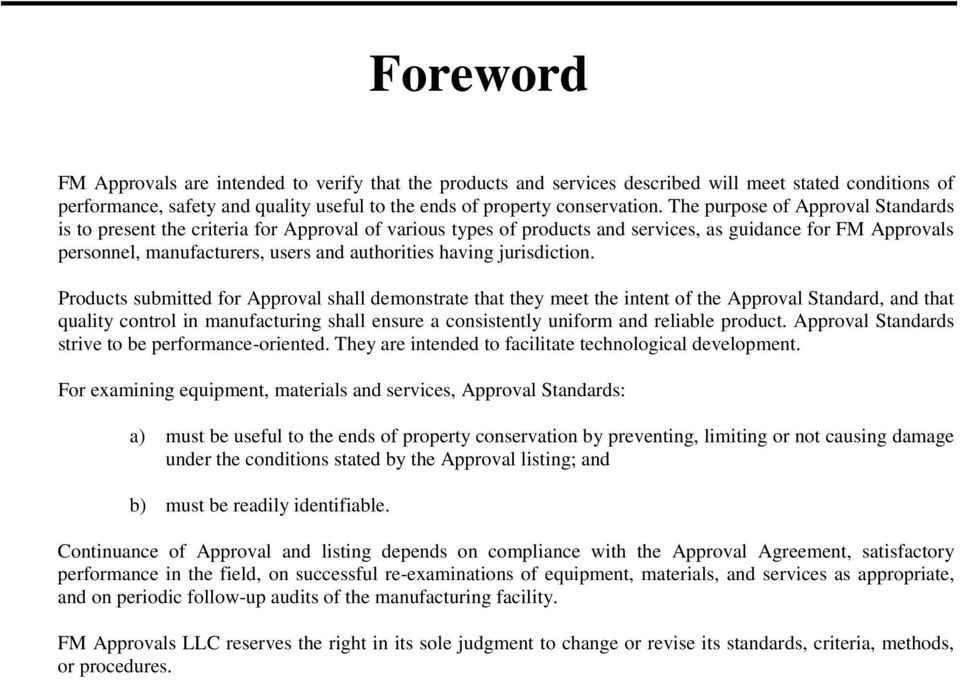
3 Table of Contents 1. INTRODUCTION Purpose Scope Basis for Requirements Basis for FM Approval Basis for Continued Approval Effective Date System of Units Applicable Documents Definitions GENERAL INFORMATION Product Information Approval Application Requirements Requirements for Samples for Examination GENERAL REQUIREMENTS Review of Documentation Physical or Structural Features Pump Pump Package Pump Casing Water Passages Impeller Shaft Shaft Seals Bearings Coupling Circulation Relief Valve Miscellaneous components Materials Markings Manufacturer s Installation and Operation Instructions Calibration Tolerances PERFORMANCE REQUIREMENTS Design and Calculation Review Performance Suction Lift Flange and Gasket Tightness Hydrostatic Strength One Hour Test (Mechanical Seal Pumps Only) Test Procedure Additional Tests OPERATIONS REQUIREMENTS Demonstrated Quality Control Program Facilities and Procedures Audit (F&PA) Manufacturer s Responsibilities Manufacturing and Production Tests APPENDIX A: Units of Measurement APPENDIX B: FM Approvals Certification Marks... 21
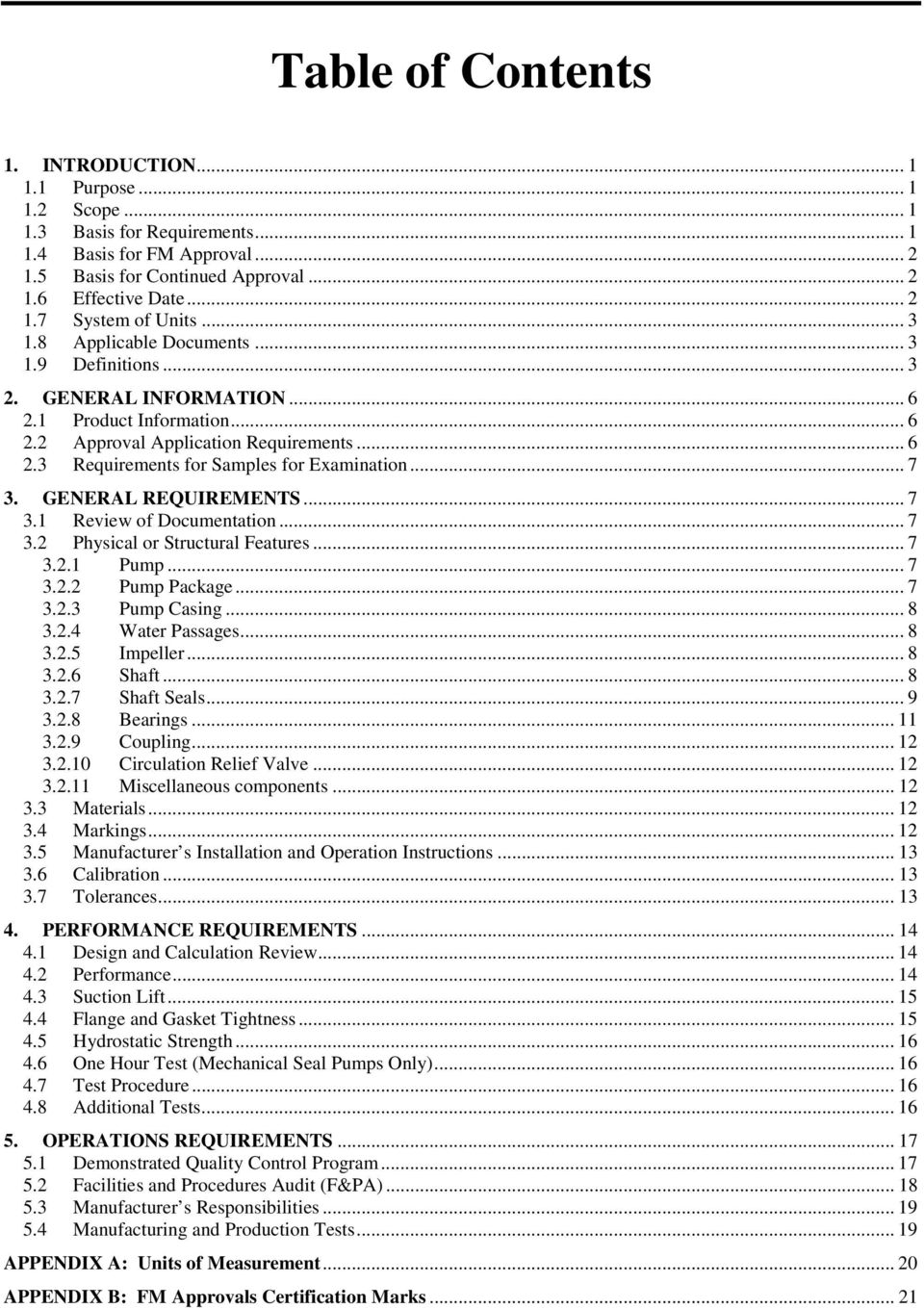
4 APPENDIX C: Test Procedures C.1 Capacity Measurements C.2 Head Measurements C.3 Power Measurements C.4 Speed Measurement C.5 Time Measurement APPENDIX D: Fire Pump Unit (Packages) APPENDIX E: Tolerance APPENDIX F: Figures Figure F-1. End Suction Centrifugal Fire Pump, Overhung Impeller, Close Couple Single Stage APPENDIX G: Sample Listing... 30
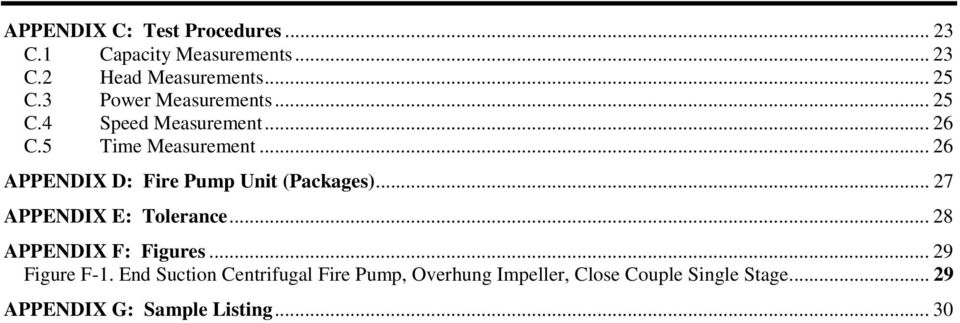
5 1. INTRODUCTION 1.1 Purpose This standard states Approval criteria for horizontal, end suction type, centrifugal fire pumps that supply water to fire protection systems. These pumps must be available for many years to operate reliably at rated capacities and pressures during emergency fire incidents, despite being idle for extended periods Approval criteria may include, but are not limited to, performance requirements, marking requirements, examination of manufacturing facility(ies), audit of quality assurance procedures, and a follow-up program. 1.2 Scope This standard encompasses the design and performance requirements for horizontal, end suction type, centrifugal fire pumps for use in fire protection systems. Approval is limited to horizontal, end suction type, centrifugal pumps which have a rated pressure of at least 40 psi (275 kpa). In cases where metric sized horizontal, end suction type, centrifugal fire pumps are to be examined for Approval, test criteria comparable to the United States equivalent size shall be used. This standard encompasses the requirements for single and multistage end suction fire pumps Requirements for other types of centrifugal fire pumps are detailed in the following FM Approval Standards: Class Centrifugal Fire Pump Type 1311 Split-Case Type, (Axial or Radial) 1312 Vertical Shaft Turbine Type 1370 Vertical Turbine Barrel Type 1371 In-Line Type Requirements for other major components in the pump package are detailed in the following Approval Standards: Class Equipment 1046 Fire Pump Flowmeter Systems 1321/1323 Controllers for Electric Motor Driven and Diesel Engine Driven Fire Pumps 1333 Diesel Engine Fire Pump Drivers 1359 Trim Water Pressure Relief Valves 2311 Pressure Gauges for Fire Protection Systems Approval standards are intended to verify that the product described will meet stated conditions of performance, safety, and quality useful to the ends of property conservation. 1.3 Basis for Requirements The requirements of this standard are based on experience, research and testing, and/or the standards of other organizations. The advice of manufacturers, users, trade associations, jurisdictions and/or loss control specialists was also considered. FM APPROVAL 1
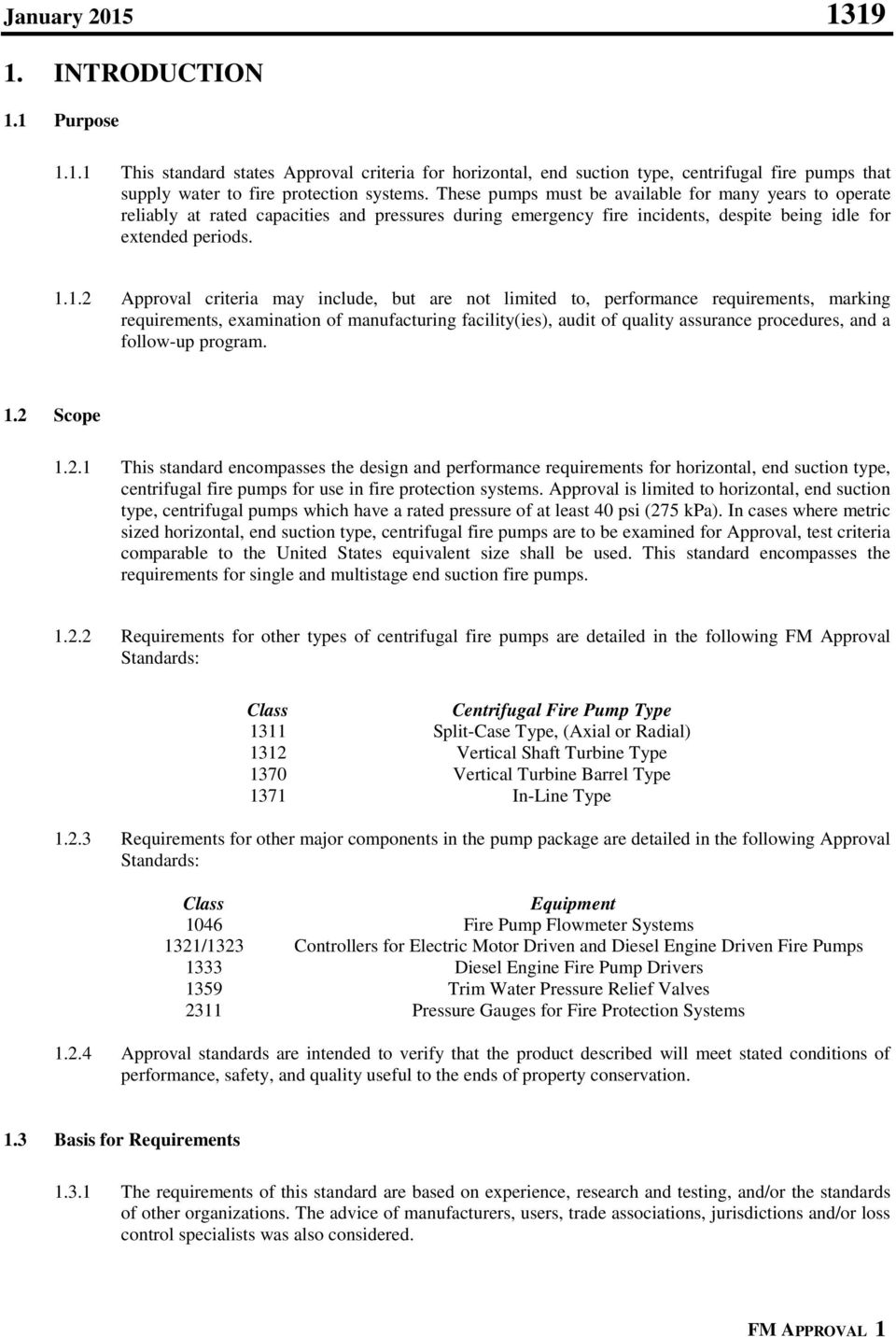
6 1.3.2 The requirements of this standard reflect tests and practices used to examine characteristics of horizontal, end suction type, centrifugal fire pumps for the purpose of obtaining Approval. Horizontal, end suction type, centrifugal fire pumps having characteristics not anticipated by this standard may be FM Approved if performance equal, or superior, to that required by this standard is demonstrated, or if the intent of the standard is met. Alternatively, horizontal, end suction type, centrifugal fire pumps that meet all of the requirements identified in this standard may not be FM Approved if other conditions which adversely affect performance exist or if the intent of this standard is not met. 1.4 Basis for FM Approval Approval is based upon satisfactory evaluation of the product and the manufacturer in the following major areas: Examination and tests on production samples shall be performed to evaluate The suitability of the product; The performance of the product as specified by the manufacturer and required by FM Approvals; and as far as practical, The durability and reliability of the product An initial Facilities and Procedures Audit shall be conducted to evaluate the manufacturer s ability to consistently produce the product that was examined and tested as part of the Approval examination. The audit shall review the facility and in-place quality control procedures used in the manufacture of the product. Typically, areas of review are incoming inspection, work in progress, production testing, final quality control, marking, calibration of equipment, shipping procedures, and document and drawing control. These examinations are repeated as part of FM Approvals product follow-up program. (Refer to Section 5.2, Facility and Procedures Audit.) 1.5 Basis for Continued Approval Continued Approval is based upon: Production or availability of the product as currently FM Approved; The continued use of acceptable quality assurance procedures; Satisfactory field experience; Compliance with the terms stipulated in the Master Agreement; Satisfactory re-examination of production samples for continued conformity to requirements; and Satisfactory Facilities and Procedures Audits (F&PAs) conducted as part of FM Approvals product follow-up program Also, as a condition of retaining Approval, manufacturers may not change an FM Approved product or service without prior authorization by FM Approvals. (Refer to Section for further details regarding changes.) 1.6 Effective Date The effective date of an Approval standard mandates that all products tested for Approval after the effective date shall satisfy the requirements of that standard. Products FM Approved under a previous edition shall comply with the new version by the effective date or forfeit Approval. The effective date of this standard is October 31, 2009 for compliance with all requirements. FM APPROVAL 2

7 1.7 System of Units Units of measurement used in this standard are United States (U.S.) customary units. These are followed by their arithmetic equivalents in International System (SI) units, enclosed in parentheses. The first value stated shall be regarded as the requirement. The converted equivalent value may be approximate. Appendix A lists the selected units and conversions to SI units for measures appearing in this standard. Conversion of U.S. customary units is in accordance with the Institute of Electrical and Electronics Engineers (IEEE)/American Society for Testing Materials (ASTM) SI , American National Standard for Use of the International System of Units (SI): The Modern Metric System. Two units of measurement (liter and bar), outside of but recognized by SI, are commonly used in international fire protection and are used in this standard. 1.8 Applicable Documents The following standards, test methods, and practices are referenced in this standard or beneficial in understanding this standard: ANSI/Hydraulics Institute (HI), ANSI/HI (M101) , Centrifugal Nomenclature ANSI/HI 1.3 (M102) , Centrifugal Applications ANSI/HI 1.4 (M103) , Centrifugal Operations ANSI/HI 1.6 (M104) , Centrifugal Tests ANSI/HI (M109) , American National Standard for Rotary Pumps for Nomenclature, Definitions, Applications, and Operation ANSI/HI 3.6 (M110) , American National Standard for Rotary Pump Tests ANSI/HI (M111) , American National Standard for Sealless Rotary Pumps for Nomenclature, Definitions, Applications, and Operations American Petroleum Institute (API) Standard 682/ISO Pumps Shaft Sealing Systems for Centrifugal and Rotary Pumps FM Approvals Approval Standards FM Global Property Loss Prevention Data Sheet 2-81, January 2006, Fire Safety Inspections and Sprinkler System Maintenance FM Global Property Loss Prevention Data Sheet 3-7, April 2008, Fire Protection Pumps IEEE/ASTM SI , American National Standard for Use of the International System of Units (SI): The Modern Metric System National Fire Protection Association (NFPA) NFPA 20, 2007, Standard for the Installation of Stationary Pumps for Fire Protection NFPA 25, 2002, Standard for the Inspection, Testing, and Maintenance of Water-Based Fire Protection Systems 1.9 Definitions For purposes of this standard, the following terms apply: Accepted This term refers to installations acceptable to the authority enforcing the applicable installation rules. When the authority is FM Global, such locations are termed FM Global Accepted. Acceptance is based upon an overall evaluation of the installation. Factors other than the use of FM Approved equipment impact upon the decision to accept, or not to accept. Acceptance is not a characteristic of a product. It is installation specific. A product accepted for one installation may not be acceptable elsewhere. (Contrast with FM Approved.) Corrosion Resistant Having resistance to corrosion equal to or exceeding that of bronze alloy having a minimum copper content of 80 percent, or constructed of Series 300 Stainless Steel. FM APPROVAL 3
8 Design Working Pressure The maximum pressure for which a pump component is designed. This pressure is equal to or greater than the maximum pressure developed by the pump at shut off or churn conditions with the largest impeller available, plus the maximum suction pressure for the pump. Dynamic Shaft Deflection Dynamic condition where the axial centerline of the shaft does not coincide with the axial centerline of the bearings. Efficiency The ratio of the energy delivered by the pump to the energy supplied to the pump shaft (liquid power divided by applied power). Enclosed Impeller An impeller in which the pumped liquid is confined by the sidewalls (shrouds) and vanes of the impeller. End Suction Pump Pump having its suction nozzle on the opposite side of the casing from the stuffing box and having the face of the suction nozzle perpendicular to the longitudinal axis of the shaft. FM Approvals Certification Mark The FM Approvals Certification Marks are detailed in Appendix B. Their use is mandatory on all units of FM Approved horizontal, end-suction type centrifugal fire pumps. These registered marks cannot be used except as authorized by FM Approvals via the granting of Approval to a specific product. FM Approved This term refers to products FM Approved by FM Approvals. Such products are listed in the Approval Guide, an on-line resource of FM Approvals. All products so listed have been successfully examined by FM Approvals, and their manufacturers have signed and returned a Master Agreement to FM Approvals. These forms obligate the manufacturer to allow re-examination of the product and audit of facilities and procedures at FM Approval s discretion. It further requires the manufacturer not to deviate from the FM Approved configuration of the product without review by and agreement of FM Approvals. Maximum Power The greatest speed-corrected power required to drive the pump at rated speed and at any point along its characteristic curve, and through the pumps total run out condition. This is determined under conditions of increasing positive suction head. Mechanical Seals A sealing device which forms a running seal between the rotating and stationary components. They may be used in place of compression (soft) packing. All mechanical seals are constructed of three basic sets of parts: A set of primary seal faces: one rotary and one stationary A set of secondary seals known as shaft packings and insert mountings such as 0-rings, wedges and V- rings Mechanical seal hardware including gland rings, collars, compression rings, pins, springs and bellows The primary seal is achieved by two very flat, lapped faces perpendicular to the shaft. The rubbing contact between these two flat mating surfaces minimizes leakage. One face is held stationary in a housing and the other face is fixed to, and rotates with, the shaft. Dissimilar materials are usually used for the stationary insert and the rotating seal ring face in order to prevent adhesion of the two faces. FM APPROVAL 4

9 Cartridge Seal Type This type of mechanical seal is a completely self-contained unit (including stationary and rotating seal faces, gland sleeve, mating ring, etc.) which is pre-assembled and preset before installation by the mechanical seal manufacturer. Component Type This type of mechanical seal is assembled from the individual components directly onto the shaft. The components usually consist of a rotating unit with a mating face which is in contact with a stationary unit. The rotating unit seals in two places, at the interface between the rotating face and stationary and between the shaft and the seal body. The stationary unit seals against the pump body. Split Seal Type This type of mechanical seal has its primary sealing elements and other components split parallel to the axis of the pump shaft. The seal can be mounted on a pump with out removing the impeller. Multiple Stage Pumps Horizontal end suction, centrifugal fire pumps with more than one impeller on the same shaft. The number of stages is determined by the number of impellers. Rated Capacity Capacity in gallons per minute - gal/min (liter/min - L/min), at rated pressure and speed. Rated Pressure Pressure in pounds per square inch - psi (kilopascals - kpa) developed by the pump when operating at rated capacity and speed. Shaft Runout Static condition where the axial centerline of the shaft does not coincide with the axial centerline of the bearings. Shutoff or Churn Pressure The net pressure in psi (kpa) developed by the pump at rated speed with zero flow. Single Stage Pump A pump in which the total head is developed by one impeller. Stuffing Box Packing Typically an arrangement consisting of rings of packing, a lantern ring for the injection of a lubricating and/or flushing liquid, and a gland to hold the packing and maintain the desired compression for a proper seal. The function of packing is to control leakage; it is not intended to eliminate it completely. The packing is lubricated by the pumped liquid. The lantern ring is supplied for situations where the stuffing box pressure is below atmospheric pressure, to inject lubrication into the stuffing box by the use of a bypass line from the pump discharge to the lantern ring connection. Stuffing Box Runout Static condition where the axial centerline of the shaft is not perpendicular to the face of the stuffing box. Total Discharge Head The gauge reading in psi (kpa) at the discharge flange of the pump, referred to the pump centerline, plus the velocity head at the point of gauge attachment. Total Suction Head The condition when the suction pressure is above atmospheric. The total suction head is the algebraic sum of the gauge reading in psi (kpa) at the pump suction flange, referred to the pump centerline, and the velocity head at the point of gauge attachment. Also called positive suction pressure. FM APPROVAL 5

10 Total Suction Lift The condition when suction pressure is below atmospheric. The total suction lift is the algebraic sum of the gauge reading in psi (kpa) at the suction flange of the pump, referred to the pump centerline, and the velocity head at the point of gauge attachment. Total Head The algebraic difference between the total discharge head and the total suction head. Where suction head exists, total head equals total discharge head minus total suction head. Where suction lift exists, total head equals total discharge head plus total suction lift. 2. GENERAL INFORMATION 2.1 Product Information Pumps covered by this standard include those designed for one of the following capacities: 25, 50, 100, 150, 200, 250, 300, 400, 450, 500, 750, 1000, 1250, 1500, 2000, 2500, 3000, 3500, 4000, 4500, 5000 gal/min (95, 190, 380, 570, 755, 945, 1135, 1515, 1705, 1895, 2840, 3785, 4730, 5680, 7570, 9465, , , , , L/min) or larger. Pumps designed for other rated capacities shall be evaluated on a case-by-case basis Pumps shall have a minimum rated pressure of at least 40 psi (275 kpa) In order to meet the intent of this standard, horizontal, end suction type, centrifugal fire pumps must be examined on a model-by-model, type-by-type, manufacturer-by-manufacturer, and plant-by-plant basis. This is predicated on the basis that identical designs, fabricated in identical materials by different manufacturers or, even by different plants of the same manufacturer, have been seen to perform differently in testing. Sample fire pumps, selected in conformance to this criterion, shall satisfy all of the requirements of this standard. 2.2 Approval Application Requirements To apply for an Approval examination the manufacturer, or its authorized representative, should submit a request to: Hydraulics Group Manager FM Approvals Hydraulics Laboratory 743A Reynolds Road West Glocester, RI USA The manufacturer shall provide the following preliminary information with any request for Approval consideration: A complete list of all models, types, sizes, and options for the products or services being submitted for Approval consideration; Anticipated pump performance, including total head, power requirements, and efficiency versus flow characteristics. If different impellers or a range of impellers are used to obtain the rated head range for the pump being examined, complete details shall be provided concerning the range of performance specifications to be evaluated; FM APPROVAL 6

11 Calculations to determine shaft size, shaft runout, stuffing box runout, shaft deflection, casing bolt size, and anti-friction bearing life; If mechanical seals are provided, all sizing and design information shall be submitted for evaluation, (See Section 3.2.7) General assembly drawings (showing the pump and attachments), one complete set of manufacturing drawings, materials list(s) and physical property specifications (such as ASTM A48 CL 40 - Cast Iron), anticipated marking format, brochures, sales literature, specification sheets, installation, operation and maintenance procedures; The number and location of manufacturing facilities; and, All documents shall identify the manufacturer s name, document number or other form of reference, title, date of last revision, and revision level. All foreign language documents shall be provided with English translation. 2.3 Requirements for Samples for Examination Following set-up and authorization of an Approval examination, the manufacturer shall submit samples for examination and testing. Sample requirements are to be determined by FM Approvals following review of the preliminary information. Sample requirements may vary depending on design features, results of prior testing, and results of the foregoing tests. It is the manufacturer s responsibility to submit samples representative of production. Any decision to use data generated utilizing prototypes is at the discretion of FM Approvals. The manufacturer shall provide the test facilities, which are required to evaluate the horizontal, end suction type, centrifugal fire pumps. 3. GENERAL REQUIREMENTS 3.1 Review of Documentation During the initial investigation and prior to physical testing, the manufacturer s specifications, technical data sheets, and design details shall be reviewed to assess the ease and practicality of installation and use. The product shall be capable of being used within the limits of the Approval investigation. 3.2 Physical or Structural Features Pump Pumps shall be designed for flow rates equal to or greater than 25 gal/min (95 L/min). Rated pump pressures shall be at least 40 psi (275 kpa). Castings shall be free of defects which could make them unfit for their intended use. Flange dimensions, bolt layouts, and threaded openings used in pipe connections shall conform to a recognized national or international standard. Two or more pump ratings may be assigned to a single characteristic curve; however, the maximum power requirements used in selecting a driver shall be based on the highest power requirement, regardless of where it occurs on the entire characteristic curve Pump Package The manufacturer of the pump shall be able to supply the necessary pump accessories (See Appendix D) to provide a complete pump installation, as detailed in FM Global Property Loss Prevention Data Sheets. The pump manufacturer shall be held accountable for the complete pump package (as detailed in Appendix D), and satisfactory performance of the Field Acceptance Test for any pump bearing the FM Approvals Certification Mark. This accountability only includes proper FM APPROVAL 7

12 operation and sizing of the pump and the accessories listed in Appendix D, the pump manufacturer shall not be held accountable for items supplied by others that affect the pump performance, (i.e. wrong piping, insufficient air intake for the pump room, etc.). This responsibility may be delegated to an authorized agent of the pump manufacturer. This delegation does not relieve the pump manufacturer of their accountability and responsibility for the satisfactory performance of the complete pump package. Delegation to an authorized agent shall be accompanied by a set of assembly construction details from the pump manufacturer and a FM Approvals facilities and procedures audit shall be periodically conducted at the authorized agent s facility to ensure that the manufacturer s instructions are being followed. The authorized agent shall assemble the complete pump package; they shall not sell or release a bare-shafted pump. If the assembly construction details are provided by the authorized agent they shall be signed off (stamped, etc.) by the pump manufacturer Pump Casing The pump casing shall be designed to permit examination and removal of the impellers and other interior parts without disturbing the suction or discharge piping. This design is commonly referred to as a "back-pullout" design. For pumps supplied with mechanical seals the pump casing shall be designed to allow access to and replacement of the mechanical seals without disturbing the suction or discharge piping. These pumps have a horizontal suction connection opposite the driver end and a vertical, centerline discharge connection. Tapped holes for jackscrews or equivalent means shall be provided to facilitate disassembly of the casing and stuffing box cover and to avoid the necessity of drive wedges or prying implements. A drain opening(s) shall be provided so that all parts of the pump casing can be drained. The opening shall be threaded to receive a corrosion resistant pipe plug at least 1/2 in. nominal size. Renewable casing wearing rings shall be provided. Impeller wear rings may be provided, as an option Water Passages All water passages shall be designed to minimize the possibility of foreign materials becoming lodged in them. The minimum width of these passages at the periphery or at any point within the impeller shall be at least 1/2 in. (12.7 mm) for pumps rated 500 gal/min (1895 L/min) and larger. Passages in pumps having rated capacities of 100 to less than 500 gal/min (380 to less than 1895 L/min) shall be at least 3 8 in. (9.5 mm). Passages in pumps having rated capacities less than 100 gal/min (380 L/min) shall be at least 1 4 in. (6.3 mm) Impeller Shaft Impellers shall be securely attached in an axial direction to the pump shaft. No impeller shall contact the casing under operating conditions. Impellers shall be the closed type. All impellers shall be dynamically balanced. Calculations shall be provided to show that the impeller will not come into contact with the casing at any point on the characteristic curve, including shut-off. The impeller may be keyed or threaded to the shaft with rotation to tighten. Shaft threads and keyways shall be protected so they will not be wetted by the pumped liquid. Shafts shall be of adequate size and strength to successfully transmit the torques encountered in starting and during operation while supporting the impeller and other rotating parts. In order to safeguard against shaft failure, the maximum torsional shearing stress, as calculated by the formula below, shall not exceed 30 percent of the elastic limit in tension and 18 percent of the ultimate tensile strength of the shaft material. For shafts with keyways, a further 25 percent reduction is required. FM APPROVAL 8

13 Renewable shaft sleeves shall be provided, regardless of the shaft material, to adequately safeguard the shaft against wear, erosion, and corrosion. Shaft sleeves shall be of a hard bronze or other corrosion resistant material. Maximum Torsional Shearing Stress: English S s = n d 5 3 P Metric S s = n d 10 3 P Where: S s - P - n - d - Torsional Shear Stress, psi (kpa) Maximum Input Power demand, hp (W) Rated Speed, r/min Shaft diameter, in. (mm) Shaft runout at the face of the stuffing box and at the impeller shall not exceed in. (0.05 mm). Dynamic shaft deflection at the face of the stuffing box shall not exceed in. (0.05 mm) at maximum load for the pump sizes covered by this standard. Running clearance must be sufficient to prevent internal rubbing at maximum load Shaft Seals Stuffing box runout shall not exceed in. (0.05 mm) total indicator reading when indicated from the shaft and rotated 360 degrees The shaft seal, soft packing or mechanical seal, shall adequately safeguard against excessive water leakage out of the pump when suction pressure is above atmospheric, and prevent air leakage into the pump when the suction pressure is below atmospheric. Systems shall be designed so that suction pressure is always positive. For suction pressures above 40 psi (275 kpa), the lantern ring may be replaced with a ring of packing Mechanical Seals Use of mechanical seals is restricted to those applications where only clean water is pumped. Clean water shall be free of debris and particles in suspension liable to cause accumulations in the system piping. Water with excessive contaminants can cause accumulations, adhesion, clogging or abrasion which can adversely affect the performance of mechanical seals. Suction supplies shall not be from open bodies of water, e.g., retention ponds, lakes or rivers. The pump shall operate with positive pressure conditions at the pump inlet at all times. Additional information on installation requirements for pumps can be found in FM Global Property Loss Prevention Data Sheets 3-7, Fire Protection Pumps. Mechanical seals shall not be used in vertically mounted split-case pumps. Mechanical seals shall be tested in each pump model; it does not necessarily follow that acceptance of a mechanical seal for one model of pump translates to acceptance for other pump models, even by the same manufacturer. The pump assembly is FM Approved; not the mechanical seal. Spare parts meeting all the material and design requirements of the new seal shall be supplied by the pump manufacturer and stored on site, and shall include at a minimum: the sealing faces, springs, elastomers, gaskets, and fasteners. Spare parts boxes shall be clearly marked with the shelf life, if applicable. FM APPROVAL 9

14 Complete detailed instructions for the removal and replacement of the mechanical seals shall be included in the manufacturer s maintenance, operation and installation instructions. Prior to shipment of the pump, the manufacturer shall document that the pump s suction supply is not be from open bodies of water and is free of debris and particles in suspension liable to cause accumulations in the system piping. Mechanical Seals shall meet all the following design requirements: Mechanical seals of the component, cartridge, and split types shall be acceptable Seals shall be designed by the seal manufacturer and shall be used in strict accordance with the seal manufacturer s specifications for pressure; peripheral velocity; seal face squareness; seal chamber concentricity; and shaft deflection and alignment. The seals shall be suitably matched to the pump characteristics The seal shall be suitable for the vacuum level which may be experienced during startup to prevent air from leaking into the system. This shall be verified during Suction Lift testing. Seal faces shall be mechanically loaded to prevent leakage when the pump is not running Hydraulically balanced seals shall be used to reduce heat generation and face wear A secondary containment element, such as a segmented floating bushing, shall be used behind the seal faces of the mechanical seal. The secondary containment element shall prevent flow of water towards the motor, and allow pumping pressure to develop in the event of mechanical seal failure Primary sealing faces shall be either: Resin impregnated carbon graphite on silicon carbide or tungsten carbide, or Silicon carbide on silicon carbide Other material combinations with equivalent or superior wearing properties shall be evaluated on a case-by-case basis. The sealing surfaces shall be of such flatness as to allow pumps to remain visibly leak-free at the seals through all phases of testing Secondary sealing elastomers shall be ethylene-propylene or fluorocarbon rubbers or of materials equivalent to or superior to the properties of these materials Glands, drive holder, segmented bushing, and miscellaneous parts shall be made of corrosion resistant materials equivalent to or greater than 304 stainless steel Seal loading springs shall either be isolated from the pumped liquid or shall be of the single spring design to prevent clogging and corrosion which may affect seal loading. Springs isolated from the pumped fluid shall have corrosion characteristics equivalent to 304 stainless steel or greater. Single springs in contact with the pumped fluid and all multiple spring designs shall be fabricated of Hastelloy C alloy. FM APPROVAL 10
15 Two ports with tapped connections shall be provided to allow for flushing. The seal shall be flushed using circulation from the pump discharge to facilitate heat removal, venting, and to remove solids accumulation. A minimum vapor pressure margin of 30 psi (205 kpa) at the maximum operating temperature shall be maintained. The seal shall be applied with discharge recirculation. An example of a discharge recirculation piping plan can be found in API Piping Plan 11, API Std 682/ISO Pumps Shaft Sealing Systems for Centrifugal and Rotary Pumps The compatibility between the mechanical seal specifications and tolerance data and the pump specifications shall be verified. This compatibility shall be verified for the most extreme expected operating conditions, (Shut-off and maximum flow) and for the full range of speeds and impeller diameters. This shall include radial thrust calculations showing that the shaft deflection, at rated capacity, shut-off and maximum capacity, does not exceed the mechanical seal allowances. Radial thrust shall be calculated as follows, (shown for shut-off calculation): R (English units) (SI units) = H S 2.31 B2 RSO = 9810 ( K so H so S D2 B2 ) so SO Kso D2 Where: R so - radial thrust at shutoff, lb (N) K so - thrust factor at shutoff, from Hydraulics Institute Standards, dimensionless H so - total head of pump at shutoff, ft of H 2 O (m of H 2 O) S - specific gravity of fluid (fresh water = 1), dimensionless D 2 - diameter of impeller, in. (m) B 2 - width of impeller at discharge, including shrouds, in. (m) Radial thrust calculations shall be provided to verify that the shaft deflection, at rated capacity, shutoff and maximum capacity do not exceed the mechanical seal allowances Bearings Suitable bearings shall be provided to ensure smooth, low friction rotation of the impeller shaft and to provide adequate wearing characteristics at bearing points. Two bearing assemblies are usually provided. One assembly floats freely within the frame to accommodate shaft reactions to thermal and axial forces and to carry the radial load. The other assembly is arranged to carry both the radial and axial load. End play in the shaft due to the stationary bearing shall be kept to a minimum. The required minimum depends on internal clearances. To provide adequate durability, anti-friction bearings shall have the following features: A minimum calculated life rating of not less than 5000 hours at maximum load; A design that withstands the maximum radial and thrust loads at maximum load conditions; An arrangement designed to float axially on one or both ends; Grease lubrication, with a grease fitting and relief hole if lubrication is necessary; Water slingers and dust caps or other suitable means of preventing water or other foreign matter from entering the bearings. Calculations shall be provided to verify the bearing life exceeds the 5000 hour requirements. Drawings of the impeller(s), shaft and shaft sleeves shall identify weights of these components. FM APPROVAL 11

16 3.2.9 Coupling The use of a spacer coupling is required to drive the pump. Couplings between the fire pump and the pump driver shall not be of the All-Elastomeric Type. Couplings that utilize elastomeric components are acceptable as long as the elastomeric component is not the only means of power transmission. Examples of these couplings are: pin and bushing, steel flex grid, jaw-type, and drive shafts. Couplings shall be of the proper size for the application Circulation Relief Valve Each pump shall have a circulation relief valve listed for the fire pump service installed and set below the shutoff pressure at minimum expected suction pressure. This valve is usually found on the pump casing but may be installed on the discharge side of the pump before the discharge check valve. It shall provide flow of sufficient water to prevent the pump from overheating when operating with no discharge. Provisions shall be made for discharge to a drain. Circulation relief valves shall not be tied in with the packing box or drip rim drains. Minimum size of the circulation relief valve shall be 3/4 in. NPS for pumps with a rated capacity not exceeding 2500 gpm (9465 L/min) and 1 in. NPS for pumps with a rated capacity of 3000 to 5000 gpm (11,355 to 18,925 L/min). The relief valve shall not be piped to the pump suction or supply connection. Approval requirements for circulation relief valves are discussed in Approval Standard Exception: This rule shall not apply to engine-driven pumps for which engine cooling water is taken from the pump discharge Miscellaneous components If fabricated (welded) steel or cast fittings which are not FM Approved are provided by the pump manufacturer as a part of the pump assembly (i.e., suction and discharge adaptors), they shall be evaluated as part of the pump Approval program. This shall normally include a review of detail drawings and hydrostatic tests to at least 700 psi (4825 kpa) or four times the rated working pressure, whichever is greater, for 5 minutes. 3.3 Materials All materials used in these fire pumps shall be suitable for the intended application. At a minimum, the impellers, impeller wear rings, impeller nut, casing wear rings, water-seal ring, stuffing box gland, gland nut, gland bolts, shaft sleeve, and interior bolts or screws shall be constructed of corrosion resistant materials. Mechanical seals shall be constructed of the materials detailed in Section When unusual materials are used, special tests may be necessary to verify their suitability. 3.4 Markings A permanently-marked, legible, corrosion-resistant nameplate shall be securely attached to the pump or bedplate where it shall be easily visible. The nameplate shall include the following information: Manufacturer s name and address; Model or type designation; Rated capacity; Rated total head; Rated speed; Maximum power required; Impeller diameter(s); Pump serial number, and; FM Approval s Certification Mark, (see Appendix B). FM APPROVAL 12

17 3.4.2 Pumps that are available with both packing and mechanical seals shall have unique model numbers. The model numbers can be completely different or only slightly changed from one to the other. (i.e. the letter M could be added to the end of the model number to design mechanical seals.) Pumps that are produced at more than one location shall be identified as the product of a particular location An arrow indicating the direction of pump rotation shall be cast into the pump casing. A corrosion resistant metal nameplate bearing the arrow shall be considered acceptable if permanently fastened to the fire pump casing The model or type identification shall correspond with the manufacturer s catalog designation and shall uniquely identify the product as FM Approved. The manufacturer shall not place this model or type identification on any other product unless covered by a separate agreement The FM Approval s Certification Mark (see Appendix B) shall be displayed visibly and permanently on the product. The manufacturer shall not use these Marks on any other product unless such product is covered by separate agreement with FM Approvals All markings shall be legible and durable. 3.5 Manufacturer s Installation and Operation Instructions Maintenance, operation and installation instructions, including any special dimension requirements, shall be furnished by the manufacturer. Instructions shall be provided with each fire pump. Fire pumps supplied with mechanical seals shall have explicate directions for maintaining and replacing the mechanical seal. 3.6 Calibration All equipment used to verify the test parameters shall be calibrated within an interval determined on the basis of stability, purpose, and usage of the equipment. A copy of the calibration certificate for each piece of test equipment is required for FM Approvals records, indicating that the calibration was performed against working standards whose calibration is certified as traceable to the National Institute of Standards and Technology (NIST) or to other acceptable reference standards and certified by an ISO accredited calibration laboratory. The test equipment must be clearly identified by label or sticker showing the last date of the calibration and the next due date. A copy of the calibration service s accreditation certificate as an ISO 17025, "General Requirements for the Competence of Testing and Calibration Laboratories", calibration laboratory is required for FM Approvals records. The calibration of recently purchased new equipment is also required. Documentation indicating either the date of purchase or date of shipment, equipment description, model and serial number is required for identification. The period from the time the equipment was put into service to the date of testing must be within an interval that does not require the equipment to be calibrated as determined on the basis of the parameters mentioned above. 3.7 Tolerances Tolerances on units of measure shall be as described in Appendix E, unless otherwise specified. FM APPROVAL 13

18 4. PERFORMANCE REQUIREMENTS 4.1 Design and Calculation Review Requirement The pump shall conform to the manufacturer s drawings and specifications and to FM Approvals design and calculation requirements stated in Section Test/Verification A sample pump shall be examined and compared to drawings and specifications. It shall be verified that the sample conforms to the physical and structural requirements described in Section 3, General Requirements. The following calculations shall be reviewed and compared to the requirements stated in Section 3: Maximum torsional shearing stress Mechanical seal and pump compatibility Casing bolt strength Bearing life calculations Shaft deflection and impeller clearance/interference Radial load calculations 4.2 Performance Requirements The pump shall develop its rated pressure when delivering its rated capacity. The pump shall not exceed 140 percent of its rated pressure at any point along its characteristic curve (pressure vs. flow), including the shutoff point. All tangents along this curve shall have a negative or zero slope. The shutoff head shall not be less than 99 percent of the maximum head. The maximum power required shall be determined Test/Verification At least one sample of each rated capacity shall be tested. The minimum and maximum impeller diameters of each impeller design, submitted for Approval, shall be tested to obtain the desired head range(s) for the pump. Intermediate impeller diameters may be tested at the discretion of FM Approvals. The pump shall be operated at various flow rates to generate total head, power, and efficiency curves. At each flow the total discharge head, total suction head, power required, and speed shall be measured. A minimum of ten flow readings shall be taken to generate the curve with two of the readings taken at maximum power of the pump. All test speeds must be ±4 percent of the rated speed. In order to develop characteristic curves, test data shall be corrected to rated speed by means of the affinity relationships. All readings must be witnessed by an FM Approvals engineer. A total suction head adequate to produce the maximum power requirement for the pump shall be provided. Maximum power is the greatest power required to drive the pump at any point along its characteristic curve, and is defined as the point where a zero slope of the tangents to the characteristic power curve occurs. The maximum power required shall occur when there is no increase in power with an increase in the total suction head at that same flow. FM APPROVAL 14

19 4.3 Suction Lift Requirement The pump shall develop at least 65 percent of its rated pressure when operating at a suction lift of at least 15 ft (4.6 m), referred to sea level, and delivering 150 percent of the rated capacity. If mechanical seals are used, they shall not allow air to leak into the pump at any point along the characteristic curve, including shut-off Test/Verification At least one sample of each rated capacity shall be tested. The minimum and maximum impeller diameters of each impeller design, submitted for Approval, shall be tested to obtain the desired head range(s) for the pump. Intermediate impeller diameters may be tested at the discretion of FM Approvals. The pump shall be operated with a minimum suction lift of 15 ft (4.6 m), referred to sea level, at various flow rates to generate total head, power, and efficiency curves. A minimum of eight flow readings, all at a suction lift of 15 ft (4.6 m), shall be taken to generate the curve. At each flow the total head, power required, and speed shall be measured. A minimum of three flow readings in close proximity to 150 percent of rated flow, (within ± 10 percent of rated flow from 150 percent of rated flow), shall be taken, with the 150 percent point within the span of these three points. All test speeds must be ±4 percent of the rated speed. In order to develop characteristic curves, test data shall be corrected to rated speed by means of the affinity relationship. All readings must be witnessed by an FM Approvals engineer. If the pump is to be FM Approved with mechanical seals for installations that meet the requirements of Section 3 and FM Global Loss Prevention Data Sheet 3-7, Fire Protection Pumps, at least one complete minimum 15 ft (4.6 m) suction lift test, referred to sea level, with the mechanical seals installed shall be performed. This test shall be performed with the worst case condition from the calculations in section Flange and Gasket Tightness Requirement No leakage, except at the shaft packing, shall be observed in a 5 minute test when hydrostatically tested at the required pressure Test/Verification A sample casing of each model and material shall be hydrostatically tested to a pressure equal to, or greater than, the sum of the maximum shutoff pressure of the pump plus a maximum allowable suction pressure specified by the pump manufacturer (P max +P max. Suction ). The maximum shutoff pressure, P max, is the highest shutoff pressure obtained in testing the range of impeller diameters and speeds submitted for Approval. The test pressure shall be held for five minutes. In no case shall the maximum allowable suction pressure, P max. Suction, be less than 75 psi (515 kpa), or the leakage test be run at less than 250 psi (1725 kpa). Casing bolts normally provided shall be used for this test. FM APPROVAL 15

20 4.5 Hydrostatic Strength Requirements No rupture, cracking or permanent distortion of any part of the pump shall be observed in a 5 minute test when hydrostatically tested at the required pressure Tests/Verification A sample casing of each model and material shall be hydrostatically tested to a pressure equal to, or greater than, twice the sum of the maximum shutoff pressure of the pump plus a maximum allowable suction pressure specified by the pump manufacturer,2x(p max +P max. Suction ). The maximum shutoff pressure, P max, is the highest shutoff pressure obtained in testing the range of impeller diameters and speeds submitted for Approval. The test pressure shall be held for five minutes. In no case shall the maximum allowable suction pressure, P max. Suction, be less than 75 psi (515 kpa), or the test be run at a pressure less than 400 psi (2760 kpa). Casing bolts normally provided shall be used for this test. 4.6 One Hour Test (Mechanical Seal Pumps Only) Requirement No failure of the mechanical seal is permitted when the pump assemblies shown to have the greatest shaft deflection are run as close to zero flow as possible (maximum radial load) for one hour for each available mechanical seal Test/Verification Each type and size of mechanical seal for use with the pump shall be tested for compliance. The pump assemblies selected for this test shall be of the impeller diameter and speed shown to have the greatest shaft deflection by calculation. Calculations shall be submitted for review prior to scheduling testing. The pump shall be run for one hour as close to zero flow (maximum radial load) as possible without boiling the water. In no case shall the discharge pressure be less than 95 percent of the shut-off pressure for the pump under test. No leakage of the mechanical seal is permitted. Subsequently, the pump shall be disassembled and the mechanical seals shall be examined for evidence of wear or other signs of failure of the mechanical seal. 4.7 Test Procedure Pump testing is normally performed by the manufacturer at their facility. FM Approvals shall witness the testing and obtain copies of the data and calibration certificates. The range of tests to be conducted shall be specified by FM Approvals. Test procedures shall be in accordance with recommendations for centrifugal pumps in accordance with the latest edition of the Hydraulic Institute Standards, Standard for Centrifugal, Rotary and Reciprocating Pumps or equivalent national or international standard. 4.8 Additional Tests Additional tests may be required, depending on design features, results of any tests, material application, or to verify the integrity and reliability of the fire pumps, at the discretion of FM Approvals. Unexplainable failures shall not be permitted. A re-test shall only be acceptable at the discretion of FM Approvals and with adequate technical justification of the conditions and reasons for failure. FM APPROVAL 16

21 5. OPERATIONS REQUIREMENTS A quality control program is required to assure that subsequent horizontal end suction centrifugal fire pumps produced by the manufacturer at an authorized location shall present the same quality and reliability as the specific horizontal end suction centrifugal fire pumps examined. Design quality, conformance to design, and performance are the areas of primary concern. Design quality is determined during the Approval examination and tests, and is covered in the Approval Report. Conformance to design is verified by control of quality and is covered in the Facilities and Procedures Audit (F&PA). Quality of performance is determined by field performances and by periodic re-examination and testing. 5.1 Demonstrated Quality Control Program The manufacturer shall demonstrate a quality assurance program which specifies controls for at least the following areas: Existence of corporate quality assurance guidelines; Incoming quality assurance, including testing; In-process quality assurance, including testing; Final inspection and tests; Equipment calibration; Drawing and change control; Packaging and shipping; and, Handling and disposition of non-conformance materials; and, In order to assure adequate traceability of materials and products, the manufacturer shall maintain records of all quality control tests performed, and shall maintain these records for a minimum period of two years from the date of manufacture Documentation/Manual There should be an authoritative collection of procedures and policies. Such documentation shall provide an accurate description of the quality management system while serving as a permanent reference for implementation and maintenance of that system. The system should require that sufficient records are maintained to demonstrate achievement of the required quality and verify operation of the quality system Drawing and Change Control The manufacturer shall establish a system of product configuration control that shall allow no unauthorized changes to the product. Changes to critical documents, identified in the Approval Report, must be reported to, and authorized by, FM Approvals prior to implementation for production. The manufacturer shall assign an appropriate person or group to be responsible for, and require that, proposed changes to FM Approved or Listed products be reported to FM Approvals before implementation. The manufacturer shall notify FM Approvals of changes in the product or of persons responsible for keeping FM Approvals advised by means of FM Approvals Form 797, Approved Product/Specification-Tested Revision Report or Address/Main Contact Change Report. Records of all revisions to all FM Approved products shall be maintained. FM APPROVAL 17
22 The table below has been included as a guide to manufacturers of what is considered to be a significant change to FM Approvals. To facilitate the Approval of significant changes, modifications that fit this category shall be documented by means of a letter stating the change, and requesting a quotation for an Approval examination. Modification Description/ Example Change in speed rating: The product was originally FM Approved at 3000 rpm and now is to be evaluated at 3550 rpm Change in Allowed Impeller Sizes: Addition or relocation of the manufacturing location: Changes to Critical Dimensions: The product was originally FM Approved for 4 through 5 inch (100 through 125 mm), and now is to be evaluated at 5.5 inch (140 mm) The product was originally FM Approved when made in location A, and now it is desired to make the same product in locations A and B, or in location B only. Modifications that would have an effect on the ability of the product to maintain the same performance as the originally FM Approved product. An example of this would be a reduction impeller size, or casing wall thickness The table below has been included as a guide to manufacturers of modifications which may be submitted on FM Approvals Form 797. Modification Change in Company Contact Information: Description/Example Contact Name, Title, Phone Number, FAX Number, Office Address, Company Name Updating of Drawings: Minor dimensional changes, or note changes, Re-creation of old drawing on CAD Change in material or marking: Where new material is superior, or to show proposed new marking For the instances where the modification is difficult to categorize, manufacturers are encouraged to contact FM Approvals and to discuss the nature of the proposed change, and how to send the information to FM Approvals. The examples shown in Sections and are based on common examples of modifications as they relate to the manufacture of split-case centrifugal fire pumps FM Approvals, at its sole discretion, shall determine when additional testing is necessary to validate proposed changes. 5.2 Facilities and Procedures Audit (F&PA) An audit of the manufacturing facility is part of the Approval investigation to verify implementation of the quality control program. Its purpose is to determine that the manufacturer s equipment, procedures, and quality program are maintained to insure a consistently uniform and reliable product. Initial inspections of facilities already producing similar products may be waived at the discretion of FM Approvals Unannounced follow-up inspections shall be conducted at least annually by FM Approvals, or its designate, to determine continued compliance. More frequent audits may be required by FM Approvals. FM APPROVAL 18
23 5.2.3 The client shall manufacture the product or service only at the location(s) audited by FM Approvals and as specified in the Approval Report. Manufacture of products bearing the FM Approval s Certification mark is not permitted at any other locations without prior written authorization by FM Approvals. 5.3 Manufacturer s Responsibilities The manufacturer shall notify FM Approvals of changes in product construction, design, components, raw materials, physical characteristics, coatings, component formulation or quality assurance procedures prior to implementation of such changes. 5.4 Manufacturing and Production Tests Test Requirement No. 1 - Performance Test The manufacturer shall performance test 100 percent of production fire pumps, recording flow, total head, speed and power consumed at a minimum of eight points spanning from shut off to beyond 1.5 times rated flow. Speeds shall be within ±4 percent of the listed speed. In order to develop the characteristic curve, test data shall be corrected to rated speed by means of the affinity relationship. This curve shall be supplied with the pump Test Requirement No. 2 - Leakage Test The manufacturer shall test 100 percent of production fire pumps for body leakage to the sum of the pump s shut-off head plus its maximum allowable suction head, (P max. +P max. Suction ), but not less than 250 psi (1725 kpa). The pressure shall be held for a minimum of five minutes with no objectionable leakage (except at the shaft packing), at any joint. Pump casing distortion or leakage is not allowed. FM APPROVAL 19
24 APPENDIX A: Units of Measurement LENGTH: FLOW: FORCE: in. - inches ; (mm - millimeters ) mm = in ft - feet ;(m - meters ) m=ft gal/min - gallons per minute ; (L/min - liters per minute ) L/min = gal/min lb f - pound-force ; (N - Newton ) N = x lb f kg f - kilogram force ; (N - Newton ) N = x kg f POWER: PRESSURE: ROTATIONAL SPEED: hp - horsepower ; (kw - kilowatt ) kw = hp psi - pounds per square inch ; (kpa - kilopascals ) kpa = psi in. of Hg - inches of mercury psi = in. of Hg (mercury) bar - bar ; (kpa - kilopascals ) bar = kpa 0.01 bar = psi rpm - revolutions per minute ; (same in SI Units) TEMPERATURE: TORQUE: F - degrees Fahrenheit ;( C - degrees Celsius ) C=( F 32) ft lbf - foot pound-force ; (N m - Newton-meters ) N m=ft lbf FM APPROVAL 20
25 APPENDIX B: FM Approvals Certification Marks FM Approvals certifications marks are to be used only in conjunction with products or services that have been FM Approved by FM Approvals and in adherence with usage guidelines. FM APPROVED mark: Authorized by FM Approvals as a certification mark for any product that has been FM Approved. There is no minimum size requirement for the mark, but it must be large enough to be readily identifiable. The mark should be produced in black on a light background, or in reverse on a dark background. FM APPROVED mark with "C" only: Authorized by FM Approvals as a certification mark for any product that has been evaluated by FM Approvals in accordance with Canadian codes and standards. There is no minimum size requirement for the mark, but it must be large enough to be readily identifiable. The mark should be produced in black on a light background, or in reverse on a dark background. FM APPROVED mark with "C" and "US": Authorized by FM Approvals as a certification mark for any product that has been evaluated by FM Approvals in accordance with US and Canadian codes and standards. There is no minimum size requirement for the mark, but it must be large enough to be readily identifiable. The mark should be produced in black on a light background, or in reverse on a dark background. Cast-On FM APPROVALS marks: Where reproduction of the FM APPROVED mark described above is impossible because of production restrictions, use these modified versions of the FM APPROVED mark. There is no minimum size requirement for the mark, but it must be large enough to be readily identifiable. Downloadable art and other FM Approvals resources are available by visiting our Web site at FM APPROVAL 21
26 USAGE GUIDELINES All FM Approvals certification marks are the sole property of FM Approvals LLC ( FM Approvals ) and are registered or the subject of applications for registration in the United States and many other countries. They are for use only according to these guidelines. FM Approvals certification marks may be used only on FM Approved products and related product packaging, in advertising material, catalogs and news releases. Use of FM Approvals certification marks on such material is not a substitute for use of the complete FM Approvals certification mark on FM Approved products and/or product packaging. No FM Approvals certification mark or aspect thereof may be incorporated as part of a business name, Internet domain name, or brand name/trademark for products/product lines. This includes both design aspects (the FM Approvals diamond, etc.) and word aspects ( FM, Approved, etc.). The use of any FM Approvals certification mark as a trademark is strictly prohibited. The Approval Standard number or class number may not be incorporated as part of a business name, Internet domain name, or brand name/trademark for products/product lines. For example, a company may not say ABC Company s 4100 Fire Door is FM Approved ; the proper terminology is, ABC Company s Fire Door is FM Approved per Approval Standard FM Approvals certification marks, except for the FM Approvals Quality System Registration mark, may not be used on business stationery/cards/signage because this could mischaracterize the relationship with FM Approvals. Additionally, these items should not reference any FM Approvals certification mark. Products or services may not be marketed under any mark or name similar to FM Global, FM Approvals or any of the FM Approvals certification marks. Further, products or services may not be marketed to imply a relationship beyond the scope of any Approval made by FM Approvals. When an FM Approvals certification mark is used in advertising material or on product packaging, all material must reflect the specific circumstances under which the product was FM Approved. The material must clearly differentiate between products that are FM Approved and those that are not, and may not, in any way, imply a more substantial relationship with FM Approvals. A company may not reference the intent to submit a product for Approval or the expectation that a company will have a certain product FM Approved in the future. For example, a company may not state, Approval by FM Approvals pending or Approval by FM Approvals applied for. FM Approvals certification marks should not be preceded or followed by a qualifier that indicates a degree of certification or acceptability. For example, exceeds, first or only may not be used to qualify any FM Approvals certification mark. Only original artwork issued by FM Approvals should be used. The FM Approvals certification marks should not be altered in any way other than to resize the artwork proportionately. Unacceptable uses of the marks include, but are not limited to, adding/deleting wording or artwork, reducing the artwork to an illegible size, animation or distortion. The text of the FM Approvals certification marks may not be translated into any language other than English. FM Approvals certification marks must appear in a size and location that is readily identifiable, but less prominent than the name of the owner of the certification or the manufacturer/seller/distributor of the certified products. FM APPROVAL 22
27 October APPENDIX C: Test Procedures There are several acceptable methods of obtaining the test data needed. In order to establish uniformity in method selection, the following techniques, based on recommendations by the Hydraulic Institute, are listed below. For more specific information such as test set-ups and the equations needed to compute results from raw data, reference should be made to the Hydraulic Institute Standards, latest edition. C.1 Capacity Measurements C.1.1 Weight Scale measurements with an accuracy of 0.25 percent of full scale shall be obtainable. C.1.2 Volume Reservoir measurements with an accuracy of 0.5 percent of the reading shall be obtainable. C.1.3 Venturi A certified curve showing the calibration of the meter shall be provided. Machined tubes shall be accurate within ±0.75 percent of the rate of flow. The size of the venturi needed shall be determined by the throat velocity. A minimum of 20 ft/sec (6.1 m/sec) shall be effected at the venturi throat at the rated capacity of the pump. The accuracy of the venturi meter depends upon its installation within the hydraulic system. The meter shall not be adversely affected by improper flow conditions immediately preceding the venturi tube. Non-uniform velocity distribution or swirling or pulsating flow will affect the value of the coefficient. Table C.1.3 shows the length of straight pipe required ahead of the venturi tube expressed in terms of equivalent diameters. Table C.1.3 Straight Pipe Required After Any Fitting before the Venturi Meter in Diameters of Pipe Fitting Meter Ratio (Throat to Inlet Diameter) One standard short radius elbow Two elbows in same plane Two elbows in planes at 90 and with straightening vanes Standard cast iron flanged reducer Standard cast iron flanged increaser Globe valve with straightening vanes Gate valve open Gate valve open Gate valve - full open Note: A centrifugal pump pumping directly into a venturi meter should have at least 10 pipe diameters of straight pipe between it and the meter. This distance can be reduced if straightening vanes are properly used between the pump and venturi. C.1.4 Nozzles A certified curve showing the calibration of the nozzle shall be provided. When ASME long radius flow nozzles are used with an outlet to inlet diameter ratio from 0.2 to 0.7, the tolerance in the rate of flow should not exceed ±0.75 percent for 3 in. pipe and over. When other nozzles are used with the same specifications listed above, the error should not exceed ±1 percent of the rated flow. The nozzle size shall be selected to provide a minimum velocity of 20 ft/s (6.1 m/s) at the nozzle throat. FM APPROVALS 23
28 October C.1.5 Orifice Plate A certified curve showing the calibration of a square edged concentric orifice plate shall be provided. The error should not exceed ±1.5 percent of the reading when using an orifice-to-pipe diameter ratio from 0.10 to Ratios outside of these limits should not be used. Preferred orifice to pipe diameter ratios are from 0.20 to To ensure accurate flow measurements, a sufficient length of straight pipe is required preceding and following the orifice plate. The values required expressed in terms of equivalent diameters, are shown in Tables C.1.5 (a) and (b). When pipe taps are used, the values shown in Tables C.1.5 (a) and (b) should be increased by 2 diameters. Table C.1.5 (a) Straight Pipe Required After Any Fitting before Meter in Diameters of Pipe Fitting Meter Ratio (Throat to Inlet Diameter) Tee or wye within line flow One elbow, branch flow thru tee or wye, or flow from drum or separator Globe valve - wide open Gate valve - wide open Two or more short radius elbows or bends in the same plane Two or more long radius elbows or bends in the same plane Two short radius elbows or bends in different planes Two long radius elbows or bends in different planes Note: A centrifugal pump pumping directly into a nozzle or orifice should have at least 10 pipe diameters of straight pipe between it and the meter. This distance can be reduced if straightening vanes are properly used between the pump and nozzle or orifice. Table C.1.5 (b) Straight Pipe Required After Meter before Any Fitting in Diameters of Pipe Fitting Meter Ratio (Throat to Inlet Diameter) Gate valve - wide open Wye Tee Expansion joint Elbow Long radius elbow or bend Regulators, control valves, and partly throttled gate valves C.1.6 Weir A rectangular sharp crested weir with a smooth vertical crest wall, complete crest contraction, free overfall and with the end contraction suppressed, is a suitable capacity measuring device. The weir should be calibrated in place with the water circuit. When rectangular suppressed weirs are used, the error shall not exceed ±2 percent of the flow under the following limitations of flow: The head is not smaller than 0.2 ft (61 mm). The head is not larger than one-half the height of the weir. The head is not larger than one-half the length of the weir. FM APPROVALS 24
29 October C.1.7 Electromagnetic Flow Meters Electromagnetic flowmeters are based on Faraday's Law of Magnetic Induction that states that a voltage will be induced when a conductor, in this case water, moves at right angles through a magnetic field is proportional to the velocity of that conductor - the faster the flow rate, the higher the voltage. This voltage is picked up by sensing electrodes mounted in the meter tube and sent to the transmitter which takes the voltage and calculates the flow rate based on the cross sectional area of the meter tube. Pressure drop across the meter is the same as it is through an equivalent length of pipe because there are no moving parts or obstructions to the flow. Electromagnetic flow meters shall have an accuracy of ± 0.5 percent of the flow reading. C.2 Head Measurements C.2.1 C.2.2 C.2.3 Instruments to measure head shall, when practical, be water columns or manometers, and for high pressures shall be mercury manometers, bourdon gauges, electrical pressure transducers or dead weight gauge testers. If water gauges are used, errors due to water temperature difference within the gauge and pump shall be avoided. Measuring instrumentation shall have records of calibration traceable to national standards. Tolerances shall not exceed ±1.0 percent of the full scale. It is important that steady flow conditions exist at the point of instrument connection. For this reason, it is necessary that pressure or head measurement be taken on a section of pipe where the cross-section is constant and straight. Five to ten diameters of straight pipe of unvarying cross-section following any elbow or curved member, valve, or other obstruction are usually necessary to ensure steady flow conditions. Special care shall be taken in the drilling of orifice or tap openings for gauges. The following precautions shall be taken: The orifice in the pipe shall be flush with and normal to the wall of the water passage. The wall of the water passage shall be smooth and of unvarying cross-section. For a distance of at least 12 in. (305 mm) preceding the orifice, all tubercles and roughness shall be removed with a file or emery cloth, if necessary. The orifice shall be of a diameter from 1 8 in. to 1 4 in. (3.2 mm to 6.4 mm) and of a length equal to twice the diameter. The edges of the orifice shall be provided with a suitable radius tangential to the wall of the water passage, and shall be free from burrs or irregularities. C.2.4 The datum shall be taken as the centerline of the pump. C.3 Power Measurements C.3.1 C.3.2 C.3.3 Pump input power shall be determined by either transmission dynamometers, torsion dynamometers, strain gauge type torque measuring devices, or by the use of calibrated drivers. When pump input power is to be determined by transmission dynamometers, the unloaded and unlocked dynamometer must be properly balanced, prior to the test, at the same speed at which the test is to be run. The scales should be checked against standard weights. When pump input power is to be determined by torsion dynamometers, the unloaded dynamometer shall be statically calibrated prior to the test by measuring the angular deflection for a given torque; the tare reading on the dynamometer scale is taken at rated speed with the pump disconnected. FM APPROVALS 25
30 October C.3.4 C.3.5 C.3.6 C.3.7 When strain gauge type torque measuring devices are used to measure pump input power, they shall be calibrated, with their accompanying instrumentation, at regular intervals. When pump input power is to be determined by the use of a calibrated motor, measurements of power input shall be made at the terminals of the motor to exclude any line losses that may occur between the switchboard and the driver itself. Certified calibration curves of the motor must be provided. The calibration shall be conducted on the specific motor in question, and not on a similar machine. Such calibrations must indicate the true input-output value of the motor efficiency and not some conventional method of determining an arbitrary efficiency. After the completion of any of the above tests, recalibration or rebalancing shall be checked to assure that no change has taken place. In the event of appreciable change, the test shall be rerun. Calibrated laboratory type electric meters and transformers shall be used to measure power input to all electric motors. C.4 Speed Measurement C.4.1 C.4.2 C.4.3 C.4.4 Measurement of speed shall be made by means of revolution counters, tachometers, or stroboscopic devices. For speed measurements taken by means of a revolution counter, the timing period shall be of sufficient length to obtain a true average speed. The stopwatch shall be checked against a standard timer. If electric/electronic speed sensing element with electronic counter is used, it shall be checked against a suitable secondary frequency standard. When a tachometer is used, it shall be calibrated against a revolution counter before and after the test. Tachometer readings shall be made at frequent intervals during the period each test reading is taken to determine an accurate measurement of average speed over that reading period. When a stroboscopic device is used, the comparison frequency source shall be either line frequency, where stable, or a stable independent frequency. The speed shall be determined by the observation and deduction of slip from the synchronous speed. C.5 Time Measurement Time measurement with an accuracy of 1/100 of a second shall be obtainable. FM APPROVALS 26
31 October APPENDIX D: Fire Pump Unit (Packages) The fire pump package consists of the following components which are furnished by the pump manufacturer or their authorized representative, when available FM Approved components shall be supplied: 1. End suction type centrifugal fire pump 2. Controller, electric motor or diesel engine as appropriate 3. Driver and accessories (including batteries) 4. Flow meter or hose header and hose valves 5. Suction and discharge pressure gages and connections 6. Pressure-relief valve, when required, and waste cone, when required 7. Automatic air release valve 8. Eccentric suction reducer 9. Concentric increaser 10. Ball drip, when required 11. Circulation-relief valve 12. Substantial bedplate for pump and driver 13. Pressure recorder 14. Rigid engine cooling water and fuel lines (May have short flexible elements in close proximity to engine to minimize vibration) 15. Spare parts 16. Instruction, Operation and maintenance manual in local language 17. Spare mechanical seal Additional equipment (where needed) which may be supplied by the manufacturer or the purchaser: 1. Suction OS&Y valve 2. Discharge valve 3. Hose-connection valve 4. Discharge check valve 5. All piping connections 6. Suction screen to suit requirements 7. Wiring and power connection for electric motor or diesel engine controller 8. Pipe connections to steam turbine 9. Cooling-water overflow connection for internal-combustion engines 10. Discharge elbow or tee 11. Reducing tees or elbows 12. Exhaust piping and muffler for diesel engine 13. Fuel tank for diesel engine FM APPROVALS 27
32 October APPENDIX E: Tolerance Unless otherwise stated, the following tolerances shall apply: Flow Frequency (Hz): Length: Volume: Volume Per Unit Area: Power Pressure: Speed Temperature: Time: + 1/- 0 percent of value ± 5 percent of value ± 2 percent of value ± 2 percent of value ± 5 percent of value ± 1.5 percent of value ± 0.5 percent of value ± 0.3 percent of value ± 4 F (2 C) + 5/ 0 seconds +0.1/ 0 minutes Unless stated otherwise, all tests shall be carried out at a room (ambient) temperature of 68 ± 9 F (20 ± 5 C). FM APPROVALS 28
33 October APPENDIX F: Figures 1 Casing, lower half 17 Packing Gland 2 Impeller 24 Impeller Nut 6 Shaft 29 Lantern Ring 7 Ring, casing 32 Key, impeller 8 Ring, impeller 40 Deflector 13 Packing 71 Bearing Pedestal 14 Sleeve, shaft 99 Coupling Figure F-1. End Suction Centrifugal Fire Pump, Overhung Impeller, Single Stage FM APPROVALS 29
34 October APPENDIX G: Sample Listing Centrifugal Fire Pumps, Horizontal End-Suction Type FM Approved horizontal end-suction fire pumps must be of the "back-pullout" design and be driven through a spacer coupling. That is, it must be possible to replace the rotating assembly of an installed pump without disturbing suction and discharge piping or the driver. These pumps feature a horizontal suction connection opposite the driver end and a vertical, centerline discharge connection. PJM Pump Company, 15 ABC Road, Halifax, RI Rated Capacity, gal/min (dm 3 /min) 250 (945) 500 (1895) 750 (2840) 1000 (3785) 1250 (4730) Rated Net Head, psi(kpa) ( ) ( ) ( ) ( ) ( ) Rated Speed, r/min Type Designation Suction Inlet, dia., in. Discharge Outlet, dia., in. Stage x4x5JMM x5x10GLM x5x12SDM x6x12PJM x8x10ACM FM APPROVALS 30
SJT / SJM / SJP Large Vertical Pumps
 SJT / SJM / SJP Large Vertical Pumps The Heart of Your Process SJT, SJM, SJP Large Vertical Pumps Product Overview SJT Turbine Ns 1800 < 5000 nq 35 < 110 SJM Mixed Flow Ns 5800 < 8300 nq 113 < 161 SJP
CENTRIFUGAL PUMP OVERVIEW Presented by Matt Prosoli Of Pumps Plus Inc.
 CENTRIFUGAL PUMP OVERVIEW Presented by Matt Prosoli Of Pumps Plus Inc. 1 Centrifugal Pump- Definition Centrifugal Pump can be defined as a mechanical device used to transfer liquid of various types. As
FAIRBANKS NIJHUIS FIRE PUMPS. www.fairbanksnijhuis.com
 FAIRBANKS NIJHUIS FIRE PUMPS www.fairbanksnijhuis.com FAIRBANKS NIJHUIS Long established as a leading fire pump manufacturer, Fairbanks Nijhuis offers a broad range of horizontal and vertical split case,
Model 362A AURORA. 340A/360A Series SINGLE STAGE END SUCTION PUMPS. www.aurorapump.com
 Model 62A MODEL 41A MODEL 44A AURORA 40A/60A Series SINGLE STAGE END PUMPS www.aurorapump.com SINGLE STAGE END PUMPS AURORA 40A/60A Series Single Stage End Suction Pumps Capacities to 4500 G.P.M. (1022
VERTICAL TURBINE AND PROPELLER PUMPS
 VERTICAL TURBINE AND PROPELLER PUMPS INTRODUCTION Vertical Turbine and Propeller Pumps Model 7000 Series Turbine Pump Model 800 Series Axial Flow Propeller Pump Model 800 Series Mixed Flow Propeller Pump
Vertical Pumps for the Oil & Gas Industry
 Vertical Pumps for the Oil & Gas Industry ITT API Expert ITT Commitment ITT is committed to the Oil and Gas market, which is the largest segment of our business. We have been investing in technology to
BOWIE PUMPS OPERATION - MAINTENANCE
 BOWIE PUMPS OPERATION - MAINTENANCE PUMPING PRINCIPLE: The meshing owieeof the gears cause a slight depression, with the resulting enmeshing of the gears causing a vacuum drawing the fluid being pumped
ALIGNMENT. Pump and Driver Alignment
 ALIGNMENT Pump and Driver Alignment Alignment Subject: Pump and Driver Alignment In the pump business alignment means that the centerline of the pump is aligned with the centerline of the driver. Although
SERIES ASM NEOPRENE/EPMD FLANGED SINGLE SPHERE CONNECTOR CONNECTORS. Pressures to 225 PSIG (15.51 barg) Temperatures to 230ºF (110ºC)
 APPLICATIONS Process Industry Weak Acids Alkalies Compressed Air Pulp & Paper MODELS ASM - Flanged Connection OPTIONS Control Rods Oil & Gas Water & Waste Pump suction & discharge Sea water Chemical lines
OPERATION & MAINTENANCE MANUAL. for VERTICAL INLINE PUMPS
 OPERATION & MAINTENANCE MANUAL for VERTICAL INLINE PUMPS PATTERSON PUMP COMPANY A SUBSIDIARY OF THE GORMAN-RUPP COMPANY PO Box 790 9201 Ayersville Road Toccoa, Georgia 30577 Telephone: 706-886-2101 SAFETY
SUPER-TITAN. Split-case pumps with power, performance and reliability for a world of applications
 SUPER-TITAN Split-case pumps with power, performance and reliability for a world of applications The Prestige. The Performance. SUPER-TITAN PUMPS Features The TKL Super-Titan pump makes a significant contribution
CRN5-5 A-FGJ-G-E-HQQE 3x230/400 50HZ
 GRUNDFOS DATA BOOKLET CRN5-5 A-FGJ-G-E-HQQE 3x23/4 5HZ Grundfos Pump 96517184 Thank you for your interest in our products Please contact us for more information, or visit our website http://www.lenntech.com/grundfos/crn5/96517184/crn-5-5-a-fgj-g-e-hqqe.html
IMPORTANT SAFETY NOTICE
 IMPORTANT SAFETY NOTICE To: Our Valued Customers User safety is a major focus in the design of our products. Following the precautions outlined in this manual will minimize your risk of injury. ITT Goulds
Model 413 AURORA. 410 Series SINGLE STAGE SPLIT CASE PUMPS WWW.AURORAPUMP.COM
 Model Model AURORA Series SINGLE SAGE SPLI CASE PUMPS WWW.AURORAPUMP.COM SINGLE SAGE SPLI CASE PUMPS AURORA Series Single Stage Split Case Pumps Capacities to 00 GPM (0 m /hr) Heads to Ft. (0 m) emperatures
PUMPS TYPE OF PUMP PRESSURE/FLOW RATING CHARACTERISTICS. Centrifugal Low Pressure/High Flow Flow changes when
 PUMPS Pumps provide the means for moving water through the system at usable working pressures. The operation and maintenance of these pumps are some of the most important duties for many water utility
CHAPTER. Fire Pumps FIRE PUMP OVERVIEW. Fire Pump Unit Defined. Fire Pump Unit Responsibility
 Fire Pumps CHAPTER 4 Commissioning of fire pumps is much more involved than commissioning of most other systems and must be completed correctly to verify operation of this critical equipment. This chapter
Industrial Process Pump Safety Manual IMPORTANT SAFETY NOTICE
 Industrial Process Pump Safety Manual IMPORTANT SAFETY NOTICE To: Our Valued Customers User safety is a major focus in the design of our products. Following the precautions outlined in this manual will
4" SUBMERSIBLE PUMPS
 4" SUBMERSIBLE PUMPS 4" SUBMERSIBLE PUMPS 50/60 HZ Multi-stage centrifugal submersible pumps for clean water in 4" wells. The 4" VSP pump series is carefully designed and manufactured for maximum resistant
300 SERIES 331, 332, 333, 344, 356 AND 367 MODELS
 Section: MOYNO 500 PUMPS Page: 1 of 8 Date: March 1, 1998 SERVICE MANUAL MOYNO 500 PUMPS 300 SERIES 331, 332, 333, 344, 356 AND 367 MODELS Mechanical Seal Models Packing Gland Models MODELS DESIGN FEATURES
VXT. Open Cooling Towers. Open Cooling Towers. Product Detail VXT - B 1. Engineering Data... B2. Structural Support... B6
 - B 1 Product Detail Engineering Data... B2 Structural Support... B6 Engineering Specifications... B9 - B 2 Engineering Data REMARK: Do not use for construction. Refer to factory certified dimensions &
OPERATING AND MAINTENANCE INSTRUCTIONS PUMP TYPE 215.10
 OPERATING AND MAINTENANCE INSTRUCTIONS PUMP TYPE 215.10 To Pump model Pump number Our order Your order Order date Reference Item number Destination Plant Before storing, installation, operation or maintenance
Approval Standard for Flammability of Absorbent Battery Acid Spill Containment Pillows
 Approval Standard for Flammability of Absorbent Battery Acid Spill Containment Pillows Class Number 4955 June 2009 2009 by FM Approvals LLC. All rights reserved. Foreword The FM Approvals certification
These features have made Lo Torc valves the choice of high pressure plug value users, worldwide:
 LO TORC Plug Valve The high value, dependable performance, and low maintenance requirements of Halliburton Lo Torc valves can help reduce overall operating costs and help cut downtime. These features have
Approval Standard for Water Motor Gong
 Approval Standard for Water Motor Gong Class Number 1055 July 1970 2002 FM Approvals LLC. All rights reserved. Foreword The FM Approvals certification mark is intended to verify that the products and services
V47 Series Temperature Actuated Modulating Water Valves
 V47 Series Temperature Actuated Modulating Water Valves Master Catalog 125 Valves, Miscellaneous (Other Than Gas) Section V Product Bulletin V47 Issue Date 0286 Application The V47 modulating valves regulate
STORAGE, INSTALLATION AND MAINTENANCE PROCEDURES
 GATE VALVE O.S. & Y 1.0 Periodic Inspections 1.1 The valve stem packing should be inspected at least monthly. If the stem packing shows signs of leakage, simply tighten the adjusting nuts to compress the
Vertical selfpriming Side-Channel Pumps Type WPV
 Vertical selfpriming Side-Channel Pumps Type WPV FIELD OF APPLICATION The side-channel pumps are selfpriming and operate more economically (better efficiency) than normal centrifugal pumps when handling
ELECTRIC/DIESEL FIRE PUMP CHECK LIST
 BUILDING NAME: DESIGNER: SCO REPRESENTATIVE: PUMP MANUF.: LOCATION: INSTALLER: DATE: OWNER NAME: INSTALLATION Certificate for flushing and hydrostatic test furnished Piping been hydrostatically tested
Pumps SELECTION OF A PUMP
 Pumps SELECTION OF A PUMP A water system needs to move the water produced from the source to its customers. In almost all cases in Minnesota, the source is at a lower elevation than the user so the water
OHV / OHVL Type OH3 Vertical Inline Pumps ISO 13709 (API 610)
 OHV / OHVL Type OH3 Vertical Inline Pumps ISO 13709 (API 610) The Heart of Your Process OHV / OHVL Type OH3 Vertical Inline Pumps ISO 13709 (API 610) OHV OHVL OHV/OHVL Sales Presentation slide
IF IT FLOWS THE BOWIE PUMP CAN PUMP IT
 IF IT FLOWS THE BOWIE PUMP CAN PUMP IT Bowie Industries, Inc. Bowie, TX 76230 USA Page 1 Bowie Pumps Manual General Pump Information..Page 2 300 Series Pumps.. Page 5 400 Series Pumps.Page 11 500 Series
Installation and Operating Instructions Installation Instructions for SS EPE-316L Series
 INSTR3010 0406 Installation and Operating Instructions Installation Instructions for SS EPE-316L Series Congratulations on your purchase of this Aqua-Pure high flow, single housing filtration system. This
PRESSURE REDUCING CONTROL VALVE
 Schematics Throttles to reduce high upstream pressure to constant lower downstream pressure Low Flow By-Pass controls at low flows 4 PRESSURE REDUCING CONTROL VALVE with LOW FLOW BY-PASS FEATURE Main Line
APCO SLOW CLOSING AIR/VACUUM VALVES
 BULLETIN 1 JULY 01 APCO SLOW CLOSING AIR/VACUUM VALVES Series 1900 APCO Slow Closing Air/Vacuum s Maximum Air Flow Velocity in Good Pipeline Design The Air/Vacuum operates in the normal fashion allowing
BSM MOTOR DRIVEN CENTRIFUGAL PUMPS
 PRINCIPLE OF OPERATION A hydraulically and dynamically balanced impeller with raised vane sections discharges liquid as a result of the centrifugal force developed in rotation. The head developed is entirely
HORIZONTAL PUMPING SYSTEM
 HORIZONTAL PUMPING SYSTEM BORETS U.S. INC. PERFORMANCE TECHNOLOGY INNOVATION Horizontal Pumping System What is HPS? HPS classification, Pumps, Stages, Impellers, Curves/Performance, Components Why use
Series 1510 Centrifugal Pumps Technical Bulletin. Bulletin B-207G Bell & Gossett
 Bulletin B-7G Bell & Gossett Series 1 Centrifugal Pumps Technical Bulletin For hydronic heating and cooling systems, industrial, pressure boosting and general pumping applications High efficiency, low
Select Radiators Installation Guide
 Select Radiators Installation Guide Table of Contents Informational Symbols...3 Before You Begin...4 Select Rough-In... 5 Connection Installation...6 Optional Piping Arrangements...7 Conventional Wall
Owner s Manual. Models: 2S5P & 3S5P OPERATION AND MAINTENANCE OF SELF-PRIMING CENTRIFUGAL TRASH PUMPS PEDESTAL DRIVE
 Owner s Manual Models: 2S5P & 3S5P OPERATION AND MAINTENANCE OF SELF-PRIMING CENTRIFUGAL TRASH PUMPS PEDESTAL DRIVE WARNING!! Installation & Operating Instructions Self-Priming Centrifugal Pump DO NOT
Pump Shaft Sleeves - Stratford Engineering
 Pump shafts are usually protected from erosion, corrosion, and wear at seal chambers, leakage joints, internal bearings, and in the waterways by renewable sleeves. The most common shaft sleeve function
FI Frame-Mounted End Suction Pumps
 Water Circulation Pumps & Circulators FI Frame-Mounted End Suction Pumps FI Series Pumps provide the ultimate in reliability and ease of installation for heating, air conditioning, pressure boosting, cooling
FIXED DISPLACEMENT HYDRAULIC VANE PUMPS BQ SERIES
 BQ FIXED DISPLACEMENT HYDRAULIC VANE PUMPS BQ SERIES Versatility, power, compactness and low running costs are the main characteristics of B&C vane pumps. All the components subject to wear are contained
Table of Contents. Overview 1. Pump Disassembly 2. Control Disassembly / Reassembly 7. Pump Reassembly 13. Adjustment Procedures DR Control 19
 Table of Contents Overview 1 Pump Disassembly 2 Control Disassembly / Reassembly 7 Pump Reassembly 13 Adjustment Procedures DR Control 19 Adjustment Procedures DRG Control 20 Adjustment Procedures DFR
Flygt Ball Check Valves
 4/13 Supersedes: 6/96 The basic purpose of a check valve is to permit flow in one direction, prevent flow in the opposite direction and perform this function automatically and with minimum maintenance.
TECHNICAL BROCHURE B5-33GB 5GB, 7GB, 10GB, 18GB, 25GB, 33GB HIGH PRESSURE MULTI-STAGE BOOSTER PUMP
 TECHNICAL BROCHURE B-33GB GB, 7GB, 1GB, 18GB, 2GB, 33GB HIGH PRESSURE MULTI-STAGE BOOSTER PUMP FEATURES Multi-stage Design: Provides steady, quiet, vibration free, operation. Optional Stainless Steel Construction:
Fire Hydrant Troubleshooting
 Fire Hydrant Troubleshooting Pulsation or chatter during opening and flow of water from hydrant. Loose condition in stem at lower valve plate nut. Tighten lower valve plate nut and secure with SS lock
Constantemp Double Wall Low pressure steam-water Heater F-340LDW,F-640LDW, F-940LDW and F-1240LDW
 Installation, Operating and Maintenance Instructions 90/4.5.5 Rev. 0 Constantemp Double Wall Low pressure steam-water Heater F-340LDW,F-640LDW, F-940LDW and F-1240LDW Table of Contents SECTION I... 2 INSTALLATION...
Volkswagen Jetta, Golf, GTI 1999, 2000 2.8 Liter VR6 2V Engine Mechanical, Engine Code(s): AFP 17 Engine-Lubrication (Page GR-17)
 17 Engine-Lubrication (Page GR-17) Lubrication system components, removing and installing Oil filter housing, disassembling and assembling Oil pan, removing and installing Oil pressure and oil pressure
QL Series Vertical, Double-Suction, Twin-Volute Turbine Pumps
 QL Series Vertical, Double-Suction, Twin-Volute Turbine Pumps QL QLQ QLC QLQC Experience In Motion Pump Supplier To The World Flowserve is the driving force in the global industrial pump marketplace. No
SIGMA PUMPY HRANICE CENTRIFUGAL MULTISTAGE HORIZONTAL PUMPS 426 2.98 12.06
 SIGMA PUMPY HRANICE CENTRIFUGAL MULTISTAGE HORIZONTAL PUMPS LV SIGMA PUMPY HRANICE, s.r.o. Tovární 605, 753 01 Hranice, Czech Republic tel.: +420 581 661 111, fax: +420 581 602 587 Email: [email protected]
FIXED DISPLACEMENT HYDRAULIC VANE PUMPS BQ SERIES
 BQ FIXED DISPLACEMENT HYDRAULIC VANE PUMPS BQ SERIES Versatility, power, compactness and low running costs are the main characteristics of B&C vane pumps. All the components subject to wear are contained
Mustang Series PRESSURE REDUCING CONTROL VALVE WITH PRESSURE SUSTAINING FEATURE. M115-2 (Globe) M1115-2 (Angle) Schematic. Standard Components
 Schematic Throttles to reduce high upstream pressure to constant lower downstream pressure Throttles to maintain minimum upstream pressure PRESSURE REDUCING CONTROL VALVE WITH PRESSURE SUSTAINING FEATURE
Para la protecció n de la vida y las propiedades, las Bombas de Incendio AC ofrece paquetizados que satisfacen cada necesidad.
 BOMBAS DE INCENDIO EQUIPOS ESTACIONARIOS ITT Industries ISO 9001 A-C Fire Pumps System Para la protecció n de la vida y las propiedades, las Bombas de Incendio AC ofrece paquetizados que satisfacen cada
FIXED DISPLACEMENT HYDRAULIC VANE PUMPS BQ SERIES
 BQ FIXED DISPLACEMENT HYDRAULIC VANE PUMPS BQ SERIES Versatility, power, compactness and low running costs are the main characteristics of B&C vane pumps. All the components subject to wear are contained
Standard offering (pumps)
 MDM PUMPS LTD Spring Lane Malvern, Worcs. England. WR14 1BP This outlines what we typically supply. Tel: +44 (0)1684 892678 Fax: +44 (0)1684 892841 E-mail: Website: Standard offering (pumps) [email protected]
Mechanical Installation
 Page -1-1. INTRODUCTION AND PURPOSE 1.1. This specification covers the installation, testing and precommissioning of mechanical equipment. Work is to be performed in conjunction with the manufacturer s
CRN32-2-2 A-F-G-E-HQQE 3x400D 50 HZ
 GRUNDFOS DATA BOOKLET CRN32-2-2 A-F-G-E-HQQE 3x4D 5 HZ Grundfos Pump 96122352 Thank you for your interest in our products Please contact us for more information, or visit our website http://www.lenntech.com/grundfos/crn32/96122352/crn-32-2-2-a-f-g-e-hqqe.html
Nozzle Loads, Piping Stresses, and the Effect of Piping on Equipment
 Nozzle Loads, Piping Stresses, and the Effect of Piping on Equipment By Patty Brown & Mark van Ginhoven November 13, 2009 1 CA 2009 Fluor Corporation. All Rights Reserved. Topics Covered Introduction Nozzle
Field Application Note
 Field Application Note Reverse Dial Indicator Alignment RDIA Mis-alignment can be the most usual cause for unacceptable operation and high vibration levels. New facilities or new equipment installations
Pump Selection and Sizing (ENGINEERING DESIGN GUIDELINE)
 Guidelines for Processing Plant Page : 1 of 51 Rev 01 Feb 2007 Rev 02 Feb 2009 Rev 03 KLM Technology #03-12 Block Aronia, Jalan Sri Perkasa 2 Taman Tampoi Utama 81200 Johor Bahru. (ENGINEERING DESIGN GUIDELINE)
OUR PRODUCTS TRH-TRS-TRM-TRV. LIQUID RING VACUUM PUMPS AND COMPRESSORS Capacity up to 2100 ACFM Vacuum to 29 Hg. Our Other Products.
 Our Other Products OUR PRODUCTS Liquid Ring & Rotary Vane Vacuum Pumps and Systems Liquid Ring Vacuum Pumps: 3 CFM to,000 CFM Liquid Ring Compressors up to 1 psig Heat Transfer Pumps for hot thermal oils
MEMBRANE VACUUM MINI PUMPS
 MEMBRANE VACUUM MINI PUMPS The mini pumps described in this page are membrane-type. They can be used both as vacuum pumps and compressors. In the latter version they can supply compressed air 100% oil-free
TECHNICAL SERVICE MANUAL
 TECHNICAL SERVICE MANUAL HEAVY-DUTY PUMPS SERIES 4195 AND 495 SIZES GG - AL SECTION TSM 144 PAGE 1 of 10 ISSUE D CONTENTS Introduction....................... 1 Safety Information.................... 2
Steam Jet Vacuum Pumps
 By: S.G. Ketterer and C.G. Blatchley The use of steam jet ejectors for entraining air or gases at subatmospheric pressures is increasing rapidly, particularly in the range of pressures below mm absolute.
Horizontal Jet Pumps 1/3-1-1/2 HP
 Horizontal Jet s 1/3-1-1/2 FW01 0909 Supersedes 0409 The CPJ, CPH and EK models feature the famous Flint and Walling Service Plus motor, available in either NEMA J or Uni-frame flange construction. The
SECTION 15076 CEMENT-MORTAR LINED AND COATED STEEL PIPE
 SECTION 15076 CEMENT-MORTAR LINED AND COATED (CML&C) STEEL PIPE PART 1 GENERAL 1.01 DESCRIPTION This section designates the requirements for steel pipe fabrication, test in shop, installation of steel
Mechanical Seal Piping Plans
 Mechanical Seal Piping Plans Single Seals plans 01, 02, 03, 11, 13, 14, 21, 23, 31, 32, 41 Dual Seals plans 52, 53A, 53B, 53C, 54, 55 Quench Seals plans 62, 65A, 65B, 66A, 66B Gas Seals plans 72, 74, 75,
Dry Pit Solids Handling Pumps
 Dry Pit Solids Handling Pumps A Time-Tested Leader Chicago Pump Dry Pit Solids Handling Pumps have an established reputation of efficiency, long life and reliable operation First in: Quality 3Reliability
Pump and Valve Components and Maintenance
 Pump and Valve Components and Maintenance Outline: 1. Split case and End Suction pumps, industry in the 21 st century, cost of ownership, and performance tips 2. Split case Pumps features, maintenance,
Standard Hydraulic Piping Flushing Procedure
 Page 1 of 6 1.0 Scope This procedure covers the minimum technical requirements for cleaning and flushing of Hydraulic and Piping, and related accessories. 2.0 Introduction In hydraulic fluid power systems,
3", 4", 6" & 8" Model H Series Alarm Check Valve Installation and Maintenance Guide
 ", ", " & " Model H Series Alarm Check Valve Installation and Maintenance Guide 077 AIRPARK DRIVE STANDISH, MICHIGAN PHONE 99-- 00-2-0 FAX 99--92 www.globesprinkler.com OCTOBER 2 C- BULLETIN A.C.V.I.M.,
SANITARY SEWER SPECIFICATIONS
 SANITARY SEWER SPECIFICATIONS OCTOBER 2003 HARVEST-MONROVIA WATER, SEWER, AND FIRE PROTECTION AUTHORITY SECTION 1.00 1.10 Purpose The purpose of this document is to assemble the sewer specifications, policies,
Design & Construction Standards, Revised January 2013 5.21.30-1
 PART 1 GENERAL 1.01 Scope of Standard A. This standard provides general requirements of The University of Texas at Austin for fire pumps. This document is not intended to serve as a guide specification.
GT Horizontal Split Casing Pumps
 GT Horizontal Split Casing Pumps 302-054 Operations and Maintenance Manual SUPERSEDES: New EFFECTIVE: March 1, 2009 Plant ID No. 001-3930 SAFETY REQUIREMENTS These operating instructions must be complied
1 5 05-12 5 05-12. Additions, Revisions, or Updates
 5 05-12 1 5 05-12 SUBJECT DATE Cylinder Head May 2012 Additions, Revisions, or Updates Publication Number / Title Platform Section Title Change DDC-SVC-MAN-0023 EPA04 MBE 4000 Cylinder Head Additional
Goulds AF. Axial Flow Pump
 Goulds AF Axial Flow Pump Goulds AF The Industry Leader in Circulating Pump Technologies Fabricated design 42-66 (1050-1600 mm) (shown with optional spring mounted base) Cast design 6-36 (150-900 mm) Goulds
Repair of Hyd-ro-ac Actuators
 Repair of Hyd-ro-ac Actuators OVERHAUL INSTRUCTIONS SS-.2A-1V SS-.5A-1V SS-.5A-2V Read the entire contents of these instructions before installing the actuator and before making any connections to the
DARTMOUTH COLLEGE DESIGN January 3, 2012 & CONSTRUCTION GUIDELINES
 SECTION 15062 STEAM AND CONDENSATE PIPING PART 1 DESIGN DIRECTIVES 1.1 QUALITY ASSURANCE A. Comply with the provisions of the following: 1.2 DESIGN CRITERIA 1. ASME B 31.9 Building Services Piping : for
Wastewater Capital Projects Management Standard Construction Specification
 CITY AND COUNTY OF DENVER ENGINEERING DIVISION Wastewater Capital Projects Management Standard Construction Specification 10.1 Precast Concrete Pipe 10.1.1 General This section covers material requirements,
Installation, Operating and Maintenance Instructions for AEON Metal Seated Gate Valve (MSGV) Water
 1 Foreword 1.1 Thank you for choosing one of the range of AEON's BS standard valves. For safety purposes, the user shall read this instruction to fully understand the operation of the product. 2 AEON Design
VdS 2100-09en. VdS Guidelines for water extinguishing systems. Non-return valves. Requirements and test methods. VdS 2100-09en : 2011-05 (01)
 VdS Guidelines for water extinguishing systems VdS 2100-09en Requirements and test methods VdS 2100-09en : 2011-05 (01) Publishing house: VdS Schadenverhütung GmbH Amsterdamer Str. 172-174 50735 Köln,
60.12. Depend-O-Lok FxE Expansion Coupling. System No. Submitted By Spec Sect Para Location Date Approved Date. DEPEND-O-LOK FxE EXPANSION COUPLING
 60.1 D-O-L FxE expansion couplings are a bolted, split-sleeve design that provides for expansion and contraction at the coupled joint. These couplings are furnished with restraint rings that, when affixed
SPP Pumps Inc. Atlanta
 SPP Pumps Inc. Atlanta UL Listed, FM Approved Fire Pump Sets Horizontal Split Case Pumps Flows from 200-5000 US GPM Vertical Turbine Flows to 5000 US GPM In-Line Pumps Flows to 750 US GPM End Suction Flows
PBX Series Quick Fit Connector Bimetallic Steam Traps
 6262100/6 IM-P626-01 ST Issue 6 PBX Series Quick Fit Connector Bimetallic Steam Traps Installation and Maintenance Instructions 1. Safety information 2. General product information 3. Installation 4. Commissioning
MULTISTAGE CENTRIFUGAL PUMPS
 MULTISTAGE CENTRIFUGAL PUMPS MULTISTAGE CENTRIFUGAL PUMPS TK - TKR - VTK - TKK series TK-VTK-TKR-TKK are high pressure multistage pumps. Connection to the driving machine (generally an electrical motor)
Pump Skid Fabrication for Magnetic Coupling. Rick Soltis Chief Mechanic City of Bedford
 Pump Skid Fabrication for Magnetic Coupling Rick Soltis Chief Mechanic City of Bedford Contents Magnetic Couplings What They Are, How They Work, Where They re Used Fabrication and Manufacturing of Pump
BERMAD Waterworks. Pressure Relief/Sustaining Valve. 700 Series. Model 730. Features and Benefits. Major Additional Features
 Pressure Relief/Sustaining Valve Prioritizing pressure zones Ensuring controlled pipeline fill-up Preventing pipeline emptying Pump overload & cavitation protection Safeguarding pump minimum flow Excessive
Pump ED 101. Positive Displacement Pumps. Part I Reciprocating Pumps
 Pump ED 101 Positive Displacement Pumps Part I Reciprocating Pumps Joe Evans, Ph.D http://www.pumped101.com There are many pump designs that fall into the positive displacement category but, for the most
Lenntech. 1000 psi End port pressure vessels 2.5. User s Guide to: Phoenix Vessel Technology Limited. Model number: 1503
 1 User s Guide to: Phoenix Vessel Technology Limited 1000 psi End port pressure vessels 2.5. Model number: 1503 Lenntech [email protected] Tel. +31-152-610-900 www.lenntech.com Fax. +31-152-616-289 Phoenix
Float and Thermostatic Traps Series H, C and X
 Hoffman Specialty Installation & Maintenance Instructions HS-(E) and Thermostatic Traps Series H, C and X Series C & NPT Series C NPT Series X NPT Series C NPT Series H Ratings Maximum Max. Operating NPT
Fire Pump Applications
 Fire Pump Applications Installation & Maintenance Manual Universal Joint Driveshafts www.cumminsfirepower.com Table of Contents Section 1 General 1.1 Introduction 1.2 Safety Precautions 1.3 Warranty Statement
World-Class Fire Suppression Pumping Solutions
 World-Class Fire Suppression Pumping Solutions Standing Guard for the Safety of Millions From Europe to Australia, South America to the Far East, commercial, residential and industrial facilities around
Wafer Check Valve ASAHI AV VALVES. Contents. User s Manual. (1) Be sure to read the following description of our product warranty 1
 Serial No. H-V066-E-2 Wafer Check Valve User s Manual Contents (1) Be sure to read the following description of our product warranty 1 (2) General operating instructions 2 (3) General instructions for
Horizontal Split Case Fire Pumpset Electric Motor Driven 50 Hz
 SERIES Horizontal Split Case Fire Pumpset Electric Motor Driven 50 Hz Selected Models INTRODUCTION Lubi offers LHCE series state-of-the-art fire pumpset with electric motor driven, horizontal split case
How To Pump A Pump
 Multistage Pumps P, PVa, MP 300 Technical Data Performance range: m Capacities up to 1800m 3 /h (8800USgpm) m Head up to 300m (1000feet) m Max. speed up to 1750rpm Multistage pumps of series MP with smaller
CS Series Centrifugal CS Series Centrifugal Fire Pumps Fire Pumps. Operation and Maintenance Form No.
 CS Series Centrifugal CS Series Centrifugal Fire Pumps Fire Pumps Operation and Maintenance Form No. Section Issue Date Rev. Date F-1031 2115 12/14/95 10/11/04 05/11/12 Read through the safety information
MOBILE FIRE - RESCUE DEPARTMENT FIRE CODE ADMINISTRATION
 MOBILE FIRE - RESCUE DEPARTMENT FIRE CODE ADMINISTRATION Fire Pump Plan Review 2009 International Fire Code and NFPA 20 Date of Review / / BLD201 - Project Address: Project Name: Contractor s Business
SureSite Magnetic Liquid Level Indicator
 SureSite Magnetic Liquid Level Indicator Instruction Bulletin No. 177664-1 (Rev. E) Section 1: Weldments Thank you for purchasing the GEMS SureSite Magnetic Level Indicator. Please read this document prior
OPERATING and MAINTENANCE MANUAL SERIES 2700A CONTROL VALVE CONTENTS. INTRODUCTION...1 Scope...1 Description...1 Valve Identification...
 OPERATING and MAINTENANCE MANUAL SERIES 2700A CONTROL VALVE CONTENTS INTRODUCTION...1 Scope...1 Description...1 Valve Identification...2 1.0 VALVE INSTALLATION...2 2.0 VALVE MAINTENANCE...3 Actuator Disassembly...3
Fire Pump Plan Review March 2010
 Fire Pump Plan Review March 2010 Date of Review: / / Permit Number: Business/Building Name: Address of Project: Designer Name: Designer s Phone: Contractor: Contractor s Phone: Occupancy Classification: