
Continuum of Care: Geriatric Learning Environments
|
|
|
- Leonard Johnston
- 10 years ago
- Views:
Transcription
1 Continuum of Care: Geriatric Learning Environments

2 2 Continuum of Care

3 Continuum of Care: Geriatric Learning Environments As the nation s health care becomes more patient-centered and holistic, it is important for nursing schools to effectively train their students for the continuum of care. One vital component of this continuum is the growing need to educate for geriatric nursing. Whether your nursing program has a stand-alone geriatric program or an integrated course model, it is important to recognize that both your curriculum and your environment will need to continually adjust to prepare students to care for the aging population. Over the past several years, many organizations, such as the AACN and the Hartford Institute, have taken great strides to create best practices for nursing schools and educators in the field of geriatrics. However, the facility response is often overlooked. The following explores how to apply geriatric best practice concepts to the educational nursing environment. By taking this holistic approach, the educational experience is enhanced and ultimately results in the ability to provide better care to our communities. Nursing education, until now preoccupied by its efforts to address America s critical nursing shortage, has reached a turning point as it deals with this geriatric population explosion and begins to prepare our nation s nursing workforce to care for the elderly. AACN Caring for an Aging America: A Guide for Nursing Faculty, 2006 Continuum of Care 3

4 Understanding Changes in Demographics Nurses are the largest segment of the health care workforce and play a critical, hands-on role in caring for sick and frail older adults. Excerpt from The John A Hartford Association Website The US s elderly population is changing dramatically. According to the Administration on Aging ( the US will have around 72.1 million people aged 65 or older in 2030, more than twice the number in This rise is partially due to successful medical advances which have increased life expectancy, but also to the aging of the Baby Boom generation. The implications of these changes for the health care industry will not only include a general shortage of nurses, but an urgent demand for nurses equipped with the necessary skills to care for this special population. These skills include having the knowledge of wellness and prevention, as well as the ability to care for multiple symptoms, declining physical abilities, and psycho-social concerns. Additionally, developing the skills to work in a hospice setting, senior living center, long term care or assisted living environments are more crucial to the nursing profession than ever before. The impact this has on newly licensed nurses is that the majority of them will be treating older adults. National demographic trends are showing that with an aging population, chronic disease growth in cancers, cognitive diseases, and heart and pulmonary diseases will also increase. This translates to a growing hospice patient base, as these four primary diagnoses account for up to 75% of hospice admissions. Surprisingly though, fewer than one out of three baccalaureatelevel nursing programs have a required course in geriatrics (Hartford Institute for Geriatric Nursing, 2013). Meeting these growing demands will require a shift in pedagogy and the creation of learning environments which coincide with these evolving curriculums. Wheaton Franciscan Healthcare Center for Clinical Simulation at Marquette University simulates home health situations with older adults to give their students early exposure to working with the Baby Boomer demographic. 4 Continuum of Care

5 Adapting Your Current Learning Environment Beyond the classroom, skills labs and simulation labs are universally accepted as necessary components for nursing education The process of planning and adapting current facilities should be closely aligned with the goals of the faculty who will teach these courses. Modifying these environments to address topics of geriatric care can be relatively easy in most instances. However, as you make any modifications to your environment, it is important to consider the way changes to your curriculum can impact space planning. Explore the following: Consider including students in social work, medicine, biomedical engineering and even pharmacy in both your geriatric curricula and learning environments. Include other professions: With the advent of the Accountable Care Act and HCAHPS requirements for an improved patient experience, the importance of educating practitioners, scholars, and researchers to work together as a care team instead of individually within their specialty is a primary driving force and objective for educators. The care team needs to support the idea that medical practitioners, including nurses, are in partnership with their patients. Educating nurses to provide relationship-centered health care that is comprehensive, collaborative, caring, safe, and continuous throughout the patient s life begins in the classroom, and extends to team-based clinical site experiences. Collaborative clinical experiences, which begin earlier in the educational process, assist students in becoming accustomed to working in partnership with their colleagues and patients. Consider including students in social work, medicine, biomedical engineering and even pharmacy in both your geriatric curricula and learning environments. Technology: Planning for current and future technology trends will ensure that any adjustments to your educational spaces will be a sound investment. It is important to understand what is available, how much technology you want to adopt, and how it impacts or can allow more flexiblity in your curriculum. Also, investigate the trends for the full continuum of care beyond the hospital setting. What technologies do hospice or long-term care facilities rely upon that may differ from the traditional health care environment? How can these be incorporated in your curriculum? Continuum of Care 5

6 It is necessary to incorporate home health nursing simulations into the nursing curricula in order to prepare students to provide care in the home setting. (Source: Yeager & Gotwals, 2009) Importance of Home Health Simulation: Geriatric home health simulation environments should be considered to enhance the education process and specifically target the unique concerns involved with Geriatric Nursing. While it is common for simulation environments to adapt to train for a variety of conditions, most environments focus on simulation for acute and inpatient care rather than the scenarios that nursing students are likely to experience when caring for older patients in a home setting. Home settings can be unpredictable, unfamiliar and potentially uncontrolled. Therefore, a very flexible simulation environment must be available in order to prepare students to safely practice in the home environment and minimize the stress of transitioning from the learning environment to the working environment. Consider acquiring residential style furnishings as well as mobile equipment to prepare nurses for the differing environments. Support Space: To prepare for adjustments in curriculum and simulation, consider how much support space you may need to adapt your classroom or lab environments. As noted previously, home health simulations require a different set of equipment and props to be used by students. Determining the amount of space and location required for storing items needed for various scenarios will create a more efficient, realistic training experience. 4 Debrief rooms at Florida Gulf Coast University s new College of Health Professionals Building allow students the opportunity to review and critique video-taped simulated experiences with their fellow students. Consider Geriatric Simulation Patients: Caring for patients who are advanced in age can often be overwhelming for new nurses. Many do not have experience in caring for, or in some instances, interacting with the older population. To reduce anxiety and allow for better critical thinking when practicing, you may want to explore engaging older adults to act as simulated patients. For realistic training, consider how to provide on stage and off stage entries for simulation patients (SP) and students. This concept can minimize or, in some cases, completely eliminate the crossover of SPs and students in the simulation environment, providing a much more lifelike simulation. Also important to these simulations are the observation and debrief components. Incorporating technology into home health simulations with SPs allows many students to observe and learn remotely without compromising the realism of the training experience. If simulation patients are not an option, consider purchasing a geriatric Sim model which to provide more realistic simulations for students than a standard Sim model could provide. 6 Continuum of Care

7 Take Cues from Health Care s Evolution: As stated previously, our country s health care is shifting to meet the changes in both demographics and policy. As you explore integrating more gerontology training into your curriculum, review the trends in today s health care environments. One such trend is Evidence-Based Design which is design research conducted in health care environments to document the effects of a number of factors on patient, staff and organizational outcomes. Research has been conducted on factors such as noise levels, furniture arrangements, air quality and positive distractions has shown to improve quality, safety and clinical outcomes. Some of the research conducted on geriatric patients includes: risk factors and characteristics of falls of elderly patients; daytime sleeping, sleep disturbance, and circadian rhythms in the nursing home; the interrelatedness of wandering and wayfinding in persons with dementia. Training new nurses to be aware of these best practices can improve the quality of care they will deliver. Changes in the US s demographics and health care delivery system must be reflected in the way today s nursing students are educated. Providing both a curricula and a learning environment which educates students in the particulars of care for the elderly will prepare your students to be as successful as possible when they enter the workforce. Incorporating interaction with older adults establishes the skill set to give students confidence in geriatric care environments when they transfer from the classroom to the home environment. Continuum of Care 7

8 About Kahler Slater Kahler Slater has invested more than 20 years building a specialized practice that focuses specifically on designing learning experiences and environments for Health Science Education due to the rapidly changing nature of health care today. Designing nursing education facilities requires extensive and specialized experience. Changes in attracting students, retaining faculty, serving patients, advancing technology and evolving curriculum and pedagogies are at the core of Kahler Slater s knowledge base for planning and design. Kahler Slater s Academic Health Sciences Team has developed an expertise in planning and designing nursing and health sciences education experiences that foster hands-on learning and interdisciplinary approaches. Nursing Experience University of Wisconsin - Madison School of Nursing Case Western Reserve University Francis Payne Bolton School of Nursing Elgin Community College Health and Life Sciences Building Florida Gulf Coast University College of Health Professionals Building Marquette University Wheaton Franciscan Healthcare Center for Clinical Simulation Metropolitan Community College Penn Valley Health Science Institute University of Wisconsin - Milwaukee College of Nursing The University of Iowa College of Nursing Clinical Education Center University of Wisconsin - Oshkosh The Clow Social Science Center and Nursing & Education Building University of Colorado Anschutz Medical Campus For more information, visit 8 Continuum of Care

9 Continuum of Care 9

10 Continuum of Care: Geriatric Learning Environments For further information, please contact: Larry Schnuck, AIA at or or Brook Meier at or 111 West Wisconsin Avenue Milwaukee, WI P

Designing a Simulation Lab that s Right For You. Top Simulation Lab Trends and Considerations
 Designing a Simulation Lab that s Right For You Top Simulation Lab Trends and Considerations 2 Top Five Considerations for Sim Lab Design The Top Five Considerations when Designing a New Sim Lab As the
Massachusetts Department of Higher Education. Nursing Education Redesign Grant Program. Final Project Implementation Report
 Massachusetts Department of Higher Education Nursing Education Redesign Grant Program Final Project Implementation Report Submitted by: Berkshire Community College November 30, 2012 Executive Summary Overview
Ashland University Dwight Schar College of Nursing Case for Support
 Ashland University Dwight Schar College of Nursing Case for Support History Established in 1919 by Mansfield General Hospital as a hospital-based diploma program, the Mansfield General Hospital School
Promoting Mental Health of Older Americans. The Work of Geropsychiatric Nurses
 Promoting Mental Health of Older Americans The Work of Geropsychiatric Nurses Knowledge from Nursing Research Geropsychiatric Mental illness in late-life results from a mix of a person s own biological
How To Be A Baccalaureate Prepared Nurse
 1 Statement of Understanding Thank you for your interest in becoming a part of the Carroll College Nursing Program. The decision to apply to the nursing program is one that you have already spent time
M.S.N. Graduate Program
 M.S.N. Graduate Program Graduate Program Mission The Saint Luke s College of Health Sciences is an educational leader serving exceptional students pursuing a graduate nursing degree. An institution of
Health Literacy and Palliative Care Nursing Perspective
 Health Literacy and Palliative Care Nursing Perspective Ginger Marshall, MSN, ACNP-BC, ACHPN, FPCN President Elect, Hospice Palliative Nurses Association National Director of Palliative Care for Compassus
Subcommittee on Labor, Health and Human Services, Education and Related Agencies Committee on Appropriations United States House of Representatives
 Testimony of the American Nurses Association Regarding Fiscal Year 2015 Appropriations for the Title VIII Nursing Workforce Development Programs and Nurse-Managed Health Clinics Subcommittee on Labor,
Global Health and Nursing:
 Global Health and Nursing: Transformations in nurses roles in the 21 st century Gwen Sherwood, PhD, RN, FAAN Professor and Associate Dean for Academic Affairs University of North Carolina at Chapel Hill
Robin E. Remsburg, PhD, GCNS, FNGNA, FGSA, FAAN George Mason University NGNA 2012
 Robin E. Remsburg, PhD, GCNS, FNGNA, FGSA, FAAN George Mason University NGNA 2012 This project is/was supported by funds from the Department of Health and Human Services (DHHS), Health Resources and Services
Medical Education Today Ensures a Healthier Tomorrow
 Medical Education Today Ensures a Healthier Tomorrow Help Create a Healthier Future Since Cleveland Clinic s founding in 1921, education has been integral to our vision: Care of the sick, investigation
CARING FOR OLDER ADULTS A Living Document from the National League for Nursing INTRODUCTION BACKGROUND AND SIGNIFICANCE
 CARING FOR OLDER ADULTS A Living Document from the National League for Nursing NLN Board of Governors April 2011 INTRODUCTION The National League for Nursing promotes excellence in nursing education to
Palliative Nursing. An EssEntiAl REsouRcE for HospicE And palliative nurses
 Palliative Nursing An EssEntiAl REsouRcE for HospicE And palliative nurses American Nurses Association Silver Spring, Maryland 2014 American Nurses Association 8515 Georgia Avenue, Suite 400 Silver Spring,
Inquiry into palliative care services and home and community care services in Queensland. Submission to the Health and Community Services Committee
 Inquiry into palliative care services and home and community care services in Queensland Submission to the Health and Community Services Committee August, 2012 1 Introduction The Queensland Nurses Union
Curriculum Vitae. Julie L. Ellis PhD, RN, GCNS-BC
 1 Curriculum Vitae Julie L. Ellis PhD, RN, GCNS-BC Assistant Professor of Nursing University of Wisconsin Milwaukee College of Nursing, Cunningham Hall PO Box 413, 53201 [email protected] 262-827-0361
Person-Centered Nurse Care Management in Home Based Care: Impact on Well-Being and Cost Containment
 Person-Centered Nurse Care Management in Home Based Care: Impact on Well-Being and Cost Containment Donna Zazworsky, RN, MS, CCM, FAAN Vice President: Community Health and Continuum Care Carondelet Health
Guide to Advanced Degree Programs
 Madison, Wisconsin Guide to Advanced Degree Programs Roberta Pawlak, Associate Professor and Graduate Program Director at Edgewood College, authored a thorough guide to graduate nursing programs in Wisconsin.
Age-friendly principles and practices
 Age-friendly principles and practices Managing older people in the health service environment Developed on behalf of the Australian Health Ministers Advisory Council (AHMAC) by the AHMAC Care of Older
Perceptions of The Doctor of Nursing Practice Role in Care of Older Persons in the US
 Perceptions of The Doctor of Nursing Practice Role in Care of Older Persons in the US Pamella Stoeckel PhD, RN, Cheryl Kruschke EdD, RN Regis University, Denver, Colorado Royal College of Nursing 2012
Recommended Geropsychiatric Competency Enhancements for Nurse Practitioners Who Provide Care to Older Adults but are not Geriatric Specialists
 Recommended Geropsychiatric Competency Enhancements for Nurse Practitioners Who Provide Care to Older Adults but are not Geriatric Specialists These recommended competency enhancement statements are not
Bringing Brains, Heart and Courage to End-of-Life Care Using Simulation
 Bringing Brains, Heart and Courage to End-of-Life Care Using Simulation PRESENTED BY: CHAVONNE WYATT MSN, APRN AND CAROLYN INSLEY MN, MS, RN FORT HAYS STATE UNIVERSITY Objectives Describe a high-fidelity
Training Physicians in Geriatric Care: Responding to Critical Need
 Training Physicians in Geriatric Care: Responding to Critical Need Greg O Neill Patricia P. Barry As the nation s older population grows, the U.S. will require a well-trained workforce of health care providers
Master of Science in Nursing. Academic Programs of Study 2015 2016 MSN
 Master of Science in Academic Programs of Study 2015 2016 MSN TABLE OF CONTENTS 1) ACCREDITATION AND EDUCATIONAL OUTCOMES 3 2) REGISTRATION AND ADVISING 3) COURSE LOAD See Policies 4) CLINICAL EXPERIENCES
Regulatory and Legislative Action Since the September 2010 Membership Meeting:
 MEMBERSHIP MEETING January 19, 2011 Delivery System Reform: Healthcare Workforce Issue: The passage of health reform will bring millions of newly insured individuals into the system and drive patients
College of Nursing 2014/2015 through 2018/2019
 College of Nursing 2014/2015 through 2018/2019 1 College of Nursing Strategic Plan 2014/15-2018/19 The vision for health care for the future is full of challenges; expanding demand for care, older and
Curriculum Map Incorporating Recommended Competencies for Geriatric Nursing Care/ Clinical Experiences into Baccalaureate Nursing Programs
 Curriculum Map Incorporating Recommended Competencies for Geriatric Nursing Care/ Clinical Experiences into Baccalaureate Nursing Programs List Nursing Courses Topics Attitudes About Aging: Recognize one
Excerpt from: The Future of Nursing: Leading Change, Advancing Health http://www.nap.edu/catalog.php?record_id=12956
 Excerpt from: The Future of Nursing: Leading Change, Advancing Health http://www.nap.edu/catalog.php?record_id=12956 THE ROLE OF NURSES IN REALIZING A TRANSFORMED HEALTH CARE SYSTEM By virtue of its numbers
END OF LIFE PROGRAM PRIORITIES UPDATE
 END OF LIFE PROGRAM PRIORITIES UPDATE June 2014 Island Health End of Life Program Priorities Update 2014 Page 1 Background: Every year, approximately 6,000 people die of natural causes on Vancouver Island.
College of DuPage. Associate Degree Nursing Program
 Student Name: Clinical Instructor: Clinical Site : College of DuPage Associate Degree Nursing Program Clinical Evaluation Tool: Nursing 1220 Health and Illness Concepts I Student Learning Outcome 1. SAFETY:
Nursing. Admission. Nursing (540) 568-6314 http://www.nursing.jmu.edu/ Department Head Dr. Merle Mast. Graduate Program Coordinator Dr.
 Nursing Nursing (540) 568-6314 http://www.nursing.jmu.edu/ Department Head Dr. Merle Mast Graduate Program Coordinator Dr. Patty Hale Professors P. Hale, M. Mast, J. Rocchiccioli Associate Professors L.
VISIONSERIES. A Vision for Teaching with Simulation. A Living Document from the National League for Nursing NLN Board of Governors
 VISIONSERIES TRANSFORMING NURSING EDUCATION L E A D I N G T H E C A L L T O R E F O R M A Vision for Teaching with Simulation A Living Document from the National League for Nursing NLN Board of Governors
Purpose. Admission Requirements NURSING EDUCATION STUDENT LEARNING OUTCOMES RESIDENCY REQUIREMENTS. Clinical Requirements
 NURSING EDUCATION Purpose This program is designed for professional nurses who have earned a Master s or Doctoral Degree in Nursing and seek further education in advanced nursing practice. Concentrations
Graduate Curriculum Guide Course Descriptions: Core and DNP
 Graduate Curriculum Guide Course Descriptions: Core and DNP APN Core Courses (35 credits total) N502 Theoretical Foundations of Nursing Practice (3 credits) Theoretical Foundations of Nursing Practice
MEDICAL DIRECTOR: ROLE AND RESPONSIBILITIES AS LEADER AND MANAGER
 MEDICAL DIRECTOR: ROLE AND RESPONSIBILITIES AS LEADER AND MANAGER FUNCTIONS AND ASSOCIATED TASKS Function 1 - Administrative The medical director participates in administrative decision making and recommends
Statement on the Redirection of Nursing Education Medicare Funds to Graduate Nurse Education
 Statement on the Redirection of Nursing Education Medicare Funds to Graduate Nurse Education To the National Bipartisan Commission on the Future of Medicare Graduate Medical Education Study Group (January
Executive Search Announcement
 Executive Search Announcement i n v i t e s a p p l i c a t i o n s a n d n o m i n a t i o n s f o r Assistant Dean for Research for the School of Nursing and School of Health Professions The University
How To Be A Medical Director
 AMERICAN MEDICAL DIRECTORS ASSOCIATION WHITE PAPER RESOLUTION A-11 1 SUBJECT: WHITE PAPER ON THE NURSING HOME MEDICAL DIRECTOR: LEADER AND MANAGER UPDATES RESOLUTION A06 INTRODUCED BY: ROLE OF MEDICAL
Psychology and Aging. Psychologists Make a Significant Contribution. Contents. Addressing Mental Health Needs of Older Adults... What Is Psychology?
 AMERICAN PSYCHOLOGICAL ASSOCIATION Psychologists Make a Significant Contribution Psychology and Aging Addressing Mental Health Needs of Older Adults... People 65 years of age and older are the fastest
Office of Health Professions Education
 Office of Health Professions Education Business Plan Kelly J. Caverzagie, MD Vice-President for Education Nebraska Medicine 986430 Nebraska Medical Center Omaha, NE 68198-6430 Mobile: 402-350-2058 Email:
TOC. Table of Contents. Criteria for Admission. Your Application Checklist. MSN Courses & Tracks. Frequently Asked Questions (FAQ s)
 Information Package TOC Table of Contents 1 2 8 9 Criteria for Admission Your Application Checklist MSN Courses & Tracks Frequently Asked Questions (FAQ s) Contact Information Criteria for Admission Application
RN-MS Program. Purpose. Admission Requirements. State Requirements for Online/Distance Education. Degree Requirements
 RN-MS PROGRAM RN-MS Program Purpose This accelerated program is designed for the experienced, practicing registered nurse who plans to continue nursing studies through the master's level and does not hold
Finding Meaning and Purpose in Palliative Care
 Finding Meaning and Purpose in PALLIATIVE CARE WHAT IS IT? Jeffrey Rubins, MD Director, Palliative Medicine Hennepin Health Services deriv. from pallium, to cloak How do you pronounce palliative? medical
Retooling NP & CNS Curricula: Implementing the Adult-Gerontology APRN Education Requirements FACULTY RESOURCES
 Retooling NP & CNS Curricula: Implementing the Adult-Gerontology APRN Education Requirements FACULTY RESOURCES Retooling NP & CNS Curricula: Implementing the Adult-Gerontology APRN Education Requirements
CARING AND COMPASSION
 CARING AND COMPASSION FOR ADULTS AND OLDER ADULTS WITH ACUTE, CRITICAL OR WORSENING CHRONIC ILLNESS»» Adult Gerontology Acute Care Nurse Practitioner Master s Concentration University of South Florida
ASHP Accredited PGY1 & PGY2 Residency with Master s Degree in Health-System Pharmacy Administration
 ASHP Accredited PGY1 & PGY2 Residency with Master s Degree in Health-System Pharmacy Administration Summary Number of Positions: 4 Application Deadline: January 5. 2015 Starting Date: June 2015 Stipend/Benefits:
COMPASSIONATE NURSING CARE
 PROVIDE & GUIDE COMPASSIONATE NURSING CARE FOR ADULT CANCER PATIENTS, THEIR FAMILIES, AND CAREGIVERS»» Dual Oncology & Adult-Gerontology Primary Care Nurse Practitioner Master s Concentration University
Nurse Practitioner Student Learning Outcomes
 ADULT-GERONTOLOGY PRIMARY CARE NURSE PRACTITIONER Nurse Practitioner Student Learning Outcomes Students in the Nurse Practitioner Program at Wilkes University will: 1. Synthesize theoretical, scientific,
Program Array at UW-La Crosse
 Program Array at UW-La Crosse Program Review and Planning Program Review and Planning has long been an essential element in our oversight responsibilities. Administration and faculty are committed to cooperation
The Obama Administration s Record on Supporting the Nursing Workforce
 The Obama Administration s Record on Supporting the Nursing Workforce Nurses are at the center of the American health system. There are more nurses in our country than any other type of health care provider.
Second Year Fall. Spring
 Occupational Therapy Program Curriculum (3+3 Students = OTFY courses; first year only.) Please note, course descriptions are updated periodically. First Year Fall Credits GMOT 6110/OTFY 4110 Functional
Coppin State University: Doctor of Nurse Practice
 BOARD OF REGENTS SUMMARY OF ITEM FOR ACTION, INFORMATION OR DISCUSSION TOPIC: COMMITTEE: Coppin State University: Doctor of Nurse Practice Education Policy DATE OF COMMITTEE MEETING: March 24, 2010 SUMMARY:
Columbia St. Mary s Physician Directory Fall 2010
 SM Physician Directory Fall 2010 SM Welcome Physicians consists of over 200 physicians and 65 community clinics located throughout Milwaukee, Ozaukee, Sheboygan and Washington Counties. We are also associated
The Teaching Nursing Home (?) PAUL R. KATZ, MD, CMD PROFESSOR OF MEDICINE UNIVERSITY OF TORONTO BAYCREST GERIATRIC HEALTH CARE SYSTEM
 The Teaching Nursing Home (?) PAUL R. KATZ, MD, CMD PROFESSOR OF MEDICINE UNIVERSITY OF TORONTO BAYCREST GERIATRIC HEALTH CARE SYSTEM Consequences of the Geriatric Tsunami Number of older adults with two
Health Careers. www.nwtc.edu AFFORDABLE EDUCATION FOR TOP-NOTCH CAREERS
 Health Careers www.nwtc.edu AFFORDABLE EDUCATION FOR TOP-NOTCH CAREERS Programs You belong in the health care field. You want to go home at the end of each workday knowing you ve made a difference in
Master in Clinical Nursing - Critical Care Nursing
 Master in Clinical Nursing - Critical Care Nursing Introduction: Health care is undergoing dramatic changes at a speed that makes it almost impossible to remain current and proactive. The chaos and multiple
Patient Protection and Affordable Care Act [PL 111-148] with Amendments from 2010 Reconciliation Act [PL 111-152] Direct-Care Workforce
![Patient Protection and Affordable Care Act [PL 111-148] with Amendments from 2010 Reconciliation Act [PL 111-152] Direct-Care Workforce](/thumbs/25/6872632.jpg "Patient Protection and Affordable Care Act [PL 111-148] with Amendments from 2010 Reconciliation Act [PL 111-152] Direct-Care Workforce") DIRECT-CARE WORKFORCE AND LONG-TERM CARE PROVISIONS AS ENACTED IN PATIENT PROTECTION AND AFFORDABLE CARE ACT AND HEALTH CARE AND EDUCATION RECONCILIATION ACT OF 2010 Key Provisions Direct-Care Workforce
DIRECT-CARE WORKFORCE AND LONG-TERM CARE PROVISIONS AS ENACTED IN PATIENT PROTECTION AND AFFORDABLE CARE ACT AND HEALTH CARE AND EDUCATION RECONCILIATION ACT OF 2010 Key Provisions Direct-Care Workforce
Post Graduate/APRN Certificate Programs
 POST-GRADUATE CERTIFICATE Post Graduate/APRN Certificate Programs Purpose This distance education program is designed for the experienced registered nurse who has earned a master s or doctoral degree in
The Interdisciplinary Team: Improving the Care of Our Elders
 : Improving the Care of Our Elders Introduction: The needs of elders, especially the frail, will change the way we deliver healthcare in the next decade. There are two reasons for this. The first is found
Palliative Care Nursing
 Palliative Care Nursing A ccording to the most recent National Vital Statistics Reports, 2,436,652 deaths occurred in 2009, of which 568,688 were due to cancer, second only to heart disease. 1 In 2009,
STATE ALZHEIMER S DISEASE PLANS: CARE AND CASE MANAGEMENT
 STATE ALZHEIMER S DISEASE PLANS: CARE AND CASE MANAGEMENT Recommendations to improve the individual health care that those with Alzheimer s disease receive Arkansas California Colorado Illinois Iowa Commission
Advancing the Health of Our Community Strategic Plan 2010 UMKC School of Medicine 2010-2015
 Advancing the Health of Our Community Strategic Plan 2010 UMKC School of Medicine 2010-2015 Mission The mission of the UMKC School of Medicine is to provide and foster excellence, innovation, and scholarship
Doctor of Nursing Practice (DNP)
 DOCTOR OF NURSING PRACTICE (DNP) Doctor of Nursing Practice (DNP) Purpose The distance education program leading to the Doctor of Nursing Practice degree at Wilkes University is linked to the mission statements
HOUSE OF REPRESENTATIVES STAFF ANALYSIS REFERENCE ACTION ANALYST STAFF DIRECTOR SUMMARY ANALYSIS
 HOUSE OF REPRESENTATIVES STAFF ANALYSIS BILL #: HB 227 Florida Gulf Coast University SPONSOR(S): Aubuchon and others TIED BILLS: IDEN./SIM. BILLS: SB 192 REFERENCE ACTION ANALYST STAFF DIRECTOR 1) Committee
Nursing in a Transformed Health Care System: New Roles, New Rules
 RESEARCH BRIEF June 2015 Nursing in a Transformed Health Care System: New Roles, New Rules Key takeaway message: Although the supply of nurses is likely to meet overall demand, the nature of a nurse s
Nursing (BS) Health assessment Leadership and management Nursing research Care of culturally diverse populations Global Health and policy issues
 Nursing (BS) ACADEMIC DIRECTOR: Margaret Reilly CUNY School of Professional Studies 101 West 31 st Street, 7 th Floor New York, NY 10001 Email Contact: Margaret Reilly, [email protected] URL: http://sps.cuny.edu/programs/bs_nursing
College of Nursing Strategic Plan 2014 2018 Strategic Goals and Objectives:
 College of Nursing Strategic Plan 2014 2018 The mission of the College of Nursing is to foster an environment of education of professional nurses. Graduates of the program Strategic Goals and Objectives:
Post-Master's Adult Nurse Practitioner (AGNP)
 : Post-Master's Adult Nurse Practitioner (AGNP) University of Florida College of Nursing M. Dee Williams, PhD, RN [email protected] 1 Table of Contents A. Rationale... 3 B. Mission... 3 C. Student Learning
Service delivery interventions
 Service delivery interventions S A S H A S H E P P E R D D E P A R T M E N T O F P U B L I C H E A L T H, U N I V E R S I T Y O F O X F O R D CO- C O O R D I N A T I N G E D I T O R C O C H R A N E E P
PRACTICAL TOOLS AND RESOURCES
 PRACTICAL TOOLS AND RESOURCES Contents 1. Education and Training...1 2. Selected Evidence Based Interventions...4 3. Focusing on the Caregiver...6 Assessment...6 Respite...7 Caregiver Well-Being...7 4.
The Ida Kayne Transitional Care Unit
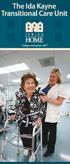 The Ida Kayne Transitional Care Unit Short-Term Rehabilitative Care for Seniors The Ida Kayne Transitional Care Unit (TCU) at the Los Angeles Jewish Home is designed to help seniors successfully transition
School of Nursing Program
 School of Nursing Program 18 School of Nursing Program The Duke University School of Nursing Program Mission The mission of the Duke University School of Nursing is to create a center of excellence for
Florida Pre-Licensure Registered Nurse Education: Academic Year 2012-2013
 The information below represents the key findings regarding the pre-licensure RN (Associate Degree in Nursing, ADN, and Bachelor of Science Degree in Nursing, BSN) education system in Florida. This report
May 7, 2012. Submitted Electronically
 May 7, 2012 Submitted Electronically Secretary Kathleen Sebelius Department of Health and Human Services Office of the National Coordinator for Health Information Technology Attention: 2014 edition EHR
Specialty Practice Master of Nursing Science (MSN) Programs 2015-2016
 Specialty Practice Master of Nursing Science (MSN) Programs 2015-2016 Updated July 9, 2015 1 P a g e Table of Contents General Information... 3 Characteristics of Graduates...3 Specialty MSN Curriculum
Geriatric Psychiatrists
 Mentoring the Next Generation of Geriatric Psychiatrists Tips for Inspiring, Encouraging, and Guiding Medical Students 7910 Woodmont Avenue Suite 1050 Bethesda, MD 20814 phone: 3016547850 [email protected]