
STATE ALZHEIMER S DISEASE PLANS: CARE AND CASE MANAGEMENT
|
|
|
- Sharleen Lambert
- 10 years ago
- Views:
Transcription
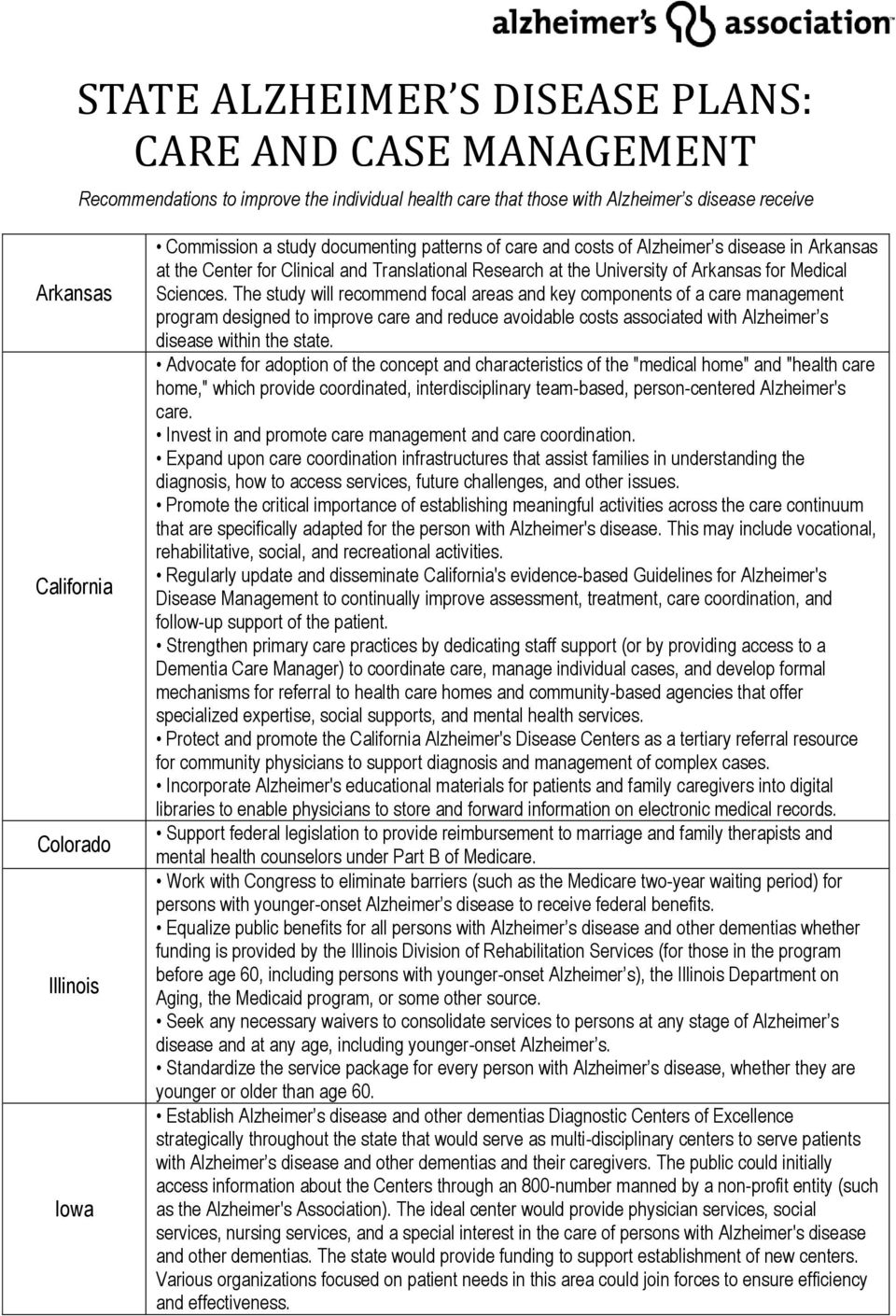
1 STATE ALZHEIMER S DISEASE PLANS: CARE AND CASE MANAGEMENT Recommendations to improve the individual health care that those with Alzheimer s disease receive Arkansas California Colorado Illinois Iowa Commission a study documenting patterns of care and costs of Alzheimer s disease in Arkansas at the Center for Clinical and Translational Research at the University of Arkansas for Medical Sciences. The study will recommend focal areas and key components of a care management program designed to improve care and reduce avoidable costs associated with Alzheimer s disease within the state. Advocate for adoption of the concept and characteristics of the "medical home" and "health care home," which provide coordinated, interdisciplinary team-based, person-centered Alzheimer's care. Invest in and promote care management and care coordination. Expand upon care coordination infrastructures that assist families in understanding the diagnosis, how to access services, future challenges, and other issues. Promote the critical importance of establishing meaningful activities across the care continuum that are specifically adapted for the person with Alzheimer's disease. This may include vocational, rehabilitative, social, and recreational activities. Regularly update and disseminate California's evidence-based Guidelines for Alzheimer's Disease Management to continually improve assessment, treatment, care coordination, and follow-up support of the patient. Strengthen primary care practices by dedicating staff support (or by providing access to a Dementia Care Manager) to coordinate care, manage individual cases, and develop formal mechanisms for referral to health care homes and community-based agencies that offer specialized expertise, social supports, and mental health services. Protect and promote the California Alzheimer's Disease Centers as a tertiary referral resource for community physicians to support diagnosis and management of complex cases. Incorporate Alzheimer's educational materials for patients and family caregivers into digital libraries to enable physicians to store and forward information on electronic medical records. Support federal legislation to provide reimbursement to marriage and family therapists and mental health counselors under Part B of Medicare. Work with Congress to eliminate barriers (such as the Medicare two-year waiting period) for persons with younger-onset Alzheimer s disease to receive federal benefits. Equalize public benefits for all persons with Alzheimer s disease and other dementias whether funding is provided by the Illinois Division of Rehabilitation Services (for those in the program before age 60, including persons with younger-onset Alzheimer s), the Illinois Department on Aging, the Medicaid program, or some other source. Seek any necessary waivers to consolidate services to persons at any stage of Alzheimer s disease and at any age, including younger-onset Alzheimer s. Standardize the service package for every person with Alzheimer s disease, whether they are younger or older than age 60. Establish Alzheimer s disease and other dementias Diagnostic Centers of Excellence strategically throughout the state that would serve as multi-disciplinary centers to serve patients with Alzheimer s disease and other dementias and their caregivers. The public could initially access information about the Centers through an 800-number manned by a non-profit entity (such as the Alzheimer's Association). The ideal center would provide physician services, social services, nursing services, and a special interest in the care of persons with Alzheimer's disease and other dementias. The state would provide funding to support establishment of new centers. Various organizations focused on patient needs in this area could join forces to ensure efficiency and effectiveness.
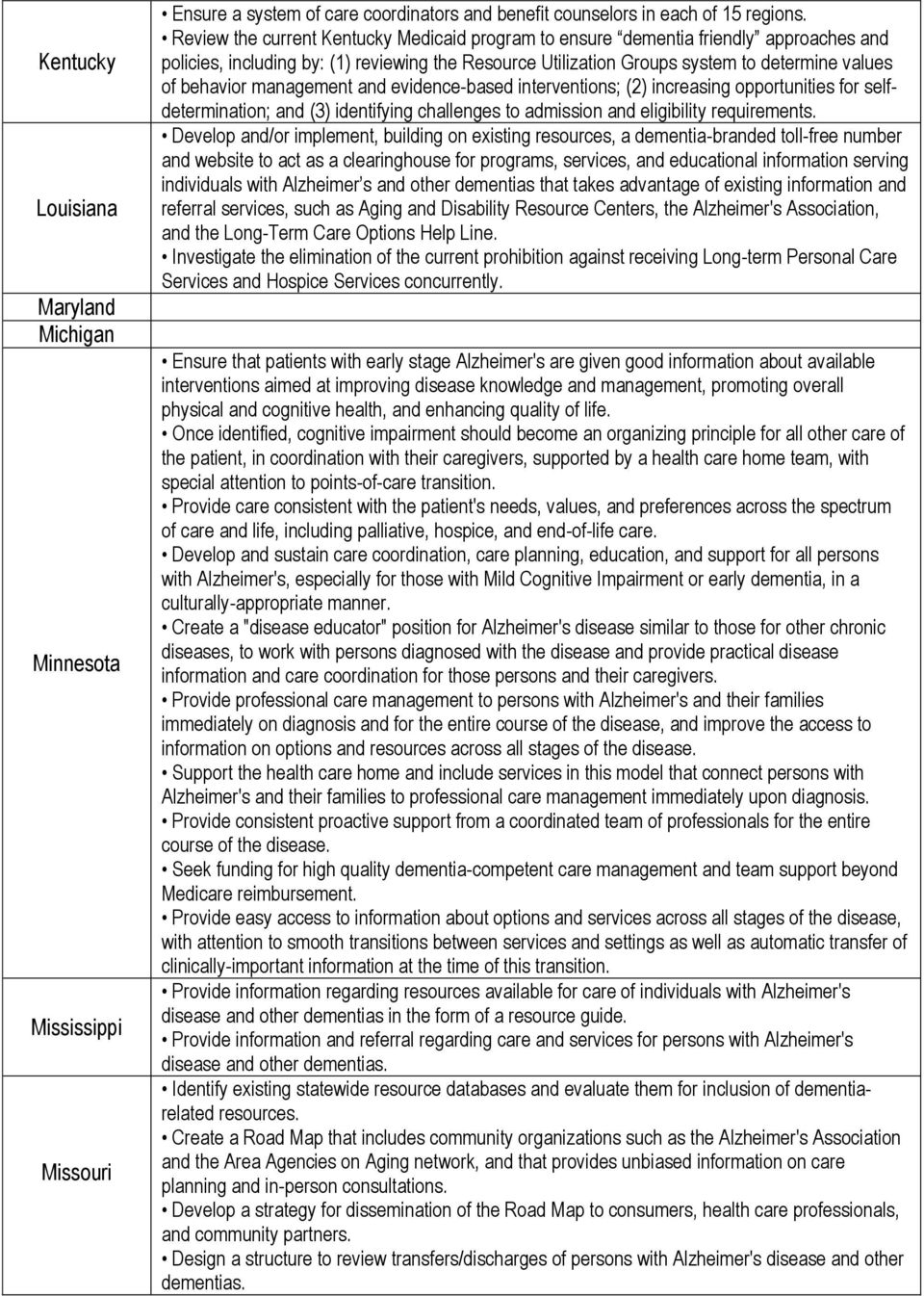
2 Kentucky Louisiana Maryland Michigan Minnesota Mississippi Missouri Ensure a system of care coordinators and benefit counselors in each of 15 regions. Review the current Kentucky Medicaid program to ensure dementia friendly approaches and policies, including by: (1) reviewing the Resource Utilization Groups system to determine values of behavior management and evidence-based interventions; (2) increasing opportunities for selfdetermination; and (3) identifying challenges to admission and eligibility requirements. Develop and/or implement, building on existing resources, a dementia-branded toll-free number and website to act as a clearinghouse for programs, services, and educational information serving individuals with Alzheimer s and other dementias that takes advantage of existing information and referral services, such as Aging and Disability Resource Centers, the Alzheimer's Association, and the Long-Term Care Options Help Line. Investigate the elimination of the current prohibition against receiving Long-term Personal Care Services and Hospice Services concurrently. Ensure that patients with early stage Alzheimer's are given good information about available interventions aimed at improving disease knowledge and management, promoting overall physical and cognitive health, and enhancing quality of life. Once identified, cognitive impairment should become an organizing principle for all other care of the patient, in coordination with their caregivers, supported by a health care home team, with special attention to points-of-care transition. Provide care consistent with the patient's needs, values, and preferences across the spectrum of care and life, including palliative, hospice, and end-of-life care. Develop and sustain care coordination, care planning, education, and support for all persons with Alzheimer's, especially for those with Mild Cognitive Impairment or early dementia, in a culturally-appropriate manner. Create a "disease educator" position for Alzheimer's disease similar to those for other chronic diseases, to work with persons diagnosed with the disease and provide practical disease information and care coordination for those persons and their caregivers. Provide professional care management to persons with Alzheimer's and their families immediately on diagnosis and for the entire course of the disease, and improve the access to information on options and resources across all stages of the disease. Support the health care home and include services in this model that connect persons with Alzheimer's and their families to professional care management immediately upon diagnosis. Provide consistent proactive support from a coordinated team of professionals for the entire course of the disease. Seek funding for high quality dementia-competent care management and team support beyond Medicare reimbursement. Provide easy access to information about options and services across all stages of the disease, with attention to smooth transitions between services and settings as well as automatic transfer of clinically-important information at the time of this transition. Provide information regarding resources available for care of individuals with Alzheimer's disease and other dementias in the form of a resource guide. Provide information and referral regarding care and services for persons with Alzheimer's disease and other dementias. Identify existing statewide resource databases and evaluate them for inclusion of dementiarelated resources. Create a Road Map that includes community organizations such as the Alzheimer's Association and the Area Agencies on Aging network, and that provides unbiased information on care planning and in-person consultations. Develop a strategy for dissemination of the Road Map to consumers, health care professionals, and community partners. Design a structure to review transfers/discharges of persons with Alzheimer's disease and other dementias.
3 Missouri (cont.) New York North Dakota Oklahoma South Carolina Tennessee Support the development of a pilot demonstration project that incorporates dementia specialists as a treatment team member for all individuals with dementia while they are inpatients in hospitals and behavioral health settings. Create a Road Map for care and support that provides quality information on services across the continuum from early diagnosis to end of life. Increase case management for families to improve planning for services and access to available services. Partner with primary care providers and dementia care facilities to improve lines of communication within the medical community. Identify patient advocates and case managers (including discharge planners) to ease transitions within and between hospitals, nursing homes, and community-based care. Work with hospice to promote a model of care for late-stage dementia patients who do not meet the current hospice criteria for terminal illness of six months or less. Increase integration of the mental and physical health systems using models such as the one implemented by Flushing Hospital. Promote increased awareness of the availability of hospice and palliative care for Alzheimer's disease patients through all state programs. Provide care consultations to those diagnosed with Alzheimer's disease and their caregivers, including an assessment of needs, identification of issues and concerns, identification of available resources, development of a plan of care, referrals, support and education about dementia, and follow-up. Establish and fund a statewide information and referral system for those with Alzheimer's disease, their caregivers, and their families to connect with local case management, support services, and information. Implement an automatic reminder on electronic medical records requiring physicians' offices to provide referral to the Alzheimer's Association upon a diagnosis of Alzheimer's disease and other dementias. Recommend that pharmacists include written referral to the Alzheimer's Association upon distribution of memory-care medications. Create a single point of entry for persons seeking assistance with Alzheimer's-related needs, utilizing a toll free number through the Lieutenant Governor's Office on Aging. Provide appropriate referrals for hospice care for people with Alzheimer's disease and aftercare for the caregivers of persons with Alzheimer's disease and other dementias. Provide case management and person-centered support services to individuals with Alzheimer's disease and other dementias and their caregivers through a local/regional provider network. Enhance and strengthen the infrastructure to provide a continuum of care for persons with Alzheimer's disease and other dementias and their caregivers to address the progression of the disease from mild to severe and to allow flexibility to move within the care system depending on the needs of the individuals and their families. Provide case managers to help navigate the system. Provide diagnostic services, treatment, and case management to patients and families throughout Tennessee, especially to rural areas of Tennessee. Provide access to optimal care for more Tennesseans in all parts of the state. Identify a patient s true needs at the point of discharge, assess a caregiver s abilities/limitations, involve the family and their needs in planning, and develop a special check-list/survey for persons with dementia. Partner with the Tennessee Hospital Association to provide a point person at each hospital responsible for coordinating support for the person with dementia and his/her family. Provide a continuum of care for geriatric-psych patients who require both inpatient and outpatient care.

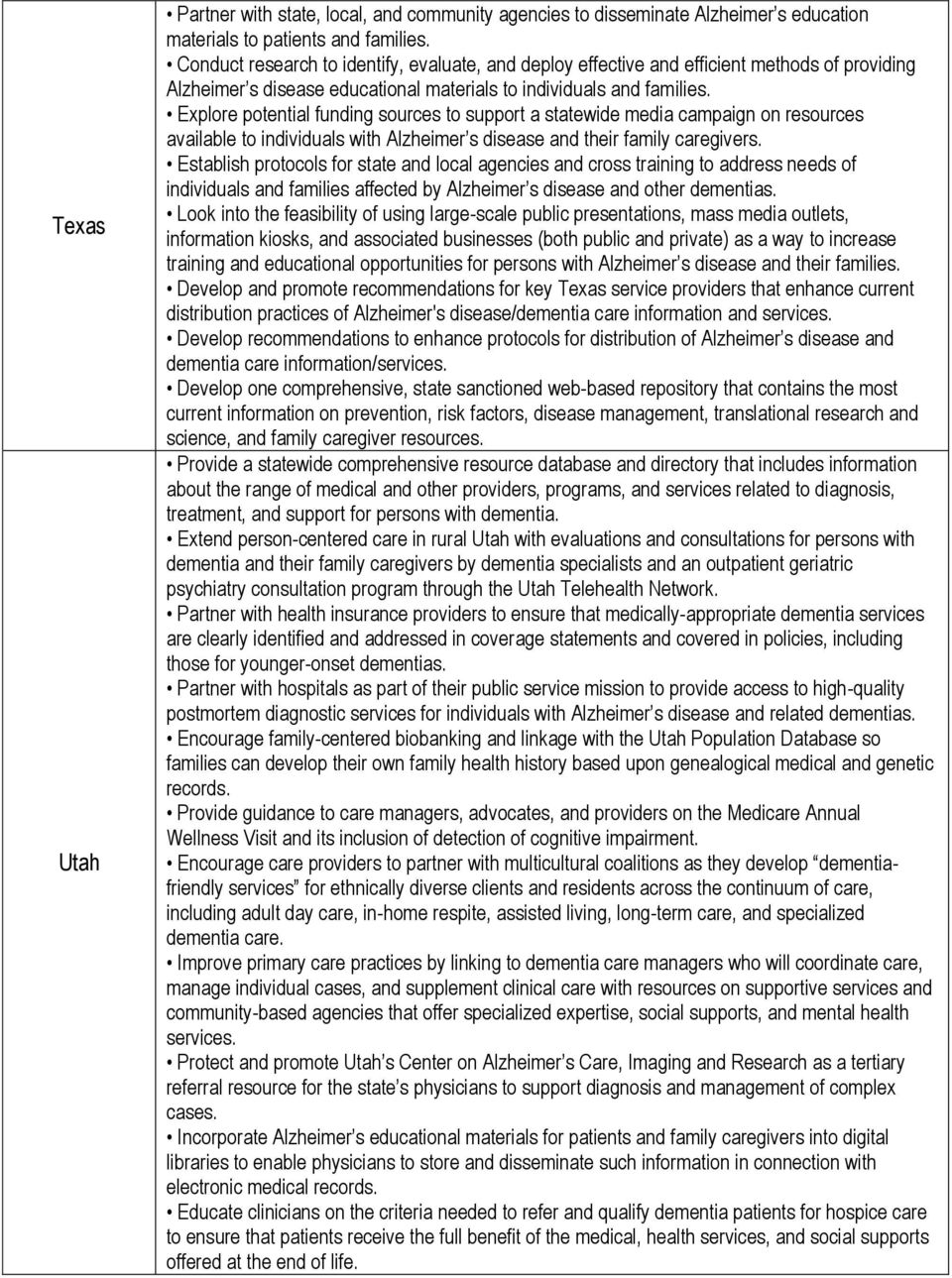
4 Texas Utah Partner with state, local, and community agencies to disseminate Alzheimer s education materials to patients and families. Conduct research to identify, evaluate, and deploy effective and efficient methods of providing Alzheimer s disease educational materials to individuals and families. Explore potential funding sources to support a statewide media campaign on resources available to individuals with Alzheimer s disease and their family caregivers. Establish protocols for state and local agencies and cross training to address needs of individuals and families affected by Alzheimer s disease and other dementias. Look into the feasibility of using large-scale public presentations, mass media outlets, information kiosks, and associated businesses (both public and private) as a way to increase training and educational opportunities for persons with Alzheimer s disease and their families. Develop and promote recommendations for key Texas service providers that enhance current distribution practices of Alzheimer's disease/dementia care information and services. Develop recommendations to enhance protocols for distribution of Alzheimer s disease and dementia care information/services. Develop one comprehensive, state sanctioned web-based repository that contains the most current information on prevention, risk factors, disease management, translational research and science, and family caregiver resources. Provide a statewide comprehensive resource database and directory that includes information about the range of medical and other providers, programs, and services related to diagnosis, treatment, and support for persons with dementia. Extend person-centered care in rural Utah with evaluations and consultations for persons with dementia and their family caregivers by dementia specialists and an outpatient geriatric psychiatry consultation program through the Utah Telehealth Network. Partner with health insurance providers to ensure that medically-appropriate dementia services are clearly identified and addressed in coverage statements and covered in policies, including those for younger-onset dementias. Partner with hospitals as part of their public service mission to provide access to high-quality postmortem diagnostic services for individuals with Alzheimer s disease and related dementias. Encourage family-centered biobanking and linkage with the Utah Population Database so families can develop their own family health history based upon genealogical medical and genetic records. Provide guidance to care managers, advocates, and providers on the Medicare Annual Wellness Visit and its inclusion of detection of cognitive impairment. Encourage care providers to partner with multicultural coalitions as they develop dementiafriendly services for ethnically diverse clients and residents across the continuum of care, including adult day care, in-home respite, assisted living, long-term care, and specialized dementia care. Improve primary care practices by linking to dementia care managers who will coordinate care, manage individual cases, and supplement clinical care with resources on supportive services and community-based agencies that offer specialized expertise, social supports, and mental health services. Protect and promote Utah s Center on Alzheimer s Care, Imaging and Research as a tertiary referral resource for the state s physicians to support diagnosis and management of complex cases. Incorporate Alzheimer s educational materials for patients and family caregivers into digital libraries to enable physicians to store and disseminate such information in connection with electronic medical records. Educate clinicians on the criteria needed to refer and qualify dementia patients for hospice care to ensure that patients receive the full benefit of the medical, health services, and social supports offered at the end of life.
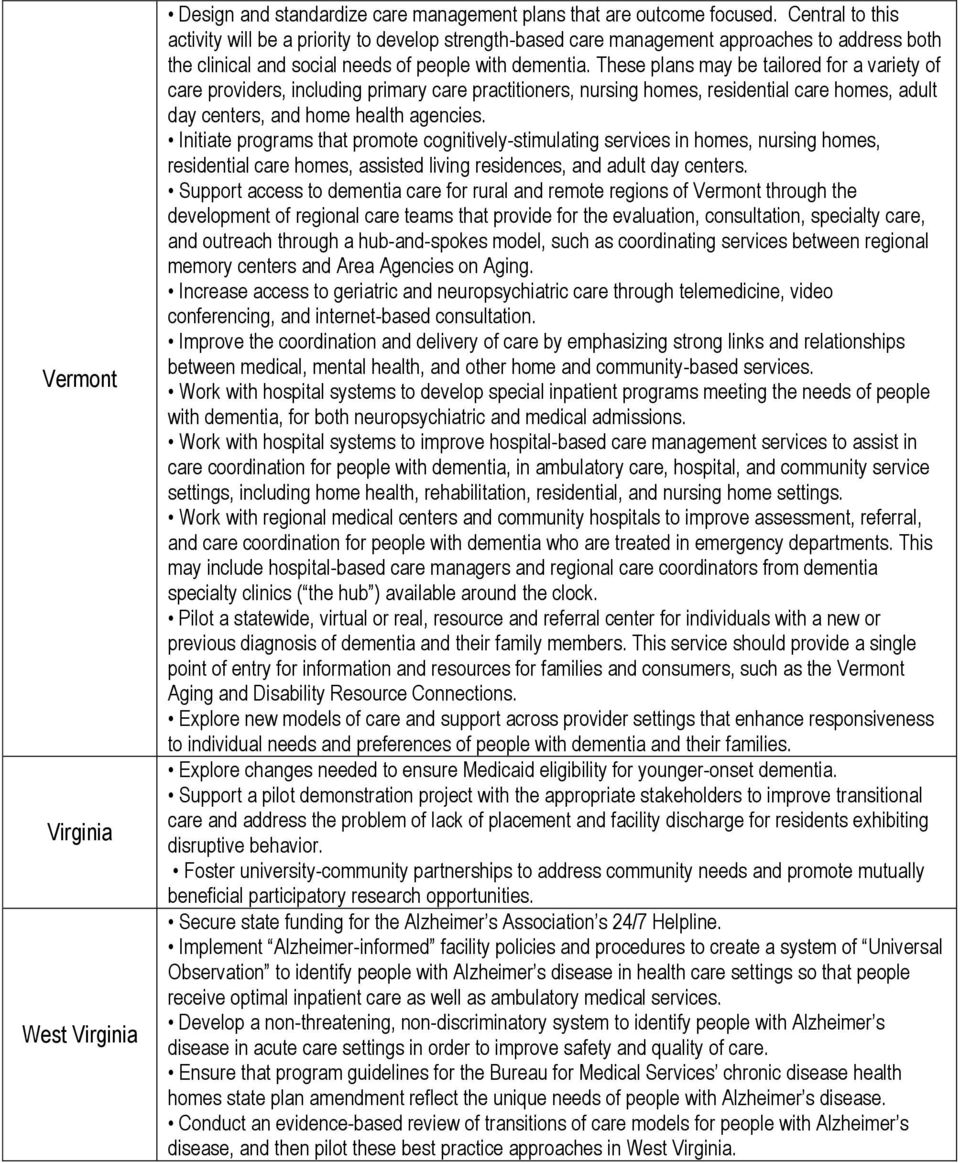
5 Vermont Virginia West Virginia Design and standardize care management plans that are outcome focused. Central to this activity will be a priority to develop strength-based care management approaches to address both the clinical and social needs of people with dementia. These plans may be tailored for a variety of care providers, including primary care practitioners, nursing homes, residential care homes, adult day centers, and home health agencies. Initiate programs that promote cognitively-stimulating services in homes, nursing homes, residential care homes, assisted living residences, and adult day centers. Support access to dementia care for rural and remote regions of Vermont through the development of regional care teams that provide for the evaluation, consultation, specialty care, and outreach through a hub-and-spokes model, such as coordinating services between regional memory centers and Area Agencies on Aging. Increase access to geriatric and neuropsychiatric care through telemedicine, video conferencing, and internet-based consultation. Improve the coordination and delivery of care by emphasizing strong links and relationships between medical, mental health, and other home and community-based services. Work with hospital systems to develop special inpatient programs meeting the needs of people with dementia, for both neuropsychiatric and medical admissions. Work with hospital systems to improve hospital-based care management services to assist in care coordination for people with dementia, in ambulatory care, hospital, and community service settings, including home health, rehabilitation, residential, and nursing home settings. Work with regional medical centers and community hospitals to improve assessment, referral, and care coordination for people with dementia who are treated in emergency departments. This may include hospital-based care managers and regional care coordinators from dementia specialty clinics ( the hub ) available around the clock. Pilot a statewide, virtual or real, resource and referral center for individuals with a new or previous diagnosis of dementia and their family members. This service should provide a single point of entry for information and resources for families and consumers, such as the Vermont Aging and Disability Resource Connections. Explore new models of care and support across provider settings that enhance responsiveness to individual needs and preferences of people with dementia and their families. Explore changes needed to ensure Medicaid eligibility for younger-onset dementia. Support a pilot demonstration project with the appropriate stakeholders to improve transitional care and address the problem of lack of placement and facility discharge for residents exhibiting disruptive behavior. Foster university-community partnerships to address community needs and promote mutually beneficial participatory research opportunities. Secure state funding for the Alzheimer s Association s 24/7 Helpline. Implement Alzheimer-informed facility policies and procedures to create a system of Universal Observation to identify people with Alzheimer s disease in health care settings so that people receive optimal inpatient care as well as ambulatory medical services. Develop a non-threatening, non-discriminatory system to identify people with Alzheimer s disease in acute care settings in order to improve safety and quality of care. Ensure that program guidelines for the Bureau for Medical Services chronic disease health homes state plan amendment reflect the unique needs of people with Alzheimer s disease. Conduct an evidence-based review of transitions of care models for people with Alzheimer s disease, and then pilot these best practice approaches in West Virginia.
Assertive Community Treatment (ACT) Providing Health Home Care Management Interim Instruction: February 19, 2014
 Assertive Community Treatment (ACT) Providing Health Home Care Management Interim Instruction: February 19, 2014 Introduction The Office of Mental Health (OMH) licensed and regulated Assertive Community
2015 State Telemedicine Legislation Tracking (as of 4/28/2015) *
 Alabama Alaska 2015 Telemedicine Legislation Tracking (as of 4/28/2015) * Arizona HB 2454 - Repeals telemedicine abortion prohibition; HB 2489 (STATUS: SIGNED BY GOVERNOR)- Adds some prescription drug
TELEMEDICINE REIMBURSEMENT MANDATES BY STATE: Medicaid & Private Payer
 TELEMEDICINE REIMBURSEMENT MANDATES BY STATE: Medicaid & Private Payer Unless otherwise noted, this information came from The Center for Telehealth and E-Health Law, and The American Telemedicine Association
CHAPTER 535 HEALTH HOMES. Background... 2. Policy... 2. 535.1 Member Eligibility and Enrollment... 2. 535.2 Health Home Required Functions...
 TABLE OF CONTENTS SECTION PAGE NUMBER Background... 2 Policy... 2 535.1 Member Eligibility and Enrollment... 2 535.2 Health Home Required Functions... 3 535.3 Health Home Coordination Role... 4 535.4 Health
Medicaid Topics Impact of Medicare Dual Eligibles Stephen Wilhide, Consultant
 Medicaid Topics Impact of Medicare Dual Eligibles Stephen Wilhide, Consultant Issue Summary The term dual eligible refers to the almost 7.5 milion low-income older individuals or younger persons with disabilities
CLINICAL PRIVILEGE WHITE PAPER Psychology
 Psychology CLINICAL PRIVILEGE WHITE PAPER Psychology Background Psychology is a broad field that includes the scientific study of mental processes and behavior. It is similar to the medical field of psychiatry.
2016 MEDICAL REHABILITATION PROGRAM DESCRIPTIONS
 2016 MEDICAL REHABILITATION PROGRAM DESCRIPTIONS Contents Comprehensive Integrated Inpatient Rehabilitation Program... 2 Outpatient Medical Rehabilitation Program... 2 Home and Community Services... 3
Medicare Hospice Benefits
 Large Print Edition Medicare Hospice Benefits a special way of caring for people who have a terminal illness This booklet explains... The hospice program and who is eligible. Your Medicare hospice benefits.
Patient Protection and Affordable Care Act [PL 111-148] with Amendments from 2010 Reconciliation Act [PL 111-152] Direct-Care Workforce
![Patient Protection and Affordable Care Act [PL 111-148] with Amendments from 2010 Reconciliation Act [PL 111-152] Direct-Care Workforce](/thumbs/25/6872632.jpg "Patient Protection and Affordable Care Act [PL 111-148] with Amendments from 2010 Reconciliation Act [PL 111-152] Direct-Care Workforce") DIRECT-CARE WORKFORCE AND LONG-TERM CARE PROVISIONS AS ENACTED IN PATIENT PROTECTION AND AFFORDABLE CARE ACT AND HEALTH CARE AND EDUCATION RECONCILIATION ACT OF 2010 Key Provisions Direct-Care Workforce
DIRECT-CARE WORKFORCE AND LONG-TERM CARE PROVISIONS AS ENACTED IN PATIENT PROTECTION AND AFFORDABLE CARE ACT AND HEALTH CARE AND EDUCATION RECONCILIATION ACT OF 2010 Key Provisions Direct-Care Workforce
Alabama Autism Task Force Preliminary Recommendations
 Alabama Autism Task Force Preliminary Recommendations Having reviewed the findings to date from the Alabama Autism Collaborative Group (AACG), The Alabama Autism Task Force proposes the following changes
Telemedicine in the Patient Protection and Affordable Care Act (2010)
 Telemedicine in the Patient Protection and Affordable Care Act (2010) The new national health insurance reform legislation contains several advances for telemedicine that are listed below. There are numerous
Licensure Resources by State
 Licensure Resources by State Alabama Alabama State Board of Social Work Examiners http://socialwork.alabama.gov/ Alaska Alaska Board of Social Work Examiners http://commerce.state.ak.us/dnn/cbpl/professionallicensing/socialworkexaminers.as
Aging and Disability Resource Centers: Five Year Plan for Expanding ADRCs Statewide
 Aging and Disability Resource Centers: Five Year Plan for Expanding ADRCs Statewide Florida Department of Elder Affairs Charles T. Corley, Interim Secretary April 1, 2011 FLORIDA DEPARTMENT OF ELDER AFFAIRS
Redesigning the Publicly-Funded Mental Health System in Texas
 Redesigning the Publicly-Funded Mental Health System in Texas Access to care when services are needed Choice in health plans for consumers and providers Integration of care at the plan and provider level
AAPA ANNUAL SURVEY REPORT
 2013 AAPA ANNUAL SURVEY REPORT PHYSICIAN ASSISTANTS AT A GLANCE HIGHLIGHTS OF THE MEDIAN AGE CLINICALLY PRACTICING PAS BY PRIMARY SPECIALTY PRACTICE SETTING Primary Care 32.0% Surgical Subspecialties 27.0%
How Health Reform Will Affect Health Care Quality and the Delivery of Services
 Fact Sheet AARP Public Policy Institute How Health Reform Will Affect Health Care Quality and the Delivery of Services The recently enacted Affordable Care Act contains provisions to improve health care
Iowa Medicaid Integrated Health Home Provider Agreement General Terms
 Iowa Medicaid Integrated Health Home Provider Agreement General Terms This Agreement is between the state of Iowa, Department of Human Services, (the Department ) and the Provider (the Provider ). The
Recruitment and Retention Resources By State List
 Recruitment and Retention Resources By State List Alabama $5,000 rural physician tax credit o http://codes.lp.findlaw.com/alcode/40/18/4a/40-18-132 o http://adph.org/ruralhealth/index.asp?id=882 Area Health
Center for Medicare and Medicaid Innovation
 Center for Medicare and Medicaid Innovation Summary: Establishes within the Centers for Medicare and Medicaid Services (CMS) a Center for Medicare & Medicaid Innovation (CMI). The purpose of the Center
How To Run An Acquired Brain Injury Program
 ` Acquired Brain Injury Program Regional Rehabilitation Centre at the Hamilton General Hospital Table of Contents Page Introduction... 3-4 Acquired Brain Injury Program Philosophy... 3 Vision... 3 Service
The Obama Administration and Community Health Centers
 The Obama Administration and Community Health Centers Community health centers are a critical source of health care for millions of Americans particularly those in underserved communities. Thanks primarily
What is Home Care Case Management?
 What is Home Care Case Management? Printed in USA Arcadia Home Care & Staffing www.arcadiahomecare.com Case Management: What is it why is it important? While different approaches to healthcare today are
Understanding the Affordable Care Act
 Understanding the Affordable Care Act The Affordable Care Act (officially called the Patient Protection and Affordable Care Act) is the law that mandates that everyone in the United States maintain health
Medicare- Medicaid Enrollee State Profile
 Medicare- Medicaid Enrollee State Profile The National Summary Centers for Medicare & Medicaid Services Introduction... 1 Data Source and General Notes... 2 Types and Ages of Medicare-Medicaid Enrollees...
Home Health Care: A More Cost-Effective Approach to Medicaid in Illinois Illinois HomeCare & Hospice Council December 2010
 Home Health Care: A More Cost-Effective Approach to Medicaid in Illinois Illinois HomeCare & Hospice Council December 2010 As the Illinois Legislature prepares to act on the future of Medicaid, it is important
Opportunities for Home Care Providers in Working with Medical Homes October 2014. EMHS Vice President Continuum of Care Chief Advocacy Officer
 How to Establish Partnerships and Opportunities for Home Care Providers in Working with Medical Homes October 2014 Lisa Harvey-McPherson, RN, MBA, MPPM EMHS Vice President Continuum of Care Chief Advocacy
High Risk Health Pools and Plans by State
 High Risk Health Pools and Plans by State State Program Contact Alabama Alabama Health 1-866-833-3375 Insurance Plan 1-334-263-8311 http://www.alseib.org/healthinsurance/ahip/ Alaska Alaska Comprehensive
Response to Serving the Medi Cal SPD Population in Alameda County
 Expanding Health Coverage and Increasing Access to High Quality Care Response to Serving the Medi Cal SPD Population in Alameda County As the State has acknowledged in the 1115 waiver concept paper, the
Healthcare. State Report. Anthony P. Carnevale Nicole Smith Artem Gulish Bennett H. Beach. June 2012
 Healthcare State Report June 2012 Anthony P. Carnevale Nicole Smith Artem Gulish Bennett H. Beach B Table of Contents Healthcare: State Level Analysis... 3 Alabama... 12 Alaska... 14 Arizona... 16 Arkansas...
Nancy L. Wilson Department of Medicine-Geriatrics Houston Center for Quality of Care& Utilization Studies Texas Consortium of Geriatric Education
 1 Nancy L. Wilson Department of Medicine-Geriatrics Houston Center for Quality of Care& Utilization Studies Texas Consortium of Geriatric Education Centers Care for Elders Governing Council Acknowledge
Presented to: Long Term Care Workgroup May 26, 2011
 Presented to: Long Term Care Workgroup May 26, 2011 Partners in the Grant SC Department of Health and Human Services Sam Waldrep Roy Smith Project Coordinator Office of Research and Statistics Institute
NON-RESIDENT INDEPENDENT, PUBLIC, AND COMPANY ADJUSTER LICENSING CHECKLIST
 NON-RESIDENT INDEPENDENT, PUBLIC, AND COMPANY ADJUSTER LICENSING CHECKLIST ** Utilize this list to determine whether or not a non-resident applicant may waive the Oklahoma examination or become licensed
Full Medical Benefits**
 (In effect as of January 1, 2006*) TABLE 5a. MEDICAL BENEFITS PROVIDED BY WORKERS' COMPENSATION STATUTES Full Medical Benefits** Alabama Indiana Nebraska South Carolina Alaska Iowa Nevada South Dakota
CCNC Care Management
 CCNC Care Management Community Care of North Carolina (CCNC) is a statewide population management and care coordination infrastructure founded on the primary care medical home model. CCNC incorporates
Appendix A. State Programs Approaches on Building Blocks
 Appendix A. State Programs Approaches on Building Blocks Table 1. Eligibility Requirements Program/State Age Diagnosis Eligibility for existing program Children s Medical Services (CMS) Network/Florida
Three-Year Moving Averages by States % Home Internet Access
 Three-Year Moving Averages by States % Home Internet Access Alabama Alaska Arizona Arkansas California Colorado Connecticut Delaware Florida Georgia Hawaii Idaho Illinois Indiana Iowa Kansas Kentucky Louisiana
Your Guide to Medicare Private Fee-for-Service Plans. Heading CENTERS FOR MEDICARE & MEDICAID SERVICES
 Heading CENTERS FOR MEDICARE & MEDICAID SERVICES Your Guide to Medicare Private Fee-for-Service Plans This official government booklet has important information about Medicare Private Fee-for-Service Plans
CASE MANAGEMENT F R O M A C U T E C A R E T O T H E C O M M U N I T Y A C R O S S T H E C O N T I N U U M O F C A R E
 CASE MANAGEMENT F R O M A C U T E C A R E T O T H E C O M M U N I T Y A C R O S S T H E C O N T I N U U M O F C A R E CASE MANAGEMENT Case Management is a collaborative process of assessment, planning,
State Laws on Suicide Prevention Training for School Personnel
 State Laws on Suicide Prevention Training for School Personnel Overview: According to the latest (2011) data from the Centers for Disease Control and Prevention (CDC), suicide is the second leading cause
YOUR TALENT SEARCH, SIMPLIFIED
 YOUR TALENT SEARCH, SIMPLIFIED ACADEMIA & RESEARCH American Association for the Study of Liver Diseases American Association of Colleges of Osteopathic Medicine American Association of Diabetes Educators
Total 15,555 191,604
 January 2012 Program -to -Date Medicare Eligible Professionals 8,524 132,445 Doctors of Medicine or Osteopathy 7,620 118,146 Dentists 12 198 Optometrists 436 5,928 Podiatrists 222 4,890 Chiropractors 234
Financial advisors and Alzheimer s disease: What you need to know
 Financial advisors and Alzheimer s disease: What you need to know In today s aging society, with people living longer lives, chances are high that you ll be called upon to assist clients who are caring
TREATMENT MODALITIES. May, 2013
 TREATMENT MODALITIES May, 2013 Treatment Modalities New York State Office of Alcoholism and Substance Abuse Services (NYS OASAS) regulates the addiction treatment modalities offered in New York State.
Public School Teacher Experience Distribution. Public School Teacher Experience Distribution
 Public School Teacher Experience Distribution Lower Quartile Median Upper Quartile Mode Alabama Percent of Teachers FY Public School Teacher Experience Distribution Lower Quartile Median Upper Quartile
Outpatient dialysis services
 O n l i n e A p p e n d i x e s 6 Outpatient dialysis services 6-A O n l i n e A p p e n d i x Medicare spending by dialysis beneficiaries is substantial FIGURE 1-3 Figure 6 A1 Medicare population Dialysis
Easing the Transition: Moving Your Relative to a Nursing Home
 Easing the Transition: Moving Your Relative to a Nursing Home Alzheimer s Association, New York City Chapter 360 Lexington Avenue, 4th Floor New York, NY 10017 24-hour Helpline 1-800-272-3900 www.alz.org/nyc
Medicare Hospice Benefits
 CENTERS for MEDICARE & MEDICAID SERVICES Medicare Hospice Benefits This official government booklet includes information about Medicare hospice benefits: Who s eligible for hospice care What services are
HEALTH PROFESSIONAL WORKFORCE (SECTION-BY-SECTION ANALYSIS)
 HEALTH PROFESSIONAL WORKFORCE (SECTION-BY-SECTION ANALYSIS) (Information compiled from the Democratic Policy Committee (DPC) Report on The Patient Protection and Affordable Care Act and the Health Care
Traumatic Brain Injury in WA State Statute: Introduction to HB 2055 and RCW 74.31. Laura Dahmer-White, Ph.D.
 Traumatic Brain Injury in WA State Statute: Introduction to HB 2055 and RCW 74.31 Laura Dahmer-White, Ph.D. TBI Incidence/Prevalence CDC estimates that 5,300,000 people in the US (2% of population) have
Employment and Earnings of Registered Nurses in 2010
 Employment and Earnings of Registered Nurses in 2010 Thursday, May 25, 2011 The Bureau of Labor Statistics (BLS) released 2010 occupational employment data on May 17, 2011. This document provides several
SECTION 109 HOST STATE LOAN-TO-DEPOSIT RATIOS. The Board of Governors of the Federal Reserve System (Board), the Federal Deposit
 SECTION 109 HOST STATE LOAN-TO-DEPOSIT RATIOS The Board of Governors of the Federal Reserve System (Board), the Federal Deposit Insurance Corporation (FDIC), and the Office of the Comptroller of the Currency
NO. 160. AN ACT RELATING TO THE COORDINATION, FINANCING AND DISTRIBUTION OF LONG-TERM CARE SERVICES. (H.782)
 NO. 160. AN ACT RELATING TO THE COORDINATION, FINANCING AND DISTRIBUTION OF LONG-TERM CARE SERVICES. (H.782) It is hereby enacted by the General Assembly of the State of Vermont: Sec. 1. DEFINITIONS For
Data show key role for community colleges in 4-year
 Page 1 of 7 (https://www.insidehighered.com) Data show key role for community colleges in 4-year degree production Submitted by Doug Lederman on September 10, 2012-3:00am The notion that community colleges
Maryland Data as of July 2003. Mental Health and Substance Abuse Services in Medicaid and SCHIP in Maryland
 Mental Health and Substance Abuse Services in Medicaid and SCHIP in Maryland As of July 2003, 638,662 people were covered under Maryland's Medicaid/SCHIP programs. There were 525,080 enrolled in the Medicaid
State Innovation Models Initiative:
 Department of Health & Human Services Centers for Medicare & Medicaid Services Room 352-G 200 Independence Avenue, SW Washington, DC 20201 FACT SHEET FOR IMMEDIATE RELEASE Contact: CMS Media Relations
Oregon Standards for Certified Community Behavioral Health Clinics (CCBHCs)
 Oregon Standards for Certified Community Behavioral Health Clinics (CCBHCs) Senate Bill 832 directed the Oregon Health Authority (OHA) to develop standards for achieving integration of behavioral health
Meet Our Team Marketing Directors & Clinical Evaluators
 Meet Our Team Marketing Directors & Clinical Evaluators Michael Zavacky As the Director of Marketing, South for NeuroRestorative, Michael works with families, case managers, clinicians, payors, workers
Population Health Management For Behavioral Health. MHA s 2015 Annual Conference June 3, 2015
 Population Health Management For Behavioral Health MHA s 2015 Annual Conference June 3, 2015 Goals of the Affordable Care Act Improve the health of populations Lower per capita costs Improve the patient
CLINICAL PRACTICE GUIDELINES Treatment of Schizophrenia
 CLINICAL PRACTICE GUIDELINES Treatment of Schizophrenia V. Service Delivery Service Delivery and the Treatment System General Principles 1. All patients should have access to a comprehensive continuum
Professional Treatment Services in Facility-Based Crisis Program Children and Adolescents
 Professional Treatment Services in Facility-Based Crisis Program Children and Adolescents Medicaid and North Carolina Health Choice (NCHC) Billable Service WORKING DRAFT Revision Date: September 11, 2014
Pediatric Alliance: A New Solution Built on Familiar Values. Empowering physicians with an innovative pediatric Accountable Care Organization
 Pediatric Alliance: A New Solution Built on Familiar Values Empowering physicians with an innovative pediatric Accountable Care Organization BEYOND THE TRADITIONAL MODEL OF CARE Children s Health SM Pediatric
HPNEC. FY 2015 Brochure
 HPNEC Health Professions and Nursing Education COALITION Health Professions Education Programs: Connecting students to health careers, health professionals to underserved communities, and communities to
How are Health Home Services Provided to the Medically Needy?
 Id: NEW YORK State: New York Health Home Services Effective Date- January 1, 2012 SPA includes both Categorically Needy and Medically Needy Beneficiaries- check box 3.1 - A: Categorically Needy View Attachment
PUSHING THE BOUNDARIES: TRENDS IN HOME HEALTH CARE FOR VETERANS WITH CHRONIC DISABLING DISEASE
 PUSHING THE BOUNDARIES: TRENDS IN HOME HEALTH CARE FOR VETERANS WITH CHRONIC DISABLING DISEASE Rick Greene Department of Veterans Affairs Office of Geriatrics & Extended Care July 21, 2010 1 Pushing the
LONG TERM CARE INSURANCE OUTLINE OF COVERAGE THIS OUTLINE OF COVERAGE IS A QUALIFIED LONG TERM CARE INSURANCE PLAN UNDER THE FEDERAL TAX CODE
 Page 1 of 8 LONG TERM CARE INSURANCE OUTLINE OF COVERAGE THIS OUTLINE OF COVERAGE IS A QUALIFIED LONG TERM CARE INSURANCE PLAN UNDER THE FEDERAL TAX CODE Continental Casualty Company P.O. Box 946760 Maitland,
(In effect as of January 1, 2004*) TABLE 5a. MEDICAL BENEFITS PROVIDED BY WORKERS' COMPENSATION STATUTES FECA LHWCA
 (In effect as of January 1, 2004*) TABLE 5a. MEDICAL BENEFITS PROVIDED BY WORKERS' COMPENSATION STATUTES Full Medical Benefits** Alabama Indiana Nebraska South Carolina Alaska Iowa Nevada South Dakota
$7.5 appropriation $6.5 2011 2012 2013 2014 2015 2016. Preschool Development Grants
 School Readiness: High-Quality Early Learning Head Start $10.5 $9.5 $10.1 +$1.5 +17.7% $8.5 $7.5 +$2.1 +27.0% $6.5 for fiscal year 2010 Included in the budget is $1.078 billion to ensure that every Head
The Health Insurance Marketplace 101
 The Health Insurance Marketplace 101 National Newspaper Association 127th Annual Convention & Trade Show September 13, 2013 Office of the Regional Director Community Resource California-Based Arizona,
Top reasons to become an AmeriHealth Caritas Iowa provider
 Top reasons to become an AmeriHealth Caritas Iowa provider becomeaprovider.amerihealthcaritas.com WHO WE SERVE Nationally AmeriHealth Caritas With our nationwide presence, serving more than six million
MAINE (Augusta) Maryland (Annapolis) MICHIGAN (Lansing) MINNESOTA (St. Paul) MISSISSIPPI (Jackson) MISSOURI (Jefferson City) MONTANA (Helena)
 HAWAII () IDAHO () Illinois () MAINE () Maryland () MASSACHUSETTS () NEBRASKA () NEVADA (Carson ) NEW HAMPSHIRE () OHIO () OKLAHOMA ( ) OREGON () TEXAS () UTAH ( ) VERMONT () ALABAMA () COLORADO () INDIANA
Mental Health and Substance Abuse Services in Medicaid and SCHIP in Colorado
 Mental Health and Substance Abuse Services in Medicaid and SCHIP in Colorado As of July 2003, 377,123 people were covered under Colorado s Medicaid and SCHIP programs. There were 330,499 enrolled in the
Guide to Chronic Disease Management and Prevention
 Family Health Teams Advancing Primary Health Care Guide to Chronic Disease Management and Prevention September 27, 2005 Table of Contents 3 Introduction 3 Purpose 4 What is Chronic Disease Management
Palliative Care Role Delineation Framework
 Director-General Palliative Care Role Delineation Framework Document Number GL2007_022 Publication date 26-Nov-2007 Functional Sub group Clinical/ Patient Services - Medical Treatment Clinical/ Patient
NAVIGATING THE MEDICARE MAZE OF REHABILITATIVE SERVICES
 NAVIGATING THE MEDICARE MAZE OF REHABILITATIVE SERVICES NAVIGATING THE COMPLEXITY OF INSURANCE COVERAGE. Fox Rehabilitation is a private practice of physical, occupational, and speech therapists who specialize