
Mobile Application Part (MAP) - Voice Feature Scenarios: Call Forwarding REVISION HISTORY TIA E. Revision Date Remarks
|
|
|
- Hugo Preston Gordon
- 10 years ago
- Views:
Transcription
1 Mobile Application Part (MAP) - Voice Feature Scenarios: Call Forwarding REVISION HISTORY Revision Date Remarks TIA-.-E January 00 Initial publication. Copyright Telecommunications Industry Association 00. All rights reserved. This document is subject to change.

2 This page is left blank intentionally. ii

3 0 INTRODUCTION Unless otherwise noted, the scenarios in this Part depict features operating individually; i.e., feature interactions are not considered unless specifically noted. The scenarios in this Part do not include a complete listing of operation parameters, either in the figures or in the accompanying text descriptions. Parameters are included where they are deemed necessary to improve the understanding of the scenario. For a complete description of the parameters associated with each operation, refer to Parts- and -0. Call Forwarding Busy This section depicts the interactions between network entities in various situations related to automatic roaming and Call Forwarding Busy (CFB). These scenarios are for illustrative purposes only.. CFB Variable Registration or De-Registration The information flows required for the registration or de-registration of CFB by an authorized MS are described in Part- Section... CFB Demand Activation with Courtesy Call The information flows required for the demand activation of CFB by an authorized MS, where the serving system provides the optional courtesy call to the forward-to number on CFB activation, are described in Part- Section... CFB Demand Activation (without Courtesy Call) or De- Activation The information flows required for the demand activation or de-activation of CFB by an authorized MS, where the serving system does not provide the optional courtesy call to the forward-to number on CFB activation, are described in Part- Section.. - INTRODUCTION

4 . CFB Invocation call origination This scenario describes CFB invocation due to the served MS being busy. MSC Originating System LOCREQ [DGTSDIAL] LRT call forward setup HLR ROUTREQ [MSID] RRT locreq [TERMLIST, REDIND] Figure CFB Invocation a. A call origination and the dialed MS address digits (i.e., directory number) are received by the Originating MSC. b. The Originating MSC sends a LOCREQ to the HLR associated with the MS; this association is made through the dialed MS address digits (which might not be the same as the MIN). c. If the dialed MS address digits are assigned to a legitimate subscriber, the HLR sends a ROUTREQ to the VLR where the MS is registered. d. The VLR then forwards the ROUTREQ to the current Serving MSC. e. In reaction to the ROUTREQ, the Serving MSC checks its internal data structures and determines that the MS is busy in another call. The status of the MS is returned to the VLR by the Serving MSC in the routreq. f. The VLR sends the routreq to the HLR. g. The HLR determines from the service profile that CFB is active. It sends a locreq to the Originating MSC providing the forward-to number and other routing information in the TerminationList parameter, along with an indication of the reason for extending the incoming call (i.e., for CFB) in the DMH_RedirectionIndicator parameter. h. The Originating MSC then establishes a call to the specified forward-to number. VLR Serving System ROUTREQ [MSID] RRT routreq [ACCDEN=Busy] MSC routreq [ACCDEN=Busy] a b c d e f g h 0 Call Forwarding Busy -

5 0. CFB Invocation with Call Collision call origination This scenario describes call delivery to a MS that has CFB active and becomes engaged in a call at the same time that the Originating MSC is delivering a call to the Serving MSC. MSC Originating System LOCREQ [DGTSDIAL] HLR ROUTREQ [MSID] Figure CFB Invocation with Call Collision a-d. Same as CFB, Section., Steps a-d. e. The Serving MSC allocates a TLDN (Temporary Local Directory Number) and returns this information to the VLR in the routreq. f. The VLR sends the routreq to the HLR. g. When the routreq is received by the HLR, it returns a locreq to the Originating MSC. The locreq includes routing information in the form of the TerminationList parameter, along with an indication of the reason for extending the incoming call (i.e., for CD) in the DMH_RedirectionIndicator parameter. VLR LRT RRT RRT call setup TRANUMREQ [REDREASON=Busy] TTNRT redreq locreq [TERMLIST, REDIND] call release call forward setup routreq [TLDN] tranumreq [TERMLIST, REDIND] Serving System ROUTREQ [MSID] routreq [TLDN] MSC MS becomes busy REDREQ [REDREASON=Busy] RDRT a b c d e f g h i j k l m n o - Call Forwarding Busy
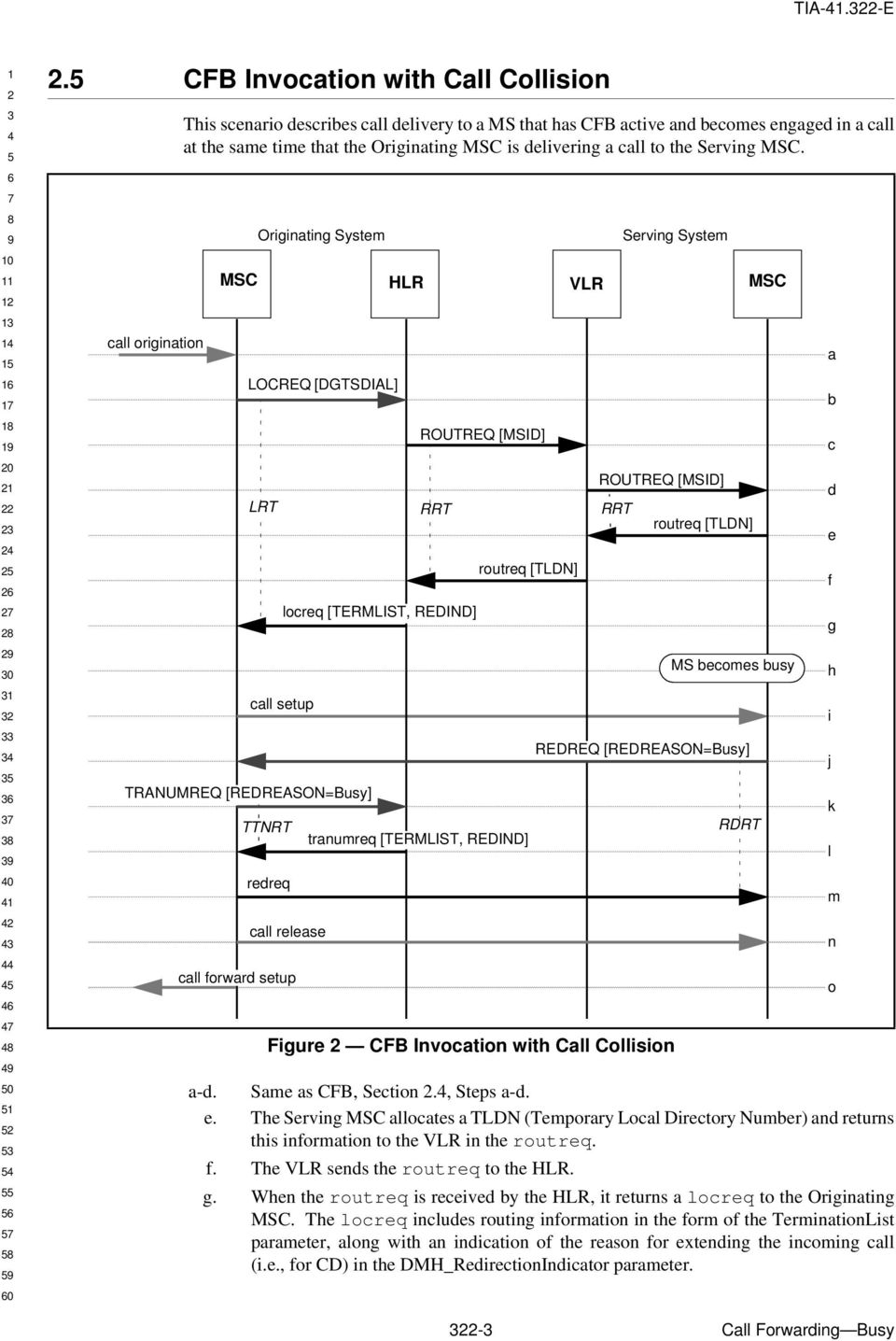
6 h. Sometime after the Serving MSC sends the routreq back to the HLR, the MS becomes engaged in another call. This may be the result of an MS origination, a call through the local roamer port or the arrival of an inter-msc call from a previous ROUTREQ. i. Upon receiving the locreq, the Originating MSC sets up a voice path to the Serving MSC using the protocols defined by the interconnection method. When the inter-msc call is received, the Serving MSC checks its internal data structures and determines that the MS is busy in another call. The Serving MSC determines from the service profile that the MS has call forwarding on busy active. j. The Serving MSC then sends a REDREQ to the Originating MSC, indicating that the call is being redirected due to a busy condition. k. The Originating MSC is able to redirect the call, therefore, it sends a TRANUMREQ to the HLR requesting the forward-to number appropriate for this condition from the MS s service profile. l. The HLR sends the tranumreq to the Originating MSC, including the appropriate forward-to number in the TerminationList parameter, along with an indication of the reason for extending the incoming call (i.e., for CFB) in the DMH_RedirectionIndicator parameter. m. When the tranumreq is received from the HLR, the Originating MSC sends a redreq to the Serving MSC. n. The Originating MSC releases the voice path to the Serving MSC. o. The Originating MSC initiates call forwarding using the specified forward-to number. 0 Call Forwarding Busy -

7 0 Call Forwarding Default This section depicts the interactions between network entities in various situations related to automatic roaming and Call Forwarding Default (CFD). These scenarios are for illustrative purposes only.. CFD Variable Registration or De-Registration The information flows required for the registration or de-registration of CFD by an authorized MS are described in Part- Section... CFD Demand Activation with Courtesy Call The information flows required for the demand activation of CFD by an authorized MS, where the serving system provides the optional courtesy call to the forward-to number on CFD activation, are described in Part- Section.. Note that the activation of CFD results in the activation of call forwarding on busy, no answer, and no page response conditions at the Serving MSC.. CFD Demand Activation (without Courtesy Call) or De-Activation The information flows required for the demand activation or de-activation of CFD by an authorized MS, where the serving system does not provide the optional courtesy call to the forward-to number on CFD activation, are described in Part- Section.. Note that the activation of CFD results in the activation of call forwarding on busy, no answer, and no page response conditions at the Serving MSC. Likewise, the de-activation of CFD may result in the de-activation of call forwarding on busy (if CFB is not active), no answer (if CFNA is not active), and no page response (if CFNA is not active) conditions at the Serving MSC.. CFD Invocation with Busy The information flows required for the invocation of CFD when the served MS is determined to be busy are the same as those for the CFB case described in Section.; simply replace the acronym CFB in that description with CFD.. CFD Invocation with Call Collision The information flows required for the invocation of CFD when the served MS becomes engaged in a call at the same time that the Originating MSC is delivering a call to the Serving MSC, are the same as those for the CFB case described in Section.; simply replace the acronym CFB in that description with CFD. - Call Forwarding Default

8 . CFD Invocation Immediate This scenario describes CFD invocation due to the following causes: Do Not Disturb active, etc. MS not registered by MAP procedures. MS reported inactive by MAP procedures. Roaming with Call Delivery inactive. In these cases, the HLR has sufficient information available to make an immediate forwarding decision, rather than directing that the call be routed to the serving system. call origination Originating System MSC call forward setup LOCREQ [DGTSDIAL] LRT locreq [TERMLIST, REDIND] Figure CFD Invocation (Immediate) a. A call origination and the dialed MS address digits (i.e., directory number) are received by the Originating MSC. b. The Originating MSC sends a LOCREQ to the HLR associated with the MS; this association is made through the dialed MS address digits (which may not be the MIN). c. The HLR determines from the MS s service profile that CFD is in effect and that an immediate forwarding condition exists (see above for explanation). It sends a locreq to the Originating MSC providing the forward-to number and other routing information in the TerminationList parameter, along with an indication of the reason for extending the incoming call (i.e., for CFD) in the DMH_RedirectionIndicator parameter. d. The Originating MSC then establishes a call to the specified forward-to number. HLR a b c d 0 Call Forwarding Default -

9 0. CFD Invocation with No Answer or No Response to Page call origination This scenario describes CFD invocation due to the MS not answering or not responding to page. MSC Originating System LOCREQ [DGTSDIAL] call setup redreq call forward setup HLR ROUTREQ [MSID] Figure CFD Invocation with No Answer or No Response to Page a. A call origination and the dialed MS address digits (i.e., directory number) are received by the Originating MSC. b. The Originating MSC sends a LOCREQ to the HLR associated with the MS; this association is made through the dialed MS address digits (which may not be the MIN). c. If the dialed MS address digits are assigned to a legitimate subscriber, the HLR sends a ROUTREQ to the VLR where the MS is registered. d. The VLR then forwards the ROUTREQ to the current Serving MSC. VLR LRT RRT RRT TRANUMREQ [REDREASON] TTNRT locreq [TERMLIST, REDIND] call release tranumreq [TERMLIST, REDIND] routreq [TLDN] Serving System ROUTREQ [MSID] routreq [TLDN] MSC page or answer timeout REDREQ [REDREASON] RDRT a b c d e f g h i j k l m n o - Call Forwarding Default

10 e. The Serving MSC allocates a TLDN (Temporary Local Directory Number) and returns this information to the VLR in the routreq. f. The VLR sends the routreq to the HLR. g. When the routreq is received by the HLR, it returns a locreq to the Originating MSC. The locreq includes routing information in the form of the TerminationList parameter, along with an indication of the reason for extending the incoming call (i.e., for CD) in the DMH_RedirectionIndicator parameter. h. Upon receiving the locreq, the Originating MSC sets up a voice path to the Serving MSC using the protocols defined by the interconnection method. i. When the inter-msc call is received at the Serving MSC, the MS is paged and, if a page response is received, subsequently alerted. If the MS fails to respond to the page or does not answer after alerting, the Serving MSC determines from the service profile that the MS has call forwarding active on no answer or no response to page conditions. j. The Serving MSC sends a REDREQ to the Originating MSC, indicating that the call is being redirected due to a no answer or no page response condition. k. The Originating MSC is able to redirect the call, therefore, it sends a TRANUMREQ to the HLR requesting the forward-to number appropriate for this condition from the MS s service profile. l. The HLR sends the tranumreq to the Originating MSC, including the appropriate forward-to number in the TerminationList parameter, along with an indication of the reason for extending the incoming call (i.e., for CFD) in the DMH_RedirectionIndicator parameter. m. When the tranumreq is received from the HLR, the Originating MSC sends a redreq to the Serving MSC. n. The Originating MSC releases the inter-msc call. o. The Originating MSC initiates call forwarding using the specified forward-to number. p. As described in CFB, Section., the Serving MSC may choose to redirect the call if it cannot be redirected by the Originating MSC. The Serving MSC should, however, always attempt to have the call redirected by the Originating MSC in order to minimize resource usage. 0 Call Forwarding Default -
11 0 Call Forwarding No Answer This section depicts the interactions between network entities in various situations related to automatic roaming and Call Forwarding No Answer (CFNA). These scenarios are for illustrative purposes only.. CFNA Variable Registration or De-Registration The information flows required for the registration or de-registration of CFNA by an authorized MS are described in Part- Section... CFNA Demand Activation with Courtesy Call The information flows required for the demand activation of CFNA by an authorized MS, where the serving system provides the optional courtesy call to the forward-to number on CFNA activation, are described in Part- Section... CFNA Demand Activation (without Courtesy Call) or De- Activation The information flows required for the demand activation or de-activation of CFNA by an authorized MS, where the serving system does not provide the optional courtesy call to the forward-to number on CFNA activation, are described in Part- Section... CFNA Invocation Immediate This scenario describes CFNA invocation due to the following causes: Do Not Disturb active, etc. MS not registered by MAP procedures. MS reported inactive by MAP procedures. Roaming with Call Delivery inactive. In these cases, the HLR has sufficient information available to make an immediate forwarding decision, rather than directing that the call be routed to the serving system. The information flows required for this scenario are the same as those for the CFD case described in Section.; simply replace the acronym CFD in that description with CFNA.. CFNA Invocation Delayed This scenario applies to the invocation of CFNA due to the following causes: No MS response to a page request. No MS or subscriber response to alerting. No subscriber response to Call Waiting notification. - Call Forwarding No Answer

12 In these cases, the HLR does not have sufficient information available to make an immediate forwarding decision; therefore, the call must be routed to the serving system, where the forwarding cause is encountered. The information flows required for this scenario are the same as those for the CFD case described in Section.; simply replace the acronym CFD in that description with CFNA. 0 Call Forwarding No Answer -
13 0 Call Forwarding Unconditional This section depicts the interactions between network entities in various situations related to automatic roaming and Call Forwarding Unconditional (CFU). These scenarios are for illustrative purposes only.. CFU Variable Registration or De-Registration The information flows required for the registration or de-registration of CFU by an authorized MS are described in Part- Section... CFU Demand Activation with Courtesy Call The information flows required for the demand activation of CFU by an authorized MS, where the serving system provides the optional courtesy call to the forward-to number on CFU activation, are described in Part- Section... CFU Demand Activation (without Courtesy Call) or De-Activation The information flows required for the demand activation or de-activation of CFU by an authorized MS, where the serving system does not provide the optional courtesy call to the forward-to number on CFU activation, are described in Part- Section.. - Call Forwarding Unconditional
14 . CFU Invocation with Alert This scenario describes CFU invocation, along with the provision of the optional CFU alert to the served MS. call origination Originating System MSC HLR VLR MSC MS LOCREQ [DGTSDIAL] LRT call forward setup locreq [TERMLIST, REDIND] INFODIR [ALRTCODE] IDT Serving System INFODIR [ALRTCODE] IDT infodir [ALRTRES] Figure CFU Invocation with Alert CFU alert infodir [ALRTRES] a. A call origination and the dialed MS address digits (i.e., directory number) are received by the Originating MSC. b. The Originating MSC sends a LOCREQ to the HLR associated with the MS; this association is made through the dialed MS address digits (which might not be the same as the MIN). c. The HLR determines from the MS s service profile that CFU is active. It sends a locreq to the Originating MSC providing the forward-to number and other routing information in the TerminationList parameter, along with an indication of the reason for extending the incoming call (i.e., for CFU) in the DMH_RedirectionIndicator parameter. d. The Originating MSC then establishes a call to the specified forward-to number. e. The HLR determines that the MS should be informed that a call has been forwarded unconditionally and therefore sends an INFODIR to the VLR where the MS is registered. f. The VLR directs the Serving MSC to alert the MS by sending an INFODIR to the Serving MSC. g. The Serving MSC alerts the MS, if idle, via the alerting method specified in the AlertCode parameter in the received INFODIR. a b c d e f g h i 0 Call Forwarding Unconditional -
![[ALRTRES] Figure CFU Invocation with Alert CFU alert infodir [ALRTRES] a. A call origination and the dialed MS address digits (i.e., directory number) are received by](/docs-images/57/6120020/images/page_14.jpg "the Originating MSC. b. The Originating MSC sends a LOCREQ to the HLR associated with the MS; this association is made through the dialed MS address digits (which might not be the same as the MIN). c.")
15 0 h. The Serving MSC sends an infodir to the VLR, including the result of the alerting action (e.g., success, not attempted due to MS busy condition). i. The VLR forwards the infodir to the HLR. - Call Forwarding Unconditional
VoIP Supplementary Services Descriptions: Call Forwarding Default
 GPP S.R0--0 Version.0 Version Date: April 0 VoIP Supplementary Services Descriptions: Call Forwarding Default COPYRIGHT GPP and its Organizational Partners claim copyright in this document and individual
IS-41 FEATURES STANDARD FEATURES
 IS-41 FEATURES STANDARD FEATURES TIA/EIA/IS-41 Rev. 0 Published February 1988 TIA/EIA/IS-41 Rev. A Published December 1990 TIA/EIA/IS-41 Rev.B Published December 1991 Call delivery Basic intersystem handoff
VoIP Supplementary Services Descriptions: Call Forwarding-Unconditional
 GPP S.R0--0 Version.0 Version Date: April 0 VoIP Supplementary Services Descriptions: Call Forwarding-Unconditional COPYRIGHT GPP and its Organizational Partners claim copyright in this document and individual
VoIP Supplementary Services Descriptions: Call Forwarding-No Answer
 GPP S.R0--0 Version.0 Version Date: April 00 VoIP Supplementary Services Descriptions: Call Forwarding-No Answer COPYRIGHT GPP and its Organizational Partners claim copyright in this document and individual
TS-3GB-S.R0125-505-0v1.0 VoIP Supplementary Services Descriptions: Call Forwarding - Unconditional
 TS-GB-S.R0--0v.0 VoIP Supplementary Services Descriptions: Call Forwarding - Unconditional 0 年 月 日 制 定 社 団 法 人 情 報 通 信 技 術 委 員 会 THE TELECOMMUNICATION TECHNOLOGY COMMITTEE 本 書 は ( 社 ) 情 報 通 信 技 術 委 員 会
Answer Hold. Revision: 1 COPYRIGHT. 3GPP2 N.S0022 Version 1.0.0 Version Date: July 14, 2000
 GPP N.S00 Version.0.0 Version Date: July, 000 Answer Hold Revision: COPYRIGHT GPP and its Organizational Partners claim copyright in this document and individual Organizational Partners may copyright and
ACCELERATOR 6.3 SIP TRUNK PBX INTEGRATION GUIDE
 ACCELERATOR 6.3 SIP TRUNK PBX INTEGRATION GUIDE April 2014 Tango Networks, Inc. phone: +1 469-229-6000 3801 Parkwood Blvd, Suite 500 fax: +1 469-467-9840 Frisco, Texas 75034 USA www.tango-networks.com
GSM GSM 02.67 TECHNICAL July 1996 SPECIFICATION Version 5.0.1
 GSM GSM 02.67 TECHNICAL July 1996 SPECIFICATION Version 5.0.1 Source: ETSI TC-SMG Reference: TS/SMG-010267QR ICS: 33.060.50 Key words: Digital cellular telecommunications system, Global System for Mobile
ACCELERATOR 6.3 TDM PBX INTEGRATION GUIDE
 ACCELERATOR 6.3 TDM PBX INTEGRATION GUIDE April 2014 Tango Networks, Inc. phone: +1 469-229-6000 3801 Parkwood Blvd, Suite 500 fax: +1 469-467-9840 Frisco, Texas 75034 USA www.tango-networks.com 2004-2014
Network Support for MDN-Based Message Centers
 GPP N.S00-0 version.0 Version Date: November 00 Network Support for MDN-Based Message Centers COPYRIGHT GPP and its Organizational Partners claim copyright in this document and individual Organizational
EUROPEAN ETS 300 199 TELECOMMUNICATION December 1994 STANDARD
 EUROPEAN ETS 300 199 TELECOMMUNICATION December 1994 STANDARD Source: ETSI TC-NA Reference: DE/NA-012204 ICS: 33.080 Key words: ISDN, supplementary service Integrated Services Digital Network (ISDN); Call
ACCELERATOR 6.3 ASTERISK LINES INTEGRATION GUIDE
 ACCELERATOR 6.3 ASTERISK LINES INTEGRATION GUIDE January 2014 Tango Networks, Inc. phone: +1 469-229-6000 3801 Parkwood Blvd, Suite 500 fax: +1 469-467-9840 Frisco, Texas 75034 USA www.tango-networks.com
3GPP TS 24.082 V4.0.1 (2002-06)
 TS 24.082 V4.0.1 (2002-06) Technical Specification 3rd Generation Partnership Project; Technical Specification Group Core ; Call Forwarding (CF) supplementary services - Stage 3 (Release 4) GLOBAL SYSTEM
TS-3GA-22.082(Rel6)v6.0.0 Call Forwarding (CF) supplementary services - Stage 1
 TS-3GA-22.082(Rel6)v6.0.0 Call Forwarding (CF) supplementary services - Stage 1 2005 3 4 THE TELECOMMUNICATION TECHNOLOGY COMMITTEE TS-3GA-22.082(Rel6)v6.0.0 Call Forwarding (CF) supplementary services
ACCELERATOR 6.3 ASTERISK 1.4 INTEGRATION GUIDE
 ACCELERATOR 6.3 ASTERISK 1.4 INTEGRATION GUIDE October 2014 Tango Networks, Inc. phone: +1 469-229-6000 3801 Parkwood Blvd, Suite 500 fax: +1 469-467-9840 Frisco, Texas 75034 USA www.tango-networks.com
3GPP TS 23.082 V8.0.0 (2008-12)
 TS 23.082 V8.0.0 (2008-12) Technical Specification 3rd Generation Partnership Project; Technical Specification Group Core Network and Terminals; Call Forwarding (CF) supplementary services; Stage 2 (Release
SIP Based Architecture for Integration of 1xRTT Femtocells
 SIP Based Architecture for Integration of 1xRTT Femtocells 2007 Tatara Systems Tatara Systems grants a free, irrevocable license to 3GPP2 and its Organizational Partners to incorporate text or other copyrightable
Citynet Telephone Features
 Citynet Telephone Features Feature Activate De-Activate NOTES Activation/De-Activation Calling Number Calling Name Caller ID Block *67 Caller ID unblock *82 Call reject *77 *87 Call Waiting *70 Calling
Global System for Mobile Communication Technology
 Global System for Mobile Communication Technology Mobile Device Investigations Program Technical Operations Division DHS - FLETC GSM Technology Global System for Mobile Communication or Groupe Special
Mobile Networking. SS7 Network Architecture. Purpose. Mobile Network Signaling
 Purpose The purpose of this white paper is to inform the reader about mobile networking technology. For further information, see. Mobile Network Signaling Telecommunications signaling is the transmission
DIGITAL TELEPHONE CALLING FEATURES. Anonymous Call Rejection. Auto Recall. Call Forwarding. Automatic Recall (AR) Automatic Callback (AC)
 1 Anonymous Call Rejection Anonymous Call Rejection (ACR) enables you to automatically block calls from parties whose numbers are marked Private. When subscribed and activated, this feature routes incoming
ACCELERATOR 6.3 AASTRA MX-ONE INTEGRATION GUIDE
 ACCELERATOR 6.3 AASTRA MX-ONE INTEGRATION GUIDE September 2014 Tango Networks, Inc. phone: +1 469-229-6000 3801 Parkwood Blvd, Suite 500 fax: +1 469-467-9840 Frisco, Texas 75034 USA www.tango-networks.com
1 Introduction. 2 Assumptions. Implementing roaming for OpenBTS
 Implementing roaming for OpenBTS 1 Introduction One of the main advantages of OpenBTS TM system architecture is absence of a legacy GSM core network. SIP is used for registering, call control and messaging.
EKSAMEN / EXAM TTM4100 18 05 2007
 1.1 1.1.1...... 1.1.2...... 1.1.3...... 1.1.4...... 1.1.5...... 1.1.6...... 1.1.7...... 1.1.8...... 1.1.9...... 1.1.10.... 1.1.11... 1.1.16.... 1.1.12... 1.1.17.... 1.1.13... 1.1.18.... 1.1.14... 1.1.19....
Wireless and Mobile Network Architecture
 Wireless and Mobile Network Architecture Chapter 13: VoIP Service for Mobile Networks Prof. Yuh-Shyan Chen Department of Computer Science and Information Engineering National Taipei University Dec. 2006
GSM GSM 02.97 TECHNICAL July 1996 SPECIFICATION Version 5.0.0
 GSM GSM 02.97 TECHNICAL July 1996 SPECIFICATION Version 5.0.0 Source: ETSI TC-SMG Reference: TS/SMG-010297Q ICS: 33.060.50 Key words: Digital cellular telecommunications system, Global System for Mobile
PLAN B. Call Forwarding Allows you to redirect all calls to another telephone number.
 989-453-4321 * 1-800-292-0614 * E-mail: [email protected] SERVING: PIGEON, TWINING, ALBA, AND LAKES OF THE NORTH PLAN B Automatic Recall This feature allows a subscriber to place a call to the source of
3GPP TS 23.011 V5.0.0 (2002-06)
 TS 23.011 V5.0.0 (2002-06) Technical Specification 3rd Generation Partnership Project; Technical Specification Group Core Network; Technical realization of Supplementary Services (Release 5) GLOBAL SYSTEM
Chapter 10 Session Initiation Protocol. Prof. Yuh-Shyan Chen Department of Computer Science and Information Engineering National Taipei University
 Chapter 10 Session Initiation Protocol Prof. Yuh-Shyan Chen Department of Computer Science and Information Engineering National Taipei University Outline 12.1 An Overview of SIP 12.2 SIP-based GPRS Push
GSM GSM 02.86 TECHNICAL November 1996 SPECIFICATION Version 5.0.0
 GSM GSM 02.86 TECHNICAL November 1996 SPECIFICATION Version 5.0.0 Source: ETSI TC-SMG Reference: TS/SMG-010286Q ICS: 33.020 Key words: Digital cellular telecommunications system, Global System for Mobile
For customers in AL, FL, GA, SC, TN. wowforbusiness.com. Business Services PHONE FEATURES. User Guide BPG.U.1303.O
 wowforbusiness.com Business Services PHONE FEATURES User Guide BPG.U.0.O ANONYMOUS CALL REJECTION. It s easy to activate and start blocking anonymous calls. Simply lift the receiver and press *.. When
TS-3GB-S.R0048-Av1.0 3G Mobile Equipment Identifier (MEIA)
 TS-3GB-S.R0048-Av1.0 3G Mobile Equipment Identifier (MEIA) Nov 28,2003 THE TELECOMMUNICATION TECHNOLOGY COMMITTEE TS-3GB-S.R0048-Av1.0 3G Mobile Equipment Identifier (MEIA) 1. Application level
[Description for the use of a Shared Inter Working Function (SIWF) in a GSM PLMN - Stage 2]
![[Description for the use of a Shared Inter Working Function (SIWF) in a GSM PLMN - Stage 2]](/thumbs/26/8506801.jpg "[Description for the use of a Shared Inter Working Function (SIWF) in a GSM PLMN - Stage 2]") JP-3GA-23.054(R99) GSM PLMN (SIWF) 2 [Description for the use of a Shared Inter Working Function (SIWF) in a GSM PLMN - Stage 2] [Remarks] [Application level of English description] [Application level]
JP-3GA-23.054(R99) GSM PLMN (SIWF) 2 [Description for the use of a Shared Inter Working Function (SIWF) in a GSM PLMN - Stage 2] [Remarks] [Application level of English description] [Application level]
Interoperability Specification (IOS) for CDMA 2000 Access Network Interfaces Part 3 Features
 A.S00-0v.0 GPP A.S00-0 Version.0 Date: November, 00 0 Interoperability Specification (IOS) for CDMA 000 Access Network Interfaces Part Features Revision 0 (G IOSv.) (SDO Ballot Version) 0 GPP 00 0 GPP
How To Use Your Calling Features. A Simple Guide META. 011910sip
 How To Use Your Calling Features A Simple Guide 011910sip META Unconditional Call Forwarding (Call Forwarding) How to activate Unconditional Call Forwarding: 1. 72 followed by the number to which your
Digital Voice Services User Guide
 Digital Voice Services User Guide 2 P a g e * Feature Access Codes *11 Broadworks Anywhere (pulling call to alternate phone) *62 Access Voicemail *72 Call Forwarding Always Activation *73 Call Forwarding
How Call Forwarding Works
 Learn to use the call forwarding features of you Cox Digital Telephone service. Note: Changing settings for Call Forwarding Busy, Call Forwarding No Answer, and Call Forwarding, is not recommended for
##)44 ) #!,, &/27!2$).' 5.#/.$)4)/.!, ).4%'2!4%$ 3%26)#%3 $)')4!,.%47/2+ )3$. '%.%2!, 3425#452%!.$ 3%26)#% #!0!"),)4)%3 2ECOMMENDATION )
 INTERNATIONAL TELECOMMUNICATION UNION ##)44 ) THE INTERNATIONAL (08/92) TELEGRAPH AND TELEPHONE CONSULTATIVE COMMITTEE ).4%'2!4%$ 3%26)#%3 $)')4!,.%47/2+ )3$. '%.%2!, 3425#452%!.$ 3%26)#% #!0!"),)4)%3
Calling Feature Guide
 Calling Feature Guide Automatic Call Back *66 Mid Century Automatic Call Back will continually dial a busy number automatically for up to 30 minutes. When the line becomes free your phone will ring alerting
Clear Choice Communications. Digital Voice Services User Guide
 Clear Choice Communications Digital Voice Services User Guide 2 P a g e * Feature Access Codes *62 Access Voicemail *72 Call Forwarding Always Activation *73 Call Forwarding Always Deactivation *90 Call
Digital Voice Services Residential User Guide
 Digital Voice Services Residential User Guide 2 P a g e * Feature Access Codes *11 Broadworks Anywhere (pulling call to alternate phone) *62 Access Voicemail *72 Call Forwarding Always Activation *73 Call
BROADWORKS SERVICE GUIDE
 BROADWORKS SERVICE GUIDE RELEASE 13.0 Version 8 BroadWorks Guide Copyright Notice Trademarks Copyright 2006 BroadSoft, Inc. All rights reserved. Any technical documentation that is made available by BroadSoft,
SERVICES CATALOG. FRONTIER COMMUNICATIONS OF ALABAMA, LLC Section 16 Original Sheet 1 S16. CENTREX
 Original Sheet 1 S16.1 GENERAL A. Centrex is a Central Office based business communications service which provides capabilities similar to those offered on a Private Branch Exchange, but without requiring
ENGN4536 Mobile Communications
 ENGN4536 Mobile Communications Dr Thushara Abhayapala Department of Engineering Faculty of Engineering & Information Technology Australian National University [email protected] http://www.webct.anu.edu.au
Function Description Ascom IP-DECT System
 Function Description Contents 1 Introduction... 1 1.1 Abbreviations and Glossary... 1 2 Technical Solution... 2 2.1 System Size... 2 2.2 LDAP Server... 3 2.3 Supported Protocols... 3 2.4 Power the Base
1 P a g e. Digital Voice Services Business User Guide
 1 P a g e Digital Voice Services Business User Guide Feature Access Codes *62 Voice Portal *86 Direct Voice Mail Retrieval *77 Anonymous Call Rejection Activation *87 Anonymous Call Rejection Deactivation
Configuration Checklist for Immediate Divert
 CHAPTER 27 The (idivert) feature allows you to immediately divert a call to a voice-messaging system. When the call gets diverted, the line becomes available to make or receive new calls. This chapter
Avaya IP Office Platform Web Self Administration
 Avaya IP Office Platform Web Self Administration Release 9.1 Issue 01.02 August 2015 Contents Chapter 1: Avaya IP Office Platform Web Self Administration... 3 Logging in to Web Self Administration... 3
ETSI TR 101 643 V8.0.0 (2000-06)
 TR 101 643 V8.0.0 (2000-06) Technical Report Digital cellular telecommunications system (Phase 2+); General network interworking scenarios (GSM 09.01 version 8.0.0 Release 1999) GLOBAL SYSTEM FOR MOBILE
IP PBX system USER MANUAL. ver. 2.01.02
 IP PBX system USER MANUAL ver. 2.01.02 Platan Prima IP PBX is a product manufactured by: PLATAN Sp. z o.o. sp.k., 81-855 Sopot, ul. Platanowa 2, Poland tel. +48 58 555 88 00, fax +48 58 555 88 01 e-mail:
Call Back. Configuration Checklist for Call Back CHAPTER
 CHAPTER 2 This chapter provides information on the following topics: Configuration Checklist for, page 2-1 Introducing, page 2-2 Understanding How Works, page 2-3 Suspend/Resume Functionality for, page
TS-3GB-S.R0103-0v1.0 Network Firewall Configuration and Control (NFCC) - Stage 1 Requirements
 TS-3GB-S.R0103-0v1.0 Network Firewall Configuration and Control (NFCC) - Stage 1 Requirements Mar 3,2005 THE TELECOMMUNICATION TECHNOLOGY COMMITTEE TS-3GB-S.R0103-0v1.0 Network Firewall Configuration and
GENERAL TARIFF. 1) This Item is subject to the terms and conditions of Part A and Item 600 of this Tariff.
 Page 6.24 Virtual Office Service 1. Service Description 2. Definitions 1) This Item is subject to the terms and conditions of Part A and Item 600 of this Tariff. 2) Virtual Office Service is a hosted voice-over-ip
For customers in IN, IL, OH, MI. wowforbusiness.com. Business Services PHONE FEATURES. User Guide BPGM.U.1506.R
 wowforbusiness.com Business Services PHONE FEATURES User Guide BPGM.U.1506.R Anonymous Call Rejection 1. It s easy to activate and start blocking anonymous calls. Simply lift the receiver and press *77.
How To Use Touchtone.Com'S Digital Phone Service Web Portal User Guide (For Ip Phones) On A Pc Or Ip Phone (For A Cell Phone) On Pc Or Mac) On Your Ip Phone On A Mac Or Ip Cell Phone On
 Digital Phone Service Web Portal User Guide TouchTone provides subscribers an easy-to-use Web-based administrator portal to help manage your IP phone s features and call routing functions. In this document
All Rights Reserved. Copyright 2009
 IMPORTANT NOTICE CONCERNING EMERGENCY 911 SERVICES Your service provider, not the manufacturer of the equipment, is responsible for the provision of phone services through this equipment. Any services
Chapter 10 VoIP for the Non-All-IP Mobile Networks
 Chapter 10 VoIP for the Non-All-IP Mobile Networks Prof. Yuh-Shyan Chen Department of Computer Science and Information Engineering National Taipei University Outline 10.1 GSM-IP: VoIP Service for GSM 256
Mobility Management 嚴 力 行 高 雄 大 學 資 工 系
 Mobility Management 嚴 力 行 高 雄 大 學 資 工 系 Mobility Management in Cellular Systems Cellular System HLR PSTN MSC MSC VLR BSC BSC BSC cell BTS BTS BTS BTS MT BTS BTS BTS BTS HLR and VLR HLR (Home Location Register)
www.metrocast.com/business
 www.metrocast.com/business All Rights Reserved The use, disclosure, modification, transfer or transmittal of this work for any purpose, in any form, or by any means, without the written permission from
How to Setup SQL Server Replication
 Introduction This document describes a scenario how to setup the Transactional SQL Server Replication. Before we proceed for Replication setup you can read brief note about Understanding of Replication
GENERAL SUBSCRIBER SERVICES TARIFF Pembroke Telephone Company, Inc. First Revised Contents Sheet 1 Cancels Original Contents Sheet 1
 First Revised Contents Sheet 1 Cancels Original Contents Sheet 1 CONTENTS Sheet No. L.1 General 1 L.2 Regulations and Conditions 2 L.3 Definitions 4 L.4 Rates and Charges 11 0 First Revised Sheet 1 Cancels
XOptions Flex Features, Functions & Benefits
 Product Overview XOptions Flex Features, Functions & XOptions Flex is one simple bundle containing a complete package of communications solutions for business, including unlimited local calling, and a
EUROPEAN ETS 300 183 TELECOMMUNICATION October 1992 STANDARD
 EUROPEAN ETS 300 183 TELECOMMUNICATION October 1992 STANDARD Source: ETSI TC-NA Reference: T/NA1(89)25 ICS: 33.080 Key words: ISDN, supplementary service Integrated Services Digital Network (ISDN); Conference
Quick Installation and Configuration Guide OX10
 Quick Installation and Configuration Guide OX10 Hybrid Office Business Telephone System with Built-In Analog Phone Ports, CO Line Ports and SIP Adaptors Table of Contents 1. INTRODUCTION... 3 2. GETTING
Business Telephone User Guide
 Business Telephone User Guide 1 Proud to provide Conway s Electric, Water, Cable, Internet and Telephone services. Welcome to Conway Corporation Business Telephone Service We take pride in providing superior
Contents 1. Setting up your Phone Phone Setup Phone Usage 2. User Portal 3. Softphone for your computer 4. Faxing
 User Guide 1 Contents 1. Setting up your Phone Phone Setup Phone setup instructions Recording Voicemail Greeting and Voicemail Menu Testing tools Phone Usage Call Transfer, Call Forwarding and Do Not Disturb
Digital Telephone User Guide
 Digital Telephone User Guide 1 Proud to provide Conway s Electric, Water, Cable, Internet and Telephone services. Welcome to Conway Corporation Digital Telephone Service We take pride in providing superior
GSM GSM 02.83 TECHNICAL November 1996 SPECIFICATION Version 5.0.0
 GSM GSM 02.83 TECHNICAL November 1996 SPECIFICATION Version 5.0.0 Source: ETSI TC-SMG Reference: TS/SMG-010283Q ICS: 33.020 Key words: Digital cellular telecommunications system, Global System for Mobile
Mobile Application Part protocol implementation in OPNET
 Mobile Application Part protocol implementation in OPNET Vladimir Vukadinovic and Ljiljana Trajkovic School of Engineering Science Simon Fraser University Vancouver, BC, Canada E-mail: {vladimir, ljilja}@cs.sfu.ca
SVMi-4 & SVM-400. Voice Mail System. System Administration Manual
 SVMi-4 & SVM-400 Voice Mail System System Administration Manual Contents About this Book 3 How to use this online manual 4 How to print this online manual 5 Feature Descriptions 6 SYSTEM FEATURES 6 AUTO
GLOSARIO. Authentication key, se usa en sistemas basados en TIA/EIA-41. Estándar de comunicación celular basado en TDMA.
 GLOSARIO A AC o AuC Ack AGCH A-key AMPS ANSI-136 ó IS-136 ARFCN ASE Authentication Center. Acknowledgement. Access Grant Channel. Authentication key, se usa en sistemas basados en TIA/EIA-41. Advanced
ETSI ETR 363 TECHNICAL January 1997 REPORT
 ETSI ETR 363 TECHNICAL January 1997 REPORT Source: ETSI TC-SMG Reference: DTR/SMG-101020Q ICS: 33.020 Key words: Digital cellular telecommunications system, Global System for Mobile communications (GSM)
All Rights Reserved. Release 5.6, March 2009
 All Rights Reserved The use, disclosure, modification, transfer or transmittal of this work for any purpose, in any form, or by any means, without the written permission from IDT/Net2Phone is strictly
PROPRIETARY INFORMATION
 Centrex User Guide Centrex is a central office-based telecommunications system that lets you customize your telephone service to suit your unique business needs. With Centrex, you can grow from two lines
ETSI TS 101 043 V7.5.0 (2003-12)
 TS 101 043 V7.5.0 (2003-12) Technical Specification Digital cellular telecommunications system (Phase 2+); Basic call handling (3GPP TS 03.18 version 7.5.0 1998) GLOBAL SYSTEM FOR MOBILE COMMUNICATIONS
Toolkit for vulnerability assessment in 3G networks. Kameswari Kotapati The Pennsylvania State University University Park PA 16802
 Toolkit for vulnerability assessment in 3G networks Kameswari Kotapati The Pennsylvania State University University Park PA 16802 Contents Motivation Solution Overview Methodology Overview 3G Attack Graph
Business VoIP. Business VoIP - In the Cloud. Unlimited. PABX Functionality. Handsets OPTIONAL ADD-ON. TPG Broadband On-Net Customers Only
 Business VoIP - In the Cloud OPTIONAL ADD-ON Handsets Business Grade Unlimited Local Calls Standard National Calls to Landlines PABX Functionality Voicemail 2 Email Name Display TPG Broadband On-Net Customers
Digital Voice Services User Guide
 Digital Voice Services User Guide * Feature Access Codes *72 Call Forwarding Always Activation *73 Call Forwarding Always Deactivation *90 Call Forwarding Busy Activation *91 Call Forwarding Busy Deactivation
AudiaFLEX Voice-over-IP Interface. Preliminary Steps. Configuring a Cisco CallManager system to work with Biamp s VoIP-2 card
 Configuring a Cisco CallManager system to work with Biamp s VoIP-2 card AudiaFLEX Voice-over-IP Interface Biamp s VoIP-2 card allows Biamp AudiaFLEX digital signal processors to make and receive calls
CHANGE REQUEST. 03.35 CR xx
 3GPP TSG SA WG3 #16 Document S3-000676 Sophia Antipolis (France), 28 th 30 th November, 2000 e.g. for 3GPP use the format TP-99xxx or for SMG, use the format P-99-xxx CHANGE REQUEST Please see embedded
Publication Information This document is a publication of IPVision S.A. 112 Bernardo de Irigoyen, 4th Floor (C1072AAD) Buenos Aires, Argentina
 IP Centrex Data Sheet The most effective turn-key hosted virtual PBX solution for Clarent Networks Publication Information This document is a publication of IPVision S.A. 112 Bernardo de Irigoyen, 4th
G4 POTS LINE VOICE CLASS FEATURES
 G4 POTS LINE VOICE CLASS FEATURES FEATURE & DESCRIPTION 10-10 Restriction (SCREEN1010) This feature restricts accessing to another long distance carrier by dialing 10-10-xxx. Caller is forced to use the
Device Feature Key Synchronization
 Device Feature Key Synchronization Feature Description Release 14.sp2 Document Version 1.2 DeviceFeatureKeySynchronizationFD ExtraView Number 36498 9737 Washingtonian Boulevard, Suite 350 Gaithersburg,
Calling Features User Guide
 Calling Features User Guide Enjoy Great Pay-Per-Use Features No matter what TDS phone service you have, you can also enjoy these great pay-per-use features: *66 Repeat Dialing Tired of receiving a busy
CALLING FEATURE USER GUIDE
 CALLING FEATURE USER GUIDE 1801 N Main St, in the Palace Mall ** Mitchell, SD 57301 Phone: (605) 990-1000 Fax: (605) 990-1010 Homepage: www.mitchelltelecom.com Calling Feature User Guide Mitchell Telecom
Mobile SMS and Data Roaming Explained
 Mobile SMS and Data Roaming Explained Mobile SMS and data roaming explained Roaming is the ability of customers to use their mobile phones or other mobile devices outside the geographical coverage area
FEATURE DESCRIPTION CODE INSTRUCTIONS
 Feature Guide Quick Reference Contents CODE FUNCTION PAGE FEATURE *22 Change Call Forward Time Delay 3 Account Codes 3 Call Forward *31 Direct Park 5 Call Hold *32 Basic Park 5 Call Park *33 Answer Back
Feature and Technical
 BlackBerry Mobile Voice System for SIP Gateways and the Avaya Aura Session Manager Version: 5.3 Feature and Technical Overview Published: 2013-06-19 SWD-20130619135120555 Contents 1 Overview...4 2 Features...5
Test Cases - IMS Profile for Voice and SMS
 IMS Activity Group Test Cases - IMS Profile for Voice and SMS Version 1.0 29 December 2011 IMTC_Test_Cases IMTC IMS AG Page 1 of 34 History Version Date Name Reason 1.0 15-08-2011 Bo Jönsson Version 0.12
Avaya 9608 IP Phone Quick Reference User Guide
 Avaya 9608 IP Phone Quick Reference User Guide The phone supports 24 programmable call appearance/feature buttons. The labels for these are displayed in the main display and can be controlled by the adjacent