
ARTICLE IN PRESS. Mirel Birlan a,b, *
|
|
|
- Blaise Reed
- 10 years ago
- Views:
Transcription
1 New Astronomy xxx (2004) xxx xxx Near-IR spectroscopy of asteroids 21 Lutetia, 89 Julia, 140 Siwa, 2181 Fogelin and 5480 (1989YK8), potential targets for the Rosetta mission; remote observations campaign on IRTF Mirel Birlan a,b, *, Maria Antonietta Barucci a, Pierre Vernazza a, Marcello Fulchignoni a, Richard P. Binzel c, Schelte J. Bus d, Irina Belskaya a,e, Sonia Fornasier f a Observatoire de Paris-Meudon, LESIA, 5 Place Jules Janssen, Meudon Cedex, CNRS, France b Astronomical Institute of the Romanian Academy, Str Cutitul de Argint n 5, Bucharest 28, Romania c Department of Earth, Atmospheric and Planetary Sciences,Massachusetts Institute of Technology, Cambridge, MA 02139, USA d Institute for Astronomy, 640 North AÕohoku Place, Hilo, HI 96720, USA e Astronomical Observatory of Kharkov University, Sumskaya str. 35, Kharkov , Ukraine f Astronomical Department of Padova,Vicolo dellõosservatorio 2, Padova, Italy Received 27 October 2003; received in revised form 5 December 2003; accepted 10 December 2003 Communicated by W.D. Cochran Abstract In the frame of the international campaign to observe potential target asteroids for the Rosetta mission, remote observations have been carried out between Observatoire de Paris, in Meudon-France and the NASA Infrared Telescope Facility on Mauna Kea. The SpeX instrument was used in the lm spectral region, for two observing runs in March and June This paper presents near-ir spectra of the asteroids 21 Lutetia, 89 Julia, 140 Siwa, 2181 Fogelin and 5480 (1989YK8). Near-IR spectra of the asteroids 21 Lutetia and 140 Siwa are flat and featureless. The spectrum of 89 Julia reveals absorption bands around 1 and 2 lm, which may indicate the presence of olivine and olivine-pyroxene mixtures and confirm the S-type designation. The small main-belt asteroids 2181 Fogelin and 5480 (1989YK8) are investigated spectroscopically for the first time. Near-IR spectra of these asteroids also show an absorption feature around 1 lm, which could be and indicator of igneous/metamorphic surface of the objects; new observations in visible as well as thermal albedo data are necessary to draw a reliable conclusion on the surface mineralogy of both asteroids. Ó 2003 Elsevier B.V. All rights reserved. * Corresponding author. addresses: [email protected], [email protected] (M. Birlan) /$ - see front matter Ó 2003 Elsevier B.V. All rights reserved. doi: /j.newast

2 2 M. Birlan et al. / New Astronomy xxx (2004) xxx xxx PACS: i; Jq; Ys Keywords: Methods: miscellaneous; Techniques: spectroscopic; Minor planets: asteroids; Infrared: solar system 1. Introduction The observational program presented in this paper is intimately linked to the scientific programme of the space mission Rosetta. The Rosetta mission was approved in 1993 as a Cornerstone Mission within the ESAÕs Horizons 2000 science programme. The original launch date for the mission was January 2003 and the scientific targets were assigned to be the nucleus of comet 46P/ Wirtanen and two main-belt asteroids: 140 Siwa and 4979 Otawara. The main scientific goals of the Rosseta mission are to investigate Ôin situõ primitive objects of the solar system and to find answers concerning the chemical composition of the primitive planetary nebula, thought to be ÔfrozenÕ in the comet nucleus and the asteroid mineralogical matrix. Since 1993, several international campaigns of observations have been started in order to obtain a large amount of data for the targets of the Rosetta mission (Fornasier et al., 2003; LeBras et al., 2001; Barucci et al., 1998, etc.). The groundbased knowledge of these objects is essential to optimise the science return as well as the mission trajectory. In January 2003 the European Space Agency decided to postpone the launch of the Rosetta, with a new launch date set to February This decision implied a new mission baseline: rendezvous with the comet P/Churyumov-Grasimenko and one or two asteroid fly-bys to be defined after the spacecraft interplanetary orbit insertion manoeuvre, when the total amount of available dv will be known. Several fly-bys scenarios have been studied and several possible asteroid targets have been found. These potential targets are poorly known and for this reason systematic observation are needed in order to significantly improve on our knowledge of the physics and the mineralogy of these objects. In this paper we present the spectroscopic results obtained for five asteroids [21 Lutetia, 89 Julia, 140 Siwa, 2181 Fogelin and 5480 (1989YK8)], potential targets of the Rosetta mission. The lm wavelength region was investigated using the SpeX instrument on IRTF- Hawaii, in Ôremote observingõ mode. 2. The observing protocol The remote observations were conducted from Meudon-France, more than 12,000 km away from Hawaii, using several informational structures and networks. For the observers in Meudon, the observing hours occurred during relatively normal working daylight hours. Observation sessions began at 5 a.m. local time and ended at 5 p.m. local time. This type of observations between Meudon and IRTF/Hawaii was started in 2002 (Birlan and Binzel, 2002); since then, more than twenty nights of observations (in eight runs) were conducted from Meudon. The observations were realized through an ordinary network link, without the service quality warranty. Thus, the passband for our link was variable, a function of the traffic between Hawaii and Meudon. During the remote observing run, the Observatoire de Paris team had the control of both the instrument/guider system and the spectrograph set-up and spectra acquisition. A permanent and constant audio/video link with the telescope operator is essential in order to administrate possible service interruptions. Two PCÕs running Linux were devoted to the telescope/spectrograph control. The X environment for the telescope and instrument control was exported from Mauna Kea to Meudon via two secure links (ssh tunnels). A third PC was used to keep the IP audio-video link open (webcam/netmeeting at Meudon and Polycom ViewStation video-conference system on Mauna Kea). All software was re-initialized at the beginning of each night. The communication lag was relatively small (approximately 0.5 s), and the image refresh time

3 M. Birlan et al. / New Astronomy xxx (2004) xxx xxx 3 was 2 s on the average. Real-time image display was performed mainly for verification purposed and preliminary analysis. At the completion of each run, all files were transferred to Meudon. The SpeX instrument was utilized in low-resolution mode for this campaign. The observations were made in the lm spectral interval. We used a 0.8 arcsec wide slit, with a 15 arcsec length and oriented North South, which allowed us simultaneous measurements of the object and sky. The object position on the slit was alternated between two locations referred to as the A and B positions. The seeing varied between 0.7 and 1.8 arcsec during the observing runs and the humidity was in the 25 55% range. The automatic guiding mode of the telescope was used for spectra acquisition. The asteroids were observed in during two observing runs: March 2003 and 5 July The observed objects are summarized in Table 1. We also observed the standard stars SA , SA , SA , SA , SA , SA , HD 28099, HD and 16 CyB. Flat-fields and Argon lamp arc images were taken each night and used for data reduction. Our strategy was to observe all asteroids as close to the zenith as possible. Thus, we managed to observe with an airmass less then 1.6 for all targets except 2181 Fogelin, which we could only observe with an airmass in the range. Science exposures were alternated with standard stars spectra exposures, the latter taken to cover the airmass range. In order to obtain a S/N in the range, we needed min of exposure time, depending on the asteroid magnitude and counting both the effective exposure and CCD camera readout time. This exposure time is unacceptable for a single near-ir spectrum due to the large variations in the atmospheric conditions (a single near-ir spectral exposure is usually no longer than 120 s). In order to obtain the required S/N, we obtained a number of 6 10 A and B exposure pairs (cycles) for both Table 1 Potential asteroid targets for the Rosetta mission Object Date a (a.u.) e i (deg) U (deg) V (mag) 21 Lutetia March Julia March Siwa March Fogelin July YK8 March Observation date, semimajor axis, eccentricity, inclination, phase angle and the apparent magnitude are presented for each asteroid. Table 2 Exposure data for each asteroid Object UT (h m s) Itime (s) Cycles Airmass 21 Lutetia Lutetia Lutetia Lutetia Julia Siwa Siwa Fogelin Fogelin Fogelin YK YK The columns show the mean UT value for each series, the individual time for each spectrum (Itime), the number of cycles and the mean airmass of each series.

4 4 M. Birlan et al. / New Astronomy xxx (2004) xxx xxx the asteroids science exposures and the standard stars. This constitutes one series of observations for each object. Details the science exposures are given in Table Data reduction and results The major points of our reduction procedure are classic for the near-ir spectroscopy. We started by combining and normalizing flat-fields for each observing night. The resulting flats were later used for the reduction of spectra of both the asteroids and the standard stars. In order to minimize the atmospheric and telescope influence and to eliminate the influence of electronic bias level and the dark current, we subtracted the B position spectra from the A position spectra for each pair of exposures (cycle), in the assumption of quasihomogeneous sky background during A plus B exposure pair. The result of the subtraction was flat fielded. For each object, we median combined the result of all cycles in each observing series. This technique produces one positive and one negative spectrum on the same image. Next step was the construction of an accurate spatial profile for the extraction of the spectra. The final step was the wavelength calibration. The Spextool package (the description of the procedures are presented in Cushing et al., 2003) allowed us to perform following steps for both the asteroids and the standard stars: global flat-field and arc construction, possible non-linearity correction, addition of spectra of the same object, spatial profile determination of the spectrum in the image, aperture location, extraction of the spectrum, wavelength calibration and cleaning the spectra. The results are saved in both FITS and ASCII formats, as used by several image processing packages (like IDL, MIDAS and IRAF), respectively, dedicated plot/graphics software (Easyplot, Origin, Dataplot, etc.). The next step in the process of data reductions was the calculation of the extinction coefficients. The solar analogs spectra were used to find the correspondent extinction coefficient for each wavelength. A superstar was created by summing appropriately weighted contributions of the standard stars. The resulting superstar, corrected for atmospheric extinction, was used to obtain the spectral reflectance of asteroids at different airmasses. Careful choice of the superstar, combined with several tests of shift between the spectrum of the asteroid and that of the superstar are very important in order to minimize the influence of the terrestrial atmosphere in the 1.4 and 1.9 lm spectral regions. In order to make more readable our spectra, we choose to eliminate these spectral regions. Moreover, the elimination of these spectral regions does not affect the conclusions of this article Lutetia With an estimated diameter of km for an IRAS albedo of (Tedesco and Veeder, 1992) 21 Lutetia belongs to the large asteroid class (diameter P 100 km). Its synodic period has been computed from several lightcurve analysis and the value is h (Zappala et al., 1984). Color analysis of the ECAS data (Zellner et al., 1985) designates the asteroid 21 Lutetia to be part of the X complex. Also, global ECAS and IRAS thermal albedo data analysis assign Lutetia to the M taxonomic type (Barucci et al., 1987; Tholen, 1989). The M type asteroids are considered to be part of the core of differentiated asteroids and the parent bodies of metallic meteorites. On the basis of SMASS II spectroscopic data, Bus and Binzel (2002) proposed the new taxonomic class Xk for the asteroid 21 Lutetia. 21 Lutetia was observed on UT 2003 March 29 for the entire night. Four series of exposures resulted in four IR spectra with S/N in the range. In order to detect possible surface spectral features variations, our observations covered 65% of the synodic period. These spectra are presented in Fig. 1. However, a check of the physical ephemeris of 21 Lutetia revealed a close pole-on geometry of the asteroid, so our spectra are most probably dominated by the contribution of the same surface features on 21 Lutetia. There are no significant spectral features in the spectral region lm and the slightly increasing slope varies around 0.3%.

5 M. Birlan et al. / New Astronomy xxx (2004) xxx xxx 5 Fig. 1. The spectra of the asteroid 21 Lutetia. The IRTF spectra are offset for clarity and presented in chronological order. The beginning of each series of spectra (UT) was marked on the graph. The lack of features in the spectrum of 21 Lutetia makes its taxonomic and compositional interpretation difficult. While the high IRAS albedo value of leads to the previous M-type classification, we note there is an ambiguity in determining the albedo of Lutetia. An alternate low albedo value of 0.09 has been reported by Zellner et al. (1977) from polarimetric measurements and groundbased radiometric measurements. In Fig. 2 we compare our measurements of Lutetia with others published in the literature. We found a good match with both SMASS IR data (spectral interval lm) and the 52-color asteroid survey (Bell et al., 1988) spectrophotometric data. We also compare in Fig. 2 all of these Lutetia results with reflectance spectra of meteorites from Gaffey (1976). Our goal is to find which meteorites may be most analogous with Lutetia in terms of near-ir spectral properties. We note the spectrum of Lutetia is most qualitatively similar to the spectrum of the Vigarano meteorite, a CV3 carbonaceous chondrite, while being quite a poor match to the class IIIA iron meteorite Chulafinee. The purpose of our comparison is to note the difficulty of making a non-ambiguous interpretation of the composition of 21 Lutetia. In Fig. 3 we plot the negative polarization depth versus the inversion angle (Belskaya and Lagerkvist, 1996) for both 21 Lutetia and a sample asteroids and meteorites. The asteroid 21 Lutetia has the largest inversion angle ever observed for the asteroids. The same peculiarly large inversion angle were found in the laboratory for the carbonaceous chondrites of the CV3 and CO3 samples. These types of chondrites are characterized by a low carbon content and thus relatively a larger 0.0 Fig. 2. The average spectrum of the asteroid 21 Lutetia. The SMASS II and SMASS IR data are plotted as solid lines. Our data is in agreement with the SMASSIR data over the lm spectral interval. The comparison with Chulafinnee (iron meteorite) and Vigarano (carbonaceus chondrite) reveal the good match with the IR spectrum associated to carbon rich surfaces. Negative polarization depth (%) CV3 CV3CO3 CO3 21 Lutetia M type iron meteorites S type ordinary chondrites C type carbonaceous chondrites Inversion angle (deg) Fig. 3. Diagram of the negative polarization depth and the inversion angle of asteroids and meteorites from Belskaya and Lagerkvist (1996).

6 6 M. Birlan et al. / New Astronomy xxx (2004) xxx xxx albedo when compared to other types (Zellner et al., 1977) Julia The asteroid 89 Julia has an estimated diameter of km, for an IRAS albedo of Photometry of 89 Julia yields a synodic period of h (Schober and Lustig, 1975). Multivariate statistics classified the asteroid as part of the S cluster (Barucci et al., 1987; Tholen, 1989). The mineralogical classification of the S-type asteroids (Gaffey et al., 1993) based on the ECAS data and 52-color spectrophotometric Survey (Bell et al., 1988) data assigns 89 Julia (together with the asteroid 9 Metis) as ÔungroupedÕ S-asteroids. The main reason of this ÔunclassificationÕ is the long wavelength position of the 1 lm feature, which could be the presence of the abundant calcic clinopyroxene component (Gaffey et al., 1993). Based on the SMASS II data, Bus and Binzel (2002) proposed a K cluster membership (derived from the S cluster) for 89 Julia. The asteroid spectrum was obtained for an effective integration time of 10 min, with a S/N ratio of 90 in both A and B beams. This spectrum presents a significant positive slope in the region lm and a plateau in the lm and lm spectral regions. In Fig. 4 the IR spectrum of Julia was overlapped with the SMASS II spectrum in the lm spectral region. We confirm a broad absorption band at 1 lm, typical of the silicate rich minerals. We also confirm a global trend of the spectral reflectance, which increases in the near-ir. The influence of atmospheric water absorbtion on the spectra is visible around 1.4 and 1.9 lm. The geometry of observations was fairly unfavourable for this asteroid (airmass ¼ 1.56). In order to calculate the center of 1 lm absorbtion band (designed as Band I in the literature), the continuum was defined between the local maximum of spectral reflectance at 0.76 lm and the small shoulder of the spectrum at 1.27 lm. The spectrum was then continuum subtracted and the result was fitted with an order three polynomial function. We find the center of the feature localized at lm, which is a slightly shorter wavelength than the one found by Gaffey et al. (1993) Siwa 140 Siwa is one of the initial targets of the Rosetta mission (departure in January 2003). One of the proposed scenarios (February 2003) suggests keeping this asteroid as a candidate for flyby. This was our motivation to observe it. An IRAS albedo of for the asteroid 140 Siwa allows the calculation of a diam- Fig. 4. The spectrum of the asteroid 89 Julia. The IRTF spectrum was overlapped with the SMASS II visible spectrum in the region lm. Fig. 5. The spectra of the asteroid 140 Siwa. The spectra were offset for clarity and the UT represents the beginning of each series of exposures.

7 M. Birlan et al. / New Astronomy xxx (2004) xxx xxx 7 eter of km. Lightcurve analysis for two runs in 2000 (LeBras et al., 2001) reveals a slowrotator asteroid; the composite lightcurve presents an amplitude of 0.1 magnitudes and its synodic period was estimated at h. Two series of near-ir spectra were obtained in March 30, 2003, with the ratio S/N of 50 and 70 (obtained in both A and B beams) for the spectrum obtained at airmass and 1.018, respectively, (Fig. 5). The IR spectrum of 140 Siwa does not contain deep absorption features corresponding to mafic minerals. The spectrum slope is slightly positive, with a value 1% (0.8% and 0.7%, respectively), which confirms the slope trend of its spectrum (LeBras et al., 2001). We confirm a typical neutral spectrum of consistent with the a C- type asteroid; the IRAS albedo for 140 Siwa also fits very well the average value of C taxonomic class. The near-ir slope of our spectra is slightly different of those of a typical C-type asteroid but this alone cannot indicate a different mineralogy of the surface. Fig. 6 shows the computed a global IRTF spectrum for the asteroid 140 Siwa overlapped with SMASS II data (the overlap is only for the lm region). This composite spectrum was compared to meteorite reflectance spectra from the Fig. 7. The spectrum of the asteroid 2181 Fogelin, normalized to lm, the maximum of J filter. Gaffey database. There is no meteorite spectrum that fits our spectrum very well. However, the carbonaceous chondrite meteorites spectra are similar to our spectrum and the asteroid spectral reflectance spans a value in the range of CV3 meteorite class. The nearest spectra are those of Grosnaja and Mokoia meteorites Fogelin No physical data are available in the literature for the asteroid 2181 Fogelin. Thus, we can only roughly estimate its diameter. Following the asteroid mass distribution proposed by Kresak (1977) and the H magnitude of 2181 Fogelin, the diameter could be in the km range. A second estimate can be made using an empirical relationship between the absolute magnitude, diameter and geometric albedo (Fowler and Chillemi, 1992): log D ¼ 3:1236 0:5 log p v 0:2 H: ð1þ Fig. 6. Cumulated spectral reflectance of the asteroid 140 Siwa obtained during the IRTF run. The spectrum was overlapped with the SMASS II data in the lm spectral region. The spectrum is similar to CV3 meteorites Grosnaja and Mokoia. The surface of 140 Siwa shows similar properties with carbonaceous chondrite meteorites, with a reflectance trend between the curves for the two meteorites. Using an IRAS albedo of we find a km diameter for the asteroid. The observations of 2181 Fogelin were carried out in July, 5, 2003, with the ratio S/N of 80 in both A and B beams. The geometry of observation (airmass ¼ 1.7) was unfavourable. However, the final spectrum is the average of 32 individual spectra, which can alleviate the high airmass problem. The IR spectrum presented in Fig. 7 shows the large

8 8 M. Birlan et al. / New Astronomy xxx (2004) xxx xxx Fig. 8. The spectrum of the asteroid YK8, normalized to lm, the maximum of J filter. broad band absorbtion around 1 lm, typical of mafic minerals. The slightly positive slope in the lm wavelength region doesnõt allow us to classify this object as a S-type asteroid. Further observations in the visible region as well as thermal albedo data are necessary to make a taxonomic class assignment for this asteroid YK8 There are no previous photometric or spectroscopic data available for the asteroid YK8. The same methods used for 2181 Fogelin have been used to compute its theoretical diameter. The diameter spans the km range (following Kresak, 1977) and km following the diameter empirical formula (1), used with IRAS albedos in the range. The asteroid was observed on March, 30, 2003 and the final spectrum S/N ratio is around 100 for the A and B positions in the slit. The analysis of the lm region reveals an absorption band around 1 lm (Fig. 8). The global tendency in near- IR could justify a S-type asteroid classification; however, a visible spectrum and thermal albedo data are necessary for a taxonomical assignment. 4. Conclusions Five asteroids potential targets for the Rosetta mission have been observed in the lm spectral range: 21 Lutetia, 89 Julia, 140 Siwa, 2181 Fogelin and 5480 (1989YK8). We confirm the flat near-ir spectrum of 21 Lutetia. The near-ir spectrum of 89 Julia contains features confirming the initial idea that it belongs to the ÔheatedÕ bodies, possible to the S or K taxonomic class. A value lm was found for the center of the Band I. The asteroid 140 Siwa spectrum presents a slightly positive slope and there are no major mineralogical signatures; we confirm the assignment of the asteroid as an ÔunheatedÕ asteroid. The small asteroids 2181 Fogelin and 5480 (1989YK8) were observed spectroscopically for the first time. Our data shows the presence of a large (and weak) absorption band around 1 lm for both asteroids; new observations in visible and infrared are necessary to draw a reliable conclusion concerning their surface mineralogy. The remote observations between IRTF and Observatoire de Paris-Meudon proved to be a robust and handy observing technique. It offered full access to the command line of the spectrograph and to several telescope controls (focus, tracking, etc.). We consider our observing program entirely accomplished without any discernable difference in the typical amount of spectra obtained in remote observations mode versus the local observing mode. Acknowledgements The authors are grateful to Paul Hardersen for useful comments that improved our article. We are indebted to Tony Denault who answered many questions prior to our runs about the Polycom system and exporting of X-windows for SpeX and guiding system, to Miranda Hawarden-Ogata for the administration system support and to Paul Sears and Bill Golish, the telescope operators during the remote observing runs. References Barucci, M.A., Doressoundiram, A., Fulchignoni, M., Florczak, M., Lazzarin, M., Angeli, C., P&SS 46, Barucci, M.A., Capria, M.T., Coradini, A., Fulchignoni, M., Icar 72,

9 M. Birlan et al. / New Astronomy xxx (2004) xxx xxx 9 Bell, J.F, Hawke, B.R., Owensby P.D, Gaffey, M.J., The 52-color asteroid survey; final results and interpretation. Lunar Planet. Sci. XIX. Belskaya, I., Lagerkvist, C.-I., P&SS 44, 783. Birlan, M., Binzel, R.P., Paris Observatory Remote Observing January May 2002: Sharing the Experience to Educational Astronomy, Global Hands-On Universe Conference Proceedings, Paris, July. Bus, S.J., Binzel, R.P., Icar 158, 146. Cushing, M.C., Vacca, W.D., Rayner, J.T., Spextool: a spectral extraction package for SpeX, a lm crossdispersed spectrograph, PASP (in press), Fornasier, S., Barucci, M.A., Binzel, R.P., et al., A&A 398, 327. Fowler, J.W., Chillemi, J.R., IRAS asteroid data processing. In: Tedesco, E.F., Veeder, G.J., Fowler, J.W., Chillemi, J.R. (Eds.), The IRAS Minor Planet Survey. Technical Report PL-TR , Phillips Laboratory, Hanscom AF Base, MA. Gaffey, M.J., JGR 81, 905. Gaffey, M.J., Burbine, T.H., Piatek, J.L., Reed, K.L., Chaky, D.A., Bell, J.F., Brown, R.H., Icar 106, 573. Kresak, L., BAICz, n. 28, 82. Le Bras, A., Dotto, E., Fulchignoni, M., Doressoundiram, A., Barucci, M.A., Le Mouelic, S., Forni, O., Quirico, E., A&A 379, 660. Schober, H.J., Lustig, G., Icar 25, 339. Tedesco, E.F., Veeder, G.J., IMPS albedos and diameter catalog(fp102). In: Tedesco, E.F., Veeder, G.J., Fowler, J.W., Chillemi, J.R., The IRAS Minor Planet Survey. Technical Report PL-TR , Phillips Laboratory, Hanscom AF Base, MA. Tholen, D., Asteroid taxonomic classifications. In: Asteroids II. University of Arizona Press, AZ, pp Zappala, V., DiMartino, M., Knezevic, Z., Djurasevic, G., A&A 130 (1), 208. Zellner, B., Tholen, D.J., Tedesco, E.F., Icar 61, 355. Zellner, B., Leake, M., LeBerte, T., Duseaux, M., Dollfus, A., The asteroid albedo scale. II. Laboratory polarimetry of meteorites. In: Proceedings of the Lunar Science Conference, 8th ed. Pergamon Press, Oxford, pp

Asteroid Compositions: Spectra S. K. Croft
 Asteroid Compositions: Spectra S. K. Croft Activity Description In this activity, you will estimate the surface composition of selected asteroids by comparing their reflectance spectra with the spectra
COOKBOOK. for. Aristarchos Transient Spectrometer (ATS)
 NATIONAL OBSERVATORY OF ATHENS Institute for Astronomy, Astrophysics, Space Applications and Remote Sensing HELMOS OBSERVATORY COOKBOOK for Aristarchos Transient Spectrometer (ATS) P. Boumis, J. Meaburn,
Contribution of Padova Team to SSA - NEO Segment : the SINEO project Monica Lazzarin
 Contribution of Padova Team to SSA - NEO Segment : the SINEO project Monica Lazzarin The contribution of Padova Team to SSA activities mainly focuses on the NEO segment, in particular the investigation
Using Photometric Data to Derive an HR Diagram for a Star Cluster
 Using Photometric Data to Derive an HR Diagram for a Star Cluster In In this Activity, we will investigate: 1. How to use photometric data for an open cluster to derive an H-R Diagram for the stars and
Detecting and measuring faint point sources with a CCD
 Detecting and measuring faint point sources with a CCD Herbert Raab a,b a Astronomical ociety of Linz, ternwarteweg 5, A-400 Linz, Austria b Herbert Raab, chönbergstr. 3/1, A-400 Linz, Austria; [email protected]
Are We Alone?! Exoplanet Characterization and Direct Imaging!
 From Cosmic Birth to Living Earths A Vision for Space Astronomy in the 2020s and Beyond Are We Alone?! Exoplanet Characterization and Direct Imaging! A Study Commissioned by the Associated Universities
7. Our Solar System. Planetary Orbits to Scale. The Eight Planetary Orbits
 7. Our Solar System Terrestrial & Jovian planets Seven large satellites [moons] Chemical composition of the planets Asteroids & comets The Terrestrial & Jovian Planets Four small terrestrial planets Like
Chapter 6 Telescopes: Portals of Discovery. How does your eye form an image? Refraction. Example: Refraction at Sunset.
 Chapter 6 Telescopes: Portals of Discovery 6.1 Eyes and Cameras: Everyday Light Sensors Our goals for learning:! How does your eye form an image?! How do we record images? How does your eye form an image?
Description of the Dark Energy Survey for Astronomers
 Description of the Dark Energy Survey for Astronomers May 1, 2012 Abstract The Dark Energy Survey (DES) will use 525 nights on the CTIO Blanco 4-meter telescope with the new Dark Energy Camera built by
Spectrophotometry of Ap Stars
 Spectrophotometry of Ap Stars ASTRA Status Report Barry Smalley Astrophysics Group Keele University Staffordshire United Kingdom [email protected] What is Spectrophotometry? Spectroscopy through a wide
Measuring the Doppler Shift of a Kepler Star with a Planet
 Measuring the Doppler Shift of a Kepler Star with a Planet 1 Introduction The Doppler shift of a spectrum reveals the line of sight component of the velocity vector ( radial velocity ) of the object. Doppler
Fig.1. The DAWN spacecraft
 Introduction Optical calibration of the DAWN framing cameras G. Abraham,G. Kovacs, B. Nagy Department of Mechatronics, Optics and Engineering Informatics Budapest University of Technology and Economics
ING LA PALMA TECHNICAL NOTE No. 130. Investigation of Low Fringing Detectors on the ISIS Spectrograph.
 ING LA PALMA TECHNICAL NOTE No. 130 Investigation of Low Fringing Detectors on the ISIS Spectrograph. Simon Tulloch (ING) June 2005 Investigation of Low Fringing Detectors on the ISIS Spectrograph. 1.
Fundamentals of modern UV-visible spectroscopy. Presentation Materials
 Fundamentals of modern UV-visible spectroscopy Presentation Materials The Electromagnetic Spectrum E = hν ν = c / λ 1 Electronic Transitions in Formaldehyde 2 Electronic Transitions and Spectra of Atoms
SSO Transmission Grating Spectrograph (TGS) User s Guide
 SSO Transmission Grating Spectrograph (TGS) User s Guide The Rigel TGS User s Guide available online explains how a transmission grating spectrograph (TGS) works and how efficient they are. Please refer
SKINAKAS OBSERVATORY. Astronomy Projects for University Students PROJECT THE HERTZSPRUNG RUSSELL DIAGRAM
 PROJECT 4 THE HERTZSPRUNG RUSSELL DIGRM Objective: The aim is to measure accurately the B and V magnitudes of several stars in the cluster, and plot them on a Colour Magnitude Diagram. The students will
A McDonald Observatory Study of Comet 19P/Borrelly: Placing the Deep Space 1 Observations into a Broader Context
 Icarus 16, 398 418 (22) doi:1.16/icar.22.6969 A McDonald Observatory Study of Comet 19P/Borrelly: Placing the Deep Space 1 Observations into a Broader Context Tony L. Farnham 1 and Anita L. Cochran University
RESULTS FROM A SIMPLE INFRARED CLOUD DETECTOR
 RESULTS FROM A SIMPLE INFRARED CLOUD DETECTOR A. Maghrabi 1 and R. Clay 2 1 Institute of Astronomical and Geophysical Research, King Abdulaziz City For Science and Technology, P.O. Box 6086 Riyadh 11442,
A long time ago, people looked
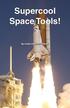 Supercool Space Tools! By Linda Hermans-Killam A long time ago, people looked into the dark night sky and wondered about the stars, meteors, comets and planets they saw. The only tools they had to study
Hyperspectral Satellite Imaging Planning a Mission
 Hyperspectral Satellite Imaging Planning a Mission Victor Gardner University of Maryland 2007 AIAA Region 1 Mid-Atlantic Student Conference National Institute of Aerospace, Langley, VA Outline Objective
Astro 301/ Fall 2005 (48310) Introduction to Astronomy
 Astro 301/ Fall 2005 (48310) Introduction to Astronomy Instructor: Professor Shardha Jogee TAs: David Fisher, Donghui Jeong, and Miranda Nordhaus Lecture 22 = Tu Nov 15 Lecture 23 = Th Nov 17 http://www.as.utexas.edu/~sj/a301-fa05/
Calibration of the MASS time constant by simulation
 Calibration of the MASS time constant by simulation A. Tokovinin Version 1.1. July 29, 2009 file: prj/atm/mass/theory/doc/timeconstnew.tex 1 Introduction The adaptive optics atmospheric time constant τ
Class 2 Solar System Characteristics Formation Exosolar Planets
 Class 1 Introduction, Background History of Modern Astronomy The Night Sky, Eclipses and the Seasons Kepler's Laws Newtonian Gravity General Relativity Matter and Light Telescopes Class 2 Solar System
Dawn - Overview, Science Objectives, Mission Progress. Hap McSween For PI Chris Russell
 Dawn - Overview, Science Objectives, Mission Progress Hap McSween For PI Chris Russell Presentation to Decadal Survey Primitive Bodies Panel, Washington, DC, Sep 2009 Spacecraft configuration, assembly
2 Absorbing Solar Energy
 2 Absorbing Solar Energy 2.1 Air Mass and the Solar Spectrum Now that we have introduced the solar cell, it is time to introduce the source of the energy the sun. The sun has many properties that could
SOLSPEC MEASUREMENT OF THE SOLAR ABSOLUTE SPECTRAL IRRADIANCE FROM 165 to 2900 nm ON BOARD THE INTERNATIONAL SPACE STATION
 SOLSPEC MEASUREMENT OF THE SOLAR ABSOLUTE SPECTRAL IRRADIANCE FROM 165 to 2900 nm ON BOARD THE INTERNATIONAL SPACE STATION G. Thuillier1, D. Bolsee2 1 LATMOS-CNRS, France 2 Institut d Aéronomie Spatiale
Science Standard 4 Earth in Space Grade Level Expectations
 Science Standard 4 Earth in Space Grade Level Expectations Science Standard 4 Earth in Space Our Solar System is a collection of gravitationally interacting bodies that include Earth and the Moon. Universal
TRANSITING EXOPLANETS
 TRANSITING EXOPLANETS Introduction 11 Chapter 1 Our Solar System from afar 13 Introduction 13 1.1 Direct imaging 20 1.1.1 Coronagraphy 24 1.1.2 Angular difference imaging 25 1.2 Astrometry 26 1.3 Radial
Douglas Adams The Hitchhikers Guide to the Galaxy
 There is a theory which states that if ever anybody discovers exactly what the Universe is for and why it is here, it will instantly disappear and be replaced by something even more bizarre and inexplicable.
How To Set Up A Rov-Dfd (Rov Zero Point) Du)
 DU640 Radial Velocity Zero-Point Software Requirement Specifications prepared by: approved by: reference: issue: 4 revision: 1 date: 28-03-2008 status: Issued G. Jasniewicz, F. Crifo, D. Hestroffer, A.
Rest optical spectroscopy of FeLoBALs and LoBALs at intermediate redshift
 Rest optical spectroscopy of FeLoBALs and LoBALs at intermediate redshift Kentaro Aoki Subaru Telescope, National Astronomical Observatory of Japan E-mail: [email protected] NLS1s and low-ionization
Robotic Pre-Cursor Contribution to Human NEA Mission. H. Kuninaka JSPEC/JAXA
 Robotic Pre-Cursor Contribution to Human NEA Mission H. Kuninaka JSPEC/JAXA Asteroid Explorer Hayabusa Dimensions 1.0m x 1.6m x 1.1m Weight : 380kg(Dry) Chemical Fuel 70kg Xe Propellant 60kg Total 510kg
16 th IOCCG Committee annual meeting. Plymouth, UK 15 17 February 2011. mission: Present status and near future
 16 th IOCCG Committee annual meeting Plymouth, UK 15 17 February 2011 The Meteor 3M Mt satellite mission: Present status and near future plans MISSION AIMS Satellites of the series METEOR M M are purposed
Undergraduate Studies Department of Astronomy
 WIYN 3.5-meter Telescope at Kitt Peak near Tucson, AZ Undergraduate Studies Department of Astronomy January 2014 Astronomy at Indiana University General Information The Astronomy Department at Indiana
Can Hubble be Moved to the International Space Station? 1
 Can Hubble be Moved to the International Space Station? 1 On January 16, NASA Administrator Sean O Keefe informed scientists and engineers at the Goddard Space Flight Center (GSFC) that plans to service
How To Return From 1999 Rq36
 OSIRIS-REx Asteroid Sample Return Mission Jason Dworkin Project Scientist GSFC 1 What is OSIRIS-REx? OSIRIS-REx is a PI-led New Frontiers sample return mission that returns at least 60 g (and as much as
APPLICATION OF TERRA/ASTER DATA ON AGRICULTURE LAND MAPPING. Genya SAITO*, Naoki ISHITSUKA*, Yoneharu MATANO**, and Masatane KATO***
 APPLICATION OF TERRA/ASTER DATA ON AGRICULTURE LAND MAPPING Genya SAITO*, Naoki ISHITSUKA*, Yoneharu MATANO**, and Masatane KATO*** *National Institute for Agro-Environmental Sciences 3-1-3 Kannondai Tsukuba
Digital Remote Sensing Data Processing Digital Remote Sensing Data Processing and Analysis: An Introduction and Analysis: An Introduction
 Digital Remote Sensing Data Processing Digital Remote Sensing Data Processing and Analysis: An Introduction and Analysis: An Introduction Content Remote sensing data Spatial, spectral, radiometric and
Extraction Heights for STIS Echelle Spectra
 Instrument Science Report STIS 98-09 Extraction Heights for STIS Echelle Spectra Claus Leitherer and Ralph Bohlin March 1998 ABSTRACT The optimum extraction height (h) for STIS echelle spectra of 7 pixels
Solar System. 1. The diagram below represents a simple geocentric model. Which object is represented by the letter X?
 Solar System 1. The diagram below represents a simple geocentric model. Which object is represented by the letter X? A) Earth B) Sun C) Moon D) Polaris 2. Which object orbits Earth in both the Earth-centered
Reprint (R22) Avoiding Errors in UV Radiation Measurements. By Thomas C. Larason July 2001. Reprinted from Photonics Spectra, Laurin Publishing
 Reprint (R22) Avoiding Errors in UV Radiation Measurements By Thomas C. Larason July 2001 Reprinted from Photonics Spectra, Laurin Publishing Gooch & Housego 4632 36 th Street, Orlando, FL 32811 Tel: 1
Realization of a UV fisheye hyperspectral camera
 Realization of a UV fisheye hyperspectral camera Valentina Caricato, Andrea Egidi, Marco Pisani and Massimo Zucco, INRIM Outline Purpose of the instrument Required specs Hyperspectral technique Optical
Artificial Satellites Earth & Sky
 Artificial Satellites Earth & Sky Name: Introduction In this lab, you will have the opportunity to find out when satellites may be visible from the RPI campus, and if any are visible during the activity,
Sunlight and its Properties. EE 495/695 Y. Baghzouz
 Sunlight and its Properties EE 495/695 Y. Baghzouz The sun is a hot sphere of gas whose internal temperatures reach over 20 million deg. K. Nuclear fusion reaction at the sun's core converts hydrogen to
AIDA: Asteroid Impact & Deflection Assessment A Joint ESA-NASA Mission. Joint ESA NASA AIDA Team
 AIDA: Asteroid Impact & Deflection Assessment A Joint ESA-NASA Mission Joint ESA NASA AIDA Team Chelyabinsk Meteor on 15 February 2013 AIDA Asteroid Deflection Test AIDA international cooperation First
 The Data-Reduction Software for GIRAFFE, the VLT medium resolution multi-object ber-fed spectrograph Andre Blecha a,veronique Cayatte b, Pierre North c, Frederic Royer a and Gilles Simond a a Observatoire
How To Calibrate A Mass-Dimm With A Dimm Sensor
 European Community s Framework Programme 6 EUROPEAN EXTREMELY LARGE TELESCOPE DESIGN STUDY Doc Nº. Issue 1.2 DRAFT 24 th March 2008 Prepared by Approved by Released by Héctor Vázquez Ramió, Antonia M.
Overview. What is EMR? Electromagnetic Radiation (EMR) LA502 Special Studies Remote Sensing
 LA502 Special Studies Remote Sensing Electromagnetic Radiation (EMR) Dr. Ragab Khalil Department of Landscape Architecture Faculty of Environmental Design King AbdulAziz University Room 103 Overview What
CBERS Program Update Jacie 2011. Frederico dos Santos Liporace AMS Kepler [email protected]
 CBERS Program Update Jacie 2011 Frederico dos Santos Liporace AMS Kepler [email protected] Overview CBERS 3 and 4 characteristics Differences from previous CBERS satellites (CBERS 1/2/2B) Geometric
CHEMICAL SIGNATURES OF ASTEROID IMPACTS
 CHEMICAL SIGNATURES OF ASTEROID IMPACTS INTRODUCTION The film The Day the Mesozoic Died identifies the presence of high quantities of iridium (Ir) in the clay layer at the boundary between the Cretaceous
Lecture 13. Gravity in the Solar System
 Lecture 13 Gravity in the Solar System Guiding Questions 1. How was the heliocentric model established? What are monumental steps in the history of the heliocentric model? 2. How do Kepler s three laws
Data Provided: A formula sheet and table of physical constants is attached to this paper. DARK MATTER AND THE UNIVERSE
 Data Provided: A formula sheet and table of physical constants is attached to this paper. DEPARTMENT OF PHYSICS AND ASTRONOMY Autumn Semester (2014-2015) DARK MATTER AND THE UNIVERSE 2 HOURS Answer question
Towards the Detection and Characterization of Smaller Transiting Planets
 Towards the Detection and Characterization of Smaller Transiting Planets David W. Latham 27 July 2007 Kepler MISSION CONCEPT Kepler Mission is optimized for finding habitable planets ( 10 to 0.5 M )
This work was done in collaboration with the Centre de Données astronomiques de Strasbourg (CDS) and in particular with F. X. Pineau.
 Chapter 5 Database and website This work was done in collaboration with the Centre de Données astronomiques de Strasbourg (CDS) and in particular with F. X. Pineau. 5.1 Introduction The X-shooter Spectral
Remote Sensing of Clouds from Polarization
 Remote Sensing of Clouds from Polarization What polarization can tell us about clouds... and what not? J. Riedi Laboratoire d'optique Atmosphérique University of Science and Technology Lille / CNRS FRANCE
SAMPLE MIDTERM QUESTIONS
 Geography 309 Sample MidTerm Questions Page 1 SAMPLE MIDTERM QUESTIONS Textbook Questions Chapter 1 Questions 4, 5, 6, Chapter 2 Questions 4, 7, 10 Chapter 4 Questions 8, 9 Chapter 10 Questions 1, 4, 7
ESCI 107/109 The Atmosphere Lesson 2 Solar and Terrestrial Radiation
 ESCI 107/109 The Atmosphere Lesson 2 Solar and Terrestrial Radiation Reading: Meteorology Today, Chapters 2 and 3 EARTH-SUN GEOMETRY The Earth has an elliptical orbit around the sun The average Earth-Sun
MY FIRST STEPS IN SLIT SPECTROSCOPY
 MY FIRST STEPS IN SLIT SPECTROSCOPY Andrew Wilson BAAVSS Spectroscopy Workshop Norman Lockyer Observatory October 2015 Overview My choice of spectrograph, camera and telescope Getting started and basic
Group Leader: Group Members:
 THE SOLAR SYSTEM PROJECT: TOPIC: THE SUN Required Project Content for an Oral/Poster Presentation on THE SUN - What it s made of - Age and how it formed (provide pictures or diagrams) - What is an AU?
Solar Flux and Flux Density. Lecture 3: Global Energy Cycle. Solar Energy Incident On the Earth. Solar Flux Density Reaching Earth
 Lecture 3: Global Energy Cycle Solar Flux and Flux Density Planetary energy balance Greenhouse Effect Vertical energy balance Latitudinal energy balance Seasonal and diurnal cycles Solar Luminosity (L)
Development of the Extreme Ultraviolet Spectrometer: EXCEED
 Development of the Extreme Ultraviolet Spectrometer: EXCEED Go Murakami*, Kazuo Yoshioka, Atsushi Yamazaki, Tomoki Kimura Institute of Space and Astronautical Science, Japan Aerospace Exploration Agency
This paper is also taken for the relevant Examination for the Associateship. For Second Year Physics Students Wednesday, 4th June 2008: 14:00 to 16:00
 Imperial College London BSc/MSci EXAMINATION June 2008 This paper is also taken for the relevant Examination for the Associateship SUN, STARS, PLANETS For Second Year Physics Students Wednesday, 4th June
Chang e-3 s Progress and Achievement 2/2014
 Chang e-3 s Progress and Achievement 2/2014 Main content 1. Chinese Lunar Exploration Program 2. Chang e-3 s Progress 3. Chang e-3 s Achievement Chinese Lunar Exploration Program Phase I Orbital missions
ASTEROID IMPACT MISSION: DIDYMOS REFERENCE MODEL
 headquarters 8-1o rue Mario Nikis 75738 Cedex 15 Paris France www.esa.int ASTEROID IMPACT MISSION: DIDYMOS REFERENCE MODEL Issue 1 Revision Date of Issue 5 05/03/15 Status Released Document Type AD Table
Absorption by atmospheric gases in the IR, visible and UV spectral regions.
 Lecture 6. Absorption by atmospheric gases in the IR, visible and UV spectral regions. Objectives: 1. Gaseous absorption in thermal IR. 2. Gaseous absorption in the visible and near infrared. 3. Gaseous
LSST and the Cloud: Astro Collaboration in 2016 Tim Axelrod LSST Data Management Scientist
 LSST and the Cloud: Astro Collaboration in 2016 Tim Axelrod LSST Data Management Scientist DERCAP Sydney, Australia, 2009 Overview of Presentation LSST - a large-scale Southern hemisphere optical survey
Pluto Data: Numbers. 14b. Pluto, Kuiper Belt & Oort Cloud. Pluto Data (Table 14-5)
 14b. Pluto, Kuiper Belt & Oort Cloud Pluto Pluto s moons The Kuiper Belt Resonant Kuiper Belt objects Classical Kuiper Belt objects Pluto Data: Numbers Diameter: 2,290.km 0.18. Earth Mass: 1.0. 10 22 kg
Solar System Observations contains two components: Planetary Astronomy and Near Earth Object Observations.
 C.6 SOLAR SYSTEM OBSERVATIONS 1. Scope of Program Solar System Observations supports both ground-based astronomical observations and suborbital investigations of our Solar System involving sounding rockets
Passive Remote Sensing of Clouds from Airborne Platforms
 Passive Remote Sensing of Clouds from Airborne Platforms Why airborne measurements? My instrument: the Solar Spectral Flux Radiometer (SSFR) Some spectrometry/radiometry basics How can we infer cloud properties
The Celestial Sphere. Questions for Today. The Celestial Sphere 1/18/10
 Lecture 3: Constellations and the Distances to the Stars Astro 2010 Prof. Tom Megeath Questions for Today How do the stars move in the sky? What causes the phases of the moon? What causes the seasons?
The Next Generation Science Standards (NGSS) Correlation to. EarthComm, Second Edition. Project-Based Space and Earth System Science
 The Next Generation Science Standards (NGSS) Achieve, Inc. on behalf of the twenty-six states and partners that collaborated on the NGSS Copyright 2013 Achieve, Inc. All rights reserved. Correlation to,
Binary Stars. Kepler s Laws of Orbital Motion
 Binary Stars Kepler s Laws of Orbital Motion Kepler s Three Laws of orbital motion result from the solution to the equation of motion for bodies moving under the influence of a central 1/r 2 force gravity.
Asteroids. Earth. Asteroids. Earth Distance from sun: 149,600,000 kilometers (92,960,000 miles) Diameter: 12,756 kilometers (7,926 miles) dotted line
 Image taken by NASA Asteroids About 6,000 asteroids have been discovered; several hundred more are found each year. There are likely hundreds of thousands more that are too small to be seen from Earth.
astronomy 2008 1. A planet was viewed from Earth for several hours. The diagrams below represent the appearance of the planet at four different times.
 1. A planet was viewed from Earth for several hours. The diagrams below represent the appearance of the planet at four different times. 5. If the distance between the Earth and the Sun were increased,
Attitude and Orbit Dynamics of High Area-to-Mass Ratio (HAMR) Objects and
 Attitude and Orbit Dynamics of High Area-to-Mass Ratio (HAMR) Objects and Carolin Früh National Research Council Postdoctoral Fellow, AFRL, [email protected] Orbital Evolution of Space Debris Objects Main
Interaction of Energy and Matter Gravity Measurement: Using Doppler Shifts to Measure Mass Concentration TEACHER GUIDE
 Interaction of Energy and Matter Gravity Measurement: Using Doppler Shifts to Measure Mass Concentration TEACHER GUIDE EMR and the Dawn Mission Electromagnetic radiation (EMR) will play a major role in
Planning Observations
 Lab 6: Eclipsing Binary Stars (Due: 2008 Apr 23) Binary Stars Binary stars are systems in which two stars orbit each other under their mutual gravitational interaction. It is commonly claimed that most
SCORE Data Display and Analysis Software
 SCORE Data Display and Analysis Software S. Giordano Rapporto nr.116 22/01/2009 SCORE DATA DISPLAY and ANALYSIS SOFTWARE SCORE Project prepared by S. Giordano authors S. Giordano reference issue 1.0 revision
THE SOLAR SYSTEM - EXERCISES 1
 THE SOLAR SYSTEM - EXERCISES 1 THE SUN AND THE SOLAR SYSTEM Name the planets in their order from the sun. 1 2 3 4 5 6 7 8 The asteroid belt is between and Which planet has the most moons? About how many?