
LSST and the Cloud: Astro Collaboration in 2016 Tim Axelrod LSST Data Management Scientist
|
|
|
- Osborne Bryant
- 10 years ago
- Views:
Transcription
1 LSST and the Cloud: Astro Collaboration in 2016 Tim Axelrod LSST Data Management Scientist DERCAP Sydney, Australia, 2009

2 Overview of Presentation LSST - a large-scale Southern hemisphere optical survey LSST and other surveys The astronomical landscape in 2016 Explosion of network bandwidth Cloud computing Human computing and citizen scientists Challenges ahead The perils of open data Staying ahead of the evolving computing landscape Nature of astronomical collaborations
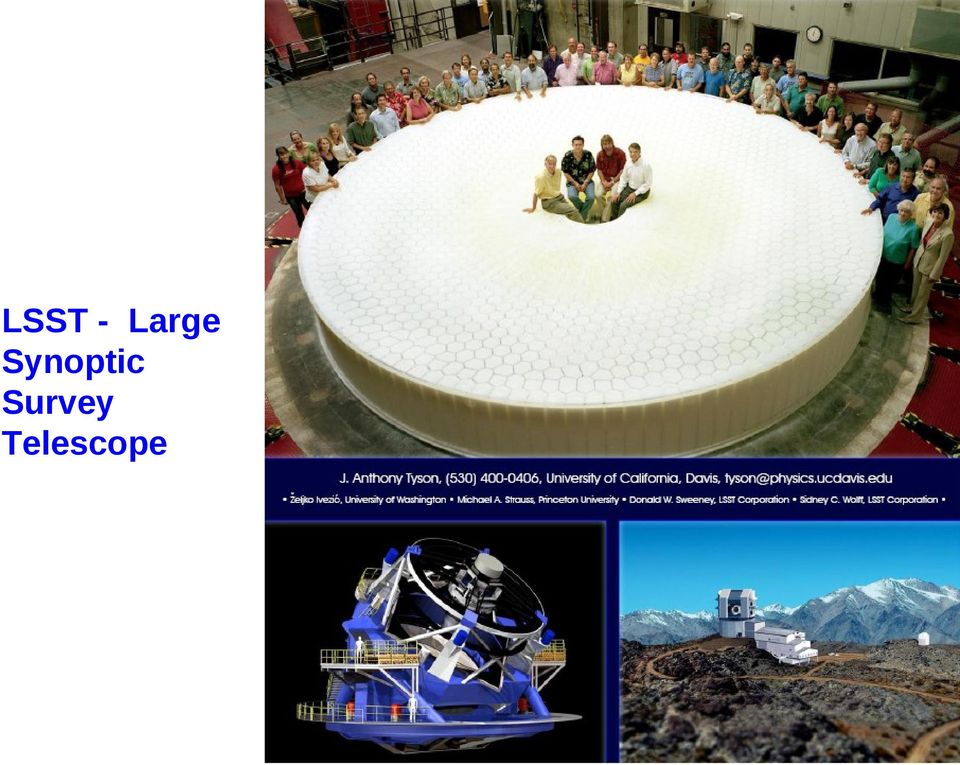
3 LSST - Large Synoptic Survey Telescope
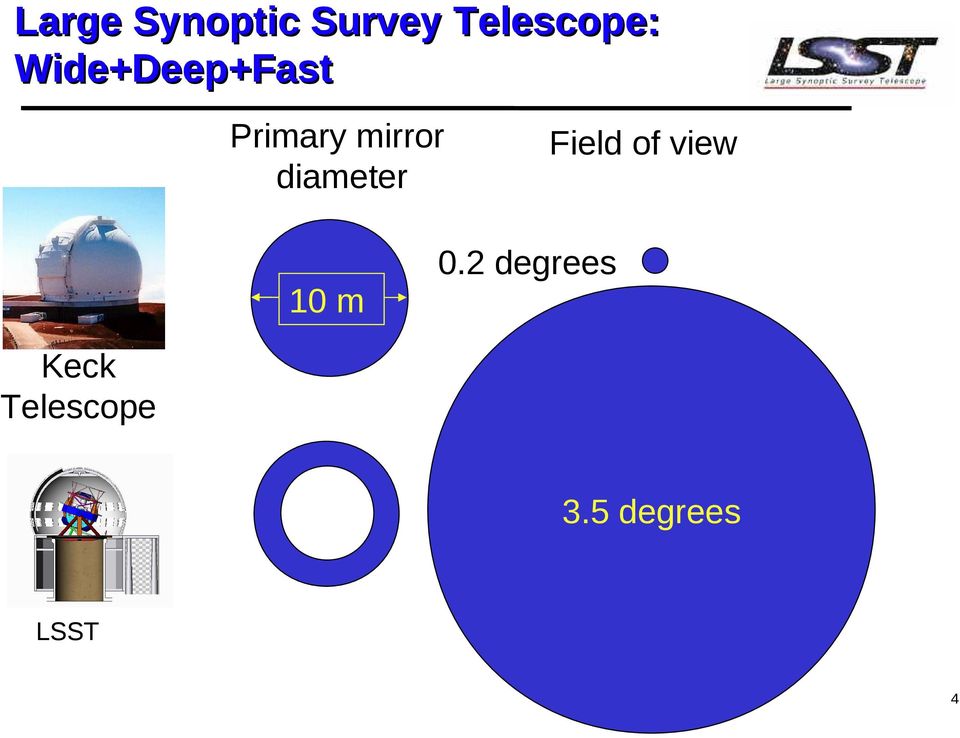
4 Large Synoptic Survey Telescope: Wide+Deep+Fast Primary mirror diameter Field of view 0.2 degrees 10 m Keck Telescope 3.5 degrees LSST 4
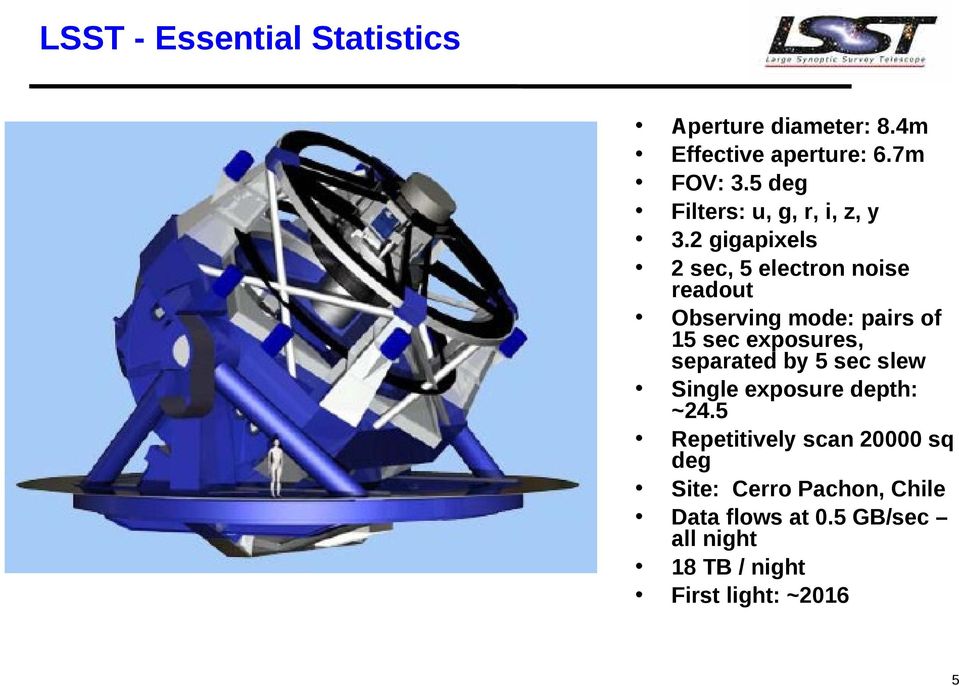
5 LSST - Essential Statistics Aperture diameter: 8.4m Effective aperture: 6.7m FOV: 3.5 deg Filters: u, g, r, i, z, y 3.2 gigapixels 2 sec, 5 electron noise readout Observing mode: pairs of 15 sec exposures, separated by 5 sec slew Single exposure depth: ~24.5 Repetitively scan sq deg Site: Cerro Pachon, Chile Data flows at 0.5 GB/sec all night 18 TB / night First light: ~2016 5

6 LSST Institutional Members A Huge Geographical Contrast from High Energy Physics - WHY??

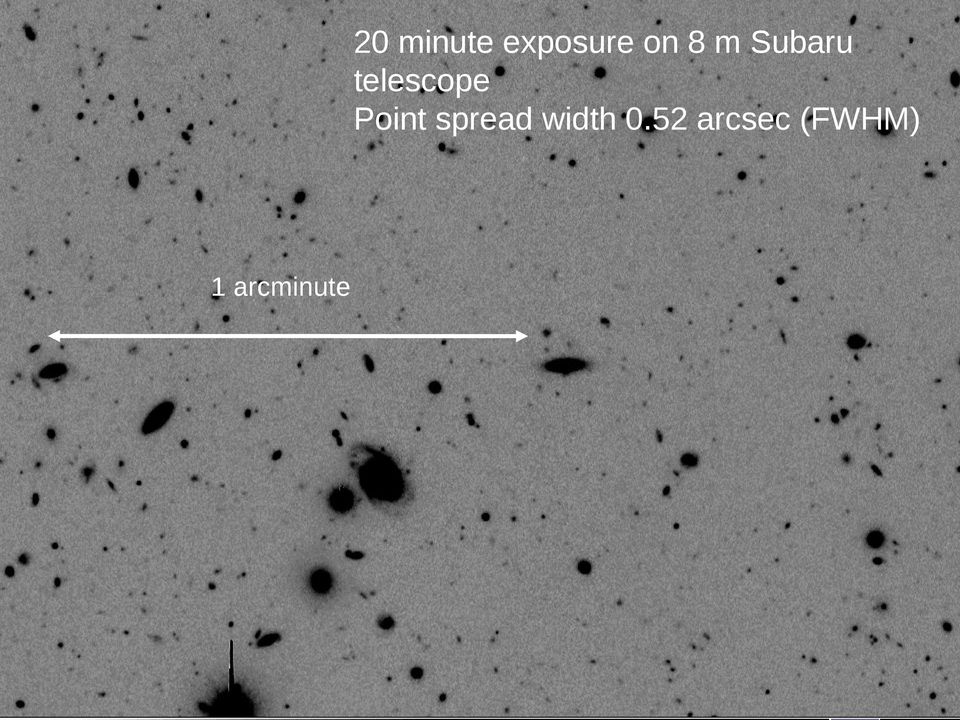
7 20 minute exposure on 8 m Subaru telescope Point spread width 0.52 arcsec (FWHM) 1 arcminute 7
8 One Survey Many Science Programs The LSST Observatory will produce a data stream which the Data Management System turns into data products. 0.5 GB/sec all night, every night for 10 years 104 PB of images at survey end 2.5 PB science database at survey end Many science programs are supported by the same data products Weak lensing Supernovae & transient astrophysics Milky Way structure Solar System inventory Many more in individual science collaborations

9 Simulated Results of 10 yr Survey 5.3M Exposures

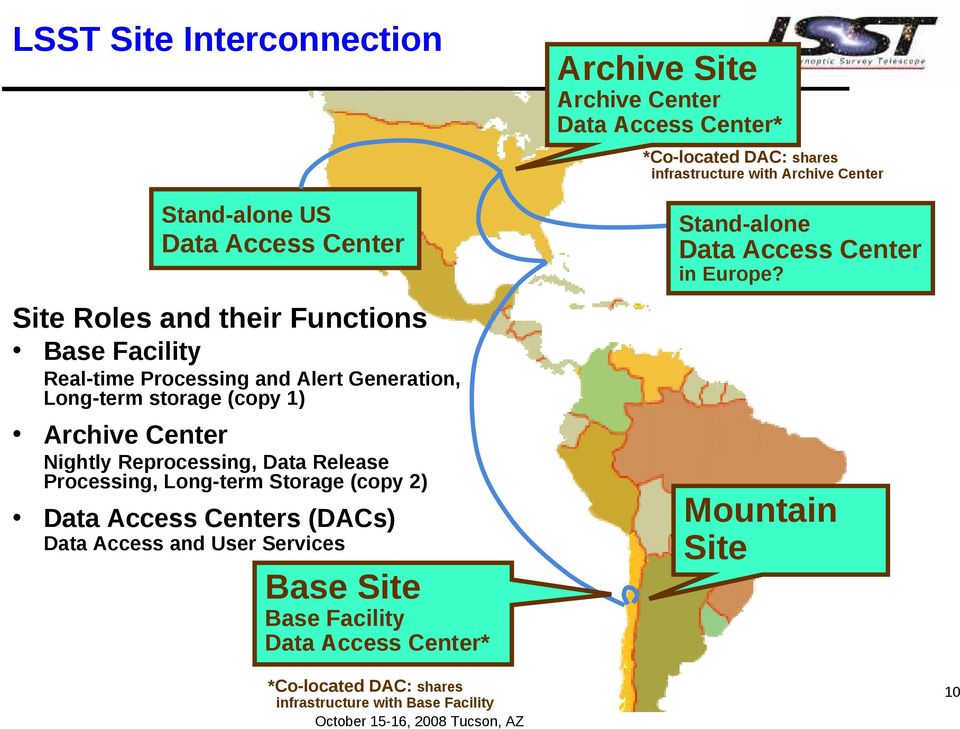
10 LSST Site Interconnection Archive Site Archive Center Data Access Center* *Co-located DAC: shares infrastructure with Archive Center Stand-alone US Data Access Center Stand-alone Data Access Center in Europe? Site Roles and their Functions Base Facility Real-time Processing and Alert Generation, Long-term storage (copy 1) Archive Center Nightly Reprocessing, Data Release Processing, Long-term Storage (copy 2) Data Access Centers (DACs) Data Access and User Services Mountain Site Base Site Base Facility Data Access Center* *Co-located DAC: shares infrastructure with BaseManager s Facility Review LSST DM Project October 15-16, 2008 Tucson, AZ 10
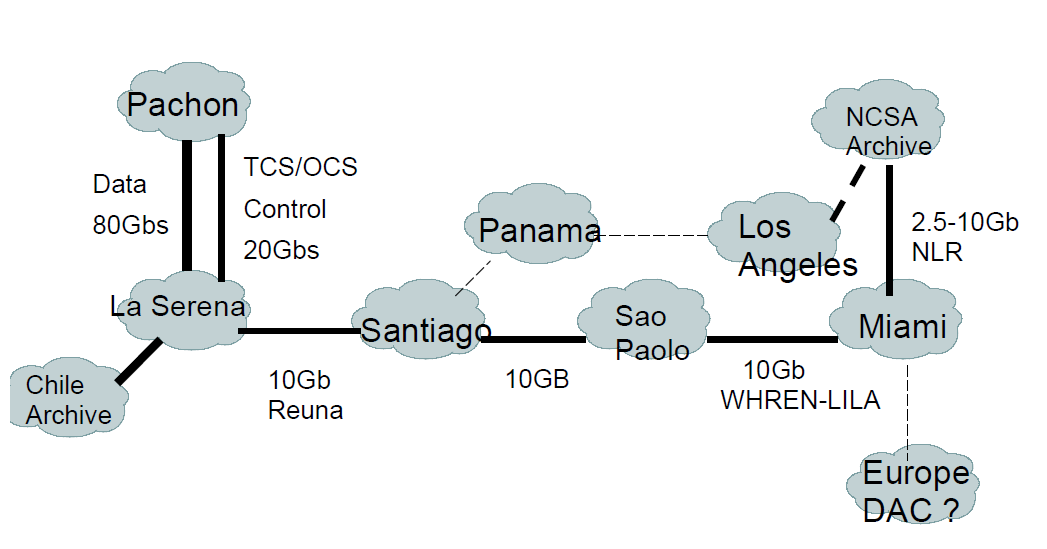
11 LSST High Speed Networks


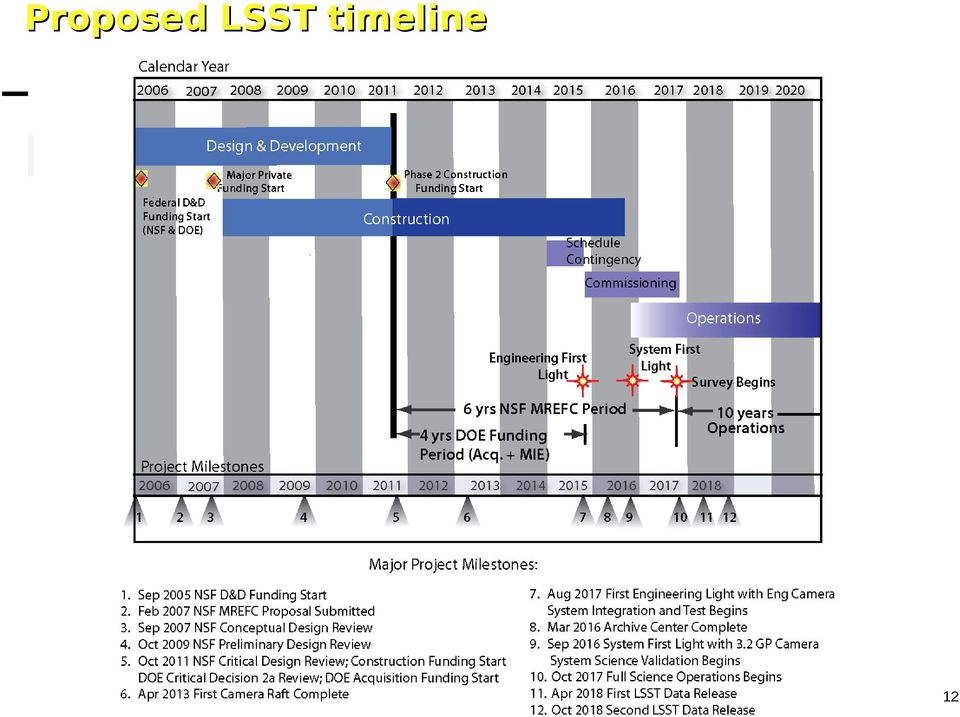
12 Proposed LSST timeline 12
13 LSST and Other Surveys What might we do? Real time spectroscopic followup Most LSST-detected transients are really faint 24 or so, need big telescopes for spectroscopy Southern Hemisphere Chile, S. Africa? Real time transient science combining optical and radio ASKAP, SKA The Australian connection! Pixel-level combination with surveys in other wavelengths Optimal deblending Detect rare objects, eg lensed supernovae Ad-hoc combination of information with other surveys through the VO
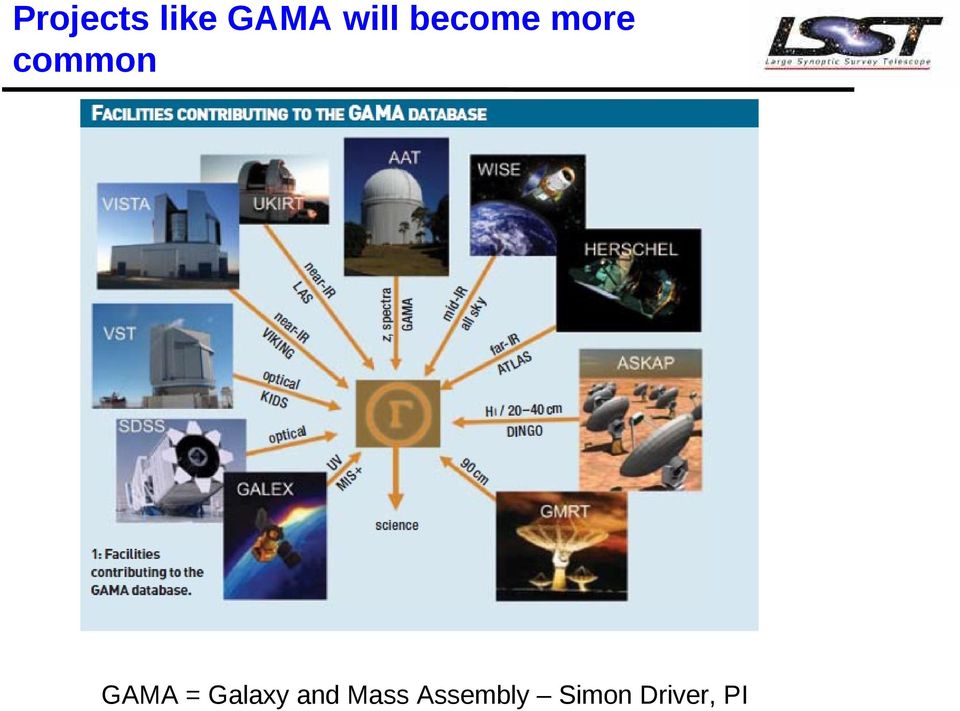
14 Projects like GAMA will become more common GAMA = Galaxy and Mass Assembly Simon Driver, PI
15 There is a cloud on the horizon... The cloud on the horizon is the inexorably increasing ratio of data to humans The science budget is roughly constant The number of funded humans on project budgets is also roughly constant The data flow from experiments is exploding, driven by sensor and computing technology LSST is one example of this, among many What is the danger? The entire scientific enterprise is built on the quality of experimental data If it contains unrecognized quality problems, we may fail Experience shows that automated techniques are only partly successful at identifying subtle problems in the data
16 Three Transformative Trends Will Shape the Landscape in 2016 High Speed Networks Cloud Computing The foundation Enabled by high speed networks Human Computation Enabled by both high speed networks and cloud computing Itself a form of cloud computing? We will need to make use of all three to overcome the challenges ahead to data intensive astronomy
17 There is a Moore's law for networks too...
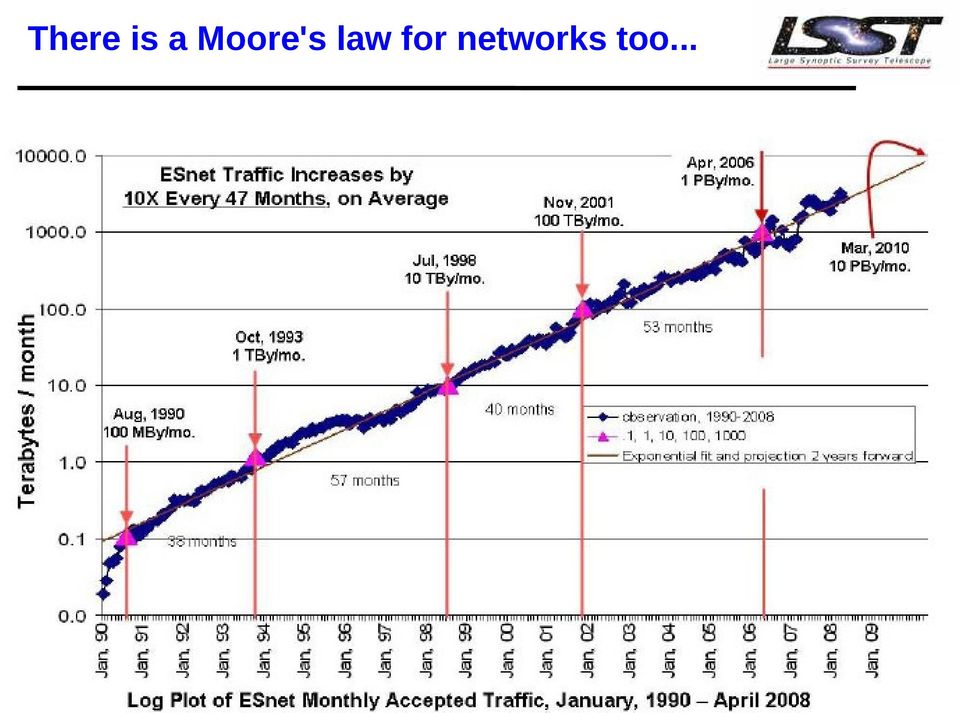

18

19

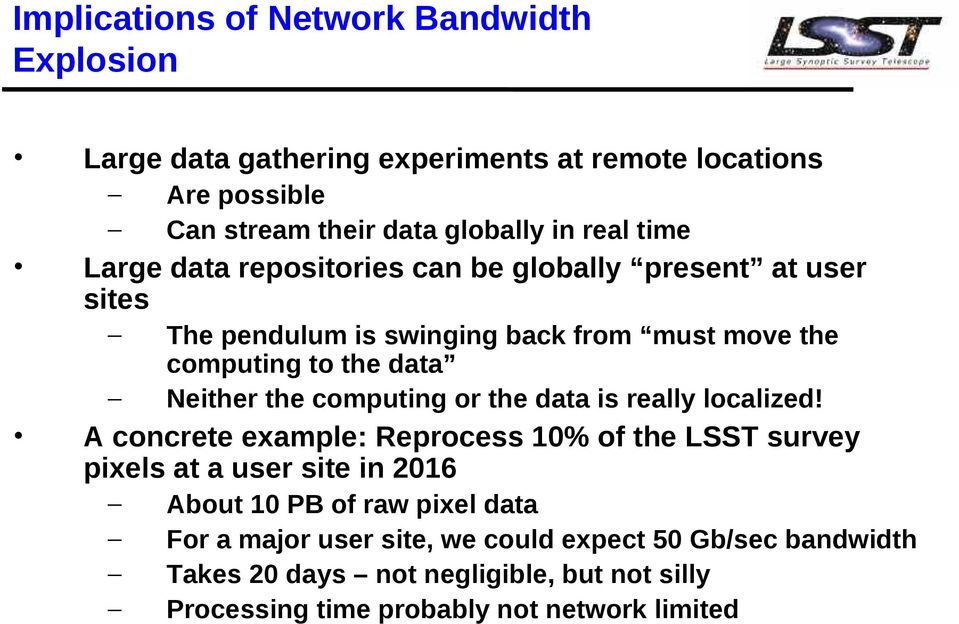
20 Implications of Network Bandwidth Explosion Large data gathering experiments at remote locations Large data repositories can be globally present at user sites Are possible Can stream their data globally in real time The pendulum is swinging back from must move the computing to the data Neither the computing or the data is really localized! A concrete example: Reprocess 10% of the LSST survey pixels at a user site in 2016 About 10 PB of raw pixel data For a major user site, we could expect 50 Gb/sec bandwidth Takes 20 days not negligible, but not silly Processing time probably not network limited
21 Cloud Computing Extensively covered by other speakers Essential characteristics for Astronomy Economic model radically different Computing as commodity Fund from operations rather than construction Overall capacity driven by demand from enormous user base In this context, science demands are not so large The capacity will just be there We can hope for a convergence of currently diverse cloud application interfaces Needed to justify large investment in science application software
22 Human Computing The first computers were human Astronomy the earliest application Manhattan Project From Manhattan Project days on, human computers were combined with mechanical/electronic aids
23 Changing Notion of Human Computation Original human computers were a substitute for the electronic computers that didn't yet exist Low computing rate and relatively high error rates forced Clever numerical algorithms Error detection and correction Use of parallelism Circa 1915 Lewis Richardson fantasized about a network of human computers in a stadium sized space connected in a spherical topology for modeling weather But none of the essentially human characteristics were used Pattern recognition Learning
24 Human Computing Today Motivation of Human Computers Economic Play Participation in a scientific enterprise - citizen science Strengths of Human Computers Still unmatched at recognizing subtle visual patterns They learn! There are potentially really a lot of them Limitations of Human Computers Biases, unreliability They do get bored... Citizen science is the most natural match to our astronomical needs
25 An Example Citizen Science App 8000 clicks per hour, averaged over 8 months
26 How Might we Integrate Citizen Science Into A Large Survey? Finding anomalies and quality problems in the data is our biggest need Images Patterns in databases Classification is a close second To make this work, our human computers will need some really advanced visualization tools Apply high speed computing to allow humans to have configurable data goggles Must keep it visually interesting, and enjoyable LSST has an active EPO program that has citizen science as a focus Working on early prototypes (Lightcurve Zoo) Ideas, and especially collaborations, are welcome!
27 The Perils of Open Data LSST has been committed from the start to completely open data Existing astronomy projects, like high energy physics projects, are not open It is difficult to persuade people to pay for what they think they will get for free It is difficult to persuade people to give up the perceived benefits of keeping their own data proprietary Given that situation, US funding agencies are reluctant to extend open data beyond the US border Open data has apparently become a real obstacle to building and operating the LSST Is this the reason the geographical map looks so different from High Energy Physics?
28 Astronomical Collaborations in 2016 Many reasons to collaborate! Data usefulness grows through joining with other surveys will become ever more true Many common problems Software design Data archiving Data curation Etc The computing infrastructure will make the mechanics of collaboration ever easier even as data volumes grow The challenges are mainly sociological We need to understand them Our funding agencies need to understand them!
Learning from Big Data in
 Learning from Big Data in Astronomy an overview Kirk Borne George Mason University School of Physics, Astronomy, & Computational Sciences http://spacs.gmu.edu/ From traditional astronomy 2 to Big Data
Conquering the Astronomical Data Flood through Machine
 Conquering the Astronomical Data Flood through Machine Learning and Citizen Science Kirk Borne George Mason University School of Physics, Astronomy, & Computational Sciences http://spacs.gmu.edu/ The Problem:
How To Teach Data Science
 The Past, Present, and Future of Data Science Education Kirk Borne @KirkDBorne http://kirkborne.net George Mason University School of Physics, Astronomy, & Computational Sciences Outline Research and Application
The Tonnabytes Big Data Challenge: Transforming Science and Education. Kirk Borne George Mason University
 The Tonnabytes Big Data Challenge: Transforming Science and Education Kirk Borne George Mason University Ever since we first began to explore our world humans have asked questions and have collected evidence
Astrophysics with Terabyte Datasets. Alex Szalay, JHU and Jim Gray, Microsoft Research
 Astrophysics with Terabyte Datasets Alex Szalay, JHU and Jim Gray, Microsoft Research Living in an Exponential World Astronomers have a few hundred TB now 1 pixel (byte) / sq arc second ~ 4TB Multi-spectral,
Data Mining Challenges and Opportunities in Astronomy
 Data Mining Challenges and Opportunities in Astronomy S. G. Djorgovski (Caltech) With special thanks to R. Brunner, A. Szalay, A. Mahabal, et al. The Punchline: Astronomy has become an immensely datarich
Summary of Data Management Principles Dark Energy Survey V2.1, 7/16/15
 Summary of Data Management Principles Dark Energy Survey V2.1, 7/16/15 This Summary of Data Management Principles (DMP) has been prepared at the request of the DOE Office of High Energy Physics, in support
ASKAP Science Data Archive: Users and Requirements CSIRO ASTRONOMY AND SPACE SCIENCE (CASS)
 ASKAP Science Data Archive: Users and Requirements CSIRO ASTRONOMY AND SPACE SCIENCE (CASS) Jessica Chapman, Data Workshop March 2013 ASKAP Science Data Archive Talk outline Data flow in brief Some radio
The Challenge of Data in an Era of Petabyte Surveys Andrew Connolly University of Washington
 The Challenge of Data in an Era of Petabyte Surveys Andrew Connolly University of Washington We acknowledge support from NSF IIS-0844580 and NASA 08-AISR08-0081 The science of big data sets Big Questions
Chapter 6 Telescopes: Portals of Discovery. How does your eye form an image? Refraction. Example: Refraction at Sunset.
 Chapter 6 Telescopes: Portals of Discovery 6.1 Eyes and Cameras: Everyday Light Sensors Our goals for learning:! How does your eye form an image?! How do we record images? How does your eye form an image?
Data analysis of L2-L3 products
 Data analysis of L2-L3 products Emmanuel Gangler UBP Clermont-Ferrand (France) Emmanuel Gangler BIDS 14 1/13 Data management is a pillar of the project : L3 Telescope Caméra Data Management Outreach L1
Description of the Dark Energy Survey for Astronomers
 Description of the Dark Energy Survey for Astronomers May 1, 2012 Abstract The Dark Energy Survey (DES) will use 525 nights on the CTIO Blanco 4-meter telescope with the new Dark Energy Camera built by
Challenges in e-science: Research in a Digital World
 Challenges in e-science: Research in a Digital World Thom Dunning National Center for Supercomputing Applications National Center for Supercomputing Applications University of Illinois at Urbana-Champaign
Spectrophotometry of Ap Stars
 Spectrophotometry of Ap Stars ASTRA Status Report Barry Smalley Astrophysics Group Keele University Staffordshire United Kingdom [email protected] What is Spectrophotometry? Spectroscopy through a wide
Introduction to LSST Data Management. Jeffrey Kantor Data Management Project Manager
 Introduction to LSST Data Management Jeffrey Kantor Data Management Project Manager LSST Data Management Principal Responsibilities Archive Raw Data: Receive the incoming stream of images that the Camera
Data transport in radio astronomy. Arpad Szomoru, JIVE
 Data transport in radio astronomy Arpad Szomoru, JIVE Some acronyms EVN: European VLBI Network Consortium of radio telescopes Involving 14 different organizations around the world: Europe, China, Puerto
and the VO-Science Francisco Jiménez Esteban Suffolk University
 The Spanish-VO and the VO-Science Francisco Jiménez Esteban CAB / SVO (INTA-CSIC) Suffolk University The Spanish-VO (SVO) IVOA was created in June 2002 with the mission to facilitate the international
Searching for space debris elements with the Pi of the Sky system
 Searching for space debris elements with the Pi of the Sky system Marcin Sokołowski [email protected] Soltan Institute for Nuclear Studies ( IPJ ) Warsaw, Poland 7th Integral / BART Workshop ( IBWS), 14-18
The Virtual Observatory: What is it and how can it help me? Enrique Solano LAEFF / INTA Spanish Virtual Observatory
 The Virtual Observatory: What is it and how can it help me? Enrique Solano LAEFF / INTA Spanish Virtual Observatory Astronomy in the XXI century The Internet revolution (the dot com boom ) has transformed
The ALMA Proposal Submission Process
 The ALMA Proposal Submission Process How to get started, and what to expect Presenter: Andrew McNichols Authors: Harvey Liszt, Tony Remijan, Andrew McNichols Atacama Large Millimeter/submillimeter Array
College of Science George Mason University Fairfax, VA 22030
 College of Science George Mason University Fairfax, VA 22030 Dr. Sidney Wolff and the LSST Board of Directors LSST Corporation 933 N. Cherry Avenue Tucson, AZ 85721-0009 June 14, 2010 Dear Dr. Wolff and
STAAR Science Tutorial 30 TEK 8.8C: Electromagnetic Waves
 Name: Teacher: Pd. Date: STAAR Science Tutorial 30 TEK 8.8C: Electromagnetic Waves TEK 8.8C: Explore how different wavelengths of the electromagnetic spectrum such as light and radio waves are used to
Are We Alone?! Exoplanet Characterization and Direct Imaging!
 From Cosmic Birth to Living Earths A Vision for Space Astronomy in the 2020s and Beyond Are We Alone?! Exoplanet Characterization and Direct Imaging! A Study Commissioned by the Associated Universities
RESULTS FROM A SIMPLE INFRARED CLOUD DETECTOR
 RESULTS FROM A SIMPLE INFRARED CLOUD DETECTOR A. Maghrabi 1 and R. Clay 2 1 Institute of Astronomical and Geophysical Research, King Abdulaziz City For Science and Technology, P.O. Box 6086 Riyadh 11442,
The Scientific Data Mining Process
 Chapter 4 The Scientific Data Mining Process When I use a word, Humpty Dumpty said, in rather a scornful tone, it means just what I choose it to mean neither more nor less. Lewis Carroll [87, p. 214] In
LSST Data Management plans: Pipeline outputs and Level 2 vs. Level 3
 LSST Data Management plans: Pipeline outputs and Level 2 vs. Level 3 Mario Juric Robert Lupton LSST DM Project Scien@st Algorithms Lead LSST SAC Name of Mee)ng Loca)on Date - Change in Slide Master 1 Data
COOKBOOK. for. Aristarchos Transient Spectrometer (ATS)
 NATIONAL OBSERVATORY OF ATHENS Institute for Astronomy, Astrophysics, Space Applications and Remote Sensing HELMOS OBSERVATORY COOKBOOK for Aristarchos Transient Spectrometer (ATS) P. Boumis, J. Meaburn,
LSST Data Management System Applications Layer Simulated Data Needs Description: Simulation Needs for DC3
 LSST Data Management System Applications Layer Simulated Data Needs Description: Simulation Needs for DC3 Draft 25 September 2008 A joint document from the LSST Data Management Team and Image Simulation
22 nd ITS World Congress Towards Intelligent Mobility Better Use of Space. GPS 2: Big Data The Real Value of Your Social Media Accounts
 22 nd ITS World Congress Towards Intelligent Mobility Better Use of Space GPS 2: Big Data The Real Value of Your Social Media Accounts October 7, 2015 Kenneth Leonard Director, Intelligent Transportation
The Solar Science Data Center and LOFAR
 The Solar Science Data Center and LOFAR F. Breitling, G. Mann, C. Vocks 2009-01-27 1. Introduction Solar astronomy is a multi-disciplinary field where knowledge and data of various experiments has to be
How to Choose the Right Network Cameras. for Your Surveillance Project. Surveon Whitepaper
 How to Choose the Right Network Cameras for Your Surveillance Project Surveon Whitepaper From CCTV to Network, surveillance has changed from single professional-orientated technology to one integrated
CCAT: Overview & Status
 CCAT: Overview & Status Large Aperture Millimeter/Submillimeter Telescopes in the ALMA Era Osaka Prefecture University 12-13 Sept, 2011 Jeff Zivick CCAT Project Manager Cornell University Guiding Principles
Undergraduate Studies Department of Astronomy
 WIYN 3.5-meter Telescope at Kitt Peak near Tucson, AZ Undergraduate Studies Department of Astronomy January 2014 Astronomy at Indiana University General Information The Astronomy Department at Indiana
Association of Universities for Research in Astronomy
 Association of Universities for Research in Astronomy Site Review Application of the University of Virginia For AURA Membership AURA s policy regarding new Member Institutions is based on a determination
The future of Big Data A United Hitachi View
 The future of Big Data A United Hitachi View Alex van Die Pre-Sales Consultant 1 Oktober 2014 1 Agenda Evolutie van Data en Analytics Internet of Things Hitachi Social Innovation Vision and Solutions 2
Example application (1) Telecommunication. Lecture 1: Data Mining Overview and Process. Example application (2) Health
 Lecture 1: Data Mining Overview and Process What is data mining? Example applications Definitions Multi disciplinary Techniques Major challenges The data mining process History of data mining Data mining
CYBERINFRASTRUCTURE FRAMEWORK FOR 21 st CENTURY SCIENCE AND ENGINEERING (CIF21)
 CYBERINFRASTRUCTURE FRAMEWORK FOR 21 st CENTURY SCIENCE AND ENGINEERING (CIF21) Goal Develop and deploy comprehensive, integrated, sustainable, and secure cyberinfrastructure (CI) to accelerate research
Subtitle. Business Phone Trends 2015. The Relentless March of Technology. Business Phone Trends - 2015 Compare Business Products 2015 1
 Subtitle Business Phone Trends 2015 The Relentless March of Technology Business Phone Trends - 2015 Compare Business Products 2015 1 Contents The Trends That Will Define 2015...3 IPv6...3 The Cloud Will
Science Investigations: Investigating Astronomy Teacher s Guide
 Teacher s Guide Grade Level: 6 12 Curriculum Focus: Astronomy/Space Duration: 7 segments; 66 minutes Program Description This library of videos contains seven segments on celestial bodies and related science.
The LSST Data management and French computing activities. Dominique Fouchez on behalf of the IN2P3 Computing Team. LSST France April 8th,2015
 The LSST Data management and French computing activities Dominique Fouchez on behalf of the IN2P3 Computing Team LSST France April 8th,2015 OSG All Hands SLAC April 7-9, 2014 1 The LSST Data management
2) A convex lens is known as a diverging lens and a concave lens is known as a converging lens. Answer: FALSE Diff: 1 Var: 1 Page Ref: Sec.
 Physics for Scientists and Engineers, 4e (Giancoli) Chapter 33 Lenses and Optical Instruments 33.1 Conceptual Questions 1) State how to draw the three rays for finding the image position due to a thin
African-European Radio Astronomy Platform. 2013 Africa-EU Cooperation Forum on ICT. Addis Ababa, Ethiopia 3 December 2013
 African-European Radio Astronomy Platform 2013 Africa-EU Cooperation Forum on ICT Addis Ababa, Ethiopia 3 December 2013 Context The African European Radio Astronomy Platform European Parliament s Written
Data Analytics as a Service
 Data Analytics as a Service unleashing the power of Cloud and Big Data 05-06-2014 Big Data in a Cloud DAaaS: Data Analytics as a Service DAaaS: Data Analytics as a Service Introducing Data Analytics as
W H I T E P A P E R. Security & Defense Solutions Intelligent Convergence with EdgeFrontier
 W H I T E P A P E R Security & Defense Solutions Intelligent Convergence with EdgeFrontier Contents 1. Introduction... 2 2. The Need for Intelligent Convergence... 3 2.1 Security Convergence with EdgeFrontier...
Adaptive Optics (AO) TMT Partner Institutions Collaborating Institution Acknowledgements
 THIRTY METER TELESCOPE The past century of astronomy research has yielded remarkable insights into the nature and origin of the Universe. This scientific advancement has been fueled by progressively larger
Exploring Big Data in Social Networks
 Exploring Big Data in Social Networks [email protected] ([email protected]) INWEB National Science and Technology Institute for Web Federal University of Minas Gerais - UFMG May 2013 Some thoughts about
Technology Strategy Board (TSB) Future Cities Demonstrator
 Technology Strategy Board (TSB) Future Cities Demonstrator The Technology Strategy Board (TSB) Future Cities Demonstrator is a UK government initiative, which started in January 2013 and is due to conclude
Revision problem. Chapter 18 problem 37 page 612. Suppose you point a pinhole camera at a 15m tall tree that is 75m away.
 Revision problem Chapter 18 problem 37 page 612 Suppose you point a pinhole camera at a 15m tall tree that is 75m away. 1 Optical Instruments Thin lens equation Refractive power Cameras The human eye Combining
Top 10 Discoveries by ESO Telescopes
 Top 10 Discoveries by ESO Telescopes European Southern Observatory reaching new heights in astronomy Exploring the Universe from the Atacama Desert, in Chile since 1964 ESO is the most productive astronomical
Light Telescopes. Grade Level: 5. 2-3 class periods (more if in-depth research occurs)
 Light Telescopes Grade Level: 5 Time Required: Suggested TEKS: Science - 5.4 Suggested SCANS Information. Acquires and evaluates information. National Science and Math Standards Science as Inquiry, Earth
High Resolution Imaging in the Visible from the Ground without Adaptive Optics: New Techniques and Results
 High Resolution Imaging in the Visible from the Ground without Adaptive Optics: New Techniques and Results Craig Mackay *a, John Baldwin b, Nicholas Law a and Peter Warner b a Institute of Astronomy and
Short-Term Forecasting in Retail Energy Markets
 Itron White Paper Energy Forecasting Short-Term Forecasting in Retail Energy Markets Frank A. Monforte, Ph.D Director, Itron Forecasting 2006, Itron Inc. All rights reserved. 1 Introduction 4 Forecasting
EDMONDS COMMUNITY COLLEGE ASTRONOMY 100 Winter Quarter 2007 Sample Test # 1
 Instructor: L. M. Khandro EDMONDS COMMUNITY COLLEGE ASTRONOMY 100 Winter Quarter 2007 Sample Test # 1 1. An arc second is a measure of a. time interval between oscillations of a standard clock b. time
Tips for Selecting Your First Telescope
 Tips for Selecting Your First Telescope Selecting your first telescope can be a daunting task. There are so many to choose from. This guide will give you some important facts that you will find useful
LDA, the new family of Lortu Data Appliances
 LDA, the new family of Lortu Data Appliances Based on Lortu Byte-Level Deduplication Technology February, 2011 Copyright Lortu Software, S.L. 2011 1 Index Executive Summary 3 Lortu deduplication technology
Canadian Astronomy Data Centre. Séverin Gaudet David Schade Canadian Astronomy Data Centre
 Canadian Astronomy Data Centre Séverin Gaudet David Schade Canadian Astronomy Data Centre Data Activities in Astronomy Features of the astronomy data landscape Multi-wavelength datasets are increasingly
Migrating a (Large) Science Database to the Cloud
 The Sloan Digital Sky Survey Migrating a (Large) Science Database to the Cloud Ani Thakar Alex Szalay Center for Astrophysical Sciences and Institute for Data Intensive Engineering and Science (IDIES)
How To Understand And Understand The Science Of Astronomy
 Introduction to the VO [email protected] ESAVO ESA/ESAC Madrid, Spain The way Astronomy works Telescopes (ground- and space-based, covering the full electromagnetic spectrum) Observatories Instruments
Swarthmore College Newsletter
 93 Fog, clouds, and light pollution limit the effectiveness of even the biggest optical telescopes on Earth. Astronomers who study ultraviolet or X-ray emission of stars have been more limited because
NASA s Future Missions in X-ray Astronomy
 NASA s Future Missions in X-ray Astronomy Nicholas E. White NASA s Goddard Space Flight Center Laboratory for High Energy Astrophysics Greenbelt, MD 20771 USA [email protected] Abstract The