
Rest optical spectroscopy of FeLoBALs and LoBALs at intermediate redshift
|
|
|
- Chester Perkins
- 9 years ago
- Views:
Transcription
1 Rest optical spectroscopy of FeLoBALs and LoBALs at intermediate redshift Kentaro Aoki Subaru Telescope, National Astronomical Observatory of Japan NLS1s and low-ionization BAL (LoBAL) QSOs appear to share observational properties such as weak [O III] and strong Fe II emission line. We have observed Hβ - [O III] region of 23 iron LoBALs and LoBALs at intermediate redshift (1.4 < z < 2.6). Most of our sample are weak [O III] emitters, however, there is a large variety of the strength of optical Fe II. Narrow-Line Seyfert 1 Galaxies and their place in the Universe - NLS1, April 04-06, 2011 Milan Italy c Copyright owned by the author(s) under the terms of the Creative Commons Attribution-NonCommercial-ShareAlike Licence.
![We have observed Hβ - [O III] region of 23 iron LoBALs and LoBALs at intermediate redshift (1.4 < z < 2.6).](/docs-images/47/19951276/images/page_1.jpg "Most of our sample are weak [O III] emitters, however, there is a large variety of the strength of optical Fe II.")
2 1. Similarity of LoBALs and NLS1s Similarities between NLS1s and Low-ionization Broad Absorption Line Quasars (LoBAL) have been pointed out by [6]. LoBALs are quasars which show absorption troughs from not only high-ionization ions such as C IV, N V, Si IV but also Mg II, Al III, and Al II. Both NLS1s and LoBALs have low [O III] equivalent width, and large Fe II (optical)/hβ [5, 17]. Those characters are recently confirmed by [18] using a lager sample of LoBALs. 2. FeLoBAL A fraction of LoBALs shows absorptions from excited fine-structure levels of the ground term and excited terms of Fe II and Fe III [11, 3, 4, 10]. They are called iron LoBALs (FeLoBALs). FeLoBALs are rare quasars, however, the Sloan Digital Sky Survey (SDSS; [16]) are dramatically increasing numbers of FeLoBALs. Many of them have a reddened continuum (see [10]). They are dusty and possible young and high Eddington ratio objects. It is expected that FeLoBALs and LoBALs may share the similar spectral properties of weak [O III] and strong Fe II, however near-infrared spectroscopies aiming Hβ, Fe II of intermediate redshift FeLoBALs are scarce. [9] observed two FeLoBALs, and [17] included one FeLoBAL at z 2 in their sample. Near-infrared spectroscopy of a radio-loud FeLoBAL SDSS J has been published by [14]. Thus we started near-infrared spectroscopic observations of LoBALs and FeLoBALs at z Observations Most of targets are chosen from SDSS. Significant fraction of the sample are selected from [10] and searched in SDSS database by ourselves. The observed quasars are listed in Table 1. Their optical, i.e. rest-uv spectra in SDSS are shown in Figs. 1-3 except for Hawaii 167 and PSS J which have no SDSS spectra. Please refer to [8] and [7] for optical spectra of Hawaii 167 and PSS J , respectively. The results of SDSS J and SDSS J have been published in [1] and [2], respectively. We used the Cooled Infrared Spectrograph and Camera for OHS (CISCO: [13]) and the Multi- Object Infrared Camera and Spectrograph (MOIRCS: [12]) attached to the Subaru 8.2-m telescope and SpeX [15] with IRTF 3.0-m telescope. The spectral resolutions were and 750 by Subaru and IRTF, respectively. 4. Preliminary Results Our near-infrared spectra are shown in Figs Most of our sample are weak [O III] emitters. SDSS has, however, exceptionally strong [O III] emission line. Its rest [O III] λ 5007 equivalent width is 42Å. There is a large variety of the strength of optical Fe II. Some FeLoBALs, for example, SDSS J , SDSS , SDSS J , SDSS , are very strong optical Fe II emitters, while SDSS J and SDSS J have weak optical Fe II emission line. We can easily notice that strong [O III] emitters such as SDSS J , SDSS J , SDSS J and SDSS are weak optical Fe II emitter. All 2
![Both NLS1s and LoBALs have low [O III] equivalent width, and large Fe II (optical)/hβ [5, 17]. Those characters are recently confirmed by [18] using a lager sample of LoBALs. 2.](/docs-images/47/19951276/images/page_2.jpg "FeLoBAL A fraction of LoBALs shows absorptions from excited fine-structure levels of the ground term and excited terms of Fe II and Fe III [11, 3, 4, 10]. They are called iron LoBALs (FeLoBALs).")
3 Figure 1: Rest UV spectra of the targets. The ordinate is the relative flux density ( f λ ), and the abscissa is the rest wavelength. Each spectrum is shifted in arbitrary step to avoid overlap. Higher redshift quasar is plotted upper. Figure 2: Rest UV spectra of the targets. Same as Fig.1. Figure 3: Rest UV spectra of the targets. Same as Fig.1, but for SDSS J SDSS is shown again as comparison. 3

4 Name Redshift Telescope/Instrument Obs. date (UT) SDSS J IRTF/SpeX 2007 Mar. 8 SDSS J IRTF/SpeX 2007 Mar. 8 SDSS J IRTF/SpeX 2007 Mar. 7 SDSS J Subaru/CISCO 2004 Aug. 28 LBQS A Subaru/CISCO 2004 Aug. 28 SDSS J Subaru/MOIRCS 2011 Mar. 18 SDSS J Subaru/CISCO 2005 Jul. 19 SDSS J Subaru/MOIRCS 2011 Mar. 18 SDSS J Subaru/CISCO 2003 Nov. 6 SDSS J IRTF/SpeX 2007 Mar. 7 SDSS J Subaru/CISCO 2005 Mar. 26 Hawaii Subaru/CISCO 2008 Mar. 20 SDSS J Subaru/CISCO 2005 Jul. 26 SDSS J Subaru/CISCO 2003 Nov. 6 SDSS J Subaru/CISCO 2005 Apr. 1 SDSS J Subaru/CISCO 2003 Oct. 18 SDSS J IRTF/SpeX 2007 Mar. 9 SDSS J Subaru/CISCO 2004 Jul. 11 SDSS J Subaru/CISCO 2003 Oct. 17 SDSS J IRTF/SpeX 2008 Mar. 7 SDSS J Subaru/MOIRCS 2009 June 2 PSS J Subaru/CISCO 2004 Jul. 11 SDSS J Subaru/MOIRCS 2011 Mar. 18 Table 1: The targets list. Figure 4: Rest optical spectra obtained by near-infrared spectroscopies. The ordinate is the relative flux density ( f λ ), and the abscissa is the rest wavelength. Each spectrum is shifted in arbitrary step to avoid overlap. Higher redshift quasar is plotted upper 4

5 Figure 5: Rest optical spectra. Same as Fig. 4. Figure 6: Rest optical spectra. Same as Fig. 4. four objects except for SDSS are radio-quiet. The anti-correlation between [O III] and optical Fe II strength seems to exist among our sample. The two FeLoBALs, SDSS J and SDSS J have weak [O III] and optical Fe II emission line, thus they might be outliers. FeLoBALs have wide variety of properties in absorption lines, line width, velocity shift, line ratios. The relationships between UV and optical spectral properties will be investigated in future. References [1] K. Aoki et al. 2006, Discovery of Hα Absorption in the Unusual Broad Absorption Line Quasar SDSS J , ApJ, 651, 84 [2] K. Aoki 2010, Broad Balmer-Line Absorption in SDSS J , PASJ, 62, 1333 [3] R. H. Becker et al. 1997, The First Radio-loud Broad Absorption Line QSO and Evidence for a Hidden Population of Quasars, ApJ, 479, L93 [4] R. H. Becker, et al. 2000, Properties of Radio-selected Broad Absorption Line Quasars from the First Bright Quasar Survey, ApJ, 538, 72 [5] T. A. Boroson & K. A Meyers 1992, The optical properties of IR-selected and Mg II broad absorption line quasars, ApJ, 397, 442 [6] W. N. Brandt, & S. C. Gallagher 2000, New Astronomy Reviews, 44, 461 5
![The two FeLoBALs, SDSS J1028+5115 and SDSS J1547+4443 have weak [O III] and optical Fe II emission line, thus they might be outliers.](/docs-images/47/19951276/images/page_5.jpg "FeLoBALs have wide variety of properties in absorption lines, line width, velocity shift, line ratios. The relationships between UV and optical spectral properties will be investigated in future.")
6 [7] R. J. Brunner, et al. 2003, Peculiar Broad Absorption Line Quasars Found in The Digitized Palomar Observatory Sky Survey, AJ, 126, 53 [8] L. L. Cowie, et al. 1994, Hawaii 167: A compact absorption-line object at Z = 2.35, ApJ, 432, L83 [9] E. Egami, et al. 1996, Hawaii 167 and Q : Heavily Dust-Enshrouded Young QSOs, AJ, 112, 73 [10] P. B. Hall et al. 2002, Unusual Broad Absorption Line Quasars from the Sloan Digital Sky Survey, ApJS, 141, 267 [11] C. Hazard, et al. 1987, The remarkable broad absorption line QSO with extensive Fe II absorption, ApJ, 323, 263 [12] T. Ichikawa, et al. 2006, MOIRCS: multi-object infrared camera and spectrograph for SUBARU, in proceedings of Society of Photo-Optical Instrumentation Engineers (SPIE) Conference Series, 6269, 38 [13] K. Motohara, et al. 2002, CISCO: Cooled Infrared Spectrograph and Camera for OHS on the Subaru Telescope, PASJ, 54, 315 [14] J. Najita, et al. 2000, Red Quasars and Quasar Evolution: The Case of BAL QSO FIRST J , AJ, 120, 2859 [15] J. T. Rayner, et al. 2003, SpeX: A Medium-Resolution Micron Spectrograph and Imager for the NASA Infrared Telescope Facility, PASP, 115, 362 [16] D. G. York, et al. 2000, The Sloan Digital Sky Survey: Technical Summary, AJ, 120, 1579 [17] M. J. Yuan, & B. J. Wills 2003, Eddington Accretion and QSO Emission Lines at z 2, ApJ, 593, L11 [18] S. Zhang, et al. 2010, Low-z Mg II Broad Absorption-line Quasars from the Sloan Digital Sky Survey, ApJ, 714, 367 6
![Hall et al. 2002, Unusual Broad Absorption Line Quasars from the Sloan Digital Sky Survey, ApJS, 141, 267 [11] C. Hazard, et al.](/docs-images/47/19951276/images/page_6.jpg "1987, The remarkable broad absorption line QSO 0059-2735 with extensive Fe II absorption, ApJ, 323, 263 [12] T. Ichikawa, et al.")
Einstein Rings: Nature s Gravitational Lenses
 National Aeronautics and Space Administration Einstein Rings: Nature s Gravitational Lenses Leonidas Moustakas and Adam Bolton Taken from: Hubble 2006 Science Year in Review The full contents of this book
THE FREQUENCY AND RADIO PROPERTIES OF BROAD ABSORPTION LINE QUASARS 1
 THE FREQUENCY AND RADIO PROPERTIES OF BROAD ABSORPTION LINE QUASARS 1 Paul C. Hewett Institute of Astronomy, Madingley Rd, Cambridge, CB3 0HA, United Kingdom and Craig B. Foltz MMT Observatory, University
J-PAS: low-resolution (R 50) spectroscopy over 8000 deg 2
 J-PAS: low-resolution (R 50) spectroscopy over 8000 deg 2 C. López-Sanjuan J. Cenarro, L. A. Díaz-García, J. Varela, K. Viironen, & the J-PAS team Centro de Estudio de Física del Cosmos de Aragón 10th
New results on HE 0107 5240 and future surveys for metal-poor stars
 New results on HE 0107 5240 and future surveys for metal-poor stars Norbert Christlieb Department of Astronomy and Space Physics, Uppsala University HE 0107 5240 [Fe I/H] NLTE = 5.3 The most heavy-element
MY FIRST STEPS IN SLIT SPECTROSCOPY
 MY FIRST STEPS IN SLIT SPECTROSCOPY Andrew Wilson BAAVSS Spectroscopy Workshop Norman Lockyer Observatory October 2015 Overview My choice of spectrograph, camera and telescope Getting started and basic
Astro 301/ Fall 2005 (48310) Introduction to Astronomy
 Astro 301/ Fall 2005 (48310) Introduction to Astronomy Instructor: Professor Shardha Jogee TAs: David Fisher, Donghui Jeong, and Miranda Nordhaus Lecture 22 = Tu Nov 15 Lecture 23 = Th Nov 17 http://www.as.utexas.edu/~sj/a301-fa05/
arxiv:astro-ph/0109117v1 7 Sep 2001
 **TITLE** ASP Conference Series, Vol. **VOLUME**, **PUBLICATION YEAR** **EDITORS** X ray bright optically quiet galaxies: the case of P3 arxiv:astro-ph/0109117v1 7 Sep 2001 Andrea Comastri, Marcella Brusa,
Data Mining Challenges and Opportunities in Astronomy
 Data Mining Challenges and Opportunities in Astronomy S. G. Djorgovski (Caltech) With special thanks to R. Brunner, A. Szalay, A. Mahabal, et al. The Punchline: Astronomy has become an immensely datarich
SSO Transmission Grating Spectrograph (TGS) User s Guide
 SSO Transmission Grating Spectrograph (TGS) User s Guide The Rigel TGS User s Guide available online explains how a transmission grating spectrograph (TGS) works and how efficient they are. Please refer
Chapter 6 Telescopes: Portals of Discovery. How does your eye form an image? Refraction. Example: Refraction at Sunset.
 Chapter 6 Telescopes: Portals of Discovery 6.1 Eyes and Cameras: Everyday Light Sensors Our goals for learning:! How does your eye form an image?! How do we record images? How does your eye form an image?
What is the Sloan Digital Sky Survey?
 What is the Sloan Digital Sky Survey? Simply put, the Sloan Digital Sky Survey is the most ambitious astronomical survey ever undertaken. The survey will map one-quarter of the entire sky in detail, determining
From lowest energy to highest energy, which of the following correctly orders the different categories of electromagnetic radiation?
 From lowest energy to highest energy, which of the following correctly orders the different categories of electromagnetic radiation? From lowest energy to highest energy, which of the following correctly
Astrophysics with Terabyte Datasets. Alex Szalay, JHU and Jim Gray, Microsoft Research
 Astrophysics with Terabyte Datasets Alex Szalay, JHU and Jim Gray, Microsoft Research Living in an Exponential World Astronomers have a few hundred TB now 1 pixel (byte) / sq arc second ~ 4TB Multi-spectral,
8.1 Radio Emission from Solar System objects
 8.1 Radio Emission from Solar System objects 8.1.1 Moon and Terrestrial planets At visible wavelengths all the emission seen from these objects is due to light reflected from the sun. However at radio
Atoms Absorb & Emit Light
 Atoms Absorb & Emit Light Spectra The wavelength of the light that an element emits or absorbs is its fingerprint. Atoms emit and absorb light First Test is Thurs, Feb 1 st About 30 multiple choice questions
Adaptive Optics (AO) TMT Partner Institutions Collaborating Institution Acknowledgements
 THIRTY METER TELESCOPE The past century of astronomy research has yielded remarkable insights into the nature and origin of the Universe. This scientific advancement has been fueled by progressively larger
Modeling Galaxy Formation
 Galaxy Evolution is the study of how galaxies form and how they change over time. As was the case with we can not observe an individual galaxy evolve but we can observe different galaxies at various stages
The Virtual Observatory: What is it and how can it help me? Enrique Solano LAEFF / INTA Spanish Virtual Observatory
 The Virtual Observatory: What is it and how can it help me? Enrique Solano LAEFF / INTA Spanish Virtual Observatory Astronomy in the XXI century The Internet revolution (the dot com boom ) has transformed
High Resolution Imaging in the Visible from the Ground without Adaptive Optics: New Techniques and Results
 High Resolution Imaging in the Visible from the Ground without Adaptive Optics: New Techniques and Results Craig Mackay *a, John Baldwin b, Nicholas Law a and Peter Warner b a Institute of Astronomy and
First Discoveries. Asteroids
 First Discoveries The Sloan Digital Sky Survey began operating on June 8, 1998. Since that time, SDSS scientists have been hard at work analyzing data and drawing conclusions. This page describes seven
How To Build An Infrared Telescope In Chile
 The University of Tokyo Atacama Observatory 6.5m Telescope Project Yuzuru Yoshii a, Tsutomu Aoki b, Mamoru Doi a, Toshihiro Handa a, Kimiaki Kawara a, Daisuke Kato c, Kotaro Kohno a, Masahiro Konishi a,
Modeling the Expanding Universe
 H9 Modeling the Expanding Universe Activity H9 Grade Level: 8 12 Source: This activity is produced by the Universe Forum at NASA s Office of Space Science, along with their Structure and Evolution of the
WELCOME to Aurorae In the Solar System. J.E. Klemaszewski
 WELCOME to Aurorae In the Solar System Aurorae in the Solar System Sponsoring Projects Galileo Europa Mission Jupiter System Data Analysis Program ACRIMSAT Supporting Projects Ulysses Project Outer Planets
AT&T Global Network Client for Windows Product Support Matrix January 29, 2015
 AT&T Global Network Client for Windows Product Support Matrix January 29, 2015 Product Support Matrix Following is the Product Support Matrix for the AT&T Global Network Client. See the AT&T Global Network
Galaxy Survey data analysis using SDSS-III as an example
 Galaxy Survey data analysis using SDSS-III as an example Will Percival (University of Portsmouth) showing work by the BOSS galaxy clustering working group" Cosmology from Spectroscopic Galaxy Surveys"
Absorption by atmospheric gases in the IR, visible and UV spectral regions.
 Lecture 6. Absorption by atmospheric gases in the IR, visible and UV spectral regions. Objectives: 1. Gaseous absorption in thermal IR. 2. Gaseous absorption in the visible and near infrared. 3. Gaseous
of transitions from the upper energy level to the lower one per unit time caused by a spontaneous emission of radiation with the frequency ω = (E E
 THE EERGY DISTRIBUTIO OF ATOMS I THE FIELD OF THERMAL BLACKBODY RADIATIO Fedor V.Prigara Institute of Microelectronics and Informatics, Russian Academy of Sciences, Universitetskaya, 50007 Yaroslavl, Russia
Problem Set 6 UV-Vis Absorption Spectroscopy. 13-1. Express the following absorbances in terms of percent transmittance:
 Problem Set 6 UV-Vis Absorption Spectroscopy 13-1. Express the following absorbances in terms of percent transmittance: a 0.051 b 0.918 c 0.379 d 0.261 e 0.485 f 0.072 A = log P o /P = log1/t = - log T
PISGAH ASTRONOMICAL RESEARCH INSTITUTE AND ASTRONOMICAL PHOTOGRAPHIC DATA ARCHIVE. www.pari.edu
 PISGAH ASTRONOMICAL RESEARCH INSTITUTE AND ASTRONOMICAL PHOTOGRAPHIC DATA ARCHIVE www.pari.edu PARI 200ac (80ha) campus 6.2mi (10km) of roads 12 buildings 100,000 ft2 (9290 m2) Extensive Internet Infrastructure
COOKBOOK. for. Aristarchos Transient Spectrometer (ATS)
 NATIONAL OBSERVATORY OF ATHENS Institute for Astronomy, Astrophysics, Space Applications and Remote Sensing HELMOS OBSERVATORY COOKBOOK for Aristarchos Transient Spectrometer (ATS) P. Boumis, J. Meaburn,
The Solar Journey: Modeling Features of the Local Bubble and Galactic Environment of the Sun
 The Solar Journey: Modeling Features of the Local Bubble and Galactic Environment of the Sun P.C. Frisch and A.J. Hanson Department of Astronomy and Astrophysics University of Chicago and Computer Science
Solar Irradiance Variability Observed During Solar Cycle 23
 Solar Irradiance Variability Observed During Solar Cycle 23 Introduction Solar Cycle Results for Climate Change Solar Cycle Results for Space Weather Tom Woods LASP / University
Atomic Physics Measurements in Support of X-ray Astronomy
 Atomic Physics Measurements in Support of X-ray Astronomy Your LDRD Representative Graphic Here (Fit in this rectangle, no caption) Oct 27, 2010 Gatlinburg P. Beiersdorfer G. Brown LLNL M. Frankel LLNL*
Astronomical spectral database of active galactic nuclei
 Astronomical spectral database of active galactic nuclei P. Wasiewicz a, K. Hryniewicz b, P. Gajewski c a Institute of Electronic Systems, Warsaw University of Technology b N. Copernicus Astronomical Centre,
165 points. Name Date Period. Column B a. Cepheid variables b. luminosity c. RR Lyrae variables d. Sagittarius e. variable stars
 Name Date Period 30 GALAXIES AND THE UNIVERSE SECTION 30.1 The Milky Way Galaxy In your textbook, read about discovering the Milky Way. (20 points) For each item in Column A, write the letter of the matching
Top 10 Discoveries by ESO Telescopes
 Top 10 Discoveries by ESO Telescopes European Southern Observatory reaching new heights in astronomy Exploring the Universe from the Atacama Desert, in Chile since 1964 ESO is the most productive astronomical
COMPARISON OF FIXED & VARIABLE RATES (25 YEARS) CHARTERED BANK ADMINISTERED INTEREST RATES - PRIME BUSINESS*
 COMPARISON OF FIXED & VARIABLE RATES (25 YEARS) 2 Fixed Rates Variable Rates FIXED RATES OF THE PAST 25 YEARS AVERAGE RESIDENTIAL MORTGAGE LENDING RATE - 5 YEAR* (Per cent) Year Jan Feb Mar Apr May Jun
COMPARISON OF FIXED & VARIABLE RATES (25 YEARS) CHARTERED BANK ADMINISTERED INTEREST RATES - PRIME BUSINESS*
 COMPARISON OF FIXED & VARIABLE RATES (25 YEARS) 2 Fixed Rates Variable Rates FIXED RATES OF THE PAST 25 YEARS AVERAGE RESIDENTIAL MORTGAGE LENDING RATE - 5 YEAR* (Per cent) Year Jan Feb Mar Apr May Jun
arxiv:astro-ph/0201232v2 16 Jan 2002
 Narrow Lines in Type II Supernovae Probing the Circumstellar Nebulae of the Progenitors Robert A. Gruendl, You-Hua Chu 1,2 Astronomy Department, University of Illinois, 1002 West Green Street, Urbana,
The Challenge of Data in an Era of Petabyte Surveys Andrew Connolly University of Washington
 The Challenge of Data in an Era of Petabyte Surveys Andrew Connolly University of Washington We acknowledge support from NSF IIS-0844580 and NASA 08-AISR08-0081 The science of big data sets Big Questions
Measuring the Doppler Shift of a Kepler Star with a Planet
 Measuring the Doppler Shift of a Kepler Star with a Planet 1 Introduction The Doppler shift of a spectrum reveals the line of sight component of the velocity vector ( radial velocity ) of the object. Doppler
Chromospheric and Transition Region dynamics
 Chromospheric and Transition Region dynamics Luc Rouppe van der Voort University of Oslo IRIS: type II spicules are heated to at least TR temperatures Pereira et al. 2014 ApJL 792 type II spicules
The Chemical Composition of a Molecular Cloud at the Outer Edge of the Galaxy
 Carnegie Observatories Astrophysics Series, Vol. 4: Origin and Evolution of the Elements, 2003 ed. A. McWilliam and M. Rauch (Pasadena: Carnegie Observatories, http://www.ociw.edu/ociw/symposia/series/symposium4/proceedings.html)
Astronomy & Physics Resources for Middle & High School Teachers
 Astronomy & Physics Resources for Middle & High School Teachers Gillian Wilson http://www.faculty.ucr.edu/~gillianw/k12 A cosmologist is.... an astronomer who studies the formation and evolution of the
Testing maser-based evolutionary schemes: a new search for 37.7-GHz methanol masers
 MNRAS 429, 3501 3516 (2013) doi:10.1093/mnras/sts621 Testing maser-based evolutionary schemes: a new search for 37.7-GHz methanol masers S. P. Ellingsen, 1 S. L. Breen, 2 M. A. Voronkov 2 andj.r.dawson
NASA s Future Missions in X-ray Astronomy
 NASA s Future Missions in X-ray Astronomy Nicholas E. White NASA s Goddard Space Flight Center Laboratory for High Energy Astrophysics Greenbelt, MD 20771 USA [email protected] Abstract The
STAAR Science Tutorial 30 TEK 8.8C: Electromagnetic Waves
 Name: Teacher: Pd. Date: STAAR Science Tutorial 30 TEK 8.8C: Electromagnetic Waves TEK 8.8C: Explore how different wavelengths of the electromagnetic spectrum such as light and radio waves are used to
The Birth and Assembly of Galaxies: the Relationship Between Science Capabilities and Telescope Aperture
 The Birth and Assembly of Galaxies: the Relationship Between Science Capabilities and Telescope Aperture Betsy Barton Center for Cosmology University of California, Irvine Grateful acknowledgements to:
Stéphane Blondin Curriculum Vitæ 1. Stéphane Blondin
 Stéphane Blondin Curriculum Vitæ 1 Stéphane Blondin Laboratoire d Astrophysique de Marseille (LAM) 38, rue Frédéric Joliot-Curie 13388 Marseille Cedex 13, France Phone: +33 (0)4 91 05 69 41 Email: [email protected]
APPLICATION OF TERRA/ASTER DATA ON AGRICULTURE LAND MAPPING. Genya SAITO*, Naoki ISHITSUKA*, Yoneharu MATANO**, and Masatane KATO***
 APPLICATION OF TERRA/ASTER DATA ON AGRICULTURE LAND MAPPING Genya SAITO*, Naoki ISHITSUKA*, Yoneharu MATANO**, and Masatane KATO*** *National Institute for Agro-Environmental Sciences 3-1-3 Kannondai Tsukuba
Be Stars. By Carla Morton
 Be Stars By Carla Morton Index 1. Stars 2. Spectral types 3. B Stars 4. Be stars 5. Bibliography How stars are formed Stars are composed of gas Hydrogen is the main component of stars. Stars are formed
Constructing the Subaru Advanced Data and Analysis Service on VO
 Constructing the Subaru Advanced Data and Analysis Service on VO Yuji Shirasaki on behalf of ADC National Astronomical Observatory of Japan Astronomy Data Center Contents Subaru Telescope and Instruments
Using Photometric Data to Derive an HR Diagram for a Star Cluster
 Using Photometric Data to Derive an HR Diagram for a Star Cluster In In this Activity, we will investigate: 1. How to use photometric data for an open cluster to derive an H-R Diagram for the stars and
Extraction Heights for STIS Echelle Spectra
 Instrument Science Report STIS 98-09 Extraction Heights for STIS Echelle Spectra Claus Leitherer and Ralph Bohlin March 1998 ABSTRACT The optimum extraction height (h) for STIS echelle spectra of 7 pixels
A long time ago, people looked
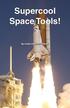 Supercool Space Tools! By Linda Hermans-Killam A long time ago, people looked into the dark night sky and wondered about the stars, meteors, comets and planets they saw. The only tools they had to study
Austin Peay State University Department of Chemistry Chem 1111. The Use of the Spectrophotometer and Beer's Law
 Purpose To become familiar with using a spectrophotometer and gain an understanding of Beer s law and it s relationship to solution concentration. Introduction Scientists use many methods to determine
Spectrophotometry of Ap Stars
 Spectrophotometry of Ap Stars ASTRA Status Report Barry Smalley Astrophysics Group Keele University Staffordshire United Kingdom [email protected] What is Spectrophotometry? Spectroscopy through a wide
A short history of telescopes and astronomy: Galileo to the TMT
 A short history of telescopes and astronomy: Galileo to the TMT Telescopes in the last 400 years Galileo 1608 Hans Lippershey applied for a patent for seeing things far away as if they were nearby 1609
Experiment #5: Qualitative Absorption Spectroscopy
 Experiment #5: Qualitative Absorption Spectroscopy One of the most important areas in the field of analytical chemistry is that of spectroscopy. In general terms, spectroscopy deals with the interactions
Warning : HαT telescope must NOT be used for solar observation without additional filters. This is the user responsibility to check that his filter
 For high resolution chromosphere observation and imaging in Hα band Warning : HαT telescope must NOT be used for solar observation without additional filters. This is the user responsibility to check that
Are We Alone?! Exoplanet Characterization and Direct Imaging!
 From Cosmic Birth to Living Earths A Vision for Space Astronomy in the 2020s and Beyond Are We Alone?! Exoplanet Characterization and Direct Imaging! A Study Commissioned by the Associated Universities
ALMA Overview. Leonardo Testi (European Southern Observatory)
 ALMA Overview Leonardo Testi (European Southern Observatory) The ALMA Project Status Timeline towards Early and Full Science Operations Future Developments Atacama Large Millimeter Array At least 50x12m
Hubble Diagram S George Djorgovski. Encyclopedia of Astronomy & Astrophysics P. Murdin
 eaa.iop.org DOI: 10.1888/0333750888/2132 Hubble Diagram S George Djorgovski From Encyclopedia of Astronomy & Astrophysics P. Murdin IOP Publishing Ltd 2006 ISBN: 0333750888 Institute of Physics Publishing