
Managing Vulnerability Assessment
|
|
|
- Phillip Wilson
- 10 years ago
- Views:
Transcription
1 Security Threat Response Manager Release Juniper Networks, Inc North Mathilda Avenue Sunnyvale, CA USA Published:

2 Copyright Notice Copyright 2013 Juniper Networks, Inc. All rights reserved. Juniper Networks, Junos, Steel-Belted Radius, NetScreen, and ScreenOS are registered trademarks of Juniper Networks, Inc. in the United States and other countries. The Juniper Networks Logo, the Junos logo, and JunosE are trademarks of Juniper Networks, Inc. The following terms are trademarks or registered trademarks of other companies: Java TM and all Java-based trademarks and logos are trademarks or registered trademarks of Oracle and/or its affiliates. All other trademarks, service marks, registered trademarks, or registered service marks are the property of their respective owners. All specifications are subject to change without notice. Juniper Networks assumes no responsibility for any inaccuracies in this document or for any obligation to update information in this document. Juniper Networks reserves the right to change, modify, transfer, or otherwise revise this publication without notice. FCC Statement The following information is for FCC compliance of Class A devices: This equipment has been tested and found to comply with the limits for a Class A digital device, pursuant to part 15 of the FCC rules. These limits are designed to provide reasonable protection against harmful interference when the equipment is operated in a commercial environment. The equipment generates, uses, and can radiate radio-frequency energy and, if not installed and used in accordance with the instruction manual, may cause harmful interference to radio communications. Operation of this equipment in a residential area is likely to cause harmful interference, in which case users will be required to correct the interference at their own expense. The following information is for FCC compliance of Class B devices: The equipment described in this manual generates and may radiate radio-frequency energy. If it is not installed in accordance with Juniper Networks installation instructions, it may cause interference with radio and television reception. This equipment has been tested and found to comply with the limits for a Class B digital device in accordance with the specifications in part 15 of the FCC rules. These specifications are designed to provide reasonable protection against such interference in a residential installation. However, there is no guarantee that interference will not occur in a particular installation. If this equipment does cause harmful interference to radio or television reception, which can be determined by turning the equipment off and on, the user is encouraged to try to correct the interference by one or more of the following measures: Reorient or relocate the receiving antenna. Increase the separation between the equipment and receiver. Consult the dealer or an experienced radio/tv technician for help. Connect the equipment to an outlet on a circuit different from that to which the receiver is connected. Caution: Changes or modifications to this product could void the user's warranty and authority to operate this device. Disclaimer THE SOFTWARE LICENSE AND LIMITED WARRANTY FOR THE ACCOMPANYING PRODUCT, SUBJECT TO THE MODIFICTAIONS SET FORTH BELOW ON THIS PAGE, ARE SET FORTH IN THE INFORMATION PACKET THAT SHIPPED WITH THE PRODUCT AND ARE INCORPORATED HEREIN BY THIS REFERENCE. IF YOU ARE UNABLE TO LOCATE THE SOFTWARE LICENSE OR LIMITED WARRANTY, CONTACT YOUR JUNIPER NETWORKS REPRESENTATIVE FOR A COPY. Release Copyright 2013, Juniper Networks, Inc. All rights reserved. Printed in USA. Revision History March 2013 The information in this document is current as of the date listed in the revision history. END USER LICENSE AGREEMENT The Juniper Networks product that is the subject of this technical documentation consists of (or is intended for use with) Juniper Networks software. Use of such software is subject to the terms and conditions of the End User License Agreement ( EULA ) posted at as modified by the following text, which shall be treated under the EULA as an Entitlement Document taking precedence over any conflicting provisions of such EULA as regards such software: As regards software accompanying the STRM products (the Program ), such software contains software licensed by Q1 Labs and is further accompanied by third-party software that is described in the applicable documentation or materials provided by Juniper Networks. 2
3 For the convenience of Licensee, the Program may be accompanied by a third party operating system. The operating system is not part of the Program, and is licensed directly by the operating system provider (e.g., Red Hat Inc., Novell Inc., etc.) to Licensee. Neither Juniper Networks nor Q1 Labs is a party to the license between Licensee and the third party operating system provider, and the Program includes the third party operating system AS IS, without representation or warranty, express or implied, including any implied warranty of merchantability, fitness for a particular purpose or non-infringement. For an installed Red Hat operating system, see the license file: /usr/share/doc/redhat-release-server-6server/eula. By downloading, installing or using such software, you agree to the terms and conditions of that EULA as so modified. 3

4 4
5 CONTENTS ABOUT THIS GUIDE Documentation Conventions Documentation Feedback Requesting Technical Support OVERVIEW Configuring Vulnerability Assessment Installing Scanners Viewing Scanners MANAGING IBM SECURITY APPSCAN ENTERPRISE SCANNERS Configuring AppScan Enterprise to Grant STRM Access Creating Custom User Types Enabling STRM Integration Creating an Application Deployment Map Publishing Reports to STRM Configuring AppScan Enterprise in STRM Adding an AppScan Enterprise Scanner to STRM Editing an AppScan Enterprise Scanner Deleting an AppScan Enterprise Scanner IBM SITEPROTECTOR SCANNER Adding an IBM SiteProtector Scanner Editing an IBM SiteProtector Scanner Deleting an IBM SiteProtector Scanner IBM TIVOLI ENDPOINT MANAGER Adding an IBM Tivoli Endpoint Manager Scanner Editing an IBM Tivoli Endpoint Manager Scanner Deleting an IBM Tivoli Endpoint Manager Scanner MANAGING NCIRCLE IP360 SCANNERS Adding an IP360 Scanner Editing an IP360 Scanner Deleting an IP360 Scanner

6 Exporting Scan Reports MANAGING NESSUS SCANNERS Adding a Nessus Scanner Adding a Nessus Scheduled Live Scan Adding a Nessus Scheduled Results Import Adding a Nessus Scheduled Live Scan Using the XMLPRC API Adding a Nessus Completed Report Import Using the XMLRPC API Editing an Nessus Scanner Deleting a Nessus Scanner MANAGING NMAP SCANNERS Adding an Nmap Remote Live Scan Adding an Nmap Remote Results Import Scan Editing an Nmap Scanner Deleting an Nmap Scanner MANAGING QUALYS SCANNERS Configuring a Qualys Detection Scanner Adding the Qualys Detection Scanner Editing a Qualys Detection Scanner Deleting a Qualys Detection Scanner Configuring a Qualys Scanner Adding a Qualys Live Scan Adding a Qualys Asset Report Data Import Adding a Qualys Scheduled Import Scan Report Editing a Qualys Scanner Deleting the Qualys Scanner MANAGING FOUNDSCAN SCANNERS Adding a FoundScan Scanner Editing a FoundScan Scanner Deleting a FoundScan Scanner Using Certificates Obtaining a Certificate Importing Certificates Example Of TrustedCA.pem File Example of Portal.pem File MANAGING JUNIPER NETWORKS NSM PROFILER SCANNERS Adding a Juniper Networks NSM Profiler Scanner Editing a Profiler Scanner Deleting a Profiler Scanner

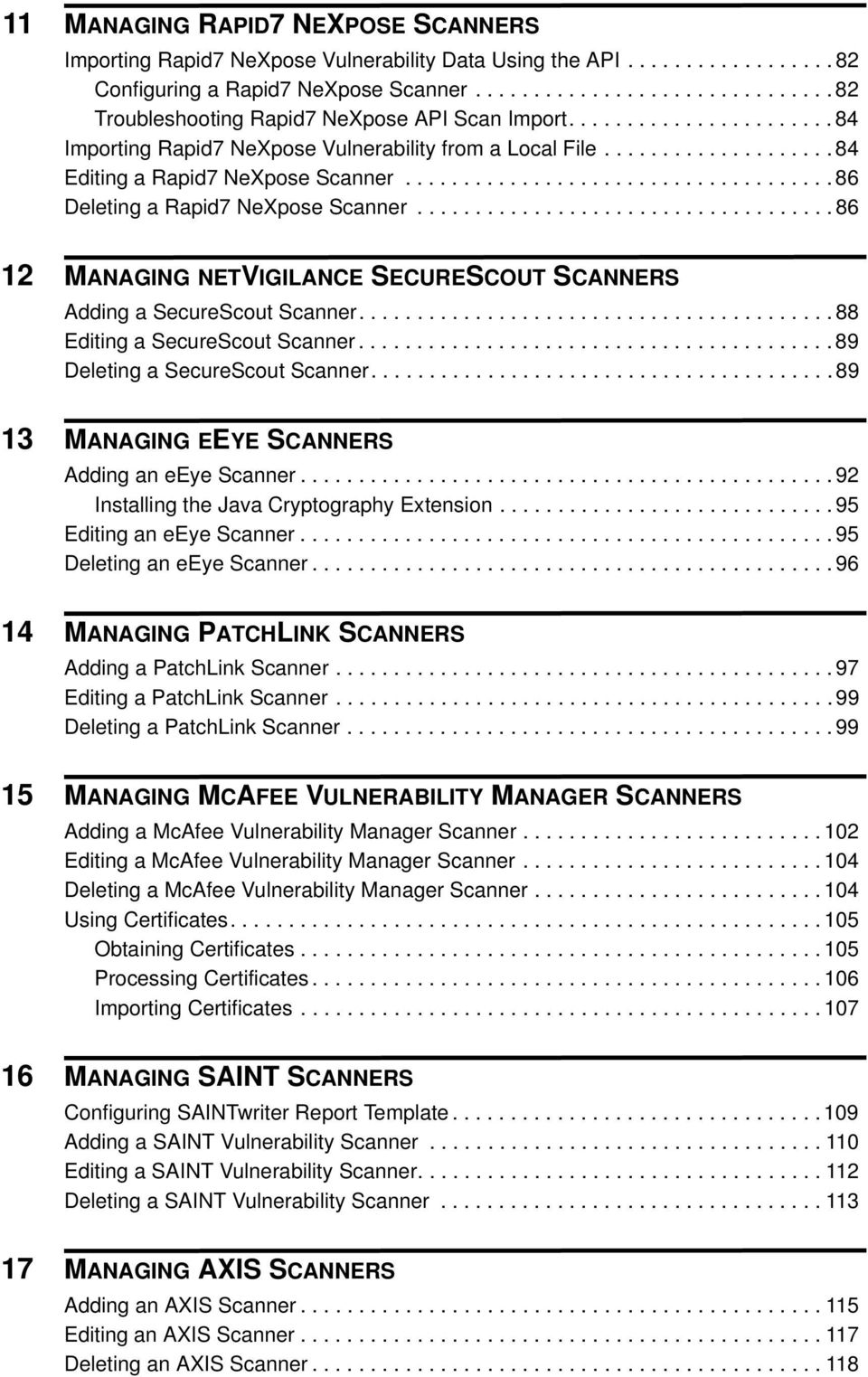
7 11 MANAGING RAPID7 NEXPOSE SCANNERS Importing Rapid7 NeXpose Vulnerability Data Using the API Configuring a Rapid7 NeXpose Scanner Troubleshooting Rapid7 NeXpose API Scan Import Importing Rapid7 NeXpose Vulnerability from a Local File Editing a Rapid7 NeXpose Scanner Deleting a Rapid7 NeXpose Scanner MANAGING NETVIGILANCE SECURESCOUT SCANNERS Adding a SecureScout Scanner Editing a SecureScout Scanner Deleting a SecureScout Scanner MANAGING EEYE SCANNERS Adding an eeye Scanner Installing the Java Cryptography Extension Editing an eeye Scanner Deleting an eeye Scanner MANAGING PATCHLINK SCANNERS Adding a PatchLink Scanner Editing a PatchLink Scanner Deleting a PatchLink Scanner MANAGING MCAFEE VULNERABILITY MANAGER SCANNERS Adding a McAfee Vulnerability Manager Scanner Editing a McAfee Vulnerability Manager Scanner Deleting a McAfee Vulnerability Manager Scanner Using Certificates Obtaining Certificates Processing Certificates Importing Certificates MANAGING SAINT SCANNERS Configuring SAINTwriter Report Template Adding a SAINT Vulnerability Scanner Editing a SAINT Vulnerability Scanner Deleting a SAINT Vulnerability Scanner MANAGING AXIS SCANNERS Adding an AXIS Scanner Editing an AXIS Scanner Deleting an AXIS Scanner
8 18 MANAGING TENABLE SECURITYCENTER Adding Tenable SecurityCenter Editing Tenable SecurityCenter Deleting Tenable SecurityCenter MANAGING SCAN SCHEDULES Viewing Scheduled Scans Scheduling a Scan Editing a Scan Schedule Deleting a Scheduled Scan SUPPORTED SCANNERS INDEX

9 ABOUT THIS GUIDE The Guide provides you with information for managing vulnerability scanners and scan schedules using STRM. Documentation Conventions Table 1 lists conventions that are used throughout this guide. Table 1 Icons Icon Type Information note Information that describes important features or instructions. Caution Warning Information that alerts you to potential loss of data or potential damage to an application, system, device, or network. Information that alerts you to potential personal injury. Documentation Feedback We encourage you to provide feedback, comments, and suggestions so that we can improve the documentation. You can send your comments to [email protected], or fill out the documentation feedback form at If you are using , be sure to include the following information with your comments: Document or topic name URL or page number Software release version (if applicable)
10 10 ABOUT THIS GUIDE Requesting Technical Support Technical product support is available through the Juniper Networks Technical Assistance Center (JTAC). If you are a customer with an active J-Care or JNASC support contract, or are covered under warranty, and need postsales technical support, you can access our tools and resources online or open a case with JTAC. JTAC policies For a complete understanding of our JTAC procedures and policies, review the JTAC User Guide located at Product warranties For product warranty information, visit JTAC Hours of Operation The JTAC centers have resources available 24 hours a day, 7 days a week, 365 days a year. Self-Help Online Tools and Resources For quick and easy problem resolution, Juniper Networks has designed an online self-service portal called the Customer Support Center (CSC) that provides you with the following features: Find CSC offerings: Search for known bugs: Find product documentation: Find solutions and answer questions using our Knowledge Base: Download the latest versions of software and review release notes: Search technical bulletins for relevant hardware and software notifications: Join and participate in the Juniper Networks Community Forum: Open a case online in the CSC Case Management tool: To verify service entitlement by product serial number, use our Serial Number Entitlement (SNE) Tool: Opening a Case with JTAC You can open a case with JTAC on the Web or by telephone. Use the Case Management tool in the CSC at Call JTAC ( toll-free in the USA, Canada, and Mexico). For international or direct-dial options in countries without toll-free numbers, visit us at

11 1 OVERVIEW Vulnerability assessment integration enables STRM to build vulnerability assessment profiles. Vulnerability assessment profiles uses correlated event data, network activity, and behavioral changes to remove false positives to determine the threat level for each critical business asset. STRM's integration with vulnerability assessment tools allows you to schedule scans to keep your vulnerability assessment data up-to-date. NOTE You must have the proper permissions to access networks containing CIDR addresses you schedule for vulnerability assessment scans. NOTE Information found in this documentation about configuring scanners is based on the latest RPM files located on the Juniper customer support website, located at This section provides information on the following: Configuring Vulnerability Assessment Installing Scanners Viewing Scanners Configuring Vulnerability Assessment To configure vulnerability assessment, you must: 1 Install the scanner RPM, if necessary. For more information, see Installing Scanners. 2 Configure your scanner using the following list of supported scanners: Managing IBM Security AppScan Enterprise Scanners Managing ncircle IP360 Scanners Managing Nessus Scanners
12 12 OVERVIEW Managing Nmap Scanners Managing Qualys Scanners Managing FoundScan Scanners Managing Juniper Networks NSM Profiler Scanners Managing Rapid7 NeXpose Scanners Managing netvigilance SecureScout Scanners Managing eeye Scanners Managing PatchLink Scanners Managing McAfee Vulnerability Manager Scanners Managing SAINT Scanners Managing AXIS Scanners Managing Tenable SecurityCenter The scanner determines the tests performed during the scanning of a host. The selected scanner populates your asset profile data including the host information, ports, and potential vulnerabilities. NOTE If you add, edit, or delete a scanner, you must click Deploy Changes on the Admin tab for the changes to be updated on the STRM Console. Configuration changes do not interrupt scanners with scans in progress, as changes are applied when the scan completes. 3 Schedule a vulnerability scan to import the data in to STRM. For more information, see Managing Scan Schedules. The results of the scan provides the operating system and version on each CIDR, server, and version of each port. Also, the scan provides the known vulnerabilities on discovered ports and services. Installing Scanners To update or install a new scanner, you must either configure STRM to automatically download and install scanner rpm files using the Auto Updates icon on the Admin tab or install the scanner rpm manually. If you choose to install a scanner update manually, the latest rpm installation file for your scanner is available on the Juniper customer support website. To manually install a scanner on your STRM Console: Download the scanner rpm file from the Juniper customer support website: Copy the file to your STRM Console.
13 Viewing Scanners 13 Step 4 Step 5 Step 6 Step 7 Step 8 Using SSH, log in to your STRM Console as a root user. Username: root Password: <password> Navigate to the directory that includes the downloaded file. Type the following command: rpm -Uvh <filename> Where <filename> is the name of the downloaded file. For example: rpm -Uvh VIS-nCircleIP rpm Log in to STRM. Address> Where <IP Address> is the IP address of the STRM system. Click the Admin tab. The Administration tab is displayed. On the Admin tab, click Deploy Changes. Viewing Scanners To view currently configured scanners: Click the Admin tab. On the navigation menu, click Data Sources. The Data Sources pane is displayed. Click the VA Scanners icon. The VA Scanners window provides the following details for each scanner: Table 1-1 Scanner s Name Type Host Approved CIDR ranges Status Displays the name of the scanner. Displays the type of scanner, for example, Nessus Scan Results Importer. Displays the IP address or host name of the host on which the scanner operates. Displays the CIDR range you want this scanner to consider. Multiple CIDR ranges are displayed using a comma separated list. Displays a description for this scanner. Displays the status of the scanner schedule. Note: When the status of a scheduled scan changes, the status field in the list of installed scanners updates, see Table 19-1 for more information on scan status.
14

15 2 MANAGING IBM SECURITY APPSCAN ENTERPRISE SCANNERS STRM can import scan results from IBM Security AppScan Enterprise report data, providing you a centralized security environment for advanced application scanning and security compliance reporting. Importing IBM Security AppScan Enterprise scan results allows you to collect asset vulnerability information for malware, web applications, and web services in your deployment. STRM retrieves AppScan Enterprise reports using the Representational State Transfer (REST) web service to import vulnerability data and generate offenses in STRM for your security team. To integrate AppScan Enterprise with STRM, you must: 1 Generate scan reports in AppScan Enterprise. For more information on generating scan reports, see your AppScan Enterprise vendor documentation. 2 Configure AppScan Enterprise to grant STRM access to report data. For more information, see Configuring AppScan Enterprise to Grant STRM Access. 3 Configure your AppScan Enterprise scanner in STRM. For more information, see Configuring AppScan Enterprise in STRM. 4 Create a schedule in STRM to import AppScan Enterprise results. For more information, see Managing Scan Schedules. Configuring AppScan Enterprise to Grant STRM Access A member of the security team or your AppScan Enterprise administrator must determine which AppScan Enterprise users have permissions to publish reports to STRM. After AppScan Enterprise users have been configured, the reports generated by AppScan Enterprise can be published to STRM, making them available for download.
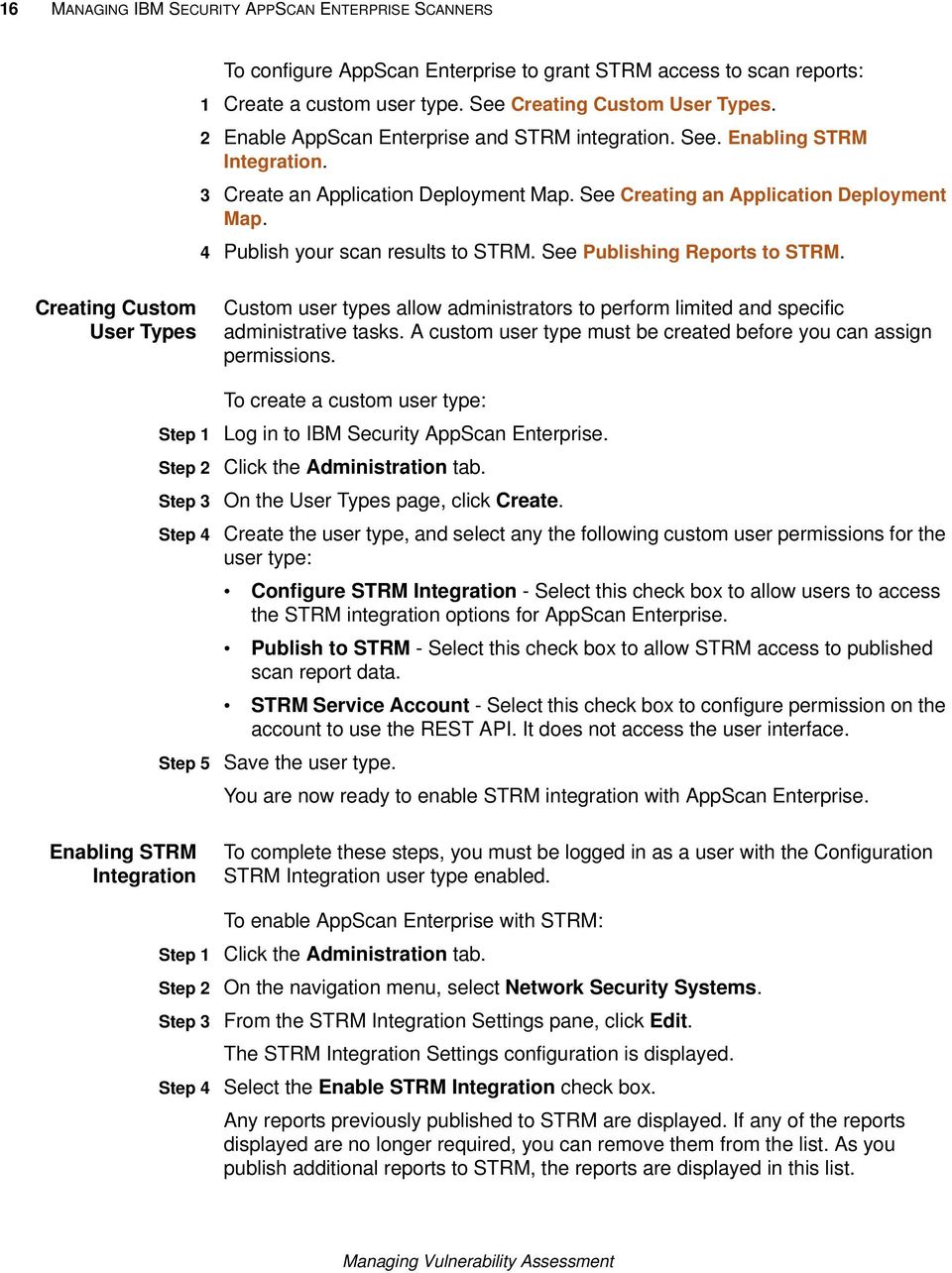
16 16 MANAGING IBM SECURITY APPSCAN ENTERPRISE SCANNERS To configure AppScan Enterprise to grant STRM access to scan reports: 1 Create a custom user type. See Creating Custom User Types. 2 Enable AppScan Enterprise and STRM integration. See. Enabling STRM Integration. 3 Create an Application Deployment Map. See Creating an Application Deployment Map. 4 Publish your scan results to STRM. See Publishing Reports to STRM. Creating Custom User Types Step 4 Step 5 Enabling STRM Integration Step 4 Custom user types allow administrators to perform limited and specific administrative tasks. A custom user type must be created before you can assign permissions. To create a custom user type: Log in to IBM Security AppScan Enterprise. Click the Administration tab. On the User Types page, click Create. Create the user type, and select any the following custom user permissions for the user type: Configure STRM Integration - Select this check box to allow users to access the STRM integration options for AppScan Enterprise. Publish to STRM - Select this check box to allow STRM access to published scan report data. STRM Service Account - Select this check box to configure permission on the account to use the REST API. It does not access the user interface. Save the user type. You are now ready to enable STRM integration with AppScan Enterprise. To complete these steps, you must be logged in as a user with the Configuration STRM Integration user type enabled. To enable AppScan Enterprise with STRM: Click the Administration tab. On the navigation menu, select Network Security Systems. From the STRM Integration Settings pane, click Edit. The STRM Integration Settings configuration is displayed. Select the Enable STRM Integration check box. Any reports previously published to STRM are displayed. If any of the reports displayed are no longer required, you can remove them from the list. As you publish additional reports to STRM, the reports are displayed in this list.
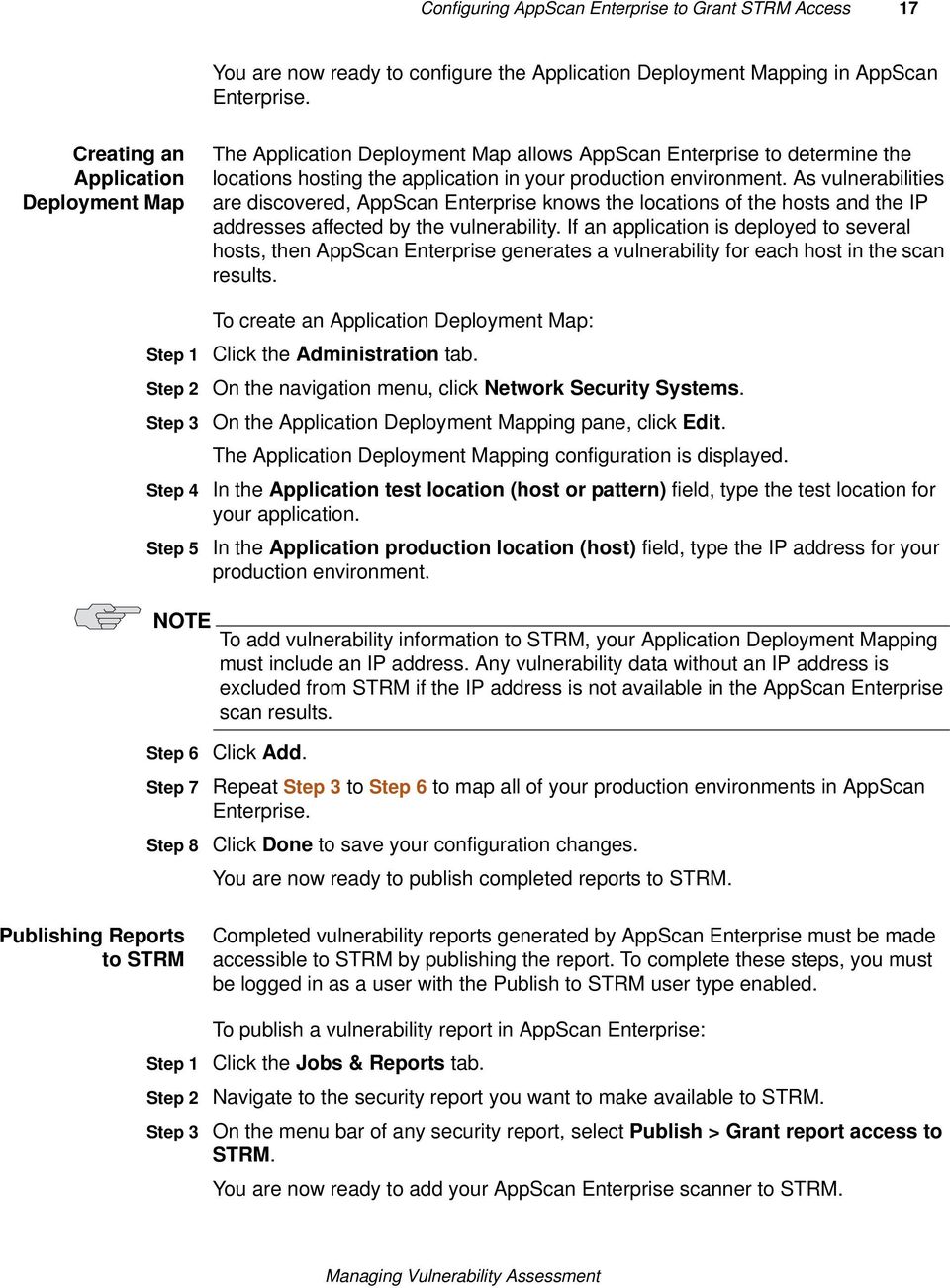
17 Configuring AppScan Enterprise to Grant STRM Access 17 You are now ready to configure the Application Deployment Mapping in AppScan Enterprise. Creating an Application Deployment Map Step 4 Step 5 The Application Deployment Map allows AppScan Enterprise to determine the locations hosting the application in your production environment. As vulnerabilities are discovered, AppScan Enterprise knows the locations of the hosts and the IP addresses affected by the vulnerability. If an application is deployed to several hosts, then AppScan Enterprise generates a vulnerability for each host in the scan results. To create an Application Deployment Map: Click the Administration tab. On the navigation menu, click Network Security Systems. On the Application Deployment Mapping pane, click Edit. The Application Deployment Mapping configuration is displayed. In the Application test location (host or pattern) field, type the test location for your application. In the Application production location (host) field, type the IP address for your production environment. NOTE To add vulnerability information to STRM, your Application Deployment Mapping must include an IP address. Any vulnerability data without an IP address is excluded from STRM if the IP address is not available in the AppScan Enterprise scan results. Step 6 Step 7 Step 8 Click Add. Repeat to Step 6 to map all of your production environments in AppScan Enterprise. Click Done to save your configuration changes. You are now ready to publish completed reports to STRM. Publishing Reports to STRM Completed vulnerability reports generated by AppScan Enterprise must be made accessible to STRM by publishing the report. To complete these steps, you must be logged in as a user with the Publish to STRM user type enabled. To publish a vulnerability report in AppScan Enterprise: Click the Jobs & Reports tab. Navigate to the security report you want to make available to STRM. On the menu bar of any security report, select Publish > Grant report access to STRM. You are now ready to add your AppScan Enterprise scanner to STRM.
18 18 MANAGING IBM SECURITY APPSCAN ENTERPRISE SCANNERS Configuring AppScan Enterprise in STRM After you have configured AppScan Enterprise and published reports to STRM, you can add the AppScan Enterprise scanner in STRM. Adding a scanner allows STRM to know which scan reports to configure. You can add multiple AppScan Enterprise scanners in STRM, each with a different configuration. Adding multiple configurations for a single AppScan Enterprise scanner allows you to create individual scanners for specific result data. The scan schedule you configure in STRM allows you to determine the frequency with which STRM imports the scan result data from AppScan Enterprise using the REST web service. NOTE Your scan result data must include the IP address of the host from the Application Deployment Mapping. Any vulnerability data without an IP address is excluded from STRM if the IP address is not available in the AppScan Enterprise scan results. This section includes the following topics: Adding an AppScan Enterprise Scanner to STRM Editing an AppScan Enterprise Scanner Deleting an AppScan Enterprise Scanner Adding an AppScan Enterprise Scanner to STRM Step 4 Step 5 To add an AppScan Enterprise scanner: Click the Admin tab. On the navigation menu, click Data Sources. The Data Sources pane is displayed. Click the VA Scanners icon. The VA Scanners window is displayed. Click Add. The Add Scanner window is displayed. Configure values for the following parameters: Table 2-1 Scanner s Scanner Name Managed Host Type Type the name you want to assign to this scanner. The name can be up to 255 characters in length. Type a description for this scanner. The description can be up to 255 characters in length. From the list box, select the managed host you want to use to configure the scanner. From the list box, select IBM AppScan Scanner.

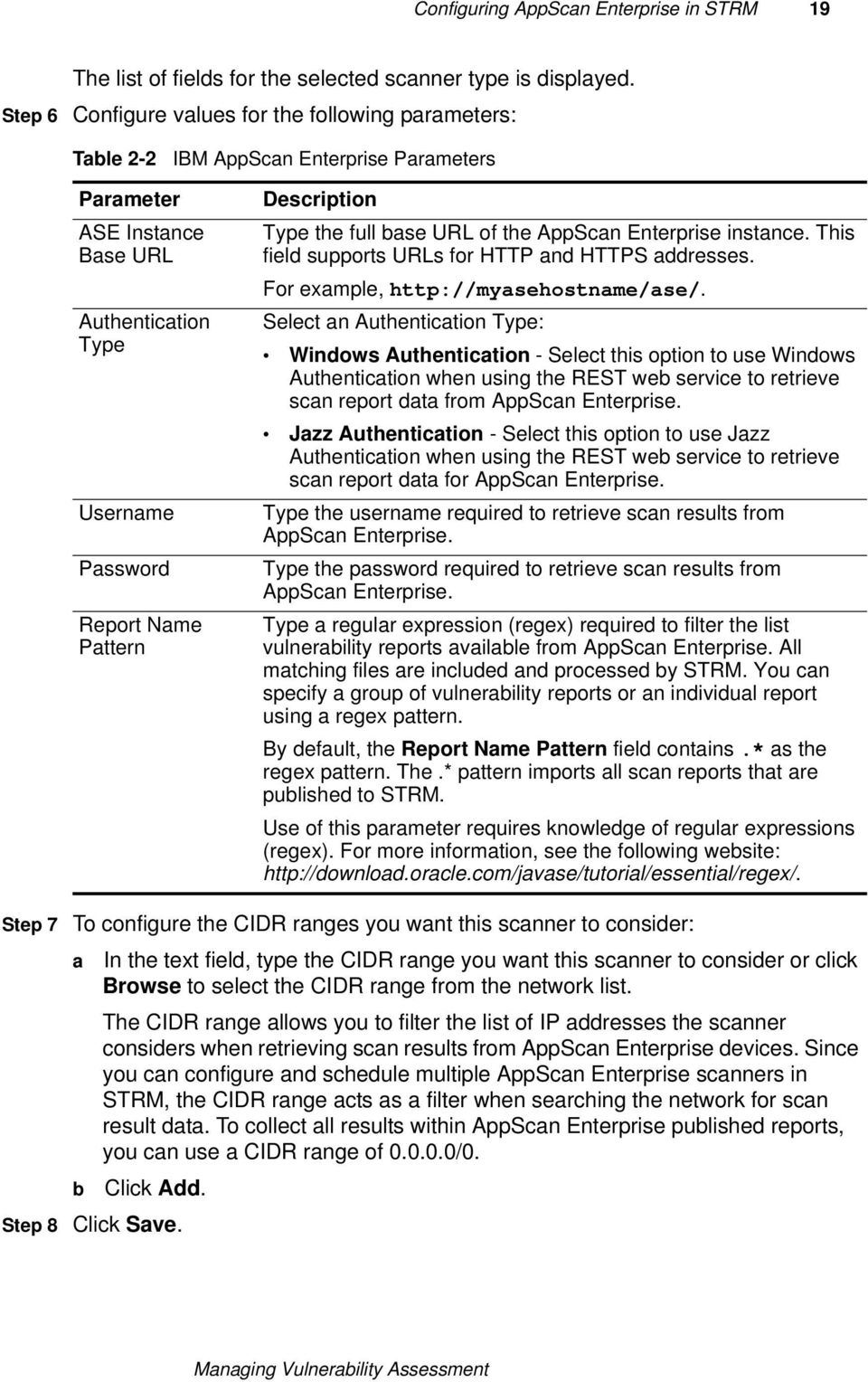
19 Configuring AppScan Enterprise in STRM 19 Step 6 The list of fields for the selected scanner type is displayed. Configure values for the following parameters: Table 2-2 IBM AppScan Enterprise s ASE Instance Base URL Authentication Type Username Password Report Name Pattern Type the full base URL of the AppScan Enterprise instance. This field supports URLs for HTTP and HTTPS addresses. For example, Select an Authentication Type: Windows Authentication - Select this option to use Windows Authentication when using the REST web service to retrieve scan report data from AppScan Enterprise. Jazz Authentication - Select this option to use Jazz Authentication when using the REST web service to retrieve scan report data for AppScan Enterprise. Type the username required to retrieve scan results from AppScan Enterprise. Type the password required to retrieve scan results from AppScan Enterprise. Type a regular expression (regex) required to filter the list vulnerability reports available from AppScan Enterprise. All matching files are included and processed by STRM. You can specify a group of vulnerability reports or an individual report using a regex pattern. By default, the Report Name Pattern field contains.* as the regex pattern. The.* pattern imports all scan reports that are published to STRM. Use of this parameter requires knowledge of regular expressions (regex). For more information, see the following website: Step 7 Step 8 To configure the CIDR ranges you want this scanner to consider: a b In the text field, type the CIDR range you want this scanner to consider or click Browse to select the CIDR range from the network list. The CIDR range allows you to filter the list of IP addresses the scanner considers when retrieving scan results from AppScan Enterprise devices. Since you can configure and schedule multiple AppScan Enterprise scanners in STRM, the CIDR range acts as a filter when searching the network for scan result data. To collect all results within AppScan Enterprise published reports, you can use a CIDR range of /0. Click Add. Click Save.
20 20 MANAGING IBM SECURITY APPSCAN ENTERPRISE SCANNERS Step 9 On the Admin tab, click Deploy Changes. You are now ready to create a scan schedule in STRM. For more information, see Managing Scan Schedules. Editing an AppScan Enterprise Scanner To edit an AppScan Enterprise scanner: Click the Admin tab. On the navigation menu, click Data Sources. The Data Sources pane is displayed. Click the VA Scanners icon. The VA Scanners window is displayed. Step 4 Select the scanner you want to edit. Step 5 Click Edit. The Edit Scanner window is displayed. Step 6 Update parameters, as necessary. See Table 2-2. Step 7 Click Save. Step 8 On the Admin tab, click Deploy Changes. Deleting an AppScan Enterprise Scanner Step 4 Step 5 Step 6 Step 7 To delete an AppScan Enterprise scanner: Click the Admin tab. On the navigation menu, click Data Sources. The Data Sources pane is displayed. Click the VA Scanners icon. The VA Scanners window is displayed. Select the scanner you want to delete. Click Delete. A confirmation window is displayed. Click OK. On the Admin tab, click Deploy Changes.

21 3 IBM SITEPROTECTOR SCANNER The IBM SiteProtector scanner module for STRM accesses vulnerability data from IBM SiteProtector scanners using the JDBC. The IBM SiteProtector scanner retrieves data from the RealSecureDB table and polls for available vulnerability information. The compare field allows STRM to retrieve only the latest information from the RealSecureDB table and import any new vulnerabilities to STRM. When you configure your IBM SiteProtector, we recommend that you create a SiteProtector user account specifically for STRM. Creating a user account ensures that STRM has the credentials required to poll the IBM SiteProtector database to retrieve vulnerability data. After you create a user account for STRM, you should verify communication between STRM and your IBM SiteProtector system to ensure there are no firewalls blocking communication on the port you are using to poll the RealSecureDB. This section provides information on the following: Adding an IBM SiteProtector Scanner Editing an IBM SiteProtector Scanner Deleting an IBM SiteProtector Scanner Adding an IBM SiteProtector Scanner You can add multiple IBM SiteProtector scanners in STRM, each with a different configuration to determine which CIDR ranges you want the scanner to consider. Adding multiple configurations for a single IBM SiteProtector scanner allows you to create individual scanners for collecting specific result data from specific locations. After you add and configure the IBM SiteProtector scanner in STRM, you can create a scan schedule to determine the frequency with which STRM polls the IBM SiteProtector database. To add an IBM SiteProtector scanner in STRM: Click the Admin tab. On the navigation menu, click Data Sources. The Data Sources pane is displayed. Click the VA Scanners icon. The VA Scanners window is displayed.
22 22 IBM SITEPROTECTOR SCANNER Step 4 Step 5 Click Add. The Add Scanner window is displayed. Configure values for the following parameters: Table 3-1 Scanner s Scanner Name Managed Host Type Type the name you want to assign to this scanner. The name can be up to 255 characters in length. Type a description for this scanner. The description can be up to 255 characters in length. From the list box, select the managed host you want to use to configure the scanner. From the list box, select IBM SiteProtector Scanner. Step 6 The list of fields for the selected scanner type is displayed. Configure values for the following parameters: Table 3-2 IBM SiteProtector Scanner s Hostname Port Username Password Domain Type the IP address or hostname of the IBM SiteProtector containing the vulnerabilities you want to add to STRM. Type the port number used by the database server. The default that is displayed depends on the selected Database Type. The valid range is 0 to The default for MSDE is port The JDBC configuration port must match the listener port of the database. The database must have incoming TCP connections enabled to communicate with STRM. The default port number for all options include: MSDE Postgres MySQL Oracle Sybase Type the username required to access IBM SiteProtector. Type the password required to access IBM SiteProtector. Type the domain required, if required, to connect to your IBM SiteProtector database. If you select MSDE as the database type and the database is configured for Windows, you must define a Windows domain. Otherwise, leave this field blank. The domain can be up to 255 alphanumeric characters in length. The domain can include the following special characters: underscore (_), en dash (-), and period(.).
23 Editing an IBM SiteProtector Scanner 23 Table 3-2 IBM SiteProtector Scanner s (continued) Database Name Database Instance Use Named Pipe Communication Use NTLMv2 Type the name of the database to which you want to connect. The default database name is RealSecureDB. Type the database instance for your IBM SiteProtector database. If you are not using a database instance, you can leave this field blank. If you select MSDE as the Database Type and you have multiple SQL server instances on one server, define the instance to which you want to connect. Select this check box to use named pipes when communicating to the IBM SiteProtector database. By default, this check box is clear. When using a Named Pipe connection, the username and password must be the appropriate Windows authentication username and password and not the database username and password. Selecting this check box uses the default Named Pipe for your system. Select this check box if your IBM SiteProtector uses NTLMv2 as an authentication protocol. By default, this check box is clear. The Use NTLMv2 check box forces MSDE connections to use the NTLMv2 protocol when communicating with SQL servers that require NTLMv2 authentication. If the Use NTLMv2 check box is selected, it has no effect on MSDE connections to SQL servers that do not require NTLMv2 authentication. Step 7 Step 8 Step 9 To configure the CIDR ranges you want this scanner to consider: a b In the text field, type the CIDR range you want this scanner to consider or click Browse to select the CIDR range from the network list. To collect all available IBM SiteProtector vulnerabilities, you can type /0 as the CIDR address. Click Add. Click Save. On the Admin tab, click Deploy Changes. Editing an IBM SiteProtector Scanner To edit a scanner: Click the Admin tab. On the navigation menu, click Data Sources. The Data Sources pane is displayed. Click the VA Scanners icon. The VA Scanners window is displayed.
24 24 IBM SITEPROTECTOR SCANNER Step 4 Select the scanner you want to edit. Step 5 Click Edit. The Edit Scanner window is displayed. Step 6 Update parameters, as necessary. See Table 3-2. Step 7 Click Save. Step 8 On the Admin tab, click Deploy Changes. Deleting an IBM SiteProtector Scanner Step 4 Step 5 Step 6 Step 7 To delete a scanner: Click the Admin tab. On the navigation menu, click Data Sources. The Data Sources pane is displayed. Click the VA Scanners icon. The VA Scanners window is displayed. Select the scanner you want to delete. Click Delete. A confirmation window is displayed. Click OK. On the Admin tab, click Deploy Changes.
25 4 IBM TIVOLI ENDPOINT MANAGER The STRM Tivoli Endpoint Manager scanner module accesses vulnerability data from IBM Tivoli Endpoint Manager using the SOAP API installed with the Web Reports application. The Web Reports application for Tivoli Endpoint Manager is required to retrieve vulnerability data from Tivoli Endpoint Manager for STRM. We recommend that you create a user in IBM Tivoli Endpoint Manager for STRM. NOTE STRM is compatible with IBM Tivoli Endpoint Manager versions 8.2.x. However, we recommend that you update and use the latest version of IBM Tivoli Endpoint Manager that is available. This section provides information on the following: Adding an IBM Tivoli Endpoint Manager Scanner Editing an IBM Tivoli Endpoint Manager Scanner Deleting an IBM Tivoli Endpoint Manager Scanner Adding an IBM Tivoli Endpoint Manager Scanner You can add multiple IBM Tivoli Endpoint Manager scanners in STRM, each with a different configuration to determine which CIDR ranges you want the scanner to consider. Adding multiple configurations for a single IBM Tivoli Endpoint Manager scanner allows you to create individual scanners for collecting specific result data from specific locations. After you add and configure the IBM Tivoli Endpoint Manager in STRM, you can create a scan schedule to determine the frequency with which STRM accesses IBM Tivoli Access Manager. This allows you to schedule how often STRM requests data from IBM Tivoli Endpoint Manager using the SOAP API. To add an IBM Tivoli Endpoint Manager scanner in STRM: Click the Admin tab. On the navigation menu, click Data Sources. The Data Sources pane is displayed. Click the VA Scanners icon. The VA Scanners window is displayed.
26 26 IBM TIVOLI ENDPOINT MANAGER Step 4 Step 5 Click Add. The Add Scanner window is displayed. Configure values for the following parameters: Table 4-1 Scanner s Scanner Name Managed Host Type Type the name you want to assign to this scanner. The name can be up to 255 characters in length. Type a description for this scanner. The description can be up to 255 characters in length. From the list box, select the managed host you want to use to configure the scanner. From the list box, select IBM Tivoli Endpoint Manager. Step 6 The list of fields for the selected scanner type is displayed. Configure values for the following parameters: Table 4-2 IP360 s Hostname Port Username Password Type the IP address or hostname of the IBM Tivoli Endpoint Manager containing the vulnerabilities you want to add to STRM. Type the port number used to connect to the IBM Tivoli Endpoint Manager using the SOAP API. By default, port 80 is the port number for communicating with IBM Tivoli Endpoint Manager. Type the username required to access IBM Tivoli Endpoint Manager. Type the password required to access IBM Tivoli Endpoint Manager. Step 7 Step 8 Step 9 To configure the CIDR ranges you want this scanner to consider: a b In the text field, type the CIDR range you want this scanner to consider or click Browse to select the CIDR range from the network list. Click Add. Click Save. On the Admin tab, click Deploy Changes.
27 Editing an IBM Tivoli Endpoint Manager Scanner 27 Editing an IBM Tivoli Endpoint Manager Scanner To edit a scanner: Click the Admin tab. On the navigation menu, click Data Sources. The Data Sources pane is displayed. Click the VA Scanners icon. The VA Scanners window is displayed. Step 4 Select the scanner you want to edit. Step 5 Click Edit. The Edit Scanner window is displayed. Step 6 Update parameters, as necessary. See Table 4-2. Step 7 Click Save. Step 8 On the Admin tab, click Deploy Changes. Deleting an IBM Tivoli Endpoint Manager Scanner Step 4 Step 5 Step 6 Step 7 To delete a scanner: Click the Admin tab. On the navigation menu, click Data Sources. The Data Sources pane is displayed. Click the VA Scanners icon. The VA Scanners window is displayed. Select the scanner you want to delete. Click Delete. A confirmation window is displayed. Click OK. On the Admin tab, click Deploy Changes.
28
29 5 MANAGING NCIRCLE IP360 SCANNERS STRM uses SSH to access the remote server (SSH export server) to retrieve and interpret the scanned data. STRM supports VnE Manager version IP to You can configure an ncircle IP360 scanner device to export scan results to a remote server. These scan results are exported, in XML2 format, to an SSH server. To successfully integrate an IP360 device with STRM, these XML2 format files must be read from the remote server (using SSH). STRM can be configured to schedule a scan or poll the SSH server for updates to the scan results and import the latest results for processing. The term remote server refers to a system that is separate from the ncircle device. STRM cannot connect directly with ncircle devices. For more information about exporting scan results, see Exporting Scan Reports. The scan results contain identification information about the scan configuration from which it was produced. The most recent scan results are used when a scan is imported by STRM. STRM only supports exported scan results from the IP360 scanner in XML2 format. This section provides information on the following: Adding an IP360 Scanner Editing an IP360 Scanner Deleting an IP360 Scanner Exporting Scan Reports Adding an IP360 Scanner To add an IP360 scanner: Click the Admin tab. On the navigation menu, click Data Sources. The Data Sources pane is displayed. Click the VA Scanners icon. The VA Scanners window is displayed.
30 30 MANAGING NCIRCLE IP360 SCANNERS Step 4 Step 5 Click Add. The Add Scanner window is displayed. Configure values for the following parameters: Table 5-1 Scanner s Scanner Name Managed Host Type Type the name you want to assign to this scanner. The name can be up to 255 characters in length. Type a description for this scanner. The description can be up to 255 characters in length. From the list box, select the managed host you want to use to configure the scanner. From the list box, select ncircle IP360 Scanner. Step 6 The list of fields for the selected scanner type is displayed. Configure values for the following parameters: Table 5-2 IP360 s SSH Server Host Name SSH Username SSH Password SSH Port Remote Directory File Max Age (days) File Pattern Type the IP address or host name to the remote server hosting the scan result files. We recommend a UNIX-based system with SSH enabled. Type the SSH remote server username. Type the password to the remote server corresponding to the SSH Username. If the Enable Key Authentication check box is selected, the password is ignored. Type the port number used to connect to the remote server. Type the directory location of the scan result files. Type the maximum file age to include when performing a scheduled scan. Files that are older than a specified time are excluded from the import of the result data in STRM. Type a regular expression (regex) required to filter the list of files specified in the Remote Directory field. All matching files are included and processed. For example, if you want to list all XML2 format files ending with XML, use the following entry: XML2.*\.xml Use of this parameter requires knowledge of regular expressions (regex). For more information, see the following website:
31 Editing an IP360 Scanner 31 Table 5-2 IP360 s (continued) Enable Key Authorization Private Key Path Select this check box to enable key authorization for the server. If the Enable Key Authentication check box is selected, the SSH authentication is completed using a private key and the password is ignored. The default value is disabled. Type the private key path. The private key path is the full directory path on your STRM system where the private key to be used for SSH key-based authentication is stored. The default path is /opt/qradar/conf/vis.ssh.key, but this file does not exist. You must create a vis.ssh.key file for your remote host or type another file name. If the Enable Key Authentication check box is clear, the Private Key Path is ignored. NOTE If the scanner is configured to use a password, the SSH scanner server to which STRM connects must support password authentication. If it does not, SSH authentication for the scanner fails. Make sure the following line is displayed in your sshd_config file, which is typically found in the /etc/ssh directory on the SSH server: PasswordAuthentication yes. If your scanner server does not use OpenSSH, the configuration can differ. For more information, see the vendor documentation for your scanner. Step 7 Step 8 Step 9 To configure the CIDR ranges you want this scanner to consider: a b In the text field, type the CIDR range you want this scanner to consider or click Browse to select the CIDR range from the network list. Click Add. Click Save. On the Admin tab, click Deploy Changes. Editing an IP360 Scanner Step 4 To edit a scanner: Click the Admin tab. On the navigation menu, click Data Sources. The Data Sources pane is displayed. Click the VA Scanners icon. The VA Scanners window is displayed. Select the scanner you want to edit.
32 32 MANAGING NCIRCLE IP360 SCANNERS Step 5 Click Edit. The Edit Scanner window is displayed. Step 6 Update parameters, as necessary. See Table 5-2. Step 7 Click Save. Step 8 On the Admin tab, click Deploy Changes. Deleting an IP360 Scanner Step 4 Step 5 Step 6 Step 7 To delete a scanner: Click the Admin tab. On the navigation menu, click Data Sources. The Data Sources pane is displayed. Click the VA Scanners icon. The VA Scanners window is displayed. Select the scanner you want to delete. Click Delete. A confirmation window is displayed. Click OK. On the Admin tab, click Deploy Changes. Exporting Scan Reports To configure your ncircle device to export scan reports: Log in to the IP360 VNE Manager user interface. From the left- hand navigation, select Administer > System > VNE Manager > Automated Export. The Automated Export menu is displayed. Click the Export to File tab. Step 4 Configure the export settings. For information on configuring the export settings, click the Help link. To integrate with STRM, the export must be configured to use the XML format. Step 5 Record the Target settings displayed in the user interface. These settings are necessary to configure STRM to integrate with your ncircle device.
33 6 MANAGING NESSUS SCANNERS STRM can retrieve vulnerability scan reports about your network assets by leveraging the Nessus client and server relationship or by using the Nessus XMLRPC API to access scan data directly. When you configure your Nessus client, we recommend that you create a Nessus user account for STRM. Creating a user account ensures that STRM has the credentials required to log in using SSH and communicate with the Nessus server to retrieve scan report data using either the client server relationship or using the XMLRPC API. After you create a user account for STRM, you should attempt to SSH from STRM to your Nessus client to verify STRM s credentials. This ensures that STRM and the Nessus client can communicate before you attempt to collect scan data or start a live scan. The following data collection options are available for Nessus: Scheduled Live Scan - Allows STRM to connect to a Nessus client and launch a pre-configured scan. STRM uses SSH to retrieve the scan report data from the client s temporary results directory after the live scan completes. Scheduled Results Import - Allows STRM to connect to the location hosting your Nessus scan reports. STRM connects to the repository using SSH and imports completed scan report files from the remote directory. STRM supports importing Nessus scan reports or scan reports in a Nessus supported output format. Scheduled Live Scan - XMLRPC API - Allows STRM to use the XMLRPC API to start a pre-configured scan. To start a live scan from STRM, you must specify the policy name for the live scan data you want to retrieve. As the live scan runs, STRM updates the percentage complete in the scan status. After the live scan completes, STRM retrieves the data and updates the vulnerability assessment information for your assets. Scheduled Completed Report Import - XMLRPC API - Allows STRM to connect to your Nessus server and download data from any completed reports that match the report name and report age filters.
34 34 MANAGING NESSUS SCANNERS Nessus vulnerability data can be integrated into STRM by adding a Nessus scanner using the VA Scanners icon in the Admin tab. After you add your Nessus client, you can add a scan schedule to retrieve Nessus vulnerability data on a one-time or repeating interval. For more information on scheduling a scan, see Scheduling a Scan. NOTE We recommend that you do not install your Nessus software on a critical system due to the high CPU requirements. This section includes the following topics: Adding a Nessus Scanner Editing an Nessus Scanner Deleting a Nessus Scanner Adding a Nessus Scanner The Nessus scanner module for STRM provides several collection types for retrieving vulnerability data from your Nessus server. This section includes the following topics: Adding a Nessus Scheduled Live Scan Adding a Nessus Scheduled Results Import Adding a Nessus Scheduled Live Scan Using the XMLPRC API Adding a Nessus Completed Report Import Using the XMLRPC API NOTE The Nessus XMLRPC API is only available on Nessus servers and clients using software v4.2 and above. Adding a Nessus Scheduled Live Scan Step 4 A live scan allows you to start a live scan on your Nessus server and import the result data from a temporary directory containing the live scan report data. After the scan is complete, STRM downloads the scan data from the temporary directory and updates the vulnerability information for your assets. To add a Nessus live scan in STRM: Click the Admin tab. On the navigation menu, click Data Sources. The Data Sources pane is displayed. Click the VA Scanners icon. The VA Scanners window is displayed. Click Add. The Add Scanner window is displayed.
35 Adding a Nessus Scanner 35 Step 5 Configure values for the following parameters: Table 6-1 Scanner s Scanner Name Managed Host Type Type the name you want to assign to this scanner. The name can be up to 255 characters in length. Type a description for this scanner. The description can be up to 255 characters in length. From the list box, select the managed host you want to use to configure the scanner. From the list box, select Nessus Scanner. Step 6 Step 7 The list of parameters for the selected scanner type is displayed. From the Collection Type list box, select Scheduled Live Scan. Configure values for the following parameters: Table 6-2 Nessus Scheduled Live Scan s Server Hostname Type the IP address or hostname of the Nessus server as seen by the Nessus client. If the server process and the client are located on the same host, you can use localhost as the server hostname. Server Port Type the port for the Nessus server. The default is port Server Username Server Password Client Temp Dir Nessus Executable Nessus Configuration File Client Hostname Type the Nessus username that the Nessus client uses to authenticate with the Nessus server. Type the Nessus password that corresponds to the username. Note: Your Nessus server password must not contain the! character. This character could cause authentication failures over SSH. Type the directory path of the Nessus client that STRM can use to store temporary files. STRM uses the temporary directory of the Nessus client as a read and write location to upload scan targets and read scan results. Temporary files are removed when STRM completes the scan and retrieves the scan reports from the Nessus client. The default directory path on the Nessus client is /tmp. Type the directory path to the Nessus executable file on the server hosting the Nessus client. By default, the directory path for the executable file is /usr/bin/nessus. Type the directory path to the Nessus configuration file on the Nessus client. Type the hostname or IP address of the system hosting the Nessus client.
36 36 MANAGING NESSUS SCANNERS Table 6-2 Nessus Scheduled Live Scan s (continued) Client SSH Port Client Username Client Password Enable Key Authentication Type the number of the SSH port on the Nessus server that can be used to retrieve scan result files. The default is port 22. Type the username used by STRM to authenticate the SSH connection. Type the password that corresponds to the Client Username field. This field is required if the Enable Key Authentication check box is clear. If Enable Key Authentication is enabled, the Login Password parameter is ignored. Note: If the scanner is configured to use a password, the SSH scanner server to which STRM connects must support password authentication. If it does not, SSH authentication for the scanner fails. Ensure the following line is displayed in your sshd_config file, which is typically found in the /etc/ssh directory on the SSH server: PasswordAuthentication yes. If your scanner server does not use OpenSSH, the configuration can differ. For more information, see the vendor documentation for your scanner. Select this check box to enable public or private key authentication. If the check box is selected, STRM attempts to authenticate the SSH connection using the private key that is provided and the SSH Password field is ignored. Step 8 Step To configure the CIDR ranges you want this scanner to consider: a b In the text field, type the CIDR range you want this scanner to consider or click Browse to select the CIDR range from the network list. Click Add. Click Save. On the Admin tab, click Deploy Changes. After the changes are deployed, you must create a scan schedule for the live scan. Scan reports can be created as a one-time event or as a reoccurring scheduled import. For more information on scheduling a scan, see Scheduling a Scan. Adding a Nessus Scheduled Results Import A scheduled results import retrieves completed Nessus scan reports from an external location. The external location can be a Nessus server or a file repository that contains a completed scan report. STRM connects to the location of your scan reports using SSH and imports completed scan report files from the remote directory using a regular expression or maximum report age to filter for your scan reports. STRM supports importing Nessus scan reports (.Nessus) or scan reports exported to a Nessus supported output format, such as XML.
37 Adding a Nessus Scanner 37 Step 4 Step 5 To add a Nessus scheduled result import in STRM: Click the Admin tab. On the navigation menu, click Data Sources. The Data Sources pane is displayed. Click the VA Scanners icon. The VA Scanners window is displayed. Click Add. The Add Scanner window is displayed. Configure values for the following parameters: Table 6-3 Scanner s Scanner Name Managed Host Type Type the name you want to assign to this scanner. The name can be up to 255 characters in length. Type a description for this scanner. The description can be up to 255 characters in length. From the list box, select the managed host you want to use to configure the scanner. From the list box, select Nessus Scanner. Step 6 Step 7 The list of parameters for the selected scanner type is displayed. From the Collection Type list box, select Scheduled Results Import. Configure values for the following parameters: Table 6-4 Nessus Scheduled Results Import s Remote Results Hostname Remote Results SSH Port SSH Username SSH Password Enable Key Authentication Type the IP address or hostname of the Nessus client or server hosting your Nessus or XML scan result files. Type the number of the SSH port on the Nessus server that can be used to retrieve scan result files. The default port is 22. Type a username that STRM can use to authenticate the SSH session with the Nessus server. Type the password that corresponds to the SSH username. Note: Your Nessus server password must not contain the! character. This character could cause authentication failures over SSH. Select this check box to enable public or private key authentication. If the check box is selected, STRM attempts to authenticate the SSH connection using the private key provided and the SSH Password field is ignored.
38 38 MANAGING NESSUS SCANNERS Table 6-4 Nessus Scheduled Results Import s (continued) Remote Results Directory Remote Results File Pattern Results File Max Age (Days) Type the full path for the directory containing the Nessus scan report files on the Nessus client. The directory path uses./ as the default value. Type a file pattern, using a regular expression (regex), for the scan result files you are attempting to import. By default, the following file pattern is included for Nessus files:.*\.nessus. If you use an output mask to export your scan report in another supported Nessus format, such as XML, you must update the regex for the file pattern accordingly. Note: If you update the regex in the Remote Results File Pattern field, you must deploy the change to update your scanner configuration. Type the maximum file age to include when importing Nessus scan result files during a scheduled scan. By default, the results file maximum age is 7 days. Files that are older than the specified days and the timestamp on the results file are excluded from the result file import. Step 8 Step To configure the CIDR ranges you want this scanner to consider: a b In the text field, type the CIDR range you want this scanner to consider or click Browse to select the CIDR range from the network list. Click Add. Click Save. On the Admin tab, click Deploy Changes. After the changes are deployed, you must create a scan schedule to import the vulnerability data. Scan reports can be created as a one-time event or as a reoccurring scheduled import. For more information on scheduling a scan, see Scheduling a Scan. Adding a Nessus Scheduled Live Scan Using the XMLPRC API The XMLRPC API allows STRM to start a pre-configured live scan on your Nessus server. To start a live scan from STRM, you must specify the scan name and the policy name for the live scan data you want to retrieve. As the live scan progresses, you can place your mouse over your Nessus scanner in the Scan Scheduling window to view the percentage of the live scan that is complete. After the live scan reaches completion, STRM uses the XMLRPC API to retrieve the scan data and update the vulnerability information for your assets. NOTE The Nessus XMLRPC API is only available on Nessus servers and clients using software v4.2 and above.
39 Adding a Nessus Scanner 39 Step 4 Step 5 To add a Nessus XMLRPC API live scan in STRM: Click the Admin tab. On the navigation menu, click Data Sources. The Data Sources pane is displayed. Click the VA Scanners icon. The VA Scanners window is displayed. Click Add. The Add Scanner window is displayed. Configure values for the following parameters: Table 6-5 Scanner s Scanner Name Managed Host Type Type the name you want to assign to this scanner. The name can be up to 255 characters in length. Type a description for this scanner. The description can be up to 255 characters in length. From the list box, select the managed host you want to use to configure the scanner. From the list box, select Nessus Scanner. Step 6 Step 7 The list of parameters for the selected scanner type is displayed. From the Collection Type list box, select Scheduled Live Scan - XMLRPC API. Configure values for the following parameters: Table 6-6 Scheduled Live Scan XMLRPC API s Hostname Port Username Password Scan Name Type the IP address or hostname of the Nessus server. Type the port number for STRM to access your Nessus server using the XMLRPC API. The default is port Type the username required to log in to the Nessus server. Type the password that corresponds to the username. Optional. Type the name of the scan you want displayed when the live scan runs on the Nessus server. If this field is clear, the API attempts to start a live scan for STRM Scan. Note: STRM does not support using the ampersand (&) character in this field.
40 40 MANAGING NESSUS SCANNERS Table 6-6 Scheduled Live Scan XMLRPC API s (continued) Policy Name Type the name of a policy on your Nessus server to start a live scan. The policy you define must exist on the Nessus server when STRM attempts to launch the scan. If the policy does not exist, then an error is displayed in the status when STRM attempts to start the live scan. In most cases the policy name is customized to your Nessus server, but several default policies are included with Nessus. For example, External Network Scan Internal Network Scan Web App Tests Prepare for PCI DSS audits For more information on policies, see your Nessus vendor documentation. Step 8 Step To configure the CIDR ranges you want this scanner to consider: a b In the text field, type the CIDR range you want this scanner to consider or click Browse to select the CIDR range from the network list. Click Add. Click Save. On the Admin tab, click Deploy Changes. After the changes are deployed, you must create a scan schedule for your live scan. Scan reports can be created as a one-time event or as a reoccurring scheduled import. For more information on scheduling a scan, see Scheduling a Scan. Adding a Nessus Completed Report Import Using the XMLRPC API A scheduled results import using the XMLRPC API allows STRM to retrieve completed Nessus scan reports from the Nessus server. STRM connects to your Nessus server and downloads data from any completed reports matching the report name and maximum report age filter. NOTE The Nessus XMLRPC API is only available on Nessus servers and clients using software v4.2 and above. To add a Nessus completed scan import in STRM: Click the Admin tab. On the navigation menu, click Data Sources. The Data Sources pane is displayed.
41 Adding a Nessus Scanner 41 Step 4 Step 5 Click the VA Scanners icon. The VA Scanners window is displayed. Click Add. The Add Scanner window is displayed. Configure values for the following parameters: Table 6-7 Scanner s Scanner Name Managed Host Type Type the name you want to assign to this scanner. The name can be up to 255 characters in length. Type a description for this scanner. The description can be up to 255 characters in length. From the list box, select the managed host you want to use to configure the scanner. From the list box, select Nessus Scanner. The list of parameters for the selected scanner type is displayed. Step 6 From the Collection Type list box, select Scheduled Completed Report Import - XMLRPC API. Step 7 Configure values for the following parameters: Table 6-8 Scheduled Completed Report Import XMLRPC API s Hostname Port Username Password Report Name Filter Results File Max Age (Days) Type the IP address or hostname of the Nessus client or server hosting your Nessus or XML scan result files. Type the port number for STRM to access your Nessus server using the XMLRPC API. The default is port Type the username required to log in to the Nessus server. Type the password that corresponds to the username. Type the file pattern, using a regular expression (regex), for the scan result files you are attempting to import. By default, the following file pattern is included to collect all available completed scan reports:.*. Note: If you update the regex in the Report Name Filter field, you must deploy the change to update your scanner configuration. Type the maximum file age to include when importing Nessus scan result files during a scheduled scan. By default, the results file maximum age is 7 days. Files that are older than the specified days and the timestamp on the results file are excluded from the result file import.
42 42 MANAGING NESSUS SCANNERS Step 8 Step To configure the CIDR ranges you want this scanner to consider: a b In the text field, type the CIDR range you want this scanner to consider or click Browse to select the CIDR range from the network list. Click Add. Click Save. On the Admin tab, click Deploy Changes. After the changes are deployed, you must create a scan schedule to import the scan report data. Scan reports can be created as a one-time event or as a reoccurring scheduled import. For more information on scheduling a scan, see Scheduling a Scan. Editing an Nessus Scanner Step 4 Step 5 Step 6 Step 7 Step 8 To edit a Nessus scanner configuration in STRM: Click the Admin tab. On the navigation menu, click Data Sources. The Data Sources pane is displayed. Click the VA Scanners icon. The VA Scanners window is displayed. Select the scanner you want to edit. Click Edit. The Edit Scanner window is displayed. Update parameters, as necessary. For Scheduled Live Scan parameters, see Table 6-2. For Scheduled Results Import parameters, see Table 6-4. For Schedule Live Scan XMLRPC API parameters, see Table 6-6. For Scheduled Completed Report Import XMLRPC API parameters, see Table 6-8. Click Save. On the Admin tab, click Deploy Changes. Deleting a Nessus Scanner To delete a Nessus scanner from STRM: Click the Admin tab. On the navigation menu, click Data Sources. The Data Sources pane is displayed.
43 Deleting a Nessus Scanner 43 Step 4 Step 5 Step 6 Step 7 Click the VA Scanners icon. The VA Scanners window is displayed. Select the scanner you want to delete. Click Delete. A confirmation window is displayed. Click OK. On the Admin tab, click Deploy Changes.
44
45 7 MANAGING NMAP SCANNERS You can integrate Network Mapper (Nmap) scanners with STRM. STRM uses SSH to communicate with the scanner server, start remote Nmap scans, and download the scan results. STRM supports two methods for importing Nmap vulnerability data: Remote Live Scan - Allows STRM to connect to a Nmap scanner and launch a scan using the Nmap binary file. STRM monitors the status of the live scan in progress and waits for the Nmap server to complete the scan. After the scan completes, STRM downloads the vulnerability results using SSH. Several types of Nmap port scans require Nmap to run as root. Therefore, STRM must have access as root or you must clear the OS Detection check box. To run Nmap scans with OS Detection enabled, you must provide STRM with root access or configure the Nmap binary with setuid root. For assistance, contact your Nmap administrator. Remote Results Import - Allows STRM to connect to a Nmap scanner using SSH and download completed scan result files that are stored in a remote folder on the Nmap scanner. STRM can only import remote results stored in XML format. When configuring your Nmap scanner to generate a file for STRM import, you must generate the results file using the -ox <file> option. Where <file> is the path to create and store the XML formatted scan results on your Nmap scanner. After you add and configure either a Remote Live Scan or a Remote Results Import in STRM, you can schedule the frequency with which STRM imports vulnerability data. For more information, see Managing Scan Schedules. This section provides information on the following: Adding an Nmap Remote Live Scan Adding an Nmap Remote Results Import Scan Editing an Nmap Scanner Deleting an Nmap Scanner
46 46 MANAGING NMAP SCANNERS Adding an Nmap Remote Live Scan Step 4 Step 5 Adding a Remote Live Scan in STRM allows STRM to launch a Nmap scan, wait for the scan to complete, and then import the results. After you added a live scan, you must assign a scan schedule in STRM. The scan schedule determines how often STRM launches a live scans on your Nmap scanner and retrieves vulnerability data for your assets. To add an Nmap Remote Live Scan: Click the Admin tab. On the navigation menu, click Data Sources. The Data Sources pane is displayed. Click the VA Scanners icon. The VA Scanners window is displayed. Click Add. The Add Scanner window is displayed. Configure values for the following parameters: Table 7-1 Scanner s Scanner Name Managed Host Type Type the name that you want to assign to this scanner. The name can be up to 255 characters in length. Type a description for this scanner. The description can be up to 255 characters in length. From the list box, select the managed host that you want to use to configure the scanner. From the list box, select Nmap Scanner. Step 6 Step 7 The list of parameters for the selected scanner type is displayed. From the Scan Type list box, select Remote Live Scan. Configure values for the following parameters: Table 7-2 Nmap Live Scan s Server Hostname Server Username Enable Key Authentication Type the hostname or IP address of the remote system hosting the Nmap client. We recommend using a UNIX-based system running SSH. Type the username required to access the remote system hosting the Nmap client using SSH. Select this check box to enable STRM to use public or private key authentication. Selecting this check box requires you to specify the directory path to your key file on STRM using the Private Key File field. By default, the check box is clear.
47 Adding an Nmap Remote Live Scan 47 Table 7-2 Nmap Live Scan s (continued) Login Password Private Key File Nmap Executable Disable Ping OS Detection Max RTT Timeout Type the password associated with the username in the Server Username field. Type the directory path for the file that contains the private key information. This field is only displayed if the Enable Key Authentication check box is selected. If you are using SSH key based authentication, STRM uses the private key to authenticate the SSH connection. The default directory path is /opt/qradar/conf/vis.ssh.key. However, by default, this file does not exist. You must create the vis.ssh.key file or type another file name. This parameter is mandatory if the Enable Key Authentication check box is selected, otherwise this parameter is ignored. Type the full directory path and filename of the executable file for the Nmap binary file. The default directory path to the executable file is /usr/bin/nmap. In some networks, the ICMP protocol is partially or completely disabled. In situations where ICMP is not enabled, you can select this check box to enable ICMP pings to enhance the accuracy of the scan. By default, the check box is clear. OS Detection allows Nmap to identify the operating system of a device or appliance in the target network. By default, the OS Detection check box is selected. The options include: Selected - If you select the OS Detection check box, you must provide a username and password with root privileges in the Server Username and Login Password fields. Cleared - If the OS Detection check box is clear and the returned results do not contain operating system information. The Server Username and Login Password fields do not require root privileges. Select the Maximum Round-Trip Timeout (RTT) from the list box. The timeout value determines if a scan should be stopped or reissued due to latency between the scanner and the scan target. The default value is 300 milliseconds (ms). Note: If you type 50 milliseconds as the Maximum Round-Trip Timeout, we recommend the devices you are scanning be located on a local network. If you are scanning devices that are located on remote networks, we recommend selecting the 1 second Max RTT Timeout value.
48 48 MANAGING NMAP SCANNERS NOTE If the scanner is configured to use a password, the SSH scanner server to which STRM connects must support password authentication. If it does not, SSH authentication for the scanner fails. Make sure the following line is displayed in your sshd_config file, which is typically found in the /etc/ssh directory on the SSH server: PasswordAuthentication yes. If your scanner server does not use OpenSSH, the configuration can differ. For more information, see the vendor documentation for your scanner. Step 8 Step 9 0 To configure the CIDR ranges that you want this scanner to consider: a In the text field, type the CIDR range that you want this scanner to consider or click Browse to select the CIDR range from the network list. b Click Add. Click Save. On the Admin tab, click Deploy Changes. You are now ready to add a scan schedule to specify how often you want STRM to launch a live scan on your Nmap scanner. STRM can only import the vulnerability data after the live scan is complete. For more information on scheduling a scan, see Managing Scan Schedules. Adding an Nmap Remote Results Import Scan Step 4 Adding an Nmap Remote Results Import scanner allows you to generate and store scans on your Nmap scanner. Scans must be generated in XML format using the -ox <file> on your Nmap scanner. After you have added and configured your Nmap scanner, you must assign a scan schedule to specify how often you want STRM to import Nmap scans. To add an Nmap Remote Result Import: Click the Admin tab. On the navigation menu, click Data Sources. The Data Sources pane is displayed. Click the VA Scanners icon. The VA Scanners window is displayed. Click Add. The Add Scanner window is displayed.
49 Adding an Nmap Remote Results Import Scan 49 Step 5 Configure values for the following parameters: Table 7-1 Scanner s Scanner Name Managed Host Type Type the name that you want to assign to this scanner. The name can be up to 255 characters in length. Type a description for this scanner. The description can be up to 255 characters in length. From the list box, select the managed host that you want to use to configure the scanner. From the list box, select Nmap Scanner. Step 6 Step 7 The list of parameters for the selected scanner type is displayed. From the Scan Type list box, select Remote Results Import. Configure values for the following parameters: Table 7-2 Nmap Remote Results Import s Server Hostname Server Username Enable Key Authentication Login Password Private Key File Remote Folder Type the hostname or IP address of the remote system hosting the Nmap client. We recommend using a UNIX-based system running SSH. Type the username required to access the remote system hosting the Nmap client. Select this check box to enable STRM to use public or private key authentication. Selecting this check box requires you to specify the directory path to your key file on STRM using the Private Key File field. By default, the check box is clear. Type the password associated with the username in the Server Username field. Type the directory path for the file that contains the private key information. This field is only displayed if the Enable Key Authentication check box is selected. If you are using SSH key based authentication, STRM uses the private key to authenticate the SSH connection. The default directory path is /opt/qradar/conf/vis.ssh.key. However, by default, this file does not exist. You must create the vis.ssh.key file or type another file name. This parameter is mandatory if the Enable Key Authentication check box is selected, otherwise this parameter is ignored. Type the directory path on the Nmap scanner containing the XML vulnerability data.
50 50 MANAGING NMAP SCANNERS Table 7-2 Nmap Remote Results Import s (continued) Remote File Pattern Type a regular expression (regex) pattern to determine which Nmap XML result files to include in the scan report. All file names matching the regex pattern are included when importing the vulnerability scan report. You must use a valid regex pattern in this field. For example, the following pattern imports all XML files located in the remote folder:.*\.xml Note: Scan reports imported and processed by STRM are not deleted from the remote folder. We recommend you schedule a cron job to delete previously processed scan reports on a scheduled basis. NOTE If the scanner is configured to use a password, the SSH scanner server to which STRM connects must support password authentication. If it does not, SSH authentication for the scanner fails. Make sure the following line is displayed in your sshd_config file, which is typically found in the /etc/ssh directory on the SSH server: PasswordAuthentication yes. If your scanner server does not use OpenSSH, the configuration can differ. For more information, see the vendor documentation for your scanner. Step 8 Step 9 0 To configure the CIDR ranges that you want this scanner to consider: a In the text field, type the CIDR range that you want this scanner to consider or click Browse to select the CIDR range from the network list. b Click Add. Click Save. On the Admin tab, click Deploy Changes. You are now ready to add a scan schedule to specify how often you want STRM to imports the XML formatted scan reports from your NMap scanner. For more information on scheduling a scan, see Managing Scan Schedules. Editing an Nmap Scanner To edit an Nmap scanner: Click the Admin tab. On the navigation menu, click Data Sources. The Data Sources pane is displayed. Click the VA Scanners icon. The VA Scanners window is displayed.
51 Deleting an Nmap Scanner 51 Step 4 Select the scanner you want to edit. Step 5 Click Edit. The Edit Scanner window is displayed. Step 6 Update parameters, as necessary. See Table 7-2. Step 7 Click Save. Step 8 On the Admin tab, click Deploy Changes. Deleting an Nmap Scanner Step 4 Step 5 Step 6 Step 7 To delete an Nmap scanner: Click the Admin tab. On the navigation menu, click Data Sources. The Data Sources pane is displayed. Click the VA Scanners icon. The VA Scanners window is displayed. Select the scanner you want to delete. Click Delete. A confirmation window is displayed. Click OK. On the Admin tab, click Deploy Changes.
52
53 8 MANAGING QUALYS SCANNERS STRM retrieves vulnerability information from Qualys scanners in two ways; the Qualys Application Programming Interface (API) and by downloading scan reports generated by QualysGuard appliances. QualysGuard vulnerability and asset information is supported on QualysGuard appliances using software version 4.7 to 7.2. STRM offers two scanner modules for retrieving Qualys data: Qualys Detection Scanner - The Qualys Detection Scanner module accesses vulnerability data using the Qualys Host List Detection API of the QualysGuard appliance. The Qualys Detection Scanner allows you to retrieve results across multiple scan reports to collect vulnerability data. The Qualys Detection Scanner module for STRM requires that you specify a Qualys user that has the ability to download the Qualys KnowledgeBase. For more information on Qualys Detection Scanner, see Configuring a Qualys Detection Scanner. Qualys Scanner - The Qualys Scanner module accesses vulnerability and asset scan reports through the remote web server of the QualysGuard appliance using an HTTPS connection. For more information on Qualys Detection Scanner, see Configuring a Qualys Scanner After you configure the Qualys Detection Scanner or Qualys Scanner module in STRM, you can schedule a scan in STRM to collect vulnerabilities using the API or by downloading the scan report. Scan schedules allow you schedule how frequently STRM is updated with vulnerability data from external vulnerability appliances, such as Qualys Vulnerability Manager. For more information, see Managing Scan Schedules. This section provides information on the following: Configuring a Qualys Detection Scanner Configuring a Qualys Scanner
54 54 MANAGING QUALYS SCANNERS Configuring a Qualys Detection Scanner Adding the Qualys Detection Scanner Step 4 Step 5 The Qualys Detection Scanner uses the QualysGuard Host Detection List API to query across multiple scan reports to collect vulnerability data for assets. The returned data contains the vulnerability as an identification number, which STRM compares against the latest Qualys Vulnerability Knowledge Base. The Qualys Detection Scanner does not support live scans, but allows the Qualys Detection Scanner to retrieve vulnerability information aggregated across multiple scan reports. STRM supports the key search parameters, such as the Operating System Filter field and Asset Group Name field. The Qualys Detection Scanner also provides an option to configure how frequently the Qualys Vulnerability Knowledge Base is retrieved and cached by STRM. This is the Qualys Vulnerability Retention Period field. To force STRM to update the Qualys Vulnerability Knowledge Base for every scheduled scan, the Qualys Detection Scanner includes a Force Qualys Vulnerability Update check box. The Qualys user account you specify for STRM must have permissions enabled to download the Qualys KnowledgeBase. For more information, see your Qualys documentation. To add a Qualys Detection Scanner to STRM: Click the Admin tab. On the navigation menu, click Data Sources. The Data Sources pane is displayed. Click the VA Scanners icon. The VA Scanners window is displayed. Click Add. The Add Scanner window is displayed. Configure values for the following parameters: Table 8-1 Qualys Detection Scanner s Scanner Name Managed Host Type Type the name you want to assign to this scanner. The name can be up to 255 characters in length. Type a description for this scanner. The description can be up to 255 characters in length. From the list box, select the managed host you want to use to configure the scanner. From the list box, select Qualys Detection Scanner.
55 Configuring a Qualys Detection Scanner 55 Step 6 Configure values for the following parameters: Table 8-2 Qualys Detection Scanner s Qualys Server Host Name Qualys Username Qualys Password Operating System Filter Asset Group Names Type the Fully Qualified Domain Name (FQDN) or IP address of the QualysGuard management console based on your location. When specifying the FQDN, you must type the host name and not the URL. For example: Type qualysapi.qualys.com for a QualysGuard server located in the United States. Type qualysapi.qualys.eu for a QualysGuard server host server located in Europe. Type qualysapi.<management_console> if you are using the full scanning infrastructure including an internal management console, where <management_console> is the host name of your internal management appliance. Type the username necessary for requesting scans. This is the same username used to log in to the Qualys server. Note: The user you specify must have access to download the Qualys KnowledgeBase or you must enable the user account with the option to download the Qualys KnowledgeBase. For more information, see your Qualys documentation. Type the password that corresponds to the Qualys Username. Type the regular expression (regex) required to filter the returned data by operating system. The Operating System Filter field contains.* as the default regex expression, which matches all operating systems. If you type an invalid regular expression in the Operating System Filter field, the scan fails when STRM initializes the scanner. To view the error message from a failed scan, move your mouse over the text in the Status column. Type a comma-separated list, without spaces, to query IP addresses by their Asset Group Name. An asset group is a name provided by a user in the Qualys management interface to identify a list or range of IP addresses. For example, an Asset Group named Building1 can contain the IP address An Asset Group named Webserver can contain In STRM, to retrieve vulnerability information for both of these assets, type Building1,Webserver without spaces in the Asset Group Names field. When the scan completes, the Asset tab in STRM displays vulnerabilities by their IP address. For the example above, STRM would display all vulnerabilities for assets and
56 56 MANAGING QUALYS SCANNERS Table 8-2 Qualys Detection Scanner s (continued) Host Scan Time Filter (days) Qualys Vulnerability Retention Period (days) Force Qualys Vulnerability Update Use Proxy Proxy Host Name Proxy Port Proxy Username Proxy Password Type a numeric value (in days) to create a filter for the last time the host was scanned. Host Scan Times that are older than the specified number of days are excluded from the results returned by Qualys. Type the number of days you want to store the Qualys Vulnerability Knowledge Base locally in STRM. The default is 7 days. If a scan is scheduled and the retention period has expired, STRM downloads an updated Qualys Vulnerability Knowledge Base. Select this check box to force STRM to retrieve and cache the latest Qualys Vulnerability Knowledge Base. If this check box is selected, the retention period is set to zero retention and each scheduled scan retrieves the Qualys Vulnerability Knowledge Base. Select this check box if your scanner requires a proxy for communication or authentication. Type the host name or IP address of your proxy server if your scanner requires a proxy. Type the port number of your proxy server if your scanner requires a proxy. Type the username of your proxy server if your scanner requires a proxy. Type the password of your proxy server if your scanner requires a proxy. Step 7 Step 8 Step 9 To configure the CIDR ranges you want this scanner to consider: a b In the text field, type the CIDR range you want this scanner to consider or click Browse to select the CIDR range from the network list. Click Add. Click Save. On the Admin tab, click Deploy Changes. You are now ready to configure a scan schedule to determine the frequency with which STRM collects Qualys Detection scanner information. For more information, see Managing Scan Schedules. Editing a Qualys Detection Scanner To edit a Qualys Detection Scanner configuration in STRM: Click the Admin tab. On the navigation menu, click Data Sources. The Data Sources pane is displayed.
57 Configuring a Qualys Detection Scanner 57 Click the VA Scanners icon. The VA Scanners window is displayed. Step 4 Select the name of the scanner you want to edit. Step 5 Click Edit. The Edit Scanner window is displayed. Step 6 Update parameters, as necessary. See Table 8-2. Step 7 Click Save. Step 8 Choose one of the following deployment options: If you are reconfiguring Qualys Detection Scanner and did not update the Qualys Detection Scanner proxy credentials, click Deploy Changes on the Admin tab navigation menu. If you are reconfiguring your Qualys Detection Scanner and update the credentials in the Proxy Username field or the Proxy Password field, select Advanced > Deploy Full Configuration from the Admin tab navigation menu. CAUTION Selecting Deploy Full Configuration restarts STRM services, resulting in a gap in data collection for events and flows until the deployment completes. Your Qualys scanner changes are complete. Deleting a Qualys Detection Scanner Step 4 Step 5 Step 6 Step 7 To delete an Qualys scanner from STRM: Click the Admin tab. On the navigation menu, click Data Sources. The Data Sources pane is displayed. Click the VA Scanners icon. The VA Scanners window is displayed. Select the scanner you want to delete. Click Delete. A confirmation window is displayed. Click OK. On the Admin tab, click Deploy Changes. The Qualys Detection scanner is deleted from the scanner list.
58 58 MANAGING QUALYS SCANNERS Configuring a Qualys Scanner The Qualys Scanner module downloads and analyzes scan reports from the Qualys appliance. If you select the Qualys Scanner, STRM must access the remote web server through an HTTPS connection to retrieve scan reports. The Qualys Scanner module supports three methods of scan data collection from Qualys. The scan options for a Qualys scanner include: Starting a live scan on Qualys and collecting of the completed scan data. Scheduling imports of completed asset data reports. Scheduling imports of completed scan reports. This section includes the following topics: Adding a Qualys Live Scan Adding a Qualys Asset Report Data Import Adding a Qualys Scheduled Import Scan Report Editing a Qualys Scanner Deleting the Qualys Scanner CAUTION If you are upgrading your Qualys Scanner from a version less than VIS-QualysQualysGuard , you must verify the Collection Type parameter in the Add Scanner window for all existing Qualys Scanner configurations in STRM. Adding a Qualys Live Scan Step 4 Live scans allow STRM to launch preconfigured scans on the Qualys Scanner and collect the scan results in STRM when the live scan completes. To add a Qualys live scan in STRM: Click the Admin tab. On the navigation menu, click Data Sources. The Data Sources pane is displayed. Click the VA Scanners icon. The VA Scanners window is displayed. Click Add. The Add Scanner window is displayed.
59 Configuring a Qualys Scanner 59 Step 5 Configure values for the following parameters: Table 8-3 Qualys Scanner s Scanner Name Managed Host Type Type the name that you want to assign to this scanner. The name can be up to 255 characters in length. Type a description for this scanner. The description can be up to 255 characters in length. From the list box, select the managed host you want to use to configure the scanner. From the list box, select Qualys Scanner. Step 6 Step 7 From the Collection Type list box, select Scheduled Live - Scan Report. The configuration options for launching a live scan on your Qualys server are displayed. Configure values for the following parameters: Table 8-4 Qualys Live Scan s Qualys Server Host Name Qualys Username Qualys Password Use Proxy Proxy Host Name Proxy Port Proxy Username Type the Fully Qualified Domain Name (FQDN) or IP address of the QualysGuard management console based on your location. When specifying the FQDN, you must type the host name and not the URL. For example: Type qualysapi.qualys.com for a QualysGuard server located in the United States. Type qualysapi.qualys.eu for a QualysGuard server located in Europe. Type qualysapi.<management_console> if you are using the full scanning infrastructure including an internal management console, where <management_console> is the host name of your internal management appliance. Type the username necessary for requesting scans. This is the same username used to log in to the Qualys server. Type the password that corresponds to the Qualys Username. Select this check box if STRM requires a proxy server to communicate with your Qualys scanner. By default, this check box is clear. This check box displays additional proxy configuration settings. Type the host name or IP address of your proxy server. Type the port number of your proxy server. Type a username that allows STRM to authenticate with your proxy server.
60 60 MANAGING QUALYS SCANNERS Table 8-4 Qualys Live Scan s (continued) Proxy Password Scanner Name Option Profile(s) Type the password associated with the Proxy Username field. Type the name of the scanner that you want to perform the scan, as it is displayed on the QualysGuard server. To obtain the scanner name, contact your network administrator. Note: If you are using a public scanning appliance, you must clear the name from the Scanner Name field. Type the name of the option profile to determine which existing scan report is started as a live scan on the Qualys scanner. STRM retrieves the completed live scan data after the live scan completes. Note: Live scans only support one option profile name per scanner configuration. Step 8 Step 9 0 To configure the CIDR ranges you want this scanner to consider: a b In the text field, type the CIDR range you want this scanner to consider or click Browse to select the CIDR range from the network list. Click Add. Click Save. On the Admin tab, click Deploy Changes. You are now ready to configure a scan schedule to determine the frequency with which STRM launches the live scan on your Qualys scanner. For more information, see Managing Scan Schedules. Adding a Qualys Asset Report Data Import Step 4 An asset report data import allows you to schedule STRM to retrieve an asset report from your Qualys scanner. STRM determines which asset report to import from the file specified in the Import File field. If an import file is not specified, then STRM attempts to import the asset report based on the Report Template Title field. To add a Qualys scheduled asset data report import to STRM: Click the Admin tab. On the navigation menu, click Data Sources. The Data Sources pane is displayed. Click the VA Scanners icon. The VA Scanners window is displayed. Click Add. The Add Scanner window is displayed.
61 Configuring a Qualys Scanner 61 Step 5 Configure values for the following parameters: Table 8-5 Qualys Scanner s Scanner Name Managed Host Type Type the name that you want to assign to this scanner. The name can be up to 255 characters in length. Type a description for this scanner. The description can be up to 255 characters in length. From the list box, select the managed host you want to use to configure the scanner. From the list box, select Qualys Scanner. Step 6 Step 7 From the Collection Type list box, select Scheduled Import - Asset Data Report. The configuration options for importing a Qualys asset report are displayed. Configure values for the following parameters: Table 8-6 Qualys Asset Data Import s Qualys Server Host Name Qualys Username Qualys Password Use Proxy Proxy Host Name Proxy Port Proxy Username Type the Fully Qualified Domain Name (FQDN) or IP address of the QualysGuard management console based on your location. When specifying the FQDN, you must type the host name and not the URL. For example: Type qualysapi.qualys.com for a QualysGuard server host name located in the United States. Type qualysapi.qualys.eu for a QualysGuard server host name located in Europe. Type qualysapi.<management_console> if you are using the full scanning infrastructure including an internal management console, where <management_console> is the host name of your internal management appliance. Type the username necessary for requesting scans. This is the same username used to log in to the Qualys server. Type the password that corresponds to the Qualys Username. Select this check box if STRM requires a proxy server to communicate with your Qualys scanner. By default, this check box is clear. This check box displays additional proxy configuration settings. Type the host name or IP address of your proxy server. Type the port number of your proxy server. Type a username that allows STRM to authenticate with your proxy server.
62 62 MANAGING QUALYS SCANNERS Table 8-6 Qualys Asset Data Import s (continued) Proxy Password Collection Type Report Template Title Max Report Age (Days) Import File (Optional) Type the password associated with the Proxy Username field. From the list box, select Scheduled Import - Asset Data Report. This option allows the scanner to retrieve the latest asset report from the file specified in the Import File field. Type a report template title to replace the default title when retrieving asset data reports. Type the maximum file age to include when importing Qualys Asset Data during a scheduled scan. By default, the results file maximum age is 7 days. Files that are older than the specified days and the timestamp on the report file are excluded from the scheduled import. Optional. Type a directory path to download and import a single asset report from Qualys to your STRM Console or managed host. For example, to download an asset report named STRM_scan.xml from a logs directory on your managed host, type the following: /qualys_logs/strm_scan.xml If you specify an import file location, STRM downloads the contents of the asset report from Qualys to the local directory. After the download of the asset report is complete, STRM imports the asset information using the local file. If the Import File field does not contain a value or if the file or directory cannot be found, then the Qualys scanner attempts to retrieve the latest asset report using the Qualys API based on the information in the Report Template Title field. Step 8 Step 9 0 To configure the CIDR ranges you want this scanner to consider: a b In the text field, type the CIDR range you want this scanner to consider or click Browse to select the CIDR range from the network list. Click Add. Click Save. On the Admin tab, click Deploy Changes. You are now ready to configure a scan schedule to determine the frequency with which STRM imports the asset report from your Qualys scanner. For more information, see Managing Scan Schedules.
63 Configuring a Qualys Scanner 63 Adding a Qualys Scheduled Import Scan Report A scheduled import of Qualys scan reports allows STRM to retrieve completed scans from your Qualys scanner. To add a Qualys scan report data import to STRM: Step 4 Step 5 Click the Admin tab. On the navigation menu, click Data Sources. The Data Sources pane is displayed. Click the VA Scanners icon. The VA Scanners window is displayed. Click Add. The Add Scanner window is displayed. Configure values for the following parameters: Table 8-7 Qualys Scanner s Scanner Name Managed Host Type Type the name you want to assign to this scanner. The name can be up to 255 characters in length. Type a description for this scanner. The description can be up to 255 characters in length. From the list box, select the managed host you want to use to configure the scanner. From the list box, select Qualys Scanner. Step 6 Step 7 From the Collection Type list box, select Scheduled Import - Scan Report. The configuration options for importing completed Qualys scan reports are displayed. Configure values for the following parameters: Table 8-8 Qualys Schedule Scan Import s Qualys Server Host Name Type the Fully Qualified Domain Name (FQDN) or IP address of the QualysGuard management console based on your location. When specifying the FQDN, you must type the host name and not the URL.
64 64 MANAGING QUALYS SCANNERS Table 8-8 Qualys Schedule Scan Import s (continued) (continued) Qualys Username Qualys Password Use Proxy Proxy Host Name Proxy Port Proxy Username Proxy Password Collection Type Option Profile(s) Scan Report Name Pattern For example: Type qualysapi.qualys.com for a QualysGuard server host name located in the United States. Type qualysapi.qualys.eu for a QualysGuard server host name located in Europe. Type qualysapi.<management_console> if you are using the full scanning infrastructure including an internal management console, where <management_console> is the host name of your internal management appliance. Type the username necessary for requesting scans. This is the same username used to log in to the Qualys server. Type the password that corresponds to the Qualys Username. Select this check box if STRM requires a proxy server to communicate with your Qualys scanner. By default, this check box is clear. This check box displays additional proxy configuration settings. Type the host name or IP address of your proxy server. Type the port number of your proxy server. Type a username that allows STRM to authenticate with your proxy server. Type the password associated with the Proxy Username field. From the list box, select Scheduled Import - Scan Report. Type a single option profile name or use a comma-separated list of option profile names to filter the list of scan reports downloaded from your Qualys scanner. Any scan reports matching the option profile name are imported. If the Option Profile(s) field does not contain an Option Profile name, then the list is not filtered based on any Option Profiles and all scan reports for all Option Profiles are retrieved. For more information, see your QualysGuard documentation. Note: If data is not retrieved from an Option Profile in your comma-separated list, the scan report might not be available for download. Ensure Qualys has completed the scan report associated with the Option Profile. Type a file pattern, using a regular expression (regex), for the scan reports you are attempting to import. By default, STRM attempts to download all available scan reports using the following file pattern:.*.
65 Configuring a Qualys Scanner 65 Table 8-8 Qualys Schedule Scan Import s (continued) (continued) Max Report Age (Days) Import File (Optional) Type the maximum file age to include when importing Qualys scan reports during a scheduled scan. By default, the results file maximum age is 7 days. Files that are older than the specified days and the timestamp on the report file are excluded from the scheduled import. Optional. Type a directory path to download and import a single scan report from Qualys to your STRM Console or managed host. For example, to download a scan report named STRM_scan.xml from a logs directory on your managed host, type the following: /qualys_logs/strm_scan.xml If you specify an import file location, STRM downloads the contents of the asset scan report from Qualys to the local directory. After the download of the asset scan report is complete, STRM imports the asset information using the local file. If the Import File field does not contain a value or if the file or directory cannot be found, then the Qualys scanner attempts to retrieve the latest asset data report using the Qualys API based on the information in the Report Template Title field. Step 8 Step 9 0 To configure the CIDR ranges you want this scanner to consider: a b In the text field, type the CIDR range you want this scanner to consider or click Browse to select the CIDR range from the network list. Click Add. Click Save. On the Admin tab, click Deploy Changes. You are now ready to configure a scan schedule to determine the frequency with which STRM imports the asset data report from your Qualys scanner. For more information, see Managing Scan Schedules. Editing a Qualys Scanner Step 4 Step 5 To edit a Qualys Scanner configuration in STRM: Click the Admin tab. On the navigation menu, click Data Sources. The Data Sources pane is displayed. Click the VA Scanners icon. The VA Scanners window is displayed. Select the scanner you want to edit. Click Edit. The Edit Scanner window is displayed.
66 66 MANAGING QUALYS SCANNERS Step 6 Step 7 Step 8 Update parameters, as necessary. For Qualys Live Scan parameters, see Table 8-4. For Qualys Asset Report Data Import parameters, see Table 8-6. For Qualys Scheduled Import Scan Report parameters, see Table 8-8. Click Save. Choose one of the following deployment methods: If you are reconfiguring the Qualys Scanner and did not update the Qualys Scanner proxy credentials, click Deploy Changes on the Admin tab navigation menu to complete your configuration edit. If you are reconfiguring your Qualys Scanner and updating the credentials in the Proxy Username field or the Proxy Password field, select Advanced > Deploy Full Configuration on the Admin tab navigation menu to complete your configuration edit. CAUTION Selecting Deploy Full Configuration restarts STRM services, resulting in a gap in data collection for events and flows until the deployment completes. Your Qualys scanner changes are complete. Deleting the Qualys Scanner Step 4 Step 5 Step 6 Step 7 To delete a Qualys scanner from STRM: Click the Admin tab. On the navigation menu, click Data Sources. The Data Sources pane is displayed. Click the VA Scanners icon. The VA Scanners window is displayed. Select the scanner you want to delete. Click Delete. A confirmation window is displayed. Click OK. On the Admin tab, click Deploy Changes. The Qualys scanner is deleted from the scanner list.
67 9 MANAGING FOUNDSCAN SCANNERS The STRM Foundstone FoundScan scanner, the scanner queries the FoundScan Engine using the FoundScan OpenAPI. The FoundScan scanner does not directly execute scans but gathers current scan results as displayed in the scanning application. STRM supports Foundstone FoundScan versions 5.0 to 6.5. Your FoundScan system must include a configuration appropriate for STRM to use and a scan that runs regularly to keep the results current. To ensure that your FoundScan scanner is able to retrieve scan information, make sure your FoundScan system meets the following requirements: Since the API provides access to the FoundScan application, make sure the FoundScan application runs continuously on the FoundScan server. This means that the FoundScan application must be active on your desktop. The scan that includes the necessary configuration to connect with STRM must be complete and visible in the FoundScan user interface for STRM to retrieve the scan results. If the scan is not displayed in the FoundScan user interface or is scheduled to be removed after completion, STRM needs to retrieve the results before the scan is removed or the scan fails. The appropriate user privileges must be configured in the FoundScan application, which allows STRM to communicate with FoundScan. Since the FoundScan OpenAPI only provides host and vulnerability information to STRM, your STRM Asset Profile information displays all vulnerabilities for a host assigned to a port 0. When using SSL (default) to connect to FoundScan, the FoundScan Engine requires STRM to authenticate using client-side certificates. By default, FoundScan includes default certificate authority and client certificates that are the same for all installations. The STRM FoundScan plug-in also includes these same certificates for use with FoundScan 5.0. If the FoundScan Server uses custom certificates, or is using a version of FoundScan other than 5.0, you must import the appropriate certificates and keys on the STRM host. For more information, see Importing Certificates. After you configure the FoundScan system and the FoundScan scanner in STRM, you can schedule a scan. The scan schedule configuration allows you to configure potency, however, the FoundScan scanner does not consider the potency
68 68 MANAGING FOUNDSCAN SCANNERS parameter when performing the scan. For more information, see Managing Scan Schedules. This section provides information on the following: Adding a FoundScan Scanner Editing a FoundScan Scanner Deleting a FoundScan Scanner Using Certificates Adding a FoundScan Scanner Step 4 Step 5 To add a FoundScan scanner: Click the Admin tab. On the navigation menu, click Data Sources. The Data Sources pane is displayed. Click the VA Scanners icon. The VA Scanners window is displayed. Click Add. The Add Scanner window is displayed. Configure values for the following parameters: Table 9-1 Scanner s Scanner Name Managed Host Type Type the name you want to assign to this scanner. The name can be up to 255 characters in length. Type a description for this scanner. The description can be up to 255 characters in length. From the list box, select the managed host you want to use to configure the scanner. Note: Certificates for your FoundScan scanner must reside on the managed host selected in the Managed Host list box. From the list box, select FoundScan Scanner.
69 Adding a FoundScan Scanner 69 Step 6 Configure values for the following parameters: Table 9-2 FoundScan s SOAP API URL Customer Name User Name Client IP Address Password Portal Name Configuration Name CA Truststore Client Keystore Type the web address for the Foundscan OpenAPI in the following format: IP address>:<soap port> Where: <foundstone IP address> is the IP address or hostname of the FoundScan scanner server. <SOAP port> is the port number for the FoundScan Engine. The default is Type the name of the customer under which the Login User Name belongs. Type the user name you want STRM to use for authenticating the FoundScan Engine in the API. This user must have access to the scan configuration. Type the IP address of the STRM server that you want to perform the scans. By default, this value is not used, however, is necessary for validating some environments. Type the password corresponding to the Login User Name for access to the API. Optional. Type the portal name. This field can be left blank for STRM purposes. See your FoundScan administrator for more information. Type the scan configuration name that exists in FoundScan and to which the user has access. Make sure this scan is active or at least runs frequently. Displays the directory path and filename for the CA truststore file. The default is /opt/qradar/conf/foundscan.keystore. Displays the directory path and filename for the client keystore. The default is /opt/qradar/conf/foundscan.truststore. Step 7 Step 8 Step 9 To configure the CIDR ranges you want this scanner to consider: a b In the text field, type the CIDR range you want this scanner to consider or click Browse to select the CIDR range from the network list. Click Add. Click Save. On the Admin tab, select Deploy Changes.
70 70 MANAGING FOUNDSCAN SCANNERS Editing a FoundScan Scanner To edit an FoundScan scanner: Click the Admin tab. On the navigation menu, click Data Sources. The Data Sources pane is displayed. Click the VA Scanners icon. The VA Scanners window is displayed. Step 4 Select the scanner you want to edit. Step 5 Click Edit. The Edit Scanner window is displayed. Step 6 Update parameters, as necessary. See Table 9-2. Step 7 Click Save. Step 8 On the Admin tab, select Deploy Changes. Deleting a FoundScan Scanner Step 4 Step 5 Step 6 Step 7 To delete a FoundScan scanner: Click the Admin tab. On the navigation menu, click Data Sources. The Data Sources pane is displayed. Click the VA Scanners icon. The VA Scanners window is displayed. Select the scanner you want to delete. Click Delete. A confirmation window is displayed. Click OK. On the Admin tab, select Deploy Changes. Using Certificates The FoundScan Engine uses a certificate to encrypt traffic and for authentication. During the initial installation of FoundScan, you can configure FoundScan to use the default certificate or you can use a custom certificate. This section provides information on the following: Obtaining a Certificate Importing Certificates
71 Using Certificates 71 Obtaining a Certificate Step 4 Step 5 Step 6 Importing Certificates Step 4 Step 5 To obtain the necessary certificate: Run the FoundScan application. From the File menu, select Preferences. In the Preferences window, click the Communication tab. Locate the Authentication Scheme field. If the field indicates FoundStone default-certificate, then the default certificate is in use. If you are using the default certificate, locate and obtain the TrustedCA.pem and Portal.pem files from the FoundScan configuration folder on your system. For examples of the TrustedCA.pem and Portal.pem files, see Example Of TrustedCA.pem File and Example of Portal.pem File. If you are using a custom certificate, generate a certificate using the FoundScan Certificate manager. Make sure you type the IP address of the STRM host as the hostname for the certificate. You are now ready to import the certificate on each STRM managed host that hosts the scanner component. See Importing Certificates. If the FoundScan Server uses custom certificates, or is using a version of FoundScan other than 5.0, you must import the appropriate certificates and keys to the STRM managed host you selected in Table 9-1. Before you attempt to import certificates using the procedure below, make sure the FoundScan scanner is added to STRM, see Adding a FoundScan Scanner. To import certificates to STRM: Obtain two certificate files and the pass phrase from your FoundScan administrator. The first file is the CA certificate for the FoundScan engine. The second certificate is the private key plus certificate chain for the client. Both of these files must be in PEM format. For examples of these files, see Example Of TrustedCA.pem File and Example of Portal.pem File. Copy the two PEM files to your STRM system, either to the root user's home directory or to a new directory created for the certificates. On the STRM host, change the directory to where the two PEM files are copied. Remove the existing certificates: rm -f /opt/qradar/conf/foundscan.keystore rm -f /opt/qradar/conf/foundscan.truststore Type the following command: /opt/qradar/bin/foundstone-cert-import.sh <TrustedCA.pem> <Portal.pem>
72 72 MANAGING FOUNDSCAN SCANNERS Where: <TrustedCA.pem> is the CA certificate filename. <Portal.pem> is the private keychain PEM file. The output can resemble the following: Certificate was added to keystore Using keystore-file : /opt/qradar/conf/foundscan.keystore One certificate, no chain. Key and certificate stored. Alias:Portal.pem Password:foundscan Contents of Trust Store: Keystore type: jks Keystore provider: SUN Your keystore contains 1 entry Alias name: trustedca.pem Creation date: Mar 8, 2007 Entry type: trustedcertentry Owner: CN=Foundstone CA Issuer: CN=Foundstone CA Serial number: 0 Valid from: Fri Sep 12 20:29:11 ADT 2003 until: Mon Oct 20 20:29:11 ADT 2008 Certificate fingerprints: MD5: 14:7E:68:02:38:EC:A5:A8:AE:3D:3C:C6:F5:F6:33:6C SHA1: 37:C3:48:36:87:B0:F2:41:48:6A:A2:F6:43:B7:76:55:92:C5:6E:11 ******************************************* ******************************************* Content of Key Store: Keystore type: jks Keystore provider: SUN Your keystore contains 1 entry Alias name: portal.pem Creation date: Mar 8, 2007 Entry type: keyentry Certificate chain length: 1 Certificate[1]: Owner: CN=Foundstone Enterprise Manager Issuer: CN=Foundstone CA Serial number: 2 Valid from: Fri Sep 12 20:36:54 ADT 2003 until: Mon Oct 20 20:36:54 ADT 2008 Certificate fingerprints: MD5: 0A:CD:06:36:B2:ED:62:8C:98:8D:10:3C:99:95:BA:7D SHA1: 3A:B4:9C:59:D0:AD:26:C9:6D:B9:05:E9:F1:33:CB:23:F2:0A:E7:26 ******************************************* *******************************************
73 Using Certificates 73 Step 6 Repeat for all managed hosts in your deployment, which host the scanner. Example Of TrustedCA.pem File Example of Portal.pem File -----BEGIN CERTIFICATE----- MIICFzCCAYCgAwIBAgIBADANBgkqhkiG9w0BAQQFADAYMRYwFAYDVQQDEw1Gb3Vu ZHN0b25lIENBMB4XDTAzMDkxMjIzMjkxMVoXDTA4MTAyMDIzMjkxMVowGDEWMBQG J9PUXhzRqqh8yzh795R9Dloj7hsyZtq4My6gKu8RuHVBscYvJVwPMUkPmDHMnpjl A1UEAxMNRm91bmRzdG9uZSBDQTCBnzANBgkqhkiG9w0BAQEFAAOBjQAwgYkCgYEA swn8zqqremz7qbyvuiqr2q4xap5tfp3hrco8mjvqwsqjk2b8wmragzjhqvpn/qfg 5uZw5gm1M6IyoVbLkaQwDF34McRpqlTLvjeDadjPuRaZGVu4zVknC8s83EPqKU9+ fdqmhtcwwqvyq+sqfp1s3kkuvxibegv0r9mnfad3inucaweaaanxmg8whqydvr0o BBYEFGQ8UJTPbqSP202Mygs2sqzU2h7LMEAGA1UdIwQ5MDeAFGQ8UJTPbqSP202M ygs2sqzu2h7lorykgjaymrywfaydvqqdew1gb3vuzhn0b25lienbggeamawga1ud j0ynmtem2mtuf95uxegfe581k31w9d3igt19uahtyqg860kr4/ys3r7lja0f9rjf J9PUXhzRqqh8yzh795R9Dloj7hsyZtq4My6gKu8RuHVBscYvJVwPMUkPmDHMnpjl 4p7dh7GKk7ymFYs= -----END CERTIFICATE----- The following is an example of the Portal.pem file: -----BEGIN RSA PRIVATE KEY----- MIICXgIBAAKBgQC5DOnQtMtDXAHth/4M/lI9gVlyoch9EYvCiAsZmtO2JMTjEDse mh0dqkxskv0gvscqkxhx6nnegyyicm1guedvfypci5frkrzewtndtilgxt5asdxu ncnal/9am4jahaddpfb9zrmoe6afe13xd21o49gjg4sh+vkcqqdrf6ogfnr6yayz SbPTMrBKR5pfMJoPJ/Sjc0vf6A48Nn8FiYLDiyBLKhunzM03EZ22VrZxBwIDAQAB AoGARZfkqzgDJZ8JnpJBahOPTFBEGodbhiW+IPfW7Nc8fcjQPvDQuw3wHfSmDVTb g6azhyu1fbzvlie6nomggdmzn9kin8wmd+xdaar4aawogkn18ib4h1vvnsa90hys BPIWVsfbAkEAySj6iwto1LVsXC5cIP4YzNzNsj2QBqeEhEfUmLtZl8vD1sj+EM2L JggOcRpYMxIj64ob/hevavXeW1CFeRmpRQJBAKaq6OKQsILEhUoGHlJTt2BtOpEs 3JP4BBUV7QE0VTTKxA8byQqjGSu6zh/JxWk9hTjo5oSCmlcwahC5k1O4Cy0CQQCt vnwv7mncftsb/3tjdk67wxc7frs59crsejkaxg80wevjtxrj1psto6+9ltcjq+jm fxxqaeq0sqqewlb+uuc1akear6z503v5p1rvuwto+l8jaygumdzzrubzi/evuxqg j79b6xa+uvxtxquu2qlo1weanry/glm47qswpbcfoose4q== -----END RSA PRIVATE KEY----- Certificate: Data: Version: 3 (0x2) Serial Number: 2 (0x2) Signature Algorithm: md5withrsaencryption Issuer: CN=Foundstone CA Validity Not Before: Sep 12 23:36: GMT Not After : Oct 20 23:36: GMT
74 74 MANAGING FOUNDSCAN SCANNERS Subject: CN=Foundstone Enterprise Manager Subject Public Key Info: Public Key Algorithm: rsaencryption RSA Public Key: (1024 bit) Modulus (1024 bit): 00:b9:0c:e9:d0:b4:cb:43:5c:01:ed:87:fe:0c:fe: 52:3d:81:59:72:a1:c8:7d:11:8b:c2:88:0b:19:9a: d3:b6:24:c4:e3:10:3b:1e:98:7d:03:42:4c:52:2a: fd:20:be:c0:aa:29:71:f1:ea:73:5e:83:2c:a2:08: cd:46:b8:40:ef:15:83:c2:23:91:6b:92:bc:c4:c2: d9:dd:4c:82:c6:5d:3e:5a:b0:35:ee:49:b3:d3:32: b0:4a:47:9a:5f:30:9a:0f:27:f4:a3:73:4b:df:e8: 0e:3c:36:7f:05:89:82:c3:8b:20:4b:2a:1b:a7:cc: cd:37:11:9d:b6:56:b6:71:07 Exponent: (0x10001) X509v3 extensions: X509v3 Basic Constraints: CA:FALSE Netscape Comment: OpenSSL Generated Certificate X509v3 Subject Key Identifier: 0D:52:54:EF:A0:B3:91:9D:3D:47:AC:D8:9E:62:2A:34:0F:09:FF:8D X509v3 Authority Key Identifier: keyid:64:3c:50:94:cf:6e:a4:8f:db:4d:8c:ca:0b:36:b2:ac:d4:da:1e:cb DirName:/CN=Foundstone CA serial:00 Signature Algorithm: md5withrsaencryption 4a:88:3f:51:34:5b:30:3b:5b:7c:57:31:86:22:3b:00:16:61: ac:7b:b7:ae:cd:68:11:01:a2:52:b7:59:1e:c6:5b:af:2a:ed: f9:ee:ef:64:11:b2:b9:14:21:7d:2c:35:d3:cb:09:08:a1:ab: 26:93:0f:aa:97:eb:cc:65:ab:95:a3:0d:77:0b:23:20:4a:0d: 04:18:47:2d:58:a7:de:61:9f:aa:3c:da:a5:00:9d:b5:eb:52: fb:e2:5b:56:45:02:02:79:df:0f:87:bc:f3:82:d1:3d:39:79: 9e:ef:64:e2:f5:61:9b:ea:29:94:fb:00:8f:b8:08:7c:f0:ee: 68:b BEGIN CERTIFICATE----- MIICVDCCAb2gAwIBAgIBAjANBgkqhkiG9w0BAQQFADAYMRYwFAYDVQQDEw1Gb3Vu ZHN0b25lIENBMB4XDTAzMDkxMjIzMzY1NFoXDTA4MTAyMDIzMzY1NFowKDEmMCQG A1UEAxMdRm91bmRzdG9uZSBFbnRlcnByaXNlIE1hbmFnZXIwgZ8wDQYJKoZIhvcN AQEBBQADgY0AMIGJAoGBALkM6dC0y0NcAe2H/gz+Uj2BWXKhyH0Ri8KICxma07Yk xomqox6yfqnctfiq/sc+wkopcfhqc16dlkiizua4qo8vg8ijkwusvmtc2d1mgszd PlqwNe5Js9MysEpHml8wmg8n9KNzS9/oDjw2fwWJgsOLIEsqG6fMzTcRnbZWtnEH
75 Using Certificates 75 AgMBAAGjgZ0wgZowCQYDVR0TBAIwADAsBglghkgBhvhCAQ0EHxYdT3BlblNTTCBH ZW5lcmF0ZWQgQ2VydGlmaWNhdGUwHQYDVR0OBBYEFA1SVO+gs5GdPUes2J5iKjQP Cf+NMEAGA1UdIwQ5MDeAFGQ8UJTPbqSP202Mygs2sqzU2h7LoRykGjAYMRYwFAYD VQQDEw1Gb3VuZHN0b25lIENBggEAMA0GCSqGSIb3DQEBBAUAA4GBAEqIP1E0WzA7 W3xXMYYiOwAWYax7t67NaBEBolK3WR7GW68q7fnu72QRsrkUIX0sNdPLCQihqyaT D6qX68xlq5WjDXcLIyBKDQQYRy1Yp95hn6o82qUAnbXrUvviW1ZFAgJ53w+HvPOC 0T05eZ7vZOL1YZvqKZT7AI+4CHzw7mi END CERTIFICATE-----
76
77 10 MANAGING JUNIPER NETWORKS NSM PROFILER SCANNERS The Juniper Networks Netscreen Security Manager (NSM) console passively collects valuable asset information from your network through deployed Juniper Networks IDP sensors. STRM connects to the Profiler database stored on the NSM server to retrieve these records. The STRM server must have access to the Profiler database. STRM supports NSM versions r2, r2, r2, r1, and 2010.x. For more information, see your vendor documentation. STRM collects data from the PostgreSQL database on the NSM using JDBC. To collect data, STRM must have access to the Postgres database port (TCP port 5432). This access is provided in the pg_hba.conf file, which is typically located in /var/netscreen/devsvr/pgsql/data/pg_hba.conf on the NSM host. After you configure the Juniper Networks NSM Profiler device and the Juniper Networks NSM Profiler scanner in STRM, you can schedule a scan. The scan schedule configuration allows you to configure potency, however, the Juniper Networks NSM Profiler scanner does not consider the potency parameter when performing the scan. For more information, see Managing Scan Schedules. This section provides information on the following: Adding a Juniper Networks NSM Profiler Scanner Editing a Profiler Scanner Deleting a Profiler Scanner Adding a Juniper Networks NSM Profiler Scanner To add a Juniper Networks NSM Profiler scanner: Click the Admin tab. On the navigation menu, click Data Sources. The Data Sources pane is displayed. Click the VA Scanners icon. The VA Scanners window is displayed.
78 78 MANAGING JUNIPER NETWORKS NSM PROFILER SCANNERS Step 4 Step 5 Click Add. The Add Scanner window is displayed. Configure values for the following parameters: Table 10-1 Scanner s Scanner Name Managed Host Type Type the name you want to assign to this scanner. The name can be up to 255 characters in length. Type a description for this scanner. The description can be up to 255 characters in length. From the list box, select the managed host you want to use to configure the scanner. From the list box, select Juniper NSM Profiler Scanner. Step 6 Configure values for the following parameters: Table 10-2 Juniper Networks NSM Profiler s Server Host Name Type the hostname or IP address of the NetScreen Security Manager (NSM) server. Database Username Database Password Database Name Type the Postgres username to log in to the Profiler database stored on the NSM server. Type the password associated with the Database Username to log in to the server. Type the name of the Profiler database. The default is profilerdb. Step 7 Step 8 Step 9 To configure the CIDR ranges you want this scanner to consider: a b In the text field, type the CIDR range you want this scanner to consider or click Browse to select the CIDR range from the network list. Click Add. Click Save. On the Admin tab, click Deploy Changes. Editing a Profiler Scanner To edit a Juniper Networks NSM Profiler scanner: Click the Admin tab. On the navigation menu, click Data Sources. The Data Sources pane is displayed. Click the VA Scanners icon. The VA Scanners window is displayed.
79 Deleting a Profiler Scanner 79 Step 4 Select the scanner you want to edit. Step 5 Click Edit. The Edit Scanner window is displayed. Step 6 Update parameters, as necessary. See Table Step 7 Click Save. Step 8 On the Admin tab, click Deploy Changes. Deleting a Profiler Scanner Step 4 Step 5 Step 6 Step 7 To delete a Juniper Networks NSM Profiler scanner: Click the Admin tab. On the navigation menu, click Data Sources. The Data Sources pane is displayed. Click the VA Scanners icon. The VA Scanners window is displayed. Select the scanner you want to delete. Click Delete. A confirmation window is displayed. Click OK. On the Admin tab, click Deploy Changes.
80
81 11 MANAGING RAPID7 NEXPOSE SCANNERS The Rapid7 NeXpose scanner uses a web-based API to obtain scan results for STRM from all sites connected to your NeXpose Security Console. STRM supports two methods for importing Rapid7 NeXpose vulnerability data: Import Site Data - Adhoc Report via API Site data importing allows STRM to log in to the Rapid7 NeXpose scanner and download an adhoc report from the scanner based on the vulnerabilities discovered from the IP addresses configured for your site. For more information, see Importing Rapid7 NeXpose Vulnerability Data Using the API. Import Site Data - Local File Local file site importing allows STRM to import scan reports for a site based on a local file on the STRM Console or managed host. The Rapid7 NeXpose XML file containing the vulnerability data must be copied from your Rapid7 NeXpose appliance to the STRM Console or managed host that is performing the local import. You must create a directory on the STRM Console or managed host before copying scan report XML files. Files can be copied to STRM using Secure Copy (SCP) or Secure File Transfer Protocol (SFTP). For more information, see Importing Rapid7 NeXpose Vulnerability from a Local File. After you configure the Rapid7 NeXpose device and the Rapid7 NeXpose scanner in STRM, you can schedule a scan. Scheduling a scan allows you to schedule when STRM imports vulnerability data from Rapid7 NeXpose using the API or when STRM imports the local XML file containing vulnerability data. For more information, see Managing Scan Schedules. This section includes the following topics: Importing Rapid7 NeXpose Vulnerability Data Using the API Importing Rapid7 NeXpose Vulnerability from a Local File Editing a Rapid7 NeXpose Scanner Deleting a Rapid7 NeXpose Scanner Troubleshooting Rapid7 NeXpose API Scan Import For more information, see your Rapid7 NeXpose documentation.
82 82 MANAGING RAPID7 NEXPOSE SCANNERS Importing Rapid7 NeXpose Vulnerability Data Using the API Configuring a Rapid7 NeXpose Scanner Step 4 Step 5 Importing site vulnerability data using the API allows STRM to import completed vulnerability scans based on the site names configured on your Rapid7 NeXpose scanner. This section includes the following topics: Configuring a Rapid7 NeXpose Scanner Troubleshooting Rapid7 NeXpose API Scan Import To configure a Rapid7 NeXpose scanner to import ad-hoc site report data: Click the Admin tab. On the navigation menu, click Data Sources. The Data Sources pane is displayed. Click the VA Scanners icon. The VA Scanners window is displayed. Click Add. The Add Scanner window is displayed. Configure values for the following parameters: Table 11-1 Scanner s Scanner Name Managed Host Type Type the name you want to assign to this scanner. The name can be up to 255 characters in length. Type a description for this scanner. The description can be up to 255 characters in length. From the list box, select the managed host you want to use to configure the scanner. From the list box, select Rapid7 Nexpose Scanner. Step 6 Step 7 From the Import Type list box, select Import Site Data - Adhoc Report via API. Configure values for the following parameters: Table 11-2 Rapid7 NeXpose s Remote Hostname Type the host name or IP address of the Rapid7 NeXpose Security Console configured with the site vulnerability data you want to import.
83 Importing Rapid7 NeXpose Vulnerability Data Using the API 83 Table 11-2 Rapid7 NeXpose s (continued) Login Username Login Password Port Type the username to log in to the Rapid7 NeXpose Security Console. Note: The login must be a valid user and obtained from the Rapid7 NeXpose Security Console user interface. For more information, contact your Rapid7 NeXpose administrator. Type the password to log in to the Rapid7 NeXpose Security Console. Type the port used to connect to the Rapid7 NeXpose Security Console. Note: The port number is the same port used to connect to the Rapid7 NeXpose Security Console user interface. This is typically port For more information, contact your Rapid7 NeXpose server administrator. Site Name Pattern Type a regular expression (regex) pattern to determine which Rapid7 NeXpose sites to include in the scan report. The default Site Name Pattern.* selects all available site name reports. All site names matching the regex pattern are included in the scan report.you must use a valid regex pattern in this field. Cache Timeout (Minutes) Type the length of time the data from the last generated scan report is stored in the cache. Note: If the specified time limit expires, new vulnerability data is requested from the Rapid7 NeXpose Security Console using the API. Step 8 To configure the CIDR ranges you want this scanner to consider: a b In the text field, type the CIDR range that you want this scanner to consider or click Browse to select the CIDR range from the network list. Click Add. NOTE Since STRM imports scan reports from Radip7 NeXpose, we recommend you configure a CIDR range of /0 to import scan reports. This ensures scan reports are not missed during a scheduled scan when STRM attempts to import scan reports from your Rapid7 NeXpose appliance. Step 9 0 Click Save. On the Admin tab, click Deploy Changes. You are now ready to add a scan schedule to determine the frequency with which STRM imports adhoc vulnerability data reports from the Rapid7 NeXpose using the API. For more information on scheduling a scan, see Managing Scan Schedules.
84 84 MANAGING RAPID7 NEXPOSE SCANNERS Troubleshooting Rapid7 NeXpose API Scan Import The Rapid7 NeXpose scanners that are using the API to collect adhoc reports of asset vulnerabilities are based on your site configuration. Depending on the number of IP addresses configured for each site can impact the size of the adhoc report. Large site configurations can cause the site reports to be extremely large and take several hours to complete. Rapid7 NeXpose must successfully generate a site scan report before the session timeout value expires. If you cannot retrieve the scan results from your largest Rapid7 NeXpose sites using STRM, you must increase the Rapid7 NeXpose session timeout value. To configure your Rapid7 NeXpose session timeout value: Log in to the Rapid7 NeXpose user interface. Select the Administration tab. NOTE You must have Administrative privileges on your Rapid7 NeXpose device to view the Administration tab. Step 4 Step 5 Step 6 From NeXpose Security Console, select Manage. The NeXpose Security Console Configuration window is displayed. From the navigation menu on the left side of the NeXpose Security Console Configuration window, select Web Server. Increase the value for Session timeout (in seconds). Click Save. For more information about your Rapid7 NeXpose device, see your vendor documentation. If you are still having issues importing large sites using the API, you can use the local file import by moving completed XML scans to your STRM Console or managed host responsible for importing the vulnerability data. For more information, see Importing Rapid7 NeXpose Vulnerability from a Local File. Importing Rapid7 NeXpose Vulnerability from a Local File Step 4 Importing site vulnerability data using the local files allows STRM to import completed vulnerability scans based on completed scan reports copied from your Rapid7 NeXpose scanner to STRM. To configure STRM to import local Rapid7 NeXpose files: Click the Admin tab. On the navigation menu, click Data Sources. The Data Sources pane is displayed. Click the VA Scanners icon. The VA Scanners window is displayed. Click Add. The Add Scanner window is displayed.
85 Importing Rapid7 NeXpose Vulnerability from a Local File 85 Step 5 Configure values for the following parameters: Table 11-1 Scanner s Scanner Name Managed Host Type Type the name you want to assign to this scanner. The name can be up to 255 characters in length. Type a description for this scanner. The description can be up to 255 characters in length. From the list box, select the managed host you want to use to configure the scanner. From the list box, select Rapid7 Nexpose Scanner. Step 6 Step 7 From the Import Type list box, select Import Site Data - Local File. Configure values for the following parameters: Table 11-2 Rapid7 NeXpose s Import Folder Type the directory path on the STRM Console or managed host containing the XML vulnerability data. If you specify an import folder, you must move the vulnerability data from your Rapid7 NeXpose Security Console to STRM. STRM imports the asset information from the local file folder using the Import File Pattern field. Import File Pattern Type a regular expression (regex) pattern to determine which Rapid7 NeXpose XML files to include in the scan report. All file names matching the regex pattern are included when importing the vulnerability scan report. You must use a valid regex pattern in this field. The default value.*\.xml imports all files located in the import folder. Note: Scan reports imported and processed by STRM are not deleted from the import folder, but renamed to end in.processed0. We recommend you schedule a cron job to delete previously processed scan reports on a scheduled basis. Step 8 Step 9 0 To configure the CIDR ranges that you want this scanner to consider: a b In the text field, type the CIDR range that you want this scanner to consider or click Browse to select the CIDR range from the network list. Click Add. Click Save. On the Admin tab, click Deploy Changes. You are now ready to add a scan schedule to determine the frequency with which STRM imports local vulnerability data reports from the local files on the STRM Console or managed host. For more information on scheduling a scan, see Managing Scan Schedules.
86 86 MANAGING RAPID7 NEXPOSE SCANNERS Editing a Rapid7 NeXpose Scanner To edit a Rapid7 NeXpose scanner: Click the Admin tab. On the navigation menu, click Data Sources. The Data Sources pane is displayed. Click the VA Scanners icon. The VA Scanners window is displayed. Step 4 Select the scanner you want to edit. Step 5 Click Edit. The Edit Scanner window is displayed. Step 6 Update parameters, as necessary. See Table Step 7 Click Save. Step 8 On the Admin tab, click Deploy Changes. Deleting a Rapid7 NeXpose Scanner Step 4 Step 5 Step 6 Step 7 To delete a Rapid7 NeXpose scanner: Click the Admin tab. On the navigation menu, click Data Sources. The Data Sources pane is displayed. Click the VA Scanners icon. The VA Scanners window is displayed. Select the scanner you want to delete. Click Delete. A confirmation window is displayed. Click OK. On the Admin tab, click Deploy Changes.
87 12 MANAGING netvigilance SecureScout SCANNERS Both the SecureScout NX and SecureScout SP devices store all scan results to an SQL database (Microsoft MSDE or SQL Server). STRM connects to the database, locates the latest scanning results for a given IP address, and returns the discovered services and vulnerabilities to STRM the asset profile. STRM supports SecureScout scanner version 2.6. To connect STRM to the SecureScout database and query for results, you must have appropriate administrative access to STRM and your SecureScout device. For more information, see your SecureScout documentation. Ensure that all firewalls, including the firewall on the SecureScout host, allow a connection with the Event Collector. STRM connects to an SQL server using a TCP connection on port We recommend that you create a user in your SecureScout configuration specifically for STRM. The STRM database user must have select permissions to the following tables: HOST JOB JOB_HOST SERVICE TCRESULT TESTCASE PROPERTY PROP_VALUE WKS NOTE The STRM user must have execute permissions on the stored procedure IPSORT. After you configure the SecureScout device and the SecureScout scanner in STRM, you can schedule a scan. The scan schedule configuration allows you to configure potency, however, the SecureScout scanner does not consider the
88 88 MANAGING NETVIGILANCE SECURESCOUT SCANNERS potency parameter when performing the scan. For more information, see Managing Scan Schedules. This section contains information on the following topics: Adding a SecureScout Scanner Editing a SecureScout Scanner Deleting a SecureScout Scanner Adding a SecureScout Scanner Step 4 Step 5 To add a SecureScout scanner: Click the Admin tab. On the navigation menu, click Data Sources. The Data Sources pane is displayed. Click the VA Scanners icon. The VA Scanners window is displayed. Click Add. The Add Scanner window is displayed. Configure values for the following parameters: Table 12-1 SecureScout s Scanner Name Managed Host Type Type the name you want to assign to this scanner. The name can be up to 255 characters in length. Type a description for this scanner. The description can be up to 255 characters in length. From the list box, select the managed host you want to use to configure the scanner. From the list box, select SecureScout Scanner. Step 6 Configure values for the following parameters: Table 12-2 SecureScout s Database Hostname Login Username Login Password Database Name Type the IP address or hostname of the SecureScout database server that runs the SQL server. Type the SQL database username that you want STRM to use to log in to the SecureScout database. Type the corresponding password for the Login Username. Type the name of the database within the SQL server that contains the SecureScout data. The default is SCE.
89 Editing a SecureScout Scanner 89 Table 12-2 SecureScout s (continued) Database Port Type the TCP port you want the SQL server to monitor for connections. The default is Step 7 Step 8 Step 9 To configure the CIDR ranges you want this scanner to consider: a b In the text field, type the CIDR range you want this scanner to consider or click Browse to select the CIDR range from the network list. Click Add. Click Save. On the Admin tab, click Deploy Changes. Editing a SecureScout Scanner To edit a SecureScout scanner: Click the Admin tab. On the navigation menu, click Data Sources. The Data Sources pane is displayed. Click the VA Scanners icon. The VA Scanners window is displayed. Step 4 Select the scanner you want to edit. Step 5 Click Edit. The Edit Scanner window is displayed. Step 6 Update parameters, as necessary. See Table Step 7 Click Save. Step 8 On the Admin tab, click Deploy Changes. Deleting a SecureScout Scanner To delete a SecureScout Scanner from STRM: Click the Admin tab. On the navigation menu, click Data Sources. The Data Sources pane is displayed. Click the VA Scanners icon. The VA Scanners window is displayed.
90 90 MANAGING NETVIGILANCE SECURESCOUT SCANNERS Step 4 Step 5 Step 6 Step 7 Select the scanner you want to delete. Click Delete. A confirmation window is displayed. Click OK. On the Admin tab, click Deploy Changes.
91 13 MANAGING eeye SCANNERS STRM supports both eeye REM Security Management Console and eeye Retina CS scanners. eeye scanners use SNMPv1, SNMPv2, or SNMPv3 to send SNMP traps to STRM. To configure eeye scanners with STRM, you must: 1 Configure your eeye scanner to forward SNMP traps to STRM. For more information, see your eeye vendor documentation. 2 Add your eeye scanner to STRM. For more information, see Adding an eeye Scanner. 3 Optional. Install the Java TM Cryptography Extension for high level SNMPv3 decryption algorithms on STRM. For more information, see Installing the Java Cryptography Extension. 4 Schedule a scan for your eeye scanner in STRM. For more information, see Managing Scan Schedules. After a scan completes, the results are sent to STRM using SNMP. STRM constantly monitors the listening port to obtain asset and vulnerability information from the eeye scanner. To ensure the host and port profile information is persisted, you must configure a scan schedule for your eeye scanner. This scan schedule allows the port and host profiles to be available in the profile database. To connect STRM to the eeye scanner, you must have administrative access to STRM and your eeye appliance. You must also ensure that any firewalls between your eeye scanner and STRM allows SNMP traffic through to your STRM Console. NOTE The scan schedule configuration allows you to configure potency, however, the eeye REM scanner does not consider the potency parameter when performing the scan. For more information, see Managing Scan Schedules. This section includes the following topics: Adding an eeye Scanner Editing an eeye Scanner Deleting an eeye Scanner
92 92 MANAGING EEYE SCANNERS Adding an eeye Scanner Step 4 Step 5 To add an eeye REM scanner: Click the Admin tab. On the navigation menu, click Data Sources. The Data Sources pane is displayed. Click the VA Scanners icon. The VA Scanners window is displayed. Click Add. The Add Scanner window is displayed. Configure values for the following parameters: Table 13-1 eeye REM s Scanner Name Managed Host Type Type the name you want to assign to this scanner. The name can be up to 255 characters in length. Type a description for this scanner. The description can be up to 255 characters in length. From the list box, select the managed host you want to use to configure the scanner. From the list box, select eeye REM Scanner. Step 6 Configure values for the following parameters: Table 13-2 eeye s Base Directory Cache Size Retention Period Type the location where you want to store the temporary files resulting from the scan. The default is /store/tmp/vis/eeye/. Type the number of transactions you want to store in the cache before writing the information to disk. The default is 40. Type the time period, in days, that the system stores scan information. If you do not have a scan scheduled by the end of the retention period, the information is deleted. The default retention period is 5 days.
93 Adding an eeye Scanner 93 Table 13-2 eeye s (continued) Use Vulnerability Data Vulnerability Data File Listen Port Source Host SNMP Version Community String Select this check box to correlate vulnerability data to Common Vulnerabilities and Exposures (CVE) identifiers and description information from your eeye REM or eeye CS Retina scanner. By default, the audits.xml vulnerability data file is located in the following directory: %ProgramFiles(x86)%\eEye Digital Security\Retina CS\Applications\RetinaManager\Database\audits.xml Note: This option requires that you copy the audits.xml file from your eeye REM or eeye Retina CS appliance to STRM. Type the directory path to the eeye audits.xml file. The default is /opt/qradar/conf/audits.xml. Note: For the most up-to-date eeye audit information, you must periodically update STRM with the latest audits.xml file from your eeye REM or eeye Retina scanner. For more information, see your eeye vendor documentation. Type the port number used to monitor for incoming SNMP vulnerability information from your eeye scanner. The default is Type the IP address for your eeye REM or eeye Retina CS scanner. From the list box, select the SNMP version you configured for your eeye scanner to forward. The options include: v1 - Select v1 if your eeye scanner is forwarding SNMPv1 traps to STRM. v2 - Select v2 if your eeye scanner is forwarding SNMPv2 traps to STRM. v3 - Select v3 if your eeye scanner is forwarding SNMPv3 traps to STRM. The default is SNMPv2. Type the SNMP community string for the SNMPv2 protocol, such as Public. This parameter is only used if you select v2 for your SNMP version. The default community string is public.
94 94 MANAGING EEYE SCANNERS Table 13-2 eeye s (continued) Authentication Protocol Authentication Password Encryption Protocol Encryption Password From the list box, select the algorithm you want to use to authenticate SNMP traps. This parameter is required if you are using SNMPv3. The options include: SHA - Select this option to use Secure Hash Algorithm (SHA) as your authentication protocol. MD5 - Select this option to use Message Digest 5 (MD5) as your authentication protocol. The default is SHA. Type the password you want to use to authenticate SNMP. This parameter only applies to SNMPv3. Note: Your authentication password must include a minimum of 8 characters. From the list box, select the algorithm you want to use to decrypt the SNMP traps. This parameter is required if you are using SNMPv3. The decryption algorithms include: DES AES128 AES192 AES256 The default is DES. Note: If you select AES192 or AES256 as your decryption algorithm, you must install additional software for STRM. For more information, see Installing the Java Cryptography Extension. Type the password used to decrypt SNMP traps. This parameter is required if you are using SNMPv3. Note: Your encryption password must include a minimum of 8 characters. Step 7 Step 8 Step 9 To configure the CIDR ranges you want this scanner to consider: a b In the text field, type the CIDR range you want this scanner to consider or click Browse to select the CIDR range from the network list. Click Add. Click Save. On the Admin tab, click Deploy Changes. Changes made to your SNMP configuration for your eeye scanner do not take effect until the next scheduled scan begins. If the configuration change requires an immediate update, you must complete a full deploy in STRM. For more information, see Editing an eeye Scanner, Step 9.
95 Editing an eeye Scanner 95 The configuration in STRM is complete. If you selected SNMPv3 as your eeye configuration with AES192 or AES256 encryption, you must install an additional Java TM component on your STRM Console or Event Collector. Installing the Java Cryptography Extension Step 4 The Java TM Cryptography Extension (JCE) is a Java TM framework that is required for STRM to decrypt advanced cryptography algorithms for AES192 or AES256. The following information describes how to install Oracle JCE on STRM and your McAfee epo appliance. To install the Oracle JCE on STRM. Download the latest version of the Java TM Cryptography Extension: There may be several versions of the JCE available for download. The version you download should match the version of the Java TM installed on STRM. Extract the JCE file. The following archive files are included in the JCE download: local_policy.jar US_export_policy.jar Using SSH, log in to your STRM Console or Event Collector as a root user. Username: root Password: <password> Copy the JCE jar files to the following directory on your STRM Console or Event Collector: /usr/java/latest/jre/lib/ The JCE jar files are only copied to the system receiving the AES192 or AE256 encrypted files from McAfee epolicy Orchestrator. Depending on your configuration, this could be your STRM Console or an Event Collector. The installation of the Java TM Cryptography Extension for STRM is complete. You are now ready to schedule a scan for your eeye scanner in STRM. Editing an eeye Scanner Step 4 To edit an eeye scanner: Click the Admin tab. On the navigation menu, click Data Sources. The Data Sources pane is displayed. Click the VA Scanners icon. The VA Scanners window is displayed. Select the scanner you want to edit.
96 96 MANAGING EEYE SCANNERS Step 5 Click Edit. The Edit Scanner window is displayed. Step 6 Update parameters, as necessary. See Table Step 7 Click Save. Step 8 On the Admin tab, click Deploy Changes. Changes made to the SNMP configuration for your eeye scanner do not take effect until the next scheduled scan begins. If the configuration change requires an immediate update, you must complete a full deploy in STRM. Step 9 Optional. On the Admin tab, select Advanced > Deploy Full Configuration. CAUTION Deploying Full Configuration restarts multiple services on the STRM system. Event collection is unavailable on STRM until the Deploy Full Configuration completes. Deleting an eeye Scanner Step 4 Step 5 Step 6 Step 7 To delete an eeye REM scanner: Click the Admin tab. On the navigation menu, click Data Sources. The Data Sources pane is displayed. Click the VA Scanners icon. The VA Scanners window is displayed. Select the scanner you want to delete. Click Delete. A confirmation window is displayed. Click OK. On the Admin tab, click Deploy Changes.
97 14 MANAGING PatchLink SCANNERS You can a integrate a PatchLink scanner (version and above) with STRM. The PatchLink scanner queries the PatchLink Scanner Engine using the PatchLink API. STRM collects vulnerability data from existing scan results with PatchLink. Therefore, your PatchLink system must include configuration that is appropriate for STRM to use and a scan that runs regularly to ensure results are current. Since the API provides access to the PatchLink application, make sure the PatchLink application runs continuously on the PatchLink server. NOTE The PatchLink scanner is now known as the Lumension Security Management Console and is also formally known as the Harris Stat Guardian. To connect STRM to the PatchLink scanner, you must have appropriate administrative access to STRM and your PatchLink device. For more information, see your product documentation. Ensure that all firewalls are configured to allow a connection with your STRM system. After you configure the PatchLink device and the PatchLink scanner in STRM, you can schedule a scan. The scan schedule configuration allows you to configure potency, however, the PatchLink scanner does not consider the potency parameter when performing the scan. For more information, see Managing Scan Schedules. This section provides information on the following: Adding a PatchLink Scanner Editing a PatchLink Scanner Deleting a PatchLink Scanner Adding a PatchLink Scanner To add a PatchLink scanner: Click the Admin tab. On the navigation menu, click Data Sources. The Data Sources pane is displayed.
98 98 MANAGING PATCHLINK SCANNERS Step 4 Step 5 Click the VA Scanners icon. The VA Scanners window is displayed. Click Add. The Add Scanner window is displayed. Configure values for the following parameters: Table 14-1 Scanner s Scanner Name Managed Host Type Type the name you want to assign to this scanner. The name can be up to 255 characters in length. Type a description for this scanner. The description can be up to 255 characters in length. From the list box, select the managed host you want to use to configure the scanner. From the list box, select Lumension PatchLink Scanner. Step 6 Configure values for the following parameters: Table 14-2 PatchLink s Engine Address Port Username Password Job Name Result Refresh Rate (mins) Type the address where the PatchLink scanner is installed. The API transmits Simple Object Access Protocol (SOAP) requests over HTTPS to the engine s default port (205). If the default is changed by modifying the HKLM\Software\Harris\reportcenter_listenport registry key, specify the new port number. Type the user name you want STRM to use for authenticating the PatchLink engine. The user much have access to the scan configuration (default sa). Type the password corresponding to the Username. Type the job name that exists in the PatchLink scanner. The job must be complete before you schedule the scan in STRM. Type how often you want the scanner to retrieve results from the PatchLink server. This retrieval process is a resource intensive process that is only done after the interval defined in this field. Valid values are configured in minutes and the default is 15 minutes. Step 7 Step 8 To configure the CIDR ranges you want this scanner to consider: a b In the text field, type the CIDR range you want this scanner to consider or click Browse to select the CIDR range from the network list. Click Add. Click Save.
99 Editing a PatchLink Scanner 99 Step 9 On the Admin tab, click Deploy Changes. Editing a PatchLink Scanner To edit a PatchLink scanner: Click the Admin tab. On the navigation menu, click Data Sources. The Data Sources pane is displayed. Click the VA Scanners icon. The VA Scanners window is displayed. Step 4 Select the scanner you want to edit. Step 5 Click Edit. The Edit Scanner window is displayed. Step 6 Update parameters, as necessary. See Table Step 7 On the Admin tab, click Deploy Changes. Deleting a PatchLink Scanner Step 4 Step 5 Step 6 Step 7 To delete a PatchLink scanner from STRM: Click the Admin tab. On the navigation menu, click Data Sources. The Data Sources pane is displayed. Click the VA Scanners icon. The VA Scanners window is displayed. Select the scanner you want to delete. Click Delete. A confirmation window is displayed. Click OK. On the Admin tab, click Deploy Changes.
100
101 15 MANAGING MCAFEE VULNERABILITY MANAGER SCANNERS The STRM McAfee Vulnerability Manager, the scanner queries the McAfee Foundstone Enterprise engine using the FoundScan OpenAPI. The McAfee Vulnerability Manager scanner does not directly execute scans but gathers current scan results as displayed in the scanning application. STRM supports McAfee Vulnerability Manager versions 6.8 or 7.0. NOTE Only one McAfee Vulnerability Manager is supported for each STRM Console or remote Event Collector. NOTE Foundstone and their scanner products have been acquired by McAfee and are sold as the McAfee Vulnerability Manager. If you are using a previous Foundstone Foundscan scanner version, see Managing FoundScan Scanners. Your McAfee Foundstone Enterprise system must include a configuration appropriate for STRM and a scan that runs regularly ensures the results are current. To ensure that your McAfee Vulnerability Manager scanner is able to retrieve scan information, make sure your McAfee Foundstone Enterprise system meets the following requirements: Since the Foundstone Open API provides access to the McAfee Foundstone Enterprise Manager server, make sure the McAfee Foundstone Enterprise application runs continuously on the McAfee Foundstone Enterprise Manager server. The scan that includes the necessary configuration to connect with STRM must be complete and visible in the McAfee Foundstone Enterprise user interface for STRM to retrieve the scan results. If the scan is not displayed in the McAfee Foundstone Enterprise user interface or is scheduled to be removed after completion, STRM needs to retrieve the results before the scan is removed or the scan fails. The appropriate user privileges must be configured in the McAfee Foundstone Configuration Manager application, which allows STRM to communicate with McAfee Foundstone Enterprise.
102 102 MANAGING MCAFEE VULNERABILITY MANAGER SCANNERS Since the FoundScan OpenAPI only provides host and vulnerability information to STRM, your STRM Asset Profile information displays all vulnerabilities for a host assigned to port 0. SSL connects the McAfee Foundstone Enterprise Manager server to the Foundstone Open API. STRM authenticates to the McAfee Foundstone Enterprise Manager server using client-side certificates. You must create and process the appropriate certificates on the McAfee Foundstone Enterprise Manager server, then import the keys to STRM. For more information, see Using Certificates. After you configure the McAfee Foundstone Enterprise system and the McAfee Vulnerability Manager scanner in STRM, you can schedule a scan. The scan schedule configuration allows you to configure potency, however, the McAfee Vulnerability Manager scanner does not consider the potency parameter when performing the scan. For more information, see Managing Scan Schedules. This section provides information on the following: Adding a McAfee Vulnerability Manager Scanner Editing a McAfee Vulnerability Manager Scanner Deleting a McAfee Vulnerability Manager Scanner Using Certificates Adding a McAfee Vulnerability Manager Scanner Step 4 Step 5 To add a McAfee Vulnerability Manager scanner: Click the Admin tab. On the navigation menu, click Data Sources. The Data Sources pane is displayed. Click the VA Scanners icon. The VA Scanners window is displayed. Click Add. The Add Scanner window is displayed. Configure values for the following parameters: Table 15-1 Scanner s Scanner Name Managed Host Type the name you want to assign to this scanner. The name can be up to 255 characters in length. Type a description for this scanner. The description can be up to 255 characters in length. From the list box, select the managed host you want to use to configure the scanner.
103 Adding a McAfee Vulnerability Manager Scanner 103 Table 15-1 Scanner s (continued) Type From the list box, select McAfee Vulnerability Manager. Step 6 Configure values for the following parameters: Table 15-2 McAfee Vulnerability Manager s SOAP API URL Customer Name User Name Password Client IP Address Portal Name Configuration Name CA Truststore Client Keystore McAfee Vulnerability Manager Version Type the web address for the Foundscan Open API in the following format: address>:<soap port> Where: <IP address> is the IP address or hostname of the McAfee Foundstone Enterprise Manager Server. <SOAP port> is the port number for the Open API server s incoming connection. The default is Type a name to identify which customer or organization owns the user name. The customer name must match the Organization ID required for McAfee Foundstone Enterprise Manager log in. Type the user name you want STRM to use for authenticating the McAfee Foundstone Enterprise Manager server in the Open API. This user must have access to the scan configuration. Type the password corresponding to the Login User Name for access to the Open API. Type the IP address of the STRM server that you want to perform the scans. By default, this value is not used, however, is necessary for validating some environments. Optional. Type the portal name. This field can be left blank for STRM purposes. See your McAfee Vulnerability Manager administrator for more information. Type the scan configuration name that exists in McAfee Foundstone Enterprise and to which the user has access. Type the directory path and filename for the CA truststore file. The default is /opt/qradar/conf/mvm.keystore. Note: For more information on certificates for McAfee Vulnerability Manager, see Using Certificates. Type the directory path and filename for the client keystore. The default is /opt/qradar/conf/mvm.truststore. Note: For more information on certificates for McAfee Vulnerability Manager, see Using Certificates. From the list box, specify the version of your McAfee Vulnerability Manager software.
104 104 MANAGING MCAFEE VULNERABILITY MANAGER SCANNERS Step 7 To configure the CIDR ranges you want this scanner to consider: a In the text field, type the CIDR range you want this scanner to consider or click Browse to select the CIDR range from the network list. NOTE The McAfee Vulnerability Manager can only accept CIDR addresses to a 0/0 subnet that is added as /0. CIDR addresses added that end in 0/0 are no longer accepted in the configuration. This is due to limitations of the McAfee OpenAPI. Step 8 Step 9 b Click Add. Click Save. On the Admin tab, select Deploy Changes. Editing a McAfee Vulnerability Manager Scanner To edit an McAfee Vulnerability Manager scanner: Click the Admin tab. On the navigation menu, click Data Sources. The Data Sources pane is displayed. Click the VA Scanners icon. The VA Scanners window is displayed. Step 4 Select the scanner you want to edit. Step 5 Click Edit. The Edit Scanner window is displayed. Step 6 Update parameters, as necessary. See Table Step 7 Click Save. Step 8 On the Admin tab, select Deploy Changes. Deleting a McAfee Vulnerability Manager Scanner To delete a McAfee Vulnerability Manager scanner: Click the Admin tab. On the navigation menu, click Data Sources. The Data Sources pane is displayed. Click the VA Scanners icon. The VA Scanners window is displayed.
105 Using Certificates 105 Step 4 Step 5 Step 6 Step 7 Select the scanner you want to delete. Click Delete. A confirmation window is displayed. Click OK. On the Admin tab, select Deploy Changes. Using Certificates Creating third-party certificates and connecting through the Foundstone Open API requires the McAfee Certificate Manager Tool. If the Certificate Manager Tool is not already installed on the McAfee Foundstone Enterprise Manager server, contact McAfee Technical Support. You must process client-side certificates into valid keystore and truststore files for STRM on the McAfee Foundstone Enterprise Manager server. The McAfee Foundstone Enterprise Manager server must be compatible with the version of the FIPS-Capable OpenSSL used by the Foundstone Certificate Manager to correctly create the certificates. A Java Software Development Kit (Java SDK) must be present on this server for this processing. To obtain the latest Java SDK go to This section provides information on obtaining and importing the necessary certificates, including: Obtaining Certificates Processing Certificates Importing Certificates Obtaining Certificates To obtain the necessary certificates: Run the Foundstone Certificate Manager. Click the Create SSL Certificates tab. Configure the host address for STRM. NOTE If you are using a remote Event Collector, the certificate must be generated using the host address of the remote Event Collector. Step 4 Optional. Click Resolve. NOTE We recommend entering an IP address into the host address field if you receive an error from the Foundstone Certificate Manager. If you do not resolve the host name, see Step 6.
106 106 MANAGING MCAFEE VULNERABILITY MANAGER SCANNERS Step 5 Step 6 Step 7 Step 8 Click Create Certificate Using Common Name. Click Create Certificate Using Host Address. McAfee Certificate Manager Tool creates a zip file, and provides a certificate passphrase. Save the.zip file containing the certificate files to an accessible location. Copy the pass phrase provided to a text file in the same accessible location. NOTE We recommend that you save this pass phrase for future use. If you misplace your pass phrase from Step 8, you must create new certificates. You are now ready to process the certificates for STRM. See Processing Certificates. Processing Certificates Step 4 To process the certificates: Extract the zip file containing the certificates from Step 7 to a directory on your McAfee Vulnerability Manager. From the Juniper customer support website, download the following files to the same directory as the extracted certificate files. VulnerabilityManager-Cert.bat.gz q1labs_vis_mvm_cert.jar Extract the file: gzip -d VulnerabilityManager-Cert.bat.gz Execute the VulnerabilityManager-Cert.bat command including the file path to your Java home directory. For example: VulnerabilityManager-Cert.bat "C:\Program Files\Java\jdk1.6.0_20" NOTE Quotation marks are required when specifying your Java home directory for the batch file. If VulnerabilityManager-Cert.bat can not find the Java files cannot be located by the batch file, an error is generated. Step 5 When prompted, type the pass phrase provided in Step 6. After you have entered the pass phrase, the following message is displayed to inform you the files have been created. Keystore File Created Truststore File Created You are now ready to import the certificates into STRM. See Importing Certificates.
107 Using Certificates 107 Importing Certificates The keystore and truststore files must be imported to STRM. We highly recommend that you use a secure method for copying certificate files, such as SCP. NOTE Before importing files, we recommend that you remove or rename keystore and truststore files from previously configurations. To import the certificates, secure copy both mvm.keystore and mvm.truststore files to the following directories in STRM: /opt/qradar/conf /opt/qradar/conf/trusted_certificates CAUTION Depending on your configuration, your system might not contain the /opt/qradar/conf/trusted_certificates directory. If this directory does not exist, do not create the directory and you can ignore the file copy to /opt/qradar/conf/trusted_certificates. Step 4 Log in to STRM. Address> Where <IP Address> is the IP address of the STRM Console. Click the Admin tab. The Administration tab is displayed. On the Admin tab, select Advanced > Deploy Full Configuration. CAUTION Selecting Deploy Full Configuration restarts STRM services, resulting in a gap in data collection for events and flows until the deployment completes.
108
109 16 MANAGING SAINT SCANNERS You can integrate a Security Administrator's Integrated Network Tool (SAINT) vulnerability scanner with STRM using SAINT version 7.4.x. Using STRM, you can schedule and launch SAINT vulnerability scans or you can generate reports using existing vulnerability data. The SAINT scanner identifies vulnerabilities based on the specified scan level and uses SAINTwriter to generate custom reports for STRM. Therefore, your SAINT system must include a SAINTwriter report template that is appropriate for STRM and a scan that runs regularly to ensure results are current. To integrate STRM with a SAINT scanner, you must have appropriate administrative access to STRM and your SAINT device. You must also ensure that firewalls are configured to allow a connection with your STRM system. For more information, see your product documentation. After you configure the SAINTwriter, you can schedule a scan. For more information, see Managing SAINT Scanners. This section provides information on the following: Configuring SAINTwriter Report Template Adding a SAINT Vulnerability Scanner Editing a SAINT Vulnerability Scanner Deleting a SAINT Vulnerability Scanner Configuring SAINTwriter Report Template Step 4 Step 5 To configure a SAINTwriter report template: Log in to the SAINT user interface. Select Data > SAINTwriter. Click Type. From the list box, select Custom. In the File Name field, specify a configuration file name.
110 110 MANAGING SAINT SCANNERS Step 6 Step 7 Step 8 Step The configuration file name must correspond to the STRM Saint Writer Config parameter in Table In the Template Type list box, select Technical Overview. Click Continue. The Category menu is displayed. Select Lists. In Columns to include in host list, change any column marked None to MAC Address. In the Columns to include in vulnerability list, change any column marked as None to Port. In the Columns to include in vulnerability list, change any column marked as None to Service. Click Save. You are now ready to add a SAINT vulnerability scanner to STRM, see Adding a SAINT Vulnerability Scanner. Adding a SAINT Vulnerability Scanner Step 4 Step 5 To add a SAINT vulnerability scanner to STRM: Click the Admin tab. On the navigation menu, click Data Sources. The Data Sources pane is displayed. Click the VA Scanners icon. The VA Scanners window is displayed. Click Add. The Add Scanner window is displayed. Configure values for the following parameters: Table 16-1 Scanner s Scanner Name Managed Host Type Type the name you want to assign to this scanner. The name can be up to 255 characters in length. Type a description for this scanner. The description can be up to 255 characters in length. From the list box, select the managed host you want to use to configure the scanner. From the list box, select SAINT Scanner.
111 Adding a SAINT Vulnerability Scanner 111 Step 6 Configure values for the following parameters: Table 16-2 SAINT Scanner s Remote Hostname Login Username Enable Key Authorization Login Password Private Key File SAINT Base Directory Scan Type Ignore Existing Data Type the host name or IP address of the system hosting the SAINT scanner. Type the username used by STRM to authenticate the SSH connection. Select this check box to enable public/private key authentication. If the check box is selected, STRM attempts to authenticate the SSH connection using the provided private key and the Login Password parameter is ignored. By default, the check box is clear. For more information, see your SSH documentation for configuring public key authentication. Type the password associated with the Login Username for SSH access. If Enable Key Authentication is enabled, this parameter is ignored. Type the directory path to the file that contains the private key information. If you are using SSH key-based authentication, STRM uses the private key to authenticate the SSH connection. The default is /opt/qradar/conf/vis.ssh.key. However, by default, this file does not exist. You must create the vis.ssh.key file or type another file name. This parameter is mandatory if the Enable Key Authentication check box is selected. If the Enable Key Authentication check box is clear, this parameter is ignored. Type the path to the install directory for SAINT. You can configure a scanner to retrieve SAINT data using a Live Scan or you can select Report Only. From the list box, select the collection type: Live Scan - Launches a vulnerability scan and generates report data from the scan results based on the session name. Report Only - Generates a scan report based on the session name. This option only applies when Live Scan is the selected scan type. This option indicates if the live scan ignores existing data and gathers new vulnerability information from the network. If the Ignore Existing Data check box is selected, the SAINT scanner removes existing session data before a live scan launches. By default, the check box is clear.
112 112 MANAGING SAINT SCANNERS Table 16-2 SAINT Scanner s (continued) Scan Level Session Name SAINT Writer Config Select the scan level using the list box: Vulnerability Scan - Scans for all vulnerabilities. Port Scan - Scans for TCP and UDP services listening on the network. PCI Compliance Scan - Scans ports and services with emphasis on DSS PCI compliance. SANS Top 20 Scan - Scans for the top 20 most critical security vulnerabilities. FISMA Scan - Scans for all vulnerabilities and including all custom scans and PCI levels. Type the session name for the SAINT scanner session configuration. Type the configuration file name for SAINTwriter. Step 7 Step 8 Step 9 To configure the CIDR ranges you want this scanner to consider: a b In the text field, type the CIDR range you want this scanner to consider or click Browse to select the CIDR range from the network list. Click Add. Click Save. On the Admin tab, click Deploy Changes. Editing a SAINT Vulnerability Scanner To edit an SAINT vulnerability scanner in STRM: Click the Admin tab. On the navigation menu, click Data Sources. The Data Sources pane is displayed. Click the VA Scanners icon. The VA Scanners window is displayed. Step 4 Select the scanner you want to edit. Step 5 Click Edit. The Edit Scanner window is displayed. Step 6 Update parameters, as necessary. See Table Step 7 Click Save. Step 8 On the Admin tab, click Deploy Changes.
113 Deleting a SAINT Vulnerability Scanner 113 Deleting a SAINT Vulnerability Scanner Step 4 Step 5 Step 6 Step 7 To delete a SAINT vulnerability scanner from STRM: Click the Admin tab. On the navigation menu, click Data Sources. The Data Sources pane is displayed. Click the VA Scanners icon. The VA Scanners window is displayed. Select the scanner you want to delete. Click Delete. A confirmation window is displayed. Click OK. On the Admin tab, click Deploy Changes.
114
115 17 MANAGING AXIS SCANNERS The Asset Export Information Source (AXIS) scanner allows STRM to retrieve scan results from unknown scanner devices for correlation. The AXIS scanner periodically polls for the file listing to retrieve the scan results in XML format and interpret the scanned data. STRM monitors the SSH server for updates to the scan results and downloads the latest results for processing. To successfully integrate an AXIS scanner with STRM, the XML results files must be read from a remote server using SSH or the scanner creating the results file, if the scanner supports SSH. The term remote server refers to a system that is separate from STRM. The scan results contain identification information regarding the scan configuration from the unknown scanner device. The most recent scan results are used when a scan is requested from STRM. STRM only supports the XML format. For more information, see Managing Scan Schedules. This section provides information on the following: Adding an AXIS Scanner Editing an AXIS Scanner Deleting an AXIS Scanner Adding an AXIS Scanner Step 4 To add an AXIS scanner to STRM: Click the Admin tab. On the navigation menu, click Data Sources. The Data Sources pane is displayed. Click the VA Scanners icon. The VA Scanners window is displayed. Click Add. The Add Scanner window is displayed.
116 116 MANAGING AXIS SCANNERS Step 5 Configure values for the following parameters: Table 17-1 AXIS Scanner s Scanner Name Managed Host Type Type the name you want to assign to this scanner. The name can be up to 255 characters in length. Type a description for this scanner. The description can be up to 255 characters in length. From the list box, select the managed host you want to use to configure the scanner. From the list box, select Axis Scanner. Step 6 Configure values for the following parameters: Table 17-2 AXIS Scanner s Remote Hostname Login Username Login Password Enable Key Authorization Private Key File Remote Directory Type the hostname or IP address of the remote server. Type the username used by STRM to authenticate the SSH connection. If Enable Key Authentication is disabled, you must type the password corresponding to the Login Username parameter that STRM uses to authenticate the SSH connection. If Enable Key Authentication is enabled, the Login Password parameter is ignored. Select this check box to enable private key authorization for the server. If the check box is selected, the SSH authentication is completed using a private key and the password is ignored. The default value is disabled. Type the directory path to the file that contains the private key information. If you are using SSH key-based authentication, STRM uses the private key to authenticate the SSH connection. The default is /opt/qradar/conf/vis.ssh.key. However, by default, this file does not exist. You must create the vis.ssh.key file or type another file name. This parameter is mandatory if the Enable Key Authentication check box is selected. If the Enable Key Authentication check box is clear, this parameter is ignored. Type the directory location of the scan result files.
117 Editing an AXIS Scanner 117 Table 17-2 AXIS Scanner s (continued) File Name Pattern Ignore Duplicates Type a regular expression (regex) required to filter the list of files specified in the Remote Directory. All matching files are included in the processing. For example, if you want to list all files ending with XML, use the following entry:.*\.xml Use of this parameter requires knowledge of regular expressions (regex). For more information, see the following website: Select this check box to track files that have already been processed and you do not want the files to be processed a second time. Note: If a result file is not seen for 10 days, it is removed from the tracking list and is processed the next time the file is discovered. Step 7 Step 8 Step 9 To configure the CIDR ranges you want this scanner to consider: a b In the text field, type the CIDR range you want this scanner to consider or click Browse to select the CIDR range from the network list. Click Add. Click Save. On the Admin tab, click Deploy Changes. Editing an AXIS Scanner To edit an AXIS scanner: Click the Admin tab. On the navigation menu, click Data Sources. The Data Sources pane is displayed. Click the VA Scanners icon. The VA Scanners window is displayed. Step 4 Select the scanner you want to edit. Step 5 Click Edit. The Edit Scanner window is displayed. Step 6 Update parameters, as necessary. See Table Step 7 Click Save. Step 8 On the Admin tab, click Deploy Changes.
118 118 MANAGING AXIS SCANNERS Deleting an AXIS Scanner Step 4 Step 5 Step 6 Step 7 To delete an AXIS scanner from STRM: Click the Admin tab. On the navigation menu, click Data Sources. The Data Sources pane is displayed. Click the VA Scanners icon. The VA Scanners window is displayed. Select the scanner you want to delete. Click Delete. A confirmation window is displayed. Click OK. On the Admin tab, click Deploy Changes.
119 18 MANAGING TENABLE SECURITYCENTER A Tenable SecurityCenter scanner can be used with STRM to schedule and retrieve any open vulnerability scan report records from multiple Nessus vulnerability scanners on your network. STRM accesses the Tenable SecurityCenter remotely using an HTTPS connection. STRM supports Tenable SecurityCenter version 4.0. After you have added the Tenable SecurityCenter scanner in STRM, you can schedule a scan to retrieve open vulnerability report records. For more information, see Managing Scan Schedules. This section provides information on the following: Adding Tenable SecurityCenter Editing Tenable SecurityCenter Deleting Tenable SecurityCenter Adding Tenable SecurityCenter Step 4 Step 5 To add Tenable SecurityCenter to STRM: Click the Admin tab. On the navigation menu, click Data Sources. The Data Sources pane is displayed. Click the VA Scanners icon. The VA Scanners window is displayed. Click Add. The Add Scanner window is displayed. Configure values for the following parameters: Table 18-1 Scanner s Scanner Name Type the name you want to assign to this scanner. The name can be up to 255 characters in length.
120 120 MANAGING TENABLE SECURITYCENTER Table 18-1 Scanner s (continued) Managed Host Type Type a description for this scanner. The description can be up to 255 characters in length. From the list box, select the managed host you want to use to configure the scanner. From the list box, select Tenable Security Center. Step 6 Configure values for the parameters: Table 18-2 Tenable SecurityCenter s Server Address API Location Username Password Type the IP address or host name of the Tenable SecurityCenter appliance. Type the path to the request.php file for your version of Tenable SecurityCenter. By default, the path for accessing the API is sc4/request.php. If you have problems logging in to your Tenable SecurityCenter from STRM, you can verify the file path to your request.php file and update this field. Type the username required to log in to your Tenable SecurityCenter appliance. Type the password that corresponds to the username for your Tenable SecurityCenter appliance. Step 7 Step 8 Step 9 To configure the CIDR ranges you want this scanner to consider: a b In the text field, type the CIDR range you want this scanner to consider or click Browse to select the CIDR range from the network list. Click Add. Click Save. On the Admin tab, click Deploy Changes. Editing Tenable SecurityCenter Step 4 To edit a previously configured Tenable SecurityCenter scanner in STRM: Click the Admin tab. On the navigation menu, click Data Sources. The Data Sources pane is displayed. Click the VA Scanners icon. The VA Scanners window is displayed. Select the scanner you want to edit.
121 Deleting Tenable SecurityCenter 121 Step 5 Click Edit. The Edit Scanner window is displayed. Step 6 Update parameters, as necessary. See Table Step 7 Click Save. Step 8 On the Admin tab, click Deploy Changes. Deleting Tenable SecurityCenter Step 4 Step 5 Step 6 Step 7 To delete Tenable SecurityCenter scanner from STRM: Click the Admin tab. On the navigation menu, click Data Sources. The Data Sources pane is displayed. Click the VA Scanners icon. The VA Scanners window is displayed. Select the scanner you want to delete. Click Delete. A confirmation window is displayed. Click OK. On the Admin tab, click Deploy Changes.
122
123 19 MANAGING SCAN SCHEDULES After you have configured the individual scanners to allow STRM to access the client or appliance for vulnerability data, you must create a schedule for STRM to retrieve vulnerability data. A scan schedule can be ran once or configured to retrieve vulnerability data on a reoccurring basis. When a scan schedule completes, STRM is updated with the latest vulnerability data. This section provides information on the following: Viewing Scheduled Scans Scheduling a Scan Editing a Scan Schedule Deleting a Scheduled Scan NOTE You can manage scan schedules from the Admin tab or the Assets tab in STRM. Viewing Scheduled Scans The Scan Scheduling window displays when STRM is scheduled to collect vulnerability assessment data from vulnerability appliances on your network. The name of each scan is displayed, along with the CIDR range, port or port range, priority, potency, status, concurrency mask, and next run time. To view scheduled scans: Click the Admin tab. On the navigation menu, click Data Sources. The Data Sources pane is displayed. Click the Schedule VA Scanners icon. The Scan Scheduling is displayed.
124 124 MANAGING SCAN SCHEDULES The following information is provided for each scheduled scan: Table 19-1 Scheduled Scan s VA Scanner CIDR Ports Priority Potency Displays the name of the schedule scan. Displays the IP address(es) to be included in this scan. Displays the port range included in the scan. If the scanner performing the scan directly executes the scan (NMap, Nessus, or Nessus Scan Results Importer), the specified ports restricts the number of ports scanned. However, for all other scanners, the port range is not considered when requesting asset information from a scanner. For example, ncircle IP360 and Qualys scanners report vulnerabilities on all ports, but require you to specify what port information to pull from the full report for display in the user interface. Displays the priority of the scan. Scheduled scans with a high priority are queued above in priority and run before low priority scans. Displays the aggressiveness of the scan. The precise interpretation of the levels depends on the scanner, however, typically, the levels indicate: Very safe - Indicates a safe, non-intrusive assessment. They can generate false results. Safe - Indicates an intermediate assessment and produces safe, banner-based results. Medium - Indicates a safe intermediate assessment with accurate results. Somewhat safe - Indicates an intermediate assessment but can leave service unresponsive. Somewhat unsafe - Indicates an intermediate assessment, however, can result in your host or server cease functioning. Unsafe - Indicates an intermediate assessment, however, this can cause your service to become unresponsive. Very unsafe - Indicates an unsafe, aggressive assessment that can result in your host or server becoming unresponsive. Note: Potency levels only apply to NMap scanners. We recommend you select Medium from the Potency list box for most NMap scans.
125 Scheduling a Scan 125 Table 19-1 Scheduled Scan s (continued) Status Concurrency Mask Next Run Time Displays the status of the scan. A descriptive status message is displayed by holding the mouse (hovering over) the status message: New - Indicates the schedule scan entry is newly created. When the status is New, you can edit the scan entry. When the initial start time for the scan has been reached, the status changes to Pending and you can no longer edit the scan entry. Pending - Indicates the scan has been placed in the job queue. The status remains Pending until removed from the queue by the scanner module, or the status is changed to percentage (%) complete or failed. The VA scanner submits a scan result for each IP address scanned. Percentage Complete - Each time an IP address is scanned, the VA scanner calculates the completion of the scan. Percentage Complete indicates the percentage (%) complete status for the scan as a numeric value. Complete - When Percentage Complete reaches 100%, t the scan status changes to complete. Failed - Indicates an error has occurred in the scan process. Note: Place your mouse over any scanner to view detailed information about errors or live scans that might be in progress. Displays the size of the subnet scanned during a Vulnerability Assessment (VA) scan. Displays a countdown timer to indicate the interval until the next vulnerability scan is scheduled to start. If the scan is scheduled with an interval of 0, this indicates the scan is not schedule to repeat. Scans that do not repeat display the next run time as N/A. The Next Run Time updates when the Scan Scheduling window refreshes. Scheduling a Scan After you have configured vulnerability scanners in STRM, then you are ready to create a scan schedule. Scan schedules are created for each scanner product in your network and are used to retrieve vulnerability data for STRM. To schedule a Vulnerability Assessment scan: Click the Admin tab. On the navigation menu, click Data Sources. The Data Sources pane is displayed.
126 126 MANAGING SCAN SCHEDULES Step 4 Click the Schedule VA Scanners icon. The Scan Scheduling window is displayed. Click Add. The Add Schedule window is displayed. NOTE If you do not have any scanners configured, an error message is displayed. You must configure the scanner before you can schedule a scan. Step 5 Configure values for the following parameters: Table 19-2 Scan Schedule s VA Scanner Network CIDR Potency From the list box, select the scanner for which you want to create a schedule. Choose one of the following options: Network CIDR - Select the option and select the network CIDR range to which you want this scan to apply. Subnet/CIDR - Select the option and type the subnet or CIDR range to which you want this scan to apply. The subnet/cidr must be within the selected Network CIDR. The Network CIDR or Subnet/CIDR values must be available by the scanner selected in the VA Scanner list box. From the Potency list box, select the level of scan you want to perform. The precise interpretation of the levels depends on the scanner. For more precise potency information, see your vendor documentation. In general, the potency levels indicate the aggressiveness of the scan: Very safe - Indicates a safe, non-intrusive assessment. They can generate false results. Safe - Indicates an intermediate assessment and produces safe, banner-based results. Medium - Indicates a safe intermediate assessment with accurate results. Somewhat safe - Indicates an intermediate assessment but can leave service unresponsive. Somewhat unsafe - Indicates an intermediate assessment, however, can result in your host or server cease functioning. Unsafe - Indicates an intermediate assessment, however, this can cause your service to become unresponsive. Very unsafe - Indicates an unsafe, aggressive assessment that can result in your host or server becoming unresponsive. Note: Potency levels only apply to NMap scanners.
127 Editing a Scan Schedule 127 Table 19-2 Scan Schedule s (continued) Priority Ports Start Time Interval Concurrency Mask Clean Vulnerability Ports From the Priority list box, select the priority level to assign to the scan. Low - Indicates the scan is of normal priority. Low priority is the default scan value. High - Indicates the scan is high priority. High priority scans are always placed above low priority scans in the scan queue. Type the port range you want the scanner to scan. Configure the start date and time for the scan. The default is the local time of your STRM system. Note: If you select a start time that is in the past, the scan begins immediately after saving the scan schedule. Type a time interval to indicate how often you want this scan to run. Scan intervals can be scheduled by the hour, day, week, or month. An interval of 0 indicates that the scheduled scan runs one time and does not repeat. Type a CIDR range to configure the size of the subnet to be scanned during a vulnerability scan. The value configured for concurrency mask represents the largest portion of the subnet the scanner is allowed to scan at a time. Concurrency mask allows the entire network CIDR or subnet/cidr to be scanned in subnet segments to optimize the scan. The maximum subnet segment scan is /24 and the minimum subnet segment scan is /32. Select this check box if you want the scan to exclude previous collected vulnerability data. Step 6 Click Save. Editing a Scan Schedule After you create a new scan schedule, you can edit the parameters of the scan schedule. Editing a scan schedule is only possible before you deploy the configuration in STRM. After configuration changes are deployed in STRM, the edit button is unavailable and you are no longer able to edit a scan schedule. To edit a Vulnerability Assessment scan schedule: Click the Admin tab. On the navigation menu, click Data Sources. The Data Sources pane is displayed. Click the Schedule VA Scanners icon. The Scan Scheduling window is displayed.
128 128 MANAGING SCAN SCHEDULES Step 4 Select the schedule you want to edit. Step 5 Click Edit. The Edit Schedule window is displayed. Step 6 Update values, as necessary. See Table Step 7 Click Save. Deleting a Scheduled Scan Step 4 Step 5 Step 6 To delete a schedule Vulnerability Assessment scan: Click the Admin tab. On the navigation menu, click Data Sources. The Data Sources pane is displayed. Click the Schedule VA Scanner icon. The VA Scanners is displayed. Select the scan you want to delete. Click Delete. A confirmation window is displayed. Click OK.
129 20 SUPPORTED SCANNERS Table 20-1provides information on the vulnerability assessment scanners STRM supports. STRM integrates with many manufacturers and vendors of security products. Our list of supported scanners and documentation is constantly growing. If your scanner doesn t appear in this document, contact your sales representative. Table 20-1 Supported Vulnerability Assessment Scanners Manufacturer Scanner Version Option in STRM Connection Type eeye Digital eeye REM or REM v3.5.6 or eeye REM Scanner SNMP trap Security eeye Retina CS Retina CS v3.0.0 Generic AXIS N/A Axis Scanner File import of vulnerability data using SSH IBM IBM Security AppScan AppScan Enterprise IBM AppScan Scanner IBM REST web service using HTTP or HTTPS Enterprise 8.6 IBM SiteProtector SiteProtector v2.9.x IBM SiteProtector Scanner JDBC polling IBM Tivoli EndPoint Manager IBM Tivoli EndPoint Manager v8.2.x IBM Tivoli EndPoint Manager SOAP-based API using HTTP Juniper NSM Profiler r2, r2, Juniper NSM Profiler Scanner JDBC polling r2, r1, and 2010.x Lumenison Patchlink and above Lumenison Patchlink Scanner SOAP-based API using HTTPS McAfee Foundstone 5.0 to 6.5 Foundscan Scanner SOAP-based API using HTTPS Vulnerability Manager 6.8 or 7.0. McAfee Vulnerability Manager SOAP-based API using HTTPS ncircle ip360 VnE Manager to Nessus Nessus Linux to 4.4.x, Windows 4.2 to 4.4.x Nessus Linux 4.2 to 5.x, Windows 4.2 to 5.x ncircle ip360 Scanner Nessus Scanner Nessus Scanner File import of vulnerability data using SSH File import using SSH and SSH command execution Nessus XMLRPC API using HTTPS
130 132SUPPORTED SCANNERS Table 20-1 Supported Vulnerability Assessment Scanners (continued) Manufacturer Scanner Version Option in STRM Connection Type netvigilance SecureScout 2.6 SecureScout Scanner JDBC polling Open Source NMap 3.7 to 5.50 NMap Scanner File import of vulnerability data using SSH and SSH command execution Qualys QualysGuard 4.7 to 7.2 Qualys Scanner APIv2 using HTTPS QualysGuard 4.7 to 7.2 Qualys Detection Scanner API Host Detection List using HTTPS Rapid7 NeXpose 4.x Rapid7 NeXpose Scanner Remote Procedure Call using HTTPS Local file import of XML file from a STRM directory Saint Corporation Saintscanner 7.4.x Saint Scanner File import of vulnerability data using SSH and SSH command execution Tenable Security Center Tenable Security Center Remote Procedure Call using HTTPS
131 INDEX A AXIS adding 115 deleting 118 editing 117 C conventions 9 E eeye REM Scanner 91 eeye Retina CS 91 eeye scanners adding 92 deleting 96 editing 95 F FoundScan adding 68 custom certificates 71 deleting 70 editing 70 I IBM AppScan Enterprise about 15 adding 18 configuring 15 deleting 20 editing 20 IBM SiteProtector about 21 adding 21 deleting 24 editing 23 IBM Tivoli Endpoint Manager about 25 adding 25 deleting 27 editing 27 installing scanners 12 IP360 adding 29 deleting 32 editing 31 exporting reports 32 J Java Cryptography Extension (JCE) 95 Juniper NSM Profiler adding 77 deleting 79 editing 78 M Managing 115 McAfee about 101 adding 102 deleting 104 editing 104 using certificates 105 N Nessus adding 36, 40 deleting 42 editing 42 Nmap adding 48 deleting 51 editing 50 P PatchLink adding 97 deleting 99 editing 99 Q Qualys about 53 Qualys Detection Scanner 54 adding 54 deleting 57 editing 56 Qualys Scanner about 58 adding a live scan 58 adding asset report data import 60 adding scheduled scan import 63 deleting 66 editing 65
132 134 INDEX R Rapid7 NeXpose adding 82, 84 deleting 86 editing 86 troubleshooting 84 S Saint adding 110 configuring 109 deleting 113 editing 112 scan schedule adding 125 deleting 129 editing 128 SecureScout about 87 adding 88 deleting 89 editing 89 Supported vulnerability scanners 131 T Tenable SecurityCenter adding 119 deleting 121 editing 120 V vulnerability assessment about 11 installing scanners 12 viewing scanners 13
IBM Security QRadar SIEM Version 7.1.0 MR1. Vulnerability Assessment Configuration Guide
 IBM Security QRadar SIEM Version 7.1.0 MR1 Vulnerability Assessment Configuration Guide Note: Before using this information and the product that it supports, read the information in Notices and Trademarks
Migrating Log Manager to JSA
 Juniper Log Manager Release 2014.4 Juniper Networks, Inc. 1194 North Mathilda Avenue Sunnyvale, CA 94089 USA 408-745-2000 www.juniper.net Published: 2015-03-02 Copyright Notice Copyright 2015 Juniper Networks,
NSM Plug-In Users Guide
 Juniper Secure Analytics Release 2014.1 Juniper Networks, Inc. 1194 North Mathilda Avenue Sunnyvale, CA 94089 USA 408-745-2000 www.juniper.net Published: 2014-03-14 Copyright Notice Copyright 2014 Juniper
STRM Log Manager Administration Guide
 Security Threat Response Manager Release 2013.1 Juniper Networks, Inc. 1194 North Mathilda Avenue Sunnyvale, CA 94089 USA 408-745-2000 www.juniper.net Published: 2013-03-15 Copyright Notice Copyright 2013
Juniper Secure Analytics
 Juniper Secure Analytics Managing Vulnerability Assessment Release 2014.2 Published: 2014-07-15 Juniper Networks, Inc. 1194 North Mathilda Avenue Sunnyvale, California 94089 USA 408-745-2000 www.juniper.net
IBM Security QRadar Version 7.2.5. Vulnerability Assessment Configuration Guide IBM
 IBM Security QRadar Version 7.2.5 Vulnerability Assessment Configuration Guide IBM Note Before using this information and the product that it supports, read the information in Notices on page 93. Product
Log Sources Users Guide
 Security Threat Response Manager Release 2013.1 Juniper Networks, Inc. 1194 North Mathilda Avenue Sunnyvale, CA 94089 USA 408-745-2000 www.juniper.net Published: 2013-03-15 Copyright Notice Copyright 2013
Adaptive Log Exporter Service Update
 Juniper Secure Analytics Release 2014.6 Juniper Networks, Inc. 1194 North Mathilda Avenue Sunnyvale, CA 94089 USA 408-745-2000 www.juniper.net Published: 2016-04-21 Copyright Notice Copyright 2016 Juniper
REPLACING THE SSL CERTIFICATE
 Juniper Secure Analytics REPLACING THE SSL CERTIFICATE Release 2014.1 Juniper Networks, Inc. 1194 North Mathilda Avenue Sunnyvale, CA 94089 USA 408-745-2000 www.juniper.net Published: 2014-03-14 Copyright
Using the Content Management Tool
 Security Threat Response Manager Release 2013.1 Juniper Networks, Inc. 1194 North Mathilda Avenue Sunnyvale, CA 94089 USA 408-745-2000 www.juniper.net Published: 2013-03-15 Copyright Notice Copyright 2013
Juniper Secure Analytics
 Juniper Secure Analytics Managing Vulnerability Assessment Release 2014.4 Published: 2015-02-23 Juniper Networks, Inc. 1133 Innovation Way Sunnyvale, California 94089 USA 408-745-2000 www.juniper.net All
WinCollect User Guide
 Juniper Secure Analytics Release 2014.1 Juniper Networks, Inc. 1194 North Mathilda Avenue Sunnyvale, CA 94089 USA 408-745-2000 www.juniper.net Published: 2014-03-14 Copyright Notice Copyright 2014 Juniper
Extreme Networks Security Vulnerability Assessment Configuration Guide
 Extreme Networks Security Vulnerability Assessment Configuration Guide 9034869 Published July 2015 Copyright 2007 2015 All rights reserved. Legal Notice Extreme Networks, Inc. reserves the right to make
Adaptive Log Exporter Users Guide
 Security Threat Response Manager Release 2012.0 Juniper Networks, Inc. 1194 North Mathilda Avenue Sunnyvale, CA 94089 USA 408-745-2000 www.juniper.net Published: 2012-05-30 Copyright Notice Copyright 2012
Installing JSA Using a Bootable USB Flash Drive
 Juniper Secure Analytics Installing JSA Using a Bootable USB Flash Drive Release 2014.1 Juniper Networks, Inc. 1194 North Mathilda Avenue Sunnyvale, CA 94089 USA 408-745-2000 www.juniper.net Published:
Managing Qualys Scanners
 Q1 Labs Help Build 7.0 Maintenance Release 3 [email protected] Managing Qualys Scanners Managing Qualys Scanners A QualysGuard vulnerability scanner runs on a remote web server. QRadar must access
STRM Log Manager Users Guide
 Security Threat Response Manager Release 2012.1 Juniper Networks, Inc. 1194 North Mathilda Avenue Sunnyvale, CA 94089 USA 408-745-2000 www.juniper.net Published: 2013-01-08 Copyright Notice Copyright 2012
Juniper Secure Analytics
 Juniper Secure Analytics Vulnerability Manager User Guide Release 2014.2 Published: 2014-12-08 Juniper Networks, Inc. 1194 North Mathilda Avenue Sunnyvale, California 94089 USA 408-745-2000 www.juniper.net
Junos Space. Junos Space Security Director Restful Web Services API Reference. Modified: 2016-06-10. Copyright 2016, Juniper Networks, Inc.
 Junos Space Junos Space Security Director Restful Web Services API Reference Modified: 2016-06-10 Juniper Networks, Inc. 1133 Innovation Way Sunnyvale, California 94089 USA 408-745-2000 www.juniper.net
TECHNICAL NOTE SETTING UP A STRM UPDATE SERVER. Configuring your Update Server
 TECHNICAL NOTE SETTING UP A STRM UPDATE SERVER AUGUST 2012 STRM uses system configuration files to provide useful characterizations of network data flows. Updates to the system configuration files, available
IBM Security QRadar SIEM Version 7.1.0 MR1. Log Sources User Guide
 IBM Security QRadar SIEM Version 7.1.0 MR1 Log Sources User Guide Note: Before using this information and the product that it supports, read the information in Notices and Trademarks on page 108. Copyright
Juniper Secure Analytics
 Juniper Secure Analytics Big Data Management Guide Release 2014.2 Published: 2014-08-12 Juniper Networks, Inc. 1194 North Mathilda Avenue Sunnyvale, California 94089 USA 408-745-2000 www.juniper.net All
Juniper Secure Analytics
 Juniper Secure Analytics Big Data Management Guide Release 2014.1 Published: 2014-03-17 Juniper Networks, Inc. 1194 North Mathilda Avenue Sunnyvale, California 94089 USA 408-745-2000 www.juniper.net All
Juniper Secure Analytics
 Juniper Secure Analytics Virtual Appliance Installation Guide Release 2014.1 Published: 2014-12-04 Juniper Networks, Inc. 1194 North Mathilda Avenue Sunnyvale, California 94089 USA 408-745-2000 www.juniper.net
Tuning Guide. Release 2014.1. Juniper Secure Analytics. Juniper Networks, Inc. www.juniper.net
 Juniper Secure Analytics Release 2014.1 Juniper Networks, Inc. 1194 North Mathilda Avenue Sunnyvale, CA 94089 USA 408-745-2000 www.juniper.net Published: 2014-12-05 Copyright Notice Copyright 2014 Juniper
After you have created your text file, see Adding a Log Source.
 TECHNICAL UPLOADING TEXT FILES INTO A REFERENCE SET MAY 2012 This technical note provides information on how to upload a text file into a STRM reference set. You need to be comfortable with writing regular
Juniper Secure Analytics
 Juniper Secure Analytics Log Sources Users Guide Release 2014.1 Modified: 2015-11-30 Juniper Networks, Inc. 1133 Innovation Way Sunnyvale, California 94089 USA 408-745-2000 www.juniper.net All rights reserved.
Managing Service Design for PTP Timing
 Managing Service Design for PTP Timing Published: 2012-02-06 Juniper Networks, Inc. 1194 North Mathilda Avenue Sunnyvale, California 94089 USA 408-745-2000 www.juniper.net All rights reserved. Juniper
Release Notes: Junos Space Service Automation 13.3R4
 Release Notes: Junos Space Service Automation 13.3R4 Release 13.3R4 September 2014 Contents Junos Space Service Automation Release Notes........................... 2 New Features in Junos Space Service
IBM Security QRadar Vulnerability Manager Version 7.2.1. User Guide
 IBM Security QRadar Vulnerability Manager Version 7.2.1 User Guide Note Before using this information and the product that it supports, read the information in Notices on page 61. Copyright IBM Corporation
ADMINISTRATOR S GUIDE
 ADMINISTRATOR S GUIDE NetScreen-Statistical Report Server Version FP2 P/N 093-1386-000 Rev.A Copyright Notice Copyright 2004 Juniper Networks, Inc. All rights reserved. Juniper Networks, the Juniper Networks
Configuring Offboard Storage Guide
 Juniper Secure Analytics Release 2014.1 Juniper Networks, Inc. 1194 North Mathilda Avenue Sunnyvale, CA 94089 USA 408-745-2000 www.juniper.net Published: 2014-12-03 Copyright Notice Copyright 2014 Juniper
Juniper Secure Analytics
 Juniper Secure Analytics Log Sources Users Guide Release 2014.2 Modified: 2015-11-30 Juniper Networks, Inc. 1133 Innovation Way Sunnyvale, California 94089 USA 408-745-2000 www.juniper.net All rights reserved.
Junos Space. Virtual Appliance Deployment and Configuration Guide. Release 14.1R2. Modified: 2015-08-14 Revision 2
 Junos Space Virtual Appliance Deployment and Configuration Guide Release 14.1R2 Modified: 2015-08-14 Revision 2 Juniper Networks, Inc. 1133 Innovation Way Sunnyvale, California 94089 USA 408-745-2000 www.juniper.net
Junos Space. Service Now User Guide. Release 13.1. Published: 2013-06-29. Copyright 2013, Juniper Networks, Inc.
 Junos Space Service Now User Guide Release 13.1 Published: 2013-06-29 Juniper Networks, Inc. 1194 North Mathilda Avenue Sunnyvale, California 94089 USA 408-745-2000 www.juniper.net This product includes
Juniper Secure Analytics
 Juniper Secure Analytics Users Guide Release 2014.1 Modified: 2015-06-25 Juniper Networks, Inc. 1133 Innovation Way Sunnyvale, California 94089 USA 408-745-2000 www.juniper.net All rights reserved. Juniper
Unless otherwise noted, all references to STRM refer to STRM, STRM Log Manager, and STRM Network Anomaly Detection.
 TECHNICAL NOTE FORWARDING LOGS USING TAIL2SYSLOG MARCH 2013 The Tail2Syslog support script provides a method for monitoring and forwarding events to STRM using syslog for real-time correlation. Tail2Syslog
Extreme Networks Security Vulnerability Manager User Guide
 Extreme Networks Security Vulnerability Manager User Guide 9034870 Published September 2015 Copyright 2015 All rights reserved. Legal Notice Extreme Networks, Inc. reserves the right to make changes in
SRC Virtualization. Modified: 2015-06-19. Copyright 2015, Juniper Networks, Inc.
 SRC Virtualization Modified: 2015-06-19 Juniper Networks, Inc. 1133 Innovation Way Sunnyvale, California 94089 USA 408-745-2000 www.juniper.net All rights reserved. Juniper Networks, Junos, Steel-Belted
Dell Statistica Document Management System (SDMS) Installation Instructions
 Dell Statistica Document Management System (SDMS) Installation Instructions 2015 Dell Inc. ALL RIGHTS RESERVED. This guide contains proprietary information protected by copyright. The software described
Junos Pulse Secure Access Service
 Junos Pulse Secure Access Service License Management Guide Release 7.2 Published: 2012-06-27 Part Number:, Revision 1 Juniper Networks, Inc. 1194 North Mathilda Avenue Sunnyvale, California 94089 USA 408-745-2000
Junos Space. Audit Logs. Release 14.1. Published: 2014-08-21. Copyright 2014, Juniper Networks, Inc.
 Junos Space Audit Logs Release 14.1 Published: 2014-08-21 Juniper Networks, Inc. 1194 North Mathilda Avenue Sunnyvale, California 94089 USA 408-745-2000 www.juniper.net All rights reserved. Juniper Networks,
For Active Directory Installation Guide
 For Active Directory Installation Guide Version 2.5.2 April 2010 Copyright 2010 Legal Notices makes no representations or warranties with respect to the contents or use of this documentation, and specifically
WBSn Family. FW Upgrade
 WBSn Family FW Upgrade WBSn-2400 and WBSn-2450 Software Version: 1.3.2 Doc version: v1 Jan 2013 WBSn Family FW Upgrade Procedure Copyright 2013 Alvarion All rights reserved. FCC Statement Federal Communication
By default, STRM provides an untrusted SSL certificate. You can replace the untrusted SSL certificate with a self-signed or trusted certificate.
 TECHNICAL NOTE REPLACING THE SSL CERTIFICATE AUGUST 2012 By default, STRM provides an untrusted SSL certificate. You can replace the untrusted SSL certificate with a self-signed or trusted certificate.
Password Management Guide
 www.novell.com/documentation Management Guide Identity Manager 4.0.2 June 2012 Legal Notices Novell, Inc. makes no representations or warranties with respect to the contents or use of this documentation,
CA Spectrum and CA Embedded Entitlements Manager
 CA Spectrum and CA Embedded Entitlements Manager Integration Guide CA Spectrum Release 9.4 - CA Embedded Entitlements Manager This Documentation, which includes embedded help systems and electronically
Adaptive Log Exporter Users Guide
 IBM Security QRadar Version 7.1.0 (MR1) Note: Before using this information and the product that it supports, read the information in Notices and Trademarks on page page 119. Copyright IBM Corp. 2012,
IBM Security QRadar SIEM Version 7.1.0 MR1. Administration Guide
 IBM Security QRadar SIEM Version 7..0 MR Administration Guide Note: Before using this information and the product that it supports, read the information in Notices and Trademarks on page 07. Copyright
Dell SupportAssist Version 2.0 for Dell OpenManage Essentials Quick Start Guide
 Dell SupportAssist Version 2.0 for Dell OpenManage Essentials Quick Start Guide Notes, Cautions, and Warnings NOTE: A NOTE indicates important information that helps you make better use of your computer.
Juniper Networks Management Pack Documentation
 Juniper Networks Management Pack Documentation Juniper Networks Data Center Switching Management Pack for VMware vrealize Operations (vrops) Release 2.5 Modified: 2015-10-12 Juniper Networks, Inc. 1133
Setting up an icap Server for ISG- 1000/2000 AV Support
 Application Note Setting up an icap Server for ISG- 1000/2000 AV Support Version 1.1 Ronald Ng AJTAC Engineer AV/DI/UF Specialist Juniper Networks, Inc. 1194 North Mathilda Avenue Sunnyvale, CA 94089 USA
QUICK START GUIDE CX-MC200LE-VZ
 QUICK START GUIDE CX-MC200LE-VZ LTE/EV-DO Business-Grade Modem For use with Juniper Networks CX111 3G/4G Bridge with Enhanced Performance and Reliability GETTING READY TO USE YOUR CX-MC200LE-VZ MODEM Thank
Novell Identity Manager
 Password Management Guide AUTHORIZED DOCUMENTATION Novell Identity Manager 3.6.1 June 05, 2009 www.novell.com Identity Manager 3.6.1 Password Management Guide Legal Notices Novell, Inc. makes no representations
Unless otherwise noted, all references to STRM refer to STRM, STRM Log Manager, and STRM Network Anomaly Detection.
 TECHNICAL NOTE INSTALLING STRM USING A BOOTABLE USB FLASH-DRIVE JULY 2013 This technical note provides information on how to re-install STRM software on the STRM appliances using a bootable USB flash-drive.
Junos Space Security Director
 Junos Space Security Director Logging and Reporting Getting Started Guide Release 13.3 Published: 2014-04-29 Juniper Networks, Inc. 1194 North Mathilda Avenue Sunnyvale, California 94089 USA 408-745-2000
Server Installation Guide ZENworks Patch Management 6.4 SP2
 Server Installation Guide ZENworks Patch Management 6.4 SP2 02_016N 6.4SP2 Server Installation Guide - 2 - Notices Version Information ZENworks Patch Management Server Installation Guide - ZENworks Patch
Dell Statistica 13.0. Statistica Enterprise Installation Instructions
 Dell Statistica 13.0 2015 Dell Inc. ALL RIGHTS RESERVED. This guide contains proprietary information protected by copyright. The software described in this guide is furnished under a software license or
AG MacOS Standalone Array Client Administration Guide
 AG MacOS Standalone Array Client Administration Guide Copyright Statement Copyright Statement Copyright 2015 Array Networks, Inc., 1371 McCarthy Blvd, Milpitas, California 95035, USA. All rights reserved.
DameWare Server. Administrator Guide
 DameWare Server Administrator Guide About DameWare Contact Information Team Contact Information Sales 1.866.270.1449 General Support Technical Support Customer Service User Forums http://www.dameware.com/customers.aspx
Quick Start Guide: Utilizing Nessus to Secure Microsoft Azure
 Quick Start Guide: Utilizing Nessus to Secure Microsoft Azure Introduction Tenable Network Security is the first and only solution to offer security visibility, Azure cloud environment auditing, system
This technical note provides information on how to customize your email notifications. This section includes the following topics:
 TECHNICAL NOTE CONFIGURING CUSTOM EMAIL NOTIFICATIONS AUGUST 2012 When configuring rules in STRM, you can specify that each time the rule generates a response, an email notification is sent to recipients
Polycom RSS 4000 / RealPresence Capture Server 1.6 and RealPresence Media Manager 6.6
 INTEGRATION GUIDE May 2014 3725-75304-001 Rev B Polycom RSS 4000 / RealPresence Capture Server 1.6 and RealPresence Media Manager 6.6 Polycom, Inc. 0 Copyright 2014, Polycom, Inc. All rights reserved.
Dell One Identity Cloud Access Manager 8.0.1 - How to Configure Microsoft Office 365
 Dell One Identity Cloud Access Manager 8.0.1 - How to Configure Microsoft Office 365 May 2015 This guide describes how to configure Microsoft Office 365 for use with Dell One Identity Cloud Access Manager
Junos Pulse. Windows In-Box Junos Pulse Client Solution. Release 5.0. Published: 2013-11-20. Copyright 2013, Juniper Networks, Inc.
 Junos Pulse Windows In-Box Junos Pulse Client Solution Release 5.0 Published: 2013-11-20 Juniper Networks, Inc. 1194 North Mathilda Avenue Sunnyvale, California 94089 USA 408-745-2000 www.juniper.net All
IBM Security QRadar Vulnerability Manager Version 7.2.6. User Guide IBM
 IBM Security QRadar Vulnerability Manager Version 7.2.6 User Guide IBM Note Before using this information and the product that it supports, read the information in Notices on page 91. Product information
Setting Up a Unisphere Management Station for the VNX Series P/N 300-011-796 Revision A01 January 5, 2010
 Setting Up a Unisphere Management Station for the VNX Series P/N 300-011-796 Revision A01 January 5, 2010 This document describes the different types of Unisphere management stations and tells how to install
IBM Endpoint Manager Version 9.1. Patch Management for Red Hat Enterprise Linux User's Guide
 IBM Endpoint Manager Version 9.1 Patch Management for Red Hat Enterprise Linux User's Guide IBM Endpoint Manager Version 9.1 Patch Management for Red Hat Enterprise Linux User's Guide Note Before using
Firefly Host. Installation and Upgrade Guide for VMware. Release 6.0. Published: 2014-01-14. Copyright 2014, Juniper Networks, Inc.
 Firefly Host Installation and Upgrade Guide for VMware Release 6.0 Published: 2014-01-14 Juniper Networks, Inc. 1194 North Mathilda Avenue Sunnyvale, California 94089 USA 408-745-2000 www.juniper.net All
Contents Notice to Users
 Web Remote Access Contents Web Remote Access Overview... 1 Setting Up Web Remote Access... 2 Editing Web Remote Access Settings... 5 Web Remote Access Log... 7 Accessing Your Home Network Using Web Remote
Interworks. Interworks Cloud Platform Installation Guide
 Interworks Interworks Cloud Platform Installation Guide Published: March, 2014 This document contains information proprietary to Interworks and its receipt or possession does not convey any rights to reproduce,
Security Analytics Engine 1.0. Help Desk User Guide
 2015 Dell Inc. ALL RIGHTS RESERVED. This guide contains proprietary information protected by copyright. The software described in this guide is furnished under a software license or nondisclosure agreement.
CA Nimsoft Monitor. Probe Guide for Cloud Monitoring Gateway. cuegtw v1.0 series
 CA Nimsoft Monitor Probe Guide for Cloud Monitoring Gateway cuegtw v1.0 series Legal Notices This online help system (the "System") is for your informational purposes only and is subject to change or withdrawal
Microsoft Dynamics GP. Workflow Installation Guide Release 10.0
 Microsoft Dynamics GP Workflow Installation Guide Release 10.0 Copyright Copyright 2008 Microsoft Corporation. All rights reserved. Complying with all applicable copyright laws is the responsibility of
Installation Guide 1-port USB 2.0 Print Server 1 GPSU21
 Installation Guide 1-port USB 2.0 Print Server 1 GPSU21 2 Welcome Thank you for purchasing this 1-port USB 2.0 Print Server that allows any networked computer to share a USB printer. It complies with USB
Junos Pulse. Administration Guide. Release 3.0. Published: 2012-04-30. Copyright 2012, Juniper Networks, Inc.
 Junos Pulse Administration Guide Release 3.0 Published: 2012-04-30 Juniper Networks, Inc. 1194 North Mathilda Avenue Sunnyvale, California 94089 408-745-2000 www.juniper.net This product includes the Envoy
How To Install Caarcserve Backup Patch Manager 27.3.2.2 (Carcserver) On A Pc Or Mac Or Mac (Or Mac)
 CA ARCserve Backup Patch Manager for Windows User Guide r16 This Documentation, which includes embedded help systems and electronically distributed materials, (hereinafter referred to as the Documentation
IBM Security QRadar Version 7.1.0 (MR1) WinCollect User Guide
 IBM Security QRadar Version 7.1.0 (MR1) WinCollect User Guide Note: Before using this information and the product that it supports, read the information in Notices and Trademarks on page 59. Copyright
Remote Management System
 RMS Copyright and Distribution Notice November 2009 Copyright 2009 ARTROMICK International, Inc. ALL RIGHTS RESERVED. Published 2009. Printed in the United States of America WARNING: ANY UNAUTHORIZED
OnCommand Performance Manager 1.1
 OnCommand Performance Manager 1.1 Installation and Setup Guide For Red Hat Enterprise Linux NetApp, Inc. 495 East Java Drive Sunnyvale, CA 94089 U.S. Telephone: +1 (408) 822-6000 Fax: +1 (408) 822-4501
NetIQ Sentinel 7.0.1 Quick Start Guide
 NetIQ Sentinel 7.0.1 Quick Start Guide April 2012 Getting Started Use the following information to get Sentinel installed and running quickly. Meeting System Requirements on page 1 Installing Sentinel
Quick Install Guide. Lumension Endpoint Management and Security Suite 7.1
 Quick Install Guide Lumension Endpoint Management and Security Suite 7.1 Lumension Endpoint Management and Security Suite - 2 - Notices Version Information Lumension Endpoint Management and Security Suite
A Guide to New Features in Propalms OneGate 4.0
 A Guide to New Features in Propalms OneGate 4.0 Propalms Ltd. Published April 2013 Overview This document covers the new features, enhancements and changes introduced in Propalms OneGate 4.0 Server (previously
CA Nimsoft Monitor. Probe Guide for URL Endpoint Response Monitoring. url_response v4.1 series
 CA Nimsoft Monitor Probe Guide for URL Endpoint Response Monitoring url_response v4.1 series Legal Notices This online help system (the "System") is for your informational purposes only and is subject
User Manual. PePWave Surf / Surf AP Indoor Series: Surf 200, E200, AP 200, AP 400. PePWave Mesh Connector Indoor Series: MC 200, E200, 400
 User Manual PePWave Surf / Surf AP Indoor Series: Surf 200, E200, AP 200, AP 400 PePWave Mesh Connector Indoor Series: MC 200, E200, 400 PePWave Surf AP Series: Surf AP 200-X, E200-X, 400-X PePWave Surf
Unless otherwise noted, all references to STRM refer to STRM, STRM Log Manager, and STRM Network Anomaly Detection.
 TECHNICAL USING NFS FOR STRM BACKUPS SEPTEMBER 2013 This technical note provides guidelines and procedures for using a Network File System (NFS) storage solution in your STRM deployment. Unless otherwise
http://docs.trendmicro.com
 Trend Micro Incorporated reserves the right to make changes to this document and to the products described herein without notice. Before installing and using the product, please review the readme files,
mysensors mysensors Wireless Sensors and Ethernet Gateway Quick Start Guide Information to Users Inside the Box mysensors Ethernet Gateway Quick Start
 mysensors Information to Users mysensors Wireless Sensors and Ethernet Gateway Quick Start Guide This equipment has been tested and found to comply with the limits for a Class B digital devices, pursuant
VERITAS Backup Exec TM 10.0 for Windows Servers
 VERITAS Backup Exec TM 10.0 for Windows Servers Quick Installation Guide N134418 July 2004 Disclaimer The information contained in this publication is subject to change without notice. VERITAS Software
Junos Pulse Access Control Service
 Junos Pulse Access Control Service User Access Management Framework Feature Guide Release 5.0 Published: 2013-11-18 Juniper Networks, Inc. 1194 North Mathilda Avenue Sunnyvale, California 94089 USA 408-745-2000
CA Unified Infrastructure Management
 CA Unified Infrastructure Management Probe Guide for IIS Server Monitoring iis v1.7 series Copyright Notice This online help system (the "System") is for your informational purposes only and is subject
CA Nimsoft Service Desk
 CA Nimsoft Service Desk Configure Outbound Web Services 7.13.7 Legal Notices Copyright 2013, CA. All rights reserved. Warranty The material contained in this document is provided "as is," and is subject
Installing and Configuring vcloud Connector
 Installing and Configuring vcloud Connector vcloud Connector 2.7.0 This document supports the version of each product listed and supports all subsequent versions until the document is replaced by a new
Dell Enterprise Reporter 2.5. Configuration Manager User Guide
 Dell Enterprise Reporter 2.5 2014 Dell Inc. ALL RIGHTS RESERVED. This guide contains proprietary information protected by copyright. The software described in this guide is furnished under a software license
TIBCO Spotfire Automation Services 6.5. Installation and Deployment Manual
 TIBCO Spotfire Automation Services 6.5 Installation and Deployment Manual Revision date: 17 April 2014 Important Information SOME TIBCO SOFTWARE EMBEDS OR BUNDLES OTHER TIBCO SOFTWARE. USE OF SUCH EMBEDDED
Ethernet Radio Configuration Guide
 Ethernet Radio Configuration Guide for Gateway, Endpoint, and Repeater Radio Units April 20, 2015 Customer Service 1-866-294-5847 Baseline Inc. www.baselinesystems.com Phone 208-323-1634 FAX 208-323-1834