
Novell Identity Manager
|
|
|
- Charlene Shaw
- 10 years ago
- Views:
Transcription
1 Password Management Guide AUTHORIZED DOCUMENTATION Novell Identity Manager June 05, Identity Manager Password Management Guide

2 Legal Notices Novell, Inc. makes no representations or warranties with respect to the contents or use of this documentation, and specifically disclaims any express or implied warranties of merchantability or fitness for any particular purpose. Further, Novell, Inc. reserves the right to revise this publication and to make changes to its content, at any time, without obligation to notify any person or entity of such revisions or changes. Further, Novell, Inc. makes no representations or warranties with respect to any software, and specifically disclaims any express or implied warranties of merchantability or fitness for any particular purpose. Further, Novell, Inc. reserves the right to make changes to any and all parts of Novell software, at any time, without any obligation to notify any person or entity of such changes. Any products or technical information provided under this Agreement may be subject to U.S. export controls and the trade laws of other countries. You agree to comply with all export control regulations and to obtain any required licenses or classification to export, re-export, or import deliverables. You agree not to export or re-export to entities on the current U.S. export exclusion lists or to any embargoed or terrorist countries as specified in the U.S. export laws. You agree to not use deliverables for prohibited nuclear, missile, or chemical biological weaponry end uses. Please refer to the International Trade Services ( for more information on exporting Novell software. Novell assumes no responsibility for your failure to obtain any necessary export approvals. Copyright Novell, Inc. All rights reserved. No part of this publication may be reproduced, photocopied, stored on a retrieval system, or transmitted without the express written consent of the publisher. Novell, Inc. has intellectual property rights relating to technology embodied in the product that is described in this document. In particular, and without limitation, these intellectual property rights may include one or more of the U.S. patents listed on the Novell Legal Patents Web page ( and one or more additional patents or pending patent applications in the U.S. and in other countries. Novell, Inc. 404 Wyman Street, Suite 500 Waltham, MA U.S.A. Online Documentation: To access the latest online documentation for this and other Novell products, see the Novell Documentation Web page (

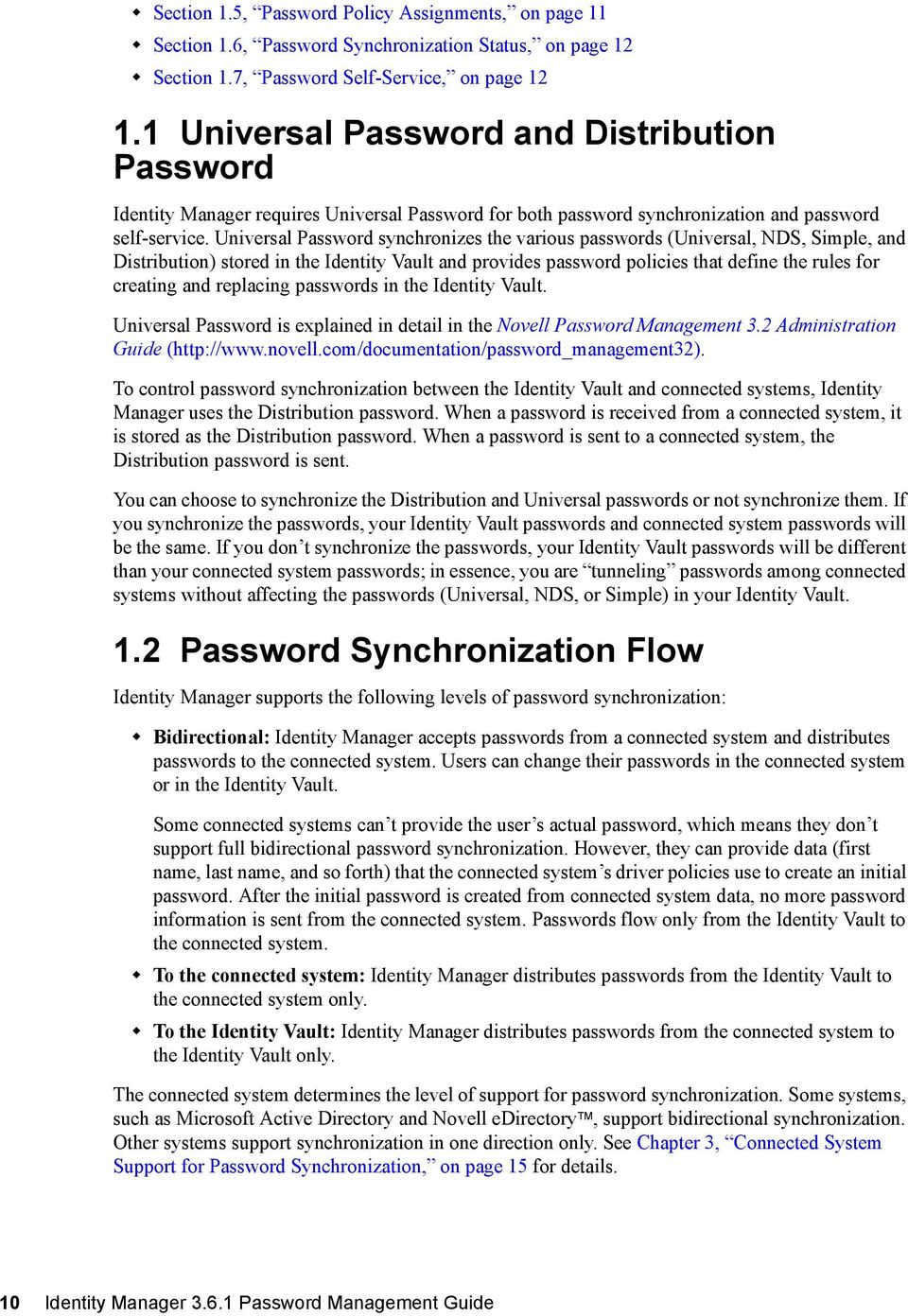
3 Novell Trademarks For Novell trademarks, see the Novell Trademark and Service Mark list ( trademarks/tmlist.html). Third-Party Materials All third-party trademarks are the property of their respective owners.
4 4 Identity Manager Password Management Guide

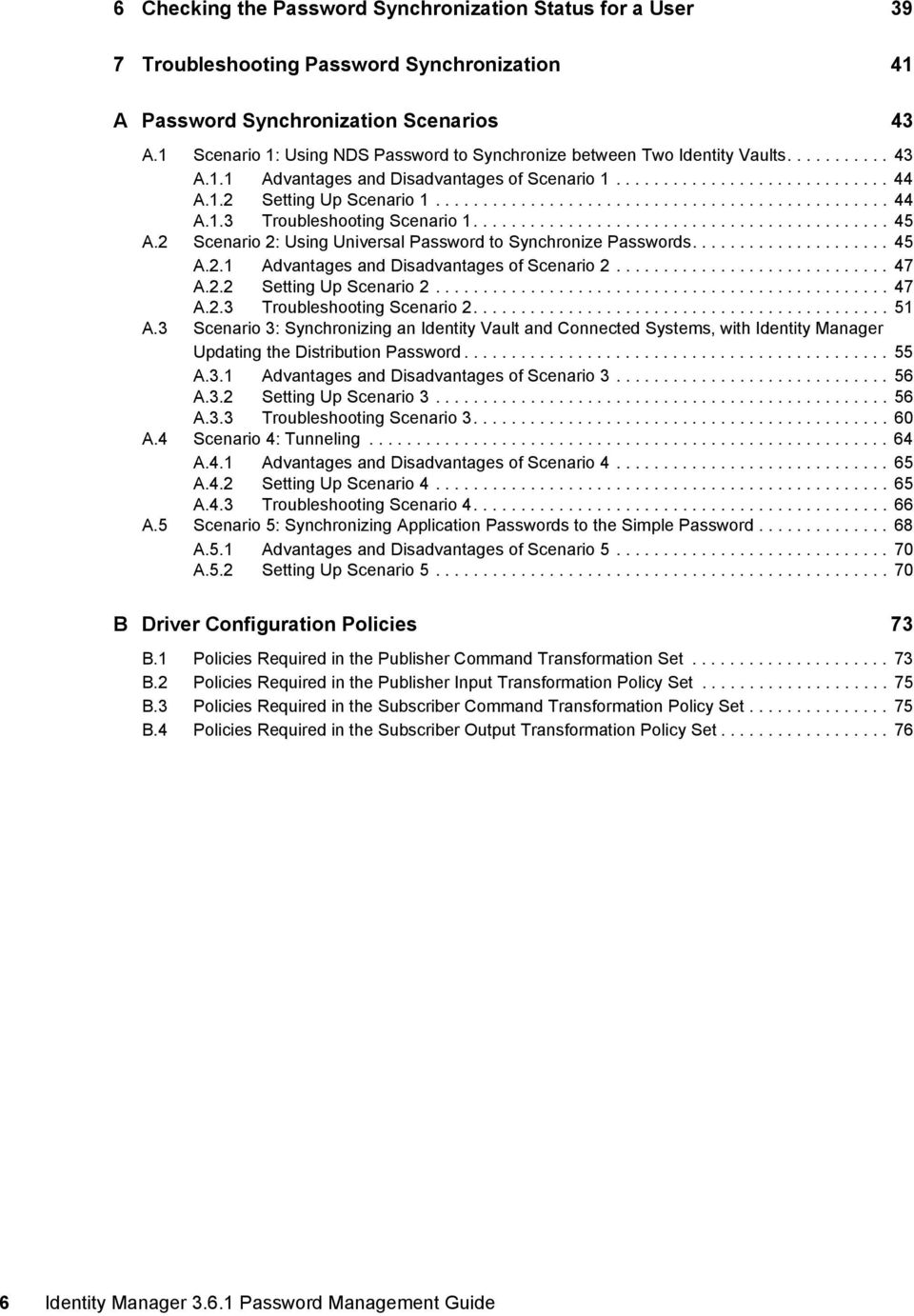
5 Contents About This Guide 7 1 Overview Universal Password and Distribution Password Password Synchronization Flow Password Policy Enforcement Password Policy Enforcement Notifications Password Policy Assignments Password Synchronization Status Password Self-Service Password Management Checklist Prerequisites Synchronizing Passwords Password Self-Service Connected System Support for Password Synchronization Systems That Support Bidirectional Password Synchronization Systems That Accept Passwords from Identity Manager Systems That Don t Accept or Provide Passwords By Default Systems That Don t Support Password Synchronization Configuring Password Flow Verifying Password Synchronization Settings in imanager Verifying Password Synchronization Settings in Designer Configuring Notification Prerequisites Setting Up the SMTP Server to Send Notification Setting Up Templates for Notification Providing SMTP Authentication Information in Driver Policies Adding Your Own Replacement Tags to Notification Templates Adding Replacement Tags to Password Synchronization Notification Templates Adding Replacement Tags to Forgotten Password Notification Templates Sending Notifications to the Administrator Localizing Notification Templates Contents 5

6 6 Checking the Password Synchronization Status for a User 39 7 Troubleshooting Password Synchronization 41 A Password Synchronization Scenarios 43 A.1 Scenario 1: Using NDS Password to Synchronize between Two Identity Vaults A.1.1 Advantages and Disadvantages of Scenario A.1.2 Setting Up Scenario A.1.3 Troubleshooting Scenario A.2 Scenario 2: Using Universal Password to Synchronize Passwords A.2.1 Advantages and Disadvantages of Scenario A.2.2 Setting Up Scenario A.2.3 Troubleshooting Scenario A.3 Scenario 3: Synchronizing an Identity Vault and Connected Systems, with Identity Manager Updating the Distribution Password A.3.1 Advantages and Disadvantages of Scenario A.3.2 Setting Up Scenario A.3.3 Troubleshooting Scenario A.4 Scenario 4: Tunneling A.4.1 Advantages and Disadvantages of Scenario A.4.2 Setting Up Scenario A.4.3 Troubleshooting Scenario A.5 Scenario 5: Synchronizing Application Passwords to the Simple Password A.5.1 Advantages and Disadvantages of Scenario A.5.2 Setting Up Scenario B Driver Configuration Policies 73 B.1 Policies Required in the Publisher Command Transformation Set B.2 Policies Required in the Publisher Input Transformation Policy Set B.3 Policies Required in the Subscriber Command Transformation Policy Set B.4 Policies Required in the Subscriber Output Transformation Policy Set Identity Manager Password Management Guide
7 About This Guide This guide provides information about managing passwords through Identity Manager. The guide is organized as follows: Chapter 2, Password Management Checklist, on page 13 Chapter 1, Overview, on page 9 Chapter 3, Connected System Support for Password Synchronization, on page 15 Chapter 4, Configuring Password Flow, on page 19 Chapter 5, Configuring Notification, on page 25 Chapter 6, Checking the Password Synchronization Status for a User, on page 39 Chapter 7, Troubleshooting Password Synchronization, on page 41 Appendix A, Password Synchronization Scenarios, on page 43 Appendix B, Driver Configuration Policies, on page 73 Audience This guide is intended for administrators, consultants, and network engineers who require a highlevel introduction to Identity Manager business solutions, technologies, and tools. Documentation Updates For the most recent version of this document, see the Identity Manager Documentation Web site ( Additional Documentation For additional Identity Manager documentation, see the Identity Manager Documentation Web site ( Documentation Conventions In Novell documentation, a greater-than symbol (>) is used to separate actions within a step and items in a cross-reference path. A trademark symbol (, TM, etc.) denotes a Novell trademark. An asterisk (*) denotes a third-party trademark. When a single pathname can be written with a backslash for some platforms or a forward slash for other platforms, the pathname is presented with a backslash. Users of platforms that require a forward slash, such as Linux* or UNIX*, should use forward slashes as required by your software. About This Guide 7
8 8 Identity Manager Password Management Guide

9 1Overview Identity Manager helps you manage user passwords across multiple accounts. You can synchronize passwords among systems, allow users to change their passwords, and enable users to recover from forgotten passwords. In the following diagram, the Identity Manager system is configured to synchronize passwords for users who have Active Directory and SunOne accounts. In addition, password self-service is enabled through the Identity Manager User Application so that users can change their passwords and, if necessary, recover from forgotten passwords. Figure 1-1 Password Management with Identity Manager 1 Identity Manager provides synchronization of passwords between the Identity Vault and connected systems. It also supports password self-service, which is the ability for users to change their own passwords and recover from forgotten passwords. The following sections introduce you to the concepts you need to understand to successfully implement password synchronization and password self-service: Section 1.1, Universal Password and Distribution Password, on page 10 Section 1.2, Password Synchronization Flow, on page 10 Section 1.3, Password Policy Enforcement, on page 11 Section 1.4, Password Policy Enforcement Notifications, on page 11 Overview 9

10 Section 1.5, Password Policy Assignments, on page 11 Section 1.6, Password Synchronization Status, on page 12 Section 1.7, Password Self-Service, on page Universal Password and Distribution Password Identity Manager requires Universal Password for both password synchronization and password self-service. Universal Password synchronizes the various passwords (Universal, NDS, Simple, and Distribution) stored in the Identity Vault and provides password policies that define the rules for creating and replacing passwords in the Identity Vault. Universal Password is explained in detail in the Novell Password Management 3.2 Administration Guide ( To control password synchronization between the Identity Vault and connected systems, Identity Manager uses the Distribution password. When a password is received from a connected system, it is stored as the Distribution password. When a password is sent to a connected system, the Distribution password is sent. You can choose to synchronize the Distribution and Universal passwords or not synchronize them. If you synchronize the passwords, your Identity Vault passwords and connected system passwords will be the same. If you don t synchronize the passwords, your Identity Vault passwords will be different than your connected system passwords; in essence, you are tunneling passwords among connected systems without affecting the passwords (Universal, NDS, or Simple) in your Identity Vault. 1.2 Password Synchronization Flow Identity Manager supports the following levels of password synchronization: Bidirectional: Identity Manager accepts passwords from a connected system and distributes passwords to the connected system. Users can change their passwords in the connected system or in the Identity Vault. Some connected systems can t provide the user s actual password, which means they don t support full bidirectional password synchronization. However, they can provide data (first name, last name, and so forth) that the connected system s driver policies use to create an initial password. After the initial password is created from connected system data, no more password information is sent from the connected system. Passwords flow only from the Identity Vault to the connected system. To the connected system: Identity Manager distributes passwords from the Identity Vault to the connected system only. To the Identity Vault: Identity Manager distributes passwords from the connected system to the Identity Vault only. The connected system determines the level of support for password synchronization. Some systems, such as Microsoft Active Directory and Novell edirectory TM, support bidirectional synchronization. Other systems support synchronization in one direction only. See Chapter 3, Connected System Support for Password Synchronization, on page 15 for details. 10 Identity Manager Password Management Guide
11 1.3 Password Policy Enforcement Identity Manager can enforce password policies on incoming passwords from connected systems and on passwords set or changed through the User Application password self-service. If the new password does not comply, you can specify that Identity Manager not accept the password. This also means that passwords that don't comply with your policies are not distributed to other connected systems. In addition, Identity Manager can enforce password policies on connected systems. If the password being published to the Identity Vault does not comply with rules in a policy, you can specify that Identity Manager not only does not accept the password for distribution, but actually resets the noncompliant password on the connected system by using the current Distribution password in the Identity Vault. For example, you want to require passwords to include at least one numeric character. However, the connected system does not have the ability to enforce such a policy. You specify that Identity Manager resets passwords that flow from the connected system but do not comply with rules in the policy. 1.4 Password Policy Enforcement Notifications Identity Manager enables you to automatically notify users via when a password change was not successful. For example, you set Identity Manager to not accept incoming passwords from Active Directory when they don t comply with your password policy. One policy rule specifies that the company name can t be used as a password. A user changes his or her Active Directory password to include the company name. Identity Manager rejects the password and sends the user an message stating that the password change was not synchronized. The User Application password self-service console lets you display the password policy rules so that users know how to create a compliant password. However, if you allow users to change their password through a connected system, the connected system is not able to display the policy. If you want to avoid notifications caused by non-compliant passwords, you should require users to change the password only in the User Application, or at least make sure that the policy rules are well publicized. 1.5 Password Policy Assignments Password policies are assigned with a tree-centric perspective, meaning that you assign them to the Identity Vault containers that hold the users to whom you want the policies applied. In contrast, password synchronization is set up per driver. Drivers are installed on a per-server basis and can manage only those users who are in a master or read/write replica on the server. To get the results you expect from password synchronization, make sure that the user containers that have password policies required by a driver for password synchronization are in a master or read/ write replica on the driver s server. Assigning a password policy to a partition root container ensures that all users in that container and subcontainers are assigned the password policy. Overview 11
12 1.6 Password Synchronization Status Identity Manager enables you to query connected systems to check a user s password synchronization status. If the connected system supports the check password feature, you can find out whether passwords are synchronizing successfully. For information on how to check passwords, see Checking the Password Synchronization Status for a User on page 39. For a list of which systems support checking passwords, see Connected System Support for Password Synchronization on page Password Self-Service Password self-service is provided through the Identity Manager User Application. The User Application Identity Self-Service lets users manage their passwords, including resetting and recovering from forgotten passwords. Identity Manager also includes a Client Login Extension that can be used with the Novell Client and the Microsoft login GINA to facilitate password self-service. When users click the Forgot Password link in their client login, the Client Login Extension launches a restricted browser to access the User Application Identity Self-Service feature. For more information about the Client Login Extension, see the Identity Manager Client Login Extension Guide. 12 Identity Manager Password Management Guide
13 2Password Management Checklist The following sections provide checklists for setting up password synchronization and password self-service. The prerequisites apply to both scenarios. Section 2.1, Prerequisites, on page 13 Section 2.2, Synchronizing Passwords, on page 13 Section 2.3, Password Self-Service, on page Prerequisites The following prerequisites must be met before starting the tasks in Section 2.2, Synchronizing Passwords, on page 13 or Section 2.3, Password Self-Service, on page 14. Make sure you have a functioning Identity Manager system in place. To do so, complete the tasks in the Basic Identity Manager System Checklist found in the Identity Manager Installation Guide. Make sure you have reviewed Chapter 1, Overview, on page 9 and understand the concepts associated with password synchronization and password self-service. Deploy Universal Password. Universal Password coordinates the different types of Identity Vault passwords (simple, NDS, enhanced), enables synchronization of the passwords with connected systems, and supports password self-service. For information about deploying Universal Password, see Deploying Universal Password ( allq21t.html) in the Novell Password Management 3.2 Administration Guide. 2.2 Synchronizing Passwords Complete the following tasks to set up password synchronization between the Identity Vault and a connected system. Repeat the tasks for each connected system with which you want to synchronize passwords. Verify that the driver supports password synchronization. For a list of supported drivers, see Chapter 3, Connected System Support for Password Synchronization, on page 15. Make sure the driver is already installed and works with the connected system (except for password synchronization). For instructions, refer to the driver s Implementation Guide on the Identity Manager Drivers documentation site ( idm36drivers). (Conditional) If you are using the Active Directory driver, install the password filters required to synchronize passwords. For instructions, see Setting Up Password Synchronization Filters in the Identity Manager Driver for Active Directory Implementation Guide. (Conditional) If you are using the Linux and UNIX driver, install the password filters required to synchronize passwords. For instructions, see Installing the PAM or LAM Module ( in the Identity Manager Driver for Linux and UNIX Implementation Guide. 2 Password Management Checklist 13
14 Create a password policy that defines your business criteria for creating and replacing passwords. Assign the policy to the Identity Vault containers that hold the users to whom you want the policy applied. You can have more than one password policy if needed. For instructions, see Managing Passwords by Using Password Policies ( documentation/password_management32/pwm_administration/data/ampxjj0.html) in the Novell Password Management 3.2 Administration Guide. Make sure the driver s password synchronization settings support the correct flow of passwords between the Identity Vault and the connected system. For instructions, see Chapter 4, Configuring Password Flow, on page 19. Set up notification so that users receive messages if their passwords are not successfully synchronized. For instructions, see Chapter 5, Configuring Notification, on page Password Self-Service Complete the following tasks to set up password self-service. Install the User Application by following the installation checklist. For instructions, see Installation Checklist ( bf8up4w.html) in the Identity Manager Roles Based Provisioning Module User Application Installation Guide. (Conditional) By default, password self-service is available only within your firewall. If you want to make it available outside your firewall, you must set up a separate forgotten-password management IDMPwdMgt.WAR file and deploy it. For more information, see Configuring Forgotten Password Self-Service ( data/b8q7ezv.html) in the Identity Manager Roles Based Provisioning Module User Application Administration Guide. Set up the password self-service features (challenge response, forgotten password, password hints, and so forth). For instructions, see Password Management Configuration ( in the Identity Manager Roles Based Provisioning Module User Application Administration Guide. (Conditional) If you want to use the Client Login Extension to facilitate password self-service through the Novell Client and Microsoft login GINA, see the Identity Manager Client Login Extension Guide. 14 Identity Manager Password Management Guide
15 3Connected System Support for Password Synchronization The level of support for password synchronization varies depending on the connected system. The following sections provide support information: Section 3.1, Systems That Support Bidirectional Password Synchronization, on page 15 Section 3.2, Systems That Accept Passwords from Identity Manager, on page 15 Section 3.3, Systems That Don t Accept or Provide Passwords By Default, on page 16 Section 3.4, Systems That Don t Support Password Synchronization, on page Systems That Support Bidirectional Password Synchronization The following connected systems support bidirectional password synchronization. Bidirectional synchronization means that the connected system can provide the user s actual password to Identity Manager and can accept password changes from Identity Manager. This allows the password to be changed in either the Identity Vault or the connected system and then synchronized as needed. 3 Table 3-1 Systems that Support Bidirectional Password Synchronization Connected System Driver Subscriber Channel Application Can Accept Setting of Initial Password Subscriber Channel Application Can Accept Modification of Password Subscriber Channel Application Supports Check Password Publisher Channel Application Can Provide (sync) Password Active Directory Yes Yes Yes Yes edirectory TM1 Yes Yes Yes Yes Linux and UNIX (NIS) Yes Yes Yes Yes 1 Between Identity Vault trees, you can have bidirectional password synchronization for users even if Universal Password is not enabled for those users. See Section A.1, Scenario 1: Using NDS Password to Synchronize between Two Identity Vaults, on page Systems That Accept Passwords from Identity Manager The following connected systems can accept passwords from Identity Manager to some degree but cannot provide a user s actual password to Identity Manager. Connected System Support for Password Synchronization 15
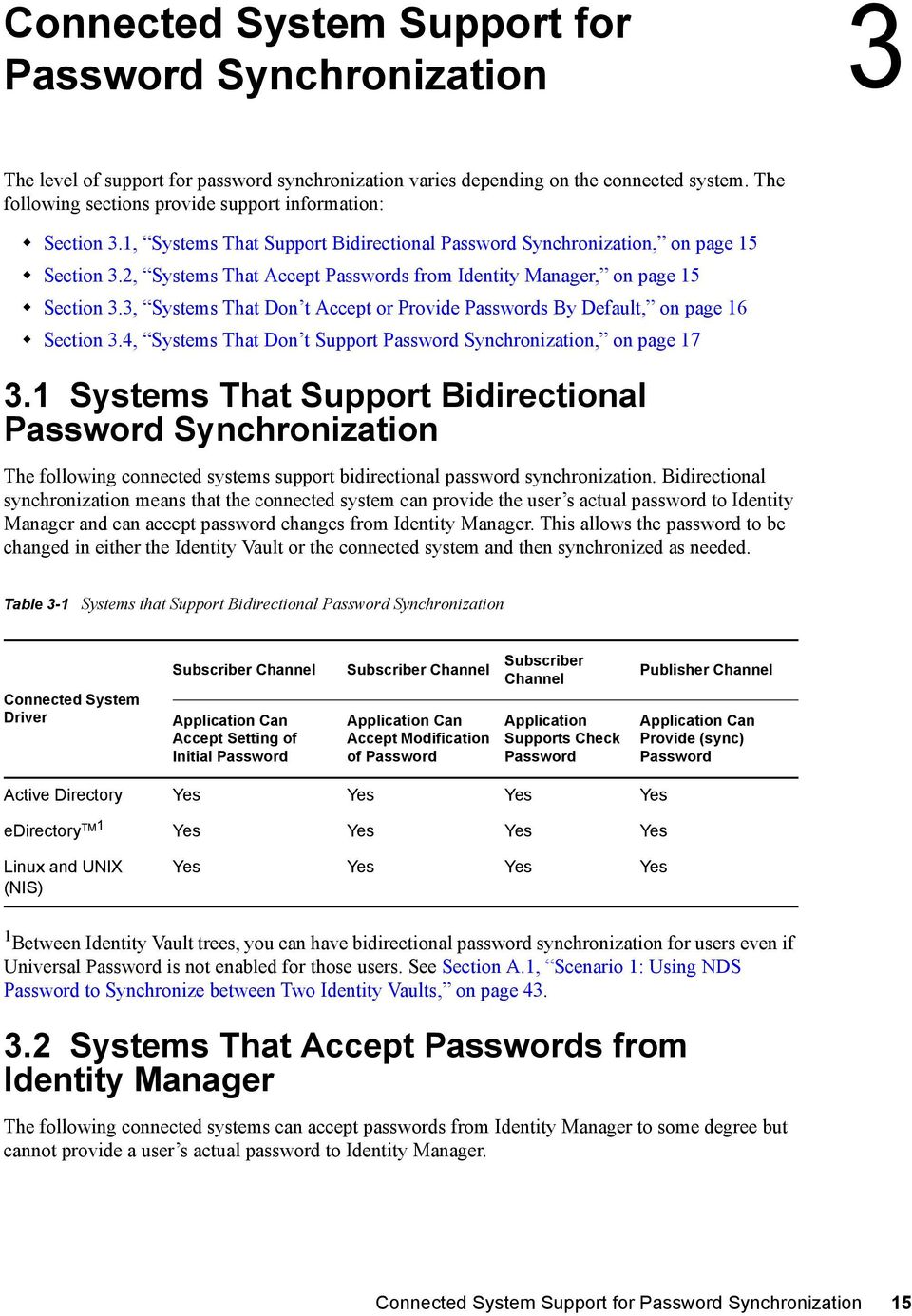
16 Although they can t provide the user s actual password, they can be configured to create a password in the Identity Vault by using a policy on the Publisher channel. The password would be based on other user data in the connected system. The basic driver configurations provided for the connected systems include a default password based on the surname. Table 3-2 Systems That Accept Passwords from Identity Manager Connected System Driver Subscriber Channel Application Can Accept Setting of Initial Password Subscriber Channel Application Can Accept Modification of Password Subscriber Channel Application Supports Check Password Publisher Channel Application Can Provide (Sync) Password Groupwise Yes Yes No No 1 JDBC Yes 2 No 3 No No 4 LDAP Yes 5 Yes 5 Yes No Lotus Notes* Yes Yes 6 Yes 7 No SAP* User Management Yes Yes No No 1 GroupWise supports two authentication methods: GroupWise provides its own authentication and maintains user passwords. GroupWise authenticates against edirectory by using LDAP and does not maintain passwords. When you use this option, GroupWise ignores driver-synchronized passwords. 2 The ability to set an initial password is available on all databases where the OS user account is distinct from the database user account, such as Oracle*, MS SQL, MySQL*, and Sybase*. 3 The Identity Manager Driver for JDBC* can be used to modify a password on the connected system, but that feature is not demonstrated in the sample driver configuration. 4 Passwords can be synchronized as data when stored in a table. 5 If the target LDAP server allows setting the userpassword attribute. 6 The Notes driver can accept a password modification and check passwords only for the HTTPPassword field in Lotus Notes. 3.3 Systems That Don t Accept or Provide Passwords By Default The following connected systems can t accept passwords from Identity Manager or provide a user s password to Identity Manager when using the basic driver configuration. Although they can t provide the user s actual password, they can be configured to create a password in the Identity Vault by using a policy on the Publisher channel. The password would be based on other user data in the connected system. The basic driver configurations provided for the connected systems include a default password based on the surname. 16 Identity Manager Password Management Guide
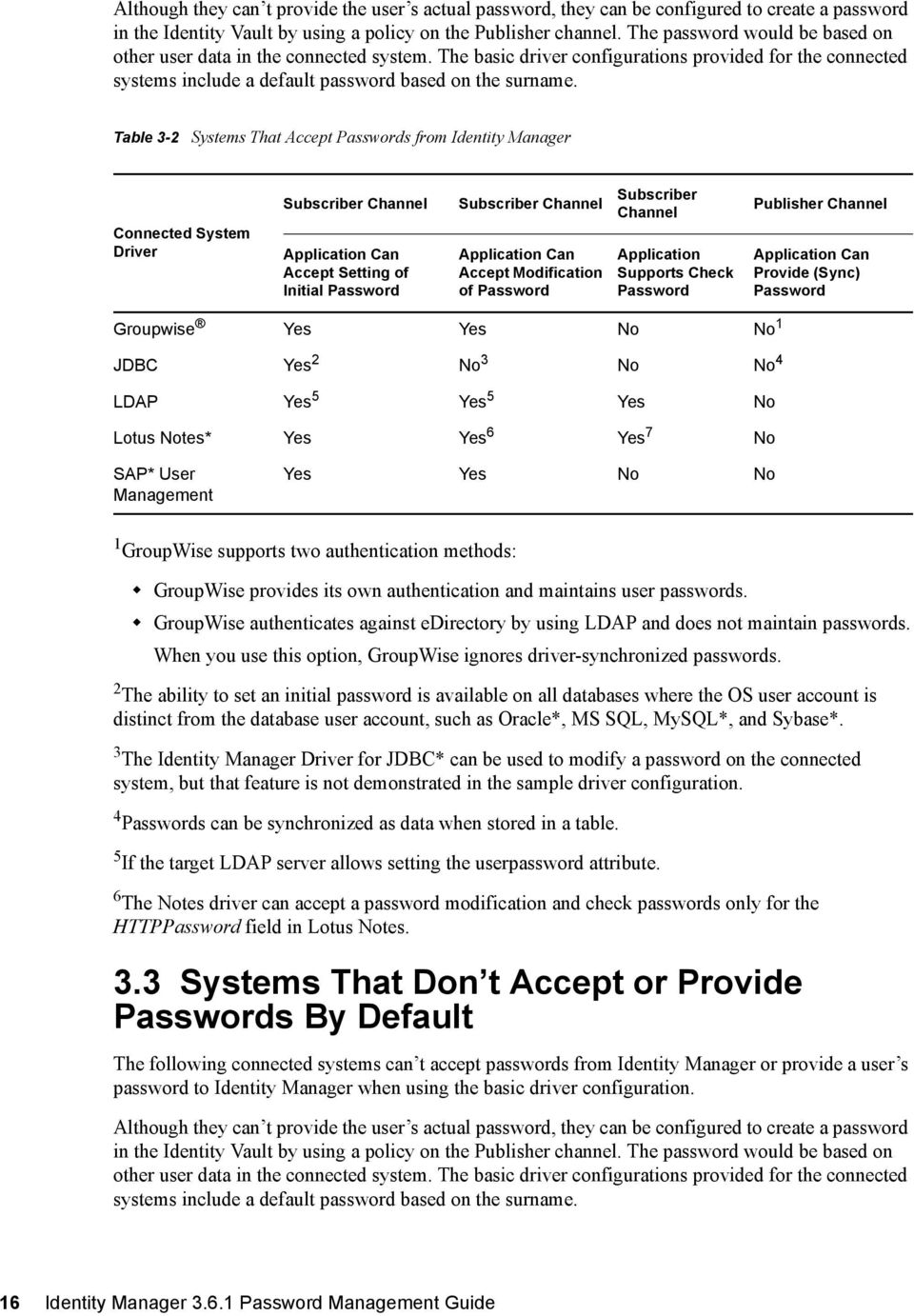
17 Table 3-3 Systems That Don t Accept or Provide Passwords Connected System Driver Subscriber Channel Application Can Accept Setting of Initial Password Subscriber Channel Application Can Accept Modification of Password Subscriber Channel Application Supports Check Password Publisher Channel Application Can Provide (Sync) Password Delimited Text 1 No No No No PeopleSoft 5.2 No No No No SAP HR No No No No 1 The Identity Manager Driver for Delimited Text does not have features in the driver shim that directly support Password Synchronization. However, the driver can be configured to handle passwords, depending on the connected system you are synchronizing with. 3.4 Systems That Don t Support Password Synchronization The following connected systems are not intended to participate in password synchronization. Table 3-4 Systems That Don t Support Password Synchronization Connected System Driver Subscriber Channel Application Can Accept Setting of Initial Password Subscriber Channel Application Can Accept Modification of Password Subscriber Channel Application Supports Check Password Publisher Channel Application Can Provide (sync) Password Avaya* PBX No No No No Entitlements Service No No No No LoopBack Service No No No No Manual Task Service No No No No Null Service No No No No WorkOrder No No No No Connected System Support for Password Synchronization 17

18 18 Identity Manager Password Management Guide

19 4Configuring Password Flow To ensure that passwords flow between the Identity Vault and the connected system the way you expect them to, you should verify the password synchronization settings for the connected system s driver are configured properly. Section 4.1, Verifying Password Synchronization Settings in imanager, on page 19 Section 4.2, Verifying Password Synchronization Settings in Designer, on page Verifying Password Synchronization Settings in imanager 1 In imanager, open the properties page for the driver whose password settings you want to check: 1a Click to display the Identity Manager Administration page. 1b In the Administration list, click Identity Manager Overview. 1c On the Driver Sets tab, locate the driver set that contains the driver whose settings you want to check. If the driver set is not listed on the Driver Sets tab, use the Search In field to search for and display the driver set. 1d Click the driver set to open the Driver Set Overview page. 1e Click the driver to display the Driver Overview page. 1f Click the upper right corner of the driver to display the Actions menu, then click Edit properties. 2 One the properties page, click the Server Variables tab to display the Password Synchronization page. 4 Configuring Password Flow 19

20 The settings that are enabled and disabled vary depending on the driver. Only those settings for features supported by the driver are available (not dimmed). 3 Verify that the settings are configured properly. Identity Manager accepts passwords (Publisher Channel): If this option is enabled, Identity Manager allows passwords to flow from the connected system into the Identity Vault. Disabling this option means that no <password> elements are allowed to flow to Identity Manager. They are stripped out of the XML by a password synchronization policy on the Publisher channel. This setting applies to user passwords that are provided by the connected system itself, and password values that are created by a policy on the Publisher channel. If this option is enabled but the Distribution Password option below it is disabled, a <password> value coming from the connected system is written directly to the Universal password in the Identity Vault. If the user s password policy does not enable Universal Password, the password is written to the NDS password. Use Distribution Password for password synchronization: This setting is available only if the Identity Manager accepts passwords (Publisher Channel) setting is enabled. If this option is enabled, a password value coming from the connected system is written to the Distribution password. The Distribution password is reversible, which means that it can be retrieved from the Identity Vault data store for password synchronization. It is used by Identity Manager for bidirectional password synchronization with connected systems. For Identity Manager to distribute passwords from this system to other systems, this option must be enabled. Accept password only if it complies with user s Password Policy: This setting is available only if the Use Distribution Password for password synchronization setting is enabled. If this option is selected, Identity Manager does not write a password from this connected system to the Distribution password in the Identity Vault or publish it to connected systems unless the password complies with the user s password policy. If a password does not comply, enable the Reset the user s password to the Distribution Password setting to reset the user s password on the connected system. This allows you to enforce the password policy on the connected system as well as in your Identity Vault. If you do not select this option, user passwords can become out-of-sync on connected systems. However, you need to consider the connected system s password policies when deciding whether to use this option. Some connected systems might not allow the reset because they don't allow you to repeat passwords. By using the Notify the user of password synchronization failure via setting, you can inform users when a password fails to be set or reset. Notification is especially helpful for this option. If the user changes to a password that is allowed by the connected system but rejected by Identity Manager because of the password policy, the user won't know that the password has been reset until the user receives a notification or tries to log in to the connected system with the old password. Always accept password; ignore Password Policies: This setting is available only if the Use Distribution Password for password synchronization setting is enabled. If you select this option, Identity Manager does not enforce the user s password policy for this connected system. Identity Manager writes the password from this connected system to the Distribution password in the Identity Vault and distributes it to other connected systems regardless of password policy compliance. 20 Identity Manager Password Management Guide

21 Application accepts passwords (Subscriber Channel): If you enable this option, the driver sends passwords from the Identity Vault to this connected system. This also means that if a user changes the password on a different connected system that is publishing passwords to the Distribution password in the Identity Vault, the password is changed on this connected system. By default, the Distribution password is the same as the Universal password in the Identity Vault, so changes to the Universal password made in the Identity Vault are also sent to the connected system. Notify the user of password synchronization failure via If you enable this option, e- mail is sent to the user if a password is not synchronized, set, or reset. The that is sent to the user is based on an template. This template is provided by the Password Synchronization application. However, for the template to work, you must customize it and specify an server to send the notification messages. For instructions, see Chapter 5, Configuring Notification, on page When you are finished, click OK to save your changes. The settings are saved as Global Configuration Values. You can view them on the Identity Manager > Global Config Values page. 4.2 Verifying Password Synchronization Settings in Designer 1 In Designer, open your project. 2 In the Modeler, right-click the icon for the driver whose settings you want to check, then click Password Synchronization to display the Password Synchronization Options dialog box. Configuring Password Flow 21
22 The settings that are enabled and disabled vary depending on the driver. Only those settings for features supported by the driver are available (not dimmed). 3 Verify that the settings are configured properly. Identity Manager accepts passwords (Publisher Channel): If this option is enabled, Identity Manager allows passwords to flow from the connected system into the Identity Vault. Disabling this option means that no <password> elements are allowed to flow to Identity Manager. They are stripped out of the XML by a password synchronization policy on the Publisher channel. This setting applies to user passwords that are provided by the connected system itself, and password values that are created by a policy on the Publisher channel. If this option is enabled but the Distribution Password option below it is disabled, a <password> value coming from the connected system is written directly to the Universal password in the Identity Vault. If the user s password policy does not enable Universal Password, the password is written to the NDS password. Use Distribution Password for password synchronization: This setting is available only if the Identity Manager accepts passwords (Publisher Channel) setting is enabled. If this option is enabled, a password value coming from the connected system is written to the Distribution password. The Distribution password is reversible, which means that it can be retrieved from the Identity Vault data store for password synchronization. It is used by Identity Manager for bidirectional password synchronization with connected systems. For Identity Manager to distribute passwords from this system to other systems, this option must be enabled. Accept password only if it complies with user s Password Policy: This setting is available only if the Use Distribution Password for password synchronization setting is enabled. If this option is selected, Identity Manager does not write a password from this connected system to the Distribution password in the Identity Vault or publish it to connected systems unless the password complies with the user s password policy. If a password does not comply, enable the Reset the user s password to the Distribution Password setting to reset the user s password on the connected system. This allows you to enforce the password policy on the connected system as well as in your Identity Vault. If you do not select this option, user passwords can become out-of-sync on connected systems. However, you need to consider the connected system s password policies when deciding whether to use this option. Some connected systems might not allow the reset because they don't allow you to repeat passwords. By using the Notify the user of password synchronization failure via setting, you can inform users when a password fails to be set or reset. Notification is especially helpful for this option. If the user changes to a password that is allowed by the connected system but rejected by Identity Manager because of the password policy, the user won't know that the password has been reset until the user receives a notification or tries to log in to the connected system with the old password. Always accept password; ignore Password Policies: This setting is available only if the Use Distribution Password for password synchronization setting is enabled. If you select this option, Identity Manager does not enforce the user s password policy for this connected system. Identity Manager writes the password from this connected system to the Distribution password in the Identity Vault and distributes it to other connected systems regardless of password policy compliance. 22 Identity Manager Password Management Guide
23 The application accepts passwords (Subscriber Channel): If you enable this option, the driver sends passwords from the Identity Vault to this connected system. This also means that if a user changes the password on a different connected system that is publishing passwords to the Distribution password in the Identity Vault, the password is changed on this connected system. By default, the Distribution password is the same as the Universal password in the Identity Vault, so changes to the Universal password made in the Identity Vault are also sent to the connected system. Notify the user of password synchronization failure via If you enable this option, e- mail is sent to the user if a password is not synchronized, set, or reset. The that is sent to the user is based on an template. This template is provided by the Password Synchronization application. However, for the template to work, you must customize it and specify an server to send the notification messages. For instructions, see Chapter 5, Configuring Notification, on page When you are finished, click OK to save your changes. The settings are saved as Global Configuration Values. You can view them on the Identity Manager > Global Config Values page. Configuring Password Flow 23
24 24 Identity Manager Password Management Guide
25 5Configuring Notification imanager tasks enable you to specify the server and customize the templates for notifications. templates are provided to allow Password Synchronization and Password Self-Service to send automated s to users. You don't create the templates. They are provided by the application that uses them. The templates are Template objects in the Identity Vault, and they are placed in the Security container, usually found at the root of your tree. Although they are Identity Vault objects, you should edit them only through imanager. You control whether messages are sent, based on your choices in imanager. For Forgotten Password, notifications are sent only if you choose to use one of the Forgotten Password actions that causes an to be sent: ing a password to the user, or ing a password hint to the user. See Managing Forgotten Passwords ( password_management32/pwm_administration/data/bqf5d1x.html) in the Password Management 3.2 Administration Guide. When you select Notify the user of password synchronization failure via , Password Synchronization is configured to send for failed password sync operations only, and only for the drivers you specify. Figure 5-1 Configuring Password Synchronization 5 In addition, you need to make sure that the SMTP authentication information is included in the driver policies. Section 5.1, Prerequisites, on page 26 Section 5.2, Setting Up the SMTP Server to Send Notification, on page 26 Configuring Notification 25
26 Section 5.3, Setting Up Templates for Notification, on page 28 Section 5.4, Providing SMTP Authentication Information in Driver Policies, on page 28 Section 5.5, Adding Your Own Replacement Tags to Notification Templates, on page 30 Section 5.6, Sending Notifications to the Administrator, on page 36 Section 5.7, Localizing Notification Templates, on page Prerequisites Make sure that your Identity Vault users have the Internet Address attribute populated. If you are using notifications for Password Synchronization, make sure that the Password Synchronization driver policies contain the password for the SMTP server. See Section 5.4, Providing SMTP Authentication Information in Driver Policies, on page 28. If you are concerned that some users might not have the address populated, or if you want an record of all failure notifications, consider choosing a password administrator account that all notifications are sent to, in addition to the user. This address should be in the To field of the Identity Manager script policy. For more information, see Section 5.6, Sending Notifications to the Administrator, on page 36. If edirectory TM and Identity Manager are on a UNIX server, the server must hold a replica of the template objects. These objects are located in the Security container, at the root. This means that the server needs a replica of the root partition. 5.2 Setting Up the SMTP Server to Send Notification 1 In imanager, select Passwords > Server Options. 26 Identity Manager Password Management Guide
27 2 Specify the following information: The host name. The name (for example, Administrator) that you want to appear in the From field of the e- mail message. The username and password for authenticating to the server, if necessary. 3 Click OK. 4 If you are using Password Synchronization with your Identity Manager drivers and want to use the notification feature, you must also do the following: 4a If your SMTP server requires authentication before sending , make sure that the driver policies contain the password. See Section 5.4, Providing SMTP Authentication Information in Driver Policies, on page 28 for instructions. Specifying the authentication information in the Server Options page in Step 2 is sufficient for Forgotten Password notifications, but not for Password Synchronization notifications. 4b Restart Identity Manager drivers that need to be updated with the changes. The driver reads the templates and SMTP server information only at startup time. 5 Customize the templates as described in Setting Up Templates for Notification on page 28. After the server is set up, messages can be sent by the applications that use them, if you are using the features that cause messages to be sent. Configuring Notification 27
28 5.3 Setting Up Templates for Notification You can customize these templates with your own text. The name of the template indicates what it is used for. 1 In imanager, select Passwords > Templates. 2 Edit the templates as desired. Keep in mind that if you want to add any replacement tags, some additional tasks might be required. Follow the instructions in Section 5.5, Adding Your Own Replacement Tags to E- Mail Notification Templates, on page Restart Identity Manager drivers that need to be updated with the changes. The driver reads the templates and SMTP server information only at startup time. 5.4 Providing SMTP Authentication Information in Driver Policies You specify the username and password for the SMTP server in Section 5.2, Setting Up the SMTP Server to Send Notification, on page 26. For Forgotten Password notifications, this is sufficient. However, for Password Synchronization notifications, you also need to include the password in the driver policies. The Metadirectory engine can access the username, but not the passwords. The driver policy must provide it. You must complete this procedure if the following conditions exist: The SMTP server is secured and requires authentication before sending Identity Manager Password Management Guide
29 You are using Identity Manager Password Synchronization with an Identity Manager driver In the Password Synchronization settings for the driver, you have selected Notify the user of password synchronization failure via . To add the SMTP server password to the driver policy: 1 In imanager, select Identity Manager > Identity Manager Overview. 2 Search for the driver sets, or browse and select a container that holds the driver set. 3 In the Identity Manager Driver Overview, click the icon for the driver. 4 Select an Input Transformation icon or an Output Transformation icon. 5 Select a policy, then click Edit. 6 Click a rule. 7 Specify the password for the SMTP server in the rules that include Do Send from Template actions. For example, if you are using the sample driver configurations, the following Password Synchronization policies need to be modified. Policy Set Policy Name Rule Name Input Transformation Output Transformation Password(Pub)-Sub Notifications Password(Sub)-Pub Notifications Send on a failure when subscribing to passwords Send on failure to reset the connected system password by using the Identity Manager data store password Send for a failed publish password operation The following figure shows an example of a Do Send from Template action that requires the password. Configuring Notification 29
30 The password is obfuscated when it is stored in the Identity Vault. 8 Select the rule, then click OK. 5.5 Adding Your Own Replacement Tags to E- Mail Notification Templates The notification templates have some tags defined by default, to help you personalize the message for the user. You can also add your own tags. Your ability to add tags is dependent on the application that is using the template. Adding Replacement Tags to Password Synchronization Notification Templates on page 30 Adding Replacement Tags to Forgotten Password Notification Templates on page Adding Replacement Tags to Password Synchronization Notification Templates You can add replacement tags to the notification templates for Password Synchronization, but these tags don't work unless you also define them in every password synchronization policy rule that refers to the notification template. When using a DoSend FromTemplate action, all replacement tags declared within the template must be defined as child arg-strings elements of the action. For example, Identity Manager provides default replacement tags that are included with the notification templates. Identity Manager also provides default password synchronization policies in the driver configurations. Each default tag provided with the template is also defined in each rule of the password synchronization policy that uses that template. For example, the UserGivenName tag is one of the default tags defined in the template named Password Set Fail. A policy rule named Send on a failure when subscribing to passwords refers to that template in a DoSend FromTemplate action. This rule is used in a policy to notify to a user when a password fails to synchronize. The same UserGivenName tag is defined as an arg-string element in that rule. 30 Identity Manager Password Management Guide
31 Like this example, each new tag you add must be defined in both the template and the policy rules that refer to the template, so that the Metadirectory engine knows how to insert the correct data in place of the replacement tag when sending the to the user. You can refer to the tags in the Identity Manager driver configurations that shipped with Identity Manager as examples. Keep in mind the following guidelines: The items called replacement tags in the templates are called tokens in the context of Policy Builder. You should use Policy Builder to make it easier to define the argument strings for the replacement tags, as explained in the steps in this section. The tags you add might be defined to be any of the following: Any Source or Destination attribute for the user Unlike adding tags for the templates for Forgotten Password, simply adding a tag that has the same name as an attribute on the User object in the Identity Vault does not cause the tag to work. As with all tags used in password synchronization notification templates, you must also define the tag in the policy that is referring to the e- mail template. A global configuration value An XPATH expression This is in contrast to tags for the templates for Forgotten Password, which are limited to edirectory user attributes. Unlike adding tags for the templates for Forgotten Password (which require you to use the exact name of an edirectory user attribute), you can name the replacement tags any name you choose, as long as it matches the name used to define the tag in the policies that reference the template. To define the tags in a policy, find all the policies that refer to the notification template, and use Policy Builder to add the tags to them. In each policy, edit each rule that refers to the template. One way to make sure that you find all the policies that refer to the notification templates is to export your driver configurations, then search the XML for a do-send- action that has the template equal to the name of the notification template. 1 In imanager, select Identity Manager > Identity Manager Overview. 2 Select the driver set that contains the driver with the policy you want to edit. 3 Click the icon for the driver that has the policy you want to edit. 4 On the Publisher or Subscriber channel, click the set of policies that contains the policy you want to edit. For example, the driver configuration for the edirectory driver that ships with Identity Manager contains a policy in the Input Transformation policy set that references both password synchronization notification templates. 5 Click the policy, then click Edit. The following figure illustrates how to edit the Password(Pub)-Sub Notifications policy for the edirectory driver: Configuring Notification 31
32 6 In the list of rules that opens, click the rule that refers to the notification template. For example, in the Password(Pub)-Sub Notifications policy, you see the following list of rules. Both of these rules reference one of the password synchronization templates. You need to edit both rules if you are adding tags to both templates. If you click the first rule, the following page appears: 32 Identity Manager Password Management Guide
33 7 Scroll to the Actions section. 8 For the Do Send from Template rule, click the browse button for the Enter strings field. This opens the string builder. For the example rule, the following figure shows the list of strings you would see. The default tags that are used in the notification templates are already defined in the password synchronization policies that are part of the Identity Manager driver configurations, like this one. You can use the default tags as an example. Configuring Notification 33
34 9 To define a tag that you could use in an notification template, click Append New String, then enter a name for the tag. Make sure that the name is exactly the same name you use in the notification template. 10 In the String value field, click the browse button to help you define the tag. 11 On the Argument Builder page, specify the value that should be brought in when this tag is used in an notification template. You can define the tag to be any of the following: Any Source or Destination attribute for the user Unlike adding tags for the templates for Forgotten Password, simply adding a tag that has the same name as an attribute on the user object in the Identity Vault does not cause the tag to work. As with all tags used in password synchronization notification templates, you must also define the tag in the policy that is referring to the e- mail template. A global configuration value An XPATH expression The following figure illustrates how to define the tag: 34 Identity Manager Password Management Guide
35 After you define the tag and click OK, it shows up as one of the strings in the String Builder page. 12 Make sure you click OK to complete all the pages, so that your changes to the policy are saved. 13 Repeat the steps to edit the rules in all the policies that refer to the notification template. 14 Add the tag you defined in the policy to the notification template, using the exact name you used in the policies. At this point, you can use the tag name in the body of the notification template. 15 Save the changes and restart the driver Adding Replacement Tags to Forgotten Password Notification Templates Using the following guidelines, you can add tags to the notification templates for Forgotten Password: You can add only tags that correspond to LDAP attributes on the User object that the message is being sent to. The name of the tag you add must be exactly the same as the LDAP attribute name on the user object. To see how LDAP attributes correspond to edirectory attribute names, refer to the Schema Mapping Policy that is provided in the Identity Manager Driver for LDAP. No other configuration is necessary. Configuring Notification 35
36 By default, the Forgotten Password Notification template uses the UserFullName variable. The full name attribute is not used by the notification template, instead it uses the login attribute. For example, if the full name attribute is Alison Blake and the login attribute is ablake, the greeting is "Dear ablake" instead of "Dear Alison Blake". The notification template uses the CN value of the variable found in the Identity Vault. For example, if cn=ablake, the notification template uses ablake. If the CN value is changed to Allison Blake, the notification template uses the full name, Allison Blake. If the FirstName variable is used instead of FullUserName variable, the notification template appears without the user's first name. 5.6 Sending Notifications to the Administrator The default configuration is for the notification to go only to the user. The policies that ship with Identity Manager use the address from the Identity Vault object for the user that is affected. However, you can configure the password synchronization policies so that notifications also go to the administrator. To do this, you must modify the Identity Manager script for one of the policies. Send a Blind Copy to the administrator by defining the token with the administrator's address. To copy an administrator, modify the policy that generates the (such as PublishPassword s.xml, in which the policy looks up the address to send notifications) and add an additional <arg-string> element with the administrator's address. The following example illustrates the additional arg-string element: <arg-string name="to"> <token-text>[email protected]</token-text> </arg-string> Make sure to restart the driver after making these changes. 5.7 Localizing Notification Templates Keep in mind the following: The default templates are in English, but you can edit the text to use other languages. The names and the definitions of the replacement tags must remain in English, so that the argstring token definitions in the policies match the names of the replacement tags. For Forgotten Password notifications only, to specify what encoding you want on your mail item, you need to add a setting in the portalservlet.properties file. For example: ForgottenPassword.MailEncoding=EUC-JP If this setting doesn't exist, no encoding is used on the mail transformation. 36 Identity Manager Password Management Guide
37 For Password Synchronization messages, an XML attribute named charset can be specified on the following elements: <mail>, <message>, and < >. For information on using these elements, see the Identity Manager 3.6 Manual Task Service Driver Implementation Guide, which gives more detail on the templates. Configuring Notification 37
38 38 Identity Manager Password Management Guide
39 6Checking the Password Synchronization Status for a User You can determine whether the Distribution password for a specific user is the same as the password in the connected system. 1 In imanager, click to display the Identity Manager Administration page. 2 In the Passwords list, > click Check Password Status. 6 3 Browse to and select a user. The Check Password Status task causes the driver to perform a Check Object Password action. Not all drivers support password check. Those that do must contain a password-check capability in the driver's manifest. imanager does not allow password check operations to be sent to drivers that do not contain this capability in the manifest. The Check Object Password action checks the Distribution password. If the Distribution password is not being updated, Check Object Password might report that passwords are not synchronized. The Distribution password is not updated if either of the following occurs: You are using the synchronization method described in Section A.1, Scenario 1: Using NDS Password to Synchronize between Two Identity Vaults, on page 43. You are synchronizing Universal Password (as in Section A.2, Scenario 2: Using Universal Password to Synchronize Passwords, on page 45), but you have not enabled the password policy configuration option to synchronize the Universal password to the Distribution password. NOTE: Keep in mind that for the Identity Vault, the Check Password Status action checks the NDS Password instead of the Universal password. Therefore, if the user's password policy does not specify to synchronize the NDS password with the Universal password, the passwords are always Checking the Password Synchronization Status for a User 39
40 reported as being not synchronized. In fact, the Distribution password and the password on the connected system might be in sync, but Check Password Status won't be accurate unless both the NDS password and the Distribution password are synchronized with the Universal password. 40 Identity Manager Password Management Guide
41 7Troubleshooting Password Synchronization See the tips in Chapter A, Password Synchronization Scenarios, on page 43. Make sure you have the Simple Password Login Method installed with NMAS (Novell Modular Authentication Service). Make sure you have a copy of the root of the tree on the servers where you need to NMAS to enforce password policies on edirectory login methods or on passwords from connected systems being synchronized by Identity Manager. Make sure that the users requiring password synchronization are replicated on the same server with the driver that is synchronizing the passwords. As with other driver functions, the driver can manage only the users that are in a master or read/write replica on the same server. Make sure SSL is configured properly between the Web server and the Identity Vault. If you see an error about a password not complying when a user is initially created, but the password is set correctly in the Identity Vault, the default password in the driver policy might not conform to the password policy that applies to that user. The following scenario uses the Active Directory driver. However, the same issue could occur for another driver. Providing an Initial Password: You want the Active Directory driver to provide the initial password for a user when the driver creates a new User object in the Identity Vault to match a user in Active Directory. The sample configuration for the Active Directory driver sends the initial password as a separate operation from adding the user, and the sample configuration also includes a policy that provides a default password for a user if no password is provided by Active Directory. Because adding the user and setting the password are done separately, a new user always receives the default password, even if only momentarily. The default password is soon updated because the Active Directory driver sends the password immediately after adding the user. If the default password does not comply with the Identity Vault password policy for the user, an error is displayed. For example, if a default password created by using the user s surname is too short to comply with the password policy, you might see a -216 error saying the password is too short. However, the situation is soon rectified if the Active Directory driver then sends an initial password that does comply Regardless of the driver you are using, if you want a connected system that is creating User objects to provide the initial password, consider one of the actions listed below. These measures are especially important if the initial password does not come with the Add event but instead comes in a subsequent event. Change the policy on the Publisher channel that creates the default password, so that the default password conforms to the password policies that have been defined for your organization in the Identity Vault. (Select Passwords, then select Password Policies.) When the initial password comes from the authoritative application, it replaces the default password. 7 Troubleshooting Password Synchronization 41
42 This option is preferable because we recommend that a default password policy exist in order to maintain a high level of security within the system. On the Publisher channel, remove the policy that creates the default password. In the sample configuration, this policy is provided in the Command Transformation policy set. Adding a user without a password is allowed in the Identity Vault. The assumption for this option is that the password for the newly created User object eventually comes through the Publisher channel, and the User object exists without a password for only a short time. Password policies are assigned with a tree-centric perspective. In contrast, Password Synchronization is set up per driver. Drivers are installed on a per-server basis and can manage only those users who are in a master or read/write replica. To get the results you expect from Password Synchronization, make sure that the containers that are in a master or read/write replica on the server running the drivers for Password Synchronization match the containers where you have assigned password policies with Universal Password enabled. Assigning a password policy to a partition root container ensures that all users in that container and subcontainers are assigned the password policy. Helpful DSTrace commands: +DXML: To view Identity Manager rule processing and potential error messages. +DVRS: To view Identity Manager driver messages. +AUTH: To view NDS password modifications. 42 Identity Manager Password Management Guide
43 APassword Synchronization Scenarios Identity Manager enables you to implement several different password synchronization scenarios. This section outlines basic scenarios that help you understand how the Identity Manager settings affect the way passwords are synchronized. You can use one or more of the scenarios to meet the needs of your environment. Section A.1, Scenario 1: Using NDS Password to Synchronize between Two Identity Vaults, on page 43 Section A.2, Scenario 2: Using Universal Password to Synchronize Passwords, on page 45 Section A.3, Scenario 3: Synchronizing an Identity Vault and Connected Systems, with Identity Manager Updating the Distribution Password, on page 55 Section A.4, Scenario 4: Tunneling, on page 64 Section A.5, Scenario 5: Synchronizing Application Passwords to the Simple Password, on page 68 A.1 Scenario 1: Using NDS Password to Synchronize between Two Identity Vaults You can synchronize the NDS password between two Identity Vaults by using the edirectory driver. This scenario does not require Universal Password to be implemented, and can be used with edirectory or later. Another name for this kind of password synchronization is synchronizing the public/private key pair. Figure A-1 Using NDS Password to Synchronize between Two Identity Vaults A Identity Vault Distribution Password NMAS 3.0 Identity Vault NDS Password Identity Manager Driver for edirectory Universal Password NDS Password Simple Password Password Synchronization Scenarios 43
44 This method should be used only to synchronize passwords from Identity Vault to Identity Vault. It does not use NMAS TM and therefore cannot be used to synchronize passwords to connected applications. Section A.1.1, Advantages and Disadvantages of Scenario 1, on page 44 Section A.1.2, Setting Up Scenario 1, on page 44 Section A.1.3, Troubleshooting Scenario 1, on page 45 A.1.1 Advantages and Disadvantages of Scenario 1 Table A-1 edirectory to edirectory Password Synchronization Using NDS Password Advantages Simple configuration. Just include the correct attributes in the driver filter. If you are deploying Identity Manager and edirectory in stages, this method can help you deploy gradually. You don't need to add the new password synchronization policies to driver configurations. Does not require Universal Password to be implemented in the Identity Vault. Can be used with connected vaults running edirectory or later. Does not require NMAS Enforces the basic password restrictions you can set for the NDS password. Disadvantages This method synchronizes passwords between Identity Vaults. Passwords cannot be synchronized to other connected systems. Does not update the Universal and Distribution passwords. Because this method does not use NMAS, you can't validate passwords against Advanced Password Rules in password policies for passwords coming from another Identity Vault. Because this method does not use NMAS, you can't reset passwords on the connected Identity Vault if the passwords don't comply with the NMAS password policy. notifications are not provided for password synchronization failures. Check Password Status operations from the imanager task are not supported. (The Distribution password is required for this feature.) A.1.2 Setting Up Scenario 1 To set up this kind of password synchronization, configure the driver. Universal Password Deployment Not necessary. Password Policy Configuration None. Password Synchronization Settings None. The settings on the Password Synchronization page for a driver have no effect on this method of synchronizing the NDS password. 44 Identity Manager Password Management Guide
45 Driver Configuration Make the following changes in the edirectory driver s filter. This must be done for both edirectory drivers involved in the synchronization. Remove the nspmdistributionpassword attribute from the User class in the filter. Add the Public Key and Private Key attributes for all object classes (typically, the User class) for which passwords should be synchronized. The following figure shows an example. Figure A-2 Synchronizing the Private and Public Key Attributes A.1.3 Troubleshooting Scenario 1 Turn on the DSTrace option. Check the driver Filter to make sure the Public Key and Private Key attributes are being synchronized, not ignored. See also the tips in Section 7, Troubleshooting Password Synchronization, on page 41. A.2 Scenario 2: Using Universal Password to Synchronize Passwords With Identity Manager, you can synchronize a connected system password with the Universal password in the Identity Vault. When the Universal password is updated, the NDS password, Distribution password, or Simple Password can also be updated, depending on your settings in the NMAS password policy. Password Synchronization Scenarios 45
46 Figure A-3 Using Universal Password to Synchronize Passwords Distribution Password Universal Password NMAS 3.0 Identity Manager NDS Password Simple Password 1. Passwords come in through Identity Manager. 2. Identity Manager goes through NMAS to directly update the Universal password. 3. NMAS synchronizes the Universal password with the Distribution password and other passwords according to the NMAS password policy settings. 4. Identity Manager retrieves the Distribution password to distribute to connected systems that are set to accept passwords. Although multiple connected systems are shown as connecting to Identity Manager in this figure, keep in mind that you individually create the settings for each connected system driver. The following sections provide information and instructions for this scenario: Section A.2.1, Advantages and Disadvantages of Scenario 2, on page 47 Section A.2.2, Setting Up Scenario 2, on page 47 Section A.2.3, Troubleshooting Scenario 2, on page Identity Manager Password Management Guide
47 A.2.1 Advantages and Disadvantages of Scenario 2 Table A-2 Synchronizing by Using Universal Password Advantages Disadvantages Allows synchronization of passwords to and from the Identity Vault and the connected system. Allows passwords to be validated against the NMAS password policy. Allows notifications for failed password operations, such as when a password coming from a connected system does not comply with Password. By design, resetting passwords in the connected system is not supported with this method because the Distribution password and Universal passwords might not be the same, depending on your settings in the password policies. Supports the Check Password Status task in imanager, if the Universal password is being synchronized with the Distribution password and if the connected system supports checking passwords. NMAS enforces the Advanced Password Rules in your password policies, if you have the rules enabled. If a password coming from a connected system does not comply, an error is generated, and an notification is sent if you have specified that option. If you don't want password policy rules enforced, you can deselect Enable Advanced Password Rules in the NMAS password policy. A.2.2 Setting Up Scenario 2 Use the information in the following sections to help complete the tasks in the Password Management Checklist. Password Policy Configuration on page 47 Password Synchronization Settings on page 49 Driver Configuration on page 50 Password Policy Configuration Make sure that an NMAS password policy is assigned to the parts of the Identity Vault that you want to have this kind of password synchronization. 1 In imanager, select Passwords > Password Policies. 2 Select a policy, then click Edit. 3 Browse to and select the object where you want password synchronization to occur. Password Synchronization Scenarios 47
48 You can assign the policy to the entire tree structure (by browsing to and selecting the Login Policy object in the Security container), a partition root container, a container, or a specific user. To simplify management, we recommend that you assign password policies as high in the tree as possible. 4 In the password policy, make sure that the following are selected: Enable Universal Password 48 Identity Manager Password Management Guide
49 Synchronize NDS Password when setting Universal Password Synchronize Distribution Password when setting Universal Password Because Identity Manager retrieves the Distribution password to distribute passwords to connected systems, it's important that this option be selected to allow bidirectional password synchronization. 5 Complete your password policy as desired. NMAS enforces the Advanced Password Rules in your password policies, if you have the rules enabled. If you don't want password policy rules enforced, deselect Enable the Advanced Password Rules. If you are using Advanced Password Rules, make sure they don't conflict with the password policies on any connected systems that are subscribing to passwords. Password Synchronization Settings 1 In imanager, select Passwords > Password Synchronization. 2 Search for drivers for the connected systems, then select a driver. 3 Create settings for the driver for the connected system. Make sure that the following are selected: Identity Manager accepts passwords (Publisher Channel) A message is displayed on the page if the driver manifest does not contain a passwordpublish capability. This is to inform users that passwords cannot be retrieved from the application and can only be published by creating a password in a the driver configuration using a policy. Application accepts passwords (Subscriber Channel) If the connected system does not support accepting passwords, the option is dimmed. Password Synchronization Scenarios 49
50 These settings allow for bidirectional password synchronization if it is supported by the connected system. You can adjust the settings to match your business policies for the authoritative source for passwords. For example, if a connected system should subscribe to passwords but not publish, select only Application accepts passwords (Subscriber Channel). 4 Make sure that Use Distribution Password for password synchronization is not selected. In this scenario, Identity Manager directly updates the Universal password. The Distribution password is still used to distribute passwords to connected systems, but is updated from the Universal password by NMAS instead of by Identity Manager. 5 (Optional) Select the following if desired: Notify the user of password synchronization failure via Keep in mind that notifications require the Internet Address attribute on the edirectory User object to be populated. notifications are non-invasive. They do not affect the processing of the XML document that triggered the . If they fail, they are not retried unless the operation itself is retried. However, debug messages for notifications are written to the trace file. Driver Configuration 1 Set the driver filter correctly for nspmdistributionpassword attribute: For the Publisher channel, set the driver filter to Ignore for the nspmdistributionpassword attribute for all object classes. For the Subscriber channel, set the driver filter to Notify for the nspmdistribution Password attribute for all object classes that should subscribe to password changes. 2 For all objects that have Notify set for the nspmdistributionpassword attribute, set both the Public Key and Private Key attributes to Ignore. 50 Identity Manager Password Management Guide
51 3 To ensure password security, make sure that you control who has rights to Identity Manager objects. A.2.3 Troubleshooting Scenario 2 Flowchart for Scenario 2 on page 51 Trouble Logging in to the Identity Vault on page 52 Trouble Logging in to Another Connected System that Subscribes to Passwords on page 53 Not Generated on Password Failure on page 54 Error When Using Check the Object Password on page 54 Helpful DSTrace Commands on page 54 Also see the tips in Section 7, Troubleshooting Password Synchronization, on page 41. Flowchart for Scenario 2 Figure A-4 illustrates how NMAS handles the password it receives from Identity Manager. The password is synchronized to the Universal password in this scenario. NMAS decides how to handle the password based on the following: Whether Universal Password is enabled in the NMAS password policy. Password Synchronization Scenarios 51
52 Whether Advanced Password Rules are enabled that incoming passwords must comply with. What the other settings are in the password policy for synchronizing the Universal password with the other passwords. Figure A-4 How NMAS Handles the Password It Receives from Identity Manager Identity Manager NMAS UP Enabled no Set NDS yes Valid Password yes Set UP pass Sync to NDS no Sync to DP no no fail yes yes Set NDS pass Set DP pass fail fail Notify User yes Send Stop no Trouble Logging in to the Identity Vault Turn on the +AUTH, +DXML, and +DVRS settings in DSTrace. 52 Identity Manager Password Management Guide
53 Figure A-5 DSTrace Commands Verify that the <password> or <modify-password> elements are being passed to Identity Manager. To verify that they are being passed, watch the trace screen with those options turned on. Verify that the password is valid according to the rules of the password policy. Check the NMAS password policy configuration and assignment. Try assigning the policy directly to a user to make sure the correct policy is being used. On the Password Synchronization page for the driver, make sure that Identity Manager accepts passwords is selected. In the password policy, make sure that Synchronize Distribution Password when setting Universal Password is selected. Trouble Logging in to Another Connected System that Subscribes to Passwords This section is for troubleshooting cases where this connected system is publishing passwords to Identity Manager, but another connected system that is subscribing to passwords does not appear to be receiving the changes from this system. Another name for this relationship is a secondary connected system, meaning that it receives passwords from the first connected system through Identity Manager. Turn on the +DXML and +DVRS settings in DSTrace to see Identity Manager rule processing Set the Identity Manager trace level for the driver to 3. Make sure the Password Synchronization Identity Manager Accepts Passwords option is selected. Check the driver filter to make sure the nspmdistributionpassword attribute is set correctly, as explained in Step 1 on page 50. Password Synchronization Scenarios 53
54 Verify that the <password> for an Add or <modify-password> element is being sent to the connected system. To verify, watch the DSTrace screen or file with the trace options turned on as noted in the first items. Verify that the driver configuration includes the Identity Manager script password policies in the correct location and correct order, as described in Appendix B, Driver Configuration Policies, on page 73. Compare the NMAS password policy in the Identity Vault with any password policies enforced by the connected system, to make sure they are compatible. Not Generated on Password Failure Turn on the +DXML setting in DSTrace to see Identity Manager rule processing. Set the Identity Manager trace level for the driver to 3. Verify that the rule to generate is selected. Verify that the Identity Vault object contains the correct user address in the Internet Address attribute. In the Notification Configuration task, make sure the SMTP server and the template are configured correctly. See Section 5, Configuring Notification, on page 25. Error When Using Check the Object Password The Check Password Status task in imanager causes the driver to check object password action. If you have problems, review the following: If the Check Object Password returns -603, the Identity Vault object does not contain an nspmdistributionpassword attribute. Check the driver filter for the correct settings for the nspmdistributionpassword attributes. Also, make sure that the password policy has Synchronize Distribution Password when Setting Universal Password selected. If the Check Object Password returns Not Synchronized, verify that the driver configuration contains the appropriate Password Synchronization policies. Compare the NMAS password policy in the Identity Vault with any password policies enforced by the connected system, to make sure they are compatible. Check Object Password operates from the Distribution password. If the Distribution password is not being updated, Check Object Password might not report that passwords are synchronized. Keep in mind that for the Identity Manager driver only, Check Password Status is checking the NDS password instead of the Distribution password. Helpful DSTrace Commands +DXML: To view Identity Manager rule processing and potential error messages. +DVRS: To view Identity Manager driver messages. +AUTH: To view NDS password modifications. 54 Identity Manager Password Management Guide
55 A.3 Scenario 3: Synchronizing an Identity Vault and Connected Systems, with Identity Manager Updating the Distribution Password In this scenario, Identity Manager directly updates the Distribution password, and allows NMAS to determine how the other Identity Vault passwords are synchronized. Figure A-6 Synchronizing an Identity Vault and Connected Systems by Updating the Distribution Password Distribution Password NMAS 3.0 Identity Manager Universal Password NDS Password Simple Password The figure in this scenario illustrates the following flow: 1. Passwords come in through Identity Manager. 2. Identity Manager goes through NMAS to directly update the Distribution password 3. Identity Manager also uses the Distribution password to distribute to connected systems that you have specified should accept passwords 4. NMAS synchronizes the Universal password with the Distribution password, and with other passwords according to the password policy settings. Although multiple connected systems are shown as connecting to Identity Manager in Figure A-6, keep in mind that you individually create the settings for each connected system driver. The following sections provide information and instructions for this scenario: Section A.3.1, Advantages and Disadvantages of Scenario 3, on page 56 Section A.3.2, Setting Up Scenario 3, on page 56 Section A.3.3, Troubleshooting Scenario 3, on page 60 Password Synchronization Scenarios 55
56 A.3.1 Advantages and Disadvantages of Scenario 3 Table A-3 Synchronizing an Identity Vault and Connected Systems by Updating the Distribution Password Advantages Disadvantages Allows synchronization of passwords between the Identity Vault and connected systems. Lets you choose whether or not to enforce password policies for passwords coming from connected systems. You can specify that notification be sent if password synchronization fails. If you are enforcing password policies, you can choose to reset a password on the connected system to the Distribution password if the password doesn't comply. A.3.2 Setting Up Scenario 3 Use the information in the following sections to help complete the tasks in the Password Management Checklist. Password Policy Configuration on page 56 Password Synchronization Settings on page 57 Driver Configuration on page 59 Password Policy Configuration 1 In imanager, select Passwords > Password Policies. 2 Make sure a password policy is assigned to the parts of the Identity Vault tree that you want to have this kind of password synchronization. You can assign it to the entire tree structure, a partition root container, a container, or a specific user. To simplify management, we recommend that you assign password policies as high in the tree as possible. 3 In the password policy, make sure the following are selected: 56 Identity Manager Password Management Guide
57 Enable Universal Password Synchronize NDS Password when setting Universal Password Synchronize Distribution Password when setting Universal Password Because Identity Manager retrieves the Distribution password to distribute passwords to connected systems, it's important that this option be selected to allow bidirectional password synchronization. 4 If you are using Advanced Password Rules, make sure that they don't conflict with the password policies on any connected systems that are subscribing to passwords. Password Synchronization Settings 1 In imanager, select Passwords > Password Synchronization. 2 Search for drivers for the connected systems, then select a driver. 3 Create settings for the driver for the connected system. Password Synchronization Scenarios 57
58 Make sure that the following are selected: Identity Manager accepts passwords (Publisher Channel) Use Distribution Password for password synchronization A message is displayed on the page if the driver manifest does not contain a passwordpublish capability. This is to inform users that passwords cannot be retrieved from the application and can only be published by creating a password in the driver configuration using a policy. Application accepts passwords (Subscriber Channel) These settings allow for bidirectional password synchronization if it is supported by the connected system. You can adjust the settings to match your business policies for the authoritative source for passwords. For example, if a connected system should subscribe to passwords but not publish, select only Application accepts passwords (Subscriber Channel). 4 Specify whether you want NMAS password policies to be enforced or ignored, using the options under Use Distribution Password for password synchronization. 5 (Conditional) If you have specified that you want password policies to be enforced, also specify whether you want Identity Manager to reset the connected system password if it does not comply. 6 (Optional) Select the following if desired: Notify the user of password synchronization failure via Keep in mind that notifications require the Internet Address attribute on the edirectory user object to be populated. notifications are noninvasive. They do not affect the processing of the XML document that triggered the . If they fail, they are not retried unless the operation itself is retried. However, debug messages for notifications are written to the trace file. 58 Identity Manager Password Management Guide
59 Driver Configuration 1 Set the filter correctly for nspmdistributionpassword attribute: For the Publisher channel, set the driver filter to Ignore for the nspmdistributionpassword attribute for all object classes. For the Subscriber channel, set the driver filter to Notify for the nspmdistribution Password attribute for all object classes that should subscribe to password changes. 2 For all objects that have Notify set for the nspmdistributionpassword attribute, set both the Public Key and Private Key attributes in the driver filter to Ignore. Password Synchronization Scenarios 59
60 3 To ensure password security, make sure that you control who has rights to Identity Manager objects. A.3.3 Troubleshooting Scenario 3 Flowchart for Scenario 3 on page 60 Trouble Logging In to edirectory on page 61 Trouble Logging In to Another Connected System that Subscribes to Passwords on page 62 Not Generated on Password Failure on page 63 Error When Using Check Password Status on page 63 Helpful DSTrace Commands on page 64 Also see the tips in Section 7, Troubleshooting Password Synchronization, on page 41. Flowchart for Scenario 3 Figure A-7 illustrates how NMAS handles the password it receives from Identity Manager. The password is synchronized to the Distribution password in this scenario, and NMAS decides the following: How to handle the password based on whether you have specified that incoming passwords should be validated against password policy rules (if Universal Password and Advanced Password Rules are enabled). What the other settings are in the password policy for synchronizing the Universal password with the other passwords. 60 Identity Manager Password Management Guide
61 Figure A-7 Password from Identity Manager is Synchronized to the Distribution Password Identity Manager NMAS Validate Password yes no no no Valid Password yes Set DP pass Sync to UP Sync to NDS no fail yes yes Set UP pass Set NDS pass fail fail Notify User yes Send yes Reset Password Reset Password Stop no no Trouble Logging In to edirectory Turn on the +AUTH, +DXML, and +DVRS settings in DSTrace Figure A-8 DSTrace commands Password Synchronization Scenarios 61
62 Verify that the <password> or <modify-password> elements are being passed to Identity Manager. To verify, watch the DSTrace screen or file with the trace options turned on as noted in the first item. Verify that the password is valid according to the rules of the NMAS password policy. Check the NMAS password policy configuration and assignment. Try assigning the policy directly to the user to make sure the correct policy is being used. On the Password Synchronization page for the driver, make sure that Identity Manager accepts passwords (Publisher Channel) is selected. In the NMAS password policy, make sure that Synchronize Distribution Password when setting Universal Password is selected. In the NMAS password policy, make sure that Synchronize NDS Password when setting Universal Password is selected, if this is desired. If users are logging in through the Novell Client or ConsoleOne, check the version. Legacy Novell Clients and ConsoleOne might not be able to log in to the Identity Vault if the Universal password is not synchronized with the NDS password. Versions of the Novell Client and ConsoleOne that are aware of the Universal password are available. See the NMAS 3.0 Administration Guide ( nmas30/index.html). Some legacy utilities authenticate by using the NDS password, and also cannot log in to the Identity Vault if the Universal password is not synchronized with the NDS password. If you don't want to use the NDS password for most users, but you have administrator or help desk users who need to authenticate with legacy utilities, try using a different password policy for help desk users so you can specify different Universal password synchronization options for them. Trouble Logging In to Another Connected System that Subscribes to Passwords This section is for troubleshooting situations where this connected system is publishing passwords to Identity Manager, but another connected system that is subscribing to passwords does not appear to be receiving the changes from this system. Another name for this relationship is a secondary connected system, meaning that it receives passwords from the first connected system through Identity Manager. Turn on the +DXML and +DVRS settings in DSTrace to see Identity Manager rule processing and potential errors Set the Identity Manager trace level for the driver to 3. Make sure that the Identity Manager accepts passwords (Publisher Channel) option is selected in the Password Synchronization page. In the password policy, make sure that Synchronize Distribution Password when setting Universal Password is not selected. Identity Manager uses the Distribution password to synchronize passwords to connected systems. The Universal password must be synchronized with the Distribution password for this synchronization method. Check the driver filter for the nspmdistributionpassword attribute. Verify that the <password> element for an Add or a <modify-password> element has been converted to Add and Modify attribute operations for the nspmdistributionpassword. To verify, watch the DSTrace screen or file with the options turned on as noted in the first item. 62 Identity Manager Password Management Guide
63 Verify that the driver configuration includes the Identity Manager script password policies in the correct location and correct order, as described in Appendix B, Driver Configuration Policies, on page 73. Compare the password policy in the Identity Vault with any password policies enforced by the connected system, to make sure they are compatible. Not Generated on Password Failure Turn on the +DXML setting in DSTrace to see Identity Manager rule processing Set the Identity Manager trace level for the driver to 3. Verify that the rule to generate is selected. Verify that the Identity Vault object contains the correct value in the Internet Address attribute. In the Notification Configuration task, make sure the SMTP server and the template are configured. See Section 5, Configuring Notification, on page 25. notifications are non-invasive. They do not affect the processing of the XML document that triggered the . If they fail, they are not retried unless the operation itself is retried. Debug messages for notifications are written to the trace file. Error When Using Check Password Status The Check Password Status task in imanager causes the driver to perform a check object password action. Make sure the connected system supports checking passwords. See Section 3, Connected System Support for Password Synchronization, on page 15. If the driver manifest does not indicate that the connected system supports password-check capability, this operation is not available through imanager. If the Check Object Password returns -603, the Identity Vault object does not contain an nspmdistributionpassword attribute. Check the driver filter, and the Synchronize Universal to Distribution option within the password policy. If the Check Object Password returns Not Synchronized, verify that the driver configuration contains the appropriate Identity Manager Password Synchronization policies. Compare the password policy in the Identity Vault with any password policies enforced by the connected system, to make sure they are compatible. Check Object Password checks the Distribution password. If the Distribution password is not being updated, Check Object Password might not report that passwords are synchronized Keep in mind that for the Identity Vault, Check Password Status checks the NDS password instead of the Universal password. This means that if the user's password policy does not specify to synchronize the NDS password with the Universal password, the passwords are always reported as being not synchronized. In fact, the Distribution password and the password on the connected system might be in sync, but Check Password Status won't be accurate unless both the NDS password and the Distribution password are synchronized with the Universal password. Password Synchronization Scenarios 63
64 Helpful DSTrace Commands +DXML: To view Identity Manager rule processing and potential error message. +DVRS: To view Identity Manager driver messages. +AUTH: To view NDS password modifications. A.4 Scenario 4: Tunneling Identity Manager enables you to synchronize passwords among connected systems while keeping the Identity Vault password separate. This is referred to as tunneling. In this scenario, Identity Manager directly updates the Distribution password. This scenario is almost the same as Section A.3, Scenario 3: Synchronizing an Identity Vault and Connected Systems, with Identity Manager Updating the Distribution Password, on page 55. The difference is that you make sure the Universal password and the Distribution password are not being synchronized. You do this either by not using NMAS password policies, or by using password policies with the option disabled for Synchronize Distribution Password when setting Universal Password. Figure A-9 Tunneling, with Identity Manager Updating the Distribution Password Distribution Password NMAS 3.0 Identity Manager Universal Password NDS Password Simple Password Figure A-9 illustrates the following flow: 1. Passwords come in through Identity Manager. 2. Identity Manager goes through NMAS to directly update the Distribution password. 3. Identity Manager also uses the Distribution password to distribute passwords to connected systems that you have specified should accept passwords. The key to this scenario is that in the NMAS password policy, Synchronize Universal Password with Distribution Password is disabled. Because the Distribution password is not synchronized with the Universal password, Identity Manager synchronizes passwords among connected systems without affecting passwords in the Identity Vault. Although multiple connected systems are shown as connecting to Identity Manager in this figure, keep in mind that you individually create the settings for each connected system driver. 64 Identity Manager Password Management Guide
65 The following sections provide information and instructions for this scenario: Section A.4.1, Advantages and Disadvantages of Scenario 4, on page 65 Section A.4.2, Setting Up Scenario 4, on page 65 Section A.4.3, Troubleshooting Scenario 4, on page 66 A.4.1 Advantages and Disadvantages of Scenario 4 Table A-4 Tunneling Advantages Disadvantages Allows synchronization of passwords among connected systems, while keeping the Identity Vault password separate. The password policy does not need to have Universal Password enabled, but the environment must support Universal Password. Supports the Check Password Status task in imanager, if the connected system supports it. You can specify that notification be sent if password synchronization fails. You can reset a connected system password that does not comply with password policy. If Universal Password and Advanced Password Rules are enabled, password policies are enforced if you specify that they should be enforced, and passwords on connected systems can be reset. If Universal Password or Advanced Password Rules are not enabled, password policies are not enforced, and passwords on connected systems cannot be reset. A.4.2 Setting Up Scenario 4 Use the information in the following sections to help complete the tasks in the Password Management Checklist. Password Policy Configuration on page 65 Password Synchronization Settings on page 66 Driver Configuration on page 66 Password Policy Configuration Review your password policy to confirm the following: Make sure that Synchronize Distribution Password when setting Universal Password is not selected. Password Synchronization Scenarios 65
66 This is the key to tunneling passwords without the Identity Vault password being affected. By not synchronizing the Universal password with the Distribution password, you keep the Distribution password separate, for use only by Identity Manager for connected systems. Identity Manager acts as a conduit, distributing passwords to and from other connected systems, without affecting the Identity Vault password. Complete the other password policy settings as desired. The other password settings in the password policy are optional. Password Synchronization Settings Use the same settings as Password Synchronization Settings in Section A.3, Scenario 3: Synchronizing an Identity Vault and Connected Systems, with Identity Manager Updating the Distribution Password, on page 55. Driver Configuration Use the same settings as Driver Configuration in Section A.3, Scenario 3: Synchronizing an Identity Vault and Connected Systems, with Identity Manager Updating the Distribution Password, on page 55. A.4.3 Troubleshooting Scenario 4 If password synchronization is set up for tunneling, the Distribution password is different than the Universal password and the NDS password. Trouble Logging in to Another Connected System that Subscribes to Passwords on page Identity Manager Password Management Guide
67 s Not Generated on Password Failure on page 67 Error When Using Check Password Status on page 68 Helpful DSTrace Commands on page 68 See also the tips in Section 7, Troubleshooting Password Synchronization, on page 41. Trouble Logging in to Another Connected System that Subscribes to Passwords This section is for troubleshooting situations where this connected system is publishing passwords to Identity Manager, but another connected system that is subscribing to passwords does not appear to be receiving the changes from this system. Another name for this relationship is a secondary connected system, meaning that it receives passwords from the first connected system through Identity Manager. Turn on the +DXML and +DVRS settings in DSTrace to see Identity Manager rule processing and potential errors. Set the Identity Manager trace level for the driver to 3. Make sure that the Identity Manager accepts passwords (Publisher Channel) option is selected on the Password Synchronization page. In the password policy, make sure that Synchronize Distribution Password when setting Universal Password is not selected. Identity Manager uses the Distribution password to synchronize passwords to connected systems. The Universal password must be synchronized with the Distribution password for this synchronization method. Make sure the driver filter has the correct settings for the nspmdistributionpassword attribute. Verify that the <password> element for an Add and a <modify-password> element have been converted to Add and Modify attribute operations for the nspmdistributionpassword. To verify, watch the DSTrace screen or file with the trace options turned on as noted in the first item. Verify that the driver configuration includes the Identity Manager script password policies in the correct location and correct order, as described in Appendix B, Driver Configuration Policies, on page 73. Compare the password policy in the Identity Vault with any password policies enforced by the connected system, to make sure they are compatible. s Not Generated on Password Failure Turn on the +DXML setting in DSTrace to see Identity Manager rule processing. Set the Identity Manager trace level for driver to 3. Verify that the rule to generate is selected. Verify that the Identity Vault object contains the correct value in the Internet Address attribute. In the Notification Configuration task, check the SMTP server and the template. See Section 5, Configuring Notification, on page 25. notifications are non-invasive. They do not affect the processing of the XML document that triggered the . If they fail, they are not retried unless the operation itself is retried. Debug messages for notifications are written to the trace file. Password Synchronization Scenarios 67
68 Error When Using Check Password Status The Check Password Status task in imanager causes the driver to be perform a Check Object Password action. Make sure that the connected system supports checking passwords. See Section 3, Connected System Support for Password Synchronization, on page 15. This operation is not available through imanager if the driver manifest does not indicate that the connected system supports password-check capability. If the Check Object Password action returns -603, the Identity Vault object does not contain an nspmdistributionpassword attribute. Check the Identity Manager attribute filter, and the Synchronize Universal to Distribution option within the password policy. If the Check Object Password action returns Not Synchronized, verify that the driver configuration contains the appropriate Identity Manager password synchronization policies. Compare the password policy in the Identity Vault with any password policies enforced by the connected system, to make sure they are compatible. The Check Object Password action checks the Distribution password. If the Distribution password is not being updated, Check Object Password might not report that passwords are synchronized Helpful DSTrace Commands +DXML: To view Identity Manager rule processing and potential error messages. +DVRS: To view Identity Manager driver messages. +AUTH: To view NDS password modifications. +DCLN: To view NDS DCLient messages. A.5 Scenario 5: Synchronizing Application Passwords to the Simple Password This scenario is a specialized use of password synchronization features. Using Identity Manager and NMAS, you can take a password from a connected system and synchronize it directly to the Identity Vault Simple Password. If the connected system provides only hashed passwords, you can synchronize them to the Simple Password without reversing the hash. Then, other applications can authenticate to the Identity Vault by using the same clear text or hashed password through LDAP or the Novell Client, with NMAS components configured to use the Simple Password as the login method. 68 Identity Manager Password Management Guide
69 Figure A-10 Synchronizing to the NDS Password Distribution Password Universal Password NMAS 2.3 or later NDS Password Simple Password Identity Manager Connected system with hashed or clear text passwords Connected system authenticating through LDAP If the password in the connected system is in clear text, it can be published as it is from the connected system into the Identity Vault Simple Password store. If the connected system provides only hashed passwords (MD5, SHA, SHA1,or UNIX Crypt are supported), you must publish them to the Simple Password with an indication of the kind of hash, such as {MD5}. For another application to authenticate with the same password, you need to customize the other application to take the user's password and authenticate to the Simple Password using LDAP. NMAS compares the password value from the application with the value in the Simple Password. If the password stored in the Simple Password is a hash value, NMAS first uses the password value from the application to create the correct type of hash value, before comparing. If the password from the application and the Simple Password are the same, NMAS authenticates the user. In this scenario, Universal Password cannot be used. The following sections provide information and instructions for this scenario: Section A.5.1, Advantages and Disadvantages of Scenario 5, on page 70 Section A.5.2, Setting Up Scenario 5, on page 70 Password Synchronization Scenarios 69
70 A.5.1 Advantages and Disadvantages of Scenario 5 Table A-5 Synchronizing to the NDS Password Advantages Disadvantages Lets you update the Simple Password directly. Lets you synchronize a hashed password and use it to authenticate for more than one application, without reversing the hash. This scenario does not allow the use of Universal Password. Forgotten Password and Password Self- Service features can still be used to the extent they are supported for the NDS password, but they do not work for the Simple Password. Because the Set Universal Password task is dependent on Universal Password, the administrator cannot set a user's password in the Identity Vault by using that task. A.5.2 Setting Up Scenario 5 Use the information in the following sections to help complete the tasks in the Password Management Checklist. Password Policy Configuration on page 70 Password Synchronization Settings on page 70 Driver Configuration on page 70 Password Policy Configuration No password policy is required for users for this scenario. Universal Password cannot be used. Password Synchronization Settings For this scenario, you use Identity Manager Script to directly modify the SAS:Login Configuration attribute. This means that the Password Synchronization global configuration values (GCVs), which are set by using the Password Synchronization page in imanager, have no effect. Driver Configuration 1 Make sure that the SAS:Login Configuration attribute in the filter has the setting of Synchronize for both Publisher and Subscriber channels. 70 Identity Manager Password Management Guide
71 2 Configure the driver policies to publish the password from the connected system. 3 For hashed passwords, configure the driver policies to prepend the type of hash (if it is not already provided by the application): {MD5}hashed_password This password is Base64 encoded. {SHA}hashed_password This password is Base64 encoded. {CRYPT}hashed_password Clear text passwords and UNIX Crypt password hashes are not Base64 encoded. 4 To place the password into the Simple Password, configure the driver policies to modify the SAS:Login Configuration attribute. The following example illustrates how to use a modify-attr element within a modify operation to change the Simple Password to an MD5 hashed password: <modify-attr attr-name="sas:login Configuration> <add-value> <value>{md5}2tegxrihtanghozh3enslg==</value> </add-value> </modify-attr> For clear text passwords, follow this example. <modify-attr attr-name="sas:login Configuration> <add-value> <value>clearpwd</value> </add-value> </modify-attr> Password Synchronization Scenarios 71
72 For add operations, the add-attr element would contain one of the following: <add-attr attr-name="sas:login Configuration> <value>{md5}2tegxrihtanghozh3enslg==</value> </add-attr> or <add-attr attr-name="sas:login Configuration> <value>clearpwd</value> </add-attr> 72 Identity Manager Password Management Guide
73 BDriver Configuration Policies Identity Manager policies on the Publisher and Subscriber channels for each driver govern the password flow. These policies are included in the driver configurations in Identity Manager. Policies Required in the Publisher Command Transformation Set on page 73 Policies Required in the Publisher Input Transformation Policy Set on page 75 Policies Required in the Subscriber Command Transformation Policy Set on page 75 Policies Required in the Subscriber Output Transformation Policy Set on page 76 B.1 Policies Required in the Publisher Command Transformation Set The policies listed in the Password Synchronization Policy Name column must be present in the order listed. Also, they must be the last policies in the Publisher Command Transformation policy set. IMPORTANT: Some policy names have changed in some driver pre-configs. Some drivers use the new policy names while others continue to use the old names. To avoid any confusion about the policy names, the following tables have two columns containing old and new policy names. B Driver Configuration Policies 73
74 Table B-1 Policies Required in the Publisher Command Transformation Set Location in the Driver Configuration Publisher Command Transformation Password Synchronization Policy Name (Old) Password(Pub)-Default Password Policy Password Synchronization Policy Name (New) pub-ctp- DefaultPassword What the Policy Does Adds a default password to an Add object if the Add object does not already contain a password. This policy and the Password(Sub)-Default Password Policy are the only policies that you can modify or remove. For password synchronization functionality to work properly, the other policies should be used without changes. Password(Pub)-Check Password GCV Password(Pub)-Publish Distribution Password Password(Pub)-Publish NDS Password Password(Pub)-Add Password Payload pub-ctp- CheckPasswordGCV pub-ctp- PublishDistributionPas sword pub-ctp- PublishNDSPassword This policy references the GCV named publish-password-tonds. pub-ctp- AddPasswordPayload Checks the GCV to determine whether you have specified that Identity Manager accepts passwords from this connected system. If not, it strips out all password elements. The name of the GCV is enable-password-publish, and the display name is Identity Manager accepts passwords from application. Transforms the <password> element to the form that allows it to update the Universal password. This policy references the following GCVs: publish-password-to-dp enforce-password-policy Allows the <password> element to go through if you have specified that the NDS password should be updated. If not, it strips out the <password> element. Puts in payload data that is passed around in the engine for purposes of notification. 74 Identity Manager Password Management Guide
75 B.2 Policies Required in the Publisher Input Transformation Policy Set We recommend that the Password(Pub)-Sub Notifications policy be listed last if there are multiple policies in the Input Transformation. Table B-2 Policies Required in the Publisher Input Transformation Policy Set Location in the Driver Configuration Password Synchronization Policy Name (Old) Password Synchronization Policy Name (New) What the Policy Does Publisher Input Transformation Password(Pub)-Sub Notifications itp- OnFailedPassw ordsubscription If the password payload information comes through, and the status shows a problem, it sends to the user. It uses the address indicated in the Internet Address attribute in edirectory. This policy references the GCV named notify-user-onpassword-dist-failure to determine whether to send notification s. B.3 Policies Required in the Subscriber Command Transformation Policy Set The policies listed in the Password Synchronization Policy Name column must be present in the order listed. Also, they must be the last policies in the Subscriber Command Transformation policy set. Driver Configuration Policies 75
76 Table B-3 Policies Required in the Subscriber Command Transformation Policy Set Location in the Driver Configuration Subscriber Command Transformation Password Synchronization Policy Name (Old) Password(Sub)- Transform Distribution Password Password Synchronization Policy Name (New) sub-ctp- TransformDistributionPass word What the Policy Does Transforms the Universal password to a <password> element. Password(Sub)-Default Password Policy Password(Sub)-Check Password GCV Password(Sub)-Add Password Payload NOTE: This policy has been removed from the LDAP pre-config file. sub-ctp- CheckPasswordGCV sub-ctp- AddPasswordPayload Checks the GCV to determine whether you have specified that the connected system accepts passwords. If not, it strips out all password elements. The name of the GCV is enable-passwordsubscribe, and the display name is Application accepts passwords from Identity Manager data store. Puts in password payload data that is passed around in the engine for purposes of notification. B.4 Policies Required in the Subscriber Output Transformation Policy Set We recommend that the Password(Sub)-Pub Notifications policy be listed last if there are multiple policies in the Output Transformation. 76 Identity Manager Password Management Guide
77 Table B-4 Policies Required in the Subscriber Output Transformation Policy Set Location in the Driver Configuration Subscriber Output Transformation Password Synchronization Policy Name (Old) Password(Sub)-Pub Notifications Password Synchronization Policy Name (New) otp- OnFailedPasswordP ublication What the Policy Does If the password payload information comes through, and the status shows a problem, it sendsan to the user. This policy references the GCV named notify-user-onpassword-dist-failure to determine whether to send notification . Driver Configuration Policies 77
78 78 Identity Manager Password Management Guide
Password Management Guide
 www.novell.com/documentation Management Guide Identity Manager 4.0.2 June 2012 Legal Notices Novell, Inc. makes no representations or warranties with respect to the contents or use of this documentation,
NetIQ Identity Manager
 NetIQ Identity Manager Management Guide October 2014 Legal Notice THIS DOCUMENT AND THE SOFTWARE DESCRIBED IN THIS DOCUMENT ARE FURNISHED UNDER AND ARE SUBJECT TO THE TERMS OF A LICENSE AGREEMENT OR A
Novell Identity Manager
 AUTHORIZED DOCUMENTATION Manual Task Service Driver Implementation Guide Novell Identity Manager 4.0.1 April 15, 2011 www.novell.com Legal Notices Novell, Inc. makes no representations or warranties with
Novell Identity Manager Resource Kit
 AUTHORIZED DOCUMENTATION Installation Guide for SUSE Linux Enterprise Server 10 SP2 Novell Identity Manager Resource Kit 1.2 August 17, 2009 www.novell.com Identity Manager Resource Kit 1.2 Installation
www.novell.com/documentation Jobs Guide Identity Manager 4.0.1 February 10, 2012
 www.novell.com/documentation Jobs Guide Identity Manager 4.0.1 February 10, 2012 Legal Notices Novell, Inc. makes no representations or warranties with respect to the contents or use of this documentation,
Server Installation Guide ZENworks Patch Management 6.4 SP2
 Server Installation Guide ZENworks Patch Management 6.4 SP2 02_016N 6.4SP2 Server Installation Guide - 2 - Notices Version Information ZENworks Patch Management Server Installation Guide - ZENworks Patch
Novell SUSE Linux Enterprise Virtual Machine Driver Pack
 SLES 10 Virtual Machine Drivers for Windows on Xen Novell SUSE Linux Enterprise Virtual Machine Driver Pack 10 September 10, 2007 SUSE DRIVERS FOR WINDOWS* ON XEN* www.novell.com Legal Notices Novell,
Novell Identity Manager Driver for Remedy Action Request System (ARS)
 Novell Identity Manager Driver for Remedy Action Request System (ARS) 1.1 www.novell.com June 05, 2009 DRIVER GUIDE 1/18 Legal Notices Novell, Inc. makes no representations or warranties with respect to
ATT8367-Novell GroupWise 2014 and the Directory Labs
 ATT8367-Novell GroupWise 2014 and the Directory Labs ATT8367 Novell Training Services AUTHORIZED COURSEWARE www.novell.com Legal Notices Novell, Inc., makes no representations or warranties with respect
Novell Open Workgroup Suite Small Business Edition Helpdesk
 Administration Guide AUTHORIZED DOCUMENTATION Novell Open Workgroup Suite Small Business Edition Helpdesk 2.5 June 1, 2009 www.novell.com Helpdesk Administration Guide Legal Notices Novell, Inc. makes
NDK: Novell edirectory Core Services. novdocx (en) 24 April 2008. Novell Developer Kit. www.novell.com NOVELL EDIRECTORY TM CORE SERVICES.
 NDK: Novell edirectory Core Services Novell Developer Kit www.novell.com June 2008 NOVELL EDIRECTORY TM CORE SERVICES Legal Notices Novell, Inc. makes no representations or warranties with respect to the
NOVELL ZENWORKS ENDPOINT SECURITY MANAGEMENT
 You can read the recommendations in the user, the technical or the installation for NOVELL ZENWORKS ENDPOINT SECURITY MANAGEMENT 4.0. You'll find the answers to all your questions on the NOVELL ZENWORKS
Novell Password Management
 Novell Password Management Administration Guide Novell Password Management 3.1x March 9, 2007 ADMINISTRATION GUIDE www.novell.com Legal Notices Novell, Inc. makes no representations or warranties with
Installation and Configuration Guide
 www.novell.com/documentation Installation and Configuration Guide GroupWise Coexistence Solution for Exchange November 2015 Legal Notices Novell, Inc., makes no representations or warranties with respect
NetIQ Operations Center 5: The Best IT Management Tool in the World Lab
 NetIQ Operations Center 5: The Best IT Management Tool in the World Lab NIQ08 Novell Training Services ATT LIVE 2012 LAS VEGAS www.novell.com Legal Notices Novell, Inc., makes no representations or warranties
www.novell.com/documentation Administration Guide Modular Authentication Services (NMAS) 3.3.4 April 2013
 www.novell.com/documentation Administration Guide Modular Authentication Services (NMAS) 3.3.4 April 2013 Legal Notices Novell, Inc., makes no representations or warranties with respect to the contents
Novell ZENworks 10 Configuration Management SP3
 AUTHORIZED DOCUMENTATION Software Distribution Reference Novell ZENworks 10 Configuration Management SP3 10.3 November 17, 2011 www.novell.com Legal Notices Novell, Inc., makes no representations or warranties
System Administration Guide
 www.novell.com/documentation System Administration Guide Data Synchronizer 1.2 August 22, 2012 Legal Notices Novell, Inc. makes no representations or warranties with respect to the contents or use of this
Novell LDAP Proxy Server
 AUTHORIZED DOCUMENTATION Best Features Guide Novell LDAP Proxy Server 1.0 October 2011 www.novell.com Legal Notices Novell, Inc. makes no representations or warranties with respect to the contents or use
Configuring File Servers and Active Directory with Domain Services for Windows-Lab
 Configuring File Servers and Active Directory with Domain Services for Windows-Lab OES11 Novell Training Services ATT LIVE 2012 LAS VEGAS www.novell.com Legal Notices Novell, Inc., makes no representations
Audit Management Reference
 www.novell.com/documentation Audit Management Reference ZENworks 11 Support Pack 3 February 2014 Legal Notices Novell, Inc., makes no representations or warranties with respect to the contents or use of
For Active Directory Installation Guide
 For Active Directory Installation Guide Version 2.5.2 April 2010 Copyright 2010 Legal Notices makes no representations or warranties with respect to the contents or use of this documentation, and specifically
Novell Identity Manager
 AUTHORIZED DOCUMENTATION Driver for LDAP Implementation Guide Novell Identity Manager 3.6.1 December 04, 2009 www.novell.com Legal Notices Novell, Inc. makes no representations or warranties with respect
www.novell.com/documentation Implementation Guide Identity Manager Driver for Scripting 4.0.2 April 29, 2013
 www.novell.com/documentation Implementation Guide Identity Manager Driver for Scripting 4.0.2 April 29, 2013 Legal Notices Novell, Inc. and Omnibond make no representations or warranties with respect to
Mobile App Quick Start
 www.novell.com/documentation Mobile App Quick Start Service Desk Mobile App 1.0 November 2013 Legal Notices Novell, Inc., makes no representations or warranties with respect to the contents or use of this
High Availability Configuration
 www.novell.com/documentation High Availability Configuration ZENworks Mobile Management 3.2.x September 2015 Legal Notices Novell, Inc., makes no representations or warranties with respect to the contents
www.novell.com/documentation Database Maintenance ZENworks Mobile Management 2.7.x August 2013
 www.novell.com/documentation Database Maintenance ZENworks Mobile Management 2.7.x August 2013 Legal Notices Novell, Inc., makes no representations or warranties with respect to the contents or use of
ZENworks Mobile Management 3.0.x Deployment Quick Start
 ZENworks Mobile Management 3.0.x Deployment Quick Start September 2014 This Quick Start helps you deploy ZENworks Mobile Management in your environment. It includes the following sections: Install Your
Novell Nsure Audit Installation Guide. novdocx (ENU) 01 February 2006. Novell NsureTM Audit. www.novell.com 1.0.3 INSTALLATION GUIDE.
 Novell Nsure Audit Installation Guide Novell NsureTM Audit 1.0.3 July 18, 2006 INSTALLATION GUIDE www.novell.com Legal Notices Novell, Inc. makes no representations or warranties with respect to the contents
www.novell.com/documentation Administration Guide Novell Filr 1.0.1 May 2014
 www.novell.com/documentation Administration Guide Novell Filr 1.0.1 May 2014 Legal Notices Novell, Inc., makes no representations or warranties with respect to the contents or use of this documentation,
Administration Quick Start
 www.novell.com/documentation Administration Quick Start ZENworks 11 Support Pack 3 February 2014 Legal Notices Novell, Inc., makes no representations or warranties with respect to the contents or use of
Upgrade and Migration Guide
 www.novell.com/documentation Upgrade and Migration Guide Identity Manager 4.0.2 June 2012 Legal Notices Novell, Inc. makes no representations or warranties with respect to the contents or use of this documentation,
Novell Distributed File Services Administration Guide
 www.novell.com/documentation Novell Distributed File Services Administration Guide Open Enterprise Server 11 SP2 January 2014 Legal Notices Novell, Inc., makes no representations or warranties with respect
Full Disk Encryption Agent Reference
 www.novell.com/documentation Full Disk Encryption Agent Reference ZENworks 11 Support Pack 3 May 2014 Legal Notices Novell, Inc., makes no representations or warranties with respect to the contents or
www.novell.com/documentation Server Installation ZENworks Mobile Management 2.7.x August 2013
 www.novell.com/documentation Server Installation ZENworks Mobile Management 2.7.x August 2013 Legal Notices Novell, Inc., makes no representations or warranties with respect to the contents or use of this
Novell Identity Manager
 Identity Manager 3.5.1 Logging and Reporting Novell Identity Manager 3.5.1 September 28, 2007 LOGGING AND REPORTING www.novell.com Legal Notices Novell, Inc. makes no representations or warranties with
Installation Guide. Novell Storage Manager 3.1.1 for Active Directory. Novell Storage Manager 3.1.1 for Active Directory Installation Guide
 Novell Storage Manager 3.1.1 for Active Directory Installation Guide www.novell.com/documentation Installation Guide Novell Storage Manager 3.1.1 for Active Directory October 17, 2013 Legal Notices Condrey
www.novell.com/documentation Administration Guide GroupWise Mobility Service 2.1 February 2015
 www.novell.com/documentation Administration Guide GroupWise Mobility Service 2.1 February 2015 Legal Notices Novell, Inc. makes no representations or warranties with respect to the contents or use of this
Asset Inventory Reference
 www.novell.com/documentation Asset Inventory Reference ZENworks 11 Support Pack 3 July 2014 Legal Notices Novell, Inc., makes no representations or warranties with respect to the contents or use of this
Android App User Guide
 www.novell.com/documentation Android App User Guide ZENworks Mobile Management 2.7.x August 2013 Legal Notices Novell, Inc., makes no representations or warranties with respect to the contents or use of
Web Application User Guide
 www.novell.com/documentation Web Application User Guide Filr 1.2 November 2015 Legal Notices Novell, Inc., makes no representations or warranties with respect to the contents or use of this documentation,
User Application: Design Guide
 www.novell.com/documentation User Application: Design Guide Designer for Identity Manager Roles Based Provisioning Tools 4.0.2 June 15, 2012 Legal Notices Novell, Inc. makes no representations or warranties
Novell Access Manager
 J2EE Agent Guide AUTHORIZED DOCUMENTATION Novell Access Manager 3.1 SP3 February 02, 2011 www.novell.com Novell Access Manager 3.1 SP3 J2EE Agent Guide Legal Notices Novell, Inc., makes no representations
Generating an Apple Push Notification Service Certificate
 www.novell.com/documentation Generating an Apple Push Notification Service Certificate ZENworks Mobile Management 2.6.x January 2013 Legal Notices Novell, Inc., makes no representations or warranties with
Software Distribution Reference
 www.novell.com/documentation Software Distribution Reference ZENworks 11 Support Pack 3 July 2014 Legal Notices Novell, Inc., makes no representations or warranties with respect to the contents or use
www.novell.com/documentation Administration Guide Messenger 3.0 February 2015
 www.novell.com/documentation Administration Guide Messenger 3.0 February 2015 Legal Notices Novell, Inc. makes no representations or warranties with respect to the contents or use of this documentation,
Novell ZENworks Server Management
 Installation Guide AUTHORIZED DOCUMENTATION Novell ZENworks Server Management 7 SP1 IR4 December 15, 2010 www.novell.com Novell ZENworks 7 Server Management Installation Guide Legal Notices Novell, Inc.
Migration Tool Administration Guide
 www.novell.com/documentation Migration Tool Administration Guide Open Enterprise Server 11 SP2 January 2014 Legal Notices Novell, Inc., makes no representations or warranties with respect to the contents
Synchronization Agent Configuration Guide
 SafeNet Authentication Service Synchronization Agent Configuration Guide 1 Document Information Document Part Number 007-012476-001, Revision A Release Date July 2014 Trademarks All intellectual property
Installation and Configuration Guide
 www.novell.com/documentation Installation and Configuration Guide GroupWise Coexistence Solution for Exchange August 2014 Legal Notices Novell, Inc., makes no representations or warranties with respect
Database Management Reference
 www.novell.com/documentation Database Management Reference ZENworks 11 October 2013 Legal Notices Novell, Inc., makes no representations or warranties with respect to the contents or use of this documentation,
How To Manage Storage With Novell Storage Manager 3.X For Active Directory
 www.novell.com/documentation Installation Guide Novell Storage Manager 4.1 for Active Directory September 10, 2015 Legal Notices Condrey Corporation makes no representations or warranties with respect
NetIQ Sentinel 7.0.1 Quick Start Guide
 NetIQ Sentinel 7.0.1 Quick Start Guide April 2012 Getting Started Use the following information to get Sentinel installed and running quickly. Meeting System Requirements on page 1 Installing Sentinel
2 Configuring GroupWise Mobility Service to Support Microsoft Outlook Clients
 GroupWise Mobility Service 2.1 for Microsoft Outlook 2013 First Look - February 2015 GroupWise Mobility Service 2.1 allows the Microsoft Outlook 2013 client for Windows and the Microsoft Outlook app to
Novell PlateSpin Portability Suite
 Installation Guide AUTHORIZED DOCUMENTATION Novell PlateSpin Portability Suite 8.1 August 3, 2009 www.novell.com PlateSpin Portability Suite 8.1 Installation Guide Legal Notices Novell, Inc., makes no
Novell Nsure Audit 1.0.3. Novell Nsure Audit 1.0.3 Administration Guide. novdocx (ENU) 01 February 2006. www.novell.com ADMINISTRATION GUIDE
 Novell Nsure Audit 1.0.3 Administration Guide Novell Nsure Audit 1.0.3 July 18, 2006 ADMINISTRATION GUIDE www.novell.com Legal Notices Novell, Inc. makes no representations or warranties with respect to
Full Disk Encryption Pre-Boot Authentication Reference
 www.novell.com/documentation Full Disk Encryption Pre-Boot Authentication Reference ZENworks 11 Support Pack 4 Beta April 2015 Legal Notices Novell, Inc., makes no representations or warranties with respect
Administration Guide. Novell Storage Manager 3.1.1 for Active Directory. Novell Storage Manager 3.1.1 for Active Directory Administration Guide
 Novell Storage Manager 3.1.1 for Active Directory Administration Guide www.novell.com/documentation Administration Guide Novell Storage Manager 3.1.1 for Active Directory October 17, 2013 Legal Notices
www.novell.com/documentation Administration Guide Messenger 2.2 July 30, 2013
 www.novell.com/documentation Administration Guide Messenger 2.2 July 30, 2013 Legal Notices Novell, Inc. makes no representations or warranties with respect to the contents or use of this documentation,
Migration Tool Administration Guide
 www.novell.com/documentation Migration Tool Administration Guide Open Enterprise Server 2015 August 2015 Legal Notices Novell, Inc., makes no representations or warranties with respect to the contents
www.novell.com/documentation Administration Guide imanager 2.7.5 April 30, 2012
 www.novell.com/documentation Administration Guide imanager 2.7.5 April 30, 2012 Legal Notices Novell, Inc., makes no representations or warranties with respect to the contents or use of this documentation,
NetIQ Identity Manager
 NetIQ Identity Manager Security Guide December 2014 Legal Notice THIS DOCUMENT AND THE SOFTWARE DESCRIBED IN THIS DOCUMENT ARE FURNISHED UNDER AND ARE SUBJECT TO THE TERMS OF A LICENSE AGREEMENT OR A NON
Common Driver Administration Guide. Identity Manager 4.0.2
 Common Driver Administration Guide Identity Manager 4.0.2 July 2014 Legal Notice THIS DOCUMENT AND THE SOFTWARE DESCRIBED IN THIS DOCUMENT ARE FURNISHED UNDER AND ARE SUBJECT TO THE TERMS OF A LICENSE
SSL Management Reference
 www.novell.com/documentation SSL Management Reference ZENworks 11 Support Pack 4 July 2015 Legal Notices Novell, Inc., makes no representations or warranties with respect to the contents or use of this
Novell Sentinel Log Manager 1.2 Release Notes. 1 What s New. 1.1 Enhancements to Licenses. Novell. February 2011
 Novell Sentinel Log Manager 1.2 Release Notes February 2011 Novell Novell Sentinel Log Manager collects data from a wide variety of devices and applications, including intrusion detection systems, firewalls,
www.novell.com/documentation Policy Guide Access Manager 3.1 SP5 January 2013
 www.novell.com/documentation Policy Guide Access Manager 3.1 SP5 January 2013 Legal Notices Novell, Inc., makes no representations or warranties with respect to the contents or use of this documentation,
System Planning, Deployment, and Best Practices Guide
 www.novell.com/documentation System Planning, Deployment, and Best Practices Guide ZENworks Application Virtualization 9.0 February 22, 2012 Legal Notices Novell, Inc., makes no representations or warranties
www.novell.com/documentation User Guide Novell iprint 1.1 March 2015
 www.novell.com/documentation User Guide Novell iprint 1.1 March 2015 Legal Notices Novell, Inc., makes no representations or warranties with respect to the contents or use of this documentation, and specifically
www.novell.com/documentation Advanced User Guide Vibe 4.0 March 2015
 www.novell.com/documentation Advanced User Guide Vibe 4.0 March 2015 Legal Notices Novell, Inc., makes no representations or warranties with respect to the contents or use of this documentation, and specifically
Novell Identity Manager
 Driver for Active Directory* Implementation Guide AUTHORIZED DOCUMENTATION Novell Identity Manager 3.6.1 July 01, 2010 www.novell.com Identity Manager 3.6.1 Driver for Active Directory Implementation Guide
Certificate Management
 www.novell.com/documentation Certificate Management ZENworks Mobile Management 3.1.x August 2015 Legal Notices Novell, Inc., makes no representations or warranties with respect to the contents or use of
www.novell.com/documentation Administration Guide Certificate Server 3.3.8 May 2013
 www.novell.com/documentation Administration Guide Certificate Server 3.3.8 May 2013 Legal Notices Novell, Inc., makes no representations or warranties with respect to the contents or use of this documentation,
2 Downloading Access Manager 3.1 SP4 IR1
 Novell Access Manager 3.1 SP4 IR1 Readme May 2012 Novell This Readme describes the Novell Access Manager 3.1 SP4 IR1 release. Section 1, Documentation, on page 1 Section 2, Downloading Access Manager 3.1
This Readme includes information pertaining to Novell Service Desk 7.0.
 Novell Service Desk 7.0 November 14, 2012 Novell Novell Service Desk is a complete service management solution that allows you to easily monitor and solve services issues so that there is minimal disruption
Novell Remote Manager Administration Guide
 www.novell.com/documentation Novell Remote Manager Administration Guide Open Enterprise Server 11 SP2 January 2014 Legal Notices Novell, Inc., makes no representations or warranties with respect to the
Service Desk: You Own it Why Aren't You Using it? Lab
 Service Desk: You Own it Why Aren't You Using it? Lab ZEN20 Novell Training Services ATT LIVE 2012 LAS VEGAS www.novell.com Legal Notices Novell, Inc., makes no representations or warranties with respect
ZENworks Adaptive Agent Reference
 www.novell.com/documentation ZENworks Adaptive Agent Reference ZENworks 11 Support Pack 2 March 2013 Legal Notices Novell, Inc., makes no representations or warranties with respect to the contents or use
www.novell.com/documentation WebAccess User Guide GroupWise 2014 August 2014
 www.novell.com/documentation WebAccess User Guide GroupWise 2014 August 2014 Legal Notices Novell, Inc. makes no representations or warranties with respect to the contents or use of this documentation,
Remote Management Reference
 www.novell.com/documentation Remote Management Reference ZENworks 11 Support Pack 2 October 2013 Legal Notices Novell, Inc., makes no representations or warranties with respect to the contents or use of
Novell Linux Management Pack for System Center Operations Manager
 User Guide AUTHORIZED DOCUMENTATION Novell Linux Management Pack for System Center Operations Manager 1.0.1 December 8, 2009 www.novell.com Novell Linux Management Pack 1.0.1 for System Center Operations
Remote Management Reference
 www.novell.com/documentation Remote Management Reference ZENworks 11 Support Pack 3 2014 Legal Notices Novell, Inc., makes no representations or warranties with respect to the contents or use of this documentation,
Managing Macintosh OS-X with Novell ZCM 11.2 Lecture
 Managing Macintosh OS-X with Novell ZCM 11.2 Lecture ZEN15 Novell Training Services ATT LIVE 2012 LAS VEGAS www.novell.com Legal Notices Novell, Inc., makes no representations or warranties with respect
User Source and Authentication Reference
 User Source and Authentication Reference ZENworks 11 www.novell.com/documentation Legal Notices Novell, Inc., makes no representations or warranties with respect to the contents or use of this documentation,
Install and Configure an Open Source Identity Server Lab
 Install and Configure an Open Source Identity Server Lab SUS05/SUS06 Novell Training Services ATT LIVE 2012 LAS VEGAS www.novell.com Legal Notices Novell, Inc., makes no representations or warranties with
www.novell.com/documentation User Guide Vibe 4.0 November 2015
 www.novell.com/documentation User Guide Vibe 4.0 November 2015 Legal Notices Novell, Inc., makes no representations or warranties with respect to the contents or use of this documentation, and specifically
Sage 200 Web Time & Expenses Guide
 Sage 200 Web Time & Expenses Guide Sage (UK) Limited Copyright Statement Sage (UK) Limited, 2006. All rights reserved If this documentation includes advice or information relating to any matter other than
StarWind iscsi SAN & NAS: Configuring HA Storage for Hyper-V October 2012
 StarWind iscsi SAN & NAS: Configuring HA Storage for Hyper-V October 2012 TRADEMARKS StarWind, StarWind Software and the StarWind and the StarWind Software logos are trademarks of StarWind Software which
Novell PlateSpin Recon
 Getting Started Guide AUTHORIZED DOCUMENTATION Novell PlateSpin Recon 3.6.1 March 15, 2010 www.novell.com PlateSpin Recon 3.6 Getting Started Guide Legal Notices Novell, Inc., makes no representations
StarWind iscsi SAN & NAS: Configuring HA Shared Storage for Scale- Out File Servers in Windows Server 2012 January 2013
 StarWind iscsi SAN & NAS: Configuring HA Shared Storage for Scale- Out File Servers in Windows Server 2012 January 2013 TRADEMARKS StarWind, StarWind Software and the StarWind and the StarWind Software
User Self-Administration
 www.novell.com/documentation User Self-Administration ZENworks Mobile Management 2.6.x January 2013 Legal Notices Novell, Inc., makes no representations or warranties with respect to the contents or use
StarWind iscsi SAN & NAS: Configuring HA File Server on Windows Server 2012 for SMB NAS January 2013
 StarWind iscsi SAN & NAS: Configuring HA File Server on Windows Server 2012 for SMB NAS January 2013 TRADEMARKS StarWind, StarWind Software and the StarWind and the StarWind Software logos are trademarks
Windows Client User Guide
 www.novell.com/documentation Windows Client User Guide GroupWise 2012 September 20, 2012 Legal Notices Novell, Inc., makes no representations or warranties with respect to the contents or use of this documentation,