
Firefly Host. Installation and Upgrade Guide for VMware. Release 6.0. Published: Copyright 2014, Juniper Networks, Inc.
|
|
|
- Buck Foster
- 10 years ago
- Views:
Transcription
1 Firefly Host Installation and Upgrade Guide for VMware Release 6.0 Published:
2 Juniper Networks, Inc North Mathilda Avenue Sunnyvale, California USA All rights reserved. Juniper Networks, Junos, Steel-Belted Radius, NetScreen, and ScreenOS are registered trademarks of Juniper Networks, Inc. in the United States and other countries. The Juniper Networks Logo, the Junos logo, and JunosE are trademarks of Juniper Networks, Inc. All other trademarks, service marks, registered trademarks, or registered service marks are the property of their respective owners. Juniper Networks assumes no responsibility for any inaccuracies in this document. Juniper Networks reserves the right to change, modify, transfer, or otherwise revise this publication without notice. Firefly Host Installation and Upgrade Guide for VMware Release 6.0 All rights reserved. The information in this document is current as of the date on the title page. YEAR 2000 NOTICE Juniper Networks hardware and software products are Year 2000 compliant. Junos OS has no known time-related limitations through the year However, the NTP application is known to have some difficulty in the year END USER LICENSE AGREEMENT The Juniper Networks product that is the subject of this technical documentation consists of (or is intended for use with) Juniper Networks software. Use of such software is subject to the terms and conditions of the End User License Agreement ( EULA ) posted at By downloading, installing or using such software, you agree to the terms and conditions of that EULA. ii
3 Abbreviated Table of Contents About the Documentation xiii Part 1 Firefly Host Overview Chapter 1 Introduction to Firefly Host Part 2 Firefly Host Installation and Configuration Chapter 2 Firefly Host Installation Chapter 3 Firefly Host Upgrade Chapter 4 Firefly Host Integration with vcloud Director Chapter 5 Firefly Host Management Part 3 Firefly Host Settings Infrastructure to Secure Hosts Chapter 6 Securing ESX/ESXi Hosts using Firefly Host Chapter 7 VMware Auto Deploy for ESXi Servers and with Firefly Host Chapter 8 Firefly Host Firewall Module Chapter 9 Firefly Host Network Module Part 4 Index Index iii

4 Firefly Host Installation and Upgrade Guide for VMware iv

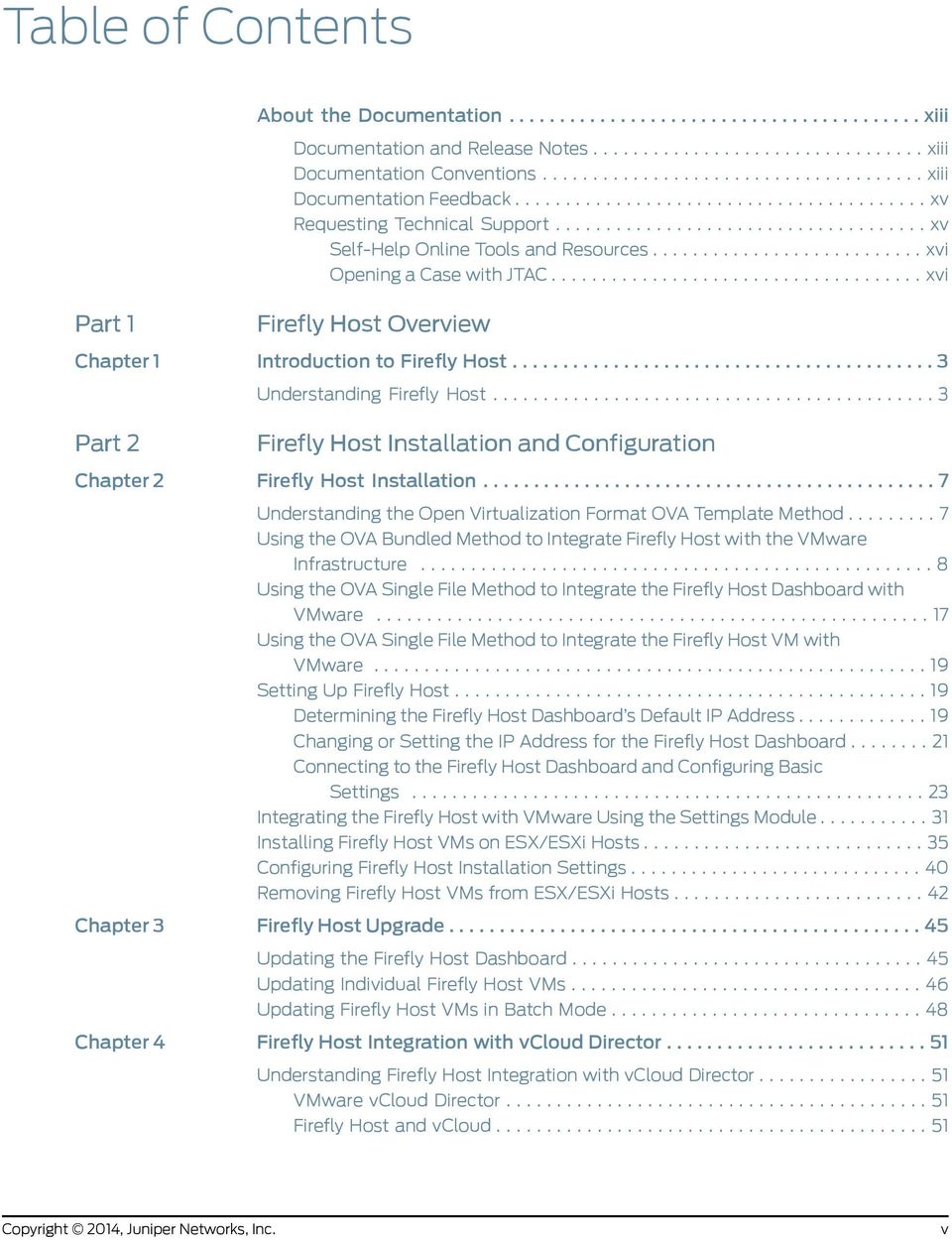
5 Table of Contents About the Documentation xiii Documentation and Release Notes xiii Documentation Conventions xiii Documentation Feedback xv Requesting Technical Support xv Self-Help Online Tools and Resources xvi Opening a Case with JTAC xvi Part 1 Firefly Host Overview Chapter 1 Introduction to Firefly Host Understanding Firefly Host Part 2 Firefly Host Installation and Configuration Chapter 2 Firefly Host Installation Understanding the Open Virtualization Format OVA Template Method Using the OVA Bundled Method to Integrate Firefly Host with the VMware Infrastructure Using the OVA Single File Method to Integrate the Firefly Host Dashboard with VMware Using the OVA Single File Method to Integrate the Firefly Host VM with VMware Setting Up Firefly Host Determining the Firefly Host Dashboard s Default IP Address Changing or Setting the IP Address for the Firefly Host Dashboard Connecting to the Firefly Host Dashboard and Configuring Basic Settings Integrating the Firefly Host with VMware Using the Settings Module Installing Firefly Host VMs on ESX/ESXi Hosts Configuring Firefly Host Installation Settings Removing Firefly Host VMs from ESX/ESXi Hosts Chapter 3 Firefly Host Upgrade Updating the Firefly Host Dashboard Updating Individual Firefly Host VMs Updating Firefly Host VMs in Batch Mode Chapter 4 Firefly Host Integration with vcloud Director Understanding Firefly Host Integration with vcloud Director VMware vcloud Director Firefly Host and vcloud v
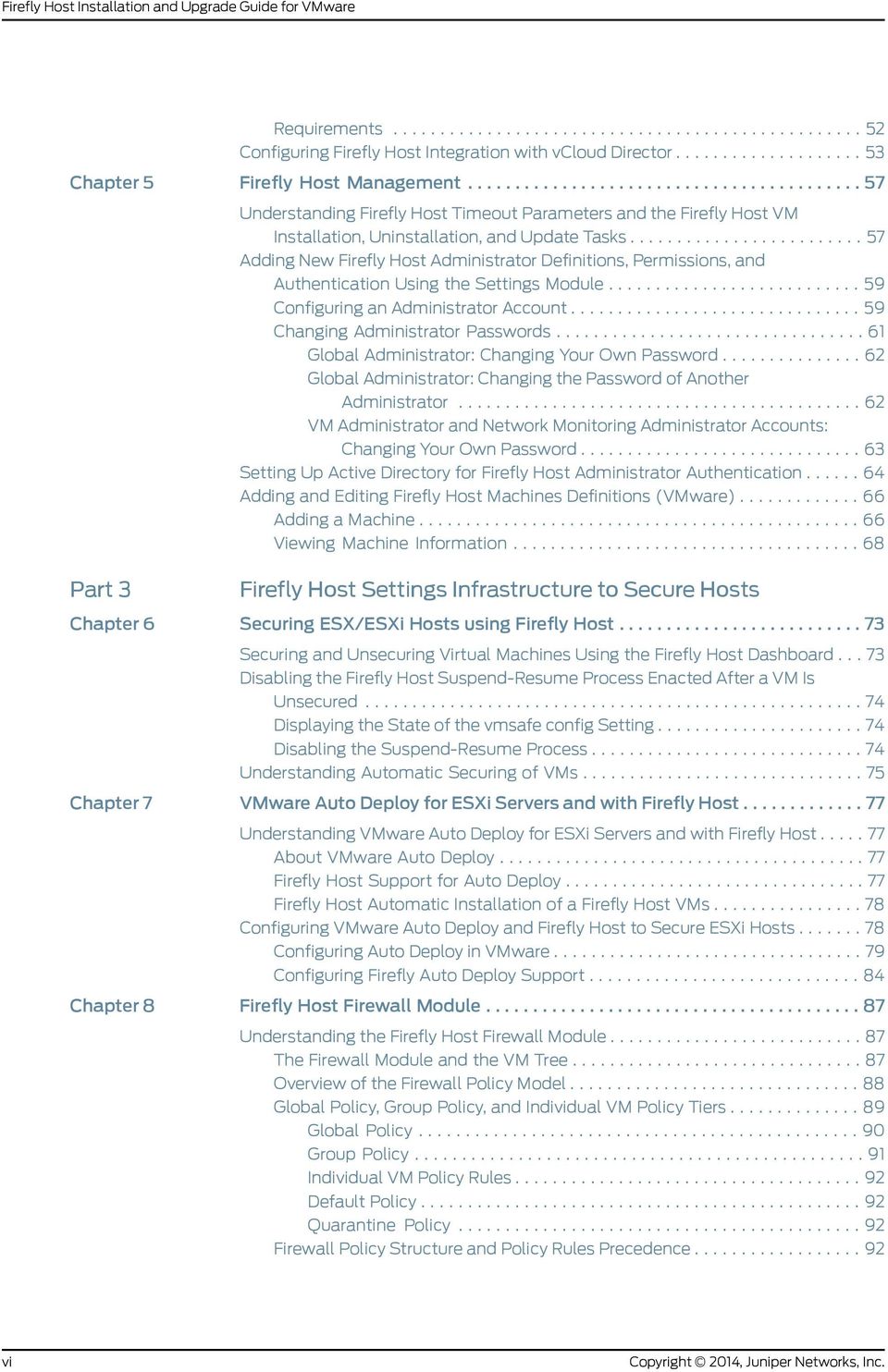
6 Firefly Host Installation and Upgrade Guide for VMware Requirements Configuring Firefly Host Integration with vcloud Director Chapter 5 Firefly Host Management Understanding Firefly Host Timeout Parameters and the Firefly Host VM Installation, Uninstallation, and Update Tasks Adding New Firefly Host Administrator Definitions, Permissions, and Authentication Using the Settings Module Configuring an Administrator Account Changing Administrator Passwords Global Administrator: Changing Your Own Password Global Administrator: Changing the Password of Another Administrator VM Administrator and Network Monitoring Administrator Accounts: Changing Your Own Password Setting Up Active Directory for Firefly Host Administrator Authentication Adding and Editing Firefly Host Machines Definitions (VMware) Adding a Machine Viewing Machine Information Part 3 Firefly Host Settings Infrastructure to Secure Hosts Chapter 6 Securing ESX/ESXi Hosts using Firefly Host Securing and Unsecuring Virtual Machines Using the Firefly Host Dashboard Disabling the Firefly Host Suspend-Resume Process Enacted After a VM Is Unsecured Displaying the State of the vmsafe config Setting Disabling the Suspend-Resume Process Understanding Automatic Securing of VMs Chapter 7 VMware Auto Deploy for ESXi Servers and with Firefly Host Understanding VMware Auto Deploy for ESXi Servers and with Firefly Host About VMware Auto Deploy Firefly Host Support for Auto Deploy Firefly Host Automatic Installation of a Firefly Host VMs Configuring VMware Auto Deploy and Firefly Host to Secure ESXi Hosts Configuring Auto Deploy in VMware Configuring Firefly Auto Deploy Support Chapter 8 Firefly Host Firewall Module Understanding the Firefly Host Firewall Module The Firewall Module and the VM Tree Overview of the Firewall Policy Model Global Policy, Group Policy, and Individual VM Policy Tiers Global Policy Group Policy Individual VM Policy Rules Default Policy Quarantine Policy Firewall Policy Structure and Policy Rules Precedence vi
7 Table of Contents Viewing the Complete Policy Rule Base for a VM The Manage Policy Tab Policy Per vnic and Dual Stack Creating a Policy Rule The Apply Policy Tab The Logs Tab Understanding How Firefly Host Handles ICMPv6 Protocol Traffic About ICMPv Filtering ICMPv6 Packets Default Policy Group for Allowing Inbound ICMPv6 Packets Viewing the Default ICMPv6 Protocols Group Members Editing the Default ICMPv6 Protocols Group Members Understanding Predefined Objects for Firefly Host Firewall Policy Terms Defining and Selecting Source and Destination Terms for Policy Rules Predefined Global IP Address Objects Predefined Network Objects Predefined Network Objects for Well Known IP Addresses Additional IPv4 and IPv6 Predefined Network Objects Configuring Firefly Host Firewall Policies Understanding Firefly Host Predefined Firewall Policy for Its Components Chapter 9 Firefly Host Network Module Understanding the Firefly Host Network Module Network Module Manipulating Displayed Information Changing the Time Interval for Displayed Information Using Advanced Options for Filtering Network Data Sorting Table Data Using the Firefly Host Network and Firewall Modules Cooperatively Network Assessment Using the Network Module to Observe Traffic Coming Into and Going Out from VMs Detecting Unexpected and Unwanted Behavior Using the Network and Firewall Modules Together Part 4 Index Index vii

8 Firefly Host Installation and Upgrade Guide for VMware viii

9 List of Figures Part 2 Firefly Host Installation and Configuration Chapter 2 Firefly Host Installation Figure 1: OVA Template Details Page Figure 2: OVA File Deployment License Agreement Figure 3: Naming the vapp Figure 4: Specifying the Host and Cluster Figure 5: Selecting the Storage Figure 6: Mapping the Firefly Host Management Networks Figure 7: Specifying the Database Disk Size Figure 8: Verifying That the Configuration Is Correct Figure 9: Displaying the Firefly Host Appliance Components Figure 10: Firefly Host Dashboard Summary Tab in vcenter Figure 11: Viewing the Firefly Host Dashboard IP Address in VMware Figure 12: Firefly Host Dashboard IP Addresses on the Firefly Host CLI Console Figure 13: Configuring an IP Address for the Firefly Host Dashboard Figure 14: Logging In to the Firefly Host Dashboard Figure 15: Firefly Host Installation Wizard Overview Figure 16: Changing the Default Password Figure 17: Configuring Network Settings for the Firefly Host Dashboard Figure 18: Configuring the Time Server Figure 19: Firefly Host Installation Wizard displaying Product Licensing Figure 20: Firefly Host Dashboard vcenter Integration Figure 21: Configuring the Firefly Host Dashboard vcenter Settings Figure 22: Securing an ESX/ESXi Host With a Firefly Host VM Figure 23: Installing a Firefly Host VM on an ESX/ESXi Host Figure 24: Specifying Firefly Host Security Parameters During Installation Figure 25: Firefly Host VM Installation Process Completion Notice Figure 26: Firefly Host VM Uninstall Chapter 4 Firefly Host Integration with vcloud Director Figure 27: Firefly Host Dashboard vcenter Integration Window Showing vcloud Director Settings Pane Chapter 5 Firefly Host Management Figure 28: Firefly Host CLI Console Figure 29: Creating a VM Admin Administrator Account Figure 30: Adding a New Administrator Figure 31: Changing the Global Administrator Password Figure 32: Global Administrator Changing the Password of Another Administrator ix

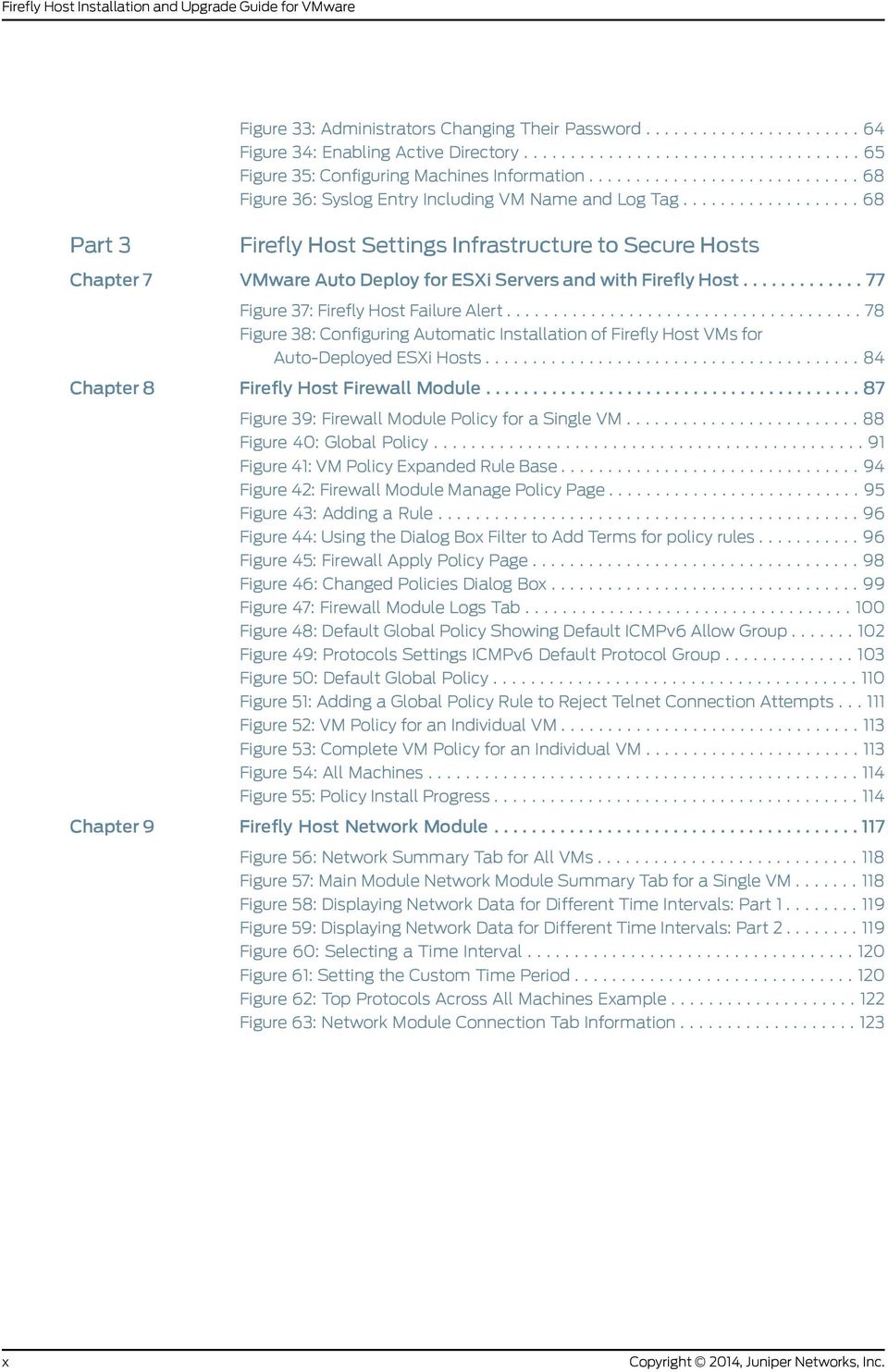
10 Firefly Host Installation and Upgrade Guide for VMware Figure 33: Administrators Changing Their Password Figure 34: Enabling Active Directory Figure 35: Configuring Machines Information Figure 36: Syslog Entry Including VM Name and Log Tag Part 3 Firefly Host Settings Infrastructure to Secure Hosts Chapter 7 VMware Auto Deploy for ESXi Servers and with Firefly Host Figure 37: Firefly Host Failure Alert Figure 38: Configuring Automatic Installation of Firefly Host VMs for Auto-Deployed ESXi Hosts Chapter 8 Firefly Host Firewall Module Figure 39: Firewall Module Policy for a Single VM Figure 40: Global Policy Figure 41: VM Policy Expanded Rule Base Figure 42: Firewall Module Manage Policy Page Figure 43: Adding a Rule Figure 44: Using the Dialog Box Filter to Add Terms for policy rules Figure 45: Firewall Apply Policy Page Figure 46: Changed Policies Dialog Box Figure 47: Firewall Module Logs Tab Figure 48: Default Global Policy Showing Default ICMPv6 Allow Group Figure 49: Protocols Settings ICMPv6 Default Protocol Group Figure 50: Default Global Policy Figure 51: Adding a Global Policy Rule to Reject Telnet Connection Attempts Figure 52: VM Policy for an Individual VM Figure 53: Complete VM Policy for an Individual VM Figure 54: All Machines Figure 55: Policy Install Progress Chapter 9 Firefly Host Network Module Figure 56: Network Summary Tab for All VMs Figure 57: Main Module Network Module Summary Tab for a Single VM Figure 58: Displaying Network Data for Different Time Intervals: Part Figure 59: Displaying Network Data for Different Time Intervals: Part Figure 60: Selecting a Time Interval Figure 61: Setting the Custom Time Period Figure 62: Top Protocols Across All Machines Example Figure 63: Network Module Connection Tab Information x
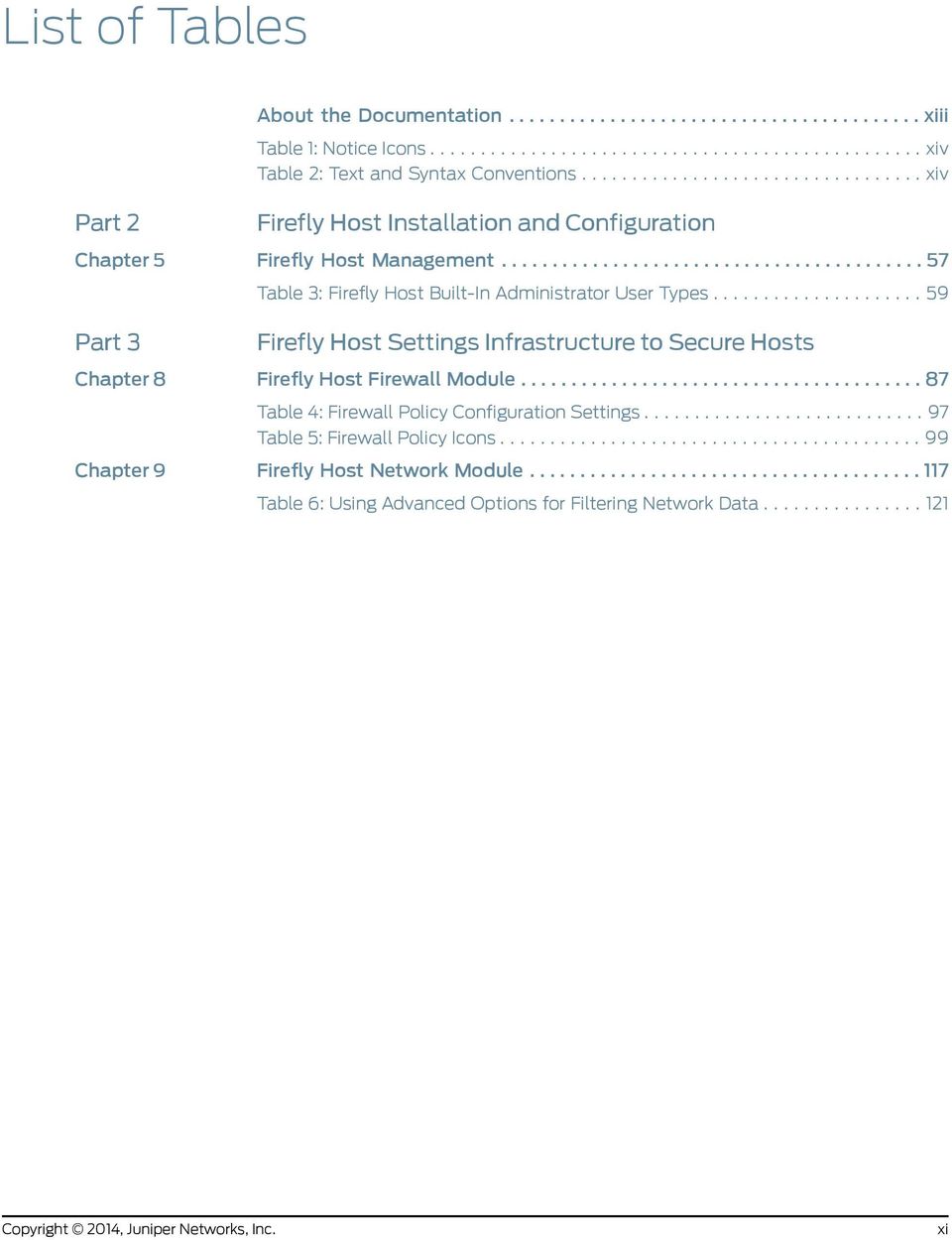
11 List of Tables About the Documentation xiii Table 1: Notice Icons xiv Table 2: Text and Syntax Conventions xiv Part 2 Firefly Host Installation and Configuration Chapter 5 Firefly Host Management Table 3: Firefly Host Built-In Administrator User Types Part 3 Firefly Host Settings Infrastructure to Secure Hosts Chapter 8 Firefly Host Firewall Module Table 4: Firewall Policy Configuration Settings Table 5: Firewall Policy Icons Chapter 9 Firefly Host Network Module Table 6: Using Advanced Options for Filtering Network Data xi
12 Firefly Host Installation and Upgrade Guide for VMware xii

13 About the Documentation Documentation and Release Notes Documentation and Release Notes on page xiii Documentation Conventions on page xiii Documentation Feedback on page xv Requesting Technical Support on page xv Documentation Conventions To obtain the most current version of all Juniper Networks technical documentation, see the product documentation page on the Juniper Networks website at If the information in the latest release notes differs from the information in the documentation, follow the product Release Notes. Juniper Networks Books publishes books by Juniper Networks engineers and subject matter experts. These books go beyond the technical documentation to explore the nuances of network architecture, deployment, and administration. The current list can be viewed at Table 1 on page xiv defines notice icons used in this guide. xiii

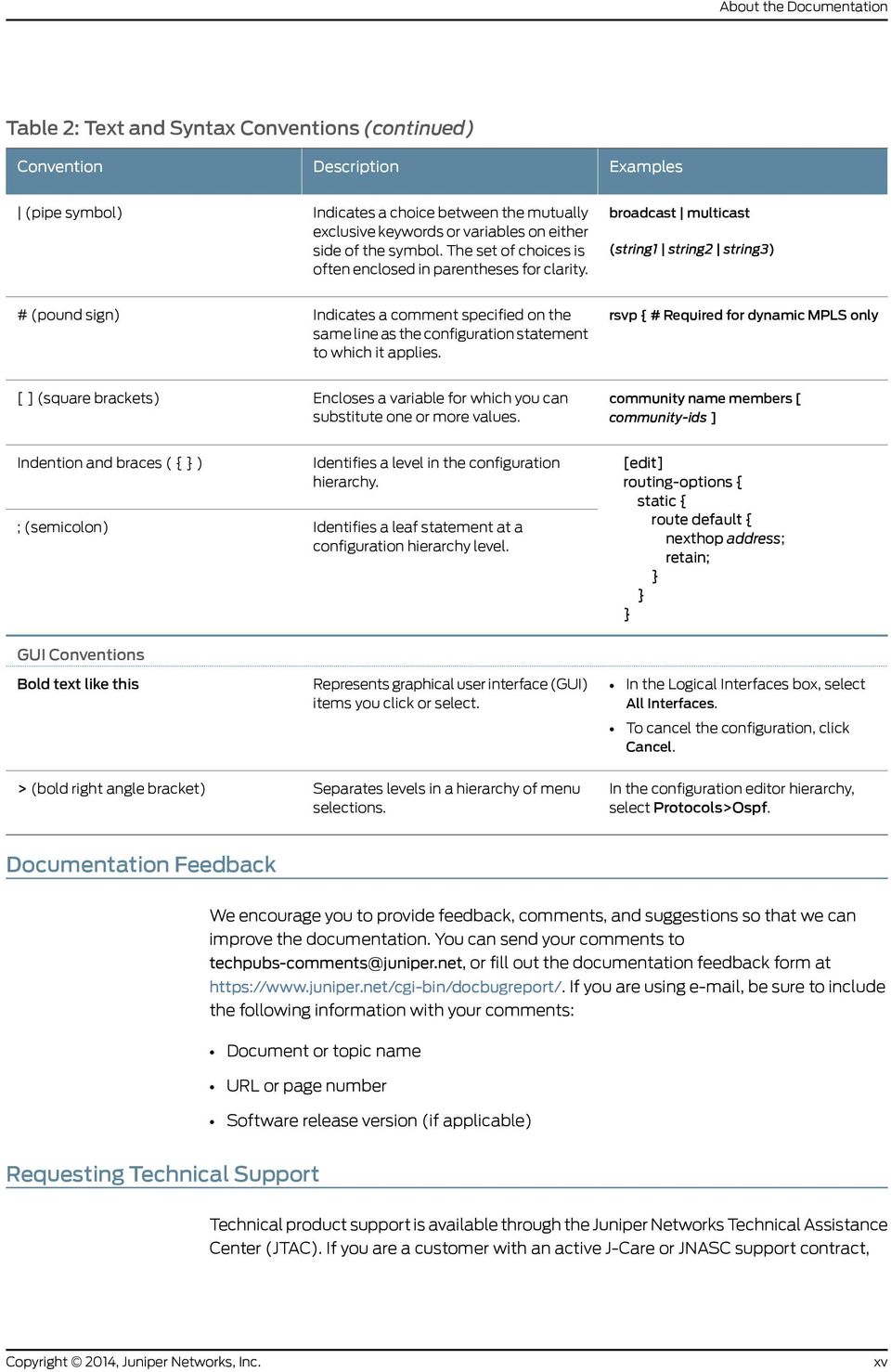
14 Firefly Host Installation and Upgrade Guide for VMware Table 1: Notice Icons Icon Meaning Description Informational note Indicates important features or instructions. Caution Indicates a situation that might result in loss of data or hardware damage. Warning Alerts you to the risk of personal injury or death. Laser warning Alerts you to the risk of personal injury from a laser. Table 2: Text and Syntax Conventions Table 2 on page xiv defines the text and syntax conventions used in this guide. Convention Description Examples Bold text like this Represents text that you type. To enter configuration mode, type the configure command: user@host> configure Fixed-width text like this Italic text like this Represents output that appears on the terminal screen. Introduces or emphasizes important new terms. Identifies guide names. Identifies RFC and Internet draft titles. user@host> show chassis alarms No alarms currently active A policy term is a named structure that defines match conditions and actions. Junos OS CLI User Guide RFC 1997, BGP Communities Attribute Italic text like this Text like this Represents variables (options for which you substitute a value) in commands or configuration statements. Represents names of configuration statements, commands, files, and directories; configuration hierarchy levels; or labels on routing platform components. Configure the machine s domain name: [edit] root@# set system domain-name domain-name To configure a stub area, include the stub statement at the [edit protocols ospf area area-id] hierarchy level. The console port is labeled CONSOLE. < > (angle brackets) Encloses optional keywords or variables. stub <default-metric metric>; xiv
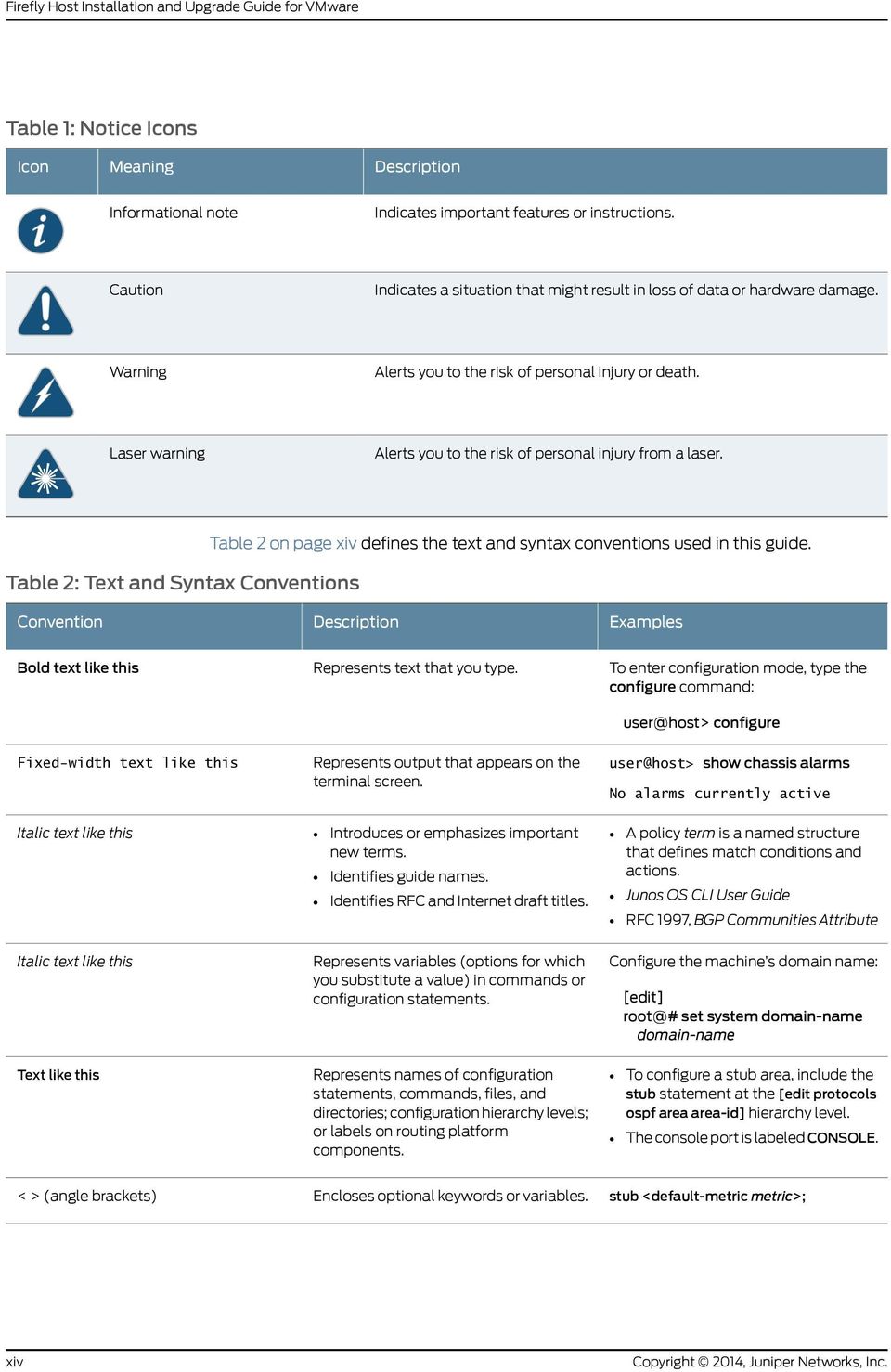
15 About the Documentation Table 2: Text and Syntax Conventions (continued) Convention Description Examples (pipe symbol) Indicates a choice between the mutually exclusive keywords or variables on either side of the symbol. The set of choices is often enclosed in parentheses for clarity. broadcast multicast (string1 string2 string3) # (pound sign) Indicates a comment specified on the same line as the configuration statement to which it applies. rsvp { # Required for dynamic MPLS only [ ] (square brackets) Encloses a variable for which you can substitute one or more values. community name members [ community-ids ] Indention and braces ( { } ) ; (semicolon) Identifies a level in the configuration hierarchy. Identifies a leaf statement at a configuration hierarchy level. [edit] routing-options { static { route default { nexthop address; retain; } } } GUI Conventions Bold text like this Represents graphical user interface (GUI) items you click or select. In the Logical Interfaces box, select All Interfaces. To cancel the configuration, click Cancel. > (bold right angle bracket) Separates levels in a hierarchy of menu selections. In the configuration editor hierarchy, select Protocols>Ospf. Documentation Feedback We encourage you to provide feedback, comments, and suggestions so that we can improve the documentation. You can send your comments to [email protected], or fill out the documentation feedback form at If you are using , be sure to include the following information with your comments: Document or topic name URL or page number Software release version (if applicable) Requesting Technical Support Technical product support is available through the Juniper Networks Technical Assistance Center (JTAC). If you are a customer with an active J-Care or JNASC support contract, xv
16 Firefly Host Installation and Upgrade Guide for VMware or are covered under warranty, and need post-sales technical support, you can access our tools and resources online or open a case with JTAC. JTAC policies For a complete understanding of our JTAC procedures and policies, review the JTAC User Guide located at Product warranties For product warranty information, visit JTAC hours of operation The JTAC centers have resources available 24 hours a day, 7 days a week, 365 days a year. Self-Help Online Tools and Resources For quick and easy problem resolution, Juniper Networks has designed an online self-service portal called the Customer Support Center (CSC) that provides you with the following features: Find CSC offerings: Search for known bugs: Find product documentation: Find solutions and answer questions using our Knowledge Base: Download the latest versions of software and review release notes: Search technical bulletins for relevant hardware and software notifications: Join and participate in the Juniper Networks Community Forum: Open a case online in the CSC Case Management tool: To verify service entitlement by product serial number, use our Serial Number Entitlement (SNE) Tool: Opening a Case with JTAC You can open a case with JTAC on the Web or by telephone. Use the Case Management tool in the CSC at Call JTAC ( toll-free in the USA, Canada, and Mexico). For international or direct-dial options in countries without toll-free numbers, see xvi

17 PART 1 Firefly Host Overview Introduction to Firefly Host on page 3 1

18 Firefly Host Installation and Upgrade Guide for VMware 2

19 CHAPTER 1 Introduction to Firefly Host Understanding Firefly Host Understanding Firefly Host on page 3 Firefly Host delivers complete virtualization security for multitenant public and private clouds, and clouds that are a hybrid of the two. Firefly Host is built off the vgw product line and replaces it. Firefly Host comprises the following three main components: The Firefly Host Dashboard that provides a central management server. It consists of a set of modules that you use to configure the Firefly Host features for your virtualized environment. It provides charts, tables, and graphs that allow you to view information that Firefly Host produces about your environment and use in determining how to adjust your security policy. You use it to install and manage the Firefly Host VMs that you deploy to secure hosts in your virtualized environment. The Firefly Host VM that is installed on each host to be secured. The Firefly Host VM acts as a conduit to the Firefly Host Module that it inserts into the hypervisor of the host that Firefly Host protects. The Firefly Host VM maintains policy and logging information. A Firefly Host VM remains attached to the ESX/ESXi host that it is installed on. The Firefly Host Dashboard pushes the appropriate security policy to the Firefly Host VM which, in turn, inserts it into the Firefly Host Module. The Firefly Host Module Virtualized network traffic is secured and analyzed against the security policy for all VMs on the ESX/ESXi host in the Firefly Host Module installed on the host. All connections are processed and firewall security is enforced in the Firefly Host module. Related Documentation Understanding the Firefly Host Architecture Understanding Cloud Computing and Firefly Host Understanding Hypervisors and Firefly Host Understanding the VMware Infrastructure and Firefly Host Understanding the Firefly Host Dashboard 3

20 Firefly Host Installation and Upgrade Guide for VMware Understanding the Firefly Host VM Firefly Host Prerequisites and Resource Requirements for the VMware Environment 4

21 PART 2 Firefly Host Installation and Configuration Firefly Host Installation on page 7 Firefly Host Upgrade on page 45 Firefly Host Integration with vcloud Director on page 51 Firefly Host Management on page 57 5
22 Firefly Host Installation and Upgrade Guide for VMware 6
23 CHAPTER 2 Firefly Host Installation This chapter explains integrating Firefly Host with VMware and setting up the Firefly Host Dashboard. It also explains installing and uninstalling the Firefly Host VMs on ESX/ESXi Hosts. Understanding the Open Virtualization Format OVA Template Method on page 7 Using the OVA Bundled Method to Integrate Firefly Host with the VMware Infrastructure on page 8 Using the OVA Single File Method to Integrate the Firefly Host Dashboard with VMware on page 17 Using the OVA Single File Method to Integrate the Firefly Host VM with VMware on page 19 Setting Up Firefly Host on page 19 Integrating the Firefly Host with VMware Using the Settings Module on page 31 Installing Firefly Host VMs on ESX/ESXi Hosts on page 35 Configuring Firefly Host Installation Settings on page 40 Removing Firefly Host VMs from ESX/ESXi Hosts on page 42 Understanding the Open Virtualization Format OVA Template Method Firefly Host leverages the Open Virtualization Format (OVF) standard for packaging and delivering virtual machines (VMs). The OVF supports industry-standard content verification and integrity checking, and it provides a basic scheme for managing software licensing. As described by the standard, OVF defines an "open, secure, portable, efficient and extensible format for the packaging and distribution of software to be run in virtual machines." The standard also supports the OVA template method of packaging and distributing software in a single archive. You use the vsphere 4.x client to load the OVA file. You can use OVA to deploy the Firefly Host VMs in the following ways: In a single bundled OVA package, also referred to as a Combo Package that contains the Firefly Host Dashboard and the Firefly Host VM template. Firefly Host uses OVA to deliver a single file containing both Firefly Host components. 7
24 Firefly Host Installation and Upgrade Guide for VMware In nonbundled OVA files to separately deploy the Firefly Host Dashboard and the Firefly Host VM template. The OVA Combo Package installs a vapp, and VMware will not install a vapp on a cluster for which the Dynamic Resource Scheduler (DRS) is not enabled. You can take the nonbundled approach in this case. The nonbundled OVA approach is also useful for installing the most current Firefly Host VM, after the initial installation, to ensure that the latest version is used for automatic Firefly Host VM instantiation on ESX/ESXi hosts. You can also use it to create a secondary Firefly Host Dashboard for high availability. For details, see Installing an Additional Firefly Host Dashboard and Configuring the Primary Firefly Host Dashboard to Use It for High Availability. Related Documentation Using the OVA Single File Method to Integrate the Firefly Host VM with VMware on page 19 Using the OVA Bundled Method to Integrate Firefly Host with the VMware Infrastructure on page 8 Preparing to Integrate Firefly Host with the VMware Environment Understanding the VMware Infrastructure and Firefly Host Understanding Firefly Host on page 3 Using the OVA Bundled Method to Integrate Firefly Host with the VMware Infrastructure This topic explains how to integrate the Firefly Host appliances the Firefly Host Dashboard and the Firefly Host VM template with the VMware virtualized infrastructure. For information on Firefly Host Prerequisites and Resource Requirements for the VMware Environment see Firefly Host Prerequisites and Resource Requirements for the VMware Environment. This topic includes the following sections: Requirements on page 8 Overview on page 8 Downloading the Firefly Host OVA Combo Package on page 9 Integrating the Firefly Host with the VMware Infrastructure on page 9 Requirements For information, see Firefly Host Prerequisites and Resource Requirements for the VMware Environment. Overview The bundled OVA template allows you to deploy both the Firefly Host Dashboard and the Firefly Host VM appliances in a single OVA archive file. In this case, OVA creates a single vapp and inserts the two Firefly Host appliances into it. 8
25 Chapter 2: Firefly Host Installation You can delete the vapp after the deployment and integration process is complete. It is used only to convey the Firefly Host VMs. However, take care not to delete it before then. In the single Combo Package file, the OVA template deploys: The Firefly Host Dashboard The Firefly Host VM You must manually convert the Firefly Host VM to a template after you integrate the Firefly Host with the VMware infrastructure. Firefly Host uses the resulting template to instantiate a Firefly Host VM on each ESX/ESXi host when you secure that host. NOTE: The OVA Combo Package installs a vapp, and VMware will not install a vapp on a cluster for which DRS is not enabled. In this case, you must use the nonbundled OVA method to deploy each component separately. For details, see Using the OVA Single File Method to Integrate the Firefly Host Dashboard with VMware on page 17. For details, see Using the OVA Single File Method to Integrate the Firefly Host VM with VMware on page 19. The Firefly Host software packages are available at: Downloading the Firefly Host OVA Combo Package Step-by-Step Procedure To download the Juniper Networks OVA archive file that contains both the Firefly Host Dashboard and the Firefly Host VM: 1. Navigate to the Juniper Networks Support page. 2. Select Software Downloads from the Support box in the left column. 3. Select Firefly Host (Altor) in the Security pane. 4. Select the Software tab. 5. Click Firefly Host 6.0 Combo Package, and log in to the site to download the file. Integrating the Firefly Host with the VMware Infrastructure Step-by-Step Procedure To deploy the Firefly Host appliances the Firefly Host Dashboard and the Firefly Host VM and integrate them with the VMware infrastructure: 1. Using the vsphere client, load the bundled OVA file. Select Deploy OVF Template from the File menu. 2. Enter the download filename or its URL in the Deploy from file or URL box for example, enter: c:\temp\firefly_ Host_Combo_6.0_#-#-#_#-#-#.ova and click Next. 9
26 Firefly Host Installation and Upgrade Guide for VMware You use the OVF template method to deploy the OVA file. After you specify the name of the OVA file and its location, the Appliance Wizard displays the OVA template details dialog box. 3. Verify the contents of the OVA package, and click Next. Before the wizard unbundles the OVA package, verify that it contains the Firefly Host appliances. The OVA template summary also specifies the disk space requirements for thick and thin provisioning. See Figure 1 on page 10. Figure 1: OVA Template Details Page 4. Accept the Firefly Host license agreement, and click Next. See Figure 2 on page
27 Chapter 2: Firefly Host Installation Figure 2: OVA File Deployment License Agreement 5. Specify a name for the vapp that will be created and a storage location. See Figure 3 on page
28 Firefly Host Installation and Upgrade Guide for VMware Figure 3: Naming the vapp 6. Specify the host or host/cluster on which to run the deployed template. We recommend that you use a network storage device (NAS) so that it can be migrated through VMotion for space optimization. See Figure 4 on page
29 Chapter 2: Firefly Host Installation Figure 4: Specifying the Host and Cluster 7. Select the datastore. Do not use a read-only datastore. Figure 5 on page 13. Figure 5: Selecting the Storage 13
30 Firefly Host Installation and Upgrade Guide for VMware 8. Select the disk format. Accept the thick provisioned format default. Thick provisioning preallocates all required space for the product. 9. Map the networks. Set the Firefly Host management network to a destination network that is accessible to vcenter and the Firefly Host Dashboard. See Figure 6 on page 14. Figure 6: Mapping the Firefly Host Management Networks 10. Specify the size of the database to use for storing Firefly Host files. The database stores network connection records and firewall logs. See Figure 7 on page
31 Chapter 2: Firefly Host Installation Figure 7: Specifying the Database Disk Size The default disk size is 8.0 GB. In a typical environment that includes 5 to 10 ESX/ESXi hosts, a database of this size can accommodate data accumulated over several months. However, for your environment you might want to deploy a database that is larger than 8.0 GB. You can increase the database size later if you find that the current space is not adequate. Although there is no hard-coded limit, we recommend restricting the size to less than 75 GB. 11. Verify that the configuration is correct, and click Finish to complete the deployment. See Figure 8 on page 15. Figure 8: Verifying That the Configuration Is Correct The Virtual Appliance Wizard downloads the files and inserts the Firefly Host VMs as a single virtual appliance (vapp) into the VMware infrastructure. 15
32 Firefly Host Installation and Upgrade Guide for VMware When the OVA import is completed, the vcenter includes the vapp containing both the Firefly Host Dashboard and the Firefly Host VM template components. 12. Expand the appliance called Juniper Firefly Host 6.0 to display the Firefly Host Dashboard and the Firefly Host VM. See Figure 9 on page 16. Figure 9: Displaying the Firefly Host Appliance Components Move the two Firefly Host VMs out from the vapp. Afterward you can delete the vapp if you choose to, but it is not necessary. NOTE: Firefly Host uses the VMware vapp deployment feature as a vehicle to deliver multiple VMs in the same OVA file. The vapp structure is redundant after it is used for deployment, and therefore you can delete it. However, do not delete the vapp without first having moved the Firefly Host VMs out from it. If you do, the newly created Firefly Host VMs would be deleted when you delete the vapp. After you remove the Firefly Host VMs from the vapp: a. Convert the Firefly Host-Firefly Host VM-Template VM to a template that the Firefly Host Dashboard and installer can use to instantiate a Firefly Host VM on each ESX/ESXi host to be secured. Right-click the template, select Template, and select Convert to Template. b. Right-click the Firefly Host Dashboard and power it on. Figure 10 on page 17 shows the vcenter summary information for the Firefly Host Dashboard. Figure 10 on page 17 shows the vcenter summary information for the Firefly Host Dashboard. 16
33 Chapter 2: Firefly Host Installation Figure 10: Firefly Host Dashboard Summary Tab in vcenter Related Documentation Firefly Host Prerequisites and Resource Requirements for the VMware Environment Understanding Firefly Host on page 3 Understanding the VMware Infrastructure and Firefly Host Using the OVA Single File Method to Integrate the Firefly Host Dashboard with VMware on page 17 Using the OVA Single File Method to Integrate the Firefly Host VM with VMware on page 19 Understanding the Firefly Host Dashboard Understanding the Firefly Host VM Using the OVA Single File Method to Integrate the Firefly Host Dashboard with VMware This topic explains how to download and deploy a single OVA file containing the Firefly Host Dashboard. To download an OVA file containing the Firefly Host Dashboard appliance and deploy it: 1. Download the Juniper Networks Firefly Host OVA file. a. Navigate to the Juniper Networks Support page. b. Select Software Downloads from the Support box in the left column. c. Select Firefly Host (Altor) in the Security pane. 17
34 Firefly Host Installation and Upgrade Guide for VMware d. Select the Software tab. e. Click DashboardFirefly Host 6.0, and log in to the site to download the file. 2. Load the OVA file for the Firefly Host Dashboard using the vsphere 4.x client (File > Deploy OVF Template), and enter the name of the OVA download file in the Deploy from file or URL box. For example, enter: c:\temp\dashboardfireflyhost.ova. 3. Follow the Virtual Appliance Wizard process, and select the appropriate options for your environment. 4. Click Finish to download the files and integrate the Firefly Host Dashboard with the VMware infrastructure. After the Firefly Host Dashboard import process is completed, you must add a virtual hard disk for it. NOTE: This step is not required for the bundled approach because it is done automatically. The default disk size is 8.0 GB. In a typical environment that includes 5 to 10 ESX/ESXi hosts, a database of this size can accommodate data accumulated over several months. For your environment you might want to deploy a database larger than 8.0 GB. Note that you can increase the database size later if you find that the current space is not adequate. The disk should not be thin-provisioned. 5. Add a disk to be used as the datastore: a. Select Firefly Host Dashboard. b. Select the Summary tab, and click Edit Settings > Add a Hard Disk virtual device. This disk is used for the database that stores network connection records and firewall logs. Select a NAS device so that VMotion can be used to migrate the datastore. 6. Power on the Firefly Host Dashboard. Related Documentation Firefly Host Prerequisites and Resource Requirements for the VMware Environment Understanding Firefly Host on page 3 Understanding the VMware Infrastructure and Firefly Host Using the OVA Single File Method to Integrate the Firefly Host VM with VMware on page 19 Understanding the Firefly Host Dashboard Understanding the Firefly Host VM 18
35 Chapter 2: Firefly Host Installation Using the OVA Single File Method to Integrate the Firefly Host VM with VMware To download a nonbundled OVA file containing the Firefly Host VM and deploy it: 1. Load the OVA file for the Firefly Host VM using the VMware vsphere Client (File > Deploy OVF Template), and insert the template name Firefly Host-Firefly Host VM-Template in the Deploy from file or URL box. For example, enter c:\temp\firefly Host-Firefly Host VM-Template.ova. 2. Select the appropriate options for your environment in each of the steps presented by the Virtual Appliance Wizard. Configure the host/cluster, resource pool, and so on, that is appropriate for your environment. When you are asked for network mapping information, accept the default settings. Firefly Host automatically configures these settings later. 3. When the Virtual Appliance Wizard completes, right-click the resulting VM and select Template > Convert to Template. You can use the resulting template to automate installation of Firefly Host VMs on ESX/ESXi hosts to secure parts of your virtual network. The Firefly Host Dashboard and installer require the template to instantiate the Firefly Host VM on hosts to be secured. Related Documentation Firefly Host Prerequisites and Resource Requirements for the VMware Environment Using the OVA Single File Method to Integrate the Firefly Host VM with VMware on page 19. Using the OVA Bundled Method to Integrate Firefly Host with the VMware Infrastructure on page 8 Preparing to Integrate Firefly Host with the VMware Environment Setting Up Firefly Host After you download and integrate Firefly Host with the VMware environment and power on the Firefly Host Dashboard, you can configure its basic system parameters. This topic explains how to connect to the Firefly Host Dashboard to configure basic settings. It describes how to use the Firefly Host wizard to configure those settings initially. This topic includes the following sections: Determining the Firefly Host Dashboard s Default IP Address on page 19 Changing or Setting the IP Address for the Firefly Host Dashboard on page 21 Connecting to the Firefly Host Dashboard and Configuring Basic Settings on page 23 Determining the Firefly Host Dashboard s Default IP Address To access the Firefly Host Dashboard, you enter its IP address in a supported Web browser. 19
36 Firefly Host Installation and Upgrade Guide for VMware When you powered on the Firefly Host Dashboard during Firefly Host integration with VMware, which is described in Using the OVA Bundled Method to Integrate Firefly Host with the VMware Infrastructure on page 8, it acquired an IP address that you can view on the vcenter Summary page. By default, the Firefly Host Dashboard is configured to use IPv4 DHCP to acquire its address. If problems occur and it cannot obtain an IP address in this manner, it tries other methods. In order, these are the three methods that the Firefly Host Dashboard uses in an attempt to obtain an IP address: IPv4 DHCP IPv6 autoconfiguration With stateless IPv6 autoconfiguration, the Firefly Host Dashboard acquires its IPv6 address automatically without the intervention of a DHCP server. IPv6 DHCPv6 NOTE: If DHCP is not available on the Firefly Host Dashboard network, you can log into the console using admin for both the username and the password. Type config network at the command prompt and proceed through the options to assign an IP address. After an IP address is set whether DHCP or static, you can access the Firefly Host Dashboard through a Web browser. To view the IP address bound to the Firefly Host Dashboard: 1. Launch the VMware vsphere Client, and select the Firefly Host Dashboard icon on the left navigation pane. 2. Select the Summary tab. The IP address that was acquired appears in the IP Addresses: field. See Figure 11 on page
37 Chapter 2: Firefly Host Installation Figure 11: Viewing the Firefly Host Dashboard IP Address in VMware After you have obtained the IP address, follow the instructions in Connecting to the Firefly Host Dashboard and Configuring Basic Settings on page 23 to configure the basic settings. Changing or Setting the IP Address for the Firefly Host Dashboard You can use the Firefly Host command-line interface (CLI) to set the IP address for the Firefly Host Dashboard. To use the Firefly Host CLI from the vcenter console: 1. Launch the VMware vsphere Client. 2. Right-click the Firefly Host Dashboard icon on the left navigation panel to display a list of options. 3. Select the third option on the list, Open Console. Alternatively you can select the Console tab, as shown in Figure 12 on page 22. The console window appears. 21
38 Firefly Host Installation and Upgrade Guide for VMware Figure 12: Firefly Host Dashboard IP Addresses on the Firefly Host CLI Console 4. At the CLI prompt enter config network. Enter admin for both the username and password. In this mode you can configure the IP address for the Firefly Host Dashboard. You can specify an IP address for either IP protocol family. See Figure 13 on page 22. Figure 13: Configuring an IP Address for the Firefly Host Dashboard 5. In response to the prompt What type of IP address do you want to set? enter the number preceding the type of IP address that you want to be assigned to the Firefly Host Dashboard and how it is to be acquired. For example, the administrator might enter 4 for 4) ipv6 autoconfiguration. 6. The Firefly Host CLI gives you the opportunity to cancel by presenting the prompt Are you sure?. If you enter y for yes, Firefly Host shuts down the interface and brings it back up with the new IP address. 22
39 Chapter 2: Firefly Host Installation Connecting to the Firefly Host Dashboard and Configuring Basic Settings This section explains how to set up the Firefly Host Dashboard initially. 1. Using a supported Web browser, connect to the Firefly Host Dashboard management interface through HTTPS. Enter the IP address of the Firefly Host Dashboard in the Web browser. This is the IP address that was assigned when you powered on the Firefly Host Dashboard. Firefly Host supports the following Web browsers: Microsoft Internet Explorer 7, 8, and 9 Mozilla Firefox 3 or later 2. Enter admin for both the username and password. See Figure 14 on page 23. Figure 14: Logging In to the Firefly Host Dashboard 3. Read the information message, and review the process overview shown in the Wizard Progress pane. See Figure 15 on page
40 Firefly Host Installation and Upgrade Guide for VMware Figure 15: Firefly Host Installation Wizard Overview 4. Change the default Firefly Host global administrator account password admin that you used to log in. You must change the default password. See Figure 16 on page 24. Store the new password in a secure location. It is difficult to recover a lost or forgotten global administrator account password. If you wish, you can change the password that you specify here later, but to do so you must enter your current password, which would be the one that you configured here. TIP: You can integrate administration accounts with the Firefly Host Dashboard after the installation is completed. For information on how to do that later, see Adding New Firefly Host Administrator Definitions, Permissions, and Authentication Using the Settings Module on page 59. Figure 16: Changing the Default Password 5. Configure networking parameters for the Firefly Host Dashboard. NOTE: If you changed the IP address, you must log in to the system again. Changes to the IP address take effect immediately. 24
41 Chapter 2: Firefly Host Installation Set the correct destination network for the Firefly Host Dashboard and leave the VMsafe Network unchanged. At this point you can configure other network information for the Firefly Host Dashboard, such as whether to use dual stack for it and how it obtains its management interface addresses. A dual-stack device can connect to an IPv4-only device or an IPv6-only device, or it can connect to another device that implements dual stack. For its management interface addressing mode, either accept the default dual stack values of DHCP for IPv4 and DHCPv6 for IPv6 or change the values by selecting: IPv4 DHCP (Default): To obtain an IPv4 address, by default the Firefly Host Dashboard is configured to use DHCP. You do not need to specify additional information. Static IP. If you select Static IP, you must specify a static IPv4 address and its network mask routing prefix, and the default gateway to assign to the Firefly Host Dashboard. IPv6 DHCPv6 ( Default): To obtain an IPv6 address, by default the Firefly Host Dashboard is configured to use DHCPv6. You do not need to specify additional information. Autoconfiguration. If you select Autoconfiguration, stateless address autoconfiguration is used to obtain the IPv6 address. It allows network devices attached to an IPv6 network to automatically acquire IP addresses and connect to the Internet without intermediate interaction with a DHCPv6 server. Static IP. If you select Static IP, you must specify a static IPv6 address, including the IPv6 address prefix (the initial bits of the address that denote the network address, akin to a netmask), and the default gateway to use for it. NOTE: By default, a dual stack Firefly Host Dashboard communicates with a Firefly Host VM using the IPv4 protocol. However, you can use the Firefly Host CLI to change the default IP protocol used by setting the center.dual.stack.default.communication.ipv4 parameter to false. center.dual.stack.default.communication.ipv4=false By default, this parameter is set to true. This parameter is relevant only if the Firefly Host Dashboard is configured for dual stack and one or more Firefly Host VMs is also configured for dual stack. In all other cases, the protocol used is the one that is common to both the Firefly Host Dashboard and the Firefly Host VM, and this parameter is irrelevant. 25
42 Firefly Host Installation and Upgrade Guide for VMware If you do not want the Firefly Host Dashboard to be configured for dual stack which is its default configuration, you can change the configuration in the following way: To use only IPv4 for Firefly Host Dashboard management communication with its Firefly Host VMs, disable IPv6. On the displayed list for the IPv6: box, select Disabled. To use only IPv6 for Firefly Host Dashboard management communication with its Firefly Host VMs, disable IPv4. On the displayed list for the IPv4: box, select Disabled. How you configure addressing for the Firefly Host Dashboard management center affects its communication with its Firefly Host VMs in the following way: In an environment in which both the Firefly Host Dashboard and the Firefly Host VM are configured for dual stack, communication problems between the Firefly Host Dashboard management interface and that of the Firefly Host VMs should not occur. In an environment in which the Firefly Host Dashboard is configured for dual stack but one or more of the Firefly Host VMs is not, communication problems between their management interfaces should not occur. In an environment in which the Firefly Host Dashboard is not configured for dual stack but all of the Firefly Host VMs are, communication problems between their management interfaces should not occur. In an environment in which neither the Firefly Host Dashboard nor one or more Firefly Host VM is configured for dual stack, in any case in which the IP address type of the management interfaces of the Firefly Host Dashboard and the Firefly Host VM differ one might belong to the IPv6 protocol family and the other to the IPv4 protocol family communication problems will occur. The Firefly Host Dashboard will not be able to connect to the Firefly Host VM to carry out any procedures. You can make these changes during the installation process, as shown Figure 17 on page 26, or you can make them later, after you complete the initial configuration. Figure 17: Configuring Network Settings for the Firefly Host Dashboard 26
43 Chapter 2: Firefly Host Installation In the latter case, you use the Settings module Appliance Settings > Network Settings page, which is the same page shown in Figure 17 on page 26, only it is arrived at differently. For additional details, see Configuring the Firefly Host Network Settings. NOTE: If you changed the IP address, you must log in to the system again. Changes to the IP address take effect immediately. 6. Set the system time. Set the correct time zone, and then specify the NTP servers for your environment. See Figure 18 on page 27. Firefly Host components require that the correct system time be set on all ESX/ESXi hosts. If you do not have an NTP server, you can use a predefined server. If you do not have outbound Internet access to contact the NTP servers and you do not have an internal NTP server, then you must clear all entries shown in this window and set the time manually. To do this, you use the Firefly Host CLI that you run from the vcenter console. Figure 18: Configuring the Time Server At this point, the wizard determines if the database disk was created and initialized properly. If you have not defined the database disk properly, the wizard displays a message. The next screen explains Product Licensing. On the installation wizard, there is no option to enter purchased license information directly. See Figure 19 on page
44 Firefly Host Installation and Upgrade Guide for VMware Figure 19: Firefly Host Installation Wizard displaying Product Licensing Click Next Step. Licenses can be added after wizard completion. For additional information on Firefly Host licenses, see Understanding Licenses for Firefly Host Viewing Status and License Information Using the Firefly Host Settings Module Adding and Managing Firefly Host Licenses 7. Select the management domain, or scope, for this Firefly Host Dashboard to manage, and verify that the Firefly Host Dashboard can establish a connection to vcenter. Then click Next Step. For the Firefly Host to query the vcenter for the VM inventory and other operations, you must have an account with read/write access. If the connection works properly, a message appears stating that the login was successful, and it identifies the number of ESX/ESXi hosts and VMs that were discovered. If there is a connection issue, you are notified. In that case, ensure that you have the correct credentials and that IP connectivity to the vcenter exists. In some cases, you may need to insert another vnic into the Firefly Host Dashboard. You must connect that vnic to the network that connects to the vcenter server. To configure a management domain: If this Firefly Host Dashboard will manage all of the vcenter s resources, select Entire vcenter. If this Firefly Host Dashboard will participate in a Split-Center configuration, select the data centers or the host clusters for this Firefly Host Dashboard to manage. To select host clusters, first select the data center that the host clusters belong to. 28
45 Chapter 2: Firefly Host Installation For information on Split-Center and its configuration options, see Understanding the Firefly Host Split-Center Feature. Figure 21 on page 30 shows that this Firefly Host Dashboard is configured to manage two host clusters in Datacenter-B. Figure 20: Firefly Host Dashboard vcenter Integration 29
46 Firefly Host Installation and Upgrade Guide for VMware Figure 21: Configuring the Firefly Host Dashboard vcenter Settings 8. (Optional) Configure the server to use to send reports. Using this option, you can configure Firefly Host to send reports on system activity through . Additionally, you can configure basic information used in the report, such as the subject and the content of standard report . After you configure these parameters, you can test the connection. You can also use the Settings module Firefly HostApplication Settings > and Reporting page to configure this information after the installation is completed. 9. Define a template to use to instantiate Firefly Host VMs on ESX/ESXi hosts to secure them. If you have not downloaded the Firefly Host VM and converted it to a template, do so now. You can define how the Firefly Host responds when a VM tries to connect to an ESX/ESXi host on which the Firefly Host module cannot be loaded or is not present. You can define whether monitoring is used. Unless you plan to deploy the product in monitor mode, leave the Monitoring-only option for VMsafe unchecked. Also, unless you want to drop network traffic to VMs when the Firefly Host fails to load, you should leave the default option of Allow All traffic selected. You can change this option later if you want to change the behavior for one or more VMs. 10. Click Done to complete the Firefly Host Dashboard setup. The Firefly Host Dashboard appears. You use this module to deploy Firefly Host VMs to the ESX/ESXi hosts to be secured, to configure other Firefly Host features, and to view specific and summary results information and reports. 30
47 Chapter 2: Firefly Host Installation Related Documentation Preparing to Integrate Firefly Host with the VMware Environment Understanding Firefly Host on page 3 Understanding the Firefly Host Settings Module Understanding the Firefly Host Main Module Integrating the Firefly Host with VMware Using the Settings Module This topic explains the vcenter Integration settings page that allows you to configure parameters that control the interaction between Firefly Host and VMware. It covers how to change the Firefly Host VMware settings, direct VMware to update the Firefly Host Dashboard with VMs inventory information, change the settings that control how deleted VMs and information about them is handled, and how to integrate the Firefly Host with the VMware infrastructure. You can also use it to change the management domain, or scope, for the Firefly Host Dashboard, after you configure it initially when you install the product. The management domain specifies the data centers and host clusters in the vcenter that your Firefly Host Dashboard manages. The Firefly Host Dashboard uses the VMware Virtual Infrastructure APIs to: Obtain VM Inventory information Determine resource utilization status Determine events affecting the VMs The account used for vcenter must have read-write access to the VMware Infrastructure. You can use a custom account created in VMware; this approach makes it easier to identify and monitor activities that change. In any case, the account must have administrator privileges. The Settings module Firefly Host Application Settings > vcenter Integration page contains the following panes and their settings for which you either enter information or whose values you can change: vcenter Settings Login information required for the Firefly Host Dashboard to communicate with the VMware vcenter and for administrator access to the vcenter. Specify the following information: Server Name or IP Address: Name of the vcenter or its IPv4 or IPv6 address. Username: and Password: Your administrator authentication information for accessing vcenter. Scope Allows you to specify the vcenter s data centers and host clusters to be managed by your Firefly Host Dashboard. You set this value initially when you install the product. See Setting Up Firefly Host on page 19 for details on initially setting the management domain. 31
48 Firefly Host Installation and Upgrade Guide for VMware You use this pane to change the management domain scope. The scope for your Firefly Host Dashboard can be: Entire vcenter In this case, the Firefly Host Dashboard is able to access and manage all VMs and other entities in all data centers in the vcenter. To use this scope, select Entire vcenter. Datacenter A subset of data centers in the vcenter. In this case, the Firefly Host Dashboard is able to access and manage only the VMs and other entities in the selected data centers. To use this scope: 1. Select Datacenters. Firefly Host displays all of the vcenter s data centers. NOTE: To update the list of data centers at any time to show changes datacenters that might have been added or removed click Refresh. 2. Select the data centers for your Firefly Host Dashboard to manage. Ensure that each data center is assigned to only one Firefly Host Dashboard. Otherwise, unexpected consequences can occur. For an overview of the Split-Center feature, see Understanding the Firefly Host Split-Center Feature. 3. Click Save. Clusters A subset of host clusters in a data center. In this case, the Firefly Host Dashboard is able to access only the VMs and other entities on the selected host clusters. NOTE: All of the host clusters that you select to belong to a management domain (scope) must be in the same data center. You cannot include host clusters from two or more different data centers in the scope. To use the Clusters scope: 1. Click Clusters in the Select a scope for your Firefly Host Dashboard area. In response, Firefly Host displays a list of available data centers. 2. Select a data center from the displayed list whose host clusters you want the Firefly Host Dashboard to manage. a. Click the arrow at the end of the box beside Datacenter: to display a list of data centers for the vcenter. 32
49 Chapter 2: Firefly Host Installation b. Click the data center whose cluster(s)/host(s) you want your Firefly Host Dashboard to manage. Firefly Host displays a list of cluster(s)/host(s) for the data center that you selected. 3. Select the check box before the names of the cluster(s)/host(s) that you want to include in your management domain. 4. Click Save. NOTE: Ensure that each host cluster is assigned to only one Firefly Host Dashboard. Otherwise, unexpected consequences can occur. You can change the cluster selection at any time. However, when you change the cluster scope, either of the following conditions can occur: Some Firefly Host VMs could become unmanaged This can occur when you remove a cluster from the list of selected clusters. Any Firefly Host VM installed on an ESX/ESXi host that belongs to the removed cluster will no longer be accessible, and therefore it is no longer managed by the Firefly Host VM. Some unmanaged Firefly Host VMs could become accessible If ESX/ESXI hosts that belong to a cluster that you add to your Firefly Host Dashboard management domain had a Firefly Host VM installed on them by a different Firefly Host Dashboard, you could gain access to the Firefly Host VMs. It is possible and important to gain access to an unmanaged Firefly Host VM when you add its host cluster to your Firefly Host VMs management domain for the following reason. When a Firefly Host VM becomes inaccessible because of cluster or datacenter selection changes its original Firefly Host Dashboard, its operational state might be compromised unless it is imported into another Firefly Host Dashboard. This is because the Firefly Host VM continues to try to communicate with its original Firefly Host Dashboard, which no longer recognizes it as a managed. To view a list of unmanaged SVMs and render them manageable again: 1. Display the Settings module > Firefly Host VM Settings page. The unmanaged Firefly Host VMs are identified by a gray triangle status indicator. 2. To make a Firefly Host VM manageable again, click its row to select it. 3. Click Import. After you save the selection, Firefly Host synchronizes all objects from vcenter. When it completes the process, Firefly Host displays a message indicating the ESX/ESXi hosts and the VMs that were found. Deleted VMs and Groups Firefly Host can show information about any VMs and groups of VMs that it has encountered across time even if the VMs were deleted in VMware s vcenter system repository. This capability allows you to keep historic traffic records. 33
50 Firefly Host Installation and Upgrade Guide for VMware It allows you to see all activity occurring in VMware across time. The VM s information persistency in the Firefly Host Dashboard can reveal attempts by a malicious administrator or hacker to bring up a VM, perform an unauthorized activity, and then delete the VM to hide their tracks. You can change how Firefly Host handles VMs that are deleted from vcenter using the following settings: Hide deleted VMs from view in the Inventory Tree check box. By default, the Hide deleted VMs from view in the Inventory Tree check box is selected. However, if you do not want the deleted VMs appearing in the VM Tree, you can clear this menu item and they will be hidden from view. The deleted VMs are still available to view again. By selecting the check box, they are again made visible in the VM Tree. Delay before purging deleted VMs and Groups in days (-1 = never): setting. Enter the number of days after which Firefly Host should purge deleted VMs and groups of VMs that have been deleted from vcenter. After that time, the VMs and all information pertaining to them is permanently deleted from Firefly Host. For example, if you do not change the default value of 30 days and a VM is deleted in vcenter, at any time up to 30 days Firefly Host is still able to make the VM information visible again (unhide). On the 31st day, the VM and all information pertaining to it is permanently removed from Firefly Host. Firefly Host management server plug-in Use this button to install the Firefly Host plug-in into the vcenter interface. To install the plug-in, click Register. To view and use the plug-in, in the vsphere Client interface select Home -> Solutions and Applications. To remove the Firefly Host Management Plug-in, click Unregister. Automatic Startup of the Firefly Host Dashboard and Firewall Use this setting to enable or disable the startup of Firefly Host components when an ESX/ESXi system reboots. Firefly Host components are set to start up automatically by default. Synchronize machine name Changing the name of a VM in vcenter by default causes the name of the equivalent VM object in Firefly Host Dashboard to be changed to the same value. To override this setting, clear the value for this item. For example, security administrators might want to use this override feature if they are not using the same naming convention as the VM team. The ability to override the default behavior is also useful if security administrators have created dynamic security policies using the name of the VM, and they do not want them affected by simple name changes in the vcenter. Related Documentation Understanding Firefly Host on page 3 Understanding the VMware Infrastructure and Firefly Host Understanding the Firefly Host Dashboard 34
51 Chapter 2: Firefly Host Installation About the Firefly Host Dashboard Tree Installing Firefly Host VMs on ESX/ESXi Hosts A Firefly Host VM protects and secures virtual machines (VMs) on an ESX/ESXi host where it is installed. The Firefly Host VM acts as a conduit to the Firefly Host Module which it inserts into the hypervisor of the host that it protects when it is installed. The Firefly Host Dashboard pushes the appropriate security policy to the Firefly Host VM which in turn inserts it into the Firefly Host Module. All connections are processed and firewall security is enforced in the Firefly Host module. In other words, virtualized network traffic is secured and analyzed against the security policy in the Firefly Host Module. You deploy a Firefly Host VM to each ESX/ESXi host in your environment that you want Firefly Host to secure and monitor. The Firefly Host VM protects VMs on that host and it gathers information about network traffic. It also maintains policy and logging information. Securing an ESX/ESXi host with a Firefly Host VM entails the following two parts: First you must install a Firefly Host VM on the ESX/ESXi host to be secured. It is during this process that the Firefly Host VM inserts the Firefly Host module into the hypervisor of the ESX/ESXi host. This topic covers that process. Next you must select the VMs on the secured host that you want Firefly Host to protect with a firewall policy and other features. The Firefly Host VM obtains the policy for the VM from the Firefly Host Dashboard and provides the Firefly Host (hypervisor) module with it. See Securing and Unsecuring Virtual Machines Using the Firefly Host Dashboard on page 73 for details on the second part of the process. To install the Firefly Host VM on an ESX/ESXi host: 1. Select the Settings module Firefly Host Application Settings > Installation page. 2. In the Unsecured Network pane, select the host in the data center that you want to secure with Firefly Host. See Figure 22 on page 36. You can secure only one host at a time. 35
52 Firefly Host Installation and Upgrade Guide for VMware Figure 22: Securing an ESX/ESXi Host With a Firefly Host VM An empty check box appears before each host that is able to run the Firefly Host module. These hosts are not yet protected, but the check box indicates that you can secure them. 3. Click Secure. After you initiate the installation process, a message is displayed indicating that VMware might require putting the ESX/ESXi host into maintenance mode and rebooting it. See Figure 23 on page 36. Note that the message shown in this figure might differ somewhat depending on the Firefly Host version that you are installing. Figure 23: Installing a Firefly Host VM on an ESX/ESXi Host 4. Click OK. A dialog box is displayed allowing you to enter a name and specify other parameters for the Firefly Host VM. See Figure 24 on page
53 Chapter 2: Firefly Host Installation Figure 24: Specifying Firefly Host Security Parameters During Installation Specify or select values for the following parameters: a. Enter a name for the Firefly Host VM. b. Select the Firefly Host VM security management interface addressing mode. The Firefly Host Dashboard communicates with the Firefly Host VM management interface based on this addressing mode. This interface must be reachable by the management interface of the Firefly Host Dashboard. Firefly Host supports both IPv4 and IPv6 address types. As such, the Installation Wizard for Firefly Host VMs allows you to enter information for both types. Select values for: IPv4 DHCP (Default): To obtain an IPv4 address, by default the Firefly Host VM is configured to use DHCP. You do not need to specify additional information. Static IP. If you select Static IP, you must specify a static IPv4 address and its network mask routing prefix, and the default gateway to assign to the Firefly Host VM. IPv6 DHCPv6 ( Default): To obtain an IPv6 address, by default the Firefly Host VM is configured to use DHCPv6. You do not need to specify additional information. Autoconfiguration. If you select Autoconfiguration, stateless address autoconfiguration is used to obtain the IPv6 address. It allows network devices attached to an IPv6 network to automatically acquire IP addresses and connect to the Internet without intermediate interaction with a DHCPv6 server. 37
54 Firefly Host Installation and Upgrade Guide for VMware Static IP. If you select Static IP, you must specify a static IPv6 address, including the IPv6 address prefix (the initial bits of the address that denote the network address, akin to a netmask), and the default gateway to use for it. By default, a dual stack Firefly Host Dashboard communicates with a Firefly Host VM using the IPv4 protocol. However, you can use the Firefly Host CLI to change the default IP protocol used by setting the center.dual.stack.default.communication.ipv4 parameter to false. center.dual.stack.default.communication.ipv4=false By default, this parameter is set to true. This parameter is relevant only if the Firefly Host Dashboard is configured for dual stack and one or more Firefly Host VMs is also configured for dual stack. In all other cases, the protocol used is the one that is common to both the Firefly Host Dashboard and the Firefly Host VM, and this parameter is irrelevant. You can configure the Firefly Host VM not to use dual stack in the following way: To use only IPv4 for Firefly Host Dashboard management communication with this Firefly Host VM, disable IPv6. On the displayed list for the IPv6: box, select Disabled. To use only IPv6 for Firefly Host Dashboard management communication with this Firefly Host VM, disable IPv4. On the displayed list for the IPv4: box, select Disabled. How you configure addressing for the Firefly Host VM affects its communication with the Firefly Host Dashboard management center. In an environment in which neither the Firefly Host Dashboard nor the Firefly Host VM is configured for dual stack and the IP address types of their management interfaces are not the same, communication problems will occur. (For example, one interface might have an IPv6 address and the other might have an IPv4 address.) The Firefly Host Dashboard will not be able to connect to the Firefly Host VM to carry out any procedures. c. Specify the port group to use to connect the Firefly Host VM to the Firefly Host Dashboard. d. Specify the data store for the Firefly Host VM. e. Specify if the hypervisor communication console should be monitored and if IDS should be used. The dialog box allows you to enable console (hypervisor) monitoring or console monitoring and IDS. If you enable console monitoring, Firefly Host monitors network traffic to the hypervisor console vnic to ensure that inappropriate activity is not occurring. If you enable both console monitoring and IDS traffic monitoring, network traffic to the hypervisor console is monitored and IDS traffic is mirrored to the IDS engine. 38
55 Chapter 2: Firefly Host Installation WARNING: To use this option, you must first install an IDS license. If at this point you do not enable console monitoring and IDS, you can do so later after you install a Firefly Host VM. In that case, you use the Settings module Security Settings > Firefly Host VM Settings Network Monitoring tab and the IDS tab for a particular VM. f. Click Secure. After you click Secure, the Firefly Host associates all virtual NICs (vnics) for the relevant VMs with the Firefly Host module. VMware requires that the vnics be disconnected and reconnected through a suspend and resume process. (VMs do not have access to the network during the few seconds that this process takes.) However, you can avoid the suspend and resume process by following the instructions covered in Disabling the Firefly Host Suspend-Resume Process Enacted After a VM Is Unsecured on page 74. After you complete the installation, you might want to refine the configuration pertain to policy in the following ways: By default, each vnic has a restrictive default security policy. You can use the Firewall module s Manage Policy tab to make the policy less restrictive. You can use the Policy per vnic feature to configure separate firewall policies for individual vnics on the same VM. For details on the feature, see Understanding the Firefly Host Policy per vnic Feature and Configuring the Firefly Host Policy per vnic Feature. After you define the Firefly Host VM, Firefly Host begins the Firefly Host VM firewall installation on the selected host. It displays a progress report as it completes each task. If problems occur during the installation process, Firefly Host displays messages describing them. When the installation process is finished, Firefly Host displays the list of completed tasks and the successful completion notice, as shown in Figure 25 on page 40. Notice that in this case, as reported, it was not necessary to reboot the host. 39
56 Firefly Host Installation and Upgrade Guide for VMware Figure 25: Firefly Host VM Installation Process Completion Notice Related Documentation Removing Firefly Host VMs from ESX/ESXi Hosts on page 42 Understanding the Firefly Host VM Configuring Policy per vnic to Secure Only Some of a VM s vnics Installing a Secondary Firefly Host VM for High Availability Updating Firefly Host VMs in Batch Mode on page 48 Understanding Firefly Host on page 3 Configuring Firefly Host Installation Settings This topic covers installation settings that you configure using the Firefly Host Dashboard. You use the Install Settings section of the Settings module for this purpose. The Install Settings page contains the following panes: VMsafe installation Automatic Securing of VMs Policy per vnic In the VMsafe installation pane, you can: Select the Firefly Host VM template to use to instantiate Firefly Host VMs on ESX/ESXi hosts. From the VMsafe Template list, select the template to use. Specify the security behavior to follow when a Firefly Host VM is unable to attach to the Firefly Host VMsafe kernel module or retrieve firewall policy from the Firefly Host Dashboard: Allow traffic to and from the Firefly Host VM without security controls enforced. 40
57 Chapter 2: Firefly Host Installation Stop all traffic to and from the Firefly Host VM. In this case, VMware disconnects the VM s vnics. Specify that the Firefly Host VM should only monitor the activity of the VM, but not secure it. In this case firewall policies are not loaded onto the Firefly Host VM. Monitoring mode allows you to deploy a Firefly Host VM without concern that security policies will block traffic. Automatically secure VMs. Specify the VMs in a particular group, VMs in a policy group or with a policy applied to them, all VMs, or no VMs to be automatically secured. For details see, Understanding Automatic Securing of VMs on page 75. For details on installing a Firefly Host VM on an ESX, see Installing Firefly Host VMs on ESX/ESXi Hosts on page 35. If you enable the Auto-Secure feature, it automatically secures VMs and attaches security policies to them. If you choose to secure VMs automatically, you have the option of excluding a group within the selected group from being automatically secured. For details on securing VMs or removing them from a secured network manually, see Securing and Unsecuring Virtual Machines Using the Firefly Host Dashboard on page 73. You can configure information that allows you to assign separate policies to individual vnics. You use the Policy per vnic pane to specify: Whether separate policies can be configured for individual vnics on the same VM. If one or more vnics on a VM that is configured for Policy per vnic can be exempted from having a security policy. That is, no security policy is attached to them and they are not secured by Firefly Host. You can use Policy per vnic to apply policy rules to a vnic that passes both IPv4 and IPv6 traffic. For details on the Policy per vnic feature, see Configuring the Firefly Host Policy per vnic Feature. For a VM with multiple vnics, the Policy per vnic feature allows you to use different policies for each of the vnics. Users with VMs that connect to more than one port group/vswitch may want different policies for each of the networks that their VMs connect to. The Policy per vnic optional parameter, SecurePervNIC, allows you to secure some of a VM s vnics while leaving other of its vnics unsecured. In this case, it is the VM/port group that you secure. That is, you can use different policies for a VM based on the VM/port group. To use SecurePervNIC, you must enable Policy Per vnic. When you use SecurepervNIC, the actual distinction is the port group, not the vnic. That is, the vnics of a VM are secured per VM and port group. This is due to the ambiguity of having both a secured and unsecured connection to the same Port Group. To use SecurePervNIC, you must enable Policy Per vnic. 41
58 Firefly Host Installation and Upgrade Guide for VMware Related Documentation Understanding Firefly Host on page 3 Understanding the Firefly Host VM Understanding the Firefly Host Dashboard Removing Firefly Host VMs from ESX/ESXi Hosts This topic explains how to remove a Firefly Host VM from an ESX or an ESXi host. If you want to remove the VMX entries before you un-install the Firefly Host VM, then before unsecuring the entire host by removing the Firefly Host VM, unsecure the individual VMs. See Securing and Unsecuring Virtual Machines Using the Firefly Host Dashboard on page 73. To un-install the Firefly Host VM from a host: 1. In the Secured Network pane of the Settings module Firefly Host Application Settings > Installation page, select the host that you want to move out of the secured network. 2. Click the Unsecure arrow button. 3. The VMsafe Firewall Uninstall status pane is displayed. As the Firefly Host Dashboard removes the firewall from the host or moves a specific VM out of the secured network, if you selected a VM the status pane identifies the active process. When you select an individual VM to remove from the secured network and click Unsecure, the Firefly Host Dashboard removes all relevant VMX entries for that VM, reverting the VM to its state prior to Firefly Host protection of it. Figure 26 on page 42 Figure 26: Firefly Host VM Uninstall If you plan to un-install Firefly Host from your virtualized environment, unsecure all VMs in this manner. Afterward, select the check box for each of the ESX/ESXi hosts and click 42
59 Chapter 2: Firefly Host Installation Unsecure to remove them from Firefly Host protection. This process removes the kernel module and the related VMservice vswitch and port groups. Unsecuring a host before removing its VMs does not affect the VMs adversely. However, the process does not remove VMsafe VMX entries that pertain to Firefly Host. These entries are no longer required by that VM. NOTE: You might not want the VMX entries for a VM to be removed under these conditions. For example, you might want to remove only the Firefly Host kernel module from a specific host. This might be the case if you want the VMs to be moved to a different ESX/ESXi host for protection, or you intend to reinstall Firefly Host later. Related Documentation Installing Firefly Host VMs on ESX/ESXi Hosts on page 35 Understanding Firefly Host on page 3 43
60 Firefly Host Installation and Upgrade Guide for VMware 44
61 CHAPTER 3 Firefly Host Upgrade Updating the Firefly Host Dashboard Updating the Firefly Host Dashboard on page 45 Updating Individual Firefly Host VMs on page 46 Updating Firefly Host VMs in Batch Mode on page 48 This topic covers how to update the Firefly Host Dashboard online and offline manually. This procedure explains how to update the Firefly Host Dashboard online. In this case, the Firefly Host Dashboard must be able to connect to the Juniper Networks update servers (HTTPS - TCP 443). To update the Firefly Host Dashboard manually: 1. Ensure that a proper entitlement key is installed on the Firefly Host Dashboard. If it is not already installed, insert the entitlement key in the Firefly Host Application Settings -> Status & License section of the Settings module. This section also allows you to see the update status of the Firefly Host Dashboard. a. In the Product Licensing section, click Manage Licenses. A table showing the installed licenses is displayed. This section also allows you to see the update status of the Firefly Host Dashboard. Without an entitlement key, you cannot activate and install an update. You obtain the entitlement key when you purchase the product and software subscription contract. NOTE: The entitlement key information above is applicable in case you want to upgrade from vgw Series to Firefly Host 6.0. It would not be applicable in case you upgrade from Firefly Host 6.0 to a higher version, in future. 2. Navigate to Settings > Appliance Settings > Updates. a. Click Check for Updates to query the Juniper Networks update servers. The update server checks to determine if the component requires an update. 45
62 Firefly Host Installation and Upgrade Guide for VMware b. If an update exists, click Update Now to apply the changes. Firefly Host downloads the required updates from the Juniper Networks server. In some cases, the Firefly Host Dashboard will need to be rebooted. Updating the Firefly Host Dashboard Offline This procedure explains how to update the Firefly Host Dashboard offline, that is, without using Internet access. It uses an ISO image connected to the Firefly Host Dashboard for this purpose. NOTE: Before you can update the Firefly Host Dashboard offline, you must obtain the update ISO from the Juniper Networks Support team and mount it on the Firefly Host Dashboard. Before you can update the Firefly Host Dashboard offline, you must obtain the update ISO from the Juniper Networks Support team and mount it on the Firefly Host Dashboard. To perform a manual update offline: 1. In the Settings module Appliance Settings > Updates > section, click Advanced. 2. Obtain the update ISO from the Juniper Networks support team, and mount it on the Firefly Host Dashboard. 3. Select the Offline Update check box. 4. Click Connect Update Media. 5. To check for updates first, click Check for Updates. 6. Click Update Now. Related Documentation Understanding the Firefly Host Update Settings Updating Individual Firefly Host VMs on page 46 Updating Firefly Host VMs in Batch Mode on page 48 Understanding Firefly Host on page 3 Understanding the Firefly Host Settings Module Updating Individual Firefly Host VMs This topic covers how to update an individual Firefly Host VM online and offline. Before you update Firefly Host VMs, update the Firefly Host Dashboard. See Updating the Firefly Host Dashboard on page 45 46
63 Chapter 3: Firefly Host Upgrade To update an individual Firefly Host VM online, that is, with Internet access: 1. Navigate to the Settings module Settings > Firefly Host VM Settings page. The Firefly Host VMs pane at the top of the page includes a table with a row for each deployed Firefly Host VM. Among other information, the table shows the version of the Firefly Host VM. 2. To display a pane that allows you to see detailed configuration information for an individual Firefly Host VM, click the row for that Firefly Host VM. 3. Select the Updates tab. 4. To check for Updates first to determine if there is a version beyond the one that is currently installed, click Check for Updates. 5. If an update exists, click Update Now. Updating an Individual Firefly Host VM Offline. This procedure explains how to update the Firefly Host VM offline, that is, without using Internet access. Before you can update the Firefly Host VM offline, you must obtain the update ISO from the Juniper Networks Support team. To perform a manual update offline: For Firefly Host VM migration 1. In VMware attach cd/dvd pointing to the ISO 2. Go to Settings->Updates->Advanced->' Select 'Migrate and Offline Update' In the migrate 'Firefly Host Product Version' box, use a string of the following structure: vnf.altornetworks.com@altor:vf-<major VERSION STRING>[~vmsafe] For example, to update to the latest version of the 6.0 release, use: vnf.altornetworks.com@altor:vf-6.0[~vmsafe] For the latest version of the 5.5 release, use: vnf.altornetworks.com@altor:vf-5.5[~vmsafe] To perform an offline update for your SDC use a string of the following structure: vnf.altornetworks.com@altor:vf-<major VERSION STRING> For example, to update to the latest version of the 6.0 release, use: vnf.altornetworks.com@altor:vf-6.0 For the latest version of the 5.0 release use: vnf.altornetworks.com@altor:vf Mount the media by selecting 'Connect Update Media' then select 'Check for Updates' you should see 6.0 listed and then you can proceed with the update. 47
64 Firefly Host Installation and Upgrade Guide for VMware NOTE: If you encounter problems, because, for example, Firefly Host VMs are not moved out correctly through vmotion, on the Firefly Host VM Settings page in the Settings module, click Updates. This procedure explains how to update the Firefly Host VM offline, that is, without using Internet access. Before you can update the Firefly Host VM offline, you must obtain the update ISO from the Juniper Networks Support team. To perform a manual update offline: 1. Navigate to the Appliance Settings Updates section in the Settings module. 2. Click Updates. 3. Click Advanced. 4. To check for updates first, click Check for Updates. 5. Select the Offline Update check box. To enable offline updates (without Internet access), you must use an ISO image for the Firefly Host VM. 6. Click Update Now. Related Documentation Understanding the Firefly Host Update Settings Updating the Firefly Host Dashboard on page 45 Updating Firefly Host VMs in Batch Mode on page 48 Understanding Firefly Host on page 3 Understanding the Firefly Host Settings Module Updating Firefly Host VMs in Batch Mode This topic explains how to update Firefly Host VMs as a group in batch mode. When you update Firefly Host VMs in batch mode, you can run the updates immediately or schedule them to run later. To set up the system to update Firefly Host VMs in batch mode: 1. Navigate to the Settings module Appliance Settings > Updates page. 2. In the Firefly Host VM Batch Updates pane, enter the Custom Product version. 3. Select the check boxes for the Firefly Host VMs that you want to update. You can select all of them at once. 4. Specify whether you want the updates to run when the ESX/ESXi host is in Maintenance mode. Select: Always, in which case logs are not lost. 48
65 Chapter 3: Firefly Host Upgrade As needed for kernel driver updates only. Never. 5. Using the Start Time option buttons, specify when to run the batch update process. To begin the batch update process immediately, select Now. Click Update. To schedule the batch update, select Later. a. Enter a start date and a start time. b. Optionally, enter an end time. If you specify an end time, Firefly Host completes any update that is in progress when the end time is reached. However, it will not begin any new Firefly Host VM updates. c. Optionally, enter an account to which an update status message is sent when the update either completes or is interrupted. If you specify an address for Status , a message reporting on the Firefly Host VMs that were updated and those that are pending is sent to the recipient. Related Documentation Understanding the Firefly Host Update Settings Updating the Firefly Host Dashboard on page 45 Updating Individual Firefly Host VMs on page 46 Understanding Firefly Host on page 3 Understanding the Firefly Host Settings Module 49
66 Firefly Host Installation and Upgrade Guide for VMware 50
67 CHAPTER 4 Firefly Host Integration with vcloud Director Understanding Firefly Host Integration with vcloud Director on page 51 Configuring Firefly Host Integration with vcloud Director on page 53 Understanding Firefly Host Integration with vcloud Director The Firefly Host Dashboard integrates directly with VMware s vcloud Director to allow Firefly Host to retrieve information from vcloud Director about virtual machines (VMs). After you configure vcloud in the Firefly Host Dashboard, the information about a VM that it acquires can be used to dynamically associate that VM with Firefly Host groups and policies that you create. VMware vcloud Director on page 51 Firefly Host and vcloud on page 51 Requirements on page 52 VMware vcloud Director VMware s vcloud Director Infrastructure-as-a-Service solution allows for rapid provisioning of complete virtual software-defined datacenter services. vcloud Director implements pooling, abstraction, and automation of data center services including storage and networking services. Using it, administrators can provision infrastructure without concern for physical hardware configuration. Although vcloud Director can be used within an enterprise infrastructure, it is commonly used by cloud-based VM hosting providers. Firefly Host and vcloud The Firefly Host Dashboard direct integration with vcloud Director allows it to collect information that is associated with a VM in vcloud Director. Information that Firefly Host collects includes: VM membership in a specific organization. 51
68 Firefly Host Installation and Upgrade Guide for VMware VM tags defined in the VM metadata. vcloud Director can associate information about VMs from its Metadata tab page that is configured by an administrator or other user, based on their permissions. The Firefly Host Dashboard obtains the VM name and value data from this configuration. The Firefly Host Dashboard can obtain multiple values, if any. Firefly Host Dashboard allows you to define Smart Groups used as policies in which VMs that match the Smart Group criteria are dynamically associated with the group, and its policy is applied to them. The vcloud Director information used in a dynamic group is associated with the vcd.tag property. The information appears as comma separated attrname=value pairs with the organization information appearing as the value for the OrgName attribute, such as OrgName=Org1. For example, you could define a Firewall policy to be assigned to all VMs belonging to a particular organization. If the Smart Group configuration includes that organization, the Smart Group s policy is applied to the matching VM. You might define an Introspection Image Enforcer profile that specifies that all VMs running Windows OS that belong to a particular organization must have installed on them all applications installed on a Gold Image that they are compared to. You could also use the information acquired from vcloud Director in configuring Anitvirus scanning. Firefly Host and vcloud Director integration is characterized as follows: By default, Firefly Host Dashboard integration with vcloud Director is disabled. To enable integration with vcould Director, you set the center.vcd.enabled parameter to true:center.vcd.enabled=true. By default it is set to false. Firefly Host supports integration with vcloud Director 5.1 and later versions. Presently the Firefly Host Dashboard supports integration with only one vcloud Director server. Requirements For Firefly Host Dashboard to be able to integrate with vcloud Director and query it for VM inventory and other operations, the account connecting to vcloud Director must have admin privileges. Related Documentation Configuring Firefly Host Integration with vcloud Director on page 53 Firefly Host Attributes for VMware Understanding Firefly Host Groups Creating Firefly Host Smart Groups for VMware Understanding Firefly Host on page 3 52
69 Chapter 4: Firefly Host Integration with vcloud Director Configuring Firefly Host Integration with vcloud Director This topic covers how to integrate Firefly Host with VMware s vcloud Director using the Firefly Host Dashboard. Before you configure Firefly Host integration with vcloud Director, you must set up vcloud Director to send relevant notifications to an Advanced Message Queuing Protocol (AMQP) broker. vcloud Director includes an AMQP service that you can configure to work with an AMQP broker to make available notifications about events in the cloud. There are several AMQP-compatible brokers, including: Red Hat MRG Messaging. See RabbitMQ. See NOTE: On the vcloud Director Administration screen page where you configure the AMQP broker settings, you must select Enable Notifications. Also, set Exchange to FireflyHostExchange. If you use a different value, ensure that it matches the value of property centre.vcd.amqp.exchange in centre.conf. After you complete this configuration and you configure the Firefly Host Dashboard for integration with vcloud Director, the Firefly Host Dashboard can register with the AMQP broker to acquire these notifications and use them for updates. The Advanced Message Queuing Protocol (AMQP) is an OASIS open standard application layer protocol for message-oriented middleware. The defining features of AMQP are message orientation, queuing, routing (including point-to-point and publish-and-subscribe), reliability and security. To configure Firefly Host integration with vcloud Director: 1. Enable vcloud Director integration. Set the center.vcd.enabled parameter to true: center.vcd.enabled=true By default it is set to false. For this configuration parameter to take effect, you must restart Apache Tomcat. 53
70 Firefly Host Installation and Upgrade Guide for VMware NOTE: If you reset this value to false, all existing connections with vcloud Director are closed and the credentials are removed from the Firefly Host database. Also the pane for configuring vcloud Director credentials in Settings > Firefly Host Application Settings > vcenter Integration shown in Figure 27 on page 54 is no longer displayed. Figure 27: Firefly Host Dashboard vcenter Integration Window Showing vcloud Director Settings Pane 2. Figure 27 on page 54 shows the Settings > Firefly Host Application Settings > vcenter Integration window that you use to configure Firefly Host settings for integration with vcloud Director. In the vcloud Director Settings pane, configure the following information: In the VCD Server Name or IP Address field, enter the IP address or DNS name of the vcloud Director server. You can specify an IPv6 or IPv4 address. In the VCD Server Port field, if the port number differs from the default of 443, specify the port number. In the vcd Username field, enter the user type. The user specified must have admin privileges. Specify a password in the vcd Password field 54
71 Chapter 4: Firefly Host Integration with vcloud Director 3. In the Synchronize vcloud Director pane, click Restart. The Firefly Host Dashboard automatically configures information about any VM that it discovers through vcloud Director and it associates that information with the VM. You can view that information on the Settings > Firefly Host Application Settings > Machines page. Related Documentation Understanding Firefly Host Integration with vcloud Director on page 51 Firefly Host Attributes for VMware Understanding Firefly Host Groups Creating Firefly Host Smart Groups for VMware Understanding Firefly Host on page 3 55
72 Firefly Host Installation and Upgrade Guide for VMware 56
73 CHAPTER 5 Firefly Host Management Understanding Firefly Host Timeout Parameters and the Firefly Host VM Installation, Uninstallation, and Update Tasks on page 57 Adding New Firefly Host Administrator Definitions, Permissions, and Authentication Using the Settings Module on page 59 Setting Up Active Directory for Firefly Host Administrator Authentication on page 64 Adding and Editing Firefly Host Machines Definitions (VMware) on page 66 Understanding Firefly Host Timeout Parameters and the Firefly Host VM Installation, Uninstallation, and Update Tasks Configurations for the following two timeout parameters affect a variety of Firefly Host VM installation, uninstallation, and update processes: center.timeout.vm.long.in.sec (default: 10 minutes [600 seconds]) center.timeout.host.long.in.sec (default: 10 minutes [600 seconds]) These Firefly Host VM processes entail individual tasks and groups of tasks. For example, the Firefly Host Module removal process that occurs when a Firefly Host VM is being uninstalled includes the "enter maintenance mode" and "remove fastpath" tasks. If the ESX/ESXi host on which the Firefly Host VM was installed exceeded the configured timeout value while it was being put into maintenance mode during the Firefly Host VM uninstallation, the message that Firefly Host reported prior to Firefly Host 6.0 might have been misleading because it pertained to the group of tasks comprising the kernel module removal process. Beginning with Firefly Host 6.0, when a task exceeds the configured timeout value that pertains to it, Firefly Host generates a log error entry that describes the individual task that was being executed when the timeout event occurred and the timeout parameter configuration that controls it, rather than giving a single task group message. For example, the following message is generated and written to the log when the process of cloning the Firefly Host VM template exceeds the amount of time configured for center.timeout.vm.long.in.sec. "Cancelled task (cloning Security VM X from template Y) as it was taking too long. Timeout set by center.timeout.vm.long.in.sec" 57
74 Firefly Host Installation and Upgrade Guide for VMware The timeout parameters are configurable to allow you to adapt your configuration to different vcenter behaviors. For example, a log entry might indicate that a vcenter task is taking longer than expected. You can use the console to run the Firefly Host command-line interface (CLI) and change the configuration for the timeout parameter affecting the task. You can adjust the configuration appropriately and retry the process. To use the Firefly Host CLI from the vcenter console: 1. Launch the VMware vsphere Client. 2. Right-click the Firefly Host Dashboard icon on the left navigation panel to display a list of options. 3. Select the third option on the list, Open Console. Alternatively you can select the Console tab, as shown in Figure 28 on page 58. Figure 28: Firefly Host CLI Console The console window appears. Some of the tasks affected by these timeout parameters are: Firefly Host VM shutdown ESXi reboot cloning Firefly Host VM template Firefly Host VM reporting heartbeat with new version after update Related Documentation Installing Firefly Host VMs on ESX/ESXi Hosts on page 35 Removing Firefly Host VMs from ESX/ESXi Hosts on page 42 Installing a Secondary Firefly Host VM for High Availability Updating the Firefly Host Dashboard on page 45 Understanding the Firefly Host VM Understanding Firefly Host on page 3 58
75 Chapter 5: Firefly Host Management Adding New Firefly Host Administrator Definitions, Permissions, and Authentication Using the Settings Module This topic includes the following sections: Configuring an Administrator Account on page 59 Changing Administrator Passwords on page 61 Configuring an Administrator Account Different categories of IT staff members may need to access the Firefly Host Dashboard interface for various purposes. For example, network engineers can take advantage of the network statistics charts and information on connections, top protocols used, top sources, and top destinations. Security engineers can use the Firewall module to design and apply policies for VMs and the Settings module s Firefly Host Application Settings > Installation page to deploy Firefly Host VMs to ESX/ESXi hosts to secure them. Table 3 on page 59 defines the built-in user types that Firefly Host provides to accommodate common roles and requirements, and it describes their privileges. Table 3: Firefly Host Built-In Administrator User Types Global Admin This administrator has the highest level of system privileges, including the ability to create accounts for additional administrators. The global administrator has many privileges including the ability: to create firewall policies and install firewalls (Firefly Host VMs) on ESX/ESXi hosts to be secured. configure features such AntiVirus, IDS, and VM Introspection Compliance for VMs. select port groups and VMs for insertion in and removal from a secured network. This administrator can also change his own password and reset the passwords of other administrators. Having the ability to reset the password for another administrator is useful when an administrator forgets his password. For details see Changing Administrator Passwords on page 61. VM Admin These administrators have many privileges, including the ability to: modify policies and settings configurations. The administrator is allowed to change firewall security policies, including IDS. configure AntiVirus and VM Introspection Compliance. configure mirroring of inter-vm traffic, the ability to configure rules that specify external inspection devices. Additionally, the global administrator can grant VM Admins Install Firewall Policy privilege. This privilege allows a VM Admin to distribute a policy after it has been changed and saved by any administrator who has the privilege to modify security policies. 59
76 Firefly Host Installation and Upgrade Guide for VMware Table 3: Firefly Host Built-In Administrator User Types (continued) Network Monitoring These administrators can view: all network-related pages, for example pages that show statistics and graphs. all tabs of the Main module, including Status and Events and Alerts, and Logs. These administrators are not allowed to modify any Settings pages, but they can view IDS Alerts, if IDS is configured, view AntiVirus scans, and they can view but not modify VM Introspection and Compliance results. To create an administrator account: 1. From Settings module Firefly Host Application Settings > Administrators page, click Add. Figure 29 on page 60 shows the Administrators page > Add Administrator pane that you use to define permissions for a new administrator and add the administrator to the system. This example configuration specifies that authentication is performed internally by Firefly Host, not by Active Directory (AD), which could also be used. In this example, the VM Admin admin-security-example administrator is allowed to modify policy and settings and push firewall policies to Firefly Host VMs. Figure 29: Creating a VM Admin Administrator Account 2. In the Authentication Type: area, select the button associated with the kind of authentication to be used for this administrator. You can use Active Directory (AD) as a means of authentication rather than storing the credentials locally. In this case, Active Directory must first be enabled through the Settings module > Firefly Host 60
77 Chapter 5: Firefly Host Management Application Settings > Active Directory page. For details on AD authentication, see Setting Up Active Directory for Firefly Host Administrator Authentication on page In the Username: and Full Name: fields, enter the user names for the administrator. 4. In the Type: area, select the button associated with the type of administrator account that you want to create. See Table 3 on page In the Permissions: area select the permissions that you want to grant to the administrator. Notice that for VM Admin you can select Modify policy and settings and Install Firewall policy, but if you select Network Monitoring you cannot select any of these permissions. See Table 3 on page 59 for allowed permissions. 6. Specify a password and confirm the password. 7. Click Save. After you save the configuration, the administrator definition is added to the Administrators table, as shown in Figure 30 on page 61. Figure 30: Adding a New Administrator NOTE: At any time, you can click the table row for an administrator definition to display the Edit Administrator pane that shows the configuration. From the Edit Administrator pane you can modify the permissions and password and save the modified definition. Changing Administrator Passwords Whether you are a global administrator (Global Admin), an administrator whose account is defined as a VM Admin, or an administrator with Network Monitoring permissions, you can use the Settings module Firefly Host Application Settings > Administrators page to change your password. 61
78 Firefly Host Installation and Upgrade Guide for VMware This section includes the following sections that explain the simple process and requirements: Global Administrator: Changing Your Own Password on page 62 Global Administrator: Changing the Password of Another Administrator on page 62 VM Administrator and Network Monitoring Administrator Accounts: Changing Your Own Password on page 63 Global Administrator: Changing Your Own Password As the global administrator (Global Admin), when you select your own row in the Administrators table, the Edit Administrator dialog box appears showing the configuration for your account. To change your own password, you must first enter your current password followed by the new one. When you select the Change password check box, the Current Password: and New Password: boxes appear, allowing you to change your password. You must also enter the new password in the Confirm Password: box. After you enter the new password, click Save. Figure 31 on page 62 shows this dialog box. Figure 31: Changing the Global Administrator Password Global Administrator: Changing the Password of Another Administrator When you want to change the password of another administrator such as an administrator whose account is defined as a VM Admin or for an administrator with Network Monitoring permissions you are not required to enter that administrator s current password. Not having to enter the current password for another administrator allows you to provide that administrator with a new password when they forget their current one. 62
79 Chapter 5: Firefly Host Management As the global administrator, when you select the row for another administrator in the Administrators table, the Edit Administrator dialog box appears, showing the configuration for that administrator s account. As Figure 32 on page 63 shows, when you select the Change password check box, the New Password: and Confirm Password: boxes appear, allowing you to change the password for the administrator whose account configuration is displayed. After you enter the new password, click Save. Figure 32: Global Administrator Changing the Password of Another Administrator VM Administrator and Network Monitoring Administrator Accounts: Changing Your Own Password After the global administrator (Global Admin) defines an administrator account for you, you can change the password that was specified during the configuration. In this case, the global administrator conveys the password to you. You can also change your password at any time after you change it initially. When you select Administrators, the change password dialog box appears. To change your password, you must first enter your current password followed by the new one. To change your password, enter your current password in the Current Password: box and your new password in the New Password: box. You must also enter the new password in the Confirm Password: box. Then click Save. See Figure 33 on page 64 63
80 Firefly Host Installation and Upgrade Guide for VMware Figure 33: Administrators Changing Their Password Related Documentation Understanding Firefly Host on page 3 Setting Up Active Directory for Firefly Host Administrator Authentication on page 64 Configuring Firefly Host Firewall Policies on page 108 Understanding the Firefly Host VM Understanding the Firefly Host Dashboard Setting Up Active Directory for Firefly Host Administrator Authentication This topic covers use of Active Directory (AD) for administrator authentication. First it explains how to enable AD support for Firefly Host, which you must do before you can configure administrator authentication to use it. Then it explains how to configure it as the authentication type for an administrator. You can use AD with Firefly Host for administrator authentication instead of storing the authentication information locally in the Firefly Host Dashboard database. Firefly Host supports AD over IPv4 and IPv6 networks. Administrators can use their AD credentials to log in to the Firefly Host Dashboard. Firefly Host checks AD for the credentials, and, based on the settings, it allows the user to log in to Firefly Host Dashboard or it denies the user access. To set up the Firefly Host to work with AD: 1. Define the Name (or IP address) of the AD server. Figure 34 on page 65 shows the Active Directory configuration page. 64
81 Chapter 5: Firefly Host Management Figure 34: Enabling Active Directory 2. Set the appropriate port. By default, port TCP 636 (LDAPS) is used. However, you can use 389 LDAP+STARTTLS or configure a custom port. Enable your network to give the Firefly Host Dashboard access to this port to the server. 3. After you select the name or IP address, port, and default search base, select Test or Save to view the fingerprint used to validate the communication destination and to initiate all future communication through encryption. When you select AD Group for Authentication type, a dialog box is displayed allowing you to enter the user ID and password to use to log in to AD to get the group list. NOTE: AD must be enabled for you to select AD Group as the authentication method. Use the Settings module Firefly Host Application Settings > Active Directory page to enable it, as described previously. If there are more than 100 configurable groups, Firefly Host presents the following alert message: There are too many groups in Active Directory to be displayed in a drop-down list. Please fill in the name of the AD Group. Rather than displaying a drop-down list of group names, the AD Group Name field is presented as a text box in which you can enter the name of the group. When you save the configuration, Firefly Host checks AD to ensure that the group exists, based on the name that you entered. If the group does not exist, Firefly Host displays the following message: The AD Group name does not exist in Active Directory. 65
82 Firefly Host Installation and Upgrade Guide for VMware To create users or groups to be authenticated through the configured server lookup process: 1. Select the Settings module > Firefly Host Application Settings > Administrators page. 2. Add administrators. Set the authentication type to AD Individual User or AD Group. For AD Individual User, the account is authenticated with AD credentials and all privileges are applied according to defined Firefly Host settings. For AD Group, the name of an existing group in AD is used and privileges are assigned to it. The AD lookup is used to authenticate the user to determine that he is a member of the group. If so, he is granted access to Firefly Host. Related Documentation Adding New Firefly Host Administrator Definitions, Permissions, and Authentication Using the Settings Module on page 59 Understanding Firefly Host on page 3 Configuring Firefly Host Firewall Policies on page 108 Understanding the Firefly Host VM Understanding the Firefly Host Dashboard Adding and Editing Firefly Host Machines Definitions (VMware) on page 66 Adding and Editing Firefly Host Machines Definitions (VMware) This topic covers the Machines page that you use to define IP addresses and other information for new machines. These machines include both VMware ESX/ESXi hosts and virtual machines (VMs) that you define for your environment. You also use this page to view or edit information about machines that are already defined, including those that are discovered automatically. Machines can have IPv4 or IPv6 addresses. This topic describes a new parameter provided with Firefly Host Release 6.0 Log Tags that allows you to specify tags that are added to syslog output. You can use these tags to sort on syslog feed. This topic includes the following sections: Adding a Machine on page 66 Viewing Machine Information on page 68 Adding a Machine Normally the IP address for a machine is auto-discovered, obtained through VMware Tools. For systems without VMware Tools, you can use the Settings module Applications Settings > Machines page to manually add addressing information for a machine. You can also specify additional information for a machine, such as Log Tags and Smart Tags. 66
83 Chapter 5: Firefly Host Management To configure information for a machine, enter: Name: This is the name of the machine (VM). By default, it is set to synchronize with the VMware vcenter. However, you can detach it by clearing the Synchronize name with vcenter checkbox. In Release 6.0, Firefly Host adds the name to syslog output, instead of adding just VM_ID. The name is relative to the VM that is either the source (src) or destination (dst) of the log flow. For example, dst_name="mini-5-1" or src_name="mini-5-1". hr". Description: Give a brief description of the machine. For the machine s address, use DNS for the machine name or enter its address explicitly. DNS name: If you define a machine in this section, it is identified in the network tables by its name rather than by its IP address. Specify the machine s DNS name. To obtain the name through a DNS query, click Query via DNS. IP Address: Specify the machine s IP address explicitly. Smart Tags: Optionally, configure Smart Tags to assign identifiers to the machine that can be used for VM Smart Groups or policy creation. The syntax for a Smart Tag is attribute-value. You can define multiple tags separated by semicolons, for example: finance;pci=true;audited=true. Log Tags: Optionally, specify Log Tags to be added to Syslog entries for this machine. In conjunction with the VM name that is added to Syslogs as of Firefly Host Release 6.0, this option allows you to specify any tag that you want to use to be added to the syslogs. For example, you can use this tag to associate certain VMs with a Tenant or Department such as customer A's VMs are tagged with 'cust-a' and which are then sorted automatically from the syslog feed by parsing on this tag. Similar to the VM name tag described above, these tags are relevant on direction of the flow (src_log_tag or dst_log_tag). For example, dst_log_tag="testlogtags". These logs are issued when Firefly Host processes secured VM traffic or files. The Log Tag string pertains to this VM only. It cannot exceed 200 characters. Figure 35 on page 68 shows the edit screen that includes a log tag for a machine that was already added. Figure 36 on page 68 shows the resulting syslog entry. The Log Tag string pertains to this VM only. It cannot exceed 200 characters. Type: This is the type of machine, for example, ESX/ESXi server, external machine Monitoring Groups: Monitoring groups that the machine belongs to. Policy Groups: Policy Groups that the machine belongs to. VMSafe Protected: Whether the machine is secured by Firefly Host. When you select a VM, as opposed to an ESX/ESXI server, and display the Edit Machine box for it, this information is displayed for it. 67
84 Firefly Host Installation and Upgrade Guide for VMware NOTE: If you click Advanced... You can change the behavior if Firefly Host fails to connect to the kernel (failopen or failclosed). You can also use the Machines page to edit information for an existing machine. See Figure 35 on page 68. Figure 35: Configuring Machines Information For Syslog Entry Including VMName and Log Tag, see Figure 36 on page 68. Figure 36: Syslog Entry Including VM Name and Log Tag Viewing Machine Information You can view information about machines that are already defined. You can use the View Type: box to sort the list by machine type. You can sort by ESX servers, external machines, monitored, unmonitored, and secured machines. 68
85 Chapter 5: Firefly Host Management You can use the Filter box to search by a portion of an IP address or machine name or type. Related Documentation Understanding Firefly Host on page 3 Firefly Host Dashboard Modules (VMware) 69
86 Firefly Host Installation and Upgrade Guide for VMware 70
87 PART 3 Firefly Host Settings Infrastructure to Secure Hosts Securing ESX/ESXi Hosts using Firefly Host on page 73 VMware Auto Deploy for ESXi Servers and with Firefly Host on page 77 Firefly Host Firewall Module on page 87 Firefly Host Network Module on page
88 Firefly Host Installation and Upgrade Guide for VMware 72
89 CHAPTER 6 Securing ESX/ESXi Hosts using Firefly Host Securing and Unsecuring Virtual Machines Using the Firefly Host Dashboard on page 73 Disabling the Firefly Host Suspend-Resume Process Enacted After a VM Is Unsecured on page 74 Understanding Automatic Securing of VMs on page 75 Securing and Unsecuring Virtual Machines Using the Firefly Host Dashboard After you install the Firefly Host VM on an ESX/ESXi host to secure it, the Firefly Host Dashboard allows you to manually secure virtual machines (VM) on that host or remove them from the protected network. Removing a secured VM from the protected network is referred to as unsecuring the VM. To secure a VM that does not belong to the Secured Network: 1. In the Firefly Host Dashboard Settings module Firefly Host Application Settings section, select Installation. 2. In the Unsecured Network pane, select the VM that you want to secure. Click the check box in front of its name. 3. Click Secure. As it secures the VM, the Firefly Host reports on the status of each part of the process. If the VM is successfully secured, the report states that the VM was successfully secured. 4. Click Close. The Firefly Host Dashboard displays a process symbol that dynamically indicates that the VM is being secured with a firewall and moved into the secured network. The VM is now protected, and it appears in the Secured Network pane. After all Firefly Host components in your environment are upgraded to release 6.0, if you attempt to introduce components from a previous release, the process is halted and Firefly Host displays a message informing you that you must install the correct version. 73
90 Firefly Host Installation and Upgrade Guide for VMware Related Documentation Disabling the Firefly Host Suspend-Resume Process Enacted After a VM Is Unsecured on page 74 Installing Firefly Host VMs on ESX/ESXi Hosts on page 35 Understanding Firefly Host on page 3 Disabling the Firefly Host Suspend-Resume Process Enacted After a VM Is Unsecured You use the Firefly Host Dashboard Settings module Installation section to secure and unsecure a VM. By default, the Firefly Host suspends and resumes a VM when you unsecure it. You can change this behavior by changing the value of the vmsafe.config option. Displaying the State of the vmsafe config Setting on page 74 Disabling the Suspend-Resume Process on page 74 Displaying the State of the vmsafe config Setting Disabling the Suspend-Resume Process This example shows the default setting. You can use the following command to display the current state of the center.config vmsafe config option: (Cmd) config show center.suspend.after.vmsafe.config # whether center should suspend and resume VM after VMsafe configuration center.suspend.after.vmsafe.config = true In some cases it might be necessary or desirable to stop Firefly Host from enacting the suspend-resume process after a VM is unsecured. For example, you might want to disable the process to allow the VM to be migrated to another host or to suspend and resume the VM later after completing the removal of protection from the VM. TIP: Take care when you protect VMs such as the VMware vcenter Database VM and other VMs that must not be suspended. To enable the vmsafe config process to take effect after the VM is migrated to another host without suspending the VM, use the following statement. Set the option to false in center.config: (Cmd) config set center.suspend.after.vmsafe.config false After changing this value, either restart the Firefly Host management process or reboot the Firefly Host Dashboard. You can use the service restart command line or the Firefly Host Dashboard to restart the Firefly Host management process. To restart the Firefly Host management process from the command line, enter the following command: (Cmd) service restart tomcat Sending restart command The following watches were affected: 74
91 Chapter 6: Securing ESX/ESXi Hosts using Firefly Host tomcat To restart the Firefly Host management process using the Firefly Host Dashboard: 1. Select the Settings module Support section. 2. In the Restart pane of the displayed page, click Restart. Related Documentation Installing Firefly Host VMs on ESX/ESXi Hosts on page 35 Securing and Unsecuring Virtual Machines Using the Firefly Host Dashboard on page 73 Understanding Firefly Host on page 3 Understanding Automatic Securing of VMs Firefly Host allows you to configure your system to automatically secure VMs. Auto-securing VMs streamlines policy application allowing you to efficiently ensure security throughout your virtual infrastructure. You can configure the Auto-Secure feature options to direct Firefly Host to automatically secure VMs in the manner most appropriate for your environment. You use the Settings module Firefly Host Application Settings > Install Settings > Automatic Securing of VMs pane to configure Auto-Secure for your virtualized environment. The Automatic Securing of VMs pane includes the following options: No VM No individual VMs or groups of VMs are automatically secured. This is the default behavior. VMs in the following group This option allows you to select either a Static Group or a Smart Group from the list of existing groups. The list contains all groups, including those configured as Policy Groups and those that are not. Using this option, you can select only one group. NOTE: Only VMs in the selected group are automatically secured. If you did not configure the selected group as a Policy Group, Firefly Host automatically secures members of the group with the Global and Default policies. If you configured the selected group with the Policy Group option, then any policy rules that were created for the group and applied to it take effect. In this case, the Default policy is not used. VMs with a VM Policy or in a Policy Group Because Default Policy and Global Policy rules tend to be restrictive, they are not appropriate for securing all VMs. This option allows you to predefine policy rules for individual VMs and groups of VMs and direct Firefly Host to use the policy rules that 75
92 Firefly Host Installation and Upgrade Guide for VMware you predefined to automatically secure them rather than relying on just the Default and Global policy rules. Using this option, you can automatically secure many Policy Groups and individual VMs instead of being restricted to selecting a single group. VMs that fit any of the following criteria are automatically secured: Individual VMs for which you have predefined specific policy rules and applied those policies using the Firewall module Apply Policy page to install the policy. Groups of VMs that you created as Static Groups or Smart Groups and for which you selected the Policy Group option. You must also have created and applied a policy for the group, and that policy must contain rules. All VMs All VMs are automatically secured. As described previously, any policy rules defined for Policy Groups that have been previously applied take effect for VM members of the group. If a VM is not a member of any group, then Global and Default Policies and any individual VM rules take effect for them. You can refine this selection by excluding a specific group of VMs. Optionally, exclude a group of VMs from being automatically secured. You might want to exclude VMs from auto-securing that you are using for testing. NOTE: Firefly Host auto-secure feature will not attempt to secure an FT-enabled VM. Firefly Host generates an alert telling you that you must disable FT for that VM or suspend the VM for Firefly Host to secure the VM. The auto-secure feature monitors for cases in which an FT-enabled VM is disabled and for VMs that are suspended and powered-off. If a VM is automatically secured, you cannot use the Settings module Installation page to unsecure it. The VM is shown on this page in a dimmed box and a message is presented informing you that it is automatically secured. In this case, if you were able to unsecure the VM, Firefly Host would simply secure it again automatically. Instead, you must first remove the VM from the automatically secured group that it belongs to, or, if it is an individual VM, remove the policy from it, and then unsecure it. Related Documentation Understanding Firefly Host on page 3 Understanding the Firefly Host VM 76
93 CHAPTER 7 VMware Auto Deploy for ESXi Servers and with Firefly Host Understanding VMware Auto Deploy for ESXi Servers and with Firefly Host on page 77 Configuring VMware Auto Deploy and Firefly Host to Secure ESXi Hosts on page 78 Understanding VMware Auto Deploy for ESXi Servers and with Firefly Host Firefly Host allows you to secure automatically ESXi hosts generated through the VMware Auto Deploy feature. This topic covers Auto Deploy and Firefly Host automatic installation of Firefly Host VMs for these hosts. It includes the following sections: About VMware Auto Deploy on page 77 Firefly Host Support for Auto Deploy on page 77 Firefly Host Automatic Installation of a Firefly Host VMs on page 78 About VMware Auto Deploy VMware Auto Deploy leverages the network Preboot Execution Environment (PXE) to rapidly provision large numbers of ESXi hosts to efficiently and easily managing their hypervisor installation and upgrades. ESXi hosts that are deployed through Auto Deploy are automatically added to a host cluster. New hosts are provisioned based on user-defined specifications. You can define specifications for various hypervisor images and host profiles to be used for different hosts. After an ESXi host is network-booted from a central Auto Deploy server, a software image is installed on it and a vcenter host profile is then used to configure the host. When this process is done, the ESXi host is connected to vcenter, where you can create virtual machines (VMs). Apart from defining rules governing images and profiles for collective use, this process is entirely automated, allowing for quick provisioning without user intervention. Firefly Host Support for Auto Deploy Firefly Host is designed to work in tandem with VMware Auto Deploy. It complements VMware Auto Deploy by allowing you to automatically secure ESXi hosts. You can configure Firefly to automatically install Firefly Host VMs on these hosts based on clusters 77
94 Firefly Host Installation and Upgrade Guide for VMware that they belong to, on all ESXi hosts created through auto-deploy, or on none of them, effectively disabling the feature. Firefly Host assigns a name to an automatically installed Firefly Host VM based on a prefix that you specify (Firefly Host VM Name prefix) when you configure Firefly Host auto deploy support and an octet derived from the host s IP address. Firefly Host Automatic Installation of a Firefly Host VMs Firefly Host detects if an ESXi host has been added to the clusters that you selected when you configured Firefly Host Auto Deploy support. For ESXi hosts in a selected cluster, it determines if a Firefly Host VM is already installed on that host. If a Firefly Host VM is already installed, Firefly Host ensures that networking is set up to properly handle hosts that have been rebooted. (Restoring the network restores connectivity between the Firefly Host V and the fastpath module.) If a Firefly Host VM is not installed on the host, Firefly Host treats the ESXi host as one that was added to the cluster by the VMware Auto Deploy process. In this case, it follows the same process that it uses to install a Firefly Host V under normal conditions except for the following actions: It verifies that the port group and the data store exist. It omits the step that installs the fastpath module and the step that reboots the ESXi host because it is assumed the fastpath module was already embedded in the image that was deployed on the host. If a failure occurs, it generates an alert as shown in Figure 37 on page 78. Figure 37: Firefly Host Failure Alert Related Documentation Installing Firefly Host VMs on ESX/ESXi Hosts on page 35 Understanding the Firefly Host VM Settings Understanding the Firefly Host Dashboard Configuring VMware Auto Deploy and Firefly Host to Secure ESXi Hosts You can configure Firefly Host to monitor clusters for ESXi hosts that are provisioned through VMware Auto Deploy to install Firefly Host VMs on them automatically. 78
95 Chapter 7: VMware Auto Deploy for ESXi Servers and with Firefly Host This topic first explains how to set up VMware for Auto Deploy. Configuring Auto Deploy in VMware on page 79 Configuring Firefly Auto Deploy Support on page 84 Configuring Auto Deploy in VMware VMware for Auto Deploy allows you to deploy ESXi 5.0 hosts and their associated configurations automatically. To set up VMware Auto Deploy, you install a vcenter server, a vsphere client, the Auto Deploy service, a DHCP server, a TFTP server, and the Image Builder PowerCLI and Powershell. PowerCLI and Powershell is a commandlet and scripting language that allows you to build ESXi-based images and create rules to push out those images to your ESXi hosts. The Auto Deploy service is a Web server that serves up ESXi images. The Auto Deploy service is embedded in the vcenter server appliance (vapp). When you install that appliance, Auto Deploy is automatically configured. However, to configure Auto Deploy completely you specify the location for the repository where the ESXi images are stored and the repository size. You also configure an Auto Deploy connection to the vcenter server, and you specify the IP address that the Auto Deploy service should use to communicate with the network. This topic provides information based on VMware instructions. If you encounter problems configuring VMware Auto Deploy, refer to the VMware documentation. This process requires the following virtual machines (VMs), connectivity, and components: VMs. You must create VMs for: VMware vcenter. VMware Auto Deploy. Install the Auto Deploy service on the same VM as vcenter, preferably. VMware vsphere to run PowerCLI, which requires Powershell. A DHCP server. A TFTP server. A TFTP server is required to push the boot loader to the ESXi host. You can install it wherever you choose, including on the same VM as the vcenter server. You can install any TFTP server, for example, SolarWinds or Open TFTP. When you install the TFTP server: Disable Internet Explorer ESC in MS Windows. If it is not disabled, error messages are generated reporting that you do not have access permission. Ensure that the timeout settings allow sufficient time to boot at least four ESXi hosts concurrently. 79
96 Firefly Host Installation and Upgrade Guide for VMware Ensure that access to the TFTP server is granted. After you complete the installation process, the TFTP folder contains the boot loader that is streamed to the ESXi host. There must be at least one ESXi host whose MAC address you know. You must have control over the IP assignment on the network. You must create a virtual switch (vswitch) in VMware for Firefly Host with two port groups: one for the Firefly fastpath driver module and another for Firefly Host VM. There are two ways to create and configure a vswitch. You can use the vsphere Client Add Network wizard. It guides you through processes to create a virtual network, including how to create a vswitch. You can use the VMware vsphere Configuration > Networking > Virtual Switch view for the selected ESXi host. You must use the following names for the vswitch and the fastpath driver port group. Use vmservice-vswitch as the name for the vswitch. Use vmservice-vmknic-pg as the fastpath driver port group name. There are no requirements for the name that you give to the Firefly Host VM port group. Normally the Firefly Host Dashboard generates this name based on the Firefly Host VM ID. Because the Firefly Host VM does not yet exist, this information is not available. When you configure VMware Auto Deploy, you create one or more ESXi image profiles that are used to configure the ESXi hosts that Auto Deploy generates. You can clone an existing profile using the new-esximageprofile command. In that case, specify the name of the existing profile as the value of -cloneprofile. You must derive the image profile name from the name of the ESXi software depot. It must follow the version number of the depot file that you retrieve during the configuration process, for example VMware-ESXi standard. If the value that you specify for -cloneprofile generates an error, for example, because the VMware naming scheme has changed, you can retrieve a list of profiles to find the correct profile name. The name should have the same six-digit build number as that of the depot ZIP file. To get a list of profile names, in PowerCLI enter: Get-EsxImageProfile? You must configure Firefly to automatically install Firefly Host VMs on the ESXi hosts provisioned by VMware Auto Deploy. Install the fastpath driver version that Firefly Host installs normally when it installs Firefly Host VMs. Set the net.dvfilterbindipaddress (Net.DVFilterBindIpAddress) property for the selected ESXi host to In vsphere select Configuration > Software, and click Advanced Settings. 80
97 Chapter 7: VMware Auto Deploy for ESXi Servers and with Firefly Host To install the Auto Deploy service and to create an Auto Deploy image profile: 1. Install vcenter server 5.0, if it is not already installed. 2. Install the vsphere 5.0 client, if it is not already installed. 3. Install the Auto Deploy service. To verify that the Auto Deploy service is connected and configured, in vsphere, click Home > vcenter Service Status. 4. Install a TFTP server. a. In vcenter, select Home > Administration > Auto Deploy, and then click Download TFTP Boot Zip. b. Download the ZIP file and extract the contents to the root folder on the TFTP server. c. Configure the TFTP server and start the server instance. 5. Install the PowerCLI and Powershell. Change the execution policy. set-executionpolicy remotesigned 6. Get the required images. Using PowerCLI, download the ESXi software depot (repository). This is not the ISO image. It is a VMware file that has a name similar to the following one: VMware-ESXi depot.zip Get the Firefly VIB ZIP file. There are no restrictions on where you download it. 7. Using PowerCLI, create the Auto Deploy image profile and add the ESXi image to it. The image profile contains all modules and features that you want bundled. All ZIP file names must include the.zip extension. a. Connect to vcenter. connect-viserver localhost b. Add the ESXi depot. add-esxsoftwaredepot ESXi-depot-zip-full-path c. Add the Firefly VIB ZIP file. add-esxsoftwaredepot VIB-zip-full-path Specify the full path to where you downloaded the VIP ZIP file and include the ZIP filename. 81
98 Firefly Host Installation and Upgrade Guide for VMware d. Create an ESXi image profile and add the ESXi image to it. new-esximageprofile -cloneprofile VMware-ESXi standard -name image-profile-name e. Add the Firefly VIB to the image profile. add-esxsoftwarepackage -imageprofile image-profile-name softwarepackage dvfilter-altor-vf To obtain image profile software package names, enter: get-esxsoftwarepackage f. Create a deploy rule. The deploy rule downloads and installs all of the modules for the image into the Auto Deploy repository. new-deployrule -name auto-deploy-rule-name? -item image-profile-name? -AllHosts? Specify the name of the image profile that you created previously. Specify a name for the deploy rule to add to the image profile ( auto-deploy-rule-name ). NOTE: The example rule specifies that the image applies to all hosts (-AllHosts?). g. Create an image profile ZIP file and export it to where you want the file to reside. export-esximageprofile -imageprofile "image-profile-name?" -exporttobundle -filepath image-profile-location-full-pathname. WARNING: PowerCLI is session based. If you exit the PowerCLI session without first exporting the bundle to the repository, the image cannot be reused. h. Add the deploy rule that you created. add-deployrule -deployrule "auto-deploy-rule-name?" 8. Set up DHCP to network-boot the ESXi host: a. Get the MAC address of the ESXi host. b. On the DHCP server: Create an IP reservation for the ESXi host using its MAC address. Add option 66 (Boot Server Host Name - TFTP server IP). Add option 67 (Bootfile Name - undionly.kpxe.vmw-hardwired). 9. Boot the ESXi host. 82
99 Chapter 7: VMware Auto Deploy for ESXi Servers and with Firefly Host NOTE: The ESXi host should appear in a vcenter data center automatically. 10. Verify that the Firefly VIB was installed. Select the ESXi host, click the Hardware Status tab, and expand Software Components to ensure that dvfilter-altor-vf exists. You must set up a host profile for the cluster where your hosts will be booted. 1. Before you create the host profile, set up the following components. The network and storage. Additional vnics. 2. If you have multiple clusters, create a separate deploy rule for each ESXi host to direct the new host to a specific cluster. For example: New-DeployRule -name "HostCluster" -item cluster-name -Pattern ipv4= Add-DeployRule -DeployRule HostCluster 3. Use Security configuration > Administrator password to configure the administrator password after you create the host profile. 83
100 Firefly Host Installation and Upgrade Guide for VMware Configuring Firefly Auto Deploy Support Configure Firefly Host to install a Firefly Host VM on selected ESXi hosts that were deployed through VMware Auto Deploy. Use the Automatic Securing of Auto-deployed hosts pane on the Settings > Firefly Application Settings > Install Settings page. See Figure 38 on page 84. Figure 38: Configuring Automatic Installation of Firefly Host VMs for Auto-Deployed ESXi Hosts Firefly Host automatically installs a Firefly Host VM on the selected hosts. 1. Select the ESXi hosts to secure. No hosts No hosts will be secured. All hosts All hosts will be secured. Hosts in the following clusters Only hosts in the clusters that you identify will be secured. Select the check box for each cluster that you want to include. 2. Specify a prefix to use as part of the name that is assigned to automatically installed Firefly Host VMs. Select the port group and the datastore to use. Firefly Host VM Name prefix Firefly Host automatically assigns a name to a Firefly Host VM using the value you specify as the prefix. To create the complete name, it prepends the value to the last octet of the ESXi host IP address in the format [prefix]_[octet]. 84
101 Chapter 7: VMware Auto Deploy for ESXi Servers and with Firefly Host For example, if you used Firefly Host VM_ as the prefix, if the last octet of the ESXi host IP address to secure was 123, the name Firefly Host VM_123 would be assigned to the Firefly Host VM for that host. Port Group From the Port Group list, select the network label for the port groups. Port groups serve as anchor points for VMs that connect to labeled networks. A port group is identified by a unique network label. The same network label is used for all port groups in a datacenter that are physically connected to the same network. When you select either All Hosts or specific clusters, Firefly Host updates the port group selection list. The list includes only port groups that are common to all connected hosts. This behavior applies if you select one cluster or more than one. Datastore From the Datastore list, select the datastore to use for the Firefly Host VMs. When you select either All Hosts or specific clusters whose hosts are to be secured, Firefly Host updates the datastore list to include their datastores. The list includes only options that are common to all connected hosts. If there are no datastores that are on all hosts, the list is empty. However, if there is only one connected host, the list will show all of the datastores on that host. This behavior applies to all clusters, whether you select one or more. 3. Select the method to use to acquire IP addresses for the Firefly Host VMs. Method Select either DHCP or static. IP Address If Method is set to static, specify the static IP address to assign to the Firefly Host VM. Network Mask Specify the network mask to use in the IP address for the Firefly Host VM. Default Gateway Specify the default gateway for the Firefly Host VMs. 4. Reset the error count to override the limit restricting the number of times that Firefly Host is allowed to attempt to install a Firefly Host VM on a host after repeated failures, reset the error count. Select Force recheck on all hosts. Firefly Host maintains a count of the number of failed attempts for each host. When that count is exceeded, it no longer tries to install a Firefly Host Security VM on it. The installation attempts limit is set in the center.auto.deploy.firefly Host VM.install.retry.count parameter, which has a default of three times. If you select this check box, the count is reset. It is also reset if you modify configuration settings. You can create a per-host XML configuration. If you do this, the file must reside at /usr/lib/tomcat/webapps/root/web-inf/autodeploy.xml. You can find the xsd to use at: If the static IP and IP or netmask or gateway are not set, the fallback behavior is to use configuration information set in the Firefly Host Dashboard. 85
102 Firefly Host Installation and Upgrade Guide for VMware If the static IP and IP or netmask or gateway are not set, the fallback behavior is to use configuration information set in the Firefly Host Design VM is used. For example, if you set the IP method to DHCP in the Firefly Host Dashboard and a per-host configuration host entry does not have the IP configuration method specified, then the Firefly Host VM for that host would get DHCP. If the port group or datastore are not found, the installation is canceled and a message is issued in the error log. 86
103 CHAPTER 8 Firefly Host Firewall Module Understanding the Firefly Host Firewall Module on page 87 Understanding How Firefly Host Handles ICMPv6 Protocol Traffic on page 101 Understanding Predefined Objects for Firefly Host Firewall Policy Terms on page 105 Configuring Firefly Host Firewall Policies on page 108 Understanding Firefly Host Predefined Firewall Policy for Its Components on page 115 Understanding the Firefly Host Firewall Module This topic covers the Firefly Host Firewall module that allows you to create reusable and individual policy rules to use in building policies for groups of VMs and individual VMs. You also use the Firewall module to apply those policies to VMs. Before it covers the Firewall module interface, this chapter explains the policy module concepts that are fundamental to constructing firewall policies. This topic contains the following sections: The Firewall Module and the VM Tree on page 87 Overview of the Firewall Policy Model on page 88 Global Policy, Group Policy, and Individual VM Policy Tiers on page 89 Firewall Policy Structure and Policy Rules Precedence on page 92 Viewing the Complete Policy Rule Base for a VM on page 94 The Manage Policy Tab on page 94 The Apply Policy Tab on page 98 The Logs Tab on page 100 The Firewall Module and the VM Tree The Firewall module of the Firefly Host Dashboard allows you to define, apply, and monitor security policies. To change the data displayed on a Firewall module page, select all, one, or more than one VM in the VM tree. If you select one or more VMs, but not all, information pertaining to only the selected VMs is displayed. Figure 39 on page 88 shows information for a single VM. 87
104 Firefly Host Installation and Upgrade Guide for VMware Figure 39: Firewall Module Policy for a Single VM Overview of the Firewall Policy Model Security administrators of virtualized data centers invest a great deal of time and effort in planning their virtual infrastructures and building them out into group structures and categories to segment their VMs appropriately. The firewall policy model that they use to secure their virtualized infrastructure must be designed to accommodate the complexities that are intrinsic to the data center. Defining policy rules and building a firewall inside the middle of the data center differs in fundamental ways from building a perimeter firewall. Additionally, security for the virtualized data center infrastructure includes many challenges not the least of which is management of firewall policies for a large number of VMs. The Firefly Host Firewall policy used to secure the virtualized data center is modeled on the data center infrastructure overall, and it is purpose-built to meet its requirements. It entails group policy constructs to address group structures. It provides a means of simplifying the daunting task of creating policies for a large and increasing number of individual VMs. You can create reusable policies to apply across all VMs and groups of VMs, and you can define policy rules for individual VMs. It allows for flexible nesting to let you define policy rule precedence within these structures as they apply to an individual VM. You can change the order of rules within global, group, or individual sets of rules to control the effect of the policy. It addresses the need to build flows between different systems with greater granularity than a perimeter firewall design would entail. Ultimately every VM has its own complete firewall policy, which is composed of some or all of these parts: 88
105 Chapter 8: Firefly Host Firewall Module Rules that apply to all VMs in your environment. Every VM policy contains Global Policy rules. Rules that apply to the individual VM and others like it, if a VM belongs to a group (Group Policy rules). Rules that apply only to that VM, if any are required (individual VM Policy rules). If a VM contains multiple vnics, you can define separate policy rules for individual vnics. These policy configurations show up in the VM rules section. See Configuring the Firefly Host Policy per vnic Feature. The combination of these parts gives a VM a unique firewall rule base. Global Policy, Group Policy, and Individual VM Policy Tiers As with many firewall designs, the Firefly Host firewall policy rules are applied in a top-down fashion. To ease management of a large number of VMs and to give you control over when rules are applied, the Firefly Host firewall policy allows you to define policy at three tiers: the Global Policy tier, the Group Policy tier, and the VM Policy tier. You create a Global Policy and one or more Group Policy rule sets separately. Firefly Host nests them appropriately for the individual VM when you create its policy. You can move policy rules within a tier to change precedence, controlling the order in which rules are executed. At first glance the Firefly Host firewall policy nesting model might seem complex, but its simplicity and usefulness become evident as you become familiar with the symmetry at the Global Policy and Group Policy tiers and the precedence relationship within a tier and among the tiers. The Global Policy tier has high-level and low-level sections that bound the policy; the Group Policy tier is nested within the Global Policy tier and it too has high-level and low-level sections. Individual VM Policy rules are nested at the center of a VM s policy between the Group Policy high-level and low-level sections. Although a VM policy could contain policy rules at all three tiers, it is not necessarily the case. The following sections cover each of the policy tiers in particular, but to gain an overall sense of how they can be combined to create a policy consider the following: Ultimately every VM has its own complete firewall policy, which is composed of some or all of these parts: Rules that apply to all VMs in your environment. Every VM policy contains Global Policy rules. Rules that apply to the individual VM and others like it, if a VM belongs to a group (Group Policy rules). Rules that apply only to that VM, if any are required (individual VM Policy rules). If a VM contains multiple vnics, you can define separate policy rules for individual vnics. These policy configurations show up in the VM rules section. See Configuring the Firefly Host Policy per vnic Feature. Global Policy and Group Policy rule sets contain Inbound and Outbound parts. 89
106 Firefly Host Installation and Upgrade Guide for VMware Global Policy You define a reusable Global Policy whose rules apply to every VM in your environment once it is global. In that it is included in every VM s policy, the Global Policy is very powerful. NOTE: Although it is possible to delete all rules from the Global Policy, the concept of the Global Policy as applied before any other rules in the policy remains enforced. If you deleted all global rules, an empty Global Policy would be applied to the VM. Not to diminish their usefulness, you should take care in creating rules at the Global Policy level for the very fact that they are inherited by everyone. Both the Inbound and Outbound parts of a firewall policy contain Global Policy sections. As is the case with many firewall configurations, by default the Global policy is restrictive. It is configured to allow inbound DHCP traffic and then to reject all other inbound traffic. You can think of the Global Policy as a template or a container for the other nested parts that will compose the entire firewall policy for any VM, keeping in mind that the Global Policy itself consists of rules. For both the Inbound and Outbound parts of a firewall policy, the Global Policy is segmented into the following two sections: High-level Global Policy rules These rules are positioned at the top of each part of a firewall policy. They are always applied to every VM first, whether that VM belongs to a group or is an individual VM. You use high-level Global Policy rules to enforce policy that cannot be overridden by any individual VM Policy rule. For example, in addition to enforcing corporate policy, you might use high-level Global Policy rules to prevent outbreaks and protect against vulnerabilities. You might add a Global Policy rule to block access to a vulnerable service until it is updated with all of the required patches. Low-level Global Policy rules These rules are positioned at the bottom of each part of a firewall policy. In any overall individual VM s firewall policy, they are applied last. They are applied to every VM. For example, for the Inbound part of a Global Policy, if an incoming connection is processed according to the appropriate firewall policy and it does not match any of the preceding rules, it falls through to the Inbound low-level Global Policy rules. Low-level Global policy rules are typically used as clean-up rules. By default, the Inbound low-level Global Policy rule rejects all connection attempts. It is defined as any-any-reject. Between the high-level and low-level sets of Global Policy rules is a placeholder that allows for nesting of Group Policy rule sets and individual VM Policy rules. 90
107 Chapter 8: Firefly Host Firewall Module To create a Global Policy, you select GLOBAL POLICY under Policy Groups in the VM tree. The page shown in Figure 40 on page 91 is displayed. Figure 40: Global Policy Group Policy Most of the daily policy management that security administrators of virtualized environments carry out is at the group level. Most likely you have structured your environment along lines of groups of VM with similar characteristics and you want to apply a similar policy to VMs that are members of a group. NOTE: In the nested model, a VM might belong to a Policy Group and inherit the Group Policy rules defined for that group, but it also might have its own individual VM Policy rules that contribute to its overall firewall policy rule base. For example, you might organize VMs into functional groups such as Web servers and database servers, and you might want to apply a different set of policy rules to each group. In your environment, you might create different groups for MS Windows systems versus Linux systems. To apply the appropriate security, you could define a different Group Policy for each of them. The Group Policy concept allows you to define policy rules that are relevant to the VMs that comprise the group. As new VMs are created and added to a Policy Group, the Group Policy associated with the group is applied to them. A VM might belong to multiple Policy Groups. For example, a VM might be a Windows VM and belong to the Windows group, but it also might be used as a Web server and belong to the Web servers group. In this case, the VM gets the Group Policy rules for both groups. 91
108 Firefly Host Installation and Upgrade Guide for VMware Individual VM Policy Rules At the center of the entire firewall policy for an individual VM are any particular VM Policy rules that you define for that VM. Until this point, the firewall policy for an individual VM is composed of reusable parts the Global Policy and, if the VM belongs to any Policy Groups, Group Policy rules. You can apply individual VM Policy rules to a VM policy for particular purposes that distinguish that VM s policy from others. For example, you might want RADIUS access to a VM that is not applied at the Global Policy or Group Policy levels. To accomplish that, in the VM s firewall policy, you would define an Inbound VM Policy rule that allowed RADIUS access to the VM. Default Policy A newly created VM that does not have a group policy associated with it is automatically assigned the Default Policy. Later if it becomes a member of a policy group, then it inherits that group s Group Policy rules, and the Default Policy rules no longer apply. Quarantine Policy When a VM is infected by a virus and the scanning configuration specifies Quarantine the VM, the VM is put in the Quarantine policy group. The Quarantine Policy that you define is applied to all VMs in the Quarantine policy group. When you remove the VM from the group, the Quarantine policy is removed. To remove the VM from the Quarantine policy group, use the Main module Quarantine tab. Select the VM, and click Un-quarantine. For details on how the parts of the quarantine process work together for a quarantined VM, see Understanding Quarantined VMs and How to Manage Them on page 152. Firewall Policy Structure and Policy Rules Precedence The Firefly Host Firewall policy model is premised on a pre-post concept that allows you to manage rules execution precedence. Consider the nested structure of a firewall policy. To summarize the order, a firewall policy has inbound and outbound sections. The Inbound section contains the high-level Global Policy rules followed by, the Group Policy rules, then the individual VM Policy rules, and finally the default Global Policy rules. The default Global Policy rules consist of a rule to allow DHCP traffic, a rule to allow certain types of ICPMv6 traffic, and, at the bottom, a rule to reject all other inbound traffic. The outbound section contains the same parts in the same order, only its Global Policy section contains a single rule that allows VMs to initiate outbound connections. high-level Global Policy At the top of the Inbound section is the high-level Global Policy tier, containing any global policies that you add. high-level Group Policy Beneath it is the high-level Group Policy section containing any of Policy Groups rule sets that apply to the individual VM that you want executed before the individual VM Policy rules. 92
109 Chapter 8: Firefly Host Firewall Module VM Policy Beneath it is the high-level VM Policy section containing any individual rules that you define for the VM whose policy you are creating. low-level Group Policy Beneath it is the low-level Group Policy section containing any group rule sets for the VM that you want to be executed after its individual ones. Default Global Policy The default Global Policy rules consist of a rule to allow DHCP traffic, a rule to allow certain types of ICPMv6 traffic, and, at the bottom, a rule to reject all other inbound traffic. It is this structure that allows you to manipulate the order in which rules are executed for the individual VM firewall policy. The Firefly Host Policy model affords you extensive, flexible control over the order in which rules are executed. You can move rules up and down within their sets; you can move rules from a low-level section of one tier to that tier s high-level section or the opposite, and you can reorganize individual VM Policy rules. Rules are executed in a top-down fashion: High-level Global Policy rules are always executed first, and that cannot be changed. However, you can manage the order in which Global Policy rules are executed by moving them up and down in the set. High-level Group Policy rules are executed next. They are always executed before individual VM Policy rules, but you can also change the order in which they are executed by moving them up and down within the set. Individual VM Policy rules are executed next, and you can change their order to control when they are executed. Low-level Group Policy rules are always executed after the individual VM Policy rules. By placing some of the Group Policy s rules in its low-level section, you are able to specify that in most cases you want these rules applied to all VMs that belong to the Policy Group after the individual VM Policy rules are executed. You will allow VM Policy rules for individual VMs to take precedence over these Group Policy rules. Finally, low-level Global Policy rules are executed for every VM. For example: If you move a rule up from its low-level Group Policy section to its high-level counterpart, that rule is executed before any individual VM Policy rule, and it cannot be overridden by a VM Policy rule. Previously, when it resided in the low-level Group Policy section, a VM Policy rule could override it. If you move a rule down from its high-level Group Policy section to its low-level counterpart, that rule is executed after any individual VM Policy rule, and it can be overridden by a VM Policy rule. Previously, when it resided in the high-level Group Policy section, a VM Policy rule could not override it. When you nest rules for a VM s firewall policy, take into account precedence among the various levels of the policy. For example, consider a policy for a VM whose inbound low-level Group Policy section includes a rule that allows management access to the 93
110 Firefly Host Installation and Upgrade Guide for VMware VM. Suppose that as the data center administrator you will always want management access to the VM. However, you understand that another administrator could create a firewall policy intended for an individual VM that is a member of the Windows VMs group as part of the group policy. That administrator could define a VM Policy rule for the individual VM that would reject management access to the VM, effectively denying you access. Because the Group Policy rule allowing access is in the low-level section of the Group Policy rule set, the individual VM Policy rule would override it. To ensure that you always have management access, you could affect the precedence in the policy for any VM that belongs to that group by moving the rule that allows management access up from the low-level Group Policy section to the high-level Group Policy section. To do so, click the rule number in the low-level Group Policy and select Move Rule Up from the list. Viewing the Complete Policy Rule Base for a VM Each VM protected by a Firefly Host firewall policy can be thought of as having its own firewall policy. The resulting full policy for a VM always includes a Global Policy, Group Policies if the VM belongs to Policy Groups, and individual VM Policy rules that are specific to it. After you have created a firewall policy for a VM or you want to understand its policy, you can expand it to see its entire rule base. To do this, select the Firewall module. In the VM tree, select the VM. On the upper-right side of the VM Policy page, click show-all. See Figure 41 on page 94. Figure 41: VM Policy Expanded Rule Base The Manage Policy Tab The Manage Policy tab allows you to define and edit security policies. The Manage Policy page shows the policy configured for the group of VMs or the VM that is selected in the VM tree. To change the data displayed on the Manage Policy page, select a different 94
111 Chapter 8: Firefly Host Firewall Module object in the VM tree. You can select all machines, a group, or an individual VM. Figure 42 on page 95 shows the policy for the Corp-AD-Primary VM. Figure 42: Firewall Module Manage Policy Page This section contains the following parts: Policy Per vnic and Dual Stack on page 95 Creating a Policy Rule on page 95 Policy Per vnic and Dual Stack A single VM may have multiple vnics attached to it. In the case of a dual stack, a VM would have a vnic with an IPv4 address and an IPv6 address bound to it. Firefly Host provides a feature called Policy per vnic that allows you to define separate policies for individual vnics attached to the same VM. You can configure separate policies for individual vnics, separate policies for some of them while leaving others unsecured, or you can use the same policy for all of them. Using the Policy per vnic feature, you can handily apply different policy rules to vnics passing IPv4 traffic from those used for IPv6 traffic even when the vnics are attached to the same VM. To apply the rule to all traffic of a type, you could use the predefined terms Any-IPv4 and Any-IPv6. Creating a Policy Rule To create a policy rule: 1. Click a rule number in the rule numbers (#) column. 2. Select Add Rule Above or Add Rule Below. See Figure 43 on page
112 Firefly Host Installation and Upgrade Guide for VMware Figure 43: Adding a Rule NOTE: Rules are applied in order of execution from top to bottom. 3. Configure policy settings by clicking the table cells and editing the information using the dialog box. For example, to specify a protocol for the rule, click the default value Any, which displays a dialog box. To quickly make selections, type the first letter of the item that you want to select in the filter field. See Figure 44 on page 96. Typing the letter t in the All Protocols dialog box scrolls to the telnet selection in the list. Figure 44: Using the Dialog Box Filter to Add Terms for policy rules To immediately select an item, type directly into the Filter box. 96
113 Chapter 8: Firefly Host Firewall Module To define a policy that contains all protocols except for a few: 1. Click Advanced at the bottom of the dialog box. 2. Click Negate this selection. As a result, All protocols except is displayed at the top of the Selected Protocols list. 3. For each protocol or protocol group that you want to exclude from the policy rule, select the object and click the right arrow to move it to the list. 4. Click Apply, when you are finished. 5. When you have finished entering or editing all policy settings, click Save to save your changes in the Firefly Host Dashboard database. WARNING: For new policy rules to take effect, you must apply the policy changes using the Apply Policy tab. You can apply rules immediately or during maintenance. To delete or disable/deactivate an existing rule, click the rule number and choose the appropriate option. Disabled rules appear dimmed and are shown with a strike-through mark. Table 4 on page 97 describes the policy configuration settings. Table 4: Firewall Policy Configuration Settings Field Function Sources Define the object from which the connection originates. Protocols Define which protocols are used in the rule. You can also dynamically create a new protocol or protocol group by selecting the appropriate option. Action Allow the connection, drop the connection (silent drop), or reject the connection (drop traffic and send source a notification). In addition, you can redirect or duplicate packets to third-party devices using Settings > Security Settings > Global > External Inspection Devices. See Configuring Global Settings Using the Firefly Host Settings Module (VMware). Logging Log the connection matching the rule, skip logging for this connection, or send an alert when this connection matches the rule. The Alert option directs the Firefly Host to send messages or SNMP traps. See Alerts on page 80. Description Enter a description for the policy. 97
114 Firefly Host Installation and Upgrade Guide for VMware The Apply Policy Tab The Apply Policy tab allows you to push security policies out to the Firefly Host VM firewall to protect the VMs in your infrastructure. When you create or modify a policy, it is not applied to the VM automatically. For new policy rules to take effect, you must apply the policy changes using the Apply Policy tab. You can apply rules immediately or during maintenance. You use the VM tree on the left side of the Apply Policy page to select the VMs to apply policies to. Reflecting the hierarchy in which you create a VM policy, the Apply Policy table shows: That the VM has a Global Policy, its Group Policies, if it belongs to a group, and any individual policies configured specifically for it. NOTE: If there are no Group or individual policy rules for a VM, the Global Policy is applied. If a VM has multiple vnics, whether Policy per vnic is applied to it. The Firefly Host VM that protects the VM. The date that the policy was installed. To install a policy on one or more selected VMs: 1. Select the Install check box at the right of the title bar. 2. Select the check box in the Install column at the right of the VM s row. 3. Click Install at the bottom of the page. To install policies for all VMs, click the Install check box at the top of the column, then click Install All. To install policies for all Groups, click Install All Groups. Figure 45 on page 98 shows the Apply Policy page. Figure 45: Firewall Apply Policy Page 98
115 Chapter 8: Firefly Host Firewall Module Click on warnings to view the changed policy rules. See Figure 46 on page 99. Figure 46: Changed Policies Dialog Box Table 5: Firewall Policy Icons See Table 5 on page 99 for a list of icons displayed for VMs on the Apply Policy page. Icon Indicates that The policy is current and no further actions are required. The VM is in a policy group, but it cannot retrieve policies because it is not protected by a Firefly Host VM firewall. This usually indicates an error condition that you should investigate. The policy type does not exist for the VM. For example, an individual VM policy for that VM is not configured. You are not required to build individual VM policies for each VM. The policy has been modified, and it needs to be deployed for the VM. An error condition exists that prevents installation of the policy. When a policy distribution problem exists but the old policy works properly, a check mark icon might be displayed. TIP: Place the pointer over a policy status icon to display a tool tip that describes the icon. When you are ready to implement a policy, click either install or install all to push the policy out to the firewall. This action causes the policy to be deployed on the selected VMs or the vnics of the VMs, if the Policy per vnic feature is used. 99
116 Firefly Host Installation and Upgrade Guide for VMware NOTE: When you attempt to apply a policy to a vnic that is not secured and that belongs to a protected VM, the policy is not applied. The following message is displayed: Policy was compiled and saved. This VM is currently not associated with a firewall, so the policy is not being immediately loaded on a firewall. This could be because the VMs migrated to an unprotected host or are powered off. Once the VM will be associated to a firewall, the corresponding saved policy will be enforced. The Logs Tab You can define policy rules to specify Log, Don t Log, and Alert notification options. When you select Log or Alert for a rule, traffic that matches that rule is logged. Figure 47 on page 100 shows the Logs tab. For the Logs tab, you can use an advanced option that includes a mark verified VMs setting. Firefly Host uses the unique VMware ID/UUID in addition to an IP address to validate that connections are coming from the identified server. This feature protects the network from issues such as IP spoofing and DHCP changes. VMs for which this extra validation is allowed are flagged with an asterisk (*). You can use the mark verified VMs setting to display or hide the icon. Click Auto-refresh to refresh the log displayed automatically every 60 seconds. The log entries show both IPv4 and IPv6 addresses. Figure 47: Firewall Module Logs Tab You can use filters to refine the display of log entries. To display only those logs related to a specific VM, select the VM in the VM tree pane. 100
117 Chapter 8: Firefly Host Firewall Module Related Documentation Understanding the Firefly Host Policy per vnic Feature Understanding the Firefly Host Dashboard Understanding the Firefly Host Dashboard Taskbar About the Firefly Host Dashboard Tree Understanding the Firefly Host Network Module on page 117 Understanding Firefly Host on page 3 Understanding How Firefly Host Handles ICMPv6 Protocol Traffic This topic covers the Internet Control Message Protocol version 6 (ICMPv6) which is integral to IPv6 and fundamental to the proper functioning of IPv6 networks. It describes the Firefly Host default firewall policy protocol group for handling ICMPv6 traffic. WARNING: By default Firefly Host allows inbound and outbound ICMPv6 traffic. Juniper Networks strongly recommends that you not override this default policy because of the important role that ICMPv6 plays in establishing and maintaining communication in IPv6 networks. About ICMPv6 on page 101 Filtering ICMPv6 Packets on page 101 Default Policy Group for Allowing Inbound ICMPv6 Packets on page 102 About ICMPv6 ICMPv6 consists of a large number of messages with diverse functions which, like ICMP messages for IPv4 networks, could be categorized broadly as error and information messages. ICMP for IPv4 is an auxiliary protocol not necessarily required for IPv4 proper functioning. By contrast, ICMPv6 is an essential component in the establishment and maintenance of IPv6 communications. Among the messages it includes are those for address assignment, address resolution, and multicast group management. ICMPv6 error messages and information messages are transported by IPv6 packets in which the IPv6 Next Header value for ICMPv6 is set to 58. Filtering ICMPv6 Packets In IPv4 networks, it is common practice for firewalls to drop ICMP Echo Request messages to protect against scanning attacks and to minimize the risk of denial of service attacks. Port scanning in IPv6 networks is less severe, so it is not necessary to filter IPv6 Echo Requests. In practice, it is important to avoid aggressive filtering of ICMPv6 packets. Because they are fundamental to the proper functioning of IPv6 networks and tunneling, it is essential that ICMPv6 connectivity messages are allowed to pass through the firewall. 101
118 Firefly Host Installation and Upgrade Guide for VMware Firefly Host establishes a default protocol group called DefaultAllow-ICMPv6 that allows access to traffic from a comprehensive set of ICMPv6 protocols. A default rule for the DefaultAllow-ICMPv6 protocol is created that is applied to the inbound Global policy rule set to allow this inbound traffic. See Figure 48 on page 102. Figure 48: Default Global Policy Showing Default ICMPv6 Allow Group Default Policy Group for Allowing Inbound ICMPv6 Packets Firefly Host provides the predefined DefaultAllow-ICMPv6 protocol group that allows inbound ICMPv6 traffic for all types of packets included in the group. Because ICMPv6 is critical to proper IPv6 functioning, it is important that you allow this traffic. However, if for some reason you wish to block traffic from one or more ICPMv6 protocols that are members of the default protocol group, you can edit the list to exclude them from the allow condition and filter the traffic. See Editing the Default ICMPv6 Protocols Group Members on page 104. Viewing the Default ICMPv6 Protocols Group Members You can view the list of ICMPv6 protocols that comprise the DefaultAllow-ICMPv6 protocol group on the Settings module Security Settings > Protocols page. See Figure 49 on page
119 Chapter 8: Firefly Host Firewall Module Figure 49: Protocols Settings ICMPv6 Default Protocol Group To view the list: 1. Beside Protocols, select Groups. 2. Click DefaultAllow-ICMPv6. The column on the right side of the Edit protocol group pane shows the group members: icmp6-listener-query 130. Multicast Listener Query (RFC 2710) icmp6-router-solicitation 133. Router Solicitation (RFC 4861) icmp6-router-advertisement 134. Router Advertisement (RFC 2461) icmp6-nd-solicitation 135. Neighbor Discovery Solicitation (RFC 4861) icmp6-inv-nd-solicitation 141. Inverse Neighbor Discovery Solicitation Message (RFC 3122) icmp6-cert-path-advertisement 149. Certification Path Advertisement Message (RFC 3971) icmp6-mcast-router-advertisement 103
120 Firefly Host Installation and Upgrade Guide for VMware 151. Multicast Router Advertisement (RFC 4286) icmp6-mcast-router-termination 153. Multicast Router Termination (RFC 4286) Editing the Default ICMPv6 Protocols Group Members If you must block traffic on any of the ICMPv6 protocols in the Firefly Host DefaultAllow-ICMPv6 protocol group, you can edit the group from Settings module Security Settings > Protocol page. To edit the list from the Settings module Security Settings > Protocol page: 1. Beside Protocols, select Groups. 2. Click DefaultAllow-ICMPv6. The column on the right side of the Edit protocol group pane shows the group members: icmp6-cert-path-advertisement icmp6-inv-nd-solicitation icmp6-listener-query icmp6-mcast-router-advertisement icmp6-mcast-router-termination icmp6-nd-solicitation icmp6-router-advertisement icmp6-router-solicitation 3. Select the ICMPv6 protocol that you want to remove from the list, thereby blocking its packets, and click the left facing arrow. Repeat this process for each protocol that you want to remove from the list. 4. Click Save. Related Documentation Understanding the Firefly Host Firewall Module on page 87 Understanding Firefly Host Predefined Firewall Policy for Its Components on page 115 Understanding Firefly Host IPv6 Support Understanding Firefly Host on page 3 Understanding the Firefly Host Settings Module 104
121 Chapter 8: Firefly Host Firewall Module Understanding Predefined Objects for Firefly Host Firewall Policy Terms This topic focuses primarily on the Firefly Host predefined objects that you can use for source and destination terms in firewall policy rules. It summarizes the various ways in which you can specify addresses for these terms. Defining and Selecting Source and Destination Terms for Policy Rules on page 105 Predefined Global IP Address Objects on page 105 Predefined Network Objects on page 106 Defining and Selecting Source and Destination Terms for Policy Rules To create firewall policies, you specify rules. You add inbound and outbound rules to a policy to specify the source and destination of traffic. You select a value for the source or the destination of a term from the list of existing objects that is displayed when you right-click the rule numbers column in the Inbound (Sources) and Outbound (Destinations) parts of a policy. Firefly Host provides the following ways in which you can define the addresses for a rule s source or destination terms: You can define these addresses dynamically as you create the rule. You can create groups or machines and then use them in the rule. As a convenience, the Firefly Host Dashboard makes the configuration panes that you use for this purpose available from the Manage Policy page of the Firewall module that you use to define the policy. They are the same panes that you use to create the objects from other parts of the Firefly Host Dashboard. You can select a network or a machine that you have already defined. You can select any of the predefined objects that Firefly Host provides. The following sections cover these objects. Predefined Global IP Address Objects Firefly Host Release 6.0 introduces support for IPv6, including configuration of policies on IPv6 traffic. Firefly Host provides the following predefined objects that allow you to refer to IP addresses collectively by type whether IPv4 addresses or IPv6 addresses in a policy rule s source and destination terms: Any Matches any IPv4 and IPv6 address. Any-IPv4 Matches any IPv4 address. Any-IPv6 Matches any IPv6 address. In releases earlier than version 6.0 releases before Firefly Host supported IPv6 the term Any referred to any IPv4 address. For environments in which not all Firefly Host components are at version 6.0 or later, the term Any also refers to any IPv4 address. It reverts back to the meaning it had in environments that support only IPv4 traffic. For 105
122 Firefly Host Installation and Upgrade Guide for VMware more information about how Any is interpreted in mixed Firefly Host components environments, see IPv6 Support in Homogeneous and Heterogeneous Firefly Host Environments. WARNING: All Firefly Host components must be at version 6.0 or later for you to be able to create policies on IPv6 traffic. Predefined Network Objects Firefly Host provides predefined network objects for well-known IP address ranges and prefixes that you can use in policy rule terms for either source or destination addresses. It also provides network objects for other IPv6 and IPv4 addresses. This section covers both groups. NOTE: Prior to Firefly Host Release 6.0, you used the Settings module Security Settings > Global Settings Rules pane to control broadcast and multicast settings. As of Release 6.0, you can no longer set these parameters from the Global Settings Rules pane. Rather, you must use the corresponding network object in a policy rule to control the firewall behavior. Predefined Network Objects for Well Known IP Addresses Firefly Host provides the following predefined network objects that you can use in policy rule terms as either source or destination addresses: Link Local Addresses (fe80::/10) IPv6 link-local addresses are defined in section of the IEFT RFC 4291 standard as having a 10-bit prefix of fe80 followed by 54 zero bits and a 64-bit interface ID. A link-local address is an IP address that is intended for communications within the link, or segment, of a local network or a point-to-point connection that a host is connected to. These addresses are useful for establishing communication across a link in the absence of a globally routable prefix or for intentionally limiting the scope of traffic that should not be routed. IPv6 link-local addresses, therefore, can be used only within the context of a single Layer 2 domain. Packets sourced from or destined to a link-local address are not forwarded out of the Layer 2 domain by routers. IPv4 Mapped Addresses (::ffff: ::ffff: ) The IEFT RFC 6052 standard IPv6 Addressing of IPv4/IPv6 Translators covers the algorithmic translation of an IPv6 address to a corresponding IPv4 address, and vice versa, using statically configured information. Algorithmic translation is used in IPv4/IPv6 translators and other types of proxies and gateways that are used in IPv4/IPv6 scenarios, such as DNS. NOTE: Firefly Host accepts both IPv4 and IPv6 address formats and displays the addresses as you enter them. 106
123 Chapter 8: Firefly Host Firewall Module Well Known Prefix for IPv4 (64:ff9b::/96) The IEFT RFC 6052 standard IPv6 Addressing of IPv4/IPv6 Translators covers the Well Known Prefix 64:ff9b::/96 that is used in an algorithmic mapping between IPv4 to IPv6 addresses. It is defined out of the 0000::/8 address block. IPv4 Local Broadcast ( ) A special definition exists for the IP broadcast address It is the broadcast address of the zero network or , which in IP standards implies the local network. Transmission to this address is never forwarded by the routers connecting the local network to other networks. Additional IPv4 and IPv6 Predefined Network Objects Unspecified IPv4 (all zeros) In IPv4, an IP address of all zeroes ( ) has a special meaning. It refers to the host itself. It is used when a device does not know its own address. Unspecified IPv6 (all zeros) The IPv6 unicast unspecified address is equivalent to the IPv4 unspecified address. The IPv6 unspecified address is 0:0:0:0:0:0:0:0:, or a double colon (::). In IPv6, this concept has been formalized. It is typically used in the source field of a datagram sent by a device seeking to have its IP address configured. Loopback IPv4 ( ) The IEFT RFC 2606 standard officially reserved domain name for the IPv4 and IPv6 loopback network addresses is localhost. In IPv4, this network has the prefix 127.0/8, as defined in the IEFT RFC 3330 standard. The most commonly used IP address on the loopback device is for IPv4, although any address in the range to is mapped to it. Loopback IPv6 (::1) The IEFT RFC 2606 standard officially reserved domain name for the IPv4 and IPv6 loopback addresses is localhost. IPv6 designates only a single address for the IP loopback function, ::1. The ::1/128 prefix is defined in the IEFT RFC 3513 standard. Multicast IPv4 ( /4) A multicast address is a logical identifier for a group of hosts in a network that are available to process datagrams or frames for a designated network service. IPv4 and IPv6 multicast addressing is used at Layer 3 (OSI) for IPv4 and IPv6. The Classless Interdomain Routing (CIDR) prefix of multicast addresses is /4. The group includes the addresses from to Address assignments from within this range are specified in the RFC 5771 standard. Multicast IPv6 (ff00::/8) Multicast addresses in IPv6 have the prefix ff00::/8. IPv6 multicast addresses are generally formed from 4-bit groups, illustrated as follows: 107
124 Firefly Host Installation and Upgrade Guide for VMware Prefix: The prefix holds the binary value for any multicast address. Flags: Currently, 3 of the 4 flag bits in the flags field are defined. The left-most, most-significant flag bit is reserved for future use. Scope: IPv6 multicast addresses specify their scope. The set of possible scopes is different. The 4-bit sc, or scope, field (bits 12 to 15) is used to indicate whether the address is valid and unique. Group ID: The 112-bit group ID field identifies the service. For example, if ff02::101 refers to all Network Time Protocol (NTP) servers on the local network segment, then ff08::101 refers to all NTP servers in an organization's networks. The Group ID field may be further divided for special multicast address types. Related Documentation Understanding the Firefly Host Firewall Module on page 87 Configuring Firefly Host Firewall Policies on page 108 Understanding the Firefly Host Policy per vnic Feature Understanding Firefly Host on page 3 Configuring Firefly Host Firewall Policies This topic covers how to create a firewall policy for a VM composed of the corporate Global Policy, two Group Policies for the groups that the VM is a member of, and one VM Policy rule applicable to the individual VM. It covers the preliminary tasks of defining the reusable Global Policy and a Group Policy for one of the groups that the VM is a member of. Before you begin this procedure, read Understanding the Firefly Host Firewall Module on page 87. The procedure for composing an overall policy for a VM includes these parts: Define a Global Policy. The Global Policy is a reusable policy that is inherited by firewall policies for all VMs. You need to define it only once. When you select the Firewall module and a VM in the VM tree to create a VM policy for it, the VM policy automatically inherits the Global Policy that you have created. Define Group Policies for the groups that the VM belongs to. You can define a Group Policy for a Policy Group any time after the Policy Group is created. If the individual VM belongs to a Policy Group, it automatically inherits the Group Policy defined for that Policy Group, if the Group Policy is already defined. When you select the Firewall module and a VM in the VM tree to create a VM Policy for it, the VM Policy contains the Group Policies that you created for any groups that the VM is a member of. After you define the Group Policy for a group, it is automatically used in the individual policies that you construct for all members of the group. VMs that are created later and added to the policy group, either manually or automatically, inherit the Group Policy rules for that group. 108
125 Chapter 8: Firefly Host Firewall Module NOTE: To illustrate precedence setting, this example assumes that the Group Policy already exists. It shows how to modify it. Define an individual VM Policy for the VM. At this point, you build the overall policy for the VM. The VM Policy for a VM is composed of the Global Policy, Group Policies for any groups that it belongs to, and any individual VM Policy rules that you want to apply to that VM in particular. When you select the Firewall module and a VM in the VM tree to create a VM Policy for it, the policy automatically inherits the Global Policy and the Group Policies for any groups that the VM is a member of. To complete the individual VM Policy, you add any VM Policy rules that you want to apply to that VM only. For example, you might need RADIUS access to a particular VM and not to others. You could apply a VM Policy rule to that VM s individual policy. 109
126 Firefly Host Installation and Upgrade Guide for VMware Create a reusable Global Policy to be used as part of the VM policies for all VMs in your environment. NOTE: This example focuses on defining an inbound policy only. The process of defining outbound policy mirrors it. 1. Define a Global Policy. From the Firewall module, select Global Policy under the Policy Groups section in the VM Tree. The Global Policy page appears. It contains Inbound and Outbound sections. Each section contains a high-level Global Policy section and a low-level Global Policy section with a placeholder for Group Policy rules and individual VM Policy rules in the middle. Figure 50 on page 110 shows the Global Policy with its default policy rules. Figure 50: Default Global Policy 2. Create an Inbound high-level Global Policy rule to prohibit use of Telnet. a. In the Inbound section, click Add in the # column under the first section labeled Global Policy to add a rule. b. For the Sources policy term, leave the default value Any unchanged. You want the rule to apply to all VMs. c. Click Any in the Protocols column, and enter telnet in the Filter box. The filter scrolls to telnet. d. Select telnet, and click the right arrow to move telnet from the All Protocols section to the Selected Protocols section. See Figure 51 on page
127 Chapter 8: Firefly Host Firewall Module Figure 51: Adding a Global Policy Rule to Reject Telnet Connection Attempts e. Click Allow in the actions column and select Reject from the Action options list. You want to reject all inbound Telnet connections attempts for all VMs in your environment. f. Leave the check mark default setting for Logging unchanged. Although they are rejected, you want to log any Telnet connection attempts. 3. Leave the low-level Global Policy rule unchanged. By default, the last rule serves as a clean-up rule that catches all inbound connection attempts to this VM that have fallen through the rest of the policy rule base. It rejects them, and it specifies that Firefly Host should create a log entry for the event. 4. Click Save Policy. Modify the Group Policy for the Window VMs Policy Group to control rule execution precedence. This procedure allows you to modify an existing Group Policy to change rule execution precedence. You want to ensure that a rule currently positioned in the low-level Group Policy section is not overridden by a VM Policy rule that might be inserted above it when an individual VM policy that includes the Group Policy is created. You want that rule to be executed before any VM Policy rules. To achieve that result, move the rule up from the low-level Group Policy section to the high-level Group Policy section. NOTE: This example focuses on defining an Inbound policy only. An outbound policy definition process mirrors it. 1. In the Policy Groups section of the VM tree, select Windows VMs. 111
128 Firefly Host Installation and Upgrade Guide for VMware Notice that the high-level and low-level Group Policy sections are nested within the high-level and low-level Global Policy sections. indicates the placeholder for adding VM Policy rules at the center of the Group Policy section. 2. Move the network management rule from the low-level Group Policy section to the high-level Group Policy section so that any VM Policy rule for an individual VM Policy rule added later cannot override it. See. 3. Click Save Policy. Create a VM Policy for an individual VM This procedure covers how to create individual VM policy rules for the WWW-HR-IIS VM that inherits the Global Policy and the Group Policies for the groups that it is a member of. An individual VM can belong to more than one Policy Group. When that is the case, the VM inherits the Group Policies for all of the Policy Groups that it belongs to. In this example, the WWW-HS-IIS VM is a member of two Policy Groups: WWW Servers and Windows VM. This example focuses on the Inbound section of the VM Policy. 1. To display the VM Policy for the WWW-HR-IIS VM, select WWW-HR-IIS in the Windows VMs under Policy Groups in the VM Tree. TIP: Because WWW-HR-IIS belongs to two groups, you can select it under either of its groups to display its VM Policy page. The VM Policy for WWW-HR-IIS page is composed of the following nested parts that were previously built: the high-level and lower-level Global Policy rules forming the outer layer of the nest. a high-level Group Policy section below the high-level Global Policy. It states that the VM Policy contains two Policy Groups with a rule defined in only one of them. a middle section called VM Policy for WWW-HR-IIS. You can add VM Policies specifically for the VM to this section. the low-level Group Policy section that indicates that the VM belongs to two Policy Groups and that it inherits their Group Policies that include two rules. the low-level Global Policy. Figure 52 on page 113 shows the policy. 112
129 Chapter 8: Firefly Host Firewall Module Figure 52: VM Policy for an Individual VM 2. To see the entire rule base for the VM, expanding the policies that it inherited to show their rules, click show all in the upper-right corner of the page. See Figure 53 on page 113. Figure 53: Complete VM Policy for an Individual VM 113
130 Firefly Host Installation and Upgrade Guide for VMware Apply the VM Policy. When you define a firewall policy for a VM, it is not automatically applied. You must use the Firewall module Manage Policy tab to install it. This procedure installs a firewall policy for a single VM: AltorMiniLinux3. 1. Select the Firewall module. Select All Machines in the VM Tree. The following page is displayed. See Figure 54 on page 114. Figure 54: All Machines 2. Select the VM and click Install. In this example, All Machines is selected. After the firewall policy is installed on the VMs, the message shown in the following figure is displayed. See Figure 55 on page 114. Figure 55: Policy Install Progress Related Documentation Understanding Firefly Host on page 3 Using the Firefly Host Network and Firewall Modules Cooperatively on page 122 Understanding Firefly Host Predefined Firewall Policy for Its Components on page
131 Chapter 8: Firefly Host Firewall Module Understanding Firefly Host Predefined Firewall Policy for Its Components Firefly Host Firewall module allows you to secure virtual machines (VMs) within your virtualized infrastructure with individual policy rules, group policy rules, and global policy rules. Not to be confused with securing VMs in your virtualized data centers, Firefly Host secures and protects its own two main components the Firefly Host Dashboard and the Firefly Host VM with predefined rule sets. You cannot change these predefined policy rules nor should you ever need to. Firefly Host stateful firewall comprises the following predefined rule sets for its two components. For the Firefly Host Dashboard, the policy rules allow the following connections: all outgoing connections all incoming TCP/8443 all incoming TCP/443 all incoming TCP/8003 DHCP NDP on IPv6 Otherwise all connection attempts are dropped. For the Firefly Host VM, the policy rules allow the following connections: all outgoing connections all incoming TCP/8443 DHCP NDP on IPv6 Otherwise all connection attempts are dropped. Related Documentation Understanding the Firefly Host Firewall Module on page 87 Understanding the Firefly Host Dashboard Understanding the Firefly Host VM Understanding Firefly Host on page 3 115
132 Firefly Host Installation and Upgrade Guide for VMware 116
133 CHAPTER 9 Firefly Host Network Module Understanding the Firefly Host Network Module on page 117 Using the Firefly Host Network and Firewall Modules Cooperatively on page 122 Understanding the Firefly Host Network Module The Firefly Host Dashboard Network module displays network traffic for virtual machines (VMs) that are selected in the VM tree. You can view network traffic for all VMs or specific ones. This topic includes the following sections: Network Module on page 117 Manipulating Displayed Information on page 118 Network Module The Network module contains the following six tabs: Summary Top Protocols Top Sources Top Destinations Top Talkers Connections To display information for a VM, the VM must have a known IP address. The IP address is determined automatically if VMware Tools is installed on the VM. If it is not set automatically, you can set the IP address manually using the Settings module Firefly Host Application Settings > Machines page. The Network module analysis takes into account IPv4 traffic and IPv6 traffic. Tables shown on the Network module tabs display information for objects with IPv4 and IPv6 addresses. 117
134 Firefly Host Installation and Upgrade Guide for VMware Manipulating Displayed Information The Network Summary tab allows you to display information about all VMs, as shown in Figure 56 on page 118. A line graph displayed at the top of the page plots bandwidth usage for the top VMs in the report. A table below the graph provides detailed network data for VMs selected in the VM tree. In this case, data for 1 hour is displayed. Figure 56: Network Summary Tab for All VMs To display information about a single VM, select the VM in the VM tree. Figure 57 on page 118 shows the information displayed for the Corp-AD-Secondary VM. Figure 57: Main Module Network Module Summary Tab for a Single VM To view a VM s connections, click an individual line in the graph. To display a filter for a protocol, click the protocol field. 118
135 Chapter 9: Firefly Host Network Module Changing the Time Interval for Displayed Information To change the period for which network data is plotted, use the Time Interval menu. Choose a different interval, and click Update. You can select a time interval or specify a custom period. TIP: The time interval feature is also available for other Firefly Host Dashboard modules. Figure 58 on page 119 and Figure 59 on page 119 show information for all machines for two different time periods. Figure 58: Displaying Network Data for Different Time Intervals: Part 1 Figure 59: Displaying Network Data for Different Time Intervals: Part 2 119
136 Firefly Host Installation and Upgrade Guide for VMware Real-time data from the last traffic interval populates the Total, In, Out, and Internal table columns. If you are charting protocols, sources, destinations, or top talkers, the interval selected is used to calculate the minimum, maximum, and average figures in the table shown below the graph. For example, if you select 4 minutes as the time interval, the graph would show a sample of the throughput every 10 seconds. Each dot represents the average throughput value for that period. The Custom Time Period feature allows you to view historical data. To use it, in the Time Interval menu, select Custom Time Period. (Figure 60 on page 120 shows the Custom Time Period menu item.) Figure 60: Selecting a Time Interval The custom time period is interpreted as follows: You cannot set the custom time period to a range of less than 1 minute. If you enter the same value for the From and To fields that is, the same beginning and end Firefly Host automatically changes the time interval to 1 minute before the specified time. For example, if you set the From field value to 01/02/13 00:00 and the To field value to 01/02/13 00:00, Firefly Host changes the From time to 01/01/13 23:59 (11:59 P.M.) to allow for a time period of 1 minute. The To field is still interpreted as 01/02/13 00:00, the beginning of the next day. If you specify a valid time range, such as the From field set to 01/01/13 00:00 with the To field set to 01/02/13 00:00, Firefly Host uses the time you specified. Figure 61 on page 120 shows the Custom Time Period fields. Figure 61: Setting the Custom Time Period NOTE: Depending on the size of the database and the resources available to it, when you specify a custom time period, the Firefly Host Dashboard might take 30 minutes or more to chart the data and display it. When you want to examine a large data set, for example, data from a month or more, we recommend that you use the Reporting module. 120
137 Chapter 9: Firefly Host Network Module Using Advanced Options for Filtering Network Data You can filter the information to be displayed. To display filtering options, click show advanced at the left end of the time interval bar. Click the Filter 1 and Filter 2 menus to select filtering options and enter associated values in the related boxes. Then click Update to refresh the graph and data display, based on your settings. Click Clear to reset filter boxes. NOTE: Configured filters affect all data in the graph and tables. Other advanced options differ somewhat depending on the tab you are viewing. Table 6 on page 121 describes the Advanced options. Table 6: Using Advanced Options for Filtering Network Data Select Action Auto-refresh Refreshes data automatically every 60 seconds. mark verified VMs Causes the Firefly Host to automatically use the unique VMware ID/UUID as well as the IP address to validate that connections are actually coming from the identified server. Firefly Host reports on both IPv4 and IPv6 addresses. Using both the VMware ID/UUID and the IP address protects against security threats such as IP spoofing. VMs for which this extra validation occurs can be displayed in the interface. multicast in table Includes multicast packets when monitoring. Because multicast packets are not destined for a specific host and they are seen by all machines on the network, they are included in the connection session list for all VMs. However, the amount of multicast traffic can be quite large, and it can obscure sessions specific to a selected VM. To remove multicast from this view, clear the multicast in table check box. To exit advanced view, click show basic. Sorting Table Data You can sort table data in the Network page by column. Drag the pointer over the column headings. When the pointer changes to the pointing hand, click the column heading to sort. To display information for a single VM that is listed in the table, click its entry. Related Documentation Using the Firefly Host Network and Firewall Modules Cooperatively on page 122 Understanding the Firefly Host Dashboard Understanding the Firefly Host Dashboard Taskbar About the Firefly Host Dashboard Tree Understanding Firefly Host on page 3 121
138 Firefly Host Installation and Upgrade Guide for VMware Using the Firefly Host Network and Firewall Modules Cooperatively There are various ways to use the Network module in the service of the Firewall module to build a strong firewall. This topic explores some of them. Network Assessment on page 122 Using the Network Module to Observe Traffic Coming Into and Going Out from VMs on page 123 Detecting Unexpected and Unwanted Behavior on page 123 Using the Network and Firewall Modules Together on page 124 Network Assessment Administrators are not always aware of events that transpire on their virtualized networks because existing software for the virtualized environment does not always expose them. Firefly Host Network module addresses this problem. It gives you a clear view of all traffic flows across your virtualized network. You can view overall throughput, chart protocol usage, identify sources and destinations of traffic, and identify top talkers. You can calculate minimum, maximum, and average figures across specific time intervals for these aspects of your network. In the example shown in Figure 62 on page 122, the Top Protocols assessment shows that the most heavily used protocols are Microsoft SQL Server followed by MySQL. The table beneath the graph gives details on all protocols used in top down order from most used to least. Figure 62: Top Protocols Across All Machines Example Because the Firefly Host allows you to view activity that occurs inside the hypervisor, you can quickly discover who is communicating with whom. If you were to use only the Firefly Host ability to view connections in real time, you would still be able to make realistic network assessments. But the Firefly Host can contribute much more information to use in your network assessment. 122
139 Chapter 9: Firefly Host Network Module As Figure 63 on page 123 shows, the Network module s Connections tab displays the number of connections in your network across time for all machines, whether the connections are inbound, outbound, or internal. The table beneath the graph shows when the connection was set up and when it ended, the protocol used, the source and destination endpoints, and the bytes transmitted. You can view this kind of information for an individual VM by selecting the VM in the VM tree. Figure 63: Network Module Connection Tab Information Using the Network Module to Observe Traffic Coming Into and Going Out from VMs The Network module contributes to your ability to create strong firewall security in many ways. It displays information about all traffic, including traffic internal to a VM, traffic in and out of its vnics, traffic from another VM on the same host, traffic between VMs on different hosts, and even traffic transmitted through a physical connection. In its simplest sense, you can think of this aspect of the Network module as akin to a packet sniffer, but it is far more than that. When you use the Time Interval field to select a different time period, Firefly Host redraws its graphs to let you view traffic patterns that occur during that period. You might want to use this feature to compare activity during one period of time with another, to look at past behavior, or to hone in on a VM to view its activity during a specific period. For example, you could view all HTTP connections, the engaged workstations, and how much traffic is transmitted. You could do this for a two-day period, then a week, and then longer to observe anomalies that might exist. Detecting Unexpected and Unwanted Behavior The Network module can reveal unwanted behavior on your network that should be prohibited or investigated further. There are many examples of the kinds of information that the Network module might reveal. For example, you might notice that: 123
140 Firefly Host Installation and Upgrade Guide for VMware Traffic might be transmitted on a particular protocol that is unusual or inappropriate, therefore raising questions. The protocol 999TCP might be connecting to the finance server, an unwanted event that you want the firewall to protect against. HTTP traffic might be transmitted to a VM that should not receive it. Some workstations might pull updates from a Microsoft server unintentionally instead of from local update servers. Thirty different protocols might be used, not all of which you were informed about. You might want to prohibit use of some of them. Using the Network and Firewall Modules Together When used together, the Network module and the Firewall module allow you to implement appropriate, strong security for your virtualized environment. By using the Network module to view how VMs behave in real time, you can better analyze your current security posture and observe its weaknesses. As you begin to lock down your system through the Firewall module, the Network module becomes increasingly useful. After you use the Firewall module to refine your security policy, you can return to the Network module to determine if the change in policy produces the expected behavior. You might still notice traffic that should not be allowed. In that case, you can return to the Firewall module, create a rule or modify an existing one, and then look at the behavioral results again in the Network module. You can cycle through this process as many times as necessary to put in place the desired security policy. You can continue to use the Network module and the Firewall module together to implement the security you desire as your network expands and as its security requirements change. Related Documentation Understanding the Firefly Host Firewall Module on page 87 Understanding the Firefly Host Network Module on page 117 Understanding the Firefly Host Dashboard Understanding the Firefly Host Dashboard Taskbar About the Firefly Host Dashboard Tree Understanding Firefly Host on page 3 124
141 PART 4 Index Index on page
142 Firefly Host Installation and Upgrade Guide for VMware 126
143 Index Symbols #, comments in configuration statements...xv ( ), in syntax descriptions...xv < >, in syntax descriptions...xiv [ ], in configuration statements...xv { }, in configuration statements...xv (pipe), in syntax descriptions...xv A Auto Deploy...77 VMware...78 B braces, in configuration statements...xv brackets angle, in syntax descriptions...xiv square, in configuration statements...xv C comments, in configuration statements...xv configuring basic system parameters...19 conventions text and syntax...xiv curly braces, in configuration statements...xv customer support...xv contacting JTAC...xv D documentation comments on...xv F Firefly...77 VMware Auto Deploy support...77 Firefly Host...78 VMware Auto Deploy support...78 Firefly Host Dashboard Firewall module...87, 122 Network module...117, 122 predefined firewall policy rules Firefly Host VM predefined firewall policy rules single OVA install method...19 Firewall module...87 used with Network module firewall policy rules for Firefly Host components font conventions...xiv I ICMPv6P M machines...66 manuals comments on...xv N Network module used with Firewall module O Open Virtualization Format (OVF) OVA template...7, 8 OVA bundled method...8 downloading package...9 OVA template...7 OVA template method single method for Firefly Host Dashboard...17 P parentheses, in syntax descriptions...xv Primary-level entry secondary-level entry Primary-level entry only Protocols ICPMv S security zones interfaces...19 Settings module machines...66 single OVA install method Firefly Host VM...19 support, technical See technical support syntax conventions...xiv 127
144 Firefly Host Installation and Upgrade Guide for VMware T technical support contacting JTAC...xv V vcenter VMware settings...31 integrating Firefly Host
Juniper Secure Analytics
 Juniper Secure Analytics Virtual Appliance Installation Guide Release 2014.1 Published: 2014-12-04 Juniper Networks, Inc. 1194 North Mathilda Avenue Sunnyvale, California 94089 USA 408-745-2000 www.juniper.net
Managing Service Design for PTP Timing
 Managing Service Design for PTP Timing Published: 2012-02-06 Juniper Networks, Inc. 1194 North Mathilda Avenue Sunnyvale, California 94089 USA 408-745-2000 www.juniper.net All rights reserved. Juniper
Juniper Secure Analytics
 Juniper Secure Analytics Big Data Management Guide Release 2014.1 Published: 2014-03-17 Juniper Networks, Inc. 1194 North Mathilda Avenue Sunnyvale, California 94089 USA 408-745-2000 www.juniper.net All
Juniper Secure Analytics
 Juniper Secure Analytics Big Data Management Guide Release 2014.2 Published: 2014-08-12 Juniper Networks, Inc. 1194 North Mathilda Avenue Sunnyvale, California 94089 USA 408-745-2000 www.juniper.net All
Juniper Secure Analytics
 Juniper Secure Analytics Vulnerability Manager User Guide Release 2014.2 Published: 2014-12-08 Juniper Networks, Inc. 1194 North Mathilda Avenue Sunnyvale, California 94089 USA 408-745-2000 www.juniper.net
Junos Space. Audit Logs. Release 14.1. Published: 2014-08-21. Copyright 2014, Juniper Networks, Inc.
 Junos Space Audit Logs Release 14.1 Published: 2014-08-21 Juniper Networks, Inc. 1194 North Mathilda Avenue Sunnyvale, California 94089 USA 408-745-2000 www.juniper.net All rights reserved. Juniper Networks,
Firefly Host. Getting Started Guide for VMware. Release 6.0. Published: 2014-06-23. Copyright 2014, Juniper Networks, Inc.
 Firefly Host Getting Started Guide for VMware Release 6.0 Published: 2014-06-23 Juniper Networks, Inc. 1194 North Mathilda Avenue Sunnyvale, California 94089 USA 408-745-2000 www.juniper.net All rights
Juniper Secure Analytics
 Juniper Secure Analytics Users Guide Release 2014.1 Modified: 2015-06-25 Juniper Networks, Inc. 1133 Innovation Way Sunnyvale, California 94089 USA 408-745-2000 www.juniper.net All rights reserved. Juniper
Junos Space Security Director
 Junos Space Security Director Logging and Reporting Getting Started Guide Release 13.3 Published: 2014-04-29 Juniper Networks, Inc. 1194 North Mathilda Avenue Sunnyvale, California 94089 USA 408-745-2000
DDoS Secure. VMware Virtual Edition Installation Guide. Release 5.13.2-0. Published: 2013-11-25. Copyright 2013, Juniper Networks, Inc.
 DDoS Secure VMware Virtual Edition Installation Guide Release 5.13.2-0 Published: 2013-11-25 Juniper Networks, Inc. 1194 North Mathilda Avenue Sunnyvale, California 94089 USA 408-745-2000 www.juniper.net
Junos OS for EX Series Ethernet Switches
 Junos OS for EX Series Ethernet Switches Analyzers for EX9200 Switches Release 13.3 Published: 2014-08-07 Juniper Networks, Inc. 1194 North Mathilda Avenue Sunnyvale, California 94089 USA 408-745-2000
Junos Space. Network Director Monitor Mode User Guide. Release 1.5. Published: 2013-10-15. Copyright 2013, Juniper Networks, Inc.
 Junos Space Network Director Monitor Mode User Guide Release 1.5 Published: 2013-10-15 Juniper Networks, Inc. 1194 North Mathilda Avenue Sunnyvale, California 94089 USA 408-745-2000 www.juniper.net All
Junos Space. Network Director Monitor Mode User Guide. Release 1.6. Published: 2014-06-30. Copyright 2014, Juniper Networks, Inc.
 Junos Space Network Director Monitor Mode User Guide Release 1.6 Published: 2014-06-30 Juniper Networks, Inc. 1194 North Mathilda Avenue Sunnyvale, California 94089 USA 408-745-2000 www.juniper.net All
Juniper Secure Analytics
 Juniper Secure Analytics Log Sources Users Guide Release 2014.1 Modified: 2015-11-30 Juniper Networks, Inc. 1133 Innovation Way Sunnyvale, California 94089 USA 408-745-2000 www.juniper.net All rights reserved.
Junos Space. Virtual Appliance Deployment and Configuration Guide. Release 14.1R2. Modified: 2015-08-14 Revision 2
 Junos Space Virtual Appliance Deployment and Configuration Guide Release 14.1R2 Modified: 2015-08-14 Revision 2 Juniper Networks, Inc. 1133 Innovation Way Sunnyvale, California 94089 USA 408-745-2000 www.juniper.net
Firefly Suite. Firefly Host Cloud Security SDK. Release 6.0. Published: 2014-04-21. Copyright 2014, Juniper Networks, Inc.
 Firefly Suite Firefly Host Cloud Security SDK Release 6.0 Published: 2014-04-21 Juniper Networks, Inc. 1194 North Mathilda Avenue Sunnyvale, California 94089 USA 408-745-2000 www.juniper.net All rights
Junos Pulse Access Control Service
 Junos Pulse Access Control Service User Access Management Framework Feature Guide Release 5.0 Published: 2013-11-18 Juniper Networks, Inc. 1194 North Mathilda Avenue Sunnyvale, California 94089 USA 408-745-2000
Junos Pulse. Windows In-Box Junos Pulse Client Solution. Release 5.0. Published: 2013-11-20. Copyright 2013, Juniper Networks, Inc.
 Junos Pulse Windows In-Box Junos Pulse Client Solution Release 5.0 Published: 2013-11-20 Juniper Networks, Inc. 1194 North Mathilda Avenue Sunnyvale, California 94089 USA 408-745-2000 www.juniper.net All
SRC Virtualization. Modified: 2015-06-19. Copyright 2015, Juniper Networks, Inc.
 SRC Virtualization Modified: 2015-06-19 Juniper Networks, Inc. 1133 Innovation Way Sunnyvale, California 94089 USA 408-745-2000 www.juniper.net All rights reserved. Juniper Networks, Junos, Steel-Belted
Junos OS. Integrated User Firewall Feature Guide for Security Devices. Release 12.1X47-D10. Published: 2014-09-15
 Junos OS Integrated User Firewall Feature Guide for Security Devices Release 12.1X47-D10 Published: 2014-09-15 Juniper Networks, Inc. 1194 North Mathilda Avenue Sunnyvale, California 94089 USA 408-745-2000
Configuration and File Management Feature Guide for QFabric Systems
 Configuration and File Management Feature Guide for QFabric Systems Release 14.1X53 Modified: 2015-08-20 Juniper Networks, Inc. 1133 Innovation Way Sunnyvale, California 94089 USA 408-745-2000 www.juniper.net
Junos OS. Firewall Filters Feature Guide for Routing Devices. Release 13.2. Published: 2013-09-17. Copyright 2013, Juniper Networks, Inc.
 Junos OS Firewall Filters Feature Guide for Routing Devices Release 13.2 Published: 2013-09-17 Juniper Networks, Inc. 1194 North Mathilda Avenue Sunnyvale, California 94089 USA 408-745-2000 www.juniper.net
Juniper Secure Analytics
 Juniper Secure Analytics Managing Vulnerability Assessment Release 2014.2 Published: 2014-07-15 Juniper Networks, Inc. 1194 North Mathilda Avenue Sunnyvale, California 94089 USA 408-745-2000 www.juniper.net
Spotlight Secure. Spotlight Secure Connector Getting Started Guide. Modified: 2015-06-04. Copyright 2015, Juniper Networks, Inc.
 Spotlight Secure Spotlight Secure Connector Getting Started Guide Modified: 2015-06-04 Juniper Networks, Inc. 1133 Innovation Way Sunnyvale, California 94089 USA 408-745-2000 www.juniper.net All rights
Junos Space. Junos Space Network Management Platform Getting Started Guide. Release 14.1. Modified: 2015-07-27
 Junos Space Junos Space Network Management Platform Getting Started Guide Release 14.1 Modified: 2015-07-27 Juniper Networks, Inc. 1133 Innovation Way Sunnyvale, California 94089 USA 408-745-2000 www.juniper.net
Building and Managing a Branch Office Network Using Junos Space Network Director
 Building and Managing a Branch Office Network Using Junos Space Network Director Release 1.6 Published: 2015-01-18 Juniper Networks, Inc. 1194 North Mathilda Avenue Sunnyvale, California 94089 USA 408-745-2000
Juniper Secure Analytics
 Juniper Secure Analytics Managing Vulnerability Assessment Release 2014.4 Published: 2015-02-23 Juniper Networks, Inc. 1133 Innovation Way Sunnyvale, California 94089 USA 408-745-2000 www.juniper.net All
Junos Space. Service Now User Guide. Release 13.1. Published: 2013-06-29. Copyright 2013, Juniper Networks, Inc.
 Junos Space Service Now User Guide Release 13.1 Published: 2013-06-29 Juniper Networks, Inc. 1194 North Mathilda Avenue Sunnyvale, California 94089 USA 408-745-2000 www.juniper.net This product includes
Junos OS for EX Series Ethernet Switches
 Junos OS for EX Series Ethernet Switches Services Feature Guide for EX4600 Switches Release 14.1X53 Modified: 2015-08-26 Juniper Networks, Inc. 1133 Innovation Way Sunnyvale, California 94089 USA 408-745-2000
Juniper Secure Analytics
 Juniper Secure Analytics Installation Guide Release 2014.1 Published: 2014-11-26 Juniper Networks, Inc. 1194 North Mathilda Avenue Sunnyvale, California 94089 USA 408-745-2000 www.juniper.net All rights
STRM Log Manager Administration Guide
 Security Threat Response Manager Release 2013.1 Juniper Networks, Inc. 1194 North Mathilda Avenue Sunnyvale, CA 94089 USA 408-745-2000 www.juniper.net Published: 2013-03-15 Copyright Notice Copyright 2013
Junos OS. System Log Messages. Release 15.1. Modified: 2015-05-19. Copyright 2015, Juniper Networks, Inc.
 Junos OS System Log Messages Release 15.1 Modified: 2015-05-19 Juniper Networks, Inc. 1133 Innovation Way Sunnyvale, California 94089 USA 408-745-2000 www.juniper.net Juniper Networks, Junos, Steel-Belted
Junos Space. User Interface. Release 14.1. Published: 2014-08-19. Copyright 2014, Juniper Networks, Inc.
 Junos Space User Interface Release 14.1 Published: 2014-08-19 Juniper Networks, Inc. 1194 North Mathilda Avenue Sunnyvale, California 94089 USA 408-745-2000 www.juniper.net All rights reserved. Juniper
Junos OS. DHCP Relay Agent Feature Guide for Subscriber Management. Release 13.3. Published: 2013-12-05. Copyright 2013, Juniper Networks, Inc.
 Junos OS DHCP Relay Agent Feature Guide for Subscriber Management Release 13.3 Published: 2013-12-05 Juniper Networks, Inc. 1194 North Mathilda Avenue Sunnyvale, California 94089 USA 408-745-2000 www.juniper.net
Juniper Secure Analytics
 Juniper Secure Analytics Administration Guide Release 204.2 Modified: 206-0-28 Copyright 206, Juniper Networks, Inc. Juniper Networks, Inc. Innovation Way Sunnyvale, California 94089 USA 408-745-2000 www.juniper.net
Juniper Secure Analytics
 Juniper Secure Analytics Configuring Offboard Storage Guide Release 2014.3 Published: 2015-01-19 Juniper Networks, Inc. 1194 North Mathilda Avenue Sunnyvale, California 94089 USA 408-745-2000 www.juniper.net
CTPView Network Management System Administration
 CTPView Network Management System Administration Modified: 2015-09-29 Juniper Networks, Inc. 1133 Innovation Way Sunnyvale, California 94089 USA 408-745-2000 www.juniper.net All rights reserved. Juniper
Junos Space Security Director
 Junos Space Security Director Logging and Reporting Getting Started Guide Release 14.1 R2 Published: 2015-01-27 Juniper Networks, Inc. 1194 North Mathilda Avenue Sunnyvale, California 94089 USA 408-745-2000
Firewall Filters Feature Guide for EX9200 Switches
 Firewall Filters Feature Guide for EX9200 Switches Release 15.1 Modified: 2015-06-28 Juniper Networks, Inc. 1133 Innovation Way Sunnyvale, California 94089 USA 408-745-2000 www.juniper.net Juniper Networks,
Junos Space. Junos Space Security Director Restful Web Services API Reference. Modified: 2016-06-10. Copyright 2016, Juniper Networks, Inc.
 Junos Space Junos Space Security Director Restful Web Services API Reference Modified: 2016-06-10 Juniper Networks, Inc. 1133 Innovation Way Sunnyvale, California 94089 USA 408-745-2000 www.juniper.net
Juniper Secure Analytics
 Juniper Secure Analytics Log Event Extended Format Release 2014.6 Modified: 2016-04-12 Juniper Networks, Inc. 1133 Innovation Way Sunnyvale, California 94089 USA 408-745-2000 www.juniper.net All rights
Intrusion Detection and Prevention
 Intrusion Detection and Prevention Published: 2013-08-29 Juniper Networks, Inc. 1194 North Mathilda Avenue Sunnyvale, California 94089 USA 408-745-2000 www.juniper.net This product includes the Envoy SNMP
Junos OS for EX Series Ethernet Switches
 Junos OS for EX Series Ethernet Switches Access Control on EX4300 Switches Release 13.2X50 Published: 2014-03-18 Juniper Networks, Inc. 1194 North Mathilda Avenue Sunnyvale, California 94089 USA 408-745-2000
Junos OS. Firewall Filters Configuration Guide. Release 12.3. Published: 2012-12-10. Copyright 2012, Juniper Networks, Inc.
 Junos OS Firewall Filters Configuration Guide Release 12.3 Published: 2012-12-10 Juniper Networks, Inc. 1194 North Mathilda Avenue Sunnyvale, California 94089 USA 408-745-2000 www.juniper.net This product
Junos OS. Authentication and Integrated User Firewalls Feature Guide for Security Devices. Release 12.3X48-D10. Modified: 2015-09-01
 Junos OS Authentication and Integrated User Firewalls Feature Guide for Security Devices Release 12.3X48-D10 Modified: 2015-09-01 Juniper Networks, Inc. 1133 Innovation Way Sunnyvale, California 94089
Network Monitoring. Published: 2013-05-20. Copyright 2013, Juniper Networks, Inc.
 Network Monitoring Published: 2013-05-20 Juniper Networks, Inc. 1194 North Mathilda Avenue Sunnyvale, California 94089 USA 408-745-2000 www.juniper.net All rights reserved. Juniper Networks, Junos, Steel-Belted
Junos OS. Distributed Denial-of-Service Protection Feature Guide. Release 13.2. Published: 2013-07-25. Copyright 2013, Juniper Networks, Inc.
 Junos OS Distributed Denial-of-Service Protection Feature Guide Release 13.2 Published: 2013-07-25 Juniper Networks, Inc. 1194 North Mathilda Avenue Sunnyvale, California 94089 USA 408-745-2000 www.juniper.net
Installing and Configuring vcenter Support Assistant
 Installing and Configuring vcenter Support Assistant vcenter Support Assistant 5.5 This document supports the version of each product listed and supports all subsequent versions until the document is replaced
Junos OS. MPLS Network Operations Guide. Published: 2012-12-10. Copyright 2012, Juniper Networks, Inc.
 Junos OS MPLS Network Operations Guide Published: 2012-12-10 Juniper Networks, Inc. 1194 North Mathilda Avenue Sunnyvale, California 94089 USA 408-745-2000 www.juniper.net This product includes the Envoy
Installing and Using the vnios Trial
 Installing and Using the vnios Trial The vnios Trial is a software package designed for efficient evaluation of the Infoblox vnios appliance platform. Providing the complete suite of DNS, DHCP and IPAM
EMC Data Domain Management Center
 EMC Data Domain Management Center Version 1.1 Initial Configuration Guide 302-000-071 REV 04 Copyright 2012-2015 EMC Corporation. All rights reserved. Published in USA. Published June, 2015 EMC believes
Junos OS for EX Series Ethernet Switches
 Junos OS for EX Series Ethernet Switches Routing Policy and Packet Filtering for EX Series Switches Release 13.2X50 Published: 2013-09-30 Juniper Networks, Inc. 1194 North Mathilda Avenue Sunnyvale, California
NSM Plug-In Users Guide
 Juniper Secure Analytics Release 2014.1 Juniper Networks, Inc. 1194 North Mathilda Avenue Sunnyvale, CA 94089 USA 408-745-2000 www.juniper.net Published: 2014-03-14 Copyright Notice Copyright 2014 Juniper
WebApp Secure 5.5. Published: 2014-06-27. Copyright 2014, Juniper Networks, Inc.
 WebApp Secure 5.5 Published: 2014-06-27 Juniper Networks, Inc. 1194 North Mathilda Avenue Sunnyvale, California 94089 USA 408-745-2000 www.juniper.net All rights reserved. Juniper Networks, Junos, Steel-Belted
Junos Space. Network Management Platform Monitoring and Troubleshooting Guide. Release 13.3. Published: 2014-03-10
 Junos Space Network Management Platform Monitoring and Troubleshooting Guide Release 13.3 Published: 2014-03-10 Juniper Networks, Inc. 1194 North Mathilda Avenue Sunnyvale, California 94089 USA 408-745-2000
VMware vcenter Log Insight Getting Started Guide
 VMware vcenter Log Insight Getting Started Guide vcenter Log Insight 1.5 This document supports the version of each product listed and supports all subsequent versions until the document is replaced by
Installing and Configuring vcloud Connector
 Installing and Configuring vcloud Connector vcloud Connector 2.7.0 This document supports the version of each product listed and supports all subsequent versions until the document is replaced by a new
Junos OS. Processing Overview for Security Devices. Release 12.1X44-D10. Published: 2014-07-07. Copyright 2014, Juniper Networks, Inc.
 Junos OS Processing Overview for Security Devices Release 12.1X44-D10 Published: 2014-07-07 Juniper Networks, Inc. 1194 North Mathilda Avenue Sunnyvale, California 94089 USA 408-745-2000 www.juniper.net
FortiAnalyzer VM (VMware) Install Guide
 FortiAnalyzer VM (VMware) Install Guide FortiAnalyzer VM (VMware) Install Guide December 05, 2014 05-520-203396-20141205 Copyright 2014 Fortinet, Inc. All rights reserved. Fortinet, FortiGate, FortiCare
Juniper Networks Management Pack Documentation
 Juniper Networks Management Pack Documentation Juniper Networks Data Center Switching Management Pack for VMware vrealize Operations (vrops) Release 2.5 Modified: 2015-10-12 Juniper Networks, Inc. 1133
Junos OS. Flow Monitoring Feature Guide for Routing Devices. Release 14.1. Published: 2014-09-27. Copyright 2014, Juniper Networks, Inc.
 Junos OS Flow Monitoring Feature Guide for Routing Devices Release 14.1 Published: 2014-09-27 Juniper Networks, Inc. 1194 North Mathilda Avenue Sunnyvale, California 94089 USA 408-745-2000 www.juniper.net
Juniper Networks Network and Security Manager
 Juniper Networks Network and Security Manager Installation Guide Release 2012.2 Modified: 2015-09-07 Revision 5 Juniper Networks, Inc. 1133 Innovation Way Sunnyvale, California 94089 USA 408-745-2000 www.juniper.net
Junos OS. Firewall User Authentication for Security Devices. Release 12.1X44-D10. Published: 2013-01-06. Copyright 2013, Juniper Networks, Inc.
 Junos OS Firewall User Authentication for Security Devices Release 12.1X44-D10 Published: 2013-01-06 Juniper Networks, Inc. 1194 North Mathilda Avenue Sunnyvale, California 94089 USA 408-745-2000 www.juniper.net
Juniper Networks Network and Security Manager
 Juniper Networks Network and Security Manager CentOS Upgrade Guide Release 2012.2 Modified: 2015-07-20 Revision 4 Juniper Networks, Inc. 1133 Innovation Way Sunnyvale, California 94089 USA 408-745-2000
RSA Authentication Manager 8.1 Virtual Appliance Getting Started
 RSA Authentication Manager 8.1 Virtual Appliance Getting Started Thank you for purchasing RSA Authentication Manager 8.1, the world s leading two-factor authentication solution. This document provides
Junos Space Network Management Platform
 Junos Space Network Management Platform Monitoring and Troubleshooting Guide Release 15.1 Modified: 2015-09-09 Juniper Networks, Inc. 1133 Innovation Way Sunnyvale, California 94089 USA 408-745-2000 www.juniper.net
Hillstone StoneOS User Manual Hillstone Unified Intelligence Firewall Installation Manual
 Hillstone StoneOS User Manual Hillstone Unified Intelligence Firewall Installation Manual www.hillstonenet.com Preface Conventions Content This document follows the conventions below: CLI Tip: provides
Load Balancing. Published: 2013-12-09. Copyright 2013, Juniper Networks, Inc.
 Load Balancing Published: 2013-12-09 Juniper Networks, Inc. 1194 North Mathilda Avenue Sunnyvale, California 94089 USA 408-745-2000 www.juniper.net Juniper Networks, Junos, Steel-Belted Radius, NetScreen,
WinCollect User Guide
 Juniper Secure Analytics Release 2014.1 Juniper Networks, Inc. 1194 North Mathilda Avenue Sunnyvale, CA 94089 USA 408-745-2000 www.juniper.net Published: 2014-03-14 Copyright Notice Copyright 2014 Juniper
Voice over IP. Published: 2012-02-15. Copyright 2012, Juniper Networks, Inc.
 Voice over IP Published: 2012-02-15 Juniper Networks, Inc. 1194 North Mathilda Avenue Sunnyvale, California 94089 USA 408-745-2000 www.juniper.net All rights reserved. Juniper Networks, Junos, Steel-Belted
vrealize Air Compliance OVA Installation and Deployment Guide
 vrealize Air Compliance OVA Installation and Deployment Guide 14 July 2015 vrealize Air Compliance This document supports the version of each product listed and supports all subsequent versions until the
Juniper Secure Analytics
 Juniper Secure Analytics Log Sources Users Guide Release 2014.2 Modified: 2015-11-30 Juniper Networks, Inc. 1133 Innovation Way Sunnyvale, California 94089 USA 408-745-2000 www.juniper.net All rights reserved.
Junos OS. MPLS Configuration Guide for Security Devices. Release 12.1. Published: 2012-03-07. Copyright 2012, Juniper Networks, Inc.
 Junos OS MPLS Configuration Guide for Security Devices Release 12.1 Published: 2012-03-07 Juniper Networks, Inc. 1194 North Mathilda Avenue Sunnyvale, California 94089 USA 408-745-2000 www.juniper.net
Junos OS. Flow Monitoring Feature Guide for Routing Devices. Release 13.2. Published: 2014-01-09. Copyright 2014, Juniper Networks, Inc.
 Junos OS Flow Monitoring Feature Guide for Routing Devices Release 13.2 Published: 2014-01-09 Juniper Networks, Inc. 1194 North Mathilda Avenue Sunnyvale, California 94089 USA 408-745-2000 www.juniper.net
Complete Hardware Guide for EX4300 Ethernet Switches
 Complete Hardware Guide for EX4300 Ethernet Switches Modified: 2015-06-23 Revision 6 Juniper Networks, Inc. 1194 North Mathilda Avenue Sunnyvale, California 94089 USA 408-745-2000 www.juniper.net Juniper
Junos OS. Layer 2 Bridging and Transparent Mode for Security Devices. Release 12.1X44-D10. Published: 2014-07-18
 Junos OS Layer 2 Bridging and Transparent Mode for Security Devices Release 12.1X44-D10 Published: 2014-07-18 Juniper Networks, Inc. 1194 North Mathilda Avenue Sunnyvale, California 94089 USA 408-745-2000
Interworks. Interworks Cloud Platform Installation Guide
 Interworks Interworks Cloud Platform Installation Guide Published: March, 2014 This document contains information proprietary to Interworks and its receipt or possession does not convey any rights to reproduce,
Junos Space. Network Monitoring. Published: 2013-05-06. Copyright 2013, Juniper Networks, Inc.
 Junos Space Network Monitoring Published: 2013-05-06 Juniper Networks, Inc. 1194 North Mathilda Avenue Sunnyvale, California 94089 USA 408-745-2000 www.juniper.net All rights reserved. Juniper Networks,
Load Balancing. Published: 2012-11-27. Copyright 2012, Juniper Networks, Inc.
 Load Balancing Published: 2012-11-27 Juniper Networks, Inc. 1194 North Mathilda Avenue Sunnyvale, California 94089 USA 408-745-2000 www.juniper.net This product includes the Envoy SNMP Engine, developed
Adaptive Log Exporter Users Guide
 Security Threat Response Manager Release 2012.0 Juniper Networks, Inc. 1194 North Mathilda Avenue Sunnyvale, CA 94089 USA 408-745-2000 www.juniper.net Published: 2012-05-30 Copyright Notice Copyright 2012
Extreme Control Center, NAC, and Purview Virtual Appliance Installation Guide
 Extreme Control Center, NAC, and Purview Virtual Appliance Installation Guide 9034968 Published April 2016 Copyright 2016 All rights reserved. Legal Notice Extreme Networks, Inc. reserves the right to
OnCommand Performance Manager 1.1
 OnCommand Performance Manager 1.1 Installation and Administration Guide For VMware Virtual Appliances NetApp, Inc. 495 East Java Drive Sunnyvale, CA 94089 U.S. Telephone: +1 (408) 822-6000 Fax: +1 (408)
HP Intelligent Management Center v7.1 Virtualization Monitor Administrator Guide
 HP Intelligent Management Center v7.1 Virtualization Monitor Administrator Guide Abstract This guide describes the Virtualization Monitor (vmon), an add-on service module of the HP Intelligent Management
VoIP Services in an SRC-Managed Network
 VoIP Services in an SRC-Managed Network Modified: 2015-06-23 Juniper Networks, Inc. 1133 Innovation Way Sunnyvale, California 94089 USA 408-745-2000 www.juniper.net All rights reserved. Juniper Networks,
Installing and Configuring vcloud Connector
 Installing and Configuring vcloud Connector vcloud Connector 2.0.0 This document supports the version of each product listed and supports all subsequent versions until the document is replaced by a new
RealPresence Platform Director
 RealPresence CloudAXIS Suite Administrators Guide Software 1.3.1 GETTING STARTED GUIDE Software 2.0 June 2015 3725-66012-001B RealPresence Platform Director Polycom, Inc. 1 RealPresence Platform Director
Junos Pulse Secure Access Service
 Junos Pulse Secure Access Service Client-Side Changes Release 7.3 Published: 2012-10-04 Juniper Networks, Inc. 1194 North Mathilda Avenue Sunnyvale, California 94089 USA 408-745-2000 www.juniper.net All
SonicWALL SRA Virtual Appliance Getting Started Guide
 COMPREHENSIVE INTERNET SECURITY SonicWALL Secure Remote Access Appliances SonicWALL SRA Virtual Appliance Getting Started Guide SonicWALL SRA Virtual Appliance5.0 Getting Started Guide This Getting Started
Virtual Appliance Setup Guide
 Virtual Appliance Setup Guide 2015 Bomgar Corporation. All rights reserved worldwide. BOMGAR and the BOMGAR logo are trademarks of Bomgar Corporation; other trademarks shown are the property of their respective
Junos Space. Network Monitoring. Release 13.3. Published: 2014-10-19. Copyright 2014, Juniper Networks, Inc.
 Junos Space Network Monitoring Release 13.3 Published: 2014-10-19 Juniper Networks, Inc. 1194 North Mathilda Avenue Sunnyvale, California 94089 USA 408-745-2000 www.juniper.net All rights reserved. Juniper
VMware vcenter Support Assistant 5.1.1
 VMware vcenter.ga September 25, 2013 GA Last updated: September 24, 2013 Check for additions and updates to these release notes. RELEASE NOTES What s in the Release Notes The release notes cover the following
Cyberoam Virtual Security Appliance - Installation Guide for VMware ESX/ESXi. Version 10
 Cyberoam Virtual Security Appliance - Installation Guide for VMware ESX/ESXi Version 10 Document Version 10.6.2-16/04/2015 Contents Preface... 4 Base Configuration... 4 Installation Procedure... 4 Cyberoam
Release Notes: Junos Space Service Automation 13.3R4
 Release Notes: Junos Space Service Automation 13.3R4 Release 13.3R4 September 2014 Contents Junos Space Service Automation Release Notes........................... 2 New Features in Junos Space Service
vshield Quick Start Guide
 vshield Manager 5.0 vshield App 5.0 vshield Edge 5.0 vshield Endpoint 5.0 This document supports the version of each product listed and supports all subsequent versions until the document is replaced by
Junos OS for EX Series Ethernet Switches
 Junos OS for EX Series Ethernet Switches Security on EX4600 Release 13.2X51 Published: 2014-07-29 Juniper Networks, Inc. 1194 North Mathilda Avenue Sunnyvale, California 94089 USA 408-745-2000 www.juniper.net
vsphere Replication for Disaster Recovery to Cloud
 vsphere Replication for Disaster Recovery to Cloud vsphere Replication 6.0 This document supports the version of each product listed and supports all subsequent versions until the document is replaced
Virtual Managment Appliance Setup Guide
 Virtual Managment Appliance Setup Guide 2 Sophos Installing a Virtual Appliance Installing a Virtual Appliance As an alternative to the hardware-based version of the Sophos Web Appliance, you can deploy