
PV Tutorial Using Excel
|
|
|
- Joseph Watts
- 10 years ago
- Views:
Transcription
1 EYK 15-3 PV Tutorial Using Excel TABLE OF CONTENTS Introduction Exercise 1: Exercise 2: Exercise 3: Exercise 4: Exercise 5: Exercise 6: Exercise 7: Exercise 8: Exercise 9: Exercise 10: Exercise 11: Exercise 12: Calculating FV (Lump Sum) Calculating Interest Rate (Lump Sum) Calculating Investment Period (Lump Sum) Calculating PV (Lump Sum) Calculating Monthly Payments I (Annuity) Calculating Monthly Payments II (Annuity) Calculating FV (Annuity) Calculating PV (Annuity) Calculating Interest (Annuity) Calculating Investment Period (Annuity) Calculating NPV (Unequal Payments) Using NPV Key to Calculate PV (Unequal Payments) INTRODUCTION Excel is a spreadsheet application that includes tools to make the solving of financial equations efficient. This tutorial will focus on Excel s ability to solve PV/FV problems. It will be based on the same Exercises used in EYK 15-2 where PV/FV problems were solved using calculator keystrokes in lieu of PV/FV tables (the tables are in EYK 15-1). 1

2 2 Extend Your Knowledge 15-3 PV Tutorial Using Excel When you open an Excel spreadsheet (worksheet), it will look like the following: Functions to solve PV/FV problems can be accessed by clicking on the arrow next to the Σ icon. A dropdown menu as shown will appear from which you can make the appropriate function choice to help you solve a problem. Click on More Functions in the dropdown menu and the following applet will appear: To solve the first exercise in this tutorial, we will need to type in FV because we are trying to calculate the future value.

3 Extend Your Knowledge 15-3 PV Tutorial Using Excel 3 Then click OK at the bottom of the applet and the following screen will appear. Notice that it tells you what you are trying to solve for, which in this case is the FV (future value). Let s begin now with Exercise 1.

4 4 Extend Your Knowledge 15-3 PV Tutorial Using Excel EXERCISE 1: CALCULATING FV (LUMP SUM) If you invest $1,000,000 for 10 years at a stated annual rate of 6% with interest earned monthly, what is the future value? Rate: The interest rate is expressed as a decimal: 6% We want monthly interest so we need to divide by 12. Solution: Nper: The number of periods is 10 years 12 months/year or 120 periods. Pmt: This is not an annuity question so there is no payment. Pv: The present value is the cash outflow, expressed as a negative (as opposed to a cash inflow which is a positive). Type: The cash outflow (or inflow) is at the beginning of the period which is denoted with a 1 (as opposed to an outflow or inflow at the end of a period which would be denoted by a 0 or just left blank). Formula result $1,819,396.73, the future value of investing $1,000,000 at the beginning of a 10-year period with interest calculated monthly at the rate of 6%.

5 Extend Your Knowledge 15-3 PV Tutorial Using Excel 5 EXERCISE 2: CALCULATING INTEREST RATE (LUMP SUM) If you invest $1,000,000 for 10 years with interest earned monthly, what interest rate is necessary to achieve a future value of $1,938,621? Solution: We are trying to find the interest rate so that is the Excel function we need to look for. Use the Insert Function applet described previously to bring up the following Rate function. Nper: The number of periods is 10 years 12 months/year or 120 periods. Pmt: This is not an annuity question so there is no payment. Pv: The present value is the cash outflow of , expressed as a negative (as opposed to a cash inflow, which is a positive). Fv: The future value is the required cash inflow of , a positive (as opposed to a cash outflow, which would be a negative). Type: The cash outflow (or inflow) is at the beginning of the period, which is denoted with a 1 (as opposed to an outflow or inflow at the end of a period, which would be denoted by a 0 or just left blank). Formula result interest per period which is per month in this case 12 months/year % %. Therefore, if we invest $1,000,000 that earns an interest rate of 6.64% (rounded) compounded monthly, we will have $1,938,621 at the end of 10 years.

6 6 Extend Your Knowledge 15-3 PV Tutorial Using Excel EXERCISE 3: CALCULATING INVESTMENT PERIOD (LUMP SUM) If you are able to invest $5,000,000 and earn interest of 10% per year, in how many years will the investment have a future value of $12,500,000? Solution: We are trying to find the number of periods so that is the Excel function we need to look for. Use the Insert Function applet to bring up the following NPER function. Rate: The interest rate is expressed as a decimal: 10% 0.1. Pmt: This is not an annuity question so there is no payment. Pv: The present value is the cash outflow of , expressed as a negative (as opposed to a cash inflow, which is a positive). Fv: The future value is the required cash inflow of , a positive (as opposed to a cash outflow, which would be a negative). Type: The cash outflow (or inflow) is at the beginning of the period, which is denoted with a 1 (as opposed to an outflow or inflow at the end of a period, which would be denoted by a 0 or just left blank). Formula result periods, which in this case is years. Be sure to check whether your answer is in months or years if the interest rate was input as a monthly rate, then the periods would be number of months. So, in this question, if we invest $5,000,000 at the rate of 10% interest, we will have $12,500,000 after years (rounded).

7 Extend Your Knowledge 15-3 PV Tutorial Using Excel 7 EXERCISE 4: CALCULATING PV (LUMP SUM) You want to have $150,000 in 15 years to pay for your child s post-secondary education. Assuming interest is earned annually at a rate of 4.5%, how much do you have to invest today? Solution: We are trying to find the present value so that is the Excel function we need to look for. Use the Insert Function applet to bring up the following PV function. Rate: The interest rate is expressed as a decimal: 4.5% Nper: The number of periods is 15 years. Pmt: This is not an annuity question so there is no payment. Fv: The future value is the required cash inflow of , a positive (as opposed to a cash outflow, which would be a negative). OR Type: Because we are calculating present value, the formula automatically assumes that the transaction occurs at the beginning of the period. Therefore, you get the same answer whether you leave Type blank or include 1 both are shown to verify this for you try it! Formula result which means that if we invest $77,508 today, we will have $150,000 in 15 years if the annual interest rate is 4.5%.

8 8 Extend Your Knowledge 15-3 PV Tutorial Using Excel EXERCISE 5: CALCULATING MONTHLY PAYMENTS I (ANNUITY) You want to have $80,000 in 20 years to pay for your child s post-secondary education. Assuming interest is earned monthly at an annual stated rate of 7.25%, what will the monthly payments be? Solution: We are trying to find the monthly payment so that is the Excel function we need to look for. Use the Insert Function applet to bring up the following PMT function. Rate: The interest rate is expressed as a decimal: 7.25% /12 (divide by 12 because payments and therefore interest additions are monthly). Nper: The number of periods is 20 years 12 months/year. Pmt: This is not an annuity question so there is no payment. Pv: There is no present value (no lump sum at the beginning) because this is an annuity. Fv: The future value is the required cash inflow of 80000, a positive (as opposed to a cash outflow, which would be a negative). Type: Payments are assumed to be made at the end of the period unless stated otherwise. Therefore, in this case we can leave Type blank or put in 0. If we insert a 1, we get the incorrect answer even though it appears to be close to the correct answer. Be careful not to make this kind of error. Incorrect Formula result which means that by paying $ (rounded) each month for 20 years, we will have $80,000 if the annual interest rate is 7.25%. Incorrect answer

9 Extend Your Knowledge 15-3 PV Tutorial Using Excel 9 EXERCISE 6: CALCULATING MONTHLY PAYMENTS II (ANNUITY) You have purchased a home and are applying for a $250,000 mortgage. The stated annual interest rate is 4.8%. What will the monthly payments be if you choose to pay the house off in (a) 15 years? (b) 20 years? Solution: We are trying to find the monthly payment so that is the Excel function we need to look for. Use the Insert Function applet to bring up the following PMT function. a. b.

10 10 Extend Your Knowledge 15-3 PV Tutorial Using Excel EXERCISE 7: CALCULATING FV (ANNUITY) You are starting a retirement savings plan and can afford to invest $500 at the end of each month for the next 25 years. What is the future value of this investment stream assuming a stated annual interest rate of (a) 5%? (b) 8%? Solution: We are trying to find the future value so that is the Excel function we need to look for. Use the Insert Function applet to bring up the following FV function. a. b.

11 Extend Your Knowledge 15-3 PV Tutorial Using Excel 11 EXERCISE 8: CALCULATING PV (ANNUITY) You want to have $2,000,000 in 22 years for your retirement. Assuming a stated annual interest rate of 7%, how much do you have to invest monthly (interest is earned monthly)? Solution: We are trying to find the monthly payment (how much do we invest or pay each month) so that is the Excel function we need to look for. Use the Insert Function applet to bring up the following PMT function.

12 12 Extend Your Knowledge 15-3 PV Tutorial Using Calculator (TI BA II Plus) EXERCISE 9: CALCULATING INTEREST (ANNUITY) You want to have $55,000 in 10 years to pay for a new car. You have committed to saving $300 per month. What stated annual interest rate will allow you to meet your goal? (Assume interest is earned monthly.) Solution: We are trying to find the interest rate so that is the Excel function we need to look for. Use the Insert Function applet to bring up the following RATE function.

13 Extend Your Knowledge 15-3 PV Tutorial Using Calculator (TI BA II Plus) 13 EXERCISE 10: CALCULATING INVESTMENT PERIOD (ANNUITY) You estimate that you will need $25,000 to take your family on a memorable vacation. Assume a stated annual interest rate of 6% and monthly contributions of $700 to a savings account. How many months will it take to achieve your goal? Solution: We are trying to find the number of periods so that is the Excel function we need to look for. Use the Insert Function applet to bring up the following NPER function.

14 14 Extend Your Knowledge 15-3 PV Tutorial Using Calculator (TI BA II Plus) EXERCISE 11: CALCULATING NPV (UNEQUAL PAYMENTS) You are purchasing a machine at a cost of $10,000 and an additional $1,500 for installation costs. You estimate the net revenues generated by the machine in years 1 through 5 will be $6,000, $14,000, $15,000, $17,000, and $18,000 respectively. After the fifth year, you will sell the machine for $2,000. What is the net present value, assuming a profit objective of 20% per year? Solution: We are trying to find the net present value for x number of cash flows so that is the Excel function we need to look for. Use the Insert Function applet to bring up the following XNPV function. A B 1 Values Dates January 1, December 31, December 31, December 31, December 31, December 31, 2016 To start, set up a schedule in Excel. In Column A, as shown below, list the cash inflows/outflows. In Cell A2, notice that the $10,000 purchase price of the machine was added to the $1,500 installation costs to get an $11,500 cash outflow (negative value because it is an outflow as opposed to an inflow). Then, in Column B, type in random dates that reflect the stream of inflows/ outflows. To get the dates to appear as shown to the left, go to the top menu bar, click on format, cell, date, and *January 1, 2012 just makes it easier to read in the author s humble opinion but any date format will work! Notice in Cell B7 that the value is $20,000, which is the $18,000 cash inflow from the net revenues plus the $2,000 resulting from the sale of the machine at the end of its life. NOTE: Place your cursor in ANY Excel cell other than those in the table to the left. Now open the XNPV function. Rate: 20% which is input as 0.2 Values: Put your cursor in the Values box and then go to the Excel spreadsheet and select cells A2 to A7. You should automatically see A2:A7 appear as shown in the Values box to the right. Now hit the tab key or manually place your cursor in the Dates box. Dates: With your cursor in the Dates box, go to the Excel spreadsheet and select cells B2 to B7. Formula result: You should now see Because the result is positive, it means that the investor s desired 20% return will be achieved by this investment.

15 Extend Your Knowledge 15-3 PV Tutorial Using Calculator (TI BA II Plus) 15 EXERCISE 12: CALCULATING PV (UNEQUAL PAYMENTS) You are planning to provide customers a new service with anticipated net revenues each year for the next four years of $8,000, $15,000, $25,000, and $40,000 respectively. No initial investment is required because the service can be provided using existing unused capacity. Assume a stated annual interest rate of 8%. What is the present value of this stream of cash flows? Solution: We are trying to find the net present value for x number of cash flows so that is the Excel function we need to look for. Use the Insert Function applet to bring up the following XNPV function. To start, set up a schedule in Excel. In Column A, as shown below, list the cash inflows/outflows. In Cell A2, notice that because there is no beginning of period cash inflow/outflow we have 0 at January 1, The function needs a starting point in order to properly discount the $8,000 at December 31, NOTE: Place your cursor in ANY Excel cell other than those in the table to the right. A B 1 Values Dates 2 0 January 1, December 31, December 31, December 31, December 31, 2015 Now open the XNPV function. Rate: 8% which is input as 0.08 Values: Put your cursor in the Values box and then go to the Excel spreadsheet and select cells A2 to A6. You should automatically see A2:A6 appear as shown in the Values box to the left. Now hit the tab key or manually place your cursor in the Dates box. Dates: With your cursor in the Dates box, go to the Excel spreadsheet and select cells B2 to B6. Formula result: You should now see Because the result is positive, it means that the investor s desired 8% return will be achieved by this investment.

PV Tutorial Using Calculator (Sharp EL-738)
 EYK 15-2 PV Tutorial Using Calculator (Sharp EL-738) TABLE OF CONTENTS Calculator Configuration and Abbreviations Exercise 1: Exercise 2: Exercise 3: Exercise 4: Exercise 5: Exercise 6: Exercise 7: Exercise
How To Use Excel To Compute Compound Interest
 Excel has several built in functions for working with compound interest and annuities. To use these functions, we ll start with a standard Excel worksheet. This worksheet contains the variables used throughout
EXCEL PREREQUISITES SOLVING TIME VALUE OF MONEY PROBLEMS IN EXCEL
 CHAPTER 3 Smart Excel Appendix Use the Smart Excel spreadsheets and animated tutorials at the Smart Finance section of http://www.cengage.co.uk/megginson. Appendix Contents Excel prerequisites Creating
In Section 5.3, we ll modify the worksheet shown above. This will allow us to use Excel to calculate the different amounts in the annuity formula,
 Excel has several built in functions for working with compound interest and annuities. To use these functions, we ll start with a standard Excel worksheet. This worksheet contains the variables used throughout
Key Concepts and Skills. Multiple Cash Flows Future Value Example 6.1. Chapter Outline. Multiple Cash Flows Example 2 Continued
 6 Calculators Discounted Cash Flow Valuation Key Concepts and Skills Be able to compute the future value of multiple cash flows Be able to compute the present value of multiple cash flows Be able to compute
rate nper pmt pv Interest Number of Payment Present Future Rate Periods Amount Value Value 12.00% 1 0 $100.00 $112.00
 In Excel language, if the initial cash flow is an inflow (positive), then the future value must be an outflow (negative). Therefore you must add a negative sign before the FV (and PV) function. The inputs
Discounted Cash Flow Valuation
 6 Formulas Discounted Cash Flow Valuation McGraw-Hill/Irwin Copyright 2008 by The McGraw-Hill Companies, Inc. All rights reserved. Chapter Outline Future and Present Values of Multiple Cash Flows Valuing
MBA Quantitative Methods PC-Exercises Introductory Examples
 MBA Quantitative Methods PC-Exercises Introductory Examples intro.xls intro_with_output.xls intro.doc For all Examples you need the file intro.xls. The file intro_with_output.xls is the file with the results
TIME VALUE OF MONEY. Hewlett-Packard HP-12C Calculator
 SECTION 1, CHAPTER 6 TIME VALUE OF MONEY CHAPTER OUTLINE Clues, Hints, and Tips Present Value Future Value Texas Instruments BA II+ Calculator Hewlett-Packard HP-12C Calculator CLUES, HINTS, AND TIPS Present
UNDERSTANDING HEALTHCARE FINANCIAL MANAGEMENT, 5ed. Time Value Analysis
 This is a sample of the instructor resources for Understanding Healthcare Financial Management, Fifth Edition, by Louis Gapenski. This sample contains the chapter models, end-of-chapter problems, and end-of-chapter
Compounding Quarterly, Monthly, and Daily
 126 Compounding Quarterly, Monthly, and Daily So far, you have been compounding interest annually, which means the interest is added once per year. However, you will want to add the interest quarterly,
Basic Pivot Tables. To begin your pivot table, choose Data, Pivot Table and Pivot Chart Report. 1 of 18
 Basic Pivot Tables Pivot tables summarize data in a quick and easy way. In your job, you could use pivot tables to summarize actual expenses by fund type by object or total amounts. Make sure you do not
Module 5: Interest concepts of future and present value
 file:///f /Courses/2010-11/CGA/FA2/06course/m05intro.htm Module 5: Interest concepts of future and present value Overview In this module, you learn about the fundamental concepts of interest and present
Time Value of Money. If you deposit $100 in an account that pays 6% annual interest, what amount will you expect to have in
 Time Value of Money Future value Present value Rates of return 1 If you deposit $100 in an account that pays 6% annual interest, what amount will you expect to have in the account at the end of the year.
This is Time Value of Money: Multiple Flows, chapter 7 from the book Finance for Managers (index.html) (v. 0.1).
 This is Time Value of Money: Multiple Flows, chapter 7 from the book Finance for Managers (index.html) (v. 0.1). This book is licensed under a Creative Commons by-nc-sa 3.0 (http://creativecommons.org/licenses/by-nc-sa/
Chapter 4. The Time Value of Money
 Chapter 4 The Time Value of Money 4-2 Topics Covered Future Values and Compound Interest Present Values Multiple Cash Flows Perpetuities and Annuities Inflation and Time Value Effective Annual Interest
The values in the TVM Solver are quantities involved in compound interest and annuities.
 Texas Instruments Graphing Calculators have a built in app that may be used to compute quantities involved in compound interest, annuities, and amortization. For the examples below, we ll utilize the screens
Chapter 4. The Time Value of Money
 Chapter 4 The Time Value of Money 1 Learning Outcomes Chapter 4 Identify various types of cash flow patterns Compute the future value and the present value of different cash flow streams Compute the return
Module 5: Interest concepts of future and present value
 Page 1 of 23 Module 5: Interest concepts of future and present value Overview In this module, you learn about the fundamental concepts of interest and present and future values, as well as ordinary annuities
Excel s Business Tools: What-If Analysis
 Excel s Business Tools: Introduction is an important aspect of planning and managing any business. Understanding the implications of changes in the factors that influence your business is crucial when
Introduction to Excel
 Introduction to Excel This material has been reprinted, with permission, from the Excel Tutorial on the TRIO program webpage of the University of South Dakota. A series of "screencast" videos covering
How To Read The Book \"Financial Planning\"
 Time Value of Money Reading 5 IFT Notes for the 2015 Level 1 CFA exam Contents 1. Introduction... 2 2. Interest Rates: Interpretation... 2 3. The Future Value of a Single Cash Flow... 4 4. The Future Value
The Time Value of Money
 The Time Value of Money Future Value - Amount to which an investment will grow after earning interest. Compound Interest - Interest earned on interest. Simple Interest - Interest earned only on the original
Continue this process until you have cleared the stored memory positions that you wish to clear individually and keep those that you do not.
 Texas Instruments (TI) BA II PLUS Professional The TI BA II PLUS Professional functions similarly to the TI BA II PLUS model. Any exceptions are noted here. The TI BA II PLUS Professional can perform two
Creating a Gradebook in Excel
 Creating a Spreadsheet Gradebook 1 Creating a Gradebook in Excel Spreadsheets are a great tool for creating gradebooks. With a little bit of work, you can create a customized gradebook that will provide
Chapter 2 Applying Time Value Concepts
 Chapter 2 Applying Time Value Concepts Chapter Overview Albert Einstein, the renowned physicist whose theories of relativity formed the theoretical base for the utilization of atomic energy, called the
Time Value of Money. 2014 Level I Quantitative Methods. IFT Notes for the CFA exam
 Time Value of Money 2014 Level I Quantitative Methods IFT Notes for the CFA exam Contents 1. Introduction... 2 2. Interest Rates: Interpretation... 2 3. The Future Value of a Single Cash Flow... 4 4. The
1. If you wish to accumulate $140,000 in 13 years, how much must you deposit today in an account that pays an annual interest rate of 14%?
 Chapter 2 - Sample Problems 1. If you wish to accumulate $140,000 in 13 years, how much must you deposit today in an account that pays an annual interest rate of 14%? 2. What will $247,000 grow to be in
CALCULATOR TUTORIAL. Because most students that use Understanding Healthcare Financial Management will be conducting time
 CALCULATOR TUTORIAL INTRODUCTION Because most students that use Understanding Healthcare Financial Management will be conducting time value analyses on spreadsheets, most of the text discussion focuses
Dick Schwanke Finite Math 111 Harford Community College Fall 2015
 Using Technology to Assist in Financial Calculations Calculators: TI-83 and HP-12C Software: Microsoft Excel 2007/2010 Session #4 of Finite Mathematics 1 TI-83 / 84 Graphing Calculator Section 5.5 of textbook
Discounted Cash Flow Valuation
 Discounted Cash Flow Valuation Chapter 5 Key Concepts and Skills Be able to compute the future value of multiple cash flows Be able to compute the present value of multiple cash flows Be able to compute
Problems on Time value of money January 22, 2015
 Investment Planning Problems on Time value of money January 22, 2015 Vandana Srivastava SENSEX closing value on Tuesday: closing value on Wednesday: opening value on Thursday: Top news of any financial
CHAPTER 4. The Time Value of Money. Chapter Synopsis
 CHAPTER 4 The Time Value of Money Chapter Synopsis Many financial problems require the valuation of cash flows occurring at different times. However, money received in the future is worth less than money
NPV calculation. Academic Resource Center
 NPV calculation Academic Resource Center 1 NPV calculation PV calculation a. Constant Annuity b. Growth Annuity c. Constant Perpetuity d. Growth Perpetuity NPV calculation a. Cash flow happens at year
Finding the Payment $20,000 = C[1 1 / 1.0066667 48 ] /.0066667 C = $488.26
![Finding the Payment $20,000 = C[1 1 / 1.0066667 48 ] /.0066667 C = $488.26](/thumbs/17/134163.jpg "Finding the Payment $20,000 = C[1 1 / 1.0066667 48 ] /.0066667 C = $488.26") Quick Quiz: Part 2 You know the payment amount for a loan and you want to know how much was borrowed. Do you compute a present value or a future value? You want to receive $5,000 per month in retirement.
Quick Quiz: Part 2 You know the payment amount for a loan and you want to know how much was borrowed. Do you compute a present value or a future value? You want to receive $5,000 per month in retirement.
Section 5.1 - Compound Interest
 Section 5.1 - Compound Interest Simple Interest Formulas If I denotes the interest on a principal P (in dollars) at an interest rate of r (as a decimal) per year for t years, then we have: Interest: Accumulated
5. Time value of money
 1 Simple interest 2 5. Time value of money With simple interest, the amount earned each period is always the same: i = rp o We will review some tools for discounting cash flows. where i = interest earned
TVM Appendix B: Using the TI-83/84. Time Value of Money Problems on a Texas Instruments TI-83 1
 Before you start: Time Value of Money Problems on a Texas Instruments TI-83 1 To calculate problems on a TI-83, you have to go into the applications menu, the blue APPS key on the calculator. Several applications
Foundation review. Introduction. Learning objectives
 Foundation review: Introduction Foundation review Introduction Throughout FN1, you will be expected to apply techniques and concepts that you learned in prerequisite courses. The purpose of this foundation
6: Financial Calculations
 : Financial Calculations The Time Value of Money Growth of Money I Growth of Money II The FV Function Amortisation of a Loan Annuity Calculation Comparing Investments Worked examples Other Financial Functions
Texas Instruments BAII Plus Tutorial for Use with Fundamentals 11/e and Concise 5/e
 Texas Instruments BAII Plus Tutorial for Use with Fundamentals 11/e and Concise 5/e This tutorial was developed for use with Brigham and Houston s Fundamentals of Financial Management, 11/e and Concise,
Accounting Building Business Skills. Interest. Interest. Paul D. Kimmel. Appendix B: Time Value of Money
 Accounting Building Business Skills Paul D. Kimmel Appendix B: Time Value of Money PowerPoint presentation by Kate Wynn-Williams University of Otago, Dunedin 2003 John Wiley & Sons Australia, Ltd 1 Interest
Time Value of Money. 2014 Level I Quantitative Methods. IFT Notes for the CFA exam
 Time Value of Money 2014 Level I Quantitative Methods IFT Notes for the CFA exam Contents 1. Introduction...2 2. Interest Rates: Interpretation...2 3. The Future Value of a Single Cash Flow...4 4. The
Main TVM functions of a BAII Plus Financial Calculator
 Main TVM functions of a BAII Plus Financial Calculator The BAII Plus calculator can be used to perform calculations for problems involving compound interest and different types of annuities. (Note: there
Instructions for applying data validation(s) to data fields in Microsoft Excel
 1 of 10 Instructions for applying data validation(s) to data fields in Microsoft Excel According to Microsoft Excel, a data validation is used to control the type of data or the values that users enter
What is the difference between simple and compound interest and does it really matter?
 Module gtf1 Simple Versus Compound Interest What is the difference between simple and compound interest and does it really matter? There are various methods for computing interest. Do you know what the
Ehrhardt Chapter 8 Page 1
 Chapter 2 Time Value of Money 1 Time Value Topics Future value Present value Rates of return Amortization 2 Time lines show timing of cash flows. 0 1 2 3 I% CF 0 CF 1 CF 2 CF 3 Tick marks at ends of periods,
Texas Instruments BAII PLUS Tutorial
 Omar M. Al Nasser, Ph.D., MBA. Visiting Assistant Professor of Finance School of Business Administration University of Houston-Victoria Email: [email protected] Texas Instruments BAII PLUS Tutorial To
Using Financial and Business Calculators. Daniel J. Borgia
 Using Financial and Business Calculators Daniel J. Borgia Table of Contents Texas Instruments (TI) BA-35 SOLAR......................................1 Texas Instruments (TI) BA II PLUS........................................11
Math Workshop Algebra (Time Value of Money; TVM)
 Math Workshop Algebra (Time Value of Money; TVM) FV 1 = PV+INT 1 = PV+PV*I = PV(1+I) = $100(1+10%) = $110.00 FV 2 = FV 1 (1+I) = PV(1+I)(1+I) = PV(1+I) 2 =$100(1.10) 2 = $121.00 FV 3 = FV 2 (1+I) = PV(1
Key Concepts and Skills
 McGraw-Hill/Irwin Copyright 2014 by the McGraw-Hill Companies, Inc. All rights reserved. Key Concepts and Skills Be able to compute: The future value of an investment made today The present value of cash
hp calculators HP 17bII+ Discounting & Discounted Cash Flow Analysis It's About Time The Financial Registers versus Discounted Cash Flow
 HP 17bII+ Discounting & Discounted Cash Flow Analysis It's About Time The Financial Registers versus Discounted Cash Flow Discounting a Single Sum Discounting and Compounding Discounting a Series of Sums
MS Excel. Handout: Level 2. elearning Department. Copyright 2016 CMS e-learning Department. All Rights Reserved. Page 1 of 11
 MS Excel Handout: Level 2 elearning Department 2016 Page 1 of 11 Contents Excel Environment:... 3 To create a new blank workbook:...3 To insert text:...4 Cell addresses:...4 To save the workbook:... 5
CHAPTER 9 Time Value Analysis
 Copyright 2008 by the Foundation of the American College of Healthcare Executives 6/11/07 Version 9-1 CHAPTER 9 Time Value Analysis Future and present values Lump sums Annuities Uneven cash flow streams
Chapter 4 Time Value of Money ANSWERS TO END-OF-CHAPTER QUESTIONS
 Chapter 4 Time Value of Money ANSWERS TO END-OF-CHAPTER QUESTIONS 4-1 a. PV (present value) is the value today of a future payment, or stream of payments, discounted at the appropriate rate of interest.
Texas Instruments BAII PLUS Tutorial
 To begin, look at the face of the calculator. Almost every key on the BAII PLUS has two functions: each key's primary function is noted on the key itself, while each key's secondary function is noted in
TIME VALUE OF MONEY. In following we will introduce one of the most important and powerful concepts you will learn in your study of finance;
 In following we will introduce one of the most important and powerful concepts you will learn in your study of finance; the time value of money. It is generally acknowledged that money has a time value.
In this section, the functions of a financial calculator will be reviewed and some sample problems will be demonstrated.
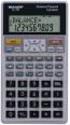 Section 4: Using a Financial Calculator Tab 1: Introduction and Objectives Introduction In this section, the functions of a financial calculator will be reviewed and some sample problems will be demonstrated.
Purpose EL-773A HP-10B BA-II PLUS Clear memory 0 n registers
 D-How to Use a Financial Calculator* Most personal finance decisions involve calculations of the time value of money. Three methods are used to compute this value: time value of money tables (such as those
appendix B COMPOUND SUM OF AN ANNUITY OF $1 appendix C PRESENT VALUE OF $1 appendix D PRESENT VALUE OF AN ANNUITY OF $1
 appendices appendix A COMPOUND SUM OF $1 appendix B COMPOUND SUM OF AN ANNUITY OF $1 appendix C PRESENT VALUE OF $1 appendix D PRESENT VALUE OF AN ANNUITY OF $1 appendix E TIME VALUE OF MONEY AND INVESTMENT
Instructions for creating a data entry form in Microsoft Excel
 1 of 5 You have several options when you want to enter data manually in Excel. You can enter data in one cell, in several cells at the same time, or on more than one worksheet (worksheet/spreadsheet: The
Land Purchase Analysis
 Land Purchase Analysis With this program, the user can evaluate the economic return on a farmland purchase and calculate a maximum bid price The maximum bid price is the purchase price that allows the
DISCOUNTED CASH FLOW VALUATION and MULTIPLE CASH FLOWS
 Chapter 5 DISCOUNTED CASH FLOW VALUATION and MULTIPLE CASH FLOWS The basic PV and FV techniques can be extended to handle any number of cash flows. PV with multiple cash flows: Suppose you need $500 one
Hewlett-Packard 10BII Tutorial
 This tutorial has been developed to be used in conjunction with Brigham and Houston s Fundamentals of Financial Management 11 th edition and Fundamentals of Financial Management: Concise Edition. In particular,
3. Time value of money. We will review some tools for discounting cash flows.
 1 3. Time value of money We will review some tools for discounting cash flows. Simple interest 2 With simple interest, the amount earned each period is always the same: i = rp o where i = interest earned
Using Financial And Business Calculators. Daniel J. Borgia
 Using Financial And Business Calculators Daniel J. Borgia August 2000 Table of Contents I. Texas Instruments BA-35 SOLAR II. Texas Instruments BAII PLUS III. Hewlett Packard 12C IV. Hewlett Packard 17BII..
User Guide. Opening secure email from the State of Oregon Viewing birth certificate edits reports in MS Excel
 User Guide Opening secure email from the State of Oregon Viewing birth certificate edits reports in MS Excel Birth Certifier Edition Last Revised: August, 0 PUBLIC HEALTH DIVISION Center for Public Health
Corporate Finance Fundamentals [FN1]
![Corporate Finance Fundamentals [FN1]](/thumbs/29/13224229.jpg "Corporate Finance Fundamentals [FN1]") Page 1 of 32 Foundation review Introduction Throughout FN1, you encounter important techniques and concepts that you learned in previous courses in the CGA program of professional studies. The purpose
Page 1 of 32 Foundation review Introduction Throughout FN1, you encounter important techniques and concepts that you learned in previous courses in the CGA program of professional studies. The purpose
Chapter 6. Learning Objectives Principles Used in This Chapter 1. Annuities 2. Perpetuities 3. Complex Cash Flow Streams
 Chapter 6 Learning Objectives Principles Used in This Chapter 1. Annuities 2. Perpetuities 3. Complex Cash Flow Streams 1. Distinguish between an ordinary annuity and an annuity due, and calculate present
Chapter 6. Discounted Cash Flow Valuation. Key Concepts and Skills. Multiple Cash Flows Future Value Example 6.1. Answer 6.1
 Chapter 6 Key Concepts and Skills Be able to compute: the future value of multiple cash flows the present value of multiple cash flows the future and present value of annuities Discounted Cash Flow Valuation
PMT. 0 or omitted At the end of the period 1 At the beginning of the period
 PMT Calculates the payment for a loan based on constant payments and a constant interest rate. PMT(rate,nper,pv,fv,type) For a more complete description of the arguments in PMT, see the PV function. Rate
Sample problems from Chapter 10.1
 Sample problems from Chapter 10.1 This is the annuities sinking funds formula. This formula is used in most cases for annuities. The payments for this formula are made at the end of a period. Your book
Calculator (Hewlett-Packard 10BII) Tutorial
 UNDERSTANDING HEALTHCARE FINANCIAL MANAGEMENT Calculator (Hewlett-Packard 10BII) Tutorial To begin, look at the face of the calculator. Most keys (except a few) have two functions: Each key s primary function
Time-Value-of-Money and Amortization Worksheets
 2 Time-Value-of-Money and Amortization Worksheets The Time-Value-of-Money and Amortization worksheets are useful in applications where the cash flows are equal, evenly spaced, and either all inflows or
10. Time Value of Money 2: Inflation, Real Returns, Annuities, and Amortized Loans
 10. Time Value of Money 2: Inflation, Real Returns, Annuities, and Amortized Loans Introduction This chapter continues the discussion on the time value of money. In this chapter, you will learn how inflation
Regular Annuities: Determining Present Value
 8.6 Regular Annuities: Determining Present Value GOAL Find the present value when payments or deposits are made at regular intervals. LEARN ABOUT the Math Harry has money in an account that pays 9%/a compounded
If I offered to give you $100, you would probably
 File C5-96 June 2013 www.extension.iastate.edu/agdm Understanding the Time Value of Money If I offered to give you $100, you would probably say yes. Then, if I asked you if you wanted the $100 today or
2. How would (a) a decrease in the interest rate or (b) an increase in the holding period of a deposit affect its future value? Why?
 CHAPTER 3 CONCEPT REVIEW QUESTIONS 1. Will a deposit made into an account paying compound interest (assuming compounding occurs once per year) yield a higher future value after one period than an equal-sized
HOW TO CALCULATE PRESENT VALUES
 Chapter 2 HOW TO CALCULATE PRESENT VALUES Brealey, Myers, and Allen Principles of Corporate Finance 11th Edition McGraw-Hill/Irwin Copyright 2014 by The McGraw-Hill Companies, Inc. All rights reserved.
Introduction. Turning the Calculator On and Off
 Texas Instruments BAII PLUS Calculator Tutorial to accompany Cyr, et. al. Contemporary Financial Management, 1 st Canadian Edition, 2004 Version #6, May 5, 2004 By William F. Rentz and Alfred L. Kahl Introduction
Appendix C- 1. Time Value of Money. Appendix C- 2. Financial Accounting, Fifth Edition
 C- 1 Time Value of Money C- 2 Financial Accounting, Fifth Edition Study Objectives 1. Distinguish between simple and compound interest. 2. Solve for future value of a single amount. 3. Solve for future
The Time Value of Money
 C H A P T E R6 The Time Value of Money When plumbers or carpenters tackle a job, they begin by opening their toolboxes, which hold a variety of specialized tools to help them perform their jobs. The financial
The Time Value of Money
 CHAPTER 7 The Time Value of Money After studying this chapter, you should be able to: 1. Explain the concept of the time value of money. 2. Calculate the present value and future value of a stream of cash
Integrated Case. 5-42 First National Bank Time Value of Money Analysis
 Integrated Case 5-42 First National Bank Time Value of Money Analysis You have applied for a job with a local bank. As part of its evaluation process, you must take an examination on time value of money
Financial Math on Spreadsheet and Calculator Version 4.0
 Financial Math on Spreadsheet and Calculator Version 4.0 2002 Kent L. Womack and Andrew Brownell Tuck School of Business Dartmouth College Table of Contents INTRODUCTION...1 PERFORMING TVM CALCULATIONS
BEST INTEREST RATE. To convert a nominal rate to an effective rate, press
 FINANCIAL COMPUTATIONS George A. Jahn Chairman, Dept. of Mathematics Palm Beach Community College Palm Beach Gardens Location http://www.pbcc.edu/faculty/jahng/ The TI-83 Plus and TI-84 Plus have a wonderful
Overview What is a PivotTable? Benefits
 Overview What is a PivotTable? Benefits Create a PivotTable Select Row & Column labels & Values Filtering & Sorting Calculations Data Details Refresh Data Design options Create a PivotChart Slicers Charts
CHAPTER 2. Time Value of Money 2-1
 CHAPTER 2 Time Value of Money 2-1 Time Value of Money (TVM) Time Lines Future value & Present value Rates of return Annuities & Perpetuities Uneven cash Flow Streams Amortization 2-2 Time lines 0 1 2 3
Note: In the authors opinion the Ativa AT 10 is not recommended as a college financial calculator at any level of study
 Appendix 1: Ativa AT 10 Instructions Note: DNS = Does Not Calculate Note: Loan and Savings Calculations Automatically round to two decimals. -Clear -Store Data in Memory -Recall Stored Data in Memory [CE]
Microsoft Access Rollup Procedure for Microsoft Office 2007. 2. Click on Blank Database and name it something appropriate.
 Microsoft Access Rollup Procedure for Microsoft Office 2007 Note: You will need tax form information in an existing Excel spreadsheet prior to beginning this tutorial. 1. Start Microsoft access 2007. 2.
HANDBOOK: HOW TO USE YOUR TI BA II PLUS CALCULATOR
 HANDBOOK: HOW TO USE YOUR TI BA II PLUS CALCULATOR This document is designed to provide you with (1) the basics of how your TI BA II Plus financial calculator operates, and (2) the typical keystrokes that
THE VALUE OF MONEY PROBLEM #3: ANNUITY. Professor Peter Harris Mathematics by Dr. Sharon Petrushka. Introduction
 THE VALUE OF MONEY PROBLEM #3: ANNUITY Professor Peter Harris Mathematics by Dr. Sharon Petrushka Introduction Earlier, we explained how to calculate the future value of a single sum placed on deposit
Important Financial Concepts
 Part 2 Important Financial Concepts Chapter 4 Time Value of Money Chapter 5 Risk and Return Chapter 6 Interest Rates and Bond Valuation Chapter 7 Stock Valuation 130 LG1 LG2 LG3 LG4 LG5 LG6 Chapter 4 Time
TIME VALUE OF MONEY (TVM)
 TIME VALUE OF MONEY (TVM) INTEREST Rate of Return When we know the Present Value (amount today), Future Value (amount to which the investment will grow), and Number of Periods, we can calculate the rate
Dick Schwanke Finite Math 111 Harford Community College Fall 2013
 Annuities and Amortization Finite Mathematics 111 Dick Schwanke Session #3 1 In the Previous Two Sessions Calculating Simple Interest Finding the Amount Owed Computing Discounted Loans Quick Review of
Lease Analysis Tools
 Lease Analysis Tools 2009 ELFA Lease Accountants Conference Presenter: Bill Bosco, Pres. [email protected] Leasing 101 914-522-3233 Overview Math of Finance Theory Glossary of terms Common calculations
Hewlett Packard (HP) 10BII
 Hewlett Packard (HP) 10BII The HP10BII is programmed to perform two basic types of operations: statistical operations and financial operations. Various types of computations are activated by depressing
Microsoft Excel - XP Intermediate
 Microsoft Excel - XP Intermediate Financial Functions Goal Seeking Variable Tables IF Statements AND & OR Functions Mathematical Operations Between Separate Sheets Mathematical Operations Between Separate
Oklahoma State University Spears School of Business. Time Value of Money
 Oklahoma State University Spears School of Business Time Value of Money Slide 2 Time Value of Money Which would you rather receive as a sign-in bonus for your new job? 1. $15,000 cash upon signing the