
Energy Solutions for Smart Cities and Communities. Lessons learnt from the 58 pilot cities of the. CONCERTO initiative
|
|
|
- Myrtle Wilkins
- 10 years ago
- Views:
Transcription
1 Foto EUROSENSE 2013 Energy Solutions for Smart Cities and Communities Lessons learnt from the 58 pilot cities of the Editor: Steinbeis-Europa-Zentrum on behalf of the European Commission, DG Energy Energy CONCERTO initiative

2 Sustainable Energy Solutions for communities in 58 cities in 23 countries Trondheim Lapua Dale Dundalk North Tipperary Milton Keynes Falkenberg Helsingborg Växjö Helsingør Valby Maabjerg Hoje Taastrup Amsterdam New West Hillerod Stenløse Amsterdam North Hannover Delft Almere Slubice Birštonas Apeldoorn London Lambeth Heerlen Weilerbach Kortrijk Mödling Neckar- Zlin Redange sulm Tulln Galanta Ostfildern Szentendre Nantes Salzburg Obuda Cernier Geneva Hartberg Weiz- Morahalom Gleisdorf Torino Lyon Zargorje Alessandria Grenoble Salburua Sofia Montieri Tudela Hvar Cerdanyola del Zaragoza Vallès Ajaccio Viladecans

3 Imprint Editors Steinbeis-Europa-Zentrum der Steinbeis Innovation ggmbh, editor team coordinated by Valerie Bahr Haus der Wirtschaft Willi-Bleicher-Str Stuttgart Germany Coordination of Technical Inputs Michael Kleber Renewable Energies Karlsruhe Institute of Technology Russell McKenna Institute for Industrial Production Karlsruhe Institute of Technology European Commission Technical Officer: Sven Dammann Acknowledgements The authors would like to extend their utmost gratitude to the following persons for their support: We thank the entire CONCERTO Premium Team for collection and assessing of the technical project data that fed into this report namely: Karoline Fath, Ulf Kroeher, Michael Kleber, Thomas Lützkendorf, Russell McKenna, Erik Merkel, Andrea Immendörfer, Ellen Platt, Silke Schnaidt, Kilian Seitz, Volker Stelzer, Julian Stengel and Andreas Wagner. Our special thanks go to all CONCERTO project coordinators and other project partners, who gave their input, provided technical data, were available for interviews and/or answered our questions and finally, to our project officer, Sven Dammann, at DG Energy for his kind and constructive support throughout. Parts of the texts used can be originally found on the poject's websites or in project publications. This publication was produced by the CONCERTO Premium consortium for the Directorate-General for Energy of the European Commission and represents CONCERTO Premium's views and the facts and figures made available to them by the CONCERTO projects. The views presented here have not been adopted or in any way approved by the European Commission and should not be relied upon as statement of the Commission's or the Directorate- General's views. The European Commission does not guarantee the accuracy of the data included in this publication, nor does it accept responsibility for any use made thereof. Neither the European Commission nor any person acting on behalf of the Commission is responsible for the use which might be made of this publication. The analysis made in this publication is based on the most recent and most reliable data, which in general dates from September It should be noted that some of the projects mentioned here are still ongoing and may be subject to changes during the lifespan of their activities. Additional information on CONCERTO is available at and further information on the European Union's energy policy can be accessed through the website of DG Energy ( Design and layout have been created by Jung Visuelle Kommunikation, Reinsburgstraße 96 A, Stuttgart, Germany. Printed by Offizin Scheufele, Stuttgart, Germany, January 2014 European Union 2014 ISBN: doi: /17870 Printed in Germany Biodruckfarbe Auf Basis nachwachsender Rohstoffe, mineralölfrei Print kompensiert Id-Nr

4 4
5 Dear colleagues, friends, Developing our cities into intelligent and sustainable environments is one of the biggest challenges of our times. More than half of the world`s population lives in cities a share that is expected to rise to 70 % by Already now, cities produce 70 % of all CO 2 emissions. Cities are therefore faced with the challenge of ensuring their inhabitants` quality of life whilst moving away from fossil fuels towards more renewable energy sources and to more efficient and smarter energy systems. Smarter energy systems play a key role in meeting the EU's energy policy targets for 2020 consuming 20 % less energy, increasing the share of renewable energy to 20 %, reducing greenhouse gas emissions by 20 %. Meeting these targets will set up the EU for its long-term objective of reducing greenhouse gas emissions to at least 80 % below the 1990 levels by 2050, as set by the European Council. The detailed evaluation of 58 pilot cities and communities in 23 countries in the EU CONCERTO initiative impressively documents how innovative thinking on a larger scale can bring not just individual buildings, but entire communities to the level of the latest technological advancements in low-carbon energy systems. Thanks to their size and ambition, these projects have played a pivotal role in mainstreaming energy efficiency and renewable energy technologies in a number of Member States. These pilot cities have shown that innovative technologies are available and ready to be used. They have proven that the built environment can cut its CO 2 emissions by up to 80 % already now and that renewable energy sources can well be integrated into the urban environment. Building on these experiences, several of the CONCERTO cities are now broadening their scope to tackle smart energy, sustainable mobility and ICT as enabling technology in an integrated way under the European Union's Smart Cities and Communities European Innovation Partnership, launched in July The pilot cities documented in this publication provide a wealth of valuable lessons for those who want to make our cities and communities smarter and fit for the low-carbon energy future. I thank all partners who have contributed to these strong examples. I hope this publication inspires many to replicate the demonstrated solutions in their own cities. Günther H. Oettinger EU Commissioner for Energy 5

6 Content Chapter 1 Introduction Chances and opportunities Stakeholder s statements Chapter 2 Reducing CO 2 emissions in buildings and communities A challenge that can be met Innovative districts and eco-villages The energy neutral district Zuidbroek Apeldoorn, the Netherlands (Project SORCER) A new, trendsetting district aiming towards zero energy Caserne de Bonne, Grenoble, France (Project SESAC) The eco-village Cloughjordan North Tipperary, Ireland (Project SERVE) An innovative district supplied by a biomass co-generation plant Scharnhauser Park, Ostfildern, Germany (Project POLYCITY) How a district in disrepair becomes a model for energy efficiency Lehen, Salzburg, Austria (Project Green Solar Cities) 2.2. Educational and other public buildings CO 2 neutral culture at Klaverfabrikken, a public building promoting music and culture Hillerød, Denmark (Project SORCER) Solar for schools, energy education and energy audits for schools Lambeth, Great Britain (Project ECOSTILER) Retrofit of a primary school, the Neubergschule Neckarsulm, Germany (Project Energy in Minds!) An intelligent town hall thanks to smart metering and clever ventilation Scharnhauser Park, Ostfildern, Germany (Project POLYCITY) Residential buildings The art of a socially acceptable upgrading Poptahof, Delft, the Netherlands (Project SESAC) A new approach of urban renewal at Ile de Nantes Nantes, France (Project act2) A modern building block in Central Europe becomes energy efficient Óbuda, Budapest, Hungary (Project STACCATO) Refurbishment of multi-family buildings Sofia, Bulgaria (Project STACCATO) Improving the quality of life by renovating council houses Turin, Italy (Project POLYCITY)

7 The Swedish city of Växjö A pioneer of the energy transition: Interview with Henrik Johansson, city of Växjö Chapter 3 The strategic use of low carbon technologies based on renewable energy sources Ready to be applied District heating and cooling It s all about networking A unique solar island Almere, the Netherlands (Project crrescendo) Polygeneration for energy efficient cooling Cerdanyola del Vallès, Spain (Project POLYCITY) A thermal hydraulic network takes the lake to the consumer Geneva, Switzerland (Project TetraEner) 3.2. Other innovative cooling approaches The passive cooling of buildings Cerdanyola del Vallès, Spain (Project POLYCITY) Absorption cooling for a hospital Trondheim, Norway (Project ECO-City) Heat keeps Växjö cool Växjö, Sweden (Project SESAC) 3.3. Make it a triple! Cogeneration and polygeneration plants The BioEnergy Drift initiated by a group of farmers Maabjerg, Denmark (Project ECOSTILER) Turning waste into energy Lapua, Finland (Project SOLUTION) Polygeneration based on biomass Ostfildern, Germany (Project POLYCITY) 3.4. Harvesting the sun Solar thermal collectors A perfect team: the sun and a swimming pool Hannover, Germany (Project act2) High energy demand and no emissions Hillerød, Denmark (Project Sorcer) When sun meets innovation Salzburg, Austria (Project Green Solar Cities) Progress on its way Zlín, Czech Republic (Project Energy in Minds!) 3.5. and photovoltaics The sun works for a community centre Milton-Keynes, Great Britain (Project crrescendo) Well on the way to zero emission Weilerbach, Germany (Project SEMS) Sunny energy solutions Weiz-Gleisdorf, Austria (Project Energy in Minds!) 3.6. When wind turns into energy A wind farm for an ambitious community Falkenberg, Sweden (Project Energy in Minds!) The wind farm project Lapua, Finland (Project SOLUTION) Thinking big at Golice Wind Farm Słubice, Poland (Project SEMS) 3.7. Energy from the depth Geothermal plants Changing the image of an old mining town into a sustainable city Zagorje ob Savi, Slovenia (Project Remining-Lowex) From abandoned mineshafts to heating and cooling, a model for the use of geothermal energy Heerlen, the Netherlands (Project Remining-Lowex) An innovative district heating network based on geothermal energy Montieri, Italy (Project GeoCom) 3.8. Not to be wasted Obtaining energy from waste, biomass and biogas Transforming sewage sludge into energy Apeldoorn, the Netherlands (Project SORCER) Polygeneration from biological waste Växjö, Sweden (Project SESAC) Thermal use of waste water Weiz-Gleisdorf, Austria (Project Energy in Minds!) Reprocessing biodegradable waste Zlín, Czech Republic (Project Energy in Minds!) 7

8 3.9. The secret of storing energy Examples for storage Putting the sun into a tank Salzburg, Austria (Project Green Solar Cities) Constant supply thanks to buffers Amsterdam Noord, The Netherlands (Project STACCATO) How to store thermal energy on a large scale with the help of water Cerdanyola del Vallès, Spain (Project POLYCITY) Storing the wind Dundalk, Ireland (Project HOLISTIC) Heat pump boosts underground energy parking Neckarsulm, Germany (Project Energy in Minds!) The German Weilerbach A village on its way to zero emission: Interview with Anja Pfeiffer, Mayor of Weilerbach Chapter 4 From vision to replication - Information transfer as a key to success Integrated planning A key factor for success What is the correlation between building your own home and new energy standards Almere, the Netherlands (Project crrescendo) Joining forces for ecology Grenoble, France (Project SESAC) Planning in a socially diverse district: La Confluence Lyon, France (Project RENAISSANCE) 4.2. Public awareness activities Living energy efficiency A Sustainable Town Planning Centre informs about energy consumption Zaragoza, Spain (Project RENAISSANCE) Saving energy and money Hannover, Germany (Project act2) Focusing on people, energy efficiency starts in your mind North Tipperary, Ireland (Project SERVE) An ice cube goes on tour, visual role models for a better understanding Weilerbach, Germany (Project SEMS) 4.3. Monitoring as a key aspect of energy management A swimming pool sets the standard Hannover, Germany (Project act2) Energy management in buildings Lyon, France (Project RENAISSANCE) Energy Management Systems for all kinds of premises Ostfildern, Germany (Project POLYCITY) Smart metering in households Växjö, Sweden (Project SESAC) 4.4. Examples for knowledge transfer and replication Paving the way for future projects Cerdanyola del Vallès, Spain (Project POLYCITY) Teaching and training a community Grenoble, France (Project SESAC) How a farmer becomes an energy producer Maabjerg, Denmark (Project ECOSTILER) A good practice to be copied Ostfildern, Germany (Project POLYCITY) Testing your construction skills Växjö, Sweden (Project SESAC) 8
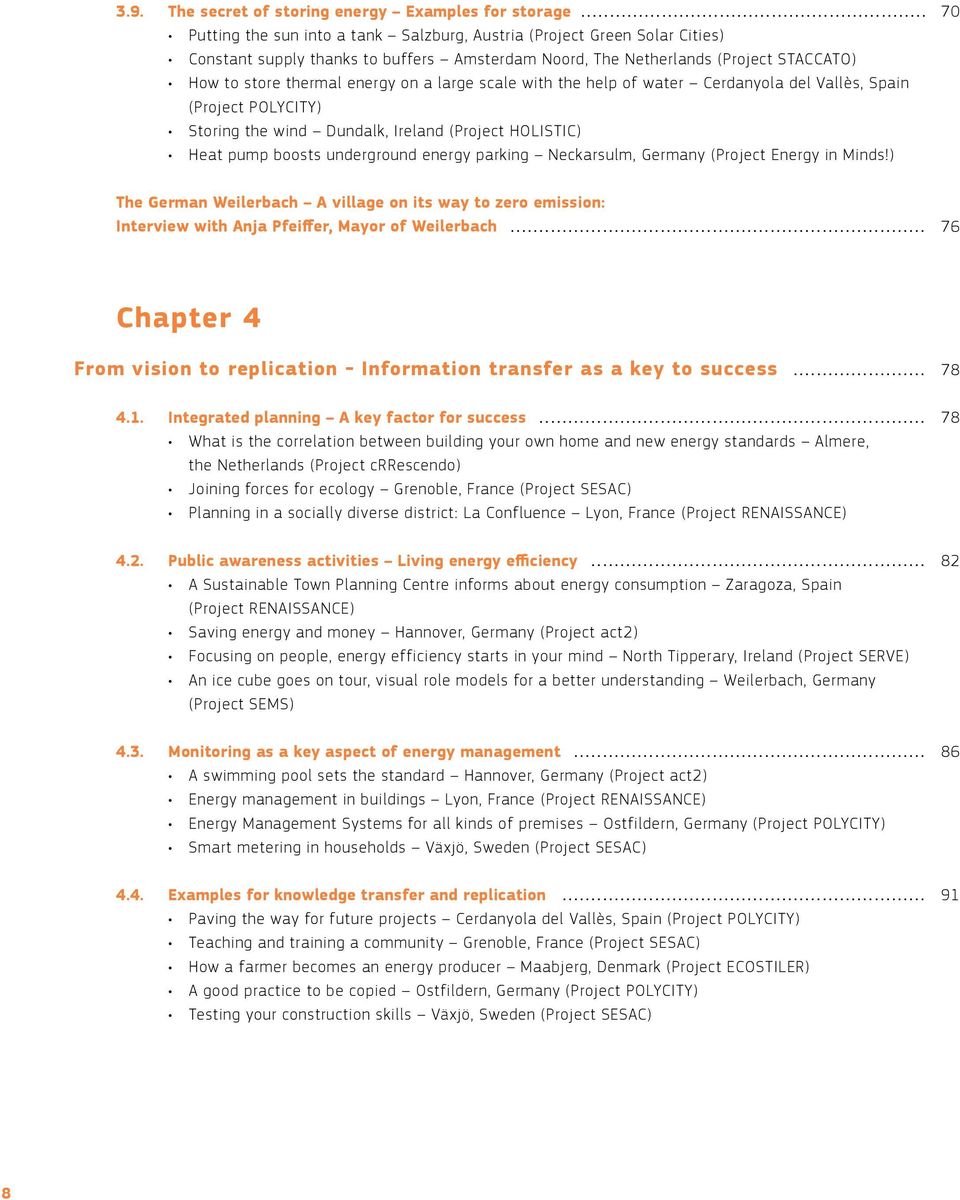
9 Chapter 5 Impacts of the CONCERTO initiative Glancing at future Smart Cities Role models for future projects CONCERTO as a path finder for a better future Influence on local energy policy CONCERTO as a counsellor for policy makers Innovative IT products - new markets CONCERTO as a market stall for forward looking solutions How to finance the energy transition CONCERTO as a test bed for business models Recommendations for future projects Stakeholder s statements Chapter 6 A shortcut Take-home messages from CONCERTO Chapter 7 List of CONCERTO projects, sites and contacts Chapter 8 CONCERTO in cross media: publications, videos, augmented reality APP and database List of Figures and Images
10 Chapter 1 Introduction Energy solutions for Smart Cities and Communities the CONCERTO initiative and its projects CONCERTO is a European Union initiative within the European Research Framework Programme (FP6 and FP7). Buildings account for 40 % of the total energy consumption in the Union, for 33 % of CO 2 emissions and 70 % of the EU's energy consumption. A similar share of greenhouse gas emission takes place in cities, with a huge untapped potential for costeffective energy savings. Responding to these facts, CONCERTO aims to demonstrate that the energy optimisation of districts and communities as a whole is more cost-effective than optimising each building individually. This can be achieved if all relevant stakeholders work together and integrate different energy technologies in a smart way. The EU initiative under the European Commission's Directorate General for Energy started in 2005 and has co-funded, with more than million, 58 cities and communities in 22 projects in 23 countries. Weiz/Gleisdorf, AT, Project Energy in Minds! Lyon, FR, Project RENAISSANCE CONCERTO is a milestone towards the EU targets for 2020: 20 % improvement in energy efficiency 20 % share of renewable energy 20 % reduction of greenhouse gas emissions The 58 cities and communities are role models and offer innovative approaches for: energy efficiency measures the use of renewable energy sources and innovative technologies (RES) sustainable building and district development refurbishment in buildings energy transparency for citizens an integrated approach of solutions 10 In this respect CONCERTO has paved the way to the Smart Cities Innovation Partnership of the European Union, successor of the CONCERTO initiative. The 58 CONCERTO cities and communities integrate energy efficiency measures with a substantial contribution from local renewable energy sources (RES), smart grids, renewables-based cogeneration, district heating/cooling systems and energy management systems in larger building settlements. These sets of innovative technologies and measures are optimised locally in order to take

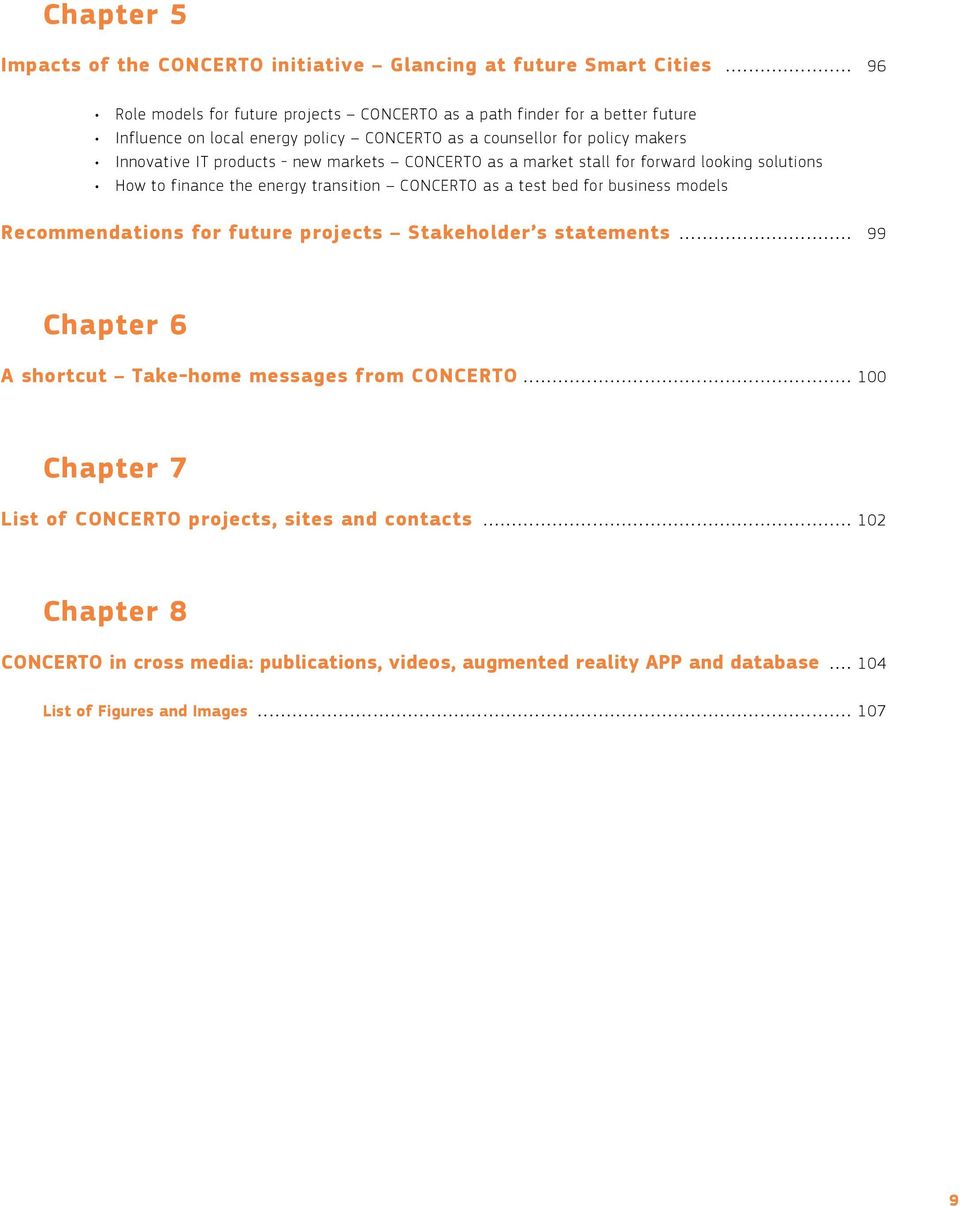
11 Chapter 1: Introduction into account the specific characteristics and possibilities of the local site, climate and cultural differences or local political aspects. The results so far have been very encouraging: CONCERTO cities and communities have shown that existing buildings can cut their CO 2 emissions, at acceptable costs, by up to 80 %. The CONCERTO initiative proves that if given the right planning, cities and communities can be transformed into pioneers in energy efficiency and sustainability. The experiences and technology performance data from the CONCERTO sites have been gathered and thoroughly analysed in the meta-projects CONCERTO Plus and CONCERTO Premium. The results are presented in this brochure, in the brochure Recommendations for Policy Makers and in the brochure "Evaluation of (Smart) Solutions - Guidebook for Assessment". The Technical Monitoring Database, that is the main tool for the analysis of CONCERTO data, is accessible to the public on the CONCERTO website via an interactive intelligent inquiry facility. Detailed information concerning the projects, the sites and technologies implemented is also available on the website. Use of wind energy, Dundalk, IR, Project HOLISTIC Polygeneration, Cerdanyola del Vallés, ES, Project Polycity What makes the CONCERTO approach special? Bringing together all relevant stakeholders and integrating different technologies CONCERTO cities and communities bring all of the relevant stakeholders together: investors, local authorities, designers, urban planners, developers, energy utilities, engineers, tenants, owners, manufacturers, craftsmen and material suppliers. At the same time, various renewable energy sources are combined in innovative technology mixes in order to achieve the most suitable and effective way of energy supply. The diversity From Spain to Sweden, from Ireland to Lithuania, from office buildings to public housing estates, the CONCERTO cities and communities and its associated projects are extremely diverse: diverse in terms of their climates, their socio-economic make-up and most importantly, their energy needs. The following key elements are, however, shared by all: The CONCERTO projects are based on clearly defined geographical areas All cities and communities strive for a balance between demand and supply: large-scale eco-buildings are supplied by different types of renewable energies Targets are ambitious: energy consumption in new buildings is at least 30 % lower than national regulations for new buildings and existing buildings are refurbished to standards of new buildings All projects conduct technical and socio-economic monitoring What are the assets of CONCERTO? CONCERTO acts as a motivator and driving force in the field of renewable energies by demonstrating that renewables can be implemented in a wide range of applications. CONCERTO offers the expertise of a European-wide network that facilitates knowledge transfer. CONCERTO encourages the building industry to invest in sustainable solutions and economically viable technologies. 11 CONCERTO gives new impulses to regional development and encourages cross-national co-operations between rural and urban areas that open up new renewable energy markets.
12 CONCERTO sets higher performance standards in energy efficiency and integration of RES and thus drives improved standards and regulations on a European, national and local level. What are the CONCERTO achievements? CONCERTO at a glance*: More than 3,000 high-performance new buildings were built (1.75 million m²) Around 1,400 buildings were refurbished (2 million m²) 376 kt CO 2 emission reductions per year in these areas: o 17 kt in refurbished buildings o 17 kt in new buildings o 147 kt in energy supply units electricity o 173 kt in energy supply units district heating o 22 kt in energy supply units heating 1,326 GWh non-renewable primary energy demand reduction per year, in these areas: o 5 % in refurbished buildings o 6 % in new buildings o 37 % in energy supply units electricity o 46 % in energy supply units district heating o 6 % in energy supply units heating (if no data for buildings or district heating is available) 530,000 tons of CO 2 emissions saved per year *Data status of September 2013 About this brochure This brochure presents role models for energy efficiency measures in buildings and communities and good examples relating to renewable energy supply. It reports on the lessons learnt during 8 years ( ) of experience within the CONCERTO projects. The examples illustrate a wide range of measures covering the challenges of the energy transition: energy efficiency, the use of RES and getting the right mix of these technologies. Each chapter begins with an introduction and includes facts and figures if applicable. The provided figures are based on measured values where available, otherwise prediction values are used. The focus of the brochure rests on three aspects: The building sector: how to reduce CO 2 emissions in public and residential buildings as well as plan innovative districts (chapter 2) The strategic use of technologies based on RES: how to achieve an intelligent mix of low carbon technologies (chapter 3) Aspects of an integrated approach: how to plan, monitor and be successful in public awareness and knowledge transfer (chapter 4) This perspective through a trifold lens provides information for different target groups. Mayors, public and local authorities: chapter 2 may be a focus for them as it is about educational and other public buildings. Urban planners, designers and architects: chapter 2 regarding educational and other public buildings and chapter 4 concerning topics of integrated approach, in particular the topic planning, may be of interest to this target group. Engineers, researchers, scientists, developers and energy utilities: for this group, chapter 3, which covers the integrated use of technologies based on RES, offers an overview of the technology mix applied in CONCERTO and selected examples of good practices. 12 We appreciate the wealth and amplitude of measures undertaken in the CONCERTO communities and we have analysed the results and the experiences. It is impossible to portray every single district of the 58 communities within the scope of this brochure, so we took the decision to outline a selection of successful building examples, successfully implemented low carbon technologies and good measures of awareness campaigns, planning and monitoring. Sites that are not illustrated

13 Chapter 1: Chances and opportunities Stakeholder s statements in this brochure are in no means unsuccessful. One of our special aims is to explain the variety of technology measures undertaken and for this reason, chapter 3 is substantial and the most comprehensive part. The portraits are lively, accompanied by interviews and statements made by local CONCERTO project partners. The overall objective of this brochure is to promote and encourage replication of these good practices. We would like to invite you to contact your local CONCERTO partners or to visit the CONCERTO website and to watch the good practice videos to obtain more information about the projects. The brochure is completed with two further brochures: the reference study focusing on policy recommendations titled Energy solutions for smart cities and communities Recommendations for Policy Makers from the 58 Pilots of the CONCERTO Initiative and the guidebook for assessment with the title: Energy solutions for smart cities and communities: Evaluation of (Smart) Solutions Guidebook for Assessment. Enjoy reading! The CONCERTO Premium Team January 2014 CONCERTO website: CONCERTO in YouTube: CONCERTO in Facebook: CONCERTO in Twitter: Chances and opportunities Stakeholder s statements CONCERTO gave us the opportunity to raise awareness on solutions that are both financially feasible and environmentally friendly, especially at regional level, where the effects of the work accomplished can easily be seen. Close cooperation with local experts and the municipality, as well as dialogue and cooperation with international partners, has led to concrete actions as well as useful and applicable research. Miika Rämä, VTT Technical Research Centre of Finland, Lapua, partner in the project SOLUTION CONCERTO made it possible for us to secure sustainability for our buildings in the future. Har Buynsters, Eneco, Amsterdam, partner in the project STACCATO Here in Lyon, we were given the opportunity to show that it is indeed possible and that changes in technology and in working and planning methods are nothing negative. We have learnt a lot from other cities, because CONCERTO gave us the opportunity to be part of a European city network. We benefitted greatly from this. Marc Jedliczka, HESPUL, Lyon, coordinator of the project RENAISSANCE CONCERTO gave us a real living lab to test all our national programmes, to trial them in the CONCERTO area and to develop them so that we could then replicate and move them out to other areas. It also allowed us to network with other communities and see what s happening there and to learn from them. But it also showed us where we had our strengths, especially in terms of our structure. This has allowed us to develop a national programme: we are almost developing a Mini-CONCERTO and rolling that out as our Better Energy Community programme. Declan Meally, Sustainable Energy Authority of Ireland (SEAI), Dundalk, partner in the project HOLISTIC CONCERTO gave us the opportunity to add a new reason for Vitoria-Gasteiz to be the 2012 European Green Capital. We hope that the Vitoria-Gasteiz CONCERTO project becomes an example that can be replicated and give rise to a domino effect in the city. Alberto Ortiz de Elgea Olasolo, VISESA, Vitoria-Gasteiz, partner in the project PIME S 13

14 Chapter 2 Reducing CO 2 emissions in buildings and communities A challenge that can be met Buildings are the largest energy consuming sector in the world. They account for 40 % of Europe's energy use and for about a third of Europe's greenhouse gas emissions. Energy-efficient, low-carbon buildings therefore play a vital role in achieving a significant reduction in energy consumption and CO 2 emissions in the buildings sector. The CONCERTO communities have risen to this challenge by creating a wide range of innovative buildings that are either new or refurbished. Buildings in CONCERTO demonstration projects undergo ambitious requirements. The energy consumption of new buildings needs to be at least 30 % lower than national regulations 1. For existing buildings, after refurbishment or retrofitting, the CONCERTO approach requires lower energy consumption per m² than the national regulations for new buildings 2. About 1,400 buildings have been refurbished (approx. 2 million m²) and more than 3,000 new houses built (1.75 million m²). As proven by CONCERTO, thanks to higher insulation standards in new buildings, more than 17 kt of CO 2 emissions can be saved per year when compared to buildings according to the national standard. In addition, the refurbishment measures in CONCERTO lead to a reduction of more than 17 kt CO 2 every year Innovative districts and eco-villages When the CONCERTO initiative was launched, its approach was unique, as it takes both individual buildings as well as entire districts into account, regarding energy efficiency measures, energy production and energy distribution. CONCERTO cities and communities demonstrate new, realistic models that are close to being zero energy communities. The following examples show how districts and communities have been set up or remodeled into good practices of energy efficiency and sustainability. 14 1,2 based on the Energy Performance of Buildings Directive (EPBD)

15 2.1. Innovative districts and eco-villages The energy neutral district Zuidbroek Apeldoorn, the Netherlands (Project SORCER) The municipality of Apeldoorn is situated in the Netherlands, to the east of Amsterdam, and has set itself the ambitious target of becoming carbon neutral by With the support of the CONCERTO project, it took its first steps towards realising this goal in the model district of Zuidbroek and constructed a new housing estate that has been built to the highest of energy standards. Zuidbroek is a neighbourhood where people can live and work and where the issues of energy, water and green landscape play an important role. The plan was for Zuidbroek to accommodate new homes, to expand the business park by 25,000 m² and to create a local park of around 30 hectares. Whilst constructing the new area, Apeldoorn is putting into practice the belief that good planning, that takes all key stakeholders into account, plays a central role in the development of a successful, sustainable community. In order to achieve the goal of Zuidbroek Energy Neutral, the municipality of Apeldoorn organised awareness raising campaigns that were aimed at the residents, local businesses and stakeholders as well as the manufacturers and suppliers of energy efficient products and services. The results are palpable, energy saving ideas. In order to improve energy efficiency, measures have been taken in various areas, for example home insulation. A biomass plant (digester and Combined Heat and Power (CHP) units) has been installed to convert sewage sludge into energy. A total of 800 homes have been connected to the district heating network and now have an energy performance that exceeds new building regulations by 20 %. An energy consumption information website has been set up and intelligent heat metering in new housing provides residents with detailed, real-time energy consumption information. The project resulted in an 80 % reduction of fossil fuel demand with respect to the Dutch reference situation. Facts & Results: Estimated population involved 3,500 Geographical area 400 ha Total investments million CONCERTO funding 962,500 New buildings 611 (91,667 m²) Energy supply units Biomass Plant 3000 kw therm, 1500 kw el Photovoltaics 44 kw peak Energy demand (average) New buildings: 48 kwh/m²a for heating and domestic hot water (DHW) (- 31 % compared to national standard) CO 2 emission reduction [t/a] 3,078 KEMA Nederland B.V. Rudy Rooth: [email protected] see also: 3.8. Not to be wasted Obtaining energy from waste, biomass and biogas Visibility of actual implementations has led to much more awareness among inhabitants than previously expected. H. van Gogh, Municipality of Apeldoorn, the Netherlands 15

16 A new, trendsetting district aiming towards zero energy Caserne de Bonne, Grenoble, France (Project SESAC) Grenoble is the main city in the French Alps with around 530,000 inhabitants. It is situated at the junction of three Alpine valleys in a densely populated area that suffers from pollution. In 2007, the city of Grenoble drafted the Energy Action Plan, in line with the Metropolitan Climate Plan, with the aim of cutting greenhouse gas (GHG) emissions by 20 % by As a lot of GHG emissions in Grenoble stem from buildings, the city has intensified its efforts in this sector in recent years. The maximum, primary energy consumption for new buildings has been limited to 60 kwh/m² and the existing building stock should reduce its energy consumption by 60 % by To reach this goal, the city is taking both the energy generation and the energy consumption side into consideration, e.g. the fossil fuel used for district heating has been replaced by wood biomass, whilst hydropower and photovoltaic (PV) plants deliver renewable electricity. The district of Caserne de Bonne is a good example that shows the transformation of dreary army barracks into a trendsetting, new eco-district. Besides residential buildings, there are also shops, offices, a school, an old people`s home, a cinema, large parks and gardens that form part of the new district. In the SESAC project, nine new multi-storey buildings with 435 apartments were built in de Bonne. These buildings are supplied with heat and electricity by nine mini CHP plants with the expected final energy consumption being % below the applicable national indices. The design of these buildings includes compact dimensions, specific insulation values, double-flow ventilation, as well as water- and light-efficient equipment. In addition to this, 12 new eco-buildings and a new elementary school were built that have a lower energy consumption than the national average level. A special landmark in de Bonne is the positive energy office building, which produces more energy than it actually needs. It uses 70 % less energy than the value foreseen by French building regulations. The total gross floor area of the fourstorey office building is 1,865 m². The 425 m² photovoltaic power plant on the terrace and its concrete structure provide its main symbolic, architectural characteristics. The building was designed with a high compactness, an efficient external insulation, a high share of natural lighting and special attention was taken to avoid thermal bridges. The windows have very low-emissive triple glazing and automatic, movable external solar protections with tilting louvers. Furthermore, a special, innovative, internal shutter system has been integrated that is mechanically movable between the ceiling and the windows. This system is intended to seal the windows at night and at times when the building isn t occupied. When these shutters are closed, the heat transfer coefficient of the windows is 0.15 W/m²K. Based on our experience with de Bonne, we now have further objectives that are not just focused on cutting energy consumption or on renewable sources of energy. We re working on an even bigger concept which is to recover and use the wasted energy that just gets lost in such a densely populated city like Grenoble. Laurent Gaillard, City of Grenoble, France 16

17 2.1. Innovative districts and eco-villages Facts & Results: Estimated population involved 35,000 Geographical area 28 ha Total investments 65.5 million CONCERTO funding 2.1 million New buildings 15 (60,300 m²) Energy supply units Solar Thermal Collectors 752 kw Biomass Boilers 2,380 kw Photovoltaics 363 kw peak microchp 1040 kw therm, 580 kw el District heating networks Energy demand (average) New buildings: 64 kwh/m²a for heating and domestic hot water (DHW) (- 45 % compared to national standard) CO 2 emission reduction [t/a] 1,508 Facts & Results de Bonne positive energy office building: Floor area Energy demand (calculated) according to national standard Energy demand (calculated) Energy supply CO 2 emission reduction [t/a] 1,865 m² gross floor area (GFA) 140 kwh/(m²gfa a) for heating 9.5 kwh/(m²gfa a) for heating Heating and domestic hot water (DHW): Reversible heat pump for heating and cooling and direct cooling with ground water heat exchanger on normal summer days, no DHW generation Electricity: PV and grid City of Grenoble Perrine Flouret: [email protected] see also: 4.1. Integrated planning A key factor for success 4.4. Examples for knowledge transfer and replication 17
![networks Energy demand (average) New buildings: 64 kwh/m²a for heating and domestic hot water (DHW) (- 45 % compared to national standard) CO 2 emission reduction [t/a] 1,508 Facts & Results de Bonne](/docs-images/42/567791/images/page_17.jpg "positive energy office building: Floor area Energy demand (calculated) according to national standard Energy demand (calculated) Energy supply CO 2 emission reduction [t/a] 1,865 m² gross floor area")
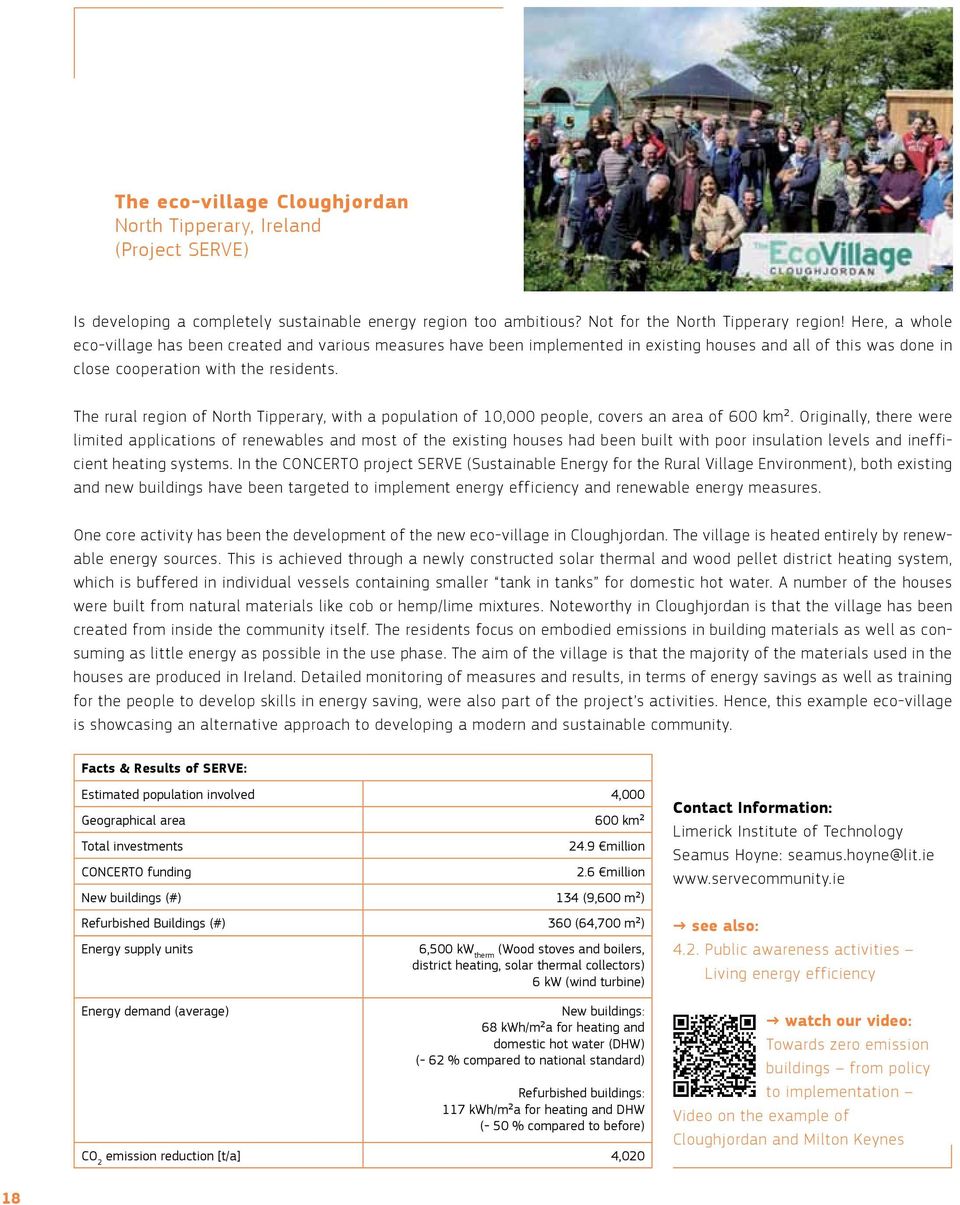
18 The eco-village Cloughjordan North Tipperary, Ireland (Project SERVE) Is developing a completely sustainable energy region too ambitious? Not for the North Tipperary region! Here, a whole eco-village has been created and various measures have been implemented in existing houses and all of this was done in close cooperation with the residents. The rural region of North Tipperary, with a population of 10,000 people, covers an area of 600 km². Originally, there were limited applications of renewables and most of the existing houses had been built with poor insulation levels and inefficient heating systems. In the CONCERTO project SERVE (Sustainable Energy for the Rural Village Environment), both existing and new buildings have been targeted to implement energy efficiency and renewable energy measures. One core activity has been the development of the new eco-village in Cloughjordan. The village is heated entirely by renewable energy sources. This is achieved through a newly constructed solar thermal and wood pellet district heating system, which is buffered in individual vessels containing smaller tank in tanks for domestic hot water. A number of the houses were built from natural materials like cob or hemp/lime mixtures. Noteworthy in Cloughjordan is that the village has been created from inside the community itself. The residents focus on embodied emissions in building materials as well as consuming as little energy as possible in the use phase. The aim of the village is that the majority of the materials used in the houses are produced in Ireland. Detailed monitoring of measures and results, in terms of energy savings as well as training for the people to develop skills in energy saving, were also part of the project s activities. Hence, this example eco-village is showcasing an alternative approach to developing a modern and sustainable community. Facts & Results of SERVE: Estimated population involved 4,000 Geographical area 600 km² Total investments 24.9 million CONCERTO funding 2.6 million New buildings (#) 134 (9,600 m²) Refurbished Buildings (#) 360 (64,700 m²) Energy supply units 6,500 kw therm (Wood stoves and boilers, district heating, solar thermal collectors) 6 kw (wind turbine) Energy demand (average) New buildings: 68 kwh/m²a for heating and domestic hot water (DHW) (- 62 % compared to national standard) Refurbished buildings: 117 kwh/m²a for heating and DHW (- 50 % compared to before) CO 2 emission reduction [t/a] 4,020 Limerick Institute of Technology Seamus Hoyne: [email protected] see also: 4.2. Public awareness activities Living energy efficiency watch our video: Towards zero emission buildings from policy to implementation Video on the example of Cloughjordan and Milton Keynes 18
19 2.1. Innovative districts and eco-villages An innovative district supplied by a biomass co-generation plant Scharnhauser Park, Ostfildern, Germany (Project POLYCITY) Scharnhauser Park in Ostfildern is located on the site of a former US military base, which became available after the American military forces left the area in It covers 150 ha in the municipality of Ostfildern, a town with a population of 35,000. Combining places of work, residential areas and green spaces, the approach in Ostfildern followed an integrated living and transportation concept that combines high comfort and low-energy consumption. The district has been developed through an innovative and co-operative process. The basis for its development was an urban plan stemming from a town-planning competition, which defined the residential, commercial and industrial sections of the site. Detailed zoning plans were developed gradually for each block which also incorporated ideas from invited investors and architects. The buildings represent a combination of refurbished old buildings, multi-storey buildings and terraced houses that are being constructed according to a low-energy building standard that was specified as 25 % below the national standard of the 1990s energy legislation. Three public buildings form part of the new building activities, namely the town hall, a youth centre and a school that includes a sports centre. A biomass Organic Rankine Cycle co-generation plant supplies heat to the 7,500 inhabitants of this district via a 13 km district heating network that covers their entire heating demand, including domestic hot water. Its electricity production accounts for over half of the residents` electricity demand. Smart metering has become reality in Ostfildern. The use of energy, electricity and water is monitored, providing feedback on the efficiency of energy saving measures. An energy manager is responsible for the financial and environmental analysis, offering a great degree of transparency in the real energy consumption. He plays a pivotal role, driving the energy agenda within the local council and within the CONCERTO project, and has since gone on to develop a biomass strategy for the whole municipality. Facts & Results: Estimated population involved 7,500 Geographical area 1.5 km² Total investments 7.24 million CONCERTO funding 2.45 million New buildings 52/17,000 m² (demo buildings) Energy supply units 7 MW th (biomass plant) 18 MW th (natural gas backup / peak) 0.95 MW el (biomass plant) kw el (PV) 70 kw el (Hydropower) 105 kw (thermal cooling) Energy demand (average) New buildings: 56 kwh/m²a for heating and domestic hot water (DHW) (-37 % compared to national standard) CO 2 emission reduction [t/a] 12,497 Hochschule für Technik Stuttgart Ursula Eicker: [email protected] see also: 2.2. Educational and other public buildings 3.3. Make it a triple! Cogeneration and polygeneration plants 4.3. Monitoring as a key aspect of energy management 4.4. Examples for knowledge transfer and replication 19

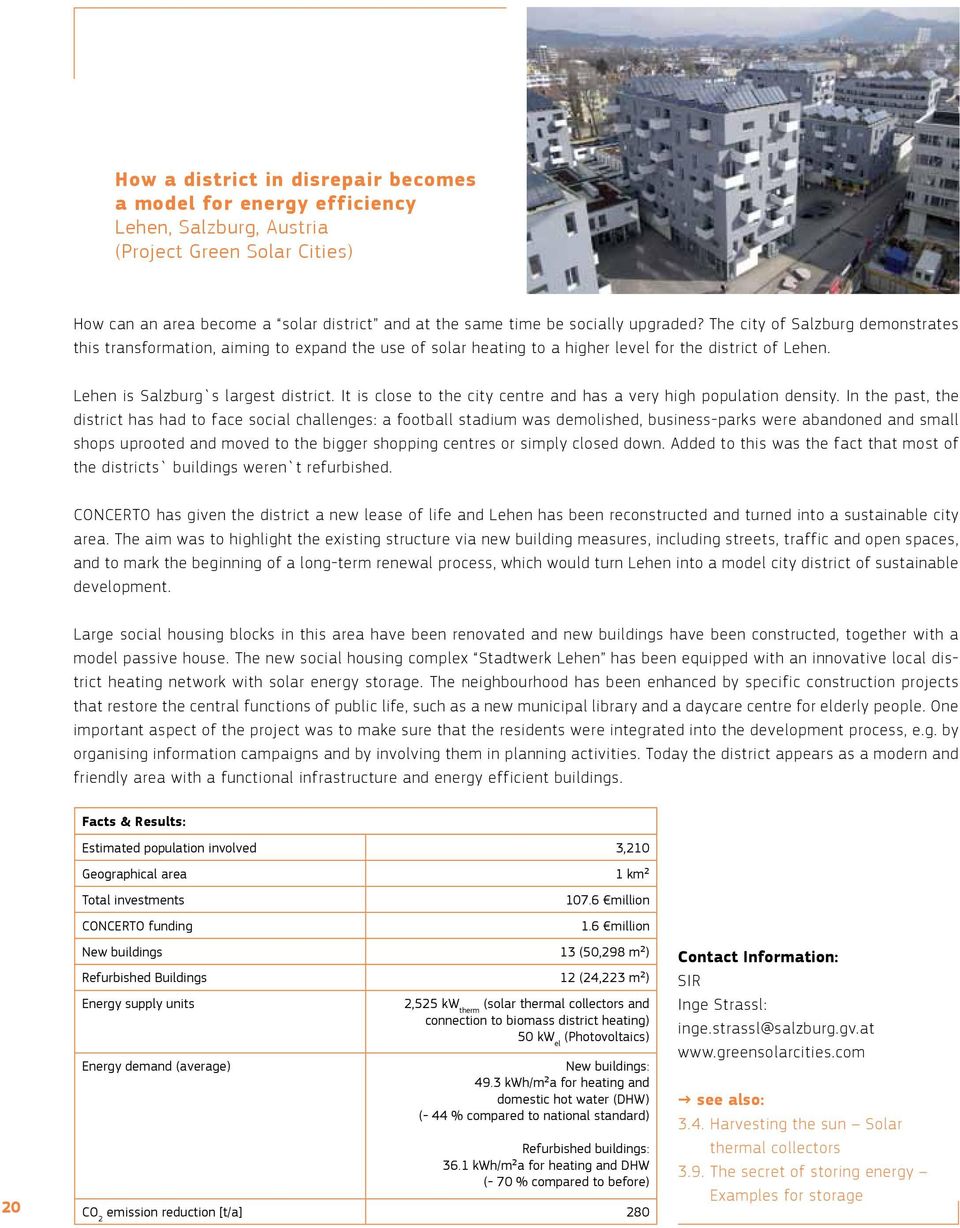
20 How a district in disrepair becomes a model for energy efficiency Lehen, Salzburg, Austria (Project Green Solar Cities) How can an area become a solar district and at the same time be socially upgraded? The city of Salzburg demonstrates this transformation, aiming to expand the use of solar heating to a higher level for the district of Lehen. Lehen is Salzburg`s largest district. It is close to the city centre and has a very high population density. In the past, the district has had to face social challenges: a football stadium was demolished, business-parks were abandoned and small shops uprooted and moved to the bigger shopping centres or simply closed down. Added to this was the fact that most of the districts` buildings weren`t refurbished. CONCERTO has given the district a new lease of life and Lehen has been reconstructed and turned into a sustainable city area. The aim was to highlight the existing structure via new building measures, including streets, traffic and open spaces, and to mark the beginning of a long-term renewal process, which would turn Lehen into a model city district of sustainable development. Large social housing blocks in this area have been renovated and new buildings have been constructed, together with a model passive house. The new social housing complex Stadtwerk Lehen has been equipped with an innovative local district heating network with solar energy storage. The neighbourhood has been enhanced by specific construction projects that restore the central functions of public life, such as a new municipal library and a daycare centre for elderly people. One important aspect of the project was to make sure that the residents were integrated into the development process, e.g. by organising information campaigns and by involving them in planning activities. Today the district appears as a modern and friendly area with a functional infrastructure and energy efficient buildings. Facts & Results: Estimated population involved 3, Geographical area Total investments CONCERTO funding New buildings Refurbished Buildings Energy supply units Energy demand (average) 1 km² million 1.6 million 13 (50,298 m²) 12 (24,223 m²) 2,525 kw therm (solar thermal collectors and connection to biomass district heating) 50 kw el (Photovoltaics) New buildings: 49.3 kwh/m²a for heating and domestic hot water (DHW) (- 44 % compared to national standard) Refurbished buildings: 36.1 kwh/m²a for heating and DHW (- 70 % compared to before) CO 2 emission reduction [t/a] 280 SIR Inge Strassl: [email protected] see also: 3.4. Harvesting the sun Solar thermal collectors 3.9. The secret of storing energy Examples for storage
21 2.2. Educational and other public buildings 2.2. Educational and other public buildings Public demonstration buildings have the advantage of plenty of people learning first-hand about possible improvements. If the community acts as a role model for new approaches, its citizens are often more easily convinced and motivated to take actions themselves. The dissemination of successful measures is sometimes supplemented by permanent exhibitions or electronic displays, showing the produced or saved energy. Schools represent an ideal location to link the topic energy transition with education and training. In addition to them being a suitable location for undertaking energy efficiency measures and installing renewable energy resources, they also provide a valuable means for engaging children, parents, teachers and the wider community in many issues relating to climate change. Special funding activities like solar sports and solar schools, bringing solar thermal systems to sport or school facilities and integrating them into day-to-day, educational lessons were realised within CONCERTO. Schools have been built or refurbished in the following cities within CONCERTO: Almere Cernier Galanta Hannover Hartberg Helsingør Hvar Lambeth Lapua Neckarsulm Słubice Trondheim Tulln Växjö The construction or refurbishment of kindergartens took place in: Hartberg Mödling Mórahalom Neckarsulm Salzburg Sofia Stenløse Szentendre Weiz-Gleisdorf Zargoje Other educational buildings like youth centres, sports halls and a public library have been the focus in: Cernier Delft Hannover Heerlen Neuchâtel Ostfildern Salzburg Stenlose Trondheim Valby Viladecans Other notable public buildings that have evolved from CONCERTO activities are the exhibition centre in Zaragoza and the city halls in Ostfildern, Tudela and Hillerød. 21
22 CO 2 neutral culture at Klaverfabrikken A public building promoting music and culture Hillerød, Denmark (Project SORCER) Klaverfabrikken is a community centre located in Hillerød. More than 78,000 m² of eco-houses (670 buildings) have been constructed in Hillerød, the regional capital of Denmark's North Zealand region. 50 Energy Class 1 houses, with 41 % heat savings and 100 % usage of renewable energy sources (RES) compared to normal Danish practice, have been built. The energy supply structure consists of a bio-gasification cogeneration plant (250 kw el, 500 kw th ), a biomass boiler (1,500 kw th ), photovoltaic (PV) systems with a total of 210 kwp, heat from 3,000 m² solar collectors and individual heat supply such as heat pumps. Amongst the activities in Klaverfabrikken are a drama school, an art school, two music venues and various other projects that are driven by the local community. The music venues are especially important to world music for both Danish and international artists. In February 2011, Klaverfabrikken formulated the ambitious plan to become CO 2 neutral in the future with respect to all activities in the building. In a study by COWI, the coordinator of SORCER, it was found that the activities in Klaverfabrikken resulted in a total yearly CO 2 emission of around 16 tons. This study showed how to offset emissions and specific actions were recommended, e.g. saving energy and generating electricity with PV panels. Measures contributing to energy savings included the monitoring of actual consumption, updated control and the continued effort to replace stage lighting with LED lighting. In August 2011, 30 kwp of photovoltaic panels were installed. This made Klaverfabrikken the first CO 2 neutral music venue in the world. The news has travelled around the world and Klaverfabrikken has received substantial interest from both artists and the general public. Facts & Results photovoltaics: Capacity 30 kw peak Installation Type roof mounted (flat roof) Total investments 150,000 CONCERTO funding 50,000 Yield (calculated) 31,000 kwh/a CO 2 emission reduction [t/a] 13.4 COWI AS Peter Weitzmann: [email protected] see also: 3.4. Harvesting the sun Solar thermal collectors 22
23 2.2. Educational and other public buildings Solar for schools Energy education and energy audits for schools Lambeth, Great Britain (Project ECOSTILER) Lambeth is an inner London borough and one of the most densely populated areas in London. Its population has expanded from 250,000 in the 1990s to 272,000 in 2006 and this number is expected to rise to 332,000 by Besides the refurbishment of three high-rise tower blocks, which have since achieved an 80 % reduction in carbon emissions, the focus of CONCERTO activities in Lambeth was on energy efficiency measures and RES energy supply units undertaken in six schools. A holistic solar for schools package has been developed and delivered to the six schools within the borough. The package included the installation of solar photovoltaic (PV) and thermal panels that feed directly into the school s electricity and heating systems. The six schools have been equipped with 5 kwp PV systems, with approx. 10 m² of solar collectors and a weather station. They have had a total of 32 m² of Solar Thermal and around 30 kwp of PV installed. In addition to the PV and thermal panel installations, technical energy audits have been conducted and recommendations presented to the schools, detailing opportunities for installing energy-saving measures and implementing behavioural change initiatives. An extensive education programme has been carried out in the schools, teaching the students directly how to save energy. And what is more, each school received a detailed energy audit concerning their buildings and a report detailing energy-saving recommendations was produced. Facts & Results photovoltaics: Capacity kw peak Installation Type roof mounted (flat roof) Total investments 312,200 CONCERTO funding 66,300 Yield (calculated) 30,300 kwh CO 2 emission reduction [t/a] 18.7 Facts & Results solar thermal collectors: Capacity m² Installation Type roof mounted (flat roof) Total investments 38,500 CONCERTO funding 4,500 Yield (calculated) 15,100 kwh CO 2 emission reduction [t/a] 4.9 Carbon Descent Chris Dunham: [email protected] Lambeth Council Jon Lissimore: [email protected] 23
24 Retrofit of a primary school The Neubergschule Neckarsulm, Germany (Project Energy in Minds!) The city of Neckarsulm in northern Baden-Württemberg with its 27,000 inhabitants is in the vanguard of solar energy in Germany. It has a cutting-edge position regarding the density of solar thermal and photovoltaic (PV) systems. Within CONCERTO, more than 1,200 m 2 of solar thermal collectors and 1.4 MWpeak of PV systems have been additionally installed. 13,000 m² of multi-family houses and public buildings have been retrofitted. The city of Neckarsulm also constructed 11,000 m² of new buildings during the course of the project and a solar sludge drying plant was completed in September In June 2007, the high-efficiency retrofit of the Neubergschule, with a gross floor area of 2,862 m 2, was finished. Besides retrofitting the building envelope, a new heating system was also installed consisting of two pellet boilers with 69kW each and a prototype Stirling engine. The primary energy demand has been reduced by 75 %. When taking the electricity produced by the PV system on the school roof and by the Stirling engine into consideration, the primary energy balance comes close to being zero. The school is a fine example that shows the combination of efficiency measures on the building front and the integration of renewable energy sources for energy supply. Facts & Results building: Floor area 2,862 m² gross floor area (GFA) Year of construction 1971 Energy demand before (calculated) 136 kwh/m²a for heating Energy demand after (calculated) 61 kwh/m²a for heating Energy consumption (measured) 26 kwh/m²a for heating Energy supply Heating and domestic hot water (DHW): gas boiler replaced by 2x 69 kw pellet boilers Electricity: grid (existing PV feeds into grid) CO 2 emission reduction [t/a] 83.8 City of Neckarsulm Klaus Grabbe: [email protected] see also: 3.9. The secret of storing energy Examples for storage 24
25 2.2. Educational and other public buildings An intelligent town hall thanks to smart metering and clever ventilation Scharnhauser Park, Ostfildern, Germany (Project POLYCITY) The town hall is located at the centre of Scharnhauser Park, a former US military base next to Stuttgart airport. As an outstanding architectural project, it was constructed from as a multifunctional public building comprising municipal administration, civic services, a public library, an art gallery, classrooms for music lessons and an evening school, a registry office, office space, sports facilities and a multipurpose hall. Heat is delivered from the biomass co-generation plant via a 13 km district heating network. There is a small boiler for domestic hot water in the building and four big ventilation systems. Air-conditioning has not been installed because the double-facade includes sun-protection measures and the large thermal masses of the concrete structure in the inner core normally buffer high temperatures on extremely hot summer days. The building automation and control system provides time schedules and single room regulation as well as parameters for ventilation and the different heating circuits. Enormous progress in electric energy consumption could be realised through relatively small means such as monitoring equipment and small electrical improvement devices such as switchable plugs and timers. Caretakers and people who work in and frequent the buildings have been educated and made aware of the new methods. An energy management system was set up to monitor savings and gain further insight into energy consumption patterns. Furthermore, detailed technical building inspections to analyse the electrical needs of the users in the building were carried out. We must go to great lengths to ensure all public buildings and urban spaces are constructed to the highest possible standards, because they are examples to us all. I believe people unconsciously sense that quality demands respect. A town structure has developed and I believe a very high percentage of the people who live here today really like living here. Jürgen Fahrlaender, Former First Mayor Ostfildern, Germany Facts & Results building: Floor area Energy demand (calculated) according to national standard Energy demand (calculated) Energy consumption (measured) Energy supply 4,808 m² (gross floor area) 75.6 kwh/m²a for heating 42.0 kwh/m²a for heating 29.3 kwh/m²a for heating Heating and domestic hot water (DHW): Heating: District heating network DHW: Boiler Electricity: Electricity Grid CO 2 emission reduction [t/a] 20.9 watch our videos: Saving energy in public buildings and in the district Video on the example of Ostfildern Smart energy monitoring and energy management key to lower energy bills Video on the example of Ostfildern Stadt Ostfildern Frank Hettler: [email protected] see also: 2.1. Innovative districts and ecovillages 3.3. Make it a triple! Cogeneration and polygeneration plants 4.3. Monitoring as a key aspect of energy management 4.4. Examples for knowledge transfer and replication 25
26 2.3. Residential buildings Just as the technologies applied within CONCERTO are diverse, so are the residential buildings. The demonstration objects vary from newly erected smaller and larger houses to the retrofitting of big blocks of flats and single family homes. Within some areas, the social mixture of the districts is taken into special account meaning that whilst some of the houses consist of high-end flats, a distinct number comprises public housing. In other areas, large blocks of flats are retrofitted, integrating the residents into the process and ensuring that the measures taken will also have a positive payback for them and the consequence will not be the social upgrading of the area. What unites the projects are ambitious goals in terms of energy and living comfort and a broad involvement of the different stakeholders: residents, energy suppliers, local governments and residential building cooperatives. Växjö, SE, Project SESAC Óbuda, HU, Project STACCATO 26
27 2.3. Residential buildings The art of a socially acceptable upgrading Poptahof, Delft, the Netherlands (Project SESAC) Delft has 100,000 inhabitants and lies in the Netherlands between Rotterdam and The Hague. It has set itself ambitious climate targets: by 2030 it wants to achieve 50 % less CO 2 emissions compared to 1990, it plans a share of renewable energy of 25 % of the total energy consumption as well as 50 % less energy use than in One of the many measures taken to reach these targets is taking place in the Poptahof district, where a large-scale upgrade is planned for the next years in order to prevent the neighbourhood from slipping into social decline. The activities are focused on highrise buildings. 800 apartments in eight multi-storey buildings have been renovated, improving the thermal envelope of the buildings together with installations and the introduction of measures to stimulate the energy efficient behaviour of residents. As part of the SESAC project, 84 apartments and nine commercial studios have been refurbished to new standards. In addition, 58 new energy-efficient dwellings and a vertical photovoltaic (PV) system have been constructed. The dwellings are composed of around 40 % low-rent social housing, 20 % privately owned social housing and 40 % privately owned housing. The new buildings have a calculated energy demand for space heating on average of more than 50 % below standards. The ambitious aim for the refurbished housing is set to even reach the national standard for new housing. The residents can follow their energy consumption on small touch screens in their flats, set targets and send their feedback. The upgrading is a cooperation between the housing association of Woonbron in the Municipality of Delft and the owner of a shopping centre. The housing association pays a lot of attention to the social aspects of the project such as the For Living concept that gives clients the choice of renting or buying a flat with a range of options according to their personal and financial situation. Facts & Results Poptahof buildings: Floor area Energy demand (calculated) according to national standard Energy demand (calculated) Energy consumption (measured) 5,593 m² net heated floor area for the new dwellings 7,436 m² net heated floor area for the refurbished dwellings 80 kwh/(m² nhfa a) for heating and domestic hot water (DHW) for the new dwellings 187 kwh/(m² nhfa a) for heating and DHW for the refurbished dwellings 55 kwh/(m² nhfa a) for heating and domestic hot water (DHW) for the new dwellings (average) 64 kwh/(m² nhfa a) for heating and DHW for the refurbished dwellings (average) 64 kwh/(m² nhfa a) for heating and DHW for the new dwellings 56 kwh/(m² nhfa a) for heating and DHW for the refurbished dwellings Energy supply Heating and DHW: district heating (gas boilers until network is completed) Electricity: 10 kw peak PV installation and grid CO 2 emission reduction [t/a] New Building: (heating, DHW and electricity) Refurbished Building: (heating and electricity) Gemeente Delft Johan van Reenen: [email protected] 27
28 A new approach of urban renewal at Ile de Nantes Nantes, France (Project act2) The city of Nantes, located near the Atlantic coast, is the sixth largest city in France. The demonstration activities in Nantes are focused on the Ile de Nantes district, a 340 hectare-wide area where energy efficiency is in the focus of the urban led renewal. One of the central measures to be undertaken was the co-funding of energy efficiency measures in social housing. The act2 project in Nantes was designed as an integrated approach to enrich local energy policy. It aimed at improving practices of a complete chain of players involved in the construction process: from decision makers to citizens, including building companies. Public housing projects are included in the demonstration activities. The new Forges Residence, comprising 1,810 m², is a social residence for young workers. Concerning energy and thermal performances, the main measures within CONCERTO were to improve the energy efficiency of the building, making it 40 % more efficient than the French regulatory values. This has been achieved by introducing new insulation measures; new double glazing windows and the integration into the local district heating system (which has been significantly expanded while harnessing its energy mix of which 84 % is from renewable sources: 43 % wood, 41 % waste and 16 % gas). Within the Terrain des Gendarmes real estate programme, various housing projects have been erected on a vacant site of 2 ha. Within the housing project, four blocks comprising 16,393 m² have been built, connected to the waste-to-energy district heating system and a 77 m² solar installation (covering part of the domestic hot water (DHW) demand). Block A with 36 social housing dwellings, and Block B, with 43 social housing dwellings, are worth a special mention: they receive heating and domestic hot water from a substation connected to the district heating network. Domestic hot water is also provided by solar thermal panels. While exterior insulation of 6 cm (Block A) and 14 cm (of Rockwool, Block B) and argonfilled windows (Block B) is provided, mechanical ventilation is also applied. A heating programme with climate control minimises the energy used. Facts & Results residential buildings: Floor area Energy demand (calculated) according to national standard Energy demand (calculated) Energy supply 45,287m² (net floor) 61 kwh/m²a for heating and domestic hot water (DHW) 33 kwh/m²a for heating and DHW Heating and DHW: Mainly waste- and wood-fired district heating network CO 2 emission reduction [t/a] 1,052.4 Nantes Métropole Vincent Huré: [email protected] 28
29 2.3. Residential buildings A modern building block in Central Europe becomes energy efficient Óbuda, Budapest, Hungary (Project STACCATO) With 127,000 inhabitants, Óbuda is one of the biggest districts of Budapest. Two-thirds of its population lives in Soviettype blocks of flats with definite shortcomings regarding their energy efficiency. These are reflected in the outdated windows and walls, the roof insulation and the efficiency of the central heating system. The energy efficient refurbishment of such a block of flats was therefore the main focus of activity. For CONCERTO, the so-called Village, a building with 3,000 inhabitants, was selected for the implementation of measures. Built in 1970, with its 886 flats, the 315 m long building was regarded as an experiment in its time, with nine different types of heating systems. During the retrofitting work, the apartments were given a complete insulation makeover. The 1,800 old windows were replaced by new, five chamber plastic windows and the heating system was renewed. Heat is now delivered by the local district heating network and the domestic hot water is mainly prepared by Hungary s largest solar thermal installation on the roof and stored in large-scale tanks. The solar thermal collectors have a capacity of 1061 kw and an installed surface area of 1,515 m². Informing and convincing the residents of the planned refurbishment measures was a crucial part of this project from the very beginning. This approach was successful: 82 % of them voted in favour of the retrofitting. Further information followed after the retrofitting work started: since the inhabitants also cover a part of the costs, they are naturally entitled to know what their money is being used for. Further measures taken comprised of a sociological survey of the building s occupants, of measuring the project impact and of awareness campaigns to generate similar projects nationwide. The effect of the energy efficiency measures is overwhelming. They have shown an enormous 70 % reduction compared to the buildings that are currently not insulated. As well as this, the VAT on district heat rose from 5 % to 27 % in 2011 making every single kwh of saved district heat even more attractive. The residents can profit greatly from both energy and cost savings. Facts & Results The Village block: Floor area 53,993 m² gross floor area (GFA) Energy demand before refurbishment 145 kwh/(m² GFA a) for heating and domestic hot water (DHW) Energy demand (calculated) 69 kwh/(m² GFA a) for heating and DHW Energy consumption after (measured) 109 kwh/(m² GFA a) for heating and DHW Energy supply Heating and DHW: Heating: District heating DHW: Solar thermal collectors, if necessary backed up by the district heating Electricity: Grid CO 2 emission reduction [t/a] 1,146.8 Óbuda-Békásmegyer Péter Puskás: [email protected] watch our video: Saving energy by retrofitting Video on the example of Óbuda Within six months the city retrofitted a total of 886 flats. In addition to the insulation of the outside walls, the house was also given a new coat of paint on the outside. The insulation is far better than it used to be. And we no longer have any draughts. The apartment is much warmer in general. Our energy costs have been halved thanks to CONCERTO. Zsuzsanna Nagy, resident of the village in Óbuda, Hungary 29
30 Refurbishment of multi-family buildings Sofia, Bulgaria (Project STACCATO) Oborishte is an older, mixed-use district of Bulgaria s capital Sofia, with around 36,000 inhabitants. Though the fast growing city is in need of living space for its inhabitants, the existing building stock is deteriorating. Demolishing the buildings and replacing them with new housing blocks is rarely an option due to complicated ownership structures and the poor financial situation of the residents. The CONCERTO programme offered the possibility of improving conditions not only just for a single flat, but for a whole multi-family building, where the multiple owners agreed on the goals and collaborated. The Oborishte retrofitting project consists of three separate multi-family apartment blocks that were built between 1932 and 1957, as well as the refurbishment and the extension of a kindergarten. The refurbishment package included insulation and double glazing in accordance with the requirements for new buildings; the ventilation systems were also replaced by more efficient ones. The main source of heat is still, as was the case before the retrofitting, the district heating network although smart control systems were applied during the programme which have resulted in additional savings. All in all, the energy saving for heating achieved by the retrofitting measures was estimated to be 68%. Besides the above mentioned measures, the production of domestic hot water was also decoupled and solar collectors were mounted on the roofs of the buildings an uncommon approach in Bulgaria. Energy savings of at least 10 % was the target for domestic hot water preparation. Thanks to the refurbishment, the apartments are much more energy-efficient and more comfortable when compared to other multi-family apartment buildings, leading to a higher quality of life for the residents in this part of Sofia. The experiences of the refurbishment in Oborishte are of great value for similar projects in Bulgaria and other countries. The comprehensive approach also included the residents who have organised themselves into homeowners associations. The thorough programme of external insulation and window renewal led to its success. Facts & Results buildings: Floor area 5,926 m² gross floor area (GFA) Energy demand before refurbishment 210 kwh/(m² GFA a) for heating and domestic hot water (DHW) Energy demand (calculated) 70 kwh/(m² GFA a) for heating and DHW Energy supply Heating and DHW: Heating: District heating network DHW: Solar thermal collectors Electricity: Electricity grid CO 2 emission reduction [t/a] Oborishte Antoaneta Yoveva: [email protected] 30
31 2.3. Residential buildings Improving the quality of life by renovating council houses Turin, Italy (Project POLYCITY) How can a district be saved from deteriorating and the living conditions of the inhabitants be improved at the same time? The CONCERTO area of Arquata proved that this is possible. The district is located in northern Italy, near the centre of Turin, capital of the Piedmont region. The main focus of the activities was the modernisation and re-qualification of the district. One of the challenges set in Arquata was the refurbishment of 30 council houses. The entire district is owned and developed by the local housing authority, an important partner for undertaking these measures. The selection of the measures to be taken was strongly influenced by the constraints imposed on the buildings in Arquata, especially on the facades, due to their historical and architectural value. The main actions to be carried out were extra thermal insulation (mainly under the roof) and highly-efficient glazing. A district heating distribution network has also been established for Arquata. It provides the council buildings with space heating and sanitary water where it was previously lacking or where there were only inefficient, small electrical and fossil-fuelled boilers. A very innovative communal energy management has been introduced too. It is operated by an energy manager and planner with the aim of reducing the energy requirements, and subsequently the energy costs, of the inhabitants. The final result is a substantial improvement in the residents` quality of life due to the increase in comfort and services. Facts & Results buildings: Floor area 35,000 m² Energy demand (calculated) Energy consumption (measured) Energy supply 70 kwh/m²a for heating and domestic hot water (DHW) 85 kwh/m²a for heating and DHW Heating and DHW: Gas-fired CHP supplying a district heating network Electricity: 13 PV plants installed on residential buildings Facts & Results community: Estimated population involved 2,500 Geographical area 87,500 Total investments 6.6 million CONCERTO funding 1.8 million Refurbished buildings 47,695 m² Energy supply units 1,166 kw therm 1,138 kw el Energy demand (average) Refurbished buildings: 85 kwh/m²a for heating and DHW (- 22 % compared to national average) CO 2 emission reduction [t/a] 4,206 Centro Ricerche FIAT S.C.p.A Franco Anzioso: [email protected] 31
32 Interview The Swedish city of Växjö A pioneer of the energy transition Interview with Henrik Johansson, city of Växjö Växjö, the Greenest City in Europe in the south of Sweden wants to free itself from fossil fuels by the year With 63,000 inhabitants in the city centre and 85,000 in total, the city has already taken big steps in the right direction, reducing its CO 2 emissions from fossil fuels by 41 % from 1993 to Another of Växjö`s objectives is to reduce the energy use per capita by 15 % between 2008 and Mr. Johansson, how do the inhabitants of Växjö support these CO 2 reduction plans? Do they see the greening of their city as something that improves their lives? Almost everyone in Växjö knows about the concept of the Greenest City in Europe, but this does not mean that all of them know about the climate policies. We get the feeling that most people support the climate targets. However, it is our role to make it convenient and easy to live in an environmentally friendly manner in Växjö, and as a private individual you initially need to do very little. For example, the shift from oil to biomass in the district heating system changed the environmental impact of most households energy use, even if the citizens themselves didn t change their behaviour. In many cases, I believe that people see that a green city contributes to an improved quality of life. Henrik Johansson, city of Växjö Can you please describe the most important steps towards the climate objectives of Växjö? Up to now, the introduction of biomass in the energy system is by far the most important step. The first steps were taken in 1980, with biomass making up only a few percent of heat production. Nowadays we use around 95 % biomass to produce heating, electricity and cooling. In 2012, our CO 2 emissions were % less than they would have been if we were only using fossil fuels. 32
33 Interview with Henrik Johansson, city of Växjö The municipality of Växjö is strongly committed to climate and energy efficiency targets. What are the priorities in Växjö s local policy? Since the beginning of the 80s, the focus of heat and power production has been a shift from oil to renewable energy. During the SESAC project, under the CONCERTO programme, we started with a stronger focus on technologies for new, energy efficient buildings. Now, the politicians have identified two priorities related to climate and energy. They are reducing energy consumption in the existing building stock and making the transport system sustainable. What comes next? Will you continue with European projects and partnerships? We are always looking for new opportunities to get involved in EU projects and to identify partnerships throughout Europe. Currently we have successfully applied for the Smart Cities call. What was the contribution of CONCERTO? CONCERTO meant so much to us. It marked the real start of our work with energy efficient construction. It showed our politicians and housing companies that it is possible to construct buildings with low energy consumption. Even if we already have a low-carbon energy system, it is very important to use energy efficiently. The experiences of CONCERTO have made it possible for us to strive for ambitious targets and to develop strategies like our energy plan, including policies for maximum energy demand in new and refurbished buildings. Without CONCERTO, I am sure that the municipality would not be prepared to take these decisions.» «33
34 Chapter 3 The strategic use of low carbon technologies based on renewable energy sources Ready to be applied To move towards the 2020 and 2050 climate protection goals, energy efficiency measures and low carbon technology measures have to be combined in an intelligent way. The optimisation of the supply side is based on increasing the efficiency of energy supply technologies themselves, on enlarging the share of renewable energy sources for this energy supply and on combining and managing the most suitable energy producers with respect to individual demand at every step of the way. The availability of renewable energy sources, such as wind, sun, biomass, hydropower and geothermal energy, differs considerably depending on their individual geographic location within Europe. Moreover, temporal availability of wind and solar energy is subject to strong, sharp time fluctuations. For this reason, the use of renewable energies has to be carefully adapted to suit each individual situation where storage and distribution often play important roles. New technologies that utilise renewable energy sources are sometimes not well-established on the market and still have a prototype kind of status, meaning that their long-term performance and reliability have yet to be proven. When local, renewable energy sources are implemented into the energy supply concept, the advantage is provided by short transportation distances and an added value in the region. Waste materials like green waste or sludge water are often integrated into the energy production cycle, therefore reducing other side effects. If concepts are thought about on a larger scale right from the very beginning and bring more energy supply units together with an increased number of energy consumers, the available resources can be used more efficiently and wasting energy can be minimised. Such an integrated approach has been the ambitious task for the CONCERTO communities. By applying the optimal mix of technologies and renewable energy sources to demonstration activities, it could be proven that innovative solutions and new products are mature enough to take on the fight against climate change and to pave the EU s way towards CO 2 neutrality. All 58 communities have worked out concepts and implemented different technologies to increase their share of renewable energy sources and to decrease the emission of greenhouse gases in their demonstration areas. A total of almost 390 MW of renewable energy power has been installed within the CONCERTO programme so far, which corresponds to a total investment of 416 million in the field of energy supply and energy distribution. 34
35 Chapter 3 The strategic use of low carbon technologies based on renewable energy sources Ready to be applied Total installed RES power in CONCERTO: 386 MW Total installed RES power in CONCERTO: 386 MW 198,3 19,6 31,8 53,9 10,7 12,9 26,3 4,8 5,4 7,1 6,3 3,7 2,8 0,3 2,2 Biomass Boiler (small) (818) Biomass Boiler (large) (65) Solar thermal (small) (789) Solar thermal (large) (23) Photovoltaics (small) (743) Photovoltaics (large) (38) Geothermal plant (8) Heat pump (49) AbsorpFon chiller (6) MicroCHP (24) Total installed Total installed RES RES electricity electricity power power in CONCERTO: in CONCERTO: 119 MW 119 MW Photovoltaics (small) (743) Photovoltaics (large) (38) 4,8 5,4 0,7 MicroCHP (24) 0,3 Hydro power (4) Total installed RES electricity 1,6 power in CONCERTO: 119 MW 0,1 Other (small) (9) 52,7 4,8 Photovoltaics (small) (743) Other (large) (16) Photovoltaics (large) (38) Wind power (7) 5,4 0,7 MicroCHP (24) CHP plant (26) 1,6 0,3 0,1 Hydro power (4) Other (small) (9) Other (large) (16) 52,7 53,9 Wind power (7) CHP plant (26) Hydro power (4) Total installed renewable energy sources (RES) power [MW] of CONCERTO demonstration objects by summing up heating, cooling and electricity power per type, according to the CONCERTO database from October ,9 Total installed renewable energy sources (RES) electricity power [MW] of CONCERTO demonstration objects per type, according to the CONCERTO database from October 2013 The infrastructure for energy distribution consists of large-scale district or smaller, local networks, often applied for heating, but there are also examples of cooling networks and small electricity grids. The CONCERTO communities have dealt with building new and also with extending existing networks, meaning the additional installation of supply units, connecting further buildings or optimising pumps and pipes. Besides cooling networks, technologies, such as absorption cooling and concepts, like passive cooling, face the increasing cooling demand that is due to climate change and an increased demand for comfort. They are showing efficient solutions. Absorption cooling is also a measure to add a third dimension to the known combined heat and power (CHP) generation, as generating cold from heat provides the opportunity to utilise the waste heat of electricity production in summer too. CONCERTO has demonstrated CHP from biomass and polygeneration in several ways. Total installed RES heating power in CONCERTO: 248 MW Total installed Total installed RES hea0ng RES hea0ng power power in CONCERTO: in 248 MW Total installed RES cooling power in CONCERTO: 18 MW Total installed RES cooling power in CONCERTO: 18 MW 19,6 19,6 0,4 145,6 145,6 31,8 31,8 Biomass Boiler (small) (818) 10,7 Biomass Boiler (large) (small) (65) (818) Solar thermal (small) (789) 10,7 Biomass Boiler (large) (65) 12,9 Solar Solar thermal (large) (small) (23) (789) 12,9 7,1 7,1 12,0 Geothermal plant (8) Solar thermal (large) (23) 5,8 Heat pump (49) Geothermal plant (8) 2,1 MicroCHP (24) 5,8 0,7 Heat pump (49) Other (small) (9) 12,0 2,1 MicroCHP Other (large) (24) (16) 0,7 Other CHP plant (small) (26) (9) Other (large) (16) 12,7 3,7 1,5 Heat pump (49) Absorp9on chiller (6) Other (small) (9) Other (large) (16) CHP plant (26) Total installed renewable energy sources (RES) heating power [MW] of CONCERTO demonstration objects per type, according to the CONCERTO database from October 2013 Total installed renewable energy sources (RES) cooling power [MW] of CONCERTO demonstration objects per type, according to the CONCERTO database from October
36 The sun has played a large role within the renewable energy sources used in CONCERTO projects. Small, single thermal collectors have been installed, as well as large plants that are connected to district heating systems. Flat-plate collectors, vacuum tubes and plastic absorbers have been used and their applications range from domestic hot water preparation to a heating supplement. Solar energy was also harvested to produce electricity by small, building-related photovoltaic systems and by large photovoltaic (PV) plants, installed on roofs or on the ground. In the field of electricity production, large wind power plants have also shown good results and have contributed a large part of the locally produced energy. Whilst the larger plants are usually situated outside the communities, small wind turbines bring wind energy to an urban scale. Some CONCERTO communities also make use of geothermal energy, but in varying ways. Several use geothermal wells for heating and cooling, some reutilise former mining shafts and others use lake water or sediment from a river for low temperature cooling and heating. The more different the approaches are, the more innovative they are. Often neglected, but for a future energy mix not of lesser importance, is the embodied energy in different kinds of waste. CONCERTO projects extract energy from waste water, communal waste, green and agricultural waste and even from animal carcasses. And finally in order to close the cycle of energy networks and their different components is the ability to store energy, which is important for the efficient use of renewable energy sources. Large-scale thermal storages have been demonstrated, as well as small air pressure storages for electrical energy. Battery storage was also tested at an existing wind power plant within CONCERTO research activities. The following chapters present some of the achieved good practice examples and offer more detailed information on the technologies implemented within CONCERTO. 36
37 3.1. District heating and cooling It s all about networking 3.1. District heating and cooling It s all about networking When several energy consumers, such as residential and office buildings as well as industrial areas, are connected by underground pipes to one or more heat supply units, the term district heating network is used. The first use of a district heating system dates back as far as the 14th century and was found in a French village, where the heat from a warm spring was distributed to different locations. The first commercial heating network dates back to People realised that replacing several boilers by just one, central boiler would reduce the danger of fire and the emission of exhaust fumes. In the 20th century, power companies made use of the waste heat from power-generation and sold it to the residents in some districts. Since reducing greenhouse gas emissions and improving energy efficiency to stop climate change became an issue, district networks have achieved a new dimension of importance. A large power generator can be operated more efficiently than numerous small ones and fluctuations can be compensated even better, because consumption is distributed to a much larger number of users. The same principle can be applied to providing cooling energy for a district. As the active cooling of residential buildings is not necessary or common in many regions of Europe, district cooling networks are rather rare. Within CONCERTO, four cooling networks and 94 heating networks have been included in the demonstration activities. Whereas 88 of them have been newly developed, ten of them have been extended by additional energy supply units or by connecting additional buildings. The capacity ranges from small networks, with a few kilowatts connecting three or four houses, up to several megawatts connecting hundreds of buildings. 37
38 A unique solar island Almere, the Netherlands (Project crrescendo) Almere is a young, growing municipality in the region of Flevoland, where the first house wasn`t built until The two CONCERTO districts of Columbuskwartier and Noorderplassen-West chose different approaches in generating their heating energy that was to be distributed to the residents via district heating networks. In the new district of Noorderplassen-West, the so-called Solar Island, a large field of 520 coupled solar thermal collectors has been set up. It is a unique project for Almere, for the Netherlands even. 7,135 m² of solar thermal collectors convert solar radiation into hot water. This supplies heat for 2,700 homes via the district heating grid. The Solar Island supplies 10 % of the total heating demand and a nearby Combined Heat and Power (CHP) plant provides the remaining 90 %. The otherwise unused waste heat from this CHP plant ensures residents are supplied with heating and hot water when the sun does not shine. The Solar Island annually converts 32 % of the energy received as solar irradiation to heat. The yearly share of solar energy is % for Almere and % for Noorderplassen-West. The Solar Island produces GJ/m2, which is comparable with individual solar collectors. The virtually unlimited storage capability of the district heating network, allowing more transfer of solar energy, is countered by the necessity to first raise the temperature to 70 C in the solar collector before it can contribute to the district heating, which operates at a return temperature of 65 C. The Almere Solar Island, including the conventional Combined Heat and Power (CHP) plant and the district heating network, cuts CO 2 emissions by 50 %. The district heating network in the second district, Columbuskwartier, gets its heat from an existing CHP plant in Diemen, which is across the lake between Almere and Amsterdam. Heat in Diemen is recovered from the hot exhaust gases and transported to Almere. The heat recovery covers the expected amount of renewable heat. The renewable electricity, planned to be produced by the local biomass CHP, is covered by the purchase of green certificates for the same amount of electricity. Facts & Results district heating: Name District heating Noorderplassen West Measure Extension of existing network Capacity [MWh/a] 374,000 CO 2 emission reduction [t/a] 74, Facts & Results solar thermal: Name Solar Island Total investment [ ] 4,140,000 CONCERTO funding [ ] 971,000 Power [MW] 4,790 Size [m²] 7,810 Energy production per year [MWh/a] 2,800 CO 2 emission reduction [t/a] 913 Gemeente Almere Emil ter Horst: [email protected] see also: 4.1. Integrated planning A key factor for success
39 3.1. District heating and cooling It s all about networking Polygeneration for efficient cooling Cerdanyola del Vallès, Spain (Project POLYCITY) Cerdanyola del Vallès is a city located in the outskirts of Barcelona. In summer, temperatures rise considerably and cooling becomes an important issue. In this CONCERTO project area, the biggest cooling demand is from offices and industrial buildings. Transparent and light glass facades, internal heat gains from computers and other electronic devices and the hot summer climate create the need for active cooling measures. A polygeneration system has been connected to the science and technology Parc de l Alba and within it, to the Synchrotron Research Centre. Three refrigerating machines produce cooling. The most important one is the double effect absorption chiller which very efficiently produces cold using the exhaust gases of the engines, which produce power. Inside the chiller, cooling is produced through a vaporising process which absorbs heat. One advantage is that waste gases get used directly, without having to be converted to hot water or steam. This eliminates energy losses through energy conversion. Besides the absorption chiller, the compression chiller is used as a backup. Like a refrigerator, it produces cooling using electricity. The connected cooling network then supplies chilled water to the Synchrotron and to all the other buildings in the Parc de l Alba. Together, the chillers have a total cooling capacity of over 13 MW. This amounts to the total consumption of 5,000 small air conditioners or about 6,000 household refrigerators. The polygeneration system cuts the consumption of primary energy by about 35 % compared with conventional systems. Besides cooling, the entire electricity and heat supply is also provided with polygeneration. As first of all the aim is to reduce energy consumption, in addition, in this heat and cooling network an innovative management system adjusts the raw energy production to the required quantity consumed. The plant converts 85 % of the primary energy into heat, cold and electricity. It uses exhaust gases to produce cold. Facts & Results heating and cooling network: Name Heating and cooling network ST-4 Measure New construction Total investment [ ] 9,480,000 CONCERTO funding [ ] 116,600 Total length of pipes [km] 32.6 Heating and cooling demands of floor area 1,630,000 covered [m²] Heating Capacity [MW] 9.3 Cooling Capacity [MW] 8.3 CO 2 emission reduction heating and cooling[t/a] 401 watch our video: Energy efficient cooling Video on the example of Cerdanyola Departament de Medi Ambient i Habitatge, Generalitat de Catalunya Xavier Marti Rague: [email protected] see also: 3.2. Other innovative cooling approaches 3.9. The secret of storing energy Examples for storage 4.4. Examples for knowledge transfer and replication 39
40 A thermal hydraulic network takes the lake to the consumer Geneva, Switzerland (Project TetraEner) One of the first principles of sustainable living is to make the best use of the resources that are closest at hand. Geneva is putting this principle into practice by using a resource that is right on its doorstep: water from Lake Geneva. The water has a conveniently constant temperature of 8 C at the bottom of the lake. This makes the water an ideal source of energy for heating and cooling the buildings in Switzerland s second largest city. The purpose of the project is to connect buildings in the International Organisations district to a thermal hydraulic network that pumps and distributes deep water from Lake Geneva. It supplies both cooling (through the use of a heat exchanger) and heating (through the use of heat pumps). Water is pumped from a depth of about 37 m. Taken from this depth, the water has an ideal temperature, which is sufficiently constant and low. The cooling service is realised through the use of simple heat exchangers, which directly connect the internal distribution system of the building to the network, providing about 90 % of the total cooling demand per year. If the cooling power has to be secure and stable, or if cooling is needed at low temperature level, a condenser of a classical chiller can be connected to the network. Besides the cooling and heating activities, this system also enables various gardens in the district to use water from the lake for watering, thus saving an annual 200,000 m³ of high quality, potable water in These measures help the city to reach its goal of becoming a 2,000 Watt society without the use of nuclear energy. Facts & Results district cooling: Name GLN Network Geneva Measure New construction Total investment [ ] 24,000,000 CONCERTO funding [ ] 106,800 Capacity [MW] 20 CO 2 emission reduction [t/a] 1,863 Weinmann Energies SA Pierre-Alain Viquerat: [email protected] 40
41 3.2. Other innovative cooling approaches 3.2. Other innovative cooling approaches A lot of CONCERTO buildings had a moderate share of glazing and implemented shading systems to reduce the external heat gains. The nocturnal outside air temperature during the warm or hot months in most European climatic zones provides the potential to cool down a building during the night-time. This so-called passive cooling uses wind force for natural cross-ventilation or invokes airflows by thermal buoyancy to grant the needed air-change rates without (or with only low) consumption of electric power. If active cooling is necessary, the application of conventional chillers should be avoided, as they are run by compressors and thus by electrical power. The term sorption cooling (using the physical process of absorption or adsorption) refers to generating cooling energy from heat. This method offers the possibility to provide cooling by renewable energies, at a time when cooling is needed the most namely during hot, sunny days. As the energy source solar heat or waste heat can be used, the emission of CO 2 can be reduced significantly compared to electric compression chillers. Absorption cooling, Växjö, SE, Project SESAC Innovative cooling, Lake Geneva, CH, Project TetraEner 41
42 The passive cooling of buildings Cerdanyola del Vallès, Spain (Project POLYCITY) Cerdanyola del Vallès is a city located just outside Barcelona. Because of the long and hot summer months, this demonstration site focuses on innovative cooling concepts that are simple but effective and affordable. The natural ventilation, intelligent arrangement of windows and appropriate materials are the core elements. In two new residential buildings, with a total of 77 apartments, the principle of natural ventilation is applied: an intermediate space contains devices to create and regulate natural ventilation in summer. In addition to windows on two opposing facades, each apartment has access to a chimney with a manual opening for natural ventilation purposes. In the second building, temperature-buffering Trombe walls are also integrated into the construction as part of a natural ventilation system and cool the building during the daytime. In the southern façade, they enable preheating in winter and ventilation in summer. Facts & Results building 1: Name La Clota Measure 2,786 Total investment [ ] 16 CONCERTO funding [ ] 0 Capacity [MW] 20 Facts & Results building 2: Name Cordova Street Floor area [m²] (heated net floor) 2,172 Heating energy consumption [kwh/m²a] 27 Domestic hot water (DHW) energy consumption 7 [kwh/m²a] Cooling energy consumption [kwh/m²a] 0 Electricity consumption for lighting [kwh/m²a] 2 CO 2 emission reduction [t/a] 15.6 Departament de Medi Ambient i Habitatge, Generalitat de Catalunya Xavier Marti Rague: [email protected] see also: 3.1. District heating and cooling It s all about networking 3.9. The secret of storing energy Examples for storage 4.4. Examples for knowledge transfer and replication watch our video: Energy efficient cooling Video on the example of Cerdanyola 42
43 3.2. Other innovative cooling approaches Absorption cooling for a hospital Trondheim, Norway (Project ECO-City) Trondheim, with a population of 173,486, is the third most populated municipality in Norway. It is situated by the Trondheim fjord and serves as the administrative centre of the Sør-Trøndelag county. The city has a very strong environmental commitment and has set up an ambitious strategy including several goals that concern energy and energy-related issues. Within the ECO-City project, an energy conversion centre with absorption cooling is being employed. Two absorption chillers have been installed at St. Olav s Hospital, generating cooling energy from the district heat. The first part of the absorption refrigeration system, at the new St. Olav's Hospital, was opened in The purpose of the installation was to reduce the use of electrically driven compression chillers. The utilisation of the absorption refrigeration system increased along with the increasing number of buildings, and in 2007 the total cooling demand was 6.6 GWh. Free cooling and absorption cooling covered 97 % of this demand and compression chillers brought (as peak load) supplied the remaining 3 %. In 2009, the hospital's phase 2 was completed and cooling demand increased to 10 GWh/a. It was then decided to install a new 3 MW absorption chiller, under the CONCERTO initiative. The newly installed chiller was similar to the one installed in The aim was to reduce the use of electrically driven chillers and to reach the most environmentally friendly refrigerant production possible at the hospital. The cooling measures are integrated in a set of activities that will set a reference for new standards to prevail in the community. Facts & Results absorption chiller: Technology Absorption chiller Total investment [ ] 2.5 million CONCERTO funding [ ] 254,660 Power [MW] 3 Energy production per year [MWh/a] 1, CO 2 emission reduction [t/a] 20 COWI AS Fartein Brautaset: [email protected] 43
44 Heat keeps Växjö cool Växjö, Sweden (Project SESAC) Växjö, a city with 85,000 inhabitants, lies in the south of Sweden. The city wants to be fossil fuel free by the year 2030, the city administration already by the year Växjö s hospital and university are cooled with a new district cooling network. What is special about this district cooling network is the connected absorption chiller plant that uses district heat as an energy source. Absorption cooling technology is a way to reduce electrical cooling demand because it is driven by heat instead of electricity. In Växjö, the district heat is provided by a biomass-based Combined Heat and Power (CHP) plant. The absorption chillers were installed to make use of the heat produced from biomass in summer as well. What is more, climate change is expected to increase the demand for cooling during the year and prolong the cooling season, while the heating season is expected to be shortened. The first absorption chiller was commissioned in 2007; it is a small demonstration object with 300 kw for testing and evaluating in order to obtain design criteria for larger chillers. Two full-scale chillers at a newly constructed chiller plant, each of 2 MW, produce cooling that is distributed in pipes to the hospital and the university area. Within the district heating system, 2 MW of free cooling and an accumulator, that increases the peak capacity, have also been installed. The result is that the electrically driven compressor machines at the university and the hospital are only used for peak loads and as emergency backup. During the coming years, more customers will be connected to the system, such as shopping malls, industries and offices. A fully developed system is estimated to have a capacity of 25 MW. The cooling demand from the hospital and the university is estimated to be 8,000 MWh/a, of which 6,400 MWh can be supplied by absorption and free cooling. The use of electricity for cooling purposes can be reduced by nearly 2,000 MWh/a. At the same time, the use of district cooling makes it possible to increase the electricity generation from biomass in the CHP by about 2,000 MWh during summer. 44 Facts & Results absorption chiller: Technology Absorption chiller Total investment [ ] 7,000,000 CONCERTO funding [ ] 1,260,000 Power [MW] 4.3 Energy production per year [MWh/a] 1,200 CO 2 emission reduction [t/a] 278 watch our video: A city goes energy efficient a holistic concept that works Video on the example of Växjö Växjö Kommun Julia Ahlrot: [email protected] see also: Interview with Henrik Johansson, city of Växjö 3.8. Not to be wasted Obtaining energy from waste, biomass and biogas 4.3. Monitoring as a key aspect of energy management 4.4. Examples for knowledge transfer and replication
45 3.3. Make it a triple! Cogeneration and polygeneration plants 3.3. Make it a triple! Cogeneration and polygeneration plants The use of both power and heat from a combustion process is called cogeneration or combined heat and power (CHP). Trigeneration or combined cooling, heat and power (CCHP) refers to the simultaneous generation of electricity, heating and cooling from the combustion of a fuel or a solar heat collector. The term polygeneration describes a process with the output of more than two products and can include a material in addition to energy, e.g. electricity, heat and cleaned biogas from a biogas CHP-plant or electricity, heat and cold from a CHP plant, in combination with absorption chillers. In the 1970s, the first power companies started to make use of waste heat by feeding it into district heating networks. The overall efficiency factor can be as high as 90 %, whereas a typical stand-alone power generator has an efficiency of about 30 %. In recent years, small CHP-units have become available for non-residential as well as residential buildings. In CONCERTO, various CHP and polygeneration plants have been installed, ranging from microchp units (driven by conventional fuels) for use in residential buildings over Organic Rankine Cycle (ORC) plants in combination with absorption cooling, up to large biogas plants, producing electricity, heat and fertiliser. The smallest CHP in CONCERTO has a power of 12,5 kw therm and of 5,5 kw el. The largest CHP plant, in combination with a biogas production, provides 28 MW of electrical power and 68 MW of heat. Some innovative biomass CHP systems, like sterling and linear generators, have been tested and demonstrated in CONCERTO as well. 45
46 The BioEnergy Drift initiated by a group of farmers Maabjerg, Denmark (Project ECOSTILER) Maabjerg is situated in the western part of Denmark near the city of Holstebro. Here, agriculture and food industries are important parts of the local economy. The agricultural sector is facing increasing challenges meeting environmental regulations especially regarding leaching of nitrate into the aquatic environment from the farm land where by-products, such as manure from animal farming, are spread. To overcome this problem, a group of farmers, together with local energy companies, initiated the development of a biogas plant in combination with a cogeneration plant using the produced biogas for combined production of heat and power. Manure from the supplying farms, and sludge from the local waste water treatment plant is pumped to the Maabjerg BioEnergy plant by a new pipeline network, thus reducing the need for trucks and tractor transport. Energy crops and organic waste from dairies is also sent to the plant, but by road transport. The generated biogas is used for combined production of heat and power at three plants: Biogas motors at Maabjerg BioEnergy, the nearby Maabjergvaerket and the Vinderup district heating plant. The dry fibre is used as biomass fuel at the Maabjergvaerket. The liquid fraction of the digested material is returned by pipelines back to the farmers and used as fertilizer. The plant in Maabjerg is one of the largest biogas plants in the world. It is able to handle 650,000 tons of biomass and produce 18.6 million m³ of biogas annually (equivalent to MWh). Thus the biogas produced covers the annual demand for heat and electricity of about 5,000 and 12,000 homes respectively. So far, the implemented energy saving projects at stables and farm houses have resulted in energy savings of about 1.2 GWh per year. Implementation and completion of the biomass plant in Maabjerg has been beneficial for the economy, environment and employment in the region. 46 Facts & Results biogas plant: Technology Biogas plant Total investment [ ] 53,000,000 CONCERTO funding (for the biogas plant)[ ] 1,200,000 Produced biogas per year [m3/a] 18,400,000 Capacity of CHP plants, heat [MW therm] 90 Capacity of CHP plants, electricity [MW el ] 34 Heat production based on biogas [MWh therm /a] 64,100 Electricity production based on biogas [MWh el /a] 49,500 CO 2 emission reduction [ton CO 2 equivalent/a] 50,000 I reckon, that for as long as I am still working, we will be going through a transition process, away from fossil fuels towards sustainable and renewable energy. We ve already made considerable progress. In my view, that is what will be the driving force. This applies to me, too. We want to convert our own energy supply from natural gas to renewable fuels. Knud Schousboe, Director of the biogas plant in Maabjerg, Denmark Rambøll Danmark A/S Gert Schultz: [email protected] see also: 4.4. Examples for knowledge transfer and replication watch our video: Electricity, heat and fertilizer from mature - a large scale biogas plant Video on the example of Maabjerg
47 3.3. Make it a triple! Cogeneration and polygeneration plants Turning waste into energy Lapua, Finland (Project SOLUTION) Lapua is located in the South Ostrobothnia region in western Finland and has a population of approximately 14,000 and a total land area of 751 km². The core city area, involving all Lapua demonstration measures, is about 40 km². There is a trend in Finnish communal policy that small rural municipalities merge to form economically sustainable communities. This also enables the creation of energy self-sufficient communities operating with local energy sources. A similar development can be observed in the energy policy of the city of Lapua. The city encompasses a wide countryside and uses the surrounding farming areas and forests to win energy. In addition to forest biomass, a lot of bio waste is used as an energy source. This contributes to a significant decrease in CO 2 emissions. A biogas-polygeneration plant was constructed in proximity to the local sewage water treatment plant and two industrial companies. This plant uses a variety of bio waste such as sewage sludge, starch industrial waste, food processing waste and bio waste from farmers, to produce electricity, heat and gas-fuel for the industrial area nearby. The production of electricity and heat amounts to 15,000 MWh el and 20,000 MWh th p.a. and creates therefore an area that is nearly selfsufficient. Lapua is part of the project SOLUTION which is still in progress. Expected Facts & Results polygeneration: Technology Polygeneration plant Total investment [ ] 12,000,000 CONCERTO funding [ ] 252,000 Power [MW therm ] 1.8 Power [MW el ] 1.0 Energy production per year [MWh therm /a] 20,000 Energy production per year [MWh el /a] 15,000 CO 2 emission reduction [t/a] 11,700 VTT Technical Research Centre of Finland Miika Rämä: [email protected] see also: 3.6. When wind turns into energy 47
48 Polygeneration based on biomass Ostfildern, Germany (Project POLYCITY) On the former military base of Scharnhauser Park in Ostfildern, the majority of energy and heat is supplied by a woodchip power plant designed for 6 MW output when in permanent operation. At peak periods and as a reserve, two natural gas boilers (5 and 10 MW) are also available. Each year, 80% of the heating energy and approximately 50 % of the electrical power needed for an area where 7,500 people live and work, are produced by this plant. Through substantial modernisations and extensions at an existing district heating network, it now spreads over a length of more than 13 km and enables all the inhabitants of Scharnhauser Park to use this environment-friendly technology. Power production is enabled by a so-called Organic Rankine Cycle (ORC), a steam turbine process with organic working fluid, which can be operated without high pressures or temperatures and which can therefore be well combined with biomass firing. Through this simple but refined concept, an economic and material-friendly process has been achieved. The ORC can, by nature, flexibly adapt to the heating demands of the residents with an almost constant high degree of efficiency. Great emphasis was placed on finding a system that was both reliable and had a low rate of emissions. Complex filter equipment and permanent emission monitoring provide pure air. The power station operators provide 24 h on-call service and guarantee a trouble-free supply for the residents of Scharnhauser Park. With the POLYCITY project, improvements have been possible in the areas of data acquisition and power station regulation. The retrofit equipment, for fume condensation, can increase the thermal power output of the woodchip power station by around 1,000 kw and can thus contribute to a corresponding saving of biogenous and fossil fuel energies. The improvement of the work load of the combined wood heat and power plant in summer, by thermal cooling production, was one objective of the POLYCITY project. As the first plant of its kind in Europe, a lithium-bromide refrigerating machine has been installed in the construction of the new office building Elektror. This machine is powered by heat that is generated by the combined woodchip heat and power plant and is therefore produced entirely from biomass. 48 Facts & Results biomass plant: Technology Polygeneration plant Total investment [ ] 5,200,000 for biomass plant; 175,000 for chiller CONCERTO funding [ ] 60,600 Power [MW therm ] 6 Power [MW el ] 1 Energy production per year [MWh therm /a] 31.7 Energy production per year [MWh el /a] 3.3 CO 2 savings [t/a] 8,653 Hochschule für Technik Stuttgart Ursula Eicker: [email protected] see also: 2.1. Innovative districts and ecovillages 2.2. Educational and other public buildings 4.3. Monitoring as a key aspect of energy management 4.4. Examples for knowledge transfer and replication
49 3.4. Harvesting the sun Solar thermal collectors 3.4. Harvesting the sun Solar thermal collectors The use of solar thermal energy for hot water generation is a very suitable and efficient way to decrease the consumption of fossil energy sources. Collector modules from different manufacturers have been on the market for many years now and their application has been approved in a large number of small systems all over Europe. The challenge now is to upscale the existing components to the application in large systems and in particular to make the infrastructure (piping, hydraulics, operation and storage) function properly and efficiently. Whereas many of the 58 communities within CONCERTO have installed small demonstration plants on single buildings, ten sites have implemented large plants. Altogether, 744 solar thermal systems have been installed so far, with a total area of 32,400 m² and a total thermal power of 22.7 MW. Flat-plate collectors have been used, as well as evacuated tube collectors and plastic absorbers, at times just for domestic hot water preparation, but sometimes for supplementary heating too and sometimes combined with changing the basis heating system from fossil to biomass boilers. A few projects have even demonstrated the application of solar air collectors for pre-heating the air in combination with a mechanical ventilation system. 49
50 A perfect team: the sun and a swimming pool Hannover, Germany (Project act2) Hannover, the capital of the German federal state of Lower Saxony, has had a focus on energy efficiency since at least the mid-1990s, when it approved a local climate protection programme. The demonstration projects in CONCERTO were developed in the districts of Hainholz, Ahlem, Nordstadt, Herrenhausen, Limmer, Vinnhorst and Vahrenwald. The main focus, besides retrofitting, was set on the use of renewable energy sources: photovoltaic, solar thermal and thermal use of biomass. The sun has been an excellent partner for Hannover s open air pool, Lister Bad, which has now become famous for its solar energy swimming pool. More than 10,000 people come here on a hot day. Since May 2007, the water at Hannover s biggest open air pool has been, and still is, heated by solar energy with northern Germany s largest solar thermal installation (the two supply units together have 1,784m²). Pool water passes through rubber tubing woven into mats on the flat roof and absorbs the heat of the sun, thus making a heat exchanger unnecessary. On cooler, cloudy days a gas-fired backup boiler ensures a constant 22 C water temperature. This is good news for the environment depending on the amount of sunshine, natural gas use could sink to zero, preventing emissions of up to 95 tons of climate-altering carbon dioxide. Visitors of the swimming pool are informed about the solar thermal plant through information distributed on posters and flyers and by a dynamic display that shows the solar yield. Facts & Results solar thermal: Technology Solar thermal absorbers at Lister Bad Total investment [ ] 225,300 CONCERTO funding [ ] 67,600 Power [MW] 0.65 Size [m²] 1,774 Energy production per year [MWh/a] 550 CO 2 emission reduction [t/a] 160 City of Hannover Astrid Hoffmann-Kallen, [email protected] see also: 4.2. Public awareness activities Living energy efficiency 4.3. Monitoring as a key aspect of energy management 50
51 3.4. Harvesting the sun Solar thermal collectors High energy demand and no emissions Hillerød, Denmark (Project Sorcer) The SORCER project area was initially planned as a mix of single-family, terraced houses and multi-family houses, as well as shops and daycare facilities. Originally, the goal was to develop around 78,000 m² of eco-houses showing that a zero CO 2 community could become reality. As a consequence of the financial crisis in 2007 and 2008, the goals were changed dramatically in 2010, when it was clear that it was going to be impossible to finish the project as initially planned. The project was then changed to include the entire city as the CONCERTO area. This enabled the inclusion of office buildings, a conference centre, which was a partially renovated listed building, new buildings and two schools. In 2007, a 3,000 m² solar heating plant was erected together with a technical centre. The solar heating plant is an integrated part of the district heating in the Hillerød municipality, supplying energy for heating and hot water to homes and other buildings in the local area. The solar collectors are situated on a baffle wall. In order to reach the optimal placement that captures the most sun, the solar collectors have been installed at a tilt angle. This angle makes it possible to reach a very high production in the three summer months when the sun is at its highest. Solar heating is produced when the liquid from the collectors heats up the district heating water in a large heat exchanger. From here, the water is pumped into the district heating system and on to the consumers. Facts & Results solar thermal: Name Solar Thermal Plant Hillerød CONCERTO funding [ ] 420,000 Power [MW] 2.1 Size [m²] 3,018 Energy production per year [MWh/a] 1,500 CO 2 emission reduction [t/a] 402 Fossil primary energy reduction [MWh/a] 1,700 COWI AS Peter Weitzmann: [email protected] see also: 2.2. Educational and other public buildings 51
52 When sun meets innovation Salzburg, Austria (Project Green Solar Cities) The central district of Lehen in Salzburg has a very high population density. This area mainly consists of multi-storey apartment blocks that were built between 1950 and Lehen has been transformed into a sustainable district. The aim is to highlight the existing structure via new building measures, that include streets, traffic and open spaces and to mark the beginning of a long-running renewal process. The main demonstration activity in the urban district of Stadtwerk Lehen was the implementation of a large-scale thermal solar energy plant (2,000 m² collector area) and a 200,000 litre buffer tank, connected to a local district heating system. Through the implementation of an electrical heat pump (160 kw), the amount of necessary solar collectors could be lowered and the efficiency of the whole system could be increased. The system, at its present size, is in the position to cover about a third of the total heat demand of Stadtwerk Lehen and thereby annually save about 200 t of CO 2. A solar yield of at least 400 kwh/m² is supposed to be achieved as soon as the remaining collectors have been installed. Facts & Results solar thermal: Name Solar thermal plant Stadtwerk Lehen Total investment [ ] 1,100,000 CONCERTO funding [ ] 272,000 Power [MW] 1.1 Size [m2] 2,047 Energy production per year [MWh/a] 819 CO 2 emission reduction [t/a] 190 Facts & Results district heating: Name Local district heating Stadtwerk Lehen Measure New construction Total investment [ ] 570,000 CONCERTO funding [ ] 110,000 Capacity [MWh] 9.8 Fossil primary energy reduction [MWh/a] 385 CO 2 emission reduction [t/a] 90.2 SIR Inge Strassl: [email protected] see also: 2.1. Innovative districts and ecovillages 3.9. The secret of storing energy Examples for storage watch our video: A district heating system with solar energy storage an energy efficient solution for the community Video on the example of Salzburg 52
53 3.4. Harvesting the sun Solar thermal collectors Progress on its way Zlín, Czech Republic (Project Energy in Minds!) Zlín is a largely industrial city with a population of around 76,000. One of its suburbs, Louky, with around 1,600 inhabitants, is the principal focus area of CONCERTO measures. 102 m² area of solar thermal systems of combined heating and domestic hot water for 20 single-family houses and a 288 m² large-scale application for the communal swimming pool (consisting of a 50 m indoor and 25 m outdoor pool), represent an increase in the use of energy from renewable energy sources (RES). For the large solar thermal collector field on the roof of the indoor swimming pool, 76 evacuated tube collectors are used, with a size of 2.0 x 1.5 m. The gained solar energy is primarily used to heat water for the indoor pool. In the summer months, surplus energy can also be used for the outdoor pool. The heat produced by the heat pump and the solar thermal collectors replaces steam from a district heating network. To gain information about the efficiency of the new energy supply, there is a continuous monitoring of the reduction in steam consumption. Facts & Results solar thermal: Name Solar thermal plant City swimming pool Total investment [ ] 233,000 CONCERTO funding [ ] 39,900 Power [MW] 0.16 Size [m²] 228 Energy production per year [MWh/a] 111 CO 2 emission reduction [t/a] 34.4 Green Housing Association Ludek Frkal: [email protected] see also: 3.8. Not to be wasted Obtaining energy from waste, biomass and biogas 53
54 3.5. and photovoltaics Converting sunlight into electrical power by solar cells was first used in 1958 for powering satellites. Meanwhile, solar cells have become available for many everyday applications ranging from charging cell phones, powering calculators or parking meters, to generating electricity on the roofs of buildings or at large ground-attached facilities for producing power on a larger scale. Photovoltaics (PV) produce direct current, whereas the grid works with alternating current, so that when feeding power to the grid, an inverter is needed. Usually a connection to the grid is obligatory, as storing electricity is still expensive and quite inefficient. Most European countries grant a gratification (feed-in tariff) for feeding power from renewable sources to the grid. In the following examples of CONCERTO projects, you will find building-mounted photovoltaics (on the roof of or integrated into the building s walls) as well as large-scale plants on the ground. A total of 365 small, building-related photovoltaic systems with a total peak power of 4.4 MW have been installed so far. Forty-one plants with a total peak power of 5.5 MW complement the photovoltaic implementations in CONCERTO. 54
55 3.5. and photovoltaics The sun works for a community centre Milton-Keynes, Great Britain (Project crrescendo) Milton Keynes, located close to London, was designated in the 1960s as a town planned on a drawing board and already has a reputation for being an energy pioneer in the United Kingdom. The city wants to achieve zero carbon growth. Besides two building blocks supplied by a gas-fired combined heat and power plant (CHP), a large photovoltaics (PV) field has been installed as part of the crrescendo project. In late 2011 and early 2012, the PV array of 165 kwp output was mounted on the roof of the former bus station, that is now used as a community centre. Electricity produced by the PV array is used by the community centre free of charge and this leads to a considerable reduction in electricity costs. Excess electricity that is produced, and not required by the community centre, is sold to a local energy company. During the summer months, an average 15 % of the community centre`s electricity demand is covered by the PV system. By September 2012, the PV system had generated 92.5 MWh electricity and avoided 49 t CO 2 (compared to the standard electricity grid). Facts & Results photovoltaics: Name PV array on bus station Total investment [ ] 895,799 CONCERTO funding [ ] 288,750 Power [MW] 0,165 Size [m²] 1,650 Energy production per year [MWh/a] 126 CO 2 emission reduction [t/a] 67 Milton Keynes Council Paul Hammond: [email protected] watch our video: Towards zero emission buildings from policy to implementation Video on the example of Cloughjordan and Milton-Keynes 55
56 Well on the way to zero emission Weilerbach, Germany (Project SEMS) The municipality of Weilerbach is located close to Kaiserslautern in western Germany and covers eight villages with 18,000 inhabitants in total. Weilerbach s aim is to become a zero emission area by achieving CO 2 neutrality and to reach a net supply of 100 % of energy for electricity and heat from renewable energy sources. One outstanding project is a photovoltaic plant, which has been in operation since the end of 2010 and has 1.1 MW peak power with a module area of about 11,400 m². It is able to save 578 t of CO 2 per year. Weilerbach put into practice an outstanding project: a 1.1 MW ground-mounted photovoltaic plant has been installed with a total module area of about 12,000 m². The annual electricity generated by this plant can cover the electricity consumption of approximately 300 households. Large-scale ground-mounted photovoltaic plants have the advantage of being cost-effective and providing maximum electricity yield due to the optimal orientation and tilt angle. However, available land plots for such installations are rare. Verbandsgemeinde Weilerbach Teresa Karayel: [email protected] Facts & Results photovoltaics: Name Photovoltaic plant Power [MW] Size [m 2 ] 11,400 Energy production per year [MWh/a] 1,100 CO 2 emission reduction [t/a] 580 see also: 4.2. Public awareness activities Living energy efficiency Interview with Anja Pfeiffer, Mayor of Weilerbach, regarding the "economic impact" of the SEMS Project 56
57 3.5. and photovoltaics Sunny energy solutions Weiz-Gleisdorf, Austria (Project Energy in Minds!) Weiz and Gleisdorf are two towns in the sunny south of Austria. Together with 17 other villages, this community has one of the highest densities of photovoltaic and solar thermal systems in Austria. The region has twice received the European Solar Energy award. Within the CONCERTO project Energy in Minds! between 2005 and 2009, 30 new single-family homes and 10 multi-family buildings were realised. All of the buildings have a calculated energy demand of lower than 45 kwh/m²a. The installation of 25 photovoltaic systems, with a total peak power of 107 kw, supports the Weiz-Gleisdorf community s use of renewable energy sources. 21 systems have been installed on private houses, two of them on the façade and the others on the roof. Four systems have been installed on the ground. The installation of a tracking system for the photovoltaic modules often makes sense because it results in a higher electricity yield as more direct solar irradiation hits the modules. However, the additional motors require electricity and the installation needs more space than non-movable free-standing installations. Therefore, in continental-european locations, fixed photovoltaic modules are usually installed. But within CONCERTO, in Weiz-Gleisdorf, a two-axis tracking system was mounted for demonstration purposes. Facts & Results photovoltaics: Name 25 small PV systems Total investment [ ] 600,000 CONCERTO funding [ ] 149,000 Power [MW] 0.1 Energy production per year [MWh/a] 24.2 Total CO 2 emission reduction [t/a] 15.9 AEE Institut für Nachhaltige Technologien AEE INTEC Ewald Selvicka: [email protected] see also: 3.8. Not to be wasted Obtaining energy from waste, biomass and biogas 57
58 3.6. When wind turns into energy Wind is a result of the thermal effects of solar irradiation and the rotation of the earth. Thus, wind energy is in principle available at any location in Europe, but its potential for energy use varies considerably. Coastal and mountain locations are predestined for economic feasibility. Wind potential maps give a clear overview of average wind speeds at different altitudes. Due to the fluctuation of wind availability, a steady supply is only possible if it is linked to a storage system or combined with other energy sources. Large wind turbines often situated on wind farms consisting of several wind turbines are state-of-the-art and the technology is well-developed. Up to date, two large wind farms have been erected within CONCERTO (Falkenberg and Słubice). Single, smaller wind turbines have been implemented at two sites so far (Dundalk and Høje-Taastrup). Small and buildingrelated applications are familiar to countryside buildings that aren`t connected to the electricity grid, but implementations in an urban context are still rare. Within CONCERTO, several urban wind turbine projects had been planned, but so far only three have been finished (North Tipperary, Växjö and Zaragoza). 14 wind turbines have been installed so far and amount to a total installed power of almost 40 MW an important amount compared to the few wind turbines installed. 58
59 3.6. When wind turns into energy A wind farm for an ambitious community Falkenberg, Sweden (Project Energy in Minds!) The Swedish community of Falkenberg with its 40,000 inhabitants is one of the leading municipalities regarding regenerative energy systems. Its ambitious aim is to cut energy consumption by a quarter by using different energy efficiency techniques and new methods of clean energy production. 100 % of the electricity demand is to be supplied by renewable sources. In Falkenberg, one specific innovation was the full-scale integration of innovative solar air systems in new multifamily homes and existing social housing. Solar panels on private houses, in combination with bio-fueled district heating and wind power plants, form a chain of constant efforts to reach the ambitious goals. Since March 2007, five new wind turbines (2,3 MW each) have been erected near the coast. They are producing renewable electricity to supply about 7,000 households. One remarkable innovation is that electrical energy is generated in a socalled low-speed generator, which can produce energy even at a low speed when the wind is over 2.5 m/s. The generator itself also has varying speeds. This means that the generated current frequency varies with the speed of the rotor. The turbines are located quite near the town centre and are the first of this kind in Falkenberg. The wind farm is owned by the municipality of Falkenberg and it reduces CO 2 emissions by 1,732 tons each year. Facts & Results wind: Technology Wind power plant Total investment [ ] 11,000,000 CONCERTO funding [ ] 822,500 Power [MW] 5 x 2.3 MW Hub height [m] 64 Rotor diameter [m] 71 Energy production per year [MWh/a] 26,700 CO 2 emission reduction [t/a] 1,732 Municipality of Falkenberg Margareta Gunnarsson: [email protected] 59
60 The wind farm project Lapua, Finland (Project SOLUTION) In Lapua, energy-saving activities in buildings and new local district heating supplied by biogas polygeneration, bio-boilers, heat pumps and wind power, as well as effective energy management and remote control systems, are planned to fulfill the energy requirements needed in order to reach a share of 75 % of self-sufficiency by A large-scale wind farm with nine wind turbines, each with 3 MW, is planned (total 27 MW). One wind turbine will be erected within the SOLUTION project. The construction of the wind power turbines is foreseen in the Jouttikallio area. This is considered to be an appropriate location due to its wind conditions. At present, the technical possibilities are being assessed and the inhabitants are being informed about it, with the aim of achieving a high level of public acceptance. In addition to this, the economic feasibility and the grid connection of the wind farm as a whole are being evaluated. It is expected to be completed during the summer of Facts & Results wind: Technology Wind power plant Total investment [ ] 4,800,000 CONCERTO funding [ ] 100,800 Power [MW] 3 Hub height [m] 140 (planned) Energy production per year [MWh/a] 6,000 CO 2 emission reduction [t/a] 1,590 VTT Technical Research Centre of Finland Miika Rämä: [email protected] see also: 3.3. Make it a triple! Cogeneration and polygeneration plants 60
61 3.6. When wind turns into energy Thinking big at Golice Wind Farm Słubice, Poland (Project SEMS) Słubice, a Polish city with a population of 18,000, is located on the Oder River and is closely linked to its German sister city Frankfurt (Oder), of which it was a part until In December 2011, the huge Golice Wind Farm was commissioned. Nineteen wind turbines, of 2 MW each, generate about 80 GWh of clean energy per year, sufficient to power 40,000 Polish homes and at the same time reduce the annual emission of CO 2 by 77,625 t. In the field of small-scale wind energy, cooperation with a company has been started. This business produces a vertical rotor and wants to introduce it into the community of Słubice. The wind farm is situated between the villages of Golice and Lisow, in the commune of Słubice in western Poland. The Polish-German border is just 10 km from the site. The plant is owned and operated by Golice Wind Farm, the Polish subsidiary of Acciona Energia. Facts & Results wind: Technology Wind power plant Total investment [ ] 57,000,000 Power [MW] 19 turbines with each 2 MW Hub height [m] 100 Rotor diameter [m] 90 Energy production per year [MWh/a] 80,000 CO 2 emission reduction [t/a] 77,600 City of Słubice Daniel Szurka: [email protected] 61
62 3.7. Energy from the depth Geothermal plants Geothermal energy is available at almost every place on earth. There are two different approaches: close to surface and deep geothermal utilisation. The close-to-surface systems usually require a heat pump to raise the temperature to a higher level to meet the level required for heating. The depth varies from one meter to a few hundred meters below ground level. When wanting to use the heat inside the earth remaining from its formation process, boreholes have to be much deeper: one to ten kilometres. Deep geothermal use is not economic for single buildings, but used for geothermal plants that use steam to drive turbines for electricity generation on a large scale. Changing the image of an old mining town into a sustainable city Zagorje ob Savi, Slovenia (Project Remining-Lowex) Can locally available, low-valued renewable energy resources be capitalised? Zagorje is showing that this works. In Zagorje s case, it is water from abandoned mines. A system was put in place to use geothermal energy from mine water. There are two circuits, one is connected to a warm mine water well and the other is connected to a cold mine water well. The first circuit is used to heat a new commercial centre and the municipal youth centre. The second circuit supplies the public swimming pool for cooling and dehumidification. Zagorje ob Savi is a town with 7,000 inhabitants in central Slovenia, 52 km away from Ljubljana. By using renewable energy sources, Zagorje is taking steps to clean itself up and to overcome its reputation of being one of the most polluted towns in Slovenia. The objective is to increase renewable energy supply by 60 % compared to standard national practices. This project contains 5,350 m² new and 2,000 m² existing buildings using mine water. The research in Zagorje demonstrates that the transition from a carbon-based history to a green, sustainable future is indeed possible. 62 Facts & Results district network: Technology Mine water district heating and cooling network New connections heating New shopping/commerce centre (4,000 m 2 ) Municipality youth centre (1,350 m 2 ) 39,894 New connections cooling & dehumidification Public swimming pool (2,000 m 2 ) CO 2 emission reduction [t/a] 42,000 Obcina Zagorje ob Savi Ivo Vrtacnik: [email protected]
63 3.7. Energy from the depth Geothermal plants From abandoned mineshafts to heating and cooling A model for the use of geothermal energy Heerlen, the Netherlands (Project Remining-Lowex) Through its participation in CONCERTO, the Dutch city of Heerlen uses heat energy stored in old mineshafts for the heating and cooling of buildings. The last miner left the mines in Heerlen in Since then, the former mineshafts have been filled with geothermally heated ground water, which has different temperatures at different depths and can therefore be used for both heating and cooling. A new district heating grid uses water at a constant temperature obtained from the mines and used water is pumped back into the mineshafts. No further increase in the temperature of the mine water is needed. The water runs through an embedded hydraulic piping system located under the floor of the Heerlerheide Centre, a new multifunctional district for residential use, including commercial, public, educational and cultural buildings. The extracted mine water is transported by a primary energy grid to local energy stations and by a secondary grid from energy stations to buildings. The secondary energy grid provides a low temperature heating (~ C) and high temperature cooling (16 18 C) supply and one combined return (20 23 C). Where necessary, local sub-energy stations, such as heat pumps, small-scale CHP units or condensing gas boilers, are installed in the buildings for the preparation of domestic hot water, depending on the type of building and its specific energy profile. In 2011, the last buildings in the Heerlerheide Centre were connected to the mine water energy station. Nowadays 170 apartments, a supermarket, a cultural centre, a school with a kindergarten and a small commercial area are supplied with energy by the district heating and cooling system in the Heerlerheide Centre. New monitoring of the energy station indicates new opportunities for further improvement of the energy performance, especially in balancing the mine water energy and the residual heat of the supermarket. Facts & Results geothermal: Technology Geothermal heat & cold (mine water) Total investment [ ] 1,440,000 CONCERTO funding [ ] 39,894 Power [MWtherm] 8.8 Energy production per year [MWh/a] 14,200 CO 2 emission reduction [t/a] 2,522 Gemeente Heerlen Jean Weijers: [email protected] 63
64 An innovative district heating network based on geothermal energy Montieri, Italy (Project GeoCom) How can an architectural heritage combine retrofitting with renewable energy technologies that follow strict building regulations? In Montieri, situated in the Tuscany region in Italy, they did just that. The small, medieval town has a significant number of houses that need to be retrofitted (~ 20 %). Montieri sits 704 meters above sea level, presenting a conventional, heating season length of 14 hours a day for a period between October 15th and April 15th. The main activity within the project GEOCOM is the realisation of a highly innovative geothermal district heating network and power generation system, using high enthalpy (or temperature) fluid. This may serve as a new, ambitious example for communities with similar geothermal characteristics (e.g. Central-Eastern European countries). Aided by innovative technological solutions, the feasibility of tapping into medium enthalpy resources will be demonstrated. This aspect of the project affects 425 dwellings which are to be connected to the district heating system. Other activities comprise the retrofitting of selected dwellings by using integrated approaches and techniques and the introduction of an Energy Retrofit Strategy as part of the geothermal district-heating plan. This strategy aims at reducing energy needs in conjunction with building renovation. In addition, these buildings will make use of geothermal heating to become 100 % fossil fuel free. Facts & Results geothermal: Technology Geothermal district heating network Total investment [ ] 6,787,000 CONCERTO funding [ ] 533,600 Power [MW therm ] 5,33 Energy production per year [MWh/a] 21,300 CO 2 emission reduction [t/a] 5,700 Commune di Montieri Alessandro Vichi: [email protected] 64
65 3.8. Not to be wasted Obtaining energy from waste, biomass and biogas There are a lot of different waste types that can be used for energy production. Waste water can be used as a source of energy in two different ways: either as a thermal source for driving heat pumps or for fermenting material for deriving biogas. Communal tree-surgery and garden waste, as well as agricultural waste, can be used for producing biogas as well. When dehumidified, these materials can also be used for heat generation by biomass boilers. Domestic waste, however, is thermally used in special waste incineration plants. The compostable share of domestic waste and waste cooking oil can also be used as a fermenter for producing biogas. At one CONCERTO site, landfill gas is produced from communal waste and used to drive combined heat and power plants (CHP). Biomass wood chips Biogas plant, Maabjerg, DK, Project ECOSTILER 65
66 Transforming sewage sludge into energy Apeldoorn, the Netherlands (Project SORCER) Apeldoorn is situated in central Holland, to the east of Amsterdam and has around 155,000 inhabitants. It has set itself the ambitious target of becoming carbon neutral by 2020 and, through the CONCERTO project, it is taking its first steps towards realising this aim by constructing 3,100 new buildings of the highest energy standard. Within the context of realising the ambitious target of becoming carbon neutral by 2020, besides other measures, Apeldoorn s new dwellings are provided with heat from a biogas plant. The biogas plant (digester and CHP units) has been installed in a Waste Water Treatment Plant (WWTP) facility to convert sewage sludge into energy. Heat from this plant and from bio-oil fired peak boilers is used in the WWTP itself and in the district heating system. The biomass plant processes approximately 5,000 tons of waste per month. The amount of sewage processed is approximately 250 tons per month, which equals an average of 1,150 kw of electrical power. The efficiency of the engine is 42 %, for both electrical and thermal power. The excess thermal energy (the amount of energy that is not used by the biomass plant itself) is made available to the energy service company (ESCO) or used in the Zuidbroek dwellings. The amount of heat produced and sent to the ESCO is approximately 1.6 TJ per month. Facts & Results CHP plant: Technology CHP plant using biogas Total investment [ ] 4,000,000 CONCERTO funding [ ] 472,500 Power [MW el ] 1.5 Power [MW therm ] 3.0 Energy production per year [MWh el /a] 7,200 Energy production per year [MWh therm /a] 9,720 CO 2 emission reduction [t/a] 4,900 KEMA Nederland B.V Rudy Rooth: [email protected] see also: 2.1. Innovative districts and eco-villages 66
67 3.8. Not to be wasted Obtaining energy from waste, biomass and biogas Polygeneration from biological waste Växjö, Sweden (Project SESAC) Växjö s lakes are small and sensitive to over-fertilization. Purifying sewage and minimizing the level of phosphate and nitrate are important tasks to be performed by Sundet, the sewage water treatment plant. The plant purifies sewage water from Växjö s industry and 60,000 inhabitants. With the support of the CONCERTO programme, the energy utilisation of biological waste material has been optimised and the plant s energy efficiency has been improved. Food waste and sludge from the sewage water purification processes are co-digested, and the gas is used for vehicle fuel and the polygeneration of heat and electricity. A new gas engine, with an electric capacity of 330 kw and a heat capacity of 400 kw, was installed in Finally, a fuel filling station was constructed providing gas, upgraded from 60 % to 95 % methane. In 2007, the test phase with technical service vehicles using biomethane from Sundet was performed. In 2009, the new gas engine reached more than 50 % self-sufficiency in electric supply on a yearly average. The sewage purification plant has also managed to become self-sufficient in heat, except during peak situations. The market for upgraded biogas (Synthetic Natural Gas, SNG, or biomethane) for vehicle fuel has grown rapidly and the production is close to maximum capacity, today supplying around 50 cars with biogas. The project has paved the way for increased biogas production. Since 2012, biological household waste is being collected and digested. The amount of generated biogas is sufficient to serve public transport and about 500 cars. Facts & Results fermentor: Technology Anaerobic co-digestion Total investment [ ] 2,169,000 CONCERTO funding [ ] 800,660 Sludge from sewage water purification process 41,900 used [t/a] Food waste used [t/a] 16,100 Biogas generated [m³/a] 1,109,246 Upgraded vehicle fuel generated [MWh/a] 500 CO 2 emission reduction [t/a] 2,510 Facts & Results CHP plant: Technology CHP plant using biogas Total investment [ ] 540,000 CONCERTO funding [ ] 69,800 Power [MWtherm] 0,40 Power [MWel] 0,33 Energy production per year [MWhtherm/a] 2,700 Energy production per year [MWhel/a] 2,000 CO 2 emission reduction [t/a] 736 City of Växjö Julia Ahlrot: [email protected] see also: Interview with Henrik Johansson, city of Växjö 3.2. Other innovative cooling approaches 4.3. Monitoring as a key aspect of energy management 4.4. Examples for knowledge transfer and replication watch our video: A city goes energy efficient a holistic concept that works Video on the example of Växjö 67
68 Thermal use of waste water Weiz-Gleisdorf, Austria (Project Energy in Minds!) The Weiz-Gleisdorf community is a co-operation between 17 villages and the two cities of Weiz and Gleisdorf. It lies in East Styria in the south of Austria. The community is a pioneer in the use of solar thermal and photovoltaic systems in Austria. At the same time, waste is an important source of energy. A new wastewater heat pump system has been developed. This system is the first heat pump in Austria to use heat from a sewage treatment plant. The temperature of the wastewater ranges between a minimum of 10 C in wintertime and a maximum of 20 C in summertime. With the support of an electrical heat pump, an office building is heated in winter and cooled in summer. The power of the heat pump installed at Pichler Werke is 90 kw. Two other heat pumps of 160 kw each have been installed at the Harb car dealership to heat the show room and the garage. Although cleaned wastewater is used, it is not possible to use a common heat exchanger. A special double-tube heat exchanger, built up with 32 elements every 4 m and made of stainless steel, has been installed. The heat pump was installed in 3 places and uses wastewater from the treatment sewage plant. Heat meters were installed for detailed monitoring of the plants. Facts & Results heat pump: Technology Waste water heat pump Total investment [ ] 500,000 CONCERTO funding [ ] 120,000 Power [kw therm ] 410 Flow rate heat exchanger [m3/h] 15 Temperature of supply waste water [ C] 9 Temperature of return waste water [ C] 5 Total CO 2 emission reduction [t/a] 43.5 AEE Institut für Nachhaltige Technologien AEE INTEC Ewald Selvicka: [email protected] see also: 3.5. and photovoltaics 68
69 3.8. Not to be wasted Obtaining energy from waste, biomass and biogas Reprocessing biodegradable waste Zlín, Czech Republic (Project Energy in Minds!) In Zlín s suburb, Louky, new technology was installed at the central waste depot to enable the re-processing of biodegradable wastes into a certified combustible ( energic ) compost. This technology, together with the large-scale phovoltaics (PV) system of approximately 200 kwpeak located at the communal waste depot, is used as a demo-park presenting the utilisation of various kinds of renewable energies. The biodegradable waste is collected in home composters and picked up with a special mixing vehicle. Additionally, waste from school and public building dining rooms is collected. Grass, leaves and wood from the city s parks and forests are also collected. After the individual materials are crushed and homogenised in the special mixer, they are loaded into the fermentor. After approximately 100 hours of the aerobe process, the fermentor provides the energic compost with a heating value of approximately 3.2 kwh/kg. The capacity of the plant is 1,500 tons of biodegradable waste per year, with the production of approximately 900 tons of energic compost. The objective is the combustion of the energic compost in the central heating plant. Facts & Results fermentor: Technology Biowaste Fermentor Capacity of biodegradable waste [t/a] 1,500 Production of energy compost [t/a] 900 Heating value of energy compost [kwh/kg] 3.2 Heating energy generated [MWh/a] 2,880 Fossil primary energy reduction [MWh/a] 3,290 CO 2 emission reduction [t/a] 771 Green Housing Association Ludek Frkal: [email protected] see also: 3.8. Not to be wasted Obtaining energy from waste, biomass and biogas 69
70 3.9. The secret of storing energy Examples for storage The challenge of using solar and wind energy is that supply often differs from demand. On hot sunny days, there is not much requirement for heating energy. This leads to a surplus supply, whereas during the cold winter time when more heating energy is required, a smaller, insufficient amount of solar energy is available. The challenge is to develop efficient and long-term storage systems. Small thermal storage systems can only store energy for about two or three days. If longer periods between supply and demand have to be bridged, the storage system has to become larger. Therefore, larger storage tanks are either integrated into single buildings or if used for several buildings together they are put outside, often underground, in order to reduce heat losses through the tank s surface or are sometimes detached in order to demonstrate the advanced technology. These large storage tanks can be connected to a district heating grid, receiving energy from several collectors in the area and delivering energy to all connected buildings. Large heat storages can be found in various demonstration projects already, storages for cooling are still rather rare. Storing electricity is another huge challenge in the scope of uncoupling supply and demand. Cheap batteries are quite inefficient; efficient technologies exist, but are still very expensive. 70
71 3.9. The secret of storing energy Examples for storage Putting the sun into a tank Salzburg, Austria (Project Green Solar Cities) As part of the project Green Solar Cities, Salzburg houses the new building project called Stadtwerk Lehen. As already mentioned in Section 3.4, a particular highlight is the two thousand square meter solar collector system which supplies the area with hot water via a district heating system. Heat is collected and stored by thermal collectors on the roofs of all buildings and is then transmitted to the large buffer tank of the heat station, from where the apartments are then individually supplied. In summer, the sun provides one hundred per cent of the flats heat demand and in winter up to around 10 %. The two hundred thousand litre heat storage tank is central to the system. It stores heat from the sun s rays, which has previously been captured by the solar collectors. The storage tank has been constructed in such a way that everybody is aware of it: it sticks out of the ground right in the middle of a pedestrian zone and the insulation is covered by a bright metal. In addition to this, an information system on the performance of the local solar district heating network has been realised in a very artistic way: three LED displays are located around the storage tank, that each show the solar coverage (in increments of 10 %) of domestic hot water (DHW) and heating over the past 24 hours and the current total share of solar energy in the system. Another 410 m² solar collector and an additional 100,000 litre buffer storage are located right at the entrance of a housing estate in Salzburg. On a sunny day, the gain is about 1,000 kwh. watch our video: A district heating system with solar energy storage an energy efficient solution for the community Video on the example of Salzburg SIR Inge Strassl: [email protected] see also: 2.1. Innovative districts and ecovillages 3.4. Harvesting the sun Solar thermal collectors 71
72 Constant supply thanks to buffers Amsterdam Noord, the Netherlands (Project STACCATO) In Amsterdam Noord, energy for heating and domestic hot water preparation is generated from a mix of solar collectors, gas-driven absorption heat pumps and new gas boilers. This energy is stored in buffer tanks in the four boiler houses and then distributed to the 1,176 dwellings of the housing complex, Het Breed, via separate heating and domestic hot water networks. The boiler houses contain gas-fired high efficiency boilers and large buffer storages for hot water. These shortterm buffer storages are filled with hot water provided by the four solar thermal plants on the roof of the buildings nearest the boiler houses. The total area of the solar thermal installation is 1,230 m², delivering heat for domestic hot water. Due to the stochastic nature of solar radiation and its periodical availability, storages for the solar energy are necessary and have been installed in the system. In case the stored solar energy is insufficient to cover the demand, gas-fired boilers supply both the heating and the domestic hot water network with their heat. The domestic hot water system requires technically, relatively simple storage units, though they have to be well-insulated to minimise heat losses. In Het Breed, a total storage volume of 56,700 litres has been installed and provides the inhabitants there with eco-friendly generated domestic hot water. ENECO Energie Wilfred van der Plas: [email protected] Facts & Results storage: Technology Hot water storage tank Total investment [ ] 1,113,400 (including solar thermal) CONCERTO funding [ ] 328,200 (including solar thermal) Size [m 3 ] 1 x 10.8, 1 x 13.5, 2 x 16.2 watch our video: Winning residents approval for retrofitting Video on the example of Amsterdam 72
73 3.9. The secret of storing energy Examples for storage How to store thermal energy on a large scale with the help of water Cerdanyola del Vallès, Spain (Project POLYCITY) In the context of the polygeneration plant in Cerdanyola, which simultaneously produces electricity, heating and cooling, a chilled water tank has been installed. This concrete underground tank has been put in place to enable the plant to shift demand peak loads. The tank can hold 3,750 m³, meaning 7MW for 2.5 hours, with a temperature difference of 6 C. A plate heat exchanger is used to charge or discharge the tank to the cooling network. Departament de Medi Ambient i Habitatge, Generalitat de Catalunya Xavier Marti Rague: [email protected] Facts & Results storage: Technology Chilled water storage tank Total investment [ ] 730,000 CONCERTO funding [ ] 122,500 Size [m 3 ] 3,750 Capacity [kwh] 7,000 see also: 3.1. District heating and cooling It s all about networking 3.2. Other innovative cooling approaches 4.4. Examples for knowledge transfer and replication 73
74 Storing the wind Dundalk, Ireland (Project HOLISTIC) Not only solar energy needs to be stored; Dundalk is facing the challenge of storing energy from the wind. In the field of wind power, a research project was performed at Dundalk s IT campus with the installation of a 500 kw wind turbine. Within the research project, a flow battery system was installed and connected to the wind turbine. It stores the energy won, in order to guarantee a steady supply, even when there is no wind. However, the flow battery system is used more for research purposes to test this particular battery, which is based on zinc and bromine technology, rather than for full-time operational use. As a consequence, the battery does not run all the time. The storage capacity amounts to 500 kwh. The battery has the ability of one charge/discharge cycle per day. This results in a theoretical annual storage potential of MWh. On an annual basis, this amount of electricity could therefore be used for load management purposes as it could be shifted to times of electricity demand when the wind turbine is not turning. Facts & Results storage: Technology Industrial scale zinc-bromine flow battery Size 20-foot container Power [kw el ] 125 Capacity [kwh] 500 Energy amount stored per year [MWh/a] Sustainable Energy Ireland John Flynn: [email protected] 74
75 3.9. The secret of storing energy Examples for storage Heat pump boosts underground energy parking Neckarsulm, Germany (Project Energy in Minds!) The city of Neckarsulm is a city in northern Baden-Württemberg and has an approximate population of 27,000 inhabitants. A large-scale thermal storage has been implemented, in the context of an efficient district-heating network, in the district of Amorbach. As part of a European pilot project in 1997, a district heating island supported by solar energy was established, providing heat for the heating and domestic hot water of about 900 households. Within this project about 6,000 m² of the collector area have been connected to an underground duct store with a volume of 63,000 m³. The heat that is not needed in the summer months is stored below ground. As the goal to cover 50 % of the annual heat demand by solar energy was not reached, it was decided to optimise the system within the project Energy in Minds!. Due to high return temperatures, the solar gains were limited and the heat removal of the underground storage complicated. The solution was to integrate a heat pump with 500 kw therm to cool down the return temperature. Simulation showed that gross solar gains could be increased by 28 %. Monitoring results show that storage efficiency has improved. The seasonal duct storage is cooled down to about 25 C (before 40 C). Increasing the operating hours of the heat pump can further optimise the system. Facts & Results heat pump: Technology Heat pump Total investment [ ] 167,000 Connected power [kw el ] 129 Power [kw therm ] 500 Energy production per year [MWh/a] 647 CO 2 emission reduction [t/a] 160 Steinbeis Transferzentrum Energie-, Gebäude- und Solartechnik Boris Mahler: [email protected] see also: 2.2. Educational and other public buildings 75
76 Interview The German Weilerbach A village on its way to zero emission Interview with Anja Pfeiffer, Mayor of Weilerbach Within the CONCERTO framework, the "SEMS" Project in Weilerbach has attracted a lot of attention. It has done this not only through numerous PR campaigns, such as the ice block bet and the modern version of the three little pigs story, but also due to its ambitious goal to become the first "zero-emission village" in Rhineland-Palatinate. SEMS came to an end in to what extent have you been able to achieve your goals? Looking back, we can say that it was right and important to play a pioneering role in Rhineland-Palatinate in the "zero-emission village" concept. The implementation of the SEMS work programme brought Weilerbach a giant step closer to this vision. Within the five-year project period, an incredible range of actions, measures and initiatives took place: These comprised of hundreds of energy consultations for citizens, hundreds of complete and partial building retrofits, hundreds of solar thermal and photovoltaic systems, several small and two large district heating networks, new street lights for all eight local communities and much, much more... Anja Pfeiffer, Mayor of Weilerbach This is a whole range of measures how did you manage to organise them and put them into practice? During the course of the project, the so-called "SEMS Office" was established and additional staff was employed. These "energy change managers were hired to implement the work programme, consisting of 14 packages, and to develop new ideas. The manager`s role could be seen as that of a contact person for all administration departments in matters concerning renewable energy and energy savings, as well as for all citizens and stakeholders in the community. The additional staff also acts as a cross-linking point between innovative companies and planners. 76
77 Interview with Anja Pfeiffer, Mayor of Weilerbach And how were you able to finance the numerous measures taking place in Weilerbach? Personnel costs arising from the SEMS office were financed through project funding and through a German Federal Government support programme that funds additional staff in local government for 2-3 years. If you compare costs and benefits, there is a big plus on the profit side. You could say that the office with the additional staff generated more money than it cost. A total investment of 47 million has been spent during the five SEMS years. This corresponds to a turnover tax of 7.5 million. Unfortunately, the tax does not flow directly to the municipality, it is split 50/50 between the state of Rhineland-Palatinate and the federal government. However, with the help of the SEMS office, it was possible to obtain additional subsidy funds of approximately 1 million for energy projects. What happens now after the end of the SEMS project period? Does the CONCERTO initiative have long-term impact? New ideas have been developed and implemented. Keeping at it is now the most important challenge and to do this, we need dedicated and motivated employees with the relevant expertise. We need to create jobs for these people for the long term. Weilerbach is now known nationwide and frequently receives requests to hold lectures; other municipalities visit Weilerbach to seek information about initiating an energy transition process in their own community. The contract with the energy manager, Teresa Karayel, was extended to generate new ideas for projects. There is still so much more to do: mainly in the areas of electricity storage systems, power grids, long-term storage, financial concepts, sustainable mobility and citizen participation. Hence, we are continuing our path towards a zeroemission village for Weilerbach and its replicators! What would you state as "lessons learnt" for potential replicators? It is important for a mayor to have a budget for feasibility studies, so that he can provide committees with figures and solid arguments from the very beginning. This saves time and increases the likelihood of implementation, since the council can easily judge if a project shows promise. A separate grant programme also brings a lot of publicity and attention, but causes a lot of bureaucracy at the same time.» «77
78 Chapter 4 From vision to replication Information transfer as a key to success CONCERTO projects are large projects that involve a great number of stakeholders, each of them with their own priorities and agendas. Reaching the most sustainable decision is challenging and therefore bringing together all stakeholders plays a pivotal role. Platforms were often set up as part of the projects to encourage a regular exchange of ideas and expertise. These platforms were convened and facilitated by municipalities or the associated agencies with the purpose to take on board a large and diverse range of stakeholders, to exchange expertise and allow learning from each other. Not to be forgotten are the end users the residents themselves, whether they are building owners or tenants. No energy efficiency measures nor innovative technological solutions, even if they are excellent, can reach their potential, if the end user is not informed about the adequate use or even convinced about its necessity. The user s awareness raising and behaviour needs as much attention as the involvement of experts. For a holistic approach it is also essential to realise that all steps from planning to monitoring cannot be treated separately but have to be looked at in their entirety from the very beginning. This knowledge shall remain and feed into future projects Integrated planning A key factor for success In the same way that CONCERTO projects consist of a mix of different measures for improving energy efficiency, the planning and implementation process should also involve a wide variety of relevant stakeholders. This may include a political level as well as practitioners like architects, engineers, developers and homeowners. It is essential that all participating parties from building owners to planners, from architects and craftsmen to tenants and residents combine forces in the project. From a town planner`s perspective, an integrated planning process means involving the experts from various departments within the municipality in the planning process right from the start. This process also includes specialists as well as the citizens. It is also important to take the expert s knowledge on renewable energy and energy efficiency into account. 78 At municipal level, it is essential to set the right frame for sustainable energy projects. Long term CO 2 reduction targets and visions in line with EU targets for 2050 should be part of the overall strategy for the city. To set realistic goals, a systematic assessment of the opportunities, potentials and shortfalls is necessary, which should then feed into action plans. This type of strategic planning and the resulting energy strategies can then be fed into spatial development plans. In order to be successful and sustainable, the measures also have to be accepted by the residents who will be directly affected by them, especially in retrofitting activities. By allowing the involvement of the different groups and their participation in the planning process right from the very beginning, it also helps to ensure acceptance at later project stages. Through this involvement, people obtain a better understanding of the advantages and aims of the measures undertaken. A first evaluation of socioeconomic studies in the context of CONCERTO projects proved that retrofitting without tension in the implementation process happened mostly in those cities where residents had been involved in activities from the beginning and were well informed about the developments. Strategic energy planning also needs to feed into other activities and responsibilities of the municipality, for example whenever public buildings or social housing are being constructed or refurbished.
79 4.1. Integrated planning A key factor for success What is the correlation between building your own home and new energy standards? Almere, The Netherlands (Project crrescendo) Encouraging people to build their own homes, so-called self-builds, in countries where this is not common can help raise standards. It was found that people who commission or build their own home have a greater interest in quality than developers that are merely helping to increase awareness amongst residents and professionals. It is therefore important to make allowance for dedicated plots for self-builders, who may otherwise not be able to compete with the land prices that professional developers can afford to pay. This approach was on trial in Almere, where housing construction was formerly firmly dominated by developers. But changes in politics and economics have now led to a different approach. The most important changes happened right at the beginning of the crrescendo project in 2006 when a new alderman, responsible for building, was elected. He wanted drastic changes - his goal was not to build in the traditional way. The CONCERTO land was therefore divided into three parts: one part with houses for rent, one part with houses for sale and one part of the land was for private self-builders who represent a very different target group. During the recession, self-builders were less affected, as they did not need to worry about profit margins. However, including self-builders in the project as well meant a big change for the local project team regarding its communication. Now they were dealing with a large number of people and a very heterogeneous group. Intensive communication efforts were required upfront. Success seemed unsure as there was no structured feedback from the self-builders group either. A third of the municipality s ambitions depended on self-builders, and luckily, according to monitoring results, the self-builders results are looking much more positive than expected. There were, for example, a large scale uptake of photovoltaic, better energy performance figures and more innovative solutions applied. Gemeente Almere Emil ter Horst: [email protected] see also: 3.1. District heating and cooling It s all about networking 79
80 Joining forces for ecology Grenoble, France (Project SESAC) De Bonne, a new eco-neighbourhood in Grenoble, is much more than an ecological building area. Even the urban park is designed in an ecological way in matters of rainwater infiltration, green space, open ground, lighting, etc. De Bonne is situated near the city centre and provides 850 apartments of which % represent social housing, and 15,000 m² of commerce, leisure facilities and services. Whilst planning this area, it was the first time that various local stakeholders in Grenoble (both private and public) had worked together towards achieving the same targets: to build a sustainable energy district, to reduce greenhouse gas emissions and to combat climate change. The project started in 2001 and from the word go, it included close cooperation between all stakeholders: the urban planners, constructors, district unions and associations as well as the inhabitants of Grenoble. An expert on energy efficiency planning was also involved in the planning process right from the start. A set of accompanying measures were introduced aiming at public and private building owners, in order to encourage them to implement renewable energy supply and energy efficiency improvements to their properties. One of the main goals was to create a sustainable development culture in the building sector. Local inhabitants and enterprises were asked to contribute to the reduction of energy. A training programme raised awareness and trained construction companies in energy performance issues. This, in combination with sensitised and responsible planners, assures high energy efficiency and the use of renewable energy resources. City of Grenoble Perrine Flouret: [email protected] see also: 2.1. Innovative districts and eco-villages 4.4. Examples for knowledge transfer and replication 80 watch our video: Integrated Planning of an urban district a key factor for success Video on the example of Grenoble
81 4.1. Integrated planning A key factor for success Planning in a socially diverse district: La Confluence Lyon, France (Project RENAISSANCE) Grand Lyon s RENAISSANCE project is part of an ambitious city centre urban regeneration project in the Confluence area. The CONCERTO district is made up of 21 newly erected buildings (660 homes and 15,000 m² of offices). Innovative methods were implemented in the planning of the houses regarding technical (bioclimatic approach, renewable energy supply, integrated monitoring system) and social issues (tendering procedures, relationships with private developers, social housing, promotion and training activities, social monitoring). For such a large-scale and ambitious project, it was essential to focus on the appropriation of energy objectives by all the involved stakeholders right through the whole planning process from the design to the occupation and maintenance phases. The RENAISSANCE project has been a pioneer in terms of developing new planning models including energy criteria and also in terms of distributing results at local, regional and national level. The innovative aspect developed by this project is the utilisation of the legal instrument ZAC (Zone d'aménagement Concerté or Concerted Planning Area) with the introduction of high energy efficiency standards (rational use of energy and renewable energy) as compulsory specifications. These pre-defined requirements for real estate have contributed to speeding up the inclusion of sustainable criteria in the private construction sector. All parties involved had to respect the different criteria of High Environmental Quality such as: reinforced insulation, choice of materials, energy management and the use of rainwater. This process was applied in the RENAISSANCE project to the very first housing blocks to be constructed in Lyon Confluence, and the energy performance criteria have been increased little by little during the different phases of the project. In this way it was possible not only to impose high energy standards on buildings to be constructed in the Confluence area, but also to set up a defined procedure called Référentiel Habitat Durable for social housing and any other construction plans in the Concerted Planning Area of the conurbation of Lyon. RENAISSANCE experience has also enabled the creation of a similar set of criteria for social housing at regional level (référentiel Qualité Environnementale des Bâtiments - QEB - de la Région Rhône-Alpes) which can be regarded as a milestone in terms of replication. Similar procedures have also been developed in the Grenoble and Nantes Métropole projects. Hespul Sylvain Koch-Mathian: [email protected] see also: 4.3. Monitoring as a key aspect of energy management watch our video: Start your smart city Video on examples from different sites, also Lyon 81
82 4.2. Public awareness activities Living energy efficiency Whilst building measures play a crucial role within the CONCERTO activities, the active involvement of the people living in the communities is equally essential for a successful implementation. How can the residents be informed about and involved in project activities? How can the right user behaviour be achieved? How can it be ensured that the residents will carry on with energy saving activities after the project? The following examples are good practices on how these issues have been targeted in some CONCERTO communities. A Sustainable Town Planning Centre informs about energy consumption Zaragoza, Spain (Project RENAISSANCE) Within the RENAISSANCE project activities in Zaragoza, the Sustainable Town Planning Centre (CUS) was constructed in the centre of the city. Results of the sustainability measures implemented in the Valdespartera Eco-City, that is part of the CONCERTO project, are presented in the Centre. The basic idea, on which the Sustainable Town Planning Centre is based, is that our planet has limits that cannot be exceeded. The aim of the exhibition side of the CUS is to encourage visitors to think about the criteria behind western consumption, its costs and the possible solutions citizens may adopt. Consequently, the exhibition ends with an invitation to the visitor to make a commitment to sustainability. The Centre s main objective is to advocate and promote energy policy. To go along with this policy, exhibitions, conferences and seminars are organised and the residents are given the opportunity to take part in training sessions. Thanks to the monitoring of a significant share of the constructed or retrofitted dwellings within the project, residents are also advised about their own energy consumption. With the help of an optical fibre network and several check points, the Valdespartera neighbourhood is able to measure daily generated usages and disseminate the results to the CUS. 82 Universitad de Zaragoza José A. López: [email protected]
83 4.2. Public awareness activities Living energy efficiency Saving energy and money Hannover, Germany (Project act2) Acceptance by the residents and their willingness to change their own behaviour patterns are important factors if retrofitting is to meet its energy efficiency targets. In Hannover, residents were directly involved in the activities and in several campaigns aimed at informing them in order to raise awareness on the subject of energy efficiency. From the beginning, project partners involved a wide variety of stakeholders, such as local partners, politicians, housing associations, energy suppliers, business, science and interested citizens. Housing associations renovated apartment buildings to meet the statutory standards for new buildings. Before starting the renovation activities, tenants were comprehensively informed in a meeting regarding the planned measures as well as the impact on their rents and energy bills. A specific awareness activity included an energy advice campaign for tenants with low income in the district of Hainholz. Information material, an online platform and energy advisers that went from house to house, informed the tenants about how energy efficiency measures could help them, for example, to save money. But the activities also focused on private homeowners who could benefit from the services of so-called energy assistance. Private owners, who wanted to retrofit their homes in an energy efficient manner, were supported by an initial free consultation with an energy assistant. This comprised services such as helping them to apply for loans and grants, calculating their individual energy balance and providing quality assurance for renovation work. For this initial consultation, homeowners received a voucher of 2,500 EUR from the Energy and Climate Protection Agency of the city of Hannover enercity fund proklima. Private owners, that applied the CONCERTO standard to retrofit their homes, received a 35 % grant of 40 /m². Owners that applied the Kronsberger Sanierungsstandard for retrofitting received a 35 % grant of 50 /m². City of Hannover Astrid Hoffmann-Kallen: [email protected] see also: 3.4. Harvesting the sun Solar thermal collectors 4.3. Monitoring as a key aspect of energy management 83
84 Focusing on the people Energy efficiency starts in your mind North Tipperary, Ireland (Project SERVE) In order to develop the rural region of North Tipperary into a sustainable good practice region, besides the construction of the ecovillage and the upgrading of existing dwellings, the inhabitants themselves have also been a focus of the project. People in the region received support and encouragement to increase their knowledge of sustainable energy. This was done by carrying out training courses on energy efficiency retrofitting, low carbon technologies and sustainable energy. Financial support to complete accredited training programmes at the Tipperary Institute was distributed. As a first step, Building Energy Ratings (BER) were offered. The aim of the analysis was to raise awareness about the energy consumption of the houses and of possible refurbishment measures that could improve the energy labels. They had to be carried out by assessors, specially trained within the SERVE project. They were also able to help homeowners and advise them on possible renovation options. As the next step, a Grant Scheme was delivered by North Tipperary County Council and the Tipperary Energy Agency to residential and non-residential building owners to upgrade their properties. The grant was given only under the condition that a combination of mandatory measures was undertaken, in order to avoid high interaction costs with low energy savings (e.g. attic and wall insulation together with new windows and high efficiency boiler etc.). The scheme ran in three phases which all had a different set of conditions and were divided into Energy Efficiency Grants and Renewable Energy Grants. The Grant Scheme financed approximately 30 % of the building costs. Applications came from homeowners, landlords and local authorities, which confirmed the fact that funding was distributed to a large range of housing stock. Overall, 346 residential buildings, amounting to nearly 55,000 m² and 11 non-residential buildings, equal to 10,000 m², could be retrofitted thanks to the grants. The main areas of activity were related to insulation (attic and wall) and heating systems (new boilers and controls). Lower numbers of building owners implemented more advanced or alternative solutions, e.g. external wall insulation or advanced heating controls. After the retrofitting measures, another Building Energy Rating had to be completed. The total investment amounted to 8 million. As a result, the annual reduction of energy consumption within the residential buildings is 5,000 MWh and the increase in the production of renewable energy in existing buildings has been expanded from 660 to 2,300 MWh/a. And last but not least, the scheme brought along another positive factor for the region: about 25 % of all economic activities associated with SERVE were given to local businesses, with the remaining proportion also still being based in Ireland. Limerick Institute of Technology Seamus Hoyne: [email protected] 84 see also: 2.1. Innovative districts and eco-villages
85 4.2. Public awareness activities Living energy efficiency An ice cube goes on tour Visual role models for a better understanding Weilerbach, Germany (Project SEMS) The collective municipality of Weilerbach, a rural area covering a district of eight villages, is located close to Kaiserslautern. Weilerbach s aim is to become a zero emission village by achieving CO 2 neutrality. As part of the SEMS project, Weilerbach has dedicated itself to renewables and implemented a huge number of measures, comprising wind and solar power, solar- and geothermal and small scale district heating, innovative street lightning and much more. The overall aim in Weilerbach is to reach a net supply of 100 % of energy providing electricity and heat from renewable energy sources. To ensure the effectiveness of these measures, marketing issues, targeting the residents of the villages, have been in the focus of awareness activities. One activity receiving a lot of attention was the so-called ice cube bet, which was later replicated by the city of Vitoria-Gasteiz in During the space of four weeks in the summer, a large block of ice (1 m³) placed within a small passive house toured through all of Weilerbach s eight villages. Essentially, the activity described and visualised the functionality of a passive house construction. When over 80 % of the ice cube still remained after four weeks, this could be seen as a clear demonstration of how efficiently a passive house really does work. Over 400 people took part in the bet and predicted how much of the ice would remain after the four week period. The winners of the bet could win prizes that were energy efficiency measures themselves: a hydraulic balancing, an energy consultancy and a thermography report. Difficult topics demand creative explanations: even chocolate bars have been used to visualise kilowatt-hours as one kilowatt-hour is equal to 860 calories. This was an unusual but effective way to attract attention and to explain this physical unit to a broader public. Another publicly effective campaign was the production of a short video starring the three pigs Susi, Sibbi and Semsi, the energy-saving pig. The film demonstrates in a humorous way, how a zero emission energy house can actually pay back. With this modern-day version of the well-known fairy tale about the three pigs, the cartoon acts as both a learning model and as motivation for home owners. Other activities aimed at residents comprised of energy and funding advice carried out by energy change managers and of CONCERTO grants that were handed out to undertake building measures. Another lesson learned was that pivotal stakeholders can act as role models: the mayor of Weilerbach gets around on an e-bike, one of the mayors of the other villages lives in a passive house himself and another mayor is an energy adviser. The community also applies the concept of citizens inform citizens meaning that residents having already realised retrofitting measures become ambassadors and tell others about the experiences they have made. see also: 3.5. and photovoltaics Interview with Anja Pfeiffer, Mayor of Weilerbach, regarding the "economic impact" of the SEMS Project Verbandsgemeinde Weilerbach Teresa Karayel: [email protected] 85
86 4.3. Monitoring as a key aspect of energy management Monitoring is a prerequisite to check whether you reach what you preach whether the implemented measures lead to what you had planned. Therefore monitoring was an important part of the all CONCERTO projects. The increasing need to reduce energy consumption in buildings requires an analysis and optimisation of the energy flows. This process is often referred to as metering, monitoring and targeting. Monitoring comprises the acquisition, storing and evaluation of performance parameters of buildings, energy supply units and distribution networks. These performance parameters refer mainly to energy production and consumption, but also include parameters of the living environment (e.g. room air temperature, humidity, solar radiation). Monitoring could be managed by manual means or it could be automated by electronic systems. Systems like BMS (Building Management System), EMS (Energy Management System) or BACS (Building Automation and Control System) integrate or offer the functionalities of monitoring. Sophisticated systems have the additional, technical option of using the monitored values directly and automatically for controlling and optimising the operation of one or more buildings. While part of a building s energy performance is inherent to its construction and building physic, there is large scope for energy savings by optimising building services. This optimisation procedure is not usually part of the BMS currently sold on the market. They therefore need to be customised so that a continuous energy reduction is achieved. As a result, a sophisticated BMS should be able to monitor, store, analyse and control the buildings energy consumption as well as providing user data, such as thermal comfort and other socio-cultural indicators. In this context, many CONCERTO projects had to deal with questions of privacy and data security when implementing detailed monitoring of individual parameters. This will be one of the main challenges facing future development in monitoring and smart metering. Another problem is that the costs for monitoring are still high compared to the financial savings. There is a need for cheap but reliable systems. In general CONCERTO projects have shown that monitoring has to be part of an integrated planning process right from the very beginning to avoid problems of installation and implementation, to make it work reliably and in the end to save money. 86
87 4.3. Monitoring as a key aspect of energy management A swimming pool sets the standard Hannover, Germany (Project act2) At Lister Bad, a so-called input-output controller was installed in 2007 which was the first application of this control device in an outdoor swimming pool. It checks the solar system output automatically and compares the data obtained with an expected output according to weather conditions and the operation temperatures in these systems. Several sensors for measuring the solar radiation and the ambient water temperature have therefore been installed. The system caused the solar system pump to be switched off twice automatically because the maximum desired temperature of the pools had already been reached. For public information, display panels have been installed in two locations: at the open-air swimming pool Lister Bad and at the Brüder Grimm School in Hannover. These systems display information about renewable energy sources and energy savings and could therefore be regarded as awareness-raising measures. City of Hannover Astrid Hoffmann-Kallen: [email protected] see also: 3.4. Harvesting the sun Solar thermal collectors 4.2. Public awareness activities Living energy efficiency 87
88 Energy management in buildings Lyon, France (Project RENAISSANCE) The RENAISSANCE Project involved monitoring of the overall performance of buildings, including energy consumption and the comfort and quality of renewable energy systems. As there was no standard for such large-scale monitoring, a reflection on existing methodologies was the basis for the different monitoring activities. As a first step, it was necessary to clearly identify the need and to define the objectives. The project`s motivation was to promote good practices, to improve building quality, to check indoor comfort and to identify the limits of current certification. Many stakeholders were involved: residents, builders, manufacturers, maintenance staff, promoters and political decision-makers. Different methods have been developed during the RENAISSANCE project. In Lyon, the project focused on very detailed monitoring that increased general knowledge concerning the way energy efficient buildings work and potential for possible optimisation. Because eco-buildings address some new problems like summer comfort, an innovative technique was developed in Lyon to measure night cross-ventilation in an empty dwelling. The research partner HESPUL also developed and tested a district-scale phovoltaic plant`s monitoring system, which includes the automatic storage and transfer of electrical output, an automatic failure detection and presentation of the status on a website ( Hespul Sylvain Koch-Mathian: [email protected] see also: 4.1. Integrated planning A key factor for success 88
89 4.3. Monitoring as a key aspect of energy management Energy Management Systems for all kinds of premises Ostfildern, Germany (Project POLYCITY) In Ostfildern, Germany (POLYCITY project), Building Management Systems (BMS) have been used to monitor and control the consumed energy in its public buildings, such as the school, the town hall and the youth centre, as well as in residential buildings and in the energy supply plant. In the youth centre, a public building, a BMS with Smartbox was chosen. A Smartbox is a micro-controller unit which has an integrated modem and internet software interface. Heating, cooling, electrical and water meters are monitored in the youth centre with a preset time-stamp of 15 minutes. An innovative M-BUS solution has been implemented in a multi-family residential house (12 apartments) that enables the automatic storage of consumption values. An M-Bus (Meter-Bus) is a metering device for consumption data acquisition. The biomass-fired cogeneration plant is the main energy source and thus the main monitoring object. Local waste wood is converted into thermal power and fed into the district heating. Within this system a large number of data points are monitored (more than 200) to control power, heat, mass flow, pressure and temperature. For public usage some data are plotted on a website, so citizens can check information about ambient temperatures and the total consumption of the neighbourhood. In addition to this, all photovoltaic systems in the district are equipped with an SMA (SunnyWebBox) interface, providing their data on a web interface. This web interface combines monitoring and awareness-raising because researchers and citizens can observe the performance of the facilities simultaneously. Things like smart metering and database monitoring help to make energy consumption more transparent. Measures like the installation of smart-metering boxes transmit a household's consumption every five minutes. Public buildings should be open and transparent. And so the same should apply to energy consumption. Frank Hettler, Energy manager, Ostfildern, Germany watch our video: Saving energy in public buildings and in the district Video on the example of Ostfildern watch our video: Smart energy monitoring and energy management key to lower energy bills Video on the example of Ostfildern Stadt Ostfildern Frank Hettler: [email protected] see also: 2.1. Innovative districts and eco villages 2.2. Educational and other public buildings 3.3. Make it a triple! Cogeneration and polygeneration plants 4.4. Examples for knowledge transfer and replication 89
90 Smart metering in households Växjö, Sweden (Project SESAC) In Växjö, 403 new SESAC apartments were built with an energy performance that goes well beyond Swedish regulations. In these apartments, different systems for individual metering have been installed and used as a tool to create desired tenant behaviour; e.g. displays in the apartments that show the electricity, heat, domestic hot and cold water consumption, the demand side management (DSM) method and the webpage EnergiKollen that displays consumption values. The DSM process comprises different steps; tenants are given information about the energy profile of the building from the initial viewing of the apartment right up to the signing of the contract, moving in and beyond. The tenants receive instructions on how to follow their monthly consumption on the apartment s display. Furthermore, information is received as feedback regarding their consumption compared to the consumption of the rest of the building. At this stage, tenants should be receptive for more direct energy-saving strategies. In the SESAC dwellings, the consumption level for electricity is 2-42 % below the reference apartments and for domestic hot water it is % below. Cold water and heat usage is also low. The installation of meters, the presentation of consumption data in the flat, either by display or through the website EnergiKollen, and billing based on usage are substantial and necessary steps to obtain these results. The effect of reducing consumption even more by DSM has been too low to be measured; but in all buildings the consumption decreased well below the consumption in the reference apartments. Växjö Kommun Julia Ahlrot: [email protected] watch our video: A city goes energy efficient a holistic concept that works Video on the example of Växjö see also: Interview with Henrik Johansson, city of Växjö 3.2 Other innovative cooling approaches 3.8. Not to be wasted Obtaining energy from waste, biomass and biogas 4.4. Examples for knowledge transfer and replication 90
91 4.4. Examples for knowledge transfer and replication 4.4. Examples for knowledge transfer and replication The CONCERTO projects are all about creating role models for energy efficiency and the use of renewables. To avoid the wheel being reinvented time and time again, it is important to ensure a sustainable knowledge transfer a transfer from experts to experts on local, regional and European level. Paving the way for future projects Cerdanyola del Vallès, Spain (Project POLYCITY) In Cerdanyola del Vallès, the CONCERTO project POLYCITY led directly to further initiatives: the local coordinator is now involved in the international project MARIE (Mediterranean Building Rethinking for Energy Efficiency Improvement), which aims to influence EU policies by proposing, among other things, a new regulatory framework, tools and financing mechanisms that are able to stimulate the demand for the energy renovation of buildings. Experience gained in CONCERTO feeds directly into the MARIE project. A follow-on project on the same site has been secured the project ESESH (Saving Energy in Social Housing with ICT). It will help to save energy and tests software tools as well.furthermore, it is hoped that the approach used in the residential buildings will be replicated locally during further development of the area. A training programme has been developed within the POLYCITY project. The main purpose is to encourage and enable other municipalities, property developers, investors in the building sector or engineering companies to realise similar projects and to provide support to them by facilitating the introduction of sustainable energy concepts and energy systems. The know-how transfer via the training workshops encourages an immediate replication and may lead to start-ups in the field of engineering consultants. Furthermore, university teaching modules have been developed that can train students and young scientists and sensitise them to sustainable energy aspects. see also: 3.1. District heating and cooling It s all about networking 3.2. Other innovative cooling approaches 3.9. The secret of storing energy Examples for storage Departament de Medi Ambient i Habitatge, Generalitat de Catalunya Xavier Marti Rague: [email protected] 91
92 Teaching and training a community Grenoble, France (Project SESAC) At the time of the implementation of the SESAC project, planners, tradesmen, regulators and investors in France were lacking skills in the field of energy efficient refurbishment. One of the foci of the SESAC project in Grenoble was to develop new interactive training methods for these groups, introducing environmental awareness as well as the necessary expertise. In this way, the use of the correct renewable energy solutions plus suitable eco-friendly materials has been brought into the construction sector. This experience has been shared with the other French CONCERTO communities and adapted to their projects needs. In a next step, the biggest barrier was to convince people of the necessity to build more energy efficiently. There was no appropriate training program for craftsmen available at the time, nor indeed trainers. In the de Bonne project area, a training program was established raise awareness and train construction companies in energy performance issues. The training modules, developed together with ADEME (French Environment and Energy Management Agency) are now being made available on a more widespread basis. The project had an important influence on the national level as well. It can be claimed that the CONCERTO project enabled Grenoble s de Bonne neighbourhood to be selected, from amongst 160 others cities, as the winner of the first National Eco-district Prize in Following the prize, the French Ministry in charge of refurbishment activity has promoted, amongst others, the experiences made in Grenoble as best practices throughout the country. The experience gained in the CONCERTO project has resulted in the application for a new project co-financed by the European Union s Smart Cities and Communities Innovation Partnership. The application was successful: now Grenoble will also develop a holistic traffic concept. City of Grenoble Perrine Flouret: [email protected] see also: 2.1. Innovative districts and ecovillages 4.1. Integrated planning A key factor for success 92
93 4.4. Examples for knowledge transfer and replication How a farmer becomes an energy producer Maabjerg, Denmark (Project ECOSTILER) A group of farmers in the Danish town of Maabjerg initiated the development of a biogas plant originally to reduce nitrogen emissions and to protect the sensitive regional water environment from eutrophication caused by manure. Manure and other waste from the food industry is now digested and reduced to less problematic substances: biogas and digested, solid fibre. The biogas, primarily methane, is used for the production of heat and electricity and the solid fibre is used as fertilizer and as fuel for energy production in a combined heat and power plant. This approach has been successful and should be spread further afield. The plant is receiving many visitors; of which a wide range is involved in biogas projects in Denmark and abroad. Maabjerg BioEnergy Drift A/S has set up a consultancy company in order to make knowledge and expertise from the designing and construction of the Maabjerg biogas plant commercially available to partners within the industry. Many challenges had to be faced during the process of locating, planning and financing sizeable biogas facilities. The ECOSTILER project in Maabjerg has shown, that through a close and fruitful cooperation and interaction between local authorities, stakeholders and citizens, it is possible to overcome such obstacles. A new project has been launched for a huge, combined bioenergy concept: Maabjerg Energy Concept. The project includes the building of a 2nd generation bioethanol plant, a hydrogen production plant and a new waste treatment plant. At the same time, the biogas plant and the existing waste incineration at the adjacent Maabjergvaerket CHP will be expanded and revamped. Ramboll Denmark A/S Gert Schultz: [email protected] see also: 3.3. Make it a triple! Cogeneration and polygeneration plants watch our video: Electricity, heat and fertilizer from mature - a large scale biogas plant Video on the example of Maabjerg 93
94 A good practice to be copied Ostfildern, Germany (Project POLYCITY) The project in Ostfildern efficiently triggered replication on a technical level the replication of biomass technology and energy management in buildings. Within the municipal area of Ostfildern, various villages have now started their own biomass projects. Via the University of Stuttgart, the expertise gained from Scharnhauser Park has fed into a project in Ludwigsburg, where the local electricity company has constructed an ORC biomass power plant, which is the largest one in the area. The municipality itself decided to use the smart metering technology, tested as part of the CONCERTO project in two demo buildings, for other public buildings in the area. The expertise gained from Scharnhauser Park has also been passed on (via the University of Stuttgart) to a research project in Poland (Technical University of Opole in cooperation with the National Forestry Office) with particular focus on the optimum moisture content of biomass. The POLICITY experience was also beneficial to several energy efficient urban development projects, for example, the revitalisation of 14 hectares of a former military area in Gniezno, West Poland. Similarly, for the new housing estate Tarasy Wierzycy in Gniew near Gdansk, where an independent biomass heating system combined with a solar collector system provides domestic hot water for 144 new houses. The intensive cooperation with colleagues at home and abroad is incredibly beneficial and I think it is a major achievement by the European Union to offer this. And I can only call on other cities to use these opportunities. The exchange of knowledge across national borders, especially in the field of energy, is of special significance. Jürgen Fahrlaender, Former First Mayor, Ostfildern, Germany Hochschule für Technik Stuttgart Ursula Eicker: [email protected] see also: 2.1. Innovative districts and ecovillages 2.2. Educational and other public buildings 3.3. Make it a triple! Cogeneration and polygeneration plants 4.3. Monitoring as a key aspect of energy management 94
95 4.4. Examples for knowledge transfer and replication Testing your construction skills Växjö, Sweden (Project SESAC) Knowledge transfer in Växjö had an effect on local stakeholders. Stakeholder meetings with builders, architects, housing companies etc. were organised in order to investigate how CONCERTO results from the demonstration activities could be fed into their working practices. In this way a spillover effect from the demonstration activities was to be created and the companies motivated to replicate construction techniques developed within the SESAC project (e.g. wooden constructions and passive houses). As a consequence, the local city hall is supposed to be refurbished to CONCERTO standards. Due to the SESAC project, housing companies in Växjö realised that they could develop better buildings and have since raised their construction standards. Knowledge gained from the project also fed into the new local energy plan and helped to get it approved. In Växjö, the SESAC buildings, especially the passive houses, paved the way for a new type of public tendering and negotiation process. The housing companies invite potential building companies to a face to-face meeting; provide information and training and then the real dialogue starts. Thanks to this process, the city and its public housing companies possess a high certainty that their perception of energy efficient buildings is understood and implemented. It also offers private building contractors the possibility to fulfil energy and technological performance requirements on a more incentiverelated base. Within the SESAC activities, a test house for training purposes was built on the construction site of the neighbourhood Biskopshagen. Here, builders and other professionals can train their skills in applying new technologies before applying them on a real project. Some activities also go beyond the local scope. In order to continue CONCERTO-like endeavours, an application for a European project within the Smart Cities initiative has been submitted. SESAC has further increased Växjö s attraction as a destination for those interested in green issues. The city receives at least 100 visiting delegations per year, resulting in the findings of the project being further spread. Växjö Kommun Julia Ahlrot: [email protected] watch our video: A city goes energy efficient a holistic concept that works Video on the example of Växjö see also: Interview with Henrik Johansson, city of Växjö 3.2. Other innovative cooling approaches 3.8. Not to be wasted Obtaining energy from waste, biomass and biogas 4.3. Monitoring as a key aspect of energy management 95
96 Chapter 5 Impacts of the CONCERTO initiative Glancing at future Smart Cities The CONCERTO initiative aims at showing cities and communities how to make their energy systems fit for the future. This could help the EU to reach its objectives of reducing its primary energy consumption by 20 %, increasing the use of renewable energies by 20 % and cutting its greenhouse gas emissions by 20 % by 2020, and by % by 2050 (compared to 1990). The trend-setting CONCERTO projects have been the ideal framework for testing new approaches and solutions. The experiences collected and tools developed have become role models and can now be replicated by other communities. Four main areas of impact could be identified: the CONCERTO projects as role models, the influence on local energy policy, the application of innovative products and the implementation of different business models. Role models for future projects CONCERTO as a path finder for a better future The CONCERTO initiative started with ambitious goals and it has been successful. CONCERTO`s objectives regarding buildings have generally been met and have even been exceeded in some cases. Almost every CONCERTO community clearly reduced the energy demand of buildings and their CO 2 emissions. The set target of reducing the energy demand of new buildings by 30 % compared to the reference building, according to national regulation, has been achieved in the CONCERTO communities with few exceptions. The installed capacity of renewable energies has also been considerably increased by most CONCERTO communities. Many innovative technologies already exist and are ready to be applied. An important aspect is that these technologies formed part of an integrated technological approach, including a smart combination of measures, and were no longer just single, individual technologies. The project partners had to learn to deal with new technologies that had not been available in some countries beforehand. Measures and strategies had to be adapted to local conditions not just on a technical level, but also taking climate and cultural differences or local political aspects into account. The CONCERTO initiative proves that if given the right planning and if all necessary stakeholders are included from the beginning until the end of the project, cities and communities can be transformed into sustainable energy pioneers. Most CONCERTO projects have already inspired follow-on projects and many policy developments at local and sometimes even at national scale. These projects have thus laid an important foundation on which Smart Cities projects can now build. Influence on local energy policy CONCERTO as a counsellor for policy makers 96 Some CONCERTO projects had a major impact on local energy policies e.g. in Dundalk, Ireland (project HOLISTIC), in Lyon, France (project Renaissance) and in Milton Keynes, UK (project crrescendo). The lessons learnt under the Irish HOLISTIC project in Dundalk has assisted the development of Sustainable Energy Community Guidelines and tools. This has led directly to Ireland s national Sustainable Energy (Smart) Communities Programme, in which three exemplar communities were announced that are following the model developed under CONCERTO. This also resulted in the development of the national Sustainable Energy Communities Network.
97 Chapter 5 Impacts of the CONCERTO initiative Glancing at future Smart Cities The activities of the RENAISSANCE project in Lyon led the city of Lyon, and even France, to a new national energy policy. Before, there was no definition for building standards. Supported by CONCERTO, it was the first time the city of Lyon had built low-energy houses. Building know-how and even building standards and regulations have changed. The lessons learnt from the experience in Lyon have greatly benefitted the region and the CONCERTO norm has now become the norm for buildings on a national level. A new energy regulation in buildings was defined on a national level; on a regional level, low energy standards for social housing and training material have been developed. The crrescendo city of Milton Keynes in the UK has established a zero-emission growth policy. The ambition of Milton Keynes is to be a growing city but without showing any growth in energy consumption. To achieve this, the town has a rule that buildings with more than a thousand square metres of floor space and a complex of more than four buildings may not produce any emissions. Otherwise the developer has to make payments into the city s carbon offset fund. The city operates a system of incentives and penalties to reduce CO 2 emissions. This was implemented, for example, at the six-storey high Pinnacle office block, which was supported by CONCERTO. The Pinnacle has to pay a charge, because it still emits a small amount of CO 2. The revenue the town council collects from this charge is invested in renovating the town s social housing. Innovative IT products new markets CONCERTO as a market stall for forward looking solutions Within the technical scope of energy efficiency measures, there is a strong trend to more complex systems, bringing different fields of city development and management together. With systems becoming more complex, there is an increasing need for greater user assistance. Solutions will have a market, if they manage to integrate more intelligence into the IT product and keep the interface to the different stakeholders or users simple and intuitive. As system borders expand, or are even dissolved, standardisation and interfaces will become necessary. With the increasing share of renewable energy sources and progressive implementation of decentralised energy production, the IT-based management of supply and demand will become very important. New markets for IT solutions and systems are evolving quickly and CONCERTO has been a test ground for many of these solutions. Almere, NL, Project CRRescendo Helsingborg, SE, Project ECO-City Although the CONCERTO projects have not been projects of fundamental research, but have a focus on demonstrating sustainable concepts for the future development of districts and communities, accompanied by research activities, they have shown excellent examples of IT solutions. The projects have proven, for different important solutions, that they work in real situations and that they are helpful for improving planning and operation activities and for reducing CO 2 emissions from buildings, neighbourhoods and cities. Intelligent grids with their various components have been an important theme throughout recent EU energy legislation and reference to management is being made. Tools to assist the implementation of, for example, GIS and simulation technologies clearly play an important supporting role in the planning process, leading to practical implementation of these technologies. Intense research and various field tests are going on across Europe concerning smart meters, energy storage and supply and demand management. 97
98 Monitoring is an essential foundation for proving and optimising the efficient operation of buildings, energy supply units or combined systems on a district level. The CONCERTO projects applied a wide range of monitoring solutions, spreading from the manual reading of meters to wireless networks and ranging from single parameters, such as heating energy consumption, to a large set of parameters including, for example, user comfort. As a result, it became obvious that monitoring has to be part of an integrated planning process from the very beginning in order to avoid problems of installation and implementation, to make it work properly and ultimately, to save costs. GIS frameworks offer a complex programming environment to add calculation, modelling and simulation to the geographic representation of objects. These frameworks are very suitable for operating, managing and optimising integrated energy networks on community or city level. Lyon, FR, Project RENAISSANCE Exhibition in Vitoria-Gasteiz, ES, Project PIME s By and large, the different CONCERTO projects provided opportunity to develop and test these new and upcoming tools, based on IT solutions, in real life. They also demonstrated their feasibility on a district level, thus offering a vast pool of experiences for this upcoming market and future projects. How to finance the energy transition? CONCERTO as a test bed for business models For buildings, financial support from CONCERTO represented typically a very low percentage of the total construction costs. The funding was 35 % of eligible costs. The support from CONCERTO was meant to cover part of the costs of additional measures to improve the energy efficiency of buildings above the national regulation. Indeed, it showed that for many projects this very small incentive was enough to stimulate other investment. Despite some renewable energy and energy efficiency technologies verging on maturity, financing remains the big challenge if an EU-wide energy transition is to be brought about. Many energy technologies are still not sufficiently economically viable, due to their high up-front costs and low profits or low savings achieved. Others are only viable if looking at a long time period. For this reason, financing is a major issue in realising the energy transition. The CONCERTO projects demonstrate on the one hand that it is necessary to provide financial support for renewable energy and energy efficiency projects and on the other hand how to mobilise private contributions often that of private households. Current business models that hold the potential to overcome the barrier of up-front capital cost have been explored. The importance of collaborating with local and municipal energy companies has been highlighted and options of a new role in offering contracting solutions have been explored. 98
99 Chapter 5 Impacts of the CONCERTO initiative Glancing at future Smart Cities Recommendations for future projects Stakeholder s statements Put effort into planning, no short cuts! While the scale of the plan is extensive, rough estimations and not paying attention to detail can lead to challenges. Miika Rämä, VTT Technical Research centre of Finland, Lapua, partner in the project SOLUTION The commitment with the local authorities and the definition of responsibilities cannot be underestimated. Look carefully at the local characteristics of your community; analyse and understand! Match long term goals of the project together with those of the community. Miika Rämä, VTT Technical Research centre of Finland, Lapua, partner in the project SOLUTION It is important to get an okay from the local authorities. Do your homework before you go to the European Commission! Iver Jan Leren, Rogaland County Council, Sandnes, project coordinator of the project PIME S It is important to meet different stakeholders, to ask them questions and to listen to them. Listen first to what they want to do. Don t talk about financing at the beginning. Henrik Johansson, City of Växjö, coordinator of the project SESAC You need a driver to bring people together. In some cases, a research organisation can take on this role. Very often, researchers pick up the question of innovation. This is an important issue for the milestones in the project. Ursula Eicker, Research Centre Sustainable Energy Technologies, University of Applied Sciences Stuttgart, coordinator of the project POLYCITY A project is like an orchestra. The local authority may be the composer of a symphony. The orchestra is playing it. Henrik Johansson, City of Växjö, coordinator of the project SESAC We need pilot projects as long as no market is available. We need them to learn how to manage energy questions. Ursula Eicker, Research Centre Sustainable Energy Technologies, University of Applied Sciences Stuttgart, coordinator of the project POLYCITY 99
100 Chapter 6 A shortcut Take-home messages from CONCERTO Sustainable energy neighbourhoods, such as those created under CONCERTO, are powerful showcases for demonstrating that an energy transition isn t a burden but an opportunity. While making communities less dependent on energy imports and more resilient against energy price increases, such projects are also about quality of life, lower bills and also new, local business opportunities. Towns and neighbourhoods are small-scale models for countries or Europe. They are close to people s everyday lives. Real-life, actual projects, that prove to the local community that sustainable energy concepts work in reality, are very effective catalysts for furthering the energy transition, representing a powerful reason to instigate and fund such projects. 100
101 Chapter 6 A shortcut Take-home messages from CONCERTO Neighbourhood-scale projects are effective; they leave legacies and bring social and economic benefits for the community on top of emissions savings. Neighbourhood projects, such as those under CONCERTO, are big projects, lasting for at least five years, many longer, with the initial planning phase often preceding the project application by several years. Yet due to their duration and size, large numbers of stakeholders are involved. They learn from the projects and carry forward their knowledge. More and more municipalities in Europe set absolute targets of 100 % autarky, zero emissions or similar so future projects should aim high with their targets. Municipalities play a pivotal role in initiating change, e.g. by setting up platforms to bring stakeholders together and facilitation for difficult stakeholder constellations e.g. in multi-ownership settings. An interdisciplinary team has to be in place right from the start of the planning process. Any new project should embrace the challenge of discovering, analysing and exploiting their own unique local potentials, be it geothermal heat, wind, open water for cooling or waste materials. It s in the mix in order to create resilient, neighbourhood-scale energy solutions, a number of different RE-technologies have to work together. Private wires and district heating networks can balance loads. Storage remains the big challenge to be tackled by future projects such as those under Smart Cities. Nearly-zero-energy buildings are feasible CONCERTO has helped to mainstream nearly-zero-energy solutions in many Member States and even energy plus standard could be achieved. The inefficient, existing building stock stays another big challenge more projects like CONCERTO are needed to develop and roll-out our know-how and affordable, replicable solutions to achieve nearly-zero-energy standard there, too. Use pilot projects to develop new skills, which will lead to new local economic opportunities. Energy use and demand has to become visible through effective use of monitoring, real-time energy displays and also through the use of Energy Performance Certificates. Monitoring is a must to ensure that you reach your targets. Effective information for inhabitants and other end users is key face-to-face interaction works best and the same messages have to be agreed on by all involved. Technological solutions for smarter cities and communities have been widely tried and tested and are now available and ready to go! 101 Think smart, think at neighbourhood scale Start your Smart City!
102 Chapter 7 List of CONCERTO projects, sites and contacts 102 act2 (Jan 2006 Dec 2012) Hannover, DE Nantes, FR Coordinator: Stadt Hannover, Germany Astrid Hoffmann-Kallen: [email protected] Class1 (Nov 2007 Oct 2013) Stenløse, DK Coordinator: Egdegal Kommune, Denmark Lisbeth Berg: [email protected] Concerto Al Piano (Sept 2007 Aug 2013) Alessandria, IT Coordinator: Softech Total Environmental Action Ltd., Italy Roberto Pagani: [email protected] crrescendo (Aug 2005 July 2012) Ajaccio, Corsica, FR Almere, NL Milton Keynes, UK Viladecans, ES Coordinator: Gemeente Almere, the Netherlands Emil ter Horst: [email protected] ECO-City (Oct 2005 Dec 2012) Helsingborg, SE / Helsingør, DK Tudela, ES Trondheim, NO Coordinator: COWI A/S, Denmark Reto Michael Hummelshøj: [email protected] ECO-Life (Dec 2009 Dec 2015) Birštonas, LT Høje-Taastrup, DK Kortrijk, BE Coordinator: COWI A/S, Denmark Reto Michael Hummelshøj: [email protected] ECOSTILER (Sept 2005 Aug 2012) Amsterdam, New West, NL Lambeth, UK Maabjerg, DK Coordinator: KEMA Nederland BV, the Netherlands Rudy Rooth: [email protected] Energy in Minds! (May 2005 May 2010) Falkenberg, SE Neckarsulm, DE Weiz / Gleisdorf, AT Zlín, CZ Coordinator: Steinbeis Transferzentrum Energie-, Gebäude- und Solartechnik, Germany Boris Mahler: [email protected] GEOCOM (Jan 2011 Dec 2014) Galanta, SK Montieri, IT Mórahalom, HU Coordinator: GEONARDO Environmental Technologies Ltd. Hungary Gabor Kitley: [email protected] Green Solar Cities (June 2007 May 2013) Salzburg, AT Valby, DK Coordinator: Kuben Urban Renewal Denmark Jakob Klingt: [email protected]
103 Chapter 7 List of CONCERTO projects, sites and contacts HOLISTIC (June 2007 May 2013) Dundalk, IR Mödling, AT Neuchâtel, CH Coordinator: Sustainable Energy Ireland John Flynn: [email protected] PIME'S (Dec 2009 Nov 2014) Sandnes, NO Szentendre, HU Vitoria-Gasteiz, ES Coordinator: Rogaland Fylkeskommune, Norway Iver Jan Leren: [email protected] POLYCITY (May 2005 May 2011) Cerdanyola del Vallès, ES Ostfildern, DE Turin, IT Coordinator: Hochschule für Technik Stuttgart, Germany Ursula Eicker: [email protected] Remining-Lowex (June 2007 June 2012) Heerlen, NL Zagorje, SL Coordinator: Cauberg-Huygen Consulting Engineers BV, the Netherlands Peter Op t Veld: [email protected] RENAISSANCE (Nov 2005 Nov 2012) Lyon, FR Zaragoza, ES Coordinator: Hespul, France Sylvain Koch-Mathian: [email protected] SEMS (June 2007 May 2012) Redange, LU Słubice, PL Tulln, AT Weilerbach, DE Coordinator: Umwelt Campus, Germany Peter Heck: [email protected] SERVE (Nov 2007 Oct 2012) SERVE region in North Tipperary Coordinator: Limerick Institute of Technology, Ireland Seamus Hoyne: [email protected] SESAC (May 2005 May 2011) Delft, NL Grenoble, FR Växjö, SE Coordinator: Växjö Kommun, Sweden Julia Ahlrot: [email protected] SOLUTION (Nov 2009 Oct 2014) Cernier, CH Hartberg, AT Hvar, CR Lapua, FI Coordinator: Planair SA, Switzerland Nicolas Macabrey: [email protected] SORCER (Jan 2007 April 2012) Apeldoorn, NL Hillerød, DK Coordinator: DNV KEMA Energy and Sustainability, the Netherlands Rudy Rooth: [email protected] STACCATO (Nov 2007 Nov 2012) Amsterdam Noord, NL Óbuda, HU Sofia, BG Coordinator: ENECO Energie, the Netherlands Wilfred van der Plas: [email protected] TetraEner (Nov 2005 Nov 2010) Geneva, CH Coordinator: Ente Vasco de la Energia (EVE), Spain José Ramon Lopez: [email protected] 103
104 Chapter 8 CONCERTO in cross media: publications, videos, augmented reality APP and database Publications Available on the website: ( Energy solutions for smart cities and communities Recommendations for Policy Makers from the 58 Pilots of the CONCERTO initiative available online as download in EN, print version available in EN (published by CONCERTO Premium) CONCERTO brochure including Augmented Reality APP for IOS & Android, available online as download in EN, print version available in EN CONCERTO leaflet available online as download in EN, print version available in EN Energy solutions for smart cities and communities Evaluation of (Smart) Solutions Guidebook for Assessment available online as download in EN (published by CONCERTO Premium) 104
105 Chapter 8 CONCERTO in cross media: publications, videos, augmented reality APP and database Further available brochures published by CONCERTO Plus: CONCERTO brochure (2010): A Cities Guide to a Sustainable Built Environment available online as download in EN (published by CONCERTO Plus) CONCERTO brochure (2008): Description of 45 CONCERTO communities in 18 countries available online as download in 5 languages (DE, EN, ES, FR, IT) (published by CONCERTO Plus) Videos available in 6 languages (EN, DE, FR, ES, IT, PL) on the website: and in YouTube CONCERTO Premium has developed 13 videos together with fechnermedia. They have been produced by Carl A. Fechner (author and producer of the 4th revolution. Energy Autonomy) and Gessie George. Ready to go! Energy solutions for smart cities and communities Integrated Planning of an urban district a key factor for success. Example: Grenoble, France Smart energy monitoring and energy management key to lower energy bills. Example: Ostfildern, Germany Creating energy awareness. Example: Vitoria-Gasteiz, Spain Saving energy by retrofitting. Example: Obuda, Budapest, Hungary Saving energy in public buildings and in the district. Example: Ostfildern, Germany Towards zero emission buildings from policy to implementation. Examples: Cloughjordan, Ireland and Milton Keynes, United Kingdom A district heating system with solar energy storage an energy efficient solution for the community. Example: Salzburg, Lehen, Austria. Energy efficient cooling. Example: Cerdanyola, Spain Electricity and heat from manure a large scale biogas plant. Example: Maabjerg, Denmark A city goes energy efficient a holistic concept that works. Example: Växjö, Sweden Winning residents` approval for retrofitting. Example: Amsterdam, The Netherlands Start your smart city! CONCERTO website Augmented Reality APP (available on the website: and under IOS and ANDROID APP stores) CONCERTO Premium developed a special augmented reality APP for common mobile devices to show what effect energy efficiency measures and the use of renewable energy can have on the neighbourhood. Once the user starts the APP he can choose between a touch based navigation or, if the brochure is available, the augmented reality version of the APP. 105
106 The user is invited to unfold the brochure with the augmented reality image for the full APP experience. Now he is ready to go and can explore the 3D environment and experience the impact of sustainable construction and renewable energy solutions. The goal is to decrease the red CO 2 bar as you install energy efficiency measures and low carbon technologies in the 3D environment. The navigation offers a journey passing three levels: the level of buildings energy efficiency measures, the level of low carbon technologies and the European level which is linked to the 13 videos and the CONCERTO projects. CONCERTO interactive Database (Available on the website: CONCERTO Premium has developed a database of major construction and retrofitting projects. It offers a wide variety of information. As an example, communities can start by gaining an overview of the technologies used in CONCERTO projects, along with the results of the projects, which include highly usable indicators such as CO 2 avoidance costs and amortisation periods. Calculating these indicators includes both measured and calculated energy flow, with maximum transparency that assists in understanding how the values have been attained and how to interpret them correctly. Users ranging from engineers to politicians can retrieve information in a form useful to their particular purpose by applying specific search criteria. CONCERTO Guidelines only available in EN (published by CONCERTO Premium) Indicator Guide Economic Monitoring Guide Technical Monitoring Guide Social Monitoring Guide Policy Monitoring Guide Guidebook for Assessment (part 1: the methodology, part 2: final assessment report) For download please visit the following page on our website: CONCERTO Executive Summary Reports only available in EN (published by CONCERTO Plus) The Executive Summary Reports can be downloaded from our website as light version as well as long version Overall Energy Performance of the 26 communities Policy Recommendations Publication Planning and Implementation Process Assessment Report on the quality of integration of renewable energy sources and energy efficiency Socio-economic impact assessment 106
107 List of Figures and Images Titel... Eurosense EU-Figure U1... Jung Visuelle Kommunikation, Stuttgart Page Project crrescendo, Milton Keynes, UK. Page Project SEMS, Weilerbach, DE. Page 4... European Commission. Page Project Energy in Minds!, Weiz-Gleisdorf, DE. Page Project Energy in Minds!, Weiz/Gleisdorf, AT. Page Project RENAISSANCE, Lyon, FR. Page Project HOLISTIC, Dundalk, IR. Page fechnermedia GmbH. Project POLYCITY, Cerdanyola del Vallès, ES. Page Project SORCER, Appeldorn, NL. Project Coordinator R.A. Rooth. Page fechnermedia GmbH. Project SESAC, Grenoble, FR. Page fechnermedia GmbH. Project SESAC, Grenoble, FR. Page Project SERVE, North Tipperary, IR. Page Project POLYCITY, Ostfildern, DE. Page Salzburg, AT, Project Green Solar Cities. Salzburger Fotohof and SIR-Salzburger Institut für Raumordnung & Wohnen. Page Hillerod, DK, Project SORCER. Klaverfabrikken. Page Project ECOSTILER, Lambeth, UK. Page Project ECOSTILER, Lambeth, UK. Page Project Energy in Minds!, Neckarsulm, DE. Page Project POLYCITY, Ostfildern, DE. Page fechnermedia GmbH. Växjö, SE, Project SESAC. Page fechnermedia GmbH. Òbuda, HU, Project STACCATO. Page Project SESAC, Delft, NL. Page Nantes, FR, Project act2. Nantes Métrople, Patrick Garçon. Page fechnermedia GmbH. Òbuda, HU, Project STACCATO. Page Project STACCATO, Sofia, BG. Page Project POLYCITY, Turin, IT. Page Växjö, SE, Project SESAC. Henrik Johannsson, City of Växjö. Figures page 35 KIT Karlsruhe Institute of Technology, Renewable Energies, Efficient Energy Conversion and Use (EE). Page Project crrescendo, Almere, NL. Page fechnermedia GmbH. Cerdanyola del Vallés, ES, Project POLYCITY. Page Project TetraEner, Geneva, CH. Page Project SESAC, Växjö, SE. Page Project TetraEner, Geneva, CH. Page fechnermedia GmbH. Cerdanyola del Vallés, ES, Project POLYCITY. Page Project ECO-City, Trondheim, NO. Page fechnermedia GmbH. Växjö, SE, Project SESAC. Page Maabjerg, DK, Project ECOSTILER. Thomas Maxe, Page Project SOLUTION, Lapua, FI. Page Project POLYCITY, Ostfildern, DE. Page Hannover, DE, Project act2. Karl Johaentges. Page Project Sorcer, Hillerod, DK. Page Salzburg, AT, Project Green Solar Cities. Salzburger Fotohof and SIR-Salzburger Institut für Raumordnung & Wohnen. Page Project Energy in Minds!, Zlin, CZ. Page Project Energy in Minds!, Falkenberg, SE. Page Project SOLUTION, Lapua, FI. Page Project SEMS, Słubice, PL. Page Project Remining-Lowex, Zagorje, SL. Page Project Remining-Lowex, Heerlen, NL. Page Project GEOCOM, Montieri, IT. Page Project Serve, Tipperary, IR. Page Maabjerg, DK, Project ECOSTILER. Thomas Maxe, Page Apeldoorn, NL, Project SORCER. Waterschap Vallei en Veluwe. Page Project SESAC, Växö, SE. Page Project Energy in Minds!, Weiz/Gleisdorf, AT. Page Project Energy in Minds!, Zlin, CZ. Page Salzburg, AT, Project Green Solar Cities. Salzburger Fotohof and SIR-Salzburger Institut für Raumordnung & Wohnen. Page fechnermedia GmbH. Amsterdam Noord, NL, Project STACCATO. Page fechnermedia GmbH. Cerdanyola del Vallés, ES, Project POLYCITY. Page Project HOLISTIC, Dundalk, IR. Page Project Energy in Minds!, Neckarsulm, DE. Page Anja Pfeiffer, City of Weilerbach. Page Project crrescendo, Almere, NL. Page fechnermedia GmbH. Grenoble, FR, Project SESAC. Page fechnermedia GmbH. Lyon, FR, Project RENAISSANCE. Page Project RENAISSANCE, Zaragoza, ES. Page Project act2, Hannover, DE. Page Project SERVE, North Tipperary, IR. Page Weilerbach, DE, Project SEMS. Verbandsgemeinde Weilerbach. Page Project act2, Hannover, DE. Page fechnermedia GmbH. Lyon, FR, Project RENAISSANCE. Page Project POLYCITY. Page fechnermedia GmbH. Växjö, SE, Project SESAC. Page fechnermedia GmbH. Cerdanyola del Vallés, ES, Project POLYCITY. Page fechnermedia GmbH. Grenoble, FR, Project SESAC. Page Project ECOSTILER, Maabjerg, DK. Page Project POLYCITY, Ostfildern, DE. Page Project SESAC, Växjö, SE. Page Project crrescendo, Almere, NL. Page Project ECO-City, Helsingborg, SE. Project Coordinator Reto Michael Hummelshøj. Page Project RENAISSANCE, Lyon, FR. Page fechnermedia GmbH. Vitoria-Gasteiz, ES, Project PIME S. Page fechnermedia GmbH. Page fechnermedia GmbH.
108 MJ EN-C 1 doi: /17870
Smart Cities. Integrated approach for innovative technologies. 2nd Annual Conference of the ETP on. Budapest, 6th May 2011
 Smart Cities Integrated approach for innovative technologies 2nd Annual Conference of the ETP on Renewable Heating and Cooling Budapest, 6th May 2011 Brigitte Bach, AIT Energy Department Low Carbon Economy
Active Roofs and Facades in Sustainable Renovation
 Ellebo Garden Room, Ballerup Overall winning project of the Nordic Built Challenge Architectural competition Active Roofs and Facades in Sustainable Renovation A Nordic Innovation Initiative for development
Optimising Energy Use in Cities through Smart Decision Support Systems
 Optimising Energy Use in Cities through Smart Decision Support Systems Energy Management for Sustainable Action Plans, Brussels, 18 June 2015 Siegfried Zoellner, Coordinator, ICLEI European Secretariat
Summary technical description of the SUNSTORE 4 plant in Marstal
 Summary technical description of the SUNSTORE 4 plant in Marstal The purpose of the SUNSTORE concept implemented in Marstal is to show that district heating can be produced with 100 % RES of which solar
GREEN COMFORT FOR SUSTAINABLE CITIES. www.ecoheat4cities.eu
 GREEN COMFORT FOR SUSTAINABLE CITIES www.ecoheat4cities.eu 1 Isn t it time to talk about green heat for your community? We have a solution for you! More and more communities formulate climate protection,
From energy audits to ICT implementation: a methodology applied to sport facilities
 WORKSHOP Challenges, Opportunities, and Lessons Learned from ongoing Research Projects From energy audits to ICT implementation: a methodology applied to sport facilities Enrico Sabbatini UNIVERSITA POLITECNICA
Exemplary Retrofitting of an Old School in Stuttgart - EROS -
 Exemplary Retrofitting of an Old School in Stuttgart - EROS - City of Stuttgart, Summary The objective of the project was to demonstrate the potentials of a retrofitting process for a typical school in
Multiple sources of energy will be available, giving the consumer choices. A Higher Percentage of Energy will come from renewable energy sources
 Editor s comments: Numbers in parentheses indicate the number of duplicate or extremely similar comments made. The headings are editor s best attempt to draft vision statements reflecting the participants
Delivering on innovation and market uptake. Best-in-cases of nzeb. Ramon Pascual Bucharest May 8th, 2015
 www.zebra2020.eu Delivering on innovation and market uptake. Best-in-cases of nzeb Ramon Pascual Bucharest May 8th, 2015 Outline nzeb Database Best in cases of nzeb Climates in Europe Preliminary results
Smart Cities. Smart partners in tomorrow s cities
 DNV KEMA serving the energy industry Smart Cities Smart partners in tomorrow s cities Experience, knowledge and advanced methods & tools for smart city planning and implementation 02 I DNV KEMA SERVING
Smart Cities - A European Initiative
 Smart Cities - A European Initiative Österreichische Technologieplattform Smart Cities Meeting 11 March 2011 Reinhard Schütz Energy Department, Austrian Institute of Technology (AIT) Drivers and challenges
ACCELERATING GREEN ENERGY TOWARDS 2020. The Danish Energy Agreement of March 2012
 ACCELERATING GREEN ENERGY TOWARDS The Danish Energy Agreement of March 2012 The most ambitious energy plan of the world In March 2012 a historic new Energy Agreement was reached in Denmark. The Agreement
Hybrid heat pumps. saving energy and reducing carbon emissions
 Hybrid heat pumps saving energy and reducing carbon emissions Bart Aspeslagh Product planning and new technology manager, Daikin Europe NV. [email protected] Stefanie Debaets Design engineer,
Generating your own ENERGY. A planning guide for householders, communities and businesses
 Generating your own ENERGY 1 1 A planning guide for householders, communities and businesses Climate change is happening now Climate change is one of the biggest challenges facing the world and one that
Training in Renewable Energy INFORSE-Europe proposal for implementation of the Renewable Energy Directive Draft 28/12 2009
 Training in Renewable Energy INFORSE-Europe proposal for implementation of the Renewable Energy Directive Draft 28/12 2009 Requirements of the Renewable Energy Directive The EU countries have agreed the
Distributed Energy Systems
 VTT TECHNICAL RESEARCH CENTRE OF FINLAND LTD Distributed Energy Systems Kari Sipilä, Principal Scientist VTT, Smart Energy Systems What is DESY DESY is R&D program for local energy systems covering the
EU Heating and Cooling Strategy
 EU Heating and Cooling Strategy March 2016 Unit Energy Efficiency DG ENER European Commission EU Strategy for Heating and Cooling One of the actions under the Energy Union Strategic Framework and Roadmap
Rainwater Harvesting
 Rainwater Harvesting With climate change now a reality rather than a speculated possibility, the demand on water resources has gone up, whilst the amount of water available for supply has gone down. Forth
Renewable Energy Concept of Thy Region, Denmark
 Biomass Renewable Energy Concept of Thy Region, Denmark Preben Maegaard, Director, Nordic Folkecenter for Renewable Energy President, Solar Super State Association. Chairman, WCRE, World Council for Renewable
The energy self-sufficient family home of the future
 The energy self-sufficient family home of the future Fluctuating energy levels, as is often the case with power obtained through photovoltaics (PV), result in only a partial correlation between generation
Baseline Emission Inventory & Sustainable Energy Action Plan
 Baseline Emission Inventory & Sustainable Energy Action Plan Converting Your Strategy into Action! www.eumayors.eu 1 Publication directed by the Covenant of Mayors Office. It is managed by a consortium
Buildings and Districts as Renewable Energy Source
 Institut für Gebäude- und Solartechnik Prof. Dr.-Ing. M. Norbert Fisch Mühlenpfordtstraße 23 D-38106 Braunschweig www.igs.bau.tu-bs.de Buildings and Districts as Renewable Energy Source Toronto 29. May
The city of Malmö, Sweden
 The city of Malmö, Sweden 1. Introduction Malmö is a municipality of 280 000 inhabitants located in Southern Sweden. It is the third largest city in Sweden. It developed from a garrison town in the late
Lyon-Confluence, Lyon, France
 Lyon-Confluence, Lyon, France Grand-Lyon is a conurbation of 1,4 millions inhabitants, the second largest in France and is located close to the Swiss and Italian borders. At the heart of Lyon is the peninsula
De energievoorziening in 2040;
 De energievoorziening in 2040; decentraal, duurzaam en intelligent! Prof. Dr. Ad van Wijk 25-6-2012 20-06-2012 Delft University of Technology Challenge the future There is no energy crisis Energy efficiency
Germany's energy transition: Status quo and Challenges.
 Ulrich Benterbusch Germany's energy transition: Status quo and Challenges. 2 nd Session Group of Experts on Renewable Energy, UNECE, Geneva 1 Agenda. Energy transition: Status quo and official goals. German
HEAT PUMPS A KEY COMPONENT IN LOW CARBON FUTURE
 HEAT PUMPS A KEY COMPONENT IN LOW CARBON FUTURE Satish Joshi Managing Director CONTENTS 1. INTRODUCTION, APPLICATIONS 2. TECHNOLOGY, PROJECTS DONE, COST COMPARISION 3. HEAT PUMPS IN THE RENEWABLES DIRECTIVE,
GENERATING YOUR OWN ENERGY. A planning guide for householders, communities and businesses
 GENERATING YOUR OWN ENERGY 1 1 A planning guide for householders, communities and businesses Climate change is happening now We know that innovations such as the internet and mobile phones have transformed
Gas Absorption Heat Pumps. Future proofing your heating and hot water
 Gas Absorption Heat Pumps Future proofing your heating and hot water Gas Absorption Heat Pumps 1 Contents Gas Absorption Heat Pumps (GAHPs) The heating solution What is a Gas Absorption Heat Pump? How
A sustainable energy and climate policy for the environment, competitiveness and long-term stability
 2009-02-05 A sustainable energy and climate policy for the environment, competitiveness and long-term stability The party leaders of Alliance for Sweden entered into an agreement today on a long-term,
20130425/HNR: V1.0. John Bernander, Bioenergi som motor, Oslo 13.11. 2013
 20130425/HNR: V1.0 John Bernander, Bioenergi som motor, Oslo 13.11. 2013 Og Bakom synger skogen TOTAL WORLD ENERGY CONSUMPTION BY SOURCE (2010) Wind, sun and biomass. Source: Wikipedia Renewables heat
Riga Smart City Concept. Timurs Safiuļins Riga Energy Agency
 Riga Smart City Concept Timurs Safiuļins Riga Energy Agency City development pillars Riga long-term development objectives Riga smart city Sustainable energy action plan 2014-2020 SEAP includes an initial
Aurinkolämpömarkkinat Skandinaviassa ATY Aurinkoseminaari. 2.10.2014 Jari Varjotie, CEO
 Aurinkolämpömarkkinat Skandinaviassa ATY Aurinkoseminaari 2.10.2014 Jari Varjotie, CEO Solar Thermal vs. Photovotaics (PV) heavily subsidized and EU protection customs duties / (ST) very little subsidized,
Case Study: Low carbon refurbishment of Westborough Primary School
 Case Study: Low carbon refurbishment of Westborough Primary School Summary The buildings at Westborough Primary had evolved through a fragmented and piecemeal series of building additions and adaptations
Domestic energy consumption in Barnet has reduced but remains higher than the British average:
 HOME ENERGY EFFICIENCY ACT (HECA) RETURN LB BARNET 31ST MARCH 2013 The following report sets out the energy conservation actions being or proposed to be taken by London Borough of Barnet that it considers
The Amsterdam Investment Fund Amsterdam, the Netherlands
 The Amsterdam Investment Fund Amsterdam, the Netherlands - private housing owners, - SMEs & businesses, - community organisations / associations / NGOs - loans - seed funding 780,000 inhabitants 1. The
Gas: the right choice for heating in Europe
 Gas: the right choice for heating in Europe The report has been prepared by a taskforce comprising members of Eurogas, Marcogaz and GERG. Avenue de Cortenbergh 172 1000 Brussels Belgium +32 2 894 48 48
Fact Sheet on China s energy sector and Danish solutions
 Fact Sheet on China s energy sector and Danish solutions 1. EXPANSION WITH RENEWABLE ENERGY: China focuses on a massive expansion with non fossil energy that is renewable energy and nuclear energy. The
New business segments for the energy saving industry Energy efficiency and decentralised energy systems in the building & housing sector
 New business segments for the energy saving industry Energy efficiency and decentralised energy systems in the building & housing sector Workshop on ESCOs Energy Service Companies March 28-29, 2012, Ramat
Small-Scale Solar Heating and Cooling Systems
 Contact Austria: AEE INTEC (www.aee-intec.at) France: Tecsol (www.tecsol.fr) Germany: Fraunhofer ISE (www.ise.fraunhofer.de) Greece: CRES (www.cres.gr) Italy: EURAC (www.eurac.edu) University of Bergamo
State of the art of solid biomass technologies in Germany
 Energy State of the art of solid biomass technologies in Germany Jens Giersdorf Deutsches Biomasseforschungszentrum gemeinnützige GmbH (DBFZ) November 27, 2012, São Paulo, Brazil www.german-renewable-energy.com
Your partner of choice for integrated energy solutions
 E.ON Connecting Energies Your partner of choice for integrated energy solutions Would you like to reduce your company s energy costs? Do you have ambitious environmental objectives? Are you concerned about
SHELL HAUSWÄRME-STUDIE. Nachhaltige Wärmeerzeugung für Wohngebäude Fakten, Trends und Perspektiven
 1 Summary Shell Home Heating Study Shell has for decades now been using scenario techniques for research into the future. As a global energy company, Shell regularly publishes global longterm energy scenarios
Sustainable Schools 2009. Renewable Energy Technologies. Andrew Lyle RD Energy Solutions
 Sustainable Schools 2009 Renewable Energy Technologies Andrew Lyle RD Energy Solutions RD Energy Solutions Energy efficiency and renewable energy consultancy Project management of installations Maintenance
Does Green Building pay? Danish decisions and German experiences Green Building Council Denmark and AHK in Copenhagen the 26.09.
 Sustainable integrated planning of GreenBuildings Best practice of Sustainable Green Corporate Architecture with Energy Efficiency & Renewables Does Green Building pay? Danish decisions and German experiences
Germany's renewable energy sector in the context of energy transition.
 Oliver Frank Germany's renewable energy sector in the context of energy transition. May 11 th, Hong Kong 1 Agenda. About dena Energy transition / main trends in the German energy sector Renewable Energies
4.4 ECOCITY Tampere - Vuores
 4.4 ECOCITY Tampere - Vuores Figure 4.4.1 Location of the Vuores area 4.4.1 General information The Vuores case area is a typical greenfield development in a woodland area to the south of the city of Tampere.
Land East of Clitheroe Road Renewable Energy Statement
 Land East of Clitheroe Road Renewable Energy Statement Commercial Estates Group 6th December 2010 WSP Document Reference Renewable Energy Assessment QM Issue/revision Issue 1 Revision 1 Revision 2 Revision
MONITORING SCHOOL ENERGY CONSUMPTION
 MONITORING SCHOOL ENERGY CONSUMPTION Goal(s): The mains goal of the energy monitoring activity are: To make the pupils and all school staff aware of school energy consumption; and To show how changes in
Locality Energy Action Group
 2012 Locality Energy Action Group Reduce Energy Costs and Lower Energy Consumption whilst cutting Carbon Emissions. Locality Energy Action Group Overview Geoff Berry Touchstone Energy Management Services
SAP 2012 IN A NUTSHELL
 SAP 2012 IN A NUTSHELL The consultation version of the SAP 2012 methodology was published by the Department of Energy and Climate Change (DECC) on January 4th 2012. This article from Dyfrig Hughes of National
Energy Management in Wuppertal
 Energy Management in Wuppertal Organisation, Implementation and Financing Christian Gleim Gebäudemanagement der Stadt Wuppertal (GMW) 1 What do I want to tell you? Initial situation in Wuppertal Organisation
PIMES CONCERTO: Methodology to plan according the local circumstances (climate, RES)
 PIMES CONCERTO: Methodology to plan according the local circumstances (climate, RES) RETrofitting Conference Budapest 2.10. 2014. Dr. Károly Matolcsy Director of ÉMI knowledge centre PIMES Local Coordinator.
Heat pumps: better by nature
 Heat pumps: better by nature For office buildings, hospitals, swimming pools, Heat, more than 80% of our energy consumption The burning of fossil fuels to meet our energy demand is resulting in the emission
Examples for financing of biogas projects in Italy
 IEE Project BiogasIN Examples for financing of biogas projects in Italy D.3.2., WP3 - Henning Hahn, Dominik Rutz, Erik Ferber, Franz Kirchmayer - November 2010 Contents 1. Introduction... 3 2. Basics of
COFELY DISTRICT ENERGY DELIVERING LOW CARBON SUSTAINABLE ENERGY SOLUTIONS
 COFELY DISTRICT ENERGY DELIVERING LOW CARBON SUSTAINABLE ENERGY SOLUTIONS UK s largest provider of Direct Energy schemes COFELY District Energy is the UK s largest district energy company serving users
Solar Power: Photovoltaic Systems for a Variety of Applications. Christian Hinsch Director Corporate Communications juwi Holding AG
 Solar Power: Photovoltaic Systems for a Variety of Applications Christian Hinsch Director Corporate Communications juwi Holding AG Contents 1. We make it happen 1.1 Our Vision & Our Services 1.2 juwi at
Improving comfort and energy efficiency in a nursery school design process S. Ferrari, G. Masera, D. Dell Oro
 Improving comfort and energy efficiency in a nursery school design process S. Ferrari, G. Masera, D. Dell Oro Dept. Building Environment Science &Technologies Politecnico di Milano Italy Research funded
Smart Cities Amsterdam, May 2014, Peter Van Den Heede Smart Cities Solid foundations for a Smart City
 Smart Cities Amsterdam, May 2014, Peter Van Den Heede Smart Cities Solid foundations for a Smart City Cities in the Global Context Already play a significant role All Cities Cities today Home to 50% of
ENERGY PRODUCING SYSTEMS
 ENERGY PRODUCING SYSTEMS SOLAR POWER INTRODUCTION Energy from the sun falls on our planet on a daily basis. The warmth of the sun creates conditions on earth conducive to life. The weather patterns that
Renewable Energy Sources (RES) Support Levels, 2009
 Austria Hydropower Green electricity act Feed-in tariff (incentive only) 3.25 644,000 5.05 Wind (onshore) Green electricity act Feed-in tariff (incentive only) 59.46 1,915,000 31.05 Biomass Green electricity
Mauenheim The First Bio-Energy village of Baden-Württemberg
 Mauenheim The First Bio-Energy village of Baden-Württemberg Biogas facility (in the building, woodchip heating system and solar power station Mauenheim the First Bio-Energy village of Baden-Württemberg
Photovoltaics and Solar Thermal Energy in Germany: Market Development, Applications, Industry and Technology
 Photovoltaics and Solar Thermal Energy in Germany: Market Development, Applications, Industry and Technology Gerhard Stryi-Hipp Managing Director BSW - Bundesverband Solarwirtschaft e.v. German Solar Industry
Investing in Smart Cities
 Investing in Smart Cities The European Investment Bank (EIB) is the financial arm of the European Union (EU) and is owned by its 28 Member States. Founded in 1958, it operates in the 28 EU Member States
http://ec.europa.eu/europeangreencapital PRESS KIT Green cities - fit for life
 http://ec.europa.eu/europeangreencapital PRESS KIT Green cities - fit for life European Green Capital Award an initiative of the European Commission Green cities - fit for life What is the European Green
Intelligent Management System to integrate and control energy generation, consumption and exchange for European Sport and Recreation Buildings
 Conference 2011 Conference under the patronage of the Polish National Contact Point for Research Programmes of the EU Supported by: Let s Construct Europe s Future With Innovative Buildings and Infrastructures
Solar Heat Worldwide Markets and Contribution to the Energy Supply 2013
 Solar Heat Worldwide Markets and Contribution to the Energy Supply 2013 EDITION 2015 Franz Mauthner, Werner Weiss, Monika Spörk-Dür AEE INTEC AEE - Institute for Sustainable Technologies A-8200 Gleisdorf,
Stefano Paolo Corgnati. Vice-president of REHVA, TEBE Research Group, DENERG, Politecnico di Torino, Italy,
 Figure 1. The first nezeh selected showcase: the Boutiquehotel Stadthalle in Vienna. An existing best practice of nearly Zero Energy Hotel Tiziana Buso TEBE Research Group, SiTI, Politecnico di Torino,
THE EUROPEAN GREEN BUILDING PROGRAMME. Technical Module on Combined Heat and Power
 THE EUROPEAN GREEN BUILDING PROGRAMME Technical Module on Combined Heat and Power Contents Foreword...1 1. Introduction...2 2. Inventory of the CHP system...3 3. Assessment of technical energy saving measures...5
www.adaptcbe.co.uk Business Support
 www.adaptcbe.co.uk Business Support Events and Seminars The UEA Exemplar Low Carbon Building Project was awarded 6.2m from the European Regional Development Fund in October 2011. As a condition of this
FIRST ANNOUNCEMENT AND CALL FOR ABSTRACTS. 7th International Conference on Energy Efficiency in Domestic Appliances and Lighting (EEDAL 13)
 FIRST ANNOUNCEMENT AND CALL FOR ABSTRACTS 7th International Conference on Energy Efficiency in Domestic Appliances and Lighting (EEDAL 13) 11-13 September 2013 Coimbra, Portugal Introduction Citizens and
ZERO CARBON HOMES AND NEARLY ZERO ENERGY BUILDINGS. UK Building Regulations and EU Directives
 ZERO CARBON HOMES AND NEARLY ZERO ENERGY BUILDINGS UK Building Regulations and EU Directives This leaflet summarises the UK s proposed Zero Carbon Standard for Homes, and the EU s new Nearly Zero- Buildings
Energy and Carbon Management
 Energy and Carbon Management Andrew Gardner General Manager Energy and Carbon Management Severn Trent Water [email protected] 30th March 2010 Agenda Why we are investing in Low Carbon Future
Amsterdam Smart City project
 Amsterdam Smart City project Prague, 24 May 2011 Roman Šťáhlavský Copyright 2011 Accenture All Rights Reserved. Accenture, its logo, and High Performance Delivered are trademarks of Accenture. Project
Looking into different approaches for ESCO development. The example of Germany.
 Looking into different approaches for ESCO Dr. Daniel Hesse Berliner Energieagentur GmbH Bucharest, 8 May 2015 BEA Facts and Figures Established in 1992 as Public-Private Partnership Shareholders Federal
Integrating Ambitious Renewable Energy Targets in City Planning
 CITY IN FOCUS MALMÖ, SWEDEN Integrating Ambitious Renewable Energy Targets in City Planning SUMMARY Local targets can set the direction of current and future action and can also support the achievement
Achieving Net Zero. Bradley Berneche, President Alouette Homes. National Marketing Committee Canadian Home Builders Association Ottawa, June 6, 2008
 Achieving Net Zero Bradley Berneche, President Alouette Homes National Marketing Committee Canadian Home Builders Association Ottawa, June 6, 2008 Overview Who Is Alouette Homes? The EQuilibrium Initiative
Practicalities of designing, structuring and implementing Financial Instruments
 Practicalities of designing, structuring and implementing Financial Instruments 1 Key success factors in designing financial instruments Design it from the ground up 2 Key success factors in designing
Top Technology for Industry, Agriculture, Business and Communities
 Top Technology for Industry, Agriculture, Business and Communities CHP The Technology with a Potential for Saving Energy Combined Heat and Power (CHP) is a highly efficient technology for the conversion
British Columbia s Clean Energy Vision
 British Columbia s Clean Energy Vision Innovative Technologies and Green Energy Solutions National Environmental Conference Brunei Darussalam July 1, 2010 Profile of British Columbia Overview British
CHP Plant based on a Hybrid Biomass and Solar System of the Next Generation EU project No. ENER/FP7/249800/"SUNSTORE 4" Dipl.-Ing. Alfred Hammerschmid
 CHP Plant based on a Hybrid Biomass and Solar System of the Next Generation EU project No. ENER/FP7/249800/"SUNSTORE 4" Dipl.-Ing. Alfred Hammerschmid BIOS BIOENERGIESYSTEME GmbH, Austria TEL.: +43 (316)
Low-Temperature District Heating System. for Low-Energy Buildings
 Low-Temperature District Heating System for Low-Energy Buildings + Peter Kaarup Olsen COWI, Energy Department [email protected] # 1 Repetition from yesterday.. Why District Heating (DH) to Low-Energy Houses?
Institute for Renewable Energy
 Institute for Renewable Energy EURAC and partners European Academy Bolzano The EURAC is an innovative institute for research and scientific training in South Tyrol. Founded in 1992 as private institution,
FAS Training Course on Energy Efficiency / Renewable Energy
 Among the Implemented to date include: Waterford Renewable Energy Cooperative Society Ltd WEB coordinated the formation of Waterford Renewable Energy Cooperative Society Ltd, which is an energy cooperative,