
Germany's energy transition: Status quo and Challenges.
|
|
|
- Vernon Norris
- 9 years ago
- Views:
Transcription
1 Ulrich Benterbusch Germany's energy transition: Status quo and Challenges. 2 nd Session Group of Experts on Renewable Energy, UNECE, Geneva 1
2 Agenda. Energy transition: Status quo and official goals. German RES policy and regulation, new EEG. Challenges of the energy transition in Germany. Conclusion: Most important challenges. 2
3 Energy transition: Status quo and official goals. 3
4 Source: BMWi 2015 Two pillars of the energy transition. Supporting fields of action Energy Efficiency Market and system integration Renewable Energy Key legislation: Energy Saving Ordinance Heating Cost Ordinance Energy research and development Key legislation: Renewable Energy Sources Act Renewable Energy Heat Act Reduce energy consumption Cost-efficient European energy and climate policy Steady growth Environmentally friendly The energy transition s foundation are renewables and reduced energy consumption. 4
5 Source: BMWi2015 Status quo and goals of the German energy transition wo pillars of the energy transition Reduction in CO 2 emissions (base year 1990) % (2014~ 27%) - 40% Renewable energies as a proportion of gross final consumption of energy 12% 18% Renewable energies as a proportion of electricity consumption 27.7% (2014) 35% Renewable energies as a proportion of heat consumption 9.1% 14% Renewable energies as a proportion of fuel consumption 5.5% - Increasing Energy Productivity 0.2% p.a. ( ) 2.1% p.a. ( ) Energy efficiency: target primary energy consumption (base year 2008) - 8.9% (2014) - 20% Energy efficiency: target electricity consumption (base year 2008) - 3.2% - 10% Energy efficiency: target consumption in buildings (heat base year 2008) + 0.8% - 20% Recently issued Instruments to face challenges concerning energy efficiency: Action Plan - Climate Protection National Action Plan for Energy Efficiency (NAPE) 5
6 Source: BMWi 2015 Previous successes: Historical development of renewable energies in Germany MW el 100,000 90,000 80,000 70,000 60,000 50,000 40,000 30,000 Electricity Feed-In Act Renewable Energy Sources Act Amendment Renewable Energy Sources Act (2003) Amendments Renewable Energy Sources Act (2012/ 2014) Amendment Renewable Energy Sources Act (2009) 8,791 MW 38,236 MW 2,340 MW 38,116 MW 20,000 10, ,595 MW Hydropower Wind power (Onshore) Wind power (Offshore - installed but not complete grid-connected) Photovoltaics Biomass 6
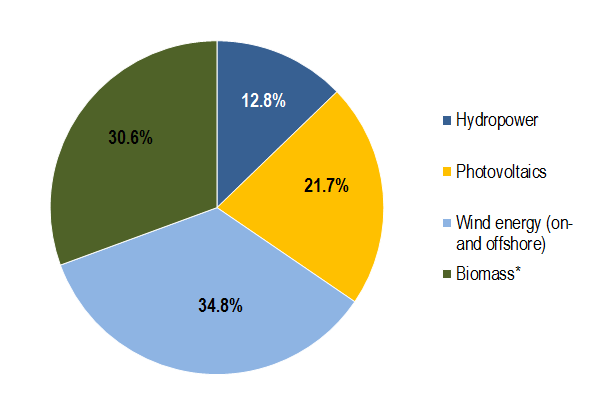
7 Source: BMWi 2015 Renewable shares in the electricity sector (2014) TWh *comprises biogas, biogenic solid fuels, sewage gas, landfill gas, biogenic proportion of waste Geothermal energy accounted for 0.1% in In 2014, renewable energies produced TWh of electricity in Germany. This corresponds to a share of 27.8 of total electricity consumption. 7
8 Source: BMWi 2015 / Ecofys 2015; Data AGEB 2015 German primary energy consumption total: 14,591 PJ 2014 total: 13,095 PJ gas, 21.9% hard coal, 13.1% lignite, 11.3% nuclear, 12.5% renewables; 4,5% hydro, 0.5% wind, 0.6% solar, 0.0% biomass, 2.4% gas; 20.0% hard coal 12.3% lignite 11.9% nuclear; 7,9% renewables 11% hydro; 0.6% wind; 1.5% solar; 0.9% biomass; 5.5% oil, 35.7% electricity trade balance, -0.2% waste, 0.4% bio fuels, 0.4% other RES;0,1% others, 1.2% oil; 34.3% others 1.7% electricity trade balance; 0.9% waste; 1.0% bio fuels; 0.9% other RES;0,5% The renewables share tripled within ten years. 8
9 German RES policy and regulation, new EEG. 9
10 Cornerstones of the Renewable Energy Sources Act (EEG). Guaranteed grid access; priority transmission and distribution. Fixed price (tariff or premium) for every kwh produced. Tariffs are set for each type of technology and with regard to further provisions (e.g. site and size). Minimum: 3.5 ct/kwh (Hydropower) Maximum: 25.2 ct/kwh (Geothermal) Additional costs for renewable energy production are offset through the EEG levy (2015: ~ 6.17 ct/kwh), with reductions for energy-intensive industries. Additional costs are offset via grid operators and independent of the public budget. Regular monitoring and evaluation; accompanying research Past and future amendments of the act. 10
11 2014: Amendment of the EEG focal points. Binding target corridors for RES deployment. Introducing quantity control mechanisms breathing cap. Increase market integration through premium system. Introduction of tendering schemes: For ground-mounted PV (pilot auctions in 2015). General intention: determine support levels through tenders for all renewable technologies by Federal Network Agency for Electricity, Gas, Telecommunications, Post and Railway, or Bundesnetzagentur as executing body. EEG surcharge on self-supply. Adjusted exemptions for the industry. 11
12 4: Challenges and options of Energy transition. 12
13 Source: BMWi 2015 / UBA, BNetzA 2013 German power generation capacities by region. Nuclear phase-out until 2022 will affect regions to a different extent. 13
14 Source: BMUB 2014 Climate Action Programme The action programme (December 2014) comprises nine central components (including the National Action Plan for energy efficiency). In total, the action programme will lead to a reduction of around 62 to 78 million tonnes CO 2 equivalent in 2020 compared with the current projection for National Energy Efficiency Action Plan (NAPE). Strategy on climatefriendly building and housing. Climate action measures in the transport sector: Strengthening green modes of transport. Reducing non-energyrelated emissions: Industry, commerce, trade, services, waste management and agriculture. Reforming European emissions trading. Expansion of renewable energies in the energy sector. Foster model function of the state: e.g. public procurement. Research and development: Decarbonisation of the economy. Consultation, awareness raising and initiatives at all level: Cross-sectoral projects and programmes, role of the federal states. 14
15 Source: BMWi 2014 Energy Efficiency: NAPE 2014: Some measures at a glance. 1. Energy efficiency in buildings Quality assurance and optimizing current energy consulting Tax incentives for energy-efficient renovations Heating check Energy Consulting for municipalities Energy saving legislation Upgrading the Market Incentive Program (MAP) Establishment of new technical standards 2. Energy conservation: a business and earnings model Introduction of tendering scheme for energy efficiency Contracting funding Upgrading the KfW energy efficiency programs Waste Heat Use Initiative Improving the Framework for energy efficiency services New financing schemes 3. Empowerment for energy efficiency: Measure - Understand - Act Save 4. Transport Energy Efficiency Network Initiatives Sectoral energy efficiency campaigns EU energy efficiency labeling & eco-design National Top Runner Initiative Developing indicators and benchmarks in businesses and for households Energy efficiency in information and communication technology (ICT) Motor vehicle taxation Fuel taxes Federal fuel strategy (Measures by Deutsche Bahn) 15
16 Storage Consumption Production Grids Source: dena 2015 Improving the energy system options. Expand grids for large-scale power exchange Flexible thermal power plants Lower must-run capacity Limit wind and PV in event of excess Construction of new grid (3,500 km of new power lines required according to scenario A2024 (GDP) Grid management at EU level Upgrading of existing power plants (retrofitting) Controlled capacity from more flexible power plants System services independent of power plant Feed-in management for wind & PV systems Expand load management and flexible demand Increase flexibility of demand (load management) in the private sector and Industry Expand R&D and implementation of Storage- Systems Pumped storage Germany/Alps/Scandinavia Use of electricity for gas production (power-to-gas) Use/storage of electricity in heat (power-to-heat) Use of super-conducting coils, capacitors etc. 16
17 Conclusion. 17
18 Conclusion: Most important challenges. The EEG has stimulated a significant growth of RES in Germany for more than ten years. The German government announced ambitious goals for the reduction of GHG and growth of RES, especially after the decision to shut down nuclear power plants by Current challenges on EU-level: Economical and technical integration of energy markets On national level: Limitation of costs including review of the promotion system, efficient integration of RES in the energy system Expansion of electricity grids (security of supply) Acceptance: Cost issues, infrastructure and landscape changes Enhance flexibility of the system: Demand side management, storage solutions, flexible thermal power plants Increase energy efficiency: Ambitious goals, funding Foster climate protection: Recent debate on coal plants 18
19 Efficiency our focus. Thank you. shop.dena.de 19
20 Source: Renewable Energy Act 2014 Technology specific support levels EEG Technology Corridor p. a. Remuneration in ct/kwh Degression Hydropower %/a from 2016 Landfill, sewage and mine gas %/a from 2016 Biomass 100 MW (gross) (dependent on fuel and size) -0.5 % every three months from 2016 Geothermal %/a from 2018 Wind energy onshore Wind energy offshore Solar energy (PV) 2,400 2,600 MW (net) Standard tariff: 8.90, for at least 5 years; Minimum Initial tariff: for min.12 years; Option: for min. 8 years if installed before 2020 Minimum ,400 2,600 MW (gross) (and tenders for ground-mounted PV) (Sept. 2015) -0.4% every quarter from 2016 Standard tariff: ct/kwh in 2018, 1 ct/kwh in ct/kwh/a 2021; Option: - 1 ct/kwh in % per month 20