
Curriculum Guide. North Central Michigan College - Where your education matters!
|
|
|
- Maximillian Sherman
- 10 years ago
- Views:
Transcription
1 Curriculum Guide North Central Michigan College - Where your education matters!

2
3 Table of Contents What You Will Learn at North Central Michigan College... 3 Degrees Conferred at North Central Michigan College... 4 General Education... 5 Michigan Transfer Agreement (MTA)... 8 North Central courses satisfying the MTA Transfer Agreement by category:... 8 Associate of Arts (AA)... 9 Associate of Science (AS) Associate of General Studies (AGS) Charting Your Path to a Bachelor s Degree Business Administration Human Services and Social Sciences Human Services Social Sciences Health Science and Professions Engineering Information Technology Natural Sciences Charting Your Path to a Career Program Career Programs Art Animation Business of Art Fine Craft Graphic Arts Studio Art Textiles Business Accounting Accounting Assistant Advertising Assistant Bookkeeping Business Development Business Management Entrepreneurship Entrepreneurship Essentials General Office Professional Hospitality and Casino Management Hospitality and Casino Management Hotel and Hospitality Management Marketing Marketing Assistant Microsoft Office Specialist Office Administrative Services OAS Medical Office Emphasis Office Support Specialist Receptionist Small Business Management Truck Driving

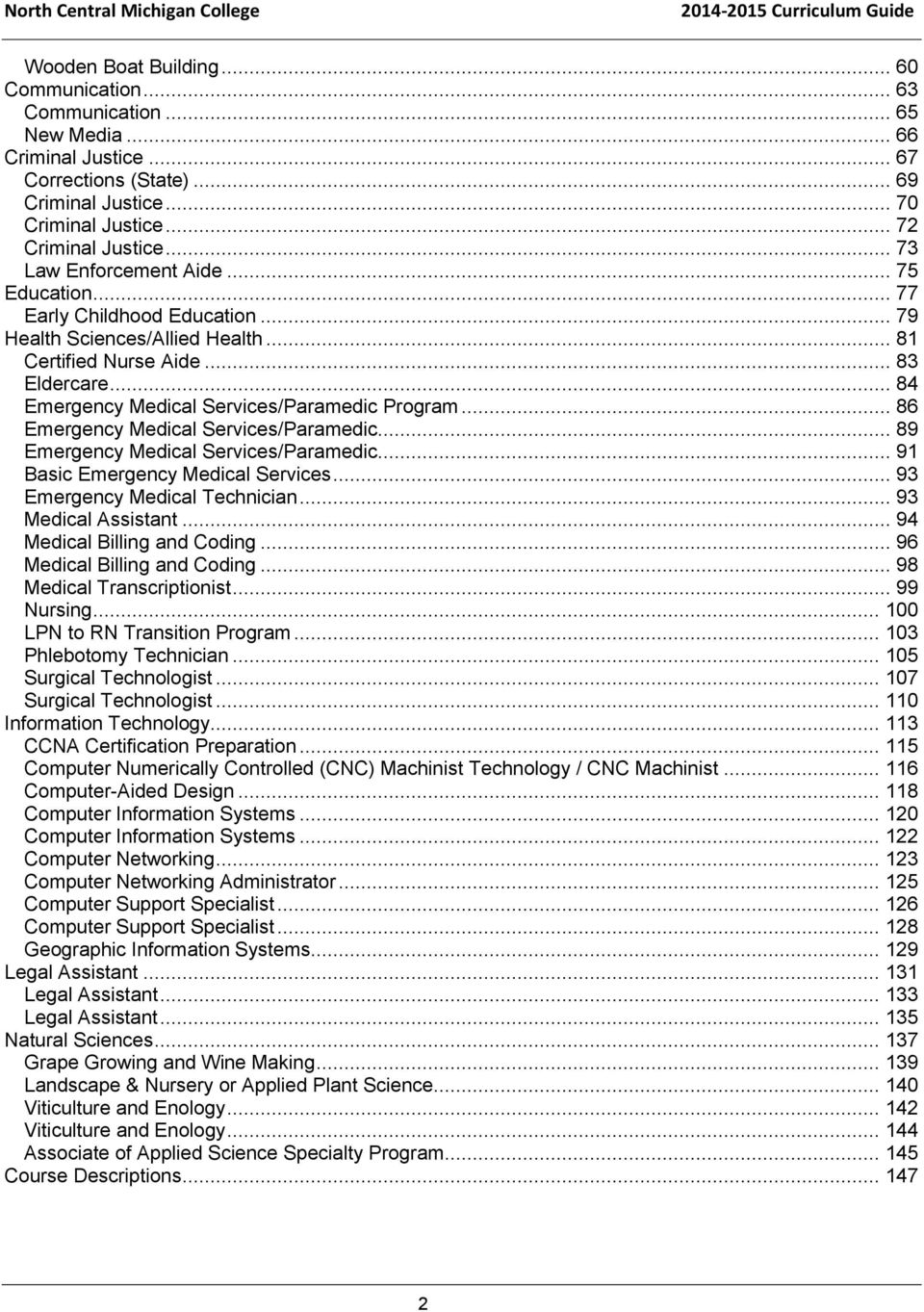
4 Wooden Boat Building Communication Communication New Media Criminal Justice Corrections (State) Criminal Justice Criminal Justice Criminal Justice Law Enforcement Aide Education Early Childhood Education Health Sciences/Allied Health Certified Nurse Aide Eldercare Emergency Medical Services/Paramedic Program Emergency Medical Services/Paramedic Emergency Medical Services/Paramedic Basic Emergency Medical Services Emergency Medical Technician Medical Assistant Medical Billing and Coding Medical Billing and Coding Medical Transcriptionist Nursing LPN to RN Transition Program Phlebotomy Technician Surgical Technologist Surgical Technologist Information Technology CCNA Certification Preparation Computer Numerically Controlled (CNC) Machinist Technology / CNC Machinist Computer-Aided Design Computer Information Systems Computer Information Systems Computer Networking Computer Networking Administrator Computer Support Specialist Computer Support Specialist Geographic Information Systems Legal Assistant Legal Assistant Legal Assistant Natural Sciences Grape Growing and Wine Making Landscape & Nursery or Applied Plant Science Viticulture and Enology Viticulture and Enology Associate of Applied Science Specialty Program Course Descriptions
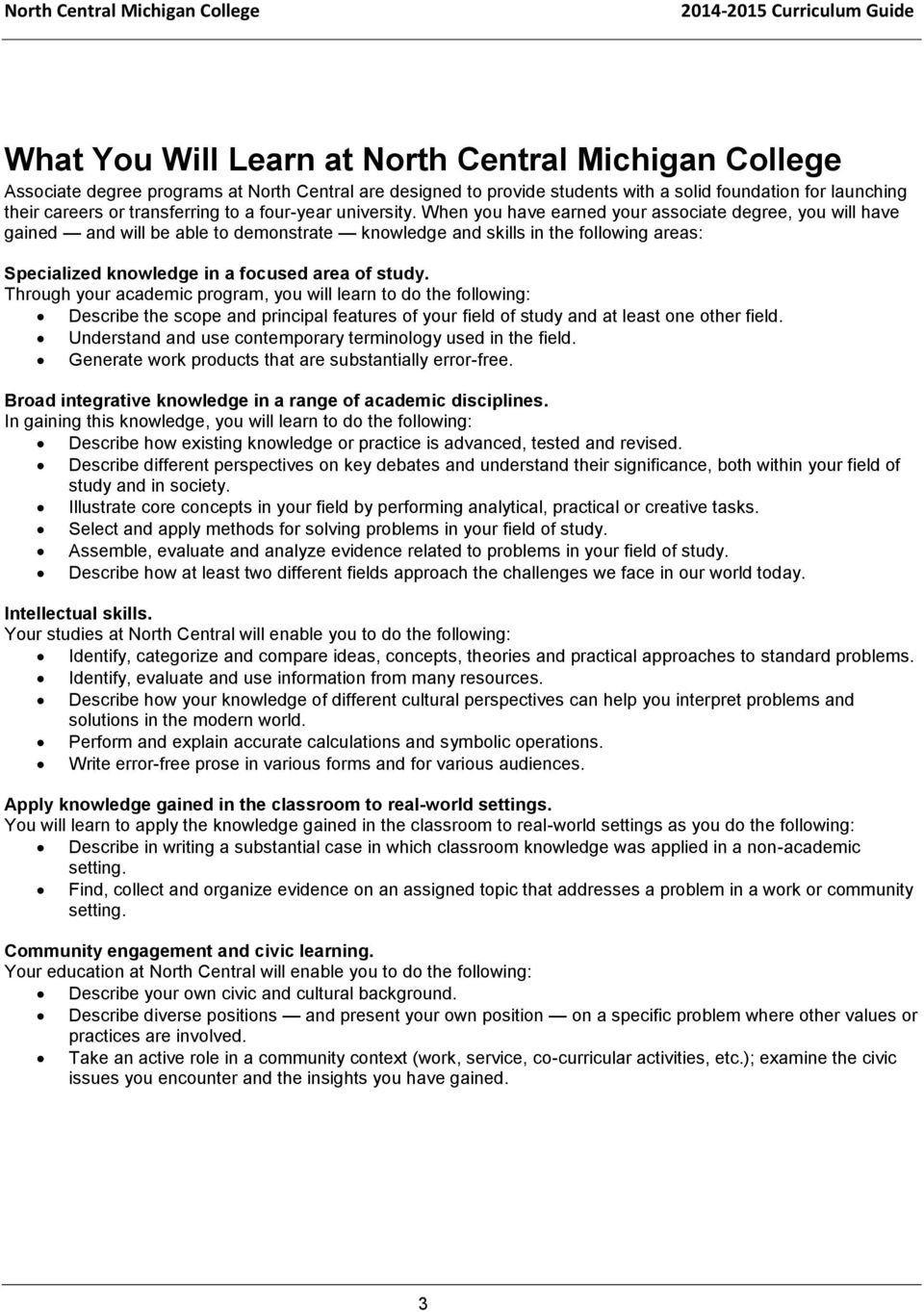
5 What You Will Learn at North Central Michigan College Associate degree programs at North Central are designed to provide students with a solid foundation for launching their careers or transferring to a four-year university. When you have earned your associate degree, you will have gained and will be able to demonstrate knowledge and skills in the following areas: Specialized knowledge in a focused area of study. Through your academic program, you will learn to do the following: Describe the scope and principal features of your field of study and at least one other field. Understand and use contemporary terminology used in the field. Generate work products that are substantially error-free. Broad integrative knowledge in a range of academic disciplines. In gaining this knowledge, you will learn to do the following: Describe how existing knowledge or practice is advanced, tested and revised. Describe different perspectives on key debates and understand their significance, both within your field of study and in society. Illustrate core concepts in your field by performing analytical, practical or creative tasks. Select and apply methods for solving problems in your field of study. Assemble, evaluate and analyze evidence related to problems in your field of study. Describe how at least two different fields approach the challenges we face in our world today. Intellectual skills. Your studies at North Central will enable you to do the following: Identify, categorize and compare ideas, concepts, theories and practical approaches to standard problems. Identify, evaluate and use information from many resources. Describe how your knowledge of different cultural perspectives can help you interpret problems and solutions in the modern world. Perform and explain accurate calculations and symbolic operations. Write error-free prose in various forms and for various audiences. Apply knowledge gained in the classroom to real-world settings. You will learn to apply the knowledge gained in the classroom to real-world settings as you do the following: Describe in writing a substantial case in which classroom knowledge was applied in a non-academic setting. Find, collect and organize evidence on an assigned topic that addresses a problem in a work or community setting. Community engagement and civic learning. Your education at North Central will enable you to do the following: Describe your own civic and cultural background. Describe diverse positions and present your own position on a specific problem where other values or practices are involved. Take an active role in a community context (work, service, co-curricular activities, etc.); examine the civic issues you encounter and the insights you have gained. 3
6 Degrees Conferred at North Central Michigan College Associate of Arts (AA): A degree designed to transfer to a four-year college or university by delivering typical freshman and sophomore year general education coursework. An AA degree is not awarded in a specific subject area, but its foundational courses allow the student to major in a subject area in his/her junior year. (Program Code: 300) Associate of Science (AS): A degree similar to the AA degree, but with a strong emphasis on the natural sciences and mathematics. It is designed for the student who will transfer to a four-year college or university to pursue studies of a scientific nature. (Program Code: 400) Associate of Applied Science (AAS): A degree designed for the student who plans to pursue a career or advance his/her career immediately upon graduation. Students planning to pursue a bachelor s degree using the AAS as a foundation should carefully choose their coursework with an advisor to maximize transferability. The AAS degree is awarded in specific areas of expertise, e.g., the AAS in Business Management and Early Childhood Education. Associate of General Studies (AGS): A degree designed for the student wishing flexibility in defining specific educational objectives. It can accommodate the student who plans to transfer as well as one who wishes to pursue a career immediately upon graduation. The AGS degree is not awarded in a specific subject area. (Program Code: 600) Certificate: A short-term career program. Most certificates are composed of 10 courses, half the number in the typical associate s degree. Often certificates can be earned in one year of full-time enrollment; however, the time may be longer if a student attends part-time. Credits earned toward a certificate can be used to earn an associate s degree in the same area. Certificate of Development: A Certificate of Development has fewer than 30 credit hours and indicates a basic understanding of a subject or a specific skill. Not sure which path is right for you? Exploring your options is much more effective when you do it with an experienced guide. North Central s academic advisors and counselors can help you set goals and develop a map for achieving them. Call {888) or (231)

7 General Education The general education requirements at North Central provide a foundation for students in core areas of study. All students are required to take English composition courses in order to learn to write effectively; a communication course to enhance their verbal skills; and a mathematics course to learn skills in logic, conceptual operations, and accurate calculation. In addition to English, communication and mathematics, students gain a broad orientation to academic disciplines by taking a selection of courses in the humanities, sciences, and social sciences. The Humanities focus on the study of the human condition and help us to understand our lives and world, using methods that are primarily analytical, critical, or contemplative. Humanities disciplines include modern languages, literature, history, philosophy, religion, human communication and the visual and performing arts. The Sciences explore the scope and major concepts of a scientific discipline such as biology, chemistry, earth science or physics. In these courses, students learn the attitudes and practices of scientific investigators, including logic, precision, experimentation, tentativeness, and objectivity. The laboratory component of these courses provides experience in the methods of scientific inquiry. The Social Sciences are academic disciplines that focus on society and human behavior. Social and behavioral sciences use observational and experimental methods to understand the actions and reactions of humans and animals. Fields of study within the social sciences include anthropology, economics, geography, political science, sociology, and psychology. Credits from students who have attended previous institutions will be evaluated and recorded as meeting MTA requirements or North Central Michigan College s general education requirements, as long as their home institution considered those courses to satisfy general education requirements. General Education Distribution Requirements for the Associate of Arts and Associate of Science Degrees include 26 credits selected as described from the following categories: SCIENCE 2 lab courses from two categories selected from the following list: BIOLOGY BIO 101 Introduction of Biology 4 BIO 133 Human Biology with Lab 4 BIO 151 General Biology I 4 BIO 152 General Biology II 4 BIO 226 Microbiology 4 BIO 235 General Anatomy & Physiology I 4 BIO 236 General Anatomy & Physiology II 4 CHEMISTRY CEM 101 Fundamentals of Chemistry 4 CEM 102 Fundamentals of Bioorganic Chemistry 5 CEM 121 Principles of Chemistry I 5 EARTH SCIENCE ESC 101 Introduction to Earth Science 4 ESC 110 Environmental Geology 4 ESC 121 Physical Geology 4 ESC 122 The Earth Through Time 4 ESC 150 Weather and Climate 4 ESC 201 Foundations of Astronomy 4 PHYSICS PHY 101 Concepts in Physics 4 PHY 210 General Physics I Lecture/Review/Lab 5 PHY 230 Physics for Scientists & Engineers I 5 5

8 SOCIAL SCIENCE 3 courses from at least two of the following categories: ANTHROPOLOGY ANP 110 Cultural Anthropology 3 ANP 130 Introduction to Prehistoric Archeology 3 ANP 210 Ethnology of World Cultures 3 ECONOMICS ECO 111 Macroeconomics 3 ECO 112 Microeconomics 3 GEOGRAPHY GEO 111 Elements of Geography 3 GEO 121 World Geography 4 POLITICAL SCIENCE PLS 141 Introduction to American Government 3 PLS 225 State and Local Government 3 PSYCHOLOGY PSY 161 Introduction to Psychology 3 PSY 210 Human Sexuality 3 PSY 241 Abnormal Psychology 3 PSY 255 Child Psychology 3 PSY 261 Developmental Psychology 3 SOCIOLOGY SOC 171 Introduction to Sociology 3 SOC 175 Introduction to Sustainable Living 3 SOC 271 Marriage and the Family 3 HUMANITIES 3 courses, from at least two of the following categories: ART ARTH 110 History of Art I 3 ARTH 111 History of Art II 3 ARTH 112 History of Non-Western Art 3 COMMUNICATION COM 121 Oral Interpretation 3 COM 220 Persuasion and Communication 3 COM 225 Nonverbal Communication 3 COM 250 Small Group Communication 3 COM 260 Social Media and Communication 3 COM 290 Public Relations and Crisis Communication 3 HISTORY HST 131 U.S. History ( ) 3 HST 132 History of U.S Present 3 HST 231 Survey of Early Western Civilization 3 HST 232 Survey of Later Western Civilization 3 HST 255 History of Rock and Roll 3 HST 270 Michigan History 3 PHILOSOPHY PHL 101 Introduction to Philosophy 3 PHL 102 Introduction to Logic 3 PHL 105 Introduction to Ethics 3 PHL 109 Contemporary Moral Issues 3 6

9 RELIGION REL 100 World Religion 3 REL 102 History of Religion in America 3 ENGLISH ENG 130 Introduction to Literature 3 ENG 213 Shakespeare I 3 ENG 215 Introduction to Poetry 3 ENG 221 British Literature I 3 ENG 222 British Literature II 3 ENG 231 American Literature I 3 ENG 232 American Literature After the Civil War 3 ENG 240 Introduction to Children's Literature 3 ENG 241 World Literature, Ancient ENG 242 World Literature, Present 3 ENG 244 Multicultural Literature 3 ENG 250 Mythology 3 ENG 251 Contemporary Literature I 3 ENG 252 Contemporary Literature II 3 LANGUAGES OTHER THAN ENGLISH FR 111 French (or higher) 4 NISH 111 Anishnaabemowin (or higher) 4 (Excludes NISH150, 190, 245) SPAN 111 Spanish (or higher) 4 RUS 111 Russian (or higher) 4 ARB 111 Arabic (or higher) 5 MUSIC MU 120 History of Music 3 THEATRE THF 101 Survey of the Theatre 3 THF 250 Film and Literature 3 THF 276 Contemporary Film 3 7

10 Michigan Transfer Agreement (MTA) The Michigan Transfer Agreement (MTA) replaces the MACRAO agreement and will take effect for students entering fall 2014 or later. Students who attended prior to fall 2014 will be able to complete the existing MACRAO agreement until the end of summer The Michigan Transfer Agreement (MTA) is designed to facilitate transfer of general education requirements between institutions. One of the guiding principles of the agreement is to promote transparency among institutions and ensure accurate transfer information for students. A student must successfully complete at least 30 credits, with at least a 2.0 in each course, to fulfill the Michigan Transfer Agreement (MTA). Credits from students who have attended previous institutions will be evaluated and recorded as meeting MTA requirements or North Central Michigan College s general education requirements, as long their home institutions considered those courses to satisfy general education requirements. A student must earn at least one credit-bearing course at North Central to have the MTA Satisfied posted on the North Central transcript. Michigan Transfer Agreement (MTA) Requirements 1 Course in English Composition A second course in English Composition or 1 course in Communications 1 Course in Mathematics 2 Courses in Social Sciences (from two disciplines) 2 Courses in Humanities and Fine Arts (from two disciplines excluding studio and performance classes) 2 Courses in Natural Sciences including one with laboratory experience (from two disciplines) Students earning an Associate of Arts or Associate of Science degree at North Central Michigan College will automatically have MTA Satisfied posted to their transcript, provided they meet the minimum grade requirement. All other students will need to submit a formal request to have their transcript evaluated for the MTA Satisfied designation. For more information about the MTA, MTA Signatory Institutions, and Michigan colleges and universities transfer equivalencies visit our website. North Central courses satisfying the MTA Transfer Agreement by category: TOTAL CREDITS Minimum 30 credits. Must receive 2.0 in each course to qualify. English Composition: English 111 AND English 112, COM 111 or COM 170. Mathematics: MATH 126, 128, 130, 140, 150, 210, 215, 225, 235; STAT 200. Science: Must include two courses from at least two categories: BIO 101, 133, 151, 152, 226, 235, 236; CEM 101, 102, 121; ESC 101, 110, 121, 122, 150, 201, PHY 101, 210, 230. Social Sciences: Must include two courses from at least two categories: ANP 110, 130, 210; ECO 111, 112; GEO 111, 121; PLS 141, 225; PSY 161, 210, 241, 255, 261; SOC 171, 175, 271. Humanities: Must include two courses from at least two categories: ARTH 110, 111, 112; COM 121, 220, 225, 250, 260, 290; ENG 130, 213, 215, 221, 222, 231, 232, 240, 241, 242, 244, 250, 251, 252; HST 131, 132, 231, 232, 255, 270; LANGUAGES OTHER THAN ENGLISH ARB 111 or Higher, FR 111 or Higher, GR 111 or Higher, NISH 111 or Higher (Excludes NISH 150, 190, 245), RUS 111 or Higher, or SPAN 111 or Higher; MU 120; PHL 101, 102, 105, 109; REL 100, 102; THF 101, 250,

11 Associate of Arts (AA) Program Code 300 Credit Hours: 60 The Associate of Arts degree is for students who plan to transfer to a four-year college or university. The Associate of Arts degree is appropriate for most transfer programs leading to a bachelor s degree. General Education 38 Minimum Credit Hours English 6 Credit Hours ENG 111 ENG 112 Communications 3 Credit Hours Satisfied by 1 of the following: COM 111 COM 170 Mathematics 3-4 Credit Hours Satisfied by 1 of the following: Math 126 or higher; STAT 200 Humanities 9 Credit Hours 3 course from at least 2 categories: ARTH 110, 111 or 112; COM 121, 220, 225, 250, ; HST 131, 132, 231, 232, 255, 270; PHL 101, 102, ; REL 100, 102; ENG 130, 213, 215, 221, 222, 231, 232, 240, 241, 242, 244, 250, 251, 252; MU 120; THF 101, 250, 276; LANGUAGES other than English at the 111 Level or higher (excludes NISH 150,190, 245) Science 8-9 Credit Hours 2 lab courses from at least 2 categories: BIO 101, 133, 151, 152, 226, 235, 236; CEM 101, 102, 121; ESC 101, 110, 121, 122, 150, 201 PHY 101, 210 or 230 Social Science 9-10 Credit Hours 3 course from at least 2 categories: ANP 110, 130, 210; ECO 111, 112; GEO 111, 121; PLS 141, 225; PSY 161, 210, 241, 255, 261, SOC 171, 275, or 271 General Electives Credit Hours to Complete 60 Minimum Credit Hours for Program. Electives should be carefully chosen. To graduate with a degree, a student must complete the total number of credit hours required for the degree being sought, even if courses have been waived or competency has been demonstrated through ACT, COMPASS or CLEP testing scores. *When transferring to another college or university, you may be required to take the courses that were waived or competency demonstrated at North Central. 9

12 Associate of Science (AS) Program Code 400 Credit Hours: 60 The Associate of Science degree is for students who plan to pursue a bachelor s degree in a science field. General Education 39 Minimum Credit Hours English 6 Credit Hours ENG 111 ENG 112 Communications Mathematics 3 Credit Hours 4 Credit Hours Satisfied by 1 of the following: COM 111 COM 170 Satisfied by 1 of the following: Math 130 or higher; STAT 200 Humanities 9 Credit Hours 3 course from at least 2 categories: ARTH 110, 111 or 112; COM 121, 220, 225, 250, ; HST 131, 132, 231, 232, 255, 270; PHL 101, 102, ; REL 100, 102; ENG 130, 213, 215, 221, 222, 231, 232, 240, 241, 242, 244, 250, 251, 252; MU 120; THF 101, 250, 276; LANGUAGES other than English at the 111 Level or higher (excludes NISH 150,190, 245) Science 8-9 Credit Hours 2 lab courses from at least 2 categories: BIO 101, 133, 151, 152, 226, 235, 236; CEM 101, 102, 121; ESC 101, 110, 121, 122, 150, 201 PHY 101, 210 or 230 Social Science 9-10 Credit Hours 3 course from at least 2 categories: ANP 110, 130, 210; ECO 111, 112; GEO 111, 121; PLS 141, 225; PSY 161, 210, 241, 255, 261, SOC 171, 275, or 271 Science and Mathematics Electives General Electives 16 Credit Hours 3-5 Credit Hours to Complete 60 Minimum Credit Hours for Program. Additional science, mathematics and statistics electives are required. Only math courses higher than MATH 130 are eligible as an elective. Electives should be carefully chosen. To graduate with a degree, a student must complete the total number of credit hours required for the degree being sought, even if courses have been waived or competency has been demonstrated through ACT, COMPASS or CLEP testing scores. *When transferring to another college or university, you may be required to take the courses that were waived or competency demonstrated at North Central. 10

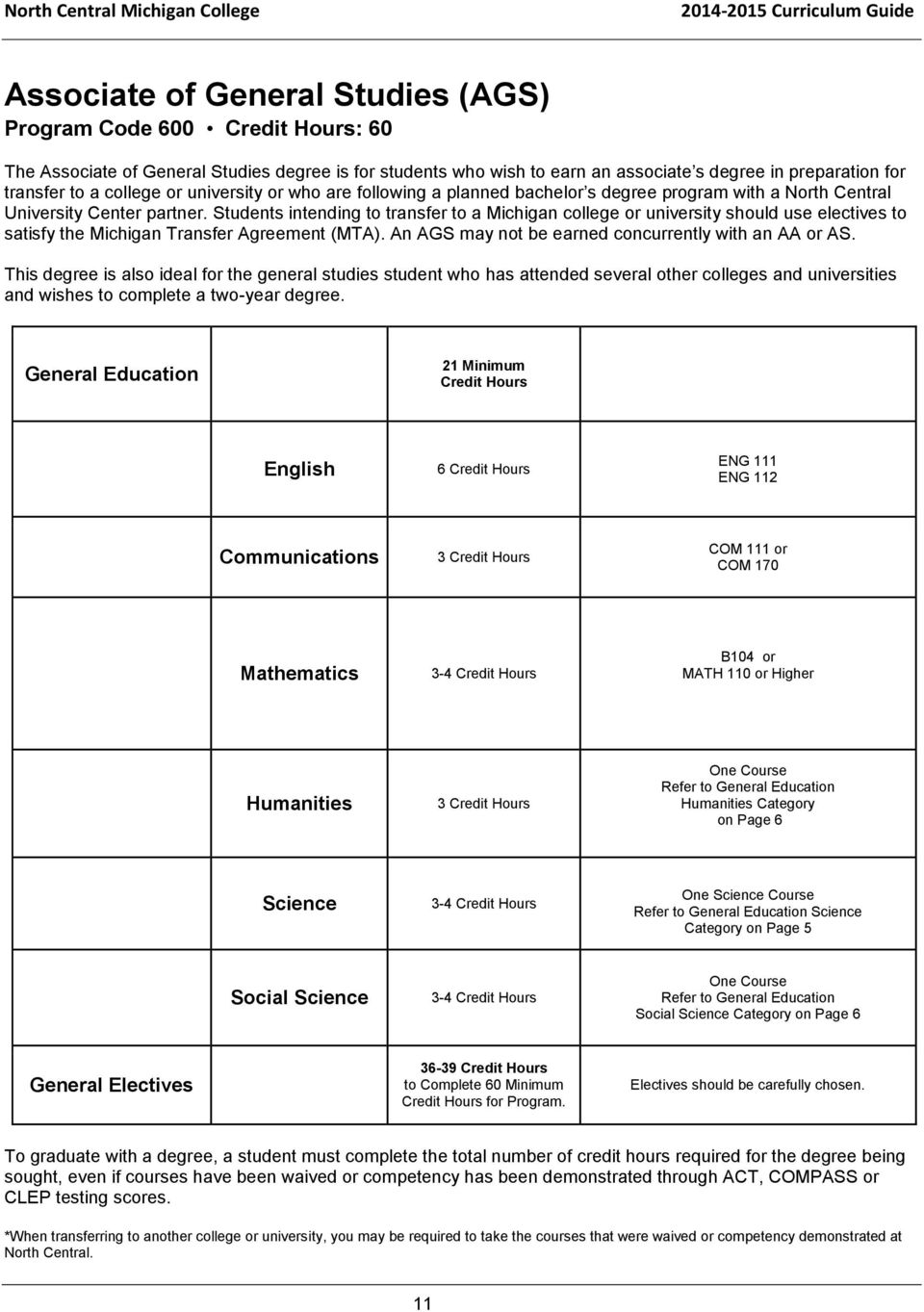
13 Associate of General Studies (AGS) Program Code 600 Credit Hours: 60 The Associate of General Studies degree is for students who wish to earn an associate s degree in preparation for transfer to a college or university or who are following a planned bachelor s degree program with a North Central University Center partner. Students intending to transfer to a Michigan college or university should use electives to satisfy the Michigan Transfer Agreement (MTA). An AGS may not be earned concurrently with an AA or AS. This degree is also ideal for the general studies student who has attended several other colleges and universities and wishes to complete a two-year degree. General Education 21 Minimum Credit Hours English 6 Credit Hours ENG 111 ENG 112 Communications 3 Credit Hours COM 111 or COM 170 Mathematics 3-4 Credit Hours B104 or MATH 110 or Higher Humanities 3 Credit Hours One Course Refer to General Education Humanities Category on Page 6 Science 3-4 Credit Hours One Science Course Refer to General Education Science Category on Page 5 Social Science 3-4 Credit Hours One Course Refer to General Education Social Science Category on Page 6 General Electives Credit Hours to Complete 60 Minimum Credit Hours for Program. Electives should be carefully chosen. To graduate with a degree, a student must complete the total number of credit hours required for the degree being sought, even if courses have been waived or competency has been demonstrated through ACT, COMPASS or CLEP testing scores. *When transferring to another college or university, you may be required to take the courses that were waived or competency demonstrated at North Central. 11
14 Charting Your Path to a Bachelor s Degree North Central offers three degree programs for students who plan to transfer to senior institutions: the Associate of Arts, Associate of Science and Associate of General Studies. North Central students have the assurance of transfer agreements between colleges, along with curriculum guides and an important website, to verify the transferability of courses. The website is maintained by the Michigan Association of Collegiate Registrars and Admissions Officers (MACRAO) and is easy to use. Participating colleges and universities post on-line transfer guides on the MACRAO site. North Central students who expect to transfer to a senior institution should plan their programs of study with the help of a North Central academic advisor or counselor and an admissions advisor from the college or university they wish to attend. Suggestions for transferring are contained in this catalog to help students select courses that may be applied toward the requirements of bachelor s degrees at other institutions. These should not be considered a replacement for transfer guides from the senior institutions. Checklist for Transferring Identify the four-year college or university of your choice as early as possible. Meet with North Central counselors and academic advisors to keep current with transfer issues, to satisfy your associate degree requirements and to ensure transferability of courses. Attend transfer events. Meet with representatives from Michigan s four-year universities. Visitation dates and scholarship information are listed on the College s website, posted on bulletin boards throughout campus and posted in Student Services. Follow the transfer guide, prepared by the four-year university, which lists course requirements for your specific transfer program. Inquire about the MACRAO Agreement. Check out Apply to the four-year college or university of your choice in a timely manner. Many applications for admission are available online at 12

15 Business Administration AA Degree Students considering a bachelor s degree in the areas of Accounting, Business Administration, Management, Marketing and Management/Computer Information Systems should consider the following recommendations for fulfilling degree requirements at North Central Michigan College. Every college and university has its own specific requirements for admitting students to business studies. Admission is often competitive and begins after the student has completed the freshman and sophomore years. Students are advised to work closely with an advisor from both North Central and the transfer institution to make sure they choose proper coursework. Lake Superior State University offers a variety of bachelor s completion programs in business on the campus of North Central Michigan College. Students considering the LSSU program are advised to follow specific curriculum guide sheets developed by LSSU. Contact Student Services, (231) , or Lake Superior State University s Petoskey office, (231) , to obtain a guide sheet. Pre-Business Recommendations for fulfilling General Education requirements: For Social Sciences Group A, choose ECO 111 Recommendations for fulfilling General Electives: B 200 ECO 112 B 211 M 200 B 212 MATH 130 B 290 MATH 140 CIS 100 STAT 200 Human Services and Social Sciences Teacher Certification Programs in Education Students planning to become teachers are admitted to a College or School of Education no earlier than their junior year. Teacher education includes Elementary, Secondary and Special Education. The freshman and sophomore years of pre-teaching differ widely between universities, so students are advised to consult with an academic advisor at North Central when choosing courses. All teacher education applicants are required to take and pass all three sections of the Basic Skills portion of the Michigan Test for Teacher Certification (MTTC). Pre-Teaching: Elementary Education An elementary education teaching degree from Spring Arbor University is offered in its entirety on the campus of North Central Michigan College. A very specific list of required courses for that program is provided on a curriculum guide sheet. Students must follow the guide for this specific program rather than the recommendations below. The Spring Arbor University elementary education degree includes an optional ZA (early childhood) endorsement for students wishing to specialize in grades Kindergarten through Grade 3 using credits from North Central s Early Childhood Education department offerings. Contact Student Services at (231) or Spring Arbor University s University Center Office at (231) Students wishing to pursue a bachelor s degree in elementary education at universities other than Spring Arbor should consult with an academic advisor and consider enrolling in these suggested courses while satisfying their general education requirements: For Communications, choose COM 111 For Social Sciences, choose PSY 161, GEO 121 and PLS 141 For Humanities, choose HST 131, HST 231 or HST 232, ENG 130, ENG 240 For Mathematics, choose MATH 125 and MATH 126 For Electives, consider ARTS 120, PSY 255, ED

16 Pre-Teaching: Secondary Education A secondary education teaching degree from Spring Arbor University is offered entirely on the campus of North Central Michigan College. The freshman and sophomore year courses are taken with North Central and include a specific group of courses. Students pursuing this option should closely follow the courses outlined on the curriculum guide sheet available from Student Services at (231) or at the Spring Arbor office on campus at (231) Students wishing to pursue a bachelor s degree in secondary education at universities other than Spring Arbor should consult with an academic advisor and consider enrolling in these suggested courses while satisfying their general education requirements: For Communications, choose COM 111 For Natural Science Group A, chose either BIO 101 or BIO 133 For Social Sciences, choose PSY 161, PLS 141 For Electives, choose ED 100, PSY 261 and courses building on the teachable major/minor Michigan Basic Skills Test This test is administered four times per year at various test sites in Michigan. Some teacher education programs recommend that prospective students take the Michigan Basic Skills Test as early as the October test date of their freshman year; others recommend taking the test early in the sophomore year. These early recommendations allow students who fail part or all of the Basic Skills Test to have a chance to remediate and take it again before their junior year. To learn more about the Michigan Basic Skills Test, test dates and sites, and to register for the Michigan Basic Skills Test, go online to: Human Services AA Degree Students considering a bachelor s degree in the areas of social work, criminal justice, early childhood education and related human services fields should use these recommendations when fulfilling degree requirements at North Central Michigan College. Criminal Justice A bachelor s degree in Criminal Justice, with Law Enforcement emphasis, is offered by Lake Superior State University. The majority of the coursework can be completed on the campus of North Central Michigan College. Students pursuing this option should closely follow the courses outlined on the curriculum guide sheet available through Student Services at (231) or the North Central Gaylord office at the University Center at Gaylord. Students wishing to pursue a bachelor s degree in criminal justice at universities other than Lake Superior State or Madonna should consult with an academic advisor and consider enrolling in these suggested courses while satisfying their general education requirements: For Communications, choose COM 111 For Natural Science Group A, chose either BIO 101 or BIO 133 For Social Sciences, choose PSY 161, PLS 141, GEO 121 For Humanities, include REL 100 and PHL 109 For electives: CIS 100, CJ 101, 102, 120, 130, 202, 207; SOC 120, SOC 171, SOC 230, STAT 200 Early Childhood Education A bachelor s degree in Early Childhood Education is available in its entirety through Lake Superior State University on the campus of North Central Michigan College. A list of required courses for that program, incorporating North Central s Associate of Applied Science in Early Childhood Education, is provided on a curriculum guide sheet. Students should contact the Early Childhood Education Coordinator at (231) , Student Services at (231) or LSSU s Petoskey office at (231) Students wishing to pursue the LSSU bachelor s degree should take the following General Education course: For Communications, choose COM 111 For Natural Science, choose BIO 133 For Social Science, choose SOC
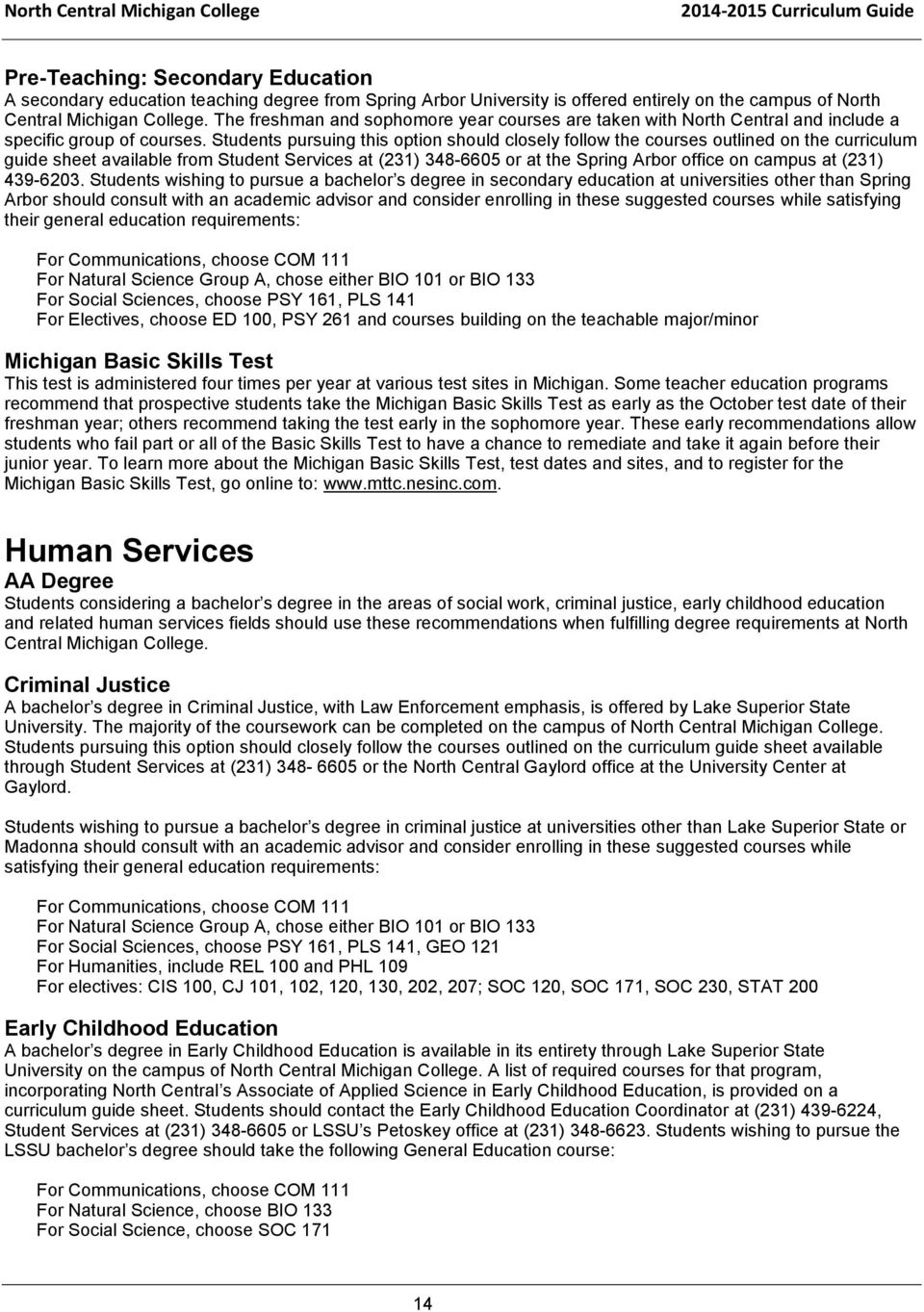
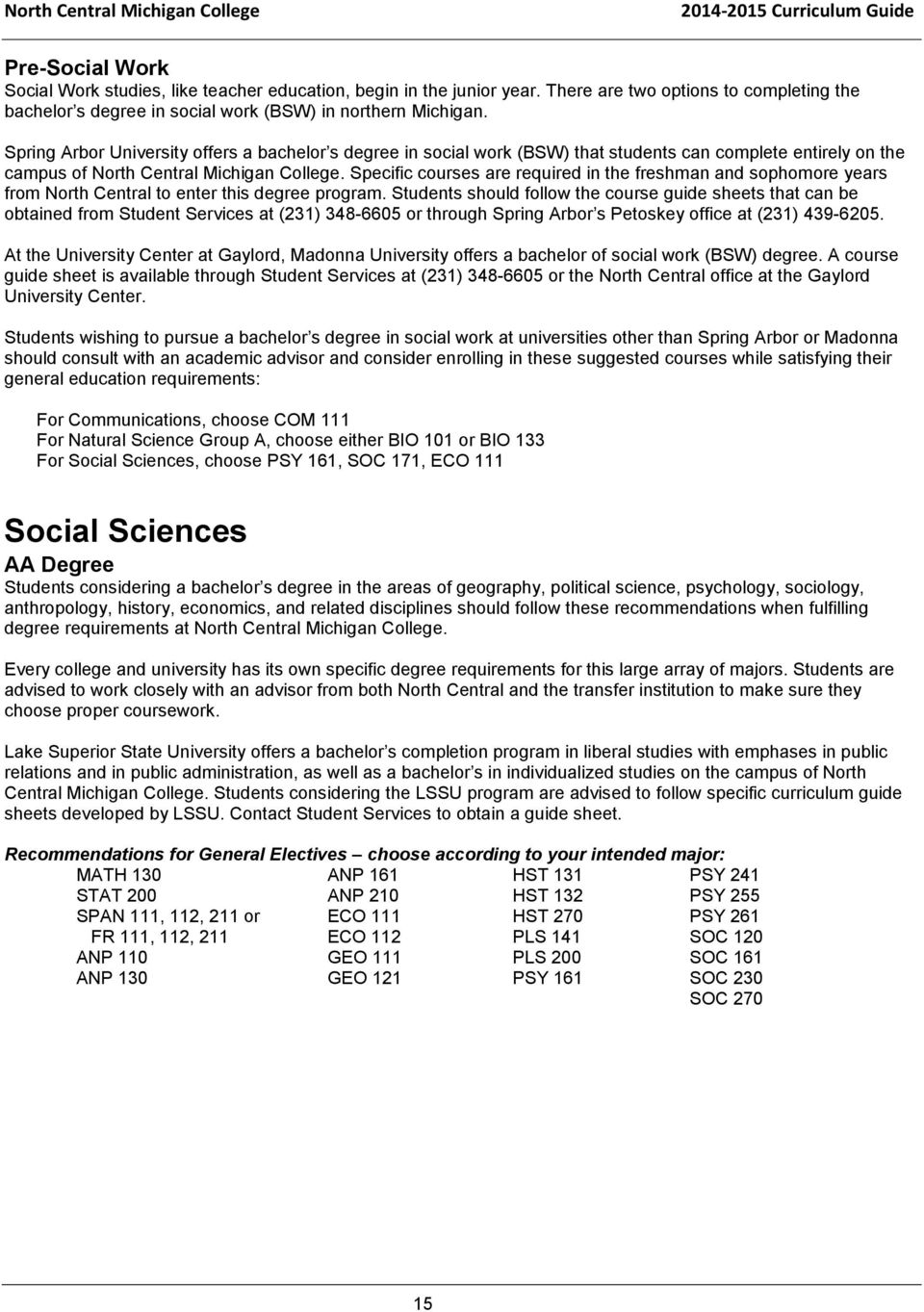
17 Pre-Social Work Social Work studies, like teacher education, begin in the junior year. There are two options to completing the bachelor s degree in social work (BSW) in northern Michigan. Spring Arbor University offers a bachelor s degree in social work (BSW) that students can complete entirely on the campus of North Central Michigan College. Specific courses are required in the freshman and sophomore years from North Central to enter this degree program. Students should follow the course guide sheets that can be obtained from Student Services at (231) or through Spring Arbor s Petoskey office at (231) At the University Center at Gaylord, Madonna University offers a bachelor of social work (BSW) degree. A course guide sheet is available through Student Services at (231) or the North Central office at the Gaylord University Center. Students wishing to pursue a bachelor s degree in social work at universities other than Spring Arbor or Madonna should consult with an academic advisor and consider enrolling in these suggested courses while satisfying their general education requirements: For Communications, choose COM 111 For Natural Science Group A, choose either BIO 101 or BIO 133 For Social Sciences, choose PSY 161, SOC 171, ECO 111 Social Sciences AA Degree Students considering a bachelor s degree in the areas of geography, political science, psychology, sociology, anthropology, history, economics, and related disciplines should follow these recommendations when fulfilling degree requirements at North Central Michigan College. Every college and university has its own specific degree requirements for this large array of majors. Students are advised to work closely with an advisor from both North Central and the transfer institution to make sure they choose proper coursework. Lake Superior State University offers a bachelor s completion program in liberal studies with emphases in public relations and in public administration, as well as a bachelor s in individualized studies on the campus of North Central Michigan College. Students considering the LSSU program are advised to follow specific curriculum guide sheets developed by LSSU. Contact Student Services to obtain a guide sheet. Recommendations for General Electives choose according to your intended major: MATH 130 STAT 200 SPAN 111, 112, 211 or FR 111, 112, 211 ANP 110 ANP 130 ANP 161 ANP 210 ECO 111 ECO 112 GEO 111 GEO 121 HST 131 HST 132 HST 270 PLS 141 PLS 200 PSY 161 PSY 241 PSY 255 PSY 261 SOC 120 SOC 161 SOC 230 SOC
18 Health Science and Professions AS Degree Students considering a bachelor s degree in the areas of pre-medicine, pre-dentistry, pre-veterinary medicine, prepharmacy, physical therapy, physician s assistant, health fitness, dietetics and nutrition, or other related health fields should follow these recommendations when fulfilling degree requirements at North Central Michigan College. Every college and university has its own specific degree requirements for this large array of majors. Admittance into some of these fields, such as physical therapy and physician s assistant, begin at the junior year and are very competitive. Students are advised to work closely with an advisor from both North Central and the transfer institution to make sure they choose proper coursework. Pre-Medicine, Pre-Dentistry, Pre-Veterinary Medicine, Pre-Pharmacy Recommendations for fulfilling General Education requirements: For Natural Sciences Group A, choose BIO 151 and for Group B choose CEM 121 Recommendations for fulfilling Science and Mathematics electives: BIO 152 CEM 122 CEM 231 CEM 232 PHY 210 PHY 211 MATH 140 MATH 150 Pre-physical therapy & Pre-physician s assistant Recommendations for fulfilling General Education requirements: For Natural Sciences Group A, choose BIO 235 and for Group B, choose CEM 121 For Social Sciences Group A, choose PSY 161 Recommendations for fulfilling Science and Mathematics electives: BIO 236 CEM 121 CEM 122 PSY 261 PHY 210* PHY 211* CEM 231*** * Only for Physical Therapy ** Only for Physician s Assistant Engineering AS Degree Students considering a bachelor s degree in one of the many engineering disciplines electrical, mechanical, aeronautical, manufacturing, computer, chemical should follow these recommendations when fulfilling degree requirements at North Central Michigan College. Every college and university has its own specific degree requirements for this large array of majors. Students are advised to work closely with an advisor from both North Central and the transfer institution to make sure they choose proper coursework. Pre-Engineering Recommendations for fulfilling General Education requirements: For Natural Science Group A, choose BIO 101 For Natural Sciences Group B, choose PHY 230 and PHY 231 For Social Sciences Group A, choose ECO 111 For Humanities, choose PHL 102 or PHL 109 Recommendations for Science and Mathematics Electives: CEM 122 MATH 140 PHY 231 MATH 150 MATH 210 MATH 211 MATH

19 North Central Pre-Engineering North Central has developed curriculum guides for students wishing to transfer into Engineering at several Michigan universities. These guides can be found at Preengineering.pdf and cover the following universities: University of Michigan Michigan State University Western Michigan University Lake Superior State University Central Michigan University Michigan Technological University Lawrence Technological University You should always check with the four-year university for the most current information. Recommendations for General Electives: CIS 115 Information Technology AA/AS Degree Students considering a bachelor s degree in the areas of Computer Information Systems should consider the following recommendations for fulfilling degree requirements at North Central Michigan College. Every college and university has its own specific requirements for admitting students to business studies. Admission is often competitive and begins after the student has completed the freshman and sophomore years. Students are advised to work closely with an advisor from both North Central and the transfer institution to make sure they choose proper coursework. Lake Superior State University offers a variety of bachelor s completion programs in business on the campus of North Central Michigan College. Students considering the LSSU program are advised to follow specific curriculum guide sheets developed by LSSU. Contact Student Services at (231) , to obtain a guide sheet. Pre-Computer Information Systems Recommendations for fulfilling General Education requirements: For Social Sciences Group A, choose ECO 111 Recommendations for filling General Electives: ECO 112 B 212 B 211 CIS 100 CIS 105 CIS 115 MATH

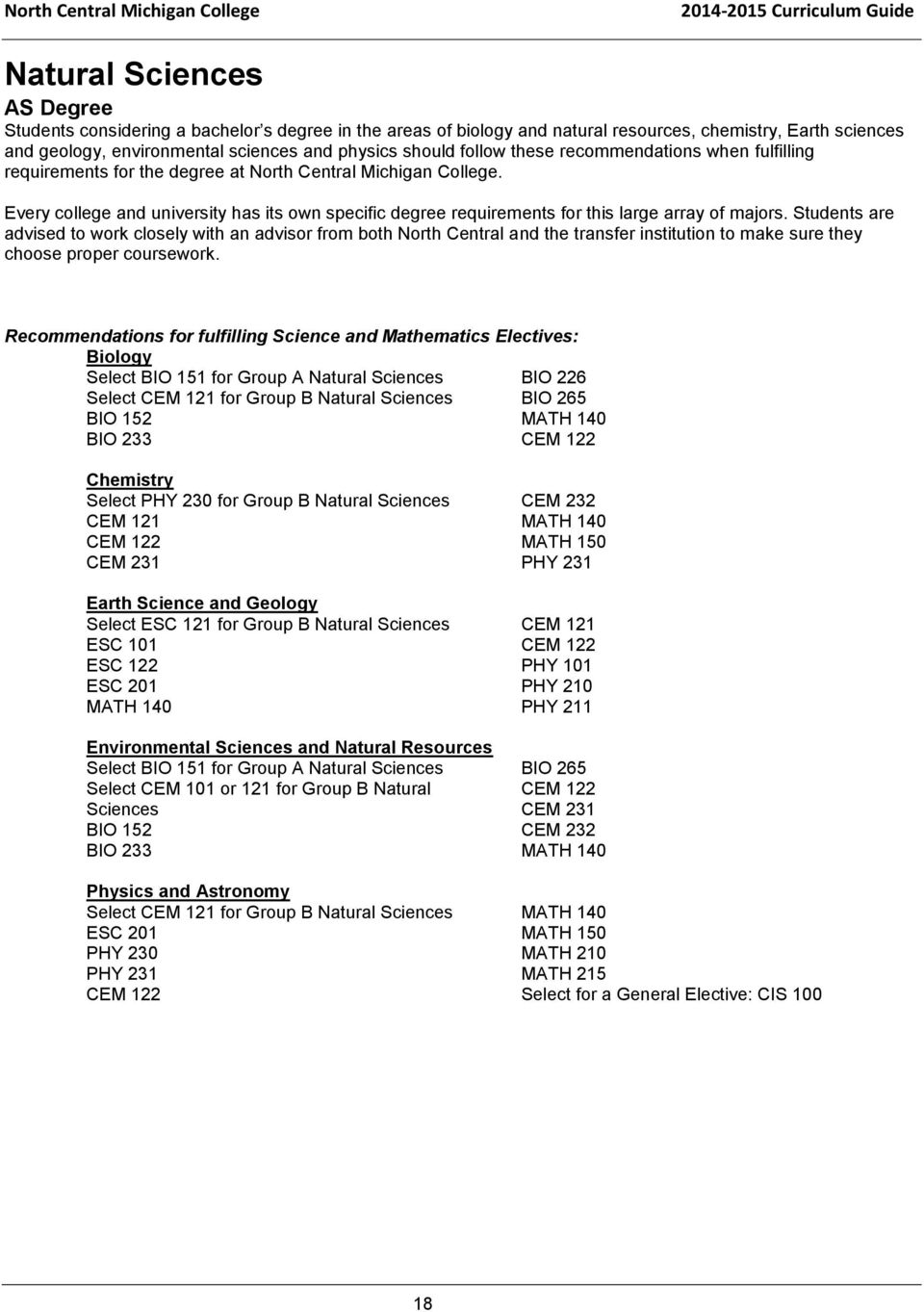
20 Natural Sciences AS Degree Students considering a bachelor s degree in the areas of biology and natural resources, chemistry, Earth sciences and geology, environmental sciences and physics should follow these recommendations when fulfilling requirements for the degree at North Central Michigan College. Every college and university has its own specific degree requirements for this large array of majors. Students are advised to work closely with an advisor from both North Central and the transfer institution to make sure they choose proper coursework. Recommendations for fulfilling Science and Mathematics Electives: Biology Select BIO 151 for Group A Natural Sciences BIO 226 Select CEM 121 for Group B Natural Sciences BIO 265 BIO 152 MATH 140 BIO 233 CEM 122 Chemistry Select PHY 230 for Group B Natural Sciences CEM 121 CEM 122 CEM 231 Earth Science and Geology Select ESC 121 for Group B Natural Sciences ESC 101 ESC 122 ESC 201 MATH 140 Environmental Sciences and Natural Resources Select BIO 151 for Group A Natural Sciences Select CEM 101 or 121 for Group B Natural Sciences BIO 152 BIO 233 Physics and Astronomy Select CEM 121 for Group B Natural Sciences ESC 201 PHY 230 PHY 231 CEM 122 CEM 232 MATH 140 MATH 150 PHY 231 CEM 121 CEM 122 PHY 101 PHY 210 PHY 211 BIO 265 CEM 122 CEM 231 CEM 232 MATH 140 MATH 140 MATH 150 MATH 210 MATH 215 Select for a General Elective: CIS
21 Charting Your Path to a Career Program North Central offers a number of career programs for students seeking the education and skills to enter the job market or to advance their current careers. Students selecting career programs can earn a certificate of development, certificate or an associate of applied science degree. Career programs are designed primarily to prepare students for the workplace rather than to transfer to a four-year college or university. However, many career courses and programs will transfer to other colleges and universities through articulations and special agreements. For more information on transferability options, consult with the advisors and counselors in Student Services. Certificate of Development Programs North Central offers several certificates of development. These are fewer than 30 credit hours in length and help the student develop specific skills and knowledge. Certificate Programs Most certificate programs require 30 credit hours and can be completed with two semesters of full-time study. Many certificates follow a prescribed sequence that starts in the fall semester and is completed at the end of the winter semester. It is very important that students work with an advisor, as these programs often do not provide a great deal of flexibility. A certificate is not the same as a licensing exam or certification awarded by a national or regional accrediting association, although some programs prepare students to take licensing exams or participate in certification processes. Associate of Applied Science Degrees All associate of applied science degrees require the following: A minimum of 60 credit hours A minimum of 15 credit hours taken from North Central A minimum cumulative grade point average of 2.0 No more than 2 credit hours of physical education General education requirements Program requirements Additional requirements Related electives Career Program Checklist Meet with the lead faculty or coordinator for your career area early in your studies. Keep in frequent contact with this person to stay current with scheduling and upgrades to the program. Follow information as presented in the most current North Central catalog so that you take the proper prerequisite courses. Check with the lead faculty or coordinator for your program about the sequencing of courses for upcoming semesters so that you can graduate in a timely manner. If necessary, plan ahead for your work-based learning or internship experience by making an appointment with your faculty advisor coordinator well in advance of the semester in which you plan to enroll. Note that some career programs no longer require work-based learning. 19
22 20
23 Career Programs Art 134 Animation (C) 107 Business of Art (CD) 132 Fine Craft (C) 113 Graphic Arts (CD) 133 Studio Art (C) 112 Textiles (CD) Business 205 Accounting (AAS) 105 Accounting Assistant (C) 110 Advertising Assistant (C) 121 Bookkeeping (CD) 119 Business Development (CD) 220 Business Management (AAS) 151 Entrepreneurship (C) 142 Entrepreneurship Essentials (CD) 165 General Office Professional (C) 218 Hospitality and Casino Mgmt. (AAS) 118 Hospitality and Casino Mgmt. (C) 117 Hotel and Hospitality (CD) 149 Management (C) 245 Marketing (AAS) 135 Marketing Assistant (C) 109 Microsoft Office Specialist (CD) 277 Office Administrative Services (AAS) 270 OAS Medical Office Emphasis 158 Office Support Specialist (CD) 159 Receptionist (CD) 150 Small Business Mgt. (C) 108 Trucking (CD) 290 Wooden Boat Building (AAS) Communications 136 Communication (C) 111 New Media (CD) Criminal Justice 127 Corrections (State) (CD) 225 Criminal Justice (AAS) 226 Criminal Justice - Law Enforcement w/ NMC (AAS) 227 Criminal Justice - Law Enforcement w/ KCC (AAS) 125 Law Enforcement Aide (C) Health Sciences/Allied Health 197 Certified Nurse Aide (CD) 175 Eldercare (C) 253 EMS/Paramedic (AAS) 153 EMS/Paramedic (C) 152 EMS/Basic (CD) 053 EMT (non-degree) 180 Medical Assistant (C) 190 Medical Billing and Coding (C) 179 Medical Billing and Coding (CD) 163 Medical Transcriptionist (C) 256 Nursing (AAS) 295 LPN to RN Transition Program (AAS) 178 Phlebotomy Technician (CD) 258 Surgical Technologist (AAS) 183 Surgical Technologist (C) Information Technology 114 CCNA Certification Preparation (CD) 106 CNC Machinist Technology (CD) 116 Computer Aided Design (C) 243 Computer Information Systems (AAS) 162 Computer Information Systems (C) 282 Computer Networking (AAS) 182 Computer Networking Administrator (C) 238 Computer Support Specialist (AAS) 148 Computer Support Specialist (C) 236 Geographic Information Systems (AAS) Legal Assistant 276 Legal Assistant (AAS) 177 Legal Assistant (CD) Natural Sciences 147 Grape Growing and Wine Making (CD) 247 Landscape & Nursery or Applied Plant Science w/ MSU (AAS) 246 Viticulture and Enology (AAS) 146 Viticulture and Enology (C) Education 280 Early Childhood Education (AAS) 21
24 22
25 Art 23
26 24
27 Animation Certificate Program Code: 134 Credit Hours: Contact Hours: Associate Dean: Sara Glasgow This certificate is designed for individuals working toward a career in the animation industry and/or related fields. Students who complete these foundational courses will gain exposure to real-world projects, be prepared to transfer to a four-year program, or enter the workforce as an entry-level animator. Art is the expression or application of human creative skill and imagination, typically in a visual form, producing works to be appreciated for their beauty or emotional power. PROGRAM REQUIREMENTS 32 CREDIT HOURS ANM 110 Animation I 3 ANM 120 Animation II 3 ANM 140 Character Design 3 ART 100 Two-Dimensional Design (see ARTS 100) 3 ART 102 Three-Dimensional Design (see ARTS 101) 3 ART 109 Basic Drawing and Composition (see ARTS 102) 3 ART 112 Life Drawing (see ARTS 104) 3 ENG 290 Introduction to Writing for Film & Video 3 MATH 112 Beginning & Intermediate Algebra or higher 4 PHY 101 Concepts in Physics or higher 4 SUGGESTED SEQUENCE FOR FULL TIME STUDENTS: SEMESTER L (FALL) ANM 110 Animation I ARTS 100 Two-Dimensional Design ARTS 109 Basic Drawing and Composition MATH 112 Beginning and Intermediate Algebra (Part 2) PHY 101 Concepts in Physics or higher SEMESTER II (WINTER) ANM 120 Animation II ANM 140 Character Design ARTS 102 Three-Dimensional Design ARTS 112 Life Drawing ENG 290 Introduction to Writing for Film & Video 25
28 Business of Art Certificate of Development Program Code: 107 Credit Hours: 23 Contact Hours: 23 Associate Dean: Sara Glasgow This Certificate is designed to provide a foundation of study in the Business of Art by creating a workable business plan, finding and using various business funding mechanisms and gaining a solid foundation in art. Students who complete this certificate will be prepared to begin a studio practice or strengthen their existing business. PROGRAM REQUIREMENTS 22 CREDIT HOURS ARTH 110 Art History I OR ARTH 111 Art History II OR ARTH 112 History of Non-Western Art OR ARTH 113 History of Modern Art 3 ARTS 291 The Business of Art I 3 ARTS 292 The Business of Art II 3 ARTS 100 Two-Dimensional Design OR ARTS 101 Three-dimensional Design OR ARTS 103 Color Theory 3 ARTS 290 Portfolio Development 1 B 165 Small Business Essentials 3 ENG 111 English Composition I 3 M 200 Introduction to Marketing 3 ADDITIONAL REQUIREMENTS CHOOSE 1 CREDIT HOUR OAS 101 Customer Service 1 CAP 100 Computers for the Very Beginner 1 SD 107 Professional Development Skills 1 SOC 115 Anishinaabek Culture (required for WOCTEP students) 1 SUGGESTED SEQUENCE FOR FULL TIME STUDENTS: SEMESTER L (FALL) ARTS 100 Two-Dimensional Design OR ARTS 101 Three-dimensional Design OR ARTS 103 Color Theory ARTS 291 The Business of Art I ENG 111 English Composition I 1 Art History SEMESTER II (WINTER) ARTS 292 The Business of Art II ARTS 290 Portfolio Development B 165 Small Business Essentials M 200 Introduction to Marketing 1 Additional Requirements Students attending part time should consult with an academic advisor or the art program coordinator for a recommendation regarding sequencing of courses. 26
29 Fine Craft Certificate Program Code: 132 Credit Hours: 30 Contact Hours: 30 Associate Dean: Sara Glasgow This Certificate is designed to provide a foundation of study in the fine arts. Students who complete this certificate will be prepared to transfer to a four-year BFA program or begin a studio practice. GENERAL EDUCATION REQUIREMENTS 6 CREDIT HOURS ENG 111 English Composition I 3 COM 111 Public Speaking 3 PROGRAM REQUIREMENTS CHOOSE 3 CREDIT HOURS ARTS 101 Three dimensional Design 3 ARTS 102 Basic Drawing and Composition 3 CHOOSE 3 CREDIT HOURS ARTS 100 Two Dimensional Design 3 ARTS 103 Color Theory 3 CHOOSE 3 CREDIT HOURS ARTH 110 Art History I 3 ARTH 111 Art History II 3 ARTH 112 History of Non Western Art 3 ARTH 113 History of Modern Art 3 ADDITIONAL REQUIREMENTS CHOOSE 15 CREDIT HOURS ARTS 104 Life Drawing 3 ARTS 125 Anishnaabe Art 3 ARTS 200 Ceramics I 3 ARTS 201 Ceramics II 3 ARTS 204 Ceramics Intensive 3 ARTS 210 Jewelry I 3 ARTS 211 Jewelry II 3 ARTS 214 Jewelry Intensive 3 ARTS 220 Textiles I Structure 3 ARTS 221 Textiles II Surface 3 ARTS 224 Textiles Studio Intensive 3 ARTS 225 Sustainable Textiles 3 ARTS 230 Survey of Glass Techniques I 3 ARTS 231 Survey of Glass Techniques II 3 ARTS 234 Glass Studio Intensive 3 ARTS 240 Stained Glass I 3 ARTS 241 Stained Glass II 3 ARTS 244 Stained Glass Intensive 3 ARTS 290 Portfolio Development 1 ARTS 291 The Business of Art 3 Continued 27
30 SUGGESTED SEQUENCE FOR FULL TIME STUDENTS: SEMESTER L (FALL) ENG 111 English Composition I ARTS 100 Two-Dimensional Design OR ARTS 103 Color Theory 1 Art History 2 Additional Requirements SEMESTER II (WINTER) COM 111 Public Speaking ARTS 102 Basic Drawing and Composition OR ARTS 101 Three-Dimensional Design 3 Additional Requirements Students attending part time should consult with an academic advisor or art program coordinator for a recommendation regarding sequencing of courses. 28
31 Graphic Arts Certificate of Development Program Code: 113 Credit Hours: 22 Contact Hours: 22 Associate Dean: Sara Glasgow This Certificate is designed to provide a foundation of study in the graphic arts. Students who complete this certificate will be prepared to transfer to a four-year program or enter the workforce as an entry-level graphic designer. PROGRAM REQUIREMENTS 21 CREDIT HOURS ARTS 100 Two-Dimensional Design 3 ARTS 103 Color Theory 3 ARTS 270 Graphic Design I 3 CAP 135 Web Page Design 3 CAP 140 Introduction to Adobe Photoshop 3 CAP 145 Introduction to Adobe Illustrator 3 CAP 150 Introduction to Adobe InDesign 3 ADDITIONAL REQUIREMENTS CHOOSE 1 CREDIT HOUR OAS 101 Customer Service 1 OAS 190 Employability Skills 1 SD 107 Professional Development Skills 1 SOC 115 Anishinaabek Culture (required for WOCTEP students) 1 SUGGESTED SEQUENCE FOR FULL TIME STUDENTS: SEMESTER L (FALL) ARTS 100 Two-Dimensional Design ARTS 103 Color Theory CAP 135 Web Page Design CAP 140 Introduction to Adobe Photoshop SEMESTER II (WINTER) ARTS 270 Graphic Design I CAP 145 Introduction to Adobe Illustrator CAP 150 Introduction to Adobe InDesign 1 Additional Requirements Students attending part time should consult with an academic advisor or art program coordinator for a recommendation regarding sequencing of courses. 29
32 Studio Art Certificate Program Code: 133 Credit Hours: 30 Contact Hours: 30 Associate Dean: Sara Glasgow This Certificate is designed to provide a foundation of study in the fine arts. Students who complete this certificate will be prepared to transfer to a four-year BFA program or begin a studio practice. GENERAL EDUCATION REQUIREMENTS 6 CREDIT HOURS ENG 111 English Composition I 3 COM 111 Public Speaking 3 PROGRAM REQUIREMENTS 6 CREDIT HOURS ARTS 101 Three-dimensional Design 3 ARTS 102 Basic Drawing and Composition 3 CHOOSE 3 CREDIT HOURS ARTS 100 Two-Dimensional Design 3 ARTS 103 Color Theory 3 CHOOSE 3 CREDIT HOURS ARTH 110 Art History I 3 ARTH 111 Art History II 3 ARTH 112 History of Non-Western Art 3 ARTH 113 History of Modern Art 3 ADDITIONAL REQUIREMENTS CHOOSE 12 CREDIT HOURS ARTS 104 Life Drawing 3 ARTS 250 Oil Painting I 3 ARTS 251 Oil Painting II 3 ARTS 254 Oil Painting Studio Intensive 3 ARTS 270 Graphic Design I 3 ARTS 271 Graphic Design II 3 ARTS 274 Graphic Design Intensive 3 ARTS 290 Portfolio Development 1 ARTS 291 The Business of Art 3 SUGGESTED SEQUENCE FOR FULL TIME STUDENTS: SEMESTER L (FALL) ENG 111 English Composition I ARTS 100 Two-Dimensional Design OR ARTS 103 Color Theory ARTS 102 Basic Drawing and Composition 2 Additional Requirements SEMESTER II (WINTER) COM 111 Public Speaking ARTS 101 Three-Dimensional Design 1 Art History 2 Additional Requirements Students attending part time should consult with an academic advisor or art program coordinator for a recommendation regarding sequencing of courses. 30
33 Textiles Certificate of Development Program Code: 112 Credit Hours: 22 Contact Hours: 22 Associate Dean: Sara Glasgow This certificate of development is designed to provide a foundation of study in the textile arts. Students who complete this certificate will be prepared to transfer to a four-year program or enter the workforce as an entry-level textile worker. PROGRAM REQUIREMENTS CHOOSE 3 CREDIT HOURS ARTH 110 Art History I 3 ARTH 111 Art History II 3 ARTH 112 History of Non Western Art 3 ARTH 113 History of Modern Art 3 CHOOSE 3 CREDIT HOURS ARTS 100 Two-Dimensional Design 3 ARTS 103 Color Theory 3 CHOOSE 3 CREDIT HOURS ARTS 101 Three-Dimensional Design 3 ARTS 102 Basic Drawing and Composition 3 TEXTILE CORE REQUIREMENTS 12 CREDIT HOURS ARTS 220 Textiles I Structure 3 ARTS 221 Textiles II Surface 3 ARTS 224 Textiles Studio Intensive 3 ARTS 225 Sustainable Textiles 3 ADDITIONAL REQUIREMENTS CHOOSE 1-3 CREDIT HOUR ARTS 290 Portfolio Development 1 ARTS 291 The Business of Art 3 CAP 100 Computers for the Very Beginner 1 OAS 121 Computer Keyboarding/Software Fundamentals 3 SD 107 Professional Development Skills 1 SOC 115 Anishinaabek Culture (required for WOCTEP students) 1 SUGGESTED SEQUENCE FOR FULL TIME STUDENTS: SEMESTER L (FALL) ARTS 100 Two-Dimensional Design OR ARTS 103 Color Theory 1 Art History 2 Textile Core Requirements SEMESTER II (WINTER) ARTS 102 Basic Drawing and Composition OR ARTS 101 Three-Dimensional Design 2 Textile Core Requirements 1 Additional Requirements Students attending part time should consult with an academic advisor or art program coordinator for a recommendation regarding sequencing of courses. 31
34 32
35 Business 33
36 34
37 Accounting Associate of Applied Science Program Code: 205 Credit Hours: 60 Contact Hours: 60 Associate Dean: Pam Miller This program prepares the student for a career in business, government or industry. Because of the growing complexity of accounting processes, well-educated students have numerous opportunities in the field. Students who demonstrate math competency are exempt from the mathematics requirement. A math course higher than MATH 110 will also meet this requirement. See your program coordinator for approval of other course options or if you need assistance. GENERAL EDUCATION REQUIREMENTS CREDIT HOURS ENG 111 English Composition I 3 ENG 112 English Composition II 3 COM 111 Public Speaking OR COM 170 Interpersonal Communication 3 B 104 Business Math OR MATH 100 Mathematical Reasoning OR MATH 110 Beginning and Intermediate Algebra (Part I) or higher 3-4 PROGRAM REQUIREMENTS 40 CREDIT HOURS B 113 Computer Assisted Accounting 3 B 207 Business Communications 3 B 211 Accounting Principles I 4 B 212 Accounting Principles II 4 B 213 Intermediate Accounting I 4 B 214 Intermediate Accounting II 4 B 216 Federal Taxation I 3 B 218 Cost Accounting I 3 B 290 Business Law I OR B 291 Business Law II 3 ECO 111 Macroeconomics OR ECO 112 Microeconomics 3 M 200 Introduction to Marketing 3 OAS 252 Microsoft Office for Windows 3 ADDITIONAL REQUIREMENTS CHOOSE 7-8 CREDIT HOURS Select courses from the following list to satisfy the remaining 5-11 credit hours of program requirements: B 104 Business Math 3 B 161 Introduction to Business 3 B 200 Principles of Management 3 B 290 Business Law I 3 B 291 Business Law II 3 CAP 125 MS Excel 3 CAP 130 MS Access 3 CAP 135 Web Page Design 3 ECO 111 Macroeconomics OR ECO 112 Microeconomics 3 OAS 101 Customer Service 1 OAS 121 Keyboarding I 2 OAS 190 Employability Skills 1 PSY 161 Introduction to Psychology 3 Continued 35
38 Course Recommendations: Preferred option for the Communications requirement: COM 111 Public Speaking SUGGESTED SEQUENCE FOR FULL-TIME STUDENTS: SEMESTER I (FALL) B 211 Accounting Principles I ENG 111 English Composition I B 104 Business Math OR MATH 100 Mathematical Reasoning OR MATH 110 Beginning and Intermediate Algebra (Part I) or higher OAS 252 Microsoft Office for Windows 1 Additional Requirements SEMESTER II (WINTER) B 113 Computer Assisted Accounting B 212 Accounting Principles II ECO 111 Macroeconomics OR ECO 112 Microeconomics ENG 112 English Composition II 1 Additional Requirements SEMESTER III (FALL) B 213 Intermediate Accounting I B 218 Cost Accounting I B 290 Business Law I OR B 291 Business Law II M 200 Introduction to Marketing SEMESTER IV (WINTER) B 207 Business Communications B 214 Intermediate Accounting II B 216 Federal Taxation I COM 111 Public Speaking OR COM 170 Interpersonal Communication 1 Additional Requirements 36
39 Accounting Assistant Certificate Program Code: 105 Credit Hours: 31 Contact Hours: 31 Associate Dean: Pam Miller North Central s certificate prepares the student for positions in a small business or corporate, governmental or institutional settings. PROGRAM REQUIREMENTS 29 CREDIT HOURS B 104 Business Math 3 B 113 Computer Assisted Accounting 3 B 211 Accounting Principles I 4 B 212 Accounting Principles II 4 B 290 Business Law I OR B 291 Business Law II 3 COM 111 Public Speaking OR COM 170 Interpersonal Communication 3 ENG 111 English Composition I 3 OAS 121 Computer Keyboarding/Software Fundamentals OR OAS 122 Document Processing I 3 OAS 252 Microsoft Office for Windows 3 ADDITIONAL REQUIREMENTS CHOOSE 2 CREDIT HOURS Select courses from the following list to satisfy the remaining 2 credit hours of program requirements: B 161 Introduction to Business 3 B 165 Small Business Essentials 3 CAP --- Any Computer Applications course 3 B 285 Work-Based Learning-Business 1-4 If B285 is not offered, see your faculty advisor. SUGGESTED SEQUENCE FOR FULL-TIME STUDENTS: SEMESTER I (FALL) B 104 Business Math ENG 111 English Composition I OAS 121 Computer Keyboarding/Software Fundamentals OR OAS 122 Document Processing I B 211 Accounting Principles I B 290 Business Law I OR B 291 Business Law II SEMESTER II (WINTER) B 113 Computer Assisted Accounting B 212 Accounting Principles II COM 111 Public Speaking OR COM 170 Interpersonal Communication 1 Additional Requirement 37
40 Advertising Assistant Certificate Program Code: 110 Credit Hours: 30 Contact Hours: 30 Associate Dean: Pam Miller Faculty Contact: Chet Jessick This program prepares students for an entry-level position in the field of advertising. PROGRAM REQUIREMENTS 21 CREDIT HOURS ART 109 Basic Drawing and Composition (see ARTS 102) 3 COM 111 Public Speaking OR COM 170 Interpersonal Communication 3 ENG 111 English Composition I 3 ENG 112 English Composition II 3 M 200 Introduction to Marketing 3 M 202 Fundamentals of Advertising 3 M 205 Principles of Selling: Relationship & Leadership Edge 3 ADDITIONAL REQUIREMENTS CHOOSE 9 CREDIT HOURS Select courses from the following list to satisfy the remaining 9 credit hours of program requirements: B 161 Introduction to Business 3 B 165 Small Business Essentials 3 B 207 Business Communications 3 CAP --- Any Computer Applications Course 3 M 204 Retailing and Services Management 3 M 220 Marketing & Management Strategy 3 PSY 161 Introduction to Psychology 3 M 285* Work-Based Learning-Marketing 1-2 *See your program coordinator for approval of other course options or if you need assistance. SUGGESTED SEQUENCE FOR FULL-TIME STUDENTS SEMESTER I (FALL) ART 109 Basic Drawing and Composition ENG 111 English Composition I M 200 Introduction to Marketing M 205 Principles of Selling: Relationship & Leadership Edge 1 Additional Requirements SEMESTER II (WINTER) COM 111 Public Speaking OR COM 170 Interpersonal Communications ENG 112 English Composition II M 202 Fundamentals of Advertising 2-3 Additional Requirements 38
41 Bookkeeping Certificate of Development Program Code: 121 Credit Hours: Contact Hours: Associate Dean: Pam Miller The Bookkeeping Certificate of Development covers the foundational knowledge and skills needed to help process a company s business transactions. Put your knack for numbers to good use as you learn more about real-world bookkeeping tasks through course-content that aligns with standards set by the American Institute of Professional Bookkeepers (AIPB). Business owners, accounting clerks and traditional bookkeepers need up-to-date skills in modern bookkeeping systems and tools. Professional bookkeepers will always play key roles in business success, and the demand for bookkeepers skilled in the leading bookkeeping software is growing. Training covers the major concepts and software products used in bookkeeping today including Intuit QuickBooks and Microsoft Excel. PROGRAM REQUIREMENTS CREDIT HOURS B 111 Accounting Procedures OR 3 B 211 Principles of Accounting I 4 B 113 Computer-Assisted Accounting 3 B 104 Business Math 3 CAP 125 Microsoft Excel 3 OAS 252 Microsoft Office for Windows 3 OAS 101 Customer Service 1 OAS 190 Employability Skills 1 OAS Key Calculator and Keyboard Applications 1 SUGGESTED SEQUENCE FOR FULL-TIME STUDENTS SEMESTER I (FALL) B 104 Business Math B 111 Accounting Procedures OR B 211 Principles of Accounting I OAS 101 Customer Service OAS Key Calculator and Keyboard Applications OAS 252 Microsoft Office for Windows SEMESTER II (WINTER) B 113 Computer-Assisted Accounting CAP 125 Microsoft Excel OAS 190 Employability Skills 39
42 Business Development Certificate of Development Program Code: 119 Credit Hours: 16 Contact Hours: 16 Associate Dean: Pam Miller This program is designed to be valuable to those entering the job market for the first time, or re-entering it after a different career. This certificate will provide the student with basic small business expertise with the goal of either employability or the ability to start one s own business. Skills include business/accounting office fundamentals, the basics of the legal and finance world, employability and focused computer user training. At the successful completion of this program, the student will have a valuable set of skills for future employers. PROGRAM REQUIREMENTS 16 CREDIT HOURS B 103 Basic Business Methods 3 B 110 Business Communication Essentials 3 CAP 100 Computers for the Very Beginner 1 CAP 102 Web Design for Beginners 1 ENT 120 Financing an Entrepreneurial Business 1 ENT 125 Legal Issues for Entrepreneurs 1 ENT 130 Tax Law and Policy 1 OAS 101 Customer Service 1 OAS 190 Employability Skills 1 OAS 252 Microsoft Office for Windows 3 SUGGESTED SEQUENCE FOR FULL-TIME STUDENTS: SEMESTER I (FALL) CAP 100 Computers for the Very Beginner CAP 102 Web Design for Beginners ENT 120 Financing an Entrepreneurial Business ENT 125 Legal Issues for Entrepreneurs SEMESTER II (WINTER) B 103 Basic Business Methods B 110 Business Communication Essentials ENT 130 Tax Law and Policy OAS 101 Customer Service OAS 190 Employability Skills OAS 252 Microsoft Office for Windows 40
43 Business Management Associate of Applied Science Program Code: 220 Credit Hours: 60 Contact Hours: Associate Dean: Pam Miller Faculty Contact: Chet Jessick and Rod Anderson Employers are looking for competent, knowledgeable managers to run their businesses. Students in this program receive the education for entry-level employment in settings that range from retail sales management to hospitality and resort facilities to supervisory management. Students who demonstrate math competency are exempt from the mathematics requirement. A math course higher than MATH 110 will also meet this requirement. GENERAL EDUCATION REQUIREMENTS CREDIT HOURS ENG 111 English Composition I 3 ENG 112 English Composition II 3 COM 111 Public Speaking OR COM 170 Interpersonal Communication 3 B 104 Business Math OR MATH 100 Mathematical Reasoning OR MATH 110 Beginning and Intermediate Algebra (Part I) or higher 3-4 PROGRAM REQUIREMENTS 38 CREDIT HOURS B 161 Introduction to Business 3 B 200 Principles of Management 3 B 201 Human Resource Management 3 B 207 Business Communications 3 B 211 Accounting Principles I 4 B 212 Accounting Principles II 4 B 290 Business Law I OR B 291 Business Law II 3 ECO 111 Macroeconomics OR 3 ECO 112 Microeconomics 3 M 200 Introduction to Marketing 3 M 205 Principles of Selling: Relationship & Leadership Edge 3 M 220 Marketing and Management Strategy 3 OAS 252 Microsoft Office for Windows 3 ADDITIONAL REQUIREMENTS CHOOSE 9-10 CREDIT HOURS Students may take any course numbered 100 or higher to complete elective credit hours. B 113 Computerized Accounting 3 B 165 Small Business Essentials 3 B 285 Work-Based Learning, Business 1-2 CAP 125 Microsoft Excel 3 CAP 130 Microsoft Access 3 CAP 135 Web Design 3 CIS 104 Introduction to Programming Logic 3 CIS 105 Visual Basic Programming I OR CIS 115 C++ Programming I 3 ECO 111 Macroeconomics OR ECO 112 Microeconomics 3 ENT 110 Essentials of Entrepreneurship 3 IT 101 Network + 3 M 202 Fundamentals of Advertising 3 OAS 101 Customer Service 1 Continued 41
44 OAS 190 Employability Skills 1 PSY 161 Introduction to Psychology 3 SPAN 111 Elementary Spanish I or higher 4 B 152 Leadership Essentials 4 B 222 Leadership Development I 4 B 232 Leadership Development II 4 Course Recommendations: Preferred option for the Communications: COM 170 Interpersonal Communication SUGGESTED SEQUENCE FOR FULL-TIME STUDENTS: SEMESTER I (FALL) B 161 Introduction to Business B 211 Accounting Principles I ENG 111 English Composition I M 200 Introduction to Marketing B 104 Business Math OR MATH 100 Mathematical Reasoning OR MATH 110 Beginning and Intermediate Algebra (Part I) or higher SEMESTER II (WINTER) B 200 Principles of Management B 212 Accounting Principle II ENG 112 English Composition II OAS 252 Microsoft Office for Windows SEMESTER III (FALL) B 201 Human Resource Management B 290 Business Law I OR B 291 Business Law II COM 111 Public Speaking OR COM 170 Interpersonal Communications M 205 Principles of Selling: Relationship & Leadership Edge ECO 111 Macroeconomics OR ECO 112 Microeconomics SEMESTER IV (WINTER) B 207 Business Communications M 220 Marketing and Management Strategy 2 Additional Requirements 42
45 Entrepreneurship Certificate Program Code: 151 Credit Hours: Contact Hours: Associate Dean: Pam Miller This certificate will help an entrepreneur start and manage a business successfully. North Central has worked with local entrepreneurs on a program that offers current business topics, excellent instruction and a very hands-on, practical approach. While this program results in an academic certificate, many of the courses being offered can be taken on a non-credit basis: grades and college credit will not be given. Many such courses are offered as brief, 3-6 hour seminars and workshops. Regardless of the type of business you are currently in or have plans to start, this program will give you the tools you need. PROGRAM REQUIREMENTS CREDIT HOURS B 104 Business Math 3 B 111 Accounting Procedures OR B 211 Accounting Principles I 3-4 B 113 Computerized Accounting 3 COM 111 Public Speaking OR COM 170 Interpersonal Communication 3 M 200 Introduction to Marketing 3 OAS 101 Customer Service 1 ENG 111 English Composition I 3 ENT 110 Essentials of Entrepreneurship 3 ENT 120 Financing an Entrepreneurial Business 1 ENT 125 Legal Issues for Entrepreneurs 1 ENT 130 Tax Law and Policy 1 ENT 135 Human Resource Issues in Entrepreneurship 1 ENT 140 Technology and Entrepreneurship 1 ENT 145 Advertising and the Entrepreneur 1 ENT 170 Creative Blockbusting and Problem Solving 3 SUGGESTED SEQUENCE FOR FULL-TIME STUDENTS: SEMESTER I (FALL) B 104 Business Math COM 111 Public Speaking OR COM 170 Interpersonal Communications ENG 111 English Composition I ENT 110 Essentials of Entrepreneurship ENT Electives (ENT ) SEMESTER II (WINTER) B 111 Accounting Procedures OR B 211 Accounting Principles I B 113 Computerized Accounting ENT 170 Creative Blockbusting and Problem Solving M 200 Introduction to Marketing OAS 101 Customer Service ENT Electives (ENT ) 43
46 Entrepreneurship Essentials Certificate of Development Program Code: 142 Credit Hours: 16 Contact Hours: 16 Associate Dean: Pam Miller Students who complete this certificate will be well-positioned to start and manage their own businesses successfully. North Central has worked with local entrepreneurs on a program that offers current business topics, excellent instruction and a hands-on, practical approach. Regardless of the type of business students are either currently in or have plans to start, this program will provide the needed tools. PROGRAM REQUIREMENTS 16 CREDIT HOURS B 111 Accounting Procedures 3 ENT 110 Essentials of Entrepreneurship 3 ENT 120 Financing an Entrepreneurial Business 1 ENT 125 Legal Issues for Entrepreneurs 1 ENT 130 Tax Law and Policy 1 ENT 135 Human Resource Issues in Entrepreneurship 1 ENT 140 Technology and Entrepreneurship 1 ENT 145 Advertising and the Entrepreneur 1 COM 111 Public Speaking OR COM 170 Interpersonal Communication 3 ADDITIONAL REQUIREMENTS CHOOSE 1 CREDIT HOURS OAS 101 Customer Service 1 OAS 190 Employability Skills 1 SD 107 Professional Development Skills 1 SOC 115 Anishinaabek Culture (required for WOCTEP students) 1 SUGGESTED SEQUENCE FOR FULL-TIME STUDENTS: SEMESTER I (FALL) B 111 Accounting Procedures ENT 110 Essentials of Entrepreneurship ENT 120 Financing an Entrepreneurial Business ENT 140 Technology and Entrepreneurship SEMESTER II (WINTER) COM 111 Public Speaking OR COM 170 Interpersonal Communication ENT 125 Legal Issues for Entrepreneurs ENT 130 Tax Law and Policy ENT 135 Human Resource Issues in Entrepreneurship ENT 145 Advertising and the Entrepreneur 1 Additional Requirements 44
47 General Office Professional Certificate Program Code: 165 Credit Hours: Contact Hours: Associate Dean: Pam Miller Faculty Contact: Jane Bowe Prepares the student for a position in a small business, corporate, government, institutional setting or to produce professional office work from home. Coursework includes training in office skills and basic small computer operations. Emphasis is also placed on developing written and oral communication skills. PROGRAM REQUIREMENTS CREDIT HOURS B 104 Business Math 3 B 111 Accounting Procedures 3 CAP 125 Microsoft Excel OR OAS 224 Transcription/Editing 3-4 ENG 111 English Composition I 3 OAS 101 Customer Service 1 OAS 122 Document Processing I 3 OAS 141 Filing and Records Management 2 OAS 190 Employability Skills 1 OAS 223 Document Processing II 3 OAS 241 Administrative Procedures 3 OAS 252 Microsoft Office for Windows 3 OAS 254 Desktop Publishing for the Office 2 SUGGESTED SEQUENCE FOR FULL-TIME STUDENTS: SEMESTER I (FALL) B 104 Business Math B 111 Accounting Procedures OAS 141 Filing and Records Management OAS 190 Employability Skills OAS 224 Transcription/Editing OR CAP 125 Microsoft Excel OAS 254 Desktop Publishing for the Office SEMESTER II (WINTER) ENG 111 English Composition I OAS 101 Customer Service OAS 122 Document Processing I OAS 223 Document Processing II OAS 241 Administrative Procedures OAS 252 Desktop Publishing for the Office 45
48 Hospitality and Casino Management Associate of Applied Science Program Code: 218 Credit Hours: Contact Hours: Associate Dean: Pam Miller This program is designed for students with an interest in a career in hospitality, one of the largest and fastest growing industries in northern Michigan. Coursework consists of a combination of traditional, practical business courses and a selection of specialty hospitality courses. Depending on interest, students can design their degree programs to help them acquire the specific skills they need. While the program is designed to be particularly attractive to those in the gaming industry, the business and general hospitality courses would be useful for anyone contemplating an entry position in the hospitality business. GENERAL EDUCATION REQUIREMENTS 12 CREDIT HOURS B 104 Business Math 3 COM 111 Public Speaking OR COM 170 Interpersonal Communication 3 ENG 111 English Composition I 3 ENG 112 English Composition II 3 PROGRAM REQUIREMENTS CREDIT HOURS B 111 Accounting Procedures OR B 211 Principles of Accounting I 3-4 B 161 Introduction to Business 3 B 200 Principles of Management 3 B 207 Business Communications 3 M 200 Introduction to Marketing 3 OAS 101 Customer Service 1 OAS 252 Microsoft Office for Windows 3 HTM 285* Work-Based Learning-Hospitality 1-2 * If HTM 285 is not on the schedule, contact your faculty advisor or the Associate Dean for assistance. ADDITIONAL REQUIREMENTS CHOOSE 6 CREDIT HOURS B 201 Human Resource Management 3 B 212 Accounting Principles II 4 B 290 Business Law I OR B 291 Business Law II 3 M 205 Principles of Selling 3 M 220 Marketing and Management Strategy 3 SOCIAL SCIENCE ELECTIVES CHOOSE 6 CREDIT HOURS ECO 111 Macroeconomics 3 ECO 112 Microeconomics 3 PLS 141 Introduction to American Government 3 PSY 161 Introduction to Psychology 3 HOSPITALITY MANAGEMENT ELECTIVES CHOOSE 15 CREDIT HOURS HTM 121 Introduction to the Hospitality Industry 3 HTM 130 Food and Beverage Management 3 HTM 140 Introduction to Gaming Management 3 HTM 232 Hospitality Law and Ethics 3 HTM 240 Casino Operations and Management I 3 HTM 245 Casino Operations and Management II 3 HTM 250 Casino Risk Management 3 Continued 46
49 COURSE RECOMMENDATIONS: Preferred options for the Social Sciences: ECO 111 Macroeconomics ECO 112 Macroeconomics SUGGESTED SEQUENCE FOR FULL TIME STUDENTS: SEMESTER I (FALL) B 104 Business Math B 111 Accounting Procedures OR B 211 Principles of Accounting I COM 111 Public Speaking OR COM 170 Interpersonal Communications ENG 111 English Composition I M 200 Introduction to Marketing SEMESTER II (WINTER) B 161 Introduction to Business B 200 Principles of Management ENG 112 English Composition II OAS 101 Customer Service OAS 252 Microsoft Office for Windows 1 Hospitality Management Elective SEMESTER III (FALL) B 207 Business Communications 1 Additional Requirement 2 Hospitality Management Electives 1 Social Science Elective SEMESTER IV (WINTER) HTM 285 Work-Based Learning-Hospitality 1 Additional Requirement 2 Hospitality Management Electives 1 Social Science Elective 47
50 Hospitality and Casino Management Certificate Program Code: 118 Credit Hours: Contact Hours: Associate Dean: Pam Miller This certificate is designed for students with a serious interest in hospitality, one of the largest and fastest growing industries in northern Michigan. Coursework consists of a combination of traditional, practical business courses and a selection of specialty hospitality courses. Depending on interest, students can design a certificate to help them acquire the specific skills they need. Students pursuing this certificate may continue on to the Associate of Applied Science in Hospitality. While the program is designed to be particularly attractive to those in the gaming industry, the business and general hospitality courses would be useful for anyone contemplating an entry position in the hospitality business. PROGRAM REQUIREMENTS CREDIT HOURS B 104 Business Math 3 B 111 Accounting Procedures OR B 211 Accounting Principles I 3-4 B 161 Introduction to Business 3 COM 111 Public Speaking OR COM 170 Interpersonal Communication 3 ENG 111 English Composition I 3 OAS 101 Customer Service 1 OAS 252 Microsoft Office for Windows 3 ADDITIONAL REQUIREMENTS CHOOSE 12 CREDIT HOURS HTM 121 Introduction to the Hospitality Industry 3 HTM 130 Food and Beverage Management 3 HTM 140 Introduction to Gaming Management 3 HTM 232 Hospitality Law and Ethics 3 HTM 240 Casino Operations and Management I 3 HTM 245 Casino Operations and Management II 3 HTM 250 Casino Risk Management 3 SUGGESTED SEQUENCE FOR FULL-TIME STUDENTS: SEMESTER I (FALL) B 161 Introduction to Business COM 111 Public Speaking OR COM 170 Interpersonal Communications OAS 101 Customer Service OAS 252 Microsoft Office for Windows 1 Additional Requirement SEMESTER II (WINTER) B 104 Business Math B 111 Accounting Procedures OR B 211 Accounting Principles I ENG 111 English Composition I 3 Additional Requirements 48
51 Hotel and Hospitality Certificate of Development Program Code: 117 Credit Hours: Contact Hours: Associate Dean: Pam Miller This certificate of development provides a means by which students interested in the hospitality field can gain basic understanding to allow them to enter the field after one or two semesters of study. The program introduces students to business, communication and customer service skills in addition to entry level hospitality management skills. This is a good program for students either entering the field or those currently working in hospitality who wish to advance. PROGRAM REQUIREMENTS CREDIT HOURS B 111 Accounting Procedures OR B 211 Principles of Accounting I 3-4 COM 170 Interpersonal Communications 3 HTM 121 Introduction to the Hospitality Industry 3 HTM 130 Food and Beverage Management 3 HTM 232 Hospitality Law and Ethics 3 OAS 101 Customer Service 1 OAS 252 Microsoft Office for Windows 3 SUGGESTED SEQUENCE FOR FULL-TIME STUDENTS: SEMESTER I (FALL) B 111 Accounting Procedures OR B 211 Principles of Accounting I HTM 121 Introduction to the Hospitality Industry HTM 232 Hospitality Law and Ethics SEMESTER II (WINTER) COM 170 Interpersonal Communications HTM 130 Food and Beverage Management OAS 101 Customer Service OAS 252 Microsoft Office for Windows 49
52 Management Certificate Program Code: 149 Credit Hours: Contact Hours: Associate Dean: Pam Miller Faculty Contact: Chet Jessick This certificate program is designed for students who wish to develop the basic skills and knowledge to enter the business workplace after one year of study. This program will prepare students to enter a variety of settings, including retail, service, industry and hospitality. This certificate can also act as an excellent first step to the Business Management Associate of Applied Science degree, as most of the credits earned will transfer to that degree. PROGRAM REQUIREMENTS CREDIT HOURS B 104 Business Math 3 B 161 Introduction to Business 3 B 200 Principles of Management 3 B 201 Human Resource Management 3 B 111 Accounting Procedures OR B 21 1 Accounting Principles I 3-4 COM 170 Interpersonal Communication 3 ENG 111 English Composition I 3 ENG 112 English Composition II 3 M 200 Introduction to Marketing 3 OAS 101 Customer Service 1 OAS 252 Microsoft Office for Windows 3 SUGGESTED SEQUENCE FOR FULL-TIME STUDENTS: SEMESTER I (FALL) ENG 111 English Composition I B 111 Accounting Procedures OR B 211 Accounting Principles I B 104 Business Math COM 170 Interpersonal Communications OAS 101 Customer Service B 161 Introduction to Business SEMESTER II (WINTER) ENG 112 English Composition II M 200 Introduction to Marketing B 200 Principles of Management B 201 Human Resource Management OAS 252 Microsoft Office for Windows 50
53 Marketing Associate of Applied Science Program Code: 245 Credit Hours: 60 Contact Hours: 60 Associate Dean: Pam Miller Faculty Contact: Chet Jessick Students will obtain skills in retailing and selling, communication, advertising and business management in preparation for a position in business and industry. Students who demonstrate math competency are exempt from the mathematics requirement. A math course higher than MATH 110 will also meet this requirement. See your program coordinator for approval of other course options. GENERAL EDUCATION REQUIREMENTS CREDIT HOURS B 104 Business Math OR MATH 100 Mathematical Reasoning OR MATH 110 Beginning and Intermediate Algebra (Part I) or higher 3-4 COM 111 Public Speaking OR COM 170 Interpersonal Communication 3 ENG 111 English Composition I 3 ENG 112 English Composition II 3 PROGRAM REQUIREMENTS 40 CREDIT HOURS B 113 Computer Assisted Accounting 3 B 161 Introduction to Business 3 B 200 Principles of Management 3 B 207 Business Communications 3 B 211 Accounting Principles I 4 B 290 Business Law I OR B 291 Business Law II 3 ECO 111 Macroeconomics OR ECO 112 Microeconomics 3 M 200 Introduction to Marketing 3 M 202 Fundamentals of Advertising 3 M 204 E-Commerce, Retailing & Services Management 3 M 205 Principles of Selling: Relationship & Leadership Edge 3 M 220 Marketing and Management Strategy 3 OAS 252 Microsoft Office for Windows 3 ADDITIONAL REQUIREMENTS CHOOSE 7-8 CREDIT HOURS Select courses from the following list to satisfy the remaining 7-8 credit hours of program requirements: ART 101 Color Theory (see ARTS 103) 3 ART 109 Basic Drawing and Composition (see ARTS 102) 3 B 212 Accounting Principles II 4 B 290 Business Law I OR B 291 Business Law II 3 CAP 135 Web Design 3 CAP 140 Introduction to Adobe Photoshop 3 CAP 145 Introduction to Adobe Illustrator 3 CAP 150 Introduction to Adobe InDesign 3 ECO 111 Macroeconomics OR ECO 112 Microeconomics 3 M 285 Work-Based Learning-Marketing 1-2 M 299 Independent Study-Marketing 3 OAS 101 Customer Service 1 OAS 190 Employability Skills 1 PHO 100 Basic Photography (see PHO 107) 3 PHO 120 Digital Photography II 3 Continued 51
54 COURSE RECOMMENDATIONS: Preferred option for the Mathematics requirement: B 104 Business Math Preferred option for the Communications requirement: COM 170 Interpersonal Communication Preferred option for the Social Science requirement: ECO 111 Macroeconomics SUGGESTED SEQUENCE FOR FULL-TIME STUDENTS: SEMESTER I (FALL) B 200 Principles of Management ECO 111 Macroeconomics OR ECO 112 Microeconomics ENG 111 English Composition I M 200 Introduction to Marketing B 104 Business Math OR MATH 100 Mathematical Reasoning OR MATH 110 Beginning and Intermediate Algebra (Part I) or higher SEMESTER II (WINTER) COM 111 Public Speaking OR COM 170 Interpersonal Communications ENG 112 English Composition II M 202 Fundamentals of Advertising B 290 Business Law I OR B 291 Business Law II B 161 Introduction to Business SEMESTER III (FALL) B 211 Accounting Principles I OAS 252 Microsoft Office for Windows M 204 E-Commerce, Retailing & Service Management M 205 Principles of Selling: Relationship & Leadership Edge 1 Additional Requirements SEMESTER IV (WINTER) B 207 Business Communications B 113 Computer Assisted Accounting M 220 Marketing and Management Strategy 1-2 Additional Requirements 52
55 Marketing Assistant Certificate Program Code: 135 Credit Hours: 31 Contact Hours: 31 Associate Dean: Pam Miller Faculty Contact: Chet Jessick This certificate program will provide classroom and field experiences designed to give the student a well-rounded background in preparation for a career in marketing. PROGRAM REQUIREMENTS 26 CREDIT HOURS COM 111 Public Speaking OR COM 170 Interpersonal Communication 3/3 ENG 111 English Composition I 3 ENG 112 English Composition II 3 M 200 Introduction to Marketing 3 M 202 Fundamentals of Advertising 3 M 204 E-Commerce, Retailing & Service Management 3 M 205 Principles of Selling: Relationship & Leadership Edge 3 OAS 252 Microsoft Office for Windows 3 M 285* Work-Based Learning-Marketing 2 * If not on the schedule, contact faculty advisor for assistance. ADDITIONAL REQUIREMENTS 5 CREDIT HOURS Select courses from the following list to satisfy the remaining 5 credit hours of program requirements: B 161 Introduction to Business 3 B 165 Small Business Essentials 3 B 207 Business Communication 3 B 290 Business Law I OR B 291 Business Law II 3 COM 111 Public Speaking OR COM 170 Interpersonal Communication 3 M 220 Marketing and Management Strategy 3 MATH 130 College Algebra 4 STAT 200 Statistics 3 SUGGESTED SEQUENCE FOR FULL-TIME STUDENTS: SEMESTER I (FALL) ENG 111 English Composition I COM 111 Public Speaking OR COM 170 Interpersonal Communications M 200 Introduction to Marketing M 204 E-Commerce, Retailing & Services Management M 205 Principles of Selling: Relationship & Leadership Edge OAS 252 Microsoft Office for Windows SEMESTER II (WINTER) ENG 112 English Composition II B 161 Introduction to Business M 202 Fundamentals of Advertising 1 Additional Requirement 53
56 Microsoft Office Specialist Certificate of Development Program Code: 109 Credit Hours: 17 Contact hours: 17 Associate Dean: Pam Miller Faculty Contact: Jane Bowe This certificate of development is designed to provide expertise in the Microsoft Office Suite and to prepare students for the Microsoft Office Specialist (MOS) certification exams. Virtually every occupational area requires strong core skills in computer operations and certification will enhance other programs of study as well as provide a stand-alone career and technical education foundations. This versatile certificate will provide students with the opportunity to strengthen existing competencies and/or begin the learning sequence of Microsoft and related skills. Information on the MOS certification exam can be viewed at PROGRAM REQUIREMENTS 17 CREDIT HOURS CAP 125 Microsoft Excel 3 CAP 130 Microsoft Access 3 OAS 242 Office Technology 3 OAS 252 Microsoft Office for Windows 3 OAS 253 Microsoft Word 3 OAS 254 Desktop Publishing 2 SUGGESTED SEQUENCE FOR FULL-TIME STUDENTS: SEMESTER I (FALL) OAS 242 Office Technology OAS 254 Desktop Publishing OAS 252 Microsoft Office for Windows SEMESTER II (WINTER) CAP 125 Microsoft Excel CAP 130 Microsoft Access OAS 253 Microsoft Word 54
57 Office Administrative Services Associate of Applied Science Program Code: 277 Credit Hours: 60 Contact Hours: Associate Dean: Pam Miller This program prepares the student to be an administrative assistant. Students will gain a strong foundation in developing and transmitting communication through the use of document processing and electronic record keeping, problem solving and human relations. Opportunities for office administration include but are not limited to banking, communications, education, entertainment, insurance, retailing, allied health, wholesaling, manufacturing, real estate, travel and transportation. OAS Medical Office Emphasis Associate of Applied Science Program Code: 270 For a degree with a medial office emphasis may be earned by substituting: OAS 116 Medical Terminology for B 161 Introduction to Billing OAS 117 Medical Transcription for B 111/211 Accounting Procedures/Accounting Principles I OAS 216 (OR OAS 220 & 221) for all requirements GENERAL EDUCATION REQUIREMENTS CREDIT HOURS ENG 111 English Composition I 3 ENG 112 English Composition II 3 CHOOSE 6 CREDIT HOURS BIO 133* Introduction to Human Biology 4 COM 111 Public Speaking 3 COM 170 Interpersonal Communication 3 ECO 111 Macroeconomics 3 PLS 141 Introduction to American Government 3 PSY 161 Introduction to Psychology 3 SPAN 111 Elementary Spanish I 4 *May be satisfied with AH 130. PROGRAM REQUIREMENTS CREDIT HOURS B 104 Business Math 3 B 111 Accounting Procedures OR B 211 Accounting Principles I 3-4 B 161 Introduction to Business 3 B 207 Business Communications 3 CAP 125 Microsoft Excel I 3 OAS 101 Customer Service 1 OAS 122** Document Processing I 3 OAS 141 Filing and Records Management 2 OAS 190 Employability Skills 1 OAS 223 Document Processing II 3 OAS 224 Transcription/Editing 4 OAS 241 Administrative Procedures 3 OAS 242 Information Technology 3 OAS 252 Microsoft Office for Windows 3 OAS 254 Desktop Publishing 2 ** OAS 122 has a prerequisite of OAS 121 or equivalent. Continued 55
58 ADDITIONAL REQUIREMENTS 5-8 CREDIT HOURS Choose from the following list: B 113 Computer Assisted Accounting 3 B 200 Principles of Management 3 B 290 Business Law I OR B 291 Business Law II 3 CAP 135 Web Page Design 3 OAS 121 Keyboarding and Software Fundamentals 3 OAS 285*** Work-Based Learning-OAS 1-2 *** If OAS 285 is not offered, see your program coordinator. SUGGESTED SEQUENCE FOR FULL-TIME STUDENTS: SEMESTER I (FALL) B 104 Business Math ENG 111 English Composition I OAS 141 Filing and Records Management OAS 122 Document Processing I OAS 224 Transcription/Editing SEMESTER II (WINTER) ENG 112 English Composition II OAS 101 Costumer Service OAS 223 Document Processing II OAS 241 Administrative Procedures OAS 252 Microsoft Office for Windows 1 Additional Requirement (Medical option: OAS 216 OR OAS 220 and 221) SEMESTER III (FALL) B 207 Business Communications OAS 190 Employability Skills OAS 242 Information Technology OAS 254 Microsoft Office for Windows B 161 Introduction to Billing (OR Medical option: OAS 116) B 111 Accounting Procedures OR B 211 Accounting Principles I (OR Medical option: OAS 117) SEMESTER IV (WINTER) CAP 125 Microsoft Excel I 2 General Education Requirement 1 Additional Requirement 56
59 Office Support Specialist Certificate of Development Program Code: 158 Credit Hours: 16 Contact Hours: 16 Associate Dean: Pam Miller This certificate provides entry-level skills for the student wishing to enter the office workplace. Basic business and written communication skills are taught, as are basic office skills. Ideal for the student wishing to make a career change into the office. PROGRAM REQUIREMENTS 16 CREDIT HOURS B 111 Accounting Procedures OR OAS 122 Document Processing I 3/3 ENG 111 English Composition I 3 OAS 101 Customer Service 1 OAS 121 Keyboarding & Software Fundamentals 3 OAS 141 Filing and Records Management 2 OAS 190 Employability Skills 1 OAS 252 Microsoft Office for Windows 3 Receptionist Certificate of Development Program Code: 159 Credit Hours: 16 Contact Hours: 16 Associate Dean: Pam Miller This program prepares the student for employment as a receptionist in a business office environment. PROGRAM REQUIREMENTS 16 CREDIT HOURS ENG 111 English Composition I 3 OAS 101 Customer Service 1 OAS 122 Document Processing I 3 OAS 141 Filing and Records Management 2 OAS 190 Employability Skills 1 OAS 223 Document Processing II 3 OAS 241 Administrative Procedures 3 57
60 Small Business Management Certificate Program Code: 150 Credit Hours: Contact Hours: Associate Dean: Pam Miller Faculty Contact: Chet Jessick This certificate program prepares the student for management positions in a small business, retail sales or corporate, governmental or institutional settings. Whether the student intends to manage a store, restaurant, hotel, financial operation or other type of small business, this program will help maximize opportunities for success. PROGRAM REQUIREMENTS CREDIT HOURS B 104 Business Math 3 B 165 Small Business Essentials 3 B 200 Principles of Management 3 B 111 Accounting Procedures OR B 211 Accounting Principles I 3-4 B 290 Business Law I OR B 291 Business Law II 3 ENG 111 English Composition I 3 ENT 110 Essentials of Entrepreneurship 3 M 200 Introduction to Marketing 3 M 204 E-Commerce, Retailing & Service Management 3 M 205 Principles of Selling: Relationship & Leadership Edge 3 OAS 252 Microsoft Office for Windows 3 SUGGESTED SEQUENCE FOR FULL-TIME STUDENTS: SEMESTER I (FALL) ENG 111 English Composition I B 111 Accounting Procedures OR B 211 Accounting Principles I B 104 Business Math M 204 E-Commerce, Retailing & Service Management ENT 110 Essentials of Entrepreneurship SEMESTER II (WINTER) M 200 Introduction to Marketing M 205 Principles of Selling: Relationship & Leadership Edge B 165 Small Business Essentials B 200 Principles of Management B 290 Business Law I OR B 291 Business Law II OAS 252 Microsoft Office for Windows 58
61 Truck Driving Certificate of Development Program Code: 108 Credit Hours: 17 Contact Hours: 40 Associate Dean: Pam Miller North Central Michigan College is proud to offer the Truck Driver Certificate of Development program in cooperation with International Trucking School, Inc. This 15-week driver training program begins with classroom, lab, and focused independent study time, and ends with a 10-week paid internship of on-the-road experience. According to recent estimates, three out of every four tons of freight in the United States are moved by truck, and demand for drivers is expected to remain consistently high. This certificate of development program introduces students to the theoretical as well as practical skills necessary to obtain a commercial driving license, grade A and includes a very strong emphasis on safe driving practices in all phases of instruction. TRK 100 contains four separate modules of instruction, each of which must be completed with a C or better. Upon successful completion of the first three modules, students will be placed with an approved carrier for approximately ten weeks of 40 hour per week driving. ADMISSION REQUIREMENTS: Regular admission to North Central; Must be at least 21 years of age; Must have a high school diploma or GED; Must hold a valid driver s license; Must have a driving record that will enable the applicant to obtain a Training Instruction Permit (TIP) from the Secretary of State; Must complete and pass the Department of Transportation physical examination and drug screening; Must meet the requirements of the Motor Carrier Federal Safety Regulations, Qualifications of Drivers. PROGRAM REQUIREMENTS 17 CREDIT HOURS TRK 100* Tractor-Trailer Operations 17 *Must be completed with a final grade of C or better 59
62 Wooden Boat Building Associate of Applied Science Program Code: 290 Credit Hours: 66 Contact Hours: 66 Associate Dean: Pam Miller This is a cooperative agreement between North Central and the Great Lakes Boat Building School in Cedarville, Michigan (GLBBS) whereby students who are enrolled in the full time, nine-month, hands-on boat-building program at GLBBS may receive North Central credit for that program toward this associate s degree. By completing the required North Central courses, plus the GLBBS curriculum, students can earn this Associate of Applied Science in Wooden Boat Building degree to augment their boat-building skills and improve their marketability. There are a number of opportunities in the national boat building and boat restoration marketplaces to which this partnership will help provide access. The GLBBS program includes courses in woodworking, traditional and composite wooden boat building, basic design, yacht joinery, and boat repair and restoration. Since the GLBBS program is full time, most students choose to enroll in the North Central classes either before or after completing the hands-on program. Students wishing to apply for federal financial aid should consult with North Central s Financial Aid office at (231) before enrolling. More information on GLBBS, including a description of the nine-month program, can be found at PROGRAM REQUIREMENTS 66 CREDIT HOURS NCMC REQUIREMENTS 34 CREDITS HOURS PROGRAM REQUIREMENTS 28 CREDIT HOURS ART 102 Three-Dimensional Design (see ARTS 101) 3 ART 109 Basic Drawing & Composition (see ARTS 102) 3 MATH 100 Mathematical Reasoning or higher 4 B 161 Introduction to Business 3 CIS 100 Introduction to Computers 3 COM 170 Interpersonal Communication 3 ENG 111 English Composition I 3 ENG 112 English Composition II 3 ENGR 107 Engineering Graphics 3 ADDITIONAL REQUIREMENTS CHOOSE 6 CREDITS HOURS B 111 Accounting Procedures 3 B 165 Small Business Essentials 3 B 200 Principles of Management 3 ENT 110 Essentials of Entrepreneurship 3 M 200 Introduction to Marketing 3 PHO 107 Digital Photography I 3 TDT 130 CAD I 3 TDT 132 CAD III 3 TDT 140 Architectural CAD 3 TDT 150 Mechanical CAD 3 GREAT LAKES BOAT BUILDING SCHOOL CURRICULUM (will transfer upon receipt of GLBBS transcript and after completion of all North Central program requirements) 32 CREDIT HOURS Continued 60
63 SUGGESTED SEQUENCE FOR FULL-TIME STUDENTS: SEMESTER I (FALL) ART 102 Three-Dimensional Design 3 B 161 Introduction to Business 3 CIS 100 Introduction to Computers 3 ENG 111 English Composition I 3 ENGR 107 Engineering Graphics 3 SEMESTER II (WINTER) ART 109 Basic Drawing & Composition 3 COM 170 Interpersonal Communication 3 ENG 112 English Composition II 3 MATH 100 Mathematical Reasoning or higher 4 2 Additional Requirements 61
64 62
65 Communication 63
66 64
67 Communication Certificate Program Code: 136 Credit Hours: 30 Contact Hours: 30 Associate Dean: Sara Glasgow Faculty Contact: Jenny Maginnis This certificate is designed to develop and advance students communication skills for personal and professional contexts. The interpersonal track focuses on dyad and small group communication leading to careers in social services, education, and human relations. The presentational track focuses on formal planned communication in groups leading to careers in business, leadership, and public relations. PROGRAM REQUIREMENTS 18 CREDITS HOURS COM 111 Public Speaking 3 COM 170 Interpersonal Communication 3 COM 260 Social Media 3 ENG 111 English Composition I 3 ENG 112 English Composition II 3 PSY 161 Intro to Psychology 3 CHOICE OF TRACK INTERPERSONAL OR PRESENTATIONAL: INTERPERSONAL REQUIREMENTS 6 CREDITS HOURS COM 225 Nonverbal 3 PSY 261 Developmental Psychology 3 OR PRESENTATIONAL REQUIREMENTS 6 CREDITS HOURS COM 121 Oral Interpretation 3 COM 211 Advanced Public Speaking 3 PROGRAM ELECTIVES (FOR EITHER TRACK) CHOOSE 6 CREDITS HOURS ANP 110 Cultural Anthropology 3 B 207 Business Communication 3 COM 220 Persuasion and Communication 3 COM 250 Small Group 3 COM 290 Public Relations and Crisis Communication 3 SOC 171 Intro to Sociology 3 THF 101 Survey of Theatre 3 PLS 141 Introduction to American Government 3 SUGGESTED SEQUENCE FOR FULL-TIME STUDENTS: SEMESTER I (FALL) COM 111 Public Speaking COM 260 Social Media ENG 111 English Composition I 1 Interpersonal/Presentational Requirements 1 Program Elective SEMESTER II (WINTER) COM 170 Interpersonal Communication PSY 161 Intro to Psychology ENG 112 English Composition II 1 Interpersonal/Presentational Requirements 1 Program Elective 65
68 New Media Certificate of Development Program Code: 111 Credit Hours: 16 Contact Hours: 16 Associate Dean: Pam Miller This certificate is designed to introduce the student to the exciting area of digital and web-based audio and video recording, editing and presentation. Students will gain hands-on experience in capturing video and audio and preparing them for transfer to the web or other media. This certificate is recommended for anyone interested in earning a credential in this new and rapidly growing field. PROGRAM REQUIREMENTS 16 CREDIT HOURS CAP 135 Web Page Design 3 CAP 140 Introduction to Adobe Photoshop 3 CAP 160 Introduction to Digital Audio/Video 3 CAP 210 Advanced Web Page Design 3 CAP 215 Advanced Digital Audio/Video 3 ADDITIONAL REQUIREMENTS CHOOSE 1 CREDIT HOUR OAS 101 Customer Service 1 OAS 190 Employability Skills 1 SD 107 Professional Development Skills 1 SOC 115 Anishinaabek Culture (required for WOCTEP students) 1 SUGGESTED SEQUENCE FOR FULL-TIME STUDENTS: SEMESTER I (FALL) CAP 135 Web Page Design CAP 140 Introduction to Adobe Photoshop CAP 160 Introduction to Digital Audio/Video SEMESTER II (WINTER) CAP 210 Advanced Web Page Design CAP 215 Advanced Digital Audio/Video 1 Additional Requirement 66
69 Criminal Justice 67
70 68
71 Corrections (State) Certificate of Development Program Code: 127 Credit Hours: 17 Contact Hours: 17 Associate Dean: Pam Miller Coordinator: Catherine Castagne Minimum training and education requirements for the certification of local corrections officers (persons employed by a county sheriff in a local correctional facility as a corrections officer) have been established by the Michigan Sheriffs Coordinating and Training Council under the provisions of Act No. 125 of the Public Acts of North Central is evaluating whether or not it will offer a local corrections officer certification program once the minimum requirements have been established. Students interested in such a program should contact North Central s Criminal Justice Program coordinator for more current information. This 17-credit hour program provides students with the minimum academic credits* necessary for employment as a Corrections Officer with the Michigan Department of Corrections (MDOC). Students may take the State Entry- Level Security Exam at any time by submitting an application to the Michigan Department of Civil Service.** Students who meet the educational requirements and pass the Civil Service examination will be eligible for further consideration. Prior to being offered a position, a student must submit to a thorough background investigation. If offered a position, the student must also pass a medical exam, a drug screen and a physical fitness test. Certification as a Corrections Officer also requires successful completion of a 320-hour training academy conducted by the MDOC and two months of on-the-job training. * Credits must be earned before employment. Possession of 30 semester credits in any major, earned prior to one s date of hire is also acceptable. ** The Civil Service examination is waived for those holding any bachelor s degree. PROGRAM REQUIREMENTS 17 TOTAL CREDIT HOURS CJ 120 Introduction to Corrections 3 PE 116 Introduction to Physical Conditioning 1 PE 216 Advanced Physical Conditioning 1 ADDITIONAL REQUIREMENTS CHOOSE 12 CREDIT HOURS Plus a total of 12 credits selected from the following courses: CJ 101 Criminology 3 CJ 102 Introduction to Criminal Justice 3 CJ 130 Police Process 3 CJ 202 Criminal Investigation 3 CJ 207 Criminal Law 3 PSY 161 Introduction to Psychology 3 PSY 241 Abnormal Psychology 3 SOC 120 Contemporary Social Problems 3 SOC 171 Introduction to Sociology 3 SOC 208 Juvenile Delinquency 3 SOC 230 Race and Ethnicity 3 SOC 250 Deviant Behavior 3 SUGGESTED SEQUENCE FOR FULL-TIME STUDENTS AT NORTH CENTRAL: SEMESTER I (FALL) CJ 120 Introduction to Corrections PE 116 Introduction to Physical Conditioning 1 Additional Requirement SEMESTER I (SUMMER) PE 216 Advanced Physical Conditioning 3 Additional Requirement 69
72 Criminal Justice Associate of Applied Science Program Code: 225 Credit Hours: 60 Contact Hours: 60 Associate Dean: Pam Miller Coordinator: Catherine Castagne The AAS degree in Criminal Justice prepares students for employment opportunities in law enforcement, the courts or corrections. Students may take any course numbered 100 or higher to complete the elective credit hours. Students who demonstrate math competency are exempt from the mathematics requirement. Employee drug testing is the norm in this line of work. Medical screenings are required prior to employment. Law enforcement and corrections require training academy completion prior to State of Michigan certification. GENERAL EDUCATION REQUIREMENTS CREDIT HOURS ENG 111 English Composition I 3 ENG 112 English Composition II 3 COM 111 Public Speaking OR COM 170 Interpersonal Communication 3 B 104 Business Math OR MATH 100 Mathematical Reasoning OR MATH 110 Beginning and Intermediate Algebra (Part I) or higher 4 PLS 141 American Government 3 PROGRAM REQUIREMENTS 36 CREDIT HOURS CJ 101 Criminology 3 CJ 102 Introduction to Criminal Justice 3 CJ 120 Introduction to Corrections 3 CJ 130 Police Process 3 CJ 202 Criminal Investigation 3 CJ 207 Criminal Law 3 CJ 210 Current Issues in Criminal Justice 3 CJ 217 Criminal Procedures 3 CIS 100 Introduction to Computers 3 PHL 105 Introduction to Ethics OR PHL 109 Contemporary Moral Issues 3 PSY 161 Introduction to Psychology 3 SOC 171 Introduction to Sociology 3 ADDITIONAL REQUIREMENTS Any courses numbered 100 or higher 8-9 CREDIT HOURS SUGGESTED SEQUENCE FOR FULL-TIME STUDENTS: SEMESTER I (FALL) CJ 102 Introduction to Criminal Justice CIS 100 Introduction to Computers ENG 111 English Composition I B 104 Business Math OR MATH 100 Mathematical Reasoning OR MATH 110 Beginning and Intermediate Algebra (Part I) or higher 1 Additional Requirements Continued 70
73 SEMESTER II (WINTER) CJ 101 Criminology ENG 112 English Composition II PSY 161 Introduction to Psychology SOC 171 Introduction to Sociology 1 Additional Requirements SEMESTER III (FALL) CJ 120 Introduction to Corrections CJ 130 Police Process CJ 207 Criminal Law PHL 105 Introduction to Ethics OR PHL 109 Contemporary Moral Issues PLS 141 American Government SEMESTER IV (WINTER) CJ 202 Criminal Investigation CJ 210 Current Issues in Criminal Justice CJ 217 Criminal Procedures COM 111 Public Speaking OR COM 170 Interpersonal Communication 1 Additional Requirements 71
74 Criminal Justice Associate of Applied Science in Law Enforcement Program Code: 226 Credit Hours: 67 Contact Hours: 67 Associate Dean: Pam Miller Coordinator: Catherine Castagne In cooperation with Northwestern Michigan College This program provides the student with the opportunity to attend a State-certified police academy and graduate from North Central with an Associate of Applied Science degree and Michigan Council on Law Enforcement Standards certification (MCOLES). Students interested in this program need to apply. Acceptance is competitive and is not guaranteed. A criminal background check is required for admission to the academy. See the North Central Criminal Justice Coordinator for more information. To complete this program within two years, a student will need to attend summer sessions. The second half of the program is completed at Northwestern Michigan College in Traverse City. Students must take and pass the MCOLES Reading and Writing and Pre-Enrollment Physical Fitness tests prior to starting coursework at Northwestern Michigan College. Both tests are offered regularly at NMC. NORTH CENTRAL MICHIGAN COLLEGE COURSES 31 TOTAL NCMC CREDIT HOURS CIS 100 Introduction to Computers 3 CJ 101 Criminology 3 CJ 102 Introduction to Criminal Justice 3 CJ 120 Introduction to Corrections 3 COM 111 Public Speaking OR COM 170 Interpersonal Communication 3 ENG 111 English Composition I 3 ENG 112 English Composition II 3 MATH 110 Beginning and Intermediate Algebra (Part I) 4 PLS 141 Introduction to American Government 3 PSY 161 Introduction to Psychology 3 NORTHWESTERN MICHIGAN COLLEGE COURSES 36 TOTAL NMC CREDIT HOURS LWE 102 Police Operations 4 LWE 210 Cultural Diversity 2 LWE 214 Firearms 4 LWE 218 Physical Training 4 LWE 226 Michigan Criminal Law 3 HAH 200 Emergency Assessment and Intervention 3 LWE 212 Criminal Investigation 3 LWE 215 Defensive Driving 3 LWE 216 Traffic Enforcement 3 LWE 225 Defensive Tactics 4 LWE 227 Criminal Procedure 3 SUGGESTED SEQUENCE FOR FULL-TIME STUDENTS AT NORTH CENTRAL: SEMESTER I (FALL) ENG 111 English Composition I COM 111 Public Speaking OR COM 170 Interpersonal Communication PSY 161 Introduction to Psychology CJ 102 Introduction to Criminal Justice CJ 120 Introduction to Corrections SEMESTER II (WINTER) ENG 112 English Composition II CIS 100 Introduction to Computers CJ 101 Criminology MATH 110 Beginning and Intermediate Algebra (Part I) PLS 141 Introduction to American Government 72
75 Criminal Justice Associate of Applied Science in Law Enforcement Program Code: 227 Credit Hours: 63 Contact Hours: 63 Associate Dean: Pam Miller Coordinator: Catherine Castagne In cooperation with Kirtland Community College This program provides North Central students the opportunity to attend a State-certified police academy and graduate from North Central with an Associate of Applied Science degree and Michigan Council of Law Enforcement Standards (MCOLES) certification. Students attend North Central for approximately three semesters and then enter the Kirtland Regional Police Academy to complete their training. The academy has two full-time, 17-week sessions, one beginning in January and one in July of each year. Students interested in this program need to apply. Acceptance is competitive and is not guaranteed. A criminal background check is required for admission to the academy. See the North Central Criminal Justice Coordinator for more information. Students must take and pass the MCOLES Reading and Writing and Pre-Enrollment Physical Fitness tests prior to starting coursework at Kirtland Community College. Both tests are offered regularly at KCC. NORTH CENTRAL MICHIGAN COLLEGE COURSES 42 TOTAL NCMC CREDIT HOURS CIS 100 Introduction to Computers 3 CJ 101 Criminology 3 CJ 102 Introduction to Criminal Justice 3 CJ 120 Introduction to Corrections 3 CJ 130 Police Process 3 CJ 210 Current Issues in Criminal Justice 3 COM 111 Public Speaking OR COM 170 Interpersonal Communication 3 ENG 111 English Composition I 3 ENG 112 English Composition II 3 MATH 110 Beginning and Intermediate Algebra (Part I) 4 PE 116* Physical Conditioning I 1 PE 216* Physical Conditioning II 1 PLS 141 Introduction to American Government 3 PSY 161 Introduction to Psychology 3 SOC 171 Introduction to Sociology 3 KIRTLAND COMMUNITY COLLEGE POLICE ACADEMY COURSES (17 WEEKS) 21 CREDIT HOURS SUGGESTED SEQUENCE FOR FULL-TIME STUDENTS AT NORTH CENTRAL: SEMESTER I (SUMMER) Starting semester to enter the following July academy CIS 100 Introduction to Computers PSY 161 Introduction to Psychology MATH 110 Beginning and Intermediate Algebra (Part I) SEMESTER II (FALL) CJ 102 Introduction to Criminal Justice CJ 120 Introduction to Corrections CJ 130 Police Process CJ 210 Current Issues in Criminal Justice PE 116 Physical Conditioning I ENG 111** English Composition I Continued 73
76 SEMESTER III (WINTER) Starting semester to enter the following January academy CJ 101 Criminology COM 111 Public Speaking OR COM 170 Interpersonal Communication ENG 112 English Composition II PLS 141 Introduction to American Government PE 216 Physical Conditioning II ENG 112 English Composition II SOC 171 Introduction to Sociology *PE 116 must be taken before PE 216 **Depending on the starting semester 74
77 Law Enforcement Aide Certificate Program Code: 125 Credit Hours: 31 Contact Hours: 31 Associate Dean: Pam Miller Coordinator: Catherine Castagne Prepares the student for employment in a police or sheriff s department or institutions such as prisons or security companies. With a strong demand for aides who provide clerical support to relieve law enforcement officers of the burden of paperwork and other tasks, individuals with specialized training are considered highly employable. PROGRAM REQUIREMENTS 31 CREDIT HOURS B 104 Business Math 3 CAP 101 Internet Searching and Researching 1 CJ 101 Criminology 3 CJ 102 Introduction to Criminal Justice 3 COM 170 Interpersonal Communication 3 ENG 111 English Composition I 3 OAS 101 Customer Service 1 OAS 121 Keyboarding OR OAS 122* Document Processing I 3 OAS 141 Filing and Records Management 2 OAS 241 Administrative Procedures 3 OAS 252 Microsoft Office for Windows 3 OAS 285** Work-Based Learning OAS 3 * OAS 121 or equivalent is the prerequisite for OAS 122 ** If OAS 285 is not offered, see program coordinator SUGGESTED SEQUENCE FOR FULL-TIME STUDENTS: SEMESTER I (FALL) ENG 111 English Composition I COM 170 Interpersonal Communication CJ 102 Introduction to Criminal Justice OAS 141 Filing and Records Management OAS 121 Keyboarding OR OAS 122 Document Processing I CAP 101 Internet Searching and Researching SEMESTER II (WINTER) B 104 Business Math CJ 101 Criminology OAS 101 Customer Service OAS 252 Microsoft Office for Windows OAS 241 Administrative Procedures OAS 285 Work-Based Learning OAS 75
78 76
79 Education 77
80 78
81 Early Childhood Education Associate of Applied Science Program Code: 280 Credit Hours: Contact Hours: Coordinator: Jo-Anna Kolodziej The Early Childhood Education Associate of Applied Science program prepares students for immediate entry into the workforce educating and caring for young children in a variety of settings. Graduates are prepared to teach in Head Start programs, preschools, childcare centers and primary grade classrooms as instructional aides. Graduates are also prepared to be child care center directors. Early Childhood Education professionals have specialized training in the care and education of children birth to age eight. This degree also prepares students for transfer to Baccalaureate programs in early childhood education in human services AND elementary teacher education with a major or minor in early childhood education (Elementary Teacher Certification Option II). This degree allows students to complete their MACRAO agreement for general education coursework and transfer into Baccalaureate programs in early childhood education, family life studies, social work and elementary education option II. Upon graduation, students will have approximately 200 hours of combined observation and participation experience in early childhood classrooms. Early Childhood Education students will need to have transportation to and from field placements, meet state licensing health and safety requirements for adults working with children in early childhood classrooms, pass a background check and perform within the guidelines of the participating agencies during field placements in ECE 282 Practicum/Seminar. Students are required to meet with the Early Childhood Education Program Coordinator for the required paperwork and program audit prior to enrollment in ECE 282 Practicum. A Baccalaureate in Early Childhood Education is available through Lake Superior State University on the campus of North Central Michigan College. A list of required courses, which includes the NCMC AAS ECE degree, is provided on a curriculum guide sheet. Students can contact the Early Childhood Education Coordinator (231) , LSSU s Petoskey office at (231) , or Student Services (231) , for the LSSU B.S. curriculum guide sheet. A Baccalaureate in Elementary Education with a minor in early childhood education is available through Spring Arbor University on the campus of North Central Michigan College. A list of required prerequisites, incorporating the NCMC ECE AAS degree, is available through the Spring Arbor University Center office at (231) , the NCMC Early Childhood Education Program Coordinator (231) , or Student Services (231) GENERAL EDUCATION REQUIREMENTS 26 CREDIT HOURS ENG 111 English Composition I 3 ENG 112 English Composition II 3 COM 111 Public Speaking 3 PSY 161 Intro to Psychology (elementary teacher certification) OR SOC 171 Intro to Sociology (human services) 3 BIO 101 Intro to Biology (elementary teacher certification) OR BIO 133 Human Biology (human services) 4 LAB Science course from CEM, ESC, PHY OR MATH 112 Beginning and Intermediate Algebra (Part II) OR MATH 120 Intermediate Algebra or higher 4 ART 105 Art History I OR (see ARTS 110) ART 106 Art History II (see ARTS 111) 3 MU 120 History of Music 3 Continued 79
82 PROGRAM REQUIREMENTS CREDIT HOURS ECE 200 Foundations of Early Childhood Education 3 ECE 205 Curriculum and Methods 3 ECE 210 Infants and Toddlers 3 ECE 215 Child Guidance and Communication Skills 3 ECE 220 Children with Special Needs 3 ECE 225 Administration of Early Childhood Programs 3 ECE 282 Practicum/Seminar 7 EMS 101* First Aid/CPR or current certification 0-1 ENG 240 Children s Literature 3 PSY 255 Child Psychology 3 SOC 271 Marriage and Family 3 *Course may be waived (requirements met, but course credit not given) if the student presents documentation of current First Aid and CPR certifications. Prior to enrolling in ECE 282 Practicum/ Seminar, students are required to meet with the ECE Program Coordinator for required field placement forms and a program audit. SUGGESTED SEQUENCE FOR FULL TIME STUDENTS: SEMESTER I (FALL) ENG 111 English Composition I PSY 161 Intro to Psychology (elementary teacher certification) OR SOC 171 Intro to Sociology (human services) COM 111 Public Speaking ECE 200 Foundations of Early Childhood Education ECE 215 Child Guidance and Communication Skills SEMESTER II (WINTER) ENG 112 English Composition II PSY 255 Child Psychology BIO 101 Intro to Biology (elementary teacher certification) OR BIO 133 Human Biology (human services) ECE 205 Curriculum and Methods ECE 220 Children with Special Needs SEMESTER III (FALL) ENG 240 Children s Literature MU 120 History of Music ECE 210 Infants and Toddlers ECE 225 Administration of Early Childhood Programs LAB Science course from CEM, ESC, PHY OR MATH 112 Beginning and Intermediate Algebra (Part II) OR MATH 120 Intermediate Algebra or higher SEMESTER IV (WINTER) EMS 101 First Aid/CPR or current certification ART 105 Art History I OR ART 106 Art History II SOC 271 Marriage and Family ECE 282 Practicum/Seminar 80
83 Health Sciences/Allied Health 81
84 82
85 Certified Nurse Aide Certificate of Development Program Code: 197 Credit Hours: 19 Contact Hours: 19 Associate Dean: René Bieganowski Students who complete AH 154, Certified Nurse Aide Training, will be eligible to take the certified nurse aid (CNA) examination in the State of Michigan. These students will be prepared for immediate employment in long-term care facilities, home health care, physicians offices and hospitals. Students who complete the additional courses in North Central s Certificate of Development program, which includes both AH 154, Certified Nurse Aide Training and AH 254, Advanced CNA Skills, will be better prepared for advanced employment in the healthcare field, as well as in further North Central healthcare courses and programs. CNA training includes classroom instruction, hands-on practice in a college CNA laboratory and clinical instruction in a long-term care facility. AH 154, Certified Nurse Aide Training, may be offered in both four-week and fullsemester formats. Students will be required to meet immunization standards of the clinical facilities and will be subject to a criminal background check. PROGRAM REQUIREMENTS 19 CREDIT HOURS AH 154 Certified Nurse Aide Training 5 AH 254 Advanced Certified Nurse Aide Skills 4 ENG 111 English Composition I 3 OAS 116 Medical Terminology 3 COM 170 Interpersonal Communication 3 ADDITIONAL REQUIREMENTS CHOOSE ONE COURSE OAS 101 Customer Service 1 OAS 190 Employability Skills 1 SD 107 Professional Development Skills 1 SD 115 Anishinaabek Culture (required for WOCTEP students) 1 SUGGESTED SEQUENCE FOR FULL-TIME STUDENTS: SEMESTER I (FALL) ENG 111 English Composition I AH 154 Certified Nurse Aide Training OAS 116 Medical Terminology SEMESTER II (WINTER) AH 254 Advanced Certified Nurse Aide Skills COM 170 Interpersonal Communication 1 Additional Requirement 83
86 Eldercare Certificate Program Code: 175 Credit Hours: Contact Hours: Associate Dean: René Bieganowski The Eldercare Certificate program offers committed students the opportunity to help address the challenges facing an aging population as they confront a variety of decisions ranging from healthcare, fiscal, and legal issues to questions involving ethics, death and dying, and communicating effectively across generations. GENERAL EDUCATION REQUIREMENTS 6-7 CREDIT HOURS ENG 111 English Composition I 3 B 104 Business Math OR MATH 100 Mathematical Reasoning OR MATH 112 Intermediate Algebra (Part II) or higher 3-4 PROGRAM REQUIREMENTS CREDIT HOURS MEDICAL ASPECTS OF ELDERCARE 12 HOURS TOTAL AH 154 Certified Nurse Aide Training, AND 5 AH 254 Advanced Certified Nurse Aide Training 4 OR EMS 110 EMT-Basic 9 AH 180 Pharmacology for Allied Health, OR HE 200 Nutrition 3 MEDICAL SYSTEM NAVIGATION 14 HOURS TOTAL AH 118 Navigating the Healthcare System 3 OAS 101 Customer Service 1 OAS 116 Medical Terminology 3 OAS 220 Beginning Medical Coding 2 OAS 221 Beginning Medical Billing 2 B 155 Personal Finance, OR LA 206 Probate Law 3 HUMANISTIC ASPECTS OF ELDERCARE 9 HOURS TOTAL COM 170 Interpersonal Communication 3 PHL 120 Eldercare Ethics 3 SOC 220 Death and Dying 3 ELDERCARE WORK-BASED LEARNING (OPTIONAL) 1-3 HOURS AH 292 Work-Based Learning-Eldercare (optional) 1-3 SUGGESTED SEQUENCE FOR FULL-TIME STUDENTS: SEMESTER I (FALL) ENG 111 English Composition B 104 Business Math, OR MATH 100 Mathematical Reasoning, OR MATH 112 Intermediate Algebra (Part II), or higher OAS 116 Medical Terminology AH 118 Navigating the Healthcare System Continued 84
87 SEMESTER II (WINTER) AH 154 Certified Nurse Aide Training OR EMS 110 EMT-Basic AH 180 Pharmacology for Allied Health OAS 220 Beginning Medical Coding OAS 221 Beginning Medical Billing SEMESTER III (FALL) AH 254 Advanced Certified Nurse Aide Training OAS 101 Customer Service LA 206 Probate Law COM 170 Interpersonal Communication SEMESTER IV (WINTER) PHL 120 Eldercare Ethics SOC 220 Death and Dying AH 292 Work-Based Learning-Eldercare (optional) 85
88 Emergency Medical Services/Paramedic Program The mission of the EMS/Paramedic Program at North Central Michigan College is to prepare students in the most effective way to become intelligent, competent and compassionate providers of emergency care. The EMS/Paramedic Program at North Central offers students four levels of study to prepare them to work in prehospital emergency support services. Students in each of these programs are expected to complete a rigorous course of study and to meet minimum requirements established by the licensing board of the State of Michigan. All programs are licensed by the Michigan Department of Community Health, are overseen by a physician director, advised by a committee of area EMS providers and employers and meet or exceed national guidelines. North Central offers students four EMS programs - two leading to licensure as an EMT-Paramedic (Program Codes 253 and 153) and two leading to licensure as an EMT-Basic (Program Codes 152 and 053). In addition, successful completion of EMS 120 and EMS 130 enables the student to sit for National Registry certification and, if successful, eventual licensure as an EMT-Specialist in Michigan (see below for more information). The Associate of Applied Science degree (Program Code 253) prepares students to function at advanced levels for pre-hospital emergency support services. Successful graduates are eligible to sit for the National Registry Exam which opens employment opportunities in many other states in the pre-hospital fields of EMS, public safety and fire rescue. Graduates may also work in the emergency departments of hospitals and free-standing clinics and work as safety coordinators for industrial plants. Students are expected to complete a rigorous course of study and to meet minimum requirements established by the Michigan Department of Community Health. Admission to the College (and, by separate application, to the Program itself) is required, assessment testing is required and financial aid may be available. The program also requires that students commit time (approximately 75 hours per semester) beyond that spent in the classroom to complete program requirements and expectations. To obtain State of Michigan licensure in this field, an individual must be at least 18 years of age. The Associate of Applied Science degree is frequently considered the minimum qualification necessary to be employed in management positions in EMS; in terms of preparation for licensure as an EMT-Paramedic, the Associate of Applied Science degree (Program Code 253) and the EMS/Paramedic Certificate (Program Code 153) are identical. Successful completion of EMS 120 and EMS 130 enables the student to sit for the Advanced EMT National Registry Exam (leading to licensure as an EMT-Specialist in Michigan.) Students wishing to gain experience as EMT-Specialists may elect to leave the program and work after completing the necessary registry examinations and gaining state licensure. These students may re-enter the EMS/Paramedic program within one year without retaking EMS 120 and EMS 130. Students who already possess National Registry status as EMT-Specialists or possess a Michigan EMT-Specialist license must begin the paramedic program with EMS 120 unless they have successfully completed EMS 120 and EMS 130 at North Central within one year of the time of registration into EMS 220. The EMS/Paramedic Certificate (Program Code 153) prepares students to function at advanced levels for prehospital emergency support services. Successful graduates are eligible to sit for the National Registry Exam which opens employment opportunities in many other states in the pre-hospital field of EMS, public safety and fire rescue. Graduates may also work in the emergency departments of hospitals and free-standing clinics and work as safety coordinators for industrial plants. Students are expected to complete a rigorous course of study and to meet minimum requirements established by the Michigan Department of Community Health. Admission to the College (and, by separate application, to the Program itself) is required, assessment testing is required and financial aid may be available. The program also requires that students commit time (approximately 75 hours per semester) beyond that spent in the classroom to complete program requirements and expectations. To obtain State of Michigan licensure in this field, an individual must be at least 18 years of age. The Associate of Applied Science degree is frequently considered the minimum qualification necessary to be employed in management positions in EMS; in terms of preparation for licensure as an EMT-Paramedic, the 86
89 Associate of Applied Science degree (Program Code 253) and the EMS/Paramedic Certificate (Program Code 153) are identical. Successful completion of EMS 120 and EMS 130 enables the student to sit for the Advanced EMT National Registry Exam (leading to licensure as an EMT-Specialist in Michigan.) Students wishing to gain experience as EMT-Specialists may elect to leave the program and work after completing the necessary registry examinations and gaining state licensure. These students may re-enter the EMS/Paramedic program within one year without retaking EMS 120 and EMS 130. Students who already possess National Registry status as EMT-Specialists or possess a Michigan EMT-Specialist license must begin the paramedic program with EMS 120 unless they have successfully completed EMS 120 and EMS 130 at North Central within one year of the time of registration into EMS 220. EMS Certificate of Development (Program Code 152). Admission to the College is required, assessment testing is required and financial aid may be available. This Certificate of Development allows the student to meet federal guidelines to qualify for financial aid. The student will be eligible to sit for the National Registry Exam and, upon successful completion, be licensed as an Emergency Medical Technician Basic in the pre-hospital field of EMS, public safety and fire rescue in many states. Emergency Medical Technician course (Program Code 053). Admission to the College is required; however, no assessment testing is required and students do not qualify for financial aid. The student will be eligible to sit for the National Registry Exam and, upon successful completion, be licensed as an Emergency Medical Technician Basic in the pre-hospital field of EMS, public safety and fire rescue in many states. This is a non-degree program. Application Procedure for EMS/Paramedic Program Program Codes 253 and 153 only Students must complete an Application for Admission to the College as well as a separate EMS/Paramedic Program Application (which is part of the Allied Health Program Application, available here: this application should be sent directly to the Associate Dean of Nursing, Allied Health and Science by July 1 for anticipated September entry. All transcripts to be reviewed for consideration of prior course work should be received by the Registrar at North Central prior to consideration for entry into the program. A candidate s signature on the program application authorizes a criminal background check; students may be denied admission to the program based on the results of this check. In addition, a student who has been convicted of a felony or is on probation may not be eligible to take the National Registry examination and/or be licensed by the State of Michigan. Contact the Michigan Department of Community Health ( or and/or the National Registry of EMTs ( (614) , or for more information regarding this policy. Students interested in the EMS/Paramedic program are encouraged to contact the Associate Dean of Nursing, Allied Health and Science as soon as possible for specific assistance with both the admissions process and with individual course counseling. Admission to the Emergency Medical Service/Paramedic program (program codes 153 and 253) is competitive, and there is no guarantee of admission. The top candidates are chosen by an Admissions Committee in the summer preceding each September entry date. Because of the nature of this program, in addition to the general admission requirements of the College, applicants will be ranked according to the system outlined below. Only the top 15 candidates will be admitted to the program. Applicants should submit applications by July 1 of the year of their anticipated September entry. Students are ranked on the basis of the following: Successful completion of EMS 110 (students may apply to the Program before they have successfully completed the National Registry EMT-Basic exam, but they must successfully complete the Registry EMT- Basic exam before they will be allowed to enter EMS 130, if admitted to the Program), or proof of a valid EMT--Basic license; COMPASS testing (Reading, Math and Writing, or ACT) results, or 87
90 Placement into college courses (must place into at least ENG 111 or higher and MATH 110 or higher) Relevant work and/or volunteer experience, as demonstrated on the Visit, Volunteer, Work Experience Form (part of the Allied Health Program Application). These admission requirements reflect the College's commitment to equal opportunity and treatment of students. Since the EMS/Paramedic program is rigorous and demanding, a good state of physical and emotional health is necessary. Interested students are encouraged to consult the North Central Michigan College Allied Health Student Handbook for a concise statement of the functional abilities required for training and employment in this profession. Once accepted, students are required to: Submit a comprehensive Medical History form completed by a physician; Submit proof of the following immunizations (and maintain proof as indicated): negative tuberculin test annually (or negative chest x-ray in case of positive skin test); proof of Hepatitis B immunization (or titre); proof of varicella immunization (or titre); proof of annual influenza immunization; proof of measles, mumps, rubella immunization (or titre); Submit proof of and maintain current health insurance (or if uninsured, contact Student Services for information on health insurance plans for college students) for the duration of the EMS/Paramedic program; Submit proof of and maintain current Basic Life Support for Healthcare Providers status. The EMS/Paramedic Program reserves the right, as part of its normal review of students who have been placed on probationary status in the program (see the Allied Health Student Handbook) to ask students to leave the program at any time or at the completion of EMS 130 (allowing these students to pursue certification/licensure as Advanced EMTs (National Registry) or EMT-Specialists (Michigan). Occasionally, depending on enrollment applications to the EMS/Paramedic program, a limited number of slots in EMS 120 and EMS 130 will be available to students wishing only to pursue the option of testing at the AEMT level from the National Registry (leading to licensure as an EMT-Specialist in Michigan). The application procedure for these students is identical to the regular EMS/Paramedic program (either Program Code 253 or 153) and these students will follow the same curriculum (including the co-requisite to EMS 120, BIO 133) as those admitted to the paramedic program at the same time for EMS 120 and 130. These students, however, will not be allowed to continue into EMS 220, 230 and 270 unless slots become available through attrition. 88
91 Emergency Medical Services/Paramedic Associate of Applied Science Program Code: 253 Credit Hours: 69 Contact Hours:89 Associate Dean: René Bieganowski The mission of the EMS/Paramedic Program at North Central Michigan College is to prepare students in the most effective way to become intelligent, competent and compassionate providers of emergency care. The Associate of Applied Science degree (Program Code 253) prepares students to function at advanced levels for pre-hospital emergency support services. Successful graduates are eligible to sit for the National Registry Exam which opens employment opportunities in many other states in the pre-hospital field of EMS, public safety and fire rescue. Graduates may also work in the emergency departments of hospitals and free-standing clinics and work as safety coordinators for industrial plants. Students are expected to complete a rigorous course of study and to meet minimum requirements established by the Michigan Department of Community Health. Admission to the College (and, by separate application, to the Program itself) is required, assessment testing is required and financial aid may be available. The program also requires that students commit time beyond that spent in the classroom to complete program requirements and expectations. To obtain State of Michigan licensure in this field, an individual must be at least 18 years of age. The Associate of Applied Science degree is frequently considered the minimum qualification necessary to be employed in management positions in EMS; in terms of preparation for licensure as an EMT-Paramedic, the Associate of Applied Science degree (Program Code 253) and the EMS/Paramedic Certificate (Program Code 153) are identical. Successful completion of EMS 120 and EMS 130 enables the student to sit for the Advanced EMT National Registry Exam (leading to licensure as an EMT-Specialist in Michigan). Students wishing to gain experience as EMT-Specialists may elect to leave the program and work after completing the necessary registry examinations and gaining state licensure. These students may re-enter the EMS/Paramedic program within one year without retaking EMS 120 and EMS 130. Students who already possess National Registry status as EMT-Specialists or possess a Michigan EMT-Specialist license must begin the paramedic program with EMS 120 unless they have successfully completed EMS 120 and EMS 130 at North Central within one year of the time of registration into EMS 220. All EMS/Paramedic program courses must be completed with at least a C. PREREQUISITES Current Michigan EMT Basic License. Placement into ENG 111 and MATH 110. GENERAL EDUCATION REQUIREMENTS 26 CREDIT HOURS EMS 110 EMT Basic 9 ENG 111 English Composition I 3 ENG 112 English Composition II 3 MATH 112* Beginning and Intermediate Algebra (Part II) 4 COM 170 Interpersonal Communication 3 CEM 101 Fundamentals of Chemistry 4 * Students who demonstrate math competency (ACT of 21 or 22, Compass of 146) are exempt from the mathematics requirement. Continued 89
92 PROGRAM REQUIREMENTS 43 CREDIT HOURS EMS 120 Paramedic I 6 BIO 133* Human Biology with Lab 4 EMS 130 Paramedic II 9 EMS 220 Paramedic III 10 EMS 230 Paramedic IV 10 EMS 270 Paramedic Field Internship 4 * Must be taken before or concurrently with EMS 120. SUGGESTED SEQUENCE FOR FULL-TIME STUDENTS: SEMESTER I (FALL) ENG 111 English Composition I MATH 112* Beginning and Intermediate Algebra (Part II) EMS 120 Paramedic I BIO 133* Human Biology with Lab SEMESTER II (WINTER) ENG 112 English Composition II EMS 110 EMT Basic EMS 130 Paramedic II SEMESTER III (FALL) EMS 220 Paramedic III COM 170 Interpersonal Communication CEM 101 Fundamentals of Chemistry SEMESTER IV (WINTER) EMS 230 Paramedic IV EMS 270 Paramedic Field Internship 90
93 Emergency Medical Services/Paramedic Certificate Program Code: 153 Credit Hours: 52 Contact Hours: 70 Associate Dean: René Bieganowski The mission of the EMS/Paramedic Program at North Central Michigan College is to prepare students in the most effective way to become intelligent, competent and compassionate providers of emergency care. The EMS/Paramedic Certificate (Program Code 153) prepares students to function at advanced levels for prehospital emergency support services. Successful graduates are eligible to sit for the National Registry Exam which opens employment opportunities in many other states in the pre-hospital field of EMS, public safety and fire rescue. Graduates may also work in the emergency departments of hospitals and free-standing clinics and work as safety coordinators for industrial plants. Students are expected to complete a rigorous course of study and to meet minimum requirements established by the Michigan Department of Community Health. Admission to the College (and, by separate application, to the Program itself) is required, assessment testing is required and financial aid may be available. The program also requires that students commit time beyond that spent in the classroom to complete program requirements and expectations. To obtain State of Michigan licensure in this field, an individual must be at least 18 years of age. The Associate of Applied Science degree is frequently considered the minimum qualification necessary to be employed in management positions in EMS; in terms of preparation for licensure as an EMT-Paramedic, the Associate of Applied Science degree (Program Code 253) and the EMS/Paramedic Certificate (Program Code 153) are identical. Successful completion of EMS 120 and EMS 130 enable the student to sit for the Advanced EMT National Registry Exam (leading to licensure as an EMT-Specialist in Michigan). Students wishing to gain experience as EMT- Specialists may elect to leave the program and work after completing the necessary registry examinations and gaining state licensure. These students may re-enter the EMS/Paramedic program within one year without re-taking EMS 120 and EMS 130. Students who already possess National Registry status as EMT-Specialists or possess a Michigan EMT-Specialist license must begin the paramedic program with EMS 120 unless they have successfully completed EMS 120 and EMS 130 at North Central within one year of the time of registration into EMS 220. All EMS/Paramedic program courses must be completed with at least a C. PREREQUISITES Current Michigan EMT Basic License. Placement into ENG 111 and MATH 110. GENERAL EDUCATION REQUIREMENTS 9 CREDIT HOURS EMS 110 EMT Basic 9 PROGRAM REQUIREMENTS 43 CREDIT HOURS EMS 120 Paramedic I 6 BIO 133* Human Biology with Lab 4 EMS 130 Paramedic II 9 EMS 220 Paramedic III 10 EMS 230 Paramedic IV 10 EMS 270 Paramedic Field Internship 4 * Must be taken before or concurrently with EMS 120 Continued 91
94 SUGGESTED SEQUENCE FOR FULL-TIME STUDENTS: SEMESTER I (FALL) EMS 110 EMT Basic BIO 133* Human Biology with Lab EMS 120 Paramedic I SEMESTER II (WINTER) EMS 130 Paramedic II SEMESTER III (FALL) EMS 220 Paramedic III SEMESTER IV (WINTER) EMS 230 Paramedic IV EMS 270 Paramedic Field Internship 92
95 Basic Emergency Medical Services Certificate of Development Program Code: 152 Credit Hours: 16 Contact Hours: 19 Associate Dean: René Bieganowski This program is designed as an introduction to Emergency Medical Services using either EMS 105 (Medical First Responder) or EMS 110 (EMT Basic) as the point of entry. Students with no prior healthcare or EMS background should consider taking EMS 105 and then EMS 110; students with some healthcare experience should consider starting the certificate of development with EMS 110 and then completing both ENG 111 and MATH 100 (or any higher MATH course). This EMT basic course of study (or the equivalent) is needed to go on to the Associate s degree (Program Code 253) or Certificate program (Program Code 153). PROGRAM REQUIREMENTS CREDIT HOURS: EMS 110 EMT Basic 9 ADDITIONAL REQUIREMENTS CHOOSE TWO COURSES EMS 105 Medical First Responder 5 ENG 111 English Composition I 3 MATH 100 Mathematical Reasoning or higher 4 Emergency Medical Technician Non-Degree Program Code: 053 Credit Hours: 9 Contact Hours: 12 Associate Dean: René Bieganowski This is a non-credit course offering which requires an application to the College for admission. No assessment testing is required. A physical exam, up-to-date immunizations including Hepatitis B and a criminal background check are required. This is for students who do not want financial aid. This is a non-degree program. EMS 110 EMT Basic 9 Credit Hours 93
96 Medical Assistant Certificate Program Code: 180 Credit Hours: Contact Hours: Associate Dean: René Bieganowski Medical Assistant training provides diverse employment opportunities. Students in this program develop skills necessary for entry-level employment in the healthcare field. Special emphasis is placed on increasing skills needed to work in physicians offices and health clinics. Students must complete a minimum of 34 credit hours to earn a certificate in Medical Assisting. This program also has a Work-Based Learning component. Since this program is very rigorous and demanding, students should consider carefully their outside work schedule given the requirements of the program and especially in AH 285 (Work- Based Learning--Medical Assistant) where students will be placed for 10 hours each week of a normal semester in a clinical setting (20 hours each week in a shortened summer semester) and complete one hour of exam review each week (two hours each week in a shortened summer semester). Students should also realize that they may be expected to travel as much as miles one way for work-based learning placements at regional offices or clinics so as not to overload a single clinical site. Every effort will be made to assign students to clinical and externship sites fairly. Upon successful completion of the program and graduation from North Central Michigan College, students are eligible to take the Registered Medical Assistant certification examination offered by American Medical Technologies. This is a selective admission program. Students must apply for entry into the program each time they wish to be considered (i.e. applications will not be kept on file from one application period to the next). To be considered for final acceptance, students must be enrolled at North Central, have completed required courses (AH 130 or BIO 133, OAS 116) and have completed an Allied Health Program application. Applications must be submitted to the Associate Dean of Nursing, Allied Health and Science by March 1 for fall enrollment and October 1 for winter enrollment. Criteria for admission include a completed Allied Health Program application, completion of courses required before admission (AH 130 or BIO 133, OAS 116), with a minimum of a C+, successful completion of other courses in the MA program shared with other programs (such as B 104, MATH 100 or 112, OAS 141, 220, 221) and relevant work experience. Acceptance is not guaranteed. Students may not enroll in AH 107, AH 108 and AH 285 until they have been accepted into the MA program. North Central will order a criminal background check on all students accepted into the program. Students may be denied admission based on the results of the background check Additional information: Students are strongly encouraged to complete B 104 or MATH 100 or Math 112 (or higher) prior to applying to the program, since B 104 or MATH 100 or MATH 112 (or higher) is a prerequisite for AH 180. All Allied Health core classes in the Medical Assistant program (AH 130 or BIO 133, OAS 116, AH 107, AH 108, AH 180 and AH 285) must be completed with a minimum of a C+. AH 107 and AH 108 and AH 180 and OAS 190 and OAS 220 and OAS 221 must be completed before enrollment into Work-Based Learning AH 285. Students must show proof of current CPR certification (American Heart Association: BLS for Healthcare Providers or American Red Cross: CPR for the Professional Rescuer) prior to the start of AH 285. North Central s EMS 101, CPR and First Aid, satisfies this requirement. Students must have basic computer skills, ability to type at 30 wpm and use a computer mouse, access the internet and have knowledge of word processing programs. Continued 94
97 PROGRAM REQUIREMENTS CREDIT HOURS AH 130* Body Systems and Diseases, OR BIO 133* Human Biology with Lab 3-4 OAS 116* Medical Terminology 3 AH 107 Medical Office Procedures I 3 AH 108 Medical Office Procedures II 3 B 104 Business Math OR MATH 100 Mathematical Reasoning OR MATH 112 Beginning and Intermediate Algebra (Part II) or higher 3-4 AH 180 Pharmacology for Allied Health 3 ENG 111 English Composition I 3 OAS 101 Customer Service 1 OAS 141 Filing and Records Management 2 OAS 190 Employability Skills 1 OAS 220 Beginning Medical Billing 2 OAS 221 Beginning Medical Coding 2 AH 285** Work-Based Learning Medical Assistant I 4 * Must be completed before AH 107; students may apply to the MA program while they are taking AH 130 or BIO 133 and OAS 116, but must maintain or exceed the GPA used for calculating admission to remain eligible for admission to the program. ** Must complete AH 107, AH 108, AH 180, OAS 190 and OAS 220 and OAS 221 prior to enrolling in this class. ADDITIONAL REQUIREMENTS CHOOSE ONE COURSE CAP 101 Internet Searching and Researching 1 CAP 103 Macintosh Computers for the Beginner 1 OAS Key Calculator and Keyboard Options 1 SOC 115 Anishinaabek Culture (required for WOCTEP students) 1 SUGGESTED SEQUENCE FOR FULL-TIME STUDENTS: SEMESTER I (FALL) AH 130 Body Systems and Diseases OR BIO 133 Human Biology with Lab 3 or 4 OAS 116 Medical Terminology 3 B 104 Business Math OR MATH 100 Mathematical Reasoning OR MATH 112 Beginning and Intermediate Algebra (Part II) or higher 3 or 4 OAS 101 Customer Service 1 SEMESTER II (WINTER) AH 107 Medical Office Procedures I 3 AH 180 Pharmacology for Allied Health 3 ENG 111 English Composition I 3 OAS 141 Filing and Records Management 2 OAS 190 Employability Skills 1 SEMESTER III (FALL) AH 108 Medical Office Procedures II 3 OAS 220 Beginning Medical Billing 2 OAS 221 Beginning Medical Coding 2 CAP 103 Macintosh Computers for the Beginner 1 SEMESTER IV (WINTER) AH 285 Work-Based Learning Medical Assistant I 4 95
98 Medical Billing and Coding Certificate Program Code: 190 Credit Hours: Contact Hours: Associate Dean: Pam Miller This certificate is designed for students interested in working in medical billing and coding departments of larger physician practices. With increasing emphasis on accountability in healthcare and the increasing complexity of federal coding requirements, demand for individuals trained in this field is expected to remain high. This certificate prepares students at an appropriate level for understanding medical billing and coding in private physician and dental practices, and is useful as an additional certificate for individuals in the Medical Office Assistant or other Allied Health programs. Students who intend to seek work in medical billing and coding departments in hospitals should consider the AAS degree in Medical Billing and Coding. There are two main certification organizations for this profession: the American Health Information Management Association ( and the American Academy of Professional Coders ( Students are encouraged to investigate and pursue certification opportunities. GENERAL EDUCATION REQUIREMENTS 6-7 CREDIT HOURS AH 130 Body Systems and Diseases OR BIO 133 Human Biology with Lab 3-4 OAS 116 Medical Terminology 3 PROGRAM REQUIREMENTS 22 CREDIT HOURS ENG 111 English composition I 3 COM 111 Public Speaking OR COM 170 Interpersonal Communication 3 MATH 100 Mathematical Reasoning or higher 4 OAS 101 Customer Service 1 OAS 190 Employability Skills 1 OAS 220 Beginning Medical Coding 2 OAS 221 Beginning Medical Billing 2 OAS 231 Advanced Medical Coding CPT 2 OAS 232 Advanced Medical Coding ICD-10-CM 3 OAS 285 Work-Based Learning I 1 ADDITIONAL REQUIREMENTS CHOOSE 6 CREDIT HOURS AH 180 Pharmacology for Allied Health 3 BIO 235 General Anatomy & Physiology I 4 BIO 236 General Anatomy & Physiology II 4 CAP 125 Microsoft Excel 3 CAP 130 Microsoft Access 3 OAS 122 Document Processing 3 OAS 252 Microsoft Office for Windows 3 Continued 96
99 SUGGESTED SEQUENCE FOR FULL-TIME STUDENTS: SEMESTER I AH 130 Body Systems and Diseases OR BIO 133 Human Biology with Lab OAS 116 Medical Terminology SEMESTER II ENG 111 English Composition I OAS 101 Customer Service OAS 190 Employability Skills OAS 220 Beginning Medical Coding OAS 221 Beginning Medical Billing Elective SEMESTER III COM 111 Public Speaking OR COM 170 Interpersonal Communication OAS 231 Advanced Medical Coding CPT OAS 232 Advanced Medical Coding ICD-10-CM OAS 285 Work-Based Learning I Elective 97
100 Medical Billing and Coding Certificate of Development Program Code: 179 Credit Hours: Contact Hours: Associate Dean: Pam Miller This certificate of Development is designed for entry-level students interested in the growing field of medical billing and coding. With increasing emphasis on accountability in healthcare, demand for individuals trained in this field is expected to remain high. This certificate prepares students at a basic level for understanding medical billing and coding in private physician and dental practices, and is useful as an additional certificate for individuals in the Medical Office Assistant or other Allied Health programs. PROGRAM REQUIREMENTS CREDIT HOURS AH 130 Body Systems and Diseases OR 3 BIO 133 Human Biology with Lab 4 MATH 100 Mathematical Reasoning 4 OAS 116 Medical Terminology 3 OAS 220 Beginning Medical Coding 2 OAS 221 Beginning Medical Billing 2 OAS 231 Advanced Medical Coding CPT 2 OAS 232 Advanced Medical Coding ICD-10-CM 3 SUGGESTED SEQUENCE FOR FULL-TIME STUDENTS: SEMESTER I AH 130 Body Systems and Diseases OR BIO 133 Human Biology with Lab OAS 116 Medical Terminology SEMESTER II MATH 100 Mathematical Reasoning OAS 220 Beginning Medical Coding OAS 221 Beginning Medical Billing SEMESTER III OAS 231 Advanced Medical Coding CPT OAS 232 Advanced Medical Coding ICD-10-CM 98
101 Medical Transcriptionist Certificate Program Code: 163 Credit Hours: 30 Contact Hours: Associate Dean: Pam Miller This program prepares the student for an entry-level medical transcriptionist s position in a physician s practice or hospital/clinic setting. Medical transcriptionists fulfill an important role in the health care field. They must possess knowledge of medical terms and procedures and have skill with computers and software to be successful. PROGRAM REQUIREMENTS CREDIT HOURS BIO 133* Human Biology with Lab 4 ENG 111 English Composition I 3 OAS 116 Medical Terminology 3 OAS 117 Medical Transcription 3 OAS 122 Document Processing I 3 OAS 141 Filing and Records Management 2 OAS 190 Employability Skills 1 OAS 216** Medical Insurance and Billing 3 OAS 223 Document Processing II 3 OAS 224 Transcription and Editing 4 OAS 285*** Work-Based Learning-OAS 2 *may be satisfied with AH 130 Body Systems and Diseases **may be satisfied with OAS 220 & OAS 221 Beginning Medical Coding & Beginning Medical Billing ***if OAS 285 is not on the schedule, see faculty advisor SUGGESTED SEQUENCE FOR FULL-TIME STUDENTS: SEMESTER I (FALL) ENG 111 English Composition I OAS 116 Medical Terminology OAS 122 Document Processing I OAS 224 Transcription and Editing OAS 141 Filing and Records Management SEMESTER II (WINTER) BIO 133 Human Biology with Lab OR AH 130* Body Systems and Diseases OAS 117 Medical Transcription OAS 190 Employability Skills OAS 216 Medical Insurance and Billing OR OAS 220/221** Beginning Medical Coding/Beginning Medical Billing OAS 223 Document Processing II 99
102 Nursing Associate of Applied Science Program Code: 256 Credit Hours: 72 Contact Hours: 106 Associate Dean: René Bieganowski North Central offers the Associate of Applied Science in nursing degree for students who upon completion of the program will be eligible to take the National Council Licensure Examination (NCLEX) for Registered Nurses. A nursing degree provides diverse opportunities for challenging jobs and advancement. Registered Nurses with an Associate of Applied Science degree are eligible to work in a variety of settings including a hospital, extended care facility, home health care and physician practice. Admission to the Nursing Program is very competitive and is based on a competitive ranking of applicants. Meeting program requirements and applying to the nursing program do not guarantee admission. Enrollment in any nursing course requires acceptance into the nursing program. Applications must be submitted by January 31 of the year prior to anticipated fall semester entry. Upon acceptance into the program, students will be required to have a criminal background check completed by the State of Michigan. Students may be denied admission based on the results of the background check. Questions should be directed to Admissions at (231) or the Nursing and Allied Health Department at (231) Check the North Central website frequently for updates and changes. NURSING ADMISSION REQUIREMENTS Competitive Admission Applicants must meet specific admission requirements in addition to the general admission requirements of the College. Candidates are chosen in the spring preceding each fall entry date. Steps for Nursing Program Applicants Apply and complete the North Central admission process. Apply for admission to the Nursing Program. The application is available on line at The deadline is January 31 of the year prior to anticipated fall entry. You should continue to take any of the non-nursing course requirements and submit your Application for Admission to the Nursing Program in order to meet the January deadline. Admission decisions are made and communicated to applicants in May by the Associate Dean of Nursing, Allied Health and Science. Program Advising. All new applicants who list the Associate of Applied Science in Nursing (Program 256) as their program of study have the option of meeting with a nursing faculty member for program advising. If you would like to meet with a nursing advisor, please contact department secretary at (231) to schedule an appointment. Plan to be in regular contact with your faculty advisor as you plan your schedule. Basis of Selection Students are selected based on the following: Amount of coursework completed within the Science Requirements and the General Education Requirements on the on the Nursing Applicant Advising Sheet. The Nursing Applicant Advising Sheet may be found on the web at Go to Programs of Study, North Central Associate s degrees, and then Nursing. Calculated grade point average of the General Education Requirements and the Program Requirements on the Planning Form. Courses repeated more than one time may negatively influence admission. An applicant s credentials will be reviewed only if his/her high school or college cumulative grade point average is at least Applicants should be aware that, traditionally, entering class grade point averages have been well above 3.0. Continued 100
103 Grades in science courses (BIO 235 and BIO 236). Science courses must be completed with a grade of C or better and no more than five years prior to admission to the nursing program. Scores on the Test of Essential Academic Skills (TEAS). Information about the TEAS may be found at Announcement for dates and times for administration of the TEAS will be announced on the College web page in March and a letter will be sent from the Nursing department. Students should be in good physical condition to meet the demands of the program. See Nursing Handbook under Standards and Functional Abilities. LPNs or those transferring from other nursing program should note that nursing coursework will not transfer if completed more than 2 years prior to admission to the program. Attend a Nursing Program Information Session. It is strongly recommended that students interested in the nursing program attend a Nursing Program Information Session. These sessions are held every month during the academic year and give detailed information regarding admission requirements, course requirements, program expectations and estimated costs. See the college website for session dates and times at SCIENCE REQUIREMENTS These courses must be completed before admission to the program. It is strongly recommended that these be completed with a C grade or better due to the competitive admission process. These courses must have been completed within five years of admission to program. BIO 235 General Anatomy & Physiology I BIO 236 General Anatomy & Physiology II GENERAL EDUCATION REQUIREMENTS These courses must be completed before admission to the program. ENG 111 English Composition I ENG 112 English Composition II COM 111 Public Speaking or COM 170 Interpersonal Communication PSY 161 Introduction to Psychology PSY 261 Developmental Psychology Students who are accepted into the program will be required to do the following: Have a criminal background check completed by the State of Michigan. Students may be denied admission based on the results of the background check; Provide a medical history form available from the Nursing and Allied Health Department and completed by a physician. Students should be in good physical condition to meet the demands of the program and the profession as outlined in the Nursing Handbook under Standards and Functional Abilities. Abilities include lifting at least 35 pounds, standing for up to two hours at a time, walking quickly in crowded spaces, climbing 50 stairs and pushing 100 pounds; Provide annual proof of a negative tuberculin test or negative chest x-ray in case of positive skin test; Keep all required immunizations up to date including Hepatitis B, MMR, Varicella and Tetanus; Provide proof of current health insurance; Provide proof current Basic Life Support (BLS) for the Professional Rescuer; Adhere to the Nursing Code of Conduct; Attend a mandatory orientation program prior to the fall semester; Provide annual proof of an influenza vaccine. NOTE: The nursing program is very demanding. It is strongly recommended that nursing students limit their outside employment to no more than 20 hours per week. Continued 101
104 GENERAL EDUCATION REQUIREMENTS 23 CREDIT HOURS BIO 235 General Anatomy & Physiology I 4 BIO 236 General Anatomy & Physiology II 4 ENG 111 English Composition I 3 ENG 112 English Composition II 3 COM 111 Public Speaking OR COM 170 Interpersonal Communication 3 PSY 161 General Psychology 3 PSY 261 Developmental Psychology 3 SUGGESTED SEQUENCE FOR FULL-TIME STUDENTS: SEMESTER I (FALL) BIO 235 General Anatomy & Physiology I COM 111 Public Speaking OR COM 170 Interpersonal Communication ENG 111 English Composition I PSY 161 General Psychology SEMESTER II (WINTER) BIO 236 General Anatomy & Physiology II ENG 112 English Composition II PSY 261 Developmental Psychology NURSING PROGRAM REQUIREMENTS 49 CREDIT HOURS AH 116 Math for Health Professionals (2-0-0) 2 AH 280 Pharmacology (3-0-0) 3 NUR 210 Family Health Concepts (3-0-6) 5 NUR 230 Acute Health Concepts (3-0-6) 5 NUR 250 Management of Care Concepts (1-0-0) 1 NUR 270 Complex Health Concepts (6-0-15) 11 NUR 110 Introduction to Health Care Concepts (7-5-4) 10 NUR 130 Health System Concepts (2-0-0) 2 NUR 150 Health Illness Concepts (3-0-6) 5 NUR 170 Holistic Health Concepts (3-0-6) 5 SUGGESTED SEQUENCE FOR FULL-TIME STUDENTS: 1ST YEAR (FALL) NUR 110 Introduction to Health Care Concepts NUR 130 Health System Concepts AH 116 Math for Health Professions 1ST YEAR (WINTER) NUR 150 Health Illness Concepts NUR 170 Holistic Health Concepts AH 280 Pharmacology 2ND YEAR (FALL) NUR 210 Family Health Concepts NUR 230 Acute Health Concepts NUR 250 Management of Care Concepts 2ND YEAR (WINTER) NUR 270 Complex Health Concepts 102
105 LPN to RN Transition Program Associate of Applied Science Program Code: 295 Credit Hours: 63 Contact Hours: 91 Associate Dean: René Bieganowski This program is designed for Licensed Practical Nurses seeking an Associate of Applied Science in Nursing degree in order to take the NCLEX-RN. Waiver of any course requirements based on previous education does not relieve students in this advanced placement program from meeting the College s degree requirements of a minimum of 63 credit hours. If coursework is waived, students will be expected to complete courses in an appropriate area of study to meeting the minimum 63 credit hour degree requirement. LPN students are encouraged to non-nursing courses prior to acceptance in the advanced placement program. This is a very competitive program. Meeting program requirements and applying to the nurse program do not guarantee admission. Enrollment in any nursing course requires acceptance into the nursing program. Applications must be submitted by January 31 of the year prior to anticipated fall semester entry. Non-nursing courses must be completed the winter session before entry. Completion of all science courses with a C or better is required no more than five years prior to admission to the program. PREREQUISITES 8 CREDIT HOURS BIO 235 General Anatomy & Physiology I 4 BIO 236 General Anatomy & Physiology II 4 GENERAL EDUCATION REQUIREMENTS 15 CREDIT HOURS ENG 111 English Composition I 3 ENG 112 English Composition II 3 COM 111 Public Speaking OR COM 170 Interpersonal Communication 3 PSY 161 Psychology 3 PSY 261 Developmental Psychology 3 PROGRAM REQUIREMENTS 40 CREDIT HOURS AH 116 Math for Health Professionals 2 AH 280 Pharmacology 3 NUR 120 Nursing Process 1 NUR 130 Health Concepts 2 NUR 150 Health Illness Concepts 5 NUR 170 Holistic Health Concepts 5 NUR 210* Family Health Concepts 5 NUR 230 Acute Health Concepts 5 NUR 250 Management of Care 1 NUR 270 Complex Health Concepts 11 *LPNs may be eligible to waive NUR 210 based on testing and receiving a Proficiency Level 2 on the ATI exam. SUGGESTED SEQUENCE FOR FULL-TIME STUDENTS: SEMESTER I (FALL) BIO 235 General Anatomy & Physiology I ENG 111 English Composition I PSY 161 Psychology Continued 103
106 SEMESTER II (WINTER) BIO 236 General Anatomy & Physiology II ENG 112 English Composition II PSY 261 Developmental Psychology COM 111 Public Speaking OR COM 170 Interpersonal Communication SEMESTER III (FALL) NUR 120 Nursing Process NUR 130 Health Concepts AH 116 Math for Health Professionals SEMESTER IV (WINTER) NUR 150 Health Illness Concepts NUR 170 Holistic Health Concepts AH 280 Pharmacology SEMESTER V (FALL) NUR 210 Family Health Concepts NUR 230 Acute Health Concepts NUR 250 Management of Care SEMESTER VI (WINTER) NUR 270 Complex Health Concepts 104
107 Phlebotomy Technician Certificate of Development Program Code: 178 Credit Hours: Contact Hours: Associate Dean: René Bieganowski A phlebotomy technician practices blood-collection techniques that include venipuncture and skin punctures to provide samples for lab analysis. Students will learn: Techniques and procedures to assist in various lab procedures; To recognize conditions that alter specimen collection, handling and test results; To determine appropriate specimen collection supplies and equipment; How to assure appropriateness of lab tests; Communication techniques with laboratories, medical providers and patients; How to provide the best care possible and assure specimen integrity. Upon successful completion of the PHLB program, students may write the exam for the American Society for Clinical Pathology (ASCP) Phlebotomy Technician (PbT) Certification. Important Program Information Only 12 students will be admitted into the Phlebotomy program each academic year. The application process for the program is selective: application to the program does not guarantee admission. Applicants will be ranked for admission using both academic and non-academic criteria, including membership in the WOCTEP program (Waganakasing Odawa Career and Technical Education Program), in recognition of WOCTEP s role in establishing the program itself. Students must successfully complete general education requirements by the start of their intended cohort and complete the application process by the application deadline. The Application Deadline is July 1 of each year. Students are strongly encouraged to consult with the North Central Advisors early in the application process for advising concerning completion of general education requirements, specific admission requirements, coordination with other Allied Health programs (e.g. Medical Assistant, CNA) and membership in the WOCTEP program. Applicant selection is finalized with a review of grades. Notification of acceptance occurs in early August. PHLB Tech program course requirements are taken in the fall (PHLB 101) and winter semesters (PHLB 102). The Allied Health Program Application and the Pre-Admission Medical History Form are available online. Phlebotomy Program Requirements Proof of high school diploma or GED; Apply and complete the North Central admission process; Complete and submit an Allied Health Program Application by the deadline date; Successfully complete general education requirements listed below; Submit official college transcripts (if needed); Provide written documentation of immunizations specified on Allied Health Program Application; Provide documentation of current CPR certification (AHA: Basic Life Support for Healthcare Providers, or ARC: CPR for the Professional Rescuer, or complete EMS 101). Submit completed pre-admission Medical History form; A criminal background check will be conducted. Other Program Information A student handbook will be provided to the student upon acceptance into the program; PHLB 101 may be held at the Little Traverse Bay Bands Health Park classroom; PHLB 102 will be held at various labs in the area; Students may be required to travel distances and participate in evening and/or weekend rotations; Students may be denied admission based on the results of the criminal background check. Continued 105
108 GENERAL EDUCATION REQUIREMENTS 9-10 CREDIT HOURS COM 170 Interpersonal Communication 3 OAS 116 Medical Terminology 3 AH 130 Body Systems and Diseases OR BIO 133 Human Biology with Lab 3-4 PROGRAM REQUIREMENTS 6 CREDIT HOURS PHLB 101* Phlebotomy I 4 PHLB 102 Phlebotomy II 2 * Must be completed with a C+ (2.33 GPA) to enter PHLB 102 ADDITIONAL REQUIREMENTS CHOOSE ONE COURSE OAS 101 Customer Service 1 OAS 190 Employability Skills 1 SOC 115 Anishinaabek Culture (required for WOCTEP students) 1 SUGGESTED SEQUENCE FOR FULL-TIME STUDENTS: SEMESTER I (FALL) OAS 116 Medical Terminology AH 130 Body Systems and Diseases OR BIO 133 Human Biology with Lab PHLB 101 Phlebotomy I SEMESTER II (WINTER) COM 170 Interpersonal Communication PHLB 102 Phlebotomy II 1 Additional Requirements 106
109 Surgical Technologist Associate of Applied Science Program Code: 258 Credit Hours: 75 Contact Hours: 132 Associate Dean: René Bieganowski Surgical technologists are allied health professionals who are an integral part of the team of medical practitioners providing surgical care to patients. Surgical technologists work under the supervision of a surgeon to facilitate the safe and effective conduct of invasive surgical procedures, ensuring that the operating room environment is safe, that equipment functions properly and that the operative procedure is conducted under conditions that maximize patient safety. Surgical technologists possess expertise in the theory and application of sterile and aseptic technique and combine the knowledge of human anatomy, surgical procedures and implementation tools and technologies to facilitate a physician's performance of invasive therapeutic and diagnostic procedures. North Central s Surgical Technologist Program courses are offered over four semesters (excluding summer), beginning in the fall term of odd-numbered years and ending at the close of the winter term one year later. The Surgical Technologist program, in full compliance with the Association of Surgical Technologist s (AST) Core Curriculum, offers students the chance to complete a Certificate or an Associate of Applied Science degree. Since this program is very rigorous and demanding, students should consider carefully their outside work schedule given the requirements of the program, and especially in SRG 230 (Surgical Technologist IV - Externship, where students will be placed for 36 hours each week in a clinical setting). Students should also realize that they may be expected to travel as much as miles one way for clinical observations and/or externships at regional hospitals so as not to overload a single clinical facility with too many students. Every effort will be made to assign students to clinical and externship sites fairly. This is a selective admission program, which means that more students typically apply than the program can accept; students are ranked for admission based on the following criteria: Apply and complete the North Central admission process; Complete and submit an Allied Health Program Application; Submit official college transcripts (if needed); Submission of assessment scores (either Compass or ACT Reading and Math scores); Completion of ENG 111; Completion of MATH 110 (or ACT Math score of 21 or higher or Compass Math score of 146 or higher); Completion of EMS 101 (or current American Heart Association Basic Life Support for Healthcare Providers or American Red Cross CPR for the Professional Rescuer; this certification must be maintained throughout the program); Overall grade point average; Grade point average and completion status of these general education requirements: BIO 226 Microbiology (taken within 5 years of application deadline) BIO 235 Anatomy and Physiology I (taken within 5 years of application deadline) BIO 236 Anatomy and Physiology II (taken within 5 years of application deadline) OAS 116 Medical Terminology Visit, volunteer, or work experience in healthcare (as documented on North Central s Visit, Volunteer, Work Experience Statement, a part of the Allied Health Program Application form). Students should complete the Allied Health Program Application Form and return it with all necessary attachments by July 1 of the year they plan to enter the Surgical Technologist Program in the fall. Students who are accepted into the program must enter the program in the fall following their application; students who are not admitted to the program, or who decide not to accept the offer of admission immediately, must re-apply; applications will not be kept on file, nor is there a waiting list for the program. Students may apply to the program while completing general education requirements, but all of these general education requirements must be completed before beginning the program. Continued 107
110 Students who are accepted into the program are further required to provide the following (described in more detail in the Allied Health Student Handbook): Current immunization information (students must also maintain current immunization status throughout the program, including influenza, tuberculin test, Hepatitis B, MMR, Varicella and Tetanus); Background check authorization information (students should note that many types of criminal behavior may negatively affect program admission or completion due to requirements of clinical facilities where students may be placed; it is important that the student maintain a clean record for the duration of the program); Proof of current health insurance; Meet specific functional abilities with or without accommodations for successful completion of the program and to function safely and effectively in a variety of professional settings. Students who think they may not be able to meet the functional standards and need accommodation are encouraged to contact the Associate Dean of Nursing, Allied Health and Science or Learning Support Services. Students completing North Central s Surgical Technologist program will be eligible to obtain voluntary professional certification from the National Board of Surgical Technology and Surgical Assisting (NBSTSA). PROGRAM REQUIREMENTS 32 CREDIT HOURS SURGICAL TECHNOLOGIST GENERAL EDUCATION REQUIREMENTS 23 CREDIT HOURS All general education courses must be completed with a C+ (2.33 GPA) or higher BIO 226 Microbiology 4 BIO 235 General Anatomy & Physiology I 4 BIO 236 General Anatomy & Physiology II 4 EMS 101 CPR and First Aid (or equivalent) 1 ENG 111 English Composition I 3 MATH 110 Beginning and Intermediate Algebra (Part I) 4 OAS 116 Medical Terminology 3 ADDITIONAL REQUIREMENTS 9 CREDIT HOURS Select courses from the following list to satisfy the remaining 9 credit hours of program requirements: ENG 112 English Composition II 3 COM 170 Interpersonal Communication 3 PSY 161 Introduction to Psychology OR SOC 171 Introduction to Sociology 3 SUGGESTED SEQUENCE FOR FULL-TIME STUDENTS: SEMESTER I (FALL) BIO 226 Microbiology BIO 235 General Anatomy & Physiology I EMS 101 CPR and First Aid (or equivalent) ENG 111 English Composition I MATH 110 Beginning and Intermediate Algebra (Part I) SEMESTER II (WINTER) BIO 236 General Anatomy & Physiology II ENG 112 English Composition II COM 170 Interpersonal Communication OAS 116 Medical Terminology PSY 161 Introduction to Psychology OR SOC 171 Introduction to Sociology Continued 108
111 SURGICAL TECHNOLOGIST PROGRAM REQUIREMENTS 43 CREDIT HOURS SRG 120 Surgical Technologist I 10 SRG 130 Surgical Technologist II 10 SRG 220 Surgical Technologist III 10 SRG 230 Surgical Technologist IV (Externship) 10 SRG 240 Operating Room Seminar 3 SUGGESTED SEQUENCE FOR FULL-TIME STUDENTS: ODD YEARS (FALL) SRG 120 Surgical Technologist I ODD YEARS (WINTER) SRG 230 Surgical Technologist IV (Externship) SRG 240 Operating Room Seminar EVEN YEARS (FALL) SRG 220 Surgical Technologist III EVEN YEARS (WINTER) SRG 130 Surgical 109
112 Surgical Technologist Certificate Program Code: 183 Credit Hours: 66 Contact Hours: 123 Associate Dean: René Bieganowski Surgical technologists are allied health professionals, who are an integral part of the team of medical practitioners providing surgical care to patients. Surgical technologists work under the supervision of a surgeon to facilitate the safe and effective conduct of invasive surgical procedures, ensuring that the operating room environment is safe, that equipment functions properly and that the operative procedure is conducted under conditions that maximize patient safety. Surgical technologists possess expertise in the theory and application of sterile and aseptic technique and combine the knowledge of human anatomy, surgical procedures and implementation tools and technologies to facilitate a physician's performance of invasive therapeutic and diagnostic procedures. North Central s Surgical Technologist Program courses are offered over four semesters (excluding summer), beginning in the fall term of odd-numbered years, and ending at the close of the winter term one year later. The Surgical Technologist program, in full compliance with the Association of Surgical Technologist s (AST) Core Curriculum, offers students the chance to complete a Certificate or an Associate of Applied Science degree. Since this program is very rigorous and demanding, students should consider carefully their outside work schedule given the requirements of the program, especially in SRG 230 (Surgical Technologist IV- Externship, where students will be placed for 36 hours each week in a clinical setting). Students should also realize that they may be expected to travel as much as miles one way for clinical observations and/or externships at regional hospitals so as not to overload a single clinical facility with too many students. Every effort will be made to assign students to clinical and externship sites fairly. This is a selective admission program, which means that more students typically apply than the program can accept; students are ranked for admission based on the following criteria: Submission of completed Allied Health Program Application; Submission of assessment scores (either Compass or ACT Reading and Math scores); Completion of ENG 111; Completion of MATH 110 (or ACT Math score of 21 or higher or Compass Math score of 146 or higher); Completion of EMS 101 (or current American Heart Association Basic Life Support for Healthcare Providers or American Red Cross CPR for the Professional Rescuer; this certification must be maintained throughout the program); Overall grade point average; Grade point average and completion status of these general education requirements: BIO 226 Microbiology (taken within 5 years of application deadline) BIO 235 Anatomy and Physiology I (taken within 5 years of application deadline) BIO 236 Anatomy and Physiology II (taken within 5 years of application deadline) OAS 116 Medical Terminology Visit, volunteer, or work experience in healthcare (as documented on North Central s Visit, Volunteer, Work Experience Statement, which is part of the Allied Health Program Application form). Students should complete the Allied Health Program Application Form and return it with all necessary attachments by July 1 of the year they plan to enter the Surgical Technologist Program in the fall. Students who are accepted into the program must enter the program in the fall following their application; students who are not admitted to the program, or who decide not to accept the offer of admission immediately, must re-apply; applications will not be kept on file, nor is there a waiting list for the program. Students may apply to the program while completing general education requirements, but all of these general education requirements must be completed before beginning the program. Students who are accepted into the program are further required to provide the following (described in more detail in the Allied Health Student Handbook): Current immunization information (students must also maintain current immunization status throughout the program), Continued 110
113 Background check authorization information (students should note that many types of criminal behavior may negatively affect program admission or completion due to requirements of clinical facilities where students may be placed; it is important that the student maintain a clean record for the duration of the program); Proof of current health insurance; Meet specific functional abilities with or without accommodations for successful completion of the program and to function safely and effectively in a variety of professional settings. Students who think they may not be able to meet the functional standards and need accommodation are encouraged to contact the Associate Dean of Health, Business and Technology or Learning Support Services. Students completing North Central s Surgical Technologist program will be eligible to obtain voluntary professional certification from the National Board of Surgical Technology and Surgical Assisting (NBSTSA). SURGICAL TECHNOLOGIST GENERAL EDUCATION REQUIREMENTS 23 CREDIT HOURS All general education courses must be completed with a C+ (2.33 GPA) or higher BIO 226 Microbiology 4 BIO 235 General Anatomy & Physiology I 4 BIO 236 General Anatomy & Physiology II 4 EMS 101 CPR and First Aid (or equivalent) 1 ENG 111 English Composition I 3 MATH 112 Beginning and Intermediate Algebra (Part II) 4 OAS 116 Medical Terminology 3 SUGGESTED SEQUENCE FOR FULL-TIME STUDENTS: SEMESTER I (FALL) BIO 226 Microbiology BIO 235 General Anatomy & Physiology I EMS 101 CPR and First Aid (or equivalent) ENG 111 English Composition I SEMESTER II (WINTER) BIO 236 General Anatomy & Physiology II MATH 112 Beginning and Intermediate Algebra (Part II) OAS 116 Medical Terminology SURGICAL TECHNOLOGIST PROGRAM REQUIREMENTS 43 CREDIT HOURS SRG 120 Surgical Technologist I 10 SRG 130 Surgical Technologist II 10 SRG 220 Surgical Technologist III 10 SRG 230 Surgical Technologist IV (Externship) 10 SRG 240 Operating Room Seminar 3 SUGGESTED SEQUENCE FOR FULL-TIME STUDENTS ODD YEARS (FALL) SRG 120 Surgical Technologist I EVEN YEARS (FALL) SRG 220 Surgical Technologist III EVEN YEARS (WINTER) SRG 130 Surgical Technologist II ODD YEARS (WINTER) SRG 230 Surgical Technologist IV (Externship) SRG 240 Operating Room Seminar 111
114 112
115 Information Technology 113
116 114
117 CCNA Certification Preparation Certificate of Development Program Code: 114 Credit Hours: 18 Contact Hours: 18 Associate Dean: Pam Miller Faculty Contact: Fred Harrington North Central entered into a Cisco Academy agreement to enable our students access to the CCNA Exploration training track. Our program utilized a combination of Cisco online content with instructor aided hands-on learning activities. This combination prepares students for entry-level positions with hands-on experience and the Cisco Certified Network Associate certification. PROGRAM REQUIREMENTS 18 CREDIT HOURS IT 160 Advanced Hardware and Routing 3 IT 170 Cisco Network Fundamentals 3 IT 180 Cisco Routing Protocols 3 IT 190 Cisco LAN Switching & Wireless 3 IT 201 Cisco Wide Area Networks 3 IT 272 Certification Preparation Cisco 3 SUGGESTED SEQUENCE: SEMESTER I (FALL) IT 170 Cisco Network Fundamentals IT 180 Cisco Routing Protocols IT 190 Cisco LAN Switching & Wireless SEMESTER II (WINTER) IT 201 Cisco Wide Area Networks IT 160 Advanced Hardware and Routing IT 272 Certification Preparation Cisco 115
118 Computer Numerically Controlled (CNC) Machinist Technology / CNC Machinist Certificate of Development Program Code: 106 Credit Hours: 20 Contact Hours: 20 Associate Dean: Pam Miller The North Central Certificate of Development in Computer-Numeric-Controlled Programming and Operations prepares motivated students for work in modern factories, manufacturing plants, and machine shops where computer numerically controlled (CNC) machines are essential pieces of equipment. In the past, workers manually controlled the heavy equipment used to cut, shape, and form products from raw wood and metals. A CNC programmer / operator can now input highly-detailed instructions into a computer system that guides robotic arms and tools to perform precision machining jobs. Skilled CNC programmers or operators are able to improve the efficiency of production and the quality of finished products. REQUIRED COURSES 20 CREDIT HOURS CAM 100 Introduction to CAM programming 1 CAM 110 Operations / Work Holding 1 CAM 120 *OE CAM Spindle Speeds, Feed Rates, Cutter Compensation 1 CAM 130 *OE Planning for Various Materials and Processes 1 CAM 140 *OE Creating 3D Geometry and Assigning Tool Paths 1 CAM 150 *OE Multiple Set-up Jobs and Datum Locations 1 CNC 102 Introduction to CNC Lathe Operations 1 CNC 103 Introduction to CNC Milling Operations 1 CNC 112 CNC Lathe Operations and Holding Setup 1 CNC 113 CNC Mill Operations and Holding Setup 1 CNC 122 CNC Lathe Spindle Speed and Feed Rates 1 CNC 123 CNC Mill Spindle Speed and Feed Rates 1 CNC 132 CNC Lathe On-Board G-Code Edit and Operation 1 CNC 133 CNC Mill On-Board G-Code Edit and Operation 1 CNC 180 CNC Programming, Lathe or Mill Independent Project 1 COM 170 Interpersonal Communication 3 OAS 101 Customer Service 1 OAS 190 Employability Skills 1 * Open Entry / Self-Paced: North Central offers some Computer-Numeric-Controlled Programming and Operations courses in an open-entry (OE) self-paced format. This format enables students to start courses after the normal semester and work at a pace agreed upon by the student and the instructor. Open lab time is scheduled for daytime and evening access to facilitate student work schedules. The college s Mobile Digital Fabrication Lab is designed for CNC activities involving area high schools, employers, and North Central students. SUGGESTED SEQUENCE FOR FULL-TIME STUDENTS: SEMESTER I (FALL) CAM 100 Introduction to CAM programming CAM 110 Operations / Work Holding CAM 120* OE CAM Spindle Speeds, Feed Rates, Cutter Compensation CNC 102 Introduction to CNC Lathe Operations CNC 103 Introduction to CNC Milling Operations CNC 112 CNC Lathe Operations and Holding Setup CNC 113 CNC Mill Operations and Holding Setup COM 170 Interpersonal Communication OAS 101 Customer Service Continued 116
119 SEMESTER II (WINTER) CAM 130* OE Planning for Various Materials and Processes CAM 140* OE Creating 3D Geometry and Assigning Tool Paths CAM 150* OE Multiple Set-up Jobs and Datum Locations CNC 122 CNC Lathe Spindle Speed and Feed Rates CNC 123 CNC Mill Spindle Speed and Feed Rates CNC 132 CNC Lathe On-Board G-Code Edit and Operation CNC 133 CNC Mill On-Board G-Code Edit and Operation CNC 180 CNC Programming, Lathe or Mill Independent Project OAS 190 Employability Skills 117
120 Computer-Aided Design Certificate Program Code: 116 Credit Hours: Contact Hours: Associate Dean: Pam Miller This certificate is specifically designed for those students who wish to develop their CAD skills and to incorporate them with more rounded business skills to prepare them for the workplace. Students will have the option of focusing in either Architectural or Mechanical CAD, or of combining them in a certificate. Holders of this certificate will be better equipped to work in the CAD field as a detailer, layout specialist or draftsperson. PROGRAM REQUIREMENTS CREDIT HOURS CAP 125 Microsoft Excel OR CAP 130 Microsoft Access 3 CIS 100 Introduction to Computers 3 ENG 111 English Composition I 3 ENGR 107 Engineering Graphics 3 MATH 110 Beginning and Intermediate Algebra (Part I) 4 TDT 130 Introduction to CAD 3 TDT 132 Advanced CAD 3 TDT 140 Architectural CAD OR TDT 150 Mechanical CAD 3 ADDITIONAL REQUIREMENTS CHOOSE ONE COURSE Select a course from the following list to satisfy the remaining 2-3 credit hours of program requirements: CAP 135 Web Page Design 3 CIS 104 Introduction to Programming Logic 3 CIS 105 Visual Basic Programming I 3 CIS 140 Introduction to Linux/UNIX 3 IT 102 Networking Essentials 2 PROGRAM ELECTIVES CHOOSE ONE COURSE ARC 110 Elements of Architecture 3 ART 105 Art History I (see ARTH 110) 3 ART 106 Art History II (see ARTH 111) 3 B 161 Introduction to Business 3 B 207 Business Communication 3 CIS 120 PC Operating Systems 3 COM 111 Public Speaking 3 COM 170 Interpersonal Communications 3 TDT 140 Architectural CAD 3 TDT 150 Mechanical CAD 3 SUGGESTED SEQUENCE FOR FULL-TIME STUDENTS: *Sequencing of courses will depend on availability. Monitor schedule and meet with your program coordinator. SEMESTER I (FALL) CIS 100 Introduction to Computers ENG 111 English Composition I ENGR 107 Engineering Graphics TDT 130 Introduction to CAD 1 Program Elective Continued 118
121 SEMESTER II (WINTER) CAP 125 Microsoft Excel OR CAP 130 Microsoft Access MATH 110 Beginning and Intermediate Algebra (Part I) TDT 132 Advanced CAD or other TDT course* 1 Additional Requirement SEMESTER III (FALL) TDT 132 or other TDT course* 119
122 Computer Information Systems Associate of Applied Science Program Code: 243 Credit Hours: 60 Contact Hours: Associate Dean: Pam Miller This course of study includes hands-on lab work with PCs utilizing a variety of network and stand-alone operating systems. Students will get experience with the Internet and computer programming in object-oriented environments. This program will prepare students for immediate employment opportunities. Students wishing to transfer to a four-year institution should plan to work closely with the CIS program coordinator. The field of computer information systems continues to undergo rapid change and students are encouraged to work with their program coordinator at all times. Students who demonstrate math competency are exempt from the mathematics requirement. GENERAL EDUCATION REQUIREMENTS 16 CREDIT HOURS COM 170 Interpersonal Communication 3 ENG 111 English Composition I 3 ENG 112 English Composition II 3 MATH 110 Beginning and Intermediate Algebra (Part I) 4 PLS 141 Introduction to American Government 3 PROGRAM REQUIREMENTS 40 CREDIT HOURS CIS 100 Introduction to Computers 3 CIS 104 Introduction to Programming Logic 3 CIS 105 Visual BASIC Programming I 3 CIS 115 C++ Programming I 3 CIS 120 PC Operating System I 3 CIS 140 Introduction to Linux/UNIX 3 CIS 145 eportal Development 3 CIS 150 Introduction to Database Administration 3 CIS 205 C++ Programming II 3 CIS 215 Database Design and Management 3 CIS 220 Visual BASIC Programming II 3 IT 101 Network + 3 IT 112 Windows Workstations 2 IT 161 Introductory Digital Logic 2 ADDITIONAL REQUIREMENTS 4 CREDIT HOURS Select courses from the following list to satisfy the remaining 4 credit hours of program requirements: CAP 135 Web Page Design 3 CIS 225 Introduction to Java Programming I 3 CIS 240 Linux/UNIX System Administration 3 CIS 297 Special Topics in CIS 1-5 IT 130 Windows Network Infrastructure 2.5 OAS 190 Employability Skills 1 CIS 280 Internship/Special Projects 3 IT 122 Windows Server 2 IT 131 Windows Web Server 1.5 Continued 120
123 SUGGESTED SEQUENCE FOR FULL-TIME STUDENTS: SEMESTER I (FALL) ENG 111 English Composition I CIS 100 Introduction to Computers CIS 104 Introduction to Programming Logic COM 170 Interpersonal Communication PLS 141 Introduction to American Government SEMESTER II (WINTER) CIS 105 Visual BASIC Programming I CIS 115 C++ Programming I CIS 215 Database Design and Management ENG 112 English Composition II MATH 110 Beginning and Intermediate Algebra (Part I) SEMESTER III (FALL) CIS 150 Introduction to Database Administration CIS 140 Introduction to Linux/UNIX CIS 205 C++ Programming II CIS 220 Visual BASIC Programming II SEMESTER IV (WINTER) CIS 120 PC Operating System I CIS 145 eportal Development IT 101 Network + IT 122 Windows Server Additional Requirements 121
124 Computer Information Systems Certificate Program Code: 162 Credit Hours: 33 Contact Hours: 38 Associate Dean: Pam Miller Acquire entry-level skills that can be applied to any position requiring computer knowledge. The program has been designed with an emphasis on developing the student s ability to use and apply computer languages and systems in business and industrial applications. Students may continue on in their education or return to complete the CIS associate s degree. PROGRAM REQUIREMENTS 33 CREDIT HOURS CIS 100 Introduction to Computers 3 CIS 104 Introduction to Programming Logic 3 CIS 105 Visual BASIC Programming I 3 CIS 115 C++ Programming 3 CIS 120 PC Operating System 3 CIS 145 eportal Development 3 CIS 215 Database Design and Management 3 COM 170 Interpersonal Communication 3 IT 101 Network + 3 IT 102 Networking Essentials 2 MATH 110 Beginning and Intermediate Algebra (Part I) 4 SUGGESTED SEQUENCE FOR FULL-TIME STUDENTS: SEMESTER I (FALL) CIS 100 Introduction to Computers CIS 104 Introduction to Programming Logic CIS 105 Visual BASIC Programming I IT 102 Networking Essentials SEMESTER II (WINTER) CIS 115 C++ Programming CIS 145 eportal Development CIS 215 Database Design and Management MATH 110 Beginning and Intermediate Algebra (Part I) IT 101 Network + SEMESTER III (FALL) CIS 120 PC Operating System COM 170 Interpersonal Communication 122
125 Computer Networking Associate of Applied Science Program Code: 282 Credit Hours: Contact Hours: Associate Dean: Pam Miller Faculty Contact: Fred Harrington North Central s Associate of Applied Science in Computer Networking provides students with both academic study and hands-on experience along with the opportunity for Microsoft certifications. Through the College s membership in the Microsoft Developers Network Academic Alliance (MSDNAA), students have access to Microsoft s complete line of computer networking products. The hands-on activities help students prepare for certification as a Microsoft Technology Associate (MTA) up to Microsoft Certified IT Professional (MCITP). Program requirements may be waived with documented equivalent vendor certifications (e.g., Net+, MCSA, CNE, MCP, CCNA), for all IT courses below IT 200, with advisor approval. Any 100-level or higher course may be used to meet the 60-credit minimum requirement for a certificate if any program requirements are waived. Open Entry/Self-Paced: North Central offers computer networking courses in an open-entry (OE) self- paced format. This format enables students to start courses after the normal semester and work at a pace agreed upon by the student and the instructor. Open lab time is scheduled for daytime and evening access to facilitate student work schedules. The College s networking lab is designed for networking activities using routers, switches, multiple servers and multiple operating systems in hard box and virtual environments. GENERAL EDUCATION REQUIREMENTS 10 CREDIT HOURS ENG 111 English Composition I 3 ENG 112 English Composition II 3 COM --- Any COM course 3 OAS 190 Employability Skills 1 PROGRAM REQUIREMENTS 34 CREDIT HOURS CIS 100 Introduction to Computers 3 CIS 104 Intro Programming Logic 3 CIS 140 Introduction to Linux/UNIX 3 IT 101 *OE Network + 3 IT 102 *OE Networking Essentials 2 IT 112 *OE Windows Workstations 2 IT 122 *OE Windows Servers 2 IT 130 *OE Windows Network Infrastructure 2.5 IT 150 *OE Windows Directory Services 2.5 IT 161 *OE Introductory Digital Logic 2 IT 221 *OE Designing Windows Networks 6 IT 222 Network Security Fundamentals 3 *Open Entry: North Central is now offering computer networking (IT) courses in an open entry format. This means you may, with instructor approval, sign up for a class designated as OE after the standard drop/add date. The open entry format enables you to work at your own pace. With the instructor s permission, you may register for and begin additional OE courses no later than the end of the 12th week of the semester. Immediate payment will be expected upon enrollment and all OE courses for which you have registered must be completed by the end of the semester. Financial aid restrictions may apply. All IT courses are scheduled as TBA. This means to be arranged and indicates they are self-paced courses. You should see your professor the first week of the semester to set up your personal timetable. Continued 123
126 ADDITIONAL PROGRAM REQUIREMENTS 10 CREDIT HOURS Any CIS courses (excluding CIS 100, 104, 140) 6 IT 270* OE Capstone Project OR IT 280 Internship / Project 4 PROGRAM ELECTIVES 6 CREDIT HOURS Any courses numbered 100 or higher 6 SUGGESTED SEQUENCE FOR FULL-TIME STUDENTS: SEMESTER I (FALL) ENG 111 English Composition I CIS 100 Introduction to Computers IT 101 Network + IT 102 Networking Essentials IT 112 Windows Workstations IT 122 Windows Server SEMESTER II (WINTER) ENG 112 English Composition II IT 130 Windows Network Infrastructure IT 150 Windows Directory Services CIS 140 Introduction to Linux/UNIX SEMESTER III (FALL) CIS 104 Intro Programming Logic IT 221 Designing Windows Networks OAS 190 Employability Skills 1 Program Elective SEMESTER IV (WINTER) IT 222 Network Security Fundamentals IT 161 Introductory Digital Logic IT 270 Capstone Project OR IT 280 Internship/Project COM --- Any COM course 1 Program Elective 124
127 Computer Networking Administrator Certificate Program Code: 182 Credit Hours: Contact Hours: Associate Dean: Pam Miller Faculty Contact: Fred Harrington North Central s combination of Microsoft servers and Cisco networking equipment prepares a student for an entry level position in an existing network environment. Additionally students will be prepared to take some of the Microsoft Certified Technology Specialist (MCTS) examinations. Program requirements may be waived with documented equivalent vendor certifications (e.g., Net+, MCTS or CCNA) for any class below IT 122 with advisor approval. Any 100-level or higher course may be used to meet the 60 credit minimum requirement for a degree if any program requirements are waived. PROGRAM REQUIREMENTS CREDIT HOURS B 104 Business Math OR MATH 100 Mathematical Reasoning or higher 3-4 CIS 100 Introduction to Computers 3 COM --- Any COM course 3 ENG 111 English Composition I 3 IT 101 *OE Network + 3 IT 102 *OE Networking Essentials 2 IT 112 *OE Windows Workstations 2 IT 122 *OE Windows Servers 2 IT 130 *OE Windows Network Infrastructure 2.5 IT 131 *OE Windows Web Server 1.5 IT 141 *OE Managing Windows Networks 4 OAS 190 Employability Skills 1 * Open Entry: North Central offers computer networking (IT) courses in an open entry format. This means you may, with instructor approval, sign up for a class designated as OE after the standard drop/add date. The open entry format enables you to work at your own pace. With the instructor s permission, you may register for and begin additional OE courses no later than the end of the 12th week of the semester. Immediate payment will be expected upon enrollment and all OE courses for which you have registered must be completed by the end of the semester. Financial aid restrictions may apply. All IT courses are scheduled as TBA. This means to be arranged and indicates they are self-paced courses. You should see your professor the first week of the semester to set up your personal timetable. SUGGESTED SEQUENCE FOR FULL-TIME STUDENTS: SEMESTER I (FALL) ENG 111 English Composition I CIS 100 Introduction to Computers IT 101 Network + IT 102 Networking Essentials IT 112 Window Workstations IT 122 Windows Server SEMESTER II (WINTER) IT 131 Windows Web Server COM --- Any COM course IT 130 Windows Network Infrastructure IT 141 Managing Windows Networks B 104 Business Math OR MATH 100 Mathematical Reasoning or higher OAS 190 Employability Skills 125
128 Computer Support Specialist Associate of Applied Science Program Code: 238 Credit Hours: Contact Hours: Associate Dean: Pam Miller Faculty Contact: Fred Harrington North Central s Computer Support Specialist Associate of Applied Science degree provides students with both the academic study and hands-on experience necessary to succeed in the information computing technology support field. The course content provides the student with the foundation knowledge and skills needed to pass the Internet and Computing Core Certification (IC-3 ), CompTIA A+ certification exams as well as the Core level Microsoft Technology Associate (MTA) Fundamental examinations and some of the Microsoft Office Specialist (MOS) certification exams. Students completing the Computer Support Specialist Associate of Applied Science Degree program are qualified for employment as help desk technicians, computer support technicians and computer applications specialists. To earn this North Central Degree the student must pass the IC-3 and the MTA Fundamental Networking and Security examinations and the CompTIA A+ certification examination. GENERAL EDUCATION REQUIREMENTS CREDIT HOURS ENG 111 English Composition I 3 ENG 112 English Composition II 3 B 104 Business Math OR MATH 100 Mathematical Reasoning or higher 3-4 COM --- Any COM course 3 Any Social Science course 3 PROGRAM REQUIREMENTS 35 CREDIT HOURS CAP 135 Web Page Design 3 CIS 100 Introduction to Computing 3 CIS 104 Intro to Program Logic 3 CIS 120 PC Operating Systems I 3 CIS 140 Introduction to UNIX 3 IT 101 *Network+ 3 IT 112 *Windows Workstations 2 IT 199 *Help Desk Internship 4 IT 222 *Network Security Fundamentals 3 IT 280 Internship 4 OAS 190 Employability Skills 1 OAS 252 Microsoft Office for Windows 3 *Open Entry: North Central is now offering Computer Networking (IT) courses in an open entry format. This means you may, with instructor approval, sign up for a class designated as OE after the standard drop/add date. The open entry format enables you to work at your own pace. With the instructor s permission, you may register for and begin additional OE courses no later than the end of the 12th week of the semester. Immediate payment will be expected upon enrollment and all OE courses for which you have registered must be completed by the end of the semester. Financial aid restrictions may apply. All IT courses are scheduled as TBA. This means to be arranged and indicates they are self-paced courses. You should see your professor the first week of the semester to set up your personal timetable. ADDITIONAL REQUIREMENTS Select 10 credits from any CIS, IT, or OAS courses not listed above 9-10 CREDIT HOURS Continued 126
129 SUGGESTED SEQUENCE FOR FULL-TIME STUDENTS: SEMESTER I (FALL) B 104 Business Math OR MATH 100 Mathematical Reasoning or higher CIS 100 Introduction to Computing ENG 111 English Composition I IT 101 Network + Elective SEMESTER II (WINTER) ENG 112 English Composition II IT 112 Windows Workstations IT 199 Help Desk Internship OAS 252 Microsoft Office for Windows 1 Additional Requirement SEMESTER III (FALL) CAP 135 Web Page Design CIS 104 Intro to Program Logic CIS 140 Introduction to UNIX COM --- Any COM class 1 Additional Requirement SEMESTER IV (WINTER) CIS 120 PC Operating Systems I IT 222 Network Security Fundamentals IT 280 Internship 1 Social Science 127
130 Computer Support Specialist Certificate Program Code: 148 Credit Hours: Contact Hours: Associate Dean: Pam Miller Faculty Contact: Fred Harrington North Central s Computer Support Specialist Certificate is a good starting point for students desiring an entry level job in the information computing technology support field. The courses provide the student with the foundation knowledge and skills needed to pass the Internet and Computing Core Certification (IC-3 ) examination as well as the Core level Microsoft Technology Associate (MTA) Fundamental Networking and Security examinations. Students completing the Computer Support Specialist Certificate are qualified for employment as help desk technicians and have a good start towards the Computer Support Specialist Associate of Applied Science. To earn this North Central Certificate the student must pass the IC-3 and the MTA Fundamental Networking and Security examinations. GENERAL EDUCATION REQUIREMENTS 9-10 CREDIT HOURS ENG 111 English Composition I 3 B 104 Business Math OR MATH --- Any MATH course 100 or higher 3-4 COM --- Any COM course 3 PROGRAM REQUIREMENTS 21 CREDIT HOURS CIS 100 Introduction to Computing 3 CIS 120 PC Operating Systems I 3 IT 101 *Network + 3 IT 112 *Windows Workstations 2 IT 199 *Help Desk Internship 4 IT 222 *Network Security Fundamentals 3 OAS 252 Microsoft Office for Windows 3 *Open Entry: North Central offers Computer Networking (IT) courses in an open entry format. This means you may, with instructor approval, sign up for a class designated as OE after the standard drop/add date. The open entry format enables you to work at your own pace. With the instructor s permission, you may register for and begin additional OE courses no later than the end of the 12th week of the semester. Immediate payment will be expected upon enrollment and all OE courses for which you have registered must be completed by the end of the semester. Financial aid restrictions may apply. All IT courses are scheduled as TBA. This means to be arranged and indicates they are self-paced courses. You should see your professor the first week of the semester to set up your personal timetable. SUGGESTED SEQUENCE FOR FULL-TIME STUDENTS: SEMESTER I (FALL) B 104 Business Math OR MATH --- Any MATH course 100 or higher CIS 100 Introduction to Computing ENG 111 English Composition I IT 101 Network + IT 112 Windows Workstations SEMESTER II (WINTER) CIS 120 PC Operating Systems I OAS 252 Microsoft Office for Windows IT 222 Network Security Fundamentals IT 199 Help Desk Internship COM --- Any COM course 128
131 Geographic Information Systems Associate of Applied Science Program Code: 236 Credit Hours: Contact Hours: Associate Dean: Pam Miller The Geographic Information Systems associate of applied science degree program offers hands-on technical training that prepares graduates for jobs in cartography, computer programming, database management, business development, urban planning, government and defense. GIS technology is used for scientific investigations, resource management, asset management, archaeology, environmental impact assessment, urban planning, cartography, criminology, geographic history, marketing, logistics and other purposes. GENERAL EDUCATION REQUIREMENTS 12 CREDIT HOURS COM 111 Public Speaking OR COM 170 Interpersonal Communication 3 ENG 111 English Composition I 3 ENG 112 English Composition II 3 PLS 141 Introduction to American Government 3 PROGRAM REQUIREMENTS CREDIT HOURS BIO 101 Introduction to Biology OR BIO 151 General Biology I OR BIO 152 General Biology II 4 CIS 104 Introduction to Programming Logic 3 ESC 110 Environmental Geology OR ESC 121 Physical Geology 4 ESC 210 Remote Sensing 3 GEO 111 Environmental Geography 3 GEO 121 World Geography 4 GEO 150 Cartography 3 GIS 110 Introduction to Geographic Information Systems I 3 GIS 120 Introduction to Geographic Information Systems II 3 GIS 130 Advanced Concepts in GIS 3 GIS 150 Global Positioning Systems 3 GIS 285 Work-Based Learning-GIS 1-2 STAT 200 Statistics 3 ADDITIONAL REQUIREMENTS CHOOSE 9 CREDIT HOURS B 200 Principles of Management 3 B 201 Human Resource Management 3 BIO 220 Natural Resource Management 3 BIO 265 Environmental Biology 3 CAP 135 Web Page Design 3 CAP 210 Advanced Web Page Design 3 CIS 105 Visual Basic Programming I 3 CIS 115 C++ Programming I 3 CIS 215 Database Design and Management 3 CIS 225 Introduction to Java Programming I 3 M 200 Introduction to Marketing 3 M 220 Marketing and Management Strategy 3 PLS 225 Citizen Politics at Local Level 3 TDT 130 CAD I 3 TDT 132 CAD III (Advanced AutoCAD) 3 Continued 129
132 SUGGESTED SEQUENCE FOR FULL-TIME STUDENTS: SEMESTER I (FALL) BIO 101 Introduction to Biology OR BIO 151 General Biology I OR BIO 152 General Biology II CIS 104 Introduction to Programming Logic COM 111 Public Speaking OR COM 170 Interpersonal Communication ENG 111 English Composition I GIS 110 Introduction to Geographic Information Systems I SEMESTER II (WINTER) ENG 112 English Composition II GEO 111 Environmental Geography GIS 120 Introduction to Geographic Information Systems II GIS 150 Global Positioning Systems PLS 141 Introduction to American Government SEMESTER III (FALL) ESC 110 Environmental Geology OR ESC 121 Physical Geology ESC 210 Remote Sensing GIS 130 Applications in Geographic Information Systems STAT 200 Statistics 1 Additional Requirement SEMESTER IVI (WINTER) GEO 121 World Geography GEO 150 Cartography GIS 285 Work-Based Learning-GIS 2 Additional Requirement 130
133 Legal Assistant 131
134 132
135 Legal Assistant Associate of Applied Science Program Code: 276 Credit Hours: 65 Contact Hours: 65 Associate Dean: Pam Miller Coordinator: Catherine Castagne The Legal Assistant program is designed to train individuals to be qualified to work in a variety of environments. The roles and job responsibilities of a legal assistant vary depending on the employment setting and emphasis. Areas of employment for graduates include litigation, corporate law, criminal law, governmental offices and real estate. To be successful in the program, a student should have a strong work ethic, strong verbal and written communication skills, be well-organized and detail-oriented, possess excellent ethics, be self-motivated, have good human relations skills and be able to think logically. GENERAL EDUCATION REQUIREMENTS 16 CREDIT HOURS COM 111 Public Speaking OR COM 170 Interpersonal Communication 3 ENG 111 English Composition I 3 ENG 112 English Composition II 3 MATH 112 Beginning and Intermediate Algebra (Part II) OR MATH 120 Intermediate Algebra 4 PLS 141 Introduction to American Government 3 PROGRAM REQUIREMENTS 49 CREDIT HOURS B 211 Accounting Principles I 4 B 290 Business Law I 3 B 291 Business Law II 3 CJ 207 Criminal Law 3 LA 200 Law Office Management & Legal Ethics 3 LA 201 Research, Writing & Analysis I 3 LA 202 Research, Writing & Analysis II 3 LA 203 Litigation Preparation & Procedure 3 LA 204 Civil Procedure & Rules of Evidence 3 LA 205 Real Estate Law 3 LA 206 Probate Law 3 LA 207 Family Law 3 LA 208 Tort Law 3 LA 210 Internship Paralegal 3 PHL 101 Introduction to Philosophy OR PHL 102 Introduction to Logic 3 PSY 161 Introduction to Psychology OR SOC 171 Introduction to Sociology 3 SUGGESTED SEQUENCE FOR FULL-TIME STUDENTS: SEMESTER I (FALL) ENG 111 English Composition I LA 200 Law Office Management & Legal Ethics LA 201 Research, Writing and Analysis I PSY 161 Introduction to Psychology OR SOC 171 Introduction to Sociology PLS 141 Introduction to American Government Continued 133
136 SEMESTER II (WINTER) COM 111 Public Speaking OR COM 170 Interpersonal Communication ENG 112 English Composition II LA 202 Research, Writing & Analysis II LA 203 Litigation Preparation & Procedure MATH 112 Beginning and Intermediate Algebra (Part II) OR MATH 120 Intermediate Algebra PHL 101 Introduction to Philosophy OR PHL 102 Introduction to Logic SEMESTER III (FALL) B 211 Accounting Principles I B 290 Business Law I CJ 207 Criminal Law LA 204 Civil Procedure & Rules of Evidence LA 205 Real Estate Law SEMESTER IV (WINTER) B 291 Business Law II LA 206 Probate Law LA 207 Family Law LA 208 Tort Law LA 210 Internship Paralegal 134
137 Legal Assistant Certificate of Development Program Code: 177 Credit Hours: Contact Hours: Associate Dean: Pam Miller Coordinator: Catherine Castagne This certificate of development program is ideal for those students currently working in an office environment, or those wishing to enter such a setting. Students will gain a basic understanding of the legal field while improving business and written communication skills. PROGRAM REQUIREMENTS CREDIT HOURS B 111 Accounting Procedures OR B 211 Accounting Principles I 3-4 ENG 111 English Composition I 3 ENG 112 English Composition II 3 LA 200 Law Office Management & Ethics 3 LA 201 Research Writing & Analysis I 3 LA 203 Litigation Preparation & Procedure 3 ADDITIONAL REQUIREMENTS CHOOSE 3 CREDIT HOURS LA 205 Real Estate Law 3 LA 206 Probate Law 3 LA 207 Family Law 3 LA 208 Tort Law 3 SUGGESTED SEQUENCE FOR FULL-TIME STUDENTS: SEMESTER I (FALL) ENG 111 English Composition I 3 LA 200 Law Office Management & Ethics 3 LA 201 Research Writing & Analysis I 3 1 Additional Requirement SEMESTER II (WINTER) ENG 112 English Composition II 3 B 111 Accounting Procedures OR B 211 Accounting Principles I 3-4 LA 203 Litigation Preparation & Procedure 3 135
138 136
139 Natural Sciences 137
140 138
141 Grape Growing and Wine Making Certificate of Development Program Code: 147 Credit Hours: 18 Contact hours: 21 Associate Dean: Pam Miller This program introduces students to the field of viticulture and enology and the basic science behind it. After completing this degree, a student may continue on to the Certificate of Associate of Applied Science programs, or seek entry-level employment in the field. This program is also ideal for the backyard vintner who wishes to expand upon his or her knowledge to enhance enjoyment of a hobby or cottage business. PROGRAM REQUIREMENTS CREDIT HOURS 18 BIO 101 Introduction to Biology 4 CEM 101 Fundamental of Chemistry 4 CIS 100 Introduction to Computers3 VNW 110 Introduction to Viticulture 3 VNW 120 Introduction to Enology 2 VNW 285 Viticulture Internship 2 SUGGESTED SEQUENCE FOR FULL-TIME STUDENTS: SEMESTER I (FALL) BIO 101 Introduction to Biology CIS 100 Introduction to Computers VNW 110 Introduction to Viticulture SEMESTER II (WINTER) CEM 101 Fundamental of Chemistry VNW 120 Introduction to Enology VNW 285 Viticulture Internship 139
142 Landscape & Nursery or Applied Plant Science Associate of Applied Science Program Code: 247 Credit Hours: 60 Contact Hours: 62 Associate Dean: Pam Miller MSU Contact: Brian Matchett In cooperation with Michigan State University A cooperative, specialty Associate of Applied Science (AAS) degree between North Central Michigan College and the Institute of Agricultural Technology of Michigan State University (MSU). General education coursework is completed through North Central with technical skills coursework completed through the MSU Institute of Agricultural Technology. Technical skill options include either (1) Landscape and Nursery or (2) Applied Plant Science with concentrations in Commercial Horticulture Operations or in Commercial Turfgrass Operations. The MSU Institute of Agricultural Technology courses are offered on the campus of Northwestern Michigan College in Traverse City and lead to separate certification from MSU after a minimum of 48 credits of the required partnership coursework are earned in one of the MSU Certificate option areas. For detailed information about MSU s coursework and certification, contact L. Andrew Norman, Coordinator, MSU Northern Michigan Plant Science Program, at (231) , or [email protected] NORTH CENTRAL MICHIGAN COLLEGE COURSES PROGRAM REQUIREMENTS 23 CREDIT HOURS CEM 101* Fundamentals of Chemistry 4 CIS 100* Introduction to Computers 3 COM 170 Interpersonal Communication 3 ECO 111* Macroeconomics OR ECO 112 Microeconomics 3 ENG 111* English Composition I 3 ENG 112 English Composition II 3 MATH 110 Beginning and Intermediate Algebra (Part I) 4 MSU AND NMC COURSES, TAUGHT IN TRAVERSE CITY AT NMC PROGRAM REQUIREMENTS 19 CREDIT HOURS BIO 108* Plant Biology (NMC course) 4 CSS 210* Basic Soil Science (ITV) 3 ENT 110* Applied Entomology for Ornamentals and Turf 3 HRT 213 Landscape Maintenance (ITV) 2 HRT 215* Landscape Industries Seminar 1 HRT 218* Landscape Irrigation (ITV) 3 PLP 200* Plant Diseases and their Pathology 3 *required courses for MSU certification SUGGESTED SEQUENCE FOR FULL-TIME STUDENTS AT NORTH CENTRAL: SEMESTER I (FALL) COM 170 Interpersonal Communication ENG 111 English Composition I MATH 110 Beginning and Intermediate Algebra (Part I) CIS 100 Introduction to Computers SEMESTER II (WINTER) CEM 101 Fundamentals of Chemistry ECO 111 Macroeconomics OR ECO 112 Microeconomics ENG 112 English Composition II Elective Continued 140
143 MSU COURSES, TAUGHT IN TRAVERSE CITY AT NMC * Choose one concentration (9-12 credits) Applied Plant Science- Commercial Horticulture Operations option Certificate AT 293 Professional Internship in Agricultural Technology 3 HRT 208 Pruning and Training of Horticulture Systems 3 ESA 490 Land and Environmental Issues in Law 3 Applied Plant Science- Commercial Turfgrass Operations option Certificate AT 293 Professional Internship in Agricultural Technology 3 CSS 232 Introduction to Turfgrass Management (ITV) 3 ESA 490 Land & Environmental Issues in Law 3 Landscape and Nursery MSU Certificate AT 293 Professional Internship in Agricultural Technology 3 HRT 111 Landscape Planning & Design 3 HRT 211 Landscape Plants I 3 HRT 212 Landscape Plants II 3 ADDITIONAL REQUIREMENTS CHOOSE 6-9 CREDITS MSU Course Options HRT 208 Pruning and Training of Horticulture Systems 3 HRT 214 Turf & Landscape Business Mgt (ITV) 2 AT 290 Independent Study in Ornamental Horticulture 1-4 (max 6 cr) CSS 181 Fertilizer/Pesticide Application Tech 3 CSS 232 Introduction to Turfgrass Management (ITV) 3 ESA 490 Land & Environmental Issues in Law 3 HRT 111 Landscape Planning & Design 3 HRT 211 Landscape Plants I 3 HRT 214 Turf & Landscape Business Mgt (ITV) 3 North Central Course Options B 161 Introduction to Business 3 B 165 Small Business Essentials 3 B 200 Principles of Management 3 B 201 Human Resource Management 3 B 211 Principles of Accounting I 4 CEM 102 Fundamentals of Bioorganic Chemistry 5 MATH 120 Intermediate Algebra 4 PSY 161 Introduction to Psychology 3 SUMMARY OF CREDITS AAS IN LANDSCAPE & NURSERY OR APPLIED PLANT SCIENCE CREDIT HOURS NCMC Program Requirements 23 MSU and NMC required courses 19 MSU Concentration courses 9-12 NCMC and MSU electives 6-9 NCMC DEGREE TOTAL
144 Viticulture and Enology Associate of Applied Science Program Code: 246 Credit Hours: Contact hours: Associate Dean: Pam Miller The Viticulture and Enology degree program is designed to prepare individuals for various careers in the grape growing and wine making industry. Classroom instruction, online curriculum and field applications of viticulture and enology principles and practices are included in the program of study. Course work includes aspects of plant science, vineyard stock selection and propagation, soils, vine nutrition and pest management. Those interested in enology will receive training in the classroom and the field in the tools and techniques of wine making. Related courses in business, marketing, entrepreneurship and technology help produce a more well-rounded and employable graduate. Graduates should qualify for positions in vineyards, wineries and in related areas of sales and services. VESTA courses, as shown below in Additional Requirements, refer to online courses offered by accredited colleges through a partnership between the Viticulture and Enology Science and Technology Alliance (VESTA) and Michigan State University. More information is available at GENERAL EDUCATION REQUIREMENTS 13 CREDIT HOURS ENG 111 English Composition I 3 ENG 112 English Composition II 3 COM 111 Public Speaking OR COM 170 Interpersonal Communication 3 MATH 100 Mathematical Reasoning 4 PROGRAM REQUIREMENTS CREDIT HOURS B 111 Accounting Procedures OR B 211 Principles of Accounting I 3-4 B 161 Introduction to Business 3 BIO 101 Introduction to Biology 4 CEM 101 Fundamental of Chemistry 4 CIS 100 Introduction to Computers 3 OAS 101 Customer Service 1 OAS 190 Employability Skills 1 VNW 110 Introduction to Viticulture 3 VNW 120 Introduction to Enology 2 VNW 285 Viticulture Internship I 2 VNW 290 Viticulture Internship II 2 VESTA PROGRAM REQUIREMENTS 15 CREDIT HOURS VIN 148 Winery Sanitation 3 VIN 160 Winery Equipment Operation 2 VIN 211 Integrated Pest Management 2 VIN 213 Regional Vineyard Management 2 VIN 246 Intermediate Enology 3 VIN 268 Wine and Must Analysis 3 Continued 142
145 ADDITIONAL REQUIREMENTS CHOOSE 6 CREDITS CAP 135 Web Page Design 3 CAP 220 Production Art 3 ENT 125 Legal Issues for Entrepreneurs 1 ENT 140 Technology and Entrepreneurship 1 ENT 145 Advertising and the Entrepreneur 1 B 165 Small Business Essentials 3 M 204 E-Commerce, Retailing & Services 3 M 205 Principles of Selling 3 SUGGESTED SEQUENCE FOR FULL-TIME STUDENTS: SEMESTER I (FALL) B 161 Introduction to Business BIO 101 Introduction to Biology CIS 100 Introduction to Computers MATH 100 Mathematical Reasoning VNW 110 Introduction to Viticulture SEMESTER II (WINTER) B 111 Accounting Procedures OR B 211 Principles of Accounting I CEM 101 Fundamental of Chemistry ENG 111 English Composition I VIN 211 Integrated Pest Management VNW 120 Introduction to Enology SEMESTER III (FALL) ENG 112 English Composition II VIN 148 Winery Sanitation VIN 160 Winery Equipment Operation VIN 213 Regional Vineyard Management VNW 285 Viticulture Internship I SEMESTER IV (WINTER) COM 111 Public Speaking OR COM 170 Interpersonal Communication OAS 101 Customer Service OAS 190 Employability Skills VIN 246 Intermediate Enology VIN 268 Wine and Must Analysis 1 Additional Requirements SEMESTER V (FALL) VNW 290 Viticulture Internship II 2-3 Additional Requirements 143
146 Viticulture and Enology Certificate Program Code: 146 Credit Hours: 32 Contact hours: 35 Associate Dean: Pam Miller The Viticulture and Enology certificate program will prepare students for entry level positions in the grape growing and wine making industry. Classroom instruction, online curriculum and field applications of viticulture and enology principles and practices are included in the program of study. The program includes introductory courses in viticulture and enology in addition to several focused courses. Also included are general and applied business education courses. Graduates should qualify for positions in vineyards, wineries and in related areas of sales and services. Student completing this certificate will be well prepared to continue to NCMC s Associate of Applied Science degree in Viticulture and Enology. VESTA courses, as shown below in Additional Requirements, refer to online courses offered by accredited colleges through a partnership between the Viticulture and Enology Science and Technology Alliance (VESTA) and Michigan State University. More information is available at Students are reminded that no course with a grade less than a C (2.0) will transfer to NCMC. PROGRAM REQUIREMENTS CREDIT HOURS 32 BIO 101 Introduction to Biology 4 CEM 101 Fundamental of Chemistry 4 CIS 100 Introduction to Computers 3 ENG 111 English Composition I 3 ENT 125 Legal Issues for Entrepreneurs 1 ENT 140 Technology and Entrepreneurship 1 ENT 145 Advertising and the Entrepreneur 1 MATH 100 Mathematical Reasoning 4 VIN 160 Winery Equipment Operation 2 VIN 213 Regional Vineyard Management 2 VNW 110 Introduction to Viticulture 3 VNW 120 Introduction to Enology 2 VNW 285 Viticulture Internship I 2 SUGGESTED SEQUENCE FOR FULL-TIME STUDENTS: SEMESTER I (FALL) BIO 101 Introduction to Biology CIS 100 Introduction to Computers ENT 140 Technology and Entrepreneurship ENT 145 Advertising and the Entrepreneur MATH 100 Mathematical Reasoning SEMESTER II (WINTER) CEM 101 Fundamental of Chemistry ENG 111 English Composition I ENT 125 Legal Issues for Entrepreneurs VIN 213 Regional Vineyard Management VNW 120 Introduction to Enology SEMESTER III (FALL) VIN 160 Winery Equipment Operation VNW 285 Viticulture Internship I VNW 110 Introduction to Viticulture 144
147 Associate of Applied Science Specialty Program A certificate from a state-approved (licensed) post-secondary training institution, apprenticeship, or other career training program may be accepted by North Central Michigan College and applied as hours toward a 60 credit hour associate of applied science degree. To be evaluated and approved by North Central, the certified postsecondary training must be recorded on a transcript indicating the clock hours and training objectives. The following items are required prior to beginning the degree coursework at North Central: 1) an evaluation of credits; and 2) development of an educational plan by a counselor or appropriate dean or director. For more information about the specialty program option, contact Student Services. CREDITS TRANSFERRED IN FROM CERTIFICATION GENERAL EDUCATION REQUIREMENTS 15 CREDIT HOURS ENG 111 English Composition I 3 ENG 112 English Composition II 3 COM 170 Interpersonal Communication 3 MATH --- Competency 3 General Ed electives according to educational plan 3 SPECIALTY AREA (North Central courses chosen according to educational plan) 145
148 146
149 Course Descriptions AH -- ALLIED HEALTH AH 107 MEDICAL OFFICE PROCEDURES (F,W) 3(2-2-0) This course is designed to provide the theoretical basis and practical application for performing clinical procedures in the medical office/clinic setting. Included are introduction to medical assisting; patient assessment including taking a medical history, interviewing patients and vital signs; documentation of care; preparing patients for examinations and procedures; principles of asepsis; phlebotomy; interpersonal communications; and legal issues. PREREQUISITE(S): AH 130, OAS 116, Admission to the MA program. AH 108 MEDICAL OFFICE PROCEDURES II (F,W) 3(2-2-0) A continuation of AH 107. This course is designed to provide the theoretical basis and practical application for performing clinical procedures in the medical office/clinic setting. Included are specimen collection and laboratory procedures; diagnostic tests, x-rays and procedures; introduction to principles of psychology; care of the geriatric and pediatric patient; developmental stages; common diseases and diagnoses; medical emergencies; professionalism; medical ethics; and accreditation of medical office assistants. AH 108 must be completed successfully before taking AH 285. PREREQUISITE(S): AH 107 and AH 180. AH 116 MATH FOR HEALTH PROFESSIONALS (F) 2(2-0-0) Designed for students majoring in nursing or allied health with an emphasis on math necessary for safe drug dosage calculation and medication administration. Topics will include solving problems and equations using fractions, decimals, percents, as well as using formulas and dimensional analysis. An overview of the metric system will also be provided. Emphasis will be placed on solving problems using drug calculations for medication administration. PREREQUISITE(S): Admission to the nursing program. AH 118 NAVIGATING THE HEALTHCARE SYSTEM (F) 3(3-0-0) Focuses on the challenges individuals (and especially elder individuals) face in understanding and "navigating" the modern healthcare system in the United States with special emphasis on the balance between an individual's maintaining independence or selecting among a variety of options for assistance. Topics to be addressed include recognition of and access to different levels of the healthcare system (primary, secondary, tertiary care), selection and implementation of different types of insurance (Medicare, Medicaid, private insurers, Medi-Gap, healthcare exchanges), local vs. national solutions in delivery of healthcare options, recognition of patient rights and responsibilities, and the role of patient advocates. AH 130 BODY SYSTEMS AND DISEASES (F,W) 3(3-0-0) An applied course designed for the medical assistant that provides an introduction to each body system and common diseases and conditions. Emphasizes core knowledge of anatomy as it relates to clinical practice. The student will examine knowledge related to fundamental concepts of diseases necessary to understand procedures and techniques commonly encountered in the clinical setting. AH 154 CERTIFIED NURSE AIDE TRAINING (F,W,S) 5(3-2-2) Prepares students for work as a certified nurse's aide. Course includes academic instruction, hands-on practice in the laboratory setting and clinical instruction in a long-term care facility. Upon successful completion of the course, students are eligible to take the certified nurse aide examination in the state of Michigan. Students will be required to meet immunization standards of the clinical facilities and will be subject to a criminal background check prior to being able to participate in clinical instruction. Students should be advised that clinical instruction may take place outside of times allotted for normal classroom or lab time. AH 180 PHARMACOLOGY FOR ALLIED HEALTH (F,W) 3(3-0-0) An applied pharmacology course designed for the Allied Health student. Emphasis is on safe, accurate administration of medications typically given in an allied health setting. The student will acquire knowledge of drug actions, major side effects and techniques of administration. PREREQUISITE(S): B 104 or MATH 100 or MATH 110 or higher, AH 130 or BIO 133 or BIO
150 AH 182 PHARMACOLOGY FOR SURGICAL TECHNOLOGISTS (F,W) 4(4-0-0) An applied pharmacology course designed for the Surgical Technology student. Emphasis is on safe, accurate administration of medications typically given in a surgical setting. The student will acquire knowledge of drug actions, major side effects and techniques of administration, in addition to specific additional instruction and practice in the relevant medications and procedures unique to the surgical setting. PREREQUISITE(S): BIO 226, BIO 235 and MATH 110 or higher. AH 240 PATHOPHYSIOLOGY (F,W) 4(4-0-0) Pathophysiology is the study of abnormal function in living tissue. Physiological principles underlying the causes, signs, symptoms and pattern of development of human disease will be examined. Recommended that BIO 235, BIO 236, CEM 101 be taken before AH 240. AH 254 ADVANCED CERTIFIED NURSE AIDE SKILLS (W) 4(2-2-3) Advanced preparation for CNA's for the role of assistive personnel and the latest trends in healthcare. The course will cover crossover skills needed to work in varied healthcare settings such as acute, sub-acute, home health, hospices and long-term care. Skills taught include venipuncture, respiratory care, wound care, electrocardiograms, catheterization and other technical skills. PREREQUISITE(S): AH 154 or current certification as CNA. AH 280 PHARMACOLOGY (W) 3(3-0-0) An introduction to the general principles of drugs and how they alter biological functions. Instruction focuses on the effects of specific drugs on body systems including: the autonomic nervous system; and the cardiovascular, respiratory, endocrine and immune systems. In addition, the pharmacology of antibiotics and chemotherapeutics is covered. Special emphasis is placed on the importance of the understanding of pharmacology with respect to nursing practice. PREREQUISITE(S): BIO 235, BIO 236 and NUR 110. AH 285 WORK BASED LEARNING - MEDICAL ASSISTANT I (F,W,S) 4(1-0-12) Students in this course are placed in a medical office for a minimum of 160 hours of externship experience, where they will be working directly with a Medical Assistant or Registered Nurse to enhance administrative and clinical skills they have acquired in AH 107 and AH 108 (Medical Office Procedures I and II). Students will complete task lists for these skills that will be monitored both by medical office staff and North Central s clinical instructor. In addition, students will also spend one hour each week in review for the Registered Medical Assistant exam which they can take following successful completion of AH 285 and the Medical Assistant program. Students will typically meet with Allied Health faculty and staff near the end of AH 108 in preparation for their externship placements in the following term. PREREQUISITE(S): AH 107, AH 108, AH 180, OAS 190, OAS 220 and OAS 221. AH 292 WORK BASED LEARNING - ELDERCARE (W) 1(0-0-4) Students in this course are placed at a work site where they can deepen their experience working with an elderly population in either a medical, business, legal, or social services capacity. Students will complete task lists for these skills that will be monitored by the Eldercare work-based learning coordinator. PREREQUISITE(S): Based on student s curriculum. AH 297 SPECIAL TOPICS - ALLIED HEALTH (Variable) 2(2-0-0) Special topics classes provide students opportunities for focused study with full time or adjunct instructors teaching in their areas of expertise. Topics will vary. ANM ANIMATION ANM 110 ANIMATION I: INTRODUCTION TO ANIMATION (F, W) 3(3-0-0) Introduction to the fundamental methods, practices and principles of animation, while exploring the artisans, both past and present, responsible for establishing the art form. Students will have the opportunity to experiment with the fourth dimension, using various time-based techniques: hand-drawn, also known as frame-by-frame animation, stop-motion, claymation, mixed media, pixilation and much more. Each class session will consist of demonstrations, viewings of related works, hands-on experimentation, as well as critiques. Weekly assignments will further students' 148
151 skill sets, as well as their exposure to, and understanding of, time-based art. In particular, students will conduct experiments centered on the 12 concepts and principles of animation. Lastly, students will gain knowledge and experience with post-production practices through the use of various software programs, including, but not limited to, imovie, Photoshop and After Effects. Upon completion of this course, students will have a basic working knowledge of how art, time and kinesthetics come together to create the lighthearted, narrative art form known as animation. ANM 120 ANIMATION II: FROM MOTION TO FILM (F, W) 3(3-0-0) A continuation of Animation I. Students will be asked to further explore the fundamental methods, practices and principles of animation through various mediums. Acquiring skills for acting, character building, sound design and storytelling will be of the utmost importance. As a result, students will begin to address the making of complete films, from concept to post-production. Weekly assignments and experiments will continue expanding each students' understanding of basic animation concepts; a true understanding of these concepts will demand a certain level of refinement where the 12 basic principles of animation are concerned. In order to properly exhibit a complete understanding of these concepts, students will be required to develop, create and present a final animated short in a medium of their choosing. Lastly, students will delve deeper into the post-production process, and will continue the use of various software programs, inclduing, but not limited to, imovie, Photoshop and After Effects. Upon completion of this course, students will possess the aesthetics, design abilities and time-based skill sets necessary in order to succeed in the animation industry. PREREQUISITE(S): ANM 110 ANM 140 CHARACTER DESIGN (F) 3(3-0-0) Characters are the essential component necessary in the successful creation of any and all stories. This course will expose students to the "how" of character design and develoment, affording them a knowledge base that will serve a crucial role in their professional careers. A large variety of illustrative approaches and techniques will be utilized by studetns, all of which will give studetns an opportunity to push themselves and think outside of the provincial box. These techniques include, and are not limited to: two-dimensional forms, sculpture, digital formats, as well as mixed media. Lectures will include demonstrations, discussion, technical exploration, aesthetic inquiry and historically relevant information regarding character design. Research, both historical and modern, experimentation, and client-based projects will be disbursed over the course of the semester, leaving students with quality portfolio pieces. ANM 297 SPECIAL TOPIC - ANIMATION (Variable) 3(3-0-0) Special topics classes provide students opportunities for focused study with full time or adjunct instructors teaching in their areas of expertise. Topics will vary. ANM 299 INDEPENDENT STUDY - ANIMATION (Variable) 3(3-0-0) A course offering students the opportunity to conduct in-depth studies in their field of interest. Students make arrangements for a project under the supervision of an instructor in the discipline. ANP -- ANTHROPOLOGY ANP 110 CULTURAL ANTHROPOLOGY (F,W,S) 3(3-0-0) This class is an introduction to the study of past and present cultural diversity throughout the world. Students learn major subfield methods, theories and issues and how to apply them to the study and understanding of human cultural variation. Topics covered during lecture, class discussion and activities include the social, political, economic and religious systems of diverse societies. GENERAL EDUCATION DISTRIBUTION AREA: Social Science ANP 130 INTRODUCTION TO PREHISTORIC ARCHEOLOGY (W) 3(3-0-0) This course introduces the student to the theories, methods and practices of prehistoric archaeology. This will be accomplished through the evaluation, analysis and interpretation of archaeological data from sites around the world. GENERAL EDUCATION DISTRIBUTION AREA: Social Science 149
152 ANP 161 INTRODUCTION TO BIOLOGICAL ANTHROPOLOGY (W) 3(3-0-0) This introduction to biological anthropology examines the genetic, adaptive, primate and evolutionary background to humankind's emergence. Topics include human genetics, evolution, primate studies, human osteology and human diversity. A basic understanding of biology is needed for success in this course. ANP 210 ETHNOLOGY OF WORLD CULTURES (W) 3(3-0-0) An ethnographic survey of societies at different levels of socioeconomic development. Topics discussed include environment, politics, gender, economics, family and kinship, marriage and religion in hunting and gathering, horticultural, agrarian, industrial and post-industrial societies. No prerequisite but ANP 110 is recommended. GENERAL EDUCATION DISTRIBUTION AREA: Social Science ANP 295 FIELD STUDIES - ANTHROPOLOGY (Variable) 3(3-0-0) This course offers students the opportunity to explore and analyze past and/or present human cultural diversity during an extended field experience. Students will be expected to participate in anthropological and/or archaeological fieldwork for the duration of the field experience. The destination, schedule of events, student responsibilities and number of credits will vary and will be announced prior to class registration. Course fees will reflect trip expenses. PREREQUISITE(S): Instructor's permission. ANP 297 SPECIAL TOPICS - ANTHROPOLOGY (Variable) 3(3-0-0) Special Topics classes provide students opportunity for focused study with full time or adjunct instructors teaching in their areas of expertise. Topics will vary. ANP 299 INDEPENDENT STUDY - ANTHROPOLOGY (Variable) 3(3-0-0) A course offering students the opportunity to conduct in-depth studies in their field of interest. Students make arrangements for a project under the supervision of an instructor in the discipline. ARB -- ARABIC ARB 111 ELEMENTARY MODERN STANDARD ARABIC I (F,W) 5(5-0-0) The first of two-term sequence in elementary Arabic. It introduces the students to Modern Standard Arabic while learning about the aspects of Arab culture connected to daily life. This course focuses on the sounds and characters of the alphabet with basic writing of Modern Standard Arabic (MSA) combined with oral basic communication practice. Training in listening, speaking, reading and writing is given. GENERAL EDUCATION DISTRIBUTION AREA: Humanities ARB 112 ELEMENTARY MODERN STANDARD ARABIC II (F,W) 5(5-0-0) Enhances proficiency in Arabic and is a continuation of ARB 111. Emphasis is placed on listening and reading for comprehension as well as speaking and writing for real life purposes through an acquisition of applied vocabulary and grammar. This course broadens student expression of perspectives and appreciation of Arabic culture. PREREQUISITE(S): ARB 111 GENERAL EDUCATION DISTRIBUTION AREA: Humanities ARC -- ARCHITECTURE ARC 110 ELEMENTS OF ARCHITECTURE (F) 3(3-0-0) An introductory course in understanding the elements and meaning of architecture. The intent of the course is to provide a broad view of the factors and issues that translate need and purpose into architectural form. Students will become familiar with images of architecture drawn from various times and cultures. Projects and exercises will apply the knowledge and skills acquired in the class. ARC 297 SPECIAL TOPICS - ARCHITECTURE (Variable) 3(3-0-0) Special Topics classes provide students opportunity for focused study with full time or adjunct instructors teaching in their areas of expertise. Topics will vary. 150
153 ARTH -- ART HISTORY ARTH 110 ART HISTORY I (F, W, S) 3(3-0-0) An introduction to the history of painting, sculpture and architecture from prehistoric to Medieval times. Students become acquainted with the arts of the past. Art forms are examined both for individual qualities and for the way they exemplify changes in Western cultural patterns. GENERAL EDUCATION DISTRIBUTION AREA: Humanities (formerly ART 105) ARTH 111 ART HISTORY II (W, S) 3(3-0-0) A survey of the history of art from the 14th century through the early 20th century. Students will place the arts within the context of world geography, history, politics and religion to understand the relevance of art to contemporary life. GENERAL EDUCATION DISTRIBUTION AREA: Humanities (formerly ART 106) ARTH 112 HISTORY OF NON-WESTERN ART (F) 3(3-0-0) An introduction to painting, sculpture and architecture from prehistoric to contemporary times in the cultures of Asia, Africa and the Americas. The production of artwork and architecture is examined in an effort to explain their aesthetic qualities, as well as the stories they tell of the cultures and peoples that produced them. GENERAL EDUCATION DISTRIBUTION AREA: Humanities (formerly ART 115) ARTH 113 HISTORY OF MODERN ART (W) 3(3-0-0) The study of Modern Art from Cubism through the 21st century. (formerly ART 117) ARTH 295 FIELD STUDIES - ART HISTORY (Variable) 4(4-0-0) A field class in which students will travel to various locations to study architecture, monuments, memorials, sculptures and museum collections. Time periods studied may range from ancient to contemporary. Descriptions of specific activities, locations, credit values and student responsibilities will vary and be announced prior to class registration. Course fees will reflect trip expenses. ARTH 297 SPECIAL TOPICS - ART HISTORY (Variable) 3(3-0-0) Special topics classes provide students opportunities for focused study with full time or adjunct instructors teaching in their areas of expertise. Topics will vary. ARTH 299 INDEPENDENT STUDY - ART HISTORY (Variable) 3(3-0-0) A course offering students the opportunity to conduct in-depth studies in their field of interest. Students make arrangements for a project under the supervision of an instructor in the discipline. ARTS -- ART STUDIO ARTS 100 TWO-DIMENSIONAL DESIGN (F) 3(3-0-0) A basic introduction to the visual world. The student will develop a visual vocabulary and build an understanding of the elements and principles of design as they apply to work in two dimensions. Several mediums will be explored. (formerly ART 100) ARTS 101 THREE-DIMENSIONAL DESIGN (W) 3(3-0-0) Introduces students to the basic principles and elements of design as they apply to three-dimensional form and space. Students work with a variety of media in additive, subtractive and modular approaches to making forms in three dimensions. (formerly ART 102) ARTS 102 BASIC DRAWING AND COMPOSITION (F,W) 3(3-0-0) An introduction to the techniques of drawing with various black and white media, including their use in the manipulation of the elements of composition in both representational and non-objective art. (formerly ART 109) 151
154 ARTS 103 COLOR THEORY (F,W) 3(3-0-0) Explores color properties, color harmonies and systematic color relationships as they pertain to visual communication. This foundation course to help students gain a command of and a confidence in the use of color. (formerly ART 101) ARTS 104 LIFE DRAWING (W) 3(0-0-0) An introduction to drawing the figure in various media. Techniques of gesture, contour and proportions, along with their integration into coherent compositions are included. Live, nude models will be employed as subjects for this course. (formerly ART 212) ARTS 110 DRAWING STUDIO INTENSIVE (F,W) 3(3-0-0) Allows the student to pursue advanced, independent work in drawing. Emphasis will be on helping the student develop an independent working method, formulate a personal style and learn pertinent aspects of drawing in various media. PREREQUISITE: ARTS 102 ARTS 120 ART FOR EDUCATORS (F) 3(3-0-0) Students integrate art with other curricula to strengthen student learning in both areas. A strong foundation in the elements and principles of design will underpin all projects. (formerly ART 120) ARTS 125 ANISHNAABE ART (F) 3(3-0-0) An introduction to Anishnaabe art of the Great Lakes region. (formerly ART 125) ARTS 200 CERAMICS I (F,W) 3(3-0-0) An introduction to expose the student to the possibilities of clay work, with an emphasis on hand building and an introduction to throwing on the potter's wheel. Students will learn surface design and firing methods. (formerly ART 204) ARTS 201 CERAMICS II (F,W) 3(3-0-0) Builds on the knowledge and skills acquired in Ceramics I, with an emphasis on developing throwing and hand building skills. An introduction to glaze composition and an opportunity to explore firing options is included. PREREQUISITE(S): ARTS 200 (formerly ART 205) ARTS 204 CERAMICS STUDIO INTENSIVE (F,W) 3(3-0-0) Allows the student to pursue advanced, independent work in ceramics. Emphasis will be on helping the student develop an independent working method, formulate a personal style and learn all aspects of stained glass studio operation. PREREQUISITE(S): ARTS 201 ARTS 210 JEWELRY I (F, W) 3(3-0-0) An introduction to fine metals. Exploration of the design and creation of jewelry forms using traditional fabrication techniques. Processes include piercing, basic soldering techniques, bezel stone settings, precious metal clay and the use of tools and equipment. (formerly ART 130) ARTS 211 JEWELRY II (F, W) 3(3-0-0) An opportunity for students with experience in metalsmithing processes to focus on advanced techniques such as chasing & repousse, reticulation, cold joining, patterned metals, patinas, specialized stone settings, mechanisms and chains. An important aspect of this course will be the pursuit of individual design concepts and techniques of special interest to the student. PREREQUISITE(S): ARTS 210 (formerly ART 240) 152
155 ARTS 214 JEWELRY STUDIO INTENSIVE (F,W) 3(3-0-0) Allows the student to pursue advanced, independent work in jewelry and fine metals. Emphasis will be on helping the student develop an independent working method, formulate a personal style and learn critical aspects of jewelry studio operation. PREREQUISITE(S): ARTS 211 ARTS 220 TEXTILES I STRUCTURE (W) 3(3-0-0) An introduction to methods that create textile structures. Students will learn the basics of woven, non-woven (felt) and looping (knitting, crochet, netting) methods and how color influences pattern development. ARTS 221 TEXTILES II SURFACE (F) 3(3-0-0) An in-depth exploration of the methods used to print, paint, layer and dye to create images on fabric. Several classes of dye and types of fiber will be used, with a focus on developing personal imagery. (formerly ART 230) ARTS 224 TEXTILES STUDIO INTENSIVE (F,W) 3(3-0-0) Allows the student to pursue advanced, independent work in textiles. Emphasis will be on helping the student develop an independent working method, formulate a personal style and learn pertinent aspects of a textiles studio operation. PREREQUISTIES: ARTS 220 and ARTS 221. (formerly ART 232) ARTS 225 SUSTAINABLE TEXTILES (F) 3(3-0-0) An investigation of the issues of sustainability as they apply to textiles, including clothing and home goods. ARTS 230 SURVEY OF GLASS TECHNIQUES I (F) 3(3-0-0) A hands-on overview of basic glass forming techniques. Students will experience torch work, kiln work and glass blowing. (formerly ART 199) ARTS 231 SURVEY OF GLASS TECHNIQUES II (W) 3(3-0-0) In this hands-on overview of glass forming techniques students will further their experience with embossed, etched, slumped and fused glass, kiln cast, assembled and cold worked glass. PREREQUISITE(S): ARTS 230 (formerly ART 252) ARTS 234 GLASS STUDIO INTENSIVE (F, W) 3(3-0-0) Allows the student to pursue advanced, independent work in fused, slumped, cast and blown glass. Emphasis will be on helping the student develop an independent working method, formulate a personal style and learn all aspects of a glass studio operation. PREREQUISITE(S): ARTS 231 ARTS 240 STAINED GLASS I (F,W) 3(3-0-0) An introduction to the craft of stained glass. Students will acquire technical skills needed to design and execute medallions and panels of stained glass. (formerly ART 220) ARTS 241 STAINED GLASS II (F,W) 3(3-0-0) A continuation of ART 240, Stained Glass I, with greater emphasis on design and execution of larger projects. PREREQUISITE(S): ARTS 240 (formerly ART 221) ARTS 244 STAINED GLASS STUDIO INTENSIVE (F,W) 3(3-0-0) Allows the student to pursue advanced, independent work in stained glass. Emphasis will be on helping the student develop an independent working method, formulate a personal style and learn all aspects of stained glass studio operation. PREREQUISITE(S): ARTS
156 ARTS 250 OIL PAINTING I (F,W) 3(3-0-0) This is an introduction to the medium of oil paint. Students will explore a wide range of techniques, styles, color theory and methods. (formerly ART 114) ARTS 251 OIL PAINTING II (F, W) 3(3-0-0) Presents the fundamental principles and techniques of painting. Integration of drawing and design concepts are emphasized. Students work exclusively deals with the medium of oil paint. PREREQUISITE(S): ARTS 250 (formerly ART 118) ARTS 254 OIL PAINTING STUDIO INTENSIVE (F, W) 3(3-0-0) Allows the student to pursue advanced, independent work in oil painting. Emphasis will be on helping the student develop an independent working method, formulate a personal style and learn all aspects of a painting studio operation. PREREQUISITE(S): ARTS 251 ARTS 270 GRAPHIC DESIGN I (F) 3(3-0-0) An exploration of the aesthetic relationship between type and image. Topics will include the development of the alphabet; the letterform as art; signs and symbols in ancient and modern societies; and ways in which images and text interact to create meaningful communication. The course includes a group experience working with clients to design visual communication strategies; and requires the development of a portfolio of course work. PREREQUISITE(S): ARTS 100 (formerly ART 213) ARTS 271 GRAPHIC DESIGN II (W) 3(3-0-0) Builds upon the aesthetic relationship of type and image as explored in Graphic Design I. Topics will include: the elements of Graphic Design; the writer and the graphic designer; and the impact of digital technology on the practice of Graphic Design. Additionally, the course includes a group experience in which writers and designers work together to create effective message design; and the development of a Final Portfolio, which will help prepare graduates to enter the design marketplace. PREREQUISITE(S): ARTS 271 ARTS 274 GRAPHIC DESIGN INTENSIVE (W) 3(3-0-0) Allows the student to pursue advanced, independent work in graphic design. Emphasis will be on helping the student develop an independent working method, formulate a personal style and learn the aspects of a graphic design studio. PREREQUISITE(S): ARTS 271 ARTS 290 PORTFOLIO DEVELOPMENT (W) 1(1-0-0) Capstone course teaches how to present artwork in a professional manner. Whether seeking a job or applying to a 4-year college, student will create a polished representation of their body of work. PREREQUISITE(S): Permission of instructor. (formerly ART 290) ARTS 291 THE BUSINESS OF ART (F) 3(3-0-0) Art is a creative process, but also a business. This course will explore the utilization of modern technology and marketing techniques in selling one s art work, as well as resume and portfolio development, record keeping taxes, and copyright issues. (formerly ART 245) ARTS 292 THE BUSINESS OF ART II (W) 3(3-0-0) A continuation of ART 291, this class will deepen the student s understanding of creating a workable business plan, finding and using various business funding mechanisms (bank, equity, private debt financing, venture capital and grants) and understanding legal issues facing small art businesses and entrepreneurs. PREREQUISITE(S): ARTS
157 ARTS 295 FIELD STUDIES - ART STUDIO (Variable) 4(4-0-0) A field class in which students will travel to various locations to study architecture, monuments, memorials, sculptures and museum collections. Time periods studied may range from ancient to contemporary. Descriptions of specific activities, locations, credit values and student responsibilities will vary and be announced prior to class registration. Course fees will reflect trip expenses. PREREQUISITES: Permission of instructor. (formerly ART 295) ARTS 297 SPECIAL TOPICS - ART STUDIO (Variable) 3(3-0-0) Special topics classes provide students opportunities for focused study with full time or adjunct instructors teaching in their areas of expertise. Topics will vary. (formerly ART 297) ARTS 299 INDEPENDENT STUDY - ART STUDIO (Variable) 3(3-0-0) A course offering students the opportunity to conduct in-depth studies in their field of interest. Students make arrangements for a project under the supervision of an instructor in the discipline. (formerly ART 299) ASL -- AMERICAN SIGN LANGUAGE ASL 111 ELEMENTARY AMERICAN SIGN LANGUAGE I (F,W) 3(3-0-0) Designed for students who have no or minimal American Sign Language (ASL) skills. This course focuses on some of the ASL vocabulary, grammatical principles and cultural protocols needed to function at a basic level in both work and social conversations. Students will learn to use ASL to introduce themselves, exchange personal information, talk about surroundings, tell where they live, talk about family or friends and tell about activities. Students must have the ability motorically to use one or both hands to form manual signs and the manual alphabet. (formerly COM 130) ASL 112 ELEMENTARY AMERICAN SIGN LANGUAGE II (F,W) 3(3-0-0) Building on the skills developed in American Sign Language I, this course focuses on more of the ASL vocabulary, grammatical principles and cultural protocols that students need to function at a basic level in both work and social conversations. Students will learn to give directions, describe others in classifiers, make requests, talk about family and occupations, attribute qualities to others and talking about routines. Students must have the ability motorically to use one or both hands to form manual signs and the manual alphabet. PREREQUISITE(S): ASL 111 B -- BUSINESS B 103 BASIC BUSINESS METHODS (Variable) 3(3-0-0) Provides a practical overview with applications of three key entry level business skills: business mathematical concepts, accounting/bookkeeping procedures and computerized accounting utilizing Quickbooks. B 104 BUSINESS MATH (F,W,S) 3(3-0-0) A review and practice course in fundamental arithmetical processes. Emphasis is on the use of fractions, decimals, weights and measures, payroll deductions, record keeping, banking services, notes and interest, insurance, metric, depreciation methods, stocks and bonds, mark-ups and other typical business calculations. Students will use electronic calculators for applications processes. B 110 BUSINESS COMMUNICATION ESSENTIALS (Variable) 3(3-0-0) Provides a basic introduction to oral and written communication as they are used in a business setting. Students will identify, analyze and practice effective methods of communications information in the workplace as well as learn how to deal with barriers to proper communication. How to prioritize and choose between paper-based and electronic communication will also be covered. 155
158 B 111 ACCOUNTING PROCEDURES (F) 3(3-0-0) A beginning course in accounting for the non-accounting student. The theory and practice of modern double-entry accounting systems and procedures are highlighted, with special emphasis on developing an understanding of basic financial records and applying elementary accounting concepts to business situations. B 113 COMPUTER-ASSISTED ACCOUNTING (F,W) 3(3-0-0) An introduction to computer-based accounting, using the latest versions of two of the most popular programs used in accounting today. QuickBooks Pro is one of the most popular general ledger software packages used by small and medium sized businesses. The Peachtree accounting program provides the student with conceptual knowledge and the process knowledge necessary to build the problem-solving skills that he or she will need when using computerized accounting in the workplace. PREREQUISITE(S): one college level accounting course. B 152 LEADERSHIP ESSENTIALS (Variable) 4(4-0-0) Designed for employees who are interested in furthering thier communication and management skills to help them move into a supervisor/management position or for current supervisors/managers who would like to advance in their organization. B 155 PERSONAL FINANCE (F,W,S) 3(3-0-0) A course in making personal economic decisions: budgeting income; borrowing and buying on credit; choosing savings instruments, stocks, bonds, real estate and other investments; life insurance; annuities; buying or renting a house; and use of financial institutions. B 161 INTRODUCTION TO BUSINESS (F,W,S) 3(3-0-0) An introductory course for business students that is also useful for those in other fields. The course objective is to take students with limited business backgrounds and introduce them to a variety of business topics by reading about and discussing current business activities and problems. Topics include capitalism, communism, socialism, forms of business organizations, the stock market, the bond market, banking, insurance, management, labor relations, accounting information and business ethics. Students will read, watch, discuss and become involved with business topics and problems. B 165 SMALL BUSINESS ESSENTIALS (W) 3(3-0-0) For those who have an interest in beginning, purchasing, or managing a small business. Major topics include the entrepreneurial personality, strategic and tactical planning, forms of ownership, whether to buy an existing business or start your own, financial management and planning, basic economics, marketing, supply chain management, human resosurce management, purchasing, inventory control, risk management and globalization. B 200 PRINCIPLES OF MANAGEMENT (F,W,S) 3(3-0-0) A comprehensive introduction to management theory and practice. The course begins with a brief look at the history of management thought, investigates the functions of management and covers such topics as quality strategic management, organizations and organizational cultures, decision making, operations management, social responsibility and business ethics and international management. Consideration is also given to recent developments in management practice and styles of managerial leadership. Classes consist of lectures, discussions, case studies and group presentations. B 201 HUMAN RESOURCE MANAGEMENT (F,W,S) 3(3-0-0) A course that focuses on the effective use of people at work. Classes examine what can be done to make people more productive and satisfied within organizations. Topics include such activities as job analysis, employee planning, recruitment, selection and orientation, performance and evaluation, compensation and benefits, safety and health, labor relations, discipline and equal opportunity. Consideration is given to both union and non-union organizations. Human relations aspects are emphasized and many legal issues are examined. Classes consist of lectures, discussions, case studies and group presentation B 207 BUSINESS COMMUNICATIONS (F,W,S) 3(3-0-0) This course provides insight into real-life business situations and provides extensive coverage of communication theory, ethics, cultural diversity, teamwork, law, information technology, public speaking and the writing process. Coursework requires students to plan, research, and deliver oral presentations and compose business proposals, 156
159 reports, letters and employment application materials. Students will benefit from acquiring strong communication skills, which are considered one of the most important indicators of success in today's business environment. PREREQUISITE(S): ENG 111 and either ENG 112 or the permission of the instructor. B 211 PRINCIPLES OF ACCOUNTING I (F,W) 4(4-0-0) An introduction to the study of accounting principles and theory covering financial statements and basic procedures in the accounting cycle; general and columnar journals, controlling accounts and subsidiary ledgers; work sheets; notes and interest; prepaid, unearned and accrued items; depreciation, vouchers and payrolls. B 212 ACCOUNTING PRINCIPLES II (F,W) 4(4-0-0) A continuation of the study of accounting principles. The course introduces accounting for the formation and operation of corporations; stocks and bonds; process and job order cost procedures; special reports, statements and analysis; and cash flow statements. PREREQUISITE(S): B 211. B 213 INTERMEDIATE ACCOUNTING I (F) 4(4-0-0) A comprehensive study of the fundamental process of accounting, with special emphasis on inventories, investments, intangibles, plant and equipment, long-term liabilities, present and future values, and working capital items. PREREQUISITE(S): B 212. B 214 INTERMEDIATE ACCOUNTING II (W) 4(4-0-0) A continuation of B 213, with additional study in accounting for corporate capital, stock, retained earnings, dividends, analysis, pensions, leases and cash flow statements. PREREQUISITE(S): B 213. B 216 FEDERAL TAXATION ACCOUNTING (F) 3(3-0-0) A course in the concepts of federal income taxation, emphasizing individual taxpayers. Tax law covering taxable and excludable gross income, deductions, tax-free changes, capital gains and losses, tax credits and depreciation is presented. PREREQUISITE(S): B 211. B 218 COST ACCOUNTING I (W) 3(3-0-0) An intensive study of a cost accounting information system. Students learn how management's efforts to achieve organizational objectives rest upon the twin functions of planning and control. In-depth study of the planning function as a decision making process and the control function as a systematic effort by management to organize and marshal natural forces, human behavior and material objects into a coordinated unit in order to meet goals is also included. PREREQUISITE(S): B 212. B 222 LEADERSHIP DEVELOPMENT I (Variable) 4(4-0-0) A course for emplyees who are ready to lead within the organization. It focuses on communication and human resource management and is designed for employees already in management positions or for those who have successfully completed B 152. PREREQUISITE(S): B 152 B 232 LEADERSHIP DEVELOPMENT II (Variable) 3(3-0-0) For employees who are ready to lead within their organization and who have already had management experience and training. The course focuses on transition management, project management and financial analysis and is designed for employees who have advanced to middle or upper management, or for those who have successfully completed B 152 and B 222. PREREQUESITE(S): B 152 and B 222 B 285 WORK BASED LEARNING-BUSINESS (Variable) 2(0-0-8) Students in this course are placed in a business or industry setting that is directly related to their chosen career. Students will participate in the work environment at a preliminary level, which will depend on individual student ability and knowledge. Students are not responsible for goals of the organization. In addition to specific requirements related to that experience, students are required to complete written assessments and evaluation of the experience as it relates to their program. Two hours of class room prep are included before starting the WBL 157
160 experience. Prerequisites are determined by the curriculum in which the student is enrolled. See WBL Coordinator for a complete list. A background check and a physical exam may be required by some employers. Minimum 2.0 GPA required. Students should plan on meeting with the WBL Coordinator at least 6 weeks before the beginning of the semester. PREREQUISITE(S): Based on student's curriculum, see WBL Coordinator for a complete list. B 290 BUSINESS LAW I (F,W) 3(3-0-0) An introduction to the fundamental principles of laws for business and non-business students. The course covers the laws and regulations affecting business conduct. Content includes the nature and source of laws; the ethics and responsibilities of running a business; business organizations and government regulations. Specific areas of the law will include: constitutional law; criminal law; tort law and other statutory law regulating the conduct of businesses. B 291 BUSINESS LAW II (F,W,S) 3(3-0-0) A continuation of B 290 with special emphasis on the laws of business transactions, including sales and contracts; commercial and financial transactions; landlord tenant and real estate law. B 297 SPECIAL TOPICS - BUSINESS (Variable) 3(3-0-0) Special topics classes provide students opportunities for focused study with full time or adjunct instructors teaching in their areas of expertise. Topics will vary. B 299 INDEPENDENT STUDY - BUSINESS (Variable) 3(3-0-0) A course offering students the opportunity to conduct in-depth studies in their field of interest. Students make arrangements for a project under the supervision of an instructor in the discipline. BIO -- BIOLOGY BIO 101 INTRODUCTION TO BIOLOGY (F,W) 4(3-2-0) This course is designed for non-science majors and for those students wishing to improve their skills before attempting more advanced studies. Students will be introduced to biological concepts and the importance of these concepts to life on earth. Dissection is not required. Lecture and Lab. GENERAL EDUCATION DISTRIBUTION AREA: Science BIO 133 HUMAN BIOLOGY WITH LAB (F,W,S) 4(3-2-0) A lab science course that covers selected structures and functions with application to current health issues. The lab emphasis is the identification of both gross and microscopic anatomy. This course does not fulfill requirements for the AAS degree in nursing. PREREQUISITE(S): No prerequisite but high school biology is recommended. GENERAL EDUCATION DISTRIBUTION AREA: Science BIO 151 GENERAL BIOLOGY I (F) 4(3-3-0) This course is designed for science majors, minors and those students desiring a more challenging natural science experience. Topics will include scientific research methods, biochemistry, cell biology, microbiology, genetics and evolution. NO PREREQUISITE, but high school biology or successful completion of BIO 101 is recommended. GENERAL EDUCATION DISTRIBUTION AREA: Science BIO 152 GENERAL BIOLOGY II (W) 4(3-3-0) This course is designed for science majors, minors and those students desiring a more challenging natural science experience. Topics will include, plant and animal biology, animal behavior and ecology. NO PREREQUISITES, but high school biology or successful completion of BIO 101 or BIO 151 is recommended. GENERAL EDUCATION DISTRIBUTION AREA: Science BIO 215 GREEN LIVING (W) 3(3-0-0) A scientific exploration of the biological and ecological fundamentals of "green living". Topics will include non-toxic alternatives for the home and body, alternative energy, recycling, water usage and progection issues, the positive impact of eating locally and organically, the ecological importance of making green choices, causes and solutions for global warming and sustainable vs. unsustainable products and practices. These topics will be explored from an ecological standpoint. Local community issues, resources, farms and speakers will be used to enhance and bring relevance to the topics covered in this course. 158
161 BIO 220 NATURAL RESOURCE MANAGEMENT (S) 3(3-0-0) This is a field-oriented course. Students will have the opportunity to learn the methods used by biologists to evaluate and determine the management of forests, water resources, recreational lands, fisheries and wildlife resources. Experiential learning is emphasized and students can expect to spend most of class time outdoors. Class activities take place in the College Natural Area and several off-campus locations and may include wading, canoeing and hiking. One weekend backpacking trip is an important part of class. Those not able to participate will complete an alternative assignment. Students need to provide their own transportation to off-campus locations. PREREQUISITE(S): BIO 101, BIO 151 or BIO 152. BIO 226 MICROBIOLOGY (F,W) 4(3-2-0) An introduction to the world of microorganisms and the application of microbiology to the study of health and disease. The introductory portion of the course includes a survey of the microbial world with emphasis on the basic morphology, physiology, behavior and classification. The application portion of the course covers the problems of the control of microorganisms, the concepts of the host/ parasite interaction and epidemiology. Representative diseases are used frequently as examples and case studies. PREREQUISITE(S): BIO 235 or college biology background. GENERAL EDUCATION DISTRIBUTION AREA: Science BIO 233 INTRODUCTION TO NATURE STUDY (W) 3(2-2-0) This course is designed for students interested in learning about the wildlife and ecology of Northern Michigan. Class activities include wildlife identification, discussion of natural history and ecology, nature journaling and field investigations. Field trips are an essential part of this class and some may occur outside of regular class time. Students will be expected to provide their own transportation. This course is recommended for science majors and for students planning careers in wildlife biology, natural resources, elementary education and science education. PREREQUISITE(S): BIO 101, BIO 151 or BIO 152. BIO 235 GENERAL ANATOMY & PHYSIOLOGY I (F,W) 4(3-2-0) An introduction to the principles of biology covering the structure and function of the skeletal, muscular, nervous and sensory systems. NO PREREQUISITE(S), but high school or college level biology is highly recommended. NOTE: BIO 235 and BIO 236 together are designed to provide a complete overview of human biology. For this reason Anatomy and Physiology should be considered as a two-semester course to be taken in sequence. Lecture and Lab. GENERAL EDUCATION DISTRIBUTION AREA: Science BIO 236 GENERAL ANATOMY & PHYSIOLOGY II (F,W) 4(3-2-0) A continuation of BIO 235 covering the structure and function of the endocrine, cardiovascular, respiratory, lymphatic, immune, digestive, urinary and reproductive systems. PREREQUISITE(S): BIO 235. Lecture and Lab. GENERAL EDUCATION DISTRIBUTION AREA: Science BIO 295 FIELD STUDIES - BIOLOGY I (Variable) 3(3-0-0) This course offers students the opportunity to explore and analyze an ecosystem during an extended field experience. Students will be expected to participate in activities which may include hiking, camping, taking photographs and observing wildlife. The destination, schedule of events, student responsibilities and number of credits will vary and will be announced prior to class registration. Course fees will reflect trip expenses. PREREQUISITE(S): Varies, check with instructor. BIO 296 FIELD STUDIES - BIOLOGY II (Variable) 3(3-0-0) This course offers students the opportunity to explore and analyze a second ecosystem during an extended field experience. See course description for BIO 295. PREREQUISITE(S): BIO 295 and permission of instructor. BIO 297 SPECIAL TOPICS - BIOLOGY (Variable) 3(3-0-0) Special topics classes provide students opportunities for focused study with full time or adjunct instructors teaching in their areas of expertise. Topics will vary. 159
162 BIO 299 INDEPENDENT STUDY - BIOLOGY (Variable) 3(3-0-0) Special topics classes provide students opportunities for focused study with full time or adjunct instructors teaching in their areas of expertise. Topics will vary. PREREQUISITE(S): Satisfactory completion of at least two college biology courses and permission of the instructor. CAM -- COMPUTER-AIDED MANUFACTURING CAM 100 INTRODUCTION TO CAM PROGRAMMING (Variable) 1(1-0-0) Learn basic responsibilities of a CNC programmer for safety, personal accountability, communication and process planning. Work with the CNC operator/instructor to understand challenges faced in manufacturing setup and operation. Develop a basic understanding of CAM software, G and M codes. Provide the opportunity for the student to review shop math related to programming CNC machines and creating a basic G-code program. PREREQUISITE(S): ACT Math score of 17 or higher, Compass Math score of 43 or higher or permission of instructor. CAM 110 CAM OPERATIONS / WORK HOLDING (Variable) 1(1-0-0) Study various CNC work holding operations and setup techniques, understand how to create a program to accommodate the machine setup. Communicate with the CNC operator/instructor to determine the best program for the manufacturing process. Provide the opportunity for the student to review shop math related to programming CNC machines and creating a basic G-code program. PREREQUISITE(S): CAM 100 CAM 120 CAM SPINDLE SPEEDS, FEED RATES, CUT (Variable) 1(1-0-0) Learn how work holding, material and specific cutting tools affect the spindle speed and feed rates during operation. Develop custom tools in CAM software to match the tool the operator is running in the CNC machines. Demonstrate climb milling, conventional milling, cutter compensation in G-code program, communicate with the operator/instructor your planned operations. Determine best results during manufacturing of part and utilize CAM software to document results of spindle speed and feed rates. PREREQUISITE(S): CAM 110 CAM 130 CAM PLANNING FOR VARIOUS MATERIALS (Variable) 1(1-0-0) Decipher a print to determine the material and manufacturing processes needed to complete the part. Develop a process plan to control how the part will be manufactured with the CNC mill and lathe. Create G-code programs that utilizes cutter compensation for challenges faced by CNC operator for the mill and lathe to successfully machine the part to print specifications. Communicate to the CNC operator/instructor the intended process, machines and tools used to manufacture a plastic, aluminum and HRS part. PREREQUISITE(S): CAM 120 CAM 140 CAM CREATING 3D GEOMETRY AND ASSIGN (Variable) 1(1-0-0) Develop 2d and 3d geometry with CAM software to accurately machine the part print within tolerance. Successfully import and export geometry using the CAM software. Assign tools to 3d surfaces to accurately and efficiently manufacture part to print specifications. Determine the length of tool and all necessary factors involved to complete the part successfully. Communicate to the operator/instructor the intended process, tools used and machine setup to manufacture the part. PREREQUISITE(S): CAM 130 CAM 150 CAM MULTIPLE SETUP JOBS & DATUM LOC (Variable) 1(1-0-0) Identify the datum point on a part print to determine the datum point remains constant in all setups. Use work holes and tooling balls to maintain a constant datum during multiple manufacturing setups. Create G-code programs for multiple setups of the same part geometry using the CAM software. Communicate to the CNC operator/instructor the intended process control plan and tooling used to manufacture part to print specifications. PREREQUISITE(S): CAM
163 CAP -- COMPUTER APPLICATIONS CAP 100 WINDOWS COMPUTERS FOR VERY THE BEGINNER (F) 1(1-0-0) Computers can be intimidating for those new to their use. This course is designed as a very basic introduction to Windows-based hardware and software. Students will become comfortable with the Windows PC, begin to appreciate its capacity to make some tasks much easier and realize that computing can even be fun. No prerequisite. CAP 101 INTERNET SEARCHING & RESEARCHING (Variable) 1(1-0-0) Students will learn to use basic Internet tools that will enhance their job performance as well as support lifelong learning and personal growth. The course includes guided practice in such areas as connecting to the Internet, managing , using search engines, accessing online databases, transferring files and being an informed and responsible Internet user. ADVISING NOTE: Students must be able to use the Windows environment, keyboard and a mouse prior to enrolling in this course. This can be accomplished by taking CAP 100. CAP 102 WEB DESGIN FOR BEGINNERS (Variable) 1(1-0-0) Provides basic training in web site design, set-up and editing. The course is geared to the introductory needs of the students, who will be encouraged to bring work-related and course-related material to class. At the conclusion of the course, students will have a basic understanding of web sites and will be able to design and implement their own. CAP 103 MACINTOSH COMPUTERS FOR THE BEGINNER (Variable) 1(1-0-0) Computers can be intimidating for those new to their use. This course is designed as a very basic introduction to Macintosh hardware and software. Students will become comfortable with the Mac, begin to appreciate its capacity to make some tasks much easier and realize that computing can even be fun. No prerequisite. CAP 125 MICROSOFT EXCEL I (F,W,S) 3(3-0-0) Course in Microsoft's spreadsheet program for the Windows environment. Students will build worksheets using formulas, functions, formatting and other basics. They will enhance these with 3-D charts, data tables, macros using BASIC, database filtering and sorting as well as object linking and embedding. ADVISING NOTE: Students must be able to use the Windows environment, keyboard and a mouse prior to enrolling in this course. This can be accomplished by taking CAP 100. CAP 130 MS ACCESS I (F,W) 3(3-0-0) A detailed look at Access, Microsoft's database program for the Windows environment. Students will create reports and forms. Sample topics include intergrating Excel data, utilizing subforms, multi-table forms, macros and basic SQL. ADVISING NOTE: Students must be able to use the Windows environment, keyboard and a mouse prior to taking this course. This can be accomplished by enrolling in CAP 100. CAP 135 WEB PAGE DESIGN (F,W) 3(3-0-0) A course in web page design, layout and construction. Specific web page creation software is used to create and manage web sites, whether for personal or business use. Students will learn skills such as adding text, tables, video, Active X or JavaScript and other components to web pages. CAP 140 INTRODUCTION TO ADOBE PHOTOSHOP (F,W) 3(3-0-0) An introduction to computer graphics as an image making process for the manipulation of scanned (found) images. After a basic orientation to computer processing, Adobe Photoshop will be used for the development of images as formal fine art, illustration and as a visual communication tool. CAP 145 INTRODUCTION TO ADOBE ILLUSTRATOR (W,S) 3(3-0-0) An introduction to computer graphics through the creation and manipulation of vector (non-photographic) images. Adobe Illustrator will be used as the medium to allow students to import or create graphic images such as logos, artwork and advertisements. Students will learn how to incorporate rendered and imported images into finished work for presentation. 161
164 CAP 150 INTRODUCTION TO ADOBE INDESIGN (F,W) 3(3-0-0) An introduction to the creation, layout and presentation of print and online computer graphics. Students will learn how to incorporate raster (photographic) and vector (non-photographic) images into a final presentation package through the use of Adobe InDesign. CAP 160 INTRODUCTION TO DIGITAL AUDIO AND VIDEO (F,W) 3(3-0-0) Introduces students to the essentials of editing video and audio with computers. Concepts are taught that may be applied to radio, PODcasting, TV/video production, VODcasting, multimedia authoring and/or Internet video streaming. Current hardware requirements/limitations and future technology developments will also be discussed. Demonstrated knowledge of basic computer skills is recommended to be successful in this course. CAP 210 ADVANCED WEB PAGE DESIGN (F,W) 3(3-0-0) Students will explore more advanced elements of web page design, including setting up multiple, advanced cascading style sheets and incorporating other media into web pages. The emphasis will be on developing dynamic, multi-level web pages that may include video, audio, animation and embedded scripting. Students will work with web design software to develop sites for personal or business uses. This course assumes proficiency with the computer environment and some previous work in web design. PREREQUISITE(S): CAP 135 or equivalent. CAP 215 ADVANCED DIGITAL AUDIO AND VIDEO (W) 3(3-0-0) Builds on Introduction to Digital Audio and Video (CAP 160) and focuses on a more advanced level of production of audio and video. Will be taught using several different types of software as tools to accomplish the end product. Emphasis is placed on concepts, processes and techniques as opposed to specific software applications. Students will be able to, upon successful completion of this course, edit and assemble audio and video that will play on any computer or that will output to a variety of media, both physical and on the web. PREREQUISITE(S): CAP 160 CAP 220 PRODUCTION ART WITH ADOBE CREATIVE SUITE (W) 3(3-0-0) An introduction to computer prepress operations (production art) using the latest Adobe Creative Suite. Adobe Photoshop, Illustrator and InDesign will be used for the development of finished products, such as brochures, business cards, posters or letterhead, ready for web or press. Introductory graphic design ideas and concepts will also be introduced. This course is ideal for students interested in working in the Graphic Design industry. PREREQUISITE(S): CAP 140, CAP 145 or CAP 150 or comparable Adobe experience. CAP 297 SPECIAL TOPICS - COMPUTER APPLICATIONS (Variable) 2(2-0-0) Special topics classes provide students opportunities for focused study with full time or adjunct instructors teaching in their areas of expertise. Topics will vary. CAP 299 INDEPENDENT STUDY - COMPUTER APPLICATIONS (Variable) 3(3-0-0) A course offering students the opportunity to conduct in-depth studies in their field of interest. Students make arrangements for a project under the supervision of an instructor in the discipline. CEM -- CHEMISTRY CEM 101 FUNDAMENTALS OF CHEMISTRY (F,W,S) 4(3-3-0) A course for students with a limited or no chemistry background wishing to enter an allied health program or prepare for enrolling in Principles of Chemistry, CEM 121. Topics include states of matter, atomic structure, chemical bonding, stiochiometry, gas laws, solutions, equilibrium, acids and bases and nuclear chemistry. Lecture and Lab. PREREQUISITE(S): MATH 110 GENERAL EDUCATION DISTRIBUTION AREA: Science CEM 102 FUNDAMENTALS OF BIOORGANIC CHEMISTRY (S) 5(4-3-0) An introductory organic and biochemistry class for student entering allied health fields or wishing to prepare for Organic Chemistry, CEM 231. Studies the nomenclature of organic compounds, organic functional groups and their reactivities; stereochemistry, major biomolecules and their metabolism, enzymes and chemistry of heredity. Lecture and Lab. PREREQUISITE(S): CEM 101 or equivalent. GENERAL EDUCATION DISTRIBUTION AREA: Science 162
165 CEM 110 CHEMISTRY OF CHOCOLATE (S) 3(3-0-0) An examination of the principles of cacao bean harvesting and chocolate processing. It will then look at the chemistry and health issues of cocoa butter and the constituent fatty acids. The presence of antioxidants in chocolate will then be discussed. The next topic will be the chemistry and physiological effect of caffeine and related compounds in chocolate. Finally the class will examine the relationships, if any, between chocolate and obesity, dental health, headaches, exercise performance and acne. There is no chemistry prerequisite. The underlying chemistry will be taught as it is needed. This course does not satisfy General Education Requirements. CEM 121 PRINCIPLES OF CHEMISTRY I (F) 5(4-3-0) This course deals with the principles of chemical properties, structure and change. Consideration is given to atomic structure, chemical bonding, stiochiometry, thermochemistry, gas laws, atomic properties, periodic table, states of matter. Lecture and Lab. PREREQUISITE(S): MATH 112 or MATH 120 or higher. GENERAL EDUCATION DISTRIBUTION AREA: Science CEM 122 PRINCIPLES OF CHEMISTRY II (W) 5(4-3-0) A continuation of CEM 121. Topics including solutions, kinetics, equilibrium, thermodynamics, acids and bases, electrochemistry, qualitative inorganic analysis and nuclear chemistry are discussed. Lecture and Lab. PREREQUISITE(S): CEM 121. CEM 212 QUANTITATIVE ANALYSIS (F) 4(3-3-0) Gravimetric, volumetric, spectroscopic and electroanalytical methods of analysis. PREREQUISITE(S): CEM 122. CEM 231 ORGANIC CHEMISTRY I (F) 5(4-3-0) This course deals with the structure, nomenclature, physical properties, preparations and reactions of alkanes, alkenes, alkynes, alcohols and ethers. Structures and reactions are examined in the light of electron theory and energy relations. Lecture and Lab. PREREQUISITE(S): CEM 122. CEM 232 ORGANIC CHEMISTRY II (W) 5(4-3-0) A continuation of CEM 231. Topics include the structure, nomenclature, physical properties, preparations and reactions of aromatics, aledhydes, ketones, carboxylic acids, carboxylic acid derivatives and amines. Structures and reactions are examined in the light of electron theory and energy relations. Polymers and biomolecules are also introduced. Lecture and Lab. PREREQUISITE(S): CEM 231. CEM 297 SPECIAL TOPICS - CHEMISTRY (Variable) 2(2-0-0) Special topics classes provide students opportunities for focused study with full time or adjunct instructors teaching in their areas of expertise. Topics will vary. CIS -- COMPUTER INFORMATION SYSTEMS CIS 100 INTRODUCTION TO COMPUTERS (F,W,S) 3(3-0-0) The course is a general introduction to computers focusing on computer concepts and terminology and the components and functions of computer system hardware and software. Lab work includes introduction to operating systems, the spreadsheet, word processing and database. ADVISING NOTE: Students looking for a how-to course in managing their own personal computers should take CAP 100 or CAP 115, respectively, instead of this course. CIS 104 INTRODUCTION TO PROGRAMMING LOGIC (F,W) 3(3-0-0) Provides the beginning programmer with a guide to developing structured program logic. This course assumes no programming experience and does not focus on any one particular language. It introduces programming concepts and enforces good style and logical thinking. Students will learn basic programming structure, flowcharts and documentation and how to solve difficult structuring problems. 163
166 CIS 105 VISUAL BASIC PROGRAMMING I (F,W) 3(2-2-0) An introduction to programming in a Windows environment using MS Visual BASIC. Students will learn program development tools, object oriented programming techniques and will develop applications by creating objects, user interfaces and procedures. CIS 105 is recommended as a first programming language course for students with minimal programming experience. Students should be skilled in file management within Windows and use of Windows' accessories; if not, these skills should first be acquired in CIS 120. PREREQUISITE(S): CIS 100 CIS 115 C++ PROGRAMMING I (W) 3(2-2-0) An introductory course in object-oriented design and programming using the C++language. Sample topics include libraries, data types, expressions, arrays, conditionals and looping functions, custom date types, console and file I/O. (CIS 105 is recommended as a first programming language course for students with minimal programming experience. Students should be skilled in file management within Windows and use of Windows' accessories; if not, these skills should first be acquired in CIS 100). CIS 120 INTRODUCTION PC OPERATING SYSTEMS I (Variable) 3(2-2-0) An introduction to common operating systems for the personal computer. The course introduces the basic Operating Systems functions necessary in both text-based and graphic environments for Operating Systems management. Windows command line is taught to address the security issue in operating systems. Students will learn command shell and write command lines to interact with file system, network and users, and processes and services. PREREQUISITE(S): CIS 100 CIS 125 PC HARDWARE (Variable) 3(3-0-0) An introduction to computer hardware components, maintenance and upgrade operations a PC owner might perform. This course deals with components such as system boards, adapter cards, hard and floppy disk drives, monitors, memory modules and tape backup units. This course and CIS 120 will aid those seeking A+ certification. PREREQUISITE(S): CIS 100 CIS 140 INTRODUCTION TO UNIX (F) 3(2-2-0) This is an in-depth course on the UNIX/Linux operating systems, which are widely used on the Internet and large corporate networks worldwide. Topics include learning the command syntax of the UNIX/Linux operating systems, text editing, file processing, and the file and directory structure of a UNIX/Linux-based computer. Shells, shell scripting and Perl will also be taught. PREREQUISITE(S): CIS 100 or consent of the instructor. CIS 145 eportal DEVELOPMENT (W) 3(2-2-0) PHP, Apache and MySQL are the three key open source technologies that form the basis for most active Web servers. The core component of this course is developing e-commerce websites using the open source AMP (Apache, MYSQL, PHP/Perl) model. The coursework involves creating PHP Web pages, developing database application and security, and integrating PHP with e-commerce and other technologies. Websites are developed with strong links to real world business applications. PREREQUISITE(S): CIS 105 or any other programming language. CIS 150 INTRODUCTION TO DATABASE ADMINISTRATION (F) 3(2-2-0) Introduces the concept and provides hands-on experience with database administration. Students will learn how to set up, administer, tune, troubleshoot and secure a robust database system. In addition, this course also introduces fundamental database concepts and simple Structured Query Language (SQL) and exposes the students to database backup and recovery. PREREQUISITE(S): CIS 100 CIS 205 C++ PROGRAMMING II (F) 3(2-2-0) Advanced C++ Programming, a continuation of CIS 115. Sample topics include arrays, dynamic data types, classes, pointers, references, inheritance, linked lists, stream and file I/O, and Microsoft Foundation Classes. There will also be discussion on current topics related to C++, programming development and the implications of.net. PREREQUISITE(S): CIS 115 or equivalent. 164
167 CIS 215 DATABASE DESIGN AND MANAGEMENT (F) 3(2-2-0) Introduces the concepts of relational databases, logical database design and database development. Students will learn about conceptual data modeling, relational data modeling and normalization. Using Structured Query Language (SQL), students will gain hands-on experience in developing databases and manipulating data. Nested queries and PL/SQL (Procedural Language)will be introduced in this class. PREREQUESITE(S): CIS 100 and at least one of the following: CIS 104, CIS 105 or CIS 115. CIS 220 VISUAL BASIC PROGRAMMING II (F) 3(2-2-0) Develops competency in business application programming using the Visual Basic language. Students will design and create solutions to common business problems using advanced Visual Basic tools to create a sophisticated user interface. Strong emphasis will be placed on object-oriented programming and programs that interact with files and relational database. PREREQUISITE(S): CIS 105 CIS 225 INTRODUCTION TO JAVA PROGRAMMING I (W) 3(2-2-0) An introductory course in object oriented design and programming using the Java language. Sample topics include defining objects from business requirements, classes and objects, data types, operators, conditional logic constructs, looping constructs, arrays and collections, exception handling, file and other I/O, graphical user interface (GUI), event handling, applications and Web based applets and creating HTML documentation using the JavaDoc utility. This course covers 10 of the 13 objectives from the industry recognized Sun Microsystems Java Programmer Certification Exam. PREREQUISITE(S): CIS 100 CIS 240 LINUX/UNIX SYSTEM ADMINISTRATION (Variable) 3(2-2-0) This is an in-depth course split into two parts: Part one covers SYSTEM administration of UNIX/Linux environments with topics that include: installation, system configuration, user management, printer administration, RCS, kernel management, security, system logging, disaster recovery, file system management, hardware management application installation package management, process management, and troubleshooting. Part two covers NETWORK administration of UNIX/Linux environments with topics that include: Network hardware, TCP/IP protocol suite (TCP, IP, DNS, DHCP) setup and administration, network services (HTTP, FTP, SMTP, NFS) setup and administration, and network troubleshooting. Overview of iptables, tripwire, POP3, IMAP4, Xwindows, SMB, SSH, remote access and environment documentation is also provided. PREREQUISITE(S): CIS 140. CIS 280 INTERNSHIP/PROJECT (Variable) 3(0-0-12) Students will develop an information system from its investigation phase through analysis, design, implementation, installation and review. PREREQUISITE(S): Students must complete all CIS program requirements with at least a 2.75 GPA and arrange scheduling of this course with the CIS advisor at least one semester prior to enrollment. CIS 297 SPECIAL TOPICS - COMPUTER INFORMATION SYSTEMS (Variable) 3(2-2-0) Special topics classes provide students opportunities for focused study with full time or adjunct instructors teaching in their areas of expertise. Topics will vary. CIS 299 INDEPENDENT STUDY - COMPUTER INFORMATION SYSTEMS (Variable) 3(3-0-0) A course offering students the opportunity to conduct in-depth studies in their field of interest. Students make arrangements for a project under the supervision of an instructor in the discipline. PREREQUISITE(S): Permission of the instructor. CJ -- Criminal Justice CJ 101 CRIMINOLOGY (F,W) 3(3-0-0) An introduction to deviant behavior and current criminological theories with emphasis on synthesis and police applications, crime prevention and the phenomena of crime. The course also includes an introduction to the social aspects of criminal law. 165
168 CJ 102 INTRO TO CRIMINAL JUSTICE (F,W) 3(3-0-0) A survey of criminal justice institutions and functions including the system, the police, corrections and the juvenile justice system. The roles and responsibilities of the general public and government officials are addressed, as well as the history, philosophy and methods of operations. CJ 120 INTRO TO CORRECTIONS (F) 3(3-0-0) A course for persons employed in or interested in a career in the broad field of correctional administration. This course will review the origin of corrections in America, current status, future outlook and some of the issues facing corrections administrators today. Emphasis is of the multi-faceted approach to corrections in contemporary society. CJ 130 POLICE PROCESS (F) 3(3-0-0) The role of law enforcement in the criminal justice system and society at large is explored. Emphasis is placed on the history and current practices of policing the demands and rewards of careers in law enforcement and the dilemma inherent in policing a free society. CJ 195 POLICE PRACTICUM/INTERNSHIP (Variable) 2(0-0-8) This course will provide Law Enforcement students with the practical experience of observing the daily activities of a police officer. This will insure that students will understand what law enforcement officers actually do. Recording the daily experiences will also assist the student in report writing. All students who enroll in this course must be a criminal justice student pursuing a career in law enforcement, must be in good physical health, not convicted of a felony, not involved in any civil matters, must submit to a background check and must be at least 18 years of age. Minimum GPA 2.0 Required. PREREQUISITE(S): ENG 111, CJ 101, CJ 102, CJ 120 and CJ 130. CJ 202 CRIMINAL INVESTIGATION (W) 3(3-0-0) An introduction to criminal investigation procedures including theory of an investigation; conduct at crime scenes; collection and preservation of physical evidence; interviewing of witnesses and suspects; proper report writing, documentation and follow-through with court procedures. Students will learn of the resources available to properly conduct an investigation; internal (within a department) and external (computer data bases/intelligence units resources, crime laboratories and prosecutor's office). CJ 207 CRIMINAL LAW (F) 3(3-0-0) The philosophy and sociology of criminal law, including history, development and ethical considerations in criminal legislation. Emphasis is placed on current criminal statutes and their interpretation in relation to specific crimes. CJ 210 CURRENT ISSUES IN CRIMINAL JUSTICE (W) 3(3-0-0) A study of special problems, theories and developments in the criminal justice system. Specific case studies are explored. PREREQUISITE(S): CJ sequence. CJ 217 CRIMINAL PROCEDURES (W) 3(3-0-0) A study of the application of criminal law in our society today. Procedural aspects of defendant identification, defendant interrogation and the law of search and seizure are included. CJ 299 INDEPENDENT STUDY -CRIMINAL JUSTICE (Variable) 3(3-0-0) A course offering students the opportunity to conduct in-depth studies in their field of interest. Students make arrangements for a project under the supervision of an instructor in the discipline. CNC -- Computer Numerical Control CNC 100 INTRODUCTION TO CNC MILLING OPRATIONS (Variable) 2(1-2-0) Provides the opportunity for the student to develop the knowledge, skills process and understanding of safety when working with CNC (Computer-Numerically Controlled) milling machines, including basic power-up, machine controls, part set-up, program activation and proofing for CNC milling machines. 166
169 CNC 102 INTRODUCTION TO CNC LATHE OPERATION (Variable) 1(1-0-0) Learn basic responsibilities of a CNC operator for safety, personal accountability, communication, preventative maintenance and process planning when working with CNC lathe. Develop proficiency in basic power-up, machine controls, communication with CNC programmer/instructor, part set-up, tool set-up, program activation and proofing for CNC lathe. Develop a basic understanding of G and M Codes, and edit basic G-code using CNC controls. Provide the opportunity for the student to review shop math related to operating CNC machines and creating a basic G-code program. PREREQUISITE(S): ACT Math score of 17 or higher, or Compass Math score of 43 or higher or permission of instructor. CNC 103 INTRODUCTION TO CNC MILLING OPERATION (Variable) 1(1-0-0) Provides the opportunity for the student to review shop math related to operating CNC machines and creating a basic G-code program. Learn basic responsibilities of a CNC operator for safety, personal accountability, communication, preventative maintenance and understand manufacturing process planning when working with CNC mill. Develop proficiency in basic power-up, machine controls, communication with CNC programmer/instructor, part set-up, tool set-up, program activation and proofing for CNC mill. Understand G and M Codes, and edit basic G-code using CNC controls. PREREQUISITE(S): ACT Math score of 17 or higher, or Compass Math score of 43 or higher or permission of instructor. CNC 112 CNC LATHE OPERATIONS AND HOLDING (Variable) 1(1-0-0) Explore various CNC lathe operations, setup techniques and understand how to setup a CNC lathe to accommodate the part print and manufacturing process. Communicate with the CNC programmer/instructor to determine the best program for the manufacturing process. Provide the opportunity for the student to review shop math related to operating a CNC lathe and creating a basic G-code program. PREREQUISITE(S): CNC 102 CNC 113 CNC MILL OPERATIONS AND HOLDING (Variable) 1(1-0-0) Explore various CNC mill operations, setup techniques and understand how to setup a CNC mill to accommodate the part print and manufacturing process. Communicate with the CNC programmer/instructor to determine the best program for the manufacturing process. Provide the opportunity for the student to review shop math related to operating a CNC mill and creating a basic G-code program. PREREQUISITE(S): CNC 103 CNC 120 INTRODUCTION TO G-CODE AND CAM-1 FOR CNC (Variable) 3(2-2-0) Provides the opportunity for students to develop the knowledge, skills processes and understanding of CNC (Computer-Numerically Controlled) basics, Cartesian Coordinate System, writing G-Code programs and using CAD/CAM systems to create geometry and CNC programs for CNC milling machines. PREREQUISITE(S): CNC 100 CNC 122 CNC LATHE SPINDLE SPEED & FEED RATE (Variable) 1(1-0-0) Learn how work holding, material and cutting tools change the spindle speed and feed rates during operation. Exercise cutter compensation for custom tools to perform accurately in the CNC lathe. Determine best results during operation for spindle speeds and feed rates and report to the programmer/instructor what was successful in each setup and any problems that occurred during operation. PREREQUISITE(S): CNC 112 CNC 123 CNC MILL SPINDLE SPEED & FEED RATES (Variable) 1(1-0-0) Learn how work holding, material and cutting tools change the spindle speed and feed rates during operation. Exercise cutter compensation for custom tools to perform accurately in the CNC mill. Determine best results during operation for spindle speeds and feed rates and report to the programmer/instructor what was successful in each setup and any problems that occurred during operation. PREREQUISITE(S): CNC 113 CNC 132 CNC LATHE ON BOARD G-CODE EDIT & OPERATION (Variable) 1(1-0-0) Compare a part print and the G-code program provided to determine the program will machine the part to match the print specifications. Identify the differences in the program to the print and edit the program to reflect the part print. Verify the adjustments made to the G-code program using the CNC lathe. Compensate for unexpected challenges during the manufacturing process and create a part that matches the print tolerances. Communicate to the CNC programmer/ instructor the documented changes to the G-code program. PREREQUISITE(S): CNC
170 CNC 133 CNC MILL ON BOARD G-CODE EDIT & OPERATION (Variable) 1(1-0-0) Compare a part print and the G-code program provided to determine the program will machine the part to match the print specifications. Identify the differences in the program to the print and edit the program to reflect the part print. Verify the adjustments made to the G-code program using the CNC mill. Compensate for unexpected challenges during the manufacturing process and create a part that matches the print tolerances. Communicate to the CNC programmer/ instructor the documented changes to the G-code program. PREREQUISITE(S): CNC 123 CNC 180 CNC PROGRAMMING LATHE/MILL INDEPENDENT PROJECT (Variable) 1(1-0-0) Students will apply the knowledge they have gained from previous CAM or CNC coursework in programming, lathe, or mill operations to produce a final independent project in consultation with the instructor. PREREQUISITE(S): CAM 150, CNC 132 or CNC 133. COM -- COMMUNCATION COM 105 MASS MEDIA (F even years) 3(3-0-0) Introduces students to mass media, particularly U.S. mass media. The course emphasizes the informationgathering and content-dissemination activities of mass media for the understanding of how the media operates and how content decisions are made. The history, development and current structure of the media are covered. COM 111 PUBLIC SPEAKING (F,W,S) 3(3-0-0) The basic principles of extemporaneous public speaking emphasizing the essential elements of researching and organizing material, analysis of argument and effective delivery. GENERAL EDUCATION DISTRIBUTION AREA: Communications COM 121 ORAL INTERPRETATION (W) 3(3-0-0) An introduction to the analysis, interpretation, rehearsal and oral performance of literature. Students work with selections of prose, poetry and drama written for children and adults. GENERAL EDUCATION DISTRIBUTION AREA: Humanities COM 170 INTERPERSONAL COMMUNICATION (F,W,S) 3(3-0-0) Designed to explore and develop an individual s communication skills within the context of interpersonal relationships, small groups and society as a whole. GENERAL EDUCATION DISTRIBUTION AREA: Communicatiions COM 211 ADVANCED PUBLIC SPEAKING (F) 3(3-0-0) An advanced understanding of theories and strategies in the delivery of oral presentations. The emphasis of this course is on analyzing and practicing speech discourse conventions, along with advancing information literacy skills as a key to effective delivery of speeches. COM 220 PERSUASION & COMMUNICATION (W) 3(3-0-0) Introduces students to the study and practice of persuasion. Students will examine persuasion in a variety of contexts using both the rhetorical and behavioral science traditions. Students will apply theory and research to practical situations and develop strategies for constructing effective and ethical persuasive messages. GENERAL EDUCATION DISTRIBUTION AREA: Humanities COM 225 NONVERBAL COMMUNICATION (W) 3(3-0-0) Focuses on nonverbal communication as it relates to interpersonal, social, business and professional behavior. Students will analyze kinesics, facial expressions, eye contact, body movement and posture, physical characteristics, haptics, chronemics, proxemics, artifacts, paralanguage and environment. Students will also discuss prevalent theories underlying nonverbal behavior. GENERAL EDUCATION DISTRIBUTION AREA: Humanities COM 250 SMALL GROUP COMMUNICATION (F) 3(3-0-0) Focuses on small group communication theories, strategies and skills for successful group participation and increases student competency as effective team members and leaders. GENERAL EDUCATION DISTRIBUTION AREA: Humanities 168
171 COM 260 SOCIAL MEDIA & COMMUNICATION (F) 3(3-0-0) Identifying the impact of social media on interpersonal relationships. Students will explores communication through different types of social media and apply communication theory to analysis of current social media outlets. GENERAL EDUCATION DISTRIBUTION AREA: Humanities COM 290 PUBLIC RELATIONS & CRISIS COMMUNICATION (W) 3(3-0-0) This course will provide theoretical and practical information for managing communication in civic and commercial contexts. Communication through print, broadcast and digital channels will be discussed as part of today s public information and opinion formation process. GENERAL EDUCATION DISTRIBUTION AREA: Humanities COM 295 FIELD STUDIES - COMMUNICATION (Variable) 5(5-0-0) Offers students opportunities to explore topics and activities in communication outside the traditional classroom/lab setting. Description of specific activities, locations, credit values and student responsibilities will vary and be announced prior to class registration. The student will need instructor approval prior to registration. Course fees will reflect trip expenses. COM 297 SPECIAL TOPICS - COMMUNICATION (Variable) 3(3-0-0) Special topics classes provide students opportunities for focused study with full time or adjunct instructors teaching in their areas of expertise. Topics will vary. COM 299 INDEPENDENT STUDY - COMMUNICATION (Variable) 3(3-0-0) A course offering students the opportunity to conduct in-depth studies in their field of interest. Students make arrangements for a project under the supervision of an instructor in the discipline. ECE -- EARLY CHILDHOOD EDUCATION ECE 200 FOUNDATIONS IN EARLY CHILDHOOD EDUC (F,W) 3(3-0-0) Introduces students to an overview of the early childhood education profession. Topics include historical and theoretical perspectives, types of programs and curricula, developmentally appropriate practices, use of assessment tools, quality standards in programs, guidance and management strategies, family involvement, public policy and inclusion laws, and the NAEYC Code of Ethical Conduct. ECE 205 CURRICULUM AND METHODS (F,W) 3(3-0-0) Introduces students to the use of developmentally effective teaching/learning approaches and relationship based instructional strategies and tools as a foundation to support each child s development and learning, in partnership with families and other professionals, through meaningful and challenging curriculum. Topics include the use of reflective practice, content knowledge and resources in academic disciplines, appropriate pedagogy, inquiry tools and resources to create/design, implement and assess learning environments and experiences to promote comprehensive development and learning for each child, family and community. ECE 210 INFANTS AND TODDLERS (F,W) 3(3-0-0) Introduces students to the unique needs and the developmental capabilities of infants and toddlers during the first three years of life. Emphasis is on adult strategies and sensibilities to provide support for optimal learning and growth in physical, cognitive, social/emotional and language development. Topics covered include theoretical foundations, brain research, family dynamics, observation, documentation and assessment, and play and caregiving as curriculum. Emphasis is on the application of knowledge to educational practices and developmentally appropriate curricula in a variety of early learning settings. ECE 215 CHILD GUIDANCE AND COMMUNICATION SKILLS (F,W) 3(3-0-0) Introduces students to the study of the theoretical foundations of child guidance with skill building in the practical application of guidance techniques and strategies. Topics covered include family systems theory, individual and group management techniques from birth to age 8, non-verbal communication, issues of diversity, problem-solving and conflict resolution. Students will also examine and expand their repertoire of interpersonal communication dynamics. 169
172 ECE 220 CHILDREN WITH SPECIAL NEEDS (F,W) 3(3-0-0) Introduces students to the study of the diverse learning needs of young children (birth to age 8) and their families. Students will study the historical, political, economic and social implications of special education law and legislation, the developmental characteristics of children at risk and children with special needs and current policies and practices in early childhood special education. Topics covered include strategies for early assessment and intervention, family support, assessment and evaluation practices, curriculum development, embedded interventions, and local, state and national resources. ECE 225 ADMINISTRATION OF PROGRAMS (F,W,S) 3(3-0-0) Introduces students to the basic principles of financial, legal, supervisory and administrative procedures used in early childhood education centers. Topics covered include program policies, marketing, health and nutrition, licensing requirements, budget and record keeping, program development, parent/school communication, personnel management, staff development and professionalism. ECE 282 ECE PRACTICUM/SEMINAR (F,W) 7(3-0-12) Students actively participate in practicum and field experiences in two of the three early childhood age groups (birth-age 3, 3 through 5, and 5 through 8 years) in a variety of settings that offer early education (early school grades; pre-k through 3rd grade, child care centers and homes, Head Start programs) to use knowledge of child development, appropriate pedagogy, inquiry tools, and resources to design, implement, and assess learning environments and experiences for young children. Seminar hours focus on discussion, reflection, documentation, assessment, interpretation, and analysis of practicum and field experiences to guide and inform practice and promote the professional development of each student in the capstone course of Early Childhood Education Associate Degree Program. ECE 299 INDEPENDENT STUDY - EARLY CHILDHOOD EDUCATION (Variable) 3(3-0-0) A course offering students the opportunity to conduct in-depth studies in their field of interest. Students make arrangements for a project under the supervision of an instructor in the discipline ECO -- ECONOMICS ECO 111 MACROECONOMICS (F,W,S) 3(3-0-0) An introduction to basic macroeconomic concepts and theories and their application to current economic issues. Macroeconomics focuses on the aggregate behavior of households and firms in the economy. Major topics include supply, demand, and the market system; national income determinants; unemployment; inflation; international trade; and fiscal and monetary policy. GENERAL EDUCATION DISTRIBUTION AREA: Social Science ECO 112 MICROECONOMICS (F,W) 3(3-0-0) An introduction to basic microeconomic concepts and theories and their application to current economic issues. Microeconomics focuses on the behavior and decisions of individual consumers and firms. Major topics include supply and demand, the impacts of public policy, elasticity, consumer choice theory, the costs and production of firms, and the decisions of firms in competitive and monopolistic markets. GENERAL EDUCATION DISTRIBUTION AREA: Social Science ED -- EDUCATION ED 100 INTRODUCTION TO EDUCATION (Variable) 3(3-0-0) ED 100 is designed for students who are thinking seriously about becoming teachers. This course is important for students transferring to four-year college programs that require supervised classroom experience for admission into the school of education. Students find their own supervising classroom teachers and spend 90 hours in public school observing, documenting their experiences and assisting in the classroom. In addition to the 90 hour commitment, students attend a weekly seminar, discuss, research and deliver presentations on relevant educational issues and develop a professional portfolio. PREREQUISITE(S): sophomore standing. 170
173 ED 297 SPECIAL TOPICS - EDUCATION (Variable) 3(3-0-0) Special topics classes provide students opportunities for focused study with full time or adjunct instructors teaching in their areas of expertise. Topics will vary. ED 299 INDEPENDENT STUDY - EDUCATION (Variable) 3(3-0-0) A course offering students the opportunity to conduct in-depth studies in their field of interest. Students make arrangements for a project under the supervision of an instructor in the discipline EMS -- EMERGENCY MEDICAL SERVICES EMS 101 CPR AND FIRST AID (F,W,S) 1(1-0-0) Students practice adult, child and infant cardiopulmonary resuscitation as well as standard first aid. Students learn how to handle medical or trauma emergencies until professional help arrives or until the victim can seek help. Upon successful completion of this course, students are qualified to receive the appropriate certificate from either the American Red Cross (CPR for the professional Rescuer and Standard First Aid) or the American heart Association (Basic Life Support for Healthcare Providers and Heartsaver First Aid). EMS 105 MEDICAL FIRST RESPONDER (W) 5(4-2-0) Prepares students to function in emergency medical services within the scope and responsibilities of Medical First Responder. Diadatic instruction and hands-on skills lab practice is provided. EMS 110 EMT BASIC (F,W,S) 9(7-2-3) Follows the outline prescribed by the National Registry and the State of Michigan to receive National Registry Certification as a Basic Emergency Medical Technician. The course involves classroom, hands-on- instruction both in the College lab and clinical sites. Students may be expected to spend time beyond that indicated in the syllabus to achieve course objectives. Students must pass with a "C" or better to enroll in advanced paramedic courses. PREREQUISITE(S): Valid driver's license, no felony convictions, completed physical examination, immunizations and current health insurance prior to clinical. STUDENTS MUST SUBMIT PROOF OF IMMUNITY, COMPLETED PHYSICAL EXAM, PROOF OF INSURANCE AND SUBMIT WAIVER FOR A BACKGROUND CHECK, TO THE NURSING AND ALLIED HEALTH DEPT. BEFORE THEY CAN TAKE PART IN ANY CLINICAL EXPERIENCES. Students must be 18 years of age at the time they sit for licensure. EMS 120 PARAMEDIC 1 (F) 6(4-2-4) Part of a composite program that is designed to prepare the student to function safely and effectively in the role of the EMS Paramedic Specialist in the emergency setting. This course introduces students to the preparatory information needed to work in the paramedic field. Material addressed in lecture will include basic A & P, EMS system operations, paramedic well-being, therapeutic communications, lifespan development, history taking, physical exam techniques, assessment based management, medical-legal issues and ethical issues. PREREQUISITE(S): BIO 133 and EMS 110 with a C or higher and the ability to take National Registry EMT-Basic exam or sit for EMT-Basic Michigan licensure. EMS 130 PARAMEDIC 2 (W) 9(6-4-4) A continuation of EMS 120 addressing venous access and medication administration, airway management, patient assessment, and introduction to cardiac and traumatic emergencies. Upon completion of this class the student will be qualified to sit for the National Registry Advanced EMT exam and, if successful, license in the State of Michigan at the EM-Specialist level. Students will typically complete an Advanced Cardiac Life Support class (ACLS) during this semester. PREREQUISITE(S): BIO 133 and EMS 120 with a C or higher. Successful completion of EMT-Basic National Registry Exam. EMS 220 PARAMEDIC 3 (S) 10(7-4-4) A continuation of EMS 130 designed to prepare the student to pass the National Registry Examination for Paramedics. This course will cover all aspects of pre-hospital care to include medical emergencies and populations requiring special consideration. Structured clinical experiences in pre-hospital and hospital settings are included. Material covered in class includes: Cardiology, pulmonary, neurology, endocrinology, anaphylaxis, gasteroenterology, renal/urology, toxicology, hematology, environmental conditions, behavioral psychiatric 171
174 disorders, geriatrics, patient assessment and clinical decision making, trauma and traumatic emergencies. Students will typically complete an advanced trauma skills class (PHTLS or ITLS) during this semester. PREREQUISITE(S): EMS 130 with a "C" or higher within one year of registration for EMS 220. EMS 230 PARAMEDIC 4 (F) 10(6-6-4) A continuation of EMS 220 designed to prepare the student to pass the National Registry Examination for Paramedics. This course will cover all aspects of pre-hospital care to include pediatric patients, assessment based management, EMS operations, review of BLS and ACLS skills and preparation for the National Registry Certification Examination. Provides structured clinical experiences in pre-hospital and hospital settings. Material covered in class includes: gynecology, obstetrics, neonatology, pediatrics, infectious diseases, assault and abuse, special challenges, chronic care patients, assessment based management, medical incident command, Haz Mat, rescue awareness and operations and crime scene. Students will typically complete an advanced pediatric-specific course (PEPP or PALS) during this semester. PREREQUISITE(S): EMS 220 with a "C" or higher. EMS 270 PARAMEDIC FIELD INTERNSHIP (W) 4(0-0-16) Supervised experience in the pre-hospital care setting in a private paramedic service or an ambulance based paramedic service. This will aid the paramedic student in an understanding of the Advanced Life Support system. This will provide the student with the opportunity to utilize skills as a team member and progress to function as a team leader under the direct supervision of a paramedic in a field setting. Includes directing activities at the scene, delegating patient care responsibilities and providing coordination of events from dispatch to the transfer of patient care to the emergency care physician. Students are required to maintain current immunizations, health insurance and BLS for the professional rescuer. PREREQUISITE(S): Successful completion of all paramedic program requirements (EMS 110 or equivalent, BIO 133, EMS 120, 130, 220, 230) with a "C" or higher. ENG -- ENGLISH ENG 095 COLLEGE PREPARATORY WRITING (F,W,S) 3(3-0-0) Develops students' writing skills to prepare them for college level writing in English 111. Students will transition from paragraph to essays. They will write, edit and revise expository prose. NOTE: This course is offered on a Pass-Fail basis and does not count toward graduation. Students must earn a 75% or better to pass. PREREQUISITE(S): Successful completion of ENG 090, or mandatory placement per Compass (reading, writing and e-write) or ACT scores. Contact Student Services. ENG 111 ENGLISH COMPOSITION I (F,W,S) 3(3-0-0) Strengthens critical writing and reading skills to support written communication in academic and professional environments. Emphasis is placed on critical thinking, problem analysis, research, logical support and structure. Major essays will focus on expository, descriptive, narrative, analytical and argumentative writing. PREREQUISITE(S): Successful completion of ENG 095, COMPASS score of 63 or higher, or ACT score of at least 18. GENERAL EDUCATION DISTRIBUTION AREA: English ENG 112 ENGLISH COMPOSITION II (F,W,S) 3(3-0-0) Further strengthens critical writing and reading skills to support written communication in academic and professional environments. Emphasis is placed on critical thinking, problem analysis, research, logical support and structure. Major essays will focus on expository, descriptive, narrative, analytical and argumentative writing. PREREQUISITE(S): Successful completion of ENG 111 or the equivalent. GENERAL EDUCATION DISTRIBUTION AREA: English ENG 130 INTRODUCTION TO LITERATURE (F,W,S) 3(3-0-0) An introduction to the major genres of literature: short story, poetry, novel drama and analytical prose. This course considers the elements of literature including plot, structure, characterization, symbolism and conflict. Emphasis is on developing a fundamental understanding and enjoyment of literature. GENERAL EDUCATION DISTRIBUTION AREA: Humanities 172
175 ENG 210 CREATIVE WRITING I (F) 3(3-0-0) A writing course for students who have sufficiently mastered the basic skills in ENG 111 and 112. Emphasis is on developing rhetorical proficiency through a variety of writing exercises, especially imaginative. PREREQUISITE(S): ENG 111 and 112. ENG 213 SHAKESPEARE I (W even years) 3(3-0-0) Presents selected works from plays and poetry in their Elizabethan and contemporary context. Plays will be read and discussed as dramatic literature, viewed in whole or in part on film, or seen on stage. Special attention will be given to exploring how Shakespeare s plays are translated to stage and/or film. GENERAL EDUCATION DISTRIBUTION AREA: Humanities ENG 215 INTRODUCTION TO POETRY (W odd years) 3(3-0-0) This introductory course is designed for students with little or no experience with poetry, but genuine curiosity about it. Students examine many aspects of poetry, both spoken and written, including the terminology necessary for discussing it and the historical and cultural contexts in which it is found. GENERAL EDUCATION DISTRIBUTION AREA: Humanities ENG 217 ADVANCED WRITING (F even years) 3(3-0-0) Applies the rhetorical and critical methods of composition learned in English 112 to the study and production of the essay form. The course will focus on reading and writing traditional essays, contemporary popular essays and academic essays. PREREQUISITE(S): ENG 112 ENG 220 CREATIVE WRITING II (W even years) 3(3-0-0) A course designed to build on students' current fiction and non-fiction writing skills. Emphasis is placed on the development and refinement of students' works in fiction, features for periodicals and poetry. Manuscript submission procedures are examined. PREREQUISITE(S): ENG 210 or permission of the instructor. ENG 221 BRITISH LITERATURE I (F even years) 3(3-0-0) A survey of English literature with emphasis on major writers from Chaucer to Pope. PREREQUISITE(S): ENG 112 or ENG 130. GENERAL EDUCATION DISTRIBUTION AREA: Humanities ENG 222 BRITISH LITERATURE II (F odd years) 3(3-0-0) A survey of British literature with emphasis on major writers from Blake to the present time. PREREQUISITE(S): ENG 112 or ENG 130. GENERAL EDUCATION DISTRIBUTION AREA: Humanities ENG 231 AMERICAN LITERATURE I (F) 3(3-0-0) A survey of literary works that formed the basis for American literary art, from the Colonial Period to the Civil War. PREREQUISITE(S): ENG 112 or ENG 130. GENERAL EDUCATION DISTRIBUTION AREA: Humanities ENG 232 AMERICAN LITERATURE AFTER CIVIL WAR (W) 3(3-0-0) A survey of literary works produced from the Civil War to the present in America. The development of American themes and genre is examined as a reflection of an emerging American literary identity. PREREQUISITE(S): ENG 112 or ENG 130. GENERAL EDUCATION DISTRIBUTION AREA: Humanities ENG 240 INTRODUCTION TO CHILDREN'S LITERATURE (F,W,S) 3(3-0-0) Surveys literature for children in the elementary grades. Students explore the role of literature for children and engage in various issues/debates within the field. Developing perceptive criteria for evaluating children's literature will be a central component. Other topics include the history, central themes and genres of children's literature. PREREQUISITE(S): ENG 112 or ENG 130. GENERAL EDUCATION DISTRIBUTION AREA: Humanities 173
176 ENG 241 WORLD LITERATURE, ANCIENT-1700 (F even years) 3(3-0-0) A survey of literary works of world cultures from approximately 600 BCE to Cultural influences and thematic evolution through various historical periods are examined. GENERAL EDUCATION DISTRIBUTION AREA: Humanities ENG 242 WORLD LITERATURE, 1700-PRESENT (F odd years) 3(3-0-0) A survey of literary works of world cultures from 1700 to the present. Cultural influences and thematic evolution through various historical periods are examined. GENERAL EDUCATION DISTRIBUTION AREA: Humanities ENG 244 MULTICULTURAL LITERATURE (W) 3(3-0-0) An introduction the literature of American minority cultures. Works by (but not limited to) Asian, African American, Native American, Hispanic and Jewish/Yiddish authors will be examined. Students learn the literary tools that aid in discovering and appreciating diverse themes within a contemporary context. PREREQUISITE(S): ENG 112 or ENG 130. GENERAL EDUCATION DISTRIBUTION AREA: Humanities ENG 245 INTRO TO LINGUISTICS (Varible) 3(3-0-0) Linguistics is the scientific study of language; it focuses on the descriptive rather than prescriptive approach to language. In this course, students will explore what language is and how is it represented in the mind. They will consider the following questions: How did languages originate? Is language unique to humans? Do we think differently depending on the language we speak? What role do parents and teachers play in language acquisition? Disciplines that will be covered include phonology, morphology, syntax, semantics, language acquisition and pragmatics. ENG 250 MYTHOLOGY (F,W,S) 3(5-0-0) An examination of mythology with emphasis on Greek and Roman myths. Examines how myths derive from and influence the mind of a culture both socially and aesthetically. The myths are looked at as works of art in their own right and also as metaphors expressing a society's major values, themes and preoccupations. GENERAL EDUCATION DISTRIBUTION AREA: Humanities ENG 251 CONTEMPORARY LITERATURE I (W even years) 3(3-0-0) An examination of contemporary fiction and non-fiction. This course provides students with the opportunity to examine contemporary themes and cultural perspectives through a variety of forms. PREREQUISITE(S): ENG 112 or ENG 130. GENERAL EDUCATION DISTRIBUTION AREA: Humanities ENG 252 CONTEMPORARY LITERATURE II (W odd years) 3(3-0-0) An examination of contemporary fiction and non-fiction, covering different readings from those included in ENG 251. This course provides students with the opportunity to examine contemporary themes and cultural perspectives through a variety of forms. PREREQUISITE(S): ENG 112 or ENG 130. GENERAL EDUCATION DISTRIBUTION AREA: Humanities ENG 255 MODERN MYTHOLOGY: TOLKIEN & LEWIS (F even years) 3(3-0-0) An examination of a selection of works by two of the most popular fantasy writers of the 20th century. ENG 283 STUDIES IN MAJOR AUTHORS (W odd years) 3(3-0-0) Analyzes and appraises the works of a single author, or the works of several related authors. The course interprets these works by identifying important thematic structures with in the work, discussing the critical reception of those works, as well as estimating the importance of the author s biography on the production and interpretation of these works. ENG 290 INTRODUCTION TO WRITING FOR FILM & VIDEO (W) 3(3-0-0) An introduction to the basics of writing for narrative film and video with emphasis on writing for single camera production. Exercises will focus on proper formats, formation of ideas, story, character, and scene development, as well as structure, conflict, locale and theme. Discussion will include the aspects of available technology for screenwriters and available formatting software programs. PREREQUISITE(S): ENG
177 ENG 295 FIELD STUDIES - ENGLISH (Variable) 5(5-0-0) Offers students opportunities to explore topics and activities in english outside the traditional classroom/lab setting. Description of specific activities, locations, credit values and student responsibilities will vary and be announced prior to class registration. Course fees will reflect trip expenses. PREREQUISITE(S): Permission of the instructor. ENG 297 SPECIAL TOPICS - ENGLISH (Variable) 3(3-0-0) Special topics classes provide students opportunities for focused study with full time or adjunct instructors teaching in their areas of expertise. Topics will vary. ENG 299 INDEPENDENT STUDY - ENGLISH (Variable) 3(3-0-0) A course offering students the opportunity to conduct in-depth studies in their field of interest. Students make arrangements for a project under the supervision of an instructor in the discipline. ENGR -- ENGINEERING ENGR 101 INTRODUCTION TO ENGINEERING (Variable) 3(3-0-0) An introduction to the engineering profession and the engineering problem solving method. Topics will include an overview of the main engineering disciplines, mathematical tools to solve engineering problems, quality control, data analysis, graphical representation and engineering economics. Also included will be a discussion of the fouryear engineering programs at various colleges and universities. Students with an interest in pursuing engineering may wish to take this course as a first step in their career. PREREQUISITE(S): MATH 112 or MATH 120 or higher. ENGR 107 ENGINEERING GRAPHICS (Variable) 3(3-0-0) An introductory course in the technical language of drafting, this course is designed for persons planning to enter an occupation where technical drawings are a primary means of communication. Topics covered include: sketching, pictorial and orthographic pro-projection, drawing techniques, types of views and drawings, title block, materials, change system, callouts, gears, serrations, dimensioning, geometric dimensioning and tolerancing, and an introduction to CAD. ENGR 120 INTRODUCTION TO ALTERNATIVE ENERGY (Variable) 3(3-0-0) An introduction to alternative and renewable energy. The course will include a survey of past industrial energy practices as background to a review of non-traditional, alternative energy sources. Topics covered may include solar (active/passive and photovoltaic), wind, biomass, hydroelectric, fuel cells, wave and geothermal. Through a historical review and a look towards the future, students will gain knowledge and an appreciation for strengths and weaknesses of traditional and alternative energy sources. PREREQUISITE(S): MATH 112 or MATH 120 or higher. ENT -- ENTREPRENEURSHIP ENT 110 ESSENTIALS OF ENTREPRENEURSHIP (F) 3(3-0-0) Provides future entrepreneurs with the tools, skills and knowledge they require to master the most important issues involved in starting and managing a successful new business venture. Major topics include the entrepreneurial profile, creative thought processes, strategic management, development of financial and business plans, financing and sources of funds and building a competitive business. ENT 120 FINANCING AN ENTREPRENEURIAL BUSINESS (F) 1(1-0-0) Examines financing methods and options for the entrepreneur. Topics include bank and private debt financing, equity financing, both public and private, venture capital opportunities and public and private grant opportunities. Students are encouraged to work on their own business plans and ideas in this course. ENT 125 LEGAL ISSUES FOR ENTREPRENEURS (W,S) 1(1-0-0) Examines legal issues facing businesses, with an emphasis on small businesses and entrepreneurs. Topics include business formation, including types of business structure, labor law*, tax law*, product and personal liability, professional liability protection/coverage, business insurance and investor fraud and patent law. *Students interested in more discussion of labor and tax law are advised to enroll in ENT 130 and/or ENT
178 ENT 130 TAX LAW AND POLICY (W) 1(1-0-0) Examines tax law as it affects the entrepreneur. Topics will include personal and company tax liability stemming from different business structures, payroll and withholding policies and procedures, tax treatment of capital investments and expenses, current tax law and upcoming changes, estate and succession planning. ENT 135 HUMAN RESOURCES ISSUE-ENTREPRENEURS (Variable) 1(1-0-0) Reviews human resource policy as it affects the entrepreneur. Topics will include labor contracts, at-will employment, interviewing techniques, Michigan and federal labor law and policy, performance evaluations and equal opportunity practices. ENT 140 TECHNOLOGY AND ENTREPRENEURSHIP (F) 1(1-0-0) An introduction to productivity technology and how it can work for the entrepreneur. Topics include brief introduction to information technology terminology and usage, uses and applications of technology in a business, the System Development Life Cycle and how it pertains to the entrepreneur and current and future trends in technology. This is not intended to be a hands-on course in computer usage; for that, the student is advised to enroll in a CIS or CAP course, or talk to an advisor. ENT 145 ADVERTISING AND THE ENTREPRENEUR (W) 1(1-0-0) An introduction to advertising methods and techniques for the entrepreneur, with an emphasis on cost effective ways to build awareness of a firm and its products and services. Topics include the four Ps (product, price, place, promotion), various advertising media and their advantages, basic copywriting and layout, dealing with the media and designing an effective advertising campaign. ENT 170 CREATIVE BLOCKBUSTING & PROBLM SOLVING (Variable) 3(3-0-0) An introduction to the creative process with an emphasis on developing practical, marketable ideas. Topics include conceptual blockbusting, thinking differently, examination through case studies of past new product and market developments, finding and harnessing creativity and channeling creativity into worthwhile business ventures. ESC -- EARTH SCIENCE ESC 101 INTRODUCTION TO EARTH SCIENCE (F) 4(3-2-0) An integrated study of the Earth that includes introductions to the disciplines of geology, oceanography, meteorology and astronomy. The emphasis is on the scientific processes common to these disciplines. The course includes laboratory and field work. Lecture and Lab. GENERAL EDUCATION DISTRIBUTION AREA: Science ESC 110 ENVIRONMENTAL GEOLOGY (F,S) 4(3-2-0) Exploration of the impact of geologic processes on the lives of humans and the effects of human activities on the Earth. Topics will include geologic hazards such as volcanoes, earthquakes, floods and erosion, along with the environmental impacts of human activities such as mining, oil production, power generation and waste disposal. In laboratory and field settings students will explore these topics with real world examples from the local area and around the globe. GENERAL EDUCATION DISTRIBUTION AREA: Science ESC 121 PHYSICAL GEOLOGY (F) 4(3-3-0) An introductory course designed to develop an understanding of Earth materials and processes. Students will learn to identify and interpret rocks and minerals. We will explore the relationships between earthquakes, volcanoes, mountains and plate tectonics. Through field trips and lab exercises we will witness the effects of processes that shape the Earth's surface: wind, waves, streams and glaciers. Lecture and Lab. GENERAL EDUCATION DISTRIBUTION AREA: Science ESC 122 THE EARTH THROUGH TIME (W) 4(3-3-0) An introduction to Earth history. Students will learn to interpret rock and fossil evidence. Topics include the origin and evolution of life, using fossils to organize the geologic time scale, determining past environments and environmental changes, and methods for determining ages of rocks and timing of geologic events. PREREQUISITE(S): ESC 101, ESC 110 or ESC 121. GENERAL EDUCATION DISTRIBUTION AREA: Science 176
179 ESC 150 WEATHER AND CLIMATE (W) 4(3-2-0) An introduction to localized weather and regional climate and the study of how and why they vary over the surface of the Earth. The laboratory elaborates upon the basic physical processes that help to define weather, and includes the use of weather instruments and weather maps. PREREQUISITE(S): MATH 110. GENERAL EDUCATION DISTRIBUTION AREA: Science ESC 201 FOUNDATIONS OF ASTRONOMY (F) 4(3-2-0) An introductory course in astronomy for students who are interested in science. The course is a survey of the solar system, stars and galaxies. Application of ideas and mathematical relationships is a fundamental part of this course. Lecture and Lab. PREREQUISITE(S): MATH 112 or MATH 120 or higher. GENERAL EDUCATION DISTRIBUTION AREA: Science ESC 210 REMOTE SENSING (W) 3(2-2-0) Exploration of the techniques used to study the Earth's surface from a distance. Topics will include the collection, processing, quality assessment, and interpretation of aerial and satellite imagery. Students will gain hands-on experience interpreting imagery and data gathered via a range of radiation types and sensors. This tool will be applied to the study of erosion, vegetation cover, water issues, land usage and regional planning. PREREQUISITE(S): GIS 110. ESC 230 MINERALOGY AND PETROLOGY (F) 5(3-4-0) Study of Earth materials. Students will learn to identify, interpret, and classify rocks and minerals. Special attention will be given to hand specimens and techniques used to identify them in laboratory and field settings. Students will also be exposed to optical (microscopic) and modern analytical techniques used to identify the chemistry and intenal structure of minerals and rocks. The class is laboratory intensive. A knowledge of chemistry similar to those topics covered in CEM 101 is recommended. PREREQUISITE(S): ESC 101, ESC 110, ESC 121 or ESC 122. ESC 295 FIELD INVESTIGATIONS IN GEOLOGY (Variable) 3(3-0-0) Exploration of the geologic setting of an area of Michigan and/or elsewhere in North America. Students will learn basic field techniques including: navigation, sampling, data cataloging and field safety. Students will be expected to complete a final presentation of their observations, research techniques and conclusions. Coursework will include classroom work as well as weekend field trips during the semester or weeklong trips outside of the fall/winter semesters. Students may have the opportunities to participate in a multi-year, regional research project and to present their results at a regional conference. Completion of ESC 230 is recommended, but not required. PREREQUISITE(S): ESC 101, ESC 110, ESC 121 or ESC 122. ESC 297 SPECIAL TOPICS - EARTH SCIENCE (Variable) 3(3-0-0) Special topics classes provide students opportunities for focused study with full time or adjunct instructors teaching in their areas of expertise. Topics will vary. FR -- FRENCH FR 101 CONVERSATIONAL FRENCH (Variable) 3(3-0-0) This course emphasizes speaking and listening proficiency through the acquisition of applied vocabulary and grammar to enable students to use French within and beyond the college setting. Language study and this course promote student expression of multi-cultural sensitivity. PREREQUISITE(S): One year High School French, FR 111 or Equivalent. FR 109 TRAVEL FRENCH (Variable) 3(3-0-0) Promotes French language speaking; listening proficiency and cultural sensitivity within the context of various situations, such as: customs, airport, restaurant, hotel, store, market and emergencies. 177
180 FR 111 ELEMENTARY FRENCH I (F,W) 4(4-0-0) This course enables students to begin acquiring proficiency in French through a communicative and cultural approach. Emphasis is placed on listening and reading for comprehension as well as speaking and writing for reallife purposes through an acquisition of applied vocabulary and grammar. Language study and this course promote student expression of cross-cultural perspectives. GENERAL EDUCATION DISTRIBUTION AREA: Humanities FR 112 ELEMENTARY FRENCH II (F,W) 4(4-0-0) This course enhances proficiency in French and is a continuation of FR 111. Emphasis is placed on listening and reading for comprehension as well as speaking and writing for real-life purposes through an acquisition of applied vocabulary and grammar. This course broadens students expression of perspectives and appreciation of French culture. PREREQUISITE(S): FR 111. GENERAL EDUCATION DISTRIBUTION AREA: Humanities FR 211 INTERMEDIATE FRENCH I (F) 4(4-0-0) This course enhances proficiency in French through a communicative, cultural and literature based approach. There is continued emphasis on the development of listening, analytical reading, creative writing and speaking. Multi-cultural sensitivity is encouraged as well as real-life application of French beyond the college setting. PREREQUISITE(S): FR 112 or two years of high school French or permission of the instructor. GENERAL EDUCATION DISTRIBUTION AREA: Humanities FR 212 INTERMEDIATE FRENCH II (F) 4(4-0-0) This course enhances proficiency in French through a communicative, cultural and literature based approach. There is broadened emphasis on the development of listening, analytical reading, creative writing and speaking. Multi-cultural sensitivity is encouraged as well as real-life application of French beyond the college setting. PREREQUISITE(S): FR 211 or three years of high school French or permission of instructor. GENERAL EDUCATION DISTRIBUTION AREA: Humanities FR 297 SPECIAL TOPICS - FRENCH (Variable) 3(3-0-0) Special topics classes provide students opportunities for focused study with full time or adjunct instructors teaching in their areas of expertise. Topics will vary. FR 299 INDEPENDENT STUDY - FRENCH (Variable) 3(3-0-0) A course offering students the opportunity to conduct in-depth studies in their field of interest. Students make arrangements for a project under the supervision of an instructor in the discipline. GEO -- GEOGRAPHY GEO 111 ENVIRONMENTAL GEOGRAPHY (F,W) 3(3-0-0) A study of the physical environment and the relationship between human activities and environmental conditions. Topics include climate, earth materials and water bodies. Specific subjects of discussion are population growth, biodiversity, available food and water, and resource use. GENERAL EDUCATION DISTRIBUTION AREA: Social Science GEO 121 WORLD GEOGRAPHY (F,W) 4(4-0-0) A study of the primary cultural regions of the world focusing on such physical factors as topography, climate and vegetation in combination with the human activities of each region. Cultural activities are related to the basic physical environment. GENERAL EDUCATION DISTRIBUTION AREA: Social Science GEO 150 CARTOGRAPHY (W) 3(2-2-0) An interactive study of maps. Topics will include the history of map making, the different models and projections used to represent the Earth, the variety of map types and their appropriate uses, and the techniques and conventions used in the design of map scales, labels and legends. In a lab setting students wil learn to interpret different maps and create their own. 178
181 GIS -- GEOGRAPHIC INFORMATION SYSTEMS GIS 110 INTRODUCTION TO GEOGRAPHIC INFORMATION SYSTEMS I (F,W) 3(2-2-0) Introduction to the concept of Geographic Information Systems and their applications, including basic mapping concepts, coordinate systems, georeferencing spatial data, vector and raster data models, using on-line digital spatial data, creating and editing data and basic database management and spatial analysis. Introduction to various methods of data collection, including online, digitizing and GPS. ArcGIS software will be used for practical exercises. GIS 120 INTRODUCTION TO GEOGRAPHIC INFORMATION SYSTEMS II (W) 3(2-2-0) A more detailed presentation of the theories and procedures introduced in GIS I. Emphasis will be on advanced techniques in spatial analysis, database management and data automation. Students will be exposed to a broad range of advanced techniques in ArcGIS and various extensions. PREREQUISITE(S): Introduction to Geographic Information Systems I GIS 130 ADVANCED CONCEPTS IN GIS (F) 3(2-2-0) Advanced theoretical and technical issues in geographic information science utilizing a problems oriented approach. This course will cover the development and implementation of geographic information science solutions and formal documentation of work. PREREQUISITE(S): GIS 120 GIS 150 GLOBAL POSITIONING SYSTEMS (S) 3(3-0-0) A study of the technology and uses of Global Positioning Systems (GPS). This course is intended as a foundation for students who will be working with GPS units or GPS data in their studies or employment. Topics covered will include the basic components of GPS, gathering positional data, assessing data quality, applications of GPS, and the future of GPS. Students will personally gather, process, and use GPS data using current technology and software applications. GIS 285 WORK BASED LEARNING-GIS (Variable) 2(0-0-8) Students in this course are placed in a business or industry setting that is directly related to their chosen career. Students will participate in the work environment at a preliminary level, which will depend on individual student ability and knowledge. In addition to specific requirements related to that experience, students are required to complete written assessments and evaluation of the experience as it relates to their program. Two hours of class room prep are included before starting the WBL experience. PREREQUISITE(S): Determined by the curriculum in which the student is enrolled. A background check and a physical exam may be required by some employers. Minimum 2.0 GPA required. Students should plan on meeting with a GIS advisor at least 6 weeks before the beginning of the semester. HE -- HUMAN ECOLOGY HE 200 NUTRITION (F,W,S) 3(3-0-0) A course covering the nutrient composition of food; functions of nutrients in the body; recommended amount of nutrients to promote health throughout the life cycle; digestion, metabolism and absorption of nutrients in the healthy individual; selection of foods to meet the body's normal nutrient requirements; the meaning of foods to people in religious, cultural, social, psychological and economic contexts; and the relation of food and nutrition of health. HE 297 SPECIAL TOPICS - HUMAN ECOLOGY (Variable) 1(1-0-0) Special topics classes provide students opportunities for focused study with full time or adjunct instructors teaching in their areas of expertise. Topics will vary. 179
182 HST -- HISTORY HST 131 HISTORY OF U.S (F,W,S) 3(3-0-0) A study of the development of American social, political and economic life from the period of colonial settlement through the Reconstruction. GENERAL EDUCATION DISTRIBUTION AREA: Humanities HST 132 HISTORY OF U.S.1877-PRESENT (F,W) 3(3-0-0) A continuation of HST 131 covering the history of the United States from the end of the Civil War to the present. Emphasis is given to social, economic and political development and America's role in international relations. GENERAL EDUCATION DISTRIBUTION AREA: Humanities HST 140 CELTS AND NATURE (W) 3(3-0-0) This course will discuss the cultural legacy of Celtic European Civilization, which for nearly 1000 years impacted a great part of Europe from Spain to the Balkans. The course focuses on the Celtic tribal concepts of "the sacred environment" in nature. It traces a tradition of "holy ecology" from pagan times through early Celtic Christianity. The course will discuss the contributions of the Celts to Western thought. HST 141 CULTURE & MYTH: QUEST FOR THE GRAIL (F,W) 3(3-0-0) This course will examine the legend of the Holy Grail. The class will include lecture, discussion and guest speakers to examine the relevant religious traditions and historical context of the legend as well as its significance in Western thought. HST 170 NONVIOLENT ACTIVISM (Variable) 3(3-0-0) The tools and the history of nonviolent activism. From Gandhi to the global democracy uprisings today, the world has witnessed a century of often successful nonviolent people's movements for social and environmental change. Students will learn nonviolent communication and conflict resolution techniques, while studying the rich (often underestimated) history of nonviolence as "a force more powerful" in reshaping our world. HST 205 THE CIVIL WAR (Variable) 3(3-0-0) This course discusses the Civil War and the events leading to it. Beginning with the Mexican War, it traces the growing tension of the North and South. It discusses the political views of the leaders of both sides as well as the issue of slavery. Specific attention will be given to the 1860 election and the events that led to the secession of the Southern States. The course will examine the military campaigns of the war including the leadership, strategy and tactics of both sides. The crucial factors affecting the outcome of the war will be discussed. The course will also consider how the outcome of the war affected the subsequent development of American society. Satisfies MACRAO Transfer Agreement. HST 231 SURVEY OF EARLY WESTERN CIVILIZATION (F) 3(3-0-0) A study of the social, economic and cultural development of Europe from prehistoric times to the beginning of the 16th century. Special attention is given to the rise and fall of civilizations and their impact on modern development. PREREQUISITE(S): Minimum 71 Compass Reading score, or minimum 17 ACT Reading score, or ENG 111. GENERAL EDUCATION DISTRIBUTION AREA: Humanities HST 232 SURVEY OF LATER WESTERN CIVILIZATION (W) 3(3-0-0) A continuation of HST 231 focusing on the development of Western civilization from the Renaissance to the end of the 19th century. Special attention is given to colonial and national developments and their influence on modern times. PREREQUISITE(S): Minimum 71 Compass Reading score, minimum 17 ACT Reading score or ENG 111. GENERAL EDUCATION DISTRIBUTION AREA: Humanitites HST 235 WORLD WAR II (Variable) 3(3-0-0) A study of the united States' involvement in World War II. Topics covered include military strategies and battles, important individuals, diplomacy, industrialization and societal ramifications. 180
183 HST 255 HISTORY OF ROCK AND ROLL ERA (F) 3(3-0-0) Examines the historical origins and evolution of rock and roll music within the context of cultural, social, political and economic history, elaborating on the pervasiveness and persuasiveness of rock and roll in modern society. Knowledge of US History or a college or high school history course, 1865 to present, is preferred. GENERAL EDUCATION DISTRIBUTION AREA: Humanities HST 258 AMERICA IN THE SIXTIES (Variable) 3(3-0-0) A course on American in the 1960's and its impact on America today. The course is about War and Peace, Black and White, Women and Men, Poetry and Power and the monumental social and cultural explosions in dress, music, life styles and sex. Specific areas of study will include the Kennedy Administration and his assassination, the struggle for racial and gender equality, the Vietnam War at home and abroad, and how these events are connected to the cultural movements that permeated the entire era. HST 260 INNOVATION, INVENTION & ENTREPRENEUR (Variable) 3(3-0-0) Examines the history of entrepreneurship and innovation as an integral part of the American experience. The course will also look at how innovation happens, the origins of the critical idea, and the obstacles to innovation. In addition this course will discuss sustaining innovation in the 21st century. HST 261 INTRODUCTION TO LATIN AMERICA (W odd years) 3(3-0-0) A historical view of Latin America focusing on the cultural, political and economic factors in Mexico, Central America, South America and the Caribbean. The time frame will include Pre-Columbian inhabitants, European Colonization, as well as 19th and 20th century history. HST 270 MICHIGAN HISTORY (F) 3(3-0-0) A study of Michigan history from early beginnings (Native American cultures) to present day. A basic chronological approach is followed, with a topical study of specific elements including Native Americans, Michigan's role in the evolution of American history, the growth of cities in the region, and the economy of the state. GENERAL EDUCATION DISTRIBUTION AREA: Humanities HST 295 FIELD STUDIES IN HISTORY (Variable) 3(3-0-0) History 295 will give students an opportunity to discover history outside the traditional classroom environment. Students will participate in field work involving visits to historic sites. The destination, schedule of events, student responsibilities and number of credits will vary and will be announced prior to class registration. Course fees will reflect trip expenses. PREREQUISITE(S): Permission of the instructor. HST 297 SPECIAL TOPICS - HISTORY (Variable) 3(3-0-0) Special topics classes provide students opportunities for focused study with full time or adjunct instructors teaching in their areas of expertise. Topics will vary. HST 299 INDEPENDENT STUDY - HISTORY (Variable) 3(3-0-0) A course offering students the opportunity to conduct in-depth studies in their field of interest. Students make arrangements for a project under the supervision of an instructor in the discipline. HTM -- HOSPITALITY MANAGEMENT HTM 121 INTRODUCTION TO HOSPITALITY INDUSTRY (Variable) 3(3-0-0) An overview of the hospitality industry including the operation and trends in restaurant/food service management, lodging management and travel/tourism. Introduction to destinations and the following components of travel/tourism: modes of travel, tour management, associations, agencies, marketing and sales, career preparation and opportunities and travel publications. HTM 130 FOOD AND BEVERAGE MANAGEMENT (Variable) 3(3-0-0) An introduction to food, beverage and labor cost controls for students preparing for careers in food and beverage management, as well as in hotels and other hospitality industry enterprises. PREREQUISITE(S): HTM
184 HTM 140 INTRODUCTION TO GAMING MANAGEMENT (Variable) 3(3-0-0) An introduction to the field of Gaming and Entertainment Management and Hospitality Services. This course is designed for introductory students with a career interest in these fields. Course topics include a survey of the gaming business in the world, with emphasis upon the U.S. gaming industry, as well as the relationships between gaming and the other hospitality segments. Practical application of the material is emphasized. HTM 232 HOSPITALITY LAW & ETHICS (Variable) 3(3-0-0) Covers basic legal principles governing hospitality operations such as the hotel-guest relationship, the hotel's duties to the guest and others, and laws relating to general hotel operation. The immigration reform law is discussed as an integral part of the course. Emphasis will be placed on current legislative and lobbying activities as well as to societal leverage in influencing and initiating legal and political activity and policy. The emerging dynamics of ethics will be discussed in relation to the entire industry. HTM 240 CASINO OPERATIONS AND MANAGEMENT I (Variable) 3(3-0-0) An intermediate course in gaming management, with a strong emphasis on the day to day operations of an ongoing casino. This course is intended for those students with previous course work and experience in gaming management and operations. Topics include customer service and retention, cash management, security, gaming probability, staffing and taxation. Practical application is emphasized as are real world examples from operating casinos. PREREQUISITE(S): HTM 140 HTM 245 CASINO OPERATIONS AND MANAGEMENT II (Variable) 3(3-0-0) Provides instruction in gaming management, with a strong emphasis on the day-to-day operations of an ongoing casino. Intended for those students with previous course work and experience in gaming management and operations. Analysis of patterns of managerial and supervision participation in various forms of gambling. PREREQUISITE(S): HTM 240 HTM 250 CASINO RISK MANAGEMENT (Variable) 3(3-0-0) Introduces students to the identification and analysis of all forms of risk in the casino world today. Includes an indepth examination of the various methods used to protect table games. Provides a review of blackjack, baccarat, poker, craps, roulette and slots and examines possible ways that cheating can occur. Methods of detection and various internal controls used by the casino will be discussed. PREREQUISITE(S): HTM 140 HTM 285 WORK BASED LEARNING-HOSPITALITY (F,W,S) 2(0-0-8) Students in this course are placed in a business or industry setting that is directly related to their chosen career. Students will participate in the work environment at a preliminary level, which will depend on individual student ability and knowledge. Students are not responsible for goals of the organization. In addition to specific requirements related to that experience, students are required to complete written assessments and evaluation of the experience as it relates to their program. Two hours of class room prep are included before starting the WBL experience. PREREQUISITE(S): Determined by the curriculum in which the student is enrolled. A background check and a physical exam may be required by some employers. Minimum 2.0 GPA required. Students should plan on meeting with an HTM adviser at least 6 weeks before the beginning of the semester. IT -- INFORMATION TECHNOLOGIES IT 101 NETWORK+ (Variable) 3(3-0-0) Introduces computer networking through a combination of demonstrations, lectures, and hands-on labs and online learning modules. Prepares you to take the Network+ certification exam administered by the Computing Technology Industry Association (CompTIA). Explores some common networking technologies and introduces underlying concepts of data networking, such as the Open Systems Interconnection (OSI) reference model and the protocols that operate at the various model layers. 182
185 IT 102 NETWORKING ESSENTIALS (Variable) 2(2-0-0) Introduces the terminology and components used in small Cisco networks. TCP/IP will be used in static and dynamic networks. Binary and decimal representations of Internet addresses will be used to in a routed and switched system to divide networks into smaller subnets of various sizes. Cisco routers and switches will be used to conduct the lab exercises. IT 112 WINDOWS WORKSTATIONS (Variable) 2(2-0-0) Introduces a variety of Microsoft Windows Workstations through exploration, demonstrations, discussions and hands-on lab exercises. You will install, administer and troubleshoot the operating systems in a variety of network configurations and virtual environments. You will use centralized server based systems to manage Windows components. IT 122 WINDOWS SERVERS (Variable) 2(2-0-0) Introduces Microsoft Windows Server operating systems through exploration, demonstrations, discussions and hands-on lab exercises. A variety of network configurations including virtual environments will be used to configure and administer a variety of server operating systems. Using Active Directory Services, you will configure backups, Split Brian DNS, DHCP and Windows Domains. PREREQUISITE(S): IT 101, 102 and112. IT 130 NETWORK INFRASTRUCTURE (Variable) 2.5( ) Using multiple subnets you will configure and manage TCP/IP, Domain Name System (DNS), Dynamic Host Configuration Protocol (DHCP) and Active Directory. You will configure, manage, secure, and troubleshoot routing protocols in static and dynamic environments incorporating secure communications between your private network and the Internet. PREREQUISITE(S): IT 122 IT 131 WINDOWS WEB SERVER (Variable) 1.5( ) Introduces you to installation, configuration and management of Microsoft Windows Web services. Using Internet Information Services (IIS) on a Windows Web server behind a firewall, you will configure and manage a W3C Standards based website. Focus will be on standards and security. This course helps prepare you for one of the Microsoft Certified Professional examinations. PREREQUISITE(S): IT 102 or instructor permission. IT 141 MANAGING WINDOWS NETWORKS (Variable) 4(4-0-0) Implementing, managing, and troubleshooting existing Microsoft Windows networks. Focus will be on the skills generally required in medium to large size organizations spanning 2 to 100 physical locations via Large Area Networks (LANs) and the Internet or Intranets. Additionally, this course will help prepare you for the Microsoft Certified Systems Administrator (MCSA) Certification Examination. PREREQUISITE(S): IT 130 or instructor permission. IT 150 WINDOWS DIRECTORY SERVICES (Variable) 2.5( ) Introduces Microsoft Window's Active Directory system. You will plan, configure and administer an Active Directory Domain Infrastructure. You will configure the internal and external Domain Name System (DNS), manage name resolution, schema and replication. Active Directory Services,wil be used to manage users, groups, shared folders and network resources, to administer the Domain's resources with group policies. PREREQUISITE(S): IT 122 IT 160 ADVANCED HARDWARE AND ROUTING (Variable) 3(3-0-0) Through hands-on labs, you will learn to perform router and switch configurations on a LAN and WAN network. Additionally you will learn basic configuration procedures to build a multirouter, multigroup Internet-work that uses LAN and WAN interfaces for the most commonly used routing and routed protocols. This course will help prepare you for the Cisco CCNA Certification Examination. PREREQUISITE(S): IT 100 and CIS 125 or permission of the instructor. IT 161 INTRODUCTORY DIGITAL LOGIC (Variable) 2(2-0-0) Introduces the binary and hexadecimal number systems. Binary logic will be used to conduct symbolic calculations in the TCP/IP environment. The lab manual assignments lead to a practical assignment used to develop an understanding of the logical activities necessary for network communications in a TCP/IP environment. PREREQUISITE(S): IT
186 IT 170 CISCO NETWORK FUNDAMENTALS (Variable) 3(3-0-0) An introduction to fundamental networking concepts and technologies. Online course materials provided through the Cisco Academy will assist you in developing the skills necessary to plan and implement small networks across a range of applications. Classroom activities will be used to reinforce your knowldege in each area. This is the 1st course of 3 preparing you for the ICND1 section of the Cisco Certified Network Administrator (CCNA) Certification. IT 180 CISCO ROUTING PROTOCOLS (Variable) 3(3-0-0) The Cisco Certified Network Administrator (CCNA) Exploration Routing Protocols and Concepts course will help you develop an understanding of how a router learns about remote networks and determines the best path to those networks. Both static routing and a variety of dynamic routing protocols will be used in hands-on experiments. You will use simulators and hands-on experiments to solidify knowledge gained in online tutorials. This is the 2nd course of 3 preparing you for the ICND1 section of the CCNA Certification. PREREQUISITE(S): IT 170 IT 190 CISCO LAN SWITCHING & WIRELESS (Variable) 3(3-0-0) The primary focus of this course is on LAN switching and wireless LANs. You will develop an understanding of how a switch communicates with other switches and routers in a small- or medium-sized business network to implement VLAN segmentation. You will also learn how to integrate wireless appliances into a LAN. This is the 3rd course of 3 preparing you for the ICND1 section of the Cisco Certified Network Administrator (CCNA) Certification. PREREQUISITE(S): IT 180 IT 199 HELP DESK INTERNSHIP (Variable) 4(0-0-16) Provides the students with hands-on experience in a computer support environment. The students will perform end user support activities. All activities will be tracked with a typical help desk ticketing software. The routine activities required will range from hardware and wiring installations and software upgrades to virus removal and simple domain account activities like resetting passwords. The student will be expected to work approximately 16 hours per week and is required to take the Comp TIA A+ Certification exam. PREREQUISITE(S): Instructor Permission. IT 201 CISCO WIDE AREA NETWORKS (Variable) 3(3-0-0) The Cisco Certified Network Administrator (CCNA) Exploration Routing Protocols and Concepts course will help you develop an understanding of how a router learns about remote networks and determines the best path to those networks. Both static routing and a variety of dynamic routing protocols will be used in hands-on experiments. You will use simulators and hands-on experiments to solidify knowledge gained in online tutorials. This course will prepare you for the ICND2 section of the CCNA Certification. PREREQUISITE(S): IT 190 IT 221 DESIGNING COMPUTER NETWORKS (Variable) 6(6-0-0) Introduces designing network infrastructures, directory services and security for a mixed operating system network. You will learn how to analyze current business environments and create secure solutions for multiple purpose networks. To demonstrate your ability you will implement the pilot portion of your design in the lab. PREREQUISITE(S): IT 122, IT 130 and IT 150. IT 222 NETWORK SECURITY FUNDAMENTALS (Variable) 3(3-0-0) Introduces the core security principles, confidentiality, integrity and availability. The topics covered include the different security layers, authentication, authorization and accounting. Students will learn how to harden networks, servers and clients using policies, hardware and software. PREREQUISITE(S): IT 101 and IT 112. IT 270 CAPSTONE PROJECT (Variable) 4(4-0-0) In this capstone course you will design and implement a network that meets a given set of business needs. You will integrate the Internet with a private network and a subset of internal and external websites, , routers and virtual private networking capabilities. During this course, you will provide networking services to a non-profit organization. PREREQUISITE(S): Permission of the instructor. 184
187 IT 271 CERTIFICATION PREPARATION, MICROSOFT (Variable) 2(2-0-0) Students desiring certification in any level of the Microsoft Certification Program will use lab equipment to implement practice test certification scenarios. Using a combination of hands-on lab exercises and practice exam scenarios, learners will prepare themselves for certification examinations. The first examination attempt will be paid for by class fees. PREREQUISITE(S): Instructor Permission. IT 272 CERTIFICATION PREPARATION, CISCO (Variable) 3(3-0-0) Students desiring certification in the Cisco Certification Program will use lab equipment to implement practice test certification scenarios. Using a combination of hands-on lab exercises and practice exam scenarios, learners will prepare themselves for certification examinations. The first examination attempt will be paid for by class fees. PREREQUISITE(S): Instructor Permission. IT 280 INTERNSHIP/PROJECT (Variable) 4(4-0-0) In this capstone course you will be placed in an internship position with an employer in the computer networking or a related field. During your internship you will develop a portfolio of your education and experiences. PREREQUISITE(S): Permission of the instructor IT 297 SPECIAL TOPICS - INFORMATION TECHNOLOGY (Variable) 3(3-0-0) Special topics classes provide students opportunities for focused study with full time or adjunct instructors teaching in their areas of expertise. Topics will vary. PREREQUISITE(S): Permission of the instructor. IT 299 INDEPENDENT STUDY - INFORMATION TECHNOLOGY (Variable) 2(2-0-0) This capstone course offers you the opportunity to conduct in-depth studies in your fields of interest. You will make arrangements to conduct a project under the supervision of an instructor of your choice in the discipline the project will cover. This course can be used to fulfill the requirements of other IT or CIS courses when arranged with the program coordinator and the objectives of that course are met. PREREQUISITE(S): Instructor permission. JRN -- JOURNALISM JRN 102 MEDIA WRITING (Variable) 3(3-0-0) Teaches the beginning multi-media journalist how to become a practicing journalist or writer. The course will introduce students to the multi-media news writing process and concentrate on the development of writing techniques for print, broadcast and online in a writing lab environment. Contemporary issues, on and off campus, will be investigated and ideas influencing public affairs reporting will be analyzed. JRN 201 NEWS WRITING II (Variable) 3(3-0-0) Second of two courses in news, designed to offer the beginning journalist or writer a practical training for entry-level jobs in the mass media or related fields such as public relations, government information and corporate communications. Course offers advanced writing experiences in feature, enterprise, opinion (editorial and column) reviews, online, broadcasting and public relations through classroom, writing lab and field work. No prerequisite required but basic news writing recommended prior to enrolling in JRN 201. JRN 220 NEWSPAPER PRODUCTION (Variable) 3(3-0-0) A hands-on course in producing North Central Michigan College's student paper, The Informer. Emphasis is on interviewing, reporting, editing, layout and page design. This class will create and produce the Informer. No prerequisite is required, but successful completion of a high school or college level journalism or writing course is recommended. JRN 295 FIELD STUDIES - JOURNALISM (Variable) 5(5-0-0) Offers students opportunities to explore topics and activities in journalism outside the traditional classroom/lab setting. Description of specific activities, locations, credit values and student responsibilities will vary and be announced prior to class registration. Course fees will reflect trip expenses. PREREQUISITE(S): Permission of the instructor. 185
188 JRN 297 SPECIAL TOPICS - JOURNALISM (Variable) 3(3-0-0) Special topics classes provide students opportunities for focused study with full time or adjunct instructors teaching in their areas of expertise. Topics will vary. JRN 299 INDEPENDENT STUDY - JOURNALISM (Variable) 3(3-0-0) A course offering students the opportunity to conduct in-depth studies in their field of interest. Students make arrangements for a project under the supervision of an instructor in the discipline. LA -- LEGAL ASSISTANT LA 200 LAW OFFICE MNGMT & LEGAL ETHICS (F) 3(3-0-0) Overview of legal assistant responsibilities, including the organization and management of a law office, timekeeping, public relations and quality control. The code of Professional Responsibility and its Michigan counterpart are studied as they apply to legal assistants. LA 201 RESEARCH WRITING & ANALYSIS I (F) 3(3-0-0) An introduction to the Law Library and its use in the Law Office. Students begin to conduct research through all media including the Internet. Students will be able to prepare legal memoranda on all issues researched. Students enrolled in LA 201 must have strong writing and grammar skills. Students must have completed the equivalent of two semesters of English Composition prior to enrolling in this course. LA 202 RESEARCH, WRITING & ANALYSIS II (W) 3(3-0-0) This course develops skills the student acquired in LA 201 by teaching the student how to analyze, summarize, analogize and apply case law, statutory provisions and other authorities to factual scenarios. This course is designed to teach the student how to draft convincing legal briefs. LA 203 LITIGATION PREPARATION & PROCEDURE (W) 3(3-0-0) This course teaches students how to prepare for civil litigation, including the initial client interview, investigation, preparation of complaint, subpoenas, the discovery process, witness preparation, organization of file, etc. Students draft Interrogatories, Requests to Admit, and Request for Production of Documents, Notices of Taking Deposition, and various motions and responses to motions. LA 204 CIVIL PROCEDURE & RULES OF EVIDENCE (F) 3(3-0-0) This course studies the Michigan Rules of Court and Rules of Evidence along with their federal counterparts. LA 205 REAL ESTATE LAW (F) 3(3-0-0) This course introduces the student to real estate practice with emphasis on document preparation, statute of frauds, recording requirements, the Land Division Act, the Marketable Title Act, licenses, easements, encroachments and other various aspects of real estate law. LA 206 PROBATE LAW (W) 3(3-0-0) The student will be given an overview of probate law including document and form preparation, drafting wills, powers of attorney, patient advocate forms and trusts. The student will also learn the basics of probating an estate and the funding of trusts. LA 207 FAMILY LAW (W) 3(3-0-0) The student will survey the general practice of family law as it applies to both circuit and probate courts. The student will be able to prepare divorce complaints, complete verified statements, draft personal protection orders and other relevant documents. LA 208 TORT LAW (W) 3(3-0-0) This course is an overview of Tort Law with special emphasis given to Michigan Law. Topics covered include Negligence, Malpractice and Liability. 186
189 LA 210 INTERNSHIP PARALEGAL (Variable) 3(3-0-0) This practicum shall be taken by the student during the last year of study. The student shall work as a legal assistant intern in a law-related office that is preapproved by the Paralegal Program Coordinator, to obtain practical experience in the legal field. PREREQUISITE(S): Minimum 2.0 GPA required. M -- MARKETING M 200 INTRODUCTION TO MARKETING (F,W,S) 3(3-0-0) A course to familiarize you with the four weapons (the marketing mix) in the marketer's arsenal: Product, Price, Promotion and Place (Channels of Distribution), and help you learn how the product gets from the manufacturer to the ultimate consumer. The importance of strategic and tactical planning are covered in relation to the competitive, economic, social/cultural, political/legal, technological and ecological environments in our global economy. The principle elements of this course are critical to the proper allocation of a firm's limited resources and survival. M 202 FUNDAMENTALS OF ADVERTISING (W) 3(3-0-0) M 202 is an introductory course for those who plan to continue in the marketing sequence and those desiring a general knowledge of the field of advertising. This course provides a foundation for further study in advertising, gives an understanding of advertising as a business tool and as a socioeconomic force, and introduces you to the theory and techniques of marketing communication. M 204 E-COMMERCE, RETAILING & SERVICE MANAGEMENT (F) 3(3-0-0) Find out what it takes to develop and maintain a successful relationship between producer and ultimate consumer in the Internet age. Major topics include e-commerce models, e-commerce and retail information systems, location and web presence issues, strategic and tactical planning, consumer behavior, consumer and market research, customer service, financing, merchandise management, pricing, internal and external communication, public policy and internet regulation, and media infrastructure. M 205 PRINCIPLES OF SELLING: RELATIONSHIP & LEADERSHIP EDGE (F,W) 3(3-0-0) Everyone "sells" every day...ideas, opinions, choices, plans and products or services. This course will be of special interest to you if your work requires leadership and the ability to influence others; you will become more effective, persuasive and efficient by applying the principles of selling. Major topics include verbal and non-verbal communication, the psychology of buying, the consumer decision process, the selling process and time management. M 220 MARKETING & MANAGEMENT STRATEGY (W) 3(3-0-0) A case study-oriented application and expansion of the principles covered in Intro to Marketing (M 200) and Principles of Management (B 200). You will be involved with topics related to the management of the marketing function: strategic and tactical planning, execution scenarios and decision making regarding product, price, promotion and channels of distribution. Team projects and individual performance are the focus of this course. PREREQUISITE(S): B 200 AND M 200 plus (9) additional hours of accounting, business, marketing, management or economics. M 285 WORK BASED LEARNING-MARKETING (Variable) 2(0-0-8) Students in this course are placed in a business or industry setting that is directly related to their chosen career. Students will participate in the work environment at a preliminary level, which will depend on individual student ability and knowledge. In addition to specific requirements related to that experience, students are required to complete written assessments and evaluation of the experience as it relates to their program. Two hours of class room prep are included before starting the WBL experience. PREREQUISITE(S): Determined by the curriculum in which the student is enrolled. A background check and a physical exam may be required by some employers. Minimum 2.0 GPA required. Students should plan on meeting with a Marketing adviser at least 6 weeks before the beginning of the semester. M 299 INDEPENDENT STUDY - MARKETING (Variable) 3(3-0-0) A course offering students the opportunity to conduct in-depth studies in their field of interest. Students make arrangements for a project under the supervision of an instructor in the discipline 187
190 MATH -- MATHEMATICS MATH 093 PRE-ALGEBRA I (F,W) 2(2-0-0) This course, along wtih MATH 094, is designed for students who need to develop algebraic skills before taking Beginning/Intermediate Algebra (MATH 110) or Mathematical Reasoning (MATH 100). Topics covered include integers, simplifying variable expressions, solving linear equations. Additional topics may be assigned by the instructor as deemed necessary for student success. Students will work independently on content until mastery is attained. Enrollment in this course requires concurrent enrollment in MATH 094. This course is offered on a pass-fail status and does not count toward graduation and will not transfer. MATH 094 PRE-ALGEBRA II (F,W) 2(2-0-0) This course, with MATH 093, is designed for students who need to develop algebraic skills before taking Beginning/Intermediate Algebra (MATH 110) or Mathematical Reasoning (MATH 100). Topics covered include integers, simplifying variable expressions, solving linear equations, fractions, applications involving proportions and percents and an introduction to graphing. Additional topics may be assigned by the instructor as deemed necessary for student success. Students will work independently on content until mastry is attained. This course must be taken concurrently with MATH 093 unless MATH 093 has been completed. This course is offered on a pass-fail status and does not count toward graduation and will not transfer. MATH 100 MATHEMATICAL REASONING (Variable) 4(4-0-0) A survey course of mathematical ideas and mathematical systems. The course is designed to introduce the student to the spirit of mathematics and turn them into skilled math users and consumers. Core topics include arithmetic reasoning, problem solving, mathematical modeling, management science, mathematics of finance, logic, geometry and statistics. This course is designed to serve as a terminal course for students who choose to pursue an academic career not requiring higher mathematics or statistics. PREREQUISITE(S): Successful completion of MATH 093/094 or COMPASS Mathematics score of 43 or ACT Math score of 17. MATH 110 BEGINNING & INTERMEDIATE ALGEBRA PART I (F,W,S) 4(4-0-0) This is the first of two courses designed for the student placing into Beginning Algebra and needing Intermediate Algebra. The material covered includes operations with real numbers, solving linear equations and systems of equations, problem solving, graphing, exponents and factoring. Students passing this course with a grade of C or better will enroll in Beginning and Intermediate Algebra (Part II). Students passing Beginning and Intermediate Algebra (Part I) but, not passing Beginning and Intermediate Algebra (Part II) will receive four Math Elective credits. PREREQUISITE(S): Successful completion of MATH 093/094 or COMPASS Math Score of or ACT MATH score of MATH 112 BEG & INTERMEDIATE ALGEBRA PART II (F,W) 4(4-0-0) This is the second of two courses designed for the student placing into Beginning Algebra and needing Intermediate Algebra. The material covered includes rational expressions and equations, functions, quadratic equations, radicals and radical equations, absolute value equations and inequalities, and exponential and logarithmic equations. Students passing Beginning and Intermediate Algebra (Parts I and II) will receive the following credit distribution: MATH 120 (4 credits) and Math Elective (4 credits). Students passing Beginning and Intermediate Algebra (Part I) but, not passing Beginning and Intermediate Algebra (Part II) will receive four Math Elective credits. PREREQUISITE(S): MATH 110 with a grade of "C" or higher. MATH 120 INTERMEDIATE ALGEBRA (F,W,S) 4(4-0-0) A review of properties of real numbers; first degree equations and inequalities; polynomials and exponents; rational expressions; rational exponents and radicals; linear equations and inequalities; quadratic equations and inequalities; systems of equations and inequalities; exponential and logarithmic functions. Emphasis will be on utilizing these skills in problem solving situations. PREREQUISITE(S): COMPASS Mathematics score of 146 or ACT Math score of 21. MATH 125 MATH FOR ELEMENTARY TEACHERS I (F) 3(3-0-0) The first of a sequence of two courses designed for students majoring in elementary teaching. Topics include problem solving, sets, numeration systems, fractions, decimals and the development of our number system from the set of natural numbers through the set of real numbers. Emphasis is placed on the use of physical representations (manipulatives) for teaching mathematics. PREREQUISITE(S): MATH 110 (or equivalent) with a grade "C" or higher or COMPAS mathematics score of 146 or higher, ACT mathematics score of at least
191 MATH 126 MATH ELEMENTARY TEACHERS II (W) 3(3-0-0) The second of a sequence of two courses designed for students majoring in elementary teaching. Topics include probability, statistics and data analysis, geometry (concepts and measurement, constructions and transformations). Emphasis is placed on the use of physical representations (manipulatives) for teaching mathematics. PREREQUISITE(S): MATH 125 (or equivalent) with a greade of "C" or higher. GENERAL EDUCATION DISTRIBUTION AREA: Mathematics MATH 130 COLLEGE ALGEBRA (F,W,S) 4(4-0-0) A review of the fundamental concepts of algebra with applications. Topics include linear and quadratic equations and inequalities; functions and graphs; zeros of polynomial and rational functions; exponential and logarithmic functions; systems of equations and inequalities; matrices and determinants; probability and couting arguments. Use of graphing calculators and current technology will be emphasized. PREREQUISITE(S): MATH 112 with a grade of "C" or higher or COMPASS algebra score of 71 or higher, ACT mathematics score of at least 23. GENERAL EDUCATION DISTRIBUTION AREA: Mathematics MATH 140 TRIGONOMETRY (F,W) 4(4-0-0) A review of geometry and algebra concepts necessary for trigonometry and prepare for further study in calculus. Trigonometric functions will be examined using the right triangle and unit circle concept. Graphs of trigonometric functions and their inverses; trigonometric identities and equations; and applications of trigonometry will be studied. In addition the course will include the study of vectors and their applications; polar coordinates and graphs of polar equations with applications; and parametric equations and their applications. Use of graphing calculators and current technology will be emphasized. PREREQUISITE(S): MATH 130 with a grade of "C" or higher or COMPASS college algebra score of 46 or higher, ACT mathematics score of at least 26. GENERAL EDUCATION DISTRIBUTION AREA: Mathematics MATH 150 ANALYTIC GEOMETRY & CALCULUS I (F,W,S) 5(5-0-0) MATH 150 is the first course in a three semester sequence in differential and integral calculus. It is an introduction to analytic geometry, limits, continuity, differentiation of algebraic and transcendental functions, applications of derivatives, integration and applications of definite integrals. Use of graphing calculators and current technology will be emphasized. PREREQUISITE(S): MATH 140 with a grade of "C" or higher, or COMPASS Trigonometry score of 46 or higher or ACT Math score of at least 28. GENERAL EDUCATION DISTRIBUTION AREA: Mathematics MATH 210 ANALYTIC GEOMETRY & CALCULUS II (F,W) 5(5-0-0) MATH 210 is the second course in a three semester sequence in differential and integral calculus. The course places emphasis on integration techniques and applications. Topics covered include techniques of integration, applications of the definite integral, an introduction to differential equations, parametric equations, polar coordinates, indeterminate forms, improper integrals and infinite sequences and series. Vectors will be introeduced in both two and three dimensional applications. Use of graphing calculators and current technology will be emphasized. PREREQUISITE(S): MATH 150 (or equivalent) with a grade of "C" or higher. GENERAL EDUCATION DISTRIBUTION AREA: Mathematics MATH 215 ANALYTIC GEOMETRY & CALCULUS III (W) 4(4-0-0) MATH 215 is the third course in a three semester sequence in differential and integral calculus. The course introduces students to two main areas of study: multivariable calculus and vector calculus. Topics included in the first area are partial derivatives, multiple integrals, directional derivatives and gradients, maximums and minimums, cylindrical and spherical coordinates, lines, planes and quadric surfaces. Topics included in the second area are dot and cross products, vector valued functions, vector fields, line and surface integrals, curl and divergence, Green's Theorem and Stokes' Theorem. Use of graphing calculators and current technology will be emphasized. PREREQUISITE(S): MATH 210 (or equivalent) with a grade of "C" or higher. GENERAL EDUCATION DISTRIBUTION AREA: Mathematics MATH 225 DIFFERENTIAL EQUATIONS (W) 3(3-0-0) A course in solving first and second order differential equations with some attention to the nth order equation with constant coefficients. Emphasis is on equations that have applications in the physical sciences and engineering. Topics in differential equations include: linear, separable, homogeneous and exact equations, systems of 189
192 differential equations, solutions by series, numerical methods and the Laplace transform. Use of graphing calculators and current technology will be emphasized. PREREQUISITE(S): MATH 210 (or equivalent) with a grade of "C" or higher. GENERAL EDUCATION DISTRIBUTION AREA: Mathematics MATH 235 LINEAR ALGEBRA (Variable) 3(3-0-0) An introductory course to linear algebra bridging the world of axiomatic or postulational mathematics and the world of applied mathematics. Topics include matrices, determinants, systems of equations, vector spaces, inner product spaces, bases, linear transformations, eigenvectors and eigenvalues, and applications. Use of graphing calculators and current technology will be emphasized. PREREQUISITE(S): MATH 210 (or equivalent) with a grade of "C" or higher. GENERAL EDUCATION DISTRIBUTION AREA: Mathematics MATH 299 INDEPENDENT STUDY - MATH (Variable) 3(3-0-0) A course offering students the opportunity to conduct in-depth studies in their field of interest. Students make arrangements for a project under the supervision of an instructor in the discipline. MU -- MUSIC MU 101 CHORALE I (F,W) 1(1-0-0) A large size vocal organization that performs a comprehensive selection of music styles in concert. Chorale may be repeated for up to four credits and is open by audition to any student in the College. MU 102 CHORALE II (F,W) 1(1-0-0) A small size vocal organization that performs classical, semi-classical and religious music in concert. Chorale II may be repeated for up to four credits and is open by audition to any student in the College. MU 112 PRIVATE VOICE INSTRUCTION (F,W,S) 1(0-2-0) A course providing private vocal lessons, with permission of each instructor, contingent upon approval by the Music Coordinator. Private Voice Instruction may be repeated for up to three credits. MU 115 PRIVATE INSTRUMENTAL INSTRUCTION (F,W,S) 1(0-2-0) A course providing private lessons on an instrument of the student's specialty with permission of each instructor, contingent upon approval by the Music Coordinator. Private Instrumental instruction may be repeated for up to three credits. MU 117 ORCHESTRA I (F,W) 1(0-2-0) A large size instrumental organization that performs a comprehensive selection of music styles in concert. Orchestra I may be repeated up to three credits and is open by audition to any students. Must have experience playing a band or string instrument. MU 120 HISTORY OF MUSIC (F,W,S) 3(3-0-0) An overview of musical styles, historical periods and technical elements designed to expand a student's musical intellect. GENERAL EDUCATION DISTRIBUTION AREA: Humanities MU 128 VOCAL TECHNIQUES (F, W) 1(1-0-0) Gives singers the knowledge and skills to become self-sufficient singers and educators. Topics covered include vocal health, vocal anatomy and pedagogy, as well as the basics of proper diction. Singers will learn about auditioning, microphone technique, improvisation and song interpretation. Ensemble work and conducting as it pertains to singers will be covered, as well as the basics of instructing others to improve their voice. MU 130 MUSIC THEORY I (W) 3(3-0-0) A class of integrated fundamentals of basic musicianship. Training is given in aspects of all melodic and harmonic intervals and rhythms. MU 130 and MU 125 are identical courses, therefore credit will only be granted once for MU 130 or MU
193 MU 131 MUSIC THEORY II (Variable) 3(3-0-0) A continuation of Music Theory I. PREREQUISITE(S): MU 130 or MU 125. MU 141 CONTEMPORARY FINGER-STYLE GUITAR (W) 2(2-0-0) Introduces the student to the alternating bass finger-picking style (commonly called Travis Picking) guitar method. Contains a comprehensive study of the patterns and variations of the style, taking the student through several solo pieces. The course is great for both beginning fingerpickers and more advanced players who want to learn this style of finger-picking. It is recommended that students have a rudimentary knowledge of the guitar and know the basic chords in the major and minor scales. MU 150 INTRODUCTION TO MUSIC COMPOSITION (W) 3(3-0-0) An introduction to history and techniques of composing music, in which students will discover and experiment with their musical ideas and creativity. The course investigates traditional compositional crafts, as well as more current or experimental tendencies, including pop, ethnic and jazz idioms. A wide variety of musical styles will be considered in an effort to reveal the numerous ways in which composers present their musical ideas. MU 290 PERFORMANCE TEACHING PRACTICUM (Variable) 2(0-4-0) Teaching techniques studied in real world situations. Emphasis will be upon preparation techniques and selfreview of effectiveness in communicating with students. Students will be expected to undergo a self study to identify their own strengths and weaknesses and begin to understand how their own strengths and weaknesses impact the learning experience for the young students they are working with. MU 297 SPECIAL TOPICS - MUSIC (Variable) 3(3-0-0) Special topics classes provide students opportunities for focused study with full time or adjunct instructors teaching in their areas of expertise. Topics will vary. MU 299 INDEPENDENT STUDY - MUSIC (Variable) 3(3-0-0) A course offering students the opportunity to conduct in-depth studies in their field of interest. Students make arrangements for a project under the supervision of an instructor in the discipline. NISH -- ANISHNAABEMOWIN NISH 100 THE WAGANAKISING ODAWAK (F,W) 3(3-0-0) An introduction to the history, culture, langauage and governance of the local Odawa people. Social conflicts between tribalism and capitalism, relations with other sovereign nations, casion and Odawa employment law, and the practice of storytelling are explored. NISH 111 ELEMENTARY ANISHNAABEMOWIN I (F,W) 4(4-0-0) A systematic introduction to the fundamentals of grammar, structure and vocabulary. Classes are conducted in Anishnaabemowin with a minimum of English. GENERAL EDUCATION DISTRIBUTON AREA: Humanities NISH 112 ELEMENTARY ANISHNAABEMOWIN II (F,W) 4(4-0-0) This course as a continuation of NISH 111, with increased emphasis on conversational ability. Classes are conducted in Anishnaabemowin, with a minimum of English. PREREQUISITE(S): NISH 111 or permission of the instructor. GENERAL EDUCATION DISTRIBUTION AREA: Humanities NISH 150 ANISINAABEK HEALTH TOPICS (F even years) 3(3-0-0) An introduction to Anishinaabek perspectives on health topics. This course examines the role of traditional medicine and its relationship to Western medicine. Topics discussed include common diseases and their traditional responses, aspects of nutrition, wellness and family tradition in the healing process, and the importance of a healthy community and spirituality in the Anishinaabek perspective. NISH 190 TRIBAL NATURAL RESOURCE MANAGEMENT (W) 3(3-0-0) Tribes have become increasingly important resource managers. Tribes are responsible for the management of millions of acres land throughout the nation. The roles and the extent of tribal natural resource management is 191
194 complicated and varies according to Treaties, Court Orders, location and can be influenced, increased or eliminated based on the outcome of court cases or federal legislation. This course is intended to expose the student to the court cases, treaties, laws and agreements that govern tribal natural resource management in Michigan. And to shed light on the philosophy behind tribal natural resource management. This course will also touch on the types of management and problem solving strategies necessary or available to natural resource managers. Field trips are an essential part of this class. NISH 211 INTERMEDIATE ANISHNABEMOWIN I (F,W) 4(4-0-0) This course enhances proficiency in Anishnaabemowin through a communicative, cultural and literature based approach. There is continued emphasis on the development of listening, analytical reading, creative writing and speaking. Multi- cultural sensitivity is encouraged as well as real-life application of Odawa beyond the college setting. PREREQUISITE(S): NISH 112 GENERAL EDUCATION DISTRIBUTION AREA: Humanities NISH 212 INTERMEDIATE ANISHNABEMOWIN II (F,W) 4(4-0-0) This course enhances proficiency in Anishnaabemowin through a communicative, cultural and literature based approach. There is broadened emphasis on the development of listening, analytical reading, creative writing and speaking. Multi- cultural sensitivity is encouraged as well as real-life application of Odawa beyond the college setting. PREREQUISITE(S): NISH 211 GENERAL EDUCATION DISTRIBUTION AREA: Humanities NISH 245 ANISHINAABEWIN LINGUISTICS (W) 1(1-0-0) The lens of the linguist will be used to analyze Anishinaabewin by studying the language rather than learning the language. General linguistic topics will be explored prior to examining Anishinaabewin the following specific topics: phonology, morphology, syntax semantics, language acquisition and pragmatics. NUR -- NURSING NUR 110 INTRODUCTION TO HEALTH CONCEPTS (F) 10(7-5-4) Introduces the concepts of health within the three domains of knowldege, skills and attitudes. Emphasis is placed on the concepts within the three domains including medication administration, assessment, nutrition, hemodynamics, tissue integrity, mobility, comfort, acid base balance, communication, interdisciplinary teams, informatics, evidence-based practice, individual centered care, safety and quality improvement. Upon completion of this course, students will be able to provide safe basic care to individual clients while incorporating the concepts in this course. PREREQUISITE(S): Acceptance into the nursing program. COREQUISITE(S): NUR 130 NUR 120 NURSING PROCESS (F) 1(1-0-0) A course designed for licensed practical nurses transitioning to the role of the registered nurse. Emphasizes the nursing process as a critical thinking approach applied to clinical situations. Students will develop care plan entries utilizing the North american Nursing Dianosis Association criteria. PREREQUISITE(S): LPN accepted into the AAS in Nursing Program NUR 130 HEALTH SYSTEMS CONCEPTS (F) 2(2-0-0) Introduces the concepts of health within the three domains of knowledge,skills and attitudes. Emphasis is placed on the concepts of patient centered care, advocacy, diversity, family, gerontological nursing, therapeutic communication, spirituality, end of life, values of the profession, legal issues, teaching and learning, collaboration, managing, care and qualtiy improvement. Upon completion of this course, students will be able to incorporate all concepts of this course into the care of all patients within a variety of health care settings. PREREQUISITE(S): Acceptance into the Nursing Program. COREQUISITE(S): NUR
195 NUR 150 HEALTH-ILLNESS CONCEPTS (W) 5(3-0-6) Introduces the concepts of health within the three domains of knowledge, skills and attitudes. Emphasis is placed on the concepts within the three domains including cellular regulation, oxygenation, infection, stress/coping, healthwellness, illness, communication, caring interventions, manageing care, safety, qualtiy improvement and informatics. Priority areas of care will include appropriate care of patients with cancer and cancer screening, management of diabetes, perioperative care, and nosocomial infection prevention and surveillance. PREREQUISITE(S): Acceptance into the nursing program, NUR 110, NUR 130. COREQUISITE(S): NUR 170 NUR 170 HOLISTIC HEALTH CONCEPTS (W) 5(3-0-6) Designed to further develop the concepts within the three domains of knowledge, skills and attitudes. Emphasis is placed on the concepts of sensory perception, stress-coping, sexuality, mood-affect-congnition, self concept, violence, health-wellness-illness, professional behaviors, caring interventions and safety. Prioroty areas of care will include dependencies, screening and treatment of major depression and treatment of severe and persistent mental illness. PREREQUISITE(S): Acceptance into the nursing program, NUR 110, NUR 130. COREQUISITE(S): NUR 150 NUR 210 FAMILY HEALTH CONCEPTS (F) 5(3-0-6) Further develop the concepts within three domains of knowledge, skills and attitudes. Emphasis is placed on the concepts of oxygenation, sexuality, reproduction, grief-loss, mood-affect, behaviors, development, family, healthwellness-illness, communication, caring interventions, managing care, safety and advocacy. Priority areas of care will include appropriate treatment of asthma in children and adolescents, children with special needs who may be at risk for chronic physical and developmental conditions, immunizations in children and adults, pregnancy and childbirth, and disease prevention in healthy populations. Upon completion of this course, students will be able to provide holistic care to individuals and their familes in a variety of acute and community settings. PREREQUISITE(S): Acceptance into the nursing program, NUR 110, NUR 130, NUR 150 and NUR 170. COREQUISITE(S): NUR 230 and NUR 250. NUR 230 ACUTE CARE CONCEPTS (F) 5(3-0-6) Further develops the concepts within the three domains of knowledge, skills and attitudes. Emphasis is placed on the concepts of grief-loss, violence, health-illness-wellness, collaboration, managing care, safety, advocacy and evidence based practice. Priority areas of care will include well to frail elder management, sensory perception, maximizing mobility, and developing advanced care plans related to end of life and chronic care conditions. Obesity as an emerging area which affects a broad range of individuals will be emphasized. Upon completion of this experience, students will be able to provide advanced holistic care to individuals and their families in a variety of acute care settings. PREREQUISITE(S): Acceptance in the nursing program, NUR 110, NUR 130, NUR 150, NUR 170. COREQUISITE(S): NUR 210, NUR 250 NUR 250 MANAGEMENT OF CARE CONCEPTS (F) 1(1-0-0) Focuses on health care management within the three domains of knowledge, skills, and attitudes. Emphasis is placed on the concepts of managing patient centered care, advocacy, legal issues, collaboration, resource management nd quality improvement within the context of the healthcare environment. Upon completion of this course, students should be able to provide holistic care as part of a multidisciplinary team to groups of individual patients and families while incorporating the concepts of this course. PREREQUISITE(S): Acceptance into the nursing program, NUR 110, NUR 130, NUR 150 and NUR 170. COREQUISITE(S): NUR 210 and NUR 230. NUR 270 COMPLEX CARE CONCEPTS (W) 11(6-0-15) Assimilates the concepts within three domains of knowledge, skills and attitudes. Emphasis is placed on the concepts of fluid/electrolytes, metabolism, perfusion, mobility, stress/coping, violence, health-wellness-illness, professional behaviors, caring interventions, managing care healthcare systems, and quality improvement. Upon completion students should be able to demonstrate the knowledge, skills, and attitudes necessary to provide quality individualized entry level nursing care to a group of patients. PREREQUISITE(S): Accepted to the nursing program, NUR 110, NUR 130, NUR 150, NUR 170, NUR 210, NUR 230 and NUR
196 OAS -- OFFICE ADMINISTRATIVE SERVICES OAS 101 CUSTOMER SERVICE (F,W,S) 1(1-0-0) This course is designed to provide training in customer service skills required of employees in the business or office setting. Through the use of group discussion, activities and personal skills practice, students learn to communicate effectively with their customers in a variety of situations. Emphasis is placed on creating positive, memorable experiences for all customers. Participants learn skills in how to determine and respond appropriately to customer needs, recognize opportunities to exceed customer expectations, avoid creating negative customer interactions, and manage customer transactions towards positive, efficient conclusions. OAS KEY CALCULATOR AND KEYBOARD APPLICATIONS (F,W) 1(1-0-0) This course introduces the touch method for entering numbers on a 10-key calculator and keyboard enabling the student to use various mathematical operations to solve business application problems.. OAS 116 MEDICAL TERMINOLOGY (F,W,S) 3(3-0-0) This course is designed to develop a basic understanding of the spelling, meaning and pronunciation of commonly used prefixes, suffixes, root words and their combining forms used in all fields of allied health professions. OAS 117 MEDICAL TRANSCRIPTION (W) 3(3-0-0) A primer in medical transcription skills. Medical specialty reports including history and physical examination, discharge summary, consultations report, operation report, radiological report and correspondence are covered. Vocabulary and research of related medical data are also included, with emphasis on accuracy, editing skills, proofreading, charting skills and an introduction to formatting. PREREQUISITE(S): OAS 115, OAS 122 and OAS 224. OAS 121 COMPUTER KEYBOARDING/SOFTWARE FUNDAMENTALS (F,W,S) 3(3-0-0) A beginning course in touch keyboarding and Windows software and the basic use of computers. Keyboard mastery and basic use of word processing and operating system software is the focus. Application is made to simple problems in basic formatting and document preparation. A course designed to establish keyboarding confidence and basic document preparation on the computer. Review and drill work is available for those students who have previously developed some typing skill. OAS 122 DOCUMENT PROCESSING I (F,W) 3(3-0-0) Students learn to produce documents using word processing software. Student work to increase keyboarding speed and accuracy, and apply total quality management concepts to document production. Introductory computer concepts and skills are also mastered. Previous knowledge of Windows and Word Processing is helpful. PREREQUISITE(S): OAS 121 or keyboard speed of 30 wpm and general word processing knowledge. OAS 141 FILING AND RECORDS MANAGEMENT (F,W,S) 2(2-0-0) Introduction to the basic principles and procedures of records storage and control for manual and automated records systems using popular methods. Introduces database concepts needed for understanding automated record storage and retrieval methods including modifying, sorting. designing, searching and printing. Practical application of filing is used to give students hands-on experience including alphabetic, numeric and subject storage methods. OAS 190 EMPLOYABILITY SKILLS (F,W,S) 1(1-0-0) This course is designed for all majors. It is ideal as a capstone course at the close of the student's course-work or helpful anytime an individual is ready to embark on a new job search. Topics presented include: company research, interviewing and creating effective job search documents. Students develop practical skills to encompass techniques and strategies, ethical and legal considerations advocated in the workplace. The material is presented in a condensed time period to equal one credit. OAS 216 MEDICAL INSURANCE BILLING (Variable) 3(3-0-0) Includes diagnostic and procedure coding; basic insurance concepts and terminology used by health insurance carries; completion of claim forms for commercial insurance companies, Blue Cross-Blue Shield of Michigan, Medicare and Medicaid. 194
197 OAS 217 MEDICAL TRANSCRIPTION II (Variable) 3(3-0-0) This course expands the transcription skills by the use of dictation in specialty areas of medicine including dictation by professionals who speak English as their second language. Because the course materials to be transcribed are dictated by physicians and/or medical practitioners in realistic settings, the students become accustomed to transcribing dictation that is very similar to that encountered on the job. Students further develop skills in efficient usage of reference materials and medical terminology. Critical thinking/decision making and in-depth proofreading/editing activities are stressed. PREREQUISITE(S): OAS 116, OAS 117, OAS 122 and OAS 224. OAS 220 BEGINNING MEDICAL CODING (F,W,S) 2(2-0-0) Introduces the student to the basic concepts of medical billing, Students will learn the difference between ICD-9- CM and ICD-10-CM, CPT and HCPCS coding books. Students will learn the basics of documentation principles, gain insight into coding mechanisms and how to look codes up. PREREQUISITE(S): AH 130 or BIO 133 and OAS 116. OAS 221 BEGINNING MEDICAL BILLING (F,W,S) 2(2-0-0) Continues to introduce the student to the basic concepts of medical billing. Students will be introduced to the HCFA 1550 claim form as well as the CMS 1450 claim form for professional and facility billing. Students will also be introduced to major insurance company billing policies including Medicare, Medicaid, Blue Cross Blue Shield, Tricare, Commercial carriers, Workmen's Comp and Disability. Students will be responsible for claim form completion as well as applying ICD-10-CM and CPT codes to claim forms. Students will learn where to locate and apply rules, conventions, and instructions of ICD-10-CM and Chapter specific guidelines as they determine appropriate classification codes. PREREQUISITE(S): AH 130 or BIO 133 and OAS 116. OAS 223 DOCUMENT PROCESSING II (W) 3(3-0-0) This course develops speed and accuracy in producing business and personal documents such as letters, manuscripts, outlines, tables, forms and templates, publications, meeting reports and repetitive correspondence. The student concentrates on technique improvement, language arts, and proofreading for perfect copy, decision making and total quality management in using the computer to process documents. PREREQUISITE(S): OAS 122 with a C (2.0) grade minimum or permission of the instructor. OAS 224 TRANSCRIPTION/EDITING (F) 4(4-0-0) Instruction in the use of machine dictation and transcription equipment. Specially prepared practice tapes are used for initial learning, with the focus on developing speed and accuracy in transcription. Reinforcement of communication skills including grammar, spelling and vocabulary are also emphasized. PREREQUISITE(S): Typing and knowledge of word processing. OAS 230 ADVANCED MEDICAL CODING ICD-9-CM (Variable) 2(2-0-0) The official coding guidelines concerning the most common yet complex diagnosis coding issues are summarized in this course, which is organized by major body system chapter, as found in ICD-9-CM manual. Each chapter is organized by (1) Issues (2) Coding clarification (3) Physician Documentation Issues, and (4) Coding Scenarios. Real life coding problems illustrating the issues are presented with ICD-9-CM solutions. PREREQUISITE(S): OAS 220 or OAS 216. OAS 231 ADVANCED MEDICAL CODING CPT (F,W,S) 2(2-0-0) An extension of CPT and HCPCS coding from OAS 220. Students will be introduced to detailed medical history reports, including post-operative reports using the coding guidelines that apply to different cases. PREREQUISITE(S): OAS 220 and OAS 221, OAS 116, AH 130 or BIO 133. OAS 232 ADVANCED MEDICAL CODING ICD 10-CM (F,W) 3(3-0-0) Students will use hospital inpatient case scenarios as they apply concepts to ICD-10-CM and ICD-10-PCS coding. Students will learn where to locate and apply rules and guidelines, conventions, and instructions of ICD-10-PCS as they determine appropriate classification codes. The impact of proper code assignment and sequences will be discussed. PREREQUISITE(S): OAS 220 and OAS 221 and OAS 116; AH 130 or BIO
198 OAS 241 ADMINISTRATIVE PROCEDURES (W) 3(3-0-0) A comprehensive study of the duties of administrative assistants, with special emphasis on human relations, organization, job task analysis and communications. Current topics such as business etiquette, prioritizing, ethics, software and equipment choice and team building will be discussed. Handling schedules, planning meetings, making travel arrangements, utilizing communication services and the Internet and multi-tasking are also explored. PREREQUISITE(S): OAS 122 with 2.0 minimum grade. OAS 242 OFFICE TECHNOLOGY (F) 3(3-0-0) For students interested in new technology used in business and industry that facilitates basic office procedures. Topics may change with new developments, but generally include voice recognition systems, web language and design, OCR and scanning, interpreting and analyzing data using software, trouble-shooting the PC and using Anti- Virus software. Students will further develop communication and scheduling skills using software, PDAs and video/audio conferencing activities. An ideal course for students with sophomore standing. OAS 252 MICROSOFT OFFICE FOR WINDOWS (F,W,S) 3(3-0-0) A survey of the Windows operating system and popular office suite software using Microsoft Office for introductory word processing, spreadsheet, presentation and database operations. The major components of this software package are the basis of information processing performed in the modern office. OAS 253 MICROSOFT WORD (Variable) 3(3-0-0) Using Microsoft Word for Windows, this course is designed to assist the student in becoming proficient word processing. These skills will include saving and retrieving documents, file management, text entry, editing and formatting features, fonts, tools, tabs, printing,simple macros, merging and sorting, footnotes, etc. It is one of a series of courses leading to Microsoft Office Specialist (MOS) certification. ADVISING NOTE: Students must be able to use the Windows environment, keyboard and a mouse prior to enrolling in this course. This can be accomplished by taking CAP 100. OAS 254 DESKTOP PUBLISHING FOR THE OFFICE (F) 2(2-0-0) A course designed to develop a fundamental knowledge of desktop publishing. Text and graphics will be combined to produce a variety of finished documents such as newsletters, proposals and customer brochures. The student will acquire a skill that is valuable in both small and large offices, in volunteer organizations, and in personal use. OAS 263 ADVANCED WORD PROCESSING (Variable) 3(3-0-0) This course is designed to expand the student's understanding of information processing through further study of principles, practices and systems. Emphasis will be placed on advanced operations and features of word processing including advanced line formatting, formatting with templates and macros, draw features, creating tables, indexes, charts, merging, sorting and selecting, integrating and creating fill-in forms. The skills acquired can be applied to advanced word processing features in any type of business office. PREREQUISITE(S): OAS 252 OAS 285 WORK BASED LEARNING - OAS (Variable) 2(0-0-8) Students in this course are placed in a business or industry setting that is directly related to their chosen career. Students will participate in the work environment at a preliminary level, which will depend on individual student ability and knowledge. In addition to specific requirements related to that experience, students are required to complete written assessments and evaluation of the experience as it relates to their program. Two hours of class room prep are included before starting the WBL experience. PREREQUISITE(S): Determined by the curriculum in which the student is enrolled. A background check and a physical exam may be required by some employers. Minimum 2.0 GPA required. Students should plan on meeting with an OAS adviser at least 6 weeks before the beginning of the semester. OAS 297 SPECIAL TOPICS - OFFICE ADMINISTRATION SERVICES (Variable) 3(3-0-0) Special topics classes provide students opportunities for focused study with full time or adjunct instructors teaching in their areas of expertise. Topics will vary. OAS 299 INDEPENDENT STUDY - OFFICE ADMINISTRATION SERVICES (Variable) 1(1-0-0) A course offering students the opportunity to conduct in-depth studies in their fields of interest. Students make arrangements for a project under the supervision of an instructor in the discipline. 196
199 PE -- PHYSICIAL EDUCATION PE 111 T'AI CHI CH'UAN I (F,W) 1(0-2-0) This course is an introduction to the study and practice of T'ai Chi Ch'uan. Discussion will include history and philosophical principles. Practice will involve Chi Kung exercises and the first 3 sections of the Yang long form. This course also incorporates understanding of the physical and philosophical practices of T'ai Chi. PE 112 BEGINNING YOGA (F,W) 1.5(0-3-0) Basic yoga instruction including breathing patterns, yoga warm-ups and postures, and relaxation techniques. The class combines different styles of classical yoga, with an emphasis on Kripalu Yoga. Over the last 2,000-3,000 years yoga has evolved as life science of physical, mental, emotional and spiritual health. Some yoga history and philosophy of yoga will be included. PE 114 YOGA II (F,W) 1.5(0-3-0) Yoga II will review the basic postures and breath techniques learned in Beginning Yoga, PE 112, with a greater emphasis on various meditation styles and breath techniques, as well as new postures. Yoga philosophy and various styles of yoga will be explored (Anusara, Integral, Iyenga, Kripalu, Kundalini, Phoenix Rising Yoga Therapy). Yoga II provides a broader scope of this ancient Indian art of health and well-being. PREREQUISITE(S): PE 112 or equivalent. PE 115 PERSONAL WELLNESS (F,W) 1(1-0-0) This is a study of the components of physical health as they relate to each individual's health. Topics include cardio respiratory endurance, muscular endurance, strength, flexibility, nutrition and general health principles. Students will identify the values of high level wellness, how to achieve it and maintain it through their individual lifestyles. PE 116 INTRO TO PHYSICAL CONDITIONING (F,W,S) 1(0-2-0) Introductory course for new students. Designed to improve total fitness via an aerobic-based conditioning program. Will include an individual fitness evaluation and prescribed program using various pieces of training equipment and activities to include a resistance circuit and additional recommended bodywork. Students must attend an orientation session before starting class. Following the scheduled orientation session, students will meet course requirements through an open schedule. CALL (231) , EXTENSION 2, TO SCHEDULE A MANDATORY ORIENTATION SESSION! PE 117 RESISTANCE TRAINING (W) 1(0-2-0) Instruction in basic skills of muscular strength and endurance development, theories of strength training, equipment and safety in lifting. May be repeated. PREREQUISITE(S): PE 116 PE 121 T'AI CHI CH'UAN II (F,W) 1(0-2-0) This course is a continuartion of the study and practice of T'ai Chi Ch'uan. Discussion will include history, philosophical principles, physiological principles, and self defense applications. Practice will involve Chi Kung exercises, the last 3 sections of the Yang long form, applications practice, and introduction to push(sense) hands exercises. Focus will be on the 'internal' energy cultivation of T'ai Chi. PREREQUISITE(S): PE 111 PE 132 CORE CONDITIONING (F,W) 1(0-2-0) Engages students in the conditioning of core muscles and enhance ability in any sport, and functional ability in any activity. Students use body weight, stability balls, floor, dumbbells, balance boards and rubber resistance in standing, sitting, squatting, walking, supine and prone positions. PE 135 PILATES (F,W) 1(0-2-0) Pilates emphasizes strength building by adding resistance to the movements that the body naturally makes. The exercises integrated within the Pilates movements aim at identifying and utilizing the core muscles of the body, stabilizing the pelvic and thoracic regions, creating a smooth and precise flow of movement, promoting the harmony of breathing and engaging the mind. The exercises are gentle, yet effective, and undertake the whole-body approach towards fitness. 197
200 PE 140 TEAM SPORTS (W) 1(0-2-0) Selected team sports instruction and participation. Each offering will carry appropriate subtitle. PE 145 STREETWISE SELF-DEFENSE (F,W) 1(0-2-0) The primary goal of this beginning self-defense class is to increase your mental and physical skills to reduce your potential for being a victim. Through mental preparation and simple defensive techniques you will learn how to defend yourself during any agressive or life threatening attack. These simple proven skills will work for you on the street, at work or at home without losing your mental focus during an attack. PE 155 CARDIO KICKBOXING (W) 1(0-2-0) Allows the student to participate in a total-body training program that combines an aerobic workout with the movements and techniques of martial arts. PE 216 PHYSICAL CONDITIONING II (F,W,S) 1(0-2-0) Continuation of PE 116 for retuning students. Students will meet course requirements through an open schedule. May be repeated. NOTE: PE 216 is for students who have already taken PE 116. New students should take PE 116. PREREQUISITE(S): PE 116 PE 297 SPECIAL TOPICS - PHYSICAL EDUCATION (Variable) 1(0-2-0) Special Topics courses provide opportunitites for focused study with full time or adjunct instructors teaching in their areas of expertise. PHL -- PHILOSOPHY PHL 101 INTRODUCTION TO PHILOSOPHY (F,W) 3(3-0-0) An introduction to the thinkers, systems and problems of philosophy, along with an examination of the influences of these on the religion, politics, morality, art and literature of the time. GENERAL EDUCATION DISTRIBUTION AREA: Humanities PHL 102 INTRODUCTION TO LOGIC (F,W) 3(3-0-0) This introduction to logic is designed to help the student analyze the arguments found in everyday situations, as well as to sharpen analytic skills. Deductive and inductive techniques are discussed, along with common logical fallacies and strategies of argumentation. GENERAL EDUCATION DISTRIBUTION AREA: Humanities PHL 105 INTRODUCTION TO ETHICS (F,W) 3(3-0-0) An introduction to the study of morality, including theories of right and wrong behavior, value (goodness and badness) and virtue. This course is an interdisciplinary approach to ethics, with examples pulled from all walks of life including but not limited to medicine, business, science, law, communication and sports. Besides providing familiarity with the primary questions addressed within moral philosophy, this course is designed to help students develop their abilities to evaluate and express their own ethical positions and think critically and analytically about ethical issues. GENERAL EDUCATION DISTRIBUTION AREA: Humanities PHL 109 CONTEMPORARY MORAL ISSUES (F) 3(3-0-0) This course is designed to provide students with a general foundation in ethics as well as familiarity with specific contemporary moral issues. In accomplishing the course objectives, students will study methods of effective reasoning, reflect critically upon their own values and ethical standards, and apply their critical thinking skills to specific contemporary moral issues. GENERAL EDUCATION DISTRIBUTION AREA: Humanities PHL 120 ELDERCARE ETHICS (W) 3(3-0-0) Focuses on issues surrounding an individual s aging and possible loss of independence with respect to decisions made in healthcare. Topics to be addressed include: advance care planning, decisional capacity & informed consent, privacy/confidentiality/hipaa regulations, and potential conflicts of interest. Surveys of consequentialist and non-consequentialist ethical theories (including virtue ethics, libertarianism, utilitarianism) as well as other ethical perspectives (including principlism, paternalism, relativism, feminism). 198
201 PHL 150 DANGEROUS IDEAS (W) 3(3-0-0) Covers a variety of issues defined as ideas or concepts which either challenge contemporary thought and practice or contain inhibitions resulting from social custom or emotional aversion. These ideas will be examined in the context of law, psychology, moral philosophy, science, religion and politics. PHL 297 SPECIAL TOPICS - PHILOSOPHY (Variable) 3(2-0-0) Special topics classes provide students opportunities for focused study with full time or adjunct instructors teaching in their areas of expertise. Topics will vary. PHL 299 INDEPENDENT STUDY - PHILOSOPHY (Variable) 2(2-0-0) A course offering students the opportunity to conduct in-depth studies in their field of interest. Students make arrangements for a project under the supervision of an instructor in the discipline. PHLB -- PHLEBOTOMY PHLB 101 PHLEBOTOMY I (F) 4(2-4-0) Prepares students for the role of the phlebotomist and to be a member of the healthcare team. Infection, quality assurance and safety, specimen collection techniques for venipuncture and capillary puncture, legal and ethical and professional conduct will be presented. Students will practice techniques for handling, collecting, and processing blood and non-blood specimens for laboratory analysis. PREREQUISITE(S): High School Graduate, at least 18 yrs of age. COM 170 Interpersonal Communication, OAS 116 Medical Terminology and AH 130 Body Systems and Disease completed with a grade of C+ in each. PHLB 102 PHLEBOTOMY II (W) 2(0-0-8) Application of venipuncture and dermal puncture techniques in the clinical setting. This course is designed to enable the student to apply procedures learned in PHLB 101 to a clinical laboratory setting. While at the worksite (clinical laboratory), students will be under the supervision of a preceptor. PREREQUISITE(S): Completion of PHLB 101 with a C+ or better. PHO -- PHOTOGRAPHY PHO 107 DIGITAL PHOTOGRAPHY I (F,W,S) 3(3-0-0) A basic digital photography course in which students will learn the importance of natural light, the steps to effective composition and the creative controls of their cameras. Students must bring a digital camera rated at five megapixels or higher to the course. PHO 120 DIGITAL PHOTOGRAPHY II (Variable) 3(3-0-0) An introduction to current digital imaging technology as relates to the production of photographic imagery. Using digital cameras for field assignments, photo imaging software and pigment ink printers in the digital lab, students will learn how to capture, enhance and print digital images. Prior computer experience is recommended. PREREQUISITE(S): PHO 100, PHO 107 or Equivalent. PHO 210 ADVANCED PHOTOGRAPHY (Variable) 3(3-0-0) An advanced photography course intended to hone the students' technical skills. Development and growth in the artistic use of the medium is emphasized. PREREQUISITE(S): PHO 100 or PHO 107. PHO 295 FIELD STUDIES - PHOTOGRAPHY (Variable) 3(3-0-0) Offers students opportunities to explore topics and activities in photography outside the traditional classroom/lab setting. Descriptions of specific activities, locations, credit values, and student responsibilities will vary and be announced prior to class registration. Course fees will reflect trip expenses. PREREQUISITE(S): Permission of the instructor. PHO 297 SPECIAL TOPICS - PHOTOGRAPHY (Variable) 3(3-0-0) Special topics classes provide students opportunities for focused study with full time or adjunct instructors teaching in their areas of expertise. Topics will vary. 199
202 PHO 299 INDEPENDENT STUDY - PHOTOGRAPHY (Variable) 3(3-0-0) A course offering students the opportunity to conduct in-depth studies in their field of interest. Students make arrangements for a project under the supervision of an instructor in the discipline PHY -- PHYSICS PHY 101 CONCEPTS IN PHYSICS (F,W) 4(3-2-0) A qualitative study of select topics in physics including: mechanics, energy, electricity, optics and sound. Intended for non-science students requiring a survey of physics for general education requirements or those students pursuing certification in elementary education. Includes practical laboratory exercises. PREREQUISITE(S): MATH 110. GENERAL EDUCATION DISTRIBUTION AREA: Science PHY 210 GENERAL PHYSICS I LECTURE, REVIEW, LAB (F) 5(4-2-0) The first semester of a one-year introduction, intended for students who require a trigonometry-based approach to physics. Topics include the principles and practical applications of mechanics (kinematics, dynamics, energy, momentum, simple harmonic motion), fluids and thermal physics. This course includes laboratory work. PREREQUISITE(S): MATH 140 or higher. GENERAL EDUCATION DISTRIBUTION AREA: Science PHY 211 GENERAL PHYSICS II LECTURE, REVIEW, LAB (W) 5(4-2-0) A continuation of PHY 210. Topics include the principles and practical applications of wave motion, electricity, magnetism, light, optics and modern physics. The course includes laboratory work. PREREQUISITE(S): PHY 210 with a grade of C or better. PHY 230 PHYSICS FOR SCIENTISTS &ENGINEERS I (F) 5(4-3-0) An introduction to the principles and practical applications of Mechanics (including kinematics, dynamics, energy, momentum, simple harmonic motion and fluids) and Thermal Physics using concepts from differential and integral calculus. Represents the first semester of a one-year sequence. This course is intended for students who require a calculus-based physics course in preparation for further study in the physical sciences beyond this sequence. The course includes laboratory work. PREREQUISITE(S): MATH 150 or higher. GENERAL EDUCATION DISTRIBUTION AREA: Science PHY 231 PHYSICS SCIENTIST & ENGINEERS II (W) 5(4-3-0) A continuation of PHY 230. Topics include the principles and practical applications of wave motion, electricity, magnetism, light, optics and modern physics using concepts from differential and integral calculus. The course includes laboratory work. PREREQUISITE(S): PHY 230 with a grade of C or better. PHY 297 SPECIAL TOPICS - PHYSICS (Variable) 3(3-0-0) Special topics classes provide students opportunities for focused study with full time or adjunct instructors teaching in their areas of expertise. Topics will vary. PLS -- POLITICAL SCIENCE PLS 141 INTRODUCTION TO AMERICAN GOVERNMENT (F,W,S) 3(3-0-0) A survey of political institutions emphasizing the forms and functions of America's federal government. The rights and responsibilities of citizenship in the democratic process are studied. This course also explores the political process, describes its structure and illustrates its functions. GENERAL EDUCATION DISTRIBUTION AREA: Social Science PLS 170 TRIBAL GOVERNANCE AND FEDERAL INDIAN POLICY (F even years) 3(3-0-0) An introduction to Tribal governance and the legal structures which constitute Tribal government. The impact of Federal law-making on Indian tribes and Federal policy towards Indian tribes will be discussed. The structure of 200
203 tribal governance in the state of Michigan will be explored; topics will include present constitutional structures, government-to-government relationships and traditional governance practices. Criminal and civil jurisdiction in Indian country will be discussed; topics will include concurrent versus exclusive jurisdiction, tax, child welfare, land management, prosecution of criminal offenses and other civil regulatory issues. How tribal governments exercise sovereignty will be discussed. Topics will be related to Tribal governments within the State of Michigan. PLS 200 INTERNATIONAL RELATIONS (W even years) 3(3-0-0) This course analyzes the actions of international organizations, multinational corporations and individual world leaders in regards to their impacts on foreign relations. The influences and connections found in historical, geographical and social structures are addressed as appropriate. This knowledge is then applied in a case study format to current international controversies. PLS 225 STATE AND LOCAL GOVERNMENT (F odd years) 3(3-0-0) An examination of participatory democracy at the local level of government, and the roles of interest groups in influencing public opinion, voting behavior and public policy. The laboratories for this course are the county, township, city and village: commissions, councils and boards. Interest group organizational models are operational processes are analyzed. GENERAL EDUCATION DISTRIBUTION AREA: Social Science PLS 295 FIELD STUDIES IN POLITICAL SCIENCE (Variable) 5(5-0-0) Offers students opportunities to explore topics and activities in political science outside the traditional classroom/lab setting. Description of specific activities, locations, credit values and student responsibilities will vary and be announced prior to class registration. Course fees will reflect trip expenses. PREREQUISITE(S): Permission of the instructor. PLS 297 SPECIAL TOPICS - POLITICAL SCIENCE (Variable) 3(3-0-0) Special topics classes provide students opportunities for focused study with full time or adjunct instructors teaching in their areas of expertise. Topics will vary. PLS 299 INDEPENDENT STUDY-POLITICAL SCIENCE (Variable) 3(3-0-0) A course offering students the opportunity to conduct in-depth studies in their field of interest. Students make arrangements for a project under the supervision of an instructor in the discipline. PSY -- PSYCHOLOGY PSY 161 INTRODUCTION TO PSYCHOLOGY (F,W,S) 3(3-0-0) This course will introduce students to the scientific study of thought, behavior and emotion in humans and animals. Emphasis will be placed on (but not limited to) the study of personality, learning, memory, intelligence, gender and sexuality, social interaction, group processes, motivation, emotion and sociocultural factors in both a current and historical perspective. Basic concepts and principles of psychology will be examined with a comprehensive focus on research methodology and the biological basis of behavior. GENERAL EDUCATION DISTRIBUTION AREA: Social Science PSY 210 HUMAN SEXUALITY (F,W) 3(3-0-0) This course will provide information about major topics of human sexuality by exposing students to the latest in both physiological and psychosocial research through classroom lectures and discussions as well as group and independent projects. Emphasis will be placed on acquiring a better understanding of such areas as sexual anatomy and physiology, sexual orientations, sexual dysfunctions, sexually transmitted infections, gender roles, love and attraction, reproduction, atypical sexual thoughts and behaviors, therapy, and legal and ethical issues pertaining to human sexuality. GENERAL EDUCATION DISTRIBUTION AREA: Social Science PSY 230 MENTAL ILLNESS IN FILM (Variable) 3(3-0-0) Focuses on the cinematic representation of mental illness, with major focus on the characteristics, development, dynamics and classification, maintenance, and treatment of psychopathology as depicted in a wide variety of mainstream and independent cinema. PREREQUISITE(S): PSY
204 PSY 235 THEORIES OF PERSONALITY (W even years) 3(3-0-0) Explores the basic perspectives of personality, and how they relate to the student's understanding of his or her life. Personality psychology is a scientific study that asks such questions as: 1) What are people's traits? 2) What are people's temperaments? 3) What are the implications of these in a person's life? (questions are examined through systematic observations of how and why people behave the way they do). Course will focus on cognitive, cultural, biological, psychodynamic, and trait factors of human personality with practical applications for counseling, health professions, business, education, child care and criminal justice fields. PREREQUISITE(S): PSY 161. PSY 241 ABNORMAL PSYCHOLOGY (F,W,S) 3(3-0-0) This course will focus on the nature and causes of psychological disorders, with major focus on the characteristics, development, dynamics and classification, maintenance and treatment of abnormal behavior. Additional emphasis will be placed on various types of psychotherapies and theories of prevention, with an incorporation of current and historical research pertaining to the biological basis for abnormality. PREREQUISITE(S): PSY 161 GENERAL EDUCATION DISTRIBUTION AREA: Social Science PSY 255 CHILD PSYCHOLOGY (F,W,S) 3(3-0-0) Introduces students to a comprehensive study of child development theory and practice covering genetic factors, prenatal and postnatal influences, and the distinctive characteristics of infant, preschool, school age and adolescent development. The course emphasizes how cultural, economic, political, and historical contexts influence children s development and interactions with self, others, family, school, community and world. GENERAL EDUCATION DISTRIBUTION AREA: Social Science PSY 261 DEVELOPMENTAL PSYCHOLOGY (F,W,S) 3(3-0-0) This course will examine the physiological and psychosocial lifespan development of humans from conception to death through classroom discussion and lecture as well as individual student projects. Emphasis will be placed on the longitudinal examination of social, emotional, and cognitive development, with a focus on interpersonal relationships with parents, peers and others. Other focus areas will include personality, gender roles, difficulties related to school and work, and the impact of nature and nurture across the lifespan. PREREQUISITE(S): PSY 161 GENERAL EDUCATION DISTRIBUTION AREA: Social Science PSY 290 SOCIAL PSYCHOLOGY (F) 3(3-0-0) This course will utilize an empirical approach to understanding how people think about, influence, and relate to one another in a social interaction context with primary focus on the individual. Emphasis will be placed on (but not limited to) the study of attitude formation and change, impression formation and management, group dynamics and processes, social interrelations and intrarelations and sociocultural influence. PREREQUESITE(S): PSY 161 PSY 297 SPECIAL TOPICS - PSYCHOLOGY (Variable) 3(3-0-0) Special topics classes provide students opportunities for focused study with full time or adjunct instructors teaching in their areas of expertise. Topics will vary. PSY 299 INDEPENDENT STUDY - PSYCHOLOGY (Variable) 3(0-0-0) A course offering students the opportunity to conduct in-depth studies in their field of interest. Students make arrangements for a project under the supervision of an instructor in the discipline. REC -- RECREATION REC 110 INTRODUCTION TO OUTDOOR RECREATION (Variable) 3(1-4-0) An introduction to the history and progression of outdoor recreation in the U.S. Students will develop an understanding of the roles played by federal, state and local governments, as well as the private sector, in providing outdoor recreation activities and programs. Students will experience a balance between theory and hands-on, practical experiences and will gain an understanding of employment options and professional opportunities in the growing market of outdoor recreation. 202
205 REC 120 INTRODUCTION TO OUTDOOR LEADERSHIP (Variable) 3(1-4-0) Provides students with the knowlege to organize and safely lead outdoor activities. This course combines theory and practical experiences to address the management and leadership aspects as well as the technical skills of outdoor leadership. Central course topics include safety and first aid, trip planning and debriefing, environmental impact, lesson plans and learning styles, expeditionary behavior, liability and career options. Technical skills introduced include ropes courses, sea kayaking, rock climbing and backpacking. REL -- RELIGION REL 100 WORLD RELIGIONS (F,W) 3(3-0-0) An introduction to the nature of religion and various religions past and present, including Indigenous, Hinduism, Buddhism, Confucianism, Judaism, Christianity and Islam, Jainism, Sikhism, Shinto, Zoroastrianism and Taoism. GENERAL EDUCATION DISTRIBUTION AREA: Humanities REL 102 HISTORY OF RELIGION IN THE U.S. (F,W) 3(3-0-0) The story of religion in the United States from the early Puritans to modern pluralism. Emphasis is on the main contributions of religion to American culture; church and state relationships; major trends; contemporary issues; and the religious questions surfacing in modern American art and literature. GENERAL EDUCATION DISTRIBUTION AREA: Humanities REL 297 SPECIAL TOPICS - RELIGION (Variable) 3(3-0-0) Special topics classes provide students opportunities for focused study with full time or adjunct instructors teaching in their areas of expertise. Topics will vary. REL 299 INDEPENDENT STUDY - RELIGION (Variable) 3(3-0-0) A course offering students the opportunity to conduct in-depth studies in their field of interest. Students make arrangements for a project under the supervision of an instructor in the discipline. RUS -- RUSSIAN RUS 111 ELEMENTARY RUSSIAN I (F) 4(4-0-0) Gives an elementary level of understanding of the Russian language through a communicative and cultural approach. Students will transition from simple words to complete sentences. Emphases are placed on listening and reading for comprehension as well as speaking and writing for real-life purposes through an acquisition of applied vocabulary and grammar. GENERAL EDUCATION DISTRIBUTION AREA: Humanities RUS 112 ELEMENTARY RUSSIAN II (F) 4(4-0-0) Gives a secondary level of Russian through a communicative and cultural approach, and is a continuation of Elementary Russian I. Emphasis is placed on listening and reading for comprehension, as well as speaking and writing for real-life purposes through an acquisition of applied vocabulary and grammar. This course broadens student expression of perspectives and appreciation of Russian culture. PREREQUISITE(S): RUS 111. GENERAL EDUCATION DISTRIBUTION AREA: Humanities RUS 297 SPECIAL TOPICS - RUSSIAN (Variable) 4(4-0-0) Special topics classes provide students opportunities for focused study with full time or adjunct instructors teaching in their areas of expertise. Topics will vary. 203
206 SD -- STUDENT DEVELOPMENT SD 101 COLLEGE STUDY METHODS (Variable) 3(3-0-0) Provides students with study skills applicable to any discipline. Topics include improving or developing memory, time scheduling, lecture notes, test strategies, health and wellness, career exploration, critical thinking, learning style awareness, project and paper development, and library skills. SD 107 PROFESSIONAL DEVLOPMENT SKILLS (Variable) 1(1-0-0) Focuses on the following: understanding the requirements of the professional work environment; integrating both the personal and professional self; learning how to identify, analyze, and resolve specific ethical issues; learning how to understand various organizational codes and policies; the importance of quality, customer satisfaction, and social responsibility. This course will also increase students' understanding of professional networking and interpersonal communication. It will also foster an approach that will teach students how to identify and prioritize developmental needs that will help them set specific developmental objectives to satisfy those needs. SD 110 BASIC SKILLS TEST-PREP COURSE (Variable) 1(1-0-0) A course providing students training through PLATO instructional software, addressing reading, math and writing review. This course is aimed at preparing students to sit for the Basic Skills Test required of K-12 paraprofessionals. Course may be repeated. Student may receive no more than a total of 3 credits for this course. SD 115 READ TO SUCCEED (Variable) 4(3-2-0) Learn new skills to make your college career easier! This class addresses three main skills of reading. Learn to read faster, understand and remember what you read, and pronounce unknown words. It is the same class as the SD 120, Reading for College Success, but is for the students who score below 72 on the Compass Reading Test, because it provides more personalized instruction and practice. PREREQUISITE(S): Score of 64 on the Compass Reading Test. SD 120 READING FOR COLLEGE SUCCESS (Variable) 3(3-0-0) Provides instruction and practice in reading college-level textbooks and supplementary materials. Concepts studied include developing strategies for comprehending texts, becoming active readers and learners, and applying effective reading and studying techniques in common required classes from across the curriculum. This class should help students comprehend reading assignments, improve on tests and complete individual programs. SD 125 FIRST YEAR EXPERIENCE (F,W,S) 3(3-0-0) Students will learn to identify and develop the beliefs, attitudes, behaviors, life and study skills that lead to academic, career and personal success. Through self-assessment, readings, projects, classroom activities, and journal writing, students will learn to take charge of their lives, increase self-esteem and self-awareness, create a compelling college and life plan and learn to maximize their college experience. New certificate- or degree-seeking students with placement into MATH 093, ENG 090 or 095 are required to take SD 125, First Year Experience, within the first two semesters of attendance. Effective Fall SD 135 LEADERSHIP & SERVICE LEARNING I (F) 2(2-0-0) Develops student leadership skills through the utilization of service learning. This is enhanced by linking academic coursework, group dynamics and volunteerism to benefit both the student and the community. SOC -- SOCIOLOGY SOC 110 INTRODUCTION TO WOMEN'S STUDIES (Variable) 3(3-0-0) A multidisciplinary and multicultural introduction to Women's Studies. This course examines the evolving role of women in society as well as the contemporary and historical status of women. Topics discussed include the sociocultural construction of gender and the influence of gender in various aspects of modern social institutions and everyday life. Emphasis is on American society, but a cross-cultural perspective is provided. SOC 115 ANISHINAABEK CULTURE (F,W) 1(1-0-0) An introduction to the Anishinaabek people. Topics covered will include the origin, culture, tradition and language of the Anishinaabek people. This course will cover both historical and current issues of the tribe. 204
207 SOC 120 CONTEMPORARY SOCIAL PROBLEMS (F odd years) 3(3-0-0) This course is an introduction to the sociological analysis of social problems and the application of this analysis to these specific problems. Global and national problems are discussed such as crime, poverty, race, ethnicity and gender inequality, the sex industry, substance abuse, healthcare, education, population and the environment. Particular emphasis is on the social problems within American society. An introductory course in sociology is recommended prior to taking SOC 120. SOC 171 INTRODUCTION TO SOCIOLOGY (F,W,S) 3(3-0-0) This course is an introduction to the scientific study of society, examining modern Western societies in terms of social processes, organizations, institutions and problems. Topics covered include: the sociological perspective, socialization and culture, social networks, group dynamics, social deviance, social stratification, sex and gender inequality, race and age inequality and collective behavior. GENERAL EDUCATION DISTRIBUTION AREA: Social Science SOC 175 INTRODUCTION TO SUSTAINABLE LIVING (F) 3(3-0-0) Introduces a broad conceptual understanding of relationships between environment, economy and community through real world, hands-on experience with local sustainable living organizations. For completion of this course, the student will be required to spend 3 hours per week in a service learning environment outside the classroom, in additon to the 3 hours of classroom lecture. GENERAL EDUCATION DISTRIBUTION AREA: Social Science SOC 208 JUVENILE DELINQUENCY (Variable) 3(3-0-0) This course analyzes juvenile delinquent behavior in relationship to the institutional framework of society. Emphasis is on the extent, causes and methods of treatment of juvenile delinquency in the United States. Topics discussed include juvenile crime, the causes and control of juvenile crime including statistics of crime, problems of juvenile offenders, problems of probation and paroles, and the work of youth agencies. An introductory course in Sociology is recommended prior to taking SOC 208. SOC 220 DEATH & DYING (W) 3(3-0-0) This course is an examination of the way in which ideas and values regarding death and dying are socially constructed and contextually grounded. The historical, socioeconomic, psychological and political construction of death and dying within the United States is emphasized. A comparative aspect is also provided. SOC 230 RACE AND ETHNICITY IN AMERICA (W,S) 3(3-0-0) This course introduces the student to the status of racial and ethnic minorities in the United States with particular reference to the social dynamics involved with regard to majority-minority relations. Emphasis is on the culture, social organization and status, and the problems and opportunities of various ethnic groups. Topics covered include inequality, segregation, pluralism, the nature and causes of prejudice and discrimination and the impact that such patterns have upon American life. An introductory course in Sociology is recommended prior to taking SOC 230. SOC 250 DEVIANT BEHAVIOR (W) 3(3-0-0) This course examines behavior and beliefs within American Culture that have been identified as deviant in our society. The historical development of attitudes toward such behaviors and beliefs is emphasized along with the casual theories of deviance. Topics covered include substance abuse, mental illness, sexual preference, prostitution, suicide and crime. An introductory course in Sociology is recommended prior to taking SOC 250. SOC 260 ANISHINAABEWIN CULTURE (F odd years) 3(3-0-0) The Anishinaabe social structure has been in a state of flux for 500 years and provides a rich cultural example of social change. The student will develop an understanding of the components of a society and what forces cause changes in those structures. Then study the pre and post contact Anishinaabewin (culture) to determine the disorganization caused by colonialism and finally study some more recent changes caused by de-colonialism on specific components within Anishinaabewin. SOC 271 MARRIAGE AND THE FAMILY (F,W) 3(3-0-0) This course is a sociological analysis of marriage and the family as social institution. Family and marriage as institutions have been shaped by many aspects of society, as a social system within its own dynamics, and as a primary group affecting the lives of its members. Emphasis is on issues such as choosing a marriage partner, sexual adjustment, occupational involvement, conflict resolution, parenthood, divorce and readjustment. An introductory course in Sociology is recommended prior to taking SOC 271. GENERAL EDUCATION DISTRIBUTION AREA: Social Science 205
208 SOC 297 SPECIAL TOPICS - SOCIOLOGY (Variable) 3(3-0-0) Special topics classes provide students opportunities for focused study with full time or adjunct instructors teaching in their areas of expertise. Topics will vary. SOC 299 INDEPENDENT STUDY - SOCIOLOGY (Variable) 3(0-0-0) A course offering students the opportunity to conduct in-depth studies in their field of interest. Students make arrangements for a project under the supervision of an instructor in the discipline. SPAN -- SPANISH SPAN 109 TRAVEL SPANISH (Variable) 3(3-0-0) Promotes Spanish language speaking;listening proficiency and cultural sensitivity within the context of various travel situations, such as: customs, airport, restaurant, hotel, store, market and emergencies. SPAN 111 ELEMENTARY SPANISH I (F,W) 4(4-0-0) This course enables students to begin acquiring proficiency in Spanish through a communicative and cultural approach. Emphasis is placed on listening and reading for comprehension as well as speaking and writing for reallife purposes through an acquisition of applied vocabulary and grammar. Language study and this course promote student expression of cross-cultural perspectives. GENERAL EDUCATION DISTRIBUTION AREA: Humanities SPAN 112 ELEMENTARY SPANISH II (F,W) 4(4-0-0) This course enhances proficiency in Spanish and is a continuation of SPAN 111. Emphasis is placed on listening and reading for comprehension as well as speaking and writing for real-life purposes through an acquisition of applied vocabulary and grammar. This course broadens student expression of perspectives and appreciation of Spanish culture. PREREQUISITE(S): SPAN 111 or one year high school Spanish or permission of the instructor. GENERAL EDUCATION DISTRIBUTION AREA: Humanities SPAN 211 INTERMEDIATE SPANISH I (F,W) 4(4-0-0) This course enhances proficiency in Spanish through a communicative, cultural and literature based approach. There is continued emphasis on the development of listening, analytical reading, creative writing and speaking. Multi-cultural sensitivity is encouraged as well as real-life application of Spanish beyond the college setting. PREREQUISITE(S): SPAN 112 or two years of high school Spanish or permission of the instructor. GENERAL EDUCATION DISTRIBUTION AREA: Humanities SPAN 212 INTERMEDIATE SPANISH II (F,W) 4(4-0-0) This course enhances proficiency in Spanish through a communicative, cultural and literature based approach. There is broadened emphasis on the development of listening, analytical reading, creative writing and speaking. Multi-cultural sensitivity is encouraged as well as real-life application of Spanish beyond the college setting. PREREQUISITE(S): SPAN 211, Three years of high school Spanish, or permission of the instructor. GENERAL EDUCATION DISTRIBUTION AREA: Humanities SPAN 297 SPECIAL TOPICS - SPANISH (Variable) 3(3-0-0) Special topics classes provide students opportunities for focused study with full time or adjunct instructors teaching in their areas of expertise. Topics will vary. SPAN 299 INDEPENDENT STUDY - SPANISH (Variable) 3(3-0-0) A course offering students the opportunity to conduct in-depth studies in their field of interest. Students make arrangements for a project under the supervision of an instructor in the discipline. SRG -- SURGICAL TECHNOLOGIST SRG 120 SURGICAL TECHNOLOGIST I (F odd years only) 10(7-4-4) This is the first course in the four-semester sequence for Surgical Technologist students. Students will be introduced to the discipline of surgical technology, responsibilities to their patients and their fellow team members, 206
209 issues of legality and ethics in the surgical setting, communication and teamwork, as well as content related to microbes and the process of infection, sterile techniques, transporting, transferring, and position in the surgical patient, as well as basic principles of anesthesia, physiological monitoring, computer technology, endoscopic, and robotic-assisted surgeries. Course format will include lecture, lab practice, and clinical observations. PREREQUISITE(S): Admission to Surgical Technologist program, BIO 226, BIO 235, BIO 236, EMS 101, ENG 111 MATH 112 and OAS 116. SRG 130 SURGICAL TECHNOLOGIST II (W even years only) 10(7-4-4) This is the second course in the four-semester sequence for Surgical Technologist students. Topics will include: an introduction to surgical techniques, diagnostic and assessment procedures, surgical instruments, and general surgical techniques as they relate to abdominal and orthopedic procedures. Course format will include lecture, lab practice and clinical observations. PREREQUISITE(S): Admission to the Surgical Technologist program and completion of SRG 120 with a grade of at least a C+. SRG 220 SURGICAL TECHNOLOGIST III (F even years only) 10(7-4-4) This is the third course in the four-semester sequence for Surgical Technologist students. Topics will include: the role of the surgical technologist in ophthalmic, ENT, oral and maxillofacial, plastic, reconstructive, vascular, cardiac, pediatric and neurosurgical procedures. Course format will include lecture, lab practice, and clinical obervations. PREREQUISITE(S): Admission to the Surgical Technologist program and completion of SRG 130 with a grade of at least a C+. SRG 230 SURGICAL TECHNOLOGIST IV-EXTERNSHIP (W odd years only) 10(0-0-40) This course places surgical technologist students in the work-based learning environment of a working operating room for four ten-hour shifts each week. During this period, students will function as a member of the surgical team, applying knowledge and skills they have acquired in the previous three terms. PREREQUISITE(S): Admission to the surgical Technologist Program and completion of SRG 220 with a grade of at least a C+. SRG 240 OPERATING ROOM SEMINAR (W odd years only) 3(3-0-0) This course serves two primary functions: it serves as a forum for discussion of and reflection upon issues that are being encountered by Surgical Technologist students in their clinical externships at area hospitals and provides a means of maintaining cohort identity as the externships drive students into different sites, procedures and colleagues. The seminar also serves as both a capstone to the program and an instroduction to the professional requirements of working as a Surgical Technologist after graduation. Students will participate in weekly seminar discussions, culminating in a final paper that summarizes their clinical externship experience. PREREQUISITE(S): Admission to the Surgical Technologist Program, Completion of SRG 220 with "C+" or better. STAT -- STATISTICS STAT 200 STATISTICS (F,W,S) 3(3-0-0) A beginning course in statistics for students majoring in fields using measurements and predictions. Topics include organization of data, measures of central tendency and dispersion, probability, types of distributions (binomial, normal, 't' and chi-square), sampling, testing hypotheses, point and interval estimations, regression and correlation. PREREQUISITE(S): MATH 130 GENERAL EDUCATION DISTRIBUTION AREA: Mathematics TDT -- DRAFTING TECHNOLOGIES TDT 130 CAD I (F) 3(3-0-0) A first course in the training and use of Computer-Aided Drafting and Design software (CAD), focusing primarily on two-dimensional (2D) drawings. The latest version of Autodesk's AutoCAD software is used in this class. You will generate a variety of drawing types and will gain experience with most AutoCAD features, including printing to a full size plotter. 207
210 TDT 132 CAD III (Advanced AutoCAD) (F,W) 3(3-0-0) An advanced course in the training and use of Computer-Aided Drafting and Design software (CAD). The primary focus will be on producing two-dimensional (2D) and three-dimensional (3D) drawings. The latest version of Autodesk's AutoCAD software is used in this class. You will generate a variety of drawing types and will gain experience with most AutoCAD features, including printing to a full size plotter. PREREQUISITE(S): TDT 130 or equivalent AutoCAD experience. TDT 140 ARCHITECTURAL CAD (W) 3(3-0-0) A further introduction to AutoCAD software, specializing in the Architectural Desktop module. The basic skills and knowledge acquired in TDT 130 (or equivalent) will be expanded to develop three dimensional (3D) and more specialized drawings. Drawings types may include residential and commercial buildings, industrial facilities and infrastructure work. Further experience in layout, design and printing will be gained. ADVISING NOTE: It is recommended that students have the abilities and knowledge of the topics covered in TDT 130 before enrolling in TDT 140. PREREQUISITE(S): TDT 130 or AutoCAD experience. TDT 150 MECHANICAL CAD (F) 3(3-0-0) A further introduction to AutoCAD software, specializing in the Inventor module (formerly Mechanical Desktop). The basic skills and knowledge acquired in TDT 130 (or equivalent) will be expanded to develop three dimensional (3D) and more specialized drawings. Drawing types will include parts and components, assemblies, CNC work and residential and commercial infrastructure. Further experience in layout, design and printing will be gained. ADVISING NOTE: It is recommended that students have the abilities and knowledge of the topics covered in TDT 130 before enrolling in TDT 150. PREREQUISITE(S): TDT 130 or AutoCAD experience. TDT 297 SPECIAL TOPICS - DRAFTING TECHNOLOGIES (Variable) 3(3-0-0) Special topics classes provide students opportunities for focused study with full time or adjunct instructors teaching in their areas of expertise. Topics will vary. TDT 299 INDEPENDENT STUDY - DRAFTING TECHNOLOGIES (Variable) 3(3-0-0) A course offering students the opportunity to conduct in-depth studies in their field of interest. Students make arrangements for a project under the supervision of an instructor in the discipline. PREREQUISITE(S): Permission of the instructor. THF -- THEATRE AND FILM THF 101 SURVEY OF THE THEATRE (F) 3(3-0-0) Survey and appreciation of the different areas of the theatre. Major topics include performance, terminology, acting, improvisation, directing, literature of the theatre, set design, as well as individual and group projects. GENERAL EDUCATION DISTRIBUTION AREA: Humanities THF 102 ACTING I (W odd years) 3(3-0-0) An exploration and introduction to various acting techniques, theories of acting, script and role analysis, characterization, stage make-up, physical and vocal skills. Students engage in improvisation, pantomime, vocal and physical exercises, relaxation and concentration. Scenes from modern plays are performed in class for analysis and evaluation. THF 250 FILM AND LITERATURE (F even years) 3(3-0-0) Introduces students to the similarities and differences between cinematic and literary forms by studying and evaluating the links between various genres of film and various literary texts, such as poetry, the theatre, fairy tales, screenplays and the novel. Detailed examination of style, narrative, adaptation, techniques and interpretation in the two art forms in relationship to each other will increase the understanding and appreciation of both. PREREQUISITE(S): ENG 111 GENERAL EDUCATION DISTRIBUTION AREA: Humanities 208
211 THF 270 STAGE CREW ACTIVITY (W odd years) 2(0-4-0) Application of basic stage craft skills through the fulfillment of a crew position in a major production or touring company. Student has the option to pick a crew speacialty-costumes, props, lighting, sound or sets. THF 275 CLASSIC CINEMA (F even years) 3(3-0-0) Provides an overview of the techniques, aesthetics, vocabulary and criticism of the cinema in a historical context. As an introduction to classic cinema, this course will establish a sense of both film history's general outline and film theory's most important issues in an active and useful fashion. PREREQUISITE(S): ENG 111 THF 276 CONTEMPORARY FILM (F, W) 3(3-0-0) A survey of American film from 1960 to the present. Students will view films of the period and discuss in class and in essays aspects of direction, theme, content, characterization, cinematography and other issues associated with film. PREREQUISITE(S): English 111 GENERAL EDUCATION DISTIBUTION AREA: Humanities THF 280 THE DIRECTORS SERIES (W even years) 3(3-0-0) An auteurist approach to the works of an individual director or a sampling of major directors, and will consider both the manner in which these directors' personalities are thematically and stylistically expressed in their films, and how their films represent major developments or movements in film aesthetics and history. PREREQUISITE(S): ENG 111 THF 290 PERFORMANCE PRACTICUM (Variable) 2(0-4-0) Students will apply their performance skills in a comprehensive practicum experience that involves repeat performances of the same production. The emphasis is upon allowing the students to refine their performance techniques based upon varying performance venues, audiences and learning how to produce a quality performance night after night. THF 297 SPECIAL TOPICS - THEATRE AND FILM (Variable) 3(3-0-0) Special topics classes provide students opportunities for focused study with full time or adjunct instructors teaching in their areas of expertise. Topics will vary. TRK -- Trucking TRK 100 TRACTOR TRAILER OPERATONS (Variable) 17(7-8-25) Module 1: A cognitive and practical introduction to the trucking industry, vehicle systems and controls, preventive maintenance, basic maneuvering, shifting, backing, coupling and uncoupling, FMC Safety Regulations, handling, documenting, and logging cargo, as well as preparation for the Training Instruction Permit. Module 2: Extends the practical instruction from Module 1 to the driving range using a variety of rigs and standard safety practices. Module 3: Accompanies Modules 1 and 2 and provides structured structured work time to complete assignments and review material. Module 4: Places students with approved carriers for approximately ten weeks of 40 hour per week on-the-road driving. Must be completed with a grade of "C" or better to quality for the Certificate of Development. PREREQUISITE(S): Admission to the Truck Driver Certificate of Development Program. VNW -- Viticulture VNW 110 INTRODUCTION TO VITICULTURE (F) 3(3-0-0) Introduces students to viticulture in general and to current practices for establishing a commercial vineyard. Topics include grape growing, operations for northern Michigan, winemaking/enology, legal business aaspects of the industry, packaging design and marketing. 209
212 VNW 120 INTRODUCTION TO ENOLOGY (W) 2(2-0-0) Provides an overview of all technical aspects of wine making, including pre-fermentation decisions, the management of the fermentation processes, post-fermentation requirements, equipment and testing. The course puts an emphasis on the practical aspects of winemaking. VNW 285 VITICULTURE INTERNSHIP I (Variable) 2(0-0-8) Students in this course will be placed in at a working vineyard or wine-making facility, so that they can experience first hand the work and steps involved in producing product and services. Specific duties and topics of learning will depend on the workplace. Students will participate in the work environment at an appropriate introductory level, which will depend on individual student ability and experience. Students are not responsible for goals of the organization. In addition to specific requirements related to that experience, students are required to complete written assessments and evaluation of the experience as it relates to the viticulture program. Students should meet with an advisor or the associate dean at least six weeks before the beginning of the semester during which the internship will be held. PREREQUISITE(S): VNW 110 AND VNW 120, or approval by associate dean or instructor. VNW 290 VITICULTURE INTERNSHIP II (Variable) 2(0-0-8) Students in this course will be placed in at a working vineyard or wine-making facility, so that they can experience first hand the work and steps involved in producing product and services. Specific duties and topics of learning will depend on the workplace. Students will participate in the work environment at an intermediate level, which will depend on individual student ability and experience. Students are not responsible for goals of the organization. In addition to specific requirements related to that experience, students are required to complete written assessments and evaluation of the experience as it relates to the viticulture program. Students should meet with an advisor or the associate dean at least six weeks before the beginning of the semester during which the internship will be held. PREREQUISITE(S): VNW 110, VNW 120, and VNW 285, or approval by associate dean or instructor. WLD -- Welding WLD 100 INTRO TO WELDING TECHNIQUES (Variable) 2(1-2-0) Introduction to welding equipment, procedures, types, and styles, including shop safety, welding symbols, print interpretation, oxyacetylene or oxy fuel cutting, shielded metal arc welding (SMAW), gas metal arc welding (GMAW) and flux-ored arc welding (FCAW). WLD 120 INTERMEDIATE WELDING TECHNIQUES (Variable) 2(1-3-0) Designed to be flexible according to the skills and interests of the participants and continues the application of various welding techniques to more advanced projects including thermal cutting processes (oxyacetylene or oxy fuel cutting, plasma arc cutting, air carbon arc cutting, braze welding), shielded metal arc welding, gas tungsten arc welding and continuous wire feed welding processes. PREREQUISITE(S): WLD
213 Howard St. PARKING LOT #1 Campus Map 1. Administration/Classroom Building (AD/CL - Rooms and 19-70) University Center (UC - Lower Level) 2. Heating Plant 3. Maintenance Building 4. Technology Building TECH - Rooms Jack and Dorothy Harris Health Education and Science Center (HESC) CHEM - Rooms BIO - Rooms Nursing/AH - Rooms Greenhouse 6. Student and Community Resource Center (SCRC) Bookstore (Room 530) Learning Support Services (LSS - Room 533) Recreation Facilities 7. Residence Hall 8. Student Center Cafeteria (Iron Horse Café)/Conference Center 3&4 Student Services (Rooms ) Corporate and Community Education (CCE - Room 536) 9. Library/Conference Center 1&2 10. Early Childhood Education Building (ECE) 11. Natural Area Atkins St. N City of Petoskey PL Parking Lots PL2 PARKING LOT #2 PL1 10 PL3 PARKING LOT #3 1 PL4 PARKING LOT # PL7 5 PL5 PARKING LOT # PL6 PARKING LOT #6 North Central Michigan College Petoskey campus
214 is an open-door community college based in Petoskey, with additional locations offering classes and services in Cheboygan and Gaylord. North Central s mission is to provide educational, economic and cultural opportunities for student learning, personal growth and community improvement. North Central is an Achieving the Dream Leader College and a Military-Friendly School.
Business Administration. Transferring toward Business Administration, AA Degree
 Business Administration Transferring toward Business Administration, AA Degree Students considering a bachelor s degree in the areas of Accounting, Business Administration, Management, Marketing, and Management/Computer
Associate of Applied Science Degrees
 Associate of Arts & Sciences Degrees Business Administration General Studies Specialization: Human Services Specialization: Recreation, Parks, & Leisure Studies Specialization: Visual Arts Specialization:
Associate of Applied Science Degrees. Associate of Arts & Sciences Degrees. Administration of Justice. Business Administration
 Associate of Arts & Sciences Degrees Business Administration General Studies Specialization: African-American Studies Specialization: Appalachian Studies Specialization: Criminal Justice Specialization:
College/University Transfer Programs
 Tidewater Community College 0-5 Catalog Transfer Education College/University Transfer Programs associate Degree Specialization Certificate Liberal Arts page Business Administration page Engineering* page
Approved Electives. Approved Humanities Transfer Electives. Educational Information. Minimum Requirements for Associate Degrees in the VCCS
 Educational Information General Education Minimum Requirements for Associate Degrees in the VCCS AA AS AA&S AAA/AAS Communication (a) 6 6 6 3 Humanities / Fine Arts 6 6 6 3 Foreign Language 6 0 0 0 (Intermediate
Business Administration
 Business Administration Award: Associate of Arts & Sciences Length: 4 Semesters Purpose: The curriculum is designed for the student who plans to complete a baccalaureate degree program. The transfer institution
Morningside College Northeast Iowa Community College 2014-2015 Transfer Guide
 Morningside College Northeast Iowa Community College 2014-2015 Transfer Guide The transfer guide is designed to help NICC students who wish to transfer to Morningside College identify NICC courses that
College Transfer Two-Year Degree Programs
 College Transfer Two-Year Degree Programs Fairfax Community College http://www.lfcc.edu 55 Associate of Arts and Sciences Degree in Business Administration AREA: Business Administration PURPOSE: There
Programs of Study GENERAL FORESTRY
 Programs of Study 53 FOOD AND NUTRITION CHM 104 Introduction to Inorganic Chemistry...4 CHM 105 Introduction to Organic Chemistry...4 History, Social, and Behavioral Sciences... 3-6 take no more than six
UNIVERSITY OF MISSOURI ST. LOUIS & ST. LOUIS COMMUNITY COLLEGE TRANSFER GUIDE
 UNIVERSITY OF MISSOURI ST. LOUIS & ST. LOUIS COMMUNITY COLLEGE TRANSFER GUIDE This Guide is intended for the use of prospective transfer students to the University of Missouri St. Louis (UMSL) who plan
Associate of Arts and Sciences Degree in Business Administration
 Associate of Arts and Sciences Degree in Business Administration AREA: Business Administration DEGREE: Associate of Arts and Sciences Degree LENGTH: Four semesters (two- year) program PURPOSE: There is
Associate of Arts and Science Degree Worksheet 2011-2012 Academic Year
 Associate of Arts and Science Degree Worksheet 2011-2012 Academic Year Student Name: Placement Test Results (if applicable): MATH - ENGLISH - If you have any questions about degree requirements, please
Humanities Complete 3 credit hours from options
 Central New Mexico Community College Associate of Arts in Early Childhood Multicultural Education, Birth- 3 rd Grade Teacher Concentration and New Mexico Highlands University Bachelor of Arts in Early
chapter 7 General Education 57
 chapter 7 General Education 57 Chapter 7 General Education 58 2015 2016 Prince George s Community College Catalog All Prince George s Community College degree recipients have satisfied the requirements
Baccalaureate Transfer Program
 Baccalaureate Transfer Program Credit Hour Requirements for Associate in Arts Degree AA Credit Group Hours Group I Communications 9 Group II Humanities and Fine Arts 9 Group III Mathematics 3-6 Group IV
Transfer Agreement Fall 2015 Summer 2016
 Central New Mexico Community College Associate of Arts in Teacher Education, Elementary Concentration and New Mexico Highlands University Bachelor of Arts in Elementary Education Transfer Agreement Fall
ACADEMIC TRANSFER 35
 35 ACADEMIC TRANSFER PROGRAMS OF STUDY Bevill State s Academic Transfer Division offers and degrees in university transfer programs of study. Applicants must possess certain abilities to meet the required
ARTICULATION AGREEMENT INTRODUCTION
 ARTICULATION AGREEMENT INTRODUCTION This Articulation Agreement has been developed by Mount Saint Mary s University and Los Angeles Trade-Technical College. Its purpose is to help the prospective Mount
College of Southern Maryland
 College of Southern Maryland Listing Listing The Listing is designed to be a resource to identify potential transfer credit and associated course equivalents from completed course work at other regionally
College of Liberal Arts. Dr. Christina Murphy, Dean Dr. Samuel L. Dameron, Associate Dean www.marshall.edu/cola [email protected]
 College of Liberal Arts Dr. Christina Murphy, Dean Dr. Samuel L. Dameron, Associate Dean www.marshall.edu/cola [email protected] MISSION OF THE COLLEGE The College of Liberal Arts is committed to excellence
Morningside College----Northeast Community College 2014-2015 Transfer Guide
 Morningside College----Northeast Community College 2014-2015 Transfer Guide The transfer guide is designed to help Northeast Community Colleges students who wish to transfer to Morningside College identify
College Credit Plus. Previous Dual Enrollment. Delivery Methods 1/26/2015
 College Credit Plus Presented by: Kristin Skiles Previous Dual Enrollment Offered Dual Enrollment opportunities for the past 8 years to many school districts in Clark, Champaign, Greene, Montgomery, Logan,
2015-2016 Articulation Manual
 2015-2016 Articulation Manual Ringling College of Art and Design For more information please visit: www.ringling.edu Mission Ringling College of Art and Design recognizes that artists and designers play
Bachelor of Business Administration (BBA) Degree Completion Program
 Bachelor of Business Administration (BBA) Degree Completion Program Note that the intended audience for the BBA degree completion program is the graduate of an AA or AS with a liberal arts and/or science
Section 4 GRADUATION AND DEGREE REqUIREMENTS
 Section 4 GRADUATION and DEGREE Requirements 42 Catalog Rights marin.edu Catalog Rights The catalog sets forth graduation requirements for achieving an associate degree, and these requirements may change
Carteret Community College - General College Catalog 2008-2010
 Art Education (Pre-Major) (A1010A) Associate in Arts Degree Work Title Class Lab Experience Credit I. General Education (44 Semester Hours) Required Courses (9 Semester Hours ) ENG 111 Expository Writing
RN-BSN TRANSFER PLANNING GUIDE Moraine Valley Community College
 RN-BSN TRANSFER PLANNING GUIDE Moraine Valley Community College PRE-ADMISSION ADVISING The University of Illinois at Chicago (UIC), in collaboration with Moraine Valley Community College, offers preadmission
Georgia Military College
 Georgia Military College Credit Listing Credit Listing The Credit Listing is designed to be a resource to identify potential transfer credit and associated course equivalents from completed course work
Associate of Arts Degree
 To qualify for an associate of arts degree, students must successfully complete a minimum of 62 credits (exclusive of physical education) including the general education requirements, the required courses
ARTICULATION AGREEMENT 2009-2011 INTRODUCTION
 ARTICULATION AGREEMENT 2009-2011 INTRODUCTION This Articulation Agreement has been developed by Mount St. Mary's College and El Camino College. Its purpose is to help the prospective Mount St. Mary's student
Program Planning Guide University Transfer, Associate in Arts (A10100)
 Program Planning Guide University Transfer, Associate in Arts (A10100) The Associate in Arts degree allows students to earn a minimum of 60 semester hours of credit (SHC) of college transfer courses in
College Transfer Programs of Study
 College Transfer Programs of Study College Transfer (Associate in Arts, Associate in Science and Associate in Fine Arts) The Associate in Arts (AA), Associate in Science (AS), and Associate in Fine Arts
RN- BSN TRANSFER PLANNING GUIDE McHenry County College
 RN- BSN TRANSFER PLANNING GUIDE McHenry County College PRE- ADMISSION ADVISING The University of Illinois at Chicago (UIC), in collaboration with McHenry County College (MCC), offers pre- admission advising
Lindenwood University - St. Louis Community College Marketing Transfer Guide
 Lindenwood University - St. Louis Community College Marketing Transfer Guide General Education Requirements The following St. Louis Community College courses may be taken to meet Lindenwood University
Bachelor of Business Administration (BBA) Degree Completion Program
 Bachelor of Business Administration (BBA) Degree Completion Program Note that the intended audience for the BBA degree completion program is the graduate of an AA or AS with a liberal arts and/or science
OAKLAND UNIVERSITY SCHOOL OF NURSING RN/BSN DEGREE COMPLETION SEQUENCE
 OAKLAND UNIVERSITY SCHOOL OF NURSING RN/BSN DEGREE COMPLETION SEQUENCE Please visit the School of Nursing website at: www2.oakland.edu/nursing/ ON-LINE PROGRAM AT IN-STATE TUITION RATES Oakland University
Middlesex Community College Liberal Studies AS and Agreement Requirements. Framingham State College Course Equivalencies COURSE # TITLE CR COURSE #
 Transfer Articulation Agreement Middlesex Community College Associate of Science in Liberal Studies transferring into Framingham State College, Graduate and Continuing Education Bachelor of Arts in Liberal
Associate of Arts Degree to BFA in Art: Studio Art
 Associate of Arts Degree to BFA in Art: Studio Art St. Charles Community College students who plan to transfer to Truman State University with the Associate of Arts degree are strongly encouraged to prepare
Associate of Applied Science in Nursing Degree (ADN) Nursing Applicant Advising Sheet www.ncmich.edu
 Associate of Applied Science in Nursing Degree (ADN) Nursing Applicant Advising Sheet www.ncmich.edu The ADN program has a competitive admission process. Each fall semester 46 students can be admitted
Freshman/Sophomore courses available at Itawamba Community College
 The University of Mississippi A Great American Public University CURRICULUM F THE BACHEL OF ARTS IN EDUCATION ELEMENTARY EDUCATION 2015-2016 This curriculum reflects course suggestions to fulfill requirements
COURSE REQUIREMENTS- ELEMENTARY POST-BACCALAUREATE TEACHER EDUCATION PROGRAM
 COURSE REQUIREMENTS- ELEMENTARY POST-BACCALAUREATE TEACHER EDUCATION PROGRAM NOTE: This is a snapshot of coursework from the 201-14 Bulletin, for reference ONLY, and is subject to change. Official Programs
Harrisburg Area Community College
 Harrisburg Area Community College Credit Listing Credit Listing The Credit Listing is designed to be a resource to identify potential transfer credit and associated course equivalents from completed course
Credit Programs and Awards
 Credit Programs and Awards The college offers programs of instruction designed to meet a variety of educational and vocational needs of students. Students who wish to earn a baccalaureate degree may complete
Career, Occupational, and Technical Programs and Degrees General Description
 Academic Degrees and Programs General Education Statement of Philosophy General education courses at East Arkansas Community College enhance academic skills, reasoning capabilities, and general knowledge
DEPARTMENT OF PSYCHOLOGY, SOCIOLOGY, AND CRIMINAL JUSTICE SCHOOL OF LIBERAL ARTS
 School of Liberal Arts DEPARTMENT OF PSYCHOLOGY, SOCIOLOGY, AND CRIMINAL JUSTICE SCHOOL OF LIBERAL ARTS Dr. Abe Marrero, Department Head Dr. Brian Andrews Dr. Diana Clayton Ms. Christian Mackey Ms. Cheri
Northern Virginia Community College
 Northern Virginia Community College Credit Listing Credit Listing The Credit Listing is designed to be a resource to identify potential transfer credit and associated course equivalents from completed
Central New Mexico Community College Associate of Arts in Human Services and New Mexico State University Bachelor of Social Work
 Central New Mexico Community College Associate of Arts in Human Services and New Mexico State University Bachelor of Social Work Transfer Agreement Fall 2015 Summer 2018 Students completing the Associate
ARTICULATION AGREEMENT INTRODUCTION
 ARTICULATION AGREEMENT INTRODUCTION This Articulation Agreement has been developed by Mount Saint Mary s University and Cerritos College. Its purpose is to help the prospective Mount Saint Mary s University
GRADUATION AND DEGREE REQUIREMENTS
 GRADUATION AND DEGREE REQUIREMENTS GENERAL REQUIREMENTS FOR GRADUATION Upon successful completion of an approved plan of study and provided the following requirements have been fulfilled, the student will
School of Business Administration and Economics
 School of Business Administration and Economics Accreditation Business programs are accredited by The Association to Advance Collegiate Schools of Business (AACSB International). Vision The vision of the
ARTICULATION AGREEMENT IN ENVIRONMENTAL STUDIES BETWEEN JAMESTOWN COMMUNITY COLLEGE AND ALFRED UNIVERSITY
 ARTICULATION AGREEMENT IN ENVIRONMENTAL STUDIES BETWEEN JAMESTOWN COMMUNITY COLLEGE AND ALFRED UNIVERSITY PURPOSE OF AGREEMENT This document establishes a transfer articulation agreement between Jamestown
Academic Programs. Degrees and Certificates East Arkansas Community College offers the following degrees and certificates:
 Academic Programs General Education Statement of Philosophy General education courses at East Arkansas Community College enhance academic skills, reasoning capability and general knowledge required for
TRANSFER GUIDE. SPRINGFIELD COLLEGE and BENEDICTINE UNIVERSITY 2009-2010 Catalog 2009-2010 Catalog
 TRANSFER GUIDE SPRINGFIELD COLLEGE and BENEDICTINE UNIVERSITY 2009-2010 Catalog 2009-2010 Catalog Core Requirements** for Transfer students with 20+ transferable hours: Core Categories Hours Suggestions
How To Teach General Education At National University
 GENERAL EDUCATION 74 General Education Program Requirements ASSOCIATE OF ARTS AND ASSOCIATE OF SCIENCE GENERAL EDUCATION REQUIREMENTS The following General Education requirements apply to all Associate
ARTICULATION AGREEMENT INTRODUCTION
 ARTICULATION AGREEMENT INTRODUCTION This Articulation Agreement has been developed by Mount Saint Mary s University and San Diego Mesa College. Its purpose is to help the prospective Mount Saint Mary's
CURRICULUM FOR THE BACHELOR OF ARTS IN EDUCATION SECONDARY EDUCATION - SOCIAL STUDIES 2014-2015
 The University of Mississippi A Great American Public University Freshman/Sophomore courses available at Itawamba Community College Core Curriculum 46 hours CURRICULUM FOR THE BACHELOR OF ARTS IN EDUCATION
Bachelor of Science in Nursing (BSN) Degree Completion Program for Registered Nurses. Transfer Planning Guide: Moraine Valley Community College
 Bachelor of Science in Nursing (BSN) Degree Completion Program for Registered Nurses Transfer Planning Guide: Moraine Valley Community College UIC Online Admissions Team 1333 S. Halsted Suite 225 Chicago,
For more information contact Dr. Renee Porter at 636-949-4667 or [email protected]
 Lindenwood University - St. Charles Community College BUSINESS ADMINISTRATION Transfer Guide 2014-2015 Updated 8/2014 General Education Requirements The following St. Charles Community College courses
Associate of Arts Degree to Bachelor of Arts or Bachelor of Science Degree in Psychology
 Associate of Arts Degree to Bachelor of Arts or Bachelor of Science Degree in Psychology Moberly Area Community College students who plan to transfer to Truman State University with the Associate of Arts
Bachelor of Business Administration (BBA) Degree Completion Program. Transfer Planning Guide: Elgin Community College
 Bachelor of Business Administration (BBA) Degree Completion Program Note that the intended audience for the BBA degree completion program is the graduate of an AA or AS with a liberal arts and/or science
Sinclair Community College Course Equivalency Guide
 Sinclair Community College Course Equivalency Guide School ID# 39091 Sinclair CC Course # Park U Catalog Park U Course # Sinclair Community College Course Title ACC1210 UG12 AC201 Introduction to Financial
ARTICULATION AGREEMENT INTRODUCTION
 ARTICULATION AGREEMENT INTRODUCTION This Articulation Agreement has been developed by Mount Saint Mary's University and Mount San Antonio College. Its purpose is to help the prospective Mount Saint Mary
Table of Contents. Associate Degrees. Visit Our Website: www.gtcc.edu/elearning
 Table of Contents Associate of General Education... 2 Business Administration... 3 Human Resources Option... 4 College Transfer General Studies... 5 Pre-Major Business Education / Marketing Education...
ARTICULATION AGREEMENT BETWEEN ASHLAND UNIVERSITY AND OHIO STATE UNIVERSITY MANSFIELD CAMPUS
 ARTICULATION AGREEMENT BETWEEN ASHLAND UNIVERSITY AND OHIO STATE UNIVERSITY MANSFIELD CAMPUS It is agreed that Ashland University and Ohio State University Mansfield Campus desire to have a strong academic
Engineering and Computer Science
 Engineering and Computer Science Associate in Engineering Science Plan 12AB Engineering, Math and Physical Sciences Division Room T302, (847) 543-2044 This program is recommended for students pursuing
Engage in careful, logical thinking and critical analysis.
 A. Semester System The Ohio State University operates on the Semester System. The academic year is divided into semesters. Autumn and Spring semesters typically have 14 weeks of classes followed by a week
TEXAS COMMON COURSE NUMBERING SYSTEM
 TEXAS COMMON COURSE NUMBERING SYSTEM The Texas Common Course Numbering System (TCCNS) is a voluntary, co-operative effort among Texas community colleges and universities to facilitate transfer of freshman-
RN-BSN TRANSFER PLANNING GUIDE College of Lake County
 RN-BSN TRANSFER PLANNING GUIDE College of Lake County PRE-ADMISSION ADVISING The University of Illinois at Chicago (UIC), in collaboration with College of Lake County (CLC), offers preadmission advising
University of Illinois at Chicago Transfer Requirements Guide
 University of Illinois at Chicago Transfer Requirements Guide The Transfer Requirements Guide lists the courses at Harold Washington College that meet the general education requirements of the UIC College
I. Required Nursing Courses ON-LINE PROGRAM AT IN-STATE TUITION RATES
 OAKLAND UNIVERSITY SCHOOL OF NURSING RN/BSN DEGREE COMPLETION SEQUENCE 3027 Human Health Building 2200 N. Squirrel Road, Rochester MI 8309-01 (28) 370-253 www.oakland.edu/nursing [email protected] Healthcare
Associate of Science Degree
 To qualify for an associate of science degree, students must successfully complete a minimum of 62 credits (exclusive of physical education) including the general education requirements, the required courses
RN-BSN TRANSFER PLANNING GUIDE City Colleges of Chicago
 RN-BSN TRANSFER PLANNING GUIDE City Colleges of Chicago PRE-ADMISSION ADVISING The University of Illinois at Chicago (UIC), in collaboration City Colleges of Chicago (CCC), offers pre-admission advising
RN-BSN TRANSFER PLANNING GUIDE Oakton Community College
 RN-BSN TRANSFER PLANNING GUIDE Oakton Community College PRE-ADMISSION ADVISING The University of Illinois at Chicago (UIC), in collaboration with Oakton Community College (OCC), offers preadmission advising
How To Learn History At Trinity College
 1 Asnuntuck Community College Courses that Will Transfer to Trinity College Accounting ACC *100 ACC *115 ACC *118 ACC *233 ACC *241 ACC *275 ACC *276 Anthropology ANT *101 ANT *111 Basic Accounting Financial
Bachelor of Business Administration (BBA) Degree Completion Program
 Bachelor of Business Administration (BBA) Degree Completion Program Note that the intended audience for the BBA degree completion program is the graduate of an AA or AS with a liberal arts and/or science
Fayetteville Technical Community College
 Fayetteville Technical Community College Credit Listing Credit Listing The TROY Credit Listing is designed to be a resource to identify potential transfer credit and associated TROY course equivalents
WINSTON-SALEM STATE UNIVERSITY
 Template for NC Community College CAA students earning an AAS degree who are intersted in a RN-BSN Degree at WINSTON-SALEM STATE UNIVERSITY The Associate Degree in Nursing (ADN) is an applied degree thus
Online Associate of Arts and Science Degree Worksheet
 Online Associate of Arts and Science Degree Worksheet Use this worksheet as an advising tool to keep track of your progress through the associates degree program. Have this document available when talking
II. GENERAL ELECTIVES: ENG 102-110 Writing II (3) Math or Science Course (3) NOTE 2 History Course (3) NOTE 2 200 Level English (3) NOTE 2
 ADIRONDACK COMMUNITY COLLEGE: LIBERAL ARTS/HUMANITIES & SOCIAL SCIENCE A.A. THE COLLEGE OF SAINT ROSE: EARLY CHILDHOOD EDUCATION B.S. DEGREE REQUIREMENTS SAINT ROSE REQUIREMENTS: ADIRONDACK EQUIVALENCIES:
The Oakland University nursing programs are fully accredited by the Commission on Collegiate Nursing Education.
 OAKLAND UNIVERSITY SCHOOL OF NURSING RN/BSN DEGREE COMPLETION SEQUENCE 3027 Human Health Building 2200 N. Squirrel Road, Rochester MI 8309-01 (28) 370-253 / www.oakland.edu/nursing / [email protected]
National University Articulation Agreement
 National University Articulation Agreement Date: 02/09/2010 Transfer Institution: San Diego Miramar College Transfer Course(s): Transfer work completed for 300-level courses at NU will grant content credit
I. Required Nursing Courses ON-LINE PROGRAM AT IN-STATE TUITION RATES
 SCHOOL OF NURSING BSN DEGREE COMPLETION SEQUENCE F REGISTERED NURSES 3027 Human Health Building 2200 N. Squirrel Road, Rochester MI 8309-01 (28) 370-253 www.oakland.edu/nursing [email protected] ON-LINE
RN-BSN TRANSFER PLANNING GUIDE Sauk Valley Community College
 RN-BSN TRANSFER PLANNING GUIDE Sauk Valley Community College PRE-ADMISSION ADVISING The University of Illinois at Chicago (UIC), in collaboration with Sauk Valley Community College (SVCC), offers pre-admission
General Education Electives
 General Education Electives Following is a list of approved general education electives in the areas of humanities/fine arts, mathematics, personal wellness, science, and social/behavioral sciences. Prior
Template for CAA students earning an AAS degree or no degree who are interested in Elementary Education at WINSTON-SALEM STATE UNIVERSITY
 Template for CAA students earning an AAS degree or no degree who are interested in Elementary Education at WINSTON-SALEM STATE UNIVERSITY Any course identified in the CAA agreement will generally count
Johnson County Community College Transfer Program to the University of Kansas School of Nursing RN to B.S. in Nursing 2015-2016 Catalog
 Johnson County Community College Transfer Program to the University of Kansas School of Nursing RN to B.S. in Nursing 2015-2016 Catalog Contact: Jill R. Weishaubt, Undergraduate Programs Consultant Phone:
ARTICULATION AGREEMENT In CRIMINAL JUSTICE Between EDINBORO UNIVERSITY OF PENNSYLVANIA And JAMESTOWN COMMUNITY COLLEGE
 ARTICULATION AGREEMENT In CRIMINAL JUSTICE Between EDINBO UNIVERSITY OF PENNSYLVANIA And JAMESTOWN COMMUNITY COLLEGE Statement of Intent This articulation agreement is designed for students at Jamestown