
Sample Human Resource Metrics
|
|
|
- Owen Boyd
- 10 years ago
- Views:
Transcription
1 Sample Human Resource Metrics Template for Compiling a Unified Database and Building Force.com Formula Fields Disclaimer / Credits This document contains a sample set of HR Metrics that is publicly available at: The list of metrics is used as a sample of the type of metrics that could be used by HR management to monitor business performance. The added information relating to HCM Mashup Builder and the template for storage and processing of data in no way claims ownership of the list. Competitive Edge Technology January Page 1

2 Contents 1. Attendance Unscheduled Absence Rate Unscheduled Absence Days Per Employee Unscheduled Absence Breakdown Schedule Flexibility Rate PTO Utilization Rate Compensation Value of Unscheduled Absences Per FTE Absence Rate Benefits Benefits Total Compensation Rate Benefits Satisfaction Index Benefits Operating Expense Rate Benefits Expense Type Breakdown Benefits Expense Per FTE Compensation Average Workweek Stock Incentive Eligibility Rate Number of Options Exercised Per Employee Net Proceeds of Options Per Employee Exercising Equity Incentive Value Per Employee Average Number of Options Per Employee Upward Salary Change Rate Total Compensation Expense Per FTE Overtime Rate Overtime Expense Per FTE Market Compensation Ratio Direct Compensation Expense Per FTE Direct Compensation Breakdown Direct Comp Operating Expense Rate Compensation Satisfaction Index Bonus Receipt Rate Bonus Eligibility Rate Competitive Edge Technology January Page 2

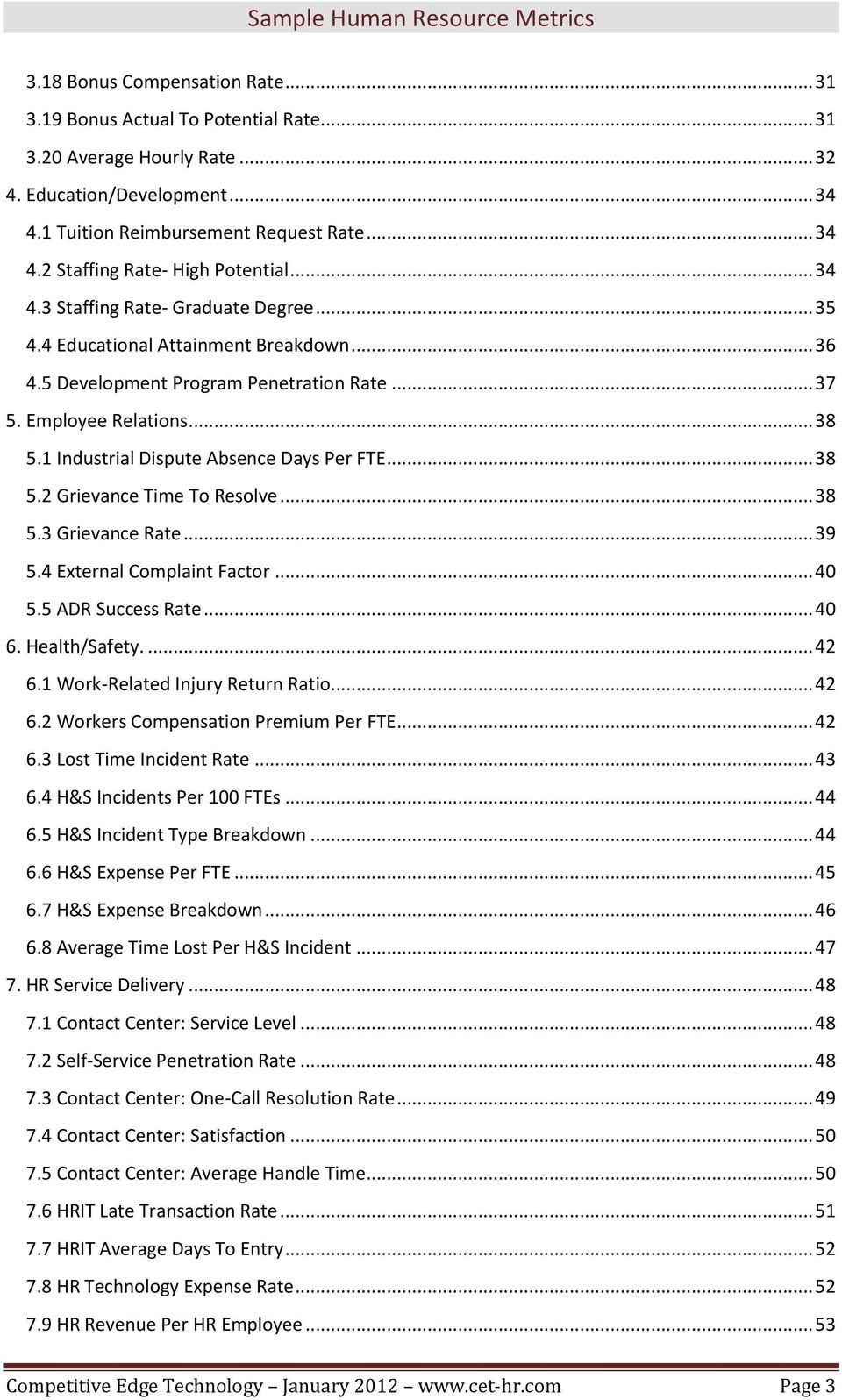
3 3.18 Bonus Compensation Rate Bonus Actual To Potential Rate Average Hourly Rate Education/Development Tuition Reimbursement Request Rate Staffing Rate- High Potential Staffing Rate- Graduate Degree Educational Attainment Breakdown Development Program Penetration Rate Employee Relations Industrial Dispute Absence Days Per FTE Grievance Time To Resolve Grievance Rate External Complaint Factor ADR Success Rate Health/Safety Work-Related Injury Return Ratio Workers Compensation Premium Per FTE Lost Time Incident Rate H&S Incidents Per 100 FTEs H&S Incident Type Breakdown H&S Expense Per FTE H&S Expense Breakdown Average Time Lost Per H&S Incident HR Service Delivery Contact Center: Service Level Self-Service Penetration Rate Contact Center: One-Call Resolution Rate Contact Center: Satisfaction Contact Center: Average Handle Time HRIT Late Transaction Rate HRIT Average Days To Entry HR Technology Expense Rate HR Revenue Per HR Employee Competitive Edge Technology January Page 3
4 7.10 HR Revenue Expense Rate HR Operating Expense Rate HR Expense Per FTE HR Expense Breakdown- Type HR Expense Breakdown- Function HR Staffing Rate HR Staffing Coverage Ratio HR Staffing Breakdown HR Recruitment Source Ratio HR Professional Staffing Mix Ratio HR Mobility Rate Internal Movement Upward Mobility Transfer Rate Promotion Speed Ratio Promotion Rate Lateral Mobility Internal Placement Rate Internal Hire Rate Cross-Function Mobility Career Path Ratio Management/Leadership Successor Pool Growth Rate Successor Pool Coverage Positions Without Ready Candidates Rate Manager Quality Index Manager Instability Rate LDP Prevalence Rate Employee Satisfaction With Leadership Cross-Function Mobility- Managers Organization Effectiveness R&D Expense Rate New Products & Services Revenue Per FTE Market Capitalization Per FTE Competitive Edge Technology January Page 4

5 10.4 Intangible Asset Value Per FTE Employee Stock Ownership Percentage Corporate Expense Rate Work Units Per FTE Return on Human Investment Ratio Other Labor Rate Operating Revenue Per FTE Operating Profit Per FTE Operating Expense Per FTE Human Investment Ratio Payroll Payroll Expense Per Employee Payroll Error Rate Overpayment Rate Direct Deposit Participation Rate Average Overpayment Value Performance Management Upward Review Rate Self Review Rate Performance Contingent Pay Prevalence Performance-Based Pay Differential Performance Rating Distribution Performance Appraisal Participation Rate Peer Review Rate High Performer Growth Rate Employee Upgrade Rate Employee Turnaround Rate Average Performance Appraisal Rating Productivity Employee Engagement Index Recruitment Rehire Rate Recruitment Source Ratio Recruitment Source Breakdown Competitive Edge Technology January Page 5

6 14.4 New Position Recruitment Ratio New Position Recruitment Rate Net Hire Ratio External Hire Rate Staffing Effectiveness Turnover Cost Rate- < 1-Year Tenure New Hire Turnover Contribution Sign-On Bonus Rate Referral Rate Referral Conversion Rate Recruitment Expense Breakdown Recruitment Cost Per Hire On-Time Talent Delivery Factor Offer Acceptance Rate New Hire Satisfaction With Recruiting New Hire Performance Satisfaction New Hire Failure Factor Interviewee Ratio Interviewee Offer Rate Average Time to Start Average Time to Fill Average Sign-On Bonus Expense Average Interviews Per Hire Applicant Ratio Applicant Interview Rate Training Training Total Compensation Expense Rate Training Staff Ratio Training Quality Training Penetration Rate Training Hours Per Occurrence Training Hours Per FTE Training Expense Per Employee Training Course Content Breakdown Competitive Edge Technology January Page 6

7 16.9 Training Channel Delivery Mix Employee Satisfaction with Training E-Learning Abandonment Rate Average Training Class Size Turnover/Retention Turnover Cost Rate- < 1-Year Tenure Termination Value Per FTE Average Voluntary Termination Value Average Termination Value Offer Fit Index Market Opportunity Index Employee Retention Index Employee Commitment Index Voluntary Termination Rate Termination Reason Breakdown Termination Rate Termination Breakdown By Performance Rating Retention Rate New Hire Turnover Contribution Involuntary Termination Rate Workforce Staffing Rate- Less than 1 Year Tenure Organization Tenure Staffing Breakdown Average Workforce Tenure Staffing Rate- Union Employees Staffing Rate- Temporary Staffing Rate- Revenue Generating Staffing Rate- Part Time Staffing Rate- Managerial Staffing Rate- Customer Facing Staffing Rate- Corporate Function Staffing Breakdown Employment Level Staffing Breakdown Employee Ownership Rate Competitive Edge Technology January Page 7

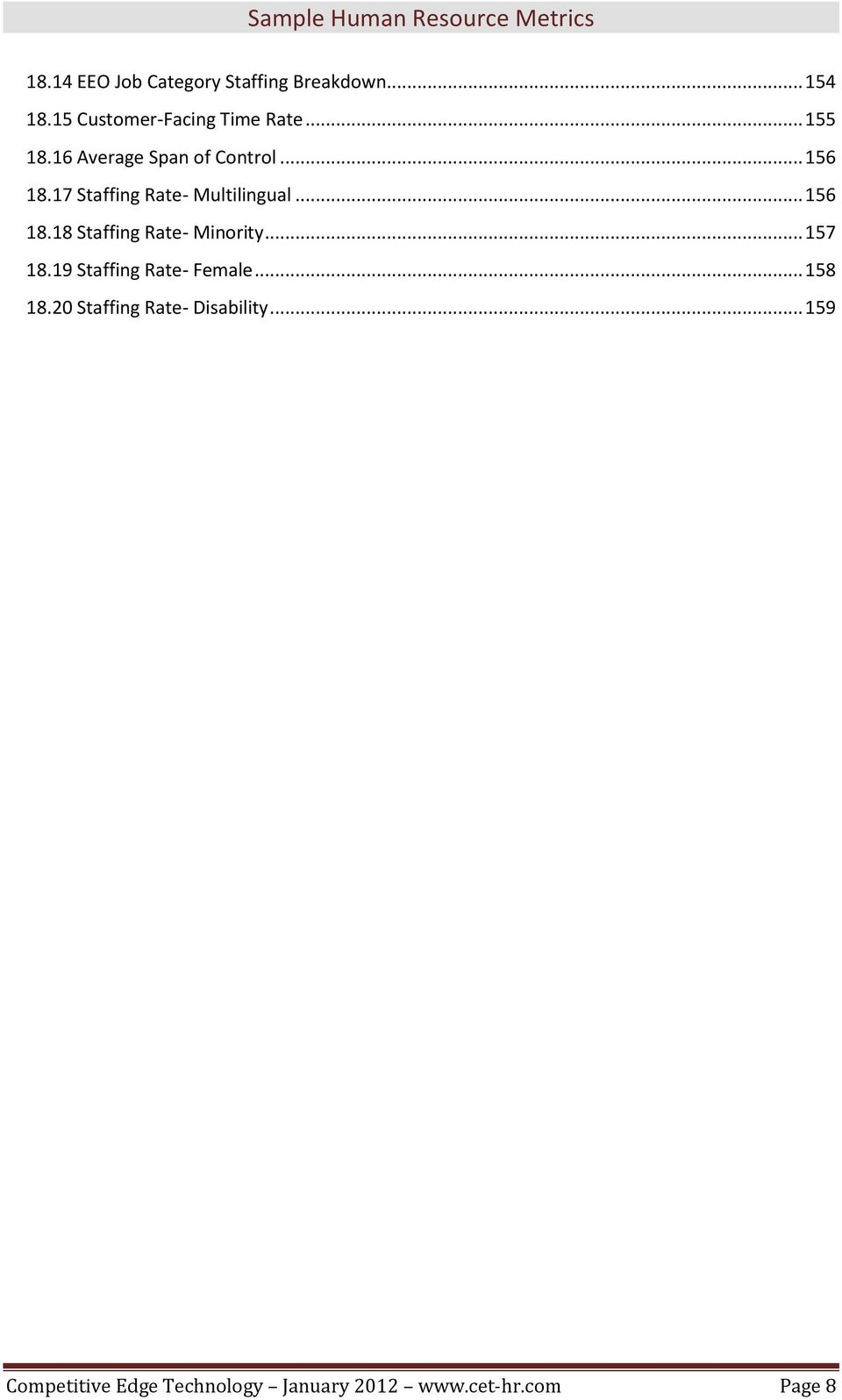
8 18.14 EEO Job Category Staffing Breakdown Customer-Facing Time Rate Average Span of Control Staffing Rate- Multilingual Staffing Rate- Minority Staffing Rate- Female Staffing Rate- Disability Competitive Edge Technology January Page 8
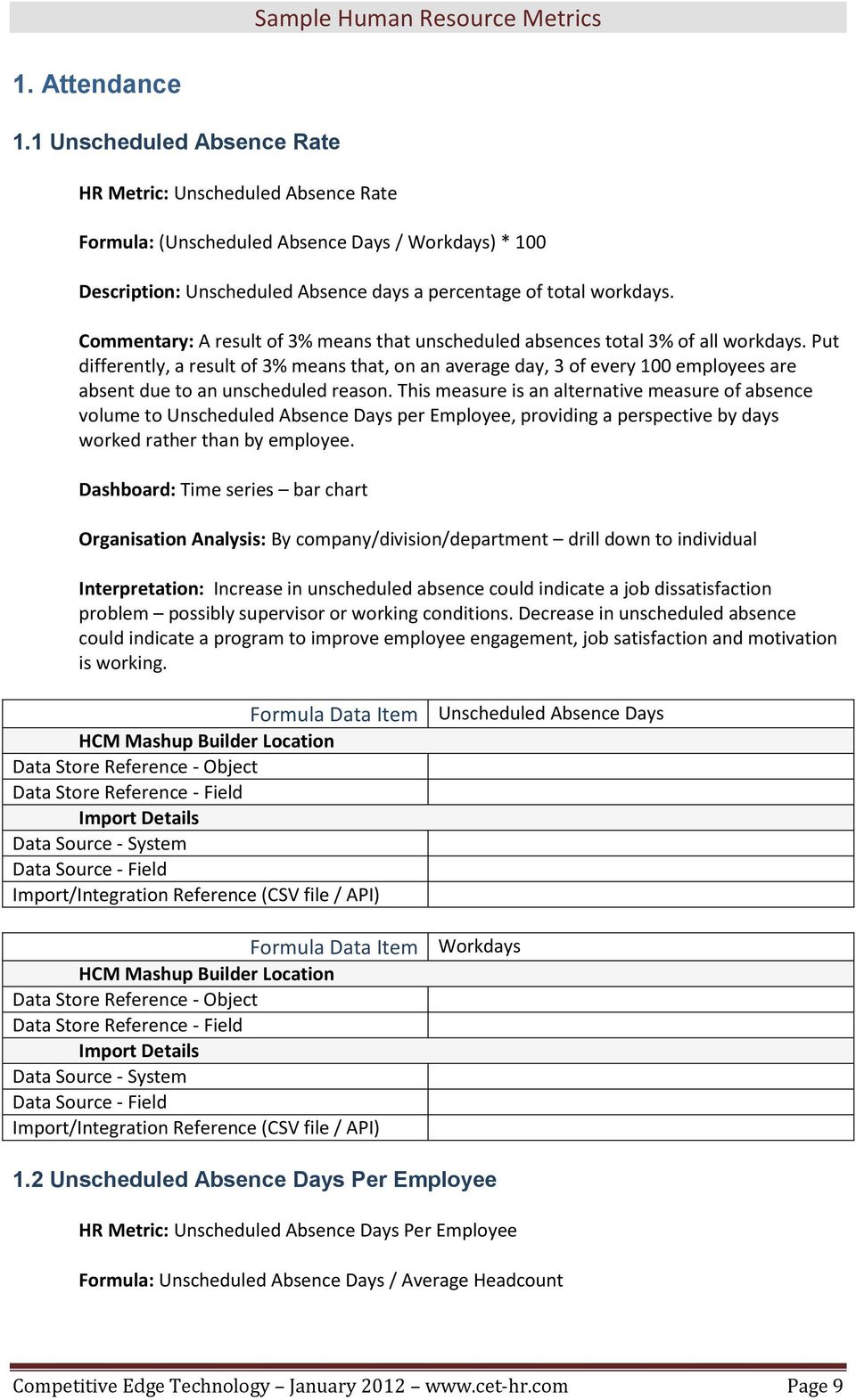
9 1. Attendance 1.1 Unscheduled Absence Rate HR Metric: Unscheduled Absence Rate Formula: (Unscheduled Absence Days / Workdays) * 100 Description: Unscheduled Absence days a percentage of total workdays. Commentary: A result of 3% means that unscheduled absences total 3% of all workdays. Put differently, a result of 3% means that, on an average day, 3 of every 100 employees are absent due to an unscheduled reason. This measure is an alternative measure of absence volume to Unscheduled Absence Days per Employee, providing a perspective by days worked rather than by employee. Increase in unscheduled absence could indicate a job dissatisfaction problem possibly supervisor or working conditions. Decrease in unscheduled absence could indicate a program to improve employee engagement, job satisfaction and motivation is working. Formula Data Item Unscheduled Absence Days Formula Data Item Workdays 1.2 Unscheduled Absence Days Per Employee HR Metric: Unscheduled Absence Days Per Employee Formula: Unscheduled Absence Days / Average Headcount Competitive Edge Technology January Page 9
10 Description: Average number of days of unscheduled absences per employee during the reporting period. Commentary: A result of 1.5 means that, on average, each employee missed one and a half days of work during the period for unscheduled reasons. This measure is an alternative measure of absence volume to Unscheduled Absence Rate, providing a perspective by employee rather than by days worked. Formula Data Item Unscheduled Absence Days Formula Data Item Average Headcount 1.3 Unscheduled Absence Breakdown HR Metric: Unscheduled Absence Breakdown Formula: (Unscheduled Absence Days.[Type] / Unscheduled Absence Days) * 100 Description: Distribution of unscheduled absences by type, including sick leave, workplace injury, family leave, industrial dispute, etc. Commentary: Unscheduled Absence Breakdown indicates the composition of unscheduled absence days that occurred during a period by the absence type. Graphically, the data are presented as a percentage of the total unscheduled absences, i.e., a stacked bar graph. Competitive Edge Technology January Page 10

11 Formula Data Item Unscheduled Absence Days.[Type] Formula Data Item Unscheduled Absence Days 1.4 Schedule Flexibility Rate HR Metric: Schedule Flexibility Rate Formula: (End of Period Headcount.Flexible Work Schedule) / End of Period Headcount) * 100 Description: Employees with a flexible work schedule as a percentage of total employees. Commentary: A result of 10 indicates that 10% of the workforce participates in a flexible work arrangement and may not work the standard operating hours of the organization. Formula Data Item End of Period Headcount.Flexible Work Schedule Formula Data Item End of Period Headcount Competitive Edge Technology January Page 11

12 1.5 PTO Utilization Rate HR Metric: PTO Utilization Rate Formula: (PTO Hours.Used / PTO Hours.Accrued) * 100 Description: Paid time off hours taken as a percentage of those hours earned during the reporting period. Commentary: A result of 80% means that for every 10 hours of PTO that employees accrue, they are only taking eight hours off. Formula Data Item PTO Hours.Used Formula Data Item PTO Hours.Accrued 1.6 Compensation Value of Unscheduled Absences Per FTE HR Metric: Compensation Value of Unscheduled Absences Per FTE Formula: (Unscheduled Absence Days * Direct Compensation.Daily / FTE) Description: Average compensation cost of unscheduled absences per full-time equivalent employee. Competitive Edge Technology January Page 12

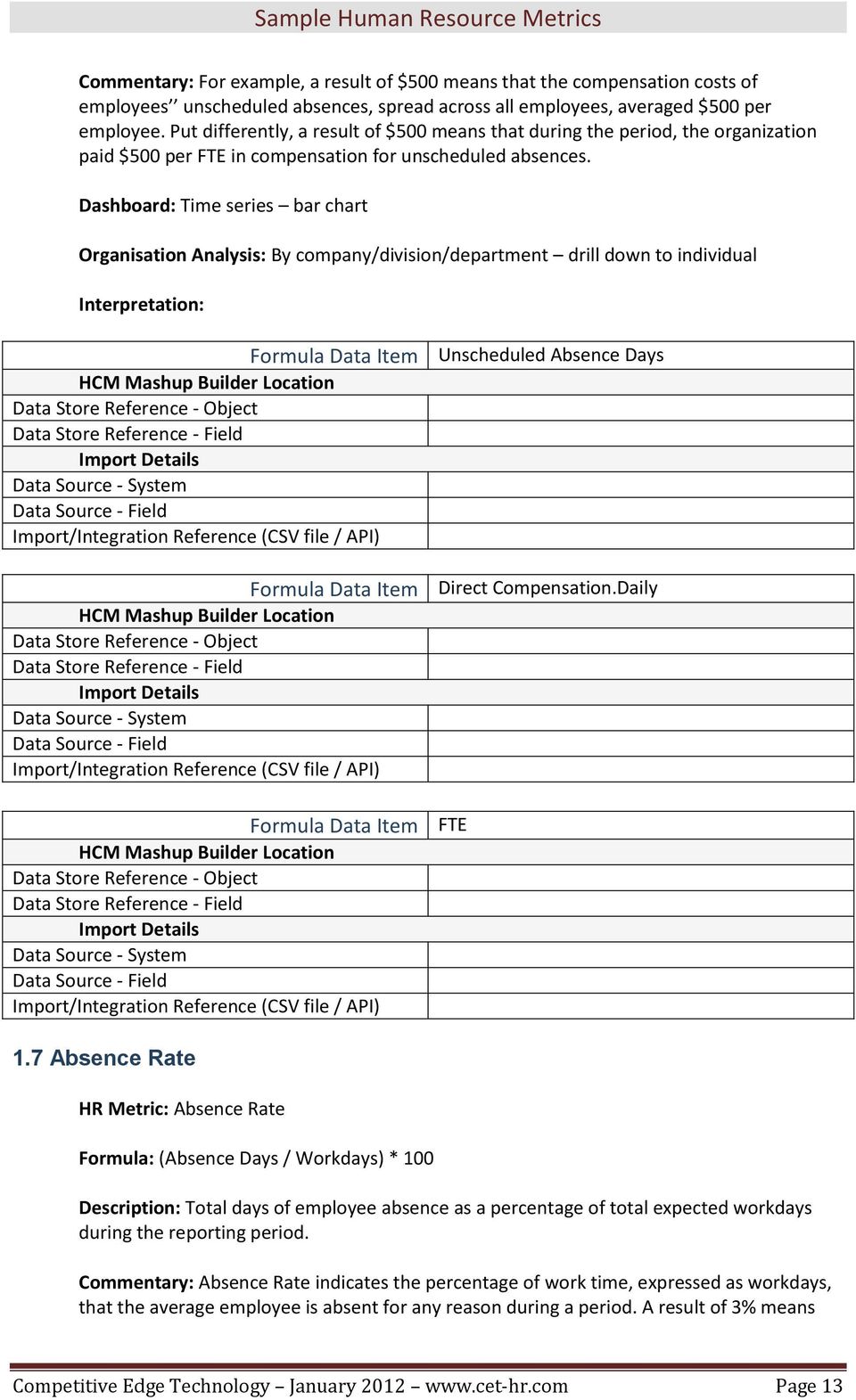
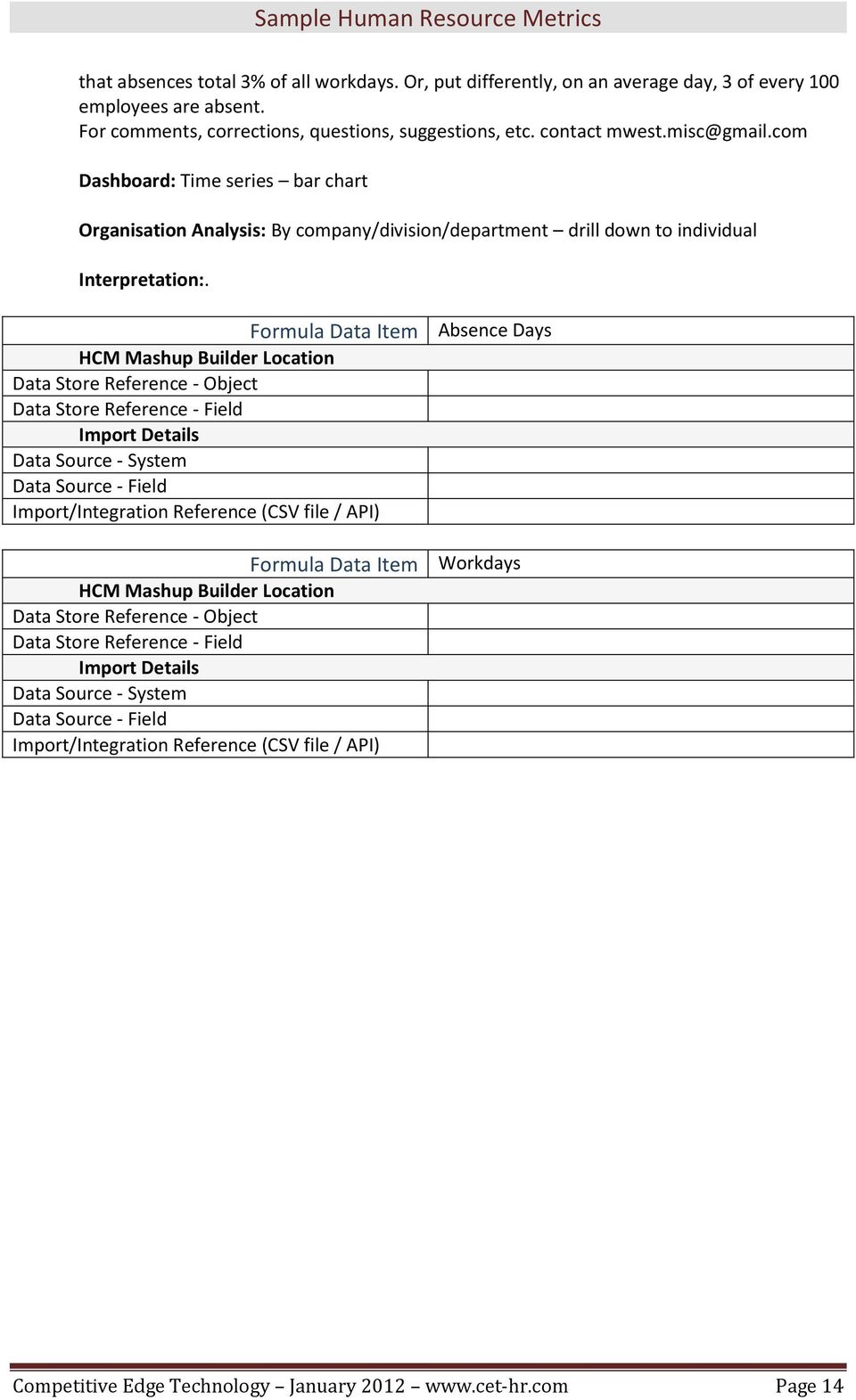
13 Commentary: For example, a result of $500 means that the compensation costs of employees unscheduled absences, spread across all employees, averaged $500 per employee. Put differently, a result of $500 means that during the period, the organization paid $500 per FTE in compensation for unscheduled absences. Formula Data Item Unscheduled Absence Days Formula Data Item Direct Compensation.Daily Formula Data Item FTE 1.7 Absence Rate HR Metric: Absence Rate Formula: (Absence Days / Workdays) * 100 Description: Total days of employee absence as a percentage of total expected workdays during the reporting period. Commentary: Absence Rate indicates the percentage of work time, expressed as workdays, that the average employee is absent for any reason during a period. A result of 3% means Competitive Edge Technology January Page 13
14 that absences total 3% of all workdays. Or, put differently, on an average day, 3 of every 100 employees are absent. For comments, corrections, questions, suggestions, etc. contact [email protected]. Formula Data Item Absence Days Formula Data Item Workdays Competitive Edge Technology January Page 14
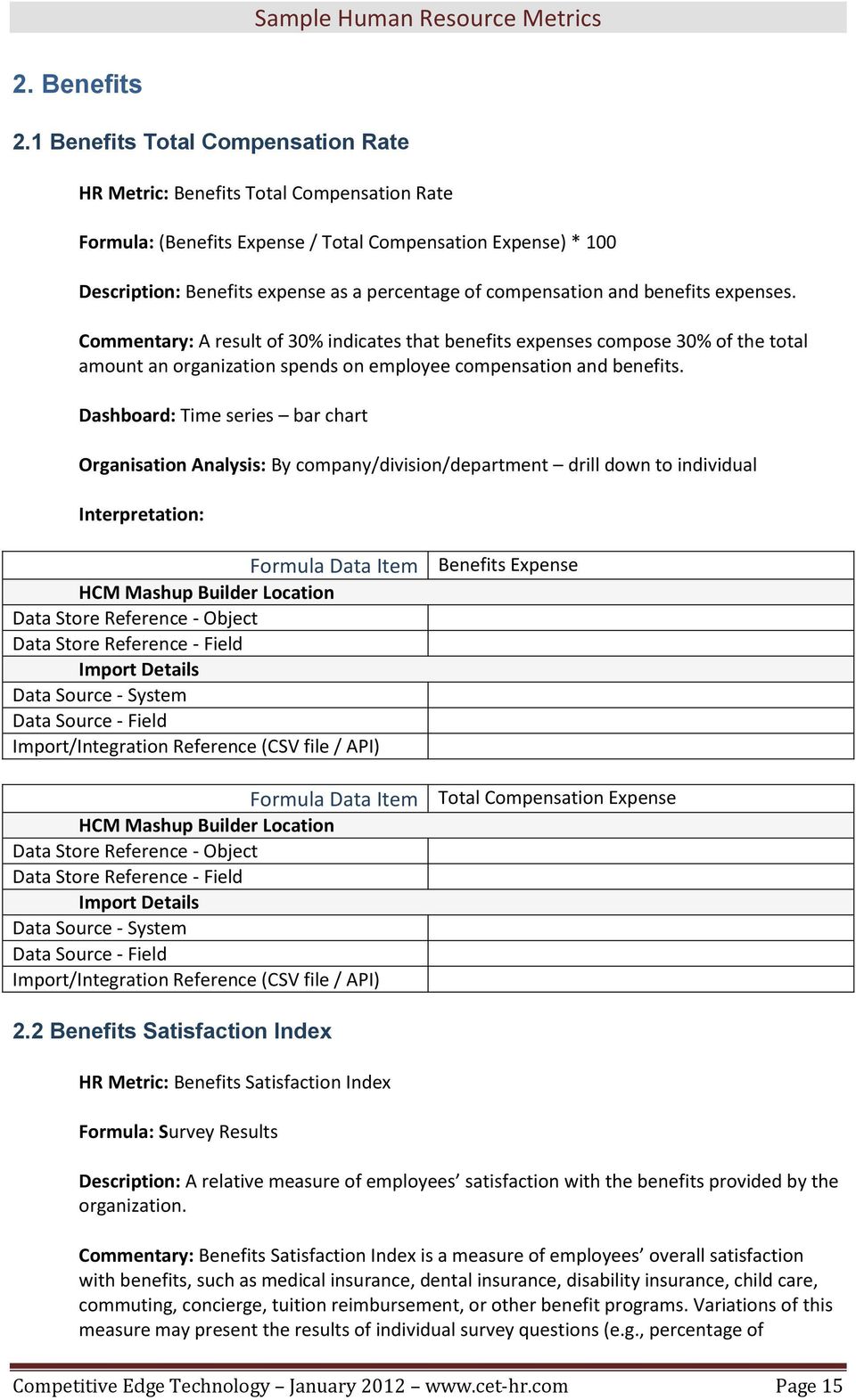
15 2. Benefits 2.1 Benefits Total Compensation Rate HR Metric: Benefits Total Compensation Rate Formula: (Benefits Expense / Total Compensation Expense) * 100 Description: Benefits expense as a percentage of compensation and benefits expenses. Commentary: A result of 30% indicates that benefits expenses compose 30% of the total amount an organization spends on employee compensation and benefits. Formula Data Item Benefits Expense Formula Data Item Total Compensation Expense 2.2 Benefits Satisfaction Index HR Metric: Benefits Satisfaction Index Formula: Survey Results Description: A relative measure of employees satisfaction with the benefits provided by the organization. Commentary: Benefits Satisfaction Index is a measure of employees overall satisfaction with benefits, such as medical insurance, dental insurance, disability insurance, child care, commuting, concierge, tuition reimbursement, or other benefit programs. Variations of this measure may present the results of individual survey questions (e.g., percentage of Competitive Edge Technology January Page 15
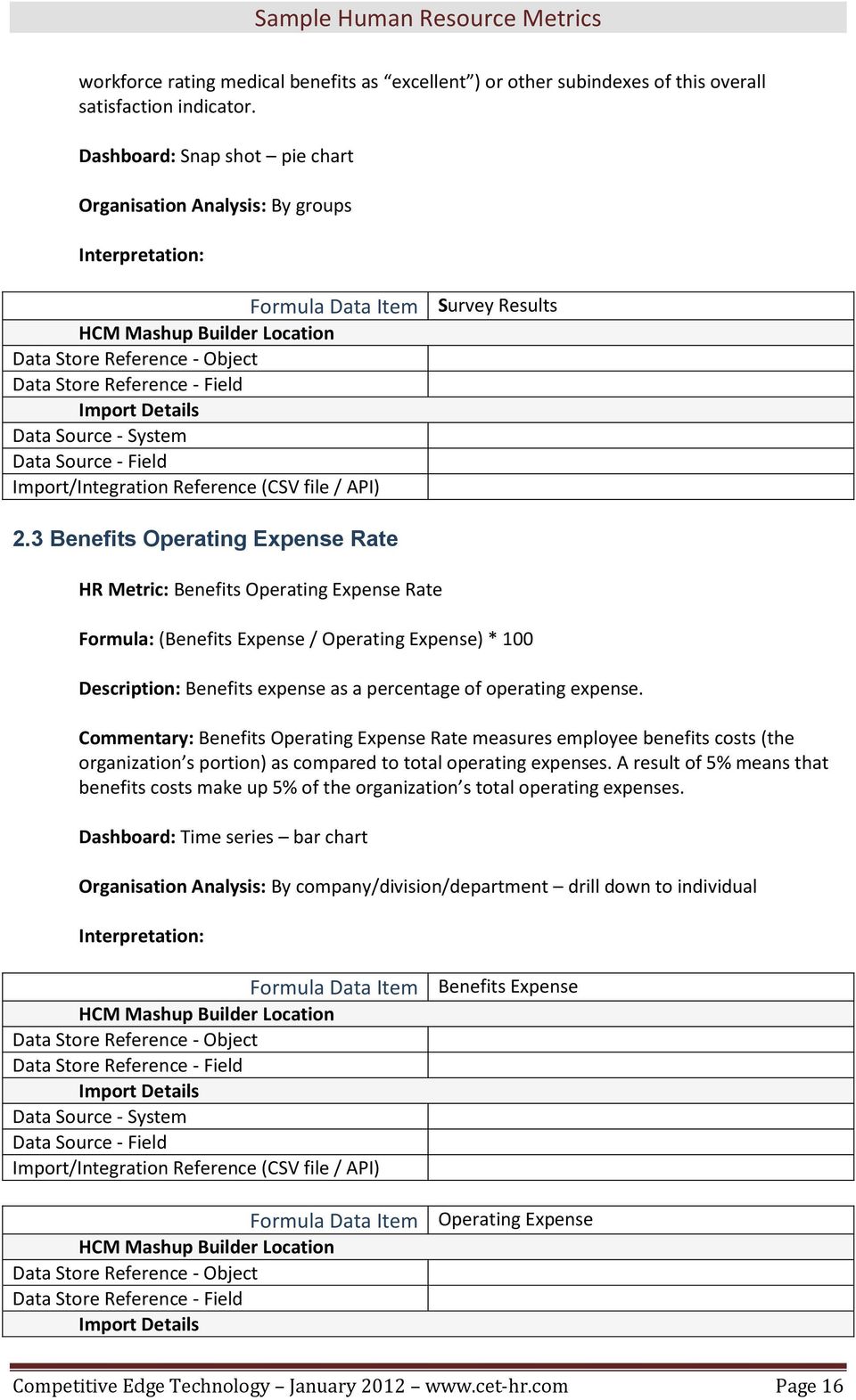
16 workforce rating medical benefits as excellent ) or other subindexes of this overall satisfaction indicator. Dashboard: Snap shot pie chart Organisation Analysis: By groups Formula Data Item Survey Results 2.3 Benefits Operating Expense Rate HR Metric: Benefits Operating Expense Rate Formula: (Benefits Expense / Operating Expense) * 100 Description: Benefits expense as a percentage of operating expense. Commentary: Benefits Operating Expense Rate measures employee benefits costs (the organization s portion) as compared to total operating expenses. A result of 5% means that benefits costs make up 5% of the organization s total operating expenses. Formula Data Item Benefits Expense Formula Data Item Operating Expense Competitive Edge Technology January Page 16
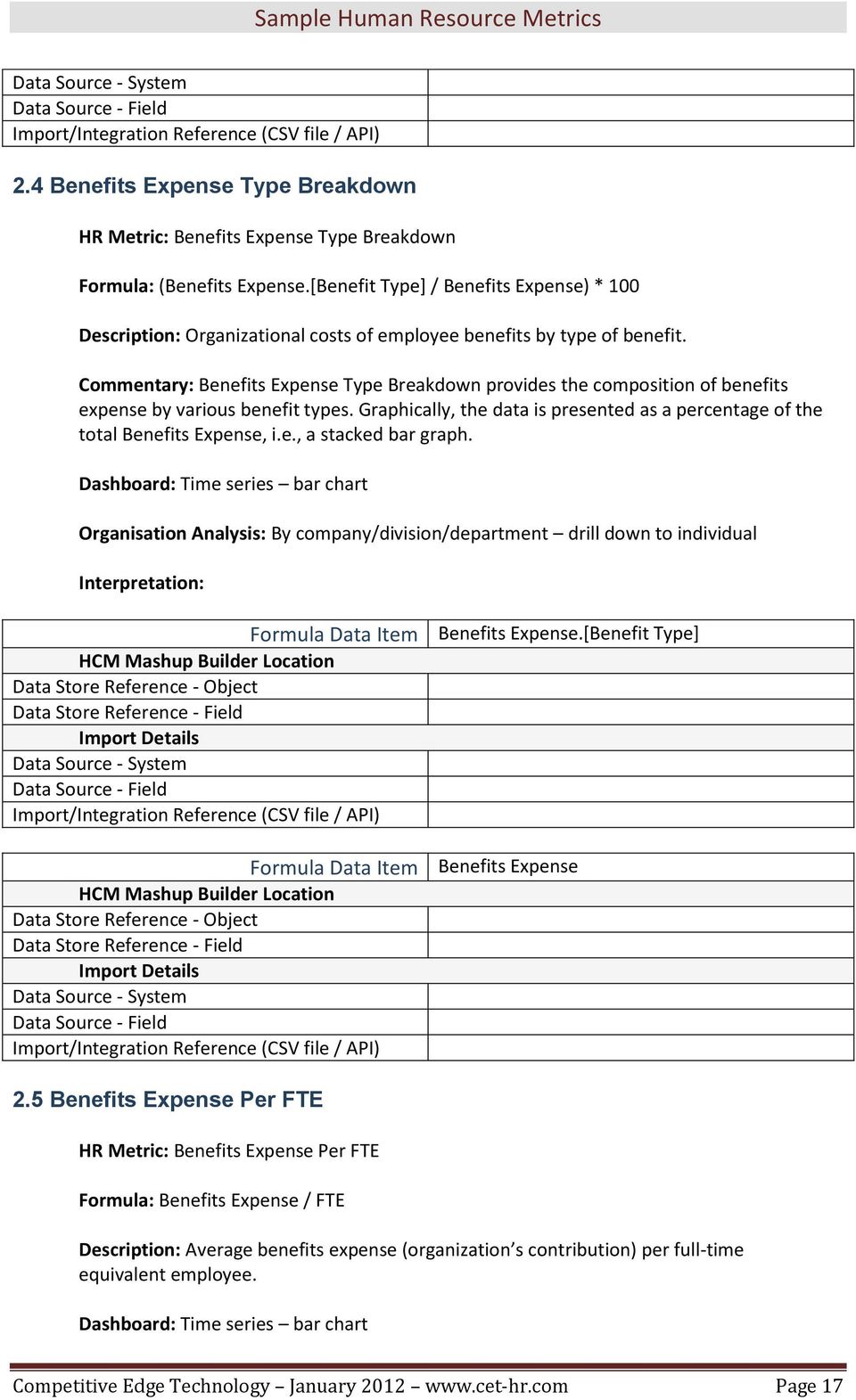
17 2.4 Benefits Expense Type Breakdown HR Metric: Benefits Expense Type Breakdown Formula: (Benefits Expense.[Benefit Type] / Benefits Expense) * 100 Description: Organizational costs of employee benefits by type of benefit. Commentary: Benefits Expense Type Breakdown provides the composition of benefits expense by various benefit types. Graphically, the data is presented as a percentage of the total Benefits Expense, i.e., a stacked bar graph. Formula Data Item Benefits Expense.[Benefit Type] Formula Data Item Benefits Expense 2.5 Benefits Expense Per FTE HR Metric: Benefits Expense Per FTE Formula: Benefits Expense / FTE Description: Average benefits expense (organization s contribution) per full-time equivalent employee. Competitive Edge Technology January Page 17
18 Formula Data Item Benefits Expense Formula Data Item FTE Competitive Edge Technology January Page 18
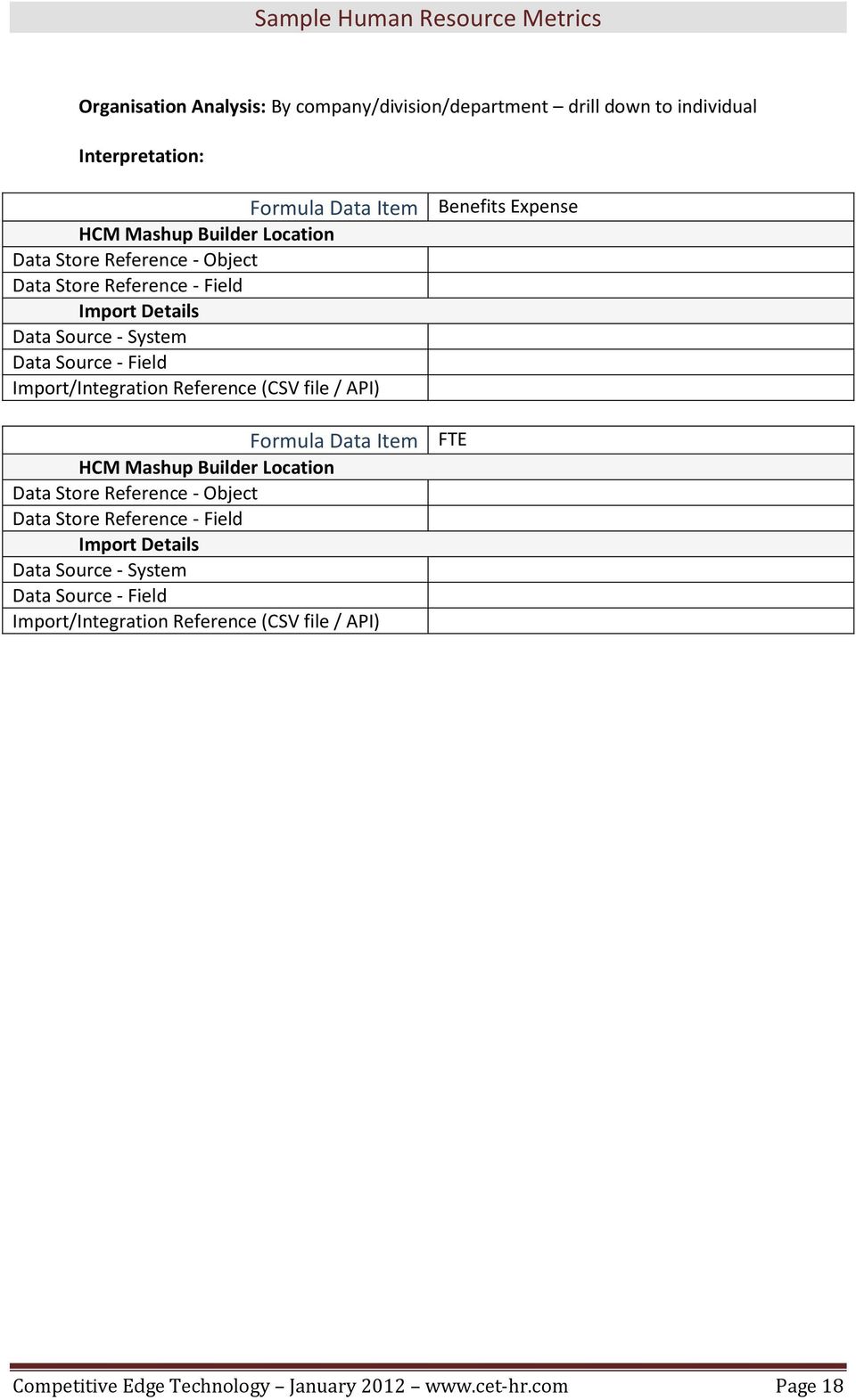
19 3. Compensation 3.1 Average Workweek HR Metric: Average Workweek Formula: (Hours Worked / Number of Weeks) / Average Headcount Description: Average number of hours worked per week per employee. Commentary: Average Workweek measures the number of hours worked per week per employee, on average. A result of 37 means that the average person employed by the organization worked 37 hours per week during the period. Formula Data Item Hours Worked Formula Data Item Number of Weeks Formula Data Item Average Headcount 3.2 Stock Incentive Eligibility Rate Competitive Edge Technology January Page 19
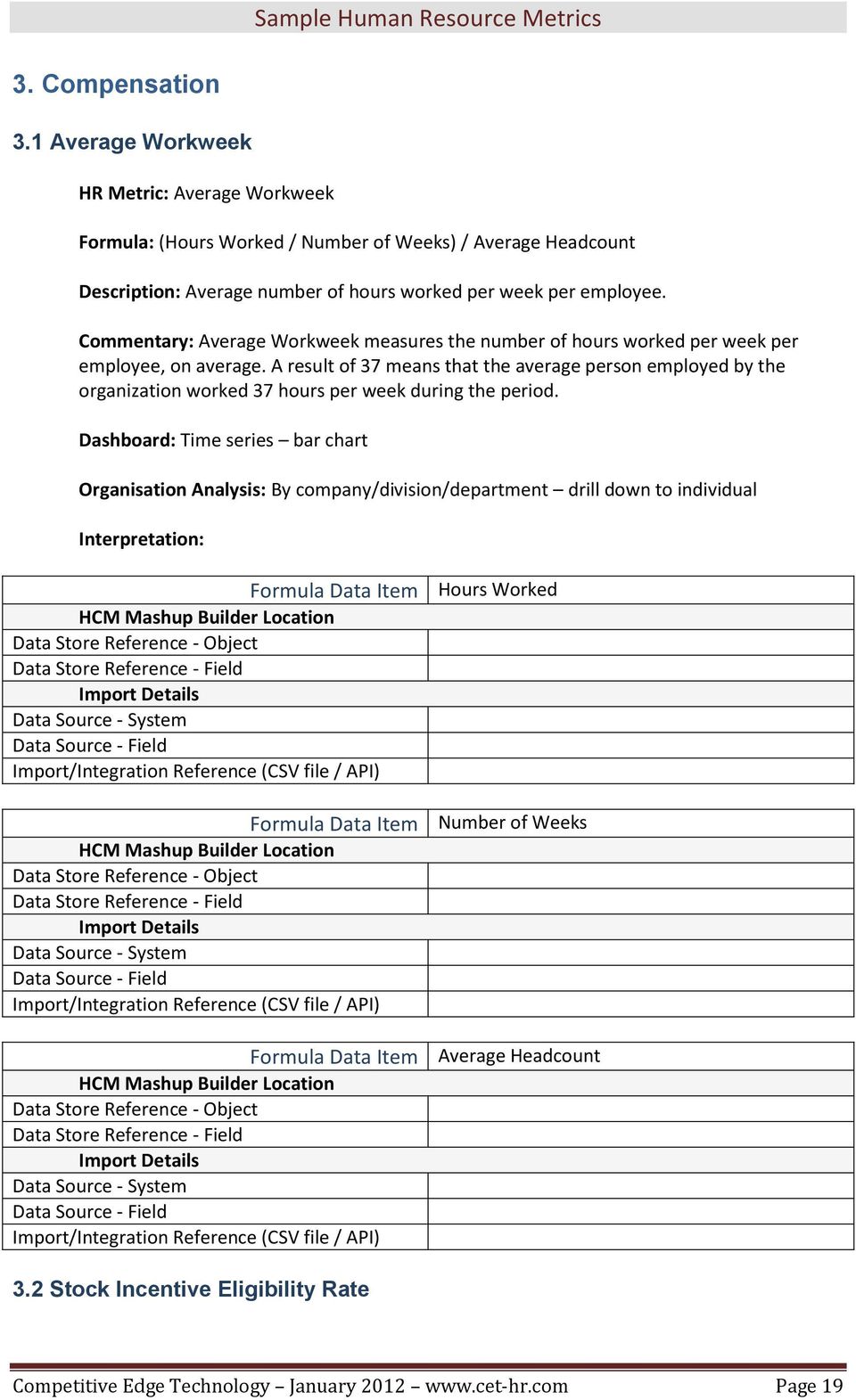
20 HR Metric: Stock Incentive Eligibility Rate Formula: (End of Period Headcount.Stock Incentive Eligible / End of Period Headcount) * 100 Description: The percentage of employees eligible to receive stock-based incentives. Commentary: A value of 30 indicates that 30% of employees are eligible to receive stockbased incentives. Formula Data Item End of Period Headcount.Stock Incentive Eligible Formula Data Item End of Period Headcount 3.3 Number of Options Exercised Per Employee HR Metric: Number of Options Exercised Per Employee Formula: Stock Options.Exercised / End of Period Headcount.Stock Option Eligible Description: Average number of stock options exercised per option-eligible employee. Commentary: A value of 100 indicates that on average eligible employees exercised 100 stock options during the reporting period. Competitive Edge Technology January Page 20
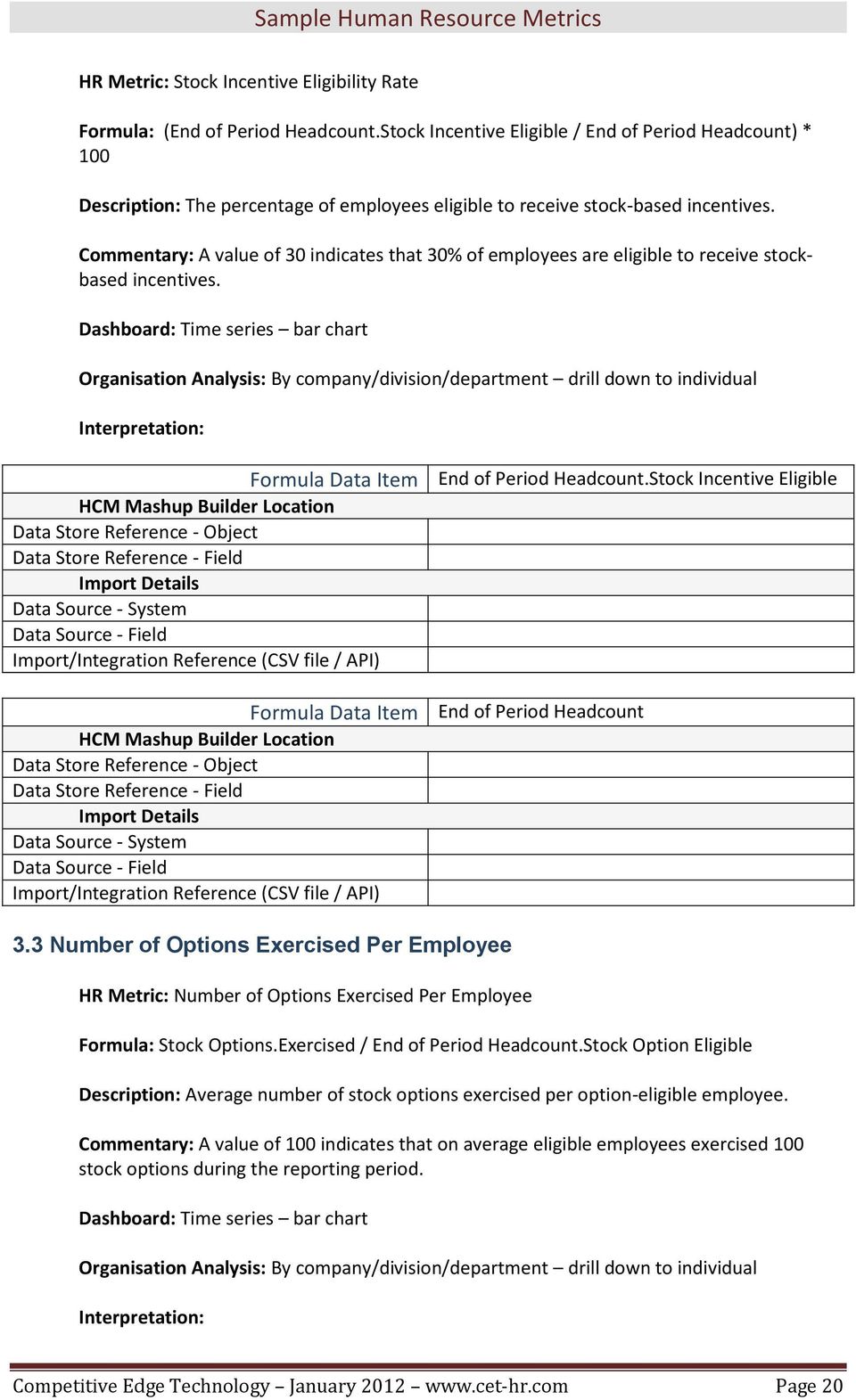
21 Formula Data Item Stock Options.Exercised Formula Data Item End of Period Headcount.Stock Option Eligible 3.4 Net Proceeds of Options Per Employee Exercising HR Metric: Net Proceeds of Options Per Employee Exercising Formula: Stock Option Net Proceeds / Headcount.Stock Option Eligible. Exercised Description: Net proceeds to employees exercising stock options during the period for each employee who has exercised options. Commentary: Net Proceeds of Options per Employee Exercising indicates the average amount received by employees exercising options. The net proceeds are equal to the difference between sale price and strike price multiplied by the number of options exercised. Formula Data Item Stock Option Net Proceeds Formula Data Item Headcount.Stock Option Eligible. Exercised Competitive Edge Technology January Page 21
22 3.5 Equity Incentive Value Per Employee HR Metric: Equity Incentive Value Per Employee Formula: Equity Incentive Value / Average Headcount.Equity Incentive Eligible Description: The average value of equity incentives granted or earned per eligible employee. Commentary: Equity Incentive Value per Employee indicates the value of stock incentives granted to or earned by each eligible employee over the course of the period, using Black- Scholes or other valuation techniques. Stock incentives may include stock options, restricted stock, stock appreciation rights, performance shares, or other compensation related to equity. A value of $10,000 indicates that on average those eligible for an equity incentive received incentives valued at $10,000. Formula Data Item Equity Incentive Value Formula Data Item Average Headcount.Equity Incentive Eligible 3.6 Average Number of Options Per Employee HR Metric: Average Number of Options Per Employee Formula: (Stock Options.Granted / Average Headcount.Stock Option Eligible) * 100 Competitive Edge Technology January Page 22
23 Description: The average number of stock options granted per eligible employee during the period. Commentary: A result of 30 means that employees eligible to receive stock options received 30 options, on average, during the period. Formula Data Item Stock Options.Granted Formula Data Item Average Headcount.Stock Option Eligible 3.7 Upward Salary Change Rate HR Metric: Upward Salary Change Rate Formula: End of Period Headcount.Base Salary Increase / End of Period Headcount * 100 Description: Percentage of employees receiving base salary increases during the reporting period. Formula Data Item End of Period Headcount.Base Salary Increase Competitive Edge Technology January Page 23
24 Formula Data Item End of Period Headcount 3.8 Total Compensation Expense Per FTE HR Metric: Total Compensation Expense Per FTE Formula: Total Compensation Expense / FTE Description: Average total compensation expense, including direct, benefits, and equity compensation, per full-time equivalent employee. Formula Data Item Total Compensation Expense Formula Data Item FTE 3.9 Overtime Rate Competitive Edge Technology January Page 24
25 HR Metric: Overtime Rate Formula: (Overtime Expense / Direct Compensation Expense) * 100 Description: Overtime expense as a percentage of total direct compensation expense. Commentary: Overtime Rate measures the dollars of overtime paid relative to all forms of direct (cash) compensation paid. For example, a result of 10% indicates that overtime payments represent 10% of all cash payments to employees. By comparing overtime costs to all direct compensation costs, an organization can understand the impact of overtime on employees take-home pay and whether overtime costs represent an increasing or decreasing proportion of compensation over time. Formula Data Item Overtime Expense Formula Data Item Direct Compensation Expense 3.10 Overtime Expense Per FTE HR Metric: Overtime Expense Per FTE Formula: Overtime Expense / FTE Description: Average overtime cash compensation per full-time equivalent employee. Competitive Edge Technology January Page 25
26 Formula Data Item Overtime Expense Formula Data Item FTE 3.11 Market Compensation Ratio HR Metric: Market Compensation Ratio Formula: Direct Compensation Expense / Market Comparable Direct Compensation Description: Ratio of employees direct compensation to market-comparable direct compensation. Commentary: Market Compensation Ratio provides the ratio of direct (cash) compensation provided by the employer to that provided by a comparable market group. A result of 80% means that the organization s compensation offerings are 80% of the offerings of other organizations. These data are sometimes provided only for certain components of direct compensation (e.g., base salary and bonus), and may not be available for all positions within an organization. Dashboard: Snap shot bar chart Formula Data Item Direct Compensation Expense Formula Data Item Market Comparable Direct Compensation Competitive Edge Technology January Page 26
27 3.12 Direct Compensation Expense Per FTE HR Metric: Direct Compensation Expense Per FTE Formula: Direct Compensation Expense / FTE Description: Average direct compensation expense, including wages, bonus, and other cash compensation, per full-time equivalent employee. Formula Data Item Direct Compensation Expense Formula Data Item FTE 3.13 Direct Compensation Breakdown HR Metric: Direct Compensation Breakdown Formula: (Direct Compensation Expense.[Compensation Type] / Direct Compensation Expense) * 100 Description: Distribution of direct compensation by type, including base, overtime, bonus, incentives, etc. Competitive Edge Technology January Page 27
28 Commentary: Direct Compensation Breakdown provides the percentages of direct compensation paid that are of various compensation types. Graphically, the data are presented as a percentage of the total direct compensation, i.e., a stacked bar graph. Direct compensation, contrasted with benefits and equity compensation, relates to cash payments for base pay, variable pay, overtime, and other cash payments such as sign-on bonuses and relocation allowances. Formula Data Item Direct Compensation Expense.[Compensation Type] Formula Data Item Direct Compensation Expense 3.14 Direct Comp Operating Expense Rate HR Metric: Direct Comp Operating Expense Rate Formula: (Direct Compensation / Operating Expense) * 100 Description: Direct compensation expenses as a percentage of operating expense. Commentary: Direct Comp Operating Expense Rate measures direct compensation (cash compensation such as wages and bonuses) as compared to total operating expenses. A result of 40% means that direct compensation makes up 40% of the organization s total operating expenses. Competitive Edge Technology January Page 28
29 Formula Data Item Direct Compensation Formula Data Item Operating Expense 3.15 Compensation Satisfaction Index HR Metric: Compensation Satisfaction Index Formula: Survey Results Description: A relative measure of employees satisfaction with compensation. Commentary: Compensation Satisfaction Index is a subjective measure of employees satisfaction with compensation packages. Among employee survey results, many organizations find that employees report low satisfaction with compensation. Though employers may not expect high results, the measure can be tracked over time to monitor in if satisfaction is increasing or decreasing. However, these survey results can be used to compare specific employee populations by division, location, job family, age group, performance level, etc. Formula Data Item Survey Results Competitive Edge Technology January Page 29
30 3.16 Bonus Receipt Rate HR Metric: Bonus Receipt Rate Formula: (End of Period Headcount.Receiving Bonus / End of Period Headcount.Bonus Eligible) * 100 Description: Employees receiving a bonus as a percentage of total employees eligible to receive a bonus. Formula Data Item End of Period Headcount.Receiving Bonus Formula Data Item End of Period Headcount.Bonus Eligible 3.17 Bonus Eligibility Rate HR Metric: Bonus Eligibility Rate Formula: (End of Period Headcount.Bonus Eligible / End of Period Headcount) * 100 Description: Percentage of employees eligible to receive a bonus. Formula Data Item End of Period Headcount.Bonus Eligible Competitive Edge Technology January Page 30
31 Formula Data Item End of Period Headcount 3.18 Bonus Compensation Rate HR Metric: Bonus Compensation Rate Formula: (Direct Compensation Expense.Bonus / Direct Compensation Expense) * 100 Description: Bonus compensation as a percentage of all direct (cash) compensation. Formula Data Item Direct Compensation Expense.Bonus Formula Data Item Direct Compensation Expense 3.19 Bonus Actual To Potential Rate Competitive Edge Technology January Page 31
32 HR Metric: Bonus Actual To Potential Rate Formula: (Direct Compensation Expense.Bonus / Bonus Potential) * 100 Description: Average actual bonus compensation received as a percentage of total potential bonus compensation. Formula Data Item Direct Compensation Expense.Bonus Formula Data Item Bonus Potential 3.20 Average Hourly Rate HR Metric: Average Hourly Rate Formula: Total Compensation Expense / Work Hours Description: Average total compensation expense, including direct, benefits, and equity compensation, per working hour. Formula Data Item Total Compensation Expense Competitive Edge Technology January Page 32
33 Formula Data Item Work Hours Competitive Edge Technology January Page 33
34 4. Education/Development Sample Human Resource Metrics 4.1 Tuition Reimbursement Request Rate HR Metric: Tuition Reimbursement Request Rate Formula: (Distinct Employees.Tuition Reimbursement Requests / Average Headcount) * 100 Description: Distinct employees submitting tuition reimbursement requests as a percentage of the workforce. Formula Data Item Distinct Employees.Tuition Reimbursement Requests Formula Data Item Average Headcount 4.2 Staffing Rate- High Potential HR Metric: Staffing Rate- High Potential Formula: (End of Period Headcount.High Potential / End of Period Headcount) * 100 Description: Percentage of the workforce designated as high potential. Competitive Edge Technology January Page 34
35 Formula Data Item End of Period Headcount.High Potential Formula Data Item End of Period Headcount 4.3 Staffing Rate- Graduate Degree HR Metric: Staffing Rate- Graduate Degree Formula: (End of Period Headcount.Graduate Degree / End of Period Headcount) * 100 Description: Percentage of employees with a graduate degree or higher level of educational attainment. Application: Measurement of the education level characteristics of the workforce. Commentary: Staffing Rate Graduate Degree indicates the percentage of the workforce that has attained a graduate degree (or equivalent advanced degree) or higher level of education. This measure, along with variations of this measure, can be useful in understanding the education levels of the workforce as a whole, as well as that of specific employee populations. Formula Data Item End of Period Headcount.Graduate Degree Competitive Edge Technology January Page 35
36 Formula Data Item End of Period Headcount 4.4 Educational Attainment Breakdown HR Metric: Educational Attainment Breakdown Formula: (End of Period Headcount.[Degree Level] / End of Period Headcount) * 100 Description: Distribution of headcount by employees educational attainment, e.g., high school, university, advanced degree, etc. Application: Measurement of the education level characteristics of the workforce. Commentary: Educational Attainment Breakdown depicts the percentages of the workforce that have reached various educational levels. Graphically, these data are presented as a percentage of the total workforce, i.e., a stacked bar graph. The measure provides information about the percentage of the workforce that has achieved a particular level of degree, as well as the overall distribution of educational attainment throughout the workforce. Formula Data Item End of Period Headcount.[Degree Level] Formula Data Item End of Period Headcount Competitive Edge Technology January Page 36
37 4.5 Development Program Penetration Rate HR Metric: Development Program Penetration Rate Formula: (Development Program Participants / End of Period Headcount.Eligible for Development Programs) * 100 Description: Percentage of eligible employees participating in development programs. Application: Measuring the participation in development programs. Commentary: Such programs may relate to developing supervisory skills, acquiring multifunctional skills through rotations, participating in mentoring or networking, or other developmental activities. This measure provides an organization with a report of how extensively the eligible workforce participates in such programs. Formula Data Item Development Program Participants Formula Data Item End of Period Headcount.Eligible for Development Programs Competitive Edge Technology January Page 37
38 5. Employee Relations Sample Human Resource Metrics 5.1 Industrial Dispute Absence Days Per FTE HR Metric: Industrial Dispute Absence Days Per FTE Formula: Unscheduled Absence Days.Industrial Dispute / FTE Description: Average number of unscheduled industrial dispute days of absence per fulltime equivalent employee. Commentary: Industrial Dispute Absence Days per FTE measures the number of workdays missed per full-time equivalent employee for reasons such as strikes and lockouts. Organizations may also elect to include sick-outs or similar incidents that can be attributed to industrial disputes. Formula Data Item Unscheduled Absence Days.Industrial Dispute Formula Data Item FTE 5.2 Grievance Time To Resolve HR Metric: Grievance Time To Resolve Formula: Days to Resolve / Grievances Description: Average time required to satisfactorily resolve an employee grievance. Commentary: A result of 60 means that an average of 60 calendar days elapsed between the filing and the resolution of grievances. Competitive Edge Technology January Page 38
39 Formula Data Item Days to Resolve Formula Data Item Grievances 5.3 Grievance Rate HR Metric: Grievance Rate Formula: (Grievances / Average Headcount) * 100 Description: The average number of grievances filed internally per employee. Commentary: A result of 1% means that one grievance was filed for every 100 employees in headcount during the period. Formula Data Item Grievances Competitive Edge Technology January Page 39
40 Formula Data Item Average Headcount 5.4 External Complaint Factor HR Metric: External Complaint Factor Formula: (External Agency Complaints / Average Headcount) * 100 Description: The average number of complaints to external agencies recorded per employee. Commentary: External complaints are typically those filed with agencies such as, in the United States, OSHA or a state department of equal employment opportunity. Lawsuits filed by employees against the employer are also considered to be external complaints, as they are complaints requiring employer action toward an external party. Formula Data Item External Agency Complaints Formula Data Item Average Headcount 5.5 ADR Success Rate Competitive Edge Technology January Page 40
41 HR Metric: ADR Success Rate Formula: (Grievances.Resolved.ADR Process / Grievances.Resolved) * 100 Description: Percentage of total internal grievances resolved that were settled through alternative dispute resolution processes. Commentary: ADR Success Rate indicates the percentage of all employee internal resolved grievances that were resolved through an alternative dispute resolution (ADR) process. A result of 25% means that one of every four resolved grievances was resolved through ADR. Formula Data Item Grievances.Resolved.ADR Process Formula Data Item Grievances.Resolved Competitive Edge Technology January Page 41
42 6. Health/Safety. 6.1 Work-Related Injury Return Ratio HR Metric: Work-Related Injury Return Ratio Formula: Disability Returns / Disability Resignations Description: Number of employees returning from disability leave for every resignation while on disability leave. Commentary: A result of 3.0 means that the organization had three employees return to work from a disability leave for every one employee that terminated from a disability leave. A result less than one indicates that the employees that terminated from disability leave outnumbered those that returned to work. Formula Data Item Disability Returns Formula Data Item Disability Resignations 6.2 Workers Compensation Premium Per FTE HR Metric: Workers Compensation Premium Per FTE Formula: Workers Compensation Premium / FTE Description: Workers compensation premium paid per full-time equivalent employee. Commentary: Workers Compensation Premium per FTE measures the cost to the Competitive Edge Technology January Page 42
43 organization of workers compensation insurance relative to workforce size, whether the organization is self-insured or insured through external parties. Formula Data Item Workers Compensation Premium Formula Data Item FTE 6.3 Lost Time Incident Rate HR Metric: Lost Time Incident Rate Formula: H&S Incidents.Lost Time / FTE Description: Health and safety incidents that resulted in lost time per full-time equivalent employee. Commentary: A result of.10 indicates that the organization experienced one health and safety incident with lost time for every 10 full-time equivalent employees. Formula Data Item H&S Incidents.Lost Time Competitive Edge Technology January Page 43
44 Formula Data Item FTE 6.4 H&S Incidents Per 100 FTEs HR Metric: H&S Incidents Per 100 FTEs Formula: H&S Incidents / 100 FTEs Description: Health and safety incidents per 100 full-time equivalent employees. Commentary: A result of 3.0 means that the employer experienced 3 incidents for every 100 full-time equivalent employees. This is a commonly used measure for gauging workforce safety and is the primary safety measure captured for regulatory bodies. Formula Data Item H&S Incidents Formula Data Item 100 FTEs 6.5 H&S Incident Type Breakdown Competitive Edge Technology January Page 44
45 HR Metric: H&S Incident Type Breakdown Formula: (H&S Incidents.[Type] / H&S Incidents) * 100 Description: Health and safety incidents by type as a percentage of total health and safety incidents. Commentary: H&S Incident Type Breakdown measures the composition of health and safety incidents by type of incident that occur during a period. Graphically, the data are presented as a percentage of the total unscheduled absences, i.e., a stacked bar graph. Formula Data Item H&S Incidents.[Type] Formula Data Item H&S Incidents 6.6 H&S Expense Per FTE HR Metric: H&S Expense Per FTE Formula: H&S Expense / FTE Description: Average occupational health & safety costs per employee. Commentary: A result of $1,000 means that the organization s H&S costs equate to $1,000 for every full-time equivalent employee. Competitive Edge Technology January Page 45
46 Formula Data Item H&S Expense Formula Data Item FTE 6.7 H&S Expense Breakdown HR Metric: H&S Expense Breakdown Formula: (H&S Expense.[Type] / H&S Expense) * 100 Description: Health and safety expense by type (prevention, rehabilitation, compensation, other) as a percentage of total H&S expense. Commentary: H&S Expense Breakdown presents the composition of health and safety function expenses by type of expense that occur during a period. Graphically, the data are presented as a percentage of the total function expenses, i.e., a stacked bar graph. Formula Data Item H&S Expense.[Type] Formula Data Item H&S Expense Competitive Edge Technology January Page 46
47 6.8 Average Time Lost Per H&S Incident HR Metric: Average Time Lost Per H&S Incident Formula: Working Days Lost / H&S Incidents Description: Average working days lost per health and safety incident. Commentary: Average Time Lost per H&S Incident measures the average number of working days lost per health and safety incident and gives an indication of the severity of incidents occurring within the workplace. It may also be an indicator of the effectiveness of safety programs, procedures, training, and protective equipment. Formula Data Item Working Days Lost Formula Data Item H&S Incidents Competitive Edge Technology January Page 47
48 7. HR Service Delivery 7.1 Contact Center: Service Level HR Metric: Contact Center: Service Level Sample Human Resource Metrics Formula: Calls Answered Within Specified Seconds / Total Calls * 100 Description: The percentage of calls answered within a specified number of seconds. Commentary: For example, an employer may target employee service centers to answer 80% of calls within 20 seconds. The Service Level metric might report that 67% calls were actually answered within 20 seconds. Formula Data Item Calls Answered Within Specified Seconds Formula Data Item / Total Calls 7.2 Self-Service Penetration Rate HR Metric: Self-Service Penetration Rate Formula: (HR Transactions Conducted via Self-Service / Number of HR Transactions) * 100 Description: HR transactions conducted via self-service as a percentage of the total number of HR transactions. Competitive Edge Technology January Page 48
49 Formula Data Item HR Transactions Conducted via Self-Service Formula Data Item Number of HR Transactions 7.3 Contact Center: One-Call Resolution Rate HR Metric: Contact Center: One-Call Resolution Rate Formula: (Contacts Resolved in One Call / Total Contacts) * 100 Description: Percentage of contact center transactions resolved within one call. Formula Data Item Contacts Resolved in One Call Formula Data Item Total Contacts Competitive Edge Technology January Page 49
50 7.4 Contact Center: Satisfaction HR Metric: Contact Center Satisfaction Description: A relative measure of employee satisfaction with the contact center. Formula: Survey Results Commentary: Contact Center Satisfaction represents a survey index or set of questions for employees who have contacted the employee service center. Questions survey employees satisfaction with their contact center experience. Formula Data Item Survey Results 7.5 Contact Center: Average Handle Time HR Metric: Contact Center: Average Handle Time Formula: Total Work Time / Total Calls Description: The average agent work time per call. Formula Data Item Total Work Time Competitive Edge Technology January Page 50
51 Formula Data Item Total Calls 7.6 HRIT Late Transaction Rate HR Metric: HRIT Late Transaction Rate Formula: Late HRIT Transactions / HRIT Transactions * 100 Description: Percentage of HRIT transactions that are entered late. Commentary: HRIT Late Transaction Rate indicates the percentage of HRIT transactions that are entered after the prescribed target period. The target period for entering transactions may be based on a specified number of days after an action or on a month-end or quarterend close date. A result of 5% would indicate that 5% of all HRIT transactions are entered late. Formula Data Item Late HRIT Transactions Formula Data Item HRIT Transactions Competitive Edge Technology January Page 51
52 7.7 HRIT Average Days To Entry HR Metric: HRIT Average Days To Entry Formula: Total Days to Entry / HRIT Transactions Description: Average days elapsed from action occurrence to HRIT transaction entry. Commentary: Total days to entry is the time that it takes for an HR transaction to be entered into the HRIS. For example, if a job transfer occurs on the 1st of a month and the transaction is entered on the 10th, the elapsed days to entry is nine days. Average Days To Entry is the average of all transactions in a measurement period. Formula Data Item Total Days to Entry Formula Data Item HRIT Transactions 7.8 HR Technology Expense Rate HR Metric: HR Technology Expense Rate Formula: (HR Expense.Technology / Technology Expense) * 100 Description: HR technology expense as a percentage of total organization technology expense. Commentary: A result of 10% means that HR technology expenses make up 10% of total technology expenses. Competitive Edge Technology January Page 52
53 Formula Data Item HR Expense.Technology Formula Data Item Technology Expense 7.9 HR Revenue Per HR Employee HR Metric: HR Revenue Per HR Employee Formula: HR Revenue / HR FTE Description: Average revenue per human resources full-time equivalent employee. Application: This measure will only apply to organizations that operate HR as a profit center function within the organization. Under this model, the rest of the organization must purchase certain HR services it wants or needs. Commentary: HR Revenue per HR Employee represents the amount of revenue produced internally by the human resources function per HR employee for its services to the organization. Formula Data Item HR Revenue Competitive Edge Technology January Page 53
54 Formula Data Item / HR FTE 7.10 HR Revenue Expense Rate HR Metric: HR Revenue Expense Rate Formula: (HR Revenue / HR Expense) * 100 Description: HR revenue as a proportion of total HR expenses. Application: This measure will only apply to organizations that operate HR as a profit center function within the organization. Under this model, the rest of the organization must purchase certain HR services it wants or needs. Commentary: HR Revenue Expense Rate represents the amount of revenue produced internally by the human resources function for its services to the organization, as compared to the operating costs of the HR function. A result of 70% indicates that HR revenues cover 70% of the function s operating expenses. Formula Data Item HR Revenue Formula Data Item HR Expense Competitive Edge Technology January Page 54
55 7.11 HR Operating Expense Rate HR Metric: HR Operating Expense Rate Formula: HR Expense / Operating Expense * 100 Description: HR expense as a percentage of all operating expenses. Commentary: HR Operating Expense Rate measures the percentage of total operating expenses that are attributed to the HR function. This measure indicates the organization s relative investment in the HR function as compared with other operating activities. A result of 2%, for example, means that HR expenses represent 2% of the organization s total operating expenses. Formula Data Item HR Expense Formula Data Item Operating Expense 7.12 HR Expense Per FTE HR Metric: HR Expense Per FTE Formula: HR Expense / FTE Description: HR expense per full-time equivalent employee. Competitive Edge Technology January Page 55
56 Commentary: HR Expense per FTE measures the expenses associated with operating the HR function (including outsourcing costs) relative to the size of the workforce and indicates the relative investment in the HR function by the organization. A result of $3,000 means that HR expenses equate to $3,000 per full-time equivalent employee. Formula Data Item HR Expense Formula Data Item FTE 7.13 HR Expense Breakdown- Type HR Metric: HR Expense Breakdown- Type Formula: HR Expense.[Expense Type] / HR Expense * 100 Description: Distribution of HR expense by expense type. Commentary: Graphically, the data are presented as a percentage of total HR expenses, i.e., a stacked bar graph. Included in this metric are expenses from those functions that have an identifiable organizational connection to the Human Resources department. The expense types that constitute HR operating expenses would include: Compensation and Benefits of HR Staff Training Investment for HR Employees Facilities and Overhead Travel Expenses Technology Outsourcing Consultancy Agency Costs Competitive Edge Technology January Page 56
57 Formula Data Item HR Expense.[Expense Type] Formula Data Item HR Expense 7.14 HR Expense Breakdown- Function HR Metric: HR Expense Breakdown- Function Formula: HR Expense.[HR Function] / HR Expense * 100 Description: Distribution of HR expense by HR function. Commentary: Graphically, the data are presented as a percentage of total HR expenses, i.e., a stacked bar graph. Included in this metric are expenses from those functions that have an identifiable organizational connection to the Human Resources department. Expenses might include staff compensation and benefits, travel, technology, training, and other operating costs. HR functions may be considered in terms of core and noncore. Core HR functions, those that typically fall into HR s area of responsibility, include Compensation and Benefits Staffing/Recruiting Learning and Development Generalists/Line Support Industrial and Employee Relations HR Policy, Strategy, and Organization Development HR Function Management and Administration Competitive Edge Technology January Page 57
58 Noncore functions, those that frequently report through other organizational areas, include payroll, diversity, performance management, HR information management, and occupational health and safety. Formula Data Item HR Expense.[HR Function] Formula Data Item HR Expense 7.15 HR Staffing Rate HR Metric: HR Staffing Rate Formula: (HR FTE / FTE) * 100 Description: HR full-time equivalent employees as a percentage of total organization fulltime equivalent employees. Commentary: A result of 1% indicates that, on a full-time equivalent basis, one out of every one hundred employees is assigned to the HR function. Formula Data Item HR FTE Competitive Edge Technology January Page 58
59 Formula Data Item FTE 7.16 HR Staffing Coverage Ratio HR Metric: HR Staffing Coverage Ratio Formula: Average Headcount / HR FTE Description: Number of total organization employees per HR full-time equivalent employee. Commentary: Number of total organization employees per HR full-time equivalent employee. Formula Data Item Average Headcount Formula Data Item HR FTE 7.17 HR Staffing Breakdown Competitive Edge Technology January Page 59
60 HR Metric: HR Staffing Breakdown Formula: (HR End of Period Headcount.[Function] / HR End of Period Headcount) * 100 Description: Percentage breakdown of HR employees by HR functional area. Commentary: HR Staffing Breakdown provides the percentages of the Human Resources workforce within each HR function, such as recruitment, compensation and benefits, learning and development, payroll, generalist/line support, etc. HR function is based on the work the employee supports, which may or may not correspond precisely to organizational units. Graphically, the data are presented as a percentage of the total HR workforce, i.e., a stacked bar graph. Formula Data Item HR End of Period Headcount.[Function] Formula Data Item HR End of Period Headcount 7.18 HR Recruitment Source Ratio HR Metric: HR Recruitment Source Ratio Formula: HR Internal Hires / HR External Hires Description: Ratio of internal hires to external hires into the HR function. Commentary: An HR Recruitment Source Ratio of 3 means that the HR function has made 3 internal appointment to vacant positions for every 1 external hire. Competitive Edge Technology January Page 60
61 Formula Data Item HR Internal Hires Formula Data Item HR External Hires 7.19 HR Professional Staffing Mix Ratio HR Metric: HR Professional Staffing Mix Ratio Formula: HR FTE.Clerical & Operative / HR FTE.Managerial & Professional Description: Number of HR clerical and operative full-time equivalent employees for every one HR managerial and professional full-time equivalent employee. Formula Data Item HR FTE.Clerical & Operative Formula Data Item HR FTE.Managerial & Professional Competitive Edge Technology January Page 61
62 7.20 HR Mobility Rate HR Metric: HR Mobility Rate Formula: (HR Promotions + HR Transfers) / HR Average Headcount * 100 Description: Transfers and promotions of HR employees as a percentage of the HR workforce. Application: Understanding the extent to which HR is developing its own employees. Commentary: An HR Mobility Rate of 10% means that 10% of employees in the HR function have transferred or been promoted within the period. Formula Data Item HR Promotions Formula Data Item HR Transfers Formula Data Item HR Average Headcount Competitive Edge Technology January Page 62
63 Competitive Edge Technology January Page 63
64 8. Internal Movement 8.1 Upward Mobility HR Metric: Upward Mobility Sample Human Resource Metrics Formula: (Promotions / Internal Movements) * 100 Description: Promotions as a percentage of all internal movements, which include promotions, transfers, and demotions. Application: Measuring the rate of promotion, relative to other movements, for purposes of workforce planning that may include talent development, quality of hire, cost reduction, time to fill, or attrition reduction. Commentary: An Upward Mobility result of 40% means that 40% of internal movements for the period were promotions, while the other 60% were transfers and demotions. Formula Data Item Promotions Formula Data Item Internal Movements 8.2 Transfer Rate HR Metric: Transfer Rate Formula: (Transfers / Average Headcount) * 100 Description: Percentage of employees that were transferred during the reporting period. Competitive Edge Technology January Page 64
65 Application: Measurement of internal employee movement for purposes of Workforce Planning that may include talent development, quality of hire, cost reduction, time to fill, or attrition reduction. Commentary: Transfer Rate indicates the percentage of the workforce that has experienced a transfer action during the period. For example, a Transfer Rate of 20% means that 20% of employees in the organization have transferred internally within the period. Formula Data Item Transfers Formula Data Item Average Headcount 8.3 Promotion Speed Ratio HR Metric: Promotion Speed Ratio Formula: Total Position Tenure Prior to Promotion / Promotions Description: Average position tenure, in years, prior to promotion. Application: Measurement of promotions for purposes of workforce planning that may include talent development, quality of hire, cost reduction, time to fill, or attrition reduction. Commentary: Promotion Speed Ratio indicates, for employees that were promoted during the period, their average tenure in position prior to promotion. For example, an employee promoted two years after being hired into a position has a Promotion Speed Ratio equal to two years. Competitive Edge Technology January Page 65
66 Formula Data Item Total Position Tenure Prior to Promotion Formula Data Item Promotions 8.4 Promotion Rate HR Metric: Promotion Rate Formula: Promotions / Average Headcount * 100 Description: Percentage of employees that were promoted during the reporting period. Application: Measurement of promotions for purposes of workforce planning that may include talent development, quality of hire, cost reduction, time to fill, or attrition reduction. Commentary: For example, a Promotion Rate of 5% means 5% of employees in the organization have received promotions within the reporting period. Formula Data Item Promotions Competitive Edge Technology January Page 66
67 Formula Data Item Average Headcount 8.5 Lateral Mobility HR Metric: Lateral Mobility Formula: (Transfers / Internal Movements) * 100 Description: Transfers as a percentage of all internal movements, including transfers, promotions, and demotions. Application: Measurement of lateral movement across the organization for purposes of workforce planning that may include talent development, quality of hire, cost reduction, time to fill, or attrition reduction. Commentary: A Lateral Mobility result of 40% means that 40% of internal movements for the period were transfers, while the other 60% were promotions or demotions. Formula Data Item Transfers Formula Data Item Internal Movements 8.6 Internal Placement Rate Competitive Edge Technology January Page 67
68 HR Metric: Internal Placement Rate Formula: Internal Hires / (External Hires + Internal Hires) * 100 Description: Internal hires as a percentage of total hires. Application: Measurement of strategies involving the mix of internal versus external hires for purposes of workforce planning that may include talent development, quality of hire, cost reduction, time to fill, or attrition reduction. Commentary: An internal Placement Rate of 60% means that 60% of the organization's appointments to vacant positions were from internal talent rather than from external hires. Formula Data Item Internal Hires Formula Data Item (External Hires + Internal Hires) 8.7 Internal Hire Rate HR Metric: Internal Hire Rate Formula: (Internal Movements / Average Headcount) * 100 Description: Percentage of employees that moved internally during the reporting period, including transfers, promotions, or demotions. Application: Measurement of the movement of internal talent for purposes of workforce planning that may include talent development, quality of hire, cost reduction, or time to fill. Commentary: Internal hire rate indicates the percentage of the workforce that has moved internally during the period. Internal movements are those resulting from employees' Competitive Edge Technology January Page 68
69 internal job changes within the organization, whether through actions of transfer, promotion, or demotion. For example, an internal hire rate of 40% means that 40% of employees in the organization have experienced done of these movements within the period. Formula Data Item Internal Movements Formula Data Item Average Headcount 8.8 Cross-Function Mobility HR Metric: Cross-Function Mobility Formula: (Internal Movements.Function Change / Internal Movements) * 100 Description: Movements between functions as a percentage of total internal movements. Application: Measurement of developmental programs that focus on building crossfunctional opportunities for leadership development or skill broadening. Commentary: Cross-Function Mobility indicates the percentage of internal movements that involve employees moving from one functional area to another, such as from Finance to Marketing or from Sales to Operations. Internal movements are those resulting from employee's internal job changes within the organizations, regardless of function, whether through transfer, promotion, or demotion. A Cross-Function Mobility result of 40% means that 40% of internal movements for the period involved moves form one function to another, while the other 60% were movements within a function. Competitive Edge Technology January Page 69
70 Formula Data Item Internal Movements.Function Change Formula Data Item Internal Movements 8.9 Career Path Ratio HR Metric: Career Path Ratio Formula: Promotions / Transfers Description: Number of employees internally promoted for every employee internally transferred to a new position. Application: To gauge the success of internal development of managers, performance management process controls, or other workforce planning. Commentary: Career Path Ratio indicates the ratio of promotions to transfers that occurred within a period. A Career Path Ratio of.5 (i.e, a ratio of 1:2) means that there were two transfers for each promotion that occurred within the period. Formula Data Item Promotions Competitive Edge Technology January Page 70
71 Formula Data Item Transfers Competitive Edge Technology January Page 71
72 9. Management/Leadership 9.1 Successor Pool Growth Rate HR Metric: Successor Pool Growth Rate Sample Human Resource Metrics Formula: ((Headcount.Successor Pool Headcount.Successor Pool.Prior Year) / Headcount.Successor Pool.Prior Year) * 100 Description: Relative measure of the growth rate of the succession pool. Commentary: The Successor Pool Growth Rate establishes the percentage increase in headcount of the succession pool over the previous year. A result of 5% indicates that the current successor pool is 5% larger in size than it was last year. Formula Data Item ((Headcount.Successor Pool Headcount.Successor Pool.Prior Year) Formula Data Item Headcount.Successor Pool.Prior Year 9.2 Successor Pool Coverage HR Metric: Successor Pool Coverage Formula: (End of Period Headcount.Successor Pool / End of Period Headcount.Manager.Succession-Applicable) *100 Description: Average number of employees in the managerial succession pool per manager. Competitive Edge Technology January Page 72
73 Commentary: Successor Pool Coverage measures the number of successors in the successor pool compared to the number of managers in the organization for whose positions require succession management focus. A result of 100% indicates that there are as many potential successors as there are managerial positions in need of potential successors. Formula Data Item End of Period Headcount.Successor Pool Formula Data Item End of Period Headcount.Manager.Succession- Applicable 9.3 Positions Without Ready Candidates Rate HR Metric: Positions Without Ready Candidates Rate Formula: (End of Period Headcount.Manager.Succession-Applicable.No Ready Candidate / End of Period Headcount.Manager.Succession-Applicable) * 100 Description: Percentage of managerial positions that do not have ready candidates identified for potential succession. Commentary: Positions Without Ready Candidates Rate indicates the percentage of managerial positions that require succession management focus but do not have a ready candidate identified. A result of 20% means that 20% of succession-applicable managerial positions do not have successor candidates identified that are ready to assume the position immediately if needed. Competitive Edge Technology January Page 73
74 Formula Data Item End of Period Headcount.Manager.Succession- Applicable.No Ready Candidate Formula Data Item End of Period Headcount.Manager.Succession- Applicable 9.4 Manager Quality Index HR Metric: Manager Quality Index Formula: Survey Results Description: A relative measure of employees perceptions of manager quality. Commentary: Each survey will likely have a different set of questions or methodologies for measuring manager quality. The Manager Quality Index measures aggregate employee satisfaction with direct managers. The index is based on employee satisfaction with managers along multiple dimensions, including factors such as knowledge, skill, and personality. Although it provides an aggregate measure of manager quality, the index can also be disaggregated to identify those dimensions along which managers are particularly strong or weak. Formula Data Item Survey Results Competitive Edge Technology January Page 74
75 9.5 Manager Instability Rate HR Metric: Manager Instability Rate Formula: (End of Period Headcount.>1 Supervisor in Previous 1-Year Period / End of Period Headcount) * 100 Description: The percentage of employees who have had more than one manager within the most recent 12 months. Commentary: A result of 30% means that 30% of employees have had a change in direct supervisor within the past year. Formula Data Item End of Period Headcount.>1 Supervisor in Previous 1-Year Period Formula Data Item End of Period Headcount 9.6 LDP Prevalence Rate HR Metric: LDP Prevalence Rate Formula: (End of Period Headcount.Manager.LDP / End of Period Headcount.Manager) * 100 Description: Percentage of managers with Leadership Development Plans in place. Commentary: LDPs might contain planned or recommended steps for a leader related to Competitive Edge Technology January Page 75
76 executive coaching, training courses, supervisory experience, experience in new functions or business lines, mentoring, and other key developmental areas. The plan is targeted toward the leadership competencies or personal skills that have been identified as in need of improvement or generally beneficial to all leaders. Formula Data Item End of Period Headcount.Manager.LDP Formula Data Item End of Period Headcount.Manager 9.7 Employee Satisfaction With Leadership HR Metric: Employee Satisfaction With Leadership Formula: Survey Results Description: Gauge of employee satisfaction with organizational leaders. Commentary: Employee Satisfaction with Leadership represents a survey index or set of questions for employees to express their satisfaction with the organization s leadership. Such a measure or index may be titled differently, depending on the survey used. While the measure called Manager Quality Index relates to employees opinions of their direct managers, Employee Satisfaction with Leadership looks more broadly at employees opinions about the leadership of their business line, function, and area, as well as the leadership of the organization as a whole. The opinions solicited from relevant survey questions typically relate to leaders competencies and skills (e.g., communication, subject mastery, employee development, personality, decision making), their ability to inspire confidence and trust and motivate performance, and the appropriateness of the business strategy being pursued. Competitive Edge Technology January Page 76
77 Formula Data Item Survey Results 9.8 Cross-Function Mobility- Managers HR Metric: Cross-Function Mobility- Managers Formula: (Internal Movements.Managers.Cross Function / Internal Movements.Managers) * 100 Description: Internal movements of managers between functions as a percentage of total internal movements of managers. Formula Data Item Internal Movements.Managers.Cross Function Formula Data Item Internal Movements.Managers Competitive Edge Technology January Page 77
78 10. Organization Effectiveness 10.1 R&D Expense Rate HR Metric: R&D Expense Rate Sample Human Resource Metrics Formula: (R&D Expense / Operating Expense) * 100 Description: Research and development (R&D) expense as a percentage of total operating expense. Commentary: A result of 10% means that R&D expenses represented 10% of the organization s total operating expenses. Formula Data Item R&D Expense Formula Data Item Operating Expense 10.2 New Products & Services Revenue Per FTE HR Metric: New Products & Services Revenue Per FTE Formula: Operating Revenue.New Products & Services / FTE Description: Average new products and services operating revenue per full-time equivalent employee. Commentary: New Products and Services Revenue per FTE indicates the dollar amount of revenue generated specifically by new products and services, relative to the size of the Competitive Edge Technology January Page 78
79 workforce. New Products and Services Revenue is a subset of Operating Revenue, relating only to specific products and services. Formula Data Item Operating Revenue.New Products & Services Formula Data Item FTE 10.3 Market Capitalization Per FTE HR Metric: Market Capitalization Per FTE Formula: Market Capitalization / FTE Description: Average market capitalization per full-time equivalent employee. Commentary: Market capitalization, equal to the market price of stock shares multiplied by the number of shares outstanding, is considered one measure of a firm s worth. It is essentially the value that the market places on the company, including both tangible assets listed on a balance sheet, as well as intangible assets such as brand name and workforce talent. Formula Data Item Market Capitalization Competitive Edge Technology January Page 79
80 Formula Data Item FTE 10.4 Intangible Asset Value Per FTE HR Metric: Intangible Asset Value Per FTE Formula: (Market Capitalization Book Value) / FTE Description: Average intangible market value per full-time equivalent employee. Commentary: The difference between the value that the market places on the firm s worth (market capitalization) and the book value of the firm s assets represents the intangible assets of the organization. Such off-balance sheet assets include the product/service brand, the employment brand, the skills or characteristics of the workforce, or the intellectual property (including products, knowledge, tools, and processes) of the firm. Formula Data Item Market Capitalization Book Value Formula Data Item FTE Competitive Edge Technology January Page 80
81 10.5 Employee Stock Ownership Percentage HR Metric: Employee Stock Ownership Percentage Formula: (Shares Outstanding.Employee Owned / Shares Outstanding) * 100 Description: Percentage of company stock owned by employees. Commentary: A result of 15%, for example, indicates that 15% of the company s outstanding shares are held by employees. Formula Data Item Shares Outstanding.Employee Owned Formula Data Item Shares Outstanding 10.6 Corporate Expense Rate HR Metric: Corporate Expense Rate Formula: (Operating Expense.Corporate / Operating Expense) * 100 Description: Corporate operating expense as a percentage of total operating expense. Commentary: Corporate Expense Rate indicates the percentage of the organization s operating expenses allocated to corporate functions, typically housed within a corporate office or corporate organizational unit. Corporate functions typically include HR, finance, legal, information technology, marketing, investor relations, corporate communications, Competitive Edge Technology January Page 81
82 facilities, real estate, procurement, and other functions that are essentially shared by the various business lines of the organization. Formula Data Item Operating Expense.Corporate Formula Data Item Operating Expense 10.7 Work Units Per FTE HR Metric: Work Units Per FTE Formula: Work Units / FTE Description: Number of relevant work units produced per full-time equivalent employee during the period. Commentary: The implementation of this measure will differ from industry to industry, and even potentially from organization to organization, based on the types of products or services the employer produces. For a manufacturer, this measure could include the number of cars, pipe fittings, reams of paper, or cans of paint produced. For a financial services or other services firm, this measure could reflect the number of loans originated, policies issued, hours billed, or contracts written. Formula Data Item Work Units Competitive Edge Technology January Page 82
83 Formula Data Item FTE 10.8 Return on Human Investment Ratio HR Metric: Return on Human Investment Ratio Formula: Operating Profit / Total Compensation Expense Description: Operating profit returned for every dollar invested in employee compensation plus benefits. Formula Data Item Operating Profit Formula Data Item Total Compensation Expense Competitive Edge Technology January Page 83
84 10.9 Other Labor Rate HR Metric: Other Labor Rate Formula: (Other Labor Expense / Operating Expense) * 100 Description: Other labor costs as a percentage of total operating expense. Commentary: Other Labor, sometimes called contingent labor, is the workforce used by the organization to generate its revenue and profit but not represented as employees with a reporting system such as an HRIS. Formula Data Item Other Labor Expense Formula Data Item Operating Expense Operating Revenue Per FTE HR Metric: Operating Revenue Per FTE Formula: Operating Revenue / FTE Description: Average operating revenue per full-time equivalent employee. Competitive Edge Technology January Page 84
85 Formula Data Item Operating Revenue Formula Data Item FTE Operating Profit Per FTE HR Metric: Operating Profit Per FTE Formula: Operating Profit / FTE Description: Average operating profit (before tax, interest, and depreciation) per full-time equivalent employee. Formula Data Item Operating Profit Formula Data Item FTE Competitive Edge Technology January Page 85
86 10.12 Operating Expense Per FTE HR Metric: Operating Expense Per FTE Formula: Operating Expense / FTE Description: Average operating expense per full-time equivalent employee. Formula Data Item Operating Expense Formula Data Item FTE Human Investment Ratio HR Metric: Human Investment Ratio Formula: (Operating Profit + Total Compensation Expense) / Total Compensation Expense Description: Ratio of operating profit, adding back total compensation expense, returned for every dollar invested in employee compensation and benefits. Formula Data Item Operating Profit Competitive Edge Technology January Page 86
87 Formula Data Item Total Compensation Expense Competitive Edge Technology January Page 87
88 11. Payroll 11.1 Payroll Expense Per Employee HR Metric: Payroll Expense Per Employee Formula: Payroll Expense / Average Headcount Description: Average payroll expense per employee. Formula Data Item Payroll Expense Formula Data Item Average Headcount 11.2 Payroll Error Rate HR Metric: Payroll Error Rate Formula: Payroll Errors / Total Checks Processed * 100 Description: Percentage of paychecks processed in which an error occurred. Commentary: A result of 3% means that, on average, 3 out of every 100 paychecks contains an error. Competitive Edge Technology January Page 88
89 Formula Data Item Payroll Errors Formula Data Item Total Checks Processed 11.3 Overpayment Rate HR Metric: Overpayment Rate Formula: (Overpayments / Total Checks Processed) * 100 Description: Percentage of paychecks processed in which an overpayment occurred. Commentary: A result of 2% means that, on average, 2 out of every 100 paychecks includes an overpayment. Formula Data Item Overpayments Formula Data Item Total Checks Processed Competitive Edge Technology January Page 89
90 11.4 Direct Deposit Participation Rate HR Metric: Direct Deposit Participation Rate Formula: (Payees Receiving Direct Deposits / Payees) * 100 Description: Payees receiving direct deposits for wages as a percentage of total payees. Commentary: A result of 95 indicates that 95% of employees receive payment for wages by direct deposit. Formula Data Item Payees Receiving Direct Deposits Formula Data Item Payees 11.5 Average Overpayment Value HR Metric: Average Overpayment Value Formula: Total Value of Overpayments / Overpayments Description: Average value of overpayments for the reporting period Competitive Edge Technology January Page 90
91 Formula Data Item Total Value of Overpayments Formula Data Item Overpayments Competitive Edge Technology January Page 91
92 12. Performance Management 12.1 Upward Review Rate HR Metric: Upward Review Rate Sample Human Resource Metrics Formula: (Managers.Upward Reviews / Managers.Eligible for Upward Review) * 100 Description: Percentage of eligible managers whose performance is appraised using an upward review. Application: Measurement of compliance with a Performance Appraisal Process. Commentary: For example, a result of 70% means that 70% of the employees eligible to receive an upward review actually received one. Formula Data Item Managers.Upward Reviews Formula Data Item Managers.Eligible for Upward Review 12.2 Self Review Rate HR Metric: Self Review Rate Formula: (End of Period Headcount.Self Reviews / End of Period Headcount.Eligible for Self Review) * 100 Description: Percentage of employees whose performance is appraised using a self-review. Application: Measurement of compliance to the Performance Appraisal process. Competitive Edge Technology January Page 92
93 Commentary: For example, a result of 70% means that 70% of the employees eligible to complete a self review actually completed one. Formula Data Item End of Period Headcount.Self Reviews Formula Data Item End of Period Headcount.Eligible for Self Review 12.3 Performance Contingent Pay Prevalence HR Metric: Performance Contingent Pay Prevalence Formula: (End of Period Headcount.Performance Contingent Compensation / End of Period Headcount) * 100 Description: Percentage of employees whose total compensation is at least in part dependent on individual performance. Application: Measurement of the penetration of performance-based pay. Commentary: Performance contingent pay can be wage or bonus compensation that is dependent on individual performance. Competitive Edge Technology January Page 93
94 Formula Data Item End of Period Headcount.Performance Contingent Compensation Formula Data Item End of Period Headcount 12.4 Performance-Based Pay Differential HR Metric: Performance-Based Pay Differential Formula: Average Direct Compensation.High Performers / Average Direct Compensation.Non-High Performers Description: Ratio of the direct compensation (cash compensation) of high performers to the direct compensation of non-high performers. Application: Measuring the pay differential by performance. Commentary: Performance-Based Pay Differential answers the question, How much more do high performers earn than others? It does so by comparing the direct compensation, including wages, bonus, and other cash compensation, of high performers to that of nonhigh performers. A result of 1.5 indicates that high performers earn $1.50 of direct compensation for every $1.00 earned by non high performers. Formula Data Item Average Direct Compensation.High Performers Competitive Edge Technology January Page 94
95 Formula Data Item Average Direct Compensation.Non-High Performers 12.5 Performance Rating Distribution HR Metric: Performance Rating Distribution Formula: (Performance Appraisal Occurrences.[Rating] / Performance Appraisal Occurrences) * 100 Description: Distribution of performance appraisal occurrences by appraisal rating. Application: Measurement of the Performance Rating Distribution. Useful for comparing one employee segment to another. Commentary: Performance Rating Distribution provides the percentages of performance appraisal occurrences that result in various ratings. Graphically, the data are presented as a percentage of Performance Appraisal Participants, i.e., a stacked bar graph. Formula Data Item Performance Appraisal Occurrences.[Rating] Formula Data Item Performance Appraisal Occurrences Competitive Edge Technology January Page 95
96 12.6 Performance Appraisal Participation Rate HR Metric: Performance Appraisal Participation Rate Formula: (End of Period Headcount.Appraisal Eligible.Performance Appraisal / End of Period Headcount.Appraisal Eligible) * 100 Description: Percentage of eligible employees who have received a performance appraisal during the reporting period. Application: Measurement of compliance to the Performance Appraisal process. Commentary: For example, a result of 80% means that 80% of eligible employees actually received an appraisal during the period. Formula Data Item End of Period Headcount.Appraisal Eligible.Performance Appraisal Formula Data Item End of Period Headcount.Appraisal Eligible 12.7 Peer Review Rate HR Metric: Peer Review Rate Formula: (End of Period Headcount.Peer Review / End of Period Headcount. Eligible for Peer Review) * 100 Description: Employees whose performance is appraised in part through peer reviews as a Competitive Edge Technology January Page 96
97 percentage of eligible employees. Application: Measurement of compliance with the performance appraisal process. Commentary: For example, a result of 70% means that 70% of the employees eligible to receive a peer review actually received one. Results will tend to vary based on whether the practice is considered to be a mandatory component of the performance review process or a voluntary practice that may be instituted by individual managers. High results for this measure indicate that there are high compliance or adoption rates for the peer review practice. Formula Data Item End of Period Headcount.Peer Review Formula Data Item End of Period Headcount. Eligible for Peer Review 12.8 High Performer Growth Rate HR Metric: High Performer Growth Rate Formula: (Performance Appraisal Participants.Rating High / Performance Appraisal Participants.Previous Rating Non-High) * 100 Description: Percentage of performance appraisal participants whose rating improved to a high rating from a previous rating that was less than high. Application: Measurement of Performance Appraisal Upgrades for purposes determining the effectiveness of the performance appraisal system, identifying managers able to effect high levels of employee performance improvement, and/or successful employee development efforts. Competitive Edge Technology January Page 97
98 Formula Data Item Performance Appraisal Participants.Rating High Formula Data Item Performance Appraisal Participants.Previous Rating Non-High 12.9 Employee Upgrade Rate HR Metric: Employee Upgrade Rate Formula: (Performance Appraisal Participants.Rating Increase / Performance Appraisal Participants) * 100 Description: Percentage of performance appraisal participants receiving a higher rate than the previous rating. Application: Measurement of Performance Appraisal Upgrades for purposes determining the effectiveness of the performance appraisal system and/or employee development efforts. Commentary: For example, a result of 15% means that 15% of employees received a higher rating in the current period than in their previous appraisal. When performance is accurately assessed and ratings are accurately applied, this measure can offer an indication of whether employees are improving their performance and where pockets of improved performance can be found. Management may also find it useful to monitor rating increases because of their effects on bonus or other compensation plans, or any other programs linked to performance ratings. Competitive Edge Technology January Page 98
99 Formula Data Item Performance Appraisal Participants.Rating Increase Formula Data Item Performance Appraisal Participants Employee Turnaround Rate HR Metric: Employee Turnaround Rate Formula: (Performance Appraisal Participants.Previous Rating Low.Rating Increase / Performance Appraisal Participants.Previous Rating Low) * 100 Description: Percentage of employees receiving a poor performance rating at their preceding review whose rating increased during the period. Application: Measurement of the organizations ability to improve poor performance using the performance appraisal system and/or specific employee development initiatives. Commentary: For example, a result of 20% indicates that 20% of employees who were lowrated at their previous review received a non-low rating at their most recent review. Assuming performance ratings are judged and applied accurately, this measure provides an indication of the improvement an organization is able to effect in low performers. Turnarounds may be attributed to changes employees make in their own performance, changes driven by managerial focus and coaching, changes driven by training, or a combination of these. Formula Data Item Performance Appraisal Participants.Previous Rating Low.Rating Increase Competitive Edge Technology January Page 99
100 Formula Data Item Performance Appraisal Participants.Previous Rating Low Average Performance Appraisal Rating HR Metric: Average Performance Appraisal Rating Formula: Total Performance Appraisal Rating / Performance Appraisal Occurrences Description: Average performance appraisal rating of performance appraisals delivered during the period. Application: Useful when comparing the performance of different employee segments. Commentary: This measure indicates the mean performance appraisal rating for all performance appraisal participants in the reporting period. Organizations that give qualitative performance ratings (e.g., Meets, Exceeds) must convert each rating to a numeric equivalent to calculate an average. Formula Data Item Total Performance Appraisal Rating Formula Data Item Performance Appraisal Occurrences Competitive Edge Technology January Page 100
101 Competitive Edge Technology January Page 101
102 13. Productivity 13.1 Employee Engagement Index HR Metric: Employee Engagement Index Formula: Survey Results Description: Relative measure of employee's engagement in their work. Application: Measurement of employee engagement for purposes of predicting productivity and/or as a tool for analytically deriving the reasons for low engagement so they can be addressed before they lead to low productivity. Commentary: Organizations typically measure employee engagement using survey results. Each survey will likely have a different set of questions or methodologies for measuring employee engagement. The Employee Engagement Index measures employees engagement with their jobs or day-to-day work. It is based on survey questions that assess factors such as the effort and enthusiasm they put into their daily activities. It is designed to measure the extent to which employees contribute their discretionary effort to the firm. Employee engagement is thus distinct from employee commitment, which measures attachment to the firm and views of the firm as a great place work. Formula Data Item Survey Results Competitive Edge Technology January Page 102
103 14. Recruitment 14.1 Rehire Rate HR Metric: Rehire Rate Formula: (Rehires / External Hires) *100 Description: Rehires as a percentage of total external hires. Application: Useful for organizations that have specific initiatives around rehires, such as alumni tracking processes or alumni networks. Commentary: Rehire Rate indicates the percentage of external hires during the period that are former employees of the organization. Formula Data Item Rehires Formula Data Item External Hires 14.2 Recruitment Source Ratio HR Metric: Recruitment Source Ratio Formula: Internal Hires / External Hires Description: Number of internal hires for every external hire. Application: For one reason or another the organization may wish to tilt recruitment toward hiring internally or externally or may have a specific ratio in mind. Reasons include reducing Competitive Edge Technology January Page 103
104 recruitment expenses, increasing hiring quality, increasing retention rates, increasing internal development opportunities, etc. Commentary: A recruitment ratio of four means that the organization has made four internal placements to vacant positions for every one external hire. Internal hires are often calculated to include all internal movements, such as transfers, promotions, and demotions. Formula Data Item Internal Hires Formula Data Item External Hires 14.3 Recruitment Source Breakdown HR Metric: Recruitment Source Breakdown Formula: (External Hires.[Source Group] / External Hires ) *100 Description: Distribution of external hires by recruitment source, including referral, rehire, agency, etc. Application: Determining the % of hiring by source. For one reason or another the organization may wish to tilt recruitment toward particular sources. Reasons may include reducing recruitment expenses, increasing hiring quality, increasing retention rates, etc. Competitive Edge Technology January Page 104
105 Formula Data Item External Hires.[Source Group] Formula Data Item External Hires 14.4 New Position Recruitment Ratio HR Metric: New Position Recruitment Ratio Formula: Hires.New Postions / Hires.Replacement Positions Description: Ratio of new position hires to replacement hires, including internal and external hires. Application: Measuring the rate of change of job roles. Commentary: New Postion Recruitment Ratio compares the number of newly created positions to the number of replacement positions during a period. In other words, across all the organization's hires, how many are into new postions and how many are replacing people who have terminated or transferred out of existing positions? A result of this measure of.5 indicates there was one new positions hire for every two replacement position hires during the period. Formula Data Item Hires.New Postions Competitive Edge Technology January Page 105
106 Formula Data Item Hires.Replacement Positions 14.5 New Position Recruitment Rate HR Metric: New Position Recruitment Rate Formula: (Hires.New Positions / Average Headcount) * 100 Description: Hires into newly created positions (including internal and external hires), as a percentage of average headcount. Application: Measuring the rate of change of job roles. Commentary: New Position Recruitment Rate shows the number of newly created positions in relation to the size of the workforce. A "new position" is not necessarily one for which the title and the role have never existed before filling a new position may mean expanding a group of four analysts to become five analysts, or it may mean creating a Marketing Analyst position whose title did not previously exist for the organization. Formula Data Item Hires.New Positions Formula Data Item Average Headcount Competitive Edge Technology January Page 106
107 14.6 Net Hire Ratio HR Metric: Net Hire Ratio Formula: External Hires / Terminations Description: The number of external hires for every termination during the reporting period. Application: Monitoring headcount levels over time in support of cost management initiatives or growth strategies. Commentary: Net Hire Ratio measures the total number of external hires that replace terminated employees. Formula Data Item External Hires Formula Data Item Terminations 14.7 External Hire Rate HR Metric: External Hire Rate Formula: (External Hires / Average Headcount) * 100 Description: External hires as a percentage of average headcount during the reporting period. Commentary: This measure is used to monitor "churn" of the workforce, the rate at which employees are entering the organization, and the hiring volume as an outcome of recruitment activities. Competitive Edge Technology January Page 107
108 Formula Data Item External Hires Formula Data Item Average Headcount Competitive Edge Technology January Page 108
109 15. Staffing Effectiveness Sample Human Resource Metrics 15.1 Turnover Cost Rate- < 1-Year Tenure HR Metric: Turnover Cost Rate- < 1-Year Tenure Formula: Total Termination Value.< 1-Year Tenure / Total Termination Value Description: Cost of turnover for employees with less than one year of tenure as a percentage of the total turnover cost. Application: Measuring the cost of low tenure employee attrition. Also as a measure of staffing effectiveness. Commentary: Turnover Cost Rate < 1-Year Tenure measures the percentage of termination costs that come from employees with less than one year of tenure. While this measure does not indicate whether turnover costs among low-tenure employees is high or low, it does indicate the extent to which the turnover costs are driven by low-tenure employees. A result of 40% means that 40% of all termination costs are from these low-tenure employees. Most organizations experience their highest turnover among low-tenure employees. Low-tenure terminations carry with them similar costs and productivity losses to other terminations. However, low-tenure terminations might also signal potential failures of recruiting and onboarding processes. Therefore, New Hire Turnover Contribution can help an employer to approximate the magnitude of turnover costs driven by recruiting and onboarding issues as compared to other potential turnover issues. The higher the result for this measure, the greater the volume of turnover costs that might be prevented through recruiting and onboarding improvement. Formula Data Item Total Termination Value.< 1-Year Tenure Formula Data Item Total Termination Value Competitive Edge Technology January Page 109
110 15.2 New Hire Turnover Contribution HR Metric: New Hire Turnover Contribution Formula: (Terminations.Short Tenure / Terminations) * 100 Description: Terminations of short-tenure employees as a percentage of total terminations during the reporting period. Application: Analysis of employee of turnover. Commentary: New Hire Turnover Contribution measures the percentage of terminations that come from short-tenure employees. While this measure does not indicate whether turnover among short-tenure employees is high or low, it does indicate the extent to which the turnover experienced by the organization comes from short-tenure employees. A result of 30% means that 30% of all terminations were of employees with short tenure. Formula Data Item Terminations.Short Tenure Formula Data Item Terminations 15.3 Sign-On Bonus Rate Competitive Edge Technology January Page 110
111 HR Metric: Sign-On Bonus Rate Formula: (External Hires.Sign-On Bonus / External Hires) * 100 Description: Percentage of external hires receiving a sign-on bonus. Application: Measurement of the usage of Sign-On Bonuses. Formula Data Item External Hires.Sign-On Bonus Formula Data Item External Hires 15.4 Referral Rate HR Metric: Referral Rate Formula: (Referrals / Average Headcount) * 100 Description: Candidate referrals as a percentage of average headcount. Application: Measurement of the Referral Program. Formula Data Item Referrals Competitive Edge Technology January Page 111
112 Formula Data Item Average Headcount 15.5 Referral Conversion Rate HR Metric: Referral Conversion Rate Formula: (External Hires.Referrals / Referrals) * 100 Description: Referrals hired as a percentage of total referrals. Application: Measure of the success of the Referral Program. Formula Data Item External Hires.Referrals Formula Data Item Referrals Competitive Edge Technology January Page 112
113 15.6 Recruitment Expense Breakdown HR Metric: Recruitment Expense Breakdown Formula: (Recruitment Expense.[Type] / Recruitment Expense) * 100 Description: Distribution of recruitment expenses by type, such as travel, advertising, compensation, etc. Application: Isolating recruiting costs and wish to monitor the relative magnitude of direct costs, such as relocation allowances and agency fees. Commentary: Recruitment costs include direct costs of filling positions, such as advertising costs, agency fees, travel reimbursement of candidates or interviewers, screening tests, and relocation allowances. Recruitment costs are also likely to include the overhead costs of running a recruiting function, such as the salaries of recruiters, the costs of maintaining a resume bank, the costs of sending communications or printing collateral, etc. In addition, recruitment expenses can include indirect productivity costs of hiring managers and other called upon to interview candidates, though such costs are difficult to quantify. Formula Data Item Recruitment Expense.[Type] Formula Data Item Recruitment Expense 15.7 Recruitment Cost Per Hire HR Metric: Recruitment Cost Per Hire Formula: Recruitment Expense / Hires Competitive Edge Technology January Page 113
114 Description: Recruitment expense per hire, including internal and external hires. Application: Measurement of recruiting efficiency. Commentary: Recruitment costs include direct costs of filling positions, such as advertising costs, agency fees, travel reimbursement of candidates or interviewers, screening tests, and relocation allowances. Recruitment costs are also likely to include the overhead costs of running a recruiting function, such as the salaries of recruiters, the costs of maintaining a resume bank, the costs of sending communications or printing collateral, etc. In addition, recruitment expenses can include indirect productivity costs of hiring managers and other called upon to interview candidates, though such costs are difficult to quantify. Formula Data Item Recruitment Expense Formula Data Item Hires 15.8 On-Time Talent Delivery Factor HR Metric: On-Time Talent Delivery Factor Formula: Total Days Deviation from Need-By Date / Offers.Accepted Description: Average number of days that hired employee start dates differ from requisition need-by dates. Application: A measurement of staffing timeliness. Commentary: A result of -2,5 for On-Time Delivery Factor indicates that, on average, hires start two and a half days prior to their need-by dates. A result of 4.0 indicates that, on average, hires start four days after their need-by dates. Competitive Edge Technology January Page 114
115 Formula Data Item Total Days Deviation from Need-By Date Formula Data Item Offers.Accepted 15.9 Offer Acceptance Rate HR Metric: Offer Acceptance Rate Formula: (Offers.Accepted / Offers.Extended) * 100 Description: Offers accepted as a percentage of offers extended. Application: Measurement of staffing effectiveness. Formula Data Item Offers.Accepted Formula Data Item Offers.Extended Competitive Edge Technology January Page 115
116 15.10 New Hire Satisfaction With Recruiting HR Metric: New Hire Satisfaction With Recruiting Formula: Survey Results Description: An indication of how satisfied recent hires were with the recruiting process. Application: A measure of staffing effectiveness. Commentary: New Hire Satisfaction with recruiting represents a survey index or set of questions for recent hires to determine their satisfaction with the recruitment process. Formula Data Item Survey Results New Hire Performance Satisfaction HR Metric: New Hire Performance Satisfaction Formula: Survey Results Description: An indication of how well recent hires are performing within their positions. Application: A measure of staffing effectiveness. Commentary: New Hire Performance Satisfaction represents a survey index or set of questions posed to the managers of recent hires to determine the performance levels of those recent hires. Competitive Edge Technology January Page 116
117 Formula Data Item Survey Results New Hire Failure Factor HR Metric: New Hire Failure Factor Formula: (Terminations.Short Tenure / External Hires) * 100 Description: Terminations of low-tenure employees as a percentage of total hires during the reporting period. Application: A measure of staffing effectiveness. As an alternative to viewing termination rates within various tenure levels, New Hire Tenure instead compares "short tenure" terminations to the number of external hires made within the period. Formula Data Item Terminations.Short Tenure Formula Data Item External Hires Competitive Edge Technology January Page 117
118 15.13 Interviewee Ratio HR Metric: Interviewee Ratio Formula: Applicants.Interviewed / Offers.Accepted Description: Average number of applicants interviewed for each internal and external hire. Application: This measure is one in a series that provides an indication of the proportion of candidates admitted through various gates in the recruiting process. Formula Data Item Applicants.Interviewed Formula Data Item Offers.Accepted Interviewee Offer Rate HR Metric: Interviewee Offer Rate Formula: (Offers.Extended / Applicants/Interviewed) * 100 Description: Offers extended as a percentage of distinct applicants interviewed during the period. Application: This measure is one in a series that provides an indication of the proportion of candidates admitted through various gates in the recruiting process. Commentary: For example, a result of 10% means that 10% of interviewed applicants received job offers. Competitive Edge Technology January Page 118
119 Formula Data Item Offers.Extended Formula Data Item Applicants/Interviewed Average Time to Start HR Metric: Average Time to Start Formula: Total days to Start / Hires Description: Average number of days elapsed between requisition date and start date for internal and external hires. Application: A measure of staffing timeliness. Formula Data Item Total days to Start Competitive Edge Technology January Page 119
120 Formula Data Item Hires Average Time to Fill HR Metric: Average Time to Fill Formula: Total Days to Fill / Offers.Accepted Description: Average number of days elapsed between requisition date and offer acceptance for internal and external hires. Application: A measurement of staffing timeliness. Formula Data Item Total Days to Fill Formula Data Item Offers.Accepted Average Sign-On Bonus Expense HR Metric: Average Sign-On Bonus Expense Formula: Sign-On Bonus Expense / External Hires.Sign-On Bonus Competitive Edge Technology January Page 120
121 Description: Average sign-on bonus received by external hires given a sign-on bonus. Application: Measuring the usage of sign-on bonuses. Formula Data Item Sign-On Bonus Expense Formula Data Item External Hires.Sign-On Bonus Average Interviews Per Hire HR Metric: Average Interviews Per Hire Formula: (Interviews.Applicants.Offers.Accepted / Applicants.Offers.Accepted) Description: Average number of interviews conducted with the hired candidate for each internal and external hire. Application: A measurement of staffing efficiency. Commentary: Average Interviews per Hire indicates, for each person hired within a period, how many interviews that person had before being hired. For example, a result of 5.5 means that people hired had an average of 5.5 interviews during the recruiting process. Formula Data Item Interviews.Applicants.Offers.Accepted Competitive Edge Technology January Page 121
122 Formula Data Item Applicants.Offers.Accepted Applicant Ratio HR Metric: Applicant Ratio Formula: Applicants / Offers.Accepted Description: Average number of applicants for each internal and external hire. Application: Measuring the applicant screening resources required from a job applicant pool. Commentary: This measure is one in a series that provides an indication of the proportion of candidates admitted through various gates in the recruiting process. Formula Data Item Applicants Formula Data Item Offers.Accepted Competitive Edge Technology January Page 122
123 15.20 Applicant Interview Rate HR Metric: Applicant Interview Rate Formula: (Applicants.Interviewed / Applicants) * 100 Description: Percentage of applicants that are interviewed during a period. Application: Measuring the balance between interviewing "enough" candidates to provide a sufficient sampling of the qualified candidate pool and straining the recruiting process by interviewing an excessive number of candidates. Commentary: A result of 20% means that 20% of all applicants are interviewed. Formula Data Item Applicants.Interviewed Formula Data Item Applicants Competitive Edge Technology January Page 123
124 16. Training 16.1 Training Total Compensation Expense Rate HR Metric: Training Total Compensation Expense Rate Formula: (Training Expense / Total Compensation Expense) * 100 Description: Training expense as a percentage of total compensation expense. Formula Data Item Training Expense Formula Data Item Total Compensation Expense 16.2 Training Staff Ratio HR Metric: Training Staff Ratio Formula: Average Headcount / FTE.Training Function Description: Number of employees for every full-time equivalent training function employee. Commentary: A result of 1,000 means that there are 1,000 employees in the organization for every full-time equivalent training staff member. Formula Data Item Average Headcount Competitive Edge Technology January Page 124
125 Formula Data Item FTE.Training Function 16.3 Training Quality HR Metric: Training Quality Formula: Survey Results Description: A relative measure of the effectiveness of training courses. Commentary: Training Quality presents a gauge of the effectiveness of training. While individual organizations may use various survey instruments to assess Training Quality, a commonly used approach is that developed by Donald Kirkpatrick in the late 1950s. Under the Kirkpatrick approach, Training Quality may be assessed at any of four progressive levels. Survey instruments, assessments, tests, and other tools may be used to develop an index for Training Quality at any or all of these levels for various training courses. Level One: Reaction Measures trainees satisfaction with aspects of the training program, including topic, speaker, schedule, etc. Level Two: Learning Measures the knowledge trainees acquire during the program, including skills improved, attitudes changed, etc. Level Three: Behavior Measures the extent to which participants change their behavior on the job as a result of knowledge they acquire during training. Level Four: Results Measures the results of training programs, including higher productivity, improved quality, increased sales, larger profits, reduced turnover, and reduced costs. Formula Data Item Survey Results 16.4 Training Penetration Rate HR Metric: Training Penetration Rate Formula: ((Employees Completing Course(s) / Total Employees to Be Trained)) * 100 Description: Percentage of employees completing specific course or content training. Competitive Edge Technology January Page 125
126 Commentary: Training Penetration Rate measures the percentage of employees completing a course or a content area of training. For example, an organization might measure the percentage of employees that have taken any courses related to management development. For this purpose a Training Penetration Rate of 80% indicates that 80% of employees eligible to take a management development course have done so. Formula Data Item Employees Completing Course(s) Formula Data Item Total Employees to Be Trained 16.5 Training Hours Per Occurrence HR Metric: Training Hours Per Occurrence Formula: Total Training Hours / Training Occurrences Description: Average number of training hours per training occurrence. Formula Data Item Total Training Hours Formula Data Item Training Occurrences Competitive Edge Technology January Page 126
127 16.6 Training Hours Per FTE HR Metric: Training Hours Per FTE Formula: Total Training Hours / FTE Description: Average number of training hours per full-time equivalent employee. Formula Data Item Total Training Hours Formula Data Item FTE 16.7 Training Expense Per Employee HR Metric: Training Expense Per Employee Formula: Training Expense / Average Headcount Description: Average training expense per employee. Formula Data Item Training Expense Formula Data Item Average Headcount Competitive Edge Technology January Page 127
128 16.8 Training Course Content Breakdown HR Metric: Training Course Content Breakdown Formula: (Distinct Courses Offered.[Content Type] / Distinct Courses Offered) * 100 Description: Distribution of training courses by content type. Commentary: Training Course Content Breakdown provides the percentages of various content types of distinct courses offered, such as technical, managerial, customer service, orientation, product, leadership development, or other relevant categorizations. Graphically, the data are presented as a percentage of the total distinct course offerings, i.e., a stacked bar graph. This breakdown measure can help an organization better understand where training resources are focused and what types of courses are emphasized. Formula Data Item Distinct Courses Offered.[Content Type] Formula Data Item Distinct Courses Offered 16.9 Training Channel Delivery Mix HR Metric: Training Channel Delivery Mix Formula: (Distinct Courses Offered.[Delivery Type] / Distinct Courses Offered) * 100 Description: Breakdown of training course offerings by delivery type, e.g., classroom, e- learning, etc. Competitive Edge Technology January Page 128
129 Formula Data Item Distinct Courses Offered.[Delivery Type] Formula Data Item Distinct Courses Offered Employee Satisfaction with Training HR Metric: Employee Satisfaction with Training Formula: Survey Results Description: A relative measure of employees satisfaction with the training function. Commentary: Employee Satisfaction with Training represents a survey index or set of questions for employees to determine their satisfaction with the quality and effectiveness of the training function. Such a measure or index may be titled differently, depending on the survey used. Survey questions may ask employees about satisfaction with particular courses, with particular curriculum areas or delivery types, or with the training function as a whole. Employees satisfaction levels with the training function typically represent a mixture of perceptions of quality of training, quality of instructors, breadth of training available, convenience, and value received. Training satisfaction surveys are typically administered either at the conclusion of a course or in an HR-related or general employee survey. Formula Data Item Survey Results Competitive Edge Technology January Page 129
130 16.11 E-Learning Abandonment Rate HR Metric: E-Learning Abandonment Rate Formula: (E-Learning Courses Initiated.Abandoned / E-Learning Courses Initiated) * 100 Description: Percentage of courses begun, but not completed, using learning technologies. Formula Data Item E-Learning Courses Initiated.Abandoned Formula Data Item E-Learning Courses Initiated Average Training Class Size HR Metric: Average Training Class Size Formula: Total Training Participants / Courses Conducted Description: Average number of employees trained per class offered. Competitive Edge Technology January Page 130
131 Formula Data Item Average Training Class Size Competitive Edge Technology January Page 131
132 17. Turnover/Retention Sample Human Resource Metrics 17.1 Turnover Cost Rate- < 1-Year Tenure HR Metric: Turnover Cost Rate- < 1-Year Tenure Formula: Total Termination Value.< 1-Year Tenure / Total Termination Value Description: Cost of turnover for employees with less than one year of tenure as a percentage of the total turnover cost. Application: Measuring the cost of low tenure employee attrition. Also as a measure of staffing effectiveness. Commentary: Turnover Cost Rate < 1-Year Tenure measures the percentage of termination costs that come from employees with less than one year of tenure. While this measure does not indicate whether turnover costs among low-tenure employees is high or low, it does indicate the extent to which the turnover costs are driven by low-tenure employees. A result of 40% means that 40% of all termination costs are from these low-tenure employees. Most organizations experience their highest turnover among low-tenure employees. Low-tenure terminations carry with them similar costs and productivity losses to other terminations. However, low-tenure terminations might also signal potential failures of recruiting and onboarding processes. Therefore, New Hire Turnover Contribution can help an employer to approximate the magnitude of turnover costs driven by recruiting and onboarding issues as compared to other potential turnover issues. The higher the result for this measure, the greater the volume of turnover costs that might be prevented through recruiting and onboarding improvement. Formula Data Item Total Termination Value.< 1-Year Tenure Formula Data Item Total Termination Value Competitive Edge Technology January Page 132
133 17.2 Termination Value Per FTE HR Metric: Termination Value Per FTE Formula: Total Termination Value / FTE Description: The value of all terminations during the period per full-time equivalent employee. Application: Measuring the cost of employee turnover. Commentary: Termination Value per FTE represents the cost of all terminations to the organization, relative to workforce size. Employee terminations can carry direct costs as well as efficiency and productivity costs or customer service deterioration. Direct costs generally include departure costs (e.g., accrued vacation), vacancy costs (e.g., temporary replacement help, recruiting advertising), and new hire costs (e.g., screening, relocation, increased salary over previous employee). Other costs can include decreased morale, lost productivity while peers cover the vacancy, the lost productivity of recruiters and hiring managers for recruiting a replacement, and the ramp-up time to productivity required for the replacement employee. Formula Data Item Total Termination Value Formula Data Item FTE Competitive Edge Technology January Page 133
134 17.3 Average Voluntary Termination Value HR Metric: Average Voluntary Termination Value Formula: Total Termination Value.Voluntary / Terminations.Voluntary Description: The average value of each voluntary termination during the reporting period. Application: Measuring the cost of employee turnover. Commentary: Average Voluntary Termination Value represents the average cost of an individual voluntary termination to the organization. Employee terminations can carry direct costs as well as efficiency and productivity costs or customer service deterioration. Direct costs generally include departure costs (e.g., accrued vacation), vacancy costs (e.g., temporary replacement help, recruiting advertising), and new hire costs (e.g., screening, relocation, increased salary over previous employee). Other costs can include decreased morale, lost productivity while peers cover the vacancy, the lost productivity of recruiters and hiring managers for recruiting a replacement, and the ramp-up time to productivity required for the replacement employee. Formula Data Item Total Termination Value.Voluntary Formula Data Item Terminations.Voluntary 17.4 Average Termination Value HR Metric: Average Termination Value Formula: Total Termination Value / Terminations Competitive Edge Technology January Page 134
135 Description: The average value of each termination during the reporting period. Application: Measuring the cost of employee turnover. Commentary: Average Termination Value represents the average cost of an individual termination to the organization. Employee terminations can carry direct costs to an organization, as well as efficiency and productivity costs or customer service deterioration. Direct costs generally include departure costs (e.g., accrued vacation), vacancy costs (e.g., temporary replacement help, recruiting advertising), and new hire costs (e.g., screening, relocation, increased salary over previous employee). Other costs can include decreased morale, lost productivity while peers cover the vacancy, the lost productivity of recruiters and hiring managers for recruiting a replacement, and the ramp-up time to productivity required for the replacement employee. Formula Data Item Total Termination Value Formula Data Item Terminations 17.5 Offer Fit Index HR Metric: Offer Fit Index Formula: Survey Results Description: Relative measure of employees' perceptions of offer fit with the organization. Application: The Offer Fit Index measures the degree of alignment between the organization s value proposition and the values, or preferences, of employees. In aggregate, the Offer Fit Index describes the level of offer fit across a number of specific job factors. The Competitive Edge Technology January Page 135
136 index is also diagnostic it can be disaggregated to identify those elements of a firm s employment value proposition that are more or less aligned with the preferences of employees. Commentary: Organizations typically measure offer fit using survey results. Each survey will likely have a different set of questions or methodologies for measuring offer fit. A high level of offer fit equates to a high degree of alignment between the organization s value proposition (in terms of compensation and benefits, work life balance, work environment, etc.) and the specific preferences of employees. This level of offer fit impacts employees commitment to the firm, engagement on the job, and likelihood of staying with or leaving the firm. Formula Data Item Survey Results 17.6 Market Opportunity Index HR Metric: Market Opportunity Index Formula: Survey Results Description: Relative measure of employees' perceptions of labor market opportunities outside the organization. Application: Measurement of employee perceptions of external opportunities for purposes of predicting employee turnover and/or as a tool for analytically deriving the reasons for low commitment so they can be addressed before they lead to turnover issues. Commentary: Organizations typically measure perceived external market opportunity for employees using survey results. Each survey will likely have a different set of questions or methodologies for measuring this dimension. The Market Opportunity Index measures employee perceptions of external job opportunities. In effect, it assesses whether employees perceive a new job would be easy or difficult to find. The metric is a proxy for the pull of a tight labor market, and it represents an exogenous factor external opportunities that the firm cannot control. Low results for Market Opportunity Index are likely to negatively impact employees commitment and likelihood to stay with the organization. Organizations can study undesirable results further to understand whether it can improve its standing among external market opportunities in employees eyes, if those employees are at risk of departing for external opportunities. Competitive Edge Technology January Page 136
137 Formula Data Item Survey Results 17.7 Employee Retention Index HR Metric: Employee Retention Index Formula: Survey Results Description: Relative measure of the likelihood that employees will remain with the organization. Application: Measurement of employee intent to stay/leave for purposes of predicting employee turnover and/or as a tool for analytically deriving the reasons for turnover so they can be addressed before they lead to broader turnover issues. Commentary: Organizations typically measure likelihood of employee retention using survey results. Each survey will likely have a different set of questions or methodologies for measuring likelihood of employee retention. An Employee Retention Index measures the extent to which employees intend to leave the firm. It is based on survey questions assessing an employee s intent to leave in the next year as well as actual job search behavior. Employee retention is thus distinct from employee commitment, which measures attachment to the firm and views of the firm as a great place to work. It is also distinct from employee engagement, which measures the effort and enthusiasm employees put into their daily work. Formula Data Item Survey Results Competitive Edge Technology January Page 137
138 17.8 Employee Commitment Index HR Metric: Employee Commitment Index Formula: Survey Results Description: Relative measure of employee's commitment to the organization Application: Measurement of employee commitment for purposes of predicting employee turnover and/or as a tool for analytically deriving the reasons for low commitment so they can be addressed before they lead to turnover issues. Commentary: Organizations typically measure employee commitment using survey results. Each survey will likely have a different set of questions or methodologies for measuring employee commitment. An Employee Commitment Index measures an employee s attachment and commitment to the firm or corporation. It is based on a number of survey questions that measure employees commitment, such as their desire to spend their career with the firm and their views on the firm as a great place to work. Commitment is distinct from employee engagement, which measures the effort and enthusiasm employees put into their daily work. Formula Data Item Survey Results 17.9 Voluntary Termination Rate HR Metric: Voluntary Termination Rate Formula: (Terminations.Voluntary / Average Headcount) * 100 Description: Voluntary terminations during the reporting period as a percentage of average headcount. Commentary: Voluntary Termination Rate measures the percentage of employees who left the organization on their own initiation during the reporting period, for reasons such as resignation or retirement. Voluntary terminations are thus different from involuntary, Competitive Edge Technology January Page 138
139 or employer-initiated, terminations such as firings or layoffs. A result of 15% means that voluntary terminations equated to 15% of the workforce. Formula Data Item Terminations.Voluntary Formula Data Item Average Headcount Termination Reason Breakdown HR Metric: Termination Reason Breakdown Formula: (Terminations.[Termination Reason] / Terminations) * 100 Description: Distribution of terminations during a reporting period by type of termination. Application: Analysis of employee turnover. Commentary: Termination Reason Breakdown measures the composition of terminations by type of termination, including voluntary and involuntary termination reasons. Graphically, the data are presented as a percentage of the total terminations, i.e., a stacked bar graph of voluntary and involuntary terminations. Formula Data Item Terminations.[Termination Reason] Competitive Edge Technology January Page 139
140 Formula Data Item Terminations Termination Rate HR Metric: Termination Rate Formula: (Terminations / Average Headcount) *100 Description: Terminations during the reporting period as a percentage of average headcount. Application: Measurement of employee turnover for purposes of workforce planning that may include talent management, productivity, or cost reduction. Commentary: Termination Rate measures the percentage of employees who left the organization during the reporting period. It reflects the total employee turnover within the organization, including both voluntary and involuntary separation reasons. For example, a result of 20% indicates that terminations equated to 20% of the average size of the workforce. A result of greater than 100% indicates that terminations exceeded the average size of the workforce during the period. Formula Data Item Terminations Competitive Edge Technology January Page 140
141 Formula Data Item Average Headcount Termination Breakdown By Performance Rating HR Metric: Termination Breakdown By Performance Rating Formula: (Terminations.[Performance Rating] / Average Headcount.[Performance Rating]) * 100 Description: Distribution of terminations during a reporting period by performance rating of terminating employees. Application: Measurement of employee turnover for purposes of workforce planning that may include talent management, productivity, or cost reduction. Commentary: Termination Breakdown by Performance Rating indicates the percentage of employees who left from each performance group. For example. If the organization has 100 high performers and 10 high performers leave then the High Performer Turnover Rate = 10%. This does not mean that 10% of those who terminated are High Performers. Formula Data Item Terminations.[Performance Rating] Formula Data Item Average Headcount.[Performance Rating] Competitive Edge Technology January Page 141
142 17.13 Retention Rate HR Metric: Retention Rate Formula: (Start of Period Headcount + External Hires - Terminations) / (Start of Period Headcount + External Hires) * 100 Description: Percentage of all headcount during the period that did not terminate. Application: Measuring employee retention for purposes of workforce planning that may include talent development, productivity, or cost reduction. Commentary: Retention Rate for a specified period measures the percentage of all employees present at any point during the period that are still with the organization at the end of the period. In a yearly view, this measure answers the question, What percentage of all the people that have walked through our doors this year are still here? A result of 80% indicates that 80% of employees that were with the organization at the start of the period or were hired during the period are still employed at the end of the period Formula Data Item Start of Period Headcount + External Hires - Terminations Formula Data Item Start of Period Headcount + External Hires New Hire Turnover Contribution Competitive Edge Technology January Page 142
143 HR Metric: New Hire Turnover Contribution Formula: (Terminations.Short Tenure / Terminations) * 100 Description: Terminations of short-tenure employees as a percentage of total terminations during the reporting period. Application: Analysis of employee of turnover. Commentary: New Hire Turnover Contribution measures the percentage of terminations that come from short-tenure employees. While this measure does not indicate whether turnover among short-tenure employees is high or low, it does indicate the extent to which the turnover experienced by the organization comes from short-tenure employees. A result of 30% means that 30% of all terminations were of employees with short tenure. Formula Data Item Terminations.Short Tenure Formula Data Item Terminations Involuntary Termination Rate HR Metric: Involuntary Termination Rate Formula: (Terminations.Involuntary / Average Headcount) * 100 Description: Involuntary terminations as a percentage of average headcount. Application: Measuring company initiated employee turnover for purposes of workforce planning that may include cost reduction or talent management. Competitive Edge Technology January Page 143
144 Commentary: Involuntary Termination Rate measures employer-initiated terminations relative to the size of the workforce. It reflects the extent to which the organization has intentionally terminated employees through performance management outcomes, organizational skill adjustment, or downsizing efforts. A result of 15% means that involuntary terminations equated to 15% of the workforce. Formula Data Item Terminations.Involuntary Formula Data Item Average Headcount Competitive Edge Technology January Page 144
145 18. Workforce 18.1 Staffing Rate- Less than 1 Year Tenure HR Metric: Staffing Rate- Less than 1 Year Tenure Formula: (End of Period Headcount.< 1-Year Tenure / End of Period Headcount) * 100 Description: Percentage of employees at the end of the period that have less than one year of tenure. Commentary: A result of 10% means that 10% the employee population has less than 1 year of tenure. High levels of less than 1 year of tenure could be a result of rapid growth. More likely, high levels of less than 1 year of tenure is a result of staffing to replace high turnover. Formula Data Item End of Period Headcount.< 1-Year Tenure Formula Data Item End of Period Headcount 18.2 Organization Tenure Staffing Breakdown HR Metric: Organization Tenure Staffing Breakdown Formula: (End of Period Headcount.[Tenure] / End of Period Headcount) * 100 Description: Distribution of headcount by organizational tenure at the end of the reporting period. Commentary: Organization Tenure Staffing Breakdown indicates the percentages of the Competitive Edge Technology January Page 145
146 workforce that fall within various tenure groupings. Graphically, the data are presented as a percentage of the total workforce, i.e., a stacked bar graph. Formula Data Item End of Period Headcount.[Tenure] Formula Data Item End of Period Headcount 18.3 Average Workforce Tenure HR Metrics: Average Workforce Tenure Formula: Total Workforce Tenure / End of Period Headcount Description: The average tenure of the workforce at the end of the reporting period. Commentary: A result of 5.2 means that the average employee has an organizational tenure of 5.2 years. Formula Data Item Total Workforce Tenure Competitive Edge Technology January Page 146
147 Formula Data Item End of Period Headcount 18.4 Staffing Rate- Union Employees HR Metric: Staffing Rate- Union Employees Formula: (End of Period Headcount.Union / End of Period Headcount) * 100 Description: Union employees as a percentage of total headcount at the end of the period. Commentary: A result of 30% indicates that 30% of employees are affiliated with a labor union. Formula Data Item End of Period Headcount.Union Formula Data Item End of Period Headcount 18.5 Staffing Rate- Temporary Competitive Edge Technology January Page 147
148 HR Metric: Staffing Rate- Temporary Formula: (FTE.Temporary / FTE) * 100 Description: Temporary employees as a percentage of the total full-time equivalent workforce. Commentary: Staffing Rate Temporary indicates the percentage of the organization s full-time equivalent workforce that is classified as temporary, as opposed to regular. Temporary workers are those who may be employed for a limited duration or those that are otherwise sourced from a temporary employment agency to fulfill short-term staffing needs. Formula Data Item FTE.Temporary Formula Data Item FTE 18.6 Staffing Rate- Revenue Generating HR Metric: Staffing Rate- Revenue Generating Formula: (FTE.Revenue Generating / FTE) * 100 Description: Full-time equivalent employees in revenue-generating roles as a percentage of all full-time equivalent employees. Commentary: A result of 20% indicates that one of every five employees serves in a role that creates revenue for the organization. Competitive Edge Technology January Page 148
149 Formula Data Item FTE.Revenue Generating Formula Data Item FTE 18.7 Staffing Rate- Part Time HR Metric: Staffing Rate- Part Time Formula: (End of Period Headcount.Part Time / End of Period Headcount) * 100 Description: Part-time employees as a percentage of the total workforce. Commentary: A result of 5% means that five of every one hundred employees are classified as part time. Formula Data Item End of Period Headcount.Part Time Formula Data Item End of Period Headcount Competitive Edge Technology January Page 149
150 18.8 Staffing Rate- Managerial HR Metric: Staffing Rate- Managerial Formula: (End of Period Headcount.Manager / End of Period Headcount) * 100 Description: Managers as a percentage of total headcount at the end of the reporting period. Commentary: Managerial positions, for this measure, typically refer to positions with managerial titles, regardless of whether those positions involve supervisory responsibility. A result of 20% means that 20% of all employees occupy managerial positions. Formula Data Item End of Period Headcount.Manager Formula Data Item End of Period Headcount 18.9 Staffing Rate- Customer Facing HR Metric: Staffing Rate- Customer Facing Description: Full-time equivalent employees in customer-facing roles as a percentage of all full-time equivalent employees. Competitive Edge Technology January Page 150
151 Formula: (FTE.Customer Facing / FTE) * 100 Commentary: A result of 50% indicates that one of every two employees has direct contact with customers in their job role. Formula Data Item FTE.Customer Facing Formula Data Item FTE Staffing Rate- Corporate HR Metric: Staffing Rate- Corporate Formula: FTE.Corporate / FTE * 100 Description: Corporate full-time equivalent employees as a percentage of total full-time equivalent employees. Commentary: Staffing Rate Corporate indicates the percentage of the workforce that belongs to a corporate function. Corporate functions typically include HR, finance, legal, information technology, marketing, investor relations, corporate communications, facilities, real estate, procurement, and other functions that are essentially shared by the various business lines of the organizations. A result of 30% means that 30% of employees belong to such staff functions as opposed to line units. Competitive Edge Technology January Page 151
152 Formula Data Item FTE.Corporate Formula Data Item FTE Function Staffing Breakdown HR Metric: Function Staffing Breakdown Formula: (End of Period Headcount.[Function] / End of Period Headcount) * 100 Description: Distribution of headcount by function at the end of the reporting period. Commentary: Function Staffing Breakdown provides the percentages of the workforce staffed within each organizational function, such as sales, finance, information technology, engineering, manufacturing, etc. Graphically, the data are presented as a percentage of the total workforce, i.e., a stacked bar graph. Formula Data Item End of Period Headcount.[Function] Formula Data Item End of Period Headcount Competitive Edge Technology January Page 152
153 18.12 Employment Level Staffing Breakdown HR Metric: Employment Level Staffing Breakdown Formula: (End of Period Headcount.[Employment Level] / End of Period Headcount) * 100 Description: Distribution of headcount by employment level (e.g., exempt/non-exempt or salaried/hourly) at the end of reporting period. Commentary: Employment Level Staffing Breakdown provides the percentages of the workforce within each employment level, typically exempt and non-exempt within a U.S. workforce (alternatively, salaried and hourly). Graphically, the data are presented as a percentage of the total workforce, i.e., a stacked bar graph. Formula Data Item End of Period Headcount.[Employment Level] Formula Data Item End of Period Headcount Employee Ownership Rate HR Metric: Employee Ownership Rate Formula: (End of Period Headcount.Equity Owners / End of Period Headcount) * 100 Competitive Edge Technology January Page 153
154 Description: Employees who own company equity as a percentage of total headcount at the end of the reporting period. Commentary: A result of 30%, for example, means that 30% of employees own some portion of the company s equity. Formula Data Item End of Period Headcount.Equity Owners Formula Data Item EEO Job Category Staffing Breakdown HR Metric: EEO Job Category Staffing Breakdown Formula: (End of Period Headcount.[EEO Job Category] / End of Period Headcount) * 100 Description: Distribution of headcount by EEO Job Category at the end of reporting period. Commentary: EEO Job Category Staffing Breakdown provides the percentages of the workforce within each EEO job category for United States employers who report workforce figures to the Equal Employment Opportunity Commission. Graphically, the data are presented as a percentage of the total workforce, i.e., a stacked bar graph. Competitive Edge Technology January Page 154
155 Formula Data Item End of Period Headcount.[EEO Job Category Formula Data Item End of Period Headcount Customer-Facing Time Rate HR Metrics: Customer-Facing Time Rate Formula: (Workdays.Customer Facing / Workdays) * 100 Description: Number of workdays devoted to customer-facing activities as a percentage of total workdays. Commentary: This measure is similar to Staffing Rate Customer Facing but views customer- facing activities at a more granular level. An employee may be in a customerfacing role but only spend 10% of his or her time actually communicating with customers. This measure adopts a stricter view by analyzing percentage of time spent by any employee with customers. Formula Data Item Workdays.Customer Facing Competitive Edge Technology January Page 155
156 Formula Data Item Workdays Average Span of Control HR Metric: Average Span of Control Formula: Total Span of Control.All Supervisors / End of Period Headcount.Supervisors Description: Average number of direct reports for each supervisor. Commentary: A result of five means that supervisors have an average of five direct reports. Formula Data Item Total Span of Control.All Supervisors Formula Data Item End of Period Headcount.Supervisors Staffing Rate- Multilingual HR Metric: Staffing Rate- Multilingual Formula: (End of Period Headcount.Multilingual / End of Period Headcount) * 100 Description: Percentage of employees at the end of the period that speak more than one Competitive Edge Technology January Page 156
157 language. Commentary: A result of 20% means that 20% of employees speak at least two languages. An organization may also create variations on this measure that relate to specific languages, e.g., Staffing Rate Spanish Speaking. Formula Data Item End of Period Headcount.Multilingual Formula Data Item End of Period Headcount Staffing Rate- Minority HR Metric: Staffing Rate- Minority Formula: (End of Period Headcount.Minority / End of Period Headcount) * 100 Description: Percentage of employees at the end of the period that represent ethnic minorities. Commentary: A result of 25% means that 25% of employees are identified as part of an ethnic minority group (usually all non-caucasian ethnic groups). Formula Data Item End of Period Headcount.Minority Competitive Edge Technology January Page 157
158 Formula Data Item End of Period Headcount Staffing Rate- Female HR Metric: Staffing Rate- Female Formula: End of Period Headcount.Female / End of Period Headcount * 100 Description: Percentage of employees at the end of the period that are female. Commentary: Staffing Rate Female indicates the percentage of the workforce represented by females. A result of 40% means that 40% of employees are female. Formula Data Item End of Period Headcount.Female Formula Data Item End of Period Headcount Competitive Edge Technology January Page 158
159 18.20 Staffing Rate- Disability HR Metric: Staffing Rate- Disability Formula: (End of Period Headcount.Disability / End of Period Headcount) * 100 Description: Percentage of employees at the end of the period who have disabilities. Commentary: Staffing Rate Disability indicates the percentage of the organization's employees that identify themselves as having a disability. A result of 2% means that 2 of every 100 employees identifies as having a disability. Formula Data Item End of Period Headcount.Disability Formula Data Item End of Period Headcount Competitive Edge Technology January Page 159
Organization and Operations. Metric Name Formula Description
 Metric List Organization and Operations *Revenue Factor Revenue / Regular FTE Revenue per FTE. Workforce s Revenue Factor Revenue / Workforce On Payroll FTE Revenue per FTE (including all regular employees
The HR Image Makeover: From Cost Center to Profit Maker
 The HR Image Makeover: From Cost Center to Profit Maker Human resources human assets human capital. Call it what you will, the collected people power or workforce value of an organization is an asset that
Iowa State University University Human Resources Classification and Compensation Unit 3810 Beardshear Hall [email protected]
 Iowa State University University Human Resources Classification and Compensation Unit 3810 Beardshear Hall [email protected] Table of Contents INTRODUCTION... - 3 - SECTION I - EXTERNAL COMPETITIVENESS...
OLD DOMINION UNIVERSITY PAY PRACTICES ADMINISTRATION FOR AP FACULTY
 OLD DOMINION UNIVERSITY PAY PRACTICES ADMINISTRATION FOR AP FACULTY INTRODUCTION The purpose of the pay practices for administrative and professional faculty (AP faculty) is to explain the criteria and
Variable Compensation. Total Compensation
 VARIABLE COMPENSATION AS A PERCENTAGE OF TOTAL COMPENSATION: Variable compensation as a percentage of total compensation is a measurement that demonstrates how much of an organization s total compensation
SAMPLE HR AUDIT CHECKLIST
 There is so much that can be done to create a dynamic and effective human resources function whether you have an in-house HR professional or not. Ideally, it would be best to gather all the information
HR Metrics Report. Reporting Period 2013 Q1 - January 1 to March 31, 2013. Sample Report. Province: Industry: Workforce Change:
 HR Metrics Report Reporting Period 2013 Q1 - January 1 to March 31, 2013 Comparison Group Criteria Province: Industry: Workforce Change: All All All Region: Size: Geographic Range: All All All Sector:
Workforce Management Plan 2013-2017
 Workforce Management Plan 2013-2017 Adopted on Wednesday 19 June 2013 Contents Message from the General Manager 5 city Plan: Cascade of Plans 6 our Vision, Mission and Community Outcomes 7 Introduction
Human Resources Department 203.6 FTE s
 27 Human Resources Human Resources Department 203.6 FTE s General Manager Human Resources 4 FTE's Director Labour Relations 2 FTE's Director Organizational Effectiveness 2 FTE's Director Compensation,
HRBP Human Resource business professional HRBP SM
 certification in human resources» HRBP Human Resource business professional HRBP SM body OF KNOWLEGE HR certification institute hrci.org HR Certification Institute 1 HRBP BODY OF KNOWLEDGE AT-A-GLANCE
Recruiting Recovery Finding Hidden Budget Dollars in Optimized Recruiting Practices
 Recruiting Recovery Finding Hidden Budget Dollars in Optimized Recruiting Practices HRsmart October 3, 2012 2 Introduction Carl Kutsmode Partner Talent Acquisition Management Consultant with over 18 years
Human Resources Report 2014 and People Strategy
 24 February 2015 Council 5 To consider Human Resources Report 2014 and People Strategy Issue 1 The annual report on Human Resources issues and a proposed People Strategy. Recommendations 2 Council is asked
Talent as a Top Priority and Challenge
 Talent as a Top Priority and Challenge Talent is viewed as source of competitive advantage and driver of performance, but it remains a challenge for today s organizations. Mercer s 2013 Talent Barometer,
EMPLOYER OF CHOICE RECOGNITION PROGRAM
 EMPLOYER OF CHOICE RECOGNITION PROGRAM WHAT IT MEANS TO BECOME AN EMPLOYER OF CHOICE In today's highly competitive employment world, employers of all kinds are eager to differentiate themselves from other
Annual Workforce and Age Profile Report 2005-2006. As at 31 March 2006
 Annual Workforce and Age Profile Report 2005-2006 As at 31 March 2006 Human Resources Unit July 2006 INTRODUCTION The human resource indicators in this report provide broad workforce data and analysis,
Human Capital Management
 Human Capital Management Global Human Capital Management Solutions Manage and organize your global workforce from a single, unified, HR management system. Ignite s NuView Human Capital Management Solution
Strategic HR Value Proposition
 Strategic HR Value Proposition Lise Ann Ebert, MSL, PHR, SHRM-CP Director of Human Resources The Indiana Rail Road Company Building a Road Map for Doing More with Less as a Strategic Business Partner Purpose
Total Rewards for Employees
 Total Rewards for Employees Xcel Energy provides Total Rewards to employees: Pay for Time Off 9 % Other Cash Compensation 4 % Health and Welfare Benefits 17 % 60 % Base Compensation Retirement Benefits
PERSONNEL RECORDS. Unit: Subject: Sarbanes-Oxley Act Review - Human Resources and Payroll Title: Risk and Control Identification Year end: OBJECTIVE
 Unit: Subject: Sarbanes-Oxley Act Review - Human Resources and Payroll Title: Risk and Control Identification Year end: POTENTIAL PERSONNEL RECORDS Personnel files contain accurate, valid and complete
HR certification: basic course
 HR certification: basic course What makes the program unique: It is a modular program covering all major areas of the integrated talent It combines theoretical and practical training components Trainings
Age Discrimination in Employment Act of 1967
 A. Document Retention Policy 1. Objective The Objective of this policy is to establish a records retention program for SOME. Under this program, SOME s records will be retained for at least the minimum
State of Washington. Guide to Developing Strategic Workforce Plans. Updated December 2008
 State of Washington Guide to Developing Strategic Workforce Plans Updated December 2008 Table of Contents Introduction... 3 What Is Workforce Planning?... 3 Workforce Planning Strategy Areas... 4 Strategic
James Madison University Salary Administration Plan
 James Madison University Salary Administration Plan Date of Current Revision: September 2014 Click the link below to be taken to a specific section. Overview Pay Practices Pay Practice Chart Reassignment
Overtime Personnel Policies for All Staff and Temporary Employees Indiana University UHRS
 1 of 7 AFSCME(BL, IN, SB) 6.2 CWA 5.3 PA/SS 4.4 Police(BL, IN, NW, SB, SE) Temporary 4.2 Effective: May 16, 2010 Last Updated: December 7, 2012 Responsible University Office: University Human Resources
Program: Human Resources Program Based Budget 2014-2016. Page 39
 Program: Human Resources Program Based Budget 2014-2016 Page 39 Program: Human Resources Vision Statement: To be the principal authority for human resources management and a key strategic contributor to
Employment & Salary Administration Handbook for Non-Bargaining Unit Employees
 THE SCHOOL BOARD OF BROWARD COUNTY, FLORIDA Employment & Salary Administration Handbook for Non-Bargaining Unit Employees This handbook encompasses guidelines and administrative procedures that govern
Branch Human Resources
 Branch Human Resources Introduction An organization s ability to deliver services to citizens is highly dependant on the capacity of its workforce. Changing demographics will result in increasing numbers
DISTINGUISHING CHARACTERISTICS:
 OCCUPATIONAL GROUP: Human Resources CLASS FAMILY: Central Human Resources CLASS FAMILY DESCRIPTION: This family of positions include those positions which are located in the Division of Personnel. They
Succession Planning Process
 Planning Process INTRODUCTION planning is a systematic approach to: Building a leadership pipeline/talent pool to ensure leadership continuity Developing potential successors in ways that best fit their
PwC Saratoga. 2013/2014 Human Capital Effectiveness Report: Trends for the Healthcare Provider Sector. August 2013. www.pwc.
 www.pwc.com/saratoga www.pwc.com/us/hrs Saratoga 2013/2014 Human Capital Effectiveness Report: Trends for the Healthcare Provider Sector August 2013 2013 Healthcare Provider Consortium Benchmarking Survey
HR Metrics Service Standards & Glossary
 HR Metrics Service Standards & Glossary Version 7.3 / February 2015 Page 1 of 30 HR Metrics Standards and Glossary The purpose of this document is to allow HR practitioners to quickly and easily review
LEAVES CITY OF PORTLAND HUMAN RESOURCES ADMINISTRATIVE RULES 6.13 SUPPLEMENTAL WORKERS COMPENSATION BENEFITS
 CITY OF PORTLAND HUMAN RESOURCES ADMINISTRATIVE RULES LEAVES Purpose The purpose of this Administrative Rule is to provide additional benefits to eligible employees with accepted workers compensation claims.
Jackson Community College Job Description
 Jackson Community College Job Description Job Title: Director of Human Resources Department: Human Resources Reports to: Executive Director, Human Resources FLSA Status: Exempt Updated By: Bill Hendry,
WORKFORCE MANAGEMENT ISSUES RELATED TO RETIREMENT PLANS
 WORKFORCE MANAGEMENT ISSUES RELATED TO RETIREMENT PLANS DECEMBER 11,2014 Arthur L. Noonan Senior Partner Determining Optimal Plan Design Retirement program designs are usually viewed through the lens of
HR Staff and Structure Results U.S. Human Capital Effectiveness Report 2010/2011. SARATOGA a service offering of PricewaterhouseCoopers, LLP
 Results U.S. Human Capital Effectiveness Report 2010/2011 SARATOGA a service offering of PricewaterhouseCoopers, LLP Survey Period January December 2009 SARATOGA a service offering of PricewaterhouseCoopers,
HR Professionals Building Human Capital
 Human Resource WSQ 1 Marina Boulevard #16-01 One Marina Boulevard Singapore 018989 Tel: 6883 5885 Fax: 6512 1111 Email: http://portal.wda.gov.sg/feedback Website: www.wda.gov.sg Printed in Feb 2015 HR
Human Resources Best Practices Audit and Needs Assessment Tool
 Human Resources Best Practices Audit and Needs Assessment Tool The Employers Choice Inc. 2 County Court Blvd., Suite 430 Brampton, ON L6W 3W8 Tel: 905-874-1035 Fax: 905-874-0280 Web: www.theemployerschoice.com
Diploma in Human Resource Management (Level 4) Course Structure & Contents
 Brentwood Open Learning College Diploma in Human Resource Management (Level 4) Course Structure & Contents Diploma in Human Resource Course Structure & Contents Page 1 Unit 1 Overview of Human Resource
Full-Time Employee Benefits
 Full-Time Employee Benefits Department of Human Resources 1 List of Benefits* Leave Paid Time Off (PTO) (Hybrid participants only) (not Hybrid participants) Sick Leave (not Hybrid participants) Compensatory
Staff Employee Compensation Plan Administrative Procedures Guide
 Staff Employee Compensation Plan Administrative Procedures Guide 2015-2016 9/24/15 kk Page 1 Table of Contents A. Organization Pay Plan...3 B. Job Classification...4 C. Exemption Status...5 D. General
Prestige Staffing Personnel is locally owned and operated and has continuously provided
 Company profile The Complete HR package Prestige Staffing Personnel is locally owned and operated and has continuously provided the complete human resources package on a national level since 1998 including:
Overview. Why EffectiveStaff
 Overview Lanteria is a SharePoint based HRM solution that facilitates and automates the entire HR management cycle in a company. The organizes the central storage of all HR information, guides and supports
Compensation Manual: Non-Represented Pay Practices
 SEATTLE PUBLIC SCHOOLS Table of Contents 1. Introduction 2. Compensation Philosophy 3. Roles and Responsibilities for Compensation The Classification and Compensation Work Group Executive Director of Talent
HUMAN RESOURCES IN PUBLIC EDUCATION Where are we? Where should we be? Where HR Divisions should be. Where most HR Divisions are
 HUMAN RESOURCES IN PUBLIC EDUCATION Where are we? Where should we be? Human Capital Management Human Resources Department Personnel Department Levers: Differentiated Pay Career Ladders Distribution of
HUMAN RESOURCES. Management & Employee Services Organizational Development
 Management & Employee Services Organizational Development Human Resources Department FY 2014-15 BUDGETED POSITIONS DIRECTOR.90 FTE * Human Resources Business Partner 1 FTE Human Resources Business Partner
HR WSQ Qualifications. Certified HR Professional Programmes
 Human Resource WSQ HR WSQ Qualifications WSQ ADVANCED CERTIFICATE IN HUMAN RESOURCES 4 core + 4 Elective Units CORE UNITS Analyse and present research information (Level 3) Ensure compliance with relevant
Program: Human Resources Program Based Budget 2013-2015. Page 41
 Program: Human Resources Program Based Budget 2013-2015 Page 41 Program: Human Resources Vision Statement: To be the principal authority for human resources management and a key strategic contributor to
HR Manager Job Description
 HR Manager Job Description SUMMARY The Human Resources Manager manages Human Resources services, policies, and programs for the entire company. The major areas directed are: recruiting and staffing; organizational
SECTION 32 -- ESTIMATING EMPLOYMENT LEVELS, COMPENSATION, BENEFITS, AND RELATED COSTS. Table of Contents
 SECTION 32 -- ESTIMATING EMPLOYMENT LEVELS, COMPENSATION, BENEFITS, AND RELATED COSTS Table of Contents Reporting Employment Levels 32.1 What terms do I need to know? 32.2 What should be the basis for
DETERMINATION OF SALARY SCHEDULES
 CHAPTER XII: SALARIES, OVERTIME PAY, AND BENEFITS RULE 12.1 DETERMINATION OF SALARY SCHEDULES Section 12.1.1 Fixing Annual Salary Schedules 12.1.2 Factors in Salary Determination 12.1.3 Salary Studies
The U.S. Call Center Industry 2004: National Benchmarking Report
 The U.S. Call Center Industry 2004: National Benchmarking Report Strategy, HR Practices, & Performance S tra y an g e t c rm an ogy ce S ki Te ol hn d Perfo Team e rs Pay Ca r e Gov ng Managers Traini
WASHINGTON WEST SUPERVISORY UNION CENTRAL OFFICE EMPLOYEE BENEFIT GUIDELINES
 WASHINGTON WEST SUPERVISORY UNION CENTRAL OFFICE EMPLOYEE BENEFIT GUIDELINES Washington West Supervisory Union Central Office has four types of employees: - Full-Time Year-Round Employees (235 days): Employees
Human Resources. FY 2013 Actual
 Human Resources To develop and administer the processes needed to attract a qualified workforce, ensure its continuing development, and maximize employee retention through a balanced and competitive package
Turnkey HR Outsourcing Solutions that Deliver Solid Results.
 PARTNER WITH A LEADING SERVICE PROVIDER Navigating the complexities of employee relations can be challenging for employers. Recruiting and hiring top talent, maximizing job performance and separating employees
DIRECTOR OF HUMAN RESOURCES & EMPLOYER-EMPLOYEE RELATIONS-EEO, DIVERSITY COMPLIANCE & TRAINING,
 Page 1 of 6 DIRECTOR OF HUMAN RESOURCES & EMPLOYER-EMPLOYEE RELATIONS-EEO, DIVERSITY COMPLIANCE & TRAINING, JC #676 - Classified Management - Integrated Academic Administrator and Classified Manager Salary
02 - HUMAN RESOURCES / STAFFING
 02 - HUMAN RESOURCES / STAFFING 02.01 Position management Electronic records Data used in the management of employment positions: incumbents, position status, job descriptions, position groups, benefit
SELF AUDITING TOOL FOR HUMAN RESOURCE MANAGEMENT THE UNIVERSITY OF WESTERN AUSTRALIA
 SELF AUDITING TOOL FOR HUMAN RESOURCE MANAGEMENT THE UNIVERSITY OF WESTERN AUSTRALIA Aim of the Self Auditing Tool To help Schools and other University work areas become more accountable in relation to
Oracle Human Resources
 Oracle Human Resources Oracle Human Resources (HR) is a powerful tool for optimizing the use of the human assets of your business, whether you operate in the private or public sector. It allows you to
Employee Benefits. To provide centralized budgetary and financial control over employee fringe benefits paid by the County.
 Mission To provide centralized budgetary and financial control over employee fringe benefits paid by the County. Focus Agency 89, Employee Benefits, is a set of consolidated accounts that provide budgetary
Understanding PHR, SPHR, and GPHR recertification
 Understanding PHR, SPHR, and GPHR recertification What is the PHR, SPHR, and GPHR? Each certification widely recognized in the HR Industry, by HRCI, and by SHRM Like the CPA of HR Varying levels How to
EI Premium Reduction Program
 Employment Insurance Guide for Employers EI Premium Reduction Program Service Canada Government of Canada Gouvernement du Canada IN-041-05-06 For further information on the Employment Insurance Premium
Helping Midsize Businesses Grow Through HR Technology
 Helping Midsize Businesses Grow Through HR Technology As a business grows, the goal of streamlining operations is increasingly important. By maximizing efficiencies across the board, employee by employee,
How To Run A City Hall Program
 Director Benefits Safety Administrative Program Training/Development Employee/Employer Relations Workers Compensation Recruitment Classifications & Compensation Youth Job Training Description of the Service
City of Minneapolis Fair Labor Standards Act Procedures for Exempt Employees (Link to Policy)
 City of Minneapolis Fair Labor Standards Act Procedures for Exempt Employees (Link to Policy) Applies to: All employees classified as exempt as defined by the Fair Labor Standards Act (FLSA). These procedures
ROCHESTER INSTITUTE OF TECHNOLOGY
 ROCHESTER INSTITUTE OF TECHNOLOGY Sick/Personal Leave and Short-Term Disability Table of Contents Introduction...2 Sick/Personal Leave for Non-Exempt Staff...2 Staff Employees Scheduled for Less Than 12
Employees. Table of Contents
 Table of Contents 1. Introduction 2 2. Recruitment 2 3. Pay and Leave Administration 5 3.1 Pay Administration 5 3.2 Leave Administration 7 4. Benefits 10 5. Employee Assistance Program 12 6. Conflict Resolution
Human Capital Financial Statements
 Presents: Human Capital Financial Statements April 19, 2011 About Human Capital Management Institute The Human Capital Management Institute (HCMI) was founded on the belief that organizations can and must,
DMA POLICY: 3-05-01-2013 NAME: PAY PLAN POLICY
 DMA POLICY: 3-05-01-2013 NAME: PAY PLAN POLICY EFFECTIVE DATE: September 1.2013 I. PURPOSE The purpose of this document is to summarize the Department program for implementing compensation under the broadband
Human Resources. Be a strategic leader and partner, promoting organizational and individual effectiveness.
 Human Resources Be a strategic leader and partner, promoting organizational and individual effectiveness. Administration Budget, Accounting, and Purchasing HRIS and RMIS Payroll Audit 2.50 FTE Risk Management
Trans Canada Trail Ontario
 TABLE OF CONTENTS Section PAGE 1.0 Purpose and Scope of Policy 1 2.0 Introduction and Regulations 1 3.0 Recruitment and Selection 1 4.0 Probation 2 5.0 Hours of Work 3 6.0 Performance Appraisal 3 7.0 Employee
Branch Human Resources
 Introduction The Human Resources Branch provides strategies, programs, services and consultation to attract and retain a diverse, engaged, innovative and skilled workforce to build a great city. Recruitment
MANAGING THE EMPLOYEE LIFECYCLE
 MANAGING THE EMPLOYEE LIFECYCLE Current Position Jose Laurel Experience & Expertise 16 years experience in management, operations, marketing and international commerce Prior to G&A, served as country manager
CERTIFICATIONS IN HUMAN RESOURCE MANAGEMENT PROFESSIONAL HRMP EXAM CONTENT OUTLINE
 CERTIFICATIONS IN HUMAN RESOURCES» HRMP HUMAN RESOURCE MANAGEMENT PROFESSIONAL HRMP EXAM CONTENT OUTLINE HRMP EXAM CONTENT OUTLINE AT-A-GLANCE HRMP EXAM WEIGHTING BY FUNCTIONAL AREA:» HR as a Business
POSITION DESCRIPTION
 POSITION DESCRIPTION Salary range: Manager Band Hours of work: In Accordance with the New South Wales Nurses and Midwives Association (NSWNMA) Employment Enterprise Agreement Status: Approved Position:
The Challenge for HR Professionals:
 The Challenge for HR Professionals: Using workforce analytics to support business strategy and fact-based decision-making 2015 National EMSI Conference September 23, 2015 Welcome Lindsay Scott Principal,
Taxing FRINGE BENEFITS 2014. A payroll professional s guide to getting it right in tax year 2014.
 Taxing FRINGE BENEFITS 2014 A payroll professional s guide to getting it right in tax year 2014. Table of Contents Introduction: Chapter 1: Chapter 2: Chapter 3: Chapter 4: Why Worry? Fringe Benefits Overview
JD Edwards EnterpriseOne One View Reporting Functional Content Overview
 JD Edwards EnterpriseOne One View Reporting Functional Content Overview October 2012 2 Agenda ERP Reporting Business Issues Benefits of One View Reporting One View Reporting Across The Enterprise Functional
Premium Pay Are you paying too much for your labor? Sandy Yanko HCA Far West Division Vice President Operations
 Premium Pay Are you paying too much for your labor? Sandy Yanko HCA Far West Division Vice President Operations SHS Conference Chicago, IL April 2009 0 Agenda Background Understanding premium pay Analyzing
Short Term Disability Insurance
 Short Term Disability Insurance This subsection summarizes the group Short Term Disability Insurance plan available through PEBB. It is a summary only. For full details, see the Certificate of Insurance
CLASS TITLE: EQUAL EMPLOYMENT OPPORTUNITY SPECIALIST 1
 OCCUPATIONAL GROUP: Human Resources CLASS FAMILY: Agency Human Resources CLASS FAMILY DESCRIPTION: These positions are located in State Agencies and provide leadership roles in the management and implementation
JOB DESCRIPTION HUMAN RESOURCES GENERALIST
 JOB DESCRIPTION HUMAN RESOURCES GENERALIST 1 Human Resources Generalist I. POSITION DESCRIPTION: The Human Resources Generalist manages the day-to-day operations of the Human Resource Department. The HR
ARTICLE 3 COMPENSATION
 ARTICLE 3 COMPENSATION Section 3.1 COMPOSITION The Human Resources Classification and Compensation Plan shall consist of four salary schedules for the following groups of employees: public safety sworn
HUMAN RESOURCES ASSESSMENT
 HUMAN RESOURCES ASSESSMENT Company Name Executive Contact Address HR Contact Phone Other Key Contacts Fax Date of Assessment Auditor 1 Human Resources Assessment Sample of materials typically reviewed/discussed:
Falls Church City Public Schools. Employee Benefits
 Falls Church City Public Schools Employee Benefits Health Insurance FCCPS pays an average of 75 percent of the premium regardless of the level of coverage chosen. (Employee Participation 61%) o Prorated
CERTIFICATIONS IN HUMAN RESOURCES» ASSOCIATE PROFESSIONAL IN HUMAN RESOURCES. aphr EXAM CONTENT OUTLINE
 CERTIFICATIONS IN HUMAN RESOURCES» aphr ASSOCIATE PROFESSIONAL IN HUMAN RESOURCES aphr EXAM CONTENT OUTLINE aphr TM EXAM CONTENT OUTLINE AT-A-GLANCE aphr TM EXAM WEIGHTING BY FUNCTIONAL AREA» HR Operations
Human Resources Employee Statistical Report
 East Ayrshire Council Human Resources Employee Statistical Report 29-21 EAST AYRSHIRE COUNCIL GOVERNANCE AND SCRUTINY COMMITTEE - 27 AUGUST 21 EMPLOYEE STATISTICS 29 / 21 Report by the Executive Director
Human Resources & Payroll
 Overview of 215 Human Resources & Payroll 215 By the Numbers Electronic on-boarding tool for non-benefited staff configured in 215 Online smartforms with electronic signatures Guided checklists for new
Defining Human Resources Moving to Strategic HR
 Defining Human Resources Moving to Strategic HR P r e s e n t e d b y : S a s k a t c h e w a n S c h o o l B o a r d s A s s o c i a t i o n S c h o o l F o r T r u s t e e s - J a n u a r y 1 7, 1 8,
Staffing and Classification Procedures
 Staffing and Classification Procedures Preface These procedures apply to staff employed by the University of Southern California. In the event of a discrepancy between procedures, guidelines and a collective
AMENDMENT NUMBER TWO TO THE PENMAC STAFFING SERVICES, INC. EMPLOYEE STOCK OWNERSHIP PLAN
 AMENDMENT NUMBER TWO TO THE PENMAC STAFFING SERVICES, INC. EMPLOYEE STOCK OWNERSHIP PLAN THIS AMENDMENT SHALL BE TO THE PENMAC STAFFING SERVICES, INC. EMPLOYEE STOCK OWNERSHIP PLAN, as amended and restated
THE PEO ADVANTAGE. What is a Professional Employer Organization?
 What is a Professional Employer Organization? THE PEO ADVANTAGE A Professional Employer Organization (PEO) is a business also known as employee leasing or staff leasing. PEO s provide small and midsized
OCCUPATIONAL GROUP: Human Resources. CLASS FAMILY: Employee Benefits and Payroll CLASS FAMILY DESCRIPTION:
 OCCUPATIONAL GROUP: Human Resources CLASS FAMILY: Employee Benefits and Payroll CLASS FAMILY DESCRIPTION: This class family includes those positions that specialize in the provision of advice and assistance