
T1 Weight Transmitter Profibus
|
|
|
- Silas Parrish
- 10 years ago
- Views:
Transcription
1 Installation and User Manual version 1.0 T1 Weight Transmitter Profibus 2004/108/EC EN55022 EN EN SYSTEM IDENTIFICATION Top Sensors products are sold by: Zemic Europe B.V. Tel: Leerlooierstraat 8 Fax: EN Etten-Leur [email protected] A Zemic Europe brand The Netherlands

2 KEY TO SYMBOLS Below are the symbols used in the manual to draw the reader's Attention: Caution! High Voltage. Caution! This operation must be performed by skilled workers. Read the following indications carefully. Further information. GUARANTEE 12 months from the delivery document date. The guarantee covers only defected parts and includes the replacement parts and labour. All shipping and packing costs are paid by the customer. It is possible to have the repair in guarantee on condition that the returned product has not been transformed, damaged or repaired without authorization. No guarantee is applicable on returned products without the original label and/or serial number. No guarantee against misuse. Disposal of Waste Equipment by Users in Private Households in the European Union This symbol on the product or on its packaging indicates that this product must not be disposed of with your other household waste. Instead, it is your responsibility to dispose of your waste equipment by handing it over to a designated collection point for the recycling of waste electrical and electronic equipment. The separate collection and recycling of your waste equipment at the time of disposal will help preserve natural resources and protect human health and the environment. For more information about where you can drop off your waste equipment for recycling, please contact your local waste disposal Authority or the equipment retailer.

3 TABLE OF CONTENTS 1. USER WARNINGS 1. RECOMMENDATIONS FOR CORRECT INSTALLATION OF WEIGHING INSTRUMENTS 1. RECOMMENDATIONS FOR CORRECT INSTALLATION OF THE LOAD CELLS 3. LOAD CELL INPUT TEST (QUICK ACCESS) 3. LOAD CELL TESTING 4. MAIN SPECIFICATIONS OF THE INSTRUMENT 5. TECHNICAL SPECIFICATIONS 6. ELECTRICAL CONNECTIONS 6. BASIC INFORMATION 6. WIRING DIAGRAM 7. LED AND KEY FUNCTIONS 8. MENU MAP 8. SETPOINTS 8. SYSTEM PARAMETERS 9. INSTRUMENT COMMISSIONING 10.PROGRAMMING OF SYSTEM PARAMETERS 10. THEORETICAL CALIBRATION 11. MAXIMUM CAPACITY 11. TARE WEIGHT ZERO SETTING 11. ZERO VALUE MANUAL ENTRY 12. REAL CALIBRATION (WITH SAMPLE WEIGHTS) 13. FILTER ON THE WEIGHT 13. ZERO PARAMETERS 13. RESETTABLE WEIGHT SETTING FOR SMALL WEIGHT CHANGES 14. AUTOMATIC ZERO SETTING AT POWER-ON 14. ZERO TRACKING 14. PROFIBUS SETTINGS 14. SETTING UNITS OF MEASURE 15. DISPLAY COEFFICIENT 16. OUTPUTS AND INPUTS CONFIGURATION 18. SEMI-AUTOMATIC TARE (NET/GROSS) 18. PRESET TARE (SUBTRACTIVE TARE DEVICE) 19. SEMI-AUTOMATIC ZERO (WEIGHT ZERO-SETTING FOR SMALL VARIATIONS) 19. PEAK 19. SERIAL COMMUNICATION SETTINGS 21. RS485 SERIAL CONNECTION 21. DIRECT CONNECTION BETWEEN RS485 AND RS232 WITHOUT CONVERTER 22. TEST 22.SETPOINTS PROGRAMMING
4 23.ALARMS 24.PROFIBUS 29.FAST CONTINUOUS TRANSMISSION PROTOCOL 30.CONTINUOUS TRANSMISSION PROTOCOL TO REMOTE DISPLAYS 31.ASCII BIDIRECTIONAL PROTOCOL 36.MODBUS-RTU PROTOCOL 45.RESERVED FOR THE INSTALLER 45.MENU LOCKING 45.MENU UNLOCKING 45.TEMPORARY MENU UNLOCKING 45.PROGRAM SELECTION AND DATA DELETION 46.KEYPAD OR DISPLAY LOCKING 47.DECLARATION OF CONFORMITY

5 USER WARNINGS RECOMMENDATIONS FOR THE PROPER USE OF WEIGHING INSTRUMENT - Keep away from heat sources and direct sunlight - Protect the instrument from rain (except special IP versions) - Do not wash with water jets (except special IP versions) - Do not dip in water - Do not spill liquid on the instrument - Do not use solvents to clean the instrument - Do not install in areas subject to explosion hazard (except special Atex versions) RECOMMENDATIONS FOR CORRECT INSTALLATION OF WEIGHING INSTRUMENTS The terminals indicated on the instrument s wiring diagram to be connected to earth must have the same potential as the weighed structure (same earthing pit or earthing system). If you are unable to ensure this condition, connect with an earthing wire the terminals of the instrument (including the terminal 0VDC) to the weighed structure. The cell cable must be individually led to its panel input and not share a conduit with other cables; connect it directly to the instrument terminal strip without breaking its route with support terminal strips. Use RC filters on the instrument-driven solenoid valve and remote control switch coils. Avoid inverters in the instrument panel; if inevitable, use special filters for the inverters and separate them with sheet metal partitions. The panel installer must provide electric protections for the instruments (fuses, door lock switch etc.). It is advisable to leave the equipment always switched on to prevent the formation of condensation. MAXIMUM CABLE LENGTHS - RS485: 1000 meters with AWG24, shielded and twisted cables - RS232: 15 meters for baud rates up to RECOMMENDATIONS FOR CORRECT INSTALLATION OF THE LOAD CELLS INSTALLING LOAD CELLS: The load cells must be placed on rigid, stable in-line structures; it is important to use the mounting modules for load cells to compensate for misalignment of the support surfaces. PROTECTION OF THE LOAD CELL CABLE: Use water-proof sheaths and joints in order to protect the cables of the load cells. MECHANICAL RESTRAINTS (pipes, etc.): When pipes are present, we recommend the use of hoses and flexible couplings with open mouthpieces with rubber protection; in case of hard pipes, place the pipe support or anchor bracket as far as possible from the weighed structure (at a distance at least 40 times the diameter of the pipe). 1

6 CONNECTING SEVERAL L O A D CELLS IN PARALLEL: Connect several l oad cells in parallel by using - if necessary - a watertight junction box with terminal box. The load cell connection extension cables must be shielded, led individually into their piping or conduit and laid as far as possible from the power cables (in case of 4-wire connections, use cables with 4 x 1 sq.mm minimum cross-section). WELDING: Avoid welding with the load cells already installed. If this cannot be avoided, place the welder ground clamp close to the required welding point to prevent sending current through the load cell body. WINDY CONDITIONS - KNOCKS - VIBRATIONS: The use of weigh modules is strongly recommended for all load cells to compensate for misalignment of the support surfaces. The system designer must ensure that the plant is protected against lateral shifting and tipping relating to: shocks and vibration; windy conditions; seismic conditions in the installation setting; stability of the support structure. EARTHING THE WEIGHED STRUCTURE: By means of a copper wire with suitable cross-section, connect the load cell upper support plate with the lower support plate, then connect all the lower plates to a single earthing system. Electrostatic charges accumulated because of the product rubbing against the pipes and the weighed container walls are discharged to the ground without going through or damaging the load cells. Failure to implement a proper earthing system might not affect the operation of the weighing system; this, however, does not rule out the possibility that the load cells and connected instrument may become damaged in the future. It is forbidden to ensure earthing system continuity by using metal parts contained in the weighed structure. FAILURE TO FOLLOW THE INSTALLATION RECOMMENDATIONS WILL BE CONSIDERED A MISUSE OF THE EQUIPMENT OK OK NO NO NO OK 2

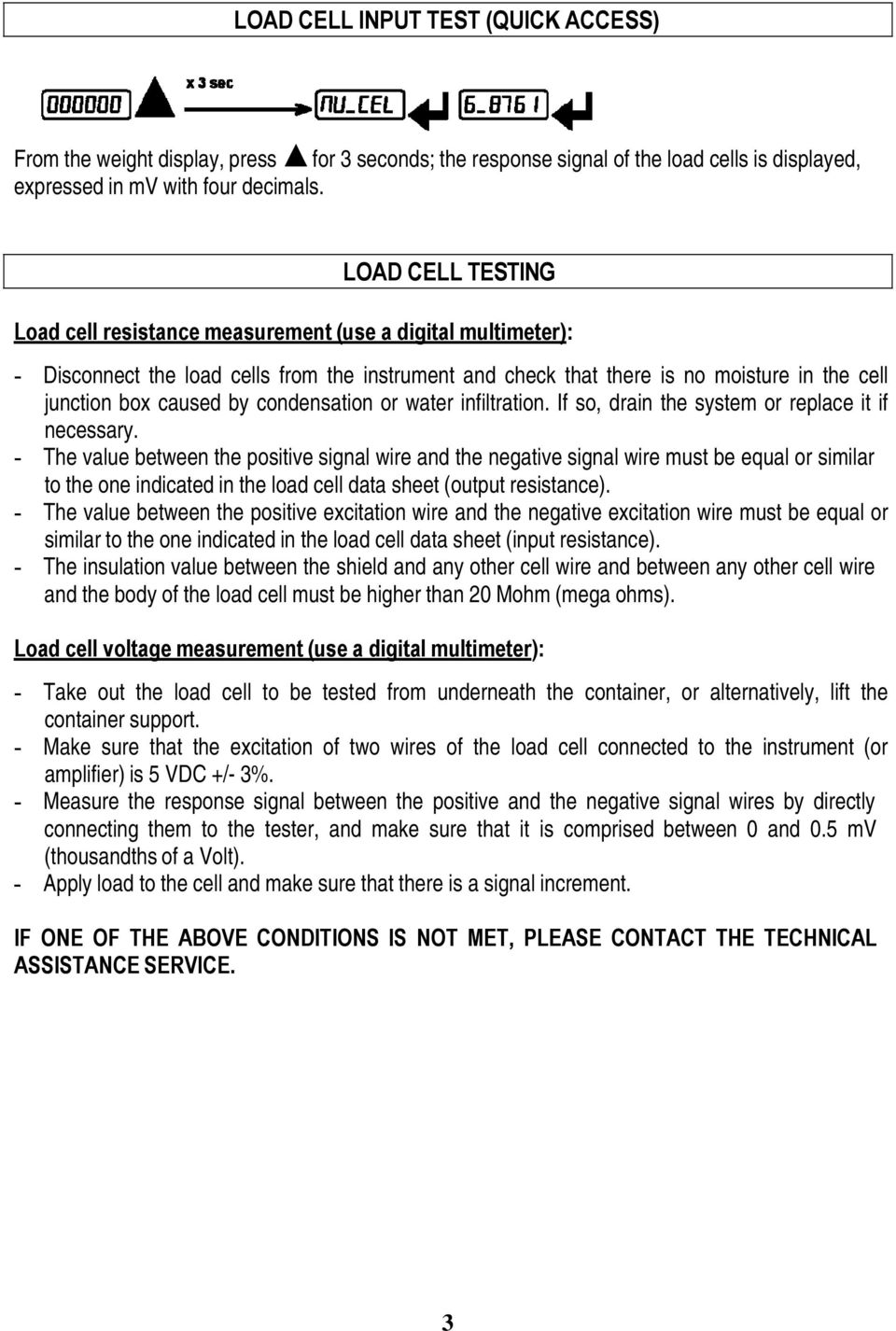
7 LOAD CELL INPUT TEST (QUICK ACCESS) From the weight display, press for 3 seconds; the response signal of the load cells is displayed, expressed in mv with four decimals. LOAD CELL TESTING Load cell resistance measurement (use a digital multimeter): - Disconnect the load cells from the instrument and check that there is no moisture in the cell junction box caused by condensation or water infiltration. If so, drain the system or replace it if necessary. - The value between the positive signal wire and the negative signal wire must be equal or similar to the one indicated in the load cell data sheet (output resistance). - The value between the positive excitation wire and the negative excitation wire must be equal or similar to the one indicated in the load cell data sheet (input resistance). - The insulation value between the shield and any other cell wire and between any other cell wire and the body of the load cell must be higher than 20 Mohm (mega ohms). Load cell voltage measurement (use a digital multimeter): - Take out the load cell to be tested from underneath the container, or alternatively, lift the container support. - Make sure that the excitation of two wires of the load cell connected to the instrument (or amplifier) is 5 VDC +/- 3%. - Measure the response signal between the positive and the negative signal wires by directly connecting them to the tester, and make sure that it is comprised between 0 and 0.5 mv (thousandths of a Volt). - Apply load to the cell and make sure that there is a signal increment. IF ONE OF THE ABOVE CONDITIONS IS NOT MET, PLEASE CONTACT THE TECHNICAL ASSISTANCE SERVICE. 3
8 MAIN SPECIFICATIONS OF THE INSTRUMENT PLC PROFIBUS DC power supplier (12-24 Volt ) JUNCTION BOX RS485 SERIAL PORT MAX 8 LOAD CELLS IN PARALLEL 3 RELAY OUTPUTS 2 DIGITAL INPUTS (Optoisolated, Externally supplied) PLC or FIELD SIGNALS TRANSMISSION BY RADIO MODULES, RS232 CONVERTER, PROFIBUS CONVERTER ETHERNET CONVERTER, MODEM GSM - Weight indicator and transmitter for Omega/DIN rail mounting suitable for back panel; spacesaving vertical shape. Six-digit semi-alphanumeric display (18mm h), 7 segment. Four-key keyboard. Dimensions: 25x115x120 mm. - Displays the gross weight; from external contact allows to zero set or display the net weight (both values will be lost when the instrument is turned off). - Peak weight function. - It has a profibus DP V0 Slave port that allows to exchange the main system parameters with a Profibus - Transmits the gross or net weight via RS485 serial port, by means of protocols: Modbus RTU ASCII bidirectional protocol Continuous transmission 4

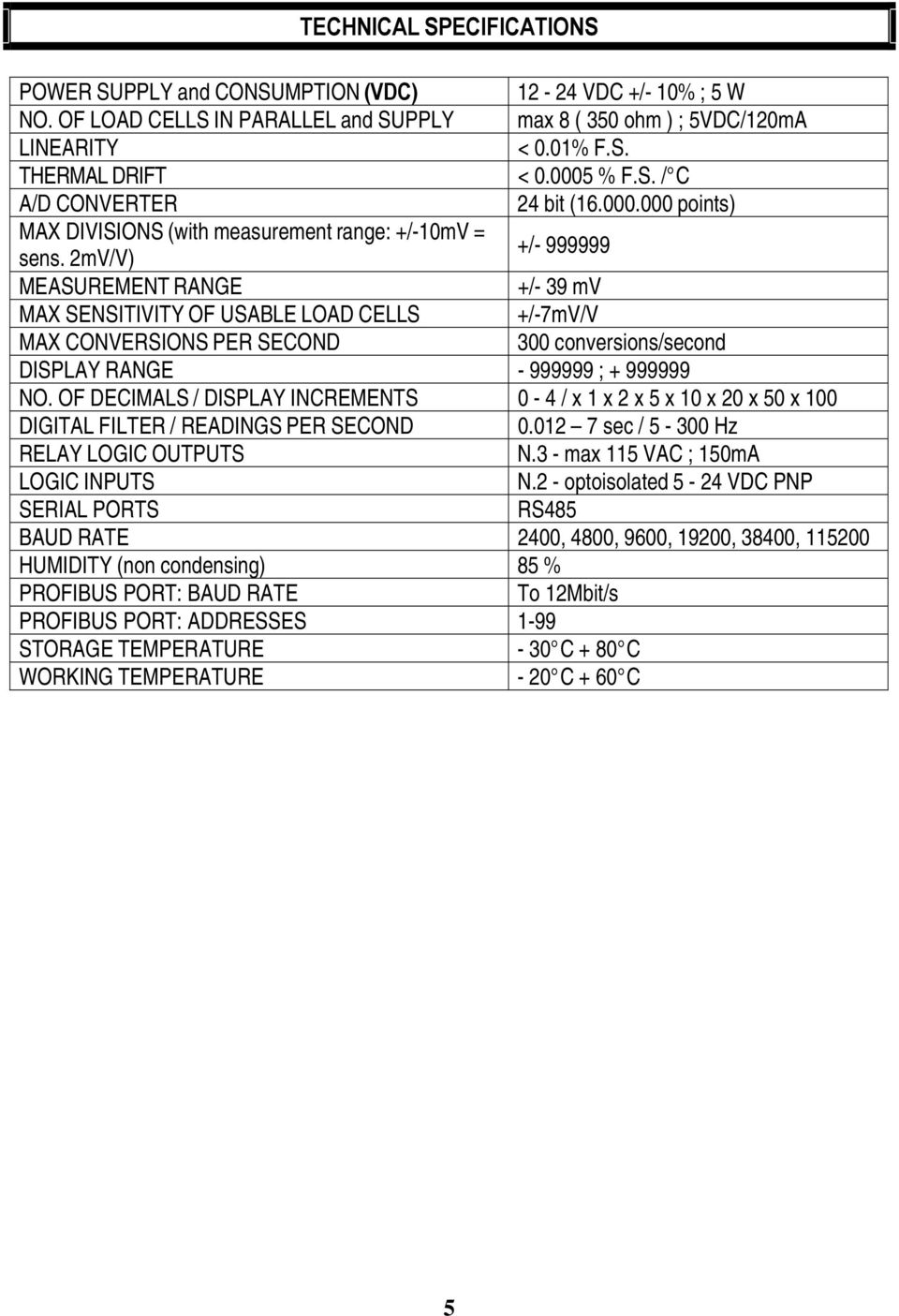
9 TECHNICAL SPECIFICATIONS POWER SUPPLY and CONSUMPTION (VDC) VDC +/- 10% ; 5 W NO. OF LOAD CELLS IN PARALLEL and SUPPLY max 8 ( 350 ohm ) ; 5VDC/120mA LINEARITY < 0.01% F.S. THERMAL DRIFT < % F.S. / C A/D CONVERTER 24 bit ( points) MAX DIVISIONS (with measurement range: +/-10mV = sens. 2mV/V) +/ MEASUREMENT RANGE +/- 39 mv MAX SENSITIVITY OF USABLE LOAD CELLS +/-7mV/V MAX CONVERSIONS PER SECOND 300 conversions/second DISPLAY RANGE ; NO. OF DECIMALS / DISPLAY INCREMENTS 0-4 / x 1 x 2 x 5 x 10 x 20 x 50 x 100 DIGITAL FILTER / READINGS PER SECOND sec / Hz RELAY LOGIC OUTPUTS N.3 - max 115 VAC ; 150mA LOGIC INPUTS N.2 - optoisolated 5-24 VDC PNP SERIAL PORTS RS485 BAUD RATE 2400, 4800, 9600, 19200, 38400, HUMIDITY (non condensing) 85 % PROFIBUS PORT: BAUD RATE To 12Mbit/s PROFIBUS PORT: ADDRESSES 1-99 STORAGE TEMPERATURE - 30 C + 80 C WORKING TEMPERATURE - 20 C + 60 C 5
10 ELECTRICAL CONNECTIONS BASIC INFORMATION - It is recommended that the power supply negative pole be grounded. - It is possible to supply up to eight 350 ohm load cells or sixteen 700 ohm load cells. - For 4-wire load cells, make a jumper between EX- and REF- and between EX+ and REF+. - Connect terminal 0 VDC to the RS485 common of the connected instruments in the event that these receive alternating current input or that they have an optoisolated RS In case of an RS485 network with several devices it is recommended to activate the 120 ohm termination resistance on the two devices located at the ends of the network, as described in the paragraph RS485 SERIAL CONNECTION. WIRING DIAGRAM 3 outputs: settable setpoints or remote output management via protocol. 2 inputs (Default: SEMI-AUTOMATIC ZERO input 1; NET/GROSS input 2): settable to have the following functions: SEMI-AUTOMATIC ZERO, NET/GROSS, PEAK or REMOTE CONTROL (see paragraph OUTPUTS AND INPUTS CONFIGURATION) 6

11 LED AND KEY FUNCTIONS LED Main function Secondary function * NET net weight LED: net weight display (semiautomatic tare or preset tare) no meaning 0 zero LED (deviation from zero not more than +/- LED lit: output 3 closed 0.25 divisions) stability LED LED lit: output 2 closed kg unit of measure: kg LED lit: output 1 closed g unit of measure: g LED lit: input 2 closed L LED lit: input 1 closed *) To activate the secondary LED function, during weight display press and hold down the keys and at the same time(press immediately followed by ). KEY Short press Long press (3 sec) Gross Net Save to alibi memory (if present) Setting setpoints and hysteresis + Setting general parameters (press immediately followed by ) + Setting preset tare (press immediately followed by ) Tare resetting Net Gross mv load cell test Into menus Cancel or return to previous menu Select figure to be modified or return to previous menu item Modify selected figure or go to next menu item Confirm or enter in submenu The LEDs light up in sequence to indicate that a setting and not a weight is being viewed. 7

12 MENU MAP Within the menu, the changes are applied immediately after pressing the confirmation). SETPOINTS button (no further SYSTEM PARAMETERS 8

13 INSTRUMENT COMMISSIONING Upon switch-on, the display shows in sequence: - (ONLY in case of approved program); - instrument model (e.g.: ); - followed by the software code (e.g.: ); - program type: (base); - followed by the software version (e.g.: ); - followed by the hardware code (e.g.: ); - the serial number (e.g.: ); Check that the display shows the weight and that when loading the load cells there is an increase in weight. If there is not check and verify the connections and correct positioning of the load cells. - If the instrument has already been theoretical CALIBRATED (plant system identification tag present on the instrument and on the cover: load cell s rated data already entered): Reset to zero (follow the procedure in paragraph TARE WEIGHT ZERO SETTING) Check the calibration with sample weights and correct the indicated weight if necessary (follow the procedure in paragraph REAL CALIBRATION (WITH SAMPLE WEIGHTS)). - If the instrument HAS NOT BEEN CALIBRATED (missing plant system identification tag) proceed with calibration: If load cells data are unknown, follow the procedure in paragraph REAL CALIBRATION (WITH SAMPLE WEIGHTS) Enter the rated data of load cells following the procedure given in paragraph THEORETICAL CALIBRATION Reset to zero (follow the procedure in paragraph TARE WEIGHT ZERO SETTING) Check the calibration with sample weights and correct the indicated weight if necessary (follow the procedure in paragraph REAL CALIBRATION (WITH SAMPLE WEIGHTS)). - If you use the Profibus, set the Profibus address of the instrument (see paragraph PROFIBUS). - If you use serial communication, set the related parameters (see paragraph SERIAL COMMUNICATION SETTING). - If setpoints are used, set the required weight values and the relevant parameters (see paragraphs SETPOINTS PROGRAMMING and OUTPUTS AND INPUTS CONFIGURATION). 9

14 PROGRAMMING OF SYSTEM PARAMETERS From the weight display, press simultaneously keys and to access the parameter setting. : to enter a menu/confirm the data entry. : to modify the displayed value or menu item. : to select a new value or modify the displayed menu item. : to cancel and return to the previous menu. THEORETICAL CALIBRATION This function allows the load cell rated values to be set. To perform the theoretical calibration set the following parameters in sequence: - (Default: ): The system full scale is given by one cell capacity multiplied by the number of cells used. Example of system full scale value calculation: 4 cells of 1000kg FULL SCALE = 1000 X 4 = The instrument is supplied with a theoretical full scale value corresponding to To restore factory values, set 0 as full scale. - (Default: mv/v): Sensitivity is a load cell rated parameter expressed in mv/v. Set the average sensitivity value indicated on the load cells. It s possible to set a value between and mv/v. Example of 4-cell system with sensitivity: , , , ; enter , calculated as ( ) / 4. - : The division (resolution) is the minimum weight increment value which can be displayed. It is automatically calculated by the system according to the performed calibration, so that it is equal to 1/10000 of full scale. It can be changed and be variable between and 100 with x1 x2 x5 x10 increments. - By modifying the theoretical full scale, the sensitivity or divisions, the real calibration is cancelled and the theoretical calibration only is considered valid. - If the theoretical full scale and the recalculated full scale in real calibration (see paragraph REAL CALIBRATION (WITH SAMPLE WEIGHTS)) are equal, this means that the calibration currently in use is theoretical; if they are different, the calibration in use is the real calibration based on sample weights. - By modifying the theoretical full scale, the sensitivity or divisions and all the system s parameters containing a weight value will be set to default values (setpoints, hysteresis, etc.). 10

15 MAXIMUM CAPACITY : Maximum displayable weight (from 0 to max full scale; default: 0). When the weight exceeds this value by 9 divisions the following is displayed ˉˉˉˉˉˉ. To disable this function, set 0. TARE WEIGHT ZERO SETTING This menu may also be accessed directly from the weight display, holding down the for 3 seconds. key Perform this procedure after having set the THEORETICAL CALIBRATION data. Use this function to set to zero the weight of the empty system after commissioning and then later on to compensate zero variations due to the presence of product residues. Procedure: - Confirm the message (Zero) by pressing. - The weight value to be set to zero is displayed. In this phase all of the LEDs are flashing. - Confirming once again, the weight is set to zero (the value is stored to the permanent memory). - Press to display the value of the total weight reset by the instrument, given by the sum of all of the previous zero settings. ZERO VALUE MANUAL ENTRY WARNING: Perform this procedure only if it s not possible to reset the weighed structure tare, for example because it contains product that can not be unloaded. Set in this parameter the estimated zero value (from 0 to max ; default: 0). 11

16 REAL CALIBRATION (WITH SAMPLE WEIGHTS) After having performed the THEORETICAL CALIBRATION and TARE WEIGHT ZERO SETTING, this function allows correct calibration to be done using sample weights of known value, if necessary, any deviations of the indicated value from the correct value to be corrected. Load onto the weighing system a sample weight, which must be at least 50% of the maximum quantity to be weighed. By confirming the message the flashing value of the weight currently on the system is displayed. In this phase all of the LEDs are off. Adjust the value on display by using the arrow keys if necessary. After confirming, the new set weight will appear with all the LEDs flashing. After an additional confirmation, the message the key the weight will once again be displayed. will be restored and by repeatedly pressing Example: for a system of maximum capacity 1000 kg and 1 kg division, two sample weights are available, one of 500 kg and the other one of 300 kg. Load both weights onto the system and correct the indicated weight to 800. Now remove the 300 kg weight, the system must show 500; remove the 500 kg weight, too; the system must read zero. If this does not happen, it means that there is a mechanical problem affecting the system linearity. CAUTION: identify and correct any mechanical problems before repeating the procedure. - If theoretical full scale and recalculated full scale in real calibration are equal, it means that the theoretical calibration is currently in use; otherwise, the real calibration based on sample weights is in use. - If the correction made changes the previous full scale for more than 20%, all the parameters with settable weight values are reset to default values. LINEARISATION OPTION ON MAX 5 POINTS: It is possible to perform a linearization of the weight repeating the above-described procedure up to a maximum of five points, using five different sample weights. The procedure ends by pressing the button or after entering the fifth value; at this point it will no longer be possible to change the calibration value, but only to perform a new real calibration. To perform a new calibration, should return to the weight display and then re-entering into the calibration menu. By pressing after having confirmed the sample weight that has been set, the full scale appears, recalculated according to the value of the maximum sample weight entered and making reference to the cell sensitivity set in the theoretical calibration ( ). 12

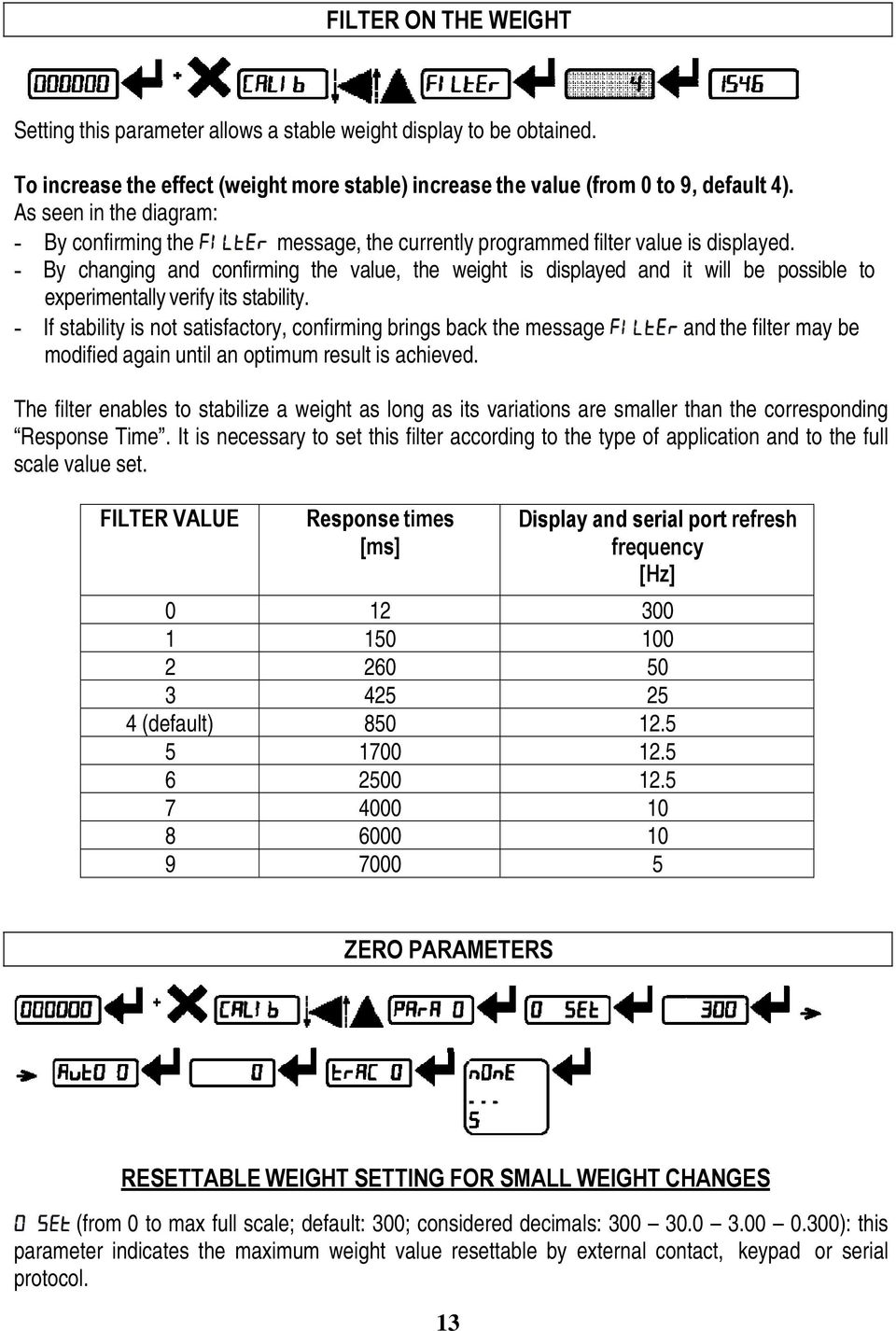
17 FILTER ON THE WEIGHT Setting this parameter allows a stable weight display to be obtained. To increase the effect (weight more stable) increase the value (from 0 to 9, default 4). As seen in the diagram: - By confirming the message, the currently programmed filter value is displayed. - By changing and confirming the value, the weight is displayed and it will be possible to experimentally verify its stability. - If stability is not satisfactory, confirming brings back the message and the filter may be modified again until an optimum result is achieved. The filter enables to stabilize a weight as long as its variations are smaller than the corresponding Response Time. It is necessary to set this filter according to the type of application and to the full scale value set. FILTER VALUE Response times [ms] Display and serial port refresh frequency [Hz] (default) ZERO PARAMETERS RESETTABLE WEIGHT SETTING FOR SMALL WEIGHT CHANGES (from 0 to max full scale; default: 300; considered decimals: ): this parameter indicates the maximum weight value resettable by external contact, keypad or serial protocol. 13
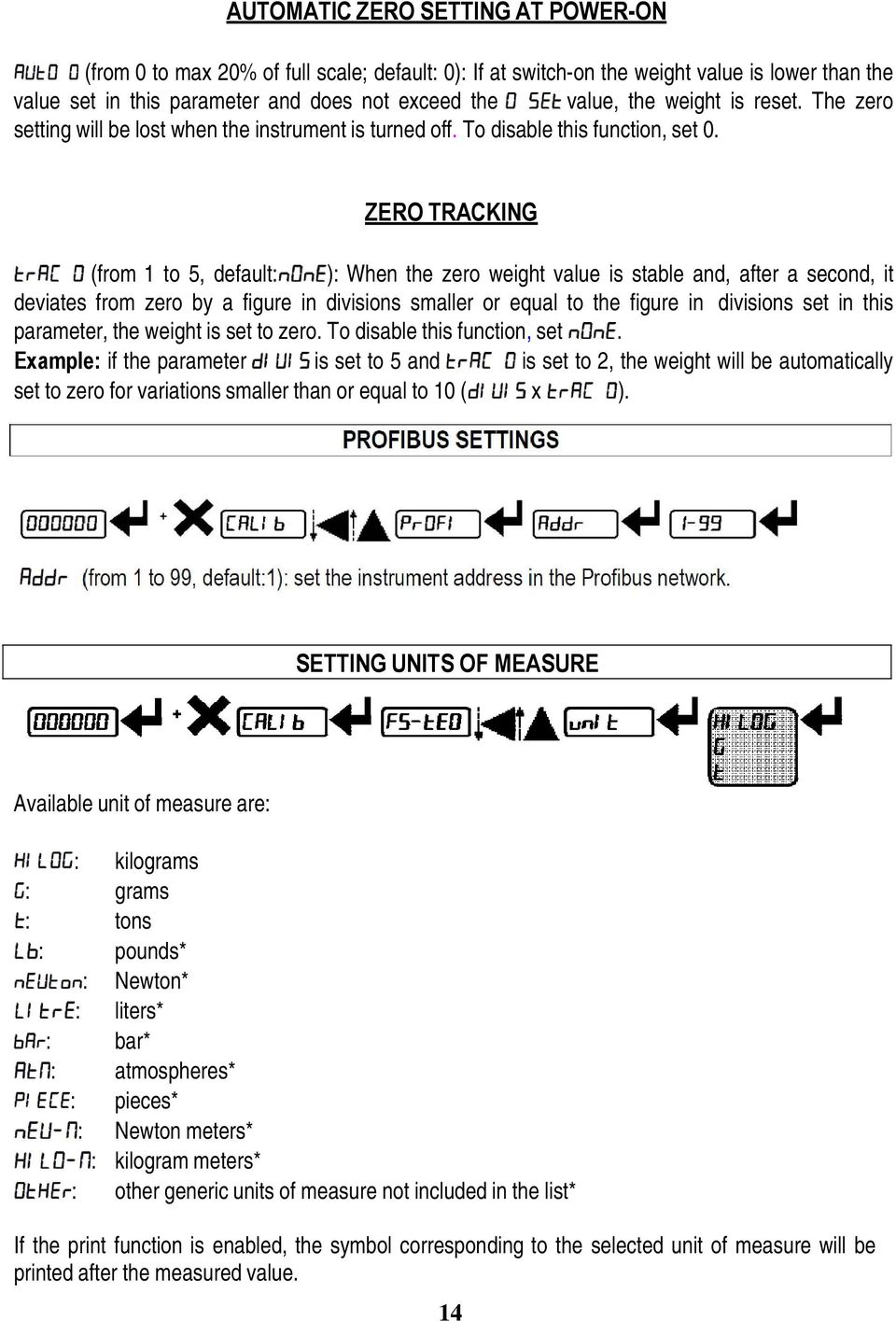
18 AUTOMATIC ZERO SETTING AT POWER-ON (from 0 to max 20% of full scale; default: 0): If at switch-on the weight value is lower than the value set in this parameter and does not exceed the value, the weight is reset. The zero setting will be lost when the instrument is turned off. To disable this function, set 0. ZERO TRACKING (from 1 to 5, default: ): When the zero weight value is stable and, after a second, it deviates from zero by a figure in divisions smaller or equal to the figure in divisions set in this parameter, the weight is set to zero. To disable this function, set. Example: if the parameter is set to 5 and is set to 2, the weight will be automatically set to zero for variations smaller than or equal to 10 ( x ). SETTING UNITS OF MEASURE Available unit of measure are: : kilograms : grams : tons : pounds* : Newton* : liters* : bar* : atmospheres* : pieces* : Newton meters* : kilogram meters* : other generic units of measure not included in the list* If the print function is enabled, the symbol corresponding to the selected unit of measure will be printed after the measured value. 14
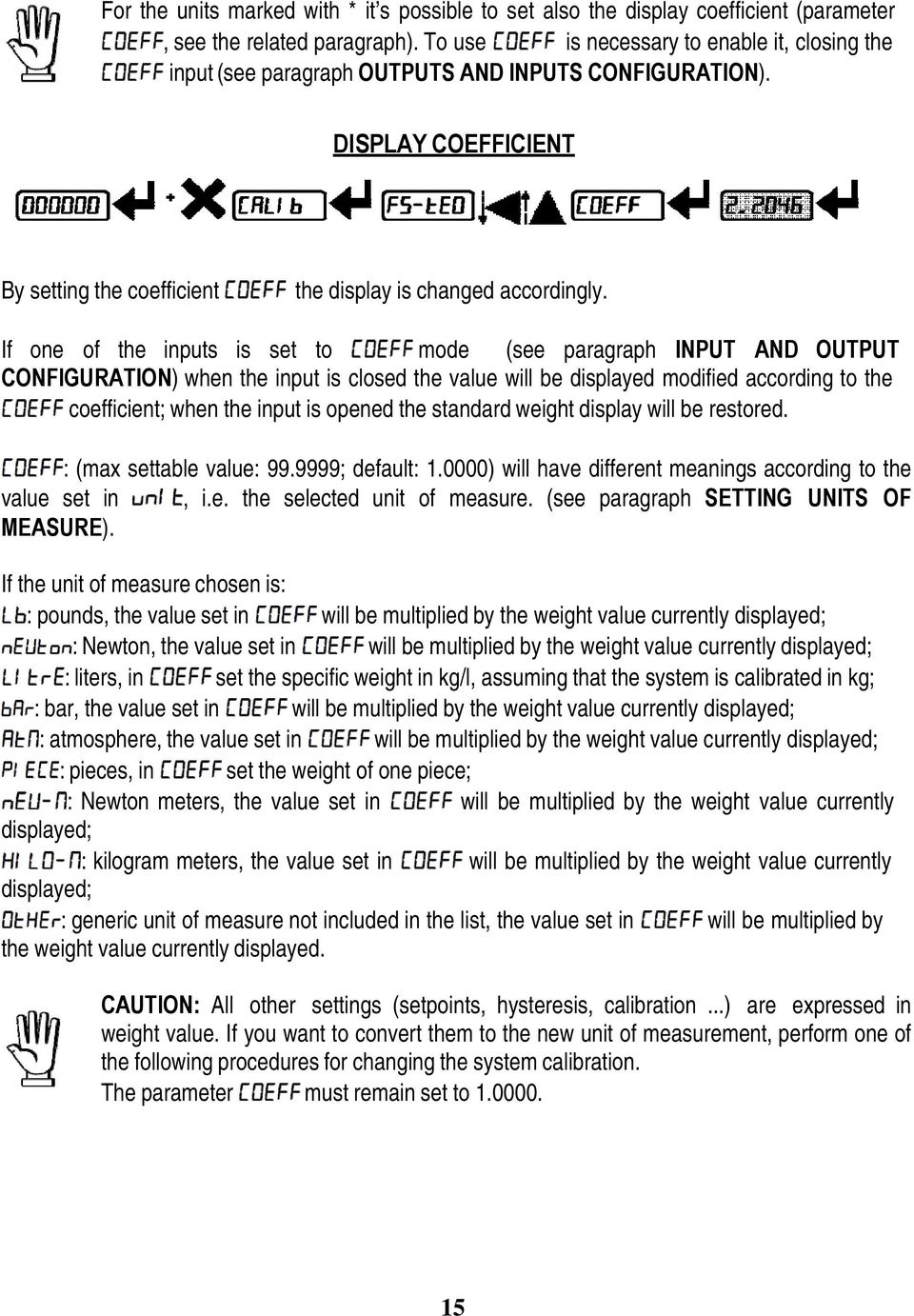
19 For the units marked with * it s possible to set also the display coefficient (parameter, see the related paragraph). To use is necessary to enable it, closing the input (see paragraph OUTPUTS AND INPUTS CONFIGURATION). DISPLAY COEFFICIENT By setting the coefficient the display is changed accordingly. If one of the inputs is set to mode (see paragraph INPUT AND OUTPUT CONFIGURATION) when the input is closed the value will be displayed modified according to the coefficient; when the input is opened the standard weight display will be restored. : (max settable value: ; default: ) will have different meanings according to the value set in, i.e. the selected unit of measure. (see paragraph SETTING UNITS OF MEASURE). If the unit of measure chosen is: : pounds, the value set in will be multiplied by the weight value currently displayed; : Newton, the value set in will be multiplied by the weight value currently displayed; : liters, in set the specific weight in kg/l, assuming that the system is calibrated in kg; : bar, the value set in will be multiplied by the weight value currently displayed; : atmosphere, the value set in will be multiplied by the weight value currently displayed; : pieces, in set the weight of one piece; : Newton meters, the value set in will be multiplied by the weight value currently displayed; : kilogram meters, the value set in will be multiplied by the weight value currently displayed; : generic unit of measure not included in the list, the value set in will be multiplied by the weight value currently displayed. CAUTION: All other settings (setpoints, hysteresis, calibration...) are expressed in weight value. If you want to convert them to the new unit of measurement, perform one of the following procedures for changing the system calibration. The parameter must remain set to
20 THEORETICAL CALIBRATION S CHANGE FOR OTHER UNITS OF MEASURE Set in the parameter the F.SCALE value divided by the conversion coefficient from kg to the new unit of measure. Example: The 4 load cells of 1000 kg are placed under a scale for olive oil, which has a specific gravity of 0,916 kg / l. Setting the F.SCALE = (4x1000) / 0916 = 4367, the system works in liters of olive oil. Also, if you set the parameter = (see paragraph SETTING UNITS OF MEASURE), the system will display and print the symbol l instead of kg. REAL CALIBRATION S CHANGE FOR OTHER UNITS OF MEASURE Load a known quantity of product liters on the scale (equal to at least 50% of the maximum amount that you must weigh) and enter in the parameter, the product loaded value in liters. Also, if you set the parameter = (see paragraph SETTING UNITS OF MEASURE), the system will display and print the symbol l instead of kg. OUPUTS AND INPUTS CONFIGURATION OUTPUTS The outputs are set by default as follows: / / /. Possible operation modes: - (normally open): the relay is de-energized and the contact is open when the weight is lower than the programmed setpoint value; it closes when the weight is higher than or equal to the programmed setpoint value. - (normally closed): the relay is energized and the contact is closed when the weight is lower than the programmed setpoint value; it opens when the weight is higher than or equal to the programmed setpoint value. - : the contact will switch on the basis of weight, according to setpoints (see paragraph SETPOINTS PROGRAMMING). - : the contact will not switch on the basis of weight, but is controlled by remote protocol commands. - :the contact will not switch on the basis of weight, but is controlled by P r o f i b u s. - : relay switching occurs when the weight is stable. 16

21 - If the operation mode is selected, the following options are also active: - : the contact will switch on the basis of gross weight. - : the contact will switch on the basis of net weight (If the net function is not active, the contact will switch on the basis of gross weight). - : relay switching occurs for both positive and negative weight values. - : relay switching occurs for positive weight values only. - : relay switching occurs for negative weight values only. By confirming with the setpoints operation can be set to the value 0 : - : relay switching will not occur if the setpoint value is 0. - : - Setpoint = 0 and =, relay switching occurs when the weight is 0 ; the relay will switch again when the weight is different from zero, taking hysteresis into account (both for positive and for negative weights). - Setpoint = 0 and =, relay switching occurs for a weight higher than or equal to 0, the relay will switch again for values below 0, taking hysteresis into account. - Setpoint = 0 and =, relay switching occurs for a weight lower than or equal to 0, the relay will switch again for values above 0, taking hysteresis into account. Default: input 1 = input 2 = INPUTS Possible operation modes: - (NET/GROSS): by closing this input for no more than one second, it s making an operation of SEMI-AUTOMATIC TARE and the display will show the net weight. To display the gross weight again, hold the NET/GROSS input closed for 3 seconds. - : by closing the input for no more than one second, the weight is set to zero (see paragraph SEMI-AUTOMATIC ZERO (WEIGHT ZERO-SETTING FOR SMALL VARIATIONS)). - : keeping the input closed the maximum weight value reached remains on display. Opening the input the current weight is displayed. - : closing the input no operation is performed, the input status may however be read remotely by way of the communication protocol. - : closing the input for max one second the weight is transmitted over the serial connection according to the fast continuous transmission protocol only once (only if is set in the item ). - : when the input is closed the weight is displayed based on the set coefficient (see setting of the units of measure and coefficient), otherwise the weight is displayed. 17
22 SEMI-AUTOMATIC TARE (NET/GROSS) THE SEMI-AUTOMATIC TARE OPERATION IS LOST UPON INSTRUMENT POWER-OFF. To perform a net operation (SEMI-AUTOMATIC TARE), close the NET/GROSS input or press the key for less than 3 seconds. The instrument displays the net weight (just set to zero) and the NET LED lights up. To display the gross weight again, keep the NET/GROSS input closed or press for 3 seconds. This operation can be repeated many times by the operator to allow the loading of several products. Example of weighing fruit in a box: Put the box on the scale, the display shows the box weight, press and the display shows the net weight to zero; by introducing the fruit in the box, the display shows the fruit weight. This operation can be repeated several times. During the net weight displaying, keep pressed the key to temporarily display the gross weight. As soon as the key is released, the net weight will be displayed again. The semi-automatic tare operation is not allowed if the gross weight is zero. PRESET TARE (SUBTRACTIVE TARE DEVICE) It is possible to manually set a preset tare value to be subtracted from the display value provided that the max capacity condition is verified. After setting the tare value, going back to the weight display, the display shows the net weight (subtracting the preset tare value) and the NET LED lights up to show that a tare has been entered. To delete a preset tare and return to gross weight display, hold down for about 3 seconds or keep the NET/GROSS input (if any) closed for the same length of time (3 seconds). The preset tare value is set to zero. The NET LED is turned off when the gross weight is displayed once again. During the net weight displaying, keep pressed the key to temporarily display the gross weight. As soon as the key is released, the net weight will be displayed again. - IF A SEMI-AUTOMATIC TARE (NET) IS ENTERED, IT IS NOT POSSIBLE TO ACCESS THE ENTER PRESET TARE FUNCTION. - IF A PRESET TARE IS ENTERED, IT S STILL POSSIBLE TO ACCESS THE SEMI- AUTOMATIC TARE (NET) FUNCTION. THE TWO DIFFERENT TYPES OF TARE ARE ADDED. 18
23 ALL THE SEMI-AUTOMATIC TARE (NET) AND PRESET TARE FUNCTIONS WILL BE LOST WHEN THE INSTRUMENT IS TURNED OFF. SEMI-AUTOMATIC ZERO (WEIGHT ZERO-SETTING FOR SMALL VARIATIONS) By closing the SEMI-AUTOMATIC ZERO input, the weight is set to zero. The zero setting will be lost when the instrument is turned off. This function is only allowed if the weight is lower than the value (see paragraph RESETTABLE WEIGHT SETTING FOR SMALL WEIGHT CHANGES), otherwise the alarm ˉˉˉˉˉ appears and the weight is not set to zero. PEAK Keeping the input closed the maximum weight value reached remains displayed. Opening the input the current weight is displayed. If you wish to use this input to view a sudden variation peak, set the FILTER ON THE WEIGHT to 0. SERIAL COMMUNICATION SETTINGS According to the chosen protocol only the necessary settings will be displayed in sequence (see diagram here above). - : communication port. - : it disables any type of communication (default). 19
24 - : MODBUS-RTU protocol; possible addresses: from 1 to 99 (see Communication Protocols). - :ASCII bidirectional protocol; possible addresses: from 1 to 99 (see Communication protocols) : continuous weight transmission protocol (see Communication protocols manual), at the frequency set in item (from 10 to 300). - (set: ). - (set: ). - : continuous weight transmission protocol to RIP5/20/60, RIP50SHA, RIPLED series remote displays; the remote display shows the net weight or gross weight according to its settings (set: ). - : continuous weight transmission protocol to RIP675, RIP6125C series remote displays; the remote display shows the net weight or gross weight according to its settings (set: ). - : continuous weight transmission protocol to RIP675, RIP6125C series remote displays (set: ). When the remote display is set to gross weight: - if the instrument displays the gross weight, the remote display shows the gross weight. - if the instrument shows the net weight the remote display shows the net weight alternated with the message '. - : transmission speed (2400, 4800, 9600, 19200, 38400, ; default: 9600). - : instrument s address (from 1 to 99; default: 1). - : maximum transmission frequency ( ; default: 10); to be set when the transmission protocol is selected. Maximum setting frequency ( ): - 20Hz with minimum baud rate 2400 baud. - 40Hz with minimum baud rate 4800 baud. - 80Hz with minimum baud rate 9600 baud Hz with minimum baud rate baud Hz with minimum baud rate baud Hz with minimum baud rate baud. - : delay in milliseconds which elapses before the instrument replies (from 0 to 200 msec; default: 0). - : - : parity none (default). - : even parity. - : odd parity. - : stop bit (1 2; default: 1). 20
25 RS485 SERIAL COMMUNICATION If the RS485 network exceeds 100 metres in length or baud-rate over 9600 are used, close the two jumpers, called "RS-485 termination", to activate two 120 ohm terminating resistors between the + and terminals of the line, on the terminal strip of the furthest instruments. Should there be different instruments or converters, refer to the specific manuals to determine whether it is necessary to connect the abovementioned resistors DIRECT CONNECTION BETWEEN RS485 AND RS232 WITHOUT CONVERTER Since a two-wire RS485 output may be used directly on the RS-232 input of a PC or remote display, it is possible to implement instrument connection to an RS-232 port in the following manner: INSTRUM RS232 RS RXD RS GND This type of connection allows A SINGLE instrument to be used in a ONE WAY mode. 21
26 TEST - Input Test: : ensure that for each open input is displayed, is displayed when the input is closed. - Output Test: : setting ensure that the corresponding output opens. Setting ensure that the corresponding output closes. - Millivolt Test: : displays the load cell response signal in mv with four decimals. SETPOINTS PROGRAMMING From the weight display, press to access the setpoints setting. : to enter a menu, confirm the data entry. : to modify the displayed value or menu item. : to select a new value or modify the displayed menu item. : to cancel and return to the previous menu. - (from 0 to max full scale; default: 0): Setpoint; relay switching occurs when the weight exceed the value set in this parameter. The type of switching is settable (see paragraph OUTPUTS AND INPUTS CONFIGURATION). - (from 0 to max full scale; default: 0): Hysteresis, value to be subtracted from the setpoint to obtain contact switching for decreasing weight. For example with a setpoint at 100 and hysteresis at 10, the switching occurs at 90 for decreasing weight. These values are set to zero if the calibration is changed significantly (see paragraphs THEORETICAL CALIBRATION and REAL CALIBRATION (WITH SAMPLE WEIGHTS). 22
27 ALARMS : the load cell is not connected or is incorrectly connected; the load cell signal exceeds 39 mv; the conversion electronics (AD converter) is malfunctioning; the load cell is a 4-wire and there are no jumpers between EX- and REF- and between EX+ and REF+. : the weight display exceeds 110% of the full scale. : internal instrument converter failure; check load cell connections, if necessary contact Technical Assistance. : the weight exceeds the maximum weight by 9 divisions. : maximum displayable value exceeded (value higher than or lower than ). : weight too high: zero setting not possible. : this message appears in the sample weight setting, in real calibration, after the fifth sample weight value has been entered. : the value set for the parameter is beyond the permitted values; press to quit the setting mode leaving the previous value unchanged. Examples: a number of decimals is selected for full scale which exceeds the instrument's display potential; value above the maximum setting value; the weight value set in sample weight verification does not match the detected mv increase. : lock active on menu item, keypad or display. : It s not possible to display properly the number because is greater than or less than Profibus Error: A problem in the Profibus communication is marked by a lack of flashing or a slow flashing (flashing duration about 0,5s) of the Profibus status LED. Serial protocols alarms: MODE Bit LSB Status xxxxxxx1 Register MODBUS RTU xxxx1xxx xxxxxx1x xxxxx1xx On gross: xxx1xxxx On net: xx1xxxxx The response to the zero command is a 'value not valid' error (error code 3) ASCII O-F_ O-L_ O-F_ O-L_ O-F_ &aa#cr RIP * O-F_ O-L_ O-F_ O-L_ O-F_ O-F_ HDRIP-N _ERCEL _ER_OL _ER_AD ###### _ER_OF O SET CONTIN _ERCEL _ER_OL _ER_AD ^^^^^^ _ER_OF O SET * For RIP remote displays, if the message exceeds 5 digits the display reads. In case of alarm the relays not managed by Modbus or Profibus, open 23
28 PROFIBUS - The instrument works as a Profibus DP V0 slave in a Profibus DP network. - Load the included gsd file (LAU_0C91.gsd) attached to the instrument in the development system of the Profibus master. - The available modules are: R = the register can be read only W = the register can be written only R/W = the register can be both read and written MODULE Saving to EEPROM N. Byte R N. Byte W ACCESS GROSS WEIGHT 4 R NET WEIGHT 4 R PEAK WEIGHT 4 R SETPOINT R/W SETPOINT 2 Only after command 99 of 4 4 R/W SETPOINT 3 the 4 4 R/W HYSTERESIS 1 COMMAND REGISTER 4 4 R/W HYSTERESIS R/W HYSTERESIS R/W Divisions and Units of measure 2 R Visualisation Coefficient 4 R INPUTS 2 R OUTPUTS NO 2 2 R/W STATUS REGISTER 2 R COMMAND REGISTER NO 2 W Sample Weight for calibration Use with command 101 of the COMMAND REGISTER 4 4 R/W GROSS WEIGHT NET WEIGHT PEAK The weight values are expressed as positive integer numbers, include decimal figures but without decimal point. Read the Status Register to obtain information about sign and possible errors on the weight. To find out the decimal figures use the Division module value; E.g.: the net weight is and the division is (three decimals), the real weight value is kg. 24
29 SETPOINTS HYSTERESIS The weight values are expressed as positive integer numbers, include decimal figures but without decimal point. - to set the value to 0; write the hexadecimal value hex to the register (the most significant bit is 1 and all the other bits are 0). - to set them correctly consider the module Division value; E.g. if you want to set a set-point to 100kg and the verification division value is 0.001, set the set-point value to (you remove the decimal points form the value that would be with decimals). - If from PLC you set a value out of the permitted interval (from 0 (not included) to full scale) the value is ignored and the bit 13 Writing error rises in the Status Register. Setpoints and Hysteresis are stored to the RAM volatile memory and lost upon instrument power off. To save them permanently in the EEPROM memory, so that they are maintained upon the instrument power on, it is necessary to send the command 99 Save data in EEPROM of the Command Register. DIVISIONS AND UNITS MEASURE MODULE This module contains the current setting of the divisions (parameter measure ( parameter). ) and of the units of H Byte units of measure L Byte division Use this module together with the Coefficient module to calculate the value displayed by the instrument. 25
30 Least significant byte (L Byte) Most significant byte (H Byte) Division value Divisor Decimals Units of measure value Units of measure description Utilisation of the Coefficient value with the different units of measure settings compared to the gross weight detected Kilograms Does not intervene Grams Does not intervene Tons Does not intervene Pounds Does not intervene Newton Multiples Litres Divides Bar Multiples Atmospheres Multiples Pieces Divides Newton Meter Multiples Kilogram Meter Multiples Other Multiples COEFFICIENT DISPLAY The Profibus register contains the value of parameter, expressed as integer number, with 4 decimal figures but without decimal point. E.g.: If is , the Profibus register contains DIGITAL INPUTS STATUS Bit 0 INPUT 1 status Bit 8 Bit 1 INPUT 2 status Bit 9 Bit 2 Bit 10 Bit 3 Bit 11 Bit 4 Bit 12 Bit 5 Bit 13 Bit 6 Bit 14 Bit 7 Bit 15 Bit a 1: high input; Bit a 0: low input. 26
31 DIGITAL OUTPUTS COMMAND It allows to control the outputs status in CONFIGURATION): mode (see paragraph OUTPUTS AND INPUTS Bit 0 OUTPUT 1status Bit 8 Bit 1 OUTPUT 2 status Bit 9 Bit 2 OUTPUT 3 status Bit 10 Bit 3 Bit 11 Bit 4 Bit 12 Bit 5 Bit 13 Bit 6 Bit 14 Bit 7 Bit 15 Force outputs Bit a 1: output is closed; Bit a 0: output is open Setting bit 15 to 1 on the PLC, Profibus takes control of all the outputs, even if they are in different modes. STATUS REGISTER Bit 0 Cell Error Bit 1 AD Converter Malfunction Bit 2 Maximum weight exceeded by 9 divisions Bit 3 Gross weight higher than 110% of full scale Bit 4 Gross weight beyond or less than Bit 5 Net weight beyond or less than Bit 6 Bit 7 Gross weight negative sign Bit 8 Net weight negative sign Bit 9 Peak weight negative sign Bit 10 Net display mode Bit 11 Weight stability Bit 12 Weight within +/-¼ of a division around ZERO Bit 13 Writing error Bit 14 Bit 15 Bit 13 (Writing error) rises if the PLC tries to write a value out of a parameter s permitted interval. In this case the writing has no effect and the previous parameter value is maintained. 27
32 POSSIBLE COMMAND TO SEND TO THE COMMAND REGISTER 0 No command 17 Reserved 7 NET display 18 Reserved 8 SEMI-AUTOMATIC ZERO 21 Keypad lock 10 Reserved 22 Keypad and display unlock 11 Reserved 23 Keypad and display lock 12 Reserved 99 Save data in EEPROM 13 Reserved 100 Zero-setting for calibration 14 Reserved 101 Sample weight storage for calibration 15 Reserved 9999 Reset (reserved) 16 Reserved Commands are sent only once; to reassert it write the value 0 to the Command register and then the command again. REAL CALIBRATION COMMANDS (WITH SAMPLE WEIGHT) The instrument calibration can be changed via PROFIBUS. To set correctly the sample weight, consider the value of the Division module (e); E.g. if you want to set the value to 100kg and the division value is 0.001, set the register value to (you remove the decimal points form the value that would be with decimals). To perform the edit calibration procedure, it needs to unload the system and zero-setting the displayed weight value with the command 100 Zero-setting for calibration of Command Register. Then, put a sample weight onto the system, write the correct known weight value to the Sample Weight for calibration register; to save in memory the sample weight value, send the command 101 Sample weight storage for calibration. To verify the correct execution of the calibration command, follow the following steps: - Write the sample weight value to the Sample Weight for calibration module; - Write the value 0 to the Sample Weight for calibration module; - Send the command 101 Sample weight storage for calibration to the Command Register; - The operation works correctly if the module value Sample Weight for calibration goes to zero. Changing some instrument parameters via keyboard can take the Profibus network out of the data exchange status and put the PLC in stop status; when programming the instrument the plant must be in stand-by status! 28
33 FAST CONTINUOUS TRANSMISSION PROTOCOL This protocol allows for automatic weight reception via a serial connection at high update frequencies. Up to 300 strings per second are transmitted (with a minimum transmission rate of baud). Following communication modes available (see paragraph SERIAL COMMUNICATION SETTINGS): - : communication compatible with TX RS485 instruments; - : communication compatible with TD RS485 instruments. - If is set, the following string is transmitted to PC/PLC: xxxxxxcrlf in which: xxxxxx = 6 ASCII characters for gross weight (48 57 ASCII). CR = 1 character of back to start (13 ASCII). LF = 1 character of new line (10 ASCII). In case of negative weight, the first character on the left acquires the value «-» (minus sign - ASCII 45). In case of error or alarm, the 6 weight characters are replaced by the messages found in the table of the ALARMS. - If is set, the following string is transmitted to PC/PLC: &TzzzzzzPzzzzzz\ckckCR in which: & = 1 character of string beginning (38 ASCII). T = 1 c. of gross weight identification. P = 1 c. of gross weight identification. zzzzzz = 6 characters of gross weight (48 57 ASCII). \ = 1 character of separation (92 ASCII). ckck = 2 ASCII control characters calculated considering that the characters between & and \ are excluded. The control value is obtained by carrying out the XOR (or exclusive) operation for the 8 bit ASCII codes of the characters considered. A character expressed in hexadecimal is thus obtained, with 2 digits which may acquire values from 0 to 9 and from A to F. ckck is the ASCII code of the two hexadecimal digits. CR = 1 character for string end (13 ASCII). In case of negative weight, the first character on the left acquires the value «-» (minus sign - ASCII 45). In case of error or alarm, the 6 gross weight characters are replaced by the messages found in the table of the ALARMS. FAST TRANSMISSION VIA EXTERNAL CONTACT: it s possible to transmit the weight, just once, even closing an input for no more than a second (see paragraphs OUTPUTS AND INPUTS CONFIGURATION and SERIAL COMMUNICATION SETTINGS). 29
34 CONTINUOUS TRANSMISSION PROTOCOL TO REMOTE DISPLAYS Using this protocol, the instrument transmits, in continuous, the weight to remote displays; the communication string is transmitted 10 times per second. Following communication modes available (see paragraph SERIAL COMMUNICATION SETTINGS): - : communication with remote displays series RIP5/20/60, RIP50SHA, RIPLED; remote display shows the net or gross weight, depending on the remote display setting. - : communication with remote displays series RIP675, RIP6125C; remote display shows the net or gross weight, depending on the remote display setting. - : communication with remote displays series RIP675, RIP6125C. The instrument sends the following string to the remote display: &NxxxxxxLyyyyyy\ckckCR in which: & = 1 character of string beginning (38 ASCII). N = 1 character of net weight identification (78 ASCII). xxxxxx = 6 characters for net or PEAK weight if present (48 57 ASCII). L = 1 character of gross weight identification (76 ASCII). yyyyyy = 6 characters for gross weight (48 57 ASCII). \ = 1 character for separation (92 ASCII). ckck = 2 ASCII control characters calculated considering that the characters between & and \ are excluded. The control value is obtained by carrying out the XOR (or exclusive) operation for the 8 bit ASCII codes of the characters considered. Character expressed in hexadecimal is thus obtained, with 2 digits which may acquire values from 0 to 9 and from A to F. ckck is the ASCII code of the two hexadecimal digits. CR = 1 character for string end (13 ASCII). In case of negative weight, the first character on the left acquires the value «-» (minus sign - ASCII 45). If the protocol on has been set, the decimal point at the position shown on the instrument's display can also be transmitted. In this case, if the value exceeds 5 digits, only the 5 most significant digits are transmitted, while if the value is negative, no more than the 4 most significant digits are transmitted. In both cases, however, the decimal point shifts consistently with the value to display. If has been set, in addition to what stated in protocol, the instrument transmits the prompt every 4 seconds in the gross weight field, if on the instrument, it has been carried out a net operation (see paragraph SEMI-AUTOMATIC TARE (NET/GROSS)). In case of weight value is under , the minus sign ( - ) is sent alternated with the most significant figure. In case of error or alarm, the 6 characters of the gross and net weight are replaced by the messages found in the table of the ALARMS. 30
35 ASCII BIDIRECTIONAL PROTOCOL The instrument replies to the requests sent from a PC/PLC. It is possible to set a waiting time for the instrument before it transmits a response (see parameter in the paragraph SERIAL COMMUNICATION SETTINGS). Following communication modes available (see paragraph SERIAL COMMUNICATION SETTINGS): - : communication compatible with W60000, WL60 Base, WT60 Base, TLA60 Base instruments; - : communication compatible with TD RS485 instruments. Captions: $: Beginning of a request string (36 ASCII); & o &&: Beginning of a response string (38 ASCII); aa: 2 characters for instrument address (48 57 ASCII);!: 1 character to indicate the correct reception(33 ASCII);?: 1 character to indicate a reception error (63 ASCII); #: 1 character to indicate an error in the command execution (23 ASCII); ckck: 2 ASCII characters for Check-Sum (for further information, see paragraph CHECK- SUM CALCULATION); CR: 1 character for string end (13 ASCII); \: 1 character for separation (92 ASCII). 1. SETPOINT VALUES SETTING: The PC transmits : $aaxxxxxxyckckcr where: xxxxxx = 6 characters for the setpoint value (48 57 ASCII); y = A (set the value in the Setpoint 1) y = B (set the value in the Setpoint 2) y = C (set the value in the Setpoint 3) Possible instrument responses: - correct reception: &&aa!\ckckcr - incorrect reception: &&aa?\ckckcr 2. SETPOINTS STORAGE INTO EEPROM MEMORY: The sepoints value relevant to the two setpoints programmed via the PC are stored to the RAM volatile memory and lost upon instrument power off. It is necessary to send a special command to save them permanently in the EEPROM memory. Please note that the writing number allowed in the EEPROM memory is limited (about ). The PC transmits: $aamemckckcr 31
36 Possible instrument responses: - correct reception: &&aa!\ckckcr - incorrect reception: &&aa?\ckckcr 3. READING WEIGHT, THE SETPOINT AND THE PEAK (IF PRESENT) FROM THE PC: The PC transmits: $aajckckcr Where: j = a to read setpoint 1 j = b to read setpoint 2 j = c to read setpoint 3 j = t to read gross weight j = n to read net weight j= p to read the gross weight peak if the parameter is set as ; if, instead, the parameter is set on the gross weight will be read. To read the points, set the equal to Possible instrument responses: - correct reception: &aaxxxxxxj\ckckcr - incorrect reception: &&aa?\ckckcr - if the peak is not configured: &aa#cr in which: xxxxxx = 6 value characters of the required weight; Notes: In case of negative weight, the first character on the left acquires the value «-» (minus sign - ASCII 45). In case of weight value is under , the minus sign ( - ) is sent alternated with the most significant figure. Error messages: In case of an instrument alarm for exceeding 110% of the full scale or 9 divisions above the value of the parameter, the instrument sends the string: &aasso-lst\ckck In case of faulty connection of the load cells or of another alarm, the instrument sends: &aasso-fst\ckck in which: s = 1 separator character (32 ASCII space-). Generally refer to the ALARMS paragraph in this manual. 32
37 4. SEMI-AUTOMATIC ZERO (WEIGHT ZERO-SETTING FOR SMALL VARIATIONS) CAUTION: The zero-setting will not be maintained after an instrument power-off. The PC transmits: $aazerockckcr Possible instrument responses: - correct reception: &&aa!\ckckcr - incorrect reception: &&aa?\ckckcr - the current weight is over the maximum value resettable: &aa#cr 5. SWITCHING FROM GROSS WEIGHT TO NET WEIGHT The PC transmits: $aanetckckcr Possible instrument responses: - correct reception: &&aa!\ckckcr - incorrect reception: &&aa?\ckckcr 6. SWITCHING FROM NET WEIGHT TO GROSS WEIGHT The PC transmits: $aagrossckckcr Possible instrument responses: - correct reception: &&aa!\ckckcr - incorrect reception: &&aa?\ckckcr 7. READING OF DECIMALS AND NUMBER OF DIVISIONS The PC transmits: $aadckckcr Possible instrument responses: - correct reception: &aaxy\ckckcr - incorrect reception: &&aa?\ckckcr in which: x = number of decimals y = division value The y field acquires the following values: '3' for division value = 1; '4' for division value = 2; '5' for division value = 5; '6' for division value = 10; '7' for division value = 20; 33
38 '8' for division value = 50; '9' for division value = 100; 8. TARE WEIGHT ZERO SETTING The PC transmit the following ASCII string containing the zeroing command:: $aazckckcr in which: z = weight zeroing command (122 ASCII) Possible instrument responses: - correct reception: &aaxxxxxxt\ckckcr - incorrect reception: &&aa?\ckckcr - If the instrument is not in gross weight displaying condition, the response is: &aa#cr Where: xxxxxx = 6 characters for the required weight value; t = weight identification code (116 ASCII). Example: Weight zero setting for instrument with address 2: For the calibration, make sure that the scale is empty and the instrument measures a corresponding mv signal. query: $02z78(Cr) response: & t\76(Cr) In case of correct weight zero setting the read value (response) must be 0 (in the string ). The zero values are stored to the EEPROM memory, please note that the writing number allowed is limited (about ). If it is necessary to reset the weight quite often, it is recommended to perform it by PC or PLC program, keeping in mind the weight deviation respect to the zero instrument. 9. REAL CALIBRATION (WITH SAMPLE WEIGHTS) After having performed the TARE WEIGHT ZERO SETTING, this function allows correct calibration to be done using sample weights of known value and, if necessary, any deviations of the indicated value from the correct value to be corrected. Load onto the weighing system a sample weight, which must be at least 50% of the Full Scale otherwise make sure that the instrument measures a corresponding mv signal The PC sends the following ASCII string containing the calibration command: $aasxxxxxxckckcr Where: s = calibration command (115 ASCII) xxxxxx = 6 characters for sample weight value. 34
39 Possible instrument responses: - correct reception: &aaxxxxxxt\ckckcr - incorrect reception or full scale equal to zero: &&aa?\ckckcr Where: t = gross weight identification code (116 ASCII). xxxxxx = 6 characters to indicate the current weight value. In case of correct calibration, the read value must be equal to sample weight. Example: Calibration for instrument with address 1 and sample weight of kg: query: $01s (Cr) response: & t\77(Cr) In case of correct calibration the read value has to be KEYPAD LOCK (ACCESS PROTECTION TO THE INSTRUMENT) The PC transmits: $aakeyckckcr Possible instrument responses: - correct reception: &&aa!\ckckcr - incorrect reception: &&aa?\ckckcr 11. KEYPAD UNLOCK The PC transmits: $aafreckckcr Possible instrument responses: - correct reception: &&aa!\ckckcr - incorrect reception: &&aa?\ckckcr 12. DISPLAY AND KEYPAD LOCK The PC transmits: $aakdisckckcr Possible instrument responses: - correct reception: &&aa!\ckckcr - incorrect reception: &&aa?\ckckcr 35
40 CHECK-SUM CALCULATION The two ASCII control characters (ckck) are the representation of a hexadecimal digit in ASCII characters. The check digit is calculated by performing the operation XOR (exclusive or) 8-bit ASCII codes of the only part of the underlined string. The procedure to calculate the check- sum is the following: - Consider only the string characters highlighted with underlining; - Calculate the EXCLUSIVE OR (XOR) of the ASCII codes for the characters; Example: character decimal ASCII code hexadecimal ASCII code binary ASCII code 0 1 t XOR = The result of the XOR operation expressed in hexadecimal notation is made up of 2 hexadecimal digits (numbers from 0 to 9 or letters from A to F). In this case the hexadecimal code is 0x75. - The check-sum inserted in the strings transmitted is made up of the 2 characters which represent the result of the XOR operation in hexadecimal notation (in our example the character " 7 " and the character " 5). MODBUS-RTU PROTOCOL The MODBUS-RTU protocol enables to manage the reading and writing of the registers listed here below according to the specifications contained in the reference document for this standard Modicon PI-MBUS-300. To select the communication with MODBUS-RTU, refer to paragraph SERIAL COMMUNICATION SETTINGS When specifically indicated certain data will be written directly to EEPROM type memories. This memory has a limited number of writing operations ( ), therefore unnecessary operations at said locations must be avoided. The instrument, in any case, ensures that no writing occurs if the value to be stored is equal to the stored value. The numerical data listed below are expressed in decimal notation, or hexadecimal notation if preceded by 0x. 36
41 MODBUS-RTU DATA FORMAT The data received and transmitted via MODBUS-RTU protocol have the following characteristics: - 1 start bit - 8 data bits, least significant bit sent first - Instrument settable parity bit - Instrument settable stop bit MODBUS SUPPORTED FUNCTIONS Among the commands available in the MODBUS-RTU protocol, only the following are used to manage communication with the instruments. Other commands may not be interpreted correctly and could generate errors or system shut-downs: FUNCTIONS DESCRIPTION 03 (0x03) READ HOLDING REGISTER (PROGRAMMABLE REGISTER READING) 16 (0x10) PRESET MULTIPLE REGISTERS (MULTIPLE REGISTER WRITING) The interrogation frequency is linked with the preset communication rate (the instrument will stand by for at least 3 bytes before beginning to calculate a possible response to the query). The parameter present in the paragraph SERIAL COMMUNICATION SETTINGS allows for a further delay in the instrument response, and this directly influences the number of possible queries in the unit of time. For additional information on this protocol, refer to the general technical specification PI_MBUS_300. In general, the query and response to and from a slave instrument are organized as follows: FUNCTION 3: Read holding registers (PROGRAMMABLE REGISTER READING) QUERY Address Function Add. Register1 No. register 2 bytes A 0x03 0x0000 0x0002 CRC Tot. bytes = 8 RESPONSE Address Function No. bytes Register1 Register 2 2 bytes A 0x03 0x04 0x0064 0x00C8 CRC Tot. bytes = 3+2*No. registers+2 in which: No. registers= number of Modbus register to be read, starting from the Address 1 register; No. bytes = number of data bytes to follow; 37
42 FUNCTION 16: Preset multiple registers (MULTIPLE REGISTER WRITING) QUERY Address Function Add. reg. 1 No. reg. No. bytes Val. reg.1 Val.reg.2 2 bytes A 0x10 0x0000 0x0002 0x04 0x0000 0x0000 CRC Tot. bytes = 7+2*No. registers+2 RESPONSE Address Function Add. reg. 1 No. reg. 2 bytes A 0x10 0x0000 0x0002 CRC Tot. bytes = 8 Where: No. registers = number of Modbus register to be read, starting from the Address 1 register; No. bytes = number of data bytes to follow; Val.reg.1 = register contents beginning from the first. The Response contains the number of records changed starting from the Address 1 register. COMMUNICATION ERROR MANAGEMENT The communication strings are controlled by CRC (Cyclical Redundancy Check). In case of a communication error the slave will not respond with any string. The master must allow for a time-out before response reception. If no response is received it infers that a communication error has occurred. In the event of a string received correctly but not executable, the slave responds with an EXCEPTIONAL RESPONSE. The "FUNCTION" field is transmitted with the msb at 1. EXCEPTIONAL RESPONSE Address Function Code 2 bytes A Funct + 0x80 CRC CODE DESCRIPTION 1 ILLEGAL FUNCTION (Function not valid or not supported) 2 ILLEGAL DATA ADDRESS (The specified data address is not available) 3 ILLEGAL DATA VALUE (The data received have no valid value) LIST OF USABLE REGISTERS The MODBUS-RTU protocol implemented on this instrument can manage a maximum of 32 registers read and written in a single query or response. R = the register can be read only 38
43 W = the register can be written only R/W = the register can be both read and written H = high half of the DOUBLE WORD forming the number L = low half of the DOUBLE WORD forming the number REGISTER DESCRIPTION Saving to EEPROM ACCESS Firmware version - R Type of instrument - R Year of production - R Serial Number - R Active program - R COMMAND REGISTER NO W STATUS REGISTER - R GROSS WEIGHT H - R GROSS WEIGHT L - R NET WEIGHT H - R NET WEIGHT L - R PEAK WEIGHT H - R PEAK WEIGHT L - R Divisions and units of measure - R Coefficient H R Coefficient L R SETPOINT 1 H SETPOINT 1 L SETPOINT 2 H SETPOINT 2 L SETPOINT 3 H SETPOINT 3 L HYSTERESIS 1 H HYSTERESIS 1 L HYSTERESIS 2 H HYSTERESIS 2 L HYSTERESIS 3 H HYSTERESIS 3 L Only after command '99' Of the COMMAND REGISTER INPUTS - R OUTPUTS NO R/W Sample weight for calibration H Use with command '101' of Sample weight for calibration L the COMMAND REGISTER CAUTION: At the time of writing, the setpoints, hysteresis values are saved to the RAM and will be lost upon the next power-off; to store them permanently to the EEPROM so that they are maintained at power-on, the 99 command of the Command Register must be sent. R/W R/W 39
44 REAL CALIBRATION COMMANDS (WITH SAMPLE WEIGHTS) The instrument calibration can be changed via MODBUS. To carry out this procedure, the system must be unloaded and the weight value display reset to zero with the command 100 of the Command Register. Then, a load must be placed on the system and the correct weight value must be sent to the registers ; to save this value, send the control 101 from the Command Register. If the operation is successfully completed, the two sample weight registers are set to zero. STATUS REGISTER (40007) Bit 0 Cell Error Bit 1 AD Convertor Malfunction Bit 2 Maximum weight exceeded by 9 divisions Bit 3 Gross weight higher than 110% of full scale Bit 4 Gross weight beyond or less than Bit 5 Net weight beyond or less than Bit 6 Bit 7 Gross weight negative sign Bit 8 Net weight negative sign Bit 9 Peak weight negative sign Bit 10 Net display mode Bit 11 Weight stability Bit 12 Weight within +/-¼ of a division around ZERO Bit 13 Bit 14 Bit 15 INPUT REGISTER (40029) OUTPUT REGISTER (40030) (read only) (read and write) Bit 0 Bit 1 Bit 2 Bit 3 Bit 4 Bit 5 Bit 6 Bit 7 Bit 8 Bit 9 Bit 10 Bit 11 Bit 12 Bit 13 Bit 14 Bit 15 INPUT 1 Status INPUT 2 Status 40 Bit 0 Bit 1 Bit 2 Bit 3 Bit 4 Bit 5 Bit 6 Bit 7 Bit 8 Bit 9 Bit 10 Bit 11 Bit 12 Bit 13 Bit 14 Bit 15 OUTPUT 1 Status OUTPUT 2 Status OUTPUT 3 Status
45 The output status can be read at any time but can be set (written) only if the output has been set as or (see paragraph OUTPUTS AND INPUTS CONFIGURATION); otherwise, the outputs will be managed according to the current weight status with respect to the relevant setpoints. DIVISIONS AND UNITS MEASURE REGISTRY (40014) This register contains the current setting of the divisions (parameter measure ( parameter). ) and of the units of H Byte Units of measure L Byte division Use this register together with the Coefficient registers to calculate the value displayed by the instrument. Least significant byte (L Byte) Division value Divisor Decimals Most significant byte (H Byte) Units of measure value Units of measure description Utilization of the Coefficient value with the different units of measure settings compared to the gross weight detected 0 Kilograms Does not intervene 1 Grams Does not intervene 2 Tons Does not intervene 3 Pounds Does not intervene 4 Newton Multiples 5 Liters Divides 6 Bar Multiples 7 Atmospheres Multiples 8 Pieces Divides 9 Newton Meter Multiples 10 Kilogram Meter Multiples 11 Other Multiples 41
46 POSSIBLES COMMAND TO SEND TO THE COMMAND REGISTER (40006) 0 No command 17 Reserved 1 18 Reserved Keypad lock 5 22 Keypad and display unlock 6 23 Keypad and display lock 7 NET display 24 8 SEMI-AUTOMATIC ZERO 99 Save data in EEPROM 9 GROSS display 100 Zero-setting for calibration 10 Reserved 101 Sample weight storage for calibration 11 Reserved 12 Reserved 13 Reserved 14 Reserved 15 Reserved 16 Reserved 9999 Reset (reserved) 42
47 COMMUNICATION EXAMPLES The numerical data below are expressed in hexadecimal notation with prefix h. EXAMPLE 1 Command for multiple writing of registers (hexadecimal command 16, h10): Assuming that we wish to write the value 0 to the register and the value 2000 to the register 40018, the string to generate must be: h01 h10 h00 h10 h00 h02 h04 h00 h00 h07 hd0 hf1 h0f The instrument will respond with the string: h01 h10 h00 h10 h00 h02 h40 h0d Query field name hex Response field name hex Instrument Address h01 Instrument Address h01 Function h10 Function h10 Address of the first register H h00 Address of the first register H h00 Address of the first register L h10 Address of the first register L h10 Number of registers to send H h00 Number of registers H h00 Number of registers to send L h02 Number of registers L h02 Byte Count h04 CRC16 H h40 Datum 1 H h00 CRC16 L h0d Datum 1 L h00 Datum 2 H h07 Datum 2 L hd0 CRC16 H hf1 CRC16 L h0f EXAMPLE 2 Command for multiple writing of registers (hexadecimal command 16, h10): Assuming that we wish to write the two setpoint values on the instrument, at 2000 and 3000 respectively, the string must be sent: h01 h10 h00 h10 h00 h04 h08 h00 h00 h07 hd0 h00 h00 h0b hb8 hb0 ha2 The instrument will respond with the string: h01 h10 h00 h10 h00 h04 hc0 h0f Query field name hex Response field name hex Instrument Address h01 Instrument Address h01 Function h10 Function h10 Address of the first register H h00 Address of the first register H h00 43
48 Address of the first register L h10 Address of the first register L h10 Number of registers H h00 Number of registers H h00 Number of registers L h04 Number of registers L h04 Byte Count h08 CRC16 H hc0 Datum 1 H h00 CRC16 L h0f Datum 1 L h00 Datum 2 H h07 Datum 2 L hd0 Datum 3 H h00 Datum 3 L h00 Datum 4 H h0b Datum 4 L hb8 CRC16 H hb0 CRC16 L ha2 EXAMPLE 3 Multiple command reading for registers (hexadecimal command 3, h03): Assuming that we wish to read the two gross weight values (in the example 4000) and net weight values (in the example 3000), reading from address to address must be performed by sending the following string: H01 h03 h00 h07 h00 h04 hf5 hc8 The instrument will respond with the string: H01 h03 h08 h00 h00 hf ha0 h00 h00 h0b hb8 h12 h73 Query field name hex Response field name hex Instrument Address h01 Instrument Address h01 Function h03 Function h03 Address of the first register H h00 Address of the first register H h08 Address of the first register L h07 Address of the first register L h00 Number of registers H h00 Datum 1 H h00 Number of registers L h04 Datum 1 L h00 CRC16 H hf5 Datum 2 H h0f CRC16 L hc8 Datum 2 L ha0 Datum 3 H h00 Datum 3 L h00 Datum 4 H h0b Datum 4 L hb0 CRC16 H h12 CRC16 L h73 For additional examples regarding the generation of correct control characters (CRC16) refer to the manual Modicon PI-MBUS
49 RESERVED FOR THE INSTALLER MENU LOCKING Through this procedure, it s possible to block the access to any menu on the instrument. Select the menu that you wish to lock: press simultaneously for 3 seconds, the display shows (the left point on the text indicates that this menu item is now locked). If the operator tries to enter this menu, the access is denied and the display shows. press MENU UNLOCKING simultaneously for 3 seconds, the display shows (the left point on the text is off to indicate that this menu item is unlocked). TEMPORARY MENU UNLOCKING press simultaneously for 3 seconds: it is now possible to enter and modify all menus including those which are locked. By returning to weight display, the menu lock is restored. PROGRAM SELECTION AND DATA DELETION CAUTION: operation must only be performed after contacting technical assistance Upon instrument power-on, hold down the key until the display shows: DATA DELETION: confirm the prompt, use the arrow keys to select the item, enter the code 6935 and confirm. 45
50 PROGRAM SELECTION: : basic program, management of the only setpoint. : to be only used when, with a loaded weighing system, the cells are not loaded and vice versa (product increases while weight on loading cells actually decreases). After confirming the choice of the program (except the program among the following possible choices: ), the user must choose the approval state of : not approved program : approved program, single division (Dir. 2009/23/EC, art. 1)* : approved program, multi-interval (Dir. 2009/23/EC, art. 1)* *) Contact technical assistance to request the proper manual and the correct procedures for approval, indicating mandatory hardware code and serial number (see paragraph COMMISSIONING THE INSTRUMENT). By confirming the displayed program, the system variables are set with default values. By pressing you will quit the program without introducing any changes and without deleting any of the set variables. If you do not have a specific manual for the newly set program, you can request it to technical assistance. KEYPAD OR DISPLAY LOCKING Press first immediately followed by hold them down for about 5 seconds (this operation is also possible via the MODBUS, PROFIBUS and ASCII protocols): - : no lock. - : keypad lock: if active, when a key is pressed the message is displayed for 3. - : keypad and display lock: if active, the keypad is locked and the display shows the instrument model (weight is not displayed); by pressing a key the display shows for 3 seconds. 46
51 DECLARATION OF CONFORMITY Top Sensors products are sold by: Zemic Europe B.V. Tel: Leerlooierstraat 8 Fax: EN Etten-Leur [email protected] A Zemic Europe brand The Netherlands EC-Konformitätserklärung EC- Déclaration de conformité EC-Dichiarazione di conformità EC- Declaração de conformidade EC-Deklaracja zgodności EC-Declaration of Conformity EC-Declaración de Conformidad EC-Conformiteitverklaring EC- Prohlášení o shode EC-Заявление о соответствии I GB E Dichiarazione di conformità Declaration of conformity Declaración de conformidad Dichiariamo che il prodotto al quale la presente dichiarazione si riferisce è conforme alle norme di seguito citate. We hereby declare that the product to which this declaration refers conforms with the following standards. Manifestamos en la presente que el producto al que se refiere esta declaración está de acuerdo con las siguientes normas D Konformitäts-erklärung Wir erklären hiermit, dass das Produkt, auf das sich diese Erklärung bezieht, mit den nachstehenden Normen übereinstimmt. F Déclaration de conformité Nous déclarons avec cela responsabilité que le produit, auquel se rapporte la présente déclaration, est conforme aux normes citées ci-après. CZ Prohlášení o shode Tímto prohlašujeme, že výrobek, kterého se toto prohlášení týká, je v souladu s níže uvedenými normami. NL Conformiteit-verklaring Wij verklaren hiermede dat het product, waarop deze verklaring betrekking heeft, met de hierna vermelde normen overeenstemt. P Declaração de conformidade Declaramos por meio da presente que o produto no qual se refere esta declaração, corresponde às normas seguintes. PL Deklaracja zgodności Niniejszym oświadczamy, że produkt, którego niniejsze oświadczenie dotyczy, jest zgodny z poniższymi normami. RUS Заявление о соответствии Мы заявляем, что продукт, к которому относится данная декларация, соответствует перечисленным ниже нормам. Models: T1 Profi Mark Applied EU Directive Standards (only if M mark is applied) 2006/95/EC Low Voltage Directive 2004/108/EC EMC Directive 2009/23/EC NAWI Directive Not Applicable (N/A) EN EN EN EN /3/4/5/6 EN 45501:1992 OIML R76-1:
WEA-Base. User manual for load cell transmitters. UK WEA-Base User manual for load cell transmitters Version 3.2 UK
 WEA-Base User manual for load cell transmitters 1 Contents 1. Technical data... 3 2. Assembly... 4 2.1 Power supply... 4 2.2 Load cells... 4 2.3 RS-485... 4 2.4 Relays... 5 2.5 Digital input... 5 2.6 Analogue
SATEX SA 230. - Manual. Weegtechniek holland b.v. PRECISION BALANCE. Patroonsweg 23-27 3892 DA Zeewolde HOLLAND
 - Manual SATEX SA 230 PRECISION BALANCE Weegtechniek holland b.v. Patroonsweg 23-27 3892 DA Zeewolde HOLLAND Tel. + 31 36 522 20 30 Fax. + 31 36 522 20 60 Email [email protected] Website www.satex.nl page
Model 5511 Filler Controller User s Manual Version 1.1 October 2011
 Thompson Scale Company WEIGHING SYSTEMS & PACKAGING MACHINERY CONTROLS 2758 Bingle Road Houston, Texas 77055 Phone: 713/932-9071 Fax: 713/932-9379 www.thompsonscale.com Model 5511 Filler Controller User
2. Terminal arrangement. Default (PV display) (SV display) Communication protocol selection Selects the Communication protocol. Modbus ASCII mode:
 COMMUNICATION INSTRUCTION MANUAL TEMPERATURE CONTROLLER KT4, KT8 and KT9 No.KTC1E6 2009.05 To prevent accidents arising from the misuse of this controller, please ensure the operator receives this manual.
Firmware version: 1.10 Issue: 7 AUTODIALER GD30.2. Instruction Manual
 Firmware version: 1.10 Issue: 7 AUTODIALER GD30.2 Instruction Manual Firmware version: 2.0.1 Issue: 0.6 Version of the GPRS transmitters configurator: 1.3.6.3 Date of issue: 07.03.2012 TABLE OF CONTENTS
LS1024B / LS2024B/ LS3024B. Solar Charge Controller USER MANUAL
 EPSOLAR LS1024B / LS2024B/ LS3024B Solar Charge Controller USER MANUAL Thank you very much for selecting our product! This manual offers important information and suggestions with respect to installation,
Input signal Maximum Range Accuracy. Thermocouple E -50 to 700 C (-58 to 1832 F) ±1 C
 F4 Process Controller Installation and Operation Guide SAFETY ALERTS The symbols below are used on the equipment and throughout this document to draw the user s attention to important operational and safety
Temp. & humidity Transmitter Instructions
 Temp. & humidity Transmitter Instructions AQ3485/AQ3485Y www.aosong.com 1 Product Overview AQ3485/ AQ3485Y outdoor network temperature and humidity transmitter is accurate measurement of relative humidity
NG360 Inclinometer with digital RS485 communications port and 360 degree measuring range
 Inclinometer with digital RS485 communications port and 360 degree measuring range Features integrated 16bit microprocessor RS485 bus output signal no measuring range limitation 0.01 degree resolution
How To Control A Power Supply With A Mini Transmitter And Switch (Power Supply)
 transmitter (2 wire) / switch for continuous or On/Off Control Indication, monitoring, transmitting and continuous or On/Off control in one device Output signal 4...20 ma, 2-wire for continuous control
REGTRONIC OPERATING INSTRUCTIONS
 REGTRONIC OPERATING INSTRUCTIONS 1.FEATURES Electrical connection: M12 8-pin connector Preset pressure range 0.05-10 bar with possible full scale regulation. 10 100 mbar adjustable deadband Supply pressure:
Application/Connection Examples
 This Quick Start Guide is designed to familiarize the user with the connection and configuration of the DTS-305 DIN rail mounted single / 3 phase power & energy meter with RS-485 or TCP communications.
A RF18 Remote control receiver MODULE
 A RF18 Remote control receiver MODULE User Guide No part of this document may be reproduced or transmitted (in electronic or paper version, photocopy) without Adeunis RF consent. This document is subject
MILLENIUM INSTALLATION MANUAL NTR 735 A. Simple Automation Control Module (MAS)
 MILLENIUM Table of contents 1. INTRODUCTION 1 2. HARDWARE DESCRIPTION 2 3. INSTALLATION 5 4. CONNECTION 6 5. USER SAFETY AND PROTECTION OF EQUIPMENT 8 1. Introduction The MILLENIUM series has been designed
TEMON 8-C. Doc. N MO-0370-ING TEMPERATURE MONITOR DEVICE TYPE TEMON 8-C OPERATION MANUAL. Microener - Copyright 2010 FW 2.2 Date 01.12.2008 Rev.
 TEMPERATURE MONITOR DEVICE TYPE TEMON 8-C OPERATION MANUAL Microener - Copyright 2010 FW 2.2 Date 01.12.2008 Rev. 0 1. Generality 3 2. Introduction 3 3. Accessories and Options 3 4. Installation 3 5. Connection
MANUAL PC1000R [email protected]
 MANUAL PC1000R [email protected] Features The APart PC1000R is a professional multisource CD/USB/SD card music player, equipped with balanced and unbalanced analog outputs, coaxial and optical digital
4511 MODBUS RTU. Configuration Manual. HART transparent driver. No. 9107MCM100(1328)
 4511 MODBUS RTU Configuration Manual HART transparent driver No. 9107MCM100(1328) 9107 CONTENTS Introduction... 3 Modbus basics... 3 Modbus RTU... 3 Supported Function Codes... 3 Modbus Parameters and
Master-Touch and ValuMass. Modbus Communications. INSTRUCTION MANUAL 80202201 (Rev. 2.1)
 Master-Touch and ValuMass Modbus Communications INSTRUCTION MANUAL 80202201 (Rev. 2.1) Eldridge Products, Inc. 2700 Garden Road, Building A Monterey, CA 93940 Tel: 800/321-3569 or 831/648-7777 Fax: 831/648-7780
1.Eastron SDM220Modbus Smart Meter Modbus Protocol Implementation V1.0
 1.Eastron SDM220Modbus Smart Meter Modbus Protocol Implementation V1.0 1.1 Modbus Protocol Overview This section provides basic information for interfacing the Eastron Smart meter to a Modbus Protocol
LDG DTS-4/4R Desktop Coaxial Switch / Remote
 LDG DTS-4/4R Desktop Coaxial Switch / Remote LDG Electronics 1445 Parran Road, PO Box 48 St. Leonard MD 20685-2903 USA Phone: 410-586-2177 Fax: 410-586-8475 [email protected] www.ldgelectronics.com
MDM192 MULTI-DROPS DIGITAL MODEM FOR PRIVATE LINE. USER GUIDE Document reference : 9010709-03
 MDM192 MULTI-DROPS DIGITAL MODEM FOR PRIVATE LINE USER GUIDE Document reference : 9010709-03 If you have questions about the MDM192 or desire assistance, contact ETIC TELECOMMUNICATIONS at the following
Electronic Pressure Switch EDS 300
 Electronic Pressure Switch EDS 300 User manual Page 2 of 16 Content 1. Functions of the EDS 300...3 2. Mounting...3 3. Operating keys on the membrane keypad...4 4. Digital display...4 5. Output function...5
FLOW CALCULATOR INSTRUCTION MANUAL MESURES BAMOPHOX 759 26-06-2007 759 M1 02 E MES FLOW CALCULATOR 759-02/1
 BAMOPHOX 759 E - M FLOW CALCULATOR INSTRUCTION MANUAL MESURES 22, Rue de la Voie des Bans - Z.I. de la Gare - 95100 ARGENTEUIL Tél : (33) 01 30 25 83 20 - Web : www.bamo.fr Fax : (33) 01 34 10 16 05 -
User Manual. Interface Adapter IA1 / Computer Interface EFOY 600 / EFOY 900 / EFOY 1200 / EFOY 1600
 User Manual Interface Adapter IA1 / Computer Interface EFOY 600 / EFOY 900 / EFOY 1200 / EFOY 1600 2 1. Introduction 1. Introduction 1.1 Introduction Thank you for choosing an EFOY product. Please read
ZC-24DO CANopen I/O Module: 24 Digital Outputs
 Z-PC Line EN ZC-24DO CANopen I/O Module: 24 Digital Outputs Installation Manual Contents: - General Specifications - Technical Specifications - Installation Rules - Electrical connections - DIP-switches
PPM Users Manual Signature Software 01-12-00
 PPM Users Manual Signature Software 0-2-00 PPM User Manual /8/02 Software Versions: 0.0.27 Contents. Introduction 2 2. Parameters 3 2. Overload Limit...4 2.2 Relative Upper Limit...4 2.3 Relative Lower
Single channel data transceiver module WIZ2-434
 Single channel data transceiver module WIZ2-434 Available models: WIZ2-434-RS: data input by RS232 (±12V) logic, 9-15V supply WIZ2-434-RSB: same as above, but in a plastic shell. The WIZ2-434-x modules
S4000TH HART. HART Communication Manual
 HART Communication Manual The information and technical data disclosed in this document may be used and disseminated only for the purposes and to the extent specifically authorized in writing by General
WIRELESS INSTRUMENTATION TECHNOLOGY
 BS&B WIRELESS, L.L.C. BS&B WIRELESS, L.L.C. WIRELESS INSTRUMENTATION TECHNOLOGY Printed February 2004 BS&B WIRELESS, L.L.C. 7422-B East 46th Place, Tulsa, OK74145 Phone: 918-622-5950 Fax: 918-665-3904
Flow Monitoring System
 FMS-3 Product Data Sheet PS-00028 April 1997 Flow Monitoring System FMS-3 Flow Monitoring System The Micro Motion FMS-3 Flow Monitoring System is a microprocessor-based batch controller with rate, total,
Series P215PR/RM Direct- and Remote-Mount Pressure-Actuated Condenser Fan Speed Controllers for Single-Phase Motors
 European Refrigeration Controls Catalogue Catalogue Section 4 Product Bulletin P215PR/RM Issue 01/03/2013 Series P215PR/RM Direct- and Remote-Mount Pressure-Actuated Condenser Fan Speed Controllers for
ModBus Server - KNX. Gateway for integration of KNX equipment into Modbus (RTU and TCP) control systems.
 IntesisBox ModBus Server - KNX Gateway for integration of KNX equipment into Modbus (RTU and TCP) control systems. Integrate KNX based lighting control into your SCADA, BMS, PLC "talking" Modbus. Master
INDUSTRIAL INSTRUMENTATION
 INDUSTRIAL INSTRUMENTATION Table of contents. Table of contents.... 2 Explanation of production screen.... 3 Wiring connection for Flex-MF model Flex.... 4 Wiring connection for Flex-MF model Flex-2100....
AC-115 Compact Networked Single Door Controller. Installation and User Manual
 AC-115 Compact Networked Single Controller Installation and User Manual December 2007 Table of Contents Table of Contents 1. Introduction...5 1.1 Key Features... 6 1.2 Technical Specifications... 7 2.
Different Ways of Connecting to. 3DLevelScanner II. A.P.M Automation Solutions LTD. www.apm-solutions.com Version 3.0
 3DLevelScanner II Different Ways of Connecting to 3DLevelScanner II A.P.M Automation Solutions LTD. www.apm-solutions.com Version 3.0 2 Different Ways of Connecting to 3DLevelScanner II Version 3.0 Table
Instruction Manual FL
 3. Operation Overview The most common used features (such as displaying force, peak hold, zero and changing of displayed units) can all be done by pressing a single dedicated key identified on the front
How To Read A Pipe From A Sensor
 Liquid Level Sensor Installation on pipes. Sensing by means electrostatic capacity and is not influenced by the color of the pipe or liquid. Available in 8 to mm dia. and to mm dia. models to enable sensing
Technical Support Bulletin Nr.18 Modbus Tips
 Technical Support Bulletin Nr.18 Modbus Tips Contents! Definitions! Implemented commands! Examples of commands or frames! Calculating the logical area! Reading a signed variable! Example of commands supported
Documentation. M-Bus 130-mbx
 Documentation M-Bus 130-mbx Introduction The mx M-Bus module is part of the mx Smart Slot communications family. With the integrated SmartSlot technology, mx systems ag offers automatic consumer data read-out
How to read this guide
 How to read this guide The following shows the symbols used in this Quick start guide with descriptions and examples. Symbol Description Example P oint Reference Caution [ ] This symbol explains information
Process Control and Automation using Modbus Protocol
 Process Control and Automation using Modbus Protocol Modbus is the fundamental network protocol used in most industrial applications today. It is universal, open and an easy to use protocol. Modbus has
Part Number 129777-01 Revision A, January 1996. 3500 Monitoring System Rack Configuration and Utilities Guide
 Part Number 129777-01 Revision A, January 1996 3500 Monitoring System Rack Configuration and Utilities Guide Copyright 1995 Bently Nevada Corporation All Rights Reserved. No part of this publication may
HIGH PRECISION BALANCE MWP OWNER S MANUAL. MWP-2004-12 ver.1.0
 HIGH PRECISION BALANCE MWP OWNER S MANUAL MWP-2004-12 ver.1.0 INTRODUCTION------------------------------------------------1 1. INSTALLATION---------------------------------------------------2 Unpacking---------------------------------------------------------------2
ABB i-bus EIB / KNX Analogue Input AE/S 4.2
 Product Manual ABB i-bus EIB / KNX Analogue Input AE/S 4.2 Intelligent Installation Systems This manual describes the functionality of Analogue Input AE/S 4.2. Subject to changes and errors excepted. Exclusion
JNIOR. Overview. Get Connected. Get Results. JNIOR Model 310. JNIOR Model 312. JNIOR Model 314. JNIOR Model 410
 The INTEG is an Ethernet I/O (digital, analog) device that monitors and controls a small set of process signals. functions as both basic I/O for integration with another application or system AND as a
ENET-710. ENET-710 - Ethernet Module ENET-710 JAN / 06 FOUNDATION
 ENET-710 ENET-710 - Ethernet Module JAN / 06 ENET-710 FOUNDATION E N E T 7 1 0 ME smar www.smar.com Specifications and information are subject to change without notice. Up-to-date address information is
XP Series Balances Operation Manual
 XP Series Balances Operation Manual North and South America: 6542 Fig Street Arvada, Colorado 84 1-8-321-1135 Tel: 33-431-7255 Fax: 33-423-4831 U.K. and Ireland: Denver House, Sovereign Way Trafalgar Business
Belimo Gateway MP to Modbus RTU - UK24MOD
 Product information UK24MOD MODBUS RTU Belimo Gateway MP to Modbus RTU - UK24MOD Contents Complete overview 2 Technical data 3 Safety notes 4 Product features 4 Installation and commissioning 4 Electrical
Vroom Hardware manual ver. 1.00 Code 114VROOHWE00. Vroom CANBUS USER INTERFACE WITH LCD GRAPHIC DISPLAY AND WITH TEMPERATURE AND HUMIDITY SENSOR
 Vroom CANBUS USER INTERFACE WITH LCD GRAPHIC DISPLAY AND WITH TEMPERATURE AND HUMIDITY SENSOR ENGLISH HARDWARE MANUAL ver. 1.00 CODE 114VROOHWE00 page 1 of 22 Important Important Read these instructions
Modbus Communications for PanelView Terminals
 User Guide Modbus Communications for PanelView Terminals Introduction This document describes how to connect and configure communications for the Modbus versions of the PanelView terminals. This document
How To Use A Ci 2001A/B (I2) With A Power Supply (I3)
 Weighing Indicator CI-2001A/B OWNER S MANUAL CONTENTS PRECAUTIONS 4 INTRODUCTION 6 THE FEATURES OF CI-2001A/B 6 TECHNICAL SPECIFICATION 7 DIMENSIONS 8 FRONT PANEL(CI-2001A) 9 FRONT PANEL(CI-2001B) 11 REAR
Automation System TROVIS 6400 TROVIS 6493 Compact Controller
 Automation System TROVIS 6400 TROVIS 6493 Compact Controller For panel mounting (front frame 48 x 96 mm/1.89 x 3.78 inch) Application Digital controller to automate industrial and process plants for general
T7560A,B,C Digital Wall Module
 T7560A,B,C Digital Wall Module HONEYWELL EXCEL 5000 OPEN SYSTEM BEFORE INSTALLATION All wiring must comply with local electrical codes and ordinances or as specified on installation wiring diagrams. Digital
Getting started with
 PART NO. CMA113 MADE IN CHINA 1. Measuring CAT II 2. Max. voltage 250V ~ 3. Max. current 71 Amp Getting started with Electricity consumption monitoring single phase for homes and some smaller light commercial
MAKING MODERN LIVING POSSIBLE. AK-SC255 On-Site Installation Guide DANFOSS ELECTRONIC CONTROLS & SENSORS
 MAKING MODERN LIVING POSSIBLE AK-SC255 On-Site Installation Guide DANFOSS ELECTRONIC CONTROLS & SENSORS How to Use This Guide Read this Guide completely as you install and start up your new AK-SC 255 controller.
RTM X42 Multi-Channel Radio Transmission Tension Monitoring and Control System
 RTM X42 Multi-Channel Radio Transmission Tension Monitoring and Control System RTM X42 is an innovative system that utilizes force measuring rollers to capture the tension of individual wires or strands,
TCP/IP MODULE CA-ETHR-A INSTALLATION MANUAL
 TCP/IP MODULE CA-ETHR-A INSTALLATION MANUAL w w w. c d v g r o u p. c o m CA-ETHR-A: TCP/IP Module Installation Manual Page Table of Contents Introduction...5 Hardware Components... 6 Technical Specifications...
DS1621 Digital Thermometer and Thermostat
 Digital Thermometer and Thermostat www.dalsemi.com FEATURES Temperature measurements require no external components Measures temperatures from 55 C to +125 C in 0.5 C increments. Fahrenheit equivalent
How To Power A Power Control On An Ip40 (Ipl) With A Power Supply (Iplug) With An Ip20 Controller (Iphones) With Power Control (Power Control) With No Antenna) With The Ip20 (Power)
 MODEL NUMBER: ISC910-1-0-GB-XX ISC911-5-0-GB-XX IXP20 CONTROLLER SPECIFICATIONS Working Environment Plastic Housing... Power ImproX IXP20 Controller INSTALLATION MANUAL Designed to work in an indoor (dry)
Short Form Catalogue. Alarm Systems. Reliable Supervision and Control
 Short Form Catalogue Alarm Systems Reliable Supervision and Control Alarm Monitors and Indicators The SELCO product range includes a number of alarm monitors and indicator panels for use in numerous applications.
I.S. 1 remote I/O system Redundant coupling via PROFIBUS DP
 I.S. 1 remote I/O system Redundant coupling via PROFIBUS DP 1. Functions An I. S. 1 fieldstation can be equipped with a primary and a redundant central unit (), whereby each has its own independent PROFIBUS
CipherLab 5100 Time Attendance Utility Manual
 CipherLab 5100 Time Attendance Utility Manual K:\Products\Product Technical\BI\BI-PC5100T\CipherLab5100TimeAttendnaceUtilityManual0707-process.doc Page 1 / 13 1 Login A popup form as follows will appear
22.302 Experiment 5. Strain Gage Measurements
 22.302 Experiment 5 Strain Gage Measurements Introduction The design of components for many engineering systems is based on the application of theoretical models. The accuracy of these models can be verified
Zlinx Wireless I/O. Peer-to-Peer and Modbus I/O B&B ELECTRONICS PRODUCT INFORMATION
 Modular, Customizable Wire Replacement 128 / 256 Bit AES Encryption Software Selectable RF Transmit Power Software Selectable Over-the-air Data Rate Modbus ASCII /RTU Compatible Wide Operating Temperature
WIRELESS MAGNETIC CONTACT
 WIRELESS MAGNETIC CONTACT The magnetic contact wireless MAG HCS is a sensor able to detect opening or closing doors or windows and transmits via radio a alarm signal. It is composed of two distinct elements:
Durant PGM. For Sales and Support, Contact Walker EMD Toll-free: (800) 876-4444 Tel: (203) 426-7700 Fax: (203) 426-7800 www.walkeremd.
 Eclipse Series Digital Panel Meters Installation and Operation Manual Number 57700-900-05 Models: 5770X-40X - DC Volts 5770X-4X - AC Volts 5770X-42X - DC Amps 5770X-43X - AC Amps 5770X-44X - 5A AC 5770X-45X
RDF1. RF Receiver Decoder. Features. Applications. Description. Ordering Information. Part Number Description Packages available
 RDF1 RF Receiver Decoder Features Complete FM Receiver and Decoder. Small Form Factor Range up to 200 Metres* Easy Learn Transmitter Feature. Learns 40 transmitter Switches 4 Digital and 1 Serial Data
NortechCommander Software Operating Manual MAN-00004 R6
 NortechCommander Software Operating Manual MAN-00004 R6 If the equipment described herein bears the symbol, the said equipment complies with the applicable European Union Directive and Standards mentioned
IntesisBox KNX Modbus RTU master
 IntesisBox KNX RTU master Gateway for integration of RTU devices into KNX control systems. Integrate RTU devices (Chillers, Roof Tops, electricity meters, heating floors, heat pumps, PLCs ) into KNX control
PM1122 INT DIGITAL INTERFACE REMOTE
 PM1122 INT DIGITAL INTERFACE REMOTE PM1122 INT front panel description: 1. Clear wireless remotes knob: push this button for more than 2 seconds to clear the list of all assigned wireless remote settings
User Manual Revision 1.400 English Converter / Adapter Ethernet to RS232 / RS485 (Order Code: HD67038-2 HD67038-2-M HD67038-25 HD67038-25-M)
 Document code: MN67038-2_ENG Revision 1.400 Page 1 of 25 User Manual Revision 1.400 English Converter / Adapter Ethernet to RS232 / RS485 (Order Code: HD67038-2 HD67038-2-M HD67038-25 HD67038-25-M) for
ETC TWO STAGE ELECTRONIC TEMPERATURE CONTROL
 RANCO INSTALLATION INSTRUCTIONS ETC TWO STAGE ELECTRONIC TEMPERATURE CONTROL Relay Electrical Ratings PRODUCT DESCRIPTION The Ranco ETC is a microprocessor-based family of electronic temperature controls,
PD 100A. Printing data system
 PD 100A Printing data system Operating instructions ENGLISH IMPORTANT: Read these instructions carefully before installing and using the device; do not forget following all additional information. Keep
Procon Engineering. Technical Document PELR 1002. TERMS and DEFINITIONS
 Procon Engineering Technical Document PELR 1002 TERMS and DEFINITIONS The following terms are widely used in the weighing industry. Informal comment on terms is in italics and is not part of the formal
USER MANUAL. VS-81H 8x1 HDMI Switcher MODEL: P/N: 2900-000670 Rev 4
 KRAMER ELECTRONICS LTD. USER MANUAL MODEL: VS-81H 8x1 HDMI Switcher P/N: 2900-000670 Rev 4 Contents 1 Introduction 1 2 Getting Started 2 2.1 Achieving the Best Performance 2 2.2 Safety Instructions 3
RAINCONTROL LCD Special
 RAINCONTROL LCD Special edition 1.1 01/2007 - code 5880 1/16 RAINCONTROL LCD SPECIAL... 3 RAINCONTROL SPECIAL LCD PANEL PRESENTATION... 4 AUTO... 5 LOW AND HIGH THRESHOLD SETTING... 6 LOW THRESHOLD...
Operating instructions. AS-i Profibus gateway AC1411 / AC1412 7390884/00 04/2014
 Operating instructions AS-i Profibus gateway AC1411 / AC1412 7390884/00 04/2014 Contents 1 Preliminary note 4 1.1 Notes on this document 4 1.2 Symbols used 4 2 Safety instructions 4 2.1 General 4 2.2 Installation
Panasonic/Sanyo A/C Interface Modbus RTU Installation Instructions
 Panasonic/Sanyo A/C Interface Modbus RTU Installation Instructions Preface Safety warnings To avoid injury, or damage to the Modbus interface, read all installation and configuration instructions in this
Technical Information POWER PLANT CONTROLLER
 Technical Information POWER PLANT CONTROLLER Content The Power Plant Controller offers intelligent and flexible solutions for the control of all PV power plants in the megawatt range. It is suitable for
Operating instructions Platform/floor scales
 KERN & Sohn GmbH Ziegelei 1 D-72336 Balingen email: [email protected] Phone: +49-[0]7433-9933-0 Fax: +49-[0]7433-9933-149 Internet: www.kern-sohn.com Operating instructions Platform/floor scales KERN
Drayton Digistat +2RF/+3RF
 /+3RF Programmable Room Thermostat Wireless Model: RF700/22090 Model: RF701/22092 Power Supply: Battery - Thermostat Mains - Digistat SCR Invensys Controls Europe Customer Service Tel: 0845 130 5522 Customer
IntesisBox KNX Modbus TCP master
 IntesisBox KNX TCP master Gateway for integration of TCP slave devices into KNX control systems. Integrate any TCP slave device into KNX. KNX TCP slave EIB Bus IntesisBox Ethernet slave LinkBoxEIB Configuration
Doc.No. NDP 192U-02. Electric Pump Controller CE-124P. Instruction Manual
 Doc.No. NDP 192U-02 Electric Pump Controller CE-124P Instruction Manual 1. Parts Name and Function 1) POWER LED Indicate that CE-124P is powered up. 2) START/STOP KEY (SELECTOR KEY) Used to start and stop
PACKAGE OUTLINE DALLAS DS2434 DS2434 GND. PR 35 PACKAGE See Mech. Drawings Section
 PRELIMINARY DS2434 Battery Identification Chip FEATURES Provides unique ID number to battery packs PACKAGE OUTLINE Eliminates thermistors by sensing battery temperature on chip DALLAS DS2434 1 2 3 256
Outdoor 33.6W Dual Port Passive Power-over-Ethernet Midspan For External Security Cameras and Wireless Access Points
 Outdoor 33.6W Dual Port Passive Power-over-Ethernet Midspan For External Security Cameras and Wireless Access Points Features SELV Compliant No Detection Passive Injector Gigabit Compatible Full Protection
M1000 Process Alarm Monitor
 Data Sheet Process Alarm Monitor Reliable Supervision and Control 10 inputs with LED indications Supports both NO/NC input contacts 10 open collector outputs Built-in siren relay Text label for alarm descriptions
Supplementary Certificate of Approval NMI S669
 Bradfield Road, West Lindfield NSW 2070 Supplementary Certificate of Approval Issued by the Chief Metrologist under Regulation 60 of the National Measurement Regulations 1999 This is to certify that an
Temp-485-Pt100. A temperature sensor (Pt100 or Pt1000) communicating over the RS-485 bus with a simple communication protocol
 Temp-485-Pt100 A temperature sensor (Pt100 or Pt1000) communicating over the RS-485 bus with a simple communication protocol Temp-485-Pt100 Box version [600 113] Temp-485-Pt100 Cable version [600 114]
is then retained absolutely without interruption.
 Page 1 of 11 DC UPS uninterruptible power supplies - DC UPS module 15 A Compact design, only 50 mm wide Absolutely interruption-free buffering of power failures through immediate electronic connection
1 Serial RS232 to Ethernet Adapter Installation Guide
 Installation Guide 10/100 Mbps LED (amber color ) Link/Activity LED (green color ) 1. Introduction Thank you for purchasing this 1-port RS232 to Ethernet Adapter (hereinafter referred to as Adapter ).
THYRISTORS T1-1PH from 850A to 2700A Specifications Universal 1 Phase Thyristor Unit 55-77-03-62, March 2012
 Technical Information THYRISTORS T1-1PH from 850A to 2700A Specifications Universal 1 Phase Thyristor Unit 55-77-03-62, March 2012 GENERAL DESCRIPTION THYRISTORS T1-1PH is a full digital and universal
DAM Series DAM124 4DIN+8AI+4DO Module Model No.:DAM124 WebSite: www.gsm-m2m.com
 DAM Series DAM124 4DIN+8AI+4DO Module Model No.:DAM124 WebSite: www.gsm-m2m.com This handbook has been designed as a guide to the installation and operation of King Pigeon Hi-Tech.Co.,Ltd DAM series. Statements
MAKING MODERN LIVING POSSIBLE. UniLynx Indoor User Manual. ULX 1800i ULX 3000i ULX 3600i ULX 5400i SOLAR INVERTERS
 MAKING MODERN LIVING POSSIBLE UniLynx Indoor User Manual ULX 1800i ULX 3000i ULX 3600i ULX 5400i SOLAR INVERTERS Contents Contents 1. Introduction 2 Introduction 2 2. Function Description 3 Definition
IntesisBox Modbus Server SAMSUNG Air Conditioners
 IntesisBox Modbus Server SAMSUNG Air Conditioners Gateway for monitoring and control of Samsung NASA compatible Air Conditioning Systems from any Modbus master device TCP or RTU (BMS, PLC, SCADA, HMI,
Modbus Server SAMSUNG Air Conditioners
 IntesisBox Server SAMSUNG Air Conditioners Gateway for monitoring and control of Samsung Air Conditioning Systems from any master device TCP or RTU (BMS, PLC, SCADA, HMI, TouchPanel ) Master TCP Master
GPS NTP TIME SERVER Rack Version V2.2x
 GPS NTP TIME SERVER Rack Version V2.2x Device Description: GPS NTP Time Server is designed to synchronize local time and date of network devices such as PCs, routers. Devices synchronize their local time
LTM-1338B. Plus Communications Manual
 LTM-1338B Plus Communications Manual 2000. Best Power, Necedah, Wisconsin All rights reserved. Best Power The System Setup option from the Main Menu on the front panel is passwordprotected. The default
Ground Resistance Clamp On Tester
 USER MANUAL Ground Resistance Clamp On Tester MODEL 382357 Introduction Congratulations on your purchase of Extech s 382357 Ground Resistance Tester. This Clamp on device allows the user to measure ground
User Manual. Humidity-Temperature Chart Recorder. Model RH520
 User Manual Humidity-Temperature Chart Recorder Model RH520 Introduction Congratulations on your purchase of the Extech RH520 Temperature + Humidity Chart Recorder. The RH520 measures and displays Temperature,
1. SAFETY INFORMATION
 RS-232 Sound Level Meter 72-860A INSTRUCTION MANUAL www.tenma.com 1. SAFETY INFORMATION Read the following safety information carefully before attempting to operate or service the meter. Use the meter