
Unitronics (1989) (R G) Ltd Periodic and Annual Report for 2013
|
|
|
- Darren Aron Howard
- 10 years ago
- Views:
Transcription
1 Unitronics (1989) (R G) Ltd Periodic and Annual Report for 2013 On January 22, 2014 the Knesset s Finance Committee approved the small companies reporting reliefs in the framework of the Amendment of Securities Regulations (Periodic and Immediate Reports), 1970 (hereinafter the Regulations and the Amendment to the Regulations, respectively). Pursuant to the Notice to Corporations issued by the Corporate Division of the Israel Securities Authority dated January 27, 2014, the Company hereby announces that it meets the definitions of Small Company as stipulated in the Amendment to the Regulations and that on March 9, 2014, the Company s Board of Directors adopted the reliefs specified in the Amendment to the Regulations: (1) Annulment of the obligation to publish a report on the internal audit and an auditors report in respect of the internal audit; (2) Raising the materiality threshold with respect to the attachment of valuations to 20%; (3) Raising the threshold for attaching statements of material consolidated companies to the interim reports to 40%; and (4) Exemption from implementation of the provisions of the Second Schedule of the Regulations (Details on Exposure to Market Risks and Methods of Managing Such Risks).
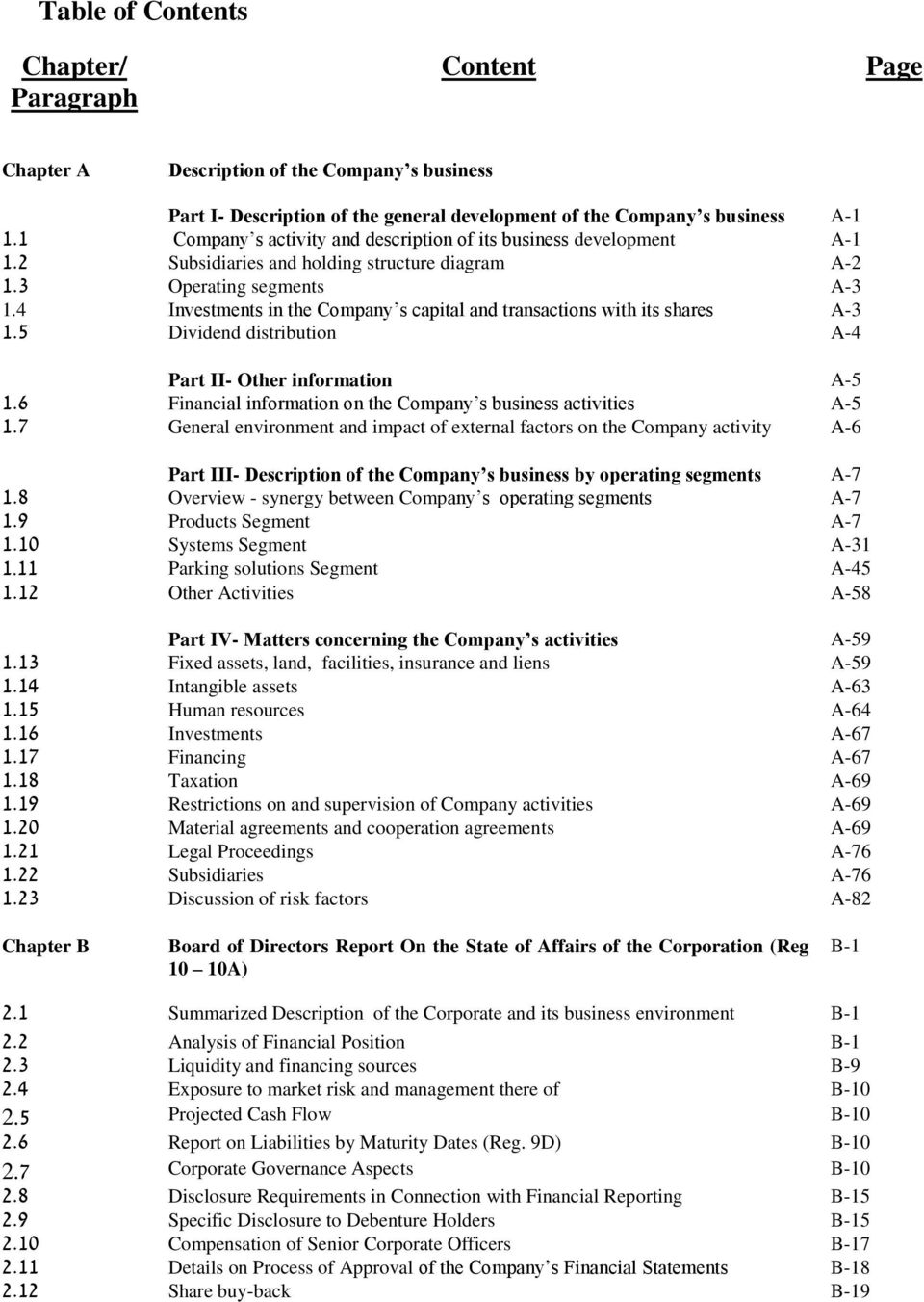
2 Table of Contents Chapter/ Paragraph Content Page Chapter A Chapter B Description of the Company s business Part I- Description of the general development of the Company s business Company s activity and description of its business development Subsidiaries and holding structure diagram Operating segments Investments in the Company s capital and transactions with its shares Dividend distribution Part II- Other information Financial information on the Company s business activities General environment and impact of external factors on the Company activity Part III- Description of the Company s business by operating segments Overview - synergy between Company s operating segments Products Segment Systems Segment Parking solutions Segment Other Activities Part IV- Matters concerning the Company s activities Fixed assets, land, facilities, insurance and liens Intangible assets Human resources Investments Financing Taxation Restrictions on and supervision of Company activities Material agreements and cooperation agreements Legal Proceedings Subsidiaries Discussion of risk factors Board of Directors Report On the State of Affairs of the Corporation (Reg 10 10A) Summarized Description of the Corporate and its business environment Analysis of Financial Position Liquidity and financing sources Exposure to market risk and management there of Projected Cash Flow Report on Liabilities by Maturity Dates (Reg. 9D) Corporate Governance Aspects Disclosure Requirements in Connection with Financial Reporting Specific Disclosure to Debenture Holders Compensation of Senior Corporate Officers Details on Process of Approval of the Company s Financial Statements Share buy-back A-1 A-1 A-2 A-3 A-3 A-4 A-5 A-5 A-6 A-7 A-7 A-7 A-31 A-45 A-58 A-59 A-59 A-63 A-64 A-67 A-67 A-69 A-69 A-69 A-76 A-76 A-82 B-1 B-1 B-1 B-9 B-10 B-10 B-10 B-10 B-15 B-15 B-17 B-18 B-19
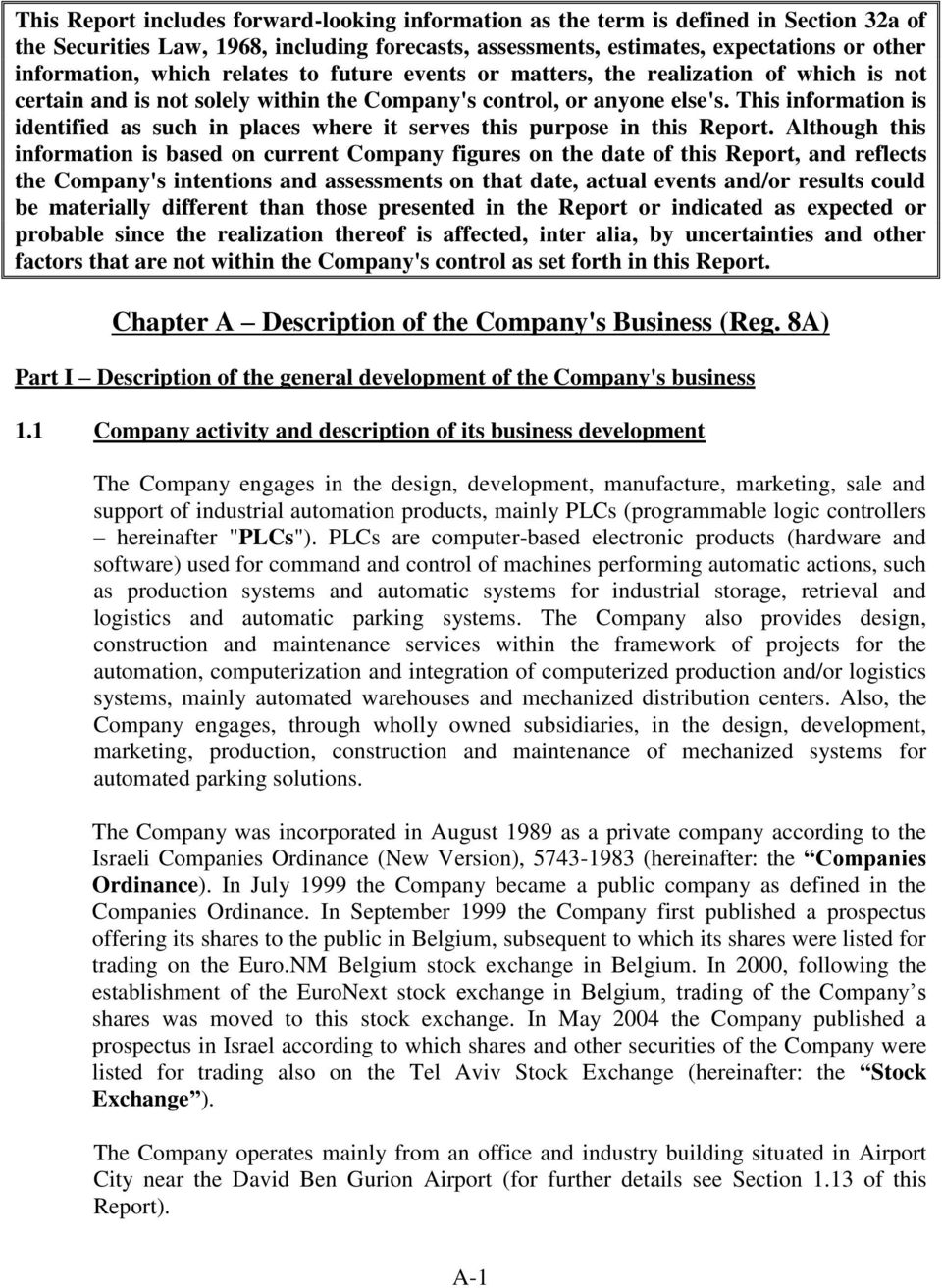
3 Chapter C Financial Statements December 31, 2013 Independent Auditors Report Consolidated Statements of Financial Position Consolidated Statements of Operations Consolidated Statements of comprehensive income Consolidated Statements of Shareholders Equity Consolidated Statements of Cash Flows Notes to the Financial Statements Financial data from the consolidated financial statements attributed to the company itself C-1 C-2 C-3 C-5 C-6 C-7 C-8 C-10 C-64 Chapter D a a a Appendix Additional Details about the Corporation (Reg. 10C - 29A) Use of the Proceeds of Securities (Reg. 10C) List of Investments in Active Subsidiaries and in Related Companies (Reg. 11) Changes in Investments in Active Subsidiaries and in Related Companies (Reg. 12) Revenues of Active Subsidiaries and Related Companies and revenues from such (Reg. 13) Trading on the Stock Exchange (Reg. 20) Remuneration of interested parties and senior officers (Reg. 21) Control of the Corporation (Reg. 21a) Transaction with Interested Parties (Reg. 22) Holdings of interested parties and Senior Officers (Reg. 24) Registered Capital, Issued Capital and Convertible Securities (Reg. 24A) Registry of Shareholders of the Corporation (Reg. 24b) Registered address (Reg. 25A) Board Members of the Corporation (Reg. 26) Senior Officers (Reg. 26A) Number of authorized Signatories as determined by the corporation (Reg. 26b) Corporation's Independent Auditor (Reg. 27) Amendment of the Articles or Memorandum of Association (Reg. 28) Recommendations and Resolutions of Directors and Resolutions of Extraordinary General meeting (Reg. 29) The Company's Resolutions (Reg. 29 A) Corporate Governance Questionnaire D-1 D-1 D-1 D-2 D-2 D-2 D-2 D-7 D-7 D-11 D-11 D-12 D-12 D-12 D-13 D-14 D-14 D-14 D-14 D-15 D-17 Chapter E Statements by the CEO and CFO of the Corporation for 2013 E-1

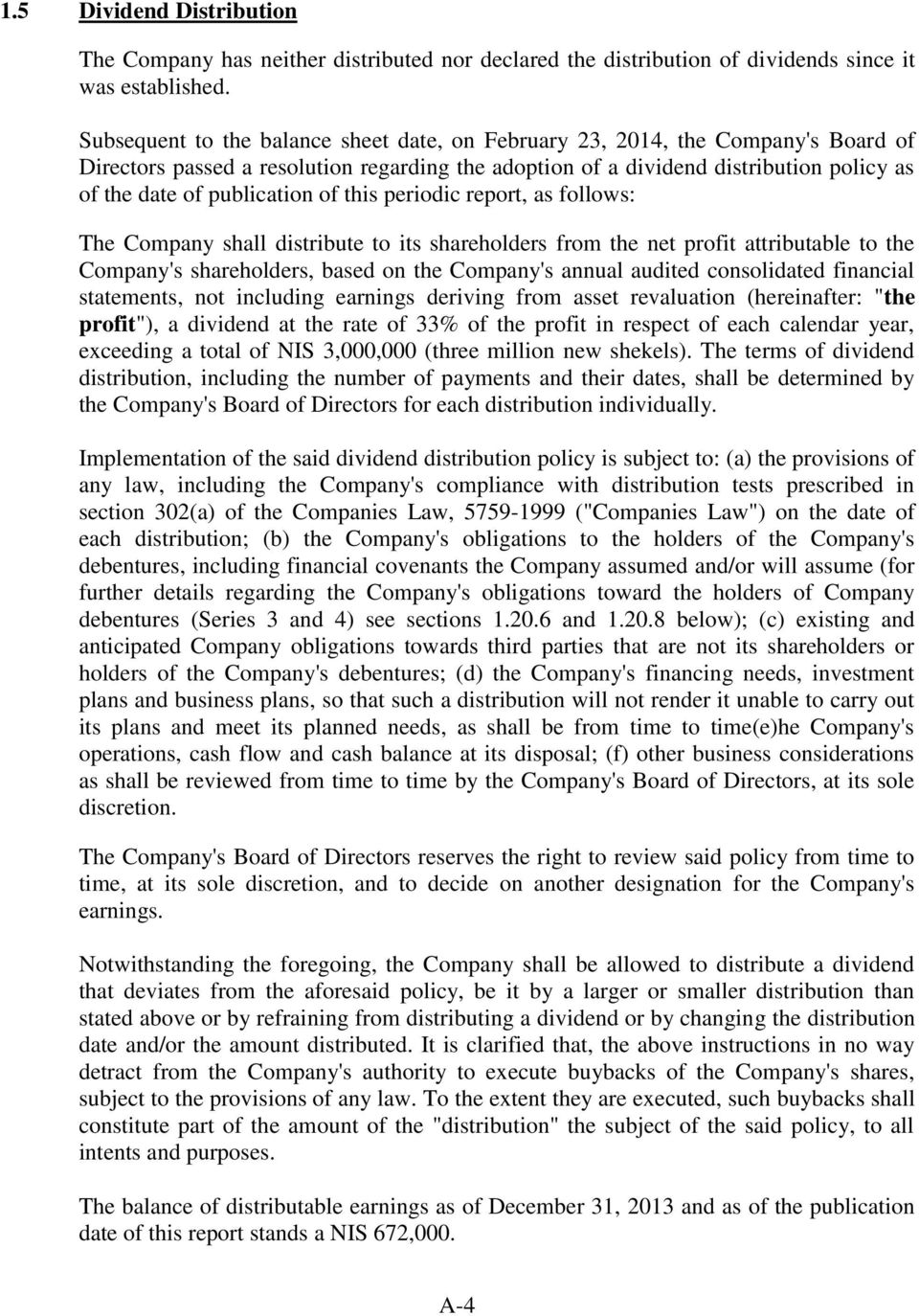
4 This Report includes forward-looking information as the term is defined in Section 32a of the Securities Law, 1968, including forecasts, assessments, estimates, expectations or other information, which relates to future events or matters, the realization of which is not certain and is not solely within the Company's control, or anyone else's. This information is identified as such in places where it serves this purpose in this Report. Although this information is based on current Company figures on the date of this Report, and reflects the Company's intentions and assessments on that date, actual events and/or results could be materially different than those presented in the Report or indicated as expected or probable since the realization thereof is affected, inter alia, by uncertainties and other factors that are not within the Company's control as set forth in this Report. Chapter A Description of the Company's Business (Reg. 8A) Part I Description of the general development of the Company's business 1.1 Company activity and description of its business development The Company engages in the design, development, manufacture, marketing, sale and support of industrial automation products, mainly PLCs (programmable logic controllers hereinafter "PLCs"). PLCs are computer-based electronic products (hardware and software) used for command and control of machines performing automatic actions, such as production systems and automatic systems for industrial storage, retrieval and logistics and automatic parking systems. The Company also provides design, construction and maintenance services within the framework of projects for the automation, computerization and integration of computerized production and/or logistics systems, mainly automated warehouses and mechanized distribution centers. Also, the Company engages, through wholly owned subsidiaries, in the design, development, marketing, production, construction and maintenance of mechanized systems for automated parking solutions. The Company was incorporated in August 1989 as a private company according to the Israeli Companies Ordinance (New Version), (hereinafter: the Companies Ordinance). In July 1999 the Company became a public company as defined in the Companies Ordinance. In September 1999 the Company first published a prospectus offering its shares to the public in Belgium, subsequent to which its shares were listed for trading on the Euro.NM Belgium stock exchange in Belgium. In 2000, following the establishment of the EuroNext stock exchange in Belgium, trading of the Company s shares was moved to this stock exchange. In May 2004 the Company published a prospectus in Israel according to which shares and other securities of the Company were listed for trading also on the Tel Aviv Stock Exchange (hereinafter: the Stock Exchange ). The Company operates mainly from an office and industry building situated in Airport City near the David Ben Gurion Airport (for further details see Section 1.13 of this Report). A-1
5 1.2 Subsidiaries and holding structure diagram The Company has four wholly-owned active subsidiaries: Unitronics Inc., which is incorporated in the United States (Delaware) (hereinafter: "Unitronics Inc.") and engages primarily in coordinating and running the Company s marketing and distribution operations in the United States; and Unitronics Building - Management & Maintenance (2003) Ltd. (hereinafter- Unitronics Management ), which is primarily engaged in the management and maintenance of the Unitronics Building (for details see section below); Unitronics Parking Solutions Ltd. (hereinafter- Unitronics Parking Solutions ), which coordinates the Company s automated parking solutions business in Israel; and Unitronics Systems Inc., which is incorporated in the United States (Delaware) (hereinafter: Unitronics Systems Inc. ) and engages primarily in the Company's business operations in the field of parking systems and/or solutions in the US and in North America. Below is a diagram of the Company s holding structure and its subsidiaries: Unitronics (1989) (R.G.) Ltd. Unitronics Systems Inc. Unitronics Inc. Unitronics Parking Solutions Ltd. Unitronics Building - Management and Maintenance (2003) Ltd Unitronics Industries Automation GmbH )Inactive) Unitronics S.A. (Proprietary) Limited )Inactive) 100% 100% 100% 100% 100% 30% 100% A-2

6 1.3 Operating segments The Company has three major operating segments as detailed below. In addition, the Company engages in the management and maintenance of the Unitronics Building through a subsidiary. Products segment: Through the Products Department the Company is engaged in the design, development, manufacture, marketing, sale and support of its products, mainly series of PLCs of various models that incorporate an operating panel (a keyboard and a display) as an integral part of the PLC, and connectivity (including Internet, intranet, and cellular phone communications), as well as external expansion units for the PLCs, software for the PLCs, for management of logistics systems, automated parking lots and for management of production floors, and additional auxiliary items. System Segment: Through the Systems Department, the Company is engaged in the design, construction and maintenance of computerized storage and/or logistics systems, mainly automated warehouses and computerized distribution centers, including the construction of new systems and/or the upgrading and rendering serviceable of existing systems, and maintenance services for these systems provided through framework arrangements or on a service call basis. The services of the Systems Department are provided to customers mainly in Israel. Parking solutions segment: Through wholly owned subsidiaries, the Company is engaged in the development, design, marketing, production, construction and maintenance of automated parking systems, including the construction of new systems and/or the upgrading and rendering serviceable of existing systems, and provision of maintenance services for these systems through framework arrangements or on a service call basis. 14. Investments in the Company s capital and transactions with its shares Below are details of investments in the Company s capital made during the last two years and, to the best of the Company's knowledge, details of all other material transactions carried out with the Company s shares by an interested party in the Company: Company buybacks - Between August 2005 and December 2012, and given the low share prices at that time on the Tel Aviv Stock Exchange (TASE) and in the stock exchange in Belgium and as a vote of confidence in the Company and its performance, the Company has, from time to time, been buying back ordinary shares of the Company, in accordance with buyback plans adopted by the Board of Directors, within the framework of trading on the stock exchanges in Tel-Aviv and Belgium. During the reported period, the Company did not execute buybacks. For additional details, see Note 17 in Chapter C of this Periodic Report For details on Debentures (Series 4) issued during the reported period, see section A-3

7 1.5 Dividend Distribution The Company has neither distributed nor declared the distribution of dividends since it was established. Subsequent to the balance sheet date, on February 23, 2014, the Company's Board of Directors passed a resolution regarding the adoption of a dividend distribution policy as of the date of publication of this periodic report, as follows: The Company shall distribute to its shareholders from the net profit attributable to the Company's shareholders, based on the Company's annual audited consolidated financial statements, not including earnings deriving from asset revaluation (hereinafter: "the profit"), a dividend at the rate of 33% of the profit in respect of each calendar year, exceeding a total of NIS 3,000,000 (three million new shekels). The terms of dividend distribution, including the number of payments and their dates, shall be determined by the Company's Board of Directors for each distribution individually. Implementation of the said dividend distribution policy is subject to: (a) the provisions of any law, including the Company's compliance with distribution tests prescribed in section 302(a) of the Companies Law, ("Companies Law") on the date of each distribution; (b) the Company's obligations to the holders of the Company's debentures, including financial covenants the Company assumed and/or will assume (for further details regarding the Company's obligations toward the holders of Company debentures (Series 3 and 4) see sections and below); (c) existing and anticipated Company obligations towards third parties that are not its shareholders or holders of the Company's debentures; (d) the Company's financing needs, investment plans and business plans, so that such a distribution will not render it unable to carry out its plans and meet its planned needs, as shall be from time to time(e)he Company's operations, cash flow and cash balance at its disposal; (f) other business considerations as shall be reviewed from time to time by the Company's Board of Directors, at its sole discretion. The Company's Board of Directors reserves the right to review said policy from time to time, at its sole discretion, and to decide on another designation for the Company's earnings. Notwithstanding the foregoing, the Company shall be allowed to distribute a dividend that deviates from the aforesaid policy, be it by a larger or smaller distribution than stated above or by refraining from distributing a dividend or by changing the distribution date and/or the amount distributed. It is clarified that, the above instructions in no way detract from the Company's authority to execute buybacks of the Company's shares, subject to the provisions of any law. To the extent they are executed, such buybacks shall constitute part of the amount of the "distribution" the subject of the said policy, to all intents and purposes. The balance of distributable earnings as of December 31, 2013 and as of the publication date of this report stands a NIS 672,000. A-4
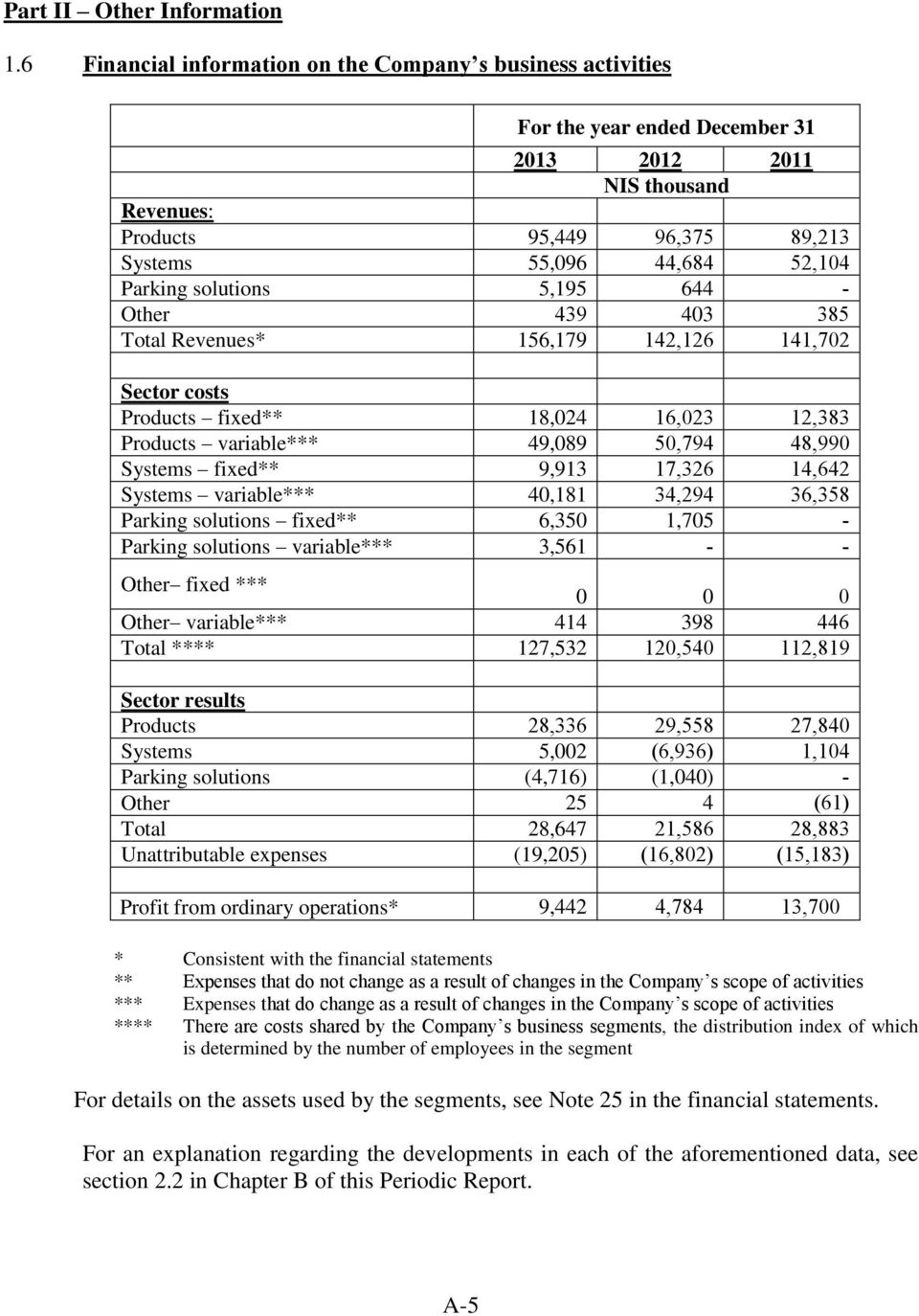
8 Part II Other Information 1.6 Financial information on the Company s business activities Revenues: Products Systems Parking solutions Other Total Revenues* For the year ended December NIS thousand 95, ,98 55, ,2925 5, ,179 95,29, , Sector costs Products fixed** Products variable*** Systems fixed** Systems variable*** Parking solutions fixed** Parking solutions variable*** 18,024 49,089 9,913 40,181 6,350 3, , ,7 852,15 1,705-9, , Other fixed *** Other variable*** Total **** , , ,2391 Sector results Products Systems Parking solutions Other Total Unattributable expenses, ,002 (4,716) 25 28,647 (19,205),12993 ) 72187( (1,040) 4,92937 ) 97232,(, ) 79(,32338 ) ( Profit from ordinary operations* 9, * Consistent with the financial statements ** Expenses that do not change as a result of changes in the Company s scope of activities *** Expenses that do change as a result of changes in the Company s scope of activities **** There are costs shared by the Company s business segments, the distribution index of which is determined by the number of employees in the segment For details on the assets used by the segments, see Note 25 in the financial statements. For an explanation regarding the developments in each of the aforementioned data, see section 2.2 in Chapter B of this Periodic Report. A-5
9 1.7 General environment and impact of external factors on Company's activity Industrial automation is being implemented at an increasing rate in a variety of industries, including process industries (the food, drink, pharmaceuticals, chemical, paper and fuel industries), production systems (production machinery, automated tools), energy production systems (power stations of all kinds), logistics systems (storage, conveying and distribution systems) building control systems (air conditioning, heating, energy control, access control, warning and security systems), transportation systems (vehicles, aviation and shipping, traffic control), automated parking lots, etc. The Company believes that the need for automation is attributable, among other reasons, to the increasing complexity of industrial processes; the increase in the volumes and types of activities and the information required to manage them; the aspiration to improve the efficiency of processes (optimization) and to increase the availability of resources while implementing safety rules; and the desire to economize on manpower and manual intervention. Automation products are therefore intended to address these needs, including rapid response to the changing needs of the market, simplicity of design and of operation, connectivity to organizational management systems (ERP), high reliability and time between malfunctions (MTBF), high availability, as well as savings and efficiency. For an analysis of the general environment, as well as general information on areas of activity presented in this report below, the Company relies, inter alia, on several market studies. These sources include, among others, surveys and articles by Frost & Sullivan ( by IMS Research ( by ARC Advisory Group (summaries accessible to the public at and by the International Parking Institute (hereinafter: "IPI") ( Hereinafter, wherever this report relies on the above market studies, this fact will be explicitly stated. The Company's activity includes, as explained above, the activities of the Products Department, the Systems Department and the Parking Solutions Department. The Company s management estimates that these three areas of activity are affected by the growing need for application of automation stemming from the factors explained above on the one hand, and by the state of the global and local economies and their general impact on the various industries on the other hand. Additional trends in the global automation market as reflected in the abovementioned market studies are the economic growth and accelerated industrial development of certain geographic regions of the world, such as China, India, Russia, Brazil and Eastern European countries, which show increased activity in establishing local production capabilities and enterprises and increasing introduction of automation into such plants. Notwithstanding the aforesaid, the Company is unable to either estimate or quantify the impact of such developments on the results of its operations. For a discussion of other external factors, including specific market risks and their manner of management, see sections 1.23 below. For a discussion of information concerning the general environment and external factors relevant to each operating segment separately, see sections 1.9, 1.10 and 1.11 below. A-6

10 Part III Description of the Company's business by operating segments 1.8 Overview synergy between the Company s operating segments The Company engages, as stated above, in three business segments: the Products Segment, the Systems Segment and the Parking Solutions Segment. Although the Company operates in each segment separately with regard to policy, decision making, budgets, resources and other inputs, there is synergy between these fields within the Company, as well as an ongoing process of feedback and mutual contribution, primarily in respect of feedback concerning market needs and customers preferences, technological trends, business opportunities, data on competitors, and other areas. Furthermore, the three segments share the use of multiple infrastructures, as detailed in Part IV below. 1.9 Products Segment Structure of the operating segment and changes therein The Company s main products are PLCs which integrate, within a single unit, the control components (hardware and software constituting the active part of the PLC, or its brain ) and the interface components (HMI Human-Machine Interface) intended to allow the operator to control the PLC itself, and through it the instruments controlled and monitored by the PLC, with no prior knowledge of programming required Legislative restrictions, regulations and constraints applicable to the operating segment The manufacture and/or marketing of products in the field of control and automation is subject to various standards in different parts of the world, some of them general in nature intended for the field of electronics and some more specific to the field of control and automation. In this context the relevant standards are mainly EN : 2007 that deals with PLC requirements (concerning electromagnetic compatibility and safety aspects), and American and Canadian safety standards (such as the UL/cUL 508 standard and ISA Hazardous Locations). In addition, in recent years the Company has witnessed a growing trend on the part of authorities in both Israel and abroad to legislate regulations designed to protect the environment. For details regarding compliance of the Company's products with these standards and the Company's assessments in this regard, see sections and of this report Changes in the scope of operations and profitability of the segment According to the Frost & Sullivan Report from January 2014, the global PLCs market was estimated at $10.4 billion in 2013 and is expected to reach $14.6 billion by 2018 (an average growth rate of 7.1% per year). According to the Frost & Sullivan Report from April 2011, the global PLCs market was estimated at $8.3 billion in 2010 and is expected to grow to $14 billion by 2017 (an average growth rate of 8.6% per year). Similar figures regarding the annual growth rate appear also in the IMS Report from A-7

11 August 2010 hereinafter: "IMS Report"), which estimated an average growth rate of 8% per year. According to this report, the global PLC market was estimated at $6.3 billion in 2009, at $6.9 billion in 2010, and is expected to reach $9.3 billion by Most sources similarly identify several trends: (a) Classification of PLCs by size and properties: The number and type of external devices that can be connected to and controlled by a PLC define its dimensions as: - Nano PLCs also known as Smart Relays; - Micro PLCs also known as Compact PLCs; - Small PLCs and medium PLCs together also known as Modular PLCs; - Large PLCs also known as High-End Modular PLCs. As stated in section below, the Company focuses in the Products field on nano, micro and small PLCs (and does not focus on large PLCS), that have, based on the sources cited above, the highest relative growth rates. (b) Areas of application: Concurrently with the increasing need for automation as explained above, the global and local economy affect the market, as reflected, inter alia, in the different market development rates projected for the coming years in different industrial fields and for different types of customers. Thus, for example, the IMS Report estimates that 54% of global sales are made to machinery manufacturers (of which 10% are tool manufacturers, 10% manufacturers of food and beverage machinery and 10% manufacturers of packaging machines) and 46% of the sales are to end consumers (of which 20% are in the motor vehicle industry, 16% in the services industry and 11% in the chemical industry). The Frost & Sullivan Report from April 2011 (see above) estimated that among key industries, the food and beverage industries accounts for approximately 17.5% of the global industrial PLC market, the motor vehicle industry accounts for 15.2% and the chemical industries accounts for roughly 11.3%. According to this report, the growing industries of solar energy, wind-generated energy and other sources of renewable energy, are expected to boost sales of industrial PLCs to these sectors. The report also anticipates a growth in sales of industrial PLCs to the motor vehicle industry, the water and wastewater treatment industry, the chemical industry and the food and beverage industry. (c) Geographic breakdown: A study of the geographical distribution of sales of PLCs around the world in recent years according to the IMS Report shows that, in general, 46% of the sales take place in Europe, the Middle East and Africa, about 20% in America, about 23% in Asia and the Pacific countries and 10% in Japan. On the other hand, the Frost & Sullivan Report shows that in 2010, about 39.4% of global sales of PLCs took place in Asia and Pacific countries, 24.2% in Europe, the Middle East and Africa, and 23.1% in North America. Concurrently, economic growth and industrial development in certain regions of the world, such as Brazil, Russia, India, China and Eastern Europe countries, in the field of establishing production capacity and local enterprises, and the increasing introduction of automation into such enterprises, give rise to forecasts of higher growth rates in these regions. As described above, except for 2009, in which, according to the Frost & Sullivan Report, the market slumped 14.8%, the PLC market has displayed steady growth till now, and the various market surveys presented above, indicate forecasts for continued A-8

12 growth in this market and its expansion into additional areas, accompanied by tough competition, which is also expected to grow and expand into different areas. ARC, in its surveys over the years, has also anticipated that the PLCs market will expand beyond the traditional industry clients (factories and car manufacturers) to providers of overall automation solutions that combine the production lines and the data collection systems in the field, to the organizational data and management systems. Pursuant to this, the Company identifies a trend towards increased utilization of decentralized systems based on smaller PLCs the focus of the Company's activities. In the Company s opinion this trend arises, inter alia, from ongoing pressure on prices of PLCs. The above may, in the Company s estimation, cause a decline in profitability for companies engaged in this field (including Unitronics, although the Company is unable to quantify this decline in profitability 1 ), resulting from a decline in market prices of PLCs Technological changes which could have a material impact on the operating segment The PLC market is characterized by frequent technological developments, introduction of new products and technologies, and changes in market needs and requirements. The developments and innovations in the fields of electronics, communications and computers also influence the control and automation industries, including a trend towards miniaturization of PLCs (smaller units that compete in terms of functionality and price with large units from previous generations), expanded use of communications (between PLCs, and between PLCs and the command computers and organizational systems, and between PLCs and smartphones and tablets using available and widespread communications technologies such as Ethernet, Internet and cellular communications), and development of convenient, user-friendly interfaces including the use of color screens in various sizes and the use of touch screens as a means of manmachine communication in equipment and machinery. The Company designs its products in accordance with these trends, including miniaturization (down to palm-sized products), incorporation of convenient and user-friendly interfaces (such as differentsized color and touch screens) in the body of the PLC, and built-in communications capabilities as detailed in sections and below Critical success factors in the operating segment and changes therein The Company estimates that the primary success factors in the PLC sector include, among others, the availability of a range of products addressing market demand and trends; functional reliability of the products; competitive prices reflecting appropriate cost-benefit ratios; high standard of service and support, promoting image and customer 1 The information concerning a possible decline in profitability for companies engaged in the PLC field, including Unitronics, is forward-looking information. The principal facts and data serving as a basis for this information are the data presented in a number of market surveys in the field as detailed in sections 1.7 and above, and in particular the information regarding the anticipated development of the PLC market as well as the competition in this field and the competitors operating therein, and the Company s estimation regarding a possible decline in PLC market prices. The principal factors which may prevent this information from materializing are market growth rates differing from those anticipated, involvement of the main players in this market in a manner differing from that anticipated, and the development of sub-markets in the PLC field coupled with increased professionalism and focus by various producers on their own special niche areas, which could mitigate potential price drops. A-9

13 loyalty; and an extensive distribution infrastructure capable of providing an international response Main entry and exit barriers in the operating segment and changes therein The Company estimates that the primary entry barriers to the PLC field include, among others, the duration of the development processes of the technologies underlying the PLCs and the significant time spans and complex penetration processes related to the integration and/or replacement of a PLC in a specific machine or application. The Company estimates there are no material exit barriers from the segment Substitutes for the products of the operating segment and changes therein The field of industrial PLCs includes PLCs manufactured by different companies, as detailed in section below. By its nature, a programmable industrial controller requires modification and programming actions that are usually performed by the client or an integrator on his behalf, in order to adapt it to the task it is designated for. It is therefore not possible to point out products that constitute an immediate, direct substitute for the Company s products, and in any event the client has to make adjustments, program, and usually also make electric and mechanical adjustments in order to use other PLCs The structure of competition in the operating segment and changes therein For details regarding the structure of competition in the products segment, see section below Products and services The Company s main products include PLCs of various series, external expansion units and software programs: PLCs and expansion units The Company designs, develops, manufactures, markets, sells and supports several series of PLCs. These PLCs are based on a central processing unit (CPU) for computerembedded industrial systems that coordinates the range of command, control, and communications operations executed by the PLC. The Company s PLCs also incorporate an integral human-machine interface (HMI) component designed to enable the operator to control the PLC itself, and through it the instruments controlled and monitored by the PLC. This interface may differ from one product series to another in its nature and complexity, and it includes a data display (alphanumeric and/or graphic), a programmable keyboard and/or a regular keyboard and/or a touch screen. The PLC communicates with external components (such as the production devices themselves, engines or sensors) by means of built-in physical connections ( sockets of sorts, similar to phone or computer sockets) intended for data input and output. The input/output capabilities of PLCs (number and type of connectable devices) define their dimensions as nano PLCs, also known as Smart Relays; micro PLCs also known as A-10
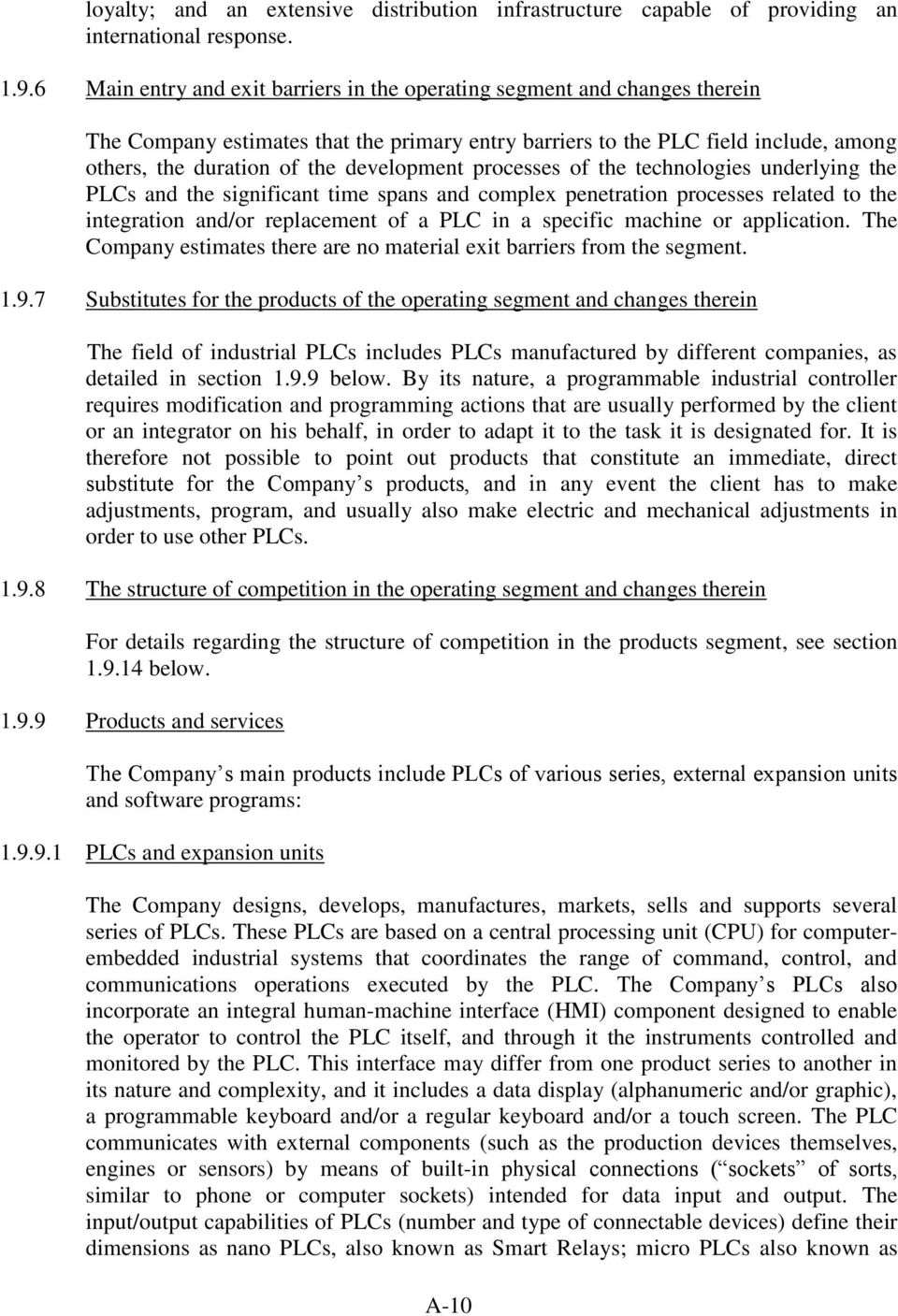
14 Compact PLCs; small PLCs and medium PLCs, both together also known as Modular PLCs; and Large PLCs, which are also known as High-End Modular PLCs. The PLC's I/O capabilities may be expanded using external expansion units, thereby upgrading its functioning (as detailed below). The Company's PLCs have been designed for compatibility with the different protocols of line and wireless communications, including by means of the Internet (remote control and access, from inside and outside the organization, by means of a computer, with no physical connection), intranet (PLC- PLC communications and/or PLC-computer communications within the organization), and by means of a cellular phone (access to information and/or to means of control without a physical connection and without a computer, using cellular phone infrastructures, e.g. by means of SMS messages or by transmitting files over various telecommunications networks, such as GSM, CDMA, GPRS, CDPD and others). The communications capability of the PLCs is intended to enable tracking, control and monitoring of systems and processes, not only from the site in which the PLC is installed (production floor, logistics warehouse, etc.), but also from other stations, including the management offices or even from outside the organization's premises, thereby providing access to data and/or means of control for different levels in the organization, from production machine operators within the organization, to the organization s planning and control levels (including raw materials inventory planning, finished products etc.) to the senior management or even people outside the organization. Below are certain major characteristics, which distinguish among PLCs in the above categories: Traditional classification Alternative classification Major relative advantages Nano PLCs Smart Relays Highly compact; low cost; suitable for control and automation of only the most basic tasks Micro PLCs Efficient price/ performance ratio; suitable for control of simple tasks and operation of relatively simple equipment Compact PLCs Small PLCs Larger I/O capacity and stronger supporting software, in a relatively compact package; suitable for command and control of complex automation tasks Medium PLCs Modular PLCs Capacity to process large input volumes and control multiple inter-connected automation components Major industrial applications Simple industrial automation tasks, scheduled building controls, environmental systems (irrigation, air conditioning, etc.), safety systems Micro PLCs, small PLCs and medium PLCs are typically used to control simple and complex automation tasks in most industrial applications, including in the automotive, food processing, chemical, pharmaceutical, metals, mining, paper, plastic, conveyance systems, packaging and other industries. The main series of PLCs and expansion units manufactured by the Company include: (a) Alphanumeric PLCs: nano/micro PLCs of the M90/M91 series: A series of palmsized products, with an interface containing 15 programmable keys and a mini LCD screen for displaying alphanumeric characters, and up to 38 integral input/output points, expandable up to an additional 150 input/output points via an external expansion unit (see sub-section (f) below). A-11
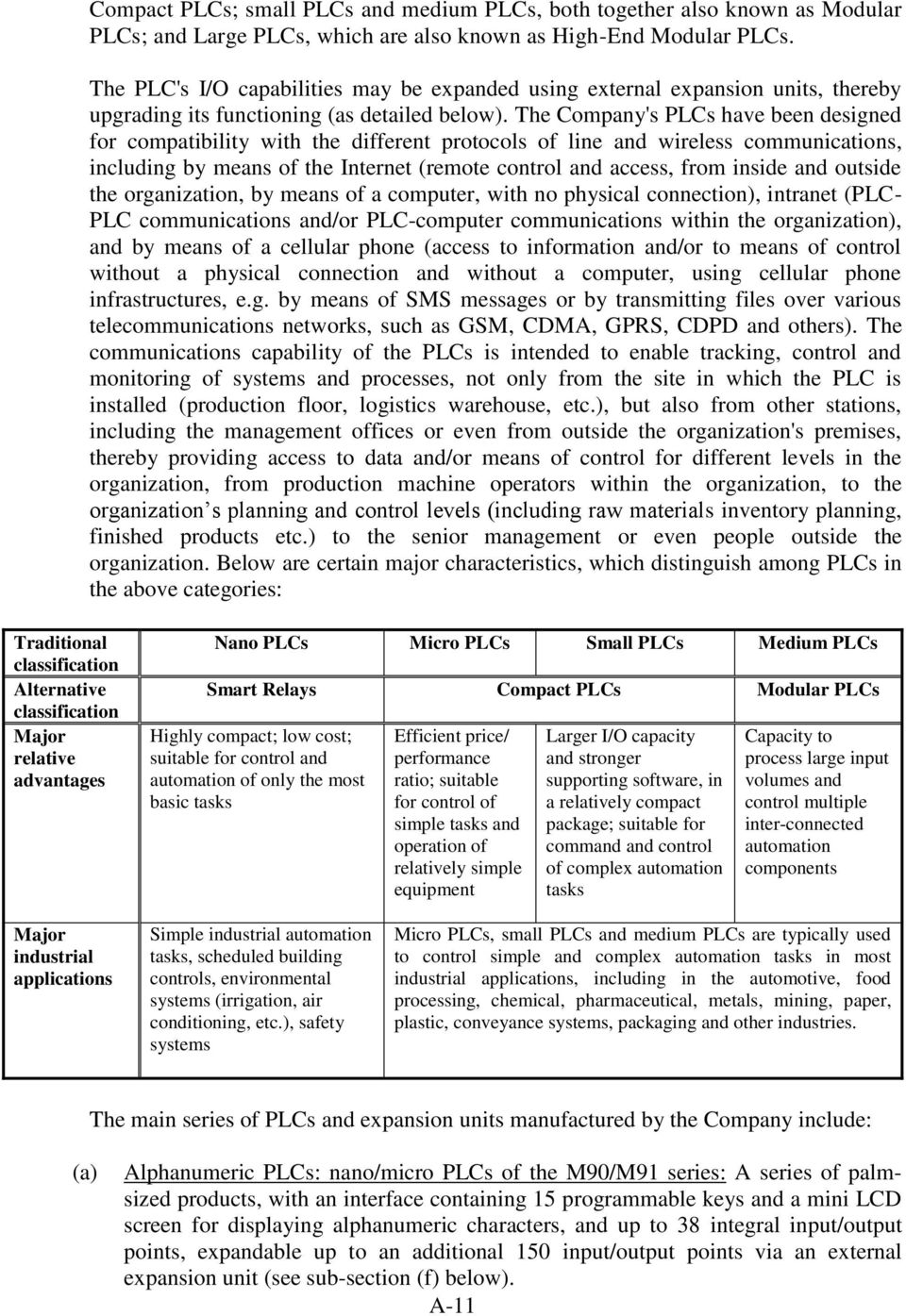
15 (b) (c) (d) Alphanumeric PLCs: nano PLCs of the Jazz /Jazz 2 series: A series of small PLCs including palm-sized products with an interface containing programmable keys and a mini LCD screen and a small number of integral non-expandable input/output points. This series aims to provide a substitute for "smart relays" via a complete PLC at low cost, and also to expand the Company's customer base by allowing accessibility to new prospective customers. Graphic PLCs: nano/micro PLCs and small PLCs of the Vision TM series: A series of products with a graphic display and advanced communications capabilities, marketed at relatively low prices compared to those of similar products. This series includes the Vision230, Vision260, Vision120 and Vision 130 TM PLCs in a palm-size casing, with an illuminated mini LCD screen allowing graphic display, a keyboard with up to 33 programmable and customizable keys and expandable input/output points. Graphic small PLCs with a touch screen: PLCs of the Vision280 TM, Vision530 TM and Vision290 TM series: A series of products with a larger illuminated LCD screen permitting graphic display and operation via a touch screen. The operator interface is especially user-friendly (and also contains, in the Vision280 TM model, a 27-key programmable and customizable keyboard), with integral input/output points expandable up to 316 points using an external expansion unit (see sub-section (g) below). (e) Graphic small PLCs with a color touch screen: PLCs of the Vision570 TM, Vision350 TM, Vision1040 TM and Vision1210 TM series: A series of products with a larger illuminated color LCD screen allowing graphic display and operation via a touch screen. The operator interface is especially user-friendly with integral input/output points expandable up to 1,000 points using an external expansion unit (see sub-section (f) below). (f) (g) Graphic modular PLCs with a color touch screen: PLCs of the UniStream TM, series: A new series of products first launched in These products are based on a modular infrastructure which allows for great flexibility in customizing the configuration to the customer's needs, through selection of the desired screen size out of several possible sizes and selection of the type and quantity of built-in input/output points on the product. All the products in the series are based on advanced technologies, possess computation power and advanced data processing, and come with a color LCD screen allowing graphic display and operation by touch-screen. The operator interface is especially user-friendly with integral input/output points expandable up to 2,000 points using an external expansion unit (see sub-section (g) below). The display capabilities and other features of the product, such as remote control via smartphones and tablets, a wide range of communication capabilities, and built-in microphones are consistent with market trends. External expansion units: In/out expansion units designed to increase the I/O capabilities of the PLCs beyond their integral capabilities (by increasing the number of integral sockets) and thus to expand the array of tasks, processes, and devices A-12
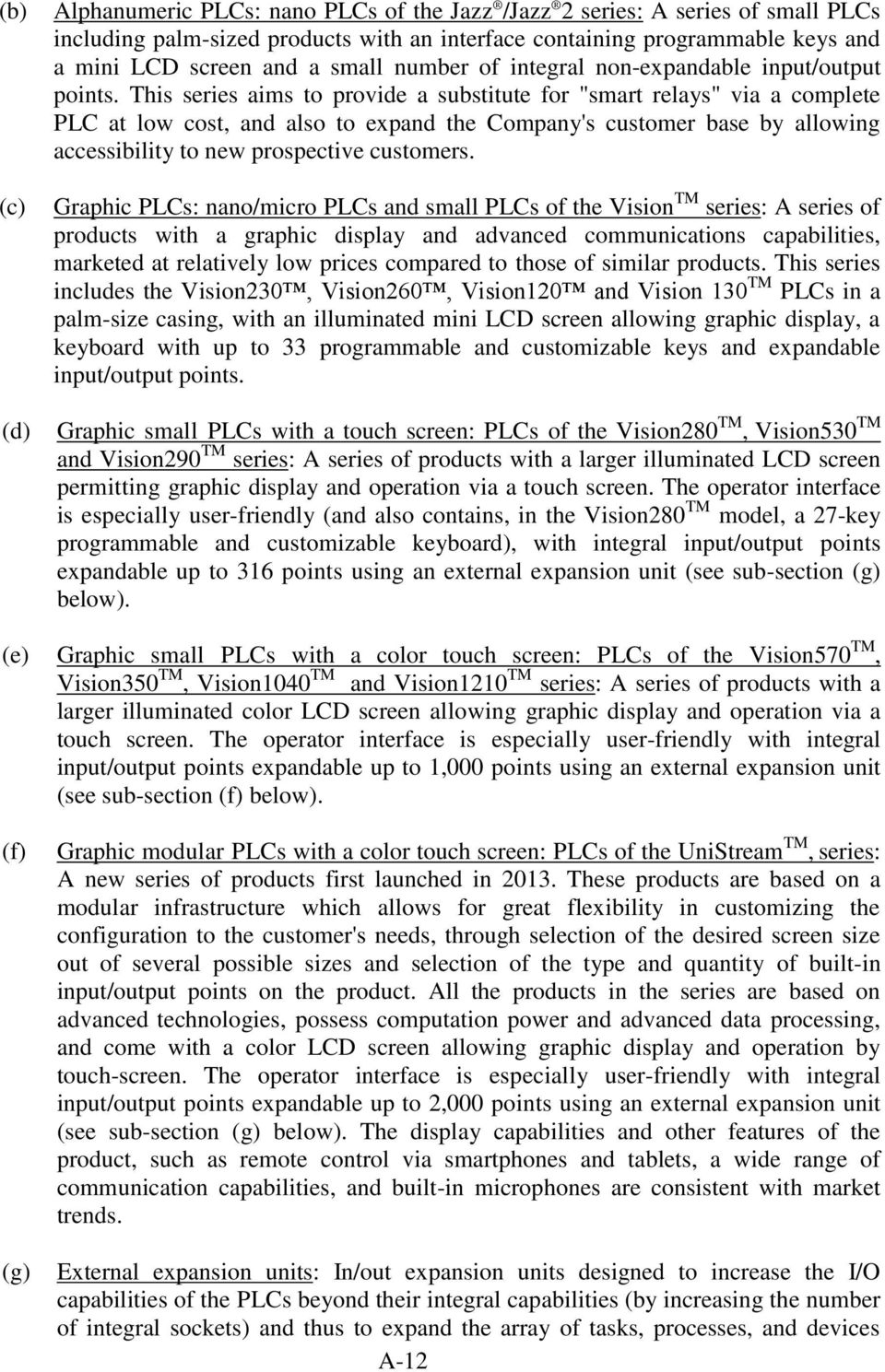
16 managed, controlled and reported by them. The Company's external expansion units include units that mechanically and electrically connect to the PLC (named Snap In Modules), enabling the addition of dozens of I/O points, as well as units (named I/O Expansion Modules) that connect only electrically to the PLC, enabling, via the use of an industrial communications network, the addition of hundreds (up to 2,000 in the UniStream TM product series) of additional I/O points, depending on the type of PLC (the PLC's specific type and power determine its ability to handle the number of points). This allows for upgrading the PLCs' functional capabilities to match those of small and medium PLCs. These expansion units are designed to increase the flexibility and compatibility of the various PLCs according to the varied and specific needs of each user, and also to aid in reducing the costs involved in the purchase, installation and maintenance of larger and more expensive PLCs and/or of larger quantities of PLCs. (h) Accessories: The Company provides complementary accessories for the above PLC series and expansion units, including such components as cables, adapters, programming kits, user guides as well as products not manufactured by the Company, such as cellular modem units, power suppliers and protocol converters. These accessories are intended to provide a comprehensive solution for the customer from a single source, thereby improving the flexibility and fit of the various PLCs to each user s varied and specific needs, and to help reduce the costs involved in purchasing the array of components required for the application Software programs The Company s products focus on a range of up to tens of integral I/O points per individual PLC, with the ability to expand by tens to hundreds of additional points, using external expansion units and communications networks. In the future the Company may expand its activities into the realm of larger PLCs, allowing operation of a higher number of I/O points (see Section of this report). The Company develops and markets, as a package together with its PLCs, software operating programs for PLCs, used to program the operating interfaces of the PLC itself and its operation, as well as the command and control operations of the PLC with respect to the instruments to which it is connected. The Company s U90 software serves PLCs from the M90/M91 and Jazz 2/Jazz series, the Company s VisiLogic software serves PLCs from the Vision series, and the Company's UniLogic software serves PLCs from the UniStream series. These software programs operate in the Microsoft Windows environment and are designed to also permit those without professional programming skills to program, in an intuitive and accessible manner, both the operating interface of the PLC itself, at the operator's convenience, and the PLC tasks with respect to the system components in the machine or equipment that the PLC is supposed to control. These software programs enable access to programming tools, including self-design or import of graphic icons, text messages, menus in various formats, and adaptation of the display to the varying conditions of the process being controlled (e.g. changing displays according to progression of manufacturing process along an industrial production line). A-13

17 In addition, the Company provides programming tools for addressing additional needs, such as reading stored information from the PLC to electronic datasheets, connecting the PLC to communications networks, and remote control. The software package also includes a soft copy of operating instructions, the PLC software programs, documentation of the technical specifications of the product, and associated documentation data Trends and Changes Products Services The Company s products are mainly focused on the micro and nano PLCs sector. This segment is characterized in the market surveys described above as the market segment with the most rapid growth rate. At the same time, this market segment is highly competitive and prices of products therein are steadily declining (see also section below). The Company invests in the development of new products designed to meet the changing needs of customers in the PLC market. These products replace and are intended to continue replacing the Company s older products and are also intended to open new opportunities and markets for the Company. Services of the Products Department comprise primarily technical support for Company products, and are delivered by a technical support team offering pre-sale support services for purchasing Company products (mainly consulting for customization of products to each customer s specific needs), post-sale training and technical support for assimilating the use of the products and/or troubleshooting. Calls to the support team usually originate from the Company s distributors (see section below), from direct end users and from indirect end users (who purchased the Company s products from distributors in Israel or abroad). These calls are processed by support staff, with the involvement of the Company's lab, development and marketing staff as necessary. The Company typically provides a month warranty for its products. The Company also provides technical support services to its distributors prior to their actual sale (pre-sale services), at the Company s discretion on a case-by-case basis. The Company does not make provisions in respect of a warranty due to immateriality (absence of calls and/or calls involving insignificant amounts) Revenue breakdown and profitability of products and services The contribution to the Company's profitability by the different series of the Company's major products shows no material difference between that of one series and another. The changes in the profitability of the Company s Products segment in the years 2011, 2012 and 2013, stem largely from changes in the main selling and raw materialscurrencies' exchange rates against the shekel throughout these years, from different (although not materially different) profit margins of several transactions, coupled with changes in manpower inputs during these periods. A-14

18 Below are details of the revenues and gross profit rates of the Company in the Products sector for the periods indicated: For the year ended December Revenue from products (*) (amount and percentage of total revenue) Gross profit (amount and margin) (61%) 95,449 (44%) 42,407 In NIS thousand (68%) 96,375 (47%) 44,905 (63%) 89,213 (44%) 39,224 )*( Company products are sold in volumes of tens of thousands of products each year New products During the reported period, the Company finished developing, among other things, the first products in the new series of PLCs and the programming environment adapted to them (for details, see section Products and services). This new line of products is designed to offer command and control solutions for larger systems, or solutions requiring more complex control capabilities of the systems the Company's other products are meant to control. In addition, during the reported period, the Company has been engaged, and intends to continue engaging, inter alia, in activities for the development of additional series of controllers and/or new control products, which are meant to enable the Company to provide to its customers products and capabilities which are not within the existing product range of the Company, and using technologies that allow more advanced performance 2. These products, which are in various stages of development (some of them in the initial stages and others in more advanced stages, about to be launched on the market) are planned to include additional products that will allow for the expansion of the product line to include larger and/or more advanced products. These development efforts require the allocation of significant resources, primarily in the area of human capital, as well as the study and assimilation of new platforms and technologies. For information on the Company s development expenditures, see section below. Customers 2 The information regarding the development of products with dimensions that are not within the Company's existing product range is forward-looking information. The main data serving as a basis in this subject are the Company's development plans, which are based, inter alia, on the analysis of market surveys as set forth in sections 1.7 and above, the analysis of market requirements and customer preferences, as expressed in the Company's firsthand contacts with the markets, technological feasibility, the Company's assessments regarding the costs of the research and development that would be required to finance the execution of the developments, and also the tough competition existing in the industry, as specified in this Report. The main factors which could cause this information not to materialize are the rates of investment that would be required in these operations, which could significantly overrun the Company's budgets in these subjects, limitations in the ability to commercialize these technologies at competitive market prices, or at all, the absence of the development of markets and a consumer culture suited to using the technologies developed, and the superior financial and technological means available to a considerable part of the Company's rivals, and all of the foregoing in addition to the general risks as set forth in section 1.23 of this Report. A-15

19 The direct customers of the Products Department are mainly distributors bound to the Company by distribution agreements (see section below). The end customers are generally manufacturers of PLC-controlled industrial machines intended for the automation of defined tasks such as packaging, for specific operations on production lines, etc. The machine manufacturer purchases PLCs suitable for the machine he is producing, installs the Company's PLCs in the machine, and markets it to his customers, who will integrate it in the production line or in other automatic applications that will be controlled and managed by the Company's PLCs. The end users of the Company's products are manufacturers of machines for a broad range of applications in various industries, including the plastics, textile, vehicle spare parts, food and petrochemical industries, etc. Other examples include the use of Company products for command and control of the use of energy, air conditioning, control systems in buildings, conveyors, security systems, etc. In general, the Company has no direct contact with end customers, who are in direct contact with the various distributors for customization, installation, warranty, and the like Major Customer: During the reporting periods, the Company did not have a major customer in the Products segment The Company regularly reviews the terms of credit it provides to customers and the effects of extending credit to customers. If necessary, the Company makes specific provisions for debts whose collection is doubtful Marketing and distribution The Company s products and services are marketed and sold through the Company s internal marketing network and via Unitronics Inc., as well as through a chain of distributors comprising 165 distributors (of which 105 are in the United States) in about fifty countries (including Israel) across Europe, Asia, South and Central America, North America and Africa The Company s internal marketing setup: The Company s internal marketing staff coordinates and guides the activity of the Company's network of distributors, on an ongoing basis as well as at central events such as conferences, courses and training sessions held by the Company at its own facilities or at the distributors facilities. The marketing personnel also maintain direct contact with current and prospective users of the Company s products and services, for the purpose of follow-up and feedback, nurturing customer relations and identifying business opportunities. The Company likewise maintains a technical support team consisting of several employees, each in charge of a desk covering several countries and providing support services prior to and for the purpose of purchasing the Company s products (mainly advice for the customization of products to the specific needs of each applicant) and post-purchase training and technical support for assimilation of products and/or troubleshooting. Inquiries to the support team usually come from the Company s distributors, from direct end users and from indirect end users (who purchased the Company s products from distributors in Israel or abroad). These applications are processed by support staff and, if required, also with the involvement of the Company s development and marketing staff. A-16
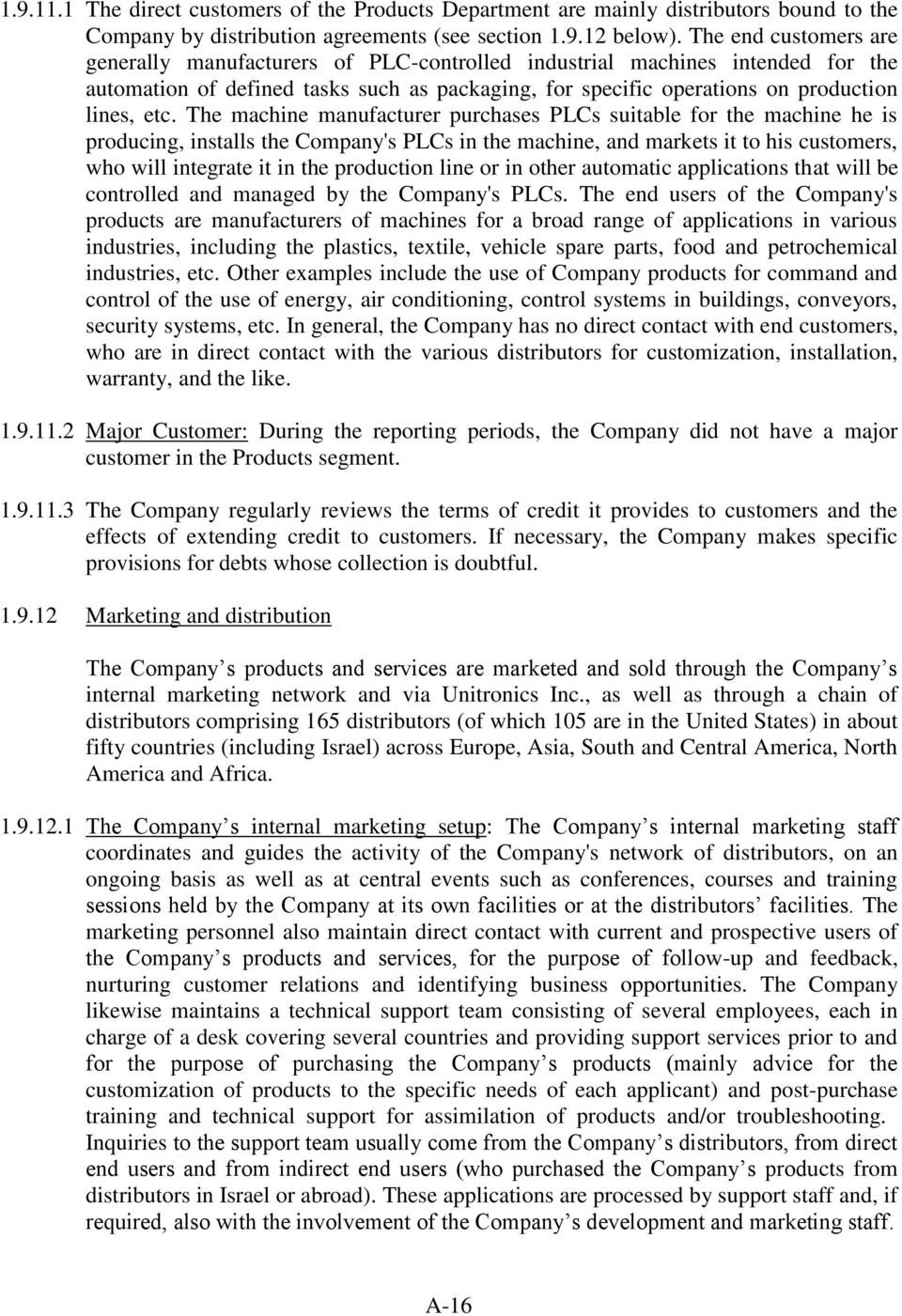
20 Distributors: The Company s products are marketed through distributors in Israel; Europe (Austria, Ukraine, England (three non-exclusive distributors, including Scotland and Wales), Bulgaria, Belgium, Belarus, Czech Republic, Cyprus, Croatia, Kazakhstan, Azerbaijan, Uzbekistan, Denmark (including the Faro Islands and Greenland), Estonia, Finland, France, Germany, Greece, Holland, Hungary, Italy, Latvia, Lithuania, Luxembourg, Norway, Poland, Portugal, Russia, Romania (2 non-exclusive distributors), Slovenia, Spain, Sweden, Switzerland, Turkey, Serbia, Macedonia, Bosnia-Herzegovina, Slovakia, Malta and Ireland; Asia and the Pacific (Australia, China, India, Vietnam, New Zealand, Taiwan, Thailand, Singapore, Hong Kong, Malaysia, and the Philippines); Africa (South Africa (including Namibia, Swaziland, Lesotho), Zambia, Mozambique, Botswana, Zimbabwe, Angola and Nigeria); South and Central America (Argentina, Brazil, Chile, Colombia, Mexico, Venezuela, Honduras, Bolivia, Ecuador (2 non-exclusive distributors) and Peru), and North America (United States and Canada 2 non-exclusive distributors)). The Company s agreements with its distributors generally confer exclusive distribution rights in defined territories (subject to the Company s right to sell by itself and/or through subsidiaries and/or pursuant to comprehensive agreements for setting up systems), for limited periods (usually one year), renewable subject to meeting specific minimum sales or at the Company s discretion in the event the distributor fails to meet said minimum sales. The distributors purchase Company products based on an annual purchase forecast provided by them in advance, usually according to the Company s price list, and sell them at their own discretionary prices. The Company generally grants its distributors 30 to 90 credit days, and from some requires collateral such as a bank guarantee or letters of credit (except in the United States). The distributor is generally required to provide end users with a 24-month warranty, backed by the Company s commitment to the distributor for the same period of time. These agreements may generally be terminated at any time by a 30 to 90 day notice of either party, and are generally governed by Israeli Law and subject to the jurisdiction of the courts in Tel Aviv and/or to an arbitration mechanism for the settlement of disputes. The Company does not pay commission to its distributors, and the latter generate their profits from the difference between the purchase price and the selling price to the end customer. The Company suggests a recommended selling price to the distributors, but does not require them to charge these prices The Company's distributors may not return products. Under the products' warranty, nonfunctioning products during the warranty period are either repaired or replaced. It should be noted that in actuality, an immaterial quantity of products is replaced (for details on revenue recognition in the Products segment, see Note 2(r)(1) to the financial statements) Sales promotion: The Company promotes its sales primarily through: (a) a website ( for downloading software and other help tools for the Company s products, and for obtaining details about the Company, its products and services; (b) public relations and contact with the market and with current and prospective customers, including updates on innovations and developments at the Company, follow-up of customer satisfaction and/or lessons to be learned and for implementation, and similar activities; (c) marketing and sales aids and activities, A-17
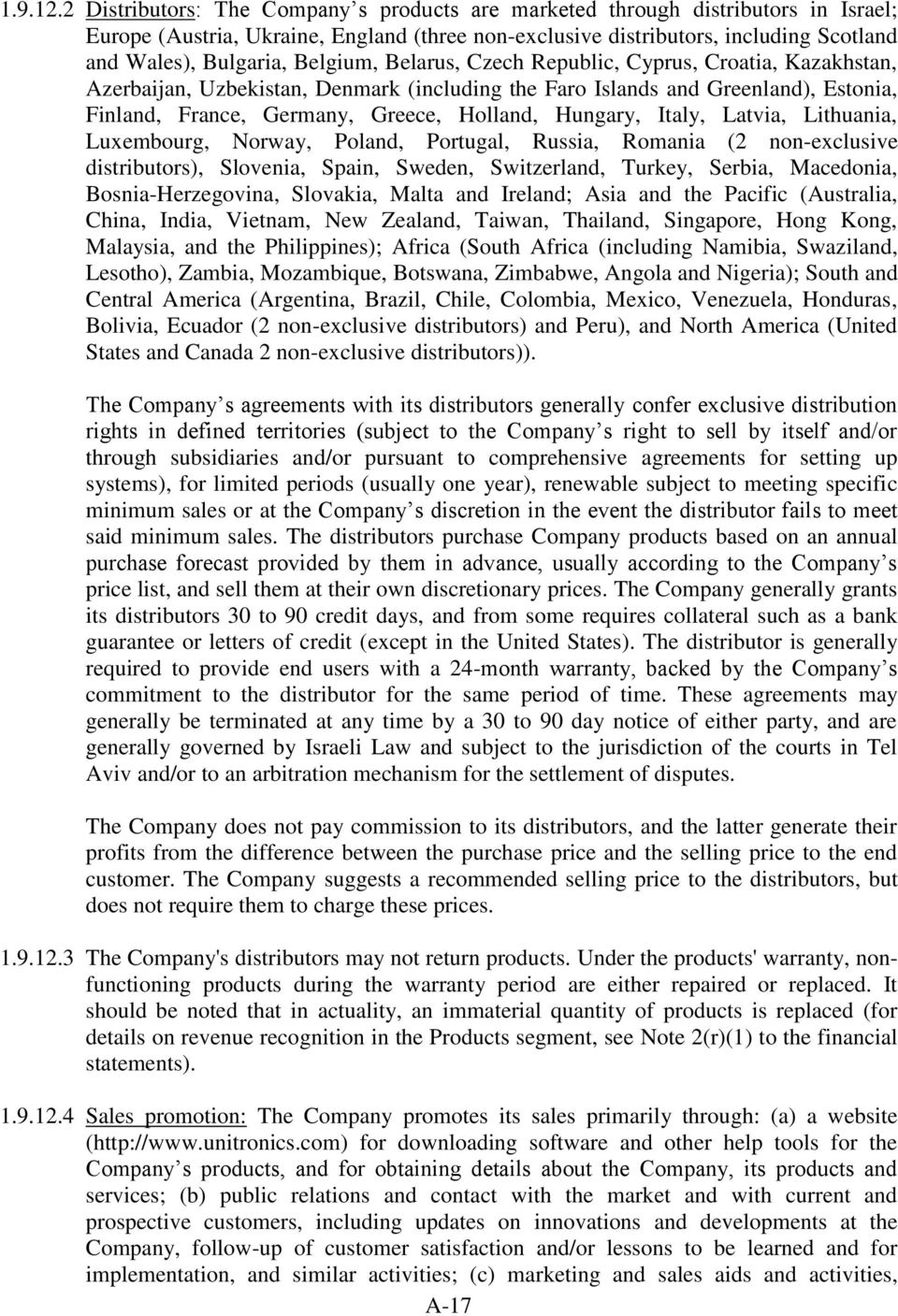
21 including detailed marketing catalogues, regular distribution of product updates and marketing material, use of demonstration kits at the customer s site and training sessions for customers and distributors; (d) participation in national and international trade exhibitions, whether directly or via the Company s distributors, and (e) issuing publications in the professional literature of the industrial PLC sector worldwide Order backlog As of December 31, 2013, the Company had an order backlog of NIS 10,618,000 for the Products Department and as of February 27, 2014, the Company had an order backlog of NIS 9,296,000 for the Products Department, as detailed below. In general, the order backlog of the Products Department is in line with the nature of activity in this market, which is based primarily on purchases from stock and off-theshelf from distributors. Period of recognition in the expected income For Q For Q For Q For Q For 2014 onward Product order backlog as of (closest possible date to date of this report) NIS thousands Product order backlog as of December 31, 2013 NIS thousands Product order backlog as of December 31, 2012 NIS thousands 4, , For Q For Q For Q For Q For 2015 onward Total 2,754 2, , ,296 4,723 2, , , ,140 Differences in the reported order backlog for different periods arise from changes in delivery schedules of ordered products on the one hand, and from receipt of new orders on the other hand, all within the ordinary course of the Company s business. The backlog mix, in terms of the main products included, is not indicative, and changes constantly, since it reflects specific demand for particular products based on the pace of consumption of various customers and the requirements of different markets that usually dictate this pace. As already mentioned, the nature of the activity in this market is primarily based on inventory and off-the-shelf purchases. It should be clarified that the data relating to recognition of revenues from backlogs are estimates only, relying on past experience and planned schedules, in line with the different orders. Changes in these basic assumptions, which led to the said estimates, A-18
22 could significantly change the Company s estimation with regard to backlog revenue recognition, compared to the data shown above Competition To the best of the Company's knowledge and based primarily on the IMS Report and the Frost & Sullivan Report, which cite several dozens of companies designated as "key competitors," one can define three categories of major competitors in the global market of industrial PLCs: A. Market leaders, usually multinationals globally active in multiple fields, including in the PLC sector. Included in this group are: Mitsubishi Electric Automation Inc., Rockwell Automation / Allen Bradley Company Inc., Siemens AG, Omron Corp., Schneider Electric and GE Intelligent Platforms. B. Large multinationals dealing primarily in PLCs. Companies included in this group: B&R Industrial Automation, ABB, Yokogawa Corp., Automation Direct/Koyo, Bosch Rexroth AG, Toshiba International Corp., Philips Components and Festo Group. C. Smaller companies operating in limited geographical regions or dealing in special niche products. This group includes such companies as: Honeywell Safety Management Systems, Kim Controls, Horner Electric APG, and PILZ. In the Company's estimation, its activity in the products segment falls into this category. The Company knows of no other Israeli companies in this category. The Company knows of no statistical knowledge that can serve as a basis regarding the consumption and/or sales of PLCs in Israel, and thus is unable to assess the size of the local market, its own share in the local market and/or its own share relative to other PLC manufacturers / distributors in Israel. As regards its share in the global market, the Company assesses, based on widely accepted international market studies in the industry, including the IMS, ARC and Frost & Sullivan reports, that, its share in the global PLC market stands at below one percent. The Company competes and intends to continue competing primarily on the basis of the advanced technology integrated into its products, and the cost effectiveness of its products as compared to that of its competitors (including the functionality of its products and their performance, reliability, portability, capacity for integration in existing systems, convenience and ease of installation, operation and maintenance, and the quality of the technical support and customer service provided by the Company). The Company estimates that its products are positioned mainly as niche products (small products including nano and micro PLCs) that combine integral user interface capabilities and broad communications capabilities characteristics that are particularly suitable for various decentralized applications and for integration as a control A-19
23 component for manufacturers of small and medium machines. However, there is no certainty that the markets or the existing or prospective customers will regard the Company's products as worthier than those of the competitors. Similarly, there is no certainty that its competitors will not develop products and technology that will render the Company's products obsolete or less competitive. As mentioned in this section above, the majority of the Company s competitors are larger and more established companies, with financial and other means which significantly surpass those of the Company, including R&D, marketing and sales resources, as well as a recognized name in the market. These competitors are able to respond before the Company to changing market needs, and also to offer customers more flexible and convenient financing terms than those offered by the Company, thereby limiting the Company s ability to compete effectively. There is no certainty that the Company will successfully compete in this market, and its competitors may succeed in capturing some of its market share Production capacity The Company manufactures its products primarily through subcontractors by the turnkey method, which includes the purchase of components, placement of components, final assembly, testing and calibration of products and the packaging of these products (hereinafter production contractor and/or production contractors"). In addition, the Company itself assembles, using its staff and its facilities in Airport City, a certain portion of the components of the electrical circuits, and for some of the products, it performs the final assembly of the product, its electrical testing, calibration and packaging. The use of subcontractors to carry out the production is also intended to maintain the possibilities for growth and flexibility in view of the high production capacity, using existing subcontractors and the ability to add subcontractors as needed (subject to the learning and assimilation curve described in this section below). As for production operations within the Company, as of the date of this report most of the production capacity is being utilized, but the Company is able to increase its production capacity for these activities as needed, given the possibility of assigning these tasks to unskilled manpower, which is, therefore, relatively available and requires only a short training period. The Company is a party to two non-exclusive agreements with production contractors (hereinafter Production Contractor A and Production Contractor B ), each agreement signed with a separate production contractor, which is a third party unrelated to the Company or to interested parties therein. (For the sake of convenience only, Production Contractor A and Production Contractor B shall jointly be referred to in this section as: the Production Contractor or the Production Contractors, and the agreement with Production Contractor A and the agreement with Production Contractor B shall jointly be referred to in this section as: the Agreement or the Agreements ). Under the Agreement, the Production Contractor serves as a subcontractor for the production and supply of the Company's products and/or electronic assemblies by the turnkey method. According to the Agreement, the Production Contractor performs most of the acquisition, placement and assembly of the components, and subsequently tests and packages the finished products, in accordance with the Company's specific guidelines and under its supervision, according to itemized A-20
24 purchase orders, which are based on continually updated seasonal projections that are transferred to the Production Contractor. As part of its obligations, the Production Contractor provides a 24-month warranty for its work, secures its liabilities under the Agreement, and the intellectual properties associated with the products are retained by the Company. Payment for the products is based on fixed amounts depending on the volume of orders, and is paid at terms of net 30 EOM days. The Company may terminate the agreement, for any reason whatsoever, by giving a 90-day prior written notice to the Production Contractor. Pursuant to the Agreements with the Production Contractors, the Company sells raw materials to the Production Contractors for the purpose of manufacturing for the Company. For details see Note 18 of the financial statements, in Chapter C below. The Company s payments to Production Contractor A accounted for 20% and 13%, in 2012 and 2013, respectively, of the Company's total spending on raw materials and subcontractors during those years. The Company s payments to Production Contractor B accounted for 14% and 23%, in 2012 and 2013, respectively, of the Company's total spending on raw materials and subcontractors in those years. The Company is not dependent on specific subcontractors for production and therefore can retain various other additional contractors to that end. However, the replacement of an existing subcontractor with a new one might lead to delays arising from learning and assimilation curves with respect to the Company s needs and/or use of special production components customized to the Company s needs (e.g. molds for casting the plastic casings of the PLCs). In the Company s estimation, replacing a subcontractor as aforesaid is not expected to cause material extra costs to the Company Fixed assets, real estate and facilities The Company has no fixed assets, real estate or facilities specific to the products sector, and it uses its fixed assets, real estate and facilities (including rented space) for its business in three operating segments (for details, see section 1.13 below) Research and development For additional details on products and technologies under development, see section above. Below are the main details concerning sums expended by the Company during the periods detailed below on R&D activities: Payroll and benefits Subcontractors Other expenses Less capitalized expenses that were recognized as an intangible asset Total For the year ended December NIS thousands 9, ,78 1,867,2369,2697 2,068,286,,2929 (10,743) )992595( )992,69( 2, ,,2398 A-21
25 Overall, the Company spent NIS 13,687,000 during the reported year (of which NIS 10,743,000 were recognized as intangible assets) for the development of products and technologies, as specified in section above. The Company estimates that in 2014, total development expenses in the Products segment will not change materially compared to actual development expenses in this segment in From 1992 to 2003, the Chief Scientist at the Ministry of Industry, Trade and Labor (hereinafter: the Chief Scientist ) participated in the funding of the Company s R&D programs under the Encouragement of Industrial Research and Development Law, (hereinafter: the R&D Law ). Subject to the support received for funding the Company's R&D plans (for further details see section in Chapter A of the periodic report for 2012), the Company must comply with the provisions of the R&D Law, and the regulations and rules by virtue thereof, which include paying royalties to the Chief Scientist at a rate of 2% to 5% of sales of products developed with the Chief Scientist s assistance, up to repayment of the total grants (and with respect to grants received starting from January 1999 plus interest at LIBOR rate); receiving approvals regarding changes in holdings and controlling means in the Company; refraining from overseas manufacturing of products based on technology developed with the assistance of the Chief Scientist, and from the transfer of such technology overseas. Total grants approved for the Company based on the R&D programs amounted to NIS 2,473,000, in respect of which the Company paid to the Chief Scientist up to December 31, 2013, a total of NIS 340,000 in royalties. Liabilities recognized in the financial statements in respect of grants received from the Chief Scientist, as of December 31, 2013, totaled NIS 160,000, attributable to programs in respect of which, in management's estimation, royalties are likely to be paid. As of the date of this report, the Company has met its obligations to the Chief Scientist Intangible assets As stated, the Company has recognized some expenses relating to the development of its products and technologies (as specified in section above) as intangible assets. In addition, the Company safeguards its intellectual properties by registering patents, although it believes that in a world of rapid technological changes, its ability to develop and launch new state-of-the art products in a relatively short period of time, facilitates its success and penetration into markets, such that the protection of its intangible assets and intellectual properties is of lesser importance. For details on intangible assets related to this operating segment, see section 1.14 below. 3 The information concerning the estimated development expenses in the Products segment is forward-looking information. The principal data which serve as a basis for this information are the Company s development programs which are based, inter alia, on analysis of market surveys as detailed in sections 1.7 and above, analysis of market needs and consumers preferences as reflected in the Company s direct contacts with the markets, technological feasibility, the Company s estimates regarding R&D costs as well as the Company s estimates with respect to the revenues from this segment. The principal factors which may prevent this information from materializing are the actual revenues from the sale of products in 2013, the investments required for such activity, which may significantly exceed the Company s budgets for such matters; restrictions on the Company s ability to commercialize these technologies at competitive market prices or at all; absence of developed markets and a consumer culture suitable for using the technologies being developed; as well as the superior financial and technological means available to a major portion of the Company's competitors all this in addition to the general risks outlined in section 1.23 of this report. A-22
26 Human Capital As mentioned above, the activity of Company staff is split into segments, with workers employed and involved in all three operating segments of the Company, but with some of the Company employees focusing more on a specific segment (for details see section 1.15 below) Raw materials and suppliers The Company's products may incorporate about mechanical and electronic components, including electronic circuits and their components, keyboards, display screens, and others. About 95% of the components in most of the products are standard (off-the-shelf) products, manufactured in Israel and abroad. Some 5% of the components in most of the Company s products are custom made for it in accordance with a specification and/or plan, mainly plastic casings, keyboards, printed circuit boards (PCBs), various connectors, metal parts, touch screens and specific LCD displays. Although these components are of major importance in Company products, they may be ordered from several suppliers/ manufacturers in Israel and overseas, usually without any need for product adaptations, and consequently, there is no dependence on a single supplier/ manufacturer. However, in some cases (about 4% of off-the-shelf components in most Company products), although they may be purchased from several suppliers, their replacement by new suppliers is liable to cause delays (of several weeks) resulting from the alternative supplier s learning and assimilation curve with respect to the Company s needs. For particular products, where the replacement of a supplier may lead to a longer delay, backup stocks with a 3-4 month supply are maintained (whether they are purchased directly by the Company or for the Company by a subcontractor as part of the turnkey production arrangement), the purchase quantities for these stocks being financially immaterial. The Company is dependent on several manufacturers which specialize in the production and supply of a small number of items that represent about 1% of the components in most of its products (representing immaterial purchase quantities from a financial standpoint, in the years 2011, 2012 and 2013), although these are off-the-shelf components that include processors and communication components that could be purchased from suppliers in or outside Israel (primarily Infineon, Atmel, WizNet, Lattice Semiconductors and STMicroelectronics). Although such components may be installed in the Company s PLCs even if they are made by other manufacturers, this might involve structural and functional changes and various modifications of the hardware and software that are liable to cause delays and customizing costs. In order to reduce this dependence, the Company enters into annual orders arrangements and in a few cases, into minimum stock retention agreements, with several different suppliers, in order to ensure availability and regular supply of these components. The Company has no sole supplier of raw materials from whom it purchases 10% or more of the annual cost of its raw materials and subcontracting services In periods of economic crisis, such as the one that started in the second half of 2008, manufacturers of electronic components around the world adjust and reduce their production capacity to suit demand levels in a time of crisis. As recovery from the crisis sets in or as demand for components grows again, there is a delay in the delivery A-23
27 of components, stemming from the response time of the manufacturers to changes in demand and from a situation in which manufacturers prefer to supply the demand of big customers first, rather than that of medium and small customers (a situation known as "allocation"). The Company regularly surveys the components' state of supply on the market as well as lead times, in order to identify trends in due time. As in similar periods in the past when lead times for electronic components have grown longer, the Company prepares itself by stocking up in advance with components with an increased lead time, by developing alternative acquisition channels, and by updating the suppliers in due time regarding the forecast quantities The Company generally has no written agreements with suppliers of raw materials, it is not bound by framework arrangements with them (save for annual orders and certain minimum stock retention agreements as detailed below) and it orders materials as needed, on an ad hoc basis, generally against purchase orders only. The commercial terms generally applicable to the raw materials suppliers are open credit without guarantees, payment at terms of net 60 EOM (after approval by acceptance control), predefined lead time (sometimes including an option for the Company to change quantities and/or schedules), prices subject to volume discount, delivery and transport at the supplier s expense and the supplier s warranty for replacement of goods, at its expense, in the event of nonconformity or quality problems. In a few cases (raw materials originating from a single producer) the Company enters into a minimum inventory retention agreement with certain suppliers, pursuant to which the supplier undertakes to keep an inventory at a certain percentage of the Company s annual consumption (adjusted on a quarterly or a monthly basis), exclusively earmarked for supply to the Company at set prices. Under these agreements, the Company is obligated, subject to certain exceptions, to purchase the minimum stock, for amounts that are financially immaterial to the Company, even if not ordered by the end of the agreement period. Several of these agreements are unlimited in time, and the termination of activity thereunder in respect of particular items is subject to prior notice Working Capital Inventory: The Company holds, whether itself or through its production contractors, on an ongoing basis about days of components and raw materials inventory to meet forecast requirements. In addition, the Company holds a finished products inventory for supplying current orders for some days. The Company s policy is generally to hold a finished products inventory based on actual orders or internal forecasts regularly made and updated by the Company. However, and as necessary, the Company may deviate from this policy, mainly when preparing for extraordinary events or in response to the behavior of raw materials markets in the world (for example, in cases of concern over possible temporary shortages of electronic components throughout the world and/or limited allocations of components by the component manufacturers in certain cases of excess demand). The Company manages the production processes, purchasing of raw materials, raw materials inventory and finished products inventory through a general management software program that A-24
28 concurrently serves the Company's procurement, production, and inventory systems, and this alongside financial management and accounting (ERP Enterprise Resource Planning). From time to time the Company examines new means of inventory maintenance, with a view to increasing the finished goods inventory held by the Company, and shifting this inventory in some of the markets to sites closer to the distributors, in order to assist the distributors and customers and to make Company products more accessible Warranty: The Company typically provides a month warranty for its products Credit extended: Customers of the Products Department are typically extended credit days. Below are data on average days of supplier credit, as well as subcontractor and customer credit for the Products Department: Customers Suppliers Subcontractors 2013 Average credit in NIS thousands 12,418 4,544 6,926 Average credit days Average credit in NIS thousands ,9 Average credit days Average credit in NIS thousands ,,2891 Average credit days A-25
29 Environmental issues, risks and management thereof The Company s activity in this area does not involve environmental risks as the term is defined in Section 28 in the First Schedule to the Securities Regulations (Details of the Prospectus and Draft prospectus Structure and Form), However, as stated in section above, the manufacture and marketing of electronic products is subject in different countries to directives that address the use of certain materials in the manufacture of electronic products and the treatment of electric and electronic equipment waste, including arrangements pertaining to the issue of electronic waste in the EU: (a) the WEEE (Waste Electrical and Electronic Equipment) Directive that came into force on August 13, 2005 (and known as WEEE 1), and deals with the treatment of waste deriving from electrical and electronic equipment, and EU/2012/19 (known as WEEE 2), which came into effect on August 13, 2012, whose purpose is to expand the scope of WEEE 1); (b) the RoHS (Restriction of Hazardous Substances) Directive which came into effect on July 1, 2006 (and is known as RoHS 1), restricts the use of six substances in electrical and electronic equipment marketed in Europe after July 1, 2006, including lead (Pb), mercury (Hg), cadmium (Cd) and others: and EC/2011/65 (known as RoHS 2), which came into force on January 2, 2013, and whose purpose is expanding the scope of RoHS); as well as legislation in accordance with the provisions of Israeli law (Regulation of the Treatment of Packaging Waste Law and the Law for Environmental Protection for the Environmental Treatment of Electronic Equipment). The WEEE Directives (1 and 2) of the European Parliament obliges member states in the European Union to apply its provisions as framework directives binding on EU citizens, subject to local legislative arrangements in each member state, and subject to a uniform and fixed minimum threshold. So far the Company has not been required to implement the provisions of the WEEE 1 and 2 Directives. Nevertheless, the provisions of these directives may apply to Company products in the future, and, therefore, the Company is following the implementation of the directives in the various countries through its distributors, making pinpoint adjustments where required, as well as through professional consultation, participation in conferences and updated professional literature. As of the date of this report, the Company has spent immaterial amounts to comply with the provisions of the directives and does not expect to spend material amounts in the upcoming year for the purpose of compliance with these directives 4. The Company is unaware of any exposure due to the non-implementation of the WEEE Directives (1 and 2) and is unable to quantify this exposure, insofar as it exists. The Company designs its products in compliance with the aforementioned RoHS 1 Directive of the EU. During 2012, the Company dealt with the implementation of the 4 The information concerning Company preparations for complying with the WEEE directive is forward-looking information. The principal data which served as a basis for this information are: developments currently known to the Company regarding the directive's implementation, the technical steps needed for its implementation, and the Company's collaboration with its distributors in this matter. The principal factors which may prevent this information from materializing are the diverse implementations in the various countries, changes to the directive's provisions and/or interpretation or lack of cooperation on the distributors' part in realizing the implementation, and the means necessary for the directive's implementation, for which there is no assurance that they will be available to the Company at all or at the scope required for implementation. A-26
30 RoHS 2 Directive by identifying the components in existing Company products that were not compliant with this directive and replacing these with compliant components. As of the date of this report, the Company has spent immaterial amounts on taking steps to be in compliance with the provisions of this directive. The Company estimates that, as of the date of this report, the Company's products are generally compliant with the provisions of RoHS 1 and RoHS 2 (in their current version). It also does not expect to spend material amounts in the upcoming year and/or in subsequent periods for the purpose of compliance with the requirements of these directives 5. The law for regulation of packaging waste treatment sets recycling targets according to the type of material and the year of recycling. The provisions of the law regarding the obligations of manufacturers of packaged products do not apply to a manufacturer in whose case the total weight of the packaging of the packaged products or of the service packaging it sold in a year is less than 1,000 kg. To the best of the Company s knowledge, the total weight of packaging of the packaged products it sells per year does not reach this threshold and therefore, the obligations of manufacturers of packaged products pursuant to this law do not apply to it. The Company has advised the Ministry of Environmental Protection of the aforesaid. It will continue to monitor the total weight of packaging of the packaged products it sells each year to ensure compliance with the law. The Law for Environmental Treatment of Electrical and Electronic Equipment and Batteries, , sets recycling targets according to the year of recycling for importers and manufacturers of electronic equipment. In accordance with this law, the Company recently entered into a contract with a "recognized implementation body" appointed by the Environmental Protection Ministry, which is responsible for the fulfillment of the obligations of manufacturers and importers, as per the provisions of said law. Moreover, the Company is studying the implications of the new law by inquiring with consultants and keeping up with up-to-date professional material. As of the date of this report, the Company does not expect to spend material amounts in the upcoming year for the purpose of compliance with this law Standards and Quality Control 5 6 The information concerning Company preparations for complying with the RoHS directive is forward-looking information. The principal data which served as a basis for this information are: the engineering steps in the development and implementation of the directive on which the Company is working as of the date of this report, and the need for continued investments in the R&D expenses, especially with regard to compliance with regulatory requirements, for which there is no assurance that they will be available to the Company at all or in the amounts it needs. The principal factors which may prevent this information from materializing are the diverse implementations in the various countries of the relevant regulatory requirements for each product, completion of the engineering steps needed to complete the implementation, changes to the directive's provisions and/or interpretation, and delays in the compliance of the suppliers of components and arrays with these requirements. The information concerning Company preparations for complying with the provisions of the Law for Environmental Treatment of Electrical and Electronic Equipment and Batteries is forward-looking information. The principal data which served as a basis for this information are: the contract with the "recognized implementation body" and developments known to the Company today pertaining to the implementation of regulations by virtue of said law. The principal factors which may prevent this information from materializing are changes to the law's provisions and/or interpretation, and delays in the implementation of the collection and recycling processes by the "recognized implementation body" as defined in the law. A-27
31 The Company operates a lab, equipped with instruments designed to enable the Company to check the proper functioning of its finished products, including their mechanical and operational properties, as well as their software components. This lab maintains contact with other test labs in Israel and abroad. In accordance with the requirements of EU directives, EC/2004/108 (a directive pertaining to emission and product immunity in the electromagnetic environment) and EC/2006/95 (a directive pertaining to safety aspects, including fire, temperature resistance and electric safety), the Company s products, which are defined as PLCs, must meet the standards defined in sections 8 and 11 of the EN : 2007 standard, which deals with requirements applicable to such products. Pursuant to the provisions of these directives, the Company labels most of its PLCs from the M90/M91, Vision TM, UniStream TM and Jazz /Jazz 2 series with the CE mark, which indicates that the PLCs comply with the requirements of the directive. Most Company PLCs from the M90/M91, Vision TM and Jazz /Jazz 2 series, as well as some of its external expansion components, comply with the requirements of the UL/cUL 508 standard (safety aspects, including fire, temperature resistance, and electrical safety) and some comply with the requirements of the UL Hazardous Locations ISA standard (work in a dangerous or explosive environment). Accordingly, the Company labels these products, and products largely based on them, with the UL/cUL mark. As mentioned, the Company operates external labs for checking the proper functioning of finished products, including mechanical and operational properties, and software components. Compliance with the above standards may be a binding legal requirement for marketing Company products in some of the Company s target markets, while in other markets it is a market requirement, although not a formal legal requirement. There is no assurance that the Company will successfully comply with requirements imposed on its products for complying with these or other standards should they be required, and failure to comply with such standard requirements could limit the Company s ability to market its products in some of its target markets. In August 2012 the SEC in the United States issued regulations regarding "conflict minerals," aimed primarily at curbing the violation of human rights, and which require public companies listed on American stock exchanges to report the use of certain metals originating in conflict areas. These regulations are not directly applicable to the Company, but only to public companies listed on American stock exchanges. However, the Company believes that among its customers are companies for which these regulations are binding, and therefore the Company is following developments in this matter and studying the aspects and ramifications of these regulations, inter alia, by consulting with advisers, attending conferences and studying up-to-date professional material. In addition, the Company turned to most of the suppliers and manufacturers in the chain of supply, in order to obtain declarations stating their compliance with these regulations. As of the date of this report, the Company estimates that it will not spend A-28
32 material amounts on compliance with the provisions of these directives over the next year Business objectives and strategy The Company aspires to position itself as a world leader in the field of control and automation products, in niches and markets in which its products have added value and a relative advantage. These niches include, among others, the fields of nano and micro PLCs, PLCs incorporating a control panel (including use of color displays, which is becoming prevalent in control panels for many systems), small PLCs incorporating communications and network support capabilities, and PLCs supporting decentralized architecture. In target market segmentation (for further details see sections 1.7 and above), the most prominent are manufacturers of small and medium machines that require economical, advanced and integrated control solutions, as well as constructors of systems that require solutions for remote control and/or data collection by communications. Criteria for evaluating success in achieving these objectives include, among others, number of installations (PLCs sold) every year, rate of penetration (sales) in new and existing countries and regions, customer satisfaction, percentage of repeat sales to these customers, and overall contribution of the Products sector to the Company's profitability. In order to realize these objectives, the Company plans to continue improving existing products as well as developing new products, on the basis of continuous analysis of users needs and market trends, market surveys conducted from time to time, as well as responses from its distributors and customers. There is no assurance regarding the Company s ability to actually improve current products and to develop new products, and this depends, among others, on analysis of market needs and consumer preferences as reflected through the Company s direct contacts with the markets, technological feasibility, cost of potential developments, as well as the strong competition in the sector, as detailed in this report. The Company further plans to continue developing and strengthening its international marketing infrastructure, inter alia through continued supervision and follow-up of the activity of existing distributors, location of new distributors in new territories or where it is necessary to replace an existing distributor, professional training and instruction for distributors on subjects related to the Company s products, and gathering of relevant information. The Company is likewise examining possibilities for expanding its marketing capabilities by means of additional platforms, including strategic collaborations with entities possessing broad marketing capabilities, which it will be possible to harness also for the marketing of some of its products. There is no assurance regarding the Company s ability to strengthen and develop its marketing infrastructure in the Products sector, and this depends, inter alia, on analyses of marketing attributes 7 The information concerning Company preparations for compliance with the "conflict minerals" regulations is forward-looking information. The principal data which served as a basis for this information are: the developments known to the Company today regarding the implementation of the regulations, the technical steps required for their implementation, and the Company's cooperation with its suppliers and manufacturers in this matter. The principal factors which may prevent this information from materializing are: changes in the provisions and/or interpretation of the regulations, and delays in compliance of the component and assembly vendors with these regulations. A-29
33 and markets for Company products conducted by the Company from time to time, and the evolving nature of PLCs as off-the-shelf products and as consumer products, as detailed in this report. Another element is striving to increase customer satisfaction and loyalty through efforts to sell quality products and backing them up with suitable support and maintenance services. The Company concurrently plans to continue, from time to time, to examine business opportunities in Israel and worldwide, which would allow expansion of its operations from the financial, marketing and technological aspects. There is no certainty regarding the conditions for the realization of such opportunities and/or whether they will be available to the Company at all Development forecast for the coming year During there was a steady increase in the pace of sales of the Company's products and the Company even exceeded the pace of sales that was recorded in the years prior to the global economic crisis, which began in the second half of In 2013, there was a slight drop in revenues from the products segment compared to 2012, stemming primarily from an even higher decrease in the rates of the main selling currencies against the shekel. To continue the growth trend in its operations in the products sector, the Company will be required to invest great amounts in R&D and marketing, so as to be able to offer existing and prospective customers more competitive and efficient products, designed to provide a suitable response to those offered by its competitors. However, there is no assurance that making large investments in development and marketing as aforesaid, will increase or maintain the Company s current pace of sales. For details on the Company s estimates regarding development expenses expected in the products segment in 2014, see section above. A-30
34 Financial information on geographical regions Company products are sold mainly in Europe, America and Israel. Below are proportionate data on the Company's revenues from Products Department sales in major geographical regions for the indicated periods, in relation to the Company's revenues from the Products Department alone, and in relation to the Company s total revenues: Europe America Israel Rest of the world 2013 Share of Products Department revenues 48% 40% 5% 6% Share of total Company revenues 29% 24% 3% 5% For the year ended December In percent Share of Share of Products total Department Company revenues revenues 48% 32% 40% 28% 6% 4% 6% 4% 2011 Share of Products Department revenues 51% 37% 6% 6% Share of total Company revenues 32% 24% 4% 5% For additional data regarding Company operations by geographical regions, see note 25 to the financial statements (Chapter C of the Annual Report) Systems Segment Structure of the segment and changes therein The Systems segment includes automated warehouses, distribution centers with automatic elements (such as an automated warehouse), and conveying systems integrated in the organization's logistics system. The Systems sector has developed considerably in recent years, as part of the overall development trend in supply chain management and the succession of logistics activities from the supplier to the end consumer. An additional reason for the increased demand in this sector in recent years is the need for increased efficiency, both in terms of the methods and means of storage and retrieval, and in terms of the savings in the space and time required for storage and retrieval, which generally accompany the transition to automated logistics systems and distribution centers Legislative restrictions, standards and special constraints applicable to the segment The activities of the Company's Systems Department and certain of the components of the systems in the construction of which it engages are designed in accordance with various standards, including standards on the subject of earthquakes, wind resistance, lifting devices, electrical installations, safety standards and transport standards. For further details, see section below. A-31
35 Changes in scope of sector operations, its profitability, developments in the segment s markets and changes in the characteristics of its customers A market survey from October 2010 by Freedonia on the subject of logistics and conveying equipment, entitled "World Material Handling Products to 2014 ( estimates that the logistics and conveying equipment market (which also includes automated storage systems) has increased by 7% per annum and is expected to reach $119 billion in According to this source, 32% of the revenues in this market originate from Asia and Pacific countries, 32% from Western Europe and 23% from North America. This survey further estimates that China will post the biggest growth rate and make a significant contribution to the market as a manufacturer of conveying equipment, alongside the US, Germany and Japan. Another market survey from April 2012 on the subject of supply chain management, conducted by ARC Advisory Group (summary accessible to the public at estimates this global market at $8 billion in 2006, with expectations that it will grow to $12 billion by 2016 (an annual growth rate of 12.5%). Another report by this company from July 2012, on the subject of warehouse management systems, cites a growth rate of more than 10% in 2011 in the sales of WMS (Warehouse Management Systems). This report estimates the total sales of WMS at upwards of $1.4 billion in 2012, with the market forecast to grow to $1.8 billion by 2016 (an annual growth rate of 7.1%). The logistics systems market in Israel is highly competitive. The Company competes for each project against several companies from Israel and international companies that are leaders in their field. The market in Israel is relatively small, and there are many competitors contending for the few projects executed in this field every year. Economic growth and a relative improvement in the economic situation in Israel, together with the increasing complexity of business activities which the automated logistics systems are designed to handle, are expected, in the Company s opinion, to increase the number of projects carried out in Israel in this area, including the number of projects to be implemented by the Company 8. However, the Company estimates that due to the fierce competition in this sector, the profitability in this market may decrease in the future The information concerning a possible growth in the number of logistic systems projects to be implemented in Israel, including the number of projects to be implemented by the Company, is forward-looking information. The principal data which served as a basis for this information are: the assumption that economic growth and a relative improvement in the economic situation in Israel, together with the increasing complexity of the business activities which the automated logistic systems automated parking systems are designed to handle, will impact on the demand in this field. The principal factors which may prevent this information from materializing are: lack of improvement in the economic situation in Israel and/or the world (or insignificant improvement) and/or failure of businesses to make investments, in general, and investments in automated logistic systems, in particular, notwithstanding a relative improvement in the economic situation, inter alia, for reasons of cutting expenses and/or changes in inventory maintenance and/or management policy and/or delay or absence of market recognition of the advantage of automated logistic systems. Also, insofar as this information pertains specifically to the Company, other factors may prevent such information from materializing, such as the Company s inability to compete with its rivals, and the other risk factors enumerated in section 1.23 below. The information concerning a possible decline in the profitability of the Systems segment is forward-looking information. The principal facts and data which served as a basis for this information are those presented in section below concerning competition in this sector and the competitors operating therein and the development programs of new markets. The principal factors which may prevent this information from materializing are: involvement of the key players in this market that differs from that anticipated and/or changes in the mix of software, hardware and mechanical components in logistic systems that affect profitability, as well A-32
36 At the same time, the Company s installations base in Israel, which the Company estimates to be wide as compared to its competitors, could assist the Company in providing more efficient service and technical support, and advance its prospects of being chosen to implement new projects of this type in the future Technological changes which could have a material impact on the segment The Systems segment, like the Products segment, is also characterized by frequent technological developments, introduction of new products and technologies and changes in market needs and requirements. The developments in the control and automation industry described above also affect conveying equipment and systems, concurrent with developments in the field of motion technologies and materials technologies. The Company is in the process of adapting the systems which it constructs and/or upgrades to the requirements of the market and to the technological changes taking place in it The structure of competition in this segment and changes therein For details regarding the structure of competition in the Systems segment, see section below Entry/exit barriers and critical success factors in the segment and changes therein In the Company's opinion, the major entry barriers in the Systems segment include the knowledge and experience required for analysis and design of logistics systems within organizations; the duration of sale processes for systems due, among other things, to the conservative nature of the target markets for such systems; complex software systems for warehouse and parking facility management and control technologies for conveying systems within such systems; and the required support and maintenance infrastructure in order to provide the level of service and availability required of such systems. The Company estimates that the major exit barriers in the Systems segment are the commitments of companies operating in this sector to complete system construction projects, in accordance with signed contracts, and their commitment to provide service for the constructed systems pursuant to annual service contracts. The Company estimates that the key success factors in the Systems sector include the knowledge and experience accumulated in the area of design and construction of such systems; the range of solutions on offer that meet market needs and trends; the functional reliability of the various components including the software and control systems being offered; and the high level of service and support that build-up a reputation and customer loyalty Products and services: The Systems segment does not include products (other than custom software for management of logistic systems, as explained below), but rather is focused on as the development and increasing sophistication of sub-markets in the logistics systems sector, with manufacturers increasing their proficiency and focusing on their own unique niche areas. A-33
37 delivering various services, primarily design, construction and maintenance services as part of automation, computerization and integration projects of automated production and/or logistics systems, mainly automated warehouses and distribution centers (as detailed below). The Company develops and markets, as a single package, both as an integral component of the logistics systems which it sets up, and as a stand-alone product, warehouse management software which is marketed under the name UniStock TM, designed to allow control, command and management of the manual and/or automated warehouse systems (software which is referred to in the industry as Warehouse Management System WMS), including the management of inventories, orders, issues and distribution, and also the operation and synchronization of the movements of automated conveyance systems and the handling of terminals (software which is referred to in the industry as Material Flow Control MFC). These software packages, which operate in the MS Windows environment and which were developed using the DotNet technologies, client server architecture and/or website interfaces (web-based and also web services) are planned to provide support in several languages (including Hebrew) and to communicate with ERP systems or organizational management or billing systems. These software programs may be installed and applied as is, just like any other application software, without requiring any changes to the software in order to adapt it to any unique needs, however, they may also be customized to meet defined and special needs of each customer Automated production and/or logistics systems The main components of these systems include the following: (a) Storage and retrieval components (a mechanical controlled and computerized system, generally comprising dedicated customized cranes installed on dedicated rails, that perform the storage, retrieval and transport tasks); (b) A shelving system installed along either or both sides of the crane rails; (c) Conveying systems for transporting the loads to and from the automated storage system; (d) Material handling systems, designed to perform missions such as sorting, gathering, palleting, etc; (e) High-speed automated gathering systems for small items; (f) Command and control systems for the mechanical components of the system, including PLCs, sensors and control software. Sometimes these components also include infrastructure components, such as foundations, shell, ceiling and other structural elements. These services are usually provided to customers in Israel (see section below). The Company generally provides these services as a chief contractor, in projects in which it serves as the integrator of all the system assemblies (shelving, conveyors, cranes, etc.), electrical systems, installation of the PLCs, the software and hardware, under a direct contract with the customer-user. In such cases the Company contracts with subcontractors for the execution of tasks related to the system assemblies, other than the software and PLCs, which are directly handled by the Company. In certain cases the Company operates as a subcontractor for specified tasks only, mainly those related to the management software, the electrical systems and the supply and installation of PLCs in the system for which service is provided. A-34
38 The services of the Systems Department include the design and engineering of the systems, construction of new systems and/or upgrading and servicing of existing systems, up to the stage of commercial operation. After this stage, the Company also offers maintenance services for these systems based on framework agreements or on service calls (where contracting for the provision of maintenance services is separate, and thus the consideration for these services is not part of the consideration for the installation of the systems themselves). The Systems Department also markets the Company's management software - the UniStock TM (WMS) software programs, which are marketed under user licenses, mainly within the framework of projects for the construction of systems as described in this section Trends and changes The Company s services in the automated logistics systems sector are focused mainly on the Israeli market. The Company has no statistical data and/or market studies pertaining to this field in Israel. Based on its recent years experience in this market, the Company believes there is a trend of increasing penetration of these technologies into various organizations in Israel, with the growth in the number of automated warehouses and logistics centers reported to have been installed in the Israeli market in recent years providing, in the Company s estimation, an indication of this trend. The Company estimates that various macroeconomic considerations, including the cost of land, manpower costs, transportation considerations and the distance of the distribution centers from population centers, could strengthen the penetration of automated logistics technologies in the Israeli market. One of the significant characteristics of this activity is the relatively large financial scope of a limited number of orders for what is characterized as one-off services. This creates a high exposure to volatility of sales volumes and profitability in the Systems sector (in line with changes in the pace of progress), and in general, to the influence of a relatively small number of projects slated to be implemented at any given time. There are many companies operating in the automated logistics systems market, some of which do not have independent systems of their own for technical support and customer service (unlike the Company, as detailed below), a factor which helps them to compete with the Company s prices, given the lower cost basis and at times lower profit targets. The combination of these factors could have a detrimental effect on the Company s ability to compete in this sector and could harm the Company s revenues and profits from the Systems sector and in general. The Company is in various stages of exploring possibilities for joining other projects for the construction of automated warehouses in Israel and worldwide, which have not yet matured Revenue and profit breakdown The bulk of the revenues from this activity derive from customers entering with the Company into onetime transactions for the purpose of constructing one system only. The contribution to the profitability of the Company's projects in the Systems sector varies from one transaction to another, depending primarily on the Company's status as a principal contractor (which is usually characterized by a higher financial value and A-35
39 lower profitability, mainly due to the need for subcontractors) or as a subcontractor (which is usually characterized by a lower financial value and higher profitability, mainly due to the use of its own resources), and on the particular technical and functional requirements of each specific transaction, as well as on the results of negotiations with the entities ordering the service in each particular case. Below are details of the consolidated revenues and gross profit of the Company in the Systems sector for the periods indicated: Systems (scope and percentage of general revenues) Gross profit (loss) (amount and margin) For the year ended December NIS thousand (35%) 55,096 (91%) 5,097 )89%( )-99%( )52392( )86%( 9,2925 )3%( 8213, Customers The direct customers of the Systems Department are generally the end user, in most cases industrial and/or logistics businesses, generally in the private sector (although in a few cases these are customers from the public sector, including the defense forces, government companies or local authorities), that need an automatic warehouse, automatic dispatch systems and/or automatic logistics centers, and which contract with the Company for acquiring a single system. Customers of the Systems Department generally retain the Company's services for designing a single new automatic system and/or constructing a system at the customer's site and to provide services and support for the system after it is handed over for commercial use. In certain cases the Company is retained for the servicing, improvement, upgrading, or enhancement of an existing system at the customer's site (installed by the Company or by third parties). The services of the Systems Department are currently provided mainly in Israel, to customers from numerous sectors, including food processing, pharmaceuticals, import/export warehouses, logistics centers, etc. In some cases the party contracting with the Company is the chief contractor hired by the end user to integrate an entire system, who subcontracts to the Company to perform specific tasks only, such as the design of the system or the installation of PLCs in the system. The Israeli customers of the Company's logistic systems segment include Maman Ltd, Solomon Levin Valshtein Ltd, Tnuva, Maadanot, IEC, Coca Cola Israel, Leiman Schlissel, Home Center, Frenkel CD, Shalem Packaging Products, Pelephone Communications Ltd, Scoop Metals Ltd, Colmobile Ltd, the Israeli Air Force, the Israel Aircraft Industry, Kalil, Clalit Health Services, a Defense Ministry facility, Intel and others. The services of the Systems Department are provided pursuant to customer-tailored agreements, and generally include a list of defined and detailed tasks, technical and functional specifications which the system being constructed will be required to meet, timetables (generally ranging from 9 to 18 months for setting up the system, depending on its complexity and other factors, which vary from case to case) and installment payments according to the progress in work. Under these agreements, the Company is generally required to provide guarantees (mostly bank guarantees) to secure A-36
40 performance of its obligations. As of the date of the Report, the Company provided bank guarantees as aforesaid for a cumulative sum of NIS 9 million. Within this framework the Company is obligated, under letters of undertaking concerning the issue of bank guarantees to: (a) repay any amount demanded from the bank and/or paid by the bank in respect of or in connection with said guarantees, and to repay all amounts to the bank with interest at the highest rate plus bank fees; (b) indemnify or compensate the bank in any case of legal proceedings or claims filed against the bank, resulting in damages, expenses or losses to the bank in relation to the guarantees, directly and/or indirectly; and (c) waive any claims or contentions against the bank relating to the fulfillment of guarantees. In addition, the Company undertakes to train the customer s employees to operate the system, and provides a 12-month warranty period for the major components of the system assemblies (or for longer periods subject to the inclusion of the warranty price in the cost of the system), which generally includes an undertaking to start attending to certain malfunctions within predefined timetables, a commitment to provide service against payment at the end of the warranty period, and an undertaking to ensure the availability of spare parts for defined periods. Major Customer: 10% or more of the Company s revenues for the periods detailed below derives from customers ordering automated systems that entered into a one-off transaction with the Company, whose termination, including under the terms stated therein, without being replaced by new customers making purchases on a similar scope, could have a material adverse impact on the Company's revenues. Below is the pro-rata share of these customers in the revenues of the Systems Department and in the Company's total revenues: Major customer A Major customer B Major customer C Total sales to major customers 2013 Sales of the Systems Department Total Company Sales For the year ended December % of total revenues Sales of the Total Systems Company Department Sales , ,9 Sales of the Systems Department Total Company Sales , Agreements with major customers: Below are the major terms and conditions of agreements between the Company and major customers, the revenues from which account for 10% or more of the Company s consolidated revenues in the aforementioned periods, in addition to the general terms and conditions applicable to such agreements as stated in section above: A-37
41 (a) Major Agreement A: Pursuant to an agreement signed on May 6, 2009 between the Company and Solomon Levin and Alshtein Ltd (above and below - "Major Customer A"), the Company undertook to design, supply, set up and install an automated logistics system for the distribution center in the Modiin Industrial Zone (Shoham) (hereinafter in this section the Project ). The Project is estimated at 23 million (of which 15 million are revenues from areas for which the Company is directly responsible and 8 million from the shelving area in the Project that is under the responsibility of an Austrian company, which is unrelated to the Company and/or to interested parties therein), an amount considered material to the Company and which has an impact on the Company's revenues and profits, which is included here by way of reference, from May 12, 2009, reference number ). On December 17, 2009, the Company signed an additional with the above major customer, for the construction of an automated gathering system, which is to form an integral part of the automated warehouse described above, with an estimated value of 1.8 million (for further details, see Immediate Report on an Event or Matter Outside the Ordinary Course of Corporate Business, included herewith by way of reference, from December , reference number ). The payments in this project are made in accordance with the progress of milestones in the project's execution. The project, the major part of which is already in partial commercial use by the customer, is expected to be completed during 2014, a revised schedule stemming, inter alia, from changes to the timetables of the project milestones. Under the agreement to set up an automated gathering system as stated above, the Major Customer was granted the right to sell used equipment from the site to the Company. This option was exercised, and therefore the consideration in respect of the Project was reduced by an immaterial amount, relative to the total consideration for the project. To secure the fulfillment of its liabilities under the Project (including the gathering system), the Company has undertaken to provide bank guarantees and to an agreed compensation in certain cases, at progressive rates. In addition, the Company secured its liabilities under the agreement at a limit of $10 million. The Company recognizes revenues from this project in its financial statements based on the percentage of completion method, with the percentage of completion determined based on completion of engineering stages in the Project. (b) Major Agreement B: Pursuant to an agreement signed on February 3, 2011 between the Company and the Israel Electric Corporation Ltd (above and below - "Major Customer B"), the Company undertook to design, supply, set up and install an automated logistics system for the distribution center in Acre (hereinafter in this section the Project ). The Project was estimated at NIS 33 million, an amount which is considered material to the Company and has an impact on the Company's revenues and profits. The payments in this project were made in accordance with the progress of milestones in the execution of the Project. The Project was completed in the course of A-38
42 (c) Major Agreement C: Pursuant to an agreement signed on May 13, 2012 between the Company and an unrelated third party customer (above and below - "Major Customer C"), the Company undertook to design, supply, set up and install an automated logistics system in Israel (hereinafter in this section the Project ). As of the date of this report, the Project is estimated at NIS 52 million, an amount considered material to the Company and having an impact on the Company's revenues and profits. The payments in this project are made in accordance with the progress of milestones in the execution of the Project. The Project is scheduled to be completed in the course of To secure the fulfillment of its liabilities under the Project, the Company has undertaken to provide bank guarantees and to an agreed compensation in certain cases, at progressive rates. The Company recognizes revenues from this project in its financial statements based on the percentage of completion method, with the percentage of completion determined based on the completion of engineering stages in the Project (for details see Immediate Report Concerning an Event or Matter Outside the Ordinary Course of Company Business, included herewith by way of reference, dated May 13, 2012, reference no ) Marketing and distribution In the Systems segment, in-house marketing and sales teams operate in Israel, comprising a number of employees handling relations with prospective customers, responding to tenders, preparing price proposals, promoting customer relations and locating business opportunities in Israel and overseas, with assistance from the Company's network of distributors as necessary (for details of the Company s distributor network, see section above). A-39
43 Order backlog Selling the Systems Department's services involves a long sales cycle, which requires considerable time and resources, including participation in tenders and presentations, along with other participants, with the services rendered over a period of 9-18 months, depending on system complexity. Below are data on binding agreements for the Systems Department's services in the periods as follows: Revenue recognition period For Q For Q For Q For Q For 2014 onward For Q For Q For Q For Q For 2015 onward Total Agreements to deliver Systems Department services as of (closest possible date to date of this report) ,842 7,252 3,854 5,183 2,000 28,131 Agreements to supply Systems Department services as of December 31, 2013 NIS thousand ,787 6,605 2,638 3,574 2,000 24,604 Agreements to deliver Systems Department services as of December 31, , ,403 Differences in reported order backlogs between 2012 and 2013 stem from the receipt of orders for the execution of new projects in the ordinary course of the Company's business, on the one hand mainly an order from an Israeli customer for the construction of a logistics system, received in 2012 (for details, see immediate report dated May 13, 2012, Reference No , included herewith by reference), as well as from changes in milestone schedules of current projects, on the other hand. The change in amounts from one quarter to another is due, apart from growth in orders, to the fact that the execution of different parts of projects was shifted from one quarter to another (mostly due to customer noncompliance with preliminary requirements for project delivery and/or other delays caused by customers). It should be clarified that the data relating to recognition of revenues from backlogs are estimates only, relying on past experience and planned schedules, in line with the different orders. Changes in these assumptions, which led to the said estimates, could significantly change the Company s estimation with regard to backlog revenue recognition, compared to the current data shown above Competition The construction of automated logistics systems involves the integration of different disciplines including, among others, mechanical and engineering design, construction (including foundations, shell and other construction components), supply and A-40
44 installation of mechanical conveying systems; design, development and installation of electrical and control systems; design, development, and installation of software systems; and coordination between all the entities that take part in the construction of the system. In the logistics systems sector in Israel, the Company competes with several Israeli and multinational companies that offer services of design, installation, upgrading and maintenance of industrial systems, mainly automated warehouses and logistics systems, including companies such as Dematic, Knapp, Swisslog, and SSI Schaefer. In the field of warehouse management software systems the Company has several Israeli competitors, including a company from the Matrix Group and in recent years, local branches of international companies such as RedPrairie, Mantis S.A. and others. The Company cannot, at the present time, make any assessment regarding the size of the local market and its share therein, nor does it have any statistical data on which to base itself in this matter. At the same time, the Company's customer base in the field of installations in Israel, which the Company estimates as broader relative to its competitors, includes customers in a wide range of sectors. The majority of the Company s competitors are larger and more established companies, whose financial and other resources significantly exceed those of the Company, including R&D, marketing and sales resources, as well as a recognized brand name in the market. These competitors are able to respond ahead of the company to changing market needs, and can even offer customers more flexible and convenient financing terms than those offered by the Company, thereby limiting the Company's ability to compete effectively with its rivals. There is no certainty that existing or potential markets or customers will regard the Company's services as more worthy than those of the competitors. Similarly, there is no certainty that its competitors will not develop services that will render the Company's services less competitive Production capacity In the systems segment, production capacity is in fact the Company s ability to implement projects on the scope and within the schedule ordered, and is primarily based upon the Company s in-house staff that includes a fixed kernel of skilled employees with experience in this type of project, with the Company hiring and training new employees as necessary, in accordance with agreements for the construction and/or maintenance of systems which are signed from time to time. The sale processes of projects in the systems segment take months and sometimes even years. Even after signing the agreement to set up the system, the initial stages are characterized by planning involving engineers from the Company's constant staff. Therefore, the Company usually has sufficient time to prepare for the project's execution stages, which require additional staff. As of the date of this report, the Company uses a large part of this production capacity in relation to existing agreements for the construction of systems during A-41
45 Fixed assets, real estate and facilities The Company has no fixed assets, real estate or facilities that are specific to the systems segment, and it makes use of fixed assets, real estate and facilities for its activities in the three segments (for details see Section 1.13 below) Human capital The activity of the Company's staff is divided into segments, as explained above, with all employees engaged and involved in the three operating segments, but focusing primarily on matters concerning their own specific segment (for details see Section 1.15 below) Raw materials, suppliers and subcontractors For the performance of some of the tasks in accordance with agreements with various customers (mainly the supply and installation of cranes, rails, conveyors and shelving) the Company generally hires subcontractors. The principal terms of the agreements with the subcontractors are, in most cases, an adoption of the Company s commitments under the agreement with the customer (back-to-back), with respect to the system's components supplied by the subcontractor. Furthermore, the Company generally links the currency and date of payment to its subcontractor, to the currency and date of the payment it receives from the different customers for the specific component delivered by the subcontractor (back-to-back). This means that generally payment is made to the subcontractor only after receipt of the relevant payment from the customer Working capital Inventory and inventory of works in progress: The Company does not maintain significant inventories in the systems segment. During the performance of a project, an inventory of works in progress is recorded, which reflects the rate of progress of the project relative to actual expenses Warranty: The Company typically provides a 12-month warranty for major system components in the systems sector (or longer periods, subject to the inclusion of the price for such a period in the cost of the system) Credit lines: Customers of the Company s Systems Department usually are given credit of net 60 EOM for each payment. Below are data on average amounts of supplier credit as well as subcontractor and customer credit: A-42
46 Average amount of credit in NIS thousands 1112 Average number of credit days Average amount of credit in NIS thousands 1111 Average number of credit days Average amount of credit in NIS thousands 1111 Average number of credit days Customers Suppliers Subcontractors 9, , , , , , Standards and quality control The activities of the Company's Systems Department in the supply, installation, maintenance, and upgrading of transport systems, automated warehouses and control systems comply with the requirements of ISO 9001, 2008 edition. Certain components of the systems constructed by the Systems Department are designed in accordance with various applicable standards, including Israeli Standards IS 413 relating to earthquakes, and IS 414 relating to wind resistance (regarding the structure of the warehouse and the shelves array); standards concerning hoisting facilities such as IS 1202 (hoisting facilities steel cables, for cranes and elevators); and standards pertaining to electrical installations and other safety standards. The compliance of Company-constructed systems with these standards' requirements is generally checked by professional inspectors, independent of the Company, who test each system individually, as part of the processes for completing the system for delivery to the customer. Also in force in Israel are specific standards for the conveying systems sector, laid down by the European conveying equipment manufacturers association, which address, among other issues, the functionality of facilities and systems. Compliance with the above standards is a binding legal requirement for marketing Company services in some of the Company s target markets, and in other markets it is a market requirement, although not a formal legal requirement. There is no certainty that the Company will manage to meet the requirements applicable to its services in order to be compliant with these standards or others if called for, and failure to comply with the provisions of said standards could limit the Company s ability to market its services in some of its target markets. As of the date of this report, the Company is unaware of failure to comply with the standards applicable to its systems as described above Business objectives and strategy The Company aims to position itself as a leader in the field of automated logistics systems mainly in Israel and to expand its activity in this area abroad. Measurements for evaluating success in achieving these objectives include, inter alia, the number of installations (systems built with the Company s participation) each year, the satisfaction of customers and business entities with which the Company interacts, and the overall contribution of the systems segment to the Company s profitability. In order to achieve these objectives, the Company plans to improve the management and control software for its logistics systems, and to continue developing and A-43
47 improving these products on the basis of continuous analysis of market trends, market surveys conducted from time to time, and responses from customers and business entities with which it interacts. There is no certainty regarding the Company s ability to actually improve existing products and to develop new products in the systems segment, and this depends, among others, on analysis of market needs and consumer preferences as expressed in the Company's firsthand contacts with the markets, technological feasibility, costs of potential developments, as well as the strong competition in the sector, as described in this annual report. In addition, the Company plans to continue developing and bolstering the marketing infrastructure of the systems segment mainly in Israel. There is no certainty that the Company will actually be able to develop and bolster the its marketing setup in the systems segment, this depending, among other things, on analyses of marketing characteristics and attributes of the markets for the Company's services, conducted periodically by the Company, and on the lengthy, complex selling process of these services, as explained in this annual report. At the same time, the Company plans to continue studying from time to time business opportunities in Israel and the US, with a view to expanding its operations financially, technologically and marketing-wise. There is no certainty that the conditions for such opportunities will materialize and/or whether such opportunities will even present themselves to the Company Forecast for developments in the coming year In order to enable the continued sales of automated systems, the Company is required to make substantial investments in marketing, sales promotion and training of staff, which will allow it to offer existing and potential customers more efficient services that can adequately compete with rivaling products Financial information on geographical regions The Systems Department activity is focused on Israel, but is also carried out overseas. For additional data on the Company s operations by geographic regions, see Note 25 to the annual financial statements in Chapter C of this periodic report. Israel America 2013 Share of Systems Department revenues 95% 5% Share of total Company revenues For the year ended December In percent Share of Share of Systems total Department Company revenues revenues 33% 2% 98% 2% 30% 1% 2011 Share of Systems Department revenues 94% 6% Share of total Company revenues 35% 2% Environmental protection, environmental risks and management thereof On the whole, the Company s activity in this segment does not involve environmental risks as the term is defined in Regulation 28 of the First Schedule to the Securities Regulations (Details of Prospectus and Draft Prospectus Structure and Form), A-44
48 However, the Company is sometimes required, as part of its agreements with some of its customers, to build and integrate automated logistic systems which may include, among others, construction aspects ( projects including construction ). In these cases, the Company undertakes to comply with requirements pertaining to environmental protection, in accordance with the directives of the Ministry for Environmental Protection, the requirements of local authorities, legislative requirements and the relevant by-laws in order to receive building permits for the execution of projects including construction for such customers. The Company is also obligated, during the execution of projects including construction, to comply with the requirements of the law and local authorities, with respect to the environmental management of construction sites and the removal of debris and waste from construction sites, and at the end of the project it is required to prove compliance with these environmental requirements to obtain occupancy permits for such customers. For the execution of construction work in projects that include construction, the Company enters into contracts with subcontractors that engage in construction. The terms of agreements with these subcontractors usually include adopting the Company s undertakings pursuant to the agreement with the customer (back-to-back) in connection with the subcontractors work, including the treatment of and responsibility for environmental aspects. As of the date of publication of this report and given the aforesaid, the Company believes that its activity in the systems segment in general, and in projects including construction in particular, the Company is not exposed to environmental risks that have or could have a material impact on it Parking Solutions Segment Structure of the segment and changes therein The Company's activity in the field of parking solutions focuses on automated and mechanized systems designed to offer efficient and cost-effective parking solutions mainly in the field of automated parking facilities. This field is not new around the world; however, as described hereinafter, there has been a global awakening of interest in the field in recent years, with the exponential growth in the number of vehicles, crowded parking conditions in urban areas and soaring land prices. An automated parking facility is designed to accommodate two to three times the number of parking spaces within the same volume as a conventional self-park, thus saving on current operating costs, while simultaneously improving the driver's personal security and safety and enhancing his driving experience. Automated parking facilities are considered "green" and environment-friendly solutions due to their reduced energy consumption and emission of exhaust gases (the vehicles are conveyed to the parking space with the engine turned off), an additional factor that impacts on this operating segment and its growth. A-45
49 Legislative restrictions, standards and special constraints affecting the operating segment In the field of parking solutions there are at present specific Israeli standards which are based on international standards. In addition, activity in this field is subject to general guidelines and standards in different parts of the world, relating to additional areas that are included and/or relevant to the systems segment. For further details see Section below Changes in the scope of activity and profitability of the segment, developments in the segment markets and changes in customer characteristics The need for vehicle parking solutions has apparently existed since the invention of the motor vehicle. According to the International Organization of Motor Vehicle Manufacturers (OICA), more than 85 million vehicles were manufactured in 2013 alone (an increase over 2012), and forecasts put the number of vehicles manufactured worldwide by 2018 at more than 100 million vehicles per year. According to estimates, there are more than 650 million vehicles on the road today ( uploads/press-release-press-conference pdf, and info/cars). The International Parking Institute (IPI) estimates that revenues in the parking industry in the US alone stood at 25 to 30 billion dollars in Estimates of the number of commercial parking spaces available in the US alone range between 100 million and 750 million ( According to a survey conducted by the IPI in 2013 ( emerging-trends-in-parking.aspx), the trends that have the biggest impact on the parking industry include: the rise in the integration of technologies and automation to improve efficiency and scale back the operating costs of parking systems, green and sustainable parking solutions; a growing transition toward innovative technologies to improve access, service and security; increasing interest in automated parking systems; and instruction programs offered to entrepreneurs, architects and traffic consultants in various frameworks by international organizations. Automated and mechanized parking systems have been around for many years. The direct customers of automated parking systems are usually real estate developers who are interested in including an automated parking solution in a real estate project (office buildings, residential buildings or a combination of both), or local authorities seeking to provide parking solutions in their area of jurisdiction, as well as other customers from the private or public sector. Recent years have seen an awakening of interest in this field, due to the trends in the parking industry in general, as noted above, as well as the crowded parking conditions in urban areas, the ever-growing number of vehicles and soaring land prices Technological changes that could significantly affect the operating segment The field of parking solutions is also characterized by frequent technological developments, the introduction of new products and technologies, mechanical innovations enabling more efficient conveyance systems, developments in control and automation technology, as mentioned above, as well as developments in motion A-46
50 technology and in materials technology. The Company works on the development, design and construction and/or upgrading of parking facilities, according to the requirements and technological changes in the different disciplines. Building an automated parking facility involves various disciplines, including mechanical and engineering design, construction (including foundations, shell and other building components), planning, production, supply and installation of mechanical conveyance systems, development and installation of electricity and control systems, development and installation of software systems and coordination between all those participating in the construction of the facility Competition in the operating segment and changes therein For details concerning the Competition In the parking solutions market see section below Entry and exit barriers and critical success factors in the operating segment and changes therein In the Company's estimation, the main entry barriers to the field of parking solutions include the knowledge and experience required for the analysis and design of parking facilities according to requirements, the duration of sale processes, due in large measure to the conservative nature of the target markets for these facilities (which traditionally are not technology-oriented), the need to interface with existing payment and collection systems, as well as the need for support and maintenance systems to provide the level of service and availability required for such facilities. In the Company's estimation, the main exit barriers are the Company's undertaking to complete parking facility construction projects in accordance with signed agreements and its commitment to service the facilities built by it in accordance with signed annual service agreements. In the Company's estimation, key success factors in the field of parking solutions include the knowledge and experience accumulated by the Company in the design and construction of automated logistics systems, as described above, the ability to offer components and solutions that conform to market requirements and trends, the functional reliability of the various components, including the offered software and control systems, and the capacity to build a high-level service and support system Products and services Automated parking facilities An automated parking facility is designed to accommodate two to three times the number of parking spaces within the same volume as a conventional self-park, thus saving on current operating costs, while simultaneously improving the driver's personal security and safety and enhancing his driving experience. The parking process in an automated parking facility (or automated parking garage) is similar to the storage and retrieval of goods in an automated logistics system (automated warehouse). In an automated parking facility, the driver drives the vehicle into a parking compartment (or bay) which accepts the vehicle and, after the vehicle occupants have gotten out, transports the vehicle and parks it in the most suitable vacant space available in the A-47
51 facility. Subsequently, upon demand, the system returns the vehicle to a vacant compartment (bay). Like the automated logistics systems described above, automated parking systems generally include the following components: (a) conveyance elements (controlled computerized mechanical systems, such as trolleys for horizontal conveyance of the vehicles and lifts for vertical conveyance, which perform the vehicle storage, retrieval and conveyance operations); (b) shelving systems (metal and concrete or another combination of materials) for storage (parking) of the vehicle; (c) entry and exit compartments (or bays) through which the vehicle which is to be parked enters the facility and from which the driver picks up his vehicle; (d) control systems for controlling all of the system's mechanical elements, including regulators, sensors and control software. The components sometimes also include infrastructure elements such as foundations, shell, ceiling and other structural elements. In this operating segment, the Company focuses on the provision of various services, primarily planning, engineering, construction and maintenance of customized automated parking facilities. As well, the Company engages in the development, engineering and production of the conveyance, control and software components for these facilities. The Company also develops and markets, as a single suite together with the automated parking facilities built by it, an Automated Parking Management System (APMS) which enables automatic command, control and management of automated parking facilities, including management of the admission, parking and delivery of vehicles, as well as operation and synchronization of the movements of automatic conveying systems. These software packages operate in the Microsoft Windows environment, under clientserver architecture and/or Web-based interfaces, and are designed to support multiple languages (including Hebrew) and to communicate with various management or billing systems. These software programs can be installed and implemented as is, like any other application program, without the need for software modifications to accommodate special needs, but it is also possible to adapt them to the specific and unique needs of each customer. In addition, the Company is exploring the possibility of developing a generic product line on the basis of installed systems, which will offer a range of shelf products providing automated parking solutions without the need for adjustments. This is part of the Company s efforts to adjust to the growing demand in the automated parking solutions market Trends and changes Several years ago, the Company began using its abilities, developments and years of experience in the design, construction and maintenance of complex conveying systems and advanced control systems (implemented in the field of automated logistics systems), also in the field of automated parking facilities. This field calls for tools, methods and systems very much like those required in the field of logistics systems. In both fields of logistics systems and automated parking facilities, the Company reuses A-48
52 various modules (mechanical modules, control modules and software modules) which are suited to the system's requirements and thus allow the Company to integrate and combine components in the design and construction stages. As detailed above, the field of parking solutions has been in existence for many years, but recent years have seen an awakening of interest in the field. The Company estimates, based on the trends described above, that various macroeconomic considerations, including the cost of land, manpower costs, transportation and environmental considerations, and the need to improve drivers' welfare, could serve to entrench automated parking technologies worldwide. However, the pace of penetration of automated parking systems and their acceptance by building developers, local authorities and city drivers worldwide is still unknown and the Company is unable at this stage to estimate it. On January 5, 2012, Unitronics Parking Solutions signed an agreement with a customer in which it undertook to plan, supply and install in Tel Aviv an automated parking facility for 150 vehicles. The consideration for the facility is estimated at a total of NIS 5.2 million, an amount which is not considered significant for the Company. Nevertheless, since this is the first facility on such a scale for the Company in Israel, the Company believes that the agreement could impact on its activity in the field of parking solutions in Israel. The Company estimates that its part in the construction of the facility will begin within several months and end in the course of For further details, see the Company's immediate report on events or matters outside the ordinary course of its business, included herewith by reference, from January 5, 2012 (Reference No ). On December 28, 2012, Unitronics Systems Inc. signed an agreement in which it undertook to plan, supply and install an automated parking system in Hoboken, New Jersey. The project is estimated at a total of $3.8 million (about NIS 14,250,000), an amount which is not considered significant for the Company. The project is scheduled to be completed in the first half of For further details, see the Company's immediate report on events or matters outside the ordinary course of its business, included herewith by way of reference, from December 30, 2012 (Reference No ) Segmenting of revenues and profits The Company began operating in this field only several years ago, and therefore its income thus far from the construction of parking facilities comes to insignificant amounts, which, accordingly, were presented within the systems segment. Following the establishment, in the third quarter of 2011, of the subsidiary Unitronics Parking Solutions, which is to coordinate operations in this sector, the Company began presenting its income in this segment separately from the systems segment. The contribution to the Company's profitability from this segment, varies from transaction to transaction according to the technical and functional requirements of each particular transaction and the results of negotiations with the Customer in each case. Below are details of the Company's consolidated revenues and gross profit in the parking solutions segment for the specified periods: A-49
53 Parking solutions (amount and percent from total income) Year Ended December NIS Thousands 5,195 (3%) 664 (1%) Gross profit (amount and percent) 205 (4%) 581 (88%) Customers The direct customers in the parking solutions segment are usually real estate developers who are interested in including an automated parking solution in a real estate project (office buildings, residential buildings or a combination of both) or local authorities seeking to provide parking solutions in their area of jurisdiction, as well as other customers from the private or public sector. Customers in the parking solutions segment usually retain the Company to design and/or build one new automated parking facility at the customer's site or at a site which is being built by the customer, and to service and support the facility following its delivery for commercial use. In certain cases, the Company is retained to service, improve, upgrade or enhance an existing facility (which was installed by the Company or by third parties) at the customer's site. The Customer's services in the field of parking solutions are provided at present mainly in North America (US and Canada) and in Israel, but are also offered to customers in other parts of the world. The parking facilities that have been and presently are being built by the Company in this field (see section above) include a municipal parking lot in Hoboken, New Jersey, a parking lot in an integrated office building in Mexico City, a municipal parking lot in West Hollywood, California, a parking lot in a residential complex in Tel Aviv and a parking lot in an integrated residential complex in Hoboken, New Jersey. Services in the field of parking solutions are provided pursuant to agreements whose terms vary from case to case, but which generally incorporate a list of defined and detailed tasks, technical and functional specifications which the automated parking facility that is being constructed will be required to meet (such as capacity and output), timetables (mostly ranging from 8 to 24 months for the planning, production, construction and operation of the automated parking system, depending on the timetables for the different construction stages, the complexity of the facility and other factors that differ from case to case) and installment payments according to the progress in work. Under these agreements, the Company is generally required to furnish bank guarantees to secure performance of its obligations. At the reporting date, the Company provided bank guarantees as detailed above totaling sum of NIS 14.5 million. According to this framework, the Company is committed, according to undertaking letter concerning the issuing of bank guarantees : ( a) to repay any amount of money required from the bank and / or paid by the bank in respect of the guarantees or in connection with it, and to repay the bank the full amount plus interest at a maximum rate and bank fees, (b ) to compensate and / or indemnify the Bank in any case legal proceedings or claims filed against Bank, resulting damages to the bank, expenses or losses relating or referring to guarantees directly and / or indirectly, (c ) waived any claims against the Bank in connection with the fulfillment of guarantees. A-50
54 The Company typically provides a 12-month warranty for major components of the automated parking facilities (or longer periods, subject to the inclusion of the price for such a period in the cost of the facility), which generally includes an undertaking to start attending to certain malfunctions within predefined timetables, a commitment to provide service against payment at the end of the warranty period, and an undertaking to ensure the availability of spare parts for defined periods. Principal customers: Given the early stage of development of this operating segment of the Company, there are no customers and/or transactions with or in which the Company engaged in this segment, the income from which accounts for 10% or more of the Company's total income in 2011, 2012 and Marketing and distribution In the parking solutions segment, the Company operates in Israel (within Unitronics Parking Solutions) and in the US (within Unitronics Systems Inc. and its offices in New Jersey and Los Angeles) in-house marketing and sales teams consisting of several employees who handle relations with potential customers, prepare engineering and commercial responses to tenders, draw up price proposals, foster customer relations and locate business opportunities in Israel and the world. If necessary, marketing activities in certain regions are sometimes carried out with the assistance of independent distributors (finders), who receive a sales commission in the event that their marketing activities mature into a binding commercial agreement between the Company and the customer. The Company's agreements with such distributors confer in some cases exclusive rights to distribute the Company's automated parking solutions in defined territories, subject to compliance with sales targets and for limited periods (usually one year) renewable subject to meeting specified minimum sales or subject to the Company's discretion in the event that the distributor fails to meet the specified minimum sales. A-51
55 Order backlog Sales of services in the parking solutions segment involve an extended sales cycle, requiring substantial input of time and resources, including participation in presentations and tenders, alongside other participants, and the services themselves extend over several months and sometimes several years, depending on the complexity of the automated parking facility as well as the permits required for its setup, including building permits. The table below contains data on binding agreements for services in the field of parking solutions for the indicated periods, according to timetables and milestones in the setup of these facilities: Period of recognition of anticipated income Agreements for implementation of parking solution services as of February 27, 2014 (closest possible date to this reporting date) in NIS thousands Agreements for implementation of parking solution services as of December 31, 2013 in NIS thousands Q A-52 Agreements for implementation of parking solution services as of December 31, 2012 in NIS thousands Q Q Q onward Q ,2 5253, --- Q Q Q onward Total,12332,22363,32299 Differences in the reported order backlog between 2012 and 2013 arise from the rate of receipt of new orders for the construction of parking systems during the ordinary course of the Company s business and from changes in the milestones of current projects on order Competition The Company cannot, at the present time, make any assessment regarding the size of the local and global markets and its share therein, nor does it have any statistical data on which to base itself in this matter. The majority of the Company s competitors are larger and more established companies, whose financial and other resources significantly exceed those of the Company, including R&D, marketing and sales resources, as well as a recognized brand name in the market. These competitors are able to respond ahead of the company to changing market needs, and can even offer customers more flexible and convenient financing terms than those offered by the Company, thereby limiting the Company's ability to compete effectively with its rivals. The Company's main competitors include companies from the Automation Group, LTV, Wohr, Westfalia and others. The Company competes and plans to continue competing with its rivals, primarily on the basis of the quality and innovation of its products and services versus its rivals' solutions (including product functionality,
56 flexibility and performance, standard of technical support and customer service offered by the Company). Nevertheless, there is no certainty that the markets or existing or prospective customers will regard the Company's services as more worthwhile than those of its competitors. Likewise, there is no certainty that its competitors will not offer products and services that make the Company's services less competitive Production capacity Production capacity in the field of parking solutions is essentially the Company's ability to manufacture components for parking systems and to implement projects in this area on the scope and within the times ordered. This capacity is based on in-house teams of the Company, whose number was increased with the establishment of Unitronics Parking Solutions. These teams engage primarily in the design, engineering, development (mechanics, electricity, control and software), manufacture, assembly, installation and management of automated parking system construction projects. Another operation carried out concurrently is the manufacture of mechanical assemblies by subcontractors. The use of subcontractors for such tasks ensures quality production by contractors specializing in mechanical assembly production processes, and also allows for growth and flexibility, given the high production capacity of the existing subcontractors and the possibility of bringing in more subcontractors as needed (subject to a learning and assimilation curve as detailed below). For further details on subcontractors, see Section below. Project selling processes in the field of parking solutions take months, and sometimes even years. Even after signing an agreement for the construction of a system, the initial stages are characterized by planning involving the Company's engineers, which usually allows the Company enough time to prepare for the execution stages in which additional manpower and the use of subcontractors is required Fixed assets, real estate and facilities Since December 2011 the Company has been renting a building in the Yavne industrial zone in which it concentrates its parking-solution operations. The leased area in Yavne contains computerized system equipment, automated parking system components, vehicles, laboratory equipment, and office furniture and equipment serving these operations. For details see Section below. Apart from this, the Company also uses for purposes of this operating segment the fixed assets, real estate and facilities serving the other operating segments (for details see Section 1.13 below). A-53
57 Research and Development The Company started to engage in this field just several years ago, as part of its activity in the systems segment. With the establishment of Unitronics Parking Solutions in the third quarter of 2011, the Company began recognizing development expenses separately for this segment. Below are details of amounts spent by the Company on development activities during the periods specified below: Payroll and related expenses Subcontractors Other expenses Net of capitalized expenses recognized as an intangible asset Total Year Ended December NIS Thousands ,9, ) 52617( ),2978( ) 989(,267, , Overall, the Company spent NIS 7,558,000 during the reporting year (of which NIS 4,796,000 were recognized as intangible assets) for the development of products and technologies as detailed in Section above. The Company foresees continued development activity in this segment, involving the development of components (modules, transport elements, software and control elements), at similar levels Intangible assets As stated, the Company recognized a part of the product and technology development expenses (as detailed in Section above) as intangible assets. In addition, the Company protects its intellectual property through the registration of patents. For details on intangible assets connected with the operating segment, see Section 1.14 below) Human Capital The Company's activity in the parking solutions segment is carried on mainly through Unitronics Parking Solutions, to which the Company provides a range of services in this area, and by Unitronics Systems Inc. As noted above, the Company's operations 10 The information regarding total anticipated development expenses in the Parking Solutions segment is forwardlooking information. This information is drawn primarily from the Company's development plans based, among others, on an analysis of market surveys as detailed in Sections 1.7 and above, an analysis of market needs and consumer preferences, as expressed in the Company's firsthand contacts with the markets, technological feasibility, the Company's assessments of development costs needed to fund development work, as well as Company estimates of anticipated revenues in this segment. Major factors that could prevent this information from materializing are actual revenues generated by the sales of Unitronics Parking Solutions in 2014, the amount of the required investments in this activity, which could considerably overrun Company budgets in these matters, limitations on the ability to commercialize these technologies at competitive market prices or at all, no development of markets and consumer culture suited to the use of the developed technologies, the superior financial and technological means available to a substantial part of the Company's competitors, all this in addition to the general risks detailed in Section 1.23 of this report. A-54
58 are divided into three segments, with all employees engaged and involved in the three operating segments, but focusing primarily on matters concerning their own specific segment (for details see Section 1.15 below) Suppliers and Subcontractors The Company is a party to several nonexclusive agreements with a number of subcontractors for the manufacture of mechanical assemblies, for amounts which are insignificant for the Company. The Company is not bound by any framework arrangement with them, hiring their services according to need and on an ad-hoc basis. The usual trade terms between the Company and the production subcontractors include open credit without guarantees, payment terms: net 60 EOM, and predetermined lead time (weeks or months according to complexity of production). The Company is not dependent on particular subcontractors for production and can hire for this purpose other additional contractors. Nevertheless, replacing an existing subcontractor with a new one could involve delays stemming from a learning and assimilation curve with respect to the Company's needs and/or use of unique production components customized to the Company's needs. The Company's assessment is that replacing a subcontractor would not result in a significant increase in costs Working Capital Inventory: The Company does not keep on hand large amounts of inventory for this operating segment. Nevertheless, at times an inventory of works in progress is recorded on a specific basis, stemming from expenses due to works in progress in this segment (such as transport components manufactured for an ordered system) and generally reflecting progress in project implementation, with data in respect thereof correct on a specific basis as of the reporting date only Warranty: In this operating segment, the Company generally grants a warranty of 12 months for most of the system assemblies (or for longer periods, subject to pricing of this period within the system's price). For further details, see Section above Credit lines: Customers in the parking solutions segment typically receive credit of up to a month for each payment. Below are data on average amounts of supplier credit as well as subcontractor and customer credit: Average amount of credit in NIS thousands 1112 Average number of credit days Average amount of credit in NIS thousands 1111 Average number of credit days Average amount of credit in NIS thousands 1111 Average number of credit days Customers Suppliers and subcontractors 1,2 92, , A-55
59 Standards and Quality Control In the parking solutions segment there is an Israeli standard, IS5437, which is based on the European standard EN In addition, the parking solutions segment is subject to general directives and standards in different parts of the world, in areas such as construction (standards relating to earthquakes, safety at construction and work sites, local directives, licensing and permits, etc.), mechanical and electrical facilities (standards relating to safety, lift facilities, electrical facilities, conveyance facilities, etc) and transportation (safety standards, local directives, licensing and permits, etc.). The compliance of the Company s systems with the requirements of these standards is checked by professional inspectors, independent of the Company, who test each system individually, as part of the process for completing the system for delivery to the customer. Apart from the foregoing, the Company is not aware of additional standards in this area. Compliance with certain standards could be a binding legal requirement for marketing the Company's services in some of the Company's target markets, while in others it may be a market requirement even though there is no formal legal requirement. There is no certainty that the Company will manage to meet the requirements applicable to its services in order to be compliant with these standards or others if called for, and failure to comply with such standard requirements may limit the Company's ability to market its services in some of its target markets Goals and Business Strategy The Company aims to position itself as a global leader in the area of parking solutions, and to expand its operations in this industry both in Israel and abroad, through the export of its capabilities and technologies. Measurements for the evaluation of success in realizing these goals include, among others, the number of installations (automated parking systems constructed with its participation) per year in Israel and abroad, quantity and volume of technology sales and management products to customers and other entities outside Israel with which the Company collaborates in its operations in this sector, satisfaction of Company customers and business entities with which it interacts, and the overall contribution of the parking solutions segment to the Company's profitability. To realize these goals, the Company is continually upgrading its automated parking systems, the mechanical transport components and the management and control software, based on an ongoing analysis of market trends, on market surveys conducted periodically, as well as the responses of customers and business entities with which it interacts. There is no certainty that the Company will actually be able to improve existing products and develop new ones in the area of parking solutions, this depending, among other things, on an analysis of market needs and customer preferences, as expressed in the Company's firsthand contacts with the markets, technological feasibility, costs of potential developments, as well as the competition in the sector, as described in this annual report. In addition, the Company is planning to continue developing and bolstering its international marketing setup in the parking solutions segment at first, primarily in North America and Israel. There is no certainty that the Company will actually be able to develop and bolster its international marketing setup in this segment, this depending, among other things, on analyses of marketing characteristics and attributes of the A-56
60 markets for the Company's services, conducted periodically by the Company, and on the lengthy, complex selling process of these services, as explained in this annual report. At the same time, the Company plans to continue studying from time to time business opportunities in Israel and the world, with a view to expanding its operations financially, technologically and marketing-wise. There is no certainty that the conditions for such opportunities will materialize and/or whether such opportunities will even present themselves to the Company Development Forecast for the Coming Year To allow for continued sales in the sector of automated parking systems, the Company must invest great amounts in development, marketing, sales promotion and personnel training, so that it can offer existing and prospective customers products and services designed to provide a suitable solution, which are more competitive and more efficient than those offered by its competitors. The Company plans to continue its marketing activity and market penetration efforts with respect to automated car parks, with the aim of increasing awareness of the advantages of these parking solutions. In order to leverage and boost the Company's sales in the parking solutions segment, the Company plans to continue directing additional resources to marketing and penetration activities, focusing on specific export markets, with the aim of expanding the scope of its target markets to include operations in this segment, mainly in North America and Israel The Company's actual ability to succeed in developing and bolstering its marketing setup in the parking solutions segment is forward-looking information. This information is drawn primarily from analyses of marketing characteristics and attributes of the markets for the Company's services in this segment, conducted periodically by the Company, and on the lengthy, complex selling process of these services, as explained in this report. The principal factors that could prevent this information from materializing are the strong competition in this sector, and the need to find distributors and/or possibilities for collaboration with suitable business entities with ability and experience in this field. A-57
61 Financial Information regarding Geographical Regions Operations in the parking solutions segment focus mainly on North America and Israel, but are conducted in other places around the world as well. For further details concerning the Company's activity by geographical regions, see note 25 to the financial reports, chapter c to this periodic report. Israel North America Percent of parking solution segment in sales revenues,7% 65% 1112 Percent from total Company revenues 9%,% Year Ended December Percent Percent of parking solution segment in sales revenues 2% 922% Percent from total Company revenues 2% 9% Percent of parking solution segment in sales revenues 2% 2% 1111 Percent from total Company revenues 2% 2% Environmental Protection, Environmental Risks and Management Thereof On the whole, the Company's activity in this segment does not involve environmental risks, as this term is defined in Section 28 of the First Schedule to the Securities Regulations (Details of Prospectus and Draft Prospectus Structure and Format), As of the report publication date and in view of the foregoing, the Company is of the opinion that its activity in the parking solutions segment does not expose it to environmental risks that have or could have a significant impact on it Other Activities The Company has an additional activity, not included in the aforementioned main operating segments, which involves insignificant revenues and investments. This activity is primarily maintenance and servicing by its subsidiary Unitronics Management, in connection with the use of Unitronics Building (for details of the subsidiary's operations, see Section below). Below are data on the Company's revenues from the activity of Unitronics Management for the indicated periods: Revenues from Unitronics Management operations For the year ended December NIS Thousands A-58
62 Part IV Matters Related to the Company s Operations 1.13 Fixed assets, land, facilities, insurance and liens The major part of fixed assets used by the Company is as set out below: Unitronics Building lease from the Israel Land Administration: The Company has leasing rights, under lease agreements dated April 16, 2008, in the ground floor (including basement) and the first floor with a floor area of 1,295 sq.m, and 841 sq.m attached yard area (hereinafter: "the Company's rights"), of a building known as "Unitronics Building." The Company's rights in Unitronics Building are also known as part of Block 8632, Lot 27 (after initial parcellation of the plot marked "3" according to Urban Zoning Plan GZ/MK/566/1), at the following address: Airport City, P.O.B. 300, Ben Gurion Airport, 70100, Israel (hereinafter "the Company's rights in Unitronics Building"). The Company also acquired rights to an additional lot of 1,000 sq.m adjacent to Unitronics Building, serving as a parking lot for the Company's employees and visitors (hereinafter: "the parking lot"). The Company's rights in Unitronics Building and the adjacent parking lot vested under an agreement dated July 23, 2000 with Airport City Ltd. (hereinafter: "ACL"), whereby the Company acquired a capitalized lease right (91%) in the Company's floors for 49 years, with an option to extend the lease for a further 49 years. On April 16, 2008, the lease contracts for the Company's rights in Unitronics Building were signed by the Israel Land Administration. On February 15, 2010, Unitronics Building was registered as a condominium in the Condominium Register at the Land Registration Bureau. The Company's rights in Unitronics Building serve as collateral to secure the financing for the acquisition of its rights in this property, as set forth below in Section 1.17 of this report. The balance of the amortized cost of the Company's floors as of December 31, 2013 amounted to NIS 16,108,000. For its current operations, the Company uses the entire space on the Company floors at Unitronics Building. The other floors at Unitronics Building (floors 2-4) (hereinafter: "the private floors") are leased from ILA by a company controlled by Mr. Haim Shani, the Company's controlling shareholder, Chairman of the Board and CEO, and his wife Mrs. Bareket Shani (hereinafter the lessor ), and are leased to third parties, except for 1,106 sq.m leased to the Company (as set forth below in Section ). The rights in the private floors were acquired about one month prior to the acquisition of the Company's rights in the Company floors, under a separate agreement, unrelated to the Company or to the agreement whereby the Company acquired its rights in the Company floors, at a price per square meter using the same pricing basis as used by the Company to acquire its rights Unitronics Building lease from the controlling shareholder: In addition to the Company floors, which are used in their entirety by the Company, the Company also leases from a company owned by its controlling shareholder space on the private floors, based on its variable needs from time to time, at the same terms under which space is leased on the private floors to third parties, which also reflect lease terms prevailing at Airport City in general. Recently these terms were approved by the Audit Committee, the Board of Directors and the general meeting of shareholders for the period ended August 1, 2015, subject to the company's right to end the lease at any time with prior notice of three months, according to the Audit Committee of the A-59
63 Company decision. These lease terms includes leasing 1,106 sq.m of office space at Unitronics Building, as well as 30 parking spaces. Under the terms of the lease agreement, the rent is set at NIS 65 per sq.m per month, linked to the CPI, but no less than the CPI known on the lease signing date (plus management fees payable to ACL at NIS 5 per sq.m per month, and management fees at NIS 9.5 per sq.m per month payable to Unitronics Management, which provides management and maintenance services for Unitronics Building). The rent for the parking spaces is NIS 250 per each parking space (in all NIS 7,500 per month for 30 parking spaces). Total cost of the lease for the Company under the lease agreement is NIS 72,000 per month, linked to the CPI (excluding parking spaces and management fees), but no less than the CPI known on the lease signing date. For further details on the approval of the lease agreement between the Company and its controlling shareholders, see Section in Chapter D of this periodic report On July 7, 2011, the Company signed with an entity unrelated to the Company or to interested parties therein (hereinafter the seller ) an agreement to acquire a real estate property (hereinafter in this section the agreement ), which is an unbuilt plot of land covering 11,000 SQ.M, in the Hevel Modiin-Tirat Yehuda industrial zone ( the property ), in consideration for NIS 17,370,000 plus statutory VAT. Under the agreement, the Company purchased capitalized lease rights in the plot, which are registered with the Israel Land Administration in the seller s name until January 1, 2057 ( the lease period ), and an additional lease period of 49 years commencing from the end of the lease period. On May 9, 2012, the Company s rights in the property were registered with the Israel Land Administration. The property is intended to be used mainly by the Company s parking solutions segment. For further details on the financing of the property's acquisition, see Section 1.17 below. Subsequent to the balance sheet date, on February 20, 2014, the Company entered into an agreement with a third party unrelated to the Company or to interested parties therein (hereinafter: "the sale agreement") for the sale of the Company's rights in the aforesaid property in consideration for NIS 18,500,000 plus statutory VAT, subject to the Board of Directors' approval of the agreement, which was obtained on February 23, 2014 (for further details, see amending immediate report on an event or matter outside the ordinary course of the Company's business, Reference No , included herewith by reference) The Company rents from a third party unrelated to the Company and/or to interested parties therein (hereinafter in this section the lessor ) a building in the Yavne industrial zone with a total area of 2,100 sq.m (hereinafter in this section the leased property ), in consideration for monthly rent of NIS 55,650 (not including VAT), from December 4, 2011 to December 31, 2013, where the Company concentrates its operations in the parking solutions segment. The Company has an option to extend the lease agreement by two additional periods, one from January 1, 2014 to June 30, 2014 ( option 1 ) and the second from July 1, 2014 to December 31, 2014 ( option 2 ). The lessor has the right to exclude an area of 500 sq.m from the leased property during the period of option 2, and insofar as it exercises its rights, the rent will be proportionately reduced. As of the report date, the Company exercised option 1. The leased property is presently used for the parking solutions business, which is consolidated under the subsidiary Unitronics Parking Solutions Ltd. A-60
64 Under an oral agreement with a lessee unrelated to the Company or to its controlling shareholder, on August 8, 2010 the Company rented a warehouse with an area of 500 sq.m for a period of six months. The Company has six options to extend the lease for 12 months each time, and it has exercised these options at the end of each period. The Company pays the lessor rent in an insignificant amount of NIS 105,000 per year. This warehouse is used by the Company for storage of components related to the products segment Unitronics Inc.: The subsidiary Unitronics Inc. leases from a third party unrelated to the Company and/or to interested parties therein office space in Quincy, near Boston, MA with a total area of 2,363 square feet (219 sq.m), leased until September 2016 at annual rent of $58, Unitronics Systems Inc.: The subsidiary Unitronics Systems Inc. leases from a third party unrelated to the Company and/or to interested parties therein office space in Fort Lee, NJ with a total area of 1,400 square feet (130 sq.m), leased until October 31, 2015 at annual rent of US$37, Computer systems: The Company owns computers and peripheral equipment used in its current operations for different applications needed for design, development, production, marketing and operations. This equipment includes servers, workstations, security and defense systems, backup systems and a variety of communication infrastructure. The system infrastructure is designed to allow some flexibility in growth and future increase in the volume of operations. The Company has an automated warehouse operating at its facilities in Unitronics Building at Airport City. The Company has installed an ERP (Enterprise Resource Planning) system used concurrently by the purchasing, production and inventory departments of the Company as well as financial management and accounting, customer relations and order management, project management, service and maintenance management, etc. The Company has licenses of unlimited duration to use this software without any payment (other than payments made in connection with the installation and customization of the software to Company needs, and additional payments in case of additional users and/or upgrades). As for Microsoft operating systems and Microsoft Office products, the Company has annual usage licenses pursuant to which it regularly receives release updates and version upgrades. In other areas, the Company has licenses to use various software and software tools installed on its computers at terms and conditions generally accepted in the industry. A-61
65 Insurance The Company and its subsidiaries in Israel (except for the subsidiaries in the US see Section below) are insured under an insurance policy which, in the Company's opinion, provides it with adequate insurance coverage, as follows: Property Insurance The Company carries extended fire insurance, providing insurance coverage against accepted fire insurance risks, including earthquake and other natural disasters, burglary as well as an extension for "Money All Risks" insurance cover Consequential damage insurance The Company carries consequential damage insurance, which defines fixed expenses and net income, plus miscellaneous expenses and an indemnity period of 9 months Third party insurance The Company carries liability insurance for bodily injury and/or property damage to third parties, with coverage of up to $5,000,000 per event and in all for injuries/damages incurred during the insurance period Officers Liability Insurance For details, See section in Chapter D of this periodic report Insurance of subsidiaries in the US The US subsidiaries (Unitronics Inc. and Unitronics Systems Inc.) carry separate insurance coverage from the Company. This insurance includes, among others, office contents insurance for $300,000, general liability insurance for a limit of liability of $1,000,000 per event and $2,000,000 in all, and employer liability and employee compensation insurance for NIS 1,000,000 in respect of accidental bodily injury, $1,000,000 per employee in respect of bodily injury caused by illness and $1,000,000 in all in respect of bodily injury caused by illness, total limit of liability up to $1,000, Other miscellaneous insurance The Company also carries other miscellaneous insurance, including contractor insurance, employer liability insurance, employee fidelity insurance, combined product liability and professional liability insurance, import/export shipment insurance, mechanical breakdown insurance, electronic equipment insurance, terrorism insurance and goods-in-transit insurance In management s opinion, the Company is not underinsured and its insurance conditions are consistent with those of companies of similar type and size Charges For details on charges see section 1.17 of this report. A-62
66 Geographical regions For details on Company operations by geographical regions, see Section for the products segment, Section for the systems segment and Section for the parking solutions segment. For data on Company operations and noncurrent assets related to overall Company operations by geographical regions, see Note 25 to the financial statements in Chapter C of this periodic report 1.14 Intangible assets General: The Company claims copyright and rights to use technologies, know-how and trade secrets (for patents and trademarks, see below). The Company protects its trade secrets and intellectual property mainly by means of nondisclosure agreements with employees, consultants and some customers, as well as through applications to register patents, designs and trademarks. There is no certainty that these means can provide adequate protection, and they may not protect the Company against competing developments carried out independently by third parties Patents and patent applications The Company has a registered patent in the US on certain aspects of its WilCo technology, as well as two registered patents in the US on certain control and management features of automated parking systems. In recent years the Company has also filed various patent applications in respect of certain technological features developed by it in connection with the Company's operations, involving both automated parking systems and control products. These applications were filed in the US. As of the date of this report, no patents were granted pursuant to these applications. The Company estimates that actual registration of a patent could take from three to five years. At the same time, there is no certainty that patents applied for by the Company will be recognized as innovations or granted within the aforementioned timeframe. The Company also owns several design patents registered in the US, Israel and with the European Patent Office, on controllers developed and manufactured by the Company Trademark registration The name Unitronics and the Company logo are registered trademarks in Israel, Europe and the US. Over the years, the Company has filed applications with the US Patent and Trademark Office (USPTO) and with the Patent Registrar in Israel to register trademarks on various names, logos and designs used for the Company's different product ranges. From time to time, the Company files additional applications with the USPTO and with the Patent Registrar in Israel for the registration of various trademarks; there is no certainty that these applications will be granted. A-63
67 Internet domain names The Company has acquired rights to use domain names (including domain names with various country TLDs) in which it presents information about the Company, its products and related matters. The Company uses these names as addresses for websites used for communicating with existing and potential customers. As customary, the Company is entitled to continue making exclusive use of these websites, subject to payment of annual usage fees (in insignificant amounts) to the company providing website maintenance For details on the Company's investments in its intellectual property, see Note 9 to the financial statements in Chapter C of this periodic report Human resources Organizational structure: The Company's controlling shareholder, Mr. Haim Shani, serves as Company Chairman and CEO (for details on the approval given for the CEO to serve as Chairman of the Board of Directors, see Section and the Corporate Governance Questionnaire attached as an appendix to Chapter D of this periodic report). Several senior professional executives report to the CEO, as per the chart below, in charge of professional operations, finance and human resources. The Company's commercial operations are carried out by the Product Department and the System Department, each headed by a senior professional executive or executive team, reporting to the CEO, as well as through its active subsidiaries. The Company's organizational chart and staff headcount as of the date of this report are as follows: Chairman of Board of Directors and CEO 1 Products Department 1 Systems Department 1 CFO 1 VP, Human Resources 1 VP, Purchasing 1 62 employees Customer Support and Logistics 20 employees 68 employees Subsidiary Unitronics Parking Solutions Ltd. 31 employees 5 employees Subsidiary Unitronics Inc. 9 employees 4 employees Subsidiary Unitronics Systems Inc. 5 Employees 4 employees A-64
68 9915., 9 Company staff and composition: As of the publication date of this report, the Company and its subsidiaries have a staff of 214 employees, as set out in the diagram above. The breakdown of employees of the Company and its subsidiaries in Israel by occupation on the relevant dates was as follows: Occupation Close to the report date Staff headcount December 31, 2013 December 31, 2012 December 31, 2011 Sales and Marketing Research and development Administration Manufacturing, logistics and quality assurance Integration and support Total , , , The breakdown of employees of the Company and its subsidiaries in Israel by profession on the relevant dates was as follows: Profession Close to the report date Staff headcount December 31, 2013 December 31, 2012 December 31, 2011 Clerks - administrative Professional technicians Programmers (academic) Engineers Technicians, warehouse staff and mechanical assembly staff Academic (general) Practical engineers Total ,,, ,,5, , , ,8, As of December 31, 2013, the subsidiary Unitronics Inc. had a staff of 9 employees, Unitronics Systems Inc. had a staff of 5 employees, the subsidiary Unitronics Parking Solutions had a staff of 28 employees and the subsidiary Unitronics Management had no staff. As of December 31, 2012, the subsidiary Unitronics Inc. had a staff of 9 employees, Unitronics Systems Inc. had a staff of 4 employees, the subsidiary Unitronics Parking Solution had a staff of 33 employees and the subsidiary Unitronics Management had no staff. As of December 31, 2011, the subsidiary Unitronics Inc. had a staff of 12 employees, and the subsidiary Unitronics Management had no staff. In 2013, there were no significant changes in the Company's staff in the different segments, as setout above. A-65
69 Terms of employment: Most Company employees are employed under written, personal employment contracts which include customary undertakings with regard to nondisclosure, noncompetition and safeguarding of Company intellectual property. The Company's liabilities for employee termination benefits are partially covered by contributions to senior-employee insurance policies and pension funds. An appropriate provision was made in the Company's financial statements for the balance of liabilities for employee termination benefits not covered by such contributions. Labor relations at the Company are not subject to any specific collective bargaining agreements, including the general collective agreement for metal, electricity and electronics employees and the extension order applying to that agreement. The Company is under no obligation to grant stock options to any of its employees; in practice, stock options are granted by the Board of Directors, based on recommendations made by management, subject to the Company's compensation policy Officers and senior management Senior officers are employed by the Company under personal employment agreement or under management and/or consulting agreements, and their terms of employment are subject to the Company's compensation policy. The terms of employment of officers who have employer-employee relations with the Company include, among others, a monthly salary, contributions to a pension fund and/or senior-employee insurance policy, contributions to a study fund, entitlement to annual vacation and convalescence pay, reimbursement of expenses and company car. In addition, Company employees sign a nondisclosure and noncompetition undertaking. Said employment agreements (except for those of Mr. Haim Shani and Mrs. Bareket Shani) are for an unlimited period, with each party entitled to terminate the agreement by prior notice. Senior officers of the Company are also insured under a directors and officers professional liability insurance policy. During the reporting period, the Company adopted a Company officers' compensation policy pursuant to Amendment No. 20 to the Companies Law. For details see Section in Chapter D of this periodic report. For details on the terms of employment of the Company's senior officers, see Section 4.5 in Chapter D of this periodic report The Company s investment in training and practice The Company provides in-house training for staff of the different departments, primarily in the field of work safety. This training is given by the Company's Chief Safety Officer at the Company's facilities, as part of his job duties and within the cost of his salary. As part of its international marketing operations and support for its distributors, the Company also holds conferences and provides professional training for distributors and regional sales staff. A-66
70 1.16 Investments As of the date of this report and in the relevant reporting periods, the Company had no investments in investees, partnerships and ventures other than its subsidiaries Financing Company operations are financed using the Company's own equity as well as external financing sources. The Company's external financing sources are as follows: Credit type Short-term bank credit (USD) Long-term bank credit (EUR) Unlinked lease financing Debentures (Series 2) (CPIlinked) Convertible debentures (Series 3) (CPIlinked) Convertible debentures (Series 4) (CPIlinked) Credit amount, NIS thousands 1,515(*) 9,071 (**)(***) 79-46,459 9,2797 As of December 31, 2013 Interest rate LIBOR +,92,% LIBOR %- 1.93% 9.9% CPI + 6.1% CPI % CPI + 995% Effective interest rate LIBOR +,92,% LIBOR %- 1.93% 9.9% CPI % CPI + 699,% CPI + 79,9% Credit amount, NIS thousands,2287(*) (**)(***), As of December 31, 2012 Interest rate LIBOR +,92,% LIBOR %- 1.93% 9.9% CPI + 799% CPI % - Effective interest rate LIBOR +,92,% LIBOR %- 1.93% 9.9% CPI % CPI + 699,% - (*)(**)The above table lists "long-term bank credit (USD)" in the amount of NIS 1,515,000, and "long-term bank credit (EUR)" in the amount of NIS 1,765,000. The two loans were provided to the Company by Bank Leumi Le-Israel Ltd. (hereinafter: "Bank Leumi") on December 29, 2005 (a loan for EUR 1,015,000 and a loan for USD 1,200,000), in connection with lease rights in Unitronics Building (for further details see Section above). On May 1, 2008, the Company signed a deed of pledge and assignment of contractual rights by lien in favor of Bank Leumi, to secure the loans from the bank. Consequently, on May 1, 2008, two first pledges were created on the contractual lease rights under the lease agreements signed between the Israel Lands Administration and the Company, which were registered on June 16, Under the terms of the loans, the loans are repayable over 12 years from the date of provision of each loan, with the addition of interest at LIBOR %. The balance of the debt to Bank Leumi as of December 31, 2013 in respect of the new credit facility is NIS 3,280,000. (***) In addition, the above table includes long-term bank credit (EUR)" in the amount of NIS 4,583,000 used to finance a portion of the cost of acquisition of A-67
71 capitalized lease rights in a real estate property with an area of 11,000 sq.m in the Hevel Modiin-Tirat Yehuda industrial zone (hereinafter the property ). To secure repayment of this credit, a lien was registered with the Companies Registrar on the Company s rights in the property. Subsequent to the balance sheet date, the Company entered into an agreement for the sale of the property (for further details see Section above), pursuant to which the lien in the bank's favor was removed, without the bank demanding the repayment of the credit. The above table also lists under "unlinked lease financing" credit in the amount of NIS 79,000, which is secured by liens on vehicles. There are no liens on the Company's investment portfolios. As of December 31, 2013, the Company has current credit facilities (excluding credit for financing the acquisition of the Company's rights in the Company floors and in capitalized lease rights in a real estate property, as described above), totaling NIS 26.7 million primarily in connection with the provision of bank guarantees to secure the Company's obligations under agreements in the systems segment and in the parking solutions segment, as described above. As of the date of this report, current credit facilities were utilized for a total of NIS 26.3 million. Since December 31, 2013, the Company has not taken credit in significant amounts. Although as of the date of this report the Company is not aware of any limitation, there is no certainty that these credit facilities will be renewed or that the Company will be granted alternative credit facilities under similar terms or at all. Furthermore, credit instruments between the Company and some Israeli banks stipulate that the bank's consent is required in case of certain changes in the composition of the Company's shareholders. The Company has undertaken not to create a floating charge on any of its assets in favor of any third party without the prior written consent of Bank Leumi Le-Israel Ltd. Under the 2011 Shelf Offering Report and the 2013 Shelf Offering Report, as defined in Section 1.20 below, the Company has undertaken, inter alia, to comply with financial covenants, to create a charge on deposits in the amount of the periodic interest as determined in each of the trust deeds, and not to create additional charges on its assets beyond those existing on the date of signature of the trust deed for debentures (Series 3) and the trust deed for debentures (Series 4) (hereinafter, jointly: the deed ), in favor of any third party, without the prior written consent of the trustee, except for charges on real estate and/or equipment acquired by the Company after the date of signature of the deed, the charging of which shall only serve to secure repayment of the financing provided for the acquisition of the charged asset (for further details see sections and above). As of December 31, 2013 and the reporting date, the Company is in compliance with all the restrictions imposed on it in connection with credit facilities granted by third parties. A-68
72 1.18 Taxation For details on the tax laws applying to the Company and its subsidiaries, see Note 24 to the Company's financial statements, which are included in Chapter C of the annual report Restrictions on and supervision of Company activities Business license: Company operations at Unitronics Building in Airport City require a business license under the Business Licensing Law, In June 2004 the Company received from the Business Licensing Department of the Hevel Modiin Regional Council a business license, unlimited in time, for its plant at Airport City. As of the publication date of this report, the Company does not have a business license for its activity in the property in Yavne as described in Section , and the Company is taking steps to obtain a business license in accordance with the law in connection with this activity. For details on the risks involved in engaging in an activity that requires a business license, without a license, see Section 1.23 below Work safety: The Company has a safety officer at its plant, in charge of compliance with the work safety provisions. The Company holds annual training courses for employees of various departments on work safety issues Ministry of Defense: The Company is a recognized supplier to the Israeli Ministry of Defense as a manufacturer, distributor and service provider in the automated warehouse sector, as of November 25, Standards: For details, see sections , , and above Material agreements and cooperation agreements The agreements listed in sections , , and above are material agreements of the Company. In addition, the agreements detailed in this section are material agreements of the Company Market making Since February 6, 2006, the Company enters from time to time into agreements for the receipt of market-making services on the Tel Aviv Stock Exchange and on the EuroNext Stock Exchange in Brussels, pursuant to the approval of the Audit Committee and the Board of Directors and in accordance with the Tel Aviv Stock Exchange Regulations. On May 1, 2013, the Company decided to discontinue the receipt of market-making services for the Company's shares on the Tel Aviv Stock Exchange. An appropriate notice was delivered to the Company's market maker. In accordance with the agreement with it, the Company's market maker continued marketmaking activities with the Company's shares on the Tel Aviv Stock Exchange until June 15, 2013 (for further details see immediate report on an event or matter outside the ordinary course of the Company's business, dated May 1, 2013, Reference No , included herewith by reference. On June 11, 2013, the Company entered into a market-making agreement with IBI Stock Exchange Services and Investments Ltd. ("IBI") with respect to the Company's shares listed on the Tel Aviv Stock Exchange. The market-making agreement is for a period of one year from the A-69
73 date of receipt of the Stock Exchange's approval for market-making in securities of the Company by IBI, and it will be extended each year automatically for an additional year (for further details see immediate report on an event or matter outside the ordinary course of the Company's business, dated June 11, 2013, Reference No , included herewith by reference). On June 12, 2013, Stock Exchange approval was received as stated Prospectus In the 2006 Prospectus the public was offered units comprising NIS 34 million par value of debentures (Series 2) and 600,000 warrants (Series 2) exercisable into ordinary shares. These shares and securities were allotted on August 25, 2006 and listed on the Tel Aviv Stock Exchange. The net proceeds from these securities, less issue expenses, amounted to NIS 30 million. On August 15, 2006, the Company entered into an agreement with Hermetic Trust (1975) Ltd. (hereinafter in this section: "the trustee") to serve as trustee for the debentures (Series 2) offered under the 2006 Prospectus. The trust deed includes provisions as to the trustee's powers with respect to waiver, settlement, changes to the trust deed, declaration of the debentures immediately due and payable, calling of meetings of the debenture holders as well as proceedings at meetings of the debenture holders, voting at such meetings, indemnification of the trustee, replacement of the trustee and expiry of the trustee's office. On August 25, 2013 the Company paid the fifth and final installment of principal of debentures (Series 2). Following this payment, all the Company's obligations in respect of debentures (Series 2) were met (for details see immediate report on the Company's equity and securities registers and changes therein, included herewith by reference, dated August 25, 2013, Reference No ) Shelf Prospectus: On February 23, 2011, the Company issued a shelf prospectus which was amended on March 17, 2011, on January 20, 2013 and on March 4, 2013 (Reference Nos , , and , respectively, included herewith by reference) (hereinafter: "the 2011 Shelf Offering"), pursuant to which shelf offering report dated March 22, 2011 (hereinafter: "the 2011 Shelf Offering") and shelf offering report dated January 24, 2013 (hereinafter: "the 2013 Shelf Offering") were issued. The 2011 Shelf Prospectus lapsed during the reporting period, and no further securities of the Company may be offered to the public pursuant thereto Trust agreement (2011 Shelf Prospectus): On February 22, 2011, the Company entered into a trust agreement (in this section: "the deed") with Reznik, Paz, Nevo Trusts Ltd (in this section: "the trustee"), to serve as trustee for the holders of debenture (Series 3 to 7 and Series 8 to 12) that would be offered, if at all, under shelf offering reports pursuant to the Shelf Prospectus, provided that on the date of offering of the debentures by the Company, the Company and the trustee would examine the possibility of the trustee serving as trustee for the offered series of debentures and determine the existence or absence of a conflict of interest among the holders of the relevant series, inter alia in accordance with the terms of the deed. The deed includes general provisions regarding the issue and expansion of debenture series, acquisition of debentures by the Company and/or related holders, the Company's undertakings (financial and other covenants), collateral, events allowing to declare the debentures immediately due and payable, claims and proceedings by the Trustee, conditions for early redemption of the debentures, debt seniority, the trustee's powers and obligations A-70
74 to the trustee, remuneration and indemnification of the Trustee and expiry of the trustee's office. In addition, the deed includes provisions relating to general meetings of the debenture holders Shelf Prospectus On March 22, 2011, the Company issued, pursuant to the 2011 Shelf Prospectus, an offering report offering the public up to NIS 56,250,000 par value of debentures (Series 3) of the Company, and subject to the Company's right to offer additional amounts of debentures (Series 3), as set forth in Sections 3.3 and 3.4 of the offering report, NIS 56,442,000 par value of debentures (Series 3) were allotted in actuality (hereinafter: "the offering report 2011"). The gross proceeds from the debentures (Series 3) allotted under the offering report 2011 amounted to NIS 56,442,000. On March 24, 2013, the Company paid the first installment out of five of the principal of debentures (Series 3). Following this payment, 45,153,600 par value of debentures (Series 3) remained outstanding. In the framework of the Shelf Prospectus and the offering report 2011, the Company assumed the following undertakings: Dividend distribution The Company undertook not to distribute dividends amounting to more than 50% of the annual net profit attributable to the Company's shareholders according to its last audited consolidated financial statements published before the date of the Company's resolution to distribute a dividend, unless the Company received the prior consent of the debenture holders, given in a special resolution at a meeting of the debenture holders called in accordance with the provisions of the Second Addendum to the trust deed of debentures (Series 3). This restriction shall not apply to any buyback of Company shares by the Company or its subsidiaries. For further details on the above restrictions, see Section 11.1 of the offering report Net financial debt/net CAP ratio The Company undertook that from the time the debentures (Series 3) are listed for trading, and as long as the debentures are outstanding, the ratio between the Company's solo net financial debt and net CAP according to its audited or reviewed (as the case may be) solo financial statements, with reference to the Company's financial statements as of June 30 and December 31, may not exceed 80%. If the Company fails to comply with this undertaking during the interest period (as defined in Section 4 of the First Addendum to the trust deed of debentures (Series 3) terms written overleaf), the interest rate payable by the Company to the holders of debentures (Series 3) on the relevant interest payment date in the period in which the Company was not in compliance with its said undertaking, shall be increased by only 0.5% per year above the interest rate set in the tender. For further details on the above restriction, see Section 11.2 of the offering report Equity restriction The Company's equity according to its solo financial statements, with reference to the Company's solo financial statements as of June 30 and December 31, may not fall below NIS 20,000,000 during two consecutive quarters. If the Company fails to comply with this undertaking during the interest period (as defined in Section 4 of the First Addendum to the trust deed of debentures (Series 3) terms written overleaf), the interest rate payable by the A-71
75 Company to the holders of debentures (Series 3) on the relevant interest payment date in the period in which the Company was not in compliance with its said undertaking, shall be increased by only 0.5% per year above the interest rate set in the tender. For further details on the above restriction, see Section 11.3 of the offering report Company's undertaking not to create charges The Company undertook that as long as an unpaid balance remains (unpaid balance according to the offering report means principal, interest and linkage differences on outstanding debentures (Series 3)), the Company shall not create additional charges on its assets beyond those existing on the date of signature of the trust deed of debentures (Series 3), in favor of any third party, without the trustee's prior written consent, except for charges on real estate and/or equipment acquired by the Company after the date of signature of the trust deed of debentures (Series 3), which may be charged solely to secure the financing provided for the acquisition of the charged asset, which the Company shall be entitled to create, without any limitation, in favor of any person or corporation. For further details on the above restriction, see Section 11.5 of the offering report. Out of the proceeds from the issue, the issue coordinator is to deposit in a bank account, to be opened for this purpose by and in the name of the trustee and charged in the trustee's favor, no later than 14 days after the issue, an amount equivalent to the annual interest payment on the debentures (i.e.: two (2) semiannual interest payments), to secure the current interest payment on the principal of debentures (Series 3). For details on the above restriction, see Section of the offering report The Company undertook, as long as debentures (Series 3) remain outstanding, not to issue additional debenture series with an average duration shorter than that of debentures (Series 3), that are secured by senior charges to those provided as security for the Company's obligations to the holders of debentures (Series 3), insofar as there are any such. For further details on the above restriction, see Section 2.4 of the offering report As of the report publication date, the Company is in compliance with its above undertakings. Beginning on the date of listing of debentures (Series 3) and subject to any law, the Company shall be entitled (but not obligated), at its sole discretion, to make full or partial early redemption thereof, subject to certain conditions and restrictions as set forth in the Shelf Prospectus and in the offering report For details on the use of the proceeds from the issue, see Section in Chapter D of this periodic report. Upon the occurrence of certain events, and under certain conditions, the trustee for debentures (Series 3) shall have cause for declaring the debentures immediately due and payable. These events include, in brief: fixed and final liquidation order issued by the court against the Company; stay of proceedings order issued against the Company; attachment imposed on the Company's assets, execution action carried out against the Company's assets, appointment of a temporary or permanent receiver over the A-72
76 Company's assets, where each of the above was not lifted and/or cancelled within 60 days; expunction or liquidation of the Company for any reason; sale of a substantial part of the Company's assets; if Mr. Haim Shani ceases to be the Company's controlling shareholder, directly or indirectly, without receiving the approval of the holders of debentures (Series 3) for the transfer of control; fundamental breach of the terms of the debentures (Series 3) and the relevant trust deed, that was not cured within 30 days from when the trustee notified the Company of the breach. For details on all the causes available to the trustee for declaring the debentures (Series 3) immediately due and payable, see Section 18.1 of the offering report Trust agreement (2011 Shelf Prospectus): On March 22, 2011, the Company entered into a trust agreement with Reznik, Paz, Nevo Trusts Ltd (in this section: "the trustee"), to serve as trustee for the holders of debenture (Series 3) offered under the Shelf Prospectus and the offering report. The trust deed includes provisions as to the trustee's powers with respect to waiver, settlement, changes to the trust deed, declaration of the debentures immediately due and payable, calling of meetings of the debenture holders as well as proceedings at meetings of the debenture holders, voting at such meetings, indemnification of the trustee, replacement of the trustee and expiry of the trustee's office Shelf Prospectus On January 24, 2013, the Company issued, pursuant to the 2011 Shelf Prospectus, a shelf offering report ("the 2013 Offering Report") offering the public up to NIS 53,125,000 par value of debentures (Series 4) of the Company, at 100% of their nominal value, linked (principal and interest) to the consumer price index of December 2012 (which was published on January 15, 2013). The debentures are repayable (principal) in six (6) unequal annual installments, on January 31 of each of the year 2015 through 2020, as follows: (a) first installment at 12.5% of the principal due on January 31, 2015; (b) second installment at 12.5% of the principal, due on January 31, 2016; (c) third installment at 12.5% of the principal, due on January 31, 2017; (d) fourth installment at 20.5% of the principal, due on January 31, 2018; (e) fifth installment at 21% of the principal, due on January 31, 2019; (f) sixth installment at 21% of the principal, due on January 31, The interest borne by the debentures (Series 4) in respect of the unpaid balance thereof shall be paid in semiannual installments, in equal amounts, starting from July 31, The total nominal value of debentures (Series 4) which the Company may offer at any time, including debentures (Series 4) offered under the above offering report, may not exceed NIS 100 million par value of debentures (Series 4). For the complete text of the offering report, see report dated January 24, 2013, Reference No , included herewith by reference. The gross proceeds from the debentures (Series 4) allotted under the offering report amounted to NIS 53,125,000 (a total of 53,125 units of debentures (Series 4) were allotted, and the annual interest borne by the debentures (Series 4), as determined in the tender, is 5.4%. (For details on the results of the issue, see immediate report on results of issue pursuant to a shelf offering report, included herewith by reference, dated January 28, 2013, Reference No ). Trading in debentures (Series 4) began on the Tel Aviv Stock Exchange on January 30, A-73
77 In the framework of the 2013 Shelf Prospectus, the Company assumed the following undertakings: Dividend distribution The Company undertook, throughout the period in which debentures (Series 4) are outstanding, not to distribute dividends amounting to more than 30% of the annual (calendar) net profit accumulated in that period, attributable to the Company's shareholders according to its last audited consolidated financial statements published before the date of the Company's resolution to distribute a dividend, unless the Company received the prior consent of the holders of debenture (Series 4), given in a special resolution at a meeting of the debenture holders called in accordance with the provisions of the Second Addendum to the trust deed of debentures (Series 4). For further details on the above restrictions, see Section 11.1 of the 2013 offering report. Net financial debt/net CAP ratio The Company undertook that from the time the debentures (Series 4) are listed for trading, and as long as the debentures are outstanding, the ratio between the Company's solo net financial debt and net CAP according to its audited or reviewed (as the case may be) solo financial statements, with reference to the Company's financial statements as of June 30 and December 31, may not exceed 80%. If the Company fails to comply with this undertaking on any examination date, the interest rate payable by the Company to the holders of debentures (Series 4) on the payment date immediately following the breach shall be increased by only 0.5% per year above the interest rate set in the tender, for the duration of the period of breach. If the Company fails to comply with this undertaking at a time subsequent to the previous examination date, the interest rate payable by the Company to the holders of debentures (Series 4) shall be increased by an additional 0.5% per year above the previous interest rate, starting from the date of the additional breach and up to the end of the period of breach. If a breach as aforesaid is discovered on two consecutive examination dates, such that said ratio is equal to 85% or more, then said breach shall be cause for declaring the unpaid balance of debentures (Series 4) immediately due and payable. For further details on the above restriction, see Section 11.2 of the 2013 Offering Report. Net financial debt/ebitda ratio The Company undertook that from the time the debentures (Series 4) are listed for trading, and as long as the debentures are outstanding, the ratio between the Company's net financial debt and EBITDA according to its audited or reviewed (as the case may be) consolidated financial statements, with reference to the Company's financial statements as of June 30 and December 31, may not exceed 10. If the Company fails to comply with this undertaking on any examination date, the interest rate payable by the Company to the holders of debentures (Series 4) on the payment date immediately following the breach shall be increased by only 0.5% per year above the interest rate set in the tender, for the duration of the period of breach. If the Company fails to comply with this undertaking at a time subsequent to the previous examination date, the interest rate payable by the Company to the holders of debentures (Series 4) shall be increased by an additional 0.5% per year above the previous interest rate, starting from the date of the additional breach and up to the end of the period of breach. If a breach as aforesaid is discovered on two consecutive examination dates, such that said ratio is equal to 12 or more, then said breach shall be cause for A-74
78 declaring the unpaid balance of debentures (Series 4) immediately due and payable. For further details on the above restriction, see Section 11.2 of the 2013 Offering Report. Equity restriction The Company's equity according to its solo financial statements, with reference to the Company's audited or reviewed (as the case may be) solo financial statements as of June 30 and December 31, may not fall below NIS 20,000,000. If the Company fails to comply with this undertaking during any examination period, the interest rate payable by the Company to the holders of debentures (Series 4) on the interest payment date immediately following the publication of the latest financial statements from which the breach is apparent, shall be increased by only 0.5% per year above the interest rate set in the tender, for the duration of the period of breach. If the Company fails to comply with this undertaking at a time subsequent to the previous examination date, the interest rate payable by the Company to the holders of debentures (Series 4) shall be increased by an additional 0.5% per year above the previous interest rate, starting from the date of the additional breach and up to the end of the period of breach. If a breach as aforesaid is discovered on two consecutive examination dates, such that the equity falls below NIS 15,000,000, then said breach shall be cause for declaring the unpaid balance of debentures (Series 4) immediately due and payable. For further details on the above restriction, see Section 11.4 of the 2013 Offering Report. Company's undertaking not to create charges The Company undertook not to impose a general floating charge on all of its property, and to act so that any subsidiary of the Company (existing on the date of signature of the trust deed, and any additional subsidiary formed or acquired up to the date of full repayment of debentures (Series 4), should there be any) does not create a charge as aforesaid. For details on the above restriction, see Section 11.5 of the 2013 Offering Report. As of the report publication date, the Company is in compliance with its above undertakings. Beginning on the date of listing of debentures (Series 4) and subject to any law, the Company shall be entitled (but not obligated), at its sole discretion, to make full or partial early redemption thereof, subject to certain conditions and restrictions as set forth in the amended Shelf Prospectus and in the 2013 Offering Report. For details on the use of the proceeds from the issue, see S D of this periodic report. ection in Chapter Upon the occurrence of certain events, and under certain conditions, the trustee for debentures (Series 4) shall have cause for declaring the debentures immediately due and payable. These events include, in brief: a significant worsening in the Company's business and a real concern that the Company will be unable to make timely payment on the debentures; attachment imposed on the Company's assets, execution action carried out against the Company's assets, appointment of a temporary or permanent liquidator or receiver over the Company's assets, where each of the above was not lifted and/or cancelled within 45 days; sale of a substantial part of the Company's assets; if Mr. Haim Shani ceases to be the Company's controlling shareholder, directly A-75
79 or indirectly, without receiving the approval of the holders of debentures (Series 4) for the transfer of control; fundamental breach of the terms of the debentures (Series 4) and the relevant trust deed, that was not cured within 14 days from when the trustee notified the Company of the breach; breach of any of the financial covenants stipulated in Section 14 of the 2013 Offering Report, regarding which it is stated explicitly that the breach thereof is cause for immediate payment. For details on all the causes available to the trustee for declaring the debentures (Series 4) immediately due and payable, see Section 18.1 of the 2013 Offering Report Trust deed for debentures (Series 4): On January 17, 2013, the Company entered into an agreement with Mishmeret Trust Services Ltd. (in this section: "the trustee") to serve as trustee for the debentures (Series 4) offered under the Shelf Prospectus and the offering report. The trust deed includes provisions as to the trustee's powers with respect to waiver, settlement, changes to the trust deed, declaration of the debentures immediately due and payable, calling of meetings of the debenture holders as well as proceedings at meetings of the debenture holders, voting at such meetings, indemnification of the trustee, replacement of the trustee and expiry of the trustee's office Sale of real estate property in the Hevel Modiin-Tirat Yehuda industrial zone: Subsequent to the balance sheet date, on February 20, 2014, the Company entered into an agreement with a third party unrelated to the Company or interested parties therein (hereinafter: "the sale agreement") for the sale of its rights in a real estate property comprising an unbuilt plot with an area of 11,000 sq.m in the Hevel Modiin-Tirat Yehuda industrial zone. For further details see Section above Legal Proceedings As of the reporting date, the Company is not a party to material legal proceedings against it, and no such legal proceedings were conducted during the reporting period Subsidiaries Unitronics Building Management & Maintenance (2003) Ltd General Description Unitronics Building Management & Maintenance (2003) Ltd., ( Unitronics Management ) was incorporated on April 29, 2003 as a wholly owned subsidiary of the Company Since March 2004, Unitronics Management is engaged primarily in the provision of maintenance, servicing and similar services in connection with the use of Unitronics Building (part of which is leased by the Company, while part is leased by interested parties in the Company, as detailed in Section 1.13 of this report). Unitronics Management operates out of Unitronics Building without offices, assets or designated employees of its own. The activity of Unitronics Management is carried out through managers and employees of the Company, making use of the Company's assets, while all the tenants of the building pay for the services of Unitronics A-76
80 Management on the basis of an index of charges that is identically applicable to all of them and requires payment pro rata to the area in use by each tenant. For details on the nature of the services provided by Unitronics Management and the payments collected by it (which are in amounts that are insignificant for the Company), Section 1.12 of this periodic report Registered and issued capital; the Company s share As of the date of this report, the registered capital of Unitronics Management is NIS 100,000, divided into 100,000 ordinary shares of NIS 1 par value each, of which 1,000 shares have been issued, all of them held by the Company Cost of Unitronics Management shares to the Company and their carrying amount in its books As of the date of this report, the cost to the Company of shares of Unitronics Management held by the Company is NIS 1, Loans, credit, guarantees, investments in the Company As of date of this report, Unitronics Management has no debts to the Company and the Company has not issued any guarantees in favor of Unitronics Management, with the exception of current debts in the ordinary course of business, in insignificant amounts Holders of more than 25% of the share capital As of the date of this report, and since its incorporation, Unitronics Management has been wholly owned and controlled by the Company Management fees, interest, dividend and other payments from Unitronics Management During the periods reported in this report, Unitronics Management has not paid and has not undertaken to pay the Company any management fees, interest or dividend, other than reimbursement of expenses in insignificant amounts Directors and senior officers in Unitronics Management The directors of Unitronics Management are: Messrs. Haim Shani, Bareket Shani and Zvi Livne, all of whom serve as directors in the Company. No General Manager has been appointed to Unitronics Management; Mr. Haim Shani, who also serves as CEO of the Company and Chairman of its Board of Directors, serves in practice as the Chairman of the Board of Directors of Unitronics Management Profit/(loss) of Unitronics Management For information regarding profit (loss) of Unitronics Management, see the table in Section below. A-77
81 Unitronics Inc General description Unitronics Inc. was incorporated on June 25, 2001, as a wholly owned subsidiary of the Company. Unitronics Inc. is primarily engaged in the Company s marketing and distribution activities in the United States, and operates a network of 105 distributors spread throughout most of the states of the United States. The offices of Unitronics Inc. are located in the vicinity of Boston, Massachusetts, where most of the activities of the products segment are carried out in the US. Unitronics Inc. has a staff of nine employees engaging primarily in coordination and support for the marketing activities of the Company s distributors in the US relating to the products segment Registered and issued capital, the Company s share As of the date of this report, the registered share capital of Unitronics Inc. is $10, divided into 1,000 shares of $0.01 par value each, all of which have been issued to the Company and are held by it Cost to the Company of Unitronics Inc. shares and their carrying amount in its books As of the date of this report, the cost to the Company of the shares of Unitronics Inc. held by the Company is US $ Capital notes, credit, guarantees, investments in the Company The equity deficiency of Unitronics Inc. as of December 31, 2013 amounts to NIS 9,455,000. The balance of the current debt of Unitronics Inc. to the Company as of December 31, 2013 amounts to NIS 6,592,000. In addition, the Company issued to Unitronics Inc. capital notes for a total of NIS 12 million, unlinked and with no interest, as set forth in Note E(3) to the special report pursuant to Regulation 9C in Chapter C of this periodic report Holders of more than 25% of the share capital As of the date of this report, and since its incorporation, Unitronics Inc. has been wholly owned and controlled by the Company Management fees, interest, dividend and other payments Unitronics Inc. During the periods reported in this report, Unitronics Inc. has not paid and has not undertaken to pay the Company any management fees, interest or dividend Directors and senior officers in Unitronics Inc. Mr. Haim Shani serves as a director and as Chairman of the Board of Unitronics Inc., and Mrs. Bareket Shani, Mr. Shani's wife, serves as Vice president and Company's secretary of Unitronics Inc. For details on the distribution of Mr. Shani s A-78
82 remuneration between the Company and Unitronics Inc., see Section in Chapter D of this report Unitronics Parking Solutions General description Unitronics Parking Solutions is engaged in the development, design, marketing, production, construction and maintenance of automated parking systems, including construction of new systems and/or upgrading and servicing of existing systems, as well as maintenance services for these systems on the basis of framework agreements or pursuant to service calls. The subsidiary s services are provided to customers in and outside Israel Registered and issued capital, the Company s share As of the date of this report, the registered share capital of Unitronics Parking Solutions is NIS 1,000,000, divided into 1,000,000,000 shares of NIS 0.01 par value each, of which 10,000 shares in the amount of NIS 100 were issued to the Company and are held by it. In addition, 11,622,000 shares of Unitronics Parking Solutions in the amount of NIS 116,220 were allotted to the Company in consideration for the transfer of an IP development asset of the Company to Unitronics Parking Solutions, pursuant to an agreement dated March 29, 2012 for the consolidation of the parking solutions business under the subsidiary Cost to the Company of Unitronics Parking Solution shares and their carrying amount in its books As of the date of this report, the cost to the Company of the shares of Unitronics Parking Solutions held by the Company is NIS 116, Capital notes, credit, guarantees, investments in the Company As of date of this report, the balance of the debt of Unitronics Parking Solutions to the Company stands at NIS 18.5 million, NIS 15 million out of it is for long term. On December 31, 2013, the Company gave Unitronics Parking Solutions an undertaking not to call in the balance of the long term debt before January 1, Furthermore, the Company issued guarantees in favor of a Customer in order to guaranty Unitronics Parking Solutions undertakings, under an agreement for the installation of an automatic parking system in the sum of NIS 1.3 Million as of the date of this report., in insignificant amounts. A-79
83 Holders of more than 25% of the share capital As of the date of this report, and since its incorporation, Unitronics Parking Solutions has been wholly owned and controlled by the Company Management fees, interest, dividend and other payments Unitronics Parking Solutions During the periods reported in this report, Unitronics Parking Solutions has not paid and has not undertaken to pay the Company any management fees, interest or dividend, except in respect of services provided to the subsidiary by the Company, including management and administrative services Directors and senior officers in Unitronics Parking Solutions Mr. Haim Shani serves as sole director of Unitronics Parking Solutions Unitronics Systems Inc General description Unitronics Systems Inc. was incorporated in March 19, 2012, as a wholly owned subsidiary of the Company, and it is active since July 10, Unitronics Systems Inc. is engaged primarily in coordinating the Company's activity in the field of parking solutions and/or the activity of the Company's Systems Department in the US and North America. The offices of Unitronics Systems Inc. are located in Fort Lee, New Jersey. Unitronics Systems Inc. has a staff of five employees who are engaged mainly in marketing and sales, including preliminary engineering activity and support in the field of parking solutions and systems in North America and the US Registered and issued capital, the Company s share As of the date of this report, the registered share capital of Unitronics Systems Inc. is $1, divided into 1,000 shares of $0.001 par value, all of which were issued to the Company and are held by it Cost to the Company of Unitronics Systems Inc. shares and their carrying price in its books As of the date of this report, the cost to the Company of the shares of Unitronics Systems Inc. held by the Company is $ Capital notes, credit, guarantees, investments in the Company The equity deficiency of Unitronics Systems Inc. as of December 31, 2013 amounts to NIS 1,763,000. The balance of the current debt of Unitronics Systems Inc. to the Company as of December 31, 2013 amounts to NIS 329,000. Furthermore, the Company issued guarantees in favor of a Customer in order to guaranty Unitronics Systems Inc. undertakings, under an agreement for the installation of an automatic parking system in the sum of NIS 13.2 Million as of the date of this report A-80
84 Holders of more than 25% of share capital As of the date of this report, and since its incorporation, Unitronics Systems Inc. has been wholly owned and controlled by the Company Management fees, interest, dividend and other payments Unitronics Systems Inc. During the periods reported in this report, Unitronics Systems Inc. has not paid and has not undertaken to pay the Company any management fees, interest or dividend Directors and senior officers in Unitronics Systems Inc. Mr. Haim Shani serves as a director and as Chairman of the Board of Directors of Unitronics Systems Inc., Mrs. Bareket Shani, Mr. Shani s wife, serves as President and Company Secretary, while Mr. Yair Goldberg is CEO of Unitronics Systems Inc Profit (loss) before and after tax, dividend, management fees and interest income from the subsidiaries. Profit (loss) before tax Profit (loss) after tax Dividend Management fees Interest Income Unitronics Systems Inc. ) 9279,( ) 9279,( Unitronics Parking Solutions ) 92327( ) 92327( Year Ended Unitronics Management, Unitronics Inc. ) 92955( ) 92955( Unitronics Systems Inc. ),86( ),86( Year Ended Unitronics Parking Solutions NIS Thousands ),236,( ),236,( Unitronics Management Unitronics Inc. ) 92355( ) 92355( Year Ended Unitronics Management ) 75( ) 75( Unitronics Inc.,12, The Company is not entitled to any dividend, interest or management fees in respect of the reporting year, other than the data brought in the above table Inactive subsidiaries In addition, the Company holds 100% of the issued share capital of Unitronics Industrie Automation GmbH, a company registered in Germany, and 30% of the issued share capital of Unitronics S.A. (Proprietary) Limited, a company registered in South Africa. Unitronics Industrie and Unitronics S.A. were established in 1995 and 1997, respectively, mainly for purposes of the Company's marketing activities in those countries. The companies have been inactive for several years (the German subsidiary since 1997 and the South African subsidiary since 2000), and have no assets, no employees and no obligations. A-81
85 1.23 Discussion of risk factors The following are risk factors affecting the Company (in the products segment, in the systems segment and in the parking solutions segment), and management s assessment as to the extent of their influence on its business: Type of risk Nature of risk Estimated extent of influence on the Company Macro risks Sectorrelated risks Exposure to market risks: The Company is exposed to Medium fluctuations in interest rates, in exchange rates, in the consumer price index and in the prices of securities in which a substantial part of the cash balances is invested. For details see Note 27 in Chapter C of this periodic report Exposure to strikes in Israeli ports: Strikes in Israel's seaports Low and/or airports could delay the import of raw materials used by the Company (including logistics system components) and/or the export abroad of Company products, thereby disrupting the supply times to which the Company is committed, which is liable to cause the Company expenses and/or harm its reputation. Competition: The Company is exposed to competition by High companies whose resources and reputation surpass those of the Company as set forth in Section (in relation to the products segment), Section (in relation to the systems segment) and Section (in relation to the parking solutions segment), as set forth above. Standards: The Company is exposed to risks arising from the Medium failure of its products or services to comply with certain standard requirements as set forth in Sections , , and above. Raw materials: The Company is exposed to risks arising from Medium temporary shortages in electronic components worldwide and limited allocations of components by component manufacturers, in cases of excess demand, as set forth in Section above. Project costs estimates: in the systems and in parking solutions Medium segments the Company determines the amount of the consideration, inter alia, as a derivative of the expected costs plus a margin that it expects to receive and facilitating the receipt of an order. However, the Company is exposed to errors in the estimates of the calculation of project costs, among other things, from changes and improvements in development, procurement and production, which could impair the profitability of the company, and even cause loss and effect to the Company's financial results, as detailed in Sections , and Penetration of the parking solutions market: The Company is Low A-82
86 Risks specific to the Company exposed to risks arising from its activity in the field of automated parking solutions and the pace of implementation of the proposed solutions by global customers, as set forth in Sections and above. Standards in the products segment: The Company is exposed to risks arising from the possibility that its products or services will fail to comply with standard requirements, as set forth in Sections and above. Development of new technologies and/or products: The Company is exposed to the risks involved in the development of new products and/or technologies, of which the success of their development or marketing is doubtful as set forth in Sections and (in relation to the products segment), and (in relation to the parking solutions segment) above. One-off projects: A significant portion of the Company's revenues stem from a small number of material one-off transactions, consistent with the nature of activity in the systems segment, as set forth in Section above. Dependence on the Israeli market: The Company s activity in the systems segment is dependent on the Israeli market, which tends more than overseas markets to be affected by macro risks and the sector-related risks described above, and in which the demand for projects is lower than in parallel global markets. Rate of receipt of new projects: The Company is exposed to risks arising from volatility in the rate of receipt of new projects, which characterizes the systems segment and the parking solutions segments, as set forth in Sections and Dependence on founder and controlling shareholder: The Company has significant dependence on the continuing services of Mr. Haim Shani as set forth in Section in this report. Leverage: The Company has commitments for the repayment of loans, inter alia in respect of the issuance of debentures (Series 3) pursuant to the Shelf Prospectus and Offering Report, in respect of the issuance of debentures (Series 4) pursuant to the Amended Shelf Prospectus and the 2013 Offering Report, including undertakings to comply with financial covenants, and in respect of loans as set forth in Section 1.17above. The Board of Directors determined in its resolution that the Company has a sound cash flow and is able to meet its commitments, including repayment of the loans and the debentures (Series 3 and Series 4). Nevertheless, if the Company s assessments regarding its financial soundness prove erroneous, and if the Company s investments using these loans do not succeed, there is a possibility, though unlikely, that the Company will be unable to meet the repayment terms of the above loans. Likewise, there is no certainty that the use of the loans (inter alia for the purpose of developing the Company s business) will generate the desired results, which would make it difficult for the Company, despite A-83 Low Low Medium Medium Medium Medium Medium
87 its financial soundness, to comply with the loan repayment terms in the future. The balance of the Company s liabilities for repayment of external loans as of December 31, 2013 totals NIS million, as set forth in Section 1.17 above. Unregistered intellectual property: The Company has certain items of intellectual property that are not registered (although the Company also has registered intellectual property). The Company is exposed to risks arising from the non-registration of those items of intellectual property in respect of which applications were filed and are pending (for details see Section 1.14 above) Low share prices and trading volumes: The Company s shares are traded on the Stock Exchange in Belgium at prices significantly lower than the price at which they were offered to the public in 1999 (EUR 3.72 per share), and on the Tel Aviv Stock Exchange at prices lower than those of the public offering in May 2004 (NIS 7.55 per share). There is no certainty that the price of the Company s share on the Stock Exchange will not continue to decline. Also, the volumes of trading in the Company s shares on the Stock Exchange in Belgium and on the Tel Aviv Stock Exchange are generally low and different, a fact which adversely affects their marketability. Absence of arbitrage on the Stock Exchange in Israel and in Belgium: Even though the Company s shares are traded on the EuroNext Stock Exchange in Belgium and on the Tel Aviv Stock Exchange, it is not possible at this stage to conduct dual trading in the Company s shares on both these Stock Exchanges in real time. Under these circumstances, from time to time, differences are created in the prices of the shares on these Stock Exchanges. There is no certainty that these differences will narrow. Investors in the Company s securities, and also, under certain circumstances, the Company, could incur losses due to these differences. Absence of a business license: The Company does not have a permit to manage a business in the property it leases in the Yavne industrial zone, as set forth in Section , contrary to the provisions of the Business Licensing Law, 1968, and the regulations prescribed thereunder. Operating without a license could lead to the institution of proceedings against the Company and its officers, including criminal punishment, including, inter alia, incarceration and/or fines as well as civil and administrative sanctions. Low Low Low Low A-84
88 Chapter B - Board of Directors Report on the State of Affairs of the Corporation (Reg A) The Board of Directors is pleased to submit the Board of Directors Report on the State of Affairs of the Company for the year ended December 31, 2013 ("the reporting period"), in accordance with the Securities Regulations (Periodic and Immediate Reports), 1970 ("the Regulations"). 2.1 Summarized Description of the Corporation and Its Business Environment The Company is engaged in three areas of activity, as detailed in Section 1.1 in Chapter A of this periodic report and in Note 25 to the financial statements: Products (for details see Section 1.9 in Chapter A of this periodic report, System (for details see Section 1.10 in Chapter A of this periodic report), and Parking Solutions (for details see Section 1.11 in Chapter A of this periodic report). 2.2 Analysis of Financial Position Balance Sheet Assets Total assets on the Company's consolidated balance sheet as of December 31, 2013 increased to NIS 206,153,000 from NIS 185,548,000 as of December 31, Cash and cash equivalents and marketable securities as of December 31, 2013 and as of December 31, 2012 amounted together to NIS 64,667,000 and NIS 49,699,000, respectively. Most of the increase stems from cash flow provided by financing activities, less cash flow used for investing activities, as explained in Section 2.3 below. Trade receivables and income receivable as of December 31, 2013 increased to NIS 16,819,000 from NIS 14,702,000 as of December 31, Most of the increase stems from growth in trade receivables and income receivable in the Products segment and in the Systems segment. Inventory as of December 31, 2013 decreased to NIS 18,456,000 from NIS 22,297,000 as of December 31, Most of the decrease stems from regular adjustment of inventory levels in the Products segment. Inventory of work in progress as of December 31, 2013 decreased to NIS 15,313,000 from NIS 18,011,000 as of December 31, Most of the decrease stems from lower inventory of work in progress in the Systems segment, reflecting progress in the execution of projects solely as of the reporting date. Intangible assets as of December 31, 2013 increased to NIS 44,423,000 from NIS 34,046,000 as of December 31, Most of the increase in this item stems from B - 1
89 recognition of development assets of the Company out of total development costs which met the criteria for recognition as an intangible asset, less current amortization. No significant changes occurred in the rest of the asset items compared to December 31, Liabilities Current maturities of long-term liabilities decreased in the aggregate to NIS 15,210,000 as of December 31, 2013, compared to NIS 22,378,000 as of December 31, Most of the decrease is due to payment of the fifth and final principal installment on debentures (Series 2). Trade payables decreased to NIS 15,452,000 as of December 31, 2013, compared to NIS 30,753,000 as of December 31, The decrease in this item is mostly due to a decrease in the balance of trade payables in the Products segment and in the Systems segment. Accounts payable and accruals increased to NIS 31,889,000 as of December 31, 2013, compared to NIS 28,280,000 as of December 31, Most of the increase stems from an increase in customer advance payments in the Products segment and in expenses payable. Noncurrent liabilities as of December 31, 2013 and as of December 31, 2012 amounted to NIS 98,553,000 and NIS 58,728,000, respectively. Most of the increase stems from the issuance of debentures (Series 4) of the Company in January 2013 for a total of NIS 53,125,000 par value, less payment of the first principal installment out of five on debentures (Series 3) in March The Company s working capital as of December 31, 2013 and as of December 31, 2012 amounted to NIS 57,140,000 and NIS 27,992,000, respectively. Most of the increase stems from an increase in cash and cash equivalents and marketable securities, a decrease in current maturities of long-term liabilities plus a decrease in trade payables, as explained above in this section. There was no significant change in the Company s shareholders equity, which amounted as of December 31, 2013 and as of December 31, 2012 to NIS 43,763,000 and NIS 43,900,000, respectively Analysis of Financial Position by Operating Segments As set forth above, the Company's main commercial operations are carried on by three business divisions: the Products Division, the Systems Division and the Parking Solutions Division. Beginning in 2011 and 2012, business activity in the Parking Solutions segment, which until then was reported within the Systems segment, has been consolidated under wholly owned subsidiaries. The volume of activity in this segment in corresponding B - 2
90 periods stood at insignificant amounts. As of January 1, 2013 the Company presents activity in the Parking Solutions segment separately The Products segment Total assets used by the Products segment as of December 31, 2013 amounted to NIS 32,817,000, compared to NIS 35,174,000 as of December 31, The change is primarily due to a decrease in inventory used by the Products segment less an increase in trade receivables in this segment, as explained above. Total liabilities in the Products segment as of December 31, 2013 decreased to NIS 12,666,000, compared to NIS 16,739,000 as of December 31, The decrease in this item is primarily due to a decrease in trade payables in the Products segment, as explained above The Systems segment Total assets used by the Systems segment as of December 31, 2013 amounted to NIS 17,352,000, compared to NIS 20,575,000 as of December 31, The change is primarily due to a decrease in inventory of works in progress less an increase in trade receivables and income receivable, as explained above. Total liabilities in the Systems segment as of December 31, 2013 amounted to NIS 22,149,000, compared to NIS 35,816,000 as of December 31, The decrease in this item is primarily due to a decrease in trade payables and in accounts payable and accruals in the Systems segment, as explained above The Parking Solutions segment Total assets used by the Parking Solutions segment as of December 31, 2013 amounted to NIS 4,080,000, compared to NIS 2,205,000 as of December 31, The change is primarily due to an increase in inventory of works in progress in this segment. Total liabilities in the Parking Solutions segment as of December 31, 2013 amounted to NIS 7,674,000, compared to NIS 3,582,000 as of December 31, The increase in this item is primarily due to an increase in prepaid income in this segment Assets and liabilities not attributable to a specific operating segment Total assets not attributable to a specific operating segment increased as of December 31, 2013 to NIS 151,058,000 from NIS 127,548,000 as of December 31, The increase stems from a rise in cash and cash equivalents plus a rise in intangible assets, as explained above. Total liabilities not attributable to a specific operating segment amounted as of December 31, 2013 to NIS 119,774,000, compared to NIS 85,384,000as of December 31, The B - 3
91 decrease in this item is primarily due to the issuance of debentures (Series 4) less payment of the first principal installment out of five on debentures (Series 3) and payment of the fifth principal installment out of five on debentures (Series 2), as explained above Operating Results Below is a summary of the quarterly income statements for 2013 (Reg. 10A) NIS in Thousands 1-3/ / / / /2013 Revenues ,35,513,52 Cost of revenues 9331, ,,93590 Gross profit 53503,,3,5,,,3282, , Development expenses, net 93953,3,83,3,33, Selling & marketing expenses 3300, 33, ,53851 Administrative & general expenses 9358, ,51,,3938 Other expenses Profit (loss) from ordinary operations ),3818( , Financing expenses, net ) 93210( ),31,9( ) 93833( ),3982( ) 53039( Profit (loss) before income taxes ) 33890(,33,3,32,5 933,8,31,8 Income taxes ),3333( ),3333( Profit (loss) for the period ) 33890(,33,3,32,5 011, Revenues Revenues in the year ended December 31, 2013 amounted to NIS 156,179,000, compared to NIS 142,126,000 in the year ended December 31, 2012 and compared to NIS 141,702,000 in The year-over-year increase in 2013 is primarily due to revenues from the Systems segment and the Parking Solutions segment, as set forth below. Revenues in the Products segment in the year ended December 31, 2013 amounted to NIS 95,449,000, a slight decrease of 1% compared to revenues of NIS 96,375,000 in the same period ended December 31, Revenues in 2012 represent an 8% increase over revenues of NIS 89,213,000 in the same period ended December 31, The Company believes that the year-over-year decrease in revenues from products in 2013 stems mainly from a decrease in rates of the main selling currencies against the shekel compared to the same period, at a rate surpassing the rate of decrease in revenues in the Products segment. The Company believes that the year-over-year increase in revenues from products in 2012 stems mainly from higher sales of products. B - 4
92 Revenues in the Systems segment in the year ended December 31, 2013 amounted to NIS 55,096,000, a 23% increase compared to revenues of NIS 44,684,000 in the same period ended December 31, Revenues in 2012 represent a 14.2% decrease from revenues of NIS 52,104,000 in the same period ended December 31, The year-over-year changes in revenues in the Systems segment in 2013 and 2012 stem from fluctuations in the actual rate of progress in the construction of several logistics systems by the Systems Division, primarily the design and construction of logistics systems for customers in Israel under agreements dated May 6, 2009, February 3, 2011 and May 13, 2012 (for further details see Chapter A, Section of this periodic report), and from the rate of receipt of orders from customers for the construction of systems during the reporting period, explained, among others, by the relative volatility characterizing this area of activity (for details see Chapter A Section in this periodic report ). Revenues in the Parking Solutions segment in the year ended December 31, 2013 amounted to NIS 5,195,000, compared to revenues of NIS 664,000 in the same period ended December 31, In 2011 there were no revenues in the Parking Solutions segment. The year-over-year changes in revenues in the Parking Solutions segment in 2013 and 2012 stem primarily from the start of business operations by the Company in this segment as well as fluctuations in the actual rate of progress in the design and construction of automatic parking systems. Revenues from the Products segment in the year ended December 31, 2013 accounted for 61% of total revenues for the year, revenues from the Systems segment in the same period accounted for 35% of total revenues, and revenues from the Parking Solutions segment accounted for 3% of total revenues in that period. Revenues from the Products segment in the year ended December 31, 2012 accounted for 68% of total revenues for that year, while revenues from the Systems segment in the same period accounted for 31% of total revenues and revenues from the Parking Solutions segment accounted for less than 1% of total revenues in that period. Revenues from the Products segment in the year ended December 31, 2011 represented 63% of total revenues for that year, while revenues from the Systems segment in the same period represented 37% of total revenues. In 2011 there were no revenues from the Parking Solutions segment Cost of revenues and gross profit Gross profit in the year ended December 31, 2013 totaled NIS 43,451,000 (28% of revenues for the period). Gross profit in the year ended December 31, 2012 totaled NIS 36,804,000 (26% of revenues for the period). Gross profit in the year ended December 31, 2011 totaled NIS 38,983,000 (28% of revenues for the period). The changes in gross profit margins in the years 2011 to 2013 are primarily due to the change in the mix of revenues from the different operating segments in each of the years (the gross profit margins in the Systems segment are lower than in the Products segment and accordingly, when the revenue mix from the Systems segment increases, the weighted gross profit margin decreases and vice versa), as well as fluctuations in the gross profit B - 5
93 margins in the Company s operating segments (see analysis of the business results by operating segments in Section below) Net development expenses Net development expenses for the year ended December 31, 2013 amounted to NIS 5,706,000. Net development expenses for the year ended December 31, 2012 amounted to NIS 5,576,000, compared to NIS 2,991,000 for the year ended December 31, In the reporting periods, the Company recognized intangible assets in respect of development costs which met the conditions for recognition as intangible assets. In the year ended December 31, 2013 the Company recognized an intangible asset in respect of development costs in the amount of NIS 15,541,000, compared to NIS 13,977,000 and NIS 12,175,000 in 2012 and 2011, respectively. Development expenses in the reporting period reflect continuing development of technologies to support the Company s activities, while adjusting the size of the development staff in order to support its business plans in the different segments. For further details regarding the Company's assessments to the volume of development for the upcoming quartes, see sections and in this periodic report Selling and marketing expenses Selling and marketing expenses in the year ended December 31, 2013 remained substantially unchanged, amounting to NIS 17,056,000 (11% of revenues). Selling and marketing expenses in the year ended December 31, 2012 amounted to NIS 17,616,000 (12% of revenues). Selling and marketing expenses in the year ended December 31, 2011 amounted to NIS 14,091,000 (10% of revenues). Selling and marketing expenses remained substantially unchanged in 2013 compared to Selling and marketing expenses grew in 2012 compared to 2011, mainly due to an increase in selling and marketing expenses in the Products segment. The Company believes that this item may grow in the coming quarters in line with changes in its operations, in support of its business plans Administrative and general expenses Administrative and general expenses in the year ended December 31, 2013 amounted to NIS 11,240,000 (7% of revenues). Administrative and general expenses in the year ended December 31, 2012 amounted to NIS 8,828,000 (6% of revenues). Administrative and general expenses in the year ended December 31, 2011 amounted to NIS 8,201,000 (6% of revenues). The year-over-year growth in administrative and general expenses in 2013 is primarily due to one-time compensation awarded in the same period to the Company in the framework of the termination of a legal proceeding, as well as fixed expenses required 1 Information with regard to the expected growth in selling and marketing expenses is forward-looking information. The main data that form the basis for this information are the Company's marketing activities, including staff recruitments, planned visits to exhibitions, training sessions for distributors and advertising expenses. The main factors likely to prevent this information from materializing are changes in the Company's marketing plans due to reasons beyond its control (such as changes at the Company's distributors, changes in the Company's main target markets and/or in markets in which the Company is not active and marketing activities of competitors). B - 6
94 for continuing operations and support in the Parking Solutions segment, as explained below Profit from ordinary operations Profit from ordinary operations in the year ended December 31, 2013 amounted to NIS 9,442,000, an increase compared to profit from ordinary operations of NIS 4,784,000 in the year ended December 31, 2012, and a decrease compared to profit from ordinary operations of NIS 13,700,000 in the year ended December 31, The year-over-year increase in profit from ordinary operations in 2013 is primarily due to an increase in gross profit, as explained below. The year-over-year decrease in profit from ordinary operations in 2012 is primarily due to higher selling and marketing expenses and development expenses, as explained above, as well as a decrease in gross profit, as explained below Financing income and expenses Net financing expenses in the year ended December 31, 2013 amounted to NIS 7,832,000, compared to NIS 3,498,000 in the year ended December 31, 2012 and compared to NIS 5,767,000 in the year ended December 31, The change in financing expenses in 2013 compared to the same periods is primarily due to recognition of revaluations and exchange rate differences in respect of embedded derivatives (expenses of NIS 1,298,000 in 2013 compared to expenses of NIS 298,000 in 2012 and compared to income of NIS 1,929,000 in 2011), which were caused by changing trends in those periods in the EUR/NIS exchange rate (the Company has sales contracts denominated in currencies other than its functional currency, which in the Systems segment include embedded derivatives in foreign currency); recognition of revaluations and interest on marketable securities resulting from fluctuations in their market prices; changes in the costs of credit in respect of debentures, resulting mainly from the volume of debentures in the different reporting periods and changes in the costs of long-term bank credit due to changing trends in said periods in the EUR exchange rate relative to the NIS and relative to the volume of long-term bank credit in the reporting periods Income taxes Income taxes in the year ended December 31, 2013 amounted to NIS 1,444,000, compared to a tax benefit of NIS 114,000 in the year ended December 31, In 2011 no income taxes were recognized. The year-over-year change in income taxes in 2013 stems mainly from tax losses of the Group's companies in the year against which no deferred tax benefits were recognized, as well as changes in the tax rates applying to the Company in accordance with the economic plan for (the Budget Law) (for further details see Note 24 to the financial statements) Net profit In the year ended December 31, 2013 the Company posted a net profit of NIS 166,000 (1% of revenues), compared to a profit of NIS 1,400,000 (1% of revenues) in the year B - 7
95 ended December 31, 2012 and NIS 8 million (6% of revenues) in the year ended December 31, The Company believes that the changes in the net profit reported in said years stem primarily from the changes in profit from ordinary operations less net financing expenses and income taxes, as explained above Analysis of Business Results by Operating Segments As stated above, as of the report date the Company operates in three business domains: Products, Systems and Parking Solutions, each of which is presented as a separate operating segment. Details of the results of the different segments are set forth below , The Products segment Results of the Products segment in the year ended December 31, 2013 amounted to a profit of NIS 28,336,000, compared to a profit of NIS 29,558,000 in the year ended December 31, 2012 and compared to a profit of NIS 27,840,000 in the year ended December 31, The year-over-year moderate decrease in the results of the segment in the year ended December 31, 2013 stems from a decrease in the gross profit margin, due, in the Company's estimation, to a decrease in rates of the main selling currencies against the shekel compared to the same period less a decrease in selling and marketing expenses attributable to the segment. The year-over-year increase in the results of the segment in the year ended December 31, 2012 stems, in the Company's estimation, mainly from an increase in revenues in this segment along with a moderate increase in the gross profit margin, less an increase in selling and marketing expenses attributable to the segment The Systems segment Results of the Systems segment in the year ended December 31, 2013 amounted to a profit of NIS 5,002,000, compared to a loss of NIS 6,936,000 in the year ended December 31, 2012 and compared to a profit of NIS 1,104,000 in the year ended December 31, The Company believes that the increase in profit in this segment in 2013 stems from a higher mix of revenues from the construction of systems with high gross profit margins than in the same period, as well as a decrease in fixed expenses in the segment and a decrease in marketing and selling expenses attributable to the segment. The decrease in profit in this segment in 2012 stems from a year-over-year decrease in revenues in the segment, as explained above, as well as a relatively high mix of revenues from the construction of systems with low gross profit margins, and fixed expenses required for continuing operations and support in the segment The Parking Solutions segment Results of the Parking Solutions segment in the year ended December 31, 2013 amounted to a loss of NIS 4,716,000, compared to a loss of NIS 1,040,000 in the year ended December 31, In 2011 there were no segment results in the Parking Solutions segment. The Company believes that the change in results in this segment in 2013 stems B - 8
96 mainly from an increase in fixed expenses required for operations in the segment in accordance with the Company's plans. 2.3 Liquidity and Financing Sources As of December 31, 2013, 2012 and 2011, the balance of cash, cash equivalents and marketable securities totaled NIS 64,667,000, NIS 49,699,000 and NIS 52,696,000, respectively. The increase stems primarily from cash flow provided by financing activities less cash flow used for investing activities. The decrease in 2012 is primarily due to cash flow used for investing and financing activities less a positive cash flow from operating activities. Cash flow from operating activities in the year ended December 31, 2013 amounted to a positive cash flow of NIS 3,332,000. The positive cash flow for this period is mainly a result of a positive cash flow in respect of the profit for the year net of noncash expenses less a negative cash flow in respect of net changes in asset and liability items (mainly a decrease in trade payables and an increase in trade receivables and income receivable less a decrease in inventory and inventory of works in progress and in accounts payable and accruals). Cash flow from operating activities in the year ended December 31, 2012 amounted to a positive cash flow of NIS 22,314,000. The positive cash flow for this period is mainly a result of a positive cash flow in respect of the profit for the year net of noncash expenses plus a positive cash flow in respect of net changes in asset and liability items (mainly an increase in trade payables and in accounts payable and accruals less an increase in inventory and inventory of work in progress). Cash flow from operating activities in the year ended December 31, 2011 amounted to a positive cash flow of NIS 5,899,000. The positive cash flow for this period is mainly a result of a positive cash flow in respect of the profit for the year net of noncash expenses less a negative cash flow in respect of net changes in asset and liability items. Cash flow used for investing activities in the years ended December 31, 2013, 2012 and 2011 amounted to NIS 12,579,000, NIS 8,574,000 and NIS 54,828,000, respectively. Cash flow used for investing activities derives mainly from recognition of investments in development assets, as explained above (see also Sections and in Chapter A of this periodic report), along with changes in marketable securities, included under this item in the balance of cash and cash equivalents, as well as investments in fixed assets in Cash flow used for financing activities in the year ended December 31, 2013 amounted to NIS 29,002,000. The positive cash flow derives mainly from changes in the volumes of outstanding debentures (issuance of debentures (Series 4) less payments of debentures (Series 2 and 3)), as explained above. Negative cash flow used for financing activities in the year ended December 31, 2012 amounted to NIS 11,051,000, attributable primarily to payment of the fourth installment out of five on debentures (Series 2) and repayment of long-term bank loans. Cash flow provided by financing activities in the year ended December 31, 2011 amounted to NIS 47,857,000, attributable primarily to issuance of debentures (Series 3). B - 9
97 As of December 31, 2013 the Company had credit facilities available for operating activities totaling NIS 26.7 million, of which NIS 26.3 million were utilized. As of December 31, 2012 the Company had credit facilities available for operating activities totaling NIS 22.4 million, of which NIS 22 million were utilized. The credit facilities as of said dates were primarily used to provide guarantees to secure the Company s obligationsand the Company's subsidiaries in projects carried out in the Systems segment and in the Parking Solutions segment. 2.4 Exposure to Market Risks and Management Thereof The Company is a small corporation, as this term is defined in the Securities Regulations (Periodic and Immediate Reports) (Amendment), 2014 ("the Amendment Regulations"). At its meeting on March 9, 2014, the Board of Directors decided to fully adopt the relaxations for small corporations listed in the Amendment Regulations. Accordingly, the Company is not required to make disclosure under Regulation 10(b)(7) of the Regulations. For further details see Immediate Reports dated March 9, 2014, Reference No and March 12, 2014, Reference No , and Note 27 to the financial statements. 2.5 Projected Cash Flow The Board of Directors determined, after reviewing the warning signs set forth in Regulation 10(b)(14) of the Regulations pertaining to the disclosure of projected cash flow for financing the repayment of corporate liabilities, that none of the warning signs is applicable, that the Company is not experiencing liquidity difficulties and that it is able to meet its obligations, including full repayment of obligations in respect of debentures (Series 3 and 4). The Board of Directors performs such a review every quarter, along with the approval of the quarterly financial statements published by the Company. 2.6 Report on Liabilities by Maturity Dates (Reg. 9D) For details on the Company s liabilities by maturity dates, as of December 31, 2013, see report dated March 27, 2014, published by the Company simultaneously with the publication of this report. 2.7 Corporate Governance Aspects Details on the Company s Internal Auditor (a) The Company's internal auditor is CPA Eyal Horowitz (jurist) who has held this position since June His appointment was approved at the meetings of the Audit Committee and Board of Directors on June 18, To the best of the Company s knowledge, CPA Horowitz complies with the provisions of Section 146(b) of the Companies Law and the provisions of Section 8 of the Internal Audit Law, 1992 ("the Internal Audit Law"). CPA Horowitz s qualifications for his position as the B - 10
98 Company's internal auditor are his education as a CPA and jurist and his involvement in auditing as a CPA and as an internal auditor of public companies since The internal auditor was appointed after the Audit Committee and the Board of Directors reviewed his experience and track record in internal auditing of other public companies, considering, among others, the type and size of company as well as the scope and complexity of its operations. The Company s internal auditor has no business relations or other affiliations with the Company or its controlling shareholder, nor to the best of the Company s knowledge with affiliated entities. (b) CPA Horowitz is not an employee of the Company and provides internal auditing services to the Company as an external entity through Backer Tilly Israel, of 11 Menachem Begin Street, Ramat Gan (Authorized Dealer ), which has an internal auditing department and whose employees are skilled in various disciplines including internal auditing. (c) The officer in charge of the Company's internal auditor in organizational terms is the Chairman of the Board of Directors, while the Chairman of the Audit Committee is the professional authority and the person who instructs the internal auditor with regard to the subjects for the internal audit. (d) The annual and/or periodic audit plan and considerations in its preparation: Major considerations in preparing the annual and/or periodic audit plan for the Company are: (1) proposals of the internal auditor for periodic and annual work plans; (2) proposals of members of the Audit Committee and Board of Directors, based on, among others, the proposals of the internal auditor, internal audit subjects in past years, the recommendations of the Company's legal advisor and issues discussed at regular meetings of the Audit Committee and Board of Directors; (3) the size of the Company, its organizational structure and the nature and scope of its business activities; and (4) the risk survey conducted by the Company and required adjustments, as necessary. The Audit Committee and Board of Directors discuss and approve the annual and periodic plans and the issues to be reviewed by the internal auditor, and those issues are reviewed by the internal auditor as part of his annual work. The internal auditor is authorized to exercise his discretion as to whether to deviate from the original plan in order to review data he has discovered by chance during the execution of the annual and periodic work plans. If the internal auditor decides to conduct a comprehensive review of an issue or area not included in the list of issues approved by the Audit Committee for the annual or periodic work plan, he recommends to the Chairman of the Audit Committee to amend the plan, and the latter raises the matter for discussion and approval during Audit Committee meetings. (e) From time to time, as necessary, the audit plan also addresses the Company s overseas operations. In the internal audit report for 2003, the internal auditor addressed several aspects of the operation of Unitronics Inc. (a wholly owned subsidiary of the Company primarily engaged in coordinating the marketing and distribution activities of the Company in the US for further details see Section B - 11
99 of the 2011 Prospectus) including monitoring the implementation of the internal auditor s recommendations on these issues. All Company documents relating to the operation of the Company and/or its overseas subsidiaries are fully available and accessible to the auditor in Israel. In addition, from time to time, as necessary, the audit plan also addresses the activities of the Company's subsidiaries in Israel. The Company s internal audit report for 2004 covered several aspects of the operation of Unitronics Building Management and Maintenance a subsidiary of the Company (for details see Section in Chapter A of this periodic report). (f) During the reporting period, 150 hours were spent by the internal auditor and his staff on internal auditing of the Company in Israel. The Board of Directors believes that this number of hours is consistent with the activity reviewed by the auditor. The auditor is allowed flexibility in shifting hours from one issue to another. Also, since his work is carried out on a regular and continuous basis, the internal auditor can shift hours from one year to the next to enable suitable in-depth and exhaustive coverage of the reviewed issues at his discretion. Furthermore, the scope of employment of the internal auditor is determined each year together with the approval of the work plan, taking into consideration, among others, the scope of the work plan for the relevant year, its complexity and the sensitivity of the issues reviewed during that year. Hours Hours spent on internal audit of the Company with respect to its operations in Israel. Hours spent on internal audit of investee companies with respect to their operations in Israel. Hours spent on internal audit of the Company and investee companies with respect to their operations overseas To date the planned number of annual hours has not been reduced; nevertheless the auditor shifts hours between issues and from one year to another. (g) The internal auditor, pursuant to his notice to the Company dated February 17, 2005, performs the internal audit in accordance with generally accepted professional standards, as stated in Section 4(b) of the Internal Audit Law, 1992, which are based on the professional standards for internal auditing of the Israeli Institute of Internal Auditors. In the Board of Directors opinion, the internal auditor meets the requirements stipulated by the above standards, having regard to the internal auditor s professional aptitude and skills, the duration of his employment by the Company, his familiarity with the Company, and the manner in which he prepares and submits the audits and presents their findings to the Company. B - 12
100 (h) Review of material transactions: The internal auditor did not review the material transactions as the term is defined in Section 5(f) of the Fourth Schedule to the Regulations, which the Company executed during the reporting period, including the process of their approval. (i) All documents and information requested by the internal auditor, including with respect to operations of subsidiaries, are provided to him as stipulated by Section 9 of the Internal Audit Law, and he is allowed free access to such information, including continuous, unmediated access to Company information systems, including financial data. (j) Below are the dates on which a written report on the internal auditor's findings was submitted to the Chairman of the Board of Directors and the Chairman of the Audit Committee, and the dates on which a discussion was held on the reports by the Audit Committee and/or Board of Directors of the Company. Issue Report No 1: Date of submission of internal auditor s report 2012 reports, , reports 20/3/2014 Date of discussion by Audit Committee, ,3 25/3/2014 Date of discussion by Board of Directors Report, ,3 25/3/2014 (k) The Board of Directors believes that the scope, nature and continuity of the activity and work plan of the Company's internal auditor are reasonable, considering the size of the Company, its organizational structure and the nature and scope of its business activities, and that they allow for the fulfillment of the objectives of the internal audit. (l) The internal auditor s fee for services rendered in 2013 amounted to NIS 33,000. The internal auditor is paid an hourly rate of NIS 218. In the Board of Directors' opinion, the remuneration of the internal auditor does not influence his professional judgment, considering, among others, the Board of Directors' impression of the manner in which he performs the internal audit work at the Company, the level of detail, accuracy and depth of the audit findings submitted by him to date, as well as the amount of his overall income relative to his fee as the Company s internal auditor, to the best of the Company's knowledge Directors Having Accounting and Financial Skills For details on directors having accounting and financial skills, see the Corporate Governance Questionnaire attached to this periodic report. B - 13
101 2.7.3 Independent directors As of the report date, the Company has not incorporated in its Articles of Association the provisions of the Companies Law, 1999, regarding the number of independent directors Donations policy The Company s Articles of Association have no provisions for making charitable donations, and therefore the Company has no policy concerning charitable donations and has not made any such donations in the relevant periods Disclosure Regarding Fee of Audit Accountants The accountants of the Company and its subsidiaries in Israel are Amit, Halfon, CPA, of Ramat Gan, Israel. In 2013, Amit, Halfon were also appointed as the accountants of the subsidiaries Unitronics Inc. and Unitronics Systems Inc., replacing Clarke, Snow & Riley LLP of Quincy, MA, USA, the previous accountants of these subsidiaries. The fee of Amit, Halfon for the services provided to these subsidiaries is determined based on the scope of work required to render the services. The fee of Amit, Halfon, CPA, with respect to Unitronics (1989) (R"G) Ltd. is determined by the Board of Directors under the authority vested in it by the General Meeting of Company shareholders which appointed the accountants. Below are details of the total remuneration to which the Company's audit accountants are entitled in respect of audit and other services 2 : CPA Amit, Halfon, CPA, Ramat Gan, Israel Clarke, Snow & Riley LLP, Quincy, MA, USA Company to which service was rendered Unitronics (1989) (R"G) Ltd. and its subsidiaries Unitronics Inc. and Unitronics Systems Inc. Nature of service Audit services, audit-related services and tax services Audit services, audit-related services and tax services Consulting services 2013 NIS in thousands 398, Work hours, NIS in thousands , Work hours 1, ,35 2 The fee for the Company s subsidiaries in Israel is included in the fee charged by Amit, Halfon, CPA, and its proportion is insignificant. B - 14
102 2.8 Disclosure Requirements in Connection with Financial Reporting Critical accounting estimates: For details on the critical accounting estimates used in the financial statements, see Note 2 (Accounting Policy) in Chapter C of this periodic report (Financial Statements). 2.9 Specific Disclosure to Debenture Holders Corporate debentures (Reg. 10(b)(13)) On August 25, 2013 the Company paid the fifth and final principal installment on debentures (Series 2) (as well as the final installment of interest accumulated on these debentures). Following this payment, all of the Company's obligations in respect of debentures (Series 2) were fully met, and after that date no debentures (Series 2) of the Company remained outstanding. Below are key data on the Company's outstanding debentures as of the report publication date: ),( Security Debentures (Series 3) A Issue date March 2011 B Total par value upon issuance C Par value as of the report date 45,153,600 D Par value in accordance with linkage terms as 47,455,000 of the report date E Accumulated interest as of the report date 733,000 F Liability carrying amount as of the report date 46,459,000 G Market value 50,346,000 H Interest type and description 5.65% annual interest I Payment dates of the principal balance Four equal annual installments commencing on March 23, 2014 K Interest payment dates On each 23 rd of March and September commencing on March 23, 2014 through March 23, 2017 L Details of principal and interest linkage Principal and interest linked to the consumer price index, at a base rate of or higher (February 2011 CPI; base year: 1993) L Are debentures convertible Not convertible M Is corporation entitled to early redemption Entitled N Is payment of obligation guaranteed by deed of trust No O Is this liability material to the Company Yes ) 9( Trustee for debenture series with trust company; contact information of trustee Resnik, Paz, Nevo Trusts Ltd. 14 Yad Harutzim St., Tel Aviv Tel , Fax [email protected] (5+6) As of the end of the reporting year and in the course thereof, the Company was, to the best of its knowledge, in compliance with all the terms, conditions and obligations contained in the deed of trust for debentures (Series 3); the Company was not in breach of any obligation or condition set forth in the deed of trust, which are not of a B - 15
103 technical nature, and there was no cause for declaring the debentures immediately due and payable. (8) On April 4, 2011, a pledge on deposit monies in a bank account was registered with the Companies Registrar, in an amount equal to the annual interest on debentures (Series 3), to secure the payment of interest on the debentures. As long as the Company has an outstanding balance of debentures (Series 3), the Company shall not create further pledges on its assets, apart from those that existed on the date of signature of the trust deed signed in connection with debentures (Series 3), in favor of any third party, without the prior written consent of the trustee, except for pledges on real estate and/or equipment acquired by the Company subsequent to the date of signature of said trust deed, which may be pledged solely to secure financing provided for acquisition of the pledged asset, which the Company may create with no limitation, in favor of any person or corporation. Subject to the aforesaid, the Company shall be entitled to create, with no limitation, additional pledges of any type on all or part of its assets, without derogating from the Company s ability to commit to third parties not to create further pledges and without derogating from such undertakings to banks assumed by the Company prior to the date of signature of the debentures (Series 3) trust deed. ),( Security Debentures (Series 4) A Issue date January 2013 B Total par value upon issuance 53,125,000 C Par value as of the report date 53,125,000 D Par value in accordance with linkage terms as 54,037,000 of the report date E Accumulated interest as of the report date 1,213,000 F Liability carrying amount as of the report date 52,656,000 G Market value 56,631,000 H Interest type and description 5.4% annual interest I Payment dates of the principal balance Six unequal annual installments payable on January 31 st of each of the years 2015 through 2020, at the following rates according to chronological order of years: (a) 12.5% of principal; (b) 12.5% of principal; (c) 12.5% of principal; (d) 20.5% of principal: (e) 21% of principal; (f) 21% of principal. K Interest payment dates On each 31 st of January and July commencing on January 31, 2014 through January 31,2020 L Details of principal and interest linkage Principal and interest linked to the consumer price index, at a base rate of (December 2012 CPI; base year: 1993) without protection L Are debentures convertible Not convertible M Is corporation entitled to early redemption Entitled N Is payment of obligation guaranteed by deed of trust No O Is this liability material to the Company Yes ) 9( Trustee for debenture series with trust company; contact information of trustee Mishmeret Trust Services Ltd. 48 Menachem Begin St., Tel Aviv Tel , Fax [email protected] B - 16
104 (5+6) As of the end of the reporting year and in the course thereof, the Company was, to the best of its knowledge, in compliance with all the terms, conditions and obligations contained in the deed of trust for debentures (Series 4); the Company was not in breach of any obligation or condition set forth in the deed of trust, which are not of a technical nature, and there was no cause for declaring the debentures immediately due and payable. (8) On February 12, 2013, a pledge on deposit monies in a bank account was registered with the Companies Registrar, in an amount equal to the semi-annual interest on debentures (Series 4), to secure the payment of interest on the debentures. As long as the Company has an outstanding balance of debentures (Series 4), the Company and any subsidiary (existing on the date of signature of the trust deed and any additional subsidiary formed or acquired up to the date of repayment of all debentures (Series 4), if at all) shall not create any general floating charge on its assets, in favor of any third party, without the prior written consent of a simple majority of the Meeting of the debenture holders. It should be emphasized that the Company and/or any subsidiary shall be entitled to create specific charges of any rank on all or part of their property, including cash and cash equivalents, in favor of financing entities providing financing for the purchase of any asset or equipment against specific charges of any rank, including a floating charge on any specific asset/s, and inter alia for the purchase of building construction services, including for the purpose of replacing financing entities that hold specific charges on the date of the offering report with other entities, without need of the consent of the Meeting of holders of debentures (Series 4) Compensation of Senior Corporate Officers The Company sees great importance in the continued, significant contribution of the senior officers listed in the table in Section 4.11 of this periodic report, and believes that the Company's success is directly linked to the compensation paid to them. The Company regards these officers as an important component of its operations. At a meeting held on March 25, 2014, the Board of Directors of the Company conducted a review and found that the compensation of all the Company's senior officers, detailed pursuant to Regulation 21 in Section 4.5 in Chapter D of this report, conforms to the Company's compensation policy (for further details see Section in Chapter D of this periodic report). For the purpose of the discussion, the Board members were presented, ahead of the discussion, with relevant data regarding each officer and interested party, as prescribed in Regulation 21. Furthermore, additional information was submitted to the Board members in connection with each of the senior officers, which, in the Board of Directors opinion, would allow for an adequate review, including the terms of the relevant employment agreements, details of the senior officers' activities during the reporting year, and in general, and comparative data on compensation in companies with similar attributes to those of the Company, which operate in the same area and have the same scope of activity. B - 17
105 The Company management reviewed the activities and contribution of each officer/ interested party during the reporting period towards the achievement of the Company's business objectives and compliance with its work plans, as well as data on the results of the Company's operations from various aspects related to the areas of responsibility of its officers, taking into consideration existing market conditions in the reported year and at the time of the review by the Board of Directors. At the meeting a discussion was held on the contribution of each officer during the reporting period, to determine if the remuneration paid to said officer is fair and reasonable. As part of the aforesaid review, the Board of Directors reviewed the employment terms of each officer individually, based on the following criteria: 1. Assessment of the functioning, performance and contribution of each officer, including compliance with the requirements of their office. 2. Scope and complexity of the officer's position and their contribution to the Company's achievements and financial results for the most recent reported year. Regarding Mr. Haim Shani and Ms. Bareket Shani, the Compensation Committee and the Board of Directors determined that the Company is materially dependent on their continued services. Regarding Mr. Amit Harari, the Compensation Committee and the Board of Directors determined that in view of his proven skills and achievements in the management of the Products segment, his employment terms are fair and reasonable. Regarding Mr. Amir Anchel, the Compensation Committee and the Board of Directors determined that in view of his proven experience and familiarity with Company operations, his employment terms are fair and reasonable. On December 4, 2013, Mr. Amir Anchel ceased serving as a senior officer of the Company. Regarding Mr. Yair Itscovich, the Compensation Committee and the Board of Directors determined that in view of his proven experience and familiarity with Company operations, his employment terms are fair and reasonable. For further details on the employment agreements of the senior officers, as well as the aforesaid dependence, see Section 4.5 in Chapter D of this periodic report. For further details on the senior officers, including their education and experience, see Section 4.11 below Details on Process of Approval of the Company s Financial Statements Preparation of the Financial Statements The Company's financial statements were prepared by the Company's CFO. The statements were reviewed and audited by the Company's auditor, who was given full B - 18
106 access to material and information at the Company, including meetings with Company employees and managers, as required by him. Following review/audit by the Company s auditor, the financial statements were submitted to the members of the Financial Statement Review Committee. For details on the process of approval of the Company's financial statements, see the Corporate Governance Questionnaire attached to this periodic report Company Board of Directors The Company considers the Board of Directors as the entity exercising ultimate control over the Company s financial statements. The members of the Board of Directors and their respective duties in the Company are: 1. Mr. Haim Shani Chairman of the Board of Directors and Company CEO, and director having professional qualifications. 2. Ms. Bareket Shani Director having professional qualifications, Vice President and Human Resources Manager. 3. Mr. Zvi Livne, CPA Director with accounting and financial expertise, member of the Audit Committee, member of the Financial Statement Review Committee and member of the Compensation Committee of the Board of Directors. 4. Mr. Joel Sela, CPA External and independent director with accounting and financial expertise, member of the Audit Committee, member of the Financial Statement Review Committee, and member of the Compensation. 5. Mr. Moshe Baraz, CPA External and independent director with accounting and financial expertise, member and Chairman of the Audit Committee, member and Chairman of the Financial Statement Review Committee, member and Chairman of the Compensation. 6. Ms. Edna Ramot Director having professional qualifications. After the directors reviewed the financial statements, a meeting of the Board of Directors was held for presentation and discussion of the statements. At a meeting on March 27, 2014, the Company management reviewed the main data from the financial statements. The meeting was attended by the Company's auditor, who responded to questions addressed to him by the Board of Directors (as did the Company CEO and CFO). At the end of the discussion, the financial statements were approved upon a vote of the Board of Directors Share Buyback For details on share buyback plans of the Company, see Section,.3., in Chapter A of this periodic report. As of the report date, the Company has no buyback plans in effect. Haim Shani, CEO and Chairman Zvi Livne, Director of the Board of Directors March 95, 2013 March 95, 2013 B - 19
107 UNITRONICS (1989) (R"G) LTD Financial Statements December 31, 2013
108 Unitronics (1989) (R"G) Ltd Financial Statements December 31, 2013 Table of contents Page C-2 Independent Auditors Report C-3 - C-4 Consolidated Statements of Financial position C-5 Consolidated Statements of Operations C-6 Consolidated Statements of Comprehensive Income C-7 Consolidated statements of Equity C-8 - C-9 Consolidated Statements of Cash Flows C-10 - C-63 Notes to the Financial Statements C-1
109 Amit, Halfon Independent Auditors Report To the shareholders of Unitronics (1989) (R G) Ltd. We have audited the accompanying consolidated statements of financial position of Unitronics (1989) (R G) Ltd. (hereinafter the "Company"), as at December 31, 2013 and 2012 and the consolidated statements of operations, the comprehensive Income, the changes in equity and the cash flows for each of the three years the last of which ended December 31, These financial statements are the responsibility of the Company's Board of Directors and Management. Our responsibility is to express an opinion on these financial statements based on our audit. We did not audit the financial statements of a subsidiary whose assets constitute 7% of the total consolidated assets as at December 31, 2012, and whose revenues constitute 23% and 18% of the total consolidated revenues for each of the two years the last of which ended December 31, The financial statements of the subsidiaries were audited by other auditors whose reports thereon were furnished to us. Our opinion, insofar as it relates to amounts emanating from the financial statements of the subsidiaries, is based on the opinions of the other auditors. We conducted our audits in accordance with auditing standards, generally accepted in Israel, including those prescribed under the Auditors Regulations (Auditor's Mode of Performance) These standards require that we plan and perform the audit to obtain reasonable assurance that the financial statements are free of material misstatement. An audit includes examining, on a test basis, evidence supporting the amounts and disclosures in the financial statements. An audit also includes assessing the accounting principles used and significant estimates made by the Board of Directors and Management of the Company, as well as evaluating the overall financial statement presentation. We believe that our audit provides a reasonable basis for our opinion. In our opinion, based on our audit and on the reports of the above mentioned other auditors, the above financial statements present fairly, in all material respects, the financial position of the Company and its subsidiaries as at December 31, 2013 and 2012, and the results of operations, changes in equity and cash flows of them for each of the three years the last of which ended December 31, 2013, in conformity with International Financial Reporting Standards (IFRS) and any disclosures under Israeli Securities Regulations (Annual Financial Statements), Amit, Halfon Certified Public Accountants (Israel) Ramat-Gan March 27, Aba Hillel Silver St. Ramat-Gan Israel Tel: Fax: [email protected] Amit, Halfon is a member firm of the PKF International Limited network of legally independent firms and does not accept any responsibility or liability for the actions or inactions on the part of any other individual member firm or firms. C-2
110 Unitronics (1989) (R G) Ltd. Consolidated Statements of Financial Position December 31, 2013 December 31, 2013 (in thousands) December 31, 2012 Note Convenience translation into EURO, (unaudited) (1) NIS Current assets Cash and cash equivalents 3 8,039 38,442 19,013 Restricted deposit 16B(2) 867 4,145 3,349 Marketable securities 4 5,484 26,225 30,686 Accounts receivable - Trade 5 3,517 16,819 14,702 Other 330 1,577 2,814 Embedded derivatives Inventory 6 3,860 18,456 22,297 Inventory - work in progress 7 3,202 15,313 18,011 25, , ,912 Non-current assets Deferred taxes Long-term deposits Property and equipment, net 8 8,417 40,247 40,433 Intangible assets, net 9 9,290 44,423 34,046 17,813 85,176 74,636 43, , ,548 Haim Shani Tzvi Livne Yair Itscovich Chairman of the Board of Directors Director Chief Financial Officer And Chief Executive Officer Approved: March 27, 2014 (1) See Note 1F. The notes to the financial statements form an integral part thereof. C- 3
111 Unitronics (1989) (R G) Ltd. Consolidated Statements of Financial Position December 31, 2013 December 31, 2013 (in thousands) December 31, 2012 Note Convenience translation into EURO, (unaudited) (1) NIS Current liabilities Current maturities of long-term loans 10A 700 3,346 4,590 Current maturities of bonds 10B 2,481 11,864 17,788 Accounts payable - Trade 11 3,231 15,452 30,753 Other 12 6,669 31,889 28,280 Embedded derivatives 27E 269 1,286 1,509 13,350 63,837 82,920 Non-current Liabilities Loans from the banks and others 13 1,531 7,319 11,063 Bonds 14 18,246 87,251 45,025 Liabilities for benefits to employees, net ,398 2,640 Deferred taxes ,585-20,610 98,553 58,728 Contingent liabilities, mortgages, guarantees and commitments 16 Equity 17 Share capital Share premium 10,579 50,588 50,588 Capital reserve from translation of foreign operations (332) (1,588) (957) Company shares held by the company (1,473) (7,042) (7,042) Reserve from a transaction with a controlling party Retained earnings 282 1, ,152 43,763 43,900 43, , ,548 (1) See Note 1F. The notes to the financial statements form an integral part thereof. C-4
112 Unitronics (1989) (R G) Ltd. Consolidated Statements of Operations For the year ended December 31, For the year ended December 31, (in thousands) Note Convenience translation into EURO, (unaudited) (1) NIS Revenues 25 32, , , ,702 Cost of revenues 18 23, , , ,719 Gross profit 9,086 43,451 36,804 38,983 Development expenses, net 19 1,193 5,706 5,576 2,991 Selling & marketing expenses 20 3,567 17,056 17,616 14,091 General & administrative expenses 21 2,351 11,240 8,828 8,201 Other expenses Operating profit 1,974 9,442 4,784 13,700 Financing incomes 22A 561 2,681 3,583 2,633 Financing expenses 22B 2,198 10,513 7,081 8,400 Profit before tax benefit (Taxes on Income) 337 1,610 1,286 7,933 Tax benefits (Taxes on Income) (302) (1,444) Net profit for the year ,400 7,933 Basic profit per 1 ordinary share NIS 0.02 per value Diluted profit per 1 ordinary Share NIS 0.02 per value (1) See Note 1F. The notes to the financial statements form an integral part thereof. C-5
113 Unitronics (1989) (R G) Ltd. Consolidated Statements of comprehensive income For the year ended December 31, For the year ended December 31, (in thousands) Note Convenience translation into EURO, (unaudited) (1) NIS Net profit for the year ,400 7,933 Other comprehensive income (loss) (after tax) Items that may not be classified afterwards to profit or loss - Actuarial gains (losses) (495) (513) Items that may be reclassified to profit or loss in the future if certain conditions are met - Translation of foreign operations (132) (631) (309) 528 Other comprehensive income (loss) for the year (85) (407) (804) 15 Total comprehensive income (loss) for the year (50) (241) 596 7,948 (1) See Note 1F. The notes to the financial statements form an integral part thereof. C-6
114 Unitronics (1989) (R G) Ltd. Consolidated Statements of Changes in Equity Share capital Share premium Capital reserve from translation of foreign operations Company shares held by the company Reserve from a transaction with a controlling party Retained earnings (loss) Total NIS, in thousands Balance at January 1, ,588 (1,176) (6,239) - (7,366) 36,159 Net profit for the year ,933 7,933 Other comprehensive income (loss) for the year (513) 15 Total comprehensive income ,420 7,948 Purchase of company shares by the company (404) - - (404) Balance at December 31, ,588 (648) (6,643) ,703 Net profit for the year ,400 1,400 Other comprehensive loss for the year - - (309) - (495) (804) Total comprehensive income (loss) - - (309) Purchase of company shares by the company (399) - - (399) Balance at December 31, ,588 (957) (7,042) ,900 Net profit for the year Other comprehensive income (loss) for the year - - (631) (407) Total comprehensive income (loss) - - (631) (241) Capital profit from a transaction with a controlling party Balance at December 31, ,588 (1,588) (7,042) 104 1,349 43,763 Share capital Share premium Capital reserve from translation of foreign operation Company shares held by the company Capital reserve from a transaction with a controlling party Retained earnings (loss) Total Convenience translation into EURO, in thousands (unaudited) (1) Balance at January 1, ,579 (200) (1,473) ,180 Net profit for the year Other comprehensive income (loss) for the year - - (132) (85) Total comprehensive income (loss) - - (132) (50) Capital profit from a transaction with a controlling party Balance at December 31, ,579 (332) (1,473) ,152 (*) less than 1,000 NIS (1) See Note 1F. The notes to the financial statements form an integral part thereof. C-7
115 Unitronics (1989) (R G) Ltd. Consolidated Statements of Cash Flows For the year ended December 31, For the year ended December 31, (in thousands) Convenience translation into EURO, (unaudited) (1) NIS Cash flows - operating activities Net Profit for the year ,400 7,933 Adjustments necessary to show the cash flows from operations (Appendix A) 662 3,166 20,914 (2,034) Cash flows provided by operating activities 697 3,332 22,314 5,899 Cash flows - investing activities Sale of (investment in) marketable securities, net 1,140 5,453 7,236 (18,504) Purchase of property and equipment (313) (1,499) (1,396) (20,454) Sale of property and equipment Investment in restricted deposit (304) (1,454) - (3,215) Repayment of restricted deposit Repayment (Investment) in long-term deposits 4 20 (29) (37) Investment in intangible assets (3,320) (15,876) (14,385) (12,618) Cash flows provided by investing activities (2,631) (12,579) (8,574) (54,828) Cash flows - financing activities Receiving long-term loan ,907 Repayment of long-term loans (936) (4,476) (4,401) (4,382) Bond issue 10,772 51,509-53,903 Repayment of bonds (3,771) (18,031) (6,251) (6,167) Purchase of company shares by the company - - (399) (404) Cash flows provided by (used in) financing activities 6,065 29,002 (11,051) 47,857 Translation differences in respect of foreign operations cash balances (68) (326) (143) 83 Change in cash and cash equivalents 4,063 19,429 2,546 (989) Cash and cash equivalents at beginning of year 3,976 19,013 16,467 17,456 Cash and cash equivalents at end of year 8,039 38,442 19,013 16,467 (1) See Note 1F. The notes to the financial statements form an integral part thereof. C-8
116 Unitronics (1989) (R G) Ltd. Consolidated Statements of Cash Flows For the year ended December 31, For the year ended December 31, (in thousands) Convenience translation into EURO, (unaudited) (1) NIS Appendix A - Adjustments necessary to show the cash flows from operations Income and expenses not involving cash flows: Depreciation and amortization 1,751 8,374 7,494 7,046 Loss (profit) from marketable securities, net (207) (992) (1,693) 1,061 Changes in liabilities for benefits to Employees, net (11) (53) (191) 436 Capital loss Deferred taxes 302 1,444 (114) - Reevaluation of long-term loans and bonds 287 1, ,233 Reevaluation of restricted deposit (9) (42) (68) (66) Reevaluation of embedded derivatives (38) (183) 412 (2,894) Changes in assets and liabilities: Decrease (increase) in accounts receivable - trade (497) (2,376) 2,876 (3,200) Decrease (increase) in accounts receivable - other 213 1,020 (475) (860) Decrease (increase) in inventory 674 3,223 (6,656) 13,580 Decrease (increase) in inventory - work in progress 561 2,682 (10,661) 107 Increase (decrease) in accounts payable - trade (3,200) (15,301) 16,578 (11,581) Increase (decrease) in accounts payable - other 835 3,991 12,552 (7,896) 662 3,166 20,914 (2,034) Appendix B - Non-cash operations Capital benefit arising from a transaction with a controlling party Bonds issue expenses Appendix C - Additional information on cash flows regarding operating activities Cash paid during the year for: Interest 1,092 5,221 4,600 3,433 Taxes on income Cash received during the year for: Interest 268 1,280 1,400 1,444 (1) See Note 1F. The notes to the financial statements form an integral part thereof. C-9
117 Unitronics (1989) (R G) Ltd. Notes to the Financial Statements Note 1 - General A. The Company was incorporated in August On November, 1999 the company completed an initial public offering of ordinary shares on the Euro. NM in Belgium (Euronext). On May, 2004 the company completed a public offering of ordinary shares convertible bonds and warrants on the Tel-Aviv stock exchange. B. Details of the subsidiaries, their activities and the rate of holdings therein: 1. Unitronics Inc. (hereinafter Unitronics U.S.A ). The company holds 100% of the equity and control of Unitronics U.S.A. Unitronics U.S.A was established in the United States of America in 2001 by the company in order to further the marketing, sale and distribution of its range of products in the U.S.A. Unitronics U.S.A commenced its operations in June Since 2006 Unitronics U.S.A. operates in the projects area. From the fourth quarter of 2012 was concentrated activity in U.S. systems and / or North America subsidiary was established, in part, for this purpose (see 4 below). 2. Unitronics building management and maintenance (2003) Ltd. (hereinafter Unitronics building ). The company holds 100% of the equity and control of Unitronics building. Unitronics building was established in 2003 by the company in order to manage and maintain the companies building. Unitronics building commenced its operations in January Unitronics parking solutions Ltd. (hereinafter - "Parking solutions"). The company holds 100% of the equity and control of Parking solutions. Parking solutions was established in the last quarter of 2011 to coordinate the developing, marketing activities, planning, manufacturing, construction and maintenance of automated parking systems. See also Note 16 C. 4. Unitronics Systems Inc. The company holds 100% of the equity and control of Unitronics System Ltd. Unitronics Systems Ltd was established in May 2012 to coordinate the activities of the system and / or parking solutions segment in the U.S. and / or North America, and began operations in the last quarter of C. The Company designs, develops, manufactures and markets Programmable Logic Controllers - which are specialized computer-based electronic devices used in an automation process to control machinery and other systems. The Company also provides design, construction and maintenance services within the framework of projects for the automation, computerization and integration of computerized production and/or logistics systems, mainly automated warehouses and distribution centers. In addition, the Company designs, develops, manufactures, constructs and maintains mechanized systems for automated parking solutions. D. Definitions The company - Consolidated companies - The Group - Interested parties and controlling shareholders - Related parties - Unitronics (1989) (R G) Ltd Companies under the company s control (as defined in IFRS 10) which their financial statements consolidated with the company. The company and the consolidated companies. as defined in Israeli Securities Regulations (Annual Financial Statements), (2010) As defined in IAS24. E. Following are data regarding the Israeli CPI and the exchange rate of the U.S. dollar and the Euro: Exchange rate of Exchange rate of As of Israeli CPI one Euro one U.S. dollar Points (*) NIS NIS December 31, December 31, December 31, Change during the period % % % December 31, (2.82) (7.02) December 31, (0.35) (2.30) December 31, (*) The index on an average basis of 1993 = 100. C-10
118 Unitronics (1989) (R G) Ltd. Notes to the Financial Statements Note 1 - General (cont'd) F. Convenience translation into EURO For the convenience of the reader, the NIS amounts for the last reported period have been translated into EURO by dividing each NIS amount by the representative rate of exchange of the EURO as at December 31, 2013 (EURO 1 = NIS ). The translated EURO amounts presented in these financial statements should not be construed as representing amounts receivable or payable in EURO unless otherwise indicated. Note 2 - Significant Accounting Policies A. Basis of presentation of the financial statements The Company's financial statements were prepared on the basis of cost, excluding derivative and financial instruments, which are measured at fair value through the statement of operations (see (E) below), and liabilities for benefits to employees which are measured in accordance with the provisions of IAS 19 (see (Q) below). The Company has elected to present the profit or loss items using the function of expense method. Preparation of the financial statements These financial statements have been prepared in accordance with International Financial Reporting Standards ("IFRS"). Furthermore, the financial statements have been prepared in conformity with the provisions of the Israeli Securities Regulations (Annual Financial Statements), Consistent accounting polices The accounting policies adopted in the financial statements have been adopted on a consistent basis for all the presented periods. Consolidated financial statements The consolidated financial statements comprise the financial statements of companies that are controlled by the Company (subsidiaries). Control is achieved when the Company is exposed, or has rights, to variable returns from its involvement with the investee and has the ability to affect those returns through its power over the investee. Potential voting rights are considered when assessing whether an entity has control. The consolidation of the financial statements commences on the date on which control is obtained and ends when such control ceases. The financial statements of the Company and of the subsidiaries are prepared as of the same dates and periods. The consolidated financial statements are prepared using uniform accounting policies by all companies in the Group. Significant intragroup balances and transactions and gains or losses resulting from intragroup transactions are eliminated in full in the consolidated financial statements. The disposal of a subsidiary that does not result in a loss of control is recognized as a change in equity. Upon the disposal of a subsidiary resulting in loss of control, the Company: - derecognizes the subsidiary's assets (including goodwill) and liabilities of the subsidiary. - derecognizes the carrying amount of non-controlling interests. - derecognizes the adjustments arising from translating financial statements carried to equity. - recognizes the fair value of the consideration received. - recognizes the fair value of any remaining investment. - reclassifies the components previously recognized in other comprehensive income on the same basis as would be required if the subsidiary had directly disposed of the related assets or liabilities. - recognizes any resulting difference (surplus or deficit) as gain or loss. C-11
119 Note 2 - Significant Accounting Policies (cont d) Unitronics (1989) (R G) Ltd. Notes to the Financial Statements B. Assumptions and estimates At the time of preparation of the financial statements, management is required to use its discretion and to be assisted by estimates, evaluations and assumptions affecting the implementation of the accounting policies and the amounts reported of assets and liabilities, revenues and expenses. The estimates and assumptions on which they are based are reviewed on a current basis. Changes in accounting estimates are recorded during the period in which the change in the estimate took place. The following are the main assumptions made in the financial statements in connection with uncertainty on the balance sheet date, and critical estimates calculated by the Company and where significant changes in the estimates and assumptions are likely to change the values of assets and liabilities in the financial statements in the next year of report: Benefits for severance pay and other benefits after retirement Liabilities for defined benefit plans after employment are determined using actuarial evaluation techniques. The calculation of a liability is connected with determining assumptions, inter alia, regarding the rate of discounting, the yield rate expected on assets, the rate of increase in wages, and the rate of employee turnover. There is significant uncertainty regarding these estimates due to the plans being long-term. See additional information in note 15. Development costs Development costs are discounted in accordance with the accounting principles set forth in note 2(k). In order to determine the amounts earmarked for discounting, management estimates, inter alia, the cash flows expected to result from the asset and the expected period of benefits. See also note 9 Costs of work under a construction contract Cost of work under a construction contract is recognized according to the percentage of completion in accordance with company's estimation to the total cost of the construction contract. Determining the cost of work under the construction contract involves making assumptions, inter alia regarding the scope, content and working time. Completion rate for the recognition of income from work under a construction contract Earned income from a construction contract is recognized according to the percentage of completion as specified in R below. Determining the percentage of completion involves making assumptions, inter alia, for the planning, scope and content of the work. Deferred taxes Assets (liabilities) in respect of deferred taxes are recognized in accordance with Section o below. Deferred taxes are calculated, excluding a limited number of exceptions. Calculation of deferred taxes (liabilities) is based on Assumptions and estimates of for temporary differences between the amounts included in the financial statements and amounts taken into account for tax purposes, and it is based at the tax rate expected to apply at the date of realization. Embedded derivatives Value of embedded derivatives, in respect of transactions that its expected future cash flow, which is not denominated the company's functional currency, is determined using the techniques of economic assessments. Calculation of value of embedded derivatives involves determining assumptions, among other things, about future exchange rates, discount rates and dates of the cash flow. There is significant uncertainty for these assumptions due to the deployment of cash flows over long periods and due to fluctuation in exchange rates. See more information in Note 27(E). C-12
120 Note 2 - Significant Accounting Policies (cont d) C. Functional currency and foreign currency Unitronics (1989) (R G) Ltd. Notes to the Financial Statements 1. Functional currency and presentation currency The financial statements are presented in NIS, the Company's functional currency, which is the currency that best reflects the economic environment and transactions in which the Company operates. The functional currency was determined separately for each subsidiary; and according to this currency, the financial condition and results of operations of the subsidiaries are measured. When the functional currency of the subsidiary is different from that of the Company, the subsidiary comprises foreign operations, where the data in the financial statements are translated, in order to include them in the Company's financial statements as follows: a. Assets and liabilities on every balance sheet date (including comparative figures) are translated according to the closing rates of exchange on every balance sheet date. Goodwill and all adjustments of fair value to the book value of the assets and liabilities on the date of acquiring the foreign operations are handled as assets and liabilities of foreign operations and translated according to the closing rate on every balance sheet date. b. Revenues and expenses for all periods are presented in the statement of operations (including comparative figures) are translated according to the average rates of exchange in all of the presented periods; but in those cases where there were significant fluctuations in the rates of exchange, revenues and expenses were translated according to the rates of exchanges that existed on the dates of the translations themselves. c. Share capital, capital reserves and other capital movements are translated according to the rates of exchanges on the date of their creation. d. The retained earnings balance is translated based on the opening balance translated according to the rates of exchange at that time, and the relevant additional movements during the period, translated as mentioned in clauses (b) and (c) above. e. All rates of exchange differences created are classified as a separate item in shareholders' equity, in the capital reserve "Adjustments from translation of financial statements of foreign operations". Loans which are essentially part of the investment of the foreign operations and are handled as part of the investment, where the linkage differences resulting from these loans are posted at that time to the statement of operations. Rates differentials for loans in foreign currency, which are hedging of a net investment of foreign operations, are posted, less the tax effect, to shareholders' equity. On the date of realizing the net investment, translation differences included in the framework of the capital reserve, as mentioned above, are recorded to the statement of operations. 2. Transactions, assets and liabilities in foreign currency Transactions denominated in foreign currency are recorded on their first recognition at the rate of exchange on the date of the transaction. Financial assets and liabilities denominated in foreign currency as translated to shekels according to the rate of exchange on the balance sheet date. Rate of exchange differences are posted to the statement of operations. Non monetary assets and liabilities are translated to shekels according to the rate of exchange on the date of the transaction. Non monetary assets and liabilities denominated in foreign currency and presented at their fair value are translated to shekels according to the rate of exchange on the date on which the fair value was determined. D. Cash and cash equivalents Cash and cash equivalents include short-term highly liquid investments, which can be converted to a fixed amount of cash, and where the exposure to a change in their value is insignificant. These investments will be considered as cash where the original period of redemption does not exceed three months from the date of the investment in them and they are not restricted. C-13
121 Note 2 - Significant Accounting Policies (cont d) Unitronics (1989) (R G) Ltd. Notes to the Financial Statements E. Financial instruments 1. Financial assets: Financial assets within the scope of IAS 39 are initially recognized at fair value plus directly attributable transaction costs, except for financial assets measured at fair value through profit or loss in respect of which transaction costs are recorded in profit or loss. After initial recognition, the accounting treatment of financial assets is based on their classification as follows: a. Financial assets at fair value through profit or loss: This category includes financial assets held for trading and financial assets designated upon initial recognition as at fair value through profit or loss. The Group assesses the existence of an embedded derivative and whether it is required to be separated from a host contract when the Group first becomes party to the contract. Reassessment of the need to separate an embedded derivative only occurs if there is a change in the terms of the contract that significantly modifies the cash flows that would otherwise be required. Derivatives, including embedded derivatives separated from the host contract, are classified as held for trading unless they are designated as effective hedging instruments. In the event of a financial instrument that contains one or more embedded derivatives, the entire combined instrument is designated as a financial asset at fair value through profit or loss only upon initial recognition. b. Held-to-maturity investments: Held-to-maturity investments are investments with fixed payments and fixed maturity that the Group has the positive intention and ability to hold to maturity. After initial recognition, held-tomaturity investments are measured at amortized cost less directly attributable transaction costs using the effective interest method, and less any impairment losses. c. Loans and receivables: Loans and receivables are investments with fixed or determinable payments that are not quoted in an active market. After initial recognition, loans are measured based on their terms at amortized cost less directly attributable transaction costs using the effective interest method, and less any impairment losses. Short-term borrowings are measured based on their terms, normally at face value. C-14
122 Note 2 - Significant Accounting Policies (cont d) E. Financial instruments (cont d) 1. Financial assets (cont d) d. Available-for-sale financial assets: Unitronics (1989) (R G) Ltd. Notes to the Financial Statements Available-for-sale financial assets are (non-derivative) financial assets that are designated as available for sale or are not classified in any of the three preceding categories. After initial recognition, available-for-sale financial assets are measured at fair value. Gains or losses from fair value adjustments, except for interest, exchange rate differences that relate to debt instruments and dividends from an equity instrument, are recognized in other comprehensive income. When the investment is disposed of or in case of impairment, the other comprehensive income (loss) is transferred to profit or loss. 2. Financial liabilities Financial liabilities are initially recognized at fair value. Loans and other liabilities measured at amortized cost are presented net of directly attributable transaction costs. After initial recognition, the accounting treatment of financial liabilities is based on their classification as follows a. Financial liabilities at amortized cost: After initial recognition, loans and other liabilities are measured based on their terms at cost less directly attributable transaction costs using the effective interest method. b. Financial liabilities at fair value through profit or loss: Financial liabilities at fair value through profit or loss include financial liabilities classified as held for trading and financial liabilities designated upon initial recognition as at fair value through profit or loss. Financial liabilities are classified as held for trading if they are acquired for the purpose of sale in the near term. Gains or losses on liabilities held for trading are recognized in profit or loss. Derivatives, including separated embedded derivatives, are classified as held for trading unless they are designated as effective hedging instruments. The Group assesses the existence of an embedded derivative and whether it is required to be separated from a host contract when the Group first becomes party to the contract. Reassessment of the need to separate an embedded derivative only occurs if there is a change in the terms of the contract that significantly modifies the cash flows that would otherwise be required. A liability may be designated upon initial recognition at fair value through profit or loss, subject to the provisions of IAS 39. C-15
123 Note 2 - Significant Accounting Policies (cont d) E. Financial instruments (cont d) 3. Offsetting financial instruments: Unitronics (1989) (R G) Ltd. Notes to the Financial Statements Financial assets and financial liabilities are offset and the net amount is presented in the statement of financial position if there is a legally enforceable right to set off the recognized amounts and there is an intention either to settle on a net basis or to realize the asset and settle the liability simultaneously. 4. Financial instruments disposal A financial asset (or part of a financial asset from a group of similar financial assets, if relevant) is disposal when: - The contractual rights for receiving cash flows from the financial asset have expired; or - The Company transferred its rights to receive cash flows from the asset; or - The Company did not transfer its rights to receive cash flows from the asset, but the Company has an obligation to fully pay without any significant delays to a third party according to the engagement (pass-through) and transferred most of the risks and benefits in the asset; or - The Company did not transfer most of the risks and benefits connected with the asset, and did not keep most of the risks and benefits connected with the asset, but the Company did transfer the control of the asset. If the control of the asset kept by the company, the company will continue recognizing the asset according to the continuing involvement of the Company in the asset. Financial liability (or part of financial liability) will remove if, and only if, it extinguished - i.e. when the liability defined in a contract paid, cancelled of expired. 5. Complex financial instruments issued by the Company Complex financial instruments issued by the Company are separated to the component and the liability component included in the complex instrument. The liability component of the complex instrument is first recognized at fair value of a similar liability which does not have a conversion component. The capital component is first recognized as the difference between the fair value of the whole complex instrument and the fair value of the liability component. Direct transaction costs, including expenses from issuing the instrument, are associated with the liability component and to the capital component, proportionally with their book value. After initial recognition, the liability component of a complex instrument is measured by the reduced cost method, which is amortized using the effective interest method, unless it is measured at fair value through the statement of operations. The capital component of a complex instrument is not re-measured after initial recognition. C-16
124 Note 2 - Significant Accounting Policies (cont d) Unitronics (1989) (R G) Ltd. Notes to the Financial Statements E. Financial instruments - classification and measurement (cont d) 6. Issue of a parcel (cont d) On an issue of securities in a parcel, the consideration received (before issue expenses) is allotted to the components of the securities issued in a parcel according to the following order of allotment: fair value is determined first for financial derivatives (such as warrants with an exercise addition in a currency which is different from the Company's functional currency) and other financial instruments which are periodically presented at fair value, thereafter the fair value for the financial liabilities and complex instruments (such as convertible bonds) which are not periodically presented at fair value, but at present value. The consideration allotted for capital instruments is determined as residual value, according to the difference obtained between the total consideration and the relevant consideration allotted as mentioned above. The issue expenses are allotted to every component according to the ratio of amounts determined for every component, as mentioned above, less the tax effect - if there is one regarding capital instruments. After such an allotment, every component is handled according to its contractual nature (financial liability or capital instrument). 7. Impairment in value of financial assets The company examines on every balance sheet period whether there was impairment in value of financial assets or a group of financial assets. Assets recorded at depreciated cost If there is objective proof that there is a loss from an impairment in value for loans and receivables presented at depreciated cost, the amount of the loss is recorded to the statement of operations as the difference between the book amount of the assets and the present value of estimated future cash flows (which do not include future credit losses not yet accrued), which are discounted according to the original effective rate of interest of the financial asset (fixed rate of interest calculated at the time of the initial recognition). The book value of the asset is reduced by recording a provision; the amount of the loss is recorded to the statement of operations. Financial instruments available for sale If there is objective proof that there is a loss from an impairment in value, the amount of the loss is measured as the difference between the cost (less payments of principal and any amortization), and between the fair value less any loss from an impairment in value recorded in the past to the statement of operations. This loss is transferred from shareholders' equity to the statement of operations. During consecutive periods, the cancellation of the loss from the impairment in value, regarding capital instruments, is not recorded to the statement of operations, and the cancellation of the loss from the impairment in value for debt instruments is recorded to the statement of operations, if the increase in the fair value of the instrument can be objectively related to an event which occurred after the loss from the impairment in value was recorded to the statement of operations. F. Allowance for doubtful accounts: The allowance for doubtful accounts is determined in respect of specific debts whose collection, in the opinion of the Company's management, is doubtful. The Company also recognizes a provision for groups of customers that are collectively assessed for impairment based on their credit risk characteristics. Impaired debts are derecognized when they are assessed as uncollectible. C-17
125 Note 2 - Significant Accounting Policies (cont d) G. Inventory Unitronics (1989) (R G) Ltd. Notes to the Financial Statements Inventory is measured at the lower of cost or net realizable value. Cost of inventory includes the purchasing cost of the inventory and the costs of bringing it to its present location and condition. The net realizable value is the estimated selling price in the normal course of business, less estimated costs to complete and costs likely to be incurred in making the sale. The cost of the inventory is determined as follows: - Raw materials and packaging - by the weighted moving average method. - Goods in process - on the basis of average cost which includes materials, labor, and other direct and indirect manufacturing expenses, less completion costs. - Finished goods - on the basis of average cost which includes materials, labor, and other direct and indirect manufacturing expenses. The Company periodically examines the condition of the inventory and its age, and makes provisions for slow-moving inventory accordingly. During certain periods where production is not at a normal output, the cost of inventory does not include other fixed and overhead costs, over and above those required for normal output. The costs, as mentioned, which were not loaded, are recorded as an expense in the statement of operations during the period in which they accrued. Furthermore, the cost of inventory does not include exceptional amounts of cost of materials, labor, and others resulting from inefficiency. H. Operating turnover period The Company's operating turnover period is 12 months. I. Treasury shares Company shares held by the Company are recognized at cost of purchase and presented as a deduction from equity. Any gain or loss arising from a purchase, sale, issue or cancellation of treasury shares is recognized directly in equity. J. Leases The criteria for classifying leases as finance or operating leases depend on the substance of the agreements and are made at the inception of the lease in accordance with the following principles as set out in IAS 17 - Leases. 1. Operating leases: Lease agreements are classified as an operating lease if they do not transfer substantially all the risks and benefits incidental to ownership of the leased asset. Lease payments are recognized as an expense in profit or loss on a straight-line basis over the lease term. 2. Financial lease Leasing agreements where all the risks and benefits connected with ownership of the leased asset have been transferred to the Company - are classified as financial leasing. The leased asset is measured at the beginning of the lease period at the lower of fair value of the leased asset or at the present value of the minimum leasehold payments. A liability for leasehold payments is presented at its present value when the leasehold payments are allocated between financial expenses and repayment of the liability for the leasing, by the effective interest method. After initial recognition, the leased asset is handled according to the accounting principles prevailing regarding this asset (see clause (K) below). C-18
126 Note 2 - Significant Accounting Policies (cont d) K. Fixed assets Unitronics (1989) (R G) Ltd. Notes to the Financial Statements Fixed assets are measured at cost, including direct attributable costs, less accumulated depreciation, accumulated impairment losses and any related investment grants and excluding day-to-day servicing expenses. A part of an item of property, plant and equipment with a cost that is significant in relation to the total cost of the item is depreciated separately using the component method. The cost of an item of property, plant and equipment comprises the initial estimate of the costs of dismantling and removing the item and restoring the site on which the item is located. Depreciation is calculated on a straight-line basis over the useful life of the assets at annual rates as follows: % Buildings 2 Leasehold improvement 10 Machinery and equipment (mainly 33%) Vehicles 15 Office furniture and equipment 6-33 (mainly 7%) Leasehold improvements are depreciated on a straight-line basis over the shorter of the lease term (including the extension option held by the Group and intended to be exercised) and the expected life of the improvement. The residue value and useful life of every asset is examined at least every end of year, and changes are handled as a change in the accounting estimate by the 'from here on' method. Regarding examination of impairment in value of fixed assets, see (M) below. Depreciation of fixed assets is discontinued on the earlier of the time at which the asset is classified as held for sale, and the time at which the asset is withdrawn. An asset is withdrawn from the books on the date of sale or when no economic benefits are expected from its use. Profit or loss from withdrawing an asset (calculated as the difference between the net consideration from the withdrawal and the depreciated book cost) is included in the statements of operations during the period in which the asset is withdrawn. L. Intangible assets Intangible assets which are purchased separately are measured on initial recognition at cost plus the direct acquisition costs. After initial recognition, intangible assets are presented at cost less accumulated amortization and less losses from accrued impairment in value. In management's opinion, the intangible assets have a defined lifespan. The assets are amortized over their useful economic lifespan and are examined for any impairment in value when there are signs pointing to impairment in value of an intangible asset. The period of amortization and the method of amortization for an intangible asset, with a defined useful lifespan, are examined at least once a year. A change in the useful lifespan or in the pattern of expected consumption of economic benefits expected to result from the asset will be handled as a change in the period or a change in amortization, respectively, and reported as a change in accounting estimate. Amortization expenses for intangible assets, with a defined useful lifespan, are recorded to the statements of operations. C-19
127 Note 2 - Significant Accounting Policies (cont d) L. Intangible assets (cont d) Software Unitronics (1989) (R G) Ltd. Notes to the Financial Statements Acquired licenses for computers software are recognized as an asset according to the acquisition costs and related costs. Depreciation is calculated at equal annual rates by the straight-line method over the expected useful life of the asset. Research and development expenses Research expenditures are recognized in profit or loss when incurred. An intangible asset arising from a development project or from the development phase of an internal project is recognized if: a. The technical feasibility of completing the intangible asset so that it will be available for use of sale. b. Its intention to complete the intangible asset and use of sell it. c. Its ability to use or sell the intangible asset. d. How the intangible asset will generate probable future economic benefits. e. The availability of adequate technical, financial and other resources to complete the development and to use or sell the intangible asset. f. Its ability to measure reliably the expenditure attributable to the intangible asset during its development. Other development costs, which not meat the above conditions, are recognized as expenses when it is incurred. Expenditure on an intangible item that was initially recognized as an expense shall not be recognized as part of the cost of an intangible asset at a later date. Capitalized development expenses are recognized as an intangible asset. Amortization shall begin when the asset is available for use and is calculated at equal annual rates by the straight-line method over the expected useful life of the asset. Impairment in value of development assets shall be handled according to IAS36 "impairment of assets" (see (M) below). Amortization The useful lifespan of intangible assets is as follows: Years Software 3 Patents and licenses 5 Development costs 5-7 M. Impairment in value of non financial assets The Company examines the need for examining impairment in value of the book value of all non financial assets in the balance sheet, excluding inventory and deferred tax assets when there are signs, as a result of events, of changes in circumstances pointing to the book value not being recoverable. In those cases where the book value of non-financial assets exceeds their recoverable value, the assets are reduced to their recoverable value. The recoverable value is the higher of the net selling price and the value of use. In evaluating the use value, future expected cash flows are discounted at a rate of discounting before tax, which reflects the specific risks of every asset. For an asset which does not create independent cash flows, the recoverable amount is determined for the unit which creates cash flows to which the asset belongs. Losses due to impairment in value are recorded to the statements of operations. C-20
128 Note 2 - Significant Accounting Policies (cont d) N. Government grants Unitronics (1989) (R G) Ltd. Notes to the Financial Statements Government grants are recognized when there is reasonable assurance that the grants will be received and the Company will comply with the attached conditions. Government grants received from the Office of the Chief Scientist in Israel ("OCI") are recognized upon receipt as a liability if future economic benefits are expected from the research project that will result in royalty-bearing sales. A liability for the loan is first measured at fair value using a discount rate that reflects a market rate of interest. The difference between the amount of the grant received and the fair value of the liability is accounted for as a Government grant and recognized as a reduction of research and development expenses. After initial recognition, the liability is measured at amortized cost using the effective interest method. Royalty payments are treated as a reduction of the liability. If no economic benefits are expected from the research activity, the grant receipts are recognized as a reduction of the related research and development expenses. In that event, the royalty obligation is treated as a contingent liability in accordance with IAS 37. In each reporting date, the Company evaluates whether there is reasonable assurance that the liability recognized, in whole or in part, will not be repaid (since the Company will not be required to pay royalties) based on the best estimate of future sales, and if so, the appropriate amount of the liability is derecognized against a corresponding reduction in research and development expenses. O. Taxes on income Taxes on income in the statement of operations include current and deferred taxes. Current or deferred taxes are recognized in profit or loss, except to the extent that they relate to items which are recognized in other comprehensive income or equity. 1. Current taxes The current tax liability is measured using the tax rates and tax laws that have been enacted or substantively enacted by the end of reporting period as well as adjustments required in connection with the tax liability in respect of previous years. 2. Deferred taxes Deferred taxes are computed in respect of temporary differences between the carrying amounts in the financial statements and the amounts attributed for tax purposes. Deferred taxes are measured at the tax rate that is expected to apply when the asset is realized or the liability is settled, based on tax laws that have been enacted or substantively enacted by the reporting date. Deferred tax assets are reviewed at each reporting date and reduced to the extent that it is not probable that they will be utilized. Temporary differences for which deferred tax assets had not been recognized are reviewed at each reporting date and a respective deferred tax asset is recognized to the extent that their utilization is probable. C-21
129 Unitronics (1989) (R G) Ltd. Notes to the Financial Statements Note 2 - Significant Accounting Policies (cont d) O. Taxes on income (cont d) 2. Deferred taxes (cont d) Taxes that would apply in the event of the disposal of investments in investees have not been taken into account in computing deferred taxes, as long as the disposal of the investments in investees is not probable in the foreseeable future.also, deferred taxes that would apply in the event of distribution of earnings by investees as dividends have not been taken into account in computing deferred taxes, since the distribution of dividends does not involve an additional tax liability or since it is the Company's policy not to initiate distribution of dividends from a subsidiary that would trigger an additional tax liability. Taxes on income that relate to distributions of an equity instrument and to transaction costs of an equity transaction are accounted for pursuant to IAS 12. Deferred taxes are offset if there is a legally enforceable right to offset a current tax asset against a current tax liability and the deferred taxes relate to the same taxpayer and the same taxation authority. P. Share-based payments Employees and other service providers of the Company are entitled to benefits by way of a sharebased payment in consideration for capital instruments (hereinafter - transactions settled with capital instruments). Transactions settled with capital instruments The cost of transactions settled with capital instruments with employees is measured at the fair value of the capital instruments granted on the date of their granting. Fair value is determined through the use of the acceptable costing model. Regarding other service providers, the cost of the transactions is measured at fair value of the goods or services received in consideration for the capital instruments. In those situations where it is not possible to measure the fair value of the goods or services received, in consideration for the capital instruments, they are measured at fair value of the capital instruments granted. The cost of transactions settled with capital instruments are recognized in the statements of operations together with an equivalent increase in shareholders' equity over the period in which the conditions of implementation or the service take place and end on the date that the relevant employee is entitled to compensation (hereinafter - the vesting period). The accumulated expense recognized for transactions settled with financial instruments on every reporting date, up to the vesting date, reflects the level of the vesting period that has passed, and the Company's best possible estimate regarding the number of capital instruments which will vest in the end. A debit or credit in the statements of operations reflects the change in the accumulated expense recognized at the beginning and the end of the period of report. C-22
130 Note 2 - Significant Accounting Policies (cont d) P. Share-based payments (cont d) Unitronics (1989) (R G) Ltd. Notes to the Financial Statements Transactions settled with capital instruments (cont d) An expense for a granting which does not vest in the end is not recognized, excluding a granting whose vesting is dependent on market conditions handled as a granting which vested with no connection to meeting market conditions on the assumption that all the other terms of the vesting (service and/or implementation) were met. When the Company makes changes in the terms of a granting, which is settled with capital instruments, an additional expense is recorded over and above the original expense calculated. An additional expense is recognized for every change which increases the total fair value of the sharebased payment arrangement or which benefits the other employee/service provider according to fair value on the date of the change. Cancellation of a granting settled with a capital instruments is handled as if it vested on the cancellation date, and the expenses not yet recognized for the granting are immediately recognized. Nevertheless, if the granting cancelled is replaced by a new granting earmarked as an alternative granting on the date on which it is granted, the granting cancelled and the new granting are both handled as a change in the original granting as described in the previous paragraph. Q. Liabilities for benefits to employees The company has a number of benefits to employees plans: 1. Short-term benefits for employees Short-term benefits for employees include salaries, leave pay, illness pay, vacation pay and deposits with the National Insurance Institute, and are recognized as expenses on the provision of the services. A liability for a cash bonus or profit participation plan are recognized when the company has a legal or implied obligation to pay such amount for the service provided by the employee in the past, and which amount can be reliably estimated. 2. Benefits after employment The programs are generally financed by deposits in insurance companies and pension funds and are classified as defined deposit programs and as defined benefit programs. The Company has defined contribution plan according to Section 14 of the Severance Pay Law, according to which the Company pays, on a permanent basis, payments without it having any legal or implied obligation to pay additional payment even if the principal does not accrue to sufficient amounts in order to pay all the benefits to the employee relating to the service of the employee during the current period and previous periods. Deposits in defined deposit programs for severance pay pursuant to Section 14 or for savings are recognized as an expense at the time of the deposit to the program, concurrent with receiving work services from the employee. Furthermore, the Company operates a defined benefit program for paying severance pay pursuant to the Severance Pay Law. According to the law, employees are entitled to receive severance pay on dismissal or on their retirement. The liability for severance pay is presented by the actuarial value method of the forecasted entitled unit. The actuarial calculation takes into account future wage increases and the rate of employees leaving, and this on the basis of an evaluation of the timing of the payment. The amounts are presented on the basis of discounting expected future cash flows, according to the interest rates of government bonds whose due date is close to the period of the liability relating to the severance pay C-23
131 Note 2 - Significant Accounting Policies (cont d) Q. Liabilities for benefits to employees (cont d) 2. Benefits after employment (cont d) Unitronics (1989) (R G) Ltd. Notes to the Financial Statements The Company deposits amounts for its undertaking to pay severance pay for some of its employees, on a current basis, with pension funds and insurance companies and a central severance pay fund (hereinafter - the program's assets). Plan assets comprise assets held by a long-term employee benefit fund or qualifying insurance policies. Plan assets are not available to the Group's own creditors and cannot be returned directly to the Group. The liability for benefits to employees presented in the balance sheet represents the present value of the defined benefit plan, less the fair value of the program's assets. The actuarial profits or losses are recorded to the other comprehensive income when it is incurred. R. Recognition of revenues Revenues are recognized in the statement of operations when the revenues can be reliably measured; it is expected that the economic benefits connected with the transaction will flow to the Company, and the cost accrued or which will accrue for the transaction can be reliably measured. The revenues are measured at the fair value of the consideration in the transaction, less commercial discounts, quantity discounts and returns. The following are the specific provisions regarding recognition of the Group's revenues which must exist so as to recognize the revenue: 1. Revenues from sale of products are recognized when all the significant risks and benefits are passed to the buyer; in general, on the date of delivery of the product to the buyer (the distributor). 2. Revenues from services are recorded by the accrual method over the period of the service agreement. 3. Revenues from management fees of a building are recorded by the accrual method over the period of the agreement. 4. Revenues from work in a construction contract are recognized according to the rate of completion method, where all the following conditions exist: the revenues are known or can be reliably measured, the collection of revenues is expected, the cost connected with performing the work is known or can be reliably measured, there is no significant uncertainty regarding the ability of the Company to complete the work and meet the contractual terms with the customer, and the rate of completion can be reliably measured. The rate of completion is determined on the basis of completion of the engineering stages of the work. Regarding work for which a loss is expected, a full provision for the expected loss is made. S. Discounts to customers Current discounts to customers are included in the financial statements on their granting and are recorded to the revenues. C-24
132 Note 2 - Significant Accounting Policies (cont d) T. Earnings (loss) per share Unitronics (1989) (R G) Ltd. Notes to the Financial Statements Earnings (loss) per share are calculated according to the number of ordinary shares. Basic earnings per share includes only shares that actually exist during the period and potential ordinary shares (for example convertible bond and warrants) are included only when calculating diluted earnings per share, should their effect dilute the earnings per share when their conversion reduces earnings per share or increases the loss per share from continuing operations. In addition, convertible securities converted during the period are included in the diluted earnings per share, only after the date of conversion, and from that date the shares issued as a result of the conversion are included in basic earnings per share. The company s share in the subsidiaries profits is calculated according to the company s share in the subsidiaries earning per share multiplied by the number of shares held by the company. U. Provisions A provision is recognized when the Company has a legal obligation in the present or an implied obligation as a result of an event which occurred in the past, and it is expected that it will be required to use economic resources to settle the obligation and it is possible to reliably estimate it. Should the effect be significant, the provisions are measured by discounting future expected cash flows, and using the rate of interest before tax reflecting the market evaluation regarding the time value of money, and in certain cases even the specific risks connected with the liability. V. Fair value measurement Fair value is the price that would be received to sell an asset or paid to transfer a liability in an orderly transaction between market participants at the measurement date. Fair value measurement is based on the assumption that the transaction will take place in the asset's or the liability's principal market, or in the absence of a principal market, in the most advantageous market. The fair value of an asset or a liability is measured using the assumptions that market participants would use when pricing the asset or liability, assuming that market participants act in their economic best interest. Fair value measurement of a non-financial asset takes into account a market participant's ability to generate economic benefits by using the asset in its highest and best use or by selling it to another market participant that would use the asset in its highest and best use. The Group uses valuation techniques that are appropriate in the circumstances and for which sufficient data are available to measure fair value, maximizing the use of relevant observable inputs and minimizing the use of unobservable inputs. All assets and liabilities measured at fair value or for which fair value is disclosed are categorized into levels within the fair value hierarchy based on the lowest level input that is significant to the entire fair value measurement: Level 1 - Quoted prices (unadjusted) in active markets for identical assets or liabilities. Level 2 - Inputs other than quoted prices included within Level 1 that are observable either directly or indirectly. Level 3 - Inputs that are not based on observable market data (valuation techniques which use inputs that are not based on observable market data). C-25
133 Note 2 - Significant Accounting Policies (cont d) Unitronics (1989) (R G) Ltd. Notes to the Financial Statements W. Disclosure of new IFRS during the period prior to their implementation 1. Amendments to IAS 32, "Financial Instruments: Presentation regarding Offsetting Financial Assets and Financial Liabilities": The IASB issued amendments to IAS 32 ("the amendments to IAS 32") regarding the offsetting of financial assets and financial liabilities. The amendments to IAS 32 clarify, among others, the meaning of "currently has a legally enforceable right of set-off" ("the right of set-off"). Among others, the amendments to IAS 32 prescribe that the right of set-off must be legally enforceable not only during the ordinary course of business of the parties to the contract but also in the event of bankruptcy or insolvency of one of the parties. The amendments to IAS 32 also state that in order for the right of set-off to be currently available, it must not be contingent on a future event, there may not be periods during which the right is not available, or there may not be any events that will cause the right to expire. The amendments to IAS 32 are to be applied retrospectively from the financial statements for annual periods beginning on January 1, 2014 or thereafter. Earlier application is permitted. The Company believes that the amendments to IAS 32 are not expected to have a material impact on the financial statements. 2. Amendments to IAS 36, "Impairment of Assets": In May 2013, the IASB issued amendments to IAS 36, "Impairment of Assets" ("the amendments") regarding the disclosure requirements of fair value less costs of disposal. The amendments include additional disclosure requirements of the recoverable amount and fair value. The additional disclosures include the fair value hierarchy, the valuation techniques and changes therein, the discount rates and the principal assumptions underlying the valuations. The amendments are effective for annual periods beginning on January 1, 2014 or thereafter. Earlier application is permitted. The appropriate disclosures will be included in the Company's financial statements upon the firsttime adoption of the amendments. 3. IFRS 9, "Financial Instruments": 1. The IASB issued IFRS 9, "Financial Instruments", the first part of Phase 1 of a project to replace IAS 39, "Financial Instruments: Recognition and Measurement". IFRS 9 ("IFRS 9") focuses mainly on the classification and measurement of financial assets and it applies to all financial assets within the scope of IAS 39. According to IFRS 9, all financial assets (including hybrid contracts with financial asset hosts) should be measured at fair value upon initial recognition. In subsequent periods, debt instruments should be measured at amortized cost only if both of the following conditions are met: - The asset is held within a business model whose objective is to hold assets in order to collect the contractual cash flows. - The contractual terms of the financial asset give rise on specified dates to cash flows that are solely payments of principal and interest on the principal amount outstanding. Notwithstanding the aforesaid, upon initial recognition, the Company may designate a debt instrument that meets both of the abovementioned conditions as measured at fair value through profit or loss if this designation eliminates or significantly reduces a measurement or recognition inconsistency ("accounting mismatch") that would have otherwise arisen. C-26
134 Note 2 - Significant Accounting Policies (cont d) Unitronics (1989) (R G) Ltd. Notes to the Financial Statements W. Disclosure of new IFRS during the period prior to their implementation (cont d) 3. IFRS 9, "Financial Instruments": (cont d) a. The IASB issued IFRS 9, "Financial Instruments", the first part of Phase 1 of a project to replace IAS 39, "Financial Instruments: Recognition and Measurement". IFRS 9 ("IFRS 9") focuses mainly on the classification and measurement of financial assets and it applies to all financial assets within the scope of IAS 39. According to IFRS 9, all financial assets (including hybrid contracts with financial asset hosts) should be measured at fair value upon initial recognition. In subsequent periods, debt instruments should be measured at amortized cost only if both of the following conditions are met: - The asset is held within a business model whose objective is to hold assets in order to collect the contractual cash flows. - The contractual terms of the financial asset give rise on specified dates to cash flows that are solely payments of principal and interest on the principal amount outstanding. Notwithstanding the aforesaid, upon initial recognition, the Company may designate a debt instrument that meets both of the abovementioned conditions as measured at fair value through profit or loss if this designation eliminates or significantly reduces a measurement or recognition inconsistency ("accounting mismatch") that would have otherwise arisen. Subsequent measurement of all other debt instruments and financial assets should be at fair value. When an entity changes its business model for managing financial assets, it shall reclassify all affected financial assets. In all other circumstances, reclassification of financial instruments is not permitted. Financial assets that are equity instruments should be measured in subsequent periods at fair value and the changes recognized in profit or loss or in other comprehensive income (loss), in accordance with the election by the Company on an instrument-by-instrument basis (amounts recognized in other comprehensive income cannot be subsequently reclassified to profit or loss). If equity instruments are held for trading, they should be measured at fair value through profit or loss. The IASB did not set a mandatory effective date for IFRS 9. Early application is permitted. Upon initial application, IFRS 9 should be applied retrospectively by providing the required disclosure or restating comparative figures, except as specified in IFRS 9. C-27
135 Note 2 - Significant Accounting Policies (cont d) Unitronics (1989) (R G) Ltd. Notes to the Financial Statements W. Disclosure of new IFRS during the period prior to their implementation (cont d) 3. IFRS 9, "Financial Instruments": (cont d) b. Amendments regarding derecognition and financial liabilities (Phase 2) were published. According to those amendments, the provisions of IAS 39 will continue to apply to derecognition and to financial liabilities for which the fair value option has not been elected (designated as measured at fair value through profit or loss); that is, the classification and measurement provisions of IAS 39 will continue to apply to financial liabilities held for trading and financial liabilities measured at amortized cost. Pursuant to the amendments, the amount of the adjustment to the liability's fair value that is attributable to changes in credit risk should be presented in other comprehensive income. All other fair value adjustments should be presented in profit or loss. If presenting the fair value adjustment of the liability arising from changes in credit risk in other comprehensive income creates an accounting mismatch in profit or loss, then that adjustment should also be presented in profit or loss rather than in other comprehensive income. The IASB did not set a mandatory effective date for IFRS 9. Early application is permitted provided that the Company also adopts the provisions of IFRS 9 regarding the classification and measurement of financial assets (the first part of Phase 1). Upon initial application, the amendments are to be applied retrospectively by providing the required disclosure or restating comparative figures, except as specified in the amendments. c. In November 2013, the IASB issued Phase 3 of IFRS 9 ("Phase 3 of IFRS 9") as part of the complete version of IFRS 9. Phase 3 of IFRS 9 includes the new hedge accounting requirements and related amendments to IFRS 9, IFRS 7 and IAS 39. Below are the significant principles of hedge accounting under IFRS 9 (2013): - Hedge accounting can be applied to the risk components of financial hedged items and non-financial hedged items provided that risk component is separately identifiable and can be reliably measured. - The hedge effectiveness test is to be made only on a qualitative basis and the quantitative effectiveness test of the 80%-125% range is eliminated. The test focuses on achieving the hedge objectives and the economic relationship between the hedged item and the hedging instrument and the effect of credit risk on that relationship. - Adjustments of interaction between hedging instrument and hedged item can be made also after inception of the hedge if changes in hedging are required as part of risk management objective. In such case, no re-designation of the hedge is required. - The time value of an option, the forward element of a forward and foreign currency basis spread can be excluded from the designation of a financial instrument as the hedging instrument and accounted for as costs of hedging transaction. This means that, instead of affecting profit or loss like a trading instrument (speculative) these amounts are carried as transaction costs in other comprehensive income and amortized to profit or loss over the hedge period. The IASB did not set a mandatory effective date for Phase 3 of IFRS 9. Entities may apply Phase 3 of IFRS 9 early provided that they also adopt the other provisions of IFRS 9. As part of the amendments included in Phase 3 of IFRS 9, the provisions of Phase 2 regarding measurement of liabilities at fair value and presenting fair value changes in own credit risk in other comprehensive income can be applied before applying any other requirements in IFRS 9. The Company believes that IFRS 9 (including all its phases) is not expected to have a material impact on the financial statements. C-28
136 Note 2 - Significant Accounting Policies (cont d) Unitronics (1989) (R G) Ltd. Notes to the Financial Statements W. Disclosure of new IFRS during the period prior to their implementation (cont d) 4. Amendment to IAS 19 regarding the accounting for contributions linked to service: The IASB issued an amendment to the existing requirements of IAS 19 regarding contributions made by employees or third parties that are linked to service. According to the amendment, if the amount of the contributions is independent of the number of years of service (such as in cases where contributions are computed as a fixed percentage of employee's salary, the contributions are in fixed amount over the service period, the contributions are determined by the employee's age), contributions may be recognized as a reduction in the service cost in the period in which the related service is rendered instead of attributing them to periods of service. If contributions depend on the number of years during which service is rendered, these contributions should be attributed to periods of service by applying the same method of attribution in accordance with IAS regarding attribution of benefit to periods of service. The Company believes that IAS 19 is not expected to have a material impact on the financial statements. Note 3 - Cash and cash equivalents December 31, 2013 Convenience translation into EURO, (unaudited) December 31, 2013 (in thousands) NIS December 31, 2012 Israeli currency 1,986 9,497 8,489 Foreign currency 6,053 28,945 10,524 8,039 38,442 19,013 Note 4 - Marketable securities Marketable securities measured at fair value through the statement of operations December 31, 2013 Convenience translation into EURO, (unaudited) December 31, 2013 (in thousands) NIS December 31, 2012 Stocks 529 2,531 2,823 Bonds: Linked to Israeli CPI 2,984 14,270 14,560 Linked to USD Unlinked 1,971 9,424 13,209 5,484 26,225 30,686 C-29
137 Unitronics (1989) (R G) Ltd. Notes to the Financial Statements Note 5 - Accounts receivable - trade December 31, 2013 December 31, 2013 December 31, 2012 (in thousands) Convenience translation into EURO, (unaudited) NIS Related to work in progress in connection with long-term contracts (*): Open accounts 754 3,607 1,242 Income receivable , ,648 2,617 Others: Open accounts 2,749 13,145 11,911 Post-dated checks receivable ,768 13,236 12,155 3,531 16,884 14,772 Provision for doubtful debts (14) (65) (70) 3,517 16,819 14,702 (*) Costs and recognized profits 12,608 60,291 43,920 Less bills of progress in work 11,960 57,193 41, ,098 2,437 V.A.T on open accounts ,648 2,617 Costumers without provision for doubtful debts: Customers without collection delay Customers with collection delay of Up to 30 days 30 to 60 days More then 60 days Total NIS (in thousands) December 31, ,759 1, ,687 December 31, ,356 3, ,083 C-30
138 Note 6 - Inventory Unitronics (1989) (R G) Ltd. Notes to the Financial Statements December 31, 2013 December 31, 2013 December 31, 2012 (in thousands) Convenience translation into EURO, (unaudited) NIS Raws and packaging 1,408 6,731 8,429 Work in process 745 3,561 6,032 Finished products 1,707 8,164 7,836 3,860 18,456 22,297 An impairment in value of inventory recorded to the cost of revenues in the reported year aggregated an amount of NIS 357 thousands (in NIS 754 thousands). Note 7 - Inventory - work in progress December 31, 2013 December 31, 2013 December 31, 2012 (in thousands) Convenience translation into EURO, (unaudited) NIS Cost of work performed 14,532 69,492 67,628 Less amounts charged to statements of operations 11,330 54,179 49,617 3,202 15,313 18,011 C-31
139 Note 8 - Property and equipment, net Unitronics (1989) (R G) Ltd. Notes to the Financial Statements Land and Buildings (*) (**) Leasehold improvements Machinery and Equipment Motor vehicles NIS (in thousands) Office furniture and Equipment Total Cost Balance as at January 1, ,134 1,254 4, ,167 50,891 Additions ,396 Disposals - - (485) - (19) (504) Translation differences (20) (20) Balance as at December 31, ,564 1,334 4, ,394 51,763 Additions 1, ,499 Disposals - - (217) (186) (68) (471) Translation differences (54) (54) Balance as at December 31, ,617 1,349 4, ,342 52,737 Accumulated depreciation Balance as at January 1, , , ,415 10,228 Depreciation during the year ,617 Disposals - - (485) - (19) (504) Translation differences (11) (11) Balance as at December 31, , , ,631 11,330 Depreciation during the year ,560 Disposals - - (217) (102) (48) (367) Translation differences (33) (33) Balance as at December 31, , , ,796 12,490 Net book value as at December 31, , , ,546 40,247 Net book value as at December 31, , , ,763 40,433 (*) (**) The building is located in Kiriat Sde Hateufa, on land leased from the government (Minhal). The land is leased from August 23, 2000 for a period of 49 years and has been capitalized (91%). Including capitalization of direct borrowing costs. In July 2011 the Company entered into an agreement to acquire the discounted leasehold rights of real estate property, for the use of the company, with an area of approximately 11 thousand square meters in Hevel Modi'in industrial zone - Tirat Yehuda (hereinafter - "the rights") for a total amount of NIS 17,370 thousand. For subsequent event regarding the sale of the real estate property, see note 28A. C-32
140 Note 8 - Property and equipment, net (cont d) Land and Buildings Unitronics (1989) (R G) Ltd. Notes to the Financial Statements Leasehold improvements Convenience translation into euro Machinery and Equipment Motor vehicles Office furniture and Equipment (in thousands) Cost Balance as at January 1, , ,825 Additions Disposals - - (45) (39) (14) (98) Translation differences (11) (11) Balance as at December 31, , , ,029 Accumulated depreciation Balance as at January 1, , ,369 Depreciation during the year Disposals - - (45) (21) (10) (76) Translation differences (7) (7) Balance as at December 31, , ,612 Total Net book value as at December 31, , ,417 Note 9 - Intangible assets, net Patents and Licenses Software Development costs Total C-33 NIS (in thousands) Cost Balance as at January 1, ,577 32,563 34,802 Additions - internal created ,977 13,977 Additions - bought Disposals - (82) - (82) Balance as at December 31, ,903 46,540 49,105 Additions - internal created ,540 15,540 Additions - bought Disposals - (85) - (85) Balance as at December 31, ,074 62,080 64,896 Accumulated amortization Balance as at January 1, ,001 9,326 10,968 amortization during the year ,837 4,173 Disposals - (82) - (82) Balance as at December 31, ,247 13,163 15,059 amortization during the year ,094 5,499 Disposals - (85) - (85) Balance as at December 31, ,540 18,257 20,473 Net book value as at December 31, ,823 44,423 Net book value as at December 31, ,377 34,046
141 Note 9 - Intangible assets, net (cont d) Unitronics (1989) (R G) Ltd. Notes to the Financial Statements Convenience translation into Euro, (unaudited) Patents and Licenses Software (in thousands) Development costs Cost Balance as at January 1, ,733 10,269 Additions - internal created - - 3,250 3,250 Additions - bought Disposals - (18) - (18) Balance as at December 31, ,983 13,572 Accumulated amortization Balance as at January 1, ,753 3,150 Amortization during the year ,065 1,150 Disposals - (18) - (18) Balance as at December 31, ,818 4,282 Net book value as at December 31, ,165 9,290 Total amortization expenses Intangible assets amortization is classified to the statement of operations as follows: For the year ended December 31, For the year ended December 31, (in thousands) Convenience translation into EURO, (unaudited) NIS Cost of revenues 1,106 5,288 4,023 4,333 Development expenses, net Selling & marketing expenses General & administrative expenses ,150 5,499 4,173 4,501 C-34
142 Unitronics (1989) (R G) Ltd. Notes to the Financial Statements Note 10 - Current maturities of non-current liabilities December 31, 2013 December 31, 2013 (in thousands) December 31, 2012 Convenience translation into EURO, (unaudited) NIS A. Current maturities of non-current loans: Linked to the USD Linked to the EURO 605 2,894 4,079 Not linked ,346 4,590 B. Current maturities of bonds: Linked to the CPI 2,481 11,864 17,788 Note 11 - Accounts payable - trade Suppliers 3,124 14,941 26,767 Post-dated checks payable ,986 3,231 15,452 30,753 Note 12 - Accounts payable - other Employees, payroll and taxes 813 3,888 3,730 Provision for vacation 253 1,212 1,079 Government institutions Accrued expenses 1,210 5,786 4,807 Prepaid income 3,864 18,472 18,479 Advances from costumers 364 1, Other ,669 31,889 28,280 C-35
143 Note 13 - Loans from banks and others A. Consisting of the following: Unitronics (1989) (R G) Ltd. Notes to the Financial Statements Annual Interest Rates % December 31, 2013 December 31, 2013 (in thousands) December 31, 2012 Convenience translation into EURO, (unaudited) NIS Long-term loans from banks: Linked to the USD Libor+2.02(*) 317 1,515 2,036 Linked to the EURO Libor (**) 1,897 9,071 13,413 Less current maturities (684) (3,273) (4,486) 1,530 7,313 10,963 Long-term loans from others: Motor vehicles lassoers - Not linked Less current maturities (16) (73) (104) (*) As at December 31, % (**) As at December 31, %-2.10% B. Aggregate maturities are as follows: 1,531 7,319 11,063 Second year 396 1,894 3,478 Third year 255 1,218 1,967 Fourth year 255 1,218 1,271 Fifth year ,271 Sixth year and thereafter 542 2,591 3,076 1,531 7,319 11,063 C. Mortgages - see note 16B. C-36
144 Unitronics (1989) (R G) Ltd. Notes to the Financial Statements(( Note 14 - Bonds 1. On August, 2006 the company issued a series of bonds (series 2) at the amount of NIS 34 million (in exchange for 94% of their par value) payable in 5 equal payments starting at August 25, In 2009 the company acquired by 7,100 thousand. Value debentures (Series 2).The bonds are linked to the Israeli CPI and bear fixed interest of 6.1% per annum. The effective interest %. On August 25, 2013 the Company paid the fifth and last payment of bonds (Series 2), and thus fully paid all its liabilities for bonds (Series 2). 2. On March 2011 the Company submitted a Shelf Offering Report pursuant to a Shelf Prospectus dated February 2011 (whose amendment was submitted in March 2011) (hereinafter - Shelf Offering Report ). In accordance with the Shelf Offering Report, the Company issued NIS 56,442,000 par value bonds (Series 3) in exchange for their par value, repayable in five equal annual installments commencing from March 23, The bonds are linked to the Israeli Consumer Price index and bear a fixed annual interest of 5.65%, payable in semi-annual equal payments starting from September 23, The net proceeds of the issuance (net of issuance expenses) amounted to NIS 53,873,000. The annual effective interest rate is 7.12%. Under the Shelf Offering Report, the Company entered into a trust Deed for bonds (Series 3) dated march 22, 2011 (hereinafter - the trust Deed ) pursuant to which it undertook, inter alia, to comply with financial covenants of a minimum shareholders equity which, for longer than two consecutive quarters, will not fall below NIS 20 million; a financial debt to CAP net, as the term is defined in the Trust Deed, of no more than 80% and to create a pledge in the amount of the annual interest payments on the bonds in favor of the holders of the bonds (Series 3) (see also note 16B(2)). As of the balance date the company meets its financial covenants. 3. On January 24, 2013 the Company published a Shelf Offer Report ("Offer Report") in the framework of which the public was offered NIS 53,125,000 par value of bonds (Series 4) of the Company, which were issued at 100% of their par value; the bonds and are linked (principal interest) to the consumer price index for the month of December 2012 (which was published on January 15, 2013). The bonds will be repayable (principal) in six (6) annual unequal installments, which will be paid on January 31 of each of the years of (inclusive), as detailed in the Offer Report. The bonds (Series 4) will bear interest for the unpaid balance of the bonds (Series 4) which will paid in semi-annual equal installments as from July 31, The proceeds (gross) from the bonds allotted in accordance with the Shelf Offer Report, aggregate NIS 53,125,000 (in total 53,125 bond units (Series 4) were allotted, the annual rate of interest that the bonds bear was set in the tender at 5.4%. The annual effective interest rate is 6.25%. On January 17, 2013, in the framework of the Shelf Offer Report, the Company engaged in a trust deed for the bonds (Series 4) (hereinafter "the Trust Deed") according to which it undertook, inter alia, to meet financial covenants of a ratio of the financial debt to net CAP which will not exceed 80% and the ratio of financial debt to EBITDA which will not exceed 10, and a condition that shareholders' equity will not be less than NIS 20 million, including setting a mechanism for updating the interest for exceptional periods from the financial covenants agreed, and circumstances which are grounds for immediate repayment, and all as detailed in the Trust Deed. An examination whether the Company meets its financial covenants will be made twice a year in every calendar year on the date of publishing the financial statements as at June 30 and December 31, as long as the bonds exist and are in circulation. The first report to be examined will be the financial statements as at June 30, As of December 31, 2013 the Company meets its financial covenants. In addition, the Company undertook to pledge a deposit in an amount of the semi-annual interest on the bonds in favor of the bond holders (Series 4) (See note 16.B.6). C-37
145 Unitronics (1989) (R G) Ltd. Notes to the Financial Statements(( Note 14 - Bonds (cont d) December 31, 2013 Convenience translation into EURO, (unaudited) December 31, 2013 (in thousands) NIS December 31, 2012 Series ,275 Less discount, net - - (129) - - 6,146 Less current maturities - - (6,146) Series 3 9,924 47,455 58,208 Less discount, net (208) (996) (1,541) 9,716 46,459 56,667 Less current maturities (2,481) (11,864) (11,642) 7,235 34,595 45,025 Series 4 11,300 54,037 - Less discount, net (289) (1,381) - 11,011 52,656 - Aggregate maturities are as follows: 18,246 87,251 45,025 Series 2 December 31, 2013 Convenience translation into EURO, (unaudited) December 31, 2013 (in thousands) NIS December 31, 2012 Current maturities - - 6,146 Second year ,146 Series 3 current maturities 2,481 11,864 11,642 Second year 2,481 11,864 11,642 Third year 2,481 11,864 11,642 four year 2,481 11,863 11,642 Fifth year onwards ,640 9,924 47,455 58,208 Series 4 Second year 1,413 6,755 - Third year 1,413 6,755 - four year 1,413 6,755 - Fifth year onwards 7,061 33,772-11,300 54,037 - C-38
146 Note 15 - Liabilities for benefits to employees, net A. Benefits after termination of employment Unitronics (1989) (R G) Ltd. Notes to the Financial Statements The Labor Laws and the Severance Pay Law in Israel require the Company to pay severance pay to an employee at the time of his dismissal or retirement, under certain circumstances, or to make current deposits in defined deposit plans under Section 14 of the Severance Pay Law, as described below. As a result the Company's liabilities are handled as a benefit after termination of employment. The calculation of the Company's liability for benefits to employees, after termination of employment, is made according to the employment agreement in effect, based on the employee s salary and period of employment, which create the right to receive severance pay. The benefits to employees after termination of employment are generally financed by deposits classified as a defined benefit program or as a defined deposit program as detailed below. B. Defined contribution plans Section 14 to the Severance Pay Law, 1963 applies to part of the compensation payments, pursuant to which the fixed contributions paid by the Group into pension funds and/or policies of insurance companies release the Group from any additional liability to employees for whom said contributions were made. These contributions and contributions for benefits represent defined contribution plans. For the year ended December 31, For the year ended December 31, (in thousands) Convenience translation into EURO, (unaudited) NIS Expenses for defined contribution plans 591 2,824 2,769 1,977 C. Defined benefits plans The part of the severance pay payments not covered by deposits in defined contribution plans, as mentioned above, are handled by the Company as defined benefit plans according to which the liability for benefits to employees is recognized, and for it the Company deposits amounts in central severance pay funds, in pension funds and in suitable insurance policies. 1. Expenses recognized in statements of operations: Current service cost Interest on obligation, Net ,087 Actual return on plan assets C-39
147 Unitronics (1989) (R G) Ltd. Notes to the Financial Statements Note 15 - Liabilities for benefits to employees, net (cont'd) C. Defined benefits plans (cont'd) 2. Amounts in the balance sheet: December 31, December 31, (in thousands) Convenience translation into EURO, (unaudited) NIS Liabilities 1,746 8,350 8,591 Assets (1,245) (5,952) (5,951) Net liability 501 2,398 2, Changes in the present value of the defined benefit obligations: Opening defined benefit obligation 1,797 8,591 8,101 Interest cost Service cost Benefits paid (262) (1,251) (896) Actuarial losses, net Closing defined benefit obligation 1,746 8,350 8, The plan assets a. The plan assets include assets held by the pension funds, the suitable insurance policies and a central severance pay fund. b. Changes in the fair value of plan assets: Opening fair value of plan assets 1,244 5,951 5,569 Interest on assets Contributions by employer Benefits paid (123) (587) (60) Actuarial gain, net Closing fair value of plan assets 1,245 5,952 5,591 C-40
148 Unitronics (1989) (R G) Ltd. Notes to the Financial Statements Note 15 - Liabilities for benefits to employees, net (cont'd) C. Defined benefits plans (cont'd) For the year ended December 31, 5. Total influence on the other comprehensive profit (loss) In thousands NIS Actuarial profits (losses), net 189 (300) (513) 6. Principal actuarial assumptions for defined benefit plans: Rate (%) Discount rate (*) (*) (*) Future salary increases (*) according to the assets type. From 2013 the interest measuring on assets of the plan is based on the discount rate which is used for measuring liabilities Accordance with IAS 19 (revised). 7. Below are reasonably possible changes at the end of the reporting period in each actuarial assumption assuming that all other actuarial assumptions are constant: Change in the undertaking for a defined-benefit Sensitivity analyses to change in the rate of annual increase in salaries: NIS thousands Increase of 1% (salary increase of 6.5% instead of 5.5%) 405 Decrease of 1% (salary increase of 4.5% instead of 5.5%) (358) Sensitivity analyses to change in the rate of capitalization: Increase in the rate of capitalization by 1% (361) Decrease in the rate of capitalization by 1% 412 C-41
149 Unitronics (1989) (R G) Ltd. Notes to the Financial Statements Note 16 - Contingent Liabilities, Mortgages, guarantees and commitments A. Contingent liabilities 1. The Company received Government grants from the Chief Scientist at the Ministry of Industry in research and development programs which the company carried. The Company is committed to pay royalties in rates vary from 2% to 5% of gross sales of a product or development resulting from the research. Royalties are payable up to 100% of the amount of such grants. The total grants less royalties paid at December 31, 2013 amount to NIS 2,133 thousands (EURO 446 thousands). The liability in respect of royalties to the Government at December 31, 2013 amounts to NIS 159 thousands (EURO 33 thousands) relating to projects that the company s management assumes royalties payments. B. Mortgages and guarantees 1. In order to secure the company's liabilities to the bank, the company mortgaged with a first fixed charge on the company s contractual rights under lease agreements from august 23, 2000 between the company and the Israeli Lands Administration ( Minhal ). As at December 31, 2013 these loans amount to a total of NIS 3,280 thousands (Euro 686 thousands) (as of December 31, 2012 amounted to NIS 4,306 thousands (Euro 900 thousands)). Furthermore, In order to secure the company's liability in respect of financial leasing, the rights to the leased car were lined to the leasing company. 2. As a part of the company engagement in a trust deed for bonds (Series 3) on March 22, 2011 the company obligated, among other things, to write a first degree mortgage with unlimited amount on a deposit at an amount of the bonds annual interest payments in favor of bond holders (Series 3). 3. As a part of the company agreement from July 2011 to acquire land rights, the company took a bank loan to finance part of the cost of acquisition, and accordingly, a first-degree pledge was recorded on the property rights in favor of the bank, in order to ensure the company's commitments. As at December 31, 2013 the loan amounts to approximately NIS 4,583 thousands (EURO 958 thousands). After the balance sheet date, in the framework of the sale of rights in real estate by the Company, the mortgage in favor of the bank was cancelled, and this without demanding payment of the loan by the bank. For additional details see Note 28A. 4. Renewed agreement in December 2011 rental building built in the northern industrial company put a bank guarantee amounting to about 258 thousand. 5. As at December 31, 2013, the company gave performance guarantees to customers in the total amount of NIS 23.5 million (EURO 4.9 million). 6. In the context of the Company's engagement in a Trust Deed for the bonds (Series 4) it undertook, inter alia, to pledge a deposit in favor of the bondholders for the amount of the semi annual interest payments of the bonds (Series 4). C. Commitments In march 2012, the company signed an agreement with the subsidiary, Unitronics Parking Solutions Ltd. (hereinafter - "Parking Solutions"), effective from 1 October 2011 (hereinafter "the effective date"), in which the Company will provide credit lines to parking solutions and services through the executive and operations departments. For such services parking solutions will be charged from the effective date and in each quarter according to mechanisms defined in the agreement. C-42
150 Unitronics (1989) (R G) Ltd. Notes to the Financial Statements Note 17 - Share Capital A. Composition Number of shares December 31, December 31, 2012 and Authorized Issued and outstanding Ordinary shares of NIS 0.02 par value each 100,000,000 11,674,504 11,676,504 B. Option plan The Company's share option plan from the year 2003, pursuant to which share options in the Company may have been granted to employees, officers, directors and consultants of the Company or its subsidiaries, expired in November No options were exercised under the program. C. Since August 2005 the company purchased, from time to time, shares of the company in both Tel Aviv stock exchange and Euronext. As at December 31, 2012 and 2013, the Company held 1,676,192 shares, representing about 14.35% of the issued share capital of the Company, purchased in an amount of NIS 7,042 thousand. As at December 31, 2013 there is no valid purchase plan of additional ordinary shares of the Company. D. Dividend Distribution policy Subsequent to the balance sheet date, on February 23, 2014, the Company's Board of Directors passed a resolution regarding the adoption of a dividend distribution policy as of the date of publication of this periodic report as at December 31, The Company shall distribute to its shareholders a dividend at the rate of 33% from the net profit attributable to the Company's shareholders, based on the Company's annual audited consolidated financial statements, not including earnings deriving from asset revaluation (hereinafter: "the profit"), only if of the profit in respect of the calendar year, exceeding of NIS 3,000,000, and in subject, Inter alia, to the provisions of any law,the financial needs of the company, its business plans and the Company's obligations to the holders of the Company's debentures (Series 3 and 4). According to this current financial statement for the year 2013 and subjected to the dividend distribution policy, no distribution is planned. E. Managing the Company s capital The object of the Company in managing shareholders' equity is to maintain the Company's ability to ensure continuity of business and create a return for its shareholders, investors and other interested parties. The Company operates to achieve a return on capital at the level acceptable in the branch and in the field of operations in the markets in which the Company operates. This return can be subject to changes according to the market factors in the branch and in the Company s business environment. The Company is not subject to any demands regarding minimum capital required or achieving a certain level of return on capital. However, the company has a minimum capital requirement as part of a trust deed for debentures (series 3) and for debentures (series 4) described in Note 14(2) and 14(3). C-43
151 Unitronics (1989) (R G) Ltd. Notes to the Financial Statements Note 18 - Cost of revenues For the year ended December 31, For the year ended December 31, (in thousands) Convenience translation into EURO, (unaudited) Materials consumed and (*) subcontractors 16,812 80,395 72,447 66,274 Payroll and related benefits 3,830 18,315 19,802 17,377 Changes in work in process and finished products 448 2,143 (3,633) 5,452 Depreciation and amortization 1,268 6,062 4,906 5,202 Management and Maintenance costs Other expenses 1,130 5,401 11,402 7,968 23, , , ,719 (*) According to the agreements from 2010 and 2011 the Company is buying and selling inventories of raw materials to subcontractors for manufacturing for the company. The sell of inventories is at cost price, without gross profit. Since the significant benefits and risks for the inventories is not being transferred to the subcontractors, materials costs are decreased from proceeds from sales of raw materials sold to the subcontractors. In 2013 the proceeds from sales of raw materials amounted to about NIS 8.3 million (in 2012 amounted to NIS 12.2 million). Note 19 - Development expenses, net NIS For the year ended December 31, For the year ended December 31, (in thousands) Convenience translation into EURO, (unaudited) Salaries and related benefits 2,802 13,398 11,901 10,066 Subcontractors 999 4,775 4,670 2,934 Other expenses 643 3,074 2,982 2,166 Less - capitalized expenses (3,251) (15,541) (13,977) (12,175) 1,193 5,706 5,576 2,991 NIS Note 20 - Selling and marketing expenses Salaries and related benefits 1,762 8,425 8,189 6,392 Travel and marketing Exhibits, advertising and other expenses 1,746 8,348 8,626 7,222 3,567 17,056 17,616 14,091 C-44
152 Unitronics (1989) (R G) Ltd. Notes to the Financial Statements For the year ended December 31, For the year ended December 31, (in thousands) Convenience translation into EURO, (unaudited) NIS Note 21 - General and administrative expenses Salaries and related benefits 1,224 5,853 5,676 4,693 Office rent, maintenance and communications 223 1, Depreciation and amortization Professional services 445 2,127 1,328 1,825 Other expenses 383 1, ,351 11,240 8,828 8,201 Note 22 - Financing income (expenses) A. Financing income Profit and interest from marketable securities, net 439 2,101 2,986 - Profit from hedge transactions, net Embedded derivatives ,929 Increase in value of cash Erosion of long-term loans from banks Others ,681 3,583 2,633 B. Financing expenses Financing cost relating to Bonds 1,795 8,584 5,822 5,762 Loss in hedging transaction Loss and interest from marketable securities, net long term debt ,541 Embedded derivatives 270 1, Others ,198 10,513 7,081 8,400 C. Classification of finance income (expenses) according to finance instruments Financial assets at fair value through the statement of operations 439 2,101 2,986 (85) Financial liabilities measured at reduced cost (1,762) (8,427) (6,223) (7,303) Financial liabilities fair value through the statement of operations (412) 2,894 C-45
153 Note 23 - Interested and related parties 1. Transactions with interested and related parties: Unitronics (1989) (R G) Ltd. Notes to the Financial Statements For the year ended December 31, For the year ended December 31, (in thousands) Convenience translation into EURO, (unaudited) NIS Salaries and related benefits (*) 345 1,649 1,628 1,577 Bonus interested parties Directors' remuneration (**) Rental expenses and management fees 239 1,143 1,169 1,074 (*) Number of recipients (**) Number of recipients Officers Insurance The company insured the liability of the directors and executives in accordance with the provision of the law. The policy covers the liability of the directors and executives of the company up to USD 5 million. 3 The annual general meeting of the Company's shareholders (the AGM ) has approved the indemnification and exemption of the Company's Office Holders as may be appointed from time to time, and/or those serving in Other Companies (excluding Office Holders which are Controlling Shareholders of the Company) pursuant to the provisions of the Indemnity Letter and the granting of Indemnity Letters to such Office Holders. In addition, the AGM has approved the indemnification and exemption of Mr. Haim Shani and Mrs. Bareket Shani, the Controlling Shareholder in the Company and his wife. 4. In April 2005 the general meeting of the company's shareholders approved to grant Mr. Haim Shani - an annual bonus at a rate of 7.5% of the Company s profit before taxes. in respect of each calendar year beginning on 2005 and as long as he serves as the Company s CEO. 5. In May 2011 the AGM approved the renewal and correction to the employment agreements of Mr. Haim Shani and Ms. Bareket Shani, the controlling shareholders, accordingly the monthly salary will be NIS 60 thousand and NIS 30 thousand, respectively. in addition, the controlling shareholders salary will be updated according to the CPI as of January 2012 and every year (at the beginning), added to their salary an amount equal to the percentage change in the past year. Other conditions under the agreements will remain the same. 6. In March 2012 approved the Board of Directors and the Audit Committee a new lease agreement between the Company and a company controlled by the controlling shareholders in conditions which do not differ essentially conditions of the previous agreement in July 2009 and its amendment in March 2011 on rental space totaling 1106 square meters and 30 parking spaces. Agreement is for a period of three years commencing from 1 August addition, the company requires shareholders controlled. 7. In March 2012 a one-sided one-time waiver of an annual bonus to Mr. Haim Shani, a controlling party and CEO of the Company, for the 2012 year of 7.5% of the profits before tax which aggregated NIS 104 thousand was approved. The waiver was enrolled as capital benefit arising from a transaction with a controlling party. C-46
154 Unitronics (1989) (R G) Ltd. Notes to the Financial Statements Note 24 - Taxes on Income A. Income Tax Law (Adjustments for Inflation) According to the law, up to the end of 2007, the results for tax purposes were measured after being adjusted to changes in the consumer price index. In February 2008, the Knesset passed the amendment to the Income Tax Law (Adjustments for Inflation) , which restricts the Adjustments Law from 2008 and thereafter. As from 2008, the results for tax purposes are measured in nominal amounts, excluding certain adjustments for changes in the consumer price index during the period of up to December 31, Adjustments for Inflation concerning capital gain and profit from marketable securities continues under this law. The amendment to the law includes, inter alia, the cancellation of the addition and the deduction for inflation and additional deduction for depreciation for assets bought after December 31, B. The Company currently qualifies as an Industrial Company under the Law for the Encouragement of Industry (Taxes), As such, it is entitled to certain tax benefits, mainly the right to deduct share issuance costs for tax purposes in the event of a listing in a stock exchange, and to amortize know-how acquired from third parties. C. On November 1999 the Company filed an application for Approved Enterprise status, with respect to investments in developing Internet based Programmable Logic Controllers. The Company has applied to participate in the Alternative Benefit Program under which a full tax exemption is available on its taxable profits attributable to the specific program approved during the first 2 years of the Benefit Period, as well as a Company Tax rate of 25% during the 5 years thereafter. The application was approved on June 2000 (hereinafter: "first program"). In 2011 ended the period of realization of the benefit under the first program without utilizing the tax benefits which. On October 2000 the company filed an expansion program to the above approved enterprise program. The expansion program was approved on January The tax benefits derived from the program will be calculated in accordance with the increase in revenues compared to the base year.on April 22, 2003 the Company has submitted a final report regarding the execution of the approved enterprise program and its additions. The approved enterprise program and its addition were approved on February 2004 (hereinafter: "second program"). The second program year of operation is The period of tax benefits, detailed above, is subject to a time limit of the earlier of 12 years from the commencement of production, or 14 years from receiving the approval. In the event of a distribution of cash dividends from income which is tax exempt due to the above, the Company would have to pay Company tax on the amount distributed. In September 2011, the Company submitted an application to the Investment Center For the second part of the program enterprise status characterized by high technological turnover (hereinafter - "the Application") in accordance with the base turnover procedure such plant. In August 2012 the Investment Center approved the Company's request, according to which the Company may reduce the base turnover by 10% each year from the tax benefits of the second program, subject to compliance with company procedures and obligations as specified in the application. In addition, in 2011, the company chose in year 2010 as an election year of further expansion program (hereinafter - "Third program"). Under this plan the company will be entitled to exemption from tax on undistributed profits during the first two years of the period of benefits and tax rate of 25% over the next five years of the benefit period. Benefits realization period is limited up to the year Tax benefits arising from the third program will be given above the average basis for the three years preceding the election year. The company's management does not expected in the reported period utilization of tax benefits under the second and third programs. D. In December 2012 the Company filed an application to the Bureau of the Chief Scientist of the Ministry of Industry, Commerce and Employment for approval under Section 20a of the Income Tax Ordinance 1961 for the years In march 2013, such approval was received for each of the years according to which 93% of total development expenses submitted in the framework of the application will be recognized as a current expense in the tax year in which it was spent. The Company's tax reports for the year 2012 included recognition of development expenses under the approval, aforesaid. C-47
155 Note 24 - Taxes on Income (cont'd) Unitronics (1989) (R G) Ltd. Notes to the Financial Statements E. Amendment to the Law for the Encouragement of Capital Investments, 1959 (Amendment 68): In December 2010, the "Knesset" (Israeli Parliament) passed the Law for Economic Policy for 2011 and 2012 (Amended Legislation), 2011 ("the Amendment"), which prescribes, among others, amendments in the Law for the Encouragement of Capital Investments, 1959 ("the Law"). The Amendment became effective as of January 1, According to the Amendment, the benefit tracks in the Law were modified and a flat tax rate applies to the Company's entire privileged income under its status as a privileged company with a privileged enterprise. Commencing from the 2011 tax year, the Company can elect (without possibility of reversal) to apply the Amendment in a certain tax year and from that year and thereafter, it will be subject to the amended tax rates. The tax rates under the Amendment are: 2011 and % (in development area A - 10%) and in % (in development area A - 7%), on 2015 and thereafter 12% (in development area A - 6%). The Company has evaluated the effect of the adoption of the Amendment on its financial statements, and as of the date of the approval of the financial statements, the Company believes that it will apply the Amendment effective from the 2016 tax year. The Company's estimate may change in the future until the date it submits its final decision to the tax authorities, as prescribed by the Amendment. F. The Israeli corporate tax rate was 24% in 2011 and 25% in 2012 and On December 5, 2011, the "Knesset" (Israeli parliament) passed the Law for Tax Burden Reform (Legislative Amendments), 2011 ("the Law") which, among others, cancels effective from 2012, the scheduled reduction in the corporate tax rate. The Law also increases the corporate tax rate to 25% in In view of this increase in the corporate tax rate to 25%, as above, the real capital gain tax rate and the real betterment tax rate were also increased accordingly. On 30 July 2013 the Knesset approved in second and third call the economic plan to the years ("the Budget Law"), which consists, among others, of fiscal changes whose main aim is to enhance the collection of taxes in those years. These changes include, among others, increasing the corporate tax rate from 25% to 26.5%, cancelling the reduction in the tax rates applicable to privileged enterprises (9% in development area A and 16% elsewhere). The deferred tax balances included in the financial statements as of December 31, 2013 are calculated according to the new tax rates that were substantially enacted as of the reporting date and, therefore, comply with the above changes, as applicable to the Company. Following the change in tax rates, the liabilities with respect to the deferred taxes increased by NIS 1,187 thousand. Moreover, the Company recognized an increase of NIS 65 thousand in other comprehensive income. G. The subsidiary, Unitronics Inc and Unitronics Systems Inc. is taxed under US tax laws and not entitled to benefits pursuant to the Encouragement of Industry (Taxes) Law, The Federal tax rate applicable to the subsidiary ranges between 15% and 35%; the state tax law applicable to the subsidiary in the State of Massachusetts is 8.75% and in the State of New Jersey ranges between 6.5% and 9%. H. The Company has final tax assessments for all years up to 2009 (General Director of Israel Tax authority is authorized to extend the period of limitation for an additional year under certain conditions). I. The company has business losses forward for tax purposes which amounts approximately NIS 3 million (EURO 627 thousand) and the consolidated loss amount to approximately NIS 23.4 million (EURO 4.8 million) as at December 31, Respect to those losses the company has recognized at the financial statements a deferred tax assets in the amount of about 580 thousand NIS. C-48
156 Unitronics (1989) (R G) Ltd. Notes to the Financial Statements Note 24 - Taxes on Income (cont d) J. Deferred tax: Deferred tax liabilities: Statements of financial position Statements of income December 31, Year ended December 31, NIS in thousands Property, plant and equipment (113) (354) - Intangible assets 3,469 1,664 (1,805) (1,664) - 3,936 2,018 (1,918) (2,018) - Deferred tax assets: Carry forward tax losses (65) Employee benefits Other taxes assets (*) 1,481 1, ,445 2, ,132 - Deferred tax income (expenses), net (1,444) Deferred tax liabilities, net 1,491 - (*) Advances paid for excess expenses The deferred taxes are presented at the Statements of financial position as follows: Non-current assets 94 - Non-current liabilities 1,585 - Deferred tax liabilities, net 1,491 - K. Income taxes relating to items of other comprehensive income: The actuarial loss for the defined benefit plan L. Taxes on income included in profit or loss: Deferred taxes, see Section J above. (1,444) C-49
157 Unitronics (1989) (R G) Ltd. Notes to the Financial Statements Note 24 - Taxes on Income (cont d) M. A reconciliation of the theoretical tax expenses, assuming all income is taxed at the Israeli statutory rate is as follows: For the year ended December 31, For the year ended December 31, (in thousands) Convenience translation into EURO, (unaudited) NIS Profit before subsidiaries losses and before taxes on income 337 1,610 1,286 7,933 Tax rate 25% 25% 25% 24% Theoretical tax ,904 Increase in taxes resulting from non-deductible expenses Losses from previous years for which deferred taxes have been this year and creating other tax assets (127) (607) (680) - Temporary differences where deferred taxes were not recognized 367 1,754 1,101 (1,974) Benefit in privileged tax rate (279) (1,336) (877) - Update deferred tax balances for changes beneficiary tax rates 248 1, Other (1) (6) (11) - (302) (1,444) (114) - - C-50
158 Unitronics (1989) (R G) Ltd. Notes to the Financial Statements Note 25 - Operative segments 1. General A. The group defined the Company s CEO who makes the strategic decisions as the chief operating decision maker, of the Group. The CEO reviews the internal reports of the Group in order to evaluate performance and allocate recourses. The operating segments were determined based on these reports. The CEO examines the segment's operating performance on the basis of measuring operating income, this measurement basis is not affected by one-time expenses in the operating segments, such as the costs of structural change and an impairment in the value of assets, where the impairment in value results from a single one time event. Interest revenues and expenses are not included in the results in each of the operating segments examined by senior management. B. The company and its subsidiaries operate in two main operative segments. - Programmable Logic Controllers systems (hereinafter The products segment"). - System integration projects (hereinafter The system integration projects segment"). -Planning, construction and maintenance of automated parking systems (hereinafter - Parking solutions segment"). The business activity in the parking solutions segment presented separately since January 1, 2013 onwards, Including the provision of information in relation to this segment in prior periods also, in accordance with the accounting policy described in paragraph A above. C. Part of the revenues and expenses are allocated directly to the operative segments. Expenses, which relate to both segments, are allocated to the segments on a reasonable basis. D. The segment assets includes all the operation assets which the segment is using and contain especially accounts receivable trade and inventory. The segment liabilities includes all the operation liabilities which relate to the segment especially accounts payable trade and other and accrued severance pay, net. E. The company and subsidiaries revenues can also be classified geographically. 2. Report on operative segments A. Revenues For the year ended December 31, For the year ended December 31, (in thousands) Convenience translation into EURO, (unaudited) NIS Products 19,960 95,449 96,375 89,213 System integration projects 11,522 55,096 44,684 52,104 parking solutions 1,086 5, Other Total revenues 32, , , ,702 C-51
159 Note 25 - Operative segments (cont d) 2. Report on operative segments (cont d) B. Segment results and adjustment to the profit: Unitronics (1989) (R G) Ltd. Notes to the Financial Statements For the year ended December 31, For the year ended December 31, (in thousands) Convenience translation into EURO, (unaudited) NIS Products 5,926 28,336 29,558 27,840 System integration projects 1,046 5,002 (6,936) 1,104 parking solutions (986) (4,716) (1,040) - Other (61) Unallocated corporate expenses (4,017) (19,205) (16,802) (15,183) Operating profit 1,974 9,442 4,784 13,700 Unallocated corporate financing expenses, net (1,637) (7,832) (3,498) (5,767) Tax benefit (Taxes on Income) (302) (1,444) Profit for the year ,400 7,933 C. Segment assets December 31, December 31, Convenience translation into EURO, (unaudited) (in thousands) NIS Products 6,863 32,817 35,174 System integration projects 3,629 17,352 20,575 parking solutions 853 4,080 2,205 Other Unallocated corporate assets 31, , ,548 Consolidated total assets 43, , ,548 C-52
160 Note 25 - Operative segments (cont d) 2. Report on operative segments (cont d) Unitronics (1989) (R G) Ltd. Notes to the Financial Statements D. Segment liabilities December 31, December 31, Convenience translation into EURO, (unaudited) (in thousands) NIS Products 2,649 12,666 16,739 System integration projects 4,632 22,149 35,816 parking solutions 1,605 7,674 3,582 Other Unallocated corporate liabilities 25, ,774 85,384 Consolidated total liabilities 33, , ,648 E. Capital expenditure For the year ended December 31, For the year ended December 31, Convenience translation into EURO, (unaudited) (in thousands) NIS Products System integration projects parking solutions Unallocated capital expenditure 3,510 16,787 14,889 32,406 Consolidated total capital expenditure 3,634 17,375 15,781 33,072 F. Depreciation and amortization Products , System integration projects parking solutions Unallocated depreciation and amortization 1,405 6,719 5,381 5,685 Total depreciation and amortization 1,751 8,374 7,494 7,046 C-53
161 Note 25 - Operative segments (cont d) 3. Geographical information A. Revenues (according to the client's location) Unitronics (1989) (R G) Ltd. Notes to the Financial Statements For the year ended December 31, For the year ended December 31, Convenience translation into EURO, (unaudited) (in thousands) NIS Israel 12,380 59,201 49,669 54,854 Europe 9,632 46,061 46,196 45,462 America 9,219 44,084 40,751 36,356 Other destinations 1,429 6,833 5,510 5,030 32, , , ,702 B. Non-current assets (according to the assets location) December 31, 2013 December 31, 2013 (in thousands) December 31, 2012 Convenience translation into EURO, (unaudited) NIS Israel 17,753 84,890 74,260 America Consolidated total non-current assets 17,813 85,176 74,636 C. Principal customers The revenues include revenues from principal costumers (which each one constitutes in excess of 10% revenues of company) : For the year ended December 31, For the year ended December 31, Convenience translation into EURO, (unaudited) (in thousands) NIS Costumer A (system integration projects segment) 1,672 7,994 8,812 28,104 Costumer B (system integration projects segment) 1,453 6,947 21,298 4,527 Costumer C (system integration projects segment) 4,834 23,118 5,145 - C-54
162 Unitronics (1989) (R G) Ltd. Notes to the Financial Statements Note 26 - Profit per share For the year ended December 31, For the year ended December 31, Convenience translation into EURO, (unaudited) (in thousands) NIS Profit for the year Basic and Fully diluted ,400 7,933 Weighted average share capital (number of shares) Basic 10,002,312 10,072,598 10,095,905 Fully diluted 10,002,312 10,072,598 10,142,875 Note 27 - Financial Instruments A. Classification of financial asset and financial liabilities The following is a classification of financial assets and financial liabilities in the balance sheets to groups of financial instruments in accordance with IAS 39: Financial assets December 31, December 31, (in thousands) NIS Financial assets earmarked to be measured at fair value through the statement of operations - 40 Financial assets classified as held for trading 26,225 30,686 Financial assets at fair value through the statement of operations 26,225 30,726 Loans and receivables 17,397 16,004 Financial liabilities Financial liabilities measured at reduced cost 134, ,145 Financial liabilities at fair value through the statement of operations 1,286 1,509 C-55
163 Note 27 - Financial Instruments (cont'd) B. Financial Risk factors Unitronics (1989) (R G) Ltd. Notes to the Financial Statements The Company s operations expose it to various financial risks such as market risks (including currency risks, fair value risks relating to the rate of interest and price risks) credit risks, liquidity risks and cash flow risks relating to the rate of interest. The program for managing the Company s risks focuses on actions to reduce to a minimum the negative possible effects of the company s financial transactions. Managing risks is carried out by the Company s management under the supervision of its Board of Directors. 1. Market Risks a. Currency and Index risks 1. Most of the engagements that the Company had in the field of the systems are generally linked to the US dollar or the Euro. In addition a considerable part of the Company s sales in the field of products are dominated or linked to the US dollar or the Euro. Changes in the rates of exchange of the dollar against the shekel and of the Euro against the shekel, mainly during the period between the signing of the agreements and payment for them, are likely to create an exposure for the Company. 2. The Company policy is that the engagements and payments that the Company makes with sub-contractors and suppliers relating to the projects in the field of systems are denominated or linked to the US dollar or to the Euro. Therefore, changes in the rates of exchange of the US dollar against the shekel and of the Euro against the shekel are likely to create an exposure for the Company. It should also be stated that there is a certain protection in that in the field of systems the Company s policy is linkage of contracts with sub-contractors to the currency in which the engagement with the customer is linked. 3. The Company has bonds linked to the CPI index for large amounts, and therefore changes in consumer price index can create an exposure for the Company. 4. The Company has loans in US dollar and in Euro, and therefore changes in the rates of exchange of the US dollar and the Euro against the NIS can create an exposure for the Company. After the balance sheet date, the Company began to purchase forward contracts in foreign currency in order to to hedge risks associated with foreign exchange rates in respect of cash flows. The forward contracts in Foreign currency are for a period of one month to 12 months and are not qualify for hedge accounting. b. Interest risks The company has loans denominated in US dollar and in Euro, with variable interest in a spread from Libor. Changes in the rates of interest are likely to affect the company s business results. The Company has liquid balances, which are deposited in unlinked NIS balances, bearing interest, and therefore the Company is exposed to changes in the NIS rates of interest which are likely to affect the Company s business results. c. Price risks The Company has investments in marketable financial instruments on the stock exchange, mainly bonds, classified as financial assets measured at fair value through the statements of operations, for which the Company is exposed to a risk for fluctuations in the price of the securities based on stock exchange market prices. The balance in the financial statements as at December 31, 2013, of these investments, is NIS 26,225 thousands ( NIS 30,686 thousands). C-56
164 Note 27 - Financial Instruments (cont'd) B. Financial Risk factors (cont d) 2. Credit Risks Unitronics (1989) (R G) Ltd. Notes to the Financial Statements As at December 31, 2013 the company had trade account receivables and other account receivables amounting to approximately NIS 17,397 thousands. The company does not predict material credit risks in respect of trade account receivables and other account receivables. 3. Instability risks The liquidity risk is the risk that the Company will not be able to meet its financial obligations when they fall due. The Company's approach to management of the liquidity risk is to ensure, as far as possible, a sufficient level of liquidity to meet its obligations in due time. The Company operates in order to enable the existence of sufficient levels of liquid means to pay the expected operating expenses and amounts required to meet its financial obligations. This does not take into account the potential effect of extreme scenarios where there is no reasonable likelihood to expect them. The following table presents the contractual maturities dates of the financial liabilities (including interest payments): December 31, 2013: Book Value 1th year 2th year 3th year 4th year 5th year and after Total expected cash flow NIS, (in thousands) Accounts payable - trade 15,452 15, ,452 Accounts payable - other 9,533 9, ,533 Loans from banks and others 10,665 3,621 2,105 1,391 1,355 3,434 11,906 bonds 99,115 17,128 23,029 21,994 20,959 36, ,633 December 31, 2012: 134,765 45,734 25,134 23,385 22,314 39, ,524 Book Value 1th year 2th year 3th year 4th year 5th year and after Total expecte d cash flow NIS, (in thousands) Accounts payable - trade 30,753 30, ,753 Accounts payable - other 6,926 6, ,926 Loans from banks and others 15,653 4,980 3,760 2,179 1,443 4,925 17,287 bonds 62,813 21,259 13,944 13,286 12,629 11,971 73, ,145 63,918 17,704 15,465 14,072 16, ,055 C-57
165 Note 27 - Financial Instruments (cont'd) C. Fair value Unitronics (1989) (R G) Ltd. Notes to the Financial Statements The following table presents the balances in the financial statements and the fair value of financial instruments which are not presented in the financial statements according to their fair value Which there is a substantial difference between the carrying amount to fair value: Book value December 31, Fair value December 31, NIS, (in thousands) Financial liabilities (1) Convertible bonds linked to the Israeli CPI (99,115) (62,813) (106,978) (66,994) (1) The fair value is based on stock market value as at the balance sheet date. The balance in the financial statements of cash and cash equivalents, marketable securities, clients, debtors and receivables, credit from banks and others, obligations to suppliers and other payables are compatible to their fair values or near it. D. Classification of financial instruments at fair value rating The financial instruments presented in the balance sheet at fair value are classified, according to groups with similar characteristics, to the rating of fair value as follows, which is determined in accordance with the source of the data used in determining fair value: Level 1: Quoted prices (without adjustments) in an active market of identical assets and liabilities. Level 2: Data which is not quoted prices included in Level 1, which can be seen directly or indirectly. Level 3: Data which is not based on market data which can be seen (evaluation techniques without the use of market data which can be seen). Financial assets measured at fair value As at December 31, 2013: Level 1 Level 2 Level 3 NIS, (in thousands) Financial assets at fair value: Marketable securities 26, Financial liabilities at fair value Embedded derivatives - 1,286 - During 2012 there were no transfers for measuring fair value of any financial instruments between Level 1 and Level 2, and there were no transfers to or from Level 3 from measuring fair value of any financial instruments. C-58
166 Note 27 - Financial Instruments (cont'd) E. Embedded derivatives Unitronics (1989) (R G) Ltd. Notes to the Financial Statements The Group has sales contracts denominated in currencies which are not the Company's functional currency. These contracts include embedded derivatives in foreign currency. The embedded derivatives were separated and measured at fair value through the statement of operations. The liabilities balance in the financial statements of the embedded derivatives, as at December 31, 2013, is NIS 1,286 thousand (in a liability of NIS 1,469 thousand). F. Sensitivity analyses for changes in market factors Sensitivity analyses for changes in the USD interest rate Profit (loss) 1% rate 1% rate increase decrease NIS (in thousands) 2013 (15) (20) 20 Sensitivity analyses for changes in the Euro interest rate Profit (loss) 1% rate 1% rate increase decrease NIS (in thousands) 2013 (91) (134) 134 Sensitivity analyses for changes in the USD exchange rate Profit (loss) 5% increase 5% decrease NIS (in thousands) 2013 (125) (373) 373 Sensitivity analyses for changes in the Euro exchange rate Profit (loss) 5% increase 5% decrease NIS (in thousands) 2013 (259) (919) 919 C-59
167 Note 27 - Financial Instruments (cont'd) Unitronics (1989) (R G) Ltd. Notes to the Financial Statements F. Sensitivity analyses for changes in market factors (cont'd) Sensitivity analyses for changes in the CPI Profit (loss) 5% increase 5% decrease NIS (in thousands) 2013 (4,242) 4, (2,422) 1,619 Sensitivity analyses for changes in the marketable securities market rates 5% increase 5% decrease NIS (in thousands) ,312 (1,312) ,534 (1,534) Sensitivity analyses and the main working assumptions The changes chosen in the relevant risk factors were determined in accordance with management's evaluations regarding possible and reasonable changes in these risk factors. The Company prepared sensitivity analyses for the main market risk factors, which would affect the result of operations or the financial condition reported. The sensitivity analyses present the profit or loss or change in shareholders' equity (before tax) for every financial instrument, for the relevant risk factor chosen for it, correct as of every date of report. Examining the risk factors was done on the basis of the significant exposure of the results of operations or the financial condition for every risk factor relating to the functional currency and on the assumption that all the other factors are fixed. G. Additional information regarding significant investments in financial assets 1. Detail of the significant investments in groups of financial assets in accordance with IAS 39: December 31, December 31, (in thousands) NIS Financial assets at fair value through the statement of operations: Marketable securities 26,225 30,686 Financial assets at reduced cost: Loans and receivables 17,397 16,004 43,622 46, The expiration date of the predicted essential investment by groups of financial instruments according to IAS 39 is up to a year. C-60
168 Note 27 - Financial Instruments (cont'd) Unitronics (1989) (R G) Ltd. Notes to the Financial Statements G. Additional information regarding significant investments in financial assets (cont d) 3. Linkage conditions of financial assets according to groups of financial instruments in accordance with IAS 39: December 31, 2013: US Dollar Euro Linked to the Israeli CPI Linked to other basis Not linked Total NIS, (in thousands) Financial assets at fair value through the statement of operations: Marketable securities ,270-11,955 26,225 Financial assets at reduced cost: Loans and receivables 5,336 5, ,881 17,397 5,336 5,180 14,270-18,836 43,622 December 31, 2012: Financial assets at fair value through the statement of operations: Marketable securities 94-14,560-16,032 30,686 Financial assets at reduced cost: Loans and receivables 4,563 5, ,708 16,004 4,657 5,733 14,560-21,740 46,690 H. Linkage conditions of financial liabilities according to groups of financial instruments in accordance with IAS 39: December 31, 2013: Financial liabilities measured at reduced cost 7,842 10,354 99, , ,765 December 31, 2012: Financial liabilities measured at reduced cost 12,138 24,113 62, , ,145 C-61
169 Unitronics (1989) (R G) Ltd. Notes to the Financial Statements Note 28 - Subsequent events 1. After the balance sheet date, in February 2014, the Company engaged in an agreement with a thirdparty, which is not a party related to the Company, or to an interested party in it, for the sale of the Company's rights in a real estate property, with an area of 11 thousand sq. m. in the industrial area of Modi'in Tirat Yehuda, in consideration for NIS 18,550 thousand plus VAT as prescribed by law. In March 2014, in the framework of the process to complete registration of the rights in the real estate property in the name of the buyer, the mortgage registered in favor of a bank for a loan received to partly finance the Company's acquisition of the property was cancelled (for additional details see Note 16b(3)). 2. For additional details regarding forward contracts after the balance sheet date see Note 27b(1). 3. Regarding the adoption of a dividend distribution policy after the balance sheet date, see note 17 d. C-62
170 Unitronics (1989) (R G) Ltd. Appendix - List of Subsidiaries 1. General Information Holding rate as at December 31, 2013 and 2012 Total investment as at December 31, Shares with voting right Shares with profit right (NIS, thousands) Unitronics Inc. 100% 100% 1,118 1,151 Unitronics building management and maintenance (2003) Ltd. 100% 100% (179) (298) Unitronics parking solutions Ltd. 100% 100% (9,135) (3,123) Unitronics Systems Inc. 100% 100% (1,557) (230) 2. Loans, capital notes and Guarantees Amounts provided by the Company to subsidiaries as at December 31, 2013 and Loans and capital notes Unitronics Inc. 12,000 12,000 Unitronics parking solutions Ltd. 15,000 - Guarantees Unitronics Systems Inc. 13,190 - Unitronics parking solutions Ltd. 1,330 - C-63
171 UNITRONICS (1989) (R"G) LTD Financial data from the consolidated financial statements attributed to the company itself December 31, 2013 C-64
172 Unitronics (1989) (R G) Ltd Special report under Regulation 9C Financial data from the consolidated financial statements attributed to the company itself Following the financial data and separate financial information attributed to the company itself from the consolidated financial statements of the Group as at December 31, 2013 published in the periodic reports (hereinafter - the consolidated financial statements), presented in accordance with Regulation 9C of the Israeli Securities Regulations (Periodic and Immediate Reports), The significant accounting policies applied on the disclosure of the financial data described in Note 2 to the consolidated financial statements. Consolidated companies - defined in Note 1D to the consolidated financial statements. C-65
173 Amit, Halfon To the shareholders of Unitronics (1989) (R G) Ltd Re: Auditor s special report on separate financial information under Regulation 9C to the Israeli Securities Regulations (Periodic and Immediate Reports), 1970 We have audited the separate financial information presented in accordance with regulation 9C of the Israeli Securities Regulations (Periodic and Immediate Reports), 1970 of Unitronics (1989) (R G) Ltd. (hereinafter - the "Company") as at December 31, 2013 and 2012 and for the three years the last of which ended December 31, 2013 which included in the company's periodic report. The separate financial information is in the responsibility of the Company's Board of Directors and Management. Our responsibility is to express an opinion on this separate financial information based on our audit. We did not audit the separate financial information of an affiliated companies which the assets less liabilities in them amount to NIS 921 thousands as at December 31, 2012, and which the company's share of its loss amount to NIS 2,151 thousands and NIS 1,294 thousands for the years ended at December 31, 2012 and 2011, respectively. The condensed financial information of that companies were audited by other auditors whose report was furnished to us and our opinion, to the extent that they relate to financial information for that company, is based on the opinion of the other auditors. We conducted our audits in accordance with auditing standards, generally accepted in Israel. Those standards require that we plan and perform the audit to obtain reasonable assurance that the separate financial information is free from material misstatement. An audit includes examining, on a test basis, evidence supporting the amounts and disclosures in the separate financial information. An audit also includes assessing the accounting principles used and significant estimates made by the Board of Directors and Management of the Company, as well as evaluating the overall separate financial information presentation. We believe that our audit provides a reasonable basis for our opinion. In our opinion, based on our audit and on the reports of the above mentioned other auditors, the separate financial information is prepared, in all material respects, in accordance with regulation 9C of the Israeli Securities Regulations (Periodic and Immediate Reports), Amit, Halfon Certified Public Accountants (Israel) Ramat-Gan March 27, Aba Hillel Silver St. Ramat-Gan Israel Tel: Fax: [email protected] Amit, Halfon is a member firm of the PKF International Limited network of legally independent firms and does not accept any responsibility or liability for the actions or inactions on the part of any other individual member firm or firms. C-66
174 Unitronics (1989) (R G) Ltd Assets and liabilities included in the consolidated financial statements attributed to the company December 31, 2013 December 31, 2013 (in thousands) December 31, 2012 Additional information Convenience translation into EURO, (unaudited) (1) NIS Current assets Cash and cash equivalents B 6,745 6,2,23 15,019 Restricted deposit 867,21,2 3,349 Marketable securities C 5,484,32,,2 30,686 Accounts receivable - Trade C 2,718 1, ,411 Other C ,173 Accounts receivable - other - Subsidiaries F(3)(b) 2, ,665 Embedded derivatives Inventory 3, ,081 Inventory - work in progress 2,609 1,2,25 16,780 24, ,204 Non-current assets Long-term deposits 86,1, 157 Property and equipment, net 8, ,831 Long-term receivables - Subsidiaries F(3)(c) 3, Intangible assets, net 7, ,,1 30,758 19, ,746 43, , ,950 Haim Shani Tzvi Livne Yair Itscovich Chairman of the Board of Directors Director Chief Financial Officer And Chief Executive Officer Approved: March 27, 2014 (1) See Note A. The additional information to the financial information forms an integral part thereof. C-67
175 Unitronics (1989) (R G) Ltd Assets and liabilities included in the consolidated financial statements attributed to the company December 31, 2013 December 31, 2013 (in thousands) December 31, 2012 Additional information Convenience translation into EURO, (unaudited) (1) NIS Current liabilities Current maturities of noncurrent loans ,3 4,590 Current maturities of bonds 2, , 17,788 Accounts payable - Trade 2, ,6 29,116 Other D1 5,368, ,819 Embedded derivatives ,13 1,509 11, ,822 Non-current liabilities Liabilities less assets associated with subsidiaries F 2, ,500 Loans from the banks and others 1, ,063 Bonds 18, ,21 45,025 Liabilities for benefits to employees, net 501,2611 2,640 Deferred taxes E , ,228 Equity Share capital 74 62, 352 Share premium 10, ,588 Capital reserve from translation of foreign operation (332) ) 12211( (957) Company shares held by the company (1,473) ) 225,, ( (7,042) reserve from a transaction with a controlling party 22 15, - Retained earnings , ,152, ,900 43, , ,950 (1) See Note A. The additional information to the financial information forms an integral part thereof. C-68
176 Unitronics (1989) (R G) Ltd Revenues and expenses included in the consolidated financial statements attributed to the company For the year ended December 31, For the year ended December 31, (in thousands) Additional information Convenience translation into EURO, (unaudited) (1) NIS Revenues 24, ,2 109, ,182 Revenues from subsidiaries F1 4,943, ,586 18,248 Total revenues 29,792 1,,2,3, 134, ,430 Cost of revenues 22, ,, 104, ,143 Gross profit 7, ,5 30,180 33,287 Development expenses, net 616,21,, 3,862 2,857 Selling & marketing expenses 1, ,181 8,045 General & administrative expenses 1, ,531 6,610 General & administrative expenses to subsidiaries F Other income (expenses) (1) ) 2( - 11 Operating profit 3, , 9,883 15,168 Financing incomes ,583 2,633 Financing expenses 2, , 7,160 8,154 Profit after financing, net 1, ,3 6,306 9,647 The Company s share of subsidiaries losses (1,385) ) 323,, ( (5,020) (1,714) Profit before tax benefit (Taxes on Income) , 1,286 7,933 Tax benefit (Taxes on Income) E7 (321) ) 12261( Profit for the year attributed to the company s shareholders ,400 7,933 (1) See Note A. The additional information to the financial information forms an integral part thereof. C-69
177 Unitronics (1989) (R G) Ltd Comprehensive income included in the consolidated financial statements attributed to the company For the year ended December 31, For the year ended December 31, (in thousands) Convenience translation into EURO, (unaudited) (1) NIS Net profit for the year ,400 7,933 Other comprehensive income (loss) (after tax) Items that will not be classified afterwards to profit or loss - Actuarial gains (losses) (495) (513) Items that will be reclassified to profit or loss in the future if certain conditions are met - Translation of foreign operation (132) (631) (309) 528 Other comprehensive income (loss) for the year attributed to the company s shareholders (85) (407) (804) 15 Total comprehensive profit (loss) for the year attributed to the company s shareholders (50) (241) 596 7,948 (1) See Note A. The additional information to the financial information forms an integral part thereof. C-70
178 Unitronics (1989) (R G) Ltd Cash Flows included in the consolidated financial statements attributed to the company For the year ended December 31, For the year ended December 31, (in thousands) Convenience translation into EURO, (unaudited) (1) NIS Cash flows - operating activities Profit for the year attributed to the company s shareholders ,400 7,933 Adjustments necessary to show the cash flows from operations (Appendix A) 1,591 7,610 24,878 (502) Cash flows provided by operating activities of the company 1,626 7,776 26,278 7,431 Cash flows used in operating activities from transactions with subsidiaries (2,506) (11,986) (8,840) (3,388) Cash flows provided by (used in) operating activities (880) (4,210) 17,438 4,043 Cash flows - investing activities Sale of (investment in) marketable securities, net 1,140 22,26 7,236 (18,504) Purchase of property and equipment (297) ) 12,,, ( (1,066) (20,314) Sale of property and equipment Investment in restricted deposit (304) ) 12,2, ( - (3,215) Repayment in restricted deposit Repayment (investment) in long-term deposits 4,5 (29) (37) Investment in intangible assets (2,285) ) 1521,1( (11,720) (12,087) Cash flows used in investing activities (1,580) ) 22222( (5,579) (54,157) Cash flows - financing activities Receiving of long-term loans ,907 Repayment of long-term loans (936) ),2,23( (4,401) (4,382) Bonds issue 10, ,903 Repayment of bonds (3,771) ) ( (6,251) (6,167) Purchase of company shares by the company - - (399) (404) Cash flows provided by (used in) financing activities 6,065,1255, (11,051) 47,857 Change in cash and cash equivalents 3, , (2,257) Cash and cash equivalents at beginning of year 3, ,211 16,468 Cash and cash equivalents at end of year 6,745 6,2,23 15,019 14,211 (1) See Note A. The additional information to the financial information forms an integral part thereof. C-71
179 Unitronics (1989) (R G) Ltd Cash Flows included in the consolidated financial statements attributed to the company For the year ended December 31, For the year ended December 31, (in thousands) Convenience translation into EURO, (unaudited) (1) NIS Appendix A - Adjustments necessary to show the cash flows from operations Income and expenses not involving cash flows: The Company s share of subsidiaries losses 1, ,, 5,020 1,714 Depreciation and amortization 1, ,399 6,989 Loss (profit) from marketable securities, net (207) ) 11, ( (1,693) 1,061 Changes in liabilities for benefits to employees, net (11) ) 26( (191) 436 Capital loss (gain) (11) Deferred taxes (114) - Reevaluation of long-term loans and bonds , 860 2,233 Reevaluation of restricted deposit (9) ),,( (68) (66) Reevaluation of embedded derivatives (38) (183) 412 (2,894) Changes in assets and liabilities: Decrease (increase) in accounts receivable - trade (332) ) 12211( 2,878 (2,806) Decrease (increase) in accounts receivable - other ,6 (149) (722) Decrease (increase) in inventory (5,720) 13,183 Decrease (increase) in inventory - work in progress 901,2615 (9,537) 218 Increase (decrease) in accounts payable - trade (3299) ) ( 15,236 (11,810) Increase (decrease) in accounts payable - other (9) ),,( 10,545 (8,027) 1, ,878 (502) Appendix B - Non-cash transactions Providing long-term financing to a subsidiary 3, Capital benefit arising from a transaction with a controlling party Transfer of intangible assets against capital issue in a subsidiary Bonds issue expenses Capital note to subsidiary - - 2,000 1,000 (1) See Note A. The additional information to the financial information forms an integral part thereof. C-72
180 A. Convenience translation into EURO Unitronics (1989) (R G) Ltd Additional information For the convenience of the reader, the NIS amounts for the last reported period have been translated into EURO by dividing each NIS amount by the representative rate of exchange of the EURO as at December 31, 2013 (EURO 1 = NIS ). The translated EURO amounts presented in these financial data should not be construed as representing amounts receivable or payable in EURO unless otherwise indicated. B. Cash and cash equivalents attributed to the company itself as a parent company (excluding amounts in respect of subsidiaries) US Dollar Foreign currency Euro Linked to other basis Linked to the Israeli CPI Israeli currency Not linked Total December 31, 2013: NIS, (in thousands) Cash and cash equivalents 8,682 14, ,990 32,256 December 31, 2012: Cash and cash equivalents 314 6, ,120 15,019 C. Disclosure of financial assets attributed to the company itself as a parent company (excluding amounts in respect of subsidiaries) 1. The following is a classification of the substantial investments to groups of financial instruments in accordance with IAS 39 attributed to the parent company: December 31, December 31, (in thousands) NIS Financial assets at fair value through the statement of operations - Marketable securities,32,,2 30,686 Financial assets at reduced cost: Loans and receivables 13,029 12,531 39,254 43, The expiration date of the predicted essential investment by groups of financial instruments according to IAS 39 attributed to parent company is up to a year. C-73
181 Unitronics (1989) (R G) Ltd Additional information C. Disclosure of financial assets attributed to the company itself as a parent company (excluding amounts in respect of subsidiaries) (cont d) 3. Linkage conditions of financial assets classified to groups of financial instruments in accordance with IAS 39 attributed to the parent company: In foreign currency or linked to US Dollar Euro Linked to the Israeli CPI Linked to other basis Not linked Total December 31, 2013: NIS, (in thousands) Financial assets at fair value through the statement of operations: Marketable securities ,270-11,955 26,225 Financial assets at reduced cost: Loans and receivables 1,530 5, ,319 13,029 1,530 5,180 14,270-18,274 39,254 December 31, 2012: Financial assets at fair value through the statement of operations: Marketable securities 94-14,560-16,032 30,686 Financial assets at reduced cost: Loans and receivables 1,318 5, ,480 12,531 1,412 5,733 14,560-21,512 43,217 C-74
182 Unitronics (1989) (R G) Ltd Additional information D. Disclosure of financial liabilities attributed to the company itself as a parent company (excluding amounts in respect of subsidiaries) 1. Account payable - other - attributed to the parent company December 31, 2013 December 31, 2013 (in thousands) December 31, 2012 Convenience translation into EURO, (unaudited) NIS Employees, payroll and taxes 698 3,337 3,382 Government institutions Accrued expenses 813 3,890 2,833 1,643 7,858 6, Instability risks attributed to the parent company The liquidity risk is the risk that the Company will not be able to meet its financial obligations when they fall due. The Company's approach to management of the liquidity risk is to ensure, as far as possible, a sufficient level of liquidity to meet its obligations in due time. The Company operates in order to enable the existence of sufficient levels of liquid means to pay the expected operating expenses and amounts required to meet its financial obligations. This does not take into account the potential effect of extreme scenarios where there is no reasonable possibility to expect them. The following table presents the contractual maturity dates of the financial liabilities in undiscounted amounts (including interest payments): Book value 1th year 2th year 3th year 4th year 5th year and after Total December 31, 2013: NIS, (in thousands) Accounts payable - trade 13,343 13, ,343 Accounts payable - other 7,858 7, ,858 Loans from banks and others 10,665 3,621 2,105 1,391 1,355 3,434 11,906 bonds 99,115 17,128 23,029 21,994 20,959 36, ,633 December 31, 2012: 130,981 41,950 25,134 23,385 22,314 39, ,740 Accounts payable - trade 29,116 29, ,116 Accounts payable - other 6,215 6, ,215 Loans from banks and others 15,653 4,980 3,760 2,179 1,443 4,925 17,287 bonds 62,813 21,259 13,944 13,286 12,629 11,971 73, ,797 61,570 17,704 15,465 14,072 16, ,707 C-75
183 Unitronics (1989) (R G) Ltd Additional information D. Disclosure of financial liabilities attributed to the company itself as a parent company (excluding amounts in respect of subsidiaries) (cont d) 3. Linkage conditions of financial liabilities according to groups of financial instruments in accordance with IAS 39 attributed to the parent company: In foreign currency or linked to US Dollar Euro Linked to the Israeli CPI Linked to other basis Not linked Total December 31, 2013: NIS, (in thousands) Financial liabilities measured at reduced cost 6,190 10,354 99, , ,981 December 31, 2012: Financial liabilities measured at reduced cost 11,738 24,113 62, , ,797 E. Disclosure of taxes on income attributed to the company 1. Tax laws applicable to the company A. Income Tax Law (Adjustments for Inflation) According to the law, up to the end of 2007, the results for tax purposes were measured after being adjusted to changes in the consumer price index. In February 2008, the Knesset passed the amendment to the Income Tax Law (Adjustments for Inflation) 1985, which restricts the Adjustments Law from 2008 and thereafter. As from 2008, the results for tax purposes are measured in nominal amounts, excluding certain adjustments for changes in the consumer price index during the period of up to December 31, The amendment to the law includes, inter alia, the cancellation of the addition and the deduction for inflation and additional deduction for depreciation shall be given in respect of properties purchased before December 31, B. The Company currently qualifies as an Industrial Company under the Law for the Encouragement of Industry (Taxes), As such, it is entitled to certain tax benefits, mainly the right to deduct share issuance costs for tax purposes in the event of a listing in a stock exchange, and to amortize know-how and patents acquired from third parties. C-76
184 Unitronics (1989) (R G) Ltd Additional information E. Disclosure of taxes on income attributed to the company itself (cont d) 1. Tax laws applicable to the company (cont d) C. On November 1999 the Company filed an application for Approved Enterprise status, with respect to investments in developing Internet based Programmable Logic Controllers. The Company has applied to participate in the Alternative Benefit Program under which a full tax exemption is available on its taxable profits attributable to the specific program approved during the first 2 years of the Benefit Period, as well as a Company tax rate of 25% during the 5 years thereafter. The application was approved on June 2000 (hereinafter: "first program"). The first program year of operation is In 2011 ended the period of realization of the benefit under the first program without utilizing the tax benefits. On October 2000 the company filed an expansion program to the above approved enterprise program. The expansion program was approved on January The tax benefits derived from the program will be calculated in accordance with the increase in revenues compared to the base year.on April 22, 2003 the Company has submitted a final report regarding the execution of the approved enterprise program and its additions. The approved enterprise program and its addition were approved on February 2004 (hereinafter: "second program"). The second program year of operation is The period of tax benefits, detailed above, is subject to a time limit of the earlier of 12 years from the commencement of production, or 14 years from receiving the approval. In the event of a distribution of cash dividends from income which is tax exempt due to the above, the Company would have to pay Company tax on the amount distributed. In September 2011, the Company submitted an application to the Investment Center For the second part of the program enterprise status characterized by high technological turnover (hereinafter - "the Application") in accordance with the base turnover procedure such plant. In August 2012 approved the Company's request, and that the Company may reduce the base turnover by 10% each year from the tax benefits of a second program, subject to compliance with company procedures and obligations specified application In addition, on 2011, the company chose in year 2010 as an election year of further expansion program (hereinafter - "Third program"). Under this plan the company will be entitled to exemption from tax on undistributed profits during the first two years of the period of benefits and tax rate of 25% over the next five years of the benefit period. Benefits realization period is limited up to the year Tax benefits arising from the third program will be given above the average basis for the three years preceding the election year. The company's management does not expected in the reported period utilization of tax benefits under the second and the third program. D. In December 2012 the Company filed an application to the Bureau of the Chief Scientist of the Ministry of Industry, Commerce and Employment for approval under Section 20a of the Income Tax Ordinance 1961 for the years On March, 2013, such approval was received for each of the years according to which 93% of total development expenses submitted in the framework of the application. The Company's tax reports for the year 2012 included recognition of development expenses under the approval, aforesaid. C-77
185 Unitronics (1989) (R G) Ltd Additional information E. Disclosure of taxes on income attributed to the company itself (cont d) 1. Tax laws applicable to the company (cont d) E. Amendment to the Law for the Encouragement of Capital Investments, 1959 (Amendment 68): In December 2010, the "Knesset" (Israeli Parliament) passed the Law for Economic Policy for 2011 and 2012 (Amended Legislation), 2011 ("the Amendment"), which prescribes, among others, amendments in the Law for the Encouragement of Capital Investments, 1959 ("the Law"). The Amendment became effective as of January 1, According to the Amendment, the benefit tracks in the Law were modified and a flat tax rate applies to the Company's entire privileged income under its status as a privileged company with a privileged enterprise. Commencing from the 2011 tax year, the Company can elect (without possibility of reversal) to apply the Amendment in a certain tax year and from that year and thereafter, it will be subject to the amended tax rates. The tax rates under the Amendment are: 2011 and % (in development area A - 10%) and in % (in development area A - 7%), on 2015 and thereafter (in development area A - 6%). The Company has evaluated the effect of the adoption of the Amendment on its financial statements, and as of the date of the approval of the financial statements, the Company believes that it will apply the Amendment effective from the 2016 tax year. The Company's estimate may change in the future until the date it submits its final decision to the tax authorities, as prescribed by the Amendment. 2. Tax rates applicable to the company The Israeli corporate tax rate was 24% in 2011 and 25% in 2012 and On December 5, 2011, the "Knesset" (Israeli parliament) passed the Law for Tax Burden Reform (Legislative Amendments), 2011 ("the Law") which, among others, cancels effective from 2012, the scheduled reduction in the corporate tax rate. The Law also increases the corporate tax rate to 25% in In view of this increase in the corporate tax rate to 25%, as above, the real capital gain tax rate and the real betterment tax rate were also increased accordingly. On 30 July 2013 the Knesset approved in second and third call the economic plan to the years ("the Budget Law"), which consists, among others, of fiscal changes whose main aim is to enhance the collection of taxes in those years. These changes include, among others, increasing the corporate tax rate from 25% to 26.5%, cancelling the reduction in the tax rates applicable to privileged enterprises (9% in development area A and 16% elsewhere). The deferred tax balances included in the financial statements as of December 31, 2013 are calculated according to the new tax rates that were substantially enacted as of the reporting date and, therefore, comply with the above changes, as applicable to the Company. Following the change in tax rates, the liabilities with respect the deferred taxes increased by NIS 1,187 thousand. Moreover, the Company recognized an increase of NIS 65 thousand in other comprehensive income. 3. Final tax assessments attributed to the company The Company has final tax assessments for all years up to 2009 (General Director of Israel Tax authority is authorized to extend the period of limitation for an additional year under certain conditions). 4. Carry forward tax losses attributable to company The company has business losses and capital loss carried forward for tax purposes which amounts approximately NIS 3 million (EURO 627 thousand) as at December 31, Respect to those losses the company has recognized at the financial statements a deferred tax assets in the amount of about 486 thousand NIS. C-78
186 Unitronics (1989) (R G) Ltd Additional information E. Disclosure of taxes on income attributed to the company itself (cont d) 5. Deferred tax attributed to the company Deferred tax liabilities: Statements of financial position Statements of income December 31, Year ended December 31, NIS in thousands Property, plant and equipment, ) 116( ) 62, ( - Intangible assets 62,31 1,664 ) 12152( ) 1233, ( ,018 ) 12111( ),2511( - Deferred tax assets: Carry forward tax losses, ) 121( Employee benefits 61, 317 6, Other taxes assets (*) 12,11 1, ,2621 2, ,132 - Deferred tax income (expenses), net ) 12261( Deferred tax liabilities, net 1,585 - (*) Advances paid for excess expenses C-79
187 Unitronics (1989) (R G) Ltd Additional information E. Disclosure of taxes on income attributed to the company itself (cont d) 6. Income taxes relating to items of other comprehensive income: Statements of income Year ended December 31, The actuarial loss for the defined benefit plan Taxes on income included in profit or loss: Deferred taxes, see Section 5 above. (1,538) A reconciliation of the theoretical tax expenses, assuming all income is taxed at the Israeli statutory rate is as follows: For the year ended December 31, For the year ended December 31, (in thousands) Convenience translation into EURO, (unaudited) NIS Profit before subsidiaries losses and before taxes on income 1, ,3 6,306 9,647 Tax rate 25%,2% 25% 24% Theoretical tax 435,251, 1,577 2,315 Increase in taxes resulting from non-deductible expenses Losses from previous years for which deferred taxes have been this year and creating other tax assets (106) (507) (680) - Temporary differences where deferred taxes were not recognized (155) (2,385) Benefit in privileged tax rate (279) (1,336) (877) - Update deferred tax balances for changes beneficiary tax rates 248 1, Other (1) (7) (11) - Income taxes (tax benefit) 321 1,538 (114) - C-80
188 Unitronics (1989) (R G) Ltd Additional information F. Capital notes, balances and substantial engagements with subsidiaries 1. Transactions with subsidiaries For the year ended December 31, For the year ended December 31, Convenience translation into EURO, (unaudited) (in thousands) NIS Revenues 4,943 23,639 25,586 18,248 General & administrative expenses Financing incomes Engagements with subsidiaries a. The consolidated company Unitronics Inc. was established by the Company in 2001 to market, sell and distribute the company's products and to operate projects in the United States. The consolidated company acquires products and services from the company and sells these products and services to its customers. b. The consolidated company Unitronics building management and maintenance (2003) Ltd. was established by the Company in 2003 in order to manage and maintain the companies building. The company pays to the consolidated company management and maintenance fees for the area used by the company. c. Unitronics subsidiary Parking sulotions Ltd. (hereinafter - "Parking sulotions") was established in the fourth quarter of 2011 to coordinate the marketing activities, planning, construction and maintenance of automated parking systems. In October 2011 the Company transferred parking solutions, the decision to centralize activities in parking solutions, assets not essential and an allocation of shares in subsidiaries. In March 2012 the company signed an agreement with Parking Solutions, effective from 1 October 2011 (hereinafter "the effective date"), in which the Company will provide credit lines to parking solutions and services through the executive and operations departments. For such services parking solutions will be charged from the effective date and in each quarter according to mechanisms defined in the agreement. d. The consolidated company Unitronics System Ltd. was established in May 2012 to coordinate the activities of the system and / or parking solutions segment in the U.S. and / or North America, and began operations in the last quarter of C-81
189 Unitronics (1989) (R G) Ltd Additional information F. Capital notes, balances and substantial engagements with subsidiaries (cont d) 3. Capital notes, guarantees and balances a. On December 31, 2007 the company provided eight capital notes in the amount of NIS 1 million each to the subsidiary Unitronics Inc against the current balance.on December 31, 2010 and 2011 the Company provided additional capital notes in the amount of NIS 1 million each to the subsidiary Unitronics Inc.On December 31,2012 the company provided additional capital notes in the amount of NIS 2 million each to the subsidiary Unitronics Inc. The balance of capital notes as at December 2012 and 2013 amount to NIS 12 million.the Capital notes are nominated in NIS, not linked, do not bear interest and the maturity date will not be before the end of 5 years from the date they were provided. The repayment of this capital notes will defer to other obligations and will prior only to distribution of assets to shareholders in liquidation. In addition there is ongoing balance of the subsidiary Unitronics Inc. as at December 31, 2013 in the amount of approximately NIS 6.5 million (approximately NIS 7.5 million as at December 31, 2012). b. The ongoing balance of the subsidiaries as at December 31, 2013 amount of approximately NIS 10.6 million (approximately NIS 14 million as at December 31, 2012). c. On December 31, 2013 the company committed not to repay NIS 15 million, from the ongoing balance to subsidiary Unitronics Parking Systems Ltd. before January 1, In addition there is ongoing balance of the subsidiary Unitronics Parking Solutions Ltd. as at December 31, 2013 in the amount of approximately NIS 3.5 million (approximately NIS 6 million as at December 31, d. As at December 31, 2013, the Company provided performance guarantees to customers as part of the agreements of subsidiaries to establishing automated parking systems in amount of NIS 14.5 million. C-82
190 Chapter D - Additional Details about the Corporation (Reg. 10c - 29a) 1.4 Use of the Proceeds of Securities (Reg. 10C) Shelf Prospectus and 2011 Shelf Offering Report According to the 2011 Shelf Prospectus and Offering Report (as defined in sections above) NIS 56,422,000 par value debentures (series 3) were offered and allocated to the public. The funds (gross) for the debentures (series 3) that were allocated according to the Offering Report 2011 totaled NIS 56,442,000. The objective of the proceeds of the offering as set forth in the Shelf Prospectus and in the Shelf Offering Report shall be used by the Company for its needs, as they shall be from time to time, including for the financing of the Company s day-to-day activities, as shall be decided by the Board of Directors from time to time. The offering funds not used by the Company are invested, from time to time, as the Company sees fit, in solid channels, including interest-bearing deposits, foreign currency deposits and investments in securities, as detailed in the 2011 Shelf Prospectus Shelf Offering Report In January 2013, the public was offered and allocated NIS 53,125,000 par value debentures (Series 4) according to the revised 2013 Shelf Prospectus and the Offering Report (as defined in sections and above). The proceeds (gross) for the debentures (Series 4) that were allocated according to the 2013 Offering Report totaled NIS 53,125,000. The objective of the proceeds, as set out in the revised 2013 Shelf Prospectus and the Offering Report, shall be used by the Company for its needs, as they shall be from time to time, including for the financing of the Company s day-to-day activities, as shall be decided by the Board of Directors from time to time. The proceeds from offering, which are not used by the Company, are from time to time invested, as the Company sees fit, in assets such as foreign currency or NIS deposits, banks, government bonds and / or corporate bonds with a high credit rating (at least AA) and government short-term-loans (treasury bills) etc., as specified in the 2013 Shelf Offering Report. 1.4.A. List of Investments in Active Subsidiaries and in Related Companies (Reg. 11) Below are details regarding the Company's investments in active subsidiaries and in related companies as of the date of the financial statement: Subsidiary Type of Share No. of Shares Total par value Value of Shares in the Financial Statement Unitronics Building Management and Maintenance (2003) Ltd. Unitronics Inc. (foreign company) Unitronics Parking Solutions Ltd Unitronics Systems Inc. (Foreign Company) Ordinary - NIS NIS NIS 1,000 Ordinary US$ 0.01 Ordinary NIS 0.01 Ordinary- US$ US$ 10 US$ NIS NIS 1,000 US$1 US$1 D - 1
191 Subsidiary Value in the separate financial statement of each company, attached to the Company's financial statements NIS in thousands Share of Company's holdings in the capital, in voting and in the power to appoint directors in the total issued shares Unitronics Building Management and Maintenance (2003) Ltd. Unitronics Inc. (foreign company) Unitronics Parking Solutions Ltd ) 372( 411% 1, % ) 5,129( 100% Unitronics Systems Inc. ) 1,997( 100% 1.2 Changes in Investments in Active Subsidiaries and in Related Companies (Reg. 12) There was no change in the Company s investments in subsidiaries during the period of the Report. 1.0 Revenues of Active Subsidiaries and Related Companies and Revenues from such (Reg. 13) For details of the comprehensive income of the Company's active subsidiaries and its related companies in the last reported year that ended on or before the date of the statement of financial position of the corporation, adjusted to the date of the statement of financial position of the corporation see section in this Periodic Report. 1.4 Trading on the Stock Exchange (Reg. 20) During the reporting year NIS 53,125,000 par value Debentures (Series 4) of the Company were listed for trading, as specified in section of Chapter A in this Periodic Report. During the reported year, trading in securities issued by the Company was not suspended. As of the date of this report, the Company holds 1,676,192 dormant shares. These dormant shares do not confer any rights on the Company (including any voting rights and/or rights in the equity) (for details see sections 4.9 below). 1.5 Remuneration of interested parties and senior officers (Reg. 21) Below are details of the payments made by the Company and all payment undertakings (in cash and/or cash equivalents, loans, rights and any other benefit) which the Company took upon itself in the reported year, as recognized in the financial statements for the reported year, including with regard to retirement terms, for each of the five officers receiving the highest pay from among the Company's senior officers in that year (the three senior officers with the highest remuneration in the corporation, whose remuneration was provided in connection with their position with the corporation itself, are among the following five officers): D - 2
192 Name Role Employment Stake in corporate capital Salary (NIS thousands) Bonus Share-based payment, management fees, consulting fees, interest, rent and other Total (NIS thousands) Haim Shani CEO and Chairman of the 100% (61.38% 1, ,324 Board of Directors (**) Bareket Shani Director, Deputy CEO and 100% VP Human Resources, Amit Harari VP and Manager Product 100% Division Amir Anchel 5 VP and Manager Budgets 100% Yair Itzkovitch CFO 100% ** As of December 31, 2013 Other directors For explanations of the relationship between remuneration paid to officers and their contribution, see section 2.41 of this report Remuneration policy on December 9, 2013, the annual general meeting of the Company s shareholders approved a remuneration policy for Company officers pursuant to Amendment No. 20 to the Companies Law (to read the approved remuneration policy, see immediate report on the convening of a general meeting dated November 17, 2013, reference no: , included herein by way of reference) (hereinafter the Remuneration Policy ). The terms of office and employment of the officers on the date of approval of the Remuneration Policy and at the date of this Report conform to the Remuneration Policy, except for the terms of entitlement to equity-based compensation of the following two officers: the Company CEO and Chairman of the Board, Mr. Haim Shani, and the Vice President of Human Resources, Ms. Bareket Shani. The Company intends to apply the Remuneration Policy to officers whose terms of service and employment did not conform to the Remuneration Policy. The Company does not intend to apply the Remuneration Policy to senior officers who are not officers of the Company Mr. Haim Shani and Ms. Bareket Shani The Company is bound by personal employment agreements with Mr. Haim Shani (controlling shareholder and Chairman of the Board of Directors) and with Ms. Bareket Shani (Mr. Shani s wife, who also serves as a member of the Board of Directors) (hereinafter in this section Employment Agreements ). In accordance with the agreements, Mr. Shani serves as the Company's CEO, responsible for the management of the Company s entire business and Ms. Shani as Deputy CEO and Head of Human Resources, both holding full time jobs. Pursuant to the employment agreements, as approved on March 27, 2011 by the Company Audit Committee and Board of Directors, and later on May 12, 2011 by the General Meeting of Company Shareholders (for more details see report dated May 12, 2011, Reference No which is hereby included by way of reference), as of June 1, 2011, Mr. Shani s salary is NIS 60,000 and Ms. Shani s salary is NIS 30,000. In addition, the salary is linked to the Consumer Price Index, such that as of 5 On December 4, 2013, Mr. Amir Anchel terminated his employment with the Company. For additional details see immediate report dated November 6, 2013, reference no: D - 3
193 January 2012, and each year, an amount equal to the percentage of change in the past year s CPI will be added to their wages. The base index for the purpose of calculating the amount of linkage added in January 2012 is the known index on March 2011, which was published on April 15, Prior to this amendment, and as specified below, until June 2011, the salary of Mr. Haim Shani and Ms. Bareket Shani was US$15,000 and US$7,500, unlinked, respectively. As approved on July 12, 2011 by the Company Audit Committee and the Board of Directors, and subsequently on September 22, 2011 by the General Meeting of Company Shareholders, the employment agreements of Mr. Haim Shani and Ms. Bareket Shani were amended to make them valid until September 22, 2014, and thereafter to be renewed for a period of 3 years, subject to the receipt of all required approvals by law (for further details see report dated September 22, 2011, reference No and revised report dated September 27, 2011, reference No , which is hereby included by way of reference). Mr. Shani s salary is split such that part of the overall wages is paid by a subsidiary wholly owned by the Company, Unitronics Inc., and the remainder is paid by the Company, in respect of his services as CEO of the Company; as a result of the split, there is no added cost of wages to the Company (consolidated with the subsidiary) compared to the cost of wages without the split. In addition to the salary specified above, Mr. and Ms. Shani are entitled to receive the following benefits: (a) stock options - at least 115% of the number of options granted to the most senior Company employee other than Mr. and Ms. Shani, each, subject to all the statutory approvals, including the Stock Exchange s consent to list for trading the shares to which these options relate and the approval of the General Meeting of Company shareholders pursuant to Section 275 of the Companies Law; As stated in section above, the Company intends to limit this benefits so that it conforms to the Company s Remuneration Policy; (b) standard social benefits, such as a senior officers insurance (contributions of 5% of the monthly salary by the employee and 13.33% - by the Company); (c) a study fund (contributions of 2.5% of the monthly salary by the employee and 7.5% - by the Company), (d) use of Company car (without a specific car category) and expense reimbursement; and (e) an annual 30-day vacation, which may be accumulated for up to 2 years. In addition, Mr. Haim Shani is entitled to an annual bonus in respect of each calendar year commencing 2005, and as long as Mr. Shani is employed as CEO of the Company (hereinafter in this section the Framework Agreement ), within 30 days of the date of approval of the financial statements by the Company s Board of Directors, in respect of each calendar year, at a rate of 7.5% of the pre-tax profit on that year (cost to the Company) (hereinafter the Future Bonuses ). The Future Bonuses be calculated each year (and not cumulatively), without accounting for losses, and will be paid within 30 days of the date of approval of the financial statements by the Company s Board of Directors, in respect of each calendar year as aforesaid, and approval of the Company s Audit Committee and Board of Directors that their terms are consistent with the terms prescribed in the Framework Agreement. The Framework Agreement was approved on April 12, 2005, by the General Meeting of Company Shareholders. Termination of Mr. Shani s employment agreement requires approval by a 75% majority of Board members and a prior notice of at least 6 months. Mr. Shani may terminate his employment agreement for any reason, subject to a 3-months notice. As for Ms. Shani, each party may terminate the agreement subject to a 2-months notice, D - 4
194 and the Company would be required to provide a material explanation for the termination, if initiated by the Company. On March 21, 2013, the Audit Committee and the Company s Board of Directors approved a unilateral and one-time waiver by Mr. Shani, CEO, controlling shareholder and chairman of the Board of Directors, of the annual bonus in respect of 2012 at the rate of 7.5% of the pre-tax profit, totaling NIS 104 thousands. Such waiver shall not undermine Mr. Shani s future right to receive other bonus payments in accordance with the terms of the Framework Agreement, (for details see Immediate Report on Irregular Transaction with a Controlling Shareholder that does not Require the Approval of the General Meeting, dated March 21, 2013, reference no: , which is hereby included by way of reference). On March 25 and 27, 2014 the Company s Remuneration Committee and Board of Directors, respectively, approved the payment of bonus of NIS 138 thousand to Mr. Haim Shani for 2013, pursuant to the aforementioned terms of the Framework Agreement and in accordance with the Company s Remuneration. The reasons given by the Remuneration Committee and the Board of Directors for approving this decision are set out below: The bonus is in line with the Company s Remuneration Policy. The Company has material dependence on the continued services of Mr. Haim Shani and Ms. Bareket Shani. The loss of Mr. Shani or Ms. Shani s services may have a material negative impact on the Company's financial results. The material dependence on the continued services of Mr. Haim Shani and Ms. Bareket Shani is due, inter alia, to the following reasons: (1) As Company founders, Mr. Shani and Ms. Shani have long-standing, close and direct knowledge of all technologies and products being developed, manufactured and distributed by the Company, from its inception to date, as well as with markets, customers and service providers of the Company. (2) Mr. Shani and Ms. Shani have a well-known reputation in the Company's industry, and the Company's favorable image and good name is tightly linked to the fact that Mr. Shani and Ms. Shani are controlling shareholders and officers of the Company. (3) Consequently, Mr. Shani and Ms. Shani are actively involved in all levels of the day-to-say activities of the Company, and replacing them would require a very long training process, as well as replacements with similar knowledge and experience to those of Mr. Shani and Ms. Shani, which would require significant resources. (4) Furthermore, replacing Mr. Shani and Ms. Shani may involve significant costs, in view of the low wages they have been receiving from the Company over the years, compared to similar officers in companies of a similar size Mr. Amit Harari - In October 2010, an employment agreement (hereafter in this section, "The Agreement") was signed between the Company and Mr. Amit Harari. The D - 5
195 agreement was for an unspecified period and it was stipulated that any party thereto may terminate it at any time by giving 30 days prior notice in writing. Mr. Harari s gross salary, pursuant to the agreement as amended from time to time, is calculated based on NIS 33,083 per month. It was further stipulated in the Agreement that effective January 01, 2012 Mr. Harari is entitled to an annual bonus for meeting quantitative and qualitative targets in an amount not to exceed NIS 375 thousand, subject to the Company s Remuneration Policy. The agreement also stipulates that Mr. Harari is entitled to the following fringe benefits: pension insurance, education fund and the use of a company car. In addition, under the agreement Mr. Harari is also entitled to social benefits (vacation days, sick days and convalescence pay). Mr. Harari serves as the Company s Manager Products Division Mr. Amir Anchel On September 25, 2001, an employment agreement (hereinafter in this section: the "Agreement") was signed between the Company and Mr. Amir Anchel. The Agreement was made for an unspecified period, and it was stipulated that a party thereto may terminate it at any time by giving a 30-days prior notice in writing. Mr. Anchel s gross salary, pursuant to the agreement, as amended from time to time, is calculated based on NIS 33,000, per month of work. It was further stipulated in the Agreement that Mr. Anchel is entitled to the following fringe benefits: social contributions to executive insurance, a pension fund, a study fund and the use of a company car. In addition, under the agreement Mr. Anchel was entitled to social benefits (vacation days, sick days and convalescence pay). Mr. Anchel held the position of VP and Head of Budgets in the Company. On December 4, 2013 Mr. Anchel ceased his employment with the Company. For additional details see immediate report dated November 6, 2013 on a Senior Officers that Ceased to Hold Office, reference no: , included herein by way of reference Mr. Yair Itzkovitch On August 24, 2000, an employment agreement (hereinafter in this section: the "Agreement") was signed between the Company and Mr. Yair Itzkovitch, the Company s CFO. The Agreement was made for an unspecified period, and it was stipulated that a party thereto may terminate it at any time by giving a 30- days prior notice in writing. Mr. Itzkovitch s gross salary, pursuant to the agreement, as amended from time to time, is calculated based on NIS 32,000 (gross), per month of work. It was further stipulated in the Agreement that Mr. Itzkovitch is entitled to the following fringe benefits: social contributions to executive insurance, a pension fund, a study fund and the use of a company car. The agreement further entitles Mr. Itzkovitch to social benefits (vacation days, sick days and convalescence pay) According to the resolution of the Audit Committee and Board of Directors, approved by the Annual General Meeting of Company Shareholders on August 9, 2001, the Company's Independent Board Member and directors who do not serve as officers at the Company are entitled to annual compensation and participation compensation at the "fixed amount" specified in the Second and Third Addendum to the Companies Regulations (Rules regarding Compensation and Expense Reimbursement of External Directors), 2000 (hereinafter Compensation Regulations ), and in accordance with the relevant rating of the Company's capital. D - 6
196 In accordance with the Company s Remuneration Policy, the compensation and expense reimbursement of directors that are not officers of the Company are identical to the compensation and expense reimbursement paid to external directors of the Company. All the directors of the Company (except for those serving as officers of the Company) are entitled to annual compensation and participation fees at the "fixed amount" specified in the Second and Third Addendums to the Compensation Regulations, and in accordance with the relevant rating of the Company's capital The Company has a directors and officers liability insurance policy for a sum of US$ 5,000,000 (five million US dollars) per event and in total, in respect of damages that could occur during the insurance period (and a further US$ 1,000,000 in respect of legal defense costs in Israel) (hereinafter the Policy ). The Company's deductible for insurance claims is between $10,000 and $50,000 per event, based on the type of insurance event and claim location. The insurance period is effective retroactively from August 9, 1989, and is renewed each year, with the approval of the Company's management, which was authorized by the General Meeting on April 12, 2005 to renew the directors and officer liability insurance policy from time to time, under similar conditions, for additional periods of up to 18 months each time (hereinafter in this section the Framework Agreement ). Further to the adoption of the Remuneration Policy and pursuant to the terms thereof, on March 25, 2014, the Audit Committee and Board of Directors approved the renewal and extension of the Policy for directors and officers of the Company, who are controlling shareholders of the Company or their relatives, as well as for directors and officers who are not controlling shareholders of the Company and their relatives, for a period between July 1, 2013 and June 30, 2014 on the same terms as those of the Framework Agreement and approved the renewal and extension of the Policy for directors and officers of the Company, who are controlling shareholders of the Company or their relatives, as well as for directors and officers who are not controlling shareholders of the Company and their relatives, for an additional 12-month period from July 1, 2014 to June 30, 2015, (for details see Immediate Report on a Transaction with a Controlling Shareholder or with a Director, which does not require the Approval of the General Meeting, dated March 25, 2014, Reference no: , which is hereby included by way of reference) For details on payments made during the period of the Report to interested parties employed by the Company (including related payments), see section 4.5 above. 4.5a Control of the Corporation (Reg. 21a) The controlling shareholder of the Corporation is Mr. Haim Shani. For more details about Mr. Shani, see section 4.9 below. 1.6 Transactions with Interested Parties (Reg. 22) Below are details, to the best of the Company s knowledge, regarding each transaction with the controlling shareholder of the Company or the controlling shareholder of the Company has a personal interest in its approval, which the Company has entered into in 2013 or at a later date and until the date of this Periodic Report, or which is still in effect as of the date of this report: D - 7
197 Other transactions which are not enumerated in section 270(4) of the Companies Law: Unitronics Building Management and Maintenance (2003) Ltd. ( Unitronics Management ), a wholly owned subsidiary of the Company, provides management and maintenance services for the floors of the Unitronics Building. These services include, primarily, service for elevators and air conditioning, electrical and fire detection systems in the Unitronics Building (contacting various suppliers in case of malfunction and/or for servicing and/or periodic testing, as per manufacturer s/supplier s instructions) as well as provision of cleaning, pest control, gardening and security services (via subcontractors). In return for these services, Unitronics Management charges monthly management fees at a rate of $2 per square meter of each tenant s space in the Unitronics Building, and in addition charges separately for electricity consumption according to readings of separate meters for the Company and for the other tenants of the Unitronics Building (who share the expense, pro-rated to the area used by each tenant). In accordance with a resolution of the Audit Committee and Board of Directors from May 2003, Unitronics Management also provides maintenance services to other offices of the Unitronics Building, which are not used by the Company and are leased by a company wholly owned by Mr. Haim Shani and Ms. Bareket Shani,provided that: (a) Unitornics Management provides equal services to all the tenants of the Unitronics Building, which are equal to the services provided by other management companies in the vicinity of the Unitronics Building; and (b) the effect of providing such services on the profitability, assets or liabilities of Unitronics remains immaterial. According to the resolution of the Company s Board of Directors, any deviation of the above resolutions requires the Board s approval and any other approval mandated by law. There is no written contract between the Company and Unitronics Management, and Mr. and Ms. Shani, with regard to the management services. In practice, Mr. and Ms. Shani require the tenants leasing the private floors (including the Company - see section below) to pay the full management fees charged by Unitronics Management, and said tenants pay Unitronics Management directly for management services at the same rate per square meter paid by the Company (other than consumption of electricity, for which each tenant is charged according to a separate electricity meter). For these services, Unitronics Management was paid in total NIS 1,035, NIS 1,127 and NIS 1,240 thousand for the years 2011, 2012 and 2013, respectively; of which NIS 619,000, NIS 724,000 and NIS 802,000, respectively, were paid by the Company, and NIS 416,000, NIS 403,000 and NIS 438,000, respectively, by third parties The Company leases space in the Unitronics Building, which is located in Airport City ( Unitronics House ) from a company controlled by Mr. Haim Shani, the controlling shareholder of the Company, who serves as Chairman of the Board of Directors and Company CEO, and Ms. Bareket Shani, his wife, who serves as a director and Head of Human Resources in the Company (hereinafter - the "Lessor"). For details see section to Chapter A of this Periodic Report as well as Immediate Report of a Transaction between a Company and the Controlling Shareholders, hereby included by way of reference, dated June 14, 2012, reference no: As part of their reasons for the approval of the transaction, the Audit Committee and the Board of Directors of the Company determined that the continued growth in the Company's operations, including the recruitment of additional personnel at the D - 8
198 Company, has created a need for the continued lease of an area in the size of the leased space. Approval of the said transaction will allow the Company to continue to lease an area in a size which is commensurate with the Company's needs, in the most rapid and effective manner possible, both in the products segment and in the systems segment, in the same building in which the Company currently operates, and without any relocation costs and/or costs that resulted from the fact that the Company's operations in these areas were split between different centers (for further details regarding the building in the Yavne Industrial Zone which serves, as of the date of the publication of this report, the field of the Company's parking solutions, see section of the Report). Examinations that were conducted by the Company and presented to the Audit Committee and the Board of Directors of the Company, show that the terms of the lease are similar to the terms upon which areas are leased in the area owned by the lessor in the Unitronics Building to third parties, which are not related to the Company or to the controlling shareholders of the Company, and they also reflect a benefit as compared with the lease terms (price/ term) in effect in Airport City in general for areas of a similar and/or inferior standard of finish, and which offer similar and/or inferior general services, and which, to the best of the Company's knowledge, were leased on the relevant dates at prices ranging between NIS 65 and NIS 100 per square meter (not including management and maintenance fees). In addition, the possibility to terminate the Agreement at any time allows the Company to adjust the use to its actual needs. In addition, the Audit Committee and the Board of Directors of the Company determined that the transaction is in accordance with market conditions and in the normal course of business, and that it does not harm the Company's interests. On June 14, 2012, the transaction was approved by the general meeting of Company shareholders (for additional details see Immediate Report on Results of a Meeting to Approve a Transaction with a Controlling Shareholder and/or to Approve a Private Offer, dated June 14, 2012, which is included herein by way of reference, reference no: ). Transactions Enumerated in Section 270 (4) of the Companies Law Prior to the publication of the shelf prospectus of the Company which was published on February 22, 2011 (hereinafter: the "Shelf Prospectus"), discussions were held between the representatives of the Israel Securities Authority (hereinafter: the "ISA") and representatives of the Company in connection with the ISA's request of the Company to act to amend the Company's Articles in connection with the mechanism for the appointment of members of the Board of Directors, which is a mechanism known as a staggered board of directors. Amid the Company's disagreement with the position of the ISA in this matter, and so as to allow the publication of the prospectus without fully exhausting the discussion of this matter, the Company gave notice (in writing) to the ISA, prior to the making of the amendment, of its consent to the following principles (which shall apply as long as the Company's Articles are not modified, as aforesaid): (a) Even though the ISA and the Company have not fully exhausted the discussion of the matter of the amendment which the ISA has requested be made to the Company's Articles, in light of the current structure of holdings in the Company, the need does not arise at the present time to reach a determination in this matter, and accordingly, the D - 9
199 ISA's permission for the publication of the prospectus was given subject to the terms set forth in section (b) below, which shall remain in full force and effect, for such time as the provisions of the Company's Articles include a mechanism known as a staggered board of directors. (b) If, in the future, there is no controlling shareholder of the Company, or if the controlling shareholder of the Company holds less than 45% of the voting rights of the Company (and for this purpose, the terms "holding" and "control" shall be as construed in the Securities Law), and the Company shall wish to offer to the public shares or securities convertible into shares (including securities that may be exercised into shares) during the period in which there is no controlling shareholder of the Company or the controlling shareholder of the Company holds less than 45% of the voting rights of the Company, as aforesaid, or if, as a consequence of the offer to the public, as aforesaid, there shall be no controlling shareholder of the Company, or the controlling shareholder of the Company shall hold less than 45% of the voting rights of the Company, the Company undertakes to apply to the ISA for the purpose of the completion of the discussion in the aforesaid matter, and it has undertaken not to make use of the Shelf Prospectus by way of the publication of shelf proposal reports by virtue of the Shelf Prospectus for the purpose of offering to the public shares or securities which are convertible into shares as aforesaid prior to the completion of the discussion of the matter, whether before the institutions of the ISA or before any other competent institution. In addition, the foregoing shall also apply to any private placement of shares or securities which are convertible into shares if, on the said date, there shall be no controlling shareholder of the Company, or the controlling shareholder of the Company shall hold less than 45% of the voting rights of the Company, or if, as a consequence of the private placement, there shall be no controlling shareholder of the Company, or the controlling shareholder of the Company shall hold less than 45% of the voting rights of the Company. The Committee's notice to the ISA further stated that the said notice or the ISA's permission to the publication of the prospectus does not and shall not constitute any form of consent by any of the parties to the claims of any other party. It was also clarified that the said notice or the ISA's permission shall not modify or derogate from the Company's position or the ISA's position in the above-mentioned matter, once the need shall arise to fully exhaust the discussion thereof. Negligible Transactions On 30 August 2012 the Company Board of Directors adopted the Audit Committee s recommended a negligible transactions procedure (hereinafter the "Procedure"), as defined in regulation 41(A)(6) of the Securities Regulations (Annual Financial Statements), According to the procedure, a transaction will be considered a negligible transaction when all of the following conditions are met: (A) The transaction is not a negligible transaction as defined in the Companies Law, 1999; (B) The transaction is not classified by the company as an event required to be reported in accordance with Regulation 36 of the Securities Regulations (Periodic and Immediate Reports), 1970; D - 10
200 (C) (D) The amount of the transaction is less than NIS 20,000 and the total amount of that transaction together with all the transactions with the same stakeholder during the preceding 12 months is less than NIS 60,000 (these amounts are adjusted to the rate of increase in the Consumer Price Index relative to the index published on July 15, 2012). The amounts of the transaction for this purpose will be the amounts to which the stakeholders are entitled or owed and not the subject transaction amounts and agreements as a whole; The lack of qualitative considerations arising from the circumstances of this matter, such as if the transaction is perceived as a significant event by the Board of Directors and has the ability to influence management decisions or if, as part of the transaction, the stakeholders are expected to receive benefits which it is important to report immediately. Interested-party transactions are classified as negligible transactions by the Chief Financial Officer of the Company in accordance with the above criteria and its approval is subject to the provisions of the law. The procedure provides additional guidance regarding negligible transactions, as detailed in an Event or Case Report that deviate from normal corporation transactions dated August 30, 2012, reference number , which is hereby included by way of reference. During the period of the Report no negligible transaction, as defined above, were carried out with a controlling shareholder or where the controlling shareholder has a personal interest therein, and the Company is not a party to such negligible transactions. 1.7 Holdings of interested parties and senior officers (Reg. 24) For details regarding shares and other securities of the Company, subsidiary and related company of the Company held by any interested party in the Company as of the report publication date, see Immediate Report on the Holdings of Interested Parties and Senior Officers dated January 9, 2013 (reference number ), which is hereby included by way of reference. 1.8 Registered Capital, Issued Capital and Convertible Securities (Reg. 24A) Registered and Issued Capital For details regarding registered and issued capital see Note 17 in the Financial Statements (Section 3 of this Periodic Report) Convertible Securities - Stock Option Plans In November 2013 the Company s stock option plan from November 2003 (hereinafter the 2003 Plan ) expired, including the 498,000 options that were allotted to the Trustee for the purpose of granting them to offerees, which had not been designated on the date of award. Until the date of expiry of the 2003 Plan, options for the purchase of 712,000 ordinary shares of the Company had been awarded, and had expired, unexercised, by the date of this Periodic Report, in accordance with the terms thereof. D - 11
201 4.9. Registry of Shareholders of the Corporation (Reg. 24b) For details on the registry of shareholders of the Company as of the date of publication of this Report, see the immediate report dated August 25, 2013 (Reference No ), which is hereby included by way of reference. 4.9a Registered address (Reg. 25a) Registered Company Office: Unitronics Building, Ha-Arava Street, Airport City, PO BOX 300, Ben Gurion Airport, Telephone number: Fax number: Board Members of the Corporation (Reg. 26) Details of Board members: The following details for each directors of the Company, by the following sub-sections: (1) name of the director; 1(a) ID number; (2) date of birth; (3) address for service of process; (4) citizenship; (5) membership in a committee or committees of the Board of Directors; (6) is the director an independent or external director as defined in the Companies Law - yes/no, and does the director have accounting and financial expertise or professional qualifications; (7) is the director an employee of the Company, of a subsidiary, of a related company or of an interested party in the Company - the position or positions which the director holds therein; (8) date on which the director assumed office as a director of the Company; (9) education and occupation in the past five years, listing professions or fields of education, institution and the academic title or professional diploma held, and listing the corporations in which he serves as a director; (10) is the Board member, to the best of the knowledge of the Company and its other directors, a relative of another interested party in the Company - yes/ no, and details; (11) is the director considered by the Company as having accounting and financial expertise required for conforming to the minimum number determined by the Board of Directors pursuant to Section 92(a)(12) of the Companies Law - yes/ no; (12) Is responsible for market risk management at the Company yes/no. a. b. (1) Haim Shani; (1a) ; (2) July 31, 1960; (3) 20 Bazelet Street, Shoham; (4) Israeli; (5) No; (6) No; has professional qualifications; (7) Yes, CEO of the Company, a Board member and the senior officer of Unitronics Building Management and Maintenance (2003) Ltd., Board member and Chairman of the Board of Unitronics Inc., Board member and Chairman of the Board of Unitronics Systems Inc.; (8) August 20, 1989; (9) High school; serves as a director in CardioSense Ltd., Corpus Colossum Ltd., Netrix Ltd.; (10) Yes, the husband of Ms. Bareket Shani, a director and officer of the Company (see details here in below); (11) No. (1) Bareket Shani; (1a) ; (2) June 30, 1963; (3) 20 Bazelet Street, Shoham; (4) Israeli; (5) No; (6) No; has professional qualifications; (7) Yes, Deputy CEO and Human Resources Manager, a Board member of Unitronics Building Management and Maintenance (2003) Ltd., Vice president and Company Secretary of Unitronics Inc., President and Company Secretary of Unitronics Systems Inc.; (8) July 6, 1999; (9) Academic, BSc. in management and industrial engineering from the Technion - Israel Institute of Technology; (10) Yes, the wife of Mr. Haim Shani, Chairman of the Board of Directors and CEO of the Company; (11) No. D - 12
202 c. d. (1) Zvi Livne; (1a) ; (2) July 22, 1947; (3) 20 Yohanan Ha-Sandlar Street, Haifa; (4) Israeli; (5) The Audit Committee, The Financial Statements Review Committee and the Remuneration Committee; (6) No; has accounting and financial expertise as well as professional qualifications; (7) Yes, a Board member of Unitronics Building Management and Maintenance (2003) Ltd.; (8) July 8, 1999; (9) Academic, B.A in Economics and Accounting from Tel Aviv University, M.B.A from Tel Aviv University, holds an accountant diploma; serves as a financial and commercial advisor to a number of Israeli companies; senior partner in the accounting firm, Ziv, Schiffer & Co., CPAs; a board member of P.M.L Particles Monitoring Technologies, Ltd., Akberta Nano Monitoring Systems Ltd. (10) No; (11) Yes. (1) Moshe Baraz; (1a) ; (2) August 2, 1963; (3) 73 Adulam Street, Shoham; (4) Israeli; (5) The Audit Committee, the Financial Statement Review Committee and the Remuneration Committee; (6) Yes; has accounting and financial expertise as well as professional qualifications; (7) No; (8) December 8, 2006; (9) Academic - B.Ed. from the College of Management; Serves as VP and CFO of Kfar Ha-Macabia since 2004, and as Board member of Gam Dagan Management and Holdings, Ltd.; (10) No; (11) Yes; e. (1) Joel Sela; (1a) ; (2) April 21, 1953; (3) 66 Nurit St., Shoham; (4) Israeli; (5) The Audit Committee, the Financial Statements Review Committee and the Remuneration Committee; (6) Yes; has accounting and financial expertise as well as professional qualifications; (7) No; (8) September 23, 2008; (9) Academic; B.A. in Economics and Accounting from the Tel Aviv University. CEO of Net Intent Ltd. from February Years of experience as CFO and CEO of companies in diverse areas; (10) No; (11) Yes; f. (1) Edna Ramot; (1a) ; (2) January 26, 1951; (3) 2 Harduf St., Ramat Efal 52960; (4) Israeli; (5) No; (6) No; has professional qualifications; (7) No; (8) September 22, 2011; (9) Academic; B.A. English Literature and Linguistics, Bar-Ilan University between , self-employed in the area of personal coaching and business consultation; (10) No; (11) No Senior Officers (Reg. 26A) Below are details with regard to each of the senior officers of the Company whose details were not set forth in Section 4.5 above, according to the following subsections: (1) name of the officer; 1(a) ID number; (2) date of birth; (2a) date on which the officer assumed office; (3) position held by the officer with the Company, a subsidiary, a related company or an interested party in the Company; (4) is the officer related to another senior officer or to an interested party in the Company? - yes/no (5) his education and business experience in the past five years, specifying the professions or areas of education, institution and the academic title or professional diploma he holds. a (1) Yair Itzkovich; (1a) ; (2) December 9, 1964; (2a) January 1, 1999; (3) Chief Financial Officer (CFO); (4) No; (5) High school education and Level III Bookkeeping from the Ministry of Labor at the College of Management. b. (1) Amit Harari; (1a) ; (2) November 25, 1976; (2a) October 26, 2010; (3) VP and Director of Products Division; (4) No; (5) Academic, BSc. in Industrial D - 13
203 Engineering from Technion, MBA from Tel Aviv University; prior to joining the Company, served as VP with Computer Business Solutions Ltd; (1) Eyal Horowitz; (1a) ; (2) May 7, 1964; (2a) June 18, 2000; (3) Internal Auditor of the Company; (4) No; (5) Academic, LL.B. from the Herzeliya Interdisciplinary Center; BA in Business Management and Accounting from the College of Administration in Tel Aviv; CPA, Managing Partner, Head of the accounting firm Oren Horowitz & Co. through its dissolution in 2008; Managing Partner and CEO of accounting firm Horowitz, Idan Sabo, Tevet & Cohen Tabach; Senior Lecturer - academic track, College of Management. c. (1) Miri Ben-David, (1 a) ; (2) August 9, 1979; (2 a) November 22, 2012; (3) Controller; (4) No; (5) Academic, BA in Economics and Accounting, Bar-Ilan University, CPA certificate holder. d. (1) Hilit Bar Sorya (1a) ; (2) August 23, 1976; (2a) November 22, 2012; (3) Company's In-House Legal Counsel, independent signatory; (4) No; (5) Academic, BA LL.B in Law - College of Management, MBA - Heriot - Watt University, Edinburgh, Scotland, Member of the Israeli Bar since e. (1) Daniel Rafael Niget (1a) ; (2) August 23, 1976; (2) December 13, 1964; (2a) November 22, 2012; (3) VP and Head of Purchasing; (4) No; (5) Academic, B.Sc. in Industrial and Management Engineering, Ben-Gurion University Number of authorized Signatories as determined by the corporation (Reg. 26b) In accordance with the Board of Directors resolution dated November 22, 2012, and pursuant to a Securities Authority s directive from January 3, 2008, regarding disclosure of the number of authorized signatories in a corporation, there are four independent signatories in the Company: the controlling shareholder of the Company, Mr. Haim Shani, his wife Ms. Bareket Shani, Mr. Yair Itzkovich and Ms. Hilit Bar Sorya. For the details mentioned in Regulation 26a of the Securities Regulations (Periodic and Immediate Reports), 1970, regarding Mr. Shani, Ms. Shani, Mr. Itzkovich and Ms. Bar Sorya see sections 4.10 and 4.11 above. (For details, see Immediate Report on an Event or Matter Deviating from the Ordinary Course of the Corporation's business, dated December 22, 2012, reference No hereby included by way of reference.) 1.43 Corporation's Independent Auditor (Reg. 27) Amit Halfon, CPA - 16 Abba Hillel Street, Ramat Gan Amendment of the Articles or Memorandum of Association (Reg. 28) In report year no changes were made in the memorandum or articles of association of the Company Recommendations and Resolutions of the Directors and Resolutions of Extraordinary General Meeting (Reg. 29) Directors recommendations to the General Meeting and resolutions that do not require the approval of the General Meeting: None. D - 14
204 Resolutions of a special shareholders meeting dated December 9, 2013: On December 9, 2013 the general meeting of Company shareholders made the following resolutions: (a) to approve a remuneration policy for Company officers (for additional details, see section above); (b) to authorize Mr. Haim Shani to serve as Chairman of the Board of the Company, in addition to being CEO of the Company, for an additional three-year period commencing on December 9, 2013; (c) to re-appoint Ms. Edna Ramot for an additional term of office as director of the Company (category A) until the Company s annual general meeting for 2016, in accordance with the Company s Articles of Association. For details see Immediate Report on Results of a Meeting to Approve a Transaction with a Controlling Shareholder and/or Approve a Private Offer and/or Approve a Double Term of Office Chairman-CEO and/or Appoint an External Director, included herein by way of reference, dated December 9, 2013, reference no: The Company's Resolutions (Reg. 29 A) Below are details regarding provisions of exemption, insurance and undertaking to indemnify officers, in effect as at the date of this Periodic Report, which are subject to the Remuneration Policy recently adopted by the Company (for details, see section above): The Company s Articles of Association permits the exemption, indemnification, and insurance of officers, to the maximum extent permitted by the Companies Law Indemnification and exemption: The Company's Board of Directors resolved, on March 18, 2004 (and the resolution was approved by the General Meeting of Company Shareholders of April 13, 2004) to undertake towards officers of the Company that the Company would indemnify them, in advance, in specific cases (hereinafter the Determining Events ), in an amount not exceeding 25% of the Company's equity, as recorded in its financial statements as of the date of the indemnification, for all the officers. This amount will be added to the amount of all insurance benefits in respect of the types of determining events, which the Company will receive from time to time under any officers liability insurance. The list of determining events, was updated at a later date following amendment of the indemnification and exemption letter issued to officers of the Company, including controlling shareholders therein, which was approved by the Audit Committee and Board of Directors on July 12, 2011, and later by the General Meeting of Company Shareholders on September 22, On May 9, 2006 the General Meeting of Company Shareholders approved, further to the approval of the Audit Committee and Board of Directors on March 27, 2006: (a) the indemnification of officers in the Company from time to time, and/or in another company (except for officers that are controlling shareholders of the Company) (hereinafter Letter of Indemnification ) and a Letter of Indemnification to these officers; and (b) the indemnification of Messrs. Haim Shani and Bareket Shani, the controlling shareholders of the Company and his wife, in accordance with the provisions of the Letter of Indemnification and to issue a Letter of Indemnification to Mr. Haim Shani and Ms. Bareket Shani. D - 15
205 Further to the aforesaid resolutions, on May 18, 2006, the Company granted such letters of indemnification to officers of the Company, including to Messrs. Haim Shani and Bareket Shani, the controlling shareholders of the Company and his wife. On March 25, 2007, the Company granted another Letter of Indemnification to Mr. Moshe Braz, who began to serve as external director of the Company on December 8, On December 3, 2008, the Company granted another Letter of Indemnification to Mr. Joel Sela, who began to serve as external director of the Company on September 23, On September 22, 2011, the Company granted another Letter of Indemnification to Ms. Edna Ramot further to her appointment as director of the Company. On September 22, 2011, the General Meeting of Shareholders, following the approval of the Audit Committee and Board of Directors on July 12, 2011, approved an amendment to the provisions of the Company s Articles of Association regarding, exemption, insurance and indemnity of officers, following the effective validity of the Administrative Enforcement Law and Amendment 16. (For additional details on the resolution of the General Meeting from September 22, 2011, see Immediate Report on a Transaction between a Company and its Controlling Shareholder, dated July 24, 2011, reference no: , an Immediate Report on the Results of a Meeting dated September 22, 2011, reference no: , an Immediate Report on the Results of a Meeting to Approve a Transaction with a Controlling Shareholder dated September 22, 2011, reference no: and Amendment to Immediate Report on the Results of a Meeting to Approve a Transaction with a Controlling Shareholder dated September 27, 2011, reference no: , included herein by way of reference). For details on officers of the Company who, as of the date of this Periodic Report, are entitled to indemnification, see Immediate Report on Granting Indemnification to Officers, dated September 22, 2011, reference no: For details on the insurance of officers, see sections above. March 27, 2014 Unitronics (1989) (R"G) Ltd. By Mr. Haim Shani, CEO and Chairman of the Board of Directors Zvi Livne, Board member D - 16
206 CORPORATE GOVERNANCE QUESTIONNAIRE INDEPENDENCE OF THE BOARD OF DIRECTORS Correct Incorrect Normative Framework 1. Throughout the reporting year two or more outside directors served in the corporation. A response of "correct" may be given on this question if the period of time during which two outside directors did not serve does not exceed 90 days, as provided in Section 363A.(b)(10) of the Companies Law. However, whatever the response (correct/incorrect), the period (in days) during which two or more outside directors did not serve in the reporting year (including also a term of office that was approved retroactively must be indicated, separating between the different outside directors): Director A: Yoel Sela Director B: Moshe Baraz Number of external directors serving in the corporation as of the date of publication of this questionnaire: 2 Mandatory Provision Section 239 of the Companies Law 2. a. Number of independent directors serving in the corporation as at the date of publication of this questionnaire: 2 b. at the date of publication of this questionnaire- - In a corporation with a controlling shareholder or holding a control block (in this section Controlling Shareholder ) at least one-third of the board members are independent. - In a corporation with no controlling shareholder a majority of the board members are independent. c. The corporation's articles determine the minimum ratio 1 /number of serving independent directors.. X The Companies Law Section 1 of the First Schedule (Recommended Corporate Governance Provisions), and Regulation 10(b)(9)(a) and 48(b)(9)(a) of the Reports Regulations If your response is "correct" Indicate the ratio/number of independent directors determined in the articles: 1 In this questionnaire, "ratio" is a certain number of all the directors. Therefore, for example, in a corporation in which the ratio of independent directors is determined as one-third, 1/3 will be entered. D-17
207 The corporation complies with the provision of the articles in the reporting year (regarding the service of independent directors): Yes No (Mark an X in the appropriate box) 3. During the reporting year an examination was conducted of the external directors (and the independent directors) and it was found that they had complied in the reporting year with the provision of Section 240(b) and (f) of the Companies Law regarding the absence of a connection of the external (and independent) directors serving in the corporation and that they satisfy the conditions for service as an external (or independent) director. If your response is "Correct" indicate the party who conducted the said examination: Deputy CEO and a Director Sections 240(b), (a) and 246 of the Companies Law. 4. All the directors who served in the corporation in the course of the reporting year are not subordinate 2 to the General Manager, directly or indirectly (other than a director that is a representative of the employees, if the corporation has an employee representative body). If your response is "Incorrect" (i.e. the director is subordinate to the said General Manager) indicate the number of directors who did not satisfy this restriction: 1. X The Companies Law Section 3 of the First Schedule (Recommended Corporate Governance Provisions) 5. Prior to the start of every meeting the Company asked all of the directors participating in the discussion and/or vote to disclose any personal interest and/or conflict of interest they have relating to the subject on the meeting s agenda, as the case may be 3. In addition, indicate whether the directors that informed of a personal interest and/or conflict of interests, participated in the discussion and/or vote as aforesaid (except for a discussion and/or vote wherein most of thedirectors had a personal interested as stated in Section 278(b) of the Companies Law): Yes. The number of such directors who participated in the discussion and/or vote (Add lines according to the number of discussions/votes in the reporting year) X No Sections 255, 269 and 278 of the Companies Law 2 The service of a director in an investee corporation will not be considered subordinate for the purpose of this question. 3 In the first year of application, a corporation is permitted not to respond to this question. D-18
208 6. 1. During the reporting year, the Board of Directors did not refuse to provide professional consulting services at the corporation's expense, at the request of a director pursuant to Section 266(a) of the Companies Law, in so far as it was requested to do so. If your response is "Incorrect" (i.e. the Board of Directors did so refuse) detail the reasons for the director s request and the reasons for the Board of Directors refusing the request, or alternatively, refer to the immediate report in which the relevant disclosure was made: Section 266(a) of the Companies Law X Not applicable (the Board of Directors was not so requested) A controlling shareholder (including his relative and/or anyone acting on his behalf), who is not a director or other senior officer in the corporation, was not present at meetings of the Board of Directors that were held in the reporting year. If your response is "Incorrect" (i.e. the controlling shareholder and/or his relative and/or anyone acting on his behalf who is not a board member and/or senior officer in the corporation was present at meetings of the Board of Directors as stated) indicate the following details regarding the presence of the additional person at such meetings of the Board of Directors: Identity: Position: Details of the connection to the controlling shareholder (if the person present was not the controlling shareholder himself): Was it for the purpose of presenting a particular subject: Yes No (Mark an X in the appropriate box) Rate of presence at meetings of the Board of Directors held in the reporting year: Irrelevant. The company does not have a controlling shareholder. Section 106 of the Companies Law D-19
209 DIRECTORS' COMPETENCE AND QUALIFICATIONS Correct Incorrect Normative Framework 8. The corporation's articles do not include a directive that restricts the possibility to immediately terminate the term of office of all the directors in the corporation who are not external officers (for the purposes of this section a majority resolution is not considered a restriction). If your response is "Incorrect" indicate as follows: A. The period of time determined in the articles for the tenure of a director: 3 years. B. The majority stipulated in the Articles for the termination of the term of office of directors: (1) 75% of the holders of ordinary shares of the Company who are present and voting on this matter; or (2) 75% of the members of the board in office at that time. C. A quorum in the general meeting as prescribed by the Articles for the purpose of terminating the term of office of directors: as in any general meeting of Company shareholders, a quorum in this meeting shall be established upon the presence of at least two shareholders of the Company, who are present in the meeting or represented by a proxy, and who hold at least 30% of the voting rights in the Company as of the designated date. D. The majority required for changing these provisions in the Articles: 75% of the holders of ordinary shares of the Company that are present and voting in this matter. X Sections 85 and 222 of the Companies Law, section 46(b) of the Securities Law 9. All the directors who served in the corporation during the course of the reporting year declared, prior to the date of convening of the general meeting in which their appointment was on the agenda, that they have the required qualifications (listing them) and the ability to devote the appropriate time for the performance of their roles, that the restrictions prescribed in sections 226 and 227 of the Companies Law do not apply thereto and that the provisions of paragraphs (1) and(2) of the definition of Independent Director in Section 1 of the Companies Law also applies thereto If your response is "Incorrect" indicate the names of the directors who do not fulfill the above: Mandatory Provision Sections 224A. and 224B. of the Companies Law D-20
210 10. The corporation has a training program for new directors in the field of the corporation's business and in the area of the law applying to the corporation and the directors, as well as a continuance program for training serving directors, that is adapted, inter alia, to the position held by the director in the corporation. If your response is "Correct" indicate whether the program was operated in the reporting year: Yes No (Mark an X in the appropriate box) X Companies Law - Section 4(a) of the First Schedule (Recommended Corporate Governance Provisions) 11. The Chairman of the Board of Directors (or another person appointed by the Board of Directors) is responsible for the implementation of the corporate governance provisions applying to the corporation, and he acted to update the directors on subjects connected with corporate governance during the reporting year. If the Board of Directors appointed another person in this capacity (instead of the Chairman of the Board of Directors), indicate his name and position: The Companies Law - Section 4(b) of the First Schedule (Recommended Corporate Governance Provisions) of the Companies Law 12. a. The corporation has set a minimum number of board members on the Board of Directors who are required to have accounting and financial expertise. If your response is "Correct," indicate the determined minimum number: 1 Mandatory Provision Section 92(a)(12) of the Companies Law b. Throughout the reporting year, apart from the external director with accounting and financial expertise, additional directors with accounting and financial expertise served in the corporation, as per the number determined by the Board of Directors. A response of "Correct" may be given on this question if the period of time during which additional directors with accounting and financial expertise did not serve does not exceed 60 days. However, whatever the response (Correct/Incorrect), the period of time (in days) during which such directors did not serve in the corporation must be indicated: Mandatory Provision Section 219(d) of the Companies Law c. The number of directors who served in the corporation in the course of the reporting year: With accounting and financial qualifications: 3 With professional competence: 3 In the event of changes in the number of such directors in the reporting year, the lowest number of directors of each type who served in the reporting year (except during a period of 60 days after the occurrence of the change) will be provided. Sections 92(a)(12), 219(d), 240(a1) of the Companies Law, Regulation 10(b)(9)(a) and 48(c)(9) of the Reports Regulation. D-21
211 13. a. Upon the appointment of an external director in the reporting year, the provision of Section 239(d) of the Companies Law regarding gender diversity in the composition of the Board of Directors was satisfied. X Not applicable (no outside director was appointed in the reporting year). b. Throughout the reporting year the Board of Directors was composed of members of both genders. If your response is "Incorrect" indicate the period of time (in days) during which the above was not fulfilled: A response of "Correct" may be given for this question if the period of time during which directors of both genders did not serve does not exceed 60 days. However, whatever the response (Correct/Incorrect), the period of time (in days) during which directors of both genders did not serve in the corporation must be indicated: Mandatory Provision Section 239(d) of the Companies Law The Companies Law - Section 2 of the First Schedule (Recommended Corporate Governance Provisions) c. The number of directors of each gender serving on the corporation's Board of Directors as of the date of publication of this questionnaire: 1. Men: 4 Women: 2 BOARD OF DIRECTOR MEETINGS (AND CONVENING OF A GENERAL MEETING) 14. a. Number of meetings of the Board of Directors held in each quarter of the reporting year: First quarter (year 2013_): 7 Second quarter: 5 Third quarter: 8 Fourth quarter: 9 b. Next to the name of each of the directors who served in the corporation during the reporting year indicate the director s attendance record at meetings of the Board of Directors (in this subsection - including meetings of committees of the Board of Directors of which he is a member, and as noted Correct Incorrect Normative Framework Sections 97, 98 and 224A of the Companies Law D-22
212 hereinafter) that were held in the course of the reporting year (referring to his period of service): (Add lines according to the number of directors) Director name Attendance record at meetings of the Board of Directors Attendance record at meetings of the Audit Committee (for directors who are members of this committee) Attendance record at meetings of the Financial Statements Review Committee (for directors who are members of this committee) Attendance record at meetings of additional committees of the Board of Directors of which he is a member (indicate the name of the committee) Attendance record at meetings of the Remuneration Committee (for directors who are members of this committee) Haim Shani 100% Bareket Shani 100% Moshe Baraz 100% 100% 100% 100% Yoel Sela 93% 100% 100% 80% Zvi Livne 87% 100% 75% 100% D-23
213 Edna Ramot 100% During the reporting year, the Board of Directors held at least one meeting on the management of the corporation's business by the General Manager and the officers subordinate to him, without their presence, after they were given the opportunity to state their position. X Companies Law - Section 5 of the First Schedule (Recommended Corporate Governance Provisions) During the reporting year an annual meeting was convened (no later than fifteen months after the last Mandatory Provision annual meeting) Section 60 of the Companies Law SEPARATION BETWEEN THE FUNCTIONS OF GENERAL MANAGER AND CHAIRMAN OF THE BOARD OF DIRECTORS Correct Incorrect Normative Framework 17. Throughout the reporting year a Chairman of the Board of Directors served in the corporation. A response of "Correct" may be given on this question if the period of time during which a Chairman of the Board of Directors did not serve in the corporation does not exceed 60 days, as provided in Section 363A.(2) of the Companies Law. However, whatever the response (Correct/Incorrect), the period of time (in days) during which a Chairman of the Board of Directors did not serve in the corporation must be indicated: Mandatory Provision Section 94(a) of the Companies Law D-24
214 18. A General Manager served in the corporation throughout the reporting year. A response of "Correct" may be given on this question if the period of time during which a general manager did not serve in the corporation does not exceed 90 days, as provided in Section 363A.(6) of the Companies Law. However, whatever the response (correct/incorrect), the period of time (in days) during which a general manager did not serve in the corporation must be indicated: Mandatory Provision Section 119 of the Companies Law 19. In a corporation in which the Chairman of the Board of Directors also serves as and/or exercises the powers of General Manager, the dual office was approved in accordance with Section 121(c) of the Companies Law. If your response is "Correct" refer to the immediate report on the general meeting that approved the dual office and/or the exercise of powers as stated: Report dated December 9, 2010 (reference no: ) Report dated December 9, 2013 (reference no: ) Not applicable (if no such dual office exists in the corporation). Mandatory Provision Sections 95 and 121 of the Companies Law 20. The General Manager is not a relative of the Chairman of the Board of Directors. If your response is "Incorrect" (i.e. the General Manager is a relative of the Chairman of the Board of Directors) X a. Indicate the family relationship between the parties: b. The tenure of the General Manager was approved in accordance with Section 121(c) of the Companies Law. X Yes No (Indicate an X in the appropriate box) Sections 95 and 121 of the Companies Law 21. The controlling shareholder or his relative does not serve as General Manager or as a senior officer in the corporation (except as a director). Not applicable (there is no controlling shareholder in the corporation). X Section 106 of the Companies Law D-25
215 AUDIT COMMITTEE Correct Incorrect Normative Framework 22. All the external directors were members of the Audit Committee during the course of the reporting year. Mandatory Provision Section 115 of the Companies Law 23. The Chairman of the Audit Committee is an external director. Mandatory Provision Section 115 of the Companies Law 24.. The following did not serve on the Audit Committee during the reporting year: Mandatory Provision Section 115 of the Companies Law a. The controlling shareholder or his relative. Not applicable (there is no controlling shareholder in the corporation). b. The Chairman of the Board of Directors. c. A director who is employed by the corporation or by the controlling shareholder in the corporation or by a corporation under his control. d. A director who provides services to the corporation or to the controlling shareholder in the corporation or to a corporation under his control on a regular basis. e. A director whose principal livelihood derives from the controlling shareholder. Not applicable (there is no controlling shareholder in the corporation). 25. Anyone not entitled to be a member of the audit committee, including the controlling shareholder or his relative, was not present at meetings of the Audit Committee during the reporting year, except in accordance with the provisions of section 115(E) of the Companies Law. Mandatory Provision Section 115(E)of the Companies Law D-26
216 26. There was a majority of members of the committee in the quorum for discussing and passing resolutions at all meetings of the Audit Committee that were held in the reporting year, with the majority of those present being independent directors and at least one being an external director. If your response is "Incorrect" indicate the meetings in which such requirement was not met: 27. During the reporting year, the audit committee held at least one meeting with the attendance of the internal auditor and the auditing accountant, as relevant, and without the attendance of officers of the Company that are not committee members, regarding deficiencies in the business management of the corporation. 28. In each meeting of the audit committee that was attended by anyone not entitled to be a committee member, this was sanctioned by the chairman of the committee and/or at the request of the committee (with respect to the legal counsel and company secretary who is not a controlling shareholder or related thereto) Mandatory Provision Section 116A. of the Companies Law Mandatory Provision Section 117(1) of the Companies Law The Companies Law Section 6 of the First Schedule (Recommended Corporate Governance Provisions) Mandatory Provision Section 115(E) of the Companies Law 29. During the reporting year arrangements established by the audit committee were in place with regard to the treatment of complaints made by company employees in connection with deficiencies in the management of its business and with regard to the protection provided to employees that made such complaints. X Mandatory Provision Section 117(6) of the Companies Law FUNCTIONS OF THE COMMITTEE FOR REVIEW OF THE FINANCIAL STATEMENTS (HEREINAFTER THE COMMITTEE) IN ITS WORK PRIOR TO APPROVAL OF THE FINANCIAL STATEMENTS Correct Incorrect Normative Framework 30. a. The committee's recommendations regarding the financial statements submitted in the reporting year were presented to the Board of Directors a reasonable time before the discussion by the Board of Directors and it reported any deficiency or problem that were discovered during the review. b. Indicate the period of time (in days) determined by the Board of Directors as a reasonable time for submitting recommendations in advance of the meeting of the Board of Directors at which the periodic Mandatory Provision Regulation 2(3) of the Financial Statements Approval Regulations, and Financial Statements Approval Process D-27
217 or quarterly reports are to be approved: 2 Disclosure Directive c. The number of days that elapsed between the date of submission of the recommendations to the Board of Directors and the date of approval of the financial statements: First quarter report (year 2013): 2 Second quarter report: 2 Third quarter report: 2 Fourth quarter report: The corporation's auditor was invited to all the meetings of the committee and the Board of Directors, and the internal auditor was notified of such meetings, at which the corporation's financial statements for the periods included in the reporting year were discussed. Mandatory Provision Section 168 of the Companies Law and Regulation 2(2) of the Financial Statements Approval Regulations D-28
218 32. Throughout the reporting year the committee complied with all of the conditions set out below: a. The number of its members was not less than three (at the time of discussion at the committee and the approval of the financial statements as stated). b. It complied with all the conditions prescribed in Section 115(b) and (c) of the Companies Law (regarding the tenure of members of the Audit Committee). c. The Chairman of the committee is an external director. d. All its members are directors and a majority of its members are independent directors. e. All its members are able to read and understand financial statements, and at least one of the independent directors possesses accounting and financial expertise. f. The members of the committee submitted a declaration prior to their appointment. g. The quorum of the committee for meeting and for passing resolutions had a majority of members, provided that the majority of those present were independent directors including at least one external director. Mandatory Provision Regulation 3 of the Financial Statements Approval Regulations If your response is "Incorrect" regarding one or more of the subparagraphs of this question, specify which of the above conditions was not complied with: D-29
219 INDEPENDENT AUDITOR Correct Incorrect Normative Framework 33. The Audit Committee (and/or the Financial Statements Review Committee) was satisfied that the scope of the independent auditor's work in respect of auditing services in the reporting year, and his fee relative to the number of auditing hours in the reporting year, are suitable for the performance of proper auditing work. Section 117(5) of the Companies Law 34. Prior to the appointment of the auditor, the audit committee (and/or the financial statements review committee) submitted its recommendations to the relevant organ, in connection with the scope of its work and the fees of the auditor. X Not applicable (during the reporting year no auditor was appointed) If the reply was Correct - Indicate whether the relevant organ in the corporation acted in accordance with and/or the financial statements review committee. Yes No (if the answer is "no," describe in the concluding remarks to this questionnaire how the relevant organ (and its name) satisfied itself in connection with the scope of work and fees of the auditor). (Mark an X in the appropriate box) Section 117(5) of the Companies Law 35. During the reporting year, the Audit Committee (and/or the Financial Statements Review Committee) verified that there were no restrictions on the independent auditor s work. 36. During the reporting year, the Audit Committee (and/or the Financial Statements Review Committee) discussed the audit findings and their implications with the independent auditor. The Securities Law and its regulations (regarding "duly audited financial statements") Regulation 2 of the Financial Statements Approval Regulations The Companies Law - Section 6 of the First Schedule (Recommended Corporate Governance Provisions) D-30
220 of the Companies Law 37. The Audit Committee (and/or the Financial Statements Review Committee) was satisfied, prior to the appointment of the auditor, that the internal auditor was qualified to perform audits in the corporation given the nature and complexity of the corporation s activities. Not applicable (during the reporting year no auditor was appointed) The Securities Law and its regulations (regarding "duly audited financial statements") 38. Specify the number of years in which the handling partner in the independent auditor's office has been serving in his position (as the independent auditor of the corporation): Over 10 years The Securities Law and its regulations (regarding "duly audited financial statements") 39. During the reporting year, the independent auditor participated in all the meetings of the Financial Statements Review Committee to which he was invited. Section 168(b) of the Companies Law, Regulation 2 of the Financial Statements Approval Regulations INTERESTED-PARTY TRANSACTIONS Correct Incorrect Normative Framework 40. The corporation adopted a procedure dealing with interested-party transactions, which was approved by the Audit Committee in order to ensure that such transactions are duly approved by law. 41. The controlling shareholder or his relative (including companies controlled by them) is not employed by the corporation and does not provide it with management services. If your response is "Incorrect" (i.e. the controlling shareholder or his relative is employed by or provides X Sections 117, 253, 255, of the Companies Law Section 270(4) of the Companies Law D-31
221 management services to the corporation), indicate - the persons employed by the corporation from among the controlling shareholder and/or his relative (including companies controlled by them): 2 X - Have the employment agreements and/or management services been approved by the organs designated by the law? X Yes No (Mark an X in the appropriate box) Inapplicable (the corporation does not have a controlling shareholder) 42. To the best of the corporation's knowledge, the controlling shareholder does not have any additional businesses in the corporation s areas of activity (one area or more). If your response is "Incorrect" indicate whether an arrangement was established between the corporation and its controlling shareholder that delimits their activities Yes No (Mark an X in the appropriate box) Section 254 of the Companies Law, Section 36 of the Securities Law (important details to the reasonable investor) Inapplicable (the corporation does not have a controlling shareholder) Chairman of the Board: Chairman of the Audit Committee: Chairman of the Committee for Review of the Financial Statements: Date of Signature: D-32
222 Chapter E - Statements by the CEO and CFO of the Corporation for 2013 a. Statement by CEO pursuant to Regulation 9b(d)(1) of the regulations b. Statement by CFO pursuant to Regulation 9b(d)(2) of the regulations E-1
223 Statement by the CEO pursuant to Regulation 9b(d)(1) of the regulations: I, HAIM SHANI, certify that: 1. I have reviewed the periodic report of UNITRONICS (1989) (R"G) Ltd. ("the corporation") for 2013 ("the Reports"). 2. To the best of my knowledge, the report is free of any misrepresentation of material fact and is not lacking any representation of material fact required for the representations made there in, under the circumstances in which they were made, to not be misleading in reference to the period covered by the reports. 3. To the best of my knowledge, the financial statements and other financial information included in the report properly reflect, in all material aspects, the financial standing, operating results and cash flows of the corporation as of the dates and for the periods to which the report refers. 4. I have disclosed to the corporation's Independent Auditor, the Board of Directors and Audit Committee and Financial Statements Review Committee of the corporation's Board of Directors, any fraud, whether material or not, involving the CEO or any direct report of the CEO, or involving any other employees that have a significant role in the financial reporting and in disclosure and control over financial reporting. The foregoing shall not detract from my statutory responsibility, or that of any other person. March 27, 2014 HAIM SHANI, CEO E-2
224 Statement by the CFO pursuant to Regulation 9b(d)(2) of the regulations I, YAIR ITZKOVICH, certify that: 1. I have reviewed the periodic report of UNITRONICS (1989) (R"G) Ltd. ("the corporation") for 2013 ("the reports"). 2. To the best of my knowledge, the report is free of any mis-representation of material fact and is not lacking any representation of material fact required for the representations made there in, under the circumstances in which they were made, to not be misleading in reference to the period covered by the report. 3. To the best of my knowledge, the financial statements and other financial information included in the report properly reflect, in all material aspects, the financial standing, operating results and cash flows of the corporation as of the dates and for the periods to which the report refers. 4. I have disclosed to the corporation's Independent Auditor, the Board of Directors and Audit Committee and Financial Statements Review Committee of the corporation's Board of Directors, any fraud, whether material or not, involving the CEO or any direct report of the CEO, or involving any other employees that have a significant role in the financial reporting and in disclosure and control over financial reporting. The foregoing shall not detract from my statutory responsibility, or that of any other person. March 27, 2014 YAIR ITZKOVICH, CFO E-3
225 UNITRONICS (1989) (R"G) LTD. PRESS RELEASE Airport City, Israel, March 27, 2014 ***Regulated Information*** ***For Immediate Release*** Corporation s Liabilities Status Report by Dates of Payment Airport City, Israel - March 27, Unitronics published the attached Immediate Report pursuant to the requirements of Israeli law, in connection with the requirement to report the Corporation s liabilities status by dates of payment. About Unitronics Unitronics (1989) (R G) Ltd. is an Israeli company that designs, develops, produces and markets Programmable Logic Controllers (PLCs), the computer brains that enable control of automated production lines, storage systems and machines. Unitronics' products include controllers designed to enable bi-directional man-machine interaction through simple user-friendly interface (including integrated graphic operator interface), as well as products embedded with Internet and Intranet capabilities, intended for remote diagnostics and communications on the Internet and Ethernet/LAN levels, and GSM enabled PLC's designed to allow remote control and m-commerce solutions. Unitronics' international distribution network composes of approximately 140 distributors and sales representatives spanning Europe, America, Israel and the Far East, as well as most of the states of the USA, whose efforts are coordinated and supported through Unitronics' wholly owned US subsidiary, Unitronics, Inc. This press release contains certain forward-looking statements and information relating to the Company that are based on the beliefs of the Management of the Company as well as assumptions made by and information currently available to the Management of the Company. Such statements reflect the current views of the Company with respect to future events, the outcome of which is subject to certain risks and other factors which may be outside of the Company s control. Should one or more of these risks or uncertainties materialize, or should underlying assumptions prove incorrect, actual results or outcomes may vary materially from those described herein as projected, anticipated, believed, estimated, expected or intended.
226 - 2 - Unitronics (1989) (R"G) Ltd. (the Company ) Re: An Immediate Report Concerning Corporation s Liabilities Status by Dates of Payment Pursuant to section 36A of the Israeli Securities Law, Reporting period: December 31 th, for the year: Detailed Corporation s liabilities status by dates of payment is as follows: A. Debentures issued by the reporting Corporation to the public and held by the public, excluding such Debentures held by the Corporation s parent company, its controlling shareholder, companies controlled by same or companies which are controlled by the Corporation ( Solo report) (in NIS thousands) Fund Payments NIS Index Linked NIS Index Unlinked Euro USD Other Gross Interest Payment (Without Tax Deduction) First Year 11,864 5,264 Second Year 18,618 4,411 Third Year 18,618 3,376 Fourth Year 18,618 2,341 Fifth Year and So On 33,773 2,750 Total 101,491 18,142
227 - 3 - B. Private debentures and non banking-credit, excluding debentures or credit which was given by the Corporation s parent company, its controlling shareholder, companies controlled by same or companies which are controlled by the Corporation based on data from the Corporation s separate financial reports ( Solo report) (in NIS thousands) Fund Payments NIS Index Linked NIS Index Unlinked Euro USD Other Gross Interest Payment (Without Tax Deduction) First Year 73 5 Second Year 6 - Third Year - - Fourth Year - - Fifth Year and So On - - Total 79 5 C. Bank credit from Israeli banks ( Solo report) (in NIS thousands) Fund Payments Gross Interest Payment (Without Tax Deduction) NIS Index Linked NIS Index Unlinked Euro USD Other First Year 2, Second Year 1, Third Year Fourth Year Fifth Year and So On 2, Total 9,072 1,516 1,239
228 - 4 - D. Bank credit from banks abroad ( Solo report) (in NIS thousands) Fund Payments First Year Second Year Third Year Fourth Year Fifth Year and So On Total NIS Index Linked NIS Index Unlinked Euro USD Other Gross Interest Payment (Without Tax Deduction) E. Summary table of tables A-D, Total credit- banking, non-banking and debentures ( Solo report) (in NIS thousands) Fund Payments NIS Index Linked NIS Index Unlinked Euro USD Other Gross Interest Payment (Without Tax Deduction) First Year 11, , ,544 Second Year 18, , ,622 Third Year 18, ,548 Fourth Year 18, ,477 Fifth Year and So On 33,773-2,989-3,195 Total 101, ,072 1,516 19,386
229 - 5 - F. External balance credit exposure ( Solo report) (in NIS thousands) Fund Payments First Year Second Year Third Year Fourth Year Fifth Year and So On Total NIS Index Linked NIS Index Unlinked Euro USD Other Gross Interest Payment (Without Tax Deduction) G. External balance credit exposure of all consolidated companies, excluding companies which are reporting companies and excluding the reporting Corporation s data included in table F above (in NIS thousands) Fund Payments First Year Second Year Third Year Fourth Year Fifth Year and So On Total NIS Index Linked NIS Index Unlinked Euro USD Other Gross Interest Payment (Without Tax Deduction)
230 - 6 - H. Total credit balance, banks, non banks and debentures of all consolidated companies, excluding companies which are reporting companies and excluding the reporting Corporation s data included in tables A-D above (in NIS thousands) Fund Payments First Year Second Year Third Year Fourth Year Fifth Year and So On Total NIS Index Linked NIS Index Unlinked Euro USD Other Gross Interest Payment (Without Tax Deduction) 1. Total credit balance provided to the reporting Corporation by its parent company or controlling shareholder and balance of debentures issued by the reporting Corporation and held by its parent company or controlling shareholder: Total credit balance provided to the reporting Corporation by companies controlled by its parent company or controlling shareholder which are not controlled by the reporting Corporation, and balance of debentures issued by the reporting Corporation and held by companies controlled by its parent company or controlling shareholder which are not controlled by the reporting Corporation: Total credit balance provided to the reporting Corporation by consolidated companies and balance of debentures issued by the reporting Corporation and held by the consolidated companies: 0. I. (1) Cash and cash equivalents, marketable securities and short term deposits ( Solo report) (in NIS thousands):58,481 (2) Cash and cash equivalents, marketable securities and short term deposits of all consolidated companies (in NIS thousands):64,253 (*) Restricted cash is excluded. Respectfully, Unitronics (1989) (R"G) Ltd.
Unitronics (1989) (R G) Ltd Periodic and Annual Report for 2014
 Unitronics (1989) (R G) Ltd Periodic and Annual Report for 2014 The Company is a Small Company as defined in the Securities Regulations (Periodic and Immediate Reports), 1970 (hereinafter: the "Regulations").
World Consumer Income and Expenditure Patterns
 World Consumer Income and Expenditure Patterns 2014 14th edi tion Euromonitor International Ltd. 60-61 Britton Street, EC1M 5UX TableTypeID: 30010; ITtableID: 22914 Income Algeria Income Algeria Income
THE ADVANTAGES OF A UK INTERNATIONAL HOLDING COMPANY
 THE ADVANTAGES OF A UK INTERNATIONAL HOLDING COMPANY Ideal Characteristics for the Location of an International Holding Company Laurence Binge +44 (0)1372 471117 [email protected] www.woolford.co.uk
Perrigo Company Acquisition of Elan Corporation plc Exchange of Perrigo common shares Frequently Asked Questions & Answers
 Perrigo Company Acquisition of Elan Corporation plc Exchange of Perrigo common shares Frequently Asked Questions & Answers On November 18, 2013, Perrigo Company ( Perrigo ) announced that its shareholders
DSV Air & Sea, Inc. Aerospace Sector. DSV Air & Sea, Inc. Aerospace
 DSV Air & Sea, Inc. Aerospace Sector DSV Air & Sea, Inc. Aerospace Introduction to DSV DSV is a global supplier of transport and logistics services. We have offices in more than 70 countries and an international
The investment fund statistics
 The investment fund statistics Narodowy Bank Polski (NBP) publishes data reported by investment funds which have been defined in Art. 3 section 1 of the Act of 27 May 2004 on investment funds (Journal
Triple-play subscriptions to rocket to 400 mil.
 Triple-play criptions to rocket to 400 mil. Global triple-play criptions will reach 400 million by 2017; up by nearly 300 million on the end-2011 total and up by 380 million on the 2007 total, according
EMEA BENEFITS BENCHMARKING OFFERING
 EMEA BENEFITS BENCHMARKING OFFERING COVERED COUNTRIES SWEDEN FINLAND NORWAY ESTONIA R U S S I A DENMARK LITHUANIA LATVIA IRELAND PORTUGAL U. K. NETHERLANDS POLAND BELARUS GERMANY BELGIUM CZECH REP. UKRAINE
Supported Payment Methods
 Sell Globally in a Snap Supported Payment Methods Global In the global payments market, credit cards are the most popular payment method. However, BlueSnap expands the payment selection by including not
Brochure More information from http://www.researchandmarkets.com/reports/1339929/
 Brochure More information from http://www.researchandmarkets.com/reports/1339929/ The 2011 World Forecasts of Machine Tools That Remove Material by Laser or Light, Photon, Ultrasonic, Electro-Discharge,
Introducing Clinical Trials Insurance Services Ltd
 Introducing Clinical Trials Insurance Services Ltd Important Staff Richard Kelly Managing Director Richard joined CTIS in 2006 having previously managed the Pharmaceutical wholesale division at Heath Lambert
Global AML Resource Map Over 2000 AML professionals
 www.pwc.co.uk Global AML Resource Map Over 2000 AML professionals January 2016 Global AML Resources: Europe France Italy Jersey / Guernsey 8 Ireland 1 Portugal 7 Luxembourg 5 United Kingdom 1 50 11 Spain
CISCO IP PHONE SERVICES SOFTWARE DEVELOPMENT KIT (SDK)
 DATA SHEET CISCO IP PHONE SERVICES SOFTWARE DEVELOPMENT KIT (SDK) Cisco Systems IP Phone Services bring the power of the World Wide Web to Cisco IP Phones. An integral part of a Cisco AVVID (Architecture
Digital TV Research. http://www.marketresearch.com/digital-tv- Research-v3873/ Publisher Sample
 Digital TV Research http://www.marketresearch.com/digital-tv- Research-v3873/ Publisher Sample Phone: 800.298.5699 (US) or +1.240.747.3093 or +1.240.747.3093 (Int'l) Hours: Monday - Thursday: 5:30am -
41 T Korea, Rep. 52.3. 42 T Netherlands 51.4. 43 T Japan 51.1. 44 E Bulgaria 51.1. 45 T Argentina 50.8. 46 T Czech Republic 50.4. 47 T Greece 50.
 Overall Results Climate Change Performance Index 2012 Table 1 Rank Country Score** Partial Score Tendency Trend Level Policy 1* Rank Country Score** Partial Score Tendency Trend Level Policy 21 - Egypt***
TRANSFERS FROM AN OVERSEAS PENSION SCHEME
 PENSIONS PROFILE DECEMBER 2011 TRANSFERS FROM AN OVERSEAS PENSION SCHEME = Summary A simplified guide to the process: 1. Individual requests transfer from their overseas pension scheme to their UK registered
Verdict Financial: Wealth Management. Data Collection and Forecasting Methodologies
 Verdict Financial: Wealth Management Data Collection and Forecasting Methodologies April 2014 Contents Global Wealth Markets Methodology Methodology Methodology 2 Global Wealth Markets Section 1: Global
ADVOC. the international network of independent law firms
 ADVOC the international network of independent law firms About ADVOC ADVOC is an international network of independent law firms, sharing international expertise in jurisdictions across the globe Our member
Supported Payment Methods
 Supported Payment Methods Global In the global payments market, credit cards are the most popular payment method. However, BlueSnap expands the payment selection by including not only the major credit
Region Country AT&T Direct Access Code(s) HelpLine Number. Telstra: 1 800 881 011 Optus: 1 800 551 155
 Mondelēz International HelpLine Numbers March 22, 2013 There are many ways to report a concern or suspected misconduct, including discussing it with your supervisor, your supervisor s supervisor, another
Appendix 1: Full Country Rankings
 Appendix 1: Full Country Rankings Below please find the complete rankings of all 75 markets considered in the analysis. Rankings are broken into overall rankings and subsector rankings. Overall Renewable
Consolidated International Banking Statistics in Japan
 Total (Transfer Consolidated cross-border claims in all currencies and local claims in non-local currencies Up to and including one year Maturities Over one year up to two years Over two years Public Sector
Accuracy counts! SENSORS WITH ANALOG OUTPUT
 Accuracy counts! SENSORS WITH ANALOG OUTPUT OTHER APPLICATIONS: KEY ADVANTAGES: Distance measurement Positioning Profile detection Deformation monitoring Vibration monitoring Process monitoring Detection
GfK PURCHASING POWER INTERNATIONAL
 GfK PURCHASING POWER INTERNATIONAL 1 Agenda 1. Europe 3 2. Americas 45 3. Asia & Near East 54 4. Afrika 66 5. Australia 68 6. Overview of countries and available levels 70 2 2 EUROPE 4 GfK
WHITE PAPER SIX ESSENTIAL CONSIDERATIONS WHEN CHOOSING A FIELD SERVICE SOFTWARE SOLUTION
 WHITE PAPER SIX ESSENTIAL CONSIDERATIONS WHEN CHOOSING A FIELD SERVICE SOFTWARE SOLUTION CONTENT DESIGNED AND DEVELOPED SPECIFICALLY FOR FIELD SERVICE... 3 FULLY INTEGRATED FIELD SERVICE FUNCTIONALITY...
Foreign Taxes Paid and Foreign Source Income INTECH Global Income Managed Volatility Fund
 Income INTECH Global Income Managed Volatility Fund Australia 0.0066 0.0375 Austria 0.0045 0.0014 Belgium 0.0461 0.0138 Bermuda 0.0000 0.0059 Canada 0.0919 0.0275 Cayman Islands 0.0000 0.0044 China 0.0000
Cisco Global Cloud Index Supplement: Cloud Readiness Regional Details
 White Paper Cisco Global Cloud Index Supplement: Cloud Readiness Regional Details What You Will Learn The Cisco Global Cloud Index is an ongoing effort to forecast the growth of global data center and
E-Seminar. E-Commerce Internet Business Solution Seminar
 E-Seminar E-Commerce Internet Business Solution Seminar E-Commerce Internet Business Solution Seminar 3 Welcome 4 Objectives 5 The Internet Revolution 6 E-Commerce Defined 7 Types of E-Commerce 8 E-Commerce
INTERNATIONAL OVERVIEW John Wilkinson SVP Sales & Products
 INTERNATIONAL OVERVIEW John Wilkinson SVP Sales & Products DE- C I X N G N L A U N C H E V E N T 2 Introduction XConnect provides secure, managed ENUM Registries and SIP based peering services to enable
International Call Services
 International Call Services Affordable rates for business calls. Wherever you are in the world. We ve got plenty to say when it comes to staying in touch when you re overseas. We have agreements with 443
Get the benefits of Norgren s unique range of Online services
 Get the benefits of Norgren s unique range of Online services Make your job easier and save time - everything you need to select, design and purchase Norgren pneumatics is in one convenient location, available
The face of consistent global performance
 Building safety & security global simplified accounts The face of consistent global performance Delivering enterprise-wide safety and security solutions. With more than 500 offices worldwide Johnson Controls
Schedule of Accreditation issued by United Kingdom Accreditation Service 21-47 High Street, Feltham, Middlesex, TW13 4UN, UK
 Schedule of United Kingdom Service 21-47 High Street, Feltham, Middlesex, TW13 4UN, UK ISO/IEC 17021:2011 to provide environmental management systems certification Kitemark Court Davy Avenue Knowlhill
Cisco Conference Connection
 Data Sheet Cisco Conference Connection Cisco IP Communications a comprehensive system of powerful, enterprise-class solutions including IP telephony, unified communications, IP video/audio conferencing,
Raveh Ravid & Co. CPA. November 2015
 Raveh Ravid & Co. CPA November 2015 About Us Established in 1986 by Abir Raveh, CPA & Itzhak Ravid, CPA 6 Partners, 80 employees Located in Tel Aviv, Israel wide range of professional services highly experienced
International Financial Reporting Standards
 International Financial Reporting Standards Of Growing Importance for U.S. Companies Assurance Services there is no longer a choice Three factors may influence your need to consider IFRS. First, many organizations
OCTOBER 2010. Russell-Parametric Cross-Sectional Volatility (CrossVol ) Indexes Construction and Methodology
 OCTOBER 2010 Russell-Parametric Cross-Sectional Volatility (CrossVol ) Indexes Construction and Methodology SEPTEMBER 2010 Russell-Parametric Cross-Sectional Volatility (CrossVol) Indexes Construction
THE CISCO CRM COMMUNICATIONS CONNECTOR GIVES EMPLOYEES SECURE, RELIABLE, AND CONVENIENT ACCESS TO CUSTOMER INFORMATION
 CUSTOMER SUCCESS STORY THE CISCO CRM COMMUNICATIONS CONNECTOR GIVES EMPLOYEES SECURE, RELIABLE, AND CONVENIENT ACCESS TO CUSTOMER INFORMATION EXECUTIVE SUMMARY CUSTOMER NAME Coleman Technologies INDUSTRY
Reporting practices for domestic and total debt securities
 Last updated: 4 September 2015 Reporting practices for domestic and total debt securities While the BIS debt securities statistics are in principle harmonised with the recommendations in the Handbook on
The VAT & Invoicing Requirements Update March 2012
 The VAT & Invoicing Requirements Update March 2012 Indirect taxes are a massive potential expense. For buyers and sellers of goods and services, how invoices are prepared and processed can affect a company's
ishares MSCI ACWI ex US Consumer Discretionary Sector Index Fund ishares MSCI ACWI ex US Energy Sector Index Fund
 Date: July 19, 2010 BZX Information Circular 10-075 Re: ishares MSCI ACWI ex US Sector Index Funds ETFs (Nine Funds) Pursuant to Rule 14.1(c)(2) of the Rules of BATS Exchange, Inc. ( BATS or the Exchange
We decided that we would build IFS Applications on standards so our customers would not be locked into any particular technology. We still do.
 IFS Applications for Shipbuilding 2 ifs shipbuilding OUR SOLUTION S DNA When we first set out to create IFS Applications over 25 years ago, our goal was to make the most usable business solution on the
Global Dialing Comment. Telephone Type. AT&T Direct Number. Access Type. Dial-In Number. Country. Albania Toll-Free 00-800-0010 888-426-6840
 Below is a list of Global Access Numbers, in order by country. If a Country has an AT&T Direct Number, the audio conference requires two-stage dialing. First, dial the AT&T Direct Number. Second, dial
Starting a Business in Israel
 Starting a Business in Israel Inspiration Invention Innovation Content: Page 1. Business Entities....... 2 a. Company...... 2 b. Foreign Company (e.g. a branch)...... 2 c. Partnership...... 3 d. Self Employed......
Know the Facts. Aon Hewitt Country Profiles can help: Support a decision to establish or not establish operations in a specific country.
 Aon Hewitt Country Profiles Your eguide to employment requirements and practices Profiles for nearly 90 countries worldwide Risk. Reinsurance. Human Resources. Know the Facts Whether you are a newcomer
Ninth United Nations Survey of Crime Trends and Operations of Criminal Justice Systems POLICE
 Indicators as defined by the (- ) POLICE 2. Crimes recorded in criminal (police) statistics, by type of crime including attempts to commit crimes 2.2 Total recorded intentional homicide, completed (c)
Sybase Solutions for Healthcare Adapting to an Evolving Business and Regulatory Environment
 Sybase Solutions for Healthcare Adapting to an Evolving Business and Regulatory Environment OVERVIEW Sybase Solutions for Healthcare Adapting to an Evolving Business and Regulatory Environment Rising medical
H & M Hennes & Mauritz AB
 Nine-month report (1 Dec - 31 August ) H & M Hennes & Mauritz AB Nine-month report Nine-months (1 December 31 August ) The H&M Group s sales including VAT increased in local currencies by 15 percent during
CISCO MDS 9000 FAMILY PERFORMANCE MANAGEMENT
 WHITE PAPER CISCO MDS 9000 FAMILY PERFORMANCE MANAGEMENT As storage area networks (SANs) grow, so do the challenges for monitoring and resolving performance issues. Summary views of networkwide historical
A Nielsen Report Global Trust in Advertising and Brand Messages. April 2012
 A Nielsen Report Global Trust in Advertising and Brand Messages April 2012 CONSUMER TRUST IN EARNED ADVERTISING GROWS IN IMPORTANCE Earned media sources remain most credible Trust in traditional paid advertising
Mineral Industry Surveys
 4 Mineral Industry Surveys For information contact: Robert L. Virta, Asbestos Commodity Specialist U.S. Geological Survey 989 National Center Reston, VA 20192 Telephone: 703-648-7726, Fax: (703) 648-7757
It looks like your regular telephone.
 It looks like your regular telephone. But it s a lot better. CISCO PHONE SYSTEM SOLUTIONS FOR SMALL AND MEDIUM BUSINESSES Between the increased productivity and administrative savings we ve experienced,
Report on Government Information Requests
 Report on Government Information Requests January - June, Apple takes our commitment to protecting your data very seriously and we work incredibly hard to deliver the most secure hardware, software and
BT Premium Event Call and Web Rate Card
 BT Managed Event and BT Self-Managed Event (also referred to as Express, Plus and Premium) Conference Bridge and Call for Booked Audio Conferencing Services will comprise the following for each phone-conference:
Building on +60 GW of experience. Track record as of 31 December 2013
 Building on +60 GW of experience Track record as of 31 December 2013 Can data and analysis make a difference on turbine performance? Proven technology. For Vestas, it is more than a saying it is something
Cisco IOS Public-Key Infrastructure: Deployment Benefits and Features
 Data Sheet Cisco IOS Public-Key Infrastructure: Deployment Benefits and Features Introduction to Public Key Infrastructure Public Key Infrastructure (PKI) offers a scalable method of securing networks,
CISCO METRO ETHERNET SERVICES AND SUPPORT
 SERVICES OVERIVEW CISCO METRO ETHERNET SERVICES AND SUPPORT In the ever-changing communications market, incumbent service providers are looking for ways to grow revenue. One method is to deploy service
COST Presentation. COST Office Brussels, 2013. ESF provides the COST Office through a European Commission contract
 COST Presentation COST Office Brussels, 2013 COST is supported by the EU Framework Programme ESF provides the COST Office through a European Commission contract What is COST? COST is the oldest and widest
Report on Government Information Requests
 Report on Government Information July 1 - December 31, 2014 apple Apple takes our commitment to protecting your data very seriously and we work incredibly hard to deliver the most secure hardware, software
GE Grid Solutions. Providing solutions that keep the world energized Press Conference Call Presentation November 12, 2015. Imagination at work.
 GE Grid Solutions Providing solutions that keep the world energized Press Conference Call Presentation November 12, 2015 Press Conference Call Recording: Toll Free: +1 (855) 859-2056 Toll: +1 (404) 537-3406
TOMTOM BONUS INTERNATIONAL MAP INDONESIA PROMOTION HOW TO CLAIM
 TOMTOM BONUS INTERNATIONAL MAP INDONESIA PROMOTION HOW TO CLAIM a) To be eligible to claim, individuals must purchase an eligible TomTom GPS model (as stipulated below in Clause 11) from a participating
How To Calculate Net Income In Ani
 Advanced Vision Technology Ltd. 3 Months Report 2015 January 1st - March 31st Dear Shareholder, In the first quarter of 2015, total order bookings were $12.9 million, compared with $13.1 million in the
How To Get A New Phone System For Your Business
 Cisco Phone Systems Telemarketing Script Cold Call 1. Locate Contact: Name listed Owner General Manager / Office Manager Chief BDM (Business Decision Maker) Note: Avoid talking to IT since this is not
How the Foreign Financial Institutions Play a Role in China s Insurance QDII Business
 Llinks Asset Management Bulletin October 2012 How the Foreign Financial Institutions Play a Role in China s Insurance QDII Business By Sandra Lu and Lily Luo China Insurance Regulatory Commission ( CIRC
PORTABILITY OF SOCIAL SECURITY AND HEALTH CARE BENEFITS IN ITALY
 PORTABILITY OF SOCIAL SECURITY AND HEALTH CARE BENEFITS IN ITALY Johanna Avato Human Development Network Social Protection and Labor The World Bank Background study March 2008 The Italian Social Security
MALTA TRADING COMPANIES IN MALTA
 MALTA TRADING COMPANIES IN MALTA Trading companies in Malta 1. An effective jurisdiction for international trading operations 410.000 MALTA GMT +1 Located in the heart of the Mediterranean, Malta has always
E-Seminar. Financial Management Internet Business Solution Seminar
 E-Seminar Financial Management Internet Business Solution Seminar Financial Management Internet Business Solution Seminar 3 Welcome 4 Objectives 5 Financial Management 6 Financial Management Defined 7
Fall 2015 International Student Enrollment
 Fall 2015 International Student Enrollment Prepared by The Office of International Affairs Nova Southeastern University Nova Southeastern University International Student Statistics Fall 2015 International
Financial Results for the First Quarter Ended June 30, 2014
 July 28, 2014 Company name : Nissan Motor Co., Ltd. Code no : 7201 (URL http://www.nissan-global.com/en/ir/) Representative : Carlos Ghosn, President Contact person : Joji
Make the invisible visible! SENSORS WITH EXCELLENT BACKGROUND SUPPRESSION
 Make the invisible visible! SENSORS WITH EXCELLENT BACKGROUND SUPPRESSION photoelectric sensors Thanks to its vision for innovation and technological enhancement, Contrinex keeps on setting new standards
IFS ApplIcAtIonS For ElEctronIc components xxxxxxxxxxxxx
 IFS Applications for ELECTRONIC COMPONENTS xxxxxxxxxxxxx OUR SOLUTION S DNA When we first set out to create IFS Applications over 25 years ago, our goal was to make the most usable business software on
CMMI for SCAMPI SM Class A Appraisal Results 2011 End-Year Update
 CMMI for SCAMPI SM Class A 2011 End-Year Update Software Engineering Institute Carnegie Mellon University Pittsburgh, PA 15213 1 Outline Introduction Current Status Community Trends Organizational Trends
CISCO NETWORK CONNECTIVITY CENTER
 DATA SHEET CISCO NETWORK CONNECTIVITY CENTER The Cisco Network Connectivity Center (NCC) delivers end-to-end management across multiple tools, technologies, and silos. From networks and applications to
SunGard Best Practice Guide
 SunGard Best Practice Guide What Number Should I Use? www.intercalleurope.com Information Hotline 0871 7000 170 +44 (0)1452 546742 [email protected] Reservations 0870 043 4167 +44 (0)1452
Enterprise Mobility Suite (EMS) Overview
 Enterprise Mobility Suite (EMS) Overview Industry trends driving IT pressures Devices Apps Big data Cloud 52% of information workers across 17 countries report using 3+ devices for work Enable my employees
The World Market for Medical, Surgical, or Laboratory Sterilizers: A 2013 Global Trade Perspective
 Brochure More information from http://www.researchandmarkets.com/reports/2389480/ The World Market for Medical, Surgical, or Laboratory Sterilizers: A 2013 Global Trade Perspective Description: This report
H & M Hennes & Mauritz AB
 Full-year report (1 Dec - 30 Nov ) H & M Hennes & Mauritz AB Full-year report Full-year (1 December 30 November ) Well-received collections for all brands in the H&M Group resulted in good sales and increased
Sulfuric Acid 2013 World Market Outlook and Forecast up to 2017
 Brochure More information from http://www.researchandmarkets.com/reports/2547547/ Sulfuric Acid 2013 World Market Outlook and Forecast up to 2017 Description: Sulfuric Acid 2013 World Market Outlook and
Composition of Premium in Life and Non-life Insurance Segments
 2012 2nd International Conference on Computer and Software Modeling (ICCSM 2012) IPCSIT vol. 54 (2012) (2012) IACSIT Press, Singapore DOI: 10.7763/IPCSIT.2012.V54.16 Composition of Premium in Life and
Cisco Smart Care Service
 Q. What is Cisco Smart Care Service? A. Cisco Smart Care Service is a collaborative, comprehensive network wide service that enables your partner to deliver proactive network monitoring, health checkups,
Software Tax Characterization Helpdesk Quarterly April 2012
 Software Tax Characterization Helpdesk Quarterly April 2012 Characterizing foreign software revenues is a complex challenge for large and small software firms alike. Variations in the rules around the
White paper. Four reasons why you need to consolidate your packages
 White paper Four reasons why you need to consolidate your various ERP packages Four reasons why you need to consolidate your various ERP packages By Greg Romanello Senior Business Consultant IFS North
H & M Hennes & Mauritz AB
 Three-month report 2015 (1 Dec 28 Feb 2015) H & M Hennes & Mauritz AB Three-month report First quarter (1 December 28 February 2015) Well-received collections for all brands in the H&M group resulted in
The big pay turnaround: Eurozone recovering, emerging markets falter in 2015
 The big pay turnaround: Eurozone recovering, emerging markets falter in 2015 Global salary rises up compared to last year But workers in key emerging markets will experience real wage cuts Increase in
U.S. Trade Overview, 2013
 U.S. Trade Overview, 213 Stephanie Han & Natalie Soroka Trade and Economic Analysis Industry and Analysis Department of Commerce International Trade Administration October 214 Trade: A Vital Part of the
How To Profit From Trailer Production
 Design the future Second quarter results 215 Detlef Borghardt, CEO Wilfried Trepels, CFO August 6, 215 Agenda 1 Market Development 3 2 Financial information 5 3 Outlook 17 2 Truck and trailer market development
July 2012 Decoding Global Investment Attitudes
 July 2012 Decoding Global Investment Attitudes Investment decisions and matters of personal wealth vary by gender, age and geographic region Globally, men are 36% more active than women with investments
List of tables. I. World Trade Developments
 List of tables I. World Trade Developments 1. Overview Table I.1 Growth in the volume of world merchandise exports and production, 2010-2014 39 Table I.2 Growth in the volume of world merchandise trade
An introduction to the World Federation of Occupational Therapists (WFOT)
 An introduction to the World Federation of Occupational Therapists (WFOT) WHAT IS THE WORLD FEDERATION OF OCCUPATIONAL THERAPISTS? The key international representative for occupational therapists and occupational
IMD World Talent Report. By the IMD World Competitiveness Center
 2014 IMD World Talent Report By the IMD World Competitiveness Center November 2014 IMD World Talent Report 2014 Copyright 2014 by IMD: Institute for Management Development, Lausanne, Switzerland For further
Non-Resident Withholding Tax Rates for Treaty Countries 1
 Non-Resident Withholding Tax Rates for Treaty Countries 1 firms Non-Resident Withholding Tax Rates for Treaty Countries 1 Country 2 Interest 3 Dividends 4 Royalties 5 Annuities 6 Pensions/ Algeria 15%
Global Effective Tax Rates
 www.pwc.com/us/nes Global s Global s April 14, 2011 This document has been prepared pursuant to an engagement between PwC and its Client. As to all other parties, it is for general information purposes
Consumer Credit Worldwide at year end 2012
 Consumer Credit Worldwide at year end 2012 Introduction For the fifth consecutive year, Crédit Agricole Consumer Finance has published the Consumer Credit Overview, its yearly report on the international
Brochure More information from http://www.researchandmarkets.com/reports/3278449/
 Brochure More information from http://www.researchandmarkets.com/reports/3278449/ The 2016 World Forecasts of Hand-Operated Date, Sealing, or Numbering Stamps; Devices for Printing or Embossing Labels;
NOMADIX, INC Nomadix Premium Support Policy
 This End User Support Policy ( Policy ) sets forth the terms under which Nomadix, Inc., ( Nomadix ) upon Customer s payment of applicable fees and successful installation, will provide technical support
BLUM Attorneys at Law
 BLUM Attorneys at Law CORPORATE TAXATION SYSTEM IN SWITZERLAND Outline of Swiss Corporate Tax System Levels of Taxation in Switzerland Resident companies are subject to: federal corporate income tax, and
DOING BUSINESS THROUGH MALTA - AN OVERVIEW
 A. WHY MALTA 2 B. THE MALTESE COMPANY 2 C. MALTA TAX REFUNDS - LOWEST TAX IN THE EU 3 D. MALTESE TRADING STRUCTURE - 5% EFFECTIVE TAXATION Benefits and Uses of the Maltese Trading Company Basic Trading
Emerging Markets Value Stock Fund
 SUMMARY PROSPECTUS PRIJX March 1, 2016 T. Rowe Price Emerging Markets Value Stock Fund A fund seeking long-term growth of capital through investments in undervalued stocks of companies in emerging market
July 2015. Figure 1. 1 The index is set to 100 in 2000. House prices are deflated by country CPIs in most cases.
 July 2015 Globally, house prices continue a slow recovery. The Global House Price Index, an equally weighted average of real house prices in nearly 60 countries, inched up slowly during the past two years