
global markets, local jobs annual report 2011
|
|
|
- Dina Woods
- 10 years ago
- Views:
Transcription
1 global markets, local jobs annual report 2011

2 safe harbor statement This document contains forecasts on Randstad Holding nv s future financial performance, results from operations, and goals and strategy. By definition, forecasts generate risk and uncertainty because they refer to events in the future and depend on circumstances that cannot be foreseen in advance. Numerous factors can contribute to material deviation from results and developments indicated in forecasts. Such factors can include general economic circumstances, scarcity on the labor market and the ensuing demand for (flex) personnel, changes in labor legislation, personnel costs, future exchange and interest rates, changes in tax rates, future corporate mergers, acquisitions and divestments, and the speed of technical developments. You should not place undue reliance on these forecasts. They are made at the time of publication of the annual financial statements and in no way provide guarantees for future performance. All operating and business environments are subject to risk and uncertainty. For this reason, we can offer no assurances that the forecasts published here will prove correct at a future date. global markets, local jobs The theme of this year s annual report highlights our role in the HR services industry. As a true global leader, we think globally by offering candidates the right job in all 40 countries where we operate and by servicing our clients through our extensive international network. At the same time, we act locally by anticipating on the local needs of our clients and candidates. The theme has been outlined in various spreads across this report, highlighting four important markets and emphasizing on four different candidates, whom all have different reasons to work for Randstad. The Netherlands is our home turf, where our advertising campaign everyone is connected to Randstad indicates how deep we are connected to our local market. France, which became our largest market after the merger with Vedior, shows how dedicated our consultants are to contribute to diversity in society. In Japan we have achieved the number six market position through the acquisition of FujiStaff in Despite the devastating events that took place in 2011, our people have shown great dedication by rebuilding the country, putting people to work and completing the rebranding of FujiStaff into Randstad. Another example that outlines our theme is our expansion in North America through the acquisition of SFN Group in It enabled us to become the number three in the US and to strengthen our market leading position in Canada. The slogan of the integration program, better together, encompasses how we are able to fulfill local needs even better as one company in this fast growing global market. Throughout the annual report, we have also included client specific case studies. These case studies describe how we add value to our clients across different markets and they also underline the innovative nature of our solutions. please turn over for key points
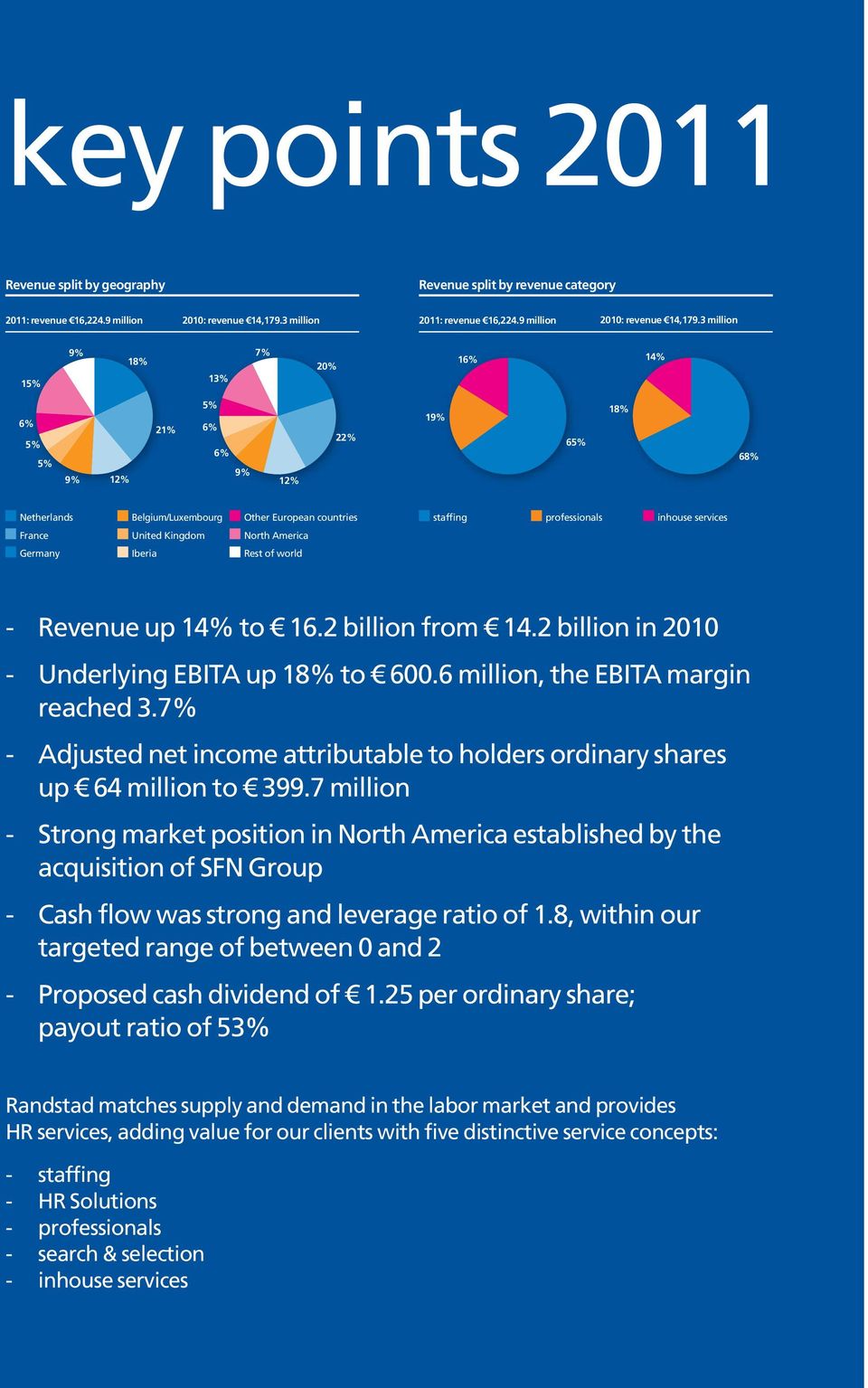
3 key points 2011 Revenue split by geography Revenue split by revenue category 2011: revenue 16,224.9 million 2010: revenue 14,179.3 million 2011: revenue 16,224.9 million 2010: revenue 14,179.3 million 15% 9% 18% 13% 7% 20% 16% 14% 6% 5% 5% 9% 12% 21% 5% 6% 6% 9% 12% 22% 19% 65% 18% 68% Netherlands Belgium/Luxembourg Other European countries staffing professionals inhouse services France United Kingdom North America Germany Iberia Rest of world - Revenue up 14% to 16.2 billion from 14.2 billion in Underlying EBITA up 18% to million, the EBITA margin reached 3.7% - Adjusted net income attributable to holders ordinary shares up 64 million to million - Strong market position in North America established by the acquisition of SFN Group - Cash flow was strong and leverage ratio of 1.8, within our targeted range of between 0 and 2 - Proposed cash dividend of 1.25 per ordinary share; payout ratio of 53% Randstad matches supply and demand in the labor market and provides HR services, adding value for our clients with five distinctive service concepts: - staffing - HR Solutions - professionals - search & selection - inhouse services
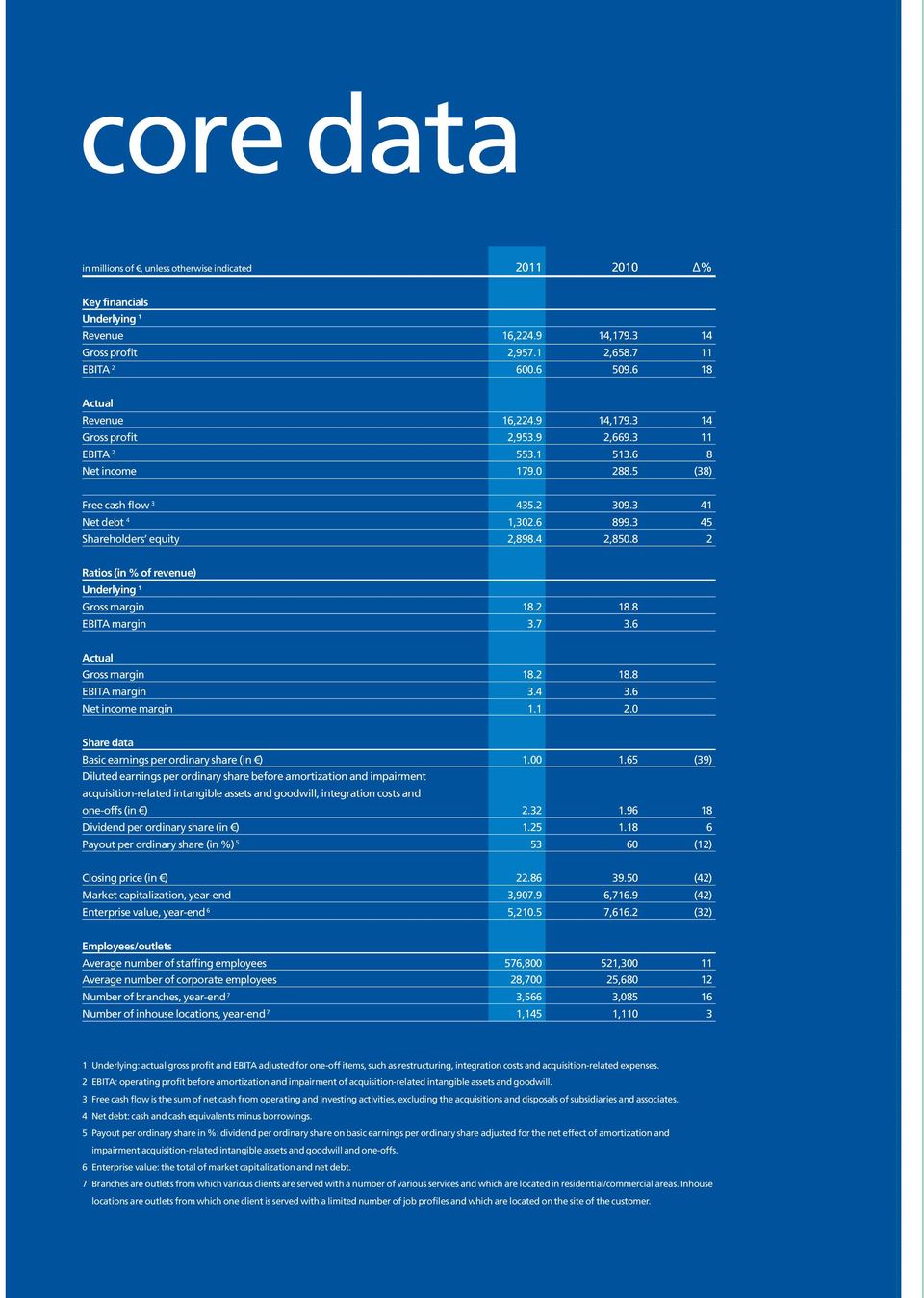
4 core data in millions of, unless otherwise indicated % Key financials Underlying 1 Revenue 16, , Gross profit 2, , EBITA Actual Revenue 16, , Gross profit 2, , EBITA Net income (38) Free cash flow Net debt 4 1, Shareholders equity 2, , Ratios (in % of revenue) Underlying 1 Gross margin EBITA margin Actual Gross margin EBITA margin Net income margin Share data Basic earnings per ordinary share (in ) (39) Diluted earnings per ordinary share before amortization and impairment acquisition-related intangible assets and goodwill, integration costs and one-offs (in ) Dividend per ordinary share (in ) Payout per ordinary share (in %) (12) Closing price (in ) (42) Market capitalization, year-end 3, ,716.9 (42) Enterprise value, year-end 6 5, ,616.2 (32) Employees/outlets Average number of staffing employees 576, , Average number of corporate employees 28,700 25, Number of branches, year-end 7 3,566 3, Number of inhouse locations, year-end 7 1,145 1, Underlying: actual gross profit and EBITA adjusted for one-off items, such as restructuring, integration costs and acquisition-related expenses. 2 EBITA: operating profit before amortization and impairment of acquisition-related intangible assets and goodwill. 3 Free cash flow is the sum of net cash from operating and investing activities, excluding the acquisitions and disposals of subsidiaries and associates. 4 Net debt: cash and cash equivalents minus borrowings. 5 Payout per ordinary share in %: dividend per ordinary share on basic earnings per ordinary share adjusted for the net effect of amortization and impairment acquisition-related intangible assets and goodwill and one-offs. 6 Enterprise value: the total of market capitalization and net debt. 7 Branches are outlets from which various clients are served with a number of various services and which are located in residential/commercial areas. Inhouse locations are outlets from which one client is served with a limited number of job profiles and which are located on the site of the customer.
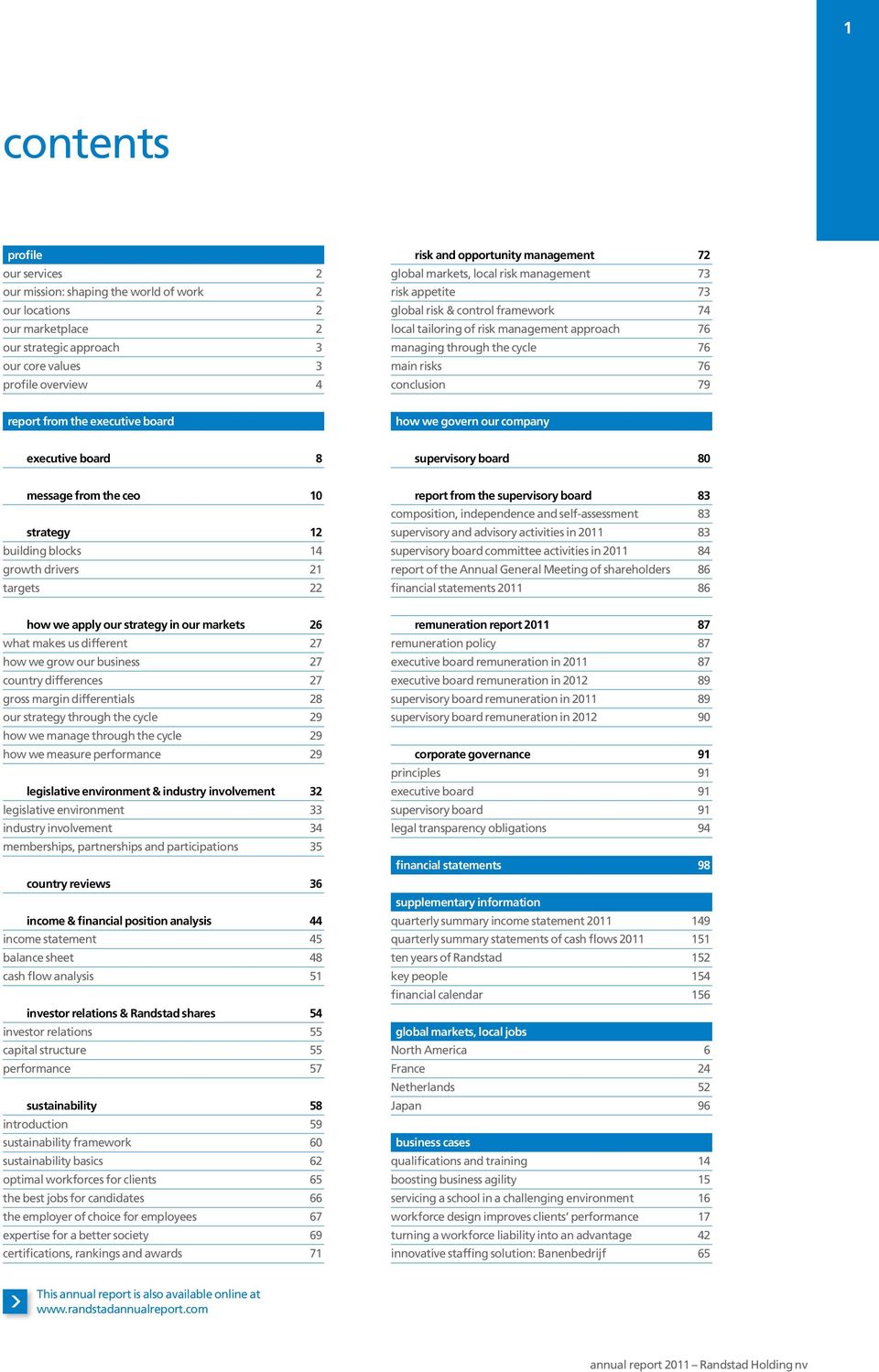
5 1 contents profile our services 2 our mission: shaping the world of work 2 our locations 2 our marketplace 2 our strategic approach 3 our core values 3 profile overview 4 risk and opportunity management 72 global markets, local risk management 73 risk appetite 73 global risk & control framework 74 local tailoring of risk management approach 76 managing through the cycle 76 main risks 76 conclusion 79 report from the executive board how we govern our company executive board 8 supervisory board 80 message from the ceo 10 strategy 12 building blocks 14 growth drivers 21 targets 22 report from the supervisory board 83 composition, independence and self-assessment 83 supervisory and advisory activities in supervisory board committee activities in report of the Annual General Meeting of shareholders 86 financial statements how we apply our strategy in our markets 26 what makes us different 27 how we grow our business 27 country differences 27 gross margin differentials 28 our strategy through the cycle 29 how we manage through the cycle 29 how we measure performance 29 legislative environment & industry involvement 32 legislative environment 33 industry involvement 34 memberships, partnerships and participations 35 country reviews 36 income & financial position analysis 44 income statement 45 balance sheet 48 cash flow analysis 51 investor relations & Randstad shares 54 investor relations 55 capital structure 55 performance 57 sustainability 58 introduction 59 sustainability framework 60 sustainability basics 62 optimal workforces for clients 65 the best jobs for candidates 66 the employer of choice for employees 67 expertise for a better society 69 certifications, rankings and awards 71 remuneration report remuneration policy 87 executive board remuneration in executive board remuneration in supervisory board remuneration in supervisory board remuneration in corporate governance 91 principles 91 executive board 91 supervisory board 91 legal transparency obligations 94 financial statements 98 supplementary information quarterly summary income statement quarterly summary statements of cash flows ten years of Randstad 152 key people 154 financial calendar 156 global markets, local jobs North America 6 France 24 Netherlands 52 Japan 96 business cases qualifications and training 14 boosting business agility 15 servicing a school in a challenging environment 16 workforce design improves clients performance 17 turning a workforce liability into an advantage 42 innovative staffing solution: Banenbedrijf 65 This annual report is also available online at
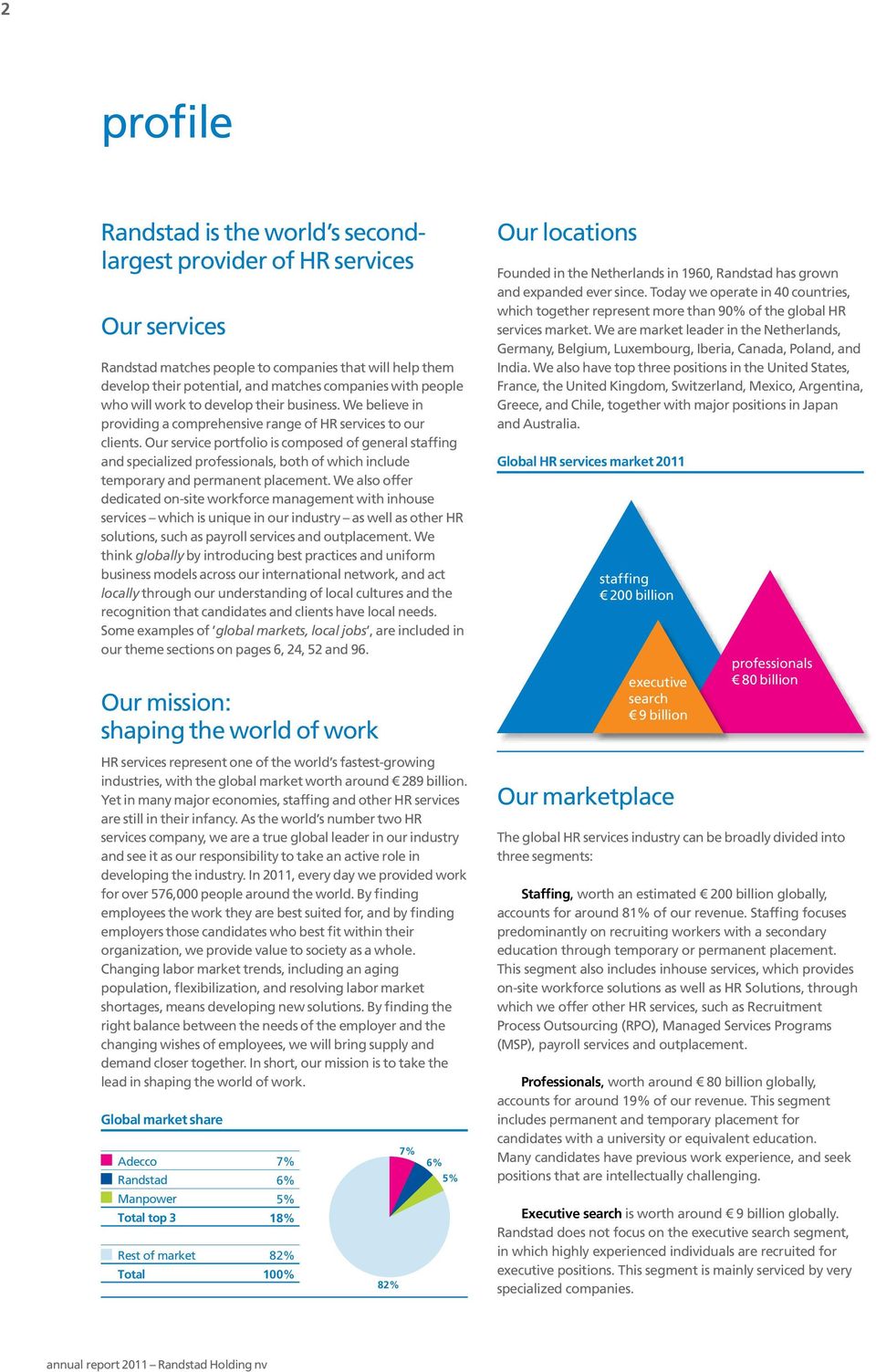
6 2 profile Randstad is the world s secondlargest provider of HR services Our services Randstad matches people to companies that will help them develop their potential, and matches companies with people who will work to develop their business. We believe in providing a comprehensive range of HR services to our clients. Our service portfolio is composed of general staffing and specialized professionals, both of which include temporary and permanent placement. We also offer dedicated on-site workforce management with inhouse services which is unique in our industry as well as other HR solutions, such as payroll services and outplacement. We think globally by introducing best practices and uniform business models across our international network, and act locally through our understanding of local cultures and the recognition that candidates and clients have local needs. Some examples of global markets, local jobs, are included in our theme sections on pages 6, 24, 52 and 96. Our mission: shaping the world of work HR services represent one of the world s fastest-growing industries, with the global market worth around 289 billion. Yet in many major economies, staffing and other HR services are still in their infancy. As the world s number two HR services company, we are a true global leader in our industry and see it as our responsibility to take an active role in developing the industry. In 2011, every day we provided work for over 576,000 people around the world. By finding employees the work they are best suited for, and by finding employers those candidates who best fit within their organization, we provide value to society as a whole. Changing labor market trends, including an aging population, flexibilization, and resolving labor market shortages, means developing new solutions. By finding the right balance between the needs of the employer and the changing wishes of employees, we will bring supply and demand closer together. In short, our mission is to take the lead in shaping the world of work. Global market share Adecco Randstad Manpower Total top 3 Rest of market Total 7% 6% 5% 18% 82% 100% 82% 7% 6% 5% Our locations Founded in the Netherlands in 1960, Randstad has grown and expanded ever since. Today we operate in 40 countries, which together represent more than 90% of the global HR services market. We are market leader in the Netherlands, Germany, Belgium, Luxembourg, Iberia, Canada, Poland, and India. We also have top three positions in the United States, France, the United Kingdom, Switzerland, Mexico, Argentina, Greece, and Chile, together with major positions in Japan and Australia. Global HR services market 2011 staffing 200 billion executive search 9 billion Our marketplace professionals 80 billion The global HR services industry can be broadly divided into three segments: Staffing, worth an estimated 200 billion globally, accounts for around 81% of our revenue. Staffing focuses predominantly on recruiting workers with a secondary education through temporary or permanent placement. This segment also includes inhouse services, which provides on-site workforce solutions as well as HR Solutions, through which we offer other HR services, such as Recruitment Process Outsourcing (RPO), Managed Services Programs (MSP), payroll services and outplacement. Professionals, worth around 80 billion globally, accounts for around 19% of our revenue. This segment includes permanent and temporary placement for candidates with a university or equivalent education. Many candidates have previous work experience, and seek positions that are intellectually challenging. Executive search is worth around 9 billion globally. Randstad does not focus on the executive search segment, in which highly experienced individuals are recruited for executive positions. This segment is mainly serviced by very specialized companies.
7 3 Our strategic approach Randstad s strategy is based on four building blocks: strong concepts, best people, excellent execution and superior brands. Strong concepts We offer five distinct global service concepts to our clients and candidates: - staffing; - HR Solutions; - professionals; - search & selection; - inhouse services. Each concept is based on best practices and proven procedures, which produce efficient working methods and a leading service delivery. The concepts can be rapidly replicated and leveraged in other markets, and are relatively easy to adapt to meet specific needs. Our service concepts are recognized for their consistency and quality of delivery, which means all of our clients know they can trust Randstad to meet their needs globally. Key elements of our concepts include deploying a unit structure in staffing, and a team structure in professionals. The units or teams operate in a specific geographic area or focus on certain job profiles. Best people All our corporate employees benefit from the focus on their development and the opportunities we provide to help them achieve their full potential. Best people acknowledges the importance of our corporate staff in maintaining and building on our success and position in the market. The true value of any business is in its people and we are very proud of our employees. Excellent execution We have blueprints for the many best practice-based processes we execute every day. Standardization allows our consultants to focus more on servicing our clients and candidates. One example is our field steering model, which we have developed to maximize productivity and ensure we can respond to changing market circumstances immediately. This model provides local operational managers with business data on a weekly basis, helping them steer the business. More information on this model can be found on page 19. Superior brands Our focus on recognizable and superior brands ensures that clients and candidates know who we are, which helps to recruit and retain the best people. In most markets we operate under the Randstad brand, and when market share allows, we introduce Tempo-Team as our second brand. Our core values We continue to adhere to and live by our core values, established in the company s early days: to know, serve and trust, striving for perfection and simultaneous promotion of all interests. Our values shape our culture, and help us develop, grow, and better serve our clients, candidates and other stakeholders. to know We are experts. We know our clients, their companies, our candidates and our business. In our business it s often the details that count the most. to serve We succeed through a spirit of excellent service, exceeding the core requirements of our industry. to trust We are respectful. We value our relationships and treat people well. striving for perfection We always seek to improve and innovate. We are here to delight our clients and candidates in everything we do. This gives us the edge. simultaneous promotion of all interests We see the bigger picture, and take our social responsibility seriously. Our business must always benefit society as a whole. Our shared culture, expressed through our behavior, is a clear indicator of the way we live our values. The better we know our clients and candidates and the better our rapport with them is, the better we are at matching their needs and exceeding their expectations. We can only promote the interests of all our stakeholders if we know them well. Our thorough knowledge of them and our business enables us to serve them better. Our engagement with and service to our stakeholders builds mutual trust. This trust is enhanced by continually striving for perfection and simultaneously promoting the interests of our stakeholders and society in general. The values we share serve as a compass for everyone at Randstad, guiding our behavior and representing the foundation of our culture. Our continuing success, and our reputation for integrity, service and professionalism, are based on them.

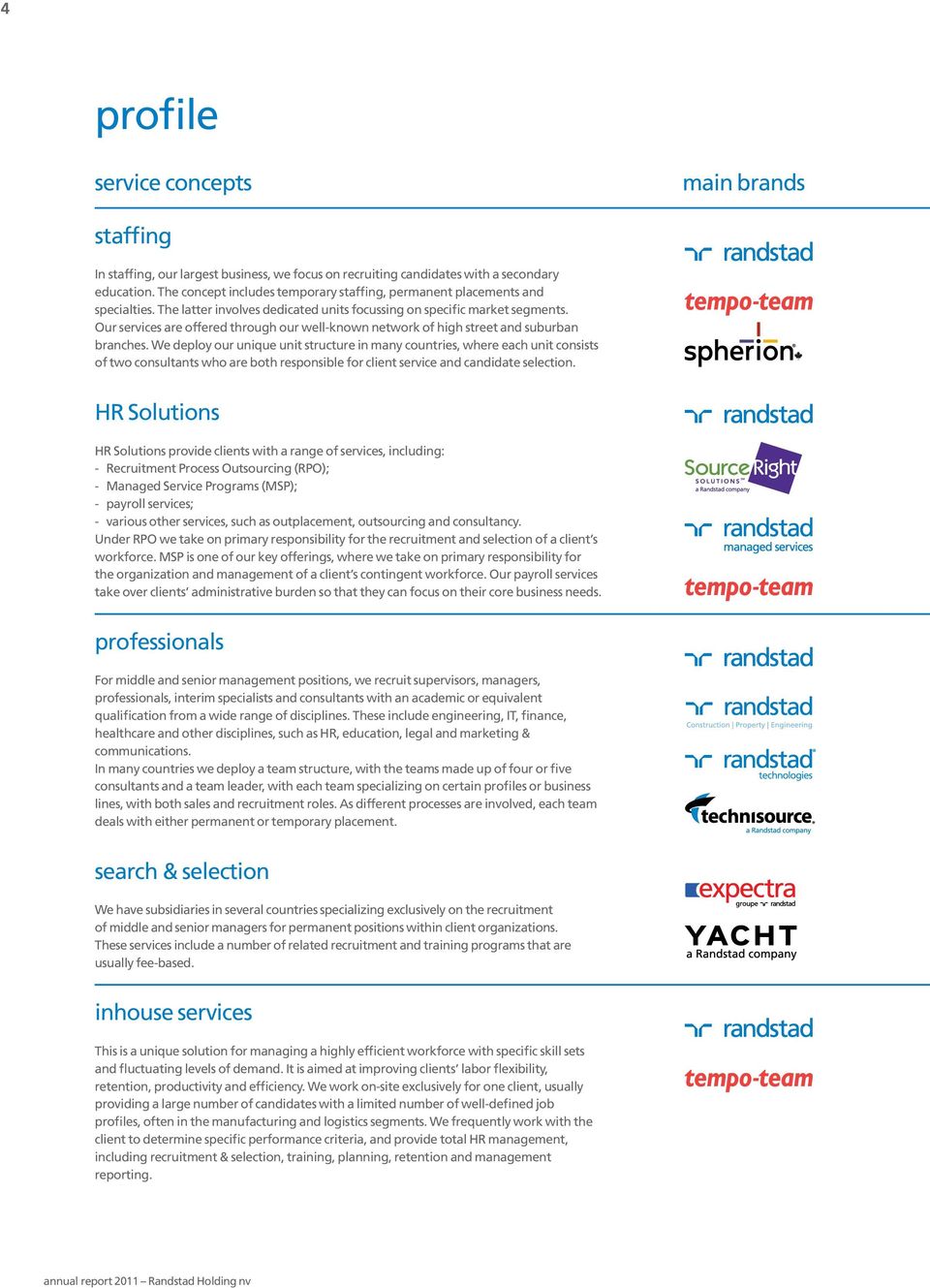
8 4 profile service concepts main brands staffing In staffing, our largest business, we focus on recruiting candidates with a secondary education. The concept includes temporary staffing, permanent placements and specialties. The latter involves dedicated units focussing on specific market segments. Our services are offered through our well-known network of high street and suburban branches. We deploy our unique unit structure in many countries, where each unit consists of two consultants who are both responsible for client service and candidate selection. HR Solutions HR Solutions provide clients with a range of services, including: - Recruitment Process Outsourcing (RPO); - Managed Service Programs (MSP); - payroll services; - various other services, such as outplacement, outsourcing and consultancy. Under RPO we take on primary responsibility for the recruitment and selection of a client s workforce. MSP is one of our key offerings, where we take on primary responsibility for the organization and management of a client s contingent workforce. Our payroll services take over clients administrative burden so that they can focus on their core business needs. professionals For middle and senior management positions, we recruit supervisors, managers, professionals, interim specialists and consultants with an academic or equivalent qualification from a wide range of disciplines. These include engineering, IT, finance, healthcare and other disciplines, such as HR, education, legal and marketing & communications. In many countries we deploy a team structure, with the teams made up of four or five consultants and a team leader, with each team specializing on certain profiles or business lines, with both sales and recruitment roles. As different processes are involved, each team deals with either permanent or temporary placement. search & selection We have subsidiaries in several countries specializing exclusively on the recruitment of middle and senior managers for permanent positions within client organizations. These services include a number of related recruitment and training programs that are usually fee-based. inhouse services This is a unique solution for managing a highly efficient workforce with specific skill sets and fluctuating levels of demand. It is aimed at improving clients labor flexibility, retention, productivity and efficiency. We work on-site exclusively for one client, usually providing a large number of candidates with a limited number of well-defined job profiles, often in the manufacturing and logistics segments. We frequently work with the client to determine specific performance criteria, and provide total HR management, including recruitment & selection, training, planning, retention and management reporting.
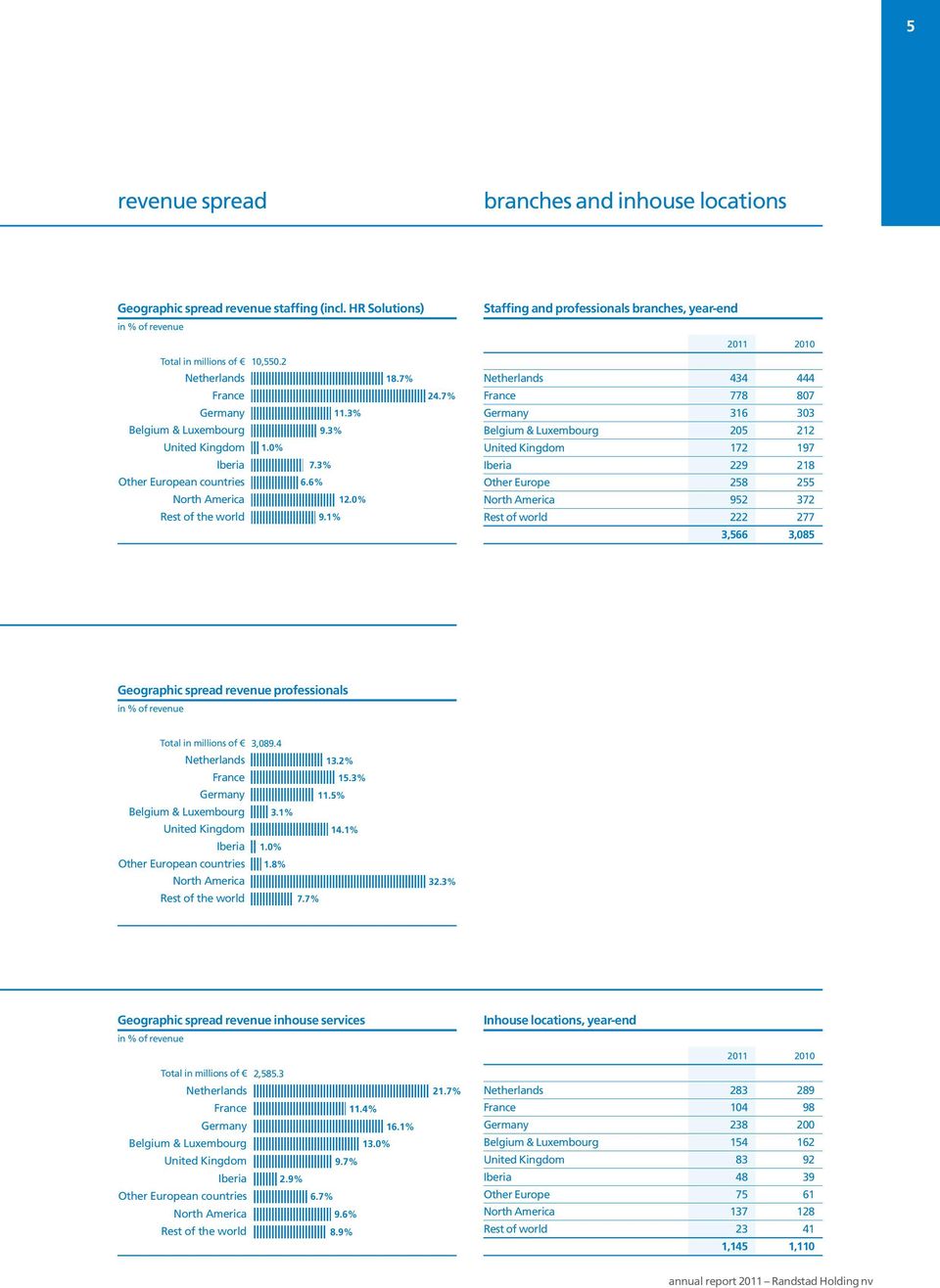
9 5 revenue spread branches and inhouse locations Geographic spread revenue staffing (incl. HR Solutions) in % of revenue Total in millions of 10,550.2 Netherlands 18.7% France 24.7% Germany 11.3% Belgium & Luxembourg 9.3% United Kingdom 1.0% Iberia 7.3% Other European countries 6.6% North America 12.0% Rest of the world 9.1% Staffing and professionals branches, year-end Netherlands France Germany Belgium & Luxembourg United Kingdom Iberia Other Europe North America Rest of world ,566 3,085 Geographic spread revenue professionals in % of revenue Total in millions of Netherlands France Germany Belgium & Luxembourg United Kingdom Iberia Other European countries North America Rest of the world 3, % 15.3% 11.5% 3.1% 14.1% 1.0% 1.8% 7.7% 32.3% Geographic spread revenue inhouse services in % of revenue Total in millions of 2,585.3 Netherlands France Germany Belgium & Luxembourg United Kingdom Iberia 2.9% Other European countries North America Rest of the world 11.4% 16.1% 13.0% 9.7% 6.7% 9.6% 8.9% 21.7% Inhouse locations, year-end Netherlands France Germany Belgium & Luxembourg United Kingdom Iberia Other Europe North America Rest of world ,145 1,110
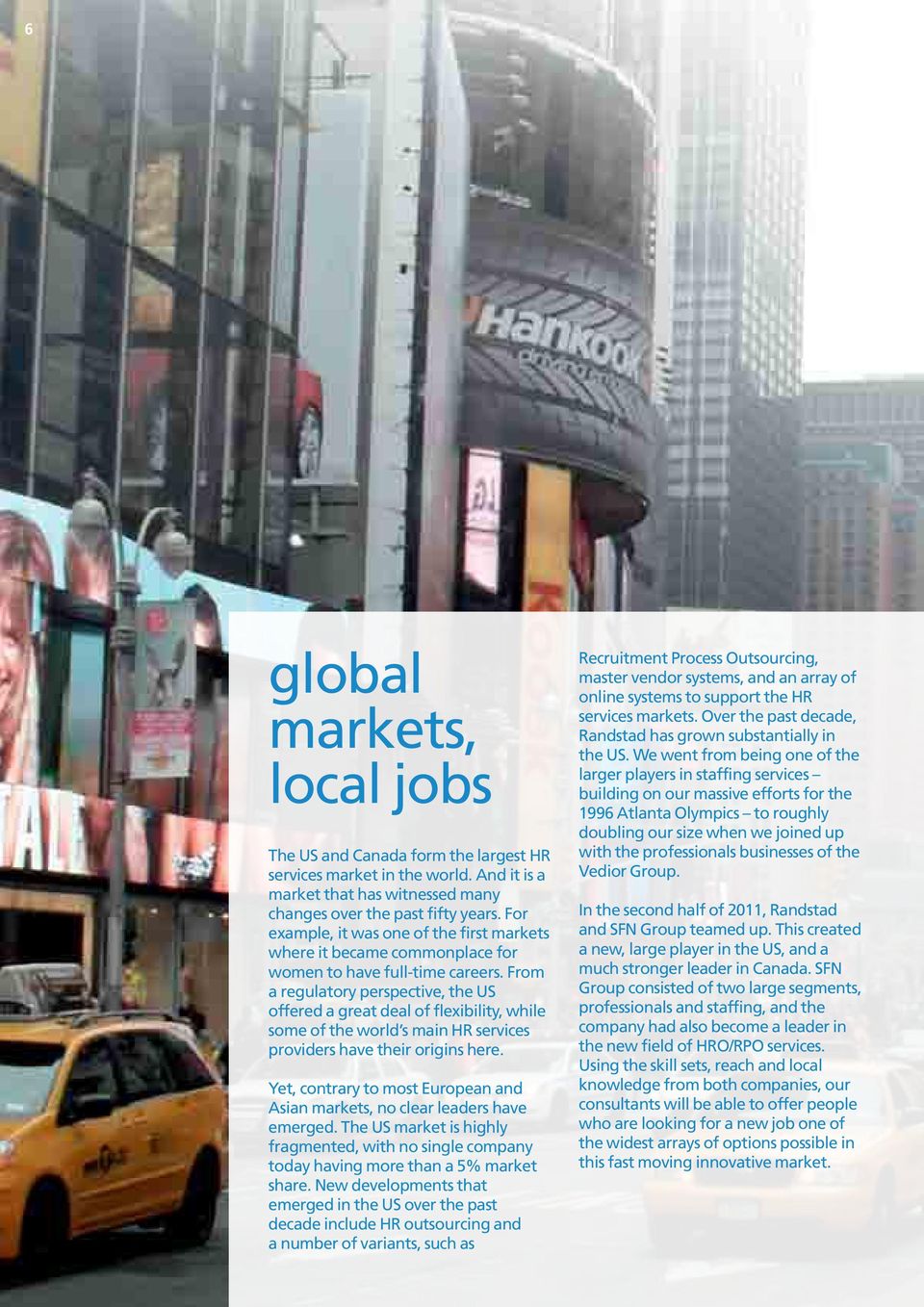
10 6 campaign Iedereen heeft iets met Randstad The Netherlands global markets, local jobs The US and Canada form the largest HR services market in the world. And it is a market that has witnessed many changes over the past fifty years. For example, it was one of the first markets where it became commonplace for women to have full-time careers. From a regulatory perspective, the US offered a great deal of flexibility, while some of the world s main HR services providers have their origins here. Yet, contrary to most European and Asian markets, no clear leaders have emerged. The US market is highly fragmented, with no single company today having more than a 5% market share. New developments that emerged in the US over the past decade include HR outsourcing and a number of variants, such as Recruitment Process Outsourcing, master vendor systems, and an array of online systems to support the HR services markets. Over the past decade, Randstad has grown substantially in the US. We went from being one of the larger players in staffing services building on our massive efforts for the 1996 Atlanta Olympics to roughly doubling our size when we joined up with the professionals businesses of the Vedior Group. In the second half of 2011, Randstad and SFN Group teamed up. This created a new, large player in the US, and a much stronger leader in Canada. SFN Group consisted of two large segments, professionals and staffing, and the company had also become a leader in the new field of HRO/RPO services. Using the skill sets, reach and local knowledge from both companies, our consultants will be able to offer people who are looking for a new job one of the widest arrays of options possible in this fast moving innovative market. further details regarding this campaign can be found at
11 Rick Kremer US I have worked with Randstad Technologies in Denver for over seven years, and they are outstanding people who always work hard to find me the best consulting opportunities. 7
12 8 heading executive board Brian Wilkinson (1956, British) --Joined Randstad in Appointed to the executive board in 2008 Jacques van den Broek (1960, Dutch) --Joined Randstad in Appointed to the executive board in 2004 Greg Netland (1962, American) --Joined Randstad in Appointed to the executive board in 2008 Background After graduating in English literature and with many years in the UK staffing and recruitment industry already behind him, Brian Wilkinson joined Vedior in 1999 as UK development manager. He became a member of Vedior s board of management in He was appointed to the Randstad executive board following the merger with Vedior. Responsibilities Brian Wilkinson is responsible for the United Kingdom, Australia & Pacific, the Middle East, India, Malaysia, Singapore, China and Hong Kong. Background After graduating in law, Jacques van den Broek held a management position with an international trading company until he joined Randstad as branch manager. Appointments followed as regional director in the Netherlands and, subsequently, marketing director Europe. In 2002, he moved to Capac Inhouse Services as managing director, also taking on responsibility for Randstad in Denmark and Switzerland. Responsibilities Jacques van den Broek is responsible for France, Belgium & Luxembourg, Poland, Switzerland, Yacht Netherlands and global client solutions. Background After graduating in economics, Greg Netland joined Sapphire Technologies in He played a key role in Sapphire s integration with Select Appointments in 1994, and in Select s merger with Vedior in He was promoted to COO and executive vice-president of business development of Vedior North America in 2001, and was appointed CEO of Vedior North America in He joined Vedior s board of management in He was appointed to the Randstad executive board following the merger with Vedior. Responsibilities Greg Netland is responsible for the US, Canada and Mexico. Greg Netland has decided not to be reappointed for the next period and will leave the company during the course of He will be replaced by Linda Galipeau, whose appointment is subject to shareholder approval.

13 9 Ben Noteboom (1958, Dutch) CEO and chairman of the executive board --Joined Randstad in Appointed to the executive board in Appointed as CEO and chairman of the executive board in 2003 Background After graduating in law, Ben Noteboom held international management positions with a major chemical company. After joining Randstad, he was initially responsible for the integration of a number of major acquisitions. He then held a series of senior management positions and started inhouse services, for which he had Europe-wide responsibility from He is also a supervisory board member of Royal Ahold. Responsibilities In addition to his chairmanship of the executive board, Ben Noteboom is responsible for Randstad in the Netherlands, Group HR, IT, marketing & communications, business concept development, innovation, legal and public affairs. Leo Lindelauf (1951, Dutch) --Joined Randstad in Appointed to the executive board in 2001 Background Following his education at an academy for social studies, Leo Lindelauf completed a study in industrial engineering and management science. He began his career as a community worker. On joining Randstad he worked as district manager and regional manager before being appointed regional director in the Netherlands. He became managing director of Tempo-Team in 1994 and managing director operations for Randstad Europe, including the position of managing director Randstad Netherlands, in Responsibilities Leo Lindelauf is responsible for Germany, Spain, Italy, Portugal and Brazil, as well as for Tempo-Team in the Netherlands. Robert-Jan van de Kraats (1960, Dutch) CFO and vice-chairman of the executive board --Joined Randstad in Appointed to the executive board in Appointed as vice-chairman of the executive board in 2006 Background A certified auditor, Robert-Jan van de Kraats began his career with one of the big four accountancy firms. In 1989, he joined an international technology group as finance and IT director for the Netherlands. He held various senior positions with an international credit insurance group from 1994 and in 1999 was appointed CFO and member of its managing board. He joined Randstad in 2001 as CFO. He is also a supervisory board member of Ordina and SNS Reaal. Responsibilities Robert-Jan van de Kraats is responsible for finance & accounting, tax, treasury, business risk & audit, investor relations and shared service centers (Netherlands). He is also responsible for Japan, the Nordics, Eastern Europe, Argentina, Chile and Uruguay.

14 10 heading message from the CEO Obitatur sitiam et qui arias ut laborepero tem vidi rectur sam ipsandus erae omnis cus ant, sum et quis dus nis ra sus et quaepel iquam, accullabo. Sinci cusandantio. Ugit fugite quia voluptas es sime vid magnita tatus. Cab is voluptus. Mus et volorestios ditationsera volore peliquassit illent ad eliquunt utem sum, coreicidus et magnata accus, quis quaeper isitaepe none veniasp istiunt ipsaper itiossit aut modita dolut quam ius as nonem quiaeria dolorem poribusdae aspitate re voluptat quiae nis aut quibea il iumquist ut harum, ut ium iliqui corro eos si coreped que occuscit ra ipic te modipis dunt dempore icatem renduci atibus.

15 11 Dear stakeholder, 2011 was an interesting year with several milestones marking the continuous growth and development of Randstad as a global leader in the world of work. We were able to put over 576,000 people to work every day, some 55,000 more than in Revenue in millions of 2008 pro forma % 16,991.6 (4) 12,399.9 (27) 14, , One of the highlights was the acquisition of SFN Group in North America, the largest market in our industry. As a result, we became the third-largest HR services provider in the US, and reinforced our market leadership in Canada. We are now a very strong player in North America, with leading positions in every major industry segment in staffing and professionals. The integration process is well on track and we expect to complete it by the end of Another milestone was the completion of the integration and rebranding of FujiStaff in Japan. An impressive performance considering the consequences of the earthquake earlier in the year. With the completed rebranding of several US professionals businesses into Randstad, all major operating companies are now branded Randstad or Tempo-Team. While North America continued to lead the way and grew strongly, in Europe growth has not followed the classical recovery pattern. Across Europe we saw a continuation of the market recovery in the first half of the year, turning into a slow-down in the second half. France and Germany did relatively well, but Southern Europe faced a more difficult market. Our combined Dutch businesses grew by 4% organically, and Randstad Netherlands gained further market share. Our overall revenue grew by 14% to 16.2 billion. Our adjusted net income attributable to holders of ordinary shares was up 19% to million compared to million in We reinforced our focus on field steering and launched various initiatives to enrich our business mix. We remain confident about achieving our strategic targets. Our solid financial position enabled us to finance the acquisition of SFN Group and the leverage ratio was well within our targeted range of between 0 and 2. For 2011, we maintain our dividend policy and propose a dividend of 1.25 per share. On an industry level, in the final quarter of 2011 we saw the implementation of the EU Agency Work Directive (AWD), which is an important step in lifting restrictions and improving the position of agency work across the European Union. This is all the more relevant as private employment agencies play a pivotal role in social and economic progress, job creation, and assisting clients to maintain their competitive advantage during changes in the employment market. We welcome the implementation of the AWD and actively support it. We continued to focus on our employee engagement activities. Our annual people survey confirmed that engagement further improved. Talent management remains a key priority. Over 500 top managers from around the world EBITA, underlying in millions of 2008 pro forma Net debt in millions of Margin % 2.5% 3.6% 3.7% participated in 15 different talent development programs at our Frits Goldschmeding Academy. One of our principles is to fill 80% of our management positions internally, a target that we again exceeded in Our people are our biggest asset, and I would like to thank them for their continued commitment. In March, Frits Goldschmeding, the founder and for many years the driving force behind Randstad, stepped down as member of the supervisory board after serving the maximum of three four-year terms. Frits founded Randstad in 1960, and he has defined staffing in the Netherlands and beyond. We are grateful for his long-term and valuable contribution to the company and feel strengthened by his continuing commitment to Randstad, most notably as its leading shareholder. At the beginning of 2012, Greg Netland indicated that he would not serve a second term as a member of the executive board. Greg will leave during the course of the year to help ensure a smooth transition. We are greatly indebted to Greg for his contribution to Randstad and we are sad to see such an amiable industry veteran go. The proposed appointment of Linda Galipeau as member of the executive board is clear evidence of the success of our talent management process. Of course, we would be unable to perform without the support of our stakeholders. I would therefore like to thank you for your continued involvement, and look forward to a successful Ben Noteboom 1, Leverage ratio 1,

16 12 strategy We operate in cyclical markets with structural growth. To capture these growth opportunities, we have built our strategy around four building blocks: strong concepts, best people, excellent execution and superior brands. This section provides an overview of our strategy and the progress we made in 2011 in realizing our strategic targets. building blocks strong concepts 14 best people 18 excellent execution 19 superior brands 20 growth drivers need for flexibility 21 demographics 21 deregulation 21 clients looking for total offering 22 targets 22
17 13 We operate in an industry with enormous global growth potential. Being active in countries representing over 90% of the global HR services market, our strategy has been designed to capitalize on the structural growth in the markets in which we operate. Our strategy is illustrated below, and is composed of a number of primary components. The building blocks on the left represent the strategic ingredients for success, and are made up of the core components of our business. The external growth drivers are found on the right. They are composed of the four elements that we believe are key to structural growth within the industry. In combination, they enable us to grow our business in all five service offerings, shown in the center, and to reach our strategic targets, which are listed on the bottom. Growth drivers & strategy building blocks - strong concepts search & selection staffing growth drivers - need for flexibility professionals - best people - excellent execution - superior brands inhouse hr solutions - demographics - deregulation - clients looking for total offering targets - EBITA margin of 5% to 6% through the cycle, not below 4% in a normal downturn - midterm EBITA margins of 4% to 5% for inhouse services, 5% to 7% for staffing and ~10% for professionals - continuous market share gains - sound financial position; leverage ratio of between 0 and 2 growth drivers - Need for flexibility: A workforce with the right flexibility increases productivity and improves competitiveness of our clients. Candidates benefit from a better competitive position in the labor market by gaining more diversified experience and therefore becoming more attractive. Additionally they benefit through new work arrangements, such as flexible working hours, part-time work, and temporary work. - Demographics: Populations are changing. Scientific research clearly indicates that quantitative and qualitative skill shortages will become more acute in the future, led by an aging population and declining population growth in many Western countries. Understanding and responding to changing demographics is vital to our future success. - Deregulation: Deregulation is a key market growth driver. We advocate the lifting of unjustified restrictions in overregulated markets, while pushing for a fair and effective regulatory environment in markets where this has yet to be introduced. We believe that the removal of restrictions will accelerate growth. - Clients looking for total offering: Clients are increasingly looking for total service offerings with fewer suppliers. As a global leader we are ideally positioned to provide clients with the right candidates and solutions. building blocks - Strong concepts: Our service concepts reflect the needs of our clients and candidates. They are the foundation of our business. - Best people: Acknowledges the importance of our corporate staff in maintaining and building on our success and position in the market. - Excellent execution: We use best practices across our businesses, which gives us an edge in the market place. - Superior brands: Our brands are instantly recognizable to clients and candidates, and by focussing on brand awareness we strengthen our global offering.

18 14 strategy Building block: strong concepts Staffing and specialties We operate a unit structure in the staffing segment in the majority of our markets. Each unit consists of two consultants who work within a geographic area or segment, and are jointly responsible for client service, candidate selection and the matching of clients and candidates. The consultants work as a team, ensuring that one is available at all times to assist clients and candidates. All consultants are experts in their local labor market, and become experts in their clients businesses, understanding clients needs and the candidate profiles that will best meet their requirements. This structure enables our consultants to dynamically address changing client demands. It also sets us apart from many competitors that operate separate sales and recruitment forces, leading to a better client/candidate match. Key figures by revenue category in millions of Revenue Growth 1 Total Organic Staffing 10, , % 7% Professionals 3, , % 5% Inhouse services 2, , % 21% 16, , % 9% 1 Revenue 2010 figures have been restated. Because we focus on recruiting professionals with a bachelor or master s degree as our consultants, they are known for their very high competence. Our service offering in staffing includes a range of specialties with dedicated units that focus on specific market segments, including logistics, airports and call centers. Specialties leverage our extensive branch network, our brands and front-office processes to make an above-average contribution to EBITA. Geographic spread revenue staffing (incl. HR Solutions) in % of revenue Total in millions of 10,550.2 Netherlands France Germany Belgium & Luxembourg United Kingdom 1.0% Iberia Other European countries North America Rest of the world 11.3% 9.3% 7.3% 6.6% 12.0% 9.1% 18.7% 24.7% Progress Staffing and specialties In 2011, we put more emphasis on the reinforcement of our field steering model. More information can be found on page 19 (excellent execution). We continued transferring large clients from staffing to inhouse to optimize our delivery process to clients. This enabled our consultants in the branches to focus on the SME segment. We also increased the number of specialty units in our branches. Over the course of 2011, we increased our focus on client profitability. This resulted in the termination of some contracts in countries such as the US and Poland, while in France negotiations are still ongoing. Revenue growth of our staffing businesses continued to grow solidly in the first half of 2011, mainly driven by the industryoriented countries North America, France and Germany. During the second half of 2011, growth rates gradually pulled back, mainly as a result of the strong comparison base of 2010 and uncertainty across Europe. Growth in the administrative segment was moderate throughout the year, partly hampered by lower demand from the public sector in the UK and the Netherlands. Growth of the Dutch staffing business was relatively low compared to other countries, mainly due to its exposure to the public sector. In North America, the classical recovery pattern continued in 2011 with solid growth rates in the industrial and administrative segments. The acquisition of SFN Group offers a great platform for future growth and has created leading positions in several segments. Qualifications and training Germany Ensuring that qualified candidates are matched with the right jobs is an integral part of our business. At our operations in Germany, however, we have taken it one step further. Driven by the recent economic boom in Germany, air cargo volumes in the Rhine-Main area grew significantly during This caused an increased demand at Frankfurt Airport for skilled workers to load and unload cargo aircraft. At the beginning of 2011, we decided to respond to this growing demand and, in partnership with a Frankfurt-based educational institute, launched a tailor-made training course for air cargo handling staff. The practice-oriented training course is the perfect entry into the aviation industry. The intensive full-time course has a total duration of two months and consists of a theoretical part and three weeks of practical training at the airport. On successful completion of the course, participants are issued with a certificate of participation, a forklift licence and a certificate of hazardous goods training, and can begin work at Frankfurt Airport immediately. This is a clear example of Randstad s added value to both clients and candidates. By anticipating and reacting to our client s needs, our consultants developed a solution that provided Frankfurt Airport with a motivated and educated workforce. At the same time, candidates were given the opportunity to learn a valuable skill and were given an all-important guarantee of employment.

19 15 In 2011, our staffing businesses achieved an EBITA margin of 3.9% compared to 3.8% in Profitability improvements were driven by solid productivity improvements across all regions, despite the negative impact of the French subsidies (for more information please see page 38). HR Solutions Our HR Solutions offering has developed out of Randstad s extensive experience in HR services. HR Solutions frees up the time of client HR managers by taking over many of their HR tasks, enabling them to concentrate on their company s core strategic HR issues. We provide clients with a number of key offerings: Recruitment Process Outsourcing (RPO) RPO is designed to increase the quality of clients hiring process of permanent employees, reduce their administrative burden, and their costs. Our RPO services take control of a client s entire recruitment and talent acquisition process. We provide tailor-made, own-branded and on-site HR functions that require: - management of all vacancies; - response screening and assessment; - selection and management of external agencies; - cross-border services. RPO is used by large, multinational organizations seeking strategic, operational and financial benefits. Randstad Managed Services (RMS) Within RMS we offer Managed Services Programs (MSP). In this offering we take on primary responsibility for the organization and management of a client s contingent workforce. This provides clients with greater control of their recruitment activities and transparency on their spending. These services are particularly useful for companies that want to have a single point of contact that can ensure transparency and compliance of large volumes of professional skills from several different suppliers. RMS regularly tenders in more than one country. RMS has experience with most vendor management system (VMS) technologies used to automate the hiring process flow, and provides the client with statistical management information. Payroll services Our payroll services take over our clients administrative burden so that they can focus on their core business needs. We provide a broad range of services, including: - taking care of the entire personnel administration, payroll accounting and contract management; - monitoring and addressing absenteeism; - providing a 24-7 service portal, which enables clients to register new employees or make changes and to consult specific management information. Outplacement Within outplacement we counsel and support organizations in situations when a contract between an employer and an employee has to be ended because of a strategic decision or other reasons. We assist employees in their search for a suitable job to make the transition as smooth as possible. In this segment we are market leader in the Netherlands and Belgium. Boosting business agility - North America The ability to source qualified candidates at all levels of a client s business is essential for successful Recruitment Process Outsourcing (RPO) companies. When a global technology and manufacturing company in the United States found that its RPO partner was unable to fulfill its recruitment needs, the company turned to Randstad s SourceRight team. They asked us to implement a customized end-to-end RPO solution for their US and Canadian operations. Our proposed RPO solution encompassed the entire recruiting and hiring process, from sourcing through onboarding, and it addressed all levels of talent, including high-level technical skills. With a single partner and unified process addressing all recruitment needs, Randstad s solution has driven significant value in this complex business, with measures of improvement in operational areas ranging from time-tofill to hiring manager satisfaction. In addition, Randstad s capability across a variety of key talent types delivers a significant strategic value to the organization. It enables the company to adjust quickly to talent needs across the enterprise, providing a high level of business agility and ensuring the continued alignment of talent and business strategy.
20 16 strategy Outsourcing Outsourcing is the sustainable transfer of several client activities with output responsibility both in the production/ logistics and administrative environment. Consultancy Through our consultancy services, we support clients by providing expert advice on organizational development and personal improvement, which includes: - personal employee development and coaching; - optimization of HR processes and policies; - strategic workforce planning. Progress HR Solutions Our managed services business performed well during the year, with significant new client wins in North America, Europe and the Asia-Pacific region. The 2011 VMS and MSP Supplier Competitive Landscape report by Staffing Industry Analysts ranked Randstad as the global number three in the category Managed spend and number two in the category Master supplier. Through the acquisition of SourceRight Solutions, Randstad is now also the leader in the RPO industry in the US. Payroll services have continued to move up our clients strategic value chain in 2011, as more clients use payroll services as a first step towards a comprehensive managed services platform. Payroll services contributed substantially to the outperformance of Randstad Netherlands in the Dutch market. At the end of the year, P/flex was rebranded into Randstad Payroll Solutions, in line with our branding strategy. In 2011, we also put more emphasis on the roll-out of Randstad Consultancy. Professionals and search & selection We offer a broad and deep range of candidates with a university or equivalent degree on a temporary or interim Geographic spread revenue professionals in % of revenue Total in millions of 3,089.4 Netherlands 13.2% France 15.3% Germany 11.5% Belgium & Luxembourg 3.1% United Kingdom 14.1% Iberia 1.0% Other European countries 1.8% North America Rest of the world 7.7% 32.3% basis as well as on a permanent placement basis through search & selection. Having identified a market with potential, we start with a small team of at least two consultants. The team initially focuses on a number of job profiles in one specific business line. Our experienced consultants are experts in their own specific fields, and have well-developed networks of contacts. They identify, assess and refer candidates whose skills, experience and career objectives are ideally suited to clients specific requirements. They share a single client and candidate database, while branch management provides overall direction to stimulate an integrated market approach. The performance-oriented teams are driven by individual accountability, recognizing both team and personal achievements. We source professionals and executives across a range of sectors, including engineering, IT, finance and accounting, healthcare, and other disciplines, such as HR, education, legal, and marketing. Servicing a school in a challenging environment UK Randstad Education in the UK provides schools, colleges and nurseries with teachers and support staff for both permanent and temporary positions. The UK education sector currently faces a number of challenges, including government austerity measures, increasing pupil numbers and, in the HR domain, the recently introduced Agency Workers Regulations (AWR). When the AWR was introduced on October 1, 2011, a client school in Greater Manchester discovered it faced increased costs for temporary and short-term cover if they continued using a small number of teachers, whom they preferred. As the austerity measures constrained their budgets, their first reaction was to consider reducing the number of days covered by external supply teachers, thereby reducing potential cost increases. They asked Randstad Education to work with them on finding a solution. Our suggested solution was simple yet effective. Traditionally, staffing requests made by the school would often have been for a named person that the school was familiar with. We demonstrated that by requesting cover for a job role, we could provide the school with a broader scope and introduce them to more candidates. Using a wide range of teachers allowed the school to limit cost increases, while complying with the AWR. Not only did we create an opportunity for more candidates to be introduced to the school, but we were also able to improve the standard of teaching by placing teachers within their specialist subject areas, rather than covering general classes. Although the school s original idea was to reduce the number of days covered by external supply teachers, and cut potential costs, we were able to demonstrate that they can continue to benefit from staffing.

21 17 Progress Professionals and search & selection We continued to copy and paste the best practices captured in our professionals concept across all countries. This was partly realized through the Professionals Growth Accelerator, which we launched during the course of This program aims to gradually hire over 500 consultants in the next two years, on top of our regular operational plans. In 2011, we added 190 consultants and performance exceeded expectations. Towards the end of 2011, we launched the Perm Booster Program, which aims at increasing the share of permanent placements. This program will follow a similar gradual approach. We remained focussed on achieving top-3 positions in the largest sectors, namely IT, finance, engineering and healthcare. In addition to strong growth across almost all countries, the acquisition of SFN offered us the global number two position in the professionals segment. Our North American professionals businesses continued to grow solidly throughout 2011, especially in IT and engineering. In Europe, the Dutch and UK businesses continued to decline following weak demand from the public sector. Other countries saw good growth. In Australia, we were successful with the implementation of the growth accelerator. The overall profitability increased from 4.2% to 4.3%, partly hampered by limited contributions from the UK and Dutch businesses. Inhouse services Inhouse services is developed to meet the structural needs of companies requiring large volume workforces with clientspecific skill sets. We work on-site tailoring our processes to our clients specific needs, improving workforce flexibility, productivity and efficiency. Our dedicated consultants and process managers provide just-in-time staffing, focussing mainly on the fast moving consumer goods (FMCG), call center, manufacturing and logistics segments. By providing a flexible work solution that is designed exclusively for each Geographic spread revenue inhouse services in % of revenue Total in millions of 2,585.3 Netherlands France Germany Belgium & Luxembourg United Kingdom Iberia Other European countries North America Rest of the world 2.9% 6.7% 9.7% 9.6% 8.9% 11.4% 13.0% 16.1% client, we optimize the workforce and drive cost effectiveness. This results in a number of notable client benefits, including: - improved labor flexibility and efficiency; - increased employee retention; - stronger employee engagement. By providing inhouse solutions, we uncouple large clients from the regular branches. This enables consultants in our branches to focus on small and medium-sized clients and capture many other opportunities. 21.7% Progress inhouse services Our offering through inhouse proved to be very successful. Following the transfer of existing clients from staffing, we have been able to grow our share of wallet. In addition, many new contracts were added in the course of the year. We continued refining our inhouse concept, sales approach and pricing structure. We also started to develop the inhouse concept for the professionals segment. Growth in inhouse continued well throughout 2011 and reached 21%. The experience of successful transfers of clients from staffing to inhouse in France, will be used during the Workforce design improves clients performance Belgium Improving the output of the flexible workforce for our clients is a key factor for the success of Randstad Inhouse Services. For our Belgian FMCG clients we designed a specific methodology to measure, evaluate and improve the performance of the flexible workforce by identifying critical points and eliminating waste in the HR management processes. As a result, we designed an integrated approach that optimized the hiring, communication and planning processes between the client, Randstad and the temporary workers. An example was the redesign of both the skill matrix and selection process to improve productivity and candidate retention. The clients were serviced on-site by a consultant and a dedicated process manager. This enabled us to closely monitor clients processes and fulfill changing labor needs with a dedicated pool of temporary workers. The results clearly show our added value: - increase of productivity; - increase of retention; - decrease in training costs; - decrease in volume of hours worked. Many clients asked if this approach could also be designed for the permanent workforce. This accelerated a cross selling initiative for HR Solutions, which was hired to design the new integrated approach for permanent staff. We are currently copying this best practice to other sectors and countries.
22 18 strategy integration of SFN Group in our North American business. Profitability reached 4.0% in 2011, within our targeted range of between 4% and 5%. Building block: best people Best people acknowledges the importance of our corporate staff in maintaining and building on our success and position in the market. The true value of any business is in its people and we are very proud of our employees. Recruiting best people Who we look for Successful recruitment at Randstad means recruiting people who have both the right skills and competences for the job, and who fit within our culture and values. Why? Because we hire people not just for a job, but for a career. Developing best people Induction program We know that an employee induction program, if organized effectively, contributes to employee engagement and organizational performance. This is why all new employees, as well as employees starting in a new role, receive a formal induction within the first few months of starting their new job. The program covers our ambitions, strategy, values, culture, history and corporate policies, as well as information and training that helps employees get started in their job. Leadership and talent management In 2011, around 500 senior managers from around the world participated in 15 different talent development programs at our Frits Goldschmeding Academy (formerly known as the Randstad Institute ). We also started a new leadership development program, called mastering the future, for the managing directors of our largest operating companies. Our programs are created in cooperation with several leading Corporate staff 1 Average Average % Netherlands 5,180 5,250 (1) France 3,950 3,900 1 Germany 2,970 2, Belgium & Luxembourg 2,120 2,090 1 United Kingdom 1,950 2,040 (4) Iberia 1,470 1,460 1 Other European countries 1,800 1, North America 4,210 2, Rest of world 4,880 3, Corporate ,700 25, Corporate staff = corporate employees + temporary staff own use institutes, such as TiasNimbas Business School, INSEAD, and IMD. The purpose of these programs is to support our future leaders in developing their skills and strategic management capabilities, which ensure their success within Randstad. Retaining best people The best people, in the right place, at the right time One of our principles is to fill 80% of our management positions internally, a target that we again exceeded in We encourage employees to help define their own career development through individual development planning. Training and development opportunities are offered to our staff at all levels. A global internal vacancy database enables employees to quickly learn about local and international career opportunities. In 2011, we placed more emphasis on international career opportunities, leading to a record number of employees moving to a new job internationally. What our people say Our people are our biggest asset and we aim for maximum engagement of all our staff. Consequently, we measure the level of engagement annually through our people survey. The survey gives us a snapshot of the drivers for engagement: satisfaction, pride, intention to stay, likelihood to recommend Randstad as an employer, and 17 other related drivers. Over 80% of our global staff responded to this survey in 2011 and overall engagement levels reached a score of 7.4 on a scale of 10. We are proud of this result which has remained consistently high, even during the economically challenging years of 2008 and The areas that score the highest in the annual survey include the clarity of Randstad s ambition, colleagues, job content and role transparency. Having the freedom and room to take initiatives are also important. Areas of improvement are quite different for each operating company. Each of them develops a specific plan to improve engagement. We view our survey results as an opportunity for further dialogue at all levels within the organization, and are committed to improve on those elements that contribute to attracting, developing and retaining our staff. Employee engagement is also stimulated by a share purchase plan for all employees and a performance share plan for a group of senior managers. Progress best people At all times, even the challenging ones, we continue to invest in our people and create the circumstances in which they can grow and have the opportunity to excel. In 2011, we paid particular attention to two dedicated programs: World League Finance World League Finance is a program aimed at developing our finance function, people and organization. It was rolled out in 2011, and provides a shared finance language for our key behaviors, skills and knowledge. This language is supported by specific tools and enables us to have constructive and aligned cooperation on performance and development needs for the global finance community as a whole. Our aim
23 19 across our companies. This blueprint includes guidance for contract terms and describes best practices for invoicing and collection processes. We organize IT processes at the country level, because differences in HR and staffing regulations mean that most synergies are realized through collaboration between operations in one country. Similarly, while we strive for one shared service center per country, more back-offices may be maintained for pragmatic reasons. The field steering model, which is outlined below, is designed to optimize our adaptability and drives productivity improvements, which is essential to generate strong conversion of gross profit growth into EBITA. is to develop a comparable program for other functions in the Group going forward. SFN integration in North America Following the acquisition of SFN Group in the US and Canada, Randstad welcomed around 3,300 new colleagues across North America. Entitled Better Together, the integration program and related communications shared a theme of mutual respect. Individually we are already leaders in the industry, while together we form an even more powerful entity, bringing increased value and services to our clients. We are better together: in people, in resources, in experience, in recruiting ability, in local knowledge, and in client understanding. Under the umbrella of the program, Randstad and SFN Group employees gathered across North America to meet one another, and get acquainted with each other s businesses, and discuss integration of their companies. In Canada, Atlanta, Boston, and Fort Lauderdale, groups got together to share current developments, collaborate on ideas about future plans, and brainstorm on how to implement best practices across the organization. For more information on the integration please see the country reviews on page 41. Building block: excellent execution We support all of our activities using best practices, which we translate into standardized work processes. This enables us to spend more time with clients and candidates, thereby gaining market share. By standardizing we can rapidly copy & paste our concepts across markets around the world, because the required processes and execution are fully developed and can be replicated with only minor adjustments. We standardize front and back-office processes and marketing processes where possible, which improves the quality of our business. We created and implemented a contract-to-cash blueprint Field steering model One of our core strengths is being able to adjust to changing market circumstances quickly and adeptly, enabling us to provide clients with the services they need, when and where they need them. Our field steering model is used to manage and direct performance across our businesses. By embedding operational performance tools at the lowest level within our organization, the field steering model helps operational managers to take the right decisions, at the right time, and translate them into action. Managers receive up-to-date, accurate reports on a weekly basis, covering a range of key performance indicators. These data enable us to manage our units and teams in the field by adapting to changing client and market demands as they occur. The field steering model also helps us identify best practices, which can then be rolled out globally across our businesses. Progress excellent execution In 2011, we revised the contract-to-cash blue print, which is derived from best practices used by our operating companies around the world. The revision stems from adjustments to our approval and information requirements policy as well as our contract liability policy. With regards to field steering, the focus in 2011 was on reinforcement. After focussing on scaling down in many countries during the crisis, we needed to ensure our field management were disciplined in using actual performance data when taking decisions on where to increase and reduce capacity. We pursued this objective by introducing several initiatives to drive awareness and focus. An example is the roll-out of a self-assessment process for all our operating companies to check their compliance with our field steering manual and take action where needed. A clear example of how our operations benefited is Randstad France, where improved focus led to higher productivity and increased market share.
24 20 strategy France and the rebranding actions in many of our markets, including Japan and our major professionals brands in the US. In its 2011 study, Brand Finance plc rated Randstad the most valuable brand in the industry, ranking it 185th out of 500 global brands. Our TV campaign in the Netherlands won several advertising awards and our awareness and image in the Netherlands continues to receive some of the best scores in our industry. We rationalized our use of sponsoring initiatives in 2011 by focussing on Williams F1, the Clipper Stad Amsterdam, and the Dutch Olympic Team in the Netherlands. The exposure from our Williams F1 sponsoring remains a significant part of our total global exposure, and we extended the contract for the 2012 season. Building block: superior brands Our superior brands are a guarantee that our clients will receive the highest quality service and the best employees worldwide. Superior brands give us better pricing options and the type of awareness that helps with selling, prospecting, and the introduction of new products and services. Superior brands also help us recruit and retain the best people, while enhancing our visibility and credibility with regulators and legislators. We use Randstad as our main brand in the majority of our markets, and introduce Tempo-Team as our second brand when market size allows. This single, centralized brand strategy enables us to leverage brand recognition, produce efficiency benefits for our online strategy, and share experiences across the Group. It also generates momentum behind our joint sponsorship initiatives, and significant cost reductions are realized by sharing campaign materials, photo databases and know-how. Net promoter scores (NPS) in most major countries also showed rising results. This loyalty metric is important to us, as it is a key indicator for future repeat business. Together with consideration and preference metrics for clients and candidates, we use it to ensure our services remain amongst the most highly rated in our markets. For more information please refer to page 66 of the sustainability section. Our international reports on the world of work also enjoyed a strong rise in popularity, with the Randstad Workmonitor report now used in 30 countries. The Randstad Award, an independent assessment on employer branding of major employers in a specific market, was presented in ten countries. In the press, according to Dow Jones Insight metrics, we lead our industry with citations on HR authority and regulation. Finally, our internal branding activities covering our 50th anniversary celebrations won a digital communication award (category online event) for our creative and effective use of web technology. Progress superior brands In 2011, we expanded and added detail to the coverage of our market intelligence systems. We aligned our web marketing measuring systems and our social media policies, and evaluated a large number of web and social media pilot tests, including a major joint test in 12 countries with LinkedIn. This experience was shared across our international marketing community. Traffic to our own sites rose another 17%, reflecting the trend of free job boards seeing an increase in traffic compared to some of the major paid job board services. Our international brand awareness continued to gain momentum. Top-of-mind awareness in the top-10 global markets rose significantly, powered by another strong rise in
25 21 Growth drivers The strategic growth drivers relate to the changing demands of clients, shifting demographic patterns and the need for a better-regulated market. Need for flexibility One of the most important drivers of long-term structural growth in our markets is our clients and our candidates need for flexibility. There is growing recognition that a more flexible workforce helps our clients improve productivity and be more competitive. Increased flexibility enables clients to adjust more effectively to changing volumes in their business. We expect flexibility to be higher on clients strategic agenda in the years ahead, and in 2011 there was already tangible evidence that they are structurally increasing the flexible component of their workforce. The demand for more flexibility from candidates is also increasing, and takes many forms. Examples include the growing interest in working from home, self-employment, working part-time, and working alternative hours. Flexibility Future external growth drivers market billion need for flexibility demographics continued deregulation clients want total offering market midterm focussing on employment security rather than job security ( flexicurity ). Part-time work, fixed-term contracts, temporary work and self-employment are becoming more common. Temporary work may play an increased role in providing intermediate employment, driving participation through its stepping-stone function. close adaptation to activity fluctuation use of agency work sustainability and creation of jobs productivity gains competitiveness improvement Demographics Supported by Randstad, studies by SEO Economic Research (Mind the Gap and Bridging the Gap, which will be followed by a third study in 2012) reveal that aging and declining population growth will cause an enormous scarcity of people with vital skills in most developed countries in the future. Unless participation rates, productivity and employee mobility are improved, it is estimated that there will be a potential employment gap of 35 million people in the EU labor market alone by As well as this quantitative gap, skills shortages will play an equally important role, as the demand for employees with specific skills continues to increase. An important potential driver of participation is to make the standard employment relationship more flexible, Deregulation Another important driver of market growth is deregulation, which we support and try to influence as much as possible. It is important to point out that Randstad is not looking for a system without rules. Rather, we strive for the lifting of unjustified restrictions in overregulated markets, and for a fair and effective regulatory environment in markets where this has yet to be introduced. New opportunities continue to open up as governments increasingly recognize the need for flexibility in their employment market, and we believe that the way forward is to find the most appropriate balanced regulation for our services. One way to achieve this is through constructive social dialogue. Our core value simultaneous promotion of all interests lies at the heart of our labor market relationships and stakeholder dialogue. Through proactive collaboration with governmental authorities, industry associations, unions and others, legislation and regulations are influenced in positive ways that stimulate sustainable growth, employment, flexibility and equal opportunities. We strongly believe that our business must always benefit society as a whole. A major step forward was taken in 2008, when the European Parliament adopted the Agency Work Directive (AWD). The AWD recognizes the positive role of agency work and allows for greater flexibility. The AWD s aim is to create an overview of all restrictions on the use of temporary agency employees by 2012 and the subsequent lifting of restrictions that are unjustified or disproportionate, such as the bans on the use of temporary agency employees in the public sector. Although the AWD had to be implemented in all EU countries by 5 December 2011, so far not all member states
26 22 strategy have complied. Implementation of the AWD across the EU is a work in progress and we are optimistic that we will witness the lifting of unjustified restrictions in the coming years. For more information on the AWD and the regulatory environment, please see the chapter legislative environment & industry involvement on pages Clients looking for a total offering Clients are not only looking for fewer suppliers of HR services, they are also looking for a broader range of HR services from the suppliers they do use, ranging from staffing services and professional recruitment to outsourcing and the provision of managed services. This will not necessarily enlarge the market, but Randstad s uniquely comprehensive portfolio of services and a strong presence in almost all major markets means we are well placed to gain market share. Many clients also look for global solutions, driven by the pursuit of further consolidation, transparency, compliance and cross-border service agreements based on quality and cost efficiency. Our global client solutions team leverages the Group s knowledge and capabilities across local markets to successfully meet this demand, with dedicated and specialist teams focussing on specific industries to provide a full range of service concepts in both established and emerging markets. Today, international clients generate around 25% of our revenue. Structural growth of our industry is often measured by the penetration rate - the percentage of temporary employees in the total working population. It is only in the most developed flexible employment markets, such as the UK and the Netherlands, where penetration rates exceed 2%. The potential structural growth over the longer term is enormous. The need for flexibility and deregulation are clear drivers, but there is also clear evidence that countries where staffing acts as a lubricant in the employment market those with relatively high penetration rates have lower unemployment rates. The trend is promising, as penetration rates on average have moved up after every cycle (see the graph below). This is partly driven by an increased share of professionals in the overall market. Penetration rates Belgium France Germany Japan Netherlands UK US Targets Our targets are: - EBITA margin of 5% to 6% through the cycle; not below 4% in a normal downturn; - EBITA margin targets for the segments of 4% to 5% for inhouse services, 5% to 7% for staffing and around 10% for professionals; - continuous market share gains; - maintaining a sound financial position (leverage ratio, or net debt divided by EBITDA, of between 0 and 2). Our overall financial goal remains to achieve an EBITA margin of 5% to 6% through the cycle. The minimum 4% EBITA margin we aim to achieve was set for a normal downturn scenario in which revenue declines by 10% for two consecutive years, followed by a 5% decline in a further year. The revenue decline during 2009 was steeper within a single year than this stress case scenario had anticipated over a three-year period. Maintaining a leverage ratio of between 0 and 2 is commensurate with an investment grade rating and is important for continuity. We continue to strive for a 5%-6% EBITA margin through the cycle, which we consider achievable in normal market circumstances with continued growth. Our EBITA margin in 2011 was 3.7%, up from 3.6% in Although the classical recovery pattern continued in North America, the unstable macro economic situation in Europe caused increased uncertainty in our markets in the second half of the year. This clearly limited growth and further recovery of our business mix, and as a result our profitability. Growth is essential for realizing our targets. Although we operate in cyclical markets, the structural growth drivers in our industry remained in place. The need for flexibility is obvious. Clients are increasingly focused on becoming more efficient and having access to knowhow and the best candidates. Demographic trends, for example, creating a growing mismatch between supply and demand for labor, require higher mobility and participation in the labor market. Other opportunities will emerge from the implementation of appropriate regulation in all our markets.
27 23 As a global HR service provider we are well-positioned to benefit from all these trends and we remain focused on: - field steering to ensure adaptability and drive productivity; - gaining market share across segments in existing countries; - leveraging our unique inhouse concept; - reinforcing our specialty approach and focusing on the SME segment; - accelerating growth in professionals and focussing on permanent placements. In 2011, we maintained focus on strong cash flow generation and the free cash flow improved 41% to 435 million. We used our free cash flow to finance the acquisition of SFN Group and to pay a dividend. Although our net debt position increased to 1,302.6 million, we maintained a solid financial position as our leverage ratio was 1.8, well within our targeted range of between 0 and 2. Therefore, we will propose to our shareholders, in line with our dividend policy, a dividend payment of 1.25 per ordinary share. By further improving our business mix, while maintaining flexibility in our cost base and our solid financial position, we are well-positioned to capture growth opportunities and realize our strategic targets. Gross margin, conversion ratio and EBITA margin Gross Margin Conversion ratio EBITA margin 1 30% 25% 20% 15% 7% 6% 5% 4% 3% 10% 2% pf 2007 pf 1 EBITA margin is shown on the right hand axis
28 24 campaign Iedereen heeft iets met Randstad The Netherlands global markets, local jobs The large French HR services market is going through a series of major changes. On the one hand, regulations hindering flexible work are slowly fading, while on the other hand concerns over government debt and the possibility of recession are worrying many. At the same time, the professionals segment in France traditionally the domain of a number of very small firms is beginning to see some powerful leaders emerge. Randstad s own thriving units in IT, finance and healthcare are examples. As employees of one of the most visible companies in its field in France, Randstad s people are in the spotlight. They make enormous efforts to positively influence French working conditions and systems, putting our core value of promoting the interests of all our stakeholders into practice, while advocating further reform towards flexibility. Our consultants in the field make thousands of decisions every day that impact a great many people who are involved in the world of work. We are extremely proud of the prizes and nominations our people have received for their work on diversity in society, and we therefore chose to make our consultants dedication and experience the central theme of our new TV campaign. The campaign serves a dual purpose: to advertise our services, certainly. But also to remind people that every day across our company, in around 900 offices, young, talented people are trying to place job applicants in the best available positions in France. further details regarding this campaign can be found at
29 Mohamed Jadid France Despite my age and my handicap, Randstad provided me with a suitable job, which means my future looks bright. 25
30 26 how we apply our strategy in our markets Randstad differentiates itself by standardizing best practices, copying them and implementing these across the Group. To grow our business, we have to consider the characteristics and maturity of a market and the gross margin we earn. We know how to manage our business through the cycle as we have gained valuable experience in the previous cycles. This section describes how we apply our strategy in our markets and how we measure our performance while realizing our targets. what makes us different 27 how we grow our business 27 country differences 27 gross margin differentials 28 our strategy through the cycle 29 how we manage through the cycle 29 how we measure performance 29
31 27 What makes us different A key factor that differentiates us from our competitors is the way we standardize best practices across our businesses. Within our staffing segment we deploy a unit structure, which is a proven concept. Each unit is made up of two consultants who know the local market environment. Consultants have a dual role. They are not only responsible for servicing clients, but also for recruiting candidates and making the match. This structure enables us to fully address clients and candidates needs. Within professionals we use teams of at least two consultants who concentrate on a specific segment or a limited number of job profiles, and provide services within temporary staffing and/or permanent placements. For inhouse services, we work on site where we develop our processes to meet clients specific needs, improving workforce flexibility, productivity and efficiency. All businesses are monitored using our field steering model. Field steering enables management to track performance and adapt to changing business circumstances by expanding or contracting the number of units, teams and consultants in the field. Like the standardization of our core activities, we have done the same for our back-offices. How we grow our business Staffing Having researched the local market thoroughly, we identify an area with sufficient market potential and a team of two consultants sets up a unit. This is the base structure that we use to grow our business. A third consultant is added when the unit reaches maximum capacity. We then add a fourth consultant when needed, and split the unit into two. As the business grows, more units are added, including specialties and new services. We then move into an adjacent area where we repeat the growth model. Professionals In professionals we start with a small team of at least two consultants, which initially focuses on a number of job profiles in one specific segment or business line. As the business grows and targets are met, we add consultants until the team consists of four to five consultants and a team leader. When growth allows, a team is split into two, focussing on a limited number of profiles, a business line and/or permanent or temporary placements. In this way we can offer our clients and candidates greater specialization, while also increasing our market share. Further expansion is based on strict criteria and ranges from specialization to expansion of geographic coverage. Controlled contraction occurs when candidate numbers fall, and is achieved by merging mature units or teams and then reducing FTE numbers. Growth model for staffing example of controlled expansion start-up unit 2 FTEs / 0 E.W. 6 months developing unit 2 FTEs / more E.W months mature unit 3 FTEs / max. E.W. split mature unit 2 FTEs / max. E.W start-up unit 2 FTEs / few E.W. E.W. = employees/candidates working example of controlled contraction mature unit 2 FTEs / too few E.W. x months mature unit 3 FTEs / E.W. trending down x months mature unit 2 FTEs mature unit 2 FTEs / too few E.W. merge -1-1 Country differences Staffing markets around the world are in different phases of development. Labor laws and penetration rates differ, and countries can be in different stages of the economic cycle. No matter how varied they are, however, they all have opportunities for growth. The graph on the following page illustrates the three phases we go through to establish, develop and copy & paste our strong service concepts, competences and best practices. We follow these phases as our market presence expands and markets mature. We are active in countries representing more than 90% of the global HR services market. We do not intend to expand in to new countries, given the potential in our current markets. In addition to focussing on organic growth, we also do bolt-on acquisitions, such as the acquisitions of FujiStaff and SFN Group, to establish leading market positions. In those countries with markets that are growing and maturing, our services continue to gain recognition. This is partly because we contribute to flexibility in the workplace and open up the labor market for the young and/or unemployed. We have also seen increased levels of deregulation in such markets, which have enabled us to deepen our penetration in staffing and inhouse services while maximizing the growth of our professionals activities.
32 28 how we apply our strategy in our markets Copy & paste organic growth strategy: three phases Time Establishing services in promising markets (largely achieved in 2008) Deepening market penetration in staffing, specialties & inhouse and maximizing professionals growth Adding new services (outplacement, RPO, managed services, etc.) premium for creating and maintaining a flexible layer in their workforce. Outsourcing HR activities Besides providing access to flexibility, we add value by taking responsibility for sourcing, interviewing and testing candidates, and arranging medical insurance and payroll administration. This enables clients to reduce the workload of their HR department, and allows their HR team to focus on activities that add further value to their business, such as talent development. In the US and the Netherlands we commonly handle the entire recruitment process, and manage several other HR functions, which drives gross margin. In France it is becoming more common to outsource such HR activities. Phase 1 Phase 2 Phase 3 Penetration rates are usually higher for mature markets where staffing has long been a reputable solution for flexibility in the workplace. Market characteristics differ, but the working environment is well-regulated in these mature markets. Both the business environment and potential candidates know and value the services Randstad offers. Growth can be achieved differently in such markets, as they are ready for differentiated staffing propositions and additional added value services, such as outplacement, RPO and managed services. Gross margin differentials Gross margin differs from market to market, with the level of gross margin achievable in each market dependent on the level of added value and business mix. The latter mainly relates to the share of permanent placement fees, while added value depends on specific characteristics of a market. Gross margin differentials NL GE FR US BE Flexibility /- ++ Outsourcing HR activities + + +/ Specialties/professionals ++ +/ Permanent placement fees Idle time management +/- ++ n.a. n.a. n.a. Lower total labor cost + + +/- +/- n.a. Flexibility There is growing recognition among clients across our markets that a more flexible labor force drives productivity and competitiveness. Flexibility is a gross margin driver in all markets in which we operate, as clients are willing to pay a Specialties/professionals The relative importance of the professionals offering differs by country. To fulfill the specific needs of our clients, the recruitment process tends to be more time consuming, so the added value perceived is reflected in higher gross margins. In the US and the UK, professionals make up a large part of the total market and are a clear gross margin driver for the sector. In most other markets, this offering is gaining traction. Permanent placement fees Permanent placement fees contribute significantly to the gross margin. In most markets, these fees are based on a certain percentage of the candidate s salary. As we do not have to pay the candidate s salary, the fee converts almost directly into gross profit. In markets with a significant share of permanent placements, like the US and the UK, the gross margin tends to be higher than in other markets. Idle time management This risk of having temporary employees on our payroll, who are not assigned to a client, is called idle time risk. Because our services provide clients with flexibility, the shift of risk is therefore added value. In Germany we are legally required to keep employees on our payroll, while in the Netherlands we allow for this predominantly in highly skilled profiles. As we have been able to successfully manage this risk, it has a positive impact on gross margin. Lower total labor cost Through our service we are able to lower the total cost of labor for our clients, as they only pay for actual hours worked, for which they are willing to pay a premium. Another benefit is achieved through a collective labor agreement, whereby sector-wide collective labor agreements reduce processing costs. These are the key reasons that clients in the Netherlands and Germany work with staffing companies. However, these sector-wide collective labor agreements do not exist in all markets. In France, for example, unit labor cost per hour for staffing is even higher than for permanent employees. This is because equal pay with permanent employees is required during the assignment and additional payments are required at the end
33 29 of an assignment. This impacts the French gross margin negatively. On balance, staffing is still cheaper for employers in France as they only pay for actual hours worked. Our strategy through the cycle We have defined our EBITA margin targets fully aware of the challenges and opportunities presented by economic cycles. During the recent downturn in 2009 we achieved significantly better financial results than we were able to during the previous, much milder downturn, in This was in part due to our field steering model, which enables operational managers to monitor and manage our businesses performance on a regular basis. At its lowest point, our EBITA margin was 2.5%, compared to 1.8% in the previous downturn. Despite a much more severe revenue decline, profitability was maintained in almost all countries, while in the previous downturn profitability was dependent on the Netherlands only. We continue using lessons learnt from the past going forward. How we manage through the cycle In managing through the cycle three factors are of major importance: revenue, costs of services and operating expenses. Revenue Our wide geographic spread and diversified business mix help us to manage the risk of revenue volatility in a downturn. Having returned to growth we also benefit from our diversified mix. Costs of services Costs of services are mostly flexible and consist largely of salaries we pay to our candidates, wage taxes and social security charges. In Germany and the Netherlands the sector has its own collective labor agreements with competitive labor costs. In return there are a limited number of commitments to our candidates. The recent downturn has shown that we can efficiently manage these commitments and related risks, such as idle time. Operating expenses In general, the more flexible the operating costs, the lower the risk. Personnel costs are the largest contributor to our cost base. Using our field steering model, we know when and where we have to increase or reduce staff numbers. Most savings in personnel expenses in the recent downturn were achieved through natural attrition, by not replacing consultants who left the organization. In 2009, we managed to decrease our annualized cost base by 800 million, of which 75% was mainly achieved by natural attrition in our personnel capacity. Bonus and commission schemes are equally flexible. In the professionals businesses in the US and the UK especially, bonus and commission schemes form a far larger proportion of total compensation than in our traditional staffing business and associated costs move with the change in volumes. Another substantial cost item is represented by accommodation costs. These costs are kept flexible by limiting the lease term to a maximum of five years. The average duration is therefore limited to three years. The recent downturn has clearly confirmed that we can adjust our branch network relatively quickly by combining offices without leaving markets. In the past few years we have made IT costs flexible by outsourcing several functions. Where possible, one national IT platform is used to lower fixed costs. We have also standardized our marketing tools by using a central photo database for all concepts, and we develop marketing campaigns and materials that are used internationally. Marketing investments are strategically important to maintain our brand awareness and to gain market share. How we measure performance We have an extensive performance management system in place. It starts with using specific performance measurement tools at the lowest level in our organization by applying field steering. Our field steering model requires our units and teams to translate information on actual performance into action on a daily basis. Up to the executive board level, our planning and control cycle is relatively operationally driven. Direct reporting lines exist between the executive board and the management teams of operating companies. As such, executive board members are closely involved with the operating companies under their responsibility. Our day-to-day performance overview includes KPIs showing our growth, productivity, profitability, working capital and cash flow. We use a variety of tools within our planning and
34 30 how we apply our strategy in our markets control cycle to assess our performance and align future strategic and investment decisions to best utilize commercial and organizational opportunities. The planning and control cycle is embedded in our risk and control framework, as set out on pages 72 to 79. Performance management The performance of each operating company is measured at various stages during the year: - Weekly overview of temp employees working (volumes); - Monthly income statement including selected nonfinancial data and a forecast; - Quarterly income statement, balance sheet, cash flow and non-financial data. Each month the executive board discuss performance with the management team of each company. The agenda includes financial and operational performance, risk management and the progress made on strategic goals. Internal and external benchmarks are used to challenge performance and to identify points for improvement. In addition to the monthly control cycle, a yearly strategic planning cycle takes place during spring and an operational planning cycle during autumn. Key performance indicators In addition to our field steering model, we use simple metrics, such as the conversion ratio (the percentage of gross profit that is converted into EBITA) in case of growth and the recovery ratio (the percentage of lost gross profit that is recovered through reduced operating expenses) in a period of contraction, to manage our profitability. Successful cost control involves reacting in time, based on transparent reporting and review procedures. Key performance indicators are used to measure and monitor performance against budgets, forecasts, the previous year, and our strategic targets. Key performance indicators key performance indicators Weekly volumes Market share Profitability Productivity Working capital Financial position Cash flow generation Gross margin Cost control Conversion Weekly volumes Weekly temp volumes act as an important indicator within our field steering model and measure the success of the units and teams. Market share Gaining market share is one of our strategic targets. We measure performance at the lowest possible level through our field steering model, as our units and teams operate in local geographical markets. Profitability Profitability highlights the quality of our top line and operational efficiency. It remains our overall financial goal to achieve an EBITA margin of 5% to 6% through the cycle. Gross margin We focus on temp margin and the contribution of permanent placements and other fee businesses. The temp margin relates to the level of gross profit generated through temporary staffing. Cost control Personnel costs are the largest contributor to operating expenses. Through the use of our field steering model we know when and where we have to add or reduce staff. Other costs are highly flexible and tightly controlled. Conversion We measure how gross profit is converted into EBITA. At an early stage of the recovery we require the incremental conversion rate of a company to be close to 100%. Once recovery is more developed, a conversion rate of 50% is required. Productivity Productivity improvements are key to achieve our profitability targets. We measure productivity in three ways: - the number of temps per consultant; - gross profit per staff member; - gross profit in relation to personnel expenses. Working capital There is a strong focus within Randstad on days sales outstanding (DSO) and working capital, which are also reflected in the bonus targets set for our senior management. As a further incentive, through a simplified EVA method, operating companies are charged for their use of operating working capital. Within working capital, trade receivables represent the component that is most important for us to influence. Our liabilities mainly comprise wage tax and social security payments to tax authorities, and those payment terms are clearly more difficult to change.
35 31 Financial position To maintain a solid financial position, we focus on our leverage ratio (net debt divided by EBITDA). It is used as guidance for dividend payment on ordinary shares and as a base for our acquisition policy. Strategically, our target range is between 0 and 2, while our bank covenants allow for 3.5. This provides us with a cushion in managing through the cycle. Net debt & leverage ratio development net debt ( m) 1,700 1, leverage ratio 1,300 1, strategic target Q Q Q Q Q Q Q Q Q Cash flow generation Better profitability and more efficient use of working capital result in sound cash generation, which we measure through the amount of free cash flow generated. Free cash flow includes operating profit and movements in working capital plus capital expenditure. In a normal year our free cash flow moves in line with the seasonal pattern in our business. While the free cash flow in the first quarter is normally low, it is negative in the second quarter as working capital requirements increase in line with higher revenue and the payment of holiday allowances. Free cash flow in the second half of the year is normally higher, based on higher revenue and profit. Traditionally we experience unwinding of working capital in December. The development in free cash flow per quarter is shown in the graph below. Free cash flow development 232 million cash tax benefits Q1 Q2 Q3 Q In a downturn, we typically see significant unwinding of working capital, as in Q1 and Q
36 32 legislative environment & industry involvement A fair, effective and competitive regulatory framework is a key growth driver for the staffing industry. It ensures that labor markets function effectively and promotes sustainable economic growth. At the European level this resulted in a minimal legal framework, the Agency Work Directive (AWD), that all EU member states need to comply with. As one of the global leaders in our industry, we play an important role in contributing to a better regulatory framework. This section illustrates the legislative environment by country, the key developments and the role we play in shaping the world of work. legislative environment 33 industry involvement 34
37 33 Legislative environment Globally, HR services companies are regulated by the International Labour Organization (ILO) Convention 181 and Recommendation 188. This Convention defines minimum standards for staffing, especially recognizing the importance of flexibility in the functioning of labor markets. Today, 23 countries worldwide including 14 countries within the European Union (EU) have ratified the Convention. Emerging markets Emerging markets, such as Turkey, India, Mexico and Malaysia, have yet to ratify the Convention, and have to establish an effective legal framework to develop the staffing business. Proper regulation is necessary to develop the industry in emerging markets, prevent unfair competition and distinguish good quality, well-regulated agency work (AW) from other irregular and often illegal forms of flexible labor. At the ILO tripartite Global Dialogue Forum on private employment agencies, held in October 2011, Ciett, the body that represents the interests of staffing companies globally, called for appropriate regulation using ILO Convention 181 as a guideline. They also called for a constructive social dialogue with trade unions and for cooperation in fighting against rogue providers that damage the image of the reputable part of the industry. Randstad actively supports this. The diagram below clearly shows how social and regulatory developments are related in establishing a sustainable industry. Mature markets In more mature staffing markets, temporary agency work is well regulated. The nature of the regulation varies from light to heavy. Nationally, staffing is regulated by general labor law supplemented by specific staffing regulation. This is complemented by collective labor agreements (CLAs) and industry self-regulation. The shared principle and aim of all staffing regulation should be to balance security and flexibility on the labor market, a so-called flexicurity model. This dynamically combines more flexibility for the labor market at large and, at the same time, enhances employment security for temporary workers. Agency Work Directive Over the last decade, governments and unions have consistently shown a greater awareness and acceptance of the benefits and added value of temporary agency work for the labor market. The positive contribution that the staffing industry brings to the labor market a stepping stone function, contribution to job creation, decreasing long-term unemployment and undeclared work is increasingly recognized. In mature markets, the staffing industry often contributes to active labor market policies, by cooperating with public employment services and government programs to achieve a more inclusive and transitional labor market. The EU has introduced a minimal legal framework the Agency Work Directive (AWD), which had to be implemented across EU member states before 2012 that on the one hand ensures that all unjustified restrictions are lifted, and on the other that temporary workers are protected via the equal treatment principle. The latter sets equal pay for temporary workers in line with permanent employees at clients. Derogations from the equal pay principle are possible by CLAs or, in countries such as the UK and Ireland where there is no established national system of collective bargaining, by tripartite agreement. The latter is an agreement between employers, government and labor unions. The AWD came into effect in the UK in October 2011, meaning temporary workers are now entitled to the same terms and conditions as permanent employees after 12 weeks of work in one assignment. EU member states were also required to perform a review of all conditions and restrictions regarding the conditions of temporary agency work and lift those that cannot be justified before Generally these restrictions can be divided into four categories: maximum length of assignments, reason of The timeline evolution of agency work acceptance social development Illegality grey zone Hostility and rejection of this new form of work relationship Legal recognition Containment of an unpopular industry, as a last resort HR provider Social tolerance Agency work accepted by trade unions, if properly regulated Normative acceptance Useful tool for labor market policies Social acceptance Agency work as an acceptable work alternative Full recognition Agency work as a desirable choice of work regulatory development No regulation Coercive regulation CLAs in addition to existing law Lifting restrictions Social partners to define regulation Appropriate regulation Source: Ciett, Adapting to change 2011
38 34 legislative environment & industry involvement restrictions are still in place and have to be reviewed and be lifted. These restrictions are often outdated and are counterproductive to the effective functioning of labor markets and job creation. A strong case is provided by the recent economic crisis, which has shown that countries with unreformed, stagnant labor markets have exhibited higher unemployment rates and have found recovery more difficult to achieve. Latin America and Northern Europe Latin America and Northern Europe (Nordic countries) have long-established staffing markets. Here, as in the younger Southern and Eastern European markets, social partners (for example unions and employers) play an active role in labor market regulation. Social acceptance of temporary staffing by all stakeholders is key to legal restrictions being lifted and, in turn, to the development of alternative flexible work arrangements and additional, complementary HR services. For more information on the legislative environment, please see our corporate website use for the assignment, set levels of pay and other benefits, and sector prohibitions. So far not all member states have complied. Implementation of the AWD across the EU is a work in progress. However, we are optimistic that we will witness the lifting of unjustified restrictions in the near future. Key country characteristics The UK, the US, Australia and Japan The UK, the US, Australia and Japan have the world s most liberal recruitment markets, although Japan s previous government proposed the enhancement of temporary worker rights by banning certain types of very flexible contracts. We hope that the new government will adapt the proposal in such a way that it will not diminish flexibility solutions for companies, as this would lead to a decrease in competitiveness and an increase in undesirable substitution by grey and black work. The Netherlands and Germany In the Netherlands and Germany, CLAs for the staffing industry are in place. These deviate from the legal equal treatment principle, as they set minimum wage levels for temporary workers and therefore help to promote flexibility in labor conditions. In the Netherlands, a grace period of 26 weeks in one assignment applies before equal pay sets in. In Germany there is no time limit to the deviation. However, CLA negotiations with an emphasis on implementing the equal pay principle are ongoing. Southern, Eastern and Central Europe The influence of the AWD on current regulation will be very limited in Southern, Eastern and Central European markets, where wage levels are already legally on par with those of comparable permanent workers working at client companies. However, in some countries (unjustified) Industry involvement We strongly believe that social dialogue and active participation in industry bodies will help produce clear, fair and workable regulations in the markets in which we operate. By investing in strong industry federations on a national, regional and global level we believe we can contribute to the future development of the HR services industry. The objectives and action plans of Ciett (International Confederation of Private Employment Agencies) and Eurociett (European Confederation of Private Employment Agencies) are well aligned with the agenda of Randstad. In May 2011, Fred van Haasteren, a former Randstad vicepresident, was elected President of Ciett. Eurociett has been chaired by Randstad director Annemarie Muntz since Labor market relationships Randstad s core value simultaneous promotion of all interests lies at the heart of our labor market relationships and stakeholder dialogue. Through proactive collaboration with governmental authorities, industry associations, unions and others, legislation and regulations are influenced in positive ways that stimulate sustainable growth, employment, flexibility and equal opportunities. Employee participation in social dialogue Employee participation in social dialogue is promoted through a network of country works councils where managers and employees across the Randstad Group regularly address work and HR-related issues. Results of these dialogues are fed into the Randstad European Platform for Social Dialogue that meets twice a year to discuss policy issues
39 35 and information relevant to Randstad Group companies. UNI-Europa, the representative labor union for skills and services in Europe, is invited to attend the international platform meetings as observers. Active dialogue with labor unions Randstad also actively engages in national and international dialogue with labor unions. At the EU level, UNI-Europa and Eurociett meet regularly in the social dialogue committee on temporary agency work, to discuss issues of mutual importance, and to further professionalize and gain more societal acceptance for the industry. As a Eurociett member, Randstad is represented in the Eurociett delegation. Moderated by the European Commission s Directorate- General for Employment, Social Affairs & Equal Opportunities, the committee met four times in The 2010/2011 work program contained issues such as promoting social dialogue by giving presentations on national CLAs, conducting research on the transitionary function of temporary work, and closely following the implementation of the AWD. Dialogue with other stakeholders Regular dialogue with our clients, suppliers, the financial community, social institutions and the media allows us to foster the exchange of ideas and information. Establishing communication channels to deepen the mutual understanding around our organization and the value of our industry is also part of our commitment to transparency. Memberships, partnerships and participations Ciett Through our membership in Ciett, the International Confederation of Private Employment Agencies, we strive for well-regulated working conditions for our corporate employees and candidates. Eurociett Through our membership in Eurociett, European Confederation of Private Employment Agencies, we strive for well-regulated working conditions for our corporate employees and candidates. CSR Europe CSR Europe is a leading European business network for corporate social responsibility, with more than 60 leading multinational corporations as members. Randstad is involved in CSR Europe projects in the areas of skills for employability, mainstreaming diversity and well-being in the workplace. Global Reporting Initiative Randstad is a registered organizational stakeholder of the Global Reporting Initiative (GRI) and supports its mission to develop globally accepted sustainability reporting guidelines through a global, multi-stakeholder process. UN Global Compact The United Nations Global Compact is a voluntary business initiative for companies committed to aligning their activities with ten universally accepted principles in the areas of human rights, labor, environment and anti-corruption. As signatories of the Compact since 2004, it is Randstad s firm belief that responsible business promotes the development of markets, commerce, technology and finance for the benefit of economies and societies everywhere. VSO Our partnership with Voluntary Service Overseas combines the strength of two organizations driven by a common aim: to help alleviate poverty across the globe by sharing skills and expertise with local communities. VSO focuses on sustainable development and places volunteers through partners in developing countries. Randstad supports VSO by providing expertise, funding, and most of all through our employees who can volunteer themselves. INSEAD Randstad chairs and co-funds the alumni sustainability executive roundtables of the INSEAD Social Innovation Centre, where business leaders share experiences on advancing the sustainability agenda. Dow Jones Sustainability Index The DJSI tracks sustainability in leading companies around the globe. In cooperation with SAM (Sustainable Asset Management), whose mission is to promote sustainability in the investment community, it ranks companies according to detailed criteria. The scoring system looks at economic, environmental and social performance, and Randstad s ongoing engagement with the DJSI is one of the ways we benchmark our sustainability performance and endorse quality measurements. FTSE4Good Index Randstad Holding is a constituent company in the FTSE4Good Index Series. Companies in this Index Series are recognized for working towards environmental sustainability, developing positive relationships with stakeholders, and upholding and supporting universal human rights. International Integrated Reporting Committee Randstad is a member of the pilot initiative from the IIRC, to exchange good practice with other companies and investors, thereby supporting the development of IIRC s proposed framework for integrated reporting.
40 36 country reviews In recent years, we have significantly increased our global footprint. Randstad operates in 40 countries, which represent around 90% of the global HR services market. This chapter provides an overview of our performance in these countries during Netherlands 37 France 37 Germany 38 Belgium & Luxembourg 39 United Kingdom 39 Iberia 40 Other European countries 40 North America 41 Rest of the world 42
41 37 Netherlands in millions of Organic % Revenue 2, , EBITA EBITA margin 6.1% 6.4% We remain the clear market leader in our home territory, where we provide clients with a full range of service concepts through Randstad, Tempo-Team and Yacht. Although the traditionally late-cyclical Dutch HR services market had a promising start in 2011, continued slow demand in the public sector and gradually slowing growth in the industrial sector towards the end of the year constrained market growth for the full year. Randstad Netherlands outperformed the market in Randstad Professionals showed strong growth, and inhouse, payroll services, and the technical segment all performed well. While the industrial segment showed strong growth in the first half of the year, this trend gradually slowed in the second half, partly due to a more challenging comparison base. Growth in the administrative segment remained relatively low, partly affected by lower demand in the public sector. Customer satisfaction continued to grow, and we introduced a number of new initiatives, including Randstad Student, Banenbedrijf, and Randstad Direct. Our Randstad 50 advertising campaign was well received, receiving a number of domestic awards. Tempo-Team maintained its number two position in the Netherlands. Market share slipped slightly, which was in part due to our relatively high exposure to the public sector, which reduced its spending. Additionally, revenue came under pressure in the large account segment. Steering on productivity and cost control was further improved, and special attention was given to the utilization and productivity of the market units, which resulted in good progress in the SME segment. As in 2010, Tempo-Team Professionals remained impacted by lower demand in the public sector, but good traction was made in the finance and IT segments, especially in the second half. By the end of the year, adjustments to the organization were implemented, mainly in management and head office staff. Growth and profitability at Yacht, which operates in the professionals and interim management segment, were significantly impacted by lower demand in healthcare and the public sector. The exposure to the Dutch public sector decreased from 28% in Q to 22% in Q4 2011, following a decline of 21% in revenue from the public sector. The negative impact from the public sector stabilized in the second half of the year. In Q4, Yacht grew by 10% in the private sector, mainly driven by strong demand for technology and IT professionals. Over the year we focussed on strengthening our organization and sales focus by reinforcing the field steering model. Primarily because of the low contribution from the Dutch professionals businesses, the Dutch EBITA margin reached 6.1% compared to 6.4% in France in millions of Organic % Revenue 3, , EBITA EBITA margin 3.1% 2.9% Randstad is the third-largest HR service provider in France, with leading positions in the inhouse, medical and perm segments. Following double-digit growth in 2010, the market continued to perform strongly in 2011, with all sectors returning to growth. Despite the gradual slowdown towards the end of the year, our French business grew by 12%, ahead of the market. In addition to the success of our inhouse concept, we also benefited from our unique specialties concept, established in The industrial sector, and in particular the automotive segment, saw strong demand for temporary workers. The construction sector, which accounts for around a quarter Development in the main geographic markets, 2011 in millions of Average Average Revenue Organic Market staffing employees corporate employees growth % growth % % Netherlands 2, , (1) 88,300 86,400 5,180 5,250 France 3, , ,700 86,700 3,950 3,900 Germany 1, , ,000 51,800 2,970 2,620 Belgium & Luxembourg 1, , (3) 46,500 44,900 2,120 2,090 United Kingdom (3) 24,000 23,400 1,950 2,040 Iberia (1) 49,700 50,800 1,470 1,460 Other European countries n.a. n.a. 39,200 33,600 1,800 1,560 North America 2, , ,900 54,100 4,210 2,880 Rest of world 1, n.a. n.a. 106,500 89,600 4,880 3,730
42 38 country reviews Germany in millions of Organic % Revenue 1, , EBITA EBITA margin 6.7% 6.2% Randstad is the market leader in Germany. In staffing and inhouse we operate as Randstad and Tempo-Team. Yacht Teccon and GULP are active in the professionals segment. of the market, saw growth of only 6%, due to a sluggish property market, pressure on public finances, and the fact that the year preceding national elections has historically been unfavorable for launching major new building projects. Our combined professionals business grew by 7%. Healthcare and engineering led the way, while IT and finance slowed towards the end of the year. Permanent placements continued to grow solidly in 2011, despite a slow fourth quarter. Our inhouse business was very successful in 2011, growing by 55%. We continued to transfer large clients from staffing to inhouse, enabling us to accelerate growth at these clients. We had 104 inhouse locations up and running by year-end. The transfer to inhouse also enabled our branches to focus on specialties and the SME segment. At the end of 2010, the French government changed the calculation method for subsidies on low wage labor. Initially, this change had a significant negative impact on our French gross margin. In order to compensate for this, we successfully increased our prices and, as a result, the impact was around 0.4%. We reinforced our focus on client profitability. Although this did not have an effect in 2011, it may impact growth and profitability in Despite the negative impact from the subsidies and the relatively strong growth in inhouse, the French EBITA margin increased to 3.1%, which reflects strong operating leverage. Randstad continued to grow solidly during the year, led by strong demand from the industrial and automotive sectors. Randstad Managed Services was established to address increasing demand from our clients to manage their workforce. Tempo-Team benefited from its growth accelerator plan, started in Against a strong comparison base, the volume trend gradually slowed throughout 2011, and ended below the level of 2010 by the end of the year. Nevertheless, growth of our combined staffing and inhouse businesses reached 14%. In 2011, the collective labor agreement for our sector was revised twice, resulting in wage increases for our candidates. The impact was successfully reflected in price increases. The German government also agreed upon a minimum wage level for temporary agency work, which will support the image of our sector in Germany. Yacht Teccon, which provides high-end solutions in the engineering and IT services segments, showed double-digit growth in these segments. By the end of 2011, we had divested the aerospace business of Yacht Teccon as this business was no longer part of our core expertise offering. Our IT freelancer business GULP grew by 34%, and is now the most important source of IT project candidates among external specialists in Germany, and is the leading internet-based project brokerage. Strong operating leverage was maintained and the German EBITA margin improved to 6.7%. Main market positions, 2011 in billions in local currency Regions Market Market Market size 1 share in % position Netherlands France Germany Belgium & Luxembourg United Kingdom Spain (staffing only) United States Based on country data, 2010 figures, and estimated growth rates.
43 39 Belgium & Luxembourg in millions of Organic % Revenue 1, , EBITA EBITA margin 4.6% 4.7% Randstad is the market leader in Belgium and Luxembourg, while Tempo-Team enjoys strong market positions in both countries. Our businesses outperformed the market in the first part of the year, but underperformed slightly towards the end of the year as we concentrated on client profitability. The industrial segment grew the strongest throughout most of the year, but slowed in the second half, as a result of increased uncertainty among our clients. Our focus on growth in the administrative and professionals segment started to pay off. Revenue from non-staffing services, such as service checks and HR solutions, maintained low single digit growth. Good performance was maintained in Luxembourg. Strong brand building and renewed focus on the field steering model were notable achievements, and resulted in sound productivity improvements. Although the year was characterized by a slowing growth trend that started in April, there was good demand within our payroll services, inhouse, white-collar staffing and professionals segments. Throughout 2011 we maintained good cost control. Towards the end of the year, and based on the trends in our business, we made some adjustments to our organization. The EBITA margin reached 4.6%, which included a charge of 2.0 million caused by specific wage cost-related items in gross profit, related to previous years. United Kingdom in millions of Organic % Revenue EBITA (60) EBITA margin 0.4% 0.8% Overall UK revenue was flat organically for the full year, while profitability remained low. Growth was initially led by our combined staffing and inhouse business, but this was more than offset by our significant exposure to the public sector and, later in the year, by weak demand in London city-oriented businesses. Our inhouse business continued to perform solidly and grew by 22%, although growth slowed gradually over the course of the year, mainly due to a challenging comparison base. Despite solid growth in our staffing business, lower demand in public administration had a significant impact on our staffing business. The UK represents around 20% of the global professionals market, and our combined professionals business retained its top-5 ranking in the UK in Their full-year revenue declined by 11%. The government s 2010 public sector spending review resulted in significant constraints on recruitment throughout the year, and this had a significant impact on sectors such as education and care, which used to be important contributors to profitability. As a result, our overall exposure to the public sector decreased from 28% in 2010 to 21% in In the first part of the year our permanent placement fees grew by a high single digit rate. However, from June the demand from London city-oriented businesses started to decline. As a result, our total permanent placement business contracted by 15% in the fourth quarter. Smaller segments, such as HR and media, continued to grow, while construction & facilities management performed well despite a very difficult market. We invested in the engineering segment, which resulted in promising growth. The final phase of the integration and rebranding of Joslin Rowe, Martin Ward Anderson, Hughes-Castell and Pro Law into Randstad Financial & Professional was completed in Interest in managed service programs continued to increase. Randstad Managed Services won a number of major new private sector contracts. With all major businesses in our professionals segment now branded as Randstad, we launched a series of national campaigns supported by integrated media campaigns. We achieved full compliance with the UK s implementation of the EU Agency Work Directive (AWD, which extends the right to comparable pay and benefits for temporary workers to the level of permanent employees once they meet a qualifying period of 12 weeks). This involved major systems upgrades and training because of significant changes to people processes. We provided a full program of guidance for clients, on the challenges and opportunities presented by the AWD. We also launched an online advice portal for candidates on the implications of the AWD. Throughout the year we continued to rationalize our cost base in line with revenue development. We combined offices in five major cities into one large Randstad location, and we have continued our integration of back offices and IT platforms. In order to create one company in the UK, we also appointed a new management team to strengthen leadership.
44 40 country reviews Other European countries in millions of Organic % Revenue EBITA EBITA margin 3.0% 2.5% Italy We consistently outperformed the Italian market in 2011 and growth reached 24%. While strong growth was maintained throughout the year, increased uncertainty caused a slow-down in demand in the fourth quarter. Specialties and inhouse services performed strongly throughout the year, strengthening their position in our portfolio. Iberia in millions of Organic % Revenue EBITA EBITA margin 2.5% 2.1% Economic conditions remained challenging in Spain and Portugal, with increasing unemployment. Despite a great deal of uncertainty in the market, we maintained growth throughout most of the year. Spain In Spain, our professionals and inhouse businesses, which included transfers from staffing, showed solid double-digit growth. The investments in our professionals business generated strong results, and Randstad strengthened its position in this segment. The staffing business suffered the most from the economic environment. The manufacturing, chemical and automotive sectors started the year promisingly, but lost traction during the year. The tourism sector was buoyant over the summer months. Our Customer Satisfaction Index increased substantially versus last year. Portugal In Portugal, revenue grew by 3% and we reached the highest revenue in our history, driven by our outsourcing activities, which returned strong double-digit growth. Growth in our staffing activities was mainly driven by the automotive sector. We completed the rebranding process by launching Randstad Professionals and all businesses are now branded Randstad or Tempo-Team. Despite the challenging conditions, the EBITA margin in Iberia increased to 2.5%, based on strong operating leverage and good cost control in both countries. Switzerland Our operation in Switzerland gained market share and grew by 15%, with the professionals business growing strongly and inhouse services performing very well. We integrated Talisman Software, a human resources partner specialized in the IT sector that provides search & selection services for temporary and permanent positions. Poland Although we experienced a gradual deterioration in economic conditions, our business produced double-digit growth, with a good performance from the staffing business. We maintained our market-leading position. Focus on client profitability put pressure on growth towards the end of the year. Nordics Our businesses in the Nordics produced solid results and growth reached 16%. In Denmark, we outperformed the market for the third year in a row, resulting in a top-3 market position. The focus in Denmark is on professionals and specialties. This is also paying off in Sweden, where Randstad was selected to enter a RPO agreement with a global engineering client. Norway continued to focus on developing professionals, and was rewarded with frame agreements with major clients. Hungary In Hungary, we have a clear number one position in recruitment following the successful integration of ProfiPower. We signed a large RPO project, and staffed an entire automotive plant with 1,000 employees. Overall, we grew by 59% and, based on strong operating leverage, we achieved sound profitability. Turkey & Greece Our business in Turkey continued to gain market share, and growth reached 39%, fuelled by solid gains in perm fees. In Greece, our team realized remarkable results, maintaining growth and gaining market share in a very challenging market.
45 41 Czech Republic In the Czech Republic we introduced inhouse services with a clear focus on the automotive and other industrial segments. We completed the integration of the temping business of Start People, which we acquired in 2010, and are well positioned for further growth. North America in millions of Organic % Revenue 2, , EBITA EBITA margin 4.1% 3.4% The two major highlights for Randstad in the US were the acquisition of SFN Group and the rebranding of five of our professionals companies. The rebranding was done to support our unifying message to our customers and help raise the profile of the Randstad brand to position us as an HR services company. The acquisition of SFN was in line with our overall strategic objective to attain market leadership in all of our major markets and to increase our professionals business. Following the acquisition of SFN, we became the third-largest HR services provider in the US and reaffirmed our marketleader position in Canada. We now have leading positions in every major North American industry segment in staffing and professionals, including the number one position in RPO. Not only did the acquisition provide a unique opportunity to gain leading positions, it also provides a higher density in our local staffing network. The US is the largest global HR services market and highly fragmented. Being a leading player we are able to create more upside in this fast growing market. As the professionals part of the HR services market has gained greater importance over the years, the SFN acquisition will enable us to be well positioned to capitalize on this promising trend. The culture and values of Randstad and SFN Group are strikingly similar, and the depth of knowledge of our internal talent sets us apart from the competition. We aim to benefit from our core strengths, combine our expertise, and shape the world of work. We now provide an unrivalled portfolio of services in North America and will continue to build on the best aspects of both organizations moving forward. Our US and Canada operations performed strongly throughout the year and revenue increased by 13% organically. The classical recovery pattern continued in 2011 and growth in professionals overtook that of staffing from the second quarter. Overall growth in perm fees was 25%. Staffing growth was strong in the first half, and then eased in the second half of the year mainly because of a stronger comparison base, but growth strengthened again in the fourth quarter. Overall, our combined staffing and inhouse business grew by 12% organically. Our focus on the administrative segment and permanent placements paid off, while we reinforced our focus on client profitability. Growth in professionals was strong throughout the year and reached 15% organically. Some segments performed particularly well, including IT, healthcare and engineering. In Canada, we continued to gain market share and a solid performance was achieved in both staffing and professionals. SFN Group was consolidated as of September 2, In line with SFN s strategy, their growth was impacted by a strong focus on client profitability, which resulted in the termination of some low margin contracts earlier in the year. Combined with accelerating growth in higher margin activities, such as permanent placements, the gross margin improved significantly. Whereas the revenue of SFN was just below the level of 2010 in the first half year, it strengthened in the second half. In the fourth quarter, growth was 2% and the EBITA margin reached 5.0%. SFN Group profile and acquisition rationale Breakdown SFN Group pro forma revenue 2011 Staffing 52% Professionals 38% HRS 10% 38% 10% Randstad and SFN Group - third-largest HR services provider in the US; - market leading position in Canada reinforced; - leader in the professionals segment with expertise in IT and finance; - number two in the administrative segment and top-5 position in light industrial; - increased density in staffing network; - leader in RPO. 52% in millions of $ 2011 pro forma Key financials Revenue 2,097.6 EBITA 70.1 EBITA margin 3.3% Employees and outlets Employees working, average 45,500 Corporate staff, average 3,050 Outlets, end of period 591
46 42 country reviews The integration is well on track. All organizational structures have been announced and all businesses are reporting within this new structure. Leadership of the new organization includes a mix of Randstad and SFN Group employees. We have not lost any staff, other than those we planned for. The integration of the staffing businesses started in February The integration of the professionals businesses will start in the second quarter of 2012, as this also involves a change in the IT environment. By the end of 2011, we raised the expected level of annual pre-tax cost synergies to at least $ 40 million and the level of annual tax synergies remained $ 10 million. Based on the integration plans and progress of the integration process, we have increased the total expected integration costs to around 100% of the expected annual pre-tax cost synergies. Rest of the world in millions of Organic % Revenue 1, EBITA (136) EBITA margin 0.7% 0.9% Japan Randstad now ranks sixth in the world s second-largest HR services market, following the acquisition of FujiStaff in The earthquake and subsequent tsunami, followed by the nuclear crisis, had a major impact on the Japanese economy and our business. Despite this, we successfully completed the integration, retained key management, strengthened our client relationships, and completed the rebranding to Randstad. Our business recovered fairly quickly following a difficult second quarter and we gained market share in the industrial segment. Recovery in the administrative segment followed at a slower pace. Worldwide, we conducted a global employee donation campaign for Japan, which resulted in a donation of 20 million Yen to the disaster relief. Australia and New Zealand Our business in Australia and New Zealand grew by 1%. Overall, temporary staffing revenue was better than permanent placement revenue. Within professionals, the banking & finance, accounting, and HR consulting businesses showed good growth, while investments in the construction, property & engineering business were accelerated. Growth of business support, our major business within staffing, was impacted by some organizational changes. With a new structure and the implementation of the field steering model, this business is now ready to move successfully into Health & community care saw a solid improvement in the second half of the year, while education performed strongly throughout the year. Key clients form an increasingly important part of our client portfolio, especially in the areas of banking & financial services, manufacturing, and various government departments. Furthermore, there were significant contract wins throughout the year to run managed services programs for blue-chip clients. As employers look for efficiencies that sophisticated workforce management models can bring, we expect the interest in managed services and recruitment process outsourcing offerings to continue. India Our business in India, Ma Foi Randstad, continued to lead the market and grew significantly, led by the staffing business. Our permanent placement business grew modestly. We introduced the inhouse concept and sharpened the focus on our professionals business by creating dedicated teams, which will help us to gain market share. The launch of the Randstad Award in India and our sponsorship of the Williams F1 Team, at the first-ever Indian Grand Prix held in October, contributed to brand building. We continue to focus on brand awareness, field steering, as well as driving margin improvement, people development and ongoing investment in IT processes. Turning a workforce liability into an advantage North America In 2008, a leading global IT provider recognized key areas of concern in its contingent workforce operations. These challenges affected its visibility and, in some cases, created issues when paying staffing suppliers. The company decided to remedy these concerns by engaging Randstad. We were asked to implement a Managed Services Program (MSP) to stabilize contingent workforce management. By applying our global footprint and MSP expertise, we partnered with the client to take control of supplier management at the enterprise level, ensuring consistency of processes and standards across key operating areas in North America, Europe and APAC. Since then, Randstad s MSP relationship with the company has expanded tremendously, from managing a spend of a few million dollars in 2008 to almost five times that much today. The MSP encompasses approximately 150 suppliers and 4,000 contingent workers across eight countries. By streamlining supplier management, the company now saves a substantial sum each year on contingent workforce costs. The company has now achieved global visibility, and improved overall quality and efficiency.
47 43 China and other Asian countries Our business in China almost doubled in 2011, with the strongest progress seen in the search & selection business. Solid productivity management was combined with continued investments in leading segments, including banking & finance, FMCG, technology and services. Flexible staffing services, although still a relatively new offering in China, also experienced robust growth as many employers in China look for greater workforce flexibility. In other parts of Asia, our operations in Hong Kong, Singapore and Malaysia all performed strongly and experienced solid growth across both the professionals and staffing businesses. In 2011, we established an Asia-Pacific regional headoffice, to exploit opportunities and to strengthen our position in this fast growing area. Latin America Our Argentinean business further strengthened in 2011 and achieved strong growth in perm fees. Strong operating leverage resulted in good profitability improvements. In Chile we focused on the introduction of professionals, while focusing on client profitability in the remainder of the business. By the end of the year we also expanded in the northern region of Chile to capture growth opportunities in the mining sector. In 2011, we increased our share in our Brazilian subsidiary RH Internacional to 100% and we rebranded it as Randstad. The organization was further strengthened and we focused on growing our professionals business. Growth at our Mexican business was led by the IT segment. We put more emphasis on enriching our business mix, improving our profitability and capturing growth opportunities offered by cross border staffing in conjunction with our US businesses.
48 44 income and financial position analysis In this section we provide an in-depth analysis of our performance, key performance indicators, our financial position and a detailed analysis of our cash flow. income statement 45 balance sheet 48 cash flow analysis 51
49 45 Income statement Income statement, underlying in millions of % Revenue 16, , Cost of services 13, ,520.6 Gross profit 2, , Personnel expenses 1, ,515.3 Other expenses Operating expenses 2, , However, increased uncertainty across Europe caused lower demand in the second half of the year. Cyclical trends were visible in our revenue mix, as shown in the graph below. Revenue from temporary staffing services increased by 9% organically, while permanent placements, mainly generated in the professionals businesses, grew 10% organically in Organic growth in % Q1 Q2 Q3 Q4 Full year EBITA Gross margin 18.2% 18.8% Operating expenses margin 14.5% 15.2% EBITA margin 3.7% 3.6% For a meaningful analysis of our results, we look at the underlying results, which exclude one-off items such as restructuring costs, integration costs and certain incidental benefits or charges, related to wage tax or social security. Geographical areas Netherlands France Germany Belgium & Luxembourg (3) 6 United Kingdom (9) 0 Iberia (8) 1 Other European countries North America Rest of the world Revenue Revenue grew by 14% to 16,224.9 million. Organic growth was 9%. Acquisition and disposals added 6%, which includes the acquisition of SFN Group in the US (refer to page 41 for more information), FujiStaff in Japan and some smaller transactions. The results of SFN Group have been consolidated as from September 2, Currency effects had a negative impact of 1%. Although 2010 offered a strong comparison base, the classical recovery pattern continued in the first half of In a normal classical recovery pattern growth in the industrial and logistics segment is over taken by growth in the administrative segment, followed by growth in professionals. Throughout 2011, this pattern continued in North America. Concepts Staffing Professionals Inhouse Group We continued to transfer business from staffing to inhouse as this offers better quality of delivery for large clients and it allows us to make a good result. In addition to gaining new contracts, we also successfully strengthened our relationships with existing clients. This was visible in the solid growth achieved at our inhouse business. Year-on-year growth temp 40% perm 20% other revenue 0% -20% Growth in the industrial and logistics segment slowed gradually during the year, following strong growth in 2010, and increased uncertainly across Europe. The administrative segment saw good growth during the year, but never overtook growth of the industrial segment. Our professionals business grew by 5%. Growth and profitability were hampered by lower demand from the public sector in the Netherlands and the UK. Please refer to pages 15 to 18 for more information on progress per concept. -40% -60% Q1 Q Q3 Q4 Q1 Q2 Q organic Q4 Q1 Q2 Q organic Q4 Of the major regions, North America continued its strong performance throughout 2011 with 13% organic growth, providing a great base for the acquisition of SFN Group (for more information, please refer to page 41). Germany and France led growth in continental Europe, as both economies have a large exposure to industry. Primarily because of the strong comparison base, but also due to increased
50 46 income and financial position analysis uncertainty, growth gradually slowed towards the end of the year. In the Netherlands, Randstad gained market share, while Tempo-Team remained behind and the revenue of Yacht was below last year, partly because of their large exposure to the public sector. This was also the case in the UK, while, in addition growth was further impacted by weak demand in London-oriented business in the second half of the year. Despite the weak economic environment, growth in Spain and Portugal progressed reasonably well, but slowed markedly in the fourth quarter. More detailed information on performance per country can be found on pages 36 to 43. We also reinforced our focus on client profitability. Although this has not yet had a major effect, going forward it will impact growth and profitability in countries such as the US, France and Poland. On average, we employed 576,800 candidates per day in 2011, an increase of 55,500 or 11% compared to As we experience diverging trends for different countries and segments, it confirms our belief that our strategy of diversification is proving to be effective. Gross profit Underlying gross profit amounted to 2,957.1 million, up 11% versus Gross profit was adjusted by 3.2 million for restructuring costs. The gross margin amounted to 18.2%, compared to 18.8% in Our gross margin largely depends on the trends in the margin we generate on our temporary staffing services, also referred to as the temp margin, as well as the contribution from permanent placements. The graph below shows the change in gross margin. The temp margin decreased by 0.6% during 2011, which was caused by a number of reasons. Firstly, mix effects as inhouse continued to grow faster than the higher-margin administrative and professionals segments. Secondly, the geographic mix continued to change with relatively high growth in France, relatively low growth in the Netherlands, and an increased share of Rest of the World in the mix with Change in gross margin 20.0% relatively low margins. Finally, the impact of price pressure - although stable over the course of the year - played a role compared to In the Netherlands and Germany, where we have candidates on contract (both for defined and undefined periods), idle time did not materialize as a risk. Permanent placements, or perm fees, maintained strong growth during the year, but eased across Europe in the second half of the year. As a result, perm fees did not have a material impact on the gross margin. Perm fees made up 9.1% of gross profit, compared to 7.6% in During 2011, the French subsidies on low wage labor decreased, which initially resulted in a negative impact on the French gross margin of just over 1.0% (or 0.3% at Group level). In the course of 2011, we were successful in passing on this negative impact through price increases. As a result, the impact on the gross margin at Group level was 0.1% over the year. The positive impact of SFN Group, consolidated since September 2, 2011, was 0.2% based on its relatively high gross margin. Other mix effects, foreign exchange rates and the relatively high growth in payroll services and fee-based businesses, such as MSP and RPO, had a combined negative effect of 0.1%. The trend in gross margin is monitored closely although it is not a concern, as the pattern we observe is usual at this stage of the cycle. Gross margin is not a strategic target as such, as productivity per segment or geography can show significant differences. We steer on conversion of gross profit into EBITA, in order to realize our EBITA margin targets. Operating expenses Underlying operating expenses amounted to 2,356.5 million, up 3% organically. SFN Group added around 90 million, while currency effects caused an increase of 48 million, or 2%. Operating expenses have been adjusted for integration costs of 12.6 million and restructuring charges and other one-offs of 31.7 million as we continued to adjust the organization. As we maintained good cost control, operating expenses as a percentage of revenue decreased from 15.2% to 14.5%. 19.5% 19.0% 18.5% 18.0% 17.5% 18.75% 2010 (0.58)% Temp margin 0.03% Perm fees (0.06)% HRS/other 0.16% SFN (0.07)% French subsidies 18.23% 2011 Personnel expenses increased by 12%, while SFN added around 5%. In specific cases where growth strengthened, such as in North America, France and Germany, we continued to add consultants. An overview of corporate staff by region is shown on page 37. The total number of FTEs increased by 12%, of which 4% was caused by SFN. Since we measure averages, the acquisition of SFN added only around 1,060 FTEs, however, the total number of FTEs in SFN is around 3,170. Further details on personnel expenses can be found in notes 38 and 39 to the financial statements.
51 47 Following the successful rebranding campaigns in France and the UK, we completed the process in 2011 with the rebranding of the US professionals business. Overall marketing costs were 0.8% of revenue. As we gain efficiency through rebranding, the effectiveness of these investments increased. Further information is included in the superior brands section on page 20. We continued to create larger branches without leaving markets by combining offices. In the UK, for example, we continued to combine individual offices in larger cities into one Randstad location. As a result, accommodation costs decreased by 4% organically. In North America, through the acquisition of SFN, we added 591 branches. An overview showing branches and inhouse locations by region can be found on page 5. At the end of 2011 we operated from 3,566 branches and 1,145 inhouse locations. Other operating expenses mainly comprise IT and general costs. As IT costs expand with our capacity, they increased 8% organically. General costs, which mainly comprise of postage, office supplies, and advisory costs, remained flat, while 15 million was added for costs of SFN s franchise business. Depreciation and amortization charges were at the same level as Investments in branches and IT have been relatively low over the last few years. We depreciate assets in 3 to 5 years on average. Operating expenses in millions of EBITA in millions of % EBITA, underlying One-offs and integration costs (47.5) 4.0 EBITA, reported Impairment goodwill Amortization of acquisition- related intangible assets Operating profit (27) Net finance costs (16.5) (23.8) Share of (loss)/profit of Associates (0.2) 0.6 Income before taxes Taxes on income (54.0) (29.5) Net income (38) Amortization of acquisition-related intangible assets Acquisition-related intangible assets are capitalized in the balance sheet upon acquisition of companies and reflect the value that is allocated to acquisition-related intangible assets, such as brand names, customer relationships, and candidate databases. These acquisition-related intangible assets are amortized over a period of one to eight years. The amortization charge increased through the acquisition of SFN and FujiStaff. However, this effect was offset by lower amortization charges on the assets related to the acquisition of Vedior in Personnel expenses 1, ,515.3 Advertising and marketing Accommodation costs Other operating expenses Depreciation, amortization and impairment charges PPE and software Total operating expenses, underlying 2, ,149.1 Average corporate staff 28,700 25,680 Branches, year-end 3,566 3,085 Inhouse locations, year-end 1,145 1,110 EBITA Underlying EBITA improved by 18% to million, with the EBITA margin reaching 3.7% compared to 3.6% in Although the classical recovery continued in North America, demand in Europe weakened in the second half of the year limiting our growth and further recovery of our business mix, and consequently, our profitability. Further information on our strategic targets is included in the strategy section on page 22.
52 48 income and financial position analysis Impairment of goodwill In accordance with IFRS, the goodwill paid on acquisitions was allocated to segments based on the management structure. In our case these segments are geographic areas. In a few countries and regions, such as the UK and Iberia, we have experienced revenue contraction and the profitability has not recovered in line with expectations. As a result, goodwill had to be impaired by 125 million in Q Operating profit Operating profit is EBITA including the non-cash amortization and impairment charges on acquisition-related intangible assets and goodwill. As a result of the afore mentioned charges, operating profit decreased by 27% compared to Net finance costs For the full year, net finance costs amounted to 16.5 million, compared to 23.8 million in Net finance costs include net interest expenses on our net debt position, as well as foreign currency effects and adjustments in the valuation of certain assets and liabilities. Interest expenses on our net debt position amounted to 26.9 million (2010: 29.2 million). Although the net debt position increased as a result of the acquisition of SFN in September 2011, interest expenses decreased following the strong cash flow generation during the year and continuing low interest rates. We have a policy of using floating rates as a natural hedge against the development in operational results, which continued to pay off significantly. Additionally, a gain of 10.4 million was included here. This was mainly caused by adjustments in the valuation of other liabilities related to arrangements with previous owners of acquired companies. Further details on net finance costs are included in note 12 to the financial statements. Taxes on income The effective tax rate before amortization and impairment of acquisition-related intangible assets and goodwill, integration costs and one-offs amounted to 30% in The increase compared to last year was mainly caused by a changed geographic mix, as countries with above average tax rates had the highest growth. Besides the effect of the acquisition of SFN Group, the improved profitability and outlook for our US operations triggered a change in the valuation of deferred tax assets of 51.2 million. Further information on effective tax rate is included in note 13 to the financial statements. Net income, earnings per share and dividend Adjusted net income for holders of ordinary shares increased by 19% to million. Underlying diluted EPS increased by 18% to 2.32 (2010: 1.96). In line with our dividend policy we will propose the payment of a dividend of 1.25 per ordinary share, based on a payout ratio of 53%. Net income, earnings per share and dividend in millions of Net income Net income for non-controlling interests Dividend for holders preferred shares Net income for holders of ordinary shares Amortization and impairment acquisition- related intangible assets and goodwill Integration costs One-offs 34.9 (4.0) Tax effect on amortization, integration costs and one-offs, including tax one-off (122.8) (113.3) Net income for holders of ordinary shares, adjusted Basic EPS ( ) Underlying diluted EPS ( ) Proposed dividend ( ) Payout ratio (% of normalized EPS) Balance sheet Our balance sheet total increased by 10% to 7.8 billion by the end of 2011, mainly driven by the acquisition of SFN. Assets in millions of Property, plant and equipment Intangible assets 3, ,162.1 Deferred income tax assets Financial assets Associates Non-current assets 4, ,913.6 Trade and other receivables 1 3, ,788.3 Income tax receivables Cash and cash equivalents Current assets 3, ,125.3 Total assets 7, , See operating working capital. 2 See net debt.
53 49 Property, plant and equipment Property, plant and equipment includes the furniture and refurbishments of our offices (52%), IT equipment for our employees (21%), and buildings and land (27%). The book value of these assets increased from million to million, and mainly relates to the assets of SFN. Buildings and land is mainly related to our corporate head office and real estate in Japan and the US. Further information can be found in note 16 to the financial statements. Intangible assets Intangible assets include goodwill on acquisitions (78%), customer relationships, brand names and candidate databases (21%), and software related to the front and back office systems (1%). Customer relationships, brand names and candidate databases are amortized over one to eight years on average, leading to an annual non-cash amortization charge of million in The acquisition of SFN added 236 million to goodwill and 140 million to customer relationships, brand names and candidate databases. This was offset by the impairment on goodwill of 125 million. Further information is included in notes and note 35 (business combinations) to the financial statements. Deferred income tax assets and income tax receivables Deferred income tax assets include tax assets arising from goodwill that have been directly charged against equity at an acquisition date prior to This part gradually decreases through the amortization of goodwill for tax purposes only. Tax assets related to tax loss carry-forward originate from subsidiaries that showed losses in current and previous years, which can be used to offset profits in future years. These tax assets are only recognized to the extent that it is considered likely that future taxable profits will be available, against which these tax assets can be utilized. The increase was caused by the acquisition of SFN and the revaluation as a result of the improved performance and outlook of our US businesses and an increased probability regarding the utilization of these assets. Temporary differences occur when there is a difference between the valuation of assets according to the financial statements and their valuation for tax purposes. The increase is mainly due to the acquisition of SFN. Income tax receivables mainly relate to amounts due from tax authorities. Deferred income tax assets and income tax receivables in millions of Goodwill Tax loss carry-forward Temporary differences Deferred income tax assets Income tax receivables Financial assets and associates Financial assets and associates mainly include loans that are granted interest-free to the French government in relation to the payment of social security. These loans have a repayment term of 20 years and the average remaining term is 12 years. The increase compared to 2010 is directly related to the growth in our French businesses. Also included in this category are equity securities of 6.7 million which were mainly held by FujiStaff. Operating working capital In line with the growth of our business, operating working capital increased by 20% from million to million. SFN added 110 million. As a percentage of revenue, working capital increased from 3.7% to 3.9%, which is mainly attributable to the consolidation of SFN from September Within working capital, trade receivables represent the component that is most important for us to influence. Our DSO improved by 0.8 days to 53.8 days, which was mainly due to further improvements in our internal collection processes. We aim at making further improvements in The aging of trade receivables was also given considerable attention, as clients tended to pay later and continued to demand longer payment terms. Our exposure to bad debt remained limited and only 0.07% of revenue (2010: 0.14%) was written off as these receivables were considered to be uncollectible. Our trade receivables portfolio is very diversified geographically, in segmentation and in client base. Current liabilities mainly comprise liabilities such as wage tax, social security and pensions, for which payment terms are determined by law and therefore are difficult to change. Operating working capital in millions of Trade and other receivables 3, ,786.5 Trade and other payables 2, ,261.0 Operating working capital As % of revenue 3.9% 3.7% Days sales outstanding (moving average) Operating working capital: trade and other receivables (excluding current part held-to-maturity investments) minus trade and other payables. Net debt The net debt position increased to 1,302.6 million, mainly as a result of the acquisition of SFN, which resulted in a cash outflow of around 548 million. By the end of 2010 and 2011, a significant part of our net debt position was denominated in US dollars and Japanese Yen. As a result of conversion into euros, the net debt position increased by 67 million.
54 50 income and financial position analysis Equity Shareholders equity increased following profit generation during the year, partly offset by a total dividend payment of million. Equity and liabilities in millions of Shareholders equity 2, ,850.8 Non-controlling interests Total equity 2, ,852.4 Non-current borrowings 1 1, ,108.5 Deferred income tax liabilities Employee benefit obligations Provisions Other non-current liabilities Non-current liabilities 2, ,688.7 Net debt in millions of Cash and cash equivalents Less: Non-current borrowings 1, ,108.5 Less: Current borrowings Net debt 1, Leverage ratio Despite these effects, strong operational performance resulted in a free cash flow of million. We used our free cash flow to finance the acquisition of SFN and dividend on ordinary shares, which was paid in As a result, the leverage ratio (net debt divided by EBITDA) was 1.8 at year-end and remained well within our targeted range of between 0 and 2, which implies an investment grade rating. The loan documentation allows us a leverage ratio of 3.5 times EBITDA. The total syndicated debt facility amounts to 1,890 million, which matures in May In 2011, we arranged a new facility of 1,300 million which matures in With the revolving facility available until mid 2016, financial flexibility is maintained. More information on our total debt facility can be found on page 125. Debt repayment schedule in millions of Current borrowings Trade and other payables 2 2, ,261.0 Income tax liabilities Provisions Other current liabilities Current liabilities 2, ,497.8 Total equity and liabilities 7, , See net debt. 2 See operating working capital. Deferred income tax liabilities and income tax liabilities Recapture obligations were caused by the incorporation in the Netherlands of tax losses incurred in Germany and a liability to the Dutch tax authority of 131 million, to be paid by the end of The latter is related to the decrease in valuation in 2009 of certain non-dutch subsidiaries. Temporary differences occur when there is a difference between the valuation of liabilities according to the financial statements and their valuation for tax purposes. The majority of these liabilities stem from the tax effect on the valuation of acquisition-related intangible assets. This liability will reduce in line with the yearly amortization charge. Income tax liabilities mainly include liabilities related to income tax payable to tax authorities. Deferred income tax liabilities and income tax liabilities in millions of Term Revolver Nov May / ~1,320 Recapture obligations and other Temporary differences Deferred income tax liabilities Income tax liabilities
55 51 Other current and non-current liabilities Employee benefit obligations relate to defined benefit pension plans in a limited number of countries. As a policy, the vast majority of our employees have a defined contribution pension plan for which liabilities are included in working capital. Provisions include costs of restructuring programs, workers compensation schemes, which mainly exist in North America, and other provisions. Restructuring provisions remained in line with the level of Costs associated with new restructuring programs offset payments under previous programs. Other provisions mainly consist of provisions for claims of third parties and remained at the same level as Provisions for workers compensation increased with the addition of SFN. Other liabilities include those related to put options from minority shareholders as well as deferred payments from acquisitions. These liabilities decreased by 27.4 million as we continued our strategy to gain full ownership of our subsidiaries. Further information is included in notes to the financial statements. Other current and non-current liabilities in millions of Employee benefit obligations Provisions for restructuring Provisions for workers compensation Other provisions Other liabilities Cash flow analysis Free cash flow We maintained a strong focus on cash flow generation and as a result our free cash flow increased by 41% to million. Working capital requirements were lower than in the previous year as 2010 was a year of recovery. As revenue growth slowed over the course of 2011, relatively little working capital was required. The Days Sales Outstanding (DSO) improved by almost 1 day, which means around 50 million less working capital is required. Income taxes paid amounted to million, or 22% of income before tax, impairment and amortization of acquisition-related intangible assets. The increase compared to 2010 is purely related to the increase in our profitability. Net capital expenditures increased to 79.2 million. We continued to invest in our IT infrastructure, while we continued to rebrand the professionals business and selectively refurbished offices. Additional information on the movement of free cash flow during the year is included on page 31. Other cash flow items We used our free cash to finance acquisitions and payment of the dividend. In 2011, we acquired 100% of the outstanding shares of SFN Group in the US. Besides the acquisitions of several minority shareholdings in subsidiaries, we also announced several smaller divestments in North America, Germany, India, Hong Kong and Angola as we continue to streamline our portfolio. All acquisitions and divestments were settled in cash. Further information is included in note 35 to the financial statements. We also reinstated the payment of dividend on ordinary shares. The dividend on preferred shares was 7.2 million, which is the same amount as previous years. Net finance costs paid on our net debt position increased in line with the higher net debt position. Cash inflow from the issue of ordinary shares is related to the execution of stock compensation plans and the sale of shares previously held for those plans. As a significant part of our net debt position is denominated in US dollar and Japanese Yen, the change in the value of these currencies had a significant impact on our net debt position. Consolidated cash flow statement in millions of EBITA, reported Depreciation, amortization and impairment on property, plant and equipment and software EBITDA Provisions and other items 12.9 (32.7) Working capital (8.7) (94.1) Income taxes paid (118.3) (102.9) Net cash flow from operating activities Capital expenditures, net (79.2) (55.6) Financial receivables and dividend from associates (5.1) (4.3) Free cash flow Net acquisitions and disposals 2 (556.6) (127.3) Issue of ordinary shares Net finance costs paid (22.8) (17.3) Dividend ordinary shares (201.6) - Dividend preferred shares (7.2) (7.2) Dividend non-controlling interests (0.3) - Translation effects and other (67.0) (47.0) Net (increase)/decrease net debt (403.3) Net additions in property, plant and equipment and software. 2 Net aquisitions of subsidiaries/activities and associates.
56 52 campaign Iedereen heeft iets met Randstad The Netherlands global markets, local jobs The Dutch HR services market has long been a model for development and innovation. It was one of the first markets in Europe that made early breakthroughs in regulation, with governments displaying a positive attitude towards flexible work. Randstad, the leading HR services firm for many decades in the Netherlands, played an important role in negotiating those changes. Our unique inhouse concept was invented here. We have shown that we can design customized solutions for large corporations that need to manage large transitions in their workforce, and Tempo-Team is just as capable of achieving this as Randstad is. On the professionals side, Yacht is market leader, with its interim professional secondment concept for highly educated professionals. Everyone is connected to Randstad was this year s advertising theme. And in the Netherlands, that statement is quite literally true. Typical examples of how we connect deeply with our local markets include our new dedicated unit that focuses on finding work for students, and the fascinating project Gold in the workforce, which we developed while partnering with the Dutch Olympic Team. We will support over a hundred athletes on their way to the London Olympics, with tailor-made part-time jobs, education and training support, as well as career management. The Dutch employment market is an early adopter market in Europe for many trends. Dutch people looking for jobs will require the same innovative vision towards flexibility, to make sure they have good opportunities in the near future. further details regarding this campaign can be found at
57 Carmen Erenst Netherlands As a student, I was looking for a challenging and flexible part-time job. Randstad delivered, and I now work as a crew planner at KLM Royal Dutch Airlines. 53
58 54 investor relations & Randstad shares We maintain an active dialogue with existing and potential shareholders, analysts and other stakeholders, which ensures an accurate valuation of the Randstad share over time. In this section we provide more insight into our IR policy, our activities in 2011, our capital structure, including our dividend policy and the performance of the Randstad share in investor relations 55 capital structure 55 performance 57
59 55 Investor relations Randstad s investor relations main goal is to build our financial brand. Whereas clients and candidates recognize the Randstad brand for its reliability, service quality and the fact that we are a worldwide labor market authority, investors and analysts should recognize our open and transparent communication style and our aim to be best in class in disclosure and in providing insight into the business. These efforts ensure accurate valuation of our share over time. Investor relations policy We maintain an active dialogue with existing and potential shareholders as well as with analysts and other stakeholders. We organize road shows and accommodate meeting requests where feasible, while adhering to the legal obligations relating to confidentiality. Bilateral meetings with (potential) shareholders will not be held during closed periods, which normally run one month before the publication of quarterly results. This period is extended when related to the annual results. We are committed to providing high quality and timely information to all stakeholders, and ensuring that the entire market has access to such information, including pricesensitive data, at the same time. Our policy is that in each meeting with investors at least two Randstad representatives should be present, including a member of the executive board, when possible, as well as a representative from the investor relations department. From time to time we also involve country management in these meetings. We oppose the trend among investors to adopt no-broker policies during road shows. Excluding brokers from investor conversations does not support our open and transparent communication style. Our policy to bilateral meetings with shareholders can be found in the corporate governance section on our corporate website In 2011, we noticed that the period in which relevant news was reflected in analyst estimates increased. We are concerned about this trend, as this may lead to inaccurate information for investors. Dialogue with investors, analysts and other stakeholders Each quarter Randstad organizes analyst meetings or conference calls to discuss results, supplemented by press conferences twice a year. These events are also broadcast via our corporate website. In December 2011, Randstad organized an analyst and investor conference at its head office. Topics discussed included company strategy, progress versus financial targets, field steering, branding, the legislative environment and updates on our North American businesses and the integration of SFN Group. These conferences help investors and analysts gain a better understanding of the way we work, and are an opportunity to meet the executive board and other key managers. All presentations held at these conferences can be found in the investor relations section on our corporate website In 2011, we increased our geographic coverage of road shows and investor conferences. We participated at conferences in Belgium, France, the Netherlands, the UK and the US. Road shows for institutional investors were organized in Belgium, Canada, France, Germany, Italy, the Nordics, Spain, Switzerland, the Netherlands, the UK, and the US. A large number of investor meetings were conducted at our head office in the Netherlands and we participated in a web-based community call to answer questions from private investors. On March 31, 2011, we held our Annual General Meeting of shareholders. More information on the meeting, including key decisions and attendance, can be found on page dividend of 1.25 per share, 53% payout ratio; - underlying diluted EPS 2.32, up 18%; - new debt facility; - wider geographical coverage in investor meetings. Capital structure Debt As of December 31, 2011, Randstad had a 1,890 million multi-currency syndicated revolving credit facility at its disposal, consisting of a remaining 1.5 year amortizing term senior multi-currency credit facility ( term facility ) of 270 million and a 1.5 year revolving senior multi-currency credit facility ( revolving facility ) of 1,620 million. The facility will mature in In July 2011, Randstad secured a new revolving multi-currency syndicated credit facility of 1,300 million, with a forward start structure. This facility will become available in 2013 and will mature in The loan documentation of both facilities allows a net debt to EBITDA ratio of 3.5, although we aim for a leverage ratio of between 0 and 2, which is commensurate with an investment grade rating and is important for continuity. We have a policy of using floating interest rates as a natural hedge against the development in operational results, which continued to pay off significantly in Debt in millions of Total debt facility 1, ,995.0 Net debt 1, Leverage ratio
60 56 investor relations & Randstad shares Equity During 2011, the number of issued and outstanding shares increased slightly as shares were issued for stock option plans and performance share plans for executive board members and senior management. Equity Numbers year-end Nominal value (in millions) per share Ordinary shares Type-B preferred financing shares Total number of shares Voting rights on shares The ordinary shares have equal voting rights (one share, one vote). The voting rights on the type-b preferred shares are aligned with the historical capital contribution (one share, one-seventh vote). Listing and indices Randstad Holding is publicly listed on the NYSE Euronext Amsterdam (ticker symbol RAND), where ordinary shares and options can be traded. Ordinary shares are also included on a number of other indices, including Euronext 100, Dow Jones Stoxx TMI, MSCI Europe and the Dow Jones Stoxx Sustainability Index. Inclusion on major indices is important because it improves visibility and liquidity. Major shareholders The list of major shareholders can be found in the supervisory board report under legal transparency obligations on page 94. Indicative free float Randstad s free float amounts to approximately 60%. The majority of the free float of ordinary shares is held outside the Netherlands. We actively pursue an international spread. We estimate that approximately 5% of our ordinary shares are held by private investors. Indicative geographical spread ordinary shares (free float) Liquidity Liquidity has improved over the past few years. The number of shares traded has risen substantially, from 125 million in 2006 to about 300 million in 2011 over various trading platforms mainly on Euronext. The mixed offer for Vedior in 2008 helped to improve liquidity, as the number of shares increased by 45%. Velocity, measured as the total number of shares traded divided by the average number of shares outstanding, increased from 108% in 2006, to around 200% in the past few years. This implies that the average holding period is around six months for the total number of outstanding shares, or approximately three months for the free float. Share volume traded and velocity Volume traded (in millions) Velocity Dividend policy We aim at a stable dividend of 1.25 through the cycle, based on a flexible payout ratio of 30% to 60% of net profit adjusted for amortization of acquisition-related intangible assets, goodwill and one-offs, provided that the financial position allows for it. In line with our policy, over 2011 we propose to pay a dividend of 1.25 per ordinary share. Per share data Dividend ( ) Dividend yield (%) Payout (%) Total in percentage 100% Diluted EPS ( ) Netherlands United Kingdom North America 14% 15% 48% EBITA ( ) Free cash flow ( ) Equity ( ) France 9% Other European countries 12% 1 Before amortization, impairment, integration costs and one-offs. Rest of the world 2% 2 Underlying.
61 57 Performance Share price development The share price ended the year at 22.86, 42% below the 2010 closing price of On April 21, a dividend of 1.18 was paid out. As a result, the total shareholder return (TSR) was minus 39%. The share price rose at the beginning of the year, reaching a high of in February. Despite strengthening revenue and profitability trends during the year, however, macreconomic concerns put the share price under pressure. In the first two weeks of August, the share price dropped by more than 25%. Towards the end of the year, the price fluctuated between 20 and 23. Share price development Randstad ordinary shares compared to Euronext AEX Index and peers AEX Adecco Randstad Manpower Share price development 40 Jan Feb Mar Apr May Jun Jul Aug Sep Oct Nov Dec Closing price ( ) TSR (%) (39)% 13% 140% (42)% (46)% High ( ) Low ( ) P/E ratio EV/Sales Market capitalization 3, , , , ,150.7 Enterprise value 5, , , , ,294.9 Share price development Randstad Holding ordinary shares share price movements ( ) volume (x 1,000) Market capitalization of ordinary Randstad shares amounted to 3,907.9 million on December 31, 2011, compared to 6,716.9 million on December 31, Analyst recommendations Around 25 financial analysts regularly publish reports on Randstad. At the end of 2011, around 43% had a buy rating, while 44% of analysts recommended holding our shares, and 13% a sell rating. On December 31, 2011, the average share price target was around 30. Earnings per share reporting Randstad reports earnings per share on a fully diluted basis. We focus on earnings per share before amortization and impairment of acquisition-related intangible assets and goodwill, integration costs and one-offs as, in our view, this gives the best reflection of underlying business performance. Diluted earnings per share reporting before amortization, impairment, integration costs and one-offs Q Q Q Q Full year Dec Nov Oct Sep Aug Jul Jun May Apr Mar Feb Jan 1 February 17, Q4 and full year results April 4, Ex-dividend 3 April 28, Q1 results 4 July 20, Announcement acquisition SFN Group 5 July 28, Q2 results 6 October 27, Q3 results 7 December 2, Analyst and investor day
62 58 sustainability Sustainability has been one of Randstad s core values since the company was founded. We operate in such a way that the interests of all parties are served simultaneously. In 2011, we developed a Randstad-specific framework which explains our sustainability approach going forward. It reflects our activities with clients, candidates, employees, society and employment markets, and it addresses relevant sustainability basics. We have also identified relevant key performance indicators on which we aim to report in the future. introduction 59 sustainability framework 60 sustainability basics 62 optimal workforces for clients 65 the best jobs for candidates 66 the employer of choice for employees 67 expertise for a better society 69 certifications, rankings and awards 71
63 59 Introduction Sustainability has been one of Randstad s core values since the company was founded. We operate in such a way that the interests of all parties, with a direct or an indirect involvement in our business, are served simultaneously. And because we are active in the world of work, we have a variety of corporate and non-corporate interests to serve. Our core values inspire us to conduct our activities, both inside and outside the corporate environment, in a sustainable manner. Perhaps our most important core value is simultaneous promotion of all interests. It describes what we call stakeholders interests. We strongly believe that a company should benefit the society in which it works, and not just focus on profit or the benefit of an individual. We think we have to contribute to our society, and we do so sdfasfas every day by putting people to work, says our CEO Ben Noteboom. Since the formulation of our core values in the 1970s, we have aspired to grow sustainably: to safeguard the business and its long term viability, while taking the interests of all stakeholders into account, and making our business increasingly relevant to all parties involved. Over the course of 2011, and based on a dialogue with multiple stakeholders, we developed a vision for the way we will approach sustainability towards This vision is captured in a framework, presented in detail on pages 60 and 61. Our role in society We strive to shape the world of work. And as one of the global leaders of the industry, we play a key role in contributing to sustainability, social and economic growth, and the general well-being of societies around the world. To achieve this, we need to continue developing staffing and other HR services markets according to the highest standards of fairness, integrity and social responsibility, while seeking out opportunities to apply our knowledge of the world of work wherever we can make a meaningful difference. For example, we can use our knowledge and services to influence diversity and social cohesion in employment markets for the better, while helping to reduce undesirable working conditions, undeclared work and tax evasion. Countries with higher penetration rates those with more people in the employment market working through staffing agencies typically have lower overall unemployment and fewer people suffering long-term unemployment. Our expertise can also help address the growing challenges of structural skills and talent shortages, declining population growth, cultural changes in the way new generations view work, as well as the challenges posed by shifting age profiles in the workforce. The implications of sustainable behavior differ by industry. We believe that our industry has a specific opportunity to act with a social ambition in mind. However, our newly developed framework is also designed to remind us that we need to pay the right amount of attention to those sustainability aspects that are common to all businesses. The illustration below highlights how the framework forms an integral part of our strategy, and how we view our specific stakeholders and sustainability. Mission: shaping the world of work Randstad core values: to know, serve and trust, striving for perfection and the simultaneous promotion of all interests building blocks - strong concepts - best people - excellent execution - superior brands optimal workforces for clients expertise for a better society all stakeholders the best jobs for candidates the employer of choice for our employees sustainability basics growth drivers - need for flexibility - demographics - deregulation - clients looking for total offering
64 60 sustainability We strive for the simultaneous promotion of all interests Pillar Vision 2020 Measures of success optimal workforces for clients We are the leading HR solutions partner and support our clients to create a balanced workforce, be more attractive employers and effective organizations now and in the coming years Client behavior indicates that our core values and innovative concepts are a differentiator, and that they prefer us over others the best jobs for candidates We provide as many people as possible access to jobs, giving them options to develop themselves, with equal opportunities for all, with respect for health and safety and with unyielding integrity. We also play a crucial role in bringing people from unemployment to employment Candidate behavior and surveys show we are preferred because of our ability to provide candidates with the right jobs Shaping the world of work the employer of choice for our employees expertise for a better society We want to be an attractive diversified employer with equal opportunities for everyone in an environment that develops knowledge and trust, and the awareness that we achieve this through serving others We aim to shape a better society by activating our knowledge and expertise. This is focussed on (but not limited to) our knowledge of employment markets. We advocate developments which benefit individuals as well as society at large Potential and current employee survey scores show we offer a highly rated, safe, healthy, and learning environment, with equal opportunities for all We are recognized as a key contributor to public debates on (employment) markets sustainability basics We aim to have a set of management tools, business principles and policies in place that are at least in line with the standard for our industry and that enable accountability for the elements of this framework We are recognized as a sector leader on sustainability management in our industry
65 61 Key drivers Clients program - We provide innovative concepts for flexibility based on our core values - We support diversified workforces at our clients - We have a continuous dialogue with and advise clients on the simultaneous promotion of all interests - We provide the best candidates to clients - We measure our success through surveys KPI examples Clients KPIs - # of matches - % of orders filled - # of successful placements in our perm business - Net promoter score - Client consideration, preference, retention - Market share - % of flexible workforce in our markets Candidates program - We advance the employability of candidates - We provide candidates with the right job - We make sure that our candidates work in a safe and healthy environment - We bring people from unemployment to employment - We measure our success through surveys Candidates KPIs - # of matches and placements - Candidate consideration, preference, engagement score through candidate surveys - Incidents and fatalities during work - Sickness as % of total hours worked - # of disabled candidates, minorities placed - # of people we bring from unemployment to employment - # of training hours Employee program - We attract, develop and retain the best people - The composition of our people and our management is such that they are able to understand and work with the diverse groups that make up their markets - We insist on ethical behavior and further embed business principles in our global organization (e.g. health and safety, human rights, environment) - We measure our success through surveys Employee KPIs - # of internal promotions as a % of total - Management development participation - # of male and female employees - # of male and female (higher) management - # of full time and part time employees - # of training hours - Incidents and fatalities during work - Sickness as % of total hours worked - Employee retention rate - Engagement score Employment markets program - We contribute to the removal of barriers for global mobility - We strive to improve global employment participation - We strive to increase our role in (de)regulation of employment markets - We contribute to the (social) dialogue at key forums - We engage in proactive and continuous stakeholder dialogue - We create partnerships to use our knowledge to benefit society Employment market KPIs - Penetration rates in our markets - Contribution to (de)regulate employment markets - # of employees active in national and international employment institutions - Involvement within other key forums - # of hours of employees involved in VSO and other community engagements Basics program - We create mechanisms to safeguard our core values, business principles and good governance - We strive towards a responsible supply chain - We strive to limit our environmental footprint by using sustainable energy sources, reducing use of water and paper - We create value for our investors Basics KPIs - # of employees trained in business principles - # of business principles incidents - % of vendors who have signed our sustainable vendor policy/% of purchases - Environmental footprint measures on consumption of energy, % of use of green energy sources, water and paper
66 62 sustainability Ambitions and key performance indicators Our new framework sets the direction for our ambitions. It reflects our activities from the perspective of our clients, candidates, employees, shareholders, society and employment markets. It displays our vision heading towards 2020, and identifies the key drivers needed to make this vision come to life. This structure will help us drive the agenda and communicate our sustainability objectives, both internally and externally. It also translates these into specific company-wide programs, now and in the future. We have added examples of key performance indicators (KPIs). Several of these KPIs are already in place, while others are under development. New KPIs will be added as society changes, while others may be abandoned if they turn out to be obsolete. Since 2006, we have been reporting on a number of specific topics that are relevant to the HR services sector, selected from and based on indicators proposed by the Global Reporting Initiative (GRI) and the UN Global Compact. These are: labor market relationships and social dialogue; diversity measures and (re)integration programs; career advancement and training; health and safety; client, candidate and employee satisfaction; business principles; volunteerism; environmental measures. In 2011, we made substantial progress with our sustainability reporting coverage of countries and FTEs across the Group, which is now virtually complete. This corresponded with another major development in our sustainability reporting, which took place in the third quarter: for the first time, our sustainability reporting ran through the financial reporting system. This means that our operations report on a quarterly basis, and aligning the non-financial reporting process with financial reporting will encourage people at all levels of the organization to put these topics on their agendas going forward. 2012/2013 program From 2012 onwards, our focus will be on systematically extending and improving the programs and metrics that follow from the new framework. The reporting process will be embedded in our planning and control cycle. We will continue to develop our sustainability performance targets associated with our KPIs while focussing on HR-related data. This year s sustainability report is structured along the new framework. To illustrate how this works in our daily business practice, we have also collected some examples from our business operations. For examples from our business practice please refer to our online annual report Integrated reporting Randstad is participating in the pilot of the International Integrated Reporting Committee (IIRC). This two-year program, launched in September 2011, is dedicated to a select group of companies who will be part of the development of the International Integrated Reporting Framework. Integrated reporting brings together the material information about an organization s strategy, governance, performance and outlook in a way that reflects the commercial, political, social and environmental context within which it operates. It provides a clear and concise representation of an organization s business model and how it creates value, now and in the future. In 2012, after a gap analysis, we will start incorporating integrated reporting in our reporting process. For more information, please see Organization and governance We have a sustainability officer at Group level, working within the Group marketing & communications department, whose managing director reports directly to the CEO. Our larger operating companies have their own dedicated sustainability managers, and the majority of these have appointed a coordinator for sustainability reporting. In addition to the Randstad annual report, several larger operating companies publish their own detailed sustainability reports. Randstad Belgium, Randstad Germany, Yacht Netherlands and Sesa Select in Argentina have done so for several years, while Randstad Netherlands and Tempo- Team Netherlands issued their first report in These reports facilitate their local stakeholder dialogue. Sustainability basics Shaping the world of work can only be achieved if attention is also paid to sustainability basics. These range from safeguarding ethical behavior, decent environmental care and supply chain responsibility, to being a good corporate citizen and ensuring your organization is transparent. Our goal is to have a set of management tools, business principles, policies and a governance structure in place that are at least in line with the standard set for our industry, and which enable accountability for the elements of our sustainability framework. Business principles Randstad s business principles are based around and are supportive of our core values (see page 3). They project a positive message, help us live up to our values and ensure that the needs of the world in which we work and our business and personal behavior are aligned and reinforce one another.
67 63 All corporate employees have followed a program that covers the company s history, core values and business principles. These are communicated via the corporate governance section on our corporate website and through the internal communication channels across the Group. They are also included in the company introduction packages and are highlighted at the induction training that every new employee receives. Corporate policies Our corporate policies provide specific guidance and instructions for business behavior to our people globally. Our corporate HR standards were recently reviewed, to better safeguard the recruitment, development and retention of our employees, our most important asset. Throughout the year, we have been moderating live, interactive webcasts for Randstad management and the Randstad legal community globally. These are designed to promote best practices and raise awareness of laws and policies worldwide. Particular attention was given to newly implemented policies in 2011, regarding bribery, gifts and hospitality; discrimination, intimidation and harassment; data protection; document retention and archiving. These policies are also published on our intranet sites. The policies regarding competition law compliance and our insider dealing rules can also be found in the governance section on our corporate website. Reader-friendly material containing summaries of all policies is created and will also be internally published. We are signatories to, and participants in, the United Nations Global Compact and support its ten principles regarding human rights, labor rights, the protection of the environment and anti-corruption. We have posted our communication on progress on their website We recently reconfirmed Randstad s CEO statement of support to the UN s Secretary General while reiterating our commitment to make these principles part of our strategy, culture and day-to-day operations. The principles regarding labor are those outlined in the ILO Declaration on Fundamental Principles and Rights at Work: freedom of association and right to collective bargaining, elimination of forced or compulsory labor, abolition of child labor, and elimination of discrimination in respect of employment and occupation. In 2011, the United Nations Human Rights Council endorsed the Guiding Principles on Business and Human Rights, implementing the UN Protect, Respect and Remedy framework of professor John Ruggie, the Special Representative of the UN Secretary-General on Business and Human Rights. Over the past three years, Randstad has participated in the business and human rights initiative of the Global Compact Network Netherlands. As a result of this initiative, we have implemented the guiding principles in our corporate policies. Another result of this initiative was the development of a tool for human rights risk mapping during This tool to be delivered to Randstad in 2012 will help our local management identify potential human rights issues in their country or business operations. At a later stage, the related indicators will be audited as part of our risk management process. We are also active participants in the Dow Jones Sustainability Index, Carbon Disclosure Project and the Dutch Transparency Benchmark. Integrity and grievance mechanism We encourage the reporting of misconduct, preferably directly to local management and through established operational channels. Should these reporting lines be considered inappropriate, or likely to be ineffective, or should a complainant fear retaliation, they can turn to our misconduct reporting procedure. The reporting facility consists of a telephone hotline, accessible 24 hours per day via free local access numbers, and a secure webpage. This provides the option to report misconduct anonymously while still allowing communication between the two parties. It is operated by an independent external provider. Misconduct reporting New complaints Of which anonymous n.a. n.a. n.a. Referred to other channels/ not legitimate Proven or partly proven n.a. n.a. n.a. Not proven n.a. n.a. n.a. 1 Separately measured and reported as from 2010.
68 64 sustainability Of a total of 36 complaints in 2011, half were evaluated admissable. After thorough investigation of these 18 complaints, 13 were found not-proven. Proven complaints in 2011 were related to non-compliance with internal policies or procedures (2), intimidation (1), and improper management practices (2). In 2009, ten corporate members of UN Global Compact Network Netherlands, which included Randstad, were assessed as part of their project to consider the implications of the UN s Protect, Respect and Remedy framework, as mentioned above. Following on from that assessment, in 2011 we carried out a project to improve accessibility to our misconduct reporting procedure by raising awareness amongst our candidates. Supply chain responsibility When doing business, we promote the interests of all parties involved. We recently updated the purchasing conditions of our Dutch operations to include a supplier code, requesting our suppliers to respect our social and ecological principles and to adopt practices consistent with those principles. This model will gradually be rolled out to other countries. Within Randstad, a number of major supply contracts are set up as corporate agreements and these follow the same principles today or will do so after the next renewal. Consequently, we are continuously increasing the number of vendors that have signed sustainable purchasing conditions. Going forward, we will implement a system to register coverage. Our impact on the environment As we are a people business, this is also reflected in our cost base. The vast majority of our costs are the salaries we pay to the people working for our clients and our own corporate staff. And because of the nature of our business, our impact on the environment is far less than some other sectors, such as the manufacturing industry. Almost all of our business is conducted in local markets, and we have many locations close to both clients and candidates, greatly reducing travel and the resulting CO 2 emissions. Despite this (structurally) minimal impact, we do what we can to limit our ecological footprint, by saving energy, using sustainable energy sources, and reducing water and paper usage while re-using or recycling wherever possible. As a part of our new framework, we continue to improve the completeness and accuracy of our Group environmental data. As in previous years, we have chosen to continue reporting on the resource usage and waste management at our corporate head office, where all Dutch companies are based. Recycling Most of our operating companies have waste management programs in place. Examples include waste recycling bins, recycling of toner cartridges, and other initiatives depending on local circumstances. Resource usage and waste management Randstad head office 2009 Water (m 3 ) 16,000 14,000 14,000 District heating (gj) ,600 6,000 Natural gas (m 3 ) 1 141,800 42,500 27,000 Electricity (mln. kwh) Paper recycled (kgs) 36,500 59,500 66,700 Cardboard recycled (kgs) 11,500 12,300 14,430 Glass recycled (kgs) 3,100 1,200 1,080 Chemical recycled (kgs) ,120 1 District heating system is out of order resulting in a decrease of gj and consequently a rise in gas. Energy resources We aim to increase the use of alternative, efficient or natural energy resources. We have a program to gradually install LED lighting at the corporate head office and in our external illuminated signage. In 2011, the head office elevators were renovated with energy efficient powering. We are also evaluating a test wind turbine on the roof of our head office. In 2011 we participated, for the fourth time, in the Carbon Disclosure Project, an instrument for companies to disclose and benchmark their greenhouse gas emissions and water use. For more information visit Travel and company cars We are limiting our impact on the environment by increasing the use of video and phone conferencing to cut down on business travel. In the Netherlands, we participate in a CO 2 compensation program for business flight emissions with our national airline. We are taking measures to reduce our CO 2 emissions from car travel. Following a policy change in 2010, our Dutch fleet will consist solely of company cars with A, B, or C efficiency labels by the end of Efficiency label Dutch fleet Total number of cars 2009 A 1, A Hybrid B 1,204 1,436 1,504 C 672 1,104 1,289 D E F G Total 3,584 3,511 3,934
69 65 Optimal workforces for clients We support our clients in creating and managing a balanced workforce, with employees that have the right skills, competences and culture to fit the client s organization, and to be more attractive employers in effective organizations now and in the future. In short, we play a key role in managing a client organization s key asset: its people. Value for our clients Finding the candidates with the talents and skills they need, when they need them, gives our clients the necessary flexibility and agility to improve their productivity and competitiveness. We provide our clients with a large range of services, partnering with them throughout economic cycles as their circumstances change. We provide additional value by putting our knowledge of local employment markets at our clients disposal. Our people s knowledge and services shape our clients business for the better. For market shares, please refer to page 38 of the country reviews section. To get an idea of the flexible workforce percentage in our markets, please see page 22 of the strategy section. Innovative concepts for flexibility Our core values drive our ability to work closely together with our clients. In a continuously altering business environment we are able to help them find innovative solutions to address their changing needs. Our service concepts offer a wide range of solutions. An example is included in the business case below. Diversified workforces We value diversity. We do not discriminate on the grounds of age, color, disability, gender, marital status, nationality, race, religion or sexual orientation. Many of our operating companies have long-standing diversity and reintegration programs, and some provide consultancy services to clients on equal opportunity and competency management. By forging links with local community stakeholders, including public, private, NGO and institutional partnerships, we stimulate diversity in the workplace. Our Randstad Institute in France and our foundations in Germany and Spain provide access to employment for disadvantaged groups, such as immigrant workers, women at risk, victims of domestic violence, single parents, older workers and the long-term unemployed. Addressing the challenges that the growing numbers of older workers face in entering, re-entering or staying active in the workforce is also a part of our approach to furthering employment market sustainability. Dialogue with clients Our consultants receive training and support to promote diversity amongst clients in their workforces. We condemn agencies that cooperate with clients to exclude candidates with a different ethnic background. We organize seminars and roundtables with clients to increase their awareness about selecting personnel based on actual skills and personal merits. Health and safety We aim to ensure that we do not send anyone into a work environment that may be harmful to them. We take an active stance in advising our clients on matters of occupational health and safety, for example by pointing out how to prevent professional risks and by providing security at work training. Formal audits at client locations are conducted in some business areas, such as construction, where taking extra health and safety precautions is best practice. Several of our operating companies have specialized health and safety managers providing advice. To enhance our efforts, we are joining forces wherever we can. In France for example we have signed an agreement between a large construction firm and its staffing suppliers. These partners have agreed to improve safety for the firm s personnel through four spearheads: alcohol and drugs addiction, workplace safety training, safety regulation training and medical examinations. Banenbedrijf, an innovative staffing solution - the Netherlands In 2011, Tempo-Team and Randstad formed a partnership with listed Dutch mail and parcel provider PostNL to provide temporary employment for postal workers made redundant. Called Banenbedrijf, the company is a unique and innovative staffing solution on the Dutch market. Set up ahead of the restructuring of PostNL s delivery network, Banenbedrijf will provide unemployed workers with an employment contract guaranteeing temporary work placement with the ultimate goal of finding them permanent, long-term work. PostNL operations director Pieter Kunz believes the partnership provides workers with the best chance of securing a new job. For years, PostNL has championed the work-to-work principle, he says. We understand the major dilemma our employees are facing right now, but we are convinced that Banenbedrijf offers them realistic, positive opportunities for the future. Kees Stroomer, managing director of Tempo-Team, says that the Banenbedrijf program is a powerful tool in helping postal workers get back to work quickly. Because of Tempo-Team and Randstad s large network of branches, the many vacancies we have available, and our extensive experience, in general we should be able to find work for these employees immediately. Our goal is to find them a permanent position that fits with their own goals and wishes, he says.
70 66 sustainability Employment market expertise The Randstad Award is a global initiative designed to highlight companies in our markets for best practices in employee engagement, and help them to further strengthen their employer branding. We measure the perceived attractiveness of larger companies on average 150 per country amongst large local audiences in 12 countries: Australia, Belgium, Canada, France, Germany, Italy, India, New Zealand, Poland, Spain, the Netherlands, and the UK. Our research offers vital insights for building a company s talent attraction and engagement strategies, and driving future business success. This is an excellent benchmarking tool to ensure companies continued success in increasingly competitive talent markets. We measure our success The level of client engagement with our activities is systematically measured and benchmarked in all major markets and versus all major competitors. TNS Nipo has been conducting the Randstad Brand Tracker study since This international study covers all countries where Randstad is active. The main purpose of this research is to monitor the positions of the Randstad brands twice per year, versus our competitors and selected other benchmarks, by measuring awareness, evoked set, consideration, preference, recommendation, and the image of our brands. The Brand Asset Valuator is an internationally used methodology for rating brands of different product categories. We ask our target groups to what extent they associate 48 attributes - such as innovation, integrity, social responsibility, and best brand - with Randstad and competing temporary employment agencies. The Net Promoter Score (NPS) represents the relationship between temporary employment agencies and their (potential) candidates/clients. This indicator compares the number of respondents who would not recommend the company in question with the number who would. Our goal is to always have an NPS score that is in the top-3 of a market. In our NPS measurements at the end of 2011 in the top-12 global markets, Randstad scored a top-3 position in six countries. Additionally, we use RepTrak, a standardized scorecard, to analyze the company s reputation annually, in our six most important markets. This instrument provides us with detailed feedback as to how our various stakeholders perceive our company: how investors and clients rate our performance, whether they are willing to support us, whether Randstad is a good place to work for employees and candidates, and what the perceptions in society are in terms of governance, citizenship and leadership. Reputation Institute s Global Pulse measures 600 companies globally. Companies are rated in their home country only. The graph below shows Randstad s reputation within the global services industry (on a scale of 0 to100) at the beginning of Randstad s reputation within the global services industry KPMG (US) Carnival (UK) Source: Reputation Institute Randstad (NL) Accenture (US) PriceWaterhouse Coopers (US) Ladbrokes (UK) Carnival (US) 60.5 Adecco (Switzerland) Several of our operating companies also monitor client and candidate satisfaction through bespoke surveys, their ISO and other certification systems, and their review meetings. The best jobs for candidates Our mission is to make the best jobs available to as many people as possible, giving these people the opportunity to develop themselves. As stated earlier, we need to do this with equal opportunities for all, with respect for health and safety, and with unyielding integrity. We advocate equal opportunities and unbiased competence management, irrespective of gender, race, religion, age and so on. Another important aspect is that we play a crucial role in bringing people from unemployment to employment. Value for our candidates Connecting our candidates with suitable employment opportunities provides them and their families with independence, as well as job satisfaction, dignity and respect. Both temporary and permanent placements offer opportunities for gaining experience and improving skills, and for personal and career development. For many people, temporary work represents their first step on the way to a permanent job or liberates them from unemployment. In the Netherlands for example, one third of temporary employees finds a permanent job through staffing agencies (source: Ciett, Economic Report 2011). For other candidates, the services we provide enable them to build a career, to earn additional income, or to adjust their work-life balance
71 67 Average number of candidates Netherlands France Other European countries North America Rest of world 17% 21% 36% 9% 17% Total 610, , pro forma 17% 20% 38% 9% 16% % 15% 17% 16% 39% 37% 13% 10% 17% 19% 521, , employees and candidates. After validation of definitions and numbers, we will be able to articulate specific targets related to this topic and report against these targets moving forward. We measure our success If we do our job well, it should be reflected in our candidate job satisfaction surveys. Candidates should perceive Randstad for its reliability, service quality and as a global employment market authority. The level of candidate engagement with our activities is systematically measured and benchmarked in all major markets and versus all major competitors through the Net Promoter Score (see page 66). In principle, the tools described for clients on page 66 are applied equally to candidates. according to their circumstances, needs and wishes. In finding work for people, we contribute to optimizing talent allocation. By helping candidates manage their initial expectations and ambitions in terms of sector, client and job profiles, and providing training where necessary, we help them adapt to changing market and client needs. We recognize several groups of people who are distanced from work and we run a variety of local programs with job and skills-oriented programs in order to integrate or re-integrate these people in the employment market. Employability advancement Ongoing skills development is essential for employability and sustainability in any workforce. Our training programs are tailored to meet the needs of clients and candidates in individual employment markets. Examples are courses specific to IT, sales, call centers, hospitality and technical skills. Specialized programs leading to additional professional qualifications are also a part of training and development. Training candidates in millions of 2009 Out-of-pocket costs A healthy and safe environment The highest standards of health and safety in the workplace are a right for all employees across the labor market. We adhere to all applicable local standards and regulations. During 2011, we evaluated and reviewed our existing standards and procedures. A solidification of our health and safety management system to safeguard business continuity and deal with risks is currently in progress, while in the context of improved reporting we are putting a special focus on health and safety metrics. We are now tracking illness rates, work-related accidents or incidents resulting in lost time injury, and work-related fatalities, both for Out of the 2.5 million people we bring to work, about 800,000 come from unemployment. We are a living example of CSR, says our CEO Ben Noteboom. The employer of choice for employees We aim to be the most attractive and diversified employer for our corporate employees, with equal opportunities available for everyone. For more information, please refer to the best people section on page 18 of this report. Training corporate employees 1 in millions of 2009 Out-of-pocket costs Corporate employees = corporate staff excluding temporary workers. We attract, develop and retain the best people Best people is one of our strategic building blocks; the true value of our business is in our people. We need to attract the best people, and we need to invest in their development while challenging them to perform optimally and seize the opportunities a multinational company has to offer. This is further elaborated in the best people section on page 18. Workplace diversity At Randstad, we seek out top talent regardless of age, color, disability, gender, marital status, nationality, race, religion or sexual orientation. This is confirmed in our business principles and global HR standards and in the Randstad policy regarding discrimination, intimidation and harassment. In order to serve the communities in which we do business, Randstad must also reflect the diversity and demographics of
72 68 sustainability A key factor in diversity is providing equal opportunities for women. Our flexible work environment and Randstad s training and career advancement programs make us an attractive employer for women. The percentage of female employees at Randstad is always well above average. The overall average percentage of women in senior management positions at Randstad remained essentially stable during 2011 (for more information please refer to the table overleaf). Currently, one-third of our supervisory board is female. In 2012, our executive board - with six seats - will welcome its first female member, subject to approval by shareholders at the Annual General Meeting of shareholders on March 29, these communities among our own employees. We aim to advance diversity by appointing more women and minorities in leadership positions. Composition of our workforce by gender 2011 Male full-time 30.3% Male part-time 1.4% Female full-time 51.7% Female part-time 16.6% Total 100.0% Composition of our workforce by type of contract 2011 Permanent/open-term contract 90.2% Fixed-term contract 9.8% Total 100.0% Composition of our workforce by age group % % % % % % Total 100.0% Business principles and ethical behavior Our on-boarding program for new employees includes subjects such as core values, business principles and ethical behavior. We have customized programs to reinforce these in case deviations might occur. Through our people survey we measure understanding of the business principles. Amongst employees, in 2011 the survey showed a score of 4.0 on a 5-point scale (2010: 4.0). Awareness of the misconduct reporting procedure scored a 3.6 (2010: 3.6). Health and safety Our organizations record and report a variety of measures that stimulate employee well-being. Procedures are in place to promote safety at work and provide necessary training programs. In several countries we have formal agreements with trade unions on health and safety topics. Randstad has a security policy to manage and respond to security incidents in a timely manner. A secondary objective is to educate staff on how to react to potential threats and safety issues. It is supported by a system on our global corporate intranet, IRIS. The Dutch operating companies are currently designing the next generation of this program, which will be called Safety@Work. We target an absenteeism rate (through illness) in our own operating companies lower than the national average. Group companies whose rate is above their national average have to deliver a specific program to improve their performance. We measure our success Properly engaged employees are better able to engage clients and candidates, and they are committed to finding solutions and improving business results. Each year, Randstad conducts a global people survey to research employee engagement levels throughout the Group. The results from 2011 demonstrate a stable engagement of 7.4 on a 10-point scale (2010: 7.4, 2009: 7.1). It is our target to achieve an overall engagement score of at least 7.5. Participation rates again grew, from 66.8 in 2009, via 74.4 in 2010 to 80.7 in 2011 (our target is at least 70).
73 69 Proportion of women in senior management 1 % Women in organization % Women in senior management positions Netherlands France Germany Belgium & Luxembourg United Kingdom Iberia Other Europe North America Rest of the world Total Senior management refers to all levels equal to or above district/regional management, including account management or commercial management reporting to a regional director or higher. The survey results represent an opportunity to make improvements and open up further dialogue. The results are shared and discussed within two months across all levels of the organization. Management teams are expected to prepare an action plan that follows up on the outcomes. The results are also discussed with the European Platform for Social Dialogue, based upon which they choose a focus theme for the following year. Please refer to our corporate website: where Randstad employees explain why they like working at the company and what career opportunities are available. Expertise for a better society We aim to shape a more balanced society by activating our employment knowledge and expertise through social dialogue, social and economic growth, and by advocating developments which benefit individuals as well as society at large. We emphasize the role of the agency work industry in creating jobs for young people and helping them find their way on to the employment market. There is a great sense of urgency to solve youth unemployment. This is not only crucial to avoid creating a lost generation and a large group of potential talent being deprived of the opportunity to develop themselves. Including youngsters in the world of work is also important in facing increasing (talent) shortages, our CFO Robert-Jan van de Kraats said at the Cannes B20 Business Summit. Stakeholder dialogue Our position as a global provider of HR services provides us with unique knowledge on how to shape the employment markets of tomorrow by, for instance, removing barriers for global mobility. However, Randstad alone cannot achieve many of the changes that would benefit society. Through proactive collaboration with governmental authorities, industry associations, unions and others, legislation and regulations are positively influenced to stimulate sustainable growth, employment, flexibility and equal opportunities. More information on employment market relationships can be found on page 34 in the legislative environment & industry involvement chapter. Regular dialogue with our clients, suppliers, the financial community, social institutes and the media also allows us to foster the exchange of ideas and information. Establishing communication channels to deepen the mutual understanding around our organization and the value of HR services is also part of our commitment to transparency. By making our expertise available to a wider audience outside our company, and by incorporating feedback, we stand a much greater chance of influencing many actors in society to work together to make desirable changes a reality. A key survey is the Randstad Workmonitor. First introduced in the Netherlands in 2003, the survey now covers 29 countries around the world, encompassing Europe, Asia-Pacific and the Americas. The Randstad Workmonitor is published four times a year, making both local and global trends in mobility visible over time. The results are published on The Workmonitor Mobility Index tracks employee confidence and provides a comprehensive understanding of sentiments and trends in the job market. In addition to mobility, the survey also addresses employee satisfaction and personal motivation as well as a rotating set of themed questions.
74 70 sustainability We have developed leading programs to enhance employment market knowledge. Together with partners such as SEO Economic Research, associated with the University of Amsterdam, we have carried out studies into the implications of future demographic shifts for the European employment market. Summaries have been published under the titles Mind the Gap, Drivers of Participation and Bridging the Gap. These and more examples of our research can be found on our corporate website Stakeholder perception For results of engagement and satisfaction surveys, please refer to the relevant paragraphs in the client, candidate and employee sections in this chapter. Since 2009, we have been measuring staff perception of sustainability in the organization to gain a better understanding of how our own people feel about Randstad s performance. Of our global employees, 66% perceive Randstad as socially involved. Perception has remained stable compared to 2010 (2009: 63%). Our employees continue to attach a high importance to the company s social involvement. This is confirmed by 80% of our global staff (2010: 82%, 2009: 82%). Partnerships and social involvement In addition to partnering with research institutes, we also join with organizations that have a direct influence on creating more sustainable economic and employment conditions, both in and outside our current markets. In India, we support the MaFoi/Disha foundations, and to stimulate development outside our markets we have a global partnership with the Voluntary Service Overseas (VSO). VSO are specialists in recruiting and placing volunteers with professional qualifications from around the world to live and work in developing countries. They are one of the largest NGOs of their kind in the world, and we have worked together since Currently 32 operating companies in 17 countries participate and actively support VSO. These are: Argentina, Australia, Belgium, Canada, Denmark, France, Germany, Italy, Malaysia, Mexico, Netherlands, New Zealand, Poland, the UK, the US, Singapore and Spain. Volunteers have worked across the world, including in Bangladesh, Cameroon, Zambia, Namibia and Tanzania; they supported local NGOs in their fights against HIV/Aids, they worked as fundraisers, as finance specialists or HR trainers, as well as in communications and IT. Further details, including quotes and examples providing additional insights into this partnership, can be found on our corporate website VSO volunteers Randstad Volunteer hours Volunteers In addition to these primary projects, there are also a large number of volunteer projects, including socially involved and philanthropic initiatives, underway within Randstad. Examples of these VSO initiatives can be found on our corporate website It has been so useful to have someone show us how to structure the organization, recruit the right people, and show us that some rest and recreation can be a good thing, as Rwandans are used to working long hours, says Freddy Mutanguha of the Kigali Memorial Center in Rwanda. Randstad employees help by volunteering to work for a local salary in developing countries, adding their skill sets and competences to developmental programs such as the Basic Concept for Capacity Development. We also help by providing benchmarks for VSO derived from our own processes, enabling them to streamline their own (volunteer) recruitment processes, thereby freeing up resources that can be used to help even more people. VSO and Randstad have also created a new type of VSO placement: shorter-term stints, running from four to eight weeks with specific objectives for highly experienced and/or specialized professionals. Short-term volunteers can support VSO when their skills are needed quickly or where they can complement the work of an existing volunteer. This new system does not only open up further opportunities to help, but it also helps VSO engage new business partners other than Randstad.
75 71 Certifications, rankings and awards A selection of the certifications, rankings and awards received in 2011 relating to sustainability are listed here. Certifications Rankings Awards -- Randstad Belgium and Randstad Italy hold the Social Accountability SA 8000 accreditation. Randstad Germany, Sweden, Mexico and Randstad, Tempo- Team and Yacht in the Netherlands hold the ISO environmental management certification. Randstad in France, Germany, Belgium, the UK, Spain, Portugal, Italy, Hungary, China, India, Japan, Argentina, Mexico and companies in the Netherlands are certified under the ISO 9001 label for quality management. -- Randstad Belgium, Randstad France and Randstad Italy, and Randstad Holding s Group HR department were certified with the Gender Equality European Standard (GEES) for their diversity practices. -- Tempo-Team Belgium obtained the European Social Fund (ESF) label, which will give them better access to ESF funded projects to stimulate employment. -- For the eighth consecutive year, Randstad participated in the Dow Jones Sustainability Index. In 2011, Randstad was ranked among the top-20% of the best performing peer companies for the Europe Index. -- For the third time in a row, Yacht Netherlands was elected Best Interim Management Consultancy Agency by magazine Management Team -- Randstad Canada, for the fifth consecutive year, was recognized as Canada by the Great Place to Work Institute. Randstad Canada was selected from more than 4,500 global companies to be one of Canada s 50 Top Foreign Corporate Citizens for This selection was by Corporate Knights Magazine, the magazine for clean capitalism. -- For the fifth time in six years, Randstad Staffing UK achieved a place in the Sunday Times Top 100 Best Companies, based on annual surveys amongst staff. -- Since 2009 Randstad Mexico has been granted the annual ESR distinctive by the Mexican Center for Philanthropy, for their commitment to CSR programs. The National Institute for Women certified Randstad in 2011 with the Gender Equity Model or GEM 2003 for gender equity actions. -- Randstad wins with its 50th anniversary celebration activities the European Digital Communication Award from the Quadriga University of Applied Sciences in the categories online event and a Best Workplace in intranet.
76 72 risk and opportunity management Risk and opportunity management is firmly embedded in our strategy and is considered essential for achieving our targets. We actively stimulate entrepreneurship throughout the organization and encourage our people to identify and seize opportunities. At the same time, we recognize that risks must be assessed and controlled. This section illustrates our risk & control framework, our approach, and it provides an overview of our key risks, controls and related opportunities. global markets, local risk management 73 risk appetite 73 global risk & control framework 74 local tailoring of risk-management approach 76 managing through the cycle 76 main risks 76 conclusion 79
77 73 Global markets, local risk management Because we operate in diverse global markets, we need a flexible approach to risk management. We achieve this by using our global risk & control framework as the basis, and then tailoring our approach locally. Factors that we consider include the size, the service offering, and the local regulatory environment of the individual operating company. This flexible approach enables our management to best meet the needs of their people, clients and operations. Risk appetite Our risk appetite is linked to our strategic approach and is based on the stance we have towards risks across four areas: - strategic: we have leading positions in almost all major HR services markets. We allow strategic risks in the pursuit of growth in both mature and emerging markets. Given the volatile markets in which we operate, adaptability of our people, our service offering, and our infrastructure is key; - operational: we have a balanced approach to operational risks, where we consider the risk and reward profile of key decisions; - financing & reporting: we maintain a stable financing strategy, even when undertaking major acquisitions, and therefore take controlled risks in this area. Minimal risk is accepted in relation to reporting risks; - compliance: in our industry, compliance is fundamental to providing our clients with quality, so non-compliance is unacceptable. Risk management approach Local tailoring of risk management approach Global risk & control framework Risk appetite Key components of our risk appetite, considering both internal and external factors, include: - business performance: maintaining an EBITA margin target of 5% to 6% through the cycle, with a minimum of 4% during normal downturns; - financial strength in the long term, reflected by our targeted leverage ratio of between 0 and 2 (net debt divided by 12-month EBITDA); - ensuring adequate access to liquidity in the short term for operational cash flow purposes; - taking a zero tolerance approach to breaches of our core values and business principles; - protecting and maintaining our reputation and image of our brands. A sensitivity analysis is provided below, which illustrates the quantifiable impacts of variations in the above components: Risk and opportunity management - Risk appetite amounts in millions of Change Impact On Assumption versus FY 2011 Revenue +/-1% +/- 30 million EBITA Flat gross margin and no change to cost base Revenue +1% + 15 million EBITA Flat gross margin and target 50% conversion Revenue -1% - 10 million EBITA Flat gross margin and target 65% recovery Gross margin +/-0.1% +/- 16 million EBITA Flat revenue and no change to cost base Gross margin +0.1% + 8 million EBITA Flat revenue and target 50% conversion Gross margin -0.1% - 6 million EBITA Flat revenue and target 65% recovery Operating expenses +/-1% +/- 24 million EBITA USD +/-10% +/- 8 million EBITA Stable revenue and margin in US GBP +/-10% +/- 0 million EBITA Stable revenue and margin in UK JPY +/-10% +/- 1 million EBITA Stable revenue and margin in Japan Interest rate +/- 100 bp +/- 11 million Financial charges Average net debt 2011 Net debt +/- 100 million +/- 2 million Financial charges Stable interest rates versus year-end
78 74 risk and opportunity management Global risk & control framework Risk & control framework Our global risk & control framework is consistent with the COSO-Enterprise Risk Management framework and aims to secure the Group s in-control position. The components of the framework are shown in the risk & control framework diagram. Each framework component includes regular reporting from operating company management to the Group s business risk & audit department. The framework is specifically designed in this way to ensure that surprises are avoided. Tone at the top With more than 50 years experience in our industry, combined with the long tenure of many of our senior managers, we have a strong culture of leadership. This means we have extensively developed management by example, basing behaviors on our core values and business principles. Our core values (see page 3) are further set out in 16 business principles, which provides our employees with an overview of the behavior that is expected of them. All of our people receive a copy of the business principles when they join the company. strategy setting tone at the top Securing the Group s in-control position to achieve our business objectives best practices, policies and processes audit & review activities monitor and control Our core values and our business principles are also available on our corporate website: external audits internal audits risk advisory committee audit committee In 2010 we launched the reconnecting program, which reinforces and promotes our core values and business principles among our people. Existing staff were involved in the program in 2010, and we continue to run it for new joiners. It also forms a crucial part of our strategy for integrating new business acquisitions. Examples include the FujiStaff acquisition in late 2010, which involved running the reconnecting program throughout Japan in We also ran the program for former SFN Group staff at the end of 2011, which was finalized in early Each year an annual people survey is carried out by an external provider, which allows us to monitor the engagement of our employees, and provides indicators of the tone at the top in each of the operating companies. The results are compared locally and globally, to identify areas for improvement. Action plans are then developed and executed by the relevant operating companies. Awareness of our misconduct reporting procedure was increased through the reconnecting program in 2010, which has strengthened our tone at the top. However, we identified more instances of fraud in 2011 than in previous years. All instances were investigated and none of them had a material impact. As a result, we developed a fraud reporting & investigation procedure. This clarifies the methods available to report suspicions of fraud, including the possibility of anonymous reporting via a secure phone line or website. The procedures followed to investigate the fraud allegation have also been formalized, with appropriate safeguards in place to ensure the independence and objectivity of the investigation team. Putting the framework into practice Framework component Practical applications to our business Tone at the top Core values & business principles Reconnecting program People survey Misconduct reporting procedure Strategy setting Strategic plan and scenarios Risk register Insurance risk program Best practices, Strong concepts Corporate policies Blueprints (operational Risk and audit network policies & processes (commercial best practices) best practices) Monitor & control Approval and information Planning, reporting Key control framework In-control statement requirements and review cycles
79 75 Strategy setting While setting their budgets for 2012 in relation to the strategic plan, each operating company also described their top risks in achieving these budgets. This change is part of a broader move to integrate different information streams. Given the volatility of the markets in which we operate, and the differences in trends in various segments, our strategic planning process is primarily about directing our ambitions to selected areas. By constructing various scenarios, we are able to prepare for and react to market volatility. Risk registers are prepared by each operating company, highlighting their top-5 risks with action plans and deadlines to address these risks. These risk registers are submitted every half-year for analysis and aggregation. This leads to a picture of the most important risks impacting the Group, which are then discussed by the executive and supervisory boards. In 2012, risk registers will be prepared by departments at Group level for the first time to capture Group-wide concerns. Our insurance risk program follows the same principles as the global risk & control framework. Insurable risks are periodically assessed and group-wide risks are transferred to the insurance market under our global insurance program. Operating companies still have the flexibility to take out supplementary policies to meet local requirements. We regularly review our insurance policy coverage and the credit ratings of our insurers. In 2012, we will look into using a captive insurance company to determine if this is a more effective method to provide our operations with the insurance coverage that they require. Best practices, policies and processes Our strong concepts, as described on pages 14 to 18, provide best practices for our core commercial operations. We have initiated concept audits to identify, understand and remediate deviations. Corporate policies were strengthened with new policies, including bribery, gifts & hospitality, data protection, and document retention. We strive to keep the number of policies to a minimum, while still being able to address emerging risks for the Group. Blueprints describe our operational best practices, and are used to govern key processes, and enable the operating companies to adapt and tailor best practices to their businesses. The updated contract-to-cash blueprint was issued in 2011 and includes best practices for managing topics such as DSO (days sales outstanding) and contractual liability. In 2012, the purchasing blueprint will be reviewed and updated. During 2011, we established risk & audit networks that strengthen the links between the global risk & control framework and the local risk management approach. Each network is a cross-disciplinary team with members from the operating company and the Group s business risk & audit team. Risk & audit networks have also been established in the largest operating companies. The executive board identified five topics to be reviewed in the network in 2011: candidate screening and compliance; revenue controls; compliance with the contract-to-cash blueprint; tax compliance; and contractual liability. Dedicated risk & audit managers have been appointed in the US, Germany and Australia. Monitor and control The approval & information requirements clarify the authority levels within the Group. These requirements include issues that either need to be approved by the executive board, or of which the executive board needs to be informed. Our approval and information requirements are signed by every managing director and CFO of the operating companies in the Group. Because we have a clearly defined framework for our planning, reporting and review cycles - which set out dates requirements and formats - we are able to provide operating companies with clarity on company expectations. They are then able to focus on the day-to-day running of the business, and can balance this with regular and pre-defined contact with the executive board and other Group departments. Every half-year, operating companies report the in-control statement and key control framework. The in-control statement certifies that the approval and information requirements and corporate policies have been complied with, and explains any exceptions or deviations that have occurred. This statement therefore forms a cascaded certification that assists the executive board in coming to the conclusions required by the Dutch Financial Supervision Act. Our key control framework contains a succinct list of key risks that are faced by all operating companies. In 2011, the key control framework was refined with more guidance provided on expectations of the controls that will be in place to address the key risks. Existing key controls at operating companies have been taken into account. The annual internal audit plan is risk-based and is agreed upon with the executive board and the audit committee. The Group business risk & audit department lead the internal audits, and work in conjunction with other corporate departments (most commonly Group IT, Group legal and Group tax) to cover the key risks impacting the operating company. Findings and recommendations from the internal audits are discussed with operating companies, who then develop action plans and deadlines to address these points. The internal audit reports are provided to the Group CFO and the responsible executive board member. The risk & audit network also forms a key part of the internal audit activities. In 2012, internal audits will also be carried out on selected corporate departments in line with focus topics for the operating companies, such as contractual liability and payment approvals.
80 76 risk and opportunity management Audit and review activities Our external audits provide coverage across the vast majority of our operations around the world. This is an important supplement to the internal audits because in our decentralized operating model, not all operating companies can be covered every year. Elements of the key control framework are used as part of the external audits. The follow-up and resolution of control recommendations are coordinated by operating companies with supervision by Group business risk & audit. Our risk advisory committee considers the most important risks and opportunities at Group level and monitors the follow-up of agreed actions. The committee is chaired by the Group CFO, and includes representatives from operating companies and corporate departments. The committee met five times in 2011 and covered a range of topics, including contractual liability, payment authorization processes, fraud investigations and IT controls. The audit committee of the supervisory board is informed of the results of both external and internal audits. In 2011 the committee met five times. The role of the audit committee includes monitoring the risk management & control systems, the quality of the financial information, and the follow-up of recommendations from audits. More information can be found in the report from our supervisory board on pages 84 and 85 and in the corporate governance section on page 92. Local tailoring of risk management approach Our operations are driven by entrepreneurial activities and we encourage our people to identify and seize opportunities. At the same time, we balance this with clear risk boundaries, which are set for the operating companies in the approval and information requirements. Operating companies work closely with the responsible executive board member to define their risk appetite at a local level. In practice, this means that we may take more risk in an emerging market than in a mature market. We are working to develop closer links between our risk management approach and the identification of opportunities, particularly at operating company level. In 2012, risk workshops will be facilitated by Group business risk & audit with operating companies in the largest countries to further improve the quality of our risk & opportunity management. Managing through the cycle We currently view the risk of not adapting to changing economic conditions as our highest risk. In a growth phase, operating companies should aim to convert at least 50% of their additional gross profit into EBITA, which ensures that costs are kept under control. In a period of decline, operating companies should aim to recover 65% of their lost gross profit by reducing their costs. This means that the reduction in profitability in a period of decline is kept to a minimum. This approach enables the company to adapt more quickly. In 2009, for example, which was an abnormal downturn, we used this approach to reduce our costs by 800 million. Main risks Our main risks are those that threaten the in-control position of the Group over the next three years. An overview of these risks is provided on the following pages, including our actions to mitigate these risks and any related opportunities. The risks have been categorized into four areas: strategic; operational; financial & reporting; and compliance.
81 77 Strategic Operational Financial & reporting Compliance - Adapting to economic conditions 1 - Stability of the Eurozone 1 - Protecting our reputation - Integration of acquisitions - Attraction and retention of talent 1 - Contractual liability 1 - Business continuity - Credit risk 1 - Access to funding - Competition law compliance - Candidate screening - Tax compliance 1 The risks shown are currently considered to represent our top-5 risks. This list should not be taken as exhaustive. Strategic risks Risk mitigating actions Related opportunities Adapting to economic conditions Our operations are highly susceptible to macroeconomic conditions. Not being flexible enough to respond to economic conditions could have a negative impact on the profitability of the Group. We now have leading positions in almost all major HR services markets. This geographical diversity spreads our exposure across mature and emerging markets, which are experiencing different economic conditions. On page 78 we describe our approach to managing through the cycle. This approach sets out how operating companies need to react to changes in economic conditions. By offering strong concepts and a varied service portfolio that responds differently to underlying market conditions, we are able to address changing macroeconomic conditions. Our operations respond differently to economic uncertainty in the market. For example, in an uncertain market, our clients tend to use flexworkers rather than hiring permanent staff. Staffing and HR Solutions tend to be more resilient to a weaker market, with professionals and search & selection tending to perform better in a stronger market. Stability of the eurozone The financial viability of certain countries within the eurozone is currently subject to considerable uncertainty at this time. Continued lack of stability in the eurozone and the euro currency could have detrimental effects on the global economy, the profitability of the Group, and on our assets (mainly working capital positions). We have a wide geographic coverage with an increasing revenue stream geared towards markets outside the eurozone. Our most recent major acquisitions have been in Japan and the US. The percentage of revenue generated from outside Europe has grown from 16.8% in 2009, to 19.8% in 2010 and 24.3% in 2011 It is difficult to predict future developments, so we focus on responding to actual performance in our local markets. Weekly indicators are a crucial part of our managing through the cycle approach and are described in more detail on page 78. Protecting our reputation Randstad and Tempo-Team are valuable international brands, and the Randstad brand is used in all countries in which we operate. Damage to the Randstad or Tempo-Team brand in one country could have a serious impact on our global reputation. Acquisitions We made major acquisitions in both 2010 (FujiStaff) and 2011 (SFN Group), and we will continue to make strategic acquisitions to support our growth. With every acquisition we face the risk that we could fail to adequately integrate the acquisition into our existing business. We keep the excess cash levels in southern European countries to a minimum. Further details on foreign currency exchange risk is provided on page 133 in note 36 of the financial statements. We protect the strong reputation of our brands by ensuring that all of our people adhere to our core values and business principles, and comply with policies and guidelines. This ensures that, when necessary, we react competently using internal and external communications to mitigate potential damage. We also have a misconduct reporting procedure in place, so that our people can report any breaches and use our net promoter score as a metric to measure our image. As a company, we have considerable experience in due diligence, and have built up effective working relationships with our advisors. Our executive board assesses all acquisitions, considering the strategic benefits and cost synergies. Over the past five years, we have successfully integrated Randstad and Vedior, which was the largest business combination in our industry. While applying this knowledge, we work with cross-disciplinary teams to form robust integration plans and to execute these plans. Our brands are controlled centrally, which ensures consistency across the world. Locally targeted marketing is then applied by the operating companies. This will continue to strengthen the global recognition of our brands in a cost-effective manner. Our major acquisitions are of companies that are very successful in their local markets. These acquisitions are used as a learning model to refine and develop our business. SFN Group, which was previously subject to Sarbanes-Oxley reporting, provides us with an opportunity to benchmark our approaches to risk management and to identify best practices that can be used throughout the Group.
82 78 risk and opportunity management Operational risks Risk mitigating actions Related opportunities Attraction and retention of talent People are our most important asset, and it is challenging to retain them in a competitive market. If we cannot attract and retain the best people, we could fail to achieve our objectives. Retention rates are reported by every operating company on a monthly basis. Our global people survey is carried out annually to monitor engagement levels by operating company and by department. Swift action is taken by local and Group HR departments to investigate and reverse any negative trends. We provide training to coach and develop all of our people. In addition, we identify our future leaders and provide management development training for those with strong potential. In 2011, we launched a development program for our finance staff across the whole Group. We apply a rule to fill 80% of management positions through internal promotions, which increases the loyalty of our people. As a result, we will continue to have a pipeline of future leaders who understand our people, our clients, and our operations. Contractual liability Clients may ask us to take a greater share of the liability of our candidates during the working contract. Accepting inappropriately high contractual liability, when compared to the profitability of the contract, could result in a client making a claim that would be material to the Group s results. Business continuity Our business entails paying flex workers on a weekly or monthly basis, and then billing these amounts to our clients. A problem with one of our payrolling and billing IT systems could cause a major business disruption in that country. Whenever possible, we work with our standard terms and conditions. In the case of non-standard terms, a cost-benefit analysis is carried out to determine whether projected profit levels are high enough to absorb the costs associated with the additional risks. The local legal department reviews the contract and the risk and reward assessment, and then advises operating companies on whether or not to accept the contract. In certain cases, additional approval from the executive board is required. This risk mitigation is coupled with a Group liability insurance, which provides us with cost-effective coverage. Each country has its own payrolling and billing IT system. This spreads our risks of an IT failure,which would be limited to one country or operating company. On a country level, disaster recovery plans are in place to address possible IT failures and are tested at least once a year. Group IT has audited the disaster recovery plans, which are also reviewed as part of the external audit. Financial & reporting risks Risk mitigating actions Related opportunities Credit risk In the current economic climate, some clients try to delay payment of invoices. An increase in time taken to collect the debt (days sales outstanding or DSO) leads to higher usage of operating working capital. Operating companies have an operating working capital charge included in their results, which highlights awareness throughout the Group of the cost of capital. DSO is a component of the budgets and performance targets of operating company management. The contract-to-cash blueprint has been revised in 2011, which includes best practices for invoicing and credit collection. Compliance of the largest operating companies with the contract-to-cash blueprint has been monitored by Group business risk & audit. Further details on credit risk is provided in note 36 to the financial statements on page 132. As more best practices are implemented across our operating companies in the contract-to-cash cycle, our approach to credit risk becomes more rigorous across the Group. A decrease in DSO leads to less usage of operating working capital. Access to funding We continue to make strategic acquisitions to support our growth. If our access to funding is too slow, we could miss a strategic opportunity. We deliberately maintain a margin in our loan covenants. Our leverage ratio (net debt divided by 12-month EBITDA) is set at 3.5, but the executive board has taken the prudent decision to maintain the ratio below 2.0. Early repayments have been made on the term loan and the revolving facility is in place until We agreed upon a new facility with a forward structure, which becomes available once the current facility has been cancelled in full. This facility has a commitment of 1,300 million and has been made available by a total of 13 banks. We have ensured financing until at least September We are able to move quickly to make acquisitions. For example, the acquisition of SFN Group for $771 million was financed from our existing debt facilities without the need for prior approval from our banks. This ensures that we can take advantage of future opportunities to further grow our operations. Our cash positions and available credit lines are monitored on a daily basis by the Group treasury department. Positions can be adjusted quickly, and this provides high financial flexibility. Further details on financial risk management is provided in note 36 to the financial statements on page 131.
83 79 Compliance risks Risk mitigating actions Related opportunities Competition law compliance A consultant could breach competition law by intentionally or accidentally sharing too much information. For example, large companies increasingly ask us to act as their managed services provider (MSP) or to supply to one of our competitors under an MSP agreement, both of which require the sharing of limited information that would usually be kept confidential. Training on competition law compliance is an integral part of both our induction training and the reconnecting program. By providing training on competition law compliance alongside our core values and our business principles, we stress its importance for the Group. Competition law compliance is also included in regular training programs for existing staff. We continually update these programs to include recent legal cases to show the potential consequences of a breach. We encourage our people to report any breaches identified via the misconduct reporting procedure. Candidate screening Our candidates may work with children or vulnerable adults in which case criminal record checks are required. Failure to carry out this type of essential checks could lead to abuse of a child or vulnerable adult. In the past, deficiencies were identified in the screening of flexworkers in one of our operating companies. In response, we strengthened controls over this area and Group business risk & audit carried out extensive testing. Our candidate screening framework is now robust, and we monitor compliance with legal requirements and internal best practices. Candidate screening is now a permanent agenda item for operating companies. Progress reviews are carried out through the risk & audit networks and via internal audits with best practices identified. We continually develop and share our best practices for candidate screening across the Group. Through our increasingly rigorous approach to this area,we will be able to demonstrate to clients the consistently high quality of our candidates. Tax compliance We are responsible for paying employees and flex workers across 40 countries. An error in the social security and payroll taxes paid could result in substantial fines or penalties. We have separate IT payrolling systems in each country that are tailored to local social security and payroll tax legislation. Group tax works with external tax advisors from each country in which we operate. Together, they visit operating companies to monitor and assess their compliance with local social security and payroll tax legislation. Conclusion The executive board is responsible for Randstad s risk and control framework and for reviewing its effectiveness. The framework is designed to manage the risks that could prevent us from achieving our business objectives. However, the framework cannot provide full assurance that all material misstatements, frauds or violations of laws and regulations will be prevented. Future effectiveness of the framework is subject to the risk that the controls in place or the degree of compliance with the Group s policies and procedures may deteriorate. The executive board has reviewed and analyzed the strategic, operational, financial and reporting, and compliance risks to which the Group is exposed, and regularly assesses the design and operational effectiveness of the Randstad risk and control framework. The results have been shared with the audit committee and the supervisory board, and has been discussed with our external auditor. The risk and control framework should ensure consistent and reliable financial reporting both internally and externally. Annual business plans and budgets are developed by the operating companies, which are subject to challenge and approval by the executive board. Subsequently, the actual performance of the operating companies is measured against these business plans and budgets, and the results are discussed in regular review meetings between the operating companies and the responsible executive board member. In accordance with best practice provision II.1.4 of the Dutch corporate governance code, Randstad has assessed the design and operational effectiveness of our risk and control framework. Based on the activities performed during 2011, and in accordance with best practice provision II.1.5, the executive board has the opnion that the risk and control framework has worked properly in relation to financial reporting during 2011, and that this provides reasonable assurance that the 2011 financial statements do not contain any material misstatements. In accordance with the Dutch Financial Supervision Act, section 5:25c, the executive board declares that, to the best of our knowledge: - the financial statements for 2011 provide, in accordance with IFRS as endorsed by the EU, a true and fair view of the consolidated assets, liabilities and financial position as at 31 December, 2011, and of the 2011 consolidated income statement of Randstad Holding nv; - the annual report provides a true and fair view of the situation as at 31 December, 2011, and the state of affairs during the 2011 financial year, together with a description of the principle risks faced by the Group. Diemen, the Netherlands, February 14, 2012 The executive board, Ben Noteboom Robert-Jan van de Kraats Jacques van den Broek Leo Lindelauf Greg Netland Brian Wilkinson
84 80 headingsupervisory board Jaap Winter (1963, Dutch) --Member of the supervisory board since Current term of office Background Jaap Winter is a partner at law firm De Brauw Blackstone Westbroek. He is a professor of corporate governance at the Duisenburg School of Finance and professor of international company law at the University of Amsterdam. He was a member of the Dutch corporate governance committee and the European Corporate Governance Forum. He is a member of the supervisory board of Stichting Koninklijk Kabinet van Schilderijen Mauritshuis and a board member of Stichting Comíté voor het Concertgebouw. Responsibilities Jaap Winter is a member of the audit committee and the strategy committee. Giovanna Kampouri Monnas (1955, Greek) --Member of the supervisory board since Current term of office Background Giovanna Kampouri Monnas is an independent consultant and the former president of the international division and member of the executive committee of Joh. Benckiser GmbH. She is a non-executive director of Puig S.L. and Aptar Group Inc. She is also a member of the International Academy of Management. Responsibilities Giovanna Kampouri Monnas is a member of the remuneration and nomination committee. Leo M. van Wijk (1946, Dutch) Vice-chairman of the supervisory board --Member of the supervisory board since Current and final term of office Background Leo van Wijk is deputy chief-executive of the board of directors of Air France-KLM and chairman of Skyteam. He is also a member of the supervisory board of AEGON NV. Responsibilities Leo van Wijk is chairman of the audit committee and a member of the remuneration and nomination committee. Henri M.E.V. Giscard d Estaing (1956, French) --Member of the supervisory board since Current term of office Background Henri Giscard d Estaing has been chairman of the board and chief executive officer of Club Méditerranée S.A. since December Before joining Club Méditerranée in 1997, he held various management positions at Groupe Danone and Cofremca. He was formerly a member of the supervisory board of Vedior N.V. He is currently also a member of the board of directors of Groupe Casino Guichard- Perrachon S.A. He privately holds 451 ordinary shares in Randstad Holding nv. Responsibilities Henri Giscard d Estaing is a member of the strategy committee.
85 8181 Fritz W. Fröhlich (1942, German) Chairman of the supervisory board --Member of the supervisory board since Current and final term of office Background Fritz Fröhlich is the former chief financial officer and vice-chairman of the executive board of AkzoNobel nv. He is a member of the supervisory boards of ASML Holding NV, Rexel SA and Prysmian SpA. Responsibilities Fritz Fröhlich is chairman of the remuneration and nomination committee and a member of the audit committee. Rob Zwartendijk (1939, Dutch) --Member of the supervisory board since Current and final term of office Background Rob Zwartendijk was formerly a member of the management board of Royal Ahold N.V. and president and CEO of Ahold USA. He is chairman of the supervisory boards of Blokker Holding B.V. and SNS REAAL NV. He is also a member of the Mediq Foundation Preferred Shares. Responsibilities Rob Zwartendijk is chairman of the strategy committee. Beverley C. Hodson (1951, British) --Member of the supervisory board since Current term of office Background Beverley Hodson is a former managing director of WH Smith Group PLC, Sears PLC and Boots PLC. She was formerly a member of the supervisory board of Vedior N.V. She is currently a non-executive director of NFU Mutual Insurance and an honorary associate of Newnham College, Cambridge University, a council member of Gloucestershire University and a Fellow of the Royal Society of Arts. Responsibilities Beverley Hodson is a member of the remuneration and nomination committee.
86 82 how we govern our company Our corporate governance is supported by our strong focus on integrity, transparency and clear and timely communication. In line with Dutch legislation, Randstad has a two-tier board structure. This section covers the report from the supervisory board, a summary of the remuneration report and the corporate governance structure at Randstad. report from the supervisory board composition, independence and self-assessment 83 supervisory and advisory activities in supervisory board committee activities in report of the Annual General Meeting of shareholders 86 financial statements 86 remuneration report 2011 remuneration policy 87 executive board remuneration executive board remuneration supervisory board remuneration supervisory board remuneration corporate governance principles 91 executive board 91 supervisory board 91 legal transparency obligations 94
87 83 report from the supervisory board Composition, independence and self-assessment of the supervisory board The supervisory board currently comprises seven members, whose biographies are listed on pages 80 and 81 of this annual report. They have a diverse mix of knowledge, skills and expertise in line with the required profile, as referred to on page 91. The supervisory board aims for at least one-third of its membership to meet the diversity criteria, notably regarding gender. These criteria are currently being met. At the next Annual General Meeting of shareholders on March 29, 2012, the third and final term of Rob Zwartendijk and the first term of Beverley Hodson and Henri Giscard d Estaing expire. It is proposed to reappoint both Beverley Hodson and Henri Giscard d Estaing for a second four-year period because of their valuable contribution to the supervisory board. The supervisory board is grateful to Rob Zwartendijk for his significant contribution to Randstad during the 12 years that he has served the company. The supervisory board attaches great importance to the independence of its members. As a rule, all members, with the exception of no more than one, should be independent in the meaning of article 1 of its by-laws. With the exception of Jaap Winter, who was appointed upon nomination of Randstad Beheer (please refer to page 95 for more information), all members are independent. They were not granted and do not possess any Randstad options or shares, with the exception of Henri Giscard d Estaing, who personally holds some shares in the company (as stated on page 142). During a separate meeting, the supervisory board extensively discussed its own composition and performance and that of its three committees. In preparation for this annual selfassessment, each member anonymously completed a questionnaire. Items assessed and subsequently discussed included: (i) the board s size, profile, mix of skills and experience; (ii) meeting frequency, decision-making, follow-up and discussion; (iii) training, induction and performance; (iv) the relationship with the executive board and, (v) the performance of its chairman. A summary by the company secretary of the main findings was used as the basis for the self-assessment discussion. The supervisory board concluded that all of the items were unanimously assessed positively. Several suggestions for further improvement of its functioning were raised and will be followed up during These suggestions relate, amongst others, to taking more time for in-depth discussion and reflection on topics such as strategy, innovation, sustainability and competition. At year-end, the chairman also conducted one-on-one meetings with each member to discuss his or her own functioning. Supervisory and advisory activities in 2011 The supervisory board met eight times in 2011, during which none of its members was regularly absent. Six of these meetings were held jointly with the full executive board and two amongst the supervisory board members themselves, with participation in part from the CEO. The latter two meetings were held to discuss the review of the remuneration policy, executive board remuneration, senior talent review & succession planning, the assessment of the executive board, the composition and self-assessment of the supervisory board. The external auditor was involved in one joint meeting to discuss the 2010 annual report and accounts. Strategy is a priority for the supervisory board. Considerable time was spent on in-depth discussion with the executive board of the overall strategy and realization of strategic targets, which have been successful in the past years, but continue to require fine-tuning regarding market coverage. Other strategy-related topics included the consolidation of the global staffing market, M&A activities, performance enhancement and productivity improvement, with a focus this year on field steering, the acceleration of the professionals segment, and new business innovation initiatives. The strategy committee of the supervisory board prepared the discussion of these topics. During the year, a great deal of time was spent on the acquisition of SFN Group in the US. Specifically for this proposed acquisition, a transaction committee was established and mandated by the full supervisory board. This committee consisted of the chairmen of the supervisory board, audit committee and strategy committee, and met four times with members of the executive board to discuss the detailed key terms of the transaction. Immediately after each committee meeting, the other supervisory board members were updated.
88 84 report from the supervisory board - the assessment of strategic, operational, financial and compliance risks as well as Randstad s approach regarding risk and opportunity management (please see page 72); - compliance with relevant rules and legislation; - organizational changes and the appointment of senior management; - the preparation, evaluation and follow-up of the Annual General Meeting of shareholders; - topics related to sustainability relevant for Randstad (please refer to pages 58 to 71); - developments regarding corporate governance and relevant legislation; - analyst and investor views, as well as changes in the shareholder structure and base; - marketing, branding and the position of managed services providers; - social affairs and regulatory developments, particularly relating to the implementation of the important Agency Work Directive of the European Union; The supervisory board is regularly updated on developments in operating countries and (potential) new markets. These updates include labor market relations, demographics and politics. Senior management of the operations in the Netherlands, the United Kingdom and the Asia-Pacific region joined a meeting in 2011 to give such an update on their respective countries. Each year, the supervisory board, jointly with the executive board, pays a two-day visit to the operations in a different country. The board s visit to Poland in 2011 provided additional insight into the quality of local operations and management, while special attention was given to field steering. Incidentally, supervisory board members also visit country management or participate in country meetings on an individual basis as and when the opportunity arises. Senior functional management regularly join supervisory board meetings to provide updates on their respective fields of responsibility. As Randstad operates in a competitive environment, it is inappropriate to detail all other topics discussed and monitored. However, the topics listed below provide a solid overview of the items which are frequently discussed throughout the year: - the financial performance of Randstad, also compared to the main peers, and key issues per operating company. The company s balance sheet and net debt position were closely monitored with special attention paid to receivables management; - the allocation of goodwill and relating impairment analyses; - financing and the renewal of the syndicated credit facility; - corporate planning projects, including (potential) acquisitions and divestments, with this year special focus on the expansion in the US; - the external auditor s quarterly reports and management letter; To underline the importance of Randstad s business principles and the procedure for reporting misconduct, the supervisory board shares responsibility for these with the executive board. Further information can be found on our corporate website. Supervisory board committee activities in 2011 The supervisory board has three standing committees: the audit committee, the remuneration & nomination committee and the strategy committee. Their roles are described in detail on page 92. They generate detailed information and prepare recommendations on their specific areas, while the full supervisory board retains overall responsibility. Main considerations and conclusions are reported by the committee chairmen and shared with the full supervisory board, mostly immediately following the relevant committee meeting. Report of the audit committee The audit committee currently comprises Leo van Wijk as chairman and Fritz Fröhlich and Jaap Winter as members. Notably the first two members have relevant expertise in the area of financial management. Five meetings were held in 2011, one of which was held in part without any members of the executive board. As a rule, the CEO and CFO join all meetings on behalf of the executive board, while senior management from the corporate financial departments and the external auditor s lead partner are also in attendance. The main topics discussed in 2011 included: - the financial performance of the company and its major operating companies, which are discussed each quarter in detail with special focus on the quality of earnings, productivity, the balance sheet, financing, provisions and taxes, impairments and the outlook for each subsequent quarter; a great deal of time was spent on Randstad s finance strategy and the renewal of the syndicated credit facility;
89 85 - the external auditors reports for each quarter and the full year as well as their annual management letter, audit strategy plan and fees (please refer to note 34 on page 129 of the financial statements); - the procedure for reporting misconduct, including the report from the central integrity officer, and the newly implemented fraud reporting & investigation policy; - a review of fiscal, treasury, legal and pension-related developments, mostly provided by the responsible corporate managing director; - the annual legal letter, listing material litigation (where potential liability exceeds 1 million). Any cases with a potential liability exceeding 2.5 million are promptly reported to the audit committee; - the annual talent and performance review of the finance function and its key people, including the World League Finance program, rolled out during 2011 to further develop the finance function, all finance people and the finance organization throughout Randstad. The audit committee extensively discussed various items relating to business risk and audit, such as the annual audit plan, the quarterly report on internal risk-based audits and the review of related key strategic and operational risks. Due to its nature, culture and business philosophy, Randstad s approach with regard to business risk and audit is pragmatic, fully integrated in the businesses and operationally driven. The business risk and audit department is adequately embedded within the organization, taking the involvement of local internal auditors at operating company level into account. With regard to the external audit, the audit committee reviewed the proposed audit strategy plan relating to the audit scope, approach and fees, and the independence of and non-audit services provided by the external auditor in conformity with the policy regarding its independence. The audit committee assessed the performance of the external auditor, the annual process which is based on a yearly satisfaction survey undertaken amongst all finance directors of the operating companies and key corporate finance people. Mutually agreed actions are undertaken whenever the survey indicates quality issues. In addition, the audit committee regularly assesses the quality and sufficiency of the annual audit approach as well as the quality, results and output of the audit using the input of the CEO and CFO. As part of this evaluation process the following items are taken into consideration: (i) the quality of the audit work; (ii) the sufficiency and fulfillment of the audit engagement; (iii) the quality of the auditor s reports; (iv) the independence of the auditor; (v) the general appearance; (vi) the expertise and composition of the audit team; (vii) the audit fee; and (viii) quality control within the audit firm. Based on the positive assessment of these items, the audit committee supports the decision of the executive board to appoint PricewaterhouseCoopers for the annual audit for the year 2012 and to propose to the next shareholders meeting to also appoint them for the year Report of the strategy committee The strategy committee currently comprises Rob Zwartendijk as chairman and Henri Giscard d Estaing and Jaap Winter as members. Each member has his own specific and extensive experience in strategy development and related processes. The committee met twice during The full executive board participated in these meetings. The main topics discussed included: - the strategy and realization of the strategic targets, partly in light of longer-term cyclical and structural growth drivers; - the consolidation of the global staffing market and M&A developments; - the proposed acquisition of SFN Group in line with the strategic priorities for the US; - the size and characteristics of the professionals market and Randstad s strategy for this segment; specific attention was given to the growth accelerator which allows targeted professionals businesses to invest in predetermined markets and projects; - the drive for performance by focusing on productivity improvement and field steering; - special topics such as social media and targeting the SME segment; - developments with regard to managed services providers and Randstad s positioning in this area; and - new business innovation initiatives. Following its extensive assessment of these items, the committee contributed to the preparation and fine-tuning of the strategy discussion by the full supervisory board in March and again in October Report of the remuneration and nomination committee The remuneration and nomination committee currently comprises Fritz Fröhlich as chairman and Beverley Hodson, Giovanna Kampouri Monnas and Leo van Wijk as members. Each committee member has specific expertise in the area of remuneration and HR-related issues. The committee met four times during The CEO participated in part of the meetings. The main topics discussed included: - the 2011 remuneration report, including an overview of the manner in which the remuneration policy was implemented and an overview of the remuneration policy for the executive board members in subsequent years. This detailed remuneration report is published each year and is available on our corporate website. It is also summarized in this annual report on pages 87 to 90; - proposals on the realization of the 2010 annual bonus targets, the targets for the 2011 annual bonus, the realization of the targets of the long-term incentive plan and the annual allocation of shares and options to the executive board; - the proposed (re)appointments of Beverley Hodson and Henri Giscard d Estaing as members of the supervisory board;
90 86 report from the supervisory board - the proposed (re)appointments of Brian Wilkinson and Linda Galipeau as members of the executive board; - the annual talent review of senior management and succession planning; - the annual assessment of the executive board and its individual members; and - the self-assessment of the supervisory board. At year-end, the committee evaluated the remuneration policy for the executive board. Towers Watson was instructed to benchmark the executive board remuneration against the current labor market peer group while Focus Orange advised based on an assessment of the relevant developments related to remuneration in the Dutch market. Taking this benchmark into consideration and in line with the company s remuneration policy, it was decided to increase the base salaries of the executive board by 5% effective 1 January 2012 and to increase the base salary of the CEO by an additional 50,000 to set it at the median level of the relevant peer group. The committee also evaluated the remuneration policy for the members of the supervisory board. A proposal will be submitted to shareholders at the next Annual General Meeting of shareholders in 2012 to increase the annual allowance for the members from 60,000 to 75,000 and for the chairman from 90,000 to 110,000. For the vicechairman an annual fee of 90,000 will be introduced. Report of the Annual General Meeting of shareholders At the Annual General Meeting of shareholders, held on March 31, 2011, the CEO and CFO presented the general state of affairs at Randstad and its financial performance in The meeting adopted the 2010 financial statements and the related dividend proposal. The external auditor attended the meeting and their representatives were introduced at the start of the meeting. The members of the executive board were granted discharge of liability for their management and the members of the supervisory board for their supervision thereof. Fritz Fröhlich and Jaap Winter were (re)appointed as members of the supervisory board. Randstad founder and former CEO Frits Goldschmeding resigned as member of the supervisory board as his final term expired. The supervisory board is very grateful for Frits Goldschmeding s long term and valuable contribution to the supervisory board, and feels strengthened by his continuing commitment to Randstad, most notably as its leading shareholder. The meeting gave the executive board the authorization to issue ordinary shares, limited to a maximum of 3% of the ordinary issued share capital for a period of 18 months. PricewaterhouseCoopers was reappointed as external auditor for the 2011 and 2012 financial years, the latter year subject to the audit committee s prior approval regarding their performance and fee proposal for The meeting approved the proposal to amend the articles of association to bring these in line with the act to implement the EU directive on shareholders rights. The proposal to increase the annual supervisory board committee fees was also adopted. The meeting was simultaneously transmitted by audio webcast via the corporate website. (Unanimous) voting instructions could be given to an independent third party in advance of the meeting. Within three months after the meeting, the draft minutes of the meeting were made available for comments during a three-month period and were subsequently adopted. All documents relating to the meeting were placed on the corporate website. Financial statements 2011 The financial statements 2011 have been audited and provided with an unqualified opinion by PricewaterhouseCoopers Accountants NV (please refer to page 149) and were extensively discussed with the auditor by the audit committee in the presence of the CEO and CFO. Subsequently, they were discussed by the full supervisory board with the full executive board in the presence of the auditor. The supervisory board is of the opinion that the financial statements 2011 meet all requirements for correctness and transparency and recommends that the Annual General Meeting of shareholders adopts the financial statements and the appropriation of net income proposed by the executive board. The supervisory board endorses the executive board s proposal to the Annual General Meeting of shareholders to pay a cash dividend per ordinary share of 1.25 for 2011 ( 1.18 in 2010) and a cash dividend per cumulative preferred share of (equal to 2010). The supervisory board requests that the Annual General Meeting of shareholders grants discharge to the members of the executive board for their management and to the members of the supervisory board for their supervision in was a solid year with continued growth and strong cost containment, despite an ever-challenging environment, both politically and economically. The acquisition of SFN Group enhances Randstad s presence in the US, the largest staffing market worldwide. Its integration is well prepared and on track. The supervisory board would like to thank all Randstad employees, under the strong leadership of the executive board, for their contribution and continuing dedication in the past year.
91 87 remuneration report 2011 This is a summary of Randstad s remuneration policy and an overview of the actual remuneration of the members of the executive board and the supervisory board in The full remuneration policy and report is posted on our corporate website. Some of the information is detailed in the 2011 financial statements, notably note 41 (from page 139). Remuneration policy The main objective of the remuneration policy, which was approved by the Annual General Meeting of shareholders held on May 8, 2007, is to attract, motivate and retain qualified senior executives of the highest caliber, with an international mindset and background essential for the successful leadership and effective management of a large global company. The members of the executive board are rewarded accordingly and the largest part of their remuneration is based on the performance of Randstad. The remuneration structure for the executive board is therefore designed to balance short-term operational performance with the long-term objectives of the company and value creation for its shareholders. Remuneration levels are determined on the basis of a number of clear, transparent criteria and reflect general as well as specific individual responsibilities in an international context. They are benchmarked against an international labor market peer group regarding fixed salary levels and against an international performance peer group to establish relative performance: - The international labor market peer group represents the market in which Randstad competes for senior management talent, and is used to benchmark fixed salary levels. It is composed of twelve international staffing and business outsourcing companies headquartered in five countries, reflecting Randstad s international orientation. They are: Adecco S.A., Rentokil Initial Plc, Cap Gemini S.A., Atos Origin SA, Robert Half International Inc., LogicaCMG Plc, Manpower Inc., Kelly Services Inc., SFN Group, Trueblue Inc., Volt Information Sciences Inc. and Michael Page International Plc.; - The international performance peer group is used as a benchmark to establish relative performance in terms of Total Shareholder Return (TSR), as described below, for the payout of certain variable remuneration components. It reflects the market in which the company competes for shareholder preference. This group is comprised exclusively of staffing companies and can be characterized as sectorspecific. It consists of: Adecco S.A., Kelly Services Inc., Trueblue Inc., Manpower Inc., Robert Half International Inc., USG People N.V., SFN Group, Volt Information Sciences Inc. and Michael Page International Plc. Following the acquisition of SFN Group by Randstad and taking Volt s financial trading difficulties into account, these companies were replaced by Hays plc and Groupe Synergie S.A, effective remuneration policy for the executive board. Towers Watson was instructed to benchmark the executive board remuneration against the labor market peer group and Focus Orange advised based on an assessment of relevant developments related to remuneration in the Dutch market. For the time being, the supervisory board has concluded that it will not submit any amendments to Randstad s remuneration policy at the next Annual General Meeting of shareholders. The supervisory board will continue to closely monitor related developments during Executive board remuneration in 2011 The remuneration of the executive board consists of three components: 1. Short-term compensation, consisting of base salary and annual cash bonus opportunity; 2. Long-term compensation, consisting of performance shares and performance options; 3. Pension and other benefits. The variable portion of the total remuneration package is performance-related. It consists of short and longer-term components. For on-target performance, approximately half of the total compensation of a member of the executive board is performance-linked. The supervisory board, upon recommendation from its remuneration and nomination committee, sets the targets prior to each performance period. Performance targets and conditions are derived from Randstad s strategy and annual business plans and market analysis. This strategy is extensively described in the annual report, from page 12. An overview of the 2011 and comparable 2010 remuneration amounts is included in the notes to the financial statements on pages 137 to 142. At year-end 2011, the supervisory board, on the advice of its remuneration and nomination committee, evaluated the
92 88 report from the supervisory board Based on the achievement of the shared and individual targets for 2011 and use of the discretionary space of the supervisory board, the bonus entitlement with regard to the performance in 2011 amounted to 54.4% of the annual base salary per executive board member. Short-term compensation Base salary The base salaries of the executive board did not change in Annual cash bonus opportunity The total annual cash bonus opportunity amounts to 70% of base salary for on-target performance and the maximum bonus level is 100% of base salary. If performance is below a pre-defined minimum level, no bonus will be paid out. In calculating the pro-rata bonus, a sliding scale between the minimum level and the maximum level is used. The supervisory board sets the targets at the beginning of each financial year. The shared targets for 2011 were Group revenue performance and Group EBITA realization (for each target the bonus opportunity ranges from 12.5% for minimum performance, 27.5% for on-target performance and 40% for maximum performance), as well as the individual and discretionary targets (each minimum of 0%, 5% for on-target performance and a maximum of 10%). The individual targets for 2011 related to the reduction in days sales outstanding (DSO) for the Group or the countries under the executive board member s responsibility. Actual targets are not disclosed, as these qualify as information that is commercially sensitive and potentially share price sensitive. If a variable remuneration component conditionally awarded in a previous year would, in the opinion of the supervisory board, produce an unfair result due to extraordinary circumstances during the performance period, the supervisory board has the power to adjust the value downwards or upwards. The supervisory board may also recover from the executive board any variable remuneration awarded on the basis of incorrect financial or other data. These provisions are included in the annual bonus and grant letter. Long-term compensation In order to align their objectives with the value creation objectives of the shareholders, performance shares and performance options are granted to the members of the executive board on an annual basis. Due to their long-term nature, these performance shares and options are inherently and significantly more open to market uncertainties than short-term compensation elements. Shares and options can become unconditional (i.e. may vest) depending solely on Randstad s TSR performance compared to the performance peer group, measured over a three-year period starting from January 1 of the year they are granted. TSR reflects the return received by a shareholder and captures both the change in the company s share price and the value of dividend income, assuming dividends are reinvested in the company. The supervisory board considers TSR to be an appropriate measure, as it objectively measures the company s financial performance and assesses its long-term value creation as compared to other companies in the sector. TSR performance for the companies of the international, sector-specific performance peer group is calculated based on their home/ primary listing. During the three-year vesting period, the TSR data are compiled and reported by an external data provider. The remuneration and nomination committee advises the supervisory board on the percentage of performance shares that vest and performance options that can be exercised. Performance shares and performance options are granted in the so-called open period following the publication of the Group s fourth quarter financial results in February. From then on, the exercise price of performance options will be determined based on the average price of the Randstad shares over the three business days following the fifth business day after publication of the fourth quarter results. The number of shares and options will be calculated based on the fair value of the Randstad share as per January 1. The option term is seven years. Options can only be exercised after the moment of vesting, taking into account the applicable regulations for transactions in securities. If employment ends before the vesting date, the options will lapse. The company offers no financing arrangements at grant or exercise of the options. Performance shares need to be retained at least two more years after vesting, except to the extent necessary to settle any related tax liabilities. At the moment they are granted, the fair value of the shares assuming on-target performance is equal to an amount of 40% of the base salary for all executive board members, while a similar amount of 40% of the base salary is granted in options, also based on the fair value. The total medium and long-term consideration hence amounts to 80% of the base salary for all executive board members alike which is in
93 89 line with the median levels of the international labor market peer group at that time. Prior to the grant, and upon advice from the remuneration and nomination committee, the supervisory board analyzes the possible outcomes of the allocation. Vesting, related to company's ranking within peer group Position 1 250% (of the number of shares and options initially granted) Position 2 200% Position 3 150% Position 4 125% Position 5 (on target) 100% Position 6 75% Position 7 50% Position 8 (threshold) 25% Position 9 0% Pension and other benefits Pension contribution The pension arrangements for members of the executive board are based on defined contribution and are placed with an insurance company. Randstad provides an annual contribution of 27% of the base salary to the schemes of executive board members; the board members themselves contribute 8.5% of the base salary minus a relevant franchise. The company has no specific early retirement arrangements in place for board members. Other benefits Additional arrangements include expense and relocation allowances, a company car or allowance, and accident insurance. Loans The company has issued no loans or guarantees to executive board members. On February 17, 2011 (the grant date under the relevant plan), a conditional grant of performance shares for on-target performance was effected, based on 40% of the annual base salary per executive board member as per January 1, 2011 and the fair value of the performance shares as per the same date of per share. On March 2, 2011 (the grant date under the relevant plan), a conditional grant of performance stock options for on-target performance was effected, based on 40% of the annual base salary per executive board member as per January 1, 2011 and the fair value of the performance options as per the same date of per option. The options may vest and can be exercised three years after they are granted; the exercise price is the weighted average price of the Randstad shares on Euronext on February 25, 2011 up to and including March 1, 2011 (three business days following the fifth business day after publication of the 2010 results), which amounted to per share. The conditional on-target 2011 awards are as follows: Potential on-target grants Number Number of shares of options B.J. Noteboom 8,491 16,178 R.J. van de Kraats 6,029 11,487 L.J.M.V. Lindelauf 5,296 10,091 J.W. van den Broek 5,296 10,091 G.A. Netland 5,296 10,091 B. Wilkinson 5,296 10,091 35,704 68,029 Executive board remuneration in 2012 Based on the above-mentioned benchmark by Towers Watson and in line with the company s remuneration policy, it was decided to increase the base salaries of the executive board by 5% as of January 1, 2012 and to increase the base salary of the CEO by an additional 50,000 to bring it in line with the median of the relevant peer group. The general pay differentials within the company, and specifically within senior management, were taken into account when taking these decisions. Supervisory board remuneration in 2011 The Annual General Meeting of shareholders determines the remuneration of the supervisory board members, which may be reviewed annually. The remuneration of the members of the supervisory board consists of one component only, being a fixed annual payment. It is not linked to the financial results of the company. Members of the supervisory board do not receive any performance or equity-related compensation and do not accrue any pension rights with the company. Randstad does not grant stock options or shares to members of the supervisory board. Members of the supervisory board who hold shares or derivatives of shares in the company are only allowed to hold such shares as long-term investments. They have adhered to the company s insider dealing rules. Randstad does not grant loans or guarantees to supervisory board members. The Annual General Meeting of shareholders held in May 2007, approved the annual allowances for the chairman and members of the supervisory board and the Annual General Meeting of shareholders held
94 90 kopregel in March 2011, approved the annual committee fees as mentioned in the table below: Allowances supervisory board members in supervisory board chairman F. Fröhlich 90,000 90,000 members 60,000 60,000 audit committee chairman L. van Wijk 12,000 9,000 members 8,000 6,000 remuneration and nomination committee chairman F. Fröhlich 9,000 7,000 members 7,000 5,000 strategy committee chairman R. Zwartendijk 8,000 7,000 members 6,000 5,000 The total remuneration of the supervisory board members in 2011 amounted to 549,000 (2010: 526,500). The details per board member are specified on page 142 in note 41 to the financial statements. The supervisory board members receive a fixed annual cost allowance related to supervisory board meetings: 2,000 net for members and 3,000 net for the chairman. Taking into consideration the significant effort and time for travel by non-dutch members of the supervisory board, an attendance fee was approved by the Annual General Meeting of shareholders, held in March 2011, amounting to 1,500 per meeting for cross-border travel required to attend supervisory board meetings. Supervisory board remuneration in 2012 At year-end 2011, the supervisory board evaluated the remuneration for its own members. Based on this review, a proposal will be submitted to shareholders at the next Annual General Meeting of shareholders in 2012 to increase the annual allowance for the members from 60,000 to 75,000 and for the chairman from 90,000 to 110,000. For the vice-chairman, an annual fee of 90,000 will be introduced.
95 91 corporate governance Principles Sound corporate governance is a key component of Randstad s culture, behavior and management and is consistent with its core values. Randstad s corporate governance is supported by a strong focus on integrity, transparency and clear and timely communication. The business processes throughout the organization incorporate transparency for both external reporting and the management of activities around the world. Good governance and proper supervision are important prerequisites for generating and maintaining trust in Randstad and its management. Randstad s governance structure is based on the requirements of Dutch legislation, the company s Articles of Association and the rules and regulations of Euronext, complemented by internal policies and procedures. Given the worldwide exposure of Randstad and its businesses, the international context is of vital importance and both national and international developments are closely monitored. Randstad has always sought to enhance and improve its governance in line with the Dutch corporate governance code ( the code, which can be found at and (international) best practices. Amendments made to the code by the Monitoring Committee entered into force on January 1, Randstad has implemented the required changes and additions, where feasible and relevant and, if required, by making amendments to the company s Articles of Association, by-laws and board profiles. Corporate governance was tabled as a separate agenda item for discussion with shareholders during the Annual General Meeting of shareholders held on March 25, No questions or issues were raised by shareholders. Any substantial changes in Randstad s corporate governance structure and its compliance with the code will be submitted to the Annual General Meeting of shareholders. Corporate governance declaration The executive board and the supervisory board, which are jointly responsible for the corporate governance structure of Randstad, are of the opinion that the vast majority of the principles and best practice provisions of the code are being applied. We strongly believe that these principles and provisions are consistent with our core values and so compliance is not achieved by merely adopting a box ticking approach. As the code is based on the apply or explain principle, a number of deviations, which are deemed necessary in the interests of Randstad, have been explained to shareholders and are described in this report. This report also includes the information that needs to be disclosed in accordance with the corporate governance declaration as referred to in the relevant Dutch governmental decree. Executive board Tasked with the management of Randstad, the executive board is accountable for developing, driving, executing and achieving the approved strategy and strategic targets. The executive board is also responsible for the associated risk profile, sound business and financial controls, development of results and dealing with corporate responsibility issues, while simultaneously respecting policies that have been set. The responsibility for the management is vested collectively in the executive board. Since 2005, new board members have been appointed for a maximum term of four years. The division of tasks between the board members requires the approval of the supervisory board. Any board position at another company requires the prior approval of the supervisory board. In any event, a member of the executive board may not be a member of the supervisory board of more than two listed companies or serve as chairman of the supervisory board of another listed company. Supervisory board The supervisory board, acting in the interests of the company, supervises and advises the executive board in performing its management tasks, sets the direction of the Randstad business and guides its general development, including the financial policies and corporate structure. It evaluates the strategy, development of results, operating model, internal control mechanisms and corporate social responsibility framework established under the executive board s management. Major management decisions, including those involving strategy, require the approval of the supervisory board. The supervisory board further supervises the structure and management of systems of internal business controls and the financial reporting process. It is empowered to recommend to the general meeting of shareholders persons to be appointed as members of the supervisory board and executive board. It determines the remuneration of the individual members of the executive board within the remuneration policy adopted by the Annual General Meeting of shareholders. Appointments and reappointments to the supervisory board are considered on the basis of a profile, taking into account the nature of Randstad s business and activities as well as the desired background and expertise of candidates. Diversity is an important criterion in order to establish a balance in nationality, gender, age, experience and background of the individual members. The supervisory board aims that at least one-third of its membership meets the diversity criteria. A member of the supervisory board should limit the number of supervisory board memberships and other positions at listed and non-listed companies in such a way as to guarantee the proper performance of his or her duties and may not hold more than five supervisory board memberships in Dutch
96 92 corporate governance listed companies, with a chairmanship counted twice. Supervisory board remuneration is determined by the Annual General Meeting of shareholders and is not dependent on the company s results. Randstad ensures that there are structured reporting lines to the supervisory board. Key departments and operating companies work according to reporting frameworks that facilitate monitoring by both the executive board and the supervisory board. The supervisory board meets regularly throughout the year, according to a pre-determined schedule, both with and without the executive board and senior management. Outside this schedule, its members are available to the executive board at all times. By way of frequent informal consultation with and updates from the members of the executive board in between the meetings, the supervisory board remains well informed about the general state of affairs within Randstad and offers advice on various matters. At the end of each year, the supervisory board extensively assesses the composition, performance and functioning of the executive board and the supervisory board, as well as its individual members. The chairman of the supervisory board ensures the proper functioning of the board and its committees and acts on behalf of the supervisory board as the main contact for the executive board. The vice-chairman replaces the chairman when required and acts as the contact for the other board members concerning the functioning of the chairman. Supervisory board committees While the supervisory board as a whole retains overall responsibility for its functions, it assigns some of its tasks to three permanent committees: the audit, the strategy and the remuneration and nomination committee. Their advice and recommendations support the full supervisory board s decision-making. The supervisory board appoints committee members from within its own board based on the relevance of their expertise and experience. All supervisory board members are in principle also members of at least one committee. The committees come together at fixed times during the year, according to a pre-determined schedule and when required. They report directly to the full supervisory board on a regular basis, usually directly following a committee meeting. The audit committee assists the supervisory board in fulfilling its supervisory responsibilities for the integrity of the financial reporting process, the system of internal business controls and risk management, the external audit process, the external auditors qualifications, independence and performance, as well as Randstad s process for monitoring compliance with laws and regulations. Throughout the year, the audit committee is tasked with the direct supervision of all matters relating to financial strategy and performance, including reporting, auditing and budgeting. The committee assesses audit strategy, the scope and approach of the external auditors, and monitors progress. The relationship with the external auditors is evaluated annually. With the executive board, the audit committee reviews quarterly and full-year financial statements, auditors reports and the management letter. Discussion of the internal risk and control framework is a recurring topic. The committee appraises its own performance each year, and subsequently reports to the full supervisory board. The audit committee may opt to meet separately with the external auditor to discuss the quality of financial reporting and cooperation with the financial departments. The strategy committee acts as a sparring partner for the executive board and contributes in depth to the preparation of an annual, or if required semi-annual, strategy paper for discussion with the full supervisory board. It works with the executive board on updates to strategic targets and monitors and evaluates growth criteria. The remuneration and nomination committee is tasked with making recommendations with regard to the Randstad remuneration policy for the executive board and the supervisory board, for adoption by the Annual General Meeting of shareholders. The approved policy then forms the basis for the fixed and variable remuneration of the executive board members. The committee is also tasked with advising on candidates to fill vacancies in the executive board and supervisory board, evaluating the performance of both boards and their members, reviewing the development of senior management, long-term succession planning and making recommendations on the composition of supervisory board committees. Board compliance Both boards, including the committees of the supervisory board, have their own by-laws, which set rules with regard to objectives, composition, duties, responsibilities and working methods. These regulations are available at the company s head office and are posted on our corporate website. Any conflict of interest between Randstad and a board member should be avoided. A (potential) conflict of interest must be reported immediately to the other board members and/or the supervisory board chairman. Any shareholding in the company must be for the purpose of long-term investment. Board members must at all times comply with the provisions contained in the Randstad insider dealing rules. These rules include, amongst other items, a policy that Randstad share and option dealings by board members should normally be restricted to the two weeks following the publication of quarterly financial results, provided the person involved has no inside information at that time.
97 93 Annual General Meeting of shareholders Important matters that require the approval of the (Annual) General Meeting of shareholders are: - adoption of the annual accounts; - adoption of profit appropriation and additions to reserves; - dividends; - significant changes to the company s corporate governance; - remuneration policy; - discharge from liability of the executive board for the management; - discharge from liability of the supervisory board for the supervision of the management; - appointment of the external auditor; - appointment, suspension and dismissal of the members of the executive board and the supervisory board, based on non-binding recommendations from the supervisory board; - remuneration of the supervisory board; - authorization to purchase, issue or sell shares in the Group s capital; - adoption of amendments to the Articles of Association. Further details about the proposals that the executive board or the supervisory board can submit to the meeting, and the procedure according to which shareholders themselves can submit matters for consideration by the meeting, are specified in the company s Articles of Association. The Annual General Meeting of shareholders, which is normally held at the end of March or early April, is simultaneously transmitted by audio webcast via our corporate website. As specified in the notice for the meeting, (unanimous) voting instructions can be given to an independent third party in advance of the meeting. Within three months of the meeting, the draft report of the meeting is made available for three months for comments. The final report is posted on our corporate website. Voting rights The issued share capital of Randstad Holding nv currently consists of approximately million ordinary shares and 25.2 million type-b preferred financing shares. The ordinary shares have equal voting rights ( 1 share, 1 vote ). As per December 31, 2011, the holders of approximately 95.5% of ordinary shares have been able to make unrestricted use of their voting rights at the Annual General Meeting of shareholders. The other 4.5% of ordinary shares have been converted into depository receipts. A foundation, Stichting Administratiekantoor Randstad Optiefonds, holds those shares to which the attached voting rights are vested. The depository receipts issued by Stichting Administratiekantoor Randstad Optiefonds are fully exchangeable into ordinary shares, and are held by Stichting Randstad Optiefonds. Frits Goldschmeding, the company s founder, is the sole board member of Stichting Administratiekantoor Randstad Optiefonds. The foundation Stichting Administratiekantoor Preferente Aandelen Randstad Holding holds type-b preferred financing shares. The voting rights attached to these shares are vested in this foundation. The board comprises Bas Kortmann, Bram Anbeek van der Meijden, and Ton Risseeuw. The board members are fully independent of both the company s management and other shareholders. The foundation s Articles of Association were compiled in accordance with Annex X, Euronext Amsterdam Rule Book, Book II. Depository receipts issued by the foundation are held by ING Groep N.V., ASR N.V., and Randstad Beheer bv. The number of voting rights on the type-b preferred financing shares is in line with the historical capital contribution. The total number of votes on these shares is 3.6 million. Randstad Holding nv may issue type-a preferred shares to a legal entity charged with safeguarding the company s interests and preventing influences that may threaten its continuity, independence or identity. Holders of such shares do not carry pre-emptive rights, but are entitled to a cumulative annual dividend calculated on the basis of the average statutory interest rate plus surcharge up to a maximum of 3%. In the event of the dissolution of the company, the holders of type-a preferred shares will first be repaid from the balance of the amount paid on their shares to be reduced by the dividend paid in the respective year. To date no such shares have been issued. Resolutions for such an issue would require the cooperation of the Annual General Meeting of shareholders. Auditor The executive board ensures that the external auditors can properly perform their audit work and encourages both the external auditors and the company to properly pursue and perform the role and the policy of the company regarding the external auditor. The Annual General Meeting of shareholders charges the external auditor with the task of auditing Randstad s annual accounts. Internal risk management and control systems A detailed description of Randstad s risk & control framework, including a description of the most important risk management and control systems, is included in the risk and opportunity management section on pages 72 to 79. Deviations from the (updated) Dutch corporate governance code Randstad applies all relevant provisions of the (updated) Dutch corporate governance code, with the following deviations. II.1.1 A management board member is appointed for a maximum period of four years. The members of the executive board appointed before 2005 were appointed for an indefinite period. The members of the executive board appointed since 2005 have been appointed for a period of four years.
98 94 corporate governance II.2.5 Shares granted to management board members without financial consideration shall be retained for a period of at least five years [...]. The long-term incentive for the executive board is paid in performance shares and options. These vest after three years. (Performance) shares need to be retained for at least two more years. We believe this five-year term sufficiently enhances shareholder alignment and is in line with the long-term nature of the incentive. However, Randstad also believes that share sales should be allowed earlier to the extent necessary to settle any related tax liabilities. II.2.8 The maximum remuneration in the event of dismissal is one year s salary. Given Randstad s shareholder structure, with its strong concentration of shares within the shareholder group, and to do justice to the seniority of board members, severance for members of the executive board is fixed at two annual base salaries plus one-twelfth of the same annual salary per year of service to a maximum of three annual salaries. This severance arrangement applies only to early termination of the employment contract when the cause of termination does not lie with the board member concerned, or in the case of a change in control. III.5 If the supervisory board comprises more than four members, it should designate [ ], a remuneration committee and a selection & appointment committee. As it was felt that issues related to the selection, appointment and remuneration are interlinked, the supervisory board decided to combine these activities in one committee: the remuneration and nomination committee. III.5.11 The remuneration committee shall not be chaired by the chairman of the supervisory board [...]. Given the strategic importance of the selection and retention of senior management for the long-term success of the company, Randstad has opted for a combined remuneration and nomination committee. Randstad considers it vital that the chairman of the supervisory board is also closely involved in the attraction and retention of current and future senior management, as well as the longer-term succession planning for the executive board, which is reflected through his appointment as chairman of the remuneration and nomination committee. Legal transparency obligations Most of the information that needs to be disclosed under Article 10, Takeover Directive Decree and section 391, sub-section 5, book 2 of the Dutch Civil Code is available in various sections of our annual report. In this particular section, we provide additional information or indicate where the information can be found. a. Capital structure and attached rights and duties An overview of the company s capital structure, voting rights and dividend policy is included in the section Investor relations and Randstad shares of this annual report. b. Statutory or contractual restrictions on share transfers About 16.9% of the total share capital (4.0% ordinary shares and 12.9% type-b preferred shares) is converted into depository receipts (see Voting rights). The transfer of depositary receipts of type-b preferred shares requires the approval of the executive board and the supervisory board. c. Major shareholders Major shareholders F.J.D. Goldschmeding 30-40% 30-40% ING 10-15% 10-15% ASR 5-10% 5-10% Stichting Randstad Optiefonds 5-10% 5-10% Shareholders are obliged to give notice of interests exceeding certain thresholds to the Netherlands Authority for the Financial Markets (AFM). Almost all the holdings listed above are a combination of (depositary receipts of) ordinary shares and (depositary receipts of) type-b preferred financing shares. All transactions between Randstad and holders of at least 10% of total shares are agreed on terms that are customary in the sector concerned. Please refer to the section on related-party transactions in the annual accounts. Best practice provision III.6.4 of the Dutch corporate governance code has therefore been observed. d. Special rights of control The company has not issued special rights of control to specific shares or shareholders. Type-A preferred shares can be issued, but solely as approved by the Annual General Meeting of shareholders. e. Control mechanisms relating to option plans and share (purchase) plans The following share-based payment arrangements are in effect: a performance stock option plan for the executive board, two performance share plans (one for the executive board members and one for senior management) and a share purchase plan for all corporate employees. The relevant characteristics of these plans can be found in the remuneration section and in the notes to share-based payments. The maximum number of options and shares to be granted is fixed; the actual granted number is linked to predetermined performance targets. The actual annual grant of performance shares and options will in principle not exceed 1% of the ordinary issued share capital. Depending on the realization of the related performance targets and the company s actual share price, however, the number of shares
99 95 to be issued in relation to vesting of the performance shares and options might in a certain year exceed the 1% limit. For this reason, the annual maximum authorization is 3% of the ordinary issued share capital of the company. The share purchase plan for Randstad employees does not affect the share capital of the company. f. Voting limitations Holders of ordinary share depository receipts and type-b preferred share depository receipts have no voting rights. g. Agreements with shareholders that can limit the transfer of shares or voting rights In 2007, the company finalized an agreement with Mr. Frits Goldschmeding, Randstad s founder and leading shareholder, and his inheritors, on their shareholding. Frits Goldschmeding s objective remains explicitly to continue his position as a long-term shareholder through direct ownership or eventually through his inheritors. The leading ambition for all parties involved is to secure the company s continuity, strategic position and development, now and in the future. Such commitment justifies assigning one seat as member of the supervisory board. The main points of the agreement are as follows: Lock-up: in the event of Mr. Goldschmeding s passing, his inheritors will be bound to a lock-up of at least 12 months, meaning that during that year they will carry out no actions concerning their direct or indirect interests in Randstad Holding, nor will any changes take place in the strategy as it is pursued by Randstad Holding nv. Grace period: if the inheritors intend to divest all or part of the shares after the lock-up period, they shall give written notice of this intended divestment to the executive and supervisory boards six months in advance. Consultations: after receiving such notice, the boards will enter into consultation with the inheritors, and they can propose candidates or alternative candidates while taking account of the interests of the inheritors and the continuity of Randstad Holding nv. Such a proposal should be made within four months of receipt of the notification from the inheritors. This ruling only applies as long as the total interest of the inheritors amounts to more than 33 1/3 % of all issued and outstanding ordinary shares in Randstad Holding nv. Supervisory board seat: Randstad Beheer (the investment vehicle through which the majority of family shares is held) has the right to nominate one member of the supervisory board. The person to be nominated should fulfill the qualities that are required of a supervisory executive of an international company and the nomination shall be submitted to the Annual General Meeting of shareholders. These rights and obligations will cease to be applicable as soon as the interests of the inheritors fall below 25% of all issued and outstanding ordinary shares in Randstad Holding nv. As far as the company is aware, this is the sole arrangement with a shareholder that can limit the transfer of (depository receipts of) shares or of voting rights. h. Regulations concerning the appointment and dismissal of board members and changes to the Articles of Association Members of the executive board and supervisory board are appointed by, and may at any time be suspended or dismissed by, the Annual General Meeting of shareholders. A supervisory board member is eligible for reappointment twice. Resolutions with respect to appointment and dismissal are passed by an absolute majority of the votes cast. When a proposal for the amendment of the Articles of Association is made to the Annual General Meeting of shareholders, this is always stated in the convening notice for that meeting. A copy of the proposal, containing the verbatim text of the proposed amendment, is simultaneously deposited at the company s head office, for perusal by every shareholder and holder of depository receipts, until the end of the meeting. Copies are made available free of charge. Amendments to the Articles of Association involving changes to the special rights accruing to the holders of preference shares require the approval of the holders of preference shares concerned at the meeting. i. Authority of the executive board, especially to issue shares in the company The executive board is authorized, subject to the approval of the supervisory board, to issue shares, grant subscription rights and restrict or exclude pre-emptive rights for holders of ordinary shares until September 30, 2012, for an annual maximum of 3% of the issued ordinary share capital of the company. j. Change of control arrangements Change of control provisions have been included in the company s syndicated loan facility as well as the company s performance share and options plans for senior management and the share purchase plan for corporate employees. k. Agreements with board members or employees In the event that a board member s employment contract is terminated because of a public offer, they will receive severance pay of two annual base salaries plus one-twelfth of the same annual salary per year of service to a maximum of three annual salaries. Diemen, the Netherlands, February 14, 2012 The supervisory board, Fritz Fröhlich, chairman Leo van Wijk, vice-chairman Henri Giscard d Estaing Beverley Hodson Giovanna Kampouri Monnas Jaap Winter Rob Zwartendijk
100 96 campaign Iedereen heeft iets met Randstad The Netherlands global markets, local jobs In October 2010, following a number of years of cooperation, Randstad acquired all of the outstanding shares in FujiStaff Holdings, cementing what was already a strong partnership. Although the Japanese HR services market is the second largest in the world, a shrinking population, changing demographics, and a rising education level have produced many changes. Today, performance related pay and temporary contracts are increasingly common. Against this backdrop, Randstad and FujiStaff began the process of forming one company, building on the longstanding traditions and values of the founders of FujiStaff, the Masuyama family. Following careful planning and preparation, integration plans were ready in early Then the tsunami struck, with the resulting problems at several nuclear plants. And it was then that we learned just how resourceful and dedicated our Japanese colleagues are. After swiftly making sure that our own employees were all accounted for, they swung into action to house refugees, restore buildings and systems, and apply all the options they had at their disposal to put people to work. And continue the rebranding process, which, in the end, suffered only minor delays. In the third quarter of 2011, the Japanese economy returned to growth, and Randstad Japan emerged with most of the rebranding work completed. Across Randstad, we all have deep respect for our Japanese colleagues and we re sure that they will be a powerful force in shaping the world of work in their country. further details regarding this campaign can be found at
101 Ms. Wada Japan Randstad understands what I enjoy the most: meeting and communicating with people. I now work as a receptionist for a construction company. 97
102 98 financial statements
103 99 contents consolidated financial statements consolidated statement of comprehensive income 100 consolidated balance sheet at December consolidated statement of cash flows 102 consolidated statement of changes in equity 103 notes to the consolidated financial statements 1. general information summary of significant accounting policies consolidated statement of cash flows critical accounting estimates, assumptions and judgments 112 notes to the consolidated statement of cash flows 37. notes to the consolidated statement of cash flows 135 notes to personnel expenses and employee numbers 38. wages and salaries, social security and pension charges employee numbers 136 notes to share-based payments 40. share-based payments 137 notes to related-party transactions 41. related-party transactions 139 notes to the consolidated statement of comprehensive income 5. revenue cost of services gross profit selling expenses general and administrative expenses total operating expenses operating profit net finance costs taxes on income net income, ebita and ebitda earnings per ordinary share 116 notes to the consolidated balance sheet 16. property, plant and equipment goodwill acquisition-related intangible assets software deferred and current income taxes financial assets associates trade and other receivables cash and cash equivalents total assets total equity and dividends per share borrowings employee benefit obligations provisions other liabilities trade and other payables operating working capital commitments auditors fees business combinations capital and financial risk management 131 overview of major subsidiaries 42. overview of major subsidiaries 143 company financial statements income statement 144 balance sheet at December notes to the company financial statements 1. accounting policies for the company financial statements subsidiaries trade and other receivables cash and cash equivalents shareholders equity deferred tax liabilities borrowings trade and other payables employee numbers (average) remuneration related parties guarantees and commitments not included in the balance sheet 146 other information events after balance sheet date 147 provisions of the articles of association concerning profit appropriation 147 proposed profit appropriation 148 independent auditor s report 149 supplementary information quarterly summary income statement quarterly summary statement of cash flows ten years of Randstad 152
104 100 consolidated statement of comprehensive income The notes on pages 104 to 143 are an integral part of these consolidated financial statements. in millions of note Revenue 5 16, ,179.3 Cost of services 6 13, ,510.0 Gross profit 7 2, ,669.3 Selling expenses 8 1, ,471.1 Amortization and impairment acquisition-related intangible assets and goodwill Other general and administrative expenses General and administrative expenses 9 1, Total operating expenses 10 2, ,328.1 Operating profit Finance income Finance expenses 12 (42.6) (44.4) Net finance costs 12 (16.5) (23.8) Share of (loss)/profit of associates 22 (0.2) 0.6 Income before taxes Taxes on income 13 (54.0) (29.5) Net income Translation differences Other comprehensive income Other comprehensive income Total comprehensive income Net income attributable to: Ordinary equity holders of Randstad Holding nv Preferred equity holders of Randstad Holding nv Equity holders Non-controlling interests Net income Earnings per share attributable to the holders of ordinary shares of Randstad Holding nv (expressed in per ordinary share) Basic earnings per ordinary share ( ) Diluted earnings per ordinary share ( ) Total comprehensive income attributable to: Ordinary equity holders of Randstad Holding nv Preferred equity holders of Randstad Holding nv Equity holders Non-controlling interests Total comprehensive income
105 101 consolidated balance sheet at December 31 The notes on pages 104 to 143 are an integral part of these consolidated financial statements. in millions of note ASSETS Property, plant and equipment Goodwill 17 2, ,401.0 Acquisition-related intangible assets Software Intangible assets 3, ,162.1 Deferred income tax assets Financial assets Associates Non-current assets 4, ,913.6 Trade and other receivables 23 3, ,788.3 Income tax receivables Cash and cash equivalents Current assets 3, ,125.3 TOTAL ASSETS 25 7, ,038.9 EQUITY AND LIABILITIES Issued capital Share premium 2, ,031.3 Reserves Net income for the year Shareholders equity 26 2, ,850.8 Non-controlling interests Total equity 26 2, ,852.4 Borrowings 27 1, ,108.5 Deferred income tax liabilities Employee benefit obligations Provisions Other liabilities Non-current liabilities 2, ,688.7 Borrowings Trade and other payables 31 2, ,261.0 Income tax liabilities Provisions Other liabilities Current liabilities 2, ,497.8 Liabilities 4, ,186.5 TOTAL EQUITY AND LIABILITIES 7, ,038.9
106 102 consolidated statement of cash flows The notes on pages 104 to 143 are an integral part of these consolidated financial statements. in millions of note Operating profit Depreciation property, plant and equipment Amortization and impairment software Amortization and impairment acquisition-related intangible assets Impairment Goodwill Loss on disposal of subsidiaries/activities Share-based payments Employee benefit obligations 37 (1.0) (2.1) Provisions 37 (7.4) (44.0) Loss on disposals of property, plant and equipment Other non-cash items Cash flow from operations before operating working capital and income taxes Trade and other receivables 37 (67.9) (409.0) Trade and other payables Operating working capital (8.7) (94.1) Income taxes paid 20 (118.3) (102.9) Net cash flow from operating activities Additions in property, plant and equipment 16 (64.2) (39.3) Additions in software 19 (21.3) (21.4) Acquisition of subsidiaries/buyout non-controlling interests 35 (565.8) (140.8) Acquisition of associates 22 - (2.6) Held-to-maturity investments 21 (5.8) (5.5) Loans, receivables and available-for-sale financial assets Dividend received from associates Disposals of property, plant and equipment Disposals of subsidiaries/activities Net cash flow from investing activities (640.9) (187.2) Issue of new ordinary shares Drawings on non-current borrowings Repayments of non-current borrowings 27 (5.9) (190.8) Net financing (182.5) Finance income received Finance expenses paid 12 (27.3) (28.5) Dividend paid on ordinary shares 26 (201.6) - Dividend paid on preferred shares B 26 (7.2) (7.2) Dividend paid to non-controlling interests (0.3) - Net reimbursement to financiers (231.9) (24.5) Net cash flow from financing activities (207.0) Net increase/(decrease) in cash, cash equivalents and current borrowings 85.3 (25.0) Cash, cash equivalents and current borrowings at January Net increase/(decrease) in cash, cash equivalents and current borrowings 85.3 (25.0) Translation gains Cash, cash equivalents and current borrowings at December Free cash flow
107 103 consolidated statement of changes in equity The notes on pages 104 to 143 are an integral part of these consolidated financial statements. in millions of Issued Share Reserves Net Share- Non- Total capital premium Translation Share- Retained income holders controlling equity based earnings equity interests payments Balance at January 1, ,014.3 (96.4) , ,492.5 Net income Translation differences Other comprehensive income Total other comprehensive income Total comprehensive income Transactions with owners: Dividend 2009 on preferred shares (7.2) (7.2) - (7.2) Transfer to retained earnings (61.1) Share-based payments: - fair value of vesting rights exercised stock options (on new issued shares) (0.9) (0.5) issued performance shares (13.6) Other: - addition/disposal non-controlling interests (3.9) - (3.9) (0.7) (4.6) - dividend non-controlling interests Total transactions with owners (5.2) 59.6 (68.3) 3.1 (0.7) 2.4 Balance at December 31, ,031.3 (28.7) , ,852.4 Net income Translation differences Other comprehensive income Total other comprehensive income Total comprehensive income Transactions with owners: Dividend 2010 on ordinary shares (201.6) (201.6) - (201.6) Dividend 2010 on preferred shares (7.2) (7.2) - (7.2) Transfer to retained earnings (79.2) Share-based payments: - fair value of vesting rights exercised stock options (on new issued shares) (2.5) (2.8) issued performance shares (6.5) (7.2) taxes on share-based payments Other: - addition/disposal non-controlling interests (3.1) - (3.1) (0.9) (4.0) - dividend non-controlling interests (0.3) (0.3) Total transactions with owners (288.0) (178.2) (1.2) (179.4) Balance at December 31, , , ,899.0 The sum of the various items included under Reserves within shareholders equity per December 31, 2011 amounts to million (December 31, 2010: million). Additional information with respect to equity is included in note 26.
108 104 notes to the consolidated financial statements 1. General information Randstad Holding nv is a public limited liability company incorporated and domiciled in the Netherlands and listed on Euronext Amsterdam. The registered office of the company is in Amsterdam. The address of the company is: Diemermere 25, 1112 TC Diemen, The Netherlands The consolidated financial statements of Randstad Holding nv include the company and its Group companies (together called the Group ). Activities The main activities of the Group are temporary staffing, inhouse services, HR Solutions, the provision of temporary and seconded professionals and search and selection. Date of authorization of issue The financial statements were signed and authorized for issue by the executive board and supervisory board on February 14, The adoption of the financial statements and the adoption of the dividend are reserved for the shareholders in the Annual General Meeting of shareholders (AGM) on March 29, Summary of significant accounting policies 2.1 Basis of preparation The consolidated financial statements have been prepared in accordance with International Financial Reporting Standards and their interpretations issued by the International Accounting Standards Board (IASB), as adopted by the European Union (hereafter: IFRS). These policies have been consistently applied to all periods presented. New standards, amendments and interpretations to existing IFRS standards became effective in These new standards, amendments and interpretations, as far as they are relevant to the Group, have no impact on the valuation and classification of assets and liabilities of the Group, nor on its income statement or cash flows. New standards, amendments and interpretations to existing IFRS standards have been published that only must be applied in accounting periods beginning on or after January 1, As far as these standards, amendments and interpretations are applicable to the Group, the Group has not opted for early adoption. These new standards, amendments and interpretations are expected to have no material impact on the valuation and classification of assets and liabilities of the Group, nor on its income statement or cash flows. The financial statements are prepared under the historical cost convention, unless otherwise stated in this summary of significant accounting policies. For both current (expected to be recovered or settled within 1 year) and non-current (expected to be recovered or settled after 1 year) assets and liabilities, the corresponding presentation is used on the face of the balance sheet. Current assets and liabilities are not discounted. The preparation of financial statements requires the Group to make certain judgments, estimates and assumptions that affect the application of accounting policies and the reported amounts of assets, liabilities, revenue and expenses. The actual outcome may differ from these judgments, estimates and assumptions. Estimates and assumptions are reviewed on an ongoing basis. Revisions to accounting estimates are recognized in the period in which the estimates are revised and in any future periods affected. Information about significant areas of estimation, uncertainty and critical judgments made by management in applying accounting policies that could have a significant effect on the financial statements are disclosed in note 4. With respect to the company income statement of Randstad Holding nv, the company makes use of the exception provided for in Article 402, Part 9, Book 2 of the Dutch Civil Code. In these financial statements all amounts, unless otherwise stated, are presented in millions of euros. 2.2 Consolidation principles The consolidated financial statements comprise the data of Randstad Holding nv and its subsidiaries. Subsidiaries Subsidiaries are companies where Randstad Holding nv has the power, directly or indirectly, to govern the financial and operational policies so as to obtain benefits from its activities, generally accompanying a shareholding of more than 50% of the voting rights. Subsidiaries are consolidated from the date that control commences until the date that control ceases. The Group uses the acquisition method to account for the acquisition of subsidiaries. Goodwill at acquisition date is measured as: - the fair value of the consideration transferred, being the fair value of the assets given and liabilities incurred or assumed; plus - the recognized amount of any non-controlling interests in the acquiree; plus - the fair value of any previous equity interests in the acquiree (if the business combination is achieved in stages); less - the fair value of the identifiable assets acquired and (contingent) liabilities assumed. When this difference is negative ( negative goodwill ), this amount is recognized directly in operating expenses.
109 105 All considerations transferred to acquire a business are recorded at fair value at the acquisition date; subsequent changes to the fair value of the contingent considerations classified as debt are recognized as expenses or income. The Group recognizes any non-controlling interest in the acquiree on an acquisition-by-acquisition basis, either at fair value or at the non-controlling interest s proportionate share of the recognized amounts of acquiree s identifiable net assets. All acquisition-related costs are expensed and included in general and administrative expenses. If the acquisition is achieved in stages, the acquisition date fair value of the acquirer s previously held equity interest in the acquiree is remeasured to fair value at the acquisition date, with any gain or loss recognized in the statement of comprehensive income. Intragroup balances and intragroup transactions are eliminated, as well as any unrealized gains from these transactions. Unrealized losses from intragroup transactions are also eliminated unless there is evidence of impairment of the assets transferred. Intercompany transactions take place on an arm s length basis. See note 42 for an overview of the major subsidiaries. Associates Associates are companies where the Group has significant influence, but not control, over the financial and operational policies, generally accompanying a shareholding of between 20% and 50% of the voting rights. Investments in associates are accounted for using the equity method and are initially recognized at cost. The Group s investment in associates includes goodwill on acquisition, net of any accumulated impairment losses. The Group s share of the post-acquisition profits and losses of the associates is recognized in share of (loss)/profit of associates, and its share of post-acquisition movements in other comprehensive income is recognized in other comprehensive income. The cumulative post-acquisition movements are adjusted against the carrying amount of the investment. When the Group s share of losses in an associate equals or exceeds its interest in the associate, the carrying amount of that associate, including, if applicable, loans of which settlement is neither planned nor expected to occur in the foreseeable future, is reduced to nil, and the recognition of further losses is discontinued except to the extent that the Group has incurred obligations or made payments on behalf of the associate. Unrealized gains on transactions between the Group and its associates are eliminated to the extent of the Group s interest in the associates. Unrealized losses are also eliminated unless the transaction provides evidence of an impairment of the asset transferred. Results and other movements are based on the accounting policies adopted by the Group. Non-controlling interests Non-controlling interests represent the net assets not held by the Group and are presented within total equity in the consolidated balance sheet, separately from equity attributable to owners of the Company. Profit or loss and each component of other comprehensive income are attributed to the equity holders and to the non-controlling interests. The Group treats transactions with non-controlling interests as transactions with equity owners of the Group. For acquisitions of non-controlling interests the difference between any consideration paid and the relevant share acquired of the carrying value of the net assets is recorded in equity. Gains or losses on disposals of non-controlling interests are also recorded in equity as long as control of the subsidiary is maintained. Changes in control or significant influence When the Group ceases to have control or significant influence, any retained interest in the entity is re-measured to its fair value, with the change in carrying amount recognized in the statement of comprehensive income as part of net income. This fair value is the initial carrying amount for purposes of subsequently accounting for the retained interest as an associate or financial asset. When the Group acquires a controlling interest, any previous held interests in the entity are adjusted to fair value for the determination of goodwill. Any gain or loss resulting from this adjustment is recorded in the statement of comprehensive income as part of net income. In addition, any amounts previously recognized in other comprehensive income in respect of that entity are accounted for as if the Group had directly disposed of the related assets and liabilities. This implies that amounts previously recognized in other comprehensive income are reclassified to statement of comprehensive income as part of net income. 2.3 Foreign currencies Functional and presentation currency The Group operates in countries with different currencies. All companies have, as their functional currency, the local currency of the country in which they operate, which is their primary economic environment. The functional currency of the parent company, as well as of a major portion of its subsidiaries, is the euro. The presentation currency is the euro. Transactions and balances in currencies other than the functional currency Transactions in currencies other than the functional currency of the related company are converted at the foreign exchange rate at the date of the transaction.
110 106 notes to the consolidated financial statements Monetary balance sheet items in currencies other than the functional currency of the related company are converted at year-end exchange rates. Exchange differences resulting from the settlement of such transactions, as well as from the conversion of monetary balance sheet items, are included in net finance costs for exchange differences on cash and cash equivalents and borrowings and in operating expenses for exchange differences on other monetary balance sheet items, except for exchange differences resulting from financial liabilities designated as a hedge of the net investment in a foreign operation; these are recognized in other comprehensive income. Non-monetary balance sheet items that are measured in terms of historical cost in currencies other than the functional currency of the related company are converted at the foreign exchange rates at the date of transaction. Non-monetary balance sheet items that are measured at fair value in currencies other than the functional currency of the related company are converted at the foreign exchange rates at the dates the fair values were determined. Financial statements of Group companies Upon translation of foreign activities, the assets and liabilities of operations in currencies other than the euro, including goodwill and fair value adjustments arising on consolidation, are translated to euros at the foreign exchange rates at the balance sheet date. The income statements of these operations in currencies other than the euro are translated to euros at average exchange rates. Upon the acquisition of a subsidiary that has a currency other than the euro, balance sheet items are translated to euros at the foreign exchange rates at the acquisition date. Net investment in subsidiaries that have a currency other than the euro The net investment in subsidiaries that have a currency other than the euro includes the participation in the net assets of these subsidiaries, and, if applicable, loans to these subsidiaries, of which settlement is neither planned nor expected to occur in the foreseeable future. Translation differences that occur upon consolidation, relating to the translation of the net investment in subsidiaries that have a currency other than the euro, are recognized in other comprehensive income and presented in the (foreign currency) translation reserve, a separate component within equity, as are translation differences of financial liabilities designated as hedges of such investments, to the extent that the hedge is effective. If the operation is a non-wholly owned subsidiary, then the relevant proportionate share of the translation differences is allocated to the non-controlling interests. These translation differences are released or charged to the statement of comprehensive income as part of the gain or loss on disposal, whenever a foreign operation is disposed. When the Group disposes of only part of its interest in a subsidiary that includes a foreign operation while retaining control, the relevant proportion of the cumulative amount is reattributed to non-controlling interests. When the Group acquires a controlling interest, any translation differences on previously held interests in the entity are reclassified to the statement of comprehensive income as part of net income. Hedging activities The Group is engaged in the hedging of net investments in foreign operations by designating financial liabilities as (net investment) hedges of such investments. Any gain or loss on the hedging instrument relating to the effective portion of the hedge is recognized in other comprehensive income and presented in the (foreign currency) translation reserve, a separate component within equity. The gain or loss relating to the ineffective portion is recognized immediately in net finance costs. 2.4 Segment reporting Segments are geographical areas and are reported in a manner consistent with internal reporting provided to the chief operating decision-maker. The chief operating decisionmaker, who is responsible for allocating resources and assessing performance of the segments, has been identified as the board of management of the Group that makes strategic decisions. There are no sales or other transactions between the geographical areas. Corporate is also included in the disclosures on segments, and represents the unallocated part of assets, liabilities, income and expenses of holding activities. The information with regard to these geographical areas is included in the related various notes of these financial statements. Revenue categories Revenue categories are service concepts; three different service concepts are represented, being staffing (including HR Solutions), inhouse-services and professionals. All service concepts have activities in all parts of the world. For a more detailed description of these service concepts, refer to the report of the executive board, on pages 14 to 18 of this annual report. 2.5 Impairment of assets Non-financial assets The carrying amounts of the Group s non-financial assets, with the exception of deferred tax assets and the plan assets in relation to defined benefit pension plans, are reviewed for impairment whenever events or changes in circumstances indicate that the carrying amount may not be recoverable. For assets that have an indefinite life, such as goodwill, testing for impairment is performed at least annually.
111 107 If there are such indications, the recoverable amount of the asset concerned is estimated. If this is not possible, the recoverable amount of the cash-generating unit to which the asset belongs is estimated. For purposes of impairment testing, assets are grouped at the lowest levels for which there are separately identifiable cash flows (cash-generating units). Goodwill is allocated to groups of cash-generating units for purposes of impairment testing. If the recoverable amount of an asset or (a group of) cashgenerating unit(s) is estimated to be less than its carrying amount, the carrying amount of the asset or (a group of) cash-generating unit(s) is reduced to its recoverable amount. The resulting impairment loss is recognized in operating expenses immediately. The recoverable amount is the higher of an asset s fair value less costs to sell and its value in use. The value in use is determined by means of the present value of estimated cash flow projections. The discount rates used in discounting the projected cash flows are based on interest rates, which align with the terms of the projections, and the specific risks of the asset or business, respectively. Impairment losses recognized relating to a (group of) cashgenerating unit(s) are first allocated to reduce the carrying amount of the goodwill of the related (group of) cashgenerating unit(s), and then to reduce the carrying amount of the other assets of that (group of) cash-generating unit(s) on a pro rata basis. Financial assets The carrying amounts of the financial assets (held-to-maturity investments, loans and receivables, available-for-sale assets) of the Group are reviewed for impairment whenever events or changes in circumstances indicate that the carrying amount is impaired. If objective evidence exists that a financial asset or group of financial assets is impaired, the amount of the impairment loss is calculated as the difference between the carrying amount of the financial asset and the present value of estimated future cash flows, discounted at the original effective interest rate (i.e. the effective interest rate computed at initial recognition of these financial assets). The resulting impairment loss is recognized in net finance costs immediately. Reversals of impairment losses An impairment loss with respect to goodwill is not reversed. An impairment loss with respect to financial assets (heldto-maturity investments, loans and receivables, availablefor-sale assets) is reversed if, in a subsequent period, the amount of the impairment loss decreases and this decrease can be related objectively to an event occurring after the impairment loss was recognized. With respect to other assets, an impairment loss recognized in a prior period is assessed at each reporting date for any indications that the loss has decreased or no longer exists. An impairment loss is reversed if there has been a change in the estimates used to determine the recoverable amount. An impairment loss is reversed only to the extent that the asset s carrying amount does not exceed the carrying amount that would have been determined, net of depreciation or amortization, if no impairment loss had been recognized. 2.6 Revenue Revenue comprises the fair value of the consideration received or receivable for services rendered during the year to third parties. Revenue from rendered services is recognized in the income statement in proportion to the stage of completion of the contract as of the balance sheet date. Stage of completion is measured by reference to costs (mainly hours) incurred to date as a percentage of total estimated costs for each contract. When the outcome of the contract cannot be measured reliably, revenue is recognized only to the extent that expenses incurred are eligible to be recovered. No revenue is recognized if there are significant uncertainties regarding recovery of the consideration. Revenue from temporary placements includes the amounts received or receivable for the services of temporary staff including the salary and salary-related employment costs of those staff. These revenues are generally based on the number of hours worked by the temporary staff. Revenue from permanent placements includes the fee received or receivable for the services provided; the fee generally being a percentage of the candidate s remuneration package. The revenue of these permanent placement contracts is recognized on completion of the service, being the start date of the candidate, with the exception of so called -retained assignments-, for which the revenue is recognized on the completion of certain pre-agreed stages of the service (and for which the fee is nonrefundable). Allowances are established to estimate losses due to placed candidates not remaining employed during the agreed guarantee period. In situations where the Group is the principal in the transaction and has risks and rewards of ownership, the transactions are recorded gross in the statement of comprehensive income. When the Group acts as an agent, such as in cases where we act as a managed service provider, revenues are reported on a net basis. 2.7 Expenses Cost of services comprises expenses directly attributable to revenue. These costs mainly include expenses related to staffing employees, such as wages, salaries and social charges. Operating expenses are classified based on the functional model and are recognized in the year to which they relate. Selling expenses comprise personnel and accommodation expenses in relation to operational activities at the outlets, advertising and marketing and other selling expenses.
112 108 notes to the consolidated financial statements General and administrative expenses comprise personnel and accommodation expenses in relation to the activities at the various head offices, IT expenses, other general and administrative expenses, as well as the amortization and impairment of acquisition-related intangible assets and goodwill. 2.8 Leasing Lease contracts of which the majority of risks and rewards inherent to ownership do not lie with the Group are classified as operating leases. Expenses related to operating leases are included in operating expenses and/or cost of services on a straight-line basis over the term of the lease. Lease contracts of which the majority of risks and rewards inherent to ownership lie with the Group are classified as finance leases. Upon initial recognition, the related assets are valued at the lower of the fair value of the asset and the discounted value of the minimum lease payments. These assets are depreciated based on the same term of depreciation for similar assets of the Group or the lease term, if shorter. The lease terms to be paid are divided into a repayment and an interest portion, so as to achieve a constant rate on the finance balance outstanding. The liabilities arising from finance leases are included under non-current liabilities at an amount excluding the interest charges. The interest portion included in the periodic lease payments is included as interest expense in the income statement over the lease period. 2.9 Grants Grants are recognized when there is reasonable assurance that they will be received and that the Group will comply with the conditions attached to them. Grants that compensate for expenses incurred are credited to operating expenses and/or cost of services on a systematic basis in the same period in which the expenses are incurred. Grants that compensate for the cost of an asset are deducted from the capitalized value of the related asset and recognized as part of the depreciation and/or amortization charges Net finance costs Net finance costs comprise interest expenses and interest income, as well as items similar to interest, exchange differences on cash, cash equivalents and borrowings. Interest expenses and income are recognized on a timeproportion basis in the income statement, using the effective interest method. Interest due to the passage of time of held-to-maturity investments, loans and receivables and deferred considerations, as well as in relation to the valuation of certain provisions and employee benefit obligations, are also included in net finance costs; changes in the value of the deferred considerations and differences upon settlement of these deferred considerations, as well as dividend paid to non-controlling interests classified as other liabilities, are also reported under net finance costs Income taxes, deferred tax assets and liabilities Taxes on income Taxes on income for the year comprise current taxes and the realization of deferred taxes. Income taxes are recognized in the income statement, except to the extent that these taxes relate to items recognized in other comprehensive income, in which case these taxes are also directly recognized in other comprehensive income. Current taxes on income are the sum of taxes levied on the results before taxes, in the countries where those results were generated, based on local tax regulations and against tax rates of the applicable year. Tax-exempt income and expenses not deductible for tax purposes are taken into account in calculating taxes on income. Deferred tax assets and liabilities Deferred tax assets and liabilities are recognized, using the balance sheet liability method, to provide for temporary differences between the value of the assets and liabilities for financial reporting purposes and for tax purposes. Deferred tax assets and liabilities are offset when there is a legally enforceable right to offset current tax assets against current tax liabilities and when the deferred income taxes relate to the same tax authority. Deferred tax assets, including those resulting from tax losses carry-forward, are recognized to the extent that it is probable that future taxable profits will be available against which the temporary differences, including tax losses carry-forward, can be utilized. Deferred tax assets and liabilities are valued against tax rates enacted or substantially enacted at year-end that are expected to apply in the coming years when the assets and liabilities are expected to be realized or settled. No deferred tax liability is created for the following temporary differences: the initial recognition of goodwill that is deductible for tax purposes, the initial recognition of assets and liabilities that affect neither accounting nor taxable profit and differences in relation to investments in subsidiaries to the extent that they will probably not reverse in the foreseeable future Property, plant and equipment Property, plant and equipment are stated at historical cost less accumulated depreciation and impairment losses. Historical cost includes expenditures that are directly attributable to the acquisition of the assets. Subsequent expenditures are capitalized as a separate asset or in the asset s carrying amount, as appropriate, only when it is probable that future economic benefits associated with the asset will flow to the Group and the cost of the asset can be measured reliably. The carrying amount of the replaced part is derecognized. All other expenditures are charged directly to operating expenses.
113 109 Land is not depreciated. Depreciation on other property, plant and equipment is charged to operating expenses and/ or cost of services on a straight-line basis over their estimated useful lives, from the date they are available for use. The residual values and useful lives are reviewed at each balance sheet date and adjusted, if appropriate. Gains and losses arising on disposal are included in the income statement under general and administrative expenses. The estimated useful lives for each category of property, plant and equipment are on average: Buildings Computer hardware Leasehold improvements Furniture and fixtures Term 33 years 4 years 5 years 4-5 years Leasehold improvements are depreciated over the term of the initial lease, in the event that this term is shorter than five years Intangible assets Goodwill Goodwill on acquisitions of subsidiaries is included in intangible assets; goodwill on acquisitions of associates is included in investments in associates. For the measurement of goodwill at initial recognition, refer to note 2.2. Goodwill upon acquisitions represents payments made by the Group in anticipation of future economic benefits from assets that cannot be identified individually and cannot be separately recognized. These relate, for example, to synergies expected from the combination and the workforce of the acquired companies. Goodwill is stated at cost less accumulated impairment losses. Gains and losses on the disposal of an entity include the carrying amount of goodwill relating to the entity that is sold; in case of a loss on disposal of an entity, the goodwill part is presented in the income statement as an impairment of goodwill. Goodwill is allocated to groups of cash-generating units for the purpose of impairment testing. The allocation is made to those groups of cash-generating units that are expected to benefit from the business combination in which the goodwill arose. Acquisition-related intangible assets Acquisition-related intangible assets (customer relationships (including franchise agreements), brand names and candidate databases including flexworkers) that are acquired by the Group and have definite useful lives are stated at cost less accumulated amortization and impairment losses. When an intangible asset is acquired in a business combination, its cost is the fair value at the date of its acquisition. This cost is determined on a basis that reflects the estimated amount that the entity would have paid for the asset in an arm s length transaction between knowledgeable and willing parties, based on the best information available. If the fair value cannot be measured reliably, the asset is not recognized as a separate intangible asset, but is included in goodwill. Amortization of acquisition-related intangible assets is charged to operating expenses on a straight-line basis over their estimated useful lives, from the date they are available for use. The residual values and useful lives are reviewed at each balance sheet date and adjusted, if appropriate. The estimated useful lives for each category of acquisitionrelated intangible assets are: Customer relationships Brand names Candidate databases Term 4-8 years 1-5 years 2-5 years Software Acquired software (licenses) and developed software are stated at cost less accumulated amortization and impairment losses. Expenditures in relation to the development of identifiable and unique software products used by the Group, and that will probably generate economic benefits exceeding costs beyond one year, are recognized as intangible assets and amortized over their estimated useful lives. Capitalized costs include employee costs of software development and an appropriate portion of relevant overhead. Expenditures associated with maintaining computer software programs are recognized as an expense when incurred. Amortization of software applications is charged to operating expenses and/or cost of services on a straight-line basis over their estimated useful lives, from the date they are available for use. The residual values and useful lives are reviewed at each balance sheet date and adjusted, if appropriate. The estimated useful life for software is 3 to 5 years. Acquired computer software licenses are amortized, using the straightline method, over their useful lives of 3 to 5 years or, if the license period is shorter than 3 years, over this shorter period Financial assets Investments in financial instruments are divided into various categories. Classification of these investments depends on
114 110 notes to the consolidated financial statements the purposes for which the investments have been acquired. Management determines the classification at the time of the purchase and re-evaluates such designation at each subsequent balance sheet date. Purchases and sales of all financial instruments are recognized on the settlement date, which is the date an asset is delivered to or by the Group. The cost of financial instruments includes transaction costs. Held-to-maturity investments Held-to-maturity investments are financial assets with fixed or determinable payments and fixed maturities that an entity has the positive intent and ability to hold to maturity. This category excludes originated loans. These financial assets are initially recognized at fair value and subsequently measured at amortized cost, using the effective interest method. Loans and receivables Loans and receivables (originated loans) are non-derivative financial assets with fixed or determinable payments that are not quoted in an active market. These financial assets are initially recognized at fair value and subsequently measured at amortized cost, using the effective interest method. Available-for-sale financial assets Available-for-sale financial assets are non-derivative financial assets that are either designated in this category or not classified in any of the other categories. Subsequent to initial recognition, they are measured at fair value and changes in this fair value, except for impairment losses, are included in comprehensive income. These assets are included in non-current assets unless the investment matures or management intends to dispose of these within 12 months of the end of the reporting year Trade and other receivables Trade and other receivables are initially stated at fair value. Subsequent measurement is at amortized cost using the effective interest method less provision for impairment. A provision for impairment of trade and other receivables is established when it is more likely than not that the Group will not be able to collect the amounts receivable. The provision for impairment of trade receivables is based on the trade receivable portfolio experience of the various subsidiaries, as well as on individual assessments of expected non-recoverable receivables. Significant financial difficulties of the debtor, the probability that the debtor will enter into bankruptcy or financial reorganization and serious default or delinquency in payments, are considered indicators that the trade receivable is impaired. The amount of the provision is equal to the difference between the asset s carrying amount and the present value of estimated future cash flows. The carrying amount of the asset is reduced through the use of an allowance account. When a trade receivable is uncollectible, it is written off against the allowance. Losses are charged to selling expenses.the impaired trade receivables are provided for excluding recoverable value-added taxes Cash and cash equivalents Cash and cash equivalents comprise cash on hand and at banks, as well as time deposits and other short-term highly liquid investments with original maturities of 3 months or less Equity Ordinary and preferred shares are classified as equity. The distribution of the dividend on ordinary and preferred shares is recognized as a liability in the period in which these dividends are adopted by the company s shareholders. At the issue of new shares or at the extension of the term of preferred shares outstanding, the proceeds less directly attributable costs are recognized in shareholders equity within issued capital and, if applicable, within share premium. At the purchase of own ordinary shares that are included in shareholders equity, the consideration paid, including directly attributable costs, is recorded as a change in shareholders equity. Purchased ordinary shares are classified as treasury shares and presented as a deduction from shareholders equity under reserves. At the sale (re-issue) of treasury shares, the proceeds less directly attributable costs are recognized under treasury shares for the original consideration paid; the remainder is recognized under retained earnings Share-based payments The company has various share-based payment arrangements that are settled in ordinary shares. The fair value of these share-based payments, calculated on grant date, is based on valuation models. The fair value is included in personnel expenses in the vesting period during which the expected employee services are received. The same amount is credited to shareholders equity. At each balance sheet date, the company re-assesses its estimates of the vesting of these share-based payment arrangements. The impact of the revision on original estimates with respect to the past vesting period, if any, is recognized in personnel expenses immediately, with a corresponding adjustment to shareholders equity Borrowings Borrowings are recognized initially at fair value less attributable transaction costs. Subsequent to initial recognition, borrowings are stated at amortized cost. Any difference between the proceeds and redemption value is recognized in net finance costs over the period of the borrowings using the effective interest method Other liabilities Other liabilities mainly include the liabilities arising from arrangements the Group has entered into with the previous owners of acquired companies that still hold a non-controlling interest as well as a small part for deferred payments from other business combinations.
115 111 With respect to these arrangements, the Group has entered into put and call options with the holders of these noncontrolling interests. The put option gives the minority shareholder the right to sell its non-controlling interest to the Group. The call option gives the Group the right to purchase the non-controlling interest. The option exercise price is determined by a contractually agreed formula that is (mainly) based on the future results of the company involved. The liability is stated initially at fair value. Subsequent measurement is at amortized cost, using the effective interest method. The value is determined by means of the present value of the expected cash outflows to settle the liability, based on projected results. The discount rate used in discounting the expected cash outflows is based on an interest rate that reflects the current market assessment of the time value of money, taking into account the expected settlement of these liabilities. In line with the nature of the put option, the liability is classified as short term, except for the part that can only be exercised after one year. Changes in the value of these liabilities (also including interest due to passage of time), as well as differences upon settlement between the actual cash outflow and the expected cash outflow, are accounted for in net finance costs. The companies acquired under these arrangements are fully consolidated, with no recognition of a non-controlling interest Pensions and other employee benefits The Group has various pension schemes, in accordance with local conditions and practices in the countries in which it operates. Most of the pension schemes are defined contribution plans, which are funded through payments to independent entities. The Group has no legal or constructive obligations to pay further contributions if these separate entities do not hold sufficient assets to pay all employees the pension benefits relating to employee service in the current and prior periods. The regular contributions constitute net periodic costs for the year in which they are due and are included within personnel expenses and/or costs of services. A few pension plans are defined benefit plans. The liability recognized in the balance sheet with respect to defined benefit pension plans is the present value of the defined benefit obligation of the estimated amount of future benefits that employees have earned in return for their service in the current and prior years, less the fair value of plan assets. Independent actuaries calculate the defined benefit obligations based on factors such as age, years of service and compensation (projected unit credit method). The present value of the defined benefit obligation is determined by discounting the estimated future cash outflows using interest rates of high quality corporate bonds that are denominated in the currency in which the benefits will be paid, and that have terms to maturity approximating the terms of the related pension liability. In calculating the Group s obligation with respect to defined benefit plans, that portion of actuarial gains and losses is recognized in personnel expenses and/or cost of services over the expected average remaining service years of the employees participating in the plan, to the extent that any cumulative unrecognized actuarial gain or loss exceeds 10% of the greater of the present value of the defined benefit obligation or the fair value of plan assets. Otherwise, the actuarial gain or loss is not recognized (corridor approach). Past service costs are recognized immediately in personnel expenses and/or cost of services, unless changes to the pension plans are conditional on the employees remaining in service for a specified period of time (the vesting period). In this case, the past service costs are amortized on a straightline basis over the vesting period. In accordance with applicable legal requirements, the Group recognizes liabilities for several termination indemnity and long service leave plans. These liabilities are based on calculations made by independent actuaries based on factors such as age, years of service and compensation (projected unit credit method). Actuarial gains and losses related to these termination indemnity plans are recognized in personnel expenses and/or cost of services in the year they occur Provisions Provisions are recognized for legally enforceable or constructive obligations as a result of a past event and for which the settlement is likely to require an outflow of resources and the extent of which can be reliably estimated. If the effect is material, provisions are determined by discounting the expected future cash flows at an interest rate that reflects the current market assessments of the time value of money and, where appropriate, the risks specific to the obligation. Provisions for restructuring are recognized when the Group has approved a detailed and formal restructuring plan, and the restructuring has either commenced or has been announced publicly. These restructuring provisions mainly comprise lease termination penalties for branches and severance payments for personnel. No provision is created for future operating losses. Provisions for workers compensation are based on claims for compensation and medical expenses (of both staffing and corporate employees) in relation to accidents during working hours, for which the Group is liable under applicable local laws. These provisions relate to the operations of the Group in North America and a part of Australia. These operations are responsible for payment of workers compensation claims up to a maximum amount per claim, beyond which the costs are insured. An independent actuary calculates the amount of the provision.
116 112 notes to the consolidated financial statements Within other provisions, the Group has provided for obligations, if and as far as necessary, mainly in relation to: - Onerous contracts if the expected benefits to be derived by the Group from a contract are lower than the unavoidable cost of meeting its obligations under the contract; and - Estimated amounts of claims from third parties Operating working capital Operating working capital includes current assets, excluding cash and cash equivalents, current income tax receivables and the current part of held-to-maturity investments, minus current liabilities, excluding current borrowings, current income tax liabilities and the current part of provisions and other liabilities Net cash/debt The net cash or net debt includes the balance of cash, cash equivalents and borrowings (both current and non-current) Fair value estimation Fair value estimations are included in these financial statements, mainly with respect to financial assets and financial liabilities. As no financial assets and liabilities of the Group are traded in active markets, techniques such as estimated discounted cash flows are used to determine the fair value. The fair value of financial assets and liabilities for disclosure purposes is estimated by discounting the future contractual cash flows at the current market interest rates that are available to the Group for similar financial assets and liabilities. 3. Consolidated statement of cash flows The statement of cash flows has been prepared applying the indirect method. Cash in the statement of cash flows comprises the balance sheet items cash and cash equivalents as well as current borrowings, because current borrowings form an integral part of the Group s cash management. Cash flows in foreign currencies have been translated at average exchange rates. Exchange differences concerning cash items are shown separately in the statement of cash flows. Income taxes paid/received are included in the cash flow from operating activities. Finance income received, finance expenses paid and dividends paid are included in the cash flow from financing activities. The purchase price of acquisitions paid, as well as the selling price of disposed subsidiaries received, is included in cash flow from investing activities. This purchase price paid, as well as the selling price received, is included in the statement of cash flows net of cash acquired or disposed of, respectively. Changes in assets and liabilities resulting from the acquisition and disposal of subsidiaries are taken into account in the calculation of the consolidated cash flows. 4. Critical accounting estimates, assumptions and judgments In the preparation of financial statements, the Group makes certain critical accounting estimates and assumptions concerning the future. The resulting reported amounts will, by definition, rarely equal the related actual outcome. Estimates and judgments are continually evaluated and are based on historical experience and various other factors, including expectations of future events, which are believed to be reasonable under the circumstances. The following estimates, assumptions and judgements have an inherent significant risk of potentially causing material adjustments to the carrying amounts of assets and liabilities within the next financial year. 4.1 Impairment of intangible assets The Group tests whether intangible assets have suffered any impairment, in case of triggering events and at least annually. The recoverable amounts of cash-generating units have been determined using, amongst other instruments, value-in-use calculations. These calculations require the use of estimates. Based on these impairment tests, impairment losses, if any, are identified. However, should the actual performance of these cash-generating units become materially worse compared to the performance based on the estimates, possible impairment losses could arise, or could deviate from the detected impairment losses. This impairment loss or deviation could have a material effect on the carrying amounts of the intangible assets. For the sensitivity of impairment testing of goodwill, refer to note 17. For the accounting policies of intangible assets, refer to note Provisions Due to the nature of provisions, a considerable part of their determination is based on estimates and/or judgments, including assumptions concerning the future. The actual outcome of these uncertain factors may be materially different from the estimates, causing differences with the estimated provisions. Hence, the differences between actual outcomes and the recorded provisions can impact results over the periods involved. The timing of outflow of resources to settle these obligations is subject to the same uncertain factors. For the sensitivity of employee benefit obligations and provisions refer to notes 28 and 29 respectively. 4.3 Income taxes The Group is subject to income taxes in numerous jurisdictions. Significant judgment is required in determining the worldwide deferred tax asset on, amongst other items, tax losses carry-forward and deferred tax liabilities. There are many uncertain factors that influence the amount of the tax losses carry-forward. The Group recognizes deferred tax assets on tax losses carry-forward based on their best estimates. When the actual results are different from the amounts that were initially estimated, such differences will impact the income tax in the income statement and the deferred tax assets and/or deferred tax liabilities in the period in which these deviations occur. The Group has also identified a number of uncertain tax positions, which could lead to positive and/or negative differences as well. For the sensitivity of assumptions in the determination of deferred taxes, refer to note 20.3.
117 113 notes to the consolidated statement of comprehensive income (amounts in millions of, unless otherwise indicated) 5. Revenue Revenue by segment: 8. Selling expenses Selling expenses include an amount of 7.5 million (2010: 5.0 million) related to impairment losses on trade receivables as well as debt collection costs. Netherlands 2, ,826.7 France 3, ,067.3 Germany 1, ,728.6 Belgium & Luxembourg 1, ,327.8 United Kingdom Iberia Other European countries North America 2, ,848.2 Rest of the world 1, , ,179.3 Revenue by revenue category: Staffing 10, ,582.1 Inhouse services 2, ,002.5 Professionals 3, , , , Cost of services Wages, salaries, social security and pension charges 12, ,053.8 Depreciation property, plant and equipment Amortization software Other cost of services , ,510.0 For further information on wages, salaries, social security charges and pension charges included in cost of services, refer to note Gross profit Gross profit by segment: Netherlands France Germany Belgium & Luxembourg United Kingdom Iberia Other European countries North America Rest of the world , , General and administrative expenses General and administrative expenses include: - foreign exchange losses of 0.9 million (2010: 0.6 million); - loss on the sale of property, plant and equipment of 0.2 million (2010: 0.6 million); - a book loss on the sale of subsidiaries/activities of 2.0 million (2010: 0.0 million); - acquisition-related expenses of 6.1 million (2010: 2.8 million). 10. Total operating expenses Total operating expenses by nature: Personnel expenses 1, ,515.8 Depreciation property, plant and equipment Amortization software Advertising and marketing Accommodation Other Operating expenses 2, ,155.7 Amortization and impairment acquisitionrelated intangible assets and goodwill , ,328.1 For further information on personnel expenses, refer to note Operating profit Operating profit by segment: Netherlands France Germany Belgium & Luxembourg United Kingdom (106.8) (24.3) Iberia (22.6) 8.3 Other European countries North America Rest of the world (19.7) (11.5) Corporate (45.0) (45.0)
118 114 notes to the consolidated statement of comprehensive income 11.1 Depreciation, amortization and impairment software Depreciation buildings Depreciation computer hardware Depreciation leasehold improvements and furniture and fixtures Depreciation Amortization software Impairment software The total amount of depreciation, amortization and impairment software is included in the following categories: Cost of services Selling expenses General and administrative expenses Depreciation, amortization and impairment software by segment: Amortization and impairment acquisition-related intangible assets and goodwill by segment: Netherlands France Germany Belgium & Luxembourg United Kingdom Iberia Other European countries North America Rest of the world Operating leases In operating profit, an amount of million (2010: million) is included for operating leases Grants Grants included in operating profit amount to 23.6 million (2010: 21.1 million), of which 23.5 million (2010: 20.9 million) is reported under cost of services. Grants mainly relate to the (partial) compensation of the costs of education of staffing employees. 12. Net finance costs Netherlands France Germany Belgium & Luxembourg United Kingdom Iberia Other European countries North America Rest of the world Corporate Amortization and impairment acquisition-related intangible assets and goodwill Amortization acquisition-related intangible assets Impairment acquisition-related intangible assets - - Impairment goodwill Finance income Interest and similar income Foreign exchange gains Changes in value other liabilities Interest income due to passage of time: - held-to-maturity investments, loans and receivables Finance expenses Interest and similar expenses on current borrowings Interest and similar expenses on non-current borrowings Dividend non-controlling interests classified as other liabilities Interest expenses due to passage of time: - defined benefit pension plans and other employee benefits workers compensation and other provisions other liabilities
119 115 Finance income and expenses have been adjusted for noncash items (such as interest receivable/payable and changes in value of other liabilities) to arrive at finance income received of 4.5 million (2010: 11.2 million) and finance expenses paid of 27.3 million (2010: 28.5 million) in the statement of cash flows. 13. Taxes on income Current tax expense Deferred tax income (103.1) (111.5) Expense In 2011, the average effective tax rate on income before taxes is 23.2% (2010: 9.3%). The reconciliation between the income tax rate of the company s country of domicile and the average effective tax rate is as follows: Income tax rate of the company s country of domicile 25.0% 25.5% Effect of income tax rates in other (non-domestic) jurisdictions 5.7% 2.5% Weighted average applicable tax rate 30.7% 28.0% Tax-exempt income/non-tax deductable items 15.1% (2.0)% Changes in statutory applicable tax rates and effects prior years 0.0% (1.0)% Change in valuation of deferred tax assets and other (22.6)% (15.7)% Income tax rate of the company s country of domicile 25.0% 25.5% Effect of income tax rates in other (non-domestic) jurisdictions 4.4% 2.7% Weighted average applicable tax rate 29.4% 28.2% Tax-exempt income/non-tax deductable items 0.4% (2.0)% Changes in statutory applicable tax rates and effects prior years 0.0% (1.0)% Change in valuation of deferred tax assets and other (0.5)% 3.1% Average effective tax rate 29.3% 28.3% The change in the weighted average applicable tax rate in 2011 compared to 2010 is caused by a changed mix in results of subsidiaries in countries with different tax rates and the relative weight of positive and negative results. Countries with a tax rate higher than the weighted average had a relatively higher share in the results. The fluctuation in the percentages between 2011 and 2010 for tax-exempt income/non-tax deductable items, changes in statutory applicable tax rates and effects prior years and change in valuation of deferred tax assets and other, are relatively small. The average effective tax rate is on balance almost equal to the weighted average applicable rate. Average effective tax rate 23.2% 9.3% The difference in the average effective tax rates between the years 2011 and 2010 is due to the impact of a goodwill impairment ( 125 million) and a tax gain ( 51 million) in 2011, whereas in 2010 the average effective tax rate was only impacted by a tax gain ( 60 million). Due to the more favourable business conditions and outlook for our company (and its enlarged operations after the acquisition of SFN Group) and industry in the US, we expect to be able to recover net operating losses resulting in a tax gain of 51 million in 2011 (2010: 60 million); this is reflected in the line change in valuation of deferred tax assets and other. To provide better insight into the average effective tax rate, and as a better comparison between these rates in 2011 and 2010, the actual figures have been adjusted for the effects as mentioned above, which results in the following reconciliation between the income tax rate of the company s country of domicile and the average effective tax rate for these pro forma figures:
120 116 notes to the consolidated statement of comprehensive income 14. Net income, EBITA and EBITDA Net income includes foreign exchange gains of 1.2 million (2010: 7.0 million). For other items included in net income, refer to note 9. The reconciliation between net income, EBITA and EBITDA is as follows: Net income Taxes on income Share of loss/(profit) of associates 0.2 (0.6) Net finance costs Operating profit EBITDA by segment: Netherlands France Germany Belgium & Luxembourg United Kingdom Iberia Other European countries North America Rest of the world Corporate (45.0) (45.0) Amortization acquisition-related intangible assets Impairment acquisition-related intangible assets and goodwill Earnings per ordinary share Operating profit before amortization and impairment acquisition-related intangible assets and goodwill (EBITA) Depreciation Amortization and impairment software Operating profit before depreciation, amortization and impairment (EBITDA) EBITA by segment: Net income Net income attributable to holders of ordinary shares Amortization and impairment acquisition-related intangible assets and goodwill (after taxes) Net income attributable to holders of ordinary shares before amortization and impairment acquisition-related intangible assets and goodwill Netherlands France Germany Belgium & Luxembourg United Kingdom Iberia Other European countries North America Rest of the world Corporate (45.0) (45.0) Numbers of ordinary shares Weighted average number of ordinary shares outstanding (in millions) Dilutive effect of share-based payments arrangements (in millions) Weighted average number of diluted ordinary shares outstanding (in millions) Earnings per ordinary share Basic earnings per ordinary share ( ) Diluted earnings per ordinary share ( ) Diluted earnings per ordinary share before amortization and impairment acquisitionrelated intangible assets and goodwill ( ) Basic earnings per ordinary share are calculated by dividing net income attributable to the holders of ordinary shares of Randstad Holding nv by the weighted average number of ordinary shares outstanding during the year, being issued ordinary share capital, adjusted for ordinary shares purchased by Randstad Holding nv and held as treasury shares. Diluted earnings per ordinary share are calculated by adjusting the weighted average number of ordinary shares outstanding, assuming conversion of all dilutive potential ordinary shares. The dilutive potential ordinary shares arise from various share-based payment arrangements.
121 117 notes to the consolidated balance sheet (amounts in millions of, unless otherwise indicated) 16. Property, plant and equipment Property, plant and equipment by segment: Buildings Computer Leasehold Total and land hardware improvements, furniture and fixtures Cost Accumulated depreciation and impairment Balance at January 1, Book value at January 1, Acquisition of subsidiaries Disposal of subsidiaries 0.0 (0.1) (0.2) (0.3) Additions Disposals 0.0 (1.9) (3.8) (5.7) Depreciation (0.9) (17.0) (37.7) (55.6) Translation differences Balance at December 31, Cost Accumulated depreciation and impairment Balance at December 31, Book value at January 1, Acquisition of subsidiaries Disposal of subsidiaries 0.0 (0.4) (0.5) (0.9) Additions Disposals (4.7) (0.2) (1.6) (6.5) Depreciation (1.5) (16.3) (36.5) (54.3) Translation differences Balance at December 31, Cost Accumulated depreciation and impairment Balance at December 31, Netherlands France Germany Belgium & Luxembourg United Kingdom Iberia Other European countries North America Rest of the world Based on appraisals made by independent and expert appraisers, the estimated fair value of buildings and land is 30 million to 35 million higher than the carrying amount. In the consolidated statement of cash flows, proceeds from the sale of property, plant and equipment comprise: Net book value of disposals Loss on disposals (0.2) (0.6) Disposals property, plant and equipment, statement of cash flows
122 118 notes to the consolidated balance sheet 17. Goodwill Cost 2, ,803.5 Accumulated impairment Balance at January 1 2, ,301.9 Book value at January 1 2, ,301.9 Acquisition of subsidiaries Disposal of subsidiaries (4.9) (10.7) Impairment (125.0) - Translation differences Balance at December 31 2, ,401.0 Cost 3, ,930.9 Accumulated impairment Balance at December 31 2, ,401.0 In 2011 the Group sold activities in Germany, North America and Rest of the world (2010: activities in France and the Netherlands). The relating goodwill and accumulated impairment amounting to 4.9 million (2010: 10.7 million) have been derecognized. In 2011, the Group finalized the purchase price allocation relating to the acquisition of FujiStaff Holdings Inc (Japan) in 2010, resulting in a minor adjustment of 2.3 million which is included in the amount of million in respect of acquisitions of subsidiaries. The amount involved is neither considered material in relation to the total consideration for FujiStaff Holdings Inc (Japan) nor to the total goodwill for FujiStaff Holdings Inc (Japan). Carrying amount of goodwill by segment is: Netherlands France Germany Belgium & Luxembourg United Kingdom Iberia Other European countries North America Rest of the world , ,401.0 Impairment testing Determination of value in use The recoverable amount of the various cash-generating units for which goodwill is capitalized is based on value in use, which is the higher of the fair value less costs to sell and value in use. The value in use is determined by means of cash flow projections based on the actual operating results adjusted for non-cash items (mainly depreciation and amortization) and the expected future performance, which in turn is based on historical performance, management s estimates and assumptions of revenue growth and developments of operating margins, assessed with external data, covering a period of, in principle, nine years (2010: nine years). Cash flow projections after this period are extrapolated by means of a growth percentage of 1% (2010: 1%) throughout the Group. The nine years period of the projections reflects an estimated full business cycle of the industry and the long-term growth potential of high growth regions before reaching maturity. Further key assumptions in the cash flow projections are: - annual revenue growth of the Group: on average between 4.3% and 5.2% for the first three years and 5.2% for the following five years and 1% in the ninth year (Netherlands: 2.3% to 4.2%, 4.2% to 4.3% and 1% respectively); - EBITA of the Group in the range of 4.1% to 5.1% of revenue (Netherlands: 6.4% to 6.8%); - growth rate in revenue and EBITA percentages vary between segments in relatively limited terms and are dependent on the mix in revenue. The cash flow projections are prepared in local currencies, and discounted with pre-tax discount rates determined per currency involved. The pre-tax discount rates vary from 11.3% to 23.8%, weighted average is 16.7% (2010: average 14.9%). Netherlands: 13.6% (2010: 13.0%). Impairments For 2011 and 2010, the calculation of the value in use of the various cash-generating units in comparison to the carrying amount, resulted in impairments in 2011 whereas no impairments were identified in In Q4 of 2011 an impairment charge of 125 million is recognized and is per segment: 91 million for the UK and 34 million for Iberia. Due to weakened general market conditions in both segments, contraction in revenues occurred during 2011 and profitability did not recover in line with expectations. The pre-tax discount rates used for the UK and Iberia are 14.4% (2010: 13.2%) respectively 18.0% (2010: 15.8%). Sensitivity The determined values in use are sensitive to variations in estimates and assumptions. Variations in estimates and assumptions have the following result on the value in use calculations: - revenue growth: a 1% point lower growth rate would result in a 23 million impairment charge (2% point: 50 million); - EBITA: a 0.25% point lower EBITA in percentage of revenue would imply a 38 million impairment charge (0.5% point: 80 million); - discount rate: a 0.5% point higher discount rate would result in a 29 million impairment charge (1% point: 59 million).
123 119 Sensitivity mainly relates to the segments UK, Iberia and one operating segment within Rest of the world. Last year the segment Iberia was sensitive to variations in assumptions. The segments France and certain operating segments within Rest of the World have sufficient headroom available to cover previously mentioned variations in assumptions. The segments the Netherlands, Belgium & Luxembourg, Germany, North America and Rest of Europe have substantial headroom available. Other information goodwill Goodwill additions due to acquisitions by segment (also refer to note 35): Other European countries North America Rest of the world Acquisition-related intangible assets Customer Brand names Total relationships/ and candidate franchise agreements databases Cost ,079.6 Accumulated amortization and impairment Balance at January 1, Book value at January 1, Acquisition of subsidiaries Disposal of subsidiaries (5.7) - (5.7) Amortization (134.2) (38.2) (172.4) Translation differences Balance at December 31, Cost 1, ,177.8 Accumulated amortization and impairment Balance at December 31, Book value at January 1, Acquisition of subsidiaries Amortization (141.6) (36.8) (178.4) Translation differences Balance at December 31, Cost 1, ,339.7 Accumulated amortization and impairment Balance at December 31, Acquisition-related intangible assets by segment: Netherlands France Germany Belgium & Luxembourg United Kingdom Iberia Other European countries North America Rest of the world Acquisition-related intangible assets additions due to acquisitions by segment: Other European countries North America Rest of the world Software Cost Accumulated amortization and impairment Balance at January Book value at January Acquisition of subsidiaries Disposal of subsidiaries 0.0 (0.8) Additions Disposals Amortization (26.2) (29.7) Translation differences Balance at December Cost Accumulated amortization and impairment Balance at December The difference between the amount included as additions in the software movement schedule, being 17.1 million (2010: 15.8 million), and the amount included in the statement of cash flows, being 21.3 million (2010: 21.4 million), represents the effect of deferred payments.
124 120 notes to the consolidated balance sheet Software by segment: 20. Deferred and current income taxes 20.1 Movements in total position taxes on income Netherlands France Germany Belgium & Luxembourg United Kingdom Iberia Other European countries North America Rest of the world Assets / (liabilities) taxes on income Deferred tax assets Current income tax receivables Deferred tax liabilities (444.4) (474.7) Current income tax liabilities (37.4) (22.5) Balance at January Movements during the year Debited to income statement (54.0) (29.5) Net payments Acquisition of subsidiaries deferred taxes 95.0 (11.3) Acquisition of subsidiaries current taxes (2.2) (2.3) Disposal of subsidiaries deferred taxes (0.2) (0.2) Disposal of subsidiaries current taxes (0.6) - Recognized in other comprehensive income 13.6 (13.8) Recognized in equity on share-based payments Translation differences Total movements Assets / (liabilities) taxes on income Deferred tax assets Current income tax receivables Deferred tax liabilities (442.7) (444.4) Current income tax liabilities (53.3) (37.4) Balance at December Movements in deferred taxes Goodwill Tax losses Temporary Recapture Total 2011 Total 2010 carry forward differences obligations Deferred tax assets Deferred tax liabilities - - (277.9) (166.5) (444.4) (474.7) Balance at January (65.1) (166.5) 76.0 (9.4) Movements during the year Acquisition of subsidiaries (11.3) Disposal of subsidiaries - (0.1) (0.1) - (0.2) (0.2) Income statement Other movements (19.0) 10.0 (26.1) 22.1 (13.0) (25.4) Translation differences Total movements (18.4) Deferred tax assets Deferred tax liabilities - - (298.3) (144.4) (442.7) (444.4) Balance at December (144.4)
125 Deferred income tax assets Deferred tax assets are attributable to the following: Goodwill Tax losses carry-forward Temporary differences Deferred tax assets in relation to goodwill comprise the tax effects arising from goodwill that has been directly charged to shareholders equity at acquisition date, based on (Dutch) accounting principles prevalent at that time and in accordance with the exemptions offered by IFRS 1 at the date of transition to IFRS (January 1, 2004). Deferred tax assets in relation to tax losses carry-forward comprise an amount of 343 million (2010: 242 million) in receivables originating from subsidiaries that showed tax losses in the current or preceding year. Deferred tax assets in relation to temporary differences originate from differences between the carrying amounts of assets and liabilities for financial reporting purposes and the amounts used for taxation purposes. The composition of deferred tax assets in relation to temporary differences is as follows: Property, plant, equipment and intangible assets Other receivables/other payables Provisions The recoverability of deferred tax assets resulting from net operating losses and temporary differences is reviewed and assessed annually, using forecasts that are based on the actual operating results and the expected future performance based on management s estimates and assumptions of revenue growth and development of operating margins of the Group companies concerned, assessed with external data. Significant judgment is required. Deviations from these estimates and assumptions can affect the value of deferred tax assets and may, in that case, have a material impact on the effective tax rate. The actual outcome may differ significantly from the outcome estimated by management. These projections are assessed using a number of scenarios to cover reasonable changes in the assumptions of the projections. These changes mainly relate to variations in revenue growth percentages and operating margin percentages. The deferred tax assets are only recognized to the extent that it is considered probable that future taxable profits will be available against which these deferred tax assets can be utilized. The several scenarios are in agreement with the variations in estimates and assumptions as used in the goodwill impairment testing (refer to note 17). The several scenarios give potential outcomes that do not materially deviate the carrying amount. Certain deferred tax assets, the recoverability of which is considered not probable, are valued at nil. These comprise deferred tax assets relating to goodwill of approximately 3 million (2010: approximately 3 million), deferred tax assets in relation to tax losses carry-forward of approximately 43 million (2010: approximately 73 million) and deferred tax assets relating to other temporary differences of approximately 5 million (2010: approximately 17 million). The majority of the unrecognized tax losses will expire between 2022 and The part of deferred tax assets that is expected to be recovered within one year is estimated at 17 million (2010: 19 million) Deferred income tax liabilities Deferred income tax liabilities are attributable to the following: Recapture obligations and other Temporary differences The deferred tax liability with respect to recapture obligations and other in 2011 and 2010 includes the effects from incorporation in the Netherlands of tax losses incurred by German subsidiaries, as well as a liability in relation to a decrease in the value of certain non-dutch subsidiaries that was taken into account for Dutch tax purposes to the amount of 131 million. If and as far as this latter value of these non- Dutch subsidiaries increases, a corresponding taxable income must be taken into account; the amount will ultimately be paid back by the end of The obligation relating to tax losses incurred in Germany will materialize if and as far as taxable income is realized by the German subsidiaries. These obligations do not affect the effective tax rate. The deferred tax liability for temporary differences originates from differences between the carrying amounts of assets and liabilities for financial reporting purposes and the amounts used for taxation purposes. An amount of million (2010: million) is included in temporary differences in relation to the valuation of acquisition-related intangible assets upon acquisition. The deferred tax liabilities that are expected to be settled within one year are estimated at 209 million (2010: 67 million).
126 122 notes to the consolidated balance sheet 21. Financial assets 21.2 Loans and receivables Held-to-maturity investments Loans and receivables Available-for-sale financial assets The held-to-maturity investments, loans and receivables and available-for-sale financial assets are neither past due nor impaired. These financial assets mainly have counterparties such as (semi-)governmental bodies or insurance companies. Held-to-maturity investments represent loans that are granted interest-free by the French subsidiaries annually in relation to legal arrangements for payment of certain social security charges. These annual loans have a repayment term of 20 years each. These investments have an average remaining term of 12 years (2010: 12 years) and an effective interest rate of 4.5% (2010: 4.6%). The nominal value of held-to-maturity investments amounts to 118 million (2010: 113 million) and represents best the maximum exposure to credit risk. As of December 31, 2011 the fair value is approximately 10 million higher than the carrying amount (2010: 8 million). The loans and receivables do not have a fixed maturity date; the average effective interest rate is 2.2% (2010: 2.3%). The carrying amount of loans and receivables approximates the fair value as of January 1 and December 31, 2011, and represents best the maximum exposure to credit risk. Available-for-sale financial assets include equity securities. The carrying amount of available-for-sale financial assets approximates the fair value as of January 1 and December 31, 2011, and represents best the maximum exposure to credit risk. Balance at January Acquisition of subsidiaries Disposal of subsidiaries (0.1) - Additions Redemptions (0.4) (0.6) Translation differences Balance at December The loans and receivables are expected to be non-current in full Available-for-sale financial assets Balance at January Acquisition of subsidiaries Recognition to fair value Redemptions / Disposals (0.3) - Translation differences Balance at December The available-for-sale financial assets are expected to be noncurrent in full. 22. Associates Balance at January The Group does not hold any collateral as security Held-to-maturity investments Balance at January Disposal of subsidiaries - (0.6) Additions at face value Recognition to fair value (4.0) (3.5) Redemptions (1.8) (1.3) Interest due to passage of time Balance at December Non-current portion Current portion The recognition to fair value in the amount of 4.0 million (2010: 3.5 million) is included in cost of services. Acquisitions Dividend received - (0.6) Share of (loss)/profit (0.2) 0.6 Fair value adjustments - (1.0) Accounted for as a consolidated subsidiary - (21.0) Translation differences Balance at December As at December 31, 2011, the Group has investments in associates, amounting in total to 0.9 million (2010: 1.1 million). The total assets and total liabilities of these associates amount to approximately 14 million (2010: 13 million) and 6 million (2010: 4 million) respectively. Total revenue in 2011 amounted to 10 million (2010: 8 million). Our share in net income of all associates was 0.2 million negative (2010: 0.6 million positive). During 2010 the Group acquired the majority of the shares in one of its associates, FujiStaff Holdings Inc., Japan. The carrying amount of the associate at the moment of
127 123 acquisition of the majority of the shares, including any fair value adjustments, was included as part of the consideration for this subsidiary. The fair value adjustment at the moment of the acquisition of the majority of the shares resulted in a loss of 1.0 million that was recognized under net finance costs, in combination with a recycled positive translation amount of 1.0 million that initially had been recognized through other comprehensive income. 23. Trade and other receivables Trade receivables 2, ,438.2 Less: provision for impairment Trade receivables, net of provision for impairment 2, ,384.1 Other receivables Prepayments Held-to-maturity investments , ,788.3 Refer to note 36 for the movement in the provision for impairment of trade receivables. The book value of these receivables equals the fair value. The Group does not hold any collateral as security. 24. Cash and cash equivalents Total assets 7, ,038.9 Less: - deferred tax assets current income tax receivables cash and cash equivalents Assets by segment 6, ,181.5 Assets by segment are: Netherlands 1, ,392.1 France 1, ,387.8 Germany Belgium & Luxembourg United Kingdom Iberia Other European countries North America 1, Rest of the world Corporate Eliminations (25.5) (13.4) 6, , Total equity and dividends per share 26.1 Shareholders equity Time deposits Cash on hand and at banks Time deposits fall due, on average, within a month. The average interest rate for time deposits is 3% (2010: 1%). An amount of million out of million (2010: million out of million) is available upon demand. 25. Total assets Assets by segment include all assets with the exception of deferred tax assets, current income tax receivables and cash and cash equivalents. Authorized and issued capital Authorized capital is 75 million (2010: 75 million) and consists of 325,000,000 (2010: 325,000,000) ordinary shares with a nominal value of 0.10, a further 75,000 (2010: 75,000) type-a preferred shares with a nominal value of 500 and 50,000,000 (2010: 50,000,000) type-b preferred shares with a nominal value of Issued share capital consists of 170,948,980 ordinary shares (2010: 170,048,755) and 25,200,000 type-b preferred shares (2010: 25,200,000) at year-end. For information regarding the rights, preferences and restrictions on each type of share, please refer to voting rights, in the corporate governance section on page 93.
128 124 notes to the consolidated balance sheet Number of outstanding ordinary and preferred shares: Ordinary shares Preferred shares Ordinary shares Preferred shares Outstanding at January 1 170,048,755 25,200, ,559,691 25,200,000 From share-based payment arrangements 900, ,064 - Outstanding at December ,948,980 25,200, ,048,755 25,200,000 The current conditions of the preferred shares are such that the holders of the preferred shares receive a dividend at the company s discretion, that dividend is preferred and cumulative, and that the voting rights are 1 vote per 7 preferred shares. The dividend on preferred shares is reviewed every seven years. The last review took place in November 2005 and the dividend has been set at per preferred share. The next review of the dividend will take place in November Only the executive board can propose to the Annual General Meeting of shareholders to decide that the preferred shares be repaid. Share premium Share premium consists of 1,903.9 million share premium on ordinary shares (2010: 1,868.0 million) and million share premium on preferred shares (2010: million) at year-end. Translation reserve The translation reserve comprises all translation differences arising from the translation of the net investment in activities in currencies other than the euro as well as translation differences of financial liabilities designated as hedges of such investments, to the extent that the hedge is effective. Such translation differences are recognized initially in other comprehensive income and presented in this separate component of shareholders equity and recognized in the statement of comprehensive income on disposal of the net investment. The translation reserve also includes the tax effect on translation differences. Share-based payments reserve The share-based payments reserve comprises the value of vested rights in respect of share-based payments arrangements as far as stock options have not been exercised or performance shares have not been allocated. The company has various share-based payment arrangements. Additional information with regard to these arrangements is included in note 40. Included in the income statement is an amount of 15.1 million (2010: 9.3 million) for share-based payments. At year-end 2011, 3.5 million stock options and performance shares (2010: 3.6 million) are outstanding, which upon exercise will lead to the issuance of the same number of new ordinary shares. Other information Refer to note 5 of the company financial statements for the restrictions on the distribution of dividends and the repayment of capital. At December 31, 2011 and 2010, the company held no treasury shares. Additional information about shareholders equity is included in the consolidated statement of changes in equity Dividends on ordinary and preferred shares Dividends paid in 2011 on ordinary shares amounted to million ( 1.18 per share); no dividend has been paid on ordinary shares in Dividends paid in 2011 on preferred shares amounted to 7.2 million (2010: 7.2 million) or per preferred share (2010: per preferred share). At the Annual General Meeting of shareholders, to be held on March 29, 2012, it will be proposed by the executive board, with the approval of the supervisory board, that a dividend of 1.25 per ordinary share be paid for the year 2011; for preferred shares it will be proposed by the executive board, with the approval of the supervisory board, that a dividend of 7.2 million be paid. The dividend proposal has not been included as a liability in these financial statements. Dividends on ordinary and preferred shares during recent years are: Dividend related to 2009 Ordinary shares - dividend paid during dividend paid during dividend 2011 proposed Preferred shares - dividend paid during dividend paid during dividend 2011 proposed 7.2
129 Non-controlling interests In 2011, transactions took place with non-controlling interests with no change in control. This resulted in an amount of 3.1 million (2010: 3.9 million) directly charged to equity, while the cash consideration amounted to 4.0 million. At December 31, 2011 and 2010 non-controlling interests amount to 0.6 million and 1.6 million respectively. 27. Borrowings Non-current borrowings comprising drawings on multi-currency syndicated revolving credit facility 1, ,086.2 Other non-current borrowings Non-current borrowings 1, ,108.5 Current borrowings , ,184.6 Movements in non-current borrowings are: costs directly attributable to these drawings to the amount of 4.8 million (2010: 8.9 million). The credit facility has an interest rate that is based each time on the term of the drawings, increased with a margin above the applicable Euribor or Libor rates. This margin is variable and depends on the (senior) net debt leverage ratio. The average interest rates at year-end are 1.83% for drawings in euros, 1.05% for drawings in US dollars, 1.52% for drawings in UK pounds sterling, 5.28% for drawings in Australian dollars and 0.90% for drawings in Japanese yen, for a term shorter than one month, and are also the effective interest rates because the interest rate on the credit facility fluctuates with market trends. These non-current borrowings are denominated in: euros ( 652 million), US dollars ( 725 million), UK pounds sterling ( 59 million), Australian dollars ( 32 million) and Japanese yen ( 125 million). All amounts denominated in currencies other than the euro are designated as hedges of the net investment in the Group s subsidiaries in the USA, the UK, Australia and Japan. These net-investment hedges are all considered effective. Balance at January 1 1, ,244.2 Acquisition of subsidiaries Drawings on/(repayments of) syndicated loan, net (190.8) (Repayments of)/drawings on other non-current borrowings, net (5.9) 3.4 Amortization of transaction costs Translation differences Balance at December 31 1, ,108.5 Syndicated loan At December 31, 2011, the company has a 1,890 million (originally 2,700 million) multi-currency syndicated revolving credit facility at its disposal, consisting of a remaining 1.5-year amortizing term senior multi-currency credit facility ( Term facility ) of 270 million (originally 1,080 million) and a 1.5-year revolving senior multi-currency credit facility ( Revolving facility ) of 1,620 million. In 2011, 105 million was repaid on the Term facility, which had initially been scheduled for There is no prearranged repayment schedule for the Revolving facility; this facility will mature in In July 2011, the Group secured a new multi-currency syndicated revolving credit facility of 1,300 million with a forward start structure. This facility becomes available in 2013 and will mature in Financial covenants are comparable to the existing facility. See note for the net debt to EBITDA ratio covenant. Total drawings at the end of 2011 are the net amount of drawings on the above-mentioned facilities amounting to 1,593.4 million (2010: 1,095.1 million) and of transaction Other borrowings As at December 31, 2011, the company has other noncurrent borrowings of 14.1 million consisting of bank loans of 9.1 million and a 5.0 million debenture bond, all denominated in Japanese yen. These non-current borrowings will contractually mature in The average interest rate at year-end for the other non-current borrowings is 1.3% and is also considered the effective interest rate. The carrying amount of other non-current borrowings approximates the fair value at 31 December, Current borrowings are denominated in various currencies. As at December 31, 2011 an amount of 6 million was denominated in US dollars, 9 million in Argentine pesos, 4 million in Indian rupees, 3 million in Japanese yen, 3 million in Australian dollars, 5 million in Canadian dollars, 1.4 million in Brazilian real and an amount of 3 million was denominated in Chilean pesos. Since the interest rates on the current borrowings fluctuate with the market, the effective interest rates are considered equal to the actual rates. Negative pledges have been issued for the purposes of bank overdraft facilities and pari passu clauses apply. At year-end, the Group has no outstanding interest rate or currency derivatives. The total amount of committed credit facilities is 1,890 million (2010: 1,995 million). During 2011, the standby facility that the Group launched in 2009 with a bank for the securitization of accounts receivable expired. This facility offered the Group the opportunity to sell accounts receivable of its Belgian entities to a maximum of 125 million.
130 126 notes to the consolidated balance sheet 28. Employee benefit obligations Pensions Other employee benefits The obligations for employee benefits are considered noncurrent Pensions The obligations for pensions relate to the following items: Defined benefit plan, corporate employees Belgium (0.6) (1.1) Defined benefit plan, staffing and corporate employees Switzerland Defined benefit plan, corporate employees Germany Defined benefit plan, corporate employees the Netherlands Defined benefit plan, corporate employees Japan The breakdown of the obligations for the defined benefit pension plans is: Movements in the present value of the defined benefit pension plan obligations are: Balance at January Acquisition of subsidiaries Disposal of subsidiaries (0.2) - Current service costs, total Interest expenses due to passage of time Benefits paid (4.0) (3.6) Unrecognized actuarial results, net Translation differences Balance at December Movements in the fair value of the plan assets with respect to defined benefit pension plans are: Balance at January Expected return on plan assets Contributions, employees Contributions, employers Benefits paid (2.8) (3.0) Unrecognized actuarial results, net (1.5) 4.0 Translation differences Balance at December Present value of funded obligations Present value of unfunded obligations Total present value of obligations Fair value of plan assets (56.4) (47.8) Unrecognized actuarial losses (6.1) (2.8) Liability in the balance sheet The amounts recognized in operating profit and net finance costs are: Current service costs, employer Amortization of gains and losses Expected return on plan assets (2.3) (1.9) Charged to operating result Interest expenses due to passage of time Total charges The major categories of plan assets as a percentage of the fair value of total plan assets are: Cash 4.3% 0.0% Bonds 44.6% 46.1% Equity instruments 38.6% 42.1% Real estate 8.6% 7.1% Other 3.9% 4.7% 100.0% 100.0% The overall expected rate of return on plan assets is determined by considering the expected market returns available on the assets underlying the current investment policy, supported by rates of returns experienced in the respective markets. The actual return on plan assets was 0.7 million negative (2010: 2.6 million positive).
131 127 The principal actuarial assumptions used for defined benefit plans are: Discount rate % % Expected return on plan assets % % Expected salary increases % % Expected pension increases % % The average life expectancy in years of an individual retiring at the age of 65 on the balance sheet date is: Male Female The assumptions regarding future mortality are based on published statistics and mortality tables in each territory. The Group expects the 2012 contributions to be paid for defined benefit plans to be approximately 7.7 million, excluding the impact of acquisitions and disposals. Changes in the assumptions for the provision for pensions are believed to have no material effects on the consolidated figures Provisions for other employee benefits The obligations for other employee benefits relate to several termination indemnity and long service leave plans. Movements in the obligations for other employee benefits are: Balance at January Current service costs Interest expenses due to passage of time Benefits paid (0.4) (0.2) Translation differences Balance at December The average effective interest rate used in the calculation of the obligations for other employment benefits amounts to 5.0% (2010: 5.2%). The obligations regarding other employee benefits are unfunded. Changes in the assumptions for the provision for other employee benefits are believed to have no material effects on the consolidated figures Historical information An overview for the current and prior periods for the total of defined benefit pension plans and other employee benefit plans is: Present value of defined benefit obligations Fair value of plan assets Deficit The experience adjustments of defined benefit pension plans in recent years are: Experience adjustments arising on plan liabilities, losses/(gains) (0.2) (1.3) 0.7 Experience adjustments arising on plan assets, (gains)/losses (2.7) (0.7) (3.3)
132 128 notes to the consolidated balance sheet 29. Provisions Restructuring Workers Other Total compensation Non-current provisions Current provisions Balance at January 1, Acquisition of subsidiaries Disposal of subsidiaries - - (0.5) (0.5) Charged to income statement Interest due to passage of time Released to income statement (2.9) - (15.8) (18.7) Withdrawals (46.0) (24.0) (5.7) (75.7) Translation differences Balance at December 31, Non-current provisions Current provisions Balance at December 31, Acquisition of subsidiaries Disposal of subsidiaries - - (0.2) (0.2) Charged to income statement Interest due to passage of time Released to income statement (2.8) 0.0 (9.8) (12.6) Withdrawals (18.0) (29.7) (5.4) (53.1) Translation differences Balance at December 31, Non-current provisions Current provisions Balance at December 31, The restructuring provision comprises the costs of restructuring measures taken at several subsidiaries. The effective interest rate that is used in the calculation of the provision for workers compensation is in a range of 4.0% to 5.0% (2010: range of 4.0% to 5.0%). Other provisions consist primarily of provisions for claims of third parties. The majority of the non-current part of these provisions is expected to be settled within three years of the balance sheet date. With respect to provisions, the provision for workers compensation is sensitive to changes in the interest rate. Should the interest rate deviate by 1%-point, with all other variables held constant, the amount of the provision would deviate in a range of 2 million to 3 million.
133 Other liabilities Other liabilities include those with respect to put options from shareholders of non-controlling interests as well as a small part for deferred payments from other business combinations. Balance at January Acquisition of subsidiaries Additions Payments regarding liability software - (5.6) Acquisitions non-controlling interests (13.4) (21.0) Disposals majority interests - (3.1) Changes in value (17.0) (6.5) Transfer to current liabilities - (6.3) Interest due to passage of time Translation differences (1.2) 3.9 Balance at December Non-current portion Current portion The effective interest rate amounts to 5.0% (2010: 5.0%). 31. Trade and other payables Trade payables Other taxes and social security premiums Pension contributions Wages, salaries and other personnel costs Other accruals Deferred income , , Operating working capital Operating working capital as calculated below excludes the current part of held-to-maturity investments as well as the current part of other liabilities and provisions. Operating working capital by segment: Netherlands (92.0) (53.8) France Germany Belgium & Luxembourg United Kingdom Iberia Other European countries North America Rest of the world Corporate Commitments Commitments less than 1 year Commitments more than 1 year, less than 5 years Commitments more than 5 years Commitments comprise, almost exclusively, lease contracts for branches and lease contracts for IT equipment and automobiles. No guarantees have been issued other than those relating to commitments from rent and leases, and those relating to liabilities that are included in the balance sheet. 34. Auditors fees The following auditors fees were expensed in the income statement in the reporting period: Audit of the financial statements Audit of the financial statements by other audit firms Subtotal for audit of the financial statements Working capital Adjusted for: - Cash and cash equivalents (338.6) (285.3) - Current income tax receivables (52.8) (51.7) - Current part held-to-maturity investments (1.8) (1.8) - Current income tax liabilities Current borrowings Current provisions Current other liabilities Operating working capital Other audit procedures Tax services Other non-audit services Total The fees listed above relate to the procedures applied to the company and its consolidated Group entities by PricewaterhouseCoopers Accountants N.V. as the external auditor referred to in Section 1(1) of the Dutch Accounting Firms Oversight Act (Wta) ( 1.2 million), as well as by the PricewaterhouseCoopers network. 2 Including the audit fees with respect to the local statutory financial statements
134 130 notes to the consolidated balance sheet 35. Business combinations Information about acquisitions During 2011 and 2010 the following companies were acquired: Company Acquired % Acquisition Earnout/ of shares date put-call arrangements 2011 SFN Group Inc (United States 100 September No of America) 2, ProfiPower Kft (Hungary) 100 September Yes 30, 2010 FujiStaff Holdings Inc (Japan) 75 October No 20, 2010 The main activities of these companies are temporary and contract staffing, including search and selection activities. The put-call arrangements generally comprise agreements with the previous owners of acquired companies that still hold a non-controlling interest (see also note 2.20). In September 2011, the Group acquired 100% of the shares of SFN Group Inc (USA) following a public offer; SFN Group Inc (USA) is consolidated from September 2, In Q2, 2011, the Group increased its shareholding in its Brazilian company RH Internacional Ltda from 51% to 100%. In October 2010, the Group acquired an additional 75% of the shares of FujiStaff Holdings Inc., a company mainly based in Japan, following a public offer. The FujiStaff Group was consolidated from October 20, The Group held 95% of the shares at of December 31, As of December 31, 2010, the Group was engaged in procedures to acquire the remaining shares; based on this, the Group included in other liabilities an amount of 7.6 million for this obligation. As of December 31, 2011 this liability amounts to 0.5 million. The assets and liabilities arising from the acquisitions in 2011, as well as the breakdown of the total amount of goodwill based on a provisional purchase price allocation, are: 2011 Fair value Property, plant & equipment and software 19.0 Acquisition-related intangible assets Deferred tax assets Financial assets 0.9 Total non-current assets Working capital 28.6 Deferred income tax liabilities 54.3 Provisions 27.5 Total non-current liabilities 81.8 Net assets acquired Goodwill Total consideration Goodwill is mainly attributable to the synergies expected to arise after the Group s acquisition of these companies and to the workforce of the acquired businesses. The acquisition of SFN Group Inc strengthens our position as an HR services provider in North America and enhances our office network across the US. Goodwill is based on the expected total consideration of the acquisition, amounting to million (2010: million). No acquisition-related costs are included in the total amount of goodwill for the acquisitions during The amount of acquisition-related costs that is charged to operating expenses amounts to 6.1 million (2010: 2.8 million). Included in the amount of goodwill of million is an amount of 2.3 million in respect of the finalization of the purchase price allocation relating to the acquisition of Fujistaff Holdings Inc (Japan) in Refer to note 17 for further information. In 2011, the newly acquired companies contributed million to the Group s revenue (for acquisitions in 2010: million) and 20.4 million to the Group s EBITA (for acquisitions in 2010: 5.4 million). If these acquisitions had occurred on January 1, 2011, their contribution to Group revenue and EBITA would have been approximately 1.5 billion and 50 million respectively (for acquisitions in 2010: 472 million and 19 million).
135 131 The reconciliation of the amount of acquisitions of subsidiaries in the statement of cash flows is as follows: Total consideration Less: associate at fair value - (21.0) Less: Deferred consideration - (0.5) Consideration paid Net debt of subsidiaries acquired, included in working capital Consideration paid, adjusted for net debt acquired for acquisitions during the year Settlement in cash of share based payments arrangements SFN Group Inc Consideration paid buyout non-controlling interests Consideration paid in respect of acquisitions in preceding years Acquisition of subsidiaries, statement of cash flows Information about disposals In 2011, the Group disposed of activities in Germany, North America and Rest of the world, with a total consideration of 19.1 million and a net value of assets and liabilities of 21.1 million. An amount of 10.6 million is received in 2011, whereas the deferred receipt as of December 31, 2011 will be settled in cash in In 2010, the Group disposed of activities in the Netherlands, France and Oman with a cash consideration of 22.9 million and a net value of assets and liabilities of 23.4 million. The reconciliation of the amount of disposals of subsidiaries and activities in the statement of cash flows is as follows: Property, plant and equipment and software Acquisition related intangibles Goodwill Deferred tax Financial fixed assets Working capital Provisions (0.4) (0.5) Other liabilities - (3.1) Net assets and liabilities Loss on disposal Total consideration Deferred receipts (8.5) (0.5) Consideration received in respect of the disposal of subsidiaries Net cash of disposed subsidiaries (1.4) (6.8) Disposal of subsidiaries, statement of cash flows Capital and financial risk management Capital Management Randstad Holding s policy is to maintain a strong capital base. We aim to be perceived as investment grade at all times. We believe this is important in order to maintain candidate, client, creditor and investor confidence and to sustain the future development of our business. We aim to safeguard the Group s ability to continue as a going concern in order to provide returns for our shareholders and maintain an optimal capital structure to optimize the cost of capital. We monitor the geographic spread of shareholders as well as the concentration of shareholdings, including stakes in the share capital of above 5%. We aim to maintain a good balance between stability and liquidity of the shares. The contract Randstad signed with its leading shareholder (for details please refer to page 95 of this annual report) is in line with the aim of achieving continuity. To ensure a good geographic spread we include many different countries in our road show programs, while we aim to include all investor types in these schedules and to ensure liquidity. In 2007, we reviewed our capital structure. Randstad maintains its long-term and conservative view on its balance sheet. We target a leverage ratio (net debt/ebitda) of between 0 and 2, independent of the size of the company. This range is in line with our aim to be perceived as investment grade. Randstad updated its dividend policy from We aim for a floor of 1.25 in the dividend and consistent dividend growth through the cycle, based on a flexible pay-out ratio of 30% to 60% of net profit adjusted for amortization of acquisition-related intangible assets. The policy is in line with the cash flow trends, which usually show a more gradual development than earnings trends. In severe market circumstances the leverage ratio target prevails over the dividend policy, that could lead to us not paying a dividend Financial risk management The Group s activities expose it to a variety of financial risks, including credit risk, liquidity risk, foreign currency exchange risk and interest rate risk. One of the objectives of the Group s risk & control framework is to minimize potential adverse effects on the financial performance of the Group. Risk management procedures are carried out under policies that have been approved by the executive board. Risk management procedures, as well as the actual financial risks, are also the subject of discussion in the audit committee of the supervisory board. Our risk & control framework is in place to ensure that risks are detected, measured and reported properly.
136 132 notes to the consolidated balance sheet Credit risk Credit risk within the Group arises from the possibility that customers and other counterparties may not be able to settle their obligations towards the Group as agreed. Credit control departments of the operating companies manage the credit risk arising from operations. Credit control policies are included in our blueprints. To manage this risk, credit checks are performed up front for new customers. For high-risk customers, credit limits are put in place based on internal and/or external ratings. The risks included in trade receivables are monitored on a day-to-day basis. The Group has no significant concentrations of credit risk, as the Group has very many customers in a large number of industries and countries. The Group has established a provision for impairment of trade receivables. Movements in the provision for impairment of trade receivables are: Balance at January Acquisition of subsidiaries Disposal of subsidiaries (0.1) (0.7) Charged to income statement Receivables written off as uncollectable (9.4) (20.8) Translation differences Balance at December The trade receivables that are neither past due nor impaired amount to 1,767 million (2010: 1,621 million); an amount of 940 million (2010: 754 million) is past due, but not impaired. The impaired trade receivables are provided for excluding value-added taxes. The information with regard to aging categories is - in line with internal management reporting and credit control procedures - based upon invoice date, since management considers that the risk of non-payment starts as from this date. The Group s (excess) cash positions are invested with its preferred financial partners, which are considered to be high quality financial institutions with sound credit ratings, or in highly rated liquidity funds. The Group has policies in place that limit the amount of credit exposure to any one financial institution Liquidity risk Liquidity risk is the risk that the Group will not be able to meet its financial obligations as they fall due. The Group s approach to liquidity risk is to ensure, as far as possible, that it will always have sufficient funds available to meet its liabilities when due, under both normal and stressed conditions. This risk is managed by having sufficient availability of cash and committed and uncommitted credit lines, both at Group and local level, while optimizing the short-term interest results and other related expenses. Cash flow forecasts and manual and automated cash concentration techniques are used in this respect. In the provision for impairment of trade receivables an amount of 36.1 million (2010: 34.9 million) is included for individually-impaired receivables. The charge to the income statement has been included in selling expenses. Amounts charged to the provision for impairment of trade receivables are generally written off when there is no expectation of recovering additional cash. The aging of trade receivables, based on invoice date, is: amount % amount % 0-4 weeks 1, , weeks 1, weeks Not impaired 2, ,375.5 Impaired , ,
137 133 The expected/contractual maturities of financial liabilities, including interest payments are: December 31,2011 Carrying amount 0-90 days days 2-5 years More than 5 years Non-current borrowings 1 1, , Current borrowings Trade and other payables 3 2, , Other liabilities , , December 31, 2010 Carrying amount 0-90 days days 2-5 years More than 5 years Non-current borrowings 1 1, , Current borrowings Trade and other payables 3 2, , Other liabilities , , Drawings on the syndicated loan contractually mature in January of the subsequent year (see note 27); most likely to be extended by new drawings. 2 No interest included, since current borrowings are considered repayable upon demand. 3 Excluding deferred income. 4 Other liabilities based upon the estimated maturities, due to the nature of put options. The Group has a 1,890 million multi-currency syndicated revolving credit facility at its disposal. The facility agreement contains a covenant with respect to the net debt to EBITDA ratio (leverage ratio) as well as a paragraph on material adverse changes. The net debt to EBITDA ratio has a limit of 3.5 as per the contractual arrangements and is calculated based on the results of the Group on a 12-month basis. The actual net debt to EBITDA ratio as of December 31, 2011, is safely within the limits of the facility agreement. In July 2011, the Group agreed on a new multi-currency syndicated revolving credit facility of 1,300 million. This facility has a forward start structure and becomes available in 2013 and will mature in The financial covenants are comparable to the existing facility. Cash, borrowings and net debt Non-current borrowings (1,602.7) (1,108.5) Current borrowings (38.5) (76.1) Total borrowings (1,641.2) (1,184.6) Cash and cash equivalents Net debt (1,302.6) (899.3) Foreign currency exchange risk The Group is exposed to foreign currency exchange risk because it operates businesses in Asia, Australia, Europe, North America and Latin America. The Group uses the euro as its reporting currency. Currencies other than the euro that are of primary importance for the Group are the US dollar, the UK pound sterling, the Australian dollar, the Canadian dollar and the Japanese yen. The following main exchange rates to the euro apply for 2011 and 2010 (averages on annual basis): Average At year-end Average At year-end Australian dollar Canadian dollar UK pound sterling US dollar Japanese yen The foreign currency exchange risk of the Group with respect to transactions is limited, because operating companies usually generate both revenues and expenses locally and therefore in the same currency. All other foreign exchange transactions that mostly consist of intercompany financial flows (equity increases, dividends, intercompany loans and interests) are executed on a more or less spot basis. The Group has a policy to match, within certain preset boundaries, the currencies in the net debt positions with the mix in the cash flow generation of the currencies. This also reduces the effect of volatility on the leverage ratio (which is a covenant in the financing arrangement). In practice this is only done for currencies that are at least 5% of the total EBITDA of the Group. The currency mix of the debt can easily be adjusted, as the 1,890 million syndicated revolving credit facility is a multi-currency facility. Therefore the use of derivatives is in principle unnecessary. Currency fluctuations can, however, affect the consolidated results, due to the translation of local results into the Group reporting currency.
138 134 notes to the consolidated balance sheet Translation effects from consolidation may also impact shareholders equity. The Group has a number of net investments in foreign subsidiaries whose assets and liabilities are exposed to currency translation risk that is accounted for, through comprehensive income, in equity. Currency exposures arising from the net assets of the Group s foreign operations are monitored and, when considered necessary, primarily controlled through borrowings denominated in the relevant foreign currencies. These borrowings can be classified as a net investment hedge; translation differences on borrowings classified as such are included, through comprehensive income, in equity. If the euro had weakened 10% on average during 2011 against the currencies mentioned above, with all other variables held constant, EBITA for the year 2011 would have been higher in the range of 0-8 million per currency. The effect on shareholders equity would have been the same (before tax effects) (2010: range of 0-5 million per currency) Interest rate risk As we believe the staffing industry has a natural hedge to interest rate changes (EBITDA levels usually move up and down more or less in line with interest rate levels), and since the Group is cash generating, the general policy towards interest rate risk is to keep interest rates on net debt floating as much as possible. We also believe this adds value for shareholders in the long term, as over time the short interest rates are on average significantly lower than the longer interest rates. Group Treasury also manages the interest risk by assessing the risk of interest rates being able to cause a breach in any financing covenant. If the interest rate had been 1%-point higher on average during 2011, with all other variables held constant, net interest expenses for the year would have been 11 million higher, due to the net effect of the increase of interest income on cash positions and interest expenses on floating rate borrowings (2010: 11 million higher).
139 135 notes to the consolidated statement of cash flows (amounts in millions of, unless otherwise indicated) 37. Notes to the consolidated statement of cash flows The majority of the items in the consolidated statement of cash flows are cross-referenced to the relevant notes to the consolidated income statement and balance sheet on an individual basis. For the remainder of the material items, the reconciliation between amounts as included in the consolidated statement of cash flows and related amounts in the statement of comprehensive income and balance sheet is shown below Cash Cash includes cash, cash equivalents and current borrowings, for purposes of the statement of cash flows: Cash and cash equivalents Current borrowings (38.5) (76.1) Trade and other receivables Trade and other receivables as calculated below, exclude the short-term part of the held-to-maturity investments. Balance at January 1 2, , Employee benefit obligations Balance at January Acquisition of subsidiaries Disposal of subsidiaries (0.2) - Interest due to passage of time Translation losses and other Statement of cash flows (1.0) (2.1) Balance at December Provisions Balance at January Acquisition of subsidiaries Disposal of subsidiaries (0.2) (0.5) Interest due to passage of time Translation losses / (gains) and other Statement of cash flows (7.4) (44.0) Balance at December Other non-cash items Acquisition of subsidiaries Disposal of subsidiaries (18.2) (20.5) Interest and deferred receipts Translation gains and other Statement of cash flows Balance at December 31 3, , Trade and other payables Balance at January 1 2, ,869.9 Acquisition of subsidiaries Disposal of subsidiaries (4.8) (19.1) Interest Payment software additions/transfer (4.2) 6.3 Settlement in cash of share based payments arrangements SFN Group Inc. (45.1) - Translation losses and other Statement of cash flows Balance at December 31 2, ,261.0 Held-to-maturity investments Statement of cash flows Free cash flow Free cash flow comprises net cash from operating and investing activities, excluding the acquisition and disposal of subsidiaries and associates: Net cash from operating activities Net cash from investing activities (640.9) (187.2) (121.4) Acquisition of subsidiaries and associates and buyout Disposal of subsidiaries/activities (9.2) (16.1) Free cash flow
140 136 notes to personnel expenses and employee numbers (amounts in millions of, unless otherwise indicated) 38. Wages and salaries, social security charges and pension charges Wages, salaries, social security charges and pension charges are included in cost of services for staffing employees and in personnel expenses for corporate employees. The details for cost of services and personnel expenses, as well as the totals for wages, salaries, social security charges and pension charges are as follows: 38.1 Cost of services Cost of services include the expenses of staffing employees: Wages and salaries 10, ,183.4 Social security charges 2, ,804.9 Pension charges - defined contribution plans Pension charges - defined benefit plans Wages, salaries, social security and pension charges 12, ,053.8 Other cost of services , , Personnel expenses Personnel expenses of corporate employees are included in total operating expenses and amount to: 39. Employee numbers (average) Staffing employees 576, ,300 Corporate employees 28,700 25, , ,980 Employee numbers by segment: Staffing Corporate Netherlands 88,300 86,400 5,180 5,250 France 92,700 86,700 3,950 3,900 Germany 56,000 51,800 2,970 2,620 Belgium & Luxembourg 46,500 44,900 2,120 2,090 United Kingdom 24,000 23,400 1,950 2,040 Iberia 49,700 50,800 1,470 1,460 Other European countries 39,200 33,600 1,800 1,560 North America 73,900 54,100 4,210 2,880 Rest of the world 106,500 89,600 4,880 3,730 Corporate , ,300 28,700 25,680 Wages and salaries 1, ,121.3 Social security charges Pension charges - defined contribution plans Pension charges - defined benefit plans Share-based payments Wages, salaries, social security and pension charges 1, ,350.3 Other personnel expenses , , Wages and salaries, social security charges and pension charges Total wages and salaries, social security charges and pension charges included in operating profit are: Wages and salaries 11, ,304.7 Social security charges 2, ,995.9 Pension charges - defined contribution plans Pension charges - defined benefit plans Share-based payments , ,404.1
141 137 notes to share-based payments (amounts in millions of, unless otherwise indicated) 40. Share-based payments Within the Group a number of share-based payment arrangements are in effect: stock option plans and performance share plans for executive board members and senior management, and a share purchase plan for all corporate employees. The actual annual grant of performance shares and options will in principle not exceed 1% of the ordinary issued capital. However, depending on the realization of related performance targets and the company s actual share price, the number of shares to be issued in relation to vesting of the performance shares and options might in a certain year exceed the 1% limit. For more details, please refer to the summary of the remuneration report in this annual report on pages 87 to Stock option plans Executive board stock option plan Until 2007, the executive board received options under this plan that was implemented in The options have an exercise price that is not lower than the share price at the date they were granted. The options have a term of seven years and are exercisable as from three years after granting, without performance conditions or other restrictions. Should a board member resign from the Group within three years of the options being granted, a reduction mechanism on potential profits on options is in place. Senior management stock option plan Until 2007, options were also granted to a limited group of senior management. The exercise price, term and other conditions are identical to the executive board stock option plan. Executive board performance stock option plan From 2007, conditional performance stock options are granted annually to the executive board members; as from 2008, the options have an exercise price equal to the average trading price of the Randstad shares during three business days before granting date. The options have a term of seven years, and are exercisable as from three years after granting. The number of options that will vest depends on the company s total shareholder return (TSR) performance compared with a peer group of nine companies measured over a three-year period starting on January 1 of the year of granting the options. Options granted to a board member who resigns from the Group within the three-year vesting period, will be forfeited. All stock option plans are equity-settled. The fair value is determined per the date of each grant based on a combination of a Monte Carlo simulation model and a Black & Scholes valuation model. The following parameters are used: 2009 Share price at grant date Exercise price Expected volatility 1 51% 52% 45% Expected dividend yield 2.8% 0% 4% Risk-free interest rate 1.8% 2.1% 2.9% 1 Expected volatility is measured at the standard deviation of expected share price returns of daily share prices. The fair value is charged to the income statement over the vesting period. At each balance sheet date the assumed attrition is reassessed; any adjustment is charged to the income statement. On exercise of options, the company issues new shares. The details are: Number of options (x 1,000) Year of grant January 1, Granted Lapsed Vested Exercised December Exercisable Average Average Average fair ,2011 share price at exercise value at grant exercise (in ) price (in ) grant date per option (in ) Stock option plans Performance stock option plans Total 1, ,538 1,151
142 138 notes to share-based payments The expenses charged to the income statement 2011 amount to 1.7 million (2010: 1.8 million). In 2011, the performance stock options 2008 vested based on relative TSR performance over the period January 1, 2008 December 31, The performance resulted in 200% or 344,916 options being vested (share price: 40.14), compared to an on-target award of 172,458 shares. Performance Performance Performance share plans 2011 share plans 2010 share plans 2009 Average share price at grant date Expected volatility based on historical prices over the three-year period to the valuation date 51% 52% 45% Expected dividends 2.9% 0% 4% Risk-free interest rate (yield on Dutch Government bonds) 1.8% 2.1% 2.9% Performance share plans Executive board performance share plan As from 2007, conditional performance shares are granted annually to the members of the executive board. The plan has a term of three years. The number of shares that will vest depends on the company s TSR performance compared to a peer group of ten companies measured over a three-year period starting on January 1 of the year of grant. The shares yet to be vested of a board member who resigns from the Group within the three-year vesting period will be forfeited. Senior management performance share plan As from 2007 conditional performance shares are also granted to a limited group of senior management. The terms and conditions are identical to the executive board conditional performance share plan, with the addition that the number of shares that will vest under the share plans up to 2009 not only depends on the company s relative TSR performance, but also on the personal performance of each participating manager during the vesting periods; as from the plan 2010 the number of shares to vest depends only on the company s relative TSR performance. The performance share plans are equity-settled. The fair value is based on a Monte Carlo simulation model; the parameters, in the table at the top of this page are used. Volatility of the shares of the peer companies, as well as the pair-wise correlation between all 10 shares, is estimated on the basis of historical daily prices over three years. Estimated dividends of the peer companies are based on historical dividends. At each balance sheet date the non-market conditions (attrition and personal performance) are reassessed; any adjustment is charged to the income statement. On final allocation, the company issues new shares. Details can be found in the table at the bottom of this page. The expenses charged to the income statement 2011 amount to 13.4 million (2010: 7.5 million). The performance shares 2008 vested in early 2011 based on relative TSR performance of the company and the personal performance of the participants over the period January 1, 2008 December 31, 2010, resulting in 527,000 shares being vested (share price at allocation date of 40.14), compared to an on-target award of 456,000 shares Share purchase plan corporate employees Under the share purchase plan, participating corporate employees may purchase shares from a separate foundation, Stichting Randstad Optiefonds, twice a year. The maximum amount to be spent within the plan is set annually at 5% of the participant s fixed annual salary. If employees hold on to the purchased shares for a period of six months (under the condition that they are still an employee of the Group), they receive a number of bonus shares equal to a fixed percentage of the number of shares purchased. The bonus is expensed by the company over the holding period (2011: 1.8 million; 2010: 2.2 million). Number of shares (x 1,000) on target Year of grant January 1, Granted Lapsed Vested in December Average fair value , 2011 at grant date per share (in ) , Total 1, ,923
143 139 notes to related-party transactions (amounts in millions of, unless otherwise indicated) 41. Related-party transactions 41.1 Remuneration of the members of the executive board The totals of the remuneration of the members of the executive board included in the income statement are as follows: Fixed compensation Variable compensation Other benefits Total Base salary Pension charge Short-term Share-based cash bonus payments x 1,000 B.J. Noteboom ,300 2,732 R.J. van de Kraats ,633 1,941 J.W. van den Broek ,434 1,730 L.J.M.V. Lindelauf ,432 1,704 G.A. Netland ,387 1,710 B. Wilkinson ,271 1,432 Total 3,537 3, ,927 3,702 2,887 3, ,457 11,249 The total remuneration of the executive board members G.A. Netland and B. Wilkinson is partly paid in euros and partly in US dollars for Mr. Netland (2011: 574,000 and $ 1,129,000; 2010: 691,000 and $ 1,349,000) and partly in euros and partly in UK pounds sterling for Mr. Wilkinson (2011: 565,000 and 611,000; 2010: 570,000 and 738,000). The short-term cash bonus expensed in 2010 related to an amount of 3,225,000 based on performance of the board in 2010 and to an amount of 477,000 based on the performance of the board in 2009, payment of which was subject to certain conditions, fulfilled in The expenses for performance shares and stock options refer to the fair value of share-based payments charged to the income statement for the year 2011 and 2010, respectively. In the income statement 2011 and 2010, no expenses have been included for former members of the executive board.
144 140 notes to related-party transactions The numbers of stock options and performance shares outstanding in the financial year are as follows: Stock options Year of January 1, Granted in Vested in Exercised in Share price December 31, granting at exercise 2011 Stock option plans B.J. Noteboom ,320 32, ,471 22, ,124 23,124 R.J. van de Kraats ,170 24, ,500 15, ,950 15,950 J.W. van den Broek ,155 22, ,616 13, ,012 14,012 L.J.M.V. Lindelauf ,155 22, ,616 13, ,012 14,012 Performance stock option plans B.J. Noteboom ,161 12, ,082 42,082 84, ,562 60, ,141 15, ,178 16,178 R.J. van de Kraats ,636 8, ,880 29,880 59, ,003 43, ,751 10, ,487 11,487 J.W. van den Broek ,586 7, ,248 26,248 52, ,776 37, ,444 9, ,091 10,091 L.J.M.V. Lindelauf ,586 7, ,248 26,248 52, ,776 37, ,444 9, ,091 10,091 G.A. Netland ,000 24,000 48, ,776 37, ,444 9, ,091 10,091 B. Wilkinson ,000 24,000 48, ,776 37, ,444 9, ,091 10,091 Total 759,865 68, , , ,120 The exercise price and expiration date per plan are presented in the table hereafter. Year of granting Exercise price End of exercise period May May May February February February February 2018
145 141 The performance stock options 2008 vested in early 2011 based on relative TSR performance of the company over the period January 1, 2008 December 31, The performance resulted in 200% of the options being vested (share price: 40.14), compared to an on-target award of 172,458 options. The numbers relating to the plans 2009, 2010 and 2011 are the on-target numbers. Performance shares Year of January 1, On-target Vested in December 31, award 2011 award in 2011 February B.J. Noteboom ,547 15, ,373 24, ,229 8, ,491 8,491 R.J. van de Kraats ,039 11, ,306 17, ,843 5, ,029 6,029 J.W. van den Broek ,697 9, ,203 15, ,133 5, ,296 5,296 L.J.M.V. Lindelauf ,697 9, ,203 15, ,133 5, ,296 5,296 G.A. Netland ,000 9, ,203 15, ,133 5, ,296 5,296 B. Wilkinson ,000 9, ,203 15, ,133 5, ,296 5,296 Total 201,075 35,704 63, ,799 The performance shares 2008 vested in early 2011 based on relative TSR performance of the company over the period January 1, 2008 December 31, 2010, resulting in vesting of 200% of the on-target award (share price 40.14). Final allocation after vesting of conditional shares awarded in 2009, 2010 and 2011 will take place in February 2012, 2013 and 2014 respectively. For the conditions and criteria governing the granting and exercise of stock options and performance shares, please refer to note 40. As per December 31, 2011 and 2010, no stock options granted to former members of the executive board are outstanding. The number of ordinary shares in Randstad Holding nv held by the members of the executive board per December 31, 2011 was as follows: Locked up Total Unrestricted shares Number Until B.J. Noteboom 52,011 31,118 16,735 February ,158 February 2012 R.J. van de Kraats 28,663 15,303 11,883 February ,477 February 2012 J.W. van den Broek 41,046 28,014 10,438 February ,594 February 2012 L.J.M.V. Lindelauf 37,168 24,136 10,438 February ,594 February 2012 G.A. Netland 13,206 2,721 10,485 February 2013 B. Wilkinson 50,446 41,626 8,820 February 2013
146 142 notes to related-party transactions Remuneration of the members of the supervisory board Remuneration of the members of the supervisory board included in the income statement is as follows: F.W. Fröhlich 109, ,000 F.J.D. Goldschmeding 18,250 73,000 H.M.E.V. Giscard d Estaing 67,250 65,000 B.C. Hodson 69,500 65,000 G. Kampouri Monnas 69,500 65,000 W.A.F.G. Vermeend - 16,500 J. Winter 70,500 - L.M. van Wijk 77,750 74,000 R. Zwartendijk 67,250 65,000 Total 549, ,500 Mr. F.J.D. Goldschmeding resigned from the supervisory board effective March 31, 2011; he received his supervisory board allowance until resignation. Mr. J. Winter was appointed as member of the supervisory board as per March 31, 2011; he received his allowance as from the date of his appointment. Mr. W.A.F.G. Vermeend received his allowance until his resignation from the board effective March 25, He was appointed as member of the supervisory board of the subholding of the Dutch operating companies, Randstad Groep Nederland bv. In this position Mr. W.A.F.G. Vermeend receives an annual allowance of 12,000; in 2010 he received 9,000 as from the date of his appointment. Mr. J.C.M. Hovers, former member of the supervisory board, received as member of the supervisory board of the Dutch sub-holding Randstad Groep Nederland bv an annual allowance of 12,000 in 2011 and Mr. H.M.E.V. Giscard d Estaing holds 451 ordinary shares in Randstad Holding nv per December 31, 2011 and Other related-party transactions The founder of the Randstad Group, member of the supervisory board until March 31, 2011, has an interest in a legal entity, which, based on the Wet financieel toezicht (Act on Financial Supervision ), is registered as a shareholder in Randstad Holding nv in the 30%-40% category. There were no transactions with this related party, other than the rental of a ship, Clipper Stad Amsterdam, for promotional activities at approximately 1.7 million rent annually (2010: 1.4 million).
147 143 overview of major subsidiaries 42. Overview of major subsidiaries Europe Randstad Nederland bv Tempo-Team Group bv Yacht Group bv Randstad Belgium nv Tempo-Team nv Randstad Interim sa Randstad A/S Randstad Deutschland GmbH & Co KG Yacht Teccon Engineering GmbH & Co KG Randstad SAS Randstad Schweiz AG Randstad Empleo, Empresa De Trabajo Temporal S.A. Sociedad Unipersonal Randstad Recursos Humanos, Empresa de Trabalho Temporario S.A. Randstad UK Holding Ltd Randstad Italia SPA Randstad Polska Sp. z o.o. Randstad AB Randstad Norway AS North America Randstad North America LP Randstad Professionals US LP Randstad Intérim Inc. Rest of world Sesa Internacional S.A. Top Personnel S. de R.L. de CV Randstad Brasil Recursos Humanos Ltda Randstad Chile S.A. Randstad Pty Ltd. Talent Shanghai Co. Ltd (85%) Ma Foi Management Consultants Ltd. Randstad KK Other subsidiaries Randstad Groep Nederland bv Randstad Financial Services nv Randstad Finance GmbH Amsterdam, the Netherlands Amsterdam, the Netherlands Amsterdam, the Netherlands Brussels, Belgium Brussels, Belgium Luxembourg, Luxembourg Copenhagen, Denmark Eschborn, Germany Cologne, Germany Saint-Denis, France Zurich, Switzerland Madrid, Spain Lisbon, Portugal Luton, United Kingdom Milan, Italy Warsaw, Poland Stockholm, Sweden Oslo, Norway Atlanta, United States Boston, United States Montreal, Canada Rosario, Argentina Mexico City, Mexico Sao Paulo, Brazil Santiago, Chile Sydney, Australia Shanghai, China Chennai, India Tokyo, Japan Amsterdam, the Netherlands Brussels, Belgium Zurich, Switzerland The fully consolidated German subsidiaries as mentioned above, exercise simplification options in accordance with article 264.b of the German Commercial Code ( HGB ). A list of all subsidiaries has been filed at the Chamber of Commerce in Amsterdam ( Kamer van Koophandel, Amsterdam). Randstad Holding nv has, directly or indirectly, a 100% interest in all subsidiaries (by way of legal ownership of the shares or by way of economic ownership of the shares (put-call option arrangements) for a limited number of companies), unless otherwise stated.
148 144 company financial statements (before profit appropriation for ordinary shares, in millions of ) Income statement in millions of note Income from subsidiaries after taxes Other income after taxes (40.9) (11.7) Net income Balance sheet at December 31 in millions of note Assets Subsidiaries 2 5, ,896.9 Financial fixed assets 5, ,896.9 Non-current assets 5, ,896.9 Trade and other receivables Income tax receivables Cash and cash equivalents Current assets TOTAL ASSETS 5, ,237.2 Equity and liabilities Issued capital Share premium 2, ,031.3 Other reserves Net income for the year Shareholders equity 5 2, ,850.8 Provisions - deferred tax liabilities Long-term debt 7 1, ,086.2 Trade and other payables 8 1, ,138.5 Borrowings Current liabilities 1, ,169.1 Total liabilities 3, ,386.4 TOTAL EQUITY AND LIABILITIES 5, ,237.2
149 145 notes to the company financial statements (amounts in millions of, unless otherwise indicated) 1. Accounting policies for the company financial statements The company financial statements of Randstad Holding nv are prepared in accordance with the legal requirements of Part 9, Book 2 of the Dutch Civil Code. The company made use of the possibility based on article 362, paragraph 8, Part 9, Book 2 of the Dutch Civil Code to prepare company financial statements based on the accounting policies used for the consolidated financial statements. The subsidiaries are stated at net value of assets and liabilities, based upon accounting policies used in the consolidated financial statements. A summary of the significant accounting policies and a summary of the critical accounting estimates, assumptions and judgments are included respectively in notes 2 and 4 of the notes to the consolidated financial statements. With respect to the company income statement of Randstad Holding nv, the company makes use of the exception provided for in Article 402, Part 9, Book 2 of the Dutch Civil Code. 2. Subsidiaries Movements in the net value of assets and liabilities of subsidiaries are: 4. Cash and cash equivalents Cash includes solely bank balances of 9.2 million (2010: 21.6 million). 5. Shareholders equity Additional information with respect to equity is included in the consolidated statement of changes in total equity and in note 26 of the notes to the consolidated balance sheet. Other reserves includes an amount of 18.2 million with respect to a legal reserve for currency translations (2010: 28.7 million negative), a legal reserve with respect to sharebased payments in the amount of 45.1 million (2010: 39.0 million) and a legal reserve of 19.9 million (2010: 22.6 million) for the capitalized costs of development of software by subsidiaries. 6. Deferred tax liabilities The deferred tax liability is a liability in relation to a decrease in the value of certain non-dutch subsidiaries that was taken into account for Dutch tax purposes. If and as far as the value of these non-dutch subsidiaries increases, a corresponding taxable income must be taken into account; the amount will ultimately be repaid by the end of Borrowings Balance at January 1 4, ,431.8 Capital contributions Net income Disposals 0.0 (0.1) Dividend (0.2) - Share-based payments, subsidiaries (1.0) (7.4) Disposal of non-controlling interests (3.1) (3.9) Other Translation differences Balance at December 31 5, ,896.9 Non-current borrowings comprising drawings on multi-currency syndicated revolving credit facility 1, ,086.2 Current borrowings , ,116.8 Movements in borrowings are: Balance at January 1 1, ,494.2 The net value of assets and liabilities of subsidiaries includes allocated goodwill. See note 42 of the notes to the consolidated financial statements for an overview of major subsidiaries. Drawings Repayments (30.6) (440.8) Amortization of transaction costs Translation differences Balance at December 31 1, , Trade and other receivables Additional information with respect to borrowings is included in note 27 of the consolidated balance sheet. Receivables from subsidiaries Other receivables
150 146 notes to the company financial statements 8. Trade and other payables Diemen, the Netherlands, February 14, 2012 Trade payables Payables to subsidiaries 1, ,113.9 Other taxes and social security premiums Pension contributions Wages, salaries and other personnel costs Accruals and deferred income Balance at December 31 1, , Employee numbers (average) In 2011, the company employed an average of 163 employees (2010: 143). 10. Remuneration Refer to note 41 of the notes to the consolidated financial statements. The executive board Ben Noteboom (chairman) Robert-Jan van de Kraats (vice-chairman) Jacques van den Broek Leo Lindelauf Greg Netland Brian Wilkinson The supervisory board Fritz Fröhlich (chairman) Leo van Wijk (vice-chairman) Henri Giscard d Estaing Beverley Hodson Giovanna Kampouri Monnas Jaap Winter Rob Zwartendijk 11. Related parties All companies within the Group are considered to be related parties. See also notes 40, 41 and 42 of the notes to the consolidated financial statements. 12. Guarantees and commitments not included in the balance sheet The company bears joint and several liability for drawings by subsidiaries under the multi-currency syndicated revolving credit facility and under bank overdraft and guarantee facilities, in the amount of 432 million (2010: 378 million). The company has issued guarantees on behalf of subsidiaries as at December 31, 2011, to the amount of 1.6 million (2010: 2.2 million). The company s commitments for the period shorter than one year amount to 1.1 million (2010: 0.7 million) and for the period between one to five years 1.8 million (2010: 0.2 million) with respect to lease contracts for automobiles. The company is part of fiscal unities for corporate income taxes, as well as for value-added taxes. As a consequence, the company bears joint and several liability for the debts with respect to corporate income taxes and value-added taxes of the fiscal unities. The company settles corporate income taxes, based on the results before taxes of the subsidiaries belonging to the fiscal unity. The company has issued joint and several liability statements in agreement with Section 403, Part 9, Book 2 of the Dutch Civil Code for a limited number of its Dutch subsidiary companies, mainly serving as sub-holding companies.
151 147 other information Events after balance sheet date Subsequent to the date of the balance sheet, in early January 2012 the Group completed the divestment of businesses in India and Angola. On February 3, 2012 the Group completed the divestment of the education business in Japan. None of these transactions have a material impact on earnings or financial position. Provisions of the articles of association concerning profit appropriation The following is a summary of the most important stipulations of article 28 of the Articles of Association concerning profit appropriation. Subsection 1. Any such amounts from the profits as will be fixed by the executive board with the approval of the supervisory board will be allocated to reserves. As far as possible, from the remaining profits (hereinafter also called the total profits): a. A dividend will first be distributed to the holders of preference A shares on the amount paid on said shares, of which the percentage will be equal to the average of the statutory interest in the event of a change in the meantime to the respective percentages during the financial year for which the distribution is made. This percentage will be increased by a surcharge fixed by the executive board subject to the approval of the supervisory board amounting to a maximum of three percent (3%). If, in any year, the profit distribution on preference A shares cannot be made or can only be made partially, the overdue dividend on the shares will be distributed in the subsequent years before any other dividend distribution is made. b.1 A dividend will subsequently be distributed per series to holders of preference B shares (equal to the basic percentage to be mentioned under b.2) of the sum of the nominal amount and the amount in share premium which was paid upon the first issue of the shares of said series, which percentage will be increased upon said issue by a surcharge, fixed by the executive board subject to approval of the supervisory board, of a maximum of one hundred and seventy-five base points. If the share premium reserve has not shown the same balance for the whole financial year, the dividend shall be calculated on the time-weighted average balance for that financial year. b.2 The basic percentage referred to under b.1 will be the arithmetic average of the effective yield on the government bonds issued by the Kingdom of the Netherlands with a (remaining) term of six to seven years. For the first time on the date that the preference B shares (of a series) have been outstanding for seven years, and subsequently each period of seven years after this, the basic percentage of the preference B shares (of the series concerned) will be adjusted to the yield then effective of the state loans referred to in the abovementioned provisions. b.3 The executive board is authorized, subject to the approval of the supervisory board, to resolve that dividend on the preference B shares of any series shall not be distributed but reserved instead in order to be distributed at a later date following a resolution to this effect by the executive board, subject to the approval of the supervisory board. b.4 If and insofar as the profit is not sufficient to fully make the distribution referred to hereinbefore on preference B shares, the executive board may resolve, subject to the approval of the supervisory board, to make these distributions from the freely distributable reserves, with the exception of the share premium reserves referred to in Article 4, paragraph 4 under b. b.5 If and insofar as in any financial year no distribution can be made or it is resolved not to make a distribution on preference B shares, from the profit realized in the subsequent years after allocation to reserves and reduction of the amounts accruing to holders of preference A shares in accordance with the provisions in paragraph 1 subparagraph a of Article 28, following a resolution to that effect by the executive board subject to the approval of the supervisory board, such distribution will be made to the holders of preference B shares or reserved that the deficit will have been fully made good before the provisions laid down hereinbefore can be applied. b.6 If preference B shares have been issued in the course of any financial year, the dividend on the shares concerned for said financial year will be reduced proportionately until the first day of issue. Subsection 2. The balance then remaining will be available to the General Meeting, subject to the proviso that (i) no distribution will be made as long as not all the profit distributions have been made in accordance with paragraph 1 under b.1, b.4 and b.5 above of this Article 28 and the reserves are distributed on preference B shares as referred to in paragraph 1 under b.3 in conjunction with paragraph 6 of this Article 28 and (ii) no further distribution will be made on preference shares, nor will any amounts be reserved for this purpose. Subsection 4. Subject to the approval of the supervisory board, the executive board may pass a resolution for distribution of an interim dividend, to be deducted from the dividend expected for the financial year concerned, if the requirement of the preceding paragraph has been fulfilled, as will be evident from an interim specification of equity and all the distributions on preference B shares have been made. Said specification of equity will relate to the position of the equity
152 148 other information at the earliest on the first day of the third month prior to the month in which the resolution for distribution will be announced. It will be drawn up with due observance of the valuation methods deemed acceptable in society. The specification of equity will include the amounts to be allocated to the reserves by virtue of the law. It will be signed by the members of the executive board. In the event that the signature(s) of one or more of them should be lacking, the reason thereof will be stated. The company will deposit the specification of equity at the office of the Trade Register within eight days after the date on which the resolution for distribution will be announced. A resolution for distribution of an interim dividend may be limited to a distribution of an interim dividend exclusively to shareholders of a particular class, without prejudice to the rights of shareholders of other classes. Subsection 5. Subject to the approval of the supervisory board, the General Meeting may pass a resolution that the distribution of dividend will not be made, or will not entirely be made, in cash, but entirely or partly in the form of shares in the company. Subsection 6. Resolutions for the complete or partial cancellation of reserves as stated in paragraph 1 of this Article may only be passed by the General Meeting on a proposal of the executive board approved by the supervisory board, with the exception of distributions from reserved dividend on preference B shares, which shall be resolved upon by the executive board subject to the approval of the supervisory board. Resolutions of the General Meeting for the complete or partial cancellation of a share premium reserve as stated in Article 4, paragraph 4b. will require the prior approval of the meeting of holders of shares of the class and series concerned, without prejudice to the provisions in Article 4, paragraph 5, under b.1. Only holders of ordinary shares will be entitled to distributions deducted from allocations to reserves other than those mentioned in the preceding sentence. However, without prejudice to the amounts that would accrue to holders of preference B shares in accordance with the provisions in Article 28, paragraph 1b.4. and Article 34, paragraph 4. Proposed profit appropriation It is proposed that a dividend of 7.2 million be paid on the type-b preferred shares and that a dividend of million be paid on the ordinary shares. The surplus of 42.1 million of the total dividend over net income 2011 for equity holders, amounting to million, will be paid out of retained earnings.
153 149 Independent auditor s report To the General Meeting of shareholders of Randstad Holding nv. Report on the financial statements We have audited the accompanying financial statements 2011 of Randstad Holding nv, Amsterdam as set out on pages 100 to 146. The financial statements include the consolidated financial statements and the company financial statements. The consolidated financial statements comprise the consolidated balance sheet as at 31 December 2011, the consolidated statements of comprehensive income, changes in equity and cash flows for the year then ended and the notes, comprising a summary of significant accounting policies and other explanatory information. The company financial statements comprise the company balance sheet as at 31 December 2011, the company income statement for the year then ended and the notes, comprising a summary of accounting policies and other explanatory information. The executive board s responsibility The executive board is responsible for the preparation and fair presentation of these financial statements in accordance with International Financial Reporting Standards as adopted by the European Union and with Part 9 of Book 2 of the Dutch Civil Code, and for the preparation of the report from the executive board in accordance with Part 9 of Book 2 of the Dutch Civil Code. Furthermore, the executive board is responsible for such internal control as it determines is necessary to enable the preparation of the financial statements that are free from material misstatement, whether due to fraud or error. Auditor s responsibility Our responsibility is to express an opinion on these financial statements based on our audit. We conducted our audit in accordance with Dutch law, including the Dutch Standards on Auditing. This requires that we comply with ethical requirements and plan and perform the audit to obtain reasonable assurance about whether the financial statements are free from material misstatement. An audit involves performing procedures to obtain audit evidence about the amounts and disclosures in the financial statements. The procedures selected depend on the auditor s judgment, including the assessment of the risks of material misstatement of the financial statements, whether due to fraud or error. In making those risk assessments, the auditor considers internal control relevant to the company s preparation and fair presentation of the financial statements in order to design audit procedures that are appropriate in the circumstances, but not for the purpose of expressing an opinion on the effectiveness of the company s internal control. An audit also includes evaluating the appropriateness of accounting policies used and the reasonableness of accounting estimates made by the executive board, as well as evaluating the overall presentation of the financial statements. We believe that the audit evidence we have obtained is sufficient and appropriate to provide a basis for our audit opinion. Opinion with respect to the consolidated financial statements In our opinion, the consolidated financial statements give a true and fair view of the financial position of Randstad Holding nv as at 31 December 2011, and of its result and its cash flows for the year then ended in accordance with International Financial Reporting Standards as adopted by the European Union and with Part 9 of Book 2 of the Dutch Civil Code. Opinion with respect to the company financial statements In our opinion, the company financial statements give a true and fair view of the financial position of Randstad Holding nv as at 31 December 2011, and of its result for the year then ended in accordance with Part 9 of Book 2 of the Dutch Civil Code. Report on other legal and regulatory requirements Pursuant to the legal requirement under Section 2: 393 sub 5 at e and f of the Dutch Civil Code, we have no deficiencies to report as a result of our examination whether the report from the executive board, to the extent we can assess, has been prepared in accordance with Part 9 of Book 2 of this Code, and whether the information as required under Section 2: 392 sub 1 at b-h has been annexed. Further we report that the report from the executive board, to the extent we can assess, is consistent with the financial statements as required by Section 2: 391 sub 4 of the Dutch Civil Code. Amsterdam, February 14, 2012 PricewaterhouseCoopers Accountants N.V. Original has been signed by M. de Ridder RA
154 150 quarterly summary income statement 2011 Unaudited amounts in millions of, unless otherwise indicated First quarter Second quarter Third quarter Fourth quarter Year 2011 Revenue 3, , , , ,224.9 Cost of services 3, , , , ,271.0 Gross profit ,953.9 Selling expenses ,643.6 General and administrative expenses Amortization and impairment acquisition-related intangible assets and goodwill Total operating expenses ,704.2 Operating profit (53.3) Net finance costs (10.6) (5.1) (7.1) 6.3 (16.5) Share of loss of associates (0.1) (0.1) (0.2) Income before taxes (47.1) Taxes on income (17.2) (33.0) (34.4) 30.6 (54.0) Net income (16.5) Calculation earnings per ordinary share Net income for holders of ordinary shares (18.3) Amortization and impairment acquisition-related intangible assets and goodwill Integration costs One-offs Tax-effect on amortization and impairment acquisition-related intangible assets and goodwill, integration costs and one-offs, including tax one-off (13.1) (12.5) (17.5) (79.7) (122.8) Net income for holders of ordinary shares before amortization and impairment acquisition-related intangible assets and goodwill, integration costs and one-offs Basic earnings per share ( ) (0.11) 1.00 Diluted earnings per share ( ) (0.11) 1.00 Diluted earnings per share before amortization and impairment acquisition-related intangible assets and goodwill, integration costs and one-offs ( ) Average number of ordinary shares outstanding (in millions) Average number of diluted ordinary shares outstanding (in millions)
155 151 quarterly summary statement of cash flows 2011 Unaudited amounts in millions of, unless otherwise indicated First quarter Second quarter Third quarter Fourth quarter Year 2011 Operating profit (53.3) Depreciation, amortization and impairment Share-based payments Provisions and employee benefit obligations (7.2) (5.1) (6.0) 9.9 (8.4) Other (0.6) (0.0) Cash flow from operations before operating working capital and income taxes Operating working capital (2.2) (206.1) (8.7) Income taxes received/(paid) 22.7 (56.0) (56.4) (28.6) (118.3) Net cash flow from operating activities (89.0) Net additions in property, plant, equipment and software (14.7) (16.6) (16.1) (31.8) (79.2) Acquisition and disposal of subsidiaries and associates (6.9) (6.5) (549.3) 6.1 (556.6) Other (5.4) (5.1) Net cash flow from investing activities (21.5) (23.0) (565.3) (31.1) (640.9) Net cash flow from financing activities (146.3) (69.9) Net (decrease)/increase in cash, cash equivalents and current borrowings (22.8) (29.3) (15.2) Cash, cash equivalents and current borrowings at beginning of period Net (decrease)/increase in cash, cash equivalents and current borrowings (22.8) (29.3) (15.2) Translation (losses)/gains (1.9) Cash, cash equivalents and current borrowings at end of period Free cash flow (105.5)
156 152 ten years of Randstad The figures are based on IFRS since Comparative figures for other years have not been adjusted. amounts in millions of, unless otherwise indicated 2009 Revenue 16, , ,399.9 Growth % 14.4% 14.4% (11.7)% Gross profit 1 2, , ,421.3 EBITDA EBITA Operating profit/(loss) Net income attributable to holders of ordinary shares before amortization and impairment acquisition-related intangible assets and goodwill Growth % 4.5% 134.8% (73.9)% Net income Growth % (38.0)% 326.8% 267.4% Net cash flow from operations Free cash flow Depreciation property, plant and equipment and amortization/impairment software Additions in property, plant and equipment and software Amortization and impairment acquisition-related intangible assets and goodwill Shareholders equity 2, , ,491.0 (Net debt) / net cash (1,302.6) (899.3) (1,014.7) Operating working capital Average number of staffing employees 576, , ,600 Average number of corporate employees 28,700 25,680 27,640 Number of branches, year-end 3,566 3,085 3,182 Number of inhouse locations, year-end 1,145 1, Market capitalization, year-end 3, , ,917.6 Number of ordinary shares outstanding (average in millions) Closing price (in ) Ratios in % of revenue Gross profit % 18.8% 19.5% EBITDA 1 3.9% 4.2% 2.8% EBITA 1 3.4% 3.6% 2.0% Operating profit 1 1.5% 2.4% 0.8% Net income before amortization and impairment acquisition-related intangibles and goodwill 2.6% 2.8% 1.4% Net income 1.1% 2.0% 0.5% Basic earnings per ordinary share ( ) Diluted earnings per ordinary share ( ) Diluted earnings per ordinary share before amortization and impairment acquisition-related intangible assets and goodwill ( ) Dividend per ordinary share ( ) Payout per ordinary share in % 3 53% 60% - 1 The results as presented in this overview are reported results. As such, they have not been adjusted for one-offs, integration costs or acquisition-related costs. 2 For the years 2005, 2006 and 2007, net income includes dividend on preferred shares as financial expenses under net finance costs. 3 Starting 2008: on basic earnings per ordinary share, adjusted for the net effect of amortization and impairment acquisition-related intangible assets and goodwill and one-offs.
157 153 non-ifrs , , , , , , , % 12.3% 23.3% 15.2% 9.6% (3.4)% (6.4)% 2, , , , , , , (34.7) % 7.1% 48.1% 22.5% 155.4% 35.8% 21.3% (95.2)% 6.8% 48.9% 19.3% 162.9% 35.7% (5.5)% , , (1,641.0) (144.2) (18.3) (207.5) , , , , , , ,800 28,230 17,570 15,380 13,430 12,260 12,280 13,040 4,146 1,889 1,827 1,708 1,633 1,600 1,685 1, , , , , , , % 22.1% 21.1% 21.2% 21.1% 20.7% 21.9% 5.3% 6.6% 5.9% 5.1% 4.6% 3.3% 3.1% 4.6% 6.0% 5.3% 4.5% 3.9% 2.3% 1.8% -0.2% 5.9% 5.2% 4.4% 3.9% 2.2% 1.8% 4.6% 4.3% 4.5% 3.8% 3.5% 1.5% 1.1% 0.1% 4.2% 4.4% 3.6% 3.5% 1.5% 1.0% % 40% 40% 39% 42% 40%
158 154 key people (situation as of February, 2012) holding Frans Cornelis, MD Group marketing & communications James King, MD Group legal Margriet Koldijk, MD global client solutions Marielle de Macker, MD Group HR Cor Versteeg, MD Group consultancy Han Kolff, MD Group control, strategy and M&A Hans van der Kroon, MD Group tax Rob Fenne, MD Group accounting Hans Wanders, MD Group CIO, innovation & shared services Netherlands Robbin Brugman, MD Group business concept development Sieto de Leeuw, MD Group social & public affairs major operating companies France Randstad Group France François Béharel, managing director The Netherlands Randstad Chris Heutink, managing director Tempo-Team Kees Stroomer, managing director Yacht Peter Hulsbos, managing director Funktie Mediair Group Vacancy Mailprofs Theo Das, managing director Germany Randstad staffing and professionals Eckard Gatzke, managing director Tempo-Team Uwe Beyer, managing director GULP Michael Moser, managing director Yacht Teccon Stephanie Vonden, managing director United Kingdom Randstad Holding UK Mark Bull, managing director Belgium & Luxembourg Randstad and Tempo-Team Belgium & Luxembourg Herman Nijns, managing director Tempo-Team Belgium Marc de Braekeleer, managing director Tempo-Team Luxembourg Marios Paras, managing director Iberia Randstad Spain Rodrigo Martín Velayos, managing director Randstad and Tempo-Team Portugal Mário Costa, managing director Otter-Westelaken Gerard de Kock, managing director
159 155 Other European countries Randstad Italy Marco Ceresa, managing director Nordics & Eastern Europe Paul van de Kerkhof, managing director Jeroen Tiel, managing director Randstad Denmark & Sweden Camilla Grana, general manager Randstad Norway Altug Yaka, managing director Randstad Turkey Sándor Baja, general manager Randstad Hungary Agniezka Nordbo, general manager Randstad Czech Republic and Slovakia Leigh Ostergard, managing director Randstad Greece Randstad Poland Kajetan Slonina, managing director Randstad Switzerland Richard Jager, managing director North America USA Randstad Staffing Linda Galipeau, president Randstad Professionals Dan Foley, president Canada Jan Hein Bax, president Rest of the world Latin America Randstad Mexico Alejandro Alvarez Blanco, managing director Randstad Brazil Mário Costa, managing director Randstad Chile & Argentina Paul van de Kerkhof, managing director Pedro Lacerda, managing director Randstad Chile Andrea Avila, managing director Randstad Argentina Asia Pacific Deb Loveridge, managing director Randstad Australia and New Zealand Fred van der Tang, CEO Randstad Singapore & Malaysia Karin Clarke, regional director Randstad India E. Balaji, managing director Randstad China George Wang, general manager Randstad/FujiStaff Japan Marcel Wiggers, managing director Mamoru Inoue, president & COO
160 156 financial calendar Annual General Meeting of Shareholders March 29, 2012 Publication Q results (pre-market) April 26, 2012 Analyst conference call Q results April 26, 2012 Publication Q results (pre-market) July 26, 2012 Press conference and analyst presentation Q results July 26, 2012 Publication Q results (pre-market) October 25, 2012 Analyst conference call Q results October 25, 2012 Publication Q and annual results 2012 (pre-market) February 14, 2013 Press conference and analyst presentation annual results 2012 February 14, 2013 Annual General Meeting of shareholders March 28, 2013
161 1960 Uitzendbureau Amstelveen founded in the Netherlands The company takes a new name: Randstad Uitzendbureau Creation of the Randstad logo and visual identity 1970 Randstad now has 32 branches in four countries Introduction of the core values Company name changes to: Randstad Holding nv Staffing agengy Tempo-Team acquired Randstad celebrates its silver jubiliee; 257 branches in four countries Establishment Randstad Option Fund for corporate employees Randstad starts activities in the USA Randstad founder and president and CEO Frits Goldschmeding retires Randstad, now present in 20 countries, is promoted to the AEX index Acquisition of FujiStaff Japan / Randstad shares are listed on the Amsterdam Stock Exchange Randstad deploys 16,000 staffing employees at the Olympic Games in Atlanta International network doubled through acquisitions in the US, Germany and Spain Randstad and Vedior become one. Randstad becomes the secondlargest HR services provider in the world design concept Studio Dumbar design and dtp Cascade - visuele communicatie bv photography boards Carin Verbruggen (boards) other photography Local candidates and models from the US, France, the Netherlands and Japan page 6: World History Archive Hollandse Hoogte page 26: Jiri Buller Hollandse Hoogte page 52: Peter Hilz Hollandse Hoogte page 70: Gert IJzenga page 96: Tom Bonaventure Getty Images Randstad photo database text Mike Croall/C&F Report Amsterdam bv Randstad Holding nv project management Carola La Grouw/Report Company 2011 Acquisition of SFN Group printing Drukkerij Tesink, Zutphen paper Heaven 42 This annual report is also available online at CO2 neutral Printed with Bio ink Drukkerij Tesink We print CO2 neutrally Drukkerij Tesink
162 Randstad Holding nv Address Diemermere TC Diemen The Netherlands Mailing address PO Box AP Amsterdam-Zuidoost The Netherlands Phone +31 (0) Fax +31 (0)
annual report 2010 working on a dream
 annual report 2010 working on a dream contents profile 2 our services 2 our global presence 2 our mission 2 our culture 2 our strategic approach 2 our core values 3 our field steering model for staffing
of any business is in its people
 the true value of any business is in its people annual report 2008 contents profile 3 our services 4 our mission, global presence and culture 5 our core values, unit model and strategic approach 6 profile
shaping the world of work
 shaping the world of work R annual report contents profile 2 corporate mission 2 what Randstad does 2 where we work 2 good to know you 2 what makes us different 4 what we do (overview business segments
Randstad Holding analyst & investor days 2009. back to 17 billion and beyond extracting the value of the new Randstad
 Randstad Holding analyst & investor days 2009 back to 17 billion and beyond extracting the value of the new Randstad Ben Noteboom, CEO disclaimer Certain statements in this document comprise forecasts
value at work annual report 2012
 value at work annual report 2012 1 contents overview & strategy profile 3 who we are 3 what makes us different 3 our service concepts 3 our global presence 3 message from the CEO 4 our strategy 5 introduction
talent for the future annual report 2013
 talent for the future annual report 2013 key points Revenue in million Underlying EBITA margin (%) Adjusted net income in million 16,568 59 3.5 62 367.6 64 Free cash flow in million Leverage ratio Proposed
1st quarter results 2015. 2nd quarter results 2015. 3rd quarter results 2015
 Q1 Q2 1st quarter results 2015 2nd quarter results 2015 Q3 Q4 3rd quarter results 2015 4th quarter results 2015 1 contents q3: Solid profitable growth 2 financial performance 3 Core data 3 Invested capital
Strong growth in North America, gradual slowdown in Europe revenue up 13% and diluted earnings per share up 8%
 Randstad Holding nv Diemermere 25, Diemen P.O. Box 12600, NL-1100 AP Amsterdam Press release Fourth quarter and annual results 2011 Date 16 February 2012 For more information Jan-Pieter van Winsen/Machteld
Randstad Enterprise Healthcare Solutions. talent, strategic services, workforce management and technology solutions
 Randstad Enterprise Healthcare Solutions talent, strategic services, workforce management and technology solutions Randstad Enterprise Healthcare Solutions talent, strategic services, workforce management
how I became... annual report 2014
 how I became... annual report 2014 contents overview 2014 at a glance 2 Message from the CEO 6 Profile 10 Our business environment 14 Structural growth drivers 14 Agency Work Directive 17 Legislative differences
Adecco returns to growth in October
 Adecco returns to growth in October Improving revenue trends and strong profitability in Q3 2013 Q3 2013 HIGHLIGHTS Revenues flat in constant currency Gross margin of 18.7%, up 80 bps SG&A down 2% in constant
1st quarter results 2016. 2nd quarter results 2015. 3rd quarter results 2015
 Q1 Q2 1st quarter results 2016 2nd quarter results 2015 Q3 Q4 3rd quarter results 2015 4th quarter results 2015 1 contents Q1 2016: mid-single-digit growth trend continues 2 financial performance 3 Core
advantages Randstad brand strategy
 branding Randstad advantages Randstad brand strategy 1 main brand helps building awareness easier cross selling major benefits for online strategy common learning for all operating companies 1 common photo
How To Be Successful At Adecco
 Corporate presentation Content Our vision Our global reach Our strategy Our services & solutions Our business Our corporate social responsibility Our results Our future perspective Our global programmes
Acquisition of Seaton. June 2, 2014
 Acquisition of Seaton June 2, 2014 This document contains forward-looking statements within the meaning of the Private Securities Litigation Reform Act of 1995. Words such as may, will, should, expects,
GrandVision reports 2.8 billion Revenue and 449 million EBITDA for 2014
 GrandVision reports 2.8 billion Revenue and 449 million EBITDA for 2014 Schiphol, the Netherlands 18 March 2015. GrandVision N.V. publishes Full Year and Quarter 2014 results. 2014 Highlights Revenue grew
EXECUTIVE SEARCH, INTERIM MANAGEMENT, NON-EXECUTIVE DIRECTORS & CONSULTING
 EXECUTIVE SEARCH, INTERIM MANAGEMENT, NON-EXECUTIVE DIRECTORS & CONSULTING division one FACTS & FIGURES With offices in Stuttgart, Munich and Dusseldorf along with our 43 ENEX partner offices all over
EXPERTISE NEEDED EXPERTISE FOUND
 Our global capabilities EXPERTISE NEEDED EXPERTISE FOUND www.nesglobaltalent.com Our global capabilities ManagedServices We offer a range of bespoke managed services, which enable you to outsource part
The HR services industry
 Our industry increases the efficiency of labour markets, raises the competitiveness of companies, and creates jobs that would not otherwise exist. The HR services industry Lifelong employment for everyone,
High impact recruitment solutions
 High impact recruitment solutions Talent with impact About Futurestep We are the global industry leader in high impact recruitment solutions; offering fully customized, flexible services to help organizations
No. 1 Choice for Europe s Leading Brands e-recruitment
 Recognised as a leader in e-recruitment software by: No. 1 Choice for Europe s Leading Brands e-recruitment StepStone is the world s leading provider of Total Talent Management solutions. Every day StepStone
Helping our clients win in the changing world of work:
 Helping our clients win in the changing world of work: Recruitment Process: Why Outsource? A Manpower Insights Paper The future of RPO looks strong despite or perhaps aided by the current global recession.
how I became... annual report 2014
 how I became... annual report 2014 contents overview 2014 at a glance 2 Message from the CEO 6 Profile 10 Our business environment 14 Structural growth drivers 14 Agency Work Directive 17 Legislative differences
how I became... annual review 2014
 how I became... annual review 2014 contents overview 2014 at a glance 2 Message from the CEO 6 Executive Board 10 Supervisory Board 12 Profile 14 Our business environment 18 Structural growth drivers 18
Financial Information
 Financial Information Solid results with in all key financial metrics of 23.6 bn, up 0.4% like-for like Adjusted EBITA margin up 0.3 pt on organic basis Net profit up +4% to 1.9 bn Record Free Cash Flow
Manpower Inc. 2010 4 th Quarter
 Manpower Inc. 2010 4 th Quarter 2011 February 2 Manpower Inc. 2010 4 th Quarter Results February 2011 2 Forward-Looking Statement t t This presentation includes forward-looking statements, including earnings
The HR services industry
 Our industry increases the efficiency of labour markets, raises the competitiveness of companies, and creates jobs that would not otherwise exist. The HR services industry Lifelong employment for everyone,
Cross Country Healthcare Jefferies 2014 Global Healthcare Conference
 Cross Country Healthcare Jefferies 2014 Global Healthcare Conference JUNE 2014 Forward Looking Statements This presentation contains forward-looking statements. Statements that are predictive in nature,
GrandVision reports Revenue growth of 13.8% and EPS growth of 31.7%
 GrandVision reports Revenue of 13.8% and EPS of 31.7% Schiphol, the Netherlands 16 March 2015. GrandVision NV (EURONEXT: GVNV) publishes Full Year and Fourth Quarter 2015 results. 2015 Highlights Revenue
How international expansion is a driver of performance for insurers in uncertain times
 How international expansion is a driver of performance for insurers in uncertain times Accenture Global Multi-Country Operating Model Survey May 2009 Copyright 2009 Accenture. All rights reserved. Accenture,
Recruitment Process Outsourcing Methodology Statement
 Recruitment Process Outsourcing Methodology Statement Contents An Overview... 3 Steps To Success The Components of an Outsourced Recruitment Process... 4 Why Use RPO?... 6 Why Consult Group?... 8 About
Randstad Managed Services A better brand of managed services
 Randstad Managed Services A better brand of managed services Staffing procurement plus. In today s world of work, contingent staffing has become a function of both Human Resources and Procurement, reflecting
A Collaborative Approach to Creating an Agile Workforce
 A Collaborative Approach to Creating an Agile Workforce In periods of economic uncertainty, every company strives to increase its agility. During past economic downturns, companies employed tighten your
Second Quarter and First Half 2015 Trading Update
 Second Quarter and First Half 2015 Trading Update Trading Performance Year-on-Year Gross Profit Reported ( m) Constant 2015 2014 % % Q2 145.3 137.1 +6.0% +10.6% H1 281.0 263.7 +6.6% +10.8% Q2 Gross Profit
Interim report April-June 2003
 Interim report April-June 2003 Pre-tax profit for the second quarter amounted to SEK -34m, which is a SEK 30m improvement compared to last year (SEK -64m). Software revenue grew by 5% during the second
Vice-president and distinguished officials with us today
 Speech of Mr. José Antonio Álvarez, Chief Executive Officer of Banco Santander at the General Shareholders Meeting, March 18, 2016 Mr. President of Cantabria. Vice-president and distinguished officials
skills mismatches & finding the right talent incl. quarterly mobility, confidence & job satisfaction
 skills mismatches & finding the right talent incl. quarterly mobility, confidence & job satisfaction Randstad Workmonitor Global Press Report wave 3-2012 Randstad Holding nv September 2012 content Chapter
Are you diluting the value of your outsourced recruitment process?
 Are you diluting the value of your outsourced recruitment process? Are you capturing the full ROI of RPO? Many enterprises have an outsourced recruitment process solution in place. But is the solution
*in constant currencies, unless otherwise indicated
 14 July 2015 SECOND QUARTER AND FIRST HALF 2015 TRADING UPDATE Highlights* Group gross profit growth of 10.6%; continued growth in all four regions Ongoing FX headwinds lowered reported Q2 gross profit
Automatic Data Processing, Inc.- Financial and Strategic Analysis Review
 Automatic Data Processing, Inc. - Financial and Strategic Analysis Review Publication Date: Nov-2015 Company Snapshot Key Information Automatic Data Processing, Inc., Key Information Web Address www.adp.com
Reed Elsevier Results 2013 Erik Engstrom, CEO Duncan Palmer, CFO
 Reed Elsevier Results Erik Engstrom, CEO Duncan Palmer, CFO FORWARD-LOOKING STATEMENTS This presentation contains forward-looking statements within the meaning of Section 27A of the US Securities Act of
Results PostNL Q1 2015
 Results PostNL Q1 2015 On track to achieve full year 2015 outlook Financial highlights Q1 2015 Revenue at 1,058 million (Q1 2014: 1,033 million) Underlying cash operating income at 68 million (Q1 2014:
EMERGING TRENDS IN HR AND RECRUITMENT SERVICES Martin Nicholls
 EMERGING TRENDS IN HR AND RECRUITMENT SERVICES Martin Nicholls WHO IS KELLY? Since 1946, Kelly has grown to be a global leader in delivering workforce solutions. Revenue exceeds US$5.6 b EMEA AMERICAS
FTI Consulting +44 (0)20 3727 1340 Richard Mountain / Susanne Yule
 13 October 2015 THIRD QUARTER 2015 INTERIM MANAGEMENT STATEMENT Highlights* 10.2% Group gross profit growth, good contributions from all four regions FX lowered gross profit by c. 7m (c. 18m YTD) Double-digit
The ReThink Group plc ( ReThink Group or the Group ) Unaudited Interim Results. Profits double as strategy delivers continued improved performance
 The ReThink Group plc ( ReThink Group or the Group ) Unaudited Interim Results Profits double as strategy delivers continued improved performance The Group (AIM: RTG), one of the UK s leading recruitment
Strategic Advice from Top-Performing Brands. Global Recruitment Advice
 Global Recruitment: Strategic Advice from Top-Performing Brands Copyright icims, Inc. Global Recruitment Advice Technology has enabled businesses to expand their capacity and hire the best and brightest
Unaudited Financial Report
 RECRUITING SERVICES Amadeus FiRe AG Unaudited Financial Report Quarter I - 2015 Temporary Staffing. Permanent Placement Interim Management. Training www.amadeus-fire.de Unaudited Amadeus FiRe Group Financial
EMPRESARIA GROUP PLC
 5 September EMPRESARIA GROUP PLC Half Yearly Results for the six months ended Empresaria Group plc ( Empresaria or the Group, AIM: EMR), the international specialist staffing group announces its unaudited
30 January 1998 FOR IMMEDIATE RELEASE
 Proposed acquisition of LGT Asset Management Division and Preliminary Results for the year ended ember 1997 30 January 1998 FOR IMMEDIATE RELEASE The Board of AMVESCAP PLC has entered into an agreement
HR - A STRATEGIC PARTNER Evolution in the adoption of Human Capital Management systems
 www.wipro.com HR - A STRATEGIC PARTNER Evolution in the adoption of Human Capital Management systems FUTURE READY SYSTEM FOR AN INSPIRED WORKFORCE Anand Gupta, Director, Oracle Cloud Services, Wipro Table
360 o View of. Global Immigration
 360 o View of Global Immigration In a fast moving global economy, remaining compliant with immigration laws, being informed and in control is more challenging than ever before. We are a globally linked
Make Global Recruiting a Winning Strategy
 Make Global Recruiting a Winning Strategy A ManpowerGroup TM Solutions White Paper Make Global Recruiting a Winning Strategy Today s global workforce is on the move like never before. Macro-economic forces,
2013 ANNU AL REPOR T 201 ANNUAL 3 REPORT
 2013 ANNUAL REPORT Cover photo Henriët Veldkamp, Executive Secretary Corporate Projects, USG People Pedro Okken, Operational Manager, ASA ANNUAL REPORT 2013 FORWARD-LOOKING STATEMENT This annual report
2014 HALF YEAR RESULTS 4 September 2014
 862m H1 2014 Revenues 2014 HALF YEAR RESULTS 4 September 2014 57% of Revenues for International in H1 2014 21,657 Employees In H1 2014 Disclaimer This presentation contains forward-looking statements (as
For personal use only
 Attention ASX Company Announcements Platform Lodgement of Open Briefing ASX ANNOUNCEMENT: 8 February 2012 CEO and CFO on Half Year Results and Outlook Open Briefing with and CFO Martin Brooke Talent2 International
Your Workforce is Changing and So is the way. You Manage it
 Optimizing a contingent workforce is humanly possible Managed Service Provider Your Workforce is Changing and So is the way You Manage it In a fast-paced, unpredictable marketplace, organizations must
PRESS RELEASE. Ana Botín: Santander is well positioned to face the challenges. We will lead change GENERAL SHAREHOLDERS MEETING
 PRESS RELEASE GENERAL SHAREHOLDERS MEETING Ana Botín: Santander is well positioned to face the challenges. We will lead change Banco Santander has room for growth within our customer base and in our ten
Financial supplement 2013. Zurich Insurance Group Annual Report 2013
 Financial supplement 2013 Zurich Insurance Group Annual Report 2013 2 Contents Results for the Year ended December 31, 2013 Financial supplement (unaudited) Financial highlights (unaudited) Business operating
Powering the New Supply Chain: Demand Sensing for Small and Medium-Sized Businesses
 WIPRO CONSULTING SERVICES Powering the New Supply Chain: Demand Sensing for Small and Medium-Sized Businesses www.wipro.com/consulting Powering the New Supply Chain: Demand Sensing for Small and Medium-Sized
Recruitment Process Outsourcing:
 Recruitment Process Outsourcing: What You Should Look for in an RPO Provider James F. McCoy Vice President & RPO Practice Lead It used to be that companies looked exclusively at cost and process to identify
Talent DNA that drives your business
 Talent DNA that drives your business Align your talent DNA and business strategy to achieve real success Accelerate your business with a strategic HCM solution that turns your human capital investment
IMCD reports strong results for 2014
 IMCD reports strong results for 2014 Rotterdam, The Netherlands 11 March 2015 - IMCD N.V. ( IMCD or Company ), a leading international speciality chemicals-focused distributor, today announces the 2014
The rise of the cross-border transaction. Grant Thornton International Business Report 2013
 The rise of the cross-border transaction Grant Thornton International Business Report 2013 Foreword MIKE HUGHES GLOBAL SERVICE LINE LEADER MERGERS & ACQUISITIONS GRANT THORNTON INTERNATIONAL LTD When reflecting
ManpowerGroup Second Quarter Results
 ManpowerGroup Second Quarter Results July 21, 2015 FORWARD-LOOKING STATEMENT This presentation contains includes forward-looking statements, including statements financial which projections, are subject
Willis Group Holdings. February 2014 I Bank of America Merrill Lynch Insurance Conference
 Willis Group Holdings February 2014 I Bank of America Merrill Lynch Insurance Conference Disclaimer Important disclosures regarding forward-looking statements These presentations contain certain forward-looking
Aalberts Industries realises strong growth in revenue (15%) and earnings per share (24%)
 date 23 February 2012 more information e-mail Jan Aalberts / John Eijgendaal [email protected] phone +31 (0)343 565 080 Press Release Aalberts Industries realises strong growth in revenue (15%) and earnings
AMN Healthcare Investor Presentation
 AMN Healthcare Investor Presentation Q2 2015 The Innovator in Healthcare Workforce Solutions and Staffing Services Forward-Looking Statements This investor presentation contains forward-looking statements
Part 2: sourcing models
 The Fundamentals of Managed Service Provider (MSP) Programs Part 2 of 3 Part 2: sourcing models By Jennifer Spicher contents This is the second of a three-part series designed to outline key components
innovative solutions
 Finding the best talent is humanly possible Recruitment Process Outsourcing Looking for talent? the best Having the best talent is a competitive advantage in today s demanding and complex world. Because
increased demand for banks to help companies structure their finances. 2016 EXPECTATIONS
 Thailand IT WAS A TRANSITIONAL YEAR FOR THAILAND IN 2015 AS COMPANIES FOCUSED ON DRIVING DOWN COSTS DUE TO THE GENERAL SLOWDOWN ACROSS SOUTH- EAST ASIA, HOWEVER RECRUITMENT WILL REMAIN BUOYANT IN 2016.
Office 204 Building 1, Dubai Internet City P.O. Box 26359, Dubai, United Arab Emirates T: +971 4 3910460 E: info@manpower-me.
 Office 204 Building 1, Dubai Internet City P.O. Box 26359, Dubai, United Arab Emirates T: +971 4 3910460 E: [email protected] W: ManpowerGroup Global Vision We lead in the creation and delivery of innovative
Consumer Credit Worldwide at year end 2012
 Consumer Credit Worldwide at year end 2012 Introduction For the fifth consecutive year, Crédit Agricole Consumer Finance has published the Consumer Credit Overview, its yearly report on the international
Unaudited Nine Months Financial Report
 RECRUITING SERVICES Amadeus FiRe AG Unaudited Nine Months Financial Report January to September 2015 Temporary Staffing. Permanent Placement Interim Management. Training www.amadeus-fire.de Unaudited Nine
Going Global. Creating a Flexible Workforce Management Program. A TAPFIN White Paper
 Going Global Creating a Flexible Workforce Management Program A TAPFIN White Paper Going Global Creating a Flexible Workforce Management Program Today more than ever before, success is measured by how
Press Release from Securitas AB. Securitas to list three new specialized security companies on the Stockholm Stock Exchange
 Press Release from Securitas AB The Board of Securitas AB proposes: February 9, 2006 Securitas to list three new specialized security companies on the Stockholm Stock Exchange Securitas AB, a world leader
FOSSIL GROUP, INC. REPORTS FOURTH QUARTER AND FISCAL YEAR 2014 RESULTS; Fourth Quarter Net Sales of $1.065 Billion; Diluted EPS Increases 12% to $3.
 FOSSIL GROUP, INC. REPORTS FOURTH QUARTER AND FISCAL YEAR 2014 RESULTS; Fourth Quarter Net Sales of $1.065 Billion; Diluted EPS Increases 12% to $3.00 Fiscal Year 2014 Net Sales Increase 8% to $3.510 Billion;
TRANSCOM REPORTS FINANCIAL RESULTS FOR THE FIRST QUARTER ENDED 31 st MARCH 2008
 FOR IMMEDIATE RELEASE 21 st April TRANSCOM REPORTS FINANCIAL RESULTS FOR THE FIRST QUARTER ENDED 31 st MARCH Luxembourg, 21 st April Transcom WorldWide S.A. ( Transcom or the Company ) (Nordic Exchange:
2015 Growth in data center employment continues but the workforce is changing
 Published in Conjunction with MARKET BRIEFING GLOBAL DATA CENTER EMPLOYMENT 2015 2015 Growth in data center employment continues but the workforce is changing Globally, the number of people working in
MSP & RPO Masterclass Ciett World Employment Conference Rome, 28 th May 2015
 MSP & RPO Masterclass Ciett World Employment Conference Rome, 28 th May 2015 John Nurthen Executive Director Global Research [email protected] Francesca Vassallo-Todaro Operations Development
Management Policies of Nippon Express. March 2007
 Management Policies of Nippon Express March 2007 1. Our Group's Business Framework 1. Our Group's Business Framework Nippon Express Group Overseas Japan Asia-Oceania Europe Americas Domestic transport
Lawson Talent Management
 Lawson Talent Imagine Knowing: Which employees have the highest potential how to recruit more talent like them. Imagine Understanding: Which employees are a flight risk how your compensation plans could
Recruitment Process Outsourcing Market Segment: Overall
 NEAT EVALUATION FOR CIELO: Recruitment Process Outsourcing Market Segment: Overall This document presents Cielo with the NelsonHall NEAT vendor evaluation for Recruitment Process Outsourcing (Overall market
Optimizing Talent: Blended Solutions for Europe s Human Age Jilko Andringa Managing Director for Central Europe and ManpowerGroup Solutions RPO Europe
 Optimizing Talent: Blended Solutions for Europe s Human Age Jilko Andringa Managing Director for Central Europe and ManpowerGroup Solutions RPO Europe The European Union s (EU) largest employers have
Full Year 2012 Results. Madrid, February 28 th, 2013
 Full Year 2012 Results Madrid, February 28 th, 2013 Our progress in 2012 1. A new company identity and mission 2. A fully integrated organization 3. A strong plan going forward 4. Solid business and financial
FOR IMMEDIATE RELEASE
 FOR IMMEDIATE RELEASE O-I REPORTS FULL YEAR AND FOURTH QUARTER 2014 RESULTS O-I generates second highest free cash flow in the Company s history PERRYSBURG, Ohio (February 2, 2015) Owens-Illinois, Inc.
Talent2 International Limited Analyst Presentation 2011 Full Year Results
 Talent2 International Limited Analyst Presentation 2011 Full Year Results Full Year Results FY 2011 FY 20 Growth Revenue $306.1m $242.6m 26% Gross Profit $194.0m $156.5m 24% Reported EBITDA $30.0m $19.8m
USAGE OF METRICS AND ANALYTICS IN EMEA MOVING UP THE MATURITY CURVE
 USAGE OF METRICS AND ANALYTICS IN EMEA MOVING UP THE MATURITY CURVE USAGE OF METRICS AND ANALYTICS IN EMEA MOVING UP THE MATURITY CURVE When we asked business executives about the importance of human capital
Global Talent Management and Rewards Study
 Global Talent Management and Rewards Study At a glance Overview The 2014 Global Talent Management and Rewards Study provides an in-depth look at the practices and concerns of organisations around the globe.