
WHAT S THE HANG UP? Understanding the Phone Network Transition and Defending Your Communication Rights
|
|
|
- Arnold Dixon
- 10 years ago
- Views:
Transcription


1 WHAT S THE HANG UP? Understanding the Phone Network Transition and Defending Your Communication Rights
2 About this Toolkit The purpose of this toolkit is to explain how the technology that delivers your telephone service is changing, who will be impacted, and how you can get involved in protecting a public utility that many of our lives depend on. Table of Contents Why This Matters: Background... 2 History of the Telephone Infographic... 3 Learning the Lingo... 5 Which Communities Are Potentially at Risk?... 6 Where Are We Headed?... 8 Tools for Raising Your Voice... 9 Developing Your Message Activist Pocket Guide Targeting Your Policymaker Moving Forward: Next Steps
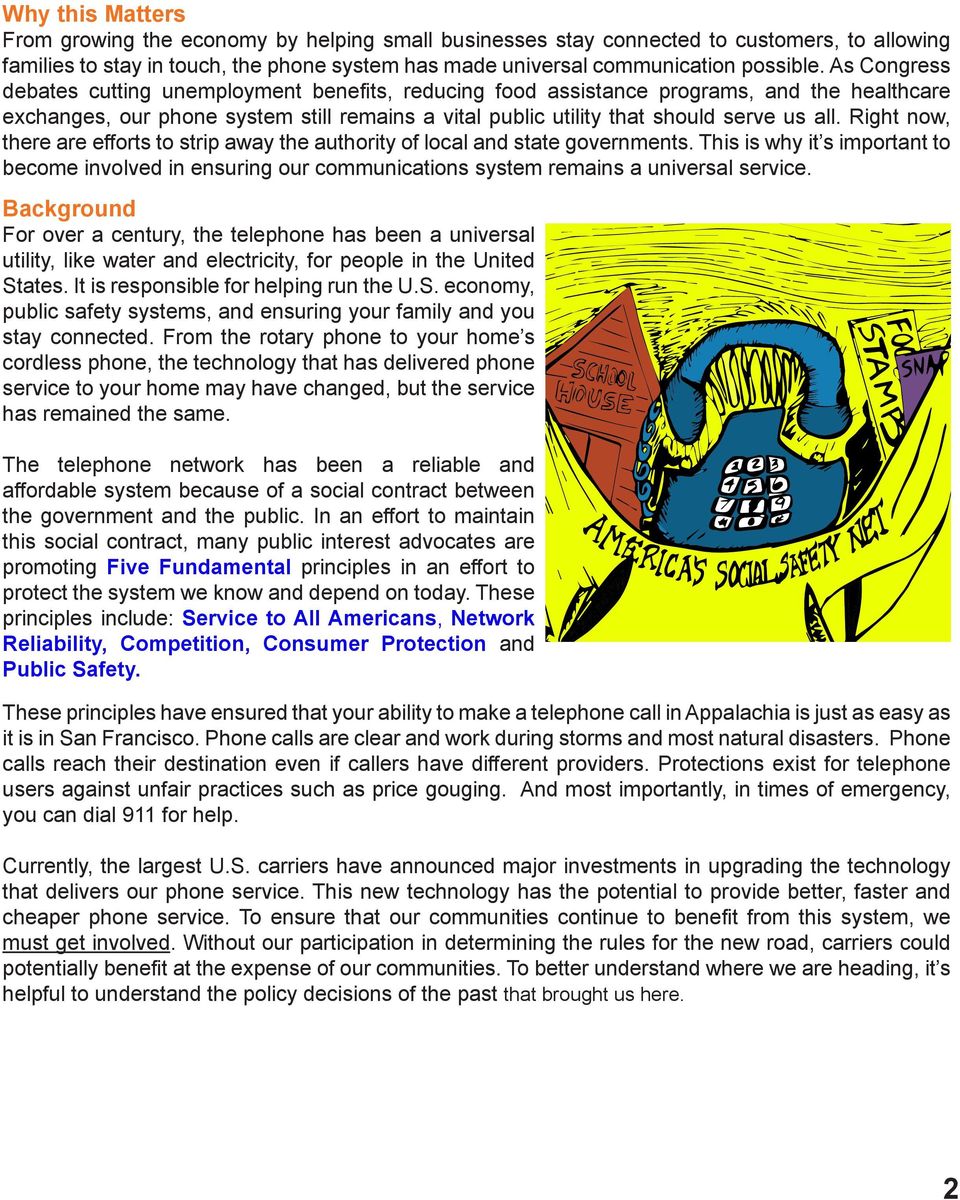
3 Why this Matters From growing the economy by helping small businesses stay connected to customers, to allowing families to stay in touch, the phone system has made universal communication possible. As Congress debates cutting unemployment benefits, reducing food assistance programs, and the healthcare exchanges, our phone system still remains a vital public utility that should serve us all. Right now, there are efforts to strip away the authority of local and state governments. This is why it s important to become involved in ensuring our communications system remains a universal service. Background For over a century, the telephone has been a universal utility, like water and electricity, for people in the United States. It is responsible for helping run the U.S. economy, public safety systems, and ensuring your family and you stay connected. From the rotary phone to your home s cordless phone, the technology that has delivered phone service to your home may have changed, but the service has remained the same. The telephone network has been a reliable and affordable system because of a social contract between the government and the public. In an effort to maintain this social contract, many public interest advocates are promoting Five Fundamental principles in an effort to protect the system we know and depend on today. These principles include: Service to All Americans, Network Reliability, Competition, Consumer Protection and Public Safety. These principles have ensured that your ability to make a telephone call in Appalachia is just as easy as it is in San Francisco. Phone calls are clear and work during storms and most natural disasters. Phone calls reach their destination even if callers have different providers. Protections exist for telephone users against unfair practices such as price gouging. And most importantly, in times of emergency, you can dial 911 for help. Currently, the largest U.S. carriers have announced major investments in upgrading the technology that delivers our phone service. This new technology has the potential to provide better, faster and cheaper phone service. To ensure that our communities continue to benefit from this system, we must get involved. Without our participation in determining the rules for the new road, carriers could potentially benefit at the expense of our communities. To better understand where we are heading, it s helpful to understand the policy decisions of the past that brought us here. 2
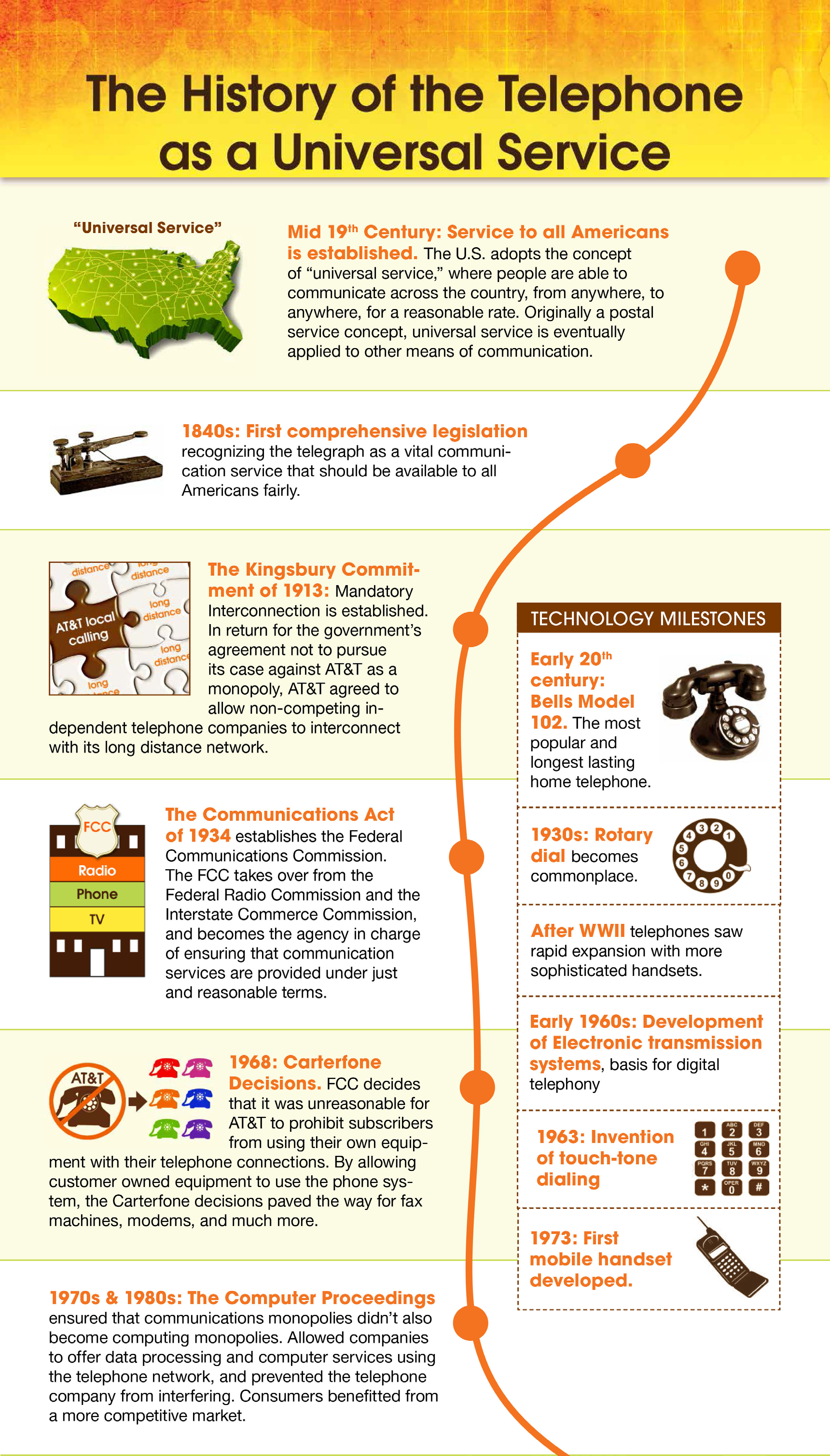
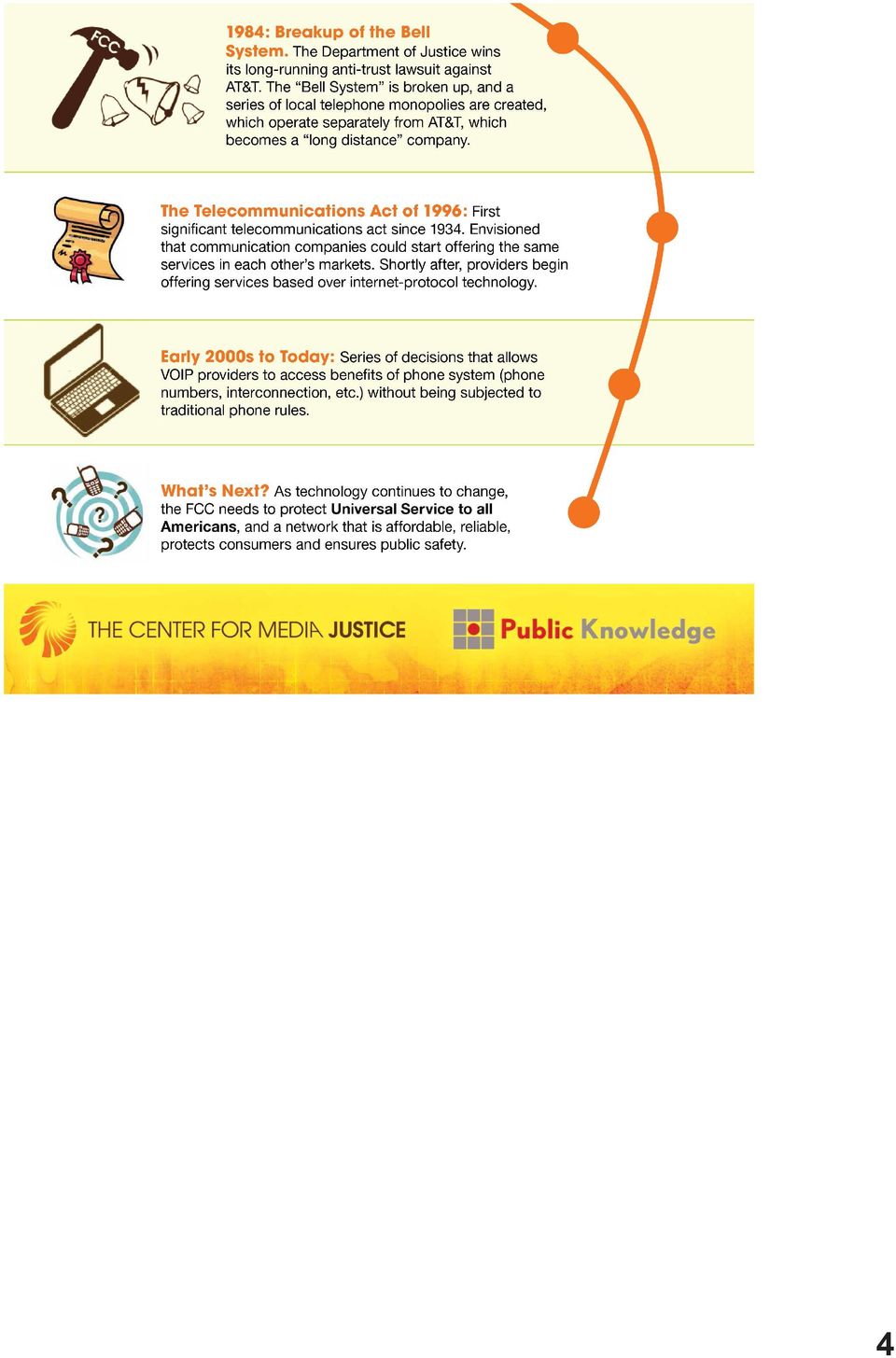
4 How Did We Get Here? The chart below describes past policy decisions, and how they have created the phone system we know today. 3


5 4
6 Learning the Lingo As people who care about the future of our telephone system, it s helpful to understand the technical terms that have emerged in the public debate over this phone transition. We may not be experts familiar with the technical terms, but we are experts about how this everyday technology is critical to our lives. In order to strengthen our advocacy, we re providing definitions of important terms that help us shape the telephone system we deserve. Here s a glossary of important terms that are referenced in the toolkit: Public-Switched Telephone Network (PSTN)- The PSTN or Plain Old Telephone System (POTS) refers to the telephone network used by the general public. This network functions over different technologies, including copper and fiber. Time-Division Multiplexing (TDM)- This is the older, analog version of the PSTN, which has been around since the 1870s. It is used to transmit two or more phone calls over the same telephone line. The final TDM portion of PSTN is transitioning to a newer technology defined below, Voice Over Internet Protocol (VoIP). Internet Protocol (IP)- The communications technique used by the internet. The protocol may be used in other networks that are not the internet, but that are still referred to as IP networks. Voice Over Internet Protocol (VoIP)- A newer way of delivering telephone service that uses IP technology. This service can run over the PSTN network, but does not always require an Internet connection to do so. Applications like Skype are VoIP services, but do require an Internet connection. Carrier of Last Resort (CoLR)- An obligation of telephone providers to serve everyone in the service territory at a minimum standard and to offer a basic, affordable voice option. 5
7 Which Communities Are Potentially at Risk? Victims of Natural Disasters People can usually rely on their landlines to reach help in the event of a hurricane, tornado or flood. Much of the PSTN network runs with a backup power generator, and can ensure a call can be made even when your home electricity system is out. Replacement wireless systems that run over new technology have proven to be less reliable in power outages and can leave people with no phone service. For example, VoiceLink, Verizon s wireless service, has a rechargeable battery that lasts for only 2.5 hours of talk time or 36 hours of standby time. VoiceLink users have reported very poor reception and dropped calls to 911. Telephone users who reside in vulnerable areas should talk to local policymakers about ensuring the phone network remains reliable and that rules are in place to guide recovery after natural disasters. Rural Communities Right now, rules are in place that order larger phone carriers to interconnect with smaller ones that serve rural areas. Even if companies agree to interconnect without government action, what happens if those companies are in a dispute? We need to ensure a call from a Verizon customer will connect to a loved one who is a Time Warner customer. Our current phone network supports rural communities by helping them stay connected to the rest of the country. In some states, the rules that promote universal phone service are being rolled back, which is potentially harmful to rural residents. Telephone users who reside in rural areas should talk to local policymakers about ensuring the phone carriers will still interconnect with each other, and service to their communities is maintained. Native Nations & Tribal Lands Historically, Indigenous communities have had less access to critical broadband infrastructure that provides high speed Internet. Lack of affordable access to communications services worsen conditions of poverty on tribal lands and reservations. Federal policies in this area have created fewer incentives for companies to service tribal lands, which are typically located in remote rural areas. As a direct result, close to a third live with no basic telephone service and 90% don t have access to high speed Internet. An upgrade of the telephone network could further isolate these communities. Telephone users who reside on tribal and or rural lands should talk to local policymakers about ensuring universal service is maintained, regardless of location or economic situation. 6

8 Low-income and Working Class Communities Affordable options to communicate are especially important to lower income and working class families. For many, services like a subsidized telephone line, calling cards, and collect phone calls are the only option to stay connected. Calling cards and collect calls are important to immigrant families who depend on them to stay in touch with family and friends in other countries. These options are also crucial for people who communicate with people in jail, prison or detention facilities. Telephone users who use calling cards, collect phone calls or rely on subsidized phone service should talk to local policymakers about ensuring they are not left behnd. An upgraded phone system still supports these critical services. Elderly and People with Disabilities Oftentimes for the elderly, a telephone is also a lifeline. Many medical monitoring systems, like Life Alert, run through a telephone line. For people who are deaf or hard of hearing, teletypewriter (TTY) technolgies and video relay services are necessary to communicate. We must ensure that reliable access to these technologies is protected over the system. Elderly and deaf or hard of hearing individuals should talk to local policymakers about ensuring IP based services that these technologies remain affordable and accessible. An system upgrade should aim to improve service for everyone. Public Safety and 911 In the current phone system, public safety and accessibility rules are in place that ensure people have reliable telephone access in times of emergency. 911 services use geolocation technologies that allow first responders to locate and help people in need. It is unclear how well these services are going to function over the new system, but it s important that they continue protect the public. Anyone who depends on 911 emergency services should urge local policymakers to ensure these services continue to function and are accessible to all people. A person in a rural area or a low income in neighborhood should be able to reach 911 in the same reliable way someone in a city can. Small Business Owners Many small businesses rely on telephones to conduct e-transactions, like processing a credit card, and sending or receiving a faxes. Although fax machines may seem like an outdated technology to some, they are a vital part of many small businesses and medical offices who use them to collect and deliver information. Additionally, many alarm systems work through a telephone landline and could be affected by the switch to an IP phone network. Telephone users who are small business owners should urge local policymakers to support the five fundamentals in order to protect their ability to do business. 7

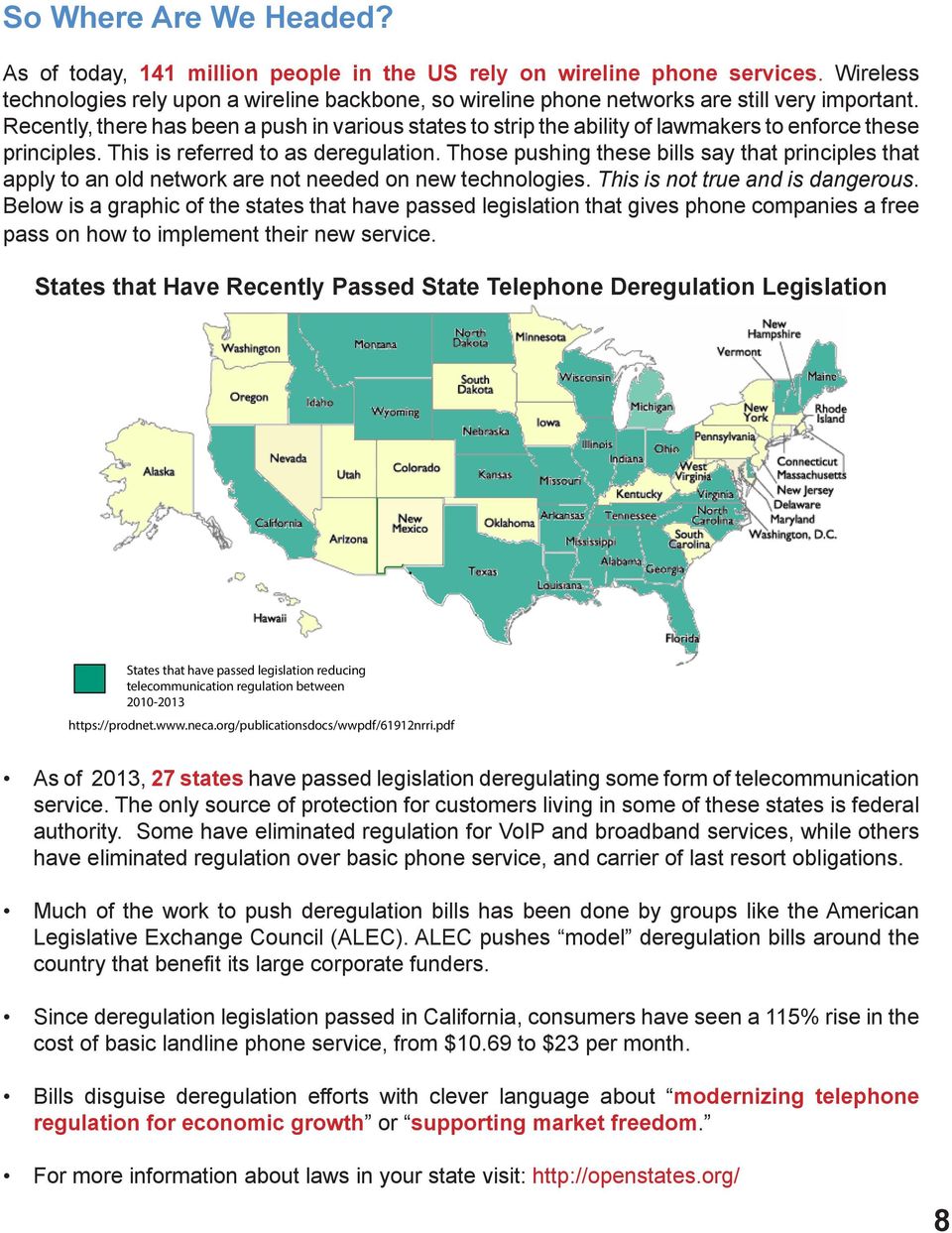
9 So Where Are We Headed? As of today, 141 million people in the US rely on wireline phone services. Wireless technologies rely upon a wireline backbone, so wireline phone networks are still very important. Recently, there has been a push in various states to strip the ability of lawmakers to enforce these principles. This is referred to as deregulation. Those pushing these bills say that principles that apply to an old network are not needed on new technologies. This is not true and is dangerous. Below is a graphic of the states that have passed legislation that gives phone companies a free pass on how to implement their new service. States that Have Recently Passed State Telephone Deregulation Legislation States that have passed legislation reducing telecommunication regulation between As of 2013, 27 states have passed legislation deregulating some form of telecommunication service. The only source of protection for customers living in some of these states is federal authority. Some have eliminated regulation for VoIP and broadband services, while others have eliminated regulation over basic phone service, and carrier of last resort obligations. Much of the work to push deregulation bills has been done by groups like the American Legislative Exchange Council (ALEC). ALEC pushes model deregulation bills around the country that benefit its large corporate funders. Since deregulation legislation passed in California, consumers have seen a 115% rise in the cost of basic landline phone service, from $10.69 to $23 per month. Bills disguise deregulation efforts with clever language about modernizing telephone regulation for economic growth or supporting market freedom. For more information about laws in your state visit: 8
10 Raise Your Voice and Protect Your Community Your voice is a powerful tool that allows you to be heard. Explaining why our communications system is important to you can influence the people who can make a difference. This means sharing your story with government and the media. Below are some tools that you can use to engage government policymakers, communicate with the media, and educate your community: Meeting with Your Policymakers Policymakers like meeting with their constituents, and you ll be surprised by how easy it is to set up a meeting. The key to a successful meeting is knowing what to expect. Here are a few suggestions and things to keep in mind: Have flexibility: when submitting a meeting request suggest a couple of dates and times that would work for you Don t be surprised if you don t end up meeting with an actual policymaker; it s much more likely you ll meet with staff from their office, who will relay information to their boss Try to recruit 5 to 6 other people from your community to your meeting so that the policymaker gets to hear from other constituents Plan to meet for 30 minutes Before the meeting, plan what you re going to say. Narrow it down to the top 3 things you want your policymaker to know and act on Bring materials that are relevant to the issue that you can leave with the policymaker s office. For example: Pocket Guide (See page 13) If you get asked a question and you don t know the answer, tell them you don t know, but that you ll get back to them with an answer After the meeting, follow up with a thank you and any additional information that may have been discussed during the meeting 9
11 Tool: Sample Meeting Request Fill in the missing information and then submit to your local office via fax, or letter. If you are not a constituent, or resident of the district or state of the official you are requesting a meeting with, then specify why taking the meeting is important for them. Perhaps they are on a committee that has authority over this issue. Or maybe they are someone that you believe will be a good leader on this issue. [Date] [Legislator Name] [Legislator s Address] Attn: [Name of scheduler, if given when you called] Dear [Representative, Senator or Commissioner ], (Last name) I m writing to request a meeting to discuss the phone network transition. Protecting our communications network is important to my community. It s important that my local phone system continues to be a reliable and affordable service that is available to everyone equally. I am available to meet at during the following dates; (insert dates and times). I hope you or a staff person can meet during one of the above times. Please feel free to contact me, I look forward to hearing from your office soon. Sincerely, [Name] [Phone Number] [ ] Submitting an Op-Ed Getting your story in the media is another way to influence the outcome of an issue. It s an important strategy because it helps to educate the rest of your community, and chances are your local policymakers are paying attention to the local paper. There are many ways to get your story in the media--in this section we ll focus on Op-eds. Op-eds are short essays written by readers and columnists. For activists, op-eds are a way to take a strong position on an issue and not worry about having their message distorted by a reporter. They re usually between words though some newspapers may have shorter guidelines. Below is a sample op-ed about the phone transition. You can submit one from your point of view so that your voice and experiences shine through. 10

12 Tool: Sample Op-Ed for your local newspaper The nation s largest phone carriers are currently upgrading the technology that delivers our phone service. This network upgrade has the potential to provide faster connections, better call quality, and an infrastructure positioned to be the communications envy of the world. As we transition to this new technology, companies, policymakers and citizens must re-evaluate what made our phone system great, and ensure those same principles transition to the new system. Phone companies leading the charge have an opportunity to maintain the same quality of service at comparable prices all while protecting consumer interests. The government must ensure that companies conduct this transition in a way that is fair to consumers and preserves public safety. Preserving these values while delivering quality service is something companies and policymakers are capable of doing, and would ensure a successful transition. One of the great values of our phone system is its ability to serve all Americans. This principle dates back almost 100 years when the country s growth depended on having a phone in every farm. From the postal service to our landline phone, the idea that people can remain connected no matter how far removed is the basic principle that made our communications system great. These principles could be left behind as we transition to a system that works over Internet era technology. State by state, companies and private interests are successfully lobbying policymakers to relax the regulations that have enforced these principles. Over 25 states have passed legislation that doesn t allow the rules of the old system to be applied to the new one. This is a dangerous direction for the public as carriers admit they still need to conduct trials in order to work out the unanticipated kinks of operating on the new system. How can we ensure these trials will be conducted in a safe and fair manner? How will policymakers ensure 911 capabilities are protected over a new system without rules? Will technology like Life Alert, fax machines, and security systems still be able to work? We need service providers to continually and efficiently connect to their rivals. If I m an AT&T customer I should be able to call my friends and family that have Verizon without a problem. The rules of the old phone system gave us this ability, and many take it for granted. However, stripping away the rules that keep consumers connected is the same as attacking our basic right to communicate. Upgrading to a new technology should not give phone companies a free ride to abandon these values. The public should have a voice in this process and should make sure the phone system for future generations remains great. Even though the technology is changing, the values that have kept our communications system strong must remain the same and be protected. 11

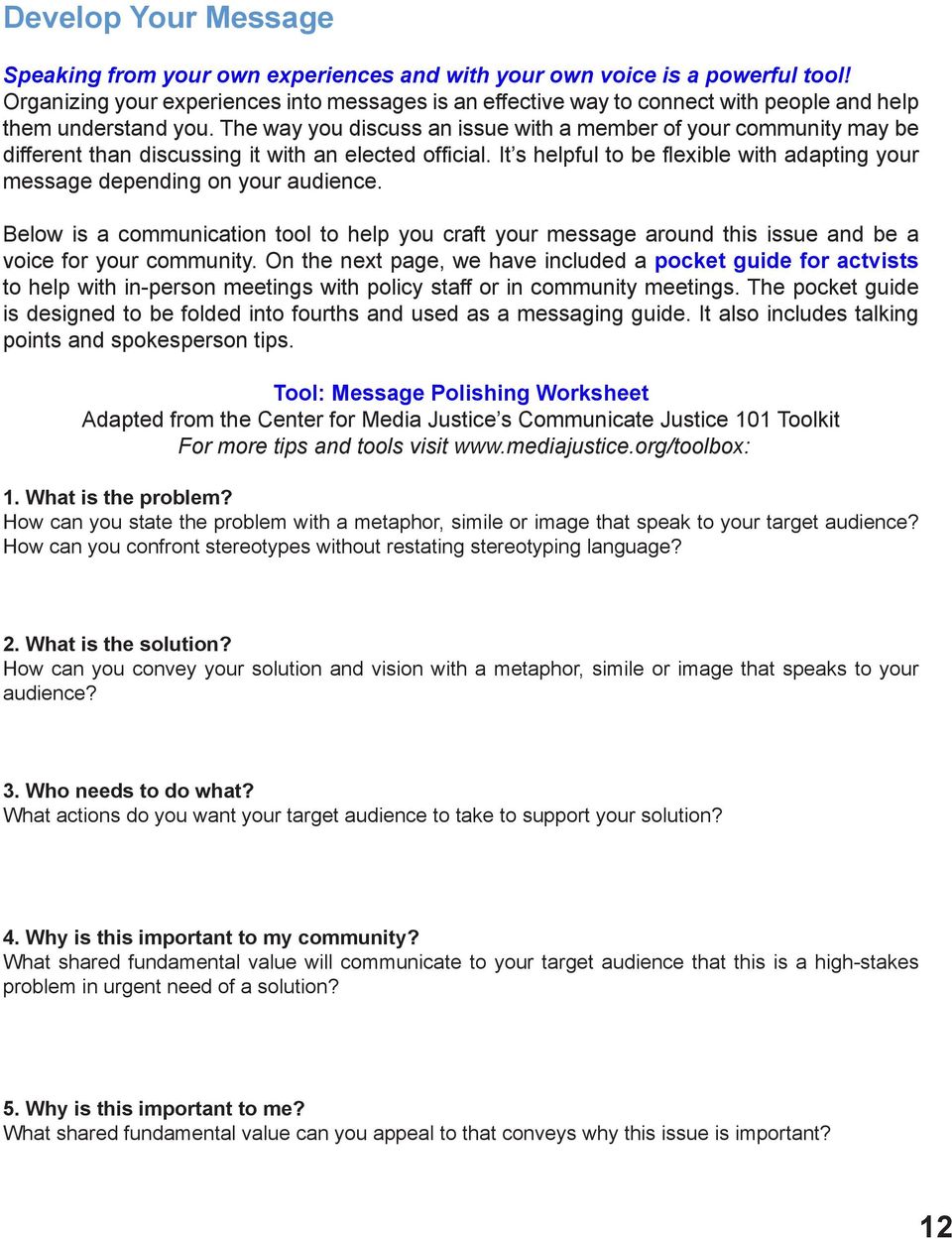
13 Develop Your Message Speaking from your own experiences and with your own voice is a powerful tool! Organizing your experiences into messages is an effective way to connect with people and help them understand you. The way you discuss an issue with a member of your community may be different than discussing it with an elected official. It s helpful to be flexible with adapting your message depending on your audience. Below is a communication tool to help you craft your message around this issue and be a voice for your community. On the next page, we have included a pocket guide for actvists to help with in-person meetings with policy staff or in community meetings. The pocket guide is designed to be folded into fourths and used as a messaging guide. It also includes talking points and spokesperson tips. Tool: Message Polishing Worksheet Adapted from the Center for Media Justice s Communicate Justice 101 Toolkit For more tips and tools visit 1. What is the problem? How can you state the problem with a metaphor, simile or image that speak to your target audience? How can you confront stereotypes without restating stereotyping language? 2. What is the solution? How can you convey your solution and vision with a metaphor, simile or image that speaks to your audience? 3. Who needs to do what? What actions do you want your target audience to take to support your solution? 4. Why is this important to my community? What shared fundamental value will communicate to your target audience that this is a high-stakes problem in urgent need of a solution? 5. Why is this important to me? What shared fundamental value can you appeal to that conveys why this issue is important? 12
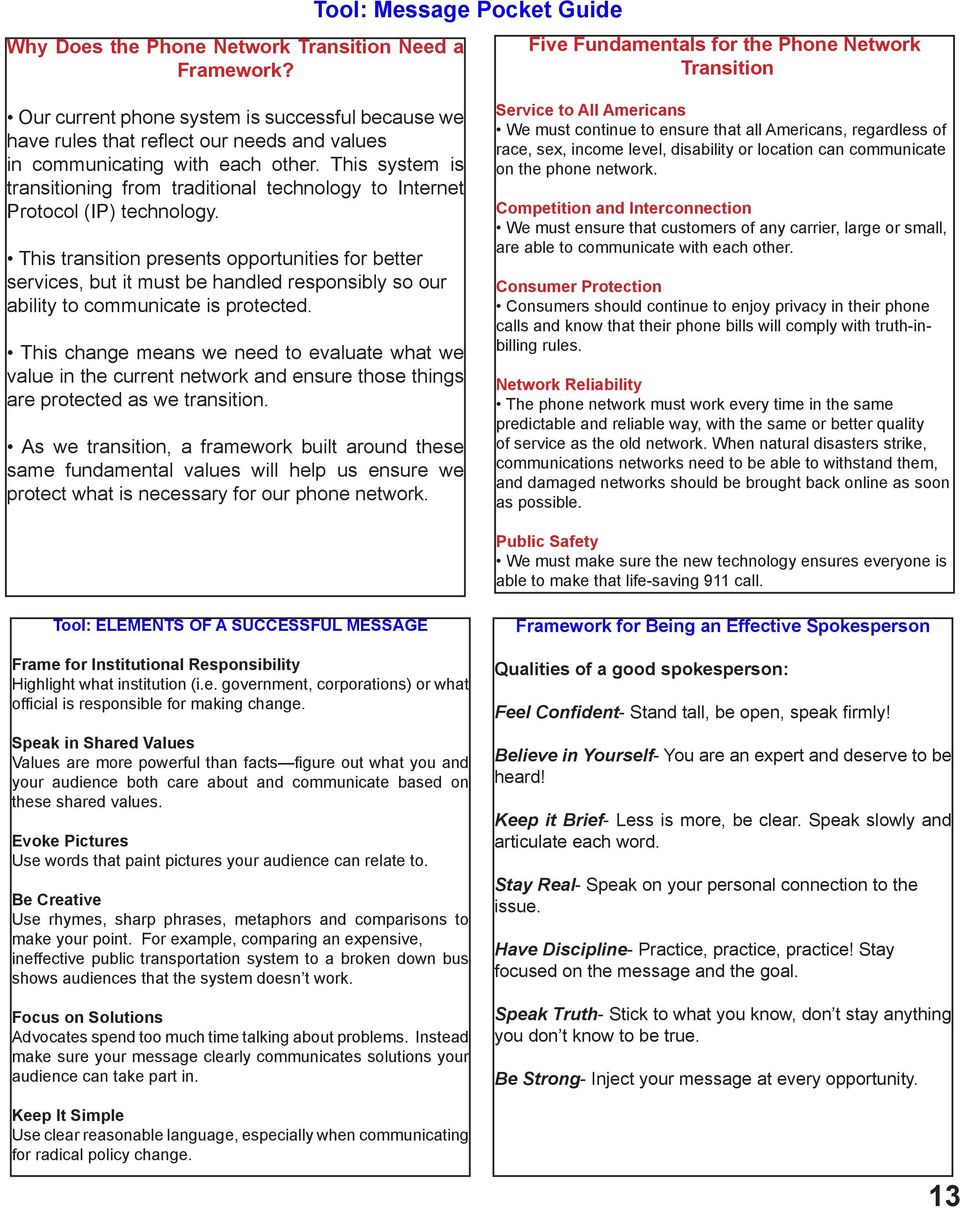
14 Why Does the Phone Network Transition Need a Framework? Tool: Message Pocket Guide Five Fundamentals for the Phone Network Transition Our current phone system is successful because we have rules that reflect our needs and values in communicating with each other. This system is transitioning from traditional technology to Internet Protocol (IP) technology. This transition presents opportunities for better services, but it must be handled responsibly so our ability to communicate is protected. This change means we need to evaluate what we value in the current network and ensure those things are protected as we transition. As we transition, a framework built around these same fundamental values will help us ensure we protect what is necessary for our phone network. Service to All Americans We must continue to ensure that all Americans, regardless of race, sex, income level, disability or location can communicate on the phone network. Competition and Interconnection We must ensure that customers of any carrier, large or small, are able to communicate with each other. Consumer Protection Consumers should continue to enjoy privacy in their phone calls and know that their phone bills will comply with truth-inbilling rules. Network Reliability The phone network must work every time in the same predictable and reliable way, with the same or better quality of service as the old network. When natural disasters strike, communications networks need to be able to withstand them, and damaged networks should be brought back online as soon as possible. Public Safety We must make sure the new technology ensures everyone is able to make that life-saving 911 call. Tool: ELEMENTS OF A SUCCESSFUL MESSAGE Frame for Institutional Responsibility Highlight what institution (i.e. government, corporations) or what official is responsible for making change. Speak in Shared Values Values are more powerful than facts figure out what you and your audience both care about and communicate based on these shared values. Evoke Pictures Use words that paint pictures your audience can relate to. Be Creative Use rhymes, sharp phrases, metaphors and comparisons to make your point. For example, comparing an expensive, ineffective public transportation system to a broken down bus shows audiences that the system doesn t work. Focus on Solutions Advocates spend too much time talking about problems. Instead make sure your message clearly communicates solutions your audience can take part in. Keep It Simple Use clear reasonable language, especially when communicating for radical policy change. Framework for Being an Effective Spokesperson Qualities of a good spokesperson: Feel Confident- Stand tall, be open, speak firmly! Believe in Yourself- You are an expert and deserve to be heard! Keep it Brief- Less is more, be clear. Speak slowly and articulate each word. Stay Real- Speak on your personal connection to the issue. Have Discipline- Practice, practice, practice! Stay focused on the message and the goal. Speak Truth- Stick to what you know, don t stay anything you don t know to be true. Be Strong- Inject your message at every opportunity. 13
15 Targeting Your Policymakers There are several key agencies at the federal, state and local level that play a role the implementation and governance of an IP phone transition. These agencies are on the front lines of making policy and are good targets for organizations who want to ensure that their communities are not left behind in this transition. Public officials need to hear from real people who vote about why this issue matters to them. Consider sending a letter, setting up a meeting or making a phone call to any of these agencies to ensure they re looking out for your interests: Federal Communications Commission (FCC) is the federal agency that oversees all interstate communications. This includes telephones, Internet, radio and television. It will be the FCC s responsibility to figure out how telephone companies will be allowed to upgrade their networks. They will also play a major role in defining how trials that test new technologies are designed. They have the authority to shape how the trials are conducted, where they ll be located, and what critical data phone companies will have to share with the FCC. How to engage: You can call, write or submit comments to the FCC about why you think these trials should be conducted in a fair and balanced manner. It s important for this agency to hear from diverse voices, and not just industry representatives. Public Utilities Commissions (PUC) are the FCC s equivalent at the state level. In some states they are referred to as Public Service Commissions or Public Regulatory Commissions. They are generally a governing body that oversees the regulation of public utilities at the state level. When it comes to telephones, states have traditionally had the authority to designate eligible telecommunications carriers and oversee intrastate services (local and in-state calls). State commissions and local governing bodies have a role to play here. The FCC must ensure that state commissions remain empowered through the phone transition to maintain their regional and local decision-making authority. How to engage: You can call, write or submit comments to your state PUC about why they should ensure consumers are protected, regardless of the type of the technology that is used to deliver their phone service. U.S. Congress oversees the activities of the Federal Communications Commission. Representatives are divided into several committees that oversee specific issues. These committees pick and choose which laws get voted on. In particular the House Energy and Commerce Committee and the Senate Committee on Commerce, Science and Technology have supervisory roles over the FCC and this issue. 14

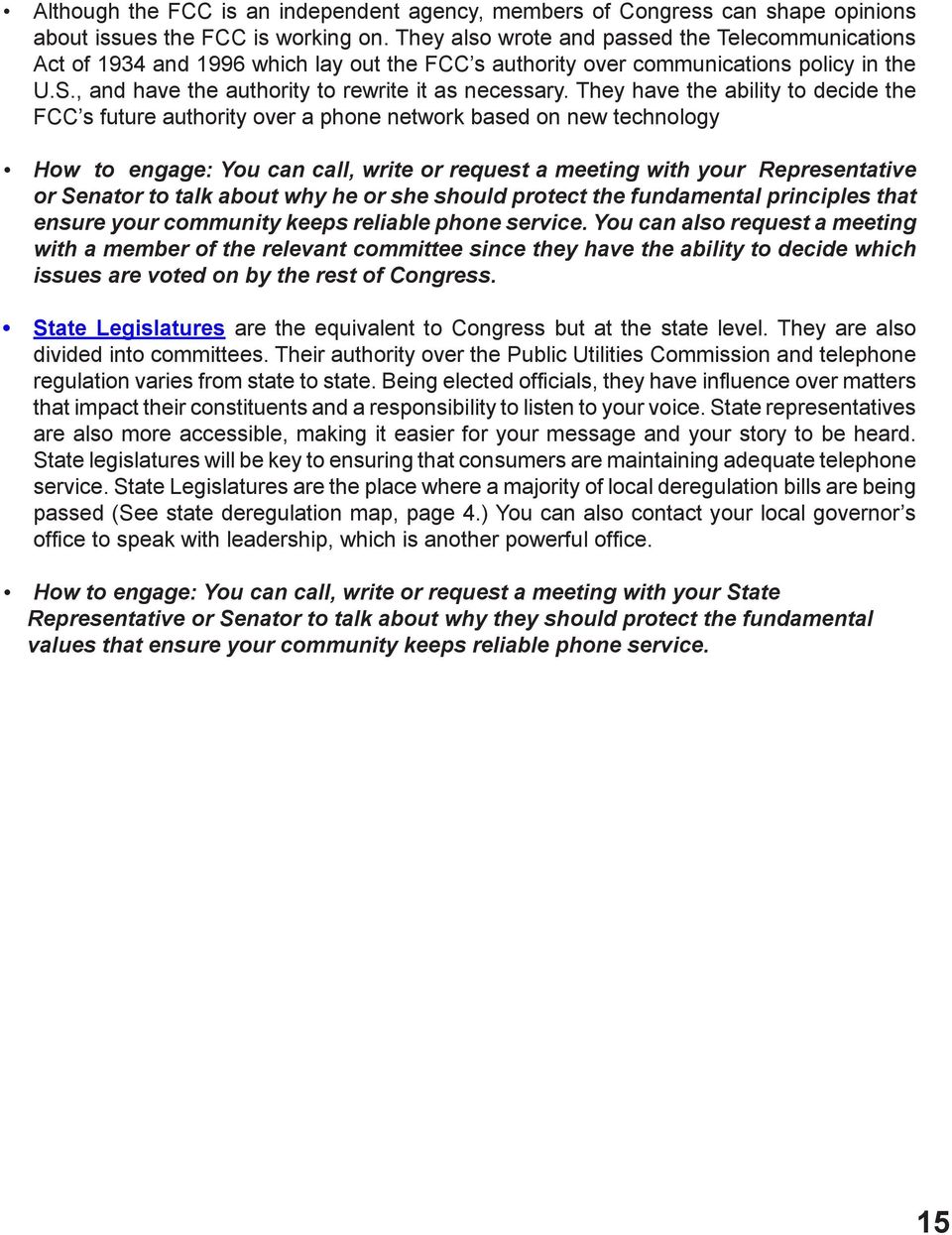
16 Although the FCC is an independent agency, members of Congress can shape opinions about issues the FCC is working on. They also wrote and passed the Telecommunications Act of 1934 and 1996 which lay out the FCC s authority over communications policy in the U.S., and have the authority to rewrite it as necessary. They have the ability to decide the FCC s future authority over a phone network based on new technology How to engage: You can call, write or request a meeting with your Representative or Senator to talk about why he or she should protect the fundamental principles that ensure your community keeps reliable phone service. You can also request a meeting with a member of the relevant committee since they have the ability to decide which issues are voted on by the rest of Congress. State Legislatures are the equivalent to Congress but at the state level. They are also divided into committees. Their authority over the Public Utilities Commission and telephone regulation varies from state to state. Being elected officials, they have influence over matters that impact their constituents and a responsibility to listen to your voice. State representatives are also more accessible, making it easier for your message and your story to be heard. State legislatures will be key to ensuring that consumers are maintaining adequate telephone service. State Legislatures are the place where a majority of local deregulation bills are being passed (See state deregulation map, page 4.) You can also contact your local governor s office to speak with leadership, which is another powerful office. How to engage: You can call, write or request a meeting with your State Representative or Senator to talk about why they should protect the fundamental values that ensure your community keeps reliable phone service. 15
17 Moving Forward Please help us distribute this toolkit widely! If you know of a community organization, friends, neighbors or family members who are interested in becoming involved, please share this with them. For more resources and copies of this toolkit, please visit: publicknowledge.org/ WhatsTheHangUp For more messaging resources please visit: About Public Knowledge: Public Knowledge preserves the openness of the Internet and the public s access to knowledge; promotes creativity through balanced copyright; and upholds and protects the rights of consumers to use innovative technology lawfully. About the Center For Media Justice: Founded in 2002, the Center for Media Justice is a national movement building intermediary to strengthen the communications effectiveness of grassroots racial justice sectors, and sustain a powerful local-to-local movement for media rights and access. Our mission is to create media and cultural conditions that strengthen movements for racial justice, economic equity, and human rights. We work at the intersection of media and social change to remove institutional barriers to media equity and ensure that movements for justice have a public voice so communities of color and America s poor have a fighting chance. 16
choice. call. telephone. Consumer Assistance It s your It s your It s your Dear Consumer, A PSC Consumer Guide www.askpsc.com
 Dear Consumer, Telephone service competition holds many benefits for New Yorkers. Significant changes are taking place in the world of telecommunications. Different companies are now competing to provide
I. Introduction. II. What is ALEC?
 Testimony of John Stephenson American Legislative Exchange Council Before the Kansas House Committee on Commerce, Labor, and Economic Development Regarding House Bill 2326 February 18, 2013 I. Introduction
KANSAS CORPORATION COMMISSION IP-to-IP Interconnection Report
 KANSAS CORPORATION COMMISSION IP-to-IP Interconnection Report 2014 REPORT ON IP- TO- IP INTERCONNECTION A Summary of Status of the FCC s Internet Protocol- to- Internet Protocol Interconnection Proceeding
This approach is, I think, fully justified by the record and experience of the cable industry.
 Cable Freedom Remarks by Kyle McSlarrow, President & CEO National Cable & Telecommunications Association (NCTA) To The Media Institute Washington, DC June 22, 2005 I thought today I would briefly provide
DOC NO: INFOSOC 52/14 DATE ISSUED: June 2014. Resolution on the open and neutral Internet
 DOC NO: INFOSOC 52/14 DATE ISSUED: June 2014 Resolution on the open and neutral Internet Introduction This resolution builds on the TACD net neutrality resolution of April 2010 1, which called for policies
How To Review Chapter 364 Of The Florida State Constitution
 The Florida Senate Interim Report 2011-108 October 2010 Committee on Communications, Energy, and Public Utilities REVIEW CHAPTER 364, FLORIDA STATUTES, RELATING TO TELECOMMUNICATIONS COMPANIES TO IDENTIFY
Telecommunications Deregulation: Updating the Scorecard for 2013
 Telecommunications Deregulation: Updating the Scorecard for 2013 Sherry Lichtenberg, Ph.D. Principal Telecommunications National Regulatory Research Institute NARUC Staff Subcommittee on Accounting & Finance
4G LTE Wireless Local Loop:
 4G LTE Wireless Local Loop: Meeting the Challenges of a Changing Rural Marketplace NetAmerica Alliance Background Remarkable changes are taking place throughout the rural telecommunications industry. A
ACCESS CHARGE A fee charged subscribers or other telephone companies by a local exchange carrier for the use of its local exchange networks.
 Glossary of Telecommunications Terms (Source: Federal Communications Commission) ACCESS CHARGE A fee charged subscribers or other telephone companies by a local exchange carrier for the use of its local
Captioning Matters: Best Practices Project
 Captioning Matters: Best Practices Project 1 High-quality readable, understandable, and timely captions are the desired end result of everyone involved in the world of broadcast captioning. TV networks,
Basic Questions about Telephone Service
 Basic Questions about Telephone Service What's the difference between wireline and wireless telephone service? What's the difference between wireline and wireless telephone service? Wireline service means
Phone Company or Phony Company? Part 2 by Dean K. Wilson, P.E.
 Fire Alarm Notebook by Dean K. Wilson. P.E. Page 1 question: Phone Company or Phony Company? Part 2 by Dean K. Wilson, P.E. In the March/April 2008 edition of, I attempted to answer the following Question:
Office of Emergency Communications Next Generation Network Priority Services
 Office of Emergency Communications Next Generation Network Priority Services Heather Kowalski CPM Branch Chief Office of Emergency Communications Next Generation Network Priority Services Testing and Evaluation
SMALL BUSINESS. the basics. in telecommunications solutions
 SMALL BUSINESS the basics in telecommunications solutions 1 2 Mobility Innovation, transformation and the cloud Security and business continuity At AT&T, we understand the unique needs that small businesses
The Citizen Lobbyist
 The Citizen Lobbyist Making Your Voice Heard: How you can influence government decisions Of the people, by the people, for the people. Democracy is not a spectator sport. Acting as participants, rather
All Rights Reserved. Copyright 2009
 IMPORTANT NOTICE CONCERNING EMERGENCY 911 SERVICES Your service provider, not the manufacturer of the equipment, is responsible for the provision of phone services through this equipment. Any services
Computing, Python and Robots Net Neutrality
 Department of Computer Science University of San Francisco p. 1/? Computing, Python and Robots Net Neutrality Chris Brooks Department of Computer Science University of San Francisco Department of Computer
Welcome to Cogeco Business Digital Phone Service
 Welcome Welcome to Cogeco Business Digital Phone Service Congratulations on choosing Cogeco Business Digital Phone Service. 1 Your decision to subscribe to our digital quality phone service is a smart
BlackBerry Mobile Voice System
 BlackBerry Mobile Voice System Mobile Unified Communications BlackBerry Mobile Voice System (BlackBerry MVS) brings desk phone features to BlackBerry smartphones. Work with one business number at the office
Operational Definition
 Operational Definition of a functional local health department Public Health Operational Definition of a Functional Local Health Department November 2005 1 November 2005 Prevent. Promote. Protect. o p
Home Phone Quick Start Guide. Review these helpful instructions to understand your Midco home phone service and its many convenient features.
 Home Phone Quick Start Guide Review these helpful instructions to understand your Midco home phone service and its many convenient features. 1 Contents Equipment and Features.......................................................
MOVING MARRIAGE FORWARD BUILDING MAJORITY SUPPORT FOR MARRIAGE
 MOVING MARRIAGE FORWARD BUILDING MAJORITY SUPPORT FOR MARRIAGE A REPORT FROM FREEDOM TO MARRY Our nation is engaged in a crucial conversation about why marriage matters. More than 100 million Americans
SUMMER 2014 LEGAL INTERNSHIP OPPORTUNITY NOTICE TO LAW STUDENTS American Civil Liberties Union Foundation Reproductive Freedom Project, NY
 STUDENT OPPORTUNITIES SUMMER 2014 LEGAL INTERNSHIP OPPORTUNITY NOTICE TO LAW STUDENTS American Civil Liberties Union Foundation Reproductive Freedom Project, NY the country s largest team of public interest
Consumers and the IP Transition: Communications patterns in the midst of technological change
 Consumers and the IP Transition: Communications patterns in the midst of technological change John B. Horrigan, PhD vember 2014 1 Summary of Findings Americans today have a range of communications services
Orbitel. Residential Digital Phone Service User s Guide
 Orbitel Residential Digital Phone Service User s Guide All Rights Reserved Copyright 2005 The use, disclosure, modification, transfer, or transmittal of this work for any purpose, in any form, or by any
The IP Transition Copper Retirement - Service Discontinuance Residential Backup Power FCC Privacy Authority
 TSTCI Annual Membership Meeting October 14-16, 2015 The IP Transition Copper Retirement - Service Discontinuance Residential Backup Power FCC Privacy Authority Tony Veach Bennet&Bennet, PLLC LEGAL DISCLAIMER
FACT SHEET: A summary of the rights under the Convention on the Rights of the Child
 FACT SHEET: A summary of the rights under the Convention on the Rights of the Child Article 1 (Definition of the child): The Convention defines a 'child' as a person below the age of 18, unless the laws
How To Get At&T Local Service On The Phone
 Your AT&T Local Service Guide INSIDE: Customer Service Information Calling Feature Instructions Keep this guide for future reference. AT&T Local Service CONTENTS General Information 3 Troubleshooting Tip
ALDACon 2010 CAPTIONING TECHNOLOGY FOR PEOPLE WITH HEARING LOSS PRESENTED BY: CHAMEEN STRATTON with MIKE ELLIS and KEN ARCIA
 ALDACon 2010 CAPTIONING TECHNOLOGY FOR PEOPLE WITH HEARING LOSS PRESENTED BY: CHAMEEN STRATTON with MIKE ELLIS and KEN ARCIA CHAMEEN STRATTON: Hello, everyone. Thank you for coming. This is my first conference
VoIP - POTS - Mobile. Phone Service Choices. http://mlcug.org/ May 2012 1
 VoIP - POTS - Mobile Phone Service Choices http://mlcug.org/ May 2012 1 Basic service choices VoIP - Voice over IP o Uses the Internet as your phone line o WiFi (radio) or Ethernet connected phones POTS
YOUR HOME PHONE. Horry Telephone Cooperative, Inc.
 YOUR HOME PHONE Horry Telephone Cooperative, Inc. CONTENTS Calling Features Anonymous Call Rejection page 4 Automatic Busy Redial page 4 Automatic Call Return page 5 Call Forwarding page 6 Call Forwarding
Human trafficking is the buying and selling of men, women and children within countries and across borders in order to exploit them for profit.
 Learn. Act. Share. Human trafficking is the buying and selling of men, women and children within countries and across borders in order to exploit them for profit. The trafficker takes away the basic human
User Guide VERIZON WIRELESS HOME PHONE CONNECT
 User Guide VERIZON WIRELESS HOME PHONE CONNECT label Welcome to Verizon Wireless Thank you for choosing Verizon Wireless Home Phone Connect. You re now connected to America s most reliable wireless network.
CALL FORWARDING (Activate *72 / Deactivate *73) Call Forwarding is a service that automatically forwards all calls to any number you choose.
 St. Joseph Cablevision would like to thank you for making our Digital Phone service part of your home. As a St. Joseph Cablevision customer, you have access to one of the most advanced broadband communications
Critical Infrastructure Security & Resilience Month 2014 Toolkit
 Critical Infrastructure Security & Resilience Month 2014 Toolkit Homeland Security Table of Contents Table of Contents... ii CRITICAL INFRASTRUCTURE SECURITY & RESILIENCE MONTH... 1 HOW TO PROMOTE CRITICAL
RingCentral Office@Hand from AT&T Desktop App for Windows & Mac. User Guide
 RingCentral Office@Hand from AT&T Desktop App for Windows & Mac User Guide RingCentral Office@Hand from AT&T User Guide Table of Contents 2 Table of Contents 3 Welcome 4 Download and install the app 5
Voice and Delivery Data Networks
 Voice and Delivery Data Networks Chapter 11 Learning Objectives After reading this chapter, you should be able to: Identify the basic elements of a telephone system Describe the composition of the telephone
RIGHTS OF DEAF AND HARD OF HEARING PEOPLE COURTS AND LAWYERS
 RIGHTS OF DEAF AND HARD OF HEARING PEOPLE COURTS AND LAWYERS PLEASE NOTE: For information in alternative formats or a language different than English, contact the Disability Rights Network at 800-692-
Northland Phone Service RESIDENTIAL AND BUSINESS USER GUIDE
 Northland Phone Service RESIDENTIAL AND BUSINESS USER GUIDE Important 911 Information Access to 911 emergency services via our Home Phone service is very similar to traditional 911 service access, but
12 THINGS YOU SHOULD KNOW before choosing your next Telephone System
 12 THINGS YOU SHOULD KNOW before choosing your next Telephone System Choosing a Telephone System for your business does not need to be done very often so it is easy to make the wrong long-term choice unless
Strategic plan. Outline
 Strategic plan Outline 1 Introduction Our vision Our role Our mandate 2 About us Our governance Our structure 3 Context Our development Camden 4 Resources Funding Partners 5 Operating model How we will
Learn, Share, Fight Back:
 Learn, Share, Fight Back: The Short Immigration Guide to How Arrests & Convictions Separate Families Many of us know family members and friends who have been detained and deported because of arrests and
Verizon and AT&T have declared war on PSTN. While couched as a technology play, it is a play to close down all regulations. 38) The closing of the
 Verizon and AT&T have declared war on PSTN. While couched as a technology play, it is a play to close down all regulations. 38) The closing of the PSTN is also the way the companies close down the unions,
Exede Voice Desk Reference
 Summary This Desk Reference covers: What is Exede Voice? Pricing Customer Commitment Where is Exede Voice Available? How do I sell Exede Voice? How do I Market Exede Voice? What Should My Customer Expect?
One Hundred Tenth Congress of the United States of America
 H. R. 3403 One Hundred Tenth Congress of the United States of America AT THE SECOND SESSION Begun and held at the City of Washington on Thursday, the third day of January, two thousand and eight An Act
Fighting Big Money, Empowering People: A 21st Century Democracy Agenda
 : A 21st Century Democracy Agenda Like every generation before us, Americans are coming together to preserve a democracy of the people, by the people, and for the people. American democracy is premised
Testimony of. Mr. Douglas Kinkoph Associate Administrator
 Testimony of Mr. Douglas Kinkoph Associate Administrator Office of Telecommunications and Information Applications National Telecommunications and Information Administration United States Department of
Description: Objectives & Purpose:
 Description: Hosted in the restored 1902 historic House Chamber, Issues in the House of Representatives is our most popular program for school groups. Students will be seated in reproduction 1902 desks
It s time to shift gears on criminal justice VOTER
 It s time to shift gears on criminal justice VOTER TOOLKIT 2014 Who are the most powerful elected officials most voters have never voted for? ANSWER: Your District Attorney & Sheriff THE POWER OF THE DISTRICT
Everything You Need to Know about Lifeline Supported Cell Phones.
 Everything You Need to Know about Lifeline Supported Cell Phones. Presented By: Mark Erpelding of Open Access Connections Jon Brown of Minnesota Public Utilities Commission What do we currently know about
Welcome to Cogeco Home Phone Service
 Welcome Welcome to Cogeco Home Phone Service By choosing to get your phone service from Cogeco, you have made an important decision about the quality of your connections. Unlike third-party voice over
Telephone Service: A Natural Monopoly?
 Box 6-2 continued By June 2003, this had grown to 88 percent. A recent study indicates that the introduction of satellite TV led to substantial gains for consumers. However, ongoing antitrust oversight
Going to a Mental Health Tribunal hearing
 June 2015 Going to a Mental Health Tribunal hearing Includes: information about compulsory treatment and treatment orders information about Mental Health Tribunal hearings worksheets to help you represent
Your nbn connect kit. It s time to connect your landline phone and internet to the nbn network.
 Your nbn connect kit It s time to connect your landline phone and internet to the nbn network. Your nbn is here The nbn network is Australia s exciting new landline phone and internet network. 1 It s designed
FCC Review of Verizon s Section 214 Application and Its Implications for the IP Transition. NASUCA Annual Meeting
 FCC Review of Verizon s Section 214 Application and Its Implications for the IP Transition NASUCA Annual Meeting Orlando, Florida November 19, 2013 Susan M. Baldwin Moving beyond Fire Island Today s local
The Critical Role of Broadcasting in Emergencies
 The Critical Role of Broadcasting in Emergencies ITU-R WP 6A Workshop on Emergency Broadcasting Geneva, Switzerland 21 November, 2013 Craig K. Tanner Consultant, CBS Broadcasting, Inc. 1 There are some
How To Set Up An Ip Trunk For A Business
 Charter Business : White paper SIP Trunking: A new voice in communications service WHITE PAPER With the rise of next-generation technology, business customers have more options than ever from providers
How To Use A U.S. Cell Phone At Home
 U.S. Cellular Home Phone 1 Contents Getting to Know Your Device...5 Appearance... 5 LED Indicators... 6 Device Installation...7 Before You Begin... 7 Installing the Battery... 7 Installing the Power Adapter...
The Future of IDAHO S UNIVERSAL SERVICE AND ITS RELATIONSHIP TO BROADBAND DEPLOYMENT
 Idaho Public Utilities Commission The Future of IDAHO S UNIVERSAL SERVICE AND ITS RELATIONSHIP TO BROADBAND DEPLOYMENT April 2015 Idaho Public Utilities Commission 472 W. Washington St. Boise, ID 83702
All Rights Reserved. Copyright 2007
 All Rights Reserved Copyright 2007 The use, disclosure, modification, transfer, or transmittal of this work for any purpose, in any form, or by any means, without the written permission of the copyright
Advantages of Broadband Phone Services
 CHAPTER3 Advantages of Broadband Phone Services Why are so many people subscribing to broadband phone services, either as an additional phone line or as a complete replacement to their traditional phone
Is Skype Safe for Judges?
 Is Skype Safe for Judges? By Martin Felsky, PhD, JD, for the Judges Technology Advisory Committee, Canadian Judicial Council, 1 Version 2.0 July 6, 2010 In this article I will try to help judges understand