
Structural Dynamics, Dynamic Force and Dynamic System
|
|
|
- Alberta Dickerson
- 10 years ago
- Views:
Transcription
1 Structural Dynamics, Dynamic Force and Dynamic System Structural Dynamics Conventional structural analysis is based on the concept of statics, which can be derived from Newton s 1 st law of motion. This law states that it is necessary for some force to act in order to initiate motion of a body at rest or to change the velocity of a moving body. Conventional structural analysis considers the external forces or joint displacements to be static and resisted only by the stiffness of the structure. Therefore, the resulting displacements and forces resulting from structural analysis do not vary with time. Structural Dynamics is an extension of the conventional static structural analysis. It is the study of structural analysis that considers the external loads or displacements to vary with time and the structure to respond to them by its stiffness as well as inertia and damping. Newton s 2 nd law of motion forms the basic principle of Structural Dynamics. This law states that the resultant force on a body is equal to its mass times the acceleration induced. Therefore, just as the 1 st law of motion is a special case of the 2 nd law, static structural analysis is also a special case of Structural Dynamics. Although much less used by practicing engineers than conventional structural analysis, the use of Structural Dynamics has gradually increased with worldwide acceptance of its importance. At present, it is being used for the analysis of tall buildings, bridges, towers due to wind, earthquake, and for marine/offshore structures subjected wave, current, wind forces, vortex etc. Dynamic Force The time-varying loads are called dynamic loads. Structural dead loads and live loads have the same magnitude and direction throughout their application and are thus static loads. However there are several examples of forces that vary with time, such as those caused by wind, vortex, water wave, vehicle, impact, blast or ground motion like earthquake. Dynamic System A dynamic system is a simple representation of physical systems and is modeled by mass, damping and stiffness. Stiffness is the resistance it provides to deformations, mass is the matter it contains and damping represents its ability to decrease its own motion with time. Mass is a fundamental property of matter and is present in all physical systems. This is simply the weight of the structure divided by the acceleration due to gravity. Mass contributes an inertia force (equal to mass times acceleration) in the dynamic equation of motion. Stiffness makes the structure more rigid, lessens the dynamic effects and makes it more dependent on static forces and displacements. Usually, structural systems are made stiffer by increasing the crosssectional dimension, making the structures shorter or using stiffer materials. Damping is often the least known of all the elements of a structural system. Whereas the mass and the stiffness are well-known properties and measured easily, damping is usually determined from experimental results or values assumed from experience. There are several sources of damping in a dynamic system. Viscous damping is the most used damping system and provides a force directly proportional to the structural velocity. This is a fair representation of structural damping in many cases and for the purpose of analysis, it is convenient to assume viscous damping (also known as linear viscous damping). Viscous damping is usually an intrinsic property of the material and originates from internal resistance to motion between different layers within the material itself. However, damping can also be due to friction between different materials or different parts of the structure (called frictional damping), drag between fluids or structures flowing past each other, etc. Sometimes, external forces themselves can contribute to (increase or decrease) the damping. Damping is also increased in structures artificially by external sources. 1
2 Free Vibration of Undamped Single-Degree-of-Freedom (SDOF) System Formulation of the Single-Degree-of-Freedom (SDOF) Equation A dynamic system resists external forces by a combination of forces due to its stiffness (spring force), damping (viscous force) and mass (inertia force). For the system shown in Fig. 2.1, k is the stiffness, c the viscous damping, m the mass and u(t) is the dynamic displacement due to the time-varying excitation force f(t). Such systems are called Single-Degree-of-Freedom (SDOF) systems because they have only one dynamic displacement [u(t) here]. m f(t), u(t) f(t) m a k c f S f V Fig. 2.1: Dynamic SDOF system subjected to dynamic force f(t) Considering the free body diagram of the system, f(t) f S f V = ma..(2.1) where f S = Spring force = Stiffness times the displacement = k u.. (2.2) f V = Viscous force = Viscous damping times the velocity = c du/dt.. (2.3) f I = Inertia force = Mass times the acceleration = m d 2 u/dt 2.. (2.4) Combining the equations (2.2)-(2.4) with (2.1), the equation of motion for a SDOF system is derived as, m d 2 u/dt 2 + c du/dt + ku = f(t).. (2.5) This is a 2 nd order ordinary differential equation (ODE), which needs to be solved in order to obtain the dynamic displacement u(t). As will be shown subsequently, this can be done analytically or numerically. Eq. (2.5) has several limitations; e.g., it is assumed on linear input-output relationship [constant spring (k) and dashpot (c)]. It is only a special case of the more general equation (2.1), which is an equilibrium equation and is valid for linear or nonlinear systems. Despite these, Eq. (2.5) has wide applications in Structural Dynamics. Several important derivations and conclusions in this field have been based on it. Free Vibration of Undamped Systems Free Vibration is the dynamic motion of a system without the application of external force; i.e., due to initial excitement causing displacement and velocity. The equation of motion of a general dynamic system with m, c and k is, m d 2 u/dt 2 + c du/dt + ku = f(t).. (2.5) For free vibration, f(t) = 0; i.e., m d 2 u/dt 2 + c du/dt + ku = 0 For undamped free vibration, c = 0 m d 2 u/dt 2 + ku = 0 d 2 u/dt 2 + n 2 u = 0.. (2.6) where n = (k/m), is called the natural frequency of the system.. (2.7) Assume u = e st, d 2 u/dt 2 = s 2 e st s 2 e st + n 2 e st = 0 s = i n. u (t) = A e i n t + B e -i n t = C 1 cos ( nt) + C 2 sin ( nt).. (2.8) v (t) = du/dt = -C 1 n sin ( nt) + C 2 n cos ( nt)..... (2.9) If u(0) = u 0 and v(0) = v 0, then C 1 = u 0 and C 2 n = v 0 C 2 = v 0 / n....(2.10) u(t) = u 0 cos ( nt) + (v 0 / n) sin ( nt)....(2.11) 2

3 Displacement (ft) Natural Frequency and Natural Period of Vibration Eq (2.11) implies that the system vibrates indefinitely with the same amplitude at a frequency of n radian/sec. Here, n is the angular rotation (radians) traversed by a dynamic system in unit time (one second). It is called the natural frequency of the system (in radians/sec). Alternatively, the number of cycles completed by a dynamic system in one second is also called its natural frequency (in cycles/sec or Hertz). It is often denoted by f n. f n = n/2 (2.12) The time taken by a dynamic system to complete one cycle of revolution is called its natural period (T n ). It is the inverse of natural frequency. T n = 1/f n = 2 / n..(2.13) Example 2.1 An undamped structural system with stiffness (k) = 25 k/ft and mass (m) = 1 k-sec 2 /ft is subjected to an initial displacement (u 0 ) = 1 ft and an initial velocity (v 0 ) = 4 ft/sec. (i) Calculate the natural frequency and natural period of the system. (ii) Plot the free vibration of the system vs. time. Solution (i) For the system, natural frequency, n = (k/m) = (25/1) = 5 radian/sec f n = n/2 = 5/2 = cycle/sec Natural period, T n = 1/f n = sec (ii) The free vibration of the system is given by Eq (2.11) as u(t) = u 0 cos ( nt) + (v 0 / n) sin ( nt) = (1) cos (5t) + (4/5) sin (5t) = (1) cos (5t) + (0.8) sin (5t) The maximum value of u(t) is = ( ) = ft. The plot of u(t) vs. t is shown below in Fig Time (sec) Fig. Fig. 2.2: 3.1: Displacement vs. Time for for free Free vibration Vibration of an of undamped an Undamped systemsystem 3

4 Free Vibration of Damped Systems As mentioned in the previous section, the equation of motion of a dynamic system with mass (m), linear viscous damping (c) & stiffness (k) undergoing free vibration is, m d 2 u/dt 2 + c du/dt + ku = 0. (2.5) d 2 u/dt 2 + (c/m) du/dt + (k/m) u = 0 d 2 u/dt n du/dt + n 2 u = (3.1) where n = (k/m), is the natural frequency of the system..... (2.7) and = c/(2m n ) = c n /(2k) = c/2 (km), is the damping ratio of the system. (3.2) Assume u = e st, d 2 u/dt 2 = s 2 e st s 2 e st + 2 n s e st + n 2 e st = 0 s = n ( ( 2 1))....(3.3) 1. If 1, the system is called an overdamped system. Here, the solution for s is a pair of different real numbers [ n( + ( 2 1)), n( ( 2 1))]. Such systems, however, are not very common. The displacement u(t) for such a system is u(t) = e - n t (A e 1 t + B e - 1 t )..(3.4) where 1 = n ( 2 1) 2. If = 1, the system is called a critically damped system. Here, the solution for s is a pair of identical real numbers [ n, n]. Critically damped systems are rare and mainly of academic interest only. The displacement u(t) for such a system is u(t) = e n t (A + Bt)..(3.5) 3. If 1, the system is called an underdamped system. Here, the solution for s is a pair of different complex numbers [ n( +i (1 2 )), n( -i (1 2 ))]. Practically, most structural systems are underdamped. The displacement u(t) for such a system is u(t) = e nt (A e i d t + B e -i d t ) = e nt [C 1 cos ( dt) + C 2 sin ( dt)]... (3.6) where d = n (1 2 ) is called the damped natural frequency of the system. Since underdamped systems are the most common of all structural systems, the subsequent discussion will focus mainly on those. Differentiating Eq (3.6), the velocity of an underdamped system is obtained as v(t) = du/dt = e nt [ d{ C 1 sin( dt) + C 2 cos( dt)} n{c 1 cos( dt) + C 2 sin( dt)}]......(3.7) If u(0) = u 0 and v(0) = v 0, then C 1 = u 0 and dc 2 n C 1 = v 0 C 2 = (v 0 + nu 0 )/ d (3.8) u(t) = e nt [u 0 cos ( dt) + {(v 0 + nu 0 )/ d} sin ( dt)]...(3.9) Eq (3.9) The system vibrates at its damped natural frequency (i.e., a frequency of d radian/sec). Since the damped natural frequency d [= n (1 2 )] is less than n, the system vibrates more slowly than the undamped system. Moreover, due to the exponential term e nt, the amplitude of the motion of an underdamped system decreases steadily, and reaches zero after (a hypothetical) infinite time of vibration. Similar equations can be derived for critically damped and overdamped dynamic systems in terms of their initial displacement, velocity and damping ratio. 4

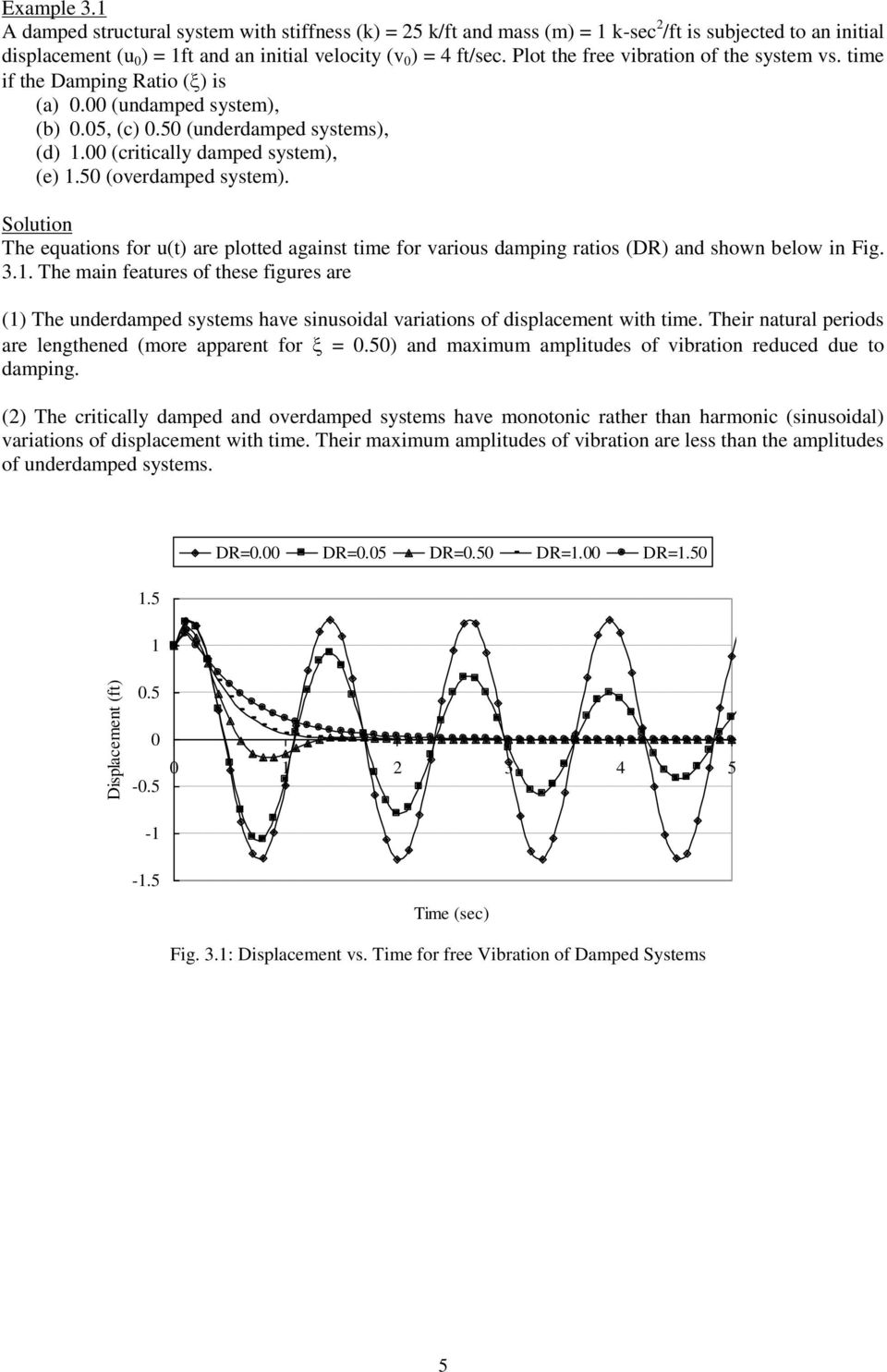
5 Displacement (ft) Example 3.1 A damped structural system with stiffness (k) = 25 k/ft and mass (m) = 1 k-sec 2 /ft is subjected to an initial displacement (u 0 ) = 1ft and an initial velocity (v 0 ) = 4 ft/sec. Plot the free vibration of the system vs. time if the Damping Ratio ( ) is (a) 0.00 (undamped system), (b) 0.05, (c) 0.50 (underdamped systems), (d) 1.00 (critically damped system), (e) 1.50 (overdamped system). Solution The equations for u(t) are plotted against time for various damping ratios (DR) and shown below in Fig The main features of these figures are (1) The underdamped systems have sinusoidal variations of displacement with time. Their natural periods are lengthened (more apparent for = 0.50) and maximum amplitudes of vibration reduced due to damping. (2) The critically damped and overdamped systems have monotonic rather than harmonic (sinusoidal) variations of displacement with time. Their maximum amplitudes of vibration are less than the amplitudes of underdamped systems. DR=0.00 DR=0.05 DR=0.50 DR=1.00 DR= Time (sec) Fig. Fig. 3.1: 4.1: Displacement vs. Time for for free free vibration Vibration of damped of Damped systems Systems 5
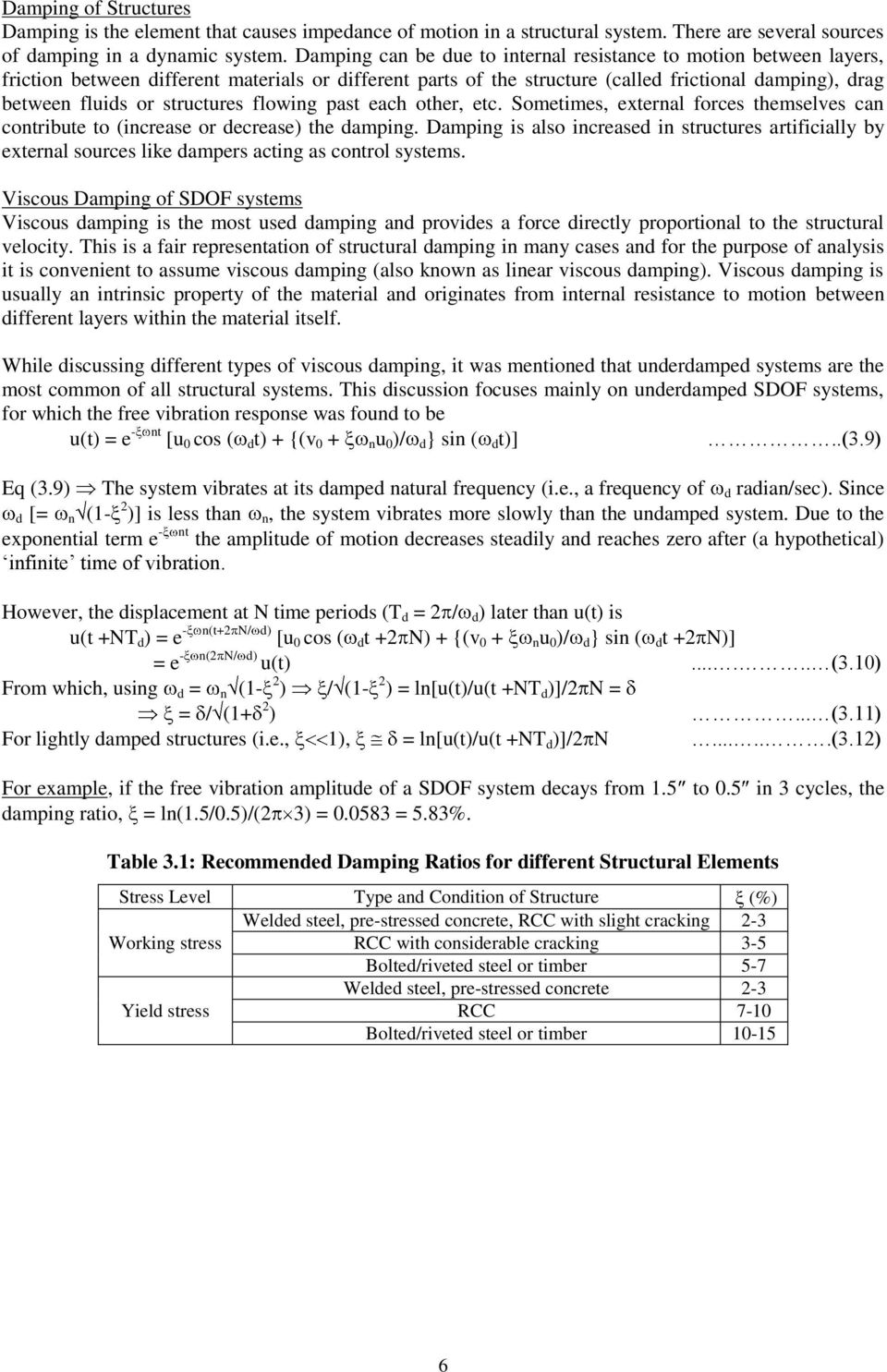
6 Damping of Structures Damping is the element that causes impedance of motion in a structural system. There are several sources of damping in a dynamic system. Damping can be due to internal resistance to motion between layers, friction between different materials or different parts of the structure (called frictional damping), drag between fluids or structures flowing past each other, etc. Sometimes, external forces themselves can contribute to (increase or decrease) the damping. Damping is also increased in structures artificially by external sources like dampers acting as control systems. Viscous Damping of SDOF systems Viscous damping is the most used damping and provides a force directly proportional to the structural velocity. This is a fair representation of structural damping in many cases and for the purpose of analysis it is convenient to assume viscous damping (also known as linear viscous damping). Viscous damping is usually an intrinsic property of the material and originates from internal resistance to motion between different layers within the material itself. While discussing different types of viscous damping, it was mentioned that underdamped systems are the most common of all structural systems. This discussion focuses mainly on underdamped SDOF systems, for which the free vibration response was found to be u(t) = e - nt [u 0 cos ( dt) + {(v 0 + nu 0 )/ d} sin ( dt)]..(3.9) Eq (3.9) The system vibrates at its damped natural frequency (i.e., a frequency of d radian/sec). Since d [= n (1-2 )] is less than n, the system vibrates more slowly than the undamped system. Due to the exponential term e - nt the amplitude of motion decreases steadily and reaches zero after (a hypothetical) infinite time of vibration. However, the displacement at N time periods (T d = 2 / d) later than u(t) is u(t +NT d ) = e - n(t+2 N/ d) [u 0 cos ( dt +2 N) + {(v 0 + nu 0 )/ d} sin ( dt +2 N)] = e - n(2 N/ d) u(t) (3.10) From which, using d = n (1-2 ) / (1-2 ) = ln[u(t)/u(t +NT d )]/2 N = = / (1+ 2 )... (3.11) For lightly damped structures (i.e., 1), = ln[u(t)/u(t +NT d )]/2 N......(3.12) For example, if the free vibration amplitude of a SDOF system decays from 1.5 to 0.5 in 3 cycles, the damping ratio, = ln(1.5/0.5)/(2 3) = = 5.83%. Table 3.1: Recommended Damping Ratios for different Structural Elements Stress Level Type and Condition of Structure (%) Welded steel, pre-stressed concrete, RCC with slight cracking 2-3 Working stress RCC with considerable cracking 3-5 Bolted/riveted steel or timber 5-7 Welded steel, pre-stressed concrete 2-3 Yield stress RCC 7-10 Bolted/riveted steel or timber
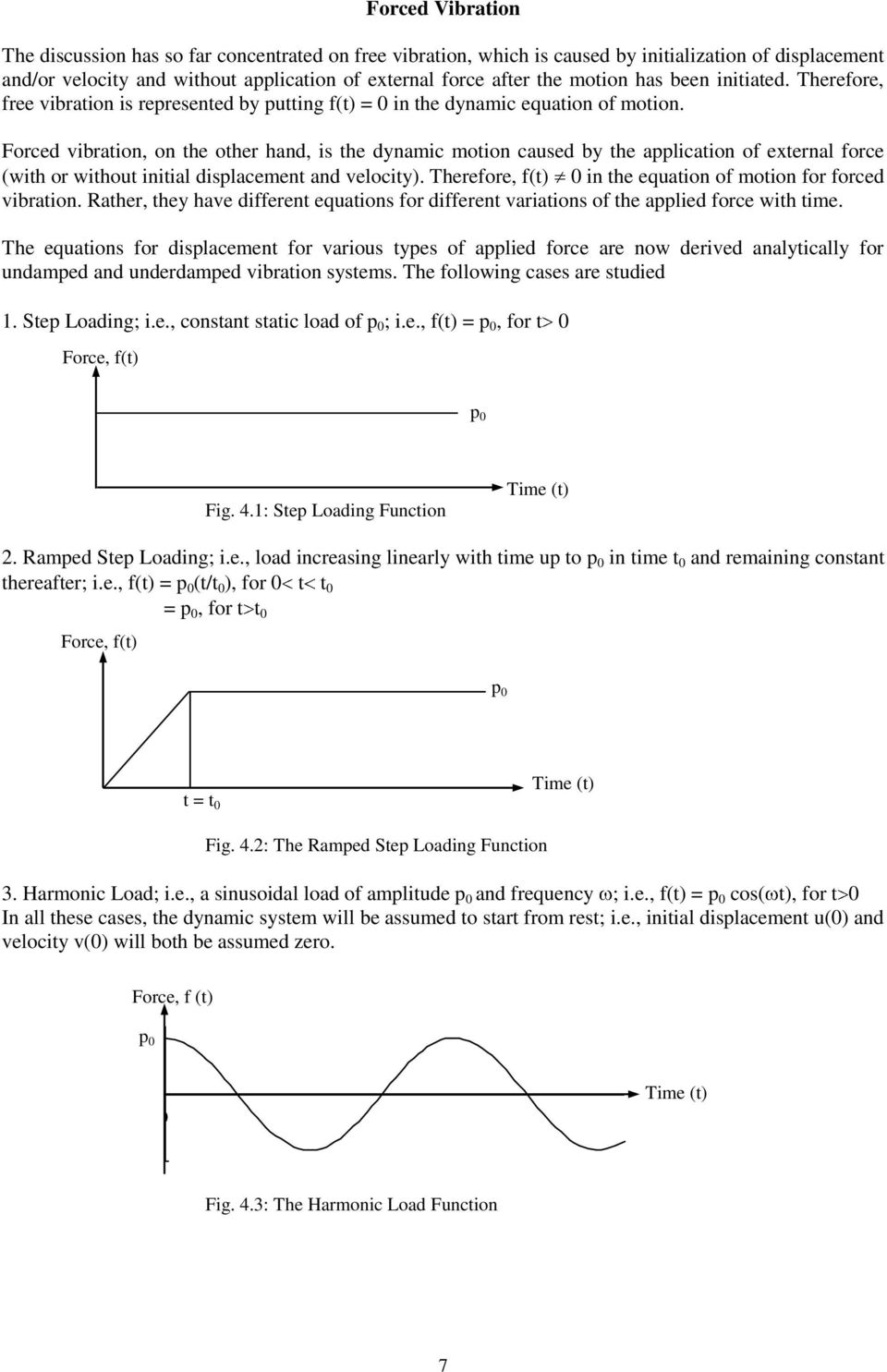
7 Forced Vibration The discussion has so far concentrated on free vibration, which is caused by initialization of displacement and/or velocity and without application of external force after the motion has been initiated. Therefore, free vibration is represented by putting f(t) = 0 in the dynamic equation of motion. Forced vibration, on the other hand, is the dynamic motion caused by the application of external force (with or without initial displacement and velocity). Therefore, f(t) 0 in the equation of motion for forced vibration. Rather, they have different equations for different variations of the applied force with time. The equations for displacement for various types of applied force are now derived analytically for undamped and underdamped vibration systems. The following cases are studied 1. Step Loading; i.e., constant static load of p 0 ; i.e., f(t) = p 0, for t 0 Force, f(t) p 0 Fig. 4.1: Step Loading Function Time (t) 2. Ramped Step Loading; i.e., load increasing linearly with time up to p 0 in time t 0 and remaining constant thereafter; i.e., f(t) = p 0 (t/t 0 ), for 0 t t 0 = p 0, for t t 0 Force, f(t) p 0 t = t 0 Time (t) Fig. 4.2: The Ramped Step Loading Function 3. Harmonic Load; i.e., a sinusoidal load of amplitude p 0 and frequency ; i.e., f(t) = p 0 cos( t), for t 0 In all these cases, the dynamic system will be assumed to start from rest; i.e., initial displacement u(0) and velocity v(0) will both be assumed zero. Force, f (t) p 0 0 Time (t) -1 Fig. 4.3: The Harmonic Load Function 7
8 Displacement (ft) Case 1 - Step Loading: For a constant static load of p 0, the equation of motion becomes m d 2 u/dt 2 + c du/dt + ku = p 0..(4.1) The solution of this differential equation consists of two parts; i.e., the general solution and the particular solution. The general solution assumes the excitation force to be zero and thus it will be the same as the free vibration solution (with two arbitrary constants). The particular solution of u(t) will satisfy Eq The total solution will be the summation of these two solutions. The general solution for an underdamped system is (using Eq. 3.6) u g (t) = e - nt [C 1 cos ( dt) + C 2 sin ( dt)]....(4.2) and the particular solution of Eq. 4.1 is u p (t) = p 0 /k....(4.3) Combining the two, the total solution for u(t) is u(t) = u g (t) + u p (t) = e - nt [C 1 cos ( dt) + C 2 sin ( dt)] + p 0 /k (4.4) v(t) = du/dt = e - nt [ d{ C 1 sin( dt) + C 2 cos( dt)} n{c 1 cos( dt) + C 2 sin( dt)}]...(4.5) If initial displacement u(0) = 0 and initial velocity v(0) = 0, then C 1 + p 0 /k = 0 C 1 = p 0 /k, and dc 2 - nc 1 = 0 C 2 = n (p 0 /k)/ d......(4.6) Eq. (4.4) u(t) = (p 0 /k)[1 e - nt {cos ( dt) + n/ d sin ( dt)}] (4.7) For an undamped system, = 0, d = n u(t) = (p 0 /k)[1 cos ( nt)]......(4.8) Example 4.1 For the system mentioned in Examples 2.1 and 3.1 (i.e., k = 25 k/ft, m = 1 k-sec 2 /ft), plot the displacement vs. time if a static load p 0 = 25 k is applied on the system if the Damping Ratio ( ) is (a) 0.00 (undamped system), 0.05, (c) 0.50 (underdamped systems). Solution In this case, the static displacement is = p 0 /k = 25/25 = 1 ft. The dynamic solutions are obtained from Eq. 4.7 and plotted below in Fig The main features of these results are (1) For Step Loading, the maximum dynamic response for an undamped system (i.e., 2 ft in this case) is twice the static response and continues indefinitely without converging to the static response. (2) The maximum dynamic response for damped systems is between 1 and 2, and eventually converges to the static solution. The larger the damping ratio, the less the maximum response and the quicker it converges to the static solution. In general, the dynamic response converges to the particular solution of the dynamic equation of motion, and is therefore called the steady state response Static Disp DR=0.00 DR=0.05 DR= Time (sec) Fig. Fig. 4.4: 5.2: Dynamic Response to Step Loading 8

9 Displacement (ft) Case 2 - Ramped Step Loading: For a ramped step loading up to p 0 in time t 0, the equation of motion is m d 2 u/dt 2 + c du/dt + ku = p 0 (t/t 0 ), for 0 t t 0 = p 0, for t t 0....(4.9) The solution will be different (u1 and u2) for the two stages of loading. The loading in the first stage is a linearly varying function of time, while that of the second stage is a constant. The general solution for an underdamped system has been shown in Eq. 3.6 and 4.2, while the particular solution is u1 p (t) = (p 0 /kt 0 ) (t c/k)..(4.10) u1(t) = e - nt [C 1 cos ( dt) + C 2 sin ( dt)] + (p 0 /kt 0 )(t c/k).....(4.11) v1(t) = e - nt [ d{ C 1 sin( dt) + C 2 cos( dt)} n{c 1 cos( dt) + C 2 sin( dt)}] + p 0 /kt 0....(4.12) If initial displacement u1(0) = 0, initial velocity v1(0) = 0, then C 1 (p 0 /k)(c/kt 0 ) = 0 C 1 = (p 0 /k)(c/kt 0 ) and dc 2 nc 1 + p 0 /kt 0 = 0 C 2 = (p 0 /k)( nc/k 1)/( d t 0 )....(4.13) u1(t) = (p 0 /kt 0 )[(t c/k) + e - nt {(c/k) cos( dt) + ( nc/k 1)/( d) sin( dt)}].....(4.14) For an undamped system, u1(t) = (p 0 /k) [t/t 0 sin( nt)/( nt 0 )].(4.15) The second stage of the solution may be considered as the difference between two ramped step functions, one beginning at t = 0 and another at t = t 0. u2(t) = u1(t) u1(t t 0 ) = u1(t) u1(t ); where t = t t (4.16) For undamped system, u2(t) = (p 0 /k) [1 {sin( nt) sin( nt )}/( nt 0 )]....(4.17) Example 4.2 For the system mentioned in Example 4.1, plot the displacement vs. time if a ramped step load with p 0 = 25 k is applied on the system with = 0.00 if t 0 is (a) 0.5 second, (b) 2 seconds. Solution In this case, the static displacement is = p 0 /k = 25/25 = 1 ft. The dynamic solutions are obtained from Eqs. 4.14~4.17 and plotted in Fig The main features of these results are (1) For Ramped Step Loading, the maximum dynamic response for an undamped system is less than the response due to Step Loading, which is twice as much as the static response (i.e., 2 ft in this case). (2) The larger the ramp duration, the smaller the maximum dynamic response. Eventually the dynamic response takes the form of an oscillating sinusoid about the steady state (static in this case) response. (3) The response for damped system is not shown here. However, the response for a damped system would be qualitatively similar for an undamped system and would eventually converge to the steady state solution. 2 t0=0.5 s (Steady) t0=0.5 s t0=2.0 s (Steady) t0=2.0 s Time (sec) Fig. Fig. 4.5: 5.4: Dynamic Response to Ramped Step Step Loading Loading 9

10 Displacement (ft) Displacement (ft) Displacement (ft) Case 3 - Harmonic Loading: For a harmonic load of amplitude p 0 and frequency, the equation of motion is m d 2 u/dt 2 + c du/dt + ku = p 0 cos( t), for t 0... (4.18) The general solution for an underdamped system has been shown before, and the particular solution u p (t) = [p 0 / {(k 2 m) 2 +( c) 2 }] cos( t ) = (p 0 /k d ) cos( t- ).....(4.19) [where k d = {(k 2 m) 2 + ( c) 2 }, = tan -1 {( c)/(k 2 m)}] u(t) = e - nt [C 1 cos ( dt) + C 2 sin ( dt)] + (p 0 /k d ) cos( t ) (4.20) v(t) = e - nt [ d{ C 1 sin( dt) + C 2 cos( dt)} n{c 1 cos( dt) + C 2 sin( dt)}] (p 0 /k d ) sin( t ) (4.21) If initial displacement u(0) = 0 and initial velocity v(0) = 0, then C 1 + (p 0 /k d ) cos( ) = 0 C 1 = (p 0 /k d ) cos and dc 2 n C 1 + (p 0 /k d ) sin = 0 C 2 = (p 0 /k d ) ( sin + n cos )/ d.(4.22) u(t) = (p 0 /k d )[cos( t- ) e - nt {cos cos( dt) + ( / d sin + n/ d cos ) sin( dt)}]... (4.23) For an undamped system, u(t) = [p 0 /(k 2 m)] [cos( t) cos( nt)].....(4.24) Example 4.3 For the system mentioned in previous examples, plot the displacement vs. time if a harmonic load with p 0 = 25 k is applied on the system with = 0.05 and 0.00, if is (a) 2.0, (d) 5.0, (e) 10.0 radian/sec. Solution The variation of load f(t) with time in shown in Fig The solutions for u(t) are obtained from Eqs and 4.24 and are plotted in Figs. 4.6~4.8. The main features of these results are (1) The responses for undamped systems are larger than the damped responses. This is true in general for all three loading cases. (2) The responses for the second loading case are larger than the other two, because the frequency of the load is equal to the natural frequency of the system. As will be explained later, this is the resonant condition. At resonance, the damped response reaches a maximum amplitude (the steady state amplitude) and oscillates with that amplitude subsequently. This amplitude is 10 ft, which the damped system would eventually reach if it were allowed to vibrate long enough. The amplitude of the undamped system, on the other hand, increases steadily with time and would eventually reach infinity DR=0.05 DR= Time (sec) Fig. 5.6: 4.6: Dynamic Response to 25 to Cos(2t) 25 Cos(2t) 0-6 Time (sec) Fig. Fig. 4.7: 5.7: Dynamic Response to to 25 Cos(5t) Time (sec) Fig. Fig. 4.8: 5.8: Dynamic Dynamic Response to 25 Cos(10t) 10
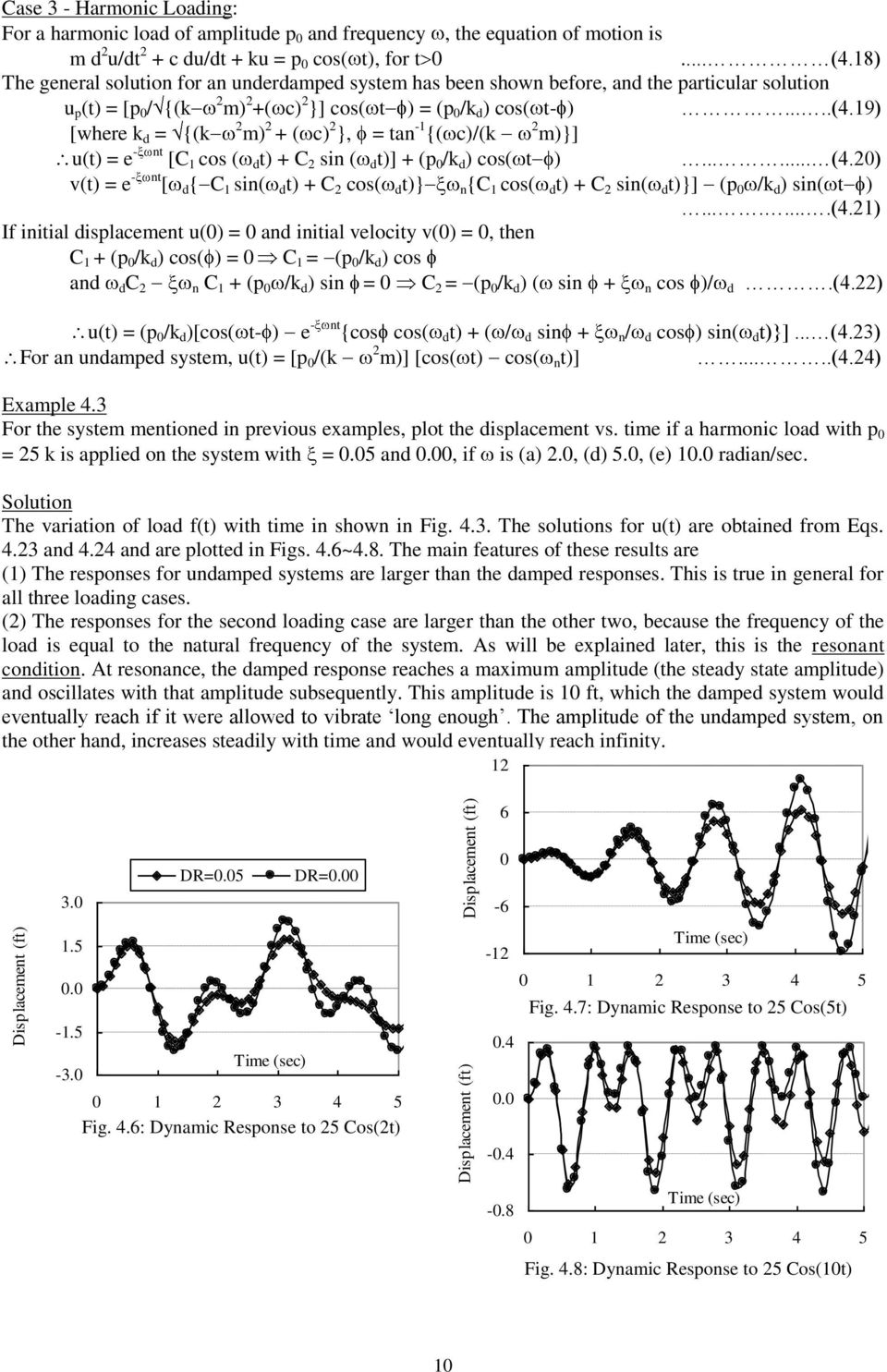
11 Dynamic Magnification Factor Dynamic Magnification In Section 4, it was observed that the maximum dynamic displacements are different from their static counterparts. However, the effect of this magnification (increase or decrease) was more apparent in the harmonic loading case. There, for sinusoidal loads (cosine functions of time) of the same amplitude (25 k) the maximum vibrations varied between 0.5 ft to 12 ft depending on the frequency of the harmonic load. If the motion is allowed to continue for long (theoretically infinite) durations, the total response converges to the steady state solution given by the particular solution of the equation of motion. u steady (t) = u p (t) = (p 0 /k d ) cos( t ).. (4.19) [where k d = {(k 2 m) 2 + ( c) 2 }, = tan -1 {( c)/ (k 2 m)}] Putting the value of k d in Eq. (4.19), the amplitude of steady vibration is found to be u amplitude = p 0 /k d = p 0 / {(k 2 m) 2 + ( c) 2 }....(5.1) This can be written as, u amplitude = (p 0 /k) / {(1 2 m/k) 2 + ( c/k) 2 } Using u static = p 0 /k, m/k = 1/ n 2, c/k = 2 / n u amplitude /u static = 1/ {(1 2 / n 2 ) 2 + (2 / n) 2 }. (5.2) Eq. (5.2) gives the ratio of the dynamic and static amplitude of motion as a function of frequency (as well as structural properties like n and ). This ratio is called the steady state dynamic magnification factor (DMF) for harmonic motion. Putting the frequency ratio / n = r, Eq. (6.2) can be rewritten as DMF = 1/ {(1 r 2 ) 2 + (2 r) 2 }.. (5.3) From which the maximum value of DMF is found to be = (1/2 )/ (1 2 ), when r = (1 2 2 )...(5.4) The variation of the steady state dynamic magnification factor (DMF) with frequency ratio (r = shown in Fig. 5.1 for different values of (= DR). The main features of this graph are / n) is DR=0.00 DR=0.05 DR=0.20 DR=0.50 DR= Frequency Ratio Fig. 5.1: Fig. Steady 6.1: Steady State State Dynamic Magnification Factor 1. The curves for the smaller values of show pronounced peaks [ 1/(2 )] at / n 1. This situation is called resonance and is characterized by large dynamic amplifications of motion. This situation can be derived from Eq. (5.4), where 1 DMF max 1/ (4 2 ) = (1/2 ), when r (1 2 2 ) = For undamped system, the resonant peak is infinity, which is consistent with the earlier conclusion from Section 4 that and vibration amplitude of an undamped system tends steadily to infinity. 3. Since resonance is such a critical condition from structural point of view, it should be avoided in practical structures by making it either very stiff (i.e., r 1) or very flexible (i.e., r 1) with respect to the frequency of the expected harmonic load. 4. The resonant condition mentioned in (1) is not applicable for large values of, because the condition of maxima at r = (1 2 2 ) is meaningless if r is imaginary; i.e., (1/ 2 =) Therefore, another way of avoiding the critical effects of resonance is by increasing the damping of the system. 11
12 Numerical Solution of SDOF Equation So far the equation of motion for a SDOF system has been solved analytically for different loading functions. For mathematical convenience, the dynamic loads have been limited to simple functions of time and the initial conditions had been set equal to zero. Even if the assumptions of linear structural properties and initial at rest conditions are satisfied; the practical loading situations can be more complicated and not convenient to solve analytically. Numerical methods must be used in such situations. The most widely used numerical approach for solving dynamic problems is the Newmark- method. Actually, it is a set of solution methods with different physical interpretations for different values of. The total simulation time is divided into a number of intervals (usually of equal duration t) and the unknown displacement (as well as velocity and acceleration) is solved at each instant of time. The method solves the dynamic equation of motion in the (i + 1) th time step based on the results of the i th step. The equation of motion for the (i +1) th time step is m (d 2 u/dt 2 ) i+1 + c (du/dt) i+1 + k (u) i+1 = f i+1 m a i+1 + c v i+1 + k u i+1 = f i+1.. (6.1) where a stands for the acceleration, v for velocity and u for displacement. To solve for the displacement or acceleration at the (i + 1) th time step, the following equations are assumed for the velocity and displacement at the (i + 1) th step in terms of the values at the i th step. v i+1 = v i + {(1 ) a i + a i+1 } t (6.2) u i+1 = u i + v i t + {(0.5 ) a i + a i+1 } t 2 (6.3) By putting the value of v i+1 from Eq. (6.2) and u i+1 from Eq. (6.3) in Eq. (6.1), the only unknown variable a i+1 can be solved from Eq. (6.1). In the solution set suggested by the Newmark- method, the Constant Average Acceleration (CAA) method is the most popular because of the stability of its solutions and the simple physical interpretations it provides. This method assumes the acceleration to remain constant during each small time interval t, and this constant is assumed to be the average of the accelerations at the two instants of time t i and t i+1. The CAA is a special case of Newmark- method where = 0.50 and = Thus in the CAA method, the equations for velocity and displacement [Eqs. (6.2) and (6.3)] become v i+1 = v i + (a i + a i+1 ) t/2 u i+1 = u i + v i t + (a i + a i+1 ) t 2 /4 (6.4) (6.5) Inserting these values in Eq. (6.1) and rearranging the coefficients, the following equation is obtained, (m + c t /2 + k t 2 /4)a i+1 = f i+1 ku i (c + k t)v i (c t/2 + k t 2 /4)a i....(6.6) To obtain the acceleration a i+1 at an instant of time t i+1 using Eq. (6.6), the values of u i, v i and a i at the previous instant t i have to be known (or calculated) before. Once a i+1 is obtained, Eqs. (6.4) and (6.5) can be used to calculate the velocity v i+1 and displacement u i+1 at time t i+1. All these values can be used to obtain the results at time t i+2. The method can be used for subsequent time-steps also. The simulation should start with two initial conditions, like the displacement u 0 and velocity v 0 at time t 0 = 0. The initial acceleration can be obtained from the equation of motion at time t 0 = 0 as a 0 = (f 0 cv 0 ku 0 )/m (6.7) 12
13 Displacement (ft) Velocity (ft/sec) Acceleration (ft/sec 2 ) Example 6.1 For the undamped SDOF system described before (m = 1 k-sec 2 /ft, k = 25 k/ft, c = 0 k-sec/ft), calculate the dynamic response for a Ramped Step Loading with p0 = 25 k and t0 = 0.5 sec. Results using the CAA Method (for time interval t = 0.05 sec) as well as the exact analytical equation are shown below in tabular form. Table 6.1: Acceleration, Velocity and Displacement for t = 0.05 sec m (k-sec 2 /ft) c (k-sec/ft) k (k/ft) t 0 (sec) dt (sec) m eff (k-sec 2 /ft) c eff (k-sec/ft) m 1 (k-sec 2 /ft) i t (sec) f i (kips) a i (ft/sec 2 ) v i (ft/sec) u i (ft) u ex (ft) Time (sec) Fig. 6.1: Acceleration vs. Time Time (sec) Fig. 6.2: Velocity vs. Time ui (ft) Time (sec) Fig. 6.3: Displacement vs. Time uex (ft) 13

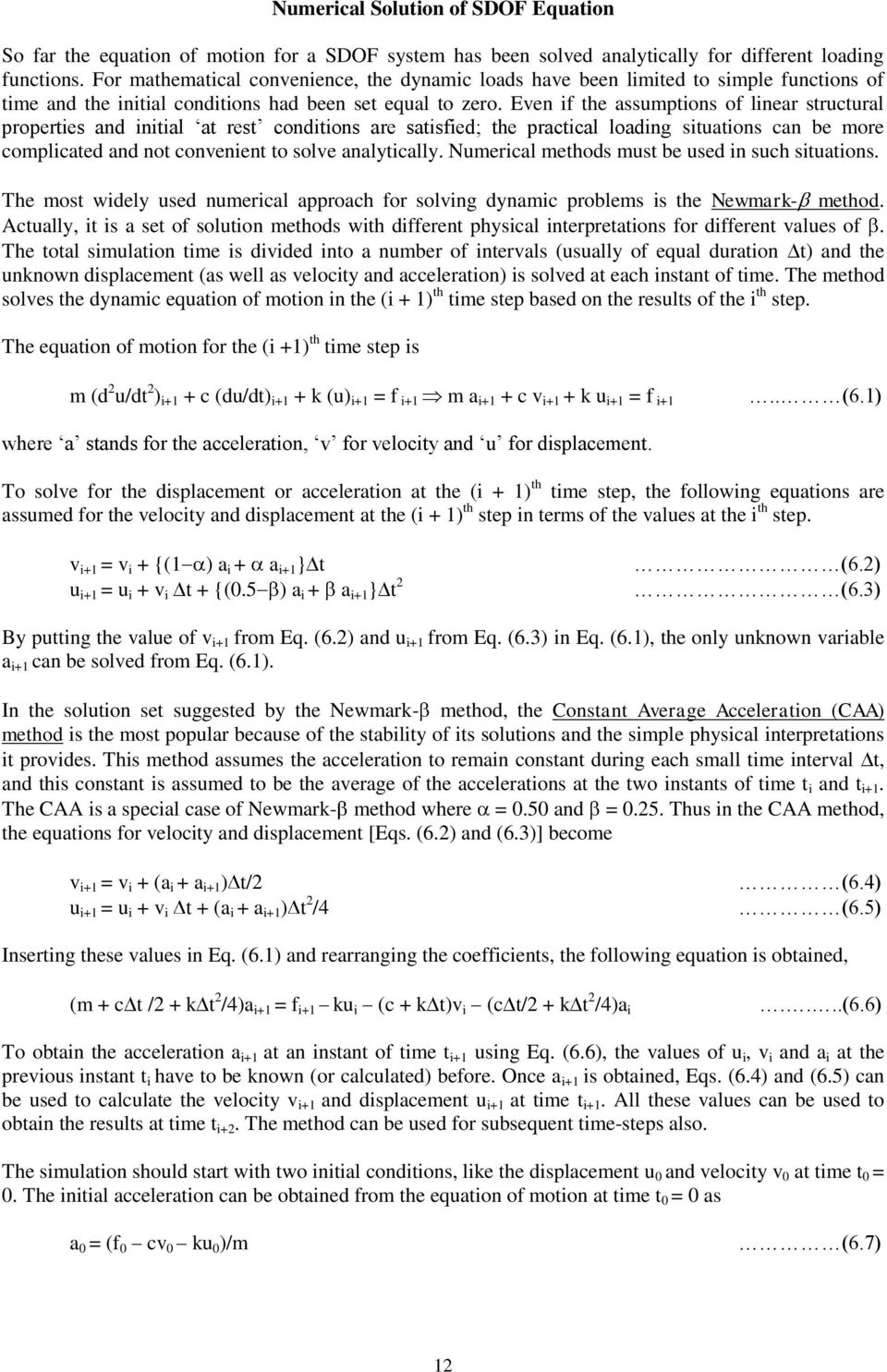
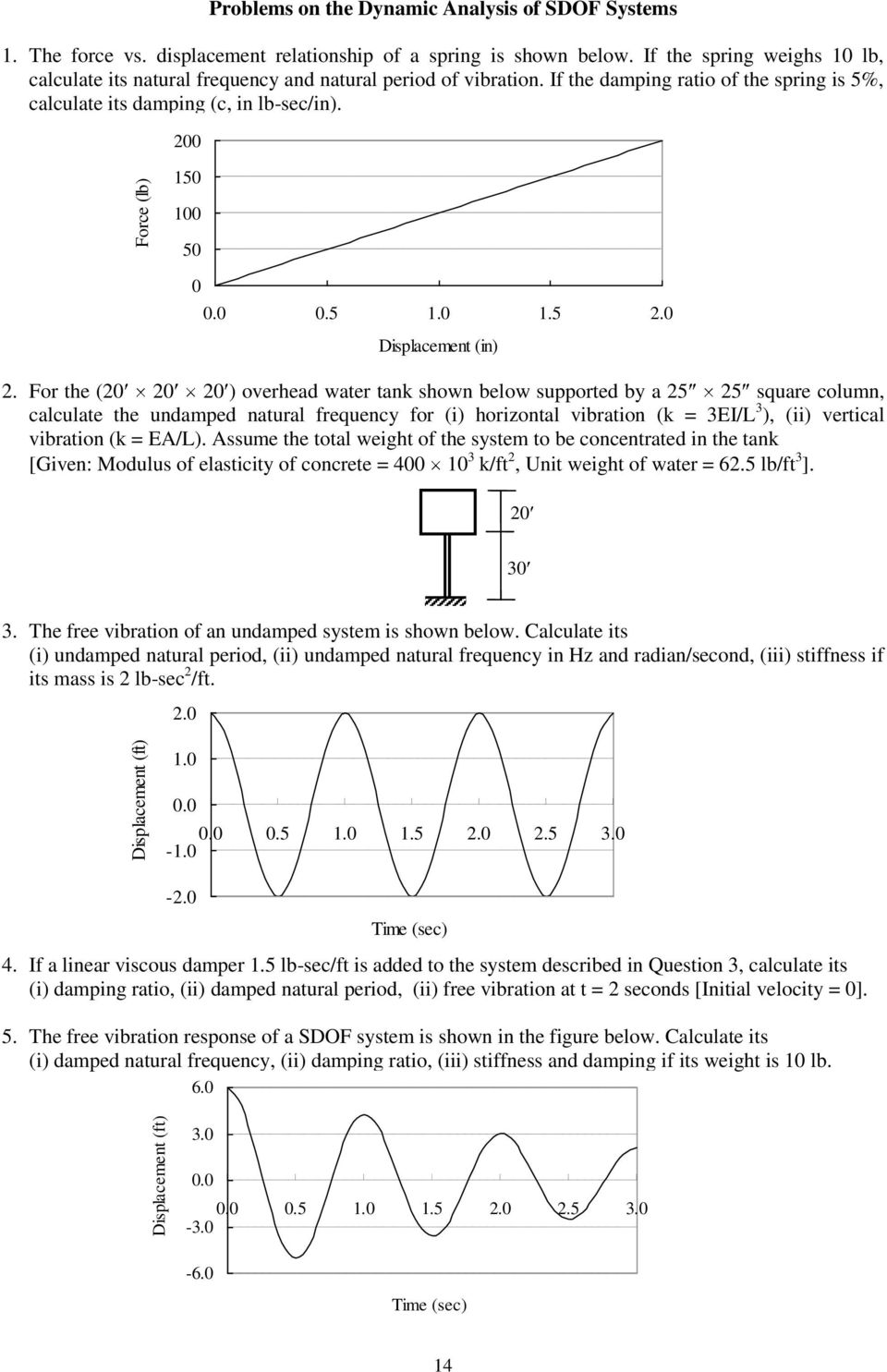
14 Displacement (ft) Displacement (ft) Force (lb) Problems on the Dynamic Analysis of SDOF Systems 1. The force vs. displacement relationship of a spring is shown below. If the spring weighs 10 lb, calculate its natural frequency and natural period of vibration. If the damping ratio of the spring is 5%, calculate its damping (c, in lb-sec/in) Displacement (in) 2. For the ( ) overhead water tank shown below supported by a square column, calculate the undamped natural frequency for (i) horizontal vibration (k = 3EI/L 3 ), (ii) vertical vibration (k = EA/L). Assume the total weight of the system to be concentrated in the tank [Given: Modulus of elasticity of concrete = k/ft 2, Unit weight of water = 62.5 lb/ft 3 ] The free vibration of an undamped system is shown below. Calculate its (i) undamped natural period, (ii) undamped natural frequency in Hz and radian/second, (iii) stiffness if its mass is 2 lb-sec 2 /ft Time (sec) 4. If a linear viscous damper 1.5 lb-sec/ft is added to the system described in Question 3, calculate its (i) damping ratio, (ii) damped natural period, (ii) free vibration at t = 2 seconds [Initial velocity = 0]. 5. The free vibration response of a SDOF system is shown in the figure below. Calculate its (i) damped natural frequency, (ii) damping ratio, (iii) stiffness and damping if its weight is 10 lb Time (sec) 14
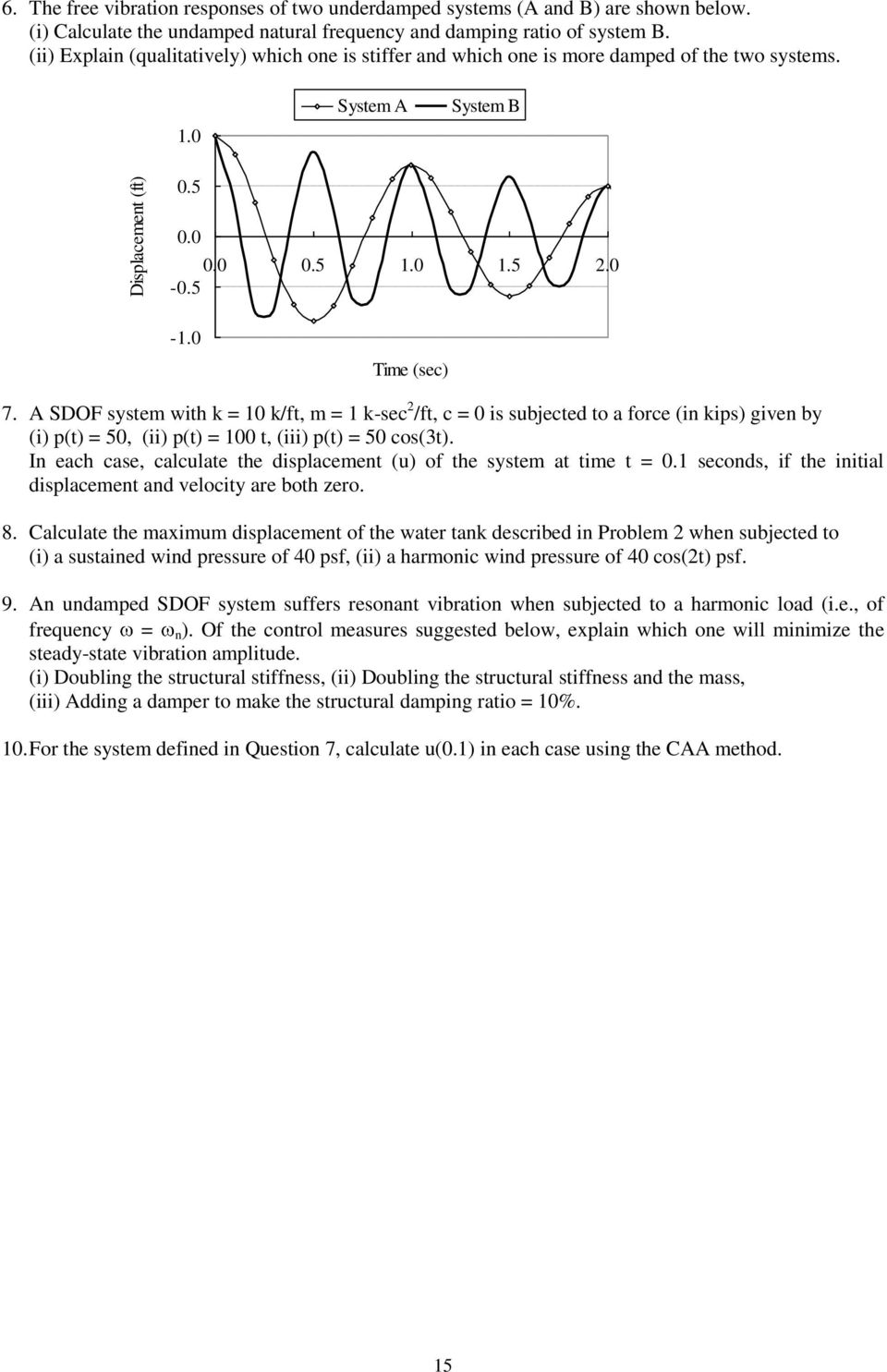
15 Displacement (ft) 6. The free vibration responses of two underdamped systems (A and B) are shown below. (i) Calculate the undamped natural frequency and damping ratio of system B. (ii) Explain (qualitatively) which one is stiffer and which one is more damped of the two systems. 1.0 System A System B Time (sec) 7. A SDOF system with k = 10 k/ft, m = 1 k-sec 2 /ft, c = 0 is subjected to a force (in kips) given by (i) p(t) = 50, (ii) p(t) = 100 t, (iii) p(t) = 50 cos(3t). In each case, calculate the displacement (u) of the system at time t = 0.1 seconds, if the initial displacement and velocity are both zero. 8. Calculate the maximum displacement of the water tank described in Problem 2 when subjected to (i) a sustained wind pressure of 40 psf, (ii) a harmonic wind pressure of 40 cos(2t) psf. 9. An undamped SDOF system suffers resonant vibration when subjected to a harmonic load (i.e., of frequency = n). Of the control measures suggested below, explain which one will minimize the steady-state vibration amplitude. (i) Doubling the structural stiffness, (ii) Doubling the structural stiffness and the mass, (iii) Adding a damper to make the structural damping ratio = 10%. 10. For the system defined in Question 7, calculate u(0.1) in each case using the CAA method. 15
16 Solution of Problems on the Dynamic Analysis of SDOF Systems 1. From the force vs. displacement relationship, spring stiffness k = 200/2.0 = 100 lb/in Weight of the spring is W = 10 lb Mass m = 10/( ) = lb-sec 2 /in Natural frequency, n = (k/m) = (100/0.0259) = rad/sec f n = n/2 = 9.89 Hz Natural period, T n = 1/f n = sec Damping ratio, = 5% = 0.05 Damping, c = 2 (km) = ( ) = lb-sec/in 2. Mass of the tank (filled with water), m = /32.2 = lb-ft/sec 2 Modulus of elasticity E = k/ft 2 = lb/ft 2, Length of column L = 30 ft (i) Moment of inertia, I = (25/12) 4 /12 = ft 4 Stiffness for horizontal vibration, k h = 3EI/L 3 = /(30) 3 = lb/ft Natural frequency, nh = (k h /m) = (69770/15528) = rad/sec (ii) Area, A = (25/12) 2 = ft 2 Stiffness for vertical vibration, k v = EA/L = /30 = lb/ft Natural frequency, nv = (k v /m) = ( /15528) = rad/sec 3. (i) The same displacement (2 ft) is reached after 1.0 second intervals. Undamped natural period, T n = 1.0 sec (ii) Undamped natural frequency, f n = 1/T n = 1.0 Hz n = 2 f n = radian/second (iii) Mass, m = 2 lb-sec 2 /ft. Stiffness, k = m 2 n = rad/sec 4. If a linear viscous damper, c = 1.5 lb-sec/ft, (i) damping ratio, (ii) damped natural period, (iii) free vibration at t = 2 seconds [Initial velocity = 0]. (i) Damping ratio, = c/[2 (km)] = 1.5/[2 ( )] = = 5.97% (ii) Damped natural period, T d = T n / (1 2 ) = 1.0/ ( ) = sec (iii) Damped natural frequency, d = 2 /T d = rad/sec u(t) = e nt [u 0 cos( dt) + {(v 0 + nu 0 )/ d} sin( dt)] = e [2 cos( ) + {( )/6.272} sin( )] = ft 5. (i) The figure shows that the peak displacement is repeated in every 1.0 second Damped natural period, T d = 1.0 sec Damped natural frequency, d = 2 /T d = rad/sec (ii) Damping ratio, = / (1+ 2 ); where = ln[u(t)/u(t +NT d )]/2 N Using as reference the displacements at t = 0 (6.0 ft) and t = 2.0 sec (3.0 ft); i.e., for N = 2 = ln[u(0.0)/u(2.0)]/(2 2) = ln[6.0/3.0]/4 = = / (1+ 2 ) = (iii) Weight, W = 10 lb Mass, m = 10/32.2 = lb-sec 2 /ft Undamped natural frequency, n = d/ (1 2 ) = 6.283/ ( ) = rad/sec Stiffness, k = m 2 n = = k/ft and Damping, c = 2 (km) = ( ) = lb-sec/ft 6. (i) System B takes 1.0 second to complete two cycles of vibration. Damped natural period T d for system B = 1.0/2 = 0.50 sec Damped natural frequency, d = 2 /T d = rad/sec Using as reference the displacements at t = 0 (1.0 ft) and t = 2.0 sec (0.5 ft); i.e., for N = 4 = ln[u(0.0)/u(2.0)]/(2 4) = ln[1.0/0.5]/8 = = / (1+ 2 ) = Undamped natural frequency, n = d/ (1 2 ) = / ( ) = rad/sec 16
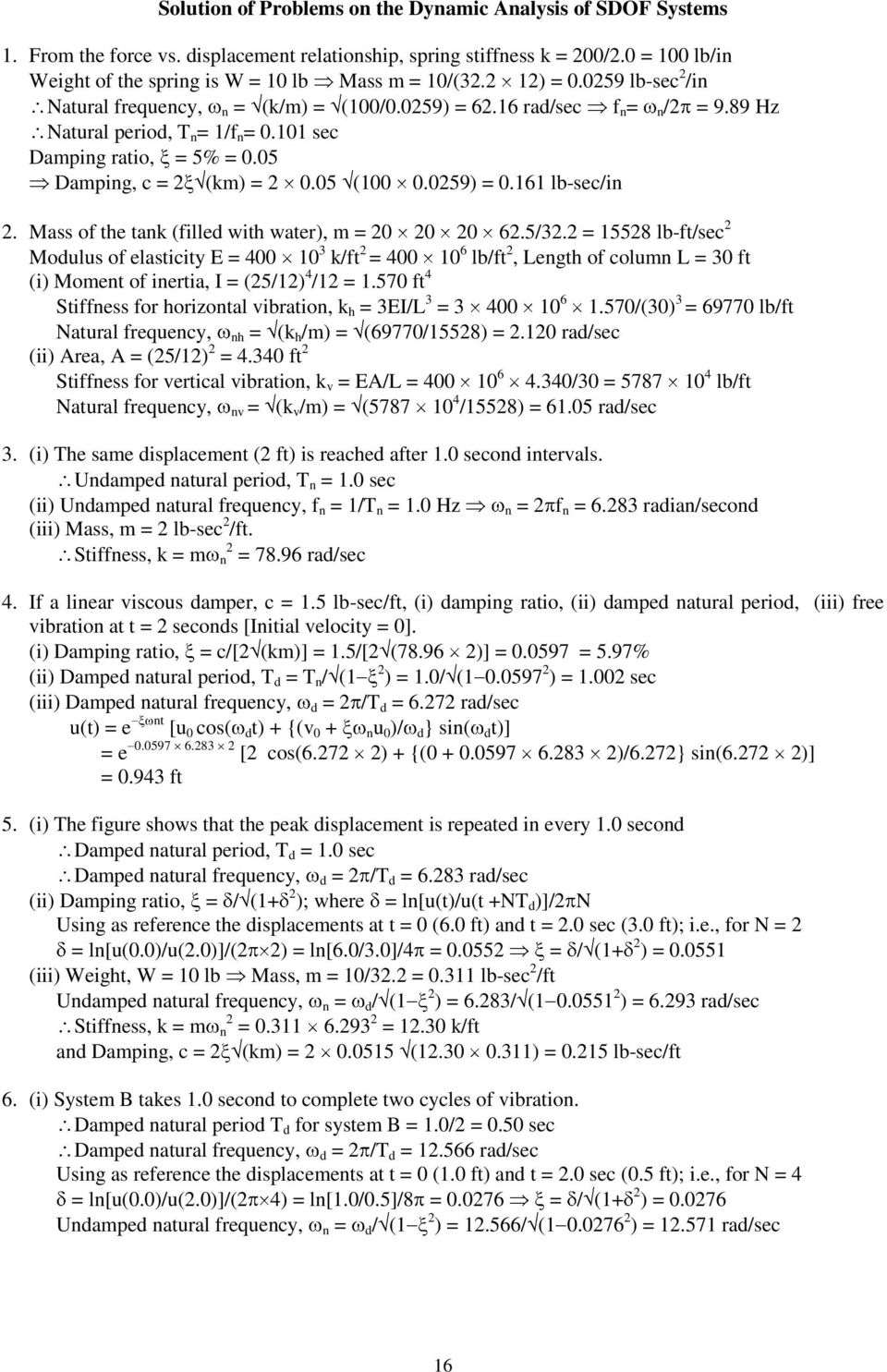
17 (ii) System A completes only two vibrations while (in 2.0 sec) system B completes four vibrations. System B is stiffer. However, system A decays by the same ratio (i.e., 0.50 or 50%) in two vibrations system B decays in four vibrations. System A is more damped. 7. For the SDOF system, k = 10 k/ft, m = 1 k-sec 2 /ft, c = 0 Natural frequency, n = (k/m) = (10/1) = rad/sec (i) p(t) = p 0 = 50 For an undamped system, u(t) = (p 0 /k)[1 cos( nt)] u(0.1) = (50/10)[1 cos( )] = ft (ii) p(t) = 100 t For an undamped system, u(t) = (p 0 /k) [t/t 0 sin( nt)/( nt 0 )] = (p 0 /t 0 )/k [t sin( nt)/ n] u(0.1) = (100)/10 [0.1 sin( )/3.162] = ft (iii) p(t) = 50 cos(3t) For an undamped system, u(t) = [p 0 /(k 2 m)] [cos( t) cos( nt)] u(0.1) = (50)/( ) [cos(3 0.1) cos( )] = ft 8. For the water tank filled with water, Mass, m = lb-ft/sec 2, Stiffness for horizontal (i.e., due to wind) vibration, k h = lb/ft Natural frequency, nh = rad/sec (i) p(t) = p 0 = = lb For an undamped system, u max = 2(p 0 /k h ) = 2 (16000/69770) = ft (ii) p(t) = p 0 cos( t) = cos(2t) For an undamped system, u(t) = [p 0 /(k 2 m)] [cos( t) cos( nt)] = [p 0 /(k 2 m)] [cos(2t) cos(2.120t)] Possible u max p 0 /(k 2 h m) [1 ( 1)] 2p 0 /(k 2 h m) [when t = ] = /( ) = ft 9. Maximum dynamic response amplitude, u max = p 0 /(k 2 m) If = n, u max = p 0 /(k n 2 m)= p 0 /(k k) = (i) Doubling the structural stiffness u max = p 0 /(2k k) = p 0 /k (ii) Doubling the structural stiffness and the mass u max = p 0 /(2k n 2 2m) = p 0 /(2k 2k) = (iii) Adding a damper to make the structural damping ratio, = 10% = 0.10 u max = p 0 / {(k n 2 m) 2 + ( nc) 2 } = (p 0 /k)/(2 ) = 5 (p 0 /k) Option (i) is the most effective [since it minimizes u max ]. 10. Using k = 10 k/ft, m = 1 k-sec 2 /ft, c = 0, t = 0.1 sec, u 0 = u(0) = 0, v 0 = v(0) = 0, also f 0 = f(0), f 1 = f(0.1), a 0 = a(0), u 1 = u(0.1), v 1 = v(0.1), a 1 = a(0.1), the basic equations of the CAA method become a 0 = f 0 using (6.7) (1.025) a 1 = f a using (6.6) u 1 = (a 0 + a 1 ) using (6.5) (i) a 0 = f 0 = 50 ft/sec 2 (1.025) a 1 = a 1 = ft/sec 2 u 1 = ( ) = ft (ii) a 0 = f 0 = 0 ft/sec 2 (1.025) a 1 = a 1 = ft/sec 2 u 1 = ( ) = ft (iii) a 0 = f 0 = 50 ft/sec 2 (1.025) a 1 = 50 cos(3 0.1) a 1 = ft/sec 2 u 1 = ( ) = ft 17
![162 rad/sec (i) p(t) = p 0 = 50 For an undamped system, u(t) = (p 0 /k)[1 cos( nt)] u(0.1) = (50/10)[1 cos(3.162 0.1)] = 0.](/docs-images/42/5135440/images/page_17.jpg "248 ft (ii) p(t) = 100 t For an undamped system, u(t) = (p 0 /k) [t/t 0 sin( nt)/( nt 0 )] = (p 0 /t 0 )/k [t sin( nt)/ n] u(0.1) = (100)/10 [0.1 sin(3.162 0.1)/3.162] = 0.")
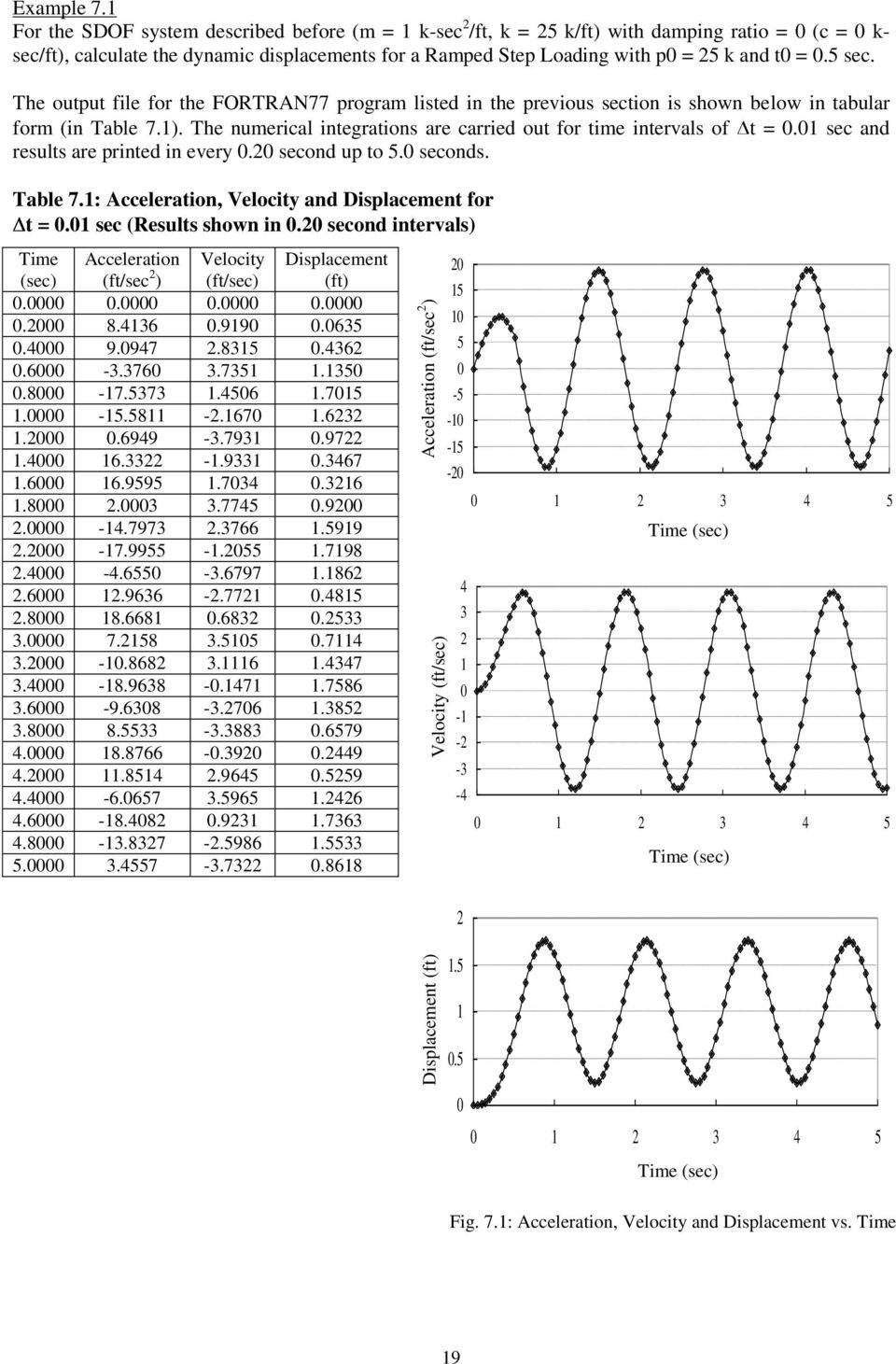
18 Computer Implementation of Numerical Solution of SDOF Equation The numerical time-step integration method of solving the SDOF dynamic equation of motion using the Newmark- method or its special case CAA (Constant Average Acceleration) method can be used for any dynamic system with satisfactory agreement with analytical solutions. Numerical solution is the only option for problems that cannot be solved analytically. They are particularly useful for computer implementation, and are used in the computer solution of various problems of structural dynamics. These are implemented in standard softwares for solving structural dynamics problems. A computer program written in FORTRAN77 for the Newmark- method is listed below for a general linear system and dynamic loading. Although the forcing function is defined here (as the Ramped Step Function mentioned before) the algorithm can be used in any version of FORTRAN to solve dynamic SDOF problems, with slight modification for the forcing function. Also, the resulting acceleration, velocity and displacement are printed out only once in every twenty steps solved numerically. This can also be modified easily depending on the required output. The program listing is shown below. OPEN(1,FILE='SDOF.IN',STATUS='OLD') OPEN(2,FILE='OUT',STATUS='NEW') READ(1,*)RM0,RK0,DRATIO READ(1,*)DT,NSTEP C0=2.*DRATIO*SQRT(RK0*RM0) TIME=0. DIS0=0. VEL0=0. FRC=0. ACC0=(FRC RK0*DIS0 C0*VEL0)/RM0 WRITE(2,4)TIME,ACC0,VEL0,DIS0 RKEFF=RK0 CEFF=C0+RK0*DT RMEFF=C0*DT/2.+RK0*DT**2/4. DO 10 I=1,NSTEP TIME=DT*I FRC=25. IF(TIME.LE.0.5)FRC=50.*TIME ACC=(FRC-RKEFF*DIS0 CEFF*VEL0-RMEFF*ACC0)/(RM0+RMEFF) VEL=VEL0+(ACC0+ACC)*DT/2. DIS=DIS0+VEL0*DT+(ACC0+ACC)*DT**2/4. IF(I/20.EQ.I/20.)WRITE(2,4)TIME,ACC,VEL,DIS DIS0=DIS VEL0=VEL ACC0=ACC 10 CONTINUE 4 FORMAT(10(2X,F8.4)) END 18

19 Displacement (ft) Displacement (ft) Velocity (ft/sec) Velocity (ft/sec) Acceleration (ft/sec 2 ) Acceleration (ft/sec^2) Example 7.1 For the SDOF system described before (m = 1 k-sec 2 /ft, k = 25 k/ft) with damping ratio = 0 (c = 0 k- sec/ft), calculate the dynamic displacements for a Ramped Step Loading with p0 = 25 k and t0 = 0.5 sec. The output file for the FORTRAN77 program listed in the previous section is shown below in tabular form (in Table 7.1). The numerical integrations are carried out for time intervals of t = 0.01 sec and results are printed in every 0.20 second up to 5.0 seconds. Table 7.1: Acceleration, Velocity and Displacement for t = 0.01 sec (Results shown in 0.20 second intervals) Time (sec) Acceleration (ft/sec 2 ) Velocity (ft/sec) Displacement (ft) Time (sec) (sec) Time (sec) (sec) Time (sec) Fig. 7.1: Acceleration, Fig. 8.1: Acceleration, Velocity & and Displacement Displacement vs. Time vs. Time 19
20 The numerical results (i.e., displacements only) obtained for t = 0.01 are presented in Table 7.2 along with exact analytical results and results for t = and 0.05 sec. In the table, it is convenient to notice the deterioration of accuracy with increasing t, although those results are also very accurate and the deterioration of accuracy cannot be detected in Fig. 7.2, where they are also plotted. Numerical predictions are worse for larger t but the CAA guarantees convergence for any value of t, even if the results are not very accurate. Table 7.2 also shows the results for t = 0.10 and 0.20 sec. These results are clearly unsatisfactory compared to the corresponding exact results, but overall there is only a shift in the dynamic responses and there if no tendency to diverge towards infinity. Table 7.2: Exact Displacement and Displacement for t = 0.01, 0.025, 0.05, 0.10, 0.20 sec Time Displacement (ft) (sec) Exact t = 0.01 sec t = sec t = 0.05 sec t = 0.10 sec t = 0.20 sec The accuracy of the results depends on the choice of t with respect to the natural period of the system or the period of the forcing function itself. For example, whereas t = 0.1 and 0.2 sec do not give accurate results for the given system (with natural frequency = 5.0 rad/sec, natural period = seconds) it gives much more accurate predictions for System2 where m = 1 k-sec 2 /ft and k = 4 k/ft (i.e., natural frequency = 2 rad/sec, natural period = seconds). The results are shown in Table 7.3. Table 7.3: Exact Displacement and Displacement for t = 0.1 and 0.2 sec for System2 Time (sec) [Exact] [ t = 0.1 sec] [ t = 0.2 sec]

21 Displacement (ft) Displacement (ft) Displacement (ft) Exact time step=0.01 sec time step=0.025 sec time step=0.05 sec Time (sec) Fig. Fig. 7.2: 8.2: Displacement vs. vs. Time for different small time steps Exact time step=0.1 sec time step=0.2 sec Time (sec) Fig. Fig. 7.3: 8.3: Displacement vs. vs. Time for 'large' large time time steps steps Exact time step = 0.1 sec time step = 0.2 sec Time (sec) Fig. 7.4: 8.4: Displacement vs. vs. Time Time for for System2 21
22 Introduction to Multi-Degree-of-Freedom (MDOF) System The lectures so far had dealt with Single-Degree-of-Freedom (SDOF) systems, i.e., systems with only one displacement. Although important concepts like free vibration, natural frequency, forced vibration, dynamic magnification and resonance were explained, the conclusions based on such a simplified model have limitations while applying to real structures. Real systems can be modeled as SDOF systems only if it is possible to express the physical properties of the system by a single motion. However, in most cases the SDOF system is only a simplification of real systems modeled by assuming simplified deflected shapes that satisfy the essential boundary conditions. Real structural systems often consist of an infinite number of independent displacements/rotations and need to be modeled by several degrees of freedom for an accurate representation of their structural response. Therefore, real structural systems are called Multi-Degree-of-Freedom (MDOF) systems in contrast to the SDOF systems discussed before. A commonly used dynamic model of a 1-storied building is as shown in Fig. 8.1(b), represented by the story sidesway only. Since weight carried by the building is mainly concentrated at the slab and beams while the columns provide the resistance to lateral deformations, the SDOF model assumes a spring and a dashpot for the columns and a mass for the slabs. However the SDOF model may not be an adequate model for real building structures, which calls for modeling as MDOF systems. The infinite number of deflections and rotations of the 1-storied frame shown in Fig. 8.1(a) (subjected to the vertical and horizontal loads as shown) can also be represented by the joint displacements and rotations. A detailed formulation of the 1-storied building frame would require at least three degrees of freedom per joint; i.e., twelve degrees of freedom overall for the four joints (reduced to six after applying boundary conditions). The models become even more complicated for larger structures. (a) Fig. 8.1: One-storied building frame (a) with infinite degrees of freedom, (b) modeled as a SDOF system (b) Some of the comparative features of the SDOF and MDOF systems are 1. Several basic concepts used for the analysis of SDOF systems like free and forced vibration, dynamic magnification can also be used for MDOF systems. 2. However, some differences between the analyses of SDOF and MDOF systems are mainly due to the more elaborate nature of the MDOF systems. For example, the basic SDOF concepts are valid for each degree of freedom in a MDOF system. Therefore, the MDOF system has several natural frequencies, modes of vibration, damping ratios, modal masses. 3. The basic method of numerical analysis of SDOF systems can be applied for MDOF systems after replacing the displacement, velocity and acceleration by the corresponding vectors and the stiffness, mass and damping by corresponding matrices. 22
23 Formulation of the 2-DOF Equations for Lumped Systems The simplest extension of the SDOF system is a two-degrees-of-freedom (2-DOF) system, i.e., a system with two unknown displacements for two masses. The two masses may be connected to each other by several spring-dashpot systems, which will lead to two differential equations of motion, the solution of which gives the displacements and internal forces in the system. m 2 f 2 (t), u 2 (t) k 2 c 2 k 2 (u 2 u 1 ) c 2 (v 2 v 1 ) m 1 f 1 (t), u 1 (t) m 2 f 2 (t), u 2 (t) m 1 k 1 u 1 c 1 v 1 k 1 c 1 k 1 c 1 k 2 (u 2 u 1 ) k 2 c 2 c 2 (v 2 v 1 ) Fig. 8.2: Dynamic 2-DOF system and free body diagrams of m 1 and m 2 Fig. 8.2 shows a 2-DOF dynamic system and the free body diagrams of the two masses m 1 and m 2. In the figure, u stands for displacement (i.e., u 1 and u 2 ) while v stands for velocity (v 1 and v 2 ). Denoting accelerations by a 1 and a 2, the differential equations of motion can be applied by applying Newton s 2 nd law of motion to m 1 and m 2 ; i.e., m 1 a 1 = f 1 (t) + k 2 (u 2 u 1 ) + c 2 (v 2 v 1 ) k 1 u 1 c 1 v 1 m 1 a 1 + (c 1 +c 2 ) v 1 + (k 1 +k 2 )u 1 c 2 v 2 k 2 u 2 = f 1 (t).. (8.1) and m 2 a 2 = f 2 (t) k 2 (u 2 u 1 ) c 2 (v 2 v 1 ) m 2 a 2 c 2 v 1 + c 2 v 2 k 2 u 1 + k 2 u 2 = f 2 (t).. (8.2) Putting v = du/dt (i.e., v 1 = du 1 /dt, v 2 = du 2 /dt) and a = d 2 u/dt 2 (i.e., a 1 = d 2 u 1 /dt 2, a 2 = d 2 u 2 /dt 2 ) in Eqs. (8.1) and (8.2), the following equations are obtained m 1 d 2 u 1 /dt 2 + (c 1 +c 2 ) du 1 /dt c 2 du 2 /dt + (k 1 +k 2 ) u 1 k 2 u 2 = f 1 (t)...(8.3) m 2 d 2 u 2 /dt 2 c 2 du 1 /dt + c 2 du 2 /dt k 2 u 1 + k 2 u 2 = f 2 (t) (8.4) Eqs. (8.3) and (8.4) can be arranged in matrix form as m 1 0 d 2 u 1 /dt 2 c 1 + c 2 c 2 du 1 /dt k 1 +k 2 k 2 u 1 f 1 (t) + + = 0 m 2 d 2 u 2 /dt 2 c 2 c 2 du 2 /dt k 2 k 2 u 2 f 2 (t)...(8.5) Eqs. (8.5) represent in matrix form the set of equations [i.e. (8.3) and (8.4)] to evaluate the displacements u 1 (t) and u 2 (t). In this set, the matrix consisting of the masses (m 1 and m 2 ) is called the mass matrix, the one consisting of the dampings (c 1 and c 2 ) is called the damping matrix and the one consisting of the stiffnesses (k 1 and k 2 ) is called the stiffness matrix of this particular system. These matrices are different for various 2-DOF systems, so that Eq. (8.5) cannot be taken as a general form of governing equations of motion for any 2-DOF system. For a MDOF system, the mass, damping and stiffness matrices can be generalized by their coefficients, so that Eq. (8.5) can be written in the general form of the dynamic equations of motion, M d 2 u/dt 2 + C du/dt + K u = f(t)..(8.6) where the bold capital letters (M, C and K) represent matrices, while the bold small letters (d 2 u/dt 2, du/dt and u) represent vectors. For an undamped system, C = 0 M d 2 u/dt 2 + K u = f(t).(8.7) 23
24 Eigenvalue Problem and Calculation of Natural Frequencies of a MDOF System In the previous section, the general equations of motion of a general MDOF system was mentioned to be M d 2 u/dt 2 + C du/dt + K u = f(t)..(8.6) The free vibration condition for the dynamic motion of MDOF system is obtained by setting f(t) = 0; i.e., M d 2 u/dt 2 + C du/dt + K u = 0..(9.1) In order to obtain the natural frequency of the undamped system, if C is also set equal to zero, the equations of motion reduce to M d 2 u/dt 2 + K u = 0..(9.2) If the displacement vector can be chosen as the summation of a number (equal to the DOF) of variable separable vectors u(t) = q r (t) r..(9.3) where q r (t) is a time-dependent scalar and r is a space-dependent vector. With q(t) = A r e i nrt, or q r (t) = C 1r cos ( nrt) + C 2r sin ( nrt)......(9.4) Eq. (9.2) can be written as [ nr 2 M + K] q r (t) r = 0 [K 2 nr M] r = 0..(9.5) Since the vector u is not zero, Eq. (9.5) turns into the following eigenvalue problem K 2 nr M = 0..(9.6) i.e., the determinant of the matrix (K 2 nr M) is zero. Eq. (9.6) is satisfied for different values of the natural frequency nr, which implies that there can be several natural frequencies of a MDOF system. In fact, the number of natural frequencies of the system is equal to the degrees of freedom of the system, i.e., size of the displacement vector. However, consideration of only the first few can adequately model the structural behavior of a dynamic system. There are several ways to solve the eigenvalue problem of Eq. (9.6), the suitability of which depends on the size of the matrices and the number of eigenvalues required to represent the system accurately. For each value of nr, the vector r is called a modal vector for the r th mode of vibration. Once a natural frequency is known, Eq. (9.5) can be solved for the corresponding vector r to within a multiplicative constant. The eigenvalue problem does not fix the absolute amplitude of the vectors r, only the shape of the vector is given by the relative values of the displacements. Thus the vector r (i.e., the eigenvectors, also called the natural mode of vibration, normal mode, characteristic vector, etc.) physically represents the modal shape of the system corresponding to the natural frequency. The relative values of the displacements in the vector r indicate the shape that the structure would assume while undergoing free vibration at the relevant natural frequency. The undamped natural frequencies and modal shapes calculated from the above procedure usually prove to be adequate in the subsequent dynamic analyses, since the damped natural frequencies are often quite similar to the damped natural frequencies for typical (undamped) systems, as mentioned in the discussion on SDOF systems. However, the damped natural frequencies and modal shapes can also be calculated by the methods mentioned before. For that, q r (t) = A r e i nrt will lead to the following equation [K + i nr C nr 2 M] r = 0 K + i nr C nr 2 M = 0....(9.7) The solution of Eq. (9.7) provides the natural frequencies of the system, from which the natural modes can also be obtained. 24
25 Example 9.1 Calculate the natural frequencies and determine the natural modes of vibration of the 2-storied building system shown in Figs. 8.1 and 8.2, whose governing equations of motion are given by Eq. (8.5). Assume, k 1 = k 2 = 25 k/ft, m 1 = m 2 = 1 k-sec 2 /ft, c 1 = c 2 = 0 (i.e., the same stiffnesses and masses as used for the SDOF system before are used here for an undamped 2-DOF system). Solution The mass and stiffness matrices of the system are given by M and K as follows m k 1 + k 2 k M = =, K = = while the damping matrix C = 0 0 m k 2 k Thus the eigenvalue problem is given by 50 nr 2 (1) 25 nr 2 (0) 1,r 0 25 nr 2 (0) 25 nr 2 (1) 2,r 0 So that the natural frequencies can be obtained from the equation (50 nr 2 ) (25 nr 2 ) ( 25) ( 25) = nr 2 + nr = 0 nr 2 = 9.55, nr = 3.09, 8.09 rad/sec f nr = nr/2 = 0.492, cycle/sec; T nr = 1/f nr = 2.033, sec The two values of the natural frequency indicate the first and second natural frequency of the system. n1 = 3.09 and n2 = 8.09 rad/sec for this system. [Recall that the natural frequency n was equal to 5 rad/sec (i.e., f n = cycle/sec) for the SDOF system in Example 2.1, which is greater than n1 but less than n2] Once the natural frequencies are known, modal shapes can be determined from the eigenvalue equation. For the first natural frequency, the eigenvalue equations are = ,1 0 = ,1 0 from both these equation, ,1 2,1 = 0 1,1 : 2,1 = 1: For the second natural frequency, the equations are , ,2 0 = First Mode Second Mode Fig. 9.1: Modal Shapes of the system from both these equations, 1, ,2 = 0 1,2 : 2,2 = 1: Thus, the first two modal shapes are as shown in Fig
26 Modal Analysis of MDOF Systems Calculation of the natural frequencies and the corresponding natural modes of vibration are important in developing a general method of dynamic analysis called the Modal Analysis. This method decomposes the dynamic system into different SDOF systems after solving the eigenvalue problem for natural frequencies and natural modes and considers the individual modes separately to obtain the total solution. The Modal Analysis uses a very important characteristic of the modal vectors, i.e., the orthogonality conditions. The derivation of the orthogonality conditions is avoided here, but they are available in any standard text on Structural Dynamics. If ni and nj are the i th and j th natural frequencies of an undamped system and i and j are the i th and j th modes of vibration, then if j i, the mass and stiffness matrices satisfy the following orthogonality conditions j T K i = 0 j T M i = 0..(10.1)..(10.2) where the superscripts T indicate the transpose of the matrices. If j = i, the ratio of the products i T K i and i T M i give the square of the i th natural frequency of the system; i.e., ni 2 = ( T i K i)/( T i M i)..(10.3) Choosing the displacement vector as the summation of a number (equal to the DOF) of variable separable vectors [using Eq. (9.3)] u(t) = q i (t) i..(9.3) so that the governing equations of motion M d 2 u/dt 2 + K u = f(t)..(8.7) can be written as, (M d 2 q i /dt 2 i + K q i i) = f(t)....(10.4) Pre-multiplying (10.4) by j T j T (M d 2 q i /dt 2 i + K q i i) = j T f(t)...(10.5) Using the orthogonality equations ( i T M i) d 2 q i /dt 2 + ( i T K i) q i = i T f(t).....(10.6) where i T M i is called the modal mass M i, i T K i the modal stiffness K i and i T f(t) the modal load f i for the i th mode of the system. Eq. (10.6) is an uncoupled differential equation that can be solved to get q i (t) as a function of time. Since i is already known by solving the eigenvalue problem, q i (t) can be inserted in Eq. (9.3) and summing up similar components gives u(t). Therefore, the main advantage of the orthogonality conditions is to uncouple the equations of motion so that they can be solved as separate SDOF systems. For a damped system, the damping matrix C can also be formed to satisfy orthogonality condition; i.e., j T C i = 0..(10.7) This can be possible if the matrix C is proportional to the mass matrix M or the stiffness matrix K, or more rationally a combination of the two; i.e., C = a 0 M + a 1 K..(10.8) Thus formulated, the equation of motion for the i th mode can be written as ( i T M i) d 2 q i /dt 2 + ( i T C i) dq i /dt + ( i T K i) q i = i T f(t)...(10.9) The ratio ( T i C i)/( T i M i) = 2 i ni The modal damping ratio, i = ( T i C i)/( T i M i)/(2 ni ).. (10.10) Modal Analysis is helpful in illustrating the basic features of MDOF system, and is preferred in analytical works. However for practical purposes, it has many drawbacks. The solution of the eigenvalue problem can be cumbersome for large dynamic systems, and the method cannot be applied for nonlinear systems. 26
27 Example 10.1 For the 2-storied building system described in Example 9.1, calculate the dynamic displacement vector if step loads of 25 kips are applied at both stories when the system is at rest; i.e., f 1 (t) = f 2 (t) = 25 kips. Solution The mass and stiffness matrices of the system are given by m k 1 + k 2 k M = =, K = = while the damping matrix C = 0 0 m k 2 k From Example 9.1, the natural frequencies of the system are found to be n1 = 3.09 rad/sec, and n2 = 8.09 rad/sec, while the modal vectors are given by = and 2 = The modal masses are, M 1 = 1 T M 1 = k-sec 2 /ft, M 2 = 2 T M 2 = k-sec 2 /ft The modal stiffnesses are, K 1 = 1 T K 1 = k/ft, K 2 = 2 T K 2 = k/ft The modal loads are, f 1 (t) = 1 T f = k, f 2 (t) = 2 T f = 9.55 k The uncoupled modal equations of motion are d 2 q 1 /dt q 1 = d 2 q 2 /dt q 2 = 9.55 The solution of these equations starting at rest is q 1 (t) = (65.45/34.55) [1 cos (3.09t)] = [1 cos (3.09t)] and q 2 (t) = (9.55/90.45) [1 cos (8.09t)] = [1 cos (8.09t)] u(t) = q i (t) i = q 1 (t) 1 + q 2 (t) u(t) = [1 cos (3.09t)] [1 cos (8.09t)] u 1 (t) = [1 cos (3.09t)] [1 cos (8.09t)] u 2 (t) = [1 cos (3.09t)] [1 cos (8.09t)] The displacements are plotted with time in Fig and Fig shows the contribution of the two modes to the total displacements, which are shown in Fig The figures indicate that u 2 is larger in this case, and by far the bigger contributions to the displacements come from the 1 st mode of vibration. 27
28 Displacement (ft) Displacement (ft) u1, u 1 Mode1 u2, u 2 Mode1 uu1, 1 Mode2 uu2, 2 Mode Time (sec) Fig. 12.1: Contribution of various Modes u1u 1 u2u Time (sec) Fig. 12.2: Total Responses Example 10.2 Calculate the modal damping ratios for the 2-storied system described in Example 10.1 if dampers equivalent to ones for a 5% damped SDOF system are included in each story; i.e., c 1 = c 2 = 0.5 k-sec/ft. Solution c 1 + c 2 c C = = c 2 c The modal dampings are, C 1 = 1 T C 1 = k-sec/ft, C 2 = 2 T C 2 = k-sec/ft In Example 10.1, the modal masses were calculated to be M 1 = k-sec 2 /ft, M 2 = k-sec 2 /ft, and in Example 9.1, the natural frequencies of the system were found to be n1 = 3.09 rad/sec, and n2 = 8.09 rad/sec Using Eq. (10.10), the modal damping ratios are 1 = C 1 /(2M 1 n1 ) = 0.691/( ) = = C 2 /(2M 2 n2 ) = 1.809/( ) = is lower while 2 is greater than Particularly the damping ratio of the second mode is much higher, which helps to suppress it even further. 28
29 Numerical Solution of MDOF Equations The equations of motion for a MDOF system have been solved analytically using the Modal Analysis. Although Modal Analysis is helpful in formulating and understanding some basic concepts of dynamic analysis, it has several limitations of convenience and applicability. In fact, it has even more limitations than the analytical methods used to solve SDOF systems. In addition to the considerable mathematical effort needed to solve eigenvalue problems and uncouple the simultaneous equations (i.e., make the system matrices diagonal), its formulation requires several assumptions. For example, the method is valid for linear systems only. The orthogonality condition that makes the Modal Analysis convenient, is not guaranteed to be valid for the damping matrix. The practical loading situations can be more complicated and not convenient to solve analytically. Numerical methods must be used in such situations. As mentioned for SDOF systems, the most widely used numerical approach for solving dynamic problems is the Newmark- method. The method solves the dynamic equation of motion in the (i+1) th time step based on the results of the i th step. The dynamic equations of motion for the (i+1) th time step is M a i+1 + C v i+1 + K u i+1 = f i+1.. (11.1) where the bold small letter a stands for the acceleration vector, v for velocity vector and u for displacement vector. In the Constant Average Acceleration (CAA) method (a special case of Newmarkmethod where = 0.50 and = 0.25), the velocity and displacement vectors are given by v i+1 = v i + (a i + a i+1 ) t/2 (11.2) u i+1 = u i + v i t + (a i + a i+1 ) t 2 /4 (11.3) Inserting these values in Eq. (13.1) and rearranging the coefficients, the following equation is obtained, (M + C t /2 + K t 2 /4)a i+1 = f i+1 Ku i (C + K t)v i (C t/2 + K t 2 /4)a i.....(11.4) Therefore, if the forcing function f i+1 is known, the only unknown in Eq. (11.4) is the acceleration vector a i+1, which can be obtained by matrix inversion (by Gauss Elimination or some other method). Once a i+1 is obtained, Eqs. (11.2) and (11.3) can be used to calculate the velocity vector v i+1 and the displacement vector u i+1 at time t i+1. These values are used to obtain the results at time t i+2 and subsequent time-steps. The simulation needs two initial conditions, e.g., the displacement vector u 0 and velocity vector v 0 at time t 0 = 0. Then the initial acceleration vector can be obtained as a 0 = M -1 (f 0 Cv 0 Ku 0 ) (11.5) Again, any standard method of matrix inversion can be used to solve Eq. (11.5). Among other methods of numerical solution of the MDOF equations of motion, the Linear Acceleration method and Central Difference method are quite popular. The Linear Acceleration Method is a special case of the Newmark- method with = 0.50 and = 1/6. Instead of assuming constant average acceleration between two time intervals, it assumes the acceleration to vary linearly in between two intervals. Unlike the CAA method, the Linear Acceleration method is not unconditionally stable. However, the time increment needed for its stability is much greater than the interval needed for accurate results, therefore stability is usually not a problem for this method. Incremental solutions of the equations of motion are also popular, particularly for nonlinear systems. Instead of solving for the total displacement or acceleration at any time, this method solves for the increment (change) in displacement or acceleration. There again, the CAA is widely used. 29
30 Computer Implementation of Numerical Solution of MDOF Equations The numerical time-step integration method of solving the MDOF dynamic equation of motion has been described in the previous section. Just as the computer implementation in SDOF system, the Constant Average Acceleration (CAA) method can be used for any dynamic system with satisfactory agreement with analytical solutions. A computer program written in FORTRAN77 for the CAA method is listed below for a general linear system and dynamic loading. The forcing function is defined here as the Step Function, but the algorithm can be used in any version of FORTRAN to solve dynamic MDOF problems with slight modification for the forcing function, which can be used as input also. Besides, the stiffness, damping and mass matrices are input for the discrete systems, but in practice they can be assembled from structural properties. The resulting displacements are printed only once in every ten steps solved numerically. This can also be modified easily depending on the required output. The program listing is shown below. PROGRAM MDOF DIMENSION DIS(100),VEL(100),ACC(100),DISV(100),VELV(100) DIMENSION DIS0(100),VEL0(100),ACC0(100),FORCE(100) DIMENSION SK(100,100),SC(100,100),SM(100,100) COMMON/SOLVER/SMEFF(100,100),PEFF(100),NDF OPEN(1,FILE='MDOF.IN',STATUS='OLD') OPEN(2,FILE='MDOF.OUT',STATUS='NEW') PI=4.*ATAN(1.) READ(1,*)NDF READ(1,*)((SK(I,J),J=1,NDF),I=1,NDF) READ(1,*)((SC(I,J),J=1,NDF),I=1,NDF) READ(1,*)((SM(I,J),J=1,NDF),I=1,NDF) C*******TIME-STEP INTEGRATION USING CAA METHOD**************** READ(1,*)DSTEP,NSTEP A1=DSTEP/2. A2=DSTEP**2/4. READ(1,*)(DIS0(I),VEL0(I),FORCE(I),I=1,NDF) C*******INITIAL ACCELERATION********************************** DO 16 I=1,NDF DO 16 J=1,NDF SMEFF(I,J)=SM(I,J) 16 CONTINUE DO 18 I=1,NDF PEFF(I)=FORCE(I) DO 18 J=1,NDF PEFF(I)=PEFF(I) SC(I,J)*VEL0(J) SK(I,J)*DIS0(J) 18 CONTINUE CALL GAUSS DO 19 I=1,NDF 19 ACC0(I)=PEFF(I) WRITE(2,6)TIME,(DIS0(I),I=1,NDF) 6 FORMAT(10(1X,F8.4)) DO 26 IT=1,NSTEP TIME=IT*DSTEP DO 27 I=1,NDF FORCE(I)=25. 30
31 VELV(I)=VEL0(I)+ACC0(I)*A1 27 DISV(I)=DIS0(I)+VEL0(I)*DSTEP+ACC0(I)*A2 DO 28 I=1,NDF PEFF(I)=FORCE(I) DO 28 J=1,NDF PEFF(I)=PEFF(I) SC(I,J)*VELV(J) SK(I,J)*DISV(J) 28 CONTINUE DO 15 I=1,NDF DO 15 J=1,NDF SMEFF(I,J)=SM(I,J)+SC(I,J)*A1+SK(I,J)*A2 15 CONTINUE CALL GAUSS DO 29 I=1,NDF ACC(I)=PEFF(I) VEL(I)=VEL0(I)+(ACC0(I)+ACC(I))*A1 DIS(I)=DIS0(I)+VEL0(I)*DSTEP+(ACC0(I)+ACC(I))*A2 DIS0(I)=DIS(I) VEL0(I)=VEL(I) 29 ACC0(I)=ACC(I) C********DISPLACEMENTS**************************************** IF(IT/10.EQ.IT/10.)WRITE(2,6)TIME,(DIS(I),I=1,NDF) 26 CONTINUE 20 END C**************************************************************** C*******GAUSS ELIMINATION************************************* SUBROUTINE GAUSS COMMON/SOLVER/AG(100,100),BG(100),N N1=N 1 DO 10 I=1,N1 I1=I+1 CG=1./AG(I,I) DO 11 KS=I1,N DG=AG(KS,I)*CG DO 12 J=I1,N 12 AG(KS,J)=AG(KS,J) DG*AG(I,J) 11 BG(KS)=BG(KS) DG*BG(I) 10 CONTINUE BG(N)=BG(N)/AG(N,N) DO 13 II=1,N1 I=N II I1=I+1 SUM=0. DO 14 J=I1,N 14 SUM=SUM+AG(I,J)*BG(J) 13 BG(I)=(BG(I) SUM)/AG(I,I) END 31
32 Displacement (ft) Displacement (ft) Example 11.1 For the 2-DOF system described before (m 1 = m 2 = 1 k-sec 2 /ft, k 1 = k 2 = 25 k/ft) with damping ratio = 0.0 or similar damping as the SDOF system with 5% damping (c 1 = c 2 = 0.5 k-sec/ft), calculate the dynamic displacements for a Step Loading with f 1 = f 2 = 25 k. The results from the FORTRAN77 program listed in the previous section are plotted in Fig and Fig The numerical integrations are carried out for time intervals of t = 0.01 sec and results are printed in every 0.10 second up to 5.0 seconds. Fig shows that the results from the numerical method can hardly be distinguished from the theoretical results obtained from Modal Analysis. The maximum values of the displacements (u 1 and u 2 ) are 3.92 ft and 6.00 ft respectively. Since the static displacements in this case are u 1 = 2 ft, u 2 = 3 ft, the dynamic magnifications are nearly 2. Fig shows the response of a damped 2-DOF system where the damping of a SDOF system with 5% damping is included in both stories of the 2-storied structure. Everything else remaining the same, the displacements still oscillate about the static displacements after 5 seconds, but the convergence to the static solutions can be noticed. 6 u1 u 1 (Theory) u2 u 2 (Theory) u1 u 1 (Numer) u2 2 (Numer) Time (sec) Fig : Response of Undamped 2-DOF System u1u 1 u2u Time (sec) Fig : Response of Damped 2-DOF System 32
33 Displacement (ft) Example 11.2 For a 4-DOF system with structural properties similar to the 2-DOF system described before (m 1 = m 2 = m 3 = m 4 = 1 k-sec 2 /ft, k 1 = k 2 = k 3 = k 4 = 25 k/ft) with similar damping as the SDOF system with 5% damping (c 1 = c 2 = c 3 = c 4 = 0.5 k-sec/ft), calculate the dynamic displacements for a Step Loading with f 1 = f 2 = f 3 = f 4 = 25 k. This problem is difficult to solve analytically because it involves solution of a 4 4 matrix. However, the numerical method is used here easily using the computer program listed before. The resulting dynamic displacements are shown in Fig The maximum values of u 1, u 2, u 3 and u 4 are 7.56, 13.55, and 19.5 ft respectively, reached at the first peak at nearly 1.8 seconds. This shows that the fundamental time period of this system is about 3.6 seconds and since the static solutions of u 1, u 2, u 3 and u 4 are 4, 7, 9 and 10 ft respectively, the dynamic magnifications are nearly 2 again for all the displacements. 20 u1 u 1 u2 u 2 u3 3 u Time (sec) Fig : Response of Damped 4-DOF System 33
34 Displacement (ft) Problems on the Dynamic Analysis of MDOF Systems 1. A small structure of stiffness 1 k/ft, natural frequency 1 rad/sec and damping 1 k-sec/ft is mounted on a larger undamped structure of stiffness 10 k/ft but the same natural frequency. Determine the (i) natural frequencies, (ii) natural modes of vibration, (iii) modal damping ratios of the system. 2. For a (20 20 ) floor system weighing 200 psf (including all dead and live loads) supported by four (10 10 ) square columns (each 12 high) and a rigid massless footing, calculate the undamped natural period for horizontal vibration. Consider k for each column = 12EI/L 3 and k f for footing equal to (i) lb/in, (ii) lb/in. Assume the total weight of the system to be concentrated at the floor [Given: Modulus of elasticity of concrete = psi]. 3. A 2-DOF system is composed of two underdamped systems (A and B), whose free vibration responses are shown below. If each system weighs 100 lb, calculate the (i) undamped natural frequency and damping ratio of system A and B, (ii) first natural frequency and damping ratio of the 2-DOF system formed. 1.0 System A System B Time (sec) 4. A lumped-mass 3-DOF dynamic system has the following properties k 1 = k 2 = k 3 = 50 k/ft, c 1 = c 2 = c 3 = 1 k-sec/ft, m 1 = m 2 = m 3 = 2 k-sec 2 /ft. (i) Form the stiffness, damping and mass matrices of the system. (ii) Calculate the 1 st natural frequency and damping ratio of the system, if the 1 st modal vector for the system is given by 1 = {0.445, 0.802, 1.000} T. 5. The undamped 2-DOF system described in the class is subjected to harmonic load vectors of (i) f(t)= {0, 50 cos(3t)} T, (ii) f(t)= {0, 50 cos(8t)} T. In both cases, calculate the displacement vector u(t) of the system at time t = 0.1 seconds, if the system is initially at rest. 6. Calculate the maximum floor displacement of the system described in Question 2 when subjected to a horizontal step load of 10 kips at the floor level. 7. For the system defined in Question 5, calculate u(0.1) in each case using the CAA method. 34
35 Solution of Problems on the Dynamic Analysis of MDOF Systems 1. For this 2-DOF system k 1 = 10 k/ft, k 2 = 1 k/ft, m 1 = 10 k-sec 2 /ft, m 2 = 1 k-sec 2 /ft, c 1 = 0 k-sec/ft, c 2 = 1 k-sec/ft K = M = C = The eigenvalue problem (11 10 n 2 ) (1 n 2 ) ( 1) 2 = 0 10 n 4 21 n = 0 n = rad/sec, rad/sec 1 = {1, (11 10 n1 2 )} T = {1, 3.702} T, 2 = {1, (11 10 n2 2 )} T = {1, 2.702} T K 1 = 1 T K 1 = k/ft, K 2 = 2 T K 2 = k/ft M 1 = 1 T M 1 = k-sec 2 /ft, M 2 = 2 T M 2 = k-sec 2 /ft C 1 = 1 T C 1 = 7.30 k-sec/ft, C 2 = 2 T C 2 = k-sec/ft 1 = C 1 /2 (K 1 M 1 ) = 18.02%, 2 = C 2 /2 (K 2 M 2 ) = 33.83% 2. For this 2-DOF system k f + k 1 k K = M = k 1 k 1 0 m 1 The eigenvalue problem (k f + k 1 ) (k 1 m 2 1 n ) ( k 1 ) 2 = 0 n 2 = {k f /(k 1 + k f )}(k 1 /m 1 ) n1 = {1/(1 + k 1 /k f )} (k 1 /m 1 ) Here k 1 = 4 12 EI/L 3 = 48 ( ) {( )/12}/144 3 = lb/in, m 1 = (20 20) 200/386 = lb-sec 2 /in (i) k f = lb/in n1 = {1/( / )} ( /207.25) = rad/sec T n1 = 2 / n1 = sec (ii) k f = lb/in n1= 8.03 rad/sec T n1 = 2 / n1 = sec 3. For this 2-DOF system, m 1 = m 2 = 100/32.2 = 3.11 lb-sec 2 /ft, 1 = , 2 = n1 = rad/sec, n2 = rad/sec (as found before) k 1 = m 1 n1 2 = lb/ft, k 2 = m 2 n2 2 = lb/ft c 1 = 2 1 m 1 n1 = 2.15 lb-sec/ft, c 2 = 2 1 m 1 n1 = 2.15 lb-sec/ft K = M = C = The eigenvalue problem ( n ) ( n ) ( ) 2 = 0 n = 4.30, rad/sec n1= 4.30 rad/sec First mode of vibration is 1 = {490.42: n1 } T = {1: 1.133} T K 1 = 1 T K 1 = k/ft, M 1 = 1 T M 1 = 7.09 k-sec 2 /ft, C 1 = 1 T C 1 = k-sec/ft 1 = C 1 /2(M 1 n1 ) = = 3.59% 4. For the 3-DOF system, K = M = C = = {0.445, 0.802, 1.000} T K 1 = 1 T K 1 = k/ft, M 1 = 1 T M 1 = k-sec 2 /ft, C 1 = 1 T C 1 = k-sec/ft n1 = (K 1 /M 1 ) = rad/sec, 1 = C 1 /2 (K 1 M 1 ) = 2.23% 5. As shown in the class, 35
36 The natural frequencies are n1 = 3.09 rad/sec, n2 = 8.09 rad/sec The mode shapes are 1 = {1.000, 1.618} T, 2 = {1.000, 0.618} T The modal masses are, M 1 = k-sec 2 /ft, M 2 = k-sec 2 /ft The modal stiffnesses are, K 1 = k/ft, K 2 = k/ft (i) The modal loads are, f 1 (t) = 1 T f = 80.9 cos(3t), f 2 (t) = 2 T f = 30.9 cos(3t) The uncoupled modal equations of motion are d 2 q 1 /dt q 1 = 80.9 cos(3t) d 2 q 2 /dt q 2 = 30.9 cos(3t) For an undamped system, q 1 (t) = [p 01 /(K 1 2 M 1 )] [cos( t) cos( n1 t)] q 1 (0.1) = [80.9/( )] [cos(0.3) cos(0.309)] = ft Also, q 2 (t) = [p 02 /(K 2 2 M 2 )] [cos( t) cos( n2 t)] q 2 (0.1) = [30.9/( )] [cos(0.3) cos(0.809)] = ft u 1 (0.1) = q 1 (0.1) 1,1 + q 2 (0.1) 1,2 = = ft u 2 (0.1) = q 1 (0.1) 2,1 + q 2 (0.1) 2,2 = ( 0.618) = ft (ii) q 1 (0.1) = [80.9/( )] [cos(0.8) cos(0.309)] = ft Also, q 2 (0.1) = [30.9/( )] [cos(0.8) cos(0.809)] = ft u 1 (0.1) = q 1 (0.1) 1,1 + q 2 (0.1) 1,2 = = ft u 2 (0.1) = q 1 (0.1) 2,1 + q 2 (0.1) 2,2 = ( 0.618) = ft 6. As found in Question 2, the natural frequency is n1 = rad/sec The mode shape is 1 = {k 1, k f + k 1 } T ={4.02, } T ={1.00, 50.75} T The modal mass M 1 = 1 T M 1 = lb-sec 2 /in The modal stiffness K 1 = M 2 1 n1 = lb/in The modal load is, f 1 (t) = 1 T f = kips = lb The uncoupled modal equation of motion is, d 2 q 1 /dt q 1 = q 1,max = /101.5 = in u 2,max = q 1,max 2,1 = = in 7. The governing equations between time t 0 = 0 and t 1 = 0.1 sec [i.e., t = 0.1 sec] are (M + C t /2 + K t 2 /4) a 1 = f 1 K u 0 (C + K t) v 0 (C t/2 + K t 2 /4) a 0 u 1 = u 0 + v 0 t + (a 0 + a 1 ) t 2 /4 Since the structure was initially at rest, u 0 = 0, v 0 = 0 Initially, M a 0 = f 0 K u 0 C v 0 = f 0... (1) Also, (M K) a 1 = f K a 0, and u 1 = (a 0 + a 1 ) (2), (3) K = M = C = f 0 = a 0 = {0 50} T Eq. (2) (M K) a 1 = f K a 0 Question (i), using f(t)= {0, 50 cos(3t)} T a 1 = = a 1 = { } T Eq. (3) u 1 = { } T = { } T 36
37 Dynamic Equations of Motion for Continuous Systems The basic concepts of Structural Dynamics discussed so far dealt with discrete dynamic systems; i.e., with Single-Degree-of-Freedom (SDOF) systems and Multi-Degree-of-Freedom (MDOF) systems. The fundamental equations of motion were derived using Newton s 2 nd law of motion. While this is useful for dealing with most problems involving point masses and forces, there are certain problems where such formulations are not convenient. Method of Virtual Work Another way of representing Newton s equations of static and dynamic equilibrium is by energy methods, which is based on the law of conservation of energy. According to the principle of virtual work, if a system in equilibrium is subjected to virtual displacements u, the virtual work done by the external forces ( W E ) is equal to the virtual work done by the internal forces ( W I ) W I = W E... (12.1) where the symbol is used to indicate virtual. This term is used to indicate hypothetical increments of displacements and works that are assumed to happen in order to formulate the problem. Energy Formulation for Discrete SDOF System: If a virtual displacement u is applied on a SDOF system with a single mass m, a damping c and stiffness k undergoing displacement u(t) due to external load f(t), the virtual internal work, W E = f(t) u (12.2) and virtual external work, W I = m d 2 u/dt 2 u + c du/dt u + k u u (12.3) Combining m d 2 u/dt 2 u + c du/dt u + k u u = f(t) u m d 2 u/dt 2 + c du/dt + k u = f(t)... (12.4) which is the same as Eq. (2.5), derived earlier from Newton s 2 nd law of motion. So, the method of virtual work leads to the same conclusion as the equilibrium formulation. This method is not very convenient here, but its advantage is more apparent in the formulation for continuous systems. Energy Formulation for Continuous SDOF Systems: Most of the practical dynamic problems involve continuous structural systems. Unlike discrete MDOF systems, these continuous systems can only be defined properly by an infinite number of displacements; i.e., infinite degrees of freedom. However several continuous systems are modeled as SDOF systems by assuming all the displacements as proportional to a single displacement (related by an appropriate deflected shape as a function of space). The governing equations from such assumed deflected shapes are similar to SDOF equations with the equivalent mass m*, damping c*, stiffness k* and load f*(t) being the essential parameters instead of the respective discrete values m, c, k and f(t). Therefore, once the appropriate defected shapes are assumed and the equivalent parameters calculated, the solution of this continuous system is similar to any discrete SDOF system. One-dimensional continuous structural members undergoing axial deformations (e.g., columns or truss members) and flexural deformations (e.g., beams or frame members) are illustrated here as two such examples. 37
38 (1) Axially Loaded Bar For an undamped member loaded axially by a load p(x,t) per unit length, the external virtual work due to virtual deformation u is W E = p(x,t) dx u.. (12.5) while the internal virtual work due to inertia and virtual axial strain d( u)/dx = u is W I = m dx d 2 u/dt 2 u + u EA u dx.. (12.6) where u stands for differentiation of u with respect to x (in general the symbol stands for differentiation with respect to x), E = modulus of elasticity and A = cross-sectional area of the axial member, m = mass of the member per unit length. E, A and m can vary with x. W I = W E m dx d 2 u/dt 2 u + u EA u dx = p(x,t) dx u...(12.7) If the displacements are assumed to be function of a single displacement u1, so that u(x) = u 1 (x) u = u 1 (x), d 2 u/dt 2 = d 2 u 1 /dt 2 (x)... (12.8), (12.9), (12.10) u = u 1 (x) u = u 1 (x).. (12.11), (12.12) Eq. (12.7) m dx d 2 u 1 /dt 2 (x) u 1 (x) + u 1 (x) EA u 1 (x) dx = p(x,t) dx u 1 (x) { m [ (x)] 2 dx} d 2 u 1 /dt 2 +{ EA [ (x)] 2 dx} u 1 = p(x,t) (x) dx..(12.13) If the integrations are carried out after knowing (x), Eq. (12.13) can be rewritten as, m* d 2 u 1 /dt 2 +k* u 1 = f*(t)....(12.14) where m*, k*, f*(t) are the effective mass, stiffness and force of the SDOF system. The effective damping of the system can be obtained by assuming a reasonable damping ratio. (2) Transversely Loaded Beam For an undamped member loaded transversely by a load q(x,t) per unit length, the external virtual work due to virtual deformation u is W E = q(x,t) dx u.. (12.15) while the internal virtual work due to inertia and virtual curvature d( u )/dx = u is W I = m dx d 2 u/dt 2 u + u E I u dx.. (12.16) where u stands for double differentiation of u with respect to x, E = modulus of elasticity and I = moment of inertia of the cross-sectional area of the flexural member, m = mass of the member per unit length. E, I and m can vary with x. W I = W E m dx d 2 u/dt 2 u + u E I u dx = q(x,t) dx u.. (12.17) If the displacements are assumed to be function of a single displacement u 2, so that u(x) = u 2 (x) u = u 2 (x), d 2 u/dt 2 = d 2 u 2 /dt 2 (x)..(12.18), (12.19), (12.20) u = u 2 (x) u = u 2 (x).... (12.21), (12.22) Inserting these values in Eq. (12.17) m dx d 2 u 2 /dt 2 (x) u 2 (x) + u 2 (x) EI u 2 (x) dx = q(x,t) dx u 2 (x) { m [ (x)] 2 dx} d 2 u 2 /dt 2 + { EI [ (x)] 2 dx} u 2 = q(x,t) (x) dx....(12.23) If the integrations are carried out after knowing (or assuming) (x), Eq. (12.23) can be rewritten as, m* d 2 u 2 /dt 2 +k* u 2 = f*(t)....(12.24) where m*, k*, f*(t) are the effective mass, stiffness and force of the SDOF system. Once m*, c*, k* and f*(t) are calculated, Eq. (12.14) or (12.24) can be solved to obtain the deflection u 1 or u 2, from which the deflection u(x) at any point can be calculated using Eq. (12.8) or (12.18). The accuracy of Eq. (12.14) or (12.24) depends on the accuracy of the shape functions (x) or (x). If the shape functions are not defined exactly (usually they are not), the solutions can only be approximate. These functions must be defined satisfying the natural boundary conditions; i.e., those involving displacements for axial deformation and displacements as well as rotations for flexural deformations. This method of solving dynamic problems is called the Rayleigh-Ritz method. 38
39 Example 12.1 For a cantilever rod, modulus of elasticity E = ksf, cross-sectional area A = 1 ft 2, moment of inertia I = 0.08 ft 4, length L = 10 ft, mass per unit length m = k-sec 2 /ft 2. (i) Calculate the approximate natural frequency of the system in axial and flexural vibrations. (ii) Calculate the approximate axial and flexural vibrations of the system for axial and transverse step loads of 1 k/ft. Solution (i) Assuming shape functions (satisfying natural boundary conditions) (x) = x/l, (x) = (x/l) 2 [Note that: (0) = 0, (0) = 0, (0) = 0] For axial deformations, m* = m [ (x)] 2 dx = ml/3 = k-sec 2 /ft k* = EA [ (x)] 2 dx = EA/L = k/ft n = (k*/m*) = (1.732/L) (EA/m) = (1.732/10) ( /0.0045) = 1732 rad/sec [The exact result is n= ( /2L) (EA/m) = 1571 rad/sec] For flexural deformations, m* = m [ (x)] 2 dx = ml/5 = k-sec 2 /ft k* = EI [ (x)] 2 dx = 4EI/L 3 = 144 k/ft n = (k*/m*) = (4.472/L 2 ) (EI/m) = (4.472/100) ( /0.0045) = rad/sec [The exact result is n= (3.516/L 2 ) (EI/m) = rad/sec] (ii) For axial deformations, effective force f* = p(x,t) (x) dx = pl/2 = 5 kips Equation for axial deformation is, d 2 u 1 /dt u 1 = 5 u 1 (t) = [1 cos (1732 t)] u(x, t) = [1 cos (1732 t)] (x/l) For flexural deformations, effective force f* = q(x,t) (x) dx = ql/3 = 3.33 kips Equation for flexural deformation is, d 2 u 2 /dt u 2 = 3.33 u 2 (t) = [1 cos ( t)] u(x, t) = [1 cos ( t)] (x/l) 2 Example 12.2 For the member properties mentioned in Example 12.1, calculate the approximate first natural frequencies for the flexural vibration of (i) a cantilever beam, assuming (x) = 1 cos( x/2l), (ii) a simply supported beam, assuming (x) = sin( x/l). Solution Both these shape functions satisfy the natural boundary conditions for the problems mentioned. (i) For the cantilever beam, m* = m [ (x)] 2 dx = ml = k-sec 2 /ft k* = EI [ (x)] 2 dx = EI/L 3 = k/ft n = (k*/m*) = (3.664/L 2 ) (EI/m) = (3.664/100) ( /0.0045) = rad/sec This is a much better estimate of the first natural frequency of a uniform cantilever beam. (ii) For the simply supported beam, m* = m [ (x)] 2 dx = ml/2 = k-sec 2 /ft k* = EI [ (x)] 2 dx = ( /L) 4 EI L/2 = k/ft n = (k*/m*) = ( /L) 2 (EI/m) = (9.870/100) ( /0.0045) = rad/sec This is the exact first natural frequency of a uniform simply supported beam. These results show that the accuracy of the Rayleigh-Ritz method depends on the accuracy of the assumed shape function. Based on the shape function, this method can model the structure to be too stiff (i.e., over-estimate the effective stiffness and natural frequency) or can reproduce the exact solution. 39
40 Stiffness and Mass Matrices of Continuous Systems The Rayleigh-Ritz method presented for SDOF systems can estimate the first natural frequency of a continuous system, its accuracy depending on the type of shape function chosen for the analysis. The chosen shape function actually indicates the assumed first mode of vibration. In extending to MDOF systems, however, the Rayleigh-Ritz method has serious shortcomings. Once a shape function is chosen for the first mode, there is no automatic way of choosing the subsequent shape functions. Moreover, the choice of the function depends on the boundary conditions, thus needing a different formulation even if the structure remains the same otherwise. The Finite Element Method (FEM), on the other hand, is an extension of the Stiffness Method of structural analysis and has the advantage of a methodical formulation (very well suited to computers) and versatility in applying the boundary conditions for a large variety of linear and nonlinear problems. Like the Rayleigh-Ritz method, the formulation of FEM is based on energy principles. But rather than defining the displacement of the entire structure/structural member by a single function, the FEM divides the member into a number of small segments (called elements) and defines the displacements at any point in the member by interpolating between the displacements/rotations of the nodes at the ends of the member. Based on the nature of the problem, the elements chosen in FEM can be one, two or three-dimensional and their interpolation functions can differ accordingly. For example, members of trusses or frames are formed by one-dimensional elements, plates, and shells by two-dimensional elements, and solid bodies by three-dimensional elements (Fig. 13.1). Fig. 13.1: Different type of elements used in FEM 40
41 Axial Members Applying the method of virtual work to undamped members subjected to axial load of p(x,t) per unit length, W I = W E m dx d 2 u/dt 2 u + u E A u dx = p(x,t) dx u..(12.7) A u 1A p(x,t) u 1B B L Fig. 13.2: Axially Loaded Member If the displacements of a member AB (Fig. 13.2) are assumed to be interpolating functions [ 1 (x) and 2(x)] of two nodal displacements u 1A and u 1B, u = u 1A 1 + u 1B 2 u = u 1A 1 + u 1B 2.. (13.1), (13.2) d 2 u/dt 2 = d 2 u 1A /dt d 2 u 1B /dt (13.3) u = u 1A 1 + u 1B 2 u = u 1A 1 + u 1B 2...(13.4), (13.5) Eq. (12.7) can be written in matrix form as, m 1 1dx m 1 2dx d 2 u 1A /dt 2 EA 1 1 dx EA 1 2 dx u 1A p(x,t) 1 dx + = m 2 1dx m 2 2dx d 2 u 1B /dt 2 EA 2 1 dx EA 2 2 dx u 1B p(x,t) 2 dx (13.6) For concentrated loads p(x,t) is a delta function of x, as mentioned before. If loads X A and X B are applied at joints A and B, they can be added to the right side of Eq. (13.6). Eq. (13.6) can be rewritten as, M m d 2 u m /dt 2 + K m u m = f m (13.7) where M m and K m are the mass and stiffness matrices of the member respectively, while d 2 u m /dt 2, u m and f m are the member acceleration, displacement and load vectors. They can be formed once the shape functions 1 and 2 are known or assumed. All of them are referred to the local (member) axes of the member. For the complete structure, these matrices and vectors should be transformed to the global (structural) axes and assembled for different members. The global damping matrix can be formed from modal damping ratios. The boundary conditions must be satisfied in the final form of these matrices and vector, after which the dynamic equations of motion for global displacement vector u(t) can be solved by time-step integration. One-dimensional two-noded elements with linear interpolation functions are typically chosen in such cases, so that the shape functions 1 and 2 for axially loaded members are 1(x) = 1 x/l, and 2(x) = x/l (13.8) Therefore, elements of the member mass and stiffness matrices are M mij = m i j dx, and K mij = EA i j dx (13.9) 1(x) 2(x) x x Fig. 13.3: Shape functions 1(x) and 2(x) 41
42 Flexural Members Applying the method of virtual work to undamped members subjected to flexural load of q(x,t) per unit length m dx d 2 u/dt 2 u + u E I u dx = q(x,t) dx u. (12.17) Following the same type of formulation as for axial members, the member equations for undamped flexural members subjected to transverse load of q(x,t) per unit length (Fig. 13.4) can be written in matrix form like Eq. (13.10), but the member matrices are different here. u 2A u 2B 3A q(x,t) 3B A B L Fig. 13.4: Transversely Loaded Member Two-noded elements with cubic interpolation functions for u 2A, 3A, u 2B and 3B are typically chosen in such cases, so that u(x) = u 2A 1 + 3A 2 + u 2B 3 + 3B 4. (13.10) where 1(x) = 1 3(x/L) 2 +2(x/L) 3, 2(x) = x{1 (x/l)} 2 3(x) = 3(x/L) 2 2(x/L) 3, 4(x) = (x L)(x/L) 2 (13.11) 1(x) = 1 3(x/L) 2 +2(x/L) 3 2(x) = L{x/L 2(x/L) 2 +(x/l) 3 } u 2A =1 3A =1 3(x) = 3(x/L) 2 2(x/L) 3 4(x) = L{ (x/l) 2 +(x/l) 3 } u 2B =1 3B =1 Fig. 13.5: Shape functions 1(x), 2(x), 3(x) and 4(x) The size of the matrices is (4 4) here, due to transverse joint displacements (u 2A, u 2B ) joint rotations ( 3A, 3B) and their elements are given by M mij = m i j dx, and K mij = EI i j dx (13.12) The equations of the mass matrix and stiffness matrix for axial members [Eq. (13.9)] as well as flexural members guarantee that for linear problems (i) The mass and stiffness matrices are symmetric [i.e., element (i,j) = element (j,i)], (ii) The diagonal elements of the matrices are positive [as element (i,i) involves square]. 42
43 Example 13.1 For the member properties mentioned in Example 12.1, (modulus of elasticity E = ksf, crosssectional area A = 1 ft 2, length L = 10 ft, mass per unit length m = k-sec 2 /ft 2 ) calculate the approximate natural frequencies of the cantilever beam in axial direction, analyzing with (i) one linear element, (ii) two linear elements. Solution (i) For 1(x) = 1 x/l, 2(x) = x/l, the following mass and stiffness matrices are obtained from Eq. (13.6) ml/3 ml/6 EA/L EA/L M m = K m = ml/6 ml/3 EA/L EA/L Assuming one linear element with properties of Example 12.1, ml/3 = k-sec 2 /ft, EA/L = k/ft M m = K m = Applying the boundary conditions that the only non-zero DOF is the axial deformation at B (u 1B ), the mass and stiffness matrices are reduced to (1 1) matrices M = 0.015, K = K n 2 M = n = 0 n 2 = n = 1732 rad/sec (ii) Assuming two linear elements (AB and BC) of length 5 each, ml/3 = k-sec 2 /ft, EA/L = k/ft The following mass and stiffness matrices are obtained for each element M m = K m = Applying the boundary conditions that axial deformation at A (u 1A ) is zero, only the axial deformations at B (u 1B ) and C (u 1C ) are non-zero, the mass and stiffness matrices are reduced to (2 2) matrices. u 1A = 0 u 1B u 1C A B C M = K = K- n 2 M = 0 (90000 n ) ( n ) ( n ) 2 = 0 n = 1612 rad/sec, 5629 rad/sec Therefore the first and second natural frequencies of the structure are calculated now. It should be mentioned here that the analytical solutions for the first two natural frequencies are 1571 rad/sec, 4712 rad/sec respectively. Therefore, the natural frequencies are again over-estimated but one can now get a better estimation of the first natural frequency, which is within 3% of the analytical value. The estimate of the second natural frequency is not as accurate, but it is still less than 20% greater than the exact value. 43
44 Example 13.2 For the member properties mentioned in Example 12.1 (E = ksf, I = 0.08 ft 4, L = 10 ft, m = k-sec 2 /ft 2 ), calculate the approximate first natural frequency of the cantilever beam in transverse direction, analyzing with one element. Solution For 1(x) to 4(x) as shown in Eq. (13.11) and uniform m and EI, the following mass and stiffness matrices are obtained from Eq. (13.12) L 54-13L 12 6L -12 6L M m = (ml/420) 22L 4L 2 13L -3L 2 K m = (EI/L 3 ) 6L 4L 2-6L 2L L L -12-6L 12-6L -13L -3L 2-22L 4L 2 6L 2L 2-6L 4L 2 In this case, ml/420 = k-sec 2 /ft, EI/L 3 = 36 k/ft M m = K m = Applying the boundary conditions that the only non-zero degrees of freedom are the vertical deflection and rotation at B (u 2B and 3B), the mass and stiffness matrices are reduced to (2 2) matrices M = K = u 2A = 0 3A= 0 3B A u 2B B 10 K n 2 M = 0 (432 n ) (14400 n ) ( n ) 2 = 0 n = rad/sec, rad/sec The exact results for the first two natural frequencies are n1 = (3.516/L 2 ) (EI/m) = rad/sec and n2= (22.03/L 2 ) (EI/m) = rad/sec. Therefore, the natural frequencies are over-estimated as was the case for the axial vibrations. The first natural frequency is only 0.5% higher than the analytical value, while the second natural frequency is more than 50% over-estimated. 44
45 Dynamic Analysis of Trusses Two-dimensional Trusses The mass and stiffness matrices derived for axially loaded members can be used for the dynamic analysis of two-dimensional trusses. The elements of the i th row and j th column of the mass and stiffness matrices are given by Eq. (13.9) in integral form and can be evaluated once the shape functions i and j are known or assumed, as shown in Eq. (13.8). One difference is that here the transverse displacements (u 2A, u 2B ) are also considered in forming the matrices, so that the size of the matrices is (4 4) instead of (2 2). If shape functions of Eq. (13.8) are assumed for truss members of uniform cross-section, the member (denoted by subscript m) mass and stiffness matrices take the following forms in the local (denoted by superscript L) axes system ml/3 0 ml/6 0 EA/L 0 -EA/L 0 M m L = K m L = (14.1) ml/6 0 ml/3 0 -EA/L 0 EA/L The member matrices formed in the local axes system by Eq. (19.1) can be transformed into the global axes system by considering the angles they make with the horizontal. A transformation matrix, T m [shown in Eq. (14.2)] is used for to represent the relation between the local vectors (e.g., displacement, velocity, acceleration, force) and global vectors (Fig. 19.1). The local vectors and global vectors are related by the following equations. u 2B G u 2B L B u 1B L u 1B G u 2A L u 1A L A u 2A G u 1A G Fig. 19.1: Local and global joint displacements of a truss member cos sin 0 0 C S 0 0 -sin cos 0 0 -S C 0 0 T m = 0 0 cos sin = 0 0 C S...(14.2) 0 0 -sin cos 0 0 -S C where C = cos, and S = sin This matrix can be used with further mathematical manipulations to obtain the global mass matrix and global stiffness matrix. M G m = T T m M L m T m..(14.3) K G m = T T m K L m T m..(14.4) f G m = T T L m f m..(14.5) where T T m is the transpose of the transformation matrix T m. If the structural member is uniform (i.e., same area A and unit mass m) throughout its length, the calculations of Eqs. (14.3) and (14.4) can be carried out explicitly. This gives the following M m G and K m G matrices 45
46 /2 - M m G = (ml/3) K m G = (EA/L)....(14.6) /2 - where is a (2 2) matrix of coefficients given by CS =..(14.7) CS S 2 C 2 The mass and stiffness matrices and load vector of the whole structure can be assembled from the member matrices and vector (M m G, K m G and f m G ). However, they are obtained in their final forms only after applying appropriate boundary conditions. Denoting the global structural matrices by M and K respectively and assuming appropriate damping ratios, the damping matrix C can be obtained as, C = a 0 M + a 1 K..(10.8) The dynamic analysis can be carried out once these matrices and vector are formed. Three-dimensional Trusses The formulation of mass and stiffness matrices for the dynamic analysis of three-dimensional trusses is very similar to the formulations for two-dimensional trusses discussed before. Since the joint displacements in the x, y and z axes (u 1A, u 2A, u 3A, u 1B, u 2B, u 3B ) are considered in forming the matrices, the size of the matrices is (6 6). For truss members of uniform cross-section, the member mass and stiffness matrices take the following forms in the local axes system ml/3 0 0 ml/6 0 0 EA/L 0 0 EA/L M L m = K L m = (14.8) ml/6 0 0 ml/3 0 0 EA/L 0 0 EA/L After making the transformation from local to global axes system with an appropriate transformation matrix T m and using Eqs. (14.3)-(14.5), the following global mass matrix and global stiffness matrix are obtained for a uniform structural member. /2 M m G = (ml/3) K m G = (EA/L)...(14.9) /2 They are identical to the forms given by Eq. (14.6), but here C x C y C x C z = C y C x 2 C y C y C z C z C x C z C y 2 C z C x 2 is a (3 3) matrix of coefficients given by....(14.10) C x, C y and C z are the direction cosines of the member in the x, y and z axes respectively. The subsequent matrix assembly, setting boundary conditions, forming C matrix and carrying out the numerical integration follow the usual procedures mentioned for 2D trusses. 46
47 Example 14.1 For the truss shown below, modulus of elasticity E = ksi, cross-sectional area A = 2 in 2, mass per unit length m = k-sec 2 /in 2 for each member. Calculate its approximate natural frequencies. Solution u 6 u 4 u 5 C D u A u 2 u u 4 B u The truss has 4 joints, therefore 8 DOF. The displacements u 1 ~u 4 and u 7, u 8 are restrained, so that only two DOF (u 5, u 6 ) can possibly be non-zero. There are five members in the truss, all with the same crosssectional properties, but different lengths. The member mass and stiffness matrices can be obtained from C 2 CS C 2 /2 CS/2 C 2 CS -C 2 -CS M m G = (ml/3) CS S 2 CS/2 S 2 /2 K m G = (EA/L) CS S 2 -CS -S 2 C 2 /2 CS/2 C 2 CS -C 2 -CS C 2 CS CS/2 S 2 /2 CS S 2 -CS -S 2 CS S 2 For member AB, C = 1, S = 0, L = 15 = 180, ml/3 = k-sec 2 /in, EA/L = k/in M G AB = K G AB = DOF [ ] The matrices for AB and CD are the same, but the latter connects displacements 5, 6, 7 and 8 For member AC, C = 0.707, S = 0.707, L = = ml/3 = k-sec 2 /in, EA/L = k/in M G AC = K G AC = [ ] The matrices for AC and BD are the same, but the latter connects displacements 3, 4, 7 and 8 For member BC, C = , S = 0.707, L = = ml/3 = k-sec 2 /in, EA/L = k/in M G BC = K G BC = [ ] 47
48 The mass and stiffness matrices for the whole truss can be assembled from the member matrices. In assembling, the elements denoted by corresponding row and column number will be added. After applying boundary conditions, only the elements corresponding to the 5 th and 6 th DOF will remain, and the matrices will be reduced to (2 2) of the form M = 10-5 K = K n 2 M = 0 ( n ) ( n ) = 0 n = 2288 rad/sec, 2720 rad/sec 48
49 Dynamic Analysis of Frames Two-dimensional Frames The matrices formed for flexural members and already used for a cantilever beam can be used for the dynamic analysis of two-dimensional frames. The elements of the i th row and j th column of the mass and stiffness matrices are given by Eq. (13.12) in integral form and can be evaluated once the shape functions i and j are known or assumed [as shown in Eq. (13.11)]. However, the axial displacements of joints (u 1A, u 1B ) are also considered for frames in addition to the transverse displacements (u 2A, u 2B ) and rotations ( 3A, 3B) about the out-of-plane axis considered in forming the matrices for beams, so that the size of the matrices is (6 6) instead of the (4 4) matrices shown for beams. If shape functions of Eq. (13.11) are assumed for frame members of uniform cross-section, the member mass and stiffness matrices take the following forms in the local axes system S x 0 0 -S x L L 0 S 1 S 2 0 -S 1 S 2 L 0 22L 4L L -3L 2 0 S 2 S 3 0 -S 2 S 4..(15.1) M K L m = (ml/420) m = -S x 0 0 S x L L 0 -S 1 -S 2 0 S 1 -S L -3L L 4L 2 0 S 2 S 4 0 -S 2 S 3 where S x = EA/L, S 1 = 12EI/L 3, S 2 = 6EI/L 2, S 3 = 4EI/L, S 4 = 2EI/L The member matrices formed in the local axes system by Eq. (15.1) can be transformed into the global axes system by considering the angles they make with the horizontal. A transformation matrix, T m [shown in Eq. (15.2)] is used for to represent the relation between the local vectors (e.g., displacement, velocity, acceleration, force) and global vectors (Fig. 15.1). The transformation matrix is also (6 6) instead of the (4 4) matrix for truss members. u 2B G u 2B L B u 1B L u 1B G 3B L = 3B G u 2A L u 1A L A u 2A G u 1A G 3A L = 3A G Fig. 15.1: Local and global joint displacements of a frame member C S S C T m = [where C = cos, S = sin ].....(15.2) C S S C This matrix can be used with further mathematical manipulations to obtain the global mass matrix and global stiffness matrix as was the case with truss members [Given by Eqs. (14.3)~(14.5)]. If the structural member is uniform (i.e., same area A and unit mass m) throughout its length, the calculations of Eqs. (14.3) and (14.4) can again be carried out explicitly. However, the explicit expressions are not shown here because they are not as convenient to write as were the matrices for truss members. The mass and stiffness matrices and load vector of the whole structure can be assembled from the member matrices and vector (M m G, K m G and f m G ) and obtained in their final forms (along with matrix C) after applying appropriate boundary conditions. 49
50 Three-dimensional Frames The formulation of mass and stiffness matrices for the dynamic analysis of three-dimensional frames follows the same procedure as the formulation for two-dimensional frames discussed before. Since the joint displacements and rotations in the x, y and z-axis (u 1A, u 2A, u 3A, 1A, 2A, 3A, u 1B, u 2B, u 3B, 1B, 2B, 3B) are considered in forming the matrices, the size of the matrices is (12 12). A new feature of the displacements of three-dimensional frame element is the presence of torsional rotations 1A and 1B. In addition to the biaxial transverse displacements (u 2A, u 3A, u 2B and u 3B ) and rotations ( 2A, 3A, 2B and 3B), they add to the complications in solving the three-dimensional frame problem. The member mass and stiffness matrices in the local axes system are shown in Table 15.1 and Table 15.2 respectively. The elements in Table 15.1 have a multiplying factor (ml/420) with them. Table 15.1: Elements of member Mass Matrix in the local axis system (ml/420) u 1A u 2A u 3A 1A 2A 3A u 1B u 2B u 3B 1B 2B 3B L 54-13L L 54-13L 140r 2 70r 2 22L 4L 2 13L -3L 2 22L 4L 2 13L -3L L L 54 13L L 70r 2 140r 2-13L -3L 2-22L 4L 2-13L -3L 2-22L 4L 2 [where r is the polar radius of gyration of the cross-section] Table 15.2: Elements of member Stiffness Matrix in the local axis system u 1A u 2A u 3A 1A 2A 3A u 1B u 2B u 3B 1B 2B 3B S x -S x S 1z S 2z -S 1z S 2z S 1y -S 2y -S 1y -S 2y T x -T x -S 2y S 3y S 2y S 4y S 2z S 3z -S 2z S 4z -S x S x -S 1z -S 2z S 1z -S 2z -S 1y S 2y S 1y S 2y -T x T x -S 2y S 4y S 2y S 3y S 2z S 4z -S 2z S 3z [where S x = EA/L, S 1z = 12EI z /L 3, S 2z = 6EI z /L 2, S 3z = 4EI z /L, S 4z = 2EI z /L, T x = GJ/L, S 1y = 12EI y /L 3, S 2y = 6EI y /L 2, S 3y = 4EI y /L, S 4z = 2EI y /L] The transformation matrix for 3D frames is quite complicated and is not shown here. It can be derived by three-dimensional vector algebra or by applying the axes rotations of the global axis system one by one. After making the transformation from local to global axes system with an appropriate transformation matrix T m and using Eqs. (14.3)~(14.5), the global mass matrix and global stiffness matrix are obtained for a three-dimensional frame member. The subsequent matrix assembly, setting boundary conditions, forming C matrix and carrying out the numerical integration follow the usual procedures. 50
51 Example 15.1 For the 2-dimensional concrete frame structure shown below, modulus of elasticity E = ksf, crosssectional area A = 1 ft 2, moment of inertia I = 0.08 ft 2, mass per unit length m = k-sec 2 /ft 2 for all the members. Formulate the mass matrix and stiffness matrix of the frame. Solution The frame has 5 joints, therefore 15 DOF. The displacements u 7 ~u 15 are restrained, so that only six DOF (u 1 ~u 6 ) can possibly be non-zero. There are four members in the frame, all with the same cross-sectional properties and lengths. 10 u 1 ~u 3 A u 4 ~u 6 B u 7 ~u 9 C The member mass and stiffness matrices are u 10 ~u 12 D 10 u 13 ~u 15 E M AB G = K AB G = DOF [ ] DOF [ ] The same matrices for BC, with DOF u 4 ~u M AD G = K AD G = DOF [ ] DOF [ ] The same matrices for BE, with DOF u 4 ~u 15. The structural mass and stiffness matrices (15 15) can be assembled from the member matrices by locating the elements at appropriate rows and columns. If only six DOF (u 1 ~u 6 ) are active, the final mass and stiffness matrices become M = K = DOF [ ] DOF [ ] If axial deformations are neglected, the matrices reduce to (2 2) corresponding to 2 DOF only (u 3 and u 6 ). In that case, the matrices are M = K = K- n 2 M = 0 (28800 n ) (43200 n ) ( n ) 2 = 0 n = 453 rad/sec, 763 rad/sec 51
52 Effect of Material and Geometric Nonlinearity In many practical situations, the structural properties cannot be assumed to remain constant; e.g., yielding of the structural materials, a likely situation in a severe earthquake, may alter the stiffness properties. Other possibilities include changes in the geometric stiffness of members due to significant axial forces, the mass or damping may undergo changes during dynamic response. Structural Analysis of Linearly Elastic and Nonlinear Dynamic Systems For a linearly elastic system the relationship between the applied force f s and the resulting deformation u is linear, that is, f s = k u...(16.1) where k is the uniform stiffness of the system. This is however not valid when the load-deformation relationship is nonlinear, i.e., when the stiffness itself is not constant but a function of u. Moreover, if a structural component undergoes cyclic deformation (due to dynamic excitation) and the initial loading curve is nonlinear at the large amplitudes of deformation, the unloading and reloading curves differ from the initial loading branch. This implies that the force f s corresponding to deformation u is not single valued and depends on the history of the deformations and whether the deformation is increasing (positive velocity) or decreasing (negative velocity). Thus the resisting force can be expressed as f s = f s (u,v) (16.2) Following are some significant differences between the analyses of linear and nonlinear systems. (1) For a linearly elastic system, the total forces can be determined by combining the results of two separate analyses. However, such direct superposition is not valid for nonlinear systems. (2) One cannot correctly predict the type of failure by linear analysis; e.g., whether the failure is caused by shear, which is only possible by nonlinear analysis. (3) As the sectional and structural properties depend on the deformations, nonlinear analysis is only done by iteration method. Such iteration schemes are computationally demanding and not guaranteed to converge unless a suitable numerical scheme is chosen. Solution of the governing Equations of Motion by Incremental time-step Integration For an inelastic SDOF system the equation of motion to be solved numerically is m a + c v + f s (u,v) = f(t)..(16.3) subject to specified initial conditions. Since the structural properties depend on the value of displacement and velocity, it is more convenient to assume the equation in incremental form, i.e., m a i + c v i + ( f s ) i = f i The incremental resisting force, ( f s ) i = (k i ) sec u i..(16.4)....(16.5) where the secant stiffness (k i ) sec, as shown in Fig. 16.1, cannot be determined because u i+1 is not known. Making the assumption that over a small time step t, the secant stiffness (k i ) sec could be replaced by the tangent stiffness (k i ) T shown in Fig. 16.1, Eq is approximated by ( f s ) i = (k i ) T u i..(16.6) Dropping the subscript T gives, m a i + c v i + (k i ) u i = f i f s (f s ) i+1 (f s ) i ( f s ) i u i (k i ) T (k i ) sec u i u i+1 Fig. 16.1: Force-displacement relationship u..(16.7) The similarity between this equation and the corresponding equation for linear systems suggests that the non-iterative formulation used for linear systems may also be used in the analysis of nonlinear response, replacing k by the tangent stiffness k i to be evaluated at the beginning of each time step.
53 (kips) Beam shear, 5-storied (kn) Beam shear, 5-storied (kn) (kips) Displacement (ft) Displacement (ft) Effect of Material Nonlinearity Fig. 16.2(a) shows the properties on an undamped SDOF system with m = 1 k-sec 2 /ft, c = 0, if the system is nonlinear elastic with stiffness k T = 25 k/ft, when u u y, and = 0 if u u y. Fig. 16.2(b) shows its dynamic displacements for a step loading with p 0 = 25 k. Four cases are considered here for study according to increasing nonlinearity; the first results are for the linear system, while the other three are for nonlinear systems with yield displacement u y = 1.8, 1.5 and 1.2 ft respectively. f s (kips) Linear Disy=1.8 ft Disy=1.5 ft Disy=1.2 ft u y 25 p max = 25u y 4 3 u (ft) 2 25 u y Time (sec) Fig. 16.2(a): Nonlinear Elastic Spring property Fig. 16.2(b): Fig. 29.3: Response of of Nonlinear SDOF System SDOF System The main observations from these results are (1) The displacements increase for the more nonlinear systems because of the reduced equivalent stiffness. The maximum displacements for the four systems are 2.0, 2.02, 2.25 and 3.60 ft. The nonlinearity is not prominent in the second and third cases since it only started beyond 1.8 and 1.5 ft respectively, out maximum displacements of around 2.0. But it is pronounced for the fourth case. (2) However the respective maximum forces in the spring in the four cases are 50, 45, 37.5 and 30 kips. It shows that despite the magnified displacements, the forces are reduced due to material nonlinearity. (3) Natural period has little meaning for a nonlinear system. However the dynamic responses still indicate periodicity, which can be interpreted in terms of natural frequency or period. The natural period of the linear system was sec, which increases to 1.30, 1.52 and 2.67 sec for the three nonlinear systems due to the decreased stiffness of the system. (4) Since the material is nonliearly elastic (and not inelastic) and does not fail, the complete implication of nonliearity (i.e., residual displacement, structural failure) cannot be shown. More realistic conclusions can be drawn from Figs. 16.3(a) and 16.3(b), which show the shear forces (obtained from linear and nonlinear dynamic analysis respectively) in a first floor beam of a twodimensional 5-storied RC building subjected to the Kobe earthquake ground motion. In addition to the fact that the nonlinear forces are smaller overall, material nonlinearity leaves the beam with a residual shear force (due to permanent deformation) at the end of the earthquake motion Time (sec) Time (sec) Fig. Figure 16.3(a): 7. 2D linear Kobe response Fig. Figure 16.3(b): 11. 2D nonlinear Kobe response 53
54 Geometric Nonlinearity Geometric nonlinearity is the change in the elastic load-deformation characteristics of the structure caused by the change in the structural shape due to large deformations. Among the various types of geometric nonlinearity in typical engineering structures, structural instability or moment magnification due to large compressive forces, stiffening of structures due to large tensile forces, change in structural parameters due to applied loads (e.g., leading to changed damping or parametric resonance) are significant. Buckling of Beams-columns and Two-dimensional Frames Buckling of columns and magnification of the internal forces obtained by linear analysis are among the most important types of geometric nonlinearities in typical building structures. The Euler formulation for buckling of perfectly straight, axially loaded linearly elastic column is well known, as well as its extensions considering different support conditions, column imperfection, load eccentricity, material nonlinearity as well as residual stresses in steel. Other than buckling, another significant effect of compressive load is the magnification of internal stresses calculated from linear (1 st order) analysis due to the added deformations from geometric nonliearity, an effect called moment magnification. For structural analysis the effect of axial load on flexural behavior can be approximated by simplified formulations of the geometric nonlinearity problem. For this purpose, a new matrix called the geometric stiffness matrix (G) has been added to the original stiffness matrix K obtained from linear analysis of the undeformed deflected shape of the structure. Therefore, the total stiffness matrix of a flexural member is K total = K + G For beams and columns, the geometric stiffness matrix can be obtained from..(16.8) G mij = P i j dx..(16.9) where P is the tensile force on the member. For compressive force, P will be negative. Using the same shape functions i (i = 1~4) as done for the linear analyses of beams and frames, the following geometric stiffness matrix is formed in the local axes system of a member of length L L L L G m = (P/30L) 0 3L 4L 2 0-3L -L 2...(16.10) L L 0 3L -L 2 0-3L 4L 2 However it should be noted that the presence of axial force P in the geometric stiffness matrix makes the problem nonlinear because P is obtained from member deformations, which cannot be found (other than in special cases) before performing the structural analysis. Buckling occurs when the structure loses its stiffness, i.e., when the total stiffness matrix K total becomes singular. Therefore, the buckling load can be obtained by solving the eigenvalue problem K total = 0 K+G = 0 (16.11) If a beam is modeled as a SDOF system with an assumed deflected shape given by stiffness using the Rayleigh-Ritz method is (x), its geometric g*= P[ (x)] 2 dx.. (16.12) so that the governing equation of motion can be rewritten as, m* d 2 u 2 /dt 2 + c* du 2 /dt + (k*+g*) u 2 = f*(t).. (16.13) Eq. (16.11) shows that the stiffness (k*+g*) of the SDOF system vanishes when P reaches the buckling load of the column. Therefore, the natural frequency of the structure is also zero; i.e., the natural periods are infinity. In other words, the structure loses its ability to oscillate and therefore its deformations tend to diverge in a direction. This eventually leads to structural failure if material nonlinearity is also considered. 54
55 Tip Deflection (ft) Example 16.1 For the member properties mentioned in Example 12.1 (E = ksf, I = 0.08 ft 4, L = 10 ft, m = k-sec 2 /ft 2, damping ratio = 0), calculate (i) The approximate first buckling load for a cantilever beam, (ii) The natural frequency and dynamic response of the beam when subjected to a uniformly distributed transverse load of 1 k/ft with a compressive load of 400 kips. Solution (i) For the cantilever beam, results from Example 12.2 show that assuming (x) = 1 cos( x/2l), m* = ml = k-sec 2 /ft, k* = EI/L 3 = k/ft Also, g* = P [ (x)] 2 dx = P 2 /8L = P (1.2337/L) k/ft k*+g* = EI/L 3 + P cr (1.2337/L) = 0 P cr = EI/L 2 = kips; i.e., a compressive load of kips. This is in fact the exact buckling load of the beam, because the assumed deflected shape is the first buckling mode for cantilever beams. (ii) Natural frequency without considering g*, n = rad/sec, as found in Example 12.2 For P = 400 kips (i.e., compressive load of 400 kips), g* = P (1.2337/L) = k/ft k Total = k*+g* = = k/ft Changed natural frequency of the system, n = {(k*+g*)/m*} = (60.24/0.0102) = rad/sec, which is about 26% smaller than the original natural frequency. The effective force f* = q(x,t) (x) dx = ql(0.363) = 3.63 kips Equation for flexural deformation is, d 2 u 2 /dt u 2 = 3.63 u 2 (t) = [1 cos(76.85 t)], which reaches a peak value of ft, instead of the maximum for the original (linear) case of / = ft (Fig. 16.4) P=0 P=-400 k Time (sec) Fig. 16.4: Dynamic Response of Cantilever Beam 55
56 Problems on the Dynamic Analysis of Continuous Systems 1. For the undamped beams shown below (a) choose an appropriate shape function (satisfying the essential boundary conditions) among (i) (x) = cos( x/2l), (ii) (x) = [1 + cos( x/l)]/2 and (iii) (x) = sin( x/l) (b) use the chosen shape function to calculate their natural frequencies [Given: EI = lb-ft 2, mass per unit length m = 5 lb-sec 2 /ft 2 ]. (c) use the chosen shape function to calculate the deflections at A if P 0 = 10 cos (100t) P 0 P 0 A L = 10 A L = For the member properties mentioned in Example 12.1, (modulus of elasticity E = ksf, crosssectional area A = 1 ft 2, mass per unit length m = k-sec 2 /ft 2 ) calculate the approximate natural frequencies of the beams shown below for (i) axial vibration, (ii) transverse vibration. L = 20 L = 10 L = 10 L = 20 L = For the truss shown below, modulus of elasticity E = ksi, cross-sectional area A = 2 in 2, mass per unit length m = k-sec 2 /in 2 for each member. Calculate its approximate natural frequencies. A B C 10 k 43.3 F E 60 D For the beams shown in Question 1, calculate (i) the approximate first buckling load, (ii) the natural frequency and dynamic vibration of point A when subjected to a uniformly distributed transverse load of 1 k/ft with a compressive load of 400 kips (neglect P 0 ). 56
57 Nature of Earthquake Vibration Earthquakes are one of the most powerful natural forces that can disrupt our daily lives. Few natural phenomena can wreak as much havoc as earthquakes. Over the centuries they have been responsible for millions of deaths and an incalculable amount of damage to property. While earthquakes have inspired dread and superstitious awe since ancient times, little was understood about them until the emergence of seismology at the beginning of the 20th century. Seismology, that involves scientific study of all aspects of earthquakes, has yielded answers to long-standing questions on why and how earthquakes occur. Cause of Earthquake According to the Elastic Rebound Theory (Reid 1906), earthquakes are caused by pieces of the crust of the earth that suddenly shift relative to each other. The most common cause of earthquakes is faulting. A fault is a break in the earth s crust along which movement occurs. Most earthquakes occur in narrow belts along the boundaries of crustal plates, particularly where the plates push together or slide past each other. At times, the plates are locked together, unable to release the accumulating energy. When this energy grows strong enough, the plates break free. When two pieces that are next to each other get pushed in different directions, they will stick together for a long time (many years), but eventually the forces pushing on them will force them to break apart and move. This sudden shift in the rock shakes all of the ground around it. Earthquake Terminology The point beneath the earth s surface where the rocks break and move is called the focus of the earthquake. The focus is the underground point of origin of an earthquake. Directly above the focus, on earth s surface, is the epicenter. Earthquake waves reach the epicenter first. During an earthquake, the most violent shaking is found at the epicenter. During earthquakes, the strain energy stored within the crustal plates is released through seismic waves. There are three main types of seismic waves. Primary or P-waves vibrate particles along the direction of wave, Secondary or S-waves that vibrate particles perpendicular to the direction of wave and Love wave or L-waves move along the surface and cause maximum damage. Earthquake Magnitude Earthquakes range broadly in size. Modern seismographic systems precisely amplify and record ground motion (typically at periods of between 0.1 and 100 seconds) as a function of time. This amplification and recording as a function of time is the source of instrumental amplitude and arrival-time data on near and distant earthquakes. Based on these data, Charles F. Richter (1935) introduced the concept of earthquake magnitude. His original definition was M L = log (A/A 0 )...(17.1) where A is the maximum trace amplitude in micrometers recorded on a standard short-period seismometer and A 0 is a standard value as a function of distance <= 600 kilometers. However it held only for California earthquakes occurring within 600 km of a particular type of seismograph. His basic idea was quite simple: by knowing the distance from a seismograph to an earthquake and observing the maximum signal amplitude recorded on the seismograph, an empirical quantitative ranking of the earthquake's inherent size or strength could be made. Most California earthquakes occur within the top 16 km of the crust; to a first approximation, corrections for variations in earthquake focal depth were, therefore, unnecessary. Richter s original magnitude scale was then extended to observations of earthquakes of any distance and of focal depths ranging between 0 and 700 km. Because earthquakes excite both body waves, which travel into and through the Earth, and surface waves, which are constrained to follow the natural wave guide of the Earth's uppermost layers, two magnitude scales evolved; i.e., the m b and M S scales. The standard body-wave magnitude formula is m b = log 10 (A/T) + Q(D,h).....(17.2) 57
58 where A is the amplitude of ground motion (in microns); T is the corresponding period (in seconds); and Q(D,h) is a correction factor that is a function of distance, D (degrees), between epicenter and station and focal depth, h (in kilometers), of the earthquake. The standard surface-wave formula is M S = log 10 (A/T) log 10 (D) (17.3) There are many variations of these formulae (e.g., the Moment Magnitude M W, the Energy Magnitude M e ) that take into account effects of specific geographic regions, so that the final computed magnitude is reasonably consistent with Richter s original definition of M L. The Modified Mercalli Intensity Scale The Richter Scale is not used to express damage. An earthquake in a densely populated area which results in many deaths and considerable damage may have the same magnitude as a shock in a remote area that does nothing more than frighten the wildlife. Large-magnitude earthquakes that occur beneath the oceans may not even be felt by humans. The intensity scale, on the other hand, is based mainly on the effects of earthquake rather than its magnitude. It consists of a series of certain key responses such as people awakening, movement of furniture, damage to chimneys and finally total destruction. Although numerous intensity scales have been developed to evaluate the effects of earthquakes, the one currently used most is the Modified Mercalli (MM) Intensity Scale (Wood and Neumann, 1931). This scale, composed of 12 increasing levels of intensity that range from imperceptible shaking (I: Not felt except by a very few under especially favorable conditions) to catastrophic destruction (XII: Damage total. Lines of sight and level are distorted. Objects thrown into the air), is designated by Roman numerals. It has no mathematical basis; instead it is an arbitrary ranking based on observed effects. Frequency of Earthquakes Worldwide A rough idea of frequency of occurrence of large earthquakes is given by the following tables (Table 17.1 and Table 17.2). These are collected from Internet sources as data reported by the National Earthquake Information Center (NEIC) of the United States Geological Survey (USGS). Table 17.1: Frequency of Occurrence of Earthquakes (Based on Observations since 1900) Descriptor Magnitude Average Annually Great 8 and higher 1 Major Strong Moderate Light ,200 (estimated) Minor ,000 (estimated) Very Minor < 3.0 Magnitude 2-3: about 1,000 per day Magnitude 1-2: about 8,000 per day Table 17.2: The Number of Earthquakes Worldwide for (Located by the USGS-NEIC) Magnitude to to to to to to to to to No Magnitude Total Estimated Deaths
59 History of Earthquakes in Bangladesh During the last 150 years, seven major earthquakes (with M>7.0) have affected the zone that is now within the geographical borders of Bangladesh. Out of these, three had epicenters within Bangladesh. The earthquakes and their effects are described in Table However, the recent awareness in Bangladesh of possible earthquake risks and necessary preparations has been due mainly to the devastating earthquakes that hit India in 2001, South-East Asia (particularly Indonesia, Sri Lanka and India) in 2004 and Pakistan in Reports by Bilham and co-workers have indicated that Bangladesh is under major seismic risk, with earthquakes of magnitude 8.0 or more already overdue in the Eurasian and Indian plates. Table 17.3: List of major Earthquakes affecting Bangladesh Date 10 th Jan, th July, th June, th July, nd July, th Jan, th Aug, 1950 Name of Earthquake Cachar Earthquake Magnitude (Richter) Epicentral distance from Dhaka (km) Bengal Earthquake Great Indian Earthquake Srimongal Earthquake Dhubri Earthquake Bihar-Nepal Earthquake Assam Earthquake Affected zone Tremor mainly in Sylhet Damage in Jamalpur Sherpuur, Bogra Damage in Sylhet, Mymensingh Tremor in Sylhet Damage in Eastern part of Rangpur None Tremor throughout the country Earthquake Ground Motion Earthquake involves vibration of the ground typically for durations of seconds, which increases gradually to the peak amplitude and then decays. It is primarily a horizontal vibration, although some vertical movement is also present. Since the vibrations are time-dependent, earthquake is essentially a dynamic problem and the proper way to deal with it is through dynamic analysis of the structure, including its foundation and the surrounding soil. The dynamic analysis is done for time dependent ground motion. Figs show the temporal variation of ground accelerations recorded during some of the best known and widely studied earthquakes of the 20 th century. Among them, only the El Centro earthquake (1940) dates more than ten years back. The El Centro earthquake data has over the last fifty years been the most used seismic data. However, Fig and 17.2 show that the ground accelerations recorded during this earthquake were different at different stations. It is about 6.61 ft/sec 2 for the first station and 9.92 ft/sec 2 for the second, which shows that the location of the recording station should be mentioned while citing the peak acceleration in an earthquake. The earthquake magnitudes calculated from these data are also different. Figs and 17.4 show the ground acceleration from the Kobe (1995) and Northridge (1994) earthquake, both of which had caused major destructions in two of the best prepared countries over the last decade. The maximum ground accelerations they represent can only provide a rough estimate of their nature. The Fourier amplitude spectra can provide a better insight into their nature. The Fourier amplitude spectra for the El Centro2 (henceforth called only El Centro) and Kobe earthquake ground acceleration are shown in Figs and 17.6 respectively. The spectra show the higher values of the spectral ordinates for the Kobe earthquake, which is understandable because of the larger accelerations recorded. But they also show that the spectral peaks for the El Centro data occur at larger frequencies (1.0~1.5 cycle/sec) than the peaks of Kobe (0.5~1.0 cycle/sec), which makes the latter dangerous for the more flexible structures. 59
60 Ground Acceleration Amplitude (ft/sec^2) Ground Acceleration Amplitude (ft/sec^2) Ground Acceleration (ft/sec^2) Ground Acceleration (ft/sec^2) Ground Acceleration (ft/sec^2) Ground Acceleration (ft/sec^2) Time (sec) Time (sec) Fig. Fig : El Centro1 Ground Acceleration Fig. Fig : El Centro2 Ground Acceleration Time (sec) Time (sec) Fig. Fig : Kobe Ground Acceleration Fig. Fig : Northridge Ground Acceleration Freq (cycle/sec) Freq (cycle/sec) Fig. Fig : El Centro Ground Acceleration Spectrum Fig. Fig : Kobe Ground Acceleration Spectrum 60
61 Governing Equation of Motion for Systems under Seismic Vibration The loads induced by earthquake are not body-forces; rather it is a ground vibration that induces certain forces in the structure. To illustrate that, the dynamic equations of motion for a SDOF system and a 2- DOF system are derived due to ground motion. m u(t) u(t) m a k c u g (t) Fig. 17.7: Dynamic SDOF system subjected to ground displacement u g (t) For the SDOF system subjected to ground displacement u g (t), f S = Spring force = Stiffness times the relative displacement = k (u u g )... (17.4) f V = Viscous force = Viscous damping times the relative velocity = c (du/dt du g /dt). (17.5) f I = Inertia force = Mass times the acceleration = m d 2 u/dt 2.. (17.6) Combining the equations, the equation of motion for a SDOF system is derived as follows, m d 2 u/dt 2 + c (du/dt du g /dt) + k (u u g ) = 0 m d 2 u/dt 2 + c du/dt + k u = c du g /dt + k u g (17.7) m d 2 u r /dt 2 + c du r /dt + k u r = m d 2 u g /dt (17.8) where u r = u u g is the relative displacement of the SDOF system with respect to the ground displacement. Eqs. (17.7) and (17.8) show that the ground motion appears on the right side of the equation of motion just like a time-dependent load. Therefore, although there is no body-force on the system, it is still subjected to dynamic excitation by the ground displacement. For a lumped 2-DOF system subjected to ground displacement u g (t), velocity v g (t) and acceleration a g (t), the following equations are obtained in matrix form f S f V u g (t) m 1 0 d 2 u 1 /dt 2 c 1 + c 2 c 2 du 1 /dt k 1 + k 2 k 2 u 1 k 1 u g + c 1 v g + + = 0 m 2 d 2 u 2 /dt 2 c 2 c 2 du 2 /dt k 2 k 2 u 2 0 Eq. (17.9) can also be written as (17.9) m 1 0 d 2 u 1r /dt 2 c 1 + c 2 c 2 du 1r /dt k 1 + k 2 k 2 u 1r m 1 a g + + = 0 m 2 d 2 u 2r /dt 2 c 2 c 2 du 2r /dt k 2 k 2 u 2r m 2 a g Eqs. (17.9) and (17.10) can be easily extended to MDOF systems... (17.10) 61
62 Response Spectrum Analysis and Equivalent Static Method Response Spectrum Analysis The time domain Response History Analysis (RHA) procedure presented so far in this course (analytically or numerically for SDOF and MDOF systems) provides a structural response with time, but the design of structural members is usually based on the peak response; i.e., the maximum values of the design forces. Therefore the main objective of seismic design methods is to conveniently calculate the peak displacements and forces resulting from a particular design ground motion. The Response Spectrum Analysis (RSA) is an approximate method of dynamic analysis that can be readily used for a reasonably accurate prediction of dynamic response due to seismic ground motion. As shown in the previous lecture, the governing equation of motion for a SDOF system subjected to ground motion u g (t) is given by m d 2 u/dt 2 + c du/dt + k u = c du g /dt + k u g (17.7) m d 2 u r /dt 2 + c du r /dt + k u r = m d 2 u g /dt (17.8) Since the loads themselves (on the right side of the equations) are proportional to the structural properties, each of these equations can be normalized in terms of the system properties (natural frequency n and damping ratio ) and the ground motion (acceleration or displacement and velocity). For example, Eq. (17.8) becomes d 2 u r /dt n du r /dt + n 2 u r = d 2 u g /dt (18.1) For a specified ground motion data (e.g., the El Centro2 data shown in Fig. 17.2, or the Kobe data of Fig. 17.3) the temporal variation of structural displacement, velocity and acceleration depends only on its natural frequency n and the damping ratio. From the time series thus obtained, the maximum parameters can be identified easily as the maximum design criteria for that particular structure (and that particular ground motion). Such maximum values can be similarly obtained for structures with different natural frequency (or period) and damping ratio. Since natural period (T n ) is a more familiar concept than n, the peak responses can be represented as functions of T n and for the ground motion under consideration. If a standard ground motion data is chosen for the design of all SDOF structures, the maximum responses thus obtained will depend on the two structural properties only. A plot of the peak value of the response quantity as a function of natural T n and is called the response spectrum of that particular quantity. If such curves can be obtained for a family of damping ratios ( ), they can provide convenient curves for seismic analysis of SDOF systems. The following peak responses for the displacement (u), velocity (v) and acceleration (a) are called the response spectra for the relative deformation, velocity and acceleration. u r0 (T n, ) = Max u(t, T n, ).. (18.2) v r0 (T n, ) = Max v(t, T n, ).. (18.3) a r0 (T n, ) = Max a(t, T n, ).. (18.4) Such response spectra have long been used as useful tools for the seismic analysis of structures. The same spectra can be used for MDOF systems, which can be decomposed into several SDOF systems by Modal Analysis. Once the peak responses for all the modes are calculated from the response spectra, they can be combined statistically to obtain the approximate maximum response for the whole structure. In order to account for the amplification of waves while propagating through soft soils, some simplified wave propagation analyses can be performed. Such works, performed statistically for a variety of soil conditions, provide the response spectra as shown in Fig. 18.1, which leads to the code-specified response spectrum in Fig However, the RSA method suffers from some serious shortcomings when compared to the numerical time domain analysis. Although one can obtain the response spectra for any given ground motion data, the spectra used in all the building codes were all derived from the El Centro data and thus they may not 62
63 represent the more severe earthquakes that have since occurred. Besides the method needs Modal Analysis to obtain the structure s natural frequencies, which can be a laborious task. Moreover the method cannot be applied for nonlinear structures or it cannot predict structural failures. It is essentially a linear analysis but is approximately used for nonlinear structures applying a ductility factor to reduce the amplitudes. A/g Hard Soft Soil Medium A/g Soft Soil Medium Hard Fig. 18.1: Acceleration Spectra for different sites T n T n Fig. 18.2: Code Specified Acceleration Spectra Equivalent Static Force Method This Equivalent Static Analysis of seismic vibration is based on the concept of replacing the inertia forces at various lumped masses (i.e., story levels) by equivalent horizontal forces that are proportional the weight of the body (therefore its mass) and its displacement (therefore its acceleration). The summation of these concentrated forces is balanced by a base shear at the base of the structure. This method may be used for calculation of seismic lateral forces for all structures specified in the building codes. The following provisions are taken from the Uniform Building Code of USA (UBC, 1994), and is also valid for Bangladesh National Building Code (BNBC, 1993) for most part. (1) Design Base Shear The total design base shear in a given direction is determined from the following relation: V = (ZIC/R) W..(18.5) where, Z = Seismic zone coefficient given in Table 24.1 (for Bangladesh Code) I = Structure importance coefficient given in Table 24.2 R = Response modification coefficient for structural systems given in Table 24.3 W = The total seismic dead load The Seismic Dead Load is not only the dead load of the structure but also has to include some live loads as and when they superimpose on the dead loads. Seismic dead load W, is the total dead load of a building or structure, including permanent partitions, and applicable portions of other loads. C = Numerical coefficient given by the relation: C = 1.25 S/T 2/3.. (18.6) S = Site coefficient for soil characteristics as provided in Table 24.4 T = Fundamental period of vibration of the structure for the direction under consideration (in seconds) The value of C need not exceed Except for those requirements where Code prescribed forces are scaled up by 0.375R, the minimum value of the ratio C/R is (2) Structural Period The value of the fundamental period T of the structure can be reasonably calculated using one of the following simplified methods: a) Method A: The value of T may be approximated by the following formula T = C t (h n ) 3/4..(18.7) where, C t = for steel moment resisting frames = for RCC moment resisting frames, and eccentric braced steel frames = for all other structural systems h n = Height (in meters) above the base to level n. There are alternative ways of calculating T and C t. 63
64 b) Method B: The fundamental period T may be calculated using the structural properties and deformational characteristics of the resisting elements in a properly substantiated analysis. This requirement may be satisfied by using the following formula: T = 2 [ w i u i 2 /g w i u i ].. (18.8) Here, w i represents the weight and u i the displacement of the i th floor (3) Vertical Distribution of Lateral Forces In the absence of a more rigorous procedure, the total lateral force which is the base shear V, is distributed along the height of the structure in accordance with Eq (18.9)-(18.11). V = F t + F i.. (18.9) where, F i = Lateral force applied at storey level i and F t = Concentrated lateral force considered at the top of the building in addition to F n. The concentrated force, F t acting at the top of the building is determined as follows: F t = 0.07 TV 0.25V, when T > 0.7 second F t = 0.0 when T 0.7 second (18.10) The remaining portion of the base shear (V F t ), is distributed over the height of the building, including level n, according to the relation F j = (V F t ) [ w j h j / w i h i ]..... (18.11) The design story shear V x in any story x is the sum of the forces F x and F t above that story. V x is distributed to the various elements of the vertical lateral force resisting system in proportion to their rigidities, considering the rigidity of the floor or roof diaphragm. Other Building Codes The National Building Code of Canada (NBCC, 1995) predicts the base shear with an equation similar to Eq. (18.5), with slightly different coefficients. An additional feature of the NBCC is that it introduces an over-strength factor U to account for the fact that the actual strength of the building is expected to be larger than the calculated strength. The Mexico Federal District Code (MFDC 1987) introduces a building resistance factor Q instead of the factor R in the UBC. One feature of the factor Q is that it changes with the natural period of the structure, which is consistent with real elastoplastic systems. Structural Dynamics in Building Codes The Equivalent Static Force Method (ESFM) tries to model the dynamic aspects of seismic loads in an approximate manner. Therefore it is natural that the ESFM includes several equations that are derived from Structural Dynamics. The following are worth noting (1) The zone factor Z can be interpreted as the ratio of the maximum ground acceleration and g, while the factor C is the amplitude of the Response Spectra. Ignoring I (the over-design factor for essential facilities), the V e = (ZIC) W gives the maximum elastic base shear for the building. Therefore the factor R is the building resistance factor that accounts for the ductility of the building, i.e., its ability to withstand inelastic deformations. (2) The distribution of story shear [Eq. (18.11)] in proportion to the mass and height of the story is an approximation of the 1 st modal shape, which is almost linear for shorter buildings but tends to be parabolic to include higher modes of vibration. Therefore, a concentrated load is added at the top to approximately add the 2 nd mode of vibration for taller buildings. (3) The equation of the natural frequency [Eq. (18.8)] is very similar to the equation of natural frequency of continuous dynamic systems. (4) The factor S is introduced in the factor C to account for amplification of seismic waves in soft soils. 64
65 C C Elastic Dynamic Analysis and Equivalent Static Force Method Having pointed out the analogy between the Response Spectrum Analysis (RSA) and Equivalent Static Force Method (ESFM), this section compares some numerical results between the two methods. Of central importance is the term base shear used in ESFM, which is the static force at the base of the ground floor column developed due to ground motion. For a SDOF system, this force is given by f s = k u r = k (u u g ). (19.1) 2 Using k = m n f s = k u r = m( n 2 u r ) = m a 0. (19.2) where the term a 0 = n 2 u r is called the pseudo acceleration. Therefore, the base shear is the mass times the pseudo acceleration. Using the ESFM for a linearly elastic system, the base shear is also given by f s = ZCW. (19.3) Equating the two a 0 = Zg C = a g(max) C C = a 0 /a g(max). (19.4) DR = 5% DR = 2% EC Kobe Northridge BNBC Time Period (sec) Fig. 19.1: Response Spectra (El Centro Earthquake) Fig. 19.2: Response Spectra for 5% Damping Fig shows the variation of C for the El Centro earthquake data (for damping ratios 2% and 5%), while and Fig shows the variation of C for the El Centro, Kobe and Northridge earthquake data (for damping ratio 5%) as well as the design values suggested by BNBC (for very hard soil). Example 19.1 For the SDOF system described in Example 3.1, calculate the base shear using (i) El Centro data, (ii) Kobe data, (iii) BNBC (using Z for El Centro, Kobe and Dhaka). Solution For the SDOF system, m = 1 k-sec 2 /ft, k = 25 k/ft, c = 0.5 k-sec/ft Natural frequency n = 5 rad/sec Time period T n = 2 / n = sec, Damping ratio, = 0.05 (i) For El Centro data, Z = 0.313, C = Maximum Relative Displacement u max = ZgC/ n1 2 = /5 2 = ft Base shear V b = ZCW = ( ) = 9.40 kips (ii) For Kobe data, Z = 0.553, C = Maximum Relative Displacement u max = ZgC/ n1 2 = /5 2 = ft Base shear V b = ZCW = ( ) = kips 2/3 (iii) Using BNBC for hard soils, C = 1.25/T n 2.75 C = For El Centro data, Base shear V b = ( ) = kips For Kobe data, Base shear V b = ( ) = kips For Dhaka, Z = 0.15 Base shear V b = ( ) = 5.18 kips The corresponding maximum displacements are 0.432, and ft respectively Time Period (sec) 65
66 Example 19.2 For the 2-DOF system described in Examples 10.1 and 10.2, calculate the base shear using (i) El Centro data, (ii) Kobe data, (iii) BNBC (Dhaka), (iv) Equivalent Static Force Method for all three. Solution For the MDOF system, the modal masses, stiffnesses and damping ratios are, M 1 = k-sec 2 /ft, M 2 = k-sec 2 /ft, K 1 = k/ft, K 2 = k/ft, 1 = , 2 = Natural frequencies n1 = 3.09 rad/sec, n2 = 8.09 rad/sec Time periods T n1 = 2 / n1 = sec, T n2 = 2 / n2 = sec The modal loads are, f 1 (t) = 1 T f = a g, f 2 (t) = 2 T f = a g (i) For El Centro, Z 1 = /3.618 = 0.227, and RSA for El Centro C 1 = Maximum Displacement q max1 = Z 1 g C 1 / n1 2 = / = ft Z 2 = /1.382 = 0.087, and RSA for El Centro C 2 = Maximum Displacement q max2 = Z 2 g C 2 / n2 2 = / = ft Using the square-root-of-sum-of-squares (SRSS) rule, Maximum Displacement u max1 {( ) 2 + ( ) 2 } = ft and u max2 {( ) 2 + ( ) 2 } = ft Maximum story forces are F 2 = 25 ( ) = 7.77 k, F 1 = = 4.99 k Maximum Base shear V b = = k (ii) For Kobe data, Z 1 = /3.618 = 0.400, C 1 = Maximum Displacement q max1 = Z 1 g C 1 / n1 2 = / = ft Z 2 = /1.382 = 0.153, C 2 = Maximum Displacement q max2 = Z 2 g C 2 / n2 2 = / = ft Maximum Displacement u max1 {( ) 2 + ( ) 2 } = ft and u max2 {( ) 2 + ( ) 2 } = ft Maximum story forces are F 2 = 25 ( ) = k, F 1 = = k Maximum Base shear V b = = k (iii) For Dhaka, Z 1 = /3.618 = 0.109, and BNBC C 1 = Maximum Displacement q max1 = Z 1 g C 1 / n1 2 = / = ft Z 2 = /1.382 = 0.042, C 2 = Maximum Displacement q max2 = Z 2 g C 2 / n2 2 = / = ft Maximum Displacement u max1 {( ) 2 + ( ) 2 } = ft and u max2 = {( ) 2 + ( ) 2 } = ft Maximum story forces are F 2 = 25 ( ) = 4.37 k, F 1 = = 2.80 k Maximum Base shear V b = = 7.17 k 2/3 (iv) Using BNBC for hard soils, C = 1.25/T n1 2.75; T n1 = sec C = For El Centro data, Base shear V b = ( ) = kips F t = 0.07T n V b = = 2.23 k Story Forces are 4.49 and kips. For Kobe data, Base shear V b = ( ) = kips F t = = 3.94 k Story Forces are 7.93 and kips. For Dhaka, Z = 0.15 Base shear V b = ( ) = 7.52 kips F t = = 1.07 k Story Forces are 2.15 and 5.37 kips. The results from both the examples suggest an overestimation of the El Centro base shear and an underestimation of the Kobe base shear by using the equation suggested in BNBC. This is quite natural because the code equation is derived by averaging the results from numerous earthquakes. The examples further show that the base shear for Dhaka is much smaller than the forces suggested by the two major earthquakes, and can at best represent a moderate earthquake. 66
67 Displacement (ft) Displacement (ft) Results from RHA and RSA Although the RSA provides a very convenient method for dynamic seismic analysis, it is only an approximation of the RHA, provided by time series analysis. Whereas the two methods provide identical results for SDOF systems, their results can be different for MDOF systems Time (sec) Time (sec) Fig. 19.3: Top Floor displacement (El Centro) Fig. 19.4: Top Floor displacement (Kobe) Figs and 19.4 show the temporal variations of the top floor displacements (for the El Cento and Kobe data respectively) of the MDOF system analyzed in Example 19.2, where the maximum values of the displacements come out to be and ft, which compares quite favorably with the RSA results (0.822 and ft) shown in Example Although not shown in the figures, the maximum first floor displacements (0.535 and ft) are also quite similar to the values obtained in Example 19.2 (i.e., and ft). Therefore, the results from RHA and RSA match quite well in this particular case. However, their differences can be quite significant for more complex structures where the natural frequencies are quite close, the displacements can be a combination of deflections and rotations, especially for threedimensional structures. The limitations of the RSA to deal with structural nonlinearity make it less acceptable for nonlinear systems. 67
68 Inelastic Seismic Response, Ductility and Seismic Detailing Building structures are rarely expected to remain within the elastic limit during major earthquakes, and the inelastic material behavior can result in the reduction of forces acting on them as well as a corresponding increase in deformations [Fig. 16.2(b)]. Thus the design base shear forces calculated from elastic analysis can be reduced significantly, but at the same time the structure should be designed to withstand the corresponding increase in deformations. The concept of ductility is introduced to allow for the consideration of inelastic deformations. Force f s f y u y (u 0, f 0 ) Deformation u Fig. 20.1: Elastoplastic system and the corresponding linear system u m Fig shows the elastoplastic force-deformation response of a nonlinear system. Here the force f s remains proportional to the deformations up to the yield point (u y, f y ), beyond which the force remains constant upto the failure deformation u m. On the other hand, if the system remained linearly elastic, the corresponding force and deformation would be f 0 and u 0, where f 0 f y, but u 0 u m. This again emphasizes that although a nonlinear system has to withstand a smaller force (i.e., upto its yield strength only), the deformation u m it must withstand before failure is greater. Both these aspects need to be incorporated in the structural analysis and design of members subjected to seismic vibrations. The ratio between the forces f 0 and f y is called the yield reduction factor (denoted here by R y ), while the ratio between the deformations u m and u y is the ductility factor (denoted here by ) R y = f 0 /f y.(20.1) = u m /u y.(20.2) Using R y = f 0 /f y = u 0 /u y = u m /u y = (u m /u 0 ) R y u m = u 0 /R y....(20.3) The following simple relationship (also Fig. 20.2) is one of the early attempts to relate R y and, which can be used to construct the Inelastic Response Spectrum. R y = 1, for T n T a = (2 1), for T b T n T c1 =, for T n T c...(20.4) The intermediate values (i.e., between T a and T b, or between T c1 and T c ) can be obtained by interpolation. Here T a = 0.03 sec, T b = sec, while T c1 and T c depend on the damping ratio of the system. For a damping ratio of 5%, it is reasonable to assume T c sec, and T c = 0.55 sec. Example 20.1 Calculate the inelastic base shear force V b and the corresponding relative displacement u max for El Centro data for the SDOF system of (i) Example 19.1 with u y = 0.1 ft, (ii) # 1 of Problem set 1 with u y = 0.02 in. Solution (i) For this system, Time period T n = sec, Damping ratio = 0.05 For El Centro data, maximum elastic displacement u 0 = ft, base shear V b(e) = 9.40 kips R y = u 0 /u y = 3.76 and T n T c = R y = 3.76 Inelastic V b = V b(e) /R y = 9.40/3.76 = 2.50 kips, Inelastic u m = u y = ft (ii) Mass, m = lb-in/sec 2, k = 100 lb/in, n = rad/sec T n = sec, = 0.05 For El Centro data, C = 2.323, u 0 = ZCg/ n 2 = in, V b(e) = k u 0 = 7.26 lb R y = u 0 /u y = 3.63, T n = sec = 10.17; Inelastic V b = 7.26/3.63 = 2 lb, u m = u y = in 68 Yield Reduction Factor, Ry =20 =12 =8 =4 =2 = Time Period, T n (sec) Fig. 20.2: Variation of R y with T n
69 In Example 20.1, R y is used as a reduction factor for the elastic base shear, because it is used in Eq. (20.1) to reduce the elastic force f 0 (for an equivalent linear system) to the inelastic force f y (for a nonlinear system). Table 20.1 shows the code-recommended values of Response Modification Coefficient R (equivalent to R y ) for various types of structures, which is used to reduce the design base shear. Table 20.1: Response Modification Coefficient, R for Structural Systems Basic Structural System Description Of Lateral Force Resisting System R (a) Bearing Wall System Light framed walls with shear panels Shear walls (Concrete/Masonry) Light steel framed bearing walls with tension only bracing Braced frames where bracing carries gravity loads 6~ ~6 (b) Building Frame System (c) Moment Resisting Frame System (d) Dual System (e) Special Structural Systems Steel eccentric braced frame (EBF) Light framed walls with shear panels Shear walls (Concrete/Masonry) Concentric braced frames (CBF) Special moment resisting frames (SMRF) (Steel/Concrete) Intermediate moment resisting frames (IMRF) (Concrete) Ordinary moment resisting frames (OMRF) (i) Steel (ii) Concrete Shear walls Steel EBF (with Steel SMRF or OMRF) Concentric braced frame (CBF) According to Sec 1.3.2, 1.3.3, of BNBC [Note: Some of these systems are prohibited in Seismic Zone2 and/or Zone 3] 10 7~ ~12 6~12 6~10 Ductility and Seismic Detailing Ductility may be broadly defined as the ability of a structure to undergo inelastic deformations beyond the initial yield deformation with no decrease in the load resistance. While ductility helps in reducing induced forces and in dissipating some of the input energy, it also demands larger deformations to be accommodated by the structure. Modern building codes provide for reduction of seismic forces through provision of special ductility requirements. Many such provisions have been incorporated in the BNBC also [i.e., in Chapters 8 and 10 of Part 6 (Structural Design) of the 1993 edition]. In order to maintain overall ductile behavior of the structure with minimal damage, it becomes necessary to achieve, in relative terms, combinations of * Continuity in construction (i.e., avoid sudden changes in plan or elevation); * Strong foundations and weak structure (i.e., the foundations should not fail before the structure); * Strong columns and weak beams (i.e., the columns should not fail before the beams); * Members stronger in shear than in flexure (i.e., they should not fail in shear before failing in flexure, because shear failure in much more brittle and sudden). Since ductility is a major concern for RC structures that are widely used in building construction, seismic detailing of RC structures is a topic of particular interest. The main design considerations in providing ductility of RC structures include * Using materials of medium strength ; i.e., materials strong enough to avoid brittle tensile failure but not too strong to result in brittle tensile/compressive failure; * Using a low tensile steel ratio and/or using compressive steel in order to avoid concrete crushing before yielding of steel; * Providing adequate stirrups to ensure that shear failure does not precede flexural failure; * Confining concrete and compressive steel by closely spaced hoops/spirals; * Proper detailing with regard to anchorage, splicing, minimum reinforcement, etc, so that the structural members can develop the forces they are designed for. 69
70 Web Reinforcem ent Longitudinal Reinforcement Size Steel Concrete Seismic Design and Detailing of RC Structures Discontinuity in Construction Unfavorable for Seismic Design Complicated Plans Asymmetrical Plan Discontinuous Elevations Fig. 21.1: Unfavorable Discontinuity in Building Configurations Code Prescribed Seismic Detailing of RC Structural Elements 1. Materials Specification Possible Explanation f c 20 Mpa ( 3 ksi) for 3-storied or taller buildings Weak concretes have low shear and bong strengths and cannot take full advantage of subsequent design provisions f y 415 Mpa ( 60 ksi), preferably 250 Mpa ( 36 ksi) Lower strength steels have (a) a long yield region, (b) greater ductility, (c) greater f ult /f y ratio 2. Flexural Members (members whose factored axial stress f c /10) Specification Possible Explanation b/d 0.3 To ensure lateral stability and improve torsional resistance b 8 To (a) decrease geometric error, (b) facilitate rod placement d L c /4 Behavior and design of deeper members are significantly different N s(top) and N s(bottom) 2 Construction requirement 0.1 f c /f y (f c, f y in ksi) at both top and bottom To avoid brittle failure upon cracking at top or bottom To (a) cause steel yielding before concrete crushing and (b) avoid steel congestion A s(bottom) 0.5A s(top) at joint and To ensure (a) adequate ductility and A s(bottom)/(top) 0.25A s(top) (max) at any section (b) minimum reinforcement for moment reversal Both top and bottom bars at an external joint must be To ensure (a) adequate bar anchorage, anchored L d +10d b from inner face of column with (b) joint ductility 90 bends Closely spaced stirrups are necessary within lap Lap splices are allowed for 50% of bars, only where lengths because of the possibility of loss of concrete stirrups are d/4 or 4 c/c cover Lap splice lengths L d and are not allowed within distance of 2d from joints or near possible plastic hinges Web reinforcements must consist of closed vertical stirrups with 135 hooks and 10d t ( 3 ) extensions Design shear force is the maximum of (a) shear force from analysis, (b) shear force due to vertical loads plus as required for flexural yielding of joints Lap splices are not reliable under cyclic loading into the inelastic range To provide lateral support and ensure strength development of longitudinal bars It is desirable that the beams should yield in flexure before failure in shear 70
71 Spacing of hoops within 2d (beginning at 2 ) at either end of a beam must be d/4, 8d b ; elsewhere S t d/2 To (a) provide resistance to shear, (b) confine concrete to improve ductility, (c) prevent buckling of longitudinal compression bars 71
72 Transverse Reinforcement Transverse Reinforcement Longitudinal Reinforcement Size 3. Axial Members (members whose factored axial stress f c /10) Specification b c /h c 0.4 b c 12 Lap splices are allowed only for 50% of bars, only where stirrups are b c /4 or 4 Lap splice lengths L d and only allowed in the center half of columns 0.01 g 0.06 M c,ult 1.2 M b,ult at joint Transverse reinforcement must consist of closed spirals or rectangular/ circular hoops with 135 hooks with 10d t ( 3 ) extensions Parallel legs of rectangular hoops must be 12 c/c Spacing of hoops within L 0 ( d c, h c /6, 18 ) at each end of column must be b c /4, 4 ; else S t b c /2 Design shear force is the maximum of (a) shear force from analysis, (b) shear force required for flexural yielding of joints Special confining reinforcement (i.e., S t b c /4, 4 ) should extend at least 12 into any footing Special confining reinforcement (i.e., S t b c /4, 4 ) should be provided over the entire height of columns supporting discontinued stiff members and extend L d into the member For special confinement, area of circular spirals 0.11 S t d (f c /f y )(A g /A c 1), rectangular hoops 0.3 S t d (f c /f y )(A g /A c 1) Possible Explanation To ensure lateral stability and improve torsional resistance To avoid (a) slender columns, (b) column failure before beams Closely spaced stirrups are necessary within lap lengths because of the possibility of loss of concrete cover Lap splices are not reliable under cyclic loading into the inelastic range To (a) ensure effectiveness and (b) avoid congestion of longitudinal bars To obtain strong column weak beam condition to avoid column failure before beams To provide lateral support and ensure strength development of longitudinal bars To provide lateral support and ensure strength development of longitudinal bars To (a) provide resistance to shear, (b) confine concrete to improve ductility, (c) prevent buckling of longitudinal compression bars It is desirable that the columns should yield in flexure before failure in shear To provide resistance to the very high axial loads and flexural demands at the base Discontinued stiff members (e.g., shear walls, masonry walls, bracings, mezzanine floors) may develop significant forces and considerable inelastic response To ensure load carrying capacity upto concrete spalling, taking into consideration the greater effectiveness of circular spirals compared to rectangular hoops. It also ensures toughness and ductility of columns 4. Joints of Frames Specification Special confining reinforcement (i.e., S t b c /4, 4 ) should extend through the joint Possible Explanation To provide resistance to the shear force transmitted by framing members and improve the bond between steel and concrete within the joint S t b c /2, 6 through joint with beams of width b 0.75b c Some confinement is provided by the beams framing into the vertical faces of the joint 72
73 C-Sp a b c d e 18 Sp 1 #7 extra 2 #6 through Sp Sp a 2.25 b # c/c c d 2 #6 through # c/c e Sp 2-legged #3 3 (length 27 ) C-Sp 4-legged #3 3 (through) Lap-splices not allowed here Elsewhere, it is only allowed for 50% bars with special confinement Anchorage at end joints L anch = L d + 10 d b L d for #7 bars = 0.04 A s f y / f c = / (3/1000) 1.4 = L anch = /8 = ; i.e., 34 Extra #7 bar All #6 bars 135 hooks with 4 extensions 4 12 Section a-a Section b-b Section c-c Section d-d Section e-e Beam Sections (with reinforcements) Fig. 21.2: Typical Building Frame satisfying Provisions of Seismic Detailing 73
74 Earthquake Repair and Retrofit Earthquake repairing is to make the existing damaged structure safer for future earthquake so that it can perform better during any future earthquake. It includes renewal of any part of a damaged or deteriorated structure to provide the same level of strength and ductility, which it had prior to the damage. Seismic retrofitting is to upgrade the earthquake resistance of the structure up to the level of present-day building codes by appropriate techniques. The concepts of retrofitting include repairing and remolding, thereby upgrading of the structural system to improve the performance, function or appearance. Retrofitting Strategies for RC Structures 1. Global Strategies (i) Adding shear wall (ii) Adding infill wall (iii) Adding bracing (iv) Adding wing walls or external buttressing (v) Wall thickening (vi) Mass reduction (vii) Supplemental damping (viii) Base isolation 2. Local Strategies (i) Jacketing of Beams (ii) Jacketing of Columns (iii) Jacketing of Beam-Column joints (iv) Strengthening of individual footings Repairing and Retrofitting Strategies for Masonry Structures (i) Injecting grout or epoxy (ii) Injecting cement mortar and flat chips (iii) Wire mesh and cement plaster (iv) Shotcrete (v) Adding reinforcements (vi) Confining with RC or steel 74
75 Problems on Earthquake Engineering 1. (i) Use the standard surface-wave formula to calculate the magnitude of an earthquake if it originates at a focal depth of 500 km, the maximum amplitude of ground vibration recorded at an epicentral distance of 5 km is 10 cm and the frequency of surface-wave is 0.05 Hz. (ii) For this earthquake, calculate the ground vibration amplitude at an epicentral distance of 50 km. Solution (i) Using the standard surface-wave formula, with A = 10 cm = 10 5 m, T = 1/f = 1/0.05 = 20 sec, D = d/h = 5/500 = 0.01 rad = M S = log 10 (A/T) log 10 (D) = log 10 (10 5 /20) log 10 (0.573) = 6.60 (ii) Using M S = log 10 (A/T) log 10 (D) = log 10 (A/20) log 10 (50/500) A = cm 2. Use the BNBC response spectrum for Dhaka to calculate the elastic peak deformation and base shear for the (20 20 ) floor system described in # 2 of Problem set 2, for k f equal to (i) lb/in, and (ii) lb/in [assume = 5%]. Solution For this floor system, k 1 = lb/in, m 1 = lb-sec 2 /in (i) As calculated earlier, k f = lb/in k eff = k 1 k f /(k 1 + k f ) = lb/in n = rad/sec, T n = 2 / n = sec Using BNBC response spectrum, C = 1.25/T 2/3 = 1.25/(0.456) 2/3 = Elastic base shear V b(e) = ZCW = (20 20) 200/1000 = kips Elastic maximum deformation u 0 = V b /k eff = /( ) = (ii) k f = lb/in k eff = k 1 k f /(k 1 + k f ) = lb/in n = 8.03 rad/sec, T n = 2 / n = sec Using BNBC response spectrum, C = 1.25/T 2/3 = 1.25/(0.783) 2/3 = Elastic base shear V b(e) = ZCW = (20 20) 200/1000 = kips Elastic maximum deformation u 0 = V b /k eff = /( ) = Answer Question 2 using the response spectrum for El Centro earthquake. Solution For this floor system, k 1 = lb/in, m 1 = lb-sec 2 /in (i) For T n = sec, C = Elastic base shear V b(e) = ZCW = (20 20) 200/1000 = kips Elastic maximum deformation u 0 = V b /k eff = /( ) = (ii) For T n = sec, C = Elastic base shear V b(e) = ZCW = (20 20) 200/1000 = kips Elastic maximum deformation u 0 = V b /k eff = /( ) = A 12 long vertical cantilever pipe (made of steel, with E = psi) supports a 5200 lb weight attached at the tip. Determine the peak deformation and bending stress in the cantilever due to the El Centro data, assuming = 2%, with the properties of the pipe being (i) d 0 = 4.5, d i = 4.026, t = 0.237, (ii) d 0 = 6.75, d i = 6.039, t = Solution (i) For this system, I = [(4.5) 4 (4.026) 4 ]/64 = 7.23 in 4 Lateral stiffness, k = 3EI/L 3 = 3 ( ) 7.23/(12 12) 3 = 211 lb/in Mass, m = W/g = 5200/386 = lb-sec 2 /in n = (211/13.47) = rad/sec, T n = 2 / n = 1.59 sec From El Centro response spectrum with = 2%, C = Elastic base shear V b(e) = ZCW = /1000 = kips Maximum bending moment M = (12 12) = k-in Maximum bending stress max = Mc/I = (4.5/2)/7.23 = ksi (ii) For the new system, I = [(6.75) 4 (6.039) 4 ]/64 = in 4 Lateral stiffness, k = 3EI/L 3 = 3 ( ) 36.62/(12 12) 3 = lb/in 75
76 Mass, m = W/g = 5200/386 = lb-sec 2 /in n = ( /13.47) = rad/sec, T n = 2 / n = sec From El Centro response spectrum with = 2%, C = Elastic base shear V b(e) = ZCW = /1000 = kips Maximum bending moment M = (12 12) = k-in Maximum bending stress max = Mc/I = (6.75/2)/36.62 = ksi 5. Answer Question 3 assuming yield deformation u y = Solution (i) Using u 0 = and u y = 0.50, R y = 1.713/0.50 = Inelastic base shear V b = V b(e) /R y = 67.48/3.426 = kips (also = k eff u y ) For T n = sec, Ductility ratio = 4.13, Maximum deformation u m = u y = (ii) Using u 0 = and u y = 0.50, R y = 2.921/0.50 = Inelastic base shear V b = V b(e) /R y = 39.14/5.842 = 6.70 kips (also = k eff u y ) For T n = sec, Ductility ratio = 5.842, Maximum deformation u m = u y = Answer Question 4 assuming yield strength f y = 36 ksi. Solution (i) Using f 0 = ksi and f y = 36 ksi, R y = 47.80/36 = 1.33 Inelastic base shear V b = V b(e) /R y = 1.066/1.33 = kips Maximum bending moment M = (12 12) = k-in Maximum bending stress max = Mc/I = (4.5/2)/7.23 = 36 ksi For T n = 1.59 sec, Ductility ratio = R y = 1.33 Also, u y = V b /k = 803/211 = 3.805, Maximum deformation u m = u y = (ii) Using f 0 = ksi and f y = 36 ksi, R y = 54.83/36 = 1.52 Inelastic base shear V b = V b(e) /R y = 4.131/1.52 = kips Maximum bending moment M = (12 12) = k-in Maximum bending stress max = Mc/I = (6.75/2)/36.62 = 36 ksi For T n = sec, Ductility ratio = R y = 1.52 Also, u y = V b /k = 2712/ = 2.542, Maximum deformation u m = u y =
Structural Dynamics of Linear Elastic Single-Degree-of-Freedom (SDOF) Systems
 Structural Dynamics of Linear Elastic Single-Degree-of-Freedom (SDOF) Systems SDOF Dynamics 3-1 This set of slides covers the fundamental concepts of structural dynamics of linear elastic single-degree-of-freedom
Soil Dynamics Prof. Deepankar Choudhury Department of Civil Engineering Indian Institute of Technology, Bombay
 Soil Dynamics Prof. Deepankar Choudhury Department of Civil Engineering Indian Institute of Technology, Bombay Module - 2 Vibration Theory Lecture - 8 Forced Vibrations, Dynamic Magnification Factor Let
ASEN 3112 - Structures. MDOF Dynamic Systems. ASEN 3112 Lecture 1 Slide 1
 19 MDOF Dynamic Systems ASEN 3112 Lecture 1 Slide 1 A Two-DOF Mass-Spring-Dashpot Dynamic System Consider the lumped-parameter, mass-spring-dashpot dynamic system shown in the Figure. It has two point
Vibration Course Enhancement through a Dynamic MATLAB Graphic User Interface
 Vibration Course Enhancement through a Dynamic MATLAB Graphic User Interface Elizabeth K. Ervin 1 [Weiping Xu 2 ] Abstract From the string of a guitar to the radio wave, vibration occurs all the time and
Simple Harmonic Motion
 Simple Harmonic Motion 1 Object To determine the period of motion of objects that are executing simple harmonic motion and to check the theoretical prediction of such periods. 2 Apparatus Assorted weights
DEVELOPMENT AND APPLICATIONS OF TUNED/HYBRID MASS DAMPERS USING MULTI-STAGE RUBBER BEARINGS FOR VIBRATION CONTROL OF STRUCTURES
 13 th World Conference on Earthquake Engineering Vancouver, B.C., Canada August 1-6, 2004 Paper No. 2243 DEVELOPMENT AND APPLICATIONS OF TUNED/HYBRID MASS DAMPERS USING MULTI-STAGE RUBBER BEARINGS FOR
Lecture L2 - Degrees of Freedom and Constraints, Rectilinear Motion
 S. Widnall 6.07 Dynamics Fall 009 Version.0 Lecture L - Degrees of Freedom and Constraints, Rectilinear Motion Degrees of Freedom Degrees of freedom refers to the number of independent spatial coordinates
Spring Simple Harmonic Oscillator. Spring constant. Potential Energy stored in a Spring. Understanding oscillations. Understanding oscillations
 Spring Simple Harmonic Oscillator Simple Harmonic Oscillations and Resonance We have an object attached to a spring. The object is on a horizontal frictionless surface. We move the object so the spring
The dynamic equation for the angular motion of the wheel is R w F t R w F w ]/ J w
![The dynamic equation for the angular motion of the wheel is R w F t R w F w ]/ J w](/thumbs/25/5134815.jpg "The dynamic equation for the angular motion of the wheel is R w F t R w F w ]/ J w") Chapter 4 Vehicle Dynamics 4.. Introduction In order to design a controller, a good representative model of the system is needed. A vehicle mathematical model, which is appropriate for both acceleration
Chapter 4 Vehicle Dynamics 4.. Introduction In order to design a controller, a good representative model of the system is needed. A vehicle mathematical model, which is appropriate for both acceleration
Interactive Animation: A new approach to simulate parametric studies
 Interactive Animation: A new approach to simulate parametric studies Darwin Sebayang and Ignatius Agung Wibowo Kolej Universiti Teknologi Tun Hussein Onn (KUiTTHO) Abstract Animation is the one of novel
CHAPTER 5 PREDICTIVE MODELING STUDIES TO DETERMINE THE CONVEYING VELOCITY OF PARTS ON VIBRATORY FEEDER
 93 CHAPTER 5 PREDICTIVE MODELING STUDIES TO DETERMINE THE CONVEYING VELOCITY OF PARTS ON VIBRATORY FEEDER 5.1 INTRODUCTION The development of an active trap based feeder for handling brakeliners was discussed
Sensor Performance Metrics
 Sensor Performance Metrics Michael Todd Professor and Vice Chair Dept. of Structural Engineering University of California, San Diego [email protected] Email me if you want a copy. Outline Sensors as dynamic
AP Physics C. Oscillations/SHM Review Packet
 AP Physics C Oscillations/SHM Review Packet 1. A 0.5 kg mass on a spring has a displacement as a function of time given by the equation x(t) = 0.8Cos(πt). Find the following: a. The time for one complete
INTERACTION BETWEEN MOVING VEHICLES AND RAILWAY TRACK AT HIGH SPEED
 INTERACTION BETWEEN MOVING VEHICLES AND RAILWAY TRACK AT HIGH SPEED Prof.Dr.Ir. C. Esveld Professor of Railway Engineering TU Delft, The Netherlands Dr.Ir. A.W.M. Kok Associate Professor of Railway Engineering
Understanding Poles and Zeros
 MASSACHUSETTS INSTITUTE OF TECHNOLOGY DEPARTMENT OF MECHANICAL ENGINEERING 2.14 Analysis and Design of Feedback Control Systems Understanding Poles and Zeros 1 System Poles and Zeros The transfer function
ANALYTICAL METHODS FOR ENGINEERS
 UNIT 1: Unit code: QCF Level: 4 Credit value: 15 ANALYTICAL METHODS FOR ENGINEERS A/601/1401 OUTCOME - TRIGONOMETRIC METHODS TUTORIAL 1 SINUSOIDAL FUNCTION Be able to analyse and model engineering situations
The Basics of FEA Procedure
 CHAPTER 2 The Basics of FEA Procedure 2.1 Introduction This chapter discusses the spring element, especially for the purpose of introducing various concepts involved in use of the FEA technique. A spring
Slide 10.1. Basic system Models
 Slide 10.1 Basic system Models Objectives: Devise Models from basic building blocks of mechanical, electrical, fluid and thermal systems Recognize analogies between mechanical, electrical, fluid and thermal
Incorporating Gyromass Lumped Parameter Models (GLPMs) in OpenSees
 TECHNICAL REPORT Incorporating Gyromass Lumped Parameter Models (GLPMs) in OpenSees Naba Raj Shrestha Graduate School of Science & Engineering Saitama University 7/30/2013 Introduction Lumped parameter
8.2 Elastic Strain Energy
 Section 8. 8. Elastic Strain Energy The strain energy stored in an elastic material upon deformation is calculated below for a number of different geometries and loading conditions. These expressions for
Physics 9e/Cutnell. correlated to the. College Board AP Physics 1 Course Objectives
 Physics 9e/Cutnell correlated to the College Board AP Physics 1 Course Objectives Big Idea 1: Objects and systems have properties such as mass and charge. Systems may have internal structure. Enduring
Unit - 6 Vibrations of Two Degree of Freedom Systems
 Unit - 6 Vibrations of Two Degree of Freedom Systems Dr. T. Jagadish. Professor for Post Graduation, Department of Mechanical Engineering, Bangalore Institute of Technology, Bangalore Introduction A two
Long term performance of polymers
 1.0 Introduction Long term performance of polymers Polymer materials exhibit time dependent behavior. The stress and strain induced when a load is applied are a function of time. In the most general form
BASIC VIBRATION THEORY
 CHAPTER BASIC VIBRATION THEORY Ralph E. Blae INTRODUCTION This chapter presents the theory of free and forced steady-state vibration of single degree-of-freedom systems. Undamped systems and systems having
Modeling Mechanical Systems
 chp3 1 Modeling Mechanical Systems Dr. Nhut Ho ME584 chp3 2 Agenda Idealized Modeling Elements Modeling Method and Examples Lagrange s Equation Case study: Feasibility Study of a Mobile Robot Design Matlab
3.2 Sources, Sinks, Saddles, and Spirals
 3.2. Sources, Sinks, Saddles, and Spirals 6 3.2 Sources, Sinks, Saddles, and Spirals The pictures in this section show solutions to Ay 00 C By 0 C Cy D 0. These are linear equations with constant coefficients
AP1 Oscillations. 1. Which of the following statements about a spring-block oscillator in simple harmonic motion about its equilibrium point is false?
 1. Which of the following statements about a spring-block oscillator in simple harmonic motion about its equilibrium point is false? (A) The displacement is directly related to the acceleration. (B) The
FXA 2008. UNIT G484 Module 2 4.2.3 Simple Harmonic Oscillations 11. frequency of the applied = natural frequency of the
 11 FORCED OSCILLATIONS AND RESONANCE POINTER INSTRUMENTS Analogue ammeter and voltmeters, have CRITICAL DAMPING so as to allow the needle pointer to reach its correct position on the scale after a single
EFFECTS ON NUMBER OF CABLES FOR MODAL ANALYSIS OF CABLE-STAYED BRIDGES
 EFFECTS ON NUMBER OF CABLES FOR MODAL ANALYSIS OF CABLE-STAYED BRIDGES Yang-Cheng Wang Associate Professor & Chairman Department of Civil Engineering Chinese Military Academy Feng-Shan 83000,Taiwan Republic
Oscillations. Vern Lindberg. June 10, 2010
 Oscillations Vern Lindberg June 10, 2010 You have discussed oscillations in Vibs and Waves: we will therefore touch lightly on Chapter 3, mainly trying to refresh your memory and extend the concepts. 1
Acceleration levels of dropped objects
 Acceleration levels of dropped objects cmyk Acceleration levels of dropped objects Introduction his paper is intended to provide an overview of drop shock testing, which is defined as the acceleration
SOLID MECHANICS TUTORIAL MECHANISMS KINEMATICS - VELOCITY AND ACCELERATION DIAGRAMS
 SOLID MECHANICS TUTORIAL MECHANISMS KINEMATICS - VELOCITY AND ACCELERATION DIAGRAMS This work covers elements of the syllabus for the Engineering Council exams C105 Mechanical and Structural Engineering
vulcanhammer.net This document downloaded from
 This document downloaded from vulcanhammer.net since 1997, your source for engineering information for the deep foundation and marine construction industries, and the historical site for Vulcan Iron Works
Numerical modeling of dam-reservoir interaction seismic response using the Hybrid Frequency Time Domain (HFTD) method
 Numerical modeling of dam-reservoir interaction seismic response using the Hybrid Frequency Time Domain (HFTD) method Graduation Committee: Prof. Dr. A.V. Metrikine Dr. Ir. M.A.N. Hriks Dr. Ir. E.M. Lourens
Nonlinear analysis and form-finding in GSA Training Course
 Nonlinear analysis and form-finding in GSA Training Course Non-linear analysis and form-finding in GSA 1 of 47 Oasys Ltd Non-linear analysis and form-finding in GSA 2 of 47 Using the GSA GsRelax Solver
Physics 41 HW Set 1 Chapter 15
 Physics 4 HW Set Chapter 5 Serway 8 th OC:, 4, 7 CQ: 4, 8 P: 4, 5, 8, 8, 0, 9,, 4, 9, 4, 5, 5 Discussion Problems:, 57, 59, 67, 74 OC CQ P: 4, 5, 8, 8, 0, 9,, 4, 9, 4, 5, 5 Discussion Problems:, 57, 59,
FOUNDATION DESIGN. Instructional Materials Complementing FEMA 451, Design Examples
 FOUNDATION DESIGN Proportioning elements for: Transfer of seismic forces Strength and stiffness Shallow and deep foundations Elastic and plastic analysis Foundation Design 14-1 Load Path and Transfer to
Prelab Exercises: Hooke's Law and the Behavior of Springs
 59 Prelab Exercises: Hooke's Law and the Behavior of Springs Study the description of the experiment that follows and answer the following questions.. (3 marks) Explain why a mass suspended vertically
This page intentionally left blank
 This page intentionally left blank Vibration of Mechanical Systems This is a textbook for a first course in mechanical vibrations. There are many books in this area that try to include everything, thus
SIESMIC SLOSHING IN CYLINDRICAL TANKS WITH FLEXIBLE BAFFLES
 SIESMIC SLOSHING IN CYLINDRICAL TANKS WITH FLEXIBLE BAFFLES Kayahan AKGUL 1, Yasin M. FAHJAN 2, Zuhal OZDEMIR 3 and Mhamed SOULI 4 ABSTRACT Sloshing has been one of the major concerns for engineers in
Lesson 11. Luis Anchordoqui. Physics 168. Tuesday, December 8, 15
 Lesson 11 Physics 168 1 Oscillations and Waves 2 Simple harmonic motion If an object vibrates or oscillates back and forth over same path each cycle taking same amount of time motion is called periodic
Applications of Second-Order Differential Equations
 Applications of Second-Order Differential Equations Second-order linear differential equations have a variety of applications in science and engineering. In this section we explore two of them: the vibration
Overdamped system response
 Second order system response. Im(s) Underdamped Unstable Overdamped or Critically damped Undamped Re(s) Underdamped Overdamped system response System transfer function : Impulse response : Step response
Dynamics of Offshore Wind Turbines
 Proceedings of the Twenty-first (2011) International Offshore and Polar Engineering Conference Maui, Hawaii, USA, June 19-24, 2011 Copyright 2011 by the International Society of Offshore and Polar Engineers
Engineering Feasibility Study: Vehicle Shock Absorption System
 Engineering Feasibility Study: Vehicle Shock Absorption System Neil R. Kennedy AME40463 Senior Design February 28, 2008 1 Abstract The purpose of this study is to explore the possibilities for the springs
RANDOM VIBRATION AN OVERVIEW by Barry Controls, Hopkinton, MA
 RANDOM VIBRATION AN OVERVIEW by Barry Controls, Hopkinton, MA ABSTRACT Random vibration is becoming increasingly recognized as the most realistic method of simulating the dynamic environment of military
226 Chapter 15: OSCILLATIONS
 Chapter 15: OSCILLATIONS 1. In simple harmonic motion, the restoring force must be proportional to the: A. amplitude B. frequency C. velocity D. displacement E. displacement squared 2. An oscillatory motion
INTERFERENCE OF SOUND WAVES
 1/2016 Sound 1/8 INTERFERENCE OF SOUND WAVES PURPOSE: To measure the wavelength, frequency, and propagation speed of ultrasonic sound waves and to observe interference phenomena with ultrasonic sound waves.
Practice Test SHM with Answers
 Practice Test SHM with Answers MPC 1) If we double the frequency of a system undergoing simple harmonic motion, which of the following statements about that system are true? (There could be more than one
Time Domain and Frequency Domain Techniques For Multi Shaker Time Waveform Replication
 Time Domain and Frequency Domain Techniques For Multi Shaker Time Waveform Replication Thomas Reilly Data Physics Corporation 1741 Technology Drive, Suite 260 San Jose, CA 95110 (408) 216-8440 This paper
Mathematical Modeling and Engineering Problem Solving
 Mathematical Modeling and Engineering Problem Solving Berlin Chen Department of Computer Science & Information Engineering National Taiwan Normal University Reference: 1. Applied Numerical Methods with
Lecture L22-2D Rigid Body Dynamics: Work and Energy
 J. Peraire, S. Widnall 6.07 Dynamics Fall 008 Version.0 Lecture L - D Rigid Body Dynamics: Work and Energy In this lecture, we will revisit the principle of work and energy introduced in lecture L-3 for
CHAPTER 3. INTRODUCTION TO MATRIX METHODS FOR STRUCTURAL ANALYSIS
 1 CHAPTER 3. INTRODUCTION TO MATRIX METHODS FOR STRUCTURAL ANALYSIS Written by: Sophia Hassiotis, January, 2003 Last revision: February, 2015 Modern methods of structural analysis overcome some of the
Technical Guide No. 100. High Performance Drives -- speed and torque regulation
 Technical Guide No. 100 High Performance Drives -- speed and torque regulation Process Regulator Speed Regulator Torque Regulator Process Technical Guide: The illustrations, charts and examples given in
Physics 231 Lecture 15
 Physics 31 ecture 15 Main points of today s lecture: Simple harmonic motion Mass and Spring Pendulum Circular motion T 1/f; f 1/ T; ω πf for mass and spring ω x Acos( ωt) v ωasin( ωt) x ax ω Acos( ωt)
EDUMECH Mechatronic Instructional Systems. Ball on Beam System
 EDUMECH Mechatronic Instructional Systems Ball on Beam System Product of Shandor Motion Systems Written by Robert Hirsch Ph.D. 998-9 All Rights Reserved. 999 Shandor Motion Systems, Ball on Beam Instructional
Dynamic Process Modeling. Process Dynamics and Control
 Dynamic Process Modeling Process Dynamics and Control 1 Description of process dynamics Classes of models What do we need for control? Modeling for control Mechanical Systems Modeling Electrical circuits
! n. Problems and Solutions Section 1.5 (1.66 through 1.74)
 Problems and Solutions Section.5 (.66 through.74).66 A helicopter landing gear consists of a metal framework rather than the coil spring based suspension system used in a fixed-wing aircraft. The vibration
Reinforced Concrete Design
 FALL 2013 C C Reinforced Concrete Design CIVL 4135 ii 1 Chapter 1. Introduction 1.1. Reading Assignment Chapter 1 Sections 1.1 through 1.8 of text. 1.2. Introduction In the design and analysis of reinforced
SYNCHRONOUS MACHINES
 SYNCHRONOUS MACHINES The geometry of a synchronous machine is quite similar to that of the induction machine. The stator core and windings of a three-phase synchronous machine are practically identical
Dynamic Analysis of the Dortmund University Campus Sky Train
 Dynamic Analysis of the Dortmund University Campus Sky Train Reinhold Meisinger Mechanical Engineering Department Nuremberg University of Applied Sciences Kesslerplatz 12, 90121 Nuremberg, Germany Abstract
Manufacturing Equipment Modeling
 QUESTION 1 For a linear axis actuated by an electric motor complete the following: a. Derive a differential equation for the linear axis velocity assuming viscous friction acts on the DC motor shaft, leadscrew,
SOFTWARE FOR GENERATION OF SPECTRUM COMPATIBLE TIME HISTORY
 3 th World Conference on Earthquake Engineering Vancouver, B.C., Canada August -6, 24 Paper No. 296 SOFTWARE FOR GENERATION OF SPECTRUM COMPATIBLE TIME HISTORY ASHOK KUMAR SUMMARY One of the important
APPLIED MATHEMATICS ADVANCED LEVEL
 APPLIED MATHEMATICS ADVANCED LEVEL INTRODUCTION This syllabus serves to examine candidates knowledge and skills in introductory mathematical and statistical methods, and their applications. For applications
CALCULATING THE RESPONSE OF AN OSCILLATOR TO ARBITRARY GROUND MOTION* By G~ORGE W. I-IouSl~ER
 CALCULATING THE RESONSE OF AN OSCILLATOR TO ARBITRARY GROUND MOTION* By G~ORGE W. I-IouSl~ER IN COMUTING the response of a simple oscillator to arbitrary ground motion it is necessary to use arithmetical
Vehicle-Bridge Interaction Dynamics
 Vehicle-Bridge Interaction Dynamics With Applications to High-Speed Railways Y. B. Yang National Taiwan University, Taiwan J. D. Yau Tamkang University, Taiwan Y. S. Wu Sinotech Engineering Consultants,
Equivalent Spring Stiffness
 Module 7 : Free Undamped Vibration of Single Degree of Freedom Systems; Determination of Natural Frequency ; Equivalent Inertia and Stiffness; Energy Method; Phase Plane Representation. Lecture 13 : Equivalent
Eðlisfræði 2, vor 2007
 [ Assignment View ] [ Print ] Eðlisfræði 2, vor 2007 30. Inductance Assignment is due at 2:00am on Wednesday, March 14, 2007 Credit for problems submitted late will decrease to 0% after the deadline has
DT024 YEAR 4 GROUP ASSIGNMENT TUNING OF A VIBRATION ABSORBER FOR A SDOF SYSTEM. Table of Contents. 1 Introduction.. 2. 2 Damping in Structures...
 ! DT024 YEAR 4 GROUP ASSIGNMENT TUNING OF A VIBRATION ABSORBER FOR A SDOF SYSTEM Table of Contents Section Page 1 Introduction.. 2 2 Damping in Structures... 3 3 Background Theory 11 4 Theoretical Modelling
Fric-3. force F k and the equation (4.2) may be used. The sense of F k is opposite
 4. FRICTION 4.1 Laws of friction. We know from experience that when two bodies tend to slide on each other a resisting force appears at their surface of contact which opposes their relative motion. The
Kyu-Jung Kim Mechanical Engineering Department, California State Polytechnic University, Pomona, U.S.A.
 MECHANICS: STATICS AND DYNAMICS Kyu-Jung Kim Mechanical Engineering Department, California State Polytechnic University, Pomona, U.S.A. Keywords: mechanics, statics, dynamics, equilibrium, kinematics,
Structural Axial, Shear and Bending Moments
 Structural Axial, Shear and Bending Moments Positive Internal Forces Acting Recall from mechanics of materials that the internal forces P (generic axial), V (shear) and M (moment) represent resultants
FRICTION, WORK, AND THE INCLINED PLANE
 FRICTION, WORK, AND THE INCLINED PLANE Objective: To measure the coefficient of static and inetic friction between a bloc and an inclined plane and to examine the relationship between the plane s angle
1. Fluids Mechanics and Fluid Properties. 1.1 Objectives of this section. 1.2 Fluids
 1. Fluids Mechanics and Fluid Properties What is fluid mechanics? As its name suggests it is the branch of applied mechanics concerned with the statics and dynamics of fluids - both liquids and gases.
Active Vibration Isolation of an Unbalanced Machine Spindle
 UCRL-CONF-206108 Active Vibration Isolation of an Unbalanced Machine Spindle D. J. Hopkins, P. Geraghty August 18, 2004 American Society of Precision Engineering Annual Conference Orlando, FL, United States
REHABILITATION OF THE FIGUEIRA DA FOZ BRIDGE
 REHABILITATION OF THE FIGUEIRA DA FOZ BRIDGE A.Rito Proponte, Lda, Lisbon, Portugal J. Appleton A2P Consult, Lda, Lisbon, Portugal ABSTRACT: The Figueira da Foz Bridge includes a 405 m long cable stayed
State Newton's second law of motion for a particle, defining carefully each term used.
 5 Question 1. [Marks 28] An unmarked police car P is, travelling at the legal speed limit, v P, on a straight section of highway. At time t = 0, the police car is overtaken by a car C, which is speeding
REINFORCED CONCRETE. Reinforced Concrete Design. A Fundamental Approach - Fifth Edition. Walls are generally used to provide lateral support for:
 HANDOUT REINFORCED CONCRETE Reinforced Concrete Design A Fundamental Approach - Fifth Edition RETAINING WALLS Fifth Edition A. J. Clark School of Engineering Department of Civil and Environmental Engineering
Lecture 8 : Dynamic Stability
 Lecture 8 : Dynamic Stability Or what happens to small disturbances about a trim condition 1.0 : Dynamic Stability Static stability refers to the tendency of the aircraft to counter a disturbance. Dynamic
Rotation: Moment of Inertia and Torque
 Rotation: Moment of Inertia and Torque Every time we push a door open or tighten a bolt using a wrench, we apply a force that results in a rotational motion about a fixed axis. Through experience we learn
Physics Notes Class 11 CHAPTER 3 MOTION IN A STRAIGHT LINE
 1 P a g e Motion Physics Notes Class 11 CHAPTER 3 MOTION IN A STRAIGHT LINE If an object changes its position with respect to its surroundings with time, then it is called in motion. Rest If an object
HOOKE S LAW AND SIMPLE HARMONIC MOTION
 HOOKE S LAW AND SIMPLE HARMONIC MOTION Alexander Sapozhnikov, Brooklyn College CUNY, New York, [email protected] Objectives Study Hooke s Law and measure the spring constant. Study Simple Harmonic
www.mathsbox.org.uk Displacement (x) Velocity (v) Acceleration (a) x = f(t) differentiate v = dx Acceleration Velocity (v) Displacement x
 Mechanics 2 : Revision Notes 1. Kinematics and variable acceleration Displacement (x) Velocity (v) Acceleration (a) x = f(t) differentiate v = dx differentiate a = dv = d2 x dt dt dt 2 Acceleration Velocity
Power Electronics. Prof. K. Gopakumar. Centre for Electronics Design and Technology. Indian Institute of Science, Bangalore.
 Power Electronics Prof. K. Gopakumar Centre for Electronics Design and Technology Indian Institute of Science, Bangalore Lecture - 1 Electric Drive Today, we will start with the topic on industrial drive
SOLUTIONS TO CONCEPTS CHAPTER 15
 SOLUTIONS TO CONCEPTS CHAPTER 15 1. v = 40 cm/sec As velocity of a wave is constant location of maximum after 5 sec = 40 5 = 00 cm along negative x-axis. [(x / a) (t / T)]. Given y = Ae a) [A] = [M 0 L
Simple Harmonic Motion(SHM) Period and Frequency. Period and Frequency. Cosines and Sines
 Simple Harmonic Motion(SHM) Vibration (oscillation) Equilibrium position position of the natural length of a spring Amplitude maximum displacement Period and Frequency Period (T) Time for one complete
Performance-based Evaluation of the Seismic Response of Bridges with Foundations Designed to Uplift
 Performance-based Evaluation of the Seismic Response of Bridges with Foundations Designed to Uplift Marios Panagiotou Assistant Professor, University of California, Berkeley Acknowledgments Pacific Earthquake
SLAB DESIGN. Introduction ACI318 Code provides two design procedures for slab systems:
 Reading Assignment SLAB DESIGN Chapter 9 of Text and, Chapter 13 of ACI318-02 Introduction ACI318 Code provides two design procedures for slab systems: 13.6.1 Direct Design Method (DDM) For slab systems
The simulation of machine tools can be divided into two stages. In the first stage the mechanical behavior of a machine tool is simulated with FEM
 1 The simulation of machine tools can be divided into two stages. In the first stage the mechanical behavior of a machine tool is simulated with FEM tools. The approach to this simulation is different
CBE 6333, R. Levicky 1 Differential Balance Equations
 CBE 6333, R. Levicky 1 Differential Balance Equations We have previously derived integral balances for mass, momentum, and energy for a control volume. The control volume was assumed to be some large object,
Step response of an RLC series circuit
 School of Engineering Department of Electrical and Computer Engineering 332:224 Principles of Electrical Engineering II Laboratory Experiment 5 Step response of an RLC series circuit 1 Introduction Objectives
SEISMIC RETROFITTING OF STRUCTURES
 SEISMIC RETROFITTING OF STRUCTURES RANJITH DISSANAYAKE DEPT. OF CIVIL ENGINEERING, FACULTY OF ENGINEERING, UNIVERSITY OF PERADENIYA, SRI LANKA ABSTRACT Many existing reinforced concrete structures in present
Solved with COMSOL Multiphysics 4.3
 Vibrating String Introduction In the following example you compute the natural frequencies of a pre-tensioned string using the 2D Truss interface. This is an example of stress stiffening ; in fact the
CH. 2 LOADS ON BUILDINGS
 CH. 2 LOADS ON BUILDINGS GRAVITY LOADS Dead loads Vertical loads due to weight of building and any permanent equipment Dead loads of structural elements cannot be readily determined b/c weight depends
Second Order Linear Differential Equations
 CHAPTER 2 Second Order Linear Differential Equations 2.. Homogeneous Equations A differential equation is a relation involving variables x y y y. A solution is a function f x such that the substitution