
Transforming London s health and care together
|
|
|
- Jennifer Malone
- 10 years ago
- Views:
Transcription
1 Transforming London s health and care together A collaborative approach to delivering better health in London and meeting the challenges set out in the NHS Five Year Forward View Draft Programme Prospectus
2 The aspirations set out in Better Health for London will help put London on the map to becoming the healthiest city in the world. Collaborative working is well underway at local level with GPs and health care workers, social care and public health teams delivering high quality care. Working together, we have made huge progress to raise the quality and safety of care, reduce waiting times and improve access to services but there is a lot of work yet to be done. London is already home to numerous centres of excellence in treatment, research and training and I strongly believe we can build on this even further. Dr Anne Rainsberry Regional Director of NHS England CCGs in London, who are responsible for commissioning the majority of the Capital s healthcare, have played a lead part in the development of these plans and are committed to seeing progress against all of the aspirations set out in Better Health for London. We believe that progress in improving the health of Londoners, and their ability to take a full part in their health care, is vital. Good health is as much about exercise, good diet and reducing the harm caused by smoking and alcohol, as it is about excellent and accessible health services. All 32 London CCGs are looking forward to playing our part in making London the healthiest global city. Dr Marc Rowland Chair of the London-wide Clinical Commissioning Council This document has been created by London office of CCGs and NHS England and sets out our joint vision to implement the NHS Five Year Forward View in London

3 Contents Introduction...2 Delivering value and sustainability across the whole system...4 Focusing on London...6 Better Health A radical upgrade in prevention and public health...7 Better Care Designing care around Londoners needs...8 Better Care Transforming how care is delivered to every Londoner...9 Better Care Making change happen...10 Leadership for change...11 Collaborative transformation programmes...13 Preventing ill health and making Londoners healthier...14 Giving London s children the best start in life...16 Transforming care for Londoners experiencing mental illness...18 All Londoners to be able to access the best cancer care in the world...20 Joining up to transform the lives of the homeless...22 Transforming London s urgent and emergency care system...24 Transforming London s primary care...26 Creating world class specialised care services...28 Transforming London s estate to deliver high quality care...30 Aligning funding and incentives to promote transformation of care...32 Developing London s workforce to enable transformation of care...34 Connecting Londoners and health and care providers to allow for real time access to records and information. 36 Ensuring Londoners are engaged and involved in their own health and the health of their city...38 Healthy London 1

4 Introduction Two significant reports impacting the NHS in London have recently been published, the NHS Five Year Forward View and Better Health for London. In response to the challenges and recommendations in both reports, NHS commissioners across London have been working to develop joint proposals on future transformation in London. NHS Five Year Forward View The NHS Five Year Forward View (FYFV) was published in October 2014 setting out why the NHS needs to change, to what and how. The report highlighted the significant financial and clinical challenges the NHS is currently facing a 30 billion funding gap by 2020/21 and demand for care rapidly growing. The report called for action on four fronts to address the challenges: Do more to tackle the root causes of ill health Give patients more control of their own care, including the option of combining health and social care Change to meet the needs of a population that lives longer Develop and deliver new models of care We start from a simple premise: that a truly great global city is a healthy city. London aspires to be the world s healthiest major global city. That means a city that helps its people to make healthier choices; it means a city that focuses on improving the health of the most vulnerable; it means providing consistently excellent care for people when they need it; and it means a city that enables its health enterprise to prosper and to flourish to the benefit of all its citizens. Better Health for London The London Health Commission ( the Commission ) was an independent inquiry established by the Mayor of London, chaired by Professor the Lord Darzi, to examine how London s health and healthcare could be improved for the benefit of our population. The Commission examined how Londoners could enjoy better health and better care and it considered the very unique challenges specific to London including: child poverty is a third higher than elsewhere in England and the obesity rate is the highest of any other region; London s leading causes of premature death are predominantly as a result of lifestyle factors; mental illness and homelessness are more prominent than elsewhere; and the delivery system is under unprecedented pressure, particularly general practice. To address these challenges the Commission started a wide-ranging conversation with Londoners and organisations that influence health. Its diverse representation and unprecedented level of engagement involved over 15,000 Londoners in over 50 events, polls on health behaviours and expectations, roadshows, evidence hearing sessions and focus groups. This informed the development of the goal to make London the healthiest global city in the world, supported by 10 aspirations for London. London Health Commission 2 Healthy London

5 The Commission provided over 60 tangible recommendations to deliver these aspirations and enable a robust response to the challenges highlighted in the FYFV. The recently published Better Health for London: Next Steps from all of the London Health Board (LHB) partners GLA, London Councils, PHE, NHS England (London) and the Office of London CCGs demonstrates a system wide commitment to these aspirations and details a number of agreed actions across the five partners. This prospectus provides further detail of the collaborative transformation programmes proposed by NHS commissioners in London. We will continue to develop these in partnership with other delivery organisations and we are keen to seek wider views. We hope that you will join us in achieving our goal to be the world s healthiest major global city. Our values haven t changed, but our world has. So the NHS needs to adapt to take advantage of the opportunities that science and technology offer patients, carers and those who serve them. FYFV Overarching goal: London to be the world s healthiest major global city Give all London s children a healthy, happy start to life Get London fitter with better food, more excercise and healthier living Make work a healthy place to be in London Help Londoners to kick unhealthy habits Care for the most mentally ill in London so they live longer, healthier lives Enable Londoners to do more to look after themselves Ensure that every Londoner is able to see a GP when they need to and at a time that suits them Create the best health and care services of any world city, throughout London and on every day Fully engage and involve Londoners in the future health of their city Put London at the centre of the global revolution in digital health Healthy London 3
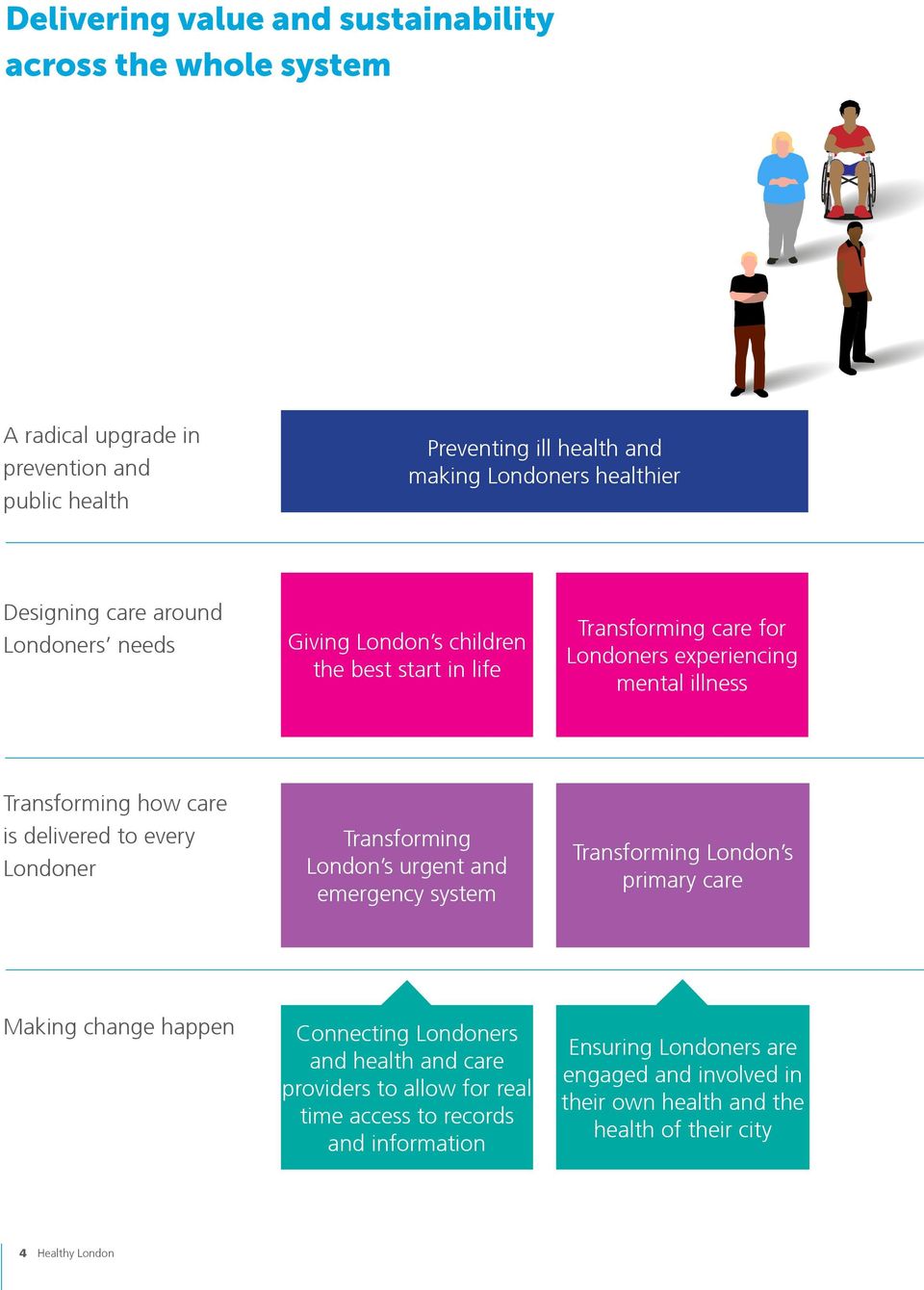
6 Delivering value and sustainability across the whole system A radical upgrade in prevention and public health Preventing ill health and making Londoners healthier Designing care around Londoners needs Giving London s children the best start in life Transforming care for Londoners experiencing mental illness Transforming how care is delivered to every Londoner Transforming London s urgent and emergency system Transforming London s primary care Making change happen Connecting Londoners and health and care providers to allow for real time access to records and information Ensuring Londoners are engaged and involved in their own health and the health of their city 4 Healthy London
7 All Londoners to be able to access the best cancer care in the world Joining up to transform the lives of the homeless Creating world class specialised care services Aligning funding and incentives to promote transformation of care Developing London s workforce to enable transformation of care Transforming London s estate to deliver high quality care Healthy London 5

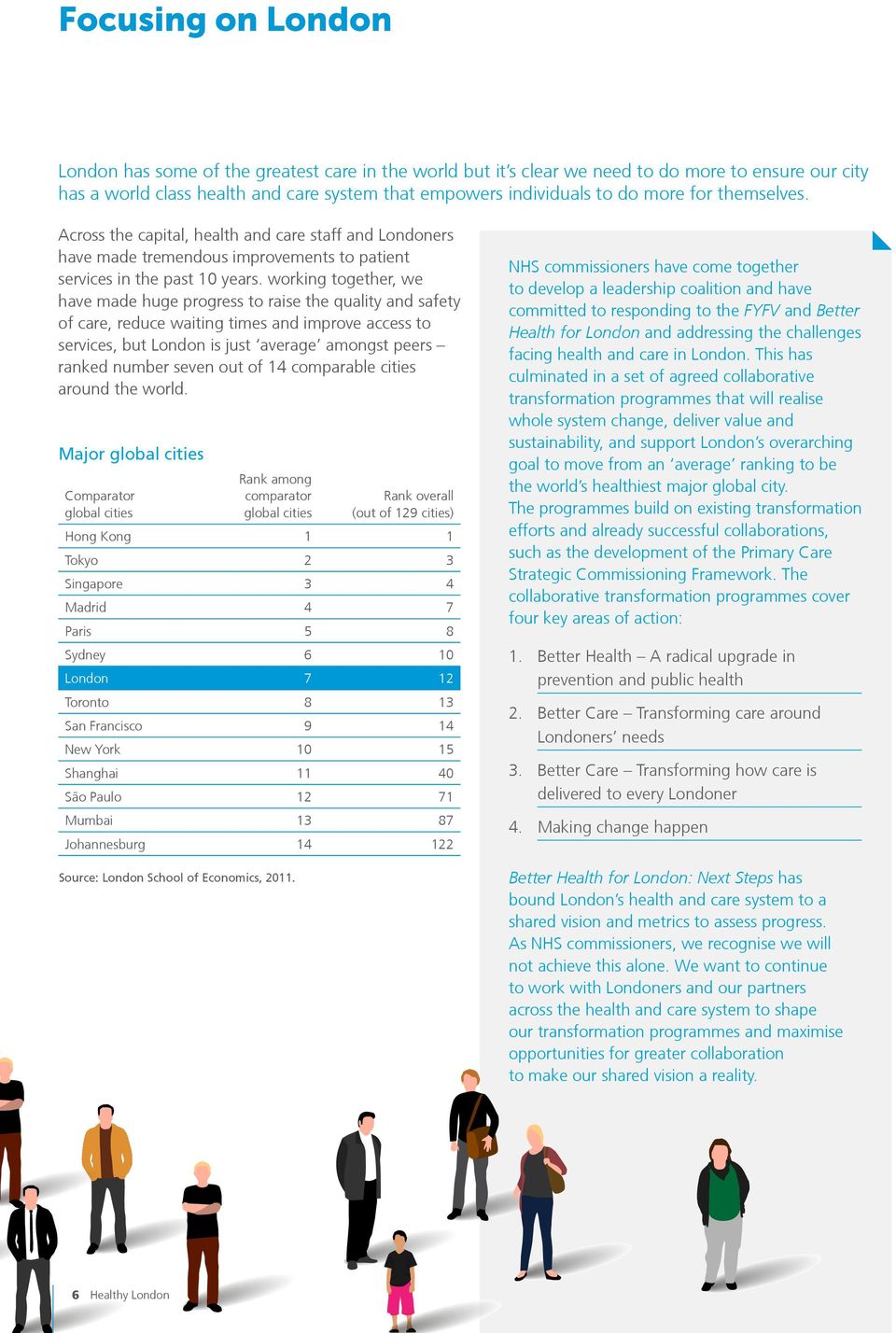
8 Focusing on London London has some of the greatest care in the world but it s clear we need to do more to ensure our city has a world class health and care system that empowers individuals to do more for themselves. Across the capital, health and care staff and Londoners have made tremendous improvements to patient services in the past 10 years. working together, we have made huge progress to raise the quality and safety of care, reduce waiting times and improve access to services, but London is just average amongst peers ranked number seven out of 14 comparable cities around the world. Major global cities Comparator global cities Rank among comparator global cities Source: London School of Economics, Rank overall (out of 129 cities) Hong Kong 1 1 Tokyo 2 3 Singapore 3 4 Madrid 4 7 Paris 5 8 Sydney 6 10 London 7 12 Toronto 8 13 San Francisco 9 14 New York Shanghai S o Paulo Mumbai Johannesburg NHS commissioners have come together to develop a leadership coalition and have committed to responding to the FYFV and Better Health for London and addressing the challenges facing health and care in London. This has culminated in a set of agreed collaborative transformation programmes that will realise whole system change, deliver value and sustainability, and support London s overarching goal to move from an average ranking to be the world s healthiest major global city. The programmes build on existing transformation efforts and already successful collaborations, such as the development of the Primary Care Strategic Commissioning Framework. The collaborative transformation programmes cover four key areas of action: 1. Better Health A radical upgrade in prevention and public health 2. Better Care Transforming care around Londoners needs 3. Better Care Transforming how care is delivered to every Londoner 4. Making change happen Better Health for London: Next Steps has bound London s health and care system to a shared vision and metrics to assess progress. As NHS commissioners, we recognise we will not achieve this alone. We want to continue to work with Londoners and our partners across the health and care system to shape our transformation programmes and maximise opportunities for greater collaboration to make our shared vision a reality. 6 Healthy London
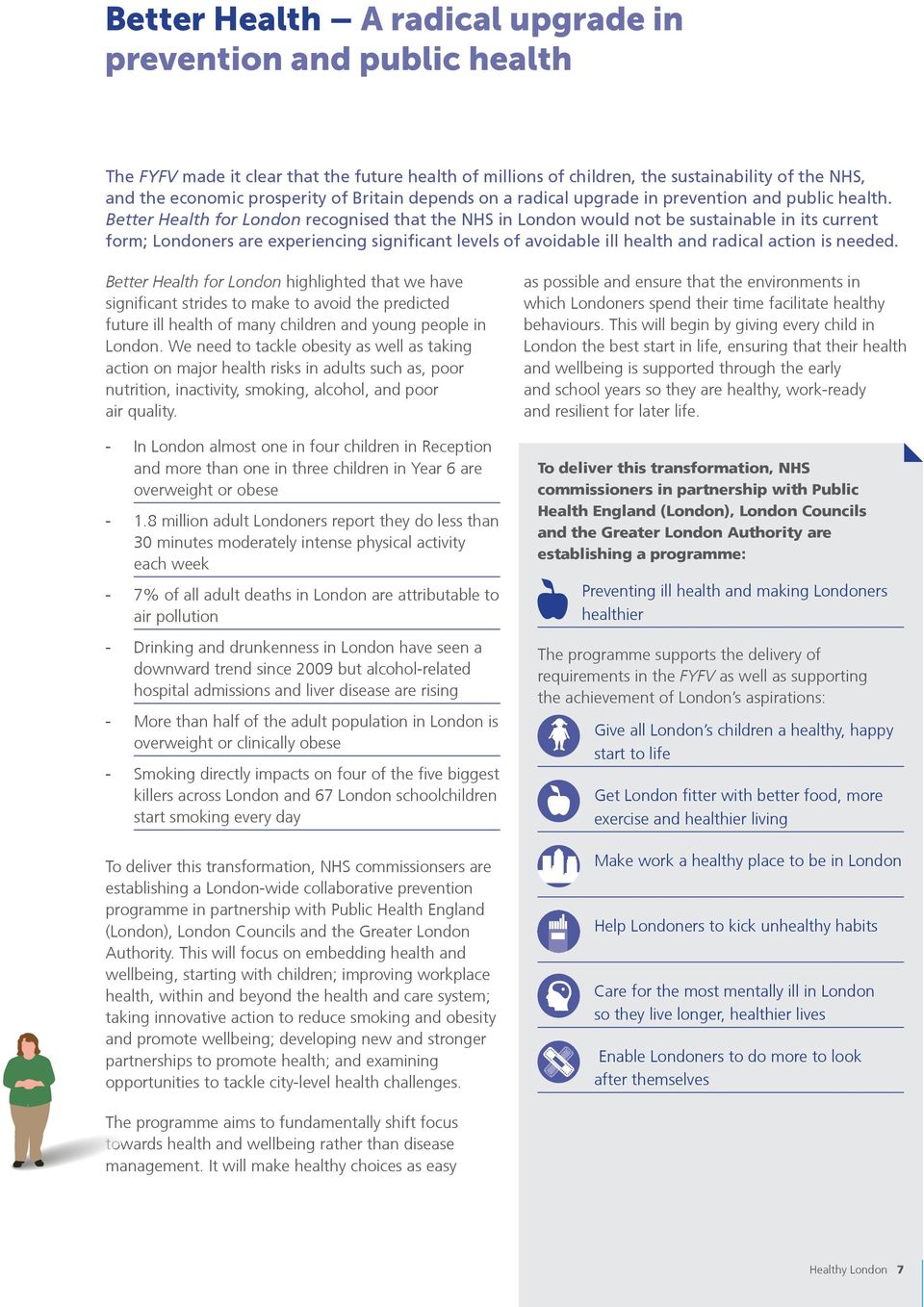
9 Better Health A radical upgrade in prevention and public health The FYFV made it clear that the future health of millions of children, the sustainability of the NHS, and the economic prosperity of Britain depends on a radical upgrade in prevention and public health. Better Health for London recognised that the NHS in London would not be sustainable in its current form; Londoners are experiencing significant levels of avoidable ill health and radical action is needed. Better Health for London highlighted that we have significant strides to make to avoid the predicted future ill health of many children and young people in London. We need to tackle obesity as well as taking action on major health risks in adults such as, poor nutrition, inactivity, smoking, alcohol, and poor air quality. In London almost one in four children in Reception and more than one in three children in Year 6 are overweight or obese 1.8 million adult Londoners report they do less than 30 minutes moderately intense physical activity each week 7% of all adult deaths in London are attributable to air pollution Drinking and drunkenness in London have seen a downward trend since 2009 but alcohol-related hospital admissions and liver disease are rising More than half of the adult population in London is overweight or clinically obese Smoking directly impacts on four of the five biggest killers across London and 67 London schoolchildren start smoking every day To deliver this transformation, NHS commissionsers are establishing a London-wide collaborative prevention programme in partnership with Public Health England (London), London Councils and the Greater London Authority. This will focus on embedding health and wellbeing, starting with children; improving workplace health, within and beyond the health and care system; taking innovative action to reduce smoking and obesity and promote wellbeing; developing new and stronger partnerships to promote health; and examining opportunities to tackle city-level health challenges. as possible and ensure that the environments in which Londoners spend their time facilitate healthy behaviours. This will begin by giving every child in London the best start in life, ensuring that their health and wellbeing is supported through the early and school years so they are healthy, work-ready and resilient for later life. To deliver this transformation, NHS commissioners in partnership with Public Health England (London), London Councils and the Greater London Authority are establishing a programme: Preventing ill health and making Londoners healthier The programme supports the delivery of requirements in the FYFV as well as supporting the achievement of London s aspirations: Give all London s children a healthy, happy start to life Get London fitter with better food, more exercise and healthier living Make work a healthy place to be in London Help Londoners to kick unhealthy habits Care for the most mentally ill in London so they live longer, healthier lives Enable Londoners to do more to look after themselves The programme aims to fundamentally shift focus towards health and wellbeing rather than disease management. It will make healthy choices as easy Healthy London 7
10 Better Care Designing care around Londoners needs The FYFV recognises that care needs to meet the needs of individual patients and communities, highlighting that the population is too diverse for a one size fits all care model to apply everywhere. It is clear that what works well in rural Cumbria or Devon won t necessarily work in inner cities and models of care need to be designed to meet the diverse needs of different patients and populations. This is reflected in Lord Darzi s maxim in developing the recommendations within the Better Health for London report to start with Londoners, not London s NHS. Better Health for London illustrated an approach to viewing the population in London as different groups based on their similar needs, rather than based on conditions or institutions, and designing care around them to make care more personal and tailored to individual needs. Children and young people in London suffer from poorer health outcomes than elsewhere in the country 70% of childhood type 1 diabetes occurs in adolescence, yet adolescents have poorer diabetes control and more emergency hospital admissions than other age groups People with severe and enduring mental illness die years earlier than the rest of the population Only 14% of people get the support they need in mental health crisis Cancer patients in England have rated eight out of the 10 London trusts as being the worst There is significant variability in one year cancer survival rates across London Life expectancy of the homeless population is years compared to for the general population Homeless individuals use eight times more hospital services than the general population and are far less likely to be registered with a GP To deliver this transformation, NHS commissioners are establishing four London-wide collaborative programmes, focusing on four distinct population groups: Giving London s children the best start in life Transforming care for Londoners experiencing mental illness All Londoners to be able to access the best cancer care in the world Transforming care for our homeless population Other population groups, such as our older population and those with long term conditions, have been identified for local action rather than collaborative action. These programmes will support the delivery of the requirements in the FYFV as well as supporting the achievement of London s aspirations and ambitions: Create the best health and care services of any world city, throughout London and on every day Give all London s children a healthy, happy start to lifee Care for the most mentally ill in London so they live longer, healthier lives 8 Healthy London

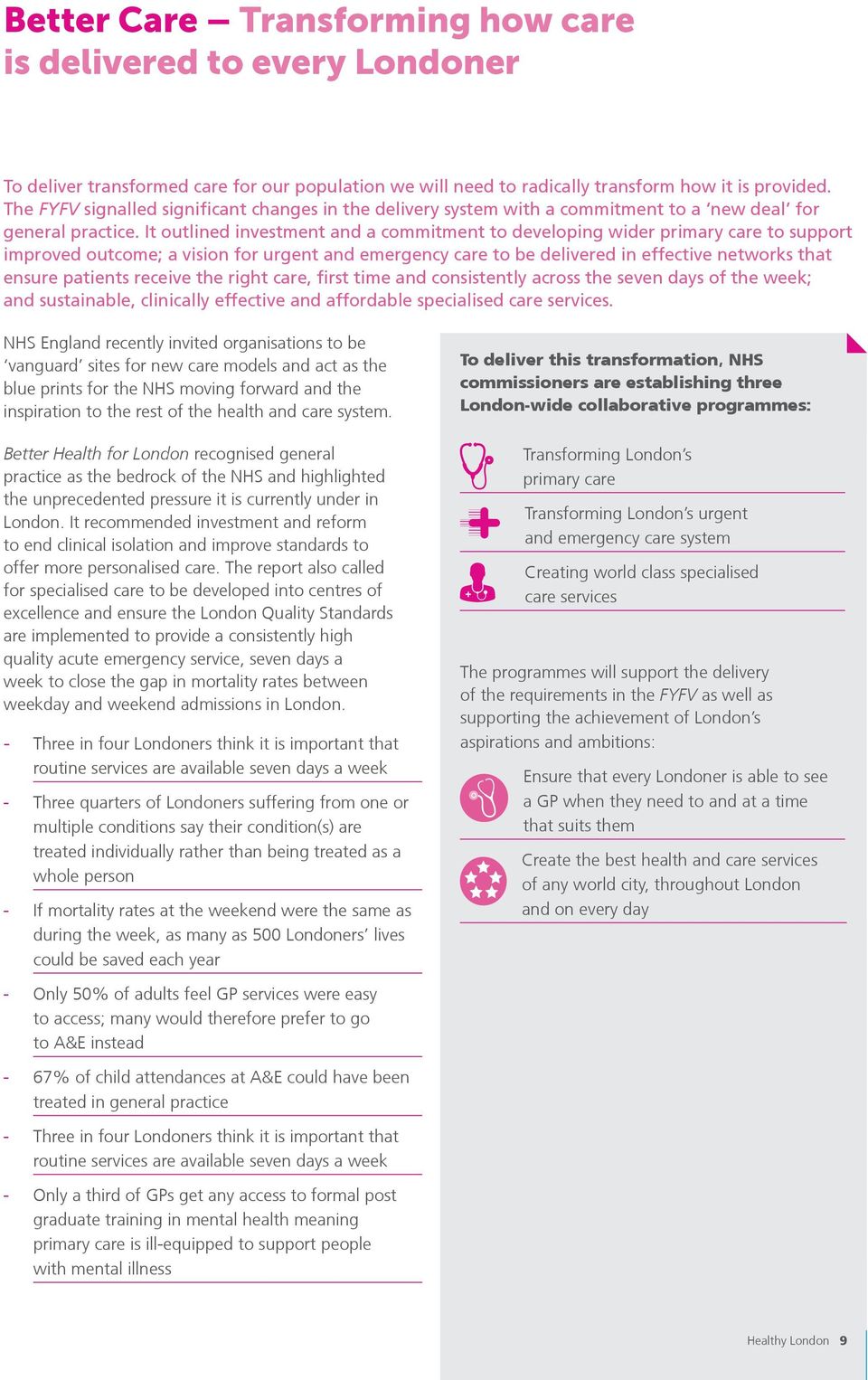
11 Better Care Transforming how care is delivered to every Londoner To deliver transformed care for our population we will need to radically transform how it is provided. The FYFV signalled significant changes in the delivery system with a commitment to a new deal for general practice. It outlined investment and a commitment to developing wider primary care to support improved outcome; a vision for urgent and emergency care to be delivered in effective networks that ensure patients receive the right care, first time and consistently across the seven days of the week; and sustainable, clinically effective and affordable specialised care services. NHS England recently invited organisations to be vanguard sites for new care models and act as the blue prints for the NHS moving forward and the inspiration to the rest of the health and care system. Better Health for London recognised general practice as the bedrock of the NHS and highlighted the unprecedented pressure it is currently under in London. It recommended investment and reform to end clinical isolation and improve standards to offer more personalised care. The report also called for specialised care to be developed into centres of excellence and ensure the London Quality Standards are implemented to provide a consistently high quality acute emergency service, seven days a week to close the gap in mortality rates between weekday and weekend admissions in London. Three in four Londoners think it is important that routine services are available seven days a week Three quarters of Londoners suffering from one or multiple conditions say their condition(s) are treated individually rather than being treated as a whole person If mortality rates at the weekend were the same as during the week, as many as 500 Londoners lives could be saved each year To deliver this transformation, NHS commissioners are establishing three London-wide collaborative programmes: Transforming London s primary care Transforming London s urgent and emergency care system Creating world class specialised care services The programmes will support the delivery of the requirements in the FYFV as well as supporting the achievement of London s aspirations and ambitions: Ensure that every Londoner is able to see a GP when they need to and at a time that suits them Create the best health and care services of any world city, throughout London and on every day Only 50% of adults feel GP services were easy to access; many would therefore prefer to go to A&E instead 67% of child attendances at A&E could have been treated in general practice Three in four Londoners think it is important that routine services are available seven days a week Only a third of GPs get any access to formal post graduate training in mental health meaning primary care is ill-equipped to support people with mental illness Healthy London 9
12 Better Care Making change happen To make better health and better care a reality we will need to change how care is commissioned, how estate is utilised and transform our workforce. We also need to empower Londoners to make the easy choice the healthiest choice and make patients partners in their own care. The FYFV highlighted that to deliver the changes needed at scale and pace required, steps need to be taken to develop leadership and a modern workforce that exploits the digital and information revolution and accelerate innovation through new methods. Many Better Health for London recommendations focused on how we engage with Londoners, how to free up the NHS estate in London, how we support our workforce, how information flows through the system and how payments and funding support the transformation of care. To deliver this transformation, NHS commissioners are establishing five Londonwide collaborative programmes: Connecting Londoners and health and care providers to allow for real time access to records and information Ensuring Londoners are engaged and involved in their own health and the health of their city Aligning funding and incentives to promote transformation of care Developing London s workforce to enable transformation of care The planned transformation programmes will help set the stage for an improved health and care system in London. To flourish, these programmes all depend on building a strong platform for innovation and improvement. To support this we will strengthen relationships with Academic Health Science Networks (AHSNs) and Collaborations for Leadership in Applied Health Research and Care (CLAHRCS) locally and regionally to further encourage collaboration between the organisations that influence health. These collaborations will ensure improvements are rooted in evidence, support the widespread diffusion of innovation and best practice, optimise value, and maximise the NHS contribution to economic growth. Support for local innovation in the delivery system will also be provided. Applications to the vanguard programme from London demonstrates the considerable enthusiasm and commitment to develop innovative delivery models. In addition to the vanguard pilots, we will also support local innovation. Much of this will provide examples of the new models of care described in the transformation programmes. We will build on the local integrated models of care shown in vanguard applications, through sharing learning and encouraging peer support for those not taken forward in the national programme. We will also facilitate widespread learning from vanguards that are part of the national programme. Transforming London s estate to deliver high quality care 10 Healthy London

13 Leadership for change Strong collaborative leadership will be needed at every level if whole system change is to be successfully realised. The refocused London Health Board chaired by the Mayor of London will drive improvements in London s health, care and health inequalities where political engagement can support delivery and uniquely make a difference. In the recent report from all of the London Health Board (LHB) partners, Better Health for London: Next Steps, a commitment was made for the LHB to track progress of delivery against the Commission s aspirations and collectively report back annually to Londoners. A London Transformation Group with representation from London CCGs and NHS England (London) was established in February 2015 with responsibility for strategic oversight and direction to the mobilisation of the collaborative transformation programmes. This group is accountable to CCG governing bodies and NHS England (London). The group is also responsible for agreeing ongoing governance arrangements. It ensures our partners, such as Local Authorities, Greater London Authority, Health Education England and Public Health England are engaged and represented effectively. Most importantly the group is committed to ensuring that the voice of Londoners is central to all transformation activity. Much of the transformation action required will take place at a local level and this will be complemented by collaborative action where there is clear added value. A pan-london transformation unit will be established from 1 April 2015 to support delivery of the collaborative transformation programmes. Leadership for each programme will be provided through identified joint CCG and NHS England (London) senior responsible officers and accountability will be to CCGs and NHS England (London) through the Interim London Transformation Group. The transformation unit will work collaboratively with all parts of the health and care system. It will ensure activities are aligned across the full commissioning and delivery chain to effectively support local transformation action, and maximise synergies across programmes to transform care across the whole system. Collective ambition and joint delivery Local Action Collaboration Action Local CCGs Local CCGs Together London CCGs Together CCG Strategic Planning Groups London Transformation Unit Local Partnerships London Partnerships (including the London Health Board) Healthy London 11

14 12 Healthy London

15 Collaborative transformation programmes Healthy London 13

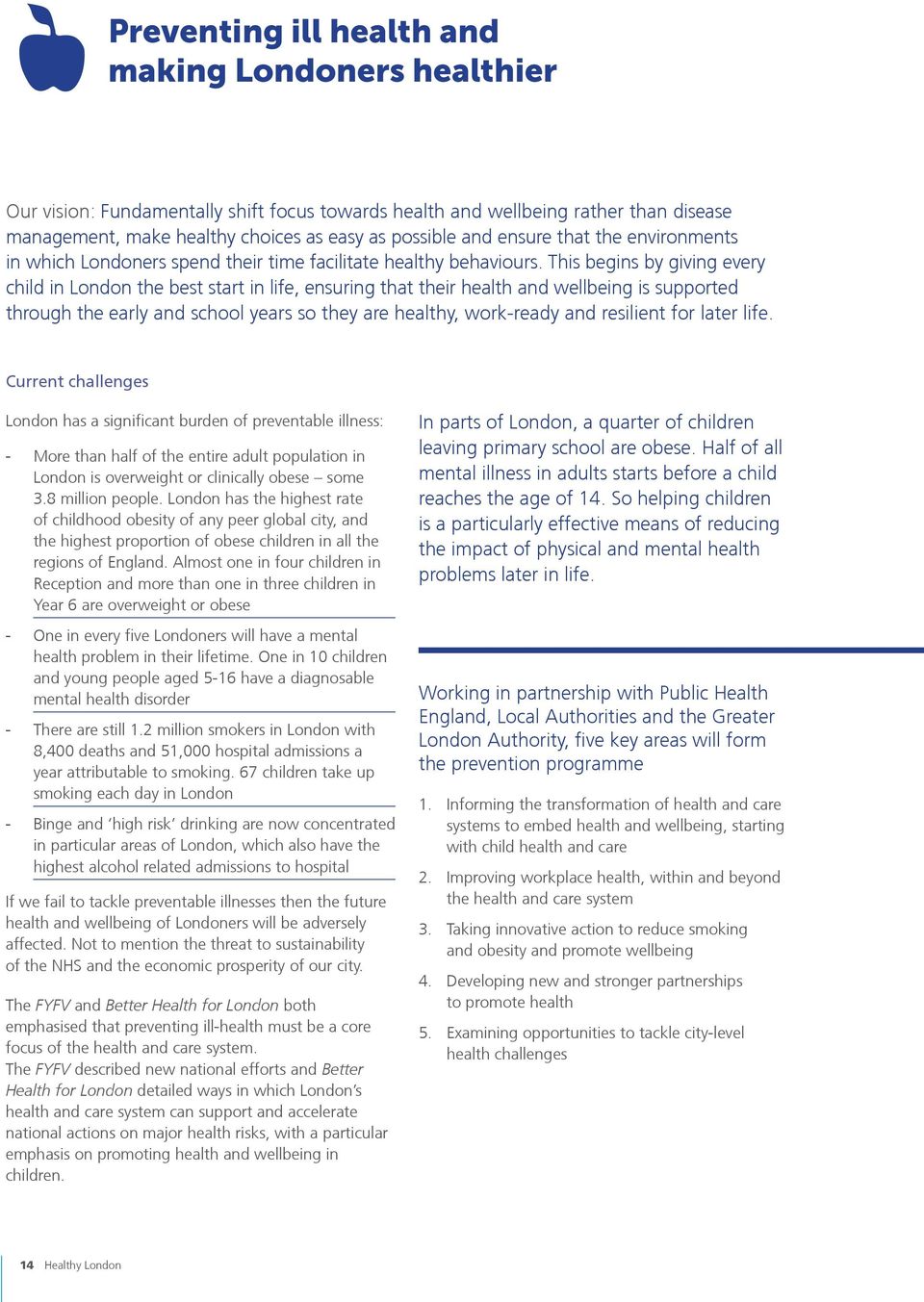
16 Preventing ill health and making Londoners healthier Our vision: Fundamentally shift focus towards health and wellbeing rather than disease management, make healthy choices as easy as possible and ensure that the environments in which Londoners spend their time facilitate healthy behaviours. This begins by giving every child in London the best start in life, ensuring that their health and wellbeing is supported through the early and school years so they are healthy, work-ready and resilient for later life. Current challenges London has a significant burden of preventable illness: More than half of the entire adult population in London is overweight or clinically obese some 3.8 million people. London has the highest rate of childhood obesity of any peer global city, and the highest proportion of obese children in all the regions of England. Almost one in four children in Reception and more than one in three children in Year 6 are overweight or obese One in every five Londoners will have a mental health problem in their lifetime. One in 10 children and young people aged 5-16 have a diagnosable mental health disorder There are still 1.2 million smokers in London with 8,400 deaths and 51,000 hospital admissions a year attributable to smoking. 67 children take up smoking each day in London Binge and high risk drinking are now concentrated in particular areas of London, which also have the highest alcohol related admissions to hospital If we fail to tackle preventable illnesses then the future health and wellbeing of Londoners will be adversely affected. Not to mention the threat to sustainability of the NHS and the economic prosperity of our city. The FYFV and Better Health for London both emphasised that preventing ill-health must be a core focus of the health and care system. The FYFV described new national efforts and Better Health for London detailed ways in which London s health and care system can support and accelerate national actions on major health risks, with a particular emphasis on promoting health and wellbeing in children. In parts of London, a quarter of children leaving primary school are obese. Half of all mental illness in adults starts before a child reaches the age of 14. So helping children is a particularly effective means of reducing the impact of physical and mental health problems later in life. Working in partnership with Public Health England, Local Authorities and the Greater London Authority, five key areas will form the prevention programme 1. Informing the transformation of health and care systems to embed health and wellbeing, starting with child health and care 2. Improving workplace health, within and beyond the health and care system 3. Taking innovative action to reduce smoking and obesity and promote wellbeing 4. Developing new and stronger partnerships to promote health 5. Examining opportunities to tackle city-level health challenges 14 Healthy London
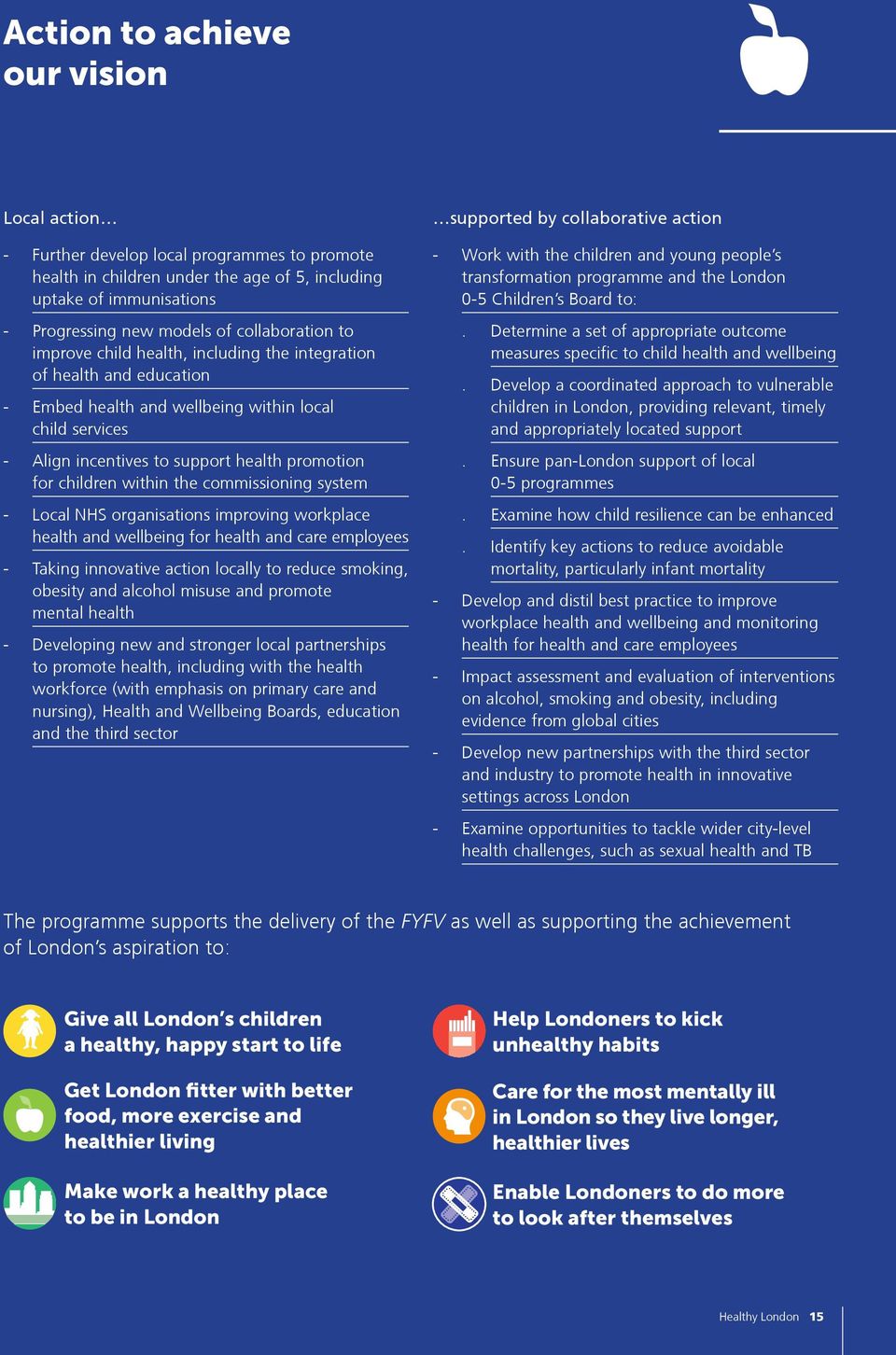
17 Action to achieve our vision Local action Further develop local programmes to promote health in children under the age of 5, including uptake of immunisations Progressing new models of collaboration to improve child health, including the integration of health and education Embed health and wellbeing within local child services Align incentives to support health promotion for children within the commissioning system Local NHS organisations improving workplace health and wellbeing for health and care employees Taking innovative action locally to reduce smoking, obesity and alcohol misuse and promote mental health Developing new and stronger local partnerships to promote health, including with the health workforce (with emphasis on primary care and nursing), Health and Wellbeing Boards, education and the third sector supported by collaborative action Work with the children and young people s transformation programme and the London 0-5 Children s Board to:.. Determine a set of appropriate outcome measures specific to child health and wellbeing.. Develop a coordinated approach to vulnerable children in London, providing relevant, timely and appropriately located support.. Ensure pan-london support of local 0-5 programmes.. Examine how child resilience can be enhanced.. Identify key actions to reduce avoidable mortality, particularly infant mortality Develop and distil best practice to improve workplace health and wellbeing and monitoring health for health and care employees Impact assessment and evaluation of interventions on alcohol, smoking and obesity, including evidence from global cities Develop new partnerships with the third sector and industry to promote health in innovative settings across London Examine opportunities to tackle wider city-level health challenges, such as sexual health and TB The programme supports the delivery of the FYFV as well as supporting the achievement of London s aspiration to: Give all London s children a healthy, happy start to life Get London fitter with better food, more exercise and healthier living Make work a healthy place to be in London Help Londoners to kick unhealthy habits Care for the most mentally ill in London so they live longer, healthier lives Enable Londoners to do more to look after themselves Healthy London 15
18 Giving London s children the best start in life Our vision: An integrated system for the health and care, which promotes health and can be easily navigated by children and young people, their families and the health professionals delivering their care to achieve the best outcomes for these patients. Care will be provided in high quality facilities local to families, with mental health needs treated with the same importance as physical health needs. All inpatient care will be provided in centres of excellence able to provide the highest quality, consultant delivered care, seven days a week. Current challenges Transformation of health services for children and young people in London is urgently needed to achieve this vision. Children and young people in London suffer from poorer health outcomes, than elsewhere in the country, across a number of areas from higher levels of mortality and serious illness, poorer mental health, variability in outcomes from common diseases such as asthma, and significant public health issues such as obesity. Whilst London has world leading centres of excellence for tertiary paediatric care and some excellent examples of primary and secondary care, there is significant variability in quality. fragmented, with responsibility for commissioning sitting across multiple organisations, limiting effective commissioning of pathways for complex childhood conditions. These gaps have been reinforced by the FYFV and the particular quality challenges London faces starkly presented in the London Health Commission s report, Better Health for London, which recommended action to reduce address the variation in quality and outcomes. Children and young people in London suffer from poorer health outcomes than elsewhere in the country The Children s Strategic Care Network has already highlighted these gaps and the fragmentation of care across services: Child and Adolescent Mental Health Services have variable quality and often poor access, and with limited connection with other community services for children; there are multiple sites in London providing inpatient paediatric care and tertiary care with no single site providing the full range of children s services needed. Major workforce challenges also exist in serving all these sites, with resultant quality issues. The commissioning of these services is equally The transformation programme for children and young people aims to rebuild healthcare around London s children and young people with five key areas of focus: 1. Developing population-based networks to promote health and co-ordinate care 2. Reduce variation in quality of services 3. Integrating care across public health and primary and secondary healthcare services 4. Develop commissioning of children and young people services to enable the effective commissioning of pathways of care 5. Develop innovative access models of care 16 Healthy London

19 Action to achieve our vision Local action Work with public health and Local Authorities to commission against local children and young people healthcare needs and family expectations Develop providers of children and young people healthcare to deliver agreed pan-london standards Develop effective interfaces between primary and acute care provider systems Work with local primary care, community and acute providers to develop new and effective healthcare forms for children and young people based around the needs of children and young people Develop and implement population based children and young people healthcare networks linking public health, commissioners and providers Commission services to ensure that pan-london standards are delivered through contract and performance management of providers across CCG boundaries supported by collaborative action Develop guidance on population based network for children and young people encompassing health promotion and disease prevention, and support implemention Develop a new evidence based integrated model of care based on the needs of children and young people ensuring strong clinical support Develop standards for children and young people for all settings of care acute in patient care; community care; and child and adolescent mental health services Develop approved models of care for children and young people including primary and acute care systems and multispecialty community providers Development of children and young people commissioning leadership programme Develop a workforce strategy to support children and young people healthcare transformation The programme supports the delivery of the FYFV as well as supporting the achievement of London s aspiration to: Give all London s children a healthy, happy start to life Healthy London 17
20 Transforming care for Londoners experiencing mental illness Our vision: A fundamental shift from care focused on treatment of mental health issues to a focus on prevention and helping Londoners stay emotionally, mentally and physically well at all ages. When care is required individuals are treated promptly, with improved access. The individual is treated as a whole person with their mental and physical health needs met and they experience high quality integrated and seamless care across all settings. Through this we aspire to eliminate the inequality in life expectancy of those with severe and enduring mental illness. Current challenges More than a million Londoners will experience mental ill health this year. London has the highest demand for child and adult mental health services of the whole country, the highest rate of compulsory psychiatric admissions in England and the highest rates of schizophrenia. And yet, mental illness remains underdiagnosed and under-treated, with a quarter of people with mental illness receiving treatment compared to 92% of people with diabetes and over 75% of people with heart disease. Compounding these issues, the physical health of people with mental illness is often poor. People with severe and enduring mental illness (SEMI) die 17 years earlier than the rest of the adult population. People with severe and enduring mental illness (SEMI) die 17 years earlier than the rest of the adult population. In responding to these demands, despite there being examples of excellent and innovative practice, services are often poor and fragmented, with limited communication between the agencies involved in an individual s care. London has poor rates of access to crucial services, such as Increasing Access to Psychological Therapy (IAPT) programmes, with the lowest rates of recovery and improvement in England. Early Intervention in Psychosis (EIP) services have waiting times of a year or more, meaning that people hit crisis point long before they receive treatment and when they do only 14% report getting the support they need. London is a long way off delivering parity of esteem between mental health and physical health. If London is to achieve parity of esteem between mental and physical health, transformation is required at all stages of the pathway; from prevention, selfmanagement and self-care to crisis services and treatment and support for people with the most severe mental illness, and at all levels of the health and care system; from very local/sub-ccg to pan-london. The NHS in London has come together to agree five joint priorities for mental health for 2015/16 and beyond to address these demands and issues for the benefit of our patients: 1. Address the gap in life expectancy the stolen years between those with SEMI and the rest of the adult population 2. Reduce the variation and improve quality, access and co-ordination for people in crisis and meet the crisis care concordat 3. Strengthen mental health in primary care to meet the challenges 4. Improve access to meet new standards for mental health services as outlined in the FYFV, focusing on; early identification and access to psychosis services; perinatal mental health and IAPT 5. Improve the use and sharing of data and information 18 Healthy London

21 Action to achieve our vision Local action Assess local needs and expectations and current provision for SEMI populations and implement evidence based recommendations on interventions for increasing life expectancy Support providers through crisis designation process and enable provider development for crisis care transformation Develop service models for specialist Mother and Baby Units that meet the commissioning guidance for perinatal mental health Ensure delivery of new access targets based on good practice Roll out digital mental health services, tailored to meet local needs and with effective local signposting Deliver training programmes to strengthen clinical capacity, capability and awareness of mental health in primary care supported by collaborative action Develop evidence base for key interventions to reduce inequalities for those with severe and enduring mental illness Develop pan-london multi-agency crisis care case for change and engage widely Co-develop model of crisis care with partners and associated designation process for local use Develop consistent pan-london whole system crisis care outcome measures Early Intervention Psychosis, IAPT and perinatal access programmes to collate and share benchmarking data, gap analysis, good practice, clinical advice and modelling support to CCGs and providers Roll out mental health leadership programme for local delivery and undertake evaluation of programme to inform future requirements The programme supports the delivery of the FYFV as well as supporting the achievement of London s aspiration to: Care for the most mentally ill in London so they live longer, healthier lives Healthy London 19
22 All Londoners to be able to access the best cancer care in the world Our vision: We want to make more Londoners more aware of signs and symptoms of cancer. We strive for early diagnosis, subsequent care and treatment, delivered promptly and locally where clinically appropriate and consolidated into centres of excellence where this will improve outcomes. Experience will be positive throughout a patient s journey including optimal support to live well following active treatment, and patients will receive support in line with their choices at the end of life. Current challenges Cancer remains the leading cause of premature death across the capital. A thousand lives could be saved every year if London s cancer survival rates matched the best in Europe. Earlier diagnosis is key to improving survival rates but there is also variation in access to, and outcomes from, the capital s cancer services and cancer patients in England have said eight out of the 10 worst performing trusts are in London and they also reported poor experience of support available to them from their GP practice and community services. To address these issues a model of care for cancer services was published in 2010 to ensure Londoners receive a world class experience from prevention, through early detection to high quality treatment in centres of excellence, subsequent support and for end of life care. The Five Year Cancer Commissioning Strategy for London, published in April 2014, reiterated the case for change and acknowledged that there was a need to accelerate the pace of transforming cancer services to ensure early diagnosis and to go further on service consolidation and reducing variation in treatment and experience in London. The FYFV calls for improved survival through early diagnosis and high quality treatment in centres of excellence The Transforming Cancer Services programme was set up in April 2014 and will support accelerated delivery of the Five Year Cancer Commissioning Strategy for London and focusses on four key areas: 1. Improving early detection and awareness 2. Developing centres of excellence and reducing variations in quality and experience 3. Living with and beyond cancer 4. Supporting commissioning and contracting The need for acceleration of pace was reinforced in the London Health Commission s report Better Health for London with a clear ambition set out for London to have the lowest death rates in the world for cancer; and the ambition of the FYFV to improve survival rates at one year after diagnosis through addressing late diagnosis and the subsequent variation in access to some treatments. 20 Healthy London
23 Action to achieve our vision Local action Work with public health, Local Authorities and health and wellbeing boards on prevention, awareness of signs and symptoms, and earlier detection Improve screening uptake with targeted approaches tailored to the needs of local population groups Ensure robust systems are in place to support improvements in detection and diagnosis of earlier stage cancer in primary care Commission collaborative best practice pathways across providers of care for the population and embed cancer quality metrics into contracts, including ensuring appropriate access to diagnostics and agreeing approaches to address gaps or areas of poor performance Develop aligned outcomes based contracts across providers for delivery of cancer pathways Develop local strategies for delivering chemotherapy closer to home Deliver a programme for a structured approach for support and follow up to cancer patients, aligned with optimal long term conditions management and local integrated care services Ensure delivery of cancer waiting time targets working with NHS England, Monitor and TDA to agree remedial action plans supported by collaborative action Develop a joint strategic needs assessment toolkit for Local Authorities including research links Develop a structured approach to support detection and diagnosis of earlier stage cancer in primary care and develop consistent best practice early diagnosis pathways Develop and pilot outcome based commissioning for one tumour group Develop a pan-london baseline audit of model of care compliance in breast, lung and colorectal cancers Monitor trust compliance against nationally agreed accreditation system Undertake a review of radiotherapy techniques and chemotherapy delivery Review capacity and access to diagnostics Develop best practice LTC approach for support and follow up for cancer patients in primary care Undertake clinical and financial modelling to support the rollout of stratified pathways Develop and deliver educational programme to primary care team Providing expert clinical and commissioning advice to SPGs, CCGs and CSU contracting teams and support commissioning innovation The programme supports the delivery of the FYFV as well as supporting the achievement of London s aspiration to: Create the best health and care services of any world city, throughout London and on every day Healthy London 21
24 Joining up to transform the lives of the homeless Our vision: Every homeless person should receive care which is consistent in quality and experience with that of the general population and bespoke to meet their specific needs, and the systems which support homeless people will be linked up to reflect the transitory nature of the population and support improved communication and outcomes across the system. Current challenges Hundreds of people sleep rough in the capital every night and their numbers are increasing. Current systems of healthcare struggle to meet their needs and it is common for them to have a number of complex health problems almost a quarter have physical health, mental health and substance use requirements. We also know that often the homeless find it difficult to manage their own health conditions due to their chaotic lives, low literacy, poor access and, regrettably, hostility from health professionals. The impact of this is clear with the average member of the homeless population expected to live for years, compared to for the general population. the lack of engagement with, and understanding from, mainstream services; and the often short-term funding for service providers. Furthermore, homeless people and rough sleepers are transitory, and so the issue is necessarily London-wide and more needs to be done with our partners, such as local government, to link programmes across London and mainstream services. Despite affecting a relatively small population, homelessness is growing and reaches right across health, public health, social care and into related areas such as housing and the justice system. Life expectancy for the homeless population is almost half that for the general population Homelessness is a growing and significantly greater problem in London than elsewhere in England and recent studies have identified the impact this population can have on the system: Homeless individuals use eight times more hospital inpatient services than other people of similar age, and are 40 time more likely than members of the general public not to be registered with a GP Addressing these challenges requires a multiagency response and the programme will focus on two key areas: 1. Establishing a pan-london commissioning model 2. Improving data collection and use Of a sample of the homeless population, half of total acute care costs were incurred by 10% of people This demonstrates that quality of life could be improved for this population group by earlier intervention and pro-active services as well as financial savings by changing the model of care. Vulnerability is a key issue in homeless services: both for service users themselves, such as being victims of violence and/or 22 Healthy London
25 Action to achieve our vision Local action Work with Local Authorities, public health teams and third sector to understand current level of commissioning and provision Work with lead commissioner to ensure pan- London principles are deliverable at a local level Implement new local models of care to support agreed London-wide principles Support the development of local providers Ensure information on contacts with homeless is shared on an inter-agency, pan-london database supported by collaborative action Develop multi-agency case for change and principles of care and engage to secure broad buy-in Develop case for pan-london commissioning, including the associated financial modelling and new commissioning arrangements Identify lead commissioner to commission multiagency model of care Set up pan-london sustainable commissioning arrangements Set up pilot and evaluation of new model of care Develop model for data sharing across health and care system for Homeless service users The programme supports the delivery of the FYFV as well as supporting the achievement of London s aspiration to: Create the best health and care services of any world city, throughout London and on every day Healthy London 23
26 Transforming London s urgent and emergency care system Our vision: Responsive, effective and personalised care delivered in or as close as possible to our patients homes, for those with non-life threatening but urgent needs. For those with more serious or life-threatening emergency needs, treatment will be provided in centres that meet the London quality standards and have the best expertise and facilities to reduce risk and maximise chances of survival and good recovery. Current challenges The urgent and emergency care system in London is facing many challenges. An ageing population with increasingly complex needs is leading to increasing numbers of people needing urgent or emergency care. Many people are struggling to navigate and access a confusing and inconsistent array of urgent care services provided outside of hospital, which can result in them defaulting to emergency departments. Every winter the ongoing challenges facing London s urgent and emergency care services are highlighted further; the signs of this most visibly seen in efforts to deliver the urgent and emergency care operational four hour standard. However, the challenges for London s urgent and emergency care services are not simply issues within emergency departments or a result of seasonal variation, issues are present all year round and across the entire care system. This is reinforced by the FYFV which outlines that urgent and emergency care services will be redesigned to integrate between emergency departments, GP out-of-hours services, urgent care centres, NHS 111, community services, and ambulance services. The development and commissioning of the London quality standards for acute emergency services has led to some improvements in these services across London. The development of the national clinical standards Better Health for London calls for better urgent and emergency care to provide Londoners with the consistent high quality care that they expect and rightly deserve, across all seven days of the week in order to improve patient experience and outcomes. with which the London quality standards are congruent from the publication of Professor Sir Bruce Keogh s Seven Day Services Forum, and their publication in December 2013, has reinforced their importance. Sanctions for non-compliance with the standards will be in place within two years, however to implement them properly requires wider system transformational change. Many service redesign programmes across London rely on issues within the urgent and emergency care system being addressed. The NHS in London has committed to implementing the national vision for urgent and emergency care and closing the gap in mortality rates between weekdays and weekends focussing on three key areas: 1. Establish U&EC networks to oversee the planning and delivery of the urgent and emergency care system 2. Designate urgent and emergency care facilities to ensure London quality standards are met, seven days a week 3. Improve and expand the NHS 111 system to direct patients to the most appropriate care setting to receive the right care, first time 24 Healthy London
27 Action to achieve our vision Local action Work with members and partners to share local, compelling and system-wide narrative and vision Develop local strategy for the delivery of responsive, effective and personalised urgent and emergency care Work with local providers, Local Authorities, Health and Wellbeing Boards and system resilience groups to ensure U&EC networks are established and aligned with existing arrangements Designate local urgent and emergency care facilities in line with consistent specification that meets the local strategy Commission services in line with the London Quality Standards for urgent and emergency care Commission and procure NHS 111 services and develop the local directory of services supported by collaborative action Undertake network footprint options appraisal and system engagement to agree footprint Develop pan-london network specification Develop pan-london specifications for U&EC facilities Develop framework for local designation and assurance of U&EC facilities Develop core London 111 specification underpinning local vision Development of consistent pan-london whole system outcome measures Review of LAS and other U&EC transport and access standards Recommendations for enhanced pharmacy services Share good practice and benchmarking to support local action The programme supports the delivery of the FYFV as well as supporting the achievement of London s aspiration to: Create the best health and care services of any world city, throughout London and on every day Healthy London 25
28 Transforming London s primary care Our vision: Accessible, coordinated and proactive primary care delivering care that is individualised for patients with very differing needs, meaning high quality care can be provided for all Londoners with improved patient satisfaction and clinical outcomes. General practice will be value for money and support sustainability across the health service through increased capacity and capability. Current challenges General practice has served patients, the public and the NHS well for over 60 years. It has delivered accessible, high quality, value for money care. However patients are changing, both in the complexity of their conditions and in their expectations. These challenges were highlighted in General Practice: A Call to Action and reiterated in Better Health for London which outlined the urgent need for investment in general practice and joining this investment with reform. If the NHS is going to continue to provide the excellent standard of care to which we all aspire, we will have to be more innovative. Tweaking at the edges is not an option. London needs solutions that will sustain primary care for the next 60 years. It is crucial to support GPs and the wider primary care team to spend more time with their patients and maintain the integrity and core purpose of general practice to provide holistic, patient-centred continuous care to patients and their families. This is reinforced by the FYFV which committed to a new deal for GPs, outlining investment and that by the end of this year general practice will be of high quality and with less variation including better access and better co-ordination. The Primary Care Transformation Programme has been developing a response to these challenges and the recently developed Strategic Commissioning Framework sets out a bold new vision for primary care in the capital centred on a specification for a new patient offer arranged around the three aspects of care : Proactive care supporting and improving the health and wellbeing of the population, self-care, health literacy, and keeping people healthy Accessible care providing a personalised, responsive, timely and accessible service Coordinated care providing patient- centred, coordinated care and GP-patient continuity The primary care transformation programme will focus on three key areas: 1. Implementation of the Strategic Commissioning Framework 2. Developing co-commissioning of primary care 3. Improvement and innovation 4. Developing enablers to support delivery If the NHS is going to continue to provide the excellent standard of care to which we all aspire, we will have to be more innovative. 26 Healthy London
29 Action to achieve our vision Local action Assess local needs and expectations of populations Support general practice development towards a wider population health model Develop and implement processes for peer review and learning across each locality/network Implement care models to suit local population requirements and in partnership with other local organisations Support development of local primary care strategic plans in the context of out of hospital strategies (including delivery of specification) Delivery of strategic plans and primary care specification supported by collaborative action Finalise strategic commissioning framework Understand contractual implications of strategic commissioning framework and develop route map for delivery Pilot contracts to support Vanguards Develop framework monitoring and evaluation process and undertake baseline and year one surveys Undertake financial modelling for year one finances and develop business case Support development of co-commissioning arrangements Establish local clinical leadership network Develop online portal of good practice and innovation Ensure parallel enabler programmes deliver primary care requirements The programme supports the delivery of the FYFV as well as supporting the achievement of London s aspiration to: Ensure that every Londoner is able to see a GP when they need to and at a time that suits them Healthy London 27
30 Creating world class specialised care services Our vision: Improved patient experience through more joined up services; improved health outcomes; and equitable access to high quality sustainable specialised services. Providers will be incentivised through improved financial incentives over the longer term, reducing demand, where appropriate, and reducing unwarranted variation. Current challenges Over the past 18 months, NHS England has listened to many patients experiences of specialised services. Feedback tells us that current care pathways can be disjointed, particularly where the commissioning responsibility for services changes. This can lead to gaps in provision and poor sharing of data, which is simply not acceptable and cannot possibly produce the best outcomes for patients. We know we can do better by patients and improve outcomes for local populations. We have a duty as commissioners to reduce inequalities and work collaboratively to improve outcomes for populations. Patients often receive specialised care following treatment within primary and secondary care. NHS England and CCGs together commission all of these services and should work closely with their local authority and public health partners, to ensure an integrated patient and population centred approach. We therefore need to develop a more collaborative approach to specialised commissioning and make it easier for commissioners to work together to better align pathways, and service models across the system. We know that many CCGs are keen to have a greater say over the commissioning of specialised services, to develop a more holistic and integrated approach to improving healthcare for their diverse local populations. If we get this right, we believe there are significant opportunities to enhance the commissioning system, reduce inequalities and secure health gains within local health economies from aligning priorities for services and patient pathways, to securing transformation savings. The intention is to move towards a more differentiated approach to specialised commissioning from 1 April 2015, within a commissioning framework that identifies the optimal population, service model and pathways required for key service groups, as we believe this will deliver the best outcomes for patients. The specialised commissioning programme through a joint committee will focus on two key areas: 1. Collaborative commissioning with CCGs to ensure CCGs to have a greater say over the commissioning of the majority of specialised services 2. Devolving services to CCGs inform recommendations to Ministers to devolve commissioning responsibility for services to CCGs where it is considered appropriate 28 Healthy London
31 Action to achieve our vision Local action Identify opportunities to influence pathways that include specialised services Align approach to contracting with NHS England for local providers of specialised services Commissioning of services transferred from NHS England to CCGs Assess provider implications of collaborative commissioning and service strategies for specialised services Align approach to contracting between CCGs and NHS England for major providers Review pathways including specialised services and agree changes as required supported by collaborative action Establish a joint committee to oversee work on collaborative commissioning of specialised services Agree which pathways will benefit from review at London-wide as opposed to a more level Collaboratively commission specialised services (NHS England to retain budgetary responsibility at London level for specialised services for 2015/16) Provide benchmarking data to CCGs routinely and bespoke on request The programme supports the delivery of the FYFV as well as supporting the achievement of London s aspiration to: Create the best health and care services of any world city, throughout London and on every day Healthy London 29
32 Transforming London s estate to deliver high quality care Our vision: All care to be delivered in modern, high quality, fit for purpose, accessible premises. Robust strategic planning of estates across London will ensure high quality NHS estate that meets agreed standards and disability access requirements, the system will incentivise efficient and effective use of assets and unused or under-utilised assets will be consolidated or disposed of to build an investment fund for local priorities. Current challenges The NHS is one of the largest owners of land and buildings in London. The physical footprint of London s hospitals is around 1,000 acres that s three times the size of Hyde Park, and larger than the City of London. The book value of the estate is more than 11 billion, with around 70% belonging to acute hospital trusts. The remainder comprises mental health (nine trusts comprising 85 sites) and community health trusts. There are more than 1,400 GP practices, and their buildings are valued at around 1.5 billion. Despite the scale of the NHS, the quality of NHS estate is highly variable. London has some of the finest hospital buildings in the world, such as the facility at University College London Hospital on Euston Road, and some of the poorest hospital facilities in Britain, such as Northwick Park, which has the highest backlog of maintenance in the country. Based on this, Better Health for London formed a number of recommendations around the premise: if the NHS were to better use its own property it would be a major opportunity for the city as a whole. Given that 80% of patient contacts with the NHS are in GP practices, and 70% of the assets are in hospitals, addressing these two elements should be prioritised: 1. Overhauling the GP estate in London London s GP practices are largely found in converted residential buildings many are in poor condition. This means poorer patient experience and poor working conditions for London GPs. Some 1 billion is required in the GP estate in London to secure modern general practice that is accessible to all Londoners. 2. Overhauling the hospital estate in London There are significant issues with current rules regulating capital: a lack of clear standards or enforcement process; too little incentive to dispose of surplus estate due to the combination of artificially low cost of capital and restrictions on retention of capital receipts; and no option to manage assets across the wider public sector. If the NHS were to better use its own property it would be a major opportunity for the city as a whole A collaborative estates programme will focus on four key areas: 1. Establishing strategic planning and capital boards 2. Developing a robust asset database 3. Ensuring estate meets robust quality standards 4. Understanding and developing levers and incentives to ensure estates strategies meets clinical strategy needs 30 Healthy London
33 Action to achieve our vision Local action Set up strategic planning and capital boards and establish arrangements to work at SPG footprint-level with NHS Property Services and CHP and local partners including NHS Trusts and Local Authorities Develop estates requirements and strategy and ensure core part of five year strategic plans for whole health economies Develop local borough-based strategic service development plans to support the delivery of primary care and integrated care across local health economies in fit for purpose estate Manage existing primary care capital fund to ensure money is reinvested in local priorities Undertake operational asset review and provides inputs into the asset database and maintain updates Decommission premises which do not comply with disabled access or other statutory or commissioner requirements supported by collaborative action Provide guidance on the development of strategic planning and capital boards and ensure estates planning is core element of strategic five year service plans Provide guidance for the development of an asset database and maintain the physical asset database ensuring up to date Facilitate strategic estates discussions with partners such as TDA, Monitor, DH, Mayor, and GLA Facilitate joint working with the GLA property unit Undertake case study analysis in local health economies to understand levers and incentives available and new ones required Coordinate with the DH to agree capital investment flexibilities Provide joint guidance to commissioners around quality standards for estates Establish a more transparent charging mechanism for NHS estate across London The programme supports the delivery of the FYFV as well as supporting the achievement of London s aspiration to: Create the best health and care services of any world city, throughout London and on every day Healthy London 31
34 Aligning funding and incentives to promote transformation of care Our vision: The vision is to align incentives to promote increased patient control of care and integration between providers across the whole system; enable the transformation of care through innovative payment mechanisms supporting the commissioning of services more tailored to individuals and population groups based on outcomes that matter to patients; and to ensure adequate investment in transformation programmes to make transformational change a reality. Current challenges The report from London Health Commission Better Health for London outlined a fundamentally different approach to looking at our population and the way care for them is commissioned. This represented a move away from commissioning institutions to commissioning care for different population groups based on outcomes that matter to patients that reflect their different needs, wants and expectations; and rather than care being provided around primary versus secondary, or mental versus physical, to strive towards a system that holistically considers all aspects of care for a particular individual. A number of recommendations around funding and payments were made in support of transforming care to be more person-centred; these recommendations aim to create the right environment for commissioning and create the right incentives for providers. The payments and funding programme will focus on three key areas 1. Creation of a transformation fund to enable transformational change 2. Developing personal health budgets to give more patients far greater control of their care 3. Sharing good practice and innovation local, national and international The need for more person-centred care was echoed in the FYFV which set out the ambition to ensure greater patient control of their care through shared budgets combining health and social care and also went further than Better Health for London in describing new models of care which will require new payment and contracting mechanisms to truly enable transformation of the whole system, and in turn, better care for patients and improved outcomes. 32 Healthy London
35 Action to achieve our vision Local action Develop local strategies and identify need for any new payment mechanisms (e.g. integrated care pilots) Implement pilots for new payment mechanisms and commissioning and contracting arrangements supported by collaborative action Develop evidence base for new payment mechanisms Develop a resource for commissioners detailing good practice and lessons learnt from within the NHS and outside Promote and support pilots of innovative payment mechanisms Support measuring and evaluating impact of new payment mechanism pilots Develop pathway currencies and associated outcomes to pilot outcome based commissioning e.g. cancer pathway commissioning Provide technical financial expertise to the development of personal health budgets to inform how to guide The programme supports the delivery of the FYFV as well as supporting the achievement of London s aspiration to: Create the best health and care services of any world city, throughout London and on every day Healthy London 33
36 Developing London s workforce to enable transformation of care Our vision: To develop a modern health and care workforce in London that is trained, focused and supported to enable the delivery of the vision for whole system transformed care across London. Current challenges London has a diverse population and needs to train a workforce to serve this population. It is a centre of excellence for health training and education and contributes significantly to the rest of the UK. Training places in London are highly in demand as many students choose to study and train in London. However, there is high turnover for London s workforce as a whole, and many of the health and care workforce who train in London subsequently choose to move away several years after completing training. The high cost of living in London, in particular the availability of affordable housing, can trigger people to move away from London, and also means that it is more difficult to recruit experienced staff into London from elsewhere. This means high vacancy rates, particularly in nursing and social care, and several professions also have an ageing workforce. Looking ahead, London s health and care workforce will need to adapt to deliver personalised care and enable whole system transformation. The workforce is a critical enabler for personalised care based on local populations needs, care will need to be delivered closer to the home, delivering the outcomes that matter most to patients. However, the majority of training is delivered in hospitals meaning that a hospital-focused mindset persists, and we are yet to deliver a cultural and behavioural shift. The skills the workforce need are also evolving, for example, a more flexible, generalist skill-set; the ability to support citizens to self-care; and skills which straddle health and social care. To address these workforce challenges and how care is delivered will require effective clinical leadership which reflects the diverse nature of London s workforce and Londoners themselves. The workforce programme will work closely with many of the collaborative transformation programmes to support delivery of workforce requirements and bring together to form a strategic view of all workforce requirements. The programme will focus on four key areas: 1. Affordable housing 2. Re-tooling of existing roles 3. Leadership 4. Pan-London workforce implementation There will need to be a significant increase in number of roles delivering Primary Care services and also a broader range of roles to deliver the strategic commissioning framework. Similarly, to transform the urgent and emergency care system the varying workforce challenges different parts of London face need to be addressed with innovative solutions such as new roles, network contractual solutions, and addressing the workforce pipeline challenges. 34 Healthy London
37 Action to achieve our vision Local action Local Education Training Boards (LETBs) implement local workforce programmes LETBs work collaboratively to identify current and future workforce demand for local health economies CCGs and providers identify and support workforce productivity initiatives CCGs determine required service models to support education providers Providers review workforce capacity plans Community Education Provider Networks (CEPNs) develop appropriate learning mechanisms alongside care delivery in primary care supported by collaborative action Collaborate with partners at HEE, CCGs, NHS England (London), London s Leadership Academy and the Trade Unions to ensure a focused and coordinated approach to modernising London s workforce Influence, communicate and provide advice on the workforce activities required within each of the collaborative transformation programmes to ensure they meet the workforce requirements at a pan-london level Collaborate with Trade Unions to develop London s health and care workers affordable housing strategy and support implementation across London Ensure the London s leadership programme considers the wider workforce changes and ensure the diversity and inclusiveness agenda is part of the ongoing programme The programme supports the delivery of the FYFV as well as supporting the achievement of London s aspiration to: Create the best health and care services of any world city, throughout London and on every day Healthy London 35
38 Connecting Londoners and health and care providers to allow for real time access to records and information Our vision: Our vison is to create a Citizen centric pan-london information exchange, allowing for live access to real-time patient records and information. This will be achieved by establishing interoperability standards that allow services provides to seamlessly exchange information across a diverse systems landscape. We will develop universal services such as consent, identify management and role-based access controls allowing service providers to overcome common issues that have historically acted as a barrier to true interoperability. Current challenges Better Health for London, the FYFV and the National Information Board Framework have each identified the need for collaboration to achieve information sharing at scale in order to support key transformations. The need for a collaborative focus on system interoperability across London has been echoed by the London Health Commission, the four London Pioneer Communities and the provider community. Local health economies also recognised the need for information exchanges in order to offer integrated care. CCGs have therefore taken the initiative and are developing localised integration services in order to achieve an integrated view of records. Across London there are an approx. 25 localised information exchanges under development. At a regional or national level however, information and record exchange services remain disconnected. This proves to be a significant barrier to integrated care when a citizen moves across geographies. Services provided at a regional or national level (such as NHS111 or LAS) also face significant barriers to accessing pertinent citizen information. Furthermore citizens are faced with multiple log-ins and have no vehicle through which they can express their own wishes (once) or to be remembered ; instead citizens have to access multiple systems to view their records. The development of information exchanges have also been hampered by diverging approaches to common requirements such as consent and identity management. The London Interoperability Programme aims to connect existing locally owned and developed integration services. This will be achieved by establishing standards to enable citizen centric information exchange between existing integration services. The development of universally available solutions to consent and identity management will also allow commons challenges to be overcome. The programme will work with CCGs via a federated structure to develop, pilot and deploy a regional integration layer focussing on the following key areas: 1. How to connect the circa 25 information exchanges across London to each other and to the citizen including:.. Standards for HOW information is exchanged.. Standards for WHAT patient information (data sets) are needed to support key workflow transformations.. The development of business cases for missing capabilities (e.g. document and image exchange) 2. How to resolve common problems that are constraining the development of local solutions (e.g. Consent and Identity Management) 3. How to maximise the use made of existing capabilities (e.g. Patient online) and deliver quick wins that speed the rate of progress towards a paperless NHS 4. How to share good practice across London and maximise national influence 36 Healthy London
39 Action to achieve our vision Local action Co-develop regional and national design principles and standards for interoperability Commission and manage local infrastructure in-line with regional and national interoperability standards Continue to develop and implement local informatics strategies Appoint clinical informatics champions Incorporate new national and regional capabilities into local operation (e.g. Patient Online, Summary Care Record, PM Challenge Fund) supported by collaborative action Work with each federation to baseline existing capabilities and integration projects Establish forums and expert design groups for key transformation programmes e.g. U&EC/111 Co-develop regional design principles and standards to support key information exchanges and transformations Co-develop designs and investment cases for shared approaches to consent, identity management and regional document exchange Establish delivery trajectory for national standards/capabilities Co-ordinate development of strategy for paperless information exchange The programme will work with CCGs via a federated structure to develop, pilot and deploy a regional integration layer focussing on the following key areas: Create the best health and care services of any world city, throughout London and on every day Healthy London 37
40 Ensuring Londoners are engaged and involved in their own health and the health of their city Our vision: All Londoners will feel more involved in the health and care system including when making decisions about their own care. Effective engagement will happen at an individual and collective level and will be universally accepted as key to good care and support. A pan-london collaborative approach will increase levels of individual engagement and create a paradigm shift from fragmented care and funding models to people empowered commissioning. The re-launched myhealthlondon website will provide a single-online platform for collective citizen participation providing added user value beyond information and transparency. Current challenges Londoners do not always feel involved in the health and care system or in decisions about their own health. Although there is strong recognition that the health and social care system belongs to everyone, people do not feel involved in it. Services have historically been designed by policymakers or providers and often do not reflect the needs and abilities of people that use them. Engagement is also key to keeping Londoners as healthy as possible and supporting them most appropriately in times of illhealth. It is crucial to understand what matters to people, by working with them to ensure that they can share in their own decisions about their own health. In this way, greater participation will also make a vital contribution to the prevention agenda by offering Londoners opportunities to manage their own health in their own way. Effective engagement at both the individual and the collective level are key to good health and care delivery Better Health for London, the FYFV and the National Information Board Framework provide a strong mandate for greater levels of public engagement, citizen participation in care design and empowering individuals to be at the heart of their care through enhanced personalisation, self-care and adopting a digital-first approach. Better Health for London modelled successful approaches to engagement and Londoners clearly expressed a desire for greater involvement in decision-making about health and care in a direct and transparent way. These strategy documents also emphasise the importance of learning from what is working well. A number of initiatives are under way to improve engagement and participation, nationally, and in London. There are many groups, structures and organisations who are already gathering and communicating their voice, and this voice needs to be central to all developments in our transformation work. Key factors to improving individual and collective engagement have been identified which will form the foundations of collaborative action in London, focussing on: 1. Development of personal health budgets 2. Redesign of myhealth London 3. Supporting and championing increased engagement with Londoners 38 Healthy London
41 Action to achieve our vision Local action Working with local authority partners to deliver increased personalisation through the delivery of personal health budgets Develop approaches, implementing and evidencing outcomes in relation to shared decision making Develop mechanism for outcome measurements to support a number of initiatives including implementation of Better Care Fund plans Ensure that citizens are engaged through information and that their voice is heard, acted upon and transparent supported by collaborative action Develop myhealthlondon website to support effective individual and collective engagement Develop and share best practice on personal health budgets approaches Develop how to guide for personal health budgets Design of protocols for online citizen accounts to support personal health budgets Support and champion effective and increased engagement with Londoners e.g. crowdsourcing Deliver tailored local campaigns The programme supports the delivery of the FYFV as well as supporting the achievement of London s aspiration to: Create the best health and care services of any world city, throughout London and on every day Enable Londoners to do more to look after themselves Fully engage and involve Londoners in the future health of their city Healthy London 39
A Health and Wellbeing Strategy for Bexley Listening to you, working for you
 A Health and Wellbeing Strategy for Bexley Listening to you, working for you www.bexley.gov.uk Introduction FOREWORD Health and wellbeing is everybody s business, and our joint aim is to improve the health
SHEFFIELD TEACHING HOSPITALS NHS FOUNDATION TRUST EXECUTIVE SUMMARY COUNCIL OF GOVERNORS 2 ND DECEMBER 2014
 SHEFFIELD TEACHING HOSPITALS NHS FOUNDATION TRUST C EXECUTIVE SUMMARY COUNCIL OF GOVERNORS 2 ND DECEMBER 2014 Subject: Supporting Director: Author: Status 1 NHS England Five Year Forward View A Summary
A Route Map to the 2020 Vision for Health and Social Care
 A Route Map to the 2020 Vision for Health and Social Care 02 A Route Map to the 2020 Vision for Health and Social Care Introduction This paper sets out a new and accelerated focus on a number of priority
A MANIFESTO FOR BETTER MENTAL HEALTH
 A MANIFESTO FOR BETTER MENTAL HEALTH The Mental Health Policy Group General Election 2015 THE ROAD TO 2020 The challenge and the opportunity for the next Government is clear. If we take steps to improve
Big Chat 4. Strategy into action. NHS Southport and Formby CCG
 Big Chat 4 Strategy into action NHS Southport and Formby CCG Royal Clifton Hotel, Southport, 19 November 2014 Contents What is the Big Chat? 3 About Big Chat 4 4 How the event worked 4 Presentations 5
Connection with other policy areas and (How does it fit/support wider early years work and partnerships)
 Illness such as gastroenteritis and upper respiratory tract infections, along with injuries caused by accidents in the home, are the leading causes of attendances at Accident & Emergency and hospitalisation
BOARD PAPER - NHS ENGLAND. Purpose of Paper: To inform the Board about progress on implementation of the Cancer Taskforce report.
 Paper: PB.28.01.16/05 Title: Cancer Taskforce strategy implementation Lead Director: Bruce Keogh, National Medical Director Cally Palmer, National Cancer Director BOARD PAPER - NHS ENGLAND Purpose of Paper:
What are the PH interventions the NHS should adopt?
 What are the PH interventions the NHS should adopt? South West Clinical Senate 15 th January, 2015 Debbie Stark, PHE Healthcare Public Health Consultant Kevin Elliston: PHE Consultant in Health Improvement
Delivering Local Health Care
 Delivering Local Health Care Accelerating the pace of change Delivering Local Integrated Care Accelerating the Pace of Change WG 17711 Digital ISBN 978 1 0496 0 Crown copyright 2013 2 Contents Joint foreword
EARLY INTERVENTION AND PREVENTION STRATEGY 2012-15 Summary
 EARLY INTERVENTION AND PREVENTION STRATEGY 2012-15 Summary Plymouth Children, Young People and Families Partnership INTRODUCTION Why do we need early intervention in Plymouth? We know that effective early
Health in Camden. Camden s shadow health and wellbeing board: joint health and wellbeing strategy 2012 to 2013
 Health in Camden Camden s shadow health and wellbeing board: joint health and wellbeing strategy 2012 to 2013 2 Contents 1. Introduction - Reducing health inequalities - Building on strong partnerships
Measuring quality along care pathways
 Measuring quality along care pathways Sarah Jonas, Clinical Fellow, The King s Fund Veena Raleigh, Senior Fellow, The King s Fund Catherine Foot, Senior Fellow, The King s Fund James Mountford, Director
Care, Fairness & Housing Policy Development Panel 21 November 2005
 Agenda Item No: 6 Developing a Corporate Health & Well-being Strategy Head of Environmental Services Summary: This report proposes the development of a health & well-being strategy for the Council, which
Nursing and midwifery actions at the three levels of public health practice
 Nursing and midwifery actions at the three levels of public health practice Improving health and wellbeing at individual, community and population levels June 2013 You may re-use the text of this document
Executive Summary and Recommendations: National Audit of Learning Disabilities Feasibility Study
 Executive Summary and Recommendations: National Audit of Learning Disabilities Feasibility Study Contents page Executive Summary 1 Rationale and potential impact of a future audit 2 Recommendations Standards
Below you will find information relevant to CCPS members which has been taken from the Single Outcome Agreement published in June 2009.
 East Ayrshire Below you will find information relevant to CCPS members which has been taken from the Single Outcome Agreement published in June 2009. Information is ordered in the following topic groups:
Active, Healthy and Well. Gateshead
 Active, Healthy and Well Gateshead A Health & Wellbeing Strategy for Gateshead (2013/14 to 2015/16) April 2013 Contents Foreword................................... 2 Page Health and Wellbeing What is it
Key Priority Area 1: Key Direction for Change
 Key Priority Areas Key Priority Area 1: Improving access and reducing inequity Key Direction for Change Primary health care is delivered through an integrated service system which provides more uniform
Together for Health Delivering End of Life Care A Delivery Plan up to 2016 for NHS Wales and its Partners
 Together for Health Delivering End of Life Care A Delivery Plan up to 2016 for NHS Wales and its Partners The highest standard of care for everyone at the end of life Digital ISBN 978 0 7504 8708 5 Crown
The Way Forward: Strategic clinical networks
 The Way Forward: Strategic clinical networks The Way Forward Strategic clinical networks First published: 26 July 2012 Prepared by NHS Commissioning Board, a special health authority Contents Foreword...
HSE Transformation Programme. to enable people live healthier and more fulfilled lives. Easy Access-public confidence- staff pride
 HSE Transformation Programme. to enable people live healthier and more fulfilled lives Easy Access-public confidence- staff pride The Health Service Executive 4.1 Chronic Illness Framework July 2008 1
Commissioning fact sheet for clinical commissioning groups
 Commissioning fact sheet for clinical groups July 2012 This fact sheet sets out the services to be commissioned by clinical groups (CCGs) from April 2013. It also sets out the complementary services to
Summary Strategic Plan 2014-2019
 Summary Strategic Plan 2014-2019 NTWFT Summary Strategic Plan 2014-2019 1 Contents Page No. Introduction 3 The Trust 3 Market Assessment 3 The Key Factors Influencing this Strategy 4 The impact of a do
A strategy to develop the capacity, impact and profile of allied health professionals in public health 2015-2018
 A strategy to develop the capacity, impact and profile of allied health professionals in public health 2015-2018 Strategy from the Allied Health Professionals Federation supported by Public Health England
Westminster Health & Wellbeing Board
 Westminster Health & Wellbeing Board Date: 20 November 2014 Classification: Title: Report of: Wards Involved: Policy Context: Financial Summary: Report Author and Contact Details: General Release School
Homelessness: A silent killer
 Homelessness: A silent killer A research briefing on mortality amongst homeless people December 2011 Homelessness: A silent killer 2 Homelessness: A silent killer December 2011 Summary This briefing draws
Dual diagnosis: a challenge for the reformed NHS and for Public Health England
 Dual diagnosis: a challenge for the reformed NHS and for Public Health England A discussion paper from Centre for Mental Health, DrugScope and UK Drug Policy Commission The extent and significance of dual
Milton Keynes Drug and Alcohol Strategy 2014-17
 Health and Wellbeing Board Milton Keynes Drug and Alcohol Strategy 2014-17 www.milton-keynes.gov.uk 2 Contents Foreword 4 Introduction 5 National context 6 Local context 7 Values and principles 9 Priorities
Ambitions for Palliative and End of Life Care:
 Ambitions for Palliative and End of Life Care: A national framework for local action 2015-2020 National Palliative and End of Life Care Partnership Association for Palliative Medicine; Association of Ambulance
. Alcohol Focus Scotland. Response to Tackling poverty, Inequality and deprivation in Scotland
 . Alcohol Focus Scotland. Response to Tackling poverty, Inequality and deprivation in Scotland Introduction Problem drinking and social groupings. Alcohol prob.lems affect people from all social groups.
Building a high quality health service for a healthier Ireland
 Building a high quality health service for a healthier Ireland Health Service Executive Corporate Plan 2015-2017 Contents Foreword from the Director General 2 Vision and Mission 3 Values 4 Our Plan 5
Liverpool Clinical Commissioning Group: for a healthy Liverpool
 1 Liverpool Clinical Commissioning Group: for a healthy Liverpool In this leaflet: - A guide to Liverpool Clinical Commissioning Group and its priorities for the city - Introducing The Healthy Liverpool
Executive Member for Community Health and Wellbeing. Commissioned Alcohol Services and Current Performance Update
 TRAFFORD COUNCIL Report to: Health Scrutiny Committee Date: February 2014 Report of: Executive Member for Community Health and Wellbeing Report Title Commissioned Alcohol Services and Current Performance
Improving Emergency Care in England
 Improving Emergency Care in England REPORT BY THE COMPTROLLER AND AUDITOR GENERAL HC 1075 Session 2003-2004: 13 October 2004 LONDON: The Stationery Office 11.25 Ordered by the House of Commons to be printed
Principles and expectations for good adult rehabilitation. Rehabilitation is everyone s business: Rehabilitation Reablement Recovery
 Wessex Strategic Clinical Networks Rehabilitation Reablement Recovery Rehabilitation is everyone s business: Principles and expectations for good adult rehabilitation 2 Principles and expectations for
The National Health Plan for Young Australians An action plan to protect and promote the health of children and young people
 The National Health Plan for Young Australians An action plan to protect and promote the health of children and young people Copyright 1997 ISBN 0 642 27200 X This work is copyright. It may be reproduced
IMPROVING DENTAL CARE AND ORAL HEALTH A CALL TO ACTION. February 2014 Gateway reference: 01173
 1 IMPROVING DENTAL CARE AND ORAL HEALTH A CALL TO ACTION February 2014 Gateway reference: 01173 2 Background NHS dental services are provided in primary care and community settings, and in hospitals for
Healthier Herts A Public Health Strategy for Hertfordshire
 Healthier Herts A Public Health Strategy for Hertfordshire 2013-2017 Hertfordshire County of Opportunity 0300 123 4040 www.hertsdirect.org/countyofopportunity Contents page 5 page 11 1. Why a strategy
NICE Implementation Collaborative Concordat
 NICE Implementation Collaborative Concordat Foreword Innovation has always been at the heart of the NHS. Access to innovative medicines, technologies, devices, diagnostics and treatments has transformed
Literacy Action Plan. An Action Plan to Improve Literacy in Scotland
 Literacy Action Plan An Action Plan to Improve Literacy in Scotland Literacy Action Plan An Action Plan to Improve Literacy in Scotland The Scottish Government, Edinburgh, 2010 Crown copyright 2010 ISBN:
Services for children and young people in North Ayrshire 28 October 2013. Report of a pilot joint inspection
 Services for children and young people in North Ayrshire 28 October 2013 Report of a pilot joint inspection Contents 1. Introduction 1 2. Background 1 3. The Community Planning Partnership area 2 4. Particular
Adult drug treatment plan 2009/10. Part 1: Strategic summary, needs assessment and key priorities
 Birmingham Drug and Alcohol Action Team Adult drug treatment plan 2009/10 Part 1: Strategic summary, needs assessment and key priorities The strategic summary incorporating the findings of the needs assessment,
Delivering high quality, effective, compassionate care: Developing the right people with the right skills and the right values
 Delivering high quality, effective, compassionate care: Developing the right people with the right skills and the right values A mandate from the Government to Health Education England: April 2014 to March
Alcohol and drugs prevention, treatment and recovery: why invest?
 Alcohol and drugs prevention, treatment and recovery: why invest? 1 Alcohol problems are widespread 9 million adults drink at levels that increase the risk of harm to their health 1.6 million adults show
Integrated Performance Report
 Integrated Performance Report Southwark Social Services and Southwark Primary Care Trust 2003/04 Provisional Indicators Integrated Performance Report: 2003/04 Provisional Indicators 1. Recommendation 1.1
An independent review into the impact on employment outcomes of drug or alcohol addiction, and obesity. Call for evidence
 An independent review into the impact on employment outcomes of drug or alcohol addiction, and obesity Call for evidence July 2015 Contents Foreword by Professor Dame Carol Black... 3 Introduction... 4
Simon Community Northern Ireland welcomes the opportunity to respond to the Alcohol and Drug Commissioning Framework for Northern Ireland 2013-2016
 Simon Community Northern Ireland welcomes the opportunity to respond to the Alcohol and Drug Commissioning Framework for Northern Ireland 2013-2016 About the Simon Community Simon Community Northern Ireland
Depression in Adults
 Depression in Adults A chapter of Croydon s mental health Joint Strategic Needs Assessment 2012/13 Health and Wellbeing Board 5 December 2012 Bernadette Alves, Locum Consultant in Public Health Croydon
Bsafe Blackpool Community Safety and Drugs Partnership. Drug and Alcohol treatment planning in the community for Young People and Adults 2012/13
 Bsafe Blackpool Community Safety and Drugs Partnership Drug and Alcohol treatment planning in the community for Young People and Adults 2012/13 Planning Framework Treatment plan Planning Framework Bsafe
How To Write The Joint Strategic Needs Assessment For Rutland
 Rutland JSNA Executive summary Aim of the JSNA This Joint Strategic Needs assessment is the means by which Leicestershire County and Rutland PCT and Rutland County Council will describe the current and
No. prev. doc.: 8770/08 SAN 64 Subject: EMPLOYMENT, SOCIAL POLICY, HEALTH AND CONSUMER AFFAIRS COUNCIL MEETING ON 9 AND 10 JUNE 2008
 COUNCIL OF THE EUROPEAN UNION Brussels, 22 May 2008 9636/08 SAN 87 NOTE from: Committee of Permanent Representatives (Part 1) to: Council No. prev. doc.: 8770/08 SAN 64 Subject: EMPLOYMENT, SOCIAL POLICY,
A&E Recovery & Improvement Plan
 Engagement and Patient Experience Committee (A Sub-Committee of NHS Southwark CCG Governing Body) ENCLOSURE B A&E Recovery & Improvement Plan DATE OF MEETING: September 2013 CCG DIRECTOR RESPONSIBLE: Tamsin
Leeds Drug and Alcohol Strategy and Action Plan (2013 2016)
 1 Leeds Drug and Alcohol Strategy and Action Plan (2013 2016) Leeds is a city that promotes a responsible attitude to alcohol and where individuals, families and communities affected by the use of drugs
Linda Smith Public Health Specialist, KCC. Thanet Alcohol Plan Progress Update
 By: To: Linda Smith Public Health Specialist, KCC Thanet Health and Wellbeing Board Date: 12 th February 2015 Subject: Classification: Thanet Alcohol Plan Progress Update Unrestricted Purpose and summary
What Works in Reducing Inequalities in Child Health? Summary
 What Works in Reducing Inequalities in Child Health? Summary Author: Helen Roberts Report Published: 2000 The 'What Works?' series Some ways of dealing with problems work better than others. Every child
South Australian Women s Health Policy
 South Australian Women s Health Policy 1 2 South Australian Women s Health Policy To order copies of this publication, please contact: Department of Health PO Box 287 Rundle Mall Adelaide SA 5000 Telephone:
Transforming Primary Care in London: A Strategic Commissioning Framework
 Transforming Primary Care in London: A Strategic Commissioning Framework Transforming London s health and care together Acknowledgement 2 This Strategic Commissioning Framework is presented by the London
Early Help Strategy 2013-2015. Children, Young People and Families. www.manchester.gov.uk
 Early Help Strategy Children, Young People and Families 2013-2015 www.manchester.gov.uk 1. INTRODUCTION EARLY HELP STRATEGY 1.1 The Early Help Strategy endorsed by the Manchester Children s Board is a
Submission by the Irish Pharmacy Union to the Department of Health on the Scope for Private Health Insurance to incorporate Additional Primary Care
 Submission by the Irish Pharmacy Union to the Department of Health on the Scope for Private Health Insurance to incorporate Additional Primary Care Services January 2015 1 IPU Submission to the Department
Improving General Practice
 Improving General Practice PHASE 1 REPORT March 2014 IMPROVING GENERAL PRACTICE: A CALL TO ACTION PHASE ONE REPORT NHS England INFORMATION READER BOX Directorate Medical Operations Patients and Information
National Assembly for Wales: Health and Social Care Committee
 2 Ashtree Court, Woodsy Close Cardiff Gate Business Park Cardiff CF23 8RW Tel: 029 2073 0310 [email protected] www.rpharms.com 18 th October 2011 Submission to: Call for Evidence: Response from: National
Nursing and Midwifery Contribution to Public Health. Improving health and wellbeing
 Nursing and Midwifery Contribution to Public Health Improving health and wellbeing June 2013 1 Nursing and Midwifery Contribution to Public Health Introduction The challenges we face in terms of population
STATE OF THE NATION. Challenges for 2015 and beyond. England
 STATE OF THE NATION Challenges for 2015 and beyond England The state of the nation: diabetes in 2014 4 Care for children and young people 28 The challenges for 2015 and beyond: what needs to happen over
NHS Scotland Wheelchair Modernisation Delivery Group
 SCOTTISH GOVERNMENT HEALTH AND SOCIAL CARE DIRECTORATES THE QUALITY UNIT HEALTHCARE PLANNING DIVISION NHS Scotland Wheelchair Modernisation Delivery Group WHEELCHAIR & SEATING SERVICES QUALITY IMPROVEMENT
Safe. Responsible. Healthy: Nottingham s approach to alcohol
 Safe. Responsible. Healthy: Nottingham s approach to alcohol 1 Table of Contents Executive Summary 3 The National Vision...5 One Nottingham s vision: Safe. Clean: Ambitious. Proud 6 Nottingham s Challenges...7
Inquiry into teenage pregnancy. Lanarkshire Sexual Health Strategy Group
 Inquiry into teenage pregnancy Lanarkshire Sexual Health Strategy Group A. Do you have any views on the current policy direction being taken at the national level in Scotland to reduce rates of teenage
Targeted health interventions for each individual school. Develop health needs assessment for each secondary and primary school
 School profiles Aim Targeted health interventions for each individual school Develop health needs assessment for each secondary and primary school Work with school to develop a school action plan based
Maximising the school nursing team contribution to the public health of schoolaged
 Maximising the school nursing team contribution to the public health of schoolaged children Guidance to support the commissioning of public health provision for school aged children 5-19 April 2014 This
Putting People First A shared vision and commitment to the transformation of Adult Social Care
 Putting People First A shared vision and commitment to the transformation of Adult Social Care Putting People First A shared vision and commitment to the transformation of Adult Social Care 1 Introduction
Getting it right for children, young people and families
 Getting it right for children, young people and families Maximising the contribution of the school nursing team: Vision and Call to Action DH INFORMATION READER BOX Policy Clinical Estates HR / Workforce
Breast Cancer Pathway
 Breast Cancer Pathway Risk Stratified Follow Up Dr Dorothy Goddard, Associate Medical Director for Cancer Macmillan Consultant Medical Advisor Survivorship What is risk stratified follow up? Refers to
Policy Statement 16/2006. Acute and Multidisciplinary Working
 RCN Policy Unit Policy Statement 16/2006 Acute and Multidisciplinary Working The Royal College of Nursing of the United Kingdom and the Royal College of Physicians (London) September 2006 Royal College
Barking and Dagenham, Havering and Redbridge. An Accountable Care Partnership Building on Integration and successful collaborative working
 Barking and Dagenham, Havering and Redbridge An Accountable Care Partnership Building on Integration and successful collaborative working Vision To accelerate improved health and wellbeing outcomes for
Annex 5 Performance management framework
 Annex 5 Performance management framework The Dumfries and Galloway Integration Joint Board (IJB) will be responsible for planning the functions given to it and for making sure it delivers them using the
ilinks Informatics Transformation Strategy
 ilinks Informatics Transformation Strategy 2014-2017 1 Contents Introduction Background Vision Objectives Outcomes & Benefits Guiding Principles Delivering the Strategy Governance 3 5 6 7 8 9 11 11 Approach
An Implementation Guide and Toolkit for Making Every Contact Count: Using every opportunity to achieve health and wellbeing
 An Implementation Guide and Toolkit for Making Every Contact Count: Using every opportunity to achieve health and wellbeing Maintain or improve mental and physical wellbeing Maintain or improve mental
Sheffield City Council Draft Commissioning Strategy for services for people with a learning disability and their families September 2014
 Sheffield City Council Draft Commissioning Strategy for services for people with a learning disability and their families September 2014 1 Sheffield City Council: Draft Commissioning Strategy for services
The importance of nurse leadership in securing quality, safety and patient experience in CCGs
 Briefing note: July 2012 The importance of nurse leadership in securing quality, safety and patient experience in CCGs Introduction For the NHS to meet the challenges ahead, decisions about health services
Southwark Health and Wellbeing Strategy 2015 2020. Improving the health of our population and reducing health inequalities
 Southwark Health and Wellbeing Strategy 2015 2020 Improving the health of our population and reducing health inequalities Southwark Health and Wellbeing Board 1 P age Contents Page Foreword from the Chair