
Getting it right for children, young people and families
|
|
|
- Rudolf Willis
- 10 years ago
- Views:
Transcription
1 Getting it right for children, young people and families Maximising the contribution of the school nursing team: Vision and Call to Action
2 DH INFORMATION READER BOX Policy Clinical Estates HR / Workforce Commissioner Development IM & T Management Provider Development Finance Planning / Performance Improvement and Efficiency Social Care / Partnership Working Document Purpose Gateway Reference Title Author Publication Date Target Audience Best Practice Guidance Getting it right for children, young people and families DH CNO Professional Leadership Team March 2012 PCT Cluster CEs, NHS Trust CEs, SHA Cluster CEs, Foundation Trust CEs, Directors of PH, Directors of Nursing, Local Authority CEs, Directors of Children's SSs Circulation List PCT Cluster Chairs, Directors of Finance, GPs, Communications Leads, Voluntary Organisations/NDPBs, Professional organisations, HEI's Description The school nurse programme of development has developed a new vision and model for the profession. This covers many elements of health and wellbeing for children and young people. This guide will assist in the delivery of the Healthy Child Programme and will help local areas to shape their services. Cross Ref Superseded Docs Action Required Timing Contact Details NA NA NA NA Wendy Nicholson Professional Leadership Team Dept of Health Quarry House, Quarry Hill Room 5E58 Leeds LS2 7UE For Recipient's Use 2
3 Getting it right for children, young people and families Maximising the contribution of the school nursing team: Vision and Call to Action The following organisations have contributed to this document: British Youth Council (BYC); Community Practitioners and Health Visitors Association (CPHVA) / UNITE); Netmums; North West Regional Youth Work Unit (NWRYWU); National Children s Bureau (NCB); NHS Institute; Royal College of Nursing (RCN); School and Public Health Nurse Association (SAPHNA). 3

4 Contents Foreword: Department of Health Director of Nursing... 5 Part one: Our Ambition... 6 Part two: Our Programme o Section One: The purpose of the School Nurse Development Programme..12 o Section Two: School nursing services and the school nurse role o Section Three: Developing a service vision and model for school nursing a 21 st century service Part three: Call to Action References Website Links...33 Annexe 1: What does good look like Annexe 2: Governance and accountability structures Annexe 3: Key messages from children, young people Annexe 4: Quality standards You re Welcome quality criteria Acknowledgments
5 Foreword: Department of Health Director of Nursing The health and well-being of our children and young people matters and school nurses are key professionals in supporting children and young people in the developing years 5-19 to have the best possible health and education outcomes. The government recognised the importance of school nursing in the public health strategy Healthy Lives, Healthy People 1 and committed to developing a new vision for those services reflecting the nursing role in public health in the school community. Our aim is that the service vision and model for school nursing services developed through the programme, will be a framework for local services for school children and young people that meets present and future needs. A service that is visible, accessible and confidential, which delivers universal public health and ensures that there is early help and advice available to young people at the times when they need it. We want to ensure school nurses are supported in their leadership role in the new public health system and continue to work with children and young people to ensure they have a voice in developing services that are right for them. I would like to thank everyone who took part in this work and all of you who so generously gave your time and shared your experiences. I hope that you will continue to be champions for the programme s ambitions for the future of school nursing and maximising the nursing contribution to the positive health outcomes for our children and young people. Viv Bennett, DH Director of Nursing/Government's Principal Advisor on Public Health Nursing 1 Department of Health (2010). Healthy Lives, Healthy People White Paper: Our strategy for public health in England. London: Department of Health. Department of Health (2011) Healthy Lives, Healthy People: update and way forward. London: Department of Health. 5

6 Part one: Our ambition We know that the experience of our children and young people in the early and developing years is critical to health and educational outcomes in that they set the course for adult life. We know that school nursing services can make a real difference to setting down strong foundations for good life chances and support children and young people in the choices they make about their health. We heard that children and parents weren t always clear about the services available and we listened to their excellent ideas for the services they wanted to see put in place. We heard from school nurses about the need to raise the profile of the role, to ensure that maximum impact can be achieved from the nursing contribution to good health in the school years and to promote school services as a career option for nurses for the future. We heard from managers and commissioners of services that a clear service model linking to good health outcomes was needed to inform future commissioning We have worked with children, young people, parents, nursing and other professionals and many partners in health and education to produce this vision and service model and to set out the school nursing contribution to improving and protecting health. Our ambition and our plan indicate the partnership between all of these stakeholders to develop our national model which can be used locally as a framework to secure effective services for school aged children and young people, which fits local circumstances and meets local health needs. The model is set within the context of the Healthy Child Programme which is based on best evidence to promote and protect the health of children in the developing years. It is based on extensive work with all our stakeholders and aligns with the model of service for health visiting, thus promoting continuity of service and a smooth transition from Our vision is thus to join up best evidence of what should be done with the views of professionals, parents, children and young people on how it should be done. In this way we achieve good health outcomes and positive user experience. Our ambition is to implement the framework, promote innovation and disseminate the good practice that exists in many services across the country; to ensure children and young people everywhere receive high quality services which improve health and reduce health inequalities. Young people were very clear about the importance of their health and the importance of services being delivered in ways which improve awareness and accessibility, promote confidentiality and use new technologies. As one young person said services need to be in synch with the way we live our lives. 2 Department of Health and Department for Children, Schools and Families (2009). Healthy Child Programme (From 5 19 years old). London: Department of Health. 6
7 OUR FRAMEWORK Is based in The Healthy Child Programme Public Health Outcomes Framework 3 and in the future the recommendations of the Children s and Young People s Health Outcomes Strategy* Quality improvements through the standards as set out in You re Welcome 4 and from our service users views on what good would look like. And comprises The vision and service model within this plan An integrated model which sets out the programme and its relationship to quality and outcomes including the You re Welcome quality criteria 4 and Public Health Outcomes 3 Underpinning professional pathways which include: supporting the transition from health visiting to school nursing services; delivering public health to young people in the youth justice system; supporting children with complex needs in school settings; safeguarding; emotional health and wellbeing. Fact sheets which are being produced to promote the programme to key audiences. It is developmental and we are Working with the profession to promote school nursing as a career and support and refresh/extend the skills of current practitioners including new programmes for continuing professional education for school nurses; Promoting the Building Community Capacity module which has been piloted with school nurses and health visitors; Developing a set of attributes for nurses considering careers with school age children and young people; Working with NHS Careers and young people to heighten awareness of school nursing and promote as a career option, utilising a variety of technology and media; Ongoing work with children and young people as advisors to the programme and champions for improving local services and health outcomes. 3 Department of Health (2012). Healthy Lives, Healthy People. Improving outcomes and supporting transparency. Part 1: A public health outcomes framework for England London: Department of Health 4 Department of Health (2011). You re Welcome : quality criteria for young people friendly health services. London: Department of Health. 7

8 ACTIONS Our ambition is to ensure children, young people and families are offered a core programme of evidence based preventative health care with additional care and support for those who need it. To realise this ambition requires action at national and local levels and we sent out a Call to Action for the profession, those who commission school nursing services, and those who provide them to promote a revitalised service. The areas for action are shown below and further details shown in part three of this report: Improving partnership working, locally and nationally; Reviewing and revising the locally commissioned service; Implementing the service model locally; Strengthening local working between health and education; Providing services across the full range of preventative health care; Involving children, young people and families in service review and re-design. 8
9 Figure 1 sets out the new model for school nursing. The service model aims to strengthen health services for school-aged children and young people and to promote optimal health and wellbeing. It brings together the wide range of recommended programmes and initiatives for local areas to consider including the Healthy Child Programme. SAFEGUARDING Community Universal Services Universal Plus Universal Partnership Plus Figure 1 Community School nurses have an important public health leadership role in the school and wider community for example contributing to health needs assessment, designing services to reach young people wherever they are, providing services in community environments and working with young people and school staff to promote health and wellbeing within the school setting. In particular school nurses will work with others to increase community participation in promoting and protecting health, thus building local capacity to improve health outcomes. Universal Services School nurses will lead, coordinate and provide services to deliver the Healthy Child Programme (HCP) to the 5 19 years population. They will provide universal services for all children and young people as set out in the Healthy Child Programme, working with their own team and others including health visitors, general practitioners and schools. Universal Plus School nurses are a key part of ensuring children, young people and families get extra help and support when they need it. They will offer early help (for example through care packages for children with additional health needs, for emotional and mental health problems and sexual health advice) through providing care and/or by referral or signposting to other services. Early help can prevent problems developing or worsening. Universal Partnership Plus School nurses will be part of teams providing ongoing additional services for vulnerable children, young people and families requiring longer term support for a range of special needs such as disadvantaged children, young people and families or those with a disability, those with mental health or substance mis-use problems and risk taking behaviours. School nursing services also form part of the high intensity multi-agency services for children, young people and families where there are child protection or safeguarding concerns. For school nurses this means providing a service at four levels with safeguarding being a core part of each level right through from universal services education about protective behaviours, to working as part of a team providing high intensity services where these are needed. For children, young people and families this means a service offer at four levels. 9
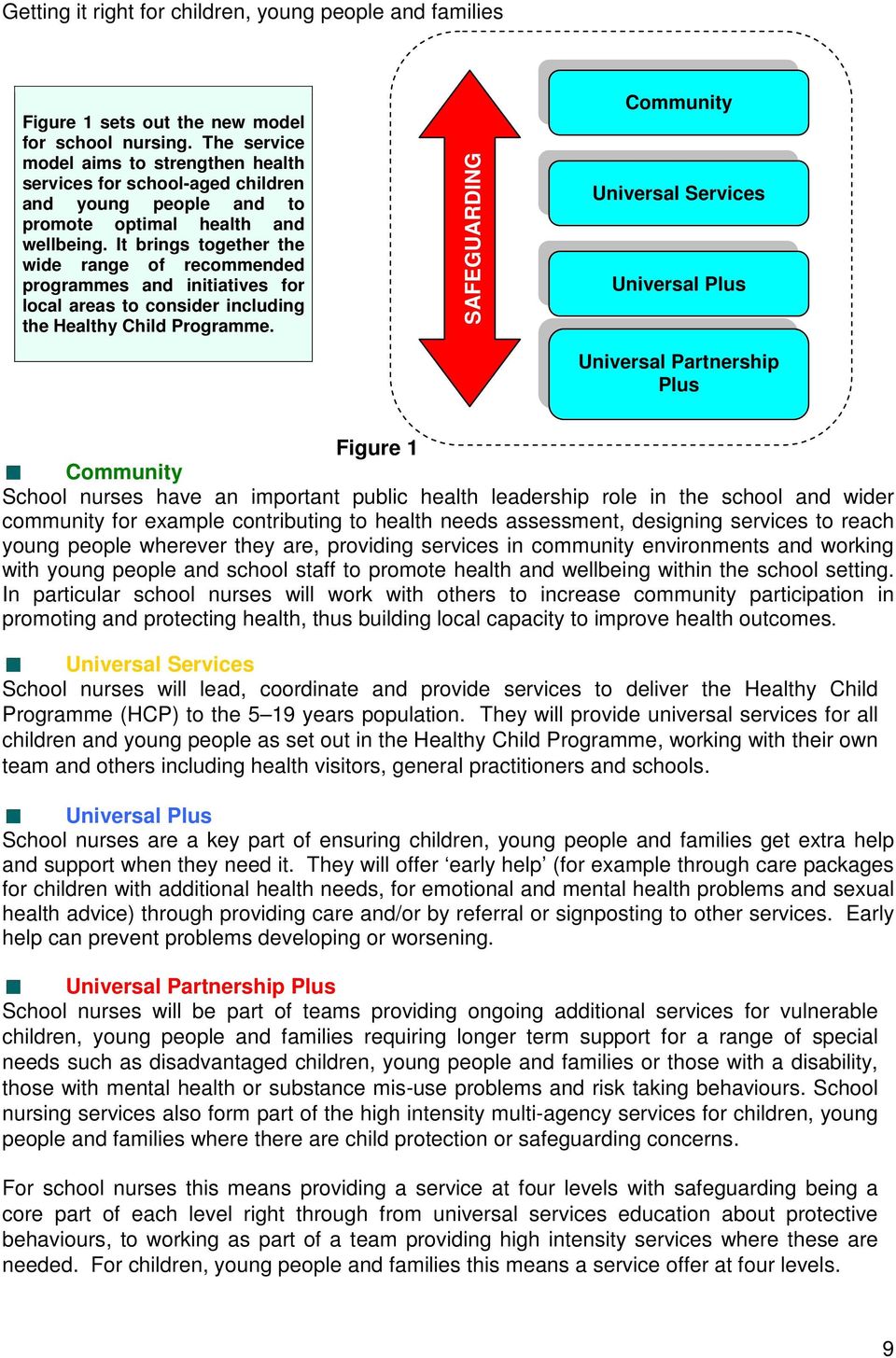
10 Services with sound foundations Service information Information in different formats and media tailored to children, young people and parents needs. Visible opportunities in the school and beyond. Transitions Robust care pathways for school entry and moving from primary to secondary school. Involvement Young people designing services and being health champions. Productive Community Services. Best value and maximised contact time. New technologies Smart phone Apps for example to support management of long term conditions. Mobile working solutions for nurses. Young people friendly ways of communicating: Text messages and s for booking appointments and seeking advice. A service offer at four levels Your Community describes a range of health services (including GP and community services) for children and young people and their families. School nurses will be involved in developing and providing these and making sure you know about them. Universal Services from your school nurse team provides the Healthy Child Programme to ensure a healthy start for every child. This includes promoting good health, for example through education and health checks, protecting health eg by immunisations and identifying problems early. Universal Plus provides a swift response from your school nurse service when you need specific expert help which might be identified through a health check or through providing accessible services where you can go with concerns. This could include managing long-term health issues and additional health needs, reassurance about a health worry, advice on sexual health, and support for emotional and mental health wellbeing. Universal Partnership Plus delivers ongoing support by your school nursing team as part of a range of local services working together and with you/your family to deal with more complex problems over a longer period of time. Services with strong innovation Improved accessibility Services in local young people community settings. Young people healthy living services & drop ins. Increasing technology support eg healthy living centre apps. Partnership services Community action on alcohol and Young People alcohol advisory service. Quality You re welcome standards met in providing Healthy Child Programme. Reducing health related school absence Advice booklets, apps and awareness campaigns. Illness advice line and drop in services. Early help Health needs assessments to identify issues early and support services for emotional health and wellbeing. Information sharing Effective systems to share information between professionals and with young people and families. 10
11 QUALITY AND OUTCOMES This vision and call to action includes quality standards 4 on which to bench mark local delivery and outcome measures 3 which will assist in measuring impact and evidence of meeting local population needs. The success measures will assist local areas to assess improvement and delivery of high-quality services that make a measurable contribution to health and wellbeing and a reduction of health inequalities. Delivering young people friendly health services: Accessible; Publicity; Confidentiality and consent; Environment; Staff training, skills, attitudes and values; Joined-up working; Young people s involvement in the monitoring and evaluation of patient experience; Health issues for young people; Sexual and reproductive health services. You re Welcome quality criteria (Department of Health 2011) Outcomes: Improved: Readiness for school; Population Vaccination cover; Emotional wellbeing of looked after children. Reduced: School absences; Tooth decay in children aged 5; Excess weight in 4-5 and year olds; Hospital admissions due to unintentional or deliberate injuries; Under 18 conception rates; Chlamydia prevalence in year olds: Smoking prevalence in 15 year olds; Alcohol and drug mis-use. Public Health Outcomes Framework (Department of Health 2012) Additional suggested success measures: Improved consistent delivery of the Healthy Child Programme 5-19; Increased capacity building, for example supporting healthy schools; Improved health and wellbeing, including good mental health. 11

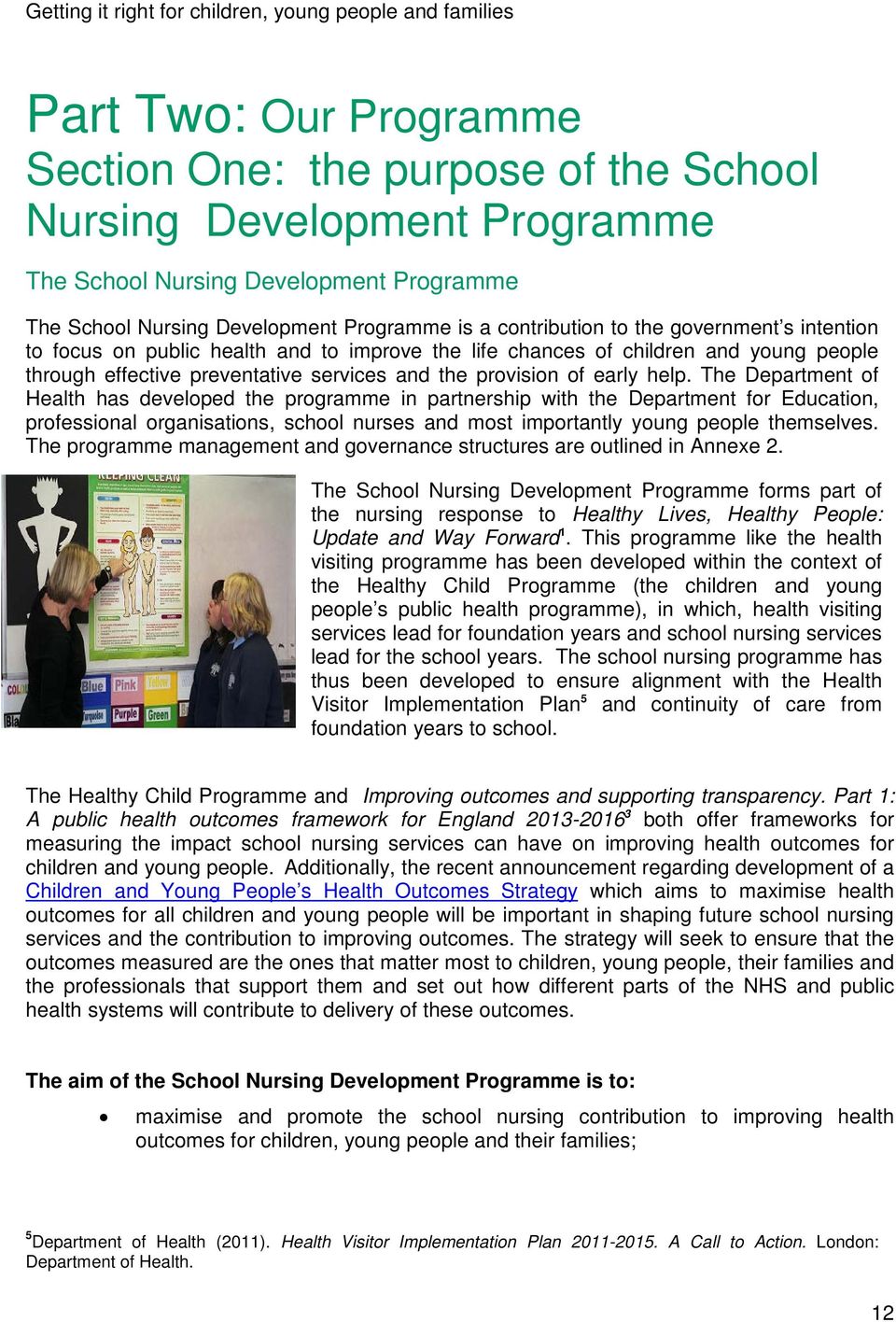
12 Part Two: Our Programme Section One: the purpose of the School Nursing Development Programme The School Nursing Development Programme The School Nursing Development Programme is a contribution to the government s intention to focus on public health and to improve the life chances of children and young people through effective preventative services and the provision of early help. The Department of Health has developed the programme in partnership with the Department for Education, professional organisations, school nurses and most importantly young people themselves. The programme management and governance structures are outlined in Annexe 2. The School Nursing Development Programme forms part of the nursing response to Healthy Lives, Healthy People: Update and Way Forward 1. This programme like the health visiting programme has been developed within the context of the Healthy Child Programme (the children and young people s public health programme), in which, health visiting services lead for foundation years and school nursing services lead for the school years. The school nursing programme has thus been developed to ensure alignment with the Health Visitor Implementation Plan 5 and continuity of care from foundation years to school. The Healthy Child Programme and Improving outcomes and supporting transparency. Part 1: A public health outcomes framework for England both offer frameworks for measuring the impact school nursing services can have on improving health outcomes for children and young people. Additionally, the recent announcement regarding development of a Children and Young People s Health Outcomes Strategy which aims to maximise health outcomes for all children and young people will be important in shaping future school nursing services and the contribution to improving outcomes. The strategy will seek to ensure that the outcomes measured are the ones that matter most to children, young people, their families and the professionals that support them and set out how different parts of the NHS and public health systems will contribute to delivery of these outcomes. The aim of the School Nursing Development Programme is to: maximise and promote the school nursing contribution to improving health outcomes for children, young people and their families; 5 Department of Health (2011). Health Visitor Implementation Plan A Call to Action. London: Department of Health. 12
13 build capacity in communities including the school population for the prevention of poor health and for the improvement of health and well-being amongst children and young people; describe the school nursing service contribution to meeting the needs of children and young people who have long-term conditions, disabilities and/or additional health needs (including mental health problems) in school and community environments to improve access to education and recreation; maximise the contribution to safeguarding through multi-disciplinary working, provision of early help and referral when appropriate to specialist services; promote the importance of school nursing services through; - clarifying the school nurse role and function; - setting out a service model as a framework for the development of local services; - showing how school nurses and their team contribute to achieving outcomes within the public health outcomes framework; - providing information about school nursing to current and future commissioners, the provider organisations and colleagues in health and education sectors; - promoting high quality services, building on the evidence and the views of partners including young people themselves; - mobilising and supporting the current workforce to deliver the service vision; - promote multi-agency working to deliver the service model and improve outcomes; - raising the profile of school nursing as a career; - including children, young people and families as partners in service development, review and evaluation. 13
14 What did children, young people and families tell us The programme has been co-produced with children, young people and parents as key partners in developing a vision based on evidence and understanding of what they expect from a school nursing service. The key themes are shown in Table 1 (below) and further details can be found in Annexe 3. Table 1: What did children, young people and parents tell us The government is committed to listening to and acting upon the views of service users to ensure services are fit for purpose and meet local needs. Children and young people have been active participants in the development of the vision and model for school nursing from the outset. We have worked with National Children s Bureau 6, British Youth Council 7, North West Regional Youth Work Unit 8 and Netmums to capture the views of children, young people and parents. The views of children, young people and parents have all fed into the vision and model. We have continually tested the findings and emerging themes to ensure we have captured the essence of their experiences and views. A number of common themes emerged from the consultation with children, young people and parents, which are summarised below. Children Young people Parents School nurses need to be more visible in schools. School nurses need to be visible and well known to pupils. School nurses need to use technology such as texting and ing. School nurses need to be more visible in schools and to parents. Pupils should be introduced to their school nurse. School nurses need to offer early help to support young people. Parents should be introduced to the school nurse and the service available. Pupils should be told when the school nurse is available to see them. School nursing services need to offer choice to young people in order to ensure that services are accessible and confidential. Parents need to be advised directly about the service through letters, leaflets and clear information. Pupils should be told where the school nurse can be found Young people want to be able to offer their views about the services they receive Parents need to be told where the school nurse can be found and provided with contact details. 6 National Children s Bureau (2011). School Nurses Survey Results. Partnership involvement centre. 7 British Youth Council (2011). Our school nurse. Young people s views on the role of the school nurse. London: British Youth Council. 8 Moxon, D. (2011). Someone you know and can trust. North West Regional Youth Work Unit 14
15 Figure 2: Shows children and young people s views on school nursing The following quotes were provided by young people who attended the British Youth Council and North West Regional Youth Work Unit workshops. Figure 2 On importance Health matters see a school nurse helping young people keep healthy through public health programmes and providing early help See a school nurse before it gets worse On support Helping me if I am scared or worried Supporting [me] in times of need On access and confidentiality Advertising the fact you can talk to them without being judged will make them more known I like the idea of text messaging because just telling a teacher is not private Quality = confidentiality available around places other than the school / colleges - online or through youth clubs On what makes a good school nurse Someone you know and can trust Being in sync with the youth 15

16 Section Two: School nursing services and the school nurse role Background and context School Nurses School nurses or Specialist Community Public Health Nurses (SCPHN ) are qualified nurses or midwives with specialist graduate level education in community health and the health needs of school aged children and young people. The Specialist Community Public Health Nurse (SCPHN) qualification is recordable with the Nursing and Midwifery Council. School nurses lead and deliver the Healthy Child Programme (HCP) 5-19 and are equipped to work at community, family and individual levels. They are skilled in identifying issues early, determining potential risks, and providing early intervention to prevent issues escalating. School nurses work in a range of settings including: mainstream education, faith schools, specialist services for looked after children, and special schools. School nurses are also equipped to support children with illness and disability thus enabling them to access education and recreation. School nurses are supported in providing services by teams that include registered nurses and health care assistants. The skill mix within the team should reflect local needs, maximise skills and strengthen capacity. Workforce details for SCPHN registered nurses and other nurses working in school are shown in the workforce profile section of this report. The role of the school nurse The role involves a range of skilled activities and communications at individual group and community level. It includes health promotion, advice, signposting to other services, active treatment/procedures, education, support, protection, safeguarding and service coordination. School nurses need to work in partnership with other agencies and as part of a wider multidisciplinary team to support the health and wellbeing of school-aged children. School nursing is a service that understands the dynamic process of interaction between the child, the family, the child in school, (including alternative education providers) and the child in the community. The fundamental role of the school nurse is to improve children and young people s health and wellbeing by: leading, delivering and evaluating preventative services and universal public health programmes (as set out in the HCP 5-19) for school-aged children and young people, within both school and community settings; 16

17 delivering evidence based approaches and cost effective programmes or interventions that contribute to children and young people s health and well-being e.g. reduction in childhood obesity, reduction in under 18 conception rates, reduction in prevalence of chlamydia and management of mental health disorders (such as depression and conduct disorder), co-ordinating services, referring to other agencies and delegating within the team to maximise resources and utilise the expertise of other skilled professionals; supporting a seamless transition into school, from primary to secondary school and transition into adulthood; managing the interaction between health and education so that the child or young person enjoys good health and well-being (including emotional health and wellbeing) therefore achieving optimal education; leading support for children and young people who have complex and/or additional needs including providing or co-ordinating support, education and training for families, carers and school staff; identifying children and young people in need of early help and where appropriate providing support to improve their life chances and prevent abuse and neglect. This includes working with children and young people at risk of becoming involved in gangs or youth violence; contributing as part of a multi-agency team, to the response for children, young people and families who have multiple problems. Workforce Numbers Figure 3 shows the numbers of school nurses with a SCPHN qualification working in schools from May 2010 to Sept The number of nurses in September 2011 was These nurses are supported by school nursing teams including registered nurses. The last national figures available (from annual census 2010) show that there were 3000 registered nurses working in schools, in addition to those with a SCPHN qualification at this time. Figure 3: School Nurse FTE May 2010 Sept

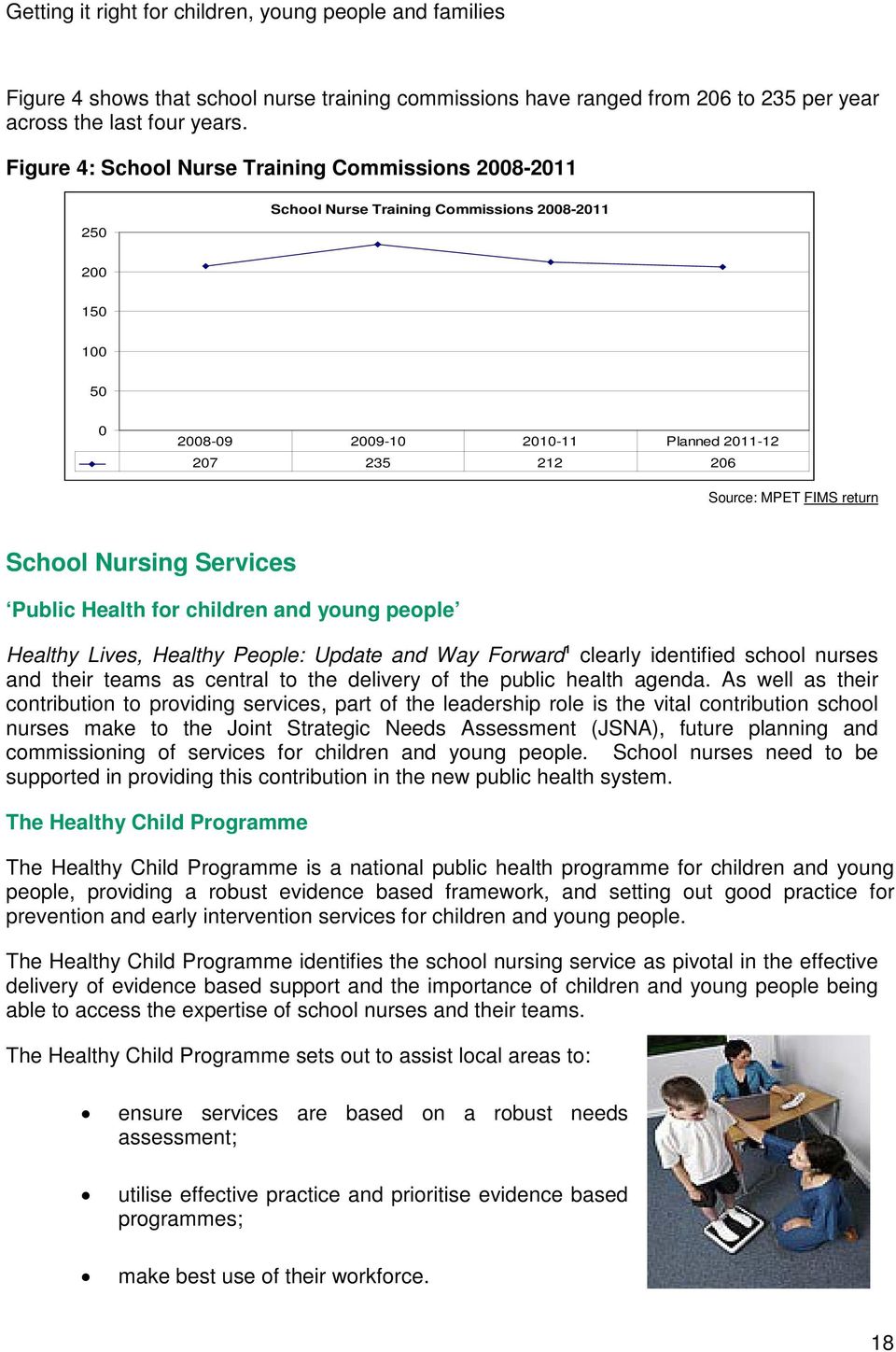
18 Figure 4 shows that school nurse training commissions have ranged from 206 to 235 per year across the last four years. Figure 4: School Nurse Training Commissions School Nurse Training Commissions Planned Source: MPET FIMS return School Nursing Services Public Health for children and young people Healthy Lives, Healthy People: Update and Way Forward 1 clearly identified school nurses and their teams as central to the delivery of the public health agenda. As well as their contribution to providing services, part of the leadership role is the vital contribution school nurses make to the Joint Strategic Needs Assessment (JSNA), future planning and commissioning of services for children and young people. School nurses need to be supported in providing this contribution in the new public health system. The Healthy Child Programme The Healthy Child Programme is a national public health programme for children and young people, providing a robust evidence based framework, and setting out good practice for prevention and early intervention services for children and young people. The Healthy Child Programme identifies the school nursing service as pivotal in the effective delivery of evidence based support and the importance of children and young people being able to access the expertise of school nurses and their teams. The Healthy Child Programme sets out to assist local areas to: ensure services are based on a robust needs assessment; utilise effective practice and prioritise evidence based programmes; make best use of their workforce. 18
19 The Children and Young People s Health Outcomes Strategy The Children and Young People s Health Outcomes Strategy will be the first example of an outcomes strategy as part of the health reforms model. A Children and Young People s Health Outcomes Forum is informing the development of this strategy to be published in the summer of Early Help Munro 9 emphasised the importance of early help at any stage in a child or young person s life. Failure to meet the health needs of children and young people can lead to problems or difficulties in the future and have a profound impact on their adult health. Munro highlighted the value of providing help at the earliest opportunity - as soon as a problem emerges to prevent the situation escalating. School nursing services are crucial to both identifying need and providing a response through the service offer and in working with partners, thus ensuring effective early help is available. The mental health strategy 'No health without mental health 10 recognises that a good start in life and positive parenting promote good mental health, wellbeing and resilience to adversity throughout life. Many mental health problems start in childhood and are associated with a number of known risk factors, including inequality. One in ten children aged between 5 and 16 years has a mental health problem, and many continue to have mental health problems into adulthood. Half of those with lifetime mental health problems experience symptoms by the age of 14. School Nurses are well positioned to identify mental health issues and provide every support to ensure problems do not escalate to crisis point. Where appropriate, school nurses will refer to specialist services. Vision and Model for School Nursing Services The new vision and model for school nursing is set out in Section three. It provides an opportunity to strengthen the service and focus resources to meet local needs, whilst developing multi-disciplinary approaches to enhance delivery and improve outcomes. 9 Munro. E. Prof. (2011) The Munro review of Child Protection: Final Report. A Child-Centred System. London: Department for Education. Department for Education (2011) A child-centred system. The Government s response to the Munro review of child protection. London: Department for Education. 10 Department of Health (2011). No health without mental health: a cross-government mental health outcomes strategy for people of all ages a call to action. London: Department of Health. 19

20 Section Three: Developing a service vision and model for school nursing a 21 st century service In developing the service vision our aim was to join up best evidence of what should be done with the views of professionals, parents, children and young people on how it should be done. In this way we achieve good health outcomes and positive user experience. School nurses have been key in developing the vision, embracing the opportunity to energise and transform services, to re-establish the profession as a vital part of family, community and public health services and in suggesting how best their skills can be used alongside other to improve health outcomes and life chances. A service model for school nursing We have developed a four level model with safeguarding as a theme through all levels. The four levels outline the continuum of support which children and young people can expect to receive through the school nursing services and multi-disciplinary working. School nursing is a Universal Service, which also intensifies its delivery offer for children and young people who have more complex and longer-term needs (Universal Plus). For children and young people with multiple needs, school nurse teams are instrumental in co-ordinating services (Universal Partnership Plus). Community SAFEGUARDING Universal Services Universal Plus Universal Partnership Plus 20

21 Community School nurses have an important public health leadership role in the school and wider community for example contributing to health needs assessment, designing services to reach young people wherever they are, providing services in community environments and working with young people and school staff to promote health and wellbeing within the school setting. In particular school nurses will work with others to increase community participation in promoting and protecting health thus building local capacity to improve health outcomes. Universal Services School nurses will lead, coordinate and provide services to deliver the Healthy Child Programme (HCP) for 5 19 years for a population. They will provide universal services for all children and young people as set out in the Healthy Child Programme working with their own team and others including health visitors, general practitioners and schools. Universal Plus School nurses are a key part of ensuring children, young people and families get extra help and support when they need it. They will offer early help (for example through care packages children with additional health needs, for emotional and mental health problems and sexual health advice) through providing care and/or by referral or signposting to other services. Early help can prevent problems developing or worsening. Universal Partnership Plus School nurses will be part of teams providing ongoing additional services for vulnerable children, young people and families requiring longer term support for a range of special needs such as disadvantaged children, young people and families or those with a disability, those with mental health or substance mis-use problems and risk taking behaviours. School nursing services also form part of the high intensity multi-agency services for children, young people and families where there are child protection or safeguarding concerns. This model aligns with the new model for health visiting services to provide continuity of services from It provides local areas with a structured framework on which to review and design their service offer in partnership with key stakeholders and service users building on the Joint Strategic Needs Assessment and local information. A suite of professional pathways are being developed in partnership with key stakeholders. The emerging care pathways will support the vision and service model. Local Authorities new responsibilities for public health and Health and Wellbeing Boards offer exciting potential for school nurses to play a key role in assessing and addressing the health needs of children and young people. The pathways will support the delivery of both the health visiting and school nursing new service offer. To ensure synergy between the two programmes, we have developed a professional partnership Health visiting and school nursing services supporting children and their families. Additional pathways currently under development include: supporting children and young people in school settings with complex and/or additional health needs; supporting the public health of children and young people in the Youth Justice system; emotional health and wellbeing; safeguarding professional roles and responsibilities. 21
22 The core aim of the model is to ensure reach to children and young people regardless of the setting in which they may find themselves. The service offer should provide the potential for a truly inclusive and multi-disciplinary approach. Figure 5 illustrates the potential linkage and cross over between services and the need to ensure the child is central to service delivery with services reaching out to the child regardless of his or her circumstances. Figure 5: The new school nursing service model maximises the contribution of school nursing teams at a community, family and an individual level. In doing this, existing and new school nursing services will work closely with families, schools, health visitors, other public health specialists, GPs, specialist services and, where appropriate, social care services. Other settings (e.g., Young Offenders Institutes) Home settings Links to home, carers and foster carers School and educational settings Child/Young Person and family Acute hospitals Links to hospital settings including A&E, hospital at home service and community children s nursing service Primary care settings Including links to GP, Primary care Community settings Links to youth and community services Quality and outcomes The development process for the Children and Young People s Outcomes Strategy, will explore how the outcomes measured in both the NHS and public health frameworks are used to improve services around issues that matter most to children, young people and their families. All health services are being encouraged to become more young people friendly. In the consultation on Positive for Youth the cross-government policy for young people, stakeholders and young people highlighted the importance of ensuring all services are young people friendly, with specific effort made to reduce the stigma around seeking advice on sexual health or mental health. 22
23 The You're Welcome quality criteria offers a clear framework to ensure services are fit for purpose. If the criteria are adhered to they can assist local services to address issues including accessibility, confidentiality and service user feedback. A summary of You re Welcome criteria can be found in Annexe 4. The views of children and young people expressed, clearly link to the You re Welcome quality criteria. School nursing services should utilise the You re Welcome quality criteria to benchmark their services and use them as the cornerstone for good quality services for young people. The development process for the Children and Young People s Outcomes Strategy will explore how the outcomes measured in both the NHS and public health frameworks translate into those issues that matter most to children young people and their families. Outcomes: school nurses leading delivery of the Healthy Child Programme and contributing to good health outcomes Healthy happy children and young people As stated in the Healthy Lives, Healthy People: Update and Way Forward, 1 school nurses will have a role in helping to develop local approaches to public health, provide links between public health, the NHS and schools, together with a leadership role in promoting good health and addressing inequalities. The overarching aim of Healthy Lives, Healthy People: Update and Way Forward 1 is improved health outcomes and reduced health inequalities. Improving outcomes and supporting transparency. Part 1: A public health outcomes framework for England published January 2012 sets out national outcomes across the life course and local commissioners and providers will need to work to achieve these. Health and Wellbeing Boards will lead a Joint Strategic Needs Assessment to determine local priorities for the Health and Wellbeing Strategy and inform service commissioning. Areas where school nursing will have a specific contribution will include: assessing and determining individual and local needs; providing data and information to inform the JSNA; leading and delivering the Healthy Child Programme 5-19; using evidence from neuro-science to inform practice in supporting children and young people; 23
24 building capacity e.g. supporting healthy schools; promoting good mental health and wellbeing; early intervention in mental ill health, and identifying and helping children and young people, and their families, who need support with their emotional or mental health; improving readiness for school*; reducing school absences*; increasing population vaccination cover*; tooth decay in children aged 5*; excess weight in 4-5 and year olds*; hospital admissions due to unintentional or deliberate injuries in under 18 year olds*; emotional wellbeing of looked after children*; under 18 conception rates*; diagnosis of chlamydia in year olds *; smoking prevalence in 15 year olds*; alcohol and drug mis-use*. Systematic review of outcome measures is essential and provides an opportunity for determining effectiveness and a re-focussing if services are not meeting local needs. * Indicates outcomes taken from A public health outcomes framework for England
25 Part Three: Call to Action National actions and progress to date Over the last year, the Department of Health together with key partners has worked through a number of work streams to design and progress the School Nursing Development Programme. A summary of core elements of the programme delivered to date is shown in Table 2. Table 2: School Nurse Development Programme Actions 2011/12 Programme development Reviewed linkages between health visiting and school nursing programmes and practice; Engaged with the profession through stakeholder events; Established the governance structures including task and finish groups. Service modelling Scoped the core elements required for the model; Reviewed Healthy Child Programme and links to health visiting programme to ensure school nurse programme aligns; Developed and tested the draft model; Consulted on draft model with stakeholder, networks and advisory group; Developed an integrated visual for the model; Overlaid key messages from young people; Drafted service vision document; Consulted on model and vision with stakeholders and networks. Engagement Consulted with professional organisations; Engaged with North West Regional Youth Work Unit (NWRYWU) young people on their views; Worked with British Youth Council (BYC) to develop an on-line survey; Consulted with young people; Tested the themes from on line survey with young people at 3 regional events; Reviewed the key findings from consultation; Commissioned National Children s Bureau (NCB) to consult with children 6-11yrs; Worked collaboratively with Netmums to collect views of parents; Stakeholder event with the profession; Tested the model with young people. Communication Developed CNO bulletin schedule to raise the profile of school nursing; Provided updates to SHA children s leads; Shared draft vision at conferences and events together with Community Practitioners and Health Visitors Association (CPHVA), School and Public Health Nurse Association (SAPHNA) and School Health Innovators Network Exchange (SHINE); National forum for School Nurse Educators; Provided input for school nurse leadership programmes. Good practice 25
26 Pathways Identified needs and gaps re health visiting and school nursing services to identify solution focussed approaches within the emerging pathways; Established pathway task groups; Developed draft pathway documents; Established new pathway task groups Youth Justice and complex needs, and Safeguarding. Linked school nurse networks to the Centre for Excellence and Outcomes in Children and Young People's Services (C4EO) and emerging good practice; Reviewed linkages between High Volume Care (NHS institute) and school nursing to determine impact on reducing repeated or unnecessary admissions to hospital; Reviewed linkages between NHS Productive Community and school nursing, collecting examples of good practice; Provided joint accelerated learning events. Next steps for school nursing development programme The next stage of the programme requires further action at both national level and local level. This final section sets out further actions for the national programme partnership and calls to action practitioners, providers, commissioners and leaders in the current and future local public health system to deliver service transformation. It sets out a range of actions for local areas to consider ensuring delivery of an evidence based service for children and young people. Objectives and deliverables for : National Action The programme board are committed to the implementation of the service model and ensuring the vision is embedded in cross cutting departmental policy. Nationally, the programme board will work with professions, regulating bodies, higher education institutions and many others to lead, shape and take action to support implementation. National policy: development of the Children and Young People s Health Outcomes Strategy, the following actions have ben identified and will be monitored by the programme board: To contribute to and support the work of the Children and Young People s Health Outcomes Forum in: determining the health outcomes that matter most to children, young people and their families; considering how well these are supported by the NHS and public health outcomes frameworks, and making recommendations for other outcomes; thinking through and setting out how the different parts of the health system will contribute to the delivery of these outcomes, and how they will work with each other and with other partners to this end. 26
27 Supporting Implementation Working with and supporting partners and professional organisations (including CPHVA, RCN and SAPHNA and user champions (for example BYC) to: promote and ensure the successful delivery of the programme, working with and through the key delivery partners. Lead responsibilities rest with: - the Department of Health, Director of Nursing, Professional Leadership Team, the Children, Families and Inequalities Division and Workforce Directorate to lead the programme and co-ordinate the next step actions working with; - the Department for Education (DfE) to promote the model and vision to schools and local authorities and alignment with other programmes for the school age child, including the safeguarding of children and young people. contribute to wider children, young people and family programmes; including work with the Department of Health, Children, Families and Inequalities Division and Department for Education and others to: - ensure effective safeguarding in the new system, including the Munro recommendations; - embed public health for school-aged children in the emerging Children and Young People s Health Outcomes Strategy; - respond to needs of children with complex and/or additional needs (including mental health issues). design and delivery of a suite of professional pathways to support the delivery of the offer, these will include; - supporting the transition from health visiting to school nursing services; - delivering public health to young people in the youth justice system; - supporting children with complex needs in school settings; - safeguarding; - emotional health and wellbeing. design and delivery of fact sheets in partnership and service users, these will include; - Health and social care; - Children, young people and families; - Head teachers and education staff; - GP s and primary care. 27
28 support local authorities in their new role as commissioners of the service to ensure the offer is delivered to meet local needs by providing clarity on the offer and by reaffirming the Healthy Child Programme as a robust evidence based programme on which to determine service delivery; promote the opportunities of information technology and improved information in implementing the new service model; support local areas, in local workforce planning for school nurse numbers and appropriate skill mix using national data and dissemination of good practice. Professional mobilisation and communication Working with and supporting partners and professional organisations (including CPHVA, RCN and SAPHNA) and user champions (for example BYC) to: design and deliver the communications and engagement strategy and plan; explore leadership development opportunities to support school nurses leaders to manage and support existing school nursing teams; promote learning, development and spreading of good practice; establish and support a school health network, with cross cutting membership to reflect multi-disciplinary dimensions of public health for children and young people; work alongside the Health Visiting programme where appropriate, to develop products and share effective ways of working. Education and Continuing Professional Development Working with and supporting partners and professional organisations (including CPHVA, RCN and SAPHNA) and user champions (for example BYC) to: work with higher education institutes to ensure the curriculum will equip school nurses with the skills and knowledge to enable them to deliver the new service offer; promote professional development training, specifically focused on building community capacity, and including specific training in new care packages such as cognitive behavioural therapy and new approaches such as motivational interviewing; support high quality professional practice, including the model of practice for effective school nursing and clinical supervision which will be embedded through the leadership role of the school nurse; support local areas to develop joint training between school nurses, health visitors, social care and educational staff, including community outreach and family support staff. 28
29 Local Action The call to action for a partnership approach to developing school nursing services to provide best outcomes for children and young people This programme calls on the profession, those who commission school nursing services, and those who provide them to promote a revitalised service. This will ensure that all children, young people and families are offered a core programme of evidence based preventative health care with additional care and support for those who need it. Partnership working to support for children, young people and families through the school aged-years School nurses and their teams ensure that they have and/or develop sustainable partnerships with those involved in commissioning and providing care for the school age child, this should ensure that there is joined up care for individuals, joined up planning for services, systems to reduce health inequality and delivery of good health outcomes; Directors of Public Health need to support commissioners and local authorities to ensure they are equipped to deliver the Healthy Child Programme, including the commissioning of school nursing services to meet local need; Locally, the new Health and Wellbeing Boards will bring together local authority, health and partner agencies and will have an important potential role in ensuring the synergy between school nursing and other local services, in ways that best meet the local needs identified in the Joint Strategic Needs Assessment (JSNA). For Commissioners the task will be to develop a reviewed and revised commissioning specification which; takes account of the outcomes within the Public Health and NHS Outcomes frameworks, together with the recommendations in the Children and Young Peoples Health Outcomes Strategy; includes the Healthy Child Programme (HCP) 5-19 as set out in the Healthy Child Programme national model specification; includes all four levels of the service model set out for school nursing services, ensuring that children, young people and families are offered the full universal offer including the provision of early help and intervening when there are problems; offers clarity regarding the role and contribution of school nursing in terms of early help and that safeguarding is a theme throughout; gives consideration to the national currency and pricing guidance for the Healthy Child Programme; utilises the national model contract for community services where appropriate; 29
30 develops new and innovative ways of working to enhance delivery through multidisciplinary working; develops with delivery partners a robust system to capture qualitative service user feedback with particular regard to the views of children and young people. This should capture improved experience of services; ensures school nurses are equipped to utilise their contact opportunities to identify needs and provide early help to children and young people. For NHS provider trusts and other provider organisations the task will be to; develop the local service offer for children, young people and families for Community, Universal, Universal Plus and Universal Partnership Plus services, and contribute to safeguarding and child protection arrangements, working with schools and other local partners; develop processes to engage children, young people and families in shaping and reviewing local services; develop a visible, accessible service which meets local needs and reflects the You re Welcome quality criteria, whilst inspiring confidence in children, young people and families; develop local pathways and ways of working to support children, young people and families regardless of their setting (in and out of school); agree with commissioners to implement the new service, and where this cannot be achieved within one commissioning year, commissioners and providers will need to consider a staged implementation of the new service evidenced by a delivery plan towards full implementation; have a plan for the school nurse workforce and its role in delivering the new service, including support for training and development, and leadership development plans for the current and future workforce. For local delivery partners in primary care, school settings and other educational settings the task will be to; review and strengthen local joint working arrangements for health services for schoolaged children to provide the best support to families, helping them find the right support at the right time. For school nursing services the task will be to: promote community capacity building to enable families and communities to build on their strengths and promote health and wellbeing of children and young people; 30
31 maximise their public health contribution, including for example representation on bodies set up to determine the strategies for the new public health services within each Local Authority area. Their contribution to the Joint Strategic Needs Assessment and subsequent strategies will be important in ensuring that services are appropriately commissioned in the future. work directly with children, young people and families and lead teams to provide services across the full range of preventative health care for which they have trained, including to: - provide effective links between health visitors, schools, primary health care and children s services; - deliver the Healthy Child Programme 5-19 in full (Universal) and ensure that all children and young peoples health needs are assessed and met. provide responsive care when children, young people and families have problems or need support, and undertake new training to extend this range using new evidence in early intervention (Universal Plus); work with partners, especially in schools and with social care, where children, young people and families have ongoing needs requiring multi-agency support (Universal Partnership Plus); access a nationally sponsored programme to refresh public and community health skills and approaches and learn new ones. Working together nationally and locally, we can deliver the vision for improved services and as our young people s representatives said, we can: help us [young people] to keep healthy through public health programmes and providing early help because our health matters 31
32 References British Youth Council (2011). Our school nurse. Young people s views on the role of the school nurse. London: British Youth Council. Department for Education (2011) A child-centred system. The Government s response to the Munro review of child protection. London: Department for Education. Department of Health and Department for Children, Schools and Families (2009). Healthy Child Programme (From 5 19 years old). London: Department of Health. Department of Health (2010). Healthy Lives, Healthy People: Our strategy for public health in England. London: Department of Health. Department of Health (2011). Health Visitor Implementation Plan A Call to Action. London: Department of Health. Department of Health (2011). Healthy Lives, Healthy People: Update and way forward. London: Department of Health. Department of Health (2011). No health without mental health: a cross-government mental health outcomes strategy for people of all ages a call to action. London: Department of Health. Department of Health (2011). You re Welcome : quality criteria for young people friendly health services. London: Department of Health. Department of Health (2012). Healthy Lives, Healthy People. Improving outcomes and supporting transparency. Part 1: A public health outcomes framework for England London: Department of Health. HM Government. (2011). Positive for Youth: A new approach to cross-government policy for young people aged London: HM Government. Moxon, D. (2011). Someone you know and can trust. North West Regional Youth Work Unit Munro. E. Prof. (2011) The Munro review of Child Protection: Final Report. A Child-Centred System. London: Department for Education. National Children s Bureau (2011). School Nurses Survey Results. Partnership involvement centre. 32
33 Website Links Transition from health visiting to school nursing services Building Community Capacity You re Welcome: quality criteria for young people friendly health services /DH_ Positive for Youth: A new approach to cross-government policy for young people aged Children and Young People s Health Outcomes Strategy CNO Bulletin Schedule Links to C4EO NHS Institute High Volume Care emergency_and_urgent_care_pathway.html NHS Institute NHS Productive Community es.html The Lancaster Model 33
34 Annexe 1: What does good look like? The good practice what does good look like? The school nursing service model is unpinned by evidence and builds on what works locally. As part of the Development Programme, we have been collecting examples of good practice and what works locally, which we aim to publish during the summer. Some examples are shown below. What does good look like: Technology Children and Young People routinely access multimedia technologies and web based resources in their everyday lives. Within the next decade, children and young peoples with chronic long-term conditions such as asthma will be able to access digital healthcare, transforming how the next generation manage their health & interact with health care providers. NECLES in partnership with Asthma UK, QMUL and Solar Software have developed an innovative Mobile Phone Application (app) My Asthma Log to support improved education, treatment adherence & emergency self-management (EASY programme) in children and young people with asthma. The mobile-phone app enables patients to manage their health needs with an individualised asthma plan. The app is an interactive communication platform which will allow patients to access their emergency self-management plans (including digital images of their inhalers), hand-held records & educational material such as information on the asthma and links videos of correct inhaler technique. It utilizes a user-friendly icon/button interface. NHS London will host this app on it s new App store which was launched in What does good look like: Planning and use of data to improve delivery of services A School Nurse Resource Allocation and Outcomes matrix has been developed to underpin a revised service specification based on the new service model, this reflects an innovative approach to identifying what the school nurse contributes to through the needs identified in the Secondary and associated feeder primary schools broken down to a multi-agency team level. The resource matrix categorises the school population need and multi-agency team provision in terms of high, medium and low need. This has enabled a more equitable and effective distribution of the school nursing resource, with a higher allocation of the school nursing team to schools and communities with a greater need. One of the key aims was to clearly state the role and function of school nursing, to ensure most appropriate use of the specialist public health skills. This approach facilitates school nurses working more efficiently within a multi-disciplinary context and provided the school nurse team with greater confidence in understanding their core responsibilities and being able to refer to other agencies or services. This resource tool was developed with the public health analyst, the local authority, the school nursing service and schools. There are plans to ensure the tool will be updated on an annual basis or with three year trends as appropriate. 34
35 What does good look like: Texting a way for professionals to communicate with young people Communicating with children and young people needs to be more flexible and allow creative use of text messaging and ing Technology is a central aspect of young people s lives and provides the new medium of conversation. Texting has transformed the social lives of young people providing accessibility and privacy, and giving young people unprecedented control over how they communicate. Text messaging can provide access and signposting to health and advice services for young or vulnerable people who may not access services by traditional methods. It can offer a relevant, accessible service, which meets the health needs of the young person, and yet is manageable for the service. Some health services have reported good success rates with the use of text messaging via mobile telephones to communicate with young people. The text service offers a flexible way of providing support and service delivery. The text service offers an acceptable way for young people to connect with the service after an initial contact with the nurse (e.g. after promotion of the service during Personal, Social and Health Education or an assembly). Formal pupil evaluations demonstrated the value of the service. The service also offers an opportunity for young people to provide feedback on the service they had received. This method of communicating with young people has become increasingly utilised including relaying results of C-Swab test by Contraceptive and Sexual Health service. What does good look like: Using the Evidence base The Lancaster Model is an example of a whole (holistic) evidence base that was used to analyse both the structure and the operating function of school nursing services. Its value is in the way that it assesses both the local child and adolescent health needs and the school nurse teams that were seeking to meet those needs. The Lancaster Model provides an assessment of the child health needs within the communities served as well as an evidence-based assessment of the way these school nurse teams are functioning in order to meet those needs. The Lancaster Model indicates that, without increasing team size, it is entirely feasible to be able to increase significantly the number of school nurse led interventions (up by 728.4%) as well as the number of preventative public health sessions (up by 866.6%). In terms of system design, this is an example of the way evidence based change can directly contribute to the improvement of child and adolescent health and well-being. 35
36 Annexe 2: Governance and accountability structures Figure 6: Governance structure Developing and delivering the vision Governance structures Programme Board Children, young people and families School Nurse Advisory Group: To champion and support programme deliver Delivery Partnership group: To support delivery in the service Stakeholders Task and Finish Group: Service Modelling To share and promote the vision for school nursing Task and Finish group: Commissioning for the Workforce To share and promote the vision for school nursing Task and Finish group: Engagement To share and promote the vision for school nursing Partnership Pathway Task Groups: To support professional pathway development Policy, Programme and Implementation Figure 7: Work Streams Integrated working to develop and deliver the service version and model Engagement Service Modelling Commissioning for the Workforce 36
37 Annexe 3: Key messages from young people Someone you know and can trust In May 2011 North West Regional Youth Work Unit was invited by the Department of Health to feed young people s views and experiences of school nursing services into the School Nurse Programme of Development. Consultation took place via the Youthforia Project involving young people from 16 local authority areas across the North West to produce a report Someone you know and can trust. 8 The views and ideas were fed directly into the Department of Health s School Nurse Development Programme. The key issues raised by the group related to accessibility, visibility and confidentiality. See a school nurse - before it gets worse The British Youth Council (BYC), invited by the Department of Health, provided access to consultation with almost 2000 secondary school-aged young people during the summer of These young people s views are central to this School Nurse Programme of Development. To consult young people, the BYC conducted an online survey, which gained responses from 1599 young people ages 11 to 18 from across England (July 2011). The BYC also arranged focus groups at BYC Convention events with 202 young people in August The key findings have been used to shape the new model for the school nursing services. 37
38 Recommendations from the British Youth Council s consultation with young people. Visible, accessible and confidential 1. All young people should receive an induction about the role of the school nurse, what services are on offer, and how to access the service. They should receive this information when entering secondary school. 2. The Department of Health could involve young people in developing materials to support the induction process for children in school, and could include a presentation, workshop or similar exercise about school nurses for delivery in schools. 3. Young people should be supported to become school nurse champions and work with school staff and their school nurse to promote the school nurse amongst their peers. 4. All school nursing teams should assess how they can offer young people a choice about where they access their school nurse; whether the school nurse they see is male or female and whether they want a friend to accompany them. 5. School nursing teams and school staff should make sure that all young people know how they can access the school nurse without being expected to refer their enquiry to a teacher or school staff member such as a receptionist. 6. All school nursing teams should consider the use of modern technology to assist young people to access the service more readily. For example, school nurses could offer a text or service to allow young people to contact them confidentially. At a minimum, all young people should have a telephone number in order to be able to call the school nursing service when they need information or help about a problem. 7. All young people should be able to, and know how to give feedback on their experiences of the school nursing service. They should be able to report whether or not they feel school nurses are visible, accessible and ensure confidentiality. School councils or other learner voice initiatives should work with school staff, youth workers, and community groups to create a youth-led evaluation process. Further testing of the model and vision with young people led by the British Youth Council (BYC) and North West Regional Youth Work Unit (NWRYWU) was undertaken in December BYC and NWRYWU worked in partnership to simultaneously run an interactive consultation event for young people in London and smaller discussion workshops in the North West in November 2011 to test the draft model and vision. 38
39 The key findings included: Young people reiterated the need for the school nursing service to meet the quality criteria of being accessible to young people; Young people also wanted to be able to use the service at places and times that were convenient to them where possible; Young people also wanted to be able to contact the school nurse directly to access their services through a confidential booking service (text or ); Young people felt that there should be information about what the service offers, how to access the service, what will happen when they access the service and how the service links to other services; Young people felt publicity was particularly important for young people during transition periods such as the transition to secondary school; Young people felt it was important that school nurses invite and encourage young people to give their opinions of the service offered and whether it meets their needs, and for the service to be reviewed and acted on as necessary; Confidentiality was seen as a lynchpin to a youth-friendly service; Young people felt it was very important that the school nurse model made sure that the nurses had skills in working with young people: being understanding, approachable, and knowledgeable about youth health issues; Young people felt it was very important for the school nursing service s outcomes to focus on both helping all young people keep healthy through public health programmes, and also providing specific early help and advice on teenage health issues so young people can get help, particularly around areas such as mental ill health and drug and alcohol abuse, before they reach crisis point. 39
40 Recommendations from BYC and NWRYU testing It is recommended that: Communication of the model to young people highlights the importance of confidentiality and consent within the quality standards, the provision of early help and leadership as part of a multi-agency team within the role, and the ability to communicate with young people within the school nurse skills and knowledge requirements; The skills of the school nurse should include as part of its outcome focused approaches the ability to use technology such as texting and services to ensure more young people engage with their school nurse; The skills of the school nurse should include as part of specialist skills in evaluation and review the engagement of young people to develop evaluation processes for the service. 40
41 Key messages from children (6-11 yrs) Summary The majority of the children were entirely positive about their experiences of school nurses. In The November common 2011, thoughts the Department about what of makes Health a invited good the nurse National were Children s that they should be kind, caring, friendly, nice, helpful and good listeners. As children grow older, their needs change. By the age of 11, the children began to report the wish for school nurses to help them understand the way their bodies were changing. National Children s Bureau (NCB) sought the views of young children about school nursing services. NCB recruited eight schools to participate in a survey of children from ages 6 to 11. The schools were located across the country from London to the Midlands and the Northwest. In total, 293 pupils participated in answering questions on a written survey (45% male and 55% female). Young children expect to see school nurses at school but, as they grow older, more children reported that they wish to seek information from school nurses outside the school premises. This is a pattern that we found emerging in the BYC consultation with young people. The location of school nursing needs to change to meet the needs of the child or young people and alternative locations offered as children grow older. NCB called particular attention to the numbers of children asking for help when they have problems at home (51%), when they have worries about a friend (49%), and when they might be feeling sad (49%). These are indicators that suggest the need for school nurses to provide emotional and social support and assistance to children at times of distress. In addition, at all ages, children referred to wanting help when dealing with bullying. As well as these emotional concerns, children reported that they think of school nurses as sources of information and advice about physical problems and about changes as they grow up. The common thoughts about what makes a good nurse was that school nurses should be kind, caring, friendly, nice, helpful and someone who would listen to children. As they get older, pupils become more specific about what a nurse can do for them, and comments commonly included helping them understand how they change as they grow up. 41
42 Recommendations from parents In December 2011, the Department of Health worked with Netmums to illicit the views of parents about school nurse services. Netmums used similar questions to those included the surveys conducted by British Youth Council and National Children s Bureau. In total, 564 parents participated in the online survey; the majority of respondents (86%) were parents of children in primary school, with remaining 11% being parents of children in secondary schools. More than 50% (366) parents reported they knew there was a school nurse at their child s school, with only 159 indicating they knew who the school nurse was. Nearly half of the respondents (49%) would contact via school office and only 15% had the contact details of the school nurse. The majority of parents believed the school nurse was involved in weighing and measuring (77%), hearing tests (48%), and eye tests (47%). Nearly half of those who responded felt the school nurse was also there to discuss concerns or worries (47%); however, 82% reported having not seen the school nurse to discuss their child s health. 30% of parents who responded suggested they would see a school nurse rather than their GP. 54% of respondents advised they had not received information about the school nursing service, with 30% reporting they had received a letter home about the service and 11% reporting they had received a leaflet. Overwhelming parents felt receiving a letter home was useful, followed by leaflets and potential use of parent evenings. The use of and text messaging was not regarded as the preferred medium for communication. Clearly, this differs from the views of children and young peoples preferred methods of communication. When asked about their child s knowledge of the school nursing service, 69% of parents reported they did not think their child would know who the school nurse was; furthermore, 77% of respondents suggested their child would not know how to contact a school nurse nor know what advice or help the school nurse could provide. Interestingly, the children and young people involved in the NCB and BYC surveys seem to have a grasp of the role and service provided by school nurses.. 42
43 Annexe 4: Quality standards You re Welcome quality criteria The Department of Health s Quality Criteria (You re Welcome) is designed to ensure that all health services are young people friendly. Commissioners and service providers use the Guidance and the Self Review Tool to improve the suitability for young people of all NHS and public health services. The Guidance also seeks to ensure that services improve patient experiences and outcomes by encouraging appropriate use of local health services by young people. Figure 9: Quality Standards The You re Welcome Quality Criteria (Revised by Department of Health May 2011) Access Publicity Confidentiality and consent Environment Staff training, skills, attitudes and values Joined-up working Young people s involvement in the monitoring and evaluation of patient experience Health issues for young people Sexual and reproductive health services Specialist and targeted child and adolescent mental health services (CAMHS) The quality criteria are designed to help local areas maximise the opportunity of this unique lifestage by involving young people in service improvement; by enhancing patient experience; and by increasing young people s opportunity to share in decisions about their health. The You re Welcome criteria covers 10 key themes that are designed to ensure services are young people friendly. The first 8 themes focus on topics relevant to all health services in general practice, primary, community and acute settings while themes 9 and 10 focus on specialist and targeted provision. Two of the themes oblige service settings to work with young people by actively seeking their views of the services on offer and by involving them in the entire You re Welcome process. 43
44 These general themes are: Involvement in the monitoring and evaluation of patient experience This theme addresses the importance of young people's involvement in service development, monitoring and evaluation. Health issues for young people This theme outlines the health needs of young people as they move through the transition into adulthood. It includes universal issues that affect all young people as well as issues that affect those who have specific long-term health needs. 44
45 Acknowledgments The School Nurse Development Programme has been developed in partnership with a wide range of stakeholders. This has been key to informing the vision and service offer. The engagement with children, young people and parents has been led by, British Youth Council, National Children s Bureau and Netmums. Three national events have been held with over 200 stakeholders from different disciplines such as school nursing, education, social care and commissioners, Department of Health and Department for Education will continue to work with key partners to support the implementation of the service vision and model. We would like to thank all the members of the working groups with a special mention to: British Youth Council Represented by Helen Deakin Netmums and their members Represented by Nicola Lamond National Children s Bureau (NCB) and Young NCB Represented by Nick Snow Barbara Hearn and Amber Eustace Royal College of Nursing (RCN) Represented by Fiona Smith Anne Asprey Community Public Health School Nurse Guisborough Primary Care Hospital Ann Sweeney Matron/School Nurse St George's College, Surrey Babs Young Children s and Young People s Independent Nurse Advisor, Children & Young Peoples Public Health Kent Betsy Allen Professional Lead for School Nursing (Devon) and Education Lead for the SPHCN NHS Devon and Torbay Care Community Practitioners and Health Visitors Association (CPHVA/UNITE) Represented by Ros Godson and Obi Amadi North West Regional Youth Work Unit (NWRYWU) Represented by Dan Moxon NHS Institute Represented by Kath Evans School and Public Health Nurse Association (SAPHNA) Represented by Sharon White Dr Diane DeBell Emeritus Professor of Policy in Health and Social Care Anglia Ruskin University Dena Francis School Nurse/Practice Teacher East Sussex Healthcare Trust Eileen Dawson Modern Matron "NELCS Barking and Dagenham" (North East London Community Services) Elaine Tabony School Health Nurse Team Leader Hillingdon Community Health CNWL 45
46 Catherine Gleeson Independent Nurse Adviser in School Health and part-time Practice Nurse, West Yorkshire Catriona Noble Service Manager 0-19 yrs Central London Community Healthcare Elsa Chadaway Clinical Lead Paybody Building, School Nursing Coventry and Warwickshire Partnership Trust Ginny Taylor Area Manager Child Health Southern Health NHS Foundation Trust Charlotte Thompson School Health Practitioner Liverpool Community Health NHS Trust Claire Halcrow Family Community Services Manager for Solent West Health Visiting and School Nursing Service Southampton Christine Etheridge Children Young People and Maternity Lead NHS South Central SHA Helen Cooper Locality Manager-Children s Community Services Derbyshire Community Health Services NHS Trust Jenny Gilmour Service Manager Children and Families Solent NHS Trust Jessica Streeting Senior School Nurse Quinton Kynaston School Central London Jon Dunn Pubic Health Manager Public Health Manchester Colette Greaves Performance & Quality Lead Knowsley Integrated Provider Service 5 Boroughs Partnership NHS Lisa Smedley Jane Levers Professional Lead for School Nursing Southern Health NHS Foundation Trust. Jane Wright Senior Lecturer in Specialist Community Public Health Nursing. Buckinghamshire New University. Joan Myers Nurse Consultant Community Children's Nursing Islington PCT Joe McArdle Assistant Director Education and Commissioning Northwest NHS Professional Lead for School Nursing South Warwickshire NHS Foundation Trust Liz Allan Designated Nurse Children in Care Child Health Department Cornwall Louise Marshall Teenage Pregnancy Programme Manager Public Health Manchester Maggi Morris Director of Public Health Central Lancashire NHS Mary Apsey Manager Specialist Nursing Services for Children Oxleas NHS Foundation 46
47 Joy Winks School Nurse Advanced Practitioner Sheffield Karen Buonaiuto School Nurse Team Leader Southwark PCT Kath Lancaster Independent Nurse Consultant Independent Katherine Elsmore Locality Clinical Manager Children's Division Southern Health Foundation Trust Keri Hartwright Clinical Lead for Sexual Health/School Nurse Team Lead Central London Community Health Care NHS Trust Penny Greenwood Health Improvement Principal Maternity and Children s Public Health NHS Wakefield District Sally Clark School Nurse Manager Hampshire Hospitals NHS Foundation Trust Sarah Day SCPHN (Specialist Community Public Health Nurse) Student (Now qualified) Teresa Cresswell Public Health Specialist Derbyshire County PCT Professor Woody Caan Professorial Fellow Royal Society for Public Health Mary Kiddy Consultant Nurse for Public Health NHS Central Lancashire Maxine Jameson Senior Lecturer, Course Director Specialist Community Public Health Nursing London South Bank University Melanie Ingham Callaghan Workforce Lead Greenwich Teaching PCT Monica Sherry Clinical Service Lead Children, Young People & Families Hillingdon Community Health/CNWL Nicky Turney Senior Nurse Children s Services Leicestershire Partnership Trust County Business Unit Nicola Harvey SCPHN (Specialist Community Public Health Nurse) Student Sarah Sherwin Senior Lecturer Course Leader SCPHN (Specialist Community Public Health Nurse) - Wolverhampton Susan Dryden Child Health Strategy Lead East Midlands Trish Smith School Nurse Co-ordinator and Clinical Lead 47
Getting it right for children and families Maximising the school nursing team contribution The Vision and Call to Action
 Getting it right for children and families Maximising the school nursing team contribution The Vision and Call to Action Delivering a 21 st century service Supporting young carers Wendy Nicholson Professional
Maximising the school nursing team contribution to the public health of schoolaged
 Maximising the school nursing team contribution to the public health of schoolaged children Guidance to support the commissioning of public health provision for school aged children 5-19 April 2014 This
Targeted health interventions for each individual school. Develop health needs assessment for each secondary and primary school
 School profiles Aim Targeted health interventions for each individual school Develop health needs assessment for each secondary and primary school Work with school to develop a school action plan based
Directors of Public Health in Local Government
 Directors of Public Health in Local Government i) Roles, responsibilities and context 1 DH INFORMATION READER BOX Policy Clinical Estates HR / Workforce Commissioner Development IM & T Management Provider
Changes to the Rotherham School Nursing Service
 Changes to the Rotherham School Nursing Service Anna Clack Purpose of the presentation To support the progress in updating the Rotherham School Nursing Service specification To understand the national
The Family Nurse Partnership Programme
 The Family Nurse Partnership Programme Information leaflet DH INFORMATION READER BOX Policy Clinical Estates HR / Workforce Commissioner Development IM & T Management Provider Development Finance Planning
Care in local communities. A new vision and model for district nursing
 Care in local communities A new vision and model for district nursing DH INFORMATION READER BOX Policy Clinical Estates HR / Workforce Commissioner Development IM & T Management Provider Development Finance
SCHOOL NURSE CONSULTATION REPORT
 Overview and Methodology SCHOOL NURSE CONSULTATION REPORT Following the publication of the national document Getting it Right for Children, Young People and Families Maximising the Contribution of the
Compassion In Practice: A Summary of the Implementation Plans. are. is our business. Developing our culture of compassionate care
 Compassion In Practice: A Summary of the Implementation Plans Care Compassion Commitment are Competence Courage is our business Communication Developing our culture of compassionate care 1 Compassion in
A Health and Wellbeing Strategy for Bexley Listening to you, working for you
 A Health and Wellbeing Strategy for Bexley Listening to you, working for you www.bexley.gov.uk Introduction FOREWORD Health and wellbeing is everybody s business, and our joint aim is to improve the health
Connection with other policy areas and (How does it fit/support wider early years work and partnerships)
 Illness such as gastroenteritis and upper respiratory tract infections, along with injuries caused by accidents in the home, are the leading causes of attendances at Accident & Emergency and hospitalisation
Children s Trust Board Sponsor: Dr Kate Allen, Consultant in Public Health
 Report to Children s Trust Board 6 th November 2014 Agenda Item: 4 Children s Trust Board Sponsor: Dr Kate Allen, Consultant in Public Health NOTTINGHAMSHIRE SCHOOL NURSING SERVICE REVIEW IMPLICATIONS
DH INFORMATION READER BOX
 \ Compassion in Practice Nursing, Midwifery and Care Staff Our Vision and Strategy 1 DH INFORMATION READER BOX Policy Clinical Estates HR / Workforce Commissioner Development IM & T Management Provider
Westminster Health & Wellbeing Board
 Westminster Health & Wellbeing Board Date: 20 November 2014 Classification: Title: Report of: Wards Involved: Policy Context: Financial Summary: Report Author and Contact Details: General Release School
EARLY INTERVENTION AND PREVENTION STRATEGY 2012-15 Summary
 EARLY INTERVENTION AND PREVENTION STRATEGY 2012-15 Summary Plymouth Children, Young People and Families Partnership INTRODUCTION Why do we need early intervention in Plymouth? We know that effective early
Services for Children and Young People with Special Educational Needs and Disabilities. Lancashire s Local Offer. Lancashire s Health Services
 Services for Children and Young People with Special Educational Needs and Disabilities Lancashire s Local Offer Lancashire s Health Services 1. Name of the service and what the service provides Lancashire
November 2014 March 2015
 November 2014 March 2015 April 2015 1 Executive Summary & Acknowledgements Background Aims Objectives National context Local context - Trafford School Nurse Service Methodology Project Outline Firs Primary
Seeing double: meeting the challenge of dual diagnosis. Introduction
 briefing september 2009 ISSUE 189 Seeing double: meeting the challenge of dual diagnosis Key points Dual diagnosis affects a third of mental health service users, half of substance misuse service users
The National Health Plan for Young Australians An action plan to protect and promote the health of children and young people
 The National Health Plan for Young Australians An action plan to protect and promote the health of children and young people Copyright 1997 ISBN 0 642 27200 X This work is copyright. It may be reproduced
Policy for Children and Young People with Special Educational Needs and Disability 2014-19
 Policy for Children and Young People with Special Educational Needs and Disability 2014-19 Strategy refresh v.4 17/03/15 Foreword Essex County Council places a high priority on improving the outcomes and
Heading: Council Service and Management Structures Education and Children and Criminal Justice Social Work Services
 Item 9 To: Council On: 26 June 2014 Report by: Chief Executive Heading: Council Service and Management Structures Education and Children and Criminal Justice Social Work Services 1. Summary 1.1. The purpose
1. How would you define vulnerability in terms of a young person (under 24 who is in NOMS custody?
 Royal College of Nursing submission to the Independent Review into self- inflicted deaths in National Offender Management Service (NOMS) custody of 18-24 year olds With a membership of more than 410,000
Nursing and midwifery actions at the three levels of public health practice
 Nursing and midwifery actions at the three levels of public health practice Improving health and wellbeing at individual, community and population levels June 2013 You may re-use the text of this document
Big Chat 4. Strategy into action. NHS Southport and Formby CCG
 Big Chat 4 Strategy into action NHS Southport and Formby CCG Royal Clifton Hotel, Southport, 19 November 2014 Contents What is the Big Chat? 3 About Big Chat 4 4 How the event worked 4 Presentations 5
Working Together to Safeguard Children
 Working Together to Safeguard Children A guide to inter-agency working to safeguard and promote the welfare of children March 2013 Contents Summary 5 About this guidance 5 What is the status of this guidance?
Early Help Strategy 2013-2015. Children, Young People and Families. www.manchester.gov.uk
 Early Help Strategy Children, Young People and Families 2013-2015 www.manchester.gov.uk 1. INTRODUCTION EARLY HELP STRATEGY 1.1 The Early Help Strategy endorsed by the Manchester Children s Board is a
Building Schools for the Future. Communications and Engagement Plan
 Building Schools for the Future Communications and Engagement Plan 1.0 Project Background BSF is a unique transformational project that will transform teaching and learning for young people, teachers and
Sure Start children s centres statutory guidance. For local authorities, commissioners of local health services and Jobcentre Plus
 Sure Start children s centres statutory guidance For local authorities, commissioners of local health services and Jobcentre Plus April 2013 Contents Summary 3 Sure Start children s centres statutory guidance
Nursing and Midwifery Contribution to Public Health. Improving health and wellbeing
 Nursing and Midwifery Contribution to Public Health Improving health and wellbeing June 2013 1 Nursing and Midwifery Contribution to Public Health Introduction The challenges we face in terms of population
AN ELECTRONIC NEWSLETTER FOR PROFESSIONALS WHO WORK WITH CHILDREN AND YOUNG PEOPLE ACROSS CENTRAL BEDFORDSHIRE
 AN ELECTRONIC NEWSLETTER FOR PROFESSIONALS WHO WORK WITH CHILDREN AND YOUNG PEOPLE ACROSS CENTRAL BEDFORDSHIRE Issue 1: January February 2012 Dear reader, Welcome to the first edition of Young Carers News,
A NEW LOOK AT HALL 4 The Early Years Good Health for Every Child
 A NEW LOOK AT HALL 4 The Early Years Good Health for Every Child A NEW LOOK AT HALL 4 The Early Years Good Health for Every Child The Scottish Government, Edinburgh, 2011 Crown copyright 2011 ISBN: 978-0-7559-9421-2
Inquiry into teenage pregnancy. The Royal College of Nursing
 Inquiry into teenage pregnancy The Royal College of Nursing The Royal College of Nursing welcomes the opportunity to contribute to the Health and Sport Committee s inquiry into teenage pregnancy in Scotland.
School Nursing Services
 School Nursing Services Birmingham Community Healthcare NHS Trust Birmingham Community Healthcare NHS Trust (BCHC) provides school nursing services across the four tiers of the Healthy Child Programme
NHS England Equality Information Patient and Public Focus First published January 2014 Updated May 2014 Publication Gateway Reference Number: 01704
 NHS England Equality Information Patient and Public Focus First published January 2014 Updated May 2014 Publication Gateway Reference Number: 01704 NHS England INFORMATION READER BOX Directorate Medical
Your local specialist mental health services
 Your local specialist mental health services Primary Care Liaison Service B&NES Primary Care Mental Health Liaison service is a short-term support service to help people with mental health difficulties
Mental Health and Schools
 HEALTH.MIND.MATTERS Mental Health and Schools Comprehensive, accessible, world class learning for primary and secondary schools in the UK 2015 brochure Mental health and school life We believe the impact
IMPROVING DENTAL CARE AND ORAL HEALTH A CALL TO ACTION. February 2014 Gateway reference: 01173
 1 IMPROVING DENTAL CARE AND ORAL HEALTH A CALL TO ACTION February 2014 Gateway reference: 01173 2 Background NHS dental services are provided in primary care and community settings, and in hospitals for
Essence of Care. Benchmarks for Communication
 Essence of Care 2010 Document Purpose Best Practice Guidance ROCR Ref: 0 Gateway Ref: 14641 0 Title Author Publication Date Target Audience ESSENCE OF CARE 2010 DEPARTMENT OF HEALTH 1ST OCTOBER 2010 PCT
Milton Keynes Drug and Alcohol Strategy 2014-17
 Health and Wellbeing Board Milton Keynes Drug and Alcohol Strategy 2014-17 www.milton-keynes.gov.uk 2 Contents Foreword 4 Introduction 5 National context 6 Local context 7 Values and principles 9 Priorities
Sheffield City Council Draft Commissioning Strategy for services for people with a learning disability and their families September 2014
 Sheffield City Council Draft Commissioning Strategy for services for people with a learning disability and their families September 2014 1 Sheffield City Council: Draft Commissioning Strategy for services
Delivering Local Health Care
 Delivering Local Health Care Accelerating the pace of change Delivering Local Integrated Care Accelerating the Pace of Change WG 17711 Digital ISBN 978 1 0496 0 Crown copyright 2013 2 Contents Joint foreword
Strategic Guidance for Community Planning Partnerships: Community Learning and Development
 Strategic Guidance for Community Planning Partnerships: Community Learning and Development COMMUNITY LEARNING AND DEVELOPMENT: STRATEGIC GUIDANCE FOR COMMUNITY PLANNING PARTNERSHIPS EXECUTIVE SUMMARY This
Children s Trust Board Sponsor: Dr Kate Allen, Consultant in Public Health NOTTINGHAMSHIRE SCHOOL NURSING SERVICE PROPOSED REMODELLING PLANS
 Report to Children s Trust Board 23 rd April 2015 Agenda Item: 2 Children s Trust Board Sponsor: Dr Kate Allen, Consultant in Public Health NOTTINGHAMSHIRE SCHOOL NURSING SERVICE PROPOSED REMODELLING PLANS
Research and Innovation Strategy: delivering a flexible workforce receptive to research and innovation
 Research and Innovation Strategy: delivering a flexible workforce receptive to research and innovation Contents List of Abbreviations 3 Executive Summary 4 Introduction 5 Aims of the Strategy 8 Objectives
School Focused Youth Service Supporting the engagement and re-engagement of at risk young people in learning. Guidelines 2013 2015
 School Focused Youth Service Supporting the engagement and re-engagement of at risk young people in learning Guidelines 2013 2015 Published by the Communications Division for Student Inclusion and Engagement
Rehabilitation Network Strategy 2014 2017. Final Version 30 th June 2014
 Rehabilitation Network Strategy 2014 2017 Final Version 30 th June 2014 Contents Foreword 3 Introduction Our Strategy 4 Overview of the Cheshire and Merseyside Rehabilitation Network 6 Analysis of our
Planning and delivering service changes for patients
 Planning and delivering service changes for patients 1 NHS England INFORMATION READER BOX Directorate Medical Operations Patients and Information Nursing Policy Commissioning Development Finance Human
Simon Community Northern Ireland welcomes the opportunity to respond to the Alcohol and Drug Commissioning Framework for Northern Ireland 2013-2016
 Simon Community Northern Ireland welcomes the opportunity to respond to the Alcohol and Drug Commissioning Framework for Northern Ireland 2013-2016 About the Simon Community Simon Community Northern Ireland
Fast Track Pathway Tool for NHS Continuing Healthcare
 Fast Track Pathway Tool for NHS Continuing Healthcare DH INFORMATION READER BOX Policy Clinical Estates HR / Workforce Commissioner Development IM & T Management Provider Development Finance Planning /
Literacy Action Plan. An Action Plan to Improve Literacy in Scotland
 Literacy Action Plan An Action Plan to Improve Literacy in Scotland Literacy Action Plan An Action Plan to Improve Literacy in Scotland The Scottish Government, Edinburgh, 2010 Crown copyright 2010 ISBN:
Bsafe Blackpool Community Safety and Drugs Partnership. Drug and Alcohol treatment planning in the community for Young People and Adults 2012/13
 Bsafe Blackpool Community Safety and Drugs Partnership Drug and Alcohol treatment planning in the community for Young People and Adults 2012/13 Planning Framework Treatment plan Planning Framework Bsafe
Health and Education
 Health and Education Working Together for all Children The Role of the School Health Nurse Summary Historically, the school nursing service has been perceived as one which offers advice to school age children
HSE Transformation Programme. to enable people live healthier and more fulfilled lives. Easy Access-public confidence- staff pride
 HSE Transformation Programme. to enable people live healthier and more fulfilled lives Easy Access-public confidence- staff pride The Health Service Executive 4.1 Chronic Illness Framework July 2008 1
Mental Health and Wellbeing Statement
 Mental Health and Wellbeing Statement The promotion of good mental health is a University-wide concern. In a learning environment there are many opportunities for developing positive wellbeing, and there
Nursing & Midwifery Learning Disability Liaison Nurse Acute Services Band 7 subject to job evaluation. Trustwide
 PLYMOUTH HOSPITALS NHS TRUST JOB DESCRIPTION Job Group: Job Title: Existing Grade: Directorate/Division: Unit: E.g., Department, Area, District Location: Reports to: Accountable to: Job Description last
Dual diagnosis: a challenge for the reformed NHS and for Public Health England
 Dual diagnosis: a challenge for the reformed NHS and for Public Health England A discussion paper from Centre for Mental Health, DrugScope and UK Drug Policy Commission The extent and significance of dual
Inquiry into teenage pregnancy. Lanarkshire Sexual Health Strategy Group
 Inquiry into teenage pregnancy Lanarkshire Sexual Health Strategy Group A. Do you have any views on the current policy direction being taken at the national level in Scotland to reduce rates of teenage
Strategic plan. Outline
 Strategic plan Outline 1 Introduction Our vision Our role Our mandate 2 About us Our governance Our structure 3 Context Our development Camden 4 Resources Funding Partners 5 Operating model How we will
Liberating the NHS: No decision about me, without me. Further consultation on proposals to secure shared decision-making
 Liberating the NHS: No decision about me, without me Further consultation on proposals to secure shared decision-making DH INFORMATION READER BOX Policy HR / Workforce Management Planning / Clinical Document
A strategy to develop the capacity, impact and profile of allied health professionals in public health 2015-2018
 A strategy to develop the capacity, impact and profile of allied health professionals in public health 2015-2018 Strategy from the Allied Health Professionals Federation supported by Public Health England
Educational psychology in Scotland: making a difference
 Educational psychology in Scotland: making a difference An aspect report on the findings of inspections of local authority educational psychology services 2006-10 Contents Page Foreword 1. Introduction
Key Priority Area 1: Key Direction for Change
 Key Priority Areas Key Priority Area 1: Improving access and reducing inequity Key Direction for Change Primary health care is delivered through an integrated service system which provides more uniform
World Class Education and Training, for World Class Healthcare
 World Class Education and Training, for World Class Healthcare Introducing Health Education England 2 Contents Foreword... Page 4 Overview... Page 5 Vision and Purpose... Page 6 Shared Principles... Page
www.focuspsychology.com [email protected]
 The main emphasis of our approach is to empower and enhance the environments around the children and young people we strive to support. However, we understand that direct work also has a role to play and
National Standards for the Protection and Welfare of Children
 National Standards for the Protection and Welfare of Children For Health Service Executive Children and Family Services July 2012 About the Health Information and Quality Authority The (HIQA) is the independent
Support for Disabled Children and Young People and their Families in Essex
 Support for Disabled Children and Young People and their Families in Essex Guidance for working together with disabled children, young people and families to provide early help, targeted and specialist
THE FUNCTIONS OF CLINICAL COMMISSIONING GROUPS (UPDATED TO REFLECT THE FINAL HEALTH AND SOCIAL CARE ACT 2012)
 THE FUNCTIONS OF CLINICAL COMMISSIONING GROUPS (UPDATED TO REFLECT THE FINAL HEALTH AND SOCIAL CARE ACT 2012) DH INFORMATION READER BOX Policy Clinical Estates HR / Workforce Commissioner Development IM
A FRAMEWORK FOR A SCHOOL NURSING SERVICE FOR WALES
 A FRAMEWORK FOR A SCHOOL NURSING SERVICE FOR WALES August 2009 Audience: This document is relevant to all those involved in the provision of services to improve the health and well-being of school-aged
Putting People First A shared vision and commitment to the transformation of Adult Social Care
 Putting People First A shared vision and commitment to the transformation of Adult Social Care Putting People First A shared vision and commitment to the transformation of Adult Social Care 1 Introduction
Healthy Lifestyles Campaign Development Tool
 Healthy Lifestyles Campaign Development Tool This publication arises from the project European Youth Tackling Obesity (EYTO) which has received funding from the European Union in the framework of the Health
Below you will find information relevant to CCPS members which has been taken from the Single Outcome Agreement published in June 2009.
 East Ayrshire Below you will find information relevant to CCPS members which has been taken from the Single Outcome Agreement published in June 2009. Information is ordered in the following topic groups:
City and County of Swansea. Human Resources & Workforce Strategy 2013-2017. Ambition is Critical 1
 City and County of Swansea Human Resources & Workforce Strategy 2013-2017 Ambition is Critical 1 Delivering quality services for a safer, greener, smarter, fairer, healthier, richer Swansea Executive Summary
VSS - POLICY BRIEFING. Transitions between children s and adult s health services, and the role of voluntary and community children s sector
 VSS - POLICY BRIEFING Transitions between children s and adult s health services, and the role of voluntary and community children s sector INTRODUCTION Currently when a young person is transferred from
Children and young people s nursing: a philosophy of care. Guidance for nursing staff
 Children and young people s nursing: a philosophy of care Guidance for nursing staff CHILDREN AND YOUNG PEOPLE S NURSING: A PHILOSOPHY OF CARE Children and young people s nursing: a philosophy of care
South Australian Women s Health Policy
 South Australian Women s Health Policy 1 2 South Australian Women s Health Policy To order copies of this publication, please contact: Department of Health PO Box 287 Rundle Mall Adelaide SA 5000 Telephone:
Criminal justice policy and the voluntary sector
 Criminal justice policy and the voluntary sector Criminal justice policy and the voluntary sector Involving the voluntary sector 5 Reducing re-offending 5 Listening and responding to people with lived
The Rotherham NHS Foundation Trust. Rotherham School Nursing Service For children and young people. School Nursing Services.
 The Rotherham NHS Foundation Trust Rotherham School Nursing Service For children and young people School Nursing Services Community Health What do we do? Every child deserves to be as fit and healthy
Leeds Drug and Alcohol Strategy and Action Plan (2013 2016)
 1 Leeds Drug and Alcohol Strategy and Action Plan (2013 2016) Leeds is a city that promotes a responsible attitude to alcohol and where individuals, families and communities affected by the use of drugs
A - DASH 15 Forest Lane Shenley, Nr Radlett Hertfordshire WD7 9HQ 01923 427 288 [email protected]
 A-DASH is commissioned by the Joint Commissioning Group for Young People s Substance Misuse, a sub group of Hertfordshire Children s Trust Partnership. The service is based within Hertfordshire Partnership
Training and education framework for fertility nursing
 Training and education framework for fertility nursing Carmel Bagness November 2013 A training and education framework for fertility nursing: grant usage feedback report Contents Introduction 3 Background
The Recovery Pathway Service forms a key component of the Sunderland Integrated Substance Misuse Service, as illustrated below:
 SERVICE SPECIFICATION LOT 1 RECOVERY PATHWAY 1.0 SERVICE MODEL The Recovery Pathway Service forms a key component of the Sunderland Integrated Substance Misuse Service, as illustrated below: Recovery Outcomes
Together for Health Delivering End of Life Care A Delivery Plan up to 2016 for NHS Wales and its Partners
 Together for Health Delivering End of Life Care A Delivery Plan up to 2016 for NHS Wales and its Partners The highest standard of care for everyone at the end of life Digital ISBN 978 0 7504 8708 5 Crown
A vision for the ambulance service: 2020 and beyond and the steps to its realisation
 A vision for the ambulance service: 2020 and beyond and the steps to its realisation September 2015 Introduction This document outlines the English ambulance sector s vision for 2020 and beyond, and the
Warrington Safeguarding Children Board Neglect Strategy
 Warrington Safeguarding Children Board Neglect Strategy Every child and young person in Warrington should be able to grow up safe from maltreatment, neglect, bullying, discrimination and crime -receiving
Liberating the NHS: Developing the Healthcare Workforce
 Liberating the NHS: Developing the Healthcare Workforce From Design to Delivery DH INFORMATION READER BOX Policy Clinical Estates HR / Workforce Commissioner Development IM & T Management Provider Development
The End of Life Care Strategy promoting high quality care for all adults at the end of life. Prof Mike Richards July 2008
 The End of Life Care Strategy promoting high quality care for all adults at the end of life Prof Mike Richards July 2008 The End of Life Care Strategy: Rationale (1) Around 500,000 people die in England
Workforce capacity planning model
 Workforce capacity planning model September 2014 Developed in partnership with 1 Workforce capacity planning helps employers to work out whether or not they have the right mix and numbers of workers with