
McMaster University Undergraduate Calendar Table of Contents
|
|
|
- Barnard Cameron
- 10 years ago
- Views:
Transcription
1 McMaster University Undergraduate Calendar Table of Contents For the online version of this calendar, visit This calendar covers the period from September 2013 to August Directory for Correspondence and Enquiries 2 Glossary 3 Sessional Dates 4 Degrees, Programs and Courses 6 Chart of Degrees by Program 8 Admission Requirements 10 Application Procedures 17 General Academic Regulations 20 Collection and Disclosure of Personal Information 28 Senate Policy Statements 29 Financial Information 30 Faculties, Programs, and Schools Arts & Science Program 33 DeGroote School of Business (Faculty of Business) 35 Faculty of Engineering 41 Faculty of Health Sciences 66 Faculty of Humanities 92 Faculty of Science 113 Faculty of Social Sciences 164 Interdisciplinary Minors and Thematic Areas 188 Certificate and Diploma Programs 191 Course Listings 193 Academic Facilities, Student Services and Organizations 396 Student Financial Aid & Scholarships Student Financial Aid 405 The Community Contribution Awards 428 Undergraduate Academic Awards 430 Undergraduate Awards and Academic Grants by Faculty 461 Index of Awards, Academic Grants, and Community Contribution Awards 472 Governing Bodies 477 Professors Emeriti 479 Presidents Emeriti 482 General Index 483 Using the Calendar Please read carefully all sections in this Calendar which pertain to your residency at McMaster University. Some sections describe University-wide procedures and regulations, and include Sessional Dates, Degrees, Courses and Programs, Admission Requirements, Application Procedures and General Academic Regulations. Other important sections include Degrees by Program, Glossary, Collection and Disclosure of Personal Information, Senate Policy Statements, and Financial Information and appear in Additional Calendar Information. The next sections begin with descriptions of the Arts and Science Program, the DeGroote School of Business, the Engineering, Health Sciences, Humanities, Science, and Social Sciences Faculties. The program section concludes with a description of Interdisciplinary Minors and Thematic Areas and Certificate and Diploma Programs. Each program section describes the undergraduate degree program requirements by department. The Course Listings section completes the academic part of the Calendar and includes course descriptions sorted alphabetically by subject. When choosing your courses, please be careful to note all prerequisites, antirequisites, corequisites and cross-listings; they may have a significant impact on your program. If you are unsure of the meanings of these terms, please consult the Glossary section of the Calendar. Information about awards, scholarships, bursaries; loan funding, University services, the libraries, residences, computing facilities, and student activities and organizations are included in the latter sections of this Calendar. Release from Liability McMaster University reserves the right to change or revise information contained in this Calendar, including the alteration of fee structures, schedules and/or courses. The University reserves the right to limit enrolment in, or admission to, any course or program at any level. The University will not be liable for any interruption in, or cancellation of, any academic activities as set forth in this Calendar and related information where such interruption is caused by fire, strike, lock-out, inability to procure materials or trades, restrictive laws or governmental regulations, actions taken by the faculty, staff or students of the University or by others, civil unrest or disobedience, or any other cause of any kind beyond the reasonable control of the University. University Policies Acceptance of the University s policies, and changes that may be approved from time to time by the Board of Governors and the Senate, is a condition of being accepted in any capacity in any University-controlled laboratory or program. This includes but is not limited to the McMaster University Intellectual Property Policy

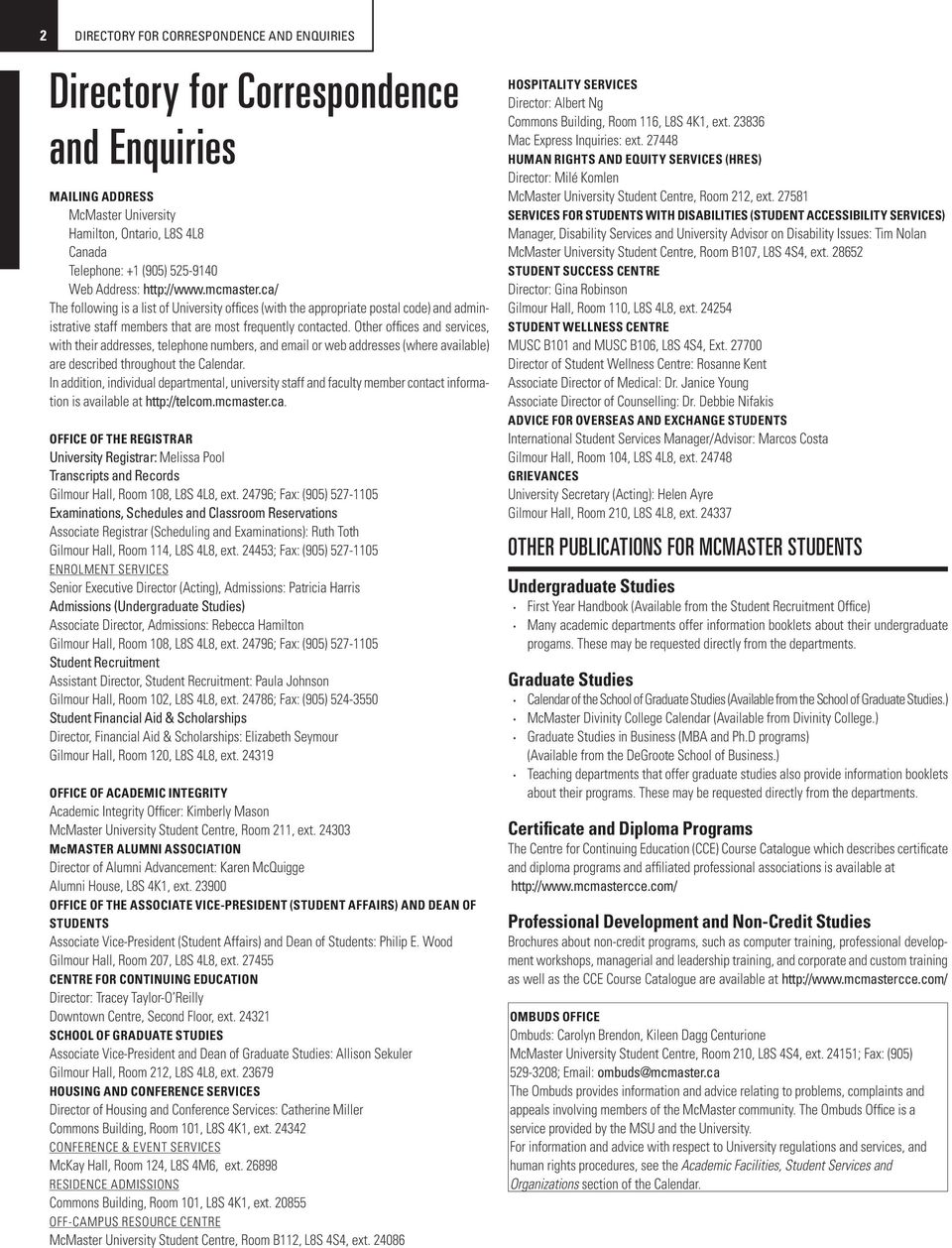
2 2 DIRECTORY FOR CORRESPONDENCE AND ENQUIRIES Directory for Correspondence and Enquiries MAILING ADDRESS McMaster University Hamilton, Ontario, L8S 4L8 Canada Telephone: +1 (905) Web Address: The following is a list of University offices (with the appropriate postal code) and administrative staff members that are most frequently contacted. Other offices and services, with their addresses, telephone numbers, and or web addresses (where available) are described throughout the Calendar. In addition, individual departmental, university staff and faculty member contact information is available at OFFICE OF THE REGISTRAR University Registrar: Melissa Pool Transcripts and Records Gilmour Hall, Room 108, L8S 4L8, ext ; Fax: (905) Examinations, Schedules and Classroom Reservations Associate Registrar (Scheduling and Examinations): Ruth Toth Gilmour Hall, Room 114, L8S 4L8, ext ; Fax: (905) ENROLMENT SERVICES Senior Executive Director (Acting), Admissions: Patricia Harris Admissions (Undergraduate Studies) Associate Director, Admissions: Rebecca Hamilton Gilmour Hall, Room 108, L8S 4L8, ext ; Fax: (905) Student Recruitment Assistant Director, Student Recruitment: Paula Johnson Gilmour Hall, Room 102, L8S 4L8, ext ; Fax: (905) Student Financial Aid & Scholarships Director, Financial Aid & Scholarships: Elizabeth Seymour Gilmour Hall, Room 120, L8S 4L8, ext OFFICE OF ACADEMIC INTEGRITY Academic Integrity Officer: Kimberly Mason McMaster University Student Centre, Room 211, ext McMASTER ALUMNI ASSOCIATION Director of Alumni Advancement: Karen McQuigge Alumni House, L8S 4K1, ext OFFICE OF THE ASSOCIATE VICE-PRESIDENT (STUDENT AFFAIRS) AND DEAN OF STUDENTS Associate Vice-President (Student Affairs) and Dean of Students: Philip E. Wood Gilmour Hall, Room 207, L8S 4L8, ext CENTRE FOR CONTINUING EDUCATION Director: Tracey Taylor-O Reilly Downtown Centre, Second Floor, ext SCHOOL OF GRADUATE STUDIES Associate Vice-President and Dean of Graduate Studies: Allison Sekuler Gilmour Hall, Room 212, L8S 4L8, ext HOUSING AND CONFERENCE SERVICES Director of Housing and Conference Services: Catherine Miller Commons Building, Room 101, L8S 4K1, ext CONFERENCE & EVENT SERVICES McKay Hall, Room 124, L8S 4M6, ext RESIDENCE ADMISSIONS Commons Building, Room 101, L8S 4K1, ext OFF-CAMPUS RESOURCE CENTRE McMaster University Student Centre, Room B112, L8S 4S4, ext HOSPITALITY SERVICES Director: Albert Ng Commons Building, Room 116, L8S 4K1, ext Mac Express Inquiries: ext HUMAN RIGHTS AND EQUITY SERVICES (HRES) Director: Milé Komlen McMaster University Student Centre, Room 212, ext SERVICES FOR STUDENTS WITH DISABILITIES (STUDENT ACCESSIBILITY SERVICES) Manager, Disability Services and University Advisor on Disability Issues: Tim Nolan McMaster University Student Centre, Room B107, L8S 4S4, ext STUDENT SUCCESS CENTRE Director: Gina Robinson Gilmour Hall, Room 110, L8S 4L8, ext STUDENT WELLNESS CENTRE MUSC B101 and MUSC B106, L8S 4S4, Ext Director of Student Wellness Centre: Rosanne Kent Associate Director of Medical: Dr. Janice Young Associate Director of Counselling: Dr. Debbie Nifakis ADVICE FOR OVERSEAS AND EXCHANGE STUDENTS International Student Services Manager/Advisor: Marcos Costa Gilmour Hall, Room 104, L8S 4L8, ext GRIEVANCES University Secretary (Acting): Helen Ayre Gilmour Hall, Room 210, L8S 4L8, ext OTHER PUBLICATIONS FOR MCMASTER STUDENTS Undergraduate Studies First Year Handbook (Available from the Student Recruitment Office) Many academic departments offer information booklets about their undergraduate progams. These may be requested directly from the departments. Graduate Studies Calendar of the School of Graduate Studies (Available from the School of Graduate Studies.) McMaster Divinity College Calendar (Available from Divinity College.) Graduate Studies in Business (MBA and Ph.D programs) (Available from the DeGroote School of Business.) Teaching departments that offer graduate studies also provide information booklets about their programs. These may be requested directly from the departments. Certificate and Diploma Programs The Centre for Continuing Education (CCE) Course Catalogue which describes certificate and diploma programs and affiliated professional associations is available at Professional Development and Non-Credit Studies Brochures about non-credit programs, such as computer training, professional development workshops, managerial and leadership training, and corporate and custom training as well as the CCE Course Catalogue are available at OMBUDS OFFICE Ombuds: Carolyn Brendon, Kileen Dagg Centurione McMaster University Student Centre, Room 210, L8S 4S4, ext ; Fax: (905) ; [email protected] The Ombuds provides information and advice relating to problems, complaints and appeals involving members of the McMaster community. The Ombuds Office is a service provided by the MSU and the University. For information and advice with respect to University regulations and services, and human rights procedures, see the Academic Facilities, Student Services and Organizations section of the Calendar.
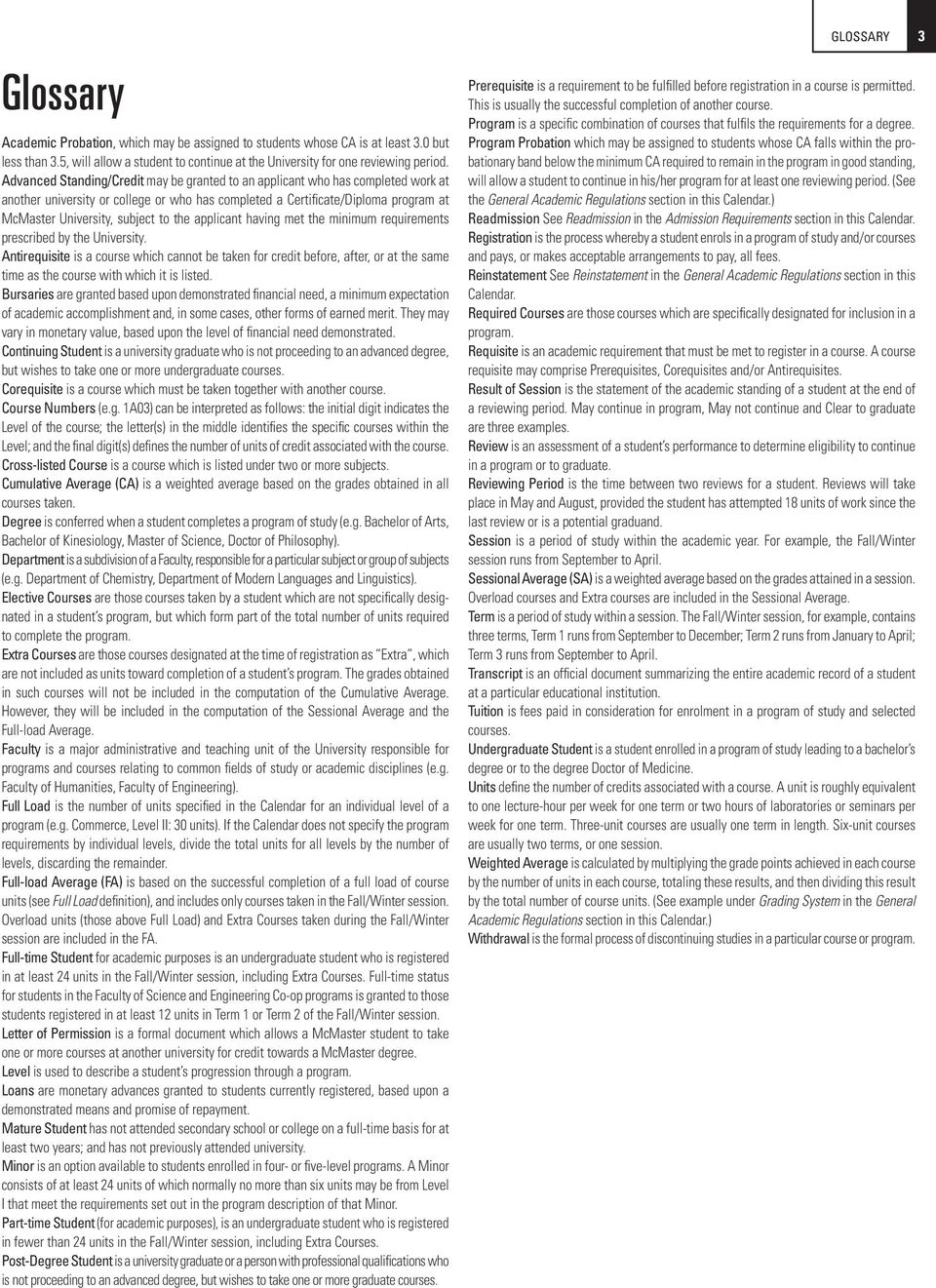
3 Glossary Academic Probation, which may be assigned to students whose CA is at least 3.0 but less than 3.5, will allow a student to continue at the University for one reviewing period. Advanced Standing/Credit may be granted to an applicant who has completed work at another university or college or who has completed a Certificate/Diploma program at McMaster University, subject to the applicant having met the minimum requirements prescribed by the University. Antirequisite is a course which cannot be taken for credit before, after, or at the same time as the course with which it is listed. Bursaries are granted based upon demonstrated financial need, a minimum expectation of academic accomplishment and, in some cases, other forms of earned merit. They may vary in monetary value, based upon the level of financial need demonstrated. Continuing Student is a university graduate who is not proceeding to an advanced degree, but wishes to take one or more undergraduate courses. Corequisite is a course which must be taken together with another course. Course Numbers (e.g. 1A03) can be interpreted as follows: the initial digit indicates the Level of the course; the letter(s) in the middle identifies the specific courses within the Level; and the final digit(s) defines the number of units of credit associated with the course. Cross-listed Course is a course which is listed under two or more subjects. Cumulative Average (CA) is a weighted average based on the grades obtained in all courses taken. Degree is conferred when a student completes a program of study (e.g. Bachelor of Arts, Bachelor of Kinesiology, Master of Science, Doctor of Philosophy). Department is a subdivision of a Faculty, responsible for a particular subject or group of subjects (e.g. Department of Chemistry, Department of Modern Languages and Linguistics). Elective Courses are those courses taken by a student which are not specifically designated in a student s program, but which form part of the total number of units required to complete the program. Extra Courses are those courses designated at the time of registration as Extra, which are not included as units toward completion of a student s program. The grades obtained in such courses will not be included in the computation of the Cumulative Average. However, they will be included in the computation of the Sessional Average and the Full-load Average. Faculty is a major administrative and teaching unit of the University responsible for programs and courses relating to common fields of study or academic disciplines (e.g. Faculty of Humanities, Faculty of Engineering). Full Load is the number of units specified in the Calendar for an individual level of a program (e.g. Commerce, Level II: 30 units). If the Calendar does not specify the program requirements by individual levels, divide the total units for all levels by the number of levels, discarding the remainder. Full-load Average (FA) is based on the successful completion of a full load of course units (see Full Load definition), and includes only courses taken in the Fall/Winter session. Overload units (those above Full Load) and Extra Courses taken during the Fall/Winter session are included in the FA. Full-time Student for academic purposes is an undergraduate student who is registered in at least 24 units in the Fall/Winter session, including Extra Courses. Full-time status for students in the Faculty of Science and Engineering Co-op programs is granted to those students registered in at least 12 units in Term 1 or Term 2 of the Fall/Winter session. Letter of Permission is a formal document which allows a McMaster student to take one or more courses at another university for credit towards a McMaster degree. Level is used to describe a student s progression through a program. Loans are monetary advances granted to students currently registered, based upon a demonstrated means and promise of repayment. Mature Student has not attended secondary school or college on a full-time basis for at least two years; and has not previously attended university. Minor is an option available to students enrolled in four- or five-level programs. A Minor consists of at least 24 units of which normally no more than six units may be from Level I that meet the requirements set out in the program description of that Minor. Part-time Student (for academic purposes), is an undergraduate student who is registered in fewer than 24 units in the Fall/Winter session, including Extra Courses. Post-Degree Student is a university graduate or a person with professional qualifications who is not proceeding to an advanced degree, but wishes to take one or more graduate courses. GLOSSARY Prerequisite is a requirement to be fulfilled before registration in a course is permitted. This is usually the successful completion of another course. Program is a specific combination of courses that fulfils the requirements for a degree. Program Probation which may be assigned to students whose CA falls within the probationary band below the minimum CA required to remain in the program in good standing, will allow a student to continue in his/her program for at least one reviewing period. (See the General Academic Regulations section in this Calendar.) Readmission See Readmission in the Admission Requirements section in this Calendar. Registration is the process whereby a student enrols in a program of study and/or courses and pays, or makes acceptable arrangements to pay, all fees. Reinstatement See Reinstatement in the General Academic Regulations section in this Calendar. Required Courses are those courses which are specifically designated for inclusion in a program. Requisite is an academic requirement that must be met to register in a course. A course requisite may comprise Prerequisites, Corequisites and/or Antirequisites. Result of Session is the statement of the academic standing of a student at the end of a reviewing period. May continue in program, May not continue and Clear to graduate are three examples. Review is an assessment of a student s performance to determine eligibility to continue in a program or to graduate. Reviewing Period is the time between two reviews for a student. Reviews will take place in May and August, provided the student has attempted 18 units of work since the last review or is a potential graduand. Session is a period of study within the academic year. For example, the Fall/Winter session runs from September to April. Sessional Average (SA) is a weighted average based on the grades attained in a session. Overload courses and Extra courses are included in the Sessional Average. Term is a period of study within a session. The Fall/Winter session, for example, contains three terms, Term 1 runs from September to December; Term 2 runs from January to April; Term 3 runs from September to April. Transcript is an official document summarizing the entire academic record of a student at a particular educational institution. Tuition is fees paid in consideration for enrolment in a program of study and selected courses. Undergraduate Student is a student enrolled in a program of study leading to a bachelor s degree or to the degree Doctor of Medicine. Units define the number of credits associated with a course. A unit is roughly equivalent to one lecture-hour per week for one term or two hours of laboratories or seminars per week for one term. Three-unit courses are usually one term in length. Six-unit courses are usually two terms, or one session. Weighted Average is calculated by multiplying the grade points achieved in each course by the number of units in each course, totaling these results, and then dividing this result by the total number of course units. (See example under Grading System in the General Academic Regulations section in this Calendar.) Withdrawal is the formal process of discontinuing studies in a particular course or program. 3
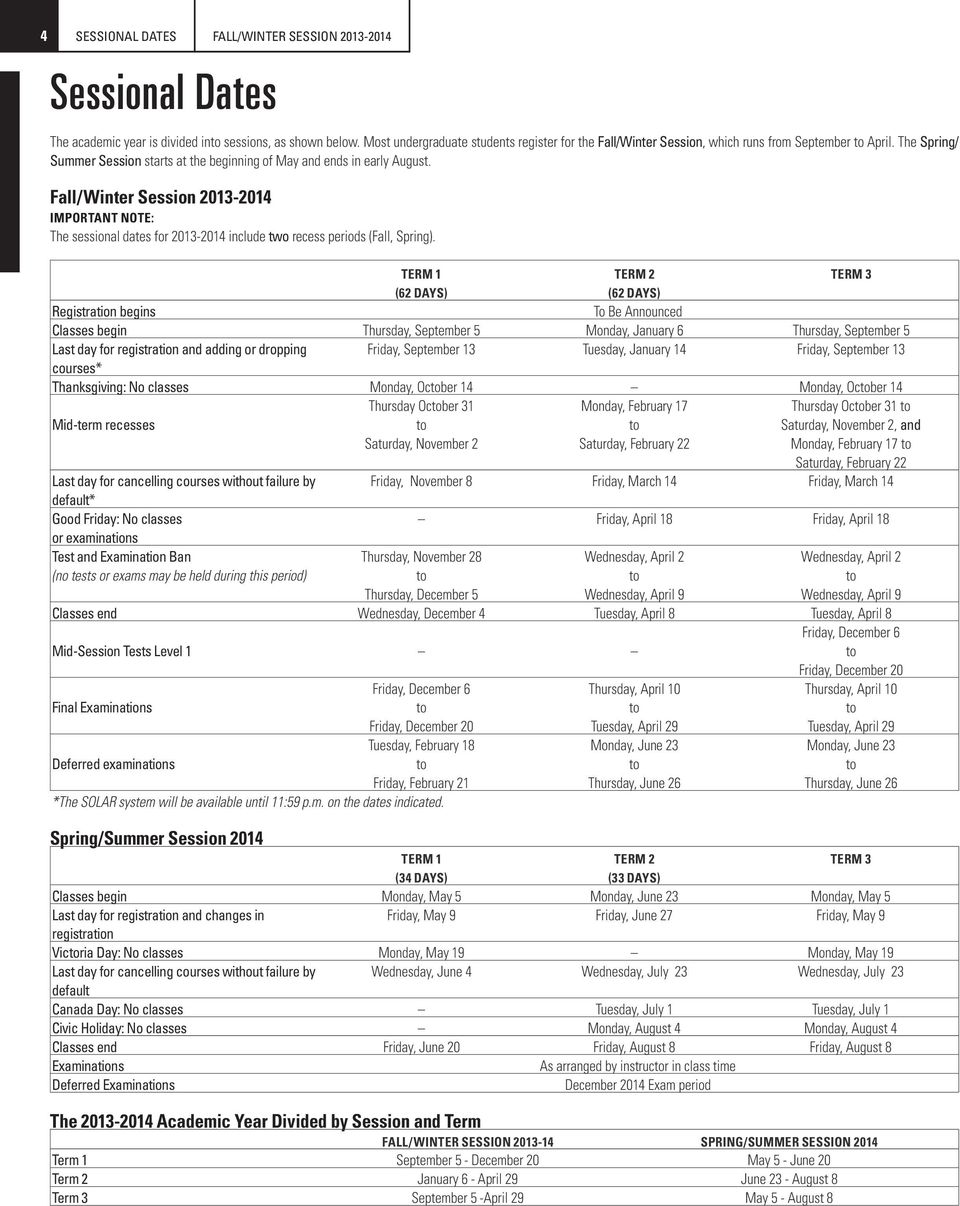
4 4 SESSIONAL DATES Sessional Dates FALL/WINTER SESSION The academic year is divided into sessions, as shown below. Most undergraduate students register for the Fall/Winter Session, which runs from September to April. The Spring/ Summer Session starts at the beginning of May and ends in early August. Fall/Winter Session IMPORTANT NOTE: The sessional dates for include two recess periods (Fall, Spring). TERM 1 (62 DAYS) TERM 2 (62 DAYS) To Be Announced Registration begins Classes begin Thursday, September 5 Monday, January 6 Thursday, September 5 Last day for registration and adding or dropping Friday, September 13 Tuesday, January 14 Friday, September 13 courses* Thanksgiving: No classes Monday, October 14 Monday, October 14 Thursday October 31 Monday, February 17 Thursday October 31 to Mid-term recesses to to Saturday, November 2, and Saturday, November 2 Saturday, February 22 Monday, February 17 to Last day for cancelling courses without failure by default* Good Friday: No classes or examinations Test and Examination Ban (no tests or exams may be held during this period) TERM 3 Saturday, February 22 Friday, November 8 Friday, March 14 Friday, March 14 Friday, April 18 Friday, April 18 Thursday, November 28 to Thursday, December 5 Wednesday, April 2 to Wednesday, April 9 Wednesday, April 2 to Wednesday, April 9 Classes end Wednesday, December 4 Tuesday, April 8 Tuesday, April 8 Mid-Session Tests Level 1 Friday, December 6 Final Examinations to Friday, December 20 Tuesday, February 18 Deferred examinations to Friday, February 21 *The SOLAR system will be available until 11:59 p.m. on the dates indicated. Spring/Summer Session 2014 Thursday, April 10 to Tuesday, April 29 Monday, June 23 to Thursday, June 26 Friday, December 6 to Friday, December 20 Thursday, April 10 to Tuesday, April 29 Monday, June 23 to Thursday, June 26 TERM 1 TERM 2 TERM 3 (34 DAYS) (33 DAYS) Classes begin Monday, May 5 Monday, June 23 Monday, May 5 Last day for registration and changes in Friday, May 9 Friday, June 27 Friday, May 9 registration Victoria Day: No classes Monday, May 19 Monday, May 19 Last day for cancelling courses without failure by Wednesday, June 4 Wednesday, July 23 Wednesday, July 23 default Canada Day: No classes Tuesday, July 1 Tuesday, July 1 Civic Holiday: No classes Monday, August 4 Monday, August 4 Classes end Friday, June 20 Friday, August 8 Friday, August 8 Examinations As arranged by instructor in class time Deferred Examinations December 2014 Exam period The Academic Year Divided by Session and Term FALL/WINTER SESSION SPRING/SUMMER SESSION 2014 Term 1 September 5 - December 20 May 5 - June 20 Term 2 January 6 - April 29 June 23 - August 8 Term 3 September 5 -April 29 May 5 - August 8
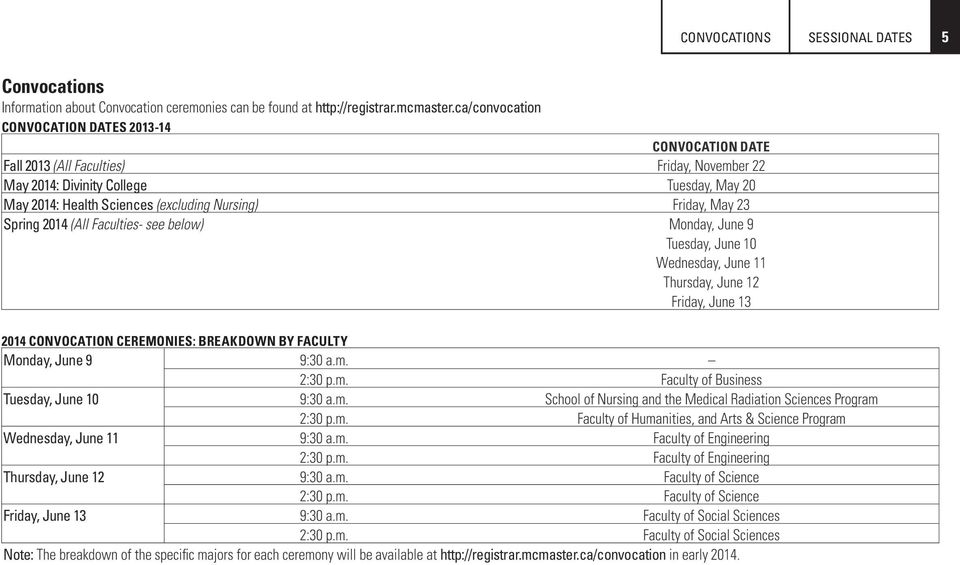
5 CONVOCATIONSCONVOCATIONS SESSIONAL DATES 5 Convocations Information about Convocation ceremonies can be found at CONVOCATION DATES CONVOCATION DATE Fall 2013 (All Faculties) Friday, November 22 May 2014: Divinity College Tuesday, May 20 May 2014: Health Sciences (excluding Nursing) Friday, May 23 Spring 2014 (All Faculties- see below) Monday, June 9 Tuesday, June 10 Wednesday, June 11 Thursday, June 12 Friday, June CONVOCATION CEREMONIES: BREAKDOWN BY FACULTY Monday, June 9 9:30 a.m. 2:30 p.m. Faculty of Business Tuesday, June 10 9:30 a.m. School of Nursing and the Medical Radiation Sciences Program 2:30 p.m. Faculty of Humanities, and Arts & Science Program Wednesday, June 11 9:30 a.m. Faculty of Engineering 2:30 p.m. Faculty of Engineering Thursday, June 12 9:30 a.m. Faculty of Science 2:30 p.m. Faculty of Science Friday, June 13 9:30 a.m. Faculty of Social Sciences 2:30 p.m. Faculty of Social Sciences Note: The breakdown of the specific majors for each ceremony will be available at in early 2014.
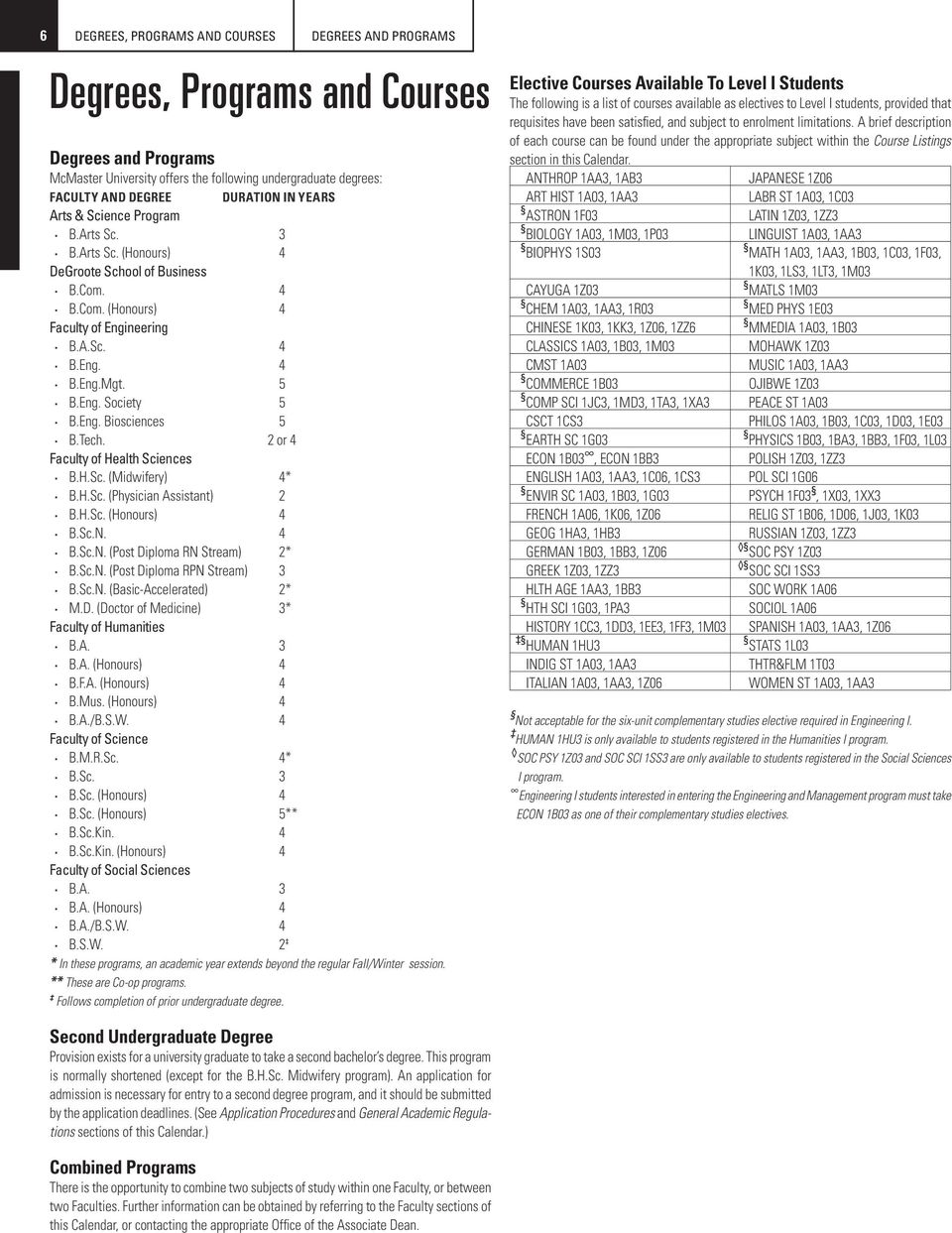
6 6 DEGREES, PROGRAMS AND COURSES DEGREES AND PROGRAMS Degrees, Programs and Courses Degrees and Programs McMaster University offers the following undergraduate degrees: FACULTY AND DEGREE DURATION IN YEARS Arts & Science Program B.Arts Sc. 3 B.Arts Sc. (Honours) 4 DeGroote School of Business B.Com. 4 B.Com. (Honours) 4 Faculty of Engineering B.A.Sc. 4 B.Eng. 4 B.Eng.Mgt. 5 B.Eng. Society 5 B.Eng. Biosciences 5 B.Tech. 2 or 4 Faculty of Health Sciences B.H.Sc. (Midwifery) 4* B.H.Sc. (Physician Assistant) 2 B.H.Sc. (Honours) 4 B.Sc.N. 4 B.Sc.N. (Post Diploma RN Stream) 2* B.Sc.N. (Post Diploma RPN Stream) 3 B.Sc.N. (Basic-Accelerated) 2* M.D. (Doctor of Medicine) 3* Faculty of Humanities B.A. 3 B.A. (Honours) 4 B.F.A. (Honours) 4 B.Mus. (Honours) 4 B.A./B.S.W. 4 Faculty of Science B.M.R.Sc. 4* B.Sc. 3 B.Sc. (Honours) 4 B.Sc. (Honours) 5** B.Sc.Kin. 4 B.Sc.Kin. (Honours) 4 Faculty of Social Sciences B.A. 3 B.A. (Honours) 4 B.A./B.S.W. 4 B.S.W. 2 * In these programs, an academic year extends beyond the regular Fall/Winter session. ** These are Co-op programs. Follows completion of prior undergraduate degree. Elective Courses Available To Level I Students The following is a list of courses available as electives to Level I students, provided that requisites have been satisfied, and subject to enrolment limitations. A brief description of each course can be found under the appropriate subject within the Course Listings section in this Calendar. ANTHROP 1AA3, 1AB3 JAPANESE 1Z06 ART HIST 1A03, 1AA3 LABR ST 1A03, 1C03 ASTRON 1F03 LATIN 1Z03, 1ZZ3 BIOLOGY 1A03, 1M03, 1P03 LINGUIST 1A03, 1AA3 BIOPHYS 1S03 MATH 1A03, 1AA3, 1B03, 1C03, 1F03, 1K03, 1LS3, 1LT3, 1M03 CAYUGA 1Z03 MATLS 1M03 CHEM 1A03, 1AA3, 1R03 MED PHYS 1E03 CHINESE 1K03, 1KK3, 1Z06, 1ZZ6 MMEDIA 1A03, 1B03 CLASSICS 1A03, 1B03, 1M03 MOHAWK 1Z03 CMST 1A03 MUSIC 1A03, 1AA3 COMMERCE 1B03 OJIBWE 1Z03 COMP SCI 1JC3, 1MD3, 1TA3, 1XA3 PEACE ST 1A03 CSCT 1CS3 PHILOS 1A03, 1B03, 1C03, 1D03, 1E03 EARTH SC 1G03 PHYSICS 1B03, 1BA3, 1BB3, 1F03, 1L03 ECON 1B03, ECON 1BB3 POLISH 1Z03, 1ZZ3 ENGLISH 1A03, 1AA3, 1C06, 1CS3 POL SCI 1G06 ENVIR SC 1A03, 1B03, 1G03 PSYCH 1F03, 1X03, 1XX3 FRENCH 1A06, 1K06, 1Z06 RELIG ST 1B06, 1D06, 1J03, 1K03 GEOG 1HA3, 1HB3 RUSSIAN 1Z03, 1ZZ3 GERMAN 1B03, 1BB3, 1Z06 SOC PSY 1Z03 GREEK 1Z03, 1ZZ3 SOC SCI 1SS3 HLTH AGE 1AA3, 1BB3 SOC WORK 1A06 HTH SCI 1G03, 1PA3 SOCIOL 1A06 HISTORY 1CC3, 1DD3, 1EE3, 1FF3, 1M03 SPANISH 1A03, 1AA3, 1Z06 HUMAN 1HU3 STATS 1L03 INDIG ST 1A03, 1AA3 THTR&FLM 1T03 ITALIAN 1A03, 1AA3, 1Z06 WOMEN ST 1A03, 1AA3 Not acceptable for the six-unit complementary studies elective required in Engineering I. HUMAN 1HU3 is only available to students registered in the Humanities I program. SOC PSY 1Z03 and SOC SCI 1SS3 are only available to students registered in the Social Sciences I program. Engineering I students interested in entering the Engineering and Management program must take ECON 1B03 as one of their complementary studies electives. Second Undergraduate Degree Provision exists for a university graduate to take a second bachelor s degree. This program is normally shortened (except for the B.H.Sc. Midwifery program). An application for admission is necessary for entry to a second degree program, and it should be submitted by the application deadlines. (See Application Procedures and General Academic Regulations sections of this Calendar.) Combined Programs There is the opportunity to combine two subjects of study within one Faculty, or between two Faculties. Further information can be obtained by referring to the Faculty sections of this Calendar, or contacting the appropriate Office of the Associate Dean.
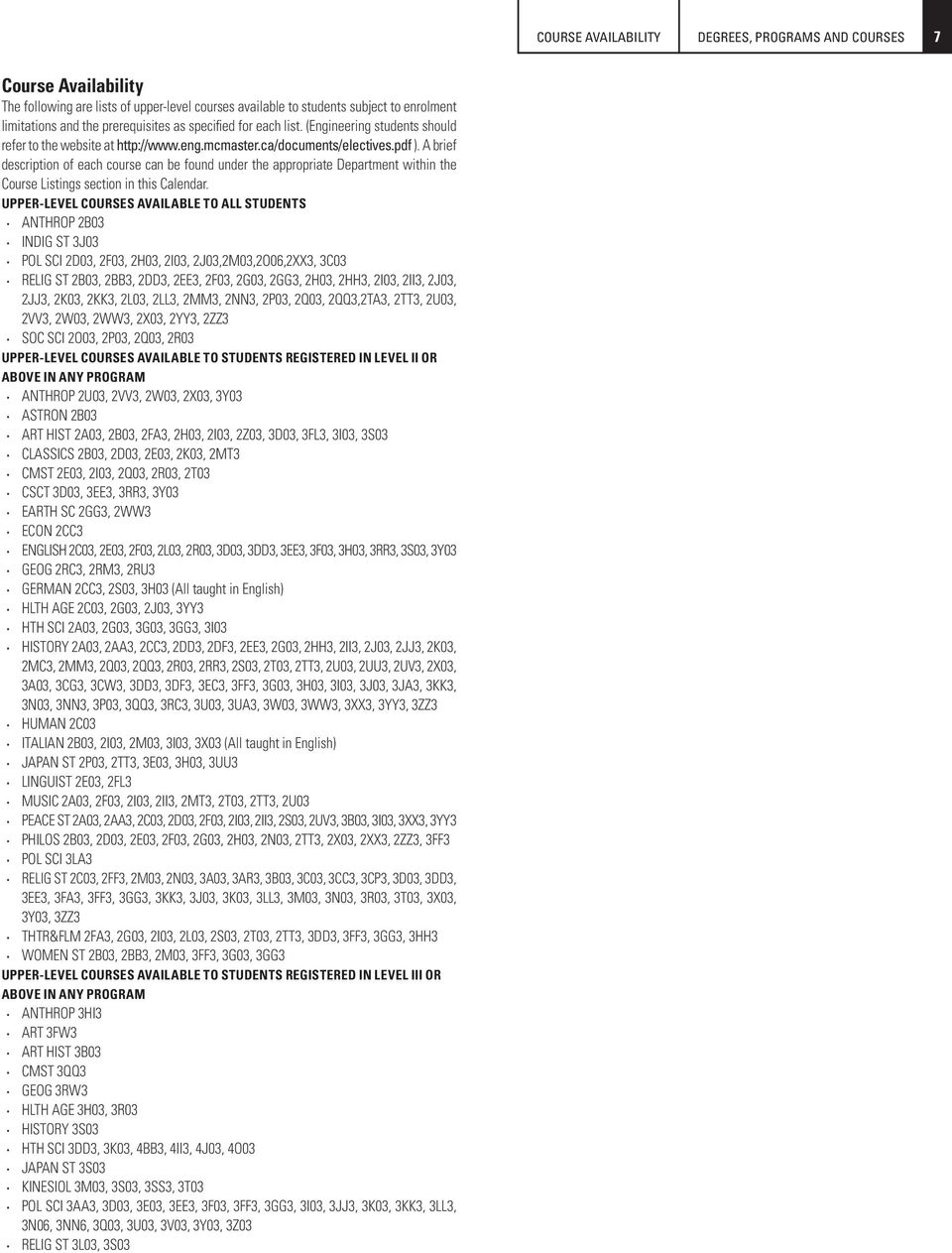
7 COURSE AVAILABILITYCOURSE AVAILABILITY DEGREES, PROGRAMS AND COURSES 7 Course Availability The following are lists of upper-level courses available to students subject to enrolment limitations and the prerequisites as specified for each list. (Engineering students should refer to the website at ). A brief description of each course can be found under the appropriate Department within the Course Listings section in this Calendar. UPPER-LEVEL COURSES AVAILABLE TO ALL STUDENTS ANTHROP 2B03 INDIG ST 3J03 POL SCI 2D03, 2F03, 2H03, 2I03, 2J03,2M03,2O06,2XX3, 3C03 RELIG ST 2B03, 2BB3, 2DD3, 2EE3, 2F03, 2G03, 2GG3, 2H03, 2HH3, 2I03, 2II3, 2J03, 2JJ3, 2K03, 2KK3, 2L03, 2LL3, 2MM3, 2NN3, 2P03, 2Q03, 2QQ3,2TA3, 2TT3, 2U03, 2VV3, 2W03, 2WW3, 2X03, 2YY3, 2ZZ3 SOC SCI 2O03, 2P03, 2Q03, 2R03 UPPER-LEVEL COURSES AVAILABLE TO STUDENTS REGISTERED IN LEVEL II OR ABOVE IN ANY PROGRAM ANTHROP 2U03, 2VV3, 2W03, 2X03, 3Y03 ASTRON 2B03 ART HIST 2A03, 2B03, 2FA3, 2H03, 2I03, 2Z03, 3D03, 3FL3, 3I03, 3S03 CLASSICS 2B03, 2D03, 2E03, 2K03, 2MT3 CMST 2E03, 2I03, 2Q03, 2R03, 2T03 CSCT 3D03, 3EE3, 3RR3, 3Y03 EARTH SC 2GG3, 2WW3 ECON 2CC3 ENGLISH 2C03, 2E03, 2F03, 2L03, 2R03, 3D03, 3DD3, 3EE3, 3F03, 3H03, 3RR3, 3S03, 3Y03 GEOG 2RC3, 2RM3, 2RU3 GERMAN 2CC3, 2S03, 3H03 (All taught in English) HLTH AGE 2C03, 2G03, 2J03, 3YY3 HTH SCI 2A03, 2G03, 3G03, 3GG3, 3I03 HISTORY 2A03, 2AA3, 2CC3, 2DD3, 2DF3, 2EE3, 2G03, 2HH3, 2II3, 2J03, 2JJ3, 2K03, 2MC3, 2MM3, 2Q03, 2QQ3, 2R03, 2RR3, 2S03, 2T03, 2TT3, 2U03, 2UU3, 2UV3, 2X03, 3A03, 3CG3, 3CW3, 3DD3, 3DF3, 3EC3, 3FF3, 3G03, 3H03, 3I03, 3J03, 3JA3, 3KK3, 3N03, 3NN3, 3P03, 3QQ3, 3RC3, 3U03, 3UA3, 3W03, 3WW3, 3XX3, 3YY3, 3ZZ3 HUMAN 2C03 ITALIAN 2B03, 2I03, 2M03, 3I03, 3X03 (All taught in English) JAPAN ST 2P03, 2TT3, 3E03, 3H03, 3UU3 LINGUIST 2E03, 2FL3 MUSIC 2A03, 2F03, 2I03, 2II3, 2MT3, 2T03, 2TT3, 2U03 PEACE ST 2A03, 2AA3, 2C03, 2D03, 2F03, 2I03, 2II3, 2S03, 2UV3, 3B03, 3I03, 3XX3, 3YY3 PHILOS 2B03, 2D03, 2E03, 2F03, 2G03, 2H03, 2N03, 2TT3, 2X03, 2XX3, 2ZZ3, 3FF3 POL SCI 3LA3 RELIG ST 2C03, 2FF3, 2M03, 2N03, 3A03, 3AR3, 3B03, 3C03, 3CC3, 3CP3, 3D03, 3DD3, 3EE3, 3FA3, 3FF3, 3GG3, 3KK3, 3J03, 3K03, 3LL3, 3M03, 3N03, 3R03, 3T03, 3X03, 3Y03, 3ZZ3 THTR&FLM 2FA3, 2G03, 2I03, 2L03, 2S03, 2T03, 2TT3, 3DD3, 3FF3, 3GG3, 3HH3 WOMEN ST 2B03, 2BB3, 2M03, 3FF3, 3G03, 3GG3 UPPER-LEVEL COURSES AVAILABLE TO STUDENTS REGISTERED IN LEVEL III OR ABOVE IN ANY PROGRAM ANTHROP 3HI3 ART 3FW3 ART HIST 3B03 CMST 3QQ3 GEOG 3RW3 HLTH AGE 3H03, 3R03 HISTORY 3S03 HTH SCI 3DD3, 3K03, 4BB3, 4II3, 4J03, 4O03 JAPAN ST 3S03 KINESIOL 3M03, 3S03, 3SS3, 3T03 POL SCI 3AA3, 3D03, 3E03, 3EE3, 3F03, 3FF3, 3GG3, 3I03, 3JJ3, 3K03, 3KK3, 3LL3, 3N06, 3NN6, 3Q03, 3U03, 3V03, 3Y03, 3Z03 RELIG ST 3L03, 3S03
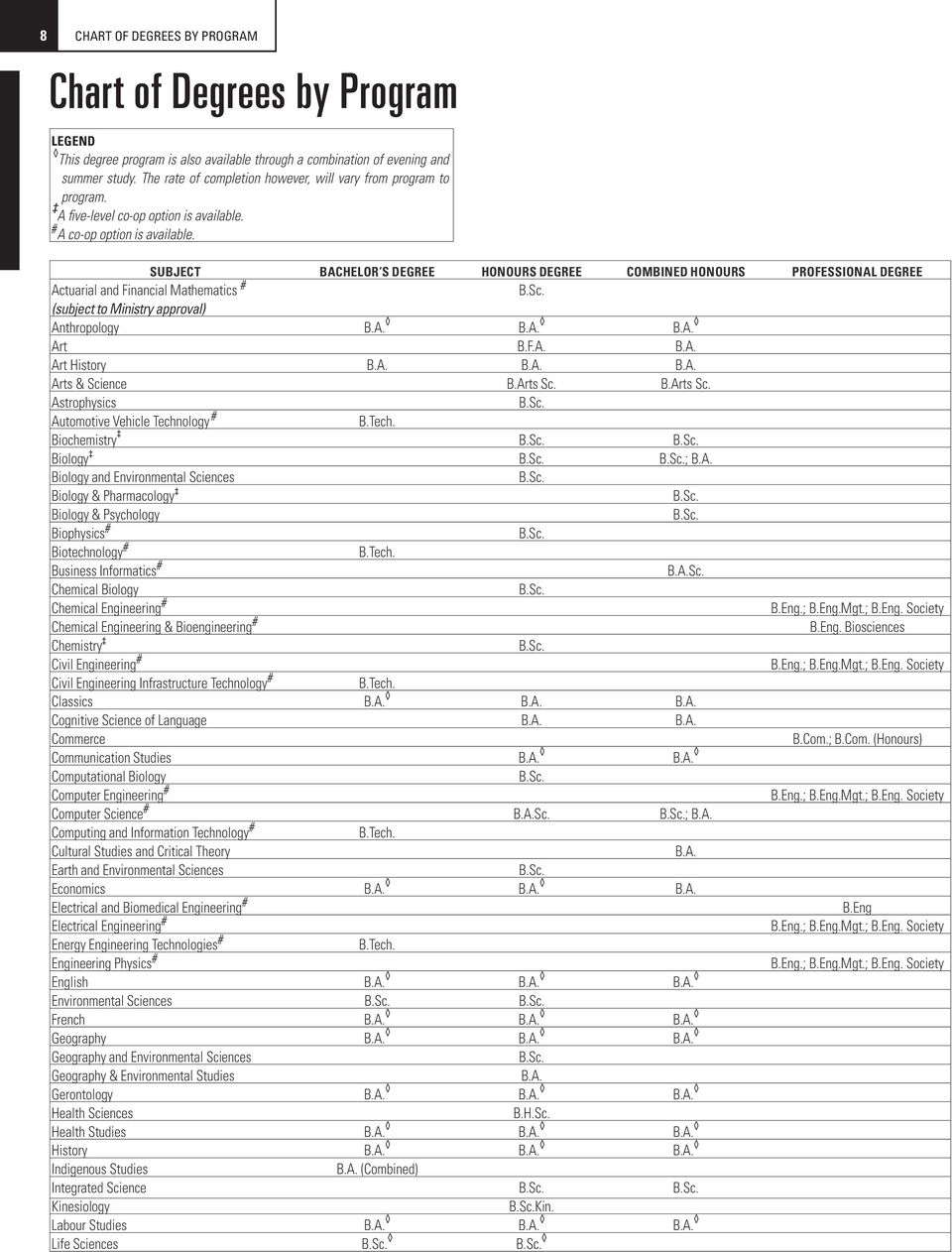
8 8 CHART OF DEGREES BY PROGRAM Chart of Degrees by Program LEGEND This degree program is also available through a combination of evening and summer study. The rate of completion however, will vary from program to program. A five-level co-op option is available. # A co-op option is available. SUBJECT BACHELOR S DEGREE HONOURS DEGREE COMBINED HONOURS PROFESSIONAL DEGREE Actuarial and Financial Mathematics # B.Sc. (subject to Ministry approval) Anthropology B.A. B.A. B.A. Art B.F.A. B.A. Art History B.A. B.A. B.A. Arts & Science B.Arts Sc. B.Arts Sc. Astrophysics B.Sc. Automotive Vehicle Technology # B.Tech. Biochemistry B.Sc. B.Sc. Biology B.Sc. B.Sc.; B.A. Biology and Environmental Sciences B.Sc. Biology & Pharmacology B.Sc. Biology & Psychology B.Sc. Biophysics # B.Sc. Biotechnology # B.Tech. Business Informatics # B.A.Sc. Chemical Biology B.Sc. Chemical Engineering # B.Eng.; B.Eng.Mgt.; B.Eng. Society Chemical Engineering & Bioengineering # B.Eng. Biosciences Chemistry B.Sc. Civil Engineering # B.Eng.; B.Eng.Mgt.; B.Eng. Society Civil Engineering Infrastructure Technology # B.Tech. Classics B.A. B.A. B.A. Cognitive Science of Language B.A. B.A. Commerce B.Com.; B.Com. (Honours) Communication Studies B.A. B.A. Computational Biology B.Sc. Computer Engineering # B.Eng.; B.Eng.Mgt.; B.Eng. Society Computer Science # B.A.Sc. B.Sc.; B.A. Computing and Information Technology # B.Tech. Cultural Studies and Critical Theory B.A. Earth and Environmental Sciences B.Sc. Economics B.A. B.A. B.A. Electrical and Biomedical Engineering # B.Eng Electrical Engineering # B.Eng.; B.Eng.Mgt.; B.Eng. Society Energy Engineering Technologies # B.Tech. Engineering Physics # B.Eng.; B.Eng.Mgt.; B.Eng. Society English B.A. B.A. B.A. Environmental Sciences B.Sc. B.Sc. French B.A. B.A. B.A. Geography B.A. B.A. B.A. Geography and Environmental Sciences B.Sc. Geography & Environmental Studies B.A. Gerontology B.A. B.A. B.A. Health Sciences B.H.Sc. Health Studies B.A. B.A. B.A. History B.A. B.A. B.A. Indigenous Studies B.A. (Combined) Integrated Science B.Sc. B.Sc. Kinesiology B.Sc.Kin. Labour Studies B.A. B.A. B.A. Life Sciences B.Sc. B.Sc.
9 CHART OF DEGREES BY PROGRAM 9 Linguistics B.A. B.A. Manufacturing Engineering Technology # B.Tech Materials Engineering # B.Eng.; B.Eng.Mgt.; B.Eng. Society Mathematical Science B.Sc. Mathematics B.A. Mathematics & Statistics B.Sc. Mechanical Engineering # B.Eng.; B.Eng.Mgt.; B.Eng. Society Mechatronics Engineering B.Eng.; B.Eng.Mgt.; B.Eng. Society Medical Physics B.Sc. Medical Radiation Sciences B.M.R.Sc. Medicine M.D. Midwifery B.H.Sc. Molecular Biology and Genetics B.Sc. Multimedia B.A. B.A. Music B.A. B.Mus. B.A. Music Cognition B.A.; B.Mus.; B.Sc. Nursing B.Sc.N. Peace Studies B.A. Philosophy B.A. B.A. B.A. Philosophy and Biology B.A. Philosophy and Mathematics B.A. Physical Sciences B.Sc. Physician Assistant B.H.Sc. Physics B.Sc. Political Science B.A. B.A. B.A. Process Automation Technology # B.Tech. Psychology, Neuroscience & Behaviour B.A. B.A.; B.Sc. B.A.; B.Sc. Religious Studies B.A. B.A. B.A. Social Psychology B.A. Social Work B.A./B.S.W.; B.S.W. Sociology B.A. B.A. B.A. Software Engineering # B.Eng.; B.Eng.Mgt.; B.Eng. Society Software Engineering (Embedded Systems) # B.Eng. Software Engineering (Game Design) # B.Eng. Theatre & Film Studies B.A. B.A. B.A. The University also offers Thematic Areas of Study and a large number of Minor programs. Suggested lists of courses, which constitute non-degree Thematic Areas, have been assembled in the section Interdisciplinary Minors and Thematic Areas. Also in that section are three Interdisciplinary Minors. Other Minors are found in the program sections of most departments.

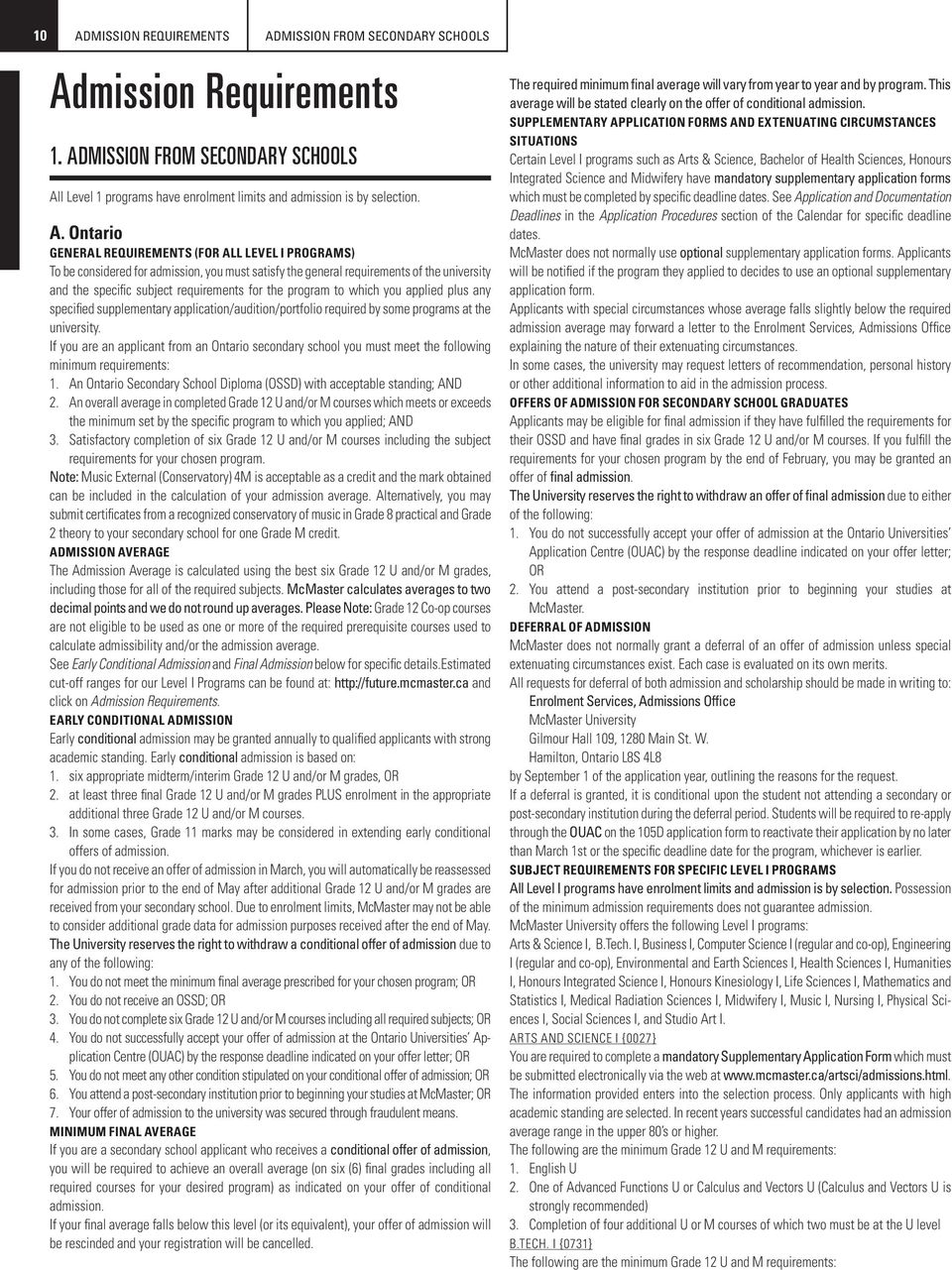
10 10 ADMISSION REQUIREMENTS ADMISSION FROM SECONDARY SCHOOLS Admission Requirements 1. ADMISSION FROM SECONDARY SCHOOLS All Level 1 programs have enrolment limits and admission is by selection. A. Ontario GENERAL REQUIREMENTS (FOR ALL LEVEL I PROGRAMS) To be considered for admission, you must satisfy the general requirements of the university and the specific subject requirements for the program to which you applied plus any specified supplementary application/audition/portfolio required by some programs at the university. If you are an applicant from an Ontario secondary school you must meet the following minimum requirements: 1. An Ontario Secondary School Diploma (OSSD) with acceptable standing; AND 2. An overall average in completed Grade 12 U and/or M courses which meets or exceeds the minimum set by the specific program to which you applied; AND 3. Satisfactory completion of six Grade 12 U and/or M courses including the subject requirements for your chosen program. Note: Music External (Conservatory) 4M is acceptable as a credit and the mark obtained can be included in the calculation of your admission average. Alternatively, you may submit certificates from a recognized conservatory of music in Grade 8 practical and Grade 2 theory to your secondary school for one Grade M credit. ADMISSION AVERAGE The Admission Average is calculated using the best six Grade 12 U and/or M grades, including those for all of the required subjects. McMaster calculates averages to two decimal points and we do not round up averages. Please Note: Grade 12 Co-op courses are not eligible to be used as one or more of the required prerequisite courses used to calculate admissibility and/or the admission average. See Early Conditional Admission and Final Admission below for specific details.estimated cut-off ranges for our Level I Programs can be found at: and click on Admission Requirements. EARLY CONDITIONAL ADMISSION Early conditional admission may be granted annually to qualified applicants with strong academic standing. Early conditional admission is based on: 1. six appropriate midterm/interim Grade 12 U and/or M grades, OR 2. at least three final Grade 12 U and/or M grades PLUS enrolment in the appropriate additional three Grade 12 U and/or M courses. 3. In some cases, Grade 11 marks may be considered in extending early conditional offers of admission. If you do not receive an offer of admission in March, you will automatically be reassessed for admission prior to the end of May after additional Grade 12 U and/or M grades are received from your secondary school. Due to enrolment limits, McMaster may not be able to consider additional grade data for admission purposes received after the end of May. The University reserves the right to withdraw a conditional offer of admission due to any of the following: 1. You do not meet the minimum final average prescribed for your chosen program; OR 2. You do not receive an OSSD; OR 3. You do not complete six Grade 12 U and/or M courses including all required subjects; OR 4. You do not successfully accept your offer of admission at the Ontario Universities Application Centre (OUAC) by the response deadline indicated on your offer letter; OR 5. You do not meet any other condition stipulated on your conditional offer of admission; OR 6. You attend a post-secondary institution prior to beginning your studies at McMaster; OR 7. Your offer of admission to the university was secured through fraudulent means. MINIMUM FINAL AVERAGE If you are a secondary school applicant who receives a conditional offer of admission, you will be required to achieve an overall average (on six (6) final grades including all required courses for your desired program) as indicated on your offer of conditional admission. If your final average falls below this level (or its equivalent), your offer of admission will be rescinded and your registration will be cancelled. The required minimum final average will vary from year to year and by program. This average will be stated clearly on the offer of conditional admission. SUPPLEMENTARY APPLICATION FORMS AND EXTENUATING CIRCUMSTANCES SITUATIONS Certain Level I programs such as Arts & Science, Bachelor of Health Sciences, Honours Integrated Science and Midwifery have mandatory supplementary application forms which must be completed by specific deadline dates. See Application and Documentation Deadlines in the Application Procedures section of the Calendar for specific deadline dates. McMaster does not normally use optional supplementary application forms. Applicants will be notified if the program they applied to decides to use an optional supplementary application form. Applicants with special circumstances whose average falls slightly below the required admission average may forward a letter to the Enrolment Services, Admissions Office explaining the nature of their extenuating circumstances. In some cases, the university may request letters of recommendation, personal history or other additional information to aid in the admission process. OFFERS OF ADMISSION FOR SECONDARY SCHOOL GRADUATES Applicants may be eligible for final admission if they have fulfilled the requirements for their OSSD and have final grades in six Grade 12 U and/or M courses. If you fulfill the requirements for your chosen program by the end of February, you may be granted an offer of final admission. The University reserves the right to withdraw an offer of final admission due to either of the following: 1. You do not successfully accept your offer of admission at the Ontario Universities Application Centre (OUAC) by the response deadline indicated on your offer letter; OR 2. You attend a post-secondary institution prior to beginning your studies at McMaster. DEFERRAL OF ADMISSION McMaster does not normally grant a deferral of an offer of admission unless special extenuating circumstances exist. Each case is evaluated on its own merits. All requests for deferral of both admission and scholarship should be made in writing to: Enrolment Services, Admissions Office McMaster University Gilmour Hall 109, 1280 Main St. W. Hamilton, Ontario L8S 4L8 by September 1 of the application year, outlining the reasons for the request. If a deferral is granted, it is conditional upon the student not attending a secondary or post-secondary institution during the deferral period. Students will be required to re-apply through the OUAC on the 105D application form to reactivate their application by no later than March 1st or the specific deadline date for the program, whichever is earlier. SUBJECT REQUIREMENTS FOR SPECIFIC LEVEL I PROGRAMS All Level I programs have enrolment limits and admission is by selection. Possession of the minimum admission requirements does not guarantee admission. McMaster University offers the following Level I programs: Arts & Science I, B.Tech. I, Business I, Computer Science I (regular and co-op), Engineering I (regular and co-op), Environmental and Earth Sciences I, Health Sciences I, Humanities I, Honours Integrated Science I, Honours Kinesiology I, Life Sciences I, Mathematics and Statistics I, Medical Radiation Sciences I, Midwifery I, Music I, Nursing I, Physical Sciences I, Social Sciences I, and Studio Art I. ARTS AND SCIENCE I {0027} You are required to complete a mandatory Supplementary Application Form which must be submitted electronically via the web at The information provided enters into the selection process. Only applicants with high academic standing are selected. In recent years successful candidates had an admission average range in the upper 80 s or higher. The following are the minimum Grade 12 U and M requirements: 1. English U 2. One of Advanced Functions U or Calculus and Vectors U (Calculus and Vectors U is strongly recommended) 3. Completion of four additional U or M courses of which two must be at the U level B.TECH. I {0731} The following are the minimum Grade 12 U and M requirements:
11 ADMISSION FROM SECONDARY SCHOOLSADMISSION FROM SECONDARY SCHOOLS ADMISSION REQUIREMENTS English U 2. Advanced Functions U 3. Chemistry U 4. Physics U 5. Completion of two additional U or M courses to total six courses B.TECH. I {0731} Requirements for students applying to and entering the program in The following will be the new minimum Grade 12 U and M requirements: 1. English U 2. Calculus and Vectors U 3. Chemistry U 4. Physics U 5. Completion of two additional U or M courses to total six courses Note: Students are also expected to have completed Advanced Functions U. BUSINESS I {0725} The following are the minimum Grade 12 U and M requirements: 1. English U 2. Two of Advanced Functions U, Calculus and Vectors U, and Mathematics of Data Management U 3. Completion of three additional U or M courses to total six courses Completion of Advanced Functions U is strongly recommended. COMPUTER SCIENCE I {0145}, COMPUTER SCIENCE I CO-OP { } The following are the minimum Grade 12 U and M requirements: 1. English U 2. Calculus and Vectors U 3. Two of: Biology U, Chemistry U, Physics U, Earth and Space U, Computer and Information Science M (or Computer Science U), or Computer Engineering M (or Computer Engineering Technology M) 4. Completion of two additional U or M courses to total six courses Students are also expected to have completed Advanced Functions U. ENGINEERING I {0730}, ENGINEERING I CO-OP { } The following are the minimum Grade 12 U and M requirements: 1. English U 2. Calculus and Vectors U 3. Chemistry U 4. Physics U 5. Completion of two additional U or M courses to total six courses Students are also expected to have completed Advanced Functions U. ENVIRONMENTAL AND EARTH SCIENCES I {0211} The following are the minimum Grade 12 U and M requirements: 1. English U 2. One of Advanced Functions U or Calculus and Vectors U 3. One of Biology U, Chemistry U 4. One of Advanced Functions U, Biology U, Calculus and Vectors U, Chemistry U, Physics U 5. Completion of two additional U or M courses to total six courses HONOURS HEALTH SCIENCES I {2276} The selection method is by consideration of academic qualifications (minimum overall average range of 90% or higher is required for consideration) and a mandatory Supplementary Application Forms submitted electronically via the web: mcmaster.ca/bhsc/supplementary_applications.html. The Supplementary Application must be completed and submitted on-line by the specified deadline date. A review of the mandatory Supplementary Application is a very important component of the admission process. Applicants who do not complete the Supplementary Application will not be considered for admission. The following are the minimum Grade 12 U and M requirements: 1. English U 2. One of Advanced Functions U, Calculus and Vectors U, or Mathematics of Data Management U 3. Biology U 4. Chemistry U 5. One U or M non-math/non-science course (Note: courses in technological education, science or mathematics are not acceptable) 6. Completion of one additional U or M course in any subject area to total six courses HUMANITIES I {0700} The following are the minimum Grade 12 U and M requirements: 1. English U 2. Completion of additional U or M courses to total six courses The Faculty of Humanities strongly recommends that you select at least one Grade 12 U or M course from Humanities subjects (Art, Drama, English, French, français, other languages, History and Music) in addition to Requirement 1 above. Note: Biology U is recommended for students planning to enter a Cognitive Science of Language program. HONOURS INTEGRATED SCIENCE I {0301} Candidates are required to complete a mandatory Supplementary Application Form which must be submitted electronically via the web at ca/isci/prospective-students. The information provided enters into the selection process. Only applicants with high academic standing will be selected. Successful candidates must present a minimum average in the high 80 s. The following are the minimum Grade 12 U and M requirements: 1. English U 2. Advanced Functions U 3. Calculus and Vectors U 4. Two of Biology U, Chemistry U, Physics U 5. Completion of one additional U or M course to total six courses HONOURS KINESIOLOGY I {0309} The following are the minimum Grade 12 U and M requirements: 1. English U 2. One of Advanced Functions U or Calculus and Vectors U 3. Biology U 4. Completion of three additional Grade 12 U or M courses to total six courses. Grade 12 U courses strongly recommended include Calculus and Vectors U and Exercise Science U. Applicants without Calculus and Vectors MCV4U will be required to take an equivalent Calculus course in Level I. LIFE SCIENCES I {0312} The following are the minimum Grade 12 U and M requirements: 1. English U 2. Advanced Functions U or Calculus and Vectors U 3. Biology U 4. One of Advanced Functions U, Calculus and Vectors, Chemistry U or Physics U 5. Completion of two additional U or M courses to total six courses MATHEMATICS AND STATISTICS I {0320} The following are the minimum Grade 12 U and M requirements: 1. English U 2. Advanced Functions U 3. Calculus and Vectors U 4. Completion of three additional U or M courses to total six courses MEDICAL RADIATION SCIENCES I {0345} Students considering the Medical Radiation Sciences I program should refer to the Regulations for License to Practice and Functional Demands in the Medical Radiation Sciences program in the Faculty of Science section of this calendar. The following are the minimum Grade 12 U and M requirements: 1. English U 2. Advanced Functions U 3. Calculus and Vectors U 4. Biology U 5. Chemistry U 6. Completion of one additional U or M course to total six courses MIDWIFERY I {6501} As places in the Midwifery program are very limited, the admission process is competitive. Admission to the Midwifery Education Program is by selection. Application forms are due by February 1. In addition to the OUAC application, applicants to Midwifery must also complete an online McMaster application at The following are the minimum Grade 12 U and M requirements: 1. English U 2. One of Biology U or Chemistry U (both are recommended) 3. One U or M course in Social Science (History, Sociology, Psychology, Geography, Law) 4. Completion of additional U or M courses to total six courses 5. To be eligible to apply students must obtain a minimum grade of 75% in each of the

12 12 ADMISSION REQUIREMENTS ADMISSION FROM SECONDARY SCHOOLS three required courses listed in points 1, 2, and 3 above AND an overall average, including the required courses, that is acceptable to the Program. In recent years an average range in the mid to high 80 s has been required to move forward to the admissions interview stage. MUSIC I {0370} The academic requirements are the same as for Humanities I. In addition, applicants to Music I or to the B.A. in Music must successfully complete a music audition/examination consisting of: 1. Demonstration of technique (a level equivalent to at least honours standing in Grade 8 of the Royal Conservatory of Music) 2. Performance (approximately 20 minutes duration) of two or three varied pieces of your choice (approximately Grade 8 honours level), including at least one from the 20th century 3. Ear test appropriate to the Grade 8 performance level 4. Written examination on rudiments of theory (Grade 2 level) 5. Interview For comprehensive details, visit Auditions take place between February and April. You must make arrangements with the School of the Arts for your audition at [email protected] NURSING I {6390} NURSING CONSORTIUM (CONESTOGA) {6385} NURSING CONSORTIUM (MOHAWK) {6386} Students interested in a McMaster (B.Sc.N.) Nursing degree have three location options: McMaster University, Mohawk College or Conestoga College. Each of the three sites offers the four-year program which uses the problem-based learning and small group tutorial educational model. For general information about the Mohawk and Conestoga sites refer to the B.Sc.N. (A) Stream references throughout the School of Nursing in the Faculty of Health Sciences section of the Calendar. For application instructions see the Application Procedures section of the Calendar. Health requirements for admission: During the registration process, you must file with the University information pertaining to your state of health and immunization. Detailed instructions will be provided after acceptance into the program. The following are the minimum Grade 12 U and M requirements: 1. English U 2. One of Advanced Functions U, Calculus and Vectors U, Mathematics of Data Management U 3. Biology U 4. Chemistry U 5. Completion of two additional U or M courses to total six courses PHYSICAL SCIENCES I {0435} The following are the minimum Grade 12 U and M requirements: 1. English U 2. Advanced Functions U 3. Calculus and Vectors U 4. Chemistry U 5. Physics U 6. Completion of one additional U or M courses to total six courses SOCIAL SCIENCES I {0720} The following are the minimum Grade 12 U and M requirements: 1. English U 2. Completion of additional U or M courses to total six courses Advanced Functions U or Calculus and Vectors U is strongly recommended for students planning to enter programs in Economics or Psychology, Neuroscience and Behaviour. Biology U is recommended for students planning to enter a program in Psychology, Neuroscience and Behaviour. STUDIO ART I (0539) The following are the minimum Grade 12 U and M requirements: 1. English U 2. Completion of additional U or M courses to total six courses McMaster offers Studio Art as a direct-entry level I program leading to a Bachelor of Fine Arts (BFA) degree. Admission to this program is by selection and requires a mandatory portfolio interview with the School of the Arts studio_art.html You must make arrangements for your portfolio interview with the School of the Arts at [email protected] B. Other Canadian Provinces and Territories SUBJECT REQUIREMENTS FOR LEVEL I PROGRAMS In addition to the minimum requirements below, satisfactory completion of the specified subject requirements for the program to which you applied is also required. Please refer to our website noted below for more details. Averages used to determine eligibility for admission and residence are calculated based on the minimum provincial requirements, including the prerequisite courses for the program to which you have applied. EARLY CONDITIONAL ADMISSION Applications are reviewed for conditional admission as soon as all required documents, with sufficient course and grade data, are received by the Enrolment Services, Admissions Office. All Canadian applicants should ensure that their schools (vs. the Provincial Ministry for those provinces where transcripts are issued by the Ministry), forward interim/midyear school grade reports showing marks for all courses taken during the Grade 11 and 12 year as soon as they are available. The terms and conditions of the offer of admission are stated clearly on the offer letter. The Provincial Ministry final transcript confirming final grades and graduation status will be required at the end of the school year. Students from all other provinces where transcripts are issued by their high schools should have their schools forward the appropriate interim and final transcripts. Applicants are required to meet the following minimum requirements including the specified subject requirements (not listed below) for their chosen program. For a complete listing of our specific course requirements by province and Level I program you may refer to our web site: ALBERTA, NORTHWEST TERRITORIES AND NUNAVUT Grade 12 high school diploma with five acceptable courses numbered 30 or 31, including English Language Arts BRITISH COLUMBIA AND YUKON Grade 12 high school diploma with four acceptable Grade 12 academic courses (or equivalent), including English 12 or English 12 First Peoples. The Provincial Exam in English 12 or English 12 First Peoples is required and the blended mark will be used to calculate averages. If Calculus 12 is required for the program of application then five subjects may be used for average calculations. MANITOBA Grade 12 high school diploma with five acceptable courses numbered 40A or 40S, including one of English 40S or anglais 40S. NEW BRUNSWICK Grade 12 high school diploma with five acceptable Grade 12 academic courses numbered 120, 121, or 122, including English 121 or 122. NEWFOUNDLAND AND LABRADOR Grade 12 high school diploma with eleven acceptable Grade 12 credits at the 3000 level, including English NOVA SCOTIA Grade 12 high school diploma with five acceptable Grade 12 courses (university preparatory Academic or Advanced), including English 12. PRINCE EDWARD ISLAND Grade 12 high school diploma with five acceptable Grade 12 academic courses numbered 611 or 621, including English 621. QUÉBEC Grade 12 Diploma with six acceptable Grade 12 academic courses in the 600 series including English OR Year I CEGEP with twelve appropriate academic courses, including two English/anglais 603 courses. Students completing Year II or III CEGEP who will or have achieved the DEC may be considered for advanced credit in their chosen program. The Côte de Rendement (R Score) is used for admission consideration. SASKATCHEWAN Grade 12 high school diploma with five acceptable Grade 12 academic courses numbered 30, including both English A30 and B30. C. International Baccalaureate Diploma Applicants who have completed or will be completing the International Baccalaureate Diploma will be considered for admission to Level I, provided the completed diploma program includes the subject requirements of the program desired. For more information please refer to admission-requirements/

13 ADMISSION/TRANSFER FROM POST-SECONDARY INSTITUTIONSADMISSION/TRANSFER FROM POST-SECONDARY INSTITUTIONS ADMISSION REQUIREMENTS 13 D. Advanced Placement (A.P.) Courses/Examinations Applicants who have completed AP courses will be considered for admission to a Level I program. Applicants who have completed A.P. exams through the College Board in acceptable courses and achieve a minimum grade of 4 will be considered for up to 18 units of advanced credit. PLEASE NOTE: A.P. results from students who have completed the examinations as a challenge and have not taken the course at high school will not be considered as having completed the required prerequisite courses for admission consideration. An official copy of the final Advanced Placement Examination Results Report from the College Board is required as part of the evaluation process. For more information please refer to E. Other International Secondary School Qualifications See the admission requirements for applicants from educational systems below. Refer to Application Procedures for instructions on how to apply for admission. Applicants must arrange for official high school transcripts to be sent to McMaster University directly from their high school well in advance of the session to which they are applying. The equivalent of first-class standing will be required for admission consideration. Documents in a language other than English should be accompanied by notarized English translations. You are considered for admission on an individual basis. You are strongly advised not to come to the University until you have fulfilled all conditions of the offer of admission. AMERICAN HIGH SCHOOL CURRICULUM Applicants from the United States of America or international schools offering the American high school curriculum must satisfactorily complete a secondary school diploma with a minimum overall average of at least 80% in the Grade 12 academic program of an accredited American high school/ International American Curriculum high school and must present all prerequisite courses for their chosen program. Admission is competitive and many programs will require grades/averages above the minimum 80% for admission consideration. McMaster programs that have specific math and/or science prerequisites require Advanced Placement subjects only for those requirements. Non A.P. courses will not be deemed sufficient to meet the program prerequisites in the math and science subjects for students coming from American style curriculum schools. If applicants believe that their schools locally developed curriculum in math and science subjects is equivalent to all of the topics covered in A.P. level courses, then the applicant must provide the Enrolment Services, Admissions Office with a detailed and comprehensive syllabus supplied by their school for each course that they are seeking equivalency to A.P. level courses. American Curriculum applicants must also present results from the Critical Reading and Mathematics components of SAT I with a minimum combined score of 1200 (minimum 580 Critical Reading, 520 Mathematics) or from ACT with a minimum composite score of 27. GENERAL CERTIFICATE OF EDUCATION (G.C.E.) Applicants from the General Certificate of Education system require five G.C.E. subjects at least two of which must be at the Advanced Level with the balance of the subjects at the Ordinary Level. Advanced Level subjects must be appropriate to your chosen program. For program specific requirements please refer to oth-gce.htmlhttp://future.mcmaster.ca/admission/admission-requirements/ OTHER COUNTRIES OR EDUCATIONAL SYSTEMS For admission requirements from other education systems, please visit mcmaster.ca/admission/admission-requirements/ to view our country-specific Admissions Requirements. F. Home Schooled Applicants Home schooled applicants who in addition to their home schooling experience have completed six Grade 12 U and M courses at an Ontario Ministry of Education inspected and approved school, or equivalent courses from another recognized academic jurisdiction may be considered for their program of choice providing they present the appropriate prerequisite courses on official transcripts from accredited schools and meet the required admission average. McMaster University is the sole arbiter of what is considered as equivalent level education and equivalent courses. All other home schooled applicants may apply for admission consideration to Humanities I or Social Sciences I by presenting the following: 1. List of home school credentials including but not limited to structured curriculum completed through ACE (Accelerated Christian Education Program) or other such programs. 2. Portfolio of written work; normally, evidence of appropriate intellectual maturity is expected. 3. Results of standardized tests such as SAT, ACT. For SAT I, a minimum 1200 combined score for the Critical Reading and Math Components of the SAT I Tests is required. Minimum scores of 580 in Critical Reading and 520 in Mathematics are required. For ACT, a minimum composite score of 27 is required. Interested applicants should contact the Office of the Registrar for further information regarding admission criteria. G. Prior-Year Secondary School Graduates Applicants who have previously completed a secondary school diploma and have not attended a post-secondary institution since graduation, may be considered for admission by presenting satisfactory standing in six required Grade 12 U and M courses (or equivalent) as identified in the Subject Requirements For Specific Level I Programs section in this calendar. If you have attended a post-secondary institution after high school graduation, you would not be considered as an applicant from secondary school. See Admission/Transfer From Post-Secondary Institutions section in this calendar. 2. ADMISSION/TRANSFER FROM POST-SECONDARY INSTITUTIONS A. From Universities Most McMaster programs have enrolment limits and admission is by selection. Possession of the minimum admission requirements does not guarantee admission. Admission will be considered on a case by case basis and is not guaranteed. When you transfer to McMaster University, you will normally receive credit for courses in which you have obtained at least a C- standing. Assessment of courses for transfer credit is subject to the guidelines of the individual Faculties. As a transfer student, you must also satisfy the Residence Requirements set out in the General Academic Regulations section of this Calendar. The University will not accord to you privileges which would not be granted by your own university. Grades obtained in courses taken at another university will not be included in McMaster s Cumulative Average, and, therefore, cannot be used to raise your standing. If you have been required to withdraw from another university and have fulfilled your period of suspension, you may apply for admission. However, you must present a letter of explanation and clarification concerning your past academic performance. You may also be asked to provide academic documentation for proof of further academic achievement which is both current and relevant. B. From Colleges of Applied Arts and Technology Most McMaster programs have enrolment limits and admission is by selection. Possession of the minimum admission requirements does not guarantee admission. See the minimum admission requirements for Level I programs as listed below. You are considered for admission on an individual basis. All GPAs listed below are based on a 4-point scale of grading. For information regarding the amount of available transfer credits when transferring from a College of Applied Arts and Technology, refer to the heading Transfer Credits in this section. ARTS AND SCIENCE 1. Completion of a two or three-year diploma. 2. Successful completion of Grade 12 English U and one of Advanced Functions or Calculus and Vectors U. 3. Admission is by selection upon review of the mandatory supplementary application and college and high school transcripts to determine eligibility. Note: Exceptional grades are normally required for admission consideration. B.TECH. I 1. Completion of a two or three-year diploma program in a related discipline. 2. A minimum cumulative GPA between 3.0 (75%) and 3.2 (80%). 3. Direct entry into Level III may be possible for graduates of specific three-year Advanced Diploma programs. All related diploma programs are considered on a case-by-case basis. 4. Completion of Grade 12 Advanced Functions U, Chemistry U and Physics U. Note:

14 14 ADMISSION REQUIREMENTS ADMISSION/TRANSFER FROM POST-SECONDARY INSTITUTIONS Beginning in 2014 Calculus and Vectors U will be a mandatory prerequisite as well. B. TECH. (DEGREE COMPLETION PROGRAM) 1. For degree completion stream, applicants must apply from a related three-year college Engineering Technologist program. 2. Completion of a three-year Technologist diploma 3. A minimum cumulative GPA of 3.0 (75%). Students with lower averages will not be considered. 4. Completion of the mandatory on-line supplementary form via: ca/supplementaryform.html BUSINESS 1. Completion of a minimum of a two or three-year diploma 2. A cumulative GPA of at least 3.4 (85%) or better. 3. Successful completion of three Mathematics courses at the college level or Grade 12 Advanced Functions U course. COMPUTER SCIENCE (REGULAR AND CO-OP) 1. Completion of a minimum of a two-year Engineering Technician or three-year Technologist diploma program. 2. A minimum cumulative GPA of 3.2 (80%). 3. Successful completion of Grade 12 Calculus and Vectors U and two of Grade 12 Earth & Space Science U, Computer Engineering Technology M, Computer & Information Science U or M, Biology U, Chemistry U or Physics U. ENGINEERING (REGULAR AND CO-OP) 1. Completion of a three-year Engineering Technology diploma program. 2. A cumulative GPA of at least 3.2 (80%) or better. 3. Successful completion of Grade 12 Calculus and Vectors U, Chemistry U and Physics U. 4. Successful applicants may be eligible for up to 30 units of transfer credits. Technician programs are not recognized as eligible for admission consideration to Engineering I. ENVIRONMENTAL AND EARTH SCIENCES 1. Completion of a minimum of a two-year diploma. 2. A minimum cumulative GPA of at least 3.2 (80%). 3. Completion of Grade 12 Advanced Functions U or Calculus and Vectors U; and Biology U or Chemistry U; and one of Advanced Functions U, Calculus and Vectors U, Biology U, Chemistry U or Physics U. 4. Admission is by selection upon review of high school and college transcripts to determine eligibility. BACHELOR OF HEALTH SCIENCES (HONOURS) Admission is not assessed based on CAAT achievement. It is based on high school admission criteria only. HUMANITIES 1. Completion of a Certificate program or at least one year of work in a diploma program. 2. A minimum cumulative GPA of 3.2 (80%). 3. Transfer credit will be reviewed on a case-by-case basis. OR 1. Completion of a two or three-year diploma program. 2. A minimum cumulative GPA of 3.0 (75%). 3. Application will be reviewed for transfer credit. HONOURS INTEGRATED SCIENCES Admission is not assessed based on CAAT achievement. It is based on high school admission criteria only. HONOURS KINESIOLOGY 1. Completion of a minimum of a two or three-year diploma program. 2. A minimum cumulative GPA of 3.5 (88%). 3. Successful completion of Grade 12 courses in Advanced Functions U or Calculus and Vectors U; and Biology U. Students who have not completed Calculus & Vectors U will be required to take an equivalent Calculus course in Level I of the program. 4. Admission is by selection upon review of high school and college transcripts to determine eligibility. Note: All students accepted into this program will be required to complete the Level I required Kinesiology courses. LIFE SCIENCES 1. Completion of a minimum of a two or three-year diploma program. 2. A minimum cumulative GPA of 3.5 (88%). 3. Completion of Grade 12 Advanced Functions U or Calculus and Vectors U; and Biology U; and one of Advanced Functions U, Calculus and Vectors U, Chemistry U or Physics U. 4. Admission is by selection upon review of high school and college transcripts to determine eligibility. MATHEMATICS AND STATISTICS 1. Completion of a minimum of a two or three-year diploma program. 2. A minimum cumulative GPA of 3.0 (75%). 3. Completion of Grade 12 Advanced Functions U and Calculus and Vectors U. 4. Admission is by selection upon review of high school and college transcripts to determine eligibility. MEDICAL RADIATION SCIENCES Admission is not assessed based on CAAT achievement. It is based on high school or prior university degree study admission criteria only. Students with the appropriate admission criteria who have also completed a two or three-year college diploma program with a minimum cumulative average of at least 3.2 (80%) may be considered for up to 6 units of unspecified credits for the college work. MIDWIFERY For admission requirements see B.H.Sc. Midwifery Program in the Faculty of Health Sciences section of the Calendar. MUSIC 1. Completion of a three year diploma program in Applied Music from Mohawk College. 2. A minimum cumulative GPA of 3.0 (75%). (Audition will be waived and, depending on grades achieved, applicants may receive up to 51 units of advanced credit.) NURSING 1. Completion of an Ontario one-year certificate in pre-health sciences as full-time studies. 2. Applicants who have completed previous university degree studies will NOT be considered based on a previous or subsequent pre-health Certificate from college. 3. A minimum cumulative GPA equivalent to the required high school admission average. 4. Completion of at least two semesters in length and includes at least one full (two semesters) or two half courses in each of Biology, Chemistry, English and Mathematics. Applications will not be considered from applicants who possess credit only in the required subjects. 5. Enrolment is limited and selection will be based on academic qualification and the information provided on the mandatory supplementary application. 6. Transfer credit will not be granted for any pre-health science courses. PHYSICAL SCIENCES 1. Completion of a minimum of a two or three-year diploma program. 2. A minimum cumulative GPA of 3.2 (80%). 3. Completion of Grade 12 Advanced Functions U, Calculus and Vectors U, Chemistry U and Physics U. 4. Admission is by selection upon review of high school and college transcripts to determine eligibility. 5. Application will be reviewed for transfer credits. SOCIAL SCIENCES 1. Completion of a Certificate program or at least one year of work in a diploma program. 2. A minimum cumulative GPA of 3.2 (80%). 3. No transfer credit will be granted. OR 1. Completion of a two or three-year diploma program. 2. A minimum cumulative GPA of 3.0 (75%). 3. Application will be reviewed for transfer credit. STUDIO ART (B.F.A.) 1. Completion of a Certificate program or at least one year of work in a diploma program. 2. A minimum cumulative GPA of 3.2 (80%). 3. Transfer credit will be reviewed on a case-by-case basis. OR 1. Completion of a two or three-year diploma program. 2. A minimum cumulative GPA of 3.0 (75%). 3. Application will be reviewed for transfer credit. 4. Submission of a mandatory Portfolio is required. Selection for the program will be based on a combination of the Portfolio interview quality of college and high school grades and relevance of previous college work to the program. Please review portfolio requirements on the School of the Arts website:
15 OTHER CATEGORIES OF ADMISSIONOTHER CATEGORIES OF ADMISSION ADMISSION REQUIREMENTS 15 C. University Graduates Applying for a Second Bachelor s Degree Admission is by selection. If you have a first non-honours degree, you may apply to take an Honours second degree in the same subject area or a second degree in another discipline. Please note the following exceptions: B.Com. (Bachelor of Commerce), B.Com. (Honours), B.H.Sc. (Bachelor of Health Sciences (Honours)), B.Sc. (Honours) in Integrated Science (ISCI), Honours B.Sc. Kinesiology, B.F.A. (Honours), and any Honours Multimedia program cannot be done as second degree programs. The requirements are set out in the General Academic Regulations section of this Calendar. If you wish to enter a Second Bachelor s Degree in a subject area from the Faculty of Science, please note that admission to all limited enrolment programs, with the exception of Medical Radiation Sciences I, may not be possible. Second Degree applicants to all Science programs except Medical Radiation Sciences 1 are not eligible to apply to or be admitted to any of the other first year Science programs. Second Degree applicants must have already completed all first year requirements for the second year program they wish to apply to with the exception of Medical Radiation Sciences 1. See Limited Enrolment Programs in the Faculty of Science section of this Calendar for a list of programs. Please contact the Office of the Associate Dean (Academic) of the Faculty of Science for further information (see the Application Procedures section of this Calendar). If you are a McMaster graduate or potential graduate, you may be able to use the Mc- Master University returning Student application (see the Application Procedures section of this Calendar). D. Continuing Students At McMaster, a Continuing Student is defined as a graduate from an undergraduate program, who wishes to take more undergraduate courses, either out of general interest or to upgrade or obtain courses required for future applications to graduate studies or other professional programs. To be eligible to take courses as a Continuing Student you will be expected to have an undergraduate university degree and at least a C average, with no failures, in your final year s work (or the equivalent, in the case of a degree taken through part-time studies), and academic records which are satisfactory to the Department and the Office of the Associate Dean of the appropriate Faculty. McMASTER GRADUATES If you are a graduate of a McMaster undergraduate degree program and wish to become a Continuing Student, you do not need to apply for admission. You may submit a registration. Registrants who have not attended courses for more than two years will need to contact the Office of the Registrar prior to attempting to register for courses. GRADUATES FROM OTHER UNIVERSITIES As a Continuing Student with a non-mcmaster degree, you need only apply formally for admission in the first instance. In subsequent sessions, you will only be required to register. Acceptance as a Continuing Student carries no implications with respect to acceptance in the School of Graduate Studies. If you plan to proceed to a graduate degree you should apply directly to the specific department of your program of interest. E. From Six Nations Polytechnic McMaster University, along with four other universities, partnered with Six Nations Polytechnic to offer university courses in the community of Six Nations. The courses offered are eligible for transfer credit at any of the universities within the consortium. For more information please contact the Aboriginal Recruitment & Retention Officer at (905) F. From Post-Secondary Institutions with Religious Affiliation Undergraduate general academic studies taken at colleges with religious affiliation that are member institutions of specific accredited associations will be considered for admission and transfer credit on a case by case basis. Applicants from a non-accredited postsecondary institution with religious affiliation will be considered for admission based on completion of a Grade 12 high school diploma. For more detailed information visit our website: 3. OTHER CATEGORIES OF ADMISSION A. Part-time Admission Students interested in beginning studies on a part-time basis should review the requirements and information found in the following sections of this Calendar: Admission Requirements Application Procedures General Academic Regulations Sessional Dates Program descriptions found in the specific Faculty sections Applicants who wish to pursue undergraduate studies on a part time basis at McMaster must meet one of the admissions criteria outlined in the sections above. If applicants do not meet any of these criteria, they may qualify for Mature Student Admission as outlined under the heading Mature Student Admission below. Students interested in studying on a part-time basis may contact Enrolment Services, Admissions Office, at (905) for information about application procedures and admission regulations. Detailed information can also be found on our website: future.mcmaster.ca/admission/process/105pt. B. Mature Students (Admission) If you do not qualify for admission consideration under one of the above categories, McMaster will assess your eligibility as a mature student. You may be considered for limited admission, provided both of the following conditions are satisfied: 1. You have not attended secondary school or college on a full-time basis for at least two years. 2. You have never attended university. Applicants admitted as mature students will not be granted transfer credit. The following Level I programs have specific course requirements that mature applicants must present from secondary school, as outlined: Business I: requires one Grade 12 U Mathematics course (or equivalent). Environmental and Earth Sciences I: requires satisfactory standing in three Grade 12 U mathematics and science courses (or equivalent) as specified under the heading Subject Requirements For Specific Level I Programs. Life Sciences I: requires satisfactory standing in three Grade 12 U mathematics and science courses (or equivalent) as specified under the heading Subject Requirements For Specific Level I Programs. Mathematics and Statistics I: requires satisfactory standing in two Grade 12 U mathematics courses -- Advanced Functions U and Calculus and Vectors U as specified under the heading Subject Requirements For Specific Level I Programs. Midwifery I: requires Grade 12 English U (or equivalent), one of Grade 12 Biology U (or equivalent) or Grade 12 Chemistry U (or equivalent), and one Grade 12 U or M course in Social Sciences (or equivalent) with a minimum grade of 75% in each course. Physical Sciences I: requires satisfactory standing in four Grade 12 U mathematics and science courses (or equivalent) as specified under the heading Subject Requirements For Specific Level I Programs. Nursing I does not offer mature admission directly to the program. However, students interested in Nursing may be admitted as a mature student to another program in order to complete university prerequisite courses for later consideration for admission to Nursing I. Possession of the minimum admission requirements does not guarantee an offer of admission. Contact the School of Nursing for more details. The following programs do not admit under the category of Mature Students: Arts & Science I, B.Tech.1, Computer Science I, Engineering I, Health Sciences I, Honours Integrated Science I, Honours Kinesiology I, Medical Radiation Sciences I and Studio Art I. If admitted to a program as a mature student, you may register to take up to 18 units of course work (normally Level I courses) during the Fall/Winter session with no more than nine units in each term (three courses). Within the first 18 units, mature students will be limited to taking three units in each term of the Spring/Summer session. Upon completion of 18 units, your performance will be reviewed according to the general academic regulations of the university. (See Level I Registration and Academic Standing Requirements under General Academic Regulations).

16 16 ADMISSION REQUIREMENTS TRANSFER CREDITS C. Visiting Students (Letter of Permission - For Credit At Another University) If you are a student currently attending another university, you may apply to take McMaster courses for credit at your own/home institution. Please note, not all courses are available for credit outside McMaster and all are subject to enrolment limits, so it is important that all applicants adhere to McMaster application deadlines. You must initially apply through the Ontario Universities Application Centre (OUAC) and send your Letter of Permission and an official transcript from your home institution directly to the Enrolment Services, Admissions Office. Upon receipt, your transcript will be reviewed to ensure you have met the prerequisites for courses you plan to take at McMaster. Approval of your application as a Visiting Student does not guarantee your registration in a course. Subsequent requests to take courses on a Letter of Permission do not require another application; however you must send an updated Letter of Permission and a current official transcript from your home institution to the Office of the Associate Dean of the Faculty offering the course at McMaster. If you are attempting to register in courses offered by more than one Faculty, you must obtain approval from each Office of the Associate Dean. D. Graduates of McMaster Certificate/Diploma Programs If you have completed certificate or diploma programs from McMaster, you may be granted advanced credit up to maximum specified by Undergraduate Council upon successful completion of the certificate/diploma program. Faculties will take into account the subject matter of both the certificate and degree programs. The credit will normally be applied against your elective courses. For more information concerning the amount of advanced credit granted, please refer to the Certificate and Diploma Programs section of this Calendar. E. Post-Degree Students If you are a university graduate or a person with professional qualifications who wishes to take one or more graduate courses but not proceed to an advanced degree, you may apply to McMaster as a post-degree student. To enroll as a post-degree student, you must apply to the appropriate departments and have your admission and registration approved by the School of Graduate Studies for each session in which you wish to take courses. You will register and pay fees as a graduate student. Acceptance as a post-degree student carries no implications with respect to admission to advanced degrees, and even if such admission is granted subsequently, credit toward the advanced degree will not normally be granted for the work previously taken. F. Listeners If you are uncertain about degree courses, you may register as a listener in a degree course, but not for credit. You attend all classes, but do not complete any of the essays, tests and other formal requirements. You do not receive a grade for courses that you attend. Some students have eased their way into degree study with this option, subsequently applying for admission and enrolling in further courses for credit. Please note not all courses are available to Listeners. Please see index.htm for any applicable fees. For more information please contact the Office of the Registrar. Written permission to attend must be obtained from the instructor delivering the course. An I.D. card cannot be issued until permission has been obtained. G. Enrichment Program for Secondary School Students If you are an outstanding Grade 12 student and wish to enroll in a university-level course while completing Grade 12 U and M courses in your final year of study, you may apply for the Enrichment Program. For more information contact the Office of the Registrar. H. Former McMaster Degree Students (Returning Students) READMISSION If you are a former McMaster student who voluntarily withdrew from an undergraduate program more than five years ago (and have not attended another university or completed a college diploma elsewhere) and you wish to return to your studies, then you must apply for Readmission. Students from the School of Nursing must apply for Readmission regardless of time elapsed following voluntary withdrawal. If you were registered (have a record of course registrations) within the last five years and you left the university in good academic standing (and have not attended another university or completed a college diploma elsewhere), then it is not necessary for you to apply for Readmission. Normally, you will be permitted to register in your previous program or another program for which you qualify. REINSTATEMENT See the General Academic Regulations section in this Calendar. SECOND McMASTER DEGREE See University Graduates Applying for a Second Bachelor s Degree in this section of the Calendar. CONTINUING STUDIES See Continuing Students in this section of the Calendar. 4. TRANSFER CREDITS A. GENERAL POLICY ON THE TRANSFER OF UNIVERSITY COURSE CREDITS To facilitate program completion by undergraduate students seeking to transfer course credit from an accredited university to McMaster, the University has implemented the following principles: 1. Acceptance of transfer credits from accredited universities shall be based on the recognition that, while learning experiences may differ in a variety of ways, their substance may be essentially equivalent in terms of their content and rigour. Insofar as possible, acceptance of transfer credit shall allow for the maximum recognition of previous learning experience in university-level courses; 2. Subject to degree, grade and program requirements, any course offered for credit by an accredited university shall be accepted for credit by McMaster when there is an essential equivalency in course content. However, no course for which a grade of less than C- (60%) has been achieved will be considered. 3. Evaluation of all possible transfer credits available at the time of admission must be completed within one year of the date of admission to the University. B. FROM COLLEGES OF APPLIED ARTS AND TECHNOLOGY Normally, if you are a well-qualified graduate of a three-year program and the college work is appropriate to your chosen university program, you could receive up to 30 units of transfer credit. If you have completed a two-year program and performed well, transfer credit will be reviewed on a case-by-case basis. Credit beyond this may be given on an individual basis where the college and university programs are in similar areas, and where your academic record warrants special consideration. In the granting of credit, attention will be given to: 1. your performance in the college program; 2. the duration of the college program; 3. the program taken at the college and the program to which entry is sought; 4. your secondary school record. Each case will be considered individually on its own merits for the program desired. C. ADVANCED CREDIT Subject to the discretion of the Faculty, advanced credit may be granted if you have completed the International Baccalaureate (I.B.) Diploma, the Advanced Placement (A.P.) Program or the General Certificate of Education (G.C.E.) and you have met the minimum requirements prescribed. Advanced credit may shorten your degree program at McMaster. D. CREDIT IN COURSES BY SPECIAL ASSESSMENT (CHALLENGE EXAMINATIONS) If you have acquired knowledge at a different type of institution or in a manner that makes assessment of your qualifications difficult, you may be permitted to seek degree credit through special assessment (Challenge for Credit). Challenge for credit is not intended to give credit for skills or knowledge gained through high school, college or previous university instruction. The special assessment may include one or more of the following: written examinations, papers, essays, submissions of a substantial body of work, or portfolios, or laboratory tests. Credit can be granted only for those courses listed in the current McMaster calendar. Not all courses in all disciplines are available for challenge. Faculties and departments are free to determine which, if any, of their courses are open for special assessment. Challenges are assessed on a pass/ fail basis. The passing grade for a challenge appears on the transcript as COM (Complete) and is not used in computing averages or evaluating honours or scholarship standing, but is counted as a course attempt. Unsuccessful attempts will be noted on the transcript. Special Assessment is not available for a course taken previously and a course may be attempted only once by special assessment. Once you have registered for a course by

17 such means (known as challenge exams) the registration may not be cancelled and you may not withdraw from the course. Waivers of prerequisites only (ie. no degree credit) will be at the discretion of the department. 5. ENGLISH LANGUAGE PROFICIENCY If you have been asked to meet our English Language Proficiency requirement, you must demonstrate English language proficiency by achieving the minimum requirements as specified by McMaster. The university reserves the right to require applicants with an English Language Proficiency score disparate from their English prerequisite subject grade to present further evidence of achievement.you may review acceptable tests of English Language Proficiency and minimum score requirements on our web site mcmaster.ca/admission/admission-requirements/language/. It is your responsibility to make all arrangements regarding the writing of the English Language Proficiency tests and to have the official score report forwarded to the Enrolment Services, Admissions Office directly from the testing center in a timely manner. At the discretion of the university, you may be exempted from this requirement if you meet one of the following requirements: i. Attended immediately prior to application to McMaster, in full-time academic studies (non-esl), an accredited Secondary School (High School) or Post-Secondary College in an English-speaking country for at least three years, OR ii. Attended immediately prior to application to McMaster, in full-time academic studies (non-esl), an accredited English medium Secondary School (High School) or Post- Secondary College for at least three years,* OR iii. Attended immediately prior to application to McMaster, in full-time academic studies (non-esl), an accredited English medium University for at least one year, OR iv. Resided in an English speaking country for at least four years immediately prior to application to McMaster. *Please note that the Undergraduate MD program requires a minimum of three years of study at an English-medium university. More information about the admission requirements for Medicine at McMaster can be found at: CATEGORIES OF ADMISSIONCATEGORIES OF ADMISSION APPLICATION Application Procedures PROCEDURES HOW TO APPLY 1. Determine the appropriate application form and/or procedures. (See Categories of Admission below.) 2. Determine application deadline. (See Application and Documentation Deadlines in this section.) 3. Refer to the Admission Requirements and specific Faculty sections of this Calendar for further information. 4. Complete and submit your application as directed. 5. Submit all required documentation to McMaster. (See Documents in this section.) 6. Once your application has been received, McMaster s Admissions Office will send you an acknowledgment. 1. CATEGORIES OF ADMISSION A. Current Ontario High School Students You should complete the 101 application if you meet ALL of the following requirements: You are taking courses during the day at an Ontario secondary school (this includes students returning for second semester and graduated students returning to upgrade one or more courses) You have not, at some point, been out of secondary school for more than seven consecutive months You will have received or expect to receive your Ontario Secondary School diploma (OSSD) with six 4U/M courses at the end of the current year You have not attended a postsecondary (college/university/career college) institution You are applying to the first year of an undergraduate degree program or diploma program at an Ontario university Use the Compass 101 on-line application at Please consult with your secondary school guidance office regarding this application process. 17 B. All Other Canadian High School Students If you are currently attending secondary school outside of Ontario or have recently completed a secondary school diploma in any Canadian province or territory Use the OUAC 105D on-line application at C. High School Students with International Qualifications If you are currently attending or have recently completed a secondary school program outside of Canada Use the OUAC 105F on-line application at D. University/College Transfer/Continuing Students If you are currently registered in or have completed an undergraduate degree program at another university and wish to attend McMaster OR If you are currently registered in or have attended or completed a college diploma program and wish to attend McMaster Use the OUAC 105 on-line application at Applicants residing in Canada (Canadian citizens, permanent residents or applicants studying in Canada on a student permit or other visa) should use the 105D form. Applicants currently residing outside of Canada who are not Canadian citizens should use the 105F form. E. Nursing Consortium Programs If you are interested in applying to McMaster s Nursing (B.Sc.N). program at the Mohawk College or Conestoga College sites Apply on-line through the Ontario College Application Services (OCAS) at on.ca/.

18 18 APPLICATION PROCEDURES DOCUMENTS F. Previous McMaster Degree Students (Returning Students) 1. Readmission: If you are a former McMaster student with a record of course registrations, who was in good standing and who voluntarily withdrew from an undergraduate program more than five years ago (providing you have not attended another university nor received a college diploma since last registered at McMaster). If you are a former Nursing student, you must apply for readmission regardless of the amount of time that has elapsed. Apply on-line at: non-canadiannon-high-school-applicants/rt-app/ 2. McMaster Second Degree: If you are a McMaster graduate or potential graduate and wish to pursue a second undergraduate degree (providing you have not attended another university nor received a college diploma since last registered at McMaster). Use the McMaster Returning Student Application to apply on-line at mcmaster.ca/application-process/non-canadiannon-high-school-applicants/ rt-app/ 3. Reinstatement: If you are a former McMaster student who was required to withdraw from studies at McMaster. Obtain the Reinstatement Request Form from the Office of the Registrar, Gilmour Hall, Room 108, McMaster University, Hamilton, Ontario, L8S 4L8. 4. Continuing Student: If you are a McMaster graduate from an undergraduate program and wish to become a Continuing Student You do not need to apply for admission. You may submit a registration. Registrants who have not attended courses for more than two years will need to contact the Office of the Registrar, GH108 prior to attempting to register for courses. G. Visiting Students (Letter of Permission - For Credit at Another University) If you are currently registered at another university and wish to attend McMaster to take courses on a Letter of Permission for credit at that university Use the OUAC 105 on-line application at to apply for full-time studies. Use the Part-Time Degree Studies application to apply on-line (to McMaster only) at to apply for part-time studies. H. Part-Time Degree Studies at McMaster Only If you wish to begin undergraduate studies on a part-time basis (registered in 18 units or less) If your intention is to apply to McMaster for part-time studies then use the Part-Time Degree Studies application to apply on-line (to McMaster only) at ca/application-process/non-canadiannon-high-school-applicants/rt-app/ If you wish to apply to other Ontario universities as well as McMaster, use the OUAC 105 application to apply on-line at I. Post-Degree Studies If you wish to register as a post-degree student (taking graduate courses but not proceeding to an advanced degree) Download the Post-Degree Studies Application from prospective-students/application-procedure or contact the Graduate Studies Office, Gilmour Hall, Room 212, McMaster University, Hamilton, Ontario, L8S 4L8. Use the form to apply to the appropriate academic department(s). J. Medical Program See the heading Admission Policy for the Medical Program in the Faculty of Health Sciences section of this Calendar. 2. DOCUMENTS A. Required Documents A complete application includes: an application form, relevant transcripts and all other documentation stipulated in the Admission Requirements and specific Faculty sections of this Calendar, in letters from the appropriate Faculty and/or in letters from Enrolment Services, Admissions Office. You must provide McMaster with official transcripts of marks and/or certificates from all secondary and post-secondary institutions you have attended. An official transcript is a signed and sealed record of academic achievement issued and sent by an academic institution directly to McMaster University, Enrolment Services, Admissions. If you are currently attending secondary school, please see your guidance counsellor to request that your transcript be sent by your school to McMaster. If you have previously attended secondary school in another province, you may need to submit a request for a transcript containing your secondary school marks from the Ministry or Department of Education in that province. Where documentation from a school outside of Canada is in a language other than English, you must provide official transcripts in the original language as well as official, notarized English translations. The University may rescind an admission and cancel a registration if it finds that an applicant for admission has, in the process, provided false or incomplete information. B. Retention of Documents All documentation submitted in support of your application for admission becomes the property of the University and is not returnable. If you are not accepted, or you fail to enrol following acceptance, your documentation will be destroyed at the end of the admissions cycle. If you reapply, you must submit any new academic information in addition to the documentation submitted previously. 3. APPLICATION AND DOCUMENTATION DEADLINES All programs have enrolment limits and may become full prior to published deadlines. Therefore, applying early and submitting all of the required documentation in support of your application in a timely manner may improve your chances of consideration for admission. Application fees are non-refundable so we strongly advise you to review our admission requirements carefully before applying, to determine your academic eligibility for consideration for admission. See the Admission Requirements section of this Calendar for information about the academic requirements. The University reserves the right, at its sole discretion, not to accept, process or adjudicate applications or amendments to applications to any program at any time. Fall/Winter Session PROGRAM APPLICATIONS MANDATORY SUPPLEMENTARY APPLICATIONS Arts & Science February 1 February 1 Health Sciences I February 1 February 1 Health Sciences (Above Level I) April 1 April 1 Honours Integrated Science I February 1 February 1 Midwifery (including submission of February 1 February 1 all official transcripts) Physician Assistant (including February 1 February 1 submission of all official transcripts) Note: Program not open to International Applicants Social Work December 1 March 1 Nursing I: April 1 Not Applicable Secondary School Applicants Nursing university transfer applicants from programs other than Nursing and applicants from college pre-health programs (including submission of all official transcripts) February 1 February 1 Nursing (Transfers from Nursing programs at another university) Contact the McMaster Nursing program office ext for information on transfer options and application procedures Contact the McMaster Nursing program office ext for information on transfer options and application procedures
19 REVIEW OF ADMISSION AND RE-ADMISSION DECISIONSREVIEW OF ADMISSION AND RE-ADMISSION DECISIONS APPLICATION PROCEDURES 19 Nursing Basic-Accelerated Stream (above level I) (including submission of all official transcripts) February 1 February 1 All Other McMaster Programs for Fall/Winter Session APPLICATION DEADLINE SUPPORTING DOCUMENTATION DEADLINE Ontario High School Applicants January 16 April 1 Domestic Applicants April 1 April 1 International Applicants April 1 April 1 B.Tech. Degree Completion Program Only January Entry November 1 November 15 ENQUIRIES: APPLICATION PROCEDURES Please direct your enquiries about Application Procedures to: Enrolment Services, Admissions Office Gilmour Hall, Room 109 McMaster University Hamilton, Ontario, L8S 4L8 Telephone: (905) Spring/Summer Session DOMESTIC DEADLINE INTERNATIONAL DEADLINE May Entry (Term 1 or 3) April 1 April 1 Supporting Documentation for May April 1 April 1 Entry June Entry (Term 2) May 15 May 15 Supporting Documentation for June Entry May 15 May 15 Former McMaster Students: Re-admission / Re-instatement Deadlines for Fall/Winter Session DOMESTIC INTERNATIONAL DEADLINE DEADLINE Re-instatement Deadline June 30 June 30 Re-admission Deadline July 15 July 15 Nursing Deadline February 1 February 1 Academic Counselling for Admitted Students If you are offered admission to a program at McMaster, you will be asked to confirm that you have accepted the offer of admission and will attend the University. Your admission package will include information regarding acceptance procedures for the offer of admission, specified deadline for your acceptance and registration procedures. Offer of admission acceptance deadlines specified in your Offer of Admission letter are strictly enforced. Please ensure that you accept your offer of admission as directed well before the specified deadline date. If you are admitted to Level I, your Faculty may also arrange a visit to the University so you may meet with a Faculty advisor to set up your program. Although attendance at the summer counselling and registration sessions is not compulsory, you are strongly advised to participate. If you cannot attend one of these sessions, counselling will be provided in September. If you are offered admission above Level I, you may arrange for academic counselling with the Office of the Associate Dean of the Faculty offering the program, or the Office of the Director of the program. 4. REVIEW OF ADMISSION AND RE-ADMISSION DECISIONS No appeal procedure shall be available for decisions on admission or re-admission to the University. Such decisions may be reviewed within the following framework: a. An applicant to the University who believes that the admission or re-admission decision, or, in the case of a transfer student the decision to grant credits, is incorrect, or based on incorrect or incomplete information, may, within one week of receiving the decision, request a review of that decision by writing to the Associate Director, Enrolment Services, Admissions Office, stating why she/he thinks the decision should be reviewed. b. The Associate Director, Enrolment Services Admissions shall determine whether the information on which the decision was based was incomplete or incorrect and, if so, shall refer the request for review to the appropriate Faculty Committee. That Committee shall make a final decision and report it to the Associate Director, Enrolment Services Admissions, who shall then convey the decision in writing to the student. The Associate Director, Enrolment Services Admissions may, at his/her discretion, supply reasons.

20 20 GENERAL ACADEMIC REGULATIONS UNIVERSITY REGULATIONS General Academic Regulations Academic Commitments Students should expect to have academic commitments Monday through Saturday but not on Sunday or statutory holidays. Students who require accommodations to meet a religious obligation or to celebrate an important religious holiday should make their requests as soon as possible after the start of term to their Faculty/Program office. Student Academic Responsibility In its commitment to helping students achieve their academic goals, McMaster University makes available numerous tools and resources, including the Undergraduate Calendar, degree audits and academic advisors. However, students must assume certain responsibilities. They include: meeting admission requirements for a program applying to that program by the stated deadline selecting courses that meet the program requirements completing courses in an order that meets prerequisite requirements becoming familiar with and respecting University Sessional dates (see Sessional Dates section of this Calendar), the General Academic Regulations and the Faculty/ Program/School specific regulations as found in the appropriate section of this Calendar Experience has shown that students who do not follow these guidelines may experience academic consequences such as cancellation of registration in courses, completion of courses that are not counted towards their degree, or delayed graduation. In addition to the responsibilities listed above, students are expected to: become familiar with and respect the Senate Policy Statements (see Senate Policy Statements section of this Calendar) pay, within the prescribed deadline, undergraduate fees be aware that changes to course load and program may affect eligibility for government financial aid (e.g. OSAP and out-of-province student loan programs), University financial aid (e.g. bursaries and work programs) and scholarships consult with Student Accessibility Services in a timely manner to make the necessary accommodations for special needs. Student Communication Responsibility It is the student s responsibility to: maintain current contact information with the University, including address, phone numbers, and emergency contact information. use the university provided address or maintain a valid forwarding address. regularly check the official University communications channels. Official University communications are considered received if sent by postal mail, by fax, or by to the student s designated primary account via alias. accept that forwarded s may be lost and that is considered received if sent via the student alias. Academic Regulations The regulations which follow are the general regulations of the University. You should read both these general regulations and your Faculty regulations which may be more specific. They appear in the Faculty sections of this Calendar. Since the Academic Regulations are continually reviewed, we reserve the right to change the regulations in this section of the Calendar. This University also reserves the right to cancel the academic privileges of a student at any time should the student s scholastic record or conduct warrant so doing. In the event there is a conflict between the program regulations and the general regulations in this chapter, the program regulations take precedence. Faculties are authorized to use discretion in special situations by taking into account past practice, the spirit of the regulations, and extraordinary circumstances. Students who believe their situations warrant special consideration should consult the appropriate Office of the Associate Dean. The Academic Regulations listed below are effective as of September These regulations apply to all undergraduate students admitted or readmitted to the University from September 1993 onward. UNIVERSITY REGULATIONS Residence Requirements While most students will complete all their undergraduate work at McMaster University, the minimum requirements set out below apply to students who take part of their work at other institutions. In order to obtain any four- or five-level, first undergraduate degree, you must complete at least two of the levels (approximately 60 units of work) beyond Level I, including the final level, at McMaster. To obtain a three-level, first undergraduate degree, you may satisfy the residence requirements either: 1. by completing the final level and at least one other level (a minimum of approximately 60 units of work) at McMaster University; or 2. by completing the final level (approximately 30 units of work) at McMaster University, including at least 18 units of program- specific courses. The work used to satisfy the residence requirements must be completed at McMaster University; work taken at another university on a Letter of Permission will not count toward the minimum residence requirements. All the work for a second bachelor s degree must be completed at McMaster University. Registration POLICY ON ACCESS TO UNDERGRADUATE COURSES McMaster s policy on access to Undergraduate courses is designed to ensure that resources are properly managed while enabling students to register in required courses so that their program admission requirements and course requisites can be met, and that their program of study is not extended. 1. Enrolment capacities are set on all undergraduate courses taking into account enrolment projections along with resources, enrolment trends and type of course (required or elective). 2. If need exceeds approved capacity, enrolment capacities for courses will be reviewed and may be adjusted. 3. Faculties and Department Offices are responsible for determining which courses require seats held back. These holdback seats must be managed so that students are able to complete program admission requirements, meet course requisites and register in courses required to meet their program of studies in a timely manner. Once SOLAR re-opens for general student access in July, seat assignments granted from these holdbacks will expire 10 days after issuance. At the discretion of the Faculty, any seats assignments not used within 10 days may be reclaimed by the Faculty to use for other students. 4. Where students are selecting from a list of required courses, access to a specific course is not guaranteed when there is another course available to meet a specific degree requirement. REGISTRATION: The purpose of registration is to officially record your program and courses. Information on how to register is available online at: You must register in courses during the official registration period designated for each session or term. You are responsible for ensuring that your registration information is complete, and that your course selections meet the requirements of your degree. Academic counselling is available from your Faculty or Program Office to assist you in course selections. You are not fully registered until you are Dean Approved and Financial Approval has been granted. You may not attend a course if you are not fully registered. (If you are unsure whether you are fully registered you should check MUGSI.) ADMISSION TO PROGRAMS Admission to and transfer between programs must be approved by the Office of the Associate Dean of your Faculty. SELECTION OF COURSES Before you select the courses you wish to take, please read the requirements for your program in the appropriate Faculty sections of this Calendar. You are

21 ACADEMIC STANDING AND PROGRAM REQUIREMENTSACADEMIC STANDING AND PROGRAM REQUIREMENTS GENERAL ACADEMIC REGULATIONS 21 responsible for ensuring that your course selection meets the requirements of your degree. If you fail to meet the program requirements, you will not be eligible to graduate. Select the courses required for your program; then select your electives. Ensure that you have completed the courses which are listed as prerequisites, have completed or chosen courses that are listed as co-requisites and that permissions have been obtained, if required. If you do not have the course requisites, you will not be able to take the course selected. CHANGES TO REGISTRATION The last day for adding or dropping courses is approximately one week after classes begin for each term. (Please see the tables in the Sessional Dates section for the relevant dates for each term of the academic year.). After the above-mentioned period, you may cancel courses until the last day to withdraw without failure by default. Cancelled courses will be shown on your transcript with the notation CAN (Cancelled). After this date, you will remain registered in courses whether or not you attend classes. Your transcript will show a grade of F for any course not successfully completed. You are responsible for ensuring that your course selection meets the requirements of your degree. You should review your personal degree audit on the working day following each time you drop or add courses, and contact an Academic Advisor in the Office of the Associate Dean of your Faculty if you have questions. Changes to your course load may also affect your fees and your eligibility for scholarships and financial aid such as OSAP. Limit on Level I Courses: In most Faculties, you may not obtain credit in more than 42 units of Level I courses in a three-level program, or more than 48 units in a four-level program. ELIGIBILITY FOR AWARDS See Undergraduate Academic Awards in these General Academic Regulations and the separate Undergraduate Academic Awards chapter in this Calendar for more information. OVERLOAD WORK If you wish to take more than the normal number of units prescribed for a Level, you may do so only with the permission of the Office of the Associate Dean of your Faculty. Normally, a Sessional Average of at least 7.0 in the immediately preceding review period will be required if an overload is to be permitted. Additional academic fees will be assessed for overload work. (For further information please visit LOAD IN SPRING/SUMMER SESSION If you wish to take more than 12 units in the Spring/Summer Session, or more than six units in either term of that Session, you may do so only with the permission of the Office of the Associate Dean of your Faculty. REPETITION OF COURSES Students may repeat courses that have been failed or for which credit has been obtained a number of times, with the exception of the students in the Faculty of Business who may only repeat courses which they have failed. The grades for all attempts appear on the transcript and enter into the computation of the Cumulative Average. However, only one successful attempt will enter into the computation of credit earned towards your degree. AUDITING COURSES If you are a currently registered student in a degree program and you do not wish to have credit for a course, you may, with the approval of the Chair of the Department and the Office of the Associate Dean, audit the course. You must satisfy the prerequisite for the course, but will not complete assignments nor write the final examinations. You will not be permitted to register for credit in the course after the registration deadline for the session has passed. Please see for any applicable fees. LETTERS OF PERMISSION If you are in good academic standing at McMaster and if you wish to attend another university to take courses for credit towards a McMaster degree, you must obtain permission ahead of time. To do this you must seek a Letter of Permission from the Office of the Associate Dean. Please take note of any conditions that might apply, including the requirement of a grade of at least C- for transfer credit. You should note that the grades obtained in courses taken at another university will not be included in the Cumulative Average. Full-time students taking courses on a Letter of Permission must continue to carry a full load at McMaster during the Fall/Winter session if they wish to be considered for Undergraduate In-course Academic Awards; i.e. courses taken on a Letter of Permission do not count toward your load for purposes of academic awards. WITHDRAWAL FROM THE UNIVERSITY If you wish to withdraw from the University, you must consult the appropriate Office of the Associate Dean. Your student identity card must be surrendered to the Office of the Associate Dean. Your course record will be handled as outlined above in Changes to Registration. TRANSFER OF CREDIT BETWEEN FACULTIES Transfer of credit between Faculties is handled by the Office of the Associate Dean to which you wish to transfer. It is possible that full credit may not be given at the time of transfer between Faculties and additional courses may need to be taken. CALCULATION OF CUMULATIVE AVERAGE FOLLOWING REINSTATEMENT AFTER POOR ACADEMIC PERFORMANCE: Effective September 1997, if you are reinstated at the University, your Cumulative Average will be reset to 0.0 on zero units, although you may (at Faculty discretion) retain credit for prior work. If you are reinstated, you will be on academic probation. You must complete a minimum of 60 units of work after reinstatement to be eligible for Graduation with Distinction or other recognition based on the Cumulative Average. International Study If you wish to engage in international study, you may do so either by participating in one of the formal exchange programs that exist between McMaster and a number of universities in other countries; by participating in one of the programs available through specific Faculties; or by independent study abroad. Formal exchange programs are those in which McMaster has an agreement with another institution, involving a temporary exchange of students. As an exchange student, you register and pay your tuition fees, and supplementary fees at McMaster. No tuition is paid at the foreign institution. If you are interested in participating in a formal exchange program, you can obtain further information and an application form from the International Student Services Office, Gilmour Hall, Room 104. Applications are normally due mid- January for exchanges expected to begin the following September. Admission is by selection. A registration checklist is available to assist you in making all necessary arrangements. McMaster also offers other programs which allow you to spend all or part of your third year of a four-year program at another institution. You register but do not pay tuition at McMaster. These programs are not available at universities with which McMaster University has a formal exchange agreement. For more information on these programs, please see your Academic Advisor or the International Student Services Office. Students must recognize and accept the fact that in many countries of the world, especially the newly-emerging nations, change may be the only constant. There are no guarantees that certain courses will be offered or that housing will be as one might expect. Spending time on an exchange program or an independent study abroad program offers an opportunity to develop one s adaptability and resourcefulness in the face of new situations. McMaster University cannot be held accountable for unforeseen changes in the host country. For information about programs and universities, please contact the International Student Services Office, Gilmour Hall, Room 104. ACADEMIC STANDING AND PROGRAM REQUIREMENTS Academic Standing Academic standing is reviewed in May and August each year for students who 1. have attempted at least 18 units of work since the last review; or 2. may be eligible to graduate at the next Convocation; In the review of academic standing, three sets of decisions are made: 1. whether a student may graduate; 2. whether a student may continue at the University; and 3. whether a student may continue in a program. Minimum Requirements to Continue at the University All students must maintain a Cumulative Average (CA) of at least 3.5 at each review to continue at the University. Under certain circumstances, as described below, students may be allowed to continue on academic probation for one reviewing period with a CA of 3.0 to 3.4. If your CA is less than 3.0, you may not continue at the University.
22 22 GENERAL ACADEMIC REGULATIONS ACADEMIC STANDING AND PROGRAM REQUIREMENTS Level I Registration and Academic Standing Requirements When you are admitted to McMaster University for a first degree, you will register in one of the following Level I programs: Arts and Science I, Business I, B.Tech. I, Computer Science I, Engineering I, Environmental and Earth Sciences I, Health Sciences I, Humanities I, Honours Integrated Science I, Honours Kinesiology I, Life Sciences I Mathematics and Statistics I, Medical Radiation Sciences I, Midwifery I, Music I, Nursing I, Physical Sciences I, Social Sciences I, Studio Art I. If you enter the University without Advanced Standing being granted, you must normally attempt a full load of Level I work before proceeding to the work of higher levels. If you are studying part-time, the Office of the Associate Dean has the discretion to permit you to take some of the work in the higher levels prior to having attempted the full load of Level I. Decisions will be made on an individual basis, according to the special circumstances that apply in the particular case. At any review during Level I before you complete the Level I work, as in the case of a part-time student, you must attain a CA of at least 3.5 to continue at the University in good standing. If you attain a CA of 3.0 to 3.4 you may remain at the University for one reviewing period, but will be placed on academic probation. You may be on academic probation only once during your University career. If your CA is less than 3.0 you may not continue at the University. At the review when you complete the Level I work, if you attain a CA of at least 3.0 and have not previously been on academic probation, but fail to meet the admission requirements of any program, you may continue at the University for one additional reviewing period on academic probation. You will be registered in your original Faculty, and will be classified as a Level I irregular student if your work may only qualify you to be considered for admission to a program in another Faculty. If, at the end of the next reviewing period, you again do not qualify for admission to a program, you may not continue at the University. If your CA is less than 3.0 you may not continue at the University. Students in Arts & Science I should refer to the Arts & Science Program regulations listed below. Health Sciences I, Nursing I and Midwifery I students should refer to the program regulations listed in the Faculty of Health Sciences section in this Calendar. Minimum Requirements for Entering and Continuing in a Program Beyond Level I Admission to the programs beyond Level I is based on performance in Level I. You must meet both the minimum requirements to continue at the University, as described above, and program-specific requirements of each Faculty, as described in this Calendar. ARTS & SCIENCE PROGRAM B. ARTS SC. (HONOURS) AND B. ARTS SC. PROGRAMS You must have a Cumulative Average (CA) of at least 6.0 to continue in the program. If your CA is from 5.5 to 5.9, you may remain in the program, but will be placed on program probation for one reviewing period. You may be on program probation only once. If your CA is 3.5 to 5.4, you must transfer to another program for which you qualify, or register in the Arts & Science Program as an irregular student for one reviewing period. During that period you cannot take Arts & Science Program courses. At the end of that period you may apply for readmission to the Arts & Science Program. If your CA is 3.0 to 3.4, you will be placed on academic probation. You may continue in the program for one reviewing period as an irregular student but cannot take Arts & Science Program courses. The purpose of this period is to prepare yourself for a program outside the Arts & Science Program. You may be on academic probation only once. (Potential graduands may not continue at the University.) If your CA is less than 3.0 you may not continue at the University. SCHOOL OF BUSINESS BUSINESS I For specific admission requirements to Commerce II see Program Notes under the heading Programs in the School of Business section of this Calendar. If you are not admitted to Commerce II at the end of Business I, you have the following options available to you. If your Cumulative Average (CA) is 3.5 or greater, although you may not continue into a Commerce program either now or in the future, you are still in good standing at the University. You may continue at the University in a program outside the School of Business or as an irregular student in Business. To continue in a program outside the School of Business you must apply for admission to that program through the Office of the Associate Dean appropriate for that program. You should consult that office for more details. If you are not admitted to another Faculty you may register in the School of Business as an irregular student for one reviewing period. During that period you cannot take Commerce courses and you will not be eligible for consideration for admittance to Commerce II or re-admittance to Business I. The purpose of your registration as an irregular student is to make yourself eligible for admission to a program outside the School of Business. If you have a CA of 3.0 to 3.4, you will be on academic probation and may continue at the University for one reviewing period as an irregular student in the School of Business but will not be permitted to take any Commerce courses. At the end of your probation period you will not be eligible for consideration for Commerce II or re-admittance to Business I. The purpose of the probation period is to make yourself eligible for a program outside the School of Business. If you have a CA of less than 3.0 at the end of Business I you may not continue at the University either on a full-time or part-time basis. COMMERCE II Upon satisfactory completion of Commerce II, qualified students may continue in one of the following programs: Honours B.Com. Program (Requirements for Students Entering in ): You must have a Cumulative Average (CA) of at least 5.0 to enter the Honours B.Com. Program in Level III or IV or to continue in the Honours B.Com. Program. Once admitted to Honours B.Com., if your CA is 4.5 to 4.9, you may continue in the Honours B.Com. Program, but will be placed on program probation. You may be on program probation for only one reviewing period (as specified in the Glossary section of this Calendar). If your CA is a 3.5 to 4.4, you may transfer to the B.Com Program. If your CA is less than 3.5, you may not continue at the University. Regardless of your CA, if you receive more than six units of failure (in required or elective course work) after entry to Level II Commerce, you will not be permitted to continue in a program in the School of Business. B.Com. Program: You must have a Cumulative Average (CA) of at least 4.0 to continue in the B.Com. Program. If your CA is 3.5 to 3.9, you are permitted to continue in the B.Com. Program on program probation for one reviewing period (as specified in the Glossary section of this Calendar). If your CA is less than 3.5, you may not continue at the University. Regardless of your CA, if you receive more than six units of failure (in required or elective course work) after entry to Level II Commerce, you will not be permitted to continue in a program in the School of Business. FACULTY OF ENGINEERING B.ENG., B.A.SC. PROGRAMS To be admitted to a Level II Engineering program, you must have completed all non-elective Engineering I courses with a minimum Cumulative Average (CA) of 4.0. Admission to Level II Honours Business Informatics requires completion of the minimum requirements for these individual programs as stated within the Faculty of Engineering section in this Calendar. In Level II and above, you must maintain a CA of at least 4.0 to continue in an Engineering program or in the Honours Computer Science or Honours Business Informatics programs. If you have a CA of 3.0 to 3.9, you may not continue in the Faculty. If your CA is less than 3.0, you may not continue at the University. B.TECH PROGRAMS For specific minimum requirements, please see the descriptions for the individual programs within the Faculty of Engineering section in this Calendar. FACULTY OF HEALTH SCIENCES For specific minimum requirements, please see the descriptions for the individual programs within the Faculty of Health Sciences section in this Calendar. FACULTIES OF HUMANITIES AND SOCIAL SCIENCES HONOURS B.A. PROGRAMS; B.MUS. (HONOURS) PROGRAM; BFA (HONOURS) PROGRAM (EXCLUDING HONOURS PSYCHOLOGY, NEUROSCIENCE & BEHAVIOUR (B.A.) PROGRAMS): Levels II and III: You must have a Cumulative Average (CA) of at least 5.0 to be admitted into Level II of an Honours program. At the end of Level II, if your CA is 5.5 or more, you will continue in or be admitted into Level III of the program. If your CA is 5.0 to 5.4, you will remain in the Honours program, but will be placed on program probation for one reviewing period. You may be on program probation only once. If your CA is 3.0 to 4.9, you must transfer to a B.A. program for which you qualify. If your CA is less than 3.0, you may not continue at the University. Level IV: You must have a CA of at least 6.0 to be admitted to Level IV of an Honours program. At the end of Level III of an Honours program, if your CA is 5.5 to 5.9, you will remain in the
23 ACADEMIC STANDING AND PROGRAM REQUIREMENTSACADEMIC STANDING AND PROGRAM REQUIREMENTS GENERAL ACADEMIC REGULATIONS 23 Honours program, but will be placed on program probation for one reviewing period. You may be on program probation only once. If your CA is 3.5 to 5.4, you will not be permitted to enter Level IV of the program. You may transfer to a B.A. program for which you qualify, or transfer to graduate with a B.A. degree if eligible. HONOURS PSYCHOLOGY, NEUROSCIENCE & BEHAVIOR (B.A) PROGRAMS: You must have a Cumulative Average (CA) of at least 6.0 to continue in an Honours Psychology, Neuroscience & Behavior (B.A) program. If your CA is 5.5 to 5.9, you may remain in the Honours B.A. program, but will be placed on program probation. You may be on program probation only one reviewing period. If your CA is 3.0 to 5.4, you must transfer into another program for which you qualify. If your CA is less than 3.0, you may not continue at the University. B.A./B.S.W. AND B.S.W. PROGRAMS: You must have a Cumulative Average (CA) of at least 6.0 to continue in a B.A./B.S.W. or B.S.W program. If your CA is 5.5 to 5.9, you may remain in the program, but will be placed on program probation for one reviewing period. You may be on program probation only once. If your CA is 3.0 to 5.4, you must transfer to another program for which you qualify. If your CA is less than 3.0, you may not continue at the University. B.A. PROGRAMS: You must have a Cumulative Average (CA) of at least 3.5 to continue in, or graduate from, a three-level B.A. program. If your CA is 3.0 to 3.4, you may remain in the program, but will be placed on academic probation. You may be on academic probation only once. If your CA is less than 3.0, you may not continue at the University. FACULTY OF SCIENCE HONOURS B.SC. PROGRAMS You must have a Cumulative Average (CA) of at least 6.0 to continue in an Honours B.Sc. program. If your CA is 5.5 to 5.9, you may remain in the Honours B.Sc. program, but will be placed on program probation. You may be on program probation for only one reviewing period. If your CA is 3.0 to 5.4, you must transfer to another program for which you qualify. If your CA falls below 3.0 you may not continue at the University. HONOURS B.SC.KINESIOLOGY PROGRAM You must complete Honours Kinesiology I (including KINESIOL 1A03, 1AA3, 1C03, 1E03, 1G03) with a Cumulative Average (CA) of at least 6.0. If, upon completion of Honours Kinesiology I (including KINESIOL 1A03, 1AA3, 1C03, 1E03, 1G03), you have achieved a CA between 5.5 and 5.9, you may register in Level II Honours Kinesiology but will be placed on program probation for one reviewing period. You may be on program probation only once. If, upon completion of Honours Kinesiology I, you have achieved a CA between 3.5 and 5.4 and/or you have failed to successfully complete each of KINESIOL 1A03, 1AA3, 1C03, 1E03, 1F03, 1G03, you may register in Level II Kinesiology General and, with permission, take Level II Kinesiology required courses (for which all course prerequisites have been met). At your next review, you must achieve a CA of at least 6.0 including, successful completion of KINESIOL 1A03, 1AA3, 1C03, 1E03, 1F03 1G03, to transfer to the Honours Kinesiology program. Such students must attend a mandatory preregistration counselling session with an Academic Advisor. If you fail to meet the minimum requirements for transfer to Honours Kinesiology, you must transfer to a non-kinesiology program for which you qualify. If your CA is 3.0 to 3.4, you must transfer to another program to which you qualify. If your CA falls below 3.0 you may not continue at the University. B.Sc. Programs: You must have a Cumulative Average (CA) of at least 3.5 to continue in a three-level B.Sc. program. If your CA is 3.0 to 3.4, you may continue on academic probation for one reviewing period. You may be on academic probation only once. If your CA is less than 3.0, you may not continue at the University. M.R.SC. PROGRAM You must complete all the course requirements prescribed for Medical Radiation Sciences I by the end of term 2 of Level I, with a Cumulative Average (CA) of at least 5.0 or permission of the Committee of Instruction (Chair Medical Radiation Sciences (Mohawk), Coordinator Medical Radiation Sciences (McMaster), Coordinator Radiation Therapy Specialization, Coordinator Radiography Specialization, Coordinator Ultrasonography Specialization). For additional program-specific regulations, see Department of Medical Physics and Applied Radiation Sciences in the Faculty of Science section of this Calendar. Reinstatement A. MAY NOT CONTINUE AT THE UNIVERSITY If you are ineligible to continue at the University (i.e. the result of session on your last grade report was May Not Continue at University) and you wish to apply for reinstatement to a particular program, please contact the Office of the Registrar to obtain the appropriate application form. Students are considered for reinstatement for September entry or for May entry only. You will be required to submit the following information along with your application: A brief summary of the circumstances relevant to your lack of academic success. Reasons for selection of program indicated. Reasons for selection of courses/program indicated. Activities since last registered at the University, including all academic work. You should provide evidence that you will now be able to succeed in a post-secondary program. Please refer to the website of the Faculty offering your selected program for further advice. If applicable, you should support your application with appropriate documentation (e.g. from a doctor, lawyer, therapist). Reinstatement is not guaranteed. There is limited room for students who have been unsuccessful in their previous studies. If at any review after reinstatement your Cumulative (CA) falls below 3.5, you will be required to withdraw from the University for a period of at least 12 months. B. REQUIRED TO WITHDRAW FROM UNIVERSITY If you are required to withdraw from the University because your CA falls below 3.5 at any review after reinstatement, you may apply for reinstatement only after you have been away from the University for a period of at least 12 months. Please contact the Office of the Registrar to obtain the appropriate application form and follow the procedure above. Transfer Between Programs If you wish to transfer from one program to another, you should discuss the possibility with the appropriate Office of the Associate Dean to which you wish to transfer. It is possible that full credit may not be given at the time of transfer between Faculties and additional courses may need to be taken. Minors If you are enrolled in a four- or five-level program (with the exception of the Medical Radiation Sciences program which is a three-level program offered over a four-year period), you are eligible to obtain a Minor in another subject area, provided that the subject area is not integral to the requirements of your degree program. You should check the calendar requirements statement for your program in the case of Science programs, or check with your Faculty in the case of other programs, for subject areas that are excluded from consideration as a Minor in your program. If you wish to receive a Minor, you should check the information under the heading Minor in the appropriate department s listing. McMaster also offers Minors in Archaeology, Globalization Studies and Jewish Studies. (See Interdisciplinary Minors and Thematic Areas section.) You will be responsible for ensuring that you register in the required Minor courses. Normally, you must complete a minimum of 24 units in the Minor subject. No more than six of these units can be at Level I, unless otherwise stated in the specific requirements of the minor. At least 18 units must be completed at McMaster. In the final year of your program, when you complete your profile in the online Graduation Information Centre, you must indicate your desire to receive a Minor in the chosen subject. The Faculty Reviewing Committee will verify that the requirements have been met. If you are successful, your transcript will contain a designation for Minor in that area. see Sessional Dates section for deadlines. Minors cannot be revoked once approved. (See Note 3 under Second Bachelor s Degree Programs.) Second Bachelor s Degree Programs For admission to a second undergraduate degree program you must hold a first undergraduate degree whether it be a three-level, four-level, or five-level degree. The minimum admission requirements and program of study for the second degree depend on the subject areas of the two degrees. Honours Degree following a Three-Level Degree in the Same Subject: For entry, a Cumulative Average of at least 6.0 in the first degree program is required. If admitted, you must take at least 30 units beyond the first degree, including all Honours requirements specified for the program. In some Faculties, this includes a minimum number of units of work in the discipline. B.A. or B.Sc. in Another Subject: For entry, you must meet the admission require-
24 24 GENERAL ACADEMIC REGULATIONS PETITIONS FOR SPECIAL CONSIDERATION ments for the program. If admitted, you must complete at least 30 units beyond the first degree, including all program requirements. In some Faculties, this includes a minimum number of units of work in the discipline. Honours B.A. or B.Sc. in Another Subject: For entry, you must meet the admission requirements for the program and have a Cumulative Average of at least 6.0. If admitted, you must complete at least 60 units beyond the first degree, including all Honours requirements specified for the program. B.M.R.Sc.: Students will be required to complete a minimum of 24 units during Level I of the program. Some of these units may be extra to the degree requirements. B. Eng. and B.A.Sc.: For entry, you must meet the admission requirements for the program. If admitted, you must complete at least 60 units beyond the first degree including all program requirements. NOTES 1. All work for the second degree must be completed at McMaster University. 2. A second degree is not available in all subject areas. You will not be admitted to a second degree program where there is substantial overlap in the requirements. See individual Faculty/Program regulations or consult Faculty/Program Offices for exclusions or further information. 3. Minors will not be revoked to permit later registration in a three-level second degree in the same subject. Students may return for a second degree in a subject in which they have obtained a Minor, but only at the Honours level. (See Minors in this section of the Calendar.) 4. Extra courses taken while you are registered in a first degree program, or courses completed as a Continuing Student, may, with the approval of the Faculty, be applied to the second degree program. 5. You must meet the same standards for continuation and graduation as are applied to students registered in a first degree program. 6. Credit from the first two degrees cannot be applied to a third undergraduate degree. To obtain a third undergraduate degree you must take the complete program. i.e. approximately 90 units for a three-level degree and approximately 120 units for a four-level degree. Deans Honour List Each year outstanding students with a minimum average of 9.5 on at least 30 units (usually their Sessional Average) are named to the Deans Honour List. Students will be assessed at the reviewing period (either after the Fall/Winter or summer session) when a minimum of 30 units (may not exceed 6 units that are pass/fail) has been completed since the previous Deans Honour List review. At each review the assessment will be based on all units completed since the previous Deans Honour List review. Provost s Honour Roll Each year outstanding students with a 12.0 average on at least 30 units (usually their Sessional Average) are named to the Provost s Honour Roll. Students will always be assessed at the same time and using the same average calculation as applied to the Deans Honour List assessment (may not exceed 6 units that are pass/fail). (See Deans Honour List section above) PETITIONS FOR SPECIAL CONSIDERATION The University wishes to assist students with legitimate difficulties. It also has the responsibility to ensure that degree, program and course requirements are met in a manner that is equitable to all students. Students may submit, in a prompt and timely manner, a Petition for Special Consideration to the Office of the Associate Dean of their Faculty (Faculty office) in those instances where a student acknowledges that the rules and regulations of the University have been applied fairly, but is requesting that an exception to the regulations be made because of special circumstances. Petitions should be submitted in a prompt and timely manner for the relevant session, but no later than July 31 immediately following the Fall/Winter session or November 15 immediately following the Spring/ Summer session. Two forms are available in the Offices of the Associate Deans (Faculty office): PETITION FOR SPECIAL CONSIDERATION (FORM A): The Petition for Special Consideration (Form A) is submitted for a variety of issues, including, when a student wishes to have a leave of absence or seeks to depart from University requirements based on compelling medical or personal reasons; or a student believes that an adverse ruling or decision about his/her academic performance, such as failing a course, or being required to withdraw from a program for failure to meet program requirements, should be waived because of compelling medical or personal circumstances. PETITION FOR SPECIAL CONSIDERATION: REQUEST FOR DEFERRED EXAMINATION (FORM B): The Petition for Special Consideration: Request for Deferred Examination (Form B) is used when a student misses an examination because of compelling medical or personal reasons. NOTES: 1. Once a student has completed an examination, no special consideration will be granted. A student who misses an examination because of compelling medical or personal reasons may submit a Petition for Special Consideration: Request for Deferred Examination (Form B) to the Faculty office, normally within five working days of the missed examination. 2. If the reason is medical, the approved McMaster University Medical Form must be used. The student must be seen by a doctor at the earliest possible date, normally on or before the date of the missed exam and the doctor must verify the duration of the illness. Relief will not be available for minor illnesses. If the reason is non-medical, appropriate documentation with verifiable origin covering the relevant dates must be submitted, normally within five working days. 3. In deciding whether or not to grant a petition, the adequacy of the supporting documentation, including the timing in relation to the due date of the missed work and the degree of the student s incapacitation, will be taken into account. 4. It is the student s responsibility to check with the Faculty office for a decision on the request for a deferred examination. If the deferred examination is granted, the student will be informed officially by means of the notation DEF which will appear against the relevant course on the student s academic record and on the student s grade report (available on MUGSI). 5. Deferred examinations are written during the next official University deferred examination period. Examination and deferred examination dates appear in the Sessional Dates section of this Calendar. Default of the deferred examination will result in a fail for that examination. 6. Students who have been granted more than one deferred examination may be required by their Faculty/Program office to reduce their course load during the term in which the deferred examinations are being written. The decision on a reduced load will be made and communicated with the decision on the request for deferred examinations. 7. At the discretion of the Faculty/Program office, students who have been granted one or more deferred examinations, may not be allowed to register in a subsequent session until all deferred examination(s) have been completed and the Result of Session calculated. Students will be notified of this decision by their Faculty/Program office or on their End of Session Grade Report. The authority to grant any petitions lies with the Faculty office and is discretionary. It is imperative that students make every effort to meet the originally-scheduled course requirements and it is a student s responsibility to write examinations as scheduled. Decisions made on Petitions for Special Consideration are final. In accordance with the Student Appeal Procedures, decisions made on Petitions for Special Consideration cannot be appealed to the Senate Board for Student Appeals. However, if a student believes that a decision is a violation of his/her human rights, he or she must contact the office of Human Rights and Equity Services in room 212 of the McMaster University Student Centre, to initiate a complaint. REQUESTS FOR RELIEF FOR MISSED ACADEMIC TERM WORK FOR ABSENCES FROM CLASSES LASTING UP TO 5 DAYS DUE TO A MINOR MEDICAL SITUATION: Using the McMaster Student Absence Form (MSAF) on-line self-reporting tool, undergraduate students may report absences due to minor medical situations lasting up to 5 days and may also request relief for missed academic work worth less than 30% of the final grade. The submission of medical documentation is normally not required. Students may use this tool to submit a maximum of one request for relief of missed academic work per term. Students must immediately follow up with their course instructors regarding the nature of the relief. Failure to do so may negate the opportunity for relief. It is the prerogative of the instructor of the course to determine the appropriate relief for missed
25 EXAMINATIONSEXAMINATIONS GENERAL ACADEMIC REGULATIONS 25 term work in his/her course. FOR ABSENCES FROM CLASSES LASTING MORE THAN FIVE DAYS: Students who are absent more than five days cannot use the on-line, self-reporting tool to request relief. They MUST report to their Faculty Office to discuss their situation and may be required to provide appropriate supporting documentation. If warranted, students will be approved to use a discretionary version of the MSAF on-line, self-reporting tool. For the reporting of more than one request for relief per term: Students who wish to submit more than one request for relief of missed academic work per term cannot use the on-line, self-reporting tool to request relief. They MUST report to their Faculty Office to discuss their situation and may be required to provide supporting documentation. If warranted, students will be approved to use a discretionary version of the MSAF on-line, self-reporting tool. FOR ABSENCES FROM CLASSES UNRELATED TO A MEDICAL SITUATION: Students who are absent for reasons other than a medical situation cannot use the online, self-reporting tool to request relief. They MUST report to their Faculty Office to discuss their situation and may be required to provide appropriate supporting documentation. If warranted, students will be approved to use a discretionary version of the MSAF on-line, self reporting tool. FOR RELIEF FROM MISSED WORK WORTH 30% OR MORE OF THE FINAL GRADE: Students who have missed a piece of work worth 30% or more cannot use the on-line, self-reporting tool to request relief. They MUST report to their Faculty Office to discuss their situation and may be required to provide appropriate supporting documentation. If warranted, students will be approved to use a discretionary version of the MSAF on-line, self-reporting tool. FOR ABSENCES FROM CLASSES LASTING MORE THAN FIVE DAYS, FOR WORK WORTH 30% OR MORE, OR FOR THE REPORTING OF MORE THAN ONE REQUEST FOR RELIEF PER TERM: If the reason was medical, the approved McMaster University Medical Form covering the relevant dates must be submitted. The student must be seen by a doctor at the earliest possible date, normally on or before the date of the missed work and the doctor must verify the duration of the illness. Relief will not be considered for minor illnesses. If the reason is non-medical, appropriate documentation with verifiable origin covering the relevant dates must be submitted, normally within five working days. In some circumstances, students may be advised to submit a Petition for Special Consideration (Form A) seeking relief for missed academic work. In deciding whether or not to grant a petition, adequacy of the supporting documentation, including the timing in relation to the due date of the missed work and the degree of the student s incapacitation, may be taken into account. If the petition is approved the Faculty Office will notify the instructor(s) recommending relief. The student must contact the instructor promptly to discuss the appropriate relief. Failure to do so may negate the opportunity for relief. It is the prerogative of the instructor of the course to determine the appropriate relief for missed term work in his/her course. The MSAF on-line, self-reporting tool cannot be used to apply for relief for any final examination or its equivalent. See Petitions for Special Consideration in this section of the Calendar. Students should expect to have academic commitments Monday through Saturday but not on Sunday or statutory holidays. Students who require accommodations to meet a religious obligation or to celebrate an important religious holiday should make their requests within three weeks of the start of term to their Faculty office. EXAMINATIONS The Office of the Registrar schedules and conducts most final examinations and December mid-year examinations for full-year Level I courses. See the Sessional Dates section in this Calendar. Examinations organized by the Office of the Registrar during these dates may be scheduled in the morning, afternoon, or evening, Monday through Saturday. Other instructor-scheduled tests and examinations may be held throughout each session in compliance with the Assessment Ban. Assessment Ban 1. PURPOSE: The Assessment Ban is intended to enable students to continue to attend classes and start preparing for examinations held during the official University examination period. There is a university-wide ban on examinations and tests in the final week of classes: see below for exemptions. Each year the dates will be listed in the Sessional Dates section of the Undergraduate Calendar. 2. APPLICATION: a. Assignments worth more than 10% of the final course grade cannot be assigned during the examination ban period. b. Tests and exams cannot be scheduled during the examination ban period. c. Take home exams worth more than 10% of the final course grade cannot be due during the examination ban period. 3. EXEMPTIONS: a. Tests, including lab tests, are exempt when they have the following characteristics: The test is held in the normal class or lab time slot; The test is worth no more than 10% of the final course grade. b. Requests for a waiver of the ban must be approved by the Faculty or Program Office before being considered by Undergraduate Council. Note: the Assessment Ban does not apply to the M.D. or B.HSc (Midwifery) program offered by the Faculty of Health Sciences. Examinations Conducted by the Office of the Registrar McMaster student photo identification cards are required at all examinations. If you arrive at an examination without a proper I.D. card you will be required to have a substitute card made before being seated. There is a fee for this service. No additional time is given to compensate for examination time missed. You may only use books, papers or instruments during an examination if they are specifically prescribed on the examination paper. No examinations books or supplies are to be removed from the room. No conversation or any form of communication between candidates is permitted in the examination room. No cell phones, laptops or any communicating or electronic devices are permitted. No food is permitted and drinks must be in a spill proof container. The University is not responsible for lost or stolen articles. Items (including back packs) that are not required to write the examination should not be brought into the examination as they must be left at the side of the room at your own risk. Handbags or small personal belongings may be left beneath your chair but not on your desk. You are expected to use the washroom before or after and not during an examination. You are responsible for writing the correct examination from the right instructor at the place and time indicated on your personal examination timetable on MUGSI. You may leave an examination only after the first 45 minutes have elapsed. If you miss a final examination for medical or personal reasons you may submit a Petition for Special Consideration: Request for Deferred Examination (Form B) with supporting documentation to the Office of the Associate Dean of your Faculty, normally within five working days of the missed examination If you begin a final examination, but are unable to complete it for medical reasons, you may submit a Petition for Special Consideration (Form A) with supporting documentation to the Office of the Associate Dean of your Faculty, normally within five working days of the examination. If you are late for an examination, and it is still in progress, report immediately to the presider in your examination location. Special examination arrangements may be made upon application to the Scheduling and Examinations of the Office of the Registrar in some circumstances, such as: conflict with religious obligations conflict between two Registrar-scheduled examinations schedule with three examinations in one calendar day or three consecutive examinations December only - two consecutive examinations if the first examination is three hours long Application must be made at least 10 working days before the scheduled examination date and acceptable documentation must be supplied. Failure to meet the stated deadline may result in the denial of special arrangements. Students with disabilities are required to inform Student Accessibility Services of
26 26 GENERAL ACADEMIC REGULATIONS GRADING SYSTEM accommodation needs for examinations on or before the last date for withdrawal from a course without failure by default. (See the Sessional Dates section of this Calendar.) This allows sufficient time to verify and arrange appropriate accommodation. Failure to meet the stated deadline may result in the denial of special accommodation. See Academic Facilities, Student Services and Organizations, Student Accessibility Services section of this Calendar. Examinations are not rescheduled for purposes of travel. You must arrange to be available for the entire range of examination dates as listed in the Sessional Dates section. Deferred Examinations Students wanting to write their approved deferred examination at an institution other than McMaster must submit a Request to Write Deferred Examination Off-campus Form ( at least 15 working days prior to the date of the deferred examination. In the case of examinations written at an off-campus location, any fees incurred are the responsibility of the student. This includes the fee to courier the written examinations back to the Examinations Section of the Office of the Registrar. Deferred Examination dates appear in the Sessional Dates section of this Calendar. For information regarding application for Deferred Examination, see Petitions for Special Consideration: Requests for Deferred Examinations (Form B), in this section of the Calendar. GRADING SYSTEM The method for determining your final grade will be given in the course outline. Unless otherwise specified in a course outline, course results determined on a percentage scale will be converted to an official letter grade, as indicated in the equivalent percentage scale which follows. The results of all courses attempted will appear on your transcript as letter grades. Before submitting a failing grade, your instructor reassesses whatever examples of your work are available. To satisfy prerequisite requirements, a grade of at least D- is required, unless otherwise stated. You retain credit for all courses with grades of D- or better, except in those programs for which a higher grade is specified in the program regulations. Since September 1982, the grading scale has been: Grade Equivalent Grade Point Equivalent Percentages A A A B B B C C C D D D F Failure Example of a Weighted Average Calculation, using the grade points and units for courses completed: Course Grade Grade Points Course Units A- 10 x 6 = 60 C+ 6 x 3 = 18 B 8 x 6 = 48 B+ 9 x 3 = 27 Total To calculate Average: = 8.5 UNDERGRADUATE ACADEMIC AWARDS The Fall/Winter Sessional Average will be used to determine your eligibility for these awards. Terms and conditions of awards for full-time and part-time studies are defined in the Undergraduate Academic Awards section. GRADUATION Graduation With Distinction standing may be awarded if a minimum Cumulative Average (CA) of 9.5 is achieved in a degree program. In this case, the Latin phrase summa cum laude ( with highest honour ) will appear on the graduate s diploma. The following Cumulative Averages are required to graduate: B.A B.A. (Honours) B.A. /B.S.W. and B.S.W B.Arts Sc. and B.Arts Sc. (Honours) B.A.Sc B.Com B.Com. (Honours) B.Eng., B.Eng.Biosciences, B.Eng.Mgt., B.Eng.Society B.F.A. (Honours) B.H.Sc (on all graded courses) B.H.Sc. (Honours) B.M.R.Sc.* B.Mus. (Honours) B.Sc B.Sc. (Honours) B.Sc.Kin. (Honours) B.Sc.N B.Tech * All requirements must be completed within five years from the time of registration in Level II. Please see the graduation regulations for individual Health Sciences programs in the Faculty of Health Sciences section. If, at the time of graduation, you fail to meet the requirements for an Honours degree, you may seek to transfer to another program. If you are registered in Level III of an Honours program and wish to transfer to a three-level degree program to be eligible for graduation at the next Convocation, you must apply to the appropriate Office of the Associate Dean by May 15 for Spring Convocation, and by October 15 for Fall Convocation (if these dates fall on a Saturday or a Sunday, the next business day will be the deadline). If permission is granted, you must complete your profile in the online Graduation Information Centre. If you are scheduled to graduate from a three-level program and wish to be considered to transfer to Level IV of an Honours program rather than graduate, you must apply to the appropriate Office of the Associate Dean May 15 for Spring Convocation, and by October 15 for Fall Convocation (if these dates fall on a Saturday or a Sunday, the next business day will be the deadline). You will receive the decision on your eligibility to transfer on your grade report and if you are not eligible to transfer, you will graduate from your threelevel program as scheduled. During the session in which you expect to complete your graduation requirements, must complete your profile in the online Graduation Information Centre by the appropriate deadline, available at If you wish to apply to receive a Minor in addition to your major program of studies, you must indicate this in your profile in the Graduation Information Centre as well. You must take the degree at the Convocation immediately following the completion of the appropriate degree work. Diplomas will not be released if you have an outstanding account with the University. Diplomas held for students with an outstanding account or that have been returned in the mail will only be retained for a period of twelve months following the Convocation date. Students under the above circumstance requesting diplomas after this period will need to purchase a replacement diploma.
27 RECORDS POLICYRECORDS POLICY GENERAL ACADEMIC REGULATIONS 27 Duplicate and Replacement Parchments, Diplomas and Certificates Graduates may request, with payment of the required fee, a duplicate or replacement degree parchment, diploma or certificate. A duplicate copy of the student s degree parchment, diploma or certificate will be issued when a student requires a second copy of the degree parchment, diploma or certificate. A degree parchment, diploma or certificate will be reissued (noting the date of reissue) when the original document has been lost, damaged or destroyed. The words duplicate copy or reissued will be affixed to all degree parchments, diplomas or certificates requested in this manner. Degree parchments, diplomas or certificates will bear the signatures of the current Chancellor, President and Vice-Chancellor and Registrar. RECORDS POLICY Transcripts Transcripts, which summarize your academic career at McMaster University, are available from the Office of the Registrar. Transcripts Office of the Registrar Room 108, Gilmour Hall McMaster University L8S 4L8 Phone: (905) FAX: (905) NOTE: Academic sessions do not appear on transcripts until a registration has been academically and financially approved and the first day of classes in the session has passed. Requests for transcripts may be made in person, by mail, or by fax. To protect the confidentiality of student records, all requests must be signed by the student whose transcript is being requested. There is no charge for transcripts. However charges to have transcripts faxed or couriered from McMaster will be applied. Current fees for faxes and courier services can be found on our web site at Fees are due at the time that transcripts are ordered. All mail or fax requests must include a credit card number with the expiry date, name and signature of card owner (Visa and MasterCard, only). Requests are filled promptly on receipt of payment. Official transcripts are usually delivered to other Ontario universities by courier and elsewhere by Canada Post. To avoid disappointment, please allow at least five to seven business days (up to 10 business days during peak periods: January, June and September) for processing plus delivery time. Transcripts will not be issued if you have outstanding accounts at the University. Retention Policy When you apply for admission to McMaster University and register in programs at the University, you accept the University s right to collect pertinent personal information. The information is needed to assess your qualifications for entry, establish records of performance in programs and courses, provide the basis for awards and governmental funding, and to assist the University in the academic and financial administration of its affairs. All documentation that you submit to the University in support of applications for admission, residence accommodation or financial awards, or any appeals or petitions, becomes the property of the University. You are notified of your academic performance in courses by grade reports provided by the Office of the Registrar. All information needed to produce official transcripts is maintained permanently. If you are not accepted, or if you fail to enrol following acceptance, your documentation is normally destroyed at the end of each admissions cycle. If you reapply, you must resubmit any previous documentation and any additional academic information. Supporting documentation relevant to your admission to, and performance at, the University will normally be eliminated five years after the end of your enrolment at the University (regardless of whether you graduate).
28 28 COLLECTION AND DISCLOSURE OF PERSONAL INFORMATION Collection and Disclosure of Personal Information Collection of Personal Information and the Protection of Privacy McMaster University collects and retains personal information of students, alumni and other parties, including but not limited to faculty, staff, visiting academics and private citizens using services provided by McMaster University, under the authority of The Mc- Master University Act, This information is used for the academic, administrative, employment - related, financial and statistical purposes of the University, including for the administration of admissions, registration, awards and scholarships, convocation, alumni relations and other fundamental activities related to being a member of the University community, a user of services provided by McMaster or an attendee of, or applicant to, a public post - secondary institution in the Province of Ontario. The information will be used, among other things, to admit, register and graduate students, record academic achievement, issue library cards and, where applicable, local transit passes, to provide access to information systems and to operate academic, financial, athletic, recreational, residence, alumni and other University programs. Additionally, this information may be shared with other institutions of higher education in order to administer collaborative programs. Information on admissions, registration and academic achievement may also be disclosed and used for statistical and research purposes by the University, other post - secondary educational institutions and the federal and provincial governments. The names of alumni, their Faculty and program, award information, degree(s) awarded and date of graduation is considered public information and may be published by McMaster University. In addition, student photographs posted by the University in the form of individual pictures or class pictures may be publicly displayed. Aside from the foregoing, the information you provide and any other information placed in a student record, or in a personnel record, wi ll be protected and used in compliance with Ontario s Freedom of Information and Protection of Privacy Act (RSO 1990) and will be disclosed only in accordance with this Act. If you have any questions about the collection and use of this information please contact the University Registrar, University Hall, Room 209; Student Records, Gilmour Hall, Room 108; or the University Secretary, Gilmour Hall, Room 210, McMaster University. McMaster University may also collect personal information from other relevant sources including, without limitation, the Ontario Universities Application Centre, secondary schools, colleges, universities and other institutions previously attended, including third - party services and test score providers where the items collected for m a part of the application or admission process to a university program. McMaster collects enrolment - related data, including Ontario Education Numbers, student characteristics and educational outcomes for, among other things, disclosure of such information to the Ministry of Training, Colleges and Universities as a condition of its receipt of operating grant funding. The Ministry collects this enrolment data, which includes limited personal information, in order to administer government postsecondary funding, policies and programs, including planning, evaluation and monitoring activities. In addition to collecting personal information for its own purposes, McMaster University collects specific and limited personal information on behalf of the McMaster Stu dent Union, the McMaster Association of Part - time Students and/or the McMaster Graduate Students Association. These constituent student groups use personal information for the purpose of membership, administration, elections, annual general meetings, health plans and other related matters only. Please contact the relevant Student Union or Association office if you have questions about this collection, use and disclosure of your personal information and their respective privacy policies. Notification of Disclosure of Personal Information to Statistics Canada Statistics Canada is the national statistical agency. As such, Statistics Canada carries out hundreds of surveys each year on a wide range of matters, including education. In order to carry out such studies, Statistics Canada asks all colleges and universities to provide data on students and graduates. Institutions collect and provide to Statistics Canada student identification information (student s name, student ID number), student contact information (address and telephone number), student demographic characteristics, enrolment information, previous education and labour force activity. The Federal Statistics Act provides the legal authority for Statistics Canada to obtain access to personal information held by educational institutions. The information may be used only for statistical purposes, and the confidentiality provisions of the Statistics Act prevent the information being released in any way that would identify a student. Students who do not wish to have their information used are able to ask Statistics Canada to remove their identification and contact information from the national database. For further information, please see Statistics Canada s web site at: or write to the Postsecondary Section, Centre for Education Statistics, 17th Floor, R.H. Coats Building, Tunney s Pasture, Ottawa, K1A 0T6.
29 Senate Policy Statements The University has defined its expectations of students in both the academic and nonacademic life of the University community, and has developed procedures to ensure that all members of the community receive equitable treatment. Policies that govern academic and student life at McMaster can be found on the university website at the following address: Following are some of the policies most relevant to undergraduate students, available at the website above: Academic Accommodation of Students with Disabilities Academic Integrity Policy Alcohol Policy Anti-Discrimination Policy First Year Student Guiding Principles Petitions for Special Consideration Residence Admissions Policies and Procedures Residence Code of Conduct Sexual Harassment Policy Student Appeal Procedures Student Code of Conduct Student Rights and Responsibilities Undergraduate and Graduate Awards Policy Undergraduate Course Management Policies Course Outlines Early Feedback Assessment Ban Turnitin.com Welcome Week Regulations As policies are reviewed and revised on a regular basis, students are advised to check the Policies,Procedures and Guidelines section of the University website for the most up-to-date information. Complete versions of the policies may also be obtained from the University Secretariat, Room 210, Gilmour Hall. SENATE POLICY STATEMENTS 29 such to the instructor of the second course and was deemed acceptable for credit by the instructor of that course, aiding and abetting another student s dishonesty, giving false information for the purposes of gaining admission or credit, giving false information for the purposes of obtaining deferred examinations or extension of deadlines, and forging or falsifying McMaster University documents. For a complete definition and examples, please refer to the Academic Integrity Policy, Appendix 3. Students are encouraged to view: for further information on academic integrity and how to avoid academic dishonesty. Allegations of academic dishonesty will be handled according to the procedures described in the Academic Integrity Policy. Penalties may be imposed on students who have been found guilty of academic dishonesty. Examples of penalties include a mark of zero on an assignment, zero for the course with a transcript notation, and suspension or expulsion from the University, etc. Academic Integrity and Academic Dishonesty The Academic Integrity Policy explains the expectations the University has of its scholars. Some departments and instructors have also developed more specific rules and regulations designed to maintain scholarly integrity. It is the responsibility of each instructor to make students aware of these expectations. The main purpose of a university is to encourage and facilitate the pursuit of knowledge and scholarship. The attainment of this purpose requires the individual integrity of all members of the University community, including all graduate and undergraduate students. Scholars at McMaster demonstrate integrity in many ways, including the following: Scholars practice intellectual honesty in the process of acquiring and extending knowledge. They do this by improving scholarly competence, and by exercising critical thinking and self-discipline. Scholars show respect for and courtesy to others in free discussions on academic topics and recognize the right to free inquiry and opinion. Scholars adhere to ethical requirements in their research. Scholars acknowledge fully the work of others by providing appropriate references in papers, essays and the like and declaring the contributions of co-workers. Scholars do not take credit that is not earned. Scholars strive to ensure that others are not put at a disadvantage in their pursuit of knowledge. They do not withhold material that should rightly be available to all. The University states unequivocally that it demands scholarly integrity from all its members. Academic dishonesty, in whatever form, is ultimately destructive of the values of the University; furthermore, it is unfair and discouraging to those students who pursue their studies honestly. Academic dishonesty is to knowlingly act or fail to act in a way that results or could result in unearned academic credit or advantage. In an academic setting, this may include any number of forms such as: copying or the use of unauthorized aids in tests, examinations and laboratory reports, plagiarism, i.e., the submission of work that is not one s own or for which previous credit has been obtained, unless the previously submitted work was presented as
30 30 FINANCIAL INFORMATION UNDERGRADUATE FEES Financial Information Upon receiving official acceptance from the Registrar s Office and upon submission of registration, you are responsible for the payment of all fees as defined in this Calendar. Payment of academic fees does not imply your acceptance to the University or approval of your registration. Academic requirements have to be fulfilled before your registration is completed. If you are a new student, you may not forward academic fees to Financial Services until you have received your Letter of Acceptance. You should not send residence fees unless you have received notification of acceptance. You are responsible for the fees for each academic session. No fee credits can be transferred from one academic session to another. It is the policy of the University not to accept registrations until all previous accounts are paid in full. Any payments received are, therefore, first applied to previous debts and any balances to the most recent debts. The following fees and regulations were the most recent available at the time of publication. All fees are subject to approval by the Board of Governors. For the most current fee information, please visit The University reserves the right to amend the fees and regulations at any time. UNDERGRADUATE FEES If you are a full-time student, fees cover your portion of the tuition cost, registration, library, campus health services, student organizations, and athletics, and are payable by all students. No caution deposits are required, but students will be assessed for any unwarranted loss or breakage. The University reserves the right to assess other supplementary fees or charges in some courses or programs to recover in part or in full the cost of providing course materials, accommodation and transportation for field trips, and the costs of breakages. Fees charged by the University are approved annually by the Board of Governors for the academic year beginning September 1. Fees shown below are for The fee schedules for are available on the internet at in the spring of Tuition fees include a base per unit fee plus mandatory non-tuition related supplementary fees. Base Per Unit Tuition Per Faculty Below is a breakdown of Canadian, International (new admissions for ) and Visa Undergrad (returning visa students). Fees shown below are for The fee schedules for are available on the internet at student/ in the spring of FACULTY/PROGRAM CANADIAN/ PERMANENT RESIDENT STATUS ($ per unit) INTERNATIONAL STATUS ($ per unit) VISA STATUS ($ per unit) Arts & Science Level I Arts & Science Level II Arts & Science Level III Arts & Science Level IV Business Level I Commerce Level II Commerce Level III Commerce Level IV Engineering Level I Engineering Level II Engineering Level III Engineering Level IV Eng. Mgt. Levels II, IV Eng. Mgt. Levels III, V Eng. B.Tech. Level I Eng. B.Tech. Levels II Eng. B.Tech. Levels III Eng. B.Tech. Levels IV, V Eng. Computer Science Level I Eng. Computer Science Level II Eng. Computer Science Level III Eng. Computer Science Level IV Health Sciences (Honours) Level I Health Sciences (Honours) Level II Health Sciences (Honours) Level III Health Sciences (Honours) Level IV Humanities Level I Humanities Level II Humanities Level III Humanities Level IV Nursing Level I Nursing Level II Nursing Level III Nursing Level IV All Science Level I programs Science Level II Science Level III Science Level IV Social Sciences Level I Social Sciences Level II Social Sciences Level III Social Sciences Level IV Supplementary Fees Fees shown below are for The fee schedules for are available on the internet at in the spring of STUDENTS TAKING 1 TO 17 UNITS PAY (PER UNIT): Athletics and Recreation Activity Fee $4.92 Administrative Services Fee $1.15 McMaster Association of Part-Time Students Fees: Organization Fee $7.00 Total Charge per unit $13.07 Nursing Students Add: Learning Resource Fee $8.42 Immunization Fee $26.42 Respiratory Mask Fitting Fee $21.62 STUDENTS TAKING 18 UNITS OR MORE PAY: Students registered in 18 or more units at ANY time during the session (including cancelled courses) will be responsible for the following fees. Athletics & Recreation Activity Fee $ Student Health Service $56.64 SOLAR Car $1.06 Ontario Public Interest Research Group (OPIRG) $7.47 Engineers Without Borders $0.36 Note: If you do not wish to support the work of McMaster OPIRG you can claim a full refund by bringing your student card to the OPIRG Office within three weeks after the completion of the drop and add period. McMASTER STUDENT UNION FEES: Student Organization Fee $ Health Plan Premium* $56.71 Dental Plan Premium* $ H.S.R. Bus Pass $ WUSC Student Refugee Fee $1.45 Ancillary Fee for CFMU-FM $17.29 Ancillary Fee for MARMOR Yearbook $9.00 Incite Publication $0.94 Sub Total $ *Note: Students who can prove comparable coverage may opt out of the McMaster Students Union Health Plan and Dental Plan Premiums. For deadline dates and detailed
31 RESIDENCE AND MEAL PLAN FEESRESIDENCE AND MEAL PLAN FEES FINANCIAL INFORMATION 31 information, students should consult the MSU Insurance Plans web site at msu.mcmaster.ca/services/health. PLUS: McMaster Student Union s University Student Centre Building fee ($0.62 per unit), to a maximum of $18.60 Student Services Fee ($4.32 per unit), to a maximum of $ Administrative Services Fee ($1.15 per unit), to a maximum of $34.50 Athletics and Recreation Building Fee ($4.45 per unit), to a maximum of $ AND FACULTY SPECIFIC SOCIETY/SUPPORT FEES AS FOLLOWS: Arts & Science $28.11 Bachelor of Health Sciences (Honours) $30.00 Commerce $ Engineering $ Humanities $60.00 Medical Radiation Science Collaborative Fee $ Nursing $ Science $50.00 Social Sciences $65.60 Canadian Citizens, Landed Immigrant Students and Visa Students The fee schedules for are available on the internet at ca/bms/student/. The schedules will be available in the Spring of Student Health Services Fees The supplementary student health services fee of $56.64 supports the on-campus clinic facilities, which provide the services of doctors and nurses. The McMaster Students Union Health Plan Premium fee of $56.71 includes reimbursement of expenses resulting from an accident incurred during the academic year, where such expenses are not recoverable under the Ontario Health Insurance Plan. The McMaster Students Union Dental Plan Premium fee of $ provides a dental plan for all full-time undergraduates students enrolled in 18 units or more. For details concerning coverage, contact the McMaster Students Union Office at ext or visit their website at Note: Students who can prove comparable coverage may opt out of the McMaster Students Union Health Plan and Dental Plan Premiums. For deadline dates and detailed information, students should consult the MSU Insurance Plans web site at Co-op Fees Co-op students attending the full academic term (September- April) should add a $1, Co-op Fee to the regular 30 unit Science fee. Co-op students attending one academic term should pay half the 30 unit Science fee plus a $ Co-op Fee. Faculty of Engineering Admin Co-op Fee is $ and B-Tech Co-op Fee (per work term) is $ Listeners You may register as a Listener in some degree courses. The cost is equivalent to a regular course but the student simply audits the course and does not receive a grade. Listener status is not available in limited enrolment classes. For any degree course, written permission to attend must be obtained from the course instructor before registration is finalized by the Office of the Registrar. Listeners withdrawing from a course may do so without penalty up to five working days before the first session. After that and before the second class, an administrative fee of $60.00 applies. There is no refund after the second class. This category excludes currently registered students, who may audit a course. See Admission Requirements section in this Calendar for details. Persons Aged 65+ Subject to meeting admission and prerequisite requirements, if you will be aged 65 or over during the academic session for which you are registering, you may register without payment of tuition and supplementary fees. RESIDENCE AND MEAL PLAN FEES Regular Session If you live on campus, your residence fees cover the period, from Labour Day weekend to 5 p.m. on the day following your final April examination, and excludes the December holiday break. The fees below are those for The Inter-Residence Council also levies an additional fee of $45.45 per student. For more information on the IRC, visit RESIDENCES Traditional Residences Bunk and Loft Triple Room $ 4, Quad Room 5, Double/Triple Room 5, Double Room with Washroom 5, Single Room 6, Single Room with Washroom 6, Apartment Style Residences Bates Apartment Room 6, Mary E. Keyes Suite Room 7, MEAL PLANS The Residence Meal Plan is an integral component of living in any of the McMaster University residences and all students living in residence must purchase a mandatory meal plan. If you are living in a traditional residence, you must purchase a meal plan from Group A. Students living in Bates and the Mary E. Keyes Residence must purchase a meal plan from either Group A or Group B. The fees below are those for GROUP A FULL MEAL PLAN (AVAILABLE TO ALL RESIDENCE STUDENTS) GROUP B REDUCED MEAL PLAN (AVAILABLE TO BATES AND MARY E. KEYES RESIDENCE STUDENTS ONLY) Light $2, Light $2, Small $3, Small $2, Regular $3, Regular $2, Large $3, Large $2, X-Large $3, X-Large $2, For more information on meal plans visit our web page at ca/ or contact Mac Express, Commons Building, Room 128, telephone (905) , ext , [email protected]. For information regarding applying to residence visit the Housing web page at housing.mcmaster.ca/ or contact Residence Admissions, Commons Building, Room 101, telephone (905) , ext , [email protected]. Summer Residence McMaster University offers residence accommodation for summer students and casual guests from early May to late August each year. For further information, contact Conference Services, McKay Residence, Room 124, telephone (905) , ext PAYMENT OF FEES Tuition fees and residence/meal plan fees are payable in full during the registration period but no later than September 1st. McMaster University is committed to providing maximum flexibility to meet the financial needs of as many students as possible. McMaster University offers a wide variety of: Funding Options Payment Plans Payment Methods Our web site at contains valuable information about your fees, various payment options and important deadline dates. Students following a payment plan other than the Pay in Full option will be charged
32 32 FINANCIAL INFORMATION MISCELLANEOUS FEES interest at an annual rate of 14.4% (1.2% per month) subject to change. A full month s interest is calculated on any balance outstanding on the last day of each month. In addition, if you refuse to pay fees, or any part of the fees, you may be refused admission to the University or you may be requested to withdraw with all privileges suspended. Fees to the date of withdrawal will be assessed. If you wish to re-register within the same academic session, you will also be assessed a $ reinstatement fee. You will not be eligible for any examination results, transcripts, diplomas or the payment of awards of any kind, until fees and any other accounts owed to the University are paid, or until acceptable arrangements are made. Note: Graduands who have outstanding accounts with the University will be permitted to attend convocation, but will not receive their diplomas until their accounts have been cleared in full. Refunds If you are forced, by illness or other personal reasons, to withdraw from courses, you will be charged a partial fee for courses that are cancelled. The charge is determined by the date on which the course is dropped. It is important that you review the cancellation schedule. It will be available on the internet at student/pdf/fees_cancellation.pdf in the spring of MISCELLANEOUS FEES The following fees were in effect for the academic year, and are over and above assessed academic fees, supplementary fees, and residence fees and meal plan fees. Academic User Fees Applications for re-admission $ Applications to Part-Time Studies Certification of Enrolment Fee No fee Diploma Delivery Fee (not charged for pick-up at University) Examination Reread (Refunded if grade increases by 3 points) Graduation Fee (Service) for those attending Letter of Permission No fee Notarizing Fee (plus $0.50 per page over 10 pages) No fee Replacement of Diploma Verification of Student I.D. Card at Exams Replacement of Student I.D. Card Rush Transcript Fee (24 hour rush service) External Exam Administration Fee Transcript per copy (students who are not covered under Service Fee agreements) Supplementary Application Processing Fee Students writing deferred examinations at another centre are responsible for payment of fees, which may be assessed by the other examination centre. EXPENSES COSTS OTHER THAN FEES FOR STUDENTS IN CLINICAL COURSES You must buy uniforms, shoes and uniform accessories, for clinical practice. If you are a Nursing student, your uniform and accessories are ordered under the direction of the School of Nursing. The approximate cost is $ Level I Nursing students are also required to purchase a stethoscope at approximately $ and a basic blood pressure cuff at approximately $ REGISTRATION EXAMINATIONS Graduates of the B.Sc.N. program can expect to pay fees (currently, approximately $600.00) to write the comprehensive registration examinations administered by the College of Nurses of Ontario. INSURANCE OF PERSONAL PROPERTY ON UNIVERSITY PREMISES The University cannot assume any responsibility for the personal property of any employees, faculty members, or students, nor does the University carry any insurance that would cover their personal property. In most cases, personal fire insurance policies provide an automatic 10% extension covering property away from home. You should inspect your insurance policies to be certain that this is the case. DEATH AND DISMEMBERMENT INSURANCE The University considers that the purchase of insurance coverage for death and dismemberment is the individual responsibility of its students. There are various insurance plans available, and although the University does not specifically endorse any one of these plans, it has no objection to explanatory brochures and literature being posted on bulletin boards or distributed in appropriate places. If you are involved in laboratory or field work, you are particularly encouraged to investigate such coverage. For information on student awards and financial aid, please refer to Undergraduate Academic Awards and Student Financial Aid sections of this Calendar. Financial/Administrative User Fees Certificate Replacement Fee Income Tax Receipt/Education Credit Certificate No fee Certification of Fee Payment No fee Meal Plan Withdrawal Fee $ Meal Card Misuse Fine Returned Cheque Charge (NSF, Stopped Payment) First Occurrence Each Subsequent Occurrence (Additional) Late Payment Agreement Fee Deferment Fee Flex Payment Plan Fee, per term Reinstatement Fee Library Charges Overdue Recalled Books (per day) 5.00 Overdue Reserve Material (per hour) Overdue Laptops & Projectors (per hour) Replacement Cost (up to); list of item costs will be posted for users Non-refundable Administration fee for Replacement Cost 25.00
33 Faculties, Programs and Schools ARTS & SCIENCE PROGRAM Commons Building, Room 105, ext , DIRECTOR J. Wilson/B.A., B.Ed., M.A., Ph.D. PROGRAM ADMINISTRATORS S. Anderson C. Kawerau/B.A., B.Ed. COUNCIL OF INSTRUCTORS AS OF JANUARY 15, 2013 Christina Baade (Comm. Studies and Multimedia) Jason Brodeur (Arts & Science) Patrick Byrne (Arts & Science) Alan Chen (Physics and Astronomy) Michael Egan (History) Nibaldo H. Galleguillos (Political Science) Kathleen Garay (Arts & Science) Sarah Glen (Arts & Science) Louis I. Greenspan (Religious Studies) Catherine Grisé (English and Cultural Studies) Erin Hallock (Arts & Science) Deirdre Haskell (Mathematics and Statistics) Stephanie Howells (Arts & Science) Roger Jacobs (Biology) Hartley Jafine (Arts & Science) Howard Jones (Classics) Mary Koziol (Arts & Science) Atif Kubursi (Economics) Joseph LaRose (Religious Studies) David Lozinski (Mathematics and Statistics) John Maclachlan (Arts & Science) Elizabeth Marquis (Arts & Science) Alan Mendelson (Religious Studies) Sara Mendelson (Arts & Science) Ahmad Mozaffari (Arts & Science) Anne Pearson (Religious Studies) Sven Poysa (Arts & Science) Stefan Rodde (Philosophy) David Sandomierski (Arts & Science) William Scarth (Economics) Matthew A. Valeriote (Mathematics and Statistics) Jennie Vengris (Arts & Science) Gary Warner (French) Jean Wilson (Linguistics and Languages; Arts & Science) The Arts & Science Program provides students with a broad-based, liberal education. The interdisciplinary Program has been designed for students who wish to further their intellectual growth through study of significant achievements in both arts and sciences and practice in methods of inquiry. Through the use of electives, the Program also allows for substantial specialization in a particular discipline or area. The integrated curriculum consists of courses offered by the Council of Instructors of the Arts & Science Program, together with other courses offered by departments across the University. The curriculum is designed to meet three major objectives: 1. to enable substantial work in disciplines in both arts and science; 2. to develop skills in writing, speaking, and critical thinking; 3. to foster the art of scholarly inquiry into issues of public concern. ARTS & SCIENCE PROGRAMARTS & SCIENCE PROGRAM FACULTIES, PROGRAMS AND SCHOOLS 4. Meeting the last of these objectives is the particular aim of inquiry courses, which begin in Level I and continue in Upper Levels. To investigate with skill and insight a complex public issue, such as world population growth in relation to food supply, requires an understanding of the methods and findings of many disciplines; it calls on a liberal education. Moreover, acquiring skill in such investigations requires practice in formulating questions, searching out evidence, and bringing the insights of academic disciplines to bear on the interpretation of evidence. The Program offers preparation for advanced study in many professional schools, including those of business, health administration, journalism, law, medicine and teaching; and for research in many disciplines and interdisciplinary areas. Students in this program who wish to prepare for graduate study in an academic discipline should consult with the appropriate department concerning requirements. In general, preparation for graduate study may be accomplished by combining the core Honours Arts & Science curriculum with a concentration of electives in the intended area of graduate study. Combined Honours Programs, which are available in many subjects, combine the core curriculum of the Arts & Science Program with a prescribed set of courses in a subject and can be expected to satisfy course requirements for admission to graduate study in the particular subject. Academic Regulations STUDENT ACADEMIC RESPONSIBILITY You are responsible for adhering to the statement on student academic responsibility found in the General Academic Regulations of this calendar. ACCESS TO COURSES All undergraduate courses at McMaster have an enrolment capacity. The University is committed to making every effort to accommodate students in required courses so that their program of study is not extended. Unless otherwise specified, registration is on a first-come basis and in some cases priority is given to students from particular programs or Faculties. All students are encouraged to register as soon as MUGSI/ SOLAR is available to them. STUDENT COMMUNICATION RESPONSIBILITY It is the student s responsibility to: maintain current contact information with the University, including address, phone numbers, and emergency contact information. use the university provided address or maintain a valid forwarding address. regularly check the official University communications channels. Official University communications are considered received if sent by postal mail, by fax, or by to the student s designated primary account via alias. accept that forwarded s may be lost and that is considered received if sent via the student alias. The Arts & Science Program is governed by the General Academic Regulations of the University, (See the General Academic Regulations section in this Calendar) and the regulations described below. The Program begins in Level I and leads to the degree, Bachelor of Arts & Science (Honours) on completion of Level IV. The four-level program provides an opportunity for specialization through electives and through an individual study or thesis course. Students who decide to conclude their studies in the program on completion of Level III may qualify to graduate with the degree, Bachelor of Arts & Science (B.Arts Sc.). Students must have a CA of at least 6.0 to continue in the program. In the case of some Combined Honours programs, the average must include specified courses. Registration in Level I of the Arts & Science Program is limited to approximately 60 students. INQUIRY SEMINAR REQUIREMENTS Inquiry courses comprise ARTS&SCI 1C06 and a set of Upper-Level Inquiry seminars on a variety of topics. The Upper-Level Inquiry seminars are designated as 3C or 4C at the beginning of the course code (ARTS&SCI 3CU3, 4CA3, etc.) and are described in the program listing as Upper-Level Inquiry. ARTS&SCI 1C06 must be completed in Level I. Six units of Upper-Level Inquiry are required and are taken in Level III or IV. COMBINED HONOURS PROGRAMS Students in the Arts & Science Program may undertake Combined Honours Programs in many disciplines within the Faculties of Humanities, Science, and Social Sciences. See 33
34 34 FACULTIES, PROGRAMS AND SCHOOLS ARTS & SCIENCE PROGRAM Arts & Science and Another Subject for a list of combined programs that are already established. Students should consult the Director of the Arts & Science Program for consideration of other possible combinations. On-line application for Admission to Level II (March) is required for all Combined Honours Programs. INDIVIDUAL STUDY/THESIS Students in the B.Arts Sc. (Honours) Program are required to complete an individual study or thesis (ARTS&SCI 4A06, 4C06, or 4EE6). Students in many Combined Honours Programs are also required to complete an individual study or thesis, often through a course in the discipline of their Combined Honours Program (offered by the relevant department). Students should consult the Combined Honours Program description for specific requirements ( For further information, please see Academic Standing and Program Requirements in the General Academic Regulations section in this Calendar. INTERNATIONAL/CANADIAN EXCHANGE PROGRAMS One calendar year before study abroad: Interested students should consult the Director, Arts & Science Program. Calendar year of planned travel: No later than the end of December, students must propose a program of study for approval by the Director. Credit will be confirmed only after transcripts are received and academic achievements are reviewed on the student s return. To be eligible for study abroad students must have completed 60 units with a CA of at least 7.0. The B.Arts Sc. (three-year) degree is not granted on the basis of international study; the 30 final units of work must be done at McMaster. Information concerning student exchanges can also be found in the Academic Facilities, Student Services and Organizations section of this Calendar under the heading International Student Services. Inquiries can be directed to the office at: International Student Services / MacAbroad Gilmour Hall, Room 104 Telephone: (905) , extension COMBINED HONOURS PROGRAMS, ARTS & SCIENCE AND: Anthropology { } Art History { } Biochemistry { } Biology { } Molecular Biology and Genetics { } Multimedia { } Chemical Biology { } Origins Research Specialization { } Chemistry { } Peace Studies { } Classics { } Philosophy { } Computer Science { } Physics { } Cultural Studies and Critical Theory Political Science { } { } Psychology { } Economics { } Psychology (Music Cognition Specialization){ } English { } Environmental Sciences { } Religious Studies { } French { } Sociology { } Geography { } Theatre & Film Studies { } Human Geography { } COMBINED PROGRAMS, ARTS & SCIENCE AND: Social Work { } Health Studies { } History { } Linguistics { } Mathematics { } Arts & Science Program B.ARTS SC. (HONOURS) {2027} NOTES 1. Six units of Upper-Level Inquiry beyond Level I are required. An additional six units of Upper-Level Inquiry may be included as an elective with permission of the Director. Upper-Level Inquiry courses are: ARTS&SCI 3CL3, 3CU3, 4CA3, 4CB3, 4CD3, 4CF3, 4CG3, 4CI3, 4CJ3, 4CK3, 4CM3, 4CP3, 4CS3, 4CT3. 2. Six units of individual study or thesis are required. Special permission may be granted to take 9 units (ARTS&SCI 4A09, 4C09) or 12 units (ARTS&SCI 4A12, 4C12). Electives will be adjusted accordingly. COURSE LIST 1 BIOLOGY 1A03, 1M03; CHEM 1A03, 1AA3; ENVIR SC 1A03 or 1B03, 1G03; PSYCH 1XX3 REQUIREMENTS 120 units total (Levels I-IV), of which 48 units may be Level I 24 units ARTS&SCI 1A06, 1B06, 1C06,1D06 6 units Level I Electives 6 units from Course List 1 (requirement must be completed by the end of Level II) 18 units ARTS&SCI 2A06, 2D06, 2E03, 2R03 12 units from ARTS&SCI 3A06, 3B03, 3BB3, 3L03, 3S03 6 units Upper-Level Inquiry (See Note 1) 6 units from ARTS&SCI 4A06, 4C06, 4EE6 (See Note 2) 42 units Electives Arts & Science and Another Subject Established Combined Honours Programs are listed below. Students are encouraged to consult the Director of the Arts & Science Program by September of Level II for consideration of other possible combinations. Application for Admission to Level II (mid-march) is required for all Combined Honours Programs. Combined Honours Program descriptions are available on the web ( or from the Arts & Science Program Office.
35 DEGROOTE SCHOOL OF BUSINESS (FACULTY OF BUSINESS)DEGROOTE SCHOOL OF BUSINESS (FACULTY OF BUSINESS) FACULTIES, PROGRAMS AND SCHOOLS 35 DeGROOTE SCHOOL OF BUSINESS (FACULTY OF BUSINESS) DeGroote School of Business, Room 104, ext DEAN OF BUSINESS Leonard Waverman ASSOCIATE DEAN, ACADEMIC Giri Kanagaretnam Faculty as of January 15, 2013 CHAIR, ACCOUNTING AND FINANCIAL MANAGEMENT SERVICES AREA Emad Mohammad CHAIR, FINANCE AND BUSINESS ECONOMICS AREA Trevor Chamberlain CHAIR, HEALTH POLICY AND MANAGEMENT AREA Glen Randall ACTING CHAIR, HUMAN RESOURCES AND MANAGEMENT AREA Willi Wiesner CHAIR, INFORMATION SYSTEMS AREA Khaled Hassanein CHAIR, MARKETING AREA Sourav Ray CHAIR, OPERATIONS MANAGEMENT AREA Elkafi Hassini ACTING CHAIR, STRATEGIC MANAGEMENT AREA Ken Deal PROFESSORS Prakash L. Abad/B.Tech. (Indian Institute of Technology), M.S., M.B.A., Ph.D. (Cincinnati)/(Operations Management) Vishwanath Baba/B. Eng. (Madras), M.B.A. (Western Illinois), Ph.D. (British Columbia)/ (Human Resources and Management) Ronald Balvers/B.A. (Tilburg University), Ph.D. (University of Pittsburgh)/(Finance and Business Economics)/(Michael Lee-Chin & Family Chair in Investment and Portfolio Management) Christopher K. Bart/B.A., M.B.A. (York), Ph.D. (Western Ontario), F.C.A./(Strategic Management)/(Director, Directors College) Trevor W. Chamberlain/B.Sc. (California-Berkeley), M.B.A. (McGill), Ph.D. (Toronto), C.A./(Chair, Finance and Business Economics) Y.C. Lilian Chan/B.B.A. (Chinese University of Hong Kong), Ph.D. (Virginia Polytechnic) C.M.A., F.C.M.A./(Accounting and Financial Management Services) M.W. Luke Chan/B.Sc. (Prince Edward Island), M.A., Ph.D. (McMaster)/(Finance and Business Economics)/Associate Vice-President (International Affairs) C. Sherman Cheung/B.S. (Louisiana State), M.S., PhD. (Illinois)/(Finance and Business Economics)/(Acting Director, Michael Lee-Chin & Family Institute for Strategic Business Studies) Richard W.Deaves/B.A., M.A., Ph.D. (Toronto)/(Finance and Business Economics) Rick D. Hackett/B.Sc. (Toronto), M.A. (Windsor), Ph.D. (Bowling Green State)/(Human Resources and Management)/(Canada Research Chair) Khaled Hassanein/B.Sc. (Kuwait), M.A.Sc. (Toronto), Ph.D. (Waterloo), M.B.A. (Wilfrid Laurier)/(Chair, Information Systems)/(Director, MeRC) Milena Head/B.Math. (Waterloo), M.B.A., Ph.D. (McMaster)/(Information Systems)/ (Acting Director, M.B.A. Program) Benson L. Honig, B.A. (San Francisco State), Ph.D. (Stanford)/(Human Resources and Management)/(Teresa Cascioli Chair in Entrepreneurial Leadership) Giri Kanagaretnam/B.Sc (Peradeniya), M.S.E.E. (Purdue), Ph.D. (Syracuse), C.G.A., C.M.A./(Accounting and Financial Management Services)/(Associate Dean (Academic)) Clarence C.Y. Kwan/Ph.D. (Ottawa), M.B.A. (McMaster), Ph.D. (Toronto), P.Eng./(Finance and Business Economics) John Maheu/B.A. (McMaster), M.A., Ph.D. (Queen s)/(finance and Business Economics)/(Bank of Montreal (BMO) Financial Group Chair in Capital Markets - Financial Literacy and the Individual Investor) John W. Medcof/B.A. (New Brunswick), M.A., Ph.D. (Toronto)/(Human Resources and Management)/(Associate Dean (Faculty Affairs and Accreditation)) Ali R. Montazemi/H.N.D. (Teesside Polytechnic), M.Sc. (Southampton), Ph.D. (Waterloo)/(Information Systems) Dean C. Mountain/B.A. (McMaster), M.A., Ph.D. (Western Ontario)/(Finance and Business Economics) S.M. Khalid Nainar, B.A., M.A. (Delhi), Ph.D. (Florida), C.G.A./(Accounting and Financial Management Services) Mahmut Parlar/B.Sc., M.Sc. (Middle East Technical University), Ph.D. (Waterloo)/ (Operations Management) Joseph B. Rose/B.B.A. (Adelphi), M.B.A. (California), Ph.D. (SUNY-Buffalo)/(Human Resources and Management) Sudipto Sarkar/B.Tech. (Indian Institute of Technology), Ph.D. (Columbia)/(Finance and Business Economics) Mohamed M. Shehata/B.Com. (Tanta), M.S. (Ain-Shams), M.B.A. (North Texas State), Ph.D. (Florida)/(Accounting and Financial Management Services) George Steiner/M.Sc. (Budapest), Ph.D. (Waterloo)/(Operations Management) Joseph K. Tan, B.A. (Wartburg College), M.S. (Iowa), Ph.D. (UBC)/(Information Systems)/(Wayne C. Fox Chair in Business Innovation) Leonard Waverman/B.Com., M.A. (Toronto), Ph.D. (MIT)/(Economics)/(Dean of Business) Yufei Yuan/B.S. (Fudan), Ph.D. (Michigan)/(Information Systems) Isik U. Zeytinoglu/B.A., M.A. (Bogazici), M.S., Ph.D. (Pennsylvania)/(Human Resources and Management) ASSOCIATE PROFESSORS Nick Bontis/B.A., Ph.D. (Western Ontario)/(Strategic Management) Narat Charupat/B.A. (Thammasat), M.B.A. (Drexel), Ph.D. (York)/(Finance and Business Economics) Catherine Connelly/B.Com. (McMaster), M.Sc., Ph.D. (Queen s)/(human Resources and Management) Anna Danielova/B.Sc. (Yerevan Polytechnic Institute), M.S. (American University of Armenia), M.A., Ph.D. (Indiana)/(Finance and Business Economics) Kenneth R. Deal/B.S., M.B.A., Ph.D. (SUNY-Buffalo)/(Marketing)/(Chair, Strategic Management) Brian Detlor/B.Sc. (Western Ontario), M.I.S., Ph.D. (Toronto)/(Information Systems) Elkafi Hassini/B.Sc. (Bilkent), M.A.Sc., Ph.D. (Waterloo)/(Chair, Operations Management) Maureen Hupfer/B.Com., M.A., Ph.D. (Alberta)/(Health Policy and Management) Manish Kacker, B.A. (Delhi), P.G.D.M. (M.B.A.) (India Institute of Management), Ph.D. (Northwestern)/(Marketing)/(Michael Lee-Chin & Family Professor in Strategic Business Studies) Christopher Longo/B.A. (York), M.Sc. (Western Ontario), Ph.D. (Toronto)/(Heath Policy and Management)/(Director, Health Services Management) Rosemary Luo/B.Eng. (Business) (Beijing), M.A. (McMaster), Ph.D. (Western Ontario)/ (Finance and Business Economics) Teal McAteer/B.Comm. (Queen s), M.I.R., Ph.D. (Toronto)/(Human Resources and Management) Susan McCracken/B.Com. (Queens), Ph.D.(Waterloo),C.A./(Accounting and Financial Management Services)/(Director of the CA/DeGroote Centre for the Promotion of Accounting and Financial Management Services Area) Peter Miu/B.Sc. (Hong Kong), M.B.A., Ph.D. (Toronto)/(Finance and Business Economics) Emad Mohammad/B.A. (Kuwait), M.B.A., Ph.D. (Georgia State)/(Chair, Accounting and Financial Management Services) Devashish Pujari/B. Com, M.Com., M.Phil., (Kurukshetra), Ph.D. (Bradford)/(Marketing) Glen Randall/B.A., M.A., M.B.A. (McMaster), Ph.D. (Toronto)/(Chair, Health Policy and Management) Jiaping Qiu/B.A. (Xiamen), M.Sc. (Hong Kong University of Science and Technology), Ph.D. (Toronto)/(Finance and Business Economics)/(CIBC Chair in Financial Markets) Sourav Ray/B.Tech. (Indian Institute of Technology), M.S. (Texas A&M), Ph.D. (Minnesota)/(Chair, Marketing) Aaron Schat/B.A. (Redeemer), M.A., Ph.D. (Guelph)/(Human Resources and Management) D. Wayne Taylor/B.A. (Toronto), M.P.A., Ph.D. (York)/(Strategic Management) Manish Verma/M.B.A., Ph.D. (McGill)/(Operations Management) Patricia Wakefield/B.S. (Alberta), M.S. (Cornell), M.P.A. (New York), Ph.D. (Boston)/
36 36 FACULTIES, PROGRAMS AND SCHOOLS DEGROOTE SCHOOL OF BUSINESS (FACULTY OF BUSINESS) (Health Policy and Management)/(Acting Director, Master of Health Management) Willi Wiesner/B.A. (Wilfrid Laurier), M.A.Sc., Ph.D. (Waterloo)/(Acting Chair, Human Resources and Management) ASSISTANT PROFESSORS Rita Cossa/H.B.B.A. (Wilfrid Laurier), M.B.A. (McMaster)/(Strategic Management) Horng-Tzu Hao/B.B.A. (Tamkang), M.B.A. (SUNY-Buffalo)/(Accounting and Financial Management Services) Ying Hong/B.A. (Zhejiang), M.Sc.(Saint Mary s), Ph.D.(Rutgers)/(Human Resources and Management) Kai Huang/B.Sc. (Huazhong Univ of Science & Technology), M.Sc.(Tsinghua), Ph.D. (Georgia Inst of Technology)/(Operations Management) Y. Justin Jin/B.S. (Peking), M.B.A. (Oklahoma), Ph.D. (Toronto)/(Accounting and Financial Management Services) Mandeep Malik/B.A. (Panjab), M.A. (Canberra)/(Marketing) Brent McKnight/B.A., M.B.A. (McMaster), Ph.D. (Western)/(Strategic Management) Gillian Mulvale/B.A.(Waterloo), M.A. (Western), Ph.D. (McMaster)/(Health Policy and Management) Marvin G. Ryder/B.A., B.Sc. (Carleton), M.B.A. (McMaster)/(Marketing) John Siam/B.A., M.A., Ph.D. (Concordia)/(Accounting and Financial Management Services and Finance and Business Economics) Linda Stockton/M.B.A. (McMaster)/(Strategic Management) Kevin Veenstra/B.A., M.Acc. (Waterloo), C.A., C.M.A., C.F.A./(Accounting and Financial Management Services) Peter Vilks/B.Sc.E.E. (Suny-Buffalo), M.B.A. (McMaster), P.Eng./(Strategic Management) Ruhai Wu/B.A., M.S. (Tsinghua), M.S., Ph.D. (Texas)/(Marketing) Hongjin Zhu/B.A. (Peking), Ph.D. (Singapore)/(Strategic Management) INDUSTRY PROFESSOR Michael Carnegie, B.Comm. (McMaster), C.A., C.B.V. /Industry Professor, Finance and Business Economics Area MANAGER, UNDERGRADUATE PROGRAMS G. Rombough/M.B.A., C.M.A. ACADEMIC ADVISORS L. Hill L. Johnston/B.Sc. B. Pegg/B.A. PROGRAM CO-ORDINATOR (INTERNATIONAL EXCHANGE) S. Dissanayake UNDERGRADUATE PROGRAM ASSISTANT N. Plumb The School of Business offers a four year Honours Commerce program, which leads to the Honours Bachelor of Commerce (Honours B.Com.) degree that allows substantial concentration in business subjects beyond the essential core of studies. In addition, the School of Business and the Faculty of Engineering offer nine five-level joint programs for the Bachelor of Engineering and Management (B.Eng.Mgt.) degree. The Commerce Programs In Level I, a student who wishes to pursue either of the Commerce programs establishes a foundation in behavioural science, computer science, economics and mathematics, and also undertakes elective work. While this course of study is prescribed in Business I, a student who establishes a similar background in the Level I program of another Faculty may be considered for admission to Level II (Commerce II). A student must gain admission to Commerce II in order to proceed towards the Honours B.Com. degree. In Level II a wide range of business subjects including accounting, finance, marketing, human resources, information systems and operations management are introduced and further course work in economics is required. Elective work is taken from non-commerce courses. INTERNATIONAL/CROSS-CULTURAL/LANGUAGE MENU In its programs, the School of Business is stressing the importance of breadth of knowledge. Students are required to take courses in a variety of business disciplines, thus giving them a sound understanding of business functions and their relationships. They also obtain exposure to international and cross-cultural issues. This will provide them with the knowledge needed for the world of global organizations. Prior to graduation, students are required to successfully complete two courses from an International/Cross-Cultural/ Language menu. Note: Students who participate in an official McMaster University exchange are required to successfully complete one course from an International/Cross- Cultural/Language menu prior to graduation. Students must satisfy the normal prerequisites for the courses listed on the menu. Students follow the menu requirements of the Calendar in force when they enter Business I, however, when a later Calendar expands the menu options, students may choose from those additional courses as well. The menu for is as follows: All Anthropology courses except ANTHROP 1AA3 or 1AB3 if completed as part of the Business I requirements. All courses in the Faculty of Humanities open to Commerce students, with the exception of all Multimedia courses, PHILOS 2N03 (cross-listed with COMMERCE 2SB3) and English courses other than those listed below. All Indigenous Studies courses All Political Science courses, except POL SCI 1G06, 3F03, 3FF3, 3S03, 4O06 All Religious Studies courses except RELIG ST 1B06 if completed as part of the Business I requirements CSCT 1CS3 STUDYING CULTURE: A CRITICAL INTRODUCTION ECON 2F03 THE POLITICAL ECONOMY OF DEVELOPMENT ECON 3H03 INTERNATIONAL MONETARY ECONOMICS ECON 3HH3 INTERNATIONAL TRADE ECON 3I03 ECONOMIC HISTORY OF THE UNITED STATES ECON 3LL3 HISTORY OF ECONOMIC THEORY ECON 3T03 ECONOMIC DEVELOPMENT ENGLISH 1CS3 STUDYING CULTURE: A CRITICAL INTRODUCTION ENGLISH 2C03 CONTEMPORARY CANADIAN FICTION ENGLISH 2F03 STUDIES IN AMERICAN LITERATURE ENGLISH 2J03 CONTEMPORARY POPULAR CULTURE ENGLISH 3D03 SCIENCE FICTION ENGLISH 3EE3 AFRICAN AMERICAN LITERATURE ENGLISH 3Y03 CHILDREN S LITERATURE GEOG 1HA3 HUMAN GEOGRAPHIES: SOCIETY AND CULTURE (if not completed as part of the Business I requirements) GEOG 1HB3 HUMAN GEOGRAPHIES: CITY AND ECONOMY (if not completed as part of the Business I requirements) GEOG 3RJ3 GEOGRAPHY OF JAPAN GEOG 3RW3 GEOGRAPHY OF A SELECTED WORLD REGION GEOG 3UR3 URBAN RESIDENTIAL GEOGRAPHY KINESIOL 3SS3 BODY, MIND, SPIRIT SOCIOL 2E06 RACIAL AND ETHNIC GROUP RELATIONS SOCIOL 3Z03 ETHNIC RELATIONS All courses included under the Peace Studies Minor (See Minor in Peace Studies in the Faculty of Humanities section of this Calendar) FULL-TIME/PART-TIME STUDIES Students can take Business I and the Commerce programs on a full-time or part-time basis. Progression to the next level is at the end of the successful completion of the 24 units of course work that pertain to the lower level. It should be noted that only a few Commerce courses are offered in the evenings or in the summer sessions. CONTINUING STUDENTS Graduates of McMaster s Commerce programs or one of the Engineering and Management programs may take, as part-time students, Level III and IV Commerce courses (not previously taken, to a maximum of 18 units), subject to space availability, excluding COMMERCE 4AG3*, 4AH3*, 4AJ3*. (See Continuing Students in the Admission Requirements section of the Calendar.) *These courses are available as BUS&COM 500, BUS&COM 501, BUS&COM 503 through the School of Business, subject to sufficient enrolments and availability of qualified instructors. Other than those graduates specified above, Commerce courses are not open to Continuing Students. SECOND UNDERGRADUATE DEGREE A student with an undergraduate degree will not be admitted or readmitted to either of the Commerce programs. Such a student may wish to apply for admission to the M.B.A. program. CREDIT TOWARDS PROFESSIONAL DESIGNATIONS Educational requirements toward a variety of professional designations can be met in
37 DEGROOTE SCHOOL OF BUSINESS (FACULTY OF BUSINESS) DEGROOTE SCHOOL OF BUSINESS (FACULTY OF BUSINESS) FACULTIES, PROGRAMS AND SCHOOLS 37 varying degrees within the Commerce programs and the Engineering and Management programs. The professional accounting designations C.A., C.M.A. and C.G.A. are awarded by the Institute of Chartered Accountants of Ontario, the Society of Management Accountants of Ontario and the Certified General Accountants Association of Ontario, respectively, while the designation C.H.R.P. is awarded by the Human Resources Professionals Association. Further opportunities for meeting educational requirements for professional designations are available to students in all Commerce and Engineering and Management programs. Additional course work may be taken while in the program. Further units of credit may also be taken after graduation (See Continuing Students above.). Information concerning credit towards these professional designations can be obtained from the Academic Programs Office in the School of Business. MINOR A Minor is an option available to a student enrolled in a four- or five-level program. A Minor consists of at least 18 units of Level II, III or IV courses beyond the designated Level I course(s) that meet the requirements set out in the program description of that Minor. A student is responsible for ensuring that the courses taken fulfill these requirements. Those who have completed the necessary courses may apply for recognition of that Minor when they graduate. If recognition is granted for a Minor, a notation to that effect will be recorded on the student s transcript. For further information, please refer to Minors in the General Academic Regulations section of this Calendar. Academic Regulations STUDENT ACADEMIC RESPONSIBILITY You are responsible for adhering to the statement on student academic responsibility found in the General Academic Regulations of this calendar. ACCESS TO COURSES All undergraduate courses at McMaster have an enrolment capacity. The University is committed to making every effort to accommodate students in required courses so that their program of study is not extended. Unless otherwise specified, registration is on a first-come basis and in some cases priority is given to students from particular programs or Faculties. All students are encouraged to register as soon as MUGSI/ SOLAR is available to them. STUDENT COMMUNICATION RESPONSIBILITY It is the student s responsibility to: maintain current contact information with the University, including address, phone numbers, and emergency contact information. use the university provided address or maintain a valid forwarding address. regularly check the official University communications channels. Official University communications are considered received if sent by postal mail, by fax, or by to the student s designated primary account via alias. accept that forwarded s may be lost and that is considered received if sent via the student alias. A student enrolled in either of the Commerce programs, in addition to meeting the General Academic Regulations of the University, shall be subject to the following School of Business Regulations. QUALIFYING FOR HONOURS COMMERCE (FOR STUDENTS ENTERING THE PROGRAM IN SEPTEMBER 2013) To be considered for entry to Level III of the Honours Commerce program, students must have successfully completed Business I and have successfully completed at least 24 units of course work for Level II Commerce (as described in this section of the Calendar) with a CA of at least 5.0 and no more than six units of failures (in required and/or elective course work) after entry to Level II Commerce. If a student did not qualify for the Honours Program upon entry to Level III, there is one final opportunity for consideration. To be considered for Level IV of the Honours Commerce Program, students must have successfully completed at least 24 units of course work for Level III Commerce (As described in this section of the calendar) with a CA of at least a 5.0 and no more than six units of failure (in required and/or elective course work) after entry to Level II Commerce. CHANGE OF PROGRAM Students in good standing in the Engineering and Management program may transfer to the Honours Commerce program with the permission of the Academic Programs Office. The conditions for eligibility for entrance to the Commerce programs are the same as for students registered in the School of Business. WORKLOAD In Business I, a full-time student must complete minimum 24-unit load in each Fall/Winter session. Advance credit and credit earned during the Spring/Summer session may not be used to reduce this load requirement. Such reductions will be applied as late as possible in a student s program. A part-time student in Business I is permitted to take a maximum of 21 units in any Fall/Winter session. Students who wish to take more courses than recommended for a single Level of their program may do so only if their Sessional Average in the immediately preceding review period is at least 7.0. Students registered in the final Level of their program are permitted to overload by up to six additional units during the Fall/Winter, with no more than three units of overload per term, in order to become eligible to graduate. DEFERRED EXAMINATIONS See the heading Deferred Examinations under Examinations in the General Academic Regulations section of the Calendar for application procedures. Students who are in a precarious position with respect to achieving the minimum C.A. or otherwise meeting the Commerce program requirements for continuation in the program will not necessarily be permitted to undertake further work before clearing deferred examinations. REPEATED COURSES Any failed course must be repeated if it is a required course for the program, or must be repeated or replaced if it is not required. The grades for both the failed course and its repetition or replacement, as appropriate, will be included in the calculation of a student s CA. Students who have extenuating circumstances may submit a Petition for Relief from the Faculty s Academic Regulations to the Undergraduate Admissions Policy and Reviewing Committee for permission to repeat a course in which a passing grade has been obtained. The deadline for submission is June 30. If approved, the grades for all attempts appear on the transcript and enter into the computation of the Cumulative Average. However; only one successful attempt will enter into the computation of credit earned towards the degree. LEVEL I COURSES Students are not permitted to take more than 48 units of Level I courses in their program. LEVEL OF REGISTRATION A student is required to register in the lowest level for which more than six units of work is incomplete. Work of the next higher level may be undertaken only when necessary to fill a program load. Courses must be taken in the sequence specified by the School of Business. COURSES NOT USED Courses, in addition to those which constitute a student s program requirements that are not otherwise designated as Extra courses, are classified as being Not Used course work. The Not Used course work would appear on students degree audits. Not Used course work may be taken only if students are in their final year of the program and are satisfying all the course requirements for their degree program. Not Used course work may not be scheduled in a manner which would delay completion of a student s degree program. READMISSION A student in Level II, III or IV of a Commerce program, who becomes ineligible to continue in the School of Business, may apply for readmission to the Commerce program in a subsequent calendar year up to a maximum of five years following the year in which the student becomes ineligible to continue. Readmission is not guaranteed. Application for readmission must be made in writing to the Undergraduate Admissions Policy and Reviewing Committee by June 30 for entry in September. This application should explain why the applicant would expect to succeed in the program if readmitted. Forms for this purpose may be obtained from the Academic Programs Office in the DeGroote School of Business, Room 104. A student who is readmitted after having become ineligible to continue in a Commerce program must repeat all the courses of the level at which he/she became ineligible to continue unless specific course exemptions or credits are granted. The earliest possible session for readmission is the session starting in September of the year following the year in which the student became ineligible to continue. Former Commerce students who have not been registered in a Commerce program within the past five years, including those who were in good standing at the time of their most recent registration, must apply for readmission through the Office of the Registrar. REINSTATEMENT A student who May Not Continue at the University may apply for reinstatement.
38 38 FACULTIES, PROGRAMS AND SCHOOLS DEGROOTE SCHOOL OF BUSINESS (FACULTY OF BUSINESS) There are two categories of students who may apply for reinstatement to Business I: 1. Applicants who have been registered in Business I within the past five years, and have not been registered in another McMaster program or at another University during that time, or 2. Applicants from other Faculties. 3. Students seeking reinstatement must complete the Reinstatement Request Form available at the Office of the Registrar. The completed form and the $100 fee must be submitted to the Office of the Registrar by June 30 for entry in September. The form must clearly demonstrate extraordinary circumstances which caused inadequate performance and indicate whether the circumstances surrounding their academic situation have been resolved. They should also include relevant documentary evidence, for example, a letter from a physician outlining any medical condition that might have affected the student s academic performance or final grade. Reinstatement cases will be carefully screened and the evidence considered will include the student s academic performance before and after admission to McMaster, as well as the nature of the reasons cited in the application letter and the accompanying documentation. Such exceptional cases will be considered on their merit. Reinstatement is not guaranteed. Upon reinstatement, the Cumulative Average for a student is reset to 0.0 on zero units. If at any review after reinstatement the student s Cumulative Average falls below 3.5, the student will be required to withdraw from the University for a period of at least 12 months. FORMER COMMERCE STUDENTS A student who was previously registered in a McMaster Commerce program, was in good standing and did not attend in the preceding year, but did attend another post-secondary institution must write to the Academic Programs Office to seek readmission. The letter should describe the student s activities (academic and otherwise) since he/she was last registered. If five years have passed since the student was last registered at McMaster, he/she should consult the heading Readmission in the Admission Requirements section of this Calendar. INQUIRIES REGARDING ACADEMIC REGULATIONS A student seeking relief from the School of Business regulations must apply in writing to the Undergraduate Admissions Policy and Reviewing Committee with appropriate documentation attached. Guidelines for such requests may be obtained from the Academic Programs Office, in the DeGroote School of Business, Room 104. COMMERCE INTERNSHIP PROGRAM This program is designed to provide students with an opportunity to engage in a careeroriented work experience with one host employer. Positions begin after the successful completion of Level III and continue for a period of twelve or sixteen months. All students must be in good standing with a Cumulative Average of at least 7.0 after Term 1 of Level III to be eligible to participate in the Commerce Internship Program. Upon completion of the internship, students return to campus full-time to complete their degree program. As a pre-requisite to Internship, students must register in and complete COMMERCE 3IN0, a comprehensive, non-credit, ten-hour career development course. Students will receive a transcript notification stating COMMERCE 3INO upon completion of the course. Students compete for opportunities with participating companies through an application and interview process with employers directly. After securing an internship, students must successfully complete a minimum twelve months of experience, obtain a satisfactory employer evaluation and submit a detailed work term report upon return to campus. Meeting these requirements will result in a transcript notation indicating the successful completion of COMMERCE 4IN0, the name of the internship employer and dates of employment. For more information, please contact the Centre for Business Career Development, DeGroote School of Business, DSB-112. EXCHANGE PROGRAMS There are a number of official exchange programs offered to undergraduate students registered in the School of Business. The countries involved are: Australia, China, Denmark, England, France, Germany, Japan, the Netherlands, New Zealand, Norway, India, Ireland, Mexico, Singapore, and the United Kingdom. Official exchange programs offer students the most inexpensive means of studying abroad as students participating in these exchanges avoid the foreign student fees by paying fees to McMaster. All students must be in good standing with a Cumulative Average of at least 7.0 to be eligible to participate in an exchange. In most cases, students who participate in exchange programs go abroad for Level III of their program. Information is available from Prof. M. Malik, Director, International Exchange Programs, in the DeGroote School of Business, Room 228 or from the Academic Programs Office, DeGroote School of Business, Room 104. Additional information may be found under International Study in the General Academic Regulations section of this Calendar. Information concerning student exchanges can also be found in the Academic Facilities, Student Services and Organizations section of this Calendar under the heading International Student Services. Inquiries can be directed to the office at: International Student Services / MacAbroad Gilmour Hall, Room 104 Telephone: (905) , extension Programs PROGRAM NOTES 1. Students in Business I are not eligible to take upper Level Commerce course work. 2. Students have only one opportunity to be reviewed for entry to Commerce II. Other options may be pursued through the Academic Programs Office. 3. To be considered for entry into Commerce II a Business I student must have met all of the following: achieved a CA of at least 5.0 on a minimum of 24 units of course work for Business I (on first attempts only) and these must include all required courses of the Business I program; successfully completed on first attempts only all Business I required courses (See Business I Requirements below. An exception to this condition is that no more than a single failure of a Business I required course is allowed for students with a CA of at least 5.0 on a minimum of 24 units of course work for Business I provided they complete the failed course at the earliest possible opportunity with the student considered eligible for consideration for Commerce II until they pass the course on their next attempt; successfully completed ALL required units of Business I course work and successfully completed enough units of elective course work where the total of successful units of course work equals 24 units. 4. Refer to Workload under the Academic Regulations section in the School of Business for information on full-time and part-time Business I course loads. 5. Students seeking a Minor in Mathematics and Statistics must take MATH 1A03 (or MATH 1LS3) and should refer to the Faculty of Science section of this Calendar for the requirements for a Minor in Mathematics and Statistics. Students neither seeking this Minor nor planning on a transfer to the Faculty of Science, are advised to take MATH 1M Transfer students may be admitted to Commerce II from other universities or from other Faculties within McMaster University. Transfer students may be expected to complete COMMERCE 1E03 and 1PA0 and one of ANTHROP 1AA3, 1AB3, GEOG 1HA3, GEOG 1HB3, POL SCI 1G06, PSYCH 1X03 (or 1A03), RELIG ST 1B06 or SOCIOL 1A06 as part of the degree requirements. Academic requirements for admission of transfer students will be more demanding than those for Business I students. 7. Admission to either of the Commerce programs beyond Commerce Level II is not possible. BUSINESS I {0725} Students who are currently registered in Business 1 should refer to their degree audits or contact the Academic Programs Office to discuss their program requirements. REQUIREMENTS LEVEL I: 30 UNITS Students admitted to Business I must complete 30 units as follows: 1 course COMMERCE 1PA0 3 units COMMERCE 1E units Course list 1 below 3 units COMP SCI 1BA3 6 units from ECON 1B03, 1BB3 3 units from MATH 1A03, 1LS3, 1M03 (See Note 5 above.) 0-3 units MATH 1F03 (for those students without Grade 12 Calculus and Vectors U or equivalent) 0-3 units STATS 1L03 (for those students without Grade 12 Mathematics of Data Management U or equivalent) 3-12 units Electives to total 30 units. See also the International/Cross-Cultural/
39 DEGROOTE SCHOOL OF BUSINESS (FACULTY OF BUSINESS) DEGROOTE SCHOOL OF BUSINESS (FACULTY OF BUSINESS) FACULTIES, PROGRAMS AND SCHOOLS 39 Language Menu in this section of the Calendar. COURSE LIST 1 ANTHROP 1AA3, 1AB3 GEOG 1HA3, 1HB3 POL SCI 1G06 COMMERCE II {2140} PSYCH 1X03 (or 1A03) RELIG ST 1B06 SOCIOL 1A06 REQUIREMENTS LEVEL II: 30 UNITS 24 units COMMERCE 2AA3, 2AB3, 2BA3, 2BC3 (or 3BC3), 2FA3, 2KA3 (or 2QB3), 2MA3, 2QA3 3 units ECON 2X03 3 units Electives from non-commerce courses or COMMERCE 2SB3. See also the International/Cross-Cultural/Language Menu in this section of the Calendar. HONOURS COMMERCE (HONOURS B.COM.) {2141} Requirements for continuation in the Honours B.Com. Program are specified in the General Academic Regulations section of this Calendar. Students who are currently registered in this program should refer to their degree audits or contact the Academic Programs Office to discuss their program requirements. REQUIREMENTS LEVEL III: 30 UNITS 15 units COMMERCE 3FA3, 3MC3, 3QA3, 3QC3, 3S03 6 units Level III or IV Commerce courses 9 units Electives from non-commerce courses or COMMERCE 2SB3. See also the International/Cross-Cultural/Language Menu in this section of the Calendar. LEVEL IV: 30 UNITS 6 units COMMERCE 4PA3, 4SA3 15 units Electives from non-commerce courses, COMMERCE 2SB3 or Level III or IV Commerce courses 9 units Electives from non-commerce courses or COMMERCE 2SB3. See also the International/Cross-Cultural/Language Menu in this section of the Calendar. COMMERCE (B.COM.) {2140} REQUIREMENTS FOR STUDENTS WHO ENTERED IN 2012 OR PRIOR Requirements for continuation in the B.Com. Program are specified in the General Academic Regulations section of this Calendar. Students who are currently registered in this program should refer to their degree audits or contact the Academic Programs Office to discuss their program requirements. REQUIREMENTS LEVEL III: 30 UNITS 15 units COMMERCE 3FA3, 3MC3, 3QA3, 3QC3, 3S03 15 units Electives from non-commerce courses or COMMERCE 2SB3. See also the International/Cross-Cultural/Language Menu in this section of the Calendar. LEVEL IV: 30 UNITS 6 units COMMERCE 4PA3, 4SA3 6 units Electives from non-commerce courses, COMMERCE 2SB3, or Level III or IV Commerce courses 18 units Electives from non-commerce courses or COMMERCE 2SB3. See also the International/Cross-Cultural/Language Menu in this section of the Calendar. MINOR IN BUSINESS NOTES 1. The Minor is not open to students registered in any Commerce or Engineering and Management program. 2. Enrolment in each of the Commerce courses comprising the Business Minor, (excluding students registered in Engineering and Management, Commerce and Labour Studies students enrolled in COMMERCE 2BA3 and 3BC3 and students admitted to the Minor in Finance, the Minor in Accounting and Financial Management Services, or the Minor in Information Systems) is limited to 40 students who are registered in a four- or five-level McMaster degree program. Places in these courses will be allocated on a first-come, first-served basis. 3. COMMERCE 2AA3, 2FA3 and 2MA3 require completion of ECON 1B03 with a minimum grade of B- as a prerequisite; or completion of ECON 2G03 or 2X03 with a minimum grade of B- as a prerequisite. 4. For purposes of the Business Minor, ECON 2I03 will be accepted as a substitute for COMMERCE 2FA3. STATS 2B03 will be accepted as a substitute for STATS 1CC3. All courses listed as anti-requisite for COMMERCE 2QA3 in the Course Listings section of the Undergraduate Calendar will be accepted as a substitute for COMMERCE 2QA3. 5. For those taking Commerce 2FA3 and/or 3FA3, it is strongly recommended that Math 1M03 be completed. REQUIREMENTS 24 units total 6 units ECON 1B03, 1BB3 18 units COMMERCE 2AA3, 2AB3, 2BA3, 2BC3 (or 3BC3), 2FA3, 2KA3 (or 2QB3), 2MA3, 2QA3, 3FA3, 3MC3 (See Note 4 above.) MINOR IN FINANCE The School of Business will admit a maximum of 30 students to the Minor in Finance each year. Admission decisions are made on behalf of the Undergraduate Admissions Policy and Reviewing Committee. NOTES 1. Application for admission (forms available from the Academic Programs Office) must be submitted to the Academic Programs Office by April Students seeking the Minor must have completed ECON 1B03 and 1BB3 with an average of at least 7.0; or completion of ECON 2G03 or 2X03 with a minimum grade of B-. 3. The Minor is not open to students registered in any Commerce or Engineering and Management program. 4. Students seeking to obtain the Minor must complete either ECON 2G03 or 2X03, and both ECON 2B03 and 2H03 before undertaking any Level III or Level IV Finance courses. 5. For the purposes of this Minor, all courses listed as anti-requisite for COMMERCE 2QA3 in the Course Listings section of the Undergraduate Calendar will be accepted as a substitute for ECON 2B For those taking Commerce 2FA3 and/or 3FA3, it is strongly recommended that Math 1M03 be completed. REQUIREMENTS 33 units total 6 units ECON 1B03, 1BB3 3 units ECON 2G03, 2X03 (See Note 4 above.) 6 units ECON 2B03, 2H03 (See Notes 4 and 5 above.) 9 units COMMERCE 2AA3, 2FA3 (or ECON 2I03), COMMERCE 3FA3 9 units Levels III, IV Finance courses open to Commerce students MINOR IN ACCOUNTING AND FINANCIAL MANAGEMENT SERVICES The School of Business will admit a maximum of 30 students to the Minor in Accounting and Financial Management Services each year. Admission decisions are made on behalf of the Undergraduate Admissions Policy and Reviewing Committee. NOTES 1. Application for admission (forms available from the Academic Programs Office) must be submitted to the Academic Programs Office by April Students seeking the Minor must have completed ECON 1B03 and 1BB3 with an average of at least 7.0; or completion of ECON 2G03 or 2X03 with a minimum grade of B-. 3. The Minor is not open to students registered in any Commerce or Engineering and Management program. 4. Students seeking to obtain the Minor must complete either ECON 2G03 or 2X03, and both ECON 2B03 and 2H03 before undertaking any Level III or Level IV Accounting courses. 5. For the purposes of this Minor, all courses listed as anti-requisite for COMMERCE 2QA3 in the Course Listings section of the Undergraduate Calendar will be accepted as a substitute for ECON 2B03. REQUIREMENTS 33 units total 6 units ECON 1B03, 1BB3
40 40 FACULTIES, PROGRAMS AND SCHOOLS DEGROOTE SCHOOL OF BUSINESS (FACULTY OF BUSINESS) 3 units ECON 2G03, 2X03 (See Note 4 above.) 6 units ECON 2B03, 2H03 (See Notes 4 and 5 above.) 12 units COMMERCE 2AA3, 2AB3, 3AB3, 3AC3 6 units from COMMERCE 4AA3, 4AC3, 4AD3, 4AE3, 4AX3 MINOR IN INFORMATION SYSTEMS The School of Business will admit a maximum of 30 students to the Minor in Information Systems each year. Admission decisions are made on behalf of the Undergraduate Admissions Policy and Reviewing Committee. NOTES 1. Application for admission (forms available from the Academic Programs Office) must be submitted to the Academic Programs Office by April Students seeking the Minor must have completed, with a minimum grade of B-, one of COMP SCI 1BA3, COMP SCI 1MA3, COMP SCI 1TA3, ECON 1B03 or 1BB3. 3. The Minor is not open to students registered in Commerce or Engineering and Management. REQUIREMENTS units total 3-4 units COMP SCI 1BA3, 1MA3, 1TA3, ENGINEER 1D04 3 units ECON 1B03, 1BB3 3 units PHILOS 2N03 6 units COMMERCE 2KA3, 3KA3 9 units from COMMERCE 4KD3, 4KF3, 4KH3, 4KX3
41 FACULTY OF ENGINEERINGFACULTY OF ENGINEERING FACULTIES, PROGRAMS AND SCHOOLS 41 FACULTY OF ENGINEERING John Hodgins Engineering Building, Room A214, ext DEAN OF ENGINEERING (ACTING) A.C. Heidebrecht/B.Sc., M.S., Ph.D., D.Sc., F.C.S.C.E., F.C.A.E., P.Eng. ASSOCIATE DEAN OF ENGINEERING (ACADEMIC) K.S. Coley/B.Sc.,Ph.D., D.I.C., P.Eng. ASSOCIATE DEAN OF ENGINEERING (RESEARCH) P. Mascher/M.Eng., Ph.D., P.Eng. DIRECTOR, ENGINEERING I S. Smith/B.Eng.C.S., M.Eng., Ph.D., P.Eng. DIRECTOR, ENGINEERING & MANAGEMENT PROGRAM D. K. Potter/B.Sc., Ph.D. DIRECTOR, ENGINEERING & SOCIETY PROGRAM C. Churchill/B.Eng., M.Eng. ASSISTANT DEAN (STUDIES) M. White/B.Sc. (Hon.) ACADEMIC ADVISORS A. Fajutrao Dosen/ B.Arts Sc. (Hon.), B.A. (Hon.), M.A. J. Hopkins S. Williams/B.A. Engineering is a profession concerned with the creation of new and improved systems, processes and products to serve human needs. The central focus of engineering is design, an art entailing the exercise of ingenuity, imagination, knowledge, skill, discipline and judgment based on experience. The practice of professional engineering requires a mastery of engineering methodology together with a sensitivity to the physical properties of materials, to the logic of mathematics, to the constraints of human, physical and financial resources, to the minimization of risk, and to the protection of the public and the environment. BACHELOR OF APPLIED SCIENCE PROGRAMS The Faculty of Engineering currently offers two four-year Computer Science programs leading to the Bachelor of Applied Science (B.A.Sc.) degree: Honours Business Informatics Honours Computer Science Both programs have limitations on enrolment. Students are admitted to their program following successful completion of Computer Science I. Admission procedures and criteria can be obtained from the Office of the Associate Dean of Engineering. BACHELOR OF TECHNOLOGY PROGRAMS The McMaster University Faculty of Engineering and the Mohawk College School of Engineering Technology are collaborating in the development of a unique concept for the shared delivery of technological education in Ontario. The primary purpose of this endeavour is to offer Bachelor of Technology degree programs with a variety of technical specializations. It builds on the very successful Bachelor of Technology program in Manufacturing Engineering Technology that has been offered jointly by both institutions since This type of program is targeted to individuals whose technological interests are applications-oriented. The programs being offered are of two kinds: 1. A four-year degree program (leading to both an advanced Diploma in Technology from Mohawk and a Bachelor of Technology degree from McMaster) with entry directly from high school and 2. A degree completion program (leading to a Bachelor of Technology degree) for graduates of the Mohawk College Advanced Diploma in Technology (or graduates of similar programs at other Colleges). A major thrust of all of the programs is the inclusion of a significant component (seven one-term courses) of management education in order to ensure that graduates are able to perform supervisory and management responsibilities as they advance in their technical careers. The management component is designed to form a cohesive segment which complements the technical program content. For information concerning the Bachelor of Technology programs, please see the Programs for the Bachelor of Technology (B.Tech.) Degree in this section of this Calendar. Four-year programs are offered leading to the Bachelor of Engineering degree in the following fields of specialization: Chemical Engineering Civil Engineering Computer Engineering Electrical Engineering Electrical and Biomedical Engineering Engineering Physics Materials Engineering Mechanical Engineering Mechatronics Engineering Software Engineering Software Engineering (Embedded Systems) Software Engineering (Game Design) Five-year programs, leading to the Bachelor of Engineering and Society degree, are offered in: Chemical Engineering and Society Civil Engineering and Society Computer Engineering and Society Engineering Physics and Society Electrical Engineering and Society Materials Engineering and Society Mechanical Engineering and Society Mechatronics Engineering and Society Software Engineering and Society Chemical Engineering and International Studies Civil Engineering and International Studies Computer Engineering and International Studies Electrical Engineering and International Studies Engineering Physics and International Studies Materials Engineering and International Studies Mechanical Engineering and International Studies Mechatronics Engineering and International Studies Software Engineering and International Studies In addition, and in conjunction with the School of Business, five-year programs leading to the Bachelor of Engineering and Management degree are offered in: Chemical Engineering and Management Civil Engineering and Management Computer Engineering and Management Electrical Engineering and Management Engineering Physics and Management Materials Engineering and Management Mechanical Engineering and Management Mechatronics Engineering and Management Software Engineering and Management A five-year program leading to the Bachelor of Engineering and Biosciences is offered in: Chemical Engineering and Bioengineering All programs have limitations on enrolment. Students are admitted to the program following successful completion of Engineering I. Admission procedures and criteria can be obtained from the Office of the Associate Dean of Engineering. The B.Eng., B.Eng.Biosciences, B.Eng.Mgt. and B.Eng.Society programs are honours degree programs. McMaster baccalaureate degree programs in Engineering are accredited by the Canadian Engineering Accreditation Board (CEAB) of the Canadian Council of Professional Engineers. At McMaster, Engineering students take a common Level I program comprising Mathematics, Materials, Physics, Chemistry, Engineering Graphics, Introduction to Professional Engineering and Design, Computation and complementary studies electives. The specialized programs are entered at Level II. Students interested in the Engineering and Management programs must take ECON 1B03 as one of their electives in Level I. Students interested in one of the Engineering and Society programs are advised to choose the six units complementary studies in Level I to be consistent with their chosen focus of the program. Programs offered by the Faculty of Engineering include four types of elective courses, which are governed by regulations, as follows: Complementary Studies Electives are broadening courses with subject matter that deals with central issues, methodologies and thought processes of the humanities and social
42 42 FACULTIES, PROGRAMS AND SCHOOLS FACULTY OF ENGINEERING sciences. In addition to ENGINEER 4A03, or equivalent, and 4B03, complementary studies electives are required in all Engineering programs. The Associate Dean of Engineering must authorize each student s complementary studies elective courses. An approved list is published each spring and is available from the Associate Dean s office ( Engineering I students should refer to the Degrees and Programs section of this Calendar to determine which Level I Complementary Studies electives are possible ( eng.mcmaster.ca/documents/electives.pdf). Technical Electives are Engineering or Applied Science courses in subjects relevant to the particular program. A list is available in each Engineering Department office. Commerce Electives are required in Level V of Engineering and Management programs. Engineering and Society Focus Electives and International Studies Focus Electives are courses offered by various departments throughout the University. These courses are selected in consultation with the Director of the Engineering and Society program, such that they form a proper sequence of the focus electives. ENGINEERING CO-OP PROGRAM Undergraduate students in the Faculty of Engineering can enroll in a Co-op or in a non- Co-op version of each program. Students enrolled in the former will be required to complete 12 months of industrial/practical experience prior to graduation. The 12 months experience may be acquired through a combination of three four-month experience terms, or a combination of a four month and eight month experience terms, or an experience term of 12 or 16 months duration. Students may enter the Co-op version of their program at any time up to the beginning of Term 2 of their next-to-last level of undergraduate studies. As well as completing the academic requirements as specified in this Calendar, students in a Co-op program must complete ENGINEER 1EE0. ENGINEERING CO-OP FEES An Engineering Co-op fee will be charged for students registered in an Engineering Co-op Program. EXCHANGE PROGRAMS Formal exchange programs with a number of universities in other countries are available for B.Eng. students wishing to attend a foreign university and receive credit at McMaster. For further information please see International Study in the General Academic Regulations section in this Calendar. Information concerning student exchanges can also be found in the Academic Facilities, Student Services and Organizations section of this Calendar under the heading International Student Services. Academic Regulations STUDENT ACADEMIC RESPONSIBILITY You are responsible for adhering to the statement on student academic responsibility found in the General Academic Regulations of this calendar. ACCESS TO COURSES All undergraduate courses at McMaster have an enrolment capacity. The University is committed to making every effort to accommodate students in required courses so that their program of study is not extended. Unless otherwise specified, registration is on a first-come basis and in some cases priority is given to students from particular programs or Faculties. All students are encouraged to register as soon as MUGSI/ SOLAR is available to them. STUDENT COMMUNICATION RESPONSIBILITY It is the student s responsibility to: maintain current contact information with the University, including address, phone numbers, and emergency contact information. use the university provided address or maintain a valid forwarding address. regularly check the official University communications channels. Official University communications are considered received if sent by postal mail, by fax, or by to the student s designated primary account via alias. accept that forwarded s may be lost and that is considered received if sent via the student alias. Students enrolled in the Faculty of Engineering programs not including Bachelor of Technology programs), in addition to meeting the General Academic Regulations of the University, shall be subject to the following Faculty Regulations. ENGINEERING I To be eligible for a Level II Engineering program, a student must successfully complete all non-elective Level I courses with an overall Cumulative Average (CA) of 4.0 or greater. To help students who may have had academic difficulty during the year, the Faculty of Engineering has a remedial studies plan (called the M-Opportunity) that provides the opportunity to repeat failed courses in second term and/or in the summer. The results of these M-Opportunity courses are used to calculate a new CA (failed courses are still counted in the CA). A student in Engineering I whose Cumulative Average (CA) is less than 4.0 can no longer continue in Engineering. COMPUTER SCIENCE I To be eligible for any Level II Computer Science program a student must successfully complete all non-elective Level I courses with an overall Cumulative Average (CA) of 4.0 or greater. See the program listings under Programs for the B.A.Sc. Degree for specific information on admission requirements for each program. A student in Computer Science I whose Cumulative Average (CA) is less than 4.0 may no longer continue in the Faculty. SEQUENCE OF COURSES Courses must be taken in the sequence specified in the Calendar for the program. Students must register for all outstanding work of one level before attempting work for a higher level. REPEATED COURSES All failed courses must be repeated if they are required courses for the Engineering program or may be replaced if the courses are not explicitly required. LEVEL OF REGISTRATION A student is required to register in the lowest level for which more than six units of work is incomplete. Work of a higher level may be undertaken only with the permission of the Associate Dean of Engineering. REINSTATEMENT TO ENGINEERING A student who is ineligible to continue in the Faculty of Engineering or who May not continue at the university may normally not apply for reinstatement for one full academic year. Exceptions may be made when there are extenuating circumstances which are supported by documentation. Students seeking reinstatement must complete the Reinstatement Request Form available at the Office of the Registrar or the Office of the Associate Dean of Engineering. The completed form and the $100 fee must be submitted to the Office of the Registrar by June 30. The form must be accompanied by a written explanation of the reason for the student s previous unsatisfactory academic performance, reasons for reinstatement at this time (including documentation of what has been done to correct previous problems), reasons why the student would expect to succeed in the desired program if reinstated (i.e. what was the previous problem and what has been done to correct it), activities since last registered at McMaster including all academic work. Reinstatement is not guaranteed. A student who is reinstated after being ineligible to continue at a given level must repeat all the courses of that level, unless specific course exemptions are granted explicitly in the letter of reinstatement. Students who are reinstated will be placed on program probation, and calculation of their Cumulative Average (CA) will begin anew. If at any review after reinstatement the student s Cumulative Average falls below 3.5, the student will be required to withdraw from the University for a period of at least 12 months. PROGRAM CHANGES All program changes must be made through the Office of the Associate Dean of Engineering. Level I Programs ENGINEERING I: 37 UNITS {0730}, ENGINEERING I CO-OP { } 3 units CHEM 1E03 10 units ENGINEER 1C03, 1D04, 1P03 3 units MATLS 1M03 9 units MATH 1ZA3, 1ZB3, 1ZC3 6 units PHYSICS 1D03, 1E03 6 units approved complementary studies electives. (See Elective Courses Available to Level I Students in the Degrees, Programs and Courses
43 FACULTY OF ENGINEERINGFACULTY OF ENGINEERING FACULTIES, PROGRAMS AND SCHOOLS 43 section of this Calendar.) 1 course WHMIS 1A00 (or ENGINEER 1A00) COMPUTER SCIENCE I: 30 UNITS {0145}, COMPUTER SCIENCE I CO-OP { } NOTE Computer Science I students interested in entering the Honours Business Informatics program must take ECON 1B03 and 1BB3 as six units of electives. 9 units COMP SCI 1JC3, 1MD3, 1XA3 9 units MATH 1ZA3, 1ZB3, 1ZC3 12 units Electives (See Note above.) 1 course WHMIS 1A00 (or ENGINEER 1A00) Programs for the B.A.Sc. Degree ADMISSION TO LEVEL II COMPUTER SCIENCE PROGRAMS Admission to Level II Honours Computer Science and Honours Business Informatics requires completion of all non-elective Computer Science I courses with a minimum Cumulative Average (CA) of 4.0. In addition, admission to the Honours Business Informatics program requires completion of ECON 1B03 and 1BB3. NOTES 1. Both programs have limited enrolment. 2. For the purpose of admission to Level II B.A.Sc. programs, the three courses MATH 1A03, 1AA3 and 1B03 together are considered equivalent to MATH 1ZA3, 1ZB3 and 1ZC3. HONOURS ARTS & SCIENCE AND COMPUTER SCIENCE (B.Arts.Sc.; See Arts & Science Program) HONOURS ECONOMICS AND COMPUTER SCIENCE (B.A.; See Faculty of Social Sciences, Department of Economics) HONOURS MATHEMATICS AND COMPUTER SCIENCE (B.Sc.; See Faculty of Science, Department of Mathematics and Statistics) HONOURS BUSINESS INFORMATICS (B.A.SC.) {4140}, HONOURS BUSINESS INFORMATICS CO-OP (B.A.SC.) { } Faculty of the Department of Computing and Software as of January 15, 2013 CHAIR William M. Farmer PROFESSORS Ivan Bruha/Dipl. Ing. (CVUT, Prague), RNDr (Charles, Prague), Ph.D. (CVUT, Prague), L.E.L. Antoine Deza/M.Eng. (Ecole Nationale des Ponts et Chaussées, Paris), Ph.D. (Tokyo Institute of Technology), P.Eng. Douglas G. Down/B.A.Sc., M.A.Sc. (Toronto), Ph.D. (Illinois-Urbana), P.Eng. William M. Farmer/B.A. (Notre Dame), M.A., M.S., Ph.D. (Wisconsin-Madison), P.Eng. Frantisek Franek/M.Sc., R.N.Dr. (Charles, Prague), Ph.D. (Toronto), L.E.L. Ryszard Janicki/M.Sc. (Warsaw), Ph.D., D.Hab. (Polish Acad. Sci.) Mark S. Lawford/B.Sc. (Queen s), M.A.Sc., Ph.D. (Toronto), P.Eng. Thomas S.E. Maibaum/B.Sc. (Toronto), Ph.D. (London), F.I.E.E., F.R.S.A., C.Eng., P.Eng. Sanzheng Qiao/B.S., M.S. (Shanghai Teacher s College) M.S., Ph.D. (Cornell), L.E.L. Jeffery I. Zucker/B.Sc. (Witwatersrand), Ph.D. (Stanford), L.E.L. ASSOCIATE PROFESSORS Christopher Anand/B.Math. (Waterloo), M.Sc., Ph.D. (McGill), L.E.L. Jacques Carette/B.Math. (Waterloo), M.Sc. (Montreal), Ph.D. (Paris-Sud), L.E.L. Wolfram Kahl/M.Sc. (Oxford), Dr.rer.nat. (University of the German Armed Forces, Munich) George Karakostas/Dipl. Eng. (Patras), M.S.A., Ph.D. (Princeton), P.Eng. Ridha Khedri/Dipl.Eng. (Tunis), M.Sc., Ph.D. (Laval), P.Eng. Ryan Leduc/B.Eng (Victoria), M.A.Sc., Ph.D. (Toronto), P.Eng. Ned Nedialkov/B.Sc. (Sofia, Bulgaria), M.Sc., Ph.D. (Toronto), L.E.L. Emil Sekerinski/Dipl.Inf., Dr.rer.nat. (Karlsruhe) Spencer Smith/B.Eng.C.S., M.Eng., Ph.D., (McMaster), P.Eng. Michael Soltys/B.Sc., M.Sc., Ph.D. (Toronto), L.E.L. Martin von Mohrenschildt/Dipl.Math., Dr.Sc.Math. (ETH-Zürich), P.Eng. Alan Wassyng/B.Sc., B.Sc., M.Sc., Ph.D. (Witwatersrand), P.Eng. Ron Zheng/B.S., M.S. (Tsinghua), Ph.D. (Illinois-Urbana) ASSISTANT PROFESSORS Fei Chiang/B.Sc. (Toronto), M.Math (Waterloo), Ph.D. (Toronto) Business Informatics is the study of the design and application of information systems for use in business. It lies within the intersection of Computer Science and Business. ADMISSION See Admission to Level II B.A.Sc. Programs. LEVEL II: 30 UNITS 15 units COMP SCI 2C03, 2I03, 2ME3, 2MJ3, 2S03 9 units COMMERCE 2AA3, 2AB3, 2FA3 3 units STATS 3Y03 3 units Electives LEVEL II: 30 UNITS (EFFECTIVE ) 18 units COMP SCI 2C03, 2DM3, 2FA3, 2XA3, 2XB3, 2S03 9 units COMMERCE 2AA3, 2AB3, 2FA3 3 units Electives LEVEL III: 30 UNITS 18 units COMP SCI 3C03, 3DB3, 3EA3, 3GC3, 3SH3, 3RA3 12 units COMMERCE 2BA3, 2MA3, 3FA3, 4QA3 LEVEL III: 30 UNITS (EFFECTIVE ) 15 units COMP SCI 2ME3, 3DB3, 3I03, 3MI3, 3SH3 3 units STATS 3Y03 12 units COMMERCE 2BA3, 2MA3, 3FA3, 4QA3 LEVEL IV: 30 UNITS 6 units from COMP SCI 4F03, 4HC3, 4WW3 3 units COMMERCE 2BC3 6 units from COMMERCE 4BK3, 4KF3, 4KH3, 4QB3 12 units from COMP SCI 2GA3, 2MF3, Levels III, IV Computer Science 3 units Electives LEVEL IV: 30 UNITS (EFFECTIVE ) 6 units COMP SCI 4C03, 4TB3 3 units COMMERCE 2BC3 6 units from COMMERCE 4BK3, 4KF3, 4KH3, 4QB3 12 units Levels III, IV Computer Science 3 units Electives HONOURS COMPUTER SCIENCE (B.A.SC.) {4145}, HONOURS COMPUTER SCIENCE CO-OP (B.A.SC.) { } NOTE The Honours Computer Science (B.A.Sc.) program in the Faculty of Engineering has replaced the Honours Computer Science (B.Sc.) program in the Faculty of Science. ADMISSION See Admission to Level II B.A.Sc. Programs. LEVEL II: 30 UNITS 21 units COMP SCI 2C03, 2GA3, 2I03, 2ME3, 2MF3, 2MJ3, 2S03 3 units STATS 3Y03 6 units Electives LEVEL II: 30 UNITS (EFFECTIVE ) 24 units COMP SCI 2C03, 2DM3, 2FA3, 2GA3, 2ME3, 2S03, 2XA3, 2XB3 6 units Electives LEVEL III: 30 UNITS 21 units COMP SCI 3C03, 3DB3, 3EA3, 3GC3, 3MI3, 3RA3, 3SH3 3 units Levels III, IV Computer Science 6 units Electives LEVEL III: 30 UNITS (EFFECTIVE ) 18 units COMP SCI 3AC3, 3DB3, 3I03, 3MI3, 3SD3, 3SH3 6 units Levels III, IV Computer Science 6 units Electives LEVEL IV: 30 UNITS 18 units COMP SCI 4F03, 4HC3, 4X03, 4TB3, 4ZP6 6 units Levels III, IV Computer Science 6 units Electives
44 44 FACULTIES, PROGRAMS AND SCHOOLS FACULTY OF ENGINEERING LEVEL IV: 30 UNITS (EFFECTIVE ) 12 units COMP SCI 4C03, 4TB3, 4ZP6 12 units Levels III, IV Computer Science 6 units Electives HONOURS COMPUTER SCIENCE AS A SECOND DEGREE (B.A.SC.) {4149} ADMISSION Completion of a Bachelor s degree from a recognized university in a discipline other than Computer Science with a Cumulative Average of least 7.0 ; and completion of MATH 1ZA3, 1ZB3 and a grade of at least C+ in COMP SCI 1MD3 or equivalent. As Second Degree candidates, applicants must first apply for admission to the University through the Office of the Registrar (Admissions) indicating they wish to apply for the Honours Computer Science B.A.Sc. as a Second Degree program. NOTE If a student in the program has previously taken a required course (or its equivalent), it is not a requirement to repeat the course. However, if the credit from that course has been used toward completion of a previous degree, the student will be required to take another course with the required number of units. Admission to this program is at Level III. LEVEL III: 30 UNITS 27 units COMP SCI 2C03, 2GA3, 2ME3, 2MF3, 2MJ3, 2S03, 3DB3, 3GC3, 3SH3 3 units STATS 3Y03 LEVEL III: 30 UNITS (EFFECTIVE ) 27 units COMP SCI 2C03, 2FA3, 2GA3, 2ME3, 2S03, 2XA3, 2XB3, 3I03, 3MI3 3 units Levels III, IV Computer Science LEVEL IV: 30 UNITS 24 units COMP SCI 3C03, 3EA3, 3MI3, 3RA3, 4F03, 4HC3, 4TB3, 4X03 6 units Levels III, IV Computer Science LEVEL IV: 30 UNITS (EFFECTIVE ) 24 units COMP SCI 3AC3, 3DB3, 3SD3, 3SH3, 4C03, 4TB3, 4ZP6 6 units Levels III, IV Computer Science MINOR IN COMPUTER SCIENCE REQUIREMENTS 24 units total 6 units Level I Computer Science 18 units Levels II, III, IV Computer Science Programs for the B.Eng., B.Eng.Biosciences, B.Eng.Mgt., and B.Eng.Society Degrees ADMISSION TO LEVEL II ENGINEERING PROGRAMS Admission to Level II Engineering programs requires completion of all non-elective Engineering I courses with a minimum Cumulative Average (CA) of 4.0. All programs have limited enrolment; should there be more applicants than the limiting number in any program, admission to that program will be based on a points system, computed as the product of the Sessional Average (SA) and the number of units taken in the session (a minimum of 31 units will be used in the calculation). Students who do not meet the requirements to proceed to Level II in May will have a Pending flag put on their allocation. The Pending flag will be removed in August if the student completes the requirements over the summer. In addition, admission to a B.Eng.Mgt. program requires the completion of ECON 1B03 with a minimum grade of 5.0; an interview may also be required. Students admitted to a B.Eng.Society program are required to submit a statement indicating the educational objectives for the focus electives. Students seeking admission to the Engineering and Management program, the Engineering and Society program, or the Engineering and International Studies program must first be admitted to the relevant department. Thereafter, they will be considered for admission to one of these three programs. Chemical Engineering (B.Eng.) Faculty of the Department of Chemical Engineering, as of January 15, 2013 CHAIR S. Zhu DISTINGUISHED UNIVERSITY PROFESSORS John L. Brash/B.Sc., Ph.D. (Glasgow), D.Hon.C. (Paris Nord), F.B.S.E., F.R.S.C., P.Eng John F. MacGregor/B.Eng. (McMaster), M.Sc., Ph.D. (Wisconsin), F.A.S.A., F.C.A.E., F.R.S.C., P.Eng. PROFESSORS Rafik O. Loutfy/B.Sc., M.Sc. (Ain Shams), Ph.D. (Western Ontario), M.B.A. (Toronto), F.C.I.C./Director, Xerox Centre for Engineering Entrepreneurship and Innovation Vladimir Mahalec/Dipl. Ing. (Zagreb), Ph.D. (Houston)/Director, GMC Centre for Engineering Design Robert H. Pelton/B.Sc., M.Sc. (Guelph), Ph.D. (Bristol)/Senior Canada Research Chair, F.R.S.C. Heather Sheardown/B.Eng. (McMaster), Ph.D. (Toronto), P.Eng. Christopher L. E. Swartz/B.Sc.Eng. (Cape Town), Ph.D. (Wisconsin), P.Eng., /Dofasco Chair in Process Automation and Information Technology Philip E. Wood/B.A.Sc. (Waterloo), Ph.D. (California Institute of Technology), F.C.I.C., P.Eng. Shiping Zhu/B.Eng. (Zhejiang), Ph.D. (McMaster), P.Eng., F.C.I.C. ADJUNCT PROFESSORS Andrew N. Hrymak/B.Eng. (McMaster), Ph.D. (Carnegie Mellon), P.Eng., F.C.I.C. Lyndon W.J. Jones/B.Sc. (Wales), Ph.D. (Aston) Marko D. Saban/Dipl. Ing., M.Sc., Ph.D. (Belgrade) Guerino G. Sacripante/B.Sc., Ph.D. (McGill) ASSOCIATE PROFESSORS Carlos Filipe/B.S. (Universidade Catolica Portuguesa), Ph.D. (Clemson) Raja Ghosh/B.S., M.S. (Jadavpur), D.Phil. (Oxford)/Canada Research Chair Kim Jones/B.A.Sc. (Waterloo), M.Sc. (Guelph), Ph.D. (Toronto) Prashant Mhaskar/B.Tech (IIT), M.S. (Louisiana State), Ph.D. (California-Los Angeles)/ Canada Research Chair Michael Thompson/B.Sc., B.Eng., M.Eng. (McMaster), Ph.D. (Waterloo), P.Eng. ADJUNCT ASSOCIATE PROFESSORS Theodora Kourti/Dipl. Eng. (Chemical)(Aristotle), Ph.D. (McMaster) Qiang Liu/B.S, MS., (University of Science and Technology, China), Ph.D. (Laval) Yiliang Wu/B.Sc. (Sichuan), M.Sc. (University of Science and Technology, China), Ph.D. (Tokyo Institute of Technology) ASSISTANT PROFESSORS Thomas Adams II/B.S (Michigan State), Ph.D. (Pennsylvania) Emily Cranston/B.Sc., Ph.D. (McGill) Kevin Dunn/B.Eng. (Cape Town), M.Eng. (McMaster) Todd Hoare/B.Sc. (Queen s), Ph.D. (McMaster) David Latulippe/B.Eng., M.Eng., (McMaster), Ph.D. (Pennsylvania State) Jie Yu/B.S., M.S.E. (Zhejiang), M.S.E., Ph.D. (Texas-Austin) ADJUNCT ASSISTANT PROFESSORS Benoit Chachuat/B.Eng. (ENGEES National Engineering School), M.Sc. (Louis Pasteur), Ph.D. (Lorraine National Institute of Technology) Santiago Faucher/B.Sc. (Queen s), Ph.D. (McMaster) ASSOCIATE MEMBERS John Brennan/(Chemistry) B.Sc., MASc., Ph.D. (Toronto) Michael Brook/(Chemistry) B.Sc. (Toronto), Ph.D. (McGill) David Potter/B.Sc., Ph.D. (Waterloo) CHEMICAL ENGINEERING (B.ENG.) {4080}, CHEMICAL ENGINEERING CO-OP (B.ENG.) { } ADMISSION See Admission to Level II Engineering Programs. NOTES 1. Students may choose to follow a stream of recommended technical elective courses. Process Systems Engineering (PSE) Stream: Required Courses: CHEM ENG 4C03, 4E03, 4G03, 4L02 (PSE laboratories com-
45 FACULTY OF ENGINEERINGFACULTY OF ENGINEERING FACULTIES, PROGRAMS AND SCHOOLS 45 pleted). Other courses may be substituted with permission of the Department Chair. Polymer Materials and Manufacturing (PMM) Stream: Required Courses: CHEM ENG 3Q03, 4B03, 4C03, 4L02 (PMM laboratories completed), 4X03. Other courses may be substituted with permission of the Department Chair. 2. As well as completing the academic requirements as specified in this Calendar, students in a Co-op program must complete ENGINEER 1EE0. LEVEL II: 36 UNITS 18 units CHEM ENG 2D04, 2F04, 2G03, 2I03, 2O04 3 units CHEM 1AA3 6 units MATH 2Z03, 2ZZ3 3 units STATS 3Y03 6 units approved complementary studies electives LEVEL III: 38 UNITS 29 units CHEM ENG 3A04, 3D03, 3E04, 3G04, 3K04, 3L02, 3M04, 3P04 9 units 3-6 units from CHEM 2E03; or both CHEM 2OA3 and 2OB3 3-6 units from BIOCHEM 2EE3, CHEM ENG 3Q03, CHEM 3I03, CHEM BIO 2A03 LEVEL IV: UNITS 10 units CHEM ENG 4L02, 4N04, 4W04 3 units from ENGINEER 4A units from CHEM ENG 4B03, 4E03, 4G03, 4K03, 4M03, 4T03, 4X03, CIV ENG 4V04 3 units complementary studies electives 6-7 units Level III or IV technical electives from approved list A or B or permission of the Department of Chemical Engineering 3-4 units Level III or IV technical electives from approved list A or permission of the Department of Chemical Engineering Chemical Engineering and Management (B.Eng.Mgt.) CHEMICAL ENGINEERING AND MANAGEMENT (B.ENG.MGT.) { }, CHEMICAL ENGINEERING AND MANAGEMENT CO-OP (B.ENG.MGT.) { } ADMISSION See Admission to Level II Engineering Programs. NOTES 1. Students may choose to follow a stream of recommended technical elective courses. Process Systems Engineering (PSE) Stream: Required Courses: CHEM ENG 4C03, 4E03, 4G03, 4L02 (PSE laboratories completed). Other courses may be substituted with permission of the Department Chair. Polymer Materials and Manufacturing (PMM) Stream: Required Courses: CHEM ENG 3Q03, 4B03, 4C03, 4L02 (PMM laboratories completed), 4X03, ENGINEER 2O03 (or MATLS 1M03). Other courses may be substituted with permission of the Department Chair. 2. As well as completing the academic requirements as specified in this Calendar, students in a Co-op program must complete ENGINEER 1EE0. 3. Level V Chemical Engineering and Management students interested in completing the Entrepreneurship Stream must apply to the Engineering and Management Program Office. LEVEL II: 36 UNITS 15 units CHEM ENG 2D04, 2F04, 2G03, 2O04 3 units CHEM 1AA3 3 units COMMERCE 2AA3 6 units ECON 1BB3, 2X03 6 units MATH 2Z03, 2ZZ3 3 units STATS 3Y03 LEVEL III: 40 UNITS 25 units CHEM ENG 3A04, 3D03, 3E04, 3G04, 3K04, 3L02, 3M04 3 units approved complementary studies electives 9 units COMMERCE 2AB3, 2FA3, 2MA3 3 units ENGN MGT 4A03 LEVEL IV: UNITS 7 units CHEM ENG 2I03, 3P units from CHEM ENG 4K03, 4M03, 4T03, 4X03, CIV ENG 4V04 12 units COMMERCE 2BA3, 3FA3, 3MC3, 4QA3 3 units from ENGINEER 4A03, 4H units CHEM 2E03; or both CHEM 2OA3 and 2OB3 3 units from BIOCHEM 2EE3, CHEM ENG 3Q03, CHEM 3I03, CHEM BIO 2A units Level III or IV technical electives from approved list B or permission of the Department of Chemical Engineering LEVEL V: UNITS 10 units CHEM ENG 4L02, 4N04, 4W04 6 units COMMERCE 2BC3, 4PA units from CHEM ENG 4B03, 4E03, 4G03, 4K03, 4M03, 4T03, 4X03, CIV ENG 4V04 3 units ENGN MGT 5B03 or ENGN MGT 5EP3 for Entrepreneurship Stream 6 units Commerce electives selected from Level III or IV Commerce or ENGN MGT 5E03, 5EE3 for Entrepreneurship Stream 3-4 units Level III or IV technical electives from approved list A or permission of the Department of Chemical Engineering Chemical Engineering and Society (B.Eng.Society) PROGRAM DIRECTOR, ENGINEERING & SOCIETY C. Churchill (Civil Engineering) B.Eng., M.Eng. (McMaster) CHEMICAL ENGINEERING AND SOCIETY (B.ENG.SOCIETY) { }, CHEMICAL ENGINEERING AND SOCIETY CO-OP (B.ENG.SOCIETY) { }, CHEMICAL ENGINEERING AND INTERNATIONAL STUDIES (B.ENG. SOCIETY) { }, CHEMICAL ENGINEERING AND INTERNATIONAL STUDIES CO-OP (B.ENG. SOCIETY) { } NOTE Entry into the International Studies program will no longer be available as of academic year. Students currently enrolled in the program will be able to complete the program requirements. ADMISSION See Admission to Level II Engineering Programs. NOTES 1. Students may choose to follow a stream of recommended technical elective courses. Process Systems Engineering (PSE) Stream: Required Courses: CHEM ENG 4C03, 4E03, 4G03, 4L02 (PSE laboratories completed). Other courses may be substituted with permission of the Department Chair. Polymer Materials and Manufacturing (PMM) Stream: Required Courses: CHEM ENG 3Q03, 4B03, 4C03, 4L02 (PMM laboratories completed), 4X03, ENGINEER 2O03 (or MATLS 1M03). Other courses may be substituted with permission of the Department Chair. 2. As well as completing the academic requirements as specified in this Calendar, students in a Co-op program must complete ENGINEER 1EE0. 3. A minimum of 18 units of focus elective courses is required for the program. (This does not include the six units of complementary studies elective in Level I.) 4. International Studies Focus Electives Option: Students may choose to follow a set of recommended focus electives: ANTHROP 1AB3, RELIG ST 1B06, POL SCI 2M03, POL SCI 2XX3, 3 units Focus Electives LEVEL II: UNITS 15 units CHEM ENG 2D04, 2F04, 2G03, 2O04 3 units CHEM 1AA3 6 units MATH 2Z03, 2ZZ3 Society: 6 units ENGSOCTY 2X03, 2Y units Engineering and Society focus electives
46 46 FACULTIES, PROGRAMS AND SCHOOLS FACULTY OF ENGINEERING LEVEL III: UNITS 20 units CHEM ENG 2I03, 3D03, 3A04, 3K04, 3L02, 3M units CHEM 2E03; or both CHEM 2OA3 and 2OB3 3 units STATS 3Y03 Society: 3 units ENGSOCTY 3Y units Engineering and Society focus electives and/or ENGINEER 3PM3 International Studies ( ONLY): 3-6 units from POL SCI 2M03, 2XX3, RELIG ST 1B06 3 units ENGINEER 3PM3 LEVEL IV: UNITS 12 units CHEM ENG 3E04, 3G04, 3P04 6 units from CHEM ENG 4K03, 4M03, 4T03, 4X03 6 units from BIOCHEM 2EE3, CHEM ENG 3Q03, CHEM 3I03, CHEM BIO 2A units Level III or IV technical electives from approved list B or permission of the Department of Chemical Engineering Society: 6 units ENGSOCTY 3X03, 3Z units Engineering and Society focus electives International Studies ( ONLY): 3 units ENGSOCTY 3X units International Studies focus electives LEVEL V: UNITS 10 units CHEM ENG 4L02, 4N04, 4W units from CHEM ENG 4B03,4E03, 4G03, 4K03, 4M03, 4T03, 4X03, CIV ENG 4V units Level III or IV technical electives from approved list A or permission of the Department of Chemical Engineering Society: 6 units ENGSOCTY 4X03, 4Y03 6 units Engineering and Society focus electives International Studies ( ONLY): 6 units ENGSOCTY 4X03, 4Y03 6 units International Studies focus electives Chemical Engineering and Bioengineering (B.Eng.Biosci.) CHEMICAL ENGINEERING AND BIOENGINEERING (B.ENG.BIOSCI.) { }, CHEMICAL ENGINEERING AND BIOENGINEERING CO-OP (B.ENG.BIOSCI.) { } ADMISSION See Admission to Level II Engineering Programs. NOTE As well as completing the academic requirements as specified in this Calendar, students in a Co-op program must complete ENGINEER 1EE0. LEVEL II: 36 UNITS 15 units CHEM ENG 2D04, 2F04, 2G03, 2O04 3 units CHEM 1AA3 3 units BIOLOGY 1A03 6 units HTH SCI 2L03, 2LL3 6 units MATH 2Z03, 2ZZ3 3 units STATS 3Y03 LEVEL III: UNITS 24 units BIOLOGY 2EE3, CHEM ENG 3A04, 3D03, 3G04, 3K04, 3L02, 3M04 3 units CHEM ENG 2I units CHEM 2E03; or both CHEM 2OA3 and 2OB3 3 units BIOCHEM 2EE3 3 units approved complementary studies electives LEVEL IV: 37 UNITS 22 units CHEM ENG 3BK3, 3BM3, 3E04, 3P04, 4L02, 4LL3, 4T03 3 units BIOCHEM 3G03 3 units from ENGINEER 4A03, 4H03 6 units CHEM 3I03, CHEM BIO 2A03, CHEM ENG 3Q03 3 units approved complementary studies electives LEVEL V: UNITS 8 units CHEM ENG 4N04, 4W04 12 units from CHEM ENG 4B03, 4C03, 4E03, 4G03, 4K03, 4M03, 4X03, 4Z03 4 units CIV ENG 4V04 6 units approved technical electives from biosciences or bioengineering 3 units approved complementary studies electives 3-4 units Level III or IV technical electives from approved list A or permission of the Department of Chemical Engineering 3-4 units Level III or IV technical electives from approved list A or B or permission of the Department of Chemical Engineering Civil Engineering (B.Eng.) John Hodgins Engineering Building, Room 301, ext or Faculty of the Department of Civil Engineering, as of January 15, 2013 CHAIR Brian W. Baetz PROFESSORS Brian W. Baetz/B.A.Sc., M.A.Sc. (Toronto), Ph.D. (Duke), P.Eng. Samir E. Chidiac/B.Eng., M. Eng., Ph.D. (McMaster), P.Eng., Chair in Effective Design of Structures Paulin Coulibaly/B.A.Sc., M.A.Sc. (Nice), Ph.D. (Laval),P.Eng. Gail Krantzberg/B.Sc. (McGill), M.Sc., Ph.D. (Toronto) Stan Pietruszczak/B.Sc., M.Sc. (Warsaw), Ph.D. (Polish Academy of Science) A. Ghani Razaqpur/B.Sc. (American University of Beirut), M.Sc. (Hawaii), Ph.D. (Calgary), P.Eng. K.S. Sivakumaran/B.Sc. (Sri Lanka), M.Eng. (Asian Inst. Tech.), Ph.D. (Calgary), P.Eng. Dieter F. Stolle/B.Eng., M.Eng., Ph.D. (McMaster), P.Eng. Ioannis K. Tsanis/Dip.Civ.Eng. (Aristoteles, Thessaloniki), M.A.Sc., Ph.D. (Toronto), P.Eng. ASSOCIATE PROFESSORS Sarah Dickson/B.A.Sc., Ph.D. (Waterloo), P.Eng. Wael El-Dakhakhni/B.Sc. (Ain Shams), M.Sc., Ph.D. (Drexel), P.Eng., Martini, Mascarin and George Chair in Masonry Design Peijun Guo/B.Sc., M.Sc., Ph.D. (SWJTU), Ph.D. (Calgary), P.Eng. Yiping Guo/B.Sc. (Zhejiang), M.A.Sc., Ph.D. (Toronto), P.Eng. Michael J. Tait/B.E.Sc., Ph.D. (Western Ontario), P.Eng., Joe Ng-JNE Consulting Chair in Design, Construction and Management of Infrastructure Renewal ASSISTANT PROFESSORS Cameron J. Churchill/B.Eng., M.A.Sc. (McMaster) Younggy Kim/B.E., M.S. (Korea), Ph.D. (Texas-Austin) Dimitrios A. Konstantinidis/B.Sc., M.Sc., Ph.D. (Berkeley) Saiedeh N. Razavi/B.Sc. (Sharif), M.Sc. (Tehran), Ph.D. (Waterloo), Chair in Heavy Construction CIVIL ENGINEERING (B.ENG.) {4120}, CIVIL ENGINEERING CO-OP (B.ENG.) {412003} ADMISSION See Admission to Level II Engineering Programs. NOTES 1. Students entering Level II will register in the Civil Engineering program following the requirements outlined below. Students entering Levels III and IV may continue in their existing stream and should follow the program requirements as specified in the Undergraduate Calendar of the year of their entry into Level 2. Such students are advised to refer to their degree audit for the program for which they are registered in and to consult with the Department of Civil Engineering for further information. 2. As well as completing the academic requirements as specified in this Calendar, students in a Co-op program must complete ENGINEER 1EE0. 3. Before the end of Level III, students must complete a Civil Engineering electives form, and ensure that it has been approved by the Department before completing Level IV Registration. 4. To meet the capstone project requirement, all students in their final level must take
47 FACULTY OF ENGINEERINGFACULTY OF ENGINEERING FACULTIES, PROGRAMS AND SCHOOLS 47 CIV ENG 4X06. Qualified students may also take ENGINEER 4M06 with permission of Chair or delegate. 5. Students entering Level IV and continuing in the Water/Environmental Stream must take ENGINEER 4V04 as one of their technical electives. LEVEL II: 38 UNITS 28 units CIV ENG 2A03, 2B04, 2C04, 2E03, 2I03, 2J04, 2O04, 2Q03 4 units ENGINEER 2P04 6 units MATH 2Z03, 2ZZ3 LEVEL III: 39 UNITS 32 units CIV ENG 3A03, 3B03, 3C03, 3G03, 3J04, 3K03, 3L03, 3M03, 3P04, 3RR3 4 units STATS 3J04 3 units approved complementary studies electives LEVEL IV: UNITS 3 units ENGINEER 4A03 4 units CIV ENG 4N04 3 units approved complementary studies electives 6 units from CIV ENG 4X06 (See Note 4 above.) 20 units from approved list of Level IV Civil Engineering technical electives (See Note 5 above.) 3-4 units from approved list of courses from other Engineering departments Note: students should be aware that the courses in this category have limited enrollment and registration will be on first come first served basis. Civil Engineering and Management (B.Eng.Mgt.) CIVIL ENGINEERING AND MANAGEMENT (B.ENG.MGT.) { }, CIVIL ENGINEERING AND MANAGEMENT CO-OP (B.ENG.MGT.) { } ADMISSION See Admission to Level II Engineering Programs. NOTES 1. Students entering Level II will register in the Civil Engineering program following the requirements outlined below. Students entering Levels III, IV and V may continue in their existing stream and should follow the program requirements as specified in the Undergraduate Calendar of the year of their entry into Level II. Such students are advised to refer to their degree audit for the program for which they are registered in and to consult with the Department of Civil Engineering for further information. 2. As well as completing the academic requirements as specified in this Calendar, students in a Co-op program must complete ENGINEER 1EE0. 3. Before the end of Level IV, students must complete a Civil Engineering electives form, and ensure that it has been approved by the Department before completing Level V Registration. 4. To meet the capstone project requirement, all students in their final level must take CIV ENG 4X06. Qualified students may also take ENGINEER 4M06 with permission of the Chair or delegate. 5. Students entering Level V and continuing in the Water/Environmental Stream must take ENGINEER 4V04 as one of their technical electives. 6. Level IV or V Civil Engineering and Management students interested in completing the Entrepreneurship Stream must apply to the Engineering and Management Program Office. LEVEL II: 40 UNITS 19 units CIV ENG 2A03, 2B04, 2C04, 2J04, 2O04 6 units COMMERCE 2AA3, 2MA3 3 units ECON 2X03 4 units ENGINEER 2P04 2 units ENGN MGT 2AA2 6 units MATH 2Z03, 2ZZ3 LEVEL III: 37 UNITS 18 units CIV ENG 2E03, 2Q03, 3A03, 3B03, 3G03, 3M03 9 units COMMERCE 2AB3, 2BA3, 2FA3 3 units ENGN MGT 4A03 4 units STATS 3J04 3 units approved complementary studies electives LEVEL IV: UNITS 17 units CIV ENG 3C03, 3J04, 3K03, 3L03, 3P units from approved list of courses from other Engineering departments. Note: students should be aware that the courses in this category have limited enrollment and registration will be on first come first served basis. 12 units COMMERCE 2BC3, 3FA3, 3MC3, 4QA3 3 units Commerce electives selected from Level III or IV Commerce or ENGN MGT 5E03 for Entrepreneurship Stream 3 units ECON 1BB3 LEVEL V: 38 UNITS 3 units COMMERCE 4PA3 3 units Commerce electives selected from Level III or IV Commerce or ENGN MGT 5EE3 for Entrepreneurship Stream 3 units ENGN MGT 5B03 or ENGN MGT 5EP3 for Entrepreneurship Stream 3 units ENGINEER 4A03 4 units CIV ENG 4N04 6 units CIV ENG 4X06 (See Note 4 above.) 16 units from approved list of Level IV Civil Engineering technical electives (See Note 5 above.) Civil Engineering and Society (B.Eng.Society) CIVIL ENGINEERING AND SOCIETY (B.ENG.SOCIETY) { }, CIVIL ENGINEERING AND SOCIETY CO-OP (B.ENG.SOCIETY) { }, CIVIL ENGINEERING AND INTERNATIONAL STUDIES (B.ENG.SOCIETY){ }, CIVIL ENGINEERING AND INTERNATIONAL STUDIES CO-OP (B.ENG.SOCIETY) { }, NOTE Entry into the International Studies program will no longer be available as of academic year. Students currently enrolled in the program will be able to complete the program requirements. ADMISSION See Admission to Level II Engineering Programs. NOTES 1. Students entering Level II will register in the Civil Engineering program following the requirements outlined below. Students entering Levels III, IV and V may continue in their existing stream and should follow the program requirements as specified in the Undergraduate Calendar of the year of their entry into Level II. Such students are advised to refer to their degree audit for the program for which they are registered in and to consult with the Department of Civil Engineering for further information. 2. As well as completing the academic requirements as specified in this Calendar, students in a Co-op program must complete ENGINEER 1EE0. 3. Before the end of Level IV, students must complete a Civil Engineering electives form, and ensure that it has been approved by the Department before completing Level V Registration. 4. To meet the capstone project requirement, all students in their final level must take CIV ENG 4X06. Qualified students may also take ENGINEER 4M06 with permission of the Chair or delegate. 5. A minimum of 18 units of focus elective courses is required for the program. (This does not include the six units of complementary studies elective in Level I.) 6. Students entering Level V and continuing in the Water/Environmental Stream must take ENGINEER 4V04 as one of their technical electives. 7. International Studies Focus Electives Option: Students may choose to follow a set of recommended focus electives: ANTHROP 1AB3, RELIG ST 1B06, POL SCI 2M03, POL SCI 2XX3, 3 units Focus Electives LEVEL II: 38 UNITS 19 units CIV ENG 2A03, 2B04, 2C04, 2J04, 2O04 4 units ENGINEER 2P04 6 units MATH 2Z03, 2ZZ3
48 48 FACULTIES, PROGRAMS AND SCHOOLS FACULTY OF ENGINEERING Society: 6 units ENGSOCTY 2X03, 2Y03 3 units Engineering and Society focus electives LEVEL III: UNITS 18 units CIV ENG 2E03, 2Q03, 3A03, 3B03, 3G03, 3M03 4 units STATS 3J04 Society: 3 units ENGSOCTY 3Y units from Engineering and Society focus electives and/or ENGINEER 3PM3 International Studies ( ONLY): 3-6 units from POL SCI 2M03, 2XX3, RELIG ST 1B06 3 units ENGINEER 3PM3 3 units International Studies focus electives LEVEL IV: UNITS 20 units CIV ENG 3C03, 3J04, 3K03, 3L03, 3P04, 3RR3 3-4 units from approved list of courses from other Engineering departments. Note: students should be aware that the courses in this category have limited enrollment and registration will be on first come first served basis. Society: 6 units ENGSOCTY 3X03, 3Z units Engineering and Society focus electives International Studies ( ONLY): 3 units ENGSOCTY 3X units International Studies focus electives LEVEL V: 35 UNITS 6 units CIV ENG 4X06 (See Note 4.) 4 units CIV ENG 4N04 16 units from approved list of Level IV Civil Engineering technical electives Society: 6 units ENGSOCTY 4X03, 4Y03 3 units Engineering and Society focus electives International Studies ( ONLY): 6 units ENGSOCTY 4X03, 4Y03 3 units International Studies focus electives Computer Engineering (B.Eng.) Faculty of the Department of Electrical and Computer Engineering, as of January 15, 2013 CHAIR Timothy Davidson ASSOCIATE CHAIR (UNDERGRADUATE PROGRAMS) James P. Reilly ASSOCIATE CHAIR (GRADUATE STUDIES) Thia Kirubarajan PROFESSORS T. Davidson/B.Eng. (Western Australia), D. Phil. (Oxford), P.Eng., Canada Research Chair in Communication Systems M. Jamal Deen/B.Sc. (Guyana), M.S., Ph.D. (Case Western Reserve), F.I.E.E.E., F.E.C.S., F.A.A.A.S., F.E.I.C., F.I.N.A.E., F.C.A.E., F.R.S.C., F.A.P.S., Canada Research Chair in Information Technology A. Emadi/B.S., M.S. (Sharif University of Technology), Ph.D. (Texas A & M University), Canada Excellence Research Chair in Hybrid Powertrain Wei-Ping Huang/B.S. (Shandong), M.S. (Science and Technology of China), Ph.D. (M.I.T.) T. Kirubarajan/B.A., M.A. (Cambridge), M.S., Ph.D. (Connecticut) Canada Research Chair in Information Fusion X. Li/B.S. (Shandong), M.S. (Wuhan Research Institute of Posts and Telecommunications), Ph.D. (Northern Jiaotong), P.Eng. Nicola Nicolici/B.Eng. (Technical University Timisoara), Ph.D. (Southampton), P.Eng. N. Nikolova/Dipl. Ing. (Technical University of Varna), Ph.D. (University of Electrocommunications, Tokyo), P.Eng., Canada Research Chair High Frequency Electromagnetics James P. Reilly/B.A.Sc. (Waterloo), M.Eng., Ph.D. (McMaster), P.Eng. Nigel Schofield/B.Eng., Ph.D. (University of Sheffield) S. Shirani/B.Sc. (Isfahan University of Technology), M.Sc. (Amirkabir University of Technology), Ph.D. (British Columbia), P.Eng., L.R. Wilson/Bell Canada Enterprises Chair in Data Communications Peter M. Smith/B.Eng.Mgt., M.Eng., Ph.D. (McMaster), P.Eng. Ted H. Szymanski/B.A.Sc., M.A.Sc., Ph.D. (Toronto), P.Eng. Terrence D. Todd/B.A.Sc., M.A.Sc., Ph.D. (Waterloo), P.Eng. Kon Max Wong/B.Sc. (Eng.), Ph.D., D.Sc. (Eng.) (London), D.I.C. (Imperial College, London), P.Eng., C.Eng., F.I.E.E., F.Inst.P., F.S.S., F.I.E.E.E., F.C.A.E., F.R.S.C. Canada Research Chair in Signal Processing X. Wu/B.Sc. (Wuhan, China), Ph.D. (Calgary) INDUSTRY PROFESSOR H. Kojori/B.Sc. (University of Shiraz), MASc., Ph.D. (Toronto), P.Eng. ADJUNCT PROFESSORS Eloi Bosse/B.Sc.A., M.Sc. (Laval), Ph.D. (Carleton), Ph.D. (Laval) Laurel Carney/S.B., M.S., Ph.D. (Wisconsin) Tom (Z-Q.) Luo/B.Sc. (Peking), Ph.D. (M.I.T.), P.Eng., F.I.E.E.E. Mark Haacke/B.Sc, M.Sc., Ph.D. (Toronto) Michel Pelletier/B.Ing (Ecole Polytechnique), M. Eng., Ph.D. (McGill) Shadrokh Samavi/B.Sc. (California State), M.S. (Memphis), Ph.D. (Mississippi) Thayananthan Thayaparan/B.Sc. (Jaffna), M.Sc. (Oslo), Ph.D. (Western Ontario) Pierre Valin/B.A., B.Sc., M.Sc., Ph.D. (Harvard) ASSOCIATE PROFESSORS M. Bakr/B.Sc., M.Sc. (Cairo), Ph.D. (McMaster), P.Eng. I. Bruce/B.Eng., Ph.D. (Melbourne), P. Eng. C.H. Chen/B.A.Sc. (National Central, Taiwan), M.A.Sc. (Simon Fraser), Ph.D. (McMaster), P.Eng. Hubert debruin/b.eng., M.Eng., Ph.D. (McMaster), P.Eng. S. Dumitrescu/B.Sc., Ph.D. (Bucharest) T.R. Field/B.A. (Cambridge), D. Phil. (Oxford) Y. Haddara/B.Eng. (Memorial), M.Sc., Ph.D. (Stanford), P.Eng. S. Hranilovic/B.A.Sc. (Waterloo), M.A.Sc., Ph.D. (Toronto), P.Eng. A. Jeremic/Dipl.Ing. (Belgrade), M.Sc., Ph.D. (Illinois-Chicago) S. Kumar/B.Eng. (Mysore), M.S., Ph.D. (Indian Institute of Science), Ph.D. (Osaka) M. Noseworthy/B.Sc., M.Sc., Ph.D. (Guelph) S. Sirouspour/B.Sc., M.Sc. (Sharif University of Technology, Iran), Ph.D. (British Columbia), P.Eng. D. Zhao/B.S. (Northern Jiaotong, Beijing), Ph.D. (Waterloo), P.Eng. ADJUNCT ASSOCIATE PROFESSORS Z. (Jack) Ding, B.Sc., M.A.Sc., Ph.D. (Northwestern Polytechnic University, P.R. China) Michael McDonald/B.Sc., M.Sc. (Queen s), Ph.D. (Western Ontario) ASSISTANT PROFESSORS J. Chen/B.Eng. (Jiao Tong, Shanghai), M.Sc., Ph.D. (Cornell), Barber-Gennum Endowed Chair in Information Technology T.E. Doyle/B.Sc., B.E.Sc., M.E.Sc., Ph.D. (Western Ontario), P.Eng. A. Patriciu/B.Sc., M.Sc.CompSci (Craiova, Romania), M.Sc.MechEng., Ph.D. (Johns Hopkins) J.K. Zhang/B.S., M.S., Ph.D. (Xidian) ADJUNCT ASSISTANT PROFESSORS S. Ali/B.Sc. (Baghdad), M.Sc. (Jordan), Ph.D. (McMaster) M. Howlader/B.Eng. (Bangladesh), M.Sc., Ph.D. (Kyushu, Japan) M. Margarit/M.Sc. (Bucharest), Ph.D. (Simon Fraser) F. Newland/B.Eng., Ph.D. (University of Southampton) F. Perez-Pinal/B.S. (Instituto Politecnico Nacional), M.Sc. (Birmingham and Nottingham), Ph.D. (San Luis Potosi) Nagula Sangary/B.Sc. (Texas A & M), M.Eng., Ph.D. (McMaster) M. Smadi/B.Eng., Ph.D. (McMaster) ADJUNCT LECTURERS E. Meger/B.A. (Washington), MBA (Harvard) ASSOCIATE MEMBERS Mehran Anvari/(Surgery) M.B., B.S. (Newcastle Upon Tyne), Ph.D. (Adelaide), F.R.C.S.C., F.A.C.S. Suzanna Becker/(Psychology) B.A., M.Sc. (Queen s), Ph.D. (Toronto) William Ross Datars/(Physics and Astronomy) B.Sc., M.Sc. (McMaster), Ph.D. (Wisconsin) Qiyin Fang/(Engineering Physics), B.S. (Nankai University), M.S., Ph.D. (East Carolina University)
49 FACULTY OF ENGINEERINGFACULTY OF ENGINEERING FACULTIES, PROGRAMS AND SCHOOLS 49 Rafael Kleiman/(Engineering Physics) M.Sc., Ph.D. (Cornell) Hao Peng/(Medical Physics and Applied Radiation Sciences) B.Sc., M.Sc. (Wuhan), Ph.D. (Western Ontario) LECTURER Hans Ziemann/B.Sc. (Waterloo), Dipli.Ing. (TU Braunschweig), P.Eng. COMPUTER ENGINEERING (B.ENG.) {4144}, COMPUTER ENGINEERING CO-OP (B.ENG.) { } ADMISSION See Admission to Level II Engineering Programs. NOTES 1. Qualified students may also take ENGINEER 4M06 in place of ELEC ENG 4OI6 with permission of the Chair or delegate. 2. As well as completing the academic requirements as specified in this Calendar, students in a Co-op program must complete ENGINEER 1EE0. LEVEL II: 39 UNITS 16 units COMP ENG 2DI4, 2DP4, 2SH4, 2SI4 17 units ELEC ENG 2CI5, 2CJ4, 2EI5, 2FH3 3 units MATH 2Z03 3 units approved complementary studies electives LEVEL III: 39 UNITS 12 units COMP ENG 3DQ5, 3DR4, 3SK3 20 units ELEC ENG 3CL4, 3EJ4, 3TP4, 3TQ4, 3TR4 4 units SFWR ENG 3K04 3 units ENGINEER 2B03 LEVEL IV: UNITS 16 units COMP ENG 4DK4, 4DM4, 4DN4, 4DS4 6 units ELEC ENG 4OI6 (See Note 1.) 3 units approved complementary studies electives 3 units ENGINEER 4A03 3 units SFWR ENG 3SH3 3-4 units technical electives from Computer Engineering or Electrical Engineering Level III or IV 3-4 units approved Level III or IV technical electives of the Faculty of Engineering Computer Engineering and Management (B.Eng.Mgt.) COMPUTER ENGINEERING AND MANAGEMENT (B.ENG.MGT.) { }, COMPUTER ENGINEERING AND MANAGEMENT CO-OP (B.ENG.MGT.) { } ADMISSION See Admission to Level II Engineering Programs. NOTES 1. As well as completing the academic requirements as specified in this Calendar, students in a Co-op program must complete ENGINEER 1EE0. 2. Level V Computer Engineering and Management students interested in completing the Entrepreneurship Stream must apply to the Engineering and Management Program Office. 3. Qualified students may also take ENGINEER 4M06 in place of ELEC ENG 4OI6 with permission of the Chair or delegate. LEVEL II: 37 UNITS 3 units COMMERCE 2AA3 8 units COMP ENG 2SH4, 2SI4 6 units ECON 1BB3, 2X03 12 units ELEC ENG 2CI5, 2CJ4, 2FH3 2 units ENGN MGT 2AA2 3 units MATH 2Z03 3 units approved complementary studies electives LEVEL III: 40 UNITS 12 units COMMERCE 2AB3, 2BA3, 2FA3, 2MA3 13 units ELEC ENG 2EI5, 3TP4, 3TQ4 8 units COMP ENG 2DI4, 2DP4 3 units ENGN MGT 4A03 4 units SFWR ENG 3K04 LEVEL IV: 39 UNITS 9 units COMMERCE 2BC3, 3FA3, 3MC3 9 units COMP ENG 3DQ5, 3DR4 12 units ELEC ENG 3CL4, 3EJ4, 3TR4 3 units STATS 3Y03 3 units ENGINEER 4A03 3 units COMP ENG 3SK3 LEVEL V: 40 UNITS 6 units COMMERCE 4PA3, 4QA3 16 units COMP ENG 4DK4, 4DM4, 4DN4, 4DS4 6 units ELEC ENG 4OI6 (See Note 3.) 3 units SFWR ENG 3SH3 3 units ENGN MGT 5B03 or ENG MGT 5EP3 for Entrepreneurship Stream 6 units Commerce electives selected from Level III or IV Commerce or ENGN MGT 5E03, 5EE3 from Entrepreneurship Stream Computer Engineering and Society (B.Eng.Society) COMPUTER ENGINEERING AND SOCIETY (B.ENG.SOCIETY) { }, COMPUTER ENGINEERING AND SOCIETY CO-OP (B.ENG.SOCIETY) { }, COMPUTER ENGINEERING AND INTERNATIONAL STUDIES (B.ENG.SOCIETY) { }, COMPUTER ENGINEERING AND INTERNATIONAL STUDIES CO-OP (B.ENG.SOCIETY) { } NOTE Entry into the International Studies program will no longer be available as of academic year. Students currently enrolled in the program will be able to complete the program requirements. ADMISSION See Admission to Level II Engineering Programs. NOTES 1. A minimum of 18 units of focus elective courses is required for the program. (This does not include the six units of complementary studies elective in Level I.) 2. As well as completing the academic requirements as specified in this Calendar, students in a Co-op program must complete ENGINEER 1EE0. 3. Qualified students may take ENGINEER 4M06 in place of ELEC ENG 4OI6 with permission from the Department and Instructor. 4. International Studies Focus Electives Option: Students may choose to follow a set of recommended focus electives: ANTHROP 1AB3, RELIG ST 1B06, POL SCI 2M03, POL SCI 2XX3, 3 units Focus Electives LEVEL II: 36 UNITS 12 units COMP ENG 2DI4, 2SH4, 2SI4 12 units ELEC ENG 2CI5, 2CJ4, 2FH3 3 units MATH 2Z03 Society: 6 units ENGSOCTY 2X03, 2Y03 3 units Engineering and Society focus electives 9 units ANTHROP 1AB3, ENGSOCTY 2X03, 2Y03 LEVEL III: UNITS 7 units COMP ENG 2DP4, 3SK3 13 units ELEC ENG 2EI5, 3TP4, 3TQ4 4 units SFWR ENG 3K04 Society: 6 units ENGSOCTY 3Y03, 3Z03 6 units Engineering and Society focus electives and/or ENGINEER 3PM3 International Studies ( ONLY): 3-6 units from POL SCI 2M03, 2XX3, RELIG ST 1B06 3 units ENGINEER 3PM3 3-6 units International Studies focus electives
50 50 FACULTIES, PROGRAMS AND SCHOOLS FACULTY OF ENGINEERING LEVEL IV: UNITS 9 units COMP ENG 3DQ5, 3DR4 12 units ELEC ENG 3CL4, 3EJ4, 3TR4 3 units ENGINEER 2B03 Society: 3 units ENGSOCTY 3X units Engineering and Society focus electives International Studies ( ONLY): 3 units ENGSOCTY 3X units International Studies focus electives LEVEL V: UNITS 16 units COMP ENG 4DK4, 4DM4, 4DN4, 4DS4 6 units ELEC ENG 4OI6 (See Note 3.) 3 units SFWR ENG 3SH3 3-4 units technical electives from an approved list of Computer Engineering or Electrical Engineering Level III or IV Society: 6 units ENGSOCTY 4X03, 4Y03 3 units Engineering and Society focus electives International Studies ( ONLY): 6 units ENGSOCTY 4X03, 4Y03 3 units International Studies focus electives Electrical Engineering (B.Eng.) ELECTRICAL ENGINEERING (B.ENG.) {4170}, ELECTRICAL ENGINEERING CO-OP (B.ENG.) { } ADMISSION See Admission to Level II Engineering Programs. NOTES 1. Qualified students may take ENGINEER 4M06 in place of ELEC ENG 4OI6 with permission from the Department and Instructor. 2. As well as completing the academic requirements as specified in this Calendar, students in a Co-op program must complete ENGINEER 1EE0. LEVEL II: 38 UNITS 17 units ELEC ENG 2CI5, 2CJ4, 2EI5, 2FH3 12 units COMP ENG 2DI4, 2SH4, 2SI4 6 units MATH 2Z03, 2ZZ3 3 units approved complementary studies electives LEVEL III: 38 UNITS 4 units COMP ENG 2DP4 3 units ENGINEER 2B03 28 units ELEC ENG 3CL4, 3EJ4, 3FK4, 3PI4, 3TP4, 3TQ4, 3TR4 3 units approved complementary studies electives LEVEL IV: UNITS 6 units ELEC ENG 4OI6 (See Note 1.) 16 units from COMP ENG 3DR4, 4DK4, 4DM4, 4DN4, 4DS4, 4TL4, ELEC ENG 4BD4, 4BE4, 4CL4, 4EM4, 4FJ4, 4PK4, 4PL4, 4TK4, 4TM4 3 units COMP ENG 3SK3 6-8 units technical electives from an approved list of Computer Engineering or Electrical Engineering Level III or IV courses 3-4 units technical electives (from Level III or IV of the Faculty of Engineering) 3 units ENGINEER 4A03 Electrical and Biomedical Engineering (B.Eng.) ELECTRICAL AND BIOMEDICAL ENGINEERING (B.ENG.) {4171}, ELECTRICAL AND BIOMEDICAL ENGINEERING CO-OP (B.ENG.) { } ADMISSION See Admission to Level II Engineering Programs. NOTES 1. Qualified students may take ENGINEER 4M06 in place of ELEC ENG 4BI6 with permission from the Department and Instructor. 2. As well as completing the academic requirements as specified in this Calendar, students in a Co-op program must complete ENGINEER 1EE0. LEVEL II: 38 UNITS 14 units ELEC ENG 2CI5, 2CJ4, 2EI5 12 units COMP ENG 2DI4, 2SH4, 2SI4 6 units MATH 2Z03, 2ZZ3 3 units BIOLOGY 1A03 3 units CHEM 1AA3 LEVEL III: 40 UNITS 21 units ELEC ENG 2FH3, 3BA3, 3BB3, 3CL4, 3EJ4, 3TP4 4 units COMP ENG 2DP4 3 units CHEM 2E03 6 units HTH SCI 2L03, 2LL3 3 units STATS 3Y03 3 units ENGINEER 2B03 LEVEL IV: UNITS 4 units COMP ENG 4TL4 14 units ELEC ENG 3TR4, 4BC3, 4BD4, 4BF3 6 units ELEC ENG 4BI6 (See Note 1.) 3 units ENGINEER 4A03 3 units approved complementary studies electives 6-9 units technical electives from an approved list of Computer Engineering or Electrical Engineering Level III or IV courses Electrical Engineering and Management (B.Eng.Mgt.) ELECTRICAL ENGINEERING AND MANAGEMENT (B.ENG.MGT.) { }, ELECTRICAL ENGINEERING AND MANAGEMENT CO-OP (B.ENG.MGT.){ } ADMISSION See Admission to Level II Engineering Programs. NOTES 1. As well as completing the academic requirements as specified in this Calendar, students in a Co-op program must complete ENGINEER 1EE0. 2. Level IV and V Electrical Engineering and Management students interested in completing the Entrepreneurship Stream must apply to the Engineering and Management Office. 3. Qualified students may also take ENGINEER 4M06 in place of ELEC ENG 4OI6 with permission of the Chair or delegate. LEVEL II: 37 UNITS 3 units COMMERCE 2AA3 6 units ECON 1BB3, 2X03 8 units COMP ENG 2SH4, 2SI4 12 units ELEC ENG 2CI5, 2CJ4, 2FH3 2 units ENGN MGT 2AA2 6 units MATH 2Z03, 2ZZ3 LEVEL III: 39 UNITS 12 units COMMERCE 2AB3, 2BA3, 2FA3, 2MA3 11 units COMP ENG 2DI4, 2DP4, 3SK3 13 units ELEC ENG 2EI5, 3TP4, 3TQ4 3 units ENGN MGT 4A03 LEVEL IV: 38 UNITS 9 units COMMERCE 2BC3, 3FA3, 3MC3 20 units ELEC ENG 3CL4, 3EJ4, 3FK4, 3PI4, 3TR4 3 units ENGINEER 4A03 3 units STATS 3Y03 3 units Commerce electives selected from Level III or IV Commerce or ENGN MGT 5E03 for Entrepreneurship Stream LEVEL V: 40 UNITS 6 units COMMERCE 4PA3, 4QA3 16 units from COMP ENG 3DR4, 4DK4, 4DM4, 4DN4, 4DS4, 4TL4, ELEC ENG
51 FACULTY OF ENGINEERINGFACULTY OF ENGINEERING FACULTIES, PROGRAMS AND SCHOOLS 51 4BD4, 4BE4, 4CL4, 4EM4, 4FJ4, 4PK4, 4PL4, 4TK4, 4TM4 6 units ELEC ENG 4OI6 (See Note 3.) 3 units approved complementary studies electives 3 units ENGN MGT 5B03 or ENGN MGT 5EP3 for Entrepreneurship Stream 3 units Commerce electives selected from Level III or IV Commerce or ENGN MGT 5EE3 for Entrepreneurship Stream 3 units technical electives (from Level III and IV of the Faculty of Engineering) Electrical Engineering and Society (B.Eng.Society) ELECTRICAL ENGINEERING AND SOCIETY (B.ENG.SOCIETY) { }, ELECTRICAL ENGINEERING AND SOCIETY CO-OP (B.ENG.SOCIETY) { }, ELECTRICAL ENGINEERING AND INTERNATIONAL STUDIES (B.ENG.SOCIETY) { }, ELECTRICAL ENGINEERING AND INTERNATIONAL STUDIES CO-OP (B.ENG. SOCIETY) { } NOTE Entry into the International Studies program will no longer be available as of academic year. Students currently enrolled in the program will be able to complete the program requirements. ADMISSION See Admission to Level II Engineering Programs. NOTES 1. A minimum of 18 units of focus elective courses is required for the program. (This does not include the six units of complementary studies elective in Level I.) 2. As well as completing the academic requirements as specified in this Calendar, students in a Co-op program must complete ENGINEER 1EE0. 3. Qualified students may take ENGINEER 4M06 in place of ELEC ENG 4OI6 with permission from the Department and Instructor. 4. International Studies Focus Electives Option: Students may choose to follow a set of recommended focus electives: ANTHROP 1AB3, RELIG ST 1B06, POL SCI 2M03, POL SCI 2XX3, 3 units Focus Electives LEVEL II: 36 UNITS 12 units COMP ENG 2DI4, COMP ENG 2SH4, 2SI4 9 units ELEC ENG 2CI5, 2CJ4 6 units MATH 2Z03, 2ZZ3 Society: 6 units ENGSOCTY 2X03, 2Y03 3 units Engineering and Society focus electives LEVEL III: UNITS 7 units COMP ENG 2DP4, 3SK3 16 units ELEC ENG 2EI5, 2FH3, 3TP4, 3TQ4 Society: 6 units ENGSOCTY 3Y03, 3Z units Engineering and Society focus electives and/or ENGINEER 3PM3 International Studies ( ONLY): 3-6 units from POL SCI 2M03, 2XX3, RELIG ST 1B06 3 units ENGINEER 3PM3 3 units International Studies focus electives LEVEL IV: UNITS 20 units ELEC ENG 3CL4, 3EJ4, 3FK4, 3PI4, 3TR4 3 units ENGINEER 2B03 Society: 3 units ENGSOCTY 3X03 9 units Engineering and Society focus electives International Studies ( ONLY): 3 units ENGSOCTY 3X units International Studies focus electives LEVEL V: UNITS 6 units ELEC ENG 4OI6 (See Note 3.) units from COMP ENG 3DQ5, 3DR4, 4DK4, 4DM4, 4DN4, 4DS4, 4TL4, ELEC ENG 4BD4, 4BE4, 4CL4, 4EM4, 4FJ4, 4PK4, 4PL4, 4TK4, 4TM4 3-4 units technical electives from an approved list of Computer Engineering or Electrical Engineering Level III or IV courses Society: 6 units ENGSOCTY 4X03, 4Y03 6 units Engineering and Society focus electives International Studies ( ONLY): 6 units ENGSOCTY 4X03, 4Y03 6 units International Studies focus electives Engineering Physics (B.Eng.) Faculty of the Department of Engineering Physics, as of January 15, 2013 CHAIR Harold K. Haugen PROFESSORS Adriaan Buijs/M.Sc., Ph.D. (Utrecht), L.E.L. Daniel T. Cassidy/B.Eng. (McMaster), M.Sc. (Queen s), Ph.D. (McMaster), P.Eng. Harold K. Haugen/B.Sc. (Acadia), M.Eng. (McMaster), Ph.D. (Aarhus), L.E.L. Adrian H. Kitai/B.Eng. (McMaster), Ph.D. (Cornell), P.Eng. Rafael N. Kleiman/SB (M.I.T.), Ph.D. (Cornell) John C. Luxat/B.Sc. (Cape Town), M.Sc. (Cape Town), Ph.D. (Windsor), P.Eng. Peter Mascher/M.Eng., Ph.D. (Technical University of Graz), P.Eng. Shinya Nagasaki/B.Eng., M.Eng., Ph.D. (The University of Tokyo) John S. Preston/B.Eng. (McMaster), M.Sc., Ph.D. (Toronto), P.Eng. Chang Q. Xu/B.Sc., M.Sc. (University of Science and Technology of China), D.Eng. (Tokyo), L.E.L. ADJUNCT PROFESSORS David P. Jackson/B.Sc., M.A., M.A.Sc., Ph.D. (Toronto), L.E.L. Guy Jonkmans/B.Sc. (McGill), M.Sc., Ph.D. (Universitè de Montréal) Woo Young Kim/B.S., M.E. (Purdue) Laurence Leung/B.A.Sc., M.A.Sc., Ph.D. (Ottawa) Nikola K. Popov/B.Eng. (Kiril and Metodij), M.Sc. (Belgrade), Ph.D. (Zagreb) Benjamin Rouben/B.Sc. (McGill), Ph.D. (M.I.T.) Victor G. Snell/B.Sc. (Manitoba), M.Sc., Ph.D. (Toronto) Zhiyi Zhang/B.Sc.E., M.Sc.E. (National University of Defence Technology), Ph.D. (Zhongshan) ASSOCIATE PROFESSORS Qiyin Fang/B.S. (Nankai), M.S., Ph.D. (East Carolina), L.E.L. Andrew P. Knights/B.Sc. (DeMontfort), Ph.D. (East Anglia) Ray R. LaPierre/B.Sc. (Dalhousie), M.Eng., Ph.D. (McMaster), P.Eng. David R. Novog/B.Sc. Eng. (Mantioba), M.Eng., Ph.D. (McMaster), P.Eng. ADJUNCT ASSOCIATE PROFESSOR Glenn D. Harvel/B.Eng., M.Eng., Ph.D. (McMaster) Alejandro Diaz Ortiz/B.Sc., M.Sc., Ph.D. (Universidad Autónoma de San Luis Potosí) ASSISTANT PROFESSORS Leyla Soleymani/B.Eng. (McGill), M.S. (Southern California), Ph.D. (Toronto) Ayse Turak/B.Sc. (Queen s), Ph.D. (Toronto) ADJUNCT ASSISTANT PROFESSOR Simon Day/B.Sc. (St. Mary s), M.Eng., Ph.D. (McMaster) ASSOCIATE MEMBERS M. Jamal Deen/(Electrical and Computer Engineering) B.Sc. (Guyana), M.Sc., Ph.D. (Case Western Reserve) Mohamed S. Hamed/(Mechanical Engineering) B.Sc., M.Sc. (Alexandria), Ph.D. (Western Ontario), P.Eng. Joseph E. Hayward/(Radiology) B.Eng., M.Eng., Ph.D. (McMaster) Fred M. Hoppe/(Mathematics and Statistics) B.Sc. (Toronto), M.Sc. (Weizmann Institute of Science), M.A., Ph.D. (Princeton) Marilyn F. Lightstone/(Mechanical Engineering) B.Sc. (Queen s), M.A.Sc., Ph.D. (Waterloo), P.Eng. Jose M. Moran-Mirabel/(Chemistry and Chemical Biology) B.Sc., M.Sc. (Instituto Tecnol ó gico y de Estudios Superiores de Monterrey), M.Sc., Ph.D. (Cornell) Kalaichelvi Saravanamuttu/(Chemistry) B.Sc., Ph.D. (McGill)
52 52 FACULTIES, PROGRAMS AND SCHOOLS FACULTY OF ENGINEERING ENGINEERING PHYSICS (B.ENG.) {4190}, ENGINEERING PHYSICS CO-OP (B.ENG.) { } ADMISSION See Admission to Level II Engineering Programs. NOTES 1. The Department of Engineering Physics offers a common core with four streams of study in Levels III and IV. Students may complete the required units as listed in the calendar in Levels III and IV by choosing a course selection according to the following streams: Interdisciplinary Engineering (I Stream): Two of (ENG PHYS 3D03, 3E03, 3PN4, 3O04), one of (ENG PHYS 3ES3, 3F03, 3G03), and ENG PHYS 4MD3, 4P03, and 4S03; Nano- and Micro-Devices Engineering (M Stream): ENG PHYS 3E03, 3F03, 3PN4, 4F03, 4MD3, and 4Z03; Nuclear Engineering and Energy Systems (N Stream): ENG PHYS 3D03, 3ES3, 3O04, 4D03, 4NE3, and 4P03; Photonics Engineering(P Stream): ENG PHYS 3E03, 3G03, 3PN4, 4S03, 4Z03 and one of (4I03, 4K03, 4X03). 2. Note that a course in a stream may not be taught when the enrollment is (expected to be) too low. 3. Students in a Co-op program must complete ENGINEER 1EE0 in addition to the academic requirements specified in this calendar. 4. Students entering Level II should register in the Engineering Physics program and follow the requirements outlined below. Students entering Levels III, IV or V should follow the program requirements as specified in the Undergraduate Calendar of the year of their entry into Level II. Such students are advised to refer to their degree audit for the program in which they are registered and to consult with the Department of Engineering Physics for further information. LEVEL II: 34 UNITS 3 units ENGINEER 2B03 25 units ENG PHYS 2A04, 2CE4, 2E04, 2NE3, 2P04, 2QM3, 2W03 6 units MATH 2Z03, 2ZZ3 LEVEL III: UNITS ( ONLY) 7 units ENG PHYS 3F03, 3W04 9 units MATH 3C03, 3D03, 4Q03 6 units PHYSICS 3BA3, 3BB3 3 units ENGINEER 4A03 3 units approved Level III or IV technical electives from list units from ENG PHYS 3D03, 3E03, 3O04, 3PN4 (See Note 1 for streaming selection) 3 units from ENG PHYS 3ES3, 3G03, 3MD4 (See Note 1 for streaming selection) LEVEL III: UNITS (EFFECTIVE ) 12 units ENG PHYS 2H04, 3L04, 3W04 3 units MATH 3C03 6 units PHYSICS 3BA3, 3BB3 3 units approved complementary studies electives 3 units approved Level III or IV technical electives from list units from ENG PHYS 3D03, 3E03, 3PN4, 3O04 (See Note 1 for streaming selection) 3 units from ENG PHYS 3ES3, 3G03, 3F03 (See Note 1 for streaming selection) LEVEL IV: UNITS 10 units ENG PHYS 4A06, 4U04 3 units approved complementary studies electives 3 units approved Level III or IV technical electives from list 1 9 units approved Level III or IV technical electives from list 2 9 units from ENG PHYS 4D03, 4F03, 4I03, 4K03, 4MD3, 4NE3, 4P03, 4S03, 4X03, 4Z03 (See Note 1 for streaming selection) LEVEL IV: 37 UNITS (EFFECTIVE ) 3 units ENGINEER 4A03 13 units ENG PHYS 4A06, 4ES3, 4U04 3 units approved complementary studies electives 3 units approved Level III or IV technical electives from list 1 6 units approved Level III or IV technical electives from list 2 9 units from ENG PHYS 4D03, 4F03, 4I03, 4K03, 4MD3, 4NE3, 4P03, 4S03, 4X03, 4Z03 (See Note 1 for streaming selection) Engineering Physics and Management (B.Eng.Mgt.) ENGINEERING PHYSICS AND MANAGEMENT (B.ENG.MGT.) { }, ENGINEERING PHYSICS AND MANAGEMENT CO-OP (B.ENG.MGT.) { } ADMISSION See Admission to Level II Engineering Programs. NOTES 1. The Department of Engineering Physics offers a common core with four streams of study in Levels IV and V. Students may complete the required units as listed in the calendar in Levels IV and V by choosing a course selection according to the following streams: Interdisciplinary Engineering (I Stream): Two of (ENG PHYS 3D03, 3E03, 3O03, 3PN4), one of (ENG PHYS 3ES3, 3F03, 3G03), and ENG PHYS 4MD3, 4P03, and 4S03; Nano- and Micro-Devices Engineering (M Stream): ENG PHYS 3E03, 3F03, 3PN4, 4F03, 4MD3, and 4Z03; Nuclear Engineering and Energy Systems (N Stream): ENG PHYS 3D03, 3ES3, 3O04, 4D03, 4NE3 and 4P03; Photonics Engineering(P Stream): ENG PHYS 3E03, 3G03, 3PN4, 4S03, 4Z03 and one of (4I03, 4K03, 4X03). 2. Note that a course in a stream may not be taught when the enrollment is (expected to be) too low. 3. Students in a Co-op program must complete ENGINEER 1EE0 in addition to the academic requirements specified in this calendar. 4. Students entering Level II should register in the Engineering Physics program and follow the requirements outlined below. Students entering Levels III, IV or V should follow the program requirements as specified in the Undergraduate Calendar of the year of their entry into Level II. Such students are advised to refer to their degree audit for the program in which they are registered and to consult with the Department of Engineering Physics for further information. 5. Level IV and V Engineering Physics and Management students interested in completing the Entrepreneurship Stream must apply to the Engineering and Management Program Office. LEVEL II: 36 UNITS 6 units COMMERCE 2AA3, 2MA3 2 units ENGN MGT 2AA2 22 units ENG PHYS 2A04, 2CE4, 2E04, 2P04, 2QM3, 2W03 6 units MATH 2Z03, 2ZZ3 LEVEL III: 40 UNITS ( ONLY) 9 units COMMERCE 2AB3, 2BA3, 2FA3 3 units ECON 1BB3 3 units ENGN MGT 4A03 10 units ENG PHYS 2NE3, 3F03, 3W04 6 units MATH 3C03, 3D03 6 units PHYSICS 3BA3, 3BB3 3 units ENGINEER 4A03 LEVEL III: 39 UNITS (EFFECTIVE ) 9 units COMMERCE 2AB3, 2BA3, 2FA3 3 units ECON 1BB3 3 units ENGN MGT 4A03 15 units ENG PHYS 2H04, 2NE3, 3L04, 3W04 3 units MATH 3C03 6 units PHYSICS 3BA3, 3BB3 LEVEL IV: UNITS 12 units COMMERCE 2BC3, 3FA3, 3MC3, 4QA3 3 units MATH 4Q03 3 units ECON 2X03 6 units Commerce electives selected from Level III or IV Commerce or ENGN MGT 5E03, 5EE3 for Entrepreneurship Stream 3 units approved Level III or IV technical electives from list 1
53 FACULTY OF ENGINEERINGFACULTY OF ENGINEERING FACULTIES, PROGRAMS AND SCHOOLS units from ENG PHYS 3D03, 3E03, 3PN4, 3O04 (See Note 1 for streaming selection) 3 units from ENG PHYS 3ES3, 3G03, 3MD3 (See Note 1 for streaming selection) LEVEL IV: UNITS (EFFECTIVE ) 12 units COMMERCE 2BC3, 3FA3, 3MC3, 4QA3 3 units ECON 2X03 3 units ENGINEER 4A03 6 units Commerce electives selected from Level III or IV Commerce or ENGN MGT 5E03, 5EE3 for Entrepreneurship Stream 3 units approved Level III or IV technical electives from list units from ENG PHYS 3D03, 3E03, 3O04, 3PN4 (See Note 1 for streaming selection) 3 units from ENG PHYS 3ES3, 3F03, 3G03 (See Note 1 for streaming selection) LEVEL V: 37 UNITS 3 units COMMERCE 4PA3 3 units ENGN MGT 5B03 or ENGN MGT 5EP3 for Entrepreneurship Stream 10 units ENG PHYS 4A06, 4U04 3 units approved Level III or IV technical electives from list 1 9 units approved Level III or IV technical electives from list 2 9 units from ENG PHYS 4D03, 4F03, 4I03, 4K03, 4MD3, 4NE3, 4P03, 4S03, 4X03, 4Z03 (See Note 1 for streaming selection) LEVEL V: 37 UNITS (EFFECTIVE ) 3 units COMMERCE 4PA3 3 units ENGN MGT 5B03 or ENGN MGT 5EP3 for Entrepreneurship Stream 13 units ENG PHYS 4A06, 4ES3, 4U04 3 units approved Level III or IV technical electives from list 1 6 units approved Level III or IV technical electives from list 2 9 units from ENG PHYS 4D03, 4F03, 4I03, 4K03, 4MD3, 4NE3, 4P03, 4S03, 4X03, 4Z03 (See Note 1 for streaming selection) Engineering Physics and Society (B.Eng.Society) ENGINEERING PHYSICS AND SOCIETY (B.ENG.SOCIETY) { }, ENGINEERING PHYSICS AND SOCIETY CO-OP (B.ENG.SOCIETY), { }, ENGINEERING PHYSICS AND INTERNATIONAL STUDIES (B.ENG.SOCIETY) { }, ENGINEERING PHYSICS AND INTERNATIONAL STUDIES CO-OP (B.ENG.SOCIETY) { } NOTE Entry into the International Studies program will no longer be available as of academic year. Students currently enrolled in the program will be able to complete the program requirements. ADMISSION See Admission to Level II Engineering Programs NOTES 1. The Department of Engineering Physics offers a common core with four streams of study in levels IV and V. Students may complete the required units as listed in the calendar in levels IV and V by choosing a course selection according to the following streams: Interdisciplinary Engineering (I Stream): Two of ENG PHYS 3D03, 3E03, 3O04, 3PN4; one of ENG PHYS 3ES3, 3F03, 3G03; and ENG PHYS 4MD3, 4P03, and 4S03; Nano- and Micro-Devices Engineering (M Stream): ENG PHYS 3E03, 3F03, 3PN4, 4F03, 4MD3, and 4Z03; Nuclear Engineering and Energy Systems (N Stream): ENG PHYS 3D03, 3ES3, 3O04, 4D03, 4NE3 and 4P03; Photonics Engineering (P Stream): ENG PHYS 3E03, 3G03, 3PN4, 4S03, 4Z03; and one of ENG PHYS 4I03, 4K03, 4X Note that a course in a stream may not be taught when the enrollment is (expected to be) too low. 3. Students in a Co-op program must complete ENGINEER 1EE0 in addition to the academic requirements specified in this calendar. 4. Students entering Level II should register in the Engineering Physics program and follow the requirements outlined below. Students entering Levels III, IV or V should follow the program requirements as specified in the Undergraduate Calendar of the year of their entry into Level II. Such students are advised to refer to their degree audit for the program in which they are registered and to consult with the Department of Engineering Physics for further information. 5. International Studies Focus Electives Option: Students may choose to follow a set of recommended focus electives: ANTHROP 1AB3, RELIG ST 1B06, POL SCI 2M03, POL SCI 2XX3, 3 units Focus Electives LEVEL II: 37 UNITS 22 units ENG PHYS 2A04, 2CE4, 2E04, 2P04, 2QM3, 2W03 6 units MATH 2Z03, 2ZZ3 Society: 6 units ENGSOCTY 2X03, 2Y03 3 units Engineering and Society focus electives LEVEL III: UNITS ( ONLY) 10 units ENG PHYS 2NE3, 3F03, 3W04 9 units MATH 3C03, 3D03, 4Q03 6 units PHYSICS 3BA3, 3BB3 Society: 3 units ENGSOCTY 3Y03 6 units Engineering and Society focus electives and/or ENGINEER 3PM3 International Studies ( ONLY): 3-6 units from POL SCI 2M03, 2XX3, RELIG ST 1B06 3 units ENGINEER 3PM3 3 units International Studies focus electives LEVEL III: UNITS (EFFECTIVE ) 15 units ENG PHYS 2NE3, 2H04, 3L04, 3W04 3 units MATH 3C03 6 units PHYSICS 3BA3, 3BB3 Society: 3 units ENGSOCTY 3Y03 6 units Engineering and Society focus electives or ENGINEER 3PM3 International Studies ( ONLY): 3-6 units from POL SCI 2M03, 2XX3, RELIG ST 1B06 3 units ENGINEER 3PM3 3 units International Studies focus electives LEVEL IV: UNITS 3 units ENGINEER 2B03 3 units approved Level III or IV technical electives from list units from ENG PHYS 3D03, 3E03, 3PN4, 3O04 (See Note 1 for streaming selection 3 units from ENG PHYS 3ES3, 3G03, 3MD3 (See Note 1 for streaming selection) Society: 9 units ENGSOCTY 3X03, 3Z03, 4Y03 9 units Engineering and Society focus electives International Studies ( ONLY): 6 units ENGSOCTY 3X03, 4Y03 12 units International Studies focus electives LEVEL V: 34 UNITS 10 units ENG PHYS 4A06, 4U04 3 units approved Level III or IV technical electives from list 1 3 units approved Level III or IV technical electives from list 2 9 units from ENG PHYS 4D03, 4F03, 4I03, 4K03, 4MD3, 4NE3, 4P03, 4S03, 4X03, 4Z03 (See Note 1 for streaming selection) Society: 3 units ENGSOCTY 4X03 International Studies ( ONLY): 3 units ENGSOCTY 4X03 LEVEL V: 34 UNITS (EFFECTIVE ) 13 units ENG PHYS 4A06, 4ES3, 4U04 3 units approved Level III or IV technical electives from list 1 6 units approved Level III or IV technical electives from list 2 9 units from ENG PHYS 4D03, 4F03, 4I03, 4K03, 4MD3, 4NE3, 4P03, 4S03, 4X03,
54 54 FACULTIES, PROGRAMS AND SCHOOLS FACULTY OF ENGINEERING 4Z03 (See Note 1 for streaming selection) Society: 3 units ENGSOCTY 4X03 International Studies ( ONLY): 3 units ENGSOCTY 4X03 Materials Engineering (B.Eng.) Faculty of the Department of Materials Science and Engineering, as of January 15, 2013 CHAIR Jeffrey Hoyt GRADUATE ASSOCIATE CHAIR Joey Kish UNDERGRADUATE CHAIR Anthony Petric Distinguished University Professor David S. Wilkinson/B.A.Sc. (Toronto), Ph.D. (Cambridge), F.C.I.M., F.A.Cer.S., P.Eng. PROFESSORS Gianluigi Botton/B.Eng.Phy., Ph.D. (Ecole Polytechnique) Kenneth S. Coley/B.Sc. (Strathclyde), Ph.D., D.I.C. (Imperial College, London) Jeffrey J. Hoyt/B.Sc. (Cornell), M.Sc., Ph.D. (California-Berkeley) Gordon A. Irons/B.A.Sc. (Toronto), Ph.D. (McGill), F.C.I.M., P.Eng., Dofasco Chair in Ferrous Metallurgy Adrian Kitai/B.Sc. (McMaster), Ph.D. (Cornell), P.Eng. Anthony Petric/B.A.Sc. (Toronto), Ph.D. (Ecole Polytechnique), P.Eng. Dmitri V. Malakhov/B.Sc. (Moscow), M.Sc., Ph.D. (Novosibirsk, Russia) Marek Niewczas/M.Sc., Ph.D. (Krakow) Gu Xu/M.Sc., Ph.D. (Pittsburgh), D.E.S. (Columbia) Igor Zhitomirsky/M.Sc. (State University, Kalinin), Ph.D. (Karpov Institute, Moscow) ADJUNCT PROFESSORS Olivier Bouaziz/M.Sc., Ph.D. (Grenoble) Yves Brechet/D.E.A. (Ecole Polytechnique), Ph.D. (Grenoble) Michael Greenwood/B.Sc. (Dalhousie), M.A.Sc., Ph.D. (McMaster) Zygmunt J. Jakubek/M.S. (Cracow), Ph.D. (M.I.T.) Jidong Kang/B.Sc. (Nanchang Hongkong), M.A.Sc. (Xi an Jiaotong), Ph.D. (Tianjin) Mikko Karttunen/M.Sc. (Fin), Ph.D. (McGill) Sorin Lazar/Ph.D. (Delft) David J. Lloyd/B.Sc., Ph.D. (Wales) Jason Lo/M.Sc., Ph.D. (Cornell) Raja K. Mishra/B.Sc. (Utkai), M.Sc. (IIT Kanpur), Ph.D. (California-Berkeley) Zoran D. Popovic/Dipl.Eng., M.Sc. (Belgrade), Ph.D. (McMaster) Nikolas Provatas/M.Sc., Ph.D. (McGill) Stanely Sun/B.Sc., M.A.Sc.(Beijing), Ph.D. (McMaster) S.V. Subramanian/B.Sc. (Banaras), M.Met., Ph.D. (Sheffield) Wenyue Zheng/B.Sc.(Beijing), Ph.D. (Manchester, England) Y. (Norman) Zhou/B.A.Sc., M.A.Sc. (Tsinghua), Ph.D. (Toronto), P.Eng. ASSOCIATE PROFESSORS Joey Kish/B.Eng., Ph.D. (McMaster) Hatem S. Zurob/B.Eng., Ph.D. (McMaster) P.Eng. ASSOCIATE MEMBERS John E. Greedan/(Chemistry) B.A. (Bucknell), Ph.D. (Tufts), F.C.I.C. Adam P. Hitchcock/(Chemistry) B.Sc. (McMaster), Ph.D. (British Columbia), F.C.I.C. Mukash Jain/(Mechanical Engineering) B.E.(IIS), M.A.Sc. (Windsor), Ph.D. (Washington) Ray LaPierre/(Engineering Physics) B.Sc. (Dalhousie), M.Eng., Ph.D. (McMaster) Joseph McDermid/(Mechanical Engineering) B.A.Sc. (Queen s), M.Eng., Ph.D. (McGill) MATERIALS ENGINEERING (B.ENG.) {4315}, MATERIALS ENGINEERING CO-OP (B.ENG.) { } ADMISSION See Admission to Level II Engineering Programs. NOTES 1. Students entering Level III can choose between the Materials Engineering stream and the Nanomaterials Engineering stream. In addition, the Materials Engineering stream is designed to permit choices of electives in Levels III and IV which will allow in-depth study of various types of modern engineering materials, i.e. electronic, metallurgical and polymeric materials. The following combinations of electives are suggested for specific areas of specialization. Metallurgy MATLS 4C03, 4D03, 4I03 Polymer CHEM ENG 3Q03, 4X03, MATLS 4P03 Electronic Materials ENG PHYS 3PN4, MATLS 3Q03, 4H03 2. As well as completing the academic requirements as specified in this Calendar, students in a Co-op program must complete ENGINEER 1EE0. 3. Qualified students may take ENGINEER 4M06 in place of MATLS 4Z06 with permission of the Department and Instructor. LEVEL II: 36 UNITS 3 units CHEM 1AA3 4 units CHEM ENG 2O04 7 units ENGINEER 2MM3, 2P04 13 units MATLS 2B03, 2D03, 2H04, 2X03 6 units MATH 2Z03, 2ZZ3 3 units approved complementary studies electives LEVEL III: (MATERIALS ENGINEERING STREAM) UNITS 3 units ENGINEER 2B03 24 units MATLS 3B03, 3C04, 3E04, 3F03, 3J03, 3M03, 3T units approved Level III or IV technical electives, which must include CHEM ENG 3A04 if not completed LEVEL IV: (MATERIALS ENGINEERING STREAM) UNITS ( ONLY) 10 units ENGINEER 4A03, 4J03, 4T04 13 units MATLS 4I03, 4L04, 4Z06 (See Note 3) 3 units STATS 3Y03 6 units approved complementary studies electives 6-7 units approved Level III or IV technical electives, which must include CHEM ENG 3O04 if not completed LEVEL IV: (MATERIALS ENGINEERING STREAM) UNITS (EFFECTIVE ) 10 units ENGINEER 4A03, 4J03, 4T04 13 units MATLS 4I03, 4L04, 4Z06 (See Note 3) 6 units approved complementary studies electives 6-7 units approved Level III or IV technical electives, which must include CHEM ENG 3A04 if not completed Materials Engineering - Nanomaterials Stream (B.Eng) MATERIALS ENGINEERING - NANOMATERIALS STREAM (B.ENG) {4320}, MATERIALS ENGINEERING CO-OP - NANOMATERIALS STREAM (B.ENG.) { } NOTE Qualified Students may take ENGINEER 4M06 in place of MATLS 4Z06 with permission of the Department and Instructor. LEVEL III: UNITS 3 units ENGINEER 2B03 27 units MATLS 3B03, 3C04, 3E04, 3F03, 3J03, 3M03, 3Q03, 3T units approved Level III or IV technical electives, which must include CHEM ENG 3A04 if not completed LEVEL IV: UNITS 10 units ENGINEER 4A03, 4J03, 4T04 13 units MATLS 4FF3, 4L04, 4Z06 (See Note 1) 3 units from MATLS 4G03, 4H units approved Level III or IV technical electives which must include CHEM ENG 3A04 if not completed 6 units approved complementary studies electives
55 FACULTY OF ENGINEERINGFACULTY OF ENGINEERING FACULTIES, PROGRAMS AND SCHOOLS 55 Materials Engineering and Management (B.Eng.Mgt.) MATERIALS ENGINEERING AND MANAGEMENT (B.ENG.MGT.) { }, MATERIALS ENGINEERING AND MANAGEMENT CO-OP (B.ENG.MGT.) { } ADMISSION See Admission to Level II Engineering Programs. NOTES 1. Qualified students may take ENGINEER 4M06 in place of MATLS 4Z06 with permission of the Department and Instructor. 2. As well as completing the academic requirements as specified in this Calendar, students in a Co-op program must complete ENGINEER 1EE0. 3. Level V Materials Engineering and Management students interested in completing the Entrepreneurship Stream must apply to the Engineering and Management Program Office. LEVEL II: 33 UNITS 3 units COMMERCE 2MA3 6 units ECON 1BB3, 2X03 2 units ENGN MGT 2AA2 3 units ENGINEER 2MM3 6 units MATH 2Z03, 2ZZ3 13 units MATLS 2B03, 2D03, 2H04, 2X03 LEVEL III: UNITS 4 units CHEM ENG 2O04 3 units CHEM 1AA3 9 units COMMERCE 2AA3, 2BA3, 2FA3 4 units ENGINEER 2P04 14 units MATLS 3C04, 3F03, 3J03, 3T units approved Level III or IV technical electives For Nanomaterials Stream MATLS 4G03 or 4H03 LEVEL IV: (MATERIALS ENGINEERING STREAM) UNITS ( ONLY) 4 units CHEM ENG 3O04 12 units COMMERCE 2AB3, 2BC3, 3FA3, 3MC3 3 units ENGINEER 4A03 3 units ENGN MGT 4A03 10 units MATLS 3B03, 3E04, 3M03 3 units approved complementary studies electives 3-4 units approved Level III or IV technical electives LEVEL IV: (MATERIALS ENGINEERING STREAM) UNITS (EFFECTIVE ) 4 units CHEM ENG 3A04 12 units COMMERCE 2AB3, 2BC3, 3FA3, 3MC3 3 units ENGINEER 4A03 3 units ENGN MGT 4A03 10 units MATLS 3B03, 3E04, 3M03 3 units approved complementary studies electives 3-4 units approved Level III or IV technical electives LEVEL V: (MATERIALS ENGINEERING STREAM) UNITS ( ONLY) 6 units COMMERCE 4PA3, 4QA3 7 units ENGINEER 4J03, 4T04 13 units MATLS 4I03, 4L04, 4Z06 (See Note 1.) 3 units ENGN MGT 5B03 or 5EP3 for Entrepreneurship Stream 6 units Commerce electives selected from Level III or IV Commerce or ENGN MGT 5E03, 5EE3 for Entrepreneurship Stream 3-4 units approved Level III or IV technical electives LEVEL V: (MATERIALS ENGINEERING STREAM) 35 UNITS (EFFECTIVE ) 6 units COMMERCE 4PA3, 4QA3 7 units ENGINEER 4J03, 4T04 13 units MATLS 4I03, 4L04, 4Z06 (See Note 1.) 3 units ENGN MGT 5B03 or 5EP3 for Entrepreneurship Stream 6 units Commerce electives selected from Level III or IV Commerce or ENGN MGT 5E03, 5EE3 for Entrepreneurship Stream Materials Engineering and Management - Nanomaterials Stream (B.Eng.Mgt.) MATERIALS ENGINEERING AND MANAGEMENT - NANOMATERIALS STREAM (B.ENG.MGT.) { }, MATERIALS ENGINEERING AND MANAGEMENT CO-OP - NANOMATERIALS STREAM (B.ENG.MGT.) { } NOTES 1. Level V Materials Engineering and Management students interested in completing the Entrepreneurship Stream must apply to the Engineering and Management Program Office. 2. Qualified students may take ENGINEER 4M06 in place of MATLS 4Z06 with permission of the Department and Instructor. LEVEL IV: 38 UNITS ( ONLY) 4 units CHEM ENG 3O04 12 units COMMERCE 2AB3, 2BC3, 3FA3, 3MC3 3 units ENGINEER 4A03 3 units ENGN MGT 4A03 13 units MATLS 3B03, 3E04, 3M03, 3Q03 3 units approved complementary studies electives LEVEL IV: 38 UNITS (EFFECTIVE ) 4 units CHEM ENG 3A04 12 units COMMERCE 2AB3, 2BC3, 3FA3, 3MC3 3 units ENGINEER 4A03 3 units ENGN MGT 4A03 13 units MATLS 3B03, 3E04, 3M03, 3Q03 3 units approved complementary studies electives LEVEL V: UNITS ( ONLY) 6 units COMMERCE 4PA3, 4QA3 7 units ENGINEER 4J03, 4T04 13 units MATLS 4FF3, 4L04, 4Z06 (See Note 2.) 3 units ENGN MGT 5B03 or 5EP3 for Entrepreneurship Stream 6 units Commerce electives selected from Level III or IV Commerce or ENGN MGT 5E03, 5EE3 for Entrepreneurship Stream 3-4 units approved Level III or IV technical electives (MATLS 4G03 or 4H03) LEVEL V: 35 UNITS (EFFECTIVE ) 6 units COMMERCE 4PA3, 4QA3 7 units ENGINEER 4J03, 4T04 13 units MATLS 4FF3, 4L04, 4Z06 (See Note 2.) 3 units ENGN MGT 5B03 or 5EP3 for Entrepreneurship Stream 6 units Commerce electives selected from Level III or IV Commerce or ENGN MGT 5E03, 5EE3 for Entrepreneurship Stream Materials Engineering and Society (B.Eng.Society) MATERIALS ENGINEERING AND SOCIETY (B.ENG.SOCIETY) { }, MATERIALS ENGINEERING AND SOCIETY CO-OP (B.ENG.SOCIETY) { }, MATERIALS ENGINEERING AND INTERNATIONAL STUDIES (B.ENG.SOCIETY) { }, MATERIALS ENGINEERING AND INTERNATIONAL STUDIES CO-OP (B.ENG.SOCIETY) { } NOTE Entry into the International Studies program will no longer be available as of academic year. Students currently enrolled in the program will be able to complete the program requirements. ADMISSION See Admission to Level II Engineering Programs. NOTES 1. A minimum of 18 units of focus elective courses is required for the program. (This does not include the six units of complementary studies elective in Level I.)
56 56 FACULTIES, PROGRAMS AND SCHOOLS FACULTY OF ENGINEERING 2. As well as completing the academic requirements as specified in this Calendar, students in a Co-op program must complete ENGINEER 1EE0. 3. Qualified students may take ENGINEER 4M06 in place of MATLS 4Z06 with permission of the Department and Instructor. 4. International Studies Focus Electives Option: Students may choose to follow a set of recommended focus electives: ANTHROP 1AB3, RELIG ST 1B06, POL SCI 2M03, POL SCI 2XX3, 3 units Focus Electives LEVEL II: UNITS 3 units ENGINEER 2MM3 13 units MATLS 2B03, 2D03, 2H04, 2X03 6 units MATH 2Z03, 2ZZ3 Society: 6 units ENGSOCTY 2X03, 2Y units Engineering and Society focus electives LEVEL III: 38 UNITS 4 units CHEM ENG 2O04 3 units CHEM 1AA3 4 units ENGINEER 2P04 14 units MATLS 3C04, 3F03, 3J03, 3T units approved Level III or IV technical electives For Nanomaterials Stream MATLS 4G03 or 4H03 Society: 3 units ENGSOCTY 3Y units Engineering and Society focus electives and/or ENGINEER 3PM3 International Studies ( ONLY): 3-6 units from POL SCI 2M03, 2XX3, RELIG ST 1B06 3 units ENGINEER 3PM3 LEVEL IV: (MATERIALS ENGINEERING STREAM) UNITS ( ONLY) 3 units ENGINEER 2B03 4 units CHEM ENG 3O04 10 units MATLS 3B03, 3E04, 3M units approved Level III or IV technical electives SOCIETY: 6 units ENGSOCTY 3X03, 3Z units Engineering and Society focus electives INTERNATIONAL STUDIES ( ONLY): 3 units ENGSOCTY 3X units International Studies focus electives LEVEL IV: (MATERIALS ENGINEERING STREAM) UNITS (EFFECTIVE ) 3 units ENGINEER 2B03 4 units CHEM ENG 3A04 10 units MATLS 3B03, 3E04, 3M units approved Level III or IV technical electives Society: 6 units ENGSOCTY 3X03, 3Z units Engineering and Society focus electives International Studies ( ONLY): 3 units ENGSOCTY 3X units International Studies focus electives LEVEL V: (MATERIALS ENGINEERING STREAM) UNITS ( ONLY) 7 units ENGINEER 4J03, 4T04 13 units MATLS 4I03, 4L04, 4Z06 (See Note 3.) 3-4 units approved Level III or IV technical electives Society: 6 units ENGSOCTY 4X03, 4Y units Engineering and Society focus electives International Studies ( ONLY): 6 units ENGSOCTY 4X03, 4Y units International Studies focus electives Level V: (Materials Engineering Stream) units (EFFECTIVE ) 7 units ENGINEER 4J03, 4T04 13 units MATLS 4I03, 4L04, 4Z06 (See Note 3.) Society: 6 units ENGSOCTY 4X03, 4Y units Engineering and Society focus electives International Studies ( ONLY): 6 units ENGSOCTY 4X03, 4Y units International Studies focus electives Materials Engineering and Society - Nanomaterials Stream (B.Eng.Society) MATERIALS ENGINEERING AND SOCIETY - NANOMATERIALS STREAM (B.ENG. SOCIETY) { }, MATERIALS ENGINEERING AND SOCIETY CO-OP - NANOMATERIALS STREAM (B.ENG.SOCIETY) { }, MATERIALS ENGINEERING AND INTERNATIONAL STUDIES - NANOMATERIALS STREAM (B.ENG.SOCIETY) { }, MATERIALS ENGINEERING AND INTERNATIONAL STUDIES CO-OP - NANOMATERIALS STREAM (B.ENG.SOCIETY) { } NOTE Entry into the International Studies program will no longer be available as of academic year. Students currently enrolled in the program will be able to complete the program requirements. NOTES 1. Qualified students may take ENGINEER 4M06 in place of MATLS 4Z06 with permission of the Department and Instructor. 2. A minimum of 18 units of focus elective courses is required for the Society program. (This does not include the six units of complementary studies elective in Level I.) 3. International Studies Focus Electives Option: Students may choose to follow a set of recommended focus electives: ANTHROP 1AB3, RELIG ST 1B06, POL SCI 2M03, POL SCI 2XX3, 3 units Focus Electives LEVEL IV: UNITS ( ONLY) 4 units CHEM ENG 3O04 3 units ENGINEER 2B03 13 units MATLS 3B03, 3E04, 3M03, 3Q units approved Level III or IV technical electives (MATLS 4G03 or 4H03) Society: 6 units ENGSOCTY 3X03, 3Z units Engineering and Society focus electives International Studies ( ONLY): 3 units ENGSOCTY 3X units International Studies focus electives LEVEL IV: UNITS (EFFECTIVE ) 4 units CHEM ENG 3A04 3 units ENGINEER 2B03 13 units MATLS 3B03, 3E04, 3M03, 3Q units approved Level III or IV technical electives (MATLS 4G03 or 4H03) Society: 6 units ENGSOCTY 3X03, 3Z units Engineering and Society focus electives International Studies ( ONLY): 3 units ENGSOCTY 3X units International Studies focus electives LEVEL V: UNITS ( ONLY) 7 units ENGINEER 4J03, 4T04 13 units MATLS 4FF3, 4L04, 4Z06 (See Note 1.) 2-3 units approved Level III or IV technical electives (MATLS 4G03 or 4H03) Society: 6 units ENGSOCTY 4X03, 4Y units Engineering and Society focus electives
57 FACULTY OF ENGINEERINGFACULTY OF ENGINEERING FACULTIES, PROGRAMS AND SCHOOLS 57 International Studies ( ONLY): 6 units ENGSOCTY 4X03, 4Y units International Studies focus electives LEVEL V: UNITS (EFFECTIVE ) 7 units ENGINEER 4J03, 4T04 13 units MATLS 4FF3, 4L04, 4Z06 (See Note 1.) Society: 6 units ENGSOCTY 4X03, 4Y units Engineering and Society focus electives International Studies ( ONLY): 6 units ENGSOCTY 4X03, 4Y units International Studies focus electives Mechanical Engineering (B.Eng.) Faculty of the Department of Mechanical Engineering, as of January 15, 2013 CHAIR Saeid Habibi ASSOCIATE CHAIR (UNDERGRADUATE PROGRAMS) Ponnambalam (Ravi) Selvaganapathy ASSOCIATE CHAIR (GRADUATE STUDIES) Joseph McDermid PROFESSORS Gary Bone/B.Sc. (Queen s), M. Eng., Ph.D. (McMaster), P.Eng. Chan Y. Ching/B.S. (Perideniya), Ph.D. (Syracuse), P.Eng. Mohamed Elbestawi/B.Sc. (Alexandria), M.Eng., Ph.D. (McMaster), P.Eng. Ali Emadi/B.S., M.S., (Sharif University of Technology), Ph.D., (Texas A & M University); Canada Excellence Research Chair in Hybrid Powertrain; Director, McMaster Institute for Automotive Research and Technology Saeid Habibi/B.Sc. (Dundee), Ph.D. (Cambridge), P.Eng., NSERC/Ford Canada Industrial Research Chair in Hybrid/Electric Vehicle Powertrain Diagnostics Mohamed S. Hamed/B.Sc., M.Sc. (Alexandria), Ph.D. (Western Ontario), P.Eng. Mukesh K. Jain/B.E. (IISc), M.A.Sc. (Windsor), D.Sc. (Washington), P.Eng. Marilyn F. Lightstone/B.Sc. (Queen s), M.A.Sc., Ph.D. (Waterloo), P.Eng. Joseph R. McDermid/B.Sc. (Queen s), M.Eng., Ph.D. (McGill), P.Eng., NSERC/US Steel Canada/Xstrata Zinc Industrial Research Chair in Zinc-Coated Advanced Steels Peidong Wu/B.Sc. (Zhejiang), M.Eng. (China University of Mining), Ph.D. (Delft), P.Eng. Samir Ziada/B.Sc. (Cairo), M.Eng. (McMaster), Ph.D. (Lehigh), P.Eng. ADJUNCT PROFESSOR Andrew N. Hrymak/(Chemical Engineering) B.Eng. (McMaster), Ph.D. (Carnegie Mellon), P.Eng. Jimi Tjong/B.A.Sc., M.A.Sc., Ph.D. (Windsor), P.Eng. ASSOCIATE PROFESSORS James Cotton/B.Eng., M.Eng., Ph.D. (McMaster), P.Eng. Philip Koshy/B.E. (Anna), M.Tech., Ph.D. (IIT Kanpur), P.Eng. Eu-Gene Ng/Dipl. Mech. Eng. (Singapore Polytechnic), B.Eng., Ph.D. (Birmingham) Timothy J. Nye/B.A.Sc. (Waterloo), M.Sc. (Ohio State), Ph.D. (Waterloo), P.Eng. Ponnambalam (Ravi) Selvaganapathy/B.S. (Madurai Kamaraj), M.S., Ph.D. (Michigan), P.Eng., Canada Research Chair in Biomicrofluidics Sumanth Shankar/B.Tech. (Banaras Hindu), Ph.D. (Worcester Polytechnic), Braley-Orlick Chair in Advanced Manufacturing Engineering Mateusz P. Sklad/M.Sc., Ph.D. (Warsaw) Allan D. Spence/B.Math., M.A.Sc. (Waterloo), Ph.D. (British Columbia), P.Eng. Stephen W. Tullis/B.Sc., M.Sc. (Queen s), Ph.D. (Cambridge), P.Eng. Stephen C. Veldhuis/B.Eng.Mgt. (McMaster), M.Eng. (Carnegie Mellon), Ph.D. (McMaster), P.Eng. ADJUNCT ASSOCIATE PROFESSORS Glen Harvel/B.Eng., M.Eng., Ph.D. (McMaster), P.Eng. Donald R. Metzger/B.A.Sc., M.A.Sc., Ph.D. (Waterloo), P.Eng. Jovica Riznic/B.Sc., M.Sc., Ph.D. (Belgrade) Anthony Robinson/B.Eng., M.Eng., Ph.D. (McMaster) ASSISTANT PROFESSORS Cheryl E. Quenneville/B.Sc. (Queen s), M.E.Sc., Ph.D. (Western) Gregory R. Wohl/B.Sc., M.Sc., Ph.D. (Calgary), P.Eng. Fengjun Yan/B.E.(HIT, Harbin), M.S.(Tsinghua), Ph.D.(Ohio State) ADJUNCT ASSISTANT PROFESSORS Abdul-Razzak Amad/B.Sc. (Baghdad), M.Sc. (Strathclyde), Ph.D. (McMaster), P.Eng. Nafia Al-Mutawaly/B.Sc.(Iraq), M.Sc., Ph.D.(McMaster) Doug K. Chang/B.A.Sc. (Korea), M.A.Sc., Ph.D. (Windsor), P.Eng. Francisco Perez-Pinal/B.Sc.(Mexico), M.Sc.(Nottingham & Birmingham), Ph.D.(Mexico) Kumar Sadayappan/B.Eng.(Annamalai, India), M.Sc., Ph.D.(IIS, Bangalore, India) Vincent M. Sowa/B.Sc. (Illinois), M.A. (Purdue), Ph.D. (Waterloo) ASSOCIATE MEMBERS Anthony Adili/(Surgery) B.Eng.Mgt., M.D. (McMaster), P.Eng. David W. Capson/(Electrical and Computer Engineering) B.Sc. Eng. (New Brunswick), M.Eng., Ph.D. (McMaster), P.Eng. Justin DeBeer/(Surgery) Ch.B., M.B. (Cape Town) Robert V. Fleisig/B.A.Sc. (Waterloo), M.Eng., Ph.D. (McMaster), P.Eng. Nicholas Kevlahan (Mathematics and Statistics) B.Sc. (British Columbia), Ph.D. (Cambridge) Ghani Razaqpur/(Civil Engineering)B.Sc.(Beirut), M.Sc.(Hawaii), Ph.D.(Calgary), P.Eng. Philip E. Wood/(Chemical Engineering) B.A.Sc. (Waterloo), Ph.D. (California Institute of Technology), P.Eng. MECHANICAL ENGINEERING (B.ENG.) {4330}, MECHANICAL ENGINEERING CO-OP (B.ENG.) { } ADMISSION See Admission to Level II Engineering Programs. NOTES 1. Level IV Mechanical Engineering students must choose one of the following option areas and complete sufficient units of the listed required courses and technical electives. 2. Program Option Compulsory Courses: General: five of any approved technical electives Mechanics and Design: two approved technical electives; plus three of CHEM ENG 4T03, ENGINEER 4T04, MATLS 4T03, MECH ENG 4B03, 4BB3, 4CC3, 4E03, 4H03, 4I03, 4K03, 4L03, 4T03, 4Z03 Manufacturing: two approved technical electives; plus three of CHEM ENG 4X03, ENGINEER 4J03, 4T04, MATLS 4T03, MECH ENG 4B03, 4D03, 4E03, 4H03, 4K03, 4T03, 4Z03 Thermofluids and Energy Systems: two approved technical electives; plus 4S03; plus two of CHEM ENG 4X03, MECH ENG 4I03, 4J03, 4O04, 4T03, 4U03, 4W03 Approved Technical Electives: any of the required courses listed above, plus CIV ENG 3K03, COMMERCE 4QA3, ENGINEER 3N03 3. As well as completing the academic requirements as specified in this Calendar, students in a Co-op program must complete ENGINEER 1EE0. 4. Qualified students may take ENGINEER 4M06 in place of MECH ENG 4M06 with permission of the Instructor. LEVEL II: 40 UNITS 3 units ENGINEER 2B03 6 units MATH 2Z03, 2ZZ3 31 units MECH ENG 2A03, 2B03, 2C04, 2D03, 2P04, 2Q04, 2W04, 3A03, 3C03 LEVEL III: 37 UNITS 3 units ENGINEER 2MM3 3 units MATLS 3M03 3 units MATH 3I03 25 units MECH ENG 3E05, 3F04, 3M03, 3O04, 3R03, 4Q03, 4R03 3 units STATS 3Y03 LEVEL IV: UNITS 3 units ENGINEER 4A03 6 units approved complementary studies electives 12 units MECH ENG 4M06, 4P03, 4V03 (See Note 4.) units Program option courses or approved technical electives. (See Note 1 above.)
58 58 FACULTIES, PROGRAMS AND SCHOOLS FACULTY OF ENGINEERING Mechanical Engineering and Management (B.Eng.Mgt.) MECHANICAL ENGINEERING AND MANAGEMENT (B.ENG.MGT.) { }, MECHANICAL ENGINEERING AND MANAGEMENT CO-OP (B.ENG.MGT.) { } ADMISSION See Admission to Level II Engineering Programs. NOTES 1. Level IV and Level V Mechanical Engineering and Management students must choose one of the following option areas and complete sufficient units of the listed required courses and technical electives. PROGRAM OPTION COMPULSORY COURSES: General: four of any approved technical electives Mechanics and Design: one approved technical elective plus three of CHEM ENG 4T03, ENGINEER 4T04, MATLS 4T03, MECH ENG 4B03, 4BB3, 4CC3, 4E03, 4H03, 4I03, 4K03, 4L03, 4T03, 4Z03 Manufacturing: one approved technical elective plus three of CHEM ENG 4X03, ENGINEER 4J03, 4T04, MATLS 4T03, MECH ENG 4B03, 4D03, 4E03, 4H03, 4K03, 4T03, 4Z03 Thermofluids and Energy Systems: one approved technical elective; plus MECH ENG 4S03; plus two of CHEM ENG 4X03, MECH ENG 4I03, 4J03, 4O04, 4T03, 4U03, 4W03 Approved Technical Electives: any of the required courses listed above, plus CIV ENG 3K03, ENGINEER 3N03 2. As well as completing the academic requirements as specified in this Calendar, students in a Co-op program must complete ENGINEER 1EE0. 3. Qualified students may take ENGINEER 4M06 in place of MECH ENG 4M06 with permission of the Department and Instructor. 4. Level V Mechanical Engineering and Management students interested in completing the Entrepreneurship Stream must apply to the Engineering and Management Program Office. LEVEL II: 40 UNITS 9 units COMMERCE 2AA3, 2BA3, 2MA3 6 units ECON 1BB3, 2X03 6 units MATH 2Z03, 2ZZ3 17 units MECH ENG 2A03, 2D03, 2P04, 2W04, 3C03 2 units ENGN MGT 2AA2 LEVEL III: 40 UNITS 3 units COMMERCE 2FA3 3 units ENGINEER 2MM3 3 units MATH 3I03 3 units MATLS 3M03 25 units MECH ENG 2B03, 2C04, 2Q04, 3A03, 3F04, 3O04, 3R03 3 units STATS 3Y03 LEVEL IV: 38 UNITS 12 units COMMERCE 2AB3, 2BC3, 3FA3, 3MC3 3 units ENGN MGT 4A03 17 units MECH ENG 3E05, 3M03, 4R03, 4Q03, 4V03 6 units List B Program Option Courses or approved technical electives (See Note 1 above.) LEVEL V: UNITS 6 units COMMERCE 4PA3, 4QA3 6 units Commerce electives selected from Level III or IV Commerce or ENGN MGT 5E03, 5EE3 for Entrepreneurship Stream 3 units ENGN MGT 5B03 or ENGN MGT 5EP3 for Entrepreneurship Stream 3 units ENGINEER 4A03 3 units approved complementary studies electives 9 units MECH ENG 4M06, 4P03 (See Note 3.) 6-7 units Program Option Courses or approved technical electives. (See Note 1 above.) Mechanical Engineering and Society (B.Eng.Society) MECHANICAL ENGINEERING AND SOCIETY (B.ENG.SOCIETY) { }, MECHANICAL ENGINEERING AND SOCIETY CO-OP (B.ENG.SOCIETY) { }, MECHANICAL ENGINEERING AND INTERNATIONAL STUDIES (B.ENG.SOCIETY) { }, MECHANICAL ENGINEERING AND INTERNATIONAL STUDIES CO-OP (B.ENG. SOCIETY) { } NOTE Entry into the International Studies program will no longer be available as of academic year. Students currently enrolled in the program will be able to complete the program requirements. ADMISSION See Admission to Level II Engineering Programs. NOTES 1. Level IV and Level V Mechanical Engineering and Society students must choose one of the following option areas and complete sufficient units of the listed required courses and technical electives. PROGRAM OPTION COMPULSORY COURSES: General: five of any approved technical electives Mechanics and Design: two approved technical electives; plus three of CHEM ENG 4T03, ENGINEER 4T04, MATLS 4T03, MECH ENG 4B03, 4BB3, 4CC3, 4E03, 4H03, 4I03, 4K03, 4L03, 4T03, 4Z03 Manufacturing: two approved technical electives; plus three of CHEM ENG 4X03, ENGINEER 4J03, 4T04, MATLS 4T03, MECH ENG 4B03, 4D03, 4E03, 4H03, 4K03, 4T03, 4Z03 Thermofluids and Energy Systems: two approved technical electives; plus MECH ENG 4S03; plus two of CHEM ENG 4X03, MECH ENG 4I03, 4J03, 4O04, 4T03, 4U03, 4W03 Approved Technical Electives: any of the required courses listed above, plus CIV ENG 3K03, COMMERCE 4QA3, ENGINEER 3N03 2. As well as completing the academic requirements as specified in this Calendar, students in a Co-op program must complete ENGINEER 1EE0. 3. A minimum of 18 units of focus elective courses is required for the program. (This does not include the six units of complementary studies elective in Level I.) 4. Qualified students may take ENGINEER 4M06 in place of MECH ENG 4M06 with permission of the Department and Instructor. 5. International Studies Focus Electives Option: Students may choose to follow a set of recommended focus electives: ANTHROP 1AB3, RELIG ST 1B06, POL SCI 2M03, POL SCI 2XX3, 3 units Focus Electives LEVEL II: UNITS 6 units MATH 2Z03, 2ZZ3 22 units MECH ENG 2A03, 2C04, 2D03, 2P04, 2Q04, 2W04 Society: 6 units ENGSOCTY 2X03, 2Y units Engineering and Society focus electives LEVEL III: UNITS 6 units ENGINEER 2B03, 2MM3 3 units MATH 3I03 20 units MECH ENG 2B03, 3A03, 3C03, 3F04, 3O04, 3R03 Society: 3 units ENGSOCTY 3Y units Engineering and Society focus electives and/or ENGINEER 3PM3 International Studies ( ONLY): 3-6 units from POL SCI 2M03, 2XX3, RELIG ST 1B06 3 units ENGINEER 3PM3 0-3 units International Studies focus electives LEVEL IV: UNITS 3 units MATLS 3M03 3 units STATS 3Y03
59 FACULTY OF ENGINEERINGFACULTY OF ENGINEERING FACULTIES, PROGRAMS AND SCHOOLS units MECH ENG 3E05, 3M03, 4Q03, 4R03, 4V03 3 units Program option courses or approved technical electives (See Note 1 above.) Society: 6 units ENGSOCTY 3X03, 3Z units Engineering and Society focus electives International Studies ( ONLY): 3 units ENGSOCTY 3X units International Studies focus electives LEVEL V: UNITS 9 units MECH ENG 4M06, 4P03 (See Note 4.) units Program option courses or approved technical electives (See Note 1 above.) Society: 6 units ENGSOCTY 4X03, 4Y units Engineering and Society focus electives International Studies ( ONLY): 6 units ENGSOCTY 4X03, 4Y units International Studies focus electives Mechatronics Engineering (B.Eng.) MECHATRONICS ENGINEERING (B.ENG.) {4332}, MECHATRONICS ENGINEERING CO-OP (B.ENG.) { } ADMISSION See Admission to Level II Engineering Programs. NOTES 1. Qualified students may take ENGINEER 4M06 in place of MECHTRON 4TB6 with permission from the Department and Instructor. 2. As well as completing the academic requirements as specified in this Calendar, students in a Co-op program must complete ENGINEER 1EE0. LEVEL II: 37 UNITS 6 units MATH 2Z03, 2ZZ3 3 units ENGINEER 2B03 6 units SFWR ENG 2MX3, 2S03 8 units ENG PHYS 2A04, 2E04 7 units MECH ENG 2B03, 2Q04 7 units ENGINEER 2MM3, 2P04 LEVEL III: 37 UNITS 16 units SFWR ENG 3F03, 3I03, 3K04, 3SH3, 3X03 12 units MECHTRON 3DX4, 3TA4, 3TB4 6 units ENGINEER 2H03, 3N03 3 units STATS 3Y03 LEVEL IV: 37 UNITS 10 units MECHTRON 4AA4, 4TB6 (See Note 1 above.) 6 units MECHTRON 4H03, 4K03 3 units ENGINEER 4A03 6 units approved technical electives from List A (Contact the Department of Computing and Software). 6 units approved technical electives from List B (Contact the Department of Computing and Software.) 6 units approved complementary studies electives Mechatronics Engineering and Management (B.Eng.Mgt.) MECHATRONICS ENGINEERING AND MANAGEMENT (B.ENG.MGT.) { }, MECHATRONICS ENGINEERING AND MANAGEMENT CO-OP (B.ENG.) { } ADMISSION See Admission to Level II Engineering Programs. NOTES 1. As well as completing the academic requirements as specified in this Calendar, students in a Co-op program must complete ENGINEER 1EE0. 2. Level V Mechatronics Engineering and Management students interested in completing the Entrepreneurship Stream must apply to the Engineering and Management Program Office. 3. Qualified students may take ENGINEER 4M06 in place of MECHTRON 4TB6 with permission from the Department and Instructor. LEVEL II: 39 UNITS 6 units SFWR ENG 2MX3, 2S03 8 units ENG PHYS 2A04, 2E04 7 units MECH ENG 2B03, 2Q04 7 units ENGINEER 2MM3, 2P04 6 units MATH 2Z03, 2ZZ3 3 units COMMERCE 2MA3 2 units ENGN MGT 2AA2 LEVEL III: 38 UNITS 4 units MECHTRON 3DX4 13 units SFWR ENG 3F03, 3K04, 3SH3, 3X03 3 units STATS 3Y03 3 units ENGN MGT 4A03 6 units ECON 1BB3, 2X03 9 units COMMERCE 2AA3, 2BA3, 2FA3 LEVEL IV: 39 UNITS 12 units MECHTRON 3TA4, 3TB4, 4AA4 3 units MECH ENG 4H03 6 units ENGINEER 2H03, 3N03 12 units COMMERCE 2AB3, 2BC3, 3FA3, 3MC3 3 units approved technical electives from List A (Contact the Department of Computing and Software.) 3 units approved technical electives from List B (Contact the Department of Computing and Software.) LEVEL V: 36 UNITS 6 units MECHTRON 4TB6 (See Note 3 above.) 3 units ENGINEER 4A03 3 units MECH ENG 4K03 6 units COMMERCE 4PA3, 4QA3 3 units approved complementary studies electives 3 units approved technical electives from List A (Contact the Department of Computing and Software.) 3 units approved technical electives from List B (Contact the Department of Computing and Software.) 3 units ENGN MGT 5B03 or ENGN MGT 5EP3 for Entrepreneurship Stream 6 units Commerce electives selected from Level III or IV Commerce or ENGN MGT 5E03, 5EE3 for Entrepreneurship Stream Mechatronics Engineering and Society (B.Eng.Society) MECHATRONICS ENGINEERING AND SOCIETY (B.ENG.SOCIETY) { }, MECHATRONICS ENGINEERING AND SOCIETY CO-OP (B.ENG.SOCIETY) { }, MECHATRONICS ENGINEERING AND INTERNATIONAL STUDIES (B.ENG.SOCIETY) { }, MECHATRONICS ENGINEERING AND INTERNATIONAL STUDIES CO-OP (B.ENG. SOCIETY) { } NOTE Entry into the International Studies program will no longer be available as of academic year. Students currently enrolled in the program will be able to complete the program requirements. ADMISSION See Admission to Level II Engineering Programs.
60 60 FACULTIES, PROGRAMS AND SCHOOLS FACULTY OF ENGINEERING NOTES 1. Qualified students may take ENGINEER 4M06 in place of MECHTRON 4TB6 with permission from the Department and Instructor. 2. As well as completing the academic requirements as specified in this Calendar, students in a Co-op program must complete ENGINEER 1EE0. 3. International Studies Focus Electives Option: Students may choose to follow a set of recommended focus electives: ANTHROP 1AB3, RELIG ST 1B06, POL SCI 2M03, POL SCI 2XX3, 3 units Focus Electives LEVEL II: UNITS 6 units SFWR ENG 2MX3, 2S03 8 units ENG PHYS 2A04, 2E04 7 units MECH ENG 2B03, 2Q04 7 units ENGINEER 2MM3, 2P04 6 units MATH 2Z03, 2ZZ3 Society: 3 units ENGSOCTY 2X03 LEVEL III: UNITS 4 units MECHTRON 3DX4 13 units SFWR ENG 3F03, 3K04, 3SH3, 3X03 3 units ENGINEER 2H03 3 units STATS 3Y03 Society: 6 units ENGSOCTY 2Y03, 3X03 6 units Engineering and Society focus electives and/or ENGINEER 3PM3 International Studies ( ONLY): 3 units ENGSOCTY 2Y units from POL SCI 2M03, 2XX3, RELIG ST 1B06 3 units ENGINEER 3PM3 3 units International Studies focus electives LEVEL IV: UNITS 12 units MECHTRON 3TA4, 3TB4, 4AA4 6 units MECH ENG 4H03, 4K03 6 units ENGINEER 2B03, 3N03 Society: 6 units ENGSOCTY 3Y03, 3Z units Engineering and Society focus electives INTERNATIONAL STUDIES ( ONLY): 3 units ENGSOCTY 3X03 6 units International Studies focus electives LEVEL V: UNITS 6 units MECHTRON 4TB6 (See Note 1 above.) 6 units approved technical electives from List A (Contact the Department of Computing and Software.) 6 units approved technical electives from List B (Contact the Department of Computing and Software.) Society: 6 units ENGSOCTY 4X03, 4Y units Engineering and Society focus electives International Studies ( ONLY): 6 units ENGSOCTY 4X03, 4Y units International Studies focus electives Software Engineering (B.Eng.) SOFTWARE ENGINEERING (B.ENG.) {4517}, SOFTWARE ENGINEERING CO-OP (B.ENG.) { } ADMISSION See Admission to Level II Engineering Programs. NOTES 1. Qualified students may take ENGINEER 4M06 in place of SFWR ENG 4G06 with permission from the Department and Instructor. 2. As well as completing the academic requirements as specified in this Calendar, students in a Co-op program must complete ENGINEER 1EE0. LEVEL II: 35 UNITS 6 units MATH 2Z03, 2ZZ3 23 units SFWR ENG 2AA4, 2C03, 2DA4, 2DM3, 2FA3, 2MX3, 2S03 3 units ENGINEER 2B03 3 units approved complementary studies electives LEVEL III: 36 UNITS 30 units SFWR ENG 3A04, 3BB4, 3DX4, 3F03, 3GA3, 3I03, 3RA3, 3S03, 3X03 3 units STATS 3Y03 3 units approved technical electives from List C LEVEL IV: 37 UNITS 3 units ENGINEER 4A03 3 units approved complementary studies electives 25 units SFWR ENG 4AA4, 4C03, 4DB3, 4E03, 4G06, 4HC3, 4O03 (See Note 1 above.) 6 units from COMP SCI 4TB3, SFWR ENG 4F03, 4J03, 4TE3 Software Engineering and Management (B.Eng.Mgt.) SOFTWARE ENGINEERING AND MANAGEMENT (B.ENG.MGT.) { }, SOFTWARE ENGINEERING AND MANAGEMENT CO-OP (B.ENG.MGT.) { } ADMISSION See Admission to Level II Engineering Programs. NOTES 1. Qualified students may take ENGINEER 4M06 in place of SFWR ENG 4G06 with permission from the Department and Instructor. 2. Level IV and Level V Software Engineering and Management students interested in completing the Entrepreneurship Stream must apply to the Engineering and Management Program Office. 3. As well as completing the academic requirements as specified in this Calendar, students in a Co-op program must complete ENGINEER 1EE0. LEVEL II: 38 UNITS 6 units COMMERCE 2AA3, 2MA3 2 units ENGN MGT 2AA2 6 units MATH 2Z03, 2ZZ3 23 units SFWR ENG 2AA4, 2C03, 2DA4, 2DM3, 2FA3, 2MX3, 2S03 LEVEL III: 39 UNITS 6 units COMMERCE 2BA3, 2FA3 3 units ENGN MGT 4A03 3 units ECON 1BB3 27 units SFWR ENG 3A04, 3BB4, 3DX4, 3F03, 3GA3, 3RA3, 3S03, 3X03 LEVEL IV: 40 UNITS 12 units COMMERCE 2AB3, 2BC3, 3FA3, 3MC3 3 units ECON 2X03 10 units SFWR ENG 4AA4, 4DB3, 4HC3 3 units STATS 3Y03 3 units from COMP SCI 4TB3, SFWR ENG 4F03, 4J03, 4TE3 3 units approved technical electives from List C 3 units approved complementary studies electives 3 units Commerce electives selected from Level III or IV Commerce or ENGN MGT 5E03 for Entrepreneurship Stream LEVEL V: 36 UNITS 6 units COMMERCE 4PA3, 4QA3 3 units ENGINEER 4A03 3 units ENGN MGT 5B03 or ENGN MGT 5EP3 for Entrepreneurship Stream 15 units SFWR ENG 4C03, 4E03, 4G06, 4O03 (See Note 1 above.) 3 units from COMP SCI 4TB3, SFWR ENG 4F03, 4J03, 4TE3 3 units Commerce electives selected from Level III or IV Commerce or ENGN MGT 5EE3 for Entrepreneurship Stream 3 units approved complementary studies electives
61 FACULTY OF ENGINEERINGFACULTY OF ENGINEERING FACULTIES, PROGRAMS AND SCHOOLS 61 Software Engineering and Society (B.Eng.Society) SOFTWARE ENGINEERING AND SOCIETY (B.ENG.SOCIETY) { }, SOFTWARE ENGINEERING AND SOCIETY CO-OP (B.ENG.SOCIETY) { }, SOFTWARE ENGINEERING AND INTERNATIONAL STUDIES (B.ENG.SOCIETY) { }, SOFTWARE ENGINEERING AND INTERNATIONAL STUDIES CO-OP (B.ENG. SOCIETY) { } NOTE Entry into the International Studies program will no longer be available as of academic year. Students currently enrolled in the program will be able to complete the program requirements. ADMISSION See Admission to Level II Engineering Programs. NOTES 1. A minimum of 18 units of focus elective courses is required for the program. (This does not include the 6 units of complementary studies elective in Level I.) 2. As well as completing the academic requirements as specified in this Calendar, students in a Co-op program must complete ENGINEER 1EE0. 3. Qualified students may take ENGINEER 4M06 in place of SFWR ENG 4G06 with permission from the Department and Instructor. 4. International Studies Focus Electives Option: Students may choose to follow a set of recommended focus electives: ANTHROP 1AB3, RELIG ST 1B06, POL SCI 2M03, POL SCI 2XX3, 3 units Focus Electives LEVEL II: 38 UNITS 6 units MATH 2Z03, 2ZZ3 23 units SFWR ENG 2AA4, 2C03, 2DA4, 2DM3, 2FA3, 2MX3, 2S03 Society: 6 units ENGSOCTY 2X03, 2Y03 3 units Engineering and Society focus electives LEVEL III: UNITS 3 units ENGINEER 2B03 24 units SFWR ENG 3A04, 3BB4, 3DX4, 3F03, 3GA3, 3RA3, 3X03 SOCIETY: 3 units ENGSOCTY 3Y units Engineering and Society focus electives and/or ENGINEER 3PM3 International Studies ( ONLY): 3-6 units from POL SCI 2M03, 2XX3, RELIG ST 1B06 3 units ENGINEER 3PM3 LEVEL IV: 34 UNITS 10 units SFWR ENG 3S03, 4AA4, 4DB3 3 units STATS 3Y03 3 units Approved technical electives from List C 3 units Approved technical electives from List D Society: 6 units ENGSOCTY 3X03, 3Z03 9 units Engineering and Society focus electives International Studies ( ONLY): 3 units ENGSOCTY 3X03 12 units International Studies focus electives LEVEL V: 36 UNITS 18 units SFWR ENG 4C03, 4E03, 4G06, 4HC3, 4O03 (See Note 3 above.) 6 units from COMP SCI 4TB3, SFWR ENG 4F03, 4J03, 4TE3 Society: 6 units ENGSOCTY 4X03, 4Y03 6 units Engineering and Society focus electives International Studies ( ONLY): 6 units ENGSOCTY 4X03, 4Y03 6 units International Studies focus electives Software Engineering (Game Design) (B.Eng.) SOFTWARE ENGINEERING (GAME DESIGN) (B.ENG.) {4518} SOFTWARE ENGINEERING (GAME DESIGN) CO-OP (B.ENG.) { } ADMISSION See Admission to Level II Engineering Programs. NOTES 1. Qualified students may take ENGINEER 4M06 in place of SFWR ENG 4GP6 with permission from the Department and Instructor. 2. As well as completing the academic requirements as specified in this Calendar, students in a Co-op program must complete ENGINEER 1EE0. LEVEL II: 38 UNITS 6 units MATH 2Z03, 2ZZ3 6 units ENGINEER 2GA3, 2GB3 23 units SFWR ENG 2AA4, 2C03, 2DA4, 2DM3, 2FA3, 2MX3, 2S03 3 units approved technical electives from List C LEVEL III: 39 UNITS 6 units ENGINEER 2B03, 3GA3 3 units STATS 3Y03 30 units SFWR ENG 3A04, 3BB4, 3DX4, 3F03, 3GA3, 3GB3, 3GC3, 3RA3, 3X03 LEVEL IV: 40 UNITS 6 units ENGINEER 4A03, 4GA3 28 units SFWR ENG 3I03, 3S03, 4AA4, 4C03, 4DB3, 4GC3, 4GP6, 4HC3 (See Note 1 above.) 3 units from COMP SCI 4TB3, SFWR ENG 4E03, 4F03, 4J03, 4O03, 4TE3 3 units approved complementary studies electives Software Engineering (Embedded Systems) (B.Eng.) SOFTWARE ENGINEERING (EMBEDDED SYSTEMS) (B.ENG.) {4519}, SOFTWARE ENGINEERING (EMBEDDED SYSTEMS) CO-OP (B.ENG.) { } ADMISSION See Admission to Level II Engineering Programs. NOTES 1. Qualified students may take ENGINEER 4M06 in place of MECHTRON 4TB6 with permission from the Department and Instructor. 2. As well as completing the academic requirements as specified in this Calendar, students in a Co-op program must complete ENGINEER 1EE0. LEVEL II: 38 UNITS 23 units SFWR ENG 2AA4, 2C03, 2DA4, 2DM3, 2FA3, 2MX3, 2S03 6 units ENGINEER 2MM3, 3N03 6 units MATH 2Z03, 2ZZ3 3 units approved complementary studies electives LEVEL III: 38 UNITS 3 units ENGINEER 2B03 8 units MECHTRON 3TA4, 3TB4 24 units SFWR ENG 3A04, 3BB4, 3DX4, 3F03, 3GA3, 3RA3, 3X03 3 units STATS 3Y03 LEVEL IV: 40 UNITS 19 units SFWR ENG 3I03, 3S03, 4AA4, 4C03, 4DB3, 4HC3 6 units MECHTRON 4TB6 (See Note 1 above.) 3 units ENGINEER 4A03 6 units from COMP SCI 4TB3, SFWR ENG 4E03, 4F03, 4J03, 4O03, 4TE3 3 units approved technical electives from List C 3 units approved complementary studies electives
62 62 FACULTIES, PROGRAMS AND SCHOOLS FACULTY OF ENGINEERING Programs for the Bachelor of Technology (B.Tech.) Degree Engineering Technology Building (ETB), Room 121, ext EXECUTIVE DIRECTOR A.D. Murray/M.B.A., P.Eng., C.H.R.P. FOUR-YEAR DEGREE PROGRAMS PROGRAM CHAIR, AUTOMOTIVE AND VEHICLE TECHNOLOGY Dan Centea PROGRAM CHAIR, BIOTECHNOLOGY Faiez Alani PROGRAM CHAIR, MANAGEMENT STREAM Allan MacKenzie PROGRAM CHAIR, PROCESS AUTOMATION TECHNOLOGY Kostas Apostolou DEGREE COMPLETION PROGRAMS PROGRAM CHAIR, CIVIL ENGINEERING INFRASTRUCTURE TECHNOLOGY Cameron Churchill PROGRAM CHAIR, COMPUTING AND INFORMATION TECHNOLOGY Jeff Fortuna PROGRAM CHAIR, ENERGY ENGINEERING TECHNOLOGIES Nafia Al-Mutawaly PROGRAM CHAIR, MANAGEMENT STREAM Michael Piczak PROGRAM CHAIR, MANUFACTURING ENGINEERING TECHNOLOGY Eu-Gene Ng BUSINESS ADMINISTRATOR B. Eftekhari PROGRAM ADMINISTRATOR (FOUR-YEAR DEGREE PROGRAMS) G. Ferracuti PROGRAM ADMINISTRATOR (DEGREE COMPLETION PROGRAMS) S. Verhage The Bachelor of Technology (B.Tech.) programs provide a degree-level technological education that is distinct from that offered in Bachelor of Engineering programs. These programs are more oriented to applications in specific technologies, with less emphasis on broader mathematical and scientific foundations than a corresponding engineering program. Graduates will have considerably more breadth and depth in their area of technology than graduates of college technology diploma programs. For degree completion programs, a second objective is to provide a path for college diploma graduates to gain an education leading to a university degree. The programs are being offered in two specific configurations: Four-year programs with direct entry from high school leading to both an advanced Diploma in Technology from Mohawk College and a Bachelor of Technology degree from McMaster. Direct entry into Level 3 is possible for graduates of specific Mohawk College Advanced Diploma in Technology programs. The Four-Year Degree Programs are: Automotive and Vehicle Technology Biotechnology Process Automation Technology Two-year degree-completion programs for graduates of an Advanced Diploma in a Technology program leading to a Bachelor of Technology degree from McMaster. The Degree Completion Programs are: Civil Engineering Infrastructure Technology Computing and Information Technology Energy Engineering Technologies Manufacturing Engineering Technology BREADTH OF LEARNING B.Tech. graduates will be functioning in an evolving world in which they will play an important role as evolvers or change agents. This means that their education cannot just be narrowly focused on technical and management topics but must also enable them to develop important complementary skills, including human relations skills. The four-year B.Tech. program has a five-course breadth of learning component which is designed to develop those skills in the context of broadening their knowledge of the economic, social, political, environmental, cultural and ethical dimensions of the society in which they will live and work. MANAGEMENT STUDIES The Degree Completion Program includes a seven-course management studies component, and the Four-Year program has an eight-course management studies component designed to develop management skills in a technology context. These courses (e.g. financial systems, human behavior, entrepreneurship, project management and formulating technology strategy) provide graduates with necessary skills for the development of their professional careers and provide employers with highly skilled graduates possessing a blend of technological and managerial capabilities required by business in order to strengthen competitiveness. CO-OPERATIVE EDUCATION Co-op placements are a mandatory component of all B.Tech. degree programs; co-op placements provide explicit experiential learning which is related to the technologicallyoriented careers for which students are being prepared. Testing and enhancing their skills through a co-operative education experience is important in enabling graduates to function effectively in an industrial environment. The co-op component is administered by Engineering Co-Op and Career Services. FOUR-YEAR B.TECH PROGRAMS Academic Regulations for Four-Year B.Tech Programs STUDENT ACADEMIC RESPONSIBILITY You are responsible for adhering to the statement on student academic responsibility found in the General Academic Regulations of this calendar. ACCESS TO COURSES All undergraduate courses at McMaster have an enrolment capacity. The University is committed to making every effort to accommodate students in required courses so that their program of study is not extended. Unless otherwise specified, registration is on a first-come basis and in some cases priority is given to students from particular programs or Faculties. All students are encouraged to register as soon as MUGSI/SOLAR is available to them. STUDENT COMMUNICATION RESPONSIBILITY It is the student s responsibility to: maintain current contact information with the University, including address, phone numbers, and emergency contact information. use the university provided address or maintain a valid forwarding address. regularly check the official University communications channels. Official University communications are considered received if sent by postal mail, by fax, or by to the student s designated primary account via alias. accept that forwarded s may be lost and that is considered received if sent via the student alias. Students enrolled in a Four-Year program for the B.Tech. degree, in addition to meeting the General Academic Regulations of the University, shall be subject to the following regulations. MINIMUM REQUIREMENTS TO CONTINUE IN A PROGRAM BEYOND LEVEL I In Level II and above, the student must maintain a Cumulative Average (CA) of at least 3.5 to continue in the B.Tech. program. SEQUENCE OF COURSES Courses must be taken in the sequence specified in the requirements for the program as outlined in this Calendar. Students must register for all outstanding work of one level before attempting work for a higher level. REPEATED COURSES All failed courses must be repeated if they are required courses for the B.Tech. program or may be replaced if the courses are not explicitly required. LEVEL OF REGISTRATION A student is required to register in the lowest level for which more than six units of work are incomplete. Work of a higher level may be undertaken only with the permission of the B.Tech. Academic Advisor, Office of the Associate Dean (Academic).
63 FACULTY OF ENGINEERINGFACULTY OF ENGINEERING FACULTIES, PROGRAMS AND SCHOOLS 63 MINIMUM WORK LOAD The minimum workload for students registered in Level I of the Bachelor of Technology program is 30 units. The workload for students registered above Level I will range from 30 to 36 units per year and is specified within each academic program. REINSTATEMENT A student who is ineligible to continue in a Bachelor of Technology program (May not continue at university) may apply for reinstatement. Students seeking reinstatement must complete the Reinstatement Request Form available at the Office of the Registrar. The completed form and the $75 fee must be submitted to the Office of the Registrar by June 30. The form must be accompanied by a written explanation of the reason for the student s previous unsatisfactory academic performance, reasons for reinstatement at this time (including documentation of what has been done to correct previous academic problems), reasons why the student would expect to succeed in the desired program if reinstated (i.e. what was the previous problem and what has been done to correct it), activities since last registered at McMaster including all academic work. Letters of reference may be submitted but are not required. Reinstatement is not guaranteed. A student who is reinstated after being ineligible to continue at a given level must repeat all courses of that level, unless specific course exemptions are granted explicitly in the letter of reinstatement. Students who are reinstated will be placed on program probation, and calculation of their Cumulative Average will begin anew. If at any review after reinstatement the student s Cumulative Average falls below 3.5, the student will be required to withdraw from the University for a period of at least 12 months. TRANSFERS FROM ENGINEERING Students who have successfully completed all courses in Engineering I with a CA of at least 3.5 can apply to transfer directly to B.Tech. I. Advanced credit will be given for Engineering I courses completed with minimum grade of C- which are equivalent to courses in the Bachelor of Technology program. Students who anticipate making such a transfer should consult with the B.Tech. Academic Advisor, Office of Associate Dean (Academic) at the earliest possible opportunity. Applications for transfer must be submitted to the Academic Advisor (Four-Year Bachelor of Technology Programs) no later than June 15. REQUIREMENTS FOR ADVANCED MOHAWK DIPLOMA Students registered in the Four-Year Bachelor of Technology Program may elect to leave the Program upon the successful completion of Level III. Students will be awarded a Mohawk College diploma. Level I Program B.TECH. I: 30 UNITS {0731} 18 units ENG TECH 1CH3, 1CP3, 1EL3, 1MC3, 1MT3, 1PH3 6 units GEN TECH 1CS3, 1CZ3 6 units from Stream Course List (below) 1 course WHMIS 1A00 1 course ENG TECH 1EE0 STREAM COURSE LIST Automotive and Vehicle Technology Stream Course List: ENG TECH 1ME3, 1PR3 Biotechnology Stream Course List: ENG TECH 1AC3, 1BI3 Process Automation Technology Stream Course List: ENG TECH 1AC3 1PR3 LEVEL II: 36 UNITS 15 units AUTOTECH 2AC3, 2AE3, 2CD3, 2MT3, 2TS3 12 units ENG TECH 2ES3, 2MA3, 2MS3, 2MT3 9 units GEN TECH 2EE3, 2MP3, 2PW3 1 course ENG TECH 2EE0 LEVEL III: 36 UNITS 21 units AUTOTECH 3AE3, 3AV3, 3CT3, 3MP3, 3MV3, 3TS3, 3VD3 3 units ENG TECH 3FE3 12 units GEN TECH 3FT3, 3MT3, 3T03, 3TS3 2 courses ENG TECH 3EE0, 4EE0 LEVEL IV: 34 UNITS 22 units AUTOTECH 4AE3, 4AT3, 4CI3, 4DV3, 4EC3, 4MS3, 4TR1, 4TR3 12 units GEN TECH 4SC3, 4SS3, 4T03, 4TP3 BIOTECHNOLOGY (B.TECH.) {4054} ADMISSION Completion of B.Tech. I including ENG TECH 1AC3 and 1BI3. LEVEL II: 36 UNITS 24 units BIOTECH 2B03, 2BC3, 2CB3, 2EC3, 2GT3, 2MB3, 2M03, 2OC3 3 units ENG TECH 2MA3 9 units GEN TECH 2EE3, 2MP3, 2PW3 1 course ENG TECH 2EE0 LEVEL III: 36 UNITS ( ONLY) 21 units BIOTECH 3B03, 3BP3, 3EC3, 3FM3, 3FR3, 3IV3, 3PM3 3 units ENG TECH 3ES3 12 units GEN TECH 3FT3, 3MT3, 3T03, 3TS3 2 courses ENG TECH 3EE0, 4EE0 LEVEL IV: 34 UNITS 22 units BIOTECH 4BI3, 4BL3, 4BM3, 4BS3, 4GP3, 4TB3, 4TR1, 4TR3 12 units GEN TECH 4SS3, 4SC3, 4T03, 4TP3 PROCESS AUTOMATION TECHNOLOGY (B.TECH.) {4459} ADMISSION Completion of B.Tech. I including ENG TECH 1AC3 and 1PR3. LEVEL II: 36 UNITS 21 units PROCTECH 2CA3, 2CE3, 2EC3, 2EE3, 2IC3, 2I03, 2PL3 6 units ENG TECH 2MA3, 2MT3 9 units GEN TECH 2EE3, 2MP3, 2PW3 1 course ENG TECH 2EE0 LEVEL III: 36 UNITS 18 units PROCTECH 3CE3, 3CT3, 3MC3, 3PL3, 3SC3, 3SD3 6 units ENG TECH 3ES3, 3MN3 12 units GEN TECH 3FT3, 3MT3, 3T03, 3TS3 2 courses ENG TECH 3EE0, 4EE0 LEVEL IV: 36 UNITS 24 units PROCTECH 4AS3, 4CT3, 4IC3, 4IT3, 4MS3, 4MT2, 4SS3, 4TR1, 4TR3 12 units GEN TECH 4SS3, 4SC3, 4T03, 4TP3 Programs for the Four-Year B.Tech Degree ADMISSION TO LEVEL II To be admitted to a Level II B.Tech. program, students must have completed all B.Tech. courses with a minimum Cumulative Average (CA) of 3.5. NOTE Co-Op Education: Students in the Four-Year Bachelor of Technology programs will be required to complete 12 months of co-op experience prior to graduation. The 12 months of co-op experience may be acquired through a combination of three four-month experience terms. Students in the four-year B.Tech. Degree program must complete all co-op work terms prior to graduation. AUTOMOTIVE AND VEHICLE TECHNOLOGY (B.TECH.) {4031} ADMISSION Completion of B.Tech. I including ENG TECH 1ME3 and 1PR3.
64 64 FACULTIES, PROGRAMS AND SCHOOLS FACULTY OF ENGINEERING DEGREE COMPLETION B.TECH PROGRAMS Academic Regulations for Degree Completion B.Tech. Programs STUDENT ACADEMIC RESPONSIBILITY You are responsible for adhering to the statement on student academic responsibility found in the General Academic Regulations of this calendar. STUDENT COMMUNICATION RESPONSIBILITY It is the student s responsibility to: maintain current contact information with the University, including address, phone numbers, and emergency contact information. use the university provided address or maintain a valid forwarding address. regularly check the official University communications channels. Official University communications are considered received if sent by postal mail, by fax, or by to the student s designated primary account via alias. accept that forwarded s may be lost and that is considered received if sent via the student alias. Students enrolled in a degree-completion program for the B.Tech. degree, in addition to meeting the General Academic Regulations of the University, shall be subject to the following regulations. ADVANCED STANDING A minimum of 72 units of work must be completed at McMaster University in order to obtain a Bachelor of Technology degree. SEQUENCE OF COURSES Students in the degree completion program may register in any courses in the program for which they have achieved the specified prerequisite requirements. REPEATED COURSES All failed courses must be repeated if they are required courses for the B.Tech. program or may be replaced if the courses are not explicitly required. LEVEL OF REGISTRATION A student is required to register in the lowest level for which more than six units of work is incomplete. WORK LOAD Courses in the degree completion program are only offered on evenings (Monday through Friday) and on Saturdays. Students may elect to register in the program full-time or parttime. Students in these programs are considered to be full-time if registered for 18 units (six courses) or more in an academic term. Students working full-time should not attempt more than two or three courses per academic term. Part-time students have up to seven years to complete the program in its entirety. The minimum number of units that may be taken in one academic term is three units (one course). REINSTATEMENT A student who is ineligible to continue in a Bachelor of Technology program (May not continue at university) may normally not apply for reinstatement for one full academic year. Exceptions may be made where there are extenuating circumstances that are supported by documentation. Students seeking reinstatement must complete the Reinstatement Request Form available at the Office of the Registrar. The completed form and the $100 fee must be submitted to the Office of the Registrar by June 30. The form must be accompanied by a written explanation of the reason for the student s previous unsatisfactory academic performance, reasons for reinstatement at this time (including documentation of what has been done to correct previous academic problems), reasons why the student would expect to succeed in the desired program if reinstated (i.e. what was the previous problem and what has been done to correct it), activities since last registered at McMaster including all academic work. Two letters of reference are also required. Reinstatement is not guaranteed. A student who is reinstated after being ineligible to continue at a given level must repeat all courses of that level, unless specific course exemptions are granted explicitly in the letter of reinstatement. Students who are reinstated will be placed on program probation, and calculation of their Cumulative Average will begin anew. If at any review after reinstatement the student s Cumulative Average falls below 3.5, the student will be required to withdraw from the University for a period of at least 12 months. Programs for the Degree Completion B.Tech. ADMISSION TO DEGREE COMPLETION PROGRAMS The minimum academic requirement for admission to a Bachelor of Technology degree completion program is successful completion of an advanced technology diploma from an Ontario college with a cumulative average of 75%. The degree completion programs will accept students with diplomas in a related technology program. Applicants with educational background equivalent to those completing Ontario college diplomas (i.e. overseas technology diploma or degree graduates) are encouraged to apply; such applications will be considered on an individual basis. All applicants to the B.Tech. Degree Completion program are required to complete and submit an on-line supplementary form (in lieu of a resume) as part of the application/admission process: NOTE Co-op Education: Students in the degree completion Bachelor of Technology programs who initially registered in a program in September 2006 or later will be required to complete eight months of co-op experience prior to graduation. The eight months of co-op experience may be acquired through a combination of two four-month experience terms. These co-op placement terms will be waived for diploma graduates whose programs are operated on a co-op basis (which would be the case for Mohawk College diploma graduates) and for diploma graduates who have achieved significant work experience in a related field. As well as completing the academic requirements as specified in this Calendar, students in co-op must also complete the following courses prior to graduation: ENG TECH 1ET0 INTRODUCTION TO THE TECHNOLOGY CO-OP PROGRAM ENG TECH 2ET0 FOUR MONTH CO-OP EXPERIENCE I ENG TECH 3ET0 FOUR MONTH CO-OP EXPERIENCE II ENG TECH 1ET0 must be completed at least one academic term prior to the term in which the first co-op placement is taken. CIVIL ENGINEERING INFRASTRUCTURE TECHNOLOGY (B.TECH.) {4122} ADMISSION Admission requires satisfactory completion of an advanced technology diploma in one of Architectural Engineering Technology, Civil Engineering Technology or Construction Engineering Technology. Applicants with educational backgrounds equivalent to those completing Ontario college diplomas (i.e. overseas technology diploma or degree graduates) are encouraged to apply; such applications will be considered on an individual basis. All applicants to the B.Tech. Degree Completion program are required to complete and submit an on-line supplementary form (in lieu of a resume) as part of the application/admission process: NOTES 1. Architectural Technology and Construction Technology graduates must complete CIV TECH 3GE3, MAN TECH 4TF3 and three units from the Infrastructure Electives Course List. Civil Engineering Technology diploma graduates must select nine units from the Infrastructure Electives Course List. 2. Architectural Technology and Construction Technology graduates must complete CIV TECH 4MH3 and nine units from the Infrastructure Electives Course List. Civil Engineering Technology diploma graduates must select 12 units from the Infrastructure Electives Course List. 3. WHMIS 1A00 must be completed in the first term of the program. INFRASTRUCTURE ELECTIVES COURSE LIST CIV TECH 3CS3, 3FR3, 3LU3, 3ND3, 3PM3, 3RM3, 3TP3, 3UM3, 3WT3, 4BD3, ENG TECH 3FA3 LEVEL III: 36 UNITS 6 units ENG TECH 3MA3, 3ML3 12 units from GEN TECH 3EN3, 3FS3, 3OB3, 4PM3 9 units CIV TECH 3GT3, 3RC3, 3SA3 9 units six units from CIV TECH 3GE3, MAN TECH 4TF3 and three units from Infrastructure Electives Course List (See Note 1 above.) or nine units from Infrastructure Electives Course List (See Note 1 above.) 1 course WHMIS 1A00 LEVEL IV: 36 UNITS 3 units CIV TECH 3MN3 12 units CIV TECH 4ED3, 4EI3, 4ES3, 4SD3 12 units three units from CIV TECH 4MH3 and nine units from Infrastructure Electives Course List (See Note 2 above.) or 12 units from Infrastructure Electives Course List (See Note 2 above.)
65 FACULTY OF ENGINEERINGFACULTY OF ENGINEERING FACULTIES, PROGRAMS AND SCHOOLS 65 3 units from GEN TECH 3EE3 6 units from GEN TECH 1DM3, 1HR3, 4SF3, 4ST3 COMPUTING AND INFORMATION TECHNOLOGY (B.TECH.) {4141} ADMISSION Admission requires satisfactory completion of an advanced technology diploma in one of Computer Engineering Technology, Computer Systems Technology, Software or Networking, or Computer Programmer/Analyst. Applicants with educational backgrounds equivalent to those applicants completing Ontario college diplomas (i.e. overseas technology diploma or degree graduates) are encouraged to apply; such applications will be considered on an individual basis. All applicants to the B.Tech. Degree Completion program are required to complete and submit an on-line supplementary form (in lieu of a resume) as part of the application/admission process: html. NOTES 1. Software Engineering diploma graduates must complete COMPTECH 3IT3. 2. Network Engineering Security Analyst diploma graduates must complete COMP TECH 3PR3. 3. WHMIS 1A00 must be completed in the first term of the program. LEVEL III: 36 UNITS 3 units from COMPTECH 3IT3, 3PR3 (See Notes 1 and 2 above.) 15 units COMPTECH 3CS3, 3DS3, 3OS3, 3RQ3, 3WN3 6 units ENG TECH 3DM3, 3MA3, 3ST3 9 units from GEN TECH 3EN3, 3FS3, 3OB3 1 course WHMIS 1A00 (See Note 3 above.) LEVEL IV: 36 UNITS 15 units COMPTECH 4ES3, 4FD3, 4SA3, 4SD3, 4TM3 9 units from COMPTECH 4AP3, 4CC3, 4DM3 6 units from GEN TECH 3EE3, 4PM3 6 units from GEN TECH 1DM3, 1HR3, 4SF3, 4ST3 diploma in one of Mechanical Engineering, Chemical Engineering Technology, Electro- Mechanical Engineering Technology and Manufacturing Engineering Technology. Applicants with educational backgrounds equivalent to those applicants completing Ontario college diplomas (i.e. overseas technology diploma or degree graduates) are encouraged to apply; such applications will be considered on an individual basis. All applicants to the B.Tech. Degree Completion program are required to complete and submit an on-line supplementary form (in lieu of a resume)as part of the application/admission process: mybtechdegree.ca/supplementaryform.html. NOTE WHMIS 1A00 must be taken in the first term of the program. LEVEL III: 36 UNITS 15 units from ENG TECH 3CT3, 3FA3, 3MA3, 3ML3, 3SP3 3 units from CIV TECH 3MN3 9 units ENR TECH 3TD3, MAN TECH 3MD3, 3MF3 9 units from GEN TECH 3EN3, 3FS3, 3OB3 1 course WHMIS 1A00 (See Note above.) LEVEL IV: 36 UNITS 24 units MAN TECH 4DM3, 4FM3, 4FT3, 4LS3, 4MM3, 4PM3, 4RM3, 4TF3 6 units from GEN TECH 3EE3, 4PM3 6 units from GEN TECH 1DM3, 1HR3, 4EM3, 4LM3, 4SF3, 4ST3 ENERGY ENGINEERING TECHNOLOGIES (B.TECH.) {4175} ADMISSION The degree completion programs in Energy Engineering Technologies will accept graduates in one of Mechanical Engineering technology, Electrical Engineering Technology, Electronics Engineering Technology, or Electro-Mechanical Engineering Technology. Graduates from Ontario university engineering programs who seek to develop careers in the energy technology sectors will also be accepted. Applicants with educational backgrounds at least equivalent to those applicants completing Ontario college diplomas (i.e. overseas technology diploma or degree graduates) are encouraged to apply; such applications will be considered on an individual basis. All applicants to the B.Tech. Degree Completion program are required to complete and submit an on-line supplementary form (in lieu of a resume) as part of the application/admission process: NOTES 1. Nuclear Energy Engineering Technologies students must complete ENR TECH 4EP3 (a project in Nuclear Energy Technology), 4NA3 and 4NP3. 2. Renewable Energy Engineering Technologies students must complete ENR TECH 4EP3 (a project in Renewable Energy Technology), 4RE3 and 4RT3. 3. WHMIS 1A00 must be completed in the first term of the program. LEVEL III: 36 UNITS 27 units from ENR TECH, 3EP3, 3HT3, 3IE3, 3IN3, 3MI3, 3PD3, 3TD3, ENG TECH 3MA3, MAN TECH 4TF3 9 units GEN TECH 3EN3, 3FS3, 3OB3 1 course WHMIS 1A00 (See Note 3 above.) LEVEL IV: 36 UNITS 24 units from ENR TECH 3CT3, 4EP3, 4NA3, 4NP3, 4PD3, 4PM3, 4PP3, 4PQ3, 4RE3, 4RT3 6 units GEN TECH 3EE3, 4PM3 6 units from GEN TECH 1DM3, 1HR3, 4EM3, 4SF3, 4ST3 MANUFACTURING ENGINEERING TECHNOLOGY (B.TECH.) {4319} ADMISSION Manufacturing Engineering Technology is open to graduates of an advanced technology
66 66 FACULTIES, PROGRAMS AND SCHOOLS FACULTY OF HEALTH SCIENCES FACULTY OF HEALTH SCIENCES DEAN AND VICE-PRESIDENT J. G. Kelton/M.D., F.R.C.P. (C.) ASSOCIATE DEAN, RESEARCH S. Collins/M.B.B.S., F.R.C.P. (UK), F.R.C.P.C. ASSOCIATE DEAN, CLINICAL SERVICES W. Orovan/B.Sc., M.B.A., M.D., F.R.C.S.(C), F.A.C.S. ASSOCIATE VICE-PRESIDENT ACADEMIC S.D. Denburg/B.A., M.A., Ph.D. ASSOCIATE DEAN, EDUCATION A. J. Neville/B.Med. Biol. (Path), M.B.Ch.B., M.Ed., Med. F.R.C.P. (Lond), F.R.C.P.C. ASSOCIATE DEAN (NURSING) C. Tompkins/B.Sc.N., M.Ed., Ph.D., R.N. ASSOCIATE DEAN, GRADUATE STUDIES C.P.M. Hayward/M.D., Ph.D., F.R.C.P.C. ASSOCIATE DEAN (REHABILITATION SCIENCE) P. Solomon/Dip. PT, M.H.Sc., Ph.D. For information concerning Health Sciences education programs and admission requirements, contact: Office of the Registrar McMaster University Gilmour Hall, Room 108 Hamilton, Ontario, L8S 4L8 Telephone (905) Overview The concept of Health Sciences Education is based on the view that health is a broad subject encompassing both the problems of ill health and the impact of biology, environment and lifestyle on health. Each health professional has specific educational requirements, but by learning together in shared facilities there exists an opportunity to establish effective interprofessional working relationships. The programs in the Faculty attempt to meet these goals through a variety of learning approaches. Emphasis is placed on problem-based, small group learning experiences. Other approaches to learning, including interdisciplinary educational experiences, are used where appropriate. In July 1974, the School of Nursing and the School of Medicine were brought together to form the Faculty of Health Sciences. In 1989, the School of Occupational Therapy and Physiotherapy (School of Rehabilitation Science) was added and in 1993 the Midwifery Education Program was established. A further innovation was the implementation of the Bachelor of Health Sciences Program in 2000, followed by the establishment of the Bachelor of Health Sciences (Physician Assistant) in The Faculty offers the following undergraduate degree programs: Doctor of Medicine (MD), Bachelor of Science in Nursing (B.Sc.N.), Bachelor of Health Sciences (Honours) (B.H.Sc. Honours), Bachelor of Health Sciences (B.H.Sc.) in Midwifery and Bachelor of Health Sciences (Physician Assistant). In addition to its undergraduate programs, the Faculty of Health Sciences also has responsibility for Residency Programs in Postgraduate Medical Education. The School of Graduate Studies offers six distinct research-oriented graduate programs, each leading to a M.Sc. or a Ph.D. degree in the areas of: Biochemistry, Medical Sciences, Health Research Methodology, Health Sciences Education (M.Sc. Program), Nursing and Rehabilitation Sciences The Faculty offers the Medical Science program leading to the M.Sc. and Ph.D. degrees in the following areas: Blood & Vasculature, Cancer & Genetics, Infection & Immunity, Metabolism & Nutrition and Physiology and Pharmacology. Two professional core-based programs, Occupation Therapy and Physiotherapy are also offered at a Master s level. Graduate diploma programs are also available in Advanced Neonatal Nursing, Health Services and Policy Research and Water Without Borders. Six collaborative graduate programs are offered in conjunction with Health Sciences and other faculties: Biomedical Engineering, ehealth (M.Sc. program), Global Health (M.Sc. program), Health Management (MHM program), Health Policy (Ph.D. program) and Neurosciences. Interprofessional programs, post professional in nature and leading to an academic diploma, include: Child Life Studies and Clinical Behavioural Sciences. As well, a Certificate in Primary Health Care Nurse Practitioner is offered. Interprofessional programs, postprofessional in nature and leading to an academic diploma, include: Child Life Studies and Clinical Behavioural Sciences. As well, a Certificate in Primary Health Care Nurse Practitioner is offered. The Faculty of Health Sciences collaborates with the Division of Health Sciences at Mohawk College in educational programs for other health professions based at the College. Research programs encompassing the broad spectrum of health have been established, including basic and applied research and various aspects of health-care delivery. The graduate programs in medical sciences are related to the various areas of health research. The Health Sciences Centre at McMaster provides educational and research facilities for medicine, nursing and other health professions. It includes a teaching hospital (the Mc- Master Site of Hamilton Health Sciences) with extensive ambulatory clinics for primary and specialized aspects of patient care. The building has been designed to bring into close proximity the programs for the various health professions and to integrate the facilities for education, research and patient care in the Faculty of Health Sciences. In addition to the Health Sciences Centre, education, research and clinical programs are based at other Hamilton Health Sciences sites (Chedoke, General, Juravinski), St. Joseph s Centre for Mountain Health Services, St. Joseph s Hospital, St. Peter s Hospital, Juravinski Cancer Centre and the Health Sciences Education Centre, Mohawk College. Extensive use is made of a variety of community agencies. In accordance with the plan to coordinate the development of specialized health services among the Hamilton and District hospitals, the Postgraduate Education programs in medicine have been developed on a regional basis. Undergraduate Health Professional Education Programs ADMISSION AND REGISTRATION Application to any program in the Faculty of Health Sciences implies acceptance on the part of the applicant of the admission policies and procedures, and the methods by which applicants are chosen for the Health Sciences programs. Registration in any program in the Faculty of Health Sciences implies acceptance on the part of the student of the objectives of that program and the methods by which progress toward the achievement of those objectives is evaluated. The following describes the regulations governing admission and registration in the Health Sciences programs, and should be considered in conjunction with specific admission requirements described on the following pages for the Bachelor of Health Sciences (Honours) program (B.H.Sc. Honours), School of Medicine (MD), the Midwifery program (B.H.Sc.), the School of Nursing (B.Sc.N.) and the Physician Assistant Education program (B.H.Sc.). The following application deadlines are strictly enforced. Deadline dates are for consideration of admission to a program in the following September. PROGRAM DEADLINE Bachelor of Health Sciences (Honours) (B.H.Sc. Honours) Level I February 1 (B.H.Sc. Honours) Level II transfer April 1 Medicine (MD) Registration with OMSAS September 15 Final application deadline October 1 Midwifery (B.H.Sc.) February 1 Nursing (B.Sc.N.) Applicants directly from Ontario Secondary Schools January 23 Applicants to Basic Accelerated February 1 Applicants with Other Qualifications February 1 Physician Assistant (B.H.Sc.) February 1 Child Life Studies Diploma Program March 1 Diploma Program in Clinical Behavioural Sciences August 1 The University reserves the right to change the admission requirements at any time without notice. As places in the degree programs of the Faculty of Health Sciences are limited, admission
67 FACULTY OF HEALTH SCIENCESFACULTY OF HEALTH SCIENCES FACULTIES, PROGRAMS AND SCHOOLS 67 is by selection, and possession of published minimum requirements does not guarantee admission. The University, therefore, reserves the right to grant admission to a limited number of students, and to refuse readmission to any student whose academic performance or general conduct has been unsatisfactory, or who has withdrawn from the program for a period in excess of one academic year. An evaluation of Unsatisfactory in the School of Medicine signifies that the student has failed to meet these objectives and the University may require the student to withdraw from the School at any time. The University reserves the right to require the withdrawal of a student should his or her conduct so warrant. FALSIFICATION OF ADMISSION INFORMATION An applicant supplying documentation or evidence which, at the time, or subsequently, is found to be falsified will be withdrawn from consideration. Any student admitted to the program having submitted false evidence will be withdrawn. HEALTH REGULATIONS FOR ADMISSION Before registration, students must file with the University evidence of a recent health examination, immunization screening and chest X-ray. More detailed medical information will be required upon acceptance into the program. CLINICAL COURSE REQUIREMENTS Where the performance of the student in clinical practice may jeopardize or endanger the welfare of the patient or the patient s family, the student may be removed from clinical experience any time during the academic year, until continuation in the course is reviewed. INFORMATION AND ACADEMIC COUNSELING In certain programs, a faculty member is selected for each student in the September of entry to a degree program and provides each student with advice on evaluations, electives and other educational needs throughout the program. Changes in advisors may be entertained as each student becomes acquainted with Faculty well enough to choose his or her own advisor. The academic advisory role for B.Sc.N. students is fulfilled by the Coordinator of Studies (Nursing). Students are also encouraged to consult individual faculty members regarding career planning. TRANSPORTATION Students are responsible for expenses involved in transporting themselves to community agencies, making home visits, or in connection with clinical study. LICENSE TO PRACTICE All graduates who wish to engage in clinical practice in any of medicine, midwifery, nursing, occupational therapy and physiotherapy are subject to any qualifying examinations and other requirements by the licensing bodies for each of these professions. In addition students should be aware that a license may be denied if they have been convicted of a criminal offence for which a pardon has not been granted. A student in such a position should consult the respective licensing body about such a situation. Post-Professional Health Sciences Education Programs Child Life Studies Full-time Diploma Program This is an eight-month applied professional program in the Faculty of Health Sciences, focusing on the development of knowledge and skills for individuals working with infants, children, youth and families in a health care setting and community based programs. The learning objectives are: 1. to examine and review the growth and development of infants, children and youth, incorporating communication, play, expression of feelings, discovery and mastery of the environment, behaviour management, and parent/child relationships, and 2. to examine the child life role by demonstrating critical thinking in assessment, intervention, prevention, advocacy and documentation in situations critical to the child s development, at times of acute and chronic illness and potentially traumatic or lifechanging events. Graduates of the Child Life Studies Program will: 1. Demonstrate assessment skills and interact with patients and families using theories of human growth and development, family systems and knowledge of cultural background 2. Demonstrate effective use of therapeutic and expressive play as a primary tool for assessing and meeting psychosocial needs 3. Effectively provide provision of a therapeutic and safe environment for individuals and groups aged newborn 18 years 4. Demonstrate ability to assist patients and families in coping with the stress of hospitalization, illness, death, and/or loss 5. Demonstrate effective use of developmentally appropriate language and medically accurate teaching aids and techniques with children of all ages 6. Demonstrate ability for self- evaluation of professional practice 7. Function as a member of and integrate Child Life programming into the health care team 8. Represent and communicate Child Life and psychosocial issues of pediatric health care to others 9. Demonstrate the ability to supervise volunteers 10. Demonstrate evaluation and/or record-keeping of child life services Coursework involves emphasis on problem-based small group learning, case studies and self-directed learning. Two eight-week internship placements in children s hospitals and community settings are a requirement of this program. ADMISSION A related university degree with an overall B average is required, as well as relevant experience. Admission is based on the assessed strengths of each applicant as determined by a 2 stage selection procedure: 1. Application package 2. Interview Not all candidates are offered interviews. Candidates must be successful at stage one to be offered an interview. The Child Life Studies Program has a limited number of internship positions and the admission process is very competitive. The admission requirements stated are minimum requirements. Applicants who achieve highest overall admission scores based on application package and interview will be given preference for entrance into the program. Offers of admission will be made following the interview process. Applications must be submitted by March 1 of each year for the study period beginning in September. Information outlining application requirements can be obtained by contacting the Child Life Studies program office at (905) , ext UNSUCCESSFUL APPLICANTS Applications are not held over from one year to another. If the applicant wishes to reapply they must resubmit a new application package including transcripts and additional material. EVALUATION AND CONTINUATION IN THE PROGRAM Evaluation by self, peers, preceptors and faculty is part of an on-going assessment process of coursework, internships and program objectives. A student must achieve a Cumulative Average (CA) of at least 70% in all graded courses combined and achieve a Pass/Satisfactory performance in both internships. UNDERGRADUATE LEVEL COURSES Undergraduate level courses in Child Life are available separate from the post-graduate program. Please see the course descriptions listed in the Course Listings section of this calendar, under the subject Child Life Studies (CHILD LS). Contact Allison Riggs, Coordinator of Online Learning, Child Life at [email protected] for more information. Diploma Program In Clinical Behavioural Sciences The Clinical Behavioural Sciences (CBS) is a McMaster University, Health Sciences, Post Professional Diploma Program. The courses are taught by Faculty from the Department of Psycyhiatry and Behavioural Neurosciences as they are offered in the Faculty of Health Sciences. The Faculty are experienced clinicians with expertise in providing advanced training to professionals looking to enhance their skills. The program is designed for professionals who are working in the human services field. Courses are developed for adult learners and have an interprofessional small group approach. This program will enhance your knowledge and skills and will provide you with the current clinical skills you need. The emphasis of the program is not on new credentials or accreditation but on enhanced knowledge and skills. Applicants must have basic professional qualifications (degree, certificate or mandate in current job); employment (possibly including volunteer positions); leave from employer to attend classes (if applicable); and approval to use course-related material from the work setting (if required). Applications must be submitted to the CBS Office (Health Sciences Centre, Room 3H46A) by August 1 for September courses and by December 7 for January
68 68 FACULTIES, PROGRAMS AND SCHOOLS FACULTY OF HEALTH SCIENCES and April courses. Personal interviews may be required. Students have the option of taking select courses or may choose to complete the Diploma. Upon completion of this diploma, students may be granted up to 24 units of credit towards an undergraduate degree at McMaster University, as determined by the Faculty to which they are applying. For additional information visit the CBS web site at mcmaster.ca/cbs or contact the office directly at (905) ext Diploma Program in Environmental Health Effective June 2010, the diploma program in Environmental Health has been cancelled. For more information, visit or call the McMaster Institute of Environment and Health (MIEH) at (905) , ext Occupational Therapy Examination and Practice Preparation Project (OTepp) The focus of the Occupational Therapy Examination and Practice Preparation (OTepp) Program is to assist internationally educated occupational therapists (IEOTs) as they seek to transition into practice in Canada. The project is led by the School of Rehabilitation Science at McMaster University in partnership with the Canadian Association of Occupational Therapists (CAOT). The core curriculum includes gaining knowledge of theoretical practice frameworks, ethics and evidence in practice, and core information as outlined in the national examination blue print. Participants will need to achieve an average of 60% on all assignments in order to pass the course. More information is available at ADVANCED STANDING AND DOUBLE COUNTING The OTepp Certificate program is a stand-alone program for those who have already successfully completed a degree in occupational therapy: there are no courses with an equivalent to undergraduate courses at McMaster University. As such, advanced standing for students wishing to apply OTepp credits towards a degree program at McMaster is not possible. Furthermore, OTepp courses were developed to prepare internationally educated occupational therapists and Canadian trained occupational therapists who are entering or re-entering the profession in Canada to pass the Canadian certification exam and to transition into practice in Canada. The nature of these courses precludes double counting of credits from a degree or diploma program towards completion of OTepp. The Bachelor of Health Sciences (Honours) Program Michael G. DeGroote Centre for Learning and Discovery, Room 3308, ext fhs.mcmaster.ca/bhsc ASSISTANT DEAN, BACHELOR OF HEALTH SCIENCES (HONOURS) D.G. Harnish/B.Sc., M.Sc., Ph.D., 3M Teaching Fellow PROGRAM MANAGER T. M. Basilio Program Overview This program, first offered in September 2000, is an innovative interdisciplinary program in which students take responsibility for their learning and in which there is recognition that both the knowledge and skill sets developed by students are integral parts of preparing for either further study or entry into the workforce. The principles of independent learning and an emphasis on both content and process are central to the provision of education within the Faculty of Health Sciences, and are reflected in this program. In addition, this program reflects the established tradition within the Faculty of understanding health from biological, behavioural and population-based perspectives. The program will draw on individuals from within the Faculty of Health Sciences and the larger university community to provide students with exposure to basic and applied researchers as well as health care practitioners, enabling students to learn about and experience the study of health from these various perspectives. The program will utilize both a small group, inquirybased format as well as traditional lecture, lab, and tutorial based teaching formats to provide students with a solid knowledge base in health related sciences as well as the skills necessary to critically evaluate and synthesize health related information. The program is designed to emphasize flexibility, recognizing that students may use this program to prepare for a variety of post graduate options including graduate work in medical sciences, professional schools and entry into the workforce. Beyond the first year students may select to focus on one perspective of health and develop relative expertise in this area, while other students may find that their needs are better met by pursuing a broader based program of study through their senior years. The program begins in Level I and leads to the degree Bachelor of Health Sciences (Honours) upon successful completion of Level IV. The four-level program offers opportunity for specialization through electives and through individual study or thesis courses. Registration in Level I of the program is limited to approximately 160 students, with expansion to 180 students at Level II. BIOMEDICAL SCIENCES SPECIALIZATION The Biomedical Sciences Specialization will provide students with the option of concentrating their studies in biomedical research. Drawing on faculty from the Departments of Biochemistry and Biomedical Sciences and Pathology and Molecular Medicine, the specialization is designed to build on the existing principles of excellence in the B.H.Sc. (Honours) program, by incorporating fundamental concepts and experimental techniques used in biomedical research. This course of study will emphasize the development of essential skills in communication, problem-solving, critical thinking, scientific reasoning and logic, experimental design, and working both independently and in a group. These transferable skills and fundamental principles in biomedical sciences will prepare students for a future in professional school, industry, research or graduate studies. Upon acceptance into the B.H.Sc. (Honours) program and the completion of Level I, students will apply to this specialization in March. GLOBAL HEALTH SPECIALIZATION An understanding of human health is incomplete without an understanding of health within the global context. A complex web of relationships and interactions produce themes of global health that can be seen as emergent properties of the human experience. Engaging with global health issues requires an interdisciplinary academic experience. The specialization in Global Health in the Bachelor of Health Sciences (Honours) Program provides students with an environment that incorporates insight from the traditional academic fields of anthropology, philosophy, ethics and law, while drawing heavily on the expertise present within the Faculty of Health Sciences in the domains of biostatistics & epidemiology, health economics & policy, molecular medicine & pathology, and health research methodology. A core component of the specialization revolves around a fourmonth embedded learning experience with partners and institutions abroad and within Canada. Students spend a year adding to their knowledge and personal development domains in preparation for this experience and will explore curriculum upon their return, which is designed to maximize the experiential learning that occurred outside the formal boundaries of the university. The specialization is a unique undergraduate opportunity that challenges students to embrace complexity through the development of a global consciousness and the understanding of health as a fundamental component of the human experience. Graduates will attain the knowledge to undertake further studies at the postgraduate level. They will have an opportunity to explore personal developmental and an academic skill set necessary for the role as contributors to global health issues. Upon acceptance into the B.H.Sc. (Honours) program and the completion of Level I, students will apply to this specialization in March. CHILD HEALTH SPECIALIZATION The Child Health Specialization offers students a unique opportunity to apply the Inquiry problem-based learning model within the dynamic context of child health, development and community involvement. The Child Health Specialization curriculum based on three thematic pillars education, research, and experiential/community learning cuts across academic disciplines related to child health such as paediatrics, psychiatry, psychology, social work, developmental rehabilitation, education, etc. The Child Health Specialization utilizes existing expertise within the McMaster University and Hamilton communities; by doing so it allows for the integration of theory and knowledge with experiential learning and research skill development within the challenging context of child health. World-renowned teachers/facilitators, researchers and clinicians from across disciplines serve as supervisors/mentors for students with an interest in child health. Upon acceptance into the B.H.Sc. (Honours) program and the completion of Level I, students will apply to this specialization in March. PROGRAM GOALS The overall goal of the program is to educate students in such a way that upon graduation students have a firm foundation in the health sciences, and the skills necessary to learn and adapt in subsequent educational or occupational environments.
69 FACULTY OF HEALTH SCIENCESFACULTY OF HEALTH SCIENCES FACULTIES, PROGRAMS AND SCHOOLS 69 KNOWLEDGE To acquire a broad knowledge base that reflects the Faculty s commitment to studying health from biological, behavioural and population-based perspectives. This should include an understanding of the structure, function and behaviour of the human body, the environmental determinants of health and the ways that these factors interact to result in disease or illness. SKILLS To acquire and apply the following skills as a student and member of society: 1. Self directed learning skills: The ability to identify gaps in one s own knowledge that prevent solving a problem, to formulate a plan that uses appropriate educational resources, and to obtain and synthesize the information needed to solve that problem. 2. Critical thinking skills: The ability to evaluate the merit of information obtained in various ways and to present information in a way that shows evidence of a critical, reflective approach to information and problems. 3. Synthesizing skills: The ability to understand that most problems can be analyzed from a number of perspectives, to identify these perspectives and to formulate solutions that are comprehensive and adequate reflections of various levels of analysis. 4. Communication skills: The ability to communicate an issue in oral and written form, both effectively and concisely. PERSONAL QUALITIES Individuals who successfully complete this program should be prepared to accept responsibility for a life-long process of learning and personal and professional growth. They should respect the various approaches to the study of health, and the beliefs associated with these studies, and should be open to new ways of learning and understanding. They should understand that health care is a collaborative process and be capable of working collegially with others, while being prepared to contribute to the well-being of those around them. Admission Procedures and Requirements Please note that the admission policy may be reviewed annually and the admission requirements may be changed in future years. As places in this program are limited, the admission process is competitive. Possession of the minimum requirements does not guarantee admission to the program. Application to the B.H.Sc. (Honours) Program of the Faculty of Health Sciences implies acceptance of the admission policies, procedures and methods by which applicants are chosen. ADMISSION PROCEDURES APPLICANTS FROM ONTARIO SECONDARY SCHOOLS Applicants currently completing Grade 12 U or M courses apply through the: Ontario Universities Application Centre (OUAC) 170 Research Lane Guelph, ON, N1G 5E2 Applications for all studies beginning in September must be received by OUAC no later than February 1st. Secondary schools will forward mid-term and final transcripts directly to OUAC in support of applications. Applicants are required to complete a mandatory Supplementary Application Form on-line from the program web site by February 1st. Supplementary Applications are to be submitted electronically via the web at: fhs.mcmaster.ca/bhsc APPLICANTS WITH QUALIFICATIONS EQUIVALENT TO ONTARIO SECONDARY SCHOOL Applicants from other provinces should contact the Ontario Universities Application Centre (OUAC) for an application package for admission consideration. Please refer to the OUAC address above. Applicants must also have their official transcripts forwarded to Enrolment Services (Admissions), McMaster University, Gilmour Hall, Room 108, 1280 Main Street West, Hamilton, Ontario, L8S 4L8. Applicants are also required to complete a mandatory Supplementary Application Form on-line from the program web site by February 1st. Supplementary Applications are to be submitted electronically via the web at: fhs.mcmaster.ca/bhsc Applicants from other countries should contact the Office of International Affairs at www. mcmaster.ca/oia or (905) , ext for details. TRANSFER APPLICANTS Transfer applicants from McMaster University are required to complete a Program Application for Current Level I Students on-line via SOLAR during early March to early April and a mandatory Supplementary Application on-line from the program web site by April 1st. Supplementary Applications are to be submitted electronically via the web at: fhs. mcmaster.ca/bhsc. Applicants from other post-secondary institutions are required to apply through the Ontario Universities Application Centre (OUAC) (please refer to the OUAC address above.) and complete a mandatory Supplementary Application by April 1st. Supplementary Applications are to be submitted electronically via the web at: fhs.mcmaster.ca/bhsc SECOND DEGREE APPLICANTS Applicants who have completed a University undergraduate degree or have completed more than one year of University undergraduate studies are ineligible to apply to the B.H.Sc. (Honours) Program. BIOMEDICAL SCIENCES SPECIALIZATION Students registered in Health Sciences I who are interested in this specialization will apply during early March to early April via SOLAR by completing the Program Application for Current Level I Students. Enrolment is limited to approximately 20 students entering in Level II. GLOBAL HEALTH SPECIALIZATION Students registered in Health Science I who are interested in this specialization will apply during early March to early April via SOLAR by completing the Program Application for Current Level I Students. In addition students must submit a 500 word statement of interest. Instructions regarding content and process are posted in the Global Health Specialization folder on Learnlink. Enrolment is limited to approximately 20 to 30 students entering in Level II. CHILD HEALTH SPECIALIZATION Students registered in Health Sciences I who are interested in this specialization will apply during early March to early April via SOLAR by completing the Program Application for Current Level I Students. Enrolment is limited to approximately 30 students entering in Level II. ADMISSION REQUIREMENTS APPLICANTS FROM ONTARIO SECONDARY SCHOOLS The selection method for Ontario Secondary School applicants is by academic qualifications and a mandatory Supplementary Application. The majority of Level I offers of admission are made in early May. A minimum of 90% is required for consideration. In early May, the following grade information will be used: Semester schools: all final Grade 12 U and/or M courses from first semester or prior years, and second semester mid-term grades for Grade 12 U and/or M courses. Non-semester schools: second term grades for full-year Grade 12 U and/or M courses. Offers based on interim and/or mid-term grades will be conditional upon maintaining satisfactory performance on final grades. Supplementary Applications are to be submitted electronically via the web at: fhs.mcmaster.ca/bhsc A review of the mandatory Supplementary Application is a very important component of the admission selection process. Applicants who do not complete the Supplementary Application are not considered for admission. REQUIREMENTS The following are the minimum Grade 12 U and/or M requirements under the Ontario Secondary School curriculum: 1. English U; 2. Biology U; 3. Chemistry U; 4. one of Advanced Functions U, Calculus and Vectors U or Mathematics of Data Management U. For those applicants who present with more than one of these Mathematics courses, the highest grade on the transcript at the time of review will be used to calculate the admission average; 5. One U or M non-math/non-science (note: courses in technological education, science or mathematics are not acceptable); 6. One additional U or M course in any other subject area to total six courses. APPLICANTS WITH QUALIFICATIONS EQUIVALENT TO ONTARIO SECONDARY SCHOOL Applicants from other provinces and countries must achieve the equivalent to the qualifications listed in the Grade 12 U or M course requirements in their secondary school graduation year. TRANSFER APPLICANTS Transfer applicants will be admitted to the B.H.Sc. (Honours) Program from other programs at McMaster and from other post-secondary institutions. The process will be competitive and will be based on the student s academic qualifications and a Supplementary Application. Enrolment is limited. Students interested in being considered for admission to Level
70 70 FACULTIES, PROGRAMS AND SCHOOLS FACULTY OF HEALTH SCIENCES II of the B.H.Sc. (Honours) Program must have completed the equivalent of six units of university Level I Biology and six units of university Level I Chemistry. A cumulative average of at least 10.0 (minimum overall average of A-) will be required for admission consideration. B.H.SC. (HONOURS) {2276} NOTE While registration in HTH SCI 4X03 will occur in Level IV, students will begin studies in Level I. Detailed course information is available at fhs.mcmaster.ca/bhsc/bhsc_courses.html REQUIREMENTS 120 units total (Levels I to IV), of which no more than 48 units may be Level I courses LEVEL I: 30 UNITS 6 units HTH SCI 1I06 6 units CHEM 1A03, 1AA3 6 units HTH SCI 1E06 3 units HTH SCI 1G03 9 units Electives 1 course WHMIS 1A00 LEVEL II: 30 UNITS 3 units HTH SCI 2A03 3 units HTH SCI 2E03* 3 units HTH SCI 2F03 3 units HTH SCI 2FF3 3 units HTH SCI 2G03 3 units HTH SCI 2J03 3 units HTH SCI 2K03 9 units Electives 1 course HTH SCI 1BS0 * HTH SCI 2D06 replaces HTH SCI 2E03 for Level 2 transfer students LEVEL III: 30 UNITS 3 units HTH SCI 3E03 3 units HTH SCI 3G03 3 units HTH SCI 3GG3 3 units HTH SCI 3H03 18 units Electives LEVEL IV: 30 UNITS 6-9 units HTH SCI 4A09 or 4B06 3 units HTH SCI 4X03 (See Note above.) units Electives B.H.SC. (HONOURS) - BIOMEDICAL SCIENCES SPECIALIZATION {2277} NOTES 1. Entry to this program begins in Level II. Students wishing to apply must successfully complete Health Sciences I. 2. While registration in HTH SCI 4X03 will occur in Level IV, students will begin studies in Level I. Detailed course information is available at fhs.mcmaster.ca/bhsc/biomed_ courses.html 3. A research intensive option, available to students registered in this specialization, offers additional laboratory research experience through completion of HTH SCI 3R06 and HTH SCI 4R12. This option is intended for students planning to pursue graduate studies or a career in research and development. Enrolment in the courses is limited and admission is by selection. REQUIREMENTS 120 units total (Levels I to IV), of which no more than 48 units may be Level I courses LEVEL II: 30 UNITS 3 units CHEM 2OA3 3 units HTH SCI 2A03 3 units HTH SCI 2G03 3 units HTH SCI 2K03 6 units BIOCHEM 2L06 6 units BIOCHEM 2B03, 2BB3 6 units Electives 1 course HTH SCI 1BS0 *HTH SCI 2D06 required for Level II transfer students LEVEL III: 30 UNITS 3 units HTH SCI 3E03 3 units HTH SCI 3G03 3 units HTH SCI 3V03 3 units HTH SCI 3W03, (BIOCHEM 3EE3 replaces HTH SCI 3W03 in ) 3-6 units from BIOCHEM 3A03, 3P03, or HTH SCI 3R06 (See Program Note 3 above.) 3 units BIOCHEM 3D03 3 units CHEM 2OB3 6-9 units Electives LEVEL IV: 30 UNITS 3 units HTH SCI 4AL3 3 units HTH SCI 4X03 3 units BIOCHEM 4E units from Level III/IV BIOCHEM, HTH SCI 4II3, 4J03, MOL BIOL 4H units BIOCHEM 4F09, or HTH SCI 4R12 (See Program Note 3 above.) 3-9 units Electives B.H.SC. (HONOURS) - GLOBAL HEALTH SPECIALIZATION {2278} NOTES 1. Entry to this program begins in Level II. Students wishing to apply must successfully complete Health Sciences I. 2. While registration in HTH SCI 4X03 will occur in Level IV, students will begin studies in Level I. Detailed course information is available at fhs.mcmaster.ca/bhsc/globalhealth_courses.html REQUIREMENTS 120 units total (Levels I to IV), of which no more than 48 units may be Level I courses LEVEL II: 30 UNITS 3 units HTH SCI 2A03 3 units HTH SCI 2E03* 3 units HTH SCI 2G03 3 units HTH SCI 2K03 6 units HTH SCI 2Q06 3 units HTH SCI 2DS3 9 units Electives *HTH SCI 2D06 replaces HTH SCI 2E03 for Level 2 transfer students LEVEL III: 30 UNITS 15 units HTH SCI 3A15 3 units HTH SCI 3Q03 3 units HTH SCI 3GG3 3 units HTH SCI 3H03 6 units Electives LEVEL IV: 30 UNITS 3 units from HTH SCI 4D03 or 4YY3 (4D03 topic on Health Policy) 3 units from HTH SCI 4D03, 4LD3, 4W03 or 4ZZ3 (4D03 or 4W03 topic on Global Governance) 3 units HTH SCI 4X units from HTH SCI 4A09 or 4B06 (Thesis/Senior Project topic must receive approval from the B.H.Sc. Global Health Specialization Coordinator) units Electives B.H.SC. (HONOURS) - CHILD HEALTH SPECIALIZATION (2279) NOTES 1. Entry to this program begins in Level II. Students wishing to apply must successfully complete Health Sciences I. 2. While registration in HTH SCI 4X03 will occur in Level IV, students will begin studies in Level I. Detailed course information is available at childhealthcourses.html. REQUIREMENTS 120 units total (Levels I to IV), of which no more than 48 units may be Level I courses LEVEL II: 30 UNITS 3 units HTH SCI 2A03 3 units HTH SCI 2E03* 3 units HTH SCI 2G03 3 units HTH SCI 2K03
71 FACULTY OF HEALTH SCIENCESFACULTY OF HEALTH SCIENCES FACULTIES, PROGRAMS AND SCHOOLS 71 3 units HTH SCI 2J03 6 units HTH SCI 2CH6 3 units HTH SCI 2CH3 6 units Electives *HTH SCI 2D06 replaces HTH SCI 2E03 for Level II transfer students LEVEL III: 30 UNITS 3 units HTH SCI 3G03 3 units HTH SCI 3GG3 9 units HTH SCI 3CH9 6 units HTH SCI 3CH6 9 units Electives LEVEL IV: 30 UNITS 6 units HTH SCI 4CH6 9 units HTH SCI 4A09 3 units HTH SCI 4X03 3 units HTH SCI 4CH3 9 units Electives Bursaries B.H.Sc. (Honours) students are eligible to apply for one of the following bursaries provided they are Canadian citizens and demonstrate financial need. Bursary application forms are available on-line through MUGSI via My Financial Aid menu and the quick link Bursary Application Form from mid-october to mid-november. Bursaries are intended to offset provincial financial assistance. The following bursaries have been generously donated to assist Bachelor of Health Sciences (Honours) students in financial need: Ruth Murray Memorial B.H.Sc. Bursary Loucks Family and Friends B.H.Sc. Bursary Ron and Gina Fraser Health Sciences Bursary There are many other bursaries provided through the central campus bursary program, which will be disbursed to students in the Fall each year. For further information about bursaries, please contact Teresa Basilio, (905) ext Academic Regulations STUDENT ACADEMIC RESPONSIBILITY You are responsible for adhering to the statement on student academic responsibility found in the General Academic Regulations of this calendar. ACCESS TO COURSES All undergraduate courses at McMaster University have an enrolment capacity. The University is committed to making every effort to accommodate students in required courses so that they are able to complete program admission requirements, course requisites, and courses required for their program of studies in a timely manner. Unless otherwise specified, registration is on a first-come basis and in some cases priority is given to students in particular programs or Faculties. When students are selecting from a list of required courses, access to a specific course is not guaranteed when there is another course available to meet a specific degree requirement. All students are encouraged to register as soon as MUGSI/SOLAR is available to them. In addition to the regulations in the General Academic Regulations section of this Calendar, the following Program regulations apply. MINOR This information is directed to B.H.Sc. students who are interested in completing a minor in another subject area. A minor is not available in the B.H.Sc. (Honours) Program. A Minor is an option available to a student enrolled in a four- or five-level program. A Minor consists of a minimum of 24 units in the Minor subject. No more than six of these units can be at Level I, unless otherwise stated in the specific requirements of the Minor. A student is responsible for registering for courses to be applied towards a Minor using elective units only. In the case of cross-listed courses, students must ensure that they register in the appropriate subject for the Minor designation. Those who have the necessary requirements may apply for recognition of that Minor when they graduate. If recognition for a Minor is granted, this recognition will be recorded on the student s transcript. Minors cannot be revoked once approved. Students may return for a second degree in the subject in which they have obtained a Minor, but only at the Honours level. For further information please refer to Minors in the General Academic Regulations section in this Calendar. CONTINUATION IN THE PROGRAM Students must have a CA of 6.0 to continue in the program. If a CA of 5.5 to 5.9 is obtained, a student may remain in the program but will be placed on program probation for one reviewing period. A student may be on program probation only once. If a CA of 3.5 to 5.4 is obtained, a student must transfer to another program for which he/she qualifies, or register in the B.H.Sc. (Honours) Program as an irregular student for one reviewing period. During that period a student cannot take B.H.Sc. (Honours) Program courses. At the end of that period a student may apply for readmission to the B.H.Sc. (Honours) Program. If a CA of 3.0 to 3.4 is obtained, a student will be placed on academic probation. A student may continue in the program for one reviewing period as an irregular student but cannot take B.H.Sc. (Honours) Program courses. The purpose of this period is to prepare a student for a program outside the B.H.Sc. (Honours) Program. A student may be on academic probation only once. If a CA of less than 3.0 is obtained, a student may not continue at the University. LETTERS OF PERMISSION Students enrolled in the B.H.Sc. (Honours) Program may apply to the Office of the Assistant Dean to take courses at another university on a Letter of Permission. Request for Letter of Permission Forms are available from the B.H.Sc. web site at fhs.mcmaster.ca/bhsc/ documents/letterofpermission.pdf Students must achieve a grade of at least C- to receive credit. Students are responsible to forward the transcript from the other university directly to the Assistant Dean (MDCL-3308). If a grade of C- or better is attained, the transcript designation reads COM indicating complete, or NC indicating not complete if less than a C- grade is attained. Courses taken at another university cannot be used to satisfy the university s minimum residence requirements, will not be included in the calculation of the Cumulative or Sessional Averages, and therefore cannot be used to raise standing. Students may take up to six units of courses towards a Minor on a Letter of Permission. Students must be in good standing to be eligible to take courses on a Letter of Permission. LEVEL OF REGISTRATION A student with six or more units incomplete at any level may proceed to the next level of the program only with the permission of the B.H.Sc. (Honours) Program Office. REINSTATEMENT TO THE B.H.SC. (HONOURS) PROGRAM A student who may Not Continue at the University may apply for reinstatement. Students seeking reinstatement should complete the Reinstatement Request Form available at the Office of the Registrar (Gilmour Hall, Room 108). The completed form and the $100 fee must be submitted to the Office of the Registrar by July 15 for September entry and November 30 for January entry. The form should explain the reasons for the student s inadequate performance, corroborated by two letters of support, and should also include relevant documentary evidence such as, for example, a physician s letter documenting an illness that may have impacted upon the student s prior academic performance. Reinstatement cases will be carefully screened and the evidence considered will include the student s academic performance before and following admission to McMaster, as well as the nature of the reasons cited in the letter, the letters of support and the accompanying documentation. Reinstatement is not guaranteed. If students are reinstated to the University, their Cumulative Average will be re-set to 0.0 on zero units, although students may, at the discretion of the Faculty, retain credit for prior work. Following reinstatement, students will be on academic probation and must complete a minimum of 60 units of work after reinstatement to be eligible for graduation with Distinction or other recognition based on the Cumulative Average. If at any review after reinstatement the student s Cumulative Average falls below 3.5, the student will be required to withdraw from the University for a period of at least 12 months. REGISTRATION AND COURSE CHANGES It is the responsibility of the student to ensure that the program of work undertaken meets the requirements for the degree. It is highly recommended that you review your personal degree audit via MUGSI on the working day following each time you drop or add courses and seek academic counselling from the B.H.Sc. (Honours) Program Office if you have any questions. Dates for final registration and course changes appear in the Sessional Dates section of this Calendar and are enforced. ACADEMIC COUNSELLING Academic counselling is available throughout the year from the B.H.Sc. (Honours) Program
72 72 FACULTIES, PROGRAMS AND SCHOOLS FACULTY OF HEALTH SCIENCES Office. It is recommended that students make an appointment with an advisor from the program office they have any questions. GRADUATION A CA of 5.0 is required for graduation. Students who successfully complete Level III of the program may request permission from the B.H.Sc. (Honours) Program Office to graduate with a three-level B.H.Sc. degree. Please refer to the General Academic Regulations section in this Calendar for additional information related to graduation. The Michael G. DeGroote School of Medicine Michael G. DeGroote Centre for Learning and Discovery, Room 3101, ext ASSISTANT DEAN R.A. Whyte, M.D, F.R.C.P.C. REGIONAL ASSISTANT DEAN NIAGARA REGIONAL CAMPUS K. Stobbe, M.D., C.C.F.P (EM), F.C.F.P. REGIONAL ASSISTANT DEAN WATERLOO REGIONAL CAMPUS C.A. Morris, M.H.Sc., M.D., F.R.C.P.(C) PROGRAM MANAGER C. Oudshoorn REGIONAL PROGRAM ADMINISTRATOR NIAGARA REGIONAL CAMPUS F. Geikie REGIONAL PROGRAM ADMINISTRATOR WATERLOO REGIONAL CAMPUS T. Everding The School of Medicine, established in 1965 and renamed the Michael G. DeGroote School of Medicine in 2004, offers major programs in undergraduate, postgraduate and graduate medical education. The clinical programs use not only the teaching hospital and ambulatory care and research facilities at the McMaster University Medical Centre division of Hamilton Health Sciences, but also the clinical teaching units at several of the major Hamilton hospitals and community health-care centres. The Undergraduate Medical Program for the MD degree was initiated in 1969, graduating its first students in May In August 2013, 203 students will be admitted to the program. WATERLOO REGIONAL AND NIAGARA REGIONAL CAMPUSES For the incoming class in 2013, 28 of the 203 positions are designated to the Waterloo Regional Campus and 28 positions are designated to the Niagara Regional Campus. All applicants invited to the McMaster MMI (Multiple-Mini Interview) will be asked to rank their site choice (Hamilton, Waterloo Region or Niagara Region) as 1, 2, 3 or no preference. Offers of admission to the medical school will be made from the master rank list irrespective of geographical preference. Subsequent to filling the 203 positions, registrants to the class will be offered a position based on their preference and geographical background. The offer of admission is binding to a specific site. Students accepted into the Waterloo Regional Campus and the Niagara Regional Campus will spend the first Medical Foundation in Hamilton. The costs associated with transportation and/or accommodation will be covered by the student. Each Regional Campus is approximately a one-hour drive from Hamilton. The academic program operates on an 11 months-a-year basis in first and second year, and 8 months in third year and students qualify for the MD degree at the end of the third academic year. The curriculum has been designed to involve medical students in a broad range of human health problems throughout their education and to prepare them for effective working relationships with patients, colleagues and society. Postgraduate training programs currently include: Anesthesia, Community Medicine, Critical Care, Emergency Medicine, Family Medicine, Internal Medicine (and subspecialities), Laboratory Medicine (and subspecialities), Obstetrics and Gynecology, Pediatrics (and subspecialities), Psychiatry, Radiology, and Surgery (and subspecialities). More details on these postgraduate programs are available from the Postgraduate Medical Education Office. THE UNDERGRADUATE MEDICAL PROGRAM {7880} The three-year program in Medicine uses a problem-based approach to learning that should apply throughout the physician s career. The components have been organized in sequential blocks with early exposure to patients and case management. UNDERGRADUATE MD PROGRAM GOALS The Undergraduate MD Program at McMaster University fosters a cooperative, supportive and respectful environment. The curriculum evolves continuously, responsive to the changing needs of Ontario society, nurturing the development of the following competencies at the time of graduation: 1. Medical Expert: Students will be able to apply scientific principles from human biology, behaviour and population health to the solution of health problems; they will have the ability to seek out new information and evaluate this information critically. 2. Communicator/Collaborator: Students will demonstrate effective communication skills, sensitive to the needs of patients and cognizant of the roles of other members of the health care team in delivering patient care. 3. Advocate/Resource Manager: Graduating students will be knowledgeable about the determinants of health and be proactive advocates for their individual patients and for healthy public policy within the context of the health care system. 4. Scholar/Learner: Students will be self-directed lifelong learners, whose exposure at McMaster to role models in research and clinical care will encourage them to apply innovative approaches to solving health care problems. 5. Self-Reflective Practitioner: Graduating students will be expected to have developed an awareness of the influence of their attitudes, values and assumptions, how these affect their practice of medicine and the impact of the practice of medicine on themselves as individuals. THE COMPASS CURRICULUM The COMPASS curriculum focuses on the mastery of fundamental concepts in medicine. It continues the McMaster tradition of problem-based learning but incorporates research findings from cognitive psychology. The curriculum is structured on the integration of critical concepts and each step of the curriculum is based on the growth of important concepts learned previously. Tutorial problems are selected to illustrate these concepts in a clinical setting and when students are exploring tutorial problems, which remain the focus of learning, they will be directed towards asking questions of what and why and how as much as what is the diagnosis. The pre-clerkship curriculum is divided into five Medical Foundations as shown in the curriculum outline. A novel feature of the curriculum is a horizontal Professional Competencies curriculum which runs throughout the three years of the program. As in the Foundations tutorial-based curriculum, students will work in small groups throughout the Professional Competencies curriculum which interdigitates and remains connected to the Foundations curriculum throughout the pre-clerkship and on into the clerkship. The core competencies of the Professional Competencies curriculum are effective communication, population health, lifelong learning, self-awareness and self care, moral reasoning and ethical judgment, professionalism and role recognition, and social and cultural dimensions of health. LEARNING METHODS To achieve the objectives of the Undergraduate Medical Program, students are introduced to patients within the first Foundation of the curriculum. In this way, students understand the relevance of what they are learning, maintain a high degree of motivation and begin to understand the importance of responsible professional attitudes. The students are presented with a series of tutorial problems, requiring for their solution the understanding of underlying biological, population and behavioural principles, the appropriate collection of data and the critical appraisal of evidence. The faculty function as learning resources or guides. Learning by a process of inquiry is stressed. The central focus of the program is the tutorial. The class is divided into small groups of approximately seven students, each with a tutor. In the tutorial session students develop a series of learning objectives from each tutorial case and negotiate how they will approach their learning tasks. They then acquire the knowledge and skills to meet the objectives of the Foundation in which they are working. They also learn to work as a team, helping and learning from peers. The study habits and sense of responsibility to self and others provide a basis for lifelong working and learning habits. Attendance is mandatory. In the Professional Competencies curriculum, students work in groups of 8 to 10, with two facilitators, one an MD, the other a non-md, clinician from an allied health care field. Students admitted to the Undergraduate Medical Program have the responsibility and privilege of taking an active role in the planning and evaluation of the education program. Through representation on most policy-making and implementing committees, students can influence decisions in such areas as education, philosophy, faculty recruitment and curriculum design. It is expected that all students will participate in the continuing reap-
73 FACULTY OF HEALTH SCIENCESFACULTY OF HEALTH SCIENCES FACULTIES, PROGRAMS AND SCHOOLS 73 praisal and improvement of the program. Such participation is a hallmark of the Program. STUDENT EVALUATION METHODS The evaluation format has been designed to complement learning in the Undergraduate Medical Program. Evaluation methods have been developed to measure how well the student achieves the stated educational objectives in the various Foundations of the program. Continual evaluation of the student occurs within the tutorial setting with input from their peers, faculty preceptors and the tutor. Several short evaluation exercises are required during each Foundation. At the completion of the Foundation, the tutor is responsible for the final summary statement of student learning progress. The tutor prepares a written summary of the student s performance in the tutorials and all associated activities during that Foundation. A copy of the evaluation summary is given to the student and to the student advisor while the original is kept in the student s evaluation file. In addition to the tutorial-based evaluation, the accumulation of medical knowledge is assessed at regular intervals by means of the Personal Progress Index. This is in a multiplechoice format. Results are given to the students for self-evaluation and, in summary form, to the student advisor. The Personal Progress Index is in addition to, and does not replace, tutorial- and performance-based evaluation. The Program monitors student progress, and responds to students showing persistently low progress. The acquisition of clinical and professional skills is evaluated by clinical skills preceptors in each Foundation and in the Clerkship, and additionally by Objective Structured Clinical Evaluations (OSCE s) which are run on an annual basis. The Evaluation Committee has the responsibility of working with the Medical Program to assist with the development and implementation of valid and reliable evaluation methods to provide timely and helpful information to assist students and faculty in assessing progress and performance. Continuation in the Program is subject to satisfactory performance. Curriculum Plan - COMPASS Curriculum LAPTOP REQUIREMENT The MD Program delivers lectures and course materials online, and communications with students and faculty between the three campuses through the use of as well as various software programs. Thus, it is a requirement that each student own a PC or Apple laptop and web cam while attending the program. TRANSPORTATION COSTS Students are expected to travel outside their home campus area for mandatory teaching sessions, clinical placements and clerkship rotations. Students are responsible for their own transportation and associated costs in order to complete program requirements. It is anticipated that further rotations will be developed in rural, under-serviced and remote areas. In certain cases, there will be some external funding available. For students who are accepted into the Waterloo Regional Campus and the Niagara Regional Campus, the first Medical Foundation will be spent in Hamilton and students will be expected to cover the cost of commuting and/or accommodations. Each Regional Campus is approximately a one-hour drive from Hamilton. The elective experience can be spent in various activities utilizing local, regional or distant resources. Students are expected to cover all transportation and associated costs for electives. Funding may be available for elective travel expenses through a number of funding programs. MEDICAL FOUNDATION 1: The first conceptual theme addressed in the curriculum is that of oxygen supply and exchange. In addressing problems that arise from inspired air right through to oxygen at the cellular level, students will learn much related to the respiratory, hematologic and cardiovascular systems. MEDICAL FOUNDATION 2: This is the first of the two Foundations that addresses aspects of homeostasis, particularly that of energy balance, including issues related to the GI tract, endocrine system and nutrition. MEDICAL FOUNDATION 3: This Foundation covers the second part of homeostasis, including the balance of acid and base, blood pressure and renal function and then goes on to address reproduction and pregnancy and a number of issues in genetics related to reproduction. MEDICAL FOUNDATION 4: This Foundation addresses host defence, which includes immunology and infectious disease, and then moves on to look at neoplasia and the genetics of neoplasia. MEDICAL FOUNDATION 5: This covers the concepts of movement control and interacting and communicating, which includes the locomotor system, the nervous system and behaviour. Aspects of human development will run through all of the five Medical Foundations. THE CLERKSHIP While the Clerkship will be firmly linked to the pre-clerkship concept-based curriculum and will include continuing delivery of the Professional Competencies curriculum, this is now the time for students to participate in the direct care of patients as they learn about the management of health and illness. The tutorial cases are now real patients or populations. Students become self-sufficient in contemporary medicine, able to sense when today s medicine becomes out-of-date by adopting good habits of learning and assessment. The Clerkship program consists of rotations in medicine and its sub-specialties, orthopedic surgery, surgery, family medicine, anesthesia, psychiatry, pediatrics, obstetrics and gynecology and emergency medicine. There is also elective time, one half of which must be spent in clinical activity. The compulsory components of the Clerkship are carried out in teaching practices and in all the teaching hospitals in the Hamilton region; in community hospitals, including those in the Niagara, Brant, Haldimand-Norfolk, Waterloo, and Halton Regions. ELECTIVES Elective studies form an integral part of the Curriculum Plan. They may be considered the epitome of self-directed learning, since students must define goals for electives which are appropriate for their own learning objectives. These objectives represent specific areas of educational need or interest. The responsibility for planning electives rests with each student in collaboration with the student advisor. The two types of electives in the Undergraduate Medical Program are: 1. Block Electives: These are blocks of curriculum time dedicated to full-time elective activities. Their satisfactory completion is a mandatory component of the Undergraduate Medical Program. Block Electives occur after Medical Foundation 4 and during the Clerkship, for a total of 24 weeks. Clinical electives in the MD Program must be
74 74 FACULTIES, PROGRAMS AND SCHOOLS FACULTY OF HEALTH SCIENCES organized so that each student has an elective experience in a minimum of three different disciplines, each of which will take place for a minimum of two weeks. 2. Horizontal Electives: These are undertaken concurrently with other parts of the curriculum. Horizontal electives are entirely voluntary, not being required for completion of the program, but are used to explore or review a specific area of knowledge or practice in more detail. It is particularly important that the student s advisor be involved in all decisions concerning the selection and carrying out of horizontal electives. ENRICHMENT PROGRAM The purpose of the Enrichment Program is to stimulate an interest in research and scholarly activity among medical students and to attract some to careers in academic medicine and medical research. There are arrangements in place for a small number of students from each class to devote longer periods of time (from six to 12 months) to the pursuit of special academic experiences. These experiences will not normally begin until the preclerkship is completed. Applications will not be considered for the post-clerkship period. MD/PH.D. PROGRAM The Faculty of Health Sciences introduced its MD/PhD Program in September The rapid pace of healthcare related research and discovery requires exceptional people who are trained to bridge the gap between basic sciences and clinical application. The Mc- Master MD/PhD program combines the strength of a unique, patient oriented medical education with a strong, internationally renowned healthcare research environment. At the present time, students enrolled in the MD/PhD program may carry out the PhD component of their program in one of five graduate programs affiliated with the Faculty of Health Sciences at McMaster University. These include: Medical Sciences, Biochemistry, Health Research Methodology, Neurosciences, and Biomedical Engineering. Minimum criteria for admission is a 4 year Honours B.Sc. or BHSc with a minimum academic standing of 10.5/12 (on the McMaster scale) or 3.8 on a 4 point scale in the final two years of the Bachelor s degree study in courses relevant to the program. As some PhD programs may have additional requirements specific to their program, applicants are recommended to review the relevant sections of Graduate Calendar. Eligible students will have a proven record of research involvement at the undergraduate or graduate level. Existing in-program Master s students or students in their first year of PhD training in an eligible Health Sciences Affiliated Graduate program at McMaster University are welcome to apply to the MD/PhD Program with the written consent of his or her research supervisor. MSc students from other McMaster University programs or other Universities are welcome to apply if they will finish their degree requirement before enrolling in the McMaster MD/PhD program. Existing MD students with a strong research background are also welcome to apply in their first year of medical school. Applications for the McMaster MD program are submitted through the Ontario Medical School Application Service (OMSAS). Applicants are encouraged to review the deadlines and requirements on this website ( McMaster MD/PhD program are due by December 1 of each year and this application is made on line ( REGULATIONS FOR LICENCE TO PRACTISE A degree in medicine does not in itself confer the right to practise medicine in any part of Canada. To acquire this right, university graduates in medicine must hold a certificate of the College of Physicians and Surgeons of the province in which they elect to engage in practice. Students in Ontario medical schools will be required to register with the College of Physicians and Surgeons of Ontario (CPSO). Students intending to practise outside Ontario are urged to consult the licensing body of that province regarding registration. Licensing requirements vary somewhat among the provinces. The current Ontario requirements for issuance of a Certificate of Registration Authorizing Independent Practice are: 1. Certification by the Royal College of Physicians and Surgeons of Canada or the College of Family Physicians of Canada; 2. Parts I and II of the Medical Council of Canada Qualifying Examination; 3. Canadian Citizenship or Landed Immigrant Status. 4. In general, students are expected to obtain a certificate from either the College of Family Physicians of Canada or from the Royal College of Physicians and Surgeons of Canada in order to be licensed in the province of Ontario. CANADIAN RESIDENT MATCHING SERVICE (CaRMS) The Matching Service is a clearing-house designed to help final year medical students obtain the post-md program of their choice, and to help program directors obtain the students of their choice. It provides an orderly method for students to decide where to train and for program directors to decide which applicants they wish to enrol. For both students and directors, it removes the factors that generate unfair pressures and premature decisions. Further information is available from Cathy Oudshoorn, MD Program Manager, (905) , ext BASIC LIFE SUPPORT TRAINING All students are required to provide evidence of a current Basic Life Support (BLS) for Health Care Providers (C) certificate (i.e. Red Cross CPR/AED Level HCP; St. John Ambulance Level C HCP; Heart and Stroke BLS for Healthcare Provider C) prior to registration in the medical program. Information is sent to successful applicants prior to registration. Students are responsible for annual recertification before starting each academic year. The cost of this course is the responsibility of the student. Courses are readily available in most communities. Specific questions can be directed to Cathy Oudshoorn, MD Program Manager, (905) , ext IMMUNIZATION The Ontario Public Hospitals Act requires that all persons working in a hospital setting meet certain criteria regarding surveillance for infectious diseases. In order for the requirement of the legislation to be met, students are required to complete the immunization screening process prior to registration in the medical program and annual recertification before starting each academic year. Failure to do so will result in suspension of clinical work. Information will be sent to successful applicants prior to registration. Specific questions can be directed to Cathy Oudshoorn, MD Program Manager, (905) , ext POLICE RECORDS CHECK Through the course of their medical school program, all medical students will serve vulnerable populations. In an effort to protect these vulnerable people against potential risk of harm, the Ontario Faculties of Medicine and many clinical agencies require that all medical students provide confirmation of the absence of a criminal conviction or outstanding criminal charges. An offer of admission is contingent upon provision of a Police Records Check, at the applicant s expense, by early August of the year of admission. At the beginning of each subsequent academic year in the Undergraduate Medical Program, students will be required to sign a criminal record and disclosure form to confirm that there has been no change in the information contained in the Police Records Check. The Police Records Check includes a Vulnerable Sector Screening and check of the Royal Canadian Mounted Police (RCMP), National Canadian Police Information Centre (CPIC) database for the following: All records of Criminal Code (Canada) convictions All pardoned sexual offences All records of convictions under the Controlled Drugs and Substances Act All records of convictions under the Narcotic Control Act All records of convictions under the Food and Drug Act Any undertakings to enter into a Surety to Keep the Peace Any Restraining Orders issued under the Criminal Code (Canada) or the Family Act All outstanding warrants and charges The Michael G. DeGroote School of Medicine will review the files of any applicants who have presented a Not Clear Police Records Check to determine what action, if any, will be taken. Admission Policy for the Medical Program The official admission policy and deadlines for the Undergraduate Medical Program for entry in late August 2014 shall be as published in the 2014 Ontario Medical School Information Booklet. This booklet is available through: Ontario Medical School Application Service (OMSAS) 170 Research Lane Guelph, Ontario, N1G 5E2 (519) [email protected] Please note that the admission policy is reviewed annually, and the admission requirements from the previous year may not apply. Because of the nature of the selection procedures, deadlines are strictly enforced. All relevant documentation must be provided by the specified deadlines. Applicants must follow the instructions precisely. All applicants should be aware that the Admissions Office is committed to the protection of personal information. Use of personal information is strictly limited to the appropriate handling of
75 FACULTY OF HEALTH SCIENCESFACULTY OF HEALTH SCIENCES FACULTIES, PROGRAMS AND SCHOOLS 75 applications, record-keeping for those admitted to the program, and research intended to further the efficacy of Medical Education Program procedures. The University reserves the right to change the admission requirements at any time without notice. ADMISSION AND REGISTRATION Registration in the Undergraduate Medical Program implies acceptance by the student of the objectives of the program, and the methods which evaluate progress toward the achievement of those objectives. The following describes the regulations governing admission and registration in the Undergraduate Medical Program. Candidates applying for entry in 2014 must register their intention to apply with the Ontario Medical School Application Service (OMSAS) by September 15, The final application deadline is October 1, The deadline is strictly enforced. ADMISSION POLICY AND PROCEDURE The intention of the McMaster Undergraduate Medical Program is to prepare students to become physicians who have the capacity and flexibility to select any area in the broad field of medicine. The applicant is selected with this goal in mind. Faculty, medical students and members of the community are involved in the admissions process. Application to the medical program implies acceptance by the applicant of the admission policies and procedures, and the methods by which candidates are chosen for the program. Applications received in the Fall of 2013 are for the academic year commencing late August Applicants who will not be ready or able to begin studies at that time may withdraw their applications without prejudice. Application fees cannot be refunded. Registration on the OMSAS web site must be completed by September 15, 2013 at 4:30 p.m. EDT. Final applications must be submitted by October 1, 2013, 4:30 p.m. EDT. Several hundred applicants will be invited for interviews in Hamilton in March or April. From this group a class of 203 is selected. All applicants are notified in writing, by McMaster University, of the results of their application. These letters will be mailed to applicants on May 15, FALSIFICATION OF ADMISSION INFORMATION Applicants should understand that where it is discovered that any application information is false or misleading, or has been concealed or withheld, the application will be deemed to be invalid. This will result in its immediate rejection. If the applicant has already been admitted and registered as a student, withdrawal from the University may be required. The MD Admissions Committee will normally not allow the applicant to reapply to the Medical Program for seven (7) years. ACADEMIC ELIGIBILITY REQUIREMENTS Applicants must report on the Post-Secondary Education Form of the OMSAS application all grades received in the degree credit courses in which they have ever registered. Failure to report courses, programs or grades on the Post-Secondary Education Form will result in the disqualification of the application. All grades are converted by the applicant on the Post-Secondary Education Form to a 4.0 scale according to the OMSAS Undergraduate Grading System Conversion Table. (The Conversion Table is provided with the OMSAS Application.) All applicants must fulfill the requirements described below: a. By May 2014, applicants must have completed a minimum of three years of undergraduate work. To satisfy the minimum requirements, academic credentials obtained from a Canadian University must be from an institution with academic standards and performance consistent with those of member institutions of the Council of Ontario Universities (COU). The applicant must be able to demonstrate a high level of academic achievement consistently throughout their undergraduate career. b. A minimum of 15 full-courses, or 30 half-courses (three years) of Undergraduate university work from a recognized university is required. There is no requirement that applicants carry a full course load. Marks from supplementary and summer courses will be included in the grade point average calculation. If requested, applicants must provide evidence that this requirement has been met by May 30th of the year of entry. Courses for which a Pass grade is assigned are counted for credit, but will not be included in the GPA calculation. In order for the GPA to be evaluated, independent grades from a minimum of five half-year or five full-year courses are required, without which the application will not be considered. c. An applicant who has completed a diploma at a CEGEP must have completed by May 2014, at least two additional full academic years of degree credit work at an accredited university. d. Applicants who have completed the requirements for a baccalaureate degree in less than three years by October 1, 2013 are also eligible. e. By October 1, 2013, applicants must have achieved an overall simple average of at least a 3.0 on the OMSAS 4.0 scale. While an overall simple average of at least 3.0 on the OMSAS 4.0 scale meets the minimal criterion for consideration for admission, prospective applicants should be aware that given the rapidly rising level of competition for a limited number of positions, a significantly higher GPA would provide them with a more reasonable chance of admission. Due to changes from year to year in the level of competitiveness, an exact figure in this regard cannot be provided. f. MCAT - The MCAT is required for application and must be written within five years of the October 1st final application deadline. The score from the Verbal Reasoning section of the MCAT will be used in both formulae (offer of interview and offer of admission). A minimum score of 6 on the Verbal Reasoning component is required. The Physical Sciences, Biological Sciences and Writing Sample scores will not be considered in the selection process. For those applicants who write the MCAT more than once, the most recent verbal reasoning score will be used. g. Computer-based Assessment for Sampling Personal characteristics (CASPer): All applicants to the Michael G. DeGroote School of Medicine, McMaster University may be required to complete a 90 minute computer-based test, called CASPer, as part of the selection process. CASPer is a web-based assessment of interpersonal skills and decision-making, to be completed at a computer. CASPer will be offered on two dates in the Fall of Successful completion of CASPer is required to maintain applicant eligibility. However, as with all things computer and internet related, several back-up plans are in place. Any applicant requiring accommodation for a documented disability for CASPer, must notify the Admissions Office in writing at least one month prior to the first CASPer test date. Complete documentation to support the request must be provided with the request. No other aspects of the application will be considered if these requirements are not met. ABORIGINAL APPLICANTS Applicants who wish to be considered under the Aboriginal (Indian, Inuit or Metis, as recognized in the Constitution Act, 1982) application process will also be required to provide: 1) a letter declaring Aboriginal ancestry and giving specific information about First Nation, treaty, community or organizational affiliation. The letter should request consideration under the alternate process, and should expand on the candidate s academic and personal background, and reasons and motivation for wishing to become a physician; 2) a letter of recommendation from their First Nation, Band Council, Tribal Council, Treaty, community or organizational affiliation; 3) proof of Aboriginal Ancestry. Aboriginal applicants are required to complete the Undergraduate MD Program application package as provided by the Ontario Medical School Application Service (OMSAS). Applicants must meet the same minimum academic criteria for admission as set out for the general pool of candidates and have three or more years of undergraduate degreelevel courses by May of the year of entry with an overall GPA of at least 3.0 as calculated on the OMSAS 4.0 scale and a minimum score of 6 on the Verbal Reasoning component of the MCAT (*see notation below) and CASPer. In order to reduce barriers for Aboriginal applicants, provision of MCAT verbal reasoning score may be deferred beyond October 1, Those Aboriginal applicants wishing to delay taking the MCAT until after invitations to interview are sent out in February 2014 are free to do so, but should be aware that they MUST forward a minimum MCAT verbal reasoning score of 6 to the Admissions Office by the offer date (May 15, 2014), or will lose eligibility for admission. Aboriginal applicants taking advantage of this opportunity should book their MCAT in the Fall to be certain of a spot. A cancellation fee would be applied by MCAT if the applicant is not successful in obtaining an interview and subsequently cancels their MCAT test. GEOGRAPHICAL CONSIDERATION The geographical status of the applicant is determined from the Autobiographic Sketch. Applicants may be asked to provide evidence of geographical status. In selecting applicants for interview, the bona fide place of residence will be based upon: 1) the province of Ontario; or 2) the rest of Canada and other countries. To qualify for Ontario status, an applicant must be a Canadian citizen or permanent resident of Canada by October 1, 2013, and have resided for at least three years in the province of Ontario since the age of 14 by the date of possible entry into the program. TRANSCRIPT REQUIREMENTS AND TRANSCRIPT REQUEST FORMS (TRF) All transcripts from Ontario universities must be ordered by OMSAS via the Transcript Request Form (TRF). It is required that applicants will request all other transcript materials prior to September 15, 2013 to allow adequate time for processing requests and for receipt at OMSAS by the prescribed deadline. If an applicant is registered at a post-secondary institution at the time of the application deadline and that registration is not reported on
76 76 FACULTIES, PROGRAMS AND SCHOOLS FACULTY OF HEALTH SCIENCES the transcript, the applicant must arrange to have the Registrar of the institution send a Statement of Registration to OMSAS by October 1, This statement must indicate the in-progress course name(s) and number(s). Evidence to show that applicants requested transcripts and Registrar statements in a timely fashion may be requested by McMaster University. Applicants should retain all receipts and correspondence related to their transcript request. It is entirely the applicant s responsibility to ensure that all of the above are received at OMSAS by October 1, Failure by the applicant to meet these requirements will result in the disqualification of the application. All transcripts must be submitted directly to OMSAS by the post-secondary institutions attended. McMaster requires that applicants provide transcripts of all courses/programs attended at any post-secondary institution. This includes community colleges, CEGEPs, junior colleges, pre-university programs, etc. Failure by the applicant to comply with the instructions or to meet the deadlines will result in disqualification of the application. REGISTRAR STATEMENTS Please note that transcripts do not always report the fall/winter 2013/2014 courses in which applicants are registered. In this case, applicants must arrange to have the Registrar of the institution that they are attending send a statement of registration and a list of courses to OMSAS by October 1, This is particularly important to establish that the applicant will have satisfied the minimum academic requirement by May A similar rule applies to graduate work in progress. GRADUATE STUDENTS Those applicants with a completed and conferred Master s or Ph.D. at the time of application will receive a small amount of extra weighting in the formula used to determine the likelihood of invitation to an interview. Individual grades for course work taken as part of a graduate degree will not be included in the calculation of the grade point average. Graduate students enrolled in a graduate program at the time of application must arrange for their Supervisor, a member of their Supervisory Committee, or the Chair of the Department to provide a letter indicating they are aware the applicant is intending to apply to medical school. Applicants should arrange for this letter to be received at OMSAS by October 1, If the applicant s graduate degree supervisor is acting as one of their references, a second letter is not required. CREDENTIALING OF NON-CANADIAN GRADES Applicants, Canadian or non-canadian, who have not met the minimum course number criterion utilizing their Canadian data and require inclusion of their international education data to meet the minimum course number criterion are required to have their foreign transcript assessed by World Education Services (WES). Credentialing assessment means converting foreign academic credentials into their Ontario educational equivalents. A course-by-course evaluation along with the calculation of an overall GPA is required. Applicants must have their transcripts sent directly from their university to WES and OMSAS and be able to prove (with dated letter and dated post office receipt) that an attempt was made to have the transcript issued by their university and sent to OMSAS by October 1, Those requiring WES assessment must also ensure that transcripts are received by WES in time for their assessment to reach OMSAS by October 1, A WES Assessment is not required for exchanges. ENGLISH LANGUAGE PROFICIENCY Applicants whose first language is not English must satisfy by October 1, 2013, at least one of the following conditions: 1. Provide evidence of a combined score on the TOEFL ibt test with an overall score of at least 86 with minimum scores of 20 in each of the four components, or the equivalent on other recognized tests has been achieved (McMaster University code for TOEFL test score submissions is #0936); or 2. Have attended an educational institution, where instruction was in English, for at least three years; or 3. Have resided for at least four years in an English-speaking country. INTERVIEWS Several hundred applicants will be invited to Hamilton for an interview. Because the interviews involve many other people, applicants must attend on the date and time specified. Attendance at an in-person interview is mandatory in order to be considered for admission. Applicants are responsible for their own travel expenses. The interview process entitled the Multiple Mini Interview (MMI), is primarily composed of a series of ten-minute encounters over a two-hour period. Due to the nature of the MMI, videoconference or telephone interviews are not possible. SELECTION All the information resulting from the process described above, as well as the Confidential Assessments from referees, may be reviewed and used in the final selection. Applicants will be notified in writing by McMaster University of the results of their application. These letters are mailed to applicants on May 15, Anyone accepting an offer of admission must provide, within two weeks of acceptance, a cheque in the amount of $1,000 (Canadian), non-refundable, which will subsequently be applied towards tuition. APPLICATION FOR DEFERRED REGISTRATION Deferred registration may be granted only under exceptional circumstances. Deferred registration may be requested only by those candidates offered a place in the class on May 15, and who have accepted that offer. The request for deferral must be submitted within two weeks of the offer of admission. SPECIAL APPLICANTS The Special Applicant Pool is on hold this admission cycle. INTERNATIONAL APPLICANTS Interested International applicants may apply through the regular process. International (Visa) students should be aware that admission to the Undergraduate MD Program does not confer eligibility to apply subsequently through the Canadian Residency Matching Service (CaRMS) for a residency training position in Canada. Applicants should check the CaRMS web site ( for further information. ADVANCED STANDING/TRANSFER The structure of the McMaster Program requires that all students begin in Medical Foundation 1. There is no provision for advanced standing or transfer into the program. UNSUCCESSFUL APPLICANTS Application files, including transcripts, from one year are not held over to another year. If an unsuccessful applicant wishes to reapply, a new application package, including supporting documentation must be submitted, using the OMSAS Application and the OMSAS Information Booklet, for the new admission selection cycle. RETENTION OF DOCUMENTS All documentation submitted in support of an application for admission becomes the property of the University and is not returnable. If an applicant is not accepted, or fails to enroll following acceptance, the identifiable documentation will be destroyed at the end of the admissions cycle in keeping with university policy. Financial Information Financial difficulties are among the most frequent problems experienced by students in undergraduate medical schools. At McMaster, these are intensified by the lack of opportunity for summer employment. In this situation, it is incumbent on students admitted to the MD Program to clarify immediately their personal financial situation and to secure or identify sufficient support to meet their financial obligations over the subsequent three years. The Undergraduate MD Program cannot assume this responsibility. In , the academic fees (tuition and student supplementary fees) for a student in the McMaster Undergraduate Medical Program were: CANADIAN CITIZENS AND LANDED IMMIGRANTS All Campuses Year I $24, Year II $24, Year III $23, INTERNATIONAL (VISA) STUDENTS Each Year $95, (All campuses) In addition, the cost of books and diagnostic equipment for a Year I student was approximately $3,000. It is strongly recommended that students purchase the full complement of medical equipment necessary for clinical skills. Equipment lists and special prices will be offered to medical students within the first few months of medical school. Students are also responsible for their transportation costs related to their training. Financial assistance is available to Ontario residents from the federal and provincial governments through the Ontario Student Assistance Program (OSAP). To be eligible a student must be a Canadian Citizen or permanent resident of Canada and fulfill certain requirements for residency in Ontario. Students who are legal residents of other provinces need to check with their respective provincial financial aid programs about eligibility for support prior to acceptance. In addition, the following sources of funding are available to undergraduate medical students:
77 FACULTY OF HEALTH SCIENCESFACULTY OF HEALTH SCIENCES FACULTIES, PROGRAMS AND SCHOOLS 77 BURSARIES There is a bursary program which has been developed by the Faculty of Health Sciences and the central University campus. Bursaries are awarded to students who are Canadian citizens and demonstrate financial need. All bursaries are distributed during the late fall of each year. Bursaries are intended to offset provincial financial assistance and cannot supplement the full cost of medical education. For further information about bursaries, please contact Cathy Oudshoorn, (905) , ext ELECTIVE TRAVEL AWARDS The Undergraduate Medical Program has in the past indicated its preparedness to recognize students who distinguish themselves and the University by virtue of their scholarship and their contribution to the university community. At the same time, the School has indicated that the terms of reference for such awards should neither compromise the spirit of cooperative scholarship which characterizes its MD Program nor replace its priority of concern for financial assistance awards. A growing number of estates and agencies have donated funds to the University and the Undergraduate Medical Program for purposes of recognizing scholastic merit among medical students. In order to meet the requirements of these awards within the spirit of cooperative scholarship, these funds are available to support individual students in their pursuit of specific elective projects or activities. Students are required to submit an application through the Undergraduate Medical Education Program Office, outlining the nature of their work and the need for funds. For further information, contact Cathy Oudshoorn, (905) , ext B.H.Sc. Midwifery Program {6501} Michael G. DeGroote Centre for Learning and Discovery, Room 2210, ext ASSISTANT DEAN Eileen Hutton PROFESSOR Eileen Hutton/B.N.Sc. (Queen s), M.Sc.N., Ph.D. (Toronto) ASSOCIATE PROFESSORS Derek Lobb/B.Sc. (Western Ontario), M.Sc. (Guelph), Ph.D. (Toronto) Anne Malott/B.Sc.N. (Windsor), M.S.N (Case Western Reserve), R.M. Helen McDonald/M.H.Sc. (McMaster), R.M. Patricia McNiven/M.Sc., Ph.D. (Toronto), R.M. Bruce Wainman/B.Sc. (Laurentian), M.H.Sc. (McMaster), Ph.D. (York) ASSISTANT PROFESSORS Elizabeth Murray-Davis/BA (Guelph), BHSc (McMaster), MA (Toronto), PhD (Sheffield) R.M. Bridget Lynch/B.A (Norwich), M.A. (York), R.M. PROGRAM MANAGER C. Fernie Program Overview Midwives are primary health care providers who provide care and advice to women during pregnancy, labour and the postpartum period; conduct deliveries and provide care for newborn babies. Midwives have well-developed interpersonal skills and are competent in areas of health education, counselling and interprofessional collaboration. Midwives expertise in the care of normal pregnancy and childbirth arises from their understanding of childbearing as a social, cultural and biological process and from their ability to competently exercise clinical skills and decision-making. Midwifery is potentially one of the most important components of women s health care in Ontario. Midwifery education provides the base for sound professional practice. The educational program is an integral part of the evolution of the profession of midwifery in Ontario and is a leader in midwifery education in Canada. The program helps create future leaders and teachers. It assures practice and teaching as a continuum so that learning environments become available across Ontario. The Midwifery Education Program at McMaster University is a collaborative venture shared by McMaster, Ryerson and Laurentian Universities, and leads to a Bachelor of Health Sciences (B.H.Sc.) in Midwifery. Curriculum The four year program which spans nine terms, includes courses from basic sciences, social sciences, health sciences, women s studies and electives, in addition to clinical courses. A variety of course formats include classroom, distance learning through web conferencing and print-based self-study courses. Teaching methods include lecture format, small group tutorials, self-directed activities and practical learning experiences in both laboratory and clinical practice settings. INTENSIVES Intensives provide the opportunity for the students to group together for several days for workshops/clinical skills sessions. All intensives are held at McMaster University and generally last one week. CLINICAL COURSES Clinical courses consist of a practical and theoretical component and concurrent problembased weekly tutorials. Students are assigned to a midwifery practice as well as to interprofessional placements including nursing, neonatal intensive care nursery, and obstetrical practices. Throughout the program, students will be placed in more than one midwifery practice and will gain clinical experience in a hospital setting and with an obstetrician. Students should expect to relocate for clinical placements. Travel and living expenses are the responsibility of the student. REQUIREMENTS 135 units total (Levels I to IV) LEVEL I: 30 UNITS 6 units HTH SCI 1D06* 6 units HTH SCI 1C06 6 units from WOMEN ST 1A03*, WOMEN ST 1AA3*, INDIG ST 3H03, INDIG ST 3HH3 3 units MIDWIF 1F03 (Term 2) (or HTH SCI 3C04)* 3 units MIDWIF 1D03 (Term 1) 3 units HTH SCI 1J03* (Term 1) 3 units One elective from the Faculties of Health Sciences, Humanities, or Social Sciences; or INDIG ST 3H03 or INDIG ST 3HH3 (Term 2)* LEVEL II: 30 UNITS 3 units HTH SCI 2M03 (Term 1) 15 units MIDWIF 2H15 (Term 2) 3 units MIDWIF 2F03 (Term 1) 6 units MIDWIF 2G06 (Term 1) 3 units One elective from the Faculties of Health Sciences, Humanities, or Social Sciences; or INDIG ST 3H03 or INDIG ST 3HH3 (Term 1)* LEVEL III: 45 UNITS 3 units MIDWIF 3I03 (Term 1) 6 units MIDWIF 3J06 (Term 1) 6 units MIDWIF 3K06 (Term 1) 9 units MIDWIF 3A09 (Term 2) 3 units MIDWIF 3F03 (Term 2) 3 units MIDWIF 3L03 (Term 2) 15 units MIDWIF 3H15 (Spring/Summer) (Term 3) LEVEL IV: 30 UNITS 15 units MIDWIF 4A15 (Term 1) 15 units MIDWIF 4B15 (Term 2) *Transfer credit may be available. Admission Procedures and Requirements Enrolment in the Midwifery Education Program is limited. Admission into the Midwifery Education Program is by selection (See Selection Procedure) and reserved for candidates who meet all requirements and who satisfy the academic regulations of the university. It is recommended that applicants have completed at least one year of university studies prior to application. The application deadline is February 1 each year. All certified transcripts from secondary and post secondary institutions previously attended must be forwarded to the Office of the Registrar by the application deadline. Applications received after February 1 will not be considered. Please note that required courses must be completed at the time of application (excluding current High School students). All documents submitted with the application become the property of the university. All applicants must have completed the following course requirements in order to be considered for admission:
78 78 FACULTIES, PROGRAMS AND SCHOOLS FACULTY OF HEALTH SCIENCES A full course credit in: 1. Science (Biology or Chemistry - both strongly recommended) 2. English 3. a Social Science (Anthropology, Family Studies, Geography, History, Law, Psychology, Sociology) 75% in each course is required. It is recognized that applicants apply to the program with varying educational backgrounds. Applicants can fulfill the courses required from the following educational backgrounds: APPLICANTS DIRECTLY FROM ONTARIO SECONDARY SCHOOLS The following are the minimum Grade 12 U and M requirements under the Ontario Secondary School curriculum: 1. English U; 2. One of Biology U or Chemistry U (both are recommended); 3. One Grade U or M course in Social Science (History, Sociology, Psychology, Geography, Law); 4. Completion of additional Grade 12 U or M courses to total six credits; 5. Students must obtain a minimum grade of 75% in each of the three (3) required courses listed in points 1, 2, and 3 above AND a minimum overall average acceptable to the Faculty. PRIOR/CURRENT COLLEGE DIPLOMA STUDIES Applicants with prior or current college diploma studies from accredited Canadian colleges must have successfully completed: 1. Grade 12 English U; 2. One of Grade 12 Biology U or Chemistry U (both are recommended); 3. One Grade 12 U or M course in Social Science (Geography, History, Law, Psychology, Sociology); under the Ontario Secondary School curriculum with a minimum grade of 75% in each course. In addition, the applicant s overall average from the ten best, most recent coursework, including the three required subjects, must be a minimum of 75%. PRIOR/CURRENT UNIVERSITY STUDENTS Applicants with prior or current university studies, at the time of application must have Grade 12 U or M courses from high school or equivalent university courses in three of the required subject areas noted above. Students must have 75% in each of the three required subjects. In addition, the applicant s overall average from the ten best most recent course work must be a minimum of 75%. MATURE STUDENTS Mature students must have completed the three required subjects as noted in the basic requirements, and have obtained a minimum grade of 75% in each course. Students who do not meet the basic academic requirements as listed below are advised to take Grade 12 U or M courses or introductory university level courses. The two years absence from formal studies clause may be waived for those who take Grade 12 or U or M course upgrading. The following University requirements for Mature Students also apply. A student must: 1. have not attended secondary school or college on a full-time basis for at least two years; 2. have never attended university; PRIOR MIDWIFERY EDUCATION OR EXPERIENCE For applicants with prior Midwifery Education or Experience, Ryerson University, through the division of Continuing Education, offers the International Midwifery Pre-Registration Program. The purpose of this program is to provide internationally educated midwives with assessment and education which will prepare them to register as midwives in Ontario. ABORIGINAL APPLICANTS Applicants who wish to be considered under the Aboriginal (Indian, Inuit or Metis, as recognized in the Constitution Act, 1982) application process will also be required to provide a letter of recommendation from their First Nation, Band Council, Tribal Council, Treaty, community or organizational affiliation. Aboriginal applicants will also be required to apply to the Ontario Universities Application Centre ( and complete a Midwifery on-line application form by February 1 of the year in which they are applying. All appropriate transcripts from secondary and post secondary education must be submitted to the Office of the Registrar by February 1. Applicants must meet the same minimum academic criteria for admission as set out for the general pool of candidates. TRANSFER CREDIT Students with previous university education may be eligible for transfer credits for nonclinical courses in Levels I and II. Transfer credits will be determined on an individual basis. SELECTION PROCEDURE The Midwifery Education Program has a limited number of placements and the admission process is very competitive. The admission requirements stated are minimum requirements. Preference will be given to applicants with the best qualifications. The actual standing required for admission in recent years has been an average in the mid to high 80s. The program has a two step selection procedure: 1. Assessment of academic eligibility. 2. Admission interview applicants will be invited to Hamilton for an interview. The interview process will consist of ten, ten-minute interviews. Candidates must attend on the date and at the time specified. Applicants must be successful at stage one to be considered for stage two. Offers of admission will be made following the interview process. Offers based on interim grades will be conditional upon maintaining satisfactory performance on final grades. UNSUCCESSFUL APPLICANTS Applications are not held over from one year to another. If an unsuccessful applicant wishes to reapply to the Midwifery Education Program, a new application, including transcripts and supplementary materials must be submitted. APPLICATION FOR DEFERRED REGISTRATION Deferred registrations are not normally granted in the Midwifery Education Program. APPLICATION DEADLINE Submission of completed application forms to the Ontario Universities Application Centre and an on-line application to the program must be received by the University no later than February 1 of the year in which registration is expected. All certified transcripts from secondary and post secondary education previously attended must be forwarded to the Office of the Registrar and received by February 1. Applications received after February 1 will not be considered. IMMUNIZATION The Ontario Public Hospitals Act requires that all persons working in a hospital setting meet certain criteria regarding surveillance for infectious diseases. In order for the requirement of the legislation to be met, students are required to complete the immunization screening process by September 1st in the year of admission and each subsequent academic year. Failure to do so will result in suspension of clinical work. Information will be sent to successful applicants prior to registration. POLICE RECORDS CHECK An offer of admission is contingent upon provision of a Police Records Check, at the applicant s expense, by August 15th of the year of admission. All registered students are required to have a satisfactory Police Records Check completed by August 15th annually. Expenses for the Police Records Check are the responsibility of the student. The Police Records Check includes a Vulnerable Sector Screening and check of the Royal Canadian Mounted Police (RCMP), National Canadian Police Information Centre (CPIC) database for the following: All records of Criminal Code (Canada) convictions All pardoned sexual offences All record of convictions under the Narcotic Control Act All records of convictions under the Food and Drug Act Any undertakings to enter into a Surety to Keep the Peace Any Restraining Orders issued under the Criminal Code (Canada) or the Family Act All outstanding warrants and charges Financial Information In the tuition fees for a student in Level I of the Midwifery Education Program were $6, for an eight month academic term. Supplementary fees are estimated at $ per year. Additional costs include books, supplies, and other learning resources estimated at $1, $1, Students must have access to a vehicle for all placement courses. Students should expect to relocate for clinical placements. Students should expect to cover their own travel and accommodation costs during the program. The program strongly suggests that students join both the College of Midwives
79 FACULTY OF HEALTH SCIENCESFACULTY OF HEALTH SCIENCES FACULTIES, PROGRAMS AND SCHOOLS 79 Subscriber Status and the Association of Ontario Midwives as a student member. Academic Regulations STUDENT ACADEMIC RESPONSIBILITY You are responsible for adhering to the statement on student academic responsibility found in the General Academic Regulations of this calendar. ACCESS TO COURSES All undergraduate courses at McMaster have an enrolment capacity. The University is committed to making every effort to accommodate students in required courses so that their program of study is not extended. Unless otherwise specified, registration is on a first-come basis and in some cases priority is given to students from particular programs or Faculties. All students are encouraged to register as soon as MUGSI/ SOLAR is available to them. STUDENT COMMUNICATION RESPONSIBILITY It is the student s responsibility to: maintain current contact information with the University, including address, phone numbers, and emergency contact information. use the university provided address or maintain a valid forwarding address. regularly check the official University communications channels. Official University communications are considered received if sent by postal mail, by fax, or by to the student s designated primary account via alias. accept that forwarded s may be lost and that is considered received if sent via the student alias. In addition to meeting the General Academic Regulations of the University, students enrolled in the Midwifery Education Program will be subject to the following program regulations. The Midwifery Education Program reserves the right, at any point during the term, to remove a student from a clinical placement or laboratory setting if the student exhibits unsafe clinical practice or behaviour that places clients or others at risk and/or violates the Midwifery Act of Ontario. Such removal will result in the student receiving a grade of F and may result in dismissal from the program. CONTINUATION IN THE PROGRAM All courses (clinical and non-clinical) with the subject abbreviation MIDWIF and HTH SCI (as outlined in the Curriculum Plan) are required for the degree. Students are reviewed at the end of each term. Students must achieve a Cumulative Average (CA) of at least 6.0 in all graded courses and achieve a Pass/Satisfactory performance in all clinical courses at each review to continue in Good Standing in the program. GOOD STANDING A student is considered to be in Good Standing when all of the following criteria are met. The student must: 1. achieve a Cumulative Average (CA) of at least 6.0 in all graded courses; 2. achieve a minimum grade of C- in HTH SCI 1D06; and a minimum grade of B- in MIDWIF 1D03 and 2G06; 3. achieve a minimum grade of C- in HTH SCI 1C06, 1J03, 2M03 and MIDWIF 1F03 (or HTH SCI 3C04), 2F03, with the exception that a grade of D is acceptable in one of those courses; 4. achieve a Pass/Satisfactory performance in all clinical courses; 5. receive a passing grade (minimum D-) in graded courses other than those stated in 2. and 3. above. PROBATION A student will be placed on probation if any of the following criteria is met. The student: 1. obtains a CA less than 6.0 in graded courses; 2. obtains a grade of less than C- in HTH SCI 1D06 or a grade of less than B- in MIDWIF 1D03 and 2G06; 3. obtains a grade of less than C- in more than one of HTH SCI 1C06, 1J03, 2M03 and MIDWIF 1F03 (or HTH SCI 3C04), 2F03; 4. receives an F or a Fail/Unsatisfactory in any clinical course; 5. fails any one course. If a student receives a CA of less than 6.0 (5.5 to 5.9), he/she may remain in the program, but will be placed on program probation for one reviewing period. A student may be on program probation only once. A student on probation at the completion of Level II, Fall term, must undertake remedial course work and remove the probationary status before proceeding to MIDWIF 2H15. If a student receives a CA of , he/she may transfer to another program for which he/she qualifies. A student must obtain a minimum pass grade (D-) except in courses with a higher minimum grade requirement (See items 2. and 3. under Good Standing above.) when a course is repeated and receive an overall CA of 6.0 at the completion of a probation period. Planned course work for any student on probation must be approved by the Academic Review Committee. REQUIRED TO WITHDRAW A student will be required to withdraw from the program if any of the following criteria is met. The student: 1. obtains a Cumulative Average (CA) of less than 6.0 at the end of a probation period; 2. fails two courses in an academic year; 3. fails any two clinical courses at any time throughout the program; 4. fails the second attempt at a course or receives a grade in the second attempt below C- for any of HTH SCI 1C06, 1D06, 1J03, 2M03, MIDWIF 1F03 (or HTH SCI 3C04), 2F03 or below B- for MIDWIF 1D03 or 2G06 (or MIDWIF 2G03); 5. fails to complete program requirements for graduation within the maximum allowable time (five years); DEANS HONOUR LIST, GRADUATION WITH DISTINCTION, PROVOST S HONOUR ROLL Students will be evaluated for standing on the Deans Honour List, Graduation with Distinction and the Provost s Honour Roll only upon completion of the program. Students will be named to the Deans Honour List and will Graduate with Distinction if they receive no failing, provisional or unsatisfactory grades in any courses throughout the program and achieve a CA of 9.5, on graded courses taken throughout the program. For the Provost s Honour Roll, students will be assessed if they have a CA of 12.0 and have not received a failing, provisional or unsatisfactory grade in any course throughout the program. GRADUATION REQUIREMENTS A student is eligible for graduation when all of the following criteria are met. The student must: 1. complete all required courses, including electives, with a CA of at least 6.0 including a minimum grade of C- in HTH SCI 1D06 and a minimum grade of B- in MIDWIF 1D03 and 2G03 or 2G06; 2. complete HTH SCI 1C06, 1J03, 2M03, MIDWIF 1F03 (or HTH SCI 3C04), 2F03 with a minimum grade of C- with the exception of a D in one of those courses; 3. complete all clinical courses with a Pass/Satisfactory grade; 4. complete all courses for the degree within five years. The practice of midwifery is regulated by the College of Midwives under the Midwifery Act, 1991 and the Regulated Health Professions Act, The Midwifery Education Program monitors and documents students clinical experience in order that students meet minimum practice requirements to be eligible for registration to practice. Graduation from the Midwifery Education Program does not guarantee registration with the College of Midwives of Ontario. All applicants to the College must meet additional registration requirements. New graduates are required to work in an established practice for their first year of registration. Regulatory requirements are subject to change from time to time. The School of Nursing Health Sciences Centre, Room 2J36, ext Faculty as of January 15, 2013 ASSOCIATE DEAN (HEALTH SCIENCES) AND DIRECTOR, SCHOOL OF NURSING Catherine Tompkins ASSISTANT DEAN, UNDERGRADUATE NURSING EDUCATION O. Wahoush/M.Sc., Ph.D., R.N. COORDINATOR OF STUDIES M. Guise/B.Sc.N., M.Ed., Ph.D., R.N. PROFESSORS Heather Arthur/B.Sc.N. (McMaster), M.Sc.N., Ph.D. (Toronto), R.N. Andrea Baumann/B.Sc.N. (Windsor), M.Sc.N. (Western Ontario), Ph.D. (Toronto), R.N. Gina Browne/B.Sc.N. (Catherine Spaulding), M.S. (Boston), M.Ed., Ph.D. (Toronto), R.N. Donna Ciliska/B.Sc.N., M.Sc.N. (Western Ontario), Ph.D. (Toronto), R.N.
80 80 FACULTIES, PROGRAMS AND SCHOOLS FACULTY OF HEALTH SCIENCES Alba DiCenso/B.Sc.N., M.Sc. (McMaster), Ph.D. (Waterloo), R.N. Basanti Majumdar/B.Sc.(N)., M.Sc.N. (Delhi), M.Ed. (Columbia), Ph.D. (Michigan), R.N. Wendy Sword/B.Sc.N., M.Sc.(T.) (McMaster), Ph.D. (Guelph), R.N. ASSOCIATE PROFESSORS Noori Akhtar-Danesh/B.Sc., M.Sc. (Iran), Ph.D. (Newcastle-upon-Tyne) Pamela Baxter/B.Sc.N, M.Sc. (McMaster), Ph.D. (McMaster), R.N. Sheryl Boblin/B.Sc.N. (Alberta), M.Ed. (Alberta), Ph.D. (Toronto), R.N. Denise Bryant-Lukosius/B.Sc.N. (McMaster), M.Sc. (D Youville), Ph.D. (McMaster), R.N. Maureen Dobbins/B.Sc.N. (McMaster), Ph.D. (Toronto), R.N. Anita Fisher/B.A. (Windsor), M.H.Sc. (McMaster), Ph.D. (Wales), R.N. Susan Jack/B.Sc.N. (Alberta), Ph.D. (McMaster), R.N. Sharon Kaasalainen/B.Sc.N. (McMaster), M.Sc. (Toronto), Ph.D. (McMaster), R.N. Janet Landeen/B.Sc.N. (Connecticut), M.Ed. (Victoria), Ph.D. (Toronto), R.N. Maureen Markle-Reid/B.Sc.N. (McMaster), M.Sc.N. (Toronto), Ph.D. (McMaster), R.N. Colleen McKey/B.Sc.N. (Niagara), M.Sc. (D Youville), Ph.D. (Capella), R.N., CHE (Canadian College Health Service Executives) Ann Mohide/B.Sc.N. (Toronto), M.H.Sc., M.Sc. (McMaster), R.N. Charlotte Noesgaard/B.N. (McGill), M.Sc.N. (Western Ontario), R.N. Linda O Mara/B.N., M.Sc.N. (McGill), Ph.D. (Toronto), R.N. Jenny Ploeg/B.Sc.N., M.Sc.N. (Western Ontario), Ph.D. (Toronto), R.N. Jennifer Skelly/M.H.Sc., M.Sc. (McMaster), Ph.D. (Toronto), R.N. Patricia Strachan/B.Sc.N. (McMaster), M.Sc. (Guelph), Ph.D. (McMaster), R.N. Catherine Tompkins/B.Sc.N. (Western Ontario), M.Ed. (Toronto), Ph.D. (California), R.N. Ruta Valaitis/B.A., B.Sc.N. (Windsor), M.H.Sc. (McMaster), Ph.D. (Toronto), R.N. ASSISTANT PROFESSORS Marilyn Ballantyne,/B.Sc.N. (Western Ontario), M.H.Sc. (McMaster), Ph.D. (Toronto), R.N. Gertrude Benson/B.N. (McGill), M.Sc.N. (Boston), R.N. Lynda Bentley Poole/B.Sc.N. (McMaster), M.Sc.N. (Toronto), R.N. Michelle Butt/B.Sc., B.N. (Memorial), M.Sc. (Queen s), Ph.D. (McMaster), R.N. Sandra Carroll/Ph.D. (McMaster) R.N. Nancy Carter/ B.Sc.N. (McMaster), M.Sc. (D Youville), Ph.D. (McMaster), R.N. Ruth Chen/B.A. (California-Berkeley), M.Sc. (Yale), R.N. Kirsten Culver/B.Sc. (Queen s), Ph.D. (McMaster) Michele Drummond-Young/B.Sc.N., M.H.Sc. (McMaster), R.N. Anne Ehrlich/B.N.Sc. (Queen s), M.H.Sc. (Toronto), R.N. Courtney Evers/B.Sc.N., M.H.Sc. (McMaster), R.N. Christopher (Christy) Gombay/B.A.(Toronto), M.A (Carleton), Ph.D. (Toronto) Eileen Hanna/ B.Sc.N. (McMaster), M.Ed. (Ontario), R.N. Ruth Hannon/B.N.Sc. (Queen s), M.H.A. (Wales), M.S.F.N.P. (D Youville), N.P.-P.H.C. Peter Helli/ B.Sc. (Guelph), Ph.D. (McMaster) Tracey Jewiss/ B.Sc.N. (Lakehead), M.Sc.(D Youville), R.N. Michael Ladouceur/B.S.N. (Victoria), M.P.H. (Boston), R.N. Yvonne Lawlor/B.N. (New Brunswick), M.Ed. (Brock), R.N. Jeannette LeGris/B.N. (Manitoba), M.H.Sc. (McMaster), Ph.D. (Toronto), R.N. Ola Lunyk Child/B.Sc.N. (McMaster), M.Sc.N. (Toronto), R.N. Louela Manankil-Rankin/B.Sc.N., M.A. (Toronto), M.Sc. (McMaster), R.N. Lynn Martin/B.Sc.N. (McMaster), M.Sc.N. (Western Ontario), D.Ed. (Toronto), R.N. Terry McCurdy/B.Sc. (Waterloo), M.Sc. (McMaster), Ph.D. (McMaster) Iris Mujica/B.Sc.N., M.Sc.N. (McMaster), R.N. Amy Palma/B.Sc., B.Sc.N. (Toronto), M.H.Sc. (McMaster), R.N. Chris Patterson/B.Sc. (Waterloo), B.Sc.N. (McMaster), M.Sc.N. (Western Ontario), R.N. Gladys Peachey/B.N., M.Ed. (Memorial), M.H.Sc. (Toronto), Ph.D. (McMaster), R.N. Joanna Pierazzo/B.Sc.N., M.Sc.N. (Western Ontario), R.N. Kristine Rogers/B.Sc.N. (Ryerson), M.N. (Toronto), R.N. Jennine Salfi/B.Sc.N., M.Sc., Ph.D. (McMaster), R.N. Ruth Schofield/B.Sc.,N., M.Sc. (T) (McMaster), R.N. Dyanne Semogas/B.N. (McGill), M.N. (Washington), R.N. Diana Sherifali/B.Sc.N., Ph.D. (McMaster), R.N. Eric Staples/B.A.A. (N.) (Ryerson), M.S.N. (D Youville), D.N.P. (Case Western Reserve), R.N. Olive Wahoush/M.Sc. (Ulster), Ph.D. (Toronto), R.N. Jennifer Yost/ B.Sc.N. (Villanova), M.A. (NewYork), Ph.D. (New York), R.N. PROGRAM ADMINISTRATOR A. Cholewka/B.A. ACADEMIC ADVISORS E. Reeves (McMaster site) M. Davis (Mohawk site) A. Bolender (Conestoga site) NOTE The School of Nursing has a large number of part-time faculty appointed from community health-care agencies. A complete list is available from the office of the Associate Dean (Health Sciences) and Director, School of Nursing. In 1942, McMaster University began its first program in Nursing, a cooperative effort between the University and the Hamilton General Hospital. Since the establishment of McMaster University s School of Nursing in 1946, students have received a Bachelor of Science in Nursing degree upon graduation. The program has functioned completely under the supervision of the University, while enjoying the full cooperation of community hospitals and agencies in the operation of its clinical courses. In July 1974, the Schools of Nursing and Medicine became the Faculty of Health Sciences. In 1982, the Post Diploma Stream of the B.Sc.N. Program was introduced. In 2005, the Post Diploma Registered Practical Nurse Stream began. These categories of admission were created to provide Diploma Registered Nurses and Diploma Registered Practical Nurses with the opportunity to work towards a B.Sc.N. degree. In 2007, the Basic-Accelerated Stream was implemented to allow students with significant university preparation in the sciences to pursue baccalaureate nursing education in a shorter time frame. McMaster University is one of nine Ontario universities collaborating with the Council of Ontario University Programs in Nursing to offer a Primary Health Care Nurse Practitioner Program. The program, which commenced in September 1995 and is now offered at the Graduate level. In 1994, the first Ph.D. candidates entered Nursing Graduate program which is offered by the School of Graduate Studies through the Faculty of Health Sciences. M.Sc. students entered in the fall term of All enquiries about the Nursing graduate program should be directed to the Graduate Programs Office, MDCL 2235, (905) , ext Information Sessions for high school students are hosted by the Student Liaison Office during the school year. For more details about these sessions or to register for a visit, please call the Office of the Registrar at (905) Applicants not applying directly from high school who require a supplemental application package will find this at All further inquiries should be directed to the Admissions Coordinator at (905) , ext The provincial legislation on entry to practice requires all new graduating nurses to have a baccalaureate degree in Nursing. In response, McMaster University, Mohawk College and Conestoga College have formed an educational consortium to offer the McMaster Nursing degree through the McMaster Mohawk Conestoga B.Sc.N. Program. Currently the Basic (A) and Basic Accelerated (F) Streams are offered at the McMaster site. Students wishing to register in the B.Sc.N. Program at McMaster should pay particular attention to the information which immediately follows this introduction. The Basic (A) and Registered Practical Nurse (E) Streams are offered at the Mohawk and Conestoga sites. Those students who wish to register in the B.Sc.N. Program at either Mohawk or Conestoga College should refer to the Collaborative B.Sc.N. (A) and (E) Stream references throughout the School of Nursing section of the Calendar. Students are also advised to contact the Office of the Registrar at either Mohawk or Conestoga College for additional information. Please note that any information that is site specific is noted in the appropriate section of the Calendar. In 2007 the B.Sc.N. Program and the Schools of Nursing at McMaster, Mohawk and Conestoga all received seven year accreditation from the Canadian Association of Schools of Nursing, the highest level of accreditation possible. The B.Sc.N. Program The B.Sc.N. Program promotes the development of nursing as a caring, client-centered, scientific and humanistic profession. With an emphasis on person-based learning within a problem-based approach, and small group and self-directed learning, the program provides a general baccalaureate education in nursing for the preparation of professional nurses who will practise in a variety of health-care settings. Central to our mission is the preparation of nurses who will work to enhance the quality of health of individuals, families, communities and society. In fulfilling its mission, the B.Sc.N. Program promotes skills in its graduates to prepare them for life-long, self-directed learning, critical thinking, advocacy and collective action. In 2009, the B.Sc.N. Curriculum was renewed and is now called the Kaleidoscope Cur-
81 FACULTY OF HEALTH SCIENCESFACULTY OF HEALTH SCIENCES FACULTIES, PROGRAMS AND SCHOOLS 81 riculum. All streams share a common curriculum in their final year of the program. Some changes were implemented in September 2009 for existing cohorts, although students entering prior to September 2009 will be expected to meet the program goals that were in place the year in which they entered. All students from all years have seen a change in emphasis in small group, tutorial classes with a renewed focus on the McMaster model of nursing and nursing education which has been in place since Consistent with the philosophy, the person is re-emphasized as the central focus for learning, and person-based learning within a problem-based approach has been adopted. In addition, students are exposed to different ways of knowing including empirical, ethical, personal, aesthetic and emancipatory. Four types of courses are taken within the curriculum: (1) required nursing courses (professional practice and classroom); (2) required health sciences courses (e.g. anatomy, physiology, biochemistry); (3) required non-health sciences courses (e.g. psychology), and (4) elective courses (non-professional, liberal arts or sciences). As students move through the program the focus of learning progresses in the following ways. In Levels I and II students are provided with a strong basis in the health and social sciences and are able to choose a variety of electives. They learn about themselves and their clients as individuals. The focus is on health, health assessment and the promotion of health. In Levels II and III students begin to consider the family and the community as client. Students begin to deal with more acute and complex situations. In Levels III and IV, there is a strong focus on nursing and the integration and appraisal of knowledge based on the different ways of knowing into client care in both the classroom and professional practice setting. Students also begin to consider health care from the national and global perspective. Students initially learn about nursing s role in health care and, through interprofessional education opportunities, they gain greater understanding of the interprofessional health care team. Themes are a logical grouping of prominent or frequently recurring concepts that provide direction to sequence and unify concepts throughout the curriculum. The themes that guide the renewed curriculum include: 1. Personhood and Caring: This theme focuses on the humanistic aspect of nursing beginning with a focus on the nurse and client as person and the professional, therapeutic relationship between nurse and client. 2. Context, Health and Healing: This theme focuses on the internal and external influences on health and the nurse s ability to provide safe and competent care as part of the health care team within a health care system and broader community. 3. Learning and Knowing: This theme focuses on critical inquiry, discovery and appropriate use of technology within nursing to facilitate life long learning and reflective practice. Evaluation by self, peers and faculty is part of an on-going assessment process of the achievement of clinical, course, and program outcomes. GOALS FOR STUDENTS WHO ENTER IN SEPTEMBER 2009 OR LATER Graduates of the McMaster University B.Sc.N. Program will be prepared to engage in competent professional practice in a variety of health care contexts and with diverse clients across the lifespan (individual, family, group, communities, populations) who have stable and unstable outcomes and multi-factorial influences (internal and external) on their health status. Graduates will: 1. Provide competent care with a holistic awareness of the impact of the internal and external context on health and healing. 2. Integrate an understanding of the client s unique perspective on his/her health, and how this perspective influences participation in one s health care 3. Identify the need for appropriate change in health care, create a climate for adopting change and contribute to effecting and evaluating change. 4. Build relationships in a team environment and be actively engaged in team decision making around client care. 5. Contribute to the body of nursing knowledge through demonstrating an inquiring approach to practice. 6. Provide technologically appropriate care in a variety of contexts. 7. Contribute to the future of the nursing profession through a commitment to lifelong learning and professional growth and integrate critical inquiry into professional practice. 8. Assume leadership roles in partnership with clients and the health care team. 9. Assume advocacy roles in partnership with clients and the health care team and challenge inequities that impact on the health of clients. 10. Practice within the professional standards, guidelines, legislation and values of the nursing profession. 11. Establish therapeutic partnerships with clients to enhance health and healing and communicate effectively in a variety of media. GOALS FOR STUDENTS WHO ENTERED PRIOR TO SEPTEMBER 2009 Graduates of the McMaster University B.Sc.N. Program will be prepared to provide competent professional practice in a variety of health care contexts and with diverse clients across the lifespan (individual, family, group, communities, populations) who have stable and unstable outcomes and multi-factorial influences (internal and external) on their health status. Graduates will: 1. Practice nursing within a primary health care perspective and an ethic of professional caring. 2. Demonstrate sensitivity to client diversity and recognize the influence this has on professional and personal meaning, clients health and healing practices and access to health care. 3. Demonstrate ability to establish, maintain and terminate therapeutic relationships with clients. 4. Demonstrate critical thinking in the assessment, planning and evaluation of client care through the synthesis and application of: validated knowledge and theories from nursing, the humanities, biological, psychological, social and public health sciences knowledge of the health care system knowledge of the client context knowledge of self. 5. Engage in effective decision-making to set goals and establish priorities, going beyond the application of general rules to the application of unique combinations of principles and concepts. 6. Provide safe, ethical, competent care within established professional standards and guidelines and relevant legislation. 7. Assess, plan and evaluate programs of care with clients and an interprofessional health care team and with partners from multiple sectors (e.g. education, social services, politics, etc.). 8. Demonstrate leadership and entry level competencies in managing a health care team, managing resources and coordinating health care. 9. Access and manage relevant information, required for professional caring, through the effective use of information technology. 10. Contribute to the body of nursing knowledge through demonstrating an inquiring approach to practice, identifying research questions, applying research findings, participating in research activities, and sharing research results with others. 11. Identify the need for appropriate change, create a climate for adapting to change in self and others, and contribute to effecting and evaluating change. 12. Participate in developing and implementing strategies for advocacy and political and social action on behalf of and with clients, and the nursing profession. 13. Recognize, develop and maintain the personal characteristics associated with professionalism: awareness of competencies and limitations accountability for own actions commitment to the search for new knowledge advocacy for the voice of professional nursing commitment to self-directed, life long learning critical self-reflection and reflective practice. ADMISSION POLICY AND PROCEDURE Admission Policy Enrolment in all B.Sc.N. programs is limited. Possession of the minimum admission requirements does not guarantee an offer of admission. Application to the B.Sc.N. Program in the Faculty of Health Sciences implies acceptance of admission policies, procedures and the methods by which applicants are chosen for the program. There are now three streams of study leading to the completion of the B.Sc.N. degree. The Basic (A) Stream requires four years of study, and is available to those applying directly from an Ontario secondary school with Grade 12 U or M courses; to those who have qualifications equivalent to Grade 12 U or M courses; and to applicants with other qualifications who meet the admission requirements. Note: Any differences in the application
82 82 FACULTIES, PROGRAMS AND SCHOOLS FACULTY OF HEALTH SCIENCES process or course of studies are noted in the appropriate section below. The Post Diploma R.P.N. (E) Stream is available to diploma prepared Registered Practical Nurses only. Graduates of an approved Diploma Practical Nurse Program who are admitted are granted 30 units of advanced credit. Students may complete the program in three academic years if taken on a full-time basis. Note: The Post Diploma R.P.N. (E) Stream will be offered only at Mohawk and Conestoga Colleges. The Basic-Accelerated (F) Stream is open to applicants who have completed another university degree or have completed a minimum of 54 units (2 years) of university degree credits. Applicants with a nursing background will not be considered for this Stream. This program is available on a full-time basis and requires five terms of study taken over one calendar and one academic year. The requirements and application deadlines vary depending on the applicant s background. An applicant supplying documentation or evidence which, at the time or subsequently, is found to be falsified will be withdrawn from consideration. Any student admitted to the program having submitted false documentation will be withdrawn. The School of Nursing is committed to equality of opportunity. Disability is not grounds for exclusion from the School. Every attempt will be made to remove barriers and create accommodation provided any accommodation maintains the same academic and clinical standards for all students and does not require significant program change. Applicants should refer to the School of Nursing Admissions Procedure and Guidelines for Applicants with Disability available from the School of Nursing Admissions Office (905) , ext and consult Student Accessibility Services at (905) , ext or TTY (905) The College of Nurses of Ontario (CNO) has released a statement about Requisite Skills and Abilities for Nursing Practice in Ontario. This statement can be found at cno.org/global/docs/reg/41078%20skillabilities%204pager-final.pdf. The CNO states that Individuals considering a career as a nurse in Ontario should review this document and assess their ability to meet the criteria. The requisite skills and abilities serve as a benchmark, outlining the requirements to meet the minimum standard necessary to ensure public safety. (CNO, pg 3) Admission Procedure APPLICANTS FROM ONTARIO SECONDARY SCHOOLS (A) STREAM Applicants currently completing Grade 12 U or M courses apply through the Ontario Universities Application Centre (OUAC). (See address below.) Application forms are available in secondary school guidance offices or on-line at Applications for all studies beginning in September must be received by OUAC no later than April 1. Note that this is a program that is usually over-subscribed and it is recommended that you apply by February 1 to be considered in the first round of admission offers. Secondary schools will forward mid-term and final transcripts directly to OUAC in support of applications. APPLICANTS WITH QUALIFICATIONS EQUIVALENT TO ONTARIO SECONDARY SCHOOL (A) STREAM Applicants apply online to the Ontario Universities Application Centre (OUAC) at Applicants must also have official transcripts forwarded from their secondary school to the Office of the Registrar by May 1. APPLICANTS WITH OTHER QUALIFICATIONS TO (A) STREAM AND BASIC ACCELERATED (F) (McMASTER SITE) STREAMS Applicants apply online to the Ontario Universities Application Centre (OUAC) at and complete the supplementary application on-line at fhs.mcmaster.ca/nursing by February 1. Applications for all studies beginning in September must be received by February 1. Ontario Universities Application Centre (OUAC) 170 Research Lane Guelph, ON, N1G 5E2 Admissions Coordinator (Nursing) McMaster University, HSC-2J34L 1280 Main Street West Hamilton, ON, L8S 4L8 Any applicant to the (F) Stream who is a current or returning McMaster student should contact the Admissions Coordinator (Nursing) for specific directions. McMASTER MOHAWK CONESTOGA B.SC.N. PROGRAM (A) AND (E) STREAMS {MOHAWK AND CONESTOGA SITES} Applicants must contact the Ontario College Application Services (OCAS) for an application package. Applicants should also forward all official academic documentation, including all university transcripts if applicable, to the College they wish to attend. Ontario College Application Services (OCAS) 370 Speedvale Ave. West P.O. Box 810 Guelph, ON N1H 6M4 Admission Requirements NON ACADEMIC REQUIREMENTS FOR ALL STREAMS The B.Sc.N. Program is committed to ensuring that Standards of Practice in Nursing are adhered to by requiring students to maintain their certification in CPR, seek a police records check and comply with surveillance for infectious diseases. Failure to comply with these requirements may result in an offer of admission being withdrawn or the student not being allowed to attend class. IMMUNIZATION The Ontario Public Hospitals Act requires all students working in a hospital setting to meet certain criteria related to surveillance for infectious diseases. Detailed medical information, including a record of completion of required immunizations, will be required upon acceptance and annually thereafter. POLICE RECORDS CHECK During the nursing program, all nursing students will work with vulnerable populations. As a result, in order to protect these vulnerable people from potential harm, the Council of Ontario University Programs in Nursing recommends and many clinical agencies require that all nursing students provide confirmation of the absence of a criminal conviction or outstanding criminal charges. The Police Records Check must include Vulnerable Sector Screening (VSS). All students are required to have a satisfactory Police Record Check completed annually. Students may be required to produce documentation of this at some clinical placements. Expenses for the Police Records Check are the responsibility of the student. Registered students who have been convicted of an offense under the Criminal Code (Canada) for which they have not been pardoned may be denied the opportunity to enter clinical placement. CPR CERTIFICATION Students are required to provide evidence of a valid certificate in cardiopulmonary resuscitation at the Basic Cardiac Life Support for Health Care Provider level with training in AED. Please note that for health care providers, certification is valid for one year from the date of the course. As a result, annual re-certification is mandatory. Courses are readily available in most communities. A student who plans to enter the Undergraduate Nursing Program may qualify under one of the categories described below. I. BASIC (A) STREAM McMASTER SITE APPLICANTS DIRECTLY FROM ONTARIO SECONDARY SCHOOLS To be considered to this category, applicants must not have attended any post secondary educational program prior to application. The selection method for Ontario secondary school applicants is by academic qualifications. Early conditional offers of admission are made in late March or early April based on the following: a. six appropriate midterm/interim Grade 12 U or M course grades, or b. at least three final Grade 12 U or M course grades plus enrolment in the appropriate three additional Grade 12 U or M courses. Offers based on interim grades will be conditional upon maintaining satisfactory performance on final grades. Requirements: The following are the minimum Grade 12 U and M requirements under the OSS curriculum: 1. English U; 2. Biology U; 3. Chemistry U; 4. One of Advanced Functions U, Calculus and Vectors U or Mathematics of Data Management U;
83 FACULTY OF HEALTH SCIENCESFACULTY OF HEALTH SCIENCES FACULTIES, PROGRAMS AND SCHOOLS Two additional Grade 12 U or M courses to total six. APPLICANTS WITH QUALIFICATIONS EQUIVALENT TO ONTARIO SECONDARY SCHOOL Applicants from other provinces and countries must achieve the equivalent to the qualifications listed above in their secondary school graduation year. APPLICANTS WITH A UNIVERSITY DEGREE OR WITH UNIVERSITY DEGREE CREDITS To be considered applicants must: 1. achieve a Cumulative Average of at least B- in all university degree credit courses taken. Possession of this Cumulative Average does not guarantee an offer of admission due to limited number of available spots and high number of applications. A minimum of 12 units or equivalent are required. (These courses may be taken as a full-time or part-time student. University correspondence degree courses are acceptable.) 2. apply online to OUAC at using Form 105D by February 1; Current McMaster students are not required to apply through OUAC. 3. submit all secondary and post-secondary transcripts to the Office of the Registrar at McMaster University by February 1. Applicants who are in the final year of their degree when applying or are applying as a second degree do not have to submit their high school transcript. 4. complete the supplementary application on-line at nursing by February 1. Note: University degree credit courses completed prior to admission will be assessed for advanced credit by the Office of the Coordinator of Studies following admission to the program. Applicants with significant university science courses should refer to admission requirements for the Basic-Accelerated (F) Stream. APPLICANTS FROM A PRE-HEALTH SCIENCES PROGRAM Applicants who have successfully completed a pre-health sciences program at an Ontario College of Applied Arts and Technology (CAAT) will be considered for admission to Level I of the B.Sc.N. program at all sites. Applicants who are currently registered in a pre-health sciences program may be given a conditional offer of admission based upon interim grades. The offer of admission will be withdrawn if the applicant does not complete the full program or does not meet the required admission cumulative average. To be considered applicants must: 1. complete at least two semesters, including at least one full (two semesters) or two half courses in each of Biology, Chemistry, Mathematics and English. Applications will not be considered from applicants who possess one credit only in the required subjects; 2. achieve a cumulative average in the pre-health sciences program that meets the minimum cut-off average of Ontario secondary school applicants to the program; 3. apply online to OUAC at using Form 105D no later than February 1; 4. submit all secondary and post-secondary transcripts to the Office of the Registrar at McMaster University by February 1; 5. complete the supplementary application on-line at nursing by February 1. Note: Transfer credit will not be granted for any pre-health sciences courses. APPLICANTS FROM OTHER DEGREE NURSING PROGRAMS Applicants who are enrolled in a Nursing degree program at a university or in a college/ university consortium may apply to transfer to the Mohawk and/or Conestoga sites to earn a McMaster B.Sc.N. degree. Applicants will not be considered for studies above Level II. All potential applicants should contact the appropriate site to determine if there is space for transfer applicants. For the Mohawk College site, contact the Associate Dean, B.Sc.N. Program; for the Conestoga College site, contact the Chair, Nursing Programs. II. McMASTER MOHAWK CONESTOGA B.SC.N. PROGRAM (A) STREAM MOHAWK AND CONESTOGA SITES Admission requirements for students applying to the Mohawk and Conestoga sites of the McMaster B.Sc.N. program are equivalent to those for students applying to the B.Sc.N. Basic (A) Stream (See Admission Requirements, Basic (A) Stream, McMaster Site). APPLICANTS WITH QUALIFICATIONS EQUIVALENT TO ONTARIO SECONDARY SCHOOL Applicants from other provinces and countries must achieve the equivalent to the qualifications listed above in their secondary school graduation year. APPLICANTS WITH A UNIVERSITY DEGREE OR WITH UNIVERSITY DEGREE CREDITS To be considered applicants must: 1. achieve a Cumulative Average of at least B- in all university degree credit courses taken. A minimum of 12 units or equivalent are required. (These courses may be taken as a full-time or part-time student. University correspondence degree courses are acceptable.) All university transcripts must be submitted to the College. Failure to do so will result in withdrawal of the offer of admission. 2. University degree credit courses completed prior to admission will be assessed for advanced credit by the Coordinator of Studies Office following admission to the program. 3. apply to Ontario College Application Services (OCAS) along with the required fees by February 1. All applications must be received by OCAS on or before this date to be given equal consideration by the colleges. Please note that February 1 is not a deadline for submitting applications as OCAS will continue to process applications received after this date. You are encouraged, however, to submit your application as early as possible, especially in the case of oversubscribed programs where there are often enough qualified applications received by the equal consideration date (February 1) to fill the program. Note: University degree credit courses completed prior to admission will be assessed for advanced credit by the Office of the Coordinator of Studies following admission to the program. APPLICANTS FROM A PRE-HEALTH SCIENCES PROGRAM Applicants who have successfully completed a pre-health sciences program at an Ontario College of Applied Arts and Technology (CAAT) will be considered for admission to Level I of the B.Sc.N. program at all sites. Applicants who are currently registered in a prehealth sciences program may be given a conditional offer of admission based upon interim grades. The offer of admission will be withdrawn if the applicant does not complete the full program or does not meet the required admission Cumulative Average. To be considered applicants must: 1. complete at least two semesters, including at least one full (two semesters) or two half courses in each of Biology, Chemistry, Mathematics and English. Applications will not be considered from applicants who possess one credit only in the required subjects; 2. achieve at least a 75% Cumulative Average in the pre-health sciences program. Please note: a 75% is required in each of Biology, Chemistry, Mathematics and English. No exemption will be granted in the program for pre-health sciences courses. Students who have taken these required courses more than once will be considered on an individual basis; 3. apply to Ontario College Application Services (OCAS) along with the required fees by February 1. All applications must be received by OCAS on or before this date to be given equal consideration by the colleges. Please note that February 1 is not a deadline for submitting applications as OCAS will continue to process applications received after this date. You are encouraged, however, to submit your application as early as possible, especially in the case of oversubscribed programs where there are often enough applications from qualified applicants received by the equal consideration date (February 1) to fill the program. Note: Transfer credit will not be granted for any pre-health sciences courses. APPLICANTS FROM OTHER DEGREE NURSING PROGRAMS Applicants who are enrolled in a Nursing degree program at another university or in another college/university consortium may apply to transfer to the Mohawk and/or Conestoga sites to earn a McMaster B.Sc.N. degree. Applicants will not be considered for studies above Level II. All potential applicants should contact the appropriate site to determine if there is space for transfer applicants. For the Mohawk College site, contact the Associate Dean, B. Sc.N. Program; for the Conestoga College site, contact the Chair, Nursing Programs. Applicants must be currently enrolled in or have completed Level I of a B.Sc.N. Program with an overall Cumulative Average of at least B (75%) and at least a B- average in nursing and science courses. Applications for transfer into the B.Sc.N. Program to commence studies in September must be received by the Ontario Colleges Application Service (OCAS) in Guelph no later than May 15. Applicants must submit the following to the Registrar s Office at the appropriate College by May 15: 1. official transcripts of all university work taken. 2. an official letter from the Dean/Director of the program in which the applicant is currently enrolled stating that the applicant is in good standing in that program. 3. course descriptions and outlines for all nursing and science courses for assessment
84 84 FACULTIES, PROGRAMS AND SCHOOLS FACULTY OF HEALTH SCIENCES of advanced credit. III. POST DIPLOMA R.P.N. (E) STREAM (McMASTER) Please note that the last intake for this stream at McMaster was Fall Any applicants interested in this stream should see information for Post Diploma R.P.N. (E) Stream (Mohawk and Conestoga) below. POST DIPLOMA R.P.N. TO B.SC.N. PROGRAM (E) STREAM (MOHAWK AND CONESTOGA SITES) To be considered applicants must: 1. possess a current CNO annual registration payment card or have written the Practical Nurses Registration Examinations by May 31 of the year of application; 2. have a diploma in practical nursing (two year program) from an Ontario College of Applied Arts and Technology or equivalent with a minimum overall average of 75% or higher. Applicants who have satisfactorily completed a diploma practical nurse program but who have not achieved the required Cumulative Average may become academically eligible by completing at least twelve units (two full courses or four half courses) of university degree credit in any subject area with a Cumulative Average of at least B (75%). This minimum CA does not guarantee admission. 3. apply to the Ontario College Application Services (OCAS) by February 1. All applications must be received by OCAS on or before February 1 to be given equal consideration by the college. Note: University degree credit courses completed prior to admission will be assessed for advanced credit by the Academic Advisor following admission to the program. Note: Potential applicants who possess a certificate in practical nursing should seek upgrading to diploma practical nurse at a College of Applied Arts and Technology. ABORIGINAL SECTION OF THE R.P.N. TO B.SC.N. PROGRAM (E) STREAM (MOHAWK) Mohawk College has targeted 5% of its enrolment to seats in Health Science, Human Services and Applied Arts postsecondary programs to qualified Aboriginal students in oversubscribed programs. Barriers such as highly competitive grade-point averages or overall ranking was removed, while still ensuring all participating students met the minimum program admission requirements. By eliminating the competitive barriers with an oversubscribed program, an additional pathway for Aboriginal students has been created in postsecondary education. Preference is given to Aboriginal students in the Aboriginal Section of the RPN to BScN Stream, but if not completely filled, qualified non-aboriginal applicants are offered admission to this site to facilitate integration of cultural learning and experiences for both Aboriginal and non Aboriginal students. This mixture of Aboriginal and non-aboriginal students ensures a full cohort to achieve financial sustainability and supports the partnership s goals of integrating learning opportunities for both groups of students, enriching the learning outcomes for all students and strengthening partnerships with our Aboriginal Communities. Applicants should contact the Associate Dean Nursing, Mohawk College for further information. Applicants should apply to Ontario College Application Services (OCAS) along with the required fees by February 1. All applications must be received by OCAS on or before this date to be given equal consideration by the colleges. Please note that February 1 is not a deadline for submitting applications as OCAS will continue to process applications received after this date. You are encouraged, however, to submit your application as early as possible, especially in the case of oversubscribed programs where there are often enough applications from qualified applicants received by the equal consideration date (February 1) to fill the program. IV. BASIC-ACCELERATED (F) STREAM The Basic-Accelerated (F) Stream is available to those applying from a university science program of studies. Students may complete the program of studies in five academic terms. Note: (F) Stream is not open to students currently enrolled/registered in the Basic Stream at McMaster or any other nursing program. Applicants with two undergraduate degrees will not be considered for the Accelerated Stream. Please see the policy under the General Academic Regulation section of the Undergraduate Calendar. To be considered applicants must: 1. achieve a Cumulative Average of at least B- in all university degree credit courses taken. 2. complete a minimum of 54 units (2 full years) of university credit which include a grade of at least C- on each of the following required courses: six units of Introductory Psychology six units of Human Physiology or six units of Human Anatomy and Physiology six units of Biochemistry, three of which can be Nutrition and three units of Statistics Six units are equivalent to one full credit or two half credits. Note: When choosing Biochemistry courses to meet the requirements, students are advised to select relevant courses that would facilitate success in a nursing program. For example, three units of Biochemistry and three units of Human Nutrition will be acceptable. Students must have completed or be currently registered in the required courses at the time of application. Proof of registration in all prerequisite courses must be submitted by February 1 otherwise the application will not be considered. Normally, the required courses must be completed within the last four years. If you have taken these courses more than four years ago, we encourage you to contact the Admission Coordinator at (905) ext Otherwise, your application will not be considered. 3. apply online at using Form 105D to OUAC no later than February 1; Current McMaster students are not required to apply through OUAC. 4. submit all secondary and post-secondary transcripts to the Office of the Registrar at McMaster University by February 1. Applicants who are in their final year of their degree when applying or are applying as a second degree do not have to submit their high school transcript. 5. submit the completed supplementary application on-line following instructions at by February 1. Part-Time Students It is possible to complete the B.Sc.N. Program on a part-time basis. University and program regulations governing full-time undergraduate students will govern part-time students although there are additional guidelines for part-time study. Normally, nursing courses are available only during the day. Electives may be taken either in the day or evening. Counselling sessions will be available for part-time students. Unsuccessful Applicants Applications are not held over from one year to another. An unsuccessful applicant may reapply to the B.Sc.N. Program by submitting a new application, including supporting documentation. Application for Deferred Registration Deferred registration is granted only under exceptional circumstances to those candidates who have been admitted and have accepted the offer. Registration may be deferred for one year only. The request for deferral, outlining the reasons for the request, must be postmarked no later than July 31 of the year for which deferral is requested. CURRICULUM FOR THE B.SC.N. PROGRAM BASIC (A) STREAM McMaster Site {6390} Conestoga Site {6385} Mohawk Site {6386} The Faculty has planned the curriculum so that the study of nursing, the physiological, psychological and social sciences, and the humanities are interrelated and span the entire program. In Level I, the amount of nursing experience is relatively small; the major proportion of study is in the behavioural and natural sciences. The nursing component increases progressively through Levels II, III, and IV, as the study of natural sciences is completed. Normally, because of timetable constraints, courses must be taken in the level indicated in the curriculum. Requirements for Students who Enter in 2009 or later ELECTIVES Eighteen units of electives are to be selected from disciplines of the student s choice, of which a minimum of six units are to be chosen from courses designated as Level II or above. Normally a maximum of six units of electives may be selected from Nursing and Health Sciences elective courses. For some courses, the amount of duplication of required content will preclude their being used for elective credit in the B.Sc.N. Program. Basic (A) Stream McMaster Site students are eligible to enrol in the following COLLAB elective courses: COLLAB 2F03 (Mohawk site) and COLLAB 2K03 (Conestoga site). Please see COLLAB courses in the Course Listings section of this Calendar under Nursing Consortium (A) Stream for more information.
85 FACULTY OF HEALTH SCIENCESFACULTY OF HEALTH SCIENCES FACULTIES, PROGRAMS AND SCHOOLS 85 Basic (A) Stream Mohawk and Conestoga Site students must take nine units of COLLAB electives and nine units of McMaster electives. COLLAB electives are college-based courses which have been assigned the McMaster designation COLLAB and are open only to Nursing students at the Mohawk and Conestoga sites as specified in prerequisite statements. For course descriptions, please see COLLAB courses in the Course Listings section of this Calendar under Nursing Consortium (A) Stream. NOTE HTH SCI 4NR3 may be completed in either Level III or IV. REQUIREMENTS LEVEL I: 30 UNITS (Units graded: 28; Units Pass/Fail: 2) 9 units HTH SCI 1LL3 (formerly HTH SCI 1AA3), 1H06 12 units NURSING 1F03, 1G03, 1I02, 1J02, 1K02 6 units PSYCH 1X03, 1XX3 (McMaster and Mohawk sites); or PSYCH 1N03, 1NN3 (Conestoga site) 3 units Electives 2 courses WHMIS 1A00 (or NURSING 1A00), HTH SCI 1BS0 LEVEL II: 31 UNITS (Units graded: 23; Units Pass/Fail: 8) 12 units HTH SCI 2H03, 2HH3, 2RR3, 2S03 16 units NURSING 2K02, 2L03, 2LA2, 2MM3, 2NN3, 2P03 3 units Electives LEVEL III: 31 UNITS (EFFECTIVE ) (Units graded: 20; Units Pass/Fail: 11) 3 units HTH SCI 3BB3 0-3 units HTH SCI 4NR3 (See Note above.) 19 units NURSING 3PA2, 3QQ3, 3SS3, 3TT3, 3X04, 3Y units Electives LEVEL IV: 30 UNITS (EFFECTIVE ) (Units graded: 13; Units Pass/Fail: 17) 0-3 units HTH SCI 4NR3 (See Note above.) 24 units NURSING 4J07, 4K10, 4P04, 4Q units Electives TOTAL UNITS: 122 Note: Regardless of year of entrance, the following courses will no longer be offered: NURSING 2M04, 2N04, 3SS4, and 3TT4. Instead students will be required to take NURSING 2MM3, 2NN3 and 2LA2; and NURSING 3SS3, 3TT3, and 3PA2. Requirements for Students who Entered in 2008 ELECTIVES Twenty-seven units of electives are to be selected from disciplines of the student s choice, of which a minimum of 12 units are to be chosen from courses designated as Level II or above. Normally a maximum of nine units of electives may be selected from Nursing and Health Sciences elective courses. For some courses, the amount of duplication of required content will preclude their being used for elective credit in the B.Sc.N. Program. Basic (A) Stream McMaster Site students are eligible to enrol in the following COLLAB elective courses: COLLAB 2F03 (Mohawk site) and COLLAB 2K03 (Conestoga site). Please see COLLAB courses in the Course Listings section of this Calendar under Nursing Consortium (A) Stream for more information. For Basic (A) Stream Mohawk and Conestoga Site students the specified Psychology component and 15 units of elective courses are college-based courses which have been assigned the McMaster designation COLLAB and are open only to Nursing students at the Mohawk and Conestoga sites as specified in prerequisite statements. For course descriptions, please see COLLAB courses in the Course Listings section of this Calendar under Nursing Consortium (A) Stream. NOTE Basic (A) Stream Mohawk and Conestoga Site students complete COLLAB 1A03 and 1B03 (Mohawk Site) or COLLAB 1C03 and 1D03 (Conestoga Site) in place of PSYCH 1X03 and 1XX3 (or 1A03 and 1AA3). REQUIREMENTS LEVEL I: 32 UNITS (Units graded: 32) 9 units HTH SCI 1LL3, 1H06 8 units NURSING 1F04, 1G04 6 units PSYCH 1X03, 1XX3 (or 1A03, 1AA3) (See Note above.) 9 units Electives 1 course WHMIS 1A00 (or NURSING 1A00) LEVEL II: 30 UNITS (Units graded: 24; Units Pass/Fail: 6) 9 units HTH SCI 2H03, 2HH3, 2RR3 15 units NURSING 2L03, 2M03, 2N03, 2P03, 2R03 6 units Electives LEVEL III: 32 UNITS (Units graded: 24; Units Pass/Fail: 8) 7 units HTH SCI 3BB3, 3C04 19 units NURSING 3QQ3, 3S03, 3T03, 3U02, 3X04, 3Y04 6 units Electives LEVEL IV: 30 UNITS (Units graded: 16; Units Pass/Fail: 14) 2 units HTH SCI 4L02 22 units NURSING 4J07, 4K07, 4P04, 4Q04 6 units Electives TOTAL UNITS: 124 Requirements for Students who Entered in 2007 or Prior ELECTIVES Thirty units of electives are to be selected from disciplines of the student s choice, of which a minimum of 12 units are to be chosen from courses designated as Level II or above. Normally a maximum of nine units of electives may be selected from Nursing and Health Sciences elective courses. For some courses, the amount of duplication of required content will preclude their being used for elective credit in the B.Sc.N. Program. Basic (A) Stream McMaster Site students are eligible to enrol in the following COLLAB elective courses: COLLAB 2F03 (Mohawk site) and COLLAB 2K03 (Conestoga site). Please see COLLAB courses in the Course Listings section of this Calendar under Nursing Consortium (A) Stream for more information. Basic (A) Stream Mohawk and Conestoga Site students must take 15 units of COLLAB electives and 15 units of McMaster electives. Enrolment in some COLLAB courses may be limited. NOTE Basic (A) Stream Mohawk and Conestoga Site students complete COLLAB 1A03 and 1B03 (Mohawk Site) or COLLAB 1C03 and 1D03 (Conestoga Site) in place of PSYCH 1X03 and 1XX3 (or 1A03 and 1AA3). REQUIREMENTS LEVEL I: 32 UNITS (Units graded: 32) 12 units HTH SCI 1LL3, 1BB3, 1H06 8 units NURSING 1F04, 1G04 6 units PSYCH 1A03, 1AA3 (See Note above.) 6 units Electives 1 course WHMIS 1A00 (or NURSING 1A00) LEVEL II: 30 UNITS (Units graded: 24; Units Pass/Fail: 6) 6 units HTH SCI 2H03, 2HH3 15 units NURSING 2L03, 2M03, 2N03, 2P03, 2Q03 (or 3QQ3) 9 units Electives LEVEL III: 32 UNITS (Units graded: 24; Units Pass/Fail: 8) 7 units HTH SCI 3B03 (or 2RR3), 3C04 16 units NURSING 3S03, 3T03, 3U02, 3X04, 3Y04 9 units Electives LEVEL IV: 30 UNITS (Units graded: 16; Units Pass/Fail: 14) 2 units HTH SCI 4L02 22 units NURSING 4J07, 4K07, 4P04, 4Q04 6 units Electives TOTAL UNITS: 124
86 86 FACULTIES, PROGRAMS AND SCHOOLS FACULTY OF HEALTH SCIENCES DIPLOMA R.N. (B) STREAM {6391} (Last intake was in September 2008) The program of study for Diploma Registered Nurses is integrated with existing course offerings. The practice of nursing in diverse clinical settings will occur in all academic terms. The curriculum is designed to build on the existing knowledge and skills of the students, to prevent duplication of learning experiences and to prepare the students to function in an expanded role in community and institutional settings. The curriculum is planned for five academic terms if taken on a full-time basis. If taken on a part-time basis, students are normally allowed six years after the first Nursing course to complete the program requirements. ELECTIVES Twenty-four units of electives are to be selected from disciplines of the student s choice, of which a minimum of 12 units are to be chosen from courses designated as Level II or above. For some courses, the amount of duplication of required content will preclude their being used for elective credit in the B.Sc.N. Program. REQUIREMENTS Advanced Credit: 42 units LEVEL III: 45 UNITS (Units graded: 45) Terms 1 and 2: 33 units 21 units HTH SCI 1CC7, 2C07, 3B03 (or 2RR3), 3C04 12 units NURSING 3MM3, 3N03, 3T03, 3VV3 1 course WHMIS 1A00 (or NURSING 1A00) Spring Term: 6 units 6 units Electives Summer Term: 6 units 6 units Electives LEVEL IV: 34 UNITS (Units graded: 22; Units Pass/Fail: 12) Terms 1 and 2: 34 units 2 units HTH SCI 4L02 20 units NURSING 4P04, 4Q04, 4S06, 4T06 12 units Electives TOTAL UNITS: 121 POST DIPLOMA R.P.N. (E) STREAM McMaster Site {6388} Conestoga Site {6383} Mohawk Site {6384} Please note that the last intake for this stream at McMaster was Fall Any applicants interested in this stream should see information for Post Diploma R.P.N. (E) Stream (Mohawk and Conestoga) below. The program of study for Diploma Registered Practical Nurses (E) Stream prepares students for practice as Registered Nurses. It builds on the knowledge and skills acquired in the diploma practical nurse program. (E) Stream students receive 30 units of advanced credit and enter at Level II. The two Level II nursing courses are designed to assist in the transition of students to baccalaureate studies. Students are integrated with both Basic and Post-Diploma students for most courses. The curriculum is planned for three academic years of full-time study or six years of part-time study. Requirements for Students who Enter in 2012 ELECTIVES Twenty one units of electives are to be selected from disciplines of the student s choice of which a minimum of 9 units are to be chosen from courses designated Level II or above. For some courses the amount of duplication of required content will preclude use for elective credit in the B.Sc.N. program. Normally a maximum of nine units of Nursing and/ or Health Sciences electives may be selected. Mohawk site students take 9 units of COLLAB electives and 12 units of McMaster electives. Conestoga site students take 12 units of COLLAB electives and 9 units of McMaster electives. REQUIREMENTS Advanced Credit: 30 units LEVEL II: 34 UNITS (Units graded: 28; Units Pass/Fail: 6) 15 units HTH SCI 1CC6, 2C06, 2RR3 13 units NURSING 2A04, 2AA3, 2DP2, 2T04 3 units Electives 1 course WHMIS 1A00 (or NURSING 1A00) Spring/Summer Term: 3 units HTH SCI 2S03 LEVEL III: 30 UNITS (Units graded: 23; Units Pass/Fail: 7) 15 units NURSING 3PA2, 3QQ3, 3SS3, 3TT3, 3Y04 15 units Electives LEVEL IV: 30 UNITS (Units graded: 13; Units Pass/Fail: 17) 3 units HTH SCI 4NR3 24 units NURSING 4J07, 4K10, 4P04, 4Q03 3 units Electives TOTAL UNITS: 124 Note: Regardless of year of entrance, the following courses will no longer be offered: NURSING 3SS4, and 3TT4. Instead students will be required to take NURSING 3SS3, 3TT3, and 3PA2. Aboriginal Section RPN to BScN Stream- Mohawk Site Twenty one units of electives are to be selected from disciplines of the student s choice of which a minimum of 9 units are to be chosen from courses designated Level II or above. For some courses the amount of duplication of required content will preclude use for elective credit in the B.Sc.N. program. Normally a maximum of nine units of Nursing and/ or Health Sciences electives may be selected. Students will take 12 units of COLLAB electives and 9 units of McMaster electives. REQUIREMENTS Advanced Credit: 30 units LEVEL II: 34 UNITS (Units graded: 28; Units Pass/Fail: 6) 15 units HTH SCI 1CC6, 2C06, 2RR3 13 units NURSING 2A04, 2AA3, 2T04, 2DP2 3 units Electives 1 course WHMIS 1A00 (or NURSING 1A00) Spring/Summer Term: 3 units HTH SCI 2S03 LEVEL III: 30 UNITS (Units graded: 23; Units Pass/Fail: 7) 15 units NURSING 3PA2, 3QQ3, 3SS3, 3TT3, 3Y04 15 units Electives LEVEL IV: 30 UNITS (Units graded: 13; Units Pass/Fail: 17) 3 units HTH SCI 4NR3 24 units NURSING 4J07, 4K10, 4P04, 4Q03 3 units Electives TOTAL UNITS: 124 Courses to be offered at Six Nations Polytechnic will be decided on a yearly basis. Requirements for Students who Entered in 2011 ELECTIVES Twenty one units of electives are to be selected from disciplines of the student s choice of which a minimum of 9 units are to be chosen from courses designated Level II or above. For some courses the amount of duplication of required content will preclude use for elective credit in the B.Sc.N. program. Normally a maximum of nine units of Nursing and/ or Health Sciences electives may be selected. Mohawk site students take 9 units of COLLAB electives and 12 units of McMaster electives. Conestoga site students take 12 units of COLLAB electives and 9 units of McMaster electives. REQUIREMENTS Advanced Credit: 30 units LEVEL II: 35 UNITS (Units graded: 31; Units Pass/Fail: 4) 15 units HTH SCI 1CC6, 2C06, 2RR3 11 units NURSING 2A04, 2AA3, 2T04 6 units Electives
87 FACULTY OF HEALTH SCIENCESFACULTY OF HEALTH SCIENCES FACULTIES, PROGRAMS AND SCHOOLS 87 1 course WHMIS 1A00 (or NURSING 1A00) Spring/Summer Term: 3 units HTH SCI 2S03 LEVEL III: 29 UNITS (Units graded: 20; Units Pass/Fail: 9) 17 units NURSING 1K02, 3PA2, 3QQ3, 3SS3, 3TT3, 3Y04 12 units Electives LEVEL IV: 30 UNITS (Units graded: 13; Units Pass/Fail: 17) 3 units HTH SCI 4NR3 24 units NURSING 4J07, 4K10, 4P04, 4Q03 3 units Electives TOTAL UNITS: 124 Requirements for Students who Entered in 2010 ELECTIVES Twenty one units of electives are to be selected from disciplines of the student s choice of which a minimum of 9 units are to be chosen from courses designated Level II or above. For some courses the amount of duplication of required content will preclude use for elective credit in the B.Sc.N. program. Normally a maximum of nine units of Nursing and/ or Health Sciences electives may be selected. Mohawk site students take 9 units of COLLAB electives and 12 units of McMaster electives. Conestoga site students take 12 units of COLLAB electives and 9 units of McMaster electives. REQUIREMENTS Advanced Credit: 30 units LEVEL II: 32 UNITS (Units graded: 24; Units Pass/Fail: 8) 15 units HTH SCI 1CC6, 2C06, 2RR3 11 units NURSING 2A04, 2AA4, 3LL3 6 units Electives 1 course WHMIS 1A00 (or NURSING 1A00) LEVEL III: 32 UNITS (Units graded: 23; Units Pass/Fail: 9) 3 units HTH SCI 2S03 (formerly NURSING 2R03) 17 units NURSING 1K02, 3QQ3, 3SS4 (formerly NURSING 3S04), 3TT4 (formerly NURSING 3T04), 3X04 12 units Electives LEVEL IV: 30 UNITS Units graded: 13; Units Pass/Fail: 17) 3 units HTH SCI 4NR3 24 units NURSING 4J07, 4K10, 4P04, 4Q03 3 units Electives TOTAL UNITS: 124 Requirements for Students who Entered in 2008 or 2009 ELECTIVES Twenty four units of electives are to be selected from disciplines of the student s choice of which a minimum of 12 units are to be chosen from courses designated Level II or above. For some courses the amount of duplication of required content will preclude use for elective credit in the B.Sc.N. program. Normally a maximum of nine units of Nursing and/or Health Sciences electives may be selected. College site nursing students will take 12 units of COLLAB electives and 12 units of McMaster electives. REQUIREMENTS Advanced Credit: 30 units LEVEL II: 31 UNITS (Units graded: 27; Units Pass/Fail: 4) 14 units HTH SCI 1CC7, 2C07 11 units NURSING 2A04, 2AA4, 3LL3 6 units Electives 1 course WHMIS 1A00 (or NURSING 1A00) LEVEL III: 32 UNITS (Units graded: 28; Units Pass/Fail: 4) 7 units HTH SCI 2RR3, 3C04 13 units NURSING 3QQ3, 3S03, 3T03, 3X04 12 units Electives LEVEL IV: 30 UNITS (Units graded: 16; Units Pass/Fail: 14) 2 units HTH SCI 4L02 22 units NURSING 4J07, 4K07, 4P04, 4Q04 6 units Electives TOTAL UNITS: 123 Requirements for Students who Entered in 2007 or Prior REQUIREMENTS Advanced Credit: 30 units LEVEL II: 31 UNITS (Units graded: 31; Units Pass/Fail: 0) 14 units HTH SCI 1CC7, 2C07 11 units NURSING 2A04, 2AA4, 3LL3 6 units Electives 1 course WHMIS 1A00 (or NURSING 1A00) LEVEL III: 32 UNITS (Units graded: 28; Units Pass/Fail: 4) 7 units HTH SCI 3B03 (or 2RR3), 3C04 13 units NURSING 2Q03 (or 3QQ3), 3S03, 3T03, 3X04 12 units Electives LEVEL IV: 30 UNITS (Units graded: 16; Units Pass/Fail: 14) 2 units HTH SCI 4L02 22 units NURSING 4J07, 4K07, 4P04, 4Q04 6 units Elective TOTAL UNITS: 123 BASIC-ACCELERATED (F) STREAM {6382} The curriculum focuses on nursing context over five academic terms of full-time study. Students apply their previously acquired knowledge to develop their understanding of nursing practice. Students admitted to this stream will enter Level III of the B.Sc.N. Curriculum. Students are required to meet the residency requirement of the university as outlined in the General Academic Regulations section of this calendar. Requirements for Students who Enter in 2011 or Later REQUIREMENTS Advanced Credit: 54 units; Units Taken at McMaster: 72 LEVEL III: 45 UNITS (Units graded: 32; Units Pass/Fail: 13) Term 1: 14 units 6 units HTH SCI 2H03, 2RR3 9 units NURSING 2I05, 2U03 1 course WHMIS 1A00 (or NURSING 1A00) Term 2: 15 units 7 units HTH SCI 2HH3, 3C04 10 units NURSING 2J04, 2V04 Term 3: 3 units 3 units NURSING 2PF3 Spring/Summer Term: 13 units 13 units NURSING 3PF1, 3QQ3, 3V03, 3ZA3, 3ZB3 LEVEL IV: 27 UNITS(UNITS GRADED: 10; UNITS PASS/FAIL: 17) Term 1: 14 units 3 units HTH SCI 4NR3 11 units NURSING 4J07, 4P04 Term 2: 13 units 13 units NURSING 4K10, 4Q03 TOTAL UNITS: 126 Note: Regardless of year of entrance, the following courses will no longer be offered: NURSING 2I06, 2V06, and 3V04. Instead students will be required to take NURSING 2I05, 2V04 and 2PF3; and NURSING 3V03 and 3PF1.
88 88 FACULTIES, PROGRAMS AND SCHOOLS FACULTY OF HEALTH SCIENCES Requirements for Students who Entered in 2009 or 2010 REQUIREMENTS Advanced Credit: 54 units; Units Taken at McMaster: 69 LEVEL III: 45 UNITS (Units graded: 33; Units Pass/Fail: 12) Term 1: 16 units 10 units HTH SCI 2H03, 2RR3, 3C04 6 units NURSING 2I06 1 course WHMIS 1A00 (or NURSING 1A00) Term 2: 16 units 3 units HTH SCI 2HH3 13 units NURSING 2J04, 3LL3, 3QQ3, 3S03 Spring/Summer Term: 13 units 13 units NURSING 3T03, 3U02, 3X04, 3Y04 LEVEL IV: 24 UNITS (Units graded: 10; Units Pass/Fail: 14) Term 1: 11 units 11 units NURSING 4J07, 4P04 Term 2: 13 units 2 units HTH SCI 4L02 11 units NURSING 4K07, 4Q04 TOTAL UNITS: 123 Requirements for Students who Entered in 2007 Advanced Credit: 54 units; Units Taken at McMaster: 69 (Units graded: 41) Term 1: 15 units 6 units HTH SCI 2H03, 3B03 (or 2RR3) 9 units NURSING 2I06, 3LL3 1 course WHMIS 1A00 (or NURSING 1A00) Term 2: 15 units 3 units HTH SCI 2HH3 12 units NURSING 2J04, 2Q03 (or 3QQ3), 3S03, 3U02 Spring/Summer Term: 11 units 11 units NURSING 3T03, 3X04, 3Y04 Term 4: 15 units 4 units HTH SCI 3C04 11 units NURSING 4J07, 4P04 Term 5: 13 units 2 units HTH SCI 4L02 11 units NURSING 4K07, 4Q04 TOTAL UNITS: 69 Registration to Practise Nursing (For All Nursing Students) On receiving the B.Sc.N. degree after successful completion of the Program, graduates are eligible to write the Canadian Registered Nurse Examination (CRNE) which is administered by the College of Nurses of Ontario (CNO). Application to write the CRNE is made through the Faculty of Health Sciences. The CNO requires all applicants for registration to provide a recent criminal record synopsis (CIPC check) as part of the R.N. registration process. If you have any questions related to the Regulated Health Professions Act, please contact the College of Nurses of Ontario directly at LEADERSHIP AND MANAGEMENT PROGRAM {6396} The Leadership and Management Program, which was previously administered and is currently endorsed by the Canadian Nurses Association, was transferred to McMaster in The Program is offered to Registered Nurses and health care professionals located throughout Canada and internationally by means of distance education. It is also offered locally through individual self-directed study and tutorial. The course work is designed to familiarize the student with the theory and application necessary to function effectively in a formal or informal leadership position. Content includes theory and techniques of management, leadership, organizational development and change, motivation, labour relations, legal implications, ethics, finance and the Canadian Health Care System. Enrolment is by approval of the Director. Further information may be obtained through the Program Office (905) ext ACADEMIC REGULATIONS Students in the Nursing Leadership and Management Program are subject to the General Academic Regulations of the University and the regulations of the B.Sc.N. Program. CURRICULUM 6 units NURSING 4B06 6 units NURSING 4DD6 3 units NURSING 4FF3 3 units NURSING 4HH3 3 units NURSING 4I03 3 units NURSING 4Z03 Students who are enrolled in the Post Diploma R.N. (B) Stream of the B.Sc.N. Program will be granted credit for the equivalent courses in the B.Sc.N. Program. ACADEMIC REGULATIONS STUDENT ACADEMIC RESPONSIBILITY You are responsible for adhering to the statement on student academic responsibility found in the General Academic Regulations of this calendar. ACCESS TO COURSES All undergraduate courses at McMaster have an enrolment capacity. The University is committed to making every effort to accommodate students in required courses so that their program of study is not extended. Unless otherwise specified, registration is on a first-come basis and in some cases priority is given to students from particular programs or Faculties. All students are encouraged to register as soon as MUGSI/ SOLAR is available to them. STUDENT COMMUNICATION RESPONSIBILITY It is the student s responsibility to: maintain current contact information with the University, including address, phone numbers, and emergency contact information. use the university provided address or maintain a valid forwarding address. regularly check the official University communications channels. Official University communications are considered received if sent by postal mail, by fax, or by to the student s designated primary account via alias. accept that forwarded s may be lost and that is considered received if sent via the student alias. In addition to meeting the General Academic Regulations of the University, students enrolled in the B.Sc.N. Program shall be subject to the following program regulations. Registration in the B.Sc.N. Program implies acceptance on the part of the student of the objectives of that program and the methods by which progress toward the achievement of those objectives is evaluated. Since the academic regulations are continually reviewed, the University reserves the right to change the regulations. The University also reserves the right to cancel the academic privileges of a student at any time should the student s scholastic record or conduct warrant so doing. The B.Sc.N. Program reserves the right to remove a student from a class, clinical placement or laboratory setting at any point during the term if the student exhibits unsafe clinical practice or behaviour that places the patient or others at risk or is deemed a serious breech of professional behaviour. Such removal will result in the student receiving a grade of F in the course and may result in dismissal from the program. The clinical activities associated with any clinical course must be successfully achieved for attainment of a passing grade in the course. If a student drops a required course, the student must notify the Coordinator of Studies Office. Written confirmation of return must be submitted to the Coordinator of Studies by the end of the drop and add period of the term prior to the anticipated date of reregistration in the course. Failure to notify the Coordinator of Studies may result in students being refused registration in the course based on resource limitations. B.Sc.N. Program Academic Regulations BASIC (A); POST DIPLOMA (B), (E); AND BASIC-ACCELERATED (F) STREAMS 1. Minimum Cumulative Average : A student must achieve a Cumulative Average (CA)
89 FACULTY OF HEALTH SCIENCESFACULTY OF HEALTH SCIENCES FACULTIES, PROGRAMS AND SCHOOLS 89 of at least 5.0 to be eligible to continue in the program (effective September 2011 intake); 2. Minimum Course Grades : A student must achieve a grade of at least C- in the graded Nursing and required Health Sciences courses. A grade of D-, D or D+ is permissible in six units of Level I Health Sciences courses (Basic (A) Streams) or one Level I Health Sciences course to a maximum of 11 units in total across all levels (Post Diploma (B) and (E) Streams) and in only one required Health Sciences course beyond Level I (all streams); 3. Passing Grades in Clinical Courses: A student must achieve a Pass designation in all clinical courses. The following courses are designated clinical courses: Basic (A) Streams: NURSING 1I02, 1J02, 2L03, 2P03, 3QQ3, 3X04, 3Y04, 4J07, 4K07, 4K10 Diploma Registered Nurses (B) Stream: NURSING 4S06, 4T06 Registered Practical Nurses (E) Stream: NURSING 2T04, 3QQ3, 3Y04, 4J07, 4K10 Basic-Accelerated (F) Stream: NURSING 2J04, 2U03, 3QQ3, 3ZA3, 3ZB3, 4J07, 4K10 Clinical courses are usually evaluated on a Pass/Fail basis. Areas of excellence in practice are noted in a detailed evaluation summary for each course. (A course for which credit has not been given may be repeated only when approval is given by the Coordinator of Studies in consultation with the program Reviewing Committee.) 4. Course Completion: For core nursing and health science courses, students must register in and successfully complete all the work of one level before proceeding to the next level. For each of the streams (A, B, E and F), courses must be taken in the sequence specified by the program requirements. The following courses must be completed by the end of Level II and before the start of Level III: PSYCH 1X03 (McMaster and Mohawk) or PSYCH 1N03 (Conestoga): Introduction to Psychology, Neuroscience & Behaviour PSYCH 1XX3 (McMaster and Mohawk) or PSYCH 1NN3 (Conestoga): Foundations of Psychology, Neuroscience & Behaviour The following course must be complete by the end of Level IIII and before the start of Level IV: Health Sciences 2S03: Introduction to Statistics for Nursing 5. Dropping Courses: Students who drop or cancel required Nursing or Health Science courses must notify the Office of the Coordinator of Studies. The Program reserves the right to limit the number of times a student may register for and then drop or cancel a course, due to resource limitations. 6. Leave of Absence: Request for a Leave of Absence based on compelling medical or personal reasons must be made in writing to the Academic Advisor. The letter must outline the date of the beginning of the leave and the anticipated date of return. Notification of return from a Leave of Absence must be made through a letter to the Academic Advisor no later than May 1 of the academic year of re-entry. A reintegration plan for re-entry will be made by the Academic Advisor in consultation with the Coordinator of Studies. Normally only one Leave of Absence will be granted for the duration of the program. 7. Non-Academic Requirements : A student must comply annually with all non-academic requirements as outlined by the program. Failure to do so will result in removal from class and/or professional practice courses. 8. Access to Nursing Courses : Normally, Level I, II, III and IV Nursing courses are available only to students registered in the B.Sc.N. Program. 9. Travel within the Program: Students are responsible for arranging their own travel to and from learning settings external to the University and for covering any costs incurred. All students who enrol in the B.Sc.N. program are expected to travel to any learning setting in Hamilton and the surrounding area, including Halton, Peel, Brant, Haldimand-Norfolk, Niagara and Wellington regions (McMaster and Mohawk); and Kitchener-Waterloo and surrounding area, including Wellington, Brant and Halton regions (Conestoga). 10. Access to Clinical Courses : Students in any stream who register for a clinical lab course in Level III or above must also submit a placement request to the Placement Coordinator. Students who fail to meet the published deadline but who register for the course at least two months prior to the date it is to commence will be assigned a placement setting without consideration of their preferences. Students who do not register two months in advance and who fail to meet the submission deadline will normally be required to defer their placement until the next term in which the course is offered. The final assignment of learning settings for any course is constrained by the availability of the requested setting and faculty resources. Students may therefore be required to complete the practicum component of a course in a learning setting that is not of their choosing. 11. International or Outpost Clinical Placements : For Level IV students in Basic Streams (A) and (E) who are interested in International or Outpost placements, prerequisites include, but are not limited to, attaining a Cumulative Average of 8.0 in all Level II and Term 1 of Level III (Basic A Stream) or Term 2 of Level II and Term 1 of Level III (R.P.N. to B.Sc.N. E Stream), a pass in all clinical courses, and a pass in HTH SCI 3B03 or HTH SCI 2RR Specialized/atypical Clinical Placements: Specialized/atypical placements in Level IV are only available to students with a Cumulative Average of 8.0 in all Level II and Term 1 of Level III (Basic A Stream) or Term 2 of Level II and Term 1 of Level III (R.P.N. to B.Sc.N. E Stream), and a pass in all clinical courses. 13. Access to Leadership and Management Courses : The Leadership and Management courses are open only to students registered in the Leadership and Management program, which was previously administered and is currently endorsed by the Canadian Nurses Association. Students in the B.Sc.N. (B) Stream may apply to the coordinator of the Leadership and Management program for permission to take these courses. 14. Transfer between Sites : Students attend the institution to which they are admitted for the entire program. Transfer from Mohawk or Conestoga Colleges to McMaster University site is not an option. Similarly, transfer from McMaster University to Mohawk or Conestoga Colleges is not an option. Transfers may be permitted between the College sites, based on availability of space in the Program at the desired site. To request a transfer between the College sites, the student must: Register with OCAS requesting a transfer before February 1 Provide a letter to the Associate Dean/Chair and the Academic Advisor requesting the transfer Request a letter of good standing be sent by the Associate Dean/Chair to the site to which you wish to transfer. Only students in good academic standing (GPA of 3.5 or above for those entering before September 2011; GPA of 5.0 after September 2011; not on academic probation) with a minimum of a B average in Nursing and Health Sciences courses will be considered. 15. Transfer between Streams: Normally a transfer between streams of the B.Sc.N. program is not permitted. 16. Documentation for Licensure outside of Canada: Documentation for Licensure for outside of Canada is done by the Office of the Coordinator of Studies. A fee of $100, for each request, is charged for providing the documentation and sending, by courier, to the agency requesting such documentation. Forms requesting this documentation are available on the website of the Coordinator of Studies. nursing/education_cos.html CONTINUATION IN THE PROGRAM Students are reviewed at the end of each term. To continue in the B.Sc.N. Program a student must obtain a CA of at least 5.0. A student whose CA is at least 4.5 may, at the discretion of the Coordinator of Studies in consultation with the program Reviewing Committee, proceed in the program and will be placed on program probation. A student may be placed on program probation only once during the program. FAILURE A student whose CA is less than 5.0, and who has not been granted program probation, may not continue in the program. A student who fails to obtain a CA of 5.0 at the completion of the program probation may not continue in the program. A student may normally repeat a level of work only once. If a student fails to meet the minimum grade requirements in the required graded Nursing and required Health Sciences courses or a Pass designation in the clinical nursing courses, the student may, at the discretion of the Coordinator of Studies in consultation with the program Reviewing Committee, be allowed to repeat the course in which the minimum grade or Pass requirement has not been met. If a student fails to meet the minimum grade or Pass requirements after repeating the course, he or she may not continue in the program. A student may normally be allowed to repeat only one clinical and one non-clinical Nursing or Health Sciences course during the program.
90 90 FACULTIES, PROGRAMS AND SCHOOLS FACULTY OF HEALTH SCIENCES REINSTATEMENT Those students who are ineligible to continue at the university and wish to reapply for reinstatement must contact the Office of the Registrar to secure a Reinstatement Request Form. Students are considered for reinstatement for September entry only and must apply by February 1. Reinstatement forms are carefully reviewed and the evidence considered will include the student s academic performance before and after admission to McMaster, a brief summary of the circumstances relevant to the student s lack of academic success, activities since last registered at the university, including all academic work and any other appropriate documentation. Students must indicate why they believe reinstatement will lead to success. Reinstatement is not automatic or guaranteed. Decisions are normally made after May 31 for September entry. Mohawk and Conestoga College site students wishing reinstatement to the Nursing Program must contact the Admission Office at the respective college for further information. If reinstated, students will need to complete a reintegration plan that will facilitate re-entry to the B.Sc.N. Program prior to enrolment of courses. READMISSION Former McMaster University students who voluntarily withdrew from the Nursing Program must apply for readmission through the Office of the Registrar by February 1. Readmission requests are carefully reviewed by the Admissions Committee and the evidence considered will include the student s academic performance in the program, a letter outlining the decision to return and activities since last registered in the program. Readmission is not automatic or guaranteed. Decisions are normally made after May 31 for September entry. Mohawk and Conestoga College site students wishing reinstatement to the Nursing Program must contact the Admission Office at the respective college for further information. ACCOMMODATION PLAN FOR STUDENTS EXPERIENCING COHORT LAG An individualized plan will be made with each student experiencing cohort lag as the Kaleidoscope Curriculum is phased in over the period of 2009 to In each instance, a plan for course completion will be developed considering which particular aspects of the curriculum have been completed with the guiding principle to advantage the student where ever possible. The Curriculum for students who entered in September 2008 will be of greatest concern. The Program reserves the right to offer courses which have been replaced by new courses in the Kaleidoscope Curriculum if this is to the students advantage, and if there are sufficient numbers of students requiring a course, based on resources. In other instances students will require individualized or group tutoring to learn specific concepts so that they can join a cohort who enters the program after them. Students experiencing cohort lag should contact the Office of the Coordinator of Studies. COLLABORATIVE B.SC.N. (A) STREAM, POST DIPLOMA R.P.N. (E) STREAM MOHAWK AND CONESTOGA SITES In addition to meeting the General Academic Regulations of the University, (please refer to the General Academic Regulations section of the Calendar) as well as the academic regulations specific to the School of Nursing, (please refer to Academic Regulations in the School of Nursing outline in this section of the Calendar), Mohawk and Conestoga B.Sc.N. students are also subject to the following regulations. PROGRAM APPROVAL Selection of courses must be approved by the Chair of the Program at the site to which the student is admitted. Where the Calendar indicates that a faculty office, Associate Dean or Dean of Studies must be contacted, students should contact the Academic Advisor at the appropriate site (Conestoga or Mohawk College). Before courses are selected, students are requested to determine the requirements for the program as outlined in the appropriate sections of this Calendar and to follow the instructions in the registration package. ACADEMIC STANDING The College Reviewing Committees shall be comprised of members from the Colleges and the University; these Committees shall be chaired by the Coordinator of Studies (McMaster). REQUIRED TO WITHDRAW Students must follow the withdrawal procedures for the respective College. LETTERS OF PERMISSION Letters of Permission must be approved by the Academic Advisor at the site to which the student is admitted. ACADEMIC RECORDS Student files shall be kept at the respective College site for reference and audit purposes. EXAMINATIONS A Mohawk College, Conestoga College or McMaster student photo identification card is required at all examinations. The B.H.Sc. Physician Assistant Program THE B.H.SC. PHYSICIAN ASSISTANT PROGRAM {7884} Program Overview McMaster was among one of the first institutions in Canada to launch a Physician Assistant Education Program in The PA Education program will lead to the Bachelor of Health Sciences (Physician Assistant) degree. The program is taught using inquiry and problem-based learning, which enhance each student s ability to think critically, solve problems, demonstrate initiative and independence in practice, and promote lifelong learning. Mission Statement The mission of the McMaster University Physician Assistant Education Program is to educate energetic, innovative, committed and caring individuals to become role models in a new health care delivery model practicing medicine under the supervision of a physician to expand health care access for the people of Ontario. Curriculum Plan The twenty-four month program begins in September. The first year focuses on the study of the clinical sciences underpinning health care delivery. In the second year, students enter into clinical placements. YEAR I: CLINICAL SCIENCES The clinical sciences curriculum is modeled on the McMaster Medical School COMPASS Curriculum and is designed to meet the competencies outlined in the Canadian Association of Physician Assistants Occupation Competency Profile and the Canadian Medical Association accreditation requirements. The curriculum is delivered in small group problembased learning modules with a focus on the physician assistant s role in health care and the promotion of inter-professional education and training. The clinical sciences curriculum consists of three Medical Foundations each composed of four components: 1. Clinical Sciences 2. Interviewing, Examination and Reasoning (IER) 3. Professional Competencies 4. Longitudinal Clinical Experience Program (LP) MEDICAL FOUNDATION 1 (MF1) Clinical Science: Oxygen Transport: cardiovascular, respiratory and hematologic physiology and disease. IER: Basic communication skills, history taking and physical examination. ProComp: Professionalism, the role of the PA, principles and structure of the health care system, chronic disease, determinants of health LP MEDICAL FOUNDATION 2 (MF2) Clinical Science: Homeostasis: energy balance, GI, endocrine, nutrition, fluid and electrolyte balance (including renal, acid base, BP) and reproduction, and pregnancy IER: Continued development of communication skills, history taking and physical examination with additional focus on GI, endocrine and obstetric and gynecologic systems. ProComp: Medical ethics and medical decision making. LP MEDICAL FOUNDATION 3 (MF3) Clinical Science: Infection, neoplasia, neurologic, psychiatric and musculoskeletal physiology and disease IER: Continued development of communication skills (negotiation and conflict resolution), history taking and physical examination with additional focus on the neurologic, psychiatric and musculoskeletal systems.
91 FACULTY OF HEALTH SCIENCESFACULTY OF HEALTH SCIENCES FACULTIES, PROGRAMS AND SCHOOLS 91 ProComp: Standards of care, laws and codes relevant to medical practice, institutional policies, mental health and society, breaking bad news, end of life decision-making, resource allocation LP YEAR II: CLERKSHIP In the second year of the program students will undertake 48 weeks of supervised clinical placements. Core experiences will take place in family medicine, medicine, surgery, emergency medicine, pediatrics, and psychiatry. Placements will take place in Hamilton, in the expanded McMaster campuses of St. Catharines and Kitchener/Waterloo, and in the broader Ontario community. Elective placements will round out the balance of the clinical year and will allow students to pursue additional career interests. Certification Graduates will qualify to take the Physician Assistant Certification Council of Canada National examination. Admission Requirements By June 2014, applicants must have completed a minimum of two years of undergraduate work. Only degree courses at an accredited university will be considered. To satisfy the minimum requirements, academic credentials obtained from a Canadian University must be from an institution that is a full member of the Association of Universities and Colleges of Canada (AUCC) or the Council of Ontario Universities (COU). A minimum of 10 fullcourses or 20 half courses (two years) is required. Courses that employ small group, self-directed or inquiry learning are excellent preparation for the PA Education program. There is no requirement for applicants to have carried a full course load. By February 2014, applicants are expected to have achieved an overall simple average of at least 3.0 on the OMSAS 4.0 scale for consideration. Higher grades may be required. Upon acceptance, successful applicants will be required to provide detailed medical information, including a record of completion of required immunizations, evidence of Basic Cardiac Life Support certification (Adult and Child CPR) and a satisfactory Police Records Check (at the applicant s expense) upon entering the program and annually thereafter. their transportation costs related to clinical study. There is a bursary program which has been developed by the University. Bursaries may be awarded to students who are Canadian citizens based on demonstrated financial need. Bursaries are intended to offset provincial financial assistance and cannot supplement the full cost of education. For further information, please contact the Education program web site or the Student Financial Aid and Scholarships Office at McMaster University. Honours Biology and Pharmacology Program (Co-op) This is a joint program between the Faculty of Health Sciences and the Faculty of Science (Department of Biology). The Pharmacology courses, which are run in a small group, problem-based format, are the responsibility of the Faculty of Health Sciences, drawn from the following departments: Biomedical Sciences, Medicine, Obstetrics and Gynecology, and Pathology. Please see the Faculty of Science, Department of Biology section of this Calendar for admission requirements. Medical Radiation Sciences Program This Diploma-Degree program is offered jointly in a fully integrated format by McMaster University in partnership with Mohawk College of Applied Arts and Technology. Graduates are awarded the McMaster Bachelor of Medical Radiation Sciences degree as well as the Ontario College Advanced Diploma in Medical Radiation Sciences from Mohawk College. Please see Medical Physics and Applied Radiation Sciences in the Faculty of Science section of this Calendar for admission requirements. Admission Procedures Application (including the appropriate fee) is to be made through the: Ontario Universities Application Centre (OUAC) 170 Research Lane Guelph, ON, N1G 5E2 This form, as well as a supplementary application form are both required and the deadline for receipt of both applications is February 1 st (for September 2014 admission). Please refer to the program s web site for full application details and information regarding the supplementary application form. Upon receipt of the application and certified transcripts, selected applicants will be invited to an interview. THE ADMISSIONS COMMITTEE WILL CONSIDER: University transcripts and GPA Supplementary application Interview APPLICATION FOR DEFERRED REGISTRATION Deferred registrations will not normally be granted in the PA Education Program. Deferred registration may be granted only under exceptional circumstances. Request for deferral must be submitted within two weeks of the offer of admission. ADVANCED STANDING/TRANSFER The structure of the PA Education program requires that all students complete the entire program starting with Medical Foundation 1. There is no provision for advanced standing or transfer into the program. FULL-TIME STATUS The structure of the program requires that all students be registered in the program on a full-time basis and attendance in all components of the program is mandatory. Financial Information In the tuition fee for a student in Year I of the PA Education Program is expected to be approximately $10,530 for a 12 month academic term, plus supplementary fees estimated at $1, per year. Additional costs include books, diagnostic equipment and other learning resources estimated at $2, Students are also responsible for
92 92 FACULTIES, PROGRAMS AND SCHOOLS FACULTY OF HUMANITIES FACULTY OF HUMANITIES Chester New Hall, Room 112, ext DEAN OF HUMANITIES S. Crosta/B.A., M.A., Ph.D. ASSOCIATE DEAN OF HUMANITIES S. Searls Giroux/B.A., M.A.T., Ph.D. Humanities Academic Advising Office Chester New Hall, Room 107 ASSISTANT DEAN (STUDIES) P. A. Kalnins/B.A. ACADEMIC ADVISORS D. Hayward/B.A. J. Osterman/B.A., B.Admin., M.Ed. J. Richardson/B.A. CAREER SERVICES, LIAISON AND STUDY ABROAD COORDINATOR R. Muhic-Day/B.A., M.A. The Faculty of Humanities is dedicated to cultivating a teaching and research community which reflects the highest standards of our disciplines and to undertaking bold ventures in new arenas of interdisciplinary inquiry. We strive for a balance between the best traditions of Humanities education and the new forms of knowledge emerging within and at intersections of disciplines. By learning from past and current issues facing our world today, we promote advances in knowledge that make positive differences in peoples lives. We provide a research-intensive educational environment in which students learn to value independent thinking and critical reflection on the nature of knowledge and how knowledge can be used to better the human condition. Our mission is to ensure that students acquire the analytical skills, historical depth, and appreciation of diverse cultures needed to assume leadership roles as responsible, ethical, and path breaking scholars, cultural workers, creative artists, or policy makers. We prepare our students to be thoughtful and engaged citizens in a global world. The attainment of precise knowledge and fresh insights through lectures, class discussions, reflection, analysis and writing is the essence of study in the Faculty of Humanities. Programs are offered in the following subjects: Studio Art, Art History, Classics, Communication Studies, Cultural Studies & Critical Theory, English, French, History, Cognitive Science of Language, Linguistics, Multimedia, Music, Peace Studies, Philosophy and Theatre & Film Studies. Pending Ministry approval, a the new program Justice, Political Philosophy and Law will be offered. Additionally, Minors are available in German, Greek, Italian, Japanese, Latin, and Spanish and courses are available in Mandarin Chinese. Students may also take an Interdisciplinary Minor in Archaeology. PROGRAMS AND DEGREES A. Level I Programs HUMANITIES 1 {0700} PROGRAM NOTES 1. Humanities 1 students must take HUMAN 1AA0 in Term 1 of their first year. 2. A full-course load for Humanities 1 is 30 units. (The final digit in course numbers indicates the unit weight of a course. A six-unit course is taught from September to April and a three-unit course is normally a half-year course which may be taught either from September to December or January to April). 3. Admission to a Level II program normally requires completion of three to six units of the relevant subject in Level I. In order to be considered for admission to a Level II program, students should consult the admission statements for Level II programs when selecting their Level I courses. 4. Humanities 1 students may take HUMAN 1HU3, Inquiry in the Humanities, as an elective. For a course description see Humanities in the Course Listings section of this Calendar. 5. Humanities 1 students are permitted to take up to 12 units of work in any single subject. 6. Students with a Grade 12 U course in Greek or Latin will register for six units of Level II Greek or Latin in lieu of the corresponding 1Z03 and 1ZZ3 courses. 7. Humanities 1 students may take no more than 12 units of introductory language courses. 8. Students wishing to take Music courses other than MUSIC 1A03 or 1AA3 must make arrangements with the School of the Arts for qualifying tests. COURSE LIST 1 COURSE LIST 2 ART HIST 1A03, 1AA3 CLASSICS 1A03, 1B03, 1M03 CMST 1A03 CSCT 1CS3 ENGLISH 1A03, 1AA3, 1C06, 1CS3 FRENCH 1A06, 1K06, 1Z06 GREEK 1Z03, 1ZZ3 HISTORY 1CC3, 1DD3, 1EE3, 1FF3, 1M03 LATIN 1Z03, 1ZZ3 LINGUIST 1A03, 1AA3 MMEDIA 1A03 MUSIC 1A03, 1AA3 PEACE ST 1A03 PHILOS 1A03, 1B03, 1C03, 1D03, 1E03 THTR&FLM 1T03 (Humanities courses available to Level I students. These courses do not provide entry into a Level II program) CHINESE 1K03, 1KK3, 1Z06, 1ZZ6 GERMAN 1B03, 1BB3, 1Z06 HUMAN 1HU3 ITALIAN 1A03, 1AA3, 1Z06 JAPANESE 1Z06 MUSIC 1B03, 1BB3, 1CC3, 1D03, 1EE6, 1GB3, 1GC3, 1GF3, 1GJ3, 1GP3, 1GR3, 1GW3 (See Note 7 above.) POLISH 1Z03, 1ZZ3 RUSSIAN 1Z03, 1ZZ3 SPANISH 1A03, 1AA3, 1Z06 WOMEN ST 1A03, 1AA3 REQUIREMENTS Students admitted to Humanities 1 must complete 30 units as follows: 1 course HUMAN 1AA0 12 units from Course List 1 (When selecting courses, please consult the admission statements for Level II programs.) 18 units Electives, which may include courses from Course Lists 1 and 2 MUSIC 1 {0370} PROGRAM NOTES 1. Music 1 students must take HUMAN 1AA0 in Term 1 of their first year. 2. Students interested in entering Honours Music (Music Cognition) must have completed Grade 12 Biology, or enroll in BIOLOGY 1P03 in the first term of Level I Concurrently with PSYCH 1X03. REQUIREMENTS Students admitted to Music 1 must complete 33 units of work as follows: 18 units MUSIC 1B03, 1BB3, 1CC3, 1D03, 1E06 3 units MUSIC 1GB3, 1GC3, 1GF3, 1GJ3, 1GP3, 1GR3, 1GW3 1 course HUMAN 1AA0 12 units Electives, which may include courses from Humanities Course Lists 1 and 2 (Students intending to enter the Honours Music (Music Cognition) program must take PSYCH 1X03 and 1XX3.) STUDIO ART 1 {0539} PROGRAM NOTES 1. Studio Art 1 students must take HUMAN 1AA0 in Term 1 of their first year. 2. The Honours Studio Art program is a limited enrolment program for which entrance requires the permission of the School of the Arts and a successful portfolio interview. The portfolio should contain a variety of works in different media that represent the applicant s creative abilities and interests. Aptitude in art, academic ability and demonstrated commitment to the discipline are considered in the selection process. In exceptional circumstances, where distance does not allow for an interview, portfolios may be submitted in the form of electronic digital images or photographs. Portfolio interviews occur between January and April each year for entrance in September of the same calendar year. Only those students who call the Office of the School of the Arts ( , ext ) before March 1st to book appointments for portfolio interviews will be guaranteed consideration for entrance into the Level I Art courses. (Late applicants will only be interviewed if space availability permits). Permission to register in Level I Art courses will be verified with written confirmation from the School
93 FACULTY OF HUMANITIESFACULTY OF HUMANITIES FACULTIES, PROGRAMS AND SCHOOLS 93 of the Arts. School of the Arts verification and a Letter of Admission to Studio Art 1 from the University will guarantee a space in the program as long as the student meets the minimum academic requirements as outlined under School of the Arts programs in the Faculty of Humanities section of the Calendar. When applying for admission using the OUAC application, applicants who wish to study Studio Art should select MHS for the OUAC code and choose STUDIO ART for the Subject of Major Interest. REQUIREMENTS Students admitted to Studio Art 1 must complete 30 units as follows: 12 units ART 1DM3, 1MI3, 10S3, 1SI3 2 courses WHMIS 1A00 (or ART 1HS0), HUMAN 1AA0 6 units ART HIST 1A03, 1AA3 12 units Electives B. Degree Programs Upon successful completion of Humanities I, a student may be admitted to a program of study leading toward a Bachelor of Arts degree. Completion of Music I may lead to a Bachelor of Music (Honours) or Bachelor of Arts degree. Completion of Studio Art I leads to a Bachelor of Fine Arts (Honours) degree. Three types of programs lead toward a Bachelor s degree in the Faculty of Humanities. SINGLE HONOURS PROGRAM This involves three years of study, beyond Level I, concentrated in the work of a single discipline (e.g. History). After three years of Music study beyond Music I, students receive a B.Mus. (Honours) degree. COMBINED HONOURS PROGRAM This involves three years of study, beyond Level I, concentrated in the work of two disciplines (e.g. English and Peace Studies). A student can combine study in any two Humanities disciplines, or one Humanities discipline and a subject from another Faculty where appropriate (e.g. History and Political Science). B.A. PROGRAM This involves two years of study, beyond Level I, concentrated in the work of a single discipline. The content and the requirements of Single Honours, Combined Honours and other B.A. programs are found after the Academic Regulations below. There are a number of Humanities courses without prerequisites which may be taken as electives. Individual course descriptions are listed by department in the Course Listings section of this Calendar. Not only are students from other Faculties able to take individual courses which have no prerequisites, but they are also able to transfer into any of the degree programs offered by the Faculty of Humanities. For the majority of programs in the Faculty, admission may be gained after the successful completion of any Level I program at the university, providing this includes the necessary program requisites as outlined in the admission statement for each Humanities program as described under Programs for the B.A., B.A. (Honours) and B.Mus. (Honours) Degrees. MINOR A Minor is an option available to a student enrolled in a four-level honours program. A Minor consists of at least 18 units of Level II, III or IV courses in addition to the designated Level I course(s), that meet the requirements set out in the program description of that Minor. Students are responsible for ensuring that they take courses that meet these requirements (using elective units only). When registering for cross-listed courses to be applied towards a Minor, students must ensure that they register in the appropriate subject for the Minor designation. Those who have the necessary requirements may apply for recognition of a Minor when they graduate. If recognition for a Minor is granted, it will be recorded on the student s transcript. Minors cannot be revoked once approved. Students may return for a second degree in the subject in which they have obtained a Minor, but only at the Honours level. For further information please refer to Minors in the General Academic Regulations section in this Calendar. SECOND LANGUAGE PROFICIENCY Students embarking on Humanities programs should be aware that most graduate schools require, for admission, proficiency in at least one, and frequently two, languages other than English. In this Faculty, proficiency in at least one language other than English is regarded as an essential tool for students interested in Linguistics. Generally, proficiency in more than one language is a hallmark of most highly-qualified Humanities graduates seeking the widest range of post-graduation academic and employment opportunities. For students wishing to acquire a reading knowledge of French, a summer course, FRENCH 4R06 is offered in May-June. This course is intended to prepare current and incoming graduate students for the French proficiency test administered by some departments. Certain graduate programs recognize a passing mark in this course as fulfillment of the second language requirement. PART-TIME STUDY Students wishing to enter any program offered by the Faculty of Humanities and pursue a program on a part-time basis should consult the appropriate Departmental Counsellor(s) before making their plans. ACADEMIC REGULATIONS STUDENT ACADEMIC RESPONSIBILITY You are responsible for adhering to the statement on student academic responsibility found in the General Academic Regulations of this calendar. ACCESS TO COURSES All undergraduate courses at McMaster have an enrolment capacity. The University is committed to making every effort to accommodate students in required courses so that their program of study is not extended. Unless otherwise specified, registration is on a first-come basis and in some cases priority is given to students from particular programs or Faculties. All students are encouraged to register as soon as MUGSI/ SOLAR is available to them. STUDENT COMMUNICATION RESPONSIBILITY It is the student s responsibility to: maintain current contact information with the University, including address, phone numbers, and emergency contact information. use the university provided address or maintain a valid forwarding address. regularly check the official University communications channels. Official University communications are considered received if sent by postal mail, by fax, or by to the student s designated primary account via alias. accept that forwarded s may be lost and that is considered received if sent via the student alias. Students enrolled in Humanities programs, in addition to meeting the General Academic Regulations of the University, shall be subject to the following Faculty Regulations and Policies. Application for Level II Programs The dates for application may vary somewhat from year to year; however, the specific dates and information will be posted on campus and outlined in the campus newspaper. It is the student s responsibility to take the necessary steps to apply for a Level II program. 1. In February/March, a Majors Fair is held in the Faculty of Humanities to provide information on undergraduate programs, course offerings, career opportunities, etc.; 2. Mid-March to Mid-April, students seeking admission to a Level II program for the following Fall/Winter session must complete an application for admission to Level II through MUGSI. The application allows students to rank four program choices, and students will be notified of their eligibility for these choices on their grade reports in June. Minimum Requirements for Entering and Continuing in a Program Beyond Level I HONOURS B.A. PROGRAMS (EXCLUDING COMBINATIONS WITH HONOURS PSYCHOLOGY B.A.*), BFA (HONOURS) PROGRAM, B.MUS. (HONOURS) PROGRAM, AND BPC (HONOURS) PROGRAM: LEVELS II AND III: You must have a Cumulative Average (CA) of at least 5.0 to be admitted into Level II of an Honours program. At the end of Level II, if your CA is 5.5 or more, you will continue in or be admitted into Level III of the program. If your CA is 5.0 to 5.4, you will remain in the Honours program, but will be placed on program probation for one reviewing period. You may be on program probation only once. If your CA is 3.0 to 4.9, you must transfer into another program for which you qualify. If your CA is less than 3.0, you may not continue at the University. LEVEL IV: You must have a Cumulative Average (CA) of at least 6.0 to be admitted into Level IV of
94 94 FACULTIES, PROGRAMS AND SCHOOLS FACULTY OF HUMANITIES an Honours program. At the end of Level III of an Honours program, if your CA is 5.5 to 5.9, you will remain in the Honours program, but will be placed on program probation for one reviewing period. You may be on program probation only once. If your CA is 3.5 to 5.4, you will not be permitted to enter Level IV of the program. You may either transfer into a B.A. program for which you qualify or transfer to graduate with a B.A. degree. If your CA is less than 3.0, you may not continue at the University. * For Combined Honours programs involving Honours Psychology (B.A.): For the admission requirements for this program, please see the programs section of the Faculty of Social Sciences. For continuation in this program, you must have a Cumulative Average (CA) of at least 6.0 to continue in an Honours Psychology (B.A.) program. If your CA is 5.5 to 5.9, you may remain in the Honours B.A. program, but will be placed on program probation. You may be on program probation only one reviewing period. If your CA is 3.0 to 5.4, you must transfer into another program for which you qualify. If your CA falls below 3.0 you may not continue at the University. B.A. /B.S.W. PROGRAMS To continue in a B.A./B.S.W. or B.S.W program, you must have a Cumulative Average (CA) of at least 6.0, and achieve at least the minimum grade in all Social Work courses as listed the program notes for Progression Within Program in the Combined Bachelor of Arts/Bachelor of Social Work (B.A./B.S.W.) or the Bachelor of Social Work (B.S.W.). If your CA is 5.5 to 5.9, you may remain in the program, but will be placed on program probation for one reviewing period. You may be on program probation only once. If your CA is 3.0 to 5.4, you must transfer to another program for which you qualify. If your CA is less than 3.0, you may not continue at the University. B.A. PROGRAMS You must have a Cumulative Average (CA) of at least 3.5 to continue in, or graduate from, a three-level B.A. program. If your CA is 3.0 to 3.4, you may remain in the program, but will be placed on academic probation. You may be on academic probation only once. If your CA is less than 3.0, you may not continue at the University. Deferred Examinations Students who have been granted more than one deferred examination may be required by their Faculty/Program office to reduce their course load during the term in which the deferred examinations are being written. The decision on a reduced load will be made and communicated with the decision on the application for deferred examinations. Transfer to the Faculty of Humanities Students from other Faculties are able to transfer to degree programs offered by the Faculty of Humanities provided that they have obtained a Cumulative Average of at least 3.5 and have completed the necessary requirements for admission to a program. Reinstatement to the Faculty of Humanities A student who may not continue at the University may apply for reinstatement; however, reinstatement is not automatic or guaranteed. Application for reinstatement must be made to the Office of the Registrar using the Reinstatement Request Form by the deadline for the session. See the Sessional Dates section of this Calendar. The form should explain the reasons for the student s inadequate performance, and should include relevant documentary evidence, for example a letter from a physician outlining any medical condition that might have affected the student s academic performance or final grades. Reinstatement cases will be carefully screened and the evidence considered will include the student s academic performance before and after admission to McMaster, as well as the nature of the reasons cited in the application letter and the accompanying documentation. If students are reinstated at the University, their Cumulative Average will be re-set to 0.0 on zero units, although students may (at Faculty discretion) retain credit for prior work. Following reinstatement, students will be on academic probation and must complete a minimum of 60 units of work after reinstatement to be eligible for Graduation with Distinction or other recognition based on the Cumulative Average. If, at any review after reinstatement, the student s Cumulative Average falls below 3.5, the student will be required to withdraw from the University for a period of at least 12 months. Course Selection and Course Changes Students are responsible for ensuring that their course selection meets the requirements of the degree program in which they are registered, that prerequisites have been met, and that, where necessary, permission to take courses has been obtained. They should review their personal degree audit each time they cancel or add courses, and contact an Academic Advisor if they have questions, particularly if the degree audit shows unused courses. Students should also be aware that changes to their course load may affect their fees and their eligibility for scholarships and financial aid such as OSAP. Overload Fall/Winter Session: Normally students may not register in more than 30 units during the Fall/Winter Session (33 units for students in Music I). A student with outstanding deferred examinations or incomplete term-work will not be permitted to overload in the following term. Students may take an overload up to six units under the following circumstances: 1. if a student has a Sessional Average of at least 7.0 in the immediately preceding review period; or 2. if the student is registered in the final Level of his/her program. Spring/Summer Session: Students wishing to register in more than 12 units during the Spring/Summer Session or more than six units in either term of that Session, may do so only with the permission of the Assistant Dean of Humanities. Summer School Students who have been granted deferred examination or term-work privileges for courses taken in the preceding Winter session must secure the advance permission of the Assistant Dean of Humanities before registering in Spring/Summer courses. A decision will be made based upon the academic record of the student and the amount of work outstanding. Letter of Permission Students in good academic standing, who wish to attend another university to take courses for credit toward a McMaster degree, must first request a Letter of Permission from the Academic Advising Office. A Letter of Permission is automatically cancelled if a student is placed on academic probation, program probation, or required to withdraw from the University. Students should take note of any conditions on the Letter of Permission that might apply, including the requirement of a grade of at least C- for transfer credit. Courses taken at another university cannot be used to satisfy the University s minimum residence requirement, will not be included in the calculation of the averages at McMaster, and therefore cannot be used to raise standing. The transcript designation will read COM, indicating Complete, when a C- or better is attained. It is the student s responsibility to ensure that an official transcript from the host university is sent to the Academic Advising Office to receive credit for work taken. Summer Immersion Programs in French Students must obtain approval from the Career Services, Liaison and Student Abroad Coordinator prior to participating in any language immersion program. The government-sponsored Explore summer language program offers university students the opportunity to take French courses at a large number of accredited institutions. Students wishing to attend another university in order to participate in a language immersion program must: (a) petition the Career Services, Liaison and Student Abroad Coordinator, (b) submit detailed course descriptions for assessment, and (c) obtain a Letter of Permission. Students registered in a program in French may take a maximum of six units of credit in this manner as elective work only. Students not registered in a program in French may take up to 12 units of credit. Humanities Study Abroad HUMANITIES STUDY ABROAD DURING LEVEL III OF HONOURS PROGRAMS There are two ways to undertake international studies during Level III of an Honours program: (i) a Formal Exchange Program or (ii) a Third Year Study Elsewhere Program. (I) FORMAL EXCHANGE PROGRAM DURING LEVEL III OF HONOURS PROGRAMS Formal Exchange Programs are those where McMaster University has an agreement with another institution involving a temporary exchange of students. Exchange students register at and pay tuition fees and supplementary fees to McMaster. No tuition is paid to the
95 FACULTY OF HUMANITIESFACULTY OF HUMANITIES FACULTIES, PROGRAMS AND SCHOOLS 95 other institution. See the General Academic Regulations section of this Calendar and the sections on Eligibility and Application below. (II) THIRD YEAR STUDY ELSEWHERE HONOURS PROGRAM Qualified Level III students may undertake studies at a university abroad for one or two terms in the Third Year Study Elsewhere Program. This program is not available at universities with which McMaster University has a Formal Exchange Agreement. Students register at, but do not pay tuition to McMaster University. Students pay tuition fees to the other institution. See the General Academic Regulations section of this Calendar and the sections on Eligibility and Application below. ELIGIBILITY FOR STUDY ABROAD Students registered in any Honours or Combined Honours program in the Faculty of Humanities may apply to replace all or part of the work of their third year with an acceptable program of study taken at a university or equivalent institution approved by the Faculty of Humanities. To be eligible to take part in this program, students must have completed at least 60 units of work with a Cumulative Average of at least 7.0. Individual programs may have additional requirements. All requirements must be satisfied by the end of the Fall/Winter session (September-April) preceding the commencement of study elsewhere. Students taking part in this program do not have the option of graduating with a three-year B.A. degree on the basis of work completed in this program, but must return to McMaster University to complete their final 30 units of work. Students may receive up to 30 units of credit for a full year of study at another institution. The awarding of transfer credit for work completed elsewhere may be confirmed only after the Academic Advising Office has received transcripts and reviewed students academic achievements following their return and after they have officially registered for Level IV. In certain cases, students may be recommended for the Deans Honour List on the basis of work completed elsewhere. APPLICATION FOR STUDY ABROAD Students interested in applying for this program should consult Rowena Muhic-Day, the Career Services, Liaison and Study Abroad Coordinator, (Gilmour Hall, Room 106) approximately one year before they anticipate studying abroad (i.e. during the Fall term of the year in which they enter Level II). A plan for the completion of the academic program, approved by the program counsellor(s), must be submitted to the Coordinator by the published deadline (usually in January, although applications for some exchanges may be due as early as December). PROGRAMS OFFERED BY THE FACULTY OF HUMANITIES School of the Arts Faculty as of January 15, 2013 DIRECTOR (ACTING) Virginia Aksan, Ph.D. (Toronto) PROFESSORS Keith W. Kinder/(Music) Dip.F.A. (Calgary), B.Mus. (Western Ontario), M.Mus. (Northwestern), D.M.A. (Colorado) Hayden B.J. Maginnis/(Art History) B.A. (Western Ontario), M.F.A., Ph.D. (Princeton) William Renwick/(Music) B.Mus. (British Columbia), Ph.D. (CUNY), A.A.G.O., F.R.C.C.O. ASSOCIATE PROFESSORS Catherine Graham/(Theatre & Film Studies) B.A., M.A., Ph.D. (McGill) Janice Hladki/(Theatre & Film Studies) B.A. (York), M.A., Ph.D. (Toronto) Judy N. Major-Girardin/(Art) B.F.A. (Windsor), M.F.A. (Alabama) Alison McQueen/(Art History) B.A. (McGill), M.A., Ph.D. (Pittsburgh) Joseph Sokalski/(Theatre & Film Studies) B.E. (Alberta), M.A., Ph.D. (Toronto) Angela Sheng/(Art History) B.A., M.A. (Toronto), Ph.D. (Pennsylvania) Graham Todd/(Art) L.D.A.D. Dip. (Chelsea School of Art) M.F.A. (Guanajuato) ASSISTANT PROFESSORS Joe Argentino/(Music) B.A. (Toronto), M.A. (McGill), Ph.D. (Western) Peter Cockett /(Theatre & Film Studies) B.A. (London), M.A., Ph.D. (Toronto) John Ford/(Art) John Graham/ (Art) B.A. (Concordia), M.A. (Oregon) Andrew Mitchell/(Music) B.Mus. (Saskatchewan), M.A., Ph.D. (Western) Briana Palmer/(Art) B.F.A. (Alberta College), M.F.A. (Alberta) Rachel Rensink-Hoff/(Music) B.A. (Calvin College), M.Mus., Ph.D. (Western) Michael Schutz/(Music) B.Mus., B.Sc. (Pennsylvania), M.Mus. (Northwestern), Ph.D. (Virginia) Matthew Woolhouse/(Music) GGSM (London, UK), M.Phil., Ph.D. (Cantab) ADJUNCT ASSISTANT PROFESSORS Benedict Leca/ B.A., M.A. (Texas), Ph.D. (Brown) Carol Podedworny/(McMaster Museum) B.A. (Guelph), M.A. (Toronto), M.A. (York) ASSOCIATE MEMBERS Alison McQueen /(History) Ph.D. (Pittsburgh) David C. Wilson/(Kinesiology) Cert. Ed. (St. Paul s College), B.Ed. (Bristol), M.A. (York) LECTURER Gregory Davies/(Art History) B.A. (Brock)(York), M.A. (Toronto) David Gerry/(Music) A.R.C.T., B.Mus. (Toronto), Dipl. Ped. (Japan), M.A. Sally McKay/(Art/Art History) B.F.A (Western), M.A. (Nova Scotia College of Art and Design) The School of the Arts offers programs in: Studio Art Art History Music Theatre & Film Studies In addition, Minors are available in: Art History, Music and Theatre & Film Studies. Programs in Studio Art Bachelor of Fine Arts (B.F.A. Honours) STUDIO ART 1 REQUIREMENTS Students admitted to Studio Art 1 must complete 30 units as follows: 12 units ART 1DM3, 1MI3, 1OS3, 1SI3 2 courses HUMAN 1AA0, WHMIS 1A00 (or ART 1HS0) 6 units ART HIST 1A03, 1AA3 12 units Electives HONOURS STUDIO ART Students wishing to enter this program must complete an application for admission to Level II on MUGSI in mid-march to be considered for admission. ADMISSION Completion of Studio Art 1 and a Cumulative Average of at least 5.0, with an average of at least 5.0 in ART 1DM3, 1MI3, 10S3, 1SI3, and the successful completion of ART HIST 1A03 and 1AA3. For continuation in the program, see the section on Minimum Requirements for Entering and Continuing in a Program Beyond Level I in the Faculty of Humanities Academic Regulations. NOTES 1. Students enrolled in the Studio Art program must be committed to full-time study for the duration of the first two years of their degree. This program does not allow parttime enrolment. Studio Art does not offer evening classes. 2. All studio arts courses include activities that students may be required to partake in such as field trips in Hamilton and surrounding areas, outdoor activities such as canoeing, hiking, etc. as well as some overnight camping or out of town visits. These activities are not mandatory. 3. Students in Honours Studio Art must complete ART 2DG3, 2IS3, 2PG3, 2PM3, 2SC3 before registering in Level III or IV Art courses. 4. Students wishing to obtain a Minor in Art History should note that six, and only six, units of Art History required in the Honours Studio Art program may be counted toward the Minor of 24 units. 5. The Honours Studio Art program is not available to students who already possess an undergraduate degree. REQUIREMENTS 120 units total (Levels I to IV), of which 48 units may be Level I 30 units Studio Art 1 15 units ART 2DG3, 2IS3, 2PG3, 2PM3, 2SC3 3 units from ART 2ER3, MECH ENG 2A03, 2C04, 2D03, HTH SCI 3EE3 6 units Level II Art History 9 units ART 3D03, 3GS3, 3TS3
96 96 FACULTIES, PROGRAMS AND SCHOOLS FACULTY OF HUMANITIES 9 units from ART 3BA3, 3CC3, 3CF3, 3CI3, 3CL3, 3FW3, 3ID3, 3IM3, 3J03, 3PD3, 4PR3 3 units from ART 4CA3, 4MU3, ART HIST 3JA3 12 units ART 4AS6, 4AR3, 4EP3 3 units Levels III or IV Art History 30 units Electives NOTE TO STUDENTS REGISTERED IN THE B.A. HONOURS ART PROGRAMS: Students who are currently registered in B.A. Honours Art should refer to their degree audit or contact an Advisor in the Humanities Academic Advising Office to discuss their program requirements. Programs in Art History HONOURS ARTS & SCIENCE AND ART HISTORY (B.Arts.Sc.; See Arts & Science Program) HONOURS ART HISTORY {2029} Students wishing to enter this program must complete an application for admission to Level II on MUGSI in mid-march to be considered for admission. ADMISSION Completion of any Level I program and a Cumulative Average of at least 5.0 including an average of at least 5.0 in ART HIST 1A03 and 1AA3. For continuation in the program, see the section on Minimum Requirements for Entering and Continuing in a Program Beyond Level I in the Faculty of Humanities Academic Regulations. NOTES 1. Before choosing Level II and III courses, students should become familiar with the prerequisites for Level III and IV courses. 2. Students intending to pursue graduate work in Art History should note that most universities offering such programs require undergraduate work in at least one foreign language for admission. Students are encouraged to include the study of foreign languages as early as possible in their program. 3. Upper-level students may wish to pursue an internship in an art museum or gallery, or undertake a research project by completing HUMAN 3W03 or 4W03 and should consult with the Art History Counsellor for advice. REQUIREMENTS 120 units total (Levels I to IV), of which 48 units may be Level I 30 units from the Level I program completed prior to admission into the program 18 units Level II Art History 21 units Level III Art History 6 units Level IV Art History 45 units Electives COMBINED HONOURS IN ART HISTORY AND ANOTHER SUBJECT Students wishing to enter this program must complete an application for admission to Level II on MUGSI in mid-march to be considered for admission. ADMISSION Completion of any Level I program and a Cumulative Average of at least 5.0 including an average of at least 5.0 in ART HIST 1A03 and 1AA3. For continuation in the program, see the section on Minimum Requirements for Entering and Continuing in a Program Beyond Level I in the Faculty of Humanities Academic Regulations. NOTES 1. Before choosing Level II and III courses, students should become familiar with the prerequisites for Level III and IV courses. 2. Students intending to pursue graduate work in Art History should note that most universities offering such programs require undergraduate work in at least one foreign language for admission. Students are encouraged to include the study of foreign languages as early as possible in their program. 3. Students combining Honours Art History with Honours Art must not register in ART HIST 3P03. REQUIREMENTS 120 units total (Levels I to IV), of which 48 units may be Level I 30 units from the Level I program completed prior to admission into the program 15 units Level II Art History 15 units Level III Art History 3 units Level IV Art History 36 units Courses specified for the other subject. (Combinations with Social Sciences may require more than 36 units.) 21 units Electives to total 120 units B.A. IN ART HISTORY {1029} Students wishing to enter this program must complete an application for admission to Level II on MUGSI in mid-march to be considered for admission. ADMISSION Completion of any Level I program and a Cumulative Average of at least 3.5 including an average of at least 4.0 in ART HIST 1A03 and 1AA3. NOTE Before choosing Level II courses, students should become familiar with the prerequisites for Level III courses. REQUIREMENTS 90 units total (Levels I to III), of which 42 units may be Level I 30 units from the Level I program completed prior to admission into the program 15 units Level II Art History 15 units Level III Art History 30 units Electives MINOR IN ART HISTORY 24 units of Art History, of which no more than six units may be from Level I. Programs in Drama (See Programs in Theatre & Film Studies) Programs in Music NOTES 1. Completion of a Music degree requires considerable daytime attendance. 2. Students who possess an undergraduate degree in Music will not be admitted to a B.Mus. (Honours) degree program as a second undergraduate degree. MUSIC 1 {0370} NOTES 1. Applicants to Music 1 must book an audition with the School of the Arts to take place usually in March and April. 2. Students interested in entering the Honours Music (Music Cognition) program must have completed Grade 12 Biology U, or enrol in BIOLOGY 1P03 in the first term of Level I concurrently with PSYCH 1X03. COURSE LIST 1 MUSIC 1GB3, 1GC3, 1GF3, 1GJ3, 1G03, 1GP3, 1GR3, 1GW3, 2GB3, 2GC3, 2GF3, 2GJ3, 2G03, 2GP3, 2GR3, 2GW3 REQUIREMENTS Students admitted to Music 1 must complete 33 units of work as follows: 18 units MUSIC 1B03, 1BB3, 1CC3, 1D03, 1E06 3 units from MUSIC 1GB3, 1GC3, 1GF3, 1GJ3, 1GP3, 1GR3, 1GW3 12 units Electives excluding Course List 1 (Students intending to enter the Honours Music (Music Cognition) program must take PSYCH 1X03 and 1XX3.) HONOURS ARTS & SCIENCE AND PSYCHOLOGY (MUSIC COGNITION SPECIALIZATION) (B.Arts.Sc.; See Arts & Science Program) HONOURS MUSIC (B.MUS.(HONOURS)) {2370} Students wishing to enter this program must complete an application for admission to Level II on MUGSI in mid-march to be considered for admission. ADMISSION Completion of Music I and a Cumulative Average of at least 5.0. For continuation in the program, see the section on Minimum Requirements for Entering and Continuing in a Program Beyond Level I in the Faculty of Humanities Academic Regulations. NOTES 1. The courses appearing in Course List 1 are specifically intended to prepare students to attend a Faculty of Education for a career in school music teaching. Students in-
97 FACULTY OF HUMANITIESFACULTY OF HUMANITIES FACULTIES, PROGRAMS AND SCHOOLS 97 terested in Music Education are advised to consult the Music Counsellor during their first year for advice on fulfilling the entrance requirements of Faculties of Education. 2. Students who intend to pursue graduate studies in music history or theory should select a significant number of the courses in Course List Students in the Honours B.Mus. program can only use a total of 12 units from Course List 5 as credit toward their degrees. COURSE LIST 1 MUSIC 2CG3, 2MC3, 3AA3, 3CG3, 3J03, 3K03, 3L03, 3M03, 3N03, 3O03, 3P03, 3V03, 4K03, 4L03, 4M03, 4N03, 4OC3, 4OI3, 4P03, 4Q03, 4V03 COURSE LIST 2 MUSIC 3CM3, 3CT3, 3H03, 3Y03, 3YY3, 4C03, 4H03, 4R03, 4Y03 COURSE LIST 3 MUSIC 2A03, 2F03, 2I03, 2II3, 2MT3, 2T03, 2TT3, 2U03, 2Z03, 3MT3, 3Z03, 4S03, 4U03, 4Z03, 4ZZ3 COURSE LIST 4 MUSIC 3E03, 3E06, 3SS3, 4E03, 4E06, 4SS3 (Lesson fees are charged to students taking these courses.) COURSE LIST 5 MUSIC 1GB3, 1GC3, 1GF3, 1GJ3, 1G03, 1GP3, 1GR3, 1GW3, 2GB3, 2GC3, 2GF3, 2GJ3, 2G03, 2GP3, 2GR3, 2GW3, 3GA3, 3GB3, 3GC3, 3GF3, 3GJ3, 3G03, 3GP3, 3GR3, 3GW3, 4GA3, 4GB3, 4GC3, 4GF3, 4GJ3, 4G03, 4GP3, 4GR3, 4GW3 REQUIREMENTS 123 units total (Levels I to IV), of which 51 units may be Level I 33 units Music I 21 units from MUSIC 2B03, 2BB3, 2CC3, 2D03, 2E06, 2H03, 2Y03, 2YY3 24 units from Course Lists 1 and 2 6 units from Course Lists 3, 4, and 5 6 units from Course Lists 3 and 4 3 units from Course List 5 30 units Electives, excluding Course List 5 HONOURS MUSIC (B.MUS.(HONOURS)) (MUSIC COGNITION) {2377} Students wishing to enter this program must complete an application for admission to Level II on MUGSI in mid-march to be considered for admission. ADMISSION Enrolment in this program is limited. Admission requires, as a minimum, completion of Music I, a Cumulative Average of at least 5.0, and an average of at least 5.0 in PSYCH 1X03 and 1XX3. For continuation in the program, see the section on Minimum Requirements for Entering and Continuing in a Program Beyond Level I in the Faculty of Humanities Academic Regulations. NOTES 1. Students interested in this program must have completed Grade 12 Biology U, or enroll in BIOLOGY 1P03 in the first term of Level I, concurrently with PSYCH 1X More advanced training in statistics is recommended for students in this program (especially if students plan to conduct independent research in the future), but is not required. Students wanting more advanced statistics training should take PNB 2XE3 and 3XE3. For permission to take these courses, please see the Academic Advisor in the Department of Psychology, Neuroscience & Behaviour. 3. The courses appearing in Course List 1 are specifically intended to prepare students to attend a Faculty of Education and for a career in school and music teaching. Students interested in Music Education are advised to consult the Music Counsellor during Level I for advice on fulfilling the entrance requirements of Faculties of Education. 4. Students who intend to pursue graduate studies in music history or theory or who wish to use the music degree as preparation for post-graduate studies in other professions should select a significant number of the courses in Course List Students in the Honours B.Mus. (Music Cognition) program can only use a total of 12 units from Course List 5 as credit toward their degrees. 6. Although it is listed as an option, students are encouraged to complete MUSICCOG 4D06, Thesis in Music Cognition. COURSE LIST 1 MUSIC 2CG3, 3AA3, 3CG3, 3J03, 3K03, 3L03, 3M03, 3N03, 3O03, 3P03, 3V03, 4K03, 4L03, 4M03, 4N03, 4OC3, 4OI3, 4P03, 4Q03, 4V03 COURSE LIST 2 MUSIC 3CM3, 3CT3, 3H03, 3Y03, 3YY3, 4C03, 4H03, 4Y03 COURSE LIST 3 MUSIC 2A03, 2D03, 2F03, 2I03, 2II3, 2MT3, 2T03, 2TT3, 2U03, 2Z03, 3MT3, 3Z03, 4S03, 4U03, 4Z03, 4ZZ3 COURSE LIST 4 MUSIC 3E03, 3E06, 3SS3, 4E03, 4E06, 4SS3 (Lesson fees are charged to students taking these courses.) COURSE LIST 5 MUSIC 1GB3, 1GC3, 1GF3, 1GJ3, 1G03, 1GP3, 1GR3, 1GW3, 2G03, 2GB3, 2GC3, 2GF3, 2GJ3, 2GP3, 2GR3, 2GW3, 3G03, 3GA3, 3GB3, 3GC3, 3GF3, 3GJ3, 3GP3, 3GR3, 3GW3, 4G03, 4GA3, 4GB3, 4GC3, 4GF3, 4GJ3, 4GP3, 4GR3, 4GW3 COURSE LIST 6 PSYCH 2AA3, 2AP3, 2C03, 2H03, 2N03, 2NF3, 3A03, 3BB3, 3BN3, 3C03, 3F03, 3FA3, 3GG3, 3H03, 3II3, 3NL3, MUSIC 2MT3, 3MT3, MUSICCOG 3QQ3, 4QQ3 REQUIREMENTS 123 units total (Levels I to IV), of which 51 units may be Level I 33 units Music I 18 units MUSIC 2B03, 2BB3, 2CC3, 2E06, 2H03, 2Y03, 2YY3 9 units from MUSICCOG 2MA3 (or 2A03), 3MB3 (or 3B03), 4LA3 (or 3A03, 3MA3) 3 units SOC SCI 2J03 3 units PSYCH 2E03 30 units from Course Lists 1, 2, 3 or 4 3 units from Course List 5 3 units from PSYCH 2AA3, 2D03, 2F03, 2H03, 2N03, 2NF3, 2TT3 6 units MUSICCOG 4D06 or 6 units from Course List 6 15 units Electives, including no more than 6 units from Course List 5 COMBINED HONOURS B.A. IN MUSIC AND ANOTHER SUBJECT Students wishing to enter this program must complete an application for admission to Level II on MUGSI in mid-march to be considered for admission. ADMISSION Completion of Music I and a Cumulative Average of at least 5.0. For continuation in the program, see the section on Minimum Requirements for Entering and Continuing in a Program Beyond Level I in the Faculty of Humanities Academic Regulations. NOTE Students in the Combined Honours B.A. in Music and Another Subject program can only use a total of 12 units from Course List 3 as credit toward their degrees. COURSE LIST 1 All Level III and IV Music courses except MUSIC 3G03, 3GA3, 3GB3, 3GC3, 3GF3, 3GJ3, 3GP3, 3GR3, 3GW3, 3Z03, 4G03, 4GA3, 4GB3, 4GC3, 4GF3, 4GJ3, 4GP3, 4GR3, 4GW3 COURSE LIST 2 MUSIC 2A03, 2F03, 2G03, 2I03, 2II3, 2MT3, 2T03, 2TT3, 2U03, 2Z03, 3Z03 COURSE LIST 3 MUSIC 1G03, 1GB3, 1GC3, 1GF3, 1GJ3, 1GP3, 1GR3, 1GW3, 2G03, 2GB3, 2GC3, 2GF3, 2GJ3, 2GP3, 2GR3, 2GW3, 3G03, 3GA3, 3GB3, 3GC3, 3GF3, 3GJ3, 3GP3, 3GR3, 3GW3, 4G03, 4GA3, 4GB3, 4GC3, 4GF3, 4GJ3, 4GP3, 4GR3, 4GW3 REQUIREMENTS 120 units total (Levels I to IV), of which 51 units may be Level I 33 units Music 1 program 21 units from MUSIC 2B03, 2BB3, 2CC3, 2D03, 2E06, 2H03, 2Y03, 2YY3 12 units from Course List 1 6 units from Course Lists 1 and 2 36 units Courses specified for the other subject. (Combinations with Social Sciences may require more than 36 units.) 12 units Electives, including no more than 6 units from Course List 3, to total 120 units B.A. IN MUSIC {1378} Students wishing to enter this program must complete an application for admission to Level II on MUGSI in mid-march to be considered for admission. ADMISSION Completion of Music 1 and a Cumulative Average of at least 3.5. NOTES 1. Students from another Level I program may be admitted with a Cumulative Average
98 98 FACULTIES, PROGRAMS AND SCHOOLS FACULTY OF HUMANITIES of at least 3.5, a weighted average of 4.0 in MUSIC 1A03 and 1AA3, and a successful audition. 2. Students registered in the B.A. Music program who wish to transfer into the Honours B.Mus. program must apply in writing through the Dean s Office, with a copy of the application sent to the Director of the School of the Arts before the end of classes in their final year of study. 3. Students in the B.A. in Music program can only use a total of 12 units from Course List 2 as credit toward their degrees. COURSE LIST 1 All Level II, III and IV Music courses, except MUSIC 2G03, 2GB3, 2GC3, 2GF3, 2GJ3, 2GP3, 2GR3, 2GW3, 3G03, 3GA3, 3GB3, 3GC3, 3GF3, 3GJ3, 3GP3, 3GR3, 3GW3, 4G03, 4GA3, 4GB3, 4GC3, 4GF3, 4GJ3, 4GP3, 4GR3, 4GW3 COURSE LIST 2 MUSIC 1G03, 1GB3, 1GC3, 1GF3, 1GJ3, 1GP3, 1GR3, 1GW3, 2G03, 2GB3, 2GC3, 2GF3, 2GJ3, 2GP3, 2GR3, 2GW3, 3G03, 3GA3, 3GB3, 3GC3, 3GF3, 3GJ3, 3GP3, 3GR3, 3GW3, 4G03, 4GA3, 4GB3, 4GC3, 4GF3, 4GJ3, 4GP3, 4GR3, 4GW3 REQUIREMENTS 90 units total (Levels I to III), of which 45 units may be Level I 33 units Music 1 program 15 units from MUSIC 2B03, 2BB3, 2CC3, 2D03, 2H03, 2Y03, 2YY3 12 units from Course List 1 30 units Electives, including no more than 6 units from Course List 2 MINOR IN MUSIC 24 units of Music or Music Cognition subject to the prerequisites and qualifying tests specified in this Calendar. No more than nine units of the minor may be from Level I and no more than twelve units of the minor may be from MUSIC 1G03, 1GB3, 1GC3, 1GF3, 1GJ3, 1GP3, 1GR3, 1GW3, 2G03, 2GB3, 2GC3, 2GF3, 2GJ3, 2GP3, 2GR3, 2GW3, 3G03, 3GA3, 3GB3, 3GC3, 3GF3, 3GJ3, 3GP3, 3GR3, 3GW3, 4G03, 4GA3, 4GB3, 4GC3, 4GF3, 4GJ3, 4GP3, 4GR3, 4GW3. DIPLOMA IN MUSIC PERFORMANCE The Diploma is intended to recognize a concentration in the area of music performance and is available only to students registered in a McMaster Music program. Non-Music students currently pursuing the Diploma in Music Performance should contact the Academic Counsellor for Music in the School of the Arts for direction on completing the requirements. NOTES 1. Lesson fees: Lesson fees are charged over and above tuition for MUSIC 2E06, 3E06, 3SS3, 4E09 and 4SS3. Students registered in Honours Music will not be charged extra fees for MUSIC 2E MUSIC 4E09 must be taken over and above the total number of units required for a McMaster Music degree. Because this course may not be used for credit towards any McMaster degree, students pursuing the Diploma must plan their work to accommodate nine extra units. 3. Registration in MUSIC 4E09 requires permission of the School of the Arts. An overall Cumulative Average of at least 8.0 will be required for admission to this course. ADMISSION Students should meet with the Academic Counsellor for Music in the School of the Arts as early as possible in their degree program, but no later than the April before MUSIC 4E09 is begun. However, the application for MUSIC 4E09 will be considered the formal application to be admitted to the diploma program, even though some of the requirements will have been completed in earlier years. REQUIREMENTS The Diploma will require completion of 24 units as follows: 12 units MUSIC 2E06 (or 2EE6); 3E06 (or 3EE6) 3 units from MUSIC 3SS3, 4G03, 4GA3, 4GB3, 4GC3, 4GF3, 4GJ3, 4GP3, 4GR3, 4GW3, 4SS3, 4U03 9 units MUSIC 4E09 The Diploma will be awarded at the fall convocation of the Centre for Continuing Education following the completion of all requirements. Programs in Theatre & Film Studies The School of the Arts offers a broadly based program of study in the history, theory, and critical understanding of dramatic performance in both live and recorded media. Experiential learning in the program centers on devising, an approach that allows students to learn multiple methods for building a live performance work by taking up a broad range of cultural experiences. The program requirements provide an overview of the field at Level I, build core skills at Level II, and offer differentiated applications of skills and knowledge at Level III. Courses at Level IV synthesize and expand these skills and knowledge. Students are advised to note carefully the prerequisites for all courses and to take note of which courses are offered in alternate years. NOTE Students registered in Honours Theatre & Film Studies are encouraged to complete courses in related art forms. HONOURS ARTS & SCIENCE AND THEATRE & FILM STUDIES (B.Arts.Sc.; See Arts & Science Program) HONOURS THEATRE & FILM STUDIES {2551} Students wishing to enter this program must complete an application for admission to Level II on MUGSI in mid-march to be considered for admission. ADMISSION Completion of any Level I program and a Cumulative Average of at least 5.0 including a grade of at least C in THTR&FLM 1T03. For continuation in the program, see the section on Minimum Requirements for Entering and Continuing in a Program Beyond Level I in the Faculty of Humanities Academic Regulations. NOTE A number of courses that directly pertain to Theatre & Film Studies are offered by other departments: French, Kinesiology and Religious Studies. These are recommended as electives listed at the beginning of the Theatre & Film course descriptions. Up to nine units from the list may be made available as substitutes for Theatre & Film courses, and counted toward the fulfillment of a program in Theatre & Film Studies. Students are advised that there may be restrictions on enrolment in these courses. COURSE LIST 1 THTR&FLM 3AA3, 3F03, 3FF3, 3L03, 3M03, 3P03, 3QQ3, 3U03 COURSE LIST 2 THTR&FLM 3CM3, 3N03, 3OP6, 3PC3, 3PR3, 3S03, 3SD3, 3XX3 REQUIREMENTS 120 units total (Levels I to IV), of which 48 units may be Level I 30 units from the Level I program completed prior to admission into the program 12 units THTR&FLM 2CP3, 2FA3; and three units from 2AA3, 2BB3, or 2DP3; and three units Level II Theatre & Film courses 27 units Level III or IV Theatre & Film, including nine units from Course List 1 and nine units from Course List 2 6 units Level IV Theatre & Film courses, including at least three units from THTR&FLM 4C03, 4D03, 4E03 45 units Electives COMBINED HONOURS THEATRE & FILM STUDIES AND ANOTHER SUBJECT Students wishing to enter this program must complete an application for admission to Level II on MUGSI in mid-march to be considered for admission. ADMISSION Completion of any Level I program and a Cumulative Average of at least 5.0 including a grade of at least C in THTR&FLM 1T03. For continuation in the program, see the section on Minimum Requirements for Entering and Continuing in a Program Beyond Level I in the Faculty of Humanities Academic Regulations. NOTE A number of courses that directly pertain to Theatre & Film Studies are offered by other departments: French, Kinesiology and Religious Studies. These are recommended as electives listed at the beginning of the Theatre & Film course descriptions. Up to nine units from the list may be made available as substitutes for Theatre & Film courses, and counted toward the fulfillment of a program in Theatre & Film Studies. Students are advised that there may be restrictions on enrolment in these courses. COURSE LIST 1 THTR&FLM 3AA3, 3F03, 3FF3, 3L03, 3M03, 3P03, 3QQ3, 3U03
99 FACULTY OF HUMANITIESFACULTY OF HUMANITIES FACULTIES, PROGRAMS AND SCHOOLS 99 COURSE LIST 2 THTR&FLM 3CM3, 3N03, 3OP6, 3PC3, 3PR3, 3S03, 3SD3, 3XX3 REQUIREMENTS 120 units total (Levels I to IV), of which 48 units may be Level I 30 units from the Level I program completed prior to admission into the program 12 units THTR&FLM 2CP3, 2FA3; and three units from 2AA3, 2BB3, or 2DP3; and three units Level II Theatre & Film courses 18 units Level III or IV Theatre & Film courses, including six units from Course List 1 and six units from Course List 2 6 units Level IV Theatre & Film courses, including at least three units from THTR&FLM 4C03, 4D03, 4E03 36 units Courses specified for the other subject. (Combinations with Social Sciences may require more than 36 units.) 18 units Electives to total 120 units B.A. IN THEATRE & FILM STUDIES {1551} Students wishing to enter this program must complete an application for admission to Level II on MUGSI in mid-march to be considered for admission. ADMISSION Completion of any Level I program and a Cumulative Average of at least 3.5 including a grade of at least C- in THTR&FLM 1T03. COURSE LIST 1 THTR&FLM 3AA3, 3F03, 3FF3, 3L03, 3M03, 3P03, 3QQ3, 3U03 COURSE LIST 2 THTR&FLM 3CM3, 3N03, 3OP6, 3PC3, 3PR3, 3S03, 3SD3, 3XX3 REQUIREMENTS 90 units total (Levels I to III), of which 42 units may be Level I 30 units from the Level I program completed prior to admission into the program 12 units THTR&FLM 2CP3, 2FA3; and three units from 2AA3, 2BB3, or 2DP3; and three units Level II Theatre & Film courses 12 units Level III or IV Theatre & Film courses, including three units from Course List 1 and three units from Course List 2 36 units Electives MINOR IN THEATRE & FILM STUDIES 24 units in Theatre & Film Programs for Students who entered prior to September 2010 HONOURS ARTS & SCIENCE AND THEATRE & FILM STUDIES (B.Arts.Sc.; See Arts & Science Program) HONOURS THEATRE & FILM STUDIES {2551} NOTE A number of courses that directly pertain to Theatre & Film Studies are offered by other departments: Classics, Comparative Literature, English and Cultural Studies, French, Kinesiology and Women s Studies. These are recommended as electives listed at the beginning of the Theatre & Film course descriptions. Up to nine units from the list may be made available as substitutes for Theatre & Film courses, and counted toward the fulfillment of a program in Theatre & Film Studies. Students are advised that there may be restrictions on enrolment in these courses. REQUIREMENTS 120 units total (Levels I to IV), of which 48 units may be Level I 30 units from the Level I program completed prior to admission into the program 12 units Level II Theatre & Film courses with at least nine units from THTR&FLM 2AA3, 2BB3, 2C03, 2D03, 2E03, 2F03 (Students may take only one of THTR&FLM 2AA3 or 2BB3.) 27 units Level III or IV Theatre & Film 6 units Level IV Theatre & Film courses including at least three units from THTR&FLM 4C03, 4D03, 4E03, 4F03 45 units Electives COMBINED HONOURS IN THEATRE & FILM STUDIES AND ANOTHER SUBJECT NOTE A number of courses that directly pertain to Theatre & Film Studies are offered by other departments: Classics, Comparative Literature, English and Cultural Studies, French, Kinesiology and Women s Studies. These are recommended as electives listed at the beginning of the Theatre & Film course descriptions. Up to nine units from the list may be made available as substitutes for Theatre & Film courses, and counted toward the fulfillment of a program in Theatre & Film Studies. Students are advised that there may be restrictions on enrolment in these courses. REQUIREMENTS 120 units total (Levels I to IV), of which 48 units may be Level I 30 units from the Level I program completed prior to admission into the program 12 units Level II Theatre & Film courses with at least nine units from THTR&FLM 2AA3, 2BB3, 2C03, 2D03, 2E03, 2F03 (Students may take only one of THTR&FLM 2AA3 or 2BB3.) 18 units Level III or IV Theatre & Film 6 units Level IV Theatre & Film courses including at least three units from THTR&FLM 4C03, 4D03, 4E03, 4F03 36 units Courses specified for the other subject. (Combinations with Social Sciences may require more than 36 units.) 18 units Electives to total 120 units B.A. IN THEATRE & FILM STUDIES {1551} REQUIREMENTS 90 units total (Levels I to III), of which 42 units may be Level I 30 units from the Level I program completed prior to admission into the program 12 units Level II Theatre & Film courses with at least nine units from THTR&FLM 2AA3, 2BB3, 2C03, 2D03, 2E03, 2F03 (Students may take only one of THTR&FLM 2AA3 or 2BB3.) 12 units Level III or IV Theatre & Film 36 units Electives MINOR IN THEATRE & FILM STUDIES 24 units in Theatre & Film Department of Classics Faculty as of January 15, 2013 CHAIR Claude Eilers PROFESSOR Paul Murgatroyd/B.A., M.A. (Cambridge), Ph.D. (London) ASSOCIATE PROFESSORS Sean Corner/B.A., M.A. (Oxford), Ph.D. (Princeton) Claude Eilers/B.A. (Saskatchewan), M.A. (McMaster), D.Phil. (Oxford) Michele G. George/B.A. (Toronto), M.A., Ph.D. (McMaster) Evan Haley/A.B. (Dartmouth), Ph.D. (Columbia) ASSISTANT PROFESSORS Martin Beckmann/B.A.(Wilfrid Laurier), M.A. Ph.D. (McMaster) Spencer Pope/B.A. (Middlebury College), Ph.D. (Brown) Kathryn Mattison/B.A., Ph.D. (Toronto) NOTES 1. Students in a Classics program may choose courses from the following subfields: Ancient History and Society, Ancient Philosophy, Classical Archaeology and Art History, Classical Literature in Translation, Greek Language and Literature, Latin Language and Literature. 2. With the approval of the Department of Classics and the Office of the Dean of the Faculty of Humanities, students who have completed 60 units of work of any Honours program in Classics may replace all or part of their Level III work by courses of study at a university or equivalent institution abroad. Consult the Department for further details. 3. Students may receive up to six units of credit for archaeological field work at an
100 100 FACULTIES, PROGRAMS AND SCHOOLS FACULTY OF HUMANITIES approved Classical site. Consult the Department for further details. 4. Students are encouraged to include at least six units of Greek or Latin in their program. GREEK 1Z03, 1ZZ3 and LATIN 1Z03, 1ZZ3, if not completed in the Level I program, may be taken to fulfill the degree requirements. Students intending to do graduate work in the field of Classics should note that most universities offering such programs require several years of undergraduate work in both Greek and Latin for admission. These students are strongly encouraged to include Greek and Latin courses as early as possible in their program. 5. Students intending to do graduate work in the field of Classics may wish to include an independent study course (CLASSICS 4T03) in the final level of their program. HONOURS ARTS & SCIENCE AND CLASSICS (B.Arts.Sc.; See Arts & Science Program) HONOURS CLASSICS {2130} Students wishing to enter this program must complete an application for admission to Level II on MUGSI in mid-march to be considered for admission. ADMISSION Completion of any Level I program and a Cumulative Average of at least 5.0 and a grade of at least C in three units of Level I Classics, Greek or Latin. (Students with Grade 12 Greek U may substitute three units of Level II Greek; students with Grade 12 Latin U may substitute three units of Level II Latin.) For continuation in the program, see the section on Minimum Requirements for Entering and Continuing in a Program Beyond Level I in the Faculty of Humanities Academic Regulations. REQUIREMENTS 120 units total (Levels I to IV), of which 48 units may be Level I 30 units from the Level I program completed prior to admission into the program 15 units Level II Classics, Greek, Latin (may include Level I Greek or Latin) 15 units Level III Classics, Greek, Latin (may include Level II Greek or Latin) 6 units Level IV Classics, Level III or IV Greek, Level III or Level IV Latin 12 units Levels II, III, IV Classics, Greek or Latin 42 units Electives COMBINED HONOURS IN CLASSICS AND ANOTHER SUBJECT Students wishing to enter this program must complete an application for admission to Level II on MUGSI in mid-march to be considered for admission. ADMISSION Completion of any Level I program and a Cumulative Average of at least 5.0 and a grade of at least C in three units of Level I Classics, Greek or Latin courses. (Students with Grade 12 Greek U may substitute three units of Level II Greek; students with Grade 12 Latin U may substitute three units of Level II Latin.) For continuation in the program, see the section on Minimum Requirements for Entering and Continuing in a Program Beyond Level I in the Faculty of Humanities Academic Regulations. REQUIREMENTS 120 units total (Levels I to IV), of which 48 units may be Level I 30 units from the Level I program completed prior to admission into the program 12 units Level II Classics, Greek, Latin (may include Level I Greek or Latin) 9 units Level III Classics, Greek, Latin (may include Level II Greek or Latin) 6 units Level IV Classics, Level III or IV Greek, Level III or IV Latin 9 units Levels II, III, IV Classics, Greek or Latin 36 units Courses specified for the other subject (Combinations with Social Sciences may require more than 36 units.) 18 units Electives to total 120 units B.A. IN CLASSICS {1130} Students wishing to enter this program must complete an application for admission to Level II on MUGSI in mid-march to be considered for admission. ADMISSION Completion of any Level I program and a Cumulative Average of at least 3.5 and a grade of at least C- in three units of Level I Classics, Greek or Latin courses. (Students with Grade 12 Greek U may substitute three units of Level II Greek; students with Grade 12 Latin U may substitute three units of Level II Latin.) REQUIREMENTS 90 units total (Levels I to III), of which 42 units may be Level I 30 units from the Level I program completed prior to admission into the program 9 units Level II Classics, Greek, Latin (may include Level I Greek or Latin) 9 units Level III Classics, Greek, Latin (may include Level II Greek or Latin) 6 units Levels II and III Classics, Greek or Latin (may include Level I Greek or Latin) 36 units Electives MINOR IN CLASSICS 24 units of Classics, Greek or Latin, of which no more than six units may be from Level I. MINOR IN GREEK 24 units of Greek, of which no more than six units may be from Level I. MINOR IN LATIN 24 units of Latin, of which no more than six units may be from Level I. INTERDISCIPLINARY MINOR IN ARCHAEOLOGY See the Interdisciplinary Minors and Thematic Areas section of this Calendar. Department of Communication Studies and Multimedia Faculty as of January 15, 2013 CHAIR Robert Hamilton PROFESSOR Robert S. Hamilton/M.F.A. (S.A.I.C.), M.F.A. (Jan van Eyck Acadamie) ADJUNCT PROFESSOR Alex Bielak/B.Sc. (Liverpool Polytechnic), Ph.D. (Waterloo) ASSOCIATE PROFESSORS Christina Baade/ B.Mus. (Northwestern), M.Mus., Ph.D. (Wisconsin-Madison) Andrew Mactavish/B.A. (Mount Saint Vincent), M.A. (Dalhousie), Ph.D. (Alberta) Liss Platt/B.F.A. (Connecticut), M.F.A. (California-San Diego) Alexandre Sévigny/B.A. (York), M.A., Ph.D. (Toronto) ASSISTANT PROFESSORS Sara Bannerman/B.Mus. (Queen s), M.A., Ph.D. (Carleton) Terence Flynn/B.A. (Carleton), M.Sc., Ph.D. (Syracuse) Faiza Hirji/B.A. (Simon Fraser), M.A., Ph.D. (Carleton) Laurence Mussio/B.A.(Western Ontario), M.A. (McMaster), Ph.D. (York) David Ogborn/B.A., B.Sc. (Mary), B.Mus. (Manitoba), M.Mus. (Toronto), Mus.Doc. (Toronto) Christine Quail/(B.A., M.A. (Pennsylvania), Ph.D. (Oregon) Philip Savage/B.A. (Carleton), M.A. (Simon Fraser), Ph.D. (York) David Harris Smith/M.F.A (York), Ph.D. (York) ASSOCIATE MEMBERS James Gillett/ (Health, Aging and Society; Sociology), B.A. (Calgary), M.A., Ph.D. (McMaster) Karin Humphreys/ (Psychology, Neuroscience and Behaviour), B.A. (Queensland), A.M., Ph.D. (Illinois) Magda Stroinska/(Linguistics and Languages), B.A., M.A. (Warsaw), Ph.D. (Edinburgh) Laurel Trainor/(Psychology, Neuroscience and Behaviour), B.Mus., M.A., Ph.D. (Toronto) HONOURS COMMUNICATION STUDIES {2163} Communication Studies is an academic discipline which encompasses many fields of inquiry. Graduates of this program will have an advanced knowledge of the nature, function and evolution of communication, and will develop both practical and theoretical skills necessary to pursue careers in the field of communications. Students wishing to enter this program must complete an application for admission to Level II on MUGSI in mid-march to be considered for admission. ADMISSION Completion of any Level I program and a Cumulative Average of at least 5.0 including a grade of at least C in CMST 1A03. For continuation in the program, see the section on Minimum Requirements for Entering and Continuing in a Program Beyond Level I in the Faculty of Humanities Academic Regulations. NOTES 1. Students are strongly encouraged to take CMST 2A03, 2B03, 2C03 and 2CC3 by the
101 FACULTY OF HUMANITIESFACULTY OF HUMANITIES FACULTIES, PROGRAMS AND SCHOOLS 101 end of Level II 2. Students wishing to take more than the required six units of Level IV Communication Studies courses must first obtain permission from the undergraduate advisor for the Communication Studies program. REQUIREMENTS 120 units total (Levels I to IV), of which 48 units may be Level I 30 units from the Level I program completed prior to admission into the program 12 units CMST 2A03, 2B03, 2C03, 2CC3 3 units MMEDIA 1A03 (must be completed by the end of Level II) 9 units from CMST 2DD3, 2EE3, 2K03, 2Z03, 3AA3, 3C03, 3D03, 3I03, 3II3, 3K03, 3MM3, 3S03 which must include at least three units of Level II and three units of Level III courses 9 units from CMST 2BB3, 2G03, 2H03, 2I03, 2R03, 2RR3, 2S03, 2TT3, 3BB3, 3H03, 3JJ3, 3MU3, 3N03, 3SS3, 3UU3 which must include at least three units of Level II and three units of Level III courses 9 units from CMST 2E03, 2F03, 2NS3, 2PR3, 3B03, 3Q03, 3SM3, which must include at least three units of Level III courses 3 units from CMST 3MU3, MMEDIA 3A03, 3B03, 3BB3, 3K03 3 units from Levels II or III Communication Studies 6 units Level IV Communication Studies 36 units Electives COMBINED HONOURS IN COMMUNICATION STUDIES AND ANOTHER SUBJECT Communication Studies is an academic discipline which encompasses many fields of inquiry. Graduates of this program will have an advanced knowledge of the nature, function and evolution of communication and will develop both practical and theoretical skills necessary to pursue careers in the field of communications. Students wishing to enter this program must complete an application for admission to Level II on MUGSI in mid-march to be considered for admission. ADMISSION Completion of any Level I program and a Cumulative Average of at least 5.0 and a grade of at least C in CMST 1A03. For continuation in the program, see the section on Minimum Requirements for Entering and Continuing in a Program Beyond Level I in the Faculty of Humanities Academic Regulations. NOTES 1. Because MMEDIA 1A03 is required for admission into the Honours Multimedia program, students registered in the Combined Honours Communication Studies and Multimedia program will substitute three units elective for MMEDIA 1A Students are strongly encouraged to take CMST 2A03, 2B03, 2C03 and 2CC3 by the end of Level II 3. Students wishing to take more than the required three units of Level IV Communication Studies courses must first obtain permission from the undergraduate advisor for the Communication Studies program. REQUIREMENTS 120 units total (Levels I to IV), of which 48 units may be Level I 30 units from the Level I program completed prior to admission into the program 12 units CMST 2A03, 2B03, 2C03, 2CC3 3 units MMEDIA 1A03 (must be completed by the end of Level II.) (Also, see Note 2 above.) 3 units from CMST 2DD3, 2EE3, 2K03, 2Z03 3 units from CMST 3AA3, 3C03, 3D03, 3I03, 3II3, 3K03, 3MM3, 3Q03, 3S03 3 units from CMST 2BB3, 2G03, 2H03, 2I03, 2R03, 2RR3, 2S03, 2TT3, 3JJ3, 3N03 3 units from CMST 3BB3, 3H03, 3MU3, 3SS3, 3UU3 3 units from CMST 2E03, 2F03, 2NS3, 2PR3, 3B03, 3QQ3, 3SM3, MMEDIA 2I03 3 units from Levels II or III Communication Studies, MMEDIA 3A03, 3B03, 3BB3, 3K03 3 units Level IV Communication Studies 36 units Courses specified for the other subject. (Combinations with Social Sciences may require more than 36 units.) 18 units Electives to total 120 units Multimedia Offered as a Single or Combined Honours program, Multimedia unites new media with traditional arts and humanities subjects. Through experiential learning, students in this program will engage with the creative, theoretical and critical aspects of digital media and develop both the practical and theoretical skills necessary to pursue careers in Multimedia. HONOURS ARTS & SCIENCE AND MULTIMEDIA (B.Arts.Sc.; See Arts & Science Program) HONOURS MULTIMEDIA {2294} Students wishing to enter this program must complete an application for admission to Level II on MUGSI in mid-march to be considered for admission. (See Notes below.) ADMISSION Enrolment in this program is limited.and possession of the published minimum requirements does not guarantee admission. Selection is based on academic achievement in MMEDIA 1A03 but requires, as a minimum, completion of any Level I program and a Cumulative Average of at least 5.0 including a grade of at least C in MMEDIA 1A03. For continuation in the program, see the section on Minimum Requirements for Entering and Continuing in a Program Beyond Level I in the Faculty of Humanities Academic Regulations. NOTES 1. Applicants must have completed Level I (30 units including MMEDIA 1A03) by April of the year in which application is made. Decisions regarding admission into the Multimedia program are made in May when final grades for the previous Fall/ Winter session are known. 2. Application for this program must be made no later than April 30. Please see Application for Level II Programs in Academic Regulations in this section of the Calendar for information with regard to the application procedure. Serious applicants are advised to rank the Multimedia program as their first program of choice for Level II. 3. The Honours Multimedia program is not available to students who already possess an undergraduate degree. 4. Students entering Multimedia should be aware that, due to course sequencing and prerequisites, it takes a minimum of THREE years beyond Level I to complete program requirements. Students must register for the following required Multimedia courses in the following sequence: Level II: MMEDIA 2A06 and 2B06 and 2G03: must be completed in the same academic year Level III: MMEDIA 3X03 plus 12 additional units of Level III Multimedia Level IV: MMEDIA 4A03 and 4B03: must be completed in the same academic year COURSE LIST 1 MMEDIA 3A03, 3C03, 3EE3, 3H03, 3I03, 3K03, 3L03, 3MU3, 3P03, 3Q03, 3S03, 4F03, 4R03 COURSE LIST 2 CMST 2EE3, 2G03, 2H03, 2K03, 2NS3, 3B03, 3C03, 3H03, 3I03, 3K03, 3S03, 3SM3, 4P03 REQUIREMENTS 120 units total (Levels I to IV), of which 48 units may be Level I 30 units from the Level I program completed prior to admission into the program 30 units MMEDIA 2A06, 2B06, 2G03, 3B03, 3BB3, 3X03, 4A03, 4B03 9 units CMST 1A03, 2BB3, 3II3 3 units from MMEDIA 4F03, 4R03 15 units from Course List 1 9 units from Course List 2 24 units Electives COMBINED HONOURS IN MULTIMEDIA AND ANOTHER SUBJECT Students wishing to enter this program must complete an application for admission to Level II on MUGSI in mid-march to be considered for admission. (See Notes below.) ADMISSION Enrolment in this program is limited.and possession of the published minimum requirements does not guarantee admission. Selection is based on academic achievement in MMEDIA 1A03 but requires, as a minimum, completion of any Level I program and a Cumulative Average of at least 5.0 including a grade of at least C in MMEDIA 1A03. For continuation in the program, see the section on Minimum Requirements for Entering and Continuing in a Program Beyond Level I in the Faculty of Humanities Academic Regulations.
102 102 FACULTIES, PROGRAMS AND SCHOOLS FACULTY OF HUMANITIES NOTES 1. Applicants must have completed Level I (30 units including MMEDIA 1A03) by April of the year in which application is made. Decisions regarding admission into the Multimedia program are made in May when final grades for the previous Fall/ Winter session are known. 2. Application for this program must be made no later than April 30. Please see Application to Level II Programs under Academic Regulations in this section of the Calendar for information with regard to the application procedure. 3. The Combined Honours in Multimedia program is not available to students who already possess an undergraduate degree. 4. Students entering Multimedia should be aware that, due to course sequencing and prerequisites, it takes a minimum of THREE years beyond Level I to complete program requirements. Students must register for the following required Multimedia courses in the following sequence: Level II: MMEDIA 2A06, 2B06, and 2G03: must be completed in the same academic year Level III: MMEDIA 3X03 plus 9 additional units of Level III Multimedia Level IV: MMEDIA 4A03 and 4B03: must be completed in the same academic year COURSE LIST CMST 3B03, MMEDIA 2I03, 3A03, 3C03, 3EE3, 3H03, 3I03, 3K03, 3L03, 3MU3, 3P03, 3Q03, 3S03, 4F03, 4R03 REQUIREMENTS 120 units total (Levels I to IV), of which 48 units may be Level I 30 units from the Level I program completed prior to admission into the program 24 units MMEDIA 2A06, 2B06, 2G03, 3X03, 4A03, 4B03 3 units from MMEDIA 3B03, 3BB3 9 units from Course List 3 units from MMEDIA 4F03, 4R03 36 units Courses specified for the other subject. (Combinations with Social Sciences may require more than 36 units.) 15 units Electives to total 120 units Department of English and Cultural Studies Faculty as of January 15, 2013 CHAIR Peter Walmsley DISTINGUISHED UNIVERSITY PROFESSOR James King/B.A. (Toronto), M.A., Ph.D. (Princeton), F.R.S.C. PROFESSORS Joseph Adamson/B.A. (Trent), M.A., Ph.D. (Toronto) David L. Clark/B.A., M.A., Ph.D. (Western Ontario) Daniel Coleman/B.Ed., M.A. (Regina), Ph.D. (Alberta) Patrick Deane/B.A. (Witwatersrand), M.A., Ph.D. (Western Ontario) Susan Fast/B.M. (Western Washington), M.A., Ph.D. (Iowa)(Music) Henry Giroux/B.S. (Maine), M.A. (Appalachian State), D. Arts (Carnegie-Mellon), Global Television Network Chair in Communications Donald C. Goellnicht/B.A. (Queen s), M.A., Ph.D. (McMaster) Mary E. O Connor/B.A. (McGill), M.A., Ph.D. (Toronto) Helen M. Ostovich/B.A., M.A., Ph.D. (Toronto) Mary Silcox/B.A. (Western Ontario), M.A., Ph.D. (Queen s) Peter Walmsley/B.A., M.A. (Toronto), Ph.D. (Cambridge) Lorraine M. York/B.A., M.A., Ph.D. (McMaster), Senator William McMaster Chair in Canadian Literature and Culture ASSOCIATE PROFESSORS Sarah Brophy/B.A. (Wilfrid Laurier), M.A., Ph.D. (McMaster) Chandrima Chakraborty/B.A. (Calcutta), M.A., M.Phil. (Jawaharlal Nehru), Ph.D. (York) Jeffery Donaldson/B.A., M.A., Ph.D. (Toronto) Melinda Gough/B.A. (McGill), M.A., Ph.D. (Yale) Catherine Grisé/B.A. (Trent), M.A., Ph.D. (Western Ontario) Roger L. Hyman/B.A. (York), M.A., Ph.D. (Toronto) Grace Kehler/B.A. (Regina), M.A., Ph.D. (Western Ontario) Susie O Brien/B.A. (Queen s), M.A. (Queensland), Ph.D. (Queen s) Anne Savage/B.A. (Calgary), Ph.D. (London) Susan Searls Giroux/B.A., M.A.T. (Miami University-Oxford, Ohio), Ph.D. (Pennsylvania State) ASSISTANT PROFESSORS Nadine Attewell/B.A. (Toronto), M.A., Ph.D. (Cornell) Amber Dean/B.A. (Alberta), M.A. (Simon Fraser), Ph.D. (Alberta) Rick Monture/B.A., M.A., Ph.D. (McMaster) Eugenia Zuroski Jenkins/B.A. (Columbia), M.A., Ph.D. (Brown) Programs Offered by the Department of English and Cultural Studies AREAS OF STUDY The Department has defined four areas of study for English Program students. Students should consult the Program Notes for their specific program to determine their requirements regarding these areas. Level II and III courses are allocated to the areas as follows: AREA 1 Early British Literature: ENGLISH 2B06, 3C06, 3I06, 3K06, 3L06, 3V06 AREA 2 Later British Literature: ENGLISH 2I06, 2TT3, 3G06, 3M06, 3N06 AREA 3 Canadian, American, and Post-Colonial Literature: ENGLISH 2G06, 2H06, 3R06 AREA 4 Theory and Cultural Studies: ENGLISH 2A03, 2K06, 2M03, 2MM3, 2M06, 2S03, 2Z03, 3A03, 3AA3, 3GF3, 3J03, 3JJ3, 3Q03, 3QQ3 HONOURS ARTS & SCIENCE AND ENGLISH (B.Arts.Sc.; See Arts & Science Program) HONOURS ARTS & SCIENCE AND CULTURAL STUDIES AND CRITICAL THEORY (B.Arts.Sc.; See Arts & Science Program) HONOURS ENGLISH {2200} Students who entered the program prior to September 2013 should refer to their degree audits or contact an Academic Advisor in the Humanities Advising Office to discuss their program requirements. Students wishing to enter this program must complete an application for admission to Level II on MUGSI in mid-march to be considered for admission. ADMISSION Completion of any Level I program and a Cumulative Average of at least 5.0 including an average of at least 5.0 in six units of Level I English. Completion of ENGLISH 1C06 is recommended. For continuation in the program, see the section on Minimum Requirements for Entering and Continuing in a Program Beyond Level I in the Faculty of Humanities Academic Regulations. NOTES 1. When registering, students should distribute their required English courses (See Requirements below) as follows: Level II: English 2RW6; 12 units of Level II English Level III: 18 units of Levels II and/or III English Level IV: 9 units of Levels II and/or III English; 9 units of Level IV English seminars. (No student may take more than nine units of Level IV seminars.) 2. With permission of the Department, students may substitute ENGLISH 4X03 for three units of Level IV seminar work in second term. Students who are interested in taking ENGLISH 4X03 should contact the faculty member chairing the ENGLISH 4X03 committee early in the first term of Level IV. 3. With permission of the Department, students may enrol in ENGLISH 4Y06 in Level IV. Invitations to apply for ENGLISH 4Y06 will be circulated to students in the second term of Level III. 4. Most graduate programs in English require proficiency in a second language. Students who plan to pursue graduate studies in English are strongly encouraged to include in their program a second language beyond the introductory level. REQUIREMENTS 120 units total (Levels I to IV), of which 48 units may be Level I 30 units from the Level I program completed prior to admission into the program 6 units ENGLISH 2RW6 12 units from Area 1 English courses 6 units from Area 2 English courses 6 units from Area 3 English courses
103 FACULTY OF HUMANITIESFACULTY OF HUMANITIES FACULTIES, PROGRAMS AND SCHOOLS units from Area 4 English courses 6 units from Areas 1-4 English courses; or ENGLISH 4Y06 9 units Level IV English seminars 36 units Electives COMBINED HONOURS IN ENGLISH AND ANOTHER SUBJECT Students who entered the program prior to September 2013 should refer to their degree audits or contact an Academic Advisor in the Humanities Advising Office to discuss their program requirements. Students wishing to enter this program must complete an application for admission to Level II on MUGSI in mid-march to be considered for admission. ADMISSION Completion of any Level I program and a Cumulative Average of at least 5.0 including an average of at least 5.0 in six units of Level I English. Completion of ENGLISH 1C06 is recommended. For continuation in the program, see the section on Minimum Requirements for Entering and Continuing in a Program Beyond Level I in the Faculty of Humanities Academic Regulations. NOTES 1. When registering, students should distribute their required English courses (See Requirements below) as follows: Level II: 12 units of Level II English Level III: 12 units of Levels II and/or III English Level IV: 6 units of Levels II and/or III English; 6 units of Level IV English seminars (No student may take more than six units of Level IV seminars.) 2. With permission of the Department, students may substitute ENGLISH 4X03 for three units of Level IV seminar work in second term. Students who are interested in taking ENGLISH 4X03 should contact the faculty member chairing the ENGLISH 4X03 committee early in the first term of Level IV. 3. With permission of the Department, students may enrol in ENGLISH 4Y06 in Level IV. Invitations to apply for ENGLISH 4Y06 will be circulated to students in the second term of Level III. 4. Most graduate programs in English require proficiency in a second language. Students who plan to pursue graduate studies in English are strongly encouraged to include in their program a second language beyond the introductory level. REQUIREMENTS 120 units total (Levels I to IV), of which 48 units may be Level I 30 units from the Level I program completed prior to admission into the program 6 units ENGLISH 2RW6 6 units from Area 1 English courses 6 units from Area 2 English courses 12 units from Area 3 English courses and/or Area 4 English courses and/or ENGLISH 4Y06 6 units Level IV English seminars 36 units Courses specified for the other subject. (Combinations with Social Sciences may require more than 36 units.) 18 units Electives to total 120 units HONOURS ENGLISH AND MATHEMATICS (B.A.) ADMISSION Completion of any Level I program and a Cumulative Average of at least 5.0 including an average of at least 5.0 in six units of Level I English; and successful completion of one of MATH 1A03, 1LS3 or 1X03 and one of MATH 1AA3, 1LT3, or 1XX3 with a grade of at least C+. Completion of ENGLISH 1C06 is recommended. For continuation in the program, see the section on Minimum Requirements for Entering and Continuing in a Program Beyond Level I in the Faculty of Humanities Academic Regulations. NOTES 1. When registering, students should distribute their required English courses (See Requirements below) as follows: Level II: 12 units of Level II English Level III: 12 units of Levels II and/or III English Level IV: 6 units of Levels II and/or III English; 6 units of Level IV English seminars (No student may take more than six units of Level IV seminars.) 2. With permission of the Department, students may substitute ENGLISH 4X03 for three units of Level IV seminar work in second term. Students who are interested in taking ENGLISH 4X03 should contact the faculty member chairing the ENGLISH 4X03 committee early in the first term of Level IV. 3. With permission of the Department, students may enrol in ENGLISH 4Y06 in Level IV. Invitations to apply for ENGLISH 4Y06 will be circulated to students in the second term of Level III. 4. Most graduate programs in English require proficiency in a second language. Students who plan to pursue graduate studies in English are strongly encouraged to include in their program a second language beyond the introductory level. REQUIREMENTS 120 units total (Levels I to IV), of which 48 units may be Level I 30 units from the Level I program completed prior to admission into the program 6 units ENGLISH 2RW6 6 units from Area 1 English courses 6 units from Area 2 English courses 12 units from Area 3 English courses and/or from Area 4 English courses and/or ENGLISH 4Y06 6 units Level IV English seminars 3 units MATH 1B03, if not completed in Level I 9 units MATH 2R03, 2X03, 2XX3 3 units from MATH 2C03, STATS 2D03 6 units from MATH 3A03, 3E03, 3F03, 3T03, 3X03 15 units Levels II-IV Mathematics or Statistics which must include at least 6 units at Levels III and/or IV units Electives to total 120 units COMBINED HONOURS IN CULTURAL STUDIES AND CRITICAL THEORY AND ANOTHER SUBJECT Students who entered the program prior to September 2013 should refer to their degree audits or contact an Academic Advisor in the Humanities Advising Office to discuss their program requirements. Cultural Studies and Critical Theory (CSCT) provides students with an opportunity to investigate the texts, practices, theories and concepts that animate modern individual and social experience. CSCT examines a wide range of cultural forms, including those that have been typically overlooked in universities (e.g. television, popular film and fiction, and practices of everyday life), while paying attention to topics such as gender, sexuality and the body, class, race and ethnicity, postcolonialism, subjectivity and representation, ideology and power/knowledge, aesthetics and taste, and technology and culture. Students wishing to enter this program must complete an application for admission to Level II on MUGSI in mid-march to be considered for admission. ADMISSION Completion of any Level I program and a Cumulative Average of at least 5.0 including a grade of at least C in CSCT 1CS3 or ENGLISH 1CS3. For continuation in the program, see the section onminimum Requirements for Entering and Continuing in a Program Beyond Level I in the Faculty of Humanities Academic Regulations. NOTES 1. When registering, students should distribute their required Cultural Studies and Critical Theory courses (See Requirements below) as follows: Level II: CSCT 2M06; 6 units of Levels II and/or III Cultural Studies and Critical Theory Level III: 12 units of Levels II and/or III Cultural Studies and Critical Theory Level IV: 6 units of Levels II and/or III Cultural Studies and Critical Theory; 6 units of Level IV Cultural Studies and Critical Theory seminars (No student may take more than 6 units of Level IV seminars.) 2. With permission of the Department, students may substitute CSCT 4X03 for three units of Level IV seminar work in second term. Students who are interested in taking CSCT 4X03 should contact the faculty member chairing the CSCT 4X03 committee early in the first term of Level IV. 3. With permission of the Department students may enrol in CSCT 4Y06 in Level IV. Invitations to apply for CSCT 4Y06 will be circulated to students in the second term of Level III. 4. Most graduate programs in Cultural Studies and/or Critical Theory require proficiency in a second language. Students who plan to pursue graduate studies in these areas are strongly encouraged to include in their program a second language beyond the introductory level.
104 104 FACULTIES, PROGRAMS AND SCHOOLS FACULTY OF HUMANITIES CORE COURSE LIST CSCT 2C03, 2M03, 2MM3, 2P03, 2S03, 2Z03, 3A03, 3AA3, 3CC3, 3GF3, 3Q03, 3QQ3, 3R06, 4Y06 REQUIREMENTS 120 units total (Levels I to IV), of which 48 units may be Level I 30 units from the Level I program completed prior to admission into the program 6 units CSCT 2M06 18 units from Core Course List 6 units Levels II or III Cultural Studies and Critical Theory 6 units Level IV Cultural Studies and Critical Theory seminars 36 units Courses specified for the other subject. (Combinations with Social Sciences may require more than 36 units.) 18 units Electives to total 120 units B.A. IN ENGLISH {1200} Students who entered the program prior to September 2013 should refer to their degree audits or contact an Academic Advisor in the Humanities Advising Office to discuss their program requirements. Students wishing to enter this program must complete an application for admission to Level II on MUGSI in mid-march to be considered for admission. ADMISSION Completion of any Level I program and a Cumulative Average of at least 3.5 including an average of at least 4.0 in six units of Level I English. Completion of ENGLISH 1C06 is recommended. NOTE When registering, students should distribute their required English courses (See Requirements below) as follows: Level II: ENGLISH 2RW6; 6 units of Level II English Level III: 18 units of Levels II and/or III English REQUIREMENTS 90 units total (Levels I to III), of which 42 units may be Level I 30 units from the Level I program completed prior to admission into the program 6 units ENGLISH 2RW6 6 units from Area 1 English courses 6 units from Area 2 English courses 6 units from Area 3 English courses 6 units from Area 4 English courses 30 units Electives MINOR IN ENGLISH Six units of Level I English and 18 units of Levels II and III English. Department of French Faculty as of January 15, 2013 CHAIR Michael Kliffer PROFESSORS Suzanne Crosta/B.A., M.A. (McMaster), Ph.D. (Toronto) Maroussia Hajdukowski-Ahmed/L.ès L., M. ès L., D. de l U (Paris-Sorbonne) William F. Hanley/B.A. (Toronto), M. ès L. (Paris-Sorbonne), D.Phil. (Oxford) ASSOCIATE PROFESSORS Michael Kliffer/B.A. (British Columbia), M.A. (Michigan), Ph.D. (Cornell) Eugene Nshimiyimana/B.A. (Rwanda), M.A., Ph.D. (Western Ontario) Gabriel Moyal/B.A. (McGill), M.A., Ph.D. (Toronto) John C. Stout/B.A. (British Columbia), Ph.D. (Princeton) ASSISTANT PROFESSORS Elzbieta Grodek/B.A., M.A. (Krakow), Ph.D. (Toronto) Joëlle Papillon/B.A., M. ès A. (Montréal), Ph.D. (Toronto) Patrick Moran/ Licence, Master 2, Docteur de l Université (Paris-Sorbonne), M.ès A. (Sorbonne Nouvelle), Agrégation en lettres modernes Jane A.C. Rush/B.A. (Toronto), M.A., Ph.D. (California-Los Angeles) Nicholas Serruys/B.A. (Western Ontario), B.Ed. (Queen s), M.A. (Western Ontario), Ph.D. (Toronto) Iulian Toma/B.A., M.A. (Suceava, Romania), M.A. (Nice), Ph.D. (Sorbonne-Western Ontario) PROGRAM COORDINATOR, CONTINUING EDUCATION Hélène Gallier-Morgan/D.U.E.L., L. ès L., M. ès L., D.E.A. (Paris-Sorbonne) The Department of French has an overall theme of francophonie (the French-speaking world) and Diversity. This theme is reflected in the three areas of study in the following table which serves to give an overview of courses available in each area of concentration. Students are not expected to specialize officially in any one area. AREA FRENCH COURSES Linguistics, Translation, Literary Theory, FRENCH 2G03, 2H03, 2L03, 3CC3, 3GG3, and Pedagogy 3H03, 3P03, 3PP3, 4BB3, 4H03, 4P06 Francophone Literatures and Cultures FRENCH 2AC3, 2E03, 3AA3, 3AC3, 3FF3, of Quebec and Canada, of Africa, Asia 3HH3, 4LL3, 4U03 and the Caribbean Franco-European Literatures and Cultures HONOURS ARTS & SCIENCE AND FRENCH (B.Arts.Sc.; See Arts & Science Program) FRENCH 2F03, 2J03, 2JJ3, 3K03, 3KK3, 3Q03, 3SS3, 3W03, 3WW3, 3Y03, 4F03, 4I03, 4J03, 4MM3, 4N03, 4S03, 4V03, 4Y03 HONOURS FRENCH {2233} Students wishing to enter this program must complete an application for admission to Level II on MUGSI in mid-march to be considered for admission. ADMISSION Completion of any Level I program and a Cumulative Average of at least 5.0 including a grade of at least C in FRENCH 1A06 or 2M06. For continuation in the program, see the section on Minimum Requirements for Entering and Continuing in a Program Beyond Level I in the Faculty of Humanities Academic Regulations. NOTES 1. Students who complete FRENCH 1K06 and wish to enter a program in French will be eligible to take FRENCH 2M06 (equivalent to FRENCH 1A06) in the Spring/Summer session. Completion of FRENCH 2M06, with the appropriate grade and Cumulative Average, will enable students to enter Level II of a program in French in the Fall/ Winter session immediately following. 2. Upon completion of 60 units of work (including 18 units of required Level II French courses), and with the approval of the Department of French and the Office of the Dean of the Faculty of Humanities, Level III of Honours French may be replaced by courses of study at a French-language university. REQUIREMENTS 120 units total (Levels I to IV), of which 48 units may be Level I 30 units from the Level I program completed prior to admission into the program 12 units FRENCH 2B03, 2BB3, 3C03, 4A03 15 units Level II French 18 units Level III French 9 units Level IV French 36 units Electives COMBINED HONOURS IN FRENCH AND ANOTHER SUBJECT Students wishing to enter this program must complete an application for admission to Level II on MUGSI in mid-march to be considered for admission. ADMISSION Completion of any Level I program and a Cumulative Average of at least 5.0 including a grade of at least C in FRENCH 1A06 or 2M06. For continuation in the program, see the section on Minimum Requirements for Entering and Continuing in a Program Beyond Level I in the Faculty of Humanities Academic Regulations. NOTE Upon completion of 60 units of work (including 12 units of required Level II French courses), and with the approval of the Department of French and the Office of the Dean of the
105 FACULTY OF HUMANITIESFACULTY OF HUMANITIES FACULTIES, PROGRAMS AND SCHOOLS 105 Faculty of Humanities, up to 15 units of Level III French may be replaced by courses of study at a French-language university. REQUIREMENTS 120 units total (Levels I to IV), of which 48 units may be Level I 30 units from the Level I program completed prior to admission into the program 12 units FRENCH 2B03, 2BB3, 3C03, 4A03 9 units Level II French 9 units Level III French 6 units Level IV French 36 units Courses specified for the other subject. (Combinations with Social Sciences may require more than 36 units.) 18 units Electives to total 120 units HONOURS FRENCH AND MATHEMATICS (B.A.) { } ADMISSION Completion of any Level I program and a Cumulative Average of at least 5.0 including a grade of at least C in FRENCH 1A06 or 2M06; and successful completion of one of MATH 1A03, 1LS3 or 1X03 and one of MATH 1AA3, 1LT3, or 1XX3 with a grade of at least C+. For continuation in the program, see the section on Minimum Requirements for Entering and Continuing in a Program Beyond Level I in the Faculty of Humanities Academic Regulations. NOTES 1. Upon completion of 60 units of work (including 12 units of required Level II French courses), and with the approval of the Department of French and the Office of the Dean of the Faculty of Humanities, up to 15 units of Level III French may be replaced by courses of study at a French-language university. 2. MATH 1B03 must be completed by the end of Level II. Completion in Level I is strongly recommended. REQUIREMENTS 120 units total (Levels I to IV), of which 48 units may be Level I 30 units from the French Level I program completed prior to admission into the program 12 units FRENCH 2B03, 2BB3, 3C03, 4A03 9 units Level II French 9 units Level III French 6 units Level IV French 3 units MATH 1B03, if not completed in Level I 9 units MATH 2R03, 2X03, 2XX3 3 units from MATH 2C03, STATS 2D03 6 units from MATH 3A03, 3E03, 3F03, 3T03, 3X03 15 units Levels II-IV Mathematics or Statistics which must include at least 6 units at Levels III or IV units Electives to total 120 units B.A. IN FRENCH ADMISSION Completion of any Level I program and a Cumulative Average of at least 3.5 including a grade of at least C- in FRENCH 1A06 or 2M06. REQUIREMENTS 90 units total (Levels I to III), of which 42 units may be Level I 30 units from the Level I program completed prior to admission into the program 9 units FRENCH 2B03, 2BB3, 3C03 12 units Level II French 15 units Level III French 24 units Electives MINOR IN FRENCH REQUIREMENTS 24 units total 6 units from FRENCH 1A06, 2M06 6 units FRENCH 2B03, 2BB3 12 units Levels II or III French, excluding FRENCH 2M06 and 2Z06 Programs for Students who Entered Prior to September 2010 Students who entered a program in French prior to September 2010 should refer to their degree audits or contact an Academic Advisor in the Humanities Academic Advising Office to discuss their program requirements. Department of History Faculty as of January 15, 2013 CHAIR Pamela Swett DISTINGUISHED UNIVERSITY PROFESSOR John C. Weaver/B.A. (Queen s), M.A., Ph.D. (Duke) PROFESSORS Virginia Aksan/B.A. (Allegheny College), M.L.S. (California-Berkeley), M.A., Ph.D. (Toronto) J. Michael Gauvreau/B.A. (Laurentian), M.A., Ph.D. (Toronto) Stephen Heathorn/B.A. (Toronto), M.A. (McMaster), Ph.D. (Toronto) Bernice M. Kaczynski/B.A. (Pittsburgh), M.Phil., Ph.D. (Yale) Alison McQueen/BA (McGill), M.A., Ph.D. (Pittsburgh) H. V. Nelles/B.A., M.A., Ph.D. (Toronto)/L. R. Wilson Chair in Canadian History ASSOCIATE PROFESSORS Megan Armstrong/B.A. (Toronto), M.A. (Queen s), Ph.D. (Toronto) Karen Balcom/B.A. (Carleton), M.A. (Dalhousie), Ph.D. (Rutgers) Nancy B. Bouchier/B.A., M.A., Ph.D. (Western Ontario) Kenneth Cruikshank/B.A. (Carleton), M.A., Ph.D. (York) Juanita De Barros/B.A. (Toronto), M.A., Ph.D. (York) Michael Egan/B.A., M.A. (Simon Fraser), Ph.D. (Washington State) Ruth Frager/B.A. (Rochester), M.A., Ph.D. (York) Evan W. Haley/A.B. (Dartmouth), Ph.D. (Columbia) Bonny Ibhawoh/B.A. (Bendel), M.A. (Ibadan), Ph.D. (Dalhousie) Martin Horn/B.A. (Western Ontario), M.A. (McMaster), Ph.D. (Toronto) Tracy McDonald/B.A., M.A., Ph.D. (Toronto) Stephen Streeter/B.S. (Bates), M.A. (SUNY-Stonybrook), M.A. (California-Riverside), Ph.D. (Connecticut) Pamela Swett/A.B. (Bryn Mawr), M.A., Ph.D. (Brown) ASSISTANT PROFESSORS Jaeyoon Song/B.A., M.A. (Korea), Ph.D. (Harvard) ADJUNCT ASSISTANT PROFESSORS Andrew Bone/(Bertrand Russell Editorial Project), B.A. (Birmingham), M.A., Ph.D. (McMaster) ASSOCIATE MEMBER Richard S. Harris/(Geography and Earth Sciences) B.A. (Cambridge), M.A. (Ohio State), Ph.D. (Queen s) The Department has defined six course lists that define areas of study. Course Lists 1 to 4 apply to Level II courses, and Course Lists 5 and 6 apply to Level III courses. Students should consult the Program Notes for their specific program to determine the requirements regarding these course lists: COURSE LIST 1: EUROPE (INCLUDING BRITAIN) HISTORY 2CC3, 2DD3, 2DF3, 2EE3, 2F03, 2FF3, 2HH3, 2II3, 2K03, 2LA3, 2LB3, 2LC3, 2LD3, 2M03, 2MM3, 2N03, 2Q03, 2QQ3 COURSE LIST 2: ASIA, AFRICA, MIDDLE EAST HISTORY 2A03, 2BI3, 2HH3, 2J03, 2JJ3, 2MC3 COURSE LIST 3: THE AMERICAS HISTORY 2AA3, 2G03, 2R03, 2RR3, 2T03, 2TT3, 2UV3 COURSE LIST 4: GLOBAL HISTORY HISTORY 2EE3, 2NS3, 2S03, 2U03, 2UU3, 2X03 COURSE LIST 5: ADVANCED COURSES IN EUROPE (INCLUDING BRITAIN AND THE AMERICAS) HISTORY 3CG3, 3CW3, 3D03, 3DF3, 3EE3, 3FF3, 3G03, 3H03, 3HH3, 3HP3, 3I03, 3II3, 3J03, 3JA3, 3JJ3, 3M03, 3MA3, 3MB3, 3N03, 3NN3, 3P03, 3QQ3, 3R03, 3RC3, 3SS3, 3T03, 3TT3, 3U03, 3VV3, 3W03, 3WW3, 3X03, 3Y03, 3YY3
106 106 FACULTIES, PROGRAMS AND SCHOOLS FACULTY OF HUMANITIES COURSE LIST 6: ADVANCED COURSES IN ASIA, AFRICA, MIDDLE EAST AND GLOBAL HISTORY HISTORY 3A03, 3AA3, 3B03, 3BB3, 3DD3, 3EC3, 3ES3, 3GG3, 3IG3, 3KK3, 3L03, 3O03, 3S03, 3SA3, 3SE3, 3TT3, 3UA3, 3UU3, 3V03, 3XX3, 3ZZ3 NOTE TO STUDENTS WHO ENTERED A PROGRAM PRIOR TO SEPTEMBER 2010 Students who entered a program in History prior to September 2010 must complete the program requirements in effect at the time they entered the program. They may contact an Academic Advisor in the Humanities Academic Advising Office to discuss their program requirements. HONOURS ARTS & SCIENCE AND HISTORY (B.Arts.Sc.; See Arts & Science Program) HONOURS HISTORY {2290} Students wishing to enter this program must complete an application for admission to Level II on MUGSI in mid-march to be considered for admission. ADMISSION Completion of any Level I program and a Cumulative Average of at least 5.0 including an average of at least 5.0 in six units of Level I History. For continuation in the program, see the section on Minimum Requirements for Entering and Continuing in a Program Beyond Level I in the Faculty of Humanities Academic Regulations. NOTES 1. All students registered in an Honours History program must take HISTORY 2HI3 in Level II and HISTORY 3HI3 in Level III as part of their degree requirements. The requirement to take HISTORY 2HI3 will be waived for students who completed HISTORY 1FF3 in Level Students must complete HISTORY 2HI3 and HISTORY 3HI3 before enrolling in a Level IV History seminar. 3. When registering, it is recommended that students distribute their required History courses (See Requirements below) as follows: Level II: HISTORY 2HI3;15 units from Course Lists 1 to 4 Level III: HISTORY 3HI3; 15 units from Course Lists 5 and 6 Level IV: three units from Course Lists 5 and 6; 9 units Level IV History. (No Honours student may take more than 9 units of Level IV seminars.) 4. Students considering a career in teaching are advised to take HISTORY 2T03 and 2TT3, as many schools of education require the equivalent of six units in a Canadian History survey course. 5. Students considering graduate work in History are strongly encouraged to include in their program a second language beyond the introductory level, as many graduate programs require proficiency in a second language. REQUIREMENTS 120 units total (Levels I to IV), of which 48 units may be Level I 30 units from the Level I program completed prior to admission into the program 3 units HISTORY 2HI3 or 3 units of Level II History if HISTORY 1FF3 was completed in Level 1 3 units Course List 1 3 units Course List 2 3 units Course List 3 3 units Course List 4 3 units Course Lists 1 to 4 3 units HISTORY 3HI3 3 units from Course List 5 3 units from Course List 6 12 units from Course List 5 and Course List 6 combined 9 units Level IV History 42 units Electives COMBINED HONOURS IN HISTORY AND ANOTHER SUBJECT Students wishing to enter this program must complete an application for admission to Level II on MUGSI in mid-march to be considered for admission. ADMISSION Completion of any Level I program and a Cumulative Average of at least 5.0 including an average of at least 5.0 in six units of Level I History. For continuation in the program, see the section on Minimum Requirements for Entering and Continuing in a Program Beyond Level I in the Faculty of Humanities Academic Regulations. NOTES 1. All students registered in an Honours History program must take HISTORY 2HI3 in Level II and HISTORY 3HI3 in Level III as part of their degree requirements. The requirement to take HISTORY 2HI3 will be waived for students who completed HISTORY 1FF3 in Level Students must complete HISTORY 2HI3 and 3HI3 before enrolling in a Level IV History seminar. 3. When registering, it is recommended that students distribute their required History courses (See Requirements below) as follows: Level II: HISTORY 2HI3; 9 units from Course Lists 1 to 4 Level III: three units from Course Lists 1 to 4; HISTORY 3HI3; 6 units from Course Lists 5 and 6 Level IV: three units from Course Lists 5 and 6; 6 units Level IV History. (No combined Honours student may take more than six units of Level IV seminars.) 4. Students considering a career in teaching are advised to take HISTORY 2T03 and 2TT3, as many schools of education require the equivalent of six units in a Canadian history survey course. 5. Students considering graduate work in History are strongly encouraged to include in their program a second language beyond the introductory level, as many graduate programs require proficiency in a second language. REQUIREMENTS 120 units total (Levels I to IV), of which 48 units may be Level I 30 units from the level I program completed prior to admission into the program 3 units HISTORY 2HI3 or 3 units of Level II History if HISTORY 1FF3 was completed in Level 1 3 units from Course List 1 or Course List 2 3 units from Course List 3 or Course List 4 6 units from Course List 1 to 4 3 units HISTORY 3HI3 3 units from Course List 5 3 units from Course List 6 3 units from Course List 5 or Course List 6 6 units Level IV History 36 units Courses specified by the other subject. (Combinations with Social Sciences may require more than 36 units.) 21 units Electives to total 120 units HONOURS HISTORY AND MATHEMATICS { } ADMISSION Completion of any Level I program and a Cumulative Average of at least 5.0 including an average of at least 5.0 in six units of Level I History; and successful completion of one of MATH 1A03, 1LS3 or 1X03; and one of MATH 1AA3, 1LT3, or 1XX3 with a grade of at least C+. For continuation in the program, see the section on Minimum Requirements for Entering and Continuing in a Program Beyond Level I in the Faculty of Humanities Academic Regulations. NOTES 1. All students registered in an Honours History program must take HISTORY 2HI3 in Level II and HISTORY 3HI3 in Level III as part of their degree requirements. The requirement to take HISTORY 2HI3 will be waived for students who completed HISTORY 1FF3 in Level Students must complete HISTORY 2HI3 and 3HI3 before enrolling in a Level IV History seminar. 3. When registering, it is recommended that students distribute their required History courses (See Requirements below) as follows: Level II: HISTORY 2HI3; 9 units from Course Lists 1 to 4 Level III: three units from Course Lists 1 to 4; HISTORY 3HI3; 6 units from Course Lists 5 and 6 Level IV: three units from Course Lists 5 and 6; 6 units Level IV History. (No combined Honours student may take more than six units of Level IV seminars.) 4. Students considering a career in teaching are advised to take HISTORY 2T03 and 2TT3, as many schools of education require the equivalent of six units in a Canadian history survey course. 5. Students considering graduate work in History are strongly encouraged to include in
107 FACULTY OF HUMANITIESFACULTY OF HUMANITIES FACULTIES, PROGRAMS AND SCHOOLS 107 their program a second language beyond the introductory level, as many graduate programs require proficiency in a second language. 6. MATH 1B03 must be completed by the end of Level II. Completion in Level I is strongly recommended. REQUIREMENTS 120 units total (Levels I to IV), of which 48 units may be Level I 30 units from the Level I program completed prior to admission into the program 3 units HISTORY 2HI3 or 3 units of Level II History if HISTORY 1FF3 was completed in Level 1 3 units from Course List 1 or Course List 2 3 units from Course List 3 or Course List 4 6 units from Course List 1 to 4 3 units HISTORY 3HI3 3 units from Course List 5 3 units from Course List 6 3 units from Course List 5 or Course List 6 6 units Level IV History 3 units MATH 1B03, if not completed in Level I 9 units MATH 2R03, 2X03, 2XX3 3 units from MATH 2C03, STATS 2D03 6 units from MATH 3A03, 3E03, 3F03, 3T03, 3X03 15 units Levels II-IV Mathematics or Statistics, which must include at least 6 units at Levels III and/or IV units Electives to total 120 units B.A. IN HISTORY {1290} Students wishing to enter this program must complete an application for admission to Level II on MUGSI in mid-march to be considered for admission. ADMISSION Completion of any Level I program and a Cumulative Average of at least 3.5 including an average of at least 4.0 in any six units of Level I History. NOTE In selecting courses, students must ensure that they take a minimum of three units in each of four fields of History. All Level II and III History courses from the above list may be used towards this requirement. REQUIREMENTS 90 units total (Levels I to III), of which 42 units may be Level I 30 units from the level I program completed prior to admission into the program 3 units from Course List 1 or Course List 2 3 units from Course List 3 or Course List 4 6 units from Course Lists 1 to 4 3 units from Course List 5 3 units from Course List 6 6 units from Course List 5 and Course List 6 combined 36 units Electives MINOR IN HISTORY 24 units of History of which no more than six units may be from Level I. Consult the Course Listings section for course prerequisites and limited enrolment courses. Japanese Studies MINOR IN JAPANESE STUDIES Please see Minor in Japanese Studies under Department of Religious Studies in the Faculty of Social Sciences section of this Calendar. Department of Linguistics and Languages Faculty as of January 15, 2013 CHAIR John F. Connolly PROFESSORS John J. Colarusso/B.A. (Cornell), M.A. (Northwestern), Ph.D. (Harvard) John F. Connolly/A.B. (College of the Holy Cross), M.A. (Saskatchewan), Ph.D. (University of London) Nina Kolesnikoff/M.A. (Moscow State), Ph.D. (Alberta) Magda Stroinska/M.A. (Warsaw), Ph.D. (Edinburgh) ASSOCIATE PROFESSORS Iris Bruce/M.A., Ph.D. (Toronto) Fiorigio Minelli/B.A., M.A. (Western Ontario), Ph.D. (Brown) Anna L. Moro/B.A., M.A., Ph.D. (Toronto) Jean Wilson/B.A. (McMaster), B.Ed., M.A., Ph.D. (Toronto) ASSISTANT PROFESSORS Catherine Anderson/B.A. (McMaster), Ph.D. (Northwestern) Tsuneko Iwai/M.Ed., Ph.D. (Toronto) Ivona Kucerova/M.A. (Charles University, Prague), Ph.D. (MIT) Victor Kuperman/ B.A., M.A. (Jerusalem), Ph.D. (Nijmegen) Nikolai Penner/M.A., Ph.D. (Waterloo) Wendy M. Schrobilgen/B.A. (McMaster), M.A., Ph.D. (Toronto) Elisabet Service/B.A., M.A., Ph.D. (Helsinki) Tae-Jin Yoon/B.A., M.A. (Seoul), Ph.D. (Illinois, Urbana-Champaign) The Department of Linguistics and Languages offers B.A. Honours programs in: Cognitive Science of Language Linguistics In addition, Minors are available, using electives only, in: German, Italian, Japanese Language, Linguistics and Spanish (formerly Hispanic Studies). Language courses in Chinese, Polish and Russian are also offered by the Department. HONOURS ARTS & SCIENCE AND LINGUISTICS (B.Arts.Sc.; See Arts & Science Program) HONOURS LINGUISTICS {2312} This program is designed for students who are concentrating on the scientific study of language (phonology, morphology, syntax, semantics, etc.). When selecting electives, students may choose to focus on theoretical or applied linguistics (Course List 1 or 2). Students should speak with the Departmental Counsellor for Linguistics to determine which electives are most appropriate for their academic and professional objectives. Students wishing to enter this program must complete an application for admission to Level II on MUGSI in mid-march to be considered for admission. ADMISSION Completion of any Level I program and a Cumulative Average of at least 5.0 including an average of at least 5.0 in LINGUIST 1A03 and 1AA3. It is strongly recommended that students include six units of a language other than English in their Level I program. For continuation in the program, see the section on Minimum Requirements for Entering and Continuing in a Program Beyond Level I in the Faculty of Humanities Academic Regulations. NOTES 1. In this program students are required to study at least two languages for a total of 24 units of language study. The department has defined four language groups (See below) for this purpose. Of the 24 units, students must take at least six units from one language group of their choice, and 18 units of a language from another group (six units at Level I and 12 units above Level I). Please note that some languages begin at Level II and, thus, may only fulfill the six unit requirement from one language group. Students should consult the Departmental Counsellor in Linguistics in selecting their language of concentration. Romance Languages: French, Italian, Spanish Classical: Greek, Latin, Sanskrit
108 108 FACULTIES, PROGRAMS AND SCHOOLS FACULTY OF HUMANITIES Other Indo-European Languages: German, Polish, Russian Non Indo-European Languages: Cayuga (may be offered off-campus), Chinese (Mandarin), Hebrew, Japanese, Mohawk, Ojibwe (offered on-campus) 2. Students must include LINGUIST 2D03 in Level II or III of their program in order to take any Level IV seminars in Linguistics. 3. Upon completion of 60 units of work and with the approval of the Department of Linguistics and Languages and the Office of the Dean of the Faculty of Humanities, one or both terms of Level III may be replaced by courses of study at a university under the Humanities Study Elsewhere Program. 4. For students concentrating in Applied Linguistics, all 24 units of language study required for the program may be taken in one language. 5. It is recommended that students interested in pursuing TESL Certification after graduation include the following courses in their program of study: LINGUIST 4E03 and 4TE3. They should also consult the TESL Ontario website for certified programs and requirements of certification. 6. Students registered in Level IV of any Honours or Combined Honours program in Linguistics or Cognitive Science of Language with a Cumulative Average of at least 9.0 may apply for the Honours Thesis course (LINGUIST 4Y06) where they would conduct an individual research project under the supervision of a faculty member. COURSE LIST 1: THEORETICAL LINGUISTICS LINGUIST 2LC3, 2LL3, 3IE3, 3N03, 3NL3, 3P03, 3XP3, 4AS3, 4D03, 4F03, 4LB3, 4LC3, 4LX3, 4ML3, 4XX3, 4Y06 COURSE LIST 2: APPLIED LINGUISTICS (SEE NOTE 5 ABOVE.) LINGUIST 2E03, 2FL3, 2S03, 3IC3, 3LA3, 3TT3, 3X03, 3Z03, 4B03, 4CS3, 4D03, 4E03, 4M03, 4ML3, 4R03, 4S03, 4Y06 REQUIREMENTS 120 units total (Levels I to IV), of which 48 units may be Level I 30 units from the Level I program completed prior to admission into the program 21 units from LINGUIST 2D03, 2L03, 2PH3, 2SY3, 3A03, 3C03, 3I03, 3II3, 3M03 3 units from LINGUIST 2LC3, 2LL3 6 units from LINGUIST 2PS3, 2S03, 3B03, 3P03, 3X03 9 units from LINGUIST 4AS3, 4B03, 4CS3, 4D03, 4E03, 4F03, 4LB3, 4LC3, 4LX3, 4M03, 4R03, 4S03, 4XX3 12 units from one of the languages (above Level I) as specified in Note 1 above 6 units from a second language as specified in Note 1 above 33 units Electives COMBINED HONOURS IN LINGUISTICS AND ANOTHER SUBJECT This program is designed for students who want to combine the scientific study of language with another subject of their choice. Students wishing to enter this program must complete an application for admission to Level II on MUGSI in mid-march to be considered for admission. ADMISSION Completion of any Level I program and a Cumulative Average of at least 5.0 including an average of at least 5.0 in LINGUIST 1A03 and 1AA3. For continuation in the program, see the section on Minimum Requirements for Entering and Continuing in a Program Beyond Level I in the Faculty of Humanities Academic Regulations. NOTES 1. Students are required to complete 18 units of a language other than English for this program with six units at Level I and 12 units above Level I. Please note, however, that some languages begin at Level II. Students are also advised that some languages may not offer sufficient units to meet this 18 unit requirement. Students should consult the Academic Counsellor in Linguistics in selecting their language of concentration. 2. Students whose other subject involves the study of a language may substitute the 12 units of language other than English with 12 units of Linguistics courses. 3. Students must include LINGUIST 2D03 in Level II or III of their program in order to take any Level IV seminars in Linguistics. 4. Upon completion of 60 units of work and with the approval of the Department of Linguistics and Languages, and the Office of the Dean of the Faculty of Humanities, one or both terms of Level III may be replaced by courses of study at a university under the Humanities Study Elsewhere Program. 5. Students registered in Level IV of any Honours or Combined Honours program in Linguistics or Cognitive Science of Language with a Cumulative Average of at least 9.0 may apply for Honours Thesis course (LINGUIST 4Y06) where they would conduct an individual research project under the supervision of a faculty member. REQUIREMENTS 120 units total (Levels I to IV), of which 48 units may be Level I 30 units from Level I program completed prior to admission into the program 18 units LINGUIST 2D03, 2L03, 2PH3, 2SY3, 3A03, 3I03, 3II3, 3M03 6 units from LINGUIST 2LC3, 2LL3, 2PS3, 2S03, 3B03, 3C03, 3IE3, 3P03, 3TT3, 3X03, 3XP3 6 units from LINGUIST 4AS3, 4B03, 4CS3, 4D03, 4E03, 4F03, 4LB3, 4LC3, 4LX3, 4M03, 4R03, 4S03, 4XX3, 4Y06, 4Z03 12 units from a language other than English, above Level I. (See Notes 1 and 2 above.) 36 units Courses specified for the other subject. (Combinations with Social Sciences may require more than 36 units.) 12 units Electives to total 120 units HONOURS COGNITIVE SCIENCE OF LANGUAGE {2313} Students wishing to enter this program must complete an application for admission to Level II on MUGSI in mid-march to be considered for admission. ADMISSION Completion of any Level I program and a Cumulative Average of at least 5.0 including an average of at least 5.0 in LINGUIST 1A03, 1AA3 and PSYCH 1X03. For continuation in the program, see the section on Minimum Requirements for Entering and Continuing in a Program Beyond Level I in the Faculty of Humanities Academic Regulations. NOTES 1. Students should be aware that, PSYCH 1XX3 requires completion of PSYCH 1X03 and either Grade 12 Biology U or BIOLOGY 1P03 as a prerequisite. Please note, however, that students can complete BIOLOGY 1P03 and PSYCH 1XX3, 2E03, 2H03, 2NF3 in their second year of studies. 2. Students must include LINGUIST 2D03 in Level II or III of their program in order to take any Level IV seminars in Linguistics. 3. At some time during the program, students must meet a laboratory requirement by completing one course from Course List 1 below. 4. In this program students are required to complete 12 units of language courses other than English. Students may choose to complete 12 units of one language or six units of two different languages in order to fulfill this requirement. 5. Students registered in Level IV of any Honours or Combined Honours program in Linguistics or Cognitive Science of Language with a Cumulative Average of at least 9.0 may apply to register in the Honours Thesis course (LINGUIST 4Y06) where they would conduct an individual research project under the supervision of a faculty member. 6. Students interested in doing graduate work in Speech and Language Pathology should consult with the Departmental Counsellor for the Cognitive Science of Language program. COURSE LIST 1 LINGUIST 3N03, 3PL3, 3PS3, 3RP3, 3XP3, 4D03, 4EL3, 4II3, 4Z03 REQUIREMENTS 120 units total (Levels I to IV), of which 48 units may be Level I 30 units from the Level I program completed prior to admission into the program 30 units from LINGUIST 2D03, 2DD3, 2L03, 2PH3, 2PS3, 2SY3, 3A03, 3B03, 3C03, 3I03, 3II3, 3M03, 3NL3, 4F03 3 units from LINGUIST 2LC3, 2LL3, 2S03, 3P03, 3TT3, 3X03, 3XP3 9 units from LINGUIST 4AS3, 4B03, 4CS3, 4D03, 4E03, 4LB3, 4LC3, 4LX3, 4M03, 4R03, 4S03, 4XX3 6 units from PSYCH 1XX3 (or 1A03 or equivalent), 2H03 3 units from PSYCH 2E03, 2F03, 2N03, 2NF3 12 units from a language other than English (See Note 4 above.) 3 units from Course List 1 24 units Electives COMBINED HONOURS IN COGNITIVE SCIENCE OF LANGUAGE AND ANOTHER SUBJECT Students wishing to enter this program must complete an application for admission to Level II on MUGSI in mid-march to be considered for admission. ADMISSION Completion of any Level I program and a Cumulative Average of at least 5.0 including an average of at least 5.0 in LINGUIST 1A03, 1AA3 and PSYCH 1X03. For continuation in
109 FACULTY OF HUMANITIESFACULTY OF HUMANITIES FACULTIES, PROGRAMS AND SCHOOLS 109 the program, see the section on Minimum Requirements for Entering and Continuing in a Program Beyond Level I in the Faculty of Humanities Academic Regulations. NOTES 1. Students must include LINGUIST 2D03 in Level II or III of their program in order to take any Level IV seminars in Linguistics. 2. Students should be aware that, PSYCH 1XX3 requires completion of PSYCH 1X03 and either Grade 12 Biology U or BIOLOGY 1P03 as a prerequisite. Please note, however, that students can complete BIOLOGY 1P03, and PSYCH 1XX3, 2H03 in their second year of studies. 3. At some time during the program, students must meet a laboratory requirement by completing one course from Course List 1 below. 4. Students are not permitted to combine this program with the Combined Honours in Linguistics or Combined Honours in Psychology programs. 5. Students registered in Level IV of any Honours or Combined Honours program in Linguistics or Cognitive Science of Language with a Cumulative Average of at least 9.0 may apply to register in the Honours Thesis course (LINGUIST 4Y06) where they would conduct an individual research project under the supervision of a faculty member. COURSE LIST 1 LINGUIST 3N03, 3PL3, 3PS3, 3RP3, 3XP3, 4D03, 4EL3, 4II3, 4Z03 REQUIREMENTS 120 units total (Levels I to IV), of which 48 units may be Level I 30 units from the Level I program completed prior to admission into the program 30 units from LINGUIST 2D03, 2DD3, 2L03, 2PH3, 2PS3, 2SY3, 3A03, 3B03, 3C03, 3I03, 3II3, 3M03, 3NL3, 4F03 6 units from LINGUIST 4AS3, 4B03, 4CS3, 4D03, 4LB3, 4LC3, 4LX3, 4M03, 4XX3 3 units from LINGUIST 2LC3, 2LL3, 2S03, 3P03, 3TT3, 3X03, 3XP3 6 units from PSYCH 1XX3 (or 1A03 or equivalent), 2H03 3 units from Course List 1 36 units Courses specified for the other subject. (See Note 4 above.) 6 units Electives Minors MINOR IN GERMAN 24 units of German, of which no more than six units may be taken from Level I MINOR IN ITALIAN 24 units of Italian, of which no more than six units may be taken from Level I MINOR IN JAPANESE LANGUAGE 24 units of Japanese, of which no more than six units may be taken from Level I MINOR IN LINGUISTICS LINGUIST 1A03, 1AA3 and 18 units of Levels II and III Linguistics courses MINOR IN SPANISH 24 units of Hispanic Studies and/or Spanish, of which no more than six units may be taken from Level I Peace Studies Program DIRECTOR Nibaldo Galleguillos COMMITTEE OF INSTRUCTION CHAIR Nibaldo Galleguillos (Political Science) Virginia Aksan (History) Iris Bruce (Linguistics and Languages) Juanita DeBarros (History) Chandrima Chakraborty (English and Cultural Studies) Nancy Doubleday (Peace Studies/Philosophy) Michael Egan (History) Diane Enns (Philosophy) Elisabeth Gedge (Philosophy) Martin Horn (History) Bonny Ibhawoh (History) Graham Knight (Communication Studies and Multimedia) Anne Pearson (Religious Studies) Susan Searls-Giroux (English and Cultural Studies) Mark Vorobej (Philosophy) Jean Wilson (Linguistics and Languages) HONOURS ARTS & SCIENCE AND PEACE STUDIES (B.Arts.Sc.; See Arts & Science Program) COMBINED HONOURS IN PEACE STUDIES AND ANOTHER SUBJECT Students wishing to enter this program must complete an application for admission to Level II on MUGSI in mid-march to be considered for admission. ADMISSION Completion of any Level I program and a Cumulative Average of at least 5.0 including a grade of at least C in PEACE ST 1A03. Students who have not completed PEACE ST 1A03 should contact the Director of the Peace Studies Program. For continuation in the program, see the section on Minimum Requirements for Entering and Continuing in a Program Beyond Level I in the Faculty of Humanities Academic Regulations. NOTES 1. Students must be aware that some courses in Course Lists 1 and 2 have their own disciplinary prerequisites. Given the multidisciplinary nature of the Peace Studies Program, with its different approaches and expectations, it is the responsibility of students in the Peace Studies Program to meet other Faculties, departments and programs requirements. 2. Upon completion of 60 units of work and with the approval of both the Director of the Peace Studies Program and the Office of the Dean of the Faculty of Humanities, one or both terms of Level III of this program may be replaced by courses of study at a university or universities under the Humanities Studies Elsewhere program. COURSE LIST 1 HISTORY 2G03, 3KK3; PEACE ST 2AA3, 2B03, 2BB3, 2C03, 2D03, 2F03, 2I03, 2II3, 2J03, 2JJ3, 2S03, 2TT3, 2U03, 2UU3, 2UV3, 3A03, 3AA3, 3B03, 3C03, 3D03, 3E06, 3ES3, 3HH3, 3IG3, 3I03, 3M03, 3N03, 3P03, 3W03, 3X03, 3XX3, 3Y03, 3YY3, 3Z03, 4C03, 4E03, 4E06, 4FC3, 4G03, 4GG3, 4IP3, 4J03, 4K03, 4L03 COURSE LIST 2 ANTHROP 2X03, 3T03; BIOLOGY 4EE3; ECON 2F03; LABR ST 2A03, 2C03, 3G03; POL SCI 3AA3, 3KK3, 3Q03, 3Y03; RELIG ST 2H03, 2L03, 2MM3; SOCIOL 3KK3 REQUIREMENTS 120 units total (Levels I to IV), of which 48 units may be Level I 30 units from the Level I program completed prior to admission to the program 6 units PEACE ST 1B03, 2A03, 2BB3 3 units from ANTHROP 3T03, PEACE ST 3M03, RELIG ST 2H03, SOCIOL 3KK3 3 units from PEACE ST 4A03, 4B03, 4E03, 4G03, 4GG3, 4J03, 4K03, 4L03, 4PR3 9 units from Course List 1 9 units from Course List 2 6 units from Course Lists 1 and 2 36 units Courses specified for the other subject. (Combinations with Social Sciences may require more than 36 units.) 18 units Electives to total 120 units NOTE With the permission of the Director of the Peace Studies Program, some courses not listed may be substituted, at the appropriate Level, from Anthropology, Biology, English, History, Indigenous Studies, Labour Studies, Philosophy, Political Science, Religious Studies, Science and Sociology provided that the course prerequisites are fulfilled. MINOR IN PEACE STUDIES REQUIREMENTS 24 units total 3 units PEACE ST 1A03 21 units from PEACE ST 1B03, Level II and III Peace Studies courses, ANTHROP 2X03, 3T03, ECON 2F03, HISTORY 2G03, 3KK3, LABR ST 2A03, 2C03,
110 110 FACULTIES, PROGRAMS AND SCHOOLS FACULTY OF HUMANITIES 3G03, POL SCI 3AA3, 3KK3, 3Q03, 3Y03, RELIG ST 2E03, 2H03, 2L03, 2MM3, SOCIOL 3KK3 Department of Philosophy Faculty as of January 15, 2013 CHAIR (ACTING) Richard T.W. Arthur PROFESSORS Barry Allen/B.A. (Lethbridge), Ph.D. (Princeton) Richard T.W. Arthur/B.A. (Oxford), M.A. (McGill), Ph.D. (Western Ontario) Nicholas Griffin/B.A. (Leicester), Ph.D. (Australian National))/ Canada Research Chair on Russell, Peace and the Twentieth Century David L. Hitchcock/B.A. (McMaster), Ph.D. (Claremont) Wilfrid Waluchow/B.A., M.A. (Western Ontario), D.Phil. (Oxford))/ Senator William McMaster Chair in Constitutional Studies ADJUNCT PROFESSORS Kenneth M. Blackwell/(Russell Archivist, Mills Library), B.A. (Victoria), M.L.S. (Western Ontario), M.A. (McMaster), Ph.D. (Guelph) Leslie Green/B.A. (Queen s), M.A., M.Phil., D.Phil. (Oxon.) Howard Jones/B.A. (London), M.A., Ph.D. (Indiana) ASSOCIATE PROFESSORS Nancy C. Doubleday/B.Sc. (Brock), B.Ed. (Toronto), LL.B., M.E.S. (York), Ph.D. (Queen s)/ Hope Chair in Peace and Health Diane Enns/B.A. (Ottawa), M.A. (Carleton), Ph.D. (SUNY-Binghamton) Elisabeth Gedge/B.A., M.A. (Alberta), Ph.D. (Calgary), MTh. (Newman Theological College) Violetta Igneski/B.A., M.A. (Western Ontario), Ph.D. (Toronto) Sandra Lapointe/B.A., M.A. (Ottawa), Ph.D. (Leeds) Brigitte Sassen/B.A. (Toronto), M.A., Ph.D. (Pennsylvania State) Mark Vorobej/B.A. (Carleton), M.A., Ph.D. (Toronto) ADJUNCT ASSOCIATE PROFESSOR Michael Giudice/B.A. (New Brunswick), M.A., Ph.D. (McMaster) ASSISTANT PROFESSORS Mark Johnstone/B.A. (Canterbury), M.A. (Melbourne), M.A., Ph.D. (Princeton) Stefan Sciaraffa/B.A. (Southern Methodist), M.A. (Ohio State), J.D. (Texas), Ph.D. (Arizona) ADJUNCT ASSISTANT PROFESSOR Claudia Emerson/B.Sc. (Guelph), B.A., M.A., Ph.D. (McMaster) ASSOCIATE MEMBER Lisa Schwartz/B.A., M.A. (McGill), Ph.D. (Glasgow)/ Arnold L. Johnson Chair in Health Care Ethics Dana Hollander/B.A. (Oberlin College), M.A., Ph.D. (Johns Hopkins) HONOURS ARTS & SCIENCE AND PHILOSOPHY (B.Arts.Sc.; See Arts & Science Program) HONOURS PHILOSOPHY {2420} Students wishing to enter this program must complete an application for admission to Level II on MUGSI in mid-march to be considered for admission. ADMISSION Completion of any Level I program and a Cumulative Average of at least 5.0 and an average of at least 5.0 in six units of Level I Philosophy or, if no such course was taken, in six units of work acceptable to the Department of Philosophy. For continuation in the program, see the section on Minimum Requirements for Entering and Continuing in a Program Beyond Level I in the Faculty of Humanities Academic Regulations. NOTES 1. Students are advised to note carefully the prerequisites for all courses. Students are also advised to take note which courses are offered in alternate years. 2. Upon completion of 60 units of work and with the approval of the Department of Philosophy and the Office of the Dean of the Faculty of Humanities, one or both terms of Level III may be replaced by courses of study at a designated university abroad. REQUIREMENTS 120 units total (Levels I to IV), of which 48 units may be Level I 30 units from the Level I program completed prior to admission into the program 27 units from PHILOS 2B03, 2P03, 2X03, 2XX3, 2YY3, 3HH3, 3N03, 3O03, 3VV3, 4H03 6 units Level II Philosophy 3 units from PHILOS 3NN3, 3YY3, 4N03 12 units Level III Philosophy 6 units Level IV Philosophy 36 units Electives COMBINED HONOURS IN PHILOSOPHY AND ANOTHER SUBJECT Students wishing to enter this program must complete an application for admission to Level II on MUGSI in mid-march to be considered for admission. ADMISSION Completion of any Level I program and a Cumulative Average of at least 5.0 and an average of at least 5.0 in six units of Level I Philosophy or, if no such course was taken, in six units of work acceptable to the Department of Philosophy. For continuation in the program, see the section on Minimum Requirements for Entering and Continuing in a Program Beyond Level I in the Faculty of Humanities Academic Regulations. NOTES 1. Students intending to do graduate work in Philosophy are advised to include PHILOS 2B03 in their program. 2. Students are advised to note carefully the prerequisites for all courses. Students are also advised to take note which courses are offered in alternate years. 3. Upon completion of 60 units of work and with the approval of the Department of Philosophy and the Office of the Dean of the Faculty of Humanities, one or both terms of Level III may be replaced by courses of study at a designated university abroad. REQUIREMENTS 120 units total (Levels I to IV), of which 48 units may be Level I 30 units from the Level I program completed prior to admission into the program 9 units PHILOS 2P03, 2X03, 2XX3 3 units PHILOS 3VV3 or 3YY3 3 units from HUMAN 2C03, PHILOS 2B03 15 units Level III Philosophy 6 units Level IV Philosophy 36 units Courses specified for the other subject. (Combinations with Social Sciences may require more than 36 units.) 18 units Electives to total 120 units HONOURS JUSTICE, POLITICAL PHILOSOPHY, AND LAW Pending approval by the Ministry of Training, Colleges and Universities, the Faculty of Humanities will be introducing an Honours B.A. in Justice, Political Philosophy, and Law. The aims of this program are to foster a sophisticated understanding of the law and legal institutions that make up the social world in which we live and of the political and moral theories that address the value and justice of these institutions. Students will be wellprepared for further studies or careers in law, philosophy, politics, education, human rights or public policy. Students wishing to enter this program must complete an application for admission to Level II on MUGSI in mid-march to be considered for admission. ADMISSION Enrolment in this program is limited. Selection is based on academic achievement and a supplemental application. See Note #1 below. It is recommended that students include three units of Level I Philosophy in their Level I program. NOTES 1. Students must complete a supplemental application for admission that is available on the Program website (jppl.humanities.mcmaster.ca, due April 30). 2. Students must complete 24 units from the Interdisciplinary Core Course List, at least 6 units in each of the three categories: Policy and Law, Political Theory, and Human Rights and Global Justice 3. Upon completion of 60 units of work and with the approval of the Department of Philosophy and the Office of the Dean of the Faculty of Humanities, one or both terms of Level III may be replaced by courses of study at a designated university abroad. INTERDISCIPLINARY CORE COURSE LIST I. Policy and Law CLASSICS 2K03 CMST 2K03 THE SOCIETY OF GREECE AND ROME POLITICAL ECONOMY
111 FACULTY OF HUMANITIESFACULTY OF HUMANITIES FACULTIES, PROGRAMS AND SCHOOLS 111 CMST 3AA3 CRIME, CONFLICT AND THE MEDIA CMST 3I03 COMMUNICATION POLICY AND LAW HISTORY 3G03 BUSINESS HISTORY HISTORY 3JJ3 CRIME, CRIMINAL JUSTICE AND PUNISHMENT IN MODERN HISTORY HISTORY 3N03 POVERTY, PRIVILEGE AND PROTEST IN CANADIAN HISTORY HISTORY 3NN3 CANADA S REVOLUTIONS: PEACE ST 2BB3 INTRODUCTION TO THE STUDY OF WAR PEACE ST 4J03 INTERNATIONAL LAW, PEACE AND ECOLOGY PEACE ST 4K03 INTERNATIONAL AGENCY AND PEACE PHILOS 2N03 BUSINESS ETHICS PHILOS 2TT3 ETHICAL ISSUES IN COMMUNICATION PHILOS 2ZZ3 PHILOSOPHY OF LOVE AND SEX PHILOS 3C03 ADVANCED BIOETHICS PHILOS 3L03 ENVIRONMENTAL PHILOSOPHY PHILOS 4C03 PHILOSOPHY OF CONSTITUTIONAL LAW PHILOS 4Q03 NORMATIVE JURISPRUDENCE II. Political and Moral Philosophy CLASSICS 3M03 GREEK INTELLECTUAL REVOLUTION ENGLISH 3Q03 THE HISTORY OF CRITICAL THEORY HUMAN 2C03 CRITICAL THINKING CMST 3I03 COMMUNICATION POLICY AND LAW PHILOS 2B03 INTRODUCTORY LOGIC PHILOS 3CC3 ADVANCED ETHICS PHILOS 3I03 PHILOSOPHY AND FEMINISM PHILOS 3M03 ARGUMENTATION THEORY PHILOS 3NN3 PHILOSOPHY OF THE ENLIGHTENMENT PHILOS 3XX3 PLATO PHILOS 3YY3 HEGEL PHILOS 3ZZ3 ARISTOTLE PHILOS 4B03 THEORY OF VALUE PHILOS 4F03 ISSUES IN CONTINENTAL PHILOSOPHY WOMEN ST 2AA3 INTRODUCTION TO FEMINIST THOUGHT III. Human Rights and Global Justice ENGLISH 3A03 CRITICAL RACE STUDIES ENGLISH 3AA3 THEORIES OF GENDER AND SEXUALITY ENGLISH 3R06 POSTCOLONIAL CULTURES: THEORY AND PRACTICE HISTORY 2A03 MODERN MIDDLE EASTERN SOCIETIES HISTORY 2MC3 MODERN CHINA HISTORY 2UU3 ORIGINS OF GLOBALIZATION AFTER 1700 HISTORY 3XX3 HUMAN RIGHTS IN HISTORY HISTORY 3RC3 RACE AND REVOLUTION IN THE 20TH-CENTURY CARIBBEAN PEACE ST 2B03 HUMAN RIGHTS AND SOCIAL JUSTICE PEACE ST 3D03 GLOBALIZATION AND PEACE PHILOS 3P03 PHILOSOPHIES OF WAR AND PEACE PHILOS 3S03 HUMAN RIGHTS AND GLOBAL JUSTICE REQUIREMENTS 120 units total (Levels I to IV), of which 48 units may be Level I 30 units from the Level I program completed prior to admission into the program 12 units PHILOS 2G03, 2Q03, 2S03, 2YY3 3 units PHILOS 2B03, HUMAN 2C03 9 units from Level II and/or III courses in the Interdisciplinary Core List 6 units PHILOS 3N03, 3Q03 3 units PHILOS 3I03, 3P03 12 units from Level III in the Interdisciplinary Core List 6 units PHILOS 4C03, 4Q03, 4S03 3 units from Level IV in the Interdisciplinary Core List 36 units Electives to total 120 units HONOURS PHILOSOPHY AND BIOLOGY (B.A.) { } Students wishing to enter this program must complete an application for admission to Level II on MUGSI in mid-march to be considered for admission. ADMISSION Completion of any Level I program and a Cumulative Average of at least 5.0 and an average of at least 5.0 in six units of Level I Philosophy (or, if no such course was taken, in six units of work acceptable to the Department of Philosophy) and Grade 12 Biology U or Biology 1P03 (High School replacement) and three units of Level I Mathematics. Students are cautioned to observe that CHEM 1AA3 is the normal prerequisite for BIOLOGY 2B03 and 2C03 which are listed in a 24-unit series of courses from which students must complete 12 units. Enrolment in this program is limited. For continuation in the program, see the section on Minimum Requirements for Entering and Continuing in a Program Beyond Level I in the Faculty of Humanities Academic Regulations. NOTES 1. Students are advised to note carefully the prerequisites for all courses. Students are also advised to take note which courses are offered in alternate years. 2. Students should seek counselling from both the Department of Philosophy and the Department of Biology. 3. Upon completion of 60 units of work and with the approval of the Department of Philosophy and the Office of the Dean of the Faculty of Humanities, one or both terms of Level III may be replaced by courses of study at a designated university abroad. REQUIREMENTS 120 units total (Levels I to IV), of which 48 units may be Level I 30 units from the Level I program completed prior to admission into the program 6 units BIOLOGY 1A03 and 1M03 12 units from BIOCHEM 2EE3, BIOLOGY 2A03, 2B03, 2C03, 2D03, 2EE3, 2F03, CHEM 2E03 9 units from BIOLOGY 2G03, Levels III or IV Biology 9 units from courses offered by the Faculty of Science 15 units PHILOS 2P03, 2X03, 2XX3, 3HH3, 3O03 3 units PHILOS 2B03 3 units from PHILOS 2D03, 2F03, 2G03 3 units from PHILOS 3CC3, 3N03 6 units Level III Philosophy 3 units from PHILOS 3C03, 3D03 3 units Level IV Philosophy 18 units Electives HONOURS PHILOSOPHY AND MATHEMATICS (B.A.) { } Students wishing to enter this program must complete an application for admission to Level II on MUGSI in mid-march to be considered for admission. ADMISSION Completion of any Level I program and a Cumulative Average of at least 5.0; and successful completion of one of MATH 1A03, 1LS3 or 1X03; MATH 1B03; and one of MATH 1AA3, 1LT3, or 1XX3 with a grade of at least C+; and an average of at least 5.0 in six units of Level I Philosophy or, if no such course was taken, in six units of work acceptable to the Department of Philosophy. For continuation in the program, see the section on Minimum Requirements for Entering and Continuing in a Program Beyond Level I in the Faculty of Humanities Academic Regulations. NOTES 1. Students are advised to note carefully the prerequisites for all courses. Students are also advised to take note which courses are offered in alternate years. 2. Upon completion of 60 units of work and with the approval of the Department of Philosophy and the Office of the Dean of the Faculty of Humanities, one or both terms of Level III may be replaced by courses of study at a designated university abroad. REQUIREMENTS 120 units total (Levels I to IV), of which 48 units may be Level I 30 units from the Level I program completed prior to admission into the program 9 units MATH 2R03, 2X03, 2XX3 3 units from MATH 2C03, STATS 2D03 12 units Levels II, III or IV Mathematics or Statistics which must include MATH 3A03, 3X03 12 units Levels III or IV Mathematics or Statistics which must include at least one course at Level IV 9 units PHILOS 2P03, 2X03, 2XX3 3 units PHILOS 3VV3 or 3YY3 3 units PHILOS 2B03 6 units Level II Philosophy 15 units Level III Philosophy
112 112 FACULTIES, PROGRAMS AND SCHOOLS FACULTY OF HUMANITIES 3 units Level IV Philosophy 15 units Electives B.A. IN PHILOSOPHY {1420} Students wishing to enter this program must complete an application for admission to Level II on MUGSI in mid-march to be considered for admission. ADMISSION Completion of any Level I program and a Cumulative Average of at least 3.5 and an average of at least 4.0 in six units of Level I Philosophy. NOTE Students are advised to note carefully the prerequisites for all courses. Students are also advised to take note which courses are offered in alternate years. REQUIREMENTS 90 units total (Levels I to III), of which 42 units may be Level I 30 units from the Level I program completed prior to admission into the program 9 units PHILOS 2P03, 2X03, 2XX3 3 units PHILOS 3VV3 or 3YY3 3 units from HUMAN 2C03, PHILOS 2B03 3 units Level II Philosophy 6 units Level III Philosophy 36 units Electives MINOR IN PHILOSOPHY 24 units from PHILOS 2P03, 2X03, and 2XX3 and 15 additional units of Philosophy, of which no more than six units may be from Level I Programs for Students who entered prior to September 2010 Students who entered a program in Philosophy prior to September 2010 should refer to their degree audits or contact an Academic Advisor in the Humanities Academic Advising Office to discuss their program requirements. Women s Studies ASSOCIATE PROFESSOR Melinda Gough/ (English and Cultural Studies; Women s Studies) B.A. (McGill), M.A., Ph.D. (Yale) ASSISTANT PROFESSOR Amber Dean/ (English and Cultural Studies; Women s Studies) B.A. (Alberta), M.A. (S.F.U.), Ph.D. (Alberta) COMMITTEE OF INSTRUCTION AS OF JANUARY 15, 2013 Christina Baade (Communication Studies and Multimedia) Karen Balcom (History) David Clark (English and Cultural Studies) Daniel Coleman (English and Cultural Studies) Ruth Frager (History) Elisabeth Gedge (Philosophy) Susan Searls Giroux (English and Cultural Studies) Cathy Grisé (English and Cultural Studies) Melinda Gough (English and Cultural Studies; Women s Studies) Maroussia Hajdukowski-Ahmed (French) Janice Hladki (School of the Arts) Brigitte Sassen (Philosophy) Eileen Schuller (Religious Studies) MINOR IN WOMEN S STUDIES A Minor in Women s Studies consists of 24 units including the courses listed below. Additional course options are listed under Women s Studies in the course listings section of the Undergraduate Calendar. For questions about other courses that could be counted towards a Minor, go to REQUIREMENTS 24 units total 3 units from WOMEN ST 1A03, 1AA3 3 units WOMEN ST 2AA3 18 units Women s Studies courses (may include WOMEN ST 1A03 or 1AA3 if not previously taken) as listed under Women s Studies in the Course Listings section of this Calendar
113 FACULTY OF SCIENCEFACULTY OF SCIENCE FACULTIES, PROGRAMS AND SCHOOLS 113 FACULTY OF SCIENCE Faculty of Science Burke Science Building, Room 129, ext DEAN OF SCIENCE (ACTING) P.G. Sutherland/B.Sc., M.S., Ph.D. ASSOCIATE DEAN OF SCIENCE (ACADEMIC) M.J. Farquharson/B.Sc., M.Sc., Ph.D. ASSISTANT DEAN (ACADEMIC) J. Smith/B.A. MANAGER OF UNDERGRADUATE RECRUITMENT AND EDUCATION N. Armstrong/B.Kin. ACADEMIC ADVISORS R. Campbell/B.Sc. T. Gammon/B.A., B.A. C. Mackenzie/B.A.Sc. R. Tebbutt/B.A. The Faculty of Science provides studies through the following Departments/Programs/ Schools: Biochemistry and Biomedical Sciences* Biology* Chemistry and Chemical Biology* Geography and Earth Sciences Integrated Science Kinesiology Life Sciences* Mathematics and Statistics* Medical Physics and Applied Radiation Sciences Physics and Astronomy* Psychology, Neuroscience & Behaviour* *May also be combined with the Origins Research Specialization. Degree Programs HONOURS BACHELOR OF SCIENCE PROGRAMS An Honours B.Sc. normally requires the completion of 120 units, including a set of courses in a specific discipline and allows for interdisciplinary, and/or liberal arts studies through electives from other departments and faculties. An Honours B.Sc. with Specialization requires the completion of the same courses required for the Honours program as well as designated upper level courses in the specialization. Please refer to departmental program descriptions for details. Also available as an Honours Bachelor of Science degree, the Specialization in Origins Research is designed to re-introduce Natural Science to students through various themes. This specialization may be combined with most B.Sc. Honours programs. See Origins Institute in this section of the Calendar for more information. Honours Integrated Science is a limited enrolment, interdisciplinary research-based science program designed to develop students as broadly educated research scientists capable of contributing to all modern fields of science. Program courses will develop scientific understanding through integration of multiple disciplines in the study of a series of relevant themes or problems. Many disciplines of science will contribute toward courses offered in the Integrated Science program. Students will be involved in individual and team research projects throughout the program. Students who successfully complete the first three levels of any Honours B.Sc. degree may request permission from the Office of the Associate Dean of Science (Academic) to transfer to graduate with a three-level B.Sc. degree. HONOURS BACHELOR OF SCIENCE KINESIOLOGY PROGRAM Similar to the Honours Bachelor of Science, the Honours Bachelor of Science Kinesiology (Honours B.Sc.Kin.) requires 120 units, including the completion of a set of required courses and electives. Honours Bachelor of Science Kinesiology, a limited enrolment, direct-entry program is only available to students who completed Honours Kinesiology I. Kinesiology students who successfully complete the first three levels of the Honours B.Sc.Kin. degree may request permission from the Office of the Associate Dean of Science (Academic) to transfer to graduate with the three-level B.Sc.Kin. degree. CO-OP PROGRAMS The Faculty of Science has Cooperative Education programs, beginning in Level III, in Honours Actuarial and Financial Mathematics, Honours Biochemistry, Honours Biology and Pharmacology, Honours Chemical Biology, Honours Chemistry, Honours Mathematics and Statistics, Honours Medical Physics, Honours Molecular Biology and Genetics, and Honours Physics. Co-op programs have limited enrolment and admission is by selection. Please see the admission statement for each program in this section of the Calendar. Students must complete SCIENCE 2C00 and all mandatory orientation activities prior to the start of the first work term. It is strongly recommended that students complete SCIENCE 2C00 in Level II. Employment must be full-time, academically relevant and approved by the Science Career and Cooperative Education office. Students enrolled in Co-op programs must be registered in full-time studies, including all prescribed courses, during the academic terms of their program (a minimum of 24 units in a full-term; and at least 12 units in a half-term) and will be charged per unit registered. An additional Science Co-op fee will be charged for each academic term of a Co-op program. With written permission from the work term supervisor, academic work may be taken during each four-month period of a work term and the student will be responsible for the additional tuition. For further information, please consult Science Career and Cooperative Education in the Faculty of Science. INTERNSHIPS The Faculty of Science offers students the opportunity to participate in 8-16 month fulltime paid work placements in industry that provide students with technical work experience related to their academic curriculum. Internship placements are available to students registered as full time students in good standing in Level II or III of an Honours B.Sc. program and who will have at least 24 units left to complete upon their return. Students must complete SCIENCE 2C00 and all mandatory orientation activities prior to the start of their internship. Students compete for placements with participating companies through an application and interview process. A fee is assessed following the start of the placement. For further information, please consult Science Career and Cooperative Education in the Faculty of Science. MINORS Within the Faculty of Science, Minors are available to students registered in an Honours program only. In addition to the University s regulations governing the designation of a Minor, all Departments in the Faculty of Science require the inclusion of at least six units of Level III or IV courses to complete a Minor in a Science subject. At least 12 units (above Level 1) toward the Minor must be considered elective to degree. Please see Minors in the General Academic Regulations section of this Calendar for further information. All courses have an enrolment capacity and the Faculty cannot guarantee registration in courses, even when all requisites have been met. Therefore, the completion of a Minor is not guaranteed. Minors offered by the Faculty of Science include: Astronomy Biochemistry Biology Chemical Biology Chemistry Earth Sciences Environmental Sciences Environmental Studies Geographical Information Systems (GIS) Geography Geography and Earth Sciences Mathematics Mathematics and Statistics (last available in 2013) Origins Research Physics Psychology Radiation Sciences Statistics BACHELOR OF SCIENCE PROGRAMS Three-level B.Sc. programs offered by the Faculty of Science include: Environmental Sci-
114 114 FACULTIES, PROGRAMS AND SCHOOLS FACULTY OF SCIENCE ences, Life Sciences, Mathematical Science and Physical Sciences. B.Sc. programs require completion of 90 units including a set of required courses and electives. Students interested in the Environmental Sciences program are encouraged to see School of Geography and Earth Sciences in this section of the Calendar. Students interested in the Life Sciences program are encouraged to see Life Sciences in this section of the Calendar. Students interested in the Mathematical Science program are encouraged to see Department of Mathematics and Statistics in this section of the Calendar. Students interested in the Physical Sciences are encouraged to see Physical Sciences in the Department of Physics and Astronomy section of the Calendar. Students who successfully complete the first three levels of any Honours B.Sc. program may request permission from the Office of the Associate Dean of Science (Academic) to transfer to graduate with a B.Sc. degree. BACHELOR OF MEDICAL RADIATION SCIENCES PROGRAM The Bachelor of Medical Radiation Sciences Program is offered jointly in partnership by McMaster University and Mohawk College of Applied Arts and Technology. Students pursue two qualifications simultaneously, and graduates receive the McMaster Bachelor of Medical Radiation Sciences degree and the Ontario College Advanced Diploma in Medical Radiation Sciences from Mohawk. The program requires 150 units. Levels II through IV of the program run consecutively from September of Level II to completion of the program at the end of April in Level IV. Academic Regulations STUDENT ACADEMIC RESPONSIBILITY You are responsible for adhering to the statement on student academic responsibility found in the General Academic Regulations of this calendar. ACCESS TO COURSES All undergraduate courses at McMaster University have an enrolment capacity. The University is committed to making every effort to accommodate students in required courses so that they are able to complete program admission requirements, course requisites, and courses required for their program of studies in a timely manner. Unless otherwise specified, registration is on a first-come basis and in some cases priority is given to students in particular programs or Faculties. When students are selecting from a list of required courses, access to a specific course is not guaranteed when there is another course available to meet a specific program requirement. All students are encouraged to register as soon as MUGSI/SOLAR is available to them. In addition, in the Faculty of Science, there are two types of courses for which permission must be obtained prior to registration. For these courses, students will be given seat authorizations rather than being admitted on a first-come basis. STUDENT COMMUNICATION RESPONSIBILITY It is the student s responsibility to: maintain current contact information with the University, including address, phone numbers, and emergency contact information. use the university provided address or maintain a valid forwarding address. regularly check the official University communications channels. Official University communications are considered received if sent by postal mail, by fax, or by to the student s designated primary account via alias. accept that forwarded s may be lost and that is considered received if sent via the student alias. Students enrolled in Science programs, in addition to meeting the General Academic Regulations of the University, shall be subject to additional Faculty Regulations. ADMISSION TO LEVEL II PROGRAMS All Level I students who wish to be reviewed for admission to a Level II program in the Faculty of Science for the following Fall/Winter session must submit an Application for Admission to Level II through MUGSI/SOLAR (Student On-Line Academic Registration) by the University stated deadline (normally in April). Students may rank up to four program choices and will be notified on their grade reports in June of their eligibility for the Level II programs. Level I students must meet the admission criteria for a Level II program according to the Calendar in effect when they registered for Level I. Students must follow the program requirements of the Calendar in effect when they enter Level II, except when a later Calendar explicitly modifies such requirements. Students who have a Result of Session of May Continue but who do not achieve the admission requirements for any Level II program may continue in the Faculty of Science in the undeclared Science program, or apply to transfer to another Faculty. LIMITED ENROLMENT PROGRAMS Admission at Level I (and above.) is limited for the following programs: Honours Integrated Science Honours Kinesiology All Medical Radiation Sciences programs Admission at Level II (and above.) is limited for the following: Honours Actuarial and Financial Mathematics (Effective September 2014) All Honours Biochemistry programs All Honours Biology programs Honours Biophysics Honours Chemical Biology Honours Molecular Biology and Genetics All Honours Psychology, Neuroscience & Behaviour programs All programs combined with the Origins Research Specialization All Co-op programs, beginning at Level III, are limited enrolment. REINSTATEMENT A student who may not continue at the University may apply for reinstatement. Application for reinstatement must be made to the Office of the Registrar using the Reinstatement Request Form by the stated deadline. The Faculty of Science does not consider Requests for Reinstatement for the Spring/Summer session. See the Application Procedures section of this Calendar. Reinstatement forms will be carefully reviewed and the evidence considered will include the student s academic performance before and after admission to McMaster, a letter of explanation and other appropriate documentation. Reinstatement is not automatic or guaranteed. Decisions are normally made after June 30 for September entry. Effective September 1997, the Cumulative Average for students who are reinstated is reset to 0.0 on zero units. Credit is retained for courses in which passing grades have been achieved. Note: If at a review after reinstatement the Cumulative Average falls below 3.5, the student will be required to withdraw from the University for a period of at least 12 months. Former Kinesiology students will be considered for reinstatement to Kinesiology upon completion of a minimum of 24 units of university work taken on a full-time basis in a non-kinesiology program with a minimum average of 7.0 (B-). Application forms are available from the Office of the Associate Dean of Science (Academic) or the Department of Kinesiology. The application deadline is April 30 for September entry. Reinstatement is not guaranteed. Former Medical Radiation Sciences students will be considered for reinstatement to their program upon completion of a minimum of 24 units of university work taken on a full-time basis in a non-medical Radiation Sciences program with a minimum average of 7.0 (B-). Application forms are available from the Office of the Associate Dean of Science (Academic) or the Department of Medical Physics and Applied Radiation Sciences. The application deadline is April 30 for September entry. Reinstatement is not guaranteed. DEADLINES The Faculty of Science will not consider applications for admission, admission to a second degree or continuing studies, registration, deleting, cancelling, or adding of courses after the deadlines stated in this Calendar under Sessional Dates andapplication Procedures sections, unless documentation showing good cause is submitted to the Office of the Associate Dean of Science (Academic). LIMITED ENROLMENT COURSES REQUIRING PRE-REGISTRATION BALLOTTING The Department of Psychology, Neuroscience & Behaviour pre-registration ballot will be done in two phases. The first phase will include the thesis courses (PNB 4DD6, 4D06, 4D09) and the Individual Study courses (PNB 3Q03, 3QQ3, 4Q03, 4QQ3). Students wishing to take these courses must complete and submit a ballot by mid February. Students will be informed of the outcome of the first phase by mid March. The second phase will include lab courses (PNB 3EE3, 3L03, 3MM3, 3RM3, 3S03, 3V03). Students wishing to take these courses must complete and submit a ballot by mid April. Specific dates will be announced during the Fall term. Ballots can be obtained from the Department of Psychology, Neuroscience & Behaviour s web site at WORKLOAD All programs in the Faculty of Science may be taken by full-time and part-time students,
115 FACULTY OF SCIENCEFACULTY OF SCIENCE FACULTIES, PROGRAMS AND SCHOOLS 115 with the exception of the Medical Radiation Sciences programs and all Honours Co-op programs. Students enrolled in Co-op programs must maintain a full academic load during the study terms of their program. Students must maintain a full academic load during the Fall/Winter session to be eligible for scholarships available to full-time students. Students are expected to avoid timetable conflicts among their courses, and students on a full academic load should ensure the number of courses is balanced in each term. Students who wish to take more courses than recommended for a single level of their program may do so if their Cumulative Average on completion of the previous Fall/Winter session is at least 7.0. Students registered in the final level of their program are permitted to overload by up to six additional units in order to become eligible to graduate. COURSES REQUIRING AN ADDITIONAL FEE The Faculty offers courses that may require a payment of a fee, above the regular associated tuition. Examples include: field courses and experiential offerings. Some of these courses may be taken outside of the University s Sessional Dates. Students who enrol in these types of offerings must pay both: a fee to the department to cover travel expenses, room and board and the associated tuition fee to McMaster at time of registration. Although students initially register for field courses through the appropriate departmental offices, it is their responsibility to include field courses on their registration forms for the appropriate session. Detailed information regarding field courses and deadlines for registration may be obtained from the individual departmental offices. LETTER OF PERMISSION All students in good academic standing with the exception of students registered in second degree programs, may apply to the Office of the Associate Dean of Science (Academic) to take courses at another university on Letter of Permission. Students must achieve a grade of at least C- for transfer of credit. The transcript designation reads COM, indicating complete, when a grade of C- or better is attained, or NC, indicating not complete, when a grade of less than C- is attained. Required courses given by the department offering the program may not be taken elsewhere unless departmental approval is given. Electives may be taken elsewhere. Courses taken at another university cannot be used to satisfy the university s minimum residence requirements, will not be included in the calculation of the Cumulative or Sessional Averages, and therefore cannot be used to raise standing. Students may take up to six units of courses towards a Minor on Letter of Permission. STUDENT EXCHANGES McMaster University has agreements with institutions in Canada and abroad including Australia, France and the United Kingdom to provide students with the opportunity to participate in an exchange program for one year or term. Exchanges allow students to gain a varied perspective on their course of study and enhance their professional and personal goals. In addition, exchange programs offer students the most inexpensive means of studying abroad as students participating in these exchanges avoid the foreign fees by paying fees to McMaster. All students must have completed at least one year of continuous study and be in good standing to be eligible to participate in an exchange. In most cases, students who participate in exchange programs go abroad for the third level of an Honours program. Students interested should begin discussions with the Office of the Associate Dean of Science (Academic) about one year before they plan to enroll elsewhere. Students must propose and submit an academic program to their Department for approval. Academic approval must be completed by the end of February for registration in the following Fall/ Winter session. In certain cases, students may be recommended for the Deans Honour List on the basis of work undertaken while on exchange. For further information please see International Study in the General Academic Regulations section in this Calendar. Information concerning exchanges can also be found in the Academic Facilities, Student Services and Organizations section of this Calendar under the heading International Student Services. Acceptance to the Ontario and University-wide Exchange Programs is by recommendation. Application forms can be obtained from: International Student Services / MacAbroad Gilmour Hall, Room 104 Telephone: (905) , extension TRANSFERS Science students may be permitted to transfer between programs or students in other Faculties may apply to transfer to a program in the Faculty of Science provided they have obtained a Cumulative Average of at least 3.5 and have completed the necessary admission requirements. The Faculty of Science will include the grades of all courses attempted (including failures) in the calculation of the Cumulative Average to determine eligibility to transfer into the Faculty. Students who do not meet these requirements must consult with the Office of the Associate Dean of Science (Academic). Students in Levels II or III who wish to transfer to another program in the Faculty of Science must speak with an Academic Advisor in the Office of the Associate Dean of Science (Academic). TRANSFER/APPLICATION TO KINESIOLOGY I In-course, McMaster students seeking transfer/admission to Honours Kinesiology I for the following Fall/Winter session must submit an Application for Admission through MUGSI by the stated deadline (normally April). The application allows students to rank four program choices. Additionally, transfer students must submit the mandatory Supplemental Application to the Department of Kinesiology by the stated deadline. Students will be notified of their eligibility for transfer to Honours Kinesiology I on their grade reports in June. McMaster students interested in transferring may contact the Undergraduate Administrative Assistant (Kinesiology) or the Office of the Associate Dean of Science (Academic). Students transferring from another university should see theadmission Requirements and Application Procedures sections of this Calendar. A limited number of exceptionally qualified students are admitted each year. To be considered, applicants must have an average of at least 9.0 (B+) in a minimum of 24 units of university work, taken on a full-time basis, including an average of at least 6.0 in either BIOLOGY 1A03 and 1M03, or KINESIOL 1Y03 and 1YY3. Given the number of required units and prerequisites of Kinesiology courses, transfer students may not be able to complete the requirements in three additional years of study. GRADUATION FROM HONOURS B.SC. AND B.SC. PROGRAMS To graduate from a program, students must meet all course requirements for their degree program. The requirements for graduation from these programs are described under the heading- Graduation in the General Academic Regulations section in this Calendar. TRANSFERRING TO GRADUATE WITH A THREE-LEVEL B.SC. DEGREE FROM AN HONOURS B.SC. PROGRAM Students who successfully complete at least 90 units including all expected course requirements up to the end of Level III of any Honours B.Sc. degree, with a minimum Cumulative Average of 3.5 may request permission from the Office of the Associate Dean of Science (Academic) for transfer to graduate with a corresponding three-level B.Sc. degree as follows: Honours Biochemistry, Biology, Chemical Biology, Life Sciences, Molecular Biology and Genetics and Psychology, Neuroscience & Behaviour programs qualify for the B.Sc. Life Sciences degree. All Environmental Sciences programs qualify for the B.Sc. Environmental Sciences degree. All Mathematics and Statistics programs qualify for the B.Sc. Mathematical Science degree. All Biophysics, Chemistry, Medical Physics, and Physics programs qualify for the B.Sc. Physical Sciences degree. Students enrolled in Honours Biology and Environmental Sciences may be given the option of either the B.Sc. Environmental Sciences or Life Sciences degree. Honours B.Sc. Kinesiology qualifies for the B.Sc.Kin. degree. Integrated Sciences (isci) programs, with a concentration, will qualify for the exit degree most relevant to the concentration. Integrated Sciences (isci), without a concentration, qualifies for the B.Sc. Science degree. Students who do not qualify for the degrees, as stated above, may request to be considered to graduate with the B.Sc. Science degree. Level I Programs The Faculty of Science offers the following Level I gateway programs leading to the Honours Bachelor of Science and Bachelor of Science degrees: Environmental and Earth Sciences I Life Sciences I Mathematics and Statistics I Physical Sciences I Additionally, the Faculty offers the following direct-entry Level I programs (and degrees): Honours Integrated Science I (Leading to the Honours Bachelor of Science degree) Honours Kinesiology I (Leading to the Honours Bachelor of Science Kinesiology degree) Medical Radiation Sciences I (Leading to the Bachelor of Medical Radiation Sciences degree)
116 116 FACULTIES, PROGRAMS AND SCHOOLS FACULTY OF SCIENCE IMPORTANT NOTE FOR LEVEL I STUDENTS: Prior to registration, Level I students must review the admission requirements of the Level II programs they are considering. Courses must be selected carefully to meet the admission requirements for entry to Level II of a specific program. (See Faculty of Science program descriptions in this section of the Calendar for Level II program admission requirements.) The Office of the Associate Dean of Science (Academic) organizes Level I Counselling Sessions in late June and early July to provide Level I students with academic advice and registration assistance. Attendance at a Counselling Session is strongly advised. Students who are unable to attend are asked to contact the Office of the Associate Dean of Science (Academic) for pre-registration advice and further information. ENVIRONMENTAL AND EARTH SCIENCES I {0211} Prior to registration, Level I students must review the admission requirements of the Level II programs they are considering. Courses must be selected carefully to meet the admission requirements for entry to Level II of a specific program. (See Faculty of Science program descriptions in this section of the Calendar for Level II program admission requirements.) The Office of the Associate Dean of Science (Academic) organizes Level I Academic Advising Sessions in late June and early July to provide Level I students with academic advice and registration assistance. Attendance at an Academic Advising Session is strongly advised. Students who are unable to attend are asked to contact the Office of the Associate Dean of Science (Academic) for pre-registration advice and further information. PROGRAM NOTES 1. Students without Grade 12 Calculus and Vectors U must complete MATH 1F Students who did not complete Grade 12 BIOLOGY U must complete BIOLOGY 1P03 in Level I. Given this course is considered elective, an additional three units from the Environmental and Earth Sciences I Course List must be completed. BIOLOGY 1P03 serves as the prerequisite for BIOLOGY 1A03 and 1M03 for those students who did not complete Grade 12 Biology U. 3. CHEM 1R03 serves as the prerequisite for CHEM 1A03 for those students who did not complete Grade 12 Chemistry U. CHEM 1A03 is required for admission to Level II Honours Earth and Environmental Sciences. 4. PHYSICS 1L03 serves as the prerequisite for PHYSICS 1B03 for those students who did not complete Grade 12 Physics U. 5. WHMIS 1A00, a one-hour mandatory on-line Introduction to Health and Safety course, is a co-requisite to Level I courses with a lab component and must be completed prior to the first lab. 6. HTH SCI 1BS0, a mandatory on-line introduction to bio-safety lab training is a corequisite to BIOLOGY 1A03 and must be completed prior to the first lab. ENVIRONMENTAL AND EARTH SCIENCES I COURSE LIST BIOLOGY 1A03, 1M03; BIOPHYS 1S03; CHEM 1A03, 1AA3; COMP SCI 1JC3, 1MD3, 1XA3; ENVIR SC 1A03, 1B03, 1G03; GEOG 1HA3, 1HB3; MATH 1A03, 1AA3, 1B03, 1LS3, 1LT3; MED PHYS 1E03; PHYSICS 1B03, 1BA3, 1BB3, 1F03, 1L03; PSYCH 1X03, 1XX3 REQUIREMENTS: 30 UNITS 6 units from ENVIR SC 1A03, 1B03, 1G03 3 units from MATH 1A03, 1LS3 3 units from BIOLOGY 1M03, PHYSICS 1B03, 1L03 (See Program Notes 2 and 4 above.) 12 units from Environmental and Earth Sciences I Course List (See Program Note 3 above.) 6 units Electives (See Program Notes 1, 2, 3 and 4 above.) LIFE SCIENCES I {0312} Prior to registration, Level I students must review the admission requirements of the Level II programs they are considering. Courses must be selected carefully to meet the admission requirements for entry to Level II of a specific program. (See Faculty of Science program descriptions in this section of the Calendar for Level II program admission requirements.) The Office of the Associate Dean of Science (Academic) organizes Level I Academic Advising Sessions in late June and early July to provide Level I students with academic advice and registration assistance. Attendance at an Academic Advising Session is strongly advised. Students who are unable to attend are asked to contact the Office of the Associate Dean of Science (Academic) for pre-registration advice and further information. PROGRAM NOTES 1. Students without Grade 12 Calculus and Vectors U must complete MATH 1F Life Sciences I students must complete at least 9 units from BIOLOGY 1A03, 1M03, PSYCH 1X03, 1XX3, however, it is important to note the admission requirements for the following Level II programs: Completion of all of BIOLOGY 1A03, 1M03, PSYCH 1X03, 1XX3 is required for admission to Level II Honours B.Sc. and B.Sc. Life Sciences programs. Completion of both PSYCH 1X03 and 1XX3 is required for admission to all Honours B.Sc. Psychology, Neuroscience & Behaviour programs and most Level II Psychology courses. Completion of both BIOLOGY 1A03 and 1M03 is required for admission to all Honours Biology programs and some Level II Biology courses. 3. Students who did not complete Grade 12 Chemistry U must complete CHEM 1R03 in Level I. Given this course is considered elective, an additional three units from the Life Sciences I Course List must be completed. CHEM 1R03 serves as the prerequisite for CHEM 1A03 for those students who did not complete Grade 12 Chemistry U. 4. PHYSICS 1L03 serves as the prerequisite for PHYSICS 1B03 for those students who did not complete Grade 12 Physics U. BIOPHYS 1S03 or MED PHYS 1E03 may substitute for PHYSICS 1B03 or 1L03 for some Level II programs. Students are encouraged to review admission requirements carefully. 5. WHMIS 1A00, a one-hour mandatory on-line Introduction to Health and Safety course, is a co-requisite to Level I courses with a lab component and must be completed prior to the first lab. 6. HTH SCI 1BS0, a mandatory on-line introduction to bio-safety lab training is a corequisite to BIOLOGY 1A03 and must be completed prior to the first lab. LIFE SCIENCES I COURSE LIST ASTRON 1F03; BIOLOGY 1A03, 1M03; BIOPHYS 1S03; CHEM 1A03, 1AA3; COMP SCI 1JC3, 1MD3, 1XA3; ENVIR SC 1A03, 1B03, 1G03; GEOG 1HA3, 1HB3; MATH 1A03, 1AA3, 1B03, 1LS3, 1LT3; MED PHYS 1E03; PHYSICS 1B03, 1BA3, 1BB3, 1L03; PSYCH 1X03, 1XX3 REQUIREMENTS: 30 UNITS 9 units from BIOLOGY 1A03, 1M03, PSYCH 1X03, 1XX3 3 units from MATH 1A03, 1LS3 3 units from PHYSICS 1B03, 1L03 (See Program Note 4 above.) 9 units from Life Sciences I Course List (See Program Notes 2, 3 and 4 above.) 6 units Electives (See Program Notes 1 and 3 above.) MATHEMATICS AND STATISTICS I {0320} Prior to registration, Level I students must review the admission requirements of the Level II programs they are considering. Courses must be selected carefully to meet the admission requirements for entry to Level II of a specific program. (See Faculty of Science program descriptions in this section of the Calendar for Level II program admission requirements.) The Office of the Associate Dean of Science (Academic) organizes Level I Academic Advising Sessions in late June and early July to provide Level I students with academic advice and registration assistance. Attendance at an Academic Advising Session is strongly advised. Students who are unable to attend are asked to contact the Office of the Associate Dean of Science (Academic) for pre-registration advice and further information. PROGRAM NOTES 1. Registration in MATH 1X03 and 1XX3 is required for students in Mathematics and Statistics I. MATH 1A03 and 1AA3 or MATH 1LS3 and 1LT3 may be used as substitutions for MATH 1X03 and 1XX3 for consideration to Level II Mathematics and Statistics programs for students from other Level I programs. 2. Students may substitute COMP SCI 1JC3, 1MD3, 1XA3 for the 3 units required from the Faculty of Science. 3. Completion of COMP SCI 1MD3 is required for admission to the Honours Mathematics and Computer Science program. 4. Completion of ECON 1B03 and 1BB3 is required by the end of Level II for the Honours Actuarial and Financial Mathematics program. Completion in Level I is recommended. 5. WHMIS 1A00, a one-hour mandatory on-line Introduction to Health and Safety course, is a co-requisite to Level 1 courses with a lab component and must be completed prior to the first lab. 6. HTH SCI 1BS0, a mandatory on-line introduction to bio-safety lab training is a corequisite to BIOLOGY 1A03 and must be completed prior to the first lab. REQUIREMENTS: 30 UNITS 12 units MATH 1B03, 1C03, 1X03, 1XX3
117 FACULTY OF SCIENCEFACULTY OF SCIENCE FACULTIES, PROGRAMS AND SCHOOLS units from courses in the Faculty of Science (See Program Notes 2 and 3 above.) 15 units Electives (See Program Note 4 above.) PHYSICAL SCIENCES I {0435} Prior to registration, Level I students must review the admission requirements of the Level II programs they are considering. Courses must be selected carefully to meet the admission requirements for entry to Level II of a specific program. (See Faculty of Science program descriptions in this section of the Calendar for Level II program admission requirements.) The Office of the Associate Dean of Science (Academic) organizes Level I Academic Advising Sessions in late June and early July to provide Level I students with academic advice and registration assistance. Attendance at an Academic Advising Session is strongly advised. Students who are unable to attend are asked to contact the Office of the Associate Dean of Science (Academic) for pre-registration advice and further information. PROGRAM NOTES 1. Registration in MATH 1A03 and 1AA3 is required for students in Physical Sciences I. MATH 1LS3 and 1LT3 (or MATH 1X03 and 1XX3) may be used as substitutions for MATH 1A03 and 1AA3 for consideration to Level II programs. 2. BIOLOGY 1P03, which may be completed as an elective, serves as the prerequisite for BIOLOGY 1A03 and 1M03 for those students who did not complete Grade 12 Biology U. 3. WHMIS 1A00, a one-hour mandatory on-line Introduction to Health and Safety course, is a co-requisite to Level I courses with a lab component and must be completed prior to the first lab. 4. HTH SCI 1BS0, a mandatory on-line introduction to bio-safety lab training is a corequisite to BIOLOGY 1A03 and must be completed prior to the first lab. PHYSICAL SCIENCES I COURSE LIST ASTRON 1F03; BIOLOGY 1A03, 1M03; BIOPHYS 1S03; COMP SCI 1JC3, 1MD3, 1XA3; ENVIR SC 1A03, 1B03, 1G03; GEOG 1HA3, 1HB3; MATH 1B03; MED PHYS 1E03; PHYSICS 1L03; PSYCH 1X03, 1XX3 REQUIREMENTS: 30 UNITS 6 units CHEM 1A03, 1AA3 6 units MATH 1A03, 1AA3 (See Program Note 1 above.) 3 units PHYSICS 1B03 3 units from PHYSICS 1BA3, 1BB3 6 units from Physical Sciences I Course List 6 units Electives (See Program Note 2 above.) HONOURS INTEGRATED SCIENCE I {0301} Enrolment in this program is limited. PROGRAM NOTES 1. As places in the Honours Integrated Science program are limited to approximately 60 students, admission is by selection, and possession of published minimum requirements does not guarantee admission. 2. The University reserves the right to grant admission to a limited number of students and to refuse readmission to any student whose academic performance or general conduct has been unsatisfactory, or who has withdrawn from the program for a period in excess of one academic year. 3. All Level I Integrated Science students may be asked to complete an online orientation course prior to the start of classes in September. The course will serve to review and consolidate material covered by the secondary school math and science curriculum and will be especially valuable to those who have not completed one of Grade 12 Biology U, Chemistry U or Physics U. 4. WHMIS 1A00, a one-hour mandatory on-line Introduction to Health and Safety course, is a co-requisite to ISCI 1A24 and must be completed prior to the first lab. 5. HTH SCI 1BS0, a mandatory on-line introduction to bio-safety lab training is a corequisite to ISCI 1A24 and must be completed prior to the first lab. 6. The Geography and Environmental Sciences Concentration requires completion of two additional Level I GEOG courses, which must be completed by the end of Level II. REQUIREMENTS: 30 UNITS 24 units ISCI 1A24 6 units Electives (See Program Note 6 above.) HONOURS KINESIOLOGY I {0309} Enrolment in this program is limited. PROGRAM NOTES 1. Application is made to the Honours Kinesiology I program. 2. Students must complete MATH 1A03 or 1LS3 by the end of Level II. 3. Students who do not have credit in Grade 12 Calculus and Vectors U (or Grade 12 Advanced Functions and Introductory Calculus U), must complete MATH 1F03, which serves as the prerequisite for MATH 1A03 or 1LS3. 4. Upon completion of Honours Kinesiology I, (including KINESIOL 1A03, 1AA3, 1C03, 1E03, 1F03), students whose C.A. is between 5.5 and 5.9 may register in the Level II Honours Kinesiology program but will be placed on program probation for one reviewing period. A student may be on program probation only once, and, therefore, by the next academic review must raise their C.A. to at least 6.0 to continue in the Honours Kinesiology program. 5. Upon completion of Honours Kinesiology I, students whose C.A. is between 3.5 and 5.4 and/or who have failed to successfully complete each of KINESIOL 1A03, 1AA3, 1C03, 1E03, 1F03 may register in Level II Kinesiology General and may take the Level II Kinesiology required courses for which the prerequisites have been met. Such students must attend a mandatory preregistration counselling session with an Academic Advisor. Eligibility to transfer to Honours Kinesiology at the next review will require a C.A. of at least 6.0 and the successful completion of KINESIOL 1A03, 1AA3, 1C03, 1E03, 1F03. (Students with a CA between 5.5 and 5.9, including successful completion of KINESIOL 1A03, 1AA3, 1C03, 1E03, 1F03, may transfer to the Honours Kinesiology program, but, will be placed on program probation. Students may be on program probation only once during their program, including upon admittance.) Students who fail to meet the minimum requirements must transfer to a non-kinesiology program for which they qualify. 6. Upon completion of Honours Kinesiology I, students whose C.A. is between 3.0 and 3.4 may request transfer to Science II. 7. WHMIS 1A00, a one-hour mandatory on-line Introduction to Health and Safety course, is a co-requisite to Level I courses with a lab component and must be completed prior to the first lab. 8. HTH SCI 1BS0, a mandatory on-line introduction to bio-safety lab training, is a corequisite to BIOLOGY 1A03, KINESIOL 1A03 and 1AA3 and must be completed prior to the first lab. REQUIREMENTS: 30 UNITS 15 units KINESIOL 1A03, 1AA3, 1C03, 1E03, 1F03 15 units Electives (See Program Notes 2 and 3 above.) MEDICAL RADIATION SCIENCES I {0345} NOTE Students considering the Medical Radiation Sciences I program should refer to the Regulations for License to Practice and Functional Demands in the Medical Radiation Sciences section of this calendar. Enrolment in this program is limited. PROGRAM NOTES 1. As places in the Medical Radiation Sciences program are limited, admission is by selection, and possession of published minimum requirements does not guarantee admission. 2. The University reserves the right to grant admission to a limited number of students and to refuse readmission to any student whose academic performance or general conduct has been unsatisfactory, or who has withdrawn from the program for a period in excess of one academic year. 3. WHMIS 1A00, a one-hour mandatory on-line Introduction to Health and Safety course, is a co-requisite to Level I courses with a lab component and must be completed prior to the first lab. 4. HTH SCI 1BS0, a mandatory on-line introduction to bio-safety lab training is a corequisite to BIOLOGY 1A03 and KINESIOL 1Y03 and must be completed prior to the first lab. 5. For consideration to a Level II Medical Radiation Specialization, Medical Radiation Sciences I students must complete at least 24 units during the Fall/Winter session, including BIOLOGY 1A03, KINESIOL 1Y03, 1YY3, MATH 1A03 or 1LS3, MEDRADSC 1B03, 1C03, 1E03, 1F03 and achieve a Cumulative Average of at least 5.0. Failure to complete these minimum requirements may compromise consideration for admission
118 118 FACULTIES, PROGRAMS AND SCHOOLS FACULTY OF SCIENCE to a Specialization. REQUIREMENTS: 30 UNITS 3 units BIOLOGY 1A03 6 units KINESIOL 1Y03, 1YY3 3 units from MATH 1A03, 1LS3 12 units MEDRADSC 1B03, 1C03, 1E03, 1F03 6 units Electives Department of Biochemistry and Biomedical Sciences Faculty as of January 15, 2013 CHAIR Eric Brown ASSOCIATE CHAIRS Lori Burrows (Research) Michelle MacDonald (Undergraduate Studies) Brian Coombes (Graduate Studies) PROFESSORS David W. Andrews/B.Sc. (Ottawa), Ph.D. (Toronto)/Senior Canada Research Chair Mickie Bhatia/B.Sc. (McMaster), Ph.D. (Guelph)/Canada Research Chair Eric D. Brown/B.Sc., M.Sc., Ph.D. (Guelph)/Canada Research Chair Lori L. Burrows/B.Sc., Ph.D. (Guelph) Radhey S. Gupta/B.Sc. (Agra), M.Sc. (New Delhi), Ph.D. (Bombay) John A. Hassell/B.Sc. (Brooklyn College), Ph.D. (Connecticut) Paul Higgs/Ph.D. (Cambridge) Yingfu Li/B.Sc. (Anhui, China), M.Sc. (Beijing Agr.), Ph.D. (Simon Fraser)/Canada Research Chair Justin R. Nodwell/B.Sc., Ph.D. (Toronto) Michael Surette/B.Sc. (Newfoundland), Ph.D. (Western) Gerard D. Wright/B.Sc., Ph.D. (Waterloo)/Senior Canada Research Chair Daniel S.C. Yang/B.Sc., M.Sc. (Alberta), Ph.D. (Pittsburgh) ASSOCIATE PROFESSORS Paul J. Berti/B.Sc. (Waterloo), M.Sc. (Ottawa), Ph.D. (McGill) Russell E. Bishop/B.Sc., Ph.D. (Alberta) Brian K. Coombes/B.Sc., Ph.D. (McMaster) Cécile Fradin/B.Sc., M.Sc. (Ecole Normale Supérieure, Paris), Ph.D. (Université Pierre et Marie Curie, Paris)/Canada Research Chair Alba Guarné/B.Sc., M.Sc., Ph.D. (Barcelona) Murray S. Junop/B.Sc., Ph.D. (Western Ontario) Michelle L. MacDonald/B.Sc., Ph.D. (McMaster) Giuseppe Melacini/B.Sc., Ph.D. (Milan) Joaquin Ortega/B.Sc. (Zaragoza), Ph.D. (Universidad Autónoma de Madrid) Deborah Sloboda/B.Sc. (Guelph), M.Sc. (Western Ontario), Ph.D. (Toronto) Gregory Steinberg/B.Sc., Ph.D. (Guelph)/Canada Research Chair Bernardo L. Trigatti/B.Sc., Ph.D. (McMaster) Ray Truant/B.Sc., Ph.D. (Toronto) Geoffrey Werstuck/B.Sc., Ph.D. (McMaster) ASSISTANT PROFESSORS Bradley W. Doble/B.Sc., Ph.D. (Manitoba)/Canada Research Chair Jonathan Draper/Ph.D. (Sheffield)/Canada Research Chair Kristin Hope/B.Sc. (Waterloo), Ph.D. (Toronto) Nathan Magarvey/B.Sc. (Dalhousie), Ph.D. (Minnesota) Jonathan Schertzer/B.Sc., M.Sc. (Waterloo), Ph.D. (Melbourne) Karun Singh/B.Sc. (McMaster), Ph.D. (Toronto) Eva Szabo/B.Sc. (York University), Ph.D. (Toronto) Felicia Vulcu/B.Sc., Ph.D. (McMaster) ASSOCIATE MEMBERS Kjetil Ask/(Medicine) B.Sc., Ph.D. (Bourgogne) Stephanie A. Atkinson/(Pediatrics) B.A. (Western Ontario), Ph.D. (Toronto) Jonathan L. Bramson/(Pathology) B.Sc., Ph.D. (McGill) John D. Brennan/(Chemistry) B.Sc., Ph.D. (Toronto)/Canada Research Chair Marie Elliot/(Biology) B.Sc., Ph.D. (Alberta) Tim Gilberger/(Pathology) M.Sc., Ph.D. (Hamburg) Thomas Hawke/(Pathology) B.Sc., M.Sc., Ph.D. (Guelph) Stephen Hill/(Pathology) B.Sc., Ph.D. (Western) Alison Holloway/(ObsGyn) B.Sc. (Toronto), Ph.D. (Guelph) Mark Larche/(Medicine) Ph.D. (University of London) Brian F. Leber/(Medicine) B.Sc., M.D.C.M. (McGill), F.R.C.P.C. Karen Mossman/(Pathology) B.Sc. (Guelph), Ph.D. (Alberta) Ishac Nazi/(Medicine) B.Sc. (Guelph), Ph.D. (McMaster) Hendrik Poinar/(Anthropology) B.Sc. (California Polytechnic State), Ph.D. (Lüdwig Maximillians Universität München) Sandeep Raha/(Pediatrics) B.Sc., M.Sc., Ph.D. (Toronto) Sheila Singh/(Surgery) B.Sc. (McGill), M.D. (McMaster), Ph.D. (Toronto)/Canada Research Chair Jeffrey I. Weitz/(Medicine) B.Sc., M.D. (Ottawa) ADJUNCT MEMBERS Duane Chung/B.Sc. (McGill), Ph.D. (Michigan) Jim Wright/B.Sc., Ph.D. (Manitoba) NOTES APPLICABLE TO ALL HONOURS BIOCHEMISTRY PROGRAMS 1. In addition to the Honours Biochemistry program, the Department offers a specialization in Biomedical Research. The Honours program has a specified set of basic requirements and a wide choice of electives (including those from outside the Faculty of Science), allowing for interdisciplinary studies or the opportunity to complete a Minor in another subject. Alternatively, students may wish to apply to the Biomedical Research Specialization which is strongly recommended for students intending to pursue graduate studies. Honours Biochemistry may also be combined with the Origins Research Specialization. 2. Admission to all Biochemistry programs is limited. Selection is based on academic achievement but requires, as a minimum, completion of the Level I requirements listed below. 3. Transfer between programs is possible at any time, subject to satisfying the admission requirements and availability of space. 4. Students considering graduate studies in Biochemistry are recommended to complete one of BIOCHEM 4F09 or 4T15. HONOURS ARTS & SCIENCE AND BIOCHEMISTRY (B.Arts.Sc; See Arts & Science Program) HONOURS INTEGRATED SCIENCE AND BIOCHEMISTRY (See Integrated Science) HONOURS BIOCHEMISTRY { } ADMISSION NOTES 1. It is strongly recommended that PHYSICS 1B03 be completed in Level I. Students who have not completed PHYSICS 1B03 or 1L03 will be considered for admission, however, these units must be replaced with a course selected from the Life Sciences I Course List. PHYSICS 1B03 must be completed by the end of Level II. PHYSICS 1L03 serves as the prerequisite for PHYSICS 1B03 for students who have not completed Grade 12 Physics U. Completion of PHYSICS 1BB3 is also strongly recommended. 2. Completion of MATH 1B03 is strongly recommended. ADMISSION Enrolment in this program is limited and possession of the published minimum requirements does not guarantee admission. Admission is by selection but requires, as a minimum, completion of any Level I program with a Cumulative Average of at least 6.0 including: 6 units BIOLOGY 1A03, 1M03 6 units CHEM 1A03, 1AA3 3 units from MATH 1A03, 1LS3 3 units from PHYSICS 1B03, 1L03 (See Admission Note 1 above.) 6 units from Life Sciences I Course List (See Admission Notes 1 and 2 above.) A grade of at least C+ in four of BIOLOGY 1A03, 1M03, CHEM 1A03, 1AA3 and either MATH 1A03 or 1LS3 is required. PROGRAM NOTES 1. There are Level II and III prerequisites for many Level III and IV courses. The prereq-
119 FACULTY OF SCIENCEFACULTY OF SCIENCE FACULTIES, PROGRAMS AND SCHOOLS 119 uisites should be considered when choosing Level II and III courses. 2. Both CHEM BIO 2A03 and 2P03 are highly recommended for students interested in pursuing an undergraduate thesis or graduate studies in biophysical chemistry. BIOCHEMISTRY COURSE LIST BIOCHEM 3EE3, 3H03, 3X03, 3Y03, 4EA3, 4H03, 4J03, 4M03, 4N03, 4Q03, 4S03, 4Y03; BIOLOGY 2B03, 2EE3; CHEM 2AA3; CHEM BIO 2A03, 2P03, 3OA3; MOL BIOL 3O03 REQUIREMENTS 120 units total (Levels I to IV), of which no more than 48 units may be Level I LEVEL I: 30 UNITS 30 units (See Admission above.) LEVEL II: 30 UNITS 12 units BIOCHEM 2B03, 2BB3, 2L06 3 units BIOLOGY 2C03 3 units from Biochemistry Course List (See Program Note 2 above.) 6 units CHEM 2OA3, 2OB3 0-6 units PHYSICS 1B03, 1L03 if not completed in Level I (See Admission Note 1 above.) 0-6 units Electives (See Admission Notes 1 and 2 above.) LEVEL III: 30 UNITS 3 units BIOCHEM 3D03 6 units from Biochemistry Course List (See Program Note 2 above.) 3 units STATS 2B03 18 units Electives LEVEL IV: 30 UNITS 3 units BIOCHEM 4E03 3 units from Biochemistry Course List (See Program Note 2 above.) 6 units Levels III, IV Biochemistry which must include one of BIOCHEM 3A03, 3R06, 4C03 6 units Levels III, IV Biochemistry, Biology, Chemical Biology, Chemistry, Molecular Biology, HTH SCI 3I03, 3K03, 4II3, 4O03 12 units Electives HONOURS BIOCHEMISTRY (BIOMEDICAL RESEARCH SPECIALIZATION) { } ADMISSION NOTES 1. It is strongly recommended that PHYSICS 1B03 be completed in Level I. Students who have not completed PHYSICS 1B03 or 1L03 will be considered for admission, however, these units must be replaced with a course selected from the Life Sciences I Course List. PHYSICS 1B03 must be completed by the end of Level II. PHYSICS 1L03 serves as the prerequisite for PHYSICS 1B03 for students who have not completed Grade 12 Physics U. Completion of PHYSICS 1BB3 is also strongly recommended. 2. Completion of MATH 1B03 is strongly recommended. ADMISSION Enrolment in this program is limited and possession of the published minimum requirements does not guarantee admission. Admission is by selection but requires, as a minimum, completion of any Level I program with a Cumulative Average of at least 6.0 including: 6 units BIOLOGY 1A03, 1M03 6 units CHEM 1A03, 1AA3 3 units from MATH 1A03, 1LS3 3 units from PHYSICS 1B03, 1L03 (See Admission Note 1 above.) 6 units from Life Sciences I Course List (See Admission Notes 1 and 2 above.) A grade of at least C+ in four of BIOLOGY 1A03, 1M03, CHEM 1A03, 1AA3 and either MATH 1A03 or 1LS3 is required. PROGRAM NOTES 1. There are Level II and III prerequisites for many Level III and IV courses. The prerequisites should be considered when choosing Level II and III courses. 2. Completion of BIOCHEM 4F09 or 4T15 is required in Level IV. 3. A research intensive option, available to students registered in this specialization, offers additional laboratory research experience through completion of BIOCHEM 3R06 and 4T15. This option is intended for students planning to pursue graduate studies or a career in research and development. Enrolment in the courses is limited and admission is by selection. 4. Both CHEM BIO 2A03 and 2P03 are highly recommended for students interested in pursuing an undergraduate thesis or graduate studies in biophysical chemistry. BIOCHEMISTRY COURSE LIST BIOCHEM 3EE3, 3H03, 3X03, 3Y03, 4EA3, 4H03, 4J03, 4M03, 4N03, 4Q03, 4S03, 4Y03; BIOLOGY 2B03, 2EE3; CHEM BIO 2A03, 2P03, 3OA3; MOL BIOL 3O03 REQUIREMENTS 120 units total (Levels I to IV), of which no more than 48 units may be Level I LEVEL I: 30 UNITS 30 units (See Admission above.) LEVEL II: 30 UNITS 12 units BIOCHEM 2B03, 2BB3, 2L06 3 units BIOLOGY 2C03 3 units from Biochemistry Course List (See Program Note 4 above.) 6 units CHEM 2OA3, 2OB3 0-6 units PHYSICS 1B03, 1L03 if not completed in Level I (See Admission Note 1 above.) 0-6 units Electives (See Admission Notes 1 and 2 above.) LEVEL III: 30 UNITS 3 units BIOCHEM 3D units from BIOCHEM 3A03, 3R06, 4LL3 (See Program Note 3 above.) 15 units from Biochemistry Course List (See Program Note 4 above.) 3 units STATS 2B units Electives LEVEL IV: 30 UNITS 3 units BIOCHEM 4E03 9 units from Biochemistry Course List (See Program Note 4 above.) units Levels III, IV Biochemistry, Biology, Chemical Biology, Chemistry, Molecular Biology, HTH SCI 3I03, 3K03, 4II3, 4O03, which must include one of BIOCHEM 4F09, 4T15 (See Program Note 2 above.) 3-6 units Electives HONOURS BIOCHEMISTRY (BIOTECHNOLOGY SPECIALIZATION) { } The Honours Biochemistry (Biotechnology Specialization) is no longer available. Level I students who intended to register in this program should consider registering in the Honours Biochemistry (Biomedical Research Specialization). PROGRAM NOTES 1. Completion of one of BIOCHEM 4B06, 4F09, 4P03, 4R12, 4T15 is required in Level IV. BIOCHEM 4B06, 4P03 and 4R12 will be last offered in Students who have obtained appropriate research experience may request permission from the Department to take three units of Levels III, IV Biochemistry instead of BIOCHEM 3P A research intensive option, available to students registered in this specialization, offers additional laboratory research experience through completion of BIOCHEM 3R06 and 4T15. This option is intended for students planning to pursue graduate studies or a career in research and development. Enrolment in the courses is limited and admission is by selection. REQUIREMENTS FOR STUDENTS WHO ENTERED PRIOR TO SEPTEMBER units total (Levels I to IV), of which no more than 48 units may be Level I LEVEL I: 30 UNITS 30 units LEVEL II: 30 UNITS 12 units BIOCHEM 2B03, 2BB3, 2L06 3 units BIOLOGY 2C03 3 units from CHEM 2R03, CHEM BIO 2P03 6 units CHEM 2OA3, 2OB3 (See Program Note 3 above.) 0-6 units PHYSICS 1B03, 1L03 if not completed in Level I 0-6 units Electives LEVEL III: 30 UNITS 6 units BIOCHEM 3D03, 4LL3 3-6 units from BIOCHEM 3P03, 3R06 (See Program Notes 2 and 3 above.) 6 units BIOLOGY 2B03, 2EE3 3 units CHEM BIO 2A03 3 units MOL BIOL 3O03 3 units STATS 2B units Electives LEVEL IV: UNITS 9 units BIOCHEM 4E03, 4H03, 4N03 3 units CHEM BIO 3OA3
120 120 FACULTIES, PROGRAMS AND SCHOOLS FACULTY OF SCIENCE units Levels III, IV Biochemistry, Biology, Chemical Biology, Chemical Engineering, Chemistry, Molecular Biology, CHEM ENG 3K04, HTH SCI 3I03, 3K03, 4II3, 4O03, which must include one of BIOCHEM 4B06, 4F09, 4P03, 4R12, 4T15 (See Program Notes 1 and 3 above.) 3-6 units Electives HONOURS BIOCHEMISTRY (BIOMEDICAL SCIENCES SPECIALIZATION) { } The Honours Biochemistry (Biomedical Sciences Specialization) is no longer available. Level I students who intended to register in this program should consider registering in the Honours Biochemistry (Biomedical Research Specialization). PROGRAM NOTES 1. Completion of one of BIOCHEM 4B06, 4F09, 4P03, 4R12, 4T15 is required in Level IV. BIOCHEM 4B06, 4P03 and 4R12 will be last offered in Students who have obtained appropriate research experience may request permission from the Department to take three units of Levels III, IV Biochemistry instead of BIOCHEM 3P A research intensive option, available to students registered in this specialization, offers additional laboratory research experience through completion of BIOCHEM 3R06 and 4T15. This option is intended for students planning to pursue graduate studies or a career in research and development. Enrolment in the courses is limited and admission is by selection. REQUIREMENTS FOR STUDENTS WHO ENTERED PRIOR TO SEPTEMBER units total (Levels I to IV), of which no more than 48 units may be Level I LEVEL I: 30 UNITS 30 units LEVEL II: 30 UNITS 12 units BIOCHEM 2B03, 2BB3, 2L06 3 units BIOLOGY 2C03 3 units from CHEM 2R03, CHEM BIO 2P03 6 units CHEM 2OA3, 2OB3 0-6 units PHYSICS 1B03, 1L03 if not completed in Level I 0-6 units Electives LEVEL III: 30 UNITS 6 units from BIOCHEM 3C03, 3D03, 3EE3 3-6 units from BIOCHEM 3P03, 3R06 (See Program Notes 2 and 3 above.) 6 units BIOLOGY 2B03, 2EE3 3 units CHEM BIO 2A03 3 units MOL BIOL 3O03 3 units STATS 2B units Electives LEVEL IV: 30 UNITS 9 units from BIOCHEM 4E03, 4EE3, 4N03, CHEM 3FF3, CHEM BIO 3OA3 15 units Levels III, IV Biochemistry, Biology, Chemical Biology, Chemistry, Molecular Biology, HTH SCI 3I03, 3K03, 4II3, 4O03, which must include one of BIOCHEM 4B06, 4F09, 4P03, 4R12, 4T15 (See Program Notes 1 and 3 above.) 6 units Electives HONOURS BIOCHEMISTRY (ORIGINS RESEARCH SPECIALIZATION) { } ADMISSION NOTES 1. It is strongly recommended that PHYSICS 1B03 be completed in Level I. Students who have not completed PHYSICS 1B03 or 1L03 will be considered for admission, however, these units must be replaced with a course selected from the Life Sciences I Course List. PHYSICS 1B03 must be completed by the end of Level III. PHYSICS 1L03 serves as the prerequisite for PHYSICS 1B03 for students who have not completed Grade 12 Physics U. 2. One of ASTRON 1F03, PHYSICS 1BA3, 1BB3, 1F03 must be completed by the end of Level III. ADMISSION Enrolment in this program is limited.and possession of the published minimum requirements does not guarantee admission. Admission is by selection but requires, as a minimum, completion of any Level I program with a Cumulative Average of at least 6.0 including: 6 units BIOLOGY 1A03, 1M03 6 units CHEM 1A03, 1AA3 3 units from MATH 1A03, 1LS3 3 units from PHYSICS 1B03, 1L03 (See Admission Note 1 above.) 6 units from Life Sciences I Course List (See Admission Notes 1 and 2 above.) A grade of at least C+ in four of BIOLOGY 1A03, 1M03, CHEM 1A03, 1AA3 and either MATH 1A03 or 1LS3 is required. PROGRAM NOTES 1. ORIGINS 2B03 and 2LU3 must be completed by the end of Level III. 2. Both CHEM BIO 2A03 and 2P03 are highly recommended for students interested in pursuing an undergraduate thesis or graduate studies in biophysical chemistry. 3. Students who fail to meet the prerequisite for ORIGINS 4A09 will not be permitted to continue in the Origins Research Specialization. However, if appropriate requirements have been met, students may apply to graduate with the Minor in Origins Research. BIOCHEMISTRY COURSE LIST BIOCHEM 3EE3, 3H03, 3X03, 3Y03, 4EA3, 4H03, 4J03, 4M03, 4N03, 4Q03, 4S03, 4Y03; BIOLOGY 2B03, 2EE3; CHEM 2AA3; CHEM BIO 2A03, 2P03, 3OA3; MOL BIOL 3O03 ORIGINS COURSE LIST ORIGINS 3A03, 3B03, 3C03, 3D03, 3E03, 3F03 REQUIREMENTS 120 units total (Levels I to IV), of which no more than 48 units may be Level I LEVEL I: 30 UNITS 30 units (See Admission above.) LEVEL II: 30 UNITS 12 units BIOCHEM 2B03, 2BB3, 2L06 3 units BIOLOGY 2C03 3 units from Biochemistry Course List (See Program Note 2 above.) 6 units CHEM 2OA3, 2OB3 3 units from ORIGINS 2B03, 2LU3 (See Program Note 1 above.) 3 units Electives LEVEL III: 30 UNITS 3 units BIOCHEM 3D03 6 units from Biochemistry Course List (See Program Note 2 above.) 3 units STATS 2B03 3 units from ORIGINS 2B03, 2LU3 (See Program Note 1 above.) 6 units from the Origins Course List 0-3 units PHYSICS 1B03 (See Admission Note 1 above.) 0-3 units from ASTRON 1F03, PHYSICS 1BA3, 1BB3, 1F03 (See Admission Note 2 above.) 3-9 units Electives LEVEL IV: 30 UNITS 3 units BIOCHEM 4E03 3 units from Biochemistry Course List (See Program Note 2 above.) 3 units from Levels III, IV Biochemistry 6 units Levels III, IV Biochemistry, Biology, Chemical Biology, Molecular Biology, HTH SCI 3I03, 3K03, 4II3, 4O03 3 units ORIGINS 4RS3 9 units ORIGINS 4A09 (See Program Note 3 above.) 3 units Electives HONOURS BIOCHEMISTRY (BIOMEDICAL RESEARCH SPECIALIZATION) CO-OP {2047} ADMISSION Enrolment in this program is limited and possession of the published minimum requirements does not guarantee admission. Selection is based on academic achievement and an interview but requires, as a minimum, submission of the on-line application by the stated deadline and completion of Level II Honours Biochemistry with a Cumulative Average of at least 6.0. PROGRAM NOTES 1. This is a five-level (year) co-op program which includes two eight-month work terms which must be spent in biochemistry related placements. 2. Students must be registered full-time and take a full academic workload, as prescribed by Level and Term. 3. Students are required to complete SCIENCE 2C00 before the first work placement and are recommended to complete this course in Level II. 4. There are Level II and III prerequisites for many Level III and IV courses. The prereq-
121 FACULTY OF SCIENCEFACULTY OF SCIENCE FACULTIES, PROGRAMS AND SCHOOLS 121 uisites should be considered when choosing Level II and III courses. 5. Completion of one of BIOCHEM 4F09 or 4T15 is required in Level IV. 6. Both CHEM BIO 2A03 and 2P03 are highly recommended for students interested in pursuing an undergraduate thesis or graduate studies in biophysical chemistry. BIOCHEMISTRY COURSE LIST BIOCHEM 3EE3, 3H03, 3X03, 3Y03, 4EA3, 4H03, 4J03, 4M03, 4N03, 4Q03, 4S03, 4Y03; BIOLOGY 2B03, 2EE3; CHEM BIO 2A03, 2P03, 3OA3; MOL BIOL 3O03 REQUIREMENTS 120 units total (Levels I to V), of which no more than 48 units may be Level I LEVEL I: 30 UNITS 30 units Completed prior to admission to the program LEVEL II: 30 UNITS 30 units Completion of any Level II Honours Biochemistry program, including completion of SCIENCE 2C00 (See Program Note 3 above.) LEVEL III Consists of Academic Term 1 (Fall) and completion of the first eight-month work term, Term 2 (Winter) and Summer Term Term 1 (Fall): 15 units: 3 units STATS 2B units from BIOCHEM 3A03, 3R06 6 units from Biochemistry Course List (See Program Note 6 above.) 0-6 units Electives 1 course SCIENCE 2C00 if not already completed Term 2 (Winter) and Summer: Work Term (eight-month) LEVEL IV Consists of Academic Term 1 (Fall) and Term 2 (Winter), and the first half of the second eight-month work term, Summer Term Terms 1 and 2 (Fall and Winter): 30 units: 6 units BIOCHEM 3D03, 4E03 6 units from Biochemistry Course List (See Program Note 6 above.) units Levels III, IV Biochemistry, Biology, Chemical Biology, Chemistry, Molecular Biology, HTH SCI 3I03, 3K03, 4II3, 4O03, which must include one of BIOCHEM 4F09 or 4T15 (See Program Note 5 above.) 3-6 units Electives Summer: Work Term LEVEL V Consists of completion of the second-half of the second eight-month work term, Term 1 (Fall) and 15 units Academic Term 2 (Winter) Term 1 (Fall): Work Term Term 2 (Winter): 15 units: 6 units from Biochemistry Course List (See Program Note 6 above.) 6 units Levels III, IV Biochemistry, Biology, Chemical Biology, Chemistry, Molecular Biology, HTH SCI 3I03, 3K03, 4II3, 4O03 3 units Electives HONOURS BIOCHEMISTRY (BIOTECHNOLOGY SPECIALIZATION CO-OP) {2046} The Honours Biochemistry (Biotechnology Specialization Co-op) is no longer available. Level II students who intended to register in this program should consider registering in the Honours Biochemistry (Biomedical Research Specialization Co-op). PROGRAM NOTES 1. This is a five-level (year) co-op program which includes two eight-month work terms which must be spent in biochemistry related placements. 2. Students must be registered full-time and take a full academic workload, as prescribed by Level and Term. 3. Students are required to complete SCIENCE 2C00 before the first work placement and are recommended to complete this course in Level II. 4. There are Level II and III prerequisites for many Level III and IV courses. The prerequisites should be considered when choosing Level II and III courses. 5. Students who have obtained appropriate research experience may request permission from the Department to take three units of Levels III, IV Biochemistry instead of BIOCHEM 3P Effective September 2013, completion of one of BIOCHEM 4B06, 4F09, 4P03, 4R12 is required in Level IV of the program. Students who wish to take BIOCHEM 4T15 in place of BIOCHEM 4B06, 4F09, 4P03, 4R12 must meet with an Academic Advisor in the Office of the Associate Dean of Science (Academic) prior to registration. BIOCHEM 4B06, 4P03 and 4R12 will be last available in BIOCHEM 4H03 may be completed in either Level IV or V. REQUIREMENTS FOR STUDENTS WHO ENTERED LEVEL III IN SEPTEMBER units total (Levels I to V), of which no more than 48 units may be Level I LEVEL I: 30 UNITS 30 units Completed prior to admission to the program LEVEL II: 30 UNITS 30 units Completion of any Level II Honours Biochemistry program, including completion of BIOLOGY 2B03 and SCIENCE 2C00 (See Program Note 3 above.) LEVEL III Consists of Academic Term 1 (Fall) and completion of the first eight-month work term, Term 2 (Winter) and Summer Term Term 1 (Fall): 15 units: 3 units BIOCHEM 3P03 (See Program Note 5 above.) 3 units from BIOLOGY 2C03 or 2B03, whichever not completed in Level II 3 units BIOLOGY 2EE3 3 units STATS 2B03 3 units Electives 1 course SCIENCE 2C00 if not already completed Term 2 (Winter) and Summer: Work Term (eight-month) LEVEL IV Consists of Academic Term 1 (Fall) and Term 2 (Winter), and the first half of the second eight-month work term, Summer Term Terms 1 and 2 (Fall and Winter): units: 9 units BIOCHEM 3D03, 4E03, 4H03 (See Program Note 7 above.) 3 units MOL BIOL 3O03 3 units from CHEM 2N03, CHEM BIO 2A03 3 units from CHEM 3FF3, CHEM BIO 3OA units Levels III, IV Biochemistry, Biology, Chemical Biology, Chemistry, Molecular Biology, CHEM ENG 3BK3, 3K04, HTH SCI 3I03, 3K03, 4II3, 4O03, which must include one of BIOCHEM 4B06, 4F09, 4R12 (See Program Note 6 above.) 0-3 units Electives Summer: Work Term LEVEL V Consists of completion of the second half of the second eight-month work term, Term 1 (Fall) and 15 units Academic, Term 2 (Winter) Term 1 (Fall): Work Term Term 2 (Winter): 15 units: 6 units BIOCHEM 4LL3, 4N03 3 units Levels III, IV Biochemistry, Biology, Chemical Biology, Chemistry, Molecular Biology, HTH SCI 3I03, 3K03, 4II3, 4O03 6 units Electives Students who entered the program prior to September 2012 may refer to their degree audit or contact an Academic Advisor in the Office of the Associate Dean of Science (Academic) for program requirements. HONOURS BIOCHEMISTRY (BIOMEDICAL SCIENCES SPECIALIZATION CO-OP) {2045} The Honours Biochemistry (Biomedical Sciences Specialization Co-op) is no longer available. Level II students who intended to register in this program should consider registering in the Honours Biochemistry (Biomedical Research Specialization Co-op). PROGRAM NOTES 1. This is a five-level (year) co-op program which includes two eight-month work terms which must be spent in biochemistry related placements. 2. Students must be registered full-time and take a full academic workload, as prescribed by Level and Term.
122 122 FACULTIES, PROGRAMS AND SCHOOLS FACULTY OF SCIENCE 3. Students are required to complete SCIENCE 2C00 before the first work placement and are recommended to complete this course in Level II. 4. There are Level II and III prerequisites for many Level III and IV courses. The prerequisites should be considered when choosing Level II and III courses. 5. Students who have obtained appropriate research experience may request permission from the Department to take three units of Levels III, IV Biochemistry instead of BIOCHEM 3P Effective September 2013, completion of one of BIOCHEM 4B06, 4F09, 4P03, 4R12 is required in Level IV of the program. Students who wish to take BIOCHEM 4T15 in place of BIOCHEM 4B06, 4F09, 4P03, 4R12 must meet with an Academic Advisor in the Office of the Associate Dean of Science (Academic) prior to registration. BIOCHEM 4B06, 4P03 and 4R12 will be last available in REQUIREMENTS FOR STUDENTS WHO ENTERED LEVEL III IN SEPTEMBER units total (Levels I to V), of which no more than 48 units may be Level I LEVEL I: 30 UNITS 30 units Completed prior to admission to the program LEVEL II: 30 UNITS 30 units Completion of any Level II Honours Biochemistry program, including completion of BIOLOGY 2B03 and SCIENCE 2C00 (See Program Note 3 above.) LEVEL III Consists of Academic Term 1 (Fall) and completion of the first eight-month work term, Term 2 (Winter) and Summer Term Term 1 (Fall): 15 units: 3 units BIOCHEM 3P03 (See Program Note 5 above.) 3 units from BIOLOGY 2C03 or 2B03, whichever not completed in Level II 3 units BIOLOGY 2EE3 3 units STATS 2B03 3 units Electives 1 course SCIENCE 2C00 if not already completed Term 2 (Winter) and Summer: Work Term (eight-month) LEVEL IV Consists of Academic Term 1 (Fall) and Term 2 (Winter), and the first half of the second eight-month work term, Summer Term Terms 1 and 2 (Fall and Winter): 30 units: 9 units from BIOCHEM 3C03, 3D03, 3EE3, 4E03 3 units MOL BIOL 3O03 3 units from CHEM 2N03, CHEM BIO 2A03 3 units from CHEM 3FF3, CHEM BIO 3OA units Levels III, IV Biochemistry (which must include one of BIOCHEM 4B06, 4F09, 4R12), Biology, Chemical Biology, Chemistry, Molecular Biology (See Program Note 6 above.) (BIOCHEM 4S03 is recommended.) 0-3 units Electives Summer: Work Term LEVEL V Consists of completion of the second-half of the second eight-month work term, Term 1 (Fall) and 15 units Academic Term 2 (Winter) Term 1 (Fall): Work Term Term 2 (Winter): 15 units: 3 units BIOCHEM 4N03 6 units Levels III, IV Biochemistry, Biology, Chemical Biology, Chemistry, Molecular Biology, HTH SCI 3I03, 3K03, 4II3, 4O03 6 units Electives (BIOCHEM 4Y03 is recommended.) Students who entered the program prior to September 2012 may refer to their degree audit or contact an Academic Advisor in the Office of the Associate Dean of Science (Academic) for program requirements. CO-OP PROGRAM CHART SEP, OCT, NOV, DEC JAN, FEB, MAR, APR MAY, JUN, JUL, AUG Term 1 Term 2 Summer Term Level III 15 units from Academic Level III and Work Term SCIENCE 2C00 if not completed Term 1 Term 2 Summer Term Level IV units from Academic Levels III and IV Work Term Term 1 Term 2 Summer Term Level V Work Term 15 units from Academic Level IV MINOR IN BIOCHEMISTRY NOTES 1. Students who have already completed CHEM 2BA3 and 2BB3 may substitute these courses for CHEM 2OA3 and 2OB3. 2. ISCI 1A24 is a substitution for CHEM 1A03 and 1AA3. 3. ISCI 2A18 is a substitution for 3 units of Level II Biochemistry toward the Minor in Biochemistry. 4. In order to obtain a Minor in Biochemistry at least 12 units (above Level I) must be elective to degree. REQUIREMENTS 24 units total 6 units CHEM 1A03, 1AA3 (See Note 2 above.) 6 units CHEM 2OA3, 2OB3 (See Note 1 above.) 6 units from BIOCHEM 2B03, 2BB3, 2EE3, 3D03, 3G03, HTH SCI 2E03 (See Note 3 above.) 6 units Levels III, IV Biochemistry Department of Biology Faculty as of January 15, 2013 ACTING CHAIR Brian E. McCarry (Chemistry and Chemical Biology) ASSOCIATE CHAIRS Robin K. Cameron (Undergraduate) Rama S. Singh (Research) Bhagwati Gupta (Graduate) DISTINGUISHED UNIVERSITY PROFESSOR Christopher M. Wood/B.Sc., M.Sc. (British Columbia), Ph.D. (East Anglia), F.R.S.C./ Senior Canada Research Chair PROFESSORS André Bédard/B.Sc. (Montreal), Ph.D. (McGill) Ana Campos/B.A., M.A. (Rio de Janeiro), Ph.D. (Brandeis) Patricia Chow-Fraser/B.Sc., M.Sc. (Waterloo), Ph.D. (Toronto) Juliet M. Daniel/B.Sc. (Queen s), Ph.D. (British Columbia) Turlough M. Finan/B.Sc., M.Sc. (Galway), Ph.D. (Guelph) G. Brian Golding/B.Sc. (Dalhousie), Ph.D. (Alberta)/Senior Canada Research Chair John A. Hassell/(Biochemistry and Biomedical Sciences, Pathology and Molecular Medicine) B.Sc. (Brooklyn College), Ph.D. (Connecticut) J. Roger Jacobs/B.Sc. (Calgary), M.Sc., Ph.D. (Toronto) Jurek Kolasa/M.Sc., Ph.D. (Poznan) Colin A. Nurse/B.E.Sc. (Western Ontario), Ph.D. (Harvard) Michael J. O Donnell/B.Sc., Ph.D. (Toronto) James S. Quinn/B.Sc. (Queen s), M.Sc. (Brock), Ph.D. (Oklahoma) C. David Rollo/B.Sc., M.Sc. (Guelph), Ph.D. (British Columbia) Herbert E. Schellhorn/B.Sc., M.Sc. (Guelph), Ph.D. (North Carolina) Rama S. Singh/B.Sc. (Agra), M.Sc. (Kanpur), Ph.D. (California-Davis) Elizabeth A. Weretilnyk/B.Sc., Ph.D. (Alberta) Jianping Xu/B.Sc. (Jiangxi), M.Sc. (Nanjing and Toronto), Ph.D. (Toronto)
123 FACULTY OF SCIENCEFACULTY OF SCIENCE FACULTIES, PROGRAMS AND SCHOOLS 123 ADJUNCT PROFESSORS Adalto Bianchini/B.Sc. (Federal University of Rio Grande, Brazil), M.Sc. (Federal University of Rio Grande do Sul, Brazil), Ph.D. (Liege) Gary Chiang/B.Sc., M.Sc., Ph.D. (Toronto) Thomas A. Edge/B.Sc. (Guelph), M.Sc. (Ottawa), Ph.D. (Carleton) Pierre Laurent/B.M. (Lille), L.S. (Nancy), Sc.D. (Sorbonne) Glen Van Der Kraak/B.Sc., M.Sc. (Manitoba), Ph.D. (British Columbia) ASSOCIATE PROFESSORS Robin K. Cameron/B.Sc. (Waterloo), Ph.D. (McGill) Susan A. Dudley/B.Sc., M.Sc. (McGill), Ph.D. (Chicago) Jonathan Dushoff/B.Sc. (Pennsylvania), Ph.D. (Princeton) Marie Elliot/B.Sc., Ph.D. (Alberta)/Canada Research Chair Ben Evans/B.S. (Tufts), M.S., M.Phil., Ph.D. (Columbia) Bhagwati Gupta/B.Sc. (Banaras Hindu), M.Sc. (Jawaharlal Nehru), Ph.D. (TATA Institute) Suleiman A. Igdoura/B.Sc. (Victoria), M.Sc. (Western Ontario), Ph.D. (McGill) Grant B. McClelland/B.Sc. (Ottawa), Ph.D. (British Columbia) Jonathon Stone/B.Sc., M.Sc., Ph.D. (Toronto)/SHARCNet Chair in Computational Biology/Associate Director, Origins Institute Joanna Wilson/B.Sc. (McMaster), M.Sc. (Victoria), Ph.D. (MIT/Woods Hole Oceanographic Institution) Xu-Dong Zhu/B.Sc. (Nanjing), M.Sc. (Regina), Ph.D. (Toronto) ADJUNCT ASSOCIATE PROFESSORS David A. Galbraith/B.Sc., M.Sc. (Guelph), Ph.D. (Queen s) Patricia Gillis/B.Sc., M.Sc. (Guelph), Ph.D. (Waterloo) James C. McGeer/B.Sc., M.Sc. (British Columbia), Ph.D. (Dundee) James S. Pringle/A.B. (Dartmouth), M.S. (New Hampshire), Ph.D. (Tennessee) ASSISTANT PROFESSORS Kimberley Dej/B.Sc. (Toronto), Ph.D. (Johns Hopkins) Chad T. Harvey/B.Sc. (Guelph), M.Sc. (Auburn), Ph.D. (Wisconsin-Madison) Lovaye Kajiura/B.Sc., M.Sc., Ph.D. (McMaster) Graham Scott/B.Sc. (McMaster), M.Sc., Ph.D. (British Columbia) ASSOCIATE MEMBERS Sigal Balshine/(Psychology, Neuroscience & Behaviour) B.Sc. (Toronto), Ph.D. (Cambridge) /Canada Research Chair Reuven Dukas/(Psychology, Neuroscience & Behaviour) B.Sc. (Jerusalem), Ph.D. (North Carolina State) David Earn/(Mathematics & Statistics) B.Sc., M.Sc. (Toronto), Ph.D. (Cambridge) Margaret Fahnestock/(Psychiatry and Behavioural Sciences) B.Sc. (Stanford), Ph.D. (California-Berkeley) Deda C. Gillespie/(Psychology, Neuroscience & Behaviour) B.Sc. (Yale), Ph.D. (California-San Francisco) Ashok Grover/(Medicine) B.Sc., M.Sc. (Delhi), Ph.D. (Calgary) Paul G. Higgs/(Physics & Astronomy) B.Sc., Ph.D. (Cambridge) /Senior Canada Research Chair Hendrik Poinar/(Anthropology) B.Sc., M.Sc. (California), Ph.D. (Munich) /Canada Research Chair in Paleogenomics Elyanne Ratcliffe/(Pediatrics) B.Arts Sc., M.D. (McMaster), F.R.C.P.C. Henry Szechtman/(Psychiatry and Behavioural Neurosciences) B.Sc. (McGill), Ph.D. (Pittsburgh) NOTES APPLICABLE TO ALL HONOURS BIOLOGY PROGRAMS 1. The department offers Honours Biology, Honours Biology (Physiology Specialization), Honours Biology (Origins Specialization), Honours Molecular Biology and Genetics, Honours Biology and Environmental Sciences, Honours Biology and Psychology, and Honours Biology and Mathematics programs, and two Co-op programs (entry at Level III). All options are suitable for students wishing to pursue graduate studies in Biology. 2. Transfer between programs is possible, subject to satisfying the admission requirements and availability of space. 3. Completion of PHYSICS 1B03 is strongly recommended in Level I as this course is a prerequisite for BIOLOGY 2A There are Level II and III prerequisites for many Level III and IV courses. The prerequisites should be considered when choosing Level II and III courses. 5. Students wishing to include more mathematical statistics may replace STATS 2B03 with STATS 2D03, 2MB3. In this case, students are advised to register in MATH 1AA3 or 1LT3 in Level I. 6. Admission to Honours Biology and Pharmacology (Co-op) requires completion of CHEM 2OA3 and 2OB3. Students are strongly recommended to register in BIOLOGY 2A03 while registered in Level II. 7. Students considering graduate studies in Biology are recommended to complete BIOLOGY 2L03 and either BIOLOGY 4C09 or 4F06. HONOURS ARTS & SCIENCE AND BIOLOGY (B.Arts Sc.; See Arts & Science Program) HONOURS ARTS & SCIENCE AND MOLECULAR BIOLOGY AND GENETICS (B.Arts Sc.; See Arts & Science Program) HONOURS CHEMICAL BIOLOGY (See Department of Chemistry and Chemical Biology) HONOURS INTEGRATED SCIENCE AND BIOLOGY (See Integrated Science) HONOURS PHILOSOPHY AND BIOLOGY (B.A.; See Faculty of Humanities, Department of Philosophy) HONOURS BIOLOGY { } ADMISSION NOTE It is strongly recommended that one of PHYSICS 1B03 or 1L03 be completed in Level I. Students who have not completed one of PHYSICS 1B03 or 1L03 will be considered for admission, however, these units must be replaced with a course selected from the Life Sciences I Course List and completion of either PHYSICS 1B03 or 1L03 is required by the end of Level II. ADMISSION Enrolment in this program is limited and possession of the published minimum requirements does not guarantee admission. Selection is based on academic achievement but requires, as a minimum, completion of any Level I program with a Cumulative Average of at least 6.0 including: 6 units BIOLOGY 1A03, 1M03 with an average of at least units CHEM 1A03, 1AA3 3 units from MATH 1A03, 1LS3 3 units from PHYSICS 1B03, 1L03 (See Admission Note above.) 6 units from Life Sciences I Course List PROGRAM NOTES 1. The Honours Biology program allows students to choose Biology courses which reflect their own interests. Students are encouraged to discuss their course selections with a Biology undergraduate counsellor. 2. Students who wish to take the following courses should take both CHEM 2OA3 and 2OB3: BIOCHEM 3G03, BIOLOGY 3P03, 4B03, 4T03, MOL BIOL 3CC3, more advanced Biochemistry and Chemistry courses. Students are advised to check prerequisites carefully. 3. Students must complete nine units from BIOLOGY 2A03, 2B03, 2D03, 2EE3, 2F03. Additional units from this list may be used towards the Biology course list requirement. 4. Completion of STATS 2B03 by the end of Level III is required. 5. Students interested in microbiology and biotechnology and especially those considering postgraduate studies in this area should take the following courses: BIOLOGY 2EE3, 4PP3, MOL BIOL 3CC3, 3O03, 3V03, 4P03, 4XX3. 6. Students interested in biodiversity and especially those considering postgraduate studies in this area should take the following courses: BIOLOGY 2C03, 2D03, 2F03, 2G03, 3DD3, 3FF3, 4AA3, 4E03, EARTH SCI 2GI3. BIOLOGY COURSE LIST BIOLOGY 2A03, 2B03, 2D03, 2EE3, 2F03, 2G03, 2L03, all Biology and Molecular Biology Level III and IV courses; all Biochemistry courses for which the prerequisites are met; CHEM BIO 2A03, 2P03, 3OA3, 4OA3, 4OB3; EARTH SC 2B03, 2C03, 2E03, 2EI3, 2GI3, 2Q03, 2W03, 3B03, 3GI3, 3J03, 4B03, 4C03, 4EA3, 4FF3, 4GI3; ENVIR SC 2MB3, 3EP3, 3SA3; HTH SCI 3I03, 3K03, 4II3; LIFE SCI 2C03, 2D03, 2H03, 3A03, 3B03, 3DD3, 3K03; MED PHYS 4B03, 4U03; ORIGINS 2LU3, 3D03, 3E03, 3F03; PSYCH 2D03, 2E03, 2F03, 2N03, 2NF3, 2TT3, 3A03, 3F03, 3FA3, 3S03, 3SN3, 3T03, 4R03, 4Y03
124 124 FACULTIES, PROGRAMS AND SCHOOLS FACULTY OF SCIENCE REQUIREMENTS 120 units total (Levels I to IV), of which no more than 48 units may be Level I LEVEL I: 30 UNITS 30 units (See Admission above.) LEVELS II-IV: 90 UNITS 3 units BIOLOGY 2C03 3 units STATS 2B03 (See Program Note 4 above.) 9 units from BIOLOGY 2A03, 2B03, 2D03, 2EE3, 2F03 (See Program Note 3 above.) 3 units from CHEM 2E03, 2OA3, 2OC3 18 units from Biology Course List (See Program Note 3 above.) 15 units Levels III, IV Biology and Molecular Biology, of which at least 3 units must be Level IV and may include BIOLOGY 4C09 or 4F units from PHYSICS 1B03, 1L03 if not completed in Level I (See Admission Note above.) units Electives (See Program Note 2 above.) REQUIREMENTS FOR STUDENTS WHO ENTERED PRIOR TO SEPTEMBER units total (Levels I to IV), of which no more than 48 units may be Level I LEVEL I: 30 UNITS 30 units (See Admission above.) LEVELS II-IV: 90 UNITS 3 units BIOLOGY 2C03 3 units STATS 2B03 (See Program Note 4 above.) 9 units from BIOLOGY 2A03, 2B03, 2D03, 2EE3, 2F03 (See Program Note 3 above.) 3 units from CHEM 2E03, 2OA3, 2OC3 18 units from Biology Course List (See Program Note 3 above.) 15 units Levels III, IV Biology and Molecular Biology which may include BIOLOGY 4C09 or 4F units from PHYSICS 1B03, 1L03 if not completed in Level I (See Admission Note above.) units Electives (See Program Note 2 above.) HONOURS BIOLOGY (ORIGINS RESEARCH SPECIALIZATION) { } ADMISSION NOTES 1. It is strongly recommended that one of PHYSICS 1B03 or 1L03 be completed in Level I. Students who have not completed one of PHYSICS 1B03 or 1L03 will be considered for admission, however, these units must be replaced with a course selected from the Life Sciences I Course List and completion of either PHYSICS 1B03 or 1L03 is required by the end of Level II. 2. One of ASTRON 1F03, PHYSICS 1BA3, 1BB3 must be completed by the end of Level II. ADMISSION Enrolment in this program is limited and possession of the published minimum requirements does not guarantee admission. Selection is based on academic achievement but requires, as a minimum, completion of any Level I program with a Cumulative Average of at least 6.0 including: 6 units BIOLOGY 1A03, 1M03 with an average of at least units CHEM 1A03, 1AA3 3 units from MATH 1A03, 1LS3 3 units from PHYSICS 1B03, 1L03 (See Admission Note 1 above.) 6 units from Life Sciences I Course List (See Admission Note 2 above.) PROGRAM NOTES 1. Completion of ORIGINS 2B03 and 2LU3 is required by the end of Level III. 2. Students who wish to take the following courses should take both CHEM 2OA3 and 2OB3: BIOCHEM 3G03, BIOLOGY 3P03, 4B03, 4T03, MOL BIOL 3CC3, more advanced Biochemistry and Chemistry courses. Students are advised to check prerequisites carefully. 3. Students must complete nine units from BIOLOGY 2A03, 2B03, 2D03, 2EE3, 2F03. Additional units from this list may be used towards the Biology Course List requirement. 4. Completion of STATS 2B03 by the end of Level III is required. 5. Students who fail to meet the prerequisite for ORIGINS 4A09 will not be permitted to continue in the Origins Research Specialization. However, if appropriate requirements have been met, students may apply to graduate with the Minor in Origins Research. BIOLOGY COURSE LIST BIOLOGY 2A03, 2B03, 2D03, 2EE3, 2F03, 2G03, 2L03, all Biology and Molecular Biology Level III and IV courses; all Biochemistry courses for which the prerequisites are met; CHEM BIO 2A03, 2P03, 3OA3, 4OA3, 4OB3; EARTH SC 2B03, 2C03, 2E03, 2EI3, 2GI3, 2Q03, 2W03, 3GI3, 3J03, 4B03, 4C03, 4EA3, 4FF3, 4GI3; ENVIR SC 2MB3, 3EP3, 3SA3; HTH SCI 3I03, 3K03, 4II3; LIFE SCI 2C03, 2D03, 2H03, 3B03, 3DD3, 3K03; MED PHYS 4B03, 4U03; ORIGINS 2LU3, 3D03, 3E03, 3F03; PSYCH 2D03, 2E03, 2F03, 2N03, 2NF3, 2TT3, 3A03, 3F03, 3FA3, 3S03, 3SN3, 3T03, 4R03, 4Y03 ORIGINS COURSE LIST ORIGINS 3A03, 3B03, 3C03, 3D03, 3E03, 3F03 REQUIREMENTS 120 units total (Levels I to IV), of which no more than 48 units may be Level I LEVEL I: 30 UNITS 30 units (See Admission above.) LEVELS II-IV: 90 UNITS 3 units from CHEM 2E03, 2OA3 3 units BIOLOGY 2C03 9 units from BIOLOGY 2A03, 2B03, 2D03, 2EE3, 2F03 (See Program Note 3 above.) 18 units ORIGINS 2B03, 2LU3, 4RS3, 4A09 (See Program Notes 1 and 5 above.) 3 units STATS 2B03 (See Program Note 4 above.) 12 units Levels III, IV Biology or Molecular Biology 15 units from Biology Course List excluding BIOLOGY 4C09 and 4F06 (See Program Note 3 above.) 6 units from Origins Course List 0-3 units from PHYSICS 1B03, 1L03 if not completed in Level I (See Admission Note 1 above.) 0-3 units from ASTRON 1F03, PHYSICS 1BA3, 1BB3 (if not already completed) (See Admission Note 2 above.) units Electives HONOURS BIOLOGY (PHYSIOLOGY SPECIALIZATION) { } ADMISSION NOTE One of PHYSICS 1B03 or 1L03 is required for admission. However, PHYSICS 1B03 must be completed by the end of Level II and is strongly recommended in Level I as it serves as the prerequisite for BIOLOGY 2A03. Completion of PHYSICS 1BB3 is also recommended. ADMISSION Enrolment in this program is limited and possession of the published minimum requirements does not guarantee admission. Selection is based on academic achievement but requires, as a minimum, completion of any Level I program with a Cumulative Average of at least 6.0 including: 6 units BIOLOGY 1A03, 1M03 with an average of at least units CHEM 1A03, 1AA3 3 units from MATH 1A03, 1LS3 3 units from PHYSICS 1B03, 1L03 (See Admission Note above.) 6 units from Life Sciences I Course List PROGRAM NOTES 1. It is recommended that students take both PSYCH 1X03 and 1XX3 if they are interested in upper level Psychology courses. 2. All students must take BIOLOGY 2A03 in Level II. 3. Completion of BIOLOGY 4C09 is required in Level IV. Students who do not obtain the minimum Cumulative Average as stated in the prerequisite, may request a requisite waiver from the Undergraduate Associate Chair. Students denied permission may not continue in the program and may apply to transfer to the Honours Biology program. 4. Completion of STATS 2B03 by the end of Level III is required. 5. Completion of BIOLOGY 3ZZ3 by the end of Level III is recommended. 6. Students who previously completed KINESIOL 3Y03 may use these units toward the Physiology Course List requirement. PHYSIOLOGY COURSE LIST BIOLOGY 2L03, 3AA3, 3B03, 3DD3, 3FF3, 3M03, 3MM3, 3R03, 3S03, 3SS3, 3TT3, 3XL3, 4T03, 4X03; KINESIOL 2C03, 2CC3, 4C03, 4CC3; MED PHYS 4B03; MOL BIOL 3M03; ORIGINS 2LU3; PSYCH 2D03, 2E03, 2F03, 2N03, 2NF3, 2TT3, 3A03, 3F03, 3FA3, 3J03, 3S03, 3SN3, 3T03, 4Y03
125 FACULTY OF SCIENCEFACULTY OF SCIENCE FACULTIES, PROGRAMS AND SCHOOLS 125 REQUIREMENTS 120 units total (Levels I to IV), of which no more than 48 units may be Level I LEVEL I: 30 UNITS 30 units (See Admission above.) LEVELS II-IV: 90 UNITS 12 units BIOLOGY 2A03, 2B03, 2C03, 2F03 (See Program Note 2 above.) 6 units CHEM 2OA3, 2OB3 3 units STATS 2B03 (See Program Note 4 above.) 3 units BIOCHEM 3G03 12 units BIOLOGY 3P03, 3U03, 3UU3, 3ZZ3 (See Program Note 5 above.) 6 units from BIOLOGY 3XL3, 4T03, 4X03 9 units BIOLOGY 4C09 (See Program Note 3 above.) 18 units from Physiology Course List (See Program Note 6 above.) 0-3 units PHYSICS 1B03 if not completed in Level I (See Admission Note above.) units Electives REQUIREMENTS FOR STUDENTS WHO ENTERED PRIOR TO SEPTEMBER units total (Levels I to IV), of which no more than 48 units may be Level I LEVEL I: 30 UNITS 30 units (See Admission above.) LEVELS II-IV: 90 UNITS 12 units BIOLOGY 2A03, 2B03, 2C03, 2F03 (See Program Note 2 above.) 6 units CHEM 2OA3, 2OB3 3 units STATS 2B03 (See Program Note 4 above.) 3 units BIOCHEM 3G03 12 units BIOLOGY 3P03, 3U03, 3UU3, 3ZZ3 (See Program Note 5 above.) 3 units from BIOLOGY 3XL3, 4T03, 4X03 9 units BIOLOGY 4C09 (See Program Note 3 above.) 18 units from Physiology Course List (See Program Note 6 above.) 0-3 units PHYSICS 1B03 if not completed in Level I (See Admission Note above.) units Electives HONOURS MOLECULAR BIOLOGY AND GENETICS {2055} ADMISSION NOTE One of PHYSICS 1B03 or 1L03 is required for admission. However, PHYSICS 1B03 must be completed by the end of Level II and is strongly recommended in Level I. Completion of PHYSICS 1BB3 is also recommended. ADMISSION Enrolment in this program is limited and possession of the published minimum requirements does not guarantee admission. Selection is based on academic achievement but requires, as a minimum, completion of any Level I program with a Cumulative Average of at least 6.0 including: 6 units BIOLOGY 1A03, 1M03 with an average of at least units CHEM 1A03, 1AA3 3 units from MATH 1A03, 1LS3 3 units from PHYSICS 1B03, 1L03 (See Admission Note above.) 6 units from Life Sciences I Course List PROGRAM NOTES 1. BIOLOGY 2B03 and MOL BIOL 2C03 must be completed in Level II. 2. Six units of BIOLOGY 2A03, 2D03, 2F03, 3FF3 are required. However, completion of 9-12 units is recommended. 3. Completion of STATS 2B03 by the end of Level III is required. 4. BIOLOGY 2L03, MOL BIOL 3A03 and 3I03 are recommended as preparatory courses for BIOLOGY 4C09 or 4F Completion of BIOLOGY 4C09 or 4F06 is required in Level IV. Students who do not obtain the minimum Cumulative Average as stated in the prerequisite, may request a requisite waiver from the Undergraduate Associate Chair. Students denied permission may not continue in the program and may apply to transfer to the Honours Biology program. 6. Students interested in microbiology and biotechnology and especially those considering postgraduate studies in this area should take the following courses: BIOLOGY 4PP3, MOL BIOL 3CC3 (or MOL BIOL 4CC3), 4P03, 4XX3. MOLECULAR BIOLOGY AND GENETICS COURSE LIST BIOCHEM 2B03, 2BB3, 2EE3, 3G03, 4E03, 4EE3; BIOLOGY 2A03, 2D03, 2F03, 2L03, 3CC3, 3FF3, 3HH3, 3M03, 3Y03, 4B03, 4DD3, 4E03, 4EE3, 4P03, 4PP3, 4R03, 4XX3; CHEM BIO 2A03, 2P03; CHEM ENG 2B03, 3BK3, 3BM3; HTH SCI 3I03, 3K03, 4II3; MOL BIOL 3A03, 3CC3, 3HH3, 3I03, 3M03, 3Y03, 4BB3, 4CC3, 4DD3, 4H03, 4P03, 4RR3, 4XX3; ORIGINS 2LU3 REQUIREMENTS 120 units total (Levels I to IV), of which no more than 48 units may be Level I LEVEL I: 30 UNITS 30 units (See Admission above.) LEVELS II-IV: 90 UNITS 6 units CHEM 2OA3, 2OB3 3 units STATS 2B03 (See Program Note 3 above.) 6 units from BIOLOGY 2A03, 2D03, 2F03, 3FF3 (See Program Note 2 above.) 24 units BIOLOGY 2B03, 2EE3, 3S03, MOL BIOL 2C03, 3B03, 3II3, 3O03, 3V03 24 units from Molecular Biology and Genetics Course List, which must include at least 18 units of Levels III, IV courses, and include one of BIOLOGY 4C09 or 4F06 (See Program Notes 4 and 5 above.) 3 units Level IV from Molecular Biology and Genetics Course List 0-3 units PHYSICS 1B03 if not completed in Level I (See Admission Note above.) units Electives (See Program Note 2 above.) REQUIREMENTS FOR STUDENTS WHO ENTERED PRIOR TO SEPTEMBER units total (Levels I to IV), of which no more than 48 units may be Level I LEVEL I: 30 UNITS 30 units (See Admission above.) LEVELS II-IV: 90 UNITS 6 units CHEM 2OA3, 2OB3 3 units STATS 2B03 (See Program Note 3 above.) 6 units from BIOLOGY 2A03, 2D03, 2F03, 3FF3 (See Program Note 2 above.) 24 units BIOLOGY 2B03, 2EE3, 3S03, MOL BIOL 2C03, 3B03, 3II3, 3O03, 3V03 27 units from Molecular Biology and Genetics Course List, which must include at least 21 units of Levels III, IV courses, and include one of BIOLOGY 4C09 or 4F06 (See Program Notes 4 and 5 above.) 0-3 units PHYSICS 1B03 if not completed in Level I (See Admission Note above.) units Electives (See Program Note 2 above.) Students who entered the program prior to September 2012 may refer to their degree audit or contact an Academic Advisor in the Office of the Associate Dean of Science (Academic) for program requirements. HONOURS BIOLOGY AND ENVIRONMENTAL SCIENCES (B.SC.) { } Honours Biology and Environmental Sciences is a flexible program that focuses on interdisciplinary studies among these two fields. Jointly offered by the Department of Biology and the School of Geography and Earth Sciences, this program enables students to select courses according to their interests; to develop broad knowledge, and understanding of the linkages between biological and environmental processes; and to apply these to questions of biological, biomedical, or environmental interests. This program prepares students for graduate studies, careers in industry or academic research laboratories. ADMISSION NOTE Students are strongly recommended to take CHEM 1A03 and 1AA3 in Level I. ADMISSION Enrolment in this program is limited and possession of the published minimum requirements does not guarantee admission. Selection is based on academic achievement but requires, as a minimum, completion of any Level I program with a Cumulative Average of at least 6.0 including: 3 units from MATH 1A03, 1LS3 6 units BIOLOGY 1A03, 1M03 with an average of at least units from ENVIR SC 1A03, 1B03, 1G03 with a grade of at least C+ 12 units from ASTRON 1F03, BIOPHYS 1S03, CHEM 1A03, 1AA3, COMP SCI 1FC3, 1MA3, 1MD3, ENVIR SC 1A03, 1B03, 1G03, GEOG 1HA3, 1HB3, KINESIOL 1Y03, 1YY3, MATH 1AA3, 1B03, 1LT3, MED PHYS 1E03, PHYSICS 1B03, 1BA3, 1BB3, 1F03, 1L03, PSYCH 1X03, 1XX3, SCIENCE 1E03 (See Admission Note above.) ADMISSION (EFFECTIVE SEPTEMBER 2014) Enrolment in this program is limited and possession of the published minimum requirements does not guarantee admission. Selection is based on academic achievement but requires, as a minimum, completion of any Level I program with a Cumulative Average of at least 6.0 including: 3 units from MATH 1A03, 1LS3
126 126 FACULTIES, PROGRAMS AND SCHOOLS FACULTY OF SCIENCE 6 units BIOLOGY 1A03, 1M03 with an average of at least units from ENVIR SC 1A03, 1B03, 1G03 with a grade of at least C+ 12 units from ASTRON 1F03, BIOPHYS 1S03, CHEM 1A03, 1AA3, COMP SCI 1JC3, 1MD3, 1XA3, ENVIR SC 1A03, 1B03, 1G03, GEOG 1HA3, 1HB3, MATH 1AA3, 1B03, 1LT3, MED PHYS 1E03, PHYSICS 1B03, 1BA3, 1BB3, 1F03, 1L03, PSYCH 1X03, 1XX3, SCIENCE 1E03 (See Admission Note above.) PROGRAM NOTES 1. The Biology and Environmental Sciences program allows students to choose Biology and Environmental Science courses that reflect their own interests. Students are strongly encouraged to discuss their course selections with an academic advisor in the Department of Biology or the School of Geography and Earth Sciences. 2. Prerequisites for upper year courses must be checked carefully when selecting courses in Level II. Biochemistry and Organic Chemistry prerequisites exist in many upper year biology courses. Students are encouraged to take six units from CHEM 2E03, 2OA3, 2OB3, 2OC3, 2OD3. 3. Students interested in completing a thesis may take one of BIOLOGY 4C09, 4F06 or EARTH SC 4MT6 in Level IV, subject to meeting the prerequisites. Students considering graduate studies are recommended to complete a thesis course. 4. Only one of BIOLOGY 4C09, 4F06 or EARTH SC 4MT6 may be completed as part of the program requirements. Completion of EARTH SC 3RD3 in Level III is required preparation for EARTH SC 4MT6. 5. Students who previously completed ENVIR SC 3J03 may use it as a substitute for ENVIR SC 3B03. COURSE LIST 1 BIOCHEM 2EE3, 3G03; BIOLOGY 2A03, 2B03, 2C03, 2D03, 2EE3, 2F03, 2G03; CHEM 2AA3, 2OA3, 2OB3, 2OC3, 2OD3, 2PD3; CHEM BIO 2A03, 2P03; LIFE SCI 2H03 COURSE LIST 2 EARTH SC 3RD3, 4MT6; ENVIR SC 2B03, 2C03, 2E03, 2EI3, 2G03, 2GI3, 2I03, 2MB3, 2Q03, 2W03, 3B03, 3CC3, 3E03, 3EE3, 3EP3, 3GI3, 3L03, 3ME3, 3N03, 3O03, 3P03, 3QQ3, 3SA3, 3U03, 3V03, 3W03, 4B03, 4C03, 4CC3, 4E03, 4FE3, 4FF3, 4G03, 4GI3, 4HH3, 4L03, 4N03, 4O03, 4W03, 4WB3, 4WW3 REQUIREMENTS 120 units total (Levels I to IV), of which no more than 48 units may be Level I LEVEL I: 30 UNITS 30 units (See Admission above.) LEVELS II-IV: 90 UNITS 9 units from ENVIR SC 2B03, 2C03, 2E03, 2G03, 2GI3, 2I03, 2Q03, 2W03 9 units from BIOLOGY 2A03, 2B03, 2C03, 2D03, 2EE3, 2F03, 2G03 3 units from ENVIR SC 2MB3 (or ENVIR SC 3MB3), STATS 2B03 6 units from Course List 1 or 2 21 units Levels III, IV courses from Course List 2 18 units Levels III, IV Biology, Molecular Biology 3 units ENVIR SC 4EA3 21 units Electives REQUIREMENTS FOR STUDENTS WHO ENTERED PRIOR TO SEPTEMBER units total (Levels I to IV), of which no more than 48 units may be Level I LEVEL I: 30 UNITS 30 units (See Admission above.) LEVELS II-IV: 90 UNITS 9 units from ENVIR SC 2B03, 2C03, 2E03, 2G03, 2GI3, 2I03, 2Q03, 2W03 9 units from BIOLOGY 2A03, 2B03, 2C03, 2D03, 2EE3, 2F03, 2G03 3 units from ENVIR SC 2MB3, STATS 2B03 6 units from Course List 1 or 2 21 units Levels III, IV courses from Course List 2 18 units Levels III, IV Biology, Molecular Biology 3 units ENVIR SC 4EA3 21 units Electives Students who entered the program prior to September 2012 may refer to their degree audit or contact an Academic Advisor in the Office of the Associate Dean of Science (Academic) for program requirements. HONOURS BIOLOGY AND MATHEMATICS { } ADMISSION NOTE MATH 1B03 must be completed by the end of Level II. Completion in Level I is strongly recommended. ADMISSION Enrolment in this program is limited and possession of the published minimum requirements does not guarantee admission. Selection is based on academic achievement but requires, as a minimum, completion of any Level I program with a Cumulative Average of at least 6.0 including: 6 units BIOLOGY 1A03, 1M03 with an average of at least units from MATH 1A03, 1LS3, 1X03, 1ZA3 3 units from MATH 1AA3, 1LT3, 1XX3, 1ZB3 with a grade of at least C+ PROGRAM NOTES 1. Students may seek academic advising for this program in either the Department of Mathematics and Statistics or the Department of Biology. 2. Completion of MATH 1B03 (or 1ZC3) is required by the end of Level II. Completion in Level I is strongly recommended. 3. While not required for this program, PHYSICS 1B03, CHEM 1A03, 1AA3 and one of CHEM 2BA3, 2E03, 2OA3, CHEM BIO 2OA3 are prerequisites for many courses in Biology. 4. MATH 2C03, 2R03, 3F03 are prerequisites for MATH 4MB3. 5. Many of the courses in the Course List have additional prerequisites. Students are advised to check the Course Listings section of this Calendar. 6. Students considering graduate studies in Biology are recommended to complete BIOLOGY 4C09 or 4F06. Students taking BIOLOGY 4C09 or 4F06 may be supervised by faculty from the Department of Mathematics & Statistics as long as they are cosupervised by faculty from the Department of Biology. 7. Students considering graduate studies in Mathematics are strongly recommended to complete MATH 2S03 or 2T03, 3X03, 4A03 and 4MB3. COURSE LIST ANTHROP 3C03, 3HI3; LIFE SCI 3C03; ORIGINS 3D03, 3E03, 3F03; PSYCH 2TT3, 3T03, 4KK3, 4R03 REQUIREMENTS FOR STUDENTS WHO ENTER IN SEPTEMBER units total (Levels I to IV), of which no more than 48 units may be Level I LEVEL I: 30 UNITS 30 units (See Admission above.) LEVELS II-IV: 90 UNITS 3 units BIOLOGY 2C03 6 units from BIOLOGY 2A03, 2B03, 2D03, 2EE3, 2F03 3 units from BIOLOGY 3FF3, 3S03, 3SS3 0-3 units MATH 1B03 (or MATH 1ZC3) if not completed in Level I (See Program Note 2 above.) 9 units MATH 2X03, STATS 2D03, 2MB3 6 units from MATH 2C03, 2R03, 2T03, 2XX3 (See Program Notes 4 and 7 above.) 3 units MATH 3MB3 3 units from MATH 3A03, 3DC3, 3F03, 3FF3, 3Q03, 3U03, 3V03, 3X03, STAT 3A03, 3D03, 3U03 (See Program Note 7 above.) 3 units from COMP SCI 1MD3, PHYSICS 2G03 9 units Levels II, III, IV Biology, Molecular Biology or Course List (See Program Note 5 above.) 3-9 units Levels III, IV Mathematics, Statistics, Biology or Molecular Biology (See Program Notes 5 and 7 above.) 3-9 units BIOLOGY 4C09, 4F06, MATH 4MB3 (See Program Notes 6 and 7 above.) units Electives REQUIREMENTS FOR STUDENTS WHO ENTERED IN SEPTEMBER units total (Levels I to IV), of which no more than 48 units may be Level I LEVEL I: 30 UNITS 30 units (See Admission above.) LEVELS II-IV: 90 UNITS 3 units BIOLOGY 2C03 9 units from BIOLOGY 2A03, 2B03, 2D03, 2EE3, 2F units MATH 1B03 if not completed in Level I (See Program Note 2 above.) 21 units MATH 2C03, 2R03, 2X03, 2XX3, 3A03, 3F03, 3MB3 (See Program Notes 4 and 7 above.) 18 units Levels II, III, IV Biology, Molecular Biology which must include at least three units of Level IV (See Program Notes 5 and 6 above.) 12 units Levels II, III, IV Mathematics or Statistics which must include at least
127 FACULTY OF SCIENCEFACULTY OF SCIENCE FACULTIES, PROGRAMS AND SCHOOLS 127 three units of Level IV (See Program Notes 5 and 7 above.) units Electives Students who entered the program prior to September 2012 may refer to their degree audit or contact an Academic Advisor in the Office of the Associate Dean of Science (Academic) for program requirements. HONOURS BIOLOGY AND PSYCHOLOGY { } ADMISSION NOTE One of PHYSICS 1B03 or 1L03 is required for admission. However, PHYSICS 1B03 must be completed by the end of Level II and is strongly recommended in Level I. ADMISSION Enrolment in this program is limited and possession of the published minimum requirements does not guarantee admission. Selection is based on academic achievement but requires, as a minimum, completion of any Level I program with a Cumulative Average of at least 6.0 including: 6 units BIOLOGY 1A03, 1M03 with an average of at least units a grade of at least B- in both PSYCH 1X03 and PSYCH 1XX3 6 units CHEM 1A03, 1AA3 with an average of at least units from MATH 1A03, 1LS3 3 units from PHYSICS 1B03, 1L03 (See Admission Note above.) PROGRAM NOTES Some PSYCH courses have been renamed PNB (Psychology, Neuroscience & Behaviour) courses. To determine the former PSYCH designations, please see Psychology, Neuroscience & Behaviour in the Course Listings section of this Calendar. 1. Academic advising for this program is shared by the Departments of Biology and Psychology, Neuroscience & Behaviour. Information may be obtained through the Undergraduate Advisors in the Life Sciences Building, Room 215A or Psychology Building, Room Students who entered the program prior to September 2013, may substitute one of LINGUIST 3PS3, PNB 3EE3, 3L03, 3LL3, 3MM3, 3QQ3, 3S03, 3V03, 4QQ3, PSYCH 3PS3 for PNB 3RM3. In this case, PNB 3QQ3 or 4QQ3 must be completed under the supervision or co-supervision of a faculty member in the Department of Psychology, Neuroscience & Behaviour. 3. The Department of Psychology, Neuroscience & Behaviour pre-registration ballot will be done in two phases. The first phase will include the thesis courses (PNB 4D09, 4DD6), and the Individual Study courses (PNB 3Q03, 3QQ3, 4Q03, 4QQ3). Students wishing to take these courses must complete and submit a ballot by mid February. The second phase will include lab courses (PNB 3EE3, 3L03, 3MM3, 3RM3, 3S03, 3V03). Students wishing to take these courses must complete and submit a ballot by mid April. Ballots can be obtained from the Department of Psychology, Neuroscience & Behaviour web site at 4. Students who do not obtain the minimum Cumulative Average as stated in the prerequisite of one of BIOLOGY 4C09, 4F06, PNB 4D09 or 4DD6 may request a requisite waiver from the Undergraduate Associate Chair of the Department. Students denied permission may not continue in the program and may apply to transfer to Honours Biology or Honours Psychology, Neuroscience & Behaviour and apply to graduate with a Minor in the alternate subject area. 5. Both PNB 2XD3, 2XF3 are highly recommended but not required. PNB 2XD3 is included in the Psychology Course List and may be used towards the Level III Psychology requirements. BIOLOGY COURSE LIST BIOCHEM 2EE3, 3G03, 3H03, 3N03, 4E03, 4EE3, 4K03, 4M03, 4Q03; BIOLOGY 2A03, 2B03, 2D03, 2EE3, 2F03, 2G03, 2L03, all Level III and IV Biology and Molecular Biology courses; HTH SCI 3I03, 4BB3, 4II3; LIFE SCI 3DD3 PSYCHOLOGY COURSE LIST KINESIOL 3E03, 4P03; LIFE SCI 3K03; LINGUIST 2PS3, 3NL3; MUSICCOG 2MA3, 3MA3, 3MB3, 4LA3; PNB 2XD3, all Level III and IV PNB courses; all Level III and IV PSYCH courses (PSYCH 2AA3, 2AP3, 2B03, 2C03, 2S03, 3AB3, 3AC3, 3AG3, 3BA3, 3CB3, 3CD3 may only be used as elective credit.) REQUIREMENTS 120 units total (Levels I to IV), of which no more than 48 units may be Level I LEVEL I: 30 UNITS 30 units (See Admission above.) LEVELS II-IV: 90 UNITS 9 units BIOLOGY 2C03, CHEM 2OA3, 2OB3 18 units PNB 2XA3, 2XB3, 2XC3, 2XE3, 2XT0, 3RM3, 3XE3 (See Program Notes 2 and 3 above.) 3 units from BIOLOGY 2A03, 2B03, 2F03 12 units from Biology Course List which must include at least six units of Level III 3 units from Psychology Course List (See Program Note 5 above.) 27 units Level III or IV courses from Biology Course List or Psychology Course List, including at least nine units from Biology Course List and nine units from Psychology Course List. One of BIOLOGY 4C09, 4F06, PNB 4D09 or 4DD6 must be included. (See Program Notes 3 and 4 above.) 0-3 units PHYSICS 1B03 if not completed in Level I (See Admission Note above.) units Electives (See Program Note 5 above.) REQUIREMENTS FOR STUDENTS WHO ENTERED PRIOR TO SEPTEMBER 2011 BIOLOGY COURSE LIST BIOCHEM 2EE3, 3H03, 3N03, 4E03, 4EE3, 4K03, 4M03, 4Q03; BIOLOGY 2A03, 2B03, 2D03, 2EE3, 2F03, 2G03, 2L03, all Level III and IV Biology and Molecular Biology courses; HTH SCI 3I03, 4BB3, 4II3; LIFE SCI 3DD3 PSYCHOLOGY COURSE LIST KINESIOL 3E03, 4P03; LIFE SCI 3K03; LINGUIST 2PS3, 3NL3; MUSICCOG 2MA3,3MA3, 3MB3 (or MUSICCOG 2A03, 3A03, 3B03), 4LA3; all Level III and IV PNB courses; PSYCH 2E03, 2F03, 2H03, 2NF3, 2TT3, all Level III and IV PSYCH courses (PSYCH 2AA3, 2AP3, 2B03, 2C03, 2S03, 3AB3, 3AC3, 3AG3, 3BA3, 3CB3, 3CD3 may only be used as elective credit.) PSYCHOLOGY LAB COURSE LIST PNB 3EE3, 3L03, 3LL3, 3MM3, 3QQ3, 3RM3, 3S03, 3V03, 4QQ3; PSYCH 3EE3, 3L03, 3LL3, 3MM3, 3PS3, 3QQ3, 3S03, 3V03, 4QQ3 (All Psychology lab courses have limited enrolment. See Program Notes 2 and 3 above.) REQUIREMENTS 120 units total (Levels I to IV), of which no more than 48 units may be Level I LEVEL I: 30 UNITS 30 units (See Admission above.) LEVELS II-IV: 90 UNITS 18 units BIOCHEM 3G03, BIOLOGY 2C03, CHEM 2OA3, 2OB3, PSYCH 2RA3, 2RB3 3 units from BIOLOGY 2A03, 2B03, 2F03 6 units from PSYCH 2E03, 2F03, 2H03, 2NF3, 2TT3, which must include three units from PSYCH 2NF3 (or 2F03) or PSYCH 2TT3 9 units from Biology Course List which must include at least three units of Level III 6 units from Psychology Course List which must include at least three units of Level III or IV 27 units Level III or IV courses from Biology Course List or Psychology Course List, including at least nine units from Biology Course List and nine units from Psychology Course List. One of BIOLOGY 4C09, 4F06, PNB 4D09 (or PSYCH 4D09) or PNB 4DD6 (or PSYCH 4DD6) must be included. (See Program Notes 3 and 4 above.) 3 units from Psychology Lab Course List (See Program Notes 2 and 3 above.) 0-3 units PHYSICS 1B03 if not completed in Level I (See Admission Note above.) units Electives HONOURS BIOLOGY AND PHARMACOLOGY (CO-OP) { } ADMISSION Enrolment in this program is limited. Selection is based on academic and other achievement and an interview but requires, as a minimum, submission of the on-line application by the stated deadline, completion of any Level II program with a Cumulative Average of at least 6.0 and completion of the following courses: 3 units BIOLOGY 2A03 3 units from BIOLOGY 2C03, MOL BIOL 2C03 6 units CHEM 2OA3, 2OB3 6 units from BIOLOGY 2B03, 2D03, 2EE3, 2F03, CHEM BIO 2A03, 2P03 1 course SCIENCE 2C00 Information about this program and the selection procedure can be obtained from Science Career and Cooperative Education and the Program Director. PROGRAM NOTES 1. This is a five-level (year) co-op program, three terms of which must be spent in work
128 128 FACULTIES, PROGRAMS AND SCHOOLS FACULTY OF SCIENCE related to biology or pharmacology placements. 2. A senior thesis, PHARMAC 4F09, will be completed in Level IV, Summer Term. Work terms must be completed in Level IV, Term 2 and Level V, Term PHARMAC 3A06, 3B06, 4A03, 4AA3, 4C03, 4D03 and 4E03 will use a self-directed problem-based learning approach. 4. Students must be registered full-time and take a full academic workload as prescribed by Level and Term. 5. Students are required to complete SCIENCE 2C00 before the first work placement and are recommended to complete the course in Level II. 6. Students should seek academic advising for this program in the Department of Biology. 7. If BIOCHEM 2B03 and 2BB3 have not been completed at the time of admission, BIOCHEM 3G03 must be completed in Level III. Students with credit in BIOCHEM 2B03 and 2BB3 are not required to complete further Biochemistry courses. COURSE LIST BIOCHEM 3D03, 3H03, 3N03, 3X03, 3Y03, 4E03, 4M03, 4N03, 4Y03; all Levels III and IV Biology and Molecular Biology courses; CHEM 2II3, 4DD3, 4IB3, 4OA3; CHEM BIO 3OA3, 3P03, 4A03, 4IB3, 4OA3, 4OB3; EARTH SC 3J03, 4B03, 4EA3; ENVIR SC 3J03, 4B03, 4EA3; HTH SCI 2G03, 3I03, 3K03, 4II3, 4J03; STATS 2D03 REQUIREMENTS 129 units total (Levels I to IV), of which no more than 48 units may be Level I LEVEL I: 30 UNITS 30 units Completed prior to admission to the program LEVEL II: 30 UNITS 30 units Completion of any Level II program including courses as outlined in Admission statement (See Admission above.) LEVEL III Consists of Academic Terms 1 and 2 (Fall/Winter) and completion of the first four-month work term, Summer Term Terms 1 and 2 (Fall and Winter): 30 units 6 units BIOCHEM 3G03, 3 units from Course List (See Program Note 7 above.) or 6 units from Course List 9 units BIOLOGY 3P03, 3U03, 3UU3 12 units PHARMAC 3A06, 3B06 3 units Electives 1 course SCIENCE 2C00 if not already completed Summer Work Term LEVEL IV Consists of Academic Term 1 (Fall), completion of the second four-month work term, Term 2 (Winter) and completion of senior thesis, Summer Term Term 1 (Fall): 15 units 6 units PHARMAC 4A03, 4C units STATS 2B03 6 units from Course List 0-3 units Electives Term 2 (Winter): Work Term Summer: 9 units 9 units PHARMAC 4F09 (See Program Note 2 above.) LEVEL V Consists of completion of third four-month work term, Term 1 (Fall) and Academic Term 2 (Winter) Term 1 (Fall): Work Term Term 2 (Winter): 15 units 6 units from HTH SCI 3TA3, PHARMAC 4AA3, 4D03, 4E03 3 units from Course List 6 units Electives SEP, OCT, NOV, DEC JAN, FEB, MAR, APR MAY, JUN, JUL, AUG Term 1 Term 2 Summer Term Level III 15 units from Academic Level III + 15 units from Academic Level III Work Term SCIENCE 2C00 if not completed Term 1 Term 2 Summer Term Level IV 15 units from Academic Work Term Senior Thesis Level IV Term 1 Term 2 Summer Term Level V Work Term 15 units from Academic Level IV HONOURS MOLECULAR BIOLOGY AND GENETICS (CO-OP) {2056} ADMISSION Enrolment in this program is limited. Selection is based on academic achievement and an interview but requires, as a minimum, submission of the on-line application by the stated deadline, completion of Level II of the Honours Molecular Biology and Genetics program with a Cumulative Average of at least 6.0 and completion of the following courses: 9 units BIOLOGY 2B03, 2EE3, MOL BIOL 2C03 3 units from BIOLOGY 2A03, 2D03, 2F03 6 units from the Molecular Biology and Genetics Course List 6 units CHEM 2OA3, 2OB3 3 units PHYSICS 1B03 1 course SCIENCE 2C00 Admission is by selection, and possession of the published minimum requirements does not guarantee admission. (It is anticipated that a Cumulative Average of at least 8.0 will be required.) Information about this program and the selection procedure can be obtained from Science Career and Cooperation Education Office. PROGRAM NOTES 1. This a five-level (year) co-op program, which includes eight months of off-campus work and a four-month academic work term. All work terms must be spent in molecular biology and genetics related placements. 2. Students must be registered full-time and take a full academic workload as prescribed by Level and Term. 3. Students are required to complete SCIENCE 2C00 before the first work placement and are recommended to complete the course in Level II. 4. Students should seek academic advising for this program in the Department of Biology. 5. Completion of BIOLOGY 2B03 and MOL BIOL 2C03 is required prior to admission to this program. 6. Completion of STATS 2B03 is required by the end of Level III. 7. Students should consult the MOL BIOL 4GG9 Course Coordinator regarding supervision arrangements. Students are strongly encouraged to carry out their thesis and last work term in an academic lab. 8. Students must take a minimum of 21 units from the Molecular Biology and Genetics Course List. 9. Participation in the Biology Undergraduate Symposium in the final semester is mandatory. 10. Levels III-V requires a minimum of 12 units per term. Students may choose to take additional units. 11. Six units of BIOLOGY 2A03, 2D03, 2F03, 3FF3 are required (3 units of which are required for admission). However, completion of 9-12 units is recommended. MOLECULAR BIOLOGY AND GENETICS CO-OP COURSE LIST BIOCHEM 2B03, 2BB3, 2EE3, 3G03, 4E03, 4EE3; BIOLOGY 2A03, 2D03, 2F03, 2L03, 3CC3, 3FF3, 3HH3, 3M03, 3S03, 3Y03, 4B03, 4DD3, 4E03, 4EE3, 4P03, 4PP3, 4R03; CHEM BIO 2A03, 2P03; CHEM ENG 2B03, 3BK3, 3BM3; HTH SCI 3I03, 3K03, 4II3; MOL BIOL 3A03, 3CC3, 3HH3, 3I03, 3M03, 3Y03, 4BB3, 4CC3, 4DD3, 4H03, 4P03, 4RR3; ORIGINS 2LU3 REQUIREMENTS 120 units total (Levels I to IV), of which no more than 48 units may be Level I LEVEL I: 30 UNITS 30 units Completed prior to admission to the program LEVEL II: 30 UNITS 30 units Completion of Level II Honours Molecular Biology and Genetics program,
129 FACULTY OF SCIENCEFACULTY OF SCIENCE FACULTIES, PROGRAMS AND SCHOOLS 129 including BIOLOGY 2B03, 2C03 (See Admission above.) 1 course SCIENCE 2C00 LEVEL III Consists of Academic Terms 1 and 2 (Fall/Winter) and completion of MOL BIOL 4XX3 and the first four-month work term, Summer Term Terms 1 and 2 (Fall and Winter): 24 units 3 units from BIOLOGY 2A03, 2D03, 2F03, 3FF3 (See Program Note 1 above.) 9 units MOL BIOL 3II3 (or BIOLOGY 3I03), 3O03, 3V03 9 units from Molecular Biology and Genetics Co-op Course List 0-3 units STATS 2B03 if not already completed 0-3 units Electives 1 course SCIENCE 2C00 if not already completed Summer: 3 units 3 units MOL BIOL 4XX3 (first two weeks of May) Work Term LEVEL IV Consists of Academic Term 1 (Fall), completion of the second four-month work term, Term 2 (Winter), and completion of senior thesis, Summer Term Term 1 (Fall): 12 units 6 units from Molecular Biology and Genetics Co-op Course List (See Program Note 10 above.) 3 units from MOL BIOL 3B03, 3H03 3 units Electives Term 2 (Winter) Work Term Summer: 9 units 9 units MOL BIOL 4GG9 (See Program Note 7 above.) LEVEL V Consists of four month Work Term 1 (Fall) and Academic Term 2 (Winter) Term 1 (Fall): Work Term Term 2 (Winter): 12 units 3 units MOL BIOL 4RR3 6 units from the Molecular Biology and Genetics Co-op Course List (See Program Note 10 above.) 3 units Electives 0 units Participation in Biology Undergraduate Symposium (See Program Note 9 above.) SEP, OCT, NOV, DEC JAN, FEB, MAR, APR MAY, JUN, JUL, AUG Term 1 Term 2 Summer Term Level III Level IV Level V 12 units from Academic Level III + SCIENCE 2C00 if not completed 12 units from Academic Level III MOL BIOL 4XX3 + Work Term Term 1 Term 2 Summer Term 12 units from Work Term MOL BIOL 4GG9 Academic Level IV Term 1 Term 2 Summer Term 12 units from Academic Level V and Work Term participation in Biology Undergraduate Symposium B.SC. DEGREE A three-level program with a general Life Sciences orientation is available through the B.Sc. in Life Sciences. See Life Sciences in this section of the calendar. MINOR IN BIOLOGY NOTES 1. ISCI 1A24 is a substitution for BIOLOGY 1A03 and 1M ISCI 2A18 is a substitution for 3 units of Level II Biology toward the Minor in Biology. 3. In order to obtain a Minor in Biology at least 12 units (above Level I) must be elective to degree. REQUIREMENTS 24 units total 6 units BIOLOGY 1A03, 1M03 18 units Levels II, III, IV Biology or Molecular Biology including at least six units from Levels III, IV Biology or Molecular Biology Department of Chemistry and Chemical Biology Faculty as of January 15, 2013 CHAIR William J. Leigh ASSOCIATE CHAIRS Alex Adronov (Graduate Studies) Gillian R. Goward (Research) Philippa Lock (Undergraduate Studies) PROFESSORS John D. Brennan/B.Sc., M.Sc., Ph.D. (Toronto)/Canada Research Chair Michael A. Brook/B.Sc. (Toronto), Ph.D. (McGill) Adam P. Hitchcock/B.Sc. (McMaster), Ph.D. (British Columbia)/Senior Canada Research Chair in Materials Research - CLS/CCRS, F.C.I.C, F.R.S.C. William J. Leigh/B.Sc., M.Sc., Ph.D. (Western Ontario), F.C.I.C. Brian E. McCarry/B.Sc. (British Columbia), Ph.D. (Stanford), F.C.I.C./Stephen A. Jarislowsky Chair in Environment and Health Gary J. Schrobilgen/B.Sc. (Loras College, Iowa), M.Sc. (Brock), Ph.D. (McMaster), F.R.S.C Harald D.H. Stöver/B.Sc. (Darmstadt), Ph.D. (Ottawa) ASSOCIATE PROFESSORS Alex Adronov/B.Sc. (McMaster), Ph.D. (California-Berkeley) Paul W. Ayers/B.S. (David Lipscomb), Ph.D. (North Carolina-Chapel Hill)/Canada Research Chair/Undergraduate Advisor Paul J. Berti/B.Sc. (Waterloo), M.Sc. (Ottawa), Ph.D. (McGill) Philip Britz-McKibbin/B.Sc. (Toronto), Ph.D. (British Columbia) Alfredo Capretta/B.Sc., Ph.D. (McMaster) Randall S. Dumont/B.Sc. (Western Ontario), Ph.D. (Toronto) David J.H. Emslie/B.Sc., Ph.D. (Bristol) Gillian R. Goward/B.Sc. (McMaster), Ph.D. (Waterloo) Paul H.M. Harrison/B.A. (Oxford), Ph.D. (Alberta) Peter Kruse/Dipl. Chem. (FSU-Jena), Ph.D. (California-San Diego) Jim McNulty/B.Sc., M.Sc., Ph.D. (Toronto) Giuseppe Melacini/B.Sc., Ph.D. (Milan) Yurij Mozharivskyj/B.Sc., M.Sc. (Lviv State), Ph.D. (Iowa State)/Canada Research Chair Kalaichelvi Saravanamuttu/B.Sc., Ph.D. (McGill) John F. Valliant/B.Sc., Ph.D. (McMaster) Ignacio Vargas-Baca/B.Sc., M.Sc. (UNAM), Ph.D. (Calgary) ASSISTANT PROFESSORS David S. Brock/B.Sc., Ph.D. (McMaster) Philippa Lock/B.Sc., Ph.D. (McMaster) Nancy McKenzie/B.Sc., Ph.D. (McMaster) Jose M. Moran-Mirabal/B.Sc., M.Sc. (ITESM-Monterrey, Mexico), Ph.D. (Cornell) ASSOCIATE MEMBERS Yingfu Li/(Biochemistry) B.Sc. (Anhui, China), M.Sc. (Beijing Agr.), Ph.D. (Simon Fraser) Nathan A. Magarvey/(Biochemistry) B.Sc. (Dalhousie), Ph.D. (Minnesota) The Department offers two distinct programs, Honours Chemistry and Honours Chemical Biology. NOTES APPLICABLE TO ALL HONOURS CHEMISTRY PROGRAMS 1. In addition to the Honours Chemistry program, the Department offers two specializations, beginning at Level III. The Honours program consists of a specified set of basic requirements and a wide choice of electives, allowing for interdisciplinary studies or the opportunity to complete a Minor. Alternatively, upon completion of Level II Honours Chemistry, students may wish to complete one of the following specializations which are more appropriate for graduate studies in Chemistry:
130 130 FACULTIES, PROGRAMS AND SCHOOLS FACULTY OF SCIENCE Advanced Materials Molecular Science Students interested in registering in a specialization must contact the Departmental Undergraduate Advisor by April 30 for consideration for the following Fall/Winter session. Honours Chemistry may also be combined with the Origins Research Specialization, beginning at Level II. Honours Chemistry and Honours Chemical Biology are also available as five-year co-op programs, with entry beginning at Level III. 2. The structure of McMaster s Honours Chemistry program is unique in that the laboratory experience in the conventional sub-disciplines of organic, inorganic, physical, and analytical chemistry is obtained through four integrated laboratory courses that are distinct from the lecture courses - CHEM 2LA3 and 2LB3 in Level II and CHEM 3LA3 and 3LB3 in Level III. The Level II laboratory courses stress the development of fundamental and advanced skills in the synthesis and characterization of organic and inorganic molecules and materials, chemical analysis, and the measurement of physical properties; together they provide in excess of 55 hours of Organic Chemistry laboratory experience. The Level III courses focus on more advanced skills in a project/inquirybased format. 3. All options in Honours Chemistry fulfill the academic requirements of the Canadian Society for Chemistry. 4. For those considering postgraduate studies in Chemistry, it should be noted that 18 units of Level IV Chemistry or related subjects are required for consideration for admission at McMaster and most graduate schools in Canada. CHEM 4G09 is strongly recommended. 5. In some cases there are Level II and III prerequisites for Level III and IV courses. The prerequisites should be considered when choosing your Level II and III courses. 6. BIOCHEM 2EE3 is an acceptable alternative to BIOCHEM 3G03 (BIOCHEM 3G03 is preferred). Other Biochemistry courses that have Biology prerequisites are also permitted. 7. CHEM 2PC3 is recommended for all Chemistry students, but not required for students who complete MATH 1B03 (or 1ZC3) in either Level I or II and who complete one of MATH 1AA3, 1LT3, 1XX3 (or 1ZB3) in Level I. 8. CHEM 3QA3 provides the opportunity for students to integrate a summer work/research experience into an elective academic course. Registration in the course will take place in Term 1 of the Fall/Winter session immediately following the work-place experience. Further details may be obtained from the Undergraduate Advisor, in the Department of Chemistry and Chemical Biology. 9. CHEM 4G09 cannot be taken concurrently with CHEM 3LA3 or 3LB3 given the time commitment required for the Senior Undergraduate Thesis. 10. Students are encouraged to seek academic advising from the Departmental Undergraduate Advisor ( [email protected]). 11. Certain Level IV courses are offered in alternate years. Students are advised to consider course offerings carefully in planning their course selection for Levels III and IV. HONOURS ARTS & SCIENCE AND CHEMISTRY (B.Arts.Sc.; See Arts & Science Program) HONOURS ARTS & SCIENCE AND CHEMICAL BIOLOGY (B.Arts.Sc.; See Arts & Science Program) HONOURS INTEGRATED SCIENCE AND CHEMISTRY (See Integrated Science) HONOURS INTEGRATED SCIENCE AND CHEMICAL BIOLOGY (See Integrated Science) HONOURS CHEMISTRY { } ADMISSION NOTES 1. PHYSICS 1BA3 (or 1BB3) must be completed by the end of Level II and is very strongly recommended in Level I. 2. Students with credit in MATH 1X03 or 1ZA3 may use either as a substitution for MATH 1A03 or 1LS3. 3. Students who do not complete one of MATH 1AA3, 1LT3, 1XX3 (or 1ZB3) in Level I and MATH 1B03 (or 1ZC3) in either Level I or II are required to complete CHEM 2PC3 in Level II. ADMISSION Completion of any Level I program with a Cumulative Average of at least 6.0 including: 6 units CHEM 1A03, 1AA3 with an average of at least units from MATH 1A03, 1LS3 (See Admission Note 2 above.) 3 units PHYSICS 1B03 12 units from Life Sciences I Course List or Physical Sciences I Course List (See Admission Notes 1 and 3 above.) NOTE: Students who have satisfied all above admission criteria and have a Cumulative Average between 5.5 and 5.9 will be admitted to the program, on Program Probation. Students may be on Program Probation only once. Eligibility to continue in the program will require a Cumulative Average of at least 6.0 at the next academic review. PROGRAM NOTES 1. In some cases there are Level II and III prerequisites for Level III and IV courses. The prerequisites should be considered when choosing your Level II and III courses. 2. BIOCHEM 2EE3 is an acceptable alternative to BIOCHEM 3G03; other Biochemistry courses that have Biology prerequisites are also permitted. 3. CHEM 2PC3 is recommended for all Chemistry students, however it is not required for students who completed one of MATH 1AA3, 1LT3, 1XX3 (or 1ZB3) in Level I and MATH 1B03 (or 1ZC3) in Level I or II. 4. CHEM 2Q03 is a recommended elective in Level II, however may be completed in Levels III or IV. 5. PHYSICS 1BA3 (or 1BB3) must be completed by the end of Level II and is very strongly recommended in Level I. 6. CHEM 4G09 cannot be taken concurrently with CHEM 3LA3 or 3LB3. REQUIREMENTS 120 units total (Levels I to IV), of which no more than 48 units may be Level I LEVEL I: 30 UNITS 30 units (See Admission above.) LEVEL II: 30 UNITS 15 units CHEM 2AA3, 2II3, 2OC3, 2OD3, 2PD3 6 units CHEM 2LA3, 2LB3 0-3 units from CHEM 2PC3, MATH 1B03 (See Program Note 3 above.) 0-3 units from PHYSICS 1BA3, 1BB3 if not completed in Level I (See Program Note 5 above.) 3-9 units Electives (See Program Note 4 above.) LEVEL III: 30 UNITS 9 units CHEM 3AA3, 3II3, 3PA3 6 units CHEM 3LA3, 3LB3 3 units Levels III, IV Chemical Biology or Chemistry 3 units BIOCHEM 3G03 (See Program Note 2 above.) 9 units Electives LEVEL IV: 30 UNITS 9 units Level IV Chemistry (See Program Note 6 above.) 6 units Levels III, IV Chemical Biology or Chemistry 15 units Electives HONOURS CHEMISTRY (ADVANCED MATERIALS SPECIALIZATION) { } ADMISSION NOTE Students interested in registering in a specialization must contact the Departmental Undergraduate Advisor by April 30 for consideration for the following Fall/Winter session. ADMISSION Completion of Level II Honours Chemistry REQUIREMENTS 120 units total (Levels I to IV), of which no more than 48 units may be Level I LEVEL I: 30 UNITS Completed prior to admission to the program LEVEL II: 30 UNITS Completed prior to admission to the specialization LEVEL III: 30 UNITS 12 units CHEM 3AA3, 3II3, 3PA3, 3PB3 6 units CHEM 3LA3, 3LB3 3 units from CHEM 4IC3, 4OB3
131 FACULTY OF SCIENCEFACULTY OF SCIENCE FACULTIES, PROGRAMS AND SCHOOLS units BIOCHEM 3G03 (See Note 6 above.) 6 units Electives LEVEL IV: 30 UNITS 9 units CHEM 4G09 (See Note 9 above.) 6 units from CHEM 3OA3, 4AA3, 4IA3, 4IB3, 4II3, 4OA3, 4PA3, 4PB3 3 units from CHEM 4IC3, 4OB3 3 units from MATLS 4F03, 4G03 3 units Level IV Chemical Biology or Chemistry 6 units Electives HONOURS CHEMISTRY (MOLECULAR SCIENCE SPECIALIZATION) { } ADMISSION NOTE Students interested in registering in a specialization must contact the Departmental Undergraduate Advisor by April 30 for consideration for the following Fall/Winter session. ADMISSION Completion of Level II Honours Chemistry REQUIREMENTS 120 units total (Levels I to IV), of which no more than 48 units may be Level I LEVEL I: 30 UNITS Completed prior to admission to the program LEVEL II: 30 UNITS Completed prior to admission to the specialization LEVEL III: 30 UNITS 9 units CHEM 3AA3, 3II3, 3PA3 6 units CHEM 3LA3, 3LB3 6 units from CHEM 3OA3, 4AA3, 4IA3, 4IB3, 4II3, 4OA3, 4PA3, 4PB3 3 units BIOCHEM 3G03 (See Note 6 above.) 6 units Electives LEVEL IV: 30 UNITS 9 units CHEM 4G09 (See Note 9 above.) 6 units from CHEM 3OA3, 4AA3, 4IA3, 4IB3, 4II3, 4OA3, 4PA3, 4PB3 9 units Level IV Chemical Biology or Chemistry 6 units Electives HONOURS CHEMISTRY (ORIGINS RESEARCH SPECIALIZATION) { } ADMISSION NOTES 1. One of BIOLOGY 1A03 and 1M03 must be completed by the end of Level II, however completion is strongly recommended in Level I. Students who do not complete these courses in Level I may have to complete more than 120 units to meet the requirements of this program. 2. PHYSICS 1BA3 (or 1BB3) must be completed by the end of Level II and is very strongly recommended in Level I. 3. Students with credit in MATH 1X03 or 1ZA3 may use either as a substitution for MATH 1A03 or 1LS3. 4. Students who do not complete one of MATH 1AA3, 1LT3, 1XX3 (or 1ZB3) in Level I and MATH 1B03 (or 1ZC3) in either Level I or II are required to complete CHEM 2PC3 in Level II. ADMISSION Enrolment in this program is limited and possession of the admission minimum requirements does not guarantee admission. Admission is by selection but requires, as a minimum, completion of any Level I program with a Cumulative Average of at least 6.0 including: 6 units CHEM 1A03, 1AA3 with an average of at least units from MATH 1A03, 1LS3 (See Admission Note 3 above.) 3 units PHYSICS 1B03 12 units from Life Sciences I Course List or Physical Sciences I Course List (See Admission Notes 1, 2 and 4 above.) PROGRAM NOTES 1. Completion of ORIGINS 2B03 and 2LU3 is required by the end of Level III. 2. In some cases there are Level II and III prerequisites for Level III and IV courses. The prerequisites should be considered when choosing your Level II and III courses. 3. BIOCHEM 2EE3 is an acceptable (though not recommended) alternative to BIOCHEM 3G03; other Biochemistry courses that have Biology prerequisites are also permitted. 4. CHEM 2PC3 is recommended for all Chemistry students, however it is not required for students who completed one of MATH 1AA3, 1LT3, 1XX3 (or 1ZB3) in Level I and MATH 1B03 (or 1ZC3) in Level I or II. 5. Students who fail to meet the prerequisite for ORIGINS 4A09 will not be permitted to continue in the Origins Research Specialization. However, if appropriate requirements have been met, students may apply to graduate with the Minor in Origins Research. 6. CHEM 4G09 cannot be taken concurrently with CHEM 3LA3 or 3LB3. ORIGINS COURSE LIST ORIGINS 3A03, 3B03, 3C03, 3D03, 3E03, 3F03 REQUIREMENTS 120 units total (Levels I to IV), of which no more than 48 units may be Level I LEVEL I: 30 UNITS 30 units (See Admission above.) LEVEL II: UNITS 15 units CHEM 2AA3, 2II3, 2OC3, 2OD3, 2PD3 6 units CHEM 2LA3, 2LB3 0-3 units from CHEM 2PC3, MATH 1B03 (See Program Note 4 above.) 6 units ORIGINS 2B03, 2LU3 (See Program Note 1 above.) 0-3 units from BIOLOGY 1A03 and 1M03 if not completed in Level I (See Admission Note 1 above.) 0-3 units PHYSICS 1BA3 (or 1BB3) if not completed in Level I (See Admission Note 2 above.) 0-3 units Electives LEVEL III: 30 UNITS 9 units CHEM 3AA3, 3II3, 3PA3 6 units CHEM 3LA3, 3LB3 3 units Levels III, IV Chemical Biology or Chemistry 3 units BIOCHEM 3G03 (See Program Note 3 above.) 3 units from Origins Course List 6 units Electives (See Program Note 1 above.) LEVEL IV: 30 UNITS 9 units Level IV Chemistry (See Program Note 6 above.) 6 units Levels III, IV Chemical Biology or Chemistry 3 units from Origins Course List 3 units ORIGINS 4RS3 9 units ORIGINS 4A09 (See Program Note 5 above.) HONOURS CHEMICAL BIOLOGY {2071} ADMISSION NOTES 1. It is strongly recommended that PHYSICS 1B03 be completed in Level I. Students who have completed PHYSICS 1L03 instead will be considered for admission. However, PHYSICS 1B03 must be completed by the end of Level II. PHYSICS 1L03 serves as the prerequisite for PHYSICS 1B03 for students who have not completed Grade 12 Physics U. 2. Completion of MATH 1B03 and PHYSICS 1BB3 is strongly recommended. 3. Students with credit in MATH 1X03 or 1ZA3 may use either as a substitution for MATH 1A03 or 1LS3. ADMISSION Enrolment in this program is limited and possession of the published minimum requirements does not guarantee admission. Selection is based on academic achievement but requires, as a minimum, completion of any Level I program with a Cumulative Average of at least 6.0 including: 3 units from MATH 1A03, 1LS3 (See Admission Note 3 above.) 6 units BIOLOGY 1A03, 1M03 with a grade of at least C+ in each 6 units CHEM 1A03, 1AA3 with an average of at least units from PHYSICS 1B03, 1L03 (See Admission Note 1 above.) 6 units from either Life Sciences I Course List or Physical Sciences I Course List (See Admission Note 2 above.) PROGRAM NOTES 1. Students are encouraged to seek academic advising from the Departmental Undergraduate Advisor ( [email protected]). 2. In some cases there are Level II and III prerequisites for Level III and IV courses. The prerequisites should be considered when choosing your Level II and III courses. 3. Certain Level III and IV courses are offered in alternate years. Students are advised to consider course offerings carefully in planning their course selection for Levels III
132 132 FACULTIES, PROGRAMS AND SCHOOLS FACULTY OF SCIENCE and IV. 4. Students are strongly advised not to take CHEM BIO 3L03 concurrent with CHEM BIO 4G03 or 4GG9. 5. Students seeking admission to graduate school are strongly advised to complete CHEM 3AA3 and 6 units from CHEM BIO 4A03, 4OA3, 4OB3. Completion of CHEM BIO 4GG9 is also strongly recommended. REQUIREMENTS 120 units total (Levels I to IV), of which no more than 48 units may be Level I and at least 36 units must be Levels III, IV LEVEL I: 30 UNITS 30 units (See Admission above.) LEVEL II: 30 UNITS 12 units from CHEM BIO 2A03, 2AA3, 2L03, 2P03, 2Q03 6 units CHEM BIO 2OA3, 2OB3 6 units BIOCHEM 2B03, 2BB3 3 units BIOLOGY 2B units from PHYSICS 1B03 if not completed in Level I (See Admission Note 1 above.) 0-3 units Electives (See Admission Note 2 above.) LEVELS III AND IV: 60 UNITS 6 units CHEM BIO 3OA3, 3P03 3 units from CHEM BIO 3OB3, 4IB3 (See Program Note 3 above.) 6 units CHEM 3AA3, 3OA3 (See Program Notes 2 and 3 above.) 3 units CHEM BIO 3L03 (See Program Note 4 above.) 3 units BIOCHEM 3D03 3 units Levels II, III Biology 6 units from CHEM BIO 4A03, 4OA3, 4OB3 (See Program Note 3 above.) 3-9 units from Level III, IV Chemical Biology, Chemistry which may include CHEM BIO 4G03 or 4GG9 (See Program Notes 4 and 5 above.) units Electives HONOURS CHEMISTRY CO-OP {2073} ADMISSION Enrolment in this program is limited. Selection is based on academic achievement and an interview but requires, as a minimum, submission of the on-line application by the stated deadline, and completion of Level II Honours Chemistry with a Cumulative Average of at least 6.0. Information about the program and the selection procedure may be obtained from Science Career and Cooperative Education. PROGRAM NOTES 1. This is a five-level (year) co-op program which includes two eight-month work terms that must be spent in chemistry-related placements. 2. Students must be registered full-time and take a full academic workload as prescribed by Level and by Term. 3. Students are required to complete SCIENCE 2C00 before the first work placement and are recommended to complete this course in Level II. 4. There are Level II and III prerequisites for many Level III and IV courses. The prerequisites should be considered when choosing your Level II and III courses. 5. Students considering postgraduate studies in Chemistry should note that 18 units of Level IV Chemistry or related subjects are required for consideration for admission at McMaster and most graduate schools in Canada. 6. BIOCHEM 2EE3 is an acceptable alternative to BIOCHEM 3G03; other Biochemistry courses that have Biology prerequisites are also permitted. 7. Students in a Chemistry co-op program may not complete CHEM 3QA3. 8. Although CHEM 4G09 is not a program requirement, Honours Chemistry Co-op students may register for this course in Level IV. In such a case, CHEM 3LB3 must be taken in Level V. 9. CHEM 2Q03 is a recommended elective in Level II, however may be completed in Levels III or IV. REQUIREMENTS 120 units total (Levels I to IV), of which no more than 48 units may be Level I and at least 36 units must be Levels III, IV LEVEL I: 30 UNITS Completed prior to admission to the program LEVEL II: 30 UNITS Completion of any Level II Honours Chemistry program 1 course SCIENCE 2C00 LEVEL III Consists of Academic Term 1 (Fall) and completion of the first eight-month work term, Term 2 (Winter) and Summer Term Term 1 (Fall): 15 units: 9 units CHEM 3II3, 3LA3, 3PA3 6 units Electives 1 course SCIENCE 2C00 if not already completed Term 2 (Winter) and Summer: Work Term LEVEL IV Consists of Academic Term 1 (Fall), and Term 2 (Winter), and the first half of the second eight-month work term, Summer Term Terms 1 and 2 (Fall and Winter): 30 units: 3 units CHEM 3AA3 0-3 units CHEM 3LB3 (See Program Note 8 above.) 6-9 units Levels III, IV Chemistry which may include CHEM 4G09 (See Note 4 and Program Note 8 above.) 3 units Levels III, IV Chemical Biology or Chemistry units Electives Summer : Work Term LEVEL V Consists of completion of the second half of the second eight-month work term, Term 1 (Fall) plus Academic Term 2 (Winter) Term 1 (Fall): Work Term Term 2 (Winter): 15 units: 3 units Levels III, IV Chemistry which must include CHEM 3LB3 if not completed in Level IV 3 units Level IV Chemical Biology or Chemistry 3 units BIOCHEM 3G03 (See Program Note 6 above.) 6 units Electives SEP, OCT, NOV, DEC JAN, FEB, MAR, APR MAY, JUN, JUL, AUG Term 1 Term 2 Summer Term Level III 15 units from Academic Level III + Work Term SCIENCE 2C00 if not completed Term 1 Term 2 Summer Term Level IV 15 units from 15 units from Academic Work Term Academic Level III Level IV Term 1 Term 2 Summer Term Level V Work Term 15 units from Academic Level IV HONOURS CHEMICAL BIOLOGY CO-OP {2074} ADMISSION Enrolment in this program is limited. Selection is based on academic achievement and an interview but requires, as a minimum, submission of the on-line application by the stated deadline, and completion of Level II Honours Chemical Biology with a Cumulative Average of at least 6.0. (It is anticipated that a Cumulative Average of at least 9.5 will be required.) Information about the program and the selection procedure may be obtained from Science Career and Cooperative Education. PROGRAM NOTES 1. This is a five-level (year) co-op program which includes two eight-month work terms that must be spent in chemical biology-related placements. 2. Students must be registered full-time and take a full academic workload as prescribed by Level and by Term. 3. Students are required to complete SCIENCE 2C00 before the first work placement
133 FACULTY OF SCIENCEFACULTY OF SCIENCE FACULTIES, PROGRAMS AND SCHOOLS 133 and are recommended to complete this course in Level II. 4. There are Level II and III prerequisites for many Level III and IV courses. The prerequisites should be considered when choosing your Level II and III courses units from CHEM BIO 4A03, 4OA3, 4OB3 must be completed by the end of Level V. 6. Certain Level III and IV courses are offered in alternate years. Students are advised to consider course offerings carefully in planning their course selection for Levels III and IV. 7. Students are strongly advised not to take CHEM BIO 3L03 concurrent with CHEM BIO 4G03 or 4GG9. 8. Students seeking admission to graduate school are strongly advised to complete CHEM 3AA3 and 6 units from CHEM BIO 4A03, 4OA3, 4OB3. CHEM BIO 4GG9 is also strongly recommended and must be completed in Level IV. REQUIREMENTS 120 units total (Levels I to IV), of which no more than 48 units may be Level I and at least 36 units must be Levels III, IV LEVEL I: 30 UNITS Completed prior to admission to the program LEVEL II: 30 UNITS Completion of Level II Honours Chemical Biology program 1 course SCIENCE 2C00 LEVEL III Consists of Academic Term 1 (Fall) and completion of the first eight-month work term, Term 2 (Winter) and Summer Term Term 1 (Fall): 15 units: 6 units CHEM BIO 3OA3, 3P03 3 units CHEM 3OA3 3 units Levels II, III Biology 3 units Electives 1 course SCIENCE 2C00 if not already completed Term 2 (Winter) and Summer: Work Term LEVEL IV Consists of Academic Term 1 (Fall), and Term 2 (Winter), and the first half of the second eight-month work term, Summer Term Terms 1 and 2 (Fall and Winter): 30 units: 3 units from CHEM BIO 3OB3, 4IB3 3 units CHEM 3AA3 6-9 units Levels III, IV Chemical Biology or Chemistry which must include one of CHEM BIO 3L03, 4G03, 4GG9 (See Program Notes 7 and 8 above.) 3 units BIOCHEM 3D units from CHEM BIO 4A03, 4OA3, 4OB3 (See Program Note 5 above.) 6-12 units Electives (See Program Note 8 above.) Summer: Work Term LEVEL V Consists of completion of the second half of the second eight-month work term, Term 1 (Fall) plus Academic Term 2 (Winter) Term 1 (Fall): Work Term Term 2 (Winter): 15 units: 0-3 units from CHEM BIO 4A03, 4OA3, 4OB3 if only three units completed in Level IV (See Program Note 5 above.) units Electives (See Program Note 8 above.) SEP OCT NOV DEC JAN FEB MAR APR MAY JUN JUL AUG Term 1 Term 2 Summer Term Level III 15 units from Academic Level III SCIENCE 2C00 if Work Term not completed Term 1 Term 2 Summer Term Level IV 15 units from Academic 15 units from Academic Work Term Levels III & IV Levels III & IV Term 1 Term 2 Level V Work Term 15 units from Academic Levels III & IV B.SC. THREE-LEVEL DEGREE A three-level program with a Chemistry orientation is available through the B.Sc. in Physical Sciences. See Physical Sciences in this section of the Calendar. MINOR IN CHEMISTRY NOTES 1. Students who wish to pursue a Minor in Chemistry are encouraged to select courses in consultation with the Undergraduate Advisor in the Department of Chemistry and Chemical Biology. 2. ISCI 1A24 is a substitution for CHEM 1A03 and 1AA3. 3. ISCI 2A18 may be used as a substitution for 3 units of Level II Chemistry toward the Minor in Chemistry. 4. In order to declare a Minor in Chemistry, at least 12 units (above Level I) must be elective to degree. REQUIREMENTS 24 units total 6 units from CHEM 1A03, 1AA3 12 units from CHEM BIO 2A03, 2OA3, 2OB3, 2P03, Levels II, III, IV Chemistry 6 units from Levels III, IV Chemistry, CHEM BIO 3OA3 MINOR IN CHEMICAL BIOLOGY NOTES 1. Students who wish to pursue a Minor in Chemical Biology are encouraged to select courses in consultation with the Undergraduate Advisor in the Department of Chemistry and Chemical Biology. 2. ISCI 1A24 is a substitution for CHEM 1A03 and 1AA3 and also for BIOLOGY 1A03 and 1M ISCI 2A18 may be used as a substitution for 3 units of Level II Chemical Biology and 3 units of equivalent credit for BIOCHEM 3G03 toward the Minor in Chemical Biology. 4. In order to declare a Minor in Chemical Biology, at least 12 units (above Level I) must be elective to degree. 5. CHEM BIO 2L03, 2Q03 and 3L03 are only open to students registered in Honours Chemical Biology; CHEM BIO 3LA3 is only open to students registered in Honours Chemical Biology or Honours Chemistry. 6. Level II Biology courses require one or both of BIOLOGY 1A03, 1M03 as prerequisites. 7. Honours Chemistry students who have taken BIOCHEM 2EE3 or 3G03 towards their degree requirements may use the other course towards a Minor in Chemical Biology. 8. Completion of Level II Honours Chemistry may be used as a substitution for 6 units of Level II Chemical Biology toward the Minor in Chemical Biology. REQUIREMENTS 24 units total 6 units from CHEM 1A03, 1AA units Levels II, III, IV Chemical Biology, CHEM 2A03, 2AA3, 2E03, 2OA3, 2OB3, 2OC3, 2OD3, 2PD3 0-6 units Levels II, III Biology,BIOCHEM 2EE3, 3G03 (See Notes 6 and 7 above.) 6 units Levels III, IV Chemical Biology
134 134 FACULTIES, PROGRAMS AND SCHOOLS FACULTY OF SCIENCE School of Geography and Earth Sciences Faculty as of January 15, 2013 DIRECTOR Bruce Newbold ASSOCIATE DIRECTORS Altaf Arain Darren Scott DISTINGUISHED UNIVERSITY PROFESSOR John D. Eyles/B.A., M.Sc. (L.S.E.), Ph.D. (London) PROFESSORS Altaf Arain/B.E. (Pakistan), M.S., Ph.D. (Arizona) Vera Chouinard/B.A. (Western Ontario), M.A. (Toronto), Ph.D. (McMaster) Paulin Coulibaly/B.A.Sc., M.A.Sc. (Nice), Ph.D. (Laval) Alan P. Dickin/M.A. (Cambridge), D.Phil. (Oxford) Carolyn H. Eyles/B.Sc. (East Anglia), M.Sc., Ph.D. (Toronto) Richard S. Harris/B.A. (Cambridge), M.A. (Ohio), Ph.D. (Queen s) Pavlos S. Kanaroglou/B.Sc. (Athens), M.A., M.Sc., Ph.D. (McMaster)/Senior Canada Research Chair William A. Morris/B.Sc. (Leeds), Ph.D. (Open University) Bruce Newbold/B.A., Ph.D. (McMaster) Eduard Reinhardt/B.A., Ph.D. (Carleton) W. Jack Rink/B.Sc., Ph.D. (Florida State) Darren Scott/B.A. (St. Mary s), M.A. (Western Ontario), Ph.D. (McMaster) James Smith/B.Sc., M.Sc (Guelph), Ph.D. (Waterloo) J. Michael Waddington/B.Sc. (McMaster), M.Sc., Ph.D. (York) Lesley A. Warren/B.Sc., Ph.D. (Toronto) Robert D. Wilton/B.A. (Hull), M.A., Ph.D. (Southern California) ADJUNCT PROFESSORS Howard Barker/B.Sc. (Toronto), M.Sc., Ph.D. (McMaster) Richard Bourbonniere/B.A. (Northeastern, Boston), M.S., Ph.D. (Michigan, Ann Arbor) Jing M. Chen/B.Sc. (Nanjing), Ph.D. (Reading) Allan Crowe/B.Sc. (Waterloo), M.Sc., Ph.D. (Alberta) Ian Droppo/B.A., M.Sc. (McMaster), Ph.D. (Exeter) Susan J. Elliott/M.A., Ph.D. (McMaster) Charles Jefferson/B.Sc. (Carleton), M.Sc., Ph.D. (Western) Pierre Keating/B.Sc., M.Sc. (Laval), Ph.D. (McGill) Ulrich Riller/M.Sc. (Tubingen), Ph.D. (Toronto) Lucilla Spini/B.A. (New York), M.Sc., D. Phil. (Oxford) Martin Taylor/B.A. (Bristol), M.A., Ph.D. (British Columbia) ASSOCIATE PROFESSORS Joe Boyce/B.Sc. (McMaster), M.Sc., Ph.D. (Toronto) Sean Carey/B.Sc. (Guelph), M.Sc., Ph.D. (McMaster) Maureen Padden/B.Sc., M.Sc. (Waterloo), Ph.D. (Geological Institute, Swiss Federal Institute of Technology) Antonio Paez/B.Sc. (Mexico), M.Sc., Ph.D. (Tohoku) Walter Peace/B.A., M.A., Ph.D. (McMaster) Greg Slater/B.Sc., M.Sc., Ph.D. (Toronto)/Canada Research Chair Allison Williams/M.A. (Toronto), Ph.D. (York) ADJUNCT ASSOCIATE PROFESSORS George Leblanc/B.Sc. (McMaster), M.Sc. (Western), Ph.D. (McMaster) Dominique Rissolo/B.A. (San Diego State), M.A., Ph.D. (California-Riverside) James Roy/B.Sc. (Waterloo), M.Sc. (Guelph), D.Phil. (Waterloo) Spencer Snowling/B.E.M., D.Phil. (McMaster) Ross Upshur/B.A. (Winnipeg), M.A. (Queen s), M.D. (McMaster), M.Sc. (Toronto) ASSISTANT PROFESSORS Luc Bernier/B.Sc., M.Sc (Montreal), Ph.D. (McMaster) Heather Dorries/B.A. (McGill), M.Sc.Pl., Ph.D. (Toronto) Sang-Tae Kim/B.Sc. (Korea), M.Sc. (Michigan), Ph.D. (McGill) Michael Mercier/B.Sc. (Trent), M.A. (Carleton), Ph.D. (McMaster) Niko Yiannakoulias/B.A., M.A., Ph.D. (Alberta) ADJUNCT ASSISTANT PROFESSORS Jeff R. Harris/ B.A. (Ottawa), M.A., Ph.D. (Carleton) Tim Lotimer/B.E.S. (Waterloo) Hanna Maoh/B.Sc. (Bethelem), M.Sc., Ph.D. (McMaster) Tom Pypker/B.Sc. (McMaster), M.Sc. (Northern British Columbia), Ph.D. (Oregon) Corrine Schuster-Wallace/B.Sc. (Leicester), Ph.D. (Laurier) Amanjot Singh/B.S., M.S., Ph.D. (Ludhiana, India) Christopher Werner/B.S. (Pittsburgh), M.S., Ph.D. (Florida) ASSOCIATE MEMBERS Gavin Andrews/(Health, Aging and Society) B.A. (Wales), Ph.D. (Nottingham) Sarah Dickson/(Civil Engineering) B.A.Sc., Ph.D. (Waterloo), P.Eng. James Dunn/(Health, Aging and Society) B.Arts. Sc., M.A. (McMaster), Ph.D. (Simon Fraser) Gail Krantzberg/(Civil Engineering) B.Sc. (McGill), M.Sc./M.E.S, Ph.D. (Toronto) Suzanne Mills/(Labour Studies) B.Sc. (McGill), M.Sc. (Alberta), Ph.D. (Saskatchewan) Saledeh Razavi/(Civil Engineering) B.Sc. (Sharif), M.Sc. (Iran), Ph.D. (Waterloo) Colin B. Seymour/(Medical Physics and Applied Radiation Sciences) DCR (RT) (Guy s Hospital), B.L. (King s Inn), Ph.D. (Trinity College, Dublin) John C. Weaver/(History) B.A. (Queen s), M.A., Ph.D. (Duke) NOTES APPLICABLE TO ALL HONOURS PROGRAMS 1. Earth and Environmental Sciences at McMaster encompass five major themes: Aqueous Environmental Geochemistry, Earth Sciences, Environmental Hydrology and Climate, Environmental Policy, GIS and Spatial Analysis. It should be noted that each thematic area has its own sequence of courses and prerequisites (See the Course Listings section of this Calendar). Students may elect to take some or all of the upper level courses from different areas. In addition, there is a set of courses encompassing research design, field work, internships, and the senior thesis or review paper. AQUEOUS ENVIRONMENTAL GEOCHEMISTRY EARTH SC 2Q03, 3CC3, 3L03, 3O03, 3T03, 4CC3, 4FE3, 4L03, 4N03 EARTH SCIENCES EARTH SC 2E03, 2I03, 2K03, 2T03, 3E03, 3K03, 3P03, 3QQ3, 3SR3, 3T03, 3V03, 3Z03, 4E03, 4G03, 4T03, 4V03 ENVIRONMENTAL HYDROLOGY AND CLIMATE EARTH SC 2B03, 2C03, 2W03, 3B03, 3CC3, 3N03, 3U03, 3W03, 4B03, 4C03, 4CC3, 4W03, 4WB3 ENVIRONMENTAL POLICY EARTH SC 2EI3, 4EA3; ENVIR SC 3EE3, 4HH3 GEOGRAPHIC INFORMATION SYSTEMS (GIS) AND SPATIAL ANALYSIS EARTH SC 2GI3, 3GI3, 3GV3, 3SR3, 4GA3; GEOG 4GS3, 4GT3 2. Students aiming to meet the academic requirements for professional registration of Geoscientists in Ontario can find additional information on these requirements on the website: Students are encouraged to consult with the academic advisor in the School of Geography and Earth Sciences to ensure proper selection of courses for professional registration. The Honours programs offered by the School of Geography and Earth Sciences may not fulfill professional registration requirements. HONOURS ARTS & SCIENCE AND GEOGRAPHY (B.Arts.Sc.; See Arts & Science Program) HONOURS ARTS & SCIENCE AND ENVIRONMENTAL SCIENCES (B.Arts.Sc.; See Arts & Science Program) HONOURS BIOLOGY AND ENVIRONMENTAL SCIENCES (B.SC.) { } (B.Sc.; See Department of Biology) HONOURS GEOGRAPHY (B.A.), B.A. IN GEOGRAPHY AND HONOURS GEOGRAPHY AND ENVIRONMENTAL STUDIES (B.A.) (See B.A. programs, Faculty of Social Sciences, School of Geography and Earth Sciences) HONOURS INTEGRATED SCIENCE AND EARTH AND ENVIRONMENTAL SCIENCES (See Integrated Science)
135 FACULTY OF SCIENCEFACULTY OF SCIENCE FACULTIES, PROGRAMS AND SCHOOLS 135 HONOURS INTEGRATED SCIENCE AND GEOGRAPHY AND ENVIRONMENTAL SCIENCES (See Integrated Science) HONOURS EARTH AND ENVIRONMENTAL SCIENCES (B.SC.) { } ADMISSION NOTES 1. Both ENVIR SC 1A03 and 1G03 must be completed by the end of Level II and are recommended in Level I. 2. Students who did not complete Grade 12 Chemistry U must complete CHEM 1R03 in Level I. Given this course is considered elective, an additional three units from the Environmental and Earth Sciences I Course List must be completed. CHEM 1A03 must be completed by the end of Level II. 3. One of EARTH SC 2MB3, 3MB3, MATH 1AA3, 1B03, 1LT3, STATS 2B03 must be completed by the end of Level II. 4. Students who did not complete Grade 12 Physics U must complete PHYSICS 1L03 as it serves as the prerequisite for PHYSICS 1B03. Effective September 2012, PHYSICS 1B03 will become a program requirement. While it must be completed prior to graduation, completion by the end of Level II is strongly recommended. ADMISSION Completion of any Level I program with a Cumulative Average of at least 6.0 including: 6 units a grade of at least C+ in two of ENVIR SC 1A03, 1B03, 1G03 (See Admission Note 1 above.) 3 units from CHEM 1A03, 1R03 (See Admission Note 2 above.) 3 units from MATH 1A03, 1LS3 12 units from BIOLOGY 1A03, 1M03, CHEM 1AA3, MATH 1AA3, 1B03, 1LT3, PHYSICS 1B03, 1BA3, 1L03 Note: Students who have satisfied all above admission criteria and have a Cumulative Average between 5.5 and 5.9 will be admitted to the program, on Program Probation. Students may be on Program Probation only once. Eligibility to continue in the program will require a Cumulative Average of at least 6.0 at the next academic review. PROGRAM NOTES 1. All students are strongly encouraged to meet with the academic advisor in the School of Geography and Earth Sciences to discuss program requirements and course selections. 2. There are Level III prerequisites for many Level IV courses. The prerequisites should be considered when selecting your courses. 3. The field components of EARTH SC 3FE3, 4FE3, ENVIR SC 3ME3 and GEOG 3ME3 are normally taken outside of the normal term. Details are announced in March. 4. A Minor in Geography and Earth Sciences, Earth Sciences or Environmental Sciences is not permitted in the Honours Earth and Environmental Sciences program. However, Minors in Environmental Studies, Geographic Information Systems and Geography are permitted. 5. Students entering this program in September 2012 will have to complete PHYSICS 1B03 as a program requirement. While it must be completed prior to graduation, completion by the end of Level II is strongly recommended. 6. In order to meet the Compulsory Foundation Science and Geoscience requirements for the Professional Geoscientist Certification, completion of the following courses is required: CHEM 1A03, EARTH SC 2E03, 2K03, 3FE3, 3Z03, MATH 1A03 or 1LS3, and PHYSICS 1B03. Additional requirements are posted on the website science.mcmaster.ca/geo/undergraduate/programs/index.html. COURSE LIST 1 BIOLOGY 2D03 or 2F03; CHEM 2A03, 2AA3, 2E03; ENVIR SC 1B03 or EARTH SC 2EI3; EARTH SC 2C03, 2GI3; STATS 2B03 COURSE LIST 2 BIOLOGY 2F03, 3DD3, 3SS3; CHEM 2A03, 2AA3, 2E03; EARTH SC 2C03, 2GI3, 2MB3, 3B03, 3CC3, 3E03, 3GI3, 3GV3, 3K03, 3L03, 3MB3, 3N03, 3O03, 3P03, 3QQ3, 3SA3, 3SR3, 3T03, 3U03, 3V03, 3W03, 3Z03, 4B03, 4C03, 4CC3, 4E03, 4EA3, 4FE3, 4FF3, 4G03, 4GA3, 4GI3, 4L03, 4MR3, 4MT6, 4N03, 4O03, 4T03, 4V03, 4W03, 4WB3; GEOG 4GS3, 4GT3; LIFE SCI 2H03 REQUIREMENTS 120 units total (Levels I to IV), of which no more than 48 units may be Level I LEVEL I: 30 UNITS 30 units (See Admission above.) LEVEL II: 30 UNITS 18 units EARTH SC 2B03, 2E03, 2K03, 2Q03, 2T03 (or 2I03), 2W03 3 units from Course List units from ENVIR SC 1A03, 1G03 if not completed in Level I (See Admission Note 1 above.) 0-3 units CHEM 1A03 if not completed in Level I (See Admission Note 2 above.) 0-3 units from MATH 1AA3, 1B03, 1LT3 (if not completed in Level I), EARTH SC 2MB3, STATS 2B03 (See Admission Note 3 above.) 0-9 units Electives (See Program Note 5 above.) LEVEL III: 30 UNITS 9 units EARTH SC 3FE3, 3RD3, 3Z03 9 units from Course List 2 12 units Electives LEVEL IV: 30 UNITS 18 units from Course List 2 which must include one of EARTH SC 4MR3, 4MT6 0-3 units PHYSICS 1B03 if not already completed 9-12 units Electives REQUIREMENTS FOR STUDENTS WHO ENTERED IN SEPTEMBER 2011 COURSE LIST 1 BIOLOGY 2D03 or 2F03; CHEM 2A03, 2AA3, 2E03; ENVIR SC 1B03 or EARTH SC 2EI3; EARTH SC 2C03, 2GI3, 2K03; STATS 2B03 COURSE LIST 2 BIOLOGY 2F03, 3DD3, 3SS3; CHEM 2A03, 2AA3, 2E03; EARTH SC 2C03, 2GI3, 2K03, 2MB3, 3B03, 3CC3, 3E03, 3GI3, 3GV3, 3J03, 3K03, 3L03, 3MB3, 3N03, 3O03, 3P03, 3QQ3, 3SA3, 3SR3, 3T03, 3U03, 3V03, 3W03, 3Z03, 4B03, 4C03, 4CC3, 4E03, 4EA3, 4FE3, 4FF3, 4G03, 4GA3, 4GI3, 4L03, 4MR3, 4MT6, 4N03, 4O03, 4T03, 4V03, 4W03, 4WB3; GEOG 4GS3, 4GT3; LIFE SCI 2H03 REQUIREMENTS 120 units total (Levels I to IV), of which no more than 48 units may be Level I LEVEL I: 30 UNITS 30 units (See Admission above.) LEVEL II: 30 UNITS 15 units EARTH SC 2B03, 2E03, 2Q03, 2T03 (or 2I03), 2W03 6 units from Course List units from ENVIR SC 1A03, 1G03 if not completed in Level I (See Admission Note 1 above.) 0-3 units CHEM 1A03 if not completed in Level I (See Admission Note 2 above.) 0-3 units from MATH 1AA3, 1B03, 1LT3 (if not completed in Level I), EARTH SC 2MB3, STATS 2B03 (See Admission Note 3 above.) 0-9 units Electives LEVEL III: 30 UNITS 6 units EARTH SC 3FE3, 3RD3 9 units from Course List 2 15 units Electives LEVEL IV: 30 UNITS 18 units from Course List 2 which must include one of EARTH SC 4MR3, 4MT6 12 units Electives Students who registered prior to September 2011 may refer to their degree audit or contact an Academic Advisor in the Office of the Associate Dean of Science (Academic) for program requirements. HONOURS ENVIRONMENTAL SCIENCES (B.SC.) {2210} ADMISSION NOTE ENVIR SC 1A03, 1B03, 1G03 must be completed by the end of Level II. ADMISSION Completion of any Level I program with a Cumulative Average of at least 6.0 including: 3 units from MATH 1A03, 1LS3 3 units BIOLOGY 1M03 6 units from ENVIR SC 1A03, 1B03, 1G03 with an average of at least 6.0 (See Admission Note above.) 12 units from ASTRON 1F03, BIOLOGY 1A03, BIOPHYS 1S03, CHEM 1A03, 1AA3, COMP SCI 1FC3, 1MA3, 1MD3, ENVIR SC 1A03, 1B03, 1G03, GEOG 1HA3, 1HB3, KINESIOL 1Y03, 1YY3, MATH 1AA3, 1B03, 1LT3, MED PHYS 1E03, PHYSICS 1B03, 1BA3, 1BB3, 1F03, 1L03, PSYCH 1X03, 1XX3 Note: Students who have satisfied all above admission criteria and have a Cumulative Average between 5.5 and 5.9 will be admitted to the program, on Program Probation.
136 136 FACULTIES, PROGRAMS AND SCHOOLS FACULTY OF SCIENCE Students may be on Program Probation only once. Eligibility to continue in the program will require a Cumulative Average of at least 6.0 at the next academic review. ADMISSION (EFFECTIVE SEPTEMBER 2014) Completion of any Level I program with a Cumulative Average of at least 6.0 including: 3 units from MATH 1A03, 1LS3 3 units BIOLOGY 1M03 6 units from ENVIR SC 1A03, 1B03, 1G03 with an average of at least 6.0 (See Admission Note above.) 12 units from ASTRON 1F03, BIOLOGY 1A03, BIOPHYS 1S03, CHEM 1A03, 1AA3, COMP SCI 1JC3, 1MD3, 1XA3, ENVIR SC 1A03, 1B03, 1G03, GEOG 1HA3, 1HB3, MATH 1AA3, 1B03, 1LT3, MED PHYS 1E03, PHYSICS 1B03, 1BA3, 1BB3, 1F03, 1L03, PSYCH 1X03, 1XX3 Note: Students who have satisfied all above admission criteria and have a Cumulative Average between 5.5 and 5.9 will be admitted to the program, on Program Probation. Students may be on Program Probation only once. Eligibility to continue in the program will require a Cumulative Average of at least 6.0 at the next academic review. ENVIRONMENTAL SCIENCES COURSE LIST ASTRON 2E03; BIOLOGY 2D03, 2F03, 2G03, 3DD3, 3R03, 3SS3, 4A03, 4J03, 4Y03, 4YY3; EARTH SC 2T03; ENVIR SC 2B03, 2C03, 2E03, 2EI3, 2G03, 2GI3, 2I03, 2MB3, 2Q03, 2W03, 3B03, 3CC3, 3E03, 3EE3, 3GI3, 3GV3, 3L03, 3MB3, 3ME3, 3N03, 3O03, 3P03, 3QQ3, 3SA3, 3SR3, 3U03, 3V03, 3W03, 4B03, 4C03, 4CC3, 4E03, 4FE3, 4FF3, 4G03, 4GA3, 4GI3, 4HH3, 4L03, 4N03, 4O03, 4W03, 4WB3; GEOG 4GS3, 4GT3; LIFE SCI 2H03, 3DD3; STATS 2B03 REQUIREMENTS 120 units total (Levels I to IV), of which no more than 48 units may be Level I LEVEL I: 30 UNITS 30 units (See Admission above.) LEVELS II-IV: 90 UNITS 12 units from EARTH SC 2T03, ENVIR SC 2B03, 2C03, 2E03, 2EI3, 2GI3, 2I03, 2Q03, 2W03 3 units from BIOLOGY 2D03, 2F03, 3DD3 3 units from ENVIR SC 3MB3 (or 2MB3), STATS 2B03 12 units from ENVIR SC 3B03, 3CC3, 3EE3, 3L03, 3O03, 3U03, 3W03 27 units from Environmental Sciences Course List which must include 18 units from Levels III, IV 3 units ENVIR SC 4EA3 0-3 units from ENVIR SC 1A03, 1B03, 1G03 (See Admission Note above.) units Electives REQUIREMENTS FOR STUDENTS WHO ENTERED PRIOR TO SEPTEMBER units total (Levels I to IV), of which no more than 48 units may be Level I LEVEL I: 30 UNITS 30 units (See Admission above.) LEVELS II-IV: 90 UNITS 12 units from EARTH SC 2T03, ENVIR SC 2B03, 2C03, 2E03, 2EI3, 2GI3, 2Q03, 2W03; ENVIR SC 2G03 or 2I03 6 units from BIOLOGY 2D03, 2F03, 3DD3 12 units from ENVIR SC 3B03, 3CC3, 3EE3, 3L03, 3O03, 3U03, 3W03 27 units from Environmental Sciences Course List which must include 18 units from Levels III, IV 3 units ENVIR SC 4EA3 0-3 units from ENVIR SC 1A03, 1B03, 1G03 (See Admission Note above.) units Electives Students who registered prior to September 2011 may refer to their degree audit or contact an Academic Advisor in the Office of the Associate Dean of Science (Academic) for program requirements. HONOURS GEOGRAPHY AND ENVIRONMENTAL SCIENCES (B.SC.) {2242} ADMISSION NOTES 1. Two of ENVIR SC 1A03, 1B03, 1G03 must be completed by the end of Level II. 2. GEOG 1HA3 and 1HB3 must be completed by the end of Level II. ADMISSION Completion of any Level I program with a Cumulative Average of at least 6.0 including: 3 units from MATH 1A03, 1LS3 3 units from ENVIR SC 1A03, 1B03, 1G03 with a grade of at least C+ (See Admission Note 1 above.) 3 units from GEOG 1HA3, 1HB3 with a grade of at least C+ (See Admission Note 2 above.) 15 units from ASTRON 1F03, BIOLOGY 1A03, 1M03, BIOPHYS 1S03, CHEM 1A03, 1AA3, COMP SCI 1FC3, 1MA3, 1MD3, ENVIR SC 1A03, 1B03, 1G03, GEOG 1HA3, 1HB3, KINESIOL 1Y03, 1YY3, MATH 1AA3, 1B03, 1LT3, MED PHYS 1E03, PHYSICS 1B03, 1BA3, 1BB3, 1F03, 1L03, PSYCH 1X03, 1XX3 Note: Students who have satisfied all above admission criteria and have a Cumulative Average between 5.5 and 5.9 will be admitted to the program, on Program Probation. Students may be on Program Probation only once. Eligibility to continue in the program will require a Cumulative Average of at least 6.0 at the next academic review. ADMISSION (EFFECTIVE SEPTEMBER 2014) Completion of any Level I program with a Cumulative Average of at least 6.0 including: 3 units from MATH 1A03, 1LS3 3 units from ENVIR SC 1A03, 1B03, 1G03 with a grade of at least C+ (See Admission Note 1 above.) 3 units from GEOG 1HA3, 1HB3 with a grade of at least C+ (See Admission Note 2 above.) 15 units from ASTRON 1F03, BIOLOGY 1A03, 1M03, BIOPHYS 1S03, CHEM 1A03, 1AA3, COMP SCI 1JC3, 1MD3, 1XA3, ENVIR SC 1A03, 1B03, 1G03, GEOG 1HA3, 1HB3, MATH 1AA3, 1B03, 1LT3, MED PHYS 1E03, PHYSICS 1B03, 1BA3, 1BB3, 1F03, 1L03, PSYCH 1X03, 1XX3 Note: Students who have satisfied all above admission criteria and have a Cumulative Average between 5.5 and 5.9 will be admitted to the program, on Program Probation. Students may be on Program Probation only once. Eligibility to continue in the program will require a Cumulative Average of at least 6.0 at the next academic review. PROGRAM NOTES 1. Students are strongly encouraged to check prerequisites for upper-level GEOG or EARTH SC courses. Chemistry, Mathematics and Physics prerequisites exist in upperlevel Earth Sciences courses. The prerequisites should be considered when selecting your courses. 2. All students are strongly encouraged to meet with an academic advisor in the School of Geography and Earth Sciences to discuss program requirements and course selections, particularly prior to the start of Level III. 3. All students are strongly encouraged to meet with an academic advisor in the School of Geography and Earth Sciences to discuss which course is most appropriate between EARTH SC 3RD3 and GEOG 3MA3, based on their area of interest. 4. The field components of GEOG 3ME3 and 3MF3 are normally taken outside of the normal term. Details are announced in March. All students are strongly encouraged to meet with an academic advisor in the School of Geography and Earth Sciences to discuss which course is most appropriate, based on the field of interest. 5. Students are strongly encouraged to complete all Level I Environmental Science courses (ENVIR SC 1A03, 1B03, 1G03). 6. Students are strongly encouraged to take as an elective at Level II one of GEOG 2EI3, 2HI3, 2LE3, 2TC3, 2TS3, 2UI3. 7. Students are not required but may combine courses in Geography and Environmental Sciences into major themes matching their interests, including: HUMAN HEALTH AND THE ENVIRONMENT ENVIR SC 2Q03, 3L03, 3O03, 4EA3, 4WB3; GEOG 2HI3, 3HH3, 3HP3, 4HH3 TRANSPORTATION AND THE ENVIRONMENT ENVIR SC 3GV3, 4GA3; GEOG 3LA3, 3LT3, 4LP3, 4LT3 URBAN SYSTEMS AND SUSTAINABILITY ENVIR SC 2EI3, 3EE3; GEOG 2UI3, 3ER3, 3UP3, 3UR3, 4UT3 REQUIREMENTS 120 units total (Levels I to IV), of which no more than 48 units may be Level I LEVEL I: 30 UNITS 30 units (See Admission above.) LEVELS II-IV: 90 UNITS 3 units GEOG 2GI3 9 units from EARTH SC 2T03, ENVIR SC 2B03, 2C03, 2I03, 2W03 3 units GEOG 3MB3 3 units from EARTH SC 3RD3, GEOG 3MA3 (See Program Note 3 above.) 3 units from GEOG 3ME3, 3MF3 (See Program Note 4 above.) 6 units from ENVIR SC 3B03, 3CC3, 3U03, 3W03 9 units Levels II, III Geography or Earth Sciences excluding EARTH SC 2AA3,
137 FACULTY OF SCIENCEFACULTY OF SCIENCE FACULTIES, PROGRAMS AND SCHOOLS 137 2GG3, 2MM3, 2WW3, 3AA3, 3DD3, LIFE SCI 2H03 6 units from ENVIR SC 4B03, 4C03, 4G03, 4W03 15 units Levels III, IV Geography or Earth Sciences excluding EARTH SC 3AA3, 3DD3 and including one of GEOG 4MR3 or 4MT6 0-3 units from ENVIR SC 1A03, 1B03, 1G03 (See Admission Note 1 above.) 0-3 units from GEOG 1HA3, 1HB3 (See Admission Note 2 above.) units Electives (See Program Notes 5 and 6 above.) REQUIREMENTS FOR STUDENTS WHO ENTERED PRIOR TO SEPTEMBER units total (Levels I to IV), of which no more than 48 units may be Level I LEVEL I: 30 UNITS 30 units (See Admission above.) LEVEL II: 30 UNITS 9 units GEOG 2GI3, 3MA3 (or 2MA3), 3MB3 (or 2MB3) 9 units from EARTH SC 2T03, ENVIR SC 2B03, 2C03, 2I03, 2W units from ENVIR SC 1A03, 1B03, 1G03 (See Admission Note 1 above.) 0-3 units from GEOG 1HA3, 1HB3 (See Admission Note 2 above.) 6-12 units Electives (See Program Notes 5 and 6 above.) LEVEL III: 30 UNITS 3 units EARTH SC 3RD3 (See Program Note 3 above.) 3 units from GEOG 3ME3, 3MF3 (See Program Note 4 above.) 6 units from ENVIR SC 3B03, 3CC3, 3U03, 3W03 9 units Levels II, III Geography or Earth Sciences excluding EARTH SC 2AA3, 2GG3, 2MM3, 2WW3, 3AA3, 3DD3, LIFE SCI 2H03 9 units Electives LEVEL IV: 30 UNITS 6 units from ENVIR SC 4B03, 4C03, 4G03, 4W03 15 units Levels III, IV Geography or Earth Sciences excluding EARTH SC 3AA3, 3DD3 and including one of EARTH SC 4MR3 or 4MT6 9 units Electives B.SC. IN ENVIRONMENTAL SCIENCES {1149} (Formerly Environmental and Earth Sciences) ADMISSION Completion of any Level I program with a Cumulative Average of at least 3.5 including: 6 units from ENVIR SC 1A03, 1B03, 1G03 with an average of at least units from MATH 1A03, 1LS3 15 units from ASTRON 1F03, BIOLOGY 1A03, 1M03, BIOPHYS 1S03, CHEM 1A03, 1AA3, COMP SCI 1FC3, 1MA3, 1MD3, ENVIR SC 1A03, 1B03, 1G03, GEOG 1HA3, 1HB3, KINESIOL 1Y03, 1YY3, MATH 1AA3, 1B03, 1LT3, MED PHYS 1E03, PHYSICS 1B03, 1BA3, 1BB3, 1F03, 1L03, PSYCH 1X03, 1XX3 ADMISSION (EFFECTIVE SEPTEMBER 2014) Completion of any Level I program with a Cumulative Average of at least 3.5 including: 6 units from ENVIR SC 1A03, 1B03, 1G03 with an average of at least units from MATH 1A03, 1LS3 15 units from ASTRON 1F03, BIOLOGY 1A03, 1M03, BIOPHYS 1S03, CHEM 1A03, 1AA3, COMP SCI 1JC3, 1MD3, 1XA3, ENVIR SC 1A03, 1B03, 1G03, GEOG 1HA3, 1HB3, MATH 1AA3, 1B03, 1LT3, MED PHYS 1E03, PHYSICS 1B03, 1BA3, 1BB3, 1F03, 1L03, PSYCH 1X03, 1XX3 PROGRAM NOTES 1. There are Level II prerequisites for many Level III courses; these should be considered when choosing Level II courses. As an aid to choosing a coherent set of courses in a single discipline, students should consult the list of thematic areas applicable to all Honours Earth and Environmental Sciences programs. 2. Students should seek academic advising from the School of Geography and Earth Sciences to ensure that their choices are appropriate. COURSE LIST ASTRON 2E03; EARTH SC 2K03, 2T03, 3K03, 3T03, 3Z03, 4E03, 4T03, 4V03; ENVIR SC 2B03, 2C03, 2E03, 2EI3, 2G03, 2GI3, 2I03, 2MB3, 2Q03, 2W03, 3B03, 3CC3, 3E03, 3EE3, 3EP3, 3GI3, 3GV3, 3J03, 3L03, 3MB3, 3N03, 3O03, 3P03, 3QQ3, 3SA3, 3U03, 3V03, 3W03, 4B03, 4C03, 4CC3, 4FE3, 4G03, 4GI3, 4HH3, 4L03, 4N03, 4O03, 4W03, 4WB3; LIFE SCI 2H03 REQUIREMENTS 90 units total (Levels I to III), of which no more than 42 units may be Level I LEVEL I: 30 UNITS 30 units (See Admission above.) LEVELS II-III: 60 UNITS 24 units Levels II, III, IV courses from Course List of which at least 12 units must be Levels III, IV 9 units from Faculty of Science courses 27 units Electives MINOR IN EARTH SCIENCES NOTES 1. ISCI 1A24 is a substitution for ENVIR SC 1G ISCI 2A18 may be used as a substitution for 3 units of Level II Earth Sciences toward the Minor in Earth Sciences. 3. In order to declare a Minor in Earth Sciences, at least 12 units (above Level I) must be elective to degree. 4. Students graduating in 2012 or 2013 who have completed any of EARTH SC 3DD3, 4Q03, 4S03, may use these units toward the Minor in Earth Sciences. REQUIREMENTS 24 units total 3 units ENVIR SC 1G03 3 units from ENVIR SC 1A03, 1B03 18 units from ASTRON 2E03, EARTH SC 2E03, 2G03, 2GI3, 2I03, 2K03, 2T03, 3E03, 3GI3, 3K03, 3P03, 3QQ3, 3T03, 3V03, 3W03, 3Z03, 4E03, 4FF3, 4G03, 4GI3, 4T03, 4Z03, including at least six units from Levels III, IV Earth Sciences MINOR IN ENVIRONMENTAL SCIENCES NOTES 1. ISCI 1A24 is a substitution for ENVIR SC 1G ISCI 2A18 may be used as a substitution for 3 units of Level II Course List toward the Minor in Environmental Sciences. 3. In order to declare a Minor in Environmental Sciences, at least 12 units (above Level I) must be elective to degree. 4. Students graduating in 2012 or 2013 who have completed BIOLOGY 3TT3 may use these units toward the Minor in Environmental Sciences. REQUIREMENTS 24 units total 6 units from ENVIR SC 1A03, 1B03, 1G03 18 units from ASTRON 2E03, BIOLOGY 2F03, 3DD3, 3R03, 3SS3, 4J03, 4Y03, 4YY3, CHEM BIO 2P03, CHEM 2A03, 2AA3, 2E03, 2R03, ENVIR SC 2B03, 2C03, 2E03, 2EI3, 2G03, 2GI3, 2I03, 2MB3, 2Q03, 2W03, 3B03, 3CC3, 3E03, 3EE3, 3EP3, 3GI3, 3GV3, 3J03, 3L03, 3MB3, 3N03, 3O03, 3P03, 3QQ3, 3SA3, 3U03, 3W03, 4B03, 4C03, 4CC3, 4EA3, 4FE3, 4G03, 4GA3, 4GI3, 4HH3, 4L03, 4N03, 4O03, 4W03, 4WB3, 4WW3, LIFE SCI 2H03, including at least six units from Levels III, IV Environmental Science courses and at least three units from Levels II, III, IV Biology or Chemistry courses MINOR IN ENVIRONMENTAL STUDIES NOTES 1. In order to declare a Minor in Environmental Studies, at least 12 units (above Level I) must be elective to degree. 2. At least six units from the Course List must be outside of the School of Geography and Earth Sciences. 3. ISCI 1A24 is a substitute for ENVIR SC 1G Students are strongly encouraged to check the prerequisites of upper-level courses and to speak with an Undergraduate Advisor in the School of Geography and Earth Sciences regarding course selection. 5. Students who completed ANTHROP 2H03, 4P03, BIOLOGY 3TT3, 4Y03, 4YY3, HEALTHST 4E03, POL SCI 2E06, 3Z03, 3ZZ3, 4D06 prior to September 2013, may use these units to satisfy Course List requirements for graduation by COURSE LIST ANTHROP 2AN3, 2C03, 2F03, 2U03, 3C03, 3Z03, 4AE3; BIOLOGY 2D03, 2E03, 2F03, 3SS3; ECON 2J03, 3W03; EARTH SC 2GG3, 2WW3; ENVIR SC 3CC3; GEOG 2EI3, 3EC3, 3EE3, 3ER3, 3HH3, 4EA3, 4HH3; HLTH AGE 4K03; HISTORY 4K03; INDIG ST 2D03; LABR ST 4F03; LIFE SCI 2H03, 3D03; PHILOS 2G03, 2N03, 3L03; RELIG ST 2W03
138 138 FACULTIES, PROGRAMS AND SCHOOLS FACULTY OF SCIENCE REQUIREMENTS 24 units total 3 units from GEOG 1HA3, 1HB3 3 units from ENVIR SC 1A03, 1B03, 1G03 3 units GEOG 2EI3 3 units from GEOG 3EC3, 3EE3, 3ER3, 4EA3 12 units from Course List including at least six units from Levels III or IV (See Note 2 above.) MINOR IN GEOGRAPHIC INFORMATION SYSTEMS (GIS) NOTES 1. ISCI 1A24 is a substitute for ENVIR SC 1G Students are strongly encouraged to check the prerequisites of upper-level courses and to speak with an Undergraduate Advisor in the School of Geography and Earth Sciences regarding course selection. REQUIREMENTS 24 units total 6 units from BIOLOGY 1M03, ENVIR SC 1A03, 1B03, 1G03, GEOG 1HA3, 1HB3 3 units from EARTH SC 2MB3, 3MB3, STATS 2B03 6 units EARTH SC 2GI3, 3GI3 3 units from EARTH SC 3GV3, 4GI3 6 units from EARTH SC 3SR3, 4GA3, GEOG 4GS3, 4GT3 MINOR IN GEOGRAPHY NOTES 1. In order to declare a Minor in Geography, at least 12 units (above Level I) must be elective to degree. 2. ISCI 1A24 is a substitute for ENVIR SC 1G No more than 6 units from GEOG 2RC3, 2RM3, 2RU3, 2RW3, 3RW3 may be used toward the minor. 4. Students are strongly encouraged to check the prerequisites of upper-level Geography courses and to speak with an Undergraduate Advisor in the School of Geography and Earth Sciences regarding course selection. 5. Students graduating prior to 2016 may use 6 units from ENVIR SC 1A03, 1B03, 1G03 toward this minor. REQUIREMENTS 24 units total 6 units GEOG 1HA3, 1HB3 (See Note 5 above.) 18 units Levels II, III, IV Geography, including at least six units of Levels III or IV (See Note 3 above.) MINOR IN GEOGRAPHY AND EARTH SCIENCES NOTES 1. In order to declare a Minor in Geography and Earth Sciences, at least 12 units (above Level I) must be elective to degree. 2. ISCI 1A24 is a substitute for ENVIR SC 1G ISCI 2A18 may be used as a substitute for 3 units of Level II Earth Sciences toward the Minor in Geography and Earth Sciences. 4. No more than 6 units from EARTH SC 2AA3, 2GG3, 2MM3, 2WW3, 3DD3, GEOG 2RC3, 2RM3, 2RU3, 2RW3, 3RW3 may be counted toward the minor. 5. Students are strongly encouraged to check the prerequisites of upper-level Geography and Earth Science courses and to speak with an Undergraduate Advisor in the School of Geography and Earth Sciences regarding course selection. REQUIREMENTS 24 units total 6 units from ENVIR SC 1A03, 1B03, 1G03, GEOG 1HA3, 1HB3 18 units Levels II, III, IV Geography or Earth Sciences, including at least six units of Levels III or IV (See Notes 3 and 4 above.) Honours Integrated Science (ISCI) ACTING DIRECTOR Sarah Symons INTEGRATED SCIENCE INSTRUCTIONAL TEAM AS OF JANUARY 15, 2013 Jason Brodeur/(School of Geography and Earth Sciences) B.Sc. (McMaster), M.Sc. (Guelph) Andrew Colgoni /(Library) B.Sc. (Toronto), M.Sc. (Guelph), MLIS (Western Ontario) Susan A. Dudley/(Biology) B.Sc., M.Sc. (McGill), Ph.D. (Chicago) Randall S. Dumont/(Chemistry and Chemical Biology) B.Sc. (Western Ontario) Ph.D. (Toronto) Deda Gillespie /(Psychology, Neuroscience & Behaviour) B.Sc. (Yale), Ph.D. (California- San Francisco) William E. Harris/(Physics and Astronomy) B.Sc. (Alberta), M.Sc., Ph.D. (Toronto), F.R.S.C. Chad Harvey/(Biology) B.Sc. (Guelph), M.Sc. (Auburn), Ph.D. (Wisconsin-Madison) Joseph E. Hayward/(Medical Physics and Applied Radiation Sciences) B.Eng., M.Eng., Ph.D. (McMaster) Nicholas Kevlahan /(Mathematics & Statistics) B.Sc. (British Columbia), Ph.D. (Cambridge) Philippa Lock /(Chemistry and Chemical Biology) B.Sc., Ph.D. (McMaster) Miroslav Lovric /(Mathematics and Statistics) B.S. (Zagreb), M.S., Ph.D. (Ohio State) Michelle L. MacDonald/(Biochemistry and Biomedical Sciences) B.Sc., Ph.D. (McMaster) Duncan O Dell /(Physics and Astronomy) B.Sc. (Imperial), Ph.D. (Bristol) Michael S. Patterson/(Medical Physics and Applied Radiation Sciences) B.Sc. (Queen s), M.Sc. (McMaster), Ph.D. (Toronto) Sarah Symons /(Physics and Astronomy) B.Sc., Ph.D. (Leicester) Gautam Ullal/(Psychology, Neuroscience & Behaviour) M.B., B.S., M.D. (Bangalore), Ph.D. (Hamamatsu) Daniel S.C. Yang/(Biochemistry and Biomedical Sciences) B.Sc., M.Sc. (Alberta), Ph.D. (Pittsburgh) NOTES APPLICABLE TO ALL HONOURS INTEGRATED SCIENCE PROGRAMS 1. Beginning at Level II, Honours Integrated Science students may complete a concentration in one of the following areas: Biochemistry { } Biology { } Biophysics { } Chemical Biology { } Chemistry { } Earth and Environmental Sciences { } Geography and Environmental Sciences { } Mathematics and Statistics { } Medical Physics { } Physics { } Psychology, Neuroscience & Behaviour { } 2. In addition to the content covered within the ISCI courses, completion of a concentration normally requires a minimum of 24 units in the other subject. 3. Specific program requirements for the above concentrations are available on the web ( and from the Integrated Science Program office. HONOURS INTEGRATED SCIENCE I (ISCI I) {0301} Enrolment in this program is limited. PROGRAM NOTES 1. As places in the Honours Integrated Science program are limited to approximately 60 students, admission is by selection, and possession of published minimum requirements does not guarantee admission. 2. The University reserves the right to grant admission to a limited number of students and to refuse readmission to any student whose academic performance or general conduct has been unsatisfactory, or who has withdrawn from the program for a period in excess of one academic year. 3. All Level I Integrated Science students may be asked to complete an online orientation course prior to the start of classes in September. The course will serve to review and
139 FACULTY OF SCIENCEFACULTY OF SCIENCE FACULTIES, PROGRAMS AND SCHOOLS 139 consolidate material covered by the secondary school math and science curriculum and will be especially valuable to those who have not completed one of Biology U, Chemistry U or Physics U. 4. WHMIS 1A00, a one-hour mandatory Introduction to Health and Safety course, is a co-requisite to ISCI 1A24 and must be completed prior to the first lab. 5. HTH SCI 1BS0, a mandatory on-line introduction to bio-safety lab training is a corequisite to ISCI 1A24 and must be completed prior to the first lab. 6. The Geography and Environmental Sciences Concentration requires completion of two additional Level I GEOG courses, which must be completed by the end of Level II. REQUIREMENTS: 30 UNITS 24 units ISCI 1A24 6 units Electives (See Program Note 6 above.) HONOURS INTEGRATED SCIENCE {2299} ADMISSION Completion of Honours Integrated Science I with a Cumulative Average of at least 6.0 including ISCI 1A24. REQUIREMENTS 120 units total (Levels I to IV), of which no more than 48 units may be Level I LEVEL I: 30 UNITS 30 units (See Admission above.) LEVEL II: 30 UNITS 18 units ISCI 2A18 12 units Electives LEVEL III: 30 UNITS 12 units ISCI 3A12 18 units Electives LEVEL IV: 30 UNITS 12 units ISCI 4A12 18 units Electives Department of Kinesiology Faculty as of January 15, 2013 CHAIR Martin Gibala ASSOCIATE CHAIRS Maureen MacDonald (Undergraduate Studies) Jim Lyons (Graduate Studies) PROFESSORS Cameron J. Blimkie/B.A., B.P.E. (McMaster), M.A., Ph.D. (Western Ontario) Martin J. Gibala/B.H.K. (Windsor), M.Sc. (McMaster), Ph.D. (Guelph) Audrey Hicks/B.P.E., M.Sc., Ph.D. (McMaster) Timothy D. Lee/B.H.K., M.A. (Windsor), Ph.D. (Louisiana State) Maureen J. MacDonald/B.Sc. (Acadia), M.Sc., Ph.D. (Waterloo) Kathleen A. Martin Ginis/B.Sc. (Toronto), M.A. (Western Ontario), Ph.D. (Waterloo) Stuart M. Phillips/B.Sc., M.Sc. (McMaster), Ph.D. (Waterloo) Philip G. White/B.Sc. (London), Cert.Ed. (Carnegie), M.Sc., Ph.D. (Waterloo) ASSOCIATE PROFESSORS Ramesh Balasubramaniam/B.Sc. (Birla Institute of Technology and Science, Pilani), M.S., Ph.D. (Connecticut) Steven Bray/B.A., M.A. (Western Ontario), Ph.D. (Waterloo) Nick Cipriano/B.P.H.E., M.Sc. (Lakehead) James J. Dowling/B.H.K., M.H.K. (Windsor), Ph.D. (Waterloo) Peter J. Keir/B.Sc., Ph.D. (Waterloo) James Lyons/B.A., M.Sc. (McMaster), Ph.D. (Simon Fraser) Gianni Parise/B.Kin., M.Sc., Ph.D. (McMaster) James R. Potvin/B.HK. (Windsor), Ph.D. (Waterloo) David C. Wilson/Cert.Ed. (St. Paul s College), B.Ed. (Bristol), M.A. (York) ADJUNCT ASSOCIATE PROFESSOR W. Rich Staines/B.Sc., Ph.D. (Guelph) ASSISTANT PROFESSORS Krista Howarth/B.Sc., B.Kin., M.Sc., Ph.D. (McMaster) Aimee Nelson/B.Sc. (McMaster), Ph.D. (Toronto) Daniel Pincivero/B.A. (Toronto), B.S.E. (Toledo), M.Ed. (Charlottesville), Ph.D. (Pittsburgh) LECTURERS Krista Madsen/B.Sc. HK. (Guelph), Dipl. (Sheridan) Andy Schmalz/B.A. (Western Ontario) ADJUNCT MEMBERS Andrea Buchholz/B.A.A. (Ryerson), M.Sc. (Guelph), Ph.D. (Toronto) David S. Ditor/B.Kin. (Western), M.Sc., Ph.D. (McMaster) Lora Giangregorio/B.Sc. (Waterloo), Ph.D. (McMaster) Amy Latimer/B.Sc. (Ottawa), M.Sc., Ph.D. (McMaster) Marina Mourtzakis/B.Sc., B. Kin. (McMaster), Ph.D. (Guelph) Philip Wilson/B.Sc. (UNC-Greensboro), M.Sc. (North Dakota), Ph.D. (Alberta) ASSOCIATE MEMBERS Nancy B. Bouchier/(Humanities) B.A., M.A., Ph.D. (Western Ontario) John Cairney/(Family Medicine) B.A. (Brock), M.A. (Queen s), Ph.D. (Western Ontario) Vicki Galea/(Rehabilitation Science) B.Sc., M.Sc. (Waterloo), Ph.D. (McMaster) Lawrence Grierson/(Family Medicine) B.Sc., M.Sc. (Waterloo), Ph.D. (McMaster) Thomas Hawke/(Pathology and Molecular Medicine) B.Sc., M.Sc., Ph.D. (Guelph) Dinesh Kumbhare/(Rehabilitation Science) B.Sc., M.D. (Dalhousie), M.Sc. (McMaster), FRCP(C) (McMaster) Norma J. MacIntyre/(Rehabilitation Science) B.Sc. (Toronto), M.Sc. (Western Ontario), Ph.D. (McMaster) Monica Maly/(Rehabilitation Science) B.Sc., M.Sc., Ph.D. (Queens) Robert S. McKelvie/(Medicine) B.Sc., M.Sc., M.D. (Western Ontario), Ph.D. (McMaster) Michael Pierrynowski/(Rehabilitation Science) B.Sc., M.Sc. (Waterloo), Ph.D. (Simon Fraser) Jonathan Schertzer/(Biochemistry and Biomedical Sciences) B.Sc., M.Sc. (Waterloo), Ph.D. (Melbourne) Mark A. Tarnopolsky/(Medicine) B.P.E., M.D., Ph.D., F.R.C.P. ( C), (McMaster) Brian W. Timmons/(Pediatrics) H.B.K. (Lakehead), Ph.D. (McMaster) Laurie Wishart/(Rehabilitation Science) Dip.P&OT, B.Sc. (Toronto), M.Sc., Ph.D. (McMaster) HONOURS KINESIOLOGY I {0309} Enrolment in this program is limited. PROGRAM NOTES 1. Application is made to the Honours Kinesiology I program. 2. One of MATH 1A03 or 1LS3 must be completed by the end of Level II. 3. Students who do not have credit in Grade 12 Calculus and Vectors U (or Grade 12 Advanced Functions and Introductory Calculus U), must complete MATH 1F03, which serves as the prerequisite for MATH 1A03 or 1LS3. 4. PHYSICS 1L03 serves as excellent preparation for KINESIOL 2A03, especially for students who did not complete Grade 12 Physics U. Completion in Level I is recommended. 5. Upon completion of Honours Kinesiology I (including KINESIOL 1A03, 1AA3, 1C03, 1E03, 1F03), students whose C.A. is between 5.5 and 5.9 may register in Level II Honours Kinesiology program but will be placed on program probation for one reviewing period. A student may be on program probation only once, and, therefore, by the next academic review must raise their C.A. to at least 6.0 to continue in the Honours Kinesiology program. Upon completion of Honours Kinesiology I, students whose C.A. is between 3.5 and 5.4 and/or who have failed to successfully complete each of KINESIOL 1A03, 1AA3, 1C03, 1E03, 1F03 may register in Level II Kinesiology General and, may take the Level II Kinesiology required courses for which the prerequisites have been met. Such students must attend a mandatory preregistration counselling session with an Academic Advisor. Eligibility to transfer to Honours Kinesiology at the next review will require a C.A. of at least 6.0 and successful completion of KINESIOL 1A03, 1AA3, 1C03, 1E03, 1F03. Students who fail to meet the minimum requirements must transfer to a non- Kinesiology program for which they qualify. Upon completion of Honours Kinesiology I, students whose C.A. is between 3.0 and 3.4 may request transfer to Science II. 6. WHMIS 1A00, a one-hour mandatory on-line Introduction to Health and Safety course, is a co-requisite to Level I courses with a lab component and must be completed prior
140 140 FACULTIES, PROGRAMS AND SCHOOLS FACULTY OF SCIENCE to the first lab. 7. HTH SCI 1BS0, a mandatory on-line Bio-safety Lab Training requirement, is a corequisite to KINESIOL 1A03 and 1AA3 and must be completed prior to the first lab. REQUIREMENTS: 30 UNITS 15 units KINESIOL 1A03, 1AA3, 1C03, 1E03, 1F03 15 units Electives (See Program Notes 2, 3 and 4 above.) HONOURS KINESIOLOGY (B.SC. KINESIOLOGY) {2672} ADMISSION Completion of Honours Kinesiology I including, KINESIOL 1A03, 1AA3, 1C03, 1E03, 1F03 with a Cumulative Average of at least 6.0. PROGRAM NOTES 1. Completion of MATH 1A03 or 1LS3 is a requirement for this program and must be completed by the end of Level II. 2. PHYSICS 1L03 serves as excellent preparation for KINESIOL 2A03, especially for students who did not complete Grade 12 Physics U. 3. Completion of KINESIOL 3C03 or STATS 2B03 is a requirement and completion is recommended in Level III. Students who choose to complete KINESIOL 3C03 will be required to complete an additional three units of Levels III, IV Kinesiology. 4. Honours B.Sc. Kinesiology students must complete at least six units of electives chosen from the Faculty of Science. 5. Kinesiology courses may not be used toward the elective component of the degree. 6. A maximum of 18 units of Levels III, IV Kinesiology courses may be completed in Level III of the program. 7. Honours Kinesiology students who have a minimum Cumulative Average of 3.5 and successfully completed at least 90 units including all requirements up to the end of Level III of the Honours B.Sc. Kinesiology program may request permission from the Office of the Associate Dean of Science (Academic) to transfer to graduate with the Bachelor of Science Kinesiology (B.Sc.Kin.) degree. REQUIREMENTS 120 units total (Levels I to IV), of which no more than 48 units may be Level I LEVEL I: 30 UNITS 30 units (See Admission above.) LEVELS II - IV: 90 UNITS 18 units KINESIOL 2A03, 2C03, 2CC3, 2E03, 2F03, 2G units from MATH 1A03, 1LS3 if not completed in Level I (See Program Note 1 above.) 0-3 units from STATS 2B03, KINESIOL 3C03 (See Program Note 3 above.) 36 units Levels III, IV Kinesiology including at least nine units of Level IV (See Program Note 6 above.) units Electives (See Program Notes 2, 4 and 5 above.) Life Sciences DIRECTOR Patricia Chow-Fraser (Biology) ASSOCIATE DIRECTOR Kimberley Dej (Biology) Life Sciences Instructional Team as of January 15, 2013 Ramesh Balasubramaniam/(Kinesiology) B.Sc. (Birla Institute of Technology and Science, Pilani), M.S., Ph.D. (Connecticut) Luc Bernier/(Geography and Earth Sciences) B.Sc., M.Sc. (Montreal), Ph.D. (McMaster) Brett Beston/(Psychology, Neuroscience & Behaviour) B.Sc., Ph.D. (McMaster) James J. Dowling/(Kinesiology) B.H.K., M.H.K. (Windsor), Ph.D. (Waterloo) Michelle MacDonald/(Biochemistry and Biomedical Sciences) B.Sc., Ph.D. (McMaster) Daniel Pincivero/(Kinesiology) B.A. (Toronto), B.S.E. (Toledo), M.Ed. (Charlottesville), Ph.D. (Pittsburgh) Gautam Ullal/(Psychology, Neuroscience & Behaviour) M.B., B.S., M.D. (Bangalore), Ph.D. (Hamamatsu) NOTES APPLICABLE TO ALL HONOURS LIFE SCIENCES STUDENTS 1. Honours Life Sciences may be combined with the Origins Research Specialization. 2. Honours Life Sciences students may not be eligible to complete a Minor in Biochemistry, Biology, Environmental Sciences or Psychology unless at least 12 of the required 18 units (above Level I) for the Minor are considered elective to the degree. Students wishing further information should consult with the Office of the Associate Dean of Science (Academic). 3. Honours Life Sciences, as a second degree, may not be possible if the student s first undergraduate degree is in Biochemistry, Biology, Environmental Sciences, or Psychology, Neurosciences & Behaviour. Students wishing further information should consult with the Office of the Associate Dean of Science (Academic). HONOURS LIFE SCIENCES {2514} ADMISSION NOTES 1. Completion of one of BIOPHYS 1S03, MED PHYS 1E03, PHYSICS 1B03 or 1L03 is required by the end of Level III. 2. Completion of BIOLOGY 1A03, 1M03, PSYCH 1X03, 1XX3 is required by the end of Level II. 3. Completion of CHEM 1A03, 1AA3 is strongly recommended in Level I as these courses are prerequisites for BIOLOGY 2B03, BIOCHEM 2EE3 and CHEM 2OA3 and a wide selection of Biochemistry, Biology and Psychology courses. ADMISSION Completion of any Level I program with a Cumulative Average of at least 6.0 including: 3 units from MATH 1A03, 1LS3 12 units from BIOLOGY 1A03, 1M03, KINESIOL 1Y03, 1YY3, PSYCH 1X03, 1XX3 with an average of at least units from Life Sciences I Course List (See Admission Notes above.) Note: Students who have satisfied all above admission criteria and have a Cumulative Average between 5.5 and 5.9 will be admitted to the program, on Program Probation. Students may be on program probation only once. Eligibility to continue in the program will require a Cumulative Average of at least 6.0 at the next academic review. ADMISSION (EFFECTIVE SEPTEMBER 2014) Completion of any Level I program with a Cumulative Average of at least 6.0 including: 3 units from MATH 1A03, 1LS3 9 units from BIOLOGY 1A03, 1M03, PSYCH 1X03, 1XX3 with an average of at least units from Life Sciences I Course List (See Admission Notes above.) Note: Students who have satisfied all above admission criteria and have a Cumulative Average between 5.5 and 5.9 will be admitted to the program, on Program Probation. Students may be on program probation only once. Eligibility to continue in the program will require a Cumulative Average of at least 6.0 at the next academic review. PROGRAM NOTES 1. Registration in the Honours Life Sciences program does not guarantee access to all courses. Some courses have program restrictions and students are responsible to read course prerequisites carefully. 2. Students interested in completing a thesis or independent study course should consider completing LIFE SCI 3X03 and/or LIFE SCI 3RP3 in Level III. 3. Students interested in graduate school may wish to consider completion of a thesis or independent study course (See LIFE SCI 4A03, 4B06, 4C09). 4. Level IV Research Seminar topics may change from year to year. Research Seminar topics and descriptions are available on the web ( ca/lifesciences) and from the Life Sciences office in late February of each year. 5. Students with credit in any of the following courses may use these units to satisfy requirements from the Honours Life Sciences Course List: CHEM 2BA3, 2BB3, 2N03, 2R03, KINESIOL 3E03, 3Y03, 4P03, ORIGINS 2FF3. 6. LIFE SCI 2G03 does not substitute for BIOLOGY 2C03 or MOL BIOL 2C03 for prerequisite purposes. 7. Completion of BIOLOGY 1A03, 1M03, PSYCH 1X03, 1XX3 is required by the end of Level II. HONOURS LIFE SCIENCES COURSE LIST Astronomy ASTRON 2B03 Biochemistry Levels II, III, IV* Biology Levels II, III, IV* Chemistry CHEM 2E03, 2OA3, 2OB3 Chemical Biology CHEM BIO 2A03, 2P03 Environmental Science Levels II, III, IV* Geography Levels II, III, IV
141 FACULTY OF SCIENCEFACULTY OF SCIENCE FACULTIES, PROGRAMS AND SCHOOLS 141 Health Sciences HTH SCI 3I03, 3K03, 4II3 Kinesiology KINESIOL 2Y03, 2YY3, 4P03 Life Sciences Levels II, III, IV* Mathematics MATH 2E03 Medical Physics MED PHYS 2A03, 3A03, 3R03, 4A03, 4B03, 4L03, 4SZ3, 4U03, 4XX3 Molecular Biology Levels III, IV* Origins ORIGINS 2LU3, 3D03, 3E03, 3F03 Psychology PSYCH Levels II, III, IV* Science Levels II, III, IV* Statistics STATS 2B03 * All Levels II, III, IV courses for which the prerequisites have been met are acceptable. REQUIREMENTS 120 units total (Levels I to IV), of which no more than 48 units may be Level I LEVEL I: 30 UNITS 30 units (See Admission above.) LEVELS II-IV: 90 UNITS 3 units LIFE SCI 2A03 9 units from BIOCHEM 2EE3, BIOLOGY 2B03, 2F03, KINESIOL 2Y03, 2YY3, LIFE SCI 2C03, 2D03, 2G03, 2H03, 2N03 6 units from LIFE SCI 3A03, 3B03, 3C03, 3D03, 3F03, 3H03, 3J03, 3K03, 3M03, 3R03, 3X03, 3Z03, ENVIR SC 3B03, 3CC3, BIOLOGY 3DD3 (or LIFE SCI 3DD3) 36 units from the Honours Life Sciences Course List of which at least 18 units must be Levels III, IV (See Program Notes 2, 3 and 4 above.) 0-3 units from BIOPHYS 1S03, MED PHYS 1E03, PHYSICS 1B03, 1L03 if not completed in Level I (See Admission Note 1 above.) units Electives (See Program Note 7 above.) HONOURS LIFE SCIENCES (ORIGINS RESEARCH SPECIALIZATION) { } ADMISSION NOTES 1. Completion of one of BIOPHYS 1S03, MED PHYS 1E03, PHYSICS 1B03 or 1L03 is required by the end of Level II. 2. Completion of BIOLOGY 1A03, 1M03, PSYCH 1X03, 1XX3 is required by the end of Level II. 3. Completion of CHEM 1A03, 1AA3 is strongly recommended in Level I as these courses are prerequisites for BIOLOGY 2B03, BIOCHEM 2EE3 and CHEM 2OA3 and a wide selection of Biochemistry, Biology and Psychology courses. CHEM 1AA3 requires CHEM 1A03 as a prerequisite. 4. Completion of ASTRON 1F03 (or PHYSICS 1F03) is strongly recommended. ADMISSION Enrolment in this program is limited and possession of the published minimum requirements does not guarantee admission. Admission is by selection but requires, as a minimum, completion of any Level I program with a Cumulative Average of at least 6.0 including: 3 units from MATH 1A03, 1LS3 12 units from BIOLOGY 1A03, 1M03, KINESIOL 1Y03, 1YY3, PSYCH 1X03, 1XX3 with an average of at least units from Life Sciences I Course List (See Admission Notes above.) Students who have not completed the following courses will be considered for admission; however, completion is required by the end of Level II: 3 units from MATH 1AA3, 1B03, 1LT3, STATS 2B03, 2D03 3 units from ASTRON 1F03, PHYSICS 1B03, 1BA3, 1BB3, 1F03 (See Admission Notes 1 and 4 above.) 3 units from CHEM 1AA3, ENVIR SC 1G03 ADMISSION (EFFECTIVE SEPTEMBER 2014) Enrolment in this program is limited and possession of the published minimum requirements does not guarantee admission. Admission is by selection but requires, as a minimum, completion of any Level I program with a Cumulative Average of at least 6.0 including: 3 units from MATH 1A03, 1LS3 9 units from BIOLOGY 1A03, 1M03, PSYCH 1X03, 1XX3 with an average of at least units CHEM 1A03 9 units from Life Sciences I Course List (See Admission Notes above.) Students who have not completed the following courses will be considered for admission; however, completion is required by the end of Level II: 3 units from MATH 1AA3, 1B03, 1LT3, STATS 2B03, 2D03 3 units from ASTRON 1F03, PHYSICS 1B03, 1BA3, 1BB3, 1F03 (See Admission Notes 1 and 4 above.) 3 units from CHEM 1AA3, ENVIR SC 1G03 PROGRAM NOTES 1. Registration in Honours Life Sciences (Origins Research Specialization) program does not guarantee access to all courses. Some courses have program restrictions and students are responsible to read course prerequisites carefully. 2. Students may be required to complete more than 120 units if the appropriate courses were not completed in Level I. 3. ORIGINS 2B03 and 2LU3 must be completed by the end of Level III. 4. Students should consider completing LIFE SCI 3X03 and/or LIFE SCI 3RP3 in Level III in preparation for ORIGINS 4A Students who fail to meet the prerequisite for ORIGINS 4A09 will not be permitted to continue in the Origins Research Specialization. However, if appropriate requirements have been met, students may apply to graduate with the Minor in Origins Research. 6. Level IV Research Seminar topics may change from year to year. Research Seminar topics and descriptions are available on the web ( ca/lifesciences) and from the Life Sciences office in late February of each year. 7. Students who successfully completed any of the following courses may use these units to satisfy requirements from the Honours Life Sciences Course List: CHEM 2BA3, 2BB3, 2N03, 2R03, KINESIOL 3E03, 3Y03, 4P LIFE SCI 2G03 cannot substitute for BIOLOGY 2C03 or MOL BIOL 2C03 for prerequisite purposes. 9. Completion of BIOLOGY 1A03, 1M03, PSYCH 1X03, 1XX3 is required by the end of Level II. HONOURS LIFE SCIENCES COURSE LIST Astronomy ASTRON 2B03 Biochemistry Levels II, III, IV* Biology Levels II, III, IV* Chemistry CHEM 2E03, 2OA3, 2OB3 Chemical Biology CHEM BIO 2A03, 2P03 Environmental Science Levels II, III, IV* Geography Levels II, III, IV Health Sciences HTH SCI 3I03, 3K03, 4II3 Kinesiology KINESIOL 2Y03, 2YY3, 4P03 Life Sciences Levels II, III, IV* Mathematics MATH 2E03 Medical Physics MED PHYS 2A03, 3A03, 3R03, 4A03, 4B03, 4L03, 4SZ3, 4U03, 4XX3 Molecular Biology Levels III, IV* Origins ORIGINS 2LU3, 3D03, 3E03, 3F03 Psychology PSYCH Levels II, III, IV* Science Levels II, III, IV* Statistics STATS 2B03 *All Levels II, III, IV courses for which the prerequisites have been met are acceptable. ORIGINS COURSE LIST ORIGINS 3A03, 3B03, 3C03, 3D03, 3E03, 3F03 REQUIREMENTS 120 units total (Levels I to IV), of which no more than 48 units may be Level I LEVEL I: 30 UNITS 30 units (See Admission above.) LEVELS II-IV: 90 UNITS 3 units LIFE SCI 2A03 9 units from BIOCHEM 2EE3, BIOLOGY 2B03, 2F03, KINESIOL 2Y03, 2YY3, LIFE SCI 2C03, 2D03, 2G03, 2H03, 2N03 6 units from LIFE SCI 3A03, 3B03, 3C03, 3D03, 3F03, 3H03, 3J03, 3K03, 3M03, 3R03, 3X03, 3Z03, ENVIR SCI 3B03, 3CC3, BIOLOGY 3DD3 (or LIFE SCI 3DD3) 36 units from the Honours Life Sciences Course List of which at least 18 units must be Levels III, IV (See Program Notes 4 and 6 above.) 18 units ORIGINS 2B03, 2LU3, 4RS3, 4A09 (See Program Notes 3 and 5 above.) 6 units from Origins Course List 0-3 units from BIOPHYS 1S03, MED PHYS 1E03, PHYSICS 1B03, 1L03 if not
142 142 FACULTIES, PROGRAMS AND SCHOOLS FACULTY OF SCIENCE completed in Level I (See Admission Note 1 above.) 0-3 units CHEM 1A units from MATH 1AA3, 1B03, 1LT3, STATS 2B03, 2D units from ASTRON 1F03, PHYSICS 1B03, 1BA3, 1BB3, 1F03 (See Admission Notes 1 and 4 above.) 0-3 units from CHEM 1AA3, ENVIR SC 1G03 (See Admission Note 3 above.) 0-9 units Electives (See Program Note 9 above.) B.SC. IN LIFE SCIENCES {1312} NOTE APPLICABLE TO B.SC. IN LIFE SCIENCES The B.Sc. in Life Sciences, as a second degree, may not be possible if the student s first undergraduate degree is in Biochemistry, Biology, Environmental Sciences, or Psychology, Neurosciences & Behaviour. Students wishing further information should consult with the Office of the Associate Dean of Science (Academic). ADMISSION NOTES 1. Completion of BIOLOGY 1A03, 1M03, PSYCH 1X03, 1XX3 is required by the end of Level II. 2. Completion of CHEM 1A03, 1AA3 is strongly recommended in Level I as these courses are prerequisites for BIOLOGY 2B03, BIOCHEM 2EE3 and CHEM 2OA3 and a wide selection of Biochemistry, Biology and Psychology courses. 3. Students who successfully completed any of the following courses may use these units to satisfy requirements from the B.Sc. Life Sciences Course List: CHEM 2BA3, 2BB3, 2N03, 2R03, KINESIOL 3E03, 3Y03, 4P03, ORIGINS 2FF3. ADMISSION Completion of any Level I program with a Cumulative Average of at least 3.5 including: 3 units from MATH 1A03, 1LS3 12 units from BIOLOGY 1A03, 1M03, KINESIOL 1Y03, 1YY3, PSYCH 1X03, 1XX3 with an average of at least 4.0 (See Admission Note 1 above.) 9 units from the Life Sciences I Course List (See Admission Notes 1 and 2 above.) ADMISSION (EFFECTIVE SEPTEMBER 2014) Completion of any Level I program with a Cumulative Average of at least 3.5 including: 3 units from MATH 1A03, 1LS3 9 units from BIOLOGY 1A03, 1M03, PSYCH 1X03, 1XX3 with an average of at least 4.0 (See Admission Note 1 above.) 12 units from the Life Sciences I Course List (See Admission Notes 1 and 2 above.) PROGRAM NOTES 1. Students who intend to complete Biochemistry courses or who wish to be eligible for a wider selection of Biology and Psychology courses must complete CHEM 1A03, 1AA3. 2. Registration in the B.Sc. Life Sciences program does not guarantee access to all courses. Some courses have program restrictions and students are responsible to read course prerequisites carefully. 3. Students registered in the B.Sc. Life Sciences program who are interested in transferring to Honours Life Sciences should meet with an Academic Advisor. 4. Completion of BIOLOGY 1A03, 1M03, PSYCH 1X03, 1XX3 is required by the end of Level II. B.SC. LIFE SCIENCES COURSE LIST Astronomy ASTRON 2B03 Biochemistry Levels II, III, IV* Biology Levels II, III, IV* Chemistry CHEM 2E03, 2OA3, 2OB3 Environmental Science Levels II, III, IV* Geography Levels II, III, IV Health Sciences HTH SCI 3I03, 3K03, 4II3 Kinesiology KINESIOL 2Y03, 2YY3 Life Sciences Levels II, III, IV* Mathematics MATH 2E03 Medical Physics MED PHYS 2A03, 3A03, 3R03, 4A03, 4B03, 4L03, 4U03 Molecular Biology Level III, IV* Origins ORIGINS 2LU3, 3D03, 3E03, 3F03 Physics PHYSICS 1BB3 Psychology PSYCH Levels II, III* Science SCIENCE 1D03, 2A03, 2B03, 2J03, 2K03, 2L03, 3S03 Statistics STATS 2B03 *Courses for which the prerequisites have been met are acceptable. REQUIREMENTS 90 units total (Levels I to III), of which no more than 42 units may be Level I LEVEL I: 30 UNITS 30 units (See Admission above.) LEVELS II-III: 60 UNITS 24 units from B.Sc. Life Sciences Course List of which at least 12 units must be Levels III, IV 36 units Electives of which at least nine units must be selected from the Faculty of Science (See Program Note 4 above.) Department of Mathematics and Statistics Faculty as of January 15, 2013 CHAIR Hans Boden ASSOCIATE CHAIRS Manfred Kolster/Graduate Studies David Lozinski/Undergraduate Studies PROFESSORS Stanley Alama/B.Sc. (Columbia), M.Sc., Ph.D. (Courant, N.Y.U.) N. Balakrishnan/B.Sc., M.Sc. (Madras), Ph.D. (I.I.T., Kanpur)/Graduate Advisor, Statistics Hans U. Boden/B.S. (New Hampshire), Ph.D. (Brandeis) Ben Bolker/B.S. (Yale), Ph.D. (Cambridge) Lia Bronsard/B.A. (Montreal), M.Sc., Ph.D. (Courant, NYU) Walter Craig/A.B. (California-Berkeley), M.S., Ph.D. (Courant, N.Y.U.)/Senior Canada Research Chair, F.R.S.C. David Earn/B.Sc., M.Sc. (Toronto), Ph.D. (Cambridge) Shui Feng/B.Sc., M.Sc. (Beijing Normal), Ph.D. (Carleton) Jean-Pierre Gabardo/B.Sc. (Université de l État a Mons), Ph.D. (Maryland) Ian Hambleton/B.Sc., M.Sc. (Toronto), Ph.D. (Yale), Britton Professor of Mathematics Bradd Hart/B.Math. (Waterloo), Ph.D. (McGill) Deirdre Haskell/B.A. (Oxford), M.S., Ph.D. (Stanford) Fred M. Hoppe/B.Sc. (Toronto), M.Sc. (Weizmann Institute of Science), M.A., Ph.D. (Princeton) Thomas R. Hurd/B.Sc. (Queen s), D.Phil. (Oxford) Nicholas Kevlahan/B.Sc. (British Columbia), Ph.D. (Cambridge) Manfred Kolster/Dipl. (Hamburg), Dr. rer. nat. (Saarbrucken), Habil. (Munster) Miroslav Lovric/B.S. (Zagreb), M.S., Ph.D. (Ohio State), 3M Teaching Fellow Maung Min-Oo/B.Sc. (Rangoon), Dipl. Math., Dr.rer.nat., Habil. (Bonn) Gregory H. Moore/B.A. (California-Berkeley), M.A., M.Sc., Ph.D. (Toronto) Andrew J. Nicas/B.Sc. (McGill), M.A., Ph.D. (Princeton) Dmitry E. Pelinovsky/M.S. (Nizhny Novgorod State, Russia), Ph.D. (Monash) Eric T. Sawyer/B.Sc., Ph.D. (McGill)/McKay Professor of Mathematics Patrick Speissegger/M.Sc. (Swiss Federal Institute of Technology), Ph.D. (llinois-urbana)/canada Research Chair Matthew A. Valeriote/B.Math. (Waterloo), Ph.D. (California-Berkeley) Roman Viveros-Aguilera/B.A. (Veracruzana, Mexico), M.A. (National Politechnic Inst., Mexico), Ph.D. (Waterloo) McKenzie Y.-K. Wang/A.B. (Princeton), Ph.D. (Stanford) Gail S.K. Wolkowicz/B.Sc., M.Sc. (McGill), Ph.D. (Alberta) ADJUNCT PROFESSOR Kevin Vander Meulen/B.Sc. (Calvin College), M.Sc., Ph.D. (Queen s) ASSOCIATE PROFESSORS Angelo Canty/B.Sc. (University College, Cork), M.Sc., Ph.D. (Toronto) Aaron Childs/B.Sc., M.Sc., Ph.D. (McMaster) Matheus Grasselli/B.Sc. (Sao Paolo), Ph.D. (King s College, London) Megumi Harada/A.B. (Harvard), Ph.D. (California-Berkeley) Bartosz Protas/M.Sc. (Warsaw University of Technology), Ph.D. (Warsaw University of Technology and Université de Paris) ADJUNCT ASSOCIATE PROFESSOR Paul Sermer/B.Sc., M.Sc., Ph.D. (Toronto)
143 FACULTY OF SCIENCEFACULTY OF SCIENCE FACULTIES, PROGRAMS AND SCHOOLS 143 ASSISTANT PROFESSORS David Lozinski/B.Math. (Waterloo), M.Sc., Ph.D. (Northwestern) Chung Pang Mok/B.Sc. (Chinese University of Hong Kong), A.M., Ph.D. (Harvard) Traian Pirvu/B.S. (University of Craiova), M.S., Ph.D. (Carnegie Mellon) ADJUNCT ASSISTANT PROFESSOR Ian R.C. Buckley/B.Sc., Ph.D. (Imperial College, London) ASSOCIATE MEMBERS Joseph Beyene/(Clinical Epidemiology and Biostatistics) B.Sc. (Addis Ababa), M.Sc. (Guelph), Ph.D. (Toronto) Antoine Deza/(Computing and Software) M.Sc. (Ecole Nationale des Ponts et Chaussées), Ph.D. (Tokyo Institute of Technology) Jonathan Dushoff/(Biology) B.A. (Pennsylvania), Ph.D. (Princeton) Timothy Field/(Electrical and Computer Engineering) B.A. (Cambridge), D. Phil (Oxford) Jemila S. Hamid/(Clinical Epidemiology and Biostatistics) B.Sc. (Addis Ababa), M.Sc., Ph.D. (Uppsala) Jeffery I. Zucker/(Computing and Software) B.Sc. (Witwatersrand), Ph.D. (Stanford), L.E.L. LECTURERS Erin Clements/B.Sc. (McMaster), M.Sc. (McMaster) Christopher McLean/B.Sc. (McMaster), M.Sc. (Toronto), M.Sc. (McMaster) NOTES APPLICABLE TO ALL PROGRAMS OFFERED BY THE DEPARTMENT OF MATHEMATICS AND STATISTICS 1. The Department offers an Honours Mathematics and Statistics program, which, may be complemented with a Specialization in Mathematics, Statistics, or Origins Research and an Honours Actuarial and Financial Mathematics program. Combined Honours programs are available with Arts and Science, Biology, Computer Science, Economics, Philosophy, and Physics. 2. Students considering graduate studies in Mathematics are encouraged to complete MATH 2XX3, 3A03, 3E03, 3F03, 3X03, 4A03 or register in the Mathematics Specialization. Students considering graduate studies in Statistics are encouraged to complete STATS 3A03, 3D03, 3F03, 3S03, 3U03 or register in the Statistics Specialization. Students considering a career as an actuary are encouraged to complete MATH 2FM3, 3FM3, 4FM3, STATS 2D03, 2MB3, 3A03, 3D03, 3G03, 3H03, 4A03 or register in Honours Actuarial and Financial Mathematics. 3. Cooperative Education programs are available; see the requirements for Honours Mathematics and Statistics Co-op programs in this section of the Calendar. Admission to the co-op programs is in Level III. HONOURS ARTS & SCIENCE AND MATHEMATICS (B.Arts.Sc.; See Arts & Science Program) HONOURS BIOLOGY AND MATHEMATICS (See Department of Biology) HONOURS ECONOMICS AND MATHEMATICS (B.A.; See Faculty of Social Sciences, Department of Economics) HONOURS ENGLISH AND MATHEMATICS (B.A.; See Faculty of Humanities, Department of English) HONOURS FRENCH AND MATHEMATICS (B.A.; See Faculty of Humanities, Department of French) HONOURS HISTORY AND MATHEMATICS (B.A.; See Faculty of Humanities, Department of History) HONOURS INTEGRATED SCIENCE AND MATHEMATICS AND STATISTICS (See Integrated Science) HONOURS PHILOSOPHY AND MATHEMATICS (B.A.; See Faculty of Humanities, Department of Philosophy) HONOURS ACTUARIAL AND FINANCIAL MATHEMATICS { } (The availability of this program is subject to Ministry Approval.) ADMISSION NOTE Completion of ECON 1B03 and 1BB3 is required by the end of Level II. Completion in Level I is strongly recommended. ADMISSION Completion of any Level I program with a Cumulative Average of at least 6.0 including: 3 units from MATH 1A03, 1LS3, 1X03, 1ZA3 3 units from MATH 1AA3, 1LT3, 1XX3, 1ZB3 with a grade of at least C+ 3 units from MATH 1B03, 1ZC3 ADMISSION (EFFECTIVE SEPTEMBER 2014) Enrolment in this program is limited and possession of the published minimum requirements does not guarantee admission. Admission is by selection but requires, as a minimum, completion of any Level I program with a Cumulative Average of at least 6.0 including: 3 units from MATH 1A03, 1LS3, 1X03, 1ZA3 3 units from MATH 1AA3, 1LT3, 1XX3, 1ZB3 with a grade of at least C+ 3 units from MATH 1B03, 1ZC3 PROGRAM NOTE Students interested in focusing on financial mathematics are strongly encouraged to complete MATH 3A03 and one of COMP SCI 1MD3, MATH 2T03 or 3Q03. COURSE LIST COMMERCE 2AB3, 4FP3, 4FW3; ECON 2G03, 2GG3, 2H03, 2HH3; all Level III and IV Mathematics or Statistics courses REQUIREMENTS 120 units total (Levels I to IV), of which no more than 48 units may be Level I LEVEL I: 30 UNITS 30 units (See Admission above.) LEVEL II: 30 UNITS 18 units MATH 2C03, 2FM3, 2R03, 2X03, STATS 2D03, 2MB3 0-6 units ECON 1B03, 1BB3 if not completed in Level I 6-12 units Electives LEVEL III: 30 UNITS 15 units MATH 3FM3, STATS 3A03, 3D03, 3G03, 3H03 6 units COMMERCE 2AA3, 2FA3 9 units Electives LEVEL IV: 30 UNITS 3 units MATH 4FM3 3 units from COMMERCE 3FA3, STATS 4A03 12 units from Course List (See Program Note above.) 12 units Electives HONOURS MATHEMATICS AND STATISTICS { } ADMISSION Completion of any Level I program with a Cumulative Average of at least 6.0 including: 3 units from MATH 1A03, 1LS3, 1X03, 1ZA3 3 units from MATH 1AA3, 1LT3, 1XX3, 1ZB3 with a grade of at least C+ 3 units from MATH 1B03, 1ZC3 Note: Students who have satisfied all above admission criteria and have a Cumulative Average between 5.5 and 5.9 will be admitted to the program, on Program Probation. Students may be on Program Probation only once. Eligibility to continue in the program will require a Cumulative Average of at least 6.0 at the next academic review. PROGRAM NOTES 1. MATH 1C03, although not required, is strongly recommended, if not completed in Level I. 2. One of PHYSICS 2G03 or COMP SCI 1MD3 may substitute for one of MATH 2E03, 2T03, 3MB3, 3Q03, STATS 2MB3 COURSE LIST MATH 2E03, 2S03, 2T03, 3B03, 3E03, 3EE3, 3F03, 3FF3, 3MB3, 3T03; STATS 2MB3, 3A03, 3CI3, 3D03, 3F03, 3S03, 3U03 REQUIREMENTS 120 units total (Levels I to IV), of which no more than 48 units may be Level I LEVEL I: 30 UNITS 30 units (See Admission above.) LEVEL II: 30 UNITS 12 units MATH 2C03, 2R03, 2X03, 2XX3 3 units STATS 2D03
144 144 FACULTIES, PROGRAMS AND SCHOOLS FACULTY OF SCIENCE 15 units Electives (See Program Note 1 above.) LEVEL III: 30 UNITS 6 units MATH 3A03, 3X03 9 units from Course List which must include three units from MATH 2E03, 2T03, 3MB3, 3Q03, STATS 2MB3 (See Program Note 2 above.) 15 units Electives LEVEL IV: 30 UNITS 15 units Levels III, IV Mathematics or Statistics 15 units Electives HONOURS MATHEMATICS AND STATISTICS (MATHEMATICS SPECIALIZATION) { } ADMISSION Completion of any Level I program with a Cumulative Average of at least 6.0 including: 3 units from MATH 1A03, 1LS3, 1X03, 1ZA3 3 units from MATH 1AA3, 1LT3, 1XX3, 1ZB3 with a grade of at least C+ 3 units from MATH 1B03, 1ZC3 Note: Students who have satisfied all above admission criteria and have a Cumulative Average between 5.5 and 5.9 will be admitted to the program, on Program Probation. Students may be on Program Probation only once. Eligibility to continue in the program will require a Cumulative Average of at least 6.0 at the next academic review. PROGRAM NOTE MATH 1C03, although not required, is strongly recommended, if not completed in Level I. REQUIREMENTS 120 units total (Levels I to IV), of which no more than 48 units may be Level I LEVEL I: 30 UNITS 30 units (See Admission above.) LEVEL II: 30 UNITS 12 units MATH 2C03, 2R03, 2X03, 2XX3 3 units from MATH 2S03, 2T03 3 units STATS 2D03 12 units Electives (See Program Note above.) LEVEL III: 30 UNITS 6 units MATH 3A03, 3X03 6 units from MATH 3E03, 3EE3, 3F03, 3FF3, 3T03 3 units from COMP SCI 1MD3, MATH 2E03, 2T03, 3MB3, 3Q03, PHYSICS 2G03, STATS 2MB3 6 units Levels II, III, IV Mathematics or Statistics of which at least three units must be Level III or IV 9 units Electives LEVEL IV: 30 UNITS 3 units MATH 4A03 3 units from MATH 4B03, 4E03, 4Q03, 4V03, 4X03 15 units Levels III, IV Mathematics or Statistics 9 units Electives HONOURS MATHEMATICS AND STATISTICS (ORIGINS RESEARCH SPECIALIZATION) { } ADMISSION NOTE Completion of ASTRON 1F03 (or PHYSICS 1F03) is strongly recommended. ADMISSION Enrolment in this program is limited and possession of the published minimum requirements does not guarantee admission. Admission is by selection but requires, as a minimum, completion of any Level I program with a Cumulative Average of at least 6.0 including: 3 units from MATH 1A03, 1LS3, 1X03, 1ZA3 3 units from MATH 1AA3, 1LT3, 1XX3, 1ZB3 with a grade of at least C+ 3 units from MATH 1B03, 1ZC3 3 units CHEM 1A03 3 units from PHYSICS 1B03, 1L03 Students who have not completed the following courses will be considered for admission, however, completion is required by the end of Level II: 3 units from BIOLOGY 1A03, 1M03 3 units from ASTRON 1F03, PHYSICS 1B03, 1BA3, 1BB3, 1F03 (See Admission Note above.) 3 units from CHEM 1AA3, ENVIR SC 1G03 Completion of the above units is strongly recommended in Level I, otherwise the requirements may exceed 120 units. PROGRAM NOTES 1. MATH 1C03, although not required, is strongly recommended, if not completed in Level I. 2. Completion of ORIGINS 2B03 and 2LU3 is required by the end of Level III. 3. Students who fail to meet the prerequisite for ORIGINS 4A09 will not be permitted to continue in the Origins Research Specialization. However, if appropriate requirements have been met, students may apply to graduate with the Minor in Origins Research. 4. One of PHYSICS 2G03 or COMP SCI 1MD3 may substitute for one of MATH 2E03, 2T03, 3MB3, 3Q03, STATS 2MB3. MATHEMATICS AND STATISTICS COURSE LIST MATH 2E03, 2S03, 2T03, 3B03, 3E03, 3EE3, 3F03, 3FF3, 3MB3, 3T03; STATS 2MB3, 3A03, 3CI3, 3D03, 3F03, 3S03, 3U03 ORIGINS COURSE LIST ORIGINS 3A03, 3B03, 3C03, 3D03, 3E03, 3F03 REQUIREMENTS 120 units total (Levels I to IV), of which no more than 48 units may be Level I LEVEL I: 30 UNITS 30 units (See Admission above.) LEVEL II: 30 UNITS 12 units MATH 2C03, 2R03, 2X03, 2XX3 3 units STATS 2D03 6 units ORIGINS 2B03, 2LU3 (See Program Note 2 above.) 0-3 units from BIOLOGY 1A03, 1M03 if not completed in Level I 0-3 units from ASTRON 1F03, PHYSICS 1B03, 1BA3, 1BB3, 1F03 if not completed in Level I 0-3 units from CHEM 1AA3, ENVIR SC 1G03 if not completed in Level I 0-9 units Electives LEVEL III: 30 UNITS 6 units MATH 3A03, 3X03 9 units from Mathematics and Statistics Course List which must include three units from MATH 2E03, 2T03, 3MB3, 3Q03, STATS 2MB3 (See Program Note 4 above.) 6 units from Origins Course List 0-3 units from ASTRON 1F03, PHYSICS 1B03, 1BA3, 1BB3, 1F03 if not already completed 0-3 units from CHEM 1AA3, ENVIR SC 1G03 if not already completed 3-9 units Electives LEVEL IV: UNITS 15 units Levels III, IV Mathematics or Statistics 3 units ORIGINS 4RS3 9 units ORIGINS 4A09 (See Program Note 3 above.) 0-3 units from ASTRON 1F03, PHYSICS 1B03, 1BA3, 1BB3, 1F03 if not already completed 0-3 units from CHEM 1AA3, ENVIR SC 1G03 if not already completed 0-3 units Electives HONOURS MATHEMATICS AND STATISTICS (STATISTICS SPECIALIZATION) { } ADMISSION Completion of any Level I program with a Cumulative Average of at least 6.0 including: 3 units from MATH 1A03, 1LS3, 1X03, 1ZA3 3 units from MATH 1AA3, 1LT3, 1XX3, 1ZB3 with a grade of at least C+ 3 units from MATH 1B03, 1ZC3 Note: Students who have satisfied all above admission criteria and have a Cumulative Average between 5.5 and 5.9 will be admitted to the program, on Program Probation. Students may be on Program Probation only once. Eligibility to continue in the program will require a Cumulative Average of at least 6.0 at the next academic review. PROGRAM NOTES 1. MATH 1C03, although not required, is strongly recommended, if not completed in Level I. 2. Students who have already completed STATS 3DD3, may substitute it for one of STATS 3CI3, 3F03, 3S03, 3U03.
145 FACULTY OF SCIENCEFACULTY OF SCIENCE FACULTIES, PROGRAMS AND SCHOOLS 145 REQUIREMENTS 120 units total (Levels I to IV), of which no more than 48 units may be Level I LEVEL I: 30 UNITS 30 units (See Admission above.) LEVEL II: 30 UNITS 6 units STATS 2D03, 2MB3 12 units MATH 2C03, 2R03, 2X03, 2XX3 12 units Electives (See Program Note 1 above.) LEVEL III: 30 UNITS 6 units MATH 3A03, 3X03 6 units STATS 3A03, 3D03 3 units from STATS 3CI3, 3F03, 3S03, 3U03 (See Program Note 2 above.) 6 units Levels II, III, IV Mathematics or Statistics of which at least three units must be Level III or IV 9 units Electives LEVEL IV: 30 UNITS 6 units Level IV Statistics 15 units Levels III, IV Mathematics or Statistics 9 units Electives HONOURS MATHEMATICS AND COMPUTER SCIENCE { } ADMISSION NOTE Completion of Comp Sci 1MD3 is required by the end of Level II. Completion in Level I is strongly recommended. ADMISSION Completion of any Level I program with a Cumulative Average of at least 6.0 including: 3 units from MATH 1A03, 1LS3, 1X03, 1ZA3 3 units from MATH 1AA3, 1LT3, 1XX3, 1ZB3 with a grade of at least C+ 3 units from MATH 1B03, 1ZC3 with a grade of at least C+ Note: Students who have satisfied all above admission criteria and have a Cumulative Average between 5.5 and 5.9 will be admitted to the program, on Program Probation. Students may be on Program Probation only once. Eligibility to continue in the program will require a Cumulative Average of at least 6.0 at the next academic review. ADMISSION (EFFECTIVE SEPTEMBER 2014) Completion of any Level I program with a Cumulative Average of at least 6.0 including: 3 units from MATH 1A03, 1LS3, 1X03, 1ZA3 3 units from MATH 1AA3, 1LT3, 1XX3, 1ZB3 with a grade of at least C+ 3 units from MATH 1B03, 1ZC3 with a grade of at least C+ 3 units COMP SCI 1MD3 Note: Students who have satisfied all above admission criteria and have a Cumulative Average between 5.5 and 5.9 will be admitted to the program, on Program Probation. Students may be on Program Probation only once. Eligibility to continue in the program will require a Cumulative Average of at least 6.0 at the next academic review. PROGRAM NOTES 1. MATH 1C03, although not required, is strongly recommended, if not completed in Level I. 2. Students who entered the program prior to September 2013, may use either COMP SCI 2MF3 or 3MJ3 as a substitute for one of COMP SCI 2DM3, 2FA3, 2ME3. 3. Students who entered the program prior to September 2012, may use either COMP SCI 3EA3 or 3GC3 as a substitute for one of COMP SCI 3AC3, 3DB3, 3SD3, 3SH3. COURSE LIST MATH 2S03, 2T03, 3CY3, 3DC3, 3E03, 3EE3, 3F03, 3FF3, 3H03, 3Q03, 3QC3, 3T03, 3TP3, 3U03, 3V03 REQUIREMENTS 120 units total (Levels I to IV), of which no more than 48 units may be Level I LEVEL I: 30 UNITS 30 units (See Admission above.) LEVEL II: 30 UNITS 9 units MATH 2R03, 2X03, 2XX3 3 units from MATH 2C03, STATS 2D03 6 units COMP SCI 2C03, 2S03 3 units from COMP SCI 2DM3, 2FA3, 2ME3 (See Program Note 2 above.) 0-3 units COMP SCI 1MD3 if not completed in Level I 6-9 units Electives (See Program Note 1 above.) LEVEL II: 30 UNITS (EFFECTIVE SEPTEMBER 2014) 9 units MATH 2R03, 2X03, 2XX3 3 units from MATH 2C03, STATS 2D03 6 units COMP SCI 2C03, 2S03 3 units from COMP SCI 2DM3, 2FA3, 2ME3 9 units Electives (See Program Note 1 above.) LEVEL III: 30 UNITS 6 units MATH 3A03, 3X03 3 units from Course List 6 units from COMP SCI 3AC3, 3DB3, 3MI3, 3SD3, 3SH3 (See Program Note 3 above.) 3 units from Levels II, III, IV Computer Science 12 units Electives LEVEL IV: 30 UNITS 9 units Levels III, IV Mathematics or Statistics 9 units Levels III, IV Computer Science 12 units Electives HONOURS MATHEMATICS AND PHYSICS { } ADMISSION Completion of any Level I program with a Cumulative Average of at least 6.0 including: 3 units from MATH 1A03, 1LS3, 1X03, 1ZA3 3 units from MATH 1AA3, 1LT3, 1XX3, 1ZB3 with a grade of at least C+ 3 units from MATH 1B03, 1ZC3 with a grade of at least C+ 3 units PHYSICS 1B03 3 units from PHYSICS 1BA3, 1BB3 with a grade of at least C+ 3 units from Physical Sciences I Course List Note: Students who have satisfied all above admission criteria and have a Cumulative Average between 5.5 and 5.9 will be admitted to the program, on Program Probation. Students may be on Program Probation only once. Eligibility to continue in the program will require a Cumulative Average of at least 6.0 at the next academic review. PROGRAM NOTES 1. PHYSICS 3A03 and 3C03 are listed in Level III but are offered in alternate years and may be taken in Level IV. 2. A Minor in Astronomy or Statistics is not permitted in the Honours Mathematics and Physics program. 3. MATH 1C03, although not required, is strongly recommended, if not completed in Level I. 4. Students who entered the program prior to may replace PHYSICS 3D03 with 3 units of Levels III or IV Physics or Astronomy. REQUIREMENTS 120 units total (Levels I to IV), of which no more than 48 units may be Level I LEVEL I: 30 UNITS 30 units (See Admission above.) LEVEL II: 30 UNITS 12 units MATH 2C03, 2R03, 2X03, 2XX3 12 units PHYSICS 2B03, 2BB3 (or 2B06), 2C03, 2E03 3 units from MATH 2T03, PHYSICS 2G03 3 units Electives (See Program Note 3 above.) LEVEL III: 30 UNITS 6 units MATH 3A03, 3X03 6 units Levels II, III, IV Mathematics or Statistics 3 units from PHYSICS 3A03, 3C03 9 units PHYSICS 3D03, 3K03, 3MM3 (See Program Note 4 above.) 6 units Electives LEVEL IV: 30 UNITS 12 units Levels III, IV Mathematics or Statistics with at least three units from Level IV 3 units PHYSICS 4B03 9 units Levels III, IV Physics or Astronomy including PHYSICS 4L03 or 4P06 6 units Electives HONOURS ACTUARIAL AND FINANCIAL MATHEMATICS CO-OP { } (The availability of this program is subject to Ministry Approval.)
146 146 FACULTIES, PROGRAMS AND SCHOOLS FACULTY OF SCIENCE ADMISSION Enrolment in this program is limited. Selection is based on academic achievement and an interview but requires, as a minimum, submission of the on-line application by the stated deadline, and completion of Level II Honours Actuarial and Financial Mathematics with a Cumulative Average of at least 6.0. PROGRAM NOTES 1. COMMERCE 3FA3 or STATS 4A03 must be completed for degree completion. 2. Students interested in focusing on financial mathematics are strongly encouraged to take MATH 3A03 and one of COMP SCI 1MD3, MATH 2T03, 3Q03. COURSE LIST COMMERCE 2AB3, 4FP4, 4FW3; ECON 2G03, 2GG3, 2H03, 2HH3; all Level III and IV Mathematics or Statistics courses REQUIREMENTS 120 units total (Levels I to IV), of which no more than 48 units may be Level I LEVEL I: 30 UNITS Completed prior to admission to the program LEVEL II: 30 UNITS 30 units Completion of Level II Honours Actuarial and Financial Mathematics 1 course SCIENCE 2C00 LEVEL III Consists of Academic Term 1 (Fall) and completion of the first eight-month work term, Term 2 (Winter) and Summer Term Term 1 (Fall): 15 units: 9 units MATH 3FM3, STATS 3A03, 3D03 3 units COMMERCE 2AA3 3 units Electives 1 course SCIENCE 2C00 if not already completed Term 2 (Winter) and Summer: Work Term LEVEL IV Consists of Academic Term 1 (Fall) and Academic Term 2 (Winter) and the first half of the second eight-month work term, Summer Term Terms 1 and 2 (Fall and Winter): 30 units: 6 units STATS 3G03, 3H03 3 units COMMERCE 2FA3 9 units from Course List (See Program Note 2 above.) 12 units Electives Summer: Work Term LEVEL V Consists of completion of the second half of the second eight-month work term, Term 1 and Academic Term 2 (Winter) Term 1 (Fall): Work Term Term 2 (Winter): 15 units: 3 units MATH 4FM3 3 units from COMMERCE 3FA3, STATS 4A03 3 units from Course List (See Program Note 2 above.) 6 units Electives Honours Mathematics and Statistics Co-op Programs Co-op opportunities in Mathematics and Statistics are available in combination with the specializations. Enrolment in these programs is limited. Selection is based on academic achievement and an interview but requires, as a minimum, submission of the on-line application by the stated deadline, and completion of a Level II Honours Mathematics and Statistics program with a Cumulative Average of at least 6.0. Information about the program and the selection procedure may be obtained from the Science Career and Cooperative Education Office. NOTES 1. These are five-level (year) co-op programs which include two eight-month work terms which must be spent in mathematics or statistics related placements. 2. Students must be registered in a full-load and take a full academic program as prescribed, by Level and Term. 3. Students are required to complete SCIENCE 2C00 before the first work placement and are recommended to complete this course in Level II. 4. It is recommended that students in Mathematics Specialization (Co-op) complete one of COMP SCI 1MD3, MATH 2E03, 2T03, 3MB3, 3Q03, STATS 2MB3 preferably prior to their first work term. HONOURS MATHEMATICS AND STATISTICS CO-OP { } ADMISSION Enrolment in this program is limited. Selection is based on academic achievement and an interview but requires, as a minimum, submission of the on-line application by the stated deadline, and completion of Level II Honours Mathematics and Statistics with a Cumulative Average of at least 6.0. COURSE LIST MATH 2S03, 2T03, 3B03, 3E03, 3EE3, 3F03, 3FF3, 3MB3, 3T03; STATS 2MB3, 3A03, 3CI3, 3D03, 3F03, 3S03, 3U03 REQUIREMENTS 120 units total (Levels I to IV), of which no more than 48 units may be Level I LEVEL I: 30 UNITS Completed prior to admission to the program LEVEL II: 30 UNITS 30 units Completion of Level II Honours Mathematics and Statistics 1 course SCIENCE 2C00 LEVEL III Consists of Academic Term 1 (Fall) and completion of the first eight-month work term, Term 2 (Winter) and Summer Term Term 1 (Fall): 15 units: 3 units MATH 3A03 6 units from Course List 6 units Electives 1 course SCIENCE 2C00 if not already completed Term 2 (Winter) and Summer: Work Term LEVEL IV Consists of Academic Term 1 (Fall) and Academic Term 2 (Winter) and the first half of the second eight-month work term, Summer Term Terms 1 and 2 (Fall and Winter): 30 units: 3 units MATH 3X03 3 units from MATH 2E03, 2T03, 3MB3, 3Q03, STATS 2MB3 9 units Levels III, IV Mathematics or Statistics 15 units Electives Summer Work Term LEVEL V Consists of completion of the second half of the second eight-month work term, Term 1 and Academic Term 2 (Winter) Term 1 (Fall) Work Term Term 2 (Winter): 15 units: 6 units Levels III, IV Mathematics or Statistics 9 units Electives HONOURS MATHEMATICS AND STATISTICS (MATHEMATICS SPECIALIZATION CO-OP) { } ADMISSION Enrolment in this program is limited. Selection is based on academic achievement and an interview but requires, as a minimum, submission of the on-line application by the stated deadline, and completion of Level II Honours Mathematics and Statistics (Mathematics Specialization) with a Cumulative Average of at least 6.0. COURSE LIST MATH 2E03, 2S03, 2T03, 3B03, 3E03, 3EE3, 3F03, 3FF3, 3MB3, 3T03; STATS 2MB3, 3A03, 3CI3, 3D03, 3F03, 3S03, 3U03 REQUIREMENTS 120 units total (Levels I to IV), of which no more than 48 units may be Level I LEVEL I: 30 UNITS Completed prior to admission to the program
147 FACULTY OF SCIENCEFACULTY OF SCIENCE FACULTIES, PROGRAMS AND SCHOOLS 147 LEVEL II: 30 UNITS 30 units Completion of Level II Honours Mathematics and Statistics (Mathematics Specialization) 1 course SCIENCE 2C00 LEVEL III Consists of Academic Term 1 (Fall) and completion of the first eight-month work term, Term 2 (Winter) and Summer Term Term 1 (Fall): 15 units: 3 units MATH 3A03 3 units from MATH 3E03, 3F03 3 units from Course List (See Note 4 above.) 3 units Levels III, IV Mathematics or Statistics 3 units Electives 1 course SCIENCE 2C00 if not already completed Term 2 (Winter) and Summer Work Term LEVEL IV Consists of Academic Term 1 (Fall) and Academic Term 2 (Winter) and the first half of the second eight-month work term, Summer Term Terms 1 and 2 (Fall and Winter): 30 units: 6 units MATH 3X03, 4A03 3 units from MATH 3EE3, 3FF3, 3T03 3 units from Course List (See Note 4 above.) 9 units Levels III, IV Mathematics or Statistics 9 units Electives Summer Work Term LEVEL V Consists of completion of the second half of the second eight-month work term, Term 1 and Academic Term 2 (Winter) Term 1 (Fall) Work Term Term 2 (Winter): 15 units: 6 units Levels III, IV Mathematics or Statistics 3 units from MATH 4B03, 4E03, 4Q03, 4V03, 4X03 6 units Electives HONOURS MATHEMATICS AND STATISTICS (STATISTICS SPECIALIZATION CO-OP) { } ADMISSION Enrolment in this program is limited. Selection is based on academic achievement and an interview but requires, as a minimum, submission of the on-line application by the stated deadline, and completion of Level II Honours Mathematics and Statistics (Statistics Specialization) with a Cumulative Average of at least 6.0. PROGRAM NOTE Students who have already completed STATS 3DD3, may substitute it for one of STATS 3CI3, 3F03, 3S03, 3U03. COURSE LIST MATH 2E03, 2S03, 2T03, 3B03, 3E03, 3EE3, 3F03, 3FF3, 3MB3, 3T03; STATS 3S03, 3U03 REQUIREMENTS 120 units total (Levels I to IV), of which no more than 48 units may be Level I LEVEL I: 30 UNITS Completed prior to admission to the program LEVEL II : 30 UNITS 30 units Completion of Level II Honours Mathematics and Statistics (Statistics Specialization) 1 course SCIENCE 2C00 LEVEL III Consists of Academic Term 1 (Fall) and completion of the first eight-month work term, Term 2 (Winter) and Summer Term Term 1 (Fall): 15 units: 6 units STATS 3A03, 3D03 3 units MATH 3A03 6 units Electives 1 course SCIENCE 2C00 if not already completed Term 2 (Winter) And Summer Work Term LEVEL IV Consists of Academic Term 1 (Fall) and Academic Term 2 (Winter) and the second half of the second eight-month work term, Summer Term Terms 1 And 2 (Fall And Winter): 30 units: 3 units MATH 3X03 3 units from STATS 3CI3, 3F03, 3S03, 3U03 if not completed in Level III (See Program Note above.) 6 units from Course List 9 units Levels III, IV Mathematics or Statistics 9 units Electives Summer Work Term LEVEL V Consists of completion of the second half of the second eight-month work term, Term 1 and Academic Term 2 (Winter) Term 1 (Fall) Work Term Term 2 (Winter): 15 units: 6 units Levels III, IV Mathematics or Statistics 3 units Level IV Statistics 6 units Electives CO-OP PROGRAM CHART SEP, OCT, NOV, DEC JAN, FEB, MAR, APR, MAY JUN JUL AUG Term 1 Term 2 Summer Term Level III 15 units from Academic Level III + Work Term SCIENCE 2C00 if not completed Term 1 Term 2 Summer Term Level IV 15 units from 15 units from Academic Work Term Academic Levels III, IV Levels III, IV Term 1 Term 2 Summer Term Level V Work Term 15 units from Academic Level IV B.SC. IN MATHEMATICAL SCIENCE {1325} ADMISSION NOTE Students should be aware that MATH 1B03 may be a prerequisite for upper level Computer Science and Mathematics courses. ADMISSION Completion of any Level I program with a Cumulative Average of at least 3.5 including: 6 units from MATH 1A03, 1AA3, 1LS3, 1LT3, 1X03, 1XX3, 1ZA3, 1ZB3 with an average of at least units from COMP SCI 1FC3, 1MD3, MATH 1B03, 1ZC3 (See Admission Note above.) 6 units from the Faculty of Science PROGRAM NOTE Students are responsible for ensuring that prerequisites for anticipated courses for Level III are completed in Level II. MATHEMATICAL SCIENCE COURSE LIST All Level II, III, IV Computer Science courses; MATH 2A03, 2C03, 2E03, 2K03, 2R03, 2S03, 2T03, 2X03, 2XX3; STATS 2D03, 2MB3, all Level III and IV Mathematics or Statistics courses REQUIREMENTS 90 units total (Levels I to III), of which no more than 42 units may be Level I LEVEL I: 30 UNITS 30 units (See Admission above.) LEVEL II: 30 UNITS 12 units from Level II courses from Mathematical Science Course List 6 units from Faculty of Science courses
148 148 FACULTIES, PROGRAMS AND SCHOOLS FACULTY OF SCIENCE 12 units Electives (See Admission Note above.) LEVEL III: 30 UNITS 12 units from Level III courses from Mathematical Science Course List 3 units from Faculty of Science courses 15 units Electives MINOR IN MATHEMATICS AND STATISTICS The Minor in Mathematics and Statistics is being phased out. Graduation with this Minor will be last available to students graduating in Students who intended to complete this Minor should refer to either the Minor in Mathematics or the Minor in Statistics. NOTES 1. ISCI 1A24 is a substitution for 6 units from MATH 1A03, 1AA3, 1LS3, 1LT3, 1X03, 1XX3. 2. MATH 2L03 cannot be used for credit towards this Minor. 3. ISCI 2A18 is a substitution for 3 units of Level II Mathematics toward the Minor in Mathematics and Statistics. 4. In order to complete a Minor in Mathematics and Statistics, at least 12 units (above Level I) must be elective to degree. REQUIREMENTS 27 units total 3 units from MATH 1A03, 1LS3, 1X03, 1ZA3; or MATH 1M03 with a grade of at least B- 3 units from MATH 1AA3, 1LT3, 1XX3, 1ZB3 3 units from MATH 1B03, 1ZC3 18 units Levels II, III, IV Mathematics or Statistics including at least six units from Levels III, IV Mathematics or Statistics (See Note 2 above.) MINOR IN MATHEMATICS NOTES 1. ISCI 1A24 is a substitution for 6 units from MATH 1A03, 1AA3, 1LS3, 1LT3, 1X03, 1XX3. 2. MATH 2L03 cannot be used for credit towards this Minor. 3. ISCI 2A18 is a substitution for 3 units of Level II Mathematics toward the Minor in Mathematics. 4. In order to complete a Minor in Mathematics, at least 12 units (above Level I) must be elective to degree. 5. A minor in Mathematics cannot be declared together with a minor in Statistics. REQUIREMENTS 27 units total 3 units from MATH 1A03, 1LS3, 1X03, 1ZA3; or MATH 1M03 with a grade of at least B- 3 units from MATH 1AA3, 1LT3, 1XX3, 1ZB3 3 units from MATH 1B03, 1ZC3 18 units Levels II, III, IV Mathematics or Statistics including at least six units from Levels III, IV Mathematics or Statistics (See Note 2 above.) MINOR IN STATISTICS NOTES 1. ISCI 1A24 is a substitution for 6 units from MATH 1A03, 1AA3, 1LS3, 1LT3, 1X03, 1XX3. 2. MATH 2L03 cannot be used for credit towards this Minor. 3. ISCI 2A18 is a substitution for 3 units of Level II Mathematics toward the Minor in Statistics. 4. In order to complete a Minor in Statistics, at least 12 units (above Level I) must be elective to degree. 5. A minor in Statistics cannot be declared together with a minor in Mathematics. REQUIREMENTS 27 units total 3 units from MATH 1A03, 1LS3, 1X03, 1ZA3; or MATH 1M03 with a grade of at least B- 3 units from MATH 1AA3, 1LT3, 1XX3, 1ZB3 3 units from MATH 1B03, 1ZC3 9 units from STATS 2D03, 2MB3, 3A03, 3D03, 3S03, 3U03 9 units from ARTS&SCI 2R03, PNB 3XE3, Levels II, III, IV Mathematics or Statistics (See Note 2 above.) Medical Physics and Applied Radiation Sciences Faculty as of January 15, 2013 CHAIR Tom Farrell PROFESSORS Douglas R. Boreham/B.Sc. (Laurentian), Ph.D. (Ottawa) David R. Chettle/B.Sc., M.Sc., Ph.D. (Birmingham) Michael J. Farquharson/B.Sc. (Sussex), M.Sc. (Surrey), Ph.D. (University College, London) Thomas J. Farrell/B.Sc., B.Ed. (Toronto), M.Sc. (Western Ontario), Ph.D. (McMaster) Fiona E. McNeill/B.Sc. (Edinburgh), Ph.D. (Birmingham) Carmel E. Mothersill/B.Sc., Ph.D. (University College Dublin) Michael S. Patterson/B.Sc. (Queen s), M.Sc. (McMaster), Ph.D. (Toronto) Colin B. Seymour/DCR(RT) (Guy s Hospital), B.L. (King s Inn), Ph.D. (Trinity College Dublin) ASSOCIATE PROFESSORS Soo Hyun Byun/B.Sc., M.Sc., Ph.D. (Seoul National University) Joseph E. Hayward/B.Eng., M.Eng., Ph.D. (McMaster) Gianni Parise/B.Kin., M.Sc., Ph.D. (McMaster) Douglas R. Wyman/B.Math. (Waterloo), Ph.D. (McMaster) ADJUNCT ASSOCIATE PROFESSORS David Fleming/B.Sc. (Mount Allison), M.Sc., Ph.D. (McMaster) Gary Kramer/B.Sc., Ph.D. (Sussex) Joanne O Meara/B.Sc., Ph.D. (McMaster) Ana Pejovic-Milic/B.Sc., M.Sc. (Belgrade), M.Sc., Ph.D. (McMaster) Tamara Yankovich/B.Sc. (Windsor), M.Sc., Ph.D. (Trent) ASSISTANT PROFESSORS Nicholas A. Bock/B.Sc. (Western Ontario), Ph.D. (Toronto) Kevin R. Diamond/B.Sc. (Waterloo), Ph.D. (McMaster) Orest Z. Ostapiak/B.Sc., M.Sc., Ph.D. (Toronto) Hao Peng/B.Sc., M.Sc. (Wuhan), Ph.D. (Western Ontario) Marcin Wierzbicki/B.Sc. (McMaster), Ph.D. (Western Ontario) ADJUNCT ASSISTANT PROFESSORS Andrea Armstrong/B.Sc. (New Brunswick), Ph.D. (Calgary) Charles Cunningham/B.A.Sc., Ph.D. (Toronto) Jeroen Thompson/B.Sc. (Michigan State), M.Sc. (Connecticut), Ph.D. (McMaster) David Tucker/B.Sc., M.Sc. (McMaster) ASSOCIATE MEMBERS Raman Chirakal/(Radiology) B.Sc. (Kerala), M.Sc. (Brock), Ph.D. (McMaster) Ian Dayes/(Oncology) B.Sc., M.Sc. (Western Ontario), M.D. (Toronto), F.R.C.P.C., M.Sc. (McMaster) Qiyin Fang/(Engineering Physics) B.S. (Nankai), M.S., Ph.D. (East Carolina) Troy Farncombe/(Radiology) B.Sc. (Calgary), M.Sc., Ph.D. (British Columbia) Christopher Gordon/(Radiology) B.Sc., M.Sc., Ph.D. (McMaster) N. Renee Labiris/(Medicine) B.Sc., M.Sc. (McMaster), Ph.D. (Toronto) Kathryn Murphy/(Psychology, Neuroscience and Behaviour) B.A. (Western Ontario), M.A., Ph.D. (Dalhousie) Mike Noseworthy/(Electrical and Computer Engineering) B.Sc., M.Sc., Ph.D. (Guelph) W. Jack Rink/(Geography and Earth Sciences) B.Sc., Ph.D. (Florida State) John F. Valliant/(Chemistry) B.Sc., Ph.D. (McMaster) Mohawk College of Applied Arts and Technology ASSOCIATE DEAN, MEDICAL RADIATION SCIENCES AND ALLIED HEALTH Lori Koziol/B.App.Sc. (MI), Dipl. H.S., CRGS, RDMS, FSDMS, RTR COORDINATOR, RADIATION THERAPY SPECIALIZATION Lyn Paddon COORDINATOR, RADIOGRAPHY SPECIALIZATION Ajesh Singh COORDINATOR, ULTRASONOGRAPHY SPECIALIZATION Wendy Lawson COORDINATORS, CLINICAL EDUCATION Tara Blaszynski
149 FACULTY OF SCIENCEFACULTY OF SCIENCE FACULTIES, PROGRAMS AND SCHOOLS 149 FACULTY Catherine Baxter/RTR, M.R.T.(R), B.Sc. (Toronto), M.Ed. (Brock) Carol Bernacci/Dipl. H.S., RDMS, CRGS Tara Blaszynski/Dipl., B.Sc. (East Anglia), M.R.T.(T), AC(T) Sandra Charbonneau/B.Sc. (Waterloo), M.R.T. (R), (MR) Darrin Cournoyea/B.Sc. (Guelph), Dipl. H.S., RDMS, RVT, CRGS, CRVS Dawn Danko/B.Sc. (Toronto), Dipl. RTT, B.Sc. (Waterloo), M.R.T. (T) Renata Lumsden/B.Sc. (McMaster), Dipl. M.R.T.(R), RTR, M.M.Ed. (Dundee) Wendy Lawson/B.Sc. (Waterloo), Dipl. H.S., RDMS, RVT, CRGS, CRVS Leslie R. Marshall/M.R.T.(R), DCR(R), C.T.Cert. (Leeds Met), B.Sc. (Q.M.U.C.) Regy Mathew/B.Sc. (St. Agnes, Mangalore), M.Sc. (KMC Mangalore), Dipl. H.S., RDMS, CRGS Leslie Murray/RTR, M.R.T.(R), Dipl., B.App.Sc. (Med Im), M.App.Sc. (Med Im) (Charles Sturt) Lyn Paddon/M.A. (Ed) (Central Michigan), Dipl., B.Sc. (East Anglia), A.C.(T), M.R.T.(T) Lyndsay Simmons/M.R.T.(R), (MR), RTR, B.M.R.Sc. (MI), RTMR Ajesh Singh/RTR, M.R.T.(R), Dipl. H.S., B.App.Sc. (Med Im) (Charles Sturt) Laura Thomas/Dipl. H.S., RDMS, CRGS Alana Trainor/ M.R.T. (R), (MR), RTR, RTMRr NOTES APPLICABLE TO ALL HONOURS MEDICAL PHYSICS PROGRAMS 1. Students in Medical Physics programs are expected to have basic skills in the use of personal computers, word processing and spreadsheet software and some familiarity with a programming language. 2. Students are encouraged to seek academic advising from the Departmental Undergraduate Advisor. HONOURS MEDICAL PHYSICS {2443} ADMISSION NOTE MATH 1B03 and MED PHYS 1E03 must be completed by the end of Level II. Completion of at least two of these in Level I is strongly recommended. ADMISSION Completion of any Level I program with a Cumulative Average of at least 6.0 including: 6 units from MATH 1A03, 1AA3, 1LS3, 1LT3 3 units BIOLOGY 1A03 3 units CHEM 1A03 6 units PHYSICS 1B03, 1BA3 (or 1BB3) 6 units from the Faculty of Science (See Admission Note above.) A grade of at least C+ in two of MATH 1A03, 1AA3, 1B03 (if completed), MATH 1LS3, 1LT3, MED PHYS 1E03 (if completed), PHYSICS 1B03, 1BA3 (or 1BB3) is required. Note: Students who have satisfied all above admission criteria and have a Cumulative Average between 5.5 and 5.9 will be admitted to the program, on Program Probation. Students may be on Program Probation only once. Eligibility to continue in the program will require a Cumulative Average of at least 6.0 at the next academic review. PROGRAM NOTES 1. MATH 1B03 must be completed by the end of Level II. Completion in Level I is strongly recommended. 2. MED PHYS 1E03 must be completed by the end of Level II. Completion in Level I is strongly recommended. 3. KINESIOL 2Y03, 2YY3 must be completed by the end of Level II. If KINESIOL 1Y03, 1YY3 have been completed previously, these units will be taken as electives. 4. It is recommended that MED PHYS 4B03 be completed by the end of 90 units. 5. Completion of CHEM 1AA3 is recommended as it serves as part of the prerequisite for CHEM 2OA3. 6. Students who entered the program prior to September 2013, may substitute MED PHYS 3A03 for MED PHYS 3C03. REQUIREMENTS 120 units total (Levels I to IV), of which no more than 48 units may be Level I LEVEL I: 30 UNITS 30 units (See Admission above.) LEVELS II-IV: 90 UNITS 0-3 units MATH 1B03 if not completed in Level I 0-3 units MED PHYS 1E03 if not completed in Level I 6 units KINESIOL 2Y03, 2YY3 (See Program Note 3 above.) 3 units BIOLOGY 2B03 6 units MED PHYS 2B03, 2C03 6 units MATH 2A03, 2C03 6 units PHYSICS 2C03, 2E03 24 units MED PHYS 3C03, 3R03, 4B03, 4D03, 4R06, 4T03, 4U03 6 units MATH 3C03, 3D03 6 units PHYSICS 3H03, 3MM units Electives HONOURS MEDICAL PHYSICS CO-OP {2330} ADMISSION Enrolment in this program is limited. Selection is based on academic achievement and an interview but requires, as a minimum, submission of the on-line application by the stated deadline, and completion of Level II Honours Medical Physics with a Cumulative Average of at least 6.0 and completion of the following courses: 0-3 units MATH 1B03 if not completed in Level I 0-3 units MED PHYS 1E03 if not completed in Level I 6 units KINESIOL 2Y03, 2YY3 (or KINESIOL 1Y03, 1YY3) 6 units MED PHYS 2B03, 2C03 6 units MATH 2A03, 2C03 6 units PHYSICS 2C03, 2E03 Information about the program and the selection procedure may be obtained from the Science Career and Cooperative Education Office. PROGRAM NOTES 1. This is a five-level (year) co-op program which includes two eight-month work terms which must be spent in medical physics related placements. 2. Students must be registered full-time and take a full academic work load as prescribed, by Level and Term. 3. Students are required to complete SCIENCE 2C00 before the first work placement and are recommended to complete this course in Level II. 4. If BIOLOGY 2B03 is completed prior to admission or in Level III, three additional units of electives will be taken in Level IV. 5. Students who entered the program prior to September 2013, may substitute MED PHYS 3AA1 and 3AB2 for MED PHYS 3C03. REQUIREMENTS (Students who registered in this program prior to September 2011 may see the Departmental Undergraduate Advisor and/or refer to their personal degree audit for program requirements.) 120 units total (Levels I to IV) of which no more than 48 units may be Level I LEVEL I: 30 UNITS 30 units Completed prior to admission to the program LEVEL II: 30 UNITS 30 units Completion of Level II Honours Medical Physics (See Admission above.) 1 course SCIENCE 2C00 LEVEL III Consists of Academic Term 1 (Fall) and completion of the first eight-month work term, Term 2 (Winter) and Summer Term Term 1 (Fall): 16 units: 3 units MATH 3C03 9 units MED PHYS 3C03, 4B03, 4D03 1 unit PHYSICS 3HC1 3 units Electives 1 course SCIENCE 2C00 if not already completed Term 2 (Winter) and Summer: Work Term LEVEL IV Consists of Academic Term 1 (Fall) and Academic Term 2 (Winter), and the first half of the second eight-month work term, Summer Term Terms 1 and 2 (Fall and Winter): 30 units: 0-3 units BIOLOGY 2B03 (See Program Note 4 above.) 3 units MATH 3D03 12 units MED PHYS 3R03, 4R06, 4T03 3 units PHYSICS 3MM units Electives
150 150 FACULTIES, PROGRAMS AND SCHOOLS FACULTY OF SCIENCE Summer: Work Term LEVEL V Consists of completion of the second half of the second eight-month work term, Term 1 (Fall), plus Academic Term 2 (Winter) Term 1: Work Term Term 2 (Winter): 14 units: 2 units PHYSICS 3HD2 3 units MED PHYS 4U03 9 units Electives SEP, OCT, NOV, DEC JAN, FEB, MAR, APR MAY, JUN, JUL, AUG Term 1 Term 2 Summer Term Level III 16 units from Academic Level III + Work Term SCIENCE 2C00 if not completed Term 1 Term 2 Summer Term Level IV 15 units from Academic 15 units from Academic Work Term Levels III, IV Levels III, IV Term 1 Term 2 Summer Term Level V Work Term 14 units from Academic Level IV MINOR IN RADIATION SCIENCES NOTES 1. Students who previously completed BIOLOGY 4U03 may use it as a substitute for MED PHYS 4U In order to complete a Minor in Radiation Sciences, at least 12 units (above Level I) must be elective to degree. REQUIREMENTS 24 units total 9 units from MED PHYS 1E03, 2A03, 3R03, 4XX3, MEDRADSC 1C03, 3X03, 3Y03, PHYSICS 4E03 15 units MED PHYS 4B03, 4R06, 4T03, 4U03 (See Note 1 above.) Medical Radiation Sciences This program is offered jointly in partnership by Mohawk College of Applied Arts and Technology and McMaster University. Students pursue two qualifications simultaneously, and graduates receive the Ontario College Advanced Diploma in Medical Radiation Sciences from Mohawk and the McMaster Bachelor of Medical Radiation Sciences degree. Students enrolled in the Medical Radiation Sciences programs, in addition to meeting the General Academic Regulations of the University, shall be subject to the following program regulations. Since the academic regulations are continually reviewed, the University reserves the right to change the regulations. Registration in the Medical Radiation Sciences program implies acceptance on the part of the student of the objectives of the program and the methods by which progress toward the achievement of those objectives is evaluated. REGULATIONS FOR LICENSE TO PRACTICE A degree in medical radiation sciences does not in itself confer the right to practice in radiography or radiation therapy in any part of Canada. Graduation from the Medical Radiation Sciences program does not guarantee registration with the regulatory bodies of the respective professions or employment within Canada. All graduates who wish to engage in clinical practice in ultrasonography, radiography or radiation therapy are subject to any qualifying examinations and other requirements by the certifying and/or regulatory bodies for each of these professions. Regulatory requirements are subject to change. Students intending to practice outside Ontario are urged to consult the licensing body of that province regarding registration. Licensing requirements vary somewhat among the provinces. The current Ontario requirements for registration are: For graduates of the radiography or radiation therapy specializations: In order to work as a medical radiation technologist in Ontario, you must be registered with the College of Medical Radiation Technologists of Ontario (CMRTO) Council. Detailed information regarding the registration requirements for the College may be found in the Regulations section. Applicants must complete an approved training program in medical radiation technology in one of the specialties listed at Applicants trained in Ontario must successfully complete the examination set by the Canadian Association of Medical Radiation Technologists (CAMRT), which is an examination approved by the CMRTO. For graduates of the ultrasonography specialization: Registration with the Canadian Association of Registered Diagnostic Ultrasound Professionals (CARDUP) is the recognized standard to work as an ultrasound professional or sonographer in Canada. Registration with CARDUP requires that sonographers have met the established standards for entry level practice as set by the National Competency Profiles (NCP) for the profession of diagnostic ultrasound in Canada. Detailed information regarding the CARDUP registration requirements may be found at php. FUNCTIONAL DEMANDS The Medical Radiation Science health professions are physically and emotionally demanding because they routinely involve interaction with patients. Since applicants will one day work in these professions, it is important that they become familiar with any functional demands before entering the program to ensure that they can perform at an acceptable standard for employment. A student s choice of specialization is not guaranteed in the program; thus, applicants must be prepared to enter any of the three specializations. The functional demands associated with the health professions represented by the three specializations are listed below. The list is not exhaustive, but is meant to provide an indication of the minimum demands. By registering in the program, applicants acknowledge that they are able to meet all of the demands. All professionals must demonstrate: Empathy when interacting with patients of all ages Manual dexterity and eye-hand coordination to manipulate equipment controls Physical strength to position patients and manipulate heavy equipment through a wide range of motions Acute hearing to respond to low voices and ambient alarms and buzzers Critical thinking to be able to prioritize and respond to emergency situations The Radiographer must possess: Acute vision to view images and distinguish fine features in contrast and detail The Ultrasongrapher must possess: Acute vision to view images and distinguish fine features in contrast and detail including nuances in colour Doppler ultrasound images Acute hearing to assess auditory Doppler ultrasound signals The ability to apply 3-D spatial relationships The Radiation Therapist must possess: Acute vision to view equipment readouts at a distance in darkened rooms The ability to apply 3-D spatial relationships Program Specific Academic Regulations ENGLISH LANGUAGE PROFICIENCY While the minimum English language requirements may gain admission to the Medical Radiation Sciences I program, students will find a need for a high level of verbal proficiency. Students lacking these skills may be required to participate in additional ESL training. Lack of English proficiency may impact a student s ability to complete performance requirements in skills and clinical courses and, therefore, jeopardize the ability to attain a passing grade in these required courses. QUALIFYING FOR LEVEL II PROGRAMS Enrolment in each of the Level II program specializations is limited. All Medical Radiation Sciences I students who meet the admission requirements by the end of the previous Fall/Winter session will be guaranteed entry to a Level II program specialization. Level I students who, at the end of the review period, require the completion of additional academic work in order to meet the Level II admission requirements are not guaranteed admission to a Level II program specialization. Such students may be considered for
151 FACULTY OF SCIENCEFACULTY OF SCIENCE FACULTIES, PROGRAMS AND SCHOOLS 151 admission after meeting the admission requirements, if space is available. Level I students whose Level I Fall/Winter Sessional Average (on at least 24 units) is less than 5.0 and/ or whose Cumulative Average is less that 5.0 can no longer continue in the Medical Radiation Sciences program without approval from the Reviewing Committee. CONTINUATION IN THE PROGRAM A student may not proceed to the next level until he/she has completed all required courses for the current level, and has attained a Cumulative Average of at least 5.0. In Level I, students are reviewed at the end of Fall/Winter session. Beginning at Level II, students are reviewed at the end of each term to determine eligibility to continue. To continue in the Medical Radiation Sciences program, a student must maintain a minimum Cumulative Average of 5.0 and successfully complete all Medical Radiation Sciences courses. Failure to do so may prevent progression to the next term and/or level. A student whose Cumulative Average is at least 4.5 may, at the discretion of the Reviewing Committee, proceed in the program but will be placed on Program Probation for one reviewing period of two consecutive terms. A student may be placed on Program Probation only once during the program. A student may not continue in the program if any of the following criteria is met. The student: 1. fails to obtain a Cumulative Average of at least 5.0 at the completion of the Program Probation; 2. obtains a Cumulative Average of less than 5.0 and has not been granted Program Probation; 3. fails any course that is required for completion of the level in which the student is registered; 4. fails the second attempt at any required course following readmission to the program; 5. fails any skills or clinical course following readmission to the program; 6. fails to complete the program requirements for graduation within the maximum allowable time (five years from the time of registration in Level II of the student s current specialization). A Level I student who may not continue in the program and whose Cumulative Average is between 3.5 and 4.4 may apply to transfer to a program for which he/she qualifies. A Level I student who may not continue in the program and whose Cumulative Average is between 3.0 and 3.4 may apply to transfer into Science on Academic Probation. An upper level student who may not continue in the program may apply to transfer to a program for which he/she qualifies. DEFERRED EXAMINATIONS/INCOMPLETE COURSE WORK See the heading Deferred Examinations under Examinations in the General Academic Regulations section of the Calendar for application procedures for Deferred Exams. Students who have not completed all prerequisites for a clinical practicum will not be permitted to commence the clinical practicum. Such students will be reviewed by the Reviewing Committee to determine if the minimum prerequisite knowledge and skills have been attained to begin the clinical practicum. Failure to begin clinical practicum at the scheduled time could result in an extension of the time required to complete the program. WORKLOAD Students are required to be registered in a full load of courses as prescribed by Level and Term for their program. Students in Medical Radiation Sciences I must complete at least 24 units during the Fall/ Winter session. Transfer credit and credit earned during the Spring/Summer session may not be used to reduce this minimum load requirement. REPEATED COURSES Any failed course must be repeated if it is a required course for the program, or must be repeated or replaced if it is not explicitly required. The grades for both the failed course and its repetition or replacement, as appropriate, will be included in the calculation of the Cumulative Average. LEVEL OF REGISTRATION Students must register for all outstanding work of one level before attempting work for a higher level. Courses must be taken in the sequence specified by the program requirements. SKILLS AND CLINICAL COURSES All professional skills and clinical courses are graded on a pass/fail basis. The performance activities associated with each course are detailed in the course outline and manual, and must be successfully achieved for attainment of a passing grade in the course. Students in clinical placements will be reviewed by their placement advisor prior to the last date to cancel a course without failure by default. Students who are not meeting the conditions of their Learning Contract will be required to cancel the course. Eligibility to complete the placement course in a subsequent session will be determined by the Review Committee. Attendance is mandatory in all professional skills laboratory courses and clinical practica. Students are required to attend each clinical practicum on a full-time basis (i.e hours/week as scheduled by the clinical agency). Excessive absenteeism may jeopardize a student s ability to meet course performance requirements and result in a Fail grade for the course. The Medical Radiation Sciences program monitors and documents students experience and performance in skills and clinical courses to provide evidence of the students ability to meet program requirements and to meet the minimum practice requirements to be eligible for registration to practice. STUDENT CONDUCT IN THE PROGRAM The University reserves the right to cancel the academic privileges of a student at any time should the student s scholastic record or conduct warrant so doing. The Medical Radiation Sciences program reserves the right to remove a student from a skills-based course, clinical placement or laboratory setting at any point during the term if the student exhibits unsafe clinical practice or behaviour that places the patient or others at risk or is deemed a serious breach of professional behaviour. Such removal may result in the student receiving a grade of F in the course and may result in dismissal from the program. INTERNAL READMISSION TO THE PROGRAM A student who becomes ineligible to continue in the program may apply for readmission. Request for readmission may be made up to a maximum of two calendar years following the year in which the student becomes ineligible to continue. Readmission is neither automatic nor guaranteed. GRADUATION A student is eligible for graduation when all of the following criteria are met. The student must: 1. complete all required courses, including electives, with a Cumulative Average of at least 4.5; 2. complete all skills and clinical courses with a Pass grade; 3. complete all required courses in Levels II - IV within five years of registration in Level II. LEAVE OF ABSENCE FROM THE PROGRAM Students wishing to suspend their studies from the program must apply for a Leave of Absence (LOA). Approval is not guaranteed. Students should note that the program requirements, including all required courses in Levels II IV, must be completed within five years of first registration in Level II, and that the leave may jeopardize the student s ability to meet this requirement. Application for a leave of absence must be made in writing at least two months prior to the intended start of the leave. Forms are available through the Department of Medical Physics and Applied Radiation Sciences. Any student who returns from a leave of absence into a clinical practicum term will be required to complete an additional non-credit course (for which a fee is involved) to ensure the student s professional knowledge and skills meet the minimum requirements for entrance to that clinical practicum. This course must be completed in the term immediately preceding the clinical practicum. Readmission is not guaranteed for students who suspend their studies from the program without an approved Leave of Absence. Such students must contact the Chair of Medical Physics and Applied Radiation Sciences to determine eligibility and appropriate procedures for re-entry. Students re-admitted to the program must adhere to the rules, regulations and program requirements of the Undergraduate Calendar in the year of re-entry into the program. NOTES 1. The overall program comprises ten semesters within four calendar years. Three full semesters are spent in clinical placement. 2. Students apply for their Level II program selections during Winter Term of Level I. At the end of Level I, eligible Medical Radiation Sciences students are streamed into one of three specializations: Radiography, Radiation Therapy and Ultrasonography. All three have limited enrolment. Selection of students into Level II specializations is on the basis of academic achievement (for Level I students, the Sessional Average, on at least 24 units of study). Depending on a student s relative academic ranking in the list of those applying to enter a specialization, he/she may or may not be placed in the specialization of his/her choosing.
152 152 FACULTIES, PROGRAMS AND SCHOOLS FACULTY OF SCIENCE 3. Transfer within Medical Radiation Sciences: Any Medical Radiation Sciences student currently registered in one program specialization who wishes to transfer into another specialization must submit the transfer request in writing to the program by the end of April. As admission into Level II programs is a competitive process normally based on the Level I Sessional Average, such transfer requests will be considered only after all eligible Level I students have been allocated into their specializations, and only if there is space remaining. Transfers are made into Level II only, and would result in an increase in the length of time required for the student to complete the program. Transfers may not be made into Level II from any other program. Transfers are neither automatic nor guaranteed. 4. Placements will be with agencies that have contracted in advance with Mohawk College to provide specific experiences and resources during the normal clinical semester schedule; therefore, placements are not available at any other agencies or during other times. The College, in accordance with established policy, will determine allocation of students to these clinical facilities. The final assignment of learning settings is constrained by the availability of site resources. Students may be required to attend clinical practica in a setting that is not of their choosing. The College cannot accommodate any student requests for special consideration. Students must prepare financially and personally to relocate and/or commute to their assigned clinical placements. Students are responsible for arranging their own travel to and from assigned placements and are responsible for covering any costs incurred. 5. All students may be required to attend full-time clinical practica at a minimum of two different clinical agencies that may be located across Ontario. 6. Basic Cardiac Life Support Training: All Level II students are required to have obtained a current certificate in Basic Cardiac Life Support - Level C and First Aid Training prior to commencing Term 2 of Level II. Current certificates are also required for Clinical Practica 2 and 3 in Level IV. 7. All students will be required to act as simulated patients for their peers in skills course labs and during skills practice sessions. 8. Immunization and Health Screening: The Ontario Public Hospitals Act requires that all persons working or on educational placement in a hospital setting meet criteria regarding surveillance for infectious diseases. All Level II students will be required to provide evidence of compliance with completion of mandatory immunization requirements as well as completing pre clinical disease screening. Updated screening may be required for Level IV clinical practica. 9. Mask fit testing and a satisfactory Police Records Check are required prior to the commencement of each clinical placement. All costs associated with these procedures are the responsibility of the student. 10. Levels II through IV run consecutively from September of Level II to completion of the program at the end of April in Level IV. The pattern of semesters of clinical practicum and academic courses is shown in the chart below. MEDICAL RADIATION SCIENCES I {0345} This program leads to the Bachelor of Medical Radiation Science (B.M.R.Sc.) degree. Enrolment in this program is limited. PROGRAM NOTES 1. As places in the Medical Radiation Sciences program are limited, admission is by selection, and possession of published minimum requirements does not guarantee admission. 2. The University reserves the right to grant admission to a limited number of students and to refuse readmission to any student whose academic performance or general conduct has been unsatisfactory, or who has withdrawn from the program for a period in excess of one academic year. 3. WHMIS 1A00, a one-hour mandatory on-line Introduction to Health and Safety course, is a co-requisite to Level I courses with a lab component and must be completed prior to the first lab. 4. HTH SCI 1BS0, a mandatory on-line introduction to bio-safety lab training is a corequisite to BIOLOGY 1A03 and KINESIOL 1Y03 and must be completed prior to the first lab. 5. For consideration to a Level II Medical Radiation Specialization, Medical Radiation Sciences I students must complete at least 24 units during the Fall/Winter session, including BIOLOGY 1A03, KINESIOL 1Y03, 1YY3, MATH 1A03 or 1LS3, MEDRADSC 1B03, 1C03, 1E03, 1F03 and achieve a Cumulative Average of at least 5.0. Failure to complete these minimum requirements may compromise consideration for admission to a Specialization. REQUIREMENTS: 30 UNITS 3 units BIOLOGY 1A03 6 units KINESIOL 1Y03, 1YY3 3 units from MATH 1A03, 1LS3 12 units MEDRADSC 1B03, 1C03, 1E03, 1F03 6 units Electives MEDICAL RADIATION SCIENCES (RADIATION THERAPY SPECIALIZATION) {1408} PROGRAM NOTES 1. Students in this program pursue two qualifications simultaneously, and graduates receive the Ontario College Advanced Diploma in Medical Radiation Sciences from Mohawk and the McMaster Bachelor of Medical Radiation Sciences degree. 2. The timing of the Spring/Summer and the Level III and IV Fall/Winter sessions may not adhere to thesessional Dates, as published in this Calendar. ADMISSION FOR STUDENTS WHO ENTERED MEDICAL RADIATION SCIENCES I IN SEPTEMBER 2012 Enrolment in this program is limited and admission is by selection but requires, as a minimum, completion of Medical Radiation Sciences I with a Fall/Winter Sessional Average (on a minimum of 24 units) of at least 5.0 and a Cumulative Average of at least 5.0 including: 12 units MEDRADSC 1A03, 1B03, 1C03, 1D03 3 units BIOLOGY 1A03 6 units KINESIOL 1Y03, 1YY3 3 units from MATH 1A03, 1LS3 ADMISSION FOR STUDENTS WHO ENTER MEDICAL RADIATION SCIENCES I IN SEPTEMBER 2013 Enrolment in this program is limited and admission is by selection but requires, as a minimum, completion of Medical Radiation Sciences I with a Fall/Winter Sessional Average (on a minimum of 24 units) of at least 5.0 and a Cumulative Average of at least 5.0 including: 12 units MEDRADSC 1B03, 1C03, 1E03, 1F03 3 units BIOLOGY 1A03 6 units KINESIOL 1Y03, 1YY3 3 units from MATH 1A03, 1LS3 REQUIREMENTS 150 units total (Levels I to IV), 45 units of clinical practicum are interspersed with 75 units of academic courses in Levels II to IV LEVEL I: 30 UNITS 30 units (See Admission above.) LEVEL II Fall and Winter: 30 units: 15 units MEDRADSC 2A03, 2D03, 2W03, 2X03, 2Z03 9 units MEDRADSC 2S03, 2T03, 2U03 3 units from the Faculty of Science 3 units PSYCH 1X03 Spring and Summer: 15 units: (See Program Note 2 above.) 15 units MEDRADSC 2V15 (Clinical Practicum I) LEVEL III (REQUIREMENTS FOR STUDENTS WHO ENTERED LEVEL III IN SEPTEMBER 2012) Fall and Winter ( ): 30 units: 3 units MED PHYS 4B03 9 units MEDRADSC 3I03, 3K03, 3X03 9 units MEDRADSC 3S03, 3V03, 3W03 3 units MEDRADSC 3Y03 3 units STATS 2B03 3 units Electives Spring and Summer (EFFECTIVE MAY 2013): 15 units: (See Program Note 2 above.) 9 units MEDRADSC 3B03, 3T03, 3U03 6 units MEDRADSC 3DH3 and three units from MEDRADSC 3DE3, 3DI3; or MEDRADSC 3Z06
153 FACULTY OF SCIENCEFACULTY OF SCIENCE FACULTIES, PROGRAMS AND SCHOOLS 153 LEVEL III (REQUIREMENTS FOR STUDENTS WHO ENTER LEVEL III IN SEPTEMBER 2013) Fall and Winter ( ): 30 units: 12 units MEDRADSC 3I03, 3K03, 3U03, 3X03 9 units MEDRADSC 3S03, 3V03, 3W03 3 units MEDRADSC 3Y03 3 units STATS 2B03 3 units Electives Spring and Summer (EFFECTIVE MAY 2014): 15 units: (See Program Note 2 above.) 9 units MEDRADSC 3B03, 3C03, 3T03 6 units MEDRADSC 3DH3 and three units from MEDRADSC 3DE3, 3DI3; or MEDRADSC 3Z06 LEVEL IV Fall and Winter: 30 units: 15 units MEDRADSC 4E15 (Clinical Practicum II) 15 units MEDRADSC 4F15 (Clinical Practicum III) SEP, OCT, NOV, DEC JAN, FEB, MAR, APR MAY, JUN, JU,L AUG Term 1 Term 2 Summer Term Level II 30 units from Academic Level II Clinical Practicum I Term 1 Term 2 Summer Term Level III 45 units from Academic Level III Term 1 Term 2 Summer Term Level IV Clinical Practicum II Clinical Practicum III MEDICAL RADIATION SCIENCES (RADIOGRAPHY SPECIALIZATION) {1406} PROGRAM NOTES 1. Students in this program pursue two qualifications simultaneously, and graduates receive the Ontario College Advanced Diploma in Medical Radiation Sciences from Mohawk and the McMaster Bachelor of Medical Radiation Sciences degree. 2. The timing of the Spring/Summer and the Level III and IV Fall/Winter sessions may not adhere to the Sessional Dates, as published in this Calendar. ADMISSION FOR STUDENTS WHO ENTERED MEDICAL RADIATION SCIENCES I IN SEPTEMBER 2012 Enrolment in this program is limited and admission is by selection but requires, as a minimum, completion of Medical Radiation Sciences I with a Fall/Winter Sessional Average (on a minimum of 24 units) of at least 5.0 and a Cumulative Average of at least 5.0 including: 12 units MEDRADSC 1A03, 1B03, 1C03, 1D03 3 units BIOLOGY 1A03 6 units KINESIOL 1Y03, 1YY3 3 units from MATH 1A03, 1LS3 ADMISSION FOR STUDENTS WHO ENTER MEDICAL RADIATION SCIENCES I IN SEPTEMBER 2013 Enrolment in this program is limited and admission is by selection but requires, as a minimum, completion of Medical Radiation Sciences I with a Fall/Winter Sessional Average (on a minimum of 24 units) of at least 5.0 and a Cumulative Average of at least 5.0 including: 12 units MEDRADSC 1B03, 1C03, 1E03, 1F03 3 units BIOLOGY 1A03 6 units KINESIOL 1Y03, 1YY3 3 units from MATH 1A03, 1LS3 REQUIREMENTS 150 units total (Levels I to IV), 45 units of clinical practicum are interspersed with 75 units of academic courses in Levels II to IV LEVEL I : 30 UNITS 30 units (See Admission above.) LEVEL II Fall and Winter: 30 units: 18 units MEDRADSC 2A03, 2BB3, 2D03, 2E03, 2F03, 2X03 9 units MEDRADSC 2G03, 2H03, 2I03 3 units from the Faculty of Science Spring and Summer: 15 units: (See Program Note 2 above.) 15 units MEDRADSC 2J15 (Clinical Practicum I) LEVEL III Fall and Winter: 30 units: 6 units MEDRADSC 3I03, 3X03 12 units MEDRADSC 3G03, 3H03, 3J03, 3K03 3 units MEDRADSC 3Y03 3 units PSYCH 1X03 3 units STATS 2B03 3 units Electives Spring and Summer: 15 units: (See Program Note 2 above.) 9 units MEDRADSC 3B03, 3C03, 3L03 6 units MEDRADSC 3DH3 and three units from MEDRADSC 3DA3, 3DD3, 3DE3; or MEDRADSC 3Z06 LEVEL IV Fall and Winter: 30 units: 15 units MEDRADSC 4A15 (Clinical Practicum II) 15 units MEDRADSC 4B15 (Clinical Practicum III) SEP, OCT, NOV, DEC JAN, FEB, MAR, APR MAY, JUN, JU,L AUG Term 1 Term 2 Summer Term Level II 30 units from Academic Level II Clinical Practicum I Term 1 Term 2 Summer Term Level III 45 units from Academic Level III Term 1 Term 2 Summer Term Level IV Clinical Practicum II Clinical Practicum III MEDICAL RADIATION SCIENCES (ULTRASONOGRAPHY SPECIALIZATION) {1407} PROGRAM NOTES 1. Students in this program pursue two qualifications simultaneously, and graduates receive the Ontario College Advanced Diploma in Medical Radiation Sciences from Mohawk and the McMaster Bachelor of Medical Radiation Sciences degree. 2. The timing of the Spring/Summer and the Level III and IV Fall/Winter sessions may not adhere to the Sessional Dates, as published in this Calendar. ADMISSION FOR STUDENTS WHO ENTERED MEDICAL RADIATION SCIENCES I IN SEPTEMBER 2012 Enrolment in this program is limited and admission is by selection but requires, as a minimum, completion of Medical Radiation Sciences I with a Fall/Winter Sessional Average (on a minimum of 24 units) of at least 5.0 and a Cumulative Average of at least 5.0 including: 12 units MEDRADSC 1A03, 1B03, 1C03, 1D03 3 units BIOLOGY 1A03 6 units KINESIOL 1Y03, 1YY3 3 units from MATH 1A03, 1LS3 ADMISSION FOR STUDENTS WHO ENTER MEDICAL RADIATION SCIENCES I IN SEPTEMBER 2013 Enrolment in this program is limited and admission is by selection but requires, as a minimum, completion of Medical Radiation Sciences I with a Fall/Winter Sessional Average (on a minimum of 24 units) of at least 5.0 and a Cumulative Average of at least 5.0 including: 12 units MEDRADSC 1B03, 1C03, 1E03, 1F03 3 units BIOLOGY 1A03 6 units KINESIOL 1Y03, 1YY3 3 units from MATH 1A03, 1LS3 REQUIREMENTS 150 units total (Levels I to IV), 45 units of clinical practicum are interspersed with 75 units of academic courses in Levels II to IV LEVEL I: 30 UNITS 30 units (See Admission above.) LEVEL II Fall and Winter: 30 units: 6 units MEDRADSC 2A03, 2BB3 21 units MEDRADSC 2K03, 2L03, 2M03, 2N03, 2O03, 2P03, 2Q03 3 units from the Faculty of Science
154 154 FACULTIES, PROGRAMS AND SCHOOLS FACULTY OF SCIENCE Spring and Summer: 15 units: (See Program Note 2 above.) 15 units MEDRADSC 2R15 (Clinical Practicum I) LEVEL III Fall and Winter: 30 units: 3 units MEDRADSC 3X03 15 units MEDRADSC 3N03, 3O03, 3P03, 3Q03, 3R03 3 units MEDRADSC 3Y03 3 units PSYCH 1X03 3 units STATS 2B03 3 units Electives Spring and Summer: 15 units: (See Program Note 2 above.) 9 units MEDRADSC 3B03, 3C03, 3M03 6 units MEDRADSC 3DH3 and three units from MEDRADSC 3DC3, 3DE3, 3DF3, 3DG3; or MEDRADSC 3Z06 LEVEL IV Fall and Winter: 30 units: 15 units MEDRADSC 4C15 (Clinical Practicum II) 15 units MEDRADSC 4D15 (Clinical Practicum III) SEP, OCT, NOV, DEC JAN, FEB, MAR, APR MAY, JUN, JU,L AUG Term 1 Term 2 Summer Term Level II 30 units from Academic Level II Clinical Practicum I Term 1 Term 2 Summer Term Level III 45 units from Academic Level III Term 1 Term 2 Summer Term Level IV Clinical Practicum II Clinical Practicum III Origins Institute DIRECTOR Ralph E. Pudritz ASSOCIATE DIRECTOR Jonathon Stone SCIENCE STEERING COMMITTEE Cliff Burgess (Physics and Astronomy) Alan Chen (Physics and Astronomy) Walter Craig (Mathematics and Statistics) Brian Golding (Biology) Daniel Goldreich (Psychology, Neuroscience & Behaviour) Radhey Gupta (Biochemistry and Biomedical Sciences) Paul Higgs (Physics and Astronomy) Greg Slater (School of Geography and Earth Sciences) James Wadsley (Physics and Astronomy) The Origins Research Specialization, offered by the Origins Institute, is administered through the Interdisciplinary Programs in the Faculty of Science. The institute is a transdisciplinary academy whose members pursue fundamental research into the origins of: space-time elements structure in the cosmos life species and biodiversity humanity This specialization addresses the most-interesting and most-important questions in science: how did the universe begin? how did elements form? how did stars, galaxies and planets form? how did life emerge on Earth, and has it also emerged on other planets? what processes account for the diversity and disparity among organisms? how did intelligent beings arise and evolve on Earth? These questions are multifaceted, and a transdisciplinary approach is required to address them. The Origins Research Specialization is designed to introduce and involve students in these highlights in 21st century science through carefully designed classes and seminars, culminating in an undergraduate thesis. Students graduating from the specialization will possess familiarity with a wide variety of ideas and techniques, which will prepare them well for entry into modern graduate programs, technological and industrial fields, or professional schools. NOTE The Origins Research Specialization curriculum may be taken in conjunction with Honours programs in Arts & Science, Biochemistry, Biology, Chemistry, Life Sciences, Mathematics and Statistics, Physics, or Psychology, Neuroscience & Behaviour. Students seeking admission to the specialization must choose a program from the aforementioned list and subsequently complete the requirements for that Honours program and 24 units from Origins courses, as specified in the appropriate section in this Calendar. HONOURS ARTS & SCIENCE AND ORIGINS RESEARCH SPECIALIZATION { } (B.Arts.Sc.; See Arts & Science Program) ORIGINS RESEARCH SPECIALIZATION NOTE Completion of ASTRON 1F03 (or PHYSICS 1F03) is strongly recommended. ADMISSION Enrolment in this specialization is limited. Selection is based on academic achievement and requires completion of admission requirements for an appropriate Honours program as stated above, and completion of at least the following courses: 3 units from MATH 1A03, 1LS3 3 units from PHYSICS 1B03, 1L03 3 units CHEM 1A03 Additionally, if not already completed in Level I, the following courses must be completed by the end of Level II: 3 units from BIOLOGY 1A03, 1M03; completion is strongly recommended in Level I 3 units from MATH 1AA3, 1B03, 1LT3, PNB 2XE3, STATS 2B03, 2D03 3 units from ASTRON 1F03, PHYSICS 1B03, 1BA3, 1BB3, 1F03 (See Note above.) 3 units from CHEM 1AA3, ENVIR SC 1G03 PROGRAM NOTES 1. Information about the specialization may be accessed at the Origins Institute Internet site ( or by contacting the Associate Director (Jon Stone at [email protected]). Students must apply for their Level II Honours program with the Origins Research Specialization using the Application for Admission to Level II on SOLAR (Student On-line Academic Registration). See Admission to Level II Programs in this section in the Calendar. 2. Students must refer to the description for the Honours program that they seek to combine with the Origins Research Specialization for specific admission and program requirements. 3. ORIGINS 2B03 and 2LU3 must be completed by the end of Level III. 4. Students must satisfy all requirements for an appropriate Honours program and the Origins Research Specialization. Unless specific program requirements are stated in the Undergraduate Calendar, students should consult with program administrators and the Associate Director for the Origins Institute to devise a curriculum. 5. Students who fail to meet the prerequisite for ORIGINS 4A09 will not be permitted to continue in the Origins Research Specialization. However, if appropriate requirements have been met, students may apply to graduate with the Minor in Origins Research. COURSE LIST ORIGINS 3A03, 3B03, 3C03, 3D03, 3E03, 3F03 REQUIREMENTS 24 units total (Levels II to IV) 6 units ORIGINS 2B03, 2LU3 (See Program Note 3 above.) 6 units from Origins Course List 3 units ORIGINS 4RS3 9 units ORIGINS 4A09 (See Program Note 5 above.) MINOR IN ORIGINS RESEARCH NOTE Students with credit in ORIGINS 3SS3 will take 9 units from ORIGINS 3A03, 3B03, 3C03, 3D03, 3E03, 3F03.
155 FACULTY OF SCIENCEFACULTY OF SCIENCE FACULTIES, PROGRAMS AND SCHOOLS 155 REQUIREMENTS 24 units total 6 units from ARTS&SCI 1D06, 2D06, ASTRON 1F03, BIOLOGY 1A03, 1M03, BIOPHYS 1S03, CHEM 1A03, 1AA3, ENVIR SC 1G03, ISCI 1A24, MATH 1A03, 1AA3, 1B03, 1LS3, 1LT3, 1X03, 1XX3, PHYSICS 1B03, 1BA3, 1BB3, 1F03 6 units ORIGINS 2B03, 2LU3 12 units from ORIGINS 3A03, 3B03, 3C03, 3D03, 3E03, 3F03 (See Note above.) Department of Physics and Astronomy Faculty as of January 15, 2013 CHAIR D.E. Venus ASSOCIATE CHAIR (GRADUATE) An-Chang Shi UNDERGRADUATE ADVISOR Erik S. Sorensen PROFESSORS Cliff Burgess/B.Sc. (Waterloo), Ph.D. (Texas), F.R.S.C. Hugh M. Couchman/B.A., M.A., Ph.D. (Cambridge) Kari Dalnoki-Veress/B.Sc., M.Sc., Ph.D. (Guelph) Bruce D. Gaulin/B.Sc. (McGill), Ph.D. (McMaster), Brockhouse Chair in the Physics of Materials William E. Harris/B.Sc. (Alberta), M.Sc., Ph.D. (Toronto), F.R.S.C. Harold K. Haugen/B.Sc. (Acadia), M.Eng. (McMaster), Ph.D. (Aarhus) Paul G. Higgs/B.Sc., Ph.D. (Cambridge), Senior Canada Research Chair Takashi Imai/B.Sc., M.Sc., Ph.D. (Tokyo) Catherine Kallin/B.Sc. (British Columbia), A.M., Ph.D. (Harvard), Senior Canada Research Chair Graeme M. Luke/B.Sc. (Queen s), Ph.D. (British Columbia) Ralph E. Pudritz/B.Sc. (British Columbia), M.Sc. (Toronto), Ph.D. (British Columbia) An-Chang Shi/B.Sc. (Fudan), M.Sc., Ph.D. (Illinois) Alison Sills/B.Sc. (Western Ontario), Ph.D. (Yale) Erik S. Sorensen/B.Sc., M.Sc. (Århus), Ph.D. (California-Santa Cruz) Peter G. Sutherland/B.Sc. (McGill), M.S., Ph.D. (Illinois) David E. Venus/B.Sc. (Queen s), Ph.D. (Toronto) Douglas L. Welch/B.Sc., Ph.D. (Toronto) Christine D. Wilson/B.Sc. (Toronto), Ph.D. (California Institute of Technology) ADJUNCT PROFESSORS Nikolas Provatas/ M.Sc., Ph.D. (McGill) Wytse Van Dijk/B.Sc., Ph.D. (McMaster) ASSOCIATE PROFESSORS Alan A. Chen/B.Sc. (Toronto), Ph.D. (Yale) Cécile Fradin/B.Sc., M.Sc. (Ecole Normale Supérieure), Ph.D. (Paris VI), Canada Research Chair Sung-Sik Lee/B.Sc. (Korea Advanced Institute of Science and Technology), M.Sc., Ph.D. (Pohang) Duncan O Dell/B.Sc. (Imperial), Ph.D. (Bristol) James Wadsley/B.Sc. (Monash), M.Sc., Ph.D. (Toronto) ASSISTANT PROFESSORS Karen Hughes/B.Sc. (Lakehead), M.Sc., Ph.D. (McMaster) Neil McKay/B.Sc. (Queen s), M.Sc., Ph.D. (McMaster) Reza Nejat/B.Sc. (Tehran), M.Sc., Ph.D. (Missouri-Rolla) Laura C. Parker/B.Sc. (Mount Allison), Ph.D. (Waterloo) Maikel Rheinstädter/B.Sc., M.Sc., Ph.D. (Universität des Saarlandes) Sarah L. Symons/B.Sc., Ph.D. (Leicester) Itay Yavin/B.Sc. (York), Ph.D. (Princeton) ADJUNCT LECTURER Ken Sills/B.Sc. (Western Ontario), M.Sc. (St. Mary s) ASSOCIATE MEMBER Jeffrey J. Hoyt/(Materials Science and Engineering) B.Sc. (Cornell), M.Sc., Ph.D. (California-Berkeley) Jose M. Moran-Mirabel/(Chemistry and Chemical Biology) B.Sc., M.Sc. (ITESM-Monterrey, Mexico), Ph.D. (Cornell) John S. Preston/(Engineering Physics) B.Eng. (McMaster), M.Sc., Ph.D. (Toronto) P.Eng NOTES APPLICABLE TO ALL PROGRAMS OFFERED BY THE DEPARTMENT OF PHYSICS AND ASTRONOMY 1. The Department offers the following programs: Honours Astrophysics Honours Biophysics Honours Physics Honours Physics (Origins Research Specialization) 2. The Honours Physics, Honours Astrophysics and Honours Biophysics programs consist of a specified set of basic requirements and a wide choice of electives (including those from outside the Faculty of Science), allowing for interdisciplinary studies or the opportunity to complete a Minor in another subject. Students are encouraged to read the Program Notes of each program for a list of additional sets of courses which are appropriate preparation for graduate studies in Physics, Astronomy, or Biophysics. 3. Transfer between options may be possible at any time, subject to satisfying the admission requirements. 4. Admission to Honours Biophysics Co-op and Honours Physics Co-op is in Level III. 5. A minor in Astronomy is not permitted in the Honours Biophysics or Honours Physics program. 6. Students wishing to take additional Level III, IV Mathematics courses should consider selecting MATH 2X03 and 2XX3 instead of MATH 2A03. HONOURS ARTS & SCIENCE AND PHYSICS (B.Arts.Sc.; See Arts & Science Program) HONOURS INTEGRATED SCIENCE AND PHYSICS (See Integrated Science) HONOURS MATHEMATICS AND PHYSICS (See Department of Mathematics and Statistics) HONOURS ASTROPHYSICS { } ADMISSION NOTES 1. Completion of ASTRON 1F03 is required by the end of Level II and is strongly recommended in Level I. 2. Completion of MATH 1B03 is required by the end of Level II and is strongly recommended in Level I. ADMISSION Completion of any Level I program with a Cumulative Average of at least 6.0 including: 6 units from MATH 1A03, 1AA3, 1LS3, 1LT3, 1X03, 1XX3, 1ZA3, 1ZB3 3 units PHYSICS 1B03 3 units from PHYSICS 1BA3, 1BB3 with a grade of at least C+ 3 units CHEM 1A03 9 units from Physical Sciences I Course List or Life Sciences I Course List (See Admission Notes 1 and 2 above.) Note: Students who have satisfied all above admission criteria and have a Cumulative Average between 5.5 and 5.9 will be admitted to the program, on Program Probation. Students may be on program probation only once. Eligibility to continue in the program will require a Cumulative Average of at least 6.0 at the next academic review. PROGRAM NOTES 1. One of ORIGINS 3A03, 3B03, 3C03 or 3D03 is recommended. 2. PHYSICS 4G03 is recommended. 3. Completion of PHYSICS 2G03 is required by the end of Level III and is recommended in Level II. REQUIREMENTS 121 units total (Levels I to IV), of which no more than 48 units may be Level I LEVEL I: 30 UNITS 30 units (See Admission above.) LEVEL II: 31 UNITS 16 units PHYSICS 2B03, 2BB3 (or 2B06), 2C03, 2E03, 2H04
156 156 FACULTIES, PROGRAMS AND SCHOOLS FACULTY OF SCIENCE 6 units MATH 2A03, 2C03 3 units ASTRON 2E units ASTRON 1F03 if not completed in Level I (See Admission Note 1 above.) 0-3 units MATH 1B03 if not completed in Level I (See Admission Note 2 above.) 0-6 units Electives (See Program Note 3 above.) LEVEL III: 30 UNITS 21 units ASTRON 3X03, PHYSICS 2G03, 3D03, 3H03, 3K03, 3MM3, 3N03 6 units MATH 3C03, 3D03 3 units Electives (See Program Note 1 above.) LEVEL IV: 30 UNITS 9 units ASTRON 3Y03, PHYSICS 4B03, 4F03 12 units from Levels III, IV Astronomy, Mathematics, Physics, EARTH SC 3V03, 4V03, 4Z03, MEDPHYS 4F03 including one of PHYSICS 4L03, 4P06 9 units Electives (See Program Note 2 above.) HONOURS BIOPHYSICS { } ADMISSION NOTES 1. Completion of BIOLOGY 1A03, CHEM 1AA3 and MATH 1B03 is required by the end of Level II. Completion in Level I is strongly recommended. BIOLOGY 1M03 is recommended. 2. Completion of BIOPHYS 1S03 is recommended in Level I. ADMISSION Enrolment in this program is limited and possession of the published minimum requirements does not guarantee admission. Selection is based on academic achievement but requires, as a minimum, completion of any Level I program with a Cumulative Average of at least 6.0 including: 6 units from MATH 1A03, 1AA3, 1LS3, 1LT3, 1X03, 1XX3, 1ZA3, 1ZB3 3 units PHYSICS 1B03 3 units from PHYSICS 1BA3, 1BB3 with a grade of at least C+ or BIOPHYS 1S03 with a grade of at least B+ 3 units CHEM 1A03 3 units from BIOLOGY 1A03, CHEM 1AA3, MATH 1B03 6 units from Physical Sciences I Course List or Life Sciences I Course List (See Admission Notes 1 and 2 above.) PROGRAM NOTES 1. Completion of ORIGINS 3D03, BIOCHEM 2B03, 2BB3, and both BIOCHEM 3Y03 and 4Y03 is recommended. 2. Completion of PHYSICS 2G03 is required by the end of Level III and is recommended in Level II. 3. Students interested in graduate studies in physics should complete PHYSICS 2E03, 3H03, 3MM3 and consult with the academic advisor. 4. Students interested in graduate studies in biochemistry should consult with the academic advisor and are advised to take both BIOCHEM 2B03 and 2BB3, and might consider taking BIOCHEM 2L06, 4E03 as well as other Level III and IV Biochemistry courses. 5. Students interested in graduate studies in biology should consult with the academic advisor. REQUIREMENTS (Students who registered in this program prior to September 2012 may see the Departmental Undergraduate Advisor and/or refer to their personal degree audit for program requirements.) 121 units total (Levels I to IV), of which no more than 48 units may be Level I LEVEL I: 30 UNITS 30 units (See Admission above.) LEVEL II: 31 UNITS 13 units PHYSICS 2B03, 2BB3 (or 2B06), PHYSICS 2C03, 2H04 6 units MATH 2A03, 2C03 3 units BIOPHYS 2S03 3 units BIOLOGY 2B units from BIOLOGY 1A03, CHEM 1AA3, MATH 1B03 if not completed in Level I (See Admission Note 1 above.) 0-6 units Electives LEVEL III: 30 UNITS 9 units PHYSICS 2G03, 3D03, 3K03 3 units from PHYSICS 3H03, 3MM3 3 units BIOPHYS 3S03 3 units from BIOCHEM 2B03, 2BB3, 3G03 6 units MATH 3C03, 3D03 6 units Electives (See Program Notes above.) LEVEL IV: 30 UNITS 3 units from BIOCHEM 3Y03, 4Y03 3 units BIOPHYS 4S03 15 units from Levels III, IV Astronomy, Biology, Biochemistry, Mathematics, Physics, MEDPHYS 4F03 including one of BIOPHYS 4L03, 4P06 9 units Electives (See Program Notes above.) HONOURS PHYSICS { } ADMISSION NOTE Completion of MATH 1B03 is required by the end of Level II and is strongly recommended in Level I. ADMISSION Completion of any Level I program with a Cumulative Average of at least 6.0 including: 6 units from MATH 1A03, 1AA3, 1LS3, 1LT3, 1X03, 1XX3, 1ZA3, 1ZB3 3 units PHYSICS 1B03 3 units from PHYSICS 1BA3, 1BB3 with a grade of at least C+ 3 units CHEM 1A03 9 units from Physical Sciences I Course List or Life Sciences I Course List (See Admission Note above.) Note: Students who have satisfied all above admission criteria and have a Cumulative Average between 5.5 and 5.9 will be admitted to the program, on Program Probation. Students may be on program probation only once. Eligibility to continue in the program will require a Cumulative Average of at least 6.0 at the next academic review. PROGRAM NOTES 1. Students interested in computational and theoretical physics and especially those considering postgraduate studies in this area should take the following courses: MATH 2R03, 2T03, PHYSICS 3A03, 3C03, 3N03, 4B03, 4F03, 4G03, plus six additional units from Levels III, IV Astronomy, Mathematics, Physics. 2. Students interested in experimental physics and especially those considering postgraduate studies in this area should take the following courses: PHYSICS 3BA3, 3BB3, 3N03, 4B03, 4E03, 4F03, 4K Students interested in geophysics should consider taking the following courses: EARTH SC 2E03, 3V03, 4V03. REQUIREMENTS 121 units total (Levels I to IV), of which no more than 48 units may be Level I LEVEL I: 30 UNITS 30 units (See Admission above.) LEVEL II: 31 UNITS 19 units PHYSICS 2B03, 2BB3, (or 2B06), 2C03, 2E03, 2G03, 2H04 6 units MATH 2A03, 2C units MATH 1B03 if not completed in Level I (See Admission Note above.) 3-6 units Electives (See Program Notes above.) LEVEL III: 30 UNITS 12 units PHYSICS 3D03, 3H03, 3K03, 3MM3 6 units MATH 3C03, 3D03 12 units Electives (See Program Notes above.) LEVEL IV: 30 UNITS 15 units from Levels III, IV Astronomy, Mathematics, Physics, EARTH SC 2E03, 3V03, 4V03, MED PHYS 4F03 including one of PHYSICS 4L03, 4P06 15 units Electives (See Program Notes above.) HONOURS PHYSICS (ORIGINS RESEARCH SPECIALIZATION) { } ADMISSION NOTES 1. Completion of BIOLOGY 1A03 or 1M03 is required by the end of Level II and is strongly recommended in Level I. 2. Completion of MATH 1B03 is required by the end of Level II and is strongly recommended in Level I. 3. ASTRON 1F03 (or PHYSICS 1F03) is strongly recommended in Level I.
157 FACULTY OF SCIENCEFACULTY OF SCIENCE FACULTIES, PROGRAMS AND SCHOOLS 157 ADMISSION Enrolment in this program is limited and possession of the published minimum admission requirements does not guaranteed admission. Selection is based on academic achievement but requires, as a minimum, completion of any Level I program with a Cumulative Average of at least 6.0 including: 6 units from MATH 1A03, 1AA3, 1LS3, 1LT3, 1X03, 1XX3, 1ZA3, 1ZB3 3 units PHYSICS 1B03 3 units from PHYSICS 1BA3, 1BB3 with a grade of at least C+ 3 units CHEM 1A03 9 units from Physical Sciences I Course List or Life Sciences I Course List (See Admission Notes 1, 2 and 3 above.) PROGRAM NOTES 1. Completion of ORIGINS 2B03 and 2LU3 is required by the end of Level III. 2. Completion of PHYSICS 2G03 is required by the end of Level III and is recommended in Level II. 3. Students who fail to meet the prerequisite for ORIGINS 4A09 will not be permitted to continue in the Origins Research Specialization. However, if appropriate requirements have been met, students may apply to graduate with the Minor in Origins Research. ORIGINS COURSE LIST ORIGINS 3A03, 3B03, 3C03, 3D03, 3E03, 3F03 REQUIREMENTS 121 units total (Levels I to IV), of which no more than 48 units may be Level I LEVEL I: 30 UNITS 30 units (See Admission above.) LEVEL II: UNITS 19 units PHYSICS 2B03, 2BB3 (or 2B06), 2C03, 2E03, 2G03, 2H04 (See Program Note 2 above.) 6 units MATH 2A03, 2C03 6 units ORIGINS 2B03, 2LU3 (See Program Note 1 above.) 0-3 units from BIOLOGY 1A03, 1M03 if not completed in Level I (See Admission Note 1 above.) 0-3 units MATH 1B03 if not completed in Level I (See Admission Note 2 above.) 0-3 units Electives (See Admission Note 3 above.) LEVEL III: 30 UNITS 12 units PHYSICS 3D03, 3H03, 3K03, 3MM3 6 units MATH 3C03, 3D03 6 units from Origins Course List 6 units Electives LEVEL IV: 30 UNITS 9 units from Levels III, IV Astronomy, Mathematics, Physics, EARTH SC 3V03, 4V03, 4Z03 12 units ORIGINS 4A09, 4RS3 (See Program Note 3 above.) 9 units Electives HONOURS BIOPHYSICS CO-OP { } ADMISSION NOTE Enrolment in this program is limited. Selection is based on academic achievement and an interview but requires, as a minimum, submission of the on-line application by the stated deadline, and completion of Level II Honours Biophysics with a Cumulative Average of at least 6.0. Information about the program and the selection procedure may be obtained from Science Career and Cooperative Education Office and the Chair of the Committee of Instruction. PROGRAM NOTES 1. This is a five-level (year) co-op program which includes two eight-month work terms which must be spent in biophysics related placements. 2. Students must be registered full-time and take a full academic work load as prescribed by Level and Term. 3. Students are required to complete SCIENCE 2C00 before the first work placement and are recommended to complete this course in Level II. 4. Completion of PHYSICS 2G03 is required by the end of Level III and is recommended in Level II. 5. Completion of BIOCHEM 2B03, 2BB3, both BIOCHEM 3Y03 and 4Y03, and ORIGINS 3D03 is recommended. 6. Students interested in graduate studies in physics should complete PHYSICS 2E03, 3H03, 3MM3 and consult with the academic advisor. 7. Students interested in graduate studies in biochemistry should consult with the academic advisor and are advised to take both BIOCHEM 2B03 and 2BB3, and might consider taking BIOCHEM 2L06, 4E03 as well as other Level III or IV Biochemisty courses. 8. Students interested in graduate studies in biology should consult with the academic advisor. 9. Students are required to complete either PHYSICS 3HC1 and 3HD2 or 3MM3. REQUIREMENTS 121 units total (Levels I to IV) of which no more than 48 units may be Level I LEVEL I: 30 UNITS Completed prior to admission to the program LEVEL II: 31 UNITS Completion of Level II Honours Biophysics 1 course SCIENCE 2C00 LEVEL III Consists of Academic Term 1 (Fall) and completion of the first eight-month work term, Term 2 (Winter) and Summer Term Term 1 (Fall): units: 3 units MATH 3C unit PHYSICS 3HC1 (See Program Note 9 above.) 0-3 units PHYSICS 2G03 if not completed in Level II 3 units from BIOCHEM 2B03, 3G03 4 units PHYSICS 3DA1, 3K units Electives (See Program Notes 5, 6 and 7 above.) 1 course SCIENCE 2C00 if not already completed Term 2 (Winter) and Summer: Work Term LEVEL IV Consists of Academic Level IV Term 1 (Fall) and Academic Level III, Term 2 (Winter), second eight-month work term, Summer Term Terms 1 and 2 (Fall and Winter): units: 3 units MATH 3D units from PHYSICS 3HD2, 3MM3 (See Program Note 9 above.) 3 units BIOPHYS 4S03 15 units from Levels III, IV Astronomy, Biochemistry, Biology, Biophysics, Chemical Biology, Mathematics, Physics, MEDPHYS 4F03 including one of BIOPHYS 4L03 or 4P06 (See Program Notes 5, 6 and 7 above.) 6 units Electives Summer: Work Term LEVEL V Consists of completion of the second half of the second eight-month work term, Term 1 (Fall) and Academic Level IV, Term 2 (Winter) Term 1 (Fall): Work Term Term 2 (Winter): 14 units: 2 units PHYSICS 3DB2 3 units from BIOCHEM 3Y03, 4Y03 9 units Electives (See Program Notes 5, 6 and 7 above.) Level III Level IV SEP, OCT, NOV, DEC JAN, FEB, MAR, APR MAY, JUN, JUL, AUG Term 1 Term 2 Summer Term units from Academic Level III + Work Term SCIENCE 2C00 if not already completed Term 1 Term 2 Summer Term 15 units from 15 units from Work Term Academic Level III Academic Level IV Term 1 Term 2 Summer Term
158 158 FACULTIES, PROGRAMS AND SCHOOLS FACULTY OF SCIENCE Level V Work Term 14 units from Academic Level IV HONOURS PHYSICS CO-OP {2445} ADMISSION NOTE Enrolment in this program is limited. Selection is based on academic achievement and an interview but requires, as a minimum, submission of the on-line application by the stated deadline, and completion of Level II of an Honours program offered by the Department of Physics and Astronomy with a Cumulative Average of at least 6.0. Information about the program and the selection procedure may be obtained from Science Career and Cooperative Education Office and the Chair of the Committee of Instruction. PROGRAM NOTES 1. This is a five-level (year) co-op program which includes two eight-month work terms which must be spent in physics related placements. 2. Students must be registered full-time and take a full academic work load as prescribed by Level and Term. 3. Students are required to complete SCIENCE 2C00 before the first work placement and are recommended to complete this course in Level II. 4. Students interested in computational and theoretical physics and especially those considering postgraduate studies in this area should take the following courses: MATH 2R03, 2T03, PHYSICS 3A03, 3C03, 3N03, 4B03, 4G03, plus six additional units from Levels III, IV Astronomy, Mathematics, Physics. 5. Students interested in experimental physics and especially those considering postgraduate studies in this area should take the following courses: PHYSICS 3BA3, 3BB3, 3N03, 4B03, 4E03, 4F03, 4K Completion of PHYSICS 2G03 is required by the end of Level III and is recommended in Level II. REQUIREMENTS 121 units total (Levels I to IV) of which no more than 48 units may be Level I LEVEL I: 30 UNITS Completed prior to admission to the program LEVEL II: 31 UNITS Completion of any Level II Honours Physics program 1 course SCIENCE 2C00 LEVEL III Consists of Academic Term 1 (Fall) and completion of the first eight-month work term, Term 2 (Winter) and Summer Term Term 1 (Fall): 17 units: 3 units MATH 3C03 5 units PHYSICS 3DA1, 3HC1, 3K units PHYSICS 2G03 (if not completed in Level II) 6-9 units Electives (See Program Notes 4 and 5 above.) 1 course SCIENCE 2C00 if not already completed Term 2 (Winter) and Summer: Work Term LEVEL IV Consists of Academic Level IV Term 1 (Fall) and Academic Level III, Term 2 (Winter), second eight-month work term, Summer Term Terms 1 and 2 (Fall/Winter): 30 units: 3 units MATH 3D03 3 units PHYSICS 3MM3 15 units from Levels III, IV Astronomy, Mathematics, Physics, EARTH SC 3V03, 4V03, 4Z03 including one of PHYSICS 4L03, 4P06 9 units Electives (See Program Notes 4 and 5 above.) Summer: Work Term LEVEL V Consists of completion of the second half of the second eight-month work term, Term 1 (Fall) and Academic Level IV, Term 2 (Winter) Term 1 (Fall): Work Term Term 2 (Winter): 13 units: 4 units PHYSICS 3DB2, 3HD2 9 units Electives (See Program Notes 4 and 5 above.) SEP, OCT, NOV, DEC JAN, FEB, MAR, APR MAY, JUN, JUL, AUG Term 1 Term 2 Summer Term Level III 17 units from Academic Level III + Work Term SCIENCE 2C00 if not already completed Term 1 Term 2 Summer Term Level IV 15 units from 15 units from Academic Work Term Academic Level III Level IV Term 1 Term 2 Summer Term Level V Work Term 13 units from Academic Level IV B.SC. THREE-LEVEL DEGREE A three-level program with a Physics orientation is available through the B.Sc. in Physical Sciences. Please see Physical Sciences in this section of the Calendar. MINOR IN ASTRONOMY NOTE In order to complete a Minor in Astronomy, at least 12 units (above Level I) must be elective to degree. REQUIREMENTS units total 6 units ASTRON 1F03, PHYSICS 1B03 9 units ASTRON 2E03, 3X03, 3Y units from ENG PHYS 2A04, MATH 2A03, 2C03, 2XX3, 2Z03, PHYSICS 2B03, 2B06, 2BB3, 2D03, 2E03 MINOR IN PHYSICS NOTES 1. MATH 2A03 is the minimum mathematics required in order to complete a Minor in Physics. However, more flexibility is possible if MATH 2C03 is also completed. 2. ISCI 1A24 is a substitution for PHYSICS 1B03, 1BA3 (or 1BB3). 3. ISCI 2A18 is a substitution for 3 units of Level II Physics toward the Minor in Physics. 4. In order to complete a Minor in Physics, at least 12 units (above Level I) must be elective to degree. REQUIREMENTS 24 units total 6 units from PHYSICS 1B03, 1BA3 (or 1BB3) 18 units from EARTH SC 3V03, Levels II, III, IV Astronomy, Biophysics, Physics including at least six units from Levels III, IV Astronomy, Biophysics, Physics Physical Sciences B.SC. IN PHYSICAL SCIENCES {1435} This program is administered by the Department of Physics and Astronomy. ADMISSION NOTE Prior to registration, students should carefully review the prerequisites of courses they anticipate taking in subsequent sessions as well as the admission requirements of programs they may seek transfer to. ADMISSION Completion of any Level I program with a Cumulative Average of at least 3.5 including: 3 units from MATH 1A03, 1LS3 9 units from CHEM 1A03, 1AA3, PHYSICS 1B03, 1BA3, 1BB3 with an average of at least units from Physical Sciences I Course List (See Admission Note above.) PROGRAM NOTES 1. Registration in the B.Sc. Physical Sciences program does not guarantee access to all courses. Students are responsible for ensuring that prerequisites for anticipated courses for Level III are completed in Level II. 2. Students should seek academic advising to ensure that their choices are appropriate,
159 FACULTY OF SCIENCEFACULTY OF SCIENCE FACULTIES, PROGRAMS AND SCHOOLS 159 especially if transfer to a program offered by the following Departments is being considered: Chemistry and Chemical Biology, Medical Physics and Applied Radiation Sciences, Physics and Astronomy. B.SC. PHYSICAL SCIENCES COURSE LIST Levels II, III, IV Astronomy, Biophysics, Chemical Biology, Chemistry, Medical Physics and Physics courses; EARTH SC 2E03, 2Q03, 3QQ3, 3T03, 3V03; MATH 3C03, 3D03 REQUIREMENTS 90 units total (Levels I to III), of which no more than 42 units may be Level I LEVEL I: 30 UNITS 30 units (See Admission above.) LEVELS II-III: 60 UNITS 24 units Levels II, III, IV courses from B.Sc. Physical Sciences Course List, of which at least 12 units must be Levels III, IV (See Program Notes above.) 36 units Electives, of which at least nine units must be selected from the Faculty of Science Department of Psychology, Neuroscience & Behaviour Faculty as of January 15, 2013 CHAIR Patrick Bennett ASSOCIATE CHAIRS Bruce Milliken/Graduate Studies David Shore/Undergraduate Studies PROFESSORS Sigal Balshine/B.Sc. (Toronto), Ph.D. (Cambridge)/Canada Research Chair Suzanna Becker/B.A., M.Sc. (Queen s), Ph.D. (Toronto) Patrick Bennett/B.Sc. (Tufts), Ph.D. (California-Berkeley)/Senior Canada Research Chair Denys decatanzaro/b.a., M.A. (Carleton), Ph.D. (British Columbia) Bruce Milliken/B.A., Ph.D. (Waterloo) Kathryn M. Murphy/B.A. (Western Ontario), M.A., Ph.D. (Dalhousie) Louis A. Schmidt/B.A. (Maryland), M.S. (Baltimore), Ph.D. (Maryland) Allison Sekuler/B.A. (Pomona), Ph.D. (California-Berkeley)/Associate Vice President and Dean, Graduate Studies David I. Shore/B.Sc. (McMaster), M.A., Ph.D. (British Columbia) Laurel J. Trainor/B.Mus., M.A., Ph.D. (Toronto) ADJUNCT PROFESSOR Mertice M. Clark/B.A., Ph.D. (McMaster) Ivan Kiss/B.Sc. (Toronto), M.A., Ph.D. (Concordia) ASSOCIATE PROFESSORS Richard B. Day/B.A. (Massachusetts), M.A. (Iowa), Ph.D. (McMaster) Reuven Dukas/B.Sc. (Hebrew University, Jerusalem), Ph.D. (North Carolina State) Paul A. Faure/B.Sc., M.Sc. (Calgary), Ph.D. (Cornell) David Feinberg/B.Sc. (Rutgers), Ph.D. (St. Andrews) Deda C. Gillespie/B.Sc. (Yale), Ph.D. (California-San Francisco) Daniel Goldreich/B.Sc. (California-San Diego), Ph.D. (California-San Francisco) Geoff Hall/B.Sc., M.Sc. (Guelph), Ph.D. (McMaster) Karin Humphreys/B.A. (Queensland), A.M., Ph.D. (Illinois) Mel D. Rutherford/B.A. (Yale), Ph.D. (California-Santa Barbara)/Canada Research Chair Judith M. Shedden/B.Sc. (Alberta), M.S., Ph.D. (Pittsburgh) Hongjin Sun/B.Sc., M.Sc. (Peking), M.A. (Western Ontario), Ph.D. (Queen s) Scott Watter/B.Med.Sc., M.B.B.S. (Queensland), A.M., Ph.D. (Illinois) ADJUNCT ASSOCIATE PROFESSORS Bruce A. Linder/B.E.S. (Minnesota), Ph.D. (McMaster) Tracy Vaillancourt/B.A., M.A., Ph.D. (British Columbia) ASSISTANT PROFESSORS Paul Andrews/B.Sc. (Arizona), J.D. (Illinois-Urbana-Champaign), Ph.D. (New Mexico) Brett Beston/B.Sc., Ph.D. (McMaster) Steven Brown/B.A. (California-San Jose), M.A., M.Phil., Ph.D. (Columbia) Joseph Kim/B.Sc., Ph.D. (McMaster) Oriane Landry/B.A. (Dalhousie), M.A., Ph.D. (McGill) Jennifer Ostovich/B.Sc. (Toronto), M.A., Ph.D. (Pennsylvania) Gautam Ullal/M.D. (Bangalore), Ph.D. (Hamamatsu) ADJUNCT ASSISTANT PROFESSOR Marten Koops/B.Sc., M.Sc. (Concordia), Ph.D. (Manitoba) ASSOCIATE MEMBERS Ian C. Bruce/(Electrical and Computer Engineering) B.Eng., Ph.D. (Melbourne) John F. Connolly/(Linguistics and Languages) A.B. (Holy Cross), M.A. (Saskatchewan), Ph.D. (London) Charles E. Cunningham/(Psychiatry and Behavioural Neurosciences) B.A. (California State), M.A. (San Diego State), Ph.D. (The American University) Eleni Hapidou/(Psychiatry and Behavioural Neurosciences) B.A. (The American College of Greece), M.A. (New Brunswick), Ph.D. (McMaster) Joel P. Hundert/(Psychiatry and Behavioural Neurosciences) B.A., M.A. (McMaster), Ph.D. (Western Ontario) Victor Kuperman/(Linguistics and Languages) B.A., M.A. (Hebrew University, Jerusalem), Ph.D. (Radboud) Ellen Lipman/(Psychiatry and Behavioural Neurosciences) B.Sc. (Western Ontario), M.D., M.Sc. (McMaster) Margaret McKinnon/(Psychiatry and Behavioural Neurosciences) B.A. (Windsor), M.A., Ph.D. (Toronto) Heather McNeely/(Psychiatry and Behavioural Neurosciences) B.A. (Lakehead), M.A. (Carleton), Ph.D. (Waterloo) Alison G. Niccols/(Psychiatry and Behavioural Neurosciences) B.A., M.A., Ph.D. (York) Geoff R. Norman/(Clinical Epidemiology and Biostatistics) B.Sc. (Manitoba), M.A. (Michigan State), Ph.D. (McMaster) James Quinn/(Biology) B.Sc. (Queen s), M.Sc. (Brock), Ph.D. (Oklahoma) Michael Schutz/(School of the Arts, Music) B.M., B.Sc. (Penn State), M.M. (Northwestern), M.A., Ph.D. (Virginia) Alexandre Sévigny/(Communication Studies and Multimedia; French) B.A. (York), M.A., Ph.D. (Toronto) Ranil Sonnadara/(Surgery) M.Sc. (Leeds), Ph.D. (McMaster) William Sulis/(Psychiatry and Behavioural Neurosciences) B.Sc. (Carleton), M.D., M.A., Ph.D. (Western Ontario), F.R.C.P.C. Elisabet Service/(Linguistics and Languages) B.A., M.A., Ph.D. (Helsinky) Henry Szechtman/(Biomedical Sciences) B.Sc., Ph.D. (Pittsburgh) Sherry Van Blyderveen/(Pediatrics) B.A. (Waterloo), Ph.D. (Simon Fraser) Matthew Woolhouse/(School of the Arts, Music) M.Phil., Ph.D. (Cambridge) NOTE APPLICABLE TO ALL PSYCHOLOGY, NEUROSCIENCE & BEHAVIOUR PROGRAMS Some PSYCH courses have been renamed PNB (Psychology, Neuroscience & Behaviour) courses. To determine the former PSYCH designations, please see Psychology, Neuroscience & Behaviour in the Course Listings section of this Calendar. HONOURS ARTS & SCIENCE AND PSYCHOLOGY (B.Arts.Sc.; See Arts & Science Program) HONOURS ARTS & SCIENCE AND PSYCHOLOGY (MUSIC COGNITION SPECIALIZATION) (B.Arts.Sc.; See Arts & Science Program) HONOURS BIOLOGY AND PSYCHOLOGY (B.Sc.; See Department of Biology) HONOURS COGNITIVE SCIENCE OF LANGUAGE (B.A.; See Faculty of Humanities, Department of Linguistics and Languages) HONOURS INTEGRATED SCIENCE AND PSYCHOLOGY, NEUROSCIENCE & BEHAVIOUR (B.Sc.; (See Integrated Science) HONOURS PSYCHOLOGY, NEUROSCIENCE & BEHAVIOUR (B.A.) AND B.A. IN PSYCHOLOGY (See Faculty of Social Sciences, Department of Psychology, Neuroscience & Behaviour)
160 160 FACULTIES, PROGRAMS AND SCHOOLS FACULTY OF SCIENCE HONOURS PSYCHOLOGY, NEUROSCIENCE AND BEHAVIOUR (B.A.) (MENTAL HEALTH SPECIALIZATION) (See Faculty of Social Sciences, Department of Psychology, Neuroscience & Behaviour) HONOURS PSYCHOLOGY, NEUROSCIENCE & BEHAVIOUR (B.A) (MUSIC COGNITION SPECIALIZATION) (See Faculty of Social Sciences, Department of Psychology, Neuroscience & Behaviour) HONOURS PSYCHOLOGY, NEUROSCIENCE & BEHAVIOUR (B.SC.) {2463} ADMISSION NOTES 1. Completion of CHEM 1A03 and one of BIOPHYS 1S03, PHYSICS 1B03, 1L03 is required by the end of Level II, however, at least one of BIOPHYS 1S03, CHEM 1A03, PHYSICS 1B03, 1L03 is required for admission. It is strongly recommended that both CHEM 1A03 and one of BIOPHYS 1S03, PHYSICS 1B03, 1L03 be completed in Level I. Concepts from PHYSICS 1BB3 are particularly useful for understanding neuroscience, mathematical modelling, and perception. Students interested in these areas are encouraged to take PHYSICS 1B03 followed by PHYSICS 1BB3. 2. MATH 1B03 and STATS 2D03 are strongly recommended for students intending to pursue graduate work in psychology or neuroscience. PHYSICS 2G03 is highly recommended for students interested in neuroscience, cognition and perception, and for students intending to pursue graduate work in psychology. ADMISSION Enrolment in this program is limited and possession of the published minimum requirements does not guarantee admission. Selection is based on academic achievement but requires, as a minimum, completion of any Level I program with a Cumulative Average of at least 6.0 including: 6 units PSYCH 1X03, 1XX3 with a grade of at least B- in each 3 units from MATH 1A03, 1LS3 6 units BIOLOGY 1A03, 1M03 3 units from BIOPHYS 1S03, CHEM 1A03, PHYSICS 1B03, 1L03 (See Admission Note 1 above.) 6 units from Life Sciences I Course List (See Admission Notes 1 and 2 above.) PROGRAM NOTES 1. The Department of Psychology, Neuroscience & Behaviour pre-registration ballot will be done in two phases. The first phase will include the thesis courses (PNB 4D06, 4D09), and the individual study courses (PNB 3Q03, 3QQ3, 4Q03, 4QQ3). Students wishing to take these courses must complete and submit a ballot by mid February. Students will be informed of the outcome of the first phase by mid March. The second phase will include lab courses (PNB 3EE3, 3L03, 3MM3, 3RM3, 3S03, 3V03). Students wishing to take these courses must complete and submit a ballot by mid April. Specific dates will be announced during the fall term. Ballots can be obtained from the Department of Psychology, Neuroscience & Behaviour web site at mcmaster.ca/pnb/. 2. PSYCH 3AB3, 3AC3, 3AG3, 3BA3, 3CB3, 3CD3 may only be used as electives. 3. Students who entered the program prior to September 2013, may substitute one of LINGUIST 3PS3, PNB 3EE3, 3L03, 3LL3, 3MM3, 3S03, 3V03, PSYCH 3PS3 for PNB 3RM3. 4. Students who entered the program prior to September 2013, may use 6 units from PNB 3I06, 4A03, 4B03, 4G03, PSYCH 4BN3, 4KK3, 4L03, 4MH3, 4R03, 4Y03 to fulfill the 6 units required from the Capstone Course List. CAPSTONE COURSE LIST PNB 4D06, 4J03, 4Q03, 4QQ3, 4SC6 PSYCHOLOGY COURSE LIST BIOLOGY 3P03, 4T03; HTH SCI 4BB3; KINESIOL 3E03, 4P03; LIFE SCI 3K03; LINGUIST 2PS3, 3NL3; MUSICCOG 2MA3, 3MA3, 3MB3, 4LA3; all Level III and IV PNB courses; all Level III and IV PSYCH courses except PSYCH 3AB3, 3AC3, 3AG3, 3BA3, 3CB3, 3CD3 REQUIREMENTS 120 units total (Levels I to IV), of which no more than 48 units may be Level I LEVEL I: 30 UNITS 30 units (See Admission above.) LEVEL II: 30 UNITS 18 units PNB 2XA3, 2XB3, 2XC3, 2XD3, 2XE3, 2XF3, 2XT0 0-3 units from BIOPHYS 1S03, CHEM 1A03, PHYSICS 1B03, 1L03 if not completed in Level I (See Admission Note 1 above.) 9-12 units Electives (See Admission Note 2 above.) LEVEL III: 30 UNITS 6 units PNB 3RM3, 3XE3 (See Program Notes 1 and 3 above.) 9 units from Psychology Course List 15 units Electives (See Program Note 2 above.) LEVEL IV: 30 UNITS 6 units from Psychology Course List 9 units 6 units from Capstone Course List and 3 units from Psychology Course List; or PNB 4D09 (See Program Notes 1 and 4 above.) 15 units Electives (See Program Note 2 above.) REQUIREMENTS FOR STUDENTS WHO ENTERED PRIOR TO SEPTEMBER 2011 LAB COURSE LIST LINGUIST 3PS3; PNB 3EE3, 3L03, 3LL3, 3MM3, 3RM3, 3S03, 3V03; PSYCH 3EE3, 3L03, 3LL3, 3MM3, 3PS3, 3S03, 3V03 CAPSTONE COURSE LIST PNB 3I06, 4A03, 4B03, 4D06, 4G03, 4J03, 4Q03, 4QQ3, 4SC6; PSYCH 3I06, 4B03, 4BN3, 4C03, 4D06, 4F03, 4J03, 4KK3, 4L03, 4MH3, 4Q03, 4QQ3, 4R03, 4Y03 PSYCHOLOGY COURSE LIST BIOLOGY 3P03, 4T03; HTH SCI 4BB3; KINESIOL 3E03, 4P03; LIFE SCI 3K03; LINGUIST 2PS3, 3NL3; MUSICCOG 2MA3, 3MA3, 3MB3 (or 2A03, 3A03, 3B03), MUSICCOG 4LA3; all Level III and IV PNB courses; all Level III and IV PSYCH courses except PSYCH 3AB3, 3AC3, 3AG3, 3BA3, 3CB3, 3CD3 REQUIREMENTS 120 units total (Levels I to IV), of which no more than 48 units may be Level I LEVEL I: 30 UNITS 30 units (See Admission above.) LEVEL II: 30 UNITS 6 units PSYCH 2RA3, 2RB3 3 units from PSYCH 2D03, 2F03, 2N03, 2NF3 9 units PSYCH 2E03, 2H03, 2TT3 0-3 units from BIOPHYS 1S03, CHEM 1A03, PHYSICS 1B03, 1L03 if not completed in Level I (See Admission Note 1 above.) 9-12 units Electives (See Admission Note 2 above.) LEVEL III: 30 UNITS 12 units from Psychology Course List 3 units from Lab Course List (See Program Note 1 above.) 15 units Electives (See Program Note 2 above.) LEVEL IV: 30 UNITS 6 units from Psychology Course List 9 units 6 units from Capstone Course List and 3 units from Psychology Course List; or PNB 4D09 (or PSYCH 4D09) (See Program Note 1 above.) 15 units Electives (See Program Note 2 above.) HONOURS PSYCHOLOGY, NEUROSCIENCE AND BEHAVIOUR (B.SC.) (MENTAL HEALTH SPECIALIZATION){ } ADMISSION NOTE Completion of CHEM 1A03 and one of BIOPHYS 1S03, PHYSICS 1B03, 1L03 is required by the end of Level II, however, at least one of BIOPHYS 1S03, CHEM 1A03, PHYSICS 1B03, 1L03 is required for admission. It is strongly recommended that both CHEM 1A03 and one of BIOPHYS 1S03, PHYSICS 1B03, 1L03 be completed in Level I. Concepts from PHYSICS 1BB3 are particularly useful for understanding neuroscience, mathematical modelling, and perception. Students interested in these areas are encouraged to take PHYSICS 1B03 followed by PHYSICS 1BB3. ADMISSION Enrolment in this program is limited and possession of the published minimum requirements does not guarantee admission. Selection is based on academic achievement but requires, as a minimum, completion of any Level I program with a Cumulative Average of at least 6.0 including: 6 units PSYCH 1X03, 1XX3 with a grade of at least B- in each 3 units from MATH 1A03, 1LS3 6 units BIOLOGY 1A03, 1M03
161 FACULTY OF SCIENCEFACULTY OF SCIENCE FACULTIES, PROGRAMS AND SCHOOLS units from BIOPHYS 1S03, CHEM 1A03, PHYSICS 1B03, 1L03 (See Admission Note above.) 6 units from Life Sciences I Course List (See Admission Note above.) PROGRAM NOTE The Department of Psychology, Neuroscience & Behaviour pre-registration ballot will be done in two phases. The first phase will include the thesis course (PNB 4D09), and the individual study courses (PNB 3Q03, 3QQ3, 4Q03, 4QQ3). Students wishing to take these courses must complete and submit a ballot by mid February. Students will be informed of the outcome of the first phase by mid March. The second phase will include lab courses (PNB 3EE3, 3L03, 3MM3, 3RM3, 3S03, 3V03). Students wishing to take these courses must complete and submit a ballot by mid April. Specific dates will be announced during the fall term. Ballots can be obtained from the Department of Psychology, Neuroscience & Behaviour web site at MENTAL HEALTH COURSE LIST PNB 4G03, PSYCH 3B03, 3BA3, 3CC3, 3HH3, 3II3, 3JJ3, 3M03, 4Y03 REQUIREMENTS 120 units total (Levels I to IV), of which no more than 48 units may be Level I LEVEL I: 30 UNITS 30 units (See Admission above.) LEVEL II: 30 UNITS 18 units PNB 2XA3, 2XB3, 2XC3, 2XD3, 2XE3, 2XF3, 2XT0 6 units PSYCH 2AP3, 2B units from BIOPHYS 1S03, CHEM 1A03, PHYSICS 1B03, 1L03 if not completed in Level I (See Admission Note above.) 3-6 units Electives LEVEL III: 30 UNITS 6 units PSYCH 3EV3, 3GG3 12 units PNB 3I06, 3RM3, 3XE3 (See Program Note above.) 3 units from PNB 3HP3, PSYCH 3MT3 3 units from Mental Health Course List 6 units Electives LEVEL IV: 30 UNITS 6 units from PNB 3HP3, 4A03, PSYCH 3MT3 9 units from Mental Health Course List 9 units PNB 4D09 (See Program Note above.) 6 units Electives HONOURS PSYCHOLOGY, NEUROSCIENCE & BEHAVIOUR (B.SC.) (MUSIC COGNITION SPECIALIZATION) { } ADMISSION NOTES 1. Completion of CHEM 1A03 and one of BIOPHYS 1S03, PHYSICS 1B03, 1L03 is required by the end of Level II, however, at least one of BIOPHYS 1S03, CHEM 1A03, PHYSICS 1B03, 1L03 is required for admission. It is strongly recommended that both CHEM 1A03 and one of BIOPHYS 1S03, PHYSICS 1B03, 1L03 be completed in Level I. Concepts from PHYSICS 1BB3 are particularly useful for understanding neuroscience, mathematical modelling, and perception. Students interested in these areas are encouraged to take PHYSICS 1B03 followed by PHYSICS 1BB3. 2. MATH 1B03 and STATS 2D03 are strongly recommended for students intending to pursue graduate work in psychology or neuroscience. PHYSICS 2G03 is highly recommended for students interested in neuroscience, cognition and perception, and for students intending to pursue graduate work in psychology. 3. MUSIC 1A03 or 1AA3 is required for admission, however, both are required for degree completion. 4. Students who have completed Grade 3 History (History 1) or Grade 5 History (History 3) from the Royal Conservatory of Music, with a grade of at least 70%, are not required to complete Music 1AA3, and those students who have similarly obtained at least 70% on RCM Grade 4 History (History 2) are not required to complete Music 1A03 either for admission to the Music Cognition Specialization or to fulfill their degree requirements. 5. Students having completed Grade 4 Theory (Harmony 4) from the Royal Conservatory of Music with a grade of 70% or better can receive advanced credit for MUSIC 1CC3 (Harmony 1). ADMISSION Admission to the program requires Advanced Rudiments (or Grade 2 Rudiments) from the Royal Conservatory of Music (a grade of 80% or above, within the last two years), or MUSIC 1C03 (with a grade of at least B), or a grade of 65% or above on a qualifying music theory exam administered by the School of the Arts (SOTA). Enrolment in this program is limited and possession of the published minimum requirements does not guarantee admission. Selection is based on academic achievement but requires, as a minimum, completion of any Level I program with a Cumulative Average of at least 6.0 including: 6 units PSYCH 1X03, 1XX3 with a grade of at least B- in each 3 units from MATH 1A03, 1LS3 6 units BIOLOGY 1A03, 1M03 3 units from BIOPHYS 1S03, CHEM 1A03, PHYSICS 1B03, 1L03 (See Admission Note 1 above.) 6 units from Life Sciences I Course List (See Admission Notes 1 and 2 above.) 3 units from MUSIC 1A03, 1AA3 (See Admission Notes 3 and 4 above.) PROGRAM NOTES 1. Entrance into MUSIC 1CC3 requires Advanced Rudiments (or Grade 2 Rudiments) from the Royal Conservatory of Music (a grade of 80% or above, within the last two years) or MUSIC 1C03 (with a grade of at least 75%) or a grade of 65% or above on a qualifying music theory exam administered by the School of the Arts (SOTA). Appointments can be made with SOTA to write the exam on specific dates between February and May. The content of the exam is summarized at: ca/audition/index.html. 2. The Department of Psychology, Neuroscience & Behaviour pre-registration ballot will be done in two phases. The first phase will include the thesis courses (PNB 4D06, 4D09), and the individual study courses (PNB 3Q03, 3QQ3, 4Q03, 4QQ3). Students wishing to take these courses must complete and submit a ballot by mid February. Students will be informed of the outcome of the first phase by mid March. The second phase will include lab courses (PNB 3EE3, 3L03, 3MM3, 3RM3, 3S03, 3V03). Students wishing to take these courses must complete and submit a ballot by mid April. Specific dates will be announced during the fall term. Ballots can be obtained from the Department of Psychology, Neuroscience & Behaviour web site at mcmaster.ca/pnb/. 3. PSYCH 3AB3, 3AC3, 3AG3, 3BA3, 3CB3, 3CD3 may only be used as electives. 4. Students who entered prior to September 2013, may substitute one of LINGUIST 3PS3, MUSICCOG 3QQ3, PNB 3EE3, 3L03, 3LL3, 3MM3, 3QQ3, 3S03, 3V03, 4QQ3, PSYCH 3PS3 for PNB 3RM3. In this case, PNB 3QQ3 or 4QQ3 must be completed under the supervision or co-supervision of a faculty member in the Department of Psychology, Neuroscience & Behaviour. 5. Both MUSIC 1A03 and 1AA3 must be completed for degree completion. 6. Students are encouraged to complete both PSYCH 3A03 and 3H03 as part of the Psychology Course List requirement. 7. Students who entered the program prior to September 2013, may use 6 units from PNB 3I06, 4A03, 4B03, 4G03, PSYCH 4BN3, 4KK3, 4L03, 4MH3, 4R03, 4Y03 to fulfill the 6 units required from the Capstone Course List. CAPSTONE COURSE LIST MUSICCOG 4D06, 4QQ3; PNB 4D06, 4J03, 4Q03, 4QQ3, 4SC6 PSYCHOLOGY COURSE LIST BIOLOGY 3P03, 4T03; HTH SCI 4BB3; KINESIOL 3E03, 4P03; LIFE SCI 3K03; LINGUIST 2PS3, 3NL3; MUSIC 2MT3, 3MT3; MUSICCOG 3QQ3; all Level III and IV PNB courses; all Level III and IV PSYCH courses except PSYCH 3AB3, 3AC3, 3AG3, 3BA3, 3CB3, 3CD3 REQUIREMENTS 120 units total (Levels I to IV), of which no more than 48 units may be Level I LEVEL I: 30 UNITS 30 units (See Admission above.) LEVEL II: 30 UNITS 18 units PNB 2XA3, 2XB3, 2XC3, 2XD3, 2XE3, 2XF3, 2XT0 3 units MUSIC 1CC3 (See Admission Note 5 and Program Note 1 above.) 3 units MUSICCOG 2MA3 0-3 units from BIOPHYS 1S03, CHEM 1A03, PHYSICS 1B03, 1L03 if not completed in Level I (See Admission Note 1 above.) 3-6 units Electives (See Program Note 5 above.) LEVEL III: 30 UNITS 6 units PNB 3RM3, 3XE3 (See Program Notes 2 and 4 above.) 3 units from Psychology Course List (See Program Note 6 above.)
162 162 FACULTIES, PROGRAMS AND SCHOOLS FACULTY OF SCIENCE 6 units MUSIC 2CC3, 2H units from MUSICCOG 3MB3, 4LA3 (or 3MA3) 9-12 units Electives (See Program Notes 3 and 5 above.) LEVEL IV: 30 UNITS 6 units from Psychology Course List (See Program Note 6 above.) 0-3 units from MUSICCOG 3MB3, 4LA3 (or 3MA3) 9 units 6 units from Capstone Course List and 3 units from Psychology Course List; PNB 4D09 (See Program Notes 2 and 7 above.) or PNB 4D09 (See Program Notes 2 and 7 above.) units Electives (See Program Notes 3 and 5 above.) REQUIREMENTS FOR STUDENTS WHO ENTERED PRIOR TO SEPTEMBER 2011 LAB COURSE LIST LINGUIST 3PS3; MUSICCOG 3QQ3; PNB 3EE3, 3L03, 3LL3, 3MM3, 3QQ3, 3RM3, 3S03, 3V03, 4QQ3; PSYCH 3EE3, 3L03, 3LL3, 3MM3, 3PS3, 3QQ3, 3S03, 3V03, 4QQ3 CAPSTONE COURSE LIST MUSICCOG 4D06, 4QQ3; PNB 3I06, 4A03, 4B03, 4D06, 4G03, 4J03, 4Q03, 4QQ3, 4SC6; PSYCH 3I06, 4B03, 4BN3, 4C03, 4D06, 4F03, 4J03, 4KK3, 4L03, 4MH3, 4Q03, 4QQ3, 4R03, 4Y03 PSYCHOLOGY COURSE LIST BIOLOGY 3P03, 4T03; HTH SCI 4BB3; KINESIOL 3E03, 4P03; LIFE SCI 3K03; LINGUIST 2PS3, 3NL3; MUSIC 2MT3, 3MT3; all Level III and IV PNB courses; all Level III and IV PSYCH courses except PSYCH 3AB3, 3AC3, 3AG3, 3BA3, 3CB3, 3CD3 REQUIREMENTS 120 units total (Levels I to IV), of which no more than 48 units may be Level I LEVEL I: 30 UNITS 30 units (See Admission above.) LEVEL II: 30 UNITS 6 units PSYCH 2RA3, 2RB3 3 units from PSYCH 2D03, 2F03, 2N03, 2NF3 9 units PSYCH 2E03, 2H03, 2TT3 0-3 units from BIOPHYS 1S03, CHEM 1A03, PHYSICS 1B03, 1L03 if not completed in Level I (See Admission Note 1 above.) 3 units MUSIC 1CC3 (See Admission Note 5 and Program Note 1 above.) 3 units MUSICCOG 2MA3 (or 2A03) 3-6 units Electives (See Program Note 5 above.) LEVEL III: 30 UNITS 6 units from Psychology Course List (See Program Note 6 above.) 3 units from Lab Course List (See Program Note 2 above.) 6 units MUSIC 2CC3, 2H03 6 units MUSICCOG 3MB3 (or 3B03), MUSICCOG 4LA3 (or 3A03 or 3MA3) 9 units Electives (See Program Notes 3 and 5 above.) LEVEL IV: 30 UNITS 6 units from Psychology Course List (See Program Note 6 above.) 9 units 6 units from Capstone Course List and 3 units from Psychology Course List; or PNB 4D09 (or PSYCH 4D09) (See Program Note 2 above.) 15 units Electives (See Program Notes 3 and 5 above.) HONOURS PSYCHOLOGY, NEUROSCIENCE & BEHAVIOUR (B.SC.) (ORIGINS RESEARCH SPECIALIZATION ) { } ADMISSION NOTES 1. One of ASTRON 1F03, PHYSICS 1B03, 1BA3, 1BB3, 1F03 must be completed by the end of Level II. Concepts from PHYSICS 1BB3 are particularly useful for understanding neuroscience, mathematical modelling, and perception. Students interested in these areas are encouraged to take PHYSICS 1B03 followed by PHYSICS 1BB3. From the Origins perspective, ASTRON 1F03 (or PHYSICS 1F03) is strongly recommended. 2. One of CHEM 1AA3, ENVIR SC 1G03 must be completed by the end of Level II. 3. MATH 1B03 and STATS 2D03 are strongly recommended for students intending to pursue graduate work in psychology or neuroscience. PHYSICS 2G03 is highly recommended for students interested in neuroscience, cognition and perception, and for students intending to pursue graduate work in psychology. ADMISSION Enrolment in this program is limited. Selection is based on academic achievement but requires, as a minimum, completion of any Level I program with a Cumulative Average of at least 6.0 including: 6 units PSYCH 1X03, 1XX3 with a grade of at least B- in each 3 units from MATH 1A03, 1LS3 6 units BIOLOGY 1A03, 1M03 3 units CHEM 1A03 3 units from PHYSICS 1B03, 1L03 (See Admission Note 1 above.) 3 units from Life Sciences I Course List (See Admission Notes 1, 2 and 3 above.) PROGRAM NOTES 1. PSYCH 3AB3, 3AC3, 3AG3, 3BA3, 3CB3, 3CD3 may only be used as electives. 2. The Department of Psychology, Neuroscience & Behaviour pre-registration ballot will be done in two phases. The first phase will include the individual study courses (PNB 3Q03, 3QQ3, 4Q03, 4QQ3). Students wishing to take these courses must complete and submit a ballot by mid February. Students will be informed of the outcome of the first phase by mid March. The second phase will include lab courses (PNB 3EE3, 3L03, 3MM3, 3RM3, 3S03, 3V03). Students wishing to take these courses must complete and submit a ballot by mid April. Specific dates will be announced during the fall term. Ballots can be obtained from the Department of Psychology, Neuroscience & Behaviour web site at 3. Students who entered prior to September 2013, may substitute one of LINGUIST 3PS3, PNB 3EE3, 3L03, 3LL3, 3MM3, 3QQ3, 3S03, 3V03, 4QQ3, PSYCH 3PS3 for PNB 3RM3. In this case, PNB 3QQ3 or 4QQ3 must be completed under the supervision or co-supervision of a faculty member in the Department of Psychology, Neuroscience & Behaviour. 4. ORIGINS 2B03 and 2LU3 must be completed by the end of Level III. 5. Students who fail to meet the prerequisite for ORIGINS 4A09 will not be permitted to continue in the Origins Research Specialization. However, if appropriate requirements have been met, students may apply to graduate with the Minor in Origins Research. PSYCHOLOGY COURSE LIST BIOLOGY 3P03, 4T03; HTH SCI 4BB3; KINESIOL 3E03, 4P03; LIFE SCI 3K03; LINGUIST 2PS3, 3NL3; MUSICCOG 2MA3, 3MA3, 3MB3, 4LA3; all Level III and IV PNB courses; all Level III and IV PSYCH courses except PSYCH 3AB3, 3AC3, 3AG3, 3BA3, 3CB3, 3CD3 ORIGINS COURSE LIST ORIGINS 3A03, 3B03, 3C03, 3D03, 3E03, 3F03 REQUIREMENTS 120 units total (Levels I to IV), of which no more than 48 units may be Level I LEVEL I: 30 UNITS 30 units (See Admission above.) LEVEL II: 30 UNITS 18 units PNB 2XA3, 2XB3, 2XC3, 2XD3, 2XE3, 2XF3, 2XT0 6 units ORIGINS 2B03, 2LU3 (See Program Note 4 above.) 0-3 units from ASTRON 1F03, PHYSICS 1B03, 1BA3, 1BB3, 1F03 if not completed in Level I (See Admission Note 1 above.) 0-3 units from CHEM 1AA3, ENVIR SC 1G03 if not completed in Level I (See Admission Note 2 above.) 0-6 units Electives (See Admission Note 3 above.) LEVEL III: 30 UNITS 6 units PNB 3RM3, 3XE3 (See Program Notes 2 and 3 above.) 6 units from Psychology Course List 6 units from Origins Course List 12 units Electives (See Program Note 1 above.) LEVEL IV: 30 UNITS 12 units from Psychology Course List 3 units ORIGINS 4RS3 9 units ORIGINS 4A09 (See Program Note 5 above.) 6 units Electives (See Program Note 1 above.) REQUIREMENTS FOR STUDENTS WHO ENTERED PRIOR TO SEPTEMBER 2011 LAB COURSE LIST LINGUIST 3PS3; PNB 3EE3, 3L03, 3LL3, 3MM3, 3QQ3, 3RM3, 3S03, 3V03, 4QQ3; PSYCH 3EE3, 3L03, 3LL3, 3MM3, 3PS3, 3QQ3, 3S03, 3V03, 4QQ3 PSYCHOLOGY COURSE LIST BIOLOGY 3P03, 4T03; HTH SCI 4BB3; KINESIOL 3E03, 4P03; LIFE SCI 3K03; LINGUIST 2PS3, 3NL3; MUSICCOG 2MA3, 3MA3, 3MB3 (or 2A03, 3A03, 3B03), MUSICCOG 4LA3; all Level III and IV PNB courses; all Level III and IV PSYCH courses except PSYCH 3AB3,
163 FACULTY OF SCIENCEFACULTY OF SCIENCE FACULTIES, PROGRAMS AND SCHOOLS 163 3AC3, 3AG3, 3BA3, 3CB3, 3CD3 ORIGINS COURSE LIST ORIGINS 3A03, 3B03, 3C03, 3D03, 3E03, 3F03, 3SS3 REQUIREMENTS 120 units total (Levels I to IV), of which no more than 48 units may be Level I LEVEL I: 30 UNITS 30 units (See Admission above.) LEVEL II: 30 UNITS 3 units from PSYCH 2D03, 2F03, 2N03, 2NF3 6 units from PSYCH 2E03, 2H03, 2TT3 6 units PSYCH 2RA3, 2RB3 6 units ORIGINS 2B03, 2LU3 (See Program Note 4 above.) 0-3 units from ASTRON 1F03, PHYSICS 1B03, 1BA3, 1BB3, 1F03 if not completed in Level I (See Admission Note 1 above.) 0-3 units from CHEM 1AA3, ENVIR SC 1G03 if not completed in Level I (See Admission Note 2 above.) 3-9 units Electives LEVEL III: 30 UNITS 3 units from PSYCH 2E03, 2H03, 2TT3 6 units from Psychology Course List 3 units from Lab Course List (See Program Note 2 above.) 6 units from Origins Course List 12 units Electives (See Program Note 1 above.) LEVEL IV: 30 UNITS` 12 units from Psychology Course List 3 units ORIGINS 4RS3 9 units ORIGINS 4A09 (See Program Note 5 above.) 6 units Electives (See Program Note 1 above.) B.SC. DEGREE A three-level program with a general Life Sciences orientation is available through the B.Sc. in Life Sciences. See Life Sciences in this section of the Calendar.) MINOR IN PSYCHOLOGY NOTES 1. As all courses have enrolment capacities, the Faculty cannot guarantee registration in courses, even when prerequisites have been met. Completion of the Minor in Psychology may not be possible. 2. When choosing Level II courses students should consider the prerequisites for Level III courses. 3. ISCI 1A24 is a substitution for three units of Level I PSYCH toward the Minor in Psychology. 4. Students registered in the Bachelor of Health Sciences (Honours) program may use HTH SCI 1G03 as a substitute for PSYCH 1XX3. 5. ISCI 2A18 is a substitution for 3 units of Level II PSYCH toward the Minor in Psychology. 6. In order to declare a Minor in Psychology, at least 12 units (above Level I) must be elective to degree. REQUIREMENTS 24 units total 3 units from PSYCH 1X03 21 units PSYCH 1XX3, Levels II, III Psychology courses including at least six units from Level III Psychology courses
164 164 FACULTIES, PROGRAMS AND SCHOOLS FACULTY OF SOCIAL SCIENCES FACULTY OF SOCIAL SCIENCES Kenneth Taylor Hall, Room 129, ext DEAN OF SOCIAL SCIENCES C. Yates/B.A., M.A., Ph.D. ASSOCIATE DEAN L. Campbell/B.A., M.A., Ph.D. ASSISTANT DEAN (STUDIES) L. Giordano/B.A. DIRECTOR, EXPERIENTIAL EDUCATION S. Preston/B.A., M.A., Ph.D. STUDENT ADVISORS K. Cale/B.A. T. Horton S. Hunt/B.A., B.S.W. W. Spencer/B.A. PROGRAMMING AND OUTREACH MANAGERS C. Foley/B.A. K. Long/B.A. R. Talbot/B.A. The social sciences are concerned with the study of human activities and relationships and their social, political, economic, cultural and spatial contexts. Through the pre-industrial to the post-industrial eras, social scientists examine social, economic, cultural and political issues experienced by individuals, groups, and societies as well as the interactions between people and their environments, both natural and built. The Faculty offers a range of degree programs in Anthropology, Economics, Geography, Gerontology, Health, Aging and Society, Health Studies, Labour Studies, Political Science, Psychology, Neuroscience and Behaviour, Religious Studies, Social Psychology, Social Work and Sociology. In addition, there are various opportunities for students to link their academic goals with their career interests. These experiential education initiatives include, but are not limited to, inquiry, internships, academic placements, a career planning course, student project grants, and undergraduate summer research awards. Students are strongly advised to take advantage of the extensive advisory services provided by the Faculty. New students in particular should plan a program of study that will allow them a number of options for Level II. The Faculty of Social Sciences encourages students to become engaged in a wide variety of learning opportunities. These experiences can enrich learning, open new fields of study, and build transferable skills that prepare you for further academic work and for a range of careers. PROGRAMS AND DEGREES A. Level I Programs SOCIAL SCIENCES I {0720} PROGRAM NOTE Students should select courses based on their academic interests and anticipated Level II program of study. Elective courses may be taken from other faculties, where requisites are met. COURSE LIST 1 ANTHROP 1AA3, 1AB3 ECON 1B03, 1BB3 GEOG 1HA3, 1HB3 HLTH AGE 1AA3, 1BB3 INDIG ST 1A03, 1AA3 LABR ST 1A03, 1C03 POL SCI 1G06 PSYCH 1X03, 1XX3 RELIG ST 1B06, 1D06, 1J03 SOC PSY 1Z03 SOC SCI 1SS3 SOC WORK 1A06 SOCIOL 1A06 REQUIREMENTS: 30 UNITS 12 units from Course List 1 18 units Electives, which may include courses from Course List 1. (See the Degrees, Programs and Courses section of this Calendar for a list of elective courses available to Level I students) B. Degree Programs HONOURS PROGRAMS (HONOURS BACHELOR OF ARTS) Honours Bachelor of Arts programs consist of a total of 120 units of work normally completed over four years. Honours programs provide a concentration in the particular field, as well as an extended time of study, and are normally a requirement for those who contemplate proceeding to graduate studies. COMBINED HONOURS BACHELOR OF ARTS PROGRAMS: Subject to possible timetable restrictions, and provided that the student meets the requirements for entry into each of the relevant Honours programs, a student may combine work in any two departments and be graduated with a Combined Honours degree. These combinations are available within the Faculty, with programs in the Faculty of Humanities, and with the Arts and Science Program. All Combined Honours programs must be approved by both Departments concerned as well as by the Office of the Associate Dean(s) Studies. Students will normally complete approximately 36 units of work beyond Level I in each component of the program (normally 12 units per level in each subject). The Honours B.A. Social Psychology program is not available in combination with another subject. MINOR: A Minor is an option available to students enrolled in a four- or five-level program. Normally students must complete a minimum of 24 units in the Minor subject. Students are responsible for ensuring that the courses taken meet the requirements for a Minor. Students who have the necessary requirements may apply for recognition of that Minor when they graduate. If granted, this recognition will be recorded on the student s transcript. For further information see Minors in the General Academic Regulations section of this calendar. COMBINED B.A. / B.S.W. The School of Social Work offers a Combined B.A./B.S.W. program of studies leading to a B.A. and a B.S.W. degree. (See the program description in this section.) The B.S.W. degree may be attained separately as a subsequent degree by those students who have already received one or more undergraduate degrees. BACHELOR OF ARTS PROGRAMS: B.A. programs consist of a total of 90 units of work, normally completed over three years. Three-level Combined Bachelor s degree programs are available only in Indigenous Studies and Another Subject. The other subject may be from the Faculty of Social Sciences or the Faculty of Humanities. These programs may also be combined with the B.S.W. as a fourlevel program. AFFILIATED CERTIFICATE Students enrolled in a three- or four-year undergraduate degree program in the Faculty of Social Sciences have the opportunity to take Social Sciences courses in the complementary field of Business Studies. Students who have the necessary requirements (completed a prescribed set of 18 units) may apply to have their courses recognized by Mohawk
165 FACULTY OF SOCIAL SCIENCESFACULTY OF SOCIAL SCIENCES FACULTIES, PROGRAMS AND SCHOOLS 165 College for the awarding of a Business Studies Certificate when they graduate with their McMaster degree. If granted, this Certificate will be issued by Mohawk College. In the final year of your program, when you complete your profile in the online Graduation Information Centre, you must indicate your desire to receive the affiliated certificate. The Faculty Reviewing Committee will verify that the requirements have been met. If you are successful, your transcript will confirm completion. In order to facilitate preparation of the Certificate by Mohawk College in time for Convocation, limited personal information and relevant course completions will be provided to Mohawk College for all eligible students prior to completion of the Graduation Profile. Students who do not want this information shared with Mohawk College should inform the University Registrar by at [email protected]. See Sessional Dates section for deadlines. INTERNSHIP OPTIONS: Internships allow students to explore careers, to develop employability skills and to make important contacts for job searches after graduation. The Faculty of Social Sciences offers both part-time and full-time, non-credit, paid work opportunities of four, eight, or 12 months duration. Part-time and summer internships are available to students and provide valuable workplace experience without extending their degree. Full-time internships are also available to students and normally extend their degree and have a nominal administrative fee attached. Only those students who have successfully completed all of their Level I program requirements and SOC SCI 2EL0 may apply for posted opportunities. Internships must be undertaken before a student has completed all requirements for the degree. A brief notation describing the internship is placed on the student s transcript upon receipt of a job report from the student and a performance evaluation by the employer. Further details of internship options may be obtained from: Programming and Outreach Manager Kenneth Taylor Hall, Room 102 (905) , extension [email protected] ACADEMIC REGULATIONS STUDENT ACADEMIC RESPONSIBILITY You are responsible for adhering to the statement on student academic responsibility found in the General Academic Regulations of this calendar. ACCESS TO COURSES All undergraduate courses at McMaster have an enrolment capacity. The University is committed to making every effort to accommodate students in required courses so that their program of study is not extended. Unless otherwise specified, registration is on a first-come basis and in some cases priority is given to students from particular programs or Faculties. All students are encouraged to register as soon as MUGSI/ SOLAR is available to them. STUDENT COMMUNICATION RESPONSIBILITY It is the student s responsibility to: maintain current contact information with the University, including address, phone numbers, and emergency contact information. use the university provided address or maintain a valid forwarding address. regularly check the official University communications channels. Official University communications are considered received if sent by postal mail, by fax, or by to the student s designated primary account via alias. accept that forwarded s may be lost and that is considered received if sent via the student alias. Students enrolled in a program in the Faculty of Social Sciences, in addition to meeting the General Academic Regulations of the University, shall be subject to the following regulations of the Faculty of Social Sciences. Applying for Admission to Level II Programs Any student seeking admission to a Level II program in the Faculty of Social Sciences for the following Fall/Winter session must submit an Application for Admission to Level II through MUGSI by April 1. The application allows students to rank four program choices. Students will be notified of their eligibility for the Level II programs to which they have applied on their grade report in June. Students applying to combined B.A./B.S.W. programs must also apply directly to the School of Social Work well before March 1, and must refer to department admission notes. Limited Enrolment Programs Admission at Level II (and above.) is limited for the following programs. Possession of the published minimum requirements does not guarantee admission. All Bachelor of Social Work programs All Honours Gerontology programs All Honours Health Studies programs All Honours Labour Studies programs All Honours Psychology, Neuroscience & Behaviour (B.A.) programs Honours Social Psychology Minimum Requirements for Entering and Continuing in a Program Beyond Level I HONOURS B.A. PROGRAMS; (EXCLUDING HONOURS PSYCHOLOGY, NEUROSCIENCE & BEHAVIOUR (B.A.)): You must have a Cumulative Average (CA) of at least 5.0 to be admitted into Level II of an Honours program. At the end of Level II, if your CA is 5.5 or more, you will continue in or be admitted into Level III of the program. If your CA is 5.0 to 5.4, you will remain in the Honours program, but will be placed on program probation for one reviewing period. You may be on program probation only once. If your CA is 3.0 to 4.9, you must transfer to a B.A. program for which you qualify. If your CA is less than 3.0, you may not continue at the University. LEVEL IV: You must have a CA of at least 6.0 to be admitted to Level IV of an Honours program. At the end of Level III of an Honours program, if your CA is 5.5 to 5.9, you will remain in the Honours program, but will be placed on program probation for one reviewing period. You may be on program probation only once. If your CA is 3.5 to 5.4, you will not be permitted to enter Level IV of the program. You may transfer to a B.A. program for which you qualify, or transfer to graduate with a B.A. degree if eligible. HONOURS PSYCHOLOGY, NEUROSCIENCE & BEHAVIOUR (B.A) PROGRAM: You must have a Cumulative Average (CA) of at least 6.0 to continue in an Honours Psychology, Neuroscience & Behaviour (B.A) program. If your CA is 5.5 to 5.9, you may remain in the Honours B.A. program, but will be placed on program probation. You may be on program probation only one reviewing period. If your CA is 3.0 to 5.4, you must transfer into another program for which you qualify. If your CA is less than 3.0, you may not continue at the University. B.A./B.S.W. AND B.S.W. PROGRAMS: To continue in a B.A./B.S.W. or B.S.W program, you must have a Cumulative Average (CA) of at least 6.0, and achieve at least the minimum grade in all Social Work courses as listed the program notes for Progression Within Program in the Combined Bachelor of Arts/Bachelor of Social Work (B.A./B.S.W.) or the Bachelor of Social Work (B.S.W.). If your CA is 5.5 to 5.9, you may remain in the program, but will be placed on program probation for one reviewing period. You may be on program probation only once. If your CA is 3.0 to 5.4, you must transfer to another program for which you qualify. If your CA is less than 3.0, you may not continue at the University. B.A. PROGRAMS: You must have a Cumulative Average (CA) of at least 3.5 to continue in, or graduate from, a three-level B.A. program. If your CA is 3.0 to 3.4, you may remain in the program, but will be placed on academic probation. You may be on academic probation only once. If your CA is less than 3.0, you may not continue at the University. Transferring to Honours B.A. Programs Beyond Level II Students who are not admissible to an Honours program from Level I to Level II, may request admission for the following Fall/Winter academic session. Program entry requirements and academic requirements for continuation at the level for which application is made, must be met. Transfer requests must be made by contacting the Faculty of Social Sciences Associate Dean (Studies) Office in March. Graduation FROM HONOURS B.A. AND B.A. PROGRAMS To graduate from a program, students must meet all course requirements for their degree program. The requirements for graduation from these programs are described under the
166 166 FACULTIES, PROGRAMS AND SCHOOLS FACULTY OF SOCIAL SCIENCES headinggraduation in the General Academic Regulations section in this Calendar. TRANSFERRING TO GRADUATE WITH A THREE-LEVEL B.A. DEGREE FROM AN HONOURS B.A. PROGRAM Students who successfully complete at least 90 units including all expected course requirements up to the end of Level III of any Honours B.A. degree, with a minimum Cumulative Average of 3.5 may request permission from the Office of the Associate Dean of Social Sciences (Studies) to transfer to graduate with the corresponding three-level B.A. degree. Students enrolled in Honours Social Psychology may be given the option of either transferring to graduate with a B.A. in Psychology or a B.A. in Sociology based on the degree that is most relevant to the subject concentration and for which they meet all the degree requirements. Students who do not qualify for a specific three-level B.A. degree, as stated above, and have completed at least 90 units with a minimum Cumulative Average of 3.5 and at least 12 units of Level III coursework in a Social Sciences subject may petition to the Office of the Associate Dean to be considered to graduate with a Social Sciences B.A. (General) exit degree. All requests to transfer to graduate must be submitted to the Office of the Associate Dean of Social Sciences by April 15th for the Spring Convocation and by September 1st for the Fall Convocation. LETTER OF PERMISSION COURSES TO GRADUATE Students taking the final courses for completion of their degree program on a Letter of Permission at another university must ensure that the official transcripts are sent to the Office of the Associate Dean of Social Sciences at McMaster University. For students expecting to graduate at the Spring Convocation, transcripts must be received by May 15 and for Fall convocation, by September 30. Transfers to the Faculty of Social Sciences Students from other Faculties are able to transfer to degree programs offered by the Faculty of Social Sciences provided they have obtained a Cumulative Average of at least 3.5 and have completed the necessary admission requirements. Reinstatement A student who may not continue at the University may apply for reinstatement. Application for reinstatement must be made to the Office of the Registrar using the Reinstatement Request Form by the application deadline for the session. See the Application Procedures section of this Calendar. Reinstatement forms will be carefully reviewed and the evidence considered will include the student s academic performance before and after admission to McMaster, a letter of explanation and documentation of any extenuating circumstances. Reinstatement is not automatic or guaranteed. Decisions are normally made after June 30 for September entry. The Cumulative Average for students who are reinstated is reset to 0.0 on zero units. Credit is retained for courses in which passing grades have been achieved. NOTE: If at a review after reinstatement the Cumulative Average falls below 3.5, the student will be required to withdraw from the University for a period of at least 12 months. Deadlines The Faculty of Social Sciences will not consider applications for admission, admission to a second degree or continuing studies, reinstatement, registration, or dropping and adding of courses after the deadlines stated in this Calendar undersessional Dates and Application Procedures, unless written documentation is provided showing good cause, as determined by the Faculty. Humanities/Religious Studies Requirement Students registered in the Faculty of Social Sciences, except for those in Honours Kinesiology, Honours Psychology, Neuroscience & Behaviour and those completing a B.A. with a B.S.W., are required to complete six units of courses chosen from the Faculty of Humanities and/or the Department of Religious Studies. Students enrolled in Religious Studies programs are required to complete six units from the Faculty of Humanities. Academic Advising The aim of academic advising is to help students tailor a program of studies to fit their interests. Advising also involves reviewing these interests from time to time to accommodate changing plans, needs and academic performance. Advising is available throughout the year from the Office of the Associate Dean of Social Sciences and the departments or academic units in the Faculty of Social Sciences. It is strongly recommended that students consult with a Departmental Undergraduate Advisor during March in conjunction with the Level II program application. Awards For conditions and terms of awards for full-time and part-time students, please refer to the Undergraduate Academic Awards section of this Calendar. Overload Normally students may not register in more than 30 units during the Fall/Winter Session (36 units for students in a B.A./B.S.W. program). In the following circumstances an overload of up to six units may be taken: 1. if a student has a Sessional Average of at least 7.0 in the immediately preceding review period. 2. if the student is registered in the final level of his/her program. Students wishing to register in more than 12 units during the Spring/Summer Session, or more than six units in either term of that Session may do so only with the permission of the Office the Associate Dean, Social Sciences. Withdrawl Students who wish to withdraw from the University may cancel courses on SOLAR and must surrender their McMaster Identification Card validation sticker to the Financial Services Office to ensure the processing of any fee refunds. Students who fail to withdraw formally from any course(s) by the stated deadlines will remain registered whether or not they attend classes and will be assigned a grade. Letter of Permission Students in good academic standing who wish to attend another university to take courses for credit toward a McMaster degree must first request a Letter of Permission from the Office of the Associate Dean. Students should take note of any conditions on the Letter of Permission that might apply, including the requirement of a grade of at least C- for transfer credit. Courses taken at another university cannot be used to satisfy the university s minimum residence requirements, will not be included in the calculation of the McMaster average, and therefore cannot be used to raise standing. The transcript designations will read COM, indicating complete, when a grade of C- or better is attained. Students must ensure that the official transcripts for completed courses are sent to the Office of the Associate Dean. Students expecting to graduate upon completion of a course on Letter of Permission should refer to the heading Letter of Permission Courses to Graduate. Students who choose not to use the Letter of Permission or cancel the course(s), must supply the Associate Dean s Office with a transcript showing the cancelled course, or a certified letter from the host university, confirming that the student was not registered for the courses and session. Non-Academic Requirements Some courses, and many important extra-curricular opportunities for students in the Faculty of Social Sciences, require students to have cleared police criminal checks which can be obtained through Hamilton-Wentworth Police Services. Additionally, students may be required to pass TB tests and have immunization for some contagious diseases. Costs related to these requirements are the responsibility of the student. Social Sciences Study Abroad Formal Student Exchange Programs are those where McMaster University has an agreement with another institution involving a temporary exchange of students. Exchange students register at and pay tuition fees and supplementary fees to McMaster. No tuition is paid to the other institution. McMaster University has an array of international partnerships with institutions in other countries including Australia, France and the United Kingdom to provide students the opportunity to participate in an exchange program for one year or a term. Exchanges allow students to gain a varied perspective on their course of study and enhance their professional and personal goals.
167 FACULTY OF SOCIAL SCIENCESFACULTY OF SOCIAL SCIENCES FACULTIES, PROGRAMS AND SCHOOLS 167 ELIGIBILITY FOR STUDY ABROAD Students registered in any Honours or Combined Honours program in the Faculty of Social Sciences may apply to replace all or part of the work of their third year with an acceptable program of study taken at an approved university. To be eligible to take part in this program, students must have completed at least 60 units of work with a Cumulative Average of at least 7.0. All requirements must be satisfied by the end of the Fall/Winter session (September-April) preceding the commencement of study elsewhere. The awarding of transfer credit for work completed elsewhere may be confirmed only after the Office of the Associate Dean (Studies) has received transcripts and reviewed students academic achievements following their return. APPLICATION FOR STUDY ABROAD Students interested in applying for this program should consult the International Student Services Office and the Faculty of Social Sciences Exchange Advisor, approximately one year before they anticipate studying abroad. Application deadlines are usually in January, although applications for some exchanges may be due as early as December. Acceptance to the Ontario and University-wide Exchange Programs is by application and recommendation. For further information please see International Study in the General Academic Regulations section in this Calendar. Information concerning student exchanges can also be found in the Academic Facilities, Student Services and Organizations section of this Calendar under the heading International Student Services. International Student Services (ISS) Gilmour Hall, Room 104 Telephone: (905) , extension Web Address: Department of Anthropology Faculty as of January 15, 2013 CHAIR Petra Rethmann PROFESSORS Ellen Badone/(Religious Studies) B.A., M.A. (Toronto), Ph.D. (California-Berkeley) Megan Brickley/B.A.(Birmingham), M.Sc.(Univ. College London), Ph.D. (Birmingham)/ Canada Research Chair in Bioarchaeology of Human Disease Aubrey Cannon/B.A. (Simon Fraser), Ph.D. (Cambridge) John J. Colarusso/(Linguistics and Languages) B.A. (Cornell), M.A. (Northwestern), Ph.D. (Harvard) Laura Finsten/B.A. (Western Ontario), M.A. (Calgary), Ph.D. (Purdue) Ann Herring/B.A., M.A., Ph.D. (Toronto) Petra Rethmann/B.A. (Vienna), M.A. (Munich), Ph.D. (McGill) ADJUNCT PROFESSORS Ronald G. V. Hancock/B.Sc., M.Sc. (New Zealand), Ph.D. (McMaster) Robert W. Park/(Waterloo) B.A. (Toronto), M.A. (McMaster), Ph.D. (Alberta) Eduard G. Reinhardt/(Geography and Earth Sciences) B.A., Ph.D. (Carleton) ASSOCIATE PROFESSORS Tristan Carter/ B.A. (Nottingham), Ph.D. (University College London) Dawn Martin-Hill/B.A., M.A., Ph.D. (McMaster)/Director, Indigenous Studies Program Tina Moffat/B.Sc. (Toronto), M.A., Ph.D. (McMaster) Hendrik Poinar /B.Sc., M.Sc. (California), Ph.D. (Munich)/Canada Research Chair in Paleogenomics Tracy Prowse/B.A., M.A. (Alberta), Ph.D. (McMaster) ADJUNCT ASSOCIATE PROFESSORS Andrew Martindale/(British Columbia) B.A., M.A., Ph.D. (Toronto) Trudy Nicks/(Royal Ontario Museum) B.A., M.A., Ph.D. (Alberta) Celia Rothenberg/(Religious Studies) B.A. (Wellesley College), M.S. (Oxford), Ph.D. (Toronto) Larry Sawchuk/(Toronto) B.A., M.A. (Manitoba), Ph.D. (Toronto) Gary A. Warrick/(Wilfrid Laurier), B.A (McMaster), M.A. (Simon Fraser), Ph.D. (McGill) ASSISTANT PROFESSORS Andrew Gilbert/B.A (California-Santa Cruz) M.A., Ph.D. ( Chicago) Andrew Roddick/ B.A. (British Columbia),M.A. Ph.D. (California-Berkeley) Antonio Sorge/B.A.(McGill), M.A.(Carleton), Ph.D. (Calgary) Kee Howe Yong/M.Phil., Ph.D. (CUNY) Anthropology Subfields (Applicable to all Anthropology programs) Anthropology includes the three major subfields of Social/Cultural Anthropology, and Physical/Biological Anthropology and Archaeology. It should be noted that each subfield has its own sequence of courses and prerequisites. (See the Course Listings section in this Calendar.) CULTURAL/SOCIAL ANTHROPOLOGY ANTHROP 2B03, 2F03, 2G03, 2MA3, 2R03, 3AR3 3F03, 3G03, 3HI3, 3P03, 3PH3, 3RR3,3V03, 3Y03, 4AF3, 4B03, 4BB3, 4D03, 4M03, 4Q03 PHYSICAL/BIOLOGICAL ANTHROPOLOGY ANTHROP 2AN3, 2D03, 2E03, 2FF3, 2U03, 3C03, 3FA3, 3H03, 3PP3, 3R03, 4DN3, 4GS3, 4H03, 4J03, 4JJ3, 4R03, 4S03 (Relevant courses are also offered by Biology and Kinesiology.) ARCHAEOLOGY ANTHROP 2C03, 2O03, 2PA3, 2PC3, 2RP3, 2VV3, 2W03, 2WA3, 3AS3, 3CA3, 3CC6, 3DD3, 3E03, 3EE3, 3EM3, 3K03, 3LA3, 3X03, 4E03, 4EE3, 4F03, 4HF3, (Relevant courses are also offered by the School of Geography and Earth Sciences, History and Classics.) OTHER COURSES Courses not distinguished by subfield include the independent study courses ANTHROP 3IS3, 4G03, 4GG3 and topic courses ANTHROP 3PD3, 3W03. In planning a program, it is important for students to take note of the prerequisites of certain upper-level courses. HONOURS ARTS & SCIENCE AND ANTHROPOLOGY (B.Arts.Sc.; See Arts & Science Program) HONOURS ANTHROPOLOGY {2010} ADMISSION Completion of any Level I program with a Cumulative Average of at least 5.0 including an average of at least 5.0 in six units from ANTHROP 1A03, 1AA3, 1AB3, 1B03, 1Z03. For continuation in the program, see the section on Minimum Requirements for Entering and Continuing in a Program Beyond Level I in the Faculty of Social Sciences Academic Regulations. NOTES 1. Students enrolled in an Honours Anthropology program prior to September 2013 may substitute any level II, III, or IV Anthropology course for ANTHROP 3PD3. 2. Students with prior credit in LINGUIST 2AA3, 2L03, 2LL3, 3A03, 3I03, 3II3, 3M03, 4LB3, 4LC3, 4XX3 may consult the Department of Anthropology to determine eligibility toward degree requirements. REQUIREMENTS 120 units total (Levels I to IV), of which 48 units may be Level I 30 units from the Level I program completed prior to admission to the program. (See Admission above.) 9 units ANTHROP 2E03, 2F03, 2PA3 3 units from ANTHROP 2D03, 2FF3,3CA3, 3H03, 3K03, 3LA3, 3P03, 3PP3, 3R03, 3X03 24 units Levels II, III or IV Anthropology 3 units ANTHROP 3PD3 3 units SOC SCI 2J03* 12 units Level IV Anthropology 36 units Electives. If not completed in Level I, a minimum of six units must be from the Faculty of Humanities and/or the Department of Religious Studies. *If requirement completed in Level I, these units will be taken as electives. COMBINED HONOURS IN ANTHROPOLOGY AND ANOTHER SUBJECT ADMISSION Completion of any Level I program with a Cumulative Average of at least 5.0 including an average of at least 5.0 in six units from ANTHROP 1A03, 1AA3, 1AB3, 1B03, 1Z03. Satisfaction of admission requirements for the Honours program in the other B.A. subject. For continuation in the program, see the section on Minimum Requirements for Entering and Continuing in a Program Beyond Level I in the Faculty of Social Sciences Academic Regulations.
168 168 FACULTIES, PROGRAMS AND SCHOOLS FACULTY OF SOCIAL SCIENCES NOTES 1. Subject to meeting admission requirements, students may combine two subjects and be graduated with a combined honours B.A. degree. These combinations are available within the Faculty, with programs in the Faculty of Humanities and with the Arts and Science Program. 2. Students enrolled in an Honours Anthropology program prior to September 2013 may substitute any Level II, III, IV Anthropology course for ANTHROP 3PD3. 3. Students with prior credit in LINGUIST 2AA3, 2L03, 2LL3, 3A03, 3I03, 3II3, 3M03, 4LB3, 4LC3, 4XX3 may consult the Department of Anthropology to determine eligibility toward degree requirements. REQUIREMENTS 120 units total (Levels I to IV), of which 48 units may be Level I 30 units from the Level I program completed prior to admission to the program. (See Admission above.) 9 units ANTHROP 2E03, 2F03, 2PA3 3 units from ANTHROP 2D03, 2FF3, 3CA3, 3H03, 3K03, 3LA3, 3P03, 3PP3, 3R03, 3X03 15 units Levels II, III or IV Anthropology 3 units ANTHROP 3PD3 36 units courses specified for the other subject 3 units from SOC SCI 2J03 or in combined programs within the Faculty of Social Sciences, the Research Methods/Statistics requirement specified for the other subject* 6 units Level IV Anthropology 15 units Electives. If not completed in Level I, a minimum of six units must be from the Faculty of Humanities and/or the Department of Religious Studies. Students combining Anthropology with Arts and Science, or with a Humanities subject, are exempt from this requirement. *If requirement is completed in Level I, these units will be taken as electives. B.A. IN ANTHROPOLOGY {1010} ADMISSION Completion of any Level I program with a Cumulative Average of at least 3.5 including an average of at least 4.0 in six units from ANTHROP 1A03, 1AA3, 1AB3, 1B03, 1Z03. NOTE Students with prior credit in LINGUIST 2AA3, 2L03, 2LL3, 3A03, 3I03, 3II3, 3M03, 4LB3, 4LC3, 4XX3 may consult the Department of Anthropology to determine eligibility toward degree requirements. REQUIREMENTS 90 units total (Levels I to III), of which 42 units may be Level I 30 units from the Level I program completed prior to admission to the program. (See Admission above.) 6 units from ANTHROP 2E03, 2F03, 2PA3 18 units Levels II, III or IV Anthropology 36 units Electives. If not completed in Level I, a minimum of six units must be from the Faculty of Humanities and/or the Department of Religious Studies. MINOR IN ANTHROPOLOGY NOTE Students with prior credit in LINGUIST 2AA3, 2L03, 2LL3, 3A03, 3I03, 3II3, 3M03, 4LB3, 4LC3, 4XX3 may consult the Department of Anthropology to determine eligibility toward minor requirements. REQUIREMENTS 24 units total 6 units from ANTHROP 1A03, 1AA3, 1AB3, 1B03, 1Z03 3 units from ANTHROP 2E03, 2F03, 2PA3 15 units Levels II, III or IV Anthropology INTERDISCIPLINARY MINOR IN ARCHAEOLOGY See the Interdisciplinary Minors and Thematic Areas section of this Calendar. Department of Economics Faculty as of January 15, 2013 CHAIR Jeremiah E. Hurley ASSOCIATE CHAIR Stephan R. G. Jones PROFESSORS Martin Dooley/B.A. (Indiana), M.S., Ph.D. (Wisconsin-Madison) Jeremiah E. Hurley/B.A. (John Carroll), M.A., Ph.D. (Wisconsin-Madison) Stephen R.G. Jones/B.A. (Cambridge), Ph.D. (California-Berkeley) John E. Leach/B.A. (Alberta), M.A., Ph.D. (Queen s) Wayne Lewchuk/(Labour Studies) M.A. (Toronto), Ph.D. (Cambridge) Lonnie J. Magee/B. Math. (Waterloo), M.A., Ph.D. (Western Ontario) Kenneth H. Norrie/B.A. (Saskatchewan), M.Phil., Ph.D. (Yale) A. Abigail Payne/B.A. (Denison), J.D. (Cornell), Ph.D. (Princeton) Jeffrey S. Racine/B.A., M.A. (McMaster), Ph.D. (Western Ontario)/Senator William McMaster Chair in Econometrics William M. Scarth/B.A. (Queen s), M.A. (Essex), Ph.D. (Toronto) Byron G. Spencer/B.A. (Queen s), Ph.D. (Rice) Arthur Sweetman/B.Eng. (McGill), M.A, Ph.D. (McMaster)/Ontario Research Chair in Labour Markets for Health Professionals Michael R. Veall/B.A. (McMaster), M.A. (Western Ontario), Ph.D. (M.I.T.) ADJUNCT PROFESSOR Robert Dimand/B.A. (McGill), M.A., M.Phil., Ph.D. (Yale) ASSOCIATE PROFESSORS Paul Contoyannis/B.Sc., M.Sc., Ph.D. (University of York) Katherine Cuff/M.A. (York), B.A., Ph.D. (Queen s)/canada Research Chair in Public Economic Theory Philip DeCicca/B.A. (Cornell), M.P.A. (Syracuse), Ph.D. (Michigan)/Canada Research Chair in Public Economics Michel Grignon/M.A. (ENSAE), Ph.D. (EHESS) Seungjin Han/B.Econ. (Korea University), M.A. (McGill University), Ph.D. (Toronto) Alok Johri/B.A. (Delhi), M.A. (Delhi School of Economics), Ph.D. (Boston) Marc-André Letendre/B.A.A. (HEC Montréal), M.A., Ph.D. (Queen s) Shintaro Yamaguchi/Ph.D. (Wisconsin-Madison) ADJUNCT ASSOCIATE PROFESSORS Neil J. Buckley/B.Arts Sc., M.A., Ph.D. (McMaster) Paul Grootendorst/B.A. (Victoria), M.A. (Queen s), Ph.D.(McMaster) Jean-Eric Tarride/(Health Economics), Ph.D. (Concordia) Emile Tompa/B.A. (York), M.B.A. (British Columbia), M.A. (Toronto), Ph.D. (McMaster) ASSISTANT PROFESSORS Svetlana Demidova/M.Sc. (Moscow State), M.A. (New Economic School, Russia), Ph.D. (Pennsylvania State) Hannah Holmes/M.A.(McMaster) Maxim Ivanov/M.Sc. (Tomsk), M.A. (New Economic School, Russia), Ph.D. (Pennsylvania State) Peter J. McCabe/A.B. (Boston College), Ph.D. (Northwestern) Bridget O Shaughnessy/M.A.(York) ASSOCIATE MEMBER Dean C. Mountain/(Business) B.A. (McMaster), M.A., Ph.D. (Western Ontario) HONOURS ARTS & SCIENCE AND ECONOMICS (B.Arts.Sc.; See Arts & Science Program) HONOURS ECONOMICS {2150} ADMISSION Completion of any Level I program with a Cumulative Average of at least 5.0 including an average of at least 5.0 in ECON 1B03 and 1BB3. For continuation in program, see the section on Minimum Requirements for Entering and Continuing in a Program Beyond Level I in the Faculty of Social Sciences Academic Regulations.
169 FACULTY OF SOCIAL SCIENCESFACULTY OF SOCIAL SCIENCES FACULTIES, PROGRAMS AND SCHOOLS 169 NOTES 1. COMMERCE 2FA3 may be substituted for ECON 2I03 and COMMERCE 2QA3 may be substituted for ECON 2B Students with prior credit in a course equivalent to ECON 2B03 are exempt from this requirement. See ECON 2B03 in the Course Listings section of this Calendar for equivalencies. 3. Some, but not all graduate programs in Economics require ECON 3G03, 4T03 and 4TT3. For this reason students interested in an M.A. in Economics are advised to consult a departmental advisor for more detailed information. 4. Alternate admission to upper level Economics programs requires an average of at least 6.0 in ECON 2G03, 2GG3, 2H03 and 2HH3 with a grade of at least C in each of ECON 2GG3 and 2HH3, in addition to the required Cumulative Average (CA) as stated in the Minimum Requirement for Entering and Continuing in a Program Beyond Level I in the Faculty of Social Sciences Academic Regulations. 5. MATH 1M03 is required for any student planning to transfer into Commerce and strongly recommended for any student with a minor in Business or Finance. MATH 1M03 is required for ECON 3G03, 3W03, 4T03 and 4TT3 and is strongly recommended for students planning any graduate study in economics. REQUIREMENTS 120 units total (Levels I to IV), of which 48 units may be Level I 30 units from the Level I program completed prior to admission to the program. (See Admission above.) 18 units ECON 2G03, 2GG3, 2H03, 2HH3, 3F03, 4A03 24 units Levels II, III, IV Economics with no more than six units from ECON 2A03, 2C03, 2D03, 2E03, 2F03, 2I03, 2J03, 2N03, 2P03, 2T03 (See Note 1 above.) 6 units ECON 2B03 and 3U03 (See Note 2 above.) 3 units* from MATH 1A03, 1F03* (or Grade 12 Calculus U and Vectors), 1LS3, 1M03 3 units* from STATS 1L03 (or Grade 12 Mathematics of Data Management U) 36 units Electives. If not completed in Level I, a minimum of six units must be from the Faculty of Humanities and/or the Department of Religious Studies. The number of units of Economics courses above Level I (excluding ECON 2B03 and 3U03) must not exceed 60. *If requirement was completed in Level I or with Grade 12 U courses, these units will be taken as electives. COMBINED HONOURS IN ECONOMICS AND ANOTHER SUBJECT ADMISSION Completion of any Level I program with a Cumulative Average of at least 5.0 including an average of at least 5.0 in ECON 1B03 and 1BB3. Satisfaction of admission requirements for the Honours program in the other B.A. subject. For continuation in the program, see the section on Minimum Requirements for Entering and Continuing in a Program Beyond Level I in the Faculty of Social Sciences Academic Regulations. NOTES 1. Subject to meeting admission requirements, students may combine two subjects and be graduated with a combined Honours B.A. degree. These combinations are available within the Faculty, with programs in the Faculty of Humanities and with the Arts and Science Program. 2. One of Grade 12 Mathematics of Data Management U, STATS 1L03 is a prerequisite for the research methods courses offered by the Department of Economics (ECON 2B03). 3. Students registered in Combined Honours programs within the Faculty of Social Sciences who wish to satisfy the Inquiry and Honours Seminar requirements specified by the other department may replace ECON 3F03 and 4A03 with another six units Economics. 4. COMMERCE 2FA3 may be substituted for ECON 2I03 and COMMERCE 2QA3 may be substituted for ECON 2B Alternate admission to upper level Economics programs requires an average of at least 6.0 in ECON 2G03, 2GG3, 2H03 and 2HH3 with a grade of at least C in each of ECON 2GG3 and 2HH3, in addition to the required Cumulative Average (CA) as stated in the Minimum Requirement for Entering and Continuing in a Program Beyond Level I in the Faculty of Social Sciences Academic Regulations. 6. MATH 1M03 is required for any student planning to transfer into Commerce and strongly recommended for any student with a minor in Business or Finance. MATH 1M03 is required for ECON 3G03, 3W03, 4T03 and 4TT3 and is strongly recommended for students planning any graduate study in economics. REQUIREMENTS 120 units total (Levels I to IV), of which 48 units may be Level I 30 units from the Level I program completed prior to admission to the program. (See Admission above.) 18 units ECON 2G03, 2GG3, 2H03, 2HH3, 3F03, 4A03 (See Note 3 above.) 15 units Levels II, III, IV Economics with no more than six units from ECON 2A03, 2C03, 2D03, 2E03, 2F03, 2I03, 2J03, 2N03, 2P03, 2T03 (See Note 4 above.) 36 units courses specified for the other subject 6 units ECON 2B03 and 3U03; or, in combined programs within the Faculty of Social Sciences, the Research Methods/Statistics requirement specified for the other subject. Students who plan to take ECON 3U03 are strongly advised to take ECON 2B03. (See Note 2 above.) 3 units* from MATH 1A03, 1F03* (or Grade 12 Calculus and Vectors U), 1LS3 or 1M03 3 units* from STATS 1L03 (or Grade 12 Mathematics of Data Management U) 9 units Electives. If not completed in Level I, a minimum of six units must be from the Faculty of Humanities and/or the Department of Religious Studies. Students combining Economics with Arts & Science, or with a Humanities subject, are exempt from this requirement. *If requirement completed in Level I or with Grade 12 U courses, these units will be taken as electives. HONOURS ECONOMICS AND COMPUTER SCIENCE { } ADMISSION Completion of any Level I program with a Cumulative Average of at least 5.0, including an average of at least 5.0 in ECON 1B03 and 1BB3, and a weighted average of at least 5.0 in ECON 1B03, 1BB3, COMP SCI 1MD3 and 1JC3; MATH 1A03, 1AA3 and 1B03. MATH 1B03 may be postponed until Level II. For continuation in the program, see the section on Minimum Requirements for Entering and Continuing in a Program Beyond Level I in the Faculty of Social Sciences Academic Regulations. NOTES 1. COMMERCE 2FA3 may be substituted for ECON 2I03 and COMMERCE 2QA3 may be substituted for ECON 2B Students with prior credit in a course equivalent to ECON 2B03 are exempt from this requirement. See ECON 2B03 in the Course Listings section of this Calendar for equivalencies. 3. Alternate admission to upper level Economics programs requires an average of at least 6.0 in ECON 2G03, 2GG3, 2H03 and 2HH3 with a grade of at least C in each of ECON 2GG3 and 2HH3, in addition to the required Cumulative Average (CA) as stated in the Minimum Requirement for Entering and Continuing in a Program Beyond Level I in the Faculty of Social Sciences Academic Regulations. REQUIREMENTS 120 units total (Levels I to IV), of which 48 units may be Level I 30 units from the Level I program completed prior to admission to the program. (See Admission above.) 18 units ECON 2G03, 2GG3, 2H03, 2HH3, 3F03, 4A03 18 units Levels II, III, IV Economics with no more than six units from ECON 2A03, 2C03, 2D03, 2E03, 2F03, 2I03, 2J03, 2N03, 2P03, 2T03 18 units from COMP SCI 2C03, 2GA3, 2ME3, 2MF3, 2MJ3, 2S03 9 units from COMP SCI 3C03, 3DB3, 3GC3, 3IS3, 3SH3, 4HC3, 4WW3 3 units Levels III or IV Computer Science except COMP SCI 4ZP6 6-9 units STATS 2D03 and either STATS 2MB3, or 3D03 and 3DD3 (or 3D06); or ECON 2B03 and 3U03 (See Note 2 above.) units Electives. If not completed in Level I, a minimum of six units must be from the Faculty of Humanities and/or the department of Religious Studies. HONOURS ECONOMICS AND MATHEMATICS { } Students who entered this program prior to 2007 may see an Academic Advisor in the Office of the Associate Dean for program requirements. ADMISSION Completion of any Level I program with a Cumulative Average of at least 5.0 including MATH 1A03 (or 1X03) an average of at least 5.0 in ECON 1B03 and 1BB3 and a grade of at least B- in each of MATH 1AA3 (or 1XX3) and 1B03. For continuation in the program, see the section on Minimum Requirements for Entering and Continuing in a Program
170 170 FACULTIES, PROGRAMS AND SCHOOLS FACULTY OF SOCIAL SCIENCES Beyond Level I in the Faculty of Social Sciences Academic Regulations. NOTES 1. COMMERCE 2FA3 may be substituted for ECON 2I03 and COMMERCE 2QA3 may be substituted for ECON 2B Students with prior credit in a course equivalent to ECON 2B03 are exempt from this requirement. See ECON 2B03 in the Course Listings section of this Calendar for equivalencies. 3. Neither ECON 2B03 nor 3U03 can be used to satisfy these required units. 4. Neither STATS 2D03 nor 2MB3 can be used to satisfy these required units. 5. Alternate admission to upper level Economics programs requires an average of at least 6.0 in ECON 2G03, 2GG3, 2H03 and 2HH3 with a grade of at least C in each of ECON 2GG3 and 2HH3, in addition to the required Cumulative Average (CA) as stated in the Minimum Requirement for Entering and Continuing in a Program Beyond Level I in the Faculty of Social Sciences Academic Regulations. REQUIREMENTS 120 units total (Levels I to IV), of which 48 units may be Level I 30 units from the Level I program completed prior to admission to the program. (See Admission above.) 18 units ECON 2G03, 2GG3, 2H03, 2HH3, 3F03, 4A03 12 units Levels II, III, IV Economics with no more than six units from ECON 2A03, 2C03, 2D03, 2E03, 2F03, 2I03, 2J03, 2N03, 2P03, 2T03 (See Note 1 above.) 18 units MATH 2C03, 2R03, 2X03 (or 2A03), 2XX3 (or 2AB3), 3A03, 3X03 12 units Levels II, III, IV Mathematics, Statistics with no more than six units at Level II, and at least three units at Level IV (See Notes 3 and 4 above.) 12 units six units from ECON 2B03, 3U03 and six units from Levels III, IV Mathematics or Statistics or six units from STATS 2D03, 2MB3 and six units from Levels III, IV Economics (See Note 2 above.) 9-18 units Electives. If not completed in Level I, a minimum of six units must be from the Faculty of Humanities and/or the Department of Religious Studies. B.A. IN ECONOMICS {1150} ADMISSION Completion of any Level I program with a Cumulative Average of at least 3.5 and an average of at least 4.0 in ECON 1B03 and 1BB3. NOTES 1. COMMERCE 2FA3 may be substituted for ECON 2I03 and COMMERCE 2QA3 may be substituted for ECON 2B Students with prior credit in a course equivalent to ECON 2B03 are exempt from this requirement. See ECON 2B03 in the Course Listings section of this Calendar for equivalencies. 3. Alternate admission to the B.A. Economics program requires a Cumulative Average of at least 3.5 including an average of at least 4.0 in ECON 2G03, 2H03. REQUIREMENTS 90 units total (Levels I to III), of which 42 units may be Level I 30 units from the Level I program completed prior to admission to the program. (See Admission above.) 9 units ECON 2B03, 2G03, 2H03 (See Note 2 above.) 15 units Levels II, III, IV Economics with no more than six units from ECON 2A03, 2C03, 2D03, 2E03, 2F03, 2I03, 2J03, 2N03, 2P03, 2T03 (See Note 1 above.) 3 units* from MATH 1A03, 1F03* (or Grade 12 Calculus and Vectors U), 1LS3 or 1M03 3 units* from STATS 1L03 (or Grade 12 Mathematics of Data Management U) 30 units Electives. If not completed in Level I, a minimum of six units must be from the Faculty of Humanities and/or the Department of Religious Studies. The number of units of Economics courses above Level I (excluding ECON 2B03 and 3U03) must not exceed 36. *If requirement was completed in Level I or with Grade 12 U courses, these units will be taken as electives. MINOR IN ECONOMICS NOTES 1. Although ECON 2G03 and 2H03 are not required for the Minor in Economics, most Level III and IV Economics courses have at least one of these courses as a prerequisite. 2. COMMERCE 2FA3 may be substituted for ECON 2I COMMERCE 2QA3 (or another Statistics course equivalent to ECON 2B03) may be substituted for ECON 2B ECON 2CC3 may not be used to satisfy a minor in Economics. REQUIREMENTS 24 units total 6 units ECON 1B03 and 1BB3 18 units Levels II, III, IV Economics with no more than six units from ECON 2A03, 2C03, 2D03, 2E03, 2F03, 2I03, 2J03, 2N03, 2P03, 2T03. (See Notes above.) School of Geography and Earth Sciences HUMAN GEOGRAPHY SUBFIELDS (Applicable to all Geography programs) Human Geography at McMaster encompasses five major subfields or themes: Economic Geography, Environment, Geographic Information Systems (GIS) and Spatial Analysis, Health and Population, and Urban Geography. It should be noted that each subfield has its own sequence of courses and prerequisites (See the Course Listings section of this Calendar). Students can elect to take some or all of the upper- level courses from different subfields. Economic Geography: GEOG 2LE3, 3LA3, 3LT3, 4LE3, 4LP3, 4LT3 Environment: GEOG 2EI3, 3EC3, 3EE3, 3ER3, 4EA3, 4ET3, 4HH3 Geographic Information Systems (GIS) and Spatial Analysis: GEOG 2GI3, 3GI3, 3GV3, 3SR3, 4GA3, 4GS3, 4GT3 Health and Population: GEOG 2HI3, 3HH3, 3HP3, 4HC3, 4HD3, 4HH3 Urban Geography: GEOG 2UI3, 3UG3, 3UP3, 3UR3, 3UW3, 4UD3, 4UH3 OTHER COURSES Courses not distinguished by subfield include core courses such as research methods, statistics, field courses, internship opportunities and capstone experiences, as well as a broad suite of regional and topical geography courses. Core (Research Methods, Field Courses, Internships, and Capstone): GEOG 3MA3, 3MB3, 3ME3, 3MF3, 3MI3, 3MV3, 4MF3, 4MS3, 4MT6 Regional Geography: GEOG 2RC3, 2RM3, 2RU3, 2RW3, 3RW3 Topics in Geography: GEOG 2TC3, 2TS3, 3TG3, 3TP3, 4UF3, 4UT3 In planning a program, it is important for students to take note of the prerequisites for certain upper-level courses. Further, not every Geography course listed above is offered every year. Students are advised to consult the Master Timetable published by the Office of the Registrar or contact the School of Geography and Earth Sciences after April 1st for the list of courses that will be offered in the following academic year. HONOURS ARTS & SCIENCE AND HUMAN GEOGRAPHY (B.Arts.Sc.; See Arts & Science Program) HONOURS GEOGRAPHY {2240} ADMISSION Completion of any Level I program with a Cumulative Average of at least 5.0 including an average of at least 5.0 in six units from GEOG 1HA3, 1HB3, ENVIR SC 1A03, 1B03, 1G03 (see Note 3 below). For continuation in the program, see the section on Minimum Requirements for Entering and Continuing in a Program Beyond Level I in the Faculty of Social Sciences Academic Regulations. NOTES 1. Not every Geography course listed in this Calendar is offered every year. Students are advised to consult the Master Timetable published by the Office of the Registrar or contact the School of Geography and Earth Sciences after April 1st for the list of courses that will be offered in the following academic year. 2. Students are strongly encouraged to check the prerequisites of upper-level Geography courses and to speak with an Undergraduate Advisor in the School of Geography and Earth Sciences regarding course selection. 3. GEOG 1HA3 and 1HB3 must be completed by the end of 60 units. 4. Students intending to register in GEOG 4MT6 must submit an application to the course
171 FACULTY OF SOCIAL SCIENCESFACULTY OF SOCIAL SCIENCES FACULTIES, PROGRAMS AND SCHOOLS 171 coordinator by April 1 of the academic year prior to registration. Application forms are available from the School of Geography and Earth Sciences main office after March 1. Students will be informed of their permission to register in GEOG 4MT6 on April 15. Registration in this course is conditional upon achieving a CA of at least Students interested in completing courses in the Geographic Information Systems (GIS) and Spatial Analysis subfield are strongly encouraged to complete MATH 1K03 if a Grade 12 Mathematics U was not completed. 6. No more than 9 units from GEOG 2RC3, 2RM3, 2RU3, 2RW3, 3RW3 may count towards a student s program; additional units taken from this group of courses will count towards elective units. 7. If not completed in Level I, a minimum of six units must be from the Faculty of Humanities and/or the Department of Religious Studies. REQUIREMENTS 120 units total (Levels I to IV), of which 48 units may be Level I LEVEL I: 30 UNITS 30 units from the Level I program completed prior to admission to the program (See Admission above.) LEVEL II: 30 UNITS 3 units GEOG 2GI3 15 units Level II Geography (See Note 6 above.) 12 units Electives (See Note 7 above.) LEVELS III : 30 UNITS 9 units GEOG 3MA3, 3MB3, 3MF3 12 units Level III Geography (See Note 6 above.) 9 units Electives (See note 7 above.) LEVEL IV: 30 UNITS 12 units Level IV Geography 18 units Electives (See Note 7 above.) HONOURS GEOGRAPHY AND ENVIRONMENTAL STUDIES {2243} ADMISSION Completion of any Level I program with a Cumulative Average of at least 5.0 including an average of at least 5.0 in six units from GEOG 1HA3, 1HB3, ENVIR SC 1A03, 1B03, 1G03. (See Note 3 below.) For continuation in the program, see the section on Minimum Requirements for Entering and Continuing in a Program Beyond Level I in the Faculty of Social Sciences Academic Regulations. NOTES 1. Not every Geography course listed in this Calendar is offered every year. Students are advised to consult the Master Timetable published by the Office of the Registrar or contact the School of Geography and Earth Sciences after April 1st for the list of courses that will be offered in the following academic year. 2. Students are strongly encouraged to check the prerequisites of upper-level Geography courses and to speak with an Undergraduate Advisor in the School of Geography and Earth Sciences regarding course selection. 3. GEOG 1HA3, 1HB3 and one of ENVIR SC 1A03, 1B03, 1G03 must be completed by the end of 60 units. 4. Students intending to register in GEOG 4MT6 must submit an application to the course coordinator by April 1 of the academic year prior to registration. Application forms are available from the School of Geography and Earth Sciences main office after March 1. Students will be informed of their permission to register in GEOG 4MT6 on April 15. Registration in this course is conditional upon achieving a CA of at least Students interested in completing courses in the Geographic Information Systems (GIS) and Spatial Analysis subfield are strongly encouraged to complete MATH 1K03 if a Grade 12 Mathematics U was not completed. 6. No more than 9 units from EARTH SC 2AA3, 2GG3, 2MM3, 2WW3, 3DD3, GEOG 2RC3, 2RM3, 2RU3, 2RW3, 3RW3 may count towards a student s program; additional units taken from this group of courses will count towards elective units. 7. If not completed in Level I, a minimum of six units must be from the Faculty of Humanities and/or the Department of Religious Studies. REQUIREMENTS 120 units total (Levels I to IV), of which 48 units may be Level I LEVEL I: 30 UNITS 30 units from the Level I program completed prior to admission to the program (See Admission above.) LEVEL II: 30 UNITS 6 units GEOG 2EI3, 2GI3 12 units Level II Geography, Earth Science, Environmental Science (See Note 6 above.) 12 units Electives (See Note 7 above.) LEVEL III : 30 UNITS 9 units GEOG 3MA3, 3MB3, 3ME3 6 units from GEOG 3EC3, 3EE3, 3ER3 6 units Level III Geography, Earth Science, Environmental Science (See Note 6 above.) 9 units Electives ( see Note 7 above.) LEVEL IV: 30 UNITS 6 units GEOG 4EA3, 4ET3 6 units Level IV Geography, Earth Science, Environmental Science 18 units Electives (See Note 7 above.) COMBINED HONOURS IN GEOGRAPHY AND ANOTHER SUBJECT ADMISSION Completion of any Level I program with a Cumulative Average of at least 5.0 including an average of at least 5.0 in six units from GEOG 1HA3, 1HB3, ENVIR SC 1A03, 1B03, 1G03 and satisfaction of admission requirements for the Honours program in the other B.A. subject (See Note 1 and 4 below). For continuation in the program, see the section on Minimum Requirements for Entering and Continuing in a Program Beyond Level I in the Faculty of Social Sciences Academic Regulations. NOTES 1. Subject to meeting admission requirements, students may combine two subjects and be graduated with a combined Honours B.A. degree. These combinations are available within the Faculty of Social Sciences, with programs in the Faculty of Humanities and with the Arts & Science Program. 2. Not every Geography course listed in this Calendar is offered every year. Students are advised to consult the Master Timetable published by the Office of the Registrar or contact the School of Geography and Earth Sciences after April 1st for the list of courses that will be offered in the following academic year. 3. Students are strongly encouraged to check prerequisites of upper-level Geography courses and to speak with an Undergraduate Advisor in the School of Geography and Earth Sciences regarding course selection. 4. GEOG 1HA3 and 1HB3 must be completed by the end of 60 units. 5. Students intending to enrol in GEOG 4MT6 must submit an application to the course coordinator by April 1 of the academic year prior to registration. Application forms are available from the School of Geography and Earth Sciences main office after March 1. Students will be informed of their permission to register in GEOG 4MT6 on April 15. Registration in this course is conditional upon achieving a CA of at least Students interested in completing courses in the Geographic Information Systems (GIS) and Spatial Analysis subfield are strongly encouraged to complete MATH 1K03 if a Grade 12 Mathematics U was not completed. 7. No more than 9 units from GEOG 2RC3, 2RM3, 2RU3, 2RW3, 3RW3 may count towards a student s program; additional units taken from this group of courses will count towards elective units. 8. If not completed in Level I, a minimum of six units must be from the Faculty of Humanities and/or the Department of Religious Studies. 9. With permission from an Undergraduate Advisor in the School of Geography and Earth Sciences, students enrolled in a combined Honours Geography program may substitute GEOG 3MA3 and/or 3MB3 with an equivalent research methods and/or statistics course from the other subject. REQUIREMENTS 120 units total (Levels I to IV), of which 48 units may be Level I LEVEL I: 30 UNITS 30 units from the Level I program completed prior to admission to the program (See Admission above.) LEVELS II TO IV: 90 UNITS 3 units GEOG 2GI3 6 units GEOG 3MA3, 3MB3 (See Note 9 above.) 3 units GEOG 3MF3 12 units Level II Geography (See Note 7 above.)
172 172 FACULTIES, PROGRAMS AND SCHOOLS FACULTY OF SOCIAL SCIENCES 15 units Level III or IV Geography (See Note 7 above.) 36 units courses specified for the other subject 15 units Electives (See Note 8 above.) B.A. IN GEOGRAPHY {1240} ADMISSION Completion of any Level I program with a Cumulative Average of at least 3.5 including an average of at least 4.0 in six units from GEOG 1HA3, 1HB3, ENVIR SC 1A03, 1B03, 1G03. (See Note 3 below.) NOTES 1. Not every Geography course listed in this Calendar is offered every year. Students are advised to consult the Master Timetable published by the Office of the Registrar or contact the School of Geography and Earth Sciences after April 1st for the list of courses that will be offered in the following academic year. 2. Students are strongly encouraged to check prerequisites of upper-level Geography courses and to speak with an Undergraduate Academic Advisor in the School of Geography and Earth Sciences regarding course selection. 3. GEOG 1HA3 and 1HB3 must be completed by the end of 60 units. 4. Students interested in completing courses in the Geographic Information Systems (GIS) and Spatial Analysis subfield are strongly encouraged to complete MATH 1K03 if a Grade 12 Mathematics U was not completed. 5. No more than 9 units from GEOG 2RC3, 2RM3, 2RU3, 2RW3, 3RW3 may count towards a student s program; additional units taken form this group of courses will count towards elective units. 6. If not completed in Level I, a minimum of six units must be from the Faculty of Humanities and/or the Department of Religious Studies. REQUIREMENTS 90 units total (Levels I to III), of which 42 units may be Level I LEVEL 1: 30 UNITS 30 units from the Level I program completed prior to admission to the program. (See Admission above.) LEVEL II AND III: 60 UNITS 12 units Level II Geography (See Note 5 above.) 12 units Level III or IV Geography (See Note 5 above.) 36 units Electives (See Note 6 above.) MINOR IN GEOGRAPHY AND EARTH SCIENCES (See Minor in Geography and Earth Sciences in the Faculty of Science section of this Calendar.) MINOR IN GEOGRAPHY (See Minor in Geography in the Faculty of Science section of this Calendar.) MINOR IN ENVIRONMENTAL STUDIES (See Minor in Environmental Studies in the Faculty of Science section of this Calendar.) MINOR IN GEOGRAPHIC INFORMATION SYSTEMS (GIS) (See Minor in Geographic Information Systems in the Faculty of Science section of this Calendar.) Department of Health, Aging and Society Faculty as of January 15, 2013 CHAIR James Gillett PROFESSORS Gavin Andrews/B.A. (Wales), Ph.D. (Nottingham) Margaret A. Denton/(Sociology) B.A., M.A., Ph.D. (McMaster) ADJUNCT PROFESSOR David Brodie/(Buckinghamshire Chilterns) B.Ed., M.A., Ph.D. (Loughborough) Catherine Ward-Griffin/(Western Ontario) B.Sc.N., M.Sc.N. (Western Ontario), Ph.D. (Toronto) David R. Phillips/(Lingnan) B.Sc. Econ., Ph.D. (Wales) ASSOCIATE PROFESSORS Lori Campbell/(Sociology) B.A., M.A. (Western Ontario), Ph.D. (Guelph) James Dunn/B.Arts. Sc., M.A. (McMaster), Ph.D. (Simon Fraser) James Gillett/(Sociology) B.A. (Calgary), M.A., Ph.D. (McMaster) Amanda Grenier/BSW (Windsor), MSW, Ph.D. (McGill) Michel Grignon/(Economics) M.A. (ENSAE), Ph.D. (EHESS) Anju Joshi/B.A., M.A. (Dalhousie) Chris Sinding/(Social Work) B.A. (Western Ontario), M.A. (McMaster), Ph.D. (Toronto) ADJUNCT ASSOCIATE PROFESSORS Sherry Dupuis/(Waterloo) B.Mus. (Queen s), M.A. (Waterloo), Ph.D. (Guelph) Jason Powell/(Liverpool) B.A., M.A., (Liverpool), Ph.D. (John Moores) ASSISTANT PROFESSORS Lydia Kapiriri/M.D. (Makerere, Uganda), MPH (KIT, Amsterdam), M.Med PH (Makerere), Ph.D. (Bergen, Norway) Geraldine Voros/(Sociology) B.A. (Guelph), M.A. (McMaster) ASSOCIATE MEMBERS Jane Aronson/(Social Work) B.Sc. (New University of Ulster), B.S.W., M.S.W. (McGill), Ph.D. (Toronto) Alan G. Bishop/(English and Cultural Studies) B.A. (Rhodes, S. Africa), M.A., D.Phil. (Oxford) Roy Cain/(Social Work) B.S.W., M.S.W., Ph.D. (McGill) David Clark/(English and Cultural Studies) B.A., M.A., Ph.D. (Western Ontario) William D. Coleman/(Globalization/Political Science) B.A. (Carleton), A.M., Ph.D. (Chicago) Laurie C. Doering/(Pathology and Molecular Medicine) B.Sc, (Queen s) M.Sc., Ph.D. (Saskatchewan) James W. Gladstone/(Social Work) B.A. (McGill), M.S.W. (British Columbia), Ph.D. (Toronto) Jeremiah E. Hurley/(Economics) B.A. (John Carroll), M.A., Ph.D. (Wisconsin-Madison) Carrie McAiney/(Psychiatry and Behavioural Neurosciences) B.A., M.A., Ph.D. (Waterloo) Colin McMullan/(Geography and Earth Sciences) B.A. (Brock), Ph.D. (McMaster) Tina Moffat/(Anthropology) B.Sc. (Toronto), B.A., Ph.D. (McMaster) Jenny Ploeg/(Nursing) B.Sc.N., M.Sc.N. (Western Ontario), Ph.D. (Toronto), R.N. Ellen B. Ryan/(Psychiatry), B.A., Ph.D. (McMaster) Byron G. Spencer/(Economics) B.A. (Queen s), Ph.D. (Rice) David Wright/(History/Psychiatry) B.A., M.A. (McGill), D.Phil. (Oxford) HONOURS ARTS & SCIENCE AND HEALTH STUDIES (B.Arts.Sc.; See Arts & Science Program) HONOURS GERONTOLOGY {2265} ADMISSION Enrolment in this program is limited.and possession of the published minimum requirements does not guarantee admission. Selection is based on academic achievement but requires, as a minimum, completion of any Level I program with a minimum Cumulative Average of 5.0 including credit in HLTH AGE 1AA3 and a grade of at least C in HLTH AGE 1BB3. For continuation in the program, see the section on Minimum Requirements for Entering and Continuing in a Program Beyond Level I in the Faculty of Social Sciences Academic Regulations. NOTES 1. Application for admission must be made by April 1. See Admission to Level II Programs in Academic Regulations in this section of the Calendar. 2. Courses other than those listed below in the Course List may be substituted with the prior permission of the Chair. Students wishing to apply for substitutions must contact the Health, Aging and Society Administrator. Given the extensive curriculum revisions that have been made, students are strongly encouraged to review course antirequisites in the Course Listings section of the Calendar. 3. Students who have completed HLTH AGE 2A06 or 3Z06 (or equivalent -- see course antirequisites) are not required to complete HLTH AGE 2A03 or 3B03 or 3G Students with prior credit in GERONTOL or HEALTHST courses may consult the Health, Aging and Society Administrator to determine eligibility toward degree requirements.
173 FACULTY OF SOCIAL SCIENCESFACULTY OF SOCIAL SCIENCES FACULTIES, PROGRAMS AND SCHOOLS 173 ANTHROP 3HI3 ECON 2CC3, 3D03, 3Q03, 3Z03 GEOG 2HI3, 3HH3, 3HP3 HTH SCI 3B03 KINESIOL 3S03, 3SS3 COURSE LIST PHILOS 2D03, 3C03 RELIG ST 2C03, 2M03, 2N03, 2WW3 SOC WORK 3C03, 4L03, 4R03 SOCIOL 3CC3, 3G03, 3HH3 or other designated and approved courses. (See Note 1 above.) REQUIREMENTS 120 units total (Levels I to IV), of which 48 units may be Level I 30 units from the Level I program completed prior to admission to the program 9 units HLTH AGE 2BB3, 2D03, 2F03 6 units HLTH AGE 3L03, and one of 3BB3 or 3EE3 6 units HLTH AGE 2A03, and one of 3B03 or 3G03 (See Note 3 above.) 3 units from SOC SCI 2J03 15 units from Course List or Health, Aging and Society 9 units from HLTH AGE 4B03, 4H03, 4I03, 4L03, 4N03, 4Z06 42 units Electives. If not completed in Level I, a minimum of six units must be from the Faculty of Humanities and/or the Department of Religious Studies. COMBINED HONOURS IN GERONTOLOGY AND ANOTHER SUBJECT ADMISSION Enrolment in this program is limited.and possession of the published minimum requirements does not guarantee admission. Selection is based on academic achievement but requires, as a minimum, completion of any Level I program with a minimum Cumulative Average of 5.0 including credit in HLTH AGE 1AA3 and a grade of at least C in HLTH AGE 1BB3 and satisfaction of admission requirements for the Honours program in the other B.A. subject. For continuation in the program, see the section on Minimum Requirements for Entering and Continuing in a Program Beyond Level I in the Faculty of Social Sciences Academic Regulations. NOTES 1. Given the extensive curriculum revisions that have been made, students are strongly encouraged to review course antirequisites in the Course Listings section of the Calendar. 2. Students who have completed HLTH AGE 2A06 or 3Z06 or equivalent are not required to complete HLTH AGE 2A03, 3B03 or 3G03. Alternatively, students may choose to complete the Research Methods course(s) as required by the other subject. Students who choose to complete Research Methods requirements in the other subject, will replace with equivalent units from Levels II, III or IV Health, Aging and Society courses. 3. Students with prior credit in GERONTOL or HEALTHST courses may consult the Health, Aging and Society Administrator to determine eligibility toward degree requirements. REQUIREMENTS 120 units total (Levels I to IV), of which 48 units may be Level I 30 units from the Level I program completed prior to admission to the program 9 units HLTH AGE 2BB3, 2D03, 2F03 6 units HLTH AGE 3L03 and one of 3BB3 or 3EE3 6 units HLTH AGE 2A03 and one of 3B03, 3G03 (See Note 2 above.) 9 units from HLTH AGE 4B03, 4H03, 4I03, 4L03, 4N03, 4Z06 6 units from Course List or Health, Aging and Society 36 units Courses as specified for the other subject 3-6 units from SOC SCI 2J03 or in combined programs within the Faculty of Social Sciences, the Research Methods/Statistics requirement specified for the other subject units Electives. If not completed in Level I, a minimum of six units must be from the Faculty of Humanities and/or the Department of Religious Studies. B.A. IN GERONTOLOGY {1265} This program has been phased out. Admission to this program was last available in September of Students are referred to the B.A. in Health, Aging and Society. Students remaining in this program, may obtain a copy of their Degree Audit from the Office of the Associate Dean of Social Sciences to determine outstanding program requirements. B.A. IN HEALTH, AGING & SOCIETY {1272} ADMISSION Enrolment in this program is limited. Selection is based on academic achievement but requires, as a minimum, completion of any Level I program with a minimum Cumulative Average of 3.5 and an average of at least 4.0 in HLTH AGE 1AA3 and 1BB3. NOTES 1. Application for admission must be made by April 1. See Admission to Level II Programs in Academic Regulations in this section of the Calendar. 2. Courses other than those listed below in Course List may be substituted with the prior permission of the Chair. Students wishing to apply for substitutions must contact the Administrator of the Department of Health, Aging and Society. 3. Students who completed HLTH AGE 2A06, 3A03 or 3Z06 or equivalent (please refer to antirequisites in the Course Listings section of this Calendar) are not required to complete HLTH AGE 2A03. COURSE LIST Students are responsible for ensuring that course prerequisites are fulfilled. ANTHROP 2AN3, 2U03, 3C03, 3HI3, 3Y03 PEACE ST 2D03, 3B03 ECON 2CC3, 3Q03, 3Z03 PHILOS 2D03, 3C03 GEOG 2HI3, 3HH3, 3HP3 PSYCH 2AP3, 3B03, HTH SCI 2G03, 2I03, 2J03, 3B03, 3Y03 RELIG ST 2C03, 2M03, 2N03, 2WW3 INDIG ST 3H03, 3HH3 SOC WORK 3C03, 3O03, 4L03, 4Y03 KINESIOL 3A03, 3S03, 3SS3 SOCIOL 3G03, 3HH3 LABR ST 3D03 REQUIREMENTS 90 units total (Levels I to III), of which 42 units may be Level I 30 units from the Level I program completed prior to admission to the program (See Admission above.) 15 units HLTH AGE 2A03, 2B03, 2BB3, 2D03, 2F03 (See Note 3 above.) 6 units HLTH AGE 3AA3, 3L03 3 units from HLTH AGE 3B03, 3G03 3 units from HLTH AGE 3BB3, 3EE3 33 units Electives. If not completed in Level I, a minimum of six units must be from the Faculty of Humanities and/or the Department of Religious Studies. MINOR IN HEALTH, AGING & SOCIETY NOTES 1. Students are responsible for ensuring that course prerequisites are fulfilled. 2. KINESIOL 2G03 and 3A03 may be used to satisfy Health, Aging and Society requirements for Kinesiology students pursuing a Minor in Health, Aging and Society. 3. Students who have completed GERONTOL and/or HEALTHST courses may count these towards a minor in Health, Aging and Society. Given the extensive curriculum revisions that have been made, students are strongly encouraged to review course antirequisites in the Course Listings section of the Calendar. ANTHROP 2AN3, 2U03, 3C03, 3HI3, 3Y03, 4S03 ECON 2CC3, 3Q03, 3Z03 GEOG 2HI3, 3HH3, 3HP3, 4HH3 HTH SCI 2G03, 2I03, 2J03, 3B03, 3Y03 INDIG ST 3H03, 3HH3 KINESIOL 3S03, 3SS3 COURSE LIST REQUIREMENTS 24 units total 6 units HLTH AGE 1AA3, 1BB3 18 units from Course List or Health, Aging and Society HONOURS HEALTH STUDIES {2273} LABR ST 3D03 PHILOS 2D03, 3C03 PEACE ST 2D03 PSYCH 2AP3, 3B03 RELIG ST 2C03, 2M03, 2N03, 2WW3 SOC WORK 3C03, 3O03, 4L03, 4R03 SOCIOL 3CC3, 3G03, 3HH3, 4G03 ADMISSION Enrolment in this program is limited.and possession of the published minimum requirements does not guarantee admission. Selection is based on academic achievement but
174 174 FACULTIES, PROGRAMS AND SCHOOLS FACULTY OF SOCIAL SCIENCES requires, as a minimum, completion of any Level I program with a minimum Cumulative Average of 5.0 including credit in HLTH AGE 1BB3 and a grade of at least C in HLTH AGE 1AA3. For continuation in the program, see the section on Minimum Requirements for Entering and Continuing in a Program Beyond Level I in the Faculty of Social Sciences Academic Regulations. NOTES 1. Application for admission must be made by April 1. See Admission to Level II Programs in Academic Regulations in this section of the Calendar. 2. Courses other than those listed below in the Course List may be substituted with the prior permission of the Chair. Students wishing to apply for substitutions must contact the Administrator of the Department of Health, Aging and Society. Given the extensive curriculum revisions that have been made, students are strongly encouraged to review course antirequisites in the course Lists section of the Calendar. 3. Students who have completed HEALTHST 2B03 and 3G03 or HLTH AGE 2A06 or 3Z06 (or equivalent) are not required to complete HLTH AGE 2A03 and 3B03 or 3G03 4. Students with prior credit in GERONTOL or HEALTHST courses may consult the Health, Aging and Society Administrator to determine eligibility toward degree requirements. 5. Students who wish to register for HLTH AGE 4Z06 require a Cumulative Average of at least 8.0 and must submit a brief outline of proposed research to the Department Chair prior to June 1. Enrolment in this course is limited. COURSE LIST Students are responsible for ensuring that course prerequisites are fulfilled. ANTHROP 2AN3, 2U03, 3C03, 3HI3, 3Y03 PEACE ST 3B03 ECON 2CC3, 3Z03 PHILOS 2D03, 3C03 GEOG 2HI3, 3HH3, 3HP3, 4HH3 POL SCI 3M03 HTH SCI 2G03, 2J03, 3Y03 PSYCH 2AP3, 3B03 INDIG ST 3H03, 3HH3 RELIG ST 2C03, 2M03, 2N03, 2WW3 KINESIOL 3A03, 3S03, 3SS3 SOC WORK 3C03, 3O03 LABR ST 3D03 SOCIOL 3G03, 3HH3 REQUIREMENTS 120 units total (Levels I to IV), of which 48 units may be Level I 30 units from the Level I program completed prior to admission to the program. (See Admission above.) 9 units HLTH AGE 2B03, 2BB3, 2F03 6 units HLTH AGE 3AA3 and one of 3BB3, 3EE3 6 units HLTH AGE 2A03 and one of 3B03, 3G03 (See Note 3 above.) 3 units SOC SCI 2J03 15 units from Course List or Health, Aging and Society 9 units from HLTH AGE 4C03, 4D03, 4F03, 4G03, 4J03, 4Z06 42 units Electives. If not completed in Level I, a minimum of six units must be from the Faculty of Humanities and/or the Department of Religious Studies. COMBINED HONOURS IN HEALTH STUDIES AND ANOTHER SUBJECT ADMISSION Enrolment in this program is limited.and possession of the published minimum requirements does not guarantee admission. Selection is based on academic achievement but requires, as a minimum, completion of any Level I program with a minimum Cumulative Average of 5.0, credit in HLTH AGE 1BB3 and a grade of at least C in HLTH AGE 1AA3 and satisfaction of admission requirements for the Honours program in the other B.A. subject. For continuation in the program, see the section on Minimum Requirements for Entering and Continuing in a Program Beyond Level I in thefaculty of Social Sciences Academic Regulations. NOTES 1. Application for admission must be made by April 1. See Admission to Level II Programs in Academic Regulations in this section of the Calendar. 2. Students are strongly encouraged to complete HLTH AGE 2A03 and 3B03 or 3G03 to satisfy the Research Methods requirement of the degree, but may complete the Research Methods course(s) as required by the other subject and replace these with equal units of Health, Aging and Society or Course List courses. Given the extensive curriculum revisions that have been made, students are strongly encouraged to review course antirequisites in the Course Listings section of the Calendar. 3. Students with prior credit in GERONTOL or HEALTHST courses may consult the Health, Aging and Society Administrator to determine eligibility toward degree requirements. COURSE LIST Students are responsible for ensuring that course prerequisites are fulfilled. ANTHROP 2AN3, 2CC3, 2FF3, 2U03, 3C03, LABR ST 3D03 3HI3, 3Y03, 4S03 PHILOS 2D03, 3C03 ECON 3Z03 PSYCH 2AP3, 3B03 GEOG 2HI3, 3HH3, 3HP3, 4HH3 RELIG ST 2C03, 2M03, 2N03, 2WW3 HTH SCI 2G03, 2J03, 3Y03 SOC WORK 3C03, 3O03 INDIG ST 3H03, 3HH3 SOCIOL 3G03, 3HH3, 4G03 KINESIOL 3A03, 3S03, 3SS3 REQUIREMENTS 120 units total (Levels I to IV), of which 48 units may be Level I 30 units from the Level I program completed prior to admission to the program. (See Admission above.) 9 units HLTH AGE 2B03, 2BB3, 2F03 6 units HLTH AGE 3AA3 and one of 3BB3, 3EE3 6 units HLTH AGE 2A03 and one of 3B03 or 3G03 or an equivalent research methods course(s) if required by the other subject (See Note 2 above.) 3 units from Course List or Health, Aging and Society 36 units courses specified for the other subject 3-6 units from SOC SCI 2J03 or an equivalent statistics course as prescribed by other Social Sciences programs 9 units from HLTH AGE 4C03, 4D03, 4F03,4G03,4J03, 4Z units Electives. If not completed in Level I, a minimum of six units must be from the Faculty of Humanities and/or the Department of Religious Studies. B.A. IN HEALTH STUDIES {1273} This program has been phased out. Admission to this program was last available in September of Students are referred to the B.A. Health, Aging and Society. Students remaining in this program, may obtain a copy of their Degree Audit from the Office of the Associate Dean of Social Sciences to determine outstanding program requirements. Indigenous Studies Program Hamilton Hall, Room 103, ext COMMITTEE OF INSTRUCTORS D. Martin-Hill/B.A., M.A., Ph.D. (McMaster) R. Monture/B.A., M.A., Ph.D. (McMaster) V. Watts/B.A. (Trent), M.A. (Victoria) ASSOCIATE ELDERS I. Johnson, Faithkeeper, Elder-in-Residence, Six Nations R. Thomas-Hill, Elder-in-Residence, Six Nations B. Skye, Visiting Elder-in-Residence, Six Nations COMBINED B.A. PROGRAM IN INDIGENOUS STUDIES AND ANOTHER SUBJECT ADMISSION Completion of any Level I program, with a Cumulative Average of at least 3.5 including a grade of at least C- in three units from INDIG ST 1A03 or 1AA3 and three units from CAYUGA 1Z03, MOHAWK 1Z03 or OJIBWE 1Z03 and satisfaction of admission requirements for the B.A. program in the other subject. NOTES 1. Those students who entered the program prior to September 2005 should follow the requirements as specified in the Calendar which was in effect the year they entered the program. 2. Three units of work in the other subject of the combined program which are also in the Course List may be used to fulfill the requirements of both program components.
175 FACULTY OF SOCIAL SCIENCESFACULTY OF SOCIAL SCIENCES FACULTIES, PROGRAMS AND SCHOOLS Students who previously completed ANTHROP 3F03 or POL SCI 3C03 may use these units toward the Course List requirement. COURSE LIST ANTHROP 2B03, 2H03, 2VV3, 2W03, 3Y03 SOC WORK 4I03 REQUIREMENTS 90 units total (Levels I to III), of which 42 may be Level I 30 units from the Level I program completed prior to admission to the program. (See Admission above.) 6 units from CAYUGA 2Z03, INDIG ST 2A03, 2AA3, 2B03, MOHAWK 2Z03, OJIBWE 2Z03 3 units from INDIG ST 2C03, 2D03 15 units from Level II, III Indigenous Studies, CAYUGA 2Z03, MOHAWK 2Z03, OJIBWE 2Z03 (if not taken to satisfy requirement above.), courses from the Course List of which at least three units must be Level III. (See Notes 2 and 3 above.) 24 units courses specified for the other subject 12 units Electives MINOR IN INDIGENOUS STUDIES NOTES 1. No more than six of the 18 units from Course List may be Level I courses. 2. At least 12 of the 18 units required for the Minor must be Indigenous Studies or Indigenous language courses. 3. Students who previously completed ANTHROP 3F03, INDIG ST 3I03, 3J03 or POL SCI 3C03 may use these units toward the Course List requirement. COURSE LIST INDIG ST 1A03 INTRODUCTION TO INDIGENOUS STUDIES INDIG ST 1AA3 INTRODUCTION TO CONTEMPORARY INDIGENOUS STUDIES INDIG ST 2A03 INDIGENOUS PEOPLES SPIRITUALITY INDIG ST 2AA3 INDIGENOUS KNOWLEDGE AND METHODOLOGY INDIG ST 2B03 HISTORY OF INDIGENOUS PEOPLES SOVEREIGNTY INDIG ST 2C03 CONTEMPORARY INDIGENOUS SOCIETIES AND ISSUES: SELECTED TOPICS INDIG ST 2D03 TRADITIONAL INDIGENOUS ECOLOGICAL KNOWLEDGE INDIG ST 3BB3 THE IROQUOIAN LANGUAGES INDIG ST 3C03 STUDY OF IROQUOIS FIRST NATIONS IN CONTEMPORARY TIMES INDIG ST 3CC3 CONTEMPORARY INDIGENOUS SOCIETIES: SELECTED TOPICS INDIG ST 3D03 CONTEMPORARY NATIVE LITERATURE IN CANADA INDIG ST 3E03 CONTEMPORARY NATIVE LITERATURE IN THE UNITED STATES INDIG ST 3G03 INDIGENOUS CREATIVE ARTS AND DRAMA: SELECTED TOPICS INDIG ST 3H03 INDIGENOUS MEDICINE I - PHILOSOPHY INDIG ST 3HH3 INDIGENOUS MEDICINE II - PRACTICAL INDIG ST 3K03 INDIGENOUS HUMAN RIGHTS INDIG ST 3L03 INDIGENOUS INDEPENDENT STUDY INDIG ST 3P03 HAUDENOSAUNEE HEALTH, DIET AND TRADITIONAL BOTANY INDIG ST 3T03 HAUDENOSAUNEE ORAL TRADITIONS, NARRATIVE AND CULTURE CAYUGA 1Z03 INTRODUCTION TO CAYUGA LANGUAGE AND CULTURE CAYUGA 2Z03 INTERMEDIATE CAYUGA MOHAWK 1Z03 INTRODUCTION TO MOHAWK LANGUAGE AND CULTURE MOHAWK 2Z03 INTERMEDIATE MOHAWK OJIBWE 1Z03 INTRODUCTION TO OJIBWE LANGUAGE AND CULTURE OJIBWE 2Z03 INTERMEDIATE OJIBWE ANTHROP 2B03 INDIGENOUS PEOPLES OF NORTH AMERICA ANTHROP 2H03 ENVIRONMENT AND CULTURE ANTHROP 2VV3 THE MAYA BEFORE COLUMBUS ANTHROP 2W03 THE AZTECS AND INCAS ANTHROP 3Y03 ABORIGINAL COMMUNITY HEALTH AND WELL-BEING SOC WORK 4I03 SOCIAL WORK AND INDIGENOUS PEOPLES REQUIREMENTS 24 units total 6 units from INDIG ST 1A03, 1AA3, CAYUGA 1Z03, MOHAWK 1Z03, OJIBWE 1Z03 18 units from the Course List (See Notes above.) School of Labour Studies Faculty as of January 15, 2013 DIRECTOR Donald Wells PROFESSORS Donna Baines/(Social Work) B.S.W. (Calgary), M.S.W. (Carleton), Ph.D. (Toronto) Wayne Lewchuk/(Economics) B.A., M.A. (Toronto), Ph.D. (Cambridge) Donald M. Wells/(Political Science) B.A. (Western Ontario), M.A. (British Columbia), Ph.D. (Toronto) Charlotte A. B. Yates/(Political Science) B.A. (Winnipeg), M.A. (Queen s), Ph.D. (Carleton) ASSOCIATE PROFESSORS Robert H. Storey/(Sociology) B.A. (Toronto), M.A. (Dalhousie), Ph.D. (Toronto) ASSISTANT PROFESSORS David Goutor/(History) B.A., M.A., Ph.D. (Toronto) Suzanne Mills/(Geography and Earth Sciences) B.Sc. (McGill), M.Sc. (Alberta), Ph.D. (Saskatchewan) Stephanie Premji/(Health, Aging & Society) B.A. (Concordia), M.Sc., Ph.D. (Montréal) ASSOCIATE MEMBERS Maroussia Hajdukowski-Ahmed/(French) L.ès L., M. ès L., D. de l U (Paris-Sorbonne) Jane Aronson/(Social Work) B.Sc. (Ulster), B.S.W., M.S.W. (McGill); Ph.D. (Toronto) Martin Dooley/(Economics) B.A. (Indiana), M.S., Ph.D. (Wisconsin) Ruth Frager/(History) B.A. (Rochester), M.A., Ph.D. (York) Nibaldo Galleguillos/ (Political Science and Peace Studies), B.A. (Chile), M.A., Ph.D. (Toronto) Peter Graefe/(Political Science) B.A. (McGill), M.A. (York), Ph.D. (Montréal) Richard Harris/ (Geography & Earth Sciences) B.A. (Cambridge), M.A. (Ohio), Ph.D. (Queen s) Graham Knight/(Communications Studies and Multimedia) B.A. (Kent), M.A., Ph.D. (Carleton) Stephen McBride/(Political Science) B.Sc. (London), M.A., Ph.D. (McMaster) Robert J. O Brien/(Political Science) B.A. (Carleton), M.Sc. (London), Ph.D. (York) Tony Porter/(Political Science) B.A. (McGill), M.A., Ph.D. (Carleton) Joseph B. Rose/(Business) B.B.A. (Adelphi), M.B.A. (California), Ph.D. (SUNY-Buffalo)/ (Industrial Relations) Sheila Sammon/(Social Work) B.A. (Nazareth College, New York), M.S.W. (Toronto) Robert D. Wilton/(Geography and Earth Sciences) B.A. (Hull), M.A., Ph.D. (Southern California) ADJUNCT LECTURERS Andrew Jackson/M.Sc., B.Sc. (London School of Economics) Andrew King/LL.B, B.A. (Toronto) HONOURS LABOUR STUDIES {2640} ADMISSION Enrolment in this program is limited. Selection is based on academic achievement but requires, as a minimum, completion of any Level I program with a Cumulative Average of at least 5.0 including an average of at least 5.0 in LABR ST 1A03 and 1C03 (See Note 2 below). For continuation in the program, see the section on Minimum Requirements for Entering and Continuing in a Program Beyond Level I in the Faculty of Social Sciences Academic Regulations. NOTES 1. Application for admission must be made by April 1. See Admission to Level II Programs in Academic Regulations in this section of the Calendar. 2. Students who have completed only 3 units of Level 1 Labour Studies may be considered for admission if space is available and are encouraged to apply. 3. Students may not transfer to another Labour Studies program except by the normal application process. 4. Students who complete a six unit Research Methods/Statistics course will reduce their elective component by three units. 5. Students who have completed LABR ST 4D03 need not complete LABR ST 4C03 or 4E Students who have completed LABR ST 1Z03 may substitute three units Level II or III
176 176 FACULTIES, PROGRAMS AND SCHOOLS FACULTY OF SOCIAL SCIENCES Labour Studies for LABR ST 2E Students are encouraged to consult the Labour Studies web site at: COURSE LIST 1 COURSE LIST 2 COMMERCE 2BA3, 4BC3, 4BD3 LABR ST 2B03, 2BB3, 2G03, 2J03, 2M03, 3A03, 3B03, 3C03, 3D03, 3E03, 3F03, 3J03, 3T03, 3W03 WOMEN ST 2A03 COMMERCE 2BC3 ECON 2F03, 2K03, 2N03 HLTH AGE 3J03 HISTORY 3W03, 3WW3 POL SCI 3D03, 3E03, 3EE3, 3F03 SOCIOL 2E06, 2I03, 2Q06, 2R03, 2RR3, 2V06 REQUIREMENTS 120 units total (Levels I to IV), of which 48 units may be Level I 30 units from the Level I program completed prior to admission to the program (See Admission above.) 9 units LABR ST 2A03, 2C03, 2E03, 3H03 (See Note 6 above.) 21 units from Course List 1, where at least nine units must be selected from Levels III or IV courses 3-6 units from Course List 2 3 units from SOC SCI 2J03 or an equivalent Research Methods/Statistics course as prescribed by the other Social Sciences Programs. (See Note 4 above.) 9 units from LABR ST 4A06, 4C03, 4E03, 4F03, 4G03, 4H03 (See Note 5 above.) 0-3 units from LABR ST 1A03, 1C03 if not completed in Level I (See Note 2 above.) units Electives. If not completed in Level I, a minimum of six units must be from the Faculty of Humanities and/or the Department of Rel gious Studies. COMBINED HONOURS IN LABOUR STUDIES AND ANOTHER SUBJECT ADMISSION Enrolment in this program is limited. Selection is based on academic achievement but requires, as a minimum, completion of any Level I program with a Cumulative Average of at least 5.0 including an average of at least 5.0 in LABR ST 1A03 and 1C03 (See Note 3 below). Satisfaction of admission requirements for the Honours program in the other B.A. subject. For continuation in the program, see the section on Minimum Requirements for Entering and Continuing in a Program Beyond Level I in the Faculty of Social Sciences Academic Regulations. NOTES 1. Subject to meeting admission requirements, students may combine two subjects and be graduated with a combined honours B.A. degree. These combinations are available within the Faculty, with programs in the Faculty of Humanities and with the Arts and Science Program. 2. Application for admission must be made by April 1. See Admission to Level II Programs in Academic Regulations in this section of the Calendar 3. Students who have completed only 3 units of Level 1 Labour Studies may be considered for admission if space is available and are encouraged to apply. 4. Students may not transfer to another Labour Studies program except by the normal application process. 5. Students who complete a six unit Research Methods/Statistics course will reduce their elective component by three units. 6. Students combining Labour Studies with a Humanities subject or with Religious Studies must complete LABR ST 4A06 and SOC SCI 2J03. Students in other Combined Honours Programs may complete the Honours Seminar requirement as specified by the other Department and replace LABR ST 4A06 with six units Level III Labour Studies courses. 7. Students who have completed LABR ST 4D03 need not complete LABR ST 4C03 or 4E Students who have completed LABR ST 1Z03 may substitute three units Level II or III Labour Studies for LABR ST 2E Students are encouraged to consult the Labour Studies web site at: COURSE LIST 1 COMMERCE 2BA3, 4BC3, 4BD3 LABR ST 2B03, 2BB3, 2G03, 2J03, 2M03, 3A03, 3B03, 3C03, 3D03, 3E03, 3F03, 3J03, 3W03 WOMEN ST 2A03 REQUIREMENTS 120 units total (Levels I to IV), of which 48 units may be Level I 30 units from the Level I program completed prior to admission to the program (See Admission above.) 9 units from LABR ST 2A03, 2C03, 2E03, 3H03 (See Note 8 above.) 18 units from Course List 1, where at least nine units must be selected from Levels III or IV (See Note 7 above.) 36 units courses specified for the other subject 3 units from SOC SCI 2J03 or an equivalent Research Methods/Statistics course specified by the other subject. (See Note 5 above.) 9 units from LABR ST 4A06, 4C03, 4E03, 4F03, 4G03, 4H03 (See Note 7 above.) 0-3 units from LABR ST 1A03, 1C03 if not completed in Level I (See Note 3 above.) 15 units Electives. If not completed in Level I, a minimum of six units must be from the Faculty of Humanities and/or the Department of Religious Studies. Students combining Labour Studies with Arts & Science, or with a Humanities subject are exempt from this requirement. B.A. IN LABOUR STUDIES {1640} ADMISSION Completion of any Level I program with a Cumulative Average of at least 3.5 including an average of at least 4.0 in LABR ST 1A03 and 1C03 (See Note 1 below). NOTES 1. Students who have completed only 3 units of level 1 Labour Studies may be considered for admission if space is available and are encouraged to apply. 2. Students may not transfer to another Labour Studies program except by the normal application process. 3. Students who have completed LABR ST 1Z03 may substitute three units Level II or III Labour Studies for LABR ST 2E Students are encouraged to consult the Labour Studies web site at: COURSE LIST COMMERCE 2BA3, 4BD3 LABR ST 2B03, 2BB3, 2G03, 2J03, 2M03, 3A03, 3B03, 3C03, 3D03, 3E03, 3F03, 3J03, 3W03 WOMEN ST 2A03 REQUIREMENTS 90 units total (Levels I to III), of which 42 units may be Level I 30 units from the Level I program completed prior to admission to the program. (See Admission above.) 9 units LABR ST 2A03, 2C03, 2E03, COMMERCE 4BC3 (See Note 3 above.) 21 units from Course List, where at least nine units must be selected from Levels III or IV courses. 0-3 units from LABR ST 1A03, 1C03 if not completed in Level I (See Note 1 above.) 30 units Electives. If not completed in Level I, a minimum of six units must be from the Faculty of Humanities and/or the Department of Religious Studies. MINOR IN LABOUR STUDIES Enrolment is limited. Labour Studies will admit a maximum of 10 students to the Minor each year. NOTES 1. Application for admission (forms available from Labour Studies Office), must be made to the Chair, Admissions Committee, by April Students working towards a Minor in Labour Studies may take no more than three units of Level IV Labour Studies courses. 3. Students are encouraged to consult the Labour Studies web site at: 4. Students may not transfer from the Minor in Labour Studies to another Labour Studies program except by the normal application process. 5. Students who have completed LABR ST 2A06 may take nine units Levels II, III, IV Labour Studies instead of 12 units. REQUIREMENTS 24 units total 6 units LABR ST 1A03 and 1C03 (or 1Z03) 6 units LABR ST 2A03, 2C03 (See Note 5 above.) 12 units Levels II, III or IV Labour Studies (See Notes 2 and 5 above.)
177 FACULTY OF SOCIAL SCIENCESFACULTY OF SOCIAL SCIENCES FACULTIES, PROGRAMS AND SCHOOLS 177 Department of Political Science Faculty as of January 15, 2013 CHAIR Ahmed Shafiqul Huque PROFESSORS Ahmed Shafiqul Huque/B.A., M.A. (Dhaka), M.A. (Manitoba), Ph.D. (British Columbia) Henry J. Jacek/B.S.S. (Fairfield), M.A., Ph.D. (Georgetown) Stephen McBride, B.Sc. (London), M.A., Ph.D. (McMaster)/Canada Research Chair in Public Policy and Globalization Robert J. O Brien/B.A. (Carleton), M.Sc. (London), Ph.D. (York) Tony Porter/B.A. (McGill), M.A., Ph.D. (Carleton) Richard W. Stubbs/B.Sc. (Wales), M.A. (Lancaster), Ph.D. (Alberta) Donald M. Wells/(Labour Studies) B.A. (Western Ontario), M.A. (British Columbia), Ph.D. (Toronto) Charlotte A. B. Yates/(Labour Studies) B.A. (Winnipeg), M.A. (Queen s), Ph.D. (Carleton) ASSOCIATE PROFESSORS J. Marshall Beier/B.A., M.A., Ph.D. (York) Karen Bird/B.A. (Wilfrid Laurier), Ph.D. (Minnesota) Michelle L. Dion/B.A. (Texas-Austin). M.A., Ph.D. (North Carolina-Chapel Hill) Catherine Frost/B.A. (Lakehead), M.A., Ph.D. (Toronto) Nibaldo H. Galleguillos/B.A. (Chile), M.A., Ph.D. (Toronto) Peter Graefe/B.A. (McGill), M.A. (York), Ph.D. (Montreal) Peter Nyers/B.A., M.A. (Victoria), Ph.D. (York) Lana Wylie/B.A. (McMaster), M.A. (Calgary), Ph.D. (Massachusetts) ASSISTANT PROFESSORS Todd Alway, B.A. (McMaster), M.A. (York), Ph.D. (Carleton) Katherine Boothe, B.A. (Alberta), M.A., Ph.D. (British Columbia) Alex Gourevitch, B.A. ( Harvard), M. Phil., Ph.D. (Columbia) James D. Ingram/B.A. (Alberta), M.A. (Queen s), Ph.D. (New School) Alina Sajed, B.A., M.A. (Al. I. Cuza), M.A., Ph.D. (McMaster) Netina Tan, B.A., M.A. SE Asian Stud. (Nat. Univ. of Singapore), M.A. (Regina), Ph.D. (British Columbia) ASSOCIATE MEMBERS Julia Abelson/(C.E.P.A.) B.A., B.Sc. (McMaster), M.Sc. (Harvard), Ph.D. (Bath) Scott Davies/(Sociology) B.A. (Toronto), M.A. (McMaster), Ph.D. (Toronto) John Lavis/(C.E.P.A.) M.D. (Queen s), M.Sc. (LSE), Ph.D. (Harvard) FIELDS OF STUDY (Students are responsible for ensuring that course prerequisites are fulfilled.) CANADIAN POLITICS POL SCI 2D03, 2DD3, 2F03, 2L03, 3BB3, 3C03, 3FF3, 3FG3, 3GG3, 3HH3, 3J03, 3JJ3, 3K03, 3NN6, 3S03, 3SP3, 3Z03, 4O06, 4T06; COMPARATIVE POLITICS POL SCI 2A06, 2B03, 2C03, 2M03, 2N03, 2XX3, 2Z03, 3BB3, 3D03, 3EE3, 3F03, 3G03, 3GG3, 3H03, 3HP3, 3I03, 3K03, 3KK3, 3LC3, 3LL3, 3M03, 3MM3, 3T03, 3U03, 3V03, 3VV3, 3Y03, 3YY3, 4A03, 4AA6, 4D06, 4G06, 4KC3, 4L03, 4Q06, 4R06, 4RR3, 4SS3 INTERNATIONAL RELATIONS POL SCI 2BB3, 2C03, 2H03, 2I03, 2J03, 2XX3, 3AA3, 3B03, 3E03, 3EE3, 3FF3, 3K03, 3KK3, 3LB3, 3P03, 3Q03, 3QQ3, 3X03, 3Y03, 4D06, 4GG3, 4KB3, 4KD3, 4KK3, 4LL3, 4M06, 4MM6, 4NN3, 4PP3, 4QQ3 POLITICAL THEORY POL SCI 2O06, 3CC3, 3FR3, 3LA3, 3VV3, 4C06, 4DD3, 4E06, 4FF3, 4HH3, 4JJ3, 4KA3, 4P06 PUBLIC POLICY POL SCI 2L03, 3B03, 3D03, 3E03, 3FF3, 3FG3, 3H03, 3HP3, 3J03, 3LL3, 3M03, 3S03, 3SP3, 3U03, 3YY3, 3Z03, 4A03, 4G06, 4L03, 4O06, 4R06, 4RR3, 4SS3 The following courses while satisfying the requirements of the program are not specific to any field of study: POL SCI 1G06, 3N06, 3PR3, 3UU3, 4FG3, 4Z06, 4ZZ6 HONOURS ARTS & SCIENCE AND POLITICAL SCIENCE (B.Arts.Sc.; See Arts & Science Program) HONOURS POLITICAL SCIENCE {2450} ADMISSION Completion of any Level I program with a Cumulative Average of at least 5.0 including a grade of at least C in POL SCI 1G06. For continuation in the program, see the section on Minimum Requirements for Entering and Continuing in a Program Beyond Level I in the Faculty of Social Sciences Academic Regulations. NOTES 1. Students should be alerted to those Levels II and III courses that are required to qualify for a number of Level IV courses. Students who wish to enter courses but who lack the necessary prerequisites must obtain the permission of the instructor. 2. For students who entered the program prior to , one course from Canadian Politics is strongly recommended, but not required. 3. POL SCI 3N06 and 2O06 are required for students enrolled in Honours Political Science programs and they are recommended for students in the B.A. program. 4. Students may take a maximum of 12 units of Level IV Political Science. REQUIREMENTS 120 units total (Levels I to IV), of which 48 units may be Level I 30 units from the Level I program completed prior to admission to the program. (See Admission above.) 6 units POL SCI 2O06 24 units Levels II, III Political Science of which a maximum of 12 units may be Level II; including at least one course from the Canadian Politics Field of Study (See Note 2 above.) 12 units Level IV Political Science (See Note 4 above.) 6 units POL SCI 3N06 42 units Electives. If not completed in Level I, a minimum of six units must be from the Faculty of Humanities and/or the Department of Religious Studies. (The maximum Political Science courses to be taken is 60 units.) COMBINED HONOURS IN POLITICAL SCIENCE AND ANOTHER SUBJECT ADMISSION Completion of any Level I program with a Cumulative Average of at least 5.0 including a grade of at least C in POL SCI 1G06. Satisfaction of the admission requirements for the Honours program in the other B.A. subject. For continuation in the program, see the section on Minimum Requirements for Entering and Continuing in a Program Beyond Level I in the Faculty of Social Sciences Academic Regulations. NOTES 1. Subject to meeting admission requirements, students may combine two subjects and be graduated with a combined Honours B.A. degree. These combinations are available within the Faculty, with programs in the Faculty of Humanities and with the Arts and Science Program. 2. For students who entered the program prior to , one course from Canadian Politics is strongly recommended, but not required. 3. Students should be alerted to those Levels II and III courses that are required to qualify for a number of Level IV courses. Students who wish to enter courses but who lack the necessary prerequisites must obtain the permission of the instructor. 4. POL SCI 2O06 and 3N06 are required for students enrolled in Honours Political Science programs and they are recommended for students in the B.A. program. 5. Students may take a maximum of 12 units Level IV Political Science. REQUIREMENTS 120 units total (Levels I to IV), of which 48 units may be Level I 30 units from the Level I program completed prior to admission to the program. (See Admission above.) 6 units POL SCI 2O06 18 units Levels II, III, Political Science of which a maximum of nine units may be Level II; including at least one course from the Canadian Politics Field of Study (See Note 2 above.) 6 units Level IV Political Science (See Note 5 above.) 36 units courses specified for the other subject 6 units POL SCI 3N06 or in combined programs within the Faculty of Social Sciences, the Research Methods/Statistics course specified for the other subject. 18 units Electives. If not completed in Level I, a minimum of six units must be from the Faculty of Humanities and/or the Department of Religious Studies.
178 178 FACULTIES, PROGRAMS AND SCHOOLS FACULTY OF SOCIAL SCIENCES Students combining Political Science with Arts & Science, or with a Humanities subject, are exempt from this requirement. (The maximum Political Science courses to be taken is 54 units). B.A. IN POLITICAL SCIENCE {1450} ADMISSION Completion of any Level I program, with a Cumulative Average of at least 3.5 including a grade of at least C- in POL SCI 1G06. NOTES 1. Students should be alerted to those Levels II and III courses that are required to qualify for a number of Level IV courses. Students who wish to enter courses but who lack the necessary prerequisites must obtain the permission of the instructor. 2. For students who entered the program prior to , one course from Canadian Politics is strongly recommended, but not required. 3. POL SCI 2O06 and 3N06 are required for students enrolled in Honours Political Science programs and they are recommended for students in B.A. programs. REQUIREMENTS 90 units total (Levels I to III), of which 42 units may be Level I 30 units from the Level I program completed prior to admission to the program. (See Admission above.) 24 units Level II, III Political Science of which a maximum of 12 units may be Level II; including at least one course from the Canadian Politics Field of Study (See Note 2 above.) 36 units Electives. If not completed in Level I, a minimum of six units must be from the Faculty of Humanities and/or the Department of Religious Studies. (The maximum Political Science courses to be taken is 36 units.) MINOR IN POLITICAL SCIENCE NOTE Level IV courses have limited enrolment with preference given to students registered in Level IV of an Honours Political Science program. REQUIREMENTS 24 units total 6 units Level I Political Science 18 units Levels II, III, IV Political Science of which up to 12 units may be Level II Department of Psychology, Neuroscience & Behaviour HONOURS ARTS & SCIENCE AND PSYCHOLOGY (B.Arts.Sc.; See Arts & Science Program) HONOURS BIOLOGY AND PSYCHOLOGY (B.SC.) (See B.Sc. programs in Biology, Faculty of Science, Department of Biology) HONOURS COGNITIVE SCIENCE OF LANGUAGE (B.A.) (See Faculty of Humanities, Department of Linguistics and Languages) HONOURS SOCIAL PSYCHOLOGY (B.A.) B.A.; (See Faculty of Social Sciences, Honours Social Psychology) HONOURS PSYCHOLOGY, NEUROSCIENCE & BEHAVIOUR (B.SC.) (See Faculty of Science, Honours Psychology, Neuroscience & Behaviour) HONOURS PSYCHOLOGY, NEUROSCIENCE AND BEHAVIOUR (B.SC.) (MENTAL HEALTH SPECIALIZATION) (See Faculty of Science, Department of Psychology, Neuroscience & Behaviour) HONOURS PSYCHOLOGY, NEUROSCIENCE & BEHAVIOUR (B.SC.) (MUSIC COGNITION SPECIALIZATION) (See Faculty of Science, Department of Psychology, Neuroscience & Behaviour) HONOURS PSYCHOLOGY, NEUROSCIENCE & BEHAVIOUR (B.A.) {2460} ADMISSION Enrolment in this program is limited.and possession of the published minimum requirements does not guarantee admission. Selection is based on academic achievement but requires, as a minimum, completion of any Level I program with a Cumulative Average of at least 6.0; a grade of at least B- in each of PSYCH 1X03 and 1XX3; credit in one of BIOLOGY 1A03, 1M03, 1P03 or Grade 12 Biology U; and credit in one of MATH 1A03, 1LS3 or 1M03 (See Note 2 and 3 below). NOTES 1. Application for admission must be made by April 1. See Admission to Level II Programs in Academic Regulations in this section of the Calendar. 2. Students with Grade 12 Calculus and Vectors U must take one of MATH 1A03, 1LS3 or 1M03. Students with Grade 12 Advanced Functions U must complete MATH 1F03 prior to completing one of MATH 1A03, 1LS3 or 1M03. Students with Grade 11 Math must first take MATH 1K03. Students who obtain at least a B- in MATH 1K03, may then take MATH 1M03. Students who obtain less than B- in MATH 1K03 must take MATH 1F03 prior to taking one of MATH 1A03, 1LS3 or 1M Students wishing to take more advanced MATH courses are required to have at least a B- in MATH 1M03 or credit in MATH 1A03 or 1LS3 4. Students considering applying to graduate school should complete a course with a strong research component such as PNB 3QQ3, 4QQ3, 4D06, 4D MATH 1B03 (Linear Algebra I) and STATS 2D03 (Introduction to Probability) are strongly recommended for students intending to pursue graduate work in psychology or neuroscience. PHYSICS 2G03 (Scientific Computing) is strongly recommended for students interested in neuroscience, cognition and perception, and for students intending to pursue graduate work in psychology. 6. PSYCH 3AB3, 3AC3, 3AG3, 3BA3, 3CB3, 3CD3 may only be used as electives. 7. The Department of Psychology, Neuroscience & Behaviour pre-registration ballot will be done in two phases. The first phase will include the thesis courses (PNB 4D06, 4D09) and the Individual Study courses (PNB 3Q03, 3QQ3, 4Q03, 4QQ3). Students wishing to take these courses must complete and submit a ballot by mid February. Students will be informed of the outcome of the first phase by mid March. The second phase will include lab courses (PNB 3EE3, 3L03, 3MM3, 3RM3, 3S03, 3V03). Students wishing to take these courses must complete and submit a ballot by mid April. Specific dates will be announced during the fall term. Ballots can be obtained on the Department of Psychology, Neuroscience & Behaviour web site at: mcmaster.ca/pnb/ 8. Students who entered the program prior to September 2013 may substitute one of LINGUIST 3PS3; PNB 3EE3, 3L03, 3LL3, 3MM3, 3S03, 3V03; PSYCH 3PS3 for PNB 3RM3. 9. Students who entered the program prior to September 2013, may use 6 units from PNB 3I06, 4A03, 4B03, 4G03; PSYCH 4BN3, 4KK4, 4L03, 4MH3, 4R03, 4Y03 to fulfill the 6 units required from Course List 2 (Capstone Courses). COURSE LIST 2 (CAPSTONE COURSES) PNB 4D06, 4J03, 4Q03, 4QQ3, 4SC6 COURSE LIST 3 (PSYCHOLOGY COURSE LIST) BIOLOGY 3P03, 4T03; HTH SCI 4BB3; KINESIOL 3E03, 4P03; LIFE SCI 3K03; LINGUIST 2PS3, 3NL3; MUSICCOG 2MA3, 3MA3, 3MB3, 4LA3; all Level III and IV PNB courses; all Level III and IV PSYCH courses except PSYCH 3AB3, 3AC3, 3AG3, 3BA3, 3CB3, 3CD3 REQUIREMENTS 120 units total (Levels I to IV), of which no more than 48 units may be Level I LEVEL I 30 units (See Admission above.) LEVEL II: 30 UNITS 18 units PNB 2XA3, 2XB3, 2XC3, 2XD3, 2XE3, 2XF3, 2XT0 12 units Electives (See Note 5 above.) LEVEL III: 30 UNITS 6 units PNB 3MR3, 3XE3 (See Notes 7 and 8 above.) 9 units from Course List 3 15 units Electives (See Notes 5 and 6 above.)
179 FACULTY OF SOCIAL SCIENCESFACULTY OF SOCIAL SCIENCES FACULTIES, PROGRAMS AND SCHOOLS 179 LEVEL IV: 30 UNITS 6 units from Course List 3 9 units PNB 4D09 OR 6 units from Course List 2 and 3 units from Course List 3 (See Notes 7 and 9 above.) 15 units Electives (See Notes 5 and 6 above.) Requirements for Students Who Entered Prior to September 2011 COURSE LIST 1 (LAB COURSES) LINGUIST 3PS3; PNB 3EE3, 3LL3, 3L03, 3MM3, 3RM3, 3S03, 3V03; PSYCH 3EE3, 3LL3, 3L03, 3MM3, 3PS3, 3S03, 3V03 COURSE LIST 2 (CAPSTONE COURSES) PNB 3I06, 4A03, 4B03, 4D06, 4G03, 4J03, 4Q03, 4QQ3, 4SC6; PSYCH 3I06, 4B03, 4BN3, 4C03, 4D06, 4F03, 4J03, 4KK3, 4L03, 4MH3, 4Q03, 4QQ3, 4R03, 4Y03 COURSE LIST 3 (PSYCHOLOGY COURSE LIST) All Level III and IV PNB courses All Levels III and IV PSYCH courses (except PSYCH 3AB3, 3AC3, 3AG3, 3BA3, 3CB3, 3CD3) BIOLOGY 3P03,4T03 HTH SCI 4BB3 KINESIOL 3E03, 4P03 LIFE SCI 3K03 LINGUIST 2PS3, 3NL3 MUSICCOG 2MA3, 3MA3, 3MB3 (or 2A03, 3A03, 3B03), 4LA3 REQUIREMENTS 120 units total (Levels I to IV), of which 48 units may be Level I LEVEL I: 30 UNITS 30 units from the Level I program completed prior to admission to the program. (See Admission above.) LEVEL II: 30 UNITS 6 units PSYCH 2RA3, 2RB3 9 units PSYCH 2E03, 2H03, 2TT3 3 units from PSYCH 2D03, 2F03, 2N03, 2NF3 12 units Electives LEVEL III: 30 UNITS 12 units from Course List 3 3 units from Course List 1 (See Note 7 above.) 15 units Electives (See Notes 5 and 6 above.) LEVEL IV: 30 UNITS 15 units nine units from Course List 3 and six units from Course List 2; or six units from Course List 3 and PNB 4D09 (or PSYCH 4D09) (See Notes 4 and 7 above.) 15 units Electives (See Notes 5 and 6 above.) HONOURS PSYCHOLOGY, NEUROSCIENCE AND BEHAVIOUR (B.A.) (MENTAL HEALTH SPECIALIZATION){ } ADMISSION Enrolment in this program is limited.and possession of the published minimum requirements does not guarantee admission. Selection is based on academic achievement but requires, as a minimum, completion of any Level I program with a Cumulative Average of at least 6.0; a grade of at least B- in each of PSYCH 1X03 and 1XX3; credit in one of BIOLOGY 1A03, 1M03, 1P03 or Grade 12 Biology U; and credit in one of MATH 1A03, 1LS3 or 1M03 (See Note 2 below). NOTES 1. Application for admission must be made by April 1. See Admission to Level II Programs in Academic Regulations in this section of the Calendar. 2. Students with Grade 12 Calculus and Vectors U must take one of MATH 1A03, 1LS3 or 1M03. Students with Grade 12 Advanced Functions U must complete MATH 1F03 prior to completing one of MATH 1A03, 1LS3 or 1M03. Students with Grade 11 Math must first take MATH 1K03. Students who obtain at least a B- in MATH 1K03, may then take MATH 1M03. Students who obtain less than B- in MATH 1K03 must take MATH 1F03 prior to taking one of MATH 1A03, 1LS3 or 1M The Department of Psychology, Neuroscience & Behaviour pre-registration ballot will be done in two phases. The first phase will include the thesis course (PNB 4D09) and the Individual Study courses (PNB 3Q03, 3QQ3, 4Q03, 4QQ3). Students wishing to take these courses must complete and submit a ballot by mid February. Students will be informed of the outcome of the first phase by mid March. The second phase will include lab courses (PNB 3EE3, 3L03, 3MM3, 3RM3, 3S03, 3V03). Students wishing to take these courses must complete and submit a ballot by mid April. Specific dates will be announced during the fall term. Ballots can be obtained on the Department of Psychology, Neuroscience & Behaviour web site at: COURSE LIST (MENTAL HEALTH COURSE LIST) PSYCH 3B03, 3BA3, 3CC3, 3HH3, 3II3, 3JJ3, 3M03, 4Y03; PNB 4G03 REQUIREMENTS 120 units total (Levels I to IV), of which no more than 48 units may be Level I LEVEL I 30 units See Admission above. LEVEL II: 30 UNITS 18 units PNB 2XA3, 2XB3, 2XC3, 2XD3, 2XE3, 2XF3, 2XT0 6 units PSYCH 2AP3, 2B03 6 units Electives LEVEL III: 30 UNITS 6 units PSYCH 3GG3, 3EV3 12 units PNB 3I06, 3RM3, 3XE3 (See Note 3 above.) 3 units from PNB 3HP3, PSYCH 3MT3 3 units from Mental Health List 6 units Electives LEVEL IV: 30 UNITS 6 units from PNB 3HP3, 4A03, PSYCH 3MT3 9 units from Mental Health List 9 units PNB 4D09 (See Note 3 above.) 6 units Electives HONOURS PSYCHOLOGY, NEUROSCIENCE & BEHAVIOUR (B.A.) (MUSIC COGNITION SPECIALIZATION) { } ADMISSION Admission to the program requires Advanced Rudiments (or Grade 2 Rudiments) from the Royal Conservatory of Music (a grade of 80% or above, within the last two years), or MUSIC 1C03 (with a grade of at least 75%), or a grade of 65% or above on a qualifying music theory exam administered by the School of the Arts (SOTA). Enrolment in this program is limited.and possession of the published minimum requirements does not guarantee admission. Selection is based on academic achievement but requires, as a minimum, completion of any Level I program with a Cumulative Average of at least 6.0; a grade of at least B- in each of PSYCH 1X03 and 1XX3; credit in one of BIOLOGY 1A03, 1M03, 1P03 or Grade 12 Biology U; credit in one of MATH 1A03, 1LS3 or 1M03 (See Note 2 below); and credit in MUSIC 1A03 or 1AA3. (See Note 4 below.) NOTES 1. Application for admission must be made by April 1. See Admission to Level II Programs in Academic Regulations in this section of the Calendar. 2. Students with Grade 12 Calculus and Vectors U must take one of MATH 1A03, 1LS3 or 1M03. Students with Grade 12 Advanced Functions U must complete MATH 1F03 prior to completing one of MATH 1A03, 1LS3 or 1M03. Students with Grade 11 Math must first take MATH 1K03. Students who obtain at least a B- in MATH 1K03, may then take MATH 1M03. Students who obtain less than B- in MATH 1K03, must take MATH 1F03 prior to taking one of MATH 1A03, 1LS3 or 1M Students wishing to take more advanced MATH courses are required to have at least a B- in MATH 1M03 or credit in MATH 1A03 or 1LS3. 4. MUSIC 1A03 or 1AA3 is required for admission, however, completion of both are required by the end of Level IV. 5. Students who have completed Grade 3 History (History 1) or Grade 5 History (History 3) from the Royal Conservatory of Music, with a grade of at least 70%, are not required to complete Music 1AA3, and those students who have similarly obtained at least 70% on RCM Grade 4 History (History 2) are not required to complete Music 1A03 either for admission to the Music Cognition Specialization or to fulfill their degree requirements 6. Entrance into MUSIC 1CC3 requires Advanced Rudiments (formerly Grade 2 Rudiments) from the Royal Conservatory of Music (a grade of 80% or above, within the last two years) or MUSIC 1C03 (with a grade of 75% or above.) or a grade of 65% or above
180 180 FACULTIES, PROGRAMS AND SCHOOLS FACULTY OF SOCIAL SCIENCES on a qualifying music theory exam administered by the School of the Arts (SOTA). Appointments can be made with SOTA to write the exam on specific dates between February and May. The content of the exam is summarized at: 7. Students having completed Grade 4 Theory (Harmony 4) from the Royal Conservatory of Music with a grade of 70% or better can receive advanced credit for MUSIC 1CC3 (Harmony 1). 8. Students considering applying to graduate school should complete a course with a strong research component such as MUSICCOG 3QQ3, 4D06; PNB 3QQ3, 4D06, 4D09, 4QQ3. 9. Students who entered the program prior to September 2013, may substitute one of LINGUIST 3PS3, PNB 3EE3, 3L03, 3LL3, 3MM3, 3QQ3, 3S03, 3V03, 4QQ3, PSYCH 3PS3 for PNB 3RM3. In this case, PNB 3QQ3 or 4QQ3 must be completed under the supervision or co-supervision of a faculty member in the Department of Psychology, Neuroscience & Behaviour. 10. MATH 1B03 (Linear Algebra I) and STATS 2D03 (Introduction to Probability) are strongly recommended for students intending to pursue graduate work in psychology or neuroscience. PHYSICS 2G03 (Scientific Computing) is strongly recommended for students interested in neuroscience, cognition and perception, and for students intending to pursue graduate work in Psychology. 11. PSYCH 3AB3, 3AC3, 3AG3, 3BA3, 3CB3, 3CD3 may only be used as electives. 12. The Department of Psychology, Neuroscience & Behaviour pre-registration ballot will be done in two phases. The first phase will include the thesis courses (PNB 4D06, 4D09) and the Individual Study courses (PNB 3Q03, 3QQ3, 4Q03, 4QQ3). Students wishing to take these courses must complete and submit a ballot by mid February. Students will be informed of the outcome of the first phase by mid March. The second phase will include lab courses (PNB 3EE3, 3L03, 3MM3, 3RM3, 3S03, 3V03). Students wishing to take these courses must complete and submit a ballot by mid April. Specific dates will be announced during the fall term. Ballots can be obtained on the Department of Psychology, Neuroscience & Behaviour web site at: mcmaster.ca/pnb/. 13. Students are encouraged to complete both PSYCH 3A03 and 3H03 as part of the Psychology Course List requirement. 14. Students who entered the program prior to September 2013, may use 6 units from PNB 3I06, 4A03, 4B03, 4G03, PSYCH 4BN3, 4KK3, 4L03, 4MH3, 4R03, 4Y03 to fulfill the 6 units required from the Course List 2 (Capstone Courses). COURSE LIST 2 (CAPSTONE COURSES) MUSICCOG 4D06; PNB 4D06, 4J03, 4Q03, 4QQ3, 4SC6 COURSE LIST 3 (PSYCHOLOGY COURSE LIST) All Level III and IV PNB courses All Levels III and IV PSYCH courses (except PSYCH 3AB3, 3AC3, 3AG3, 3BA3, 3CB3, 3CD3); BIOLOGY 3P03, 4T03; HTH SCI 4BB3; KINESIOL 3E03, 4P03; LIFE SCI 3K03; LINGUIST 2PS3, 3NL3; MUSIC 2MT3, 3MT3 REQUIREMENTS 120 units total (Levels I to IV), of which no more than 48 units may be Level I LEVEL I 30 units (See Admission above.) LEVEL II: 30 UNITS 18 units PNB 2XA3, 2XB3, 2XC3, 2XD3, 2XE3, 2XF3, 2XT0 3 units MUSIC 1CC3 (See Notes 6 and 7 above.) 3 units MUSICCOG 2MA3 6 units Electives (See Notes 4 and 10 above.) LEVEL III: 30 UNITS 6 units PNB 3RM3, 3XE3 (See Note 9 and 12 above.) 3 units from Course List 3 (See Note 13 above.) 6 units MUSIC 2CC3, 2H units from MUSICCOG 3MB3, 4LA3 (or 3MA3) 9-12 units Electives (See Notes 4, 10 and 11 above.) LEVEL IV: 30 UNITS 6 units from Course List 3 (See Note 13 above.) 0-3 units from MUSICCOG 3MB3, 4LA3 (or 3MA3) 9 units PNB 4D09 OR 6 units from Course List 2 and 3 units from Course List 3 (See Notes 8, 12 and 14 above.) units Electives (See Notes 4, 10 and 11 above.) Requirements for Students Who Entered Prior to September 2011 COURSE LIST 1 (LAB COURSES) LINGUIST 3PS3, MUSICCOG 3QQ3; PNB 3EE3, 3L03, 3LL3, 3MM3, 3QQ3, 3RM3, 3S03, 3V03, 4QQ3; PSYCH 3EE3, 3L03, 3LL3, 3MM3, 3PS3, 3QQ3, 3S03, 3V03, 4QQ3 COURSE LIST 2 (CAPSTONE COURSES) MUSICCOG 4D06; PNB 3I06, 4A03, 4B03, 4D06, 4G03, 4J03, 4Q03, 4QQ3, 4SC6; PSYCH 3I06, 4B03, 4BN3, 4C03, 4D06, 4F03, 4J03, 4KK3, 4L03, 4MH3, 4Q03, 4QQ3, 4R03, 4Y03 COURSE LIST 3 (PSYCHOLOGY COURSE LIST) All Level III and IV PNB courses All Levels III and IV PSYCH courses (except PSYCH 3AB3, 3AC3, 3AG3, 3BA3, 3CB3, 3CD3); BIOLOGY 3P03, 4T03; HTH SCI 4BB3; KINESIOL 3E03, 4P03; LIFE SCI 3K03; LINGUIST 2PS3, 3NL3; MUSIC 2MT3, 3MT3 REQUIREMENTS 120 units total (Levels I to IV), of which 48 units may be Level I LEVEL I: 30 UNITS 30 units from the Level I program completed prior to admission to the program (See Admission above.) LEVEL II: 30 UNITS 6 units PSYCH 2RA3, 2RB3 9 units PSYCH 2E03, 2H03, 2TT3 3 units from PSYCH 2D03, 2F03, 2N03, 2NF3 3 units MUSICCOG 2MA3 (or 2A03) 3 units MUSIC 1CC3 (See Notes 6 and 7 above.) 6 units Electives (See Notes 4 and 10 above.) LEVEL III: 30 UNITS 6 units from Course List 3 (See Note 13 above.) 3 units from Course List 1 (See Notes 9 and 12 above.) 6 units MUSICCOG 3MB3 (or 3B03), 4LA3 (or 3A03, 3MA3) 6 units MUSIC 2CC3, 2H03 9 units Electives (See Notes 4, 10 and 11 above.) LEVEL IV: 30 UNITS 6 units from Course List 3 (See Note 13 above.) 9 units PNB 4D09 (or PSYCH 4D09) OR 3 units from Course List 3, and 6 units from Course List 2 (See Notes 8 and 12 above.) 15 units Electives (See Notes 4, 10 and 11 above.) COMBINED HONOURS IN PSYCHOLOGY AND ANOTHER SUBJECT (B.A.) ADMISSION Enrolment in this program is limited.and possession of the published minimum requirements does not guarantee admission. Selection is based on academic achievement but requires, as a minimum, completion of any Level I program with a Cumulative Average of at least 6.0; a grade of at least B- in each of PSYCH 1X03 and 1XX3; credit in one of BIOLOGY 1A03, 1M03, 1P03 or Grade 12 Biology U; and credit in one of MATH 1A03, 1LS3 or 1M03. (See Notes 2 and 3 below). Satisfaction of the admission requirements for the Honours program in the other subject. NOTES 1. Application for admission must be made by April 1. See Admission to Level II Programs in Academic Regulations in this section of the Calendar. 2. Students with Grade 12 Calculus and Vectors U must take one of MATH 1A03, 1LS3 or 1M03. Students with Grade 12 Advanced Functions U must complete MATH 1F03 prior to completing one of MATH 1A03, 1LS3 or 1M03. Students with Grade 11 Math must first take MATH 1K03. Students who obtain at least a B- in MATH 1K03, may then take MATH 1M03. Students who obtain less than B- in MATH 1K03, must take MATH 1F03 prior to taking one of MATH 1A03, 1LS3 or 1M Students wishing to take more advanced MATH courses are required to have at least a B- in MATH 1M03 or credit in MATH 1A03 or 1LS3. 4. Subject to meeting admission requirements, students may combine two subjects and be graduated with a combined honours B.A. degree. These combinations are available within the Faculty, with programs in the Faculty of Humanities and with Arts and Science Programs.
181 FACULTY OF SOCIAL SCIENCESFACULTY OF SOCIAL SCIENCES FACULTIES, PROGRAMS AND SCHOOLS Students considering applying to graduate school should complete a course with a strong research component such as PNB 3QQ3, 4QQ3, 4D06, 4D MATH 1B03 (Linear Algebra I) and STATS 2D03 (Introduction to Probability) are strongly recommended for students intending to pursue graduate work in psychology or neuroscience. PHYSICS 2G03 (Scientific Computing) is strongly recommended for students interested in neuroscience, cognition and perception, and for students intending to pursue graduate work in psychology. 7. PSYCH 3AB3, 3AC3, 3AG3, 3BA3, 3CB3, 3CD3 may only be used as electives. 8. The Department of Psychology, Neuroscience & Behaviour pre-registration ballot will be done in two phases. The first phase will include the thesis courses (PNB 4D06, 4D09), and the Individual Study courses (PNB 3Q03, 3QQ3, 4Q03, 4QQ3). Students wishing to take these courses must complete and submit a ballot by mid February. Students will be informed of the outcome of the first phase by mid March. The second phase will include lab courses (PNB 3EE3, 3L03, 3MM3, 3RM3, 3S03, 3V03). Students wishing to take these courses must complete and submit a ballot by mid April. Specific dates will be announced during the fall term. Ballots can be obtained on The Department of Psychology, Neuroscience & Behaviour web site at: mcmaster.ca/pnb/. 9. Both PNB 2XD3, 2XF3 are highly recommended but not required. PNB 2XD3 is included in the Psychology Course List and may be used towards the Level 3 Psych requirements. 10. Students who entered the program prior to September 2013, may substitute one of LINGUIST 3PS3, PNB 3EE3, 3L03, 3LL3, 3MM3, 3S03, 3V03, PSYCH 3PS3 for PNB 3RM3 COURSE LIST 2 (PSYCHOLOGY COURSE LIST) BIOLOGY 3P03, 4T03; HTH SCI 4BB3; KINESIOL 3E03, 4P03; LIFE SCI 3K03; LINGUIST 2PS3, 3NL3 ; MUSICCOG 2MA3, 3MA3, 3MB3, 4LA3; PNB 2XD3, all Level III and IV PNB courses; all Level III and IV PSYCH courses except PSYCH 3AB3, 3AC3, 3AG3, 3BA3, 3CB3, 3CD3 REQUIREMENTS 120 units total (Levels I to IV), of which no more than 48 units may be Level I LEVEL I: 30 UNITS (See Admission above.) LEVEL II: 30 UNITS 12 units PNB 2XA3, 2XB3, 2XC3, 2XE3, 2XT0 12 units courses as specified for the other subject 6 units Electives (See Note 9 above.) LEVEL III: 30 UNITS 6 units PNB 3RM3, 3XE3 (See Notes 8 and 10 above.) 6 units from Course List 2 (See Note 9 above.) 12 units courses as specified for the other subject 6 units Electives (See Notes 6, 7 and 9 above.) LEVEL IV: 30 UNITS 12 units from Course List 2 12 units courses as specified for the other subject 6 units Electives (See Notes 6 and 7 above.) Requirements for Students Who Entered Prior to September 2011 COURSE LIST 1 (LAB COURSES) LINGUIST 3PS3, PNB 3EE3, 3L03, 3LL3, 3MM3, 3RM3, 3S03, 3V03; PSYCH 3EE3, 3L03, 3LL3, 3MM3, 3PS3, 3S03, 3V03 COURSE LIST 2 (PSYCHOLOGY COURSE LIST) All Level III and IV PNB courses All Levels III and IV PSYCH courses (except PSYCH 3AB3, 3AC3, 3AG3, 3BA3, 3CB3, 3CD3); BIOLOGY 3P03, 4T03; HTH SCI 4BB3; KINESIOL 3E03, 4P03; LIFE SCI 3K03; LINGUIST 2PS3, 3NL3; MUSICCOG 2MA3 (or 2A03), 3MB3 (or 3B03), 4LA3 (or 3A03 or 3MA3) REQUIREMENTS 120 units total (Levels I to IV), of which 48 units may be Level I LEVEL II: 30 UNITS 6 units PSYCH 2RA3, 2RB3 3 units from PSYCH 2D03, 2F03, 2N03, 2NF3 3 units PSYCH 2E03, 2H03, 2TT3 12 units courses as specified for the other subject 6 units Electives LEVEL III: 30 UNITS 3 units Course List 1 (See Note 8 above.) 3 units from PSYCH 2E03, 2H03, 2TT3 6 units from Course List 2 12 units courses as specified for the other subject 6 units Electives (See Notes 6 and 7 above.) LEVEL IV: 30 UNITS 12 units from Course List 2 12 units courses as specified for the other subject 6 units Electives (See Notes 6 and 7 above.) B.A. IN PSYCHOLOGY {1460} ADMISSION Completion of any Level I program with a Cumulative Average of at least 3.5 and a grade of at least C- in PSYCH 1X03. NOTES 1. One of MATH 1A03, 1F03, 1K03, 1LS3 or 1M03 must be completed by the end of Level II. Completion in Level I is strongly recommended. 2. SOC SCI 2J03 must be completed by the end of Level II. Students with credit in STATS 1A03 or 1CC3 may use the credit towards fulfilling this requirement. 3. PSYCH 1XX3 and one of BIOLOGY 1A03, 1M03 or 1P03 or Grade 12 Biology U are strongly recommended and serve as prerequisites for some upper-level Psychology courses. Students are strongly encouraged to check requisites carefully. 4. Students wishing to take PNB 3Q03 and 3QQ3 must complete and submit a preregistration ballot by mid February. Students will be informed of the outcome by mid March. Specific dates will be announced during the fall term. Ballots can be obtained on the Department of Psychology, Neuroscience & Behaviour web site at: science.mcmaster.ca/pnb/ COURSE LIST 1 (PSYCHOLOGY COURSE LIST) LINGUIST 2PS3; PNB 3Q03, 3QQ3; PSYCH 2AA3, 2AP3, 2B03, 2C03, 2S03, 3AB3, 3AC3, 3AG3, 3B03, 3BA3, 3BB3, 3C03, 3CB3, 3CC3, 3CD3, 3F03, 3FA3, 3M03, 3N03, 3Q03, 3QQ3, 3T03, 3U03, 3UU3, 3VV3, 3YY3 REQUIREMENTS 90 units total (Levels I to III), of which 42 units may be Level I LEVEL II: 30 UNITS 3 units SOC SCI 2J03 (See Note 2 above.) 9 units Level II Psychology where at least six units must be from PSYCH 2AA3, 2AP3, 2B03, 2C03, 2S03 3 units* from MATH 1A03,1F03, 1K03, 1LS3, 1M03 (See Note 1 above.) 9 units Electives, excluding Psychology 6 units Electives. If not completed in Level I, a minimum of six units must be from the Faculty of Humanities or the Department of Religious Studies. *If requirement completed in Level I, these units will be taken as non-psychology electives. LEVEL III: 30 UNITS 12 units from Course List 1, of which at least nine units must be from Level III 12 units Electives, excluding Psychology 6 units Electives MINOR IN PSYCHOLOGY (See Minor in Psychology in the Faculty of Science section of this Calendar.) Department of Religious Studies Faculty as of January 15, 2013 CHAIR James Benn PROFESSORS Ellen Badone/B.A., M.A. (Toronto), Ph.D. (California-Berkeley) P. Travis Kroeker/B.A. (Winnipeg), M.A. (Manitoba), Ph.D. (Chicago) Eileen Schuller/B.A. (Alberta), M.A. (Toronto), Ph.D. (Harvard) Liyakat Takim/B.Sc. (City University, London), M.A. (Virginia), Ph.D. (London) Stephen R. Westerholm/B.A., M.A. (Toronto), D.Th. (Lund)
182 182 FACULTIES, PROGRAMS AND SCHOOLS FACULTY OF SOCIAL SCIENCES ASSOCIATE PROFESSORS James Benn/B.A., M.A. (Cambridge), M.A. (London), Ph.D. (California-Los Angeles) Shayne Clarke/B.A., M.A. (Canterbury), Ph.D. (California-Los Angeles) Dana Hollander/B.A. (Oberlin College), M.A., Ph.D. (Johns Hopkins) Zdravko Planinc/B.A., M.A. (York), A.M., Ph.D. (Harvard) Celia Rothenberg/B.A. (Wellesley College), M.S. (Oxford), Ph.D. (Toronto) Mark Rowe/B.A. (McGill), M.A., Ph.D. (Princeton) Anders Runesson/B.A., M.Div., M.A., Lic.Theol., Ph.D. (Lund) Peter Widdicombe/B.A. (Manitoba), M.Phil. (Oxford), M.Div. (Toronto), D.Phil. (Oxford) ASSISTANT PROFESSORS Philippa Carter/B.A. (Toronto), M.A., Ph.D. (McMaster) Daniel Machiela/B.A. (Grand Valley State), M.A. (Jerusalem University College), Ph.D. (Notre Dame) Anne Pearson/B.A. (Toronto), M.A., Ph.D. (McMaster) LECTURER Joseph LaRose/ B.A., M.A. (McMaster), B.Ed. (Brock) ASSOCIATE MEMBER Virginia Aksan/(History) B.A. (Allegheny College), M.L.S. (California-Berkeley), M.A., Ph.D. (Toronto) HONOURS ARTS & SCIENCE AND RELIGIOUS STUDIES (B.Arts.Sc.; See Arts & Science Program) FIELDS OF STUDY The Department offers courses in four fields of study. Students are encouraged to specialize in any one of these fields. Levels II, III and IV courses are allocated to the fields as follows: I. Asian Religions RELIG ST 2E03, 2F03, 2I03, 2K03, 2L03, 2P03, 2TT3, 3AA3, 3E03, 3L03, 3P03, 3RR3, 3S03, 3U03, 3UU3, 3V03, 4H03 SANSKRIT 3A06, 4B06 II. Biblical Studies RELIG ST 2B03, 2DD3, 2EE3, 2GG3, 2HH3, 2VV3, 2YY3, 2Z03, 3DD3, 3GG3, 3J03, 3K03, 3M03, 3N03, 3R03, 3T03, 4I03 HEBREW 2A03, 2B03, 3A03, 3B03 III. Western Religious Thought RELIG ST 2C03, 2EA3, 2EB3, 2FF3, 2G03, 2II3, 2J03, 2JJ3, 2KK3, 2LL3, 2MM3, 2NN3, 2Q03, 2TA3, 2U03, 2V03, 2X03, 2ZZ3, 3A03, 3B03, 3C03, 3CC3, 3CP3, 3D03, 3FA3, 3GG3, 3KK3, 3LL3, 3MM3, 3NN3, 3W03, 3X03, 3Y03, 3Z03, 3ZZ3, 4N03 IV. Contemporary and Comparative Religions RELIG ST 2BB3, 2H03, 2M03, 2N03, 2QQ3, 2SS3, 2TT3, 2W03, 2WW3, 3AR3, 3EE3, 3FF3, 4P03 NOTE Students wishing to specialize in Asian Religions should consider beginning language training in Sanskrit or Japanese or both early in their program (See course offerings listed undersanskrit or Japanese in the Course Listings section of this Calendar.). Students wishing to specialize in Biblical Studies should consider work in Greek or Hebrew or both (See course offerings under Greek orhebrew in the Course Listings section of this Calendar). HONOURS RELIGIOUS STUDIES {2475} ADMISSION Completion of any Level I program with a Cumulative Average of at least 5.0 including an average of at least 5.0 in six units of Religious Studies courses, preferably including one Level I Religious Studies course. For continuation in the program, see the section on Minimum Requirements for Entering and Continuing in a Program Beyond Level I in the Faculty of Social Sciences Academic Regulations. NOTES 1. All honours students are encouraged to consult a departmental undergraduate advisor in the selection of their Levels III and IV courses. 2. Part-time students should note that RELIG ST 3F03 is regularly offered in the evening. Other courses required for completion of the degree are offered in the evening whenever possible. Students who anticipate difficulty in fulfilling program requirements should consult a departmental undergraduate advisor as early as possible in their program. 3. With the written approval of a departmental undergraduate advisor, courses from other departments may be substituted for Religious Studies. 4. Students who entered the program prior to September 2004 may use RELIG ST 2EA3, 2EB3, 2Q03 or 2V03 toward the Contemporary and Comparative Fields of Study. 5. RELIG ST 4R06 is strongly recommended for students considering graduate work in Religious Studies. 6. Since not all Level IV seminars are offered each year, students in the Honours program are encouraged to take one Level IV seminar during Level III. REQUIREMENTS 120 units total (Levels I to IV), of which 48 units may be Level I 30 units from the Level I program completed prior to admission to the program. (See Admission above.) 6 units from Asian Religions 3 units from Biblical Studies 3 units from Western Religious Thought 3 units from Contemporary and Comparative Religions (See Note 4 above.) 3 units RELIG ST 3F03 24 units Levels II, III Religious Studies of which at least nine units must be from Level III. Level III courses which have been taken to satisfy the above fields of study requirements may be subtracted from these nine units of Level III. (See Notes 5 and 6 above.) 6 units Level IV Religious Studies (See Notes 5 and 6 above.) 3-6 units* from Linguistics, a language other than English or Statistics units Electives. If not completed in Level I, a minimum of six units must be from the Faculty of Humanities. *If requirement completed in Level I, these units will be taken as electives. Combined Honours in Religious Studies and Another Subject ADMISSION Completion of any Level I program with a Cumulative Average of at least 5.0 including an average of at least 5.0 in six units of Religious Studies courses, preferably including one Level I Religious Studies course. Satisfaction of the admission requirements for the Honours program in the other B.A. subject. For continuation in the program, see the section on Minimum Requirements for Entering and Continuing in a Program Beyond Level I in the Faculty of Social Sciences Academic Regulations. NOTES 7. Subject to meeting admission requirements, students may combine two subjects and be graduated with a combined Honours B.A. degree. These combinations are available within the Faculty, with programs in the Faculty of Humanities and with the Arts and Science Program. 8. All Honours students are encouraged to consult a departmental undergraduate advisor in the selection of their Levels III and IV courses. 9. Part-time students should note that RELIG ST 3F03 is regularly offered in the evening. Other courses required for completion of the degree are offered in the evening whenever possible. Students who anticipate difficulty in fulfilling program requirements should consult a departmental undergraduate advisor as early as possible in their program. 10. With the written approval of a departmental undergraduate advisor, courses from other departments may be substituted for Religious Studies. 11. Students must consult both departments to determine the manner in which the Research Methods/Statistics requirement is to be satisfied. 12. Students who entered the program prior to September 2004 may use RELIG ST 2EA3, 2EB3, 2Q03 or 2V03 toward the Contemporary and Comparative Fields of Study. 13. RELIG ST 4R06 is strongly recommended for students considering graduate work in Religious Studies. 14. Since not all Level IV seminars are offered each year, students in the Honours program are encouraged to take one Level IV seminar during Level III. REQUIREMENTS 120 units total (Levels I to IV), of which 48 units may be Level I 30 units from the Level I program completed prior to admission to the program. (See Admission above.) 3 units from Asian Religions 6 units three units each from two of Biblical Studies, Western Religious Thought and Contemporary and Comparative Religions (See Note 6 above.) 3 units RELIG ST 3F03 21 units Levels II, III Religious Studies of which at least nine units must be Level III. Level III courses which have been taken to satisfy the above fields of
183 FACULTY OF SOCIAL SCIENCESFACULTY OF SOCIAL SCIENCES FACULTIES, PROGRAMS AND SCHOOLS 183 study requirements may be subtracted from these nine units of Level III. 3 units Level IV Religious Studies 36 units courses specified for the other subject 6 units* from Linguistics, a language other than English, Statistics or in combined programs within the Faculty of Social Sciences, the Research Methods/ Statistics course specified for the other subject. (See Note 5 above.) 12 units Electives. If not completed in Level I, a minimum of six units must be from the Faculty of Humanities. Students combining Religious Studies with Arts & Science, or with a Humanities subject are exempt from this requirement. *If requirement completed in Level I, these units will be taken as electives. B.A. IN RELIGIOUS STUDIES {1475} ADMISSION Completion of any Level I program with a Cumulative Average of at least 3.5 and an average of at least 4.0 in six units of Religious Studies courses, preferably including one Level I Religious Studies course. NOTES 1. All students are encouraged to consult a departmental undergraduate advisor at least once each year. 2. Part-time students should note that RELIG ST 3F03 is regularly offered in the evening. Other courses required for completion of the degree are offered in the evening whenever possible. Students who anticipate difficulty in fulfilling program requirements should consult a departmental undergraduate advisor as early as possible in their program. 3. With the written approval of a departmental undergraduate advisor, courses from other departments may be substituted for Religious Studies. 4. Students who entered the program prior to September 2004 may use RELIG ST 2EA3, 2EB3, 2Q03 or 2V03 toward the Contemporary and Comparative requirement Fields of Study. REQUIREMENTS 90 units total (Levels I to III), of which 42 units may be Level I 30 units from the Level I program completed prior to admission to the program. (See Admission above.) 3 units from Asian Religions 6 units three units each from two of Biblical Studies, Western Religious Thought and Contemporary and Comparative Religions (See Note 4 above.) 3 units RELIG ST 3F03 12 units Levels II, III or IV Religious Studies of which at least six units must be Level III. Level III courses which have been taken to satisfy the above fields of study requirements may be subtracted from these six units of Level III. 36 units Electives. If not completed in Level I, a minimum of six units must be from the Faculty of Humanities. (The maximum Religious Studies courses to be taken is 48 units.) MINOR IN JAPANESE STUDIES REQUIREMENTS 24 units total 6 units JAPANESE 1Z units from JAPAN ST 2P03, 2P06, RELIG ST 2P03, 2P06, 2TT units Levels II, III, IV JAPANESE, JAPAN ST 2TT3, 3E03, 3H03, 3S03, 3U03, RELIG ST 2F03, 3E03, 3S03, 3UU3 MINOR IN RELIGIOUS STUDIES REQUIREMENTS 24 units total 24 units Religious Studies courses with no more than six units from Level I Honours Social Psychology Program HONOURS SOCIAL PSYCHOLOGY {2524} Kenneth Taylor Hall, Room 129, ext DIRECTOR Dorothy Pawluch/(Sociology) B.A. (Laurentian), M.A., Ph.D. (McGill) COMMITTEE OF INSTRUCTION Lori Campbell/(Health, Aging and Society/Sociology) B.A., M.A. (Western Ontario), Ph.D. (Guelph) Jeff Denis/(Sociology) B.A. (Toronto), M.A., Ph.D. (Harvard) Paul GLavin/(Sociology) B.Sc. (Strathclyde), M.A. (Kent State), Ph.D. (Toronto) Marisa Young/(Sociology) B.A. (Calgary), M.A. (Calgary) Jennifer Ostovich/(Psychology) B.Sc. (Toronto), M.A., Ph.D. (Pennsylvania) ADVISORY PANEL Karen Bird/(Political Science) B.A. (Wilfrid Laurier), Ph.D. (Minnesota) Philippa Carter/(Religious Studies) B.A. (Toronto), M.A., Ph.D. (McMaster) James Gillett/(Health, Aging and Society/Sociology) B.A. (Calgary), M.A., Ph.D. (McMaster) Saara Greene/(Social Work) B.A. B.S.W. (Manitoba), M.S.W. (McGill), Ph.D (Edinburgh) Hannah Holmes/(Economics) B.A., B.Sc. (Brock), M.A. (McMaster) Tina Moffat/(Anthropology) B.Sc. (Toronto), M.A., Ph.D. (McMaster) Michael Mercier/(Geography and Earth Sciences) B.Sc. (Trent), M.A. (Carleton), Ph.D. (McMaster) Robert H. Storey/(Labour Studies/Sociology) B.A. (Toronto), M.A. (Dalhousie), Ph.D. (Toronto) Students study various aspects of Social Psychology from a multidisciplinary perspective to gain an understanding of how individuals behave, how small groups and communities interact, and how societies form practices and priorities. Students will learn how to locate themselves in the complex fabrics of their cultures, their geographies and their power relationships. Students who are interested in many social science perspectives on how people develop over the lifespan and how they behave in different environments and circumstances should consider this program. ADMISSION Enrolment in this program is limited.and possession of the published minimum requirements does not guarantee admission. Selection is based on academic achievement but requires, as a minimum, completion of any Level I program with a Cumulative Average of at least 5.0 including a grade of at least C in each of PSYCH 1X03 and SOCIOL 1A06 and credit in at least nine additional units from the lists below. For continuation in the program, see the section on Minimum Requirements for Entering and Continuing in a Program Beyond Level I in the Faculty of Social Sciences Academic Regulations. ANTHROP 1A03, 1AA3, 1AB3, 1B03, 1Z03 ECON 1B03, 1BB3 GEOG 1HA3, 1HB3 HLTH AGE 1AA3, 1BB3 LABR ST 1A03, 1C03 POL SCI 1G06 PSYCH 1XX3 RELIG ST 1B06, 1D06, 1J03, 1K03 SOC PSY 1Z03 SOC SCI 1SS3 (INQUIRY 1SS3) SOC WORK 1A06 NOTES 1. Completion of SOC PSY 1Z03 in Level I is strongly recommended. 2. Students are responsible for ensuring that they meet the prerequisites for any course they wish to take from the course lists. 3. Students considering a graduate program should consult a departmental advisor to plan a program of study that meets admission requirements for such programs. Additional courses may be required. 4. This program does not provide the appropriate preparation for students to enter graduate studies in clinical psychology. Please refer to the Honours Psychology, Neuroscience and Behaviour (B.A.) program in this section of the calendar. 5. Students may take a maximum of 12 units of Level IV courses from the Psychology - Sociology Course List. PSYCHOLOGY - SOCIOLOGY COURSE LIST Students are responsible for ensuring that they have successfully completed any prerequisite courses and are strongly encouraged to consult with an academic advisor in planning their course of studies. PSYCH 2AA3, 2AP3, 2B03, 2C03, 3AB3, 3AC3, 3AG3, 3B03, 3BA3, 3CB3, 3CC3, 3CD3,
184 184 FACULTIES, PROGRAMS AND SCHOOLS FACULTY OF SOCIAL SCIENCES 3JJ3 SOCIOL 2C06, 2D06, 2E06, 2Q06, 2U06, 3C03, 3CC3, 3G03, 3HH3, 3KK3, 3U03, 3X03, 3Z03, 4A03, 4E03, 4GG3, 4R03, 4U03, 4W03 MULTIDISCIPLINARY COURSE LIST ANTHROP 2F03, 2R03, 3AR3, 3RR3, ECON 2A03, 2CC3, 2F03, 2T03 GEOG 2EI3, 2LI3, 2HI3, 2UI3, 3EP3, 3HH3, 3LT3, 3UG3, 3UP3, 3UR3, 4HC3, 4HD3, 4HH3, 4HP3, 4UH3, 4UT3 HLTH AGE 2C03, 3F03, 3H03, 3N03, 4I03, 4L03 LABR ST 2E03, 2G03, 3E03 POL SCI 3BB3, 3F03, 3G03,3V03 RELIG ST 2C03, 2H03, 2M03, 2N03, 2QQ3, 2TT3, 2WW3, 3AA3, 3C03, 3EE3, 3F03, 3FF3, 3LL3, 3UU3, 3ZZ3 SOC SCI 2HR3, 2MR3, 2O03, 2P03, 2Q03, 2R03 SOC WORK 3C03, 3H03, 3O03, 4B03, 4C03, 4I03, 4Y03 REQUIREMENTS 120 units total (Levels I to IV), of which 48 units may be Level I 30 units from the Level I program completed prior to admission to the program. (See Admission above.) 12 units SOC SCI 2J03, SOC PSY 2K03, 3YY3, 3ZZ3 6 units SOC PSY 4ZZ6 6 units Level IV from the Course Lists 18 units Psychology from the Psychology - Sociology Course List 18 units Sociology from the Psychology - Sociology Course List 18 units from the Multidisciplinary Course List of which at least six units must be from Level III or IV 12 units Electives. If not completed in Level I, a minimum of six units must be from the Faculty of Humanities and/or the Department of Religious Studies School of Social Work Faculty as of January 15, 2013 DIRECTOR Jane Aronson PROFESSORS Jane Aronson/B.Sc. (New University of Ulster), B.S.W., M.S.W. (McGill), Ph.D. (Toronto) Donna Baines/(Labour Studies) B.S.W. (Calgary), M.S.W. (Ottawa), Ph.D. (Toronto) Roy Cain/B.S.W., M.S.W., Ph.D. (McGill) James W. Gladstone/B.A. (McGill), M.S.W. (British Columbia), Ph.D. (Toronto) Sheila Sammon/B.A. (Nazareth College, New York), M.S.W. (Toronto) M. Susan Watt/B.A., M.S.W., Adv. Dip. S.W. (Toronto), D.S.W. (California-Los Angeles) ASSOCIATE PROFESSORS Stephanie Baker Collins/B.A. (Calvin College), M.A., S.W.P. (McMaster), Ph.D. (Toronto) Mirna E. Carranza/B.S.W. (El Salvador), M.T.S (Wilfrid Laurier), Ph.D. (Guelph) Gary C. Dumbrill/B.Sc. (South Bank, London), M.S.W. (York), Ph.D. (Toronto) Christina Sinding/(Health, Aging and Society) B.A. (Western Ontario), M.A. (McMaster), Ph.D. (Toronto) Y. Rachel Zhou/(Institute on Globalization and the Human Condition) B.A., LLM (Wuhan, China), M.A., Ph.D. (Toronto) ASSISTANT PROFESSORS Ann Fudge Schormans/B.P.E., B.A. (McMaster), B.S.W. (York), M.S.W. (McMaster) Saara Greene/B.A., B.S.W. (Manitoba), M.S.W. (McGill), Ph.D. (Edinburgh) Sandra Preston/B.A., M.A., Ph.D. (McMaster) ADJUNCT ASSOCIATE PROFESSOR KEN MOFFATT/(SCHOOL OF SOCIAL WORK, RYERSON), B.E.S. (WATERLOO), M.S.W., PH.D. (TORONTO) ASSOCIATE MEMBERS Karen A. Balcom/(History), B.A. (Carleton), M.A. (Dalhousie), Ph.D (Rutgers) Amanda Grenier/(Health, Aging & Society), B.S.W. (Windsor), M.S.W., Ph.D. (McGill) Robert D. Wilton/(Geography and Earth Sciences) B.A. (Hull), M.A., Ph.D. (Southern California) Combined Bachelor of Arts/Bachelor of Social Work (B.A./B.S.W.) ADMISSION Enrolment in this program is limited. Eligibility is dependent upon completion of any Level I program (a minimum of 30 units), including six units from SOC WORK 1A06 or SOCIOL 1A06 and six additional units of introductory level courses from the Course List below (or equivalent), normally with a minimum average of 6.0 on the most recent 30 units of university-level courses completed (five full credits) and evidence of personal suitability which may be evaluated by one or a combination of written statements, tests or interviews. COURSE LIST ANTHROP 1A03, 1AA3, 1AB3, 1B03, 1Z03 CMST 1A03 ECON 1B03, 1BB3 GEOG 1HA3, 1HB3 HLTH AGE 1AA3, HLTH AGE 1BB3 INDIG ST 1A03, 1AA3 LABR ST 1A03, 1C03 PEACE ST 1A03 POL SCI 1G06 PSYCH 1X03, 1XX3 RELIG ST 1B06, 1D06, 1J03, 1K03 SOC PSY 1Z03 SOC SCI 1SS3 (INQUIRY 1SS3) SOC WORK 1A06 SOCIOL 1A06 WOMEN ST 1A03, 1AA3 ADMISSION NOTES 1. Students who have successfully completed the two-year College of Applied Arts and Technology Social Services Diploma with a minimum Grade Point Average of 3.0 on a 4.0 scale (75%) are considered to have completed the equivalent of SOC WORK 1A06 and, therefore, are required to complete six additional units of introductory level courses from the Course List. (See Admission above.) 2. An applicant must complete Level I (a minimum of 30 units) by April of the year in which application is made. 3. In choosing Level I courses, the student should take care to include those courses that will allow entry to the B.A. program. Students should consult the relevant sections of the Calendar and/or the Office of the Associate Dean. 4. Students who intend to apply for the combined B.A. and B.S.W. program must follow the application instructions as found on the School of Social Work web site: Students who are unable to access this web site must consult the School of Social Work prior to the application deadline. 5. All applications for admission to the School of Social Work are considered annually and must be made directly to the School well before March 1 for the Fall/Winter term. Aboriginal students (includes First Nations and Métis) may select an alternate application process. Those who wish to do so should consult the School of Social Work for details. 6. Applicants transferring from other universities (See Two-Tier Applications below) must also apply through the Ontario Universities Application Centre (OUAC) and must complete Introductory Sociology or Social Work and six additional units from the Course List. (See Admission above.) TWO-TIER APPLICATIONS If you are transferring from a university other than McMaster, or a college, you must complete two application forms as follows: GENERAL APPLICATION (DECEMBER 1) 1. If you wish to study full-time,complete the OUAC 105D on-line application at showing both your interest in the B.A./B.S.W. program, and the subject you wish to take for the B.A. component. 2. If you wish to study part-time, complete a Part-time Degree Studies application online athttp:// 3. To allow adequate time for the processing of the General Application, applicants are advised to submit their applications by December 1.
185 FACULTY OF SOCIAL SCIENCESFACULTY OF SOCIAL SCIENCES FACULTIES, PROGRAMS AND SCHOOLS 185 SUPPLEMENTARY APPLICATION (MARCH 1) 1. Students must follow the application instructions as found on the School of Social Work web site: application-instructions/. Students who are unable to access this web site must contact the School of Social Work prior to March 1. This form is used to decide when applicants are able to write an admissions test, which is scheduled for two dates in March of each year, both on site and at alternative testing centres outside Hamilton. 2. Adequate time is needed to make these arrangements and to complete the admissions process. Therefore, it is impossible to consider applicants whose Supplementary Application arrives after the March 1 deadline. Questions or concerns may be directed to the School of Social Work. 3. Students admitted to the combined program who have completed B.A. work beyond Level I normally will require three years after admission to complete the program. 4. Offers of acceptance cannot be deferred; students must complete a required social work course in the year of admission. PROGRAM NOTES Course Groupings: There are two groups of courses in the Social Work program: 1. Foundation of Social Work includes core courses which are required and are available to social work students only. 2. Social and Political Context of Social Work. Social Work students must take 12 units from the Social and Political Context of Social Work group of courses, including SOC WORK 4J03. Social and Political Context of Social Work courses are also available for elective credit by undergraduates in Level III or above of a non-social Work program. All Social and Political Context of Social Work courses are limited enrolment. FOUNDATION OF SOCIAL WORK SOC WORK 2A06, 2B03, 2BB3, 3D06, 3DD6, 3E03, 3F03, 4D06, 4DD6, 4O03, 4X03 SOCIAL AND POLITICAL CONTEXT OF SOCIAL WORK SOC WORK 3C03, 3H03, 3O03, 3S03, 3T03, 4B03, 4C03, 4G03, 4I03, 4J03, 4L03, 4R03, 4U03, 4W03, 4Y03 Progression Within Program: Students must achieve a minimum grade of C+ in each of SOC WORK 2A06, 2B03, 2BB3, 3D06, 3E03, 3F03, 4D06, 4J03, 4O03, and 4X03, a Pass in SOC WORK 3DD6 and 4DD6 and a CA of at least 6.0. If a student fails to meet the minimum grade requirements in these required social work courses or a Pass designation in either field placement (SOC WORK 3DD6 and 4DD6), the student may not proceed in the program; however, the student may make a request in writing to the Director of the School of Social Work to be allowed to repeat the course in which the minimum grade or Pass requirement has not been met. Such requests will be reviewed by the Director of the School of Social Work in consultation with the Chair of the Undergraduate Studies Committee and/or the Chair of the Field Program and the course instructor. These courses and/or placements may only be repeated when approval is given by the Director of the School of Social Work following consultation as described above. If the request is approved and the student subsequently fails to meet the minimum grade or Pass requirements after repeating the course or placement, he or she may not continue in the program. Students who have completed SOC WORK 2E03 but not 3A03 must take both SOC WORK 3E03 and 3F03 and reduce their selections from the Social and Political Context Group to 9 units, including SOC WORK 4J03. Those students who have taken SOC WORK 3A03 but not 2E03 must contact the School of Social Work for guidance on completion of program requirements. Students must complete three units of Social Sciences Research Methods (e.g. SOCIOL 2Z03, or HLTH AGE 2A03). A statistics course may not substitute for a research methods course. Graduation: To qualify for the B.A./B.S.W. degrees, students must complete a total of at least 60 units of Social Work: 48 units towards the B.S.W. degree and 12 units Social and Political Context of Social Work courses including SOC WORK 4J03 as elective for the B.A. program. The B.S.W. degree component will be granted only if the student has achieved a minimum grade of C+ in each of SOC WORK 2A06, 2B03, 2BB3, 3D06, 3E03, 3F03, 4D06, 4J03, 4O03, and 4X03, a Pass in SOC WORK 3DD6 and 4DD6 and a CA of at least 6.0. Students are expected to assume the cost of travelling to and from field practice agencies and for any related expenses. Students in the social work program must apply for third and fourth year field placements (SOC WORK 3DD6 and 4DD6). The final assignment of placement settings is constrained by the availability of settings and faculty resources. Students may therefore be required to complete a field placement in an agency that is not of their choosing. To complete the B.A./B.S.W. program in four years, normally full-time students will enroll in a course load of 30 units for Level I and 36 units each for Levels II, III and IV. REQUIREMENTS 138 units total (Levels I to IV), of which 48 units may be Level I 30 units from the Level I program completed prior to admission to the program. (See Admission above.) 12 units SOC WORK 2A06, 2B03, 2BB3 (which must be completed prior to enrolling in SOC WORK 3D06 and 3DD6) 12 units SOC WORK 3D06, 3DD6 (which must be completed prior to enrolling in SOC WORK 4D06 and 4DD6) 12 units SOC WORK 4D06, 4DD6 12 units SOC WORK 3E03, 3F03, 4O03, 4X03 (See Program Note 3 above.) 12 units SOC WORK 4J03 and nine additional units selected from the Social and Political Context of Social Work courses (See Program Note 1 above.) 3 units Social Sciences Research Methods. (These units will be taken as electives for the B.A. (See Program Note 4 above.) 24 units courses specified for the B.A. (This may vary according to the B.A. program.) 21 units Electives. (Other requirements may be specified by the B.A. program.) COMBINED BACHELOR OF ARTS & SCIENCE/BACHELOR OF SOCIAL WORK (B. ARTS.SC./B.S.W.) (B.Arts.Sc.; See Arts & Science Program) BACHELOR OF SOCIAL WORK (B.S.W.) {1620} ADMISSION Enrolment in this program is limited. Eligibility is dependent upon completion of an undergraduate degree from a recognized university, including six units from SOCIOL 1A06 or SOC WORK 1A06 and six additional units of introductory level courses from the Course List (See below), normally with a minimum average of 6.0 on the most recent 30 units of university-level courses completed (five full credits) and evidence of personal suitability which may be evaluated by one or a combination of written statements, tests or interviews. COURSE LIST ANTHROP 1A03, 1AA3, 1AB3, 1B03, 1Z03 CMST 1A03 ECON 1B03, 1BB3 GEOG 1HA3, 1HB3 HLTH AGE 1AA3, HLTH AGE 1BB3 INDIG ST 1A03, 1AA3 LABR ST 1A03, 1C03 PEACE ST 1A03 POL SCI 1G06 PSYCH 1X03, 1XX3 RELIG ST 1B06, 1D06, 1J03, 1K03 SOC PSY 1Z03 SOC SCI 1SS3 (INQUIRY 1SS3) SOC WORK 1A06 SOCIOL 1A06 WOMEN ST 1A03, 1AA3 Students who have successfully completed the two-year College of Applied Arts and Technology Social Services Diploma with a minimum Grade Point Average of 3.0 on a 4.0 scale (75%) are considered to have completed the equivalent of SOC WORK 1A06 and, therefore, are required to complete six additional units from the Course List above. (See Admission above.) An applicant is required to complete the prerequisite undergraduate degree work by April of the year in which application is made. Aboriginal students (includes First Nations and Métis) may select an alternate application process. Those who wish to do so should consult the School of Social Work for details. Enrolment in the B.S.W. program is limited. Students who intend to apply to the B.S.W. program must follow the application instructions as found on the School of Social Work web site: application-instructions.
186 186 FACULTIES, PROGRAMS AND SCHOOLS FACULTY OF SOCIAL SCIENCES Students who are unable to access this web site must contact the School of Social Work well before the March 1 deadline for the Fall/Winter term. Applicants must also apply to the University. All applications for admission to the School of Social Work are considered annually and must be made directly to the School well before March 1 for the Fall/Winter term. TWO-TIER APPLICATIONS Individuals interested in the B.S.W. program must complete two application forms as follows: GENERAL APPLICATION (DECEMBER 1) 1. If you wish to study full-time, you must complete the 105D on-line application form at or, if you are a McMaster graduate, obtain the McMaster Returning Student Application at 2. If you wish to study part-time, complete the Part-Time Degree Studies Application athttp:// McMaster University Part-time Application form or, if you are a McMaster graduate, a McMaster Returning Student Application form at 3. In order to allow adequate time for the processing of the General Application, applicants are advised to submit their applications by December 1. SUPPLEMENTARY APPLICATION (MARCH 1) 1. Students must follow the application instructions as found on the School of Social Work web site: 2. application-instructions. Students who are unable to access this web site must contact the School of Social Work well before the March 1 deadline for the Fall/ Winter term. This form is used to decide when applicants are able to write an admissions test, which is scheduled for two dates in March of each year, both on site and at alternative testing centres outside Hamilton. 3. Adequate time is needed to make these arrangements and to complete the admissions process. Therefore, it is impossible to consider applicants whose Supplementary Application arrives after the March 1 deadline. Questions or concerns may be directed to the School of Social Work. NOTES Course Groupings: There are two groups of courses in the Social Work program: 1. Foundation of Social Work includes core courses which are required and are available to social work students only; 2. Social and Political Context of Social Work. Social Work students must take 12 units from the Social and Political Context of Social Work group of courses, including SOC WORK 4J03. Social and Political Context of Social Work courses are also available for elective credit by undergraduates in Level III or above of an non-social Work program. All Social and Political Context of Social Work courses have limited enrolment. FOUNDATION OF SOCIAL WORK SOC WORK 2A06, 2B03, 2BB3, 3D06, 3DD6, 3E03, 3F03, 4D06, 4DD6, 4O03, 4X03 SOCIAL AND POLITICAL CONTEXT OF SOCIAL WORK SOC WORK 3C03, 3H03, 3O03, 3S03, 3T03, 4B03, 4C03, 4G03, 4I03, 4J03, 4L03, 4R03, 4U03, 4W03, 4Y03 Progression Within Program: Students must achieve a minimum grade of C+ in each of SOC WORK 2A06, 2B03, 2BB3, 3D06, 3E03, 3F03, 4D06, 4J03, 4O03 and 4X03, a Pass in SOC WORK 3DD6 and 4DD6, and a CA of at least 6.0. If a student fails to meet the minimum grade requirements in these required social work courses or a Pass designation in either field placement (SOC WORK 3DD6 and 4DD6), the student may not proceed in the program; however, the student may make a request in writing to the Director of the School of Social Work to be allowed to repeat the course in which the minimum grade or Pass requirement has not been met. Such requests will be reviewed by the Director of the School of Social Work in consultation with the Chair of the Undergraduate Studies Committee and/or the Chair of the Field Program and the course instructor. These courses and/or placements may only be repeated when approval is given by the Director of the School of Social Work following consultation as described above. If the request is approved and the student subsequently fails to meet the minimum grade or Pass requirements after repeating the course or placement, he or she may not continue in the program. Students who have completed SOC WORK 2E03 but not 3A03 must take both SOC WORK 3E03 and 3F03 and reduce their selections from the Social and Political Context Group to 9 units, including SOC WORK 4J03. Those students who have taken SOC WORK 3A03 but not 2E02 must contact the School of Social Work for guidance on completion of program requirements. Students must complete three units of Social Sciences research Methods (e.g. SOCIOL 2Z03 or HLTH AGE 2A03). If this requirement was completed prior to admission to the B.S.W. program, three additional units from the Social and Political Context of Social Work courses will be taken. A statistics course may not substitute for a research methods course. Graduation: To qualify for the B.S.W. students must complete a total of 60 units. The B.S.W will be granted only if the student has achieved a grade of at least C+ in each of SOC WORK 2A06, 2B03, 2BB3, 3D06, 3E03, 3F03, 4D06, 4J03, 4O03 and 4X03, a Pass in SOC WORK 3DD6 and 4DD6, and a CA of at least 6.0. Students are expected to assume the cost of travelling to and from field practice agencies and for any related expenses. Students in the social work program must apply for third and fourth year field placements (SOC WORK 3DD6 and 4DD6). The final assignment of placement settings is constrained by the availability of settings and faculty resources. Students may therefore be required to complete a field placement in an agency that is not of their choosing. REQUIREMENTS 60 units total 12 units SOC WORK 2A06, 2B03, 2BB3 (which must be completed prior to enrolling in SOC WORK 3D06 and 3DD6) 12 units SOC WORK 3D06, 3DD6 (which must be completed prior to enrolling in SOC WORK 4D06 and 4DD6) 12 units SOC WORK 4D06, 4DD6 12 units SOC WORK 3E03, 3F03, 4O03, 4X03 (See Program Note 3 above.) 9 units SOC WORK 4J03 and six additional units selected from the Social and Political Context of Social Work courses 3 units Social Sciences Research Methods. If requirement was completed prior to admission, these units must be chosen from Social and Political Context of Social Work courses. (See Note 4 above.) Department of Sociology Faculty as of January 15, 2013 CHAIR (ACTING) Roy Cain PROFESSORS Scott Davies/(Offord Centre for Child Studies) B.A. (Toronto), M.A. (McMaster), Ph.D. (Toronto) Margaret Denton/(Gerontological Studies) B.A., M.A., Ph.D. (McMaster) John Fox/B.A., M.A., Ph.D. (Michigan) Cyril H. Levitt/B.A., M.A. (Waterloo), Ph.D. (Freie Universitat, Berlin) Charlene Miall/B.A. (Ottawa), M.A. (Calgary), Ph.D. (York) Victor Satzewich/B.A., M.A. (Saskatchewan), Ph.D. (Glasgow) William B. Shaffir/B.A., M.A., Ph.D. (McGill) Philip G. White/(Kinesiology) B.Sc. (London), M.Sc., Ph.D. (Waterloo) ASSOCIATE PROFESSORS Art Budros/B.A. (San Jose State), M.A., Ph.D. (California-Los Angeles) Lori Campbell/(Health, Aging and Society) B.A., M.A. (Western Ontario), Ph.D. (Guelph) Tina Fetner/B.A. (California Santa Cruz), M.A., Ph.D. (New York) James Gillett/(Health, Aging and Society) B.A. (Calgary), M.A., Ph.D. (McMaster) Neil McLaughlin/B.A., M.A. (Cleveland State), Ph.D. (City University of New York) Dorothy Pawluch/B.A. (Laurentian), M.A., Ph.D. (McGill) Robert H. Storey/(Labour Studies) B.A. (Toronto), M.A. (Dalhousie), Ph.D. (Toronto) ASSISTANT PROFESSORS Sandra Colavecchia/B.A., M.A., Ph.D. (Toronto) Jeff Denis/B.A. (Toronto), A.M., Ph.D. (McMaster) Paul Glavin/B.Sc. (Strathclyde), M.A. (Kent State), Ph.D.(Toronto) Melanie Heath/B.A. (California-Berkeley), M.A. (California State, Sacramento), Ph.D. (Southern California) Mark McKerrow/B.Sc., M.A. (Guelph), Ph.D. (Cornell)
187 FACULTY OF SOCIAL SCIENCESFACULTY OF SOCIAL SCIENCES FACULTIES, PROGRAMS AND SCHOOLS 187 David Young/B.A., M.A. (Queen s), Ph.D. (McMaster) Marisa Young/B.A., M.A., (Calgary), Ph.D. (Toronto) ADJUNCT PROFESSOR Peter Warrian/B.A., M.A., Ph.D. (Waterloo) ASSOCIATE MEMBERS Jane Aronson/(Social Work) B.Sc. (New University of Ulster), B.S.W., M.S.W. (McGill), Ph.D. (Toronto) Roy Cain/(Social Work) B.S.W., M.S.W., Ph.D. (McGill) John Cairney/(Family Medicine & Psychiatry and Behavioural Neuroscience) B.A. (Brock), M.A. (Queen s), Ph.D. (Brock) HONOURS ARTS & SCIENCE AND SOCIOLOGY (B.Arts.Sc.; See Arts & Science Program) HONOURS SOCIOLOGY (SPECIALIST OPTION) {2522} Students who registered in this program prior to 2001 may see an Academic Advisor in the Office of the Associate Dean for program requirements. HONOURS SOCIOLOGY {2520} ADMISSION Completion of any Level I program with a Cumulative Average of at least 5.0 including a grade of at least C in SOCIOL 1A06. For continuation in the program, see the section on Minimum Requirements for Entering and Continuing in a Program Beyond Level I in the- Faculty of Social Sciences Academic Regulations. NOTES 1. Students may take a maximum of six units of Level IV independent research (SOCIOL 4M03, 4MM6 or 4N03). 2. Students should check both this Calendar and the Departmental web-site for prerequisites and course descriptions. 3. Students may take a maximum of nine combined units of SOCIOL 3GG3 and 4GG3. 4. Students who previously completed SOCIOL 3I03 may substitute this course with SOCIOL 3O03 or 3W03 to satisfy the Advanced Sociological Methods requirement. 5. Students who previously completed SOCIOL 3PP3 may substitute this course for SOCIOL 3A03 or 3P03 to satisfy the Advanced Theory requirement. 6. Students must take a maximum of 12 units of Level IV Sociology. REQUIREMENTS 120 units total (Levels I to IV), of which 48 units may be Level I 30 units from the Level I program completed prior to admission to the program (See Admission above.) 6 units SOCIOL 2S06 3 units from SOCIOL 3A03, 3P03 (See Note 5 above.) 3 units from SOCIOL 3O03, 3W03 (See Note 4 above.) 12 units Level IV Sociology (See Note 5 above.) 18 units Levels II or III Sociology 3 units SOCIOL 2Z03 which must be completed by the end of 60 units 6 units SOCIOL 3H06 39 units Electives. If not completed in Level I, a minimum of six units must be from the Faculty of Humanities and/or the Department of Religious Studies. Combined Honours in Sociology and Another Subject ADMISSION Completion of any Level I program with a Cumulative Average of at least 5.0 including a grade of at least C in SOCIOL 1A06. Satisfaction of admission requirements for the Honours program in the other B.A. subject. For continuation in the program, see the section on Minimum Requirements for Entering and Continuing in a Program Beyond Level I in the- Faculty of Social Sciences Academic Regulations. NOTES 1. Subject to meeting admission requirements, students may combine two subjects and be graduated with a combined Honours B.A. degree. These combinations are available within the Faculty, with programs in the Faculty of Humanities and with the Arts and Science Program. 2. Students must take a maximum of six units of Level IV Sociology. 3. Students taking six units of independent research or thesis in their other program may not take SOCIOL 4M03, 4MM6 or 4N Students should check both this Calendar and the Departmental web-site for prerequisites and course descriptions. 5. Students may take a maximum of nine combined units of SOCIOL 3GG3 and 4GG3. 6. Students who previously completed SOCIOL 3I03 may substitute this course with SOCIOL 3O03 or 3W03 to satisfy the Advanced Sociological Methods requirement. 7. Students who previously completed SOCIOL 3PP3 may substitute this course for SOCIOL 3A03 or 3P03 to satisfy the Advanced Theory requirement. REQUIREMENTS 120 units total (Levels I to IV), of which 48 units may be Level I 30 units from the Level I program completed prior to admission to the program (See Admission above.) 6 units SOCIOL 2S06 3 units from SOCIOL 3A03, 3P03 (See Note 7 above.) 3 units from SOCIOL 3O03, 3W03 (See Note 6 above.) 6 units Level IV Sociology (See Note 2 above.) 18 units Levels II or III Sociology (See Notes 2 and 3 above.) 36 units courses specified for the other subject 6-9 units SOCIOL 2Z03 which must be completed by the end of 60 units, and SOCIOL 3H06 or, in combined programs within the Faculty of Social Sciences, the six units Research Methods/Statistics course specified for the other subject units Electives. If not completed in Level I, a minimum of six units must be from the Faculty of Humanities and/or the Department of Religious Studies. Students combining Sociology with Arts & Science, or with a Humanities subject, are exempt from this requirement. B.A. IN SOCIOLOGY {1520} ADMISSION Completion of any Level I program, with a Cumulative Average of at least 3.5 including a grade of at least C- in SOCIOL 1A06. NOTE Students should check both this Calendar and the Departmental web-site for prerequisites and course descriptions. REQUIREMENTS 90 units total (Levels I to III), of which 42 units may be Level I 30 units from the Level I program completed prior to admission to the program (See Admission above.) 6 units SOCIOL 2S06 3 units SOCIOL 2Z03 9 units Level II or III Sociology 6 units Level III Sociology 36 units Electives. If not completed in Level I, a minimum of six units must be from the Faculty of Humanities and/or the Department of Religious Studies. MINOR IN SOCIOLOGY NOTES 1. Students who have already completed SOCIOL 2O06 or 2S06 may use these units towards this requirement of the Minor. 2. Students should check both this Calendar and the Departmental website for prerequisites and course descriptions. REQUIREMENTS 24 units total 6 units SOCIOL 1A06 6 units from SOCIOL 2C06, 2D06, 2R03 and 2RR3, 2V06 (See Note 1 above.) 12 units Levels II or III Sociology
188 188 INTERDISCIPLINARY MINORS AND THEMATIC AREAS Interdisciplinary Minors and Thematic Areas INTERDISCIPLINARY MINORS INTERDISCIPLINARY MINORS The following three listings constitute University-sanctioned Minors in Archaeology, Globalization Studies, and Jewish Studies. No degree is granted for these programs of study, but students registered in four- or five-level programs can receive a Minor designation on their transcripts following graduation if their chosen Minor program is successfully completed. Please see the Minor subsection in the General Academic Regulations section of this Calendar for further information. NOTE: Students should note that not all courses listed are available each year. As well, it is the student s responsibility to check carefully for prerequisites, corequisites and enrolment restrictions. All courses have enrolment capacities. The Faculty cannot guarantee registration in courses for minors, even when prerequisites have been met. Archaeology COORDINATOR Tracy Prowse (Anthropology) COMMITTEE OF INSTRUCTION Martin Beckmann (Classics) Joe Boyce (Geography and Earth Sciences) Aubrey Cannon (Anthropology) Tristan Carter (Anthropology) Laura Finsten (Anthropology) Michele George (Classics) Hendrik Poinar (Anthropology) Spencer Pope (Classics) Eduard Reinhardt (Geography and Earth Sciences) W. Jack Rink (Geography and Earth Sciences) Andrew Roddick (Anthropology) Henry Schwarcz (Geography and Earth Sciences) The Interdisciplinary Minor in Archaeology is based on archaeology and archaeologyrelated courses offered in the School of Geography and Earth Sciences, and in the Departments of Classics and Anthropology. It requires students to gain knowledge and understanding of a broad range of arts and sciences relevant to the practice of archaeology, but also permits students the flexibility to specialize in topics of particular interest within related disciplines. Students planning a minor in Archaeology may wish to take CLASSICS 1M03 (HISTORY OF GREECE AND ROME). COURSE LIST ANTHROP 2C03 ARCHAEOLOGY OF ENVIRONMENTAL CRISIS AND RESPONSE ANTHROP 2FF3 HUMAN SKELETAL BIOLOGY AND BIOARCHAEOLOGY ANTHROP 2PC3 ARCHAEOLOGY AND POPULAR CULTURE ANTHROP 2RP3 RELIGION AND POWER IN THE PAST ANTHROP 2O03 THEMES IN THE ARCHAEOLOGICAL HISTORY OF NORTH AMERICA ANTHROP 2PA3 INTRODUCTION TO ANTHROPOLOGICAL ARCHAEOLOGY ANTHROP 2VV3 THE MAYA BEFORE COLUMBUS ANTHROP 2W03 THE AZTECS AND INCAS ANTHROP 2WA3 WORLD ARCHAEOLOGY ANTHROP 3AS3 ARCHAEOLOGY AND SOCIETY ANTHROP 3BF3 BIOARCHAEOLOGICAL FIELD SCHOOL ANTHROP 3CA3 CERAMIC ANALYSIS ANTHROP 3CC6 ARCHAEOLOGICAL FIELD SCHOOL ANTHROP 3DD3 ARCHAEOLOGY OF DEATH ANTHROP 3E03 SPECIAL TOPICS IN ARCHAEOLOGY I ANTHROP 3EE3 SPECIAL TOPICS IN ARCHAEOLOGY II ANTHROP 3EM3 CURRENT DEBATES IN EASTERN MEDITERRANEAN PREHISTORY ANTHROP 3K03 ARCHAEOLOGICAL INTERPRETATION ANTHROP 3LA3 LITHICS ANALYSIS ANTHROP 3PP3 PALEOPATHOLOGY ANTHROP 3X03 ZOOARCHAEOLOGY ANTHROP 4E03 ADVANCED TOPICS IN ARCHAEOLOGY I ANTHROP 4F03 CURRENT DEBATES IN ARCHAEOLOGY ANTHROP 4HF3 ARCHAEOLOGY OF HUNTER-FISHER-GATHERERS ANTHROP 4R03 SKELETAL BIOLOGY OF EARLIER HUMAN POPULATIONS CLASSICS 1A03 INTRODUCTION TO CLASSICAL ARCHAEOLOGY CLASSICS 2B03 ANCIENT ART I CLASSICS 2C03 ANCIENT ART II CLASSICS 3MA3 TOPICS IN GREEK HISTORY CLASSICS 3Q03 GREEK SANCTUARIES CLASSICS 3S03 POMPEII, HERCULANEUM, AND OSTIA CLASSICS 4B03 SEMINAR IN CLASSICAL ARCHAEOLOGY EARTH SC 2B03 SOILS AND THE ENVIRONMENT EARTH SC 2E03 EARTH HISTORY EARTH SC 2GG3 NATURAL DISASTERS EARTH SC 2GI3 INTRODUCTION TO GIS EARTH SC 2I03 EARTH PROCESSES EARTH SC 3CC3 EARTH S CHANGING CLIMATE EARTH SC 3E03 CLASTIC SEDIMENTARY ENVIRONMENTS EARTH SC 3GI3 ADVANCED RASTER GIS EARTH SC 3P03 CARBONATE SEDIMENTARY ENVIRONMENTS EARTH SC 3V03 ENVIRONMENTAL GEOPHYSICS EARTH SC 4E03 COASTAL ENVIRONMENTS EARTH SC 4FF3 TOPICS OF FIELD RESEARCH EARTH SC 4G03 GLACIAL SEDIMENTS AND ENVIRONMENTS EARTH SC 4GI3 ADVANCED VECTOR GIS ENVIR SC 1G03 EARTH AND THE ENVIRONMENT REQUIREMENTS 24 units total 3 units from Level I Anthropology 6 units from ANTHROP 2PA3, 2WA3, ENVIR SC 1G03 15 units from Course List (see above). At least nine of the 15 units must be selected from outside the student s own department Please see the Course Listings section for a detailed description of the above courses. Globalization Studies The minor in Globalization Studies provides students with the opportunity to consider a range of disciplines from a global perspective. Students are required to complete 24 units from the list below. At least 9 of these units must be selected from outside of the student s own department. Those seeking further information on specific courses may consult the departmental listing in the Calendar. COURSE LIST ANTHROP 2H03 ENVIRONMENT AND CULTURE ANTHROP 2RP3 RELIGION AND POWER IN THE PAST ANTHROP 3C03 HEALTH AND ENVIRONMENT: ANTHROPOLOGICAL APPROACHES ANTHROP 4Q03 GLOBAL PROCESSES AND LOCAL CONSEQUENCES ECON 3H03 INTERNATIONAL MONETARY ECONOMICS ECON 3HH3 INTERNATIONAL TRADE ECON 3T03 TOPICS IN ECONOMIC DEVELOPMENT GEOG 1HA3 HUMAN GEOGRAPHIES: SOCIETY AND CULTURE GEOG 1HB3 HUMAN GEOGRAPHIES: CITY AND ECONOMY GEOG 2LI3 INTRODUCTION TO TRANSPORT AND ECONOMIC ACTIVITY GEOG 3LT3 TRANSPORTATION GEOGRAPHY GEOG 3TG3 GEOGRAPHIES OF GLOBALIZATION GEOG 3UG3 URBAN HISTORICAL GEOGRAPHY HLTH AGE 3CC3 HEALTH AND ENVIRONMENT: ANTHROPOLOGICAL APPROACHES LABR ST 1C03 VOICES OF WORK, RESISTANCE AND CHANGE, LABR ST 2E03 WORKING IN THE 21ST CENTURY: CHALLENGES AND POSSIBILITIES LABR ST 2G03 LABOUR AND GLOBALIZATION LABR ST 2W03 HUMAN RIGHTS AND SOCIAL JUSTICE LABR ST 3G03 ECONOMIC RESTRUCTURING AND WORK ORGANIZATION
189 THEMATIC AREASTHEMATIC AREAS INTERDISCIPLINARY MINORS AND THEMATIC AREAS 189 PEACE ST 3D03 GLOBALIZATION AND PEACE PEACE ST 4K03 INTERNATIONAL AGENCY AND PEACE POL SCI 2I03 GLOBAL POLITICS POL SCI 2J03 GLOBAL POLITICAL ECONOMY POL SCI 3AA3 INTERNATIONAL POLITICS IN THE POSTWAR PERIOD POL SCI 3E03 POLITICS OF INTERNATIONAL ECONOMIC ORGANIZATIONS POL SCI 3EE3 INTERNATIONAL RELATIONS: NORTH SOUTH POL SCI 3FF3 CANADIAN FOREIGN POLICY POL SCI 3LB3 GLOBALIZATION AND THE WORLD ORDER POL SCI 3P03 POLITICAL ECONOMY OF REGIONAL INTEGRATION POL SCI 3X03 CONTEMPORARY SECURITY STUDIES POL SCI 4D06 HUMAN RIGHTS AND INTERNATIONAL POLITICS POL SCI 4GG3 CONCEPTUAL ISSUES IN GLOBAL POLITICS POL SCI 4JJ3 COSMOPOLITANISM POL SCI 4KK3 ADVANCED ISSUES IN GLOBAL SECURITY POL SCI 4LL3 GLOBAL POLITICAL ECONOMY THEORIES POL SCI 4M06 TOPICS IN INTERNATIONAL POLITICS POL SCI 4NN3 TOPICS IN GLOBAL POLITICAL ECONOMY POL SCI 4PP3 ISSUES IN GLOBAL POLITICAL ECONOMY POL SCI 4QQ3 TOPICS IN INTERNATIONAL POLITICS RELIG ST 1B06 WORLD RELIGIONS SOCIOL 2E06 RACIAL AND ETHNIC GROUP RELATIONS SOCIOL 2R03 PERSPECTIVES ON SOCIAL INEQUALITY SOCIOL 2RR3 CASE STUDIES IN SOCIAL INEQUALITY SOCIOL 3KK3 GENOCIDE: SOCIOLOGICAL AND POLITICAL PERSPECTIVES SOCIOL 3U03 SOCIOLOGY OF SEXUALITIES SOCIOL 3Z03 ETHNIC RELATIONS REQUIREMENTS 24 units total (No more than 6 units from Level 1 courses) Jewish Studies Jewish Studies is an international, multidisciplinary field devoted to the study of Judaism, Jewish history, thought, culture and community. The Minor in Jewish Studies is open to all students registered in a four- or five-level program in any Faculty. Students will be required to complete a minimum of 24 units from the lists below. At least 12 of these units will be taken from List A, comprised of courses focusing directly on an area of Jewish Studies. Students are urged to take at least six units of Hebrew language as part of their List A requirements. A minimum of six units will be taken from List B, comprised of courses which provide crucial background for understanding important issues in Jewish Studies. Students are also encouraged to engage in a year of study in Israel, normally done in the third year of a four-year program. Details are available through the Department of Religious Studies, University Hall, Room 104, ext , or the Office of International Affairs, Alumni Memorial Hall, Room 203. Students wishing to pursue a Minor in Jewish Studies may obtain more information from the Jewish Studies Minor Area Coordinator in the Department of Religious Studies, University Hall, Room 104. LIST A HEBREW 2A03 HEBREW 2B03 HEBREW 3A03 HEBREW 3B03 HISTORY 2X03 WORLD HISTORY 3DD3 HISTORY 3ZZ3 PHILOS 3J03 RELIG ST 2B03 RELIG ST 2DD3 RELIG ST 2EE3 RELIG ST 2J03 RELIG ST 2VV3 RELIG ST 2X03 WORLD RELIG ST 2YY3 INTRODUCTION TO BIBLICAL HEBREW I INTRODUCTION TO BIBLICAL HEBREW II INTERMEDIATE HEBREW I INTERMEDIATE HEBREW II JUDAISM, THE JEWISH PEOPLE AND THE BIRTH OF THE MODERN THE JEWISH WORLD IN NEW TESTAMENT TIMES JUDAISM AND THE JEWISH PEOPLE IN THE 20TH CENTURY MODERN JEWISH THOUGHT WOMEN IN THE BIBLICAL TRADITION THE FIVE BOOKS OF MOSES PROPHETS OF THE BIBLE INTRODUCTION TO JUDAISM THE BIBLE AS LITERATURE JUDAISM, THE JEWISH PEOPLE AND THE BIRTH OF THE MODERN THE BIBLE AND FILM RELIG ST 3A03 MODERN JEWISH THOUGHT RELIG ST 3DD3 THE JEWISH WORLD IN NEW TESTAMENT TIMES RELIG ST 3GG3 TOPICS IN JEWISH STUDIES RELIG ST 3J03 JEWS, CHRISTIANS AND OTHERS IN ANTIQUITY RELIG ST 3K03 THE BIBLE THROUGH THE AGES RELIG ST 3M03 PSALMS AND WISDOM IN THE BIBLE RELIG ST 3R03 DEATH AND THE AFTERLIFE IN EARLY JUDAISM AND CHRISTIANITY RELIG ST 3ZZ3 JUDAISM AND THE JEWISH PEOPLE IN THE 20TH CENTURY LIST B ANTHROP 3G03 COMPARATIVE MYTHOLOGY ANTHROP 3H03 ANTHROPOLOGICAL DEMOGRAPHY CLASSICS 2P03 ANCIENT GREEK PHILOSOPHY HISTORY 3I03 THE INTERNATIONAL RELATIONS OF THE EUROPEAN POWERS, PHILOS 2P03 ANCIENT GREEK PHILOSOPHY PHILOS 2D03 MORAL ISSUES PHILOS 3H03 PHILOSOPHY OF RELIGION PHILOS 3VV3 KANT PHILOS 3YY3 HEGEL POL SCI 3AA3 INTERNATIONAL POLITICS IN THE POSTWAR PERIOD POL SCI 3KK3 GENOCIDE: SOCIOLOGICAL AND POLITICAL PERSPECTIVES POL SCI 4D06 HUMAN RIGHTS AND INTERNATIONAL POLITICS RELIG ST 2C03 MORAL ISSUES SOC WORK 4C03 RACISM AND SOCIAL MARGINALIZATION IN CANADIAN SOCIETY SOC WORK 4J03 SOCIAL CHANGE: SOCIAL MOVEMENTS AND ADVOCACY SOCIOL 2E06 RACIAL AND ETHNIC GROUP RELATIONS SOCIOL 3KK3 GENOCIDE: SOCIOLOGICAL AND POLITICAL PERSPECTIVES SOCIOL 3Z03 ETHNIC RELATIONS Please see the Course Listings section for a detailed description of the above courses. THEMATIC AREAS The following listing is designed to assist you in choosing courses in areas of study, in which there is currently no B.A. program. Asian Studies While there is no B.A. program in Asian Studies, students interested in concentrating in this area may choose from among the following courses offered by various departments. Those desiring further information on specific courses should consult the departmental listing in the Calendar. Students wishing to pursue Asian Studies may obtain further information from Dr. Virginia Aksan, Chester New Hall, Room 602, ext COURSES DEALING STRICTLY WITH ASIAN MATERIAL ART HIST 2Z03 ART AND VISUAL CULTURE IN EAST ASIA ART HIST 3Z03 CHINESE ART AND VISUAL CULTURE COMMERCE 4SF3 JAPANESE BUSINESS GEOG 3RJ3 GEOGRAPHY OF JAPAN HISTORY 2MC3 MODERN CHINA HISTORY 3A03 THE OTTOMANS AND THE WORLD AROUND THEM HISTORY 3EC3 CHINESE INTELLECTUAL TRADITIONS POL SCI 2N03 POLITICS OF INDIA AND SOUTH ASIA RELIG ST 1J03 GREAT BOOKS IN ASIAN RELIGIONS RELIG ST 2F03 STORYTELLING IN EAST ASIAN RELIGIONS RELIG ST 2I03 STORYTELLING IN INDIAN RELIGION RELIG ST 2K03 INTRODUCTION TO BUDDHISM RELIG ST 2L03 LIFE, WORK AND TEACHINGS OF MAHATMA GANDHI RELIG ST 2P03 JAPANESE CIVILIZATION RELIG ST 2TT3 RELIGION AND POPULAR CULTURE IN CONTEMPORARY JAPAN RELIG ST 3AA3 POPULAR RELIGION IN THE INDIAN TRADITION RELIG ST 3E03 JAPANESE RELIGIONS RELIG ST 3L03 THE INDIAN RELIGIOUS TRADITION RELIG ST 3RR3 TAOISM RELIG ST 3S03 THE EAST ASIAN RELIGIOUS TRADITION
190 190 INTERDISCIPLINARY MINORS AND THEMATIC AREAS THEMATIC AREAS RELIG ST 3U03 THE BUDDHIST TRADITION IN INDIA RELIG ST 3UU3 BUDDHISM IN EAST ASIA RELIG ST 4H03 TOPICS IN ASIAN RELIGIONS COURSES WITH SIGNIFICANT ASIAN CONTENT HISTORY 2HH3 MEDITERRANEAN ENCOUNTERS POL SCI 4MM6 TOPICS IN INTERNATIONAL POLITICAL ECONOMY RELIG ST 1B06 WORLD RELIGIONS RELIG ST 2BB3 IMAGES OF THE DIVINE FEMININE RELIG ST 2H03 THEORY AND PRACTICE OF NON-VIOLENCE RELIG ST 2M03 DEATH AND DYING: COMPARATIVE VIEWS RELIG ST 2QQ3 CULTS IN NORTH AMERICA RELIG ST 2WW3 HEALTH, HEALING AND RELIGION RELIG ST 3FF3 GENDER AND RELIGION LANGUAGE COURSES CHINESE 1K03 INTENSIVE REVIEW OF CHINESE FOR DIALECT SPEAKERS I CHINESE 1KK3 INTENSIVE REVIEW OF CHINESE FOR DIALECT SPEAKERS II CHINESE 1Z06 MANDARIN CHINESE FOR BEGINNERS CHINESE 1ZZ6 MANDARIN CHINESE FOR DIALECT SPEAKERS CHINESE 2A06 BUSINESS CHINESE CHINESE 2X03 INTERMEDIATE MANDARIN CHINESE I CHINESE 2XX3 INTERMEDIATE MANDARIN CHINESE II CHINESE 2Z03 INTERMEDIATE MANDARIN CHINESE FOR DIALECT SPEAKERS I CHINESE 2ZZ3 INTERMEDIATE MANDARIN CHINESE FOR DIALECT SPEAKERS II CHINESE 3A03 INTRODUCTION TO CHINESE CIVILIZATION AND CULTURE I CHINESE 3AA3 INTRODUCTION TO CHINESE CIVILIZATION AND CULTURE II JAPANESE 1Z06 BEGINNER S INTENSIVE JAPANESE JAPANESE 2Z03 INTERMEDIATE INTENSIVE JAPANESE I JAPANESE 2ZZ3 INTERMEDIATE INTENSIVE JAPANESE II JAPANESE 3Z03 ADVANCED INTENSIVE JAPANESE I JAPANESE 3ZZ3 ADVANCED INTENSIVE JAPANESE II SANSKRIT 3A06 INTRODUCTION TO SANSKRIT GRAMMAR SANSKRIT 4B06 READINGS IN SANSKRIT TEXTS Please see the Course Listings section for a detailed description of the above courses. GEOG 2RC3 CANADA GEOG 3UP3 GEOGRAPHY OF PLANNING GEOG 4UH3 URBAN HOUSING INDIG ST 3J03 GOVERNMENT AND POLITICS OF INDIGENOUS PEOPLE LABR ST 1A03 AN INTRODUCTION TO THE CANADIAN LABOUR MOVEMENT LABR ST 3C03 LABOUR LAW AND POLICY POL SCI 1G06 POLITICS AND GOVERNMENT POL SCI 2D03 CANADIAN CITIZENSHIP: INSTITUTIONAL FOUNDATIONS POL SCI 2F03 POLITICS, POWER AND INFLUENCE IN CANADA POL SCI 2L03 BUREAUCRACY IN CANADIAN POLITICS POL SCI 3FF3 CANADIAN FOREIGN POLICY POL SCI 3GG3 FEDERALISM: THEORETICAL, CONSTITUTIONAL AND INSTITU- TIONAL ISSUES POL SCI 3J03 HONOURS TOPICS IN CANADIAN POLITICS AND CANADIAN PUBLIC POLICY POL SCI 3K03 MIGRATION AND CITIZENSHIP: CANADIAN, COMPARATIVE AND GLOBAL PERSPECTIVES POL SCI 3NN6 PUBLIC LAW POL SCI 3S03 LOCAL GOVERNMENT AND POLITICS IN CANADA POL SCI 3SP3 SERVICE DELIVERY IN THE MODERN CANADIAN CITY: PLACEMENT EXPERIENCE POL SCI 3Z03 CANADIAN PUBLIC SECTOR: IMPLEMENTATION OF POLICIES POL SCI 4O06 CANADIAN PUBLIC POLICY POL SCI 4T06 TOPICS IN CANADIAN POLITICS SOC WORK 2B03 SOCIAL WELFARE: GENERAL INTRODUCTION SOC WORK 3H03 JUSTICE AND SOCIAL WELFARE SOC WORK 4C03 RACISM AND SOCIAL MARGINALIZATION IN CANADIAN SOCIETY SOC WORK 4O03 SOCIAL WORK WITH COMMUNITIES SOC WORK 4U03 IMMIGRATION, SETTLEMENT AND SOCIAL WORK SOC WORK 4W03 CHILD WELFARE SOCIOL 3PP3 CANADIAN SOCIOLOGICAL THEORY Please see the Course Listings section for a detailed description of the above courses. Canadian Studies There is no B.A. in Canadian Studies, but students interested in this area may choose from among the following courses, subject to meeting the prerequisites. HUMANITIES ART HIST 3B03 ASPECTS OF CANADIAN ART ENGLISH 2C03 CONTEMPORARY CANADIAN FICTION ENGLISH 3DD3 CONTEMPORARY CANADIAN DRAMA FRENCH 2E03 SURVEY OF QUEBEC LITERATURE AND CULTURE FRENCH 3AA3 THE MODERN FRENCH-CANADIAN NOVEL FRENCH 4U03 TOPICS IN LITERATURE AND CULTURE OF QUEBEC AND FRAN- COPHONE CANADA HISTORY 2T03 SURVEY OF CANADIAN HISTORY, BEGINNINGS TO 1885 HISTORY 2TT3 SURVEY OF CANADIAN HISTORY, 1885 TO THE PRESENT HISTORY 3CG3 CANADIANS IN A GLOBAL AGE, 1914 TO THE PRESENT HISTORY 3CW3 CANADA IN A WORLD OF EMPIRES, HISTORY 3G03 BUSINESS HISTORY: THE CANADIAN EXPERIENCE IN INTERNA- TIONAL PERSPECTIVE HISTORY 3N03 POVERTY, PRIVILEGE AND PROTEST IN CANADIAN HISTORY HISTORY 3NN3 CANADA S REVOLUTIONS: HISTORY 3P03 RELIGION AND SOCIETY IN CANADA HISTORY 3W03 WOMEN IN CANADA AND THE U.S. TO 1920 HISTORY 3WW3 WOMEN IN CANADA AND THE U.S. FROM 1920 MUSIC 2T03 CANADIAN MUSIC SOCIAL SCIENCES ANTHROP 2B03 INDIGENOUS PEOPLES OF NORTH AMERICA ANTHROP 2O03 THEMES IN THE ARCHAEOLOGICAL HISTORY OF NORTH AMERICA ANTHROP 3Y03 ABORIGINAL COMMUNITY HEALTH AND WELL-BEING ECON 2CC3 HEALTH ECONOMICS AND ITS APPLICATION TO HEALTH POLICY ECON 2K03 ECONOMIC HISTORY OF CANADA
191 CENTRE Certifi cate and Diploma Programs CENTRE FOR CONTINUING EDUCATION Located at The Downtown Centre, 50 Main Street East, Hamilton, 2nd Floor, the Centre for Continuing Education (CCE) offers Certificate and Diploma programs, computer training, project management, business analysis and six sigma and corporate training programs. Most Certificate and Diploma programs can be completed in less than a year. Students compare the Centre s small classes and interactive teaching style to upper-year tutorials. Courses are offered in the evenings, on weekends and online to accommodate working students. For details, please contact the Centre for Continuing Education at extension or visit our website. Certificate and Diploma Programs Approved for Advanced Credit All CCE Certificates and Diplomas have been approved by the Senate of McMaster for advanced credit, as indicated below. Information regarding advanced credit for degree study is outlined in Graduates of McMaster Certificate/Diploma Programs in the Admission Requirements section of this calendar. ACCOUNTING, DIPLOMA IN {8956} Maximum Credit Toward Degree Studies - 24 units This 11 course program is designed for individuals planning a career in managerial or financial accounting. Most courses offered under this program qualify for full transfer credit towards both the Certified Management Accountants of Ontario (CMA) and the Certified General Accountants Association (CGA). Courses are offered in-class and online. This program can be completed on a part-time basis or in less than 10 months with a Fast-Track course load for students starting in September or with transfer of credits. ACCOUNTING, CERTIFICATE IN ADVANCED {8886} Maximum Credit Toward Degree Studies 18 units This 6 course program is open to individuals with post-secondary education who have completed foundation/core-level accounting courses. To qualify for the Certificate, students must complete any six specialist courses. Most courses offered under this program qualify for full transfer credit towards both the Certified Management Accountants of Ontario (CMA) and the Certified General Accountants Association (CGA). Courses are offered in instructor in-class and online. This program can be completed on a part-time basis or in less than 8 months with a Fast-Track course. Note: Graduates of the Diploma in Accounting are not eligible for the Certificate in Advanced Accounting. ADDICTION CAREWORKER, DIPLOMA IN {8951} Maximum Credit Toward Degree Studies - 24 units This 10 course program complements a degree in Health Studies, Nursing, Psychology, Sociology or Social Work as a specialization in Addictions. All courses are approved by The Canadian Addiction Counsellors Certification Federation (CACCF) for education hours towards professional certification. Courses are offered in-class or online. This program can be completed on a part-time basis. Applications to this program are accepted throughout the year. ADDICTION STUDIES, CERTIFICATE IN {8922} Maximum Credit Toward Degree Studies - 15 units This 15 unit program is designed to provide elective studies in the field of addictions. Courses are offered in-class or online. Applications to this program are accepted throughout the year. This program can be completed on a part-time basis. BUSINESS ADMINISTRATION CERTIFICATE {8908} Maximum Credit Toward Degree Studies 15 units This 5 course program will give you the communications, finance, marketing, and operational skills and knowledge that employers are looking for. Courses are offered in-class and online. This program can be completed on a part-time basis or in less than 6 months with a Fast-Track course load. BUSINESS ADMINISTRATION DIPLOMA {8909} Maximum Credit Toward Degree Studies - 24 units This 8 course program will give you the in-depth core knowledge and skills employers are looking for plus additional course work to develop your personal or professional areas of interest. Courses are offered in-class and online. This program can be completed on a part-time basis or in less than 10 months with a Fast-Track course load. FOR CONTINUING EDUCATIONCENTRE FOR CONTINUING EDUCATION CERTIFICATE AND DIPLOMA PROGRAMS BUSINESS ADMINISTRATION DIPLOMA {8909} (Concentration in Business Analysis, Finance, Human Resources Management, Management, Marketing, Project Management or Risk Management) Maximum Credit Toward Degree Studies - 24 units This program combines the skills in a key business area with essential business administration topics. Courses are offered in-class and online. Students may choose to complete the Project Management or Business Analysis portion of the programs through McMaster or Global Knowledge. CASE MANAGEMENT, CERTIFICATE IN {8939} Maximum Credit Toward Degree Studies -15 units This five-course program is designed to develop and/or enhance the ability of health and social service professionals to perform case management functions in a variety of practice settings. Courses are offered online. This program can be completed on a part-time basis. CERTIFIED CLINICAL RESEARCH ASSOCIATE, CERTIFICATE IN {8924} Maximum Credit Toward Degree Studies -15 units This five-course program is designed to develop the concepts, skills, strategies, attitudes and knowledge required to coordinate clinical trials. These instructor-led courses are offered in the evenings at the main McMaster campus. This program can be completed on a part-time basis or in less than 10 months with a Fast-Track course load. HEALTH INFORMATICS, DIPLOMA {8897} Maximum Credit Toward Degree Studies - 24 units This 24 unit program shares its core content with the Health Information Management program to build the foundation of interprofessional collaboration required for both fields. Elective courses in Health Informatics allow program participants to specialize in the knowledge and skills required for employment, such as data management, IT project management, coding, and classification. Courses are delivered online and each course consists of 36 hours of instruction, over a 9-week period. This program is a part-time, post-degree/diploma program; applications are being accepted until July 15 for the September 2013 program. This program was designed in consultation with the professional associations: COACH and CHIMA. HEALTH INFORMATION MANAGEMENT, DIPLOMA Maximum Credit Toward Degree Studies - 24 units This 24 unit program shares its core content with the Health Informatics program to build the foundation of interprofessional collaboration required for both fields. Elective courses in Health Information Management allow program participants to specialize in the knowledge and skills required for employment, such as privacy, confidentially and security, organizational behaviour in health care, understanding information systems. Courses are delivered online and each course consists of 36 hours of instruction, over a 9-week period. This program is a part-time, post-degree/diploma program; applications are being accepted until July 15 for the September 2013 program. This program was designed in consultation with the professional associations: CHIMA and COACH. HUMAN RESOURCES MANAGEMENT, DIPLOMA IN {8958} Maximum Credit Toward Degree Studies - 24 units This 24 unit program will provide the knowledge and skills essential to succeed as a practitioner in Human Resources Management. This program offers all courses required to fulfill the academic requirements of HRPA to become eligible to write the certification exam for the Certified Human Resources Professional (CHRP ) designation. Courses are offered in-class and online. This program can be completed on a part-time basis or in less than 8 months with a Fast-Track course load (Fall semester start). MARKETING, DIPLOMA IN {8917} Maximum Credit Toward Degree Studies - 24 units This eight-course program is designed to help students develop and/or enhance the skills required to work in a marketing role. All courses are offered in-class with a few courses also available online. This program may be completed on a part-time basis or in less than 12 months with a Fast-Track course load. METALLURGY OF IRON AND STEEL CERTIFICATE {8991} Maximum Credit Toward Degree Studies - 15 units This five-course program provides a comprehensive overview of the metallurgical principles involved in the extraction, refining and manufacturing of ferrous products. All courses are online. PUBLIC RELATIONS, CERTIFICATE IN {8915} Maximum Credit Toward Degree Studies - 15 units This six-course program is designed to provide mostly elective studies to help students gain the knowledge and skills needed to excel within a public relations/communication 191
192 192 CERTIFICATE AND DIPLOMA PROGRAMS CERTIFICATES/DIPLOMAS FOR THE BACHELOR OF TECHNOLOGY (B.TECH.) PROGRAM role. All courses are offered in-class. PUBLIC RELATIONS MANAGEMENT, DIPLOMA IN {8916} Maximum Credit Toward Degree Studies - 24 units This nine-course program is designed to help students develop public relations/communications skills and become a strategic thinker who is an asset to their organizations management team. All courses are offered in-class. This program can be completed on a part-time basis or in less than 12 months with a Fast-Track course load. WEB DESIGN AND DEVELOPMENT, CERTIFICATE/DIPLOMA IN {8932, 8930} Maximum Credit Toward Degree Studies - 15 units (Certificate), 24 units (Diploma) This 15 unit (Certificate) or 24 unit (Diploma) program focuses on the development of technical, design and communication skills as they relate to development in the field of website management. All classes are instructor-led in a computer lab. Affiliated Associations and Institutes Many McMaster Centre for Continuing Education courses are recognized as course equivalencies or approved for professional development units by the following professional associations and institutes: Association of Administrative Assistants (QAA) Canadian Addiction Counsellors Certification Federation (CACCF) Canadian Institute of Certified Administrative Managers (CICAM) Canadian Institute of Management (CIM) Canadian Problem Gambling Certification Board Canadian Securities Institute Certified General Accountants of Ontario (CGA) Certified Management Accountants (CMA) Credit Institute of Canada Credit Union Institute of Canada (CUIC) Global Risk Management Institute Human Resources Professionals Association (HRPA ) Insurance Institute of Canada-Fellowship International Institute of Business Analysts Project Management Institute Please contact the Centre for Continuing Education at extension or visit www. mcmaster.ca/conted for details. CERTIFICATES/DIPLOMAS FOR THE BACHELOR OF TECHNOLOGY (B.TECH.) PROGRAM Engineering Technology Building (ETB), Room 213 Ext McMaster University Certificate in Technology This program consists of fifteen units comprising five courses in the corresponding Bachelor of Technology program. Students may select any five courses subject to satisfying the prescribed prerequisite requirements. No more than two of the courses may be selected from the General Technology (management) group. The McMaster University Certificate in Technology is offered in four disciplines: Civil Engineering Infrastructure Technology {8901} Computing and Information Technology {8902} Energy Engineering Technology {8903} Manufacturing Engineering Technology {8904} McMaster University Diploma in Technology This program consists of twenty-four units comprising eight courses offered in the corresponding Bachelor of Technology program. Students may select any eight courses subject to satisfying the prescribed prerequisite requirements. No more than three of the courses may be selected from the General Technology (management) group. The McMaster University Diploma in Technology is offered in four disciplines: Civil Engineering Infrastructure Technology {8911} Computing and Information Technology {8912} Energy Engineering Technology {8913} Manufacturing Engineering Technology {8914} McMaster University Technology Leadership Certificate {8925} This five-course certificate program focuses on the additional skills needed by graduate technologists to enable them to be more effective in their positions and to advance professionally. The courses are held in the evenings and on Saturdays and are oriented towards the needs of technologists already working in industry. McMaster University Technology Leadership Diploma {8926} The five courses required for the certificate program are required as a prerequisite for the Diploma program. Three additional courses must be completed to satisfy the requirements for the Diploma. For additional information on the Certificate/Diploma Programs, please contact Ms. Shirley Verhage, Program Administrator, Engineering Technology Building (ETB), Room 213, (905) , Ext OTHER DIPLOMA PROGRAMS For information concerning other Diploma programs offered at the University, please refer to the relevant Faculty section in this Calendar. Faculty of Health Sciences Child Life Studies Diploma Program Diploma Program in Clinical Behavioural Sciences Occupational Therapy Examination and Practice Preparation (OTEPP) Program Diploma Program in Environmental Health Indigenous Studies Ogweho:weh Language Diploma (please refer to Faculty of Humanities Diploma in Music Performance
193 Course Listings The courses listed in this section include all courses approved for the undergraduate curriculum for the academic year. Not all courses in the approved curriculum will be offered during the year. Students are advised to refer to the course timetables available annually in March, May and August to determine which specific courses will be offered in the upcoming sessions. Please note that the three digit number in braces following each subject title refers to the administrative code assigned to that subject. Course descriptions in this section are sorted alphabetically by subject. POLICY ON ACCESS TO UNDERGRADUATE COURSES McMaster s policy on access to Undergraduate courses is designed to ensure that resources are properly managed while enabling students to register in required courses so that their program admission requirements and course requisites can be met, and that their program of study is not extended. 1. Enrolment capacities are set on all undergraduate courses taking into account enrolment projections along with resources, enrolment trends and type of course (required or elective). 2. If need exceeds approved capacity, enrolment capacities for courses will be reviewed and may be adjusted. 3. Faculties and Department Offices are responsible for determining which courses require seats held back. These holdback seats must be managed so that students are able to complete program admission requirements, meet course requisites and register in courses required to meet their program of studies in a timely manner. 4. Where students are selecting from a list of required courses, access to a specific course is not guaranteed when there is another course available to meet a specific degree requirement. ANTHROPOLOGY {010} Courses in Anthropology are administered by the Department of Anthropology. Chester New Hall, Room 524, ext DEPARTMENT NOTES 1. Not all Anthropology courses listed in this Calendar are taught every year. Students are advised to consult the department s webpage and the timetable which is published annually by the Registrar s Office to determine whether a course is offered. 2. Registration in all courses with a course code ending ** listed as selected topics and independent research require prior arrangement with the instructor; otherwise, no grade will be submitted for the course. 3. To identify Anthropology courses by subdiscipline, students should refer to the lists of courses under Anthropology Subfields in the Department of Anthropology in the Faculty of Social Sciences section of this Calendar. ANTHROP 1AA3 INTRODUCTION TO ANTHROPOLOGY: SEX, FOOD AND DEATH This course examines major issues in Anthropology in contemporary and past societies from archaeological, biological, cultural and linguistic perspectives. It will focus on sex, food, illness, death and related themes. Three hours (lectures, discussion) ANTHROP 1AB3 INTRODUCTION TO ANTHROPOLOGY: IDENTITY, RACE AND POWER This course examines major issues in Anthropology in both contemporary and past societies from archaeological, biological, cultural and linguistic perspectives. It will focus on identity, power, migration, race and related themes. Three hours (lectures, discussion) ANTHROP 2AN3 THE ANTHROPOLOGY OF FOOD AND NUTRITION An anthropological perspective on nutrition at the population level. Prehistoric, historic and contemporary human nutrition, emphasizing links with the environment. Two hours (lecture), one hour (tutorial); one term Prerequisite(s): Three units of Level I Anthropology or HLTH AGE 1AA3 (HEALTHST 1A03); and registration in Level II or above in any program Cross-List(s): HLTH AGE 2AN3 ANTHROPOLOGYANTHROPOLOGY COURSE LISTINGS ANTHROP 2B03 INDIGENOUS PEOPLES OF NORTH AMERICA A comparative study of selected cultures of this continent, dealing with traditional and modern situations. Three hours (lectures and discussion); one term Prerequisite(s): Registration in Level II or above in any program ANTHROP 2C03 ARCHAEOLOGY OF ENVIRONMENTAL CRISIS AND RESPONSE Examination of the influence of natural and human-induced environmental crises on longterm culture histories. Three hours (lectures and discussion); one term Prerequisite(s): Three units of Level I Anthropology and registration in Level II or above in any program ANTHROP 2D03 GENETICS FOR ANTHROPOLOGISTS Introduction to the many uses of genetics in anthropology (conservation primate genetics, forensics). Includes hands-on lab portion where students will extract DNA from archeological remains. Three hours (one hour lecture, two hour lab); one term Prerequisite(s): Three units of Level I Anthropology, registration in Level II or above in any program, and credit or registration in WHMIS 1A00. This requirement must be completed prior to the first lab. There will be a supplementary fee for supplies used in labs. ANTHROP 2E03 HUMAN VARIATION AND EVOLUTIONARY CHANGE The course examines the biological and cultural basis for human variation, past and present. Two hours (lectures), one hour (tutorial); one term Prerequisite(s): Three units of Level I Anthropology and registration in Level II or above in any program This course is required of all students registered in an Honours Program in Anthropology, and is a prerequisite for advanced courses in Physical Anthropology. ANTHROP 2F03 CULTURAL ANTHROPOLOGY An introduction to concepts, theories and current debates in cultural anthropology. This course is designed to prepare students for more advanced courses in social and cultural anthropology. Three hours (lectures and discussion); one term Prerequisite(s): Three units of Level I Anthropology and registration in Level II or above in any program This course is required of all students registered in an Honours Program in Anthropology. ANTHROP 2FF3 HUMAN SKELETAL BIOLOGY AND BIOARCHAEOLOGY Study of the human skeleton (bones and dentition) for application in archaeology and forensic anthropology. Includes determination of sex, age, stature and other individual characteristics. Three hours (lectures, discussion and lab); one term Prerequisite(s): Registration in an Honours Anthropology program. ANTHROP 2G03 READINGS IN INDO-EUROPEAN MYTH This course will acquaint students with the myths of Ancient Greece, Ancient India, the Kelts and the Norse. Other traditions may also be examined. Three hours (lectures and discussion); one term Prerequisite(s): Three units of Level I Anthropology and registration in Level II or above in any program ANTHROP 2MA3 MEDIA, ART AND ANTHROPOLOGY This course examines the relationship between anthropology, media and art, including issues of politics, representation, modes of artistic production and circulation. Two hours (lectures), one hour (tutorial); one term Prerequisite(s): Three units of Level I Anthropology and registration in Level II or above in any program Antirequisite(s): ANTHROP 3MA3 This course also includes experiential learning methods, e.g. in the form of museum visits, the creation of small exhibits, and so forth. 193
194 194 COURSE LISTINGS ANTHROPOLOGY ANTHROP 2O03 THEMES IN THE ARCHAEOLOGICAL HISTORY OF NORTH AMERICA An examination of the origins and development of the major indigenous cultural groups of prehistoric North America. Three hours (lectures and discussion); one term Prerequisite(s): Three units of Anthropology and registration in Level II or above in any program. ANTHROP 2PA3 is strongly recommended. ANTHROP 2PA3 INTRODUCTION TO ANTHROPOLOGICAL ARCHAEOLOGY An introduction to the theory, methods and ethics of anthropological archaeology with a focus on specific problems in the human past. Three hours (lectures, labs, discussion); one term Prerequisite(s): Three units of Level I Anthropology and registration in Level II or above in any program This course is required of all students registered in an Honours Program in Anthropology. ANTHROP 2PC3 ARCHAEOLOGY AND POPULAR CULTURE This course uses popular representations of archaeology from Agatha Christie to Indiana Jones to critically review the discipline s practice and practitioners from past to present. Two hours (lectures); one hour (tutorial); one term Prerequisite(s): Three units of Level I Anthropology and registration in Level II or above in any program ANTHROP 2R03 RELIGION, MAGIC AND WITCHCRAFT Selected issues in the study of religion, magic and witchcraft, science and the supernatural. Perspectives from history, psychology and sociology also will be discussed. Three hours (lectures and discussion); one term Prerequisite(s): Three units of Level I Anthropology and registration in Level II or above in any program ANTHROP 2RP3 RELIGION AND POWER IN THE PAST A critical examination of the relationship between religion, political power and warfare in a sample of prehistoric and historic states and empires. Three hours (lectures and discussion); one term Prerequisite(s): Three units of Level I Anthropology and registration in Level II or above in any program ANTHROP 2U03 PLAGUES AND PEOPLE A consideration of the role played by infectious disease in human evolution. The social and biological outcomes of major epidemics and pandemics, past and present, will be explored. Two hours (lecture), one hour (tutorial); one term Prerequisite(s): Registration in Level II or above in any program ANTHROP 2VV3 THE MAYA BEFORE COLUMBUS An introduction to prehistoric Maya society and culture, with an emphasis on the Classic period civilization. Three hours (lectures); one term Prerequisite(s): Registration in Level II or above in any program ANTHROP 2W03 THE AZTECS AND INCAS An introduction to and comparison of the late pre-columbian Aztec empire of Mexico and the Inca empire of Andean South America. Three hours (lectures); one term Prerequisite(s): Registration in Level II or above in any program Antirequisite(s): ANTHROP 2V03 ANTHROP 2WA3 WORLD ARCHAEOLOGY This course introduces students to major debates in World Archaeology, including the origins of: humanity, art, first peoples of the Americas, farming, social differentiation and state-level societies. Global case studies highlight the approaches archaeologists employ in their search for answers. Two hours (lectures), one hour (tutorial); one term Prerequisite(s): Three units of Level I Anthropology and registration in Level II or above in any program Antirequisite(s): ANTHROP 1B03 ANTHROP 3AR3 ANTHROPOLOGY OF RELIGION This course introduces key theorists and theories, classic and current topics, and issues of methodology and writing in the anthropology of religion Three hours (lectures and tutorial); one term Prerequisite(s): 3 units of any Anthropology or Religious Studies course and registration in Level II or above Cross-List(s): RELIG ST 3AR3 ANTHROP 3AS3 ARCHAEOLOGY AND SOCIETY A critical examination of the history of archaeology and the social and political implications of our understanding of the ancient human past. Three hours (lectures and discussion); one term Prerequisite(s): Three units of Level I Anthropology ANTHROP 3BF3 BIOARCHAEOLOGICAL FIELD SCHOOL This course allows students to travel overseas to participate in the excavation of human skeletal remains. Students will develop skills in the documentation and analysis of skeletal remains and associated burial artifacts. Offered during the summer session only; one term Prerequisite(s): Permission of the instructor Travel and subsistence costs are responsibility of the student. ANTHROP 3C03 HEALTH AND ENVIRONMENT: ANTHROPOLOGICAL APPROACHES Examination of the ways in which humans alter and cope with their environment. Topics include: health inequalities, nutrition, population, urbanization, resource utilization and industrial pollution. Three hours (lectures and discussion); one term Prerequisite(s): Three units of Level I Anthropology or HLTH AGE 1AA3 (HEALTHST 1A03), and registration in Level III or IV of any program. ANTHROP 2E03 is strongly recommended. Cross-List(s): HLTH AGE 3CC3 ANTHROP 3CA3 CERAMIC ANALYSIS Examination of theories and methods used by archaeologists to analyze ceramics and understand past ceramic technologies. The class will include strong hands-on and originalresearch components. Three hours (lectures, labs, discussion); one term Prerequisite(s): ANTHROP 2PA3 and credit or registration in WHMIS 1A00. This requirement must be completed prior to the first lab. Not open to students with credit in Anthrop 3EE3, if the topic was Ceramic Analysis. There will be a supplementary fee for supplies used in labs. ANTHROP 3CC6 ARCHAEOLOGICAL FIELD SCHOOL Field instruction in the techniques used in the excavation of an archaeological site. The course includes hands-on instruction in manual excavation methods, mapping, field recording and laboratory analysis. Offered during the summer session only; one term Prerequisite(s): ANTHROP 2PA3 or an equivalent course in archaeological methods and credit or registration in WHMIS 1A00. This requirement must be completed prior to the first day of field school. Not open to students with credit in an equivalent field school from another university. ANTHROP 3DD3 ARCHAEOLOGY OF DEATH Archaeological analysis and interpretation of burial practices and other death-rituals. Three hours (lectures and discussion); one term Prerequisite(s): ANTHROP 2PA3 ANTHROP 3E03 SPECIAL TOPICS IN ARCHAEOLOGY I Topic: TBA The topic varies with each instructor (e.g. one class may examine Ancient Mesoamerican Cities and another focus on The Archaeology of Hierarchy).
195 ANTHROPOLOGYANTHROPOLOGY COURSE LISTINGS 195 Three hours (lectures and discussion); one term Prerequisite(s): ANTHROP 2PA3 ANTHROP 3EE3 SPECIAL TOPICS IN ARCHAEOLOGY II Topic: TBA The topic varies with each instructor (e.g. one class may examine Ancient Mesoamerican Cities and another may focus on The Archaeology of Hierarchy). Three hours (lectures and discussion); one term Prerequisite(s): ANTHROP 2PA3 ANTHROP 3EM3 CURRENT DEBATES IN EASTERN MEDITERRANEAN PREHISTORY This course provides a critical overview of developments in Eastern Mediterranean prehistory, focusing on debates of general archaeological significance, including the origins of farming, the role of exchange in driving social complexity and the bases of power. Three hours (lectures and discussion); one term Prerequisite(s): ANTHROP 2PA3 or ANTHROP 2WA3 ANTHROP 3F03 ANTHROPOLOGY AND THE OTHER As a discipline, anthropology is effectively predicated on the notion of the other. This course asks about the constructions, representations, and political uses of the other. Three hours (lectures and discussion); one term Prerequisite(s): ANTHROP 2F03 ANTHROP 3FA3 FORENSIC ANTHROPOLOGY This course examines the detection, recovery, and analysis of human remains within a medico-legal context. Students will explore the role of the forensic anthropologist in the investigation of criminal cases, human rights cases, and mass disasters. Three hours (lectures and discussion); one term Prerequisite(s): Three units of Level I Anthropology ANTHROP 3G03 COMPARATIVE MYTHOLOGY The reconstruction of lost mythic traditions by means of comparative techniques drawn from historical linguistics. The Indo-European traditions of Eurasia will be examined. Three hours (lectures and discussion); one term Prerequisite(s): ANTHROP 2G03 or permission of the instructor ANTHROP 3H03 ANTHROPOLOGICAL DEMOGRAPHY This course offers an introduction to the study of population dynamics (birth, death, migration) and population structure. It focuses on issues particularly pertinent to anthropological studies of past and present populations. Three hours (lectures and discussion); one term Prerequisite(s): ANTHROP 2E03 ANTHROP 3HI3 THE ANTHROPOLOGY OF HEALTH, ILLNESS AND HEALING This course examines health, illness and healing in cross-cultural perspective and introduces students to medical anthropology concepts, including the cultural construction of illness and health. Three hours (lectures and small and large group discussion) Prerequisite(s): Registration in Level III or above of any program. ANTHROP 2E03 or 2F03 is strongly recommended. Antirequisite(s): ANTHROP 3Z03, 3ZZ3 ANTHROP 3IS3 INDEPENDENT STUDY IN ANTHROPOLOGY Independent study of a research problem through published materials and/or fieldwork. It is incumbent upon the student to secure arrangements with the supervising instructor prior to registration in this course; otherwise, no grade will be submitted. One term Prerequisite(s): Registration in any program in Anthropology and permission of the instructor ANTHROP 3IS3 may be repeated, if on a different study, to a total of six units. ANTHROP 3K03 ARCHAEOLOGICAL INTERPRETATION Techniques and methodologies in the investigation of archaeological material. Three hours (lectures, labs and discussion); one term Prerequisite(s): ANTHROP 2PA3 ANTHROP 3LA3 LITHICS ANALYSIS A global approach to the theories and methods used by the archaelologists to analyse stone tools and the major debates surrounding these data. The class has a strong handson and original-research component. Three hour (lecture and lab); one term Prerequisite(s): ANTHROP 2PA3; and credit or registration in WHMIS 1A00. This requirement must be completed prior to the first lab. Not open to students with credit in ANTHROP 3E03, if the topic was Lithics Analysis ANTHROP 3P03 RESEARCH METHODS IN CULTURAL ANTHROPOLOGY Methodologies and techniques of research, especially field study, in sociocultural anthropology. Three hours (lectures and discussion); one term Prerequisite(s): Registration in any program in Anthropology ANTHROP 3PD3 ANTHROPOLOGICAL PERSPECTIVES AND DEBATES This course explores themes of importance to the various sub-disciplines of Anthropology. The goal is to show how varying analytical perspectives on these broad themes produce divergent views of past and present human cultures. Students are strongly encouraged to complete this course, prior to completion of Level III. Three hours ( lectures, discussion ); one term Prerequisite(s): Registration in an Honours Anthropology program or permission of the instructor. This course is required of all students registered in an Honours Program in Anthropology ANTHROP 3PH3 DISSENT, POWER AND HISTORY This course addresses questions of power, agency, and resistance in historical and contemporary cultural contexts. Drawing on visual materials and ethnographic forms of writing, it looks at a range of issues, including nationalism, neoliberalism, democracy, and various forms of organizing. Three hours (lectures, discussion, visual materials); one term Prerequisite(s): ANTHROP 2F03 ANTHROP 3PP3 PALEOPATHOLOGY The origins and evolution of human diseases and methods of identifying disease in ancient human remains. Three hours (lectures, discussion and lab); one term Prerequisite(s): ANTHROP 2FF3 ANTHROP 3R03 DNA, ANCESTRY AND MIGRATION In depth look at DNA and markers of human evolution, origins, migrations and ancestry. Includes hands-on lab portion where students can extract their own DNA. Three hours (one hour lecture, two hour lab), one term Prerequisite(s): Three units of Level I Anthropology or ANTHROP 2E03; and credit or registration in WHMIS 1A00. This requirement must be completed prior to the first lab. There will be a supplementary fee for supplies used in labs. ANTHROP 3RR3 SEX, GENDER AND INEQUALITIES Gender is a window into culturally specific definitions and values, such as the division of labour, opportunities and resource allocation. This course is a cross cultural examination of gender. Three hours (lectures and discussion); one term Prerequisite(s): Three units of Level 1 Anthropology and registration in Level III or above of any program ANTHROP 3V03 MEMORY AND THE POLITICS OF CULTURE This course is situated at the intersection of history and anthropology, and focuses especially on the ways in which social actors represent, give meaning to and strategically employ constructions of the past. Three hours (lectures and discussion); one term Prerequisite(s): ANTHROP 2F03 and registration in any program in Anthropology
196 196 COURSE LISTINGS ANTHROPOLOGY ANTHROP 3W03 SPECIAL TOPICS IN ANTHROPOLOGY Topic: Human Rights and Humanitarian Interventions The topic varies with each instructor (e.g. one class may examine Current Issues in Medical Anthropology and other classes may focus on Readings in Myth or Contemporary Issues in Archaeology). One term Prerequisite(s): Registration in any program in Anthropology ANTHROP 3X03 ZOOARCHAEOLOGY Study of the long-term histories of human-environment interaction through analysis of archaeologically recovered animal remains. Three hours (labs and discussion); one term Prerequisite(s): ANTHROP 2PA3 and credit or registration in WHMIS 1A00. This requirement must be completed prior to the first lab. ANTHROP 3Y03 ABORIGINAL COMMUNITY HEALTH AND WELL-BEING A critical examination of the determinants of health in Aboriginal communities, processes of community revitalization and recent government policy initiatives. Three hours (lecture and discussion); one term Prerequisite(s): Registration in Level II or above in any program Cross-List(s): HLTH AGE 3YY3 ANTHROP 4AF3 ANTHROPOLOGIES OF THE FUTURE This course addresses questions of culture and the future within the context of contemporary anthropological research. Using visual and ethnographic materials, it asks how we think about this present and how we anticipate futures in relation to this now. Three hours (seminar, use of visual materials); one term Prerequisite(s): Registration in Level IV Honours Anthropology or permission of the instructor ANTHROP 4B03 CURRENT PROBLEMS IN CULTURAL ANTHROPOLOGY I Topic: TBA The topic varies with each instructor. Three hours (seminar); one term Prerequisite(s): Registration in Level IV Honours Anthropology or permission of the instructor ANTHROP 4B03 may be repeated, if on a different topic, to a total of six units. ANTHROP 4BB3 CURRENT PROBLEMS IN CULTURAL ANTHROPOLOGY II As per ANTHROP 4B03. Three hours (seminar); one term Prerequisite(s): Registration in Level IV Honours Anthropology or permission of the instructor ANTHROP 4BB3 may be repeated, if on a different topic, to a total of six units. ANTHROP 4CP3 CULTURAL POLITICS OF FOOD AND EATING This course focuses on food and the complex field of networks, expectations, and choices that are contested, negotiated, and often unequal. Three hours (seminar); one term Prerequisite(s): Registration in Honours Anthropology or Level IV of any Honours program or permission of the instructor Not open to students with credit in ANTHROP 4B03, if the topic was Cultural Politics of Food and Eating. ANTHROP 4D03 APPLIED ANTHROPOLOGY An examination of how anthropology is applied to solve human problems. Includes discussion of how students can use their anthropological training in non-academic occupations. Students may be involved in academic placements within the community. Three hours (lectures and discussion); one term Prerequisite(s): Registration in Level IV Honours Anthropology or permission of the instructor ANTHROP 4DN3 DIET & NUTRITION: BIOCULTURAL AND BIOARCHEAOLOGICAL PERSPECTIVES Study of diet and nutrition in past and contemporary populations using a biocultural approach. Focus on methods, interpretations of data and perspectives. Three hours (seminar); one term Prerequisite(s): ANTHROP 2AN3 OR ANTHROP 2E03; or permission of the instructor Not open to students with credit in ANTHROP 4J03, if the topic was Diet and Nutrition: Biocultural and Bioarchaeological Perspectives. ANTHROP 4E03 ADVANCED TOPICS IN ARCHAEOLOGY I Study at an advanced level of selected topics in the sub-discipline. Topics may change from year to year. Three hours (seminar); one term Prerequisite(s): ANTHROP 2PA3 or permission of the instructor. ANTHROP 4EE3 ADVANCED TOPICS IN ARCHAEOLOGY II As per ANTHROP 4E03; but on a different topic. Three hours (seminar); one term Prerequisite(s): ANTHROP 2PA3 or permission of the instructor. ANTHROP 4F03 CURRENT DEBATES IN ARCHAEOLOGY A seminar in current topics and issues in archaeological theory. Three hours (lectures and discussion); one term Prerequisite(s): ANTHROP 2PA3 or permission of the instructor. ANTHROP 4G03** INDEPENDENT RESEARCH I Independent study of a research problem through published materials and/or fieldwork. Study may include museum internship, participation in faculty research, or student-initiated practica or library research. Students will be required to write up the results of their inquiry in scholarly form. It is incumbent upon the student to secure arrangements with the supervising instructor prior to registration in this course; otherwise, no grade will be submitted. One term Prerequisite(s): Registration in any program in Anthropology or permission of the instructor. ANTHROP 4GG3** INDEPENDENT RESEARCH II As per ANTHROP 4G03, but on a different topic. One term Prerequisite(s): Registration in Level IV Honours Anthropology or permission of the instructor. ANTHROP 4GS3 GENETICS AND SOCIETY The word DNA has perfused almost all aspects of society and culture. This class will explore the uses and misuses of DNA in politics, consumerism, ethics, forensics and the film and arts community. Three hours (seminar); one term Prerequisite(s): Registration in Level IV Honours Anthropology; or permission of the instructor ANTHROP 4H03 HUMAN EVOLUTIONARY GENETICS The use of population genetics for resolving the origins of modern humans. Three hours (seminar); one term Prerequisite(s): Registration in Level IV Honours Anthropology or permission of the instructor. ANTHROP 4HF3 ARCHAEOLOGY OF HUNTER-FISHER-GATHERERS Study of the prehistoric technologies and organizational strategies used in making a living from the natural environment and examination of the cultural contexts of foraging economies. Three hours (seminar); one term Prerequisite(s): ANTHROP 2PA3 or permission of the instructor
197 ARTART COURSE LISTINGS 197 ANTHROP 4J03 ADVANCED TOPICS IN PHYSICAL ANTHROPOLOGY I Topic: TBA Study at an advanced level of selected topics within the subdiscipline. Topics may change from year to year. Three hours (seminar); one term Prerequisite(s): ANTHROP 2E03 or permission of the instructor ANTHROP 4J03 may be repeated, if on a different topic, to a total of six units. ANTHROP 4JJ3 ADVANCED TOPICS IN PHYSICAL ANTHROPOLOGY II Topic: TBA Study at an advanced level of selected topics within the subdiscipline. Topics may change from year to year. Three hours (seminar); one term Prerequisite(s): ANTHROP 2E03 or permission of the instructor ANTHROP 4JJ3 may be repeated, if on a different topic, to a total of six units. ANTHROP 4M03 ADVANCED TOPICS IN MYTHOLOGY A seminar in current topics and issues in comparative mythology. Three hours (seminar); one term Prerequisite(s): ANTHROP 2G03, 3G03 and registration in any Honours program; or permission of the instructor. ANTHROP 4Q03 GLOBAL PROCESSES AND LOCAL CONSEQUENCES The seminar seeks: 1) to discern the linkages between some of the main processes at work in global systems; 2) to discuss in what ways these processes are global and in what ways they are systematic; 3) to develop hypotheses for the framework of global scale social theory. Three hours (seminar); one term Prerequisite(s): Registration in any Honours program in the Faculty of Social Sciences or permission of the instructor. ANTHROP 4R03 SKELETAL BIOLOGY OF EARLIER HUMAN POPULATIONS The analysis of human skeletal samples, including such topics as paleopathology, paleodemography, paleonutrition and biological distance analyses. Three hours (lectures and discussion); one term Prerequisite(s): ANTHROP 2FF3 or permission of the instructor. ANTHROP 4S03 THE ANTHROPOLOGY OF INFECTIOUS DISEASE The critical examination of the role of infectious diseases in the course of human history and contemporary sotciety. Self-directed learning format. Three hours (seminar); one term Prerequisite(s): ANTHROP 2E03 and registration in Level IV Honours Anthropology; or permission of the instructor ART {028} Courses in Studio Art are administered by the School of the Arts. Togo Salmon Hall, Room 414, ext NOTES 1. Please note that students enrolled in the Studio Art program must be committed to full-time study for the duration of the first two years of their degree. This program does not allow part-time enrolment. Studio Art does not offer evening classes. 2. Art courses are open only to students registered in a program in Studio Art with the exception of ART 3FW3 and ART 3J03 which are open to Level III or IV students from any program. COURSES Students who wish to enroll in Level I Art courses must be registered in the Studio Art 1 program which leads into the Honours Studio Art program and a Bachelor of Fine Arts (BFA Honours) degree. The Honours Studio Art program is a limited enrolment program for which entrance requires the permission of the School of the Arts and a successful portfolio interview. The portfolio should contain a variety of works in different media that represent the applicant s creative abilities and interests. Aptitude in art, academic ability and demonstrated commitment to the discipline are considered in the selection process. In exceptional circumstances, where distance does not allow for an interview, portfolios may be submitted in the form of electronic digital images or photographs. Portfolio interviews occur between January and April each year for entrance in September of the same calendar year. Only those students who call the Office of the School of the Arts ( , ext ) before March 1st to book appointments for portfolio interviews will be guaranteed consideration for entrance into the Level I Art courses. (Late applicants will only be interviewed if space availability permits). Permission to register in Level I Art courses will be verified with written confirmation from the School of the Arts. School of the Arts verification and a Letter of Admission to Studio Art 1 from the University are required to secure a space in the program. In order to guarantee their spot, students must respond via to [email protected] to accept by the deadline stated in their offer from the School of the Arts and must meet the minimum academic requirements as outlined under School of the Arts programs in the Faculty of Humanities section of the Calendar. When applying for admission using the OUAC application, applicants who wish to study Studio Art should select MHS for the OUAC code and choose STUDIO ART for the Subject of Major Interest. ART 1DM3 DIMENSIONAL MATERIAL INVESTIGATIONS AND CONCEPTS This course facilitates development of tacit knowledge, intuitive judgment, perception and theoretical understanding through direct material engagement with metals, plaster, clay, forest products and use of fabrication technologies. Four hours; one term Prerequisite(s): Registration in Studio Art 1 program Antirequisite(s): ART 1F03 and 1FF3 ART 1MI3 MATERIAL INVESTIGATIONS AND CONCEPTS This course is designed to facilitate development of tacit knowledge, intuitive judgment, perception and theoretical understanding through direct material engagement with wax, Polymers, oils, alkyds, resins, and fiber-based materials. Four hours; one term Prerequisite(s): Registration in Studio Art 1 program Antirequisite(s): ART 1F03 and 1FF3 ART 1OS3 OBSERVATIONAL STUDIES This course focuses on observation-based studio activities and development of critical perception to deepen understanding of visual information and phenomena related to art practice. Four hours; one term Prerequisite(s): Registration in Studio Art 1 program Antirequisite(s): ART 1F03 and 1FF3 ART 1SI3 STUDIO INVESTIGATIONS Working individually and in groups, students will be introduced to concepts, questions, research strategies and contexts related to art production. An integrated approach will combine dialogue, production and information gathering utilizing sketchbooks, digital technologies and University collections. Four hours; one term Prerequisite(s): Registration in Studio Art 1 program Antirequisite(s): ART 1F03 and 1FF3 ART 2DG3 CONTEMPORARY APPROACHES TO DRAWING This course provides insight into the varied functions of drawing including expressive purpose, communication, information organization, idea synthesis and drawing as a form of thinking. A variety of media including graphite, charcoal, conte, wet media, collage, digital media, mixed media and hybrid approaches are included. Four hours; one term Prerequisite(s): WHMIS 1A00 (or ART 1HS0) and registration in Level II Honours Studio Art program Antirequisite(s): ART 2C03 and 2CC3 ART 2ER3 ENVIRONMENTALLY RESPONSIBLE STUDIO This course focuses on environmentally sustainable studio production with a comprehensive approach that promotes understanding of how materials are manufactured, why they are selected, how they are used and implications of disposal. A student-centered approach
198 198 COURSE LISTINGS ART will determine media use and concepts. Four hours; one term Prerequisite(s): WHMIS 1A00 (or ART 1HS0) and registration in Level II or above of Honours Studio Art program ART 2IS3 INDEPENDENT STUDIO METHODS This course focuses on self-directed studio strategies responding to concepts and questions generated by the student. Students will integrate beliefs, values and individual experience with ongoing research to guide studio production. Four hours; one term Prerequisite(s): WHMIS 1A00 (or ART 1HS0) and registration in Level II Honours Studio Art program ART 2PG3 CONTEMPORARY APPROACHES TO PAINTING This course develops pictorial thought processes through the vocabulary of painting. Balanced emphasis is placed on expanding conceptual and practical knowledge utilizing a variety of pigments, mediums, supports, tools, alternative and hybrid approaches. Four hours; one term Prerequisite(s): WHMIS 1A00 (or ART 1HS0) and registration in Level II Honours Studio Art program Antirequisite(s): ART 2A03 and 2AA3 ART 2PM3 CONTEMPORARY APPROACHES TO PRINT MEDIA This course develops techniques and aesthetic tactics of print media utilizing woodblock, sintra, linoleum, collagraph, image transfers and embossing. Four hours; one term Prerequisite(s): WHMIS 1A00 (or ART 1HS0) and registration in Level II Honours Studio Art program Antirequisite(s): ART 2F03 and 2FF3 ART 2SC3 CONTEMPORARY APPROACHES TO SCULPTURE This course develops spatial thought processes through the vocabulary of sculpture. Balanced emphasis is placed on expanding conceptual and practical knowledge through metal fabrication, woodworking, plaster and clay, assemblage, site-specific, time-based and hybrid practices. Four hours; one term Prerequisite(s): WHMIS 1A00 (or ART 1HS0) and registration in Level II Honours Studio Art program Antirequisite(s): ART 2B03 and 2BB3 ART 3BA3 CONCENTRATED STUDY - BOOK ARTS This course integrates traditional techniques with contemporary concepts and applications of the artist book. Hand-made, imported and found paper will be utilized in a variety of formats responding to student-centered concepts. Sustainable practices, collaboration and exchange will be promoted. Four hours; one term Prerequisite(s): Registration in Level III or IV Honours Studio Art program Offered on a rotational basis. Consult the Master Timetable for offerings. ART 3CC3 CONCENTRATED STUDY - CERAMICS Focused on contemporary applications and concepts of 2D and 3D ceramics, this course fuses traditional techniques and alternative methods incorporating a range from hand building to new technologies. Concepts are student-centered. Four hours; one term Prerequisite(s): ART 2SC3 and registration in Level III or IV Honours Studio Art program. Students completing an Interdisciplinary Minor in Archaeology may be given special permission to register in this course if space is available. Offered on a rotational basis. Consult the Master Timetable for offerings ART 3CF3 CONCENTRATED STUDY - FOUNDRY This course offers an in-depth investigation of foundry practices and the application of metal casting processes focused on lost-wax in bronze and sand-casting in Aluminum. Concepts are student-centered. Four hours; one term Prerequisite(s): ART 2SC3 and registration in Level III or IV Honours Studio Art program Offered on a rotational basis. Consult the Master Timetable for offerings. ART 3CI3 CONCENTRATED STUDY - INTAGLIO This course provides an in-depth concentration on intaglio processes exploring traditional and alternative approaches including hand-drawn, found impression, Estisol transfers and photographic/digital image making and etching. Four hours; one term Prerequisite(s): ART 2PM3 and registration in Level III or IV Honours Studio Art program Offered on a rotational basis. Consult the Master Timetable for offerings. ART 3CL3 CONCENTRATED STUDY - LITHOGRAPHY This course provides in-depth concentration on lithography processes without the use of Volatile Organic Compounds. It includes stone lithography using Estisol, Computer-to-Plate photolithography using a Xante Platemaker and other planographic methods involving hand-drawn, transferred and digital applications. Four hours; one term Prerequisite(s): ART 2PM3 and registration in Level III or IV Honours Studio Art program Offered on a rotational basis. Consult the Master Timetable for offerings. ART 3D03 PRACTICAL ISSUES This course is designed to familiarize students with an extensive range of topics associated with creative careers and the professional infrastructure that supports them. Students will gain experience in situating their art into community contexts. Three hours; one term Prerequisite(s): Registration in Level III or IV of Honours Studio Art program ART 3FW3 FIELD WORK: ON-SITE EXPLORATIONS This course investigates the campus environment and its resources to promote the potential of place and local opportunities as they inform the production of site-based drawing and mixed-media work. Six hours per week /Spring Term Prerequisite(s): Registration in Level III or IV of any program Offered in the Spring/Summer Session only. ART 3GS3 GUIDED STUDIO PRACTICE Under the guidance of a team of studio faculty, students will produce a body of independently motivated work selectively building on the knowledge base of Levels I and II. Work will be presented and discussed at open critique sessions attended by faculty, students, alumni and invited guests. Two hours; two terms Prerequisite(s): ART 2IS3 and registration in Level III of Honours Studio Art program Co-requisite(s): ART 3TS3 Antirequisite(s): ART 3G06 ART 3ID3 INTEGRATED DIMENSIONAL MEDIA CONCENTRATION This course investigates points of intersection where installation, site-specific approaches, performance, time-based practice, kinetics and digital technologies interweave. Four hours; one term Prerequisite(s): Registration in Level III or IV Honours Studio Art program Offered on a rotational basis. Consult the Master Timetable for offerings ART 3IM3 INTEGRATED MEDIA CONCENTRATION Student-centered concepts will direct investigations where print, drawing and paint media interweave to create hybrid practices. Environmental compatible materials and processes such as non-toxic mediums/pigments/dyes, watercolour silkscreen, excavated screening, dremel-engraving, computer-to-plate photolithography and reclaimed material use will be promoted. Four hours; one term Prerequisite(s): Registration in Level III or IV Honours Studio Art program Antirequisite(s): ART 3H03 Offered on a rotational basis. Consult the Master Timetable for offerings.
199 ART HISTORYART HISTORY COURSE LISTINGS 199 ART 3J03 CONCENTRATED STUDY - COLLABORATIVE COMMUNITY PROJECTS Utilizing team-based approaches that connect student learning with community, this course explores an interdisciplinary spectrum of collaborative activities. Student-centered interests and available local opportunities will direct projects. Four hours; one term Prerequisite(s): Registration in Level III or IV of any program ART 3PD3 NEW DIRECTIONS IN PAINTING/DRAWING This course explores new directions and technologies that expand definitions of painting and drawing incorporating digital technologies, installations, urban interventions, sculptural approaches and alternative materials. Four hours; one term Prerequisite(s): ART 2PG3, 2DG3 and registration in Level III or IV Honours Studio Art program Offered on a rotational basis. Consult the Master Timetable for offerings. ART 3TS3 TOUCH STONE: MODELS FOR STUDIO RESEARCH An intensive examination of strategies employed for gathering, editing and generating ideas. Through library/gallery visits, artist lectures, visual documentation, discussion and studio engagement, students will identify resources pertinent to individual creative trajectories. Three hours; one term Prerequisite(s): ART 2IS3 and registration in Level III Honours Studio Art program Co-requisite(s): ART 3GS3 ART 4AR3 ADVANCED RESEARCH AND PRESENTATION STRATEGIES This course refines and focuses research strategies relevant to the student s artistic direction. Problem-solving sessions focus on connecting exploration and presentation options to ideas. Attendance at Visiting Artist lectures is mandatory. Two hours; two terms Prerequisite(s): ART 3TS3 and registration in Level IV Honours Studio Art program. Co-requisite(s): ART 4AS6 First offered in ART 4AS6 ADVANCED STUDIO PRODUCTION AND CRITICAL DISCOURSE This advanced course combines self-directed studio production with critical discourse, under the guidance of a team of studio faculty. Open critique sessions attended by faculty, students, alumni and community guests provide feedback. A written thesis is required connected to a cohesive body of work. Three hours; two terms Prerequisite(s): ART 3GS3 and registration in Level IV Honours Studio Art program Co-requisite(s): ART 4AR3, 4EP3 Antirequisite(s): ART 4C06 and 4E12 First offered in ART 4C06 MINOR STUDIO PROJECT This course combines advanced level, self-directed studio study with critique sessions and a visiting artist lecture series. Weekly critiques, evening Visiting Artists lectures; two terms Prerequisite(s): Registration in Level IV of a Combined Honours Art and Another Subject program and a grade of at least B- in ART 3E06 Antirequisite(s): Credit or registration in ART 4E12 Last offered in ART 4CA3 20TH CENTURY AND CONTEMPORARY ART PRACTICES: HOW ARTISTS THINK, ACT AND ENGAGE The course will study the provocation of early to mid-20th century manifestos (e.g. the viral impact of futurisms in Europe, Eurasia and Japan; the post-colonial/cultural cannibalism of the Manifesto Anthropophagi and post-1960 Tropicalia; the Angry Penguins and Antipodean Manifesto; Refus Global). Will also study enactments and interrogative strategies in a post-1950 global view (e.g. from Mono-ha and Fluxus, to Aboriginality). Seminar (two hours); one term Prerequisite(s): Registration in Level III or IV Honours Studio Art program First offered in ART 4E12 ADVANCED STUDIO PRACTICE AND CRITICISM This course combines an intensive block of advanced level, self-directed studio study with critique sessions and a visiting artist lecture series. Weekly critiques, evening Visiting Artists lectures; two terms Prerequisite(s): Registration in Level IV of any Honours Art Program and a grade of at least B- in ART 3E06 Antirequisite(s): ART 4C06 Last offered in ART 4EP3 EXHIBITION PREPARATION AND DOCUMENTATION This advanced course provides hands-on experience in exhibition preparation including: catalogue and invitation design, development of advertising/publicity, fundraising strategies, and project documentation. Two hours; two terms Prerequisite(s): Registration in Level IV Honours Studio Art program Co-requisite(s): ART 4AS6 First offered in ART 4MU3 HISTORY AND DISCOURSE OF THE MUSEUM An examination of the role and functions of the art museum in civil society. Emphasis will be placed on a study of the theoretical and methodological practices of the art museum circa 1860 to the present. Seminar (two hours); one term Prerequisite(s): Registration in Level III or IV Honours Studio Art program First offered in ART 4PR3 PRINT RESIDENCY This course provides an intensive two-week stay at L Atelier de l Ile, Quebec during the spring term. Advanced students will benefit from the assistance of two technicians and full access to an active print facility in the town of Val David. This studio offers a unique experience to use the Electro-etch system and an electric press with an extended bed size of 12 feet. Students must pay transportation, food and material costs. The Atelier will arrange low cost accommodation. Offered during the Spring/Summer session only. Prerequisite(s): ART 2PM3, 3CI3 and 3CL3 and permission of Studio Art faculty. The Atelier must approve a proposal for study. ART HISTORY {029} Courses in Studio Art are administered by the School of the Arts. Togo Salmon Hall, Room 414, ext COURSES ART HIST 1A03 INTRODUCTION TO THE STUDY OF ART AND VISUAL CULTURE A course that introduces students to the basic elements of formal analysis of two-dimensional, three-dimensional works and moving images and to the general issues of social and cultural contexts. Two lectures, one tutorial; one term ART HIST 1AA3 INTRODUCTION TO THE HISTORY OF ART A survey of major traditions worldwide as embodied in iconic, pre-modern works. Two lectures, one tutorial; one term ART HIST 2A03 VISUAL LITERACY A course of lectures and discussions that explores the concept of visual literacy and examines the ways in which fine and popular arts structure our understanding through images. One lecture (two hours), one tutorial/discussion; one term Prerequisite(s): Registration in Level II or above Cross-List(s): CMST 2I03 ART HIST 2B03 ANCIENT ART I The architecture, sculpture and painting of the Greek and Hellenistic worlds.
200 200 COURSE LISTINGS ART HISTORY Prerequisite(s): Registration in Level II or above Cross-List(s): CLASSICS 2B03 This course is administered by the Department of Classics. ART HIST 2C03 ANCIENT ART II The architecture, sculpture and painting of the Roman world. Prerequisite(s): One of ART HIST 2B03, CLASSICS 1A03 Cross-List(s): CLASSICS 2C03 This course is administered by the Department of Classics. ART HIST 2DF3 ART AND REVOLUTIONS IN FRANCE, This course examines the intersections of visual culture and the political revolutions of 1789, 1830, 1848 and 1870, as well as stylistic innovations in art including Romanticism, Realism, Impressionism, Pointillism, Fauvism, and Cubism. Three hours (lectures and discussion); one term Prerequisite(s): Registration in Level II or above Antirequisite(s): ART HIST 2D03 Cross-List(s): HISTORY 2DF3 This course is administered by the Department of History. ART HIST 2FA3 FILM ANALYSIS An introduction to an interrelated set of approaches to film study, all of which are defined by their attention to the filmic text and which provide students with a grasp of the fundamentals of film analysis. Two lectures, plus one weekly film screening; one term Prerequisite(s): Registration in Level II or above Antirequisite(s): THTR&FLM 1B03 Cross-List(s): THTR&FLM 2FA3 This course is administered by the Theatre & Film Studies program. ART HIST 2H03 AESTHETICS An introduction to some main theories of the nature of art, criticism and the place of art in life and society. Prerequisite(s): Registration in Level II or above Antirequisite(s): CMST 2O03 Cross-List(s): PHILOS 2H03 Offered in alternate years. This course is administered by the Department of Philosophy. ART HIST 2I03 RENAISSANCE ART An introduction to the history of European art in the period 1400 to Prerequisite(s): Registration in Level II or above ART HIST 2Z03 ART AND VISUAL CULTURE IN EAST ASIA An introduction to the history of the arts in China, Korea and Japan from antiquity to modern times, highlighting the impact of cultural exchange and diversity. Prerequisite(s): Registration in Level II or above ART HIST 3B03 ASPECTS OF CANADIAN ART A survey of the visual arts in Canada from the earliest explorations and settlements to the present. Prerequisite(s): Registration in Level III or IV of any program Alternates with ART HIST 3D03. ART HIST 3D03 SEVENTEENTH-CENTURY ART An examination of art and architecture produced in the seventeenth century and global variations of Baroque Art.. Prerequisite(s): Registration in Level II or above. Prior completion of ART HIST 2I03 is recommended Alternates with ART HIST 3B03. ART HIST 3DF3 ART AND POLITICS IN SECOND EMPIRE FRANCE This course examines the intersections of politics and visual culture in France and critical issues related to photography, painting, sculpture, printmaking, architecture and the Universal Expositions of 1855 and Three hours (lectures and discussion); one term Prerequisite(s): Registration in Level II or above Antirequisite(s): ART HIST 3J03 Cross-List(s): HISTORY 3DF3 This course is administered by the Department of History. ART HIST 3FL3 CINEMA HISTORY TO WWII An introduction to the history of narrative film from its beginnings to the Second World War. It focuses on narrative cinema s development from aesthetic, social, technological and economic perspectives while also touching on a selected number of issues in film theory. Two lectures, plus one weekly film screening; one term Prerequisite(s): Registration in Level II or above Antirequisite(s): ART HIST 2G03, CMST 2X03, THTR&FLM 2F03 Cross-List(s): THTR&FLM 3FF3 This course is administered by the Theatre & Film Studies program. ART HIST 3G03 LATE ANTIQUE AND EARLY CHRISTIAN ART The art and architecture of the later Roman Empire and the birth of Christian Art (A.D ). Prerequisite(s): ART HIST 2C03 Cross-List(s): CLASSICS 3G03 Alternates with ART HIST 3H03. This course is administered by the Department of Classics. ART HIST 3H03 ARCHAIC GREEK ART The formative period of Greek Art from its rebirth after the Dark Ages to the Persian Wars (c B.C.) and its relationship to the art of the Near East. Prerequisite(s): ART HIST 2B03 Cross-List(s): CLASSICS 3H03 Alternates with ART HIST 3G03. This course is administered by the Department of Classics. ART HIST 3I03 ITALIAN PAINTING AND SCULPTURE An advanced level lecture course dealing with selected artists and works from the Early Renaissance to Mannerism. Prerequisite(s): Registration in Level II or above. Prior completion of ART HIST 2I03 is recommended Alternates with ART HIST 3S03. ART HIST 3JA3 THE HISTORY OF ART 1970 TO THE PRESENT An examination of global issues in art and visual culture from 1970 to the Present, applying a range of theoretical approaches including: modernism, postmodernism, post-structuralism, gender, post-colonial and queer theories. Three hours (lectures and discussion); one term Prerequisite(s): Registration in Level II or above Antirequisite(s): ART HIST 3AA3 Cross-List(s): HISTORY 3JA3 This course is administered by the Department of History. ART HIST 3P03 ISSUES IN STUDIO CRITICISM A course that allows non-art students to explore current studio practice and to investigate approaches to the evaluation of quality in contemporary art. Students taking this course
201 ART HISTORYART HISTORY COURSE LISTINGS 201 are required to attend a preset number of Studio Critiques and Visiting Artists Talks.* Seminar (two hours); one term Prerequisite(s): Registration in Level III of an Art History program *Studio Art Critiques are regularly scheduled sessions during which the work of Art students is discussed by their peers, faculty members and visiting professionals from the art world. Visiting Artists talks are held on weekday evenings on the same day as the Studio Critiques. ART HIST 3S03 ART AND CIVILIZATION AT THE DAWN OF THE ITALIAN RENAISSANCE A study of Italian art and civilization in the age of transition between the Middle Ages and the Renaissance. Prerequisite(s): Registration in Level II or above. Prior completion of ART HIST 2I03 is recommended Alternates with ART HIST 3I03. ART HIST 3V03 STUDIES IN VENETIAN ART AND THEORY A travel-study course that examines the development of art and art theory during the Renaissance, while providing students with an opportunity to study original works in situ. A series of lectures at McMaster will introduce students to the principal collections and sites that will be visited in Italy during the second half of the term. Two three-hour lectures; one term. Offered in Term 1 of the Spring/Summer Session only. Prerequisite(s): Registration in Level II or above and permission of the instructor. Completion of ART HIST 3I03 and/or ART HIST 3S03 is recommended. Students with an interest in this course must contact the School of the Arts by January 15 to proceed with registration. Alternates with ART HIST 3VV3 ART HIST 3VV3 ART AND ARCHITECTURE IN BAROQUE ROME A travel-study course that examines the development of art and architecture in 17thcentury Rome, while providing students with an opportunity to study original works in situ. A series of lectures at McMaster will introduce students to the principal collections and sites that will be visited in Italy during the second half of the term. Two three-hour lectures; one term. Offered in Term 1 of the Spring/Summer Session only. Prerequisite(s): Registration in Level II or above and permission of the instructor. Completion of ART HIST 2I03 or ART HIST 3D03 is recommended. Students with an interest in this course must contact the School of the Arts by January 15 to proceed with registration. Alternates with ART HIST 3V03. ART HIST 3XX3 CINEMA HISTORY FROM WWII An exploration of narrative film from 1941 to the present day, incorporating a study of a variety of narrative cinema styles. Theoretical issues will include questions of cinema s relationships to other art forms, narrative, genre and authorship. Two lectures, plus one weekly film screening; one term Prerequisite(s): ART HIST 2G03 or 3FL3 Antirequisite(s): CMST 3XX3 Cross-List(s): THTR&FLM 3L03 This course is administered by Theatre & Film. ART HIST 3Z03 THE SILK ROAD IN THE FIRST MILLENNIUM An examination of how recent archaeological finds are changing our understanding of the pluralistic achievements in the arts accomplished by peoples of different cultures along the Silk Road and beyond in the first millennium. Prerequisite(s): ART HIST 2Z03 ART HIST 4AA3 SEMINAR IN CONTEMPORARY ART AND VISUAL CULTURE An in-depth examination of one or more significant movements in contemporary art, theory and criticism from c to the present. Seminar (two hours); one term Prerequisite(s): ART HIST 3AA3 or 3J03; and registration in Level III or IV of an Honours program in Art or Art History ART HIST 4AA3 may be repeated, if on a different topic, to a total of six units. Offered in alternate years. ART HIST 4BB3 SEMINAR IN ANCIENT ART Consult the School of the Arts concerning the topic to be offered. Seminar (two hours); one term Prerequisite(s): ART HIST 2B03, 2C03 and registration in Level III or IV of an Honours program in Art History Cross-List(s): CLASSICS 4BB3 ART HIST 4BB3 may be repeated, if on a different topic, to a total of six units. This course is administered by the Department of Classics. ART HIST 4C03 SEMINAR IN ART AND VISUAL CULTURE A focused study of issues concerning art and visual culture of the tenth through fourteenth centuries. Consult the School of the Arts concerning the topic to be offered. Seminar (two hours); one term Prerequisite(s): Registration in Level III or IV of an Honours program in Art or Art History. Prior completion of one of ART HIST 3I03, 3S03 or 3Z03 is recommended. Offered in alternate years. ART HIST 4C03 may be repeated, if on a different topic, to a total of six units. ART HIST 4DF3 THE HISTORY OF COLLECTING An examination of the cultural practices, institutional traditions, and psychological factors that inform the collecting of art and material culture in Western Europe and North America from 1750 to the Present. Seminar (two hours); one term Prerequisite(s): Registration in Level IV of any Honours program in Art or Art History Antirequisite(s): ART HIST 4H03 Cross-List(s): HISTORY 4DF3 Departmental permission required. This course is administered by the Department of History and students should apply using seminar ballots that will be available from the History Department following Reading Week. ART HIST 4E03 SEMINAR IN ART AND VISUAL CULTURE A focused study of issues concerning art and visual culture of the fourteenth through eighteenth centuries. Consult the School of the Arts concerning the topic to be offered. Seminar (two hours); one term Prerequisite(s): Registration in Level III or IV of an Honours program in Art or Art History. Prior completion of one of ART HIST 3D03, 3I03 or 3S03 is recommended. Offered in alternate years. ART HIST 4E03 may be repeated, if on a different topic, to a total of six units. ART HIST 4H03 SEMINAR IN ART AND VISUAL CULTURE 1750 TO THE PRESENT A focused study of issues concerning art and visual culture of the eighteenth through twentieth centuries. Consult the School of the Arts concerning the topic to be offered. Seminar (two hours); one term Prerequisite(s): Registration in Level III or IV of an Honours program in Art or Art History. Prior completion of one of ART HIST 3AA3 or 3J03 is recommended. Offered in alternate years. ART HIST 4H03 may be repeated, if on a different topic, to a total of six units. ART HIST 4LP3 THE CULTURAL HISTORY OF PARIS, Topics to be examined include: developments in architecture and city planning; the conservation of historic buildings and monuments; cultural institutions such as museums and art exhibitions; and the impact of gender, race and economics on experiences and concepts of identity in France s capital. Seminar (two hours); one term Prerequisite(s): Registration in Level IV of any Honours program in Art or Art History Cross-List(s): HISTORY 4LP3 Departmental permission required. This course is administered by the Department of History and students should apply using seminar ballots that will be available from the History Department following Reading Week. ART HIST 4O06 THESIS Supervised study of a problem in the history of art of special interest to the student. Tutorials; two terms Prerequisite(s): Registration in Level IV of any Honours program in Art History; and a
202 202 COURSE LISTINGS ARTS & SCIENCE grade of at least A- in a previous course in the chosen field; and permission of the School of the Arts ART HIST 4U03 THE SEVERE STYLE IN GREEK ART This course examines the birth of the Classical Greek style and its earliest manifestation, the Severe style. Sculpture, vase painting and architectural examples will be considered and placed in their appropriate political and cultural contexts. Seminar (two hours); one term Prerequisite(s): ART HIST 2B03, 2C03; and registration in Level III or above of an Honours program in Art History Cross-List(s): CLASSICS 4U03 This course is administered by the Department of Classics. ART HIST 4V03 THE STUDY, CRITICISM AND EVALUATION OF ART A seminar to introduce students to the history, theory and practice of connoisseurship. Its focus will be to develop skills in confronting the single work of art. Seminar (two hours); one term Prerequisite(s): Registration in Level III or IV of a program in Art or Art History, Communication Studies or Multimedia Offered in alternate years. ART HIST 4X03 INTRODUCTION TO ART GALLERIES AND MUSEUMS A study of the history and methods of institutions created for the purpose of collecting, preserving, displaying and interpreting art objects. Seminar (two hours); one term Prerequisite(s): Registration in Level III or IV of a program in Art or Art History Offered in alternate years. ARTS & SCIENCE {027} Courses in Arts & Science are administered by the Arts & Science Program. Commons Building, Room 105, ext , NOTES 1. Prerequisites: The prerequisite for all Level I, II, III and IV Arts & Science courses is registration in the Arts & Science Program. 2. Limited Enrolment: Enrolment in Level I of the Arts & Science Program is limited to approximately 60 students. COURSES ARTS&SCI 1A06 PRACTICES OF KNOWLEDGE An examination of significant themes in intellectual history through a reading of major works in philosophy and literature that shed light on the conceptual foundations of contemporary life. ARTS&SCI 1B06 WRITING AND INFORMAL LOGIC The primary aim of this course is to develop the student s critical and analytical skills in dealing with the written word. Students will examine the structure of selected texts, analyze various types of reasoning and receive individual attention in expository writing. ARTS&SCI 1C06 INQUIRY This inquiry course, designed to develop skills basic to the systematic evidence-based investigation of public issues, focuses on issues relevant to global development. ARTS&SCI 1D06 CALCULUS This course aims to provide a thorough understanding of the principles and major applications of differential and integral calculus of functions of one variable, as well as an introduction to multivariate calculus and differential equations. Antirequisite(s): MATH 1A03, 1AA3, 1X03, 1XX3 ARTS&SCI 1D06 serves as a prerequisite for all upper level Mathematics, Statistics, Computer Science and Physics courses for which MATH 1A06 or MATH 1AA3 is a prerequisite. ARTS&SCI 2A06 MODERN WESTERN THOUGHT Development of political, moral and religious thought in the writings of such major figures as Hobbes, Locke, Rousseau, Adam Smith, Burke, Marx, Mill, Weber, von Hayek, Nietzsche, Freud and Arendt. ARTS&SCI 2D06 PHYSICS This course explores many of the great concepts of physics in a quantitative way. Beginning with Newtonian mechanics, it moves into Einstein s relativity, wave phenomena, atomic physics, quantum mechanics and cosmology. Selected laboratory projects will be carried out. ARTS&SCI 2E03 ECONOMICS: PRINCIPLES AND POLICY An introduction to the core principles of economics with the objective of helping students to apply economic reasoning to issues that are central to modern societies, such as: the role of government in a market-oriented setting; equity and efficiency; growth and the environment; and fiscal and monetary stability. Antirequisite(s): Not open to students who have completed both ECON 1B03 and ECON 1BB3. ARTS&SCI 2R03 APPLIED STATISTICAL INFERENCE Inferential statistics, with an emphasis on applications. Topics include data description, graphical methods, probability, confidence intervals, hypothesis testing, one-way ANOVA, analysis of categorical data, regression and correlation. Use of a statistics software package. Antirequisite(s): STATS 2B03, 2D03, 2MB3 ARTS&SCI 3A06 LITERATURE Literary works drawn from a variety of genres, cultures and historical periods will be examined with a focus on how great writers have treated enduring ethical concerns. It aims to show how literature is an indispensable means of thinking about human life and society. ARTS&SCI 3B03 TECHNOLOGY AND SOCIETY I The Culture of Technology. Technological practices and approaches are studied as cultural activities in the contexts of beliefs, philosophies, values and social structures both past and present. ARTS&SCI 3BB3 TECHNOLOGY AND SOCIETY II The Social Control of Technology. The dominant mechanisms of the social control of technology will be studied. Includes an examination of assessment methods and the role of ethics. ARTS&SCI 3CL3 THEATRE, SELF, AND SOCIAL DEVELOPMENT Theatre skills are life skills. Class exercises, creative work, and online discussions will allow students to explore the practice and ethics of Applied Drama and to learn how theatre can be used as a tool for social development and change. ARTS&SCI 3CU3 ALUMNI EXPERIENCE INQUIRY Using an inquiry methodology, students will explore the practical applications of an interdisciplinary degree through interaction with, and mentorship from, graduates of the Arts & Science Program. Emphasis will be on problem-based learning, with the professional experiences of alumni informing the exploration of complex and multifaceted issues. ARTS&SCI 3EE3 FOUNDATIONAL RESEARCH IN EXPERIENTIAL LEARNING This course provides students with the basics of research design and process. Through experiential education, application, methods, ethics, issues of power, and research dissemination will be explored. ARTS&SCI 3IE1 INTERDISCIPLINARY EXPERIENCES Interdisciplinary experiential learning opportunities selected from an assortment of modules. Content and schedules vary annually. Details may be found on the Arts & Science website or by contacting the Administrator of Arts & Science. One term Prerequisite(s): Registration in Level II or above of the Arts & Science program and
203 ARTS & SCIENCEARTS & SCIENCE COURSE LISTINGS 203 permission of the Instructor. Cross-List(s): ISCI 3IE1 This course is evaluated on a Pass/Fail basis and is administered by the Honours Integrated Science program in the Faculty of Science. Some modules may require a fee to cover costs of travel and accommodation. This course may be repeated, if on a different topic. Enrolment is limited. ARTS&SCI 3IE2 INTERDISCIPLINARY EXPERIENCES Interdisciplinary experiential learning opportunities selected from an assortment of modules. Content and schedules vary annually. Details may be found on the Arts & Science website or by contacting the Administrator of Arts & Science. One Term Prerequisite(s): Registration in Level II or above of the Arts & Science Program and permission of the Instructor. Cross-List(s): ISCI 3IE2 This course is evaluated on a Pass/Fail basis and is administered by the Honours Integrated Science program in the Faculty of Science. Some modules may require a fee to cover costs of travel and accommodation. This course may be repeated, if on a different topic. Enrolment is limited. ARTS&SCI 3IE3 INTERDISCIPLINARY EXPERIENCES Interdisciplinary experiential learning opportunities selected from an assortment of modules. Content and schedules vary annually. Details may be found on the Arts & Science website or by contacting the Administrator of Arts & Science. One Term Prerequisite(s): Registration in Level II or above of the Arts & Science Program and permission of the Instructor. Cross-List(s): ISCI 3IE3 This course is evaluated on a Pass/Fail basis and is administered by the Honours Integrated Science program in the Faculty of Science. Some modules may require a fee to cover costs of travel and accommodation. This course may be repeated, if on a different topic. Enrolment is limited. ARTS&SCI 3L03 THE INDIAN RELIGIOUS TRADITION Readings of Indian texts in translation will centre around themes such as the nature of human nature, free will and determinism; renunciation and social action; violence and non-violence; altruism and selfishness. Two lectures, one tutorial; one term. Cross-List(s): RELIG ST 3L03 This course is administered by the Department of Religious Studies. ARTS&SCI 3S03 THE EAST ASIAN RELIGIOUS TRADITION Readings of East Asian texts in translation will centre around themes such as culture vs. nature, virtue vs. power, social responsibility vs. personal cultivation, bookish learning vs. meditation. Two lectures, one tutorial; one term Cross-List(s): RELIG ST 3S03 This course is administered by the Department of Religious Studies. ARTS&SCI 3X03 INDIVIDUAL STUDY This course consists of study under the supervision of a McMaster faculty member. Information package is available from the Arts & Science Program office. ARTS&SCI 4A06 INDIVIDUAL STUDY This course consists of study under the supervision of a McMaster faculty member. Proposal deadline is March 1; information package is available from the Arts & Science Program Office. ARTS&SCI 4A09 INDIVIDUAL STUDY This course consists of study under the supervision of a McMaster faculty member. Proposal deadline is March 1; information package is available from the Arts & Science Program Office. ARTS&SCI 4A12 INDIVIDUAL STUDY The same as ARTS&SCI 4A06 but based on more extensive study. ARTS&SCI 4C06 THESIS This course consists of original research under the supervision of a McMaster faculty member. Proposal deadline is March 1; information package is available from the Arts & Science Program Office. ARTS&SCI 4C09 THESIS This course consists of original research under the supervision of a McMaster faculty member. Proposal deadline is March 1; information package is available from the Arts & Science Program Office. ARTS&SCI 4C12 THESIS The same as ARTS&SCI 4C06 but based on more extensive research. ARTS&SCI 4CA3 LEGAL INQUIRY The course aims to equip students with basic skills and knowledge to demystify law and empower them to conduct a critical legal inquiry into an area of social relevance. Antirequisite(s): ARTS&SCI 3CR3 ARTS&SCI 4CB3 INQUIRY INTO EDUCATION Students will have the opportunity in this course to use an inquiry-based approach to focus on social, cultural, political, and economic issues that influence and are influenced by education. ARTS&SCI 4CD3 RESEARCH AND CREATIVE WRITING The course exposes students to creative writing that is grounded in research. It also invites students to explore ways in which research findings might be disseminated through creative expression. ARTS&SCI 4CF3 HOW SCIENCE SPEAKS TO POWER A case study approach is used to examine how science is shaped by politics and how science advice is filtered by political processes. Possible case studies include Mad Cow disease, the ozone hole, and genetically modified foods. Prerequisite(s): Registration in Level III or IV of the Arts & Science or Integrated Science Program. Antirequisite(s): ARTS&SCI 3CF3 ARTS&SCI 4CG3 SCIENTIFIC RESEARCH INQUIRY Using an issue-based approach, the antecedents and consequences of scientific discoveries will be explored, focusing on themes such as the art of interpreting scientific research. Antirequisite(s): ARTS&SCI 3CG3 ARTS&SCI 4CI3 DIVERSITY AND HUMAN RIGHTS INQUIRY This course explores issues of diversity and the role of human rights protection regimes in both Canadian and international contexts. ARTS&SCI 4CJ3 MULTICULTURALISM INQUIRY This course will focus on issues of diversity in Canada with respect to the Canadian model of multiculturalism and how it relates to other models, e.g. European, Australian and American models. Antirequisite(s): ARTS&SCI 3CJ3 ARTS&SCI 4CK3 CLIMATE CHANGE AND GLOBAL WARMING INQUIRY An exploration of: the evidence for climate change, the consequences of and timeline(s) for global warming and credible options for mitigating negative outcomes. Antirequisite(s): ARTS&SCI 3CK3 ARTS&SCI 4CM3 ENVIRONMENTAL EDUCATION INQUIRY Environmental crisis will be explored as a crisis of western culture s inability to live in a harmonious relationship with the earth. Antirequisite(s): ARTS&SCI 3CM3
204 204 COURSE LISTINGS ASTRONOMY ARTS&SCI 4CP3 MEDIA INQUIRY This course consists of four sections dealing with theoretical and analytical perspectives, political economy of the media, news media, and entertainment media and their cultural effects. Antirequisite(s): ARTS&SCI 3CP3 ARTS&SCI 4CS3 INFINITY INQUIRY To explore the many concepts of infinity, and to acquaint the student in an elementary fashion with the modern, rigorous theory of transfinite sets and the paradoxes and puzzles that arise therein. The course will be based upon student inquiry into topics that seem mundane, but that actually imply issues of infinity and size. Antirequisite(s): ARTS&SCI 3CS3 ARTS&SCI 4CT3 MEDICAL HUMANITIES INQUIRY This course exposes students to the rapidly developing international field known as medical humanities. It explores the interconnections between health, medicine, the arts, and the humanities, with a particular focus on issues of medical ethics and narrative in medicine. Antirequisite(s): ARTS&SCI 3CT3 ARTS&SCI 4EE6 EXPERIENTIAL LEARNING THESIS Experiential study under the supervision of a McMaster faculty member, including a presentation at a final defence. Proposal deadline is March 1; an information package is available from the Arts & Science Program office. ASIAN STUDIES See Interdisciplinary Minors and Thematic Areas ASTRONOMY {025} Courses in Astronomy are administered by the Department of Physics and Astronomy. A.N. Bourns Science Building, Room 241, ext DEPARTMENT NOTES 1. The Department reserves the right to withdraw a Level III or IV course which is not specifically required in a Physics program if the registration falls below ten. 2. Students in Level III or IV of Physics programs will find a number of relevant electives among the offerings of the Department of Biology, the Department of Engineering Physics and the School of Geography and Earth Sciences. 3. Courses in Physics and Astronomy are not open to students registered in the Bachelor of Technology program. COURSES If no prerequisite is listed, the course is open. ASTRON 1F03 INTRODUCTION TO ASTRONOMY AND ASTROPHYSICS Topics include orbital motion, electromagnetic radiation, the solar system, stars and stellar evolution, the Milky Way Galaxy, galaxies and quasars, the evolution of the universe. Prerequisite(s): One of Grade 12 Calculus and Vectors U, Grade 12 Advanced Functions and Introductory Calculus U, MATH 1F03; and one of Grade 12 Physics U, PHYSICS 1L03, 1P03 Antirequisite(s): SCIENCE 1D03 Cross-List(s): PHYSICS 1F03 ASTRON 2B03 THE BIG QUESTIONS Formerly SCIENCE 2B03 Ultimate questions in modern science are surveyed with emphasis on physical sciences: origin of space-time, elements and structure in the cosmos (stars, planets, galaxies). Three lectures, one tutorial; one term Prerequisite(s): Registration in Level II or above Antirequisite(s): ORIGINS 2B03, SCIENCE 2B03 Not open to students who are registered in an Honours (Origins Research Specialization) program. ASTRON 2E03 PLANETARY ASTRONOMY Physical and mathematical foundation of planetary astronomy. Historical development of ideas about the solar system. A modern view of the planets; the origin and evolution of the solar system and planets around other stars. Prerequisite(s): One of ARTS&SCI 2D06, PHYSICS 1B03, 1D03; and one of ARTS&SCI 1D06, MATH 1A03, 1LS3, 1N03, 1X03,1Z04, 1ZA3; or ISCI 1A24 ASTRON 3X03 GALAXIES AND COSMOLOGY Stellar populations, star formation and the interstellar medium in galaxies. The Milky Way Galaxy; normal and active galaxies and large scale structure in the universe; observational and theoretical cosmology. Three lectures, occasional lab periods; one term Prerequisite(s): PHYSICS 2D03 or 2E03; and one of ENG PHYS 2A03, 2A04, PHYSICS 2A03, 2B06, 2BB3 Alternates with ASTRON 3Y03. Offered in ASTRON 3Y03 STELLAR STRUCTURE The physics of stellar interiors. The main sequence and the life cycle of a star. Stellar evolution, including white dwarfs, neutron stars, and black holes. Prerequisite(s): PHYSICS 2D03 or 2E03; and one of ENG PHYS 2A03, 2A04, PHYSICS 2A03, 2B06, 2BB3. PHYSICS 2G03 is strongly recommended. Alternates with ASTRON 3X03. Not offered in AUTOMOTIVE AND VEHICLE TECHNOLOGY {031} Courses in Automotive and Vehicle Technology are administered by the Bachelor of Technology Program. Engineering Technology Building (ETB), Room 121, ext NOTE For the Four-Year Program, registration is only permitted for courses of the same level in which the student is registered, unless otherwise specified. COURSES AUTOTECH 2AC3 ADVANCED CAD Parametric solid modeling for parts with complex geometry. Wireframe and complex surfaces. Multi-component assemblies with kinematic constraints. Fitting and kinematic animations for assemblies. Simulation analysis on solid models. One lab (four hours); second term Prerequisite(s): AUTOTECH 2AE3, 2CD3 AUTOTECH 2AE3 AUTOMOTIVE ENGINEERING TECHNOLOGY I Stress and strain; load analysis; failure prediction; impact; fatigue; lubrication and sliding bearings; rolling bearings; shafts and associated parts; gears; fasteners; brakes and clutches; disassemble and reassemble vehicle systems. Three lectures, one lab (three hours); first term Prerequisite(s): ENG TECH 1CH3, 1EL3, 1ME3, 1PH3 AUTOTECH 2CD3 CAD FOR DESIGN Two-dimensional drafting: drawing environment and commands, drafting settings, drawing editing, plotting output, dimensioning, orthographic projections and views, sectional and auxiliary views. Three-dimensional solid modeling: parts, assemblies, 2D drawings generation. One lecture, one lab (two hours); first term AUTOTECH 2MT3 MATERIALS TECHNOLOGY Physical properties including tensile and impact of materials, ductile and brittle fracture, testing, applications and selection of ceramics, metals and alloys, polymers and advanced materials used in automobiles and vehicles. Metal casting for automotive applications. Case studies. Three lectures, one lab (three hours); first term Prerequisite(s): ENG TECH 1CH3, 1ME3, 1PH3
205 BIOCHEMISTRYBIOCHEMISTRY COURSE LISTINGS 205 AUTOTECH 2TS3 THERMODYNAMICS AND HEAT TRANSFER Thermodynamic principles; heat engines; gas turbine cycles; air conditioning; conductive, convective and radiative heat transfer, heat transfer coefficients, heat exchangers, vehicle thermal management components and systems. Three lectures, one lab (three hours); second term Prerequisite(s): AUTOTECH 2AE3; ENG TECH 1CH3, 1MT3, 1PH3 AUTOTECH 3AE3 AUTOMOTIVE ENGINEERING TECHNOLOGY II Spark ignition engines; diesel engines, ignition systems, emission control devices, computers and on-board diagnostics; clutches; manual and automatic transmissions and transaxles; driveline; steering systems; suspension systems; brakes; tires and wheels; case studies. Three lectures, one lab (two hours); first term Prerequisite(s): AUTOTECH 2AE3, 2TS3 AUTOTECH 3AV3 ALTERNATE VEHICULAR POWER SYSTEMS Alternate vehicular power systems: electric hybrid and fuel cell technology. Current and future vehicular powertrain design and control principles for series, parallel and complex hybrid vehicles; conversion of combustion engine vehicles in electric and hybrid vehicles. Three lectures, one lab (three hours every other week); first term Prerequisite(s): AUTOTECH 3AE3, 3CT3 and registration in level III or above of Automotive and Vehicle Technology. AUTOTECH 3CT3 CONTROL THEORY Analysis and design of closed loop control systems course to include: control system characteristics and performance, stability analysis, system types and performance improvement, digital control systems, compensation, filtering and motion control system analysis and tuning. Three lectures, one lab (three hours); first term Prerequisite(s): ENG TECH 1EL3, 2MT3 AUTOTECH 3MP3 MANUFACTURING PROCESSES AND SYSTEMS Metal-casting processes and equipment; forming and shaping processes and equipment for metals, ceramics and plastics; material-removal processes and machines; joining processes and equipment; surface technology; engineering metrology and instrumentation. Three lectures, one lab (two hours); first term Prerequisite(s): AUTOTECH 2AE3, 2MT3 and registration in level III or above of Automotive and Vehicle Technology. AUTOTECH 3MV3 MECHATRONICS FOR VEHICLE TECHNOLOGY Sensors and actuators: analysis, selection and implementation. Programmable logic controllers. Ladder logic and sequential programming. Micro-controller analysis, implementation, and programming. Communication interfaces. Case studies of mechatronic systems, simulation, and testing. Three lectures, one lab (three hours); first term Prerequisite(s): AUTOTECH 3AE3, 3CT3, ENG TECH 1PR3 and registration in level III or above of Automotive and Vehicle Technology. AUTOTECH 3TS3 FLUID MECHANICS Fluid statics; forces on submerged and floating bodies; kinematics of flow and Bernoulli s equations; dimensional analysis and similarity; flow in closed conduits. Automotive turbomachines, fluid flow around bodies, lift and drag minimization by proper vehicle design. Three lectures, one lab (two hours every other week); first term Prerequisite(s): AUTOTECH 2AE3, 2TS3 AUTOTECH 3VD3 VEHICLE DYNAMICS I Single degree of freedom systems; free vibration; harmonically excited vibration; vibration under general forcing conditions; two degree of freedom systems; multi-degree of freedom systems; natural frequencies and mode shapes; vibration control; vehicle oscillations. Three lectures, one lab (two hours every other week); first term Prerequisite(s): AUTOTECH 3AE3, 3CT3 and registration in level III or above of Automotive and Vehicle Technology. AUTOTECH 4AE3 AUTOMOTIVE ENGINEERING TECHNOLOGY III Internal combustion engine operating characteristics; engine maps; engine cycles; engine configuration and design; air and fuel induction; fluid motion within combustion chamber; heat transfer in engines; friction and lubrication. Three lectures, one lab (two hours every other week); second term Prerequisite(s): AUTOTECH 3AE3, 3AV3 AUTOTECH 4AT3 AUTOMOTIVE ENGINEERING TECHNOLOGY IV Automotive manufacture and assembly; automotive testing; research methods and design of experiments, diagnostics; ergonomics; vehicle acoustics; vehicle safety and accident analysis; standards for safety and emissions; environmental assessment. Three lectures; first term Prerequisite(s): AUTOTECH 4AE3, 4EC3, 4MS3 AUTOTECH 4CI3 COMPUTER INTEGRATED MANUFACTURING Computer systems and CIM; NC programming; robotics; material handling, storage and identification; manufacturing planning and systems; flexible manufacturing systems; CAD/ CAM, CIM and quality; emerging CIM technologies. Three lectures, one lab (three hours); first term Prerequisite(s): AUTOTECH 2AC3, 3AE3, ENG TECH 1CP3 AUTOTECH 4DV3 VEHICLE DYNAMICS II Acceleration performance; braking performance; aerodynamics and rolling resistance; ride; tires; steady-state cornering; suspensions; steering systems; rollover. Three lectures, one lab (two hours every other week); first term Prerequisite(s): AUTOTECH 3VD3, 4MS3 AUTOTECH 4EC3 ELECTRICAL AND ELECTRONICS CONTROL SYSTEMS Intelligent vehicles; vehicle controllers, protocols buses and applications areas such as chassis, steering, braking, traction and stability control etc; and safety critical systems. Three lectures, one lab (three hours); second term Prerequisite(s): AUTOTECH 3CT3, 3MV3 AUTOTECH 4MS3 MODELLING AND SIMULATION Kinematic and dynamics of rigid bodies; multi-body dynamic modelling and simulation of automotive dynamics; multi-body systems simulation software; modelling of the full vehicle; complex multi-body dynamic models. Three lectures, one lab (three hours); second term Prerequisite(s): AUTOTECH 2AC3, 3AV3, 3VD3, ENG TECH 3FE3 and one of ENG TECH 2MS3 or 3MN3 AUTOTECH 4TR1 TECHNICAL REPORT I This course requires students to research, design, develop, and implement an independent project and continues as a Technical Report II. The project plan and a model developed will be documented as a technical report and presented in a seminar. One tutorial, one lab (two hours); second term Prerequisite(s): AUTOTECH 3AV3, 3MV3, 3VD3, GEN TECH 3MT3 AUTOTECH 4TR3 TECHNICAL REPORT II This course is a continuation of Technical Report I and it requires the students to conduct further research, modify/refine project design, develop and implement the independent project proposal submitted as a part of the Technical Report I course load. The project will be documented as a technical report and presented in a seminar. One tutorial, one lab (three hours); first term Prerequisite(s): AUTOTECH 4AE3, 4EC3, 4MP3, 4TR1 BIOCHEMISTRY {040} Courses in Biochemistry are administered by the Department of Biochemistry and Biomedical Sciences. Health Sciences Centre, Room 4H45, ext
206 206 COURSE LISTINGS BIOCHEMISTRY COURSES If no prerequisite is listed, the course is open. BIOCHEM 2B03 NUCLEIC ACID STRUCTURE AND FUNCTION Fundamental concepts and experimental methods in studying both DNA and RNA. Nature of genetic information and its storage. Molecular basis of replication, transcription and translation. Students will be required to participate in a seminar outside of regular class hours. Three lectures; first term Prerequisite(s): ISCI 1A24; or credit or registration in one of CHEM BIO 2OA3, CHEM 2BA3 or 2OA3, and registration in B.H.Sc. (Honours) Biomedical Sciences Specialization, Honours Biochemistry, Honours Chemical Biology or Honours Molecular Biology and Genetics; or registration in Honours Biophysics or Honours Physics (Biophysics Specialization) Antirequisite(s): BIOCHEM 3G03 Not open to students with credit or registration in ISCI 2A18. BIOCHEM 2BB3 PROTEIN STRUCTURE AND ENZYME FUNCTION Fundamental concepts and experimental methods in studying structures of proteins, including membrane proteins. Nature of enzyme catalysis. Introduction to enzyme kinetics and mechanism. Three lectures, one tutorial; second term Prerequisite(s): BIOCHEM 2B03, credit or registration in one of CHEM BIO 2OB3, CHEM 2BB3 or 2OB3, and registration in Honours Biochemistry, Honours Chemical Biology or Honours Molecular Biology and Genetics; or BIOCHEM 2B03 and registration in B.H.Sc. (Honours) Biomedical Sciences Specialization, Honours Arts & Science and Biochemistry, Honours Biophysics or Honours Physics (Biophysics Specialization) Antirequisite(s): BIOCHEM 3G03 Not open to students with credit or registration in ISCI 2A18. BIOCHEM 2EE3 METABOLISM AND PHYSIOLOGICAL CHEMISTRY A brief introduction to proteins, enzymes and gene expression followed by a more detailed treatment of energy and intermediary metabolism with emphasis on physiological chemistry. Three lectures; second term Prerequisite(s): One of CHEM 2BA3, 2E03, 2OA3, 2OC3 Antirequisite(s): BIOCHEM 3D03, LIFE SCI 2EE3 Not open to students registered in an Honours Biochemistry or Honours Chemical Biology program. BIOCHEM 2L06 INQUIRY IN BIOCHEMICAL TECHNIQUES An inquiry approach to learning about current techniques in biochemistry research. Students will work in small groups in labs and workshops, with a focus on how to search the primary literature, prepare and deliver written and oral presentations. One lecture (two hours), one lab or workshop (four hours); two terms Prerequisite(s): Credit or registration in BIOCHEM 2B03, 2BB3, HTH SCI 1BS0 and registration in Honours Biochemistry, Honours Physics (Biophysics Specialization) or B.H.Sc. (Honours) Biomedical Sciences Specialization; or Honours Integrated Science (Biochemistry Concentration). HTH SCI 1BS0 must be completed prior to the first lab. Antirequisite(s): BIOCHEM 3L03 BIOCHEM 3A03 BIOCHEMICAL RESEARCH PRACTICE A twelve week research project undertaken in a biochemistry laboratory during the fall, winter or summer term which requires the submission of a formal report. Students are responsible to arrange a suitable project, location and agreement of the supervisor. For further information, please refer to Prerequisite(s): BIOCHEM 2L06; and registration in B.H.Sc. (Honours) Biomedical Sciences Specialization or an Honours Biochemistry program; and permission of the Department Antirequisite(s): BIOCHEM 3R06 May not be taken concurrently with BIOCHEM 4B06, 4F09, 4P03, 4R12, 4T15. BIOCHEM 3D03 METABOLISM AND REGULATION Principles of bioenergetics. Major pathways for carbohydrates and lipids in energy production. Photosynthesis. Nitrogen metabolism. Biosynthesis of small biomolecules. Integration and regulation of metabolic activities. Three lectures; first term Prerequisite(s): BIOCHEM 2BB3 or ISCI 2A18 Antirequisite(s): BIOCHEM 2EE3 BIOCHEM 3EE3 RESEARCH ADVANCES IN CELL BIOLOGY AND BIOCHEMISTRY A critical study of the literature from recent primary manuscripts on gene regulation and inter-related regulatory pathways. Emphasis is on the molecular and cellular biology of multiple pathways that interact to affect phenomena in biology and disease. Three lectures; second term Prerequisite(s): BIOCHEM 2B03; and registration in Honours Biochemistry, B.H.Sc. (Honours) Biomedical Sciences Specialization or Honours Arts & Science and Biochemistry Antirequisite(s): BIOCHEM 4EE3 BIOCHEM 3G03 PROTEINS AND NUCLEIC ACIDS Chemical and conformational properties of proteins and relationships to their function including regulation of enzyme activity. Chemical and physical structure of DNA and RNA relevant to biological function. Three lectures; first term Prerequisite(s): One of CHEM 2BB3, 2OB3, 2OD3; or a grade of at least B+ in CHEM 2E03; or CHEM 2E03 and registration in a Chemical Engineering program; or registration in Honours Biophysics. Completion of at least Grade 12 Biology is strongly recommended. Antirequisite(s): BIOCHEM 2B03, 2BB3 Not open to students registered in an Honours Biochemistry program or to students with credit or registration in ISCI 2A18. BIOCHEM 3H03 CLINICAL BIOCHEMISTRY An outline of clinical chemistry; its relation to disease and relevance to health care. Three lectures; second term Prerequisite(s): Credit or registration in BIOCHEM 3D03; or BIOCHEM 2EE3 and BIOCHEM 3G03 (or ISCI 2A18); or a grade of at least C+ in BIOCHEM 2EE3; or HTH SCI 2D06 or 2E03 BIOCHEM 3P03 ADVANCED BIOCHEMISTRY LABORATORY A preparation for independent experimental work in molecular biology and biochemistry. Multiple techniques are used to answer complex biochemical questions in a research project. One lab (three hours), one tutorial (three hours); first term Prerequisite(s): One of BIOCHEM 2L06, 3L03, HTH SCI 2N03; and credit or registration in HTH SCI 1BS0; and registration in B.H.Sc. (Honours) Biomedical Sciences Specialization, Honours Arts & Science and Biochemistry or an Honours Biochemistry Specialization. HTH SCI 1BS0 must be completed prior to the first lab. Antirequisite(s): BIOCHEM 3R06 BIOCHEM 3R06 RESEARCH PROJECT A project supervised by a member or associate member of the Department of Biochemistry and Biomedical Sciences. Assessment is based on laboratory work and a final report. Prerequisite(s): Registration in Honours Biochemistry. Permission of the Department is required. Application for permission must be received by March 1st of the academic year prior to registration. For further information, please refer to ca/biochem/undergraduate/courses.html. Antirequisite(s): BIOCHEM 3A03, 3P03 Not open to students with credit or registration in ISCI 3A12. BIOCHEM 3X03 STRUCTURE AND FUNCTION OF MACROMOLECULES Elucidation of the structure of proteins and macromolecular assemblies and how structure determines protein function through relevant examples. Three lectures; first term Prerequisite(s): One of BIOCHEM 2BB3, 3G03, ISCI 2A18 BIOCHEM 3Y03 INTRODUCTION TO COMPUTATIONAL BIOCHEMISTRY Introduction to biochemical databases, biological data mining and analysis tools, molecular modelling, and ligand docking. Use of internet resources of biological information, computers
207 BIOCHEMISTRYBIOCHEMISTRY COURSE LISTINGS 207 and software for solving structure- and information-related problems in a biomedical lab. Three lectures/tutorials in a computer lab; second term Prerequisite(s): One of BIOCHEM 2BB3, 3G03, ISCI 2A18 BIOCHEM 4B06 SENIOR RESEARCH PROJECT An extended research project supervised by a member or associate member of the Department of Biochemistry and Biomedical Sciences. It provides a suitable experience for graduate school or industry. Assessment is based on laboratory work, a poster presentation and a final report. Occasional tutorial (one hour); two terms Prerequisite(s): Registration in Honours Biochemistry. Permission of the Department and supervisor is required. Application for permission must be received by March 1st of the academic year prior to registration. For further information, please refer to fhs.mcmaster.ca/biochem/undergraduate/courses.html. Antirequisite(s): BIOCHEM 4C03, 4F09, 4L03, 4P03, 4R12, 4T15 Not open to students with credit or registration in ISCI 4A12. May not be taken concurrently with BIOCHEM 3A03. Last offered in BIOCHEM 4C03 INQUIRY IN BIOCHEMISTRY Broader aspects of biochemistry such as those relating to food, drugs, health and environment discussed in small groups. Group and individual projects, seminars and lectures as appropriate to the subject matter. Three hours; second term Prerequisite(s): Registration in Level IV Honours Biochemistry Antirequisite(s): BIOCHEM 4B06, 4F09, 4P03, 4R12, 4T15 Not open to students with credit or registration in ISCI 4A12. BIOCHEM 4E03 GENE REGULATION IN STEM CELLS AND DEVELOPMENT Mechanisms of gene regulation, emerging concepts in transcriptional regulation, fundamental aspects of stem cell biology, gene expression in cancer, clinical applications of human stem cells. Three lectures; first term Prerequisite(s): BIOCHEM 2B03; or MOL BIOL 3H03 (or BIOLOGY 3H03) and BIOCHEM 3G03; or a grade of at least B+ in BIOCHEM 3G03; or HTH SCI 2D06 or 2E03; or ISCI 2A18 BIOCHEM 4EA3 BIOFUELS Introduction to biofuels. Critical analysis of current developments in the biofuel industry. The course may include a mandatory one-day field trip for a site visit. Students enrolling in this course must pay both the incidental fees as prescribed by the Department and the regular tuition fees. One lecture (three hours); one term Prerequisite(s): BIOCHEM 2EE3, 3D03; or permission of the instructor BIOCHEM 4F09 SENIOR THESIS A thesis based on a major research project supervised by a member or associate member of the Department of Biochemistry and Biomedical Sciences. The results will also be presented to the Department in a seminar or as part of a poster session. Occasional tutorial (one hour); two terms Prerequisite(s): Registration in B.H.Sc. (Honours) Biomedical Sciences Specialization or Honours Biochemistry. Permission of the Department and supervisor is required. Application for permission must be received by March 1st of the academic year prior to registration. For further information, please refer to Antirequisite(s): BIOCHEM 4B06, 4C03, 4L03, 4P03, 4R12, 4T15 Not open to students with credit or registration in ISCI 4A12. May not be taken concurrently with BIOCHEM 3A03. BIOCHEM 4H03 BIOTECHNOLOGY AND DRUG DISCOVERY Selected topics on genomics, proteomics and bioinformatics illustrating the modern application of molecular biology and biochemistry to pharmaceutical and other research. Three lectures; second term Prerequisite(s): Credit or registration in BIOCHEM 3D03; or BIOCHEM 3G03 and registration in a Chemical Engineering program BIOCHEM 4J03 BIOCHEMICAL IMMUNOLOGY This advanced course applies problem-based learning to immunological problems. Topics concern development of immunoassays, resistance to infection and immunity in health and disease. One session (three hours), one tutorial; one term Prerequisite(s): HTH SCI 3I03, 4II3; or permission of the instructor Antirequisite(s): MOL BIOL 4J03 Cross-List(s): HTH SCI 4J03 This course is administered by the Bachelor of Health Sciences (Honours) Program. BIOCHEM 4LL3 BIOTECHNOLOGY AND GENETIC ENGINEERING LABORATORY Recombinant DNA technology including cloning, directed mutagenesis, DNA sequencing and expression of cloned genes. Reaction kinetics and reactor design for enzyme and fermentation reactions. Advanced separation methods for bioprocessing operations. Two labs (four hours); second term Prerequisite(s): Credit or registration in HTH SCI 1BS0; and registration in Honours Biochemistry (Biotechnology Specialization), Honours Biochemistry (Biomedical Research Specialization) or BIOCHEM 3G03 and registration in a Chemical Engineering program. HTH SCI 1BS0 must be completed prior to the first lab. Antirequisite(s): BIOCHEM 4L03 Cross-List(s): CHEM ENG 4LL3 Enrolment is limited. BIOCHEM 4M03 NUTRITION AND METABOLISM Study of nutritional biochemistry and the regulation of metabolism; the role of specific nutrients in functional processes of the body in health and disease. Three lectures; second term Prerequisite(s): BIOCHEM 3D03; or BIOCHEM 2EE3 and BIOCHEM 3G03 (or ISCI 2A18); or a grade of at least C+ in BIOCHEM 2EE3; or HTH SCI 2D06 or 2E03 Antirequisite(s): BIOCHEM 3N03 BIOCHEM 4N03 MOLECULAR MEMBRANE BIOLOGY Properties and structures of membranes, molecular components of biological membranes and their interactions, strategies for signal transduction cascades, hormones, receptors. Three lectures; second term Prerequisite(s): Credit or registration in BIOCHEM 3D03; or BIOCHEM 2EE3 and 3G03; or one of HTH SCI 2D06, 2E03, ISCI 2A18 Antirequisite(s): BIOCHEM 4K03 BIOCHEM 4P03 RESEARCH PROJECT A project supervised by a member or associate member of the Department of Biochemistry and Biomedical Sciences. Assessment is based on laboratory work and a final report. May be taken first or second term Prerequisite(s): Registration in Level V of an Honours Biochemistry Specialization. Permission of the Department is required. Application for permission must be received by March 1st of the academic year prior to registration. For further information, please refer to Antirequisite(s): BIOCHEM 4B06, 4C03, 4F09, 4R12, 4T15 Enrolment is limited. May not be taken concurrently with BIOCHEM 3A03. Last offered in BIOCHEM 4Q03 BIOCHEMICAL PHARMACOLOGY Introduction to the basic concepts of pharmacology. Mechanisms of action of antibacterial, antiviral, antifungal and anticancer drugs, toxins and how cellular resistance to such agents develop. Applications of drug-resistant mutants for genetic, biochemical pharmacological and cell biological studies. Three lectures; first term Prerequisite(s): BIOCHEM 2BB3; or BIOCHEM 2EE3 and BIOCHEM 3G03; or HTH SCI 2D06 or 2E03; or ISCI 2A18 BIOCHEM 4R12 SENIOR THESIS A thesis based on a major research project supervised by a member or associate member
208 208 COURSE LISTINGS BIOLOGY of the Department of Biochemistry and Biomedical Sciences. The results will also be presented to the Department in a seminar or as part of a poster session. Occasional tutorial (one hour); two terms Prerequisite(s): Registration in Honours Biochemistry. Permission of the Department and supervisor is required. Application for permission must be received by March 1st of the academic year prior to registration. For further information, please refer to fhs.mcmaster.ca/biochem/undergraduate/courses.html. Antirequisite(s): BIOCHEM 4B06, 4C03, 4F09, 4P03, 4T15 Not open to students with credit or registration in ISCI 4A12. May not be taken concurrently with BIOCHEM 3A03. BIOCHEM 4S03 INTRODUCTION TO MOLECULAR BIOPHYSICS A presentation of recent contributions made to the fields of molecular and cell biology by the use of physical approaches. In particular, the following topics are discussed: physical properties of biomolecules, protein folding, molecular motors, cell motion and cell adhesion. Emphasis on the critical evaluation of current research literature. Prerequisite(s): One of CHEM 2R03, CHEM BIO 2P03, ISCI 2A18, MATLS 2B03, PHYSICS 2H04; or registration in Honours Mathematics and Physics. BIOPHYS 3S03 is recommended. Antirequisite(s): PHYSICS 4S03 Cross-List(s): BIOPHYS 4S03 This course is administered by the Department of Physics and Astronomy. BIOCHEM 4T15 SENIOR THESIS A thesis based on a major research project supervised by a member or associate member of the Department of Biochemistry and Biomedical Sciences. The results will also be presented to the Department in a seminar or as part of a poster session. Occasional tutorial (one hour); two terms Prerequisite(s): Registration in Honours Biochemistry. Permission of the Department and supervisor is required. Application for permission must be received by March 1st of the academic year prior to registration. For further information, please refer to fhs.mcmaster.ca/biochem/undergraduate/courses.html. Antirequisite(s): BIOCHEM 4B06, 4C03, 4F09, 4P03, 4R12 Not open to students with credit or registration in ISCI 4A12. May not be taken concurrently with BIOCHEM 3A03. BIOCHEM 4Y03 GENOMES AND EVOLUTION Molecular evolution and comparative analysis of genomes. Bacterial evolution, phylogenetics, origins of eukaryotes. Organelles and their genomes. Comparison of the human genome with other species. Use of microarrays and proteomics. Three lectures; second term Prerequisite(s): One of BIOCHEM 2B03, 3G03, ISCI 2A18 Antirequisite(s): BIOLOGY 4DD3, MOL BIOL 4DD3 BIOLOGY {050} Courses in Biology are administered by the Department of Biology. Life Sciences Building, Room 215, ext NOTE Students are strongly encouraged not to take BIOLOGY 1A03 and 1M03 in the same term. COURSES If no prerequisite is listed, the course is open. BIOLOGY 1A03 CELLULAR AND MOLECULAR BIOLOGY Structure, molecular composition and function in sub-cellular and cellular systems. Three lectures, one lab (three hours); one term Prerequisite(s): Grade 12 Biology U or BIOLOGY 1P03 and registration in any Level I program in the Faculty of Science or any program above Level I; or registration in Arts & Science I, Chemical Engineering and Bioengineering, or Electrical and Biomedical Engineering Co-requisite(s): WHMIS 1A00, HTH SCI 1BS0 if not already completed. Both requirements must be completed prior to the first lab. Not open to students with credit or registration in HTH SCI 1I06 or ISCI 1A24. Students are strongly encouraged not to take BIOLOGY 1A03 and 1M03 in the same term. BIOLOGY 1M03 BIODIVERSITY, EVOLUTION AND HUMANITY Fundamental evolutionary and ecological concepts with particular reference to the diversity of life. Three lectures, two hour seminar/lab; one term Prerequisite(s): Grade 12 Biology U or BIOLOGY 1P03 Not open to students with credit or registration in ISCI 1A24. Students are strongly encouraged not to take BIOLOGY 1A03 and 1M03 in the same term. BIOLOGY 1P03 INTRODUCTORY BIOLOGY Introduction to basic biological principles for students without Grade 12 Biology U. Three lectures, one tutorial (one hour); one term Not open to students with credit in Grade 12 Biology U. BIOLOGY 2A03 INTEGRATIVE PHYSIOLOGY OF ANIMALS Fundamental principles of animal physiology, including: cellular energetics, diffusion, osmosis, membrane transport, excitability and contractility, gas exchange, fluid dynamics, electrolyte balance. Three lectures, one lab (three hours); one term Prerequisite(s): BIOLOGY 1A03, 1M03 and credit or registration in ARTS&SCI 2D06 or PHYSICS 1B03; or ISCI 1A24 Prerequisite(s)(EFFECTIVE ): BIOLOGY 1A03, 1M03; and PHYSICS 1B03 or credit or registration in ARTS&SCI 2D06; or ISCI 1A24 Antirequisite(s): MED PHYS 4XX3 Not open to students with credit or registration in BIOLOGY 3P03, 3U03, 3UU3 or to students registered in B.Sc.N., B.H.Sc. (Honours), or B.H.Sc. (Honours) Biomedical Sciences Specialization. BIOLOGY 2B03 CELL BIOLOGY Basic treatment of cell structure and function, including transport and chemical signals; adaptation of structure and function in specialized cells. Three hours (lectures, web modules), two hours (tutorial, seminars, web modules); one term Prerequisite(s): BIOLOGY 1A03, CHEM 1AA3; or ISCI 1A24; or BIOLOGY 1A03 and registration in Honours Medical Physics or Honours Biophysics Antirequisite(s): HTH SCI 2K03 Not open to students with credit or registration in ISCI 2A18. BIOLOGY 2C03 GENETICS Structure, function and transmission of genes; chromosomal basis of inheritance; monoand dihybrid crosses; sequential steps in gene function; linkage maps; sex chromosome inheritance. Three lectures, one tutorial (one hour); one term Prerequisite(s): BIOLOGY 1A03, 1M03 (or ISCI 1A24); and registration in an Honours program in the Faculty of Science, the Faculty of Health Sciences, or the Arts & Science Program Antirequisite(s): MOL BIOL 2C03 Not open to students registered in Honours Molecular Biology and Genetics. Enrolment is limited. BIOLOGY 2D03 PLANT BIODIVERSITY AND BIOTECHNOLOGY Key concepts in plant biology and biodiversity will be explored, including the origin of plants, plant structure and development, plant genomes, plant responses to the environment and other organisms, agriculture and plant biotechnology. Three lectures, one lab (three hours); one term Prerequisite(s): BIOLOGY 1A03, 1M03; or ISCI 1A24 BIOLOGY 2EE3 INTRODUCTION TO MICROBIOLOGY AND BIOTECHNOLOGY Microbial structure, genetics, metabolism, and evolution. Overview of agricultural, medical, environmental, and industrial microbiology. Covers key concepts, fundamental principles, and common research tools in microbiology. Two lectures, one lab (three hours); one term Prerequisite(s): ISCI 1A24; or BIOLOGY 1A03, 1M03, CHEM 1AA3 and credit or registration in one of CHEM BIO 2A03, 2AA3, 2OA3, 2OB3, CHEM 2BA3, 2E03, 2OA3, 2OC3; or
209 BIOLOGY BIOLOGY COURSE LISTINGS 209 registration in Level III Chemical Engineering and Bioengineering. If not already completed, HTH SCI 1BS0 must be done prior to the first lab. BIOLOGY 2F03 FUNDAMENTAL AND APPLIED ECOLOGY An introduction to fundamental ecological principles and their application to current environmental problems at the level of organisms, populations and ecosystems. Three lectures, one optional tutorial, one lab (three hours); one term Prerequisite(s): BIOLOGY 1M03 or ISCI 1A24 Not open to students with credit or registration in ISCI 2A18. BIOLOGY 2L03 EXPERIMENTAL DESIGN IN BIOLOGY An active learning approach to experiencing how research is conceived, executed, interpreted and communicated in Biology. Principles and case studies in lectures are matched with hands-on application in the lab. Two lectures, one lab (four hours); one term Prerequisite(s): Registration in Level II or III of any Honours Biology or Honours Molecular Biology and Genetics program or permission of the instructor. If not already completed, HTH SCI 1BS0 must be done prior to the first lab. BIOLOGY 3AA3 FUNDAMENTAL CONCEPTS OF PHARMACOLOGY Drug interactions with living organisms; absorption and elimination of drugs, variations in drug action, drug toxicity, receptor structure and function, and signal transduction pathways. Three lectures, one tutorial (three hours); one term Prerequisite(s): One of BIOLOGY 2A03, HTH SCI 2FF3, PNB 2XB3, PSYCH 2F03; and one of BIOCHEM 2BB3, 2EE3, or registration in BIOCHEM 3G03; or ISCI 2A18. BIOLOGY 3P03 is strongly recommended. Not open to students with credit in BIOCHEM 4Q03 or registration in Honours Biology and Pharmacology. BIOLOGY 3B03 PLANT PHYSIOLOGY Principles of physiology and plant cell metabolism. Topics include: photosynthesis, photorespiration, mineral nutrition, water relations and transpiration. Two lectures, one lab (three hours); one term Prerequisite(s): BIOLOGY 2B03 or ISCI 2A18; and BIOLOGY 2D03 or registration in a Biophysics program BIOLOGY 3DD3 COMMUNITIES AND ECOSYSTEMS Communities and ecosystems: mechanism and principles governing their form and function in origin, development, and maintenance of terrestrial and aquatic communities and ecosystems and their interactions with anthropogenic change, with elements of macroecology, biogeography, landscape, and global ecology. Two lectures, one tutorial; one term Prerequisite(s): BIOLOGY 2F03, ISCI 2A18 or LIFE SCI 2H03. BIOLOGY 2D03 is recommended. Antirequisite(s): LIFE SCI 3DD3 BIOLOGY 3EP3 APPLIED BIOLOGY PLACEMENT This placement course provides students with the opportunity to explore career options and integrate academics with a community, volunteer or professional experience. The student will complete an academic component in addition to the placement. Normally students will complete 60 hours of placement work through the duration of the experience; may be completed over one or two terms Prerequisite(s): Credit or registration in SCIENCE 2C00; and registration in Level III or above of a program in the Faculty of Science; and permission of the academic supervisor and the course coordinator (or designate) Antirequisite(s): EARTH SC 3IN3, 4IN3, GEOG 3MI3, 3MV3, LIFE SCI 3EP3, 3EX6, SCIENCE 3EP3, 3EX6 Students are responsible to arrange a suitable placement and supervision, and are required to submit an application to the Department of Biology two months prior to registration. More information and the application form can be found at BIOLOGY 3FF3 EVOLUTION The major theoretical concepts and empirical findings in micro- and macro-evolution are surveyed. Three lectures, one tutorial; one term Prerequisite(s): BIOLOGY 2C03 or MOL BIOL 2C03 BIOLOGY 3MM3 INVERTEBRATE FORM AND FUNCTION Analysis of sensory reception, nervous control systems, feeding, skeletal support, locomotion, excretion, respiration, and reproduction in selected invertebrates. Two lectures, one lab (three hours); one term Prerequisite(s): BIOLOGY 2A03; or BIOLOGY 1A03 (or ISCI 1A24) and six units from KI- NESIOL 1A03, 1AA3, 1Y03, 1YY3, 2Y03, 2YY3 BIOLOGY 3P03 CELL PHYSIOLOGY Analysis of cell function with an emphasis on electrical properties, ion transport proteins, signalling via second messengers, mechanisms of cell homeostasis, and epithelial transport. Two lectures, one tutorial; one term Prerequisite(s): One of BIOLOGY 2A03, PNB 2XB3 or PSYCH 2F03, or both BIOLOGY 1A03 (or ISCI 1A24) and six units from KINESIOL 1A03, 1AA3, 1Y03, 1YY3, 2Y03, 2YY3; and credit or registration in one of BIOCHEM 2BB3, 3G03; or ISCI 2A18 BIOLOGY 3R03 FIELD BIOLOGY I Academic component associated with field work chosen from an assortment of modules. Content and schedules vary annually. Module must differ from any completed for credit in BIOLOGY 4J03. For further information, please refer to and click on Field Biology. Prerequisite(s): BIOLOGY 2F03 or ISCI 2A18; and permission of the Course Administrator, Life Sciences Building, Room 215A. Some modules have additional prerequisites. Co-requisite(s): Credit or registration in BIOLOGY 3RF0 Enrolment is limited. BIOLOGY 3RF0 FIELD WORK I Field work, corresponding with BIOLOGY 3R03, chosen from an assortment of modules. Content and schedules vary annually. Module must differ from any completed for credit in BIOLOGY 4J03. Students enrolling in this course must pay the incidental fees, as prescribed by the Department. Further information may be found at mcmaster.ca and click on Field Biology. Prerequisite(s): BIOLOGY 2F03 (or ISCI 2A18) and permission of the Course Administrator, Life Sciences Building, Room 215A. Some modules have additional prerequisites. Students MUST register in BIOLOGY 3R03 in the same or subsequent session as BIOLOGY 3RF0. Enrolment is limited. BIOLOGY 3S03 AN INTRODUCTION TO BIOINFORMATICS This course introduces the techniques and methods of basic computer analysis of sequence data, including alignment, databases, and phylogenetic reconstruction. Three lectures, one tutorial; one term Prerequisite(s): BIOLOGY 2C03 or MOL BIOL 2C03 BIOLOGY 3SS3 POPULATION ECOLOGY Population structure and dynamics. Natural selection and regulation of organisms by environmental and biological factors. An evolutionary view of predation, competition, life history schedules. Three lectures, one tutorial (one hour); one term Prerequisite(s): BIOLOGY 2F03 (or ISCI 2A18) BIOLOGY 3U03 ANIMAL PHYSIOLOGY - HOMEOSTASIS Respiration, circulation, acid-base balance and renal function. Two lectures, one lab/tutorial (three hours); one term Prerequisite(s): BIOLOGY 2A03, or both BIOLOGY 1A03 (or ISCI 1A24) and six units from KINESIOL 1A03, 1AA3, 1Y03, 1YY3, 2Y03, 2YY3; and registration in Level III or above of any Honours program. BIOCHEM 2EE3 and 3G03 are recommended. BIOLOGY 2A03 is strongly recommended. Antirequisite(s): MED PHYS 4XX3 Not open to students registered in the Faculty of Health Sciences or with credit or regis-
210 210 COURSE LISTINGS BIOLOGY tration in HTH SCI 2F03 or 2FF3. Enrolment is limited. BIOLOGY 3UU3 ANIMAL PHYSIOLOGY - REGULATORY SYSTEMS Regulation associated with major features and functions of organisms (e.g. feeding, reproduction, thermoregulation, growth, stress, sleep, aging). Emphasis on endocrinology, evolution, vertebrates and ecology. Material will include selected readings. Three lectures; or two lectures, one tutorial; one term Prerequisite(s): BIOLOGY 2A03, or both BIOLOGY 1A03 (or ISCI 1A24) and six units from KINESIOL 1A03, 1AA3, 1Y03, 1YY3, 2Y03, 2YY3. BIOLOGY 2B03 (or ISCI 2A18) and BIOLOGY 2C03 or MOL BIOL 2C03 are recommended. Antirequisite(s): MED PHYS 4XX3 Not open to students registered in the Faculty of Health Sciences or with credit or registration in HTH SCI 2F03 or 2FF3. BIOLOGY 3XL3 COMPARATIVE VERTEBRATE ANATOMY & PHYSIOLOGY Major organ systems (cardiovascular, respiratory, renal, skeletal, muscle, gastrointestinal) form and function compared across taxa (within vertebrates) and environments (heat, cold, salt, and oxygen stress). Two lectures, one lab (three hours); one term Prerequisite(s): BIOLOGY 2A03, or both BIOLOGY 1A03 (or ISCI 1A24) and six units from KINESIOL 1A03, 1AA3, 1Y03, 1YY3, 2Y03, 2YY3; and registration in Level III or above of any Honours program. BIOCHEM 2EE3 and 3G03 are recommended. BIOLOGY 2A03 is strongly recommended. Antirequisite(s): BIOLOGY 3F03 Enrolment is limited. BIOLOGY 3ZZ3 TOPICS IN PHYSIOLOGY An advanced seminar focusing on current topics in physiology. One seminar (two hours); two terms Prerequisite(s): Registration in Honours Biology (Physiology Specialization) BIOLOGY 4A03 ADVANCED TOPICS IN ECOLOGY Examination of current topics in ecology including ecosystem and landscape ecology, evolutionary ecology and behavioural ecology. Two lectures, one tutorial (three hours); one term Prerequisite(s): One of BIOLOGY 3DD3 (or LIFE SCI 3DD3), 3FF3, 3G03, 3SS3; and registration in Level III or above of any Honours program BIOLOGY 4AA3 CONSERVATION BIOLOGY Examination of how biological principles, mainly from population biology and genetics can be applied to conserving diversity in the natural world. Three lectures, one lab (three hours); one term Prerequisite(s): BIOLOGY 2C03 or MOL BIOL 2C03; and one of BIOLOGY 3DD3 (or LIFE SCI 3DD3), 3FF3, 3SS3 or 3TT3; and registration in Level III or above of any Honours program BIOLOGY 4AE3 THE ECOLOGY AND EVOLUTION OF ORGANISMS The evolution of organismal form and function from a perspective of the ecological niche. Convergent and coevolutionary aspects as shaped by environmental and biological factors. Two lectures, one tutorial; one term Prerequisite(s): BIOLOGY 2F03 (or ISCI 2A18) and registration in Level III or IV of an Honours Biology program BIOLOGY 4C09 SENIOR THESIS A thesis based upon a research project in an area of biology carried out under the direction of a member of the Biology department. Arrangements to take BIOLOGY 4C09, including agreement of the supervisory committee, should be made according to Departmental Guidelines before the end of March in Level III. For information on Departmental Guidelines, please refer to the Biology web site at and click on BIOLOGY 4C09, or contact the Course Administrator. Occasional lecture/tutorial; two terms Prerequisite(s): Registration in Level IV of any Honours Biology program and permission of the Course Administrator, Life Sciences Building, Room 215A. Students are expected to have a C.A. of at least 8.5. Antirequisite(s): BIOLOGY 4F06 Not open to students with credit or registration in any Level IV department or programbased thesis or independent study/project course. Enrolment is limited. BIOLOGY 4E03 POPULATION GENETICS Conceptual foundations of evolutionary theory and principles of population genetics. Three lectures; or two lectures, one tutorial; one term Prerequisite(s): BIOLOGY 3FF3 and registration in Level III or above of any Honours program BIOLOGY 4EE3 HUMAN DIVERSITY AND HUMAN NATURE The nature of genetic diversity in humans; the nature versus nurture debate in relation to genetic determinism and biological basis of behaviour. Three lectures, one tutorial; one term Prerequisite(s): BIOLOGY 3FF3 and registration in Level III or above of any Honours program BIOLOGY 4F06 SENIOR PROJECT Students undertake an experimental or library project in a specialized area of biology under the direction of a member of the Biology department. Arrangements to take BIOLOGY 4F06, including the agreement of the supervisory committee, should be made according to Departmental Guidelines before the end of March in Level III. For information on Departmental Guidelines, please refer to the Biology web site at and click on BIOLOGY 4F06, or contact the Course Administrator. Occasional lecture/tutorial; two terms Prerequisite(s): Registration in Level IV of any Honours Biology program and permission of the Course Administrator, Life Sciences Building, Room 215A. Students are expected to have a C.A. of at least 8.5. Antirequisite(s): BIOLOGY 4C09 Not open to students with credit or registration in any Level IV department or programbased thesis or independent study/project course. Enrolment is limited. BIOLOGY 4J03 FIELD BIOLOGY II A second academic component associated with field work chosen from an assortment of modules. Content and schedules vary annually. Module must differ from any completed for credit in BIOLOGY 3R03. For further information, please refer to mcmaster.ca and click on Field Biology. Prerequisite(s): BIOLOGY 2F03 (or ISCI 2A18), BIOLOGY 3R03, 3RF0; and permission of the Course Administrator, Life Sciences Building, Room 215A. Some modules have additional prerequisites. Co-requisite(s): Credit or registration in BIOLOGY 4JF0 Enrolment is limited. BIOLOGY 4JF0 FIELD WORK II Field work, corresponding with BIOLOGY 4J03, chosen from an assortment of modules. Content and schedules vary annually. Module must differ from any completed for credit in BIOLOGY 3R03. Students enrolling in this course must pay the incidental fees, as prescribed by the Department. Further information may be found at mcmaster.ca and click on Field Biology. Prerequisite(s): BIOLOGY 3R03, 3RF0; and permission of the Course Administrator, Life Sciences Building, Room 215A. Some modules have additional prerequisites. Students MUST register in BIOLOGY 4J03 in the same or subsequent session as BIOLOGY 4JF0. Enrolment is limited. BIOLOGY 4PP3 ENVIRONMENTAL MICROBIOLOGY AND BIOTECHNOLOGY Study of interaction of microorganisms with their environment with emphasis on topics of ecological significance including plant-microbe interactions, nutrient cycling and waste treatment. Two lectures, one tutorial (three hours); one term
211 BIOPHYSICSBIOPHYSICS COURSE LISTINGS 211 Prerequisite(s): BIOLOGY 2EE3; and registration in Level III or above of any Honours program BIOLOGY 4T03 NEUROBIOLOGY Selected topics in neurobiology at the molecular and cellular level including growth factors and neuronal development, ion channels, neurotransmitter functions, learning and memory, and neurological disorders. Two lectures, one tutorial (three hours); one term Prerequisite(s): BIOLOGY 3P03 and registration in Level III or above of an Honours Biology program. One or more of BIOLOGY 3H03, 3HH3, 3UU3, MOL BIOL 3B03, 3H03, 3HH3 is recommended. Offered in alternate years. Not offered in BIOLOGY 4X03 ENVIRONMENTAL PHYSIOLOGY The influence of environmental factors on the physiology of animals and the adaptation of animals to diverse environments in the context of biodiversity. Three lectures; or two lectures, one tutorial; one term Prerequisite(s): One of BIOLOGY 3MM3, 3P03, 3U03, 3UU3; and registration in Level III or above of any Honours program Enrolment is limited. BIOPHYSICS {052} Courses in Biophysics are administered by the Department of Physics and Astronomy. A.N. Bourns Science Building, Room 241, ext DEPARTMENT NOTES 1. The Department reserves the right to withdraw a Level III or IV course which is not specifically required in a Physics program if the registration falls below ten. 2. Students in Level III or IV of Physics programs will find a number of relevant electives among the offerings of the Department of Biology, the Department of Engineering Physics and the School of Geography and Earth Sciences. 3. Courses in Physics and Astronomy are not open to students registered in the Bachelor of Technology program. COURSES BIOPHYS 1S03 BIOPHYSICS OF MOVEMENT AND THE SENSES: FROM MICROBES TO MOOSE A conceptual course, based on and requiring Grade 12 Physics. Applications to biological systems exploring the interdisciplinary field of biophysics. Topics include: Sound, Hearing and Echolocation, Optics of Vision, Animal Locomotion, Thermal Motion of Molecules, Heat and Heat Flow in biological systems, Fluid Dynamics. Intended for students in Life Science I, Physical Sciences I and those interested in physical aspects of biology. Prerequisite(s): Grade 12 Physics U or credit or registration in PHYSICS 1L03; and credit or registration in one of Math 1A03, 1LS3, 1X03, 1ZA3; or ISCI 1A24 BIOPHYS 2S03 EXPLORATIONS IN BIOPHYSICS An inquiry based presentation of selected current topics in biophysics. As part of this course students will work in small groups and carry out several short projects involving a literature review and experimental or computational research. One lecture or tutorial (one hour); one workshop (two hours); one term Prerequisite(s): One of BIOPHYS 1S03, ISCI 1A24, PHYSICS 1BA3, 1BB3; and registration in an Honours Biophysics program; or permission of the instructor BIOPHYS 3S03 SOFT CONDENSED MATTER PHYSICS Soft materials include polymers, liquid crystals, surfactants and colloids. The course will cover structure, dynamics, phase transitions and self-assembly, and discuss applications and links to the life sciences. Prerequisite(s): One of CHEM 2R03, CHEM BIO 2P03, ISCI 2A18, PHYSICS 2H04; or registration in Honours Mathematics and Physics Antirequisite(s): PHYSICS 3S03 BIOPHYS 4L03 LITERATURE REVIEW A directed reading and review of the literature in any field of biophysics, associated with a faculty member s research area. Normally, a report and poster presentation will be required. Occasional tutorial (two hours); one term Prerequisite(s): Registration in Level IV of an Honours Biophysics program; and permission of the Chair of the Department of Physics and Astronomy Antirequisite(s): PHYSICS 4L03 Not open to students with credit or registration in ISCI 4A12. Enrolment is limited. BIOPHYS 4P06 SENIOR RESEARCH PROJECT An experimental or theoretical project to be carried out under the supervision of a faculty member. Normally, a report, oral and poster presentation will be required. One occasional tutorial (two hours); two terms Prerequisite(s): Registration in Level IV of an Honours Biophysics program; and a CA of at least 9.0; and permission of the Chair of the Department of Physics and Astronomy Antirequisite(s): PHYSICS 4P06 Not open to students with credit or registration in ISCI 4A12. Enrolment is limited. BIOPHYS 4S03 INTRODUCTION TO MOLECULAR BIOPHYSICS A presentation of recent contributions made to the fields of molecular and cell biology by the use of physical approaches. In particular, the following topics are discussed: physical properties of biomolecules, protein folding, molecular motors, cell motion and cell adhesion. Emphasis on the critical evaluation of current research literature. Prerequisite(s): One of CHEM 2R03, CHEM BIO 2P03, ISCI 2A18, MATLS 2B03, PHYSICS 2H04; or registration in Honours Mathematics and Physics. BIOPHYS 3S03 is recommended. Antirequisite(s): PHYSICS 4S03 Cross-List(s): BIOCHEM 4S03 BIOTECHNOLOGY {054} Courses in Biotechnology are administered by the Bachelor of Technology Program. Engineering Technology Building (ETB), Room 121, ext NOTE For the Four-Year Program, registration is only permitted for courses of the same level in which the student is registered, unless otherwise specified. COURSES BIOTECH 2B03 BIOTECHNOLOGY I Basic elements of biotechnology. Proteins, enzymes, nucleic acids, DNA manipulation, cloning and recombinant technology, with applications in genetics, medicine and industry. Three lectures, one lab (three hours); second term Prerequisite(s): BIOTECH 2CB3, 2M03 Antirequisite(s): BIOTECH 2BE3 BIOTECH 2BC3 BIOCHEMISTRY Biochemistry and biotechnology; amino acids, nucleotides, nucleic acids, proteins, peptides, enzymes, carbohydrates, lipids, membranes and their functions, metabolism, gene expression and DNA. Three lectures; second term Prerequisite(s): BIOTECH 2OC3 BIOTECH 2CB3 CELL BIOLOGY An introduction to basic living cell structure, functions, genetics and the fundamentals of metabolism. Three lectures, one lab (three hours every other week); first term Prerequisite(s): ENG TECH 1BI3, 1CH3
212 212 COURSE LISTINGS BIOTECHNOLOGY BIOTECH 2EC3 CHEMICAL ENGINEERING CONCEPTS Material balances: single and multi-unit systems with possible reactions. Energy balance: energy conservation including enthalpy calculations, steam tables, specific heats, phase changes, and reactions. Survey of momentum, heat and mass transfer; basics of chemical process design. Three lectures, one lab (two hours every other week); first term Prerequisite(s): ENG TECH 1CH3, 1MT3, 1PH3 Antirequisite(s): BIOTECH 3EC3 BIOTECH 2GT3 GENETICS This course covers the fundamentals of genetic studies including genes and genetic code, DNA, RNA and protein synthesis, cellular reproduction and human genetics. Three lectures; second term Prerequisite(s): BIOTECH 2BE3 OR 2M03, 2CB3 BIOTECH 2M03 MOLECULAR BIOLOGY Principles of molecular biology that form the basis nucleic acid and protein based methodologies. DNA replication, repair and recombination; bacterial and eukaryotic transcription and RNA processing; translation; and regulation of gene expression. Three lectures, one lab (three hours); first term Prerequisite(s): ENG TECH 1BI3, 1CH3 Antirequisite(s): BIOTECH 3MB3 BIOTECH 2MB3 MICROBIOLOGY An introduction to microbiological analysis with emphasis on use of microscopic techniques, staining, cultivation and control of microbial growth, enumeration, identification, potable water analysis, with environmental and industrial applications. Three lectures, one lab (three hours); second term Prerequisite(s): BIOTECH 2BE3 OR 2M03, 2CB3 BIOTECH 2OC3 ORGANIC CHEMISTRY This course covers a working knowledge of the major classes of organic compounds, including their physical and chemical properties. The laboratory introduces the techniques of organic synthesis and identification. Three lectures, one lab (three hours); first term Prerequisite(s): ENG TECH 1CH3 BIOTECH 3B03 BIOTECHNOLOGY II A continuation of Biotechnology I including a more in depth application of the recombinant technology and gene expression systems. Applications include microbial, plant, and animal biotechnology, bioremediation, cloning and stem cell technology. Three lectures, one lab (three hours); first term Prerequisite(s): BIOTECH 2B03, 2GT3, 2MB3 Antirequisite(s): BIOTECH 2BT3 BIOTECH 3BP3 BIOREACTOR PROCESSES AND DESIGN Overview of fermentation technology and bioprocessing, kinetics and thermodynamics of microbial processes. Mass transfer in immobilized systems. Analysis of batch and continuous processes, bioreactor design and analysis, operation and control, instrumentation, oxygen transfer, and scale up. Four lectures, one lab (three hours); first term Prerequisite(s): BIOTECH 2BT3 or 3B03, 3EC3, ENG TECH 1EL3 and registration in level III or above of Biotechnology. BIOTECH 3EC3 CHEMICAL ENGINEERING CONCEPTS Material balances: single and multi-unit systems with possible reactions. Energy balances: energy conservation including enthalpy calculations, steam tables, specific heats, phase changes, and reactions. Survey of momentum, heat and mass transfer; basics of chemical process design. Three lectures, one lab (two hours every other week); first term Prerequisite(s): ENG TECH 1CH3, 1MT3, 1PH3 Antirequisite(s): BIOTECH 2EC3 BIOTECH 3FM3 FOOD MICROBIOLOGY An introduction to the microbiology of raw materials used in the manufacturing of food products. The course will review microbial growth and examine the types of microorganisms found in foods, the fermentation process in foods and food borne illness. Three lectures; first term Prerequisite(s): BIOTECH 2CB3, 2MB3 and registration in level III or above of Biotechnology. BIOTECH 3FR3 FORENSICS An introduction to the field of forensic biology, with applications to criminal forensics, paternity testing and forensic microbiology. Three lectures, one lab (three hours every other week); first term Prerequisite(s): BIOTECH 2M03 or 3MB3, 3B03 or 2BT3 and registration in level III or above of Biotechnology. BIOTECH 3IV3 IMMUNOLOGY AND VIROLOGY Structure and function of antibodies, antibody diversity and interactions, immune system and immunity, immunological responses to disease, antibodies production and applications, structure of viruses, methods to study viruses, virus transcriptions and interactions. Three lectures, one lab (three hours); first term Prerequisite(s): BIOTECH 2GT3, 2MB3 BIOTECH 3PM3 PHARMACOLOGY Pharmacology topics include the nature of drugs, drug receptors, drug action, pharmacokinetics and pharmacodynamics. Topics on drug discovery include pre-clinical testing, clinical trials, manufacturing and patents. Four lectures; first term Prerequisite(s): BIOTECH 2BC3, ENG TECH 1BI3 and registration in level III or above of Biotechnology. BIOTECH 4BI3 BIOINFORMATICS The course will familiarize students with the tools and principles of bioinformatics. A toolbox will be used to study access to genomic and proteomic data and data formats and analysis techniques. Three lectures, one lab (three hours); first term Prerequisite(s): BIOTECH 4GP3, ENG TECH 1CP3, 3ES3 BIOTECH 4BL3 BIOMATERIALS AND BIOCOMPATIBILITY Natural and synthetic biopolymers, and other materials for industrial and biomedical engineering applications: biocompatibility; tissue response to implants; inflammation; bioplastics, composites and applications. Three lectures; second term Prerequisite(s): BIOTECH 2BC3, 2BT3 or 3B03 BIOTECH 4BM3 BIOPHARMACEUTICALS An introduction to biopharmaceutical drug development and manufacture. Emphasis will include basic genetic engineering principles used in the development and large-scale manufacture of biopharmaceutical products. Three lectures; second term Prerequisite(s): BIOTECH 3BP3, 3PM3 BIOTECH 4BS3 BIOETHICS, SAFETY AND REGULATIONS This course will familiarize students with current methods of laboratory safety and good lab and manufacturing practices in biotechnology; bioethics issues, benefits and risks of biotechnology applications; provincial, federal and international guidelines/regulations. Three lectures; first term Prerequisite(s): BIOTECH 2M03 or 3MB3, 3BP3 BIOTECH 4GP3 GENOMICS AND PROTEOMICS This course examines genomics, functional genomics and proteomics. Topics covered are the organization of model system genomes, gene expression profiling at the mrna and protein levels, microarrays, analyses of interactions, genomic and proteomic databases.
213 CAYUGACAYUGA COURSE LISTINGS 213 Three lectures, one lab (three hours); second term Prerequisite(s): BIOTECH 2M03 or 3MB3, 2BT3 or 3B03 BIOTECH 4TB3 BIOTECHNOLOGY III This advanced course examines select topics of interest that reflect current methods utilized to produce new products and processes in the field of biotechnology. The course invites subject experts from various sectors of the biotech industry as guest lecturers. Three lectures; first term Prerequisite(s): BIOTECH 2BT3 or 3B03, 4GP3 BIOTECH 4TR1 TECHNICAL REPORT I This course requires students to research, design, develop, and implement an independent project. The project plan and a model developed will be documented as a technical report and presented in a seminar. One tutorial, one lab (two hours); second term Prerequisite(s): BIOTECH 3BP3, 3FM3, 3FR3, 3PM3, GEN TECH 3MT3 BIOTECH 4TR3 TECHNICAL REPORT II This course is a continuation of Technical Project I and it requires the students to conduct further research, modify/refine the project design, develop, and implement the independent project proposal submitted as a part of the Technical Project I course. The project will be documented as a technical report and presented in a seminar. One tutorial, one lab (three hours); first term Prerequisite(s): BIOTECH 4BL3, 4BM3, 4GP3, 4TR1 BUSINESS See Commerce CAYUGA {062} Courses in Cayuga are administered by the Indigenous Studies Program. Hamilton Hall, Room 103, ext COURSES If no prerequisite is listed, the course is open. CAYUGA 1Z03 INTRODUCTION TO CAYUGA LANGUAGE AND CULTURE This course will study the Cayuga language, in its spoken and written forms, in the context of Iroquoian cultural traditions, values, beliefs and customs. Three hours (lecture and seminars); one term This course is administered by and offered at Six Nations Polytechnic, Ohsweken, Ontario. Students whom are interested in taking this course, must seek a Letter of Permission from the Office of the Associate Dean from their own faculties. CAYUGA 2Z03 INTERMEDIATE CAYUGA This course expands on the vocabulary and the oral skills for the Cayuga language. In addition, the course reviews the written component of the language. Three hours (lecture and seminars); one term Prerequisite(s): CAYUGA 1Z03 This course is administered by and offered at Six Nations Polytechnic, Ohsweken, Ontario. Students whom are interested in taking this course, must seek a Letter of Permission from the Office of the Associate Dean from their own faculties. CHEMICAL BIOLOGY {076} Courses in Chemical Biology are administered by the Department of Chemistry and Chemical Biology. A.N. Bourns Science Building, Room 156, ext DEPARTMENT NOTES 1. CHEM 1AA3 is a prerequisite for CHEM 2E03 and CHEM 2E03 is a prerequisite for BIOCHEM 2EE3. 2. Students seeking permission and/or a seat authorization for a Chemistry course must submit an application for academic permission to the Department of Chemistry and Chemical Biology well in advance of the start of the term. COURSES CHEM BIO 2A03 INTRODUCTION TO BIO-ANALYTICAL CHEMISTRY An introductory course covering basic principles of quantitative analysis of biological samples based on classical volumetric techniques and modern instrumental methods including spectroscopy and chromatography. Three lectures, one lab; one term Prerequisite(s): CHEM 1A03 and 1AA3 or ISCI 1A24; and registration in an Honours Biochemistry, Honours Biology, Honours Life Sciences or Honours Molecular Biology and Genetics program Antirequisite(s): CHEM 2A03, 2N03, CHEM BIO 2AA3 Not open to students registered in Honours Chemical Biology. CHEM BIO 2AA3 INTRODUCTION TO BIO-ANALYTICAL CHEMISTRY An introductory course covering basic principles of quantitative analysis of biological samples based on classical volumetric techniques and modern instrumental methods including spectroscopy and chromatography. Three lectures, one lab; one term Prerequisite(s): Registration in Honours Chemical Biology Antirequisite(s): CHEM 2A03, 2N03, CHEM BIO 2A03 CHEM BIO 2L03 CHEMICAL BIOLOGY LABORATORY I Students will be introduced to the standard tools and techniques employed in Chemical Biology research. One lecture, one lab; one term Prerequisite(s): Registration in Honours Chemical Biology CHEM BIO 2OA3 ORGANIC CHEMISTRY I Examines how structure affects properties and chemistry of organic molecules important for life, health, and advanced technologies. Includes fundamentals of reactions of functional groups, organic reaction mechanisms and spectroscopic techniques for structure determination. Three lectures, one tutorial, one lab (three hours) every other week; one term Prerequisite(s): CHEM 1AA3 or ISCI 1A24; and registration in Honours Chemical Biology Antirequisite(s): CHEM 2BA3, 2E03, 2OA3, 2OC3 Students with credit in CHEM 2E03 will forfeit credit upon completion of this course. CHEM BIO 2OB3 ORGANIC CHEMISTRY II Fundamental reactions used to construct organic molecules, nucleophilic substitutions at carbonyl centres, biomolecules, and applications of spectroscopic techniques in organic chemistry. Emphasis on reaction mechanisms. Three lectures, one tutorial, one lab (three hours) every other week; one term Prerequisite(s): One of CHEM 2OA3, 2OC3, CHEM BIO 2OA3; and registration in Honours Chemical Biology Antirequisite(s): CHEM 2BB3, 2OB3, 2OD3 CHEM BIO 2P03 BIO-PHYSICAL CHEMISTRY A survey of thermodynamic and kinetic principles and their application to biological and environmental systems. Three lectures, one tutorial; one term Prerequisite(s): CHEM 1A03 and 1AA3 or ISCI 1A24; and registration in an Honours Biochemistry, Honours Biology, Honours Chemical Biology, Honours Life Sciences or Honours Molecular Biology and Genetics program Antirequisite(s): CHEM 2PA3, 2PB3, 2PD3, 2R03, EARTH SC 2Q03, HTH SCI 2P01, PHYSICS 2H04 Not open to students with credit or registration in ISCI 2A18. CHEM BIO 2Q03 INQUIRY FOR CHEMICAL BIOLOGY Systematically investigate issues in Chemical Biology while developing skills in formulating and refining questions, searching and analyzing the scientific literature, and written and oral presentation. Prerequisite(s): Registration in Honours Chemical Biology
214 214 COURSE LISTINGS CHEMICAL ENGINEERING CHEM BIO 3L03 CHEMICAL BIOLOGY LABORATORY II A research project will be formulated and addressed using the tools of Chemical Biology. One lecture, one lab; one term Prerequisite(s): CHEM BIO 2L03 CHEM BIO 3LA3 ADVANCED INSTRUMENTAL ANALYSIS Students will be introduced to the standard tools and techniques employed in Chemical Analysis, with an emphasis on analysis of biological and environmental samples. One lecture, one lab; one term Prerequisite(s): Registration in Honours Chemical Biology or Honours Chemistry; and credit or registration in CHEM 3AA3 Antirequisite(s): CHEM 3A03 CHEM BIO 3OA3 BIO-ORGANIC CHEMISTRY Chemistry and biology of primary metabolism. Synthesis, biosynthesis and degradation of carbohydrates, nucleotides, and proteins are compared and contrasted by studying reaction mechanisms and catalysis. Three lectures, one lab; one term Prerequisite(s): One of CHEM 2BB3, 2OB3, 2OD3, CHEM BIO 2OB3 Antirequisite(s): CHEM 3FF3 CHEM BIO 3OB3 APPLICATIONS OF SPECTROSCOPY: STRUCTURAL ELUCIDATION Applications of spectroscopy detailing the use of NMR, MS, IR, and UV in determining structures of small molecules and biomolecules with a particular focus on natural products. Prerequisite(s): One of CHEM 2BB3, 2OB3, 2OD3, CHEM BIO 2OB3 Offered in alternate years. Offered in CHEM BIO 3P03 BIOMOLECULAR INTERACTIONS Principles of interactions between macromolecules (proteins, nucleic acids), and macromolecules with small ligands. Techniques for characterizing and quantifying biomolecular interactions in vitro and in vivo. Prerequisite(s): CHEM BIO 2P03 or ISCI 2A18 CHEM BIO 4A03 BIO-ANALYTICAL CHEMISTRY AND ASSAY DEVELOPMENT Advanced separation and detection principles for high-throughput bio-assays for drug targets, as well as recent global analytical strategies for genomic, proteomic and metabolomic analyses. Prerequisite(s): CHEM 3AA3 Offered in alternate years. Not offered in CHEM BIO 4G03 RESEARCH PROJECT IN CHEMICAL BIOLOGY A project supervised by a member or associate member of the Department of Chemistry and Chemical Biology involved in the Chemical Biology program. Prerequisite(s): Registration in Level III or above of Honours Chemical Biology Prerequisite(s)(EFFECTIVE ): Registration in Level IV Honours Chemical Biology and permission of the Department. Applications must be received by March 31st of the academic year prior to registration. Students are expected to have a Cumulative Average of at least 7.0. Antirequisite(s): CHEM BIO 4GG9 Not open to students with credit or registration in ISCI 4A12. CHEM BIO 4GG9 SENIOR THESIS IN CHEMICAL BIOLOGY A thesis based on a major research project supervised by a member or associate member of the Department of Chemistry and Chemical Biology involved in the Chemical Biology program. Prerequisite(s): Registration in Level III or above of Honours Chemical Biology and a Cumulative Average of at least 8.0 Prerequisite(s)(EFFECTIVE ): Registration in Level IV of Honours Chemical Biology and permission of the Department. Applications must be received by March 31st of the academic year prior to registration. Students are expected to have a Cumulative Average of at least Antirequisite(s): CHEM BIO 4G03 Not open to students with credit or registration in ISCI 4A12. CHEM BIO 4IB3 BIO-INORGANIC CHEMISTRY Inorganic elements and their behaviour in biological systems. Topics for study include metalloenzymes, bio-redox agents, transport proteins, biomimetic inorganic complexes, metallodrugs, and radiopharmaceuticals. Three lectures, one tutorial; one term Prerequisite(s): CHEM 3II3 Cross-List(s): CHEM 4IB3 Offered in alternate years. Not offered in CHEM BIO 4OA3 NATURAL PRODUCTS A description of basic building blocks and reaction mechanisms involved in the biosynthesis of naturally occurring compounds. Prerequisite(s): CHEM 3OA3 or CHEM BIO 3OA3 Cross-List(s): CHEM 4OA3 CHEM BIO 4OB3 MEDICINAL CHEMISTRY: DRUG DESIGN AND DEVELOPMENT Topics will include lead compound discovery strategies; high-throughput screening and in silico screening; exploration of structure-activity relationships; drug targets and molecular mechanisms of drug action; strategies for drug optimization. Prerequisite(s): CHEM 3OA3 or CHEM BIO 3OA3 Offered in alternate years. Not offered in CHEM BIO 4Q03 PEER TUTORING IN CHEMICAL BIOLOGY Provides students with theoretical and practical experience with teaching methods in Chemical Biology and focuses on effective presentation and scientific writing skills. One lecture (three hours), tutorial; one term Prerequisite(s): CHEM BIO 2Q03 and permission of the instructor CHEMICAL ENGINEERING {080} Courses in Chemical Engineering are administered by the Department of Chemical Engineering. John Hodgins Engineering Building, Room 374, ext DEPARTMENT NOTE All Chemical Engineering courses are open to students registered in a Chemical Engineering program, subject to prerequisite requirements. Prior permission of the Department is necessary for students from other Engineering departments and other faculties. COURSES CHEM ENG 2B03 INTRODUCTION TO BIOPROCESS ENGINEERING Unit operations approach; material and energy balances; survey of momentum, heat and mass transfer; basics of chemical process design. Two lectures (one hour each), one tutorial (two hours); first term Prerequisite(s): Registration in Level II Honours Biochemistry (Biotechnology and Genetic Engineering Specialization); or Level II Honours Molecular Biology and Genetics Not open to students registered in a Chemical Engineering program. CHEM ENG 2D04 CHEMICAL ENGINEERING PRINCIPLES I Steady-state mass balances in chemical processes and the first law of thermodynamics. The behaviour of gases and liquids, and their physical equilibria. Recycle in steady state operation. Four lectures, one tutorial (two hours); first term Prerequisite(s): Registration in Level II of any Chemical Engineering program CHEM ENG 2F04 CHEMICAL ENGINEERING PRINCIPLES II Combined mass and energy balances in the steady and unsteady state. The second law of thermodynamics, physical/chemical equilibria and sustainability.
215 CHEMICAL ENGINEERINGCHEMICAL ENGINEERING COURSE LISTINGS 215 Four lectures, one tutorial (two hours); second term Prerequisite(s): Registration or credit in CHEM ENG 2D04 CHEM ENG 2G03 PROBLEM SOLVING AND TECHNICAL COMMUNICATION Developing awareness, strategies, creativity, analysis and interpersonal skills in the context of solving homework problems and preparing technical communications. Interpretation, retrieval manipulation and communication of information. Three lectures; first term CHEM ENG 2I03 MEASUREMENTS Operational characteristics of physical and chemical sensors, statistics of sampling and analysis, measurement error and data acquisition theory. Measurement of pressure, temperature, flow, strain and voltage. Technical writing and communication. Two lectures, one lab (three hours); second term Prerequisite(s): Registration in Level II of any Chemical Engineering program or permission of the Department CHEM ENG 2O04 FLUID MECHANICS The laws of statics and dynamics in both compressible and incompressible fluids. Equations of conservation and modern turbulence and boundary layer theory applied to submerged and conduit flow. Similitude, unsteady flow, measuring devices and fluid machinery. Three lectures, one tutorial (three hours); second term Prerequisite(s): Registration in a Chemical Engineering, Materials Science, Materials Engineering or Engineering Physics (Nuclear Engineering and Energy Systems Stream) program Co-requisite(s): One of CHEM ENG 2F04, MATLS 2D03 CHEM ENG 3A04 HEAT TRANSFER Steady and unsteady conduction and convection, condensation and boiling. Understanding fundamentals behind heat exchangers, and finned arrangements. Numerical simulations of complex heat transfer systems. Three lectures, one tutorial (two hours); second term Prerequisite(s): CHEM ENG 2F04, 2O04 (or CHEM ENG 3O04) Antirequisite(s): CHEM ENG 2A04 CHEM ENG 3BK3 BIO-REACTION ENGINEERING Kinetics of cellular processes, microbial processes and enzyme reactions including those of immobilized cells and enzymes. Cell culturing. Bioreactor design. Bioprocess development including downstream processing. Three lectures; first term Prerequisite(s): Registration in Level IV of any Chemical Engineering program; or CHEM ENG 2B03; or permission of the Department CHEM ENG 3BM3 BIOSEPARATIONS ENGINEERING Introduction to bioseparations engineering, cell disintegration, precipitation based separation processes, extraction, adsorption, chromatography, centrifugal separations, filtration, membrane based separation processes, electrophoresis. Three lectures; second term Prerequisite(s): Registration in Level IV of a Chemical Engineering Program; or CHEM ENG 2B03; or permission of the Department CHEM ENG 3D03 CHEMICAL ENGINEERING THERMODYNAMICS Review of the total energy balance, mechanical energy balance and thermodynamics of one component system. Chemical reaction and phase equilibria of multicomponent systems, with emphasis on non-ideality. Three lectures, one tutorial; first term Prerequisite(s): CHEM ENG 2F04 CHEM ENG 3E04 PROCESS MODEL FORMULATION AND SOLUTION Formulation of models for various chemical processing units in the steady and unsteady states. Techniques for numerical solution of model equations, including algebraic and ordinary differential equations, both linear and non-linear. Three lectures; one tutorial (one hour), every week; first term Prerequisite(s): CHEM ENG 2F04; and MATH 2M06 (or 2M03 and 2MM3), or both MATH 2P04 and 2Q04, or both MATH 2Z03 and 2ZZ3 CHEM ENG 3G04 SIMULATION, MODELLING AND PROBLEM SOLVING Chemical process simulations including models for heat exchangers, separators, reactors, heat integration, pressure handling, energy conversion, and other unit operations. Using process simulations to solve problems related to chemical processing, energy and sustainability. Three lectures, one tutorial (two hours); second term Prerequisite(s): CHEM ENG 2F04, 2G03; and credit or registration in CHEM ENG 3D03 CHEM ENG 3K04 INTRODUCTION TO REACTOR DESIGN Stoichiometry of multiple reactions, kinetics of homogeneous reactions, interpretation of batch data, design of ideal and non-ideal CSTR and plug flow reactors. Three lectures; one tutorial (two hours); second term Prerequisite(s): MATH 2M06 (or 2M03 and 2MM3), or both MATH 2P04 and 2Q04, or both MATH 2Z03 and 2ZZ3, and registration or credit in CHEM ENG 2F04 and 3D03; or a grade of at least B+ in CHEM ENG 2B03 and permission of the Department CHEM ENG 3L02 INTERMEDIATE LABORATORY SKILLS Experiments and projects in heat transfer, thermodynamics, mass transfer and fluid mechanics with appropriate data analysis and report writing. One lecture, one lab (three hours); second term Prerequisite(s): CHEM ENG 2O04 (or CHEM ENG 3O04), 3D03 and credit or registration in CHEM ENG 3A04 (or CHEM ENG 2A04) CHEM ENG 3M04 MASS TRANSFER AND STAGEWISE OPERATIONS Stagewise operations, diffusion, mass transfer coefficients, distillation, differential contacting and absorption. Three lectures, one tutorial (two hours); first term Prerequisite(s): CHEM ENG 2F04 CHEM ENG 3P04 PROCESS CONTROL Transient behaviour of chemical processes. Theory and practice of automatic control. Introduction to computer process control. Three lectures, one tutorial (two hours); second term Prerequisite(s): MATH 2M06 (or 2M03 and 2MM3), or both MATH 2P04 and 2Q04, or both MATH 2Z03 and 2ZZ3; and credit or registration in CHEM ENG 2O04 (or 2A04), 3E04, 3K04, 3A04 (or 3O04) CHEM ENG 3Q03 INTRODUCTION TO POLYMER SCIENCE An overview of important synthetic and natural polymers with emphasis on polymer structure, the chemistry of polymer formation. An introduction to polymer characterization, recycling and sustainability. Three lectures; second term Prerequisite(s): One of CHEM 2E03, 2OA3, 2OB3, 2WW2, CHEM BIO 2OA3, 2OB3 CHEM ENG 4B03 POLYMER REACTION ENGINEERING Kinetics of polymerization: step-growth and chain-growth (free radical, anionic, anionic coordination and cationic). Polymerization processes: solution/bulk, suspension, emulsion, gas-phase, slurry and reactive processing. Principles of polymer process and reactor design, optimization and control. Three lectures; first term Prerequisite(s): CHEM ENG 3K04 CHEM ENG 4C03 STATISTICS FOR ENGINEERS Univariate statistics and process monitoring. Linear regression. Experiments: full and fractional factorial designs. Introduction to latent variable methods and other current statistical tools. Applications to relevant engineering problems. Interpretation of computerbased output. Prerequisite(s): One of COMMERCE 2QA3, STATS 3J04, 3N03 or 3Y03
216 216 COURSE LISTINGS CHEMISTRY CHEM ENG 4E03 DIGITAL COMPUTER PROCESS CONTROL This course addresses key aspects of implementing control via discrete calculations using digital computers. Topics include discrete-time dynamic models, system identification, analysis of discrete-time systems, design of digital control systems and model predictive control. Three lectures; first term Prerequisite(s): CHEM ENG 3P04 CHEM ENG 4G03 OPTIMIZATION IN CHEMICAL ENGINEERING The application on optimization methods to important engineering problems in equipment design and operation, statistics, control, engineering economics and scheduling. The course will emphasize problem definition, model formulation and solution analysis, with sufficient details on existing algorithms and software to solve problems. Two lectures, one tutorial (two hours); second term Prerequisite(s): CHEM ENG 2O04 (or 3O04), 3E04, 3G04, 3M04, 3P04 CHEM ENG 4K03 REACTOR DESIGN FOR HETEROGENOUS SYSTEMS Catalytic kinetics, mass transfer limitations, packed and fluidized bed reactors, two phase reactors. Three lectures; first term Prerequisite(s): CHEM ENG 3K04 CHEM ENG 4L02 ADVANCED LABORATORY SKILLS Experiments and projects in transport phenomena, reaction kinetics, reactor design and process control with appropriate data analysis and report writing. One lab (three hours), one lecture; first term Prerequisite(s): CHEM ENG 3L02; and registration in Level IV of any Chemical Engineering program CHEM ENG 4LL3 BIO LABORATORIES Recombinant DNA technology including cloning, directed mutagenesis, DNA sequencing and expression of cloned genes. Reaction kinetics and reactor design for enzyme and fermentation reactions. Advanced separation methods for bioprocessing operations. Two labs (four hours); second term Prerequisite(s): BIOCHEM 4H03 and registration in Honours Biochemistry (Biotechnology and Genetic Engineering Specialization); or BIOCHEM 3G03 and registration in Chemical Engineering and Bioengineering Antirequisite(s): BIOCHEM 4B06, 4BB6, 4F09, 4G03, 4L03 Cross-List(s): BIOCHEM 4LL3 This course is administered by the Department of Biochemistry and Biomedical Sciences. CHEM ENG 4M03 SEPARATIONS Overview of separation processes, liquid-liquid extraction, supercritical fluid extraction, adsorption, filtration, membrane separation processes. Three lectures; first term Prerequisite(s): CHEM ENG 3A04 (or 2A04), 2O04 (or 3O04), 3M04 CHEM ENG 4N04 ENGINEERING ECONOMICS AND PROBLEM SOLVING Making decisions about the design and operation of engineering systems, with the analysis emphasizing safety, economics, equipment performance, uncertainty, flexibility and monitoring, including trouble shooting. Students will work individually and in groups on problembased projects. Three lectures, one tutorial (two hours); first term Prerequisite(s): CHEM ENG 2O04 (or 3O04), 3K04, 3M04, 3P03 (or 3P04); and registration in CHEM ENG 3G04 Antirequisite(s): ENGINEER 2B03, 4B03 CHEM ENG 4T03 APPLICATIONS OF CHEMICAL ENGINEERING IN MEDICINE Applications of chemical engineering principles to biological systems and medical problems including examples from hemodynamics, blood oxygenation, artificial kidney systems, controlled drug release, biosensors and biomaterials. Three lectures; second term Prerequisite(s): One of CHEM ENG 2O04 (or 3O04), ENG PHYS 3O03, 3O04 or MECH ENG 3O04 CHEM ENG 4W04 CHEMICAL PLANT DESIGN AND SIMULATION Projects, often in cooperation with industry, usually involve steady-state computer simulation of an existing process or design of a new process. Plant equipment may be tested to develop simulation models. Sustainability analysis is integral part of plant design. Two lectures and two tutorials (two hours); second term Prerequisite(s): Registration in the final level of any Chemical Engineering program Co-requisite(s): CHEM ENG 4N04 CHEM ENG 4X03 POLYMER PROCESSING An introduction to the basic principles of polymer processing, stressing the development of models. Rheology of polymers, extrusion, molding, films, fibers, and mixing. Reactive processing. Prerequisite(s): One of CHEM ENG 3A04 (or 2A04), MATLS 3E04 or MECH ENG 3R03; and CHEM ENG 2O04 (or 3O04) or MECH ENG 3O04 CHEM ENG 4Y04 SENIOR INDEPENDENT PROJECT A research and design project with students working independently under the direction of a Faculty member. Two labs (three hours); both terms. The hours assigned can be freely scheduled to suit those involved in a particular project and may include computation classes, laboratory work, discussions, or individual study. Prerequisite(s): Registration in the final level of any Chemical Engineering program and a CA of at least 9.5 CHEM ENG 4Z03 INTERFACIAL ENGINEERING The physics and chemistry at the nano scale including interactions forces, colloids, surface active systems, wetting, adhesion, and flocculation. Three lectures; second term Prerequisite(s): Registration in final level of any Engineering program CHEMISTRY {070} Courses in Chemistry are administered by the Department of Chemistry and Chemical Biology. A.N. Bourns Science Building, Room 156, ext DEPARTMENT NOTES 1. CHEM 1AA3 is a prerequisite for CHEM 2E03 and CHEM 2E03 is a prerequisite for BIOCHEM 2EE3. 2. Students seeking permission and/or a seat authorization for a Chemistry course must submit an application for academic permission to the Department of Chemistry and Chemical Biology well in advance of the start of the term. COURSES If no prerequisite is listed, the course is open. CHEM 1A03 INTRODUCTORY CHEMISTRY I A discussion of chemical fundamentals, including bonding, structure, reactivity, and energetics, with emphasis on applications to health, energy, and the environment. Laboratories highlight hands-on experimental techniques; tutorials support the development of problemsolving skills. Three lectures, one tutorial, one lab (three hours) every other week; one term Prerequisite(s): Grade 12 Chemistry U and either registration in a Level I program in the Faculty of Science or Engineering I, Arts & Science I, Health Sciences I, any program above Level I; or a grade of at least 80% in Grade 12 Chemistry U; or CHEM 1R03 Co-requisite(s): WHMIS 1A00 if not already completed. Must be completed prior to the first lab. Antirequisite(s): CHEM 1E03 Not open to students with credit or registration in ISCI 1A24. CHEM 1AA3 INTRODUCTORY CHEMISTRY II A discussion of organic chemistry, chemical kinetics, acid-base equilibrium, and the energetics of phase transformations, with emphasis on relevant experimental techniques
217 CHEMISTRYCHEMISTRY COURSE LISTINGS 217 and solving real problems ranging from drug discovery to environmental chemistry. Three lectures, one tutorial, one lab (three hours) every other week; one term Prerequisite(s): CHEM 1A03 or 1E03 Not open to students with credit or registration in ISCI 1A24. CHEM 1E03 GENERAL CHEMISTRY FOR ENGINEERING I An introduction to chemical principles for Engineering students, including reactivity, bonding, structure, energetics and electrochemistry. Three lectures, one tutorial (one hour), one lab (three hours) every other week; one term Prerequisite(s): Registration in a program in Engineering Antirequisite(s): CHEM 1A03 Not open to students with credit or registration in ISCI 1A24. CHEM 1R03 GENERAL CHEMISTRY A general introduction to chemistry, suitable for students without Grade 12 Chemistry U. Three lectures; second term Prerequisite(s): Grade 11 Chemistry SCH 3U Not open to students with 80% or higher in Grade 12 Chemistry U or with credit or registration in CHEM 1A03. CHEM 2AA3 QUANTITATIVE CHEMICAL ANALYSIS The art and science of performing quantitative analysis on samples based on classical volumetric techniques and modern instrumental methods including electrochemistry, optical spectroscopy, and chromatography. Prerequisite(s): CHEM 1AA3 or ISCI 1A24 Antirequisite(s): CHEM 2A03, 2N03, CHEM BIO 2A03 CHEM 2E03 INTRODUCTORY ORGANIC CHEMISTRY An introduction to the chemistry of monofunctional aliphatic compounds with emphasis on reactions and their mechanisms. Special topics will include synthetic and natural polymers. Three lectures, one tutorial; one term Prerequisite(s): CHEM 1AA3 or ISCI 1A24 Antirequisite(s): CHEM 2BA3, 2OA3, 2OC3, CHEM BIO 2OA3 Students will forfeit credit in CHEM 2E03 if any of CHEM 2BA3, 2OA3, 2OC3 or CHEM BIO 2OA3 are subsequently completed. Similarly, students with a program that requires CHEM 2E03 or CHEM 2OA3 and 2OB3 will forfeit credit in CHEM 2OA3 if they subsequently complete CHEM 2E03. CHEM 2E03 is not a prerequisite for further courses in Organic Chemistry. CHEM 2II3 INTRODUCTORY INORGANIC CHEMISTRY: STRUCTURE AND BONDING The basic theories and models of bonding and structure that explain the combination of elements across the periodic table with primary emphasis on the main-group elements. Three lectures, one tutorial; one term Prerequisite(s): CHEM 1AA3 or ISCI 1A24 Antirequisite(s): CHEM 2I03, 2WW2 CHEM 2LA3 TOOLS FOR CHEMICAL DISCOVERY I Selected experiments that introduce and develop the basic techniques and skills associated with the synthesis of organic and inorganic molecules; characterization and analysis of molecules, materials, and solutions. One lecture, two labs; one term Prerequisite(s): Registration in an Honours Chemistry program CHEM 2LB3 TOOLS FOR CHEMICAL DISCOVERY II Advanced techniques for synthesis and characterization of organic and inorganic molecules and materials, and the use of modern instrumentation in chemistry. One lecture, two labs; one term Prerequisite(s): CHEM 2LA3 and registration in an Honours Chemistry program CHEM 2OA3 ORGANIC CHEMISTRY I An introduction to organic chemistry with emphasis on the reactions of functional groups and an introduction to spectroscopic techniques for structure determination. Three lectures, one lab (three hours) every other week; one tutorial (two hours) every other week; one term Prerequisite(s): ISCI 1A24; or CHEM 1AA3 and registration in an Honours program; or CHEM 1AA3 with a grade of at least C-; or CHEM 1AA3 and permission of the Department (See Department Note 2 above.) Antirequisite(s): CHEM 2BA3, 2E03, 2OC3, CHEM BIO 2OA3 Students with credit in CHEM 2E03 will forfeit credit upon completion of this course. Students who complete CHEM 2OA3 and subsequently complete CHEM 2E03 will forfeit credit in CHEM 2OA3. Not open to students registered in Honours Chemical Biology. CHEM 2OB3 ORGANIC CHEMISTRY II Nucleophilic substitutions at carbonyl centres, aromatic chemistry, carbohydrates, applications of spectroscopic techniques in organic chemistry. Three lectures, one lab (three hours) every other week; one tutorial (two hours) every other week; one term Prerequisite(s): CHEM 1AA3; and one of CHEM 2OA3, 2OC3, CHEM BIO 2OA3 Antirequisite(s): CHEM 2BB3, 2OD3, CHEM BIO 2OB3 Not open to students registered in Honours Chemical Biology. CHEM 2OC3 STRUCTURE AND REACTIVITY OF ORGANIC MOLECULES Examines how structure affects properties and chemistry of organic molecules important for life, health, and advanced technologies. Includes fundamentals of reactions of functional groups, organic reaction mechanisms and spectroscopic techniques for structure determination. Three lectures, one tutorial; one term Prerequisite(s): ISCI 1A24; or CHEM 1AA3 and registration in an Honours program; or CHEM 1AA3 with a grade of at least C-; or CHEM 1AA3 and permission of the Department (See Department Note 2 above.) Antirequisite(s): CHEM 2BA3, 2E03, 2OA3, CHEM BIO 2OA3 CHEM 2OD3 SYNTHESIS AND FUNCTION OF ORGANIC MOLECULES Fundamental reactions used to construct organic molecules, nucleophilic substitutions at carbonyl centres, biomolecules, and applications of spectroscopic techniques in organic chemistry. Emphasis on reaction mechanisms. Three lectures, one tutorial; one term Prerequisite(s): One of CHEM 2OA3, 2OC3, CHEM BIO 2OA3 Antirequisite(s): CHEM 2BB3, 2OB3, CHEM BIO 2OB3 CHEM 2PC3 MATHEMATICAL TOOLS FOR CHEMICAL PROBLEMS An introduction to vector calculus, differential equations and linear algebra - including solving linear equations, eigenvalues and eigenvectors - motivated by problems of chemical equilibrium and kinetics. Three lectures, one tutorial; one term Prerequisite(s): CHEM 1A03 or 1E03 and CHEM 1AA3; and one of MATH 1A03, 1LS3, 1X03, 1ZA3; or ISCI 1A24 CHEM 2PD3 EQUILIBRIA AND KINETICS Thermodynamics and its application to physical transformations and equilibria. Microscopic and macroscopic aspects of chemical kinetics. Three lectures, one tutorial; one term Prerequisite(s): CHEM 1AA3 or ISCI 1A24; and CHEM 2PC3 or MATH 1B03; and one of MATH 1AA3, 1LT3, 1XX3, 1ZB3 Antirequisite(s): CHEM 2PA3, 2R03, CHEM BIO 2P03, HTH SCI 2P01, PHYSICS 2H04 Not open to students with credit or registration in ISCI 2A18. CHEM 2Q03 INQUIRY IN CHEMISTRY An introduction to the tools of inquiry and their use in the investigation of modern issues of chemical and societal importance, with emphasis on central applications of chemistry and the role chemistry plays in addressing problems of societal relevance. Prerequisite(s): Registration in an Honours Chemistry program Not open to students with credit or registration in ISCI 2A18.
218 218 COURSE LISTINGS CHEMISTRY CHEM 3AA3 INSTRUMENTAL ANALYSIS Modern instrumental analytical techniques will be examined, including atomic and molecular spectroscopy, mass spectrometry and chromatography with emphasis on analytical design and data interpretation. Prerequisite(s): One of CHEM 2AA3, CHEM BIO 2A03, 2AA3 Antirequisite(s): CHEM 3A03 CHEM 3I03 INDUSTRIAL CHEMISTRY A systematic study of modern processes in the chemical, petrochemical and polymer industries, as well as their environmental impact and the role of emerging green chemistry technologies. Prerequisite(s): CHEM 2II3 (or 2I03) and one of CHEM 2BB3, 2E03, 2OB3, 2OD3, CHEM BIO 2OB3; or registration in Level III or IV of a Chemical Engineering program CHEM 3II3 INTRODUCTION TO TRANSITION METAL CHEMISTRY An introduction to transition metal chemistry, with focus on the relationships between structure, bonding, orbitals, properties, spectroscopy and applications. Three lectures, one tutorial; one term Prerequisite(s): CHEM 1AA3 or ISCI 1A24 Antirequisite(s): CHEM 2WW2, 3Q03 CHEM 3LA3 STRATEGIES FOR CHEMICAL DISCOVERY An advanced laboratory course emphasizing the principles of chemical research, including synthesis, analysis, characterization, and application of organic, inorganic, and organometallic compounds. Exposes students to an array of advanced characterization techniques used in the modern chemical research laboratory. One lecture, two labs; one term Prerequisite(s): CHEM 2LB3 CHEM 3LB3 APPLICATIONS OF CHEMICAL INQUIRY Advanced experimental inquiry projects in molecular science and advanced materials. One lecture, two labs; one term Prerequisite(s): CHEM 3LA3 CHEM 3OA3 ORGANIC SYNTHESIS A survey of contemporary organic synthesis, including functional group manipulations, use of protecting groups, and strategic carbon-carbon bond forming reactions. Applications involving multistep syntheses of complex organic molecules will be presented. Prerequisite(s): One of CHEM 2OB3, 2OD3, CHEM BIO 2OB3 Antirequisite(s): CHEM 3D03, CHEM 3F03 May be offered in alternate years. CHEM 3PA3 QUANTUM MECHANICS AND SPECTROSCOPY An introduction to quantum chemistry and its applications in spectroscopy and structure and unusual phenomena at the nanoscale. Three lectures, one tutorial; one term Prerequisite(s): CHEM 2PC3; or MATH 1B03 and one of MATH 1AA3, 1LT3, 1XX3, 1ZB3 Antirequisite(s): CHEM 3BA3 CHEM 3PB3 PHYSICAL CHEMISTRY OF ADVANCED MATERIALS Microscopic origins of macroscopic properties with applications to nanomaterials, optical and magnetic materials, and green chemistry. Prerequisite(s): CHEM 2PD3 or ISCI 2A18; and CHEM 3PA3 Antirequisite(s): CHEM 3Z03, 3ZZ3 May be offered in alternate years. CHEM 3QA3 RESEARCH IN CHEMISTRY A week research project undertaken in a chemistry laboratory during the summer following completion of Level III of an Honours Chemistry program, requiring the submission of a formal report. Students are responsible for arranging a suitable project, location, and agreement of the supervisor and the Department by May 1st. Registration in the course will be in Term 1 of the Fall/Winter session immediately following the project. Prerequisite(s): Completion of Level III of an Honours Chemistry program and permission of the Department Not open to students in the Honours Chemistry Co-op program or to students with credit or registration in ISCI 3A12. CHEM 4AA3 RECENT ADVANCES IN ANALYTICAL CHEMISTRY Recent advances in analytical chemistry will include an introduction to chemometrics and multivariate analysis, as well as new developments in separation science and mass spectrometry. Prerequisite(s): CHEM 3AA3 Antirequisite(s): CHEM 4P03 Offered in alternate years. Offered in CHEM 4G09 SENIOR THESIS A thesis based on a research project under the direction of a faculty member of the Department of Chemistry and Chemical Biology. Occasional seminar/discussion; two terms Prerequisite(s): Registration in Level IV of any Honours Chemistry program and a C.A. of at least 6.0; or permission of the Department Antirequisite(s): CHEM 4G06 Not open to students with credit or registration in ISCI 4A12. Enrolment is limited. CHEM 4IA3 PHYSICAL METHODS OF INORGANIC STRUCTURE DETERMINATION Structural methods such as multi-nmr, NQR, EPR, Mössbauer and vibrational spectroscopy are covered. Inquiry directed problems and topics illustrate applications in contemporary inorganic chemistry. Three lectures, one tutorial; one term Prerequisite(s): CHEM 2II3, 3II3 Antirequisite(s): CHEM 4S03 May be offered in alternate years. Offered in CHEM 4IB3 BIO-INORGANIC CHEMISTRY Inorganic elements and their behaviour in biological systems. Topics for study include metalloenzymes, bio-redox agents, transport proteins, biomimetic inorganic complexes, metallodrugs, and radiopharmaceuticals. Three lectures, one tutorial; one term Prerequisite(s): CHEM 3II3 Cross-List(s): CHEM BIO 4IB3 Offered in alternate years. Not offered in CHEM 4IC3 SOLID STATE INORGANIC MATERIALS: STRUCTURES, PROPERTIES, CHARACTERIZATION AND APPLICATIONS Structure-property relationships that form the basis for the technological applications of non molecular inorganic solids, including oxides, metals and intermetallic compounds. Three lectures, one tutorial; one term Prerequisite(s): CHEM 2II3, 3II3 Antirequisite(s): CHEM 4C03 Offered in alternate years. Offered in CHEM 4II3 TRANSITION METAL ORGANOMETALLIC CHEMISTRY AND CATALYSIS Organometallic complexes and their reactivity, with a view towards catalyst design. An inquiry project is included. Three lectures, one tutorial; one term Prerequisite(s): CHEM 2II3, 3II3 Antirequisite(s): CHEM 3P03 May be offered in alternate years. Offered in CHEM 4OA3 NATURAL PRODUCTS A description of basic building blocks and reaction mechanisms involved in the biosynthesis
219 CHILD LIFE STUDIESCHILD LIFE STUDIES COURSE LISTINGS 219 of naturally occurring compounds. Prerequisite(s): CHEM 3OA3 or CHEM BIO 3OA3 Cross-List(s): CHEM BIO 4OA3 CHEM 4OB3 POLYMERS AND ORGANIC MATERIALS Fundamentals of polymer structure, and the structure-property relationships that enable polymer applications in a wide array of products. Both traditional and modern polymerization methods are covered, with an emphasis on methods enabling the formation of advanced polymer architectures. Prerequisite(s): One of CHEM 2BB3, 2OB3, 2OD3, CHEM BIO 2OB3 Antirequisite(s): CHEM 4PP3 May be offered in alternate years. Offered in CHEM 4PA3 MOLECULAR DRIVING FORCES The microscopic underpinnings of chemical, biological and physical processes are explored using statistical thermodynamics, affording a deeper understanding of chemical and phase equilibria and kinetics. Prerequisite(s): One of CHEM 2PD3 or ISCI 2A18; and CHEM 3PA3 Offered in alternate years. Offered in CHEM 4PB3 COMPUTATIONAL MODELS FOR ELECTRONIC STRUCTURE AND CHEMICAL BONDING Modern computational methods for studying atoms, molecules, and materials. Prerequisite(s): CHEM 3PA3 or PHYSICS 3MM3 Offered in alternate years. Not offered in CHILD LIFE STUDIES Courses in Child Life Studies are administered by the Child Life Studies Program. Health Sciences Centre 2E7, ext [email protected] ONLINE CREDIT COURSE COORDINATOR Allison Riggs MS, CCLS The complexity of pediatric illness today has presented the child healthcare team, in both the hospital and the community, with an increasing number of infants, children and youth with emotional, behavioural and developmental problems. CHILD LS 2HC3 THE HOSPITALIZED CHILD This course provides an introduction to the psychosocial needs of the hospitalized child and family. Factors examined include children s reactions to hospitalization, developmental concepts of illness and emotional preparation. Offered on-line using Avenue to Learn; one term Prerequisite(s): Registration in a program within the Faculty of Health Sciences, Faculty of Social Sciences, health care professionals or with permission of the instructor. CHILD LS 3PP3 PREPARING THE PEDIATRIC POPULATION FOR HEALTH CARE AND LIFE-CHANGING EVENTS This course will use theoretical foundations, relevant research and specific preparation techniques to demonstrate the psychological benefits of preparing children and families for various health care experiences and life-changing events. Offered on-line using Avenue to Learn; one term Prerequisite(s): Registration in a program within the Faculty of Health Sciences, Faculty of Social Sciences, health care professionals or with permission of the instructor. CHINESE {084} Courses in Chinese are administered by the Confucius Institute. For information and counselling, please contact the departmental office. Togo Salmon Hall, Room 726, ext DEPARTMENT NOTES 1. The following courses, offered by other departments, are recommended as complementary electives for students who are studying the Chinese (Mandarin) language. ART HIST 2Z03 ART AND VISUAL CULTURE IN EAST ASIA ART HIST 3Z03 CHINESE ART AND VISUAL CULTURE HISTORY 2MC3 MODERN CHINA HISTORY 4HH3 CHINA S GREAT CULTURAL REVOLUTION RELIG ST 1J03 GREAT BOOKS IN ASIAN RELIGIONS RELIG ST 3RR3 TAOISM 2. Not all courses are offered on an annual basis. Students should consult the timetable for available courses. COURSES If no prerequisite is listed, the course is open. CHINESE 1K03 INTENSIVE REVIEW OF CHINESE FOR DIALECT SPEAKERS I An intensive course in modern standard (Mandarin) Chinese designed for students who already have a background in the language, but need special practice in listening and speaking of Mandarin Chinese according to the pinyin system. Phonetic features of Standard Chinese (Mandarin) and some other dialects are introduced on the basis of the International Phonetic Alphabet. This course requires a placement test to be taken before registration. Four hours, one term Prerequisite(s): Permission of the Director of the Confucius Institute. Not open to students with credit or registration in CHINESE 1Z06 or 1ZZ6. CHINESE 1KK3 INTENSIVE REVIEW OF CHINESE FOR DIALECT SPEAKERS II An intensive course in modern standard (Mandarin) Chinese designed for students who already have a background in the language, but need special practice in reading and writing Chinese according to the pinyin system and simplified characters. This course requires a placement test to be taken before registration. Four hours, one term Prerequisite(s): Permission of the Director of the Confucius Institute. Not open to students with credit or registration in CHINESE 1Z06 or 1ZZ6. CHINESE 1Z06 MANDARIN CHINESE FOR BEGINNERS An intensive beginner s course in modern standard (Mandarin) Chinese designed for students with no prior knowledge of the language. The focus is on developing proficiency in the skills of listening, speaking, reading and writing. In addition to general knowledge about China and Chinese culture, students will be exposed to some basic Chinese script. Four hours; two terms Not open to dialect speakers or to students with credit or registration in Chinese 1ZZ6. The Department reserves the right to place students in the course most appropriate to their abilities. CHINESE 1ZZ6 MANDARIN CHINESE FOR DIALECT SPEAKERS An intensive beginner s course in modern standard (Mandarin) Chinese designed for students who understand a Chinese dialect, Standard Chinese or who have proficiency in Chinese script. Speaking, reading and writing are equally emphasized. Four hours; two terms Prerequisite(s): Permission of the Director of the Confucius Institute. This course requires a placement test to be taken before registration. Not open to students with credit or registration in Chinese 1Z06. Students with prior knowledge of the language as determined by a placement test may be required to take an appropriate alternative. CHINESE 2A06 BUSINESS CHINESE This course aims to train students to develop their communication skills both in oral and written forms in order to conduct business in a Chinese Language environment. The emphasis is placed on the usage of business terms in modern Chinese and on language proficiency in a business context as well as on business related social-culture awareness. This course is designed for students who have completed at least one year of Chinese language study and have gained a good knowledge of basic grammar in modern Chinese as well as 900 Chinese characters.
220 220 COURSE LISTINGS CIVIL ENGINEERING Prerequisite(s): CHINESE 1Z06, 2X03, 2XX3 Antirequisite(s): CHINESE 1K03, 1KK3, 1ZZ6, 2Z03, 2ZZ3 CHINESE 2X03 INTERMEDIATE MANDARIN CHINESE I This course aims to develop students communicative skills in Mandarin Chinese through speaking, listening, reading and writing practice. Emphasis is on building communicative skills and acquiring fundamental skills to read and write Mandarin in formal and informal contexts. Four hours; one term Prerequisite(s): CHINESE 1Z06 or permission of the Director of the Confucius Institute based on the satisfactory completion of a placement test. Antirequisite(s): CHINESE 2Z06 CHINESE 2XX3 INTERMEDIATE MANDARIN CHINESE II This course builds on students communicative skills in Mandarin Chinese acquired through completion of CHINESE 2X03 through speaking, listening, reading and writing practice. Emphasis is on building communicative skills and acquiring fundamental skills to read and write Mandarin in formal and informal contexts. Four hours; one term Prerequisite(s): CHINESE 2X03 or permission of the Director of the Confucius Institute based on the satisfactory completion of a placement test. Antirequisite(s): CHINESE 2Z06 CHINESE 2Z03 INTERMEDIATE MANDARIN CHINESE FOR DIALECT SPEAKERS I This course aims to enhance students overall skills in Mandarin Chinese through speaking, listening, reading and writing practice. Emphasis is on building standard Mandarin pronunciation and communicative skills. The students are expected to acquire fundamental skills to speak and write Mandarin in formal and informal contexts. Four hours; one term Prerequisite(s): One of CHINESE 1ZZ6, 1K03 or 1KK3; or permission of the Director of the Confucius Institute based on the satisfactory completion of a placement test. Antirequisite(s): CHINESE 2ZZ6 CHINESE 2ZZ3 INTERMEDIATE MANDARIN CHINESE FOR DIALECT SPEAKERS II This course builds on students overall skills in Mandarin Chinese acquired through the completion of CHINESE 2Z03 through speaking, listening, reading and writing practice. Emphasis is on building standard Mandarin pronunciation and communicative skills. The students are expected to acquire fundamental skills to speak and write Mandarin in formal and informal contexts. Four hours; one term Prerequisite(s): CHINESE 2Z03 or permission of the Director of the Confucius Institute based on the satisfactory completion of a placement test. Antirequisite(s): CHINESE 2ZZ6 CHINESE 3A03 INTRODUCTION TO CHINESE CIVILIZATION AND CULTURE I Taught in Mandarin Chinese. An introduction to Chinese civilization and culture for students with proficiency in Chinese language and some background of Chinese culture. Topics include Chinese geography overview, Chinese historical development, history of the development of Chinese characters, Chinese academic thoughts, and religious belief in China. Three hours; one term Prerequisite(s): Permission of the Director of the Confucius Institute. A placement test should be taken before registration. The Department reserves the right to place students in the course most appropriate to their abilities. CHINESE 3AA3 INTRODUCTION TO CHINESE CIVILIZATION AND CULTURE II Taught in Mandarin Chinese. The topics of this course include selected Chinese classics, Chinese arts, Chinese customs, history of Chinese science, Chinese architectures, Cultural exchanges between China and other countries. Three hours; one term Prerequisite(s): Permission of the Director of the Confucius Institute. A placement test should be taken before registration. The Department reserves the right to place students in the course most appropriate to their abilities. CIVIL ENGINEERING {120} Courses in Civil Engineering are administered by the Department of Civil Engineering. John Hodgins Engineering Building, Room 301, ext or DEPARTMENT NOTES 1. All Civil Engineering courses are open to students registered in a civil engineering program, subject to prerequisite requirements. Prior permission of the Department is necessary for students from other engineering departments and other faculties. 2. Unless otherwise stated, the duration and the frequency of activities are as follows: one lecture consists of one hour each week one tutorial consists of two hours each week one lab consists of three hours each week COURSES CIV ENG 2A03 SURVEYING AND MEASUREMENT Introduction to measurement and computational techniques of surveying, the theory of measurement and errors, adjustment of observations; laboratory measurement and instrumentation. Two lectures, one tutorial or one lab; first term Antirequisite(s): CIV ENG 2A02 CIV ENG 2B04 PRINCIPLES OF ENVIRONMENTAL ENGINEERING Fundamentals of thermodynamics; reaction kinetics; mass and energy balances; reactor theory; ecological systems; water quality; water and wastewater treatment; air pollution; and climate change. Three lectures, one tutorial or one lab; first term Antirequisite(s): CIV ENG 2B03 CIV ENG 2C04 STRUCTURAL MECHANICS Review of stress/strain state and strain-displacement relations; plastic deformations and residual stresses due to axial loading and bending; torsion of noncircular and thin-walled sections; unsymmetric bending and eccentric axial loading, shear stresses and unsymmetric loading of thin-walled members; transformation of stress and strain; stress/strain invariants; yield and fracture criteria energy methods; stability of columns. Three lectures, one tutorial or one lab; second term Prerequisite(s): Credit or registration in ENGINEER 2P04 CIV ENG 2E03 COMPUTER APPLICATIONS IN CIVIL ENGINEERING Numerical techniques including error analysis, root finding, linear algebraic equations, curve fitting, integration and differentiation, ordinary differential equations; sensitivity analysis; use of several software packages for numerical analysis; civil engineering applications. Two lectures, one lab or one tutorial; first term Prerequisite(s): Credit or registration in ENGINEER 2P04 CIV ENG 2I03 COMMUNICATIONS IN CIVIL ENGINEERING Oral and written communication in context of civil engineering activity. A professional liaison program involving site visits. Two lectures, one tutorial (three hours); first term Not open to students registered in an Engineering and Management or Engineering and Society program. CIV ENG 2J04 PRINCIPLES OF GEOLOGICAL AND GEO-ENVIRONMENTAL ENGINEERING Principles of geological engineering and hydrologic engineering; Composition of earth ; processes that operate on or beneath the surface; fundamentals of: groundwater flow, monitoring, and sampling, contaminant movement in aquifers, solid waste management, hazardous waste management and remediation. Three lectures, one tutorial or one lab; second term Prerequisite(s): Credit or registration in CIV ENG 2B03 or CIV ENG 2B04
221 CIVIL ENGINEERINGCIVIL ENGINEERING COURSE LISTINGS 221 Antirequisite(s): EARTH SC 3U03, ENVIR SC 3U03, GEO 3U03 CIV ENG 2O04 FLUID MECHANICS Fluid properties; hydrostatics; continuity, momentum and energy equations; potential flow; laminar and turbulent flow; flow in closed conduits, transients, open channel flow; hydraulic cross-sections. Three lectures, one tutorial or one lab; second term Prerequisite(s): Credit or registration in ENGINEER 2P04; and credit or registration in MATH 2M06 (or 2M03 and 2MM3) or both MATH 2Z03 and 2ZZ3 CIV ENG 2Q03 ENGINEERING MECHANICS: DYNAMICS Kinematics and dynamics of particles and rigid bodies. Motion with respect to a rotating frame of reference. Work, energy and momentum principles; introduction to mechanical vibrations, free and forced vibrations. Two lectures, one tutorial; second term Prerequisite(s): Credit or registration in ENGINEER 2P04 Antirequisite(s): MECH ENG 2Q04, 2QR4 CIV ENG 3A03 GEOTECHNICAL ENGINEERING I Composition of soils, soil identification and classification; compaction; seepage theory; effective stress concept; stresses and displacements using elastic solutions; consolidation theory; numerical solutions. Two lectures, one tutorial or one lab; first term Prerequisite(s): CIV ENG 2J04, 2O04 CIV ENG 3B03 GEOTECHNICAL ENGINEERING II Shear strength characteristics and failure criteria for soils; direct shear, triaxial, plane strain and field tests; earth pressure theory; bearing capacity theory; slope stability and embankment analysis. Two lectures, one tutorial or one lab; second term Prerequisite(s): Credit or registration in CIV ENG 3A03 CIV ENG 3C03 ENGINEERING SYSTEMS Mathematical models and systems; economic comparison of projects; optimization; linear, nonlinear and dynamic programming; simulation modelling. Two lectures, one tutorial; second term Prerequisite(s): CIV ENG 2E03; and credit or registration in STATS 3J04; or registration in Level III or above of any other Engineering program CIV ENG 3G03 STRUCTURAL ANALYSIS Structural analysis and modelling of linear elastic truss, beam and frame structures; stress resultants and deformations of statically determinate structures; methods for analysis of indeterminate structures; stiffness matrix method; plane frame computer analysis. Two lectures, one tutorial; first term Prerequisite(s): CIV ENG 2C04 and ENGINEER 2P04 CIV ENG 3J04 REINFORCED CONCRETE DESIGN Design by limit states methods to ensure adequate capacities for bending moment, shear and diagonal tension, axial force, bond and anchorage; and design to satisfy serviceability requirements for deflection and cracking; practical design requirements; interpretation of building code for behaviour of structures. Three lectures, one tutorial or one lab; second term Prerequisite(s): Credit or registration in CIV ENG 3G03, 3P03 or 3P04 CIV ENG 3K03 INTRODUCTION TO TRANSPORTATION ENGINEERING A transportation impact study serves as the focus for group projects, and provides the context for application of material on traffic flow characteristics, capacity and control for signalized and unsignalized intersections, and travel demand forecasting. Safety; social impacts. Two lectures, one tutorial; first term Prerequisite(s): Registration in Level III or above of any Engineering program CIV ENG 3L03 WATER QUALITY Physical, chemical and biological characteristics of water; stoichiometry; acid/base chemistry; carbonate system; nitrogen and phosphorous cycles; mathematical modeling of physical systems; water quality standards. Two lectures, one tutorial or one lab; second term Prerequisite(s): Credit or registration in one of CIV ENG 2B03, CIV ENG 2B04, CHEM ENG 2D04, CHEM ENG 2F04 CIV ENG 3M03 MUNICIPAL HYDRAULICS Analysis/design of water distribution networks; analysis and design of wastewater collection systems; pumps; surface and groundwater supplies. Two lectures, one tutorial; second term Prerequisite(s): CIV ENG 2O04; and credit or registration in STATS 3J04 CIV ENG 3P04 CIVIL ENGINEERING MATERIALS AND DESIGN Characteristics, behaviour and use of Civil Engineering materials: concrete, metals, wood, and composites; Physical, chemical and mechanical properties; Quality control and material tests; Concepts of Structural design, limit states design, estimation of structural loads. Three lectures, one tutorial or one lab; first term Prerequisite(s): CIV ENG 2C04, MATLS 1M03 Antirequisite(s): ENGINEER 3P03 CIV ENG 3RR3 ENGINEERING ECONOMICS AND PROJECT MANAGEMENT Introduction to fundamental concepts of project management and construction industry: Project and project management overview; construction industry and project; project participants; project chronology; construction contracts and delivery methods; project estimating; construction planning and scheduling; project control; introduction to Engineering Economics: engineering decision making; time value of money; value engineering; cash flow analysis; and comparison methods. Two lectures, one tutorial; first term Prerequisite(s): Registration in Level III or above of a Civil Engineering program Antirequisite(s): CIV ENG 3R03, ENGINEER 2B03, 4B03 Not open to students registered in an Engineering and Management program. CIV ENG 4A04 ENGINEERING HYDROLOGY Hydrologic cycle; climate; hydrologic processes, precipitation; unit hydrographs; hydrologic statistics, hydrologic routing; introduction to groundwater flow. Three lectures, one tutorial; first term Prerequisite(s): CIV ENG 3M03 CIV ENG 4CM4 ADVANCED CONSTRUCTION MANAGEMENT Fundamentals of project planning and scheduling; advanced scheduling techniques; improving schedules; time-cost trade-offs, resource levelling, project acceleration; productivity management; construction materials management; automated data acquisition technologies; decision analysis; infrastructure asset management. Three lectures, one tutorial; second term Prerequisite(s): CIV ENG 3R03 or 3RR3, or registration in level IV or above in the Engineering and Management program CIV ENG 4G04 PAVEMENT MATERIALS AND DESIGN Components of highway pavements; ground water and drainage for highway facilities; soil compaction and stabilization; aggregates; bituminous materials; asphalt mix design; flexible and rigid pavement design; embankment design. Three lectures, one tutorial or one lab; first term Prerequisite(s): CIV ENG 3B03 CIV ENG 4K04 MODERN METHODS OF STRUCTURAL ANALYSIS Stiffness method; development and applications in structural analysis. Introduction to finite element method. Influence lines, elastic stability analysis of frames with and without sway effects. Application of computer programs. Three lectures, one tutorial; second term Prerequisite(s): CIV ENG 3G03; MATH 3J04 or STATS 3J04 CIV ENG 4L04 DESIGN OF WATER RESOURCES SYSTEMS Investigation, planning, analysis and design of water resources systems. Introduction to GIS tools. Frequency analysis, design storms, urban drainage and analysis, floodplain
222 222 COURSE LISTINGS CIVIL ENGINEERING INFRASTRUCTURE TECHNOLOGY analysis and flood control. Two lectures, one tutorial, one lab; second term Prerequisite(s): CIV ENG 3M03 CIV ENG 4N04 STEEL STRUCTURES Introduction to design in steel, tension and compression members, plate buckling aspects, beam instability, beam design, beam-columns, bolted and welded connections. Applications employing steel structures building code. Three lectures, one tutorial; first term Prerequisite(s): CIV ENG 3G03, 3P04 Antirequisite(s): CIV ENG 3S03 CIV ENG 4S04 FOUNDATION ENGINEERING Principles of foundation design; stability analysis; bearing capacity, settlement and location, footings, deep foundations, piles, pile groups and drilled piers; retaining walls. Three lectures, one tutorial; second term Prerequisite(s): CIV ENG 3B03 Antirequisite(s): CIV ENG 4S03 CIV ENG 4SD4 STRUCTURAL DYNAMICS AND EARTHQUAKE ENGINEERING Introduction to linear elastic structural dynamics and its application to earthquake engineering. Single Degree of Freedom Systems: formulation of equations of motion; viscous damping; undamped and damped free-vibration response; forced-vibration response to harmonic and pulse input; response to arbitrary (earthquake) input; response spectrum for earthquake excitation. Multi-Degree of Freedom Systems: formulation of matrix equations of motion; viscous damping; modal analysis and use of response spectrum; example applications. Selected topics in seismic analysis and design: modelling, reduction of degrees of freedom, condensation, building code provisions, seismic hazard mitigation techniques. Three lectures, one tutorial; first term Prerequisite(s): CIV ENG 2Q03, CIV ENG 3G03 CIV ENG 4V04 BIOLOGICAL ASPECTS OF WASTEWATER TREATMENT Process capabilities, hardware, and design equations for the biological processes used in design of wastewater treatment plants. Emphasis on processes such as bio-oxidation, clarification, sludge treatment and disinfection. Leading-edge processes are introduced and design software is used. Three lectures, one tutorial or one lab; second term Prerequisite(s): Credit or registration in ENGINEER 4V04, or registration in Level IV or above of a Chemical Engineering program, or permission of the instructor Antirequisite(s): ENGINEER 4U03 CIV ENG 4W04 DESIGN OF LOW RISE BUILDINGS Structural systems and load distribution, design of masonry, wood, and cold-formed steel. Introduction to building envelope design. Three lectures, one tutorial; first term Prerequisite(s): CIV ENG 3G03, 3J04, 3S03 CIV ENG 4X06 DESIGN AND SYNTHESIS PROJECT IN CIVIL ENGINEERING Capstone project supervised by faculty members in civil engineering, involving design and synthesis that reinforces concepts from structural and/or municipal engineering. Exposure to elements of teamwork, sustainability, social responsibility and project management. Two hours of design studio, one tutorial; both terms Prerequisite(s): Registration in a final level of a Civil Engineering program CIV ENG 4Y04 BRIDGES AND OTHER STRUCTURAL SYSTEMS Bridge loads and analysis for load effects. Design of reinforced concrete solid-slab, T-beam type bridges, composite floor system and plate girders. Stresses, ultimate strength, and design of pre-stressed concrete structures. Fatigue Design. Three lectures, one tutorial; second term Prerequisite(s): CIV ENG 3G03, 3J04, 3S03 or registration in CIV ENG 4N04 CIV ENG 4Z04 INDEPENDENT STUDY An experimental and/or analytical investigation related to any branch of civil engineering, under the direction of a faculty member. Students choose a project from a list of department approved projects. The student may be required to present a seminar and will submit a final written report before April 1. Two labs (three hours); both terms. The hours assigned can be freely scheduled to suit those involved in a particular project and may include computation classes, laboratory work, discussion or individual study. Prerequisite(s): Registration in a final level of a Civil Engineering program, and a SA of at least 9.5. CIVIL ENGINEERING INFRASTRUCTURE TECHNOLOGY {121} Courses in Civil Engineering Infrastructure Technology are administered by the Bachelor of Technology Program. Engineering Technology Building (ETB), Room 121, ext COURSES CIV TECH 3CS3 CONTAMINATED SITE MANAGEMENT Theoretical and practical aspects of contaminated site management; regulatory compliance; basic hydrogeology and geochemical principles; site assessment procedures; risk assessment and risk management; remediation technologies. Prerequisite(s): CIV TECH 3GE3 CIV TECH 3FR3 INSPECTION AND FOUNDATION REPAIR Investigation and evaluation of damaged foundations, analysis of causes and failure mechanisms; repair techniques and remedial measures; preventative measures; optimization of repair effectiveness. Prerequisite(s): CIV TECH 3GT3, 3RC3 CIV TECH 3GE3 GEOTECHNICAL ENGINEERING I Composition of soils, soil identification and classification; compaction; seepage theory; effective stress concept; stresses and displacements using elastic solutions; consolidation theory and settlement. Two lectures, one lab; one term Prerequisite(s): Registration in Civil Engineering Infrastructure Technology Not open to graduates of Civil Engineering Technology diploma programs. CIV TECH 3GT3 GEOTECHNICAL ENGINEERING II Shear strength characteristics and failure criteria for soils; direct shear, triaxial, plane strain and field tests; earth pressure theory; bearing capacity theory; slope stability and embankment analysis; borehole testing and interpretation. Two lectures, one lab; one term Prerequisite(s): CIV TECH 3GE3 CIV TECH 3LU3 ADVANCED LAND USE PLANNING Management of land use; land development and redevelopment processes; infrastructure requirements; land redevelopment; principles and practices of land use planning, legislation and regulations; public consultation; GIS applications. Two lectures, one lab; one term Prerequisite(s): Registration in Civil Engineering Infrastructure Technology CIV TECH 3MN3 NUMERICAL SOLUTIONS IN ENGINEERING Numerical techniques including error analysis, root finding, linear algebraic equations, curve fitting, integration and differentiation, ordinary differential equations; sensitivity analysis; civil engineering applications. Prerequisite(s): ENG TECH 3MA3 and registration in Civil Engineering Infrastructure Technology or Manufacturing Engineering Technology Antirequisite(s): ENG TECH 2MN3, 3MN3
223 CLASSICSCLASSICS COURSE LISTINGS 223 CIV TECH 3ND3 NON-DESTRUCTIVE TESTING METHODS Theoretical and practical applications of NDT methods; application of NDT to specific problems of civil infrastructure, including monitoring of construction quality (QA/QC), in-service inspection, critical defect assessment, fitness for purpose assessments. Two lectures, one lab; one term Prerequisite(s): Registration in Civil Engineering Infrastructure Technology CIV TECH 3PM3 PAVEMENT MATERIALS AND REHABILITATION Properties of aggregates and soils, asphalt and Portland cement concrete; characterization and design of bituminous mixtures; pavement rehabilitation; distress mechanisms; rehabilitation alternatives; construction techniques; preventative measures. Two lectures, one lab; one term Prerequisite(s): CIV TECH 3GE3, ENG TECH 3ML3 CIV TECH 3RC3 REINFORCED CONCRETE AND MASONRY DESIGN Design by limit states methods to ensure adequate capacities for bending moment, shear and diagonal tension, axial force; and design to satisfy serviceability requirements. Prerequisite(s): ENG TECH 3MA3, 3ML3 CIV TECH 3RM3 INSPECTION, REPAIR AND MAINTENANCE OF CONCRETE STRUCTURES Causes, mechanisms, detection and assessment of damage in concrete structures; repair materials and techniques for damaged structures; long term protection and maintenance strategies; repair effectiveness and cost comparisons; life-cycle cost analysis. Prerequisite(s): CIV TECH 3RC3, ENG TECH 3ML3 CIV TECH 3SA3 STRUCTURAL ANALYSIS Structural analysis and modelling of linear elastic truss, beam and frame structures; analysis of determinate and indeterminate structures; matrix stiffness method of analysis. Two lectures, one lab; one term Prerequisite(s): ENG TECH 3ML3 CIV TECH 3TP3 TRANSPORTATION PLANNING AND MODELLING Fundamental theories and applications of transportation planning and modelling; short and long range transportation planning; traffic impacts of land development; trip generation and gravity models; software applications. Two lectures, one lab; one term Prerequisite(s): Registration in Civil Engineering Infrastructure Technology CIV TECH 3UM3 UTILITIES MANAGEMENT Introduction to utilities products and networks. Planning and management tools for utilities infrastructure, including inventory management, needs assessment, demand management and investment decisions. Prerequisite(s): Registration in Civil Engineering Infrastructure Technology CIV TECH 3WT3 POTABLE WATER AND SEWER SYSTEMS REHABILITATION Diagnostic tools to determine the condition of underground services; no dig or trenchless rehabilitation technologies; modes and types of failure. Prerequisite(s): Registration in Civil Engineering Infrastructure Technology CIV TECH 4BD3 BRIDGE DESIGN, MAINTENANCE AND REPAIR Bridge elements, structural forms, design loads and required concrete and steel properties. Causes and mechanisms of damage in bridges and of methods of damage detection and assessment. Effective repair materials and techniques and maintenance strategies. Prerequisite(s): CIV TECH 3RC3, 4SD3 CIV TECH 4ED3 SENIOR ENGINEERING DESIGN PROJECT A project involving design and synthesis that reinforces concepts gained from previous semesters. Such a project involves research, design, and assessment. Two lectures, one lab; one term Prerequisite(s): CIV TECH 4SD3 and registration in Level IV of Civil Engineering Infrastructure Technology CIV TECH 4EI3 ENVIRONMENTAL IMPACT AND SUSTAINABILITY Introduction to ecology; natural and urban ecosystems; environmental impact assessment and legislation; energy and environmental audits; life cycle analysis; solid and hazardous wastes; air quality and control; sustainable infrastructure design; ecological footprinting analysis; sustainability indicators. Prerequisite(s): Registration in Civil Engineering Infrastructure Technology CIV TECH 4ES3 MODELLING OF ENGINEERING SYSTEMS Mathematical models and systems; economic comparison of projects; linear and non-linear programming; simulation modelling; optimization; computer applications in civil engineering. Two lectures, one lab; one term Prerequisite(s): ENG TECH 3MA3 and registration in Civil Engineering Infrastructure Technology CIV TECH 4MH3 MUNICIPAL HYDRAULIC SYSTEMS Analysis and design of water distribution networks; analysis and design of wastewater collection systems; analysis and design of stormwater collection systems. Two lectures, one lab; one term Prerequisite(s): CIV TECH 3FM3, MAN TECH 4TF3 Not open to graduates of Civil Engineering Technology diploma programs. CIV TECH 4SD3 STRUCTURAL DESIGN Limit states design methods to ensure capacities for bending moment, shear and diagonal tension, axial force; serviceability requirements; failure analysis for common structural materials. Prerequisite(s): CIV TECH 3SA3 CLASSICS {130} Courses in Classics are administered by the Department of Classics. Togo Salmon Hall, Room 706, ext No language other than English is required for courses listed under Classics. DEPARTMENT NOTE The following courses are available as electives to qualified students in any program: a. Classical Archaeology and Art History CLASSICS 1A03, 2B03, 2C03, 3B03, 3G03, 3H03, 3Q03, 3S03 b. Ancient History and Society CLASSICS 2K03, 2LA3, 2LB3, 2LC3, 2LD3, 3EE3, 3HH3, 3M03, 3X03 c. Ancient Philosophy CLASSICS 2P06, 4K03 d. Classical Literature in Translation CLASSICS 2D03, 2E03, 2Y03, 2YY3, 3EE3, 3I03, 3M03, 3YY3, 3Z03 COURSES If no prerequisite is listed, the course is open. See also courses in Greek and Latin. CLASSICS 1A03 INTRODUCTION TO CLASSICAL ARCHAEOLOGY A study of the history and methodology of Greek and Roman archaeology illustrated with materials from excavated sites. CLASSICS 1B03 AN INTRODUCTION TO ANCIENT MYTH AND LITERATURE A study of Greek and Roman mythology and literature. Texts such as Homer, Virgil and Greek tragedies will be read in translation. Two lectures, one tutorial; one term
224 224 COURSE LISTINGS CLASSICS CLASSICS 1M03 HISTORY OF GREECE AND ROME The history of Greece and Rome from the bronze age to the fall of Rome based on literary, documentary and archaeological evidence. Two lectures, one tutorial; one term Cross-List(s): HISTORY 1M03 CLASSICS 2B03 ANCIENT ART I The architecture, sculpture and painting of the Greek and Hellenistic world. Prerequisite(s): Registration in Level II or above Cross-List(s): ART HIST 2B03 CLASSICS 2C03 ANCIENT ART II The architecture, sculpture, and painting of the Roman world. Prerequisite(s): One of CLASSICS 1A03, 2B03 Cross-List(s): ART HIST 2C03 CLASSICS 2D03 GREEK AND ROMAN MYTHOLOGY A study of the myths of Greek and Roman gods and heroes, their explanation according to theories on the nature of myths, and their use by Greek and Roman authors, particularly Homer and Virgil. Prerequisite(s): Registration in Level II or above Antirequisite(s): COMP LIT 2M03 Offered on rotation. CLASSICS 2E03 THE ANCIENT WORLD IN FILM The emphasis is on myth (Amazons, Hercules) and history (slave revolts, banquets, decadent emperors), studied via Greek and Latin accounts (in translation) and cinematic versions (e.g. Electra, Medea, Mighty Aphrodite, Apocalypse Now, Spartacus, I Claudius). Prerequisite(s): Registration in Level II or above Antirequisite(s): CMST 2Y03 Cross-List(s): THTR&FLM 2G03 Offered on rotation. CLASSICS 2K03 THE SOCIETY OF GREECE AND ROME An examination of selected aspects of the social life of Greece and Rome. Attention will be given to subjects such as work and leisure, war and the warrior, slavery, marriage and family, and the role of women. Prerequisite(s): Registration in Level II or above Cross-List(s): HISTORY 2K03 Offered on rotation. CLASSICS 2LA3 HISTORY OF ANCIENT GREECE I Greece from the rise of the city-state to the Peloponnesian War, with particular attention to political, social and cultural development in the light of literary and archaeological evidence. Prerequisite(s): One of CLASSICS 1M03, 2K03 and registration in Level II or above of any program; or registration in a program in Classics Cross-List(s): HISTORY 2LA3 Alternates with CLASSICS 2LC3. CLASSICS 2LB3 HISTORY OF ANCIENT GREECE II Greece from the Peloponnesian War to the coming of Rome, with particular attention to political, social and cultural development in the light of literary and archaeological evidence. Prerequisite(s): CLASSICS 2LA3 and registration in Level II or above of any program; or registration in a program in Classics Cross-List(s): HISTORY 2LB3 Alternates with CLASSICS 2LD3. CLASSICS 2LC3 HISTORY OF ANCIENT ROME I Rome from its early development to the dictatorship of Caesar, with particular attention to the political, military and social developments in the light of literary and archaeological evidence. Prerequisite(s): One of CLASSICS 1M03, 2K03 and registration in Level II or above of any program; or registration in a program in Classics Cross-List(s): HISTORY 2LC3 Alternates with CLASSICS 2LA3. CLASSICS 2LD3 HISTORY OF ANCIENT ROME II Rome from the dictatorship of Caesar to Late Antiquity, with particular attention to the political, military and social developments in the light of literary and archaeological evidence. Prerequisite(s): CLASSICS 2LC3 and registration in Level II or above of any program; or registration in a program in Classics Cross-List(s): HISTORY 2LD3 Alternates with CLASSICS 2LB3. CLASSICS 2MT3 ANCIENT ROOTS OF MEDICAL TERMINOLOGY This course presents Greek and Latin roots out of which is built the vocabulary of contemporary medicine and reveals the predictable patterns by which these roots combine. Students will learn to define new compounds and phrases by analysis of their parts. Prerequisite(s): Registration in Level II or above CLASSICS 2P03 ANCIENT GREEK PHILOSOPHY A survey of ancient Greek and Roman philosophical thought from its beginnings to the Hellenistic period, including Socrates, Plato, Aristotle, the Stoics and the Epicureans. Prerequisite(s): One of: three units of Philosophy, ARTS&SCI 1A06, registration in a program in Classics or Philosophy or permission of the Department Antirequisite(s): CLASSICS 2P06, PHILOS 2A06 Cross-List(s): PHILOS 2P03 This course is administered by the Department of Philosophy. CLASSICS 2Y03 ANCIENT COMEDY Representative texts of the Greek and/or Roman comedic authors will be read in translation and considered in their literary, historical or social contexts. Relevant texts from other genres might also be considered. Prerequisite(s): CLASSICS 1B03 and registration in Level II or above of any program; or registration in a program in Classics Antirequisite(s): CLASSICS 2H03, COMP LIT 2Y03 Offered in alternate years. CLASSICS 2YY3 GREEK TRAGEDY Selected plays of the Greek tragic playwrights will be read in translation and considered in their literary, historical or social contexts. Prerequisite(s): CLASSICS 1B03 and registration in Level II or above of any program; or registration in a program in Classics Antirequisite(s): COMP LIT 2YY3 Offered in alternate years. CLASSICS 3B03 TOPICS IN CLASSICAL ARCHAEOLOGY Studies of Classical material culture and archaeological sites. Prerequisite(s): Six units from CLASSICS 1A03, 2B03, 2C03; or registration in Level III or above of a program in Classics CLASSICS 3B03 may be repeated, if on a different topic, to a total of six units. Offered
225 CLASSICSCLASSICS COURSE LISTINGS 225 on an irregular rotation basis. CLASSICS 3EE3 THE GREEK HISTORIANS The study in translation of Herodotus, Thucydides, and other Greek historical writers, with consideration of the evolution of their genre and their contributions to the development of historiography. Prerequisite(s): CLASSICS 2LA3, 2LB3; or registration in Level III or above of a program in Classics Cross-List(s): HISTORY 3EE3 Offered in alternate years. CLASSICS 3G03 LATE ANTIQUE AND EARLY CHRISTIAN ART The art and architecture of the later Roman Empire, and the birth of Christian art (A.D ). Prerequisite(s): ART HIST 2C03 or CLASSICS 2C03 Cross-List(s): ART HIST 3G03 Offered on an irregular rotation basis. CLASSICS 3H03 ARCHAIC GREEK ART The formative period of Greek Art, from its rebirth after the Dark Ages to the Persian Wars (c B.C.), and its relationship to the art of the Near East. Prerequisite(s): CLASSICS 2B03 Cross-List(s): ART HIST 3H03 Offered in alternate years. CLASSICS 3HH3 ROMAN SLAVERY An examination of Roman slavery using a variety of sources (historical and juridical texts, funerary inscriptions, archaeological evidence) in order to determine its place in Roman social structure and its importance to the ancient economy and culture. Prerequisite(s): CLASSICS 2LC3, 2LD3; or registration in Level III or above of a program in Classics Cross-List(s): HISTORY 3HH3 Not open to students with credit in CLASSICS 3MM3 or HISTORY 3MM3 if the topic was Roman Slavery. Offered in alternate years. CLASSICS 3I03 TOPICS IN CLASSICAL LITERATURE Previous topics include: Greek and Roman Epic, Greek and Roman Elegiac and Lyric Poetry, The Legend of the Trojan War, Crime and Punishment, Satire, The Poet and Society. Consult the department concerning the topic to be offered. Prerequisite(s): Six units of Classics Antirequisite(s): COMP LIT 3I03 CLASSICS 3I03 may be repeated, if on a different topic, to a total of six units. CLASSICS 3M03 GREEK INTELLECTUAL REVOLUTION A study of the birth of rationalistic and naturalistic thought in Greece, placing this intellectual revolution in its social, political and cultural context. Prerequisite(s): CLASSICS 2LA3 and 2LB3; or CLASSICS 2P03 and credit or registration in CLASSICS 3XX3 or 3ZZ3; or registration in Level III or above of a program in Classics Cross-List(s): HISTORY 3M03 Offered in alternate years. CLASSICS 3MA3 TOPICS IN GREEK HISTORY Studies of Greek history and institutions. Consult the department for the topic to be offered. Prerequisite(s): CLASSICS 2LA3, 2LB3; or registration in Level III or above of a program in Classics Cross-List(s): HISTORY 3MA3 CLASSICS 3MA3 may be repeated, if on a different topic, to a total of six units. Offered on an irregular rotation basis. CLASSICS 3Q03 GREEK SANCTUARIES Ancient Greek sanctuaries and their social and political context. Topics will include architecture and art, as well as activities such as sacrifice, athletic games, healing, and oracular consultation. Prerequisite(s): CLASSICS 1A03 or 2B03 Alternates with CLASSICS 3S03. CLASSICS 3S03 POMPEII, HERCULANEUM, AND OSTIA The archaeology of three cities in Italy (Pompeii, Herculaneum, Ostia) will be examined, with a focus on urbanism, public space, and domestic architecture and decoration. Prerequisite(s): CLASSICS 1A03 or 2C03 Alternates with CLASSICS 3Q03. CLASSICS 3X03 ROMAN RELIGION A study of the role of religion in Roman public and private life using literary, documentary and archaeological evidence. Prerequisite(s): CLASSICS 2LC3, 2LD3; or registration in Level III or above of a program in Classics Cross-List(s): HISTORY 3X03 Offered in alternate years. CLASSICS 3XX3 PLATO A detailed study of one or more of Plato s dialogues, with an emphasis on his philosophical ideas. Prerequisite(s): One of CLASSICS 2P06, 2P03 Cross-List(s): PHILOS 3XX3 Alternates with CLASSICS 3ZZ3. This course is administered by the Department of Philosophy CLASSICS 3YY3 OVID Representative texts of the Latin poet Ovid will be read in translation, especially his erotic poetry and mythical stories. There will be literary analysis and later adaptations in literature and film will be considered. Three hours; one term Prerequisite(s): Six units from CLASSICS 1B03, 2D03, 2E03, 2Y03, 2YY3; or registration in Level III or above of a program in Classics Antirequisite(s): COMP LIT 3YY3 Offered in alternate years. CLASSICS 3Z03 SATIRE A study of Greek and especially Roman satirical writing in translation, with a stress on attack, entertainment and preaching. Three lectures: one term Prerequisite(s): Six units from CLASSICS 1B03, 2D03, 2E03, 2Y03, 2YY3; or registration in Level III or above of a program in Classics Antirequisite(s): COMP LIT 3Z03 Not open to students with credit in CLASSICS 3I03 or COMP LIT 3I03 if the topic was Satire. Offered in alternate years CLASSICS 3ZZ3 ARISTOTLE A detailed study of various parts of the philosophy of Aristotle. Topics covered may include Aristotle s views on logic, nature, the soul, metaphysics, ethics and politics. Prerequisite(s): One of CLASSICS 2P06, 2P03 Cross-List(s): PHILOS 3ZZ3 Alternates with CLASSICS 3XX3. This course is administered by the Department of Philosophy
226 226 COURSE LISTINGS COLLAB CLASSICS 4B03 SEMINAR IN CLASSICAL ARCHAEOLOGY Consult the Department concerning the topic to be offered. Seminar (two hours); one term Prerequisite(s): Six units from CLASSICS 1A03, 2C03, 3B03, 3Q03, 3S03 and registration in Level III or above of an Honours program in Classics CLASSICS 4B03 may be repeated, if on a different topic, to a total of six units. CLASSICS 4BB3 SEMINAR IN ANCIENT ART Consult the Department concerning the topic to be offered. Seminar (two hours); one term Prerequisite(s): CLASSICS 2B03, 2C03 and registration in Level III or above of an Honours program in Classics Cross-List(s): ART HIST 4BB3 CLASSICS 4BB3 may be repeated, if on a different topic, to a total of six units. CLASSICS 4E03 SEMINAR IN ANCIENT CULTURE Consult the Department for the topic to be offered. Seminar (two hours); one term Prerequisite(s): Six units from Level II or III Classics and registration in Level III or above of an Honours program in Classics CLASSICS 4E03 may be repeated, if on a different topic, to a total of six units. CLASSICS 4F03 SEMINAR IN ANCIENT HISTORY Consult the Department for the topic to be offered. Seminar (two hours); one term Prerequisite(s): Six units from CLASSICS 2K03, 2LA3, 2LB3, 2LC3, 2LD3, 3HH3, 3M03, 3X03 and registration in Level III or above of an Honours program in Classics CLASSICS 4F03 may be repeated, if on a different topic, to a total of six units. Offered in alternate years. CLASSICS 4FP3 FIELD PRACTICUM IN CLASSICAL ARCHAEOLOGY Students will learn the techniques of archaeology in the field (survey, excavation, finds processing) by participating in an excavation at a classical site in the Mediterranean area. Offered during the summer session only; one term Prerequisite(s): Six units of CLASSICS 2C03, 3B03, 3Q03, 3S03; and permission of the Department. CLASSICS 4H03 DEATH AND COMMEMORATION IN THE ROMAN WORLD An examination of attitudes to death and commemoration at ancient Rome incorporating written sources and material culture. Seminar (two hours); one term Prerequisite(s): Six units of Level II or III Classics and registration in Level III or above of an Honours program in Classics CLASSICS 4K03 ADVANCED STUDIES IN ANCIENT WESTERN PHILOSOPHY A critical study of one or more ancient Greek philosophers such as Parmenides, Plato, Aristotle. Seminar (two hours); one term Prerequisite(s): One of CLASSICS 2P03, 2P06; and registration in Level IV of any program in Classics or Philosophy Antirequisite(s): PHILOS 4C03, 4J03 Cross-List(s): PHILOS 4K03 Offered in alternate years. This course is administered by the Department of Philosophy. CLASSICS 4L03 ATHENIAN DEMOCRACY A study of the institutional, social and cultural dynamics of popular self-government in Athens, exploring how Athenian democracy compares and contrasts with democracy today. Seminar (two hours); one term Prerequisite(s): Six units from CLASSICS 2LA3, 2LB3, 2LC3, 2LD3, 3C03, 3CC3, 3E03, 3HH3, 3LL3, 3M03, 3X03 and registration in Level III or above of an Honours program in Classics CLASSICS 4MR3 THE MYTH AND REALITY OF TROY A consideration of the role that the Trojans played in the history, art, and literature of the Greeks and Romans. Seminar (two hours); one term Prerequisite(s): Registration in Level III or above of an Honours program in Classics Not open to students with credit in CLASSICS 4E03, SEMINAR IN ANCIENT CULTURE, if the topic was The Myth and Reality of Troy. CLASSICS 4T03 INDEPENDENT STUDY Reading and research in Classics, supervised by a department member and culminating in a major paper to be evaluated by the supervisor, with confirmation by a second reader. See Department for more detailed guidelines. Tutorials; two terms Prerequisite(s): Registration in Level IV of any Honours program in Classics with a Cumulative Average of at least 9.5, and permission of the Department CLASSICS 4U03 THE SEVERE STYLE IN GREEK ART This course examines the birth of the Classical Greek style and its earliest manifestation, the Severe style. Sculpture, vase painting and architectural examples will be considered and placed in their appropriate political and cultural contexts. Seminar (two hours); one term Prerequisite(s): CLASSICS 2B03, 2C03 and registration in Level III or above of an Honours program in Classics Cross-List(s): ART HIST 4U03 NURSING CONSORTIUM (A) STREAM {385} (COLLAB) Nursing Consortium (A) Stream (Collab) courses are administered by the School of Nursing. Health Sciences Centre, Room 2J16, ext NOTE The following courses are open only to those students at the Mohawk College or Conestoga College sites who are registered in the McMaster/Mohawk/Conestoga Collaborative B.Sc.N program (A or E Streams) with the exception of COLLAB 2F03 (Medical Informatics) and COLLAB 2K03 (Introduction to Health Informatics) which are also open to students registered in the B.Sc.N. (A), (E) and (F) Streams (McMaster Site). COURSES See also courses in Nursing. COLLAB 1AS3 AGING AND SOCIETY This course includes a multidisciplinary examination of the ways in which human aging is viewed how we perceive the process of growing older and how society responds to the issues and challenges of aging. Course content will largely be based on the Canadian context, but will also include international research and knowledge. Two hours (lecture), one hour (tutorial/fieldtrip); one term Prerequisite(s): Registration in B.Sc.N. Basic (A) Stream (Conestoga College site), Level I or above or B.Sc.N. (E) Stream (Conestoga College site), Level II or above and permission of instructor Antirequisite(s): HTH AGE 1BB3 COLLAB 1E03 ESSENTIALS OF CANADIAN HISTORY A study of recurrent themes in public affairs within the historical context of Canada from Confederation to the present. Three hours; one term Prerequisite(s): Registration in B.Sc.N. Basic (A) Stream or Post Diploma R.P.N. (E) Stream (Conestoga College site) Antirequisite(s): HISTORY 2J06 COLLAB 1F03 POLITICAL STRUCTURES AND ISSUES Introduction to the study of politics within the Canadian context. Three hours; one term Prerequisite(s): Registration in B.Sc.N. Basic (A) Stream or Post Diploma R.P.N. (E) Stream (Conestoga College site)
227 COLLABCOLLAB COURSE LISTINGS 227 COLLAB 1G03 MULTICULTURALISM An examination of the ethnic and cultural diversity of Canadian society, including an investigation of Canada s multicultural policy. Three hours; one term Prerequisite(s): Registration in B.Sc.N. Basic (A) Stream or Post Diploma R.P.N. (E) Stream (Conestoga College site) COLLAB 2A03 ABNORMAL PSYCHOLOGY Applied principles and related theories of normal and abnormal personality development. Three hours; one term Prerequisite(s): Registration in B.Sc.N. Basic (A) Stream or Post Diploma R.P.N. (E) Stream (Mohawk College site) COLLAB 2C03 SOCIOLOGY I The study of various aspects of Canadian society including social class, gender, religion, education, health care and family. Three hours; one term Prerequisite(s): Registration in B.Sc.N. Basic (A) Stream or Post Diploma R.P.N. (E) Stream (Mohawk College site) COLLAB 2D03 HUMAN SEXUALITY An introduction to biological, behavioural and cultural aspects of human sexuality. Three hours; one term Prerequisite(s): Registration in B.Sc.N. Basic (A) Stream or Post Diploma R.P.N. (E) Stream (Mohawk College site) COLLAB 2E03 LITERATURE: A PRACTICAL APPROACH Various literary, cinematic and non-fiction works will be used to develop aesthetic judgment. Three hours; one term Prerequisite(s): Registration in B.Sc.N. Basic (A) Stream or Post Diploma R.P.N. (E) Stream (Mohawk College site) COLLAB 2F03 MEDICAL INFORMATICS A study of current topics in Medical Informatics and their practical application in the workplace. Three hours; one term Prerequisite(s): Registration in B.Sc.N. Basic (A) Stream (McMaster or Mohawk College site) Level III or above Registration in B.Sc.N. Post Diploma R.P.N. (E) Stream (McMaster or Mohawk College site) Level III or above Enrolment is limited. COLLAB 2G03 QUEST FOR MEANING Using insights from the arts, humanities and sciences, students will explore ways in which meaning is sought. Three hours; one term Prerequisite(s): Registration in B.Sc.N. Basic (A) Stream or Post Diploma R.P.N. (E) Stream (Conestoga College site) COLLAB 2H03 PRINCIPLES OF ETHICAL REASONING A study of ways to clarify values and establish a framework for ethical decision making. Students examine professional ethical codes and apply ethical decision making models to dilemmas in their personal and professional lives. Three hours; one term Prerequisite(s): Registration in B.Sc.N. Basic (A) Stream or Post Diploma R.P.N. (E) Stream (Conestoga College site) COLLAB 2I03 THE USES OF LAUGHTER: COMEDY AND SATIRE This course will explore the history of comedy and satire through works ranging from ancient Greek comedy to contemporary film and fiction. One hour (lecture), two hours (discussion/seminar); one term Prerequisite(s): Registration in B.Sc.N. Basic (A) Stream or Post Diploma R.P.N. (E) Stream (Conestoga College site) COLLAB 2J03 DESIRE IN LITERATURE The historical and cross-cultural coverage of this course will lead to in-depth consideration of the ways culture, society and art shape desire and are in turn informed by it. One hour (lecture), two hours (discussion/seminar); one term Prerequisite(s): Registration in B.Sc.N. Basic (A) Stream or Post Diploma R.P.N. (E) Stream (Conestoga College site) COLLAB 2K03 INTRODUCTION TO HEALTH INFORMATICS An introduction to the theory of data and information needs of health care professionals and the role of information management in patient care. Topics include decision support systems, electronic records, telemedicine, security, privacy and future trends. Three hours; one term Prerequisite(s): Registration in B.Sc.N. Basic (A) Stream (Conestoga College site) Level II or above Registration in B.Sc.N. Post Diploma R.P.N. (E) Stream (Conestoga College site) Level II or above COLLAB 2M03 MEDICAL ANTHROPOLOGY: ILLNESS AND HEALTHCARE IN CROSS-CULTURAL PERSPECTIVE AND SOCIAL ISSUES Medical anthropology gains theoretical and practical knowledge by studying other societies medical systems. It helps broaden the understanding of health and address issues of inequality. Three hours; one term Prerequisite(s): Registration in B.Sc.N. Basic (A) Stream or Post Diploma R.P.N. (E) Stream (Mohawk College site) Antirequisite(s): ANTHROP 3Z03, 3ZZ3 COLLAB 2N03 ORGANIZATIONAL BEHAVIOUR This course allows participants to develop and practice the interpersonal skills necessary to work with and/or manage people effectively. Three hours: one term Prerequisite(s): Registration in B.Sc.N. Basic (A) Stream or Post Diploma R.P.N. (E) Stream (Mohawk College site) Antirequisite(s): COMMERCE 2S03 COLLAB 3A03 SOCIOLOGY: SOCIETY, TECHNOLOGY AND SOCIAL ISSUES An examination of technologies that have influenced society. Three hours; one term Prerequisite(s): Registration in B.Sc.N. Basic (A) Stream or Post Diploma R.P.N. (E) Stream (Mohawk College site) COLLAB 3B03 SOCIOLOGY: DIVERSITY AND INEQUALITY A study of the problems of daily life and social issues. Three hours; one term Prerequisite(s): Registration in B.Sc.N. Basic (A) Stream or Post Diploma R.P.N. (E) Stream (Mohawk College site) COLLAB 3C03 POSTMODERNISM: INSTITUTIONS, IDEOLOGY AND PERSONS The purpose of this course is to explore postmodernism, developing what is meant by the postmodern sublime, postmodern textuality and postmodern politics. Readings will address the debates around deconstruction, postmodern hermeneutics and postmodernism in the arts and political theory. Three hours; one term. Prerequisite(s): Registration in B.Sc.N. Basic (A) or Post Diploma R.P.N. (E) Streams (Conestoga College site) COLLAB 3D03 ILLNESS NARRATIVES IN FICTION AND NON-FICTION This seminar-based course will use fictional literature (poetry, short stories and excerpts from novels) as well as first-person accounts (writings of actual patients and health-care workers) to explore the psychological, emotional and relational aspects of patient experiences of such conditions as cancer, heart disease, disability, AIDS, mental illness and chronic pain conditions.
228 228 COURSE LISTINGS COMMERCE Three hours; one term Prerequisite(s): Registration in Level III or above of the B.Sc.N. Basic (A) Stream or Post Diploma R.P.N. (E) Stream (Conestoga College site) COLLAB 3HP3 HEALTH PSYCHOLOGY Interaction between psychological processes and health is explored through examination of theories and research on mind, body and health relationships. Three hours: one term Prerequisite(s): Registration in B.Sc.N. Basic (A) or Post Diploma R.P.N. (E) (Conestoga College site); PSYCH 1N03, 1NN3 (or 1X03, 1XX3, 1A03, 1AA3) OR COLLAB 1C03, 1D03, or permission of instructor. Antirequisite(s): PSYCH 3BA3 COLLAB 4H03 ISSUES IN GLOBAL HEALTH An introduction to health issues in a rural Canadian and international context including theories of: development; political economy; medical and social anthropology; and Intercultural health care practice. Three hours (lecture/problem based tutorial); one term Prerequisite(s): HTH SCI 2RR3 or 3B03; and registration in Level III or IV of the B.Sc.N. Basic (A) Stream (Mohawk or Conestoga College Site) or Level III or IV of the B.Sc.N. Post Diploma R.P.N. (E) Stream (Mohawk or Conestoga College site) Antirequisite(s): HTH SCI 4H03, NURSING 4H03 COMMERCE {140} Courses in Commerce are administered by the DeGroote School of Business (Faculty of Business). DeGroote School of Business, Room 104, ext FACULTY NOTES 1. Upper Level Commerce courses are not open to Business I students. 2. The Commerce courses for the Business Minor are open to students registered in any four- or five-level McMaster degree program. For these students, enrolment will be limited to 40 spaces per course on a first-come, first-served basis in the following courses: COMMERCE 2AA3, 2AB3, 2BA3, 2BC3 (or 3BC3) 2FA3, 2MA3, 2KA3 (or 2QB3), 2QA3, 3FA3, 3MC3. Please note that all prerequisites for these courses must also be satisfied. Students registered in a McMaster Commerce, Engineering Management or Labour Studies program (where applicable) will be guaranteed enrolment in these courses. See Minor in Business in the Faculty of Business section of this Calendar. Students taking COMMERCE 2AA3, 2FA3, 2MA3 as Business Minor courses will also be required to have obtained a minimum grade of B- in ECON 1B03 as a prerequisite; or completion of ECON 2G03 or 2X03 with a minimum grade of B- as a prerequisite. 3. The Commerce courses for the Minor in Finance, the Minor in Accounting and Financial Management Services and the Minor in Information Systems are open to students admitted to the Minor. Please take note that all prerequisites for these courses must also be satisfied. Students taking COMMERCE 2AA3 and 2FA3 as Minor in Accounting and Financial Management Services or Minor in Finance courses will also be required to have obtained an average of at least 7.0 in ECON 1B03 and 1BB3 as a prerequisite. 4. Graduates of McMaster s Commerce programs or one of the Engineering and Management programs may take, as part-time students, Level III and IV Commerce courses (not previously taken, to a maximum of 18 units), space permitting excluding COM- MERCE 4AG3*, 4AH3*, 4AJ3*, with the permission of the Academic Programs Office (See the Admission Requirements section of this Calendar under the heading Continuing Students). *These courses are available as BUS&COM 500, BUS&COM 501, BUS&COM 503, through the School of Business, subject to sufficient enrolments and availability of qualified instructors. Other than those graduates specified above, Commerce courses are not open to Continuing Students. 5. Level II and Level III Commerce courses are generally scheduled for three one-hour lectures per week; one term. Level IV Commerce courses are generally scheduled for two lectures per week (a two-hour lecture and a one-hour lecture), or, one three-hour lecture per week; one term. 6. Level IV Commerce requirements: the six units of Level III or IV Commerce courses noted in the School of Business section of this Calendar can only be taken by Level IV Commerce students in their final year. 7. COMMERCE 2SB3 is not a mandatory non-commerce elective for the Commerce programs. 8. Note Regarding COMMERCE 4EL3: Students who have been granted Faculty permission to take COMMERCE 4EL3 in Level III Commerce will have this course applied against the program requirements for Level IV Commerce as three of the six required units of Level III or IV Commerce courses. See the DeGroote School of Business (Faculty of Business) program requirements section of this calendar. COURSES COMMERCE 1B03 BUSINESS ENVIRONMENT & ORGANIZATION This course will examine the relationship between business organizations, their functional areas and the environments social, political, legal and regulatory and technological that affect them. Prerequisite(s): Registration in Level I or above in any Humanities, Social Sciences, Health Sciences, or Science program. Antirequisite(s): COMMERCE 1EO3; Not open to students registered in an Engineering, Business, or Commerce program. COMMERCE 1E03 BUSINESS ENVIRONMENT AND ORGANIZATION This course will examine the relationship between business organizations, their functional areas and the environments - social, political, legal and regulatory and technological - that affect them. Prerequisite(s): Registration in Business I COMMERCE 1PA0 ORIENTATION TO UNDERGRADUATE BUSINESS PROGRAM This course provides entering students with a comprehensive orientation of all programs and services within the DeGroote community. This course will be taught using a combination of in-class instruction and on-line resources. Prerequisite(s): Registration in Business I COMMERCE 2AA3 FINANCIAL ACCOUNTING I This is an introduction to the basic principles and practices of financial accounting, which includes an examination of income measurement and asset and liability valuation, to provide an understanding of financial accounting information and the ethics of financial reporting. Prerequisite(s): ECON 1B03 and registration in any Commerce, Engineering and Management, Honours Business Informatics, or Honours Actuarial and Financial Management program; or a grade of at least B- in one of ECON 1B03, 2G03, 2X03, and registration in any four or five-level non-commerce program. (See Note 2 above.) COMMERCE 2AB3 MANAGERIAL ACCOUNTING I An introduction to concepts underlying the use of cost accounting information for managerial planning and control and for inventory valuation. The nature and analysis of costs and the usefulness and limitations of accounting data for decision-making, including ethical considerations, will be discussed. Prerequisite(s): COMMERCE 2AA3 and registration in any Commerce, Engineering and Management, Honours Business Informatics or four or five-level non-commerce program. (See Note 2 above.) COMMERCE 2BA3 ORGANIZATIONAL BEHAVIOUR The central objective of this course is to develop an understanding of human behaviour in organizations with a view toward effective management of such behaviour. Prerequisite(s): Registration in any Commerce, Engineering and Management, Honours Business Informatics, Labour Studies or four or five-level non-commerce program. (See Note 2 above.) COMMERCE 2BC3 HUMAN RESOURCE MANAGEMENT AND LABOUR RELATIONS This course builds on COMMERCE 2BA3, focusing on human resource management and labour relations issues and practices from a general management education perspective.
229 COMMERCECOMMERCE COURSE LISTINGS 229 Prerequisite(s): COMMERCE 2BA3; and registration in any Commerce, Engineering and Management, Honours Business Informatics, Labour Studies, or four or five-level non- Commerce program. (See Note 2 above.) Antirequisite(s): COMMERCE 3BC3 COMMERCE 2FA3 INTRODUCTION TO FINANCE This course introduces the main instruments and institutions in the Canadian financial system. The basic concepts and models of modern financial theory are introduced through lectures and hands-on problem solving. Topics include: the time value of money, capital budgeting, the trade-off between risk and return and security valuation. Prerequisite(s): COMMERCE 2AA3; ECON 1B03; one of MATH 1A03, 1LS3, 1M03, 1N03, 1X03, 1ZA3 or 1Z04; registration in any Commerce, Engineering and Management, Honours Business Informatics, or Honours Actuarial and Financial Management, or four or five-level non-commerce program. Students in a four- or five-level non-commerce program must have at least B- in one of ECON 1B03, 2G03, 2X03. (See Note 2 above.) Antirequisite(s): Not open to students with credit or registration in ECON 2I03. COMMERCE 2KA3 INFORMATION SYSTEMS IN BUSINESS This course emphasizes the strategic role of information systems in modern business. Topics include: the technical foundations of information systems, the impact of information systems on business operations and decision-making and the processes that are required for successful implementation of business information systems. Prerequisite(s): One of COMP SCI 1BA3, 1MA3, 1MC3, 1SA3, 1TA3, ENGINEER 1D04; and registration in any Commerce or four or five-level non-commerce program or non- Engineering and Management program. (See Note 2 above.) Antirequisite(s): COMMERCE 2QB3 COMMERCE 2MA3 INTRODUCTION TO MARKETING This course introduces the conceptual underpinnings and operational facets of marketing with a primarily consumer (as opposed to industrial) focus. Prerequisite(s): ECON 1B03 and registration in any Commerce, Engineering and Management or Honours Business Informatics program; or a grade of at least B- in one of ECON 1B03, 2G03, 2X03, and registration in any four or five-level non-commerce program. (See Note 2 above.) COMMERCE 2QA3 APPLIED STATISTICS FOR BUSINESS An introduction to the application of statistical analysis in managerial decision-making. The concepts of statistical analysis are applied to a variety of topics, including decisionmaking, estimation by sampling, hypothesis testing, analysis of variance, simple linear and multiple regression and forecasting. Prerequisite(s): Finite Math (or Mathematics of Data Management U or equivalent) or STATS 1L03; and registration in any Commerce, Engineering and Management or four or five-level non-commerce program. (See Note 2 above.) Antirequisite(s): ARTS&SCI 2R03, ECON 2B03, ELEC ENG 3TQ4, ENG PHYS 3W04, HTH SCI 1F03, 2A03, NURSING 2R03, SOC SCI 2J03, STATS 1CC3, 2B03, 2MB3, 3J04, 3N03, 3Y03 Not open to students with credit or registration in both ENG PHYS 3W04 and MATH 3D03. COMMERCE 2SB3 BUSINESS ETHICS An analysis of ethical issues arising in contemporary business life. Sample topics include: fair and unfair competition; responsibilities towards employees, society and the environment; honesty and integrity in business; the moral status of corporations. Prerequisite(s): Registration in Level II or above of any Commerce or Engineering and Management program. (See Note 7 above.) Cross-List(s): PHILOS 2N03 This course is administered by the Department of Philosophy. COMMERCE 3AB3 FINANCIAL ACCOUNTING II A first course in intermediate financial accounting dealing with the theory and practice of financial statement preparation and reporting. The emphasis will be on asset valuation and the related impact on income measurement. Prerequisite(s): COMMERCE 2AA3 and registration in any Commerce or Engineering and Management program. (B.Com. students - see Note 6 above.) COMMERCE 3AC3 FINANCIAL ACCOUNTING III A second course in intermediate financial accounting dealing with reporting issues that relate to liabilities and owners equity. In particular, the concepts of recognition, measurement and disclosure of such items as bonds, taxes, leases and pensions as well as the phenomenon of off-balance sheet financing are examined. Prerequisite(s): COMMERCE 3AB3 and registration in any Commerce or Engineering and Management program. (B.Com. students - see Note 6 above.) COMMERCE 3FA3 MANAGERIAL FINANCE This course examines various aspects of the financial management of the firm including the sources and methods of financing, capital structure, dividend policy, leasing, mergers and acquisitions, working capital management, effects of taxation on financial decisions and international aspects of finance. Prerequisite(s): COMMERCE 2FA3 or ECON 2I03; and registration in any Commerce, Engineering and Management, Honours Business Informatics, Honours Actuarial and Financial Management, or four or five-level non-commerce program. (See Note 2 above.) COMMERCE 3FB3 SECURITIES ANALYSIS This course is concerned with the analysis of marketable securities, especially common stocks. Topics include: the institutional characteristics and operation of financial markets, securities analysis and valuation, investment characteristics and strategies to increase return. Prerequisite(s): COMMERCE 2FA3 or ECON 2I03; and registration in any Commerce or Engineering and Management program. (B.Com. students - see Note 6 above.) COMMERCE 3FC3 INTERNATIONAL FINANCE This course provides a framework for examining financial management decisions in an international setting. Issues examined include: foreign exchange risk management, multinational working capital management, foreign investment analysis and financing foreign operations. Prerequisite(s): COMMERCE 3FA3 and registration in any Commerce or Engineering and Management program. (B.Com. students - see Note 6 above.) COMMERCE 3FD3 FINANCIAL MODELING What is the difference between making a purpose-built spread sheet and financial modeling? Financial modeling is much more flexible and can be easily modified to solve a wide array of problems. This course will examine the tools built into Excel and VBA and their use in financial modeling. A basic knowledge of Excel is assumed with no prior experience with VBA required. Prerequisite(s): COMMERCE 2FA3 and registration in any Commerce program; or registration in any Engineering and Management program, or the Minor in Finance. (B.Com. students - see Note 6 above.) COMMERCE 3FE3 FINANCIAL MANAGEMENT FOR HEALTH CARE ORGANIZATIONS Through this course, students will learn about the fundamental concepts and practical issues related to accounting and finance and their uses in planning, decision making, and control in the management of health care organizations. Skills in the basics of financial management, financial and managerial accounting, budgeting, and forecasting, including statistical applications, will be developed through discussion, and case studies and course assignments. Prerequisite(s): Registration in a four or five-level non-commerce program Antirequisite(s): Not open to students registered in any Commerce, or Honours Business Informatics, or Engineering & Management program; or the Minor in Finance. Not open to students with credit in Commerce 4FX3 if taken in Fall 2011 when the topic was Financial Management for Health Care Organizations. COMMERCE 3FF3 FINANCIAL MANAGEMENT FOR SPORTS ORGANIZATIONS Through this course, students will learn about the fundamental concepts and practical issues related to Financial Management and their uses in planning, decision-making, and control in the management of sports organizations. This course also examines a number of financial issues that are unique to the sports and entertainment industries. Prerequisite(s): Enrolment in a third or fourth year non-commerce program Antirequisite(s): COMMERCE 4FX3 if taken in Fall Not open to students registered
230 230 COURSE LISTINGS COMMERCE in any Commerce, Honours Business Informatics, Engineering & Management Program, or the Minor in Finance. COMMERCE 3IN0 COMMERCE INTERNSHIP PROGRAM A Career Development series of workshops/lectures to equip students interested in the Commerce Internship Program. Topics include: skills assessment, resume and cover letter development, interview skills, networking, job search strategies, ethics, business etiquette and orientation to the workplace. Successful completion of this course is required to participate in the Internship Program Recruitment Process and in COMMERCE 4IN0. Additional internship requirements include: Pre-internship: Minimum cumulative average must be 7.0 upon completion of Level III, Term I. Lecture/workshop (five 2-hour sessions): First term of Level III, with classes starting the week after Thanksgiving (mid-october) or end of second term of Level II (when participating in Exchange Program for Level III Fall term). For more information, visit Prerequisite(s): Successful completion of Level II Commerce, with a minimum CA of 6.5 at the end of Level II. Course fee of $175 is due upon registration payable to Centre for Business Career Development. COMMERCE 3KA3 SYSTEM ANALYSIS AND DESIGN This course examines the role of the system analyst in today s business environment. Traditional and modern approaches to systems analysis and design will be covered. Students participate in a hands-on team project for a real-world business application. Prerequisite(s): COMMERCE 2KA3 (or 2QB3) and registration in any Commerce program; or registration in any Engineering and Management program. (B.Com. students - see Note 6 above.) COMMERCE 3KD3 DATABASE DESIGN MANAGEMENT AND APPLICATIONS This course is designed to introduce the basic concepts of database design, implementation and management. Students will gain hands on experience through assignments and a team project. Prerequisite(s): COMMERCE 2KA3 (or 2QB3) or ENGINEER 1D04 and registration in any Commerce or Engineering and Management program. (B.Com. students - see Note 6 above.) Antirequisite(s): COMMERCE 4QD3 COMMERCE 3MA3 MARKETING RESEARCH This course covers the effective obtaining, communicating and using of competitive and market intelligence. Students work in groups with a company or public organization and receive training and experience in making business presentations. Prerequisite(s): COMMERCE 2MA3, 2QA3 and registration in any Commerce or Engineering and Management program; or COMMERCE 2MA3 and one of STATS 2MB3, 3J04, 3N03 or 3Y03 and registration in any Engineering and Management program. (B.Com. students - see Note 6 above.) COMMERCE 3MB3 CONSUMER BEHAVIOUR This course examines why people buy, ways of satisfying consumer needs more effectively and the creation of communications that will influence consumers. Prerequisite(s): COMMERCE 2MA3 and registration in any Commerce or Engineering and Management program. (B.Com. students - see Note 6 above.) COMMERCE 3MC3 APPLIED MARKETING MANAGEMENT This course builds upon material in COMMERCE 2MA3 but is more applied in nature and covers the 4 P s in greater depth. It also has a heavier industrial and service sector component, and relies more on practical, real world cases. A major field project (student teams working with companies) is a critical part of the course. Prerequisite(s): COMMERCE 2MA3 and registration in any Commerce, Engineering and Management or four or five-level non-commerce program. (See Note 2 above.) COMMERCE 3QA3 MANAGEMENT SCIENCE FOR BUSINESS This course is a study of analytical approaches that assist managerial decision-making; it provides coverage of decision theory and an introduction to optimization methods, computer simulation and the general approach of management science. Prerequisite(s): COMMERCE 2QA3 and registration in any Commerce program; or one of ELEC ENG 3TQ4, STATS 2MB3, 3J04, 3N03, 3Y03 or both ENG PHYS 3W04 and MATH 3D03, and registration in any Engineering and Management program COMMERCE 3QC3 PRODUCTION/OPERATIONS MANAGEMENT An introduction to the production/operations function with emphasis on the use of quantitative analysis to assist decision-making. Topics include: layout of facilities, aggregate planning, scheduling, inventory control and quality control. Prerequisite(s): COMMERCE 3QA3 and registration in any Commerce program Antirequisite(s): COMMERCE 4QA3, MECH ENG 4C03 COMMERCE 3S03 MANAGEMENT SKILLS DEVELOPMENT The purpose of this course is to provide the necessary cognitive and behavioural skills that students need to develop themselves as competent managers through the acquisition and practice of personal, interpersonal, and group skills. Prerequisite(s): Commerce 2BC3 (or 3BC3) and registration in any Commerce program Antirequisite(s): COMMERCE 2S03 COMMERCE 4AA3 MANAGERIAL ACCOUNTING II A consideration of advanced topics in management planning and control including cost behaviour determination, production planning, innovation in costing, cost allocations, variance analysis and performance evaluation for responsibility centres. Prerequisite(s): COMMERCE 2AB3; and registration in any Commerce or Engineering and Management program. (B.Com. students - see Note 6 above.) COMMERCE 4AC3 FINANCIAL ACCOUNTING IV An advanced accounting course considering specific problems of accounting for the corporate entity, such as, business combinations, intercorporate investments, consolidated financial statements, accounting for foreign operations and foreign currency transactions, segment reporting. Prerequisite(s): COMMERCE 3AC3; and registration in any Commerce or Engineering and Management program. (B. Com. students - see Note 6 above.) COMMERCE 4AD3 INTRODUCTION TO AUDITING An examination of the attest function in accounting including ethical, legal, and statutory influences in the development of auditing standards. Control structure and audit evidence will be examined. Prerequisite(s): COMMERCE 3AC3; and registration in any Commerce or Engineering and Management program. (B.Com. students - see Note 6 above.) COMMERCE 4AE3 ACCOUNTING INFORMATION SYSTEMS This course emphasizes the understanding of the roles of accounting information and information technology in managerial decision-making, operational support, stewardship, and organizational competitiveness. Applications of concepts will be emphasized. Prerequisite(s): COMMERCE 3AB3 and registration in any Commerce or Engineering and Management program. (B.Com. students - see Note 6 above.) COMMERCE 4AF3 ACCOUNTING THEORY A review of accounting theory as a background for applying underlying concepts to current accounting problems. The course emphasizes current literature. Prerequisite(s): COMMERCE 3AC3; and registration in any Commerce or Engineering and Management program. (B.Com. students - see Note 6 above.) COMMERCE 4AK3 ACCOUNTING INFORMATION FOR DECISION MAKING This course covers the basic principles in financial and managerial accounting as well as the use of accounting information in decision making. In the financial accounting part of the course, the course covers the conceptual framework of accounting, Generally Accepted Accounting Principles, financial statements, and financial statement analysis. In the managerial accounting part of the course, the course covers cost behaviour, cost-volumeprofit relationships, budgeting, and the use of cost information in decision making. Prerequisite(s): Registration in Level III or above of a non-commerce program Antirequisite(s): COMMERCE 2AA3, 2AB3 Not open to students registered in any Commerce, Honours Business Informatics, or
231 COMMERCECOMMERCE COURSE LISTINGS 231 Engineering and Management program or to students with credit in Commerce 4AY3 if taken in Winter COMMERCE 4AX3 SPECIAL TOPICS IN ACCOUNTING Various topics in Accounting are considered. They will vary depending upon recent developments in the field and upon the research interests of the instructor. The topics to be included are announced at the time of the course offering. For information on course offerings, please refer to the School of Business web site at or contact the Academic Programs Office, DSB 104. Prerequisite(s): Announced at the time of offering COMMERCE 4AX3 may be repeated, if on a different topic, to a total of six units. COMMERCE 4BB3 RECRUITMENT AND SELECTION This course exposes students to staffing issues in the Canadian context. Topics include job analysis, methods of recruitment and selection, human rights legislation and decisionmaking strategies. Prerequisite(s): COMMERCE 2BC3 (or 3BC3); and registration in any Commerce or Engineering and Management program. (B.Com. students - see Note 6 above.) COMMERCE 4BC3 COLLECTIVE BARGAINING A survey of the nature, determinants, and impact of collective bargaining in Canada. Both the procedural and substantive aspects of collective bargaining will be studied. Prerequisite(s): One of COMMERCE 2BC3 (or 3BC3), LABR ST 2A03; and registration in any Commerce, Engineering and Management or Labour Studies program. (B.Com. students - see Note 6 above.) COMMERCE 4BD3 SETTLEMENT OF INDUSTRIAL DISPUTES The nature and the role of industrial conflict as well as the techniques which have been developed to control the incidence of conflict in union-management situations. Prerequisite(s): One of COMMERCE 2BC3 (or 3BC3), LABR ST 2A03; and registration in any Commerce, Engineering and Management or Labour Studies program. COMMERCE 4BC3 is recommended. (B.Com. students - see Note 6 above.) COMMERCE 4BE3 STRATEGIC COMPENSATION/REWARD SYSTEMS Key issues in designing effective pay systems are discussed. Topics include: job evaluation, market pay surveys, pay structures, performance incentives, knowledge pay and employee benefits. Prerequisite(s): COMMERCE 2BC3 (or 3BC3); and registration in any Commerce or Engineering and Management program. (B.Com. students - see Note 6 above.) COMMERCE 4BF3 LABOUR LAW AND POLICY An analysis of the concepts and fundamentals of Canadian labour law and analysis of Canadian labour policy. Prerequisite(s): COMMERCE 2BC3 (or 3BC3); and registration in any Commerce or Engineering and Management program. Subject to space availability. (B.Com. students - see Note 6 above.) Cross-List(s): LABR ST 3C03 This course is administered by Labour Studies. COMMERCE 4BG3 PUBLIC SECTOR COLLECTIVE BARGAINING This course examines unionization and collective bargaining for employees in the public sector. Topics include: bargaining issues, bargaining outcomes and impasse resolution. Prerequisite(s): COMMERCE 2BC3 (or 3BC3); and registration in any Commerce or Engineering and Management program. Subject to space availability. (B.Com. students - see Note 6 above.) Cross-List(s): LABR ST 4C03 COMMERCE 4BI3 TRAINING AND DEVELOPMENT This course provides a framework for establishing, revising and examining training programs in organizations. Topics include: needs assessment, development of training objectives, planning and delivery of instruction, learning principles and evaluation of training. Prerequisite(s): COMMERCE 2BC3 (or 3BC3); and registration in any Commerce or Engineering and Management program. (B.Com. students - see Note 6 above.) COMMERCE 4BK3 THE MANAGEMENT OF TECHNOLOGY An introduction to the innovative management of technology including the integration of the firm and technology strategy, external sourcing of technology and the internationalization of technology management. Prerequisite(s): COMMERCE 2BA3; and registration in any Commerce, Engineering and Management or Honours Business Informatics program. (B.Com. students - see Note 6 above.) COMMERCE 4BL3 OCCUPATIONAL HEALTH AND SAFETY MANAGEMENT This course enhances students knowledge on managing occupational health and safety, teaches research skills, and assists students in developing strategies for creating healthy workplaces. Prerequisite(s): COMMERCE 2BC3 (or 3BC3) and registration in any Commerce or Engineering and Management program. (B.Com. students - see Note 6 above.) COMMERCE 4BM3 STRATEGIC HUMAN RESOURCE PLANNING This course provides an understanding of the essential elements of Human Resource Planning processes in organizations. Students will acquire knowledge in analyzing, assessing and programming for human resource requirements of the organizational business plans and strategies. Prerequisite(s): COMMERCE 2BC3 (or 3BC3) and registration in any Commerce or Engineering and Management program. (B.Com. students - see Note 6 above.) Not open to students with credit in COMMERCE 4BX3, if the topic was Strategic Human Resource Planning ( and ). COMMERCE 4EL3 EXPERIENTIAL LEARNING IN BUSINESS This course is defined as a structured experiential learning based project that a student undertakes under the supervision of a faculty member, with the authorization of the Associate Dean (Academic), from the DeGroote School of Business. It may be completed as a team activity or as an independent project / leadership activity. The focus is on developing managerial decision making, project management, resource management and leadership skills in preparation for a career in business. Prerequisite(s): Successful completion of all required level II Commerce courses and to further be determined by the supervising faculty member; and registration in any Commerce or Engineering and Management program (Level III B.Com students see Note 8 above). Project forms are available from DSB-104. Antirequisite(s): COMMERCE 4SY3, if the topic is same as the topic previously taken in COMMERCE 4SY3 COMMERCE 4FA3 APPLIED CORPORATE FINANCE This course examines the application of financial theory to a variety of problems in corporate finance. The appropriate use of valuation principles and techniques, and the design of corporate strategies intended to create shareholder wealth, are considered. Prerequisite(s): COMMERCE 3FA3 and registration in any Commerce or Engineering and Management program. (B.Com. students - see Note 6 above.) COMMERCE 4FB3 VALUATION FOR FINANCE PROFESSIONALS The goal of the course is to build students skills and confidence in answering the question: What is a company worth? Through the use of case analysis (supplemented with lecture-based background material), we will examine the drivers of corporate value, traditional and alternative valuation models and approaches, and various valuation situations (IPO valuation, private equity and LBO valuation, valuation of high-growth and mature firms, among others). Prerequisite(s): COMMERCE 3FA3 and registration in any Commerce; or Engineering and Management; or Honours Business Informatics program; or the Minor in Finance. (B.Com. students - see Note 6 above.) COMMERCE 4FC3 ETHICS AND PROFESSIONAL PRACTICE IN FINANCE This course introduces students to the practices and codes of conduct involved in the finance function. The course covers ethical issues and the roles of the corporate financial manager, other stakeholders and other participants in the investment industry. The emphasis of the course will be on readings, rules, and regulations from the CFA Institute. Cases and speakers will be employed to bring a real world perspective to the classroom. Prerequisite(s): COMMERCE 3FA3 and registration in any Commerce; or Engineering and
232 232 COURSE LISTINGS COMMERCE Management; or Honours Business Informatics program; or the Minor in Finance. (B.Com. students - see Note 6 above.) COMMERCE 4FD3 FINANCIAL INSTITUTIONS This course examines, from a managerial perspective, the major types of financial institutions in Canada: chartered banks, trust companies, insurance companies, investment banks and other institutional investors. Prerequisite(s): COMMERCE 3FA3 and registration in any Commerce or Engineering and Management program. (B.Com. students - see Note 6 above.) COMMERCE 4FE3 OPTIONS AND FUTURES This course provides an integrated approach to understanding the relations between options, futures, and their underlying assets. The theory of pricing of options and futures and the application of the theory to instruments currently traded in financial markets are considered. Prerequisite(s): COMMERCE 3FA3 and registration in any Commerce or Engineering and Management program. (B.Com. students - see Note 6 above.) COMMERCE 4FF3 PORTFOLIO THEORY AND MANAGEMENT This course offers an advanced treatment of investment decision-making and the role of financial markets in pricing securities. Topics include: portfolio selection models, the institutional environment of investment decisions, and investment and asset pricing theory. Prerequisite(s): COMMERCE 3FA3 and registration in any Commerce or Engineering and Management program. (B.Com. students - see Note 6 above.) COMMERCE 4FG3 FINANCIAL THEORY This course explores the theoretical foundations of finance and their applications to corporate finance policy. Topics covered include rational investment decisions, asset pricing, efficient markets, financial decisions and the role of information in financial decision-making. Prerequisite(s): COMMERCE 3FA3 and registration in any Commerce or Engineering and Management program; or Economics 2I03 and Economics 3G03. (B.Com. students - see Note 6 above.) COMMERCE 4FH3 MERGERS, ACQUISITIONS AND CORPORATE CONTROL This course examines the process by which mergers and other types of corporate control transactions take place, and the role of restructuring shifts in resource allocation by corporations. Prerequisite(s): COMMERCE 3FA3 and registration in any Commerce or Engineering and Management program. (B.Com. students - see Note 6 above.) COMMERCE 4FI3 TRADING IN FINANCIAL MARKETS This course attempts to develop practical skills in trading financial securities -fixed income, equities, futures and options- focusing on trading strategies based on market analysis and risk measurement. Prerequisite(s): COMMERCE 3FA3; and registration in any Commerce or Engineering and Management program. (B.Com. students - see Note 6 above.) Enrolment is limited. COMMERCE 4FJ3 FIXED INCOME ANALYSIS This course provides an advanced treatment of investments in the field of fixed income analysis and focuses on fixed income securities, fixed income portfolio management and fixed income derivatives. Prerequisite(s): COMMERCE 3FA3 and registration in any Commerce or Engineering and Management program. (B.Com. students - see Note 6 above.) COMMERCE 4FK3 FINANCIAL STATEMENT ANALYSIS This course provides a comprehensive and up-to-date treatment of the analysis of financial statements as an aid to decision making. The relationship between financial markets and financial statements is studied using computerized data sets on personal computers. Prerequisite(s): COMMERCE 3FA3 and registration any Commerce or Engineering and Management program. (B.Com. students - see Note 6 above.) COMMERCE 4FL3 PERSONAL FINANCIAL MANAGEMENT The course covers various topics that are relevant to the financial decision making of individuals. These decisions include investment, retirement planning, debt and credit management, renting vs. buying a home, insurance and risk management and personal income tax planning and strategies. Prerequisite(s): COMMERCE 2FA3 or ECON 2I03; and registration in any Commerce; or Engineering and Management; or Honours Business Informatics program. (B.Com. students -see Note 6 above.) COMMERCE 4FM3 PERSONAL FINANCIAL PLANNING AND ADVISING Students will examine financial planning concepts by undertaking a major integrative project. This course is strongly recommended for students working towards the CFP designation. Prerequisite(s): COMMERCE 4FL3 or 4FP3; and registration in any Commerce or Engineering and Management program. (B. Com. students see Note 6 above.) COMMERCE 4FN3 FINANCIAL RISK MANAGEMENT This course provides a systematic and advanced treatment of financial risk management. It focuses on interest rate risk, market risk, liquidity risk, credit risk and operational risk. It is designed for students pursuing careers in operations management as well as finance and accounting. Prerequisite(s): COMMERCE 3FA3 and registration in any Commerce or Engineering and Management program. (B.Com. students - see Note 6 above.) COMMERCE 4FO3 SMALL BUSINESS AND ENTREPRENEURIAL FINANCE This course is intended for students who wish to enhance their skills and knowledge in those areas of business that lead to successful entrepreneurship and/or small business management. The focus will be on those financial issues and decisions of particular concern to sole proprietors, partnerships, family-owned businesses and small non-public corporations. Prerequisite(s): COMMERCE 2FA3 or ECON 2I03; and registration in any Commerce; Engineering and Management; or Honours Business Informatics program. (B.Com. students -see Note 6 above.) COMMERCE 4FP3 PERSONAL FINANCE A major objective of the course is to provide students with the tools and skills needed to make sound financial decisions throughout their lives. Financial planning is the process of managing one s money to achieve personal economic satisfaction. This process involves setting realistic goals and organizing financial activities toward the achievement of the goals. It also depends on the control of financial affairs by avoiding excessive debt, building up wealth, and managing financial risk. Prerequisite(s): Students in a 3rd or 4th year non-commerce program. Not open to students registered in any Commerce, or Honours Business Informatics, or Engineering & Management program; or the Minor in Finance. Antirequisite(s): Commerce 4FL3 COMMERCE 4FQ3 WORKING CAPITAL MANAGEMENT The course will apply the principles and concepts of financial theory to problems and decisions associated with short-term (working) capital and how it affects firm liquidity, default risk and shareholder wealth. Prerequisite(s): COMMERCE 3FA3 and registration in any Commerce or Engineering and Management program. (B. Com. students see Note 6 above.) COMMERCE 4FR3 INSURANCE AND RISK MANAGEMENT The course covers different types of insurance, including life, health and disability, home, property and automobile insurance. Risk management is a life-long process that involves five steps: identification, evaluation, control, financing and monitoring. Prerequisite(s): COMMERCE 2FA3 or ECON 2I03; and registration in any Commerce or Engineering and Management program. (B. Com. students see Note 6 above.) COMMERCE 4FS3 PENSION, RETIREMENT AND ESTATE PLANNING The course examines financial needs at retirement including inflation and taxation. It also examines methods of accessing savings at retirement. Estate planning ensures that assets are distributed with the wishes of the testator and the needs of the
233 COMMERCECOMMERCE COURSE LISTINGS 233 beneficiaries. Prerequisite(s): COMMERCE 2FA3 or ECON 2I03; and registration in any Commerce or Engineering and Management program. (B. Com. students see Note 6 above.) COMMERCE 4FT3 REAL ESTATE FINANCE AND INVESTMENT Concepts and techniques introduced in the course include investing, financing, appraising, consulting, managing real estate portfolios, leasing, managing property, analyzing site locations and managing corporate real estate assets. Prerequisite(s): COMMERCE 3FA3 and registration in any Commerce or Engineering and Management program. (B. Com. students see Note 6 above.) COMMERCE 4FU3 BEHAVIOURAL FINANCE: THE PSYCHOLOGY OF MARKETS An introduction to the emerging field of behavioural finance. Psychology and finance are integrated in studying how investors emotions affect stock prices and markets. Prerequisite(s): COMMERCE 3FA3 and registration in any Commerce or Engineering and Management program. (B. Com. students see Note 6 above.) COMMERCE 4FV3 VENTURE CAPITAL This course focuses on financing and value creation strategies for early- and growth-stage companies. It is designed for students considering careers in financial services or as entrepreneurs. Prerequisite(s): COMMERCE 3FA3 and registration any Commerce or Engineering and Management program. (B.Com. students - see Note 6 above.) COMMERCE 4FW3 FINANCE FOR ENTREPRENEURS This course is intended for students who wish to enhance their skills and knowledge in those areas of business that lead to successful entrepreneurship and/or small business management. The focus will be on those financial issues and decisions of particular concern to sole proprietors, partnerships, family-owned businesses and small non-public corporations. This will include the financial aspects of the relationship between the firm and its owners. Prerequisite(s): Students in a 3rd or 4th year non-commerce program. Antirequisite(s): COMMERCE 4FO3 Not open to students registered in any Commerce, or Honours Business Informatics, or Engineering & Management program; or the Minor in Finance. COMMERCE 4FX3 SPECIAL TOPICS IN FINANCE Various topics in Finance are considered. They will vary depending upon recent developments in the field and upon the research interests of the instructor. The topics to be included are announced at the time of the course offering. For information on course offerings, please refer to the School of Business web site at or contact the Academic Programs Office, DSB 104. Prerequisite(s): Announced at time of offering COMMERCE 4FX3 may be repeated, if on a different topic, to a total of six units. COMMERCE 4FZ3 ISLAMIC FINANCE With rapid globalization, the world economy is becoming increasingly integrated across countries and societies with divergent economic practices. Predominantly Islamic countries are becoming important suppliers and users of financial capital. In this course, students will gain an appreciation of common Islamic financial concepts (Murabaha, Musharaka, Istisna) instruments (Sukuk), relevant legal (Western and Islamic) jurisprudence, and regulatory and disclosure standards. Prerequisite(s): COMMERCE 3FA3 and registration in any Commerce, Engineering and Management, or Honours Business Informatics program; or the Minor in Finance. (B.Com. students - see Note 6 above.) COMMERCE 4KF3 PROJECT MANAGEMENT Topics include: project selection, project organization structures, life cycles, planning, estimation, budgeting, resource allocation, contracting, project management software, reporting and controlling issues and conflict management. Prerequisite(s): COMMERCE 2BA3 and registration in any Commerce or Honours Business Informatics program; or registration in any Engineering and Management program. (B.Com. students - see Note 6 above.) Antirequisite(s): COMMERCE 4QF3 COMMERCE 4KH3 MANAGEMENT ISSUES IN ELECTRONIC BUSINESS This course will cover the issues that the modern business manager must deal with in making strategic decisions concerning the choice, implementation and execution of electronic business solutions. Prerequisite(s): COMMERCE 2KA3 (or 2QB3) and registration in any Commerce program; or registration in any Engineering and Management program or Honours Business Informatics program. (B. Com. students see Note 6 above.) Antirequisite(s): COMMERCE 4QH3 COMMERCE 4KI3 IMPLEMENTATION OF IS FOR SMALL AND MEDIUM SIZE ENTERPRISES This course enables students to learn about the methodologies used in business process management and related information technologies in support of process innovation. These techniques are learned through hands-on practice with SAP Business One (B1) software and simulation targeted to small and medium size enterprises. Prerequisite(s): COMMERCE 2KA3 (or 2QB3) and registration in any Commerce; or Engineering and Management program. (B.Com. students -see Note 6 above.) COMMERCE 4KX3 SPECIAL TOPICS IN INFORMATION SYSTEMS Various topics in information systems are considered. They will vary depending upon recent developments in the field and upon the research interests of the instructor. The topics to be included are announced at the time of course offering. For information on course offerings, please refer to the School of Business web site at or contact the Academic Programs Office, DSB 104. Prerequisite(s): Commerce 2KA3 and registration in any Commerce or Engineering and Management program. (B. Com. students see Note 6 above.) COMMERCE 4KX3 may be repeated, if on a different topic, to a total of six units. COMMERCE 4IN0 COMMERCE INTERNSHIP PROGRAM II Transcript notation will be granted upon successful completion of a 12 or 16-month approved internship. Pre-internship requirements include: a minimum cumulative average of 7.0 after Fall term of Level III Commerce. Post-Internship requirements include: Employer evaluation with student meeting minimum performance standards and completion/submission of student work term report. Prerequisite(s): COMMERCE 3INO and 12 or 16-month DeGroote Commerce internship COMMERCE 4MC3 NEW PRODUCT MARKETING This course covers the management of new products from the idea stage through to product launch with a strong practical orientation. A field project is a major component of the course. Prerequisite(s): COMMERCE 3MC3 and registration in any Commerce or Engineering and Management program. (B.Com. students - see Note 6 above.) COMMERCE 4MD3 BUSINESS MARKETING An overview of business marketing including: derived demand, vendor analysis, the multiple buying unit, value analysis, competitive bidding, industrial design, key accounts, and trade shows. Prerequisite(s): COMMERCE 3MC3 and registration in any Commerce or Engineering and Management program. (B.Com. students - see Note 6 above.) COMMERCE 4ME3 SALES MANAGEMENT Cases, presentations, field work, library research, role playing and group exercises help to understand customers, the selling process, sales presentations, negotiation, legal and ethical responsibilities, self and team management. Prerequisite(s): COMMERCE 3MC3 and registration in any Commerce or Engineering and Management program. (B.Com. students - see Note 6 above.) Not open to students with credit or registration in COMMERCE 4MX3, if the topic was Sales Management. COMMERCE 4MF3 RETAILING MANAGEMENT This course will familiarize students with key managerial and policy issues involved in
234 234 COURSE LISTINGS COMMERCE the design, implementation and assessment of the retail mix. It will cover several areas relating to the institution of retailing, elements of the retail environment; and retail strategies. Prerequisite(s): COMMERCE 3MC3 and registration in any Commerce or Engineering and Management program. (B.Com. students - see Note 6 above.) COMMERCE 4MH3 ELECTRONIC MARKETING The purpose of this course is to explore cutting edge marketing strategies in a dynamic e-commerce environment. Students will cover a wide range of issues including online consumer behaviours, website analytics, search engine marketing, online CRM, online channel and pricing strategies, social media marketing, and mobile marketing. This course is taught primarily through the case method and lectures but also includes readings, videos, workshops, guest speakers and assignments. Field projects in which student teams are working directly with companies are also an important part of this course. Prerequisite(s): COMMERCE 3MC3; and registration in any Commerce, Engineering and Management, or Honours Business Informatics program. (B.Com. students - see Note 6 above.) COMMERCE 4PA3 BUSINESS POLICY: STRATEGIC MANAGEMENT As the capstone to the program, this case course is designed to unify the student s learning experience by exploring the formulation and implementation of corporate strategy. Prerequisite(s): COMMERCE 3MC3; and registration in Level IV of a Commerce program or Level V of an Engineering and Management program COMMERCE 4PG3 CORPORATE GOVERNANCE Corporate governance deals with the complex set of relationships between the corporation and its board of directors, senior management (CEO), shareholders, and other stakeholders. The course also provides a broader benefit of enabling students to understand how corporate governance systems function and what is needed to make them work more effectively, especially in light of the corporate scandals of recent years. The class will discuss numerous issues related to the functioning of boards and individual directors with students providing research projects related to a major governance theme. Prerequisite(s): Registration in the Honours B. Com. program or level IV B.Com.* or level IV or V Engineering & Management Program. (*B.Com. students - see Note 6 above.) COMMERCE 4QA3 OPERATIONS MODELLING AND ANALYSIS A course that looks at productions and operations management as practiced in engineering and manufacturing industries and the services sector. Prerequisite(s): One of STATS 2MA3, 3J04, 3N03, 3Y03, COMMERCE 2QA3 or equivalent, and registration in any Engineering and Management, Honours Business Informatics or Mechanical Engineering program; or registration in Level IV or V of any Engineering Physics program Antirequisite(s): COMMERCE 3QC3 COMMERCE 4QB3 ANALYSIS OF PRODUCTION/OPERATIONS PROBLEMS An examination of analytical approaches to problems in the field of production/operations. The course will provide in-depth coverage of a limited number of topics. Enterprise resource planning system SAP may be used to highlight some of the concepts covered in the course. Prerequisite(s): One of COMMERCE 3QC3, 4QA3 or MECH ENG 4C03; and registration in any Commerce, Engineering and Management or Honours Business Informatics program. (B.Com. students - see Note 6 above.) Enrolment is limited. COMMERCE 4QC3 MANAGERIAL DECISION MODELLING WITH SPREADSHEETS This application-oriented course will cover several optimization modelling techniques that can be used to support managers and engineers in a wide variety of decision making situations in finance, marketing and production. Prerequisite(s): COMMERCE 3QA3 and registration in any Commerce or Engineering and Management program. (B.Com. students - see Note 6 above.) Enrolment is limited. COMMERCE 4QI3 SUPPLY CHAIN MANAGEMENT Supply chain, the network of materials, information and money, has become a key dimension in business competition. In this course, we will present the basic concepts and techniques in supply chain management using an integrated approach. We will also discuss the key drivers in supply chain management, and learn the success and failure stories of supply chain management. Enterprise resource planning system SAP may be used to highlight some of the concepts covered in the course. Prerequisite(s): Commerce 3QC3 and registration in any Commerce Program or Commerce 4QA3 and registration in any Engineering & Management Program. (B.Com. students - see Note 6 above.) Antirequisite(s): COMMERCE 4QX3 if taken in Winter 2011, 2012 or 2013 COMMERCE 4QX3 SPECIAL TOPICS IN OPERATIONS MANAGEMENT Various topics in operations management are considered. They will vary depending upon recent developments in the field and upon the research interests of the instructor. The topics to be included are announced at the time of course offering. For information on course offerings, please refer to the School of Business web site at mcmaster.ca/descriptions/4qx3/ or contact the Academic Programs Office, DSB 104. Prerequisite(s): Commerce 3QC3 and registration in any Commerce Program or Commerce 4QA3 and registration in any Engineering & Management Program. (B.Com. students - see Note 6 above.) COMMERCE 4SA3 INTERNATIONAL BUSINESS The key features of, and trends in, the global business environment. The implications of cultural and political differences. Comparative operational practices and multinational management. Prerequisite(s): COMMERCE 3MC3; and registration in Level IV of a Commerce program or Level V of any Engineering and Management program COMMERCE 4SB3 INTRODUCTION TO CANADIAN TAXATION The principles of Canadian federal income taxation are examined in detail, emphasizing the application of both statute and common law to individuals and businesses situations. Prerequisite(s): Credit or registration in COMMERCE 3AB3 and registration in any Commerce or Engineering and Management program. (B.Com. students - see Note 6 above.) COMMERCE 4SC3 ADVANCED CANADIAN TAXATION This course continues the study of Canadian federal income taxation with an in-depth coverage of selected provisions of the Income Tax Act pertaining to business activities, particularly the activities of corporations. Prerequisite(s): COMMERCE 4SB3; and registration in any Commerce or Engineering and Management program. (B.Com. students - see Note 6 above.) COMMERCE 4SD3 COMMERCIAL LAW This course emphasizes those areas of law which are most relevant to business activity. Particular attention is given to the law relating to contracts and business organizations. Other areas of study include: sources of law, the judicial process, real and personal property, torts, agency, credit and negotiable instruments. Prerequisite(s): Registration in any Commerce or Engineering and Management program. (B.Com. students - see Note 6 above.) COMMERCE 4SE3 ENTREPRENEURSHIP The problems and experiences encountered in starting and developing new enterprises will be studied. A cornerstone of the course is the development of a detailed business plan for a local entrepreneur. Prerequisite(s): COMMERCE 3FA3; and COMMERCE 3MA3 or 3MC3; and registration in any Commerce or Engineering and Management program. (B.Com. students - see Note 6 above.) COMMERCE 4SF3 JAPANESE BUSINESS An introduction to Japan s business system. The approach is integrative, as the course examines Japan s economic history, culture, politics, industrial policy, management practices, advertising and doing business with Japan. Prerequisite(s): Registration in any Commerce or Engineering and Management program. (B.Com. students - see Note 6 above.) Antirequisite(s): JAPAN ST 4S03
235 COMMUNICATION STUDIESCOMMUNICATION STUDIES COURSE LISTINGS 235 COMMERCE 4SY3 INDEPENDENT STUDY IN BUSINESS Faculty supervised research project. A supervising faculty member from the DeGroote School of Business must be arranged, and authorization of the Associate Dean (Academic) secured, in the term preceding the term of study. Prerequisite(s): To be determined by the supervising faculty member and registration in any Commerce or Engineering and Management program. Project forms are available from DSB-104. (B.Com. students - see Note 6 above.) Courses for Professional Designation COMMERCE 4AG3 ADVANCED ACCOUNTING TOPICS This course extends the knowledge base of earlier accounting courses and deals with specific advanced accounting topics, such as the conceptual framework, standard setting, not-for-profit accounting and fiduciary accounting. Prerequisite(s): COMMERCE 4AC3, 4AF3; and registration in any Commerce or Engineering and Management program or graduation from a Commerce program. Available Summers subject to sufficient enrolments and availability of qualified instructors. COMMERCE 4AH3 ADVANCED AUDITING This course considers a number of advanced topics concerning both the auditor and the audit profession. It builds on the knowledge of the audit task derived in earlier courses as well as on the technical skills and breadth of knowledge obtained in earlier accounting courses. Prerequisite(s): COMMERCE 4AD3; and registration in any Commerce or Engineering and Management program or graduation from a Commerce program Available Summers subject to sufficient enrolments and availability of qualified instructors. COMMERCE 4AJ3 FINANCIAL REPORTING AND ANALYSIS This course is designed to provide students with an advanced conceptual background and analytical tools necessary to evaluate financial statements issued by publicly held enterprises. It focuses on understanding the uses and the limitations of both the financial statements and the traditional and non-traditional methods of analyzing them. We will discuss the financial statements, the accounting disclosure rules, the differential effects of alternative accounting principals, and the interpretation of financial information. This course is listed with Courses for Professional Designation, and it is developed to prepare students for professional accounting designations, such as Chartered Accountants. Prerequisite(s): COMMERCE 4AC3, 4AF3; and registration in any Commerce, Engineering and Management, or graduation from a Commerce Program. May be available during summer session, subject to sufficient enrolments and availability of qualified instructors. COMMUNICATION STUDIES {165} Courses in Communication Studies are administered by the Department of Communication Studies and Multimedia. Togo Salmon Hall, Room 331, ext COURSES If no prerequisite is listed, the course is open. See also courses in Multimedia. CMST 1A03 INTRODUCTION TO COMMUNICATION Students will examine both practical and fundamental concepts in communication studies and the effects of language, mass communications, performative acts and the Internet on social, cultural and cognitive processes in the context of the Communication Studies Program. Three hours (lectures and tutorials); one term CMST 2A03 QUANTITATIVE METHODS IN COMMUNICATION RESEARCH An introduction to the basic approaches and principles for gathering and analyzing quantitative data in communication studies. Topics include sampling techniques, interviewing, questionnaire construction, focus groups, content analysis and the fundamentals of statistical analysis and inference. Three hours (lectures and tutorials); one term Prerequisite(s): CMST 1A03; and registration in a program in Communication Studies or Multimedia Antirequisite(s): ANTHROP 2Z03, GEO 2HR3, GEOG 2MB3, GERONTOL 2C03, HEALTHST 2B03, HLTH AGE 2A03, 2A06, 3Z06, SOC SCI 2K03, SOCIOL 2Z03 CMST 2B03 QUALITATIVE METHODS IN COMMUNICATIONS RESEARCH An introduction to the qualitative research in communication studies. Topics may include research ethics, discourse analysis, textual analysis, ethnography, structuralist and poststructuralist approaches to the study of communication. Three hours (lectures and tutorials); one term Prerequisite(s): CMST 1A03; and registration in a program in Communication Studies or Multimedia CMST 2BB3 CULTURE AND COMMUNICATION An introduction to theoretical and methodological approaches to cultural studies focusing on communicative practice. Students will analyse relationships between cultural identity, producers, consumers, institutions, technologies and practices of mediated communication. Three hours; one term Prerequisite(s): Registration in a program in Communication Studies CMST 2C03 COMMUNICATION THEORY: FUNDAMENTAL PERSPECTIVES An introduction to various theories on the organization, use and manipulation of language, such as semiotics, sociolinguistics, interpersonal communication, group communication and performance. Three hours (lectures and tutorials); one term Prerequisite(s): CMST 1A03; and registration in Level II or above of a program in Communication Studies or Multimedia CMST 2CC3 DEVELOPMENTS IN HUMAN COMMUNICATION: PAST AND PRESENT A survey of human communication throughout history and across cultures. This course will include discussions of orality and literacy; manuscript, print and electronic media; and human communication through visual images. Three hours; one term Prerequisite(s): Registration in Level II or above of a program in Communication Studies Antirequisite(s): CMST 1B03 CMST 2DD3 MEDIA ORGANIZATIONS An examination of the occupational, professional and organizational structures and processes of media production in the press, radio, television and digital media. Topics include news gathering, radio and TV production practices and media management. Three hours; one term Prerequisite(s): Registration in Level II or above of a program in Communication Studies or Multimedia CMST 2E03 THE NATURE OF TEXTS: FROM SLANG TO FORMAL DISCOURSE The course will investigate a variety of styles and registers from the conversational to the literary and academic. Three hours; one term Prerequisite(s): Registration in Level II or above Cross-List(s): LINGUIST 2E03 Offered in alternate years. This course is administered by the Department of Linguistics and Languages. CMST 2EE3 CHILDREN, YOUTH, AND MEDIA The relationship between children, youth, and media, including central debates, theories, and research. Core concerns: policy; media analysis; reception; role of media in children s lives; youth production. Three hours; one term Prerequisite(s): Registration in Level II or above of a program in Communication Studies or Multimedia
236 236 COURSE LISTINGS COMMUNICATION STUDIES CMST 2F03 PROFESSIONAL WRITING This course offers instruction on a variety of professional communication forms such as resumes, letters of inquiry, proposals, press releases and the evaluation of web page design. Students will also read and evaluate arguments covering timely media topics such as television violence and internet spam. Three hours (lectures, discussion and workshops); one term Prerequisite(s): Registration in Level II or above of a program in Communication Studies CMST 2G03 PERFORMANCE AND PERFORMATIVITY An introduction to the study of performative modes of communication such as storytelling, gesture, movement, dress. Students will learn to analyze the relationship between cultural performances, such as games, garage bands, group facilitation, or live theatre and social structures. Three hours (lectures and discussion); one term Prerequisite(s): Three units of Communication Studies and registration in Level II or above Antirequisite(s): SOTA 2G03 Cross-List(s): THTR&FLM 2P03 CMST 2H03 GENDER AND PERFORMANCE An examination of gender as identities performed or constructed in complex social, historical and cultural processes and conditions, including how gender gives meaning to different performance texts, as well as to a range of performance practices in daily life. Three hours (lectures and discussion); one term Prerequisite(s): Registration in Level II or above of a program in Communication Studies, Women s Studies or Multimedia Cross-List(s): WOMEN ST 2J03 CMST 2I03 VISUAL LITERACY A course of lectures and discussions that explores the concept of visual literacy and examines the ways in which fine and popular arts structure our understanding through images. One lecture (two hours), one tutorial/discussion; one term Prerequisite(s): Registration in Level II or above of a program in Communication Studies Cross-List(s): ART HIST 2A03 This course is administered by the School of the Arts. CMST 2K03 POLITICAL ECONOMY OF THE MEDIA A comparative examination of changing patterns of ownership and control of the mass media in light of globalization, technological change, government policy, market restructuring and corporate consolidation. Prerequisite(s): Registration in Level II or above of a program in Communication Studies or Multimedia CMST 2NS3 THE RISE OF THE NETWORK SOCIETY This course examines the historical and contemporary context of the rise of communicationbased networks (markets, information, innovation, digital and social networks) from telecommunications to the Internet. Three hours; one term Prerequisite(s): Registration in Level II or above of a program in Communication Studies or History Cross-List(s): History 2NS3 CMST 2PR3 PUBLIC RELATIONS: PRINCIPLES AND PRACTICES An introduction to fundamental skills, knowledge, theory and problem-solving techniques currently used in the practice of public relations, using the case study method. Prerequisite(s): CMST 1A03 and registration in Level II or above of a program in Communication Studies or Multimedia CMST 2Q03 MUSIC OF THE WORLD S CULTURES A survey of music traditions of non-european cultures, e.g., far Eastern, Indian, African. Prerequisite(s): Registration in Level II or above Cross-List(s): MUSIC 2A03 Offered in alternate years. This course is administered by the School of the Arts. CMST 2R03 POPULAR MUSIC IN NORTH AMERICA AND THE UNITED KINGDOM: POST-WORLD WAR II Popular music, its social meanings and media and technology interactions, from rockand-roll to now. Topics include rhythm and blues (Chuck Berry), pop (Madonna), metal (Led Zeppelin). Prerequisite(s): Registration in Level II or above Antirequisite(s): MUSIC 2AA3 Cross-List(s): MUSIC 2II3 This course is administered by the School of the Arts. CMST 2T03 MUSIC FOR FILM AND TELEVISION An examination of how music functions to help create meanings in film and television programs. Examples will be drawn from throughout the history of film and television. Prerequisite(s): Registration in Level II or above Cross-List(s): MUSIC 2F03, THTR&FLM 2T03 This course is administered by the School of the Arts. CMST 2TT3 ETHICAL ISSUES IN COMMUNICATION This course will examine ethical issues as they arise in interpersonal communication, social media, and mass communication. The dominant moral theories and approaches to moral decision-making will be analyzed and put to use to help students understand and evaluate concrete examples. Three hours (lectures and discussion); one term Prerequisite(s): Registration in Level II or above Antirequisite(s): CMST 3N03, PEACE ST 3N03 Cross-List(s): PEACE ST 2TT3, PHILOS 2TT3 This course is administered by the Department of Philosophy. CMST 3AA3 CRIME, CONFLICT AND THE MEDIA An examination of how different forms of crime and conflict, such as sexual violence, war, terrorism and industrial disputes are represented in both information and entertainment media. Three hours (lecture and discussion); one term Prerequisite(s): Registration in Level III or above of a program in Communication Studies or Peace Studies Cross-List(s): PEACE ST 3AA3 CMST 3B03 PRACTICAL ASPECTS OF MEDIA PRODUCTION In consultation with a faculty member, students will complete an independent project or an applied placement on an approved topic involving the application of communication skills, theories and methodologies. It is the student s responsibility to obtain the agreement of the instructor and to complete a proposal form (available in the Communication Studies Office). Independent Study proposals must be approved by the Committee of Instruction during the term before the project is to be done. Prerequisite(s): Registration in Level III or IV of a program in Communication Studies with a Cumulative Average of at least 8.5 and permission of the Committee of Instruction. CMST 3BA3 NEW MEDIA ART PRACTICES This course offers a critical perspective on theories and practices of contemporary media art through screenings, production-based projects and field trip engagement with new media work. One lecture (two hours), one tutorial; one term Prerequisite(s): Registration in Level III or IV of a Communication Studies or Multimedia program Antirequisite(s): CMST 2PA3 Cross-List(s): MMEDIA 3BB3
237 COMMUNICATION STUDIESCOMMUNICATION STUDIES COURSE LISTINGS 237 CMST 3BB3 WOMEN AND VISUAL CULTURE Students will explore ideas about representation, spectatorship and production in relation to issues of social difference, such as gender, race and class. Emphasis is on visual modalities such as film, video, television, advertising, et cetera. Two hour lecture and discussion, plus one weekly film screening; one term Prerequisite(s): Registration in Level III or above and one of ART HIST 2A03, CMST 2BB3, 2G03, 2H03, THTR&FLM 1B03, 1T03, 2FA3 or both WOMEN ST 1A03 and 1AA3 Cross-List(s): THTR&FLM 3P03, WOMEN ST 3BB3 This course is administered by Women s Studies. CMST 3C03 MEDIA AND SOCIAL ISSUES An analysis of relationships between mass media and modern society. Topics may include ideology and agenda-setting in the media, representations of social problems (e.g., homelessness, violence), moral panics, media scandals, or public ceremonies. Prerequisite(s): Registration in Level III or above of a Communication Studies program or Multimedia; or SOCIOL 2L03 and registration in a Sociology program Cross-List(s): SOCIOL 3C03 This course is administered by the Department of Sociology. CMST 3D03 POLITICAL COMMUNICATION The relationship between politics and the media is analyzed in terms of issues such as political news coverage, electioneering, political marketing, policy formation and publicity, and agenda-setting and public opinion. Three lectures (three hours); one term Prerequisite(s): Registration in Level III or above in a Communication Studies or Political Science program Cross-List(s): POL SCI 3BB3 This course is administered by the Department of Political Science. CMST 3E03 ARGUMENTATION THEORY A study of some theoretical issues concerning the identification, analysis and evaluation of arguments. Three hours (lectures and discussion); one term Prerequisite(s): One of ARTS&SCI 1B06, CMST 2W03, HUMAN 2C03 or PHILOS 2B03; and registration in Level II or above Cross-List(s): PHILOS 3M03 This course is administered by the Department of Philosophy. CMST 3H03 CREATING CEREMONIES An examination of the performative aspects of ceremonies and rituals such as weddings, funerals, political inaugurations, parades, mass, festivities around such religious celebrations as Christmas and Hanukkah, and the rituals associated with theatre and concert going. Three hours (lectures and discussion); one term Prerequisite(s): Registration in Level III or above of a program in Communication Studies or Multimedia CMST 3I03 COMMUNICATION POLICY AND LAW An examination of the role of government policy, regulation, and law on the structure and functioning of the mass media. Topics include cultural policy, communication technology policy, free speech and privacy rights. Prerequisite(s): Registration in Level III or above of a program in Communication Studies or Multimedia CMST 3II3 COMMUNICATION AND THE POLITICS OF INTELLECTUAL PROPERTY An examination of intellectual property from a practical/legal perspective, and in broader context. Exploring the politics of intellectual property online and offline: philosophies and practices, politics and institutions, and alternatives. Three hours; one term Prerequisite(s): Registration in Level III or above of a program in Communication Studies or Multimedia CMST 3JJ3 THE RISE OF THE MUSIC INDUSTRY This course examines the role of early media, technology, performance and business practices in the development of popular music styles, audiences and cultural meanings. Topics include Tin Pan Alley, race records and big bands on radio. Three hours (lectures and discussion); one term Prerequisite(s): Registration in Level III or above of a program in Communication Studies Antirequisite(s): CMST 2RR3, MUSIC 2I03 CMST 3K03 MEDIA AUDIENCES AND EFFECTS An examination of the media/audience relationship in light of different theories of media effects including social learning, agenda-setting, uses and gratifications, active audiences and cultivation analysis. Prerequisite(s): Registration in Level III or above of a program in Communication Studies or Multimedia CMST 3MU3 MUSICS, TECHNOLOGIES AND AUDIO CULTURES What effects have broadcasting, mechanical and digital reproduction technologies had upon our experience of music? What are the differences between live performances, broadcasting and audio objects? This course addresses these questions by examining diverse musical and sound art genres as reflected in readings, sound recordings, videos and live performances. Prerequisite(s): Registration in Level III or above in a Communication Studies or Multimedia program Cross-List(s): MMEDIA 3MU3 CMST 3Q03 ORGANIZATIONAL COMMUNICATION This course focuses on communication as an effective management tool for issues including consensus-building, corporate culture, leadership and motivation, decision-making, cultural diversity and communicating change. Three hours (lectures and discussion); one term Prerequisite(s): Registration in Level III or above of a program in Communication Studies. CMST 3QQ3 TOPICS IN COMMUNICATION STUDIES Topics of current interest to communication scholars with particular reference to their empirical and analytical relevance. Students should consult the Department regarding the topics covered in any academic year. Three hours (lectures and discussion); one term Prerequisite(s): Registration in Level III or above CMST 3QQ3 may be repeated, if on a different topic, to a total of six units. CMST 3S03 TELEVISION AND SOCIETY This course will examine television as a socio-cultural and political phenomenon. This course will involve theoretical and empirical analysis of the television industry, production, texts and genres, and audiences. Major debates in television studies will be addressed. Three hours; one term Prerequisite(s): Registration in Level III or above of a program in Communication Studies CMST 3SM3 BUILDING PUBLICS USING SOCIAL MEDIA Survey of social media tools available to communications practitioners. Concept of building a public is examined from an interdisciplinary perspective. Emphasis is placed on the techniques of rhetoric and persuasion. Three hours; one term Prerequisite(s): CMST 2PR3 and registration in Level II or above of a program in Communication Studies or Multimedia CMST 3SS3 ANALYZING ENTERTAINMENT CULTURE Critical approaches to forms of entertainment culture which permeate our everyday lives (e.g., popular films, video culture, television). Topics may include the cultural meanings of popular imagery, star-gazing and commercialization. Two hour lecture and discussion, plus one weekly film screening; one term Prerequisite(s): CMST 2BB3 or THTR&FLM 2CP3 or 2FA3; and registration in Level III or
238 238 COURSE LISTINGS COMPUTER ENGINEERING above Cross-List(s): THTR&FLM 3M03 Offered in alternate years. This course is administered by the School of the Arts. CMST 3UU3 ARTISTS ALTERNATIVE FILM AND VIDEO An exploration of artists film and video produced outside of dominant institutions, including such practises as documentary, autobiography, community projects, experimental film, short film and video art. Two hour lecture and discussion, plus one weekly film screening; one term Prerequisite(s): One of CMST 2BB3 or THTR&FLM 2CP3 or 2FA3 and registration in Level III or above Cross-List(s): THTR&FLM 3N03 Offered in alternate years. This course is administered by the School of the Arts. CMST 3V03 PRAGMATICS A discussion of the problems confronting the linguist in the study of text and discourse at the level beyond the sentence. The course will deal with the interaction between grammar and situational factors. Three hours; one term Prerequisite(s): LINGUIST 1AA3 or FRENCH 2H03 Antirequisite(s): ANTHROP 3PL3 Cross-List(s): LINGUIST 3P03 This course is administered by the Department of Linguistics and Languages. CMST 3Y03 PHILOSOPHY OF LANGUAGE A survey of philosophical problems concerning language. Topics to be considered include reference, synonymy, truth and linguistic knowledge. Prerequisite(s): At least six units of Philosophy or PHILOS 2B03; and registration in Level III or IV of any program Cross-List(s): PHILOS 3E03 Offered in alternate years. Philosophy. This course is administered by the Department of NOTE REGARDING LEVEL IV SEMINARS Level IV Communication Studies seminars are open only to students registered in Level IV of an Honours program in Communication Studies. The Department is only able to offer a selection of the courses listed below each year. As course size is limited, seminar places in each course will be allotted in March of every year for the succeeding session. It is essential that students apply early to the Department for the seminars they wish to take. CMST 4A03 INDEPENDENT RESEARCH PROJECT Under the supervision of a faculty advisor students will complete an independent, original research project. Prerequisite(s): Registration in Level IV of a program in Communication Studies with a Cumulative Average of at least 9.0 Departmental permission required. CMST 4C03 ISSUES IN PERFORMANCE STUDIES This course serves to synthesize and expand students engagement with issues studied in performance studies courses through the examination of writings that draw on anthropology, phenomenology, materialist analysis, psychoanalysis, gender theory, postmodernism, postcolonialism and intercultural reception. Three hours (lectures and discussion); one term Prerequisite(s): Registration in Level IV of a program in Communication Studies Departmental permission required. CMST 4D03 INTERNATIONAL COMMUNICATION The relationship between globalization and the media is examined in light of the debates over cultural imperialism, information and technology flow, cultural hybridization and the media s impact on socio-economic development. Three hours (lectures and discussion); one term Prerequisite(s): Registration in Level IV of a program in Communication Studies Departmental permission required. CMST 4E03 MEDIA AND PROMOTIONALISM An examination of the media s role in the promotion of different interests, values and patterns of behaviour. Topics include advertising, public relations, social activism and public information campaigns. Three hours (lectures and discussion); one term Prerequisite(s): Registration in Level IV of a program in Communication Studies Departmental permission required. CMST 4M03 COMMUNICATION, CULTURE AND TECHNOLOGY This course surveys social patterns of reception and adaptation of communication technologies and their interaction with cultural constructions of (gendered) bodies, everyday life, organization of space and time, and other cultural distinctions. Three hours (lectures and discussion); one term Prerequisite(s): CMST 2BB3 and registration in Level IV of a program in Communication Studies Departmental permission required. CMST 4N03 NEWS ANALYSIS: THEORY AND PRACTICE This course examines analysis of news media content and structure. Students will critically analyze and complete a major content analysis research project. Three hours (lectures and discussion); one term Prerequisite(s): Registration in Level IV of a program in Communication Studies Departmental permission required. CMST 4P03 SOCIAL ACTIVISM AND THE MEDIA This course examines the role of print, electronic and digital media in the relationship between social movements, the state and corporate interests. Three hours (lecture and/or seminar); one term Prerequisite(s): Registration in Level IV of a program in Communication Studies Departmental permission required. CMST 4Q03 BROADCASTING TRANSFORMATION IN A MULTIMEDIA ERA Students examine how public broadcasters in Canada and internationally deal with challenges of political, economic, cultural and technological change, e.g. audience evolution, shifting regional and demographic composition, and new funding models. The course explores how the very model of mass media changes in an interactive, multimedia environment. Three hours (lectures and discussion); one term Prerequisite(s): Registration in Level IV of a program in Communication Studies Departmental permission required. CMST 4QQ3 CONTEMPORARY DEBATES IN COMMUNICATION STUDIES Students will learn about specific areas or aspects of research in communication studies, with topic determined by instructor. Topics may include critical media discourse, culture and consumption, media and globalization, etc. Three hours (lectures and discussion); one term Prerequisite(s): Registration in Level IV of a program in Communication Studies Departmental permission required. CMST 4X03 COMMUNICATIONS FOR CAMPAIGNS AND ELECTIONS Examination of tools, tactics and strategies employed by communications practitioners, strategists and managers during campaigns and elections. Effective use and construction of influence is analyzed using case studies and theory. Three hours (lectures and discussion); one term Prerequisite(s): CMST 2PR3 and registration in Level IV of a program in Communication Studies Departmental permission required. COMPUTER ENGINEERING {144} Courses in Computer Engineering are administered by the Department of Electrical and Computer Engineering. Information Technology Building, Room A111, ext
239 COMPUTER ENGINEERINGCOMPUTER ENGINEERING COURSE LISTINGS 239 COURSES COMP ENG 2DI4 LOGIC DESIGN Binary numbers and codes; Boolean algebra; combinational circuit design; electrical properties of logic circuits; sequential circuit design; computer arithmetic; programmable logic; CPU organization and design. Three lectures, one tutorial, one lab every other week; first term Prerequisite(s): Registration in a program in Computer Engineering, Electrical Engineering, Engineering Physics (Photonics Engineering Stream) or Physics Antirequisite(s): COMP SCI 2MF3, ELEC ENG 2DI4, SFWR ENG 2D03, 2D04, 2DA3, 2DA4 COMP ENG 2DP4 MICROPROCESSOR SYSTEMS Introduction to computer organizations; algorithmic state machine design; microprocessorbased system design including memory and peripheral interfaces; interrupt systems; software development tools; machine-level coding and programming. Three lectures, one tutorial, one lab every other week; second term Prerequisite(s): COMP ENG 2DI4 or ELEC ENG 2DI4 Antirequisite(s): COMP ENG 3DJ4 COMP ENG 2SH4 PRINCIPLES OF PROGRAMMING Fundamental concepts of programming languages: (assertion, assignment, control flow, iteration, recursion, exceptions); data representations; basic concepts of operating systems; composing and analyzing small programs. Three lectures, one tutorial, one lab every other week; first term Prerequisite(s): ENGINEER 1D04 and registration in a program in Electrical and Computer Engineering Antirequisite(s): COMP SCI 2SC3, SFWR ENG 2S03 COMP ENG 2SI4 DATA STRUCTURES, ALGORITHMS AND DISCRETE MATHEMATICS Data abstraction and object oriented principles, algorithm analysis, recursion and iteration, lists, stacks, queues, trees, searching, hashing, sorting, graphs and graph algorithms. Three lectures, one tutorial (two hours); second term Prerequisite(s): ENGINEER 1D04, COMP ENG 2SH4 Antirequisite(s): COMP SCI 2C03, 2MD3, 3DA3, ELEC ENG 2SI4, SFWR ENG 2C03, 2C04 COMP ENG 3DQ5 DIGITAL SYSTEMS DESIGN Advanced design methods of digital systems including modelling, simulation, synthesis and verification using hardware description languages, timing analysis and hardware debugging; implementation of computer peripherals in programmable devices. Three lectures, one tutorial, one lab (three hours) every week; first term Prerequisite(s): COMP ENG 2DI4 or ELEC ENG 2DI4; and COMP ENG 2DP4 or 3DJ4, or permission of the instructor. Antirequisite(s): COMP ENG 3DQ4 Enrolment may be limited for Electrical and Electrical and Biomedical engineers. COMP ENG 3DR4 COMPUTER ORGANIZATION Instruction set design, computer arithmetic, assembly language, controller and datapath design, cache and memory systems, input-output systems, networks interrupts and exceptions, pipelining, performance and cost analysis, computer architecture history and a survey of advanced architectures. Three lectures, one tutorial one lab (three hours) every other week; second term Prerequisite(s): COMP ENG 3DQ4 or 3DQ5 Antirequisite(s): COMP SCI 2CA3, SFWR ENG 3GA3 COMP ENG 3SK3 COMPUTER-AIDED ENGINEERING Numerical analysis; linear and nonlinear systems; least squares and QR factorization; polynomials, optimization; numerical integration and differentiation; interpolation; engineering applications. Three lectures, one tutorial; second term Prerequisite(s): ELEC ENG 2CJ4 or 2CJ5; and MATH 2P04 or 2Z03 Antirequisite(s): COMP ENG 3SK4, SFWR ENG 3X03 COMP ENG 4DK4 COMPUTER COMMUNICATION NETWORKS Introduction to switching and communication networks; packet switching; shared media access and LANs; error control; network layer operation and the Internet; ISDN; wireless networks; performance and simulation. Three lectures, one tutorial, one lab every other week; first term Prerequisite(s): ELEC ENG 3TQ4 COMP ENG 4DM4 COMPUTER ARCHITECTURE Overview of CISC/RISC microprocessors; performance metrics; instruction set design; processor and memory acceleration techniques; pipelining; scheduling; instruction level parallelism; memory hierarchies; multiprocessor structures; storage systems; interconnection networks. Three lectures, one tutorial, one lab every other week; first term Prerequisite(s): COMP ENG 3DJ4 or 3DR4 Antirequisite(s): COMP SCI 2CA3, SFWR ENG 3G03, 3GA3 COMP ENG 4DN4 ADVANCED INTERNET COMMUNICATIONS Advanced internet protocols; routing, security, encryption; quality of service; ATM, RSVP, video and voice over IP; terminals, gateways and gatekeepers; wireless networks; WDM systems; optical crossconnects. Three lectures, one tutorial, one lab every other week; second term Prerequisite(s): COMP ENG 4DK4 COMP ENG 4DS4 EMBEDDED SYSTEMS Embedded processor architectures and SOC organization; EDA tools for hardware/software co-design; co-verification and testability; interfacing; co-processors, soft processors and ASIP design; real-time systems; applications. Two lectures, one tutorial, one lab every week; second term Prerequisite(s): COMP ENG 3DQ4 or 3DQ5, or permission of the instructor. COMP ENG 4EK4 MICROELECTRONICS CMOS and MOSFET integrated circuit design; fabrication and layout; simulation; digital and analog circuit blocks; computer-aided design and analysis; testing and verification. Two lectures, one tutorial (two hours), one lab every other week; first term Prerequisite(s): ELEC ENG 3EJ4 Antirequisite(s): COMP ENG 4EK3, ELEC ENG 4EK3 COMP ENG 4OJ4 RESEARCH PROJECT A research-oriented project under the direct supervision of a faculty member to foster initiative and independent creativity while working on an advanced topic. First term Prerequisite(s): Prior arrangement with an Electrical and Computer Engineering faculty member, inclusion on the Dean s Honour List, registration in Level IV or V of any program in the Department of Electrical and Computer Engineering; or permission of the instructor Antirequisite(s): COMP ENG 4OK4, ELEC ENG 4OK4 COMP ENG 4OK4 RESEARCH PROJECT A research-oriented project under the direct supervision of a faculty member to foster initiative and independent creativity while working on an advanced topic. Second term Prerequisite(s): Prior arrangement with an Electrical and Computer Engineering faculty member, inclusion on the Dean s Honour List, registration in Level IV or V of any program in the Department of Electrical and Computer Engineering; or permission of the instructor Antirequisite(s): COMP ENG 4OJ4, ELEC ENG 4OJ4 COMP ENG 4OH4 ADVANCED RESEARCH PROJECT A research-oriented project under the direct supervision of a faculty member to further foster initiative and independent creativity while working on an advanced topic. This research is based on the experience and results achieved in other research-based project courses. Second term Prerequisite(s): COMP ENG 4OJ4 or ELEC ENG 4OJ4; Prior arrangement with an Electrical
240 240 COURSE LISTINGS COMPUTER SCIENCE and Computer Engineering faculty member, inclusion on the Dean s Honour List, registration in Level IV or V of any program in the Department of Electrical and Computer Engineering; or permission of the instructor. COMP ENG 4TL4 DIGITAL SIGNAL PROCESSING Classical filter theory; DFT and FFT; FIR and IIR digital filters; effects of finite precision; implementation of DSP systems; adaptive filtering; spectral analysis, signal compression. Three lectures, one tutorial, one lab every other week; first term Prerequisite(s): ELEC ENG 3TP4, 3TQ4 or STATS 3Y03 Antirequisite(s): ELEC ENG 4TL4 COMP ENG 4TN4 IMAGE PROCESSING Digital image formation and representation; filtering, enhancement and restoration; edge detection; discrete image transforms; encoding and compression; segmentation; recognition and interpretation; 3D imagery; applications. Three lectures, one tutorial, one lab every other week; second term Prerequisite(s): ELEC ENG 3TP4, 3TQ4 or STATS 3Y03 Antirequisite(s): COMP ENG 4TN3 COMPUTER SCIENCE {145} Courses in Computer Science are administered by the Department of Computing and Software. DEPARTMENT NOTES 1. Students wishing to pursue a Minor in Computer Science should see the Honours Computer Science program in the Faculty of Engineering section of this Calendar. 2. Please note that not all elective courses will be offered in each academic year. COURSES If no prerequisite is listed, the course is open. COMP SCI 1BA3 INTRODUCTION TO BUSINESS INFORMATION AND COMMUNICATION TECHNOLOGIES Business information, communication technologies, decision making, information technology tools, information literacy, introduction to databases. Two lectures, one tutorial; first term Prerequisite(s): Registration in the School of Business and one Grade 12 U or M Mathematics credit; or one of MATH 1K03, 1M03, STATS 1L03 Antirequisite(s): COMP SCI 1TA3 COMP SCI 1JC3 INTRODUCTION TO COMPUTATIONAL THINKING Inquiry into ideas and methods of computer science (CS), the science underlying our computational universe. Topics include what computers can and cannot do, the Internet and search engines, artificial intelligence, computer-controlled devices, and sustainability in computing. Three lectures, one tutorial (two hours), first term Prerequisite(s): One of MATH 1K03, Grade 12 Advanced Functions and Introductory Calculus U, Grade 12 Calculus and Vectors COMP SCI 1MD3 INTRODUCTION TO PROGRAMMING Introduction to fundamental programming concepts: values and types, expressions and evaluation, control flow constructs and exceptions, recursion, input/output and file processing. Three lectures, one tutorial (one hour); second term Prerequisite(s): One of MATH 1K03, Grade 12 Advanced Functions and Introductory Calculus U, Grade 12 Calculus and Vectors Antirequisite(s): ENGINEER 1D04 COMP SCI 1TA3 ELEMENTARY COMPUTING AND COMPUTER USE Organization of microcomputers (hardware and operating systems) and overview of computer communications; introduction to information exchange using word processing/ presentation software, the Internet and Web pages; problem solving using electronic spreadsheets and database applications. Three lectures, one tutorial; one term Antirequisite(s): COMP SCI 1BA3, 1MD3, 1SA3, ENGINEER 1D04, MMEDIA 1A03 Not open to students with registration in the Faculty of Business or with credit or registration in COMP SCI 1MA3, 1MC3, HUMAN 2E03. COMP SCI 1XA3 COMPUTER SCIENCE PRACTICE AND EXPERIENCE: BASIC CONCEPTS Study through implementation of basic CS concepts such as data representation, recursion, computer architecture, concurrency. Hands-on application of CS concepts to formulating, analyzing, and solving problems. One lecture, two labs (two hours each); second term Co-requisite(s): One of COMP SCI 1MD3 or ENGINEER 1D04 COMP SCI 2C03 DATA STRUCTURES AND ALGORITHMS Searching, sorting, dynamic programming, greedy algorithms, abstract data structures, balanced trees, hashing, graphs, design principles, complexity, organization of libraries. Three lectures, one tutorial (one hour); second term Prerequisite(s): COMP SCI 1FC3 or SFWR ENG 2DM3 or registration in the Mathematics and Computer Science program; and COMP SCI 2S03 or 2SC3 or SFWR ENG 2S03 Antirequisite(s): COMP ENG 2SI4, COMP SCI 2MD3, 3DA3, ELEC ENG 2SI4, SFWR ENG 2C04 Cross-List(s): SFWR ENG 2C03 COMP SCI 2DM3 FOUNDATIONS I Syntax and semantics of formal languages; propositional logic; proof systems; sets, functions, relations, and algebras; graphs and trees; finite state machines; software engineering applications. Three lectures, one tutorial (one hour); first term Prerequisite(s): MATH 1ZB3, 1ZC3 Antirequisite(s): COMP SCI 1FC3, SFWR ENG 2E03, 2F03 Cross-List(s): SFWR ENG 2DM3 Not offered before COMP SCI 2FA3 FOUNDATIONS II First-order logic; proof by induction; definition by recursion; models of computation; computational limits and complexity; higher-order logic; software engineering applications. Three lectures, one tutorial (one hour); second term Prerequisite(s): COMP SCI 1FC3 or COMP SCI 2DM3 or SFWR ENG 2DM3 Antirequisite(s): SFWR ENG 2E03, 2F03 Cross-List(s): SFWR ENG 2FA3 Not offered before COMP SCI 2GA3 COMPUTER ARCHITECTURE Measures of performance, instruction set architecture, computer arithmetic, datapath and control, pipelining, the memory hierarchy, I/O systems, multiprocessor systems, multimedia extensions and graphic processors. Three lectures, one tutorial (two hours every other week); first term Prerequisite(s): COMP SCI 1MD3 or ENGINEER 1D04 Antirequisite(s): COMP ENG 3DR4, 4DM4, COMP SCI 2CA3, 3MG3, SFWR ENG 3G03 Cross-List(s): SFWR ENG 3GA3 COMP SCI 2I03 COMMUNICATION SKILLS Oral and written presentation skills; types and structure of technical documents; software documentation for the user; formulating and presenting proposals. Three hours (lectures, discussion, group project, seminars); first term Prerequisite(s): Registration in Level II or above of Honours Computer Science or Honours Business Informatics Antirequisite(s): COMP SCI 2CS3 Cross-List(s): SFWR ENG 3I03 Not open to students with credit or registration in ISCI 1A24. COMP SCI 2ME3 SOFTWARE DESIGN FUNDAMENTALS Software development models; modularization; information hiding; specification and abstraction; software requirements; software maintenance; metrics; testing theory and strategies; documentation. Three lectures one tutorial (two hours); second term
241 COMPUTER SCIENCECOMPUTER SCIENCE COURSE LISTINGS 241 Prerequisite(s): COMP SCI 2S03 or 2SC3 Antirequisite(s): SFWR ENG 2AA4 COMP SCI 2MF3 DIGITAL SYSTEMS AND SYSTEMS PROGRAMMING Basic computer technology: gates, registers, memory; machine programming; arithmetic: representations, arithmetic/logic unit, floating point systems; system component details: CPU, memory, I/O devices; pipelining. Three lectures, one tutorial; second term Prerequisite(s): COMP SCI 1MD3 Antirequisite(s): COMP ENG 2DI4, ELEC ENG 2DI4, SFWR ENG 2DA3, 2DA4, 3F03 COMP SCI 2MJ3 THEORY OF COMPUTATION Finite state machines, regular languages, regular expressions, applications of regular languages, grammars, context-free languages, models of computation, introduction to complexity theory. Three lectures, one tutorial (two hours); first term Prerequisite(s): COMP SCI 1FC3 or registration in the Mathematics and Computer Science program COMP SCI 2S03 PRINCIPLES OF PROGRAMMING Fundamental concepts of imperative programming (procedures, statements, control structures, iteration, recursion, exceptions); basic data structures (references, records, arrays, dynamic structures); basic concepts of operating systems. Three lectures, one tutorial (one hour); first term Prerequisite(s): COMP SCI 1MD3 or ENGINEER 1D04 Antirequisite(s): COMP ENG 2SH4, 2SC3 Cross-List(s): SFWR ENG 2S03 COMP SCI 2XA3 COMPUTER SCIENCE PRACTICE AND EXPERIENCE: SOFTWARE DEVELOPMENT SKILLS Unix and shell programming, makefiles, version control; assembly basics, translating high-level language into assembly, parameter passing, arrays, recursion; compiling, debugging, profiling, and software optimizations. One lecture, two labs (two hours each), first term Prerequisite(s): COMP SCI 1MD3 or ENGINEER 1D04 Co-requisite(s): COMP SCI 2S03 Not offered before COMP SCI 2XB3 COMPUTER SCIENCE PRACTICE AND EXPERIENCE: BINDING THEORY TO PRACTICE Open-ended design of computational solutions to practical problems that involve both theoretical (algorithmic) analysis and implementation; solving computational problems through an experiential approach. One lecture, two labs (two hours each), second term Prerequisite(s): COMP SCI 2S03, COMP SCI 2XA3 Co-requisite(s): COMP SCI 2C03 Not offered before COMP SCI 3AC3 ALGORITHMS AND COMPLEXITY Basic computability models; the Church-Turing thesis, complexity classes; P versus NP; NP-completeness, reduction techniques; algorithmic design strategies; flows, distributed algorithms, advanced techniques such as randomization. Three lectures, one tutorial (one hour), second term Prerequisite(s): COMP SCI 2FA3, COMP SCI 2C03 Not offered before COMP SCI 3C03 COMPUTER NETWORKS AND SECURITY Physical networks, TCP/IP protocols, switching methods, network layering and components, network services. Information security, computer and network security threats, defense mechanisms, encryption. Three lectures, one lab (three hours every other week); second term Prerequisite(s): Credit or registration in COMP SCI 3MH3 or 3SH3 or SFWR ENG 3BB4 Antirequisite(s): COMP SCI 3CN3 Cross-List(s): SFWR ENG 4C03 COMP SCI 3DB3 DATA BASES Data modelling, integrity constraints, principles and design of relational databases, relational algebra, SQL, query processing, transactions, concurrency control, recovery, security and data storage. Three lectures, one tutorial (one hour); second term Prerequisite(s): One of COMP SCI 1FC3, SFWR ENG 2DM3 or registration in the Mathematics and Computer Science program Antirequisite(s): COMP SCI 4EB3, SFWR ENG 3H03, 4M03 Cross-List(s): SFWR ENG 4DB3 COMP SCI 3EA3 SOFTWARE SPECIFICATIONS AND CORRECTNESS Formal specifications in software development; logical formalisms; functional and relational specifications; completeness and consistency of specifications; verification; validation; presentation of information; tool supported verification. Three lectures; one tutorial (one hour); first term Prerequisite(s): COMP SCI 2ME3 Antirequisite(s): SFWR ENG 3A04 COMP SCI 3GC3 COMPUTER GRAPHICS Mathematical foundations, the graphics pipeline, geometrical transformations, 3D visualization, clipping, illumination and shading models and the impact of graphics on society. Three lectures, one tutorial (two hours every other week); first term Prerequisite(s): Registration in Honours Computer Science or Honours Business Informatics Cross-List(s): SFWR ENG 3GC3 COMP SCI 3I03 COMMUNICATION SKILLS Oral and written presentation skills; types and structure of technical documents; software documentation for the user; formulating and presenting proposals. Three hours (lectures, discussion, group project, seminars); first term Prerequisite(s): Registration in Level II or above of Honours Computer Science or Honours Business Informatics Antirequisite(s): COMP SCI 2CS3, COMP SCI 2I03 Cross-List(s): SFWR ENG 3I03 Not open to students with credit or registration in ISCI 1A24. Not offered before COMP SCI 3IS3 INFORMATION SECURITY Basic principles of information security; threats and defences; cryptography; introduction to network security and security management. Three lectures; first term Prerequisite(s): Credit or registration in COMP SCI 2MJ3 COMP SCI 3MI3 PRINCIPLES OF PROGRAMMING LANGUAGES Design space of programming languages; abstraction and modularization concepts and mechanisms; programming in non-procedural (functional and logic) paradigms; introduction to programming language semantics. Three lectures; second term Prerequisite(s): COMP SCI 2ME3 or 2O03 Antirequisite(s): SFWR ENG 3E03 COMP SCI 3RA3 SOFTWARE REQUIREMENTS AND SECURITY CONSIDERATIONS Software requirements gathering. Critical systems requirements gathering. Security requirements. Traceability of requirements. Verification, validation, and documentation techniques. Software requirements quality attributes. Security policies. Measures for data confidentiality. Design principles that enhance security. Access control mechanisms. Three lectures, one tutorial (one hour); first term Co-requisite(s): Credit or registration in one of COMP SCI 3EA3, SFWR ENG 3A04, 3K04 Antirequisite(s): COMP SCI 3SR3, 4EF3, SFWR ENG 3R03, 4EF3 Cross-List(s): SFWR ENG 3RA3 COMP SCI 3SD3 CONCURRENT SYSTEMS Processes, threads, concurrency; synchronization mechanisms, resource management
242 242 COURSE LISTINGS COMPUTER SCIENCE and sharing; objects and concurrency; design, architecture and testing of concurrent systems. Three lectures, one tutorial (two hours) Prerequisite(s): COMP SCI 2ME3 Antirequisite(s): SFWR ENG 3BB4 Not offered before COMP SCI 3SH3 OPERATING SYSTEMS Processes and threads, synchronization and communication; scheduling, memory management; file systems; resource protection; structure of operating systems. Three lectures, one lab (three hours every other week); second term Prerequisite(s): Credit or registration in one of COMP SCI 2ME3, SFWR ENG 2AA4, 3K04, 3M04 Antirequisite(s): COMP ENG 4SN4, COMP SCI 3MH3, 4SH3, SFWR ENG 3BB4 Cross-List(s): SFWR ENG 3SH3 COMP SCI 4AR3 SOFTWARE ARCHITECTURE Software architecture concepts; architectural styles; design patterns, components, libraries, configurations; modelling languages; software re-engineering. Three lectures; first term Prerequisite(s): Credit or registration in COMP SCI 3RA3 or 3SR3 COMP SCI 4C03 COMPUTER NETWORKS AND SECURITY Physical networks, TCP/IP protocols, switching methods, network layering and components, network services. Information security, computer and network security threats, defense mechanisms, encryption. Three lectures, one lab (three hours every other week); second term Prerequisite(s): Credit or registration in COMP SCI 3MH3 or 3SH3 or SFWR ENG 3BB4 Antirequisite(s): COMP SCI 3CN3, 3C03 Cross-List(s): SFWR ENG 4C03 Not offered before COMP SCI 4E03 PERFORMANCE ANALYSIS OF COMPUTER SYSTEMS Use of queuing models and simulation to predict computer system performance and find bottlenecks in a system. Types of models, distributions. Markov models. Modelling storage and network behaviour, locks, critical sections, concurrency. Introduction to analytical system reliability. Three lectures, one tutorial (one hour); first term Prerequisite(s): One of STATS 2D03, 2MA3, 3N03 or 3Y03 Cross-List(s): SFWR ENG 4E03 COMP SCI 4EN3 SOFTWARE ENTREPRENEURSHIP Issues in starting up a new software enterprise, with the focus on independent startups. This course will cover the technical, financial, legal and operational issues encountered by software startups. Small groups of students will take an idea and turn it into a prototype, a business plan, and a sales pitch. Lectures will cover issues from team formation to appropriate software development processes to patent protection to venture capital. Three lectures; two terms Prerequisite(s): Registration in Level III or IV of any Computer Science program COMP SCI 4F03 DISTRIBUTED COMPUTER SYSTEMS Design of multi-computer systems for computation-intensive applications and high-reliability applications, including clustering, array processing and supercomputer systems. Application of multi-computer systems to distributed computing problems. Three lectures, one tutorial (one hour); second term Prerequisite(s): Credit or registration in COMP SCI 3MH3 or 3SH3 or SFWR ENG 3BB4. Completion of COMP SCI 3CN3 is recommended. Antirequisite(s): COMP SCI 4CD3 Cross-List(s): SFWR ENG 4F03 COMP SCI 4HC3 HUMAN COMPUTER INTERACTION Design of user interfaces. Principles of good interface design. Human input. Displaying complex data using graphics and virtual reality. Modes and mode awareness problem. Health issues, information overload. Special purpose graphics hardware. Interface design tools; on-line help systems. Three lectures, one tutorial (one hour); first term Prerequisite(s): COMP SCI 3MH3 or 3SH3 or SFWR ENG 3BB4 Antirequisite(s): SFWR ENG 4D03 Cross-List(s): SFWR ENG 4HC3 COMP SCI 4O03 OPERATIONS RESEARCH Modelling and solutions for engineering optimization problems using Linear and Integer Programming, including transportation and assignment problems, multi-objective problems and scheduling. Solution methods include primal-dual schemes (algorithms), simplex, branch and bound, and heuristics. Three lectures, one tutorial (one hour); one term Prerequisite(s): COMP SCI 2C03 or 3DA3 or SFWR ENG 2C03 Cross-List(s): SFWR ENG 4O03 COMP SCI 4TB3 SYNTAX-BASED TOOLS AND COMPILERS Lexical analysis, syntax analysis, type checking; syntax-directed translation, attribute grammars; compiler structure; implications of computer architecture; mapping of programming language concepts; code generation and optimization. Three lectures; second term Prerequisite(s): COMP SCI 2MJ3 or SFWR ENG 2FA3 and COMP SCI 2MF3 or SFWR ENG 3F03 COMP SCI 4TC3 RECURSIVE FUNCTION THEORY AND COMPUTABILITY Recursive and primitive recursive functions, computability, decidability and undecidability, Church-Turing Thesis. Three lectures; second term Prerequisite(s): COMP SCI 3MI3 or permission of the instructor Antirequisite(s): MATH 4S03 COMP SCI 4TE3 CONTINUOUS OPTIMIZATION ALGORITHMS Fundamental algorithms and duality concepts of continuous optimization. Motivation, applicability, information requirements and computational cost of the algorithms is discussed. Practical problems will illustrate the power of continuous optimization techniques. Three lectures, one tutorial (one hour); one term Prerequisite(s): One of MATH 2A03, 2M06 (or 2M03 and 2MM3), 2Q04, or 2ZZ3 Cross-List(s): SFWR ENG 4TE3 COMP SCI 4TI3 FUNDAMENTALS OF IMAGE PROCESSING Discrete-time signals and systems, digital filter design, photons to pixels, linear filtering, edge-detection, non-linear filtering, multi-scale transforms, motion estimation. Three lectures; first term Prerequisite(s): Registration in Level III or above of a program offered by the Department of Computing and Software COMP SCI 4WW3 WEB SYSTEMS AND WEB COMPUTING World wide web as networks: protocols, clients/servers and social issues; programming systems: markups, scripts, styles; platform technologies; WWW services: standard systems, browser-based, security issues, examples. Prerequisite(s): COMP SCI 3MH3 or 3SH3. Completion of COMP SCI 3C03 or 3CN3 is recommended. COMP SCI 4X03 SCIENTIFIC COMPUTATION Computer arithmetic, stability, sensitivity. Numerical methods for polynomial manipulation, interpolation, data fitting, integration, differentiation, solving linear and non-linear systems, ordinary differential equations and eigenvalue problems. Three lectures, one tutorial (one hour); first term Prerequisite(s): MATH 1ZZ5; or both MATH 1AA3 and 1B03; or both MATH 1H03 and 1NN3; or both MATH 1ZB3 and 1ZC3 Antirequisite(s): COMP ENG 3SK3, 3SK4, COMP SCI 4MN3 Cross-List(s): SFWR ENG 3X03
243 COMPUTING AND INFORMATION TECHNOLOGYCOMPUTING AND INFORMATION TECHNOLOGY COURSE LISTINGS 243 COMP SCI 4Z03 DIRECTED READINGS Directed readings in an area of computer science of interest to the student and the instructor. Prerequisite(s): Permission of the Chair of the Department and registration in Level IV of an Honours program in Computer Science. COMP SCI 4ZP6 CAPSTONE PROJECT Students, in teams of two to four students, undertake a substantial project in an area of computer science by performing each step of the software life cycle. The lecture component presents an introduction to software management and project management. Lecture component in term 1, weekly tutorials; two terms Prerequisite(s): Registration in Level IV of an Honours Computer Science program, Honours Business Informatics or Honours Computer Science as a Second Degree COMPUTING AND INFORMATION TECHNOLOGY {141} Courses in Computing and Information Technology are administered by the Bachelor of Technology Program. Engineering Technology Building (ETB), Room 121, ext COURSES COMPTECH 3CS3 COMPUTER SECURITY Network and software security, cryptography algorithms, firewalls, vulnerabilities, policies and best practices, attack and defense strategies. Two lectures, one lab; one term Prerequisite(s): COMPTECH 3IT3, 3PR3 and registration in Computing and Information Technology COMPTECH 3DS3 DATA STRUCTURES AND ALGORITHMS Common abstract data types and associated algorithms. Algorithm design - divide and conquer, greedy algorithms. Algorithm Analysis. Hard problems and NP-completeness. Prerequisite(s): COMPTECH 3PR3, ENG TECH 3DM3, 3ST3 and registration in Computing and Information Technology COMPTECH 3IT3 FUNDAMENTALS OF NETWORKING The OSI Model layers 1-4 including Ethernet, IP addressing, subnetting, routing, VLANs, Spanning-Tree protocol and network device configuration. Introduction to network security. Two lectures, one lab; one term Prerequisite(s): Registration in Computing and Information Technology COMPTECH 3OS3 OPERATING SYSTEMS Processes, threads and concurrency, process scheduling, memory management. Protection, access and authentication. File system organization and access methods. Prerequisite(s): Registration in Computing and Information Technology COMPTECH 3PR3 FUNDAMENTALS OF PROGRAMMING Procedural and Object Oriented programming fundamentals. Concepts are exemplified with C++ and Java programming languages. Two lectures, one lab; one term Prerequisite(s): Registration in Computing and Information Technnology COMPTECH 3RQ3 SOFTWARE REQUIREMENTS AND SPECIFICATION Requirements gathering, documentation and validation for computer systems. Modeling paradigms including information, behaviour, domain, function and constraint models. Specification languages. Prerequisite(s): COMPTECH 3PR3 and registration in Computing and Information Technology COMPTECH 3WN3 WIRELESS NETWORKING WLAN and RF fundamentals, RF and antenna theory, MAC for wireless networks, routing, switching and TCP design for WLANS. Two lectures, one lab; one term Prerequisite(s): COMPTECH 3IT3 and registration in Computing and Information Technology COMPTECH 4AP3 COMPUTER ARCHITECTURE Combinational and sequential logic, computer arithmetic, microprocessor datapath and control, assembly programming, memory organization, stacks, I/O, interrupts, linking and loading. Two lectures, one lab; one term Prerequisite(s): ENG TECH 3DM3 and registration in Computing and Information Technology COMPTECH 4CC3 PARALLEL PROGRAMMING Models of parallel computation. Performance measurement. Shared memory and synchronization. Parallel data structures, searching and sorting. Scheduling and work distribution. Two lectures, one lab; one term Prerequisite(s): COMPTECH 3DS3, 3OS3 and registration in Computing and Information Technology COMPTECH 4DM3 DATA MINING Classification, association, prediction and clustering of data. Decision trees. Bayesian probability. Supervised and unsupervised learning. Two lectures, one lab; one term Prerequisite(s): ENG TECH 3MA3, 3ST3 and registration in Computing and Information Technology COMPTECH 4ES3 REAL-TIME SYSTEMS Real Time system characteristics. Dynamic responses of physical processes. Real-time system requirements. Real-time operating systems. Scheduling and concurrency. Two lectures, one lab; one term Prerequisite(s): COMPTECH 4AP3, ENG TECH 3MA3 and registration in Computing and Information Technology COMPTECH 4FD3 SENIOR ENGINEERING PROJECT Project-based course using the agglomeration of previously acquired knowledge. Research, design, implement and document a software solution to a problem in a real-world application domain. Three hours; one term Prerequisite(s): COMPTECH 4SA3 and registration in Level IV of Computing and Information Technology COMPTECH 4SA3 SOFTWARE ARCHITECTURE Architectural structures and views. Modularity. Frameworks, design patterns and components. Distributed architectures. Design of software agents. Modeling, visualization and implementation of architectural components. Prerequisite(s): COMPTECH 4SD3 and registration in Computing and Information Technology COMPTECH 4SD3 SOFTWARE DESIGN Life-cycle. Quality attributes. Decomposition and interface design. Specification. Design of modules. Design patterns. Design documentation. Implementation. Reviews and inspections. Testing. Prerequisite(s): COMPTECH 3RQ3 and registration in Computing and Information Technology COMPTECH 4TM3 SOFTWARE TESTING Role of testing in systems development: software testing principles. Dataflow and control flow based testing. Coverage. Test planning and execution. Testing tools. Validation testing.
244 244 COURSE LISTINGS CULTURAL STUDIES AND CRITICAL THEORY System handover. Two lectures, one lab; one term Prerequisite(s): COMPTECH 3RQ3 and registration in Computing and Information Technology CULTURAL STUDIES AND CRITICAL THEORY {133} Courses in Cultural Studies and Critical Theory are administered by the Department of English and Cultural Studies of the Faculty of Humanities. Chester New Hall, Room 321, ext DEPARTMENT NOTES 1. The following are courses open as electives to students registered in Level II or above of any undergraduate program. CSCT 3D03 SCIENCE FICTION CSCT 3EE3 AFRICAN AMERICAN LITERATURE CSCT 3RR3 AFRICAN LITERATURE AND FILM CSCT 3W03 CONTEMPORARY NATIVE LITERATURE IN CANADA (note prerequisite for this course) CSCT 3X03 CONTEMPORARY NATIVE LITERATURE IN THE UNITED STATES (note prerequisite for this course) CSCT 3Y03 CHILDREN S LITERATURE Please note that the Department is able to offer only a limited selection of elective courses each year. 2. Courses restricted to students registered in the Cultural Studies and Critical Theory program may be available to qualified students in other programs if space permits. Students interested in such courses should request permission from the departmental counsellor. 3. Level IV seminars are open only to Combined Honours Cultural Studies and Critical Theory students registered in Level IV. Enrolment will be limited and departmental permission is required. A list of seminars to be offered will be available prior to registration and balloting for seminars for the next academic year will take place in March. COURSES If no prerequisite is listed, the course is open. CSCT 1CS3 STUDYING CULTURE: A CRITICAL INTRODUCTION An introduction to the fields of Cultural Studies and Critical Theory with a study of a range of theoretical approaches to culture as a site of meaning, identities, power, and pleasure. Considerable emphasis will be placed on the development of effective writing skills. Two lectures, one tutorial; one term Antirequisite(s): CSCT 1B03, 1BB3, ENGLISH 1B03, 1BB3 Cross-List(s): ENGLISH 1CS3 CSCT 2C03 THE CULTURAL STUDY OF MUSIC An introduction to the role music plays in shaping culture, with particular emphasis on constructions of identity. Topics may include music and everyday life, geopolitical conflict, new media/technology and national identity. Three hours; one term Prerequisite(s): Registration in a Combined Honours program in Cultural Studies and Critical Theory CSCT 2K06 STUDIES IN WOMEN WRITERS A closely focused course on women s writing in English. The topic for the course varies, sometimes concentrating on specific issues, sometimes on an historical period or national literature. Relevant feminist theory will be a component of the course. Three hours; two terms Prerequisite(s): Registration in a program in Cultural Studies and Critical Theory or Women s Studies Cross-List(s): ENGLISH 2K06, WOMEN ST 2K06 CSCT 2M06 CONCEPTS OF CULTURE An analysis of the concept of culture from the Enlightenment to the present, with particular attention to the development of Cultural Studies as a discipline in the twentieth- and twenty-first centuries. Two Lectures, one tutorial; two terms Prerequisite(s): Registration in a program in Cultural Studies and Critical Theory Antirequisite(s): ART HIST 2M03, CMST 2M03, COMP LIT 2E03, CSCT 2M03 Cross-List(s): ENGLISH 2M06 CSCT 2P03 MODERNITY/POSTMODERNITY/VISUALITY This course will examine modernity and postmodernity through an exploration of a variety of theoretical discourses and representational practices, with specific reference to visual culture. Three hours; one term Prerequisite(s): Registration in a program in Cultural Studies and Critical Theory Antirequisite(s): ENGLISH 2P03 CSCT 2S03 SPECTACULAR BODIES This course examines the representations and constructions of the racialized, gendered, ethnic, or othered human body in and through contemporary cultural texts. Three hours; one term Prerequisite(s): Registration in a program in Cultural Studies and Critical Theory Cross-List(s): ENGLISH 2S03 CSCT 2Z03 SHIFTING GROUNDS: NATURE, LITERATURE, CULTURE A study of representations of nature in a variety of written and visual texts. Topics may include food, environment crisis, development, humans and other animals. Three hours; one term Prerequisite(s): Registration in a program in Cultural Studies and Critical Theory Cross-List(s): ENGLISH 2Z03 CSCT 3A03 CRITICAL RACE STUDIES This course examines contemporary debates in critical race theory in an attempt critically to decode the operations of race in literary and cultural texts. Three hours; one term Prerequisite(s): Registration in a program in Cultural Studies and Critical Theory or Peace Studies Antirequisite(s): COMP LIT 3RR3 Cross-List(s): ENGLISH 3A03, PEACE ST 3A03, WOMEN ST 3H03 CSCT 3AA3 THEORIES OF GENDER AND SEXUALITY This course explores a range of theories of gender and sexuality by working through readings from the intersecting fields of feminist, queer and masculinity studies. Three hours; one term Prerequisite(s): Registration in a program in Cultural Studies and Critical Theory Antirequisite(s): COMP LIT 3AA3 Cross-List(s): ENGLISH 3AA3, WOMEN ST 3HH3 CSCT 3CC3 READING FILM A critical examination of selected films and film genres as cultural texts, using methods drawn from film theory and cultural studies. Three hours, plus one weekly film screening; one term Prerequisite(s): Registration in Level II or above of a program in Art History, Cultural Studies and Critical Theory or Theatre & Film Studies. It is recommended that students should already have completed THTR&FLM 2F03. Antirequisite(s): CMST 3CC3, COMP LIT 3L03 Cross-List(s): ENGLISH 3CC3, THTR&FLM 3R03 CSCT 3D03 SCIENCE FICTION An examination of a number of standard science fiction tropes such as time travel, lost worlds, utopia/dystopia, totalitarian societies, alien races and post holocaust societies. Prerequisite(s): Registration in Level II or above Antirequisite(s): CSCT 3GF3 Cross-List(s): ENGLISH 3D03 Not open to students with credit in ENGLISH 3II3, TOPICS IN PROSE, if the topic was Science Fiction.
245 CULTURAL STUDIES AND CRITICAL THEORYCULTURAL STUDIES AND CRITICAL THEORY COURSE LISTINGS 245 CSCT 3EE3 AFRICAN AMERICAN LITERATURE A study of selected texts by African American writers published since 1900, considered in the context of African American history and literary tradition. Prerequisite(s): Registration in Level II or above Cross-List(s): ENGLISH 3EE3 CSCT 3GF3 STUDIES IN GENRE FICTION This course will provide an in-depth exploration of the conventions and consumption of one or more of the following popular genres: graphic novel, science fiction, romance, horror, crime writing, fantasy, or chicklit. Prerequisite(s): Registration in a program in Cultural Studies and Critical Theory Antirequisite(s): CSCT 3D03, 4SF3 Cross-List(s): ENGLISH 3GF3 CSCT 3Q03 THE HISTORY OF CRITICAL THEORY A survey of the main developments in critical theory from Plato to the end of the 19th century. Areas of investigation may include: art, aesthetics, civil society, representation, ethics and knowledge. Three hours; one term Prerequisite(s): Registration in a program in Cultural Studies and Critical Theory Antirequisite(s): COMP LIT 3Q03 Cross-List(s): ENGLISH 3Q03 CSCT 3QQ3 CONTEMPORARY CRITICAL THEORY This course examines selected issues in contemporary critical theory. Areas of investigation may include: representation, power/knowledge, discourse, subjectivity and the body. Three hours; one term Prerequisite(s): Registration in a program in Cultural Studies and Critical Theory. CSCT 3Q03 or ENGLISH 3Q03 is recommended. Antirequisite(s): COMP LIT 3QQ3 Cross-List(s): ENGLISH 3QQ3 CSCT 3R06 POSTCOLONIAL CULTURES: THEORY AND PRACTICE A study of contemporary texts including literature, film, art and other forms of popular culture that engage the implications of living in a postcolonial world. Close consideration will be given to issues of imperialism, globalization, race, gender, ethnicity, nation, language and representation. Three hours; two terms Prerequisite(s): Registration in a program in Cultural Studies and Critical Theory or Peace Studies Antirequisite(s): COMP LIT 3R06 Cross-List(s): ENGLISH 3R06, PEACE ST 3E06 CSCT 3RR3 AFRICAN LITERATURE AND FILM This course introduces students to a selection of literary texts and films from countries across the African continent. Three hours; one term Prerequisite(s): Registration in Level II or above Cross-List(s): ENGLISH 3RR3 CSCT 3W03 CONTEMPORARY NATIVE LITERATURE IN CANADA A study of significant works by Native writers who give voice to their experience in Canada. Issues examined include appropriation of voice, native identity, women in indigenous societies and stereotyping. Three hours (lectures and seminars); one term Prerequisite(s): Six units of Level II Indigenous Studies or six units of Level II English or permission of the instructor Cross-List(s): ENGLISH 3W03, INDIG ST 3D03, PEACE ST 3W03 This course is administered by Indigenous Studies. CSCT 3X03 CONTEMPORARY NATIVE LITERATURE IN THE UNITED STATES A study of contemporary works by Native writers in the United States within the context of American society and Post-Modern and Post-Colonial Literary Theory. Three hours (lectures and seminars); one term Prerequisite(s): Six units of Level II Indigenous Studies or six units of Level II English or permission of the instructor Cross-List(s): ENGLISH 3X03, INDIG ST 3E03, PEACE ST 3X03 This course is administered by Indigenous Studies. CSCT 3Y03 CHILDREN S LITERATURE A critical evaluation of literary works from approximately 1700 to the present, written primarily for children. Prerequisite(s): Registration in Level II or above Cross-List(s): ENGLISH 3Y03 CSCT 4X03 HONOURS ESSAY In consultation with members of the Cultural Studies and Critical Theory program and the English and Cultural Studies Department, students will prepare an essay on an approved topic. This course is normally substituted for three units of Level IV seminar work in the second term. Students who are interested in taking CSCT 4X03 should contact the faculty member chairing the CSCT 4X03 committee early in first term. Prerequisite(s): Registration in Level IV of a Combined Honours program in Cultural Studies and Critical Theory Departmental permission required. CSCT 4Y06 RESEARCH PRACTICUM This course provides students with direct experience of advanced research under the mentorship of a faculty member. Project descriptions will be posted and widely advertised in March of the previous academic year, and all level 3 Honours English and CSCT students are encouraged to apply to the Department. Prerequisite(s): Registration in Level IV of a Combined Honours program in Cultural Studies and Critical Theory Cross-List(s): ENGLISH 4Y06 Departmental permission required. NOTE REGARDING LEVEL IV SEMINARS Level IV Seminars are open only to Honours students registered in Level IV of a Cultural Studies and Critical Theory or English program. Enrolment will be limited to 18 students per seminar when possible. The Department of English and Cultural Studies is able to offer only a selection of the seminars listed below every year. A list of seminars to be offered will be available prior to registration, which takes place through the Department in March. CSCT 4AA3 AFRICAN-AMERICAN WOMEN WRITERS A study of a selection of African-American women writers, including Hurston, Walker, Morrison and Naylor, with a consideration of gender and race in literary theory. Seminar (two hours); one term Prerequisite(s): Registration in Level IV of a Combined Honours program in Cultural Studies and Critical Theory Cross-List(s): ENGLISH 4AA3 Departmental permission required. CSCT 4AN3 NINETEENTH-CENTURY ADAPTATIONS This course enquires into the ideological, political, and aesthetic motivations that inform recent adaptations in fiction and film of the British nineteenth century. Seminar (two hours); one term Prerequisite(s): Registration in Level IV of a Combined Honours program in Cultural Studies and Critical Theory Cross-List(s): ENGLISH 4AN3 Departmental permission required. CSCT 4AR3 RHETORIC, CULTURE, CATASTROPHE: AIDS AND ITS REPRESENTATIONS An examination of selected novels, films, autobiographical writings and theoretical texts about AIDS, with an emphasis on the cultural discourses surrounding the AIDS crisis.
246 246 COURSE LISTINGS CULTURAL STUDIES AND CRITICAL THEORY Seminar (two hours); one term Prerequisite(s): Registration in Level IV of a Combined Honours program in Cultural Studies and Critical Theory Cross-List(s): ENGLISH 4AR3 Departmental permission required. CSCT 4AW3 ASIAN AMERICAN WRITING A study of selected texts by Americans and/or Canadians of Asian origin with a focus on race, ethnicity, gender, sexuality, class, immigration, multiculturalism, transnationalism and diaspora. Seminar (two hours); one term Prerequisite(s): Registration in Level IV of a Combined Honours program in Cultural Studies and Critical Theory Cross-List(s): ENGLISH 4AW3 Departmental permission required. CSCT 4BB3 BLACK POPULAR CULTURE This course focuses on the production and reception of black popular culture (particularly the entertainment industry and professional sports) in ways that problematize the racialization of cultural forms of expression. Seminar (two hours); one term Prerequisite(s): Registration in Level IV of a Combined Honours program in Cultural Studies and Critical Theory Cross-List(s): ENGLISH 4BB3 Departmental permission required. CSCT 4CB3 READING THE BESTSELLER: CONTEMPORARY BRITISH FICTION An examination of possible critical vocabularies for the analysis of recent British fiction in light of how bestseller lists, prizes, publicity and media adaptability now shape the writing, marketing and reading of fiction. Seminar (two hours); one term Prerequisite(s): Registration in Level IV of a Combined Honours program in Cultural Studies and Critical Theory Cross-List(s): ENGLISH 4CB3 Departmental permission required. CSCT 4CF3 CONTEMPORARY FICTION A study of recent English and American fiction, with emphasis on metafiction as well as the relationship between contemporary literary theory and fiction. Seminar (two hours); one term Prerequisite(s): Registration in Level IV of a Combined Honours program in Cultural Studies and Critical Theory Cross-List(s): ENGLISH 4CF3 Departmental permission required. CSCT 4DD3 CANADIAN DOCUMENTARY This course will examine a broad range of documentary texts - literary, cinematic, photographic, theatrical - to see how the documentary mode is variously performed in Canada. Prerequisite(s): Registration in Level IV of an Honours program in Cultural Studies and Critical Theory Cross-List(s): ENGLISH 4DD3 Departmental permission required. CSCT 4FF3 FILMS ABOUT FILMMAKING This seminar will focus on films about filmmaking and will concentrate on the presentation of actors, the ensemble, writers, producers, and the audience. Prerequisite(s): Registration in Level IV of an Honours program in Cultural Studies and Critical Theory Cross-List(s): ENGLISH 4FF3 Departmental permission required. CSCT 4HH3 HUMOUR AND HUMILIATION IN THE LONG EIGHTEENTH CENTURY Examines the changing definition of humour in British culture and how it was used and regulated in different genres of literature in the eighteenth century. Seminar (two hours); one term Prerequisite(s): Registration in Level IV of a Combined Honours program in Cultural Studies and Critical Theory Cross-List(s): ENGLISH 4HH3 Departmental permission required. CSCT 4IP3 THE LITERATURE OF ISRAEL AND PALESTINE Through the study of relevant literature and film, with a focus on contemporary Israeli and Arab texts, students gain a context for the exploration of conflicts in the Middle East. Seminar (two hours); one term Prerequisite(s): Registration in Level IV of an Honours program in Cultural Studies and Critical Theory Antirequisite(s): COMP LIT 3MM3, PEACE ST 3MM3 Cross-List(s): ENGLISH 4IP3, PEACE ST 4IP3 Departmental permission required. CSCT 4KK3 KAFKA AFTER KAFKA This course examines the influence of Franz Kafka s fiction on writers, critics and film makers of the 20th century. Seminar (two hours); one term Prerequisite(s): Registration in Level IV of a Combined Honours program in Cultural Studies and Critical Theory Antirequisite(s): COMP LIT 3EE3 Cross-List(s): ENGLISH 4KK3 Departmental permission required. CSCT 4LE3 LITERATURE, CULTURE AND EMOTION This course will explore the role of the emotions in human personality and consider their possible applications to literature and culture. Seminar (two hours); one term Prerequisite(s): Registration in Level IV of a Combined Honours program in Cultural Studies and Critical Theory Cross-List(s): ENGLISH 4LE3 Departmental permission required. CSCT 4LT3 LITERATURE AND FILM An exploration of films as texts by paying close attention to the notion of looking and gazing. Seminar (two hours); one term Prerequisite(s): Registration in Level IV of a Combined Honours program in Cultural Studies and Critical Theory Cross-List(s): ENGLISH 4LT3 Departmental permission required. CSCT 4ME3 MODERNISM AND EMPIRE This course explores modernist cultures of colonialism and travel, charting early twentiethcentury British conceptions of identity, belonging, space, and difference. Seminar (two hours); one term Prerequisite(s): Registration in Level IV of a Combined Honours program in Cultural Studies and Critical Theory Cross-List(s): ENGLISH 4ME3 Departmental permission required. CSCT 4NF3 THE LITERARY THEORY OF NORTHROP FRYE This course will explore in detail the literary and cultural theory of Northrop Frye. Seminar (two hours); one term Prerequisite(s): Registration in Level IV of a Combined Honours program in Cultural Studies and Critical Theory Cross-List(s): ENGLISH 4NF3 Departmental permission required. CSCT 4ON3 MICHAEL ONDAATJE This seminar explores various approaches to Michael Ondaatje s poetry and prose (gender, postcoloniality, interdisciplinarity) through a combination of class seminar-style meetings
247 EARTH SCIENCESEARTH SCIENCES COURSE LISTINGS 247 and more open practicum, film screening, workshopping and performance sessions. Seminar (two hours); one term Prerequisite(s): Registration in Level IV of a Combined Honours program in Cultural Studies and Critical Theory Antirequisite(s): ENGLISH 4ON6, CSCT 4ON6 Cross-List(s): ENGLISH 4ON3 Departmental permission required. CSCT 4RS3 READING, SPIRITUALITY AND CULTURAL POLITICS Through a course of readings from a variety of historical and contemporary sources this class will investigate the relations between spirituality, reading and living in the public, social world. Seminar (two hours); one term Prerequisite(s): Registration in Level IV of a Combined Honours program in Cultural Studies and Critical Theory Cross-List(s): ENGLISH 4RS3 Departmental permission required. CSCT 4SF3 SCIENCE FICTION TOMORROW OR THE DAY AFTER This seminar will examine science fiction based in the present or near future in the context of artificial intelligence theory, economic possibilities and biology. Seminar (two hours); one term Prerequisite(s): Registration in Level IV of a Combined Honours program in Cultural Studies and Critical Theory Antirequisite(s): CSCT 3GF3 Cross-List(s): ENGLISH 4SF3 Departmental permission required. CSCT 4SH3 THE WORKS OF SHERMAN ALEXIE This course will explore Native author and filmmaker Sherman Alexie s unique and controversial approach to chronicling Native American community and identity in the early 21st century. Seminar (two hours); one term Prerequisite(s): Registration in Level IV of an Honours program in Cultural Studies and Critical Theory Cross-List(s): ENGLISH 4SH3 Departmental permission required. CSCT 4UT3 UTOPIAN LITERATURE A study of the genre through English literature, from its roots in Plato s Republic, through the Middle Ages and the Renaissance to contemporary literature. Seminar (two hours); one term Prerequisite(s): Registration in Level IV of a Combined Honours program in Cultural Studies and Critical Theory Cross-List(s): ENGLISH 4UT3 Departmental permission required. CSCT 4WI3 BOLLYWOOD AND BEYOND An examination of Indian popular cinema or Bollywood focusing on specific topics, such as partition, nationalism, gender, religion, and diaspora. Seminar (two hours); one term Prerequisite(s): Registration in Level IV of a Combined Honours program in Cultural Studies and Critical Theory Cross-List(s): ENGLISH 4WI3 Departmental permission required. CSCT 4WL3 GLOBALIZATION AND POSTCOLONIAL FICTION This course examines fictional representations of the ideology and processes of globalization, while also considering how globalization shapes the production and consumption of postcolonial culture. Seminar (two hours); one term Prerequisite(s): Registration in Level IV of a Combined Honours program in Cultural Studies and Critical Theory Cross-List(s): ENGLISH 4WL3 Departmental permission required. EARTH SCIENCES {169} Courses in Earth Sciences are offered by the School of Geography and Earth Sciences. General Science Building, Room 206, ext SCHOOL NOTES 1. Students aiming to fulfill the academic requirements for professional registration of Geoscientists in Ontario should seek academic advice from the School of Geography and Earth Sciences during March counselling in Level II to ensure that their program and course choices are appropriate. 2. Students are advised that not all courses will be offered in every year. COURSES If no prerequisite is listed, the course is open. See also courses in Geography and Environmental Science. EARTH SC 1G03 EARTH AND THE ENVIRONMENT An introduction to environmental geology and geomorphology through study of the processes that form the earth and its surface features. A mandatory one day field trip will be held. Two lectures, one tutorial, one lab (two hours); one term Cross-List(s): ENVIR SC 1G03 Not open to students with credit or registration in ISCI 1A24. EARTH SC 2AA3 EARTH EXPLORERS An examination of the discoveries made by explorers of ancient and modern times. Topics may include exploration of the seas, of the landscapes inhabited by the earliest life forms, and of other planets. Prerequisite(s): Registration in Level II or above Antirequisite(s): EARTH SC 3AA3 EARTH SC 2B03 SOILS AND THE ENVIRONMENT An introduction to the physical, chemical and biological properties of soil. Application to environmental and land-use impacts. Two lectures, one lab (three hours); one term Prerequisite(s): One of ENVIR SC 1A03, 1B03, 1G03, ISCI 1A24 Cross-List(s): ENVIR SC 2B03 EARTH SC 2C03 SURFACE CLIMATE PROCESSES AND ENVIRONMENTAL INTERACTIONS The surface heat and water balance of natural and human-modified landscapes. Emphasis on interactions of people and the biosphere with climate. Two lectures, one lab (two hours); one term Prerequisite(s): One of ENVIR SC 1A03, 1B03, 1G03, ISCI 1A24 Cross-List(s): ENVIR SC 2C03 EARTH SC 2E03 EARTH HISTORY Geological evolution of the Earth and paleontological evidence for the evolution of marine life, with emphasis on the geological history of North America. Students enrolling in this course must purchase a field kit available through the School of Geography and Earth Sciences. Two lectures, one lab (three hours); one term Prerequisite(s): ENVIR SC 1G03 or ISCI 1A24 Cross-List(s): ENVIR SC 2E03 Not open to students with credit or registration in ISCI 2A18. EARTH SC 2EI3 ENVIRONMENTAL ISSUES An introduction to issues, perspectives and models in environmental studies at local, regional, national and international scales. Lectures, web module (three hours); one term Prerequisite(s): One of BIOLOGY 1M03, EARTH SC 1G03, ENVIR SC 1A03, 1B03, 1G03, GEOG 1HA3, 1HB3, ISCI 1A24 Cross-List(s): ENVIR SC 2EI3, GEOG 2EI3
248 248 COURSE LISTINGS EARTH SCIENCES EARTH SC 2GG3 NATURAL DISASTERS A study of natural processes including plate tectonics, earthquakes, volcanoes, landslides, river erosion and climate change and their impacts on human populations. Prerequisite(s): Registration in Level II or above EARTH SC 2GI3 GEOGRAPHIC INFORMATION SYSTEMS Introduction to the principles and techniques underlying the use of geographic information systems (GIS) for capturing and visualizing geographically referenced information. Databases, models and cartographic principles are also introduced emphasizing the production of effective thematic maps using GIS software. Two lectures, one lab (two hours); one term Prerequisite(s): One of BIOLOGY 1M03, EARTH SC 1G03, ENVIR SC 1A03, 1B03, 1G03, GEOG 1HA3, 1HB3, ISCI 1A24 Cross-List(s): ENVIR SC 2GI3, GEOG 2GI3 EARTH SC 2K03 OPTICAL CRYSTALLOGRAPHY AND MINERALOGY Introduction to crystallography, optical theory, and the polarizing microscope. Identification of minerals in igneous and sedimentary rocks and discussion of their structure and chemistry. Two lectures, one lab (three hours); one term Prerequisite(s): ENVIR SC 1G03 or ISCI 1A24 EARTH SC 2MM3 GEMSTONES: ORIGINS AND CHARACTERISTICS An examination of gemstones focusing on their geologic origin, mineralogy, colour, chemistry, economic value and historical significance. Prerequisite(s): One of EARTH SC 1G03, ENVIR SC 1G03, ISCI 1A24; and registration in Level II or above EARTH SC 2Q03 INTRODUCTION TO ENVIRONMENTAL GEOCHEMISTRY In this introductory course, the interactions of geochemistry (water-rock interaction) and biology in determining ph, oxygen status and ionic strength in water, and their implications will be explored through lecture and laboratory work. Two lectures, one lab (three hours); one term Prerequisite(s): ISCI 1A24; or CHEM 1A03 and one of ENVIR SC 1A03, 1B03, 1G03; or registration in Level II or above of an Honours Biology or Honours Chemistry program or a program in the Faculty of Engineering. ENVIR SC 1B03 is strongly recommended. Antirequisite(s): CHEM 2PA3, 2PB3, 2R03, CHEM BIO 2P03 Cross-List(s): ENVIR SC 2Q03 EARTH SC 2T03 GEOLOGY OF CANADA Description and understanding of the tectonic processes involved in the development and evolution of the Precambrian rocks of Canada. Students enrolling in this course must purchase a field kit available through the School of Geography and Earth Sciences. Two lectures, one lab (three hours); one term Prerequisite(s): One of EARTH SC 1G03, ENVIR SC 1G03, ISCI 1A24 Antirequisite(s): EARTH SC 2I03, ENVIR SC 2I03 EARTH SC 2W03 PHYSICAL HYDROLOGY Hydrological processes including precipitation, snowmelt, hillslope runoff, streamflow and hydrological data analysis. Two lectures, one lab (two hours); one term Prerequisite(s): One of ENVIR SC 1A03, 1B03, 1G03 or ISCI 1A24. ENVIR SC 1A03 or ISCI 1A24 is strongly recommended. Cross-List(s): ENVIR SC 2W03 EARTH SC 2WW3 WATER AND THE ENVIRONMENT Selected environmental issues related to water, including floods and droughts, irrigation, effects of water management projects and pollution. Examples from Canada and the world. Prerequisite(s): Registration in Level II or above. One of BIOLOGY 1M03, EARTH SC 1G03, ENVIR SC 1A03, 1B03, 1G03, ISCI 1A24 is strongly recommended. EARTH SC 3B03 ECOSYSTEMS AND CLIMATE CHANGE An examination of how soil, water, vegetation, ecosystem and climate processes occur and interact at landscape, regional and global scales, and of the consequences of climate change on terrestrial ecosystem form and function. Feedbacks between ecological systems and climate change will be examined with an emphasis on carbon cycling. Prerequisite(s): One of EARTH SC 2B03, 2C03, ENVIR SC 2B03, 2C03, LIFE SCI 2H03 Antirequisite(s): EARTH SC 3J03, ENVIR SC 3J03 Cross-List(s): ENVIR SC 3B03 EARTH SC 3CC3 EARTH S CHANGING CLIMATE The earth s climatic history including natural causes of past climate change and human influences on climate will be explored. Prerequisite(s): One of EARTH SC 2C03, 2E03, ENVIR SC 2C03, 2E03, ISCI 2A18, LIFE SCI 2H03; and registration in Level III or above Cross-List(s): ENVIR SC 3CC3 EARTH SC 3DD3 GEOARCHAEOLOGY OF THE UNDERWATER REALM Methods in underwater exploration; geoarcheological record of human interaction with the marine environment and the effects of climate and sea level changes. Prerequisite(s): One of EARTH SC 1G03, ENVIR SC 1G03, ISCI 1A24; and registration in Level III or above EARTH SC 3E03 CLASTIC SEDIMENTARY ENVIRONMENTS Sedimentary processes, stratigraphy and depositional environments of clastic systems. Two lectures, one lab (two hours); one term Prerequisite(s): One of EARTH SC 2E03, ENVIR SC 2E03, ISCI 2A18 Cross-List(s): ENVIR SC 3E03 EARTH SC 3FE3 FIELD CAMP A field camp to introduce students to field equipment and methodologies used by earth and environmental scientists. Most of this course occurs outside the regular academic term, usually the two weeks preceding the start of term in September; details and applications are available in March. Students enrolling in this course must pay both the incidental fees as prescribed by the School of Geography and Earth Sciences and the regular tuition fees. Students intending to enroll in this course must submit an application by April 1 of the academic year prior to registration. Application forms are available from the School of Geography and Earth Sciences main office after March 1. Students will be informed of acceptance of their application by April 15 subject to fulfillment of the requirements. Prerequisite(s): One of EARTH SC 2E03, ENVIR SC 2E03, ISCI 2A18; and one of EARTH SC 2I03, 2T03, ENVIR SC 2I03; and registration in Level III or above of Honours Earth and Environmental Sciences; and permission of the instructor EARTH SC 3GI3 ADVANCED RASTER GIS Advanced treatment of geographic information systems (GIS) focusing on raster data models and techniques. Real-world problem solving emphasizes site selection and environmental applications. Topics include multi-criteria evaluation, terrain mapping and analysis, 3D visualization, spatial interpolation and watershed analysis. Two lectures, one lab (two hours); one term Prerequisite(s): A minimum grade of C- in one of EARTH SC 2GI3, ENVIR SC 2GI3, GEOG 2GI3 Cross-List(s): ENVIR SC 3GI3, GEOG 3GI3 EARTH SC 3GV3 ADVANCED VECTOR GIS Advanced treatment of GIS focusing on vector data models and techniques. Real-world problem solving emphasizes health, business, public sector and transportation applications. Topics include geodatabase design, geocoding, networks and network applications, location-allocation modeling and GIS tool development using ModelBuilder. Two lectures, one lab (two hours); one term
249 EARTH SCIENCESEARTH SCIENCES COURSE LISTINGS 249 Prerequisite(s): A minimum grade of C- in one of EARTH SC 2GI3, ENVIR SC 2GI3, GEOG 2GI3 Antirequisite(s): EARTH SC 4GI3, ENVIR SC 4GI3, GEOG 4GI3 Cross-List(s): ENVIR SC 3GV3, GEOG 3GV3 EARTH SC 3IN3 INTERNSHIP IN EARTH AND ENVIRONMENTAL SCIENCES The integration of academic learning with an employment or a volunteer experience, providing students the opportunity to explore careers and develop linkages between classroom knowledge and professional practice. Students are responsible to arrange a suitable internship and agreement of the supervisor. This course is evaluated on a Pass/Fail basis. Normally, students complete 130 hours of academic work through the duration of the employment or volunteer experience. Prerequisite(s): SCIENCE 2C00; and registration in Level III or above of an Honours B.Sc. program in the School of Geography and Earth Sciences; and permission of the internship coordinator Note: Students participating in this course must be authorized to work in Canada (International students must provide proof of work authorization permit). Students intending to enrol in this course should submit an application to the internship coordinator two months prior to registration. Application forms are available from the School of Geography and Earth Sciences main office. EARTH SC 3K03 PETROLOGY Introduction to igneous and metamorphic petrology, including thin section examination of rock suites, use of phase diagrams in petrology, and discussion of petrogenesis. Two lectures, one lab (three hours); one term Prerequisite(s): EARTH SC 2K03 EARTH SC 3L03 AQUATIC BIOGEOCHEMISTRY Focuses on the physical and chemical processes occurring in lakes and how those processes affect, and are affected by, the biological components of freshwater environments. Provides both a theoretical foundation through lecture material; as well as direct, hands on field and laboratory experience of how to survey and sample aquatic environments and interpret the data collected. A mandatory one day field trip is held in September to collect samples from Lake Ontario. Students enrolling in this course must pay both the incidental fees as prescribed by the School of Geography and Earth Sciences and the regular tuition fees. Two lectures, one lab (three hours); one term Prerequisite(s): One of EARTH SC 2Q03, ENVIR SC 2Q03, or registration in Level III or above of an Honours Biology, Honours Chemistry, or Honours Integrated Science program, or a program in the Faculty of Engineering Cross-List(s): ENVIR SC 3L03 Enrolment is limited. EARTH SC 3MB3 STATISTICAL ANALYSIS An introduction to the nature of geographic data and organization, descriptive spatial statistics and inferential statistics. Two lectures, one lab (two hours); one term Prerequisite(s): One of EARTH SC 1G03, ENVIR SC 1A03, 1B03, 1G03, GEOG 1HA3, 1HB3, ISCI 1A24 Antirequisite(s): EARTH SC 2MB3, ECON 2B03, ENVIR SC 2MB3, GEOG 2MB3, SOC SCI 2J03 Cross-List(s): ENVIR SC 3MB3, GEOG 3MB3 EARTH SC 3N03 COLD ENVIRONMENTS Cold environments including climatic and hydrological setting, landforms, vegetation and associated development problems. Prerequisite(s): One of EARTH SC 2B03, 2C03, 2W03, ENVIR SC 2B03, 2C03, 2W03 Cross-List(s): ENVIR SC 3N03 EARTH SC 3O03 CONTAMINANT FATE AND TRANSPORT Focus on the primary mechanisms controlling the distribution, transport and fate of contaminants, particularly organic contaminants, throughout the environment with an emphasis on aquatic pollution and atmosphere-aquatic interactions. Topics include partitioning processes (dissolution, volatilization, sorption), degradation and contaminant remediation processes (abiotic, biotic) and analytical techniques used to measure concentrations in environmental samples. Two lectures, one lab (three hours); one term Prerequisite(s): One of CHEM 2OA3, 2PD3, CHEM BIO 2OA3, 2P03, EARTH SC 2Q03, ISCI 2A18, or registration in an Honours Biology or Honours Chemistry program, or a program in the Faculty of Engineering Cross-List(s): ENVIR SC 3O03 EARTH SC 3P03 CARBONATE SEDIMENTARY ENVIRONMENTS Carbonate stratigraphy, depositional environments (fossil reefs) and their geological evolution. Two lectures, one lab (three hours); one term Prerequisite(s): One of EARTH SC 2E03, ENVIR SC 2E03, ISCI 2A18 Cross-List(s): ENVIR SC 3P03 EARTH SC 3QQ3 INTRODUCTION TO SCIENTIFIC DATING METHODS Dating methods relevant to processes and features of the bio-, geo-, hydro-, and atmospheres. Application to current environmental threats are discussed. Prerequisite(s): One of EARTH SC 2E03, 2I03, 2Q03, ENVIR SC 2E03, 2I03, 2Q03, ISCI 2A18 Cross-List(s): ENVIR SC 3QQ3 EARTH SC 3RD3 RESEARCH DESIGN AND DISSEMINATION IN EARTH AND ENVIRONMENTAL SCIENCES Review of approaches to the formulation of research questions, and to the gathering and interpretation of evidence, using a variety of environmental and earth sciences-based topics. The course includes the formulation of a research proposal, and develops skills in the communication of research results. Two lectures, one lab (two hours); one term Prerequisite(s): Registration in Level III or above of an Honours B.Sc. program in the School of Geography and Earth Sciences Antirequisite(s): GEOG 3MR3 EARTH SC 3SR3 REMOTE SENSING Aerial photography. Passive and active satellite direction systems. Image processing and interpretation procedures. Application to resource exploration and environmental management. Three lectures, one lab (two hours); one term Prerequisite(s): One of EARTH SC 2GI3, ENVIR SC 2GI3, GEOG 2GI3 Cross-List(s): ENVIR SC 3SR3, GEOG 3SR3 EARTH SC 3T03 GEOCHEMISTRY OF MINERALS AND ROCKS Chemistry of the earth including formation of the solar system and the earth, water rock chemical interaction at the earth s surface, chemistry of environmentally-sensitive minerals, techniques for analysing minerals and rocks. Prerequisite(s): One of EARTH SC 2K03, 2Q03, ENVIR SC 2Q03, ISCI 2A18 EARTH SC 3U03 ENVIRONMENTAL SYSTEMS MODELLING Use of simple numerical models applied to solving environmental problems related to anthropogenic perturbations. Introduction to STELLA numerical simulator, statement of the problem and what if scenarios. One lecture (three hours); one term Prerequisite(s): One of ISCI 1A24, MATH 1A03, 1LS3; and registration in Level II or above of an Environmental and Earth Sciences program, Level III or above of an Honours program in the Faculty of Science or Level III or above of an Engineering program Antirequisite(s): CIV ENG 2J04 Cross-List(s): ENVIR SC 3U03 EARTH SC 3V03 ENVIRONMENTAL GEOPHYSICS Introduction to principles and applications of geophysics in groundwater and environmental
250 250 COURSE LISTINGS EARTH SCIENCES investigations. Practical demonstrations in magnetics, gravity, shallow seismic, radar, borehole logging, surface EM and electrical methods. Two lectures, one lab (three hours); one term Prerequisite(s): EARTH SC 2E03 or ENVIR SC 2E03; and PHYSICS 1B03; or ISCI 2A18 Cross-List(s): ENVIR SC 3V03 EARTH SC 3W03 PHYSICAL HYDROGEOLOGY Mechanisms and processes of water movement in the subsurface including the saturated zone (groundwater) and the unsaturated zone (soil water). Two lectures, one lab (three hours); one term Prerequisite(s): One of EARTH SC 2B03, 2G03, 2W03, ENVIR SC 2B03, 2G03, 2W03; and one of ISCI 1A24, MATH 1A03, 1B03, 1K03, 1LS3, 1M03, 1N03 Cross-List(s): ENVIR SC 3W03 EARTH SC 3Z03 STRUCTURAL GEOLOGY Introduction to mapping and geometric description of geologic structures and analysis of stress and strain in the subsurface. Two lectures, one lab (three hours); one term Prerequisite(s): One of EARTH SC 2E03, 2I03, 2T03, ENVIR SC 2E03, 2I03, ISCI 2A18. Completion of PHYSICS 1B03 is strongly recommended. EARTH SC 4B03 WATERSHED ECOHYDROLOGY A course that emphasizes a watershed ecosystems approach to interactions of hydrological, ecological and biogeochemical processes in the study of the natural ecohydrological function and response to disturbance of stream, riparian and wetland ecosystems. A mandatory field trip will occur during lab time. One lecture (two hours), one lab (four hours); one term Prerequisite(s): One of EARTH SC 2W03, 3B03, 3J03, ENVIR SC 2W03, 3B03, 3J03 Cross-List(s): ENVIR SC 4B03 EARTH SC 4C03 ADVANCED PHYSICAL CLIMATOLOGY This course develops energy and mass exchange processes in the near surface layer, the lower atmosphere and at the earth-atmosphere interface. Sensitivities of these processes to environmental change and feedback mechanisms are examined. Seminars and individual presentations are emphasized. One lecture (two hours), one lab (two hours); one term Prerequisite(s): One of EARTH SC 2C03, 2W03, ENVIR SC 2C03, 2W03 Cross-List(s): ENVIR SC 4C03 EARTH SC 4CC3 ENVIRONMENTAL RECONSTRUCTION USING STABLE ISOTOPES Stable isotopes are widely used in modern earth and environmental sciences because of their unique chemical properties that enable us to trace past and current environmental processes. This course will discuss the basic principles of stable isotope geochemistry and their applications to paleo and modern climate and environmental reconstruction. Two lectures, one lab (three hours); one term Prerequisite(s): EARTH SC 3CC3 or ENVIR SC 3CC3. One of EARTH SC 2E03, ENVIR SC 2E03, ISCI 2A18 is strongly recommended. Cross-List(s): ENVIR SC 4CC3 EARTH SC 4E03 COASTAL ENVIRONMENTS Topics in coastal systems evolution with an emphasis on the Holocene. A mandatory field trip (5 to 7 days in duration) to collect data followed by laboratory analysis will be included. Students enrolling in this course must pay both the incidental fees as prescribed by the School of Geography and Earth Sciences and the regular tuition fees, and must have a valid passport and/or appropriate travel documentation. Two lectures, one lab (three hours); one term Prerequisite(s): One of EARTH SC 3E03, ENVIR SC 3E03 Cross-List(s): ENVIR SC 4E03 EARTH SC 4EA3 ENVIRONMENTAL ASSESSMENT Technical and policy issues involved in the production and the appraisal of environmental impact assessments. Two lectures, one lab; one term Prerequisite(s): One of EARTH SC 2EI3, ENVIR SC 2EI3, GEOG 2EI3; or registration in Honours Biology, a Civil Engineering program, an Engineering and Society program, an Honours Integrated Science program or an Honours program in the School of Geography and Earth Sciences Cross-List(s): ENVIR SC 4EA3, GEOG 4EA3 EARTH SC 4FE3 AQUATIC BIOGEOCHEMISTRY FIELD CAMP Field course held in Algonquin Park, includes a geochemical survey of Lake Opeongo, collecting, analyzing and interpreting physical, geochemical and biological data directly on site at the Harkness Research Station. Students do individual research projects on some aspect of aquatic biogeochemistry. Most of this course occurs outside the regular academic term, usually the first two weeks of August; details are available in March. Students enrolling in this course must pay both the incidental fees, as prescribed by the School of Geography and Earth Sciences, and the regular tuition fees. Students intending to enrol in this course must submit an application by April 1 of the academic year prior to registration. Application forms are available from the School of Geography and Earth Sciences main office after March 1. Students will be informed of acceptance of their application by April 15 subject to fulfillment of the requirements. Prerequisite(s): Credit or registration in EARTH SC 3L03 or ENVIR SC 3L03 Cross-List(s): ENVIR SC 4FE3 EARTH SC 4FF3 TOPICS OF FIELD RESEARCH Selected topics in field research in the environmental and earth sciences. Topics may vary from year to year, and the timing of the course will depend on the offerings. Details will be posted in the School. Students enrolling in this course must pay the incidental fees, as prescribed by the School of Geography and Earth Sciences, and the regular tuition fees. Students intending to enrol in this course must submit an application by April 1 of the academic year prior to registration. Application forms are available from the School of Geography and Earth Sciences main office after March 1. Students will be informed of acceptance of their application by April 15 subject to fulfillment of the requirements. Prerequisite(s): Registration in Level III or above of an Honours B.Sc. program and permission of the instructor Cross-List(s): ENVIR SC 4FF3 EARTH SC 4FF3 may be repeated, if on a different topic, with the permission of the School of Geography and Earth Sciences. EARTH SC 4G03 GLACIAL SEDIMENTS AND ENVIRONMENTS The development and movement of glaciers, glacial depositional processes and sedimentary successions in terrestrial, lacustrine and marine environments. A mandatory one day, local field trip will be included. Students enrolling in this course must pay both the incidental fees as prescribed by the School of Geography and Earth Sciences and the regular tuition fees. Two lectures, one lab (two hours); one term Prerequisite(s): One of EARTH SC 2E03, 2G03, ENVIR SC 2E03, 2G03, ISCI 2A18 Cross-List(s): ENVIR SC 4G03 EARTH SC 4GA3 APPLIED SPATIAL STATISTICS Advanced treatment of geographic data and organization, descriptive and inferential spatial statistics, drawing on geographic, geologic and environmental examples. Labs involve the extensive use of GIS software. Two lectures, one lab (two hours); one term Prerequisite(s): One of EARTH SC 2MB3, 3MB3, ENVIR SC 2MB3, 3MB3, GEOG 2MB3, 3MB3, STATS 2B03; and one of EARTH SC 2GI3, ENVIR SC 2GI3, GEOG 2GI3 Antirequisite(s): EARTH SC 3SA3, ENVIR SC 3SA3, GEOG 3SA3 Cross-List(s): ENVIR SC 4GA3, GEOG 4GA3 EARTH SC 4IN3 THESIS INTERNSHIP The integration of academic learning allowing the student to explore careers and the development of linkages between classroom knowledge and professional practice. Students are responsible to arrange a suitable internship and agreement of the supervisor. This course is evaluated on a Pass/Fail basis. Normally, students complete 130 hours of academic work through the duration of the employment or volunteer experience.
251 ECONOMICSECONOMICS COURSE LISTINGS 251 Prerequisite(s): SCIENCE 2C00; and registration in Level III or above of an Honours B.Sc. program in the School of Geography and Earth Sciences; and permission of the internship coordinator Note: Students participating in this course must be authorized to work in Canada (International students must provide proof of work authorization permit). Students intending to enrol in this course should submit an application to the internship coordinator by March 1 of the academic year prior to registration. Application forms are available from the School of Geography and Earth Sciences main office. EARTH SC 4L03 GEOMICROBIOLOGY Study of the underlying concepts and principles of geomicrobiology (environment-microorganism interaction) as they relate to the formation of the Earth and environmental processes through lectures, laboratory practical exercises and student led seminar discussions of primary literature showcased in the textbook. Two lectures, one lab (three hours); one term Prerequisite(s): One of EARTH SC 3L03, 3O03, ENVIR SC 3L03, 3O03 or registration in an Honours Biology program Cross-List(s): ENVIR SC 4L03 EARTH SC 4MR3 REVIEW PAPER The student will conduct a comprehensive review of a selected topic. The review paper is due before the final examination period. One seminar (two hours); one term Prerequisite(s): One of EARTH SC 3RD3, GEOG 3MR3; and registration in Level IV of an Honours program in the School of Geography and Earth Sciences Prerequisite(s)(EFFECTIVE ): EARTH SC 3RD3 and registration in Level IV of an Honours program in the School of Geography and Earth Sciences Antirequisite(s): EARTH SC 4MT6, GEOG 4MR3, 4MT6 Not open to students with credit or registration in ISCI 4A12. EARTH SC 4MT6 SENIOR THESIS Students will select research topics and prepare a thesis either individually or in teams. Students intending to enrol in this course must submit an application to the course coordinator by April 1 of the academic year prior to registration. Application forms are available from the School of Geography and Earth Sciences main office after March 1. Students will be informed of acceptance of their application on April 15 subject to fulfillment of the CA requirement. Two terms Prerequisite(s): One of EARTH SC 3RD3, GEOG 3MA3, 3MR3; and registration in Level IV of an Honours program in the School of Geography and Earth Sciences; and a CA of at least 7.5; and permission of the course coordinator Prerequisite(s)(EFFECTIVE ): One of EARTH SC 3RD3, GEOG 3MA3; and registration in Level IV of an Honours program in the School of Geography and Earth Sciences; and a CA of at least 7.5; and permission of the course coordinator Antirequisite(s): EARTH SC 4MR3, GEOG 4MR3 Cross-List(s): GEOG 4MT6 Not open to students with credit or registration in ISCI 4A12. Enrolment is limited. EARTH SC 4N03 GLOBAL BIOGEOCHEMICAL CYCLES This course will focus on global cycles of elements and energy, the role of biological processes in these cycles and the concurrent influence of these cycles on biology and its environment. Topics will include the use of isotopic analysis to understand modern and past cycles, the interaction between global and local processes, and natural and anthropogenic effects on biogeochemical cycles. Two lectures, one lab (three hours); one term Prerequisite(s): One of BIOLOGY 2F03, CHEM 2PD3, CHEM BIO 2P03, EARTH SC 2Q03, ENVIR SC 2Q03, ISCI 2A18. One of EARTH SC 3CC3, 3L03, 3O03, ENVIR SC 3CC3, 3L03, 3O03 is strongly recommended. Antirequisite(s): EARTH SC 4O03, ENVIR SC 4O03 Cross-List(s): ENVIR SC 4N03 EARTH SC 4T03 PLATE TECTONICS AND ORE DEPOSITS Synthesis of plate tectonics, with application to crustal evolution and genesis of ore deposits. Two lectures, one lab (two hours); one term Prerequisite(s): One of EARTH SC 2E03, ENVIR SC 2E03, ISCI 2A18. EARTH SC 2K03 and 2T03 (or EARTH SC 2I03 or ENVIR SC 2I03) are strongly recommended. EARTH SC 4V03 MINERAL EXPLORATION GEOPHYSICS Principles of geophysical methods employed in mineral exploration. Use of gravity, magnetic and radiometric methods for surface and sub-surface geological mapping. Application to specific mineral deposit types. Two lectures, one lab (two hours); one term Prerequisite(s): EARTH SC 3V03 or ENVIR SC 3V03 EARTH SC 4W03 HYDROLOGIC MODELLING Principles of numerical modelling and examination of selected hydrologic models including deterministic, conceptual and statistical models. One lecture (two hours), one lab (two hours); one term Prerequisite(s): One of EARTH SC 2W03, 3W03, ENVIR SC 2W03, 3W03 Cross-List(s): ENVIR SC 4W03 EARTH SC 4WB3 CONTAMINANT HYDROGEOLOGY Physical and chemical aspects of the fate and transport of contaminants in soils and groundwater, including fundamental processes, multiphase flow and groundwater remediation. One lecture (two hours), one lab (two hours); one term Prerequisite(s): Credit or registration in EARTH SC 3W03 or ENVIR SC 3W03 Antirequisite(s): EARTH SC 4WW3, ENVIR SC 4WW3 Cross-List(s): ENVIR SC 4WB3 ECONOMICS {150} Courses in Economics are administered by the Department of Economics. Kenneth Taylor Hall, Room 426, ext DEPARTMENT NOTES 1. Not all the Economics courses listed in this Calendar are taught every year. Students are advised to consult the timetable published by the Office of the Registrar, or the Department handbook for information on current offerings. 2. Students with credit in ECON 2X03 who transfer into Economics from other programs may substitute ECON 2X03 for ECON 2G Students who complete ECON 2I03 are well placed to enrol in the Canadian Securities Course (a correspondence course operated by the Canadian Securities Institute which represents the licensing requirement for individuals training to become investment advisors). 4. Some, but not all, graduate programs in Economics require ECON 3G03, 4T03 and 4TT3. For this reason, students interested in an M.A. in Economics are advised to consult a departmental advisor for more detailed information. 5. MATH 1M03 is required for any student planning to transfer into Commerce and strongly recommended for any student with a minor in Business or Finance. MATH 1M03 is required for ECON 3G03, 3W03, 4T03 and 4TT3 and is strongly recommended for students planning any graduate study in economics. COURSES If no prerequisite is listed, the course is open. ECON 1B03 INTRODUCTORY MICROECONOMICS An introduction to the method and theory of microeconomics, and their application to the analysis of contemporary economic problems. Antirequisite(s): ARTS&SCI 2E03 ECON 1B03 and 1BB3 can be taken in either order or concurrently. ECON 1BB3 INTRODUCTORY MACROECONOMICS An introduction to the method and theory of macroeconomics, and their application to the analysis of contemporary economic problems. Antirequisite(s): ARTS&SCI 2E03
252 252 COURSE LISTINGS ECONOMICS ECON 1B03 and 1BB3 can be taken in either order or concurrently. ECON 2A03 ECONOMICS OF LABOUR-MARKET ISSUES This course applies economic analysis to issues of importance in the labour market. Topics vary and may include: women in the Canadian labour market; discrimination in hiring and promotion; unemployment; job loss and workplace closing; work sharing. Prerequisite(s): ECON 1B03 and 1BB3; or ARTS&SCI 2E03 Cross-List(s): LABR ST 3A03 Not open to students with credit or registration in ECON 3D03. ECON 2B03 ANALYSIS OF ECONOMIC DATA Application of statistical concepts to the analysis of economic data, with attention to Canadian sources. Regression analysis and the use of spreadsheets are included. Topics may also include index numbers. Prerequisite(s): ECON 1B03, 1BB3 (or ARTS&SCI 2E03); and one of MATH 1F03, 1K03, Grade 12 Calculus and Vectors U (or Grade 12 Advanced Functions and Introductory Calculus U); and STATS 1L03 or Grade 12 Mathematics of Data Management U Antirequisite(s): COMMERCE 2QA3, EARTH SC 2MB3, ENVIR SC 2MB3, GEO 2S03, 3S03, GEOG 2MB3, HTH SCI 1F03, SOC SCI 2J03, STATS 1A03, 1CC3 Not open to students with credit or registration in ARTS&SCI 2R06, CHEM ENG 4C03, HTH SCI 2A03, POL SCI 3N06, PSYCH 2RA3, 2RB3, PNB 2XE3, 3XE3, SOCIOL 3H06, STATS 2B03, 2D03, 2MB3, 3N03, 3Y03, or if COMMERCE 2QA3 is a program requirement. ECON 2CC3 HEALTH ECONOMICS AND ITS APPLICATION TO HEALTH POLICY Economic analysis of health and health care, with a special emphasis on policy issues in the Canadian health care system. Three hours (lectures and discussion); one term Prerequisite(s): Registration in Level II or above Antirequisite(s): HEALTHST 2C03 Cross-List(s): HLTH AGE 2C03 Not open to students registered in an Economics program or with credit or registration in ECON 2G03, 2X03 or 3Z03. Students excluded from ECON 2CC3 or those wishing to do further work in Health Economics are referred to ECON 3Z03. May not be used to satisfy Economics unit requirements by students in Economics programs or a minor in Economics. ECON 2D03 ECONOMIC ISSUES Applications of economics to important public issues, from a general interest perspective. Since topics vary from year to year, interested students should consult the Economics Department for further details. Students may be involved in academic placements within the community. Prerequisite(s): ECON 1B03 and 1BB3 (or ARTS&SCI 2E03) ECON 2F03 THE POLITICAL ECONOMY OF DEVELOPMENT Topics include trade and economic protection, financial development and investment, income distribution, and the role of globalization and international political competition. Prerequisite(s): ECON 1B03 and 1BB3 (or ARTS&SCI 2E03) ECON 2G03 INTERMEDIATE MICROECONOMICS I Elements of production and cost; price and output determination under competitive and non-competitive market structures; the role of taxes and subsidies. Prerequisite(s): ECON 1B03 (or ARTS&SCI 2E03); and credit or registration in one of MATH 1F03, 1M03, Grade 12 Calculus and Vectors U (or Grade 12 Advanced Functions and Introductory Calculus U) or equivalent. Completion of one of these mathematics courses is strongly recommended prior to registration in ECON 2G03. Antirequisite(s): ECON 2X03 ECON 2GG3 INTERMEDIATE MICROECONOMICS II Theory of consumer choice and applications to intertemporal choice and labour supply decisions; theory of exchange, welfare economics and general equilibrium analysis. Prerequisite(s): ECON 2G03 or 2X03; and one of MATH 1F03, 1M03, Grade 12 Calculus and Vectors U (or Grade 12 Advanced Functions and Introductory Calculus U) or equivalent ECON 2H03 INTERMEDIATE MACROECONOMICS I Determinants of national income, employment, the rate of interest and the price level; introduction to the open economy. Prerequisite(s): ECON 1BB3 (or ARTS&SCI 2E03); and one of MATH 1K03 or Grade 12 Advanced Functions U. Students without credit in one of MATH 1F03, 1M03, Grade 12 Calculus and Vectors U (or Grade 12 Advanced Functions and Introductory Calculus U) or equivalent are strongly advised to register in MATH 1F03 or 1M03, concurrently with ECON 2H03. ECON 2HH3 INTERMEDIATE MACROECONOMICS II Selected topics from macroeconomics policies, issues in unemployment and inflation in open and closed economies, components of aggregate demand and supply and economic growth. Prerequisite(s): ECON 2H03 ECON 2I03 FINANCIAL ECONOMICS Detailed investigation of the financial sector. Topics include the role of capital markets in facilitating investment and growth, bond markets, stock markets, financial statements and taxation. Prerequisite(s): ECON 1B03 and 1BB3 (or ARTS&SCI 2E03) Not open to students with credit or registration in COMMERCE 2FA3. ECON 2J03 ENVIRONMENTAL ECONOMICS Allocation of environmental services: efficiency and market failure; measuring environmental benefits; environmental regulation in Canada and elsewhere: taxes, tradable permits and other instruments; further topics. Prerequisite(s): ECON 1B03 (or ARTS&SCI 2E03) ECON 2K03 ECONOMIC HISTORY OF CANADA A survey of the changing structure of the Canadian economy from the colonial period to the present; early significance of primary production for export markets; emerging domestic markets and industrialization; government s role in promoting the development of the national economy. Prerequisite(s): ECON 1B03 and 1BB3 (or ARTS&SCI 2E03) ECON 2N03 PUBLIC POLICY TOWARD BUSINESS The economic effects of federal competition policy and the regulation of business by all levels of government. Prerequisite(s): ECON 1B03 (or ARTS&SCI 2E03) Antirequisite(s): ECON 3N03 ECON 2P03 ECONOMICS OF PROFESSIONAL SPORTS The application of economic principles to team and individual professional sports. Theory of sports leagues, demand for sports, the market for athletes, broadcasting rights, competition policy issues, the public finance aspects of stadium financing. Prerequisite(s): ECON 1B03 (or ARTS&SCI 2E03) ECON 2T03 ECONOMICS OF TRADE UNIONISM AND LABOUR Topics include the economics of the labour market, of trade unionism, of work, the impact
253 ECONOMICSECONOMICS COURSE LISTINGS 253 of trade unions on the labour market, economic theories of strikes and trade unions and the state. Prerequisite(s): ECON 1B03 and 1BB3 (or ARTS&SCI 2E03) Cross-List(s): LABR ST 3B03 ECON 2X03 APPLIED BUSINESS ECONOMICS The economic analysis of the strategy of managerial decision-making. The role of technology, costs, government intervention and market structure on output and pricing decisions. Prerequisite(s): ECON 1B03 (or ARTS&SCI 2E03); and credit or registration in one of MATH 1F03, 1M03, Grade 12 Calculus and Vectors U (or Grade 12 Advanced Functions and Introductory Calculus U). Completion of one of these mathematics courses is strongly recommended prior to registration in ECON 2X03. Antirequisite(s): ECON 2G03 Open to students registered in Commerce programs only. ECON 3B03 PUBLIC SECTOR ECONOMICS: EXPENDITURES Theory and practice of public finance. Topics are selected from growth of the public sector, market failure, theory of public goods, incentive mechanisms, logic of group decisions and the political process, theory of benefit-cost analysis, intergovernmental fiscal relations, government budgeting. Prerequisite(s): ECON 2G03 or 2X03 Antirequisite(s): ECON 3C06 ECON 3C03 PUBLIC SECTOR ECONOMICS: TAXATION Theory and practice of public finance: analysis and comparison of the efficiency, equity and distribution effects of the taxation of income, wealth and expenditure, analysis of social insurance, intergovernmental fiscal relations. Prerequisite(s): ECON 2G03 or 2X03 Antirequisite(s): ECON 3C06 ECON 3D03 LABOUR ECONOMICS Introduction to the economics of the labour market; demand for labour by the firm and industry; supply of labour by the individual; investment in human capital. Prerequisite(s): ECON 2G03 or 2X03 Not open to students with credit or registration in ECON 2A03. ECON 3F03 METHODS OF INQUIRY IN ECONOMICS This course develops skills for investigating a research question in economics, through workshops (eg. writing, library, internet, data), and the subsequent application of the skills to an economic issue. Three hours; one term Prerequisite(s): ECON 2B03; and either registration in Level III or Level IV of an Honours Economics program or a grade of at least B- in ECON 2GG3 and 2HH3 and registration in an Economics program ECON 3G03 INTRODUCTION TO ADVANCED ECONOMIC THEORY An introduction to the application of mathematics in economic theory. Prerequisite(s): One of Grade 12 Mathematics of Data Management U, MATH 1B03 or STATS 1L03; and MATH 1M03 or equivalent; and a grade of at least B- in each of ECON 2GG3 and 2HH3 and registration in an Economics program. ECON 3H03 INTERNATIONAL MONETARY ECONOMICS Macroeconomic problems of an open economy with special reference to Canada; the international financial system and proposals for its reform. Three hours (lectures and seminars); one term Prerequisite(s): ECON 2H03 ECON 3HH3 INTERNATIONAL TRADE Real theory of international trade; interregional and international specialization; effect of commercial and industrial policies. Prerequisite(s): ECON 2G03 or 2X03 ECON 3I03 ECONOMIC HISTORY OF THE UNITED STATES Economic analysis of the development of the U.S. economy. Topics include the colonial economy, slavery, transportation, income distribution, foreign trade, technical and institutional change and the Great Depression. Prerequisite(s): ECON 2G03 or 2X03. ECON 2H03 is recommended ECON 3K03 MONETARY ECONOMICS Introduction to a modern treatment of monetary theory. Topics include why does money exist; links between monetary policy, inflation and business cycles; how might inflation and economic growth be connected? Prerequisite(s): ECON 2G03 or 2X03; and ECON 2H03 ECON 3LL3 HISTORY OF ECONOMIC THEORY The development of economic thought from Adam Smith to the controversy between Keynes and the Classicals. Prerequisite(s): ECON 2G03 or 2X03; and ECON 2H03 ECON 3M03 INTRODUCTION TO GAME THEORY An introduction to the theory of games, including strategic, extensive and coalitional games. Applications in economics, political science and evolutionary biology are discussed. Prerequisite(s): ECON 1B03 (or ARTS&SCI 2E03); and MATH 1K03 (or equivalent) Not open to students with credit in ECON 3Y03 if the topic was Introduction to Game Theory. ECON 3Q03 THE ECONOMICS OF AGING Topics include the macroeconomics of population aging and its impact on national pension and health plans and the microeconomics of retirement and income security. Prerequisite(s): ECON 2G03 or 2X03; and ECON 2H03 ECON 3R03 THE HISTORY OF ECONOMIC GROWTH The study of the growth of per capita incomes from 1000 to 2000 A.D. Institutional change, trade and science and technology are emphasized. Three hours (lectures and discussion); one term Prerequisite(s): ECON 2H03 Not open to students with credit in ECON 3Y03 if the topic was History of Economic Growth. ECON 3S03 INDUSTRIAL ORGANIZATION A study of the structure, conduct and performance of industrial markets. Prerequisite(s): ECON 2G03 or 2X03 Antirequisite(s): ECON 3N06 ECON 3T03 ECONOMIC DEVELOPMENT Topics may include the measurement of structural change, dual economies, agriculture and production, technical and institutional change, and health and nutrition. Prerequisite(s): ECON 2G03 or 2X03 Antirequisite(s): ECON 3J06 ECON 3U03 ECONOMETRICS I Elaboration of regression techniques developed in ECON 2B03. Problems of inference
254 254 COURSE LISTINGS ELECTRICAL ENGINEERING and interpretation in the analysis of economic data. Introduction to forecasting in economics. Prerequisite(s): ECON 2G03 or 2X03; and ECON 2H03; and ECON 2B03 or one of CHEM ENG 4C03, COMMERCE 2QA3, ENVIR SC 2MB3, GEO 2S03, GEOG 2LL3, 2MB3, 2N03, POL SCI 2F06, 3N06, PNB 2XE3, PSYCH 2RA3, 2RB3, SOC SCI 2J03, SOCIOL 2Y03, 3H06, STATS 1A03, 1CC3, 2D03, 2R06 or another course that is approved by a departmental counselor as equivalent to ECON 2B03 Not open to students with credit in ECON 3O06, STATS 2MA3, 2MB3, 3D03, or 3DD3 or credit or registration in ECON 4G03. ECON 3W03 NATURAL RESOURCES Competitive and socially optimal management of nonrenewable resources; market failure as illustrated by mineral cartels, fisheries and forestry, including analysis of bioeconomic models. Three hours (lectures and seminars); one term Prerequisite(s): One of ECON 2G03, 2J03, or 2X03 ECON 3Y03 SELECTED TOPICS Topics will vary from year to year depending on student interests and faculty availability. Students should consult the Department on topics to be offered. Three hours; one term Prerequisite(s): ECON 2G03 or 2X03; and ECON 2H03 ECON 3Z03 HEALTH ECONOMICS Analysis of allocation of resources in health care. Topics include markets for health care, insurance, biomedical research, technology assessment, organization and public policy. Prerequisite(s): One of ECON 2CC3, 2G03, 2X03, HLTH AGE 2C03 (HEALTHST 2C03). ECON 2B03 or another course in statistics is recommended. ECON 4A03 HONOURS SEMINAR IN ECONOMICS Students prepare, present and discuss papers under supervision of a faculty member. Several sections will normally be offered. Topics for each section will be announced in January. Three hours (seminars); one term Prerequisite(s): ECON 3F03, 3U03 or 3O06; and credit or registration in ECON 2GG3 and 2HH3; and registration in an Honours Economics program; or a grade of at least B- in ECON 2GG3 and 2HH3 and registration in an Economics program ECON 4B03 SELECTED TOPICS Topics will vary from year to year depending on student interests and faculty availability. Students should consult the Department on topics to be offered. Three hours; one term Prerequisite(s): Permission of the Department ECON 4G03 ECONOMETRICS II Development of regression models appropriate to economics. Illustrations from applied micro- and macroeconomics. Prerequisite(s): ECON 2G03 or 2X03; and ECON 2H03; and at least B- in ECON 3O06 or 3U03 or another course that is approved by a departmental counselor ECON 4M06 DIRECTED RESEARCH I A reading and/or research program supervised by a Department member. A major paper is required. Interested students should consult the Department concerning admission. Prerequisite(s): Permission of the Department ECON 4N03 DIRECTED RESEARCH II As per ECON 4M06. Prerequisite(s): Permission of the Department ECON 4T03 ADVANCED ECONOMIC THEORY I Mathematically oriented approaches to the analysis of the behaviour of individual consumers, workers and firms. Prerequisite(s): A grade of at least C in one of ECON 3G03, MATH 2Q04, 2X03 (or 2A03); and a grade of at least B- in ECON 2GG3 and 2HH3 and registration in an Economics program. Antirequisite(s): ECON 3A03 ECON 4TT3 ADVANCED ECONOMIC THEORY II Analysis of dynamic macroeconomic models including models of endogenous growth and other selected topics. Prerequisite(s): A grade of at least C in one of ECON 3G03, MATH 2Q04, 2X03 (or 2A03); and a grade of at least B- in ECON 2GG3 and 2HH3 and registration in an Economics program. Antirequisite(s): ECON 3AA3 ELECTRICAL ENGINEERING {170} Courses in Electrical Engineering are administered by the Department of Electrical and Computer Engineering. Information Technology Building, Room A111, ext DEPARTMENT NOTES 1. All students in the Electrical Engineering program initially follow a common curriculum consisting of a combination of Electrical Engineering and Computer Engineering courses. In their senior year, students are given the opportunity to customize their program by selecting from a wide range of technical electives. 2. All Electrical and Computer Engineering courses are open to students registered in any Electrical or Computer Engineering program or the Electrical and Biomedical Engineering program, subject to prerequisite requirements. Prior permission of the Department is necessary for students from other Engineering departments or faculties. COURSES ELEC ENG 2CI5 INTRODUCTION TO ELECTRICAL ENGINEERING Current, potential difference; Kirchhoff s laws; Ohm s Law; circuit elements; mesh/nodal analysis of electrical circuits; first and second order circuits; complex arithmetic; phasors, impedance and admittance; AC power. Four lectures, one lab every week; first term Prerequisite(s): Registration in a Computer Engineering or Electrical Engineering program Antirequisite(s): ELEC ENG 2CI4 ELEC ENG 2CJ4 CIRCUITS AND SYSTEMS Advanced circuit analysis including dependent sources; Laplace transforms with applications; frequency response; 2-port networks; coupled circuits; power relationships. Four lectures, one tutorial (one hour); second term Prerequisite(s): ELEC ENG 2CI4 or 2CI5 Antirequisite(s): ELEC ENG 2CJ5 ELEC ENG 2EI5 ELECTRONIC DEVICES AND CIRCUITS I Semiconductor devices and electronic circuits; electrical characteristics, principles of operation, circuit models of diodes, field-effect and bipolar transistors, and operational amplifiers; analysis and design of basic application circuits. Three lectures, one tutorial, one lab every week; second term Prerequisite(s): ELEC ENG 2CI4 or 2CI5 Antirequisite(s): ELEC ENG 2EI4 ELEC ENG 2FH3 ELECTROMAGNETICS I Mathematical foundations of electromagnetics (selected topics of vector calculus); electrostatics, magnetostatics and conduction; introduction to time-varying fields through Faraday s law. Three lectures, one tutorial; second term Prerequisite(s): ELEC ENG 2CI4 or 2CI5; and PHYSICS 1E03 Antirequisite(s): ELEC ENG 3FI4
255 ELECTRICAL ENGINEERINGELECTRICAL ENGINEERING COURSE LISTINGS 255 ELEC ENG 3BA3 STRUCTURE OF BIOLOGICAL MATERIALS Structure of natural and synthetic biomaterials, biocompatibility; biomechanics; physiological fluid mechanics; drug delivery and artificial organs; imaging of biological tissue structure. Three lectures, one tutorial; first term Prerequisite(s): Registration in Level III Electrical and Biomedical Engineering ELEC ENG 3BB3 CELLULAR BIOELECTRICITY Generation and transmission of bioelectricity in excitable cells; ionic transport in cellular membranes; propagation of electricity within and between cells; cardiac and neural physiology; measurement of extracellular fields; electrical stimulation of excitable cells. Three lectures, one tutorial; second term Prerequisite(s): Registration in Level III Electrical and Biomedical Engineering ELEC ENG 3CL4 INTRODUCTION TO CONTROL SYSTEMS Modelling of control systems in the continuous-time domain; state space representations; model linearization; performance of control systems in time and frequency; stability; control design. Three lectures, one tutorial, one lab every other week; second term Prerequisite(s): One of ELEC ENG 3CK3, 3TP3 or 3TP4 ELEC ENG 3EJ4 ELECTRONIC DEVICES AND CIRCUITS II Analog and digital electronics; operational amplifier circuits; multistage amplifiers; oscillators; analog and digital integrated circuits; data converters; amplifier frequency response; feedback and stability; computer aids to analysis and design. Three lectures, one tutorial, one lab every other week; first term Prerequisite(s): ELEC ENG 2CJ4 or 2CJ5; and ELEC ENG 2EI4 or 2EI5 ELEC ENG 3FK4 ELECTROMAGNETICS II Time-varying fields, uniform plane waves, reflection and transmission, dispersion, transmission lines and impedance matching, waveguides, elements of theory of radiation and antennas. Three lectures, one tutorial, one lab every other week; first term Prerequisite(s): ELEC ENG 2FH3 or ENG PHYS 2A04 Antirequisite(s): ELEC ENG 3FI4 ELEC ENG 3PI4 ENERGY CONVERSION Analyze, model, and predict the performance of energy conversion devices and systems including single-phase and balanced three-phase systems, transformers, DC and AC generators and motors. Three lectures, one tutorial, one lab every other week, second term Prerequisite(s): ELEC ENG 2CJ4, 2FH3 ELEC ENG 3TP4 SIGNALS AND SYSTEMS Complex variables and integration in the complex plain; Fourier transforms, properties; Laplace transforms and inversion; input-output relations of linear systems; discrete time systems. Three lectures, one tutorial, one lab every other week; first term Prerequisite(s): ELEC ENG 2CJ4 Antirequisite(s): ELEC ENG 3TP3, MECH ENG 4R03 ELEC ENG 3TQ4 PROBABILITY, RANDOM PROCESSES, AND STATISTICAL INFERENCE Probability theory, random variables, expectations; random processes, autocorrelation, power spectral densities; statistical inference; and analysis of variance. Three lectures, one tutorial, one lab every other week; first term Prerequisite(s): MATH 2P04 or 2Z03 Antirequisite(s): COMMERCE 2QA3 ELEC ENG 3TR4 COMMUNICATION SYSTEMS Review of continuous-time signals and systems; amplitude modulation, phase and frequency modulation schemes; digital modulation; stochastic processes; noise performance. Three lectures, one tutorial, one lab every other week; second term Prerequisite(s): ELEC ENG 3TP4, 3TQ4 or STATS 3Y03; or ENG PHYS 3W04 ELEC ENG 4BC3 MODELLING OF BIOLOGICAL SYSTEMS Introduction to mathematical and engineering methods for describing and predicting the behaviour of biological systems; including sensory receptors, neuromuscular and biomechanical systems; statistical models of biological function; kinetic models of biological thermodynamics. Three lectures, one tutorial; first term Prerequisite(s): Registration in Level IV Electrical and Biomedical Engineering ELEC ENG 4BD4 BIOMEDICAL INSTRUMENTATION Generation and nature of bioelectric potentials; electrodes and other transducers; principles of instrumentation; electrical safety; neuromuscular and cardiovascular instrumentation; ultrasonics and other medical imaging. Three lectures, one tutorial, one lab every other week; first term Prerequisite(s): One of ELEC ENG 3EJ4, ENGINEER 3N03 or PHYSICS 3B06; and registration in Biomedical and Electrical Engineering Level IV, or permission of the instructor Antirequisite(s): ELEC ENG 4EL3 ELEC ENG 4BE4 MEDICAL ROBOTICS Fundamentals of robotics and telerobotics; feedback from the environment using sensors and machine vision; application of robotics to medicine and surgery. Three lectures, one tutorial, one lab every other week; second term Prerequisite(s): ELEC ENG 3CL4, 3TP4 or permission of the instructor ELEC ENG 4BF3 MEDICAL IMAGING Physical principles of medical image acquisition and formation; post-processing for magnetic resonance imaging and spectroscopy; comparisons to other medical imaging modalities. Two lectures, one tutorial, one lab every other week; second term Prerequisite(s): ELEC ENG 2FH3, 3TP4; and registration in Level IV Electrical and Biomedical Engineering or permission of the instructor ELEC ENG 4BI6 BIOMEDICAL DESIGN PROJECT The design process; safety; a term project composed of small teams of students including an oral presentation and written report. Three lectures, two tutorials, one capstone project; both terms Prerequisite(s): Registration in Level IV Electrical and Biomedical Engineering Antirequisite(s): COMP ENG 4OI4, 4OI5, ELEC ENG 4BI4, 4B15, 4OI4, 4OI5, ENGINEER 4M06 ELEC ENG 4CL4 CONTROL SYSTEM DESIGN Design of linear control systems using classical and state-space techniques; performance limitation; sampled-data control; nonlinear systems; multi-input multi-output control systems. Three lectures, one tutorial, one lab every other week; first term Prerequisite(s): ELEC ENG 3CL4, 3TP4 ELEC ENG 4EM4 PHOTONIC DEVICES AND SYSTEMS Fundamentals of light. Optical fibers and their propagation characteristics. Lasers and photo-diodes. Optical amplifiers and modulators. Photonic networks. Three lectures, one tutorial, one lab every other week; second term Prerequisite(s): ELEC ENG 3EJ4 or PHYSICS 3BA3 and 3BB3 Antirequisite(s): ELEC ENG 4EM3, ENG PHYS 4K03 ELEC ENG 4FJ4 MICROWAVE ENGINEERING Transmission lines, waveguides, microwave network analysis via S-parameters, impedance matching, resonators, power dividers, directional couplers, microwave filters, microwave sources, active components and circuits. Three lectures, one tutorial, one lab every other week; first term Prerequisite(s): ELEC ENG 3FI4 or 3FK4 ELEC ENG 4OI6 ENGINEERING DESIGN The design process; safety; a term project composed of small teams of students including
256 256 COURSE LISTINGS ENERGY ENGINEERING TECHNOLOGIES an oral presentation and written report. Lectures, tutorials, one capstone project; both terms Prerequisite(s): Registration in Level IV or V of any Electrical or Computer Engineering program Antirequisite(s): COMP ENG 4OI4, 4OI5, ELEC ENG 4BI4, 4BI5, 4OI4, 4OI5, ENGINEER 4M06 ELEC ENG 4OJ4 RESEARCH PROJECT A research-oriented project under the direct supervision of a faculty member to foster initiative and independent creativity while working on an advanced topic. First term Prerequisite(s): Prior arrangement with an Electrical and Computer Engineering faculty member, inclusion on the Dean s Honour List, registration in Level IV or V of any program in the Department of Electrical and Computer Engineering; or permission of the instructor Antirequisite(s): COMP ENG 4OK4, ELEC ENG 4OK4 ELEC ENG 4OK4 RESEARCH PROJECT A research-oriented project under the direct supervision of a faculty member to foster initiative and independent creativity while working on an advanced topic. Second term Prerequisite(s): Prior arrangement with an Electrical and Computer Engineering faculty member, inclusion on the Dean s Honour List, registration in Level IV or V of any program in the Department of Electrical and Computer Engineering; or permission of the instructor Antirequisite(s): COMP ENG 4OJ4, ELEC ENG 4OJ4 ELEC ENG 4OH4 ADVANCED RESEARCH PROJECT A research-oriented project under the direct supervision of a faculty member to further foster initiative and independent creativity while working on an advanced topic. This research is based on the experience and results achieved in other research-based project courses. Second term Prerequisite(s): COMP ENG 4OJ4 or ELEC ENG 4OJ4; Prior arrangement with an Electrical and Computer Engineering faculty member, inclusion on the Dean s Honour List, registration in Level IV or V of any program in the Department of Electrical and Computer Engineering; or permission of the instructor. ELEC ENG 4PK4 POWER ELECTRONICS To analyze, model, and predict the performance of basic power converter configurations. To explain topologies of power electronics, AC/DC, DC/DC, DC/AC and AC/AC. To design proper switching circuits. Three lectures, one tutorial, one lab every other week; first term Prerequisite(s): ELEC ENG 2CJ4, 3EJ4 ELEC ENG 4PL4 ENERGY SYSTEMS AND MANAGEMENT Elements of generation, transmission, and distribution systems; system-wide energy flow and control; modelling and simulation; economics and management; fault prediction and management. Three lectures, one tutorial, one lab every other week; first term Prerequisite(s): ELEC ENG 3PI4 ELEC ENG 4TK4 DIGITAL COMMUNICATIONS SYSTEMS Digital modulation systems, intersymbol interference, equalization, synchronization; ASK, FSK, PSK, MSK, optimal receiver, noncoherent detection; introduction to information theory; entropy, source coding, mutual information, channel capacity. Three lectures, one tutorial, one lab every other week; first term Prerequisite(s): ELEC ENG 3TR4 ELEC ENG 4TM4 DIGITAL COMMUNICATIONS II This course continues the study of modern communications systems following ELEC ENG 4TK4. Topics include wireless communications systems, multiple antenna systems, channel models and error control coding. Three lectures, one tutorial, one lab every other week; second term Prerequisite(s): ELEC ENG 4TK4 ENERGY ENGINEERING TECHNOLOGIES {175} Courses in Energy Engineering Technologies are administered by the Bachelor of Technology Program. Engineering Technology Building (ETB), Room 121, ext NOTES 1. Nuclear Energy Technologies students must complete ENR TECH 4EP3 (a project in Nuclear Energy Technology), 4NA3 and 4NP3. 2. Renewable Energy Technologies students must complete ENR TECH 4EP3 (a project in Renewable Energy Technology), 4RE3 and 4RT3. COURSES ENR TECH 3CT3 CONTROL THEORIES AND DRIVE SYSTEMS Basic control theories and their applications to power systems. Closed loop control systems for current, voltage, speed and position in the motor. Describe and evaluate variable speed drives. Calculation of system settings, component ratings, testing and troubleshooting procedures. Prerequisite(s): ENR TECH 3EP3, ENG TECH 3MA3 and registration in Energy Engineering Technologies ENR TECH 3EP3 ELECTRICAL POWER GENERATION Basic electric circuits, basic electrical theorems, network analysis, phasors, three phase systems, transformers, motors, electric power generation, power plants components (transformers, motors, breakers, synchronous machines). Prerequisite(s): Registration in Energy Engineering Technologies ENR TECH 3HT3 HEAT TRANSFER Introduction to heat transfer, conduction, radiation, convection, heat exchanger, two-phase heat transfer. Prerequisite(s): ENG TECH 3MA3, ENR TECH 3TD3 and registration in Energy Engineering Technologies ENR TECH 3IE3 INDUSTRIAL ELECTRONICS Introduction to power electronic devices: diodes, transistors, triacs, SCRs, IGBTs. Electrical machines characteristics: motors, transformers. Power control circuits, solid state converter drives. Harmonics and filtering. Prerequisite(s): ENR TECH 3EP3, ENG TECH 3MA3 and registration in Energy Engineering Technologies ENR TECH 3IN3 INDUSTRIAL NETWORKS AND COMMUNICATION SYSTEMS Corporate and industrial network standards; proprietary buses and protocols and interfaces; distributed I/O; drivers and devices and their implementation in PC and PLC based systems. Prerequisite(s): Registration in Energy Engineering Technologies ENR TECH 3MI3 MEASUREMENTS AND INSTRUMENTATION Transducers, logic circuits, basic electronic devices and their applications. Calculate/ measure the input(s) and output(s) of various systems. Recognize, install and apply instruments within power plants. Prerequisite(s): Registration in Energy Engineering Technologies ENR TECH 3PD3 POWER DISTRIBUTION I Principle concepts and theories of power distribution. Skills required to work at an industrial environment and/or power utilities (generation, transmission, distribution). Based on the Ontario Hydro system, a power flow computer program will be introduced.
257 ENGINEERING (GENERAL)ENGINEERING (GENERAL) COURSE LISTINGS 257 Prerequisite(s): ENR TECH 3EP3, 3MI3 and registration in Energy Engineering Technologies ENR TECH 3TD3 THERMODYNAMICS Introduction to thermodynamics, properties of pure substances, first and second laws of thermodynamics, entropy, vapor power cycles, refrigeration cycles, and combined power cycles. Prerequisite(s): ENG TECH 3MA3 Antirequisite(s): MAN TECH 3TF3 ENR TECH 4EP3 SENIOR ENGINEERING PROJECT A project that is based on the knowledge gained from previous semesters. Such a project involves research, design, development and implementation of a process. Prerequisite(s): ENR TECH 4PD3, 4PM3, and ENR TECH 4NA3 or one of ENR TECH 4RE3, 4RT3 and registration in Energy Engineering Technologies ENR TECH 4NA3 NUCLEAR REACTOR ANALYSIS Nuclear energy, nuclear physics, chain reactions, reactor design, reactor states analysis and fuel management. Modern nuclear engineering and characteristics of fission reactors. Prerequisite(s): ENR TECH 3EP3, 3HT3, 3MF3, 3TD3, or MAN TECH 4TF3 and registration in Energy Engineering Technologies ENR TECH 4NP3 NUCLEAR POWER PLANT - SYSTEMS AND OPERATION Science fundamentals, equipment and systems principles relevant to CANDU reactors. CANDU reactor power plant systems and their operation. The operation of a power plant simulator. Prerequisite(s): ENR TECH 4NA3 and registration in Energy Engineering Technologies ENR TECH 4PD3 POWER DISTRIBUTION II Power Flow equations, various solution algorithms and the aspect and topology of different power grids. Controlling real and reactive power flow, various types of power simulation packages and computer software programs. Simulate and evaluate the performance of a power grid. Prerequisite(s): ENR TECH 3PD3 and registration in Energy Engineering Technologies ENR TECH 4PM3 POWER PROTECTION AND MAINTENANCE I Various power devices such as relays, circuit breaker, power monitor, control devices and other components used in a power system protection. Other devices such as CTs, and Pts and substation hardware will also be covered. Prerequisite(s): ENR TECH 3MI3, 3PD3 and registration in Energy Engineering Technologies ENR TECH 4PP3 POWER PROTECTION AND MAINTENANCE II New generation of digital fault detection systems. Balanced faults, computer-based fault studies, symmetrical components and sequence networks, unbalanced short-circuit and open-circuit faults. Prerequisite(s): ENR TECH 4PM3 and registration in Energy Engineering Technologies ENR TECH 4PQ3 POWER QUALITY AND ENERGY MANAGEMENT Analyze and monitor power quality. Case studies for EMI/RFI related problems that are commonly encountered in commercial and industrial loads. Prerequisite(s): ENR TECH 3EP3, 3IE3 and registration in Energy Engineering Technologies ENR TECH 4RE3 RENEWABLE ENERGY TECHNOLOGIES I (BIO-MASS, FUEL-CELLS, GEOTHERMAL) Outline the design, installation and commissioning of Bio-Mass, Fuel-Cells and Geothermal powered systems. The environmental and economical impacts of such technologies. Federal and provincial rules, regulations, and legislation. Prerequisite(s): ENR TECH 3EP3, 3HT3, 3MF3, 3TD3 or MAN TECH 4TF3 and registration in Energy Engineering Technologies ENR TECH 4RT3 RENEWABLE ENERGY TECHNOLOGIES II (SOLAR, WIND) Design, installation and commissioning of Solar and Wind powered systems. The environmental and economical impacts of such technologies, rules, regulations, federal and provincial legislation. Prerequisite(s): ENR TECH 3EP3, 3HT3, 3MF3, 3TD3, or MAN TECH 4TF3 and registration in Energy Engineering Technologies ENGINEERING (GENERAL) {600} John Hodgins Engineering Building, Room A214, ext NOTE Enrolment in these courses is limited to students registered in an Engineering program. COURSES ENGINEER 1C03 ENGINEERING DESIGN AND GRAPHICS Graphical visualization and communication; technical sketching, 2D and 3D computer-aided design; use of solid modelling software. One lecture, one tutorial (two hours), one lab (three hours); first or second term Prerequisite(s): Registration in any Engineering program Antirequisite(s): ENGINEER 1C04 ENGINEER 1D04 ENGINEERING COMPUTATION Development and analysis of simple algorithms. Implementation of algorithms in computer programming language. Design and testing of computer programs. One lecture, one tutorial (two hours), one lab (three hours); first or second term Prerequisite(s): Registration in any Engineering program Antirequisite(s): COMP SCI 1MA3, 1MC3, 1SA3, 1TA3 ENGINEER 1EE0 INTRODUCTION TO THE ENGINEERING CO-OP PROGRAM Orientation to Engineering Co-op programs, self-assessment exercises, job and employer research, cover letter and resume writing, interviewing skills and work place professionalism. Five sessions; first or second term Prerequisite(s): Registration in a Co-op program in the Faculty of Engineering Not open to students in their final level. ENGINEER 1P03 ENGINEERING PROFESSION AND PRACTICE Introduction to professional engineering including ethics, health and safety, roles and responsibilities to society, sustainability, engineering communication; design skills; team design projects. Two lectures, one tutorial (two hours); first term Prerequisite(s): Registration in any Engineering program Antirequisite(s): ENGINEER 4HJ1 ENGINEER 2B03 ENGINEERING ECONOMICS Engineering criteria for decision-making. Money flow. Financial ventures. Personal financing. Total project investment. Production and operations costs. Economic analysis. Financial attractiveness. Three hours (lectures, applications, discussions); second term Prerequisite(s): Registration an Engineering program Antirequisite(s): CHEM ENG 4N04, CIV ENG 3RR3, ENGINEER 4B03 Not open to students registered in an Engineering and Management program.
258 258 COURSE LISTINGS ENGINEERING (GENERAL) ENGINEER 2GA3 THE DIGITAL IMAGE FOR SOFTWARE ENGINEERING An introduction to the critique and creation of digital images. Readings will explore issues concerning the digital image and graphic design for the Internet. Students will be expected to use graphics software and create web pages in order to complete design assignments. One lecture (two hours), one lab (two hours); first term Prerequisite(s): Registration in the Software Engineering (Game Design) program or permission of the Department Antirequisite(s): MMEDIA 1B03, 1BE3 ENGINEER 2GB3 DIGITAL MEDIA (AUDIO AND VIDEO) FOR SOFTWARE ENGINEERING A study of digital media where students will create and critique digital audio and video. Readings will explore the evolution of digital media and the technical and social aspects of digital audio and video. One lecture (two hours), one lab (two hours); second term Prerequisite(s): ENGINEER 2GA3 Antirequisite(s): MMEDIA 2B03, 2BE3 ENGINEER 2H03 THERMODYNAMICS An introduction to thermodynamics and its statistical basis at the microscopic level, with applications to problems originating in a modern laboratory or engineering environment. Three lectures; second term Prerequisite(s): Registration in Level II or above of any Engineering program except Engineering Physics Antirequisite(s): ENGINEER 2V04, ENG PHYS 2H04, MECH ENG 2W04, PHYSICS 2H04 ENGINEER 2MM3 ELECTRICAL CIRCUITS AND POWER Fundamentals of electromechanical energy conversion. Motors and generators, transformers, single and polyphase power circuits, synchronous and induction machines, power measurements. Two lectures and one lab or tutorial; first or second term Prerequisite(s): PHYSICS 1E03; MATH 2Z03, 2ZZ3; registration in either MATH 2M06 (or 2M03 and 2MM3) or both MATH 2P04 and 2Q04 Antirequisite(s): ENGINEER 3M03 ENGINEER 2P04 ENGINEERING MECHANICS A Principles of statics as applied to deformable solid bodies. Stress and strain, elastic behaviour of simple members under axial force, torsion, bending and traverse shear. Principal stresses; statical indeterminacy. Three lectures, one tutorial; first term Prerequisite(s): PHYSICS 1D03 and registration in Level II or above of any Engineering program Antirequisite(s): MECH ENG 2P04 ENGINEER 3GA3 INTRODUCTION TO ANIMATION FOR SOFTWARE ENGINEERING An introduction to the history and basic principles of animation. Students will create a significant work of computer animation displaying a variety of techniques. Readings and discussions will cover theatre, film studies and narrative. One lecture (two hours), one lab (two hours); first term Prerequisite(s): ENGINEER 2GB3 or MMEDIA 2BE3 Antirequisite(s): MMEDIA 2H03, 2HE3 ENGINEER 3IC0 FULL-TIME INTERNSHIP FOR INTERNATIONAL STUDENTS Full-time, paid internships of 8, 12 or 16 months enable international Engineering students to explore career opportunities and work environments, gain employability skills, and an understanding of employer expectations and employment practices in a Canadian professional work environment. Prerequisite(s): ENGINEER 1EE0 and permission of the Engineering Career and Co-Op Services. ENGINEER 3N03 ELECTRONICS AND INSTRUMENTATION Semiconductor devices; diodes, transistors and silicon-controlled rectifiers. Transistor characteristic and load lines. Amplifier circuits with and without feedback. Rectifier and passive filter circuits. Operational amplifiers and active filters. Digital circuits, Microcomputers, Interfacing. Two lectures, one tutorial (two hours) or one lab (three hours); second term Prerequisite(s): One of ENGINEER 2M04, 2MM3 or 3M03 ENGINEER 3PM3 INTERNATIONAL PROJECT AND SUPPLY CHAIN MANAGEMENT Emphasis is on challenges and solutions of international project management. Topics include cultural difference and the role of information and communication technologies; international supply chain management. Two lectures, one tutorial (two hours); one term Prerequisite(s): Registration in an Engineering and International Studies or Engineering and Society program ENGINEER 4A03 ENGINEERING AND SOCIAL RESPONSIBILITY The historical development of the engineering profession s concern for social responsibility. Engineering as a cultural activity. The scope and limitations of engineering ethics. The role of the engineering profession in the social control of technological change. Three lectures; both terms Prerequisite(s): Registration in Level III or above of any Engineering program except Engineering and Society Antirequisite(s): ENGINEER 4H03, ENG PHYS 2S03, 4C03 ENGINEER 4FO0 M.ENG. MANUFACTURING ACCELERATED OPTION Requirements for the accelerated option of the M.Eng. (Manufacturing) Program, including: industrial work-term placement report and completion of two approved 600 level courses. Report to be submitted by end of September. Assessed on Pass/Fail basis. Prerequisite(s): Permission of Program Director ENGINEER 4GA3 INTERACTIVE DIGITAL CULTURE FOR SOFTWARE ENGINEERING Covers works, forms, theories of digitally interactive culture. Works may include hypertext fiction, computer games, interactive digital art, video, music; theories may cover hypertext, interactivity, immersion, simulation, reception, participatory culture. Three lectures; first term Prerequisite(s): ENGINEER 3GA3 or MMEDIA 2HE3 Antirequisite(s): MMEDIA 3E03, 3EE3 ENGINEER 4J03 MATERIALS FABRICATION Offered jointly by the Departments of Mechanical Engineering and Materials Science and Engineering. Processing methods for a wide range of materials, including metals, ceramics and plastics. The analytical basis for understanding and optimizing materials processes. Exercises in mathematical modelling and the use of software packages to optimize processes. Three lectures; second term Prerequisite(s): MATLS 3M03 or MECH ENG 3A03 or registration in Level IV or above in Civil Engineering. ENGINEER 4K01 ENGINEERING REPORT FOR EXCHANGE STUDENTS Exchange students prepare a written report and make an oral presentation on an engineering problem encountered during summer work experience. Written and oral communications and substantive context are assessed. One seminar/lecture; one term Prerequisite(s): Permission of the instructor ENGINEER 4L00 INTRODUCTION TO THE OVERSEAS WORKPLACE Short seminars intended to prepare outgoing exchange students for placements overseas. Topics include work place professionalism and report writing. One seminar/lecture; one term Prerequisite(s): Permission of the instructor ENGINEER 4M06 MULTIDISCIPLINARY PROJECTS Capstone Course in which students work in multidisciplinary teams to develop an integrated design or solve a problem for an organization (company or not-for-profit organization).
259 ENGINEERING AND MANAGEMENTENGINEERING AND MANAGEMENT COURSE LISTINGS 259 Two Labs (3 hours each); both terms Prerequisite(s): Registration in final year of an Engineering program, a CA of at least 8.0, and permission of Department and Instructor. Antirequisite(s): CHEM ENG 4W04, CIV ENG 4C04, 4R04, 4X06, ELEC ENG 4I06, 4BI6, ENG MGT 5B03, ENG PHYS 4A06, MATLS 4Z06, MECHATRON 4TB6, MECH ENG 4M06, SFWR ENG 4G06, 4GP6 Not open to students in any Engineering Physics programs ENGINEER 4T04 MATERIALS SELECTION IN DESIGN AND MANUFACTURING Materials indices, materials selection charts, materials selection and design with mechanical and thermo-mechanical constraints, design of hybrid materials, sustainable materials selection and design. Two lectures (two hours), one tutorial (one hour); first term Prerequisite(s): ENGINEER 2P04 or MECH ENG 2P04; and CHEM ENG 3A04 (or 2A04) or MECH ENG 3R03, or registration in Level IV or above in Civil Engineering. Antirequisite(s): MATLS 4J04 ENGINEER 4V04 PHYSICO-CHEMICAL PROCESSES IN WATER AND WASTEWATER Water/waste water quality/characteristics; primary and secondary treatment; emphasis is placed on physical and chemical unit processes including coagulation, flocculation, sedimentation, filtration, disinfection; advanced treatment processes, including ion exchange, chemical oxidation, and membranes are also addressed. Three lectures, one lab or one tutorial; first term Prerequisite(s): CIV ENG 3L03 or CHEM ENG 2D04 or permission of the instructor Antirequisite(s): CIV ENG 3U03 ENGINEERING AND MANAGEMENT {185} John Hodgins Engineering Building, Room A214, ext The Engineering and Management Programs are described in the Faculty of Engineering section in this Calendar. These programs are administered jointly by the DeGroote School of Business and the Faculty of Engineering and lead to the B.Eng.Mgt. degree. NOTE Engineering and Management students planning to later enter an accelerated M.B.A. program are advised to take COMMERCE 4KH3 as one of their Commerce electives. COURSES If no prerequisite is listed, the course is open. ENGN MGT 2AA2 COMMUNICATION SKILLS Writing skills including formal reports; speaking, listening and presentation skills, speeches, technical presentations and electronic communication technology. One lecture (two hours); one term Prerequisite(s): Registration in any Engineering and Management program ENGN MGT 4A03 INNOVATION DRIVEN PROJECT DEVELOPMENT AND MANAGEMENT What is innovation and how is it managed? Team-based creativity skills will be developed with a focus on delivering innovation. Participants develop teamwork skills while using project management tools to develop a project. Three hours; first term Prerequisite(s): One of CHEM ENG 2G03, CIV ENG 2I03 or ENGN MGT 2AA2; and registration in any Engineering and Management program Antirequisite(s): ENGN MGT 3AA1, 4A01 ENGN MGT 5B03 ENGINEERING AND MANAGEMENT PROJECTS Capstone course: Students work in multidisciplinary teams to solve an integrated engineering and business problem in an organization. Team, project and client management skills are developed. No lectures, individual meetings with course instructor (two hours); one term Prerequisite(s): ENGN MGT 4A01, 4A03 and registration in any Engineering and Management program Antirequisite(s): ENGN MGT 5EP3 ENGN MGT 5E03 ENTREPRENEURIAL PROCESSES AND SKILLS Students will develop an awareness of, and skills in, innovation and entrepreneurial behaviour. Emphasis will be placed on becoming a more effective team player, becoming more aware of one s own learning style and entrepreneurial orientation, and understanding the processes of business idea generation, development and evaluation. One lecture (three hours); term one Prerequisite(s): ENGN MGT 4A03 and registration in any Engineering and Management program, minimum CA of B-, permission of the MEEI Program in consultation with the Director of the Engineering and Management program. ENGN MGT 5EE3 BREAKTHROUGH TECHNOLOGY VENTURE DEVELOPMENT An introduction to the concepts and practice of developing a market entry strategy and establishing the product proof-of-concept. Students learn to integrate customer needs, market research, and strategic market approach into the technology proof-of-concept plan in order to facilitate the responsible use of capital. One lecture (three hours); term two Prerequisite(s): ENGN MGT 5E03 and registration in any Engineering and Management program ENGN MGT 5EP3 NEW ENTERPRISE CAPSTONE PROJECT Students work in multidisciplinary teams to carry out a feasibility study for the creation of a new, knowledge-based business. No lectures, individual meetings with course instructor; term one Prerequisite(s): Registration in any Engineering and Management program Co-requisite(s): ENGN MGT 5E03 Antirequisite(s): ENGN MGT 5B03 ENGINEERING AND SOCIETY {195} John Hodgins Engineering Building, Room A214-C, ext The Engineering and Society Programs are described in the Faculty of Engineering section in this Calendar. These programs lead to the B.Eng.Society degree. COURSES If no prerequisite is listed, the course is open. ENGSOCTY 2X03 INQUIRY IN AN ENGINEERING CONTEXT I Inquiry is a non-disciplinary approach to the study of issues of public concern. In terms of the design process, inquiry focuses on the problem definition stage, in which formulating questions, researching underlying issues, and analyzing opposing arguments are essential. The first course involves teaching how to use the university and community resources in research, how to write a research paper, and how to express ideas orally. The theme is sustainable society. Three hours (lectures, discussion, group work); first term Prerequisite(s): Registration in any Engineering and Society program ENGSOCTY 2Y03 CASE STUDIES IN HISTORY AND TECHNOLOGY History and philosophy of technology, from antiquity to modern times, with a special emphasis on the cultural aspects of technology, are addressed on a case study basis. Three hours (lectures, discussion, group work); second term Prerequisite(s): Registration in any Engineering and Society program ENGSOCTY 3X03 INQUIRY IN AN ENGINEERING CONTEXT II This inquiry course builds on the skills developed in previous courses, focusing on a specific issue related to the role of engineering and technology in society. The course is devoted to the study of one topic such as: automation and employment, technology and the quality of life, the deteriorating environment, or the information society. Three hours (lectures, discussion, group presentations); second term Prerequisite(s): ENGSOCTY 2X03 ENGSOCTY 3Y03 TECHNOLOGY AND SOCIETY A study of the nature and structure of technology, the nature of culture, and the role and place of different groups, including engineers, in a culture dominated by technology; and mechanisms for the social control of technology. Three hours (lectures, discussion, group work, seminars); first term
260 260 COURSE LISTINGS ENGINEERING PHYSICS Prerequisite(s): ENGSOCTY 2Y03 ENGSOCTY 3Z03 PREVENTIVE ENGINEERING: ENVIRONMENTAL PERSPECTIVES The basic concepts of preventive engineering are studied and applied to specific case studies. The focus is on sustainability and the natural environment. Three hours (lectures, discussion, group projects); first term Prerequisite(s): Registration in Level III or IV of an Engineering and Society program or the Honours Environmental Science (B.Sc.) Program ENGSOCTY 4X03 INQUIRY IN AN ENGINEERING CONTEXT III Under the supervision of a faculty member, students write an inquiry paper and present their findings orally. Topics for inquiry must bear on the relation of technology to society and have implications for the practising engineer. Prerequisite(s): ENGSOCTY 3X03 ENGSOCTY 4Y03 SOCIETY CAPSTONE DESIGN In multi-disciplinary teams, students will complete a capstone design project that incorporates holistic design, social sustainability, community resilience and aesthetic elements. Two lectures; two hour design studio; first term Prerequisite(s): Registration in Level V of any Engineering and Society or Engineering and International Studies program or Level IV of Engineering Physics and Society or Engineering Physics and International Studies program. ENGINEERING PHYSICS {190} Courses in Engineering Physics are administered by the Department of Engineering Physics. John Hodgins Engineering Building, Room A315, ext DEPARTMENT NOTE All Engineering Physics courses are open to students registered in Engineering Physics unless otherwise stated. Prior permission of the Department is necessary for students from other engineering departments and other faculties unless otherwise stated. COURSES ENG PHYS 2A04 ELECTRICITY AND MAGNETISM Development of electromagnetic theory - fields, Gauss law, electric potential, Laplace equation, dielectrics, Ampère s law, magnetism, Faraday s law, inductance, development of Maxwell s equations via vector calculus. Three lectures, six labs (three hours each); first term Prerequisite(s): PHYSICS 1E03; and credit or registration in one of MATH 2M03, 2P04 or 2Z03 Antirequisite(s): ENG PHYS 2A03, MED PHYS 2B03 ENG PHYS 2CE4 COMPUTATIONAL METHODS FOR ENGINEERING PHYSICS Finite difference method; Euler method, numerical solution of Newton s equations of motion; Many-body problems; Numerical integration; Random walks; The percolation problem; kinetic growth phenomena; Runge-Kutta techniques; Monte Carlo simulation. Two lectures, two tutorials (two hours each); second term Prerequisite(s): PHYSICS 1E03; and credit or registration in one of MATH 2M03, 2P04 or 2Z03 Antirequisite(s): PHYSICS 2D03 ENG PHYS 2E04 ANALOG AND DIGITAL CIRCUITS Design and analysis of analog and digital electrical circuits - component analysis, circuit analysis and theorems, binary numbers, Boolean analysis and digital circuit design. Three lectures, one lab (three hours per week for 11 weeks); second term Prerequisite(s): ENG PHYS 2A03 or 2A04 ENG PHYS 2H04 THERMODYNAMICS An introduction to thermodynamics and its statistical basis at the microscopic level, with applications to problems originating in a modern laboratory or engineering environment. Three lectures, one tutorial; one lab every other week; second term Prerequisite(s): Registration in Level III Engineering Physics Antirequisite(s): ENGINEER 2H03, 2V04, MATLS 2B03 Cross-List(s): PHYSICS 2H04 ENG PHYS 2NE3 THERMAL SYSTEMS DESIGN Thermal Systems Design covers the physics and design of energy conversion systems utilized in many engineering systems. The course presents the underlying physics, thermodynamics and energy transfer applied in energy systems design. Three lectures, one tutorial; first term Prerequisite(s): Registration in an Engineering Physics program, or in Level IV or V of a Civil Engineering Program ENG PHYS 2P04 APPLIED MECHANICS Static equilibrium; Stress and strain; Thermal expansion; Rotation of coordinate systems; FEM overview. Boundary conditions; Introduction to MAPLE and other software tools. Three lectures, one tutorial (two hours per week); first term Prerequisite(s): PHYSICS 1E03; and credit or registration in one of MATH 2M03, 2P04 or 2Z03 Antirequisite(s): ENGINEER 2P04 ENG PHYS 2QM3 INTRODUCTION TO QUANTUM MECHANICS Wave-particle duality, uncertainty principle, Hydrogen atom, Schrödinger Equation for ID systems, barriers and tunnelling, probability, properties of insulators, semiconductors and metals. Examples from experiments. Three lectures, one tutorial; second term Prerequisite(s): Registration in an Engineering Physics or Materials Engineering program Antirequisite(s): PHYSICS 2C03 ENG PHYS 2W03 ACQUISITION AND ANALYSIS OF EXPERIMENTAL INFORMATION I Estimation of true value; Probability density function, binomial, multinomial, Poisson, Student s t, log-normal, Cauchy, Maxwell-Boltzmann, Bose-Einstein (geometric distribution), Fermi-Dirac; Bayes Theorem; Statistics -- sample mean, sample variance; Central Limit Theorem; Confidence interval; Error propagation equation; Linear least squares fits to polynomials, Chi-squares; Non-linear least squares fit. Two lectures, one tutorial (two hours per week); first term Prerequisite(s): Registration in level II of the Engineering Physics program. ENG PHYS 3D03 PRINCIPLES OF NUCLEAR ENGINEERING Introduction to fission and fusion energy systems. Energetics of nuclear reactions, interactions of radiation with matter, radioactivity, design and operating principles of fission and fusion reactors. Three lectures, three labs (three hours each); second term Prerequisite(s): Registration in an Engineering Physics program or permission of the instructor ENG PHYS 3E03 FUNDAMENTALS OF PHYSICAL OPTICS Reflection and refraction; geometrical optics; interference and diffraction; optical constants of media; optical design software; introduction to design of optical systems. Two lectures, one tutorial, four labs (three hours each); first term Prerequisite(s): ENG PHYS 2A03 or 2A04; and ENG PHYS 2E04 ENG PHYS 3ES3 INTRODUCTION TO ENERGY SYSTEMS A survey course on energy systems with emphasis on the analytic tools needed to evaluate them in terms of performance, resources and environmental sustainability, costs, and other relevant factors over their life cycles. Three lectures; first term Prerequisite(s): Registration in an Engineering Physics program, a level IV or V of a Civil Engineering Program or permission of the instructor. ENG PHYS 3F03 ADVANCED APPLICATIONS OF QUANTUM MECHANICS Application of quantum mechanics to the electronic, optical and mechanical behaviour of materials. Three lectures; first term
261 ENGINEERING PHYSICSENGINEERING PHYSICS COURSE LISTINGS 261 Prerequisite(s): ENG PHYS 2QM3, PHYSICS 2C03 or 3M03 Antirequisite(s): ENG PHYS 3F04 ENG PHYS 3G03 OPTICAL INSTRUMENTATION The course covers the fundamental physics, design and operation of industrial, commercial, consumer and medical applications of photonics. Two lectures, one tutorial (two hours per week); second term Prerequisite(s): ENG PHYS 3E03 or PHYSICS 3N03 Antirequisite(s): ENG PHYS 4G03, PHOTONIC 4G03 ENG PHYS 3L04 INDUSTRIAL MONITORING AND DETECTION TECHNIQUES Industrial and process measurement systems, instrument response and uncertainty, modeling process systems. Fundamental physics of instrument measurement methods. Instrumentation reliability and safety system design. Three lectures, four labs; second term Prerequisite(s): Registration in Level III or above of any Engineering Physics program Antirequisite(s): ENG PHYS 3L03, 4L03 ENG PHYS 3MD3 INTRODUCTION TO MICROSYSTEM DEVICES New materials, phenomena, and platforms for the design, fabrication, and application of modern and emerging technologies. Includes MicroElectroMechanicalSystems (MEMS), microfluidic, electronic, and photonic devices. Three lectures; first term Prerequisite(s): Registration in an Engineering Physics program ENG PHYS 3O04 INTRODUCTION TO FLUID MECHANICS AND HEAT TRANSFER Fluid properties and statics are introduced. Basic equations of continuity, energy and momentum for internal and external flows are discussed. Similitude, dimensional analysis, measuring devices, fluid machinery and electromagnetic flow. Conduction and convection heat transfer. Three lectures, one tutorial, three labs (three hours each); first term Prerequisite(s): Credit or registration in MATH 2M06 (or 2M03 and 2MM3); or MATH 2P04 and 2Q04; or MATH 2Z03 and 2ZZ3 Antirequisite(s): ENG PHYS 3O03 ENG PHYS 3PN4 SEMICONDUCTOR JUNCTION DEVICES Electronic properties of semiconductors: non-equilibrium carrier conditions; steady state and non-steady state; p-n junctions; Schottky diodes; bipolar junction transistors. Detailed coverage of a range of diodes including photodiodes, solar cells, light emitting diodes, zener diodes, and avalanche diodes. Three lectures, four labs (three hours each); second term Prerequisite(s): ENG PHYS 3F04 or MATLS 3Q03, or credit or registration in ENG PHYS 3F03 Antirequisite(s): ENG PHYS 3PN3, 4E03 ENG PHYS 3W04 ACQUISITION AND ANALYSIS OF EXPERIMENTAL INFORMATION A systems approach to measurement in which synthesis of topics such as Fourier transforms, signal processing and enhancement, data reduction, modelling and simulation is undertaken. Three lectures, one tutorial (two hours per week); first term Prerequisite(s): Registration in Level III or above of any Engineering or Science program Antirequisite(s): COMMERCE 2QA3 ENG PHYS 4A06 DESIGN AND SYNTHESIS PROJECT Design and synthesis projects supervised by a faculty member in the Department of Engineering Physics. Two labs (three hours); both terms Prerequisite(s): Registration in the final level of an Engineering Physics program Antirequisite(s): ENG PHYS 4A04 ENG PHYS 4D03 NUCLEAR REACTOR ANALYSIS Introduction to nuclear energy; nuclear physics and chain reactions; reactor statics and kinetics; multigroup analysis, core thermalhydraulics; reactor design. Three lectures (including field trip); first term Prerequisite(s): ENG PHYS 3D03 ENG PHYS 4E02 MODERN AND APPLIED PHYSICS LABORATORY This course covers one of the two labs of 4U04. It is for foreign exchange students only. One lab (three hours); one term Prerequisite(s): Permission from the department ENG PHYS 4ES3 SPECIAL TOPICS IN ENERGY SYSTEMS Various topics will be examined and critically evaluated to consolidate the student s knowledge and analytical skills in the area of energy systems. This course is a self-study course. Three lectures; first term Prerequisite(s): Registration in Level IV or V of an Engineering Physics program ENG PHYS 4F03 ADVANCED SEMICONDUCTOR DEVICES A quantitative treatment of novel transistor devices, including traditional semiconductor, organic and nanowire devices. Three lectures; first term Prerequisite(s): One of ENG PHYS 3PN3, 3PN4 or 4E03 ENG PHYS 4H04 SPECIAL STUDIES IN ENGINEERING PHYSICS A special program of studies to be arranged by mutual consent of a professor and the student with approval of the department chair, to carry out experiments and/or theoretical investigations. A written report and oral defence are required. Two tutorials, one lab (three hours); both terms Prerequisite(s): Registration in final level of an Engineering Physics program and a CA of at least 9.5 ENG PHYS 4I03 INTRODUCTION TO BIOPHOTONICS Basic principles of light interaction with biological systems and specific biomedical applications of photonics such as optical light microscopy, endoscopic imaging, spectroscopy in clinical diagnosis, flow cytometry, micro-optical sensors, etc. Three lectures; second term Prerequisite(s): One of ENG PHYS 2A04, MED PHYS 2B03, or PHYSICS 2B06; and registration in Level III or above. Completion of either ENG PHYS 3E03, ENG PHYS 3G03, or PHYSICS 3N03 is recommended. Cross-List(s): MED PHYS 4I03 ENG PHYS 4K03 OPTICAL COMMUNICATIONS SYSTEMS Propagation of light in an optical fiber. Semiconductor lasers and detectors for optical communications. Analogue and digital coding. Signal to noise considerations. System design. Three lectures; first term Prerequisite(s): Registration in Level IV or V of any Engineering or Physics program Antirequisite(s): ELEC ENG 4EM4 ENG PHYS 4MD3 ADVANCED MATERIALS AND NEXT-GENERATION DEVICES This course explores the relationship between material properties and device performance. In particular, the design challenges associated with employing properties such as magnetoresistance, superconductivity, and piezoelectricity in devices will be studied. Three lectures; second term Prerequisite(s): ENG PHYS 3F03 or 3F04; and credit or registration in one of ENG PHYS 3PN3, 3PN4 or 4E03 ENG PHYS 4NE3 ADVANCED NUCLEAR ENGINEERING Energy generation and conversion, heat transfer and transport in a nuclear reactor. Characteristics and performance of nuclear fuels. Thermal margins and safety limits. Aging of core structural materials. Structural integrity of components. Three lectures; second term Prerequisite(s): ENG PHYS 3D03 ENG PHYS 4P03 NUCLEAR POWER PLANT SYSTEMS AND OPERATION Systems and overall unit operations relevant to nuclear power plants; includes all major
262 262 COURSE LISTINGS ENGINEERING TECHNOLOGY reactor and process systems; nuclear power plant simulator; self-study using interactive CD-ROM. Second term Prerequisite(s): Registration in Level IV or above of any Engineering program ENG PHYS 4S03 LASERS AND ELECTRO-OPTICS Basic properties of electromagnetic radiation. Optical modulation and detection. Nonlinear optics. Multiple-beam interference and coherence. Optical resonators. Laser systems. Three lectures; first term Prerequisite(s): ENG PHYS 3E03 or PHYSICS 3N03 Antirequisite(s): ENG PHYS 4S04, PHOTONIC 4S04 ENG PHYS 4U04 MODERN AND APPLIED PHYSICS LABORATORY Selected advanced experiments in two areas of applied physics, chosen from among: lasers and optical communications; semiconductor fabrication (solar cells); computer systems; nuclear engineering. Two labs (three hours); both terms Prerequisite(s): ENG PHYS 3W04 and PHYSICS 3B06, or both PHYSICS 3BA3 and 3BB3 ENG PHYS 4X03 INTRODUCTION TO PHOTOVOLTAICS A review of photovoltaic devices including solar cell operation, characterization, manufacturing, economics and current and next generation technologies. Three lectures; first term Prerequisite(s): One of ELEC ENG 2EI5, ENG PHYS 3PN4, MATLS 3Q03 or PHYSICS 3BA3 ENG PHYS 4Z03 SEMICONDUCTOR MANUFACTURING TECHNOLOGY Detailed description of fabrication technologies used in the semiconductor industry; computer modelling of device fabrication; analysis of device performance. Two classroom-based lectures, one computer cluster-based lecture; second term Prerequisite(s): ENG PHYS 3F03 or 3F04 ENGINEERING TECHNOLOGY {181} Courses in Engineering Technology are administered by the Bachelor of Technology Program. Engineering Technology Building (ETB), Room 121, ext COURSES ENG TECH 1AC3 ANALYTICAL CHEMISTRY Introduction to laboratory procedures used in chemical analysis for classical wet and instrumental methods; statistical data treatment, gravimetric analysis, volumetric analysis, ph measurements and optical methods. Three lectures, one lab (three hours); second term Prerequisite(s): ENG TECH 1CH3 and registration in B.Tech.I, or Biotechnology, or Process Automation Technology ENG TECH 1BI3 BIOLOGY This course provides basic introduction to the following topics: chemistry of life, cells, genetics, evolution and diversity and plant and animal form and function. Three lectures, one tutorial; second term Prerequisite(s): Registration in B.Tech. I or Biotechnology ENG TECH 1CH3 CHEMISTRY Basic chemical concepts, calculations and laboratory procedures. Chemical formulae and equations, chemical stoichiometry, nomenclature, acids and bases, gases, chemical equilibrium, thermochemistry and thermodynamics, redox reactions and electrochemistry. Three lectures, one tutorial, one lab (three hours every other week); first term Prerequisite(s): Registration in B.Tech. I ENG TECH 1CP3 C++ PROGRAMMING Programming concepts and introduction to C++ programming. C++ syntax, functions, decision-making, looping, operators, arrays and data structures. Two lectures, one lab (two hours); first term Prerequisite(s): Registration in B.Tech. I. Antirequisite(s): ENG TECH 1PG3, 1SP3, COMPTECH 3PD3 ENG TECH 1EE0 INTRODUCTION TO THE TECHNOLOGY CO-OP PROGRAM Orientation to Technology Co-op programs and the workplace; self-assessment and goal setting; application procedures and materials; occupational health and safety. Four sessions; second term Prerequisite(s): Registration in B.Tech. I. ENG TECH 1EL3 ELECTRICITY AND ELECTRONICS I Introduction to electronic circuits; DC and AC sources, resistors, inductors, and capacitors; phasors and impedance; transient and steady-state analysis; network analysis; energy and power. Four lectures, one lab (three hours); second term Prerequisite(s): Registration in B.Tech. I. ENG TECH 1ET0 INTRODUCTION TO THE TECHNOLOGY CO-OP PROGRAM Orientation to Technology Co-op programs and the workplace; self-assessment and goal setting; application procedures and materials; occupational health and safety. Five sessions; first or second term Prerequisite(s): Registration in a Degree Completion Technology Co-op program ENG TECH 1MC3 MATHEMATICS I Introductory mathematics course covering pre-calculus concepts, including algebra, trigonometry, complex numbers, exponential and logarithmic functions, systems of equations and matrices. Four lectures; first term Prerequisite(s): Registration in B.Tech. I. ENG TECH 1ME3 MECHANICS Statics and kinematics of particles and rigid bodies: force vectors; equilibrium; trusses, frames and machines; internal forces; centroids; friction; axial load, torsion, bending and shear; stress and strain. Newton s Second Law; moments of inertia; plane motion. Four lectures; second term Prerequisite(s): ENG TECH 1PH3 and registration in B.Tech. I or Automotive and Vehicle Technology ENG TECH 1MT3 MATHEMATICS II Introductory calculus; limits, derivatives, integrals and applications. Computer algebra software will be used throughout the course. Four lectures; second term Prerequisite(s): ENG TECH 1MC3 and registration in B.Tech.I ENG TECH 1PH3 PHYSICS Sound, light, kinematics, forces, work, energy, fluid and thermal physics. Four lectures, one lab (two hours every other week); first term Prerequisite(s): Registration in B.Tech. I. ENG TECH 1PR3 OBJECT-ORIENTED PROGRAMMING Project-based course covering computer programming. Object-oriented, event-driven programs involving decisions, looping, arithmetic calculations, string handling and data file handling. Two lectures, one lab (two hours); second term Prerequisite(s): Registration in B.Tech. I, Automotive and Vehicle Technology or Process Automation Technology ENG TECH 2EE0 FOUR MONTH CO-OP EXPERIENCE I Minimum of 15 weeks of full-time employment in a professional environment. First term Prerequisite(s): ENG TECH 1EE0 and registration in a Four-Year Technology Program ENG TECH 2ES3 ENGINEERING STATISTICS An introductory statistics course covering the following topics with engineering applications: organization and description of data, probability and distributions, confidence intervals and hypothesis testing and bivariate data analysis using regression.
263 ENGINEERING TECHNOLOGYENGINEERING TECHNOLOGY COURSE LISTINGS 263 Three lectures; first term Prerequisite(s): ENG TECH 1MT3; Registration in level II of Automotive and Vehicle Technology Antirequisite(s): ENG TECH 3ES3, 3ST3 ENG TECH 2ET0 FOUR MONTH CO-OP EXPERIENCE I Minimum of 15 weeks of full-time employment in a professional environment. Prerequisite(s): ENG TECH 1ET0 and registration in a Degree Completion Technology Co-op program ENG TECH 2MA3 MATHEMATICS III Advanced integration and applications; vector calculus; series and sequences; differential equations. Three lectures, one tutorial; first term Prerequisite(s): ENG TECH 1MT3; and registration in Level II of Automotive and Vehicle Technology, Biotechnology or Process Automation Technology ENG TECH 2MS3 MODELLING AND NUMERICAL SOLUTIONS Number systems and errors; solutions to nonlinear equations; interpolation by polynomials; matrices and systems of linear equations; differentiation and integration; differential equations; applications to mechanical systems. Three lectures; second term Prerequisite(s): ENG TECH 1CP3, 1MT3; and registration in Level II of Automotive and Vehicle Technology Antirequisite(s): CIV TECH 3MN3, ENG TECH 2MN3, 3MN3 ENG TECH 2MT3 MATHEMATICS IV Infinite complex series; Taylor and Laurent series; calculus of residues; conformal mapping; calculus of complex variables; Laplace and Fourier transforms. Four lectures; second term Prerequisite(s): ENG TECH 2MA3; and registration in Level II of Automotive and Vehicle Technology or Process Automation Technology ENG TECH 3CT3 SYSTEM ANALYSIS AND CONTROLS Mathematical foundation: differential equations, Laplace transforms, transform by partialfraction expansion; transfer functions; modelling of physical systems; stability, Routh criteria; time and frequency domain; Root-locus technique; design of control systems. One lecture (three hours); one term Prerequisite(s): ENG TECH 3MA3 and registration in Manufacturing Engineering Technology Antirequisite(s): ENG TECH 2CT3 ENG TECH 3DM3 DISCRETE MATHEMATICS Fundamental discrete mathematics concepts relevant to IT: sets, relations, functions, graphs, propositional logic. State machines. Input/output specifications. Invariants. One lecture (three hours); one term Prerequisite(s): Registration in Computing and Information Technology ENG TECH 3EE0 FOUR MONTH CO-OP EXPERIENCE II Minimum of 15 weeks of full-time employment in a professional environment. first term Prerequisite(s): ENG TECH 2EE0 and registration in a Four-Year Technology Program ENG TECH 3ES3 ENGINEERING STATISTICS An introductory statistics course covering the following topics with engineering applications: organization and description of data, probability and distributions, confidence intervals and hypothesis testing and bivariate data analysis using regression. Three lectures; first term Prerequisite(s): ENG TECH 1MT3; or Level III of Biotechnology or Process Automation Technology Antirequisite(s): ENG TECH 2ES3, 3ST3 ENG TECH 3ET0 FOUR MONTH CO-OP EXPERIENCE II Minimum of 15 weeks of full-time employment in a professional environment. Prerequisite(s): ENG TECH 2ET0 and registration in a Degree Completion Technology Co-op program ENG TECH 3FA3 FINITE ELEMENT ANALYSIS Matrix techniques, eigenvalue problems, equation of elasticity, 3D problems, variational methods, element types, element stiffness, mass matrice and load vector, assemblage of elements, boundary conditions. Prerequisite(s): ENG TECH 3MA3, 3ML3 and registration in Civil Engineering Infrastructure Technology or Manufacturing Engineering Technology Antirequisite(s): ENG TECH 2FE3, 3FE3, 3FN3 ENG TECH 3FE3 FINITE ELEMENT ANALYSIS Matrix techniques; eigenvalue problems: equations of elasticity: plane stress, plane strain, 3D problems; variational methods; element types, element stiffness, mass matrices and load vector; assemblage of elements, boundary conditions. Two lectures, one lab (one hour); first term Prerequisite(s): AUTOTECH 2AC3, 2TS3, ENG TECH 2MS3 and registration in Level III of Automotive and Vehicle Technology Antirequisite(s): ENG TECH 2FE3, 3FA3, 3FN3 ENG TECH 3MA3 MATHEMATICS V Ordinary and partial differential equations; Laplace transforms; Fourier series; vector calculus; integral theorems, with engineering applications. Prerequisite(s): Registration in Civil Engineering Infrastructure Technology, Computing and Information Technology, Energy Engineering Technologies or Manufacturing Engineering Technology Antirequisite(s): ENG TECH 1MA3 ENG TECH 3ML3 STRENGTH OF MATERIALS Stresses under combined loads, generalized Hooke s Law; two and three dimensional stresses, stress transformation, principal stresses, Mohr s circle; deflections by integration; energy methods, Castagliano s theorem; columns; yield criteria. Prerequisite(s): ENG TECH 3MA3 and registration in Civil Engineering Infrastructure Technology or Manufacturing Engineering Technology Antirequisite(s): ENG TECH 1ML3 ENG TECH 3MN3 MODELLING AND NUMERICAL SOLUTIONS Number systems and errors; solutions to nonlinear equations; interpolation by polynomials; matrices and systems of linear equations; differentiation and integration; differential equations; applications to mechanical systems. Three lectures; first term Prerequisite(s): ENG TECH 1CP3, 1MT3; and registration in Level III or above of the Process Automation Technology program Antirequisite(s): CIV TECH 3MN3, ENG TECH 2MN3, 2MS3 ENG TECH 3SP3 STRUCTURE AND PROPERTIES OF MATERIALS Structure of crystalline solids; imperfections in solids; mechanical properties of metals, dislocations and strengthening mechanisms, failure, phase diagrams, phase transformation in metals, processing of metal alloys, composites, structures and properties of ceramics, processing of ceramics. Antirequisite(s): ENG TECH 2MN3, 3MN3 ENG TECH 3ST3 ENGINEERING STATISTICS An introductory statistics course covering the following topics with engineering applications: organization and description of data, probability and distributions, confidence intervals and hypothesis testing and bivariate data analysis using regression. Prerequisite(s): Registration in Computing and Information Technology Antirequisite(s): ENG TECH 3ES3
264 264 COURSE LISTINGS ENGLISH ENG TECH 4EE0 FOUR MONTH CO-OP EXPERIENCE III Minimum of 15 weeks of full-time employment in a professional environment. Prerequisite(s): ENG TECH 3EE0 and registration in a Four-Year Technology Program ENGLISH {200} Courses in English are administered by the Department of English and Cultural Studies. Chester New Hall, Room 321, ext DEPARTMENT NOTES 1. The following are courses open as electives to students registered in Level II or above of any undergraduate program. ENGLISH 2C03 CONTEMPORARY CANADIAN FICTION ENGLISH 2E03 TWENTIETH-CENTURY BRITISH LITERATURE ENGLISH 2F03 STUDIES IN AMERICAN LITERATURE ENGLISH 2L03 SHAKESPEARE: SELECTED PLAYS ENGLISH 2R03 MONSTERS AND MAGIC ENGLISH 3D03 SCIENCE FICTION ENGLISH 3DD3 CONTEMPORARY CANADIAN DRAMA ENGLISH 3EE3 AFRICAN AMERICAN LITERATURE ENGLISH 3F03 THE FAIRY TALE ENGLISH 3H03 JANE AUSTEN ENGLISH 3RR3 AFRICAN LITERATURE AND FILM ENGLISH 3S03 BIBLICAL TRADITIONS IN LITERATURE ENGLISH 3W03 CONTEMPORARY NATIVE LITERATURE IN CANADA (note prerequisite for this course) ENGLISH 3X03 CONTEMPORARY NATIVE LITERATURE IN THE UNITED STATES (note prerequisite for this course) ENGLISH 3Y03 CHILDREN S LITERATURE Please note that the Department is able to offer only a limited selection of elective courses each year. 2. Courses restricted to students registered in programs in English may be available to qualified students in other programs if space permits. Students interested in such courses should request permission from the departmental counsellor. 3. Level IV seminars are open only to Honours students registered in Level IV of an English program. Enrolment will be limited to 18 students per seminar when possible. A list of seminars to be offered will be available prior to registration and balloting for seminars for the next academic year will take place in March. COURSES If no prerequisite is listed, the course is open. ENGLISH 1A03 LITERATURE IN ENGLISH: SHORTER GENRES A selection of shorter literary texts (short stories, poems, essays) will be studied. Students will be introduced to the elements of various genres and to a variety of interpretive approaches. Considerable emphasis will be placed on the development of critical skills in reading and writing. Two lectures, one tutorial; one term ENGLISH 1AA3 LITERATURE IN ENGLISH: LONGER GENRES A selection of longer literary texts - novels and plays- will be studied. Students will be introduced to the elements of the various genres and to a variety of interpretive approaches. Considerable emphasis will be placed on the development of critical skills in reading and writing. Two lectures, one tutorial; one term ENGLISH 1CS3 STUDYING CULTURE: A CRITICAL INTRODUCTION An introduction to the fields of Cultural Studies and Critical Theory with a study of a range of theoretical approaches to culture as a site of meaning, identities, power, and pleasure. Considerable emphasis will be placed on the development of effective writing skills. Two lectures, one tutorial; one term Antirequisite(s): CSCT 1B03, 1BB3, ENGLISH 1B03, 1BB3 Cross-List(s): CSCT 1CS3 ENGLISH 1C06 A HISTORY OF ENGLISH LITERATURE A survey centering on the history of English literature from its origins to the present providing a grounding in literary historical periods, genres and critical approaches to works by canonical and non-canonical authors. Emphasis will be placed on critical skills in reading and writing. Two lectures, one tutorial; two terms ENGLISH 2B06 THE DEVELOPMENT OF ENGLISH DRAMA English drama from the medieval period to the close of the 18th century (excluding Shakespeare). Three hours; two terms Prerequisite(s): Registration in a program in English or Theatre and Film Studies. Cross-List(s): THTR&FLM 2BB6 ENGLISH 2C03 CONTEMPORARY CANADIAN FICTION A study of the themes and structure of the contemporary Canadian novel, usually with emphasis on the relationship between Canada s cultural patterns and its literature. Three hours; one term Prerequisite(s): Registration in Level II or above Not open to students with credit or registration in ENGLISH 2G06. ENGLISH 2D03 CREATIVE WRITING INQUIRY A creative writing seminar and workshop based on the Inquiry model of self-directed research and collaboration. Students will exercise their creative talents in a variety of genres and work independently and in groups to develop critical skills and problem solving techniques. Three hours; one term Prerequisite(s): Registration in a program in English ENGLISH 2E03 TWENTIETH-CENTURY BRITISH LITERATURE A study of selected works of 20th-century British Literature with an emphasis on the historical, intellectual, ideological and aesthetic contexts. Three hours; one term Prerequisite(s): Registration in Level II or above Not open to students with credit or registration in ENGLISH 2I06. ENGLISH 2F03 STUDIES IN AMERICAN LITERATURE A study of some of the most important writers who developed American literature as a distinctive mode of writing in English. Three hours; one term Prerequisite(s): Registration in Level II or above Not open to students with credit in ENGLISH 2H06 or credit or registration in ENGLISH 2X06 or 2Y06. ENGLISH 2G06 CANADIAN LITERATURE Major aspects of the development of Canadian literature from the late 18th century to the mid-20th century. French-Canadian work in translation will be used for comparative purposes. Three hours; two terms Prerequisite(s): Registration in a program in English ENGLISH 2H06 AMERICAN LITERATURE A survey of American literature with focus on selected authors, genres or themes. Three hours; two terms Prerequisite(s): Registration in a program in English Antirequisite(s): ENGLISH 2X06, 2Y06 ENGLISH 2I06 MODERN BRITISH LITERATURE A study of representative literature by British writers of the 20th century. Through criticism of poems, plays and fiction, an attempt is made to relate modern British literature to its social, intellectual and cultural context. Three hours; two terms Prerequisite(s): Registration in a program in English ENGLISH 2K06 STUDIES IN WOMEN WRITERS A closely focused course on women s writing in English. The topic for the course varies,
265 ENGLISHENGLISH COURSE LISTINGS 265 sometimes concentrating on specific issues, sometimes on an historical period or national literature. Relevant feminist theory will be a component of the course. Three hours; two terms Prerequisite(s): Registration in a program in English or Women s Studies Cross-List(s): CSCT 2K06, WOMEN ST 2K06 ENGLISH 2L03 SHAKESPEARE: SELECTED PLAYS A study of a representative selection of plays. Three hours; one term Prerequisite(s): Registration in Level II or above Cross-List(s): THTR&FLM 2L03 Not open to students with credit or registration in ENGLISH 3K06. ENGLISH 2M06 CONCEPTS OF CULTURE An analysis of the concept of culture from the Enlightenment to the present, with particular attention to the development of Cultural Studies as a discipline in the twentieth- and twenty-first centuries. Two lectures, one tutorial; two terms Prerequisite(s): Registration in a program in English Antirequisite(s): ART HIST 2M03, CMST 2M03, COMP LIT 2E03, ENGLISH 2M03 Cross-List(s): CSCT 2M06 ENGLISH 2R03 MONSTERS AND MAGIC An examination of texts that explore the monstrous and magical, from Beowulf to the 17 th century, considering their relationship to their own and our culture. Early texts will be read in modern versions. Three hours; one term Prerequisite(s): Registration in Level II or above ENGLISH 2RW6 READING AND WRITING CRITICISM This course will offer a grounding in reading literary and cultural texts from a range of contemporary critical approaches. Special attention will be paid to writing skills and developing sustained analytical arguments about literature and culture. Three hours; two terms Prerequisite(s): Registration in a program in English Antirequisite(s): COMP LIT 2F03, ENGLISH 2A03 ENGLISH 2S03 SPECTACULAR BODIES This course examines the representations and constructions of the racialized, gendered, ethnic, or othered human body in and through contemporary cultural texts. Three hours; one term Prerequisite(s): Registration in a program in English Cross-List(s): CSCT 2S03 ENGLISH 2Z03 SHIFTING GROUNDS: NATURE, LITERATURE, CULTURE A study of representations of nature in a variety of written and visual texts. Topics may include food, environmental crisis, development, humans and other animals. Three hours; one term Prerequisite(s): Registration in a program in English Cross-List(s): CSCT 2Z03 ENGLISH 3A03 CRITICAL RACE STUDIES This course examines contemporary debates in critical race theory in an attempt to critically decode the operations of race in literary and cultural texts. Three hours; one term Prerequisite(s): Registration in Level III or above in a program in English, Peace Studies or Women s Studies Antirequisite(s): COMP LIT 3RR3 Cross-List(s): CSCT 3A03, PEACE ST 3A03, WOMEN ST 3H03 ENGLISH 3AA3 THEORIES OF GENDER AND SEXUALITY This course explores a range of theories of gender and sexuality by working through readings from the intersecting fields of feminist, queer and masculinity studies. Three hours; one term Prerequisite(s): Registration in Level III or above in a program in English or Women s Studies Antirequisite(s): COMP LIT 3AA3 Cross-List(s): CSCT 3AA3, WOMEN ST 3HH3 ENGLISH 3C06 MEDIEVAL LITERATURE IN ENGLAND, Middle English literature in a range of genres, such as romance, lyric and chronicle, will be studied in the context of medieval English culture. Three hours; two terms Prerequisite(s): Registration in Level III or above in a program in English ENGLISH 3CC3 READING FILM A critical examination of selected films and film genres as cultural texts, using methods drawn from film theory and cultural studies. Three hours, plus one weekly film screening; one term Prerequisite(s): Registration in Level II or above of a program in Art History, English or Theatre & Film Studies. It is recommended that students should already have completed THTR&FLM 2F03. Antirequisite(s): CMST 3CC3, COMP LIT 3L03 Cross-List(s): CSCT 3CC3, THTR&FLM 3R03 ENGLISH 3D03 SCIENCE FICTION An examination of a number of standard science fiction tropes such as time travel, lost worlds, utopia/dystopia, totalitarian societies, alien races and post holocaust societies. Prerequisite(s): Registration in Level II or above Antirequisite(s): ENGLISH 3GF3, 4SF3 Cross-List(s): CSCT 3D03 Not open to students with credit in ENGLISH 3II3 TOPICS IN PROSE, if the topic was Science Fiction. ENGLISH 3DD3 CONTEMPORARY CANADIAN DRAMA A course on current Canadian drama focusing on Canadian dilemmas, readings of international politics, philosophical questions, innovation in staging and performance histories. Prerequisite(s): Registration in Level II or above Cross-List(s): THTR&FLM 3DD3 Not open to students with credit in ENGLISH 3XX3 TOPICS IN DRAMA, if the topic was Contemporary Canadian Drama. ENGLISH 3EE3 AFRICAN AMERICAN LITERATURE A study of selected texts by African American writers published since 1900, considered in the context of African American history and literary tradition. Prerequisite(s): Registration in Level II or above Cross-List(s): CSCT 3EE3 Not open to students with credit in ENGLISH 3II3 TOPICS IN PROSE, if the topic was African American Fiction. ENGLISH 3F03 THE FAIRY TALE An examination of fairy tales from a variety of cultures and historical periods. Students will also explore theories of the folktale and their implications for our understanding of other literary genres. Prerequisite(s): Registration in Level II or above Antirequisite(s): COMP LIT 3JJ3 ENGLISH 3G06 STUDIES IN 18TH-CENTURY BRITISH LITERATURE AND CULTURE A study of English literature during the period , with special attention to works by Dryden, Swift, Pope and Johnson. Three hours; two terms Prerequisite(s): Registration in Level III or above in a program in English
266 266 COURSE LISTINGS ENGLISH ENGLISH 3GF3 STUDIES IN GENRE FICTION This course will provide an in-depth exploration of the conventions and consumption of one or more of the following popular genres: graphic novel, science fiction, romance, horror, crime writing, fantasy, or chicklit. Prerequisite(s): Registration in Level III or above in a program in English Antirequisite(s): ENGLISH 3D03, 4SF3 Cross-List(s): CSCT 3GF3 ENGLISH 3H03 JANE AUSTEN A critical evaluation of a selection of Jane Austen s work with a focus on exploring late 18th- and early 19th-century British culture. Prerequisite(s): Registration in Level II or above Not open to students with credit in ENGLISH 3II3, TOPICS IN PROSE, if the topic was Jane Austen. ENGLISH 3I06 THE AGE OF ELIZABETH I A consideration of this tumultuous age, galvanized by revolutions in exploration, religion and selfhood, and ruled by a female monarch. Authors include Spenser, Sidney and women writers. Three hours; two terms Prerequisite(s): Registration in Level III or above in a program in English Antirequisite(s): COMP LIT 3J06 ENGLISH 3J03 THE HISTORY OF ENGLISH This course covers the emergence of English from the Indo-European language group and the major changes which mark its evolution into a global language of the present. Three hours; one term Prerequisite(s): Registration in Level III or above in a program in English Antirequisite(s): ENGLISH 3J06 ENGLISH 3JJ3 THEORIES OF LANGUAGE This course will introduce language theories of origin and nature in their cultural contexts, including those which are now being invented. Three hours; one term Prerequisite(s): Registration in Level III or above in a program in English Antirequisite(s): ENGLISH 3J06 ENGLISH 3K06 SHAKESPEARE An extensive critical reading and discussion of selected plays. Three hours; two terms Prerequisite(s): Registration in Level III or above in a program in English or Theatre & Film Studies Cross-List(s): THTR&FLM 3KL6 ENGLISH 3L06 THE EARLIEST ENGLISH LANGUAGE AND LITERATURE Old English language and literature will be studied in the context of Anglo-Saxon culture, translation theory and practice. Three hours; two terms Prerequisite(s): Registration in Level III or above in a program in English ENGLISH 3M06 STUDIES IN 19TH-CENTURY BRITISH LITERATURE AND CULTURE A study of selected texts, genres and issues of 19th-century British Literature, including reference to relevant social and political contexts. Three hours; two terms Prerequisite(s): Registration in Level III or above in a program in English ENGLISH 3N06 THE BRITISH NOVEL This course will trace the history of English fiction to the 20th century and will focus on the varieties of narrative forms, while also exploring the intellectual, cultural and psychological contexts of fiction. Three hours; two terms Prerequisite(s): Registration in Level III or above in a program in English ENGLISH 3Q03 THE HISTORY OF CRITICAL THEORY A survey of the main developments in critical theory from Plato to the end of the 19th century. Areas of investigation may include: art, aesthetics, civil society, representation, ethics and knowledge. Three hours; one term Prerequisite(s): Registration in Level III or above in a program in English Antirequisite(s): COMP LIT 3Q03 Cross-List(s): CSCT 3Q03 ENGLISH 3QQ3 CONTEMPORARY CRITICAL THEORY This course examines selected issues in contemporary critical theory. Areas of investigation may include: representation, power/knowledge, discourse, subjectivity and the body. Three hours; one term Prerequisite(s): Registration in Level III or above in a program in English. CSCT 3Q03 or ENGLISH 3Q03 is recommended. Antirequisite(s): COMP LIT 3QQ3 Cross-List(s): CSCT 3QQ3 ENGLISH 3R06 POSTCOLONIAL CULTURES: THEORY AND PRACTICE A study of contemporary texts including literature, film, art and other forms of popular culture that engage the implications of living in a postcolonial world. Close consideration will be given to issues of imperialism, globalization, race, gender, ethnicity, nation, language and representation. Three hours; two terms Prerequisite(s): Registration in Level III or above in a program in English or Peace Studies Antirequisite(s): COMP LIT 3R06 Cross-List(s): CSCT 3R06, PEACE ST 3E06 ENGLISH 3RR3 AFRICAN LITERATURE AND FILM This course introduces students to a selection of literary texts and films from countries across the African continent. Three hours; one term Prerequisite(s): Registration in Level II or above Cross-List(s): CSCT 3RR3 ENGLISH 3S03 BIBLICAL TRADITIONS IN LITERATURE A study of the influence of the Bible on Western literature, especially English. Approaches may include the examination of symbolism, imagery, typology, doctrinal themes and narrative structures. Three hours; one term Prerequisite(s): Registration in Level II or above Antirequisite(s): COMP LIT 3H03 ENGLISH 3V06 STUDIES IN 17TH-CENTURY LITERATURE A detailed examination of poets and prose-writers of the period, with emphasis on the poetry of Donne, the metaphysical school, Jonson and Milton. Three hours; two terms Prerequisite(s): Registration in Level III or above in a program in English ENGLISH 3W03 CONTEMPORARY NATIVE LITERATURE IN CANADA A study of significant works by Native writers who give voice to their experience in Canada. Issues examined include appropriation of voice, native identity, women in indigenous societies and stereotyping. Three hours (lectures and seminars); one term Prerequisite(s): Six units of Level II Indigenous Studies or six units of Level II English or permission of the instructor Cross-List(s): CSCT 3W03, INDIG ST 3D03, PEACE ST 3W03 This course is administered by Indigenous Studies. ENGLISH 3X03 CONTEMPORARY NATIVE LITERATURE IN THE UNITED STATES A study of contemporary works by Native writers in the United States within the context of American society and Post-Modern and Post-Colonial Literary Theory. Three hours (lectures and seminars); one term Prerequisite(s): Six units of Level II Indigenous Studies or six units of Level II English or
267 ENGLISHENGLISH COURSE LISTINGS 267 permission of the instructor Cross-List(s): CSCT 3X03, INDIG ST 3E03, PEACE ST 3X03 This course is administered by Indigenous Studies. ENGLISH 3Y03 CHILDREN S LITERATURE A critical evaluation of literary works from approximately 1700 to the present written primarily for children. Prerequisite(s): Registration in Level II or above Cross-List(s): CSCT 3Y03 ENGLISH 4X03 HONOURS ESSAY In consultation with members of the English Department, students will prepare an essay on an approved topic. This course is normally substituted for three units of Level IV seminar work in the second term. Students who are interested in taking 4X03 should contact the faculty member chairing the 4X03 committee early in the first term. Prerequisite(s): Registration in Level IV of an Honours program in English Departmental permission required. ENGLISH 4Y06 RESEARCH PRACTICUM This course provides students with direct experience of advanced research under the mentorship of a faculty member. Project descriptions will be posted and widely advertised in March of the previous academic year, and all level 3 Honours English and CSCT students are encouraged to apply to the Department. Prerequisite(s): Registration in Level IV of a program in English Cross-List(s): CSCT 4Y06 Departmental permission required. NOTE REGARDING LEVEL IV SEMINARS Level IV seminars are open only to Honours students registered in Level IV of an English program. Enrolment will be limited to 18 students per seminar when possible. The Department is able to offer only a selection of the seminars listed below every year. A list of seminars to be offered will be available prior to registration, which takes place through the Department in March. ENGLISH 4AA3 AFRICAN-AMERICAN WOMEN WRITERS A study of a selection of African-American women writers, including Hurston, Walker, Morrison and Naylor, with a consideration of gender and race in literary theory. Seminar (two hours); one term Prerequisite(s): Registration in Level IV of an Honours program in English Cross-List(s): CSCT 4AA3 Departmental permission required. ENGLISH 4AN3 NINETEENTH-CENTURY ADAPTATIONS This course inquires into the ideological, political, and aesthetic motivations that inform recent adaptations in fiction and film of the British nineteenth century. Seminar (two hours); one term Prerequisite(s): Registration in Level IV of an Honours program in English Cross-List(s): CSCT 4AN3 Departmental permission required. ENGLISH 4AR3 RHETORIC, CULTURE, CATASTROPHE: AIDS AND ITS REPRESENTATIONS An examination of selected novels, films, autobiographical writings and theoretical texts about AIDS, with an emphasis on the cultural discourses surrounding the AIDS crisis. Seminar (two hours); one term Prerequisite(s): Registration in Level IV of an Honours program in English Cross-List(s): CSCT 4AR3 Departmental permission required. ENGLISH 4AW3 ASIAN AMERICAN WRITING A study of selected texts by Americans and/or Canadians of Asian origin with a focus on race, ethnicity, gender, sexuality, class, immigration, multiculturalism, transnationalism and diaspora. Seminar (two hours); one term Prerequisite(s): Registration in Level IV of an Honours program in English Cross-List(s): CSCT 4AW3 Departmental permission required. ENGLISH 4BB3 BLACK POPULAR CULTURE This course focuses on the production and reception of black popular culture (particularly the entertainment industry and professional sports) in ways that problematize the racialization of cultural forms of expression. Seminar (two hours); one term Prerequisite(s): Registration in Level IV of an Honours program in English Cross-List(s): CSCT 4BB3 Departmental permission is required. ENGLISH 4BL3 THE BIBLE AND LITERATURE A critical discussion of the Bible s overall narrative structure, the typological correspondences between Old and New Testaments and the use made of the Bible by poets and other artists. Seminar (two hours); one term Prerequisite(s): Registration in Level IV of an Honours program in English Departmental permission required. ENGLISH 4CB3 READING THE BESTSELLER: CONTEMPORARY BRITISH FICTION An exploration of possible critical vocabularies for the analysis of recent British fiction in light of how bestseller lists, prizes, publicity and media adaptability now shape the writing, marketing and reading of fiction. Seminar (two hours); one term Prerequisite(s): Registration in Level IV of an Honours program in English Cross-List(s): CSCT 4CB3 Departmental permission required. ENGLISH 4CD3 CURRENT CANADIAN DRAMA: CONSCIENCE, MEMORY AND IDENTITY Canadian drama selected from the past 20 years will focus on Canadian dilemmas involving ethical choice, social justice, and philosophical questions bordering on self, family, race, gender, and memory, as well as Canadian innovations in staging and performance histories. Seminar (two hours); one term Prerequisite(s): Registration in Level IV of an Honours program in English Departmental permission required. ENGLISH 4CF3 CONTEMPORARY FICTION A study of recent English and American fiction, with emphasis on metafiction as well as the relationship between contemporary literary theory and fiction. Seminar (two hours); one term Prerequisite(s): Registration in Level IV of an Honours program in English Cross-List(s): CSCT 4CF3 Departmental permission required. ENGLISH 4CS3 CANADIAN SHORT STORIES Canadian short stories from the early 20th century to the present, including French-Canadian (in translation) and aboriginal. Gender, race, class and power issues will be discussed. Seminar (two hours); one term Prerequisite(s): Registration in Level IV of an Honours program in English Departmental permission required. ENGLISH 4DD3 CANADIAN DOCUMENTARY This course will examine a broad range of documentary texts - literary, cinematic, photographic, theatrical - to see how the documentary mode is variously performed in Canada. Prerequisite(s): Registration in Level IV of an Honours program in English Cross-List(s): CSCT 4DD3 Departmental permission required.
268 268 COURSE LISTINGS ENGLISH ENGLISH 4FF3 FILMS ABOUT FILMMAKING This seminar will focus on films about filmmaking and will concentrate on the presentation of actors, the ensemble, writers, producers, and the audience. Prerequisite(s): Registration in Level IV of an Honours program in English Cross-List(s): CSCT 4FF3 Departmental permission required. ENGLISH 4FW3 FORMS OF CREATIVE WRITING This seminar will combine a hands-on study of form with an opportunity for students to exercise and focus their own creative energies. In any given year, the course will concentrate on either verse or fictional form. Seminar (two hours); one term Prerequisite(s): Registration in Level IV of an Honours program in English Departmental permission required. ENGLISH 4GW3 GOOD WOMEN, BAD GIRLS This seminar explores representations of feminine virtue and vice with examples drawn from early sagas, epics, tales, hagiography, drama, miracle stories and romance. Seminar (two hours); one term Prerequisite(s): Registration in Level IV of an Honours program in English Departmental permission required. ENGLISH 4HH3 HUMOUR AND HUMILIATION IN THE LONG EIGHTEENTH CENTURY Examines the changing definition of humour in British culture and how it was used and regulated in different genres of literature in the eighteenth century. Seminar (two hours); one term Prerequisite(s): Registration in Level IV of an Honours program in English Cross-List(s): CSCT 4HH3 Departmental permission required. ENGLISH 4HL3 CANADIAN HOLOCAUST NOVELS An examination of selected Canadian novels that respond to the Holocaust. Aesthetic and ethical issues involved in such responses will also be discussed. Seminar (two hours); one term Prerequisite(s): Registration in Level IV of an Honours program in English Departmental permission required. ENGLISH 4IP3 THE LITERATURE OF ISRAEL AND PALESTINE Through the study of relevant literature and film, with a focus on contemporary Israeli and Arab texts, students gain a context for the exploration of conflicts in the Middle East. Seminar (two hours); one term Prerequisite(s): Registration in Level IV of an Honours program in English Antirequisite(s): COMP LIT 3MM3, PEACE ST 3MM3 Cross-List(s): CSCT 4IP3, PEACE ST 4IP3 Departmental permission required. ENGLISH 4KK3 KAFKA AFTER KAFKA This course examines the influence of Franz Kafka s fiction on writers, critics and film makers of the 20th century. Seminar (two hours); one term Prerequisite(s): Registration in Level IV of an Honours program in English Antirequisite(s): COMP LIT 3EE3 Cross-List(s): CSCT 4KK3 Departmental permission required. ENGLISH 4LE3 LITERATURE, CULTURE AND EMOTION This course will explore the role of the emotions in human personality and consider their possible applications to literature and culture. Seminar (two hours); one term Prerequisite(s): Registration in Level IV of an Honours program in English Cross-List(s): CSCT 4LE3 Departmental permission required. ENGLISH 4LT3 LITERATURE AND FILM An exploration of films as texts by paying close attention to the notion of looking and gazing. Seminar (two hours); one term Prerequisite(s): Registration in Level IV of an Honours program in English Cross-List(s): CSCT 4LT3 Departmental permission required. ENGLISH 4ME3 MODERNISM AND EMPIRE This course explores modernist cultures of colonialism and travel, charting early twentiethcentury British conceptions of identity, belonging, space, and difference. Seminar (two hours); one term Prerequisite(s): Registration in Level IV of an Honours program in English Cross-List(s): CSCT 4ME3 Departmental permission required. ENGLISH 4NF3 THE LITERARY THEORY OF NORTHROP FRYE This course will explore in detail the literary and cultural theory of Northrop Frye. Seminar (two hours); one term Prerequisite(s): Registration in Level IV of an Honours program in English Cross-List(s): CSCT 4NF3 Departmental permission required. ENGLISH 4ON3 MICHAEL ONDAATJE This seminar explores various approaches to Michael Ondaatje s poetry and prose (gender, postcoloniality, interdisciplinarity) through a combination of class seminar-style meetings and more open practicum, film screening, workshopping and performance sessions. Seminar (two hours); one term Prerequisite(s): Registration in Level IV of an Honours program in English Cross-List(s): CSCT 4ON3 Departmental permission required. ENGLISH 4RD3 RENAISSANCE DRAMA, EXCLUDING SHAKESPEARE An intensive study of transgression (economic, erotic, social and literary) in popular and elite drama by Shakespeare s contemporaries, including women writers. Seminar (two hours); one term Prerequisite(s): Registration in Level IV of an Honours program in English Departmental permission required. ENGLISH 4RS3 READING, SPIRITUALITY AND CULTURAL POLITICS Through a course of readings from a variety of historical and contemporary sources this class will investigate the relations between spirituality, reading and living in the public, social world. Seminar (two hours); one term Prerequisite(s): Registration in Level IV of an Honours program in English Cross-List(s): CSCT 4RS3 Departmental permission required. ENGLISH 4SC3 WOMEN WRITERS OF THE 16TH AND 17TH CENTURIES This seminar explores a variety of works written by women in the 16th- and 17th- century England, with a consideration of their literary and cultural contexts and the construction of female identity. Seminar (two hours); one term Prerequisite(s): Registration in Level IV of an Honours program in English Departmental permission required. ENGLISH 4SD3 SENTENCED TO DEATH This is a course about the grammar, syntax, rhetoric, and expressive potential of language s most familiar unit of meaning, the sentence. Seminar (two hours); one term Prerequisite(s): Registration in Level IV of an Honours program in English Departmental permission required.
269 ENVIRONMENTAL SCIENCEENVIRONMENTAL SCIENCE COURSE LISTINGS 269 ENGLISH 4SF3 SCIENCE FICTION TOMORROW OR THE DAY AFTER This seminar will examine science fiction based in the present or near future in the context of artificial intelligence theory, economic possibilities and biology. Seminar (two hours); one term Prerequisite(s): Registration in Level IV of an Honours program in English Antirequisite(s): ENGLISH 3GF3 Cross-List(s): CSCT 4SF3 Departmental permission required. ENGLISH 4SH3 THE WORKS OF SHERMAN ALEXIE This course will explore Native author and filmmaker Sherman Alexie s unique and controversial approach to chronicling Native American community and identity in the early 21st century. Seminar (two hours); one term Prerequisite(s): Registration in Level IV of an Honours program in English Cross-List(s): CSCT 4SH3 Departmental permission required. ENGLISH 4UT3 UTOPIAN LITERATURE A study of the genre through English literature, from its roots in Plato s Republic, through the Middle Ages and the Renaissance to contemporary literature. Seminar (two hours); one term Prerequisite(s): Registration in Level IV of an Honours program in English Cross-List(s): CSCT 4UT3 Departmental permission required. ENGLISH 4WC3 THE WITCHCRAFT CONTROVERSY IN PRINT AND ON STAGE, An exploration of conflicting attitudes toward witches in England and Scotland, questioning ideological assumptions about gender, class, education, health, social welfare, marriage and sexuality. Seminar (two hours); one term Prerequisite(s): Registration in Level IV of an Honours program in English Departmental permission required. ENGLISH 4WI3 BOLLYWOOD AND BEYOND An examination of Indian popular cinema or Bollywood focusing on specific topics, such as partition, nationalism, gender, religion, and diaspora. Seminar (two hours); one term Prerequisite(s): Registration in Level IV of an Honours program in English Cross-List(s): CSCT 4WI3 Departmental permission required. ENGLISH 4WL3 GLOBALIZATION AND POSTCOLONIAL FICTION This course examines fictional representations of the ideology and processes of globalization, while also considering how globalization shapes the production and consumption of postcolonial culture. Seminar (two hours); one term Prerequisite(s): Registration in Level IV of an Honours program in English Cross-List(s): CSCT 4WL3 Departmental permission required. ENGLISH 4WW3 WOMEN WRITERS OF THE 18TH CENTURY An exploration of poetry and fiction written by women in the 18th century, with particular attention to the social and philosophical concerns of these writers. Seminar (two hours); one term Prerequisite(s): Registration in Level IV of an Honours program in English Departmental permission required. ENVIRONMENTAL SCIENCE {211} Courses in Environmental Sciences are administered by the School of Geography and Earth Sciences. General Science Building, Room 206, ext SCHOOL NOTES 1. Students aiming to fulfill the academic requirements for professional registration of Geoscientists in Ontario should seek academic advice from the School of Geography and Earth Sciences during March counselling in Level II to ensure that their program and course choices are appropriate. 2. Students are advised that not all courses will be offered in every year. COURSES If no prerequisite is listed, the course is open. See also courses in Geography and Earth Sciences. ENVIR SC 1A03 CLIMATE AND WATER An introduction to the processes involved in weather, climate and surface and subsurface waters with a focus on the human impacts on these processes. Three lectures, one lab (one hour); second term ENVIR SC 1B03 ENVIRONMENTAL SYSTEMS Characteristics of the biosphere and introduction to major environmental processes and issues. Two lectures, one tutorial, one lab (two hours); second term Co-requisite(s): WHMIS 1A00 if not already completed. Must be completed prior to the first lab. ENVIR SC 1G03 EARTH AND THE ENVIRONMENT An introduction to environmental geology and geomorphology through study of the processes that form the earth and its surface features. A mandatory one day field trip will be held. Two lectures, one tutorial, one lab (two hours); first term Cross-List(s): EARTH SC 1G03 Not open to students with credit or registration in ISCI 1A24. ENVIR SC 2B03 SOILS AND THE ENVIRONMENT An introduction to the physical, chemical and biological properties of soil. Application to environmental and land-use impacts. Two lectures, one lab (three hours); one term Prerequisite(s): One of ENVIR SC 1A03, 1B03, 1G03, ISCI 1A24 Cross-List(s): EARTH SC 2B03 ENVIR SC 2C03 SURFACE CLIMATE PROCESSES AND ENVIRONMENTAL INTERACTIONS The surface heat and water balance of natural and human-modified landscapes. Emphasis on interactions of people and the biosphere with climate. Two lectures, one lab (two hours); one term Prerequisite(s): One of ENVIR SC 1A03, 1B03, 1G03, ISCI 1A24 Cross-List(s): EARTH SC 2C03 ENVIR SC 2E03 EARTH HISTORY Geological evolution of the Earth and paleontological evidence for the evolution of marine life, with emphasis on the geological history of North America. Students enrolling in this course must purchase a field kit available through the School of Geography and Earth Sciences. Two lectures, one lab (three hours); one term Prerequisite(s): ENVIR SC 1G03 or ISCI 1A24 Cross-List(s): EARTH SC 2E03 Not open to students with credit or registration in ISCI 2A18. ENVIR SC 2EI3 ENVIRONMENTAL ISSUES An introduction to issues, perspectives and models in environmental studies at local, regional, national and international scales. Lectures, web module (three hours); one term Prerequisite(s): One of BIOLOGY 1M03, EARTH SC 1G03, ENVIR SC 1A03, 1B03, 1G03, GEOG 1HA3, 1HB3, ISCI 1A24 Cross-List(s): EARTH SC 2EI3, GEOG 2EI3
270 270 COURSE LISTINGS ENVIRONMENTAL SCIENCE ENVIR SC 2GI3 GEOGRAPHIC INFORMATION SYSTEMS Introduction to the principles and techniques underlying the use of geographic information systems (GIS) for capturing and visualizing geographically referenced information. Databases, models and cartographic principles are also introduced emphasizing the production of effective thematic maps using GIS software. Two lectures, one lab (two hours); one term Prerequisite(s): One of BIOLOGY 1M03, EARTH SC 1G03, ENVIR SC 1A03, 1B03, 1G03, GEOG 1HA3, 1HB3, ISCI 1A24 Cross-List(s): EARTH SC 2GI3, GEOG 2GI3 ENVIR SC 2Q03 INTRODUCTION TO ENVIRONMENTAL GEOCHEMISTRY Introductory study of the interactions of geochemistry (water-rock interaction) and biology in determining ph, oxygen status and ionic strength in water, and their implications will be explored through lecture and laboratory work. Two lectures, one lab (three hours); one term Prerequisite(s): ISCI 1A24; or CHEM 1A03, and one of ENVIR SC 1A03, 1B03, 1G03; or registration in Level II or above of an Honours Biology or Honours Chemistry program or a program in the Faculty of Engineering. ENVIR SC 1B03 is strongly recommended. Antirequisite(s): CHEM 2PA3, 2PB3, 2R03, CHEM BIO 2P03 Cross-List(s): EARTH SC 2Q03 ENVIR SC 2W03 PHYSICAL HYDROLOGY Hydrological processes including precipitation, snowmelt, hillslope runoff, streamflow and hydrological data analysis. Two lectures, one lab (two hours); one term Prerequisite(s): One of ENVIR SC 1A03, 1B03, 1G03 or ISCI 1A24. ENVIR SC 1A03 or ISCI 1A24 is strongly recommended. Cross-List(s): EARTH SC 2W03 ENVIR SC 3B03 ECOSYSTEMS AND CLIMATE CHANGE An examination of how soil, water, vegetation, ecosystem and climate processes occur and interact at landscape, regional and global scales, and of the consequences of climate change on terrestrial ecosystem form and function. Feedbacks between ecological systems and climate change will be examined with an emphasis on carbon cycling. Prerequisite(s): One of EARTH SC 2B03, 2C03, ENVIR SC 2B03, 2C03, LIFE SCI 2H03 Antirequisite(s): EARTH SC 3J03, ENVIR SC 3J03 Cross-List(s): EARTH SC 3B03 ENVIR SC 3CC3 EARTH S CHANGING CLIMATE The earth s climatic history including natural causes of past climate change and human influences on climate will be explored. Prerequisite(s): One of EARTH SC 2C03, 2E03, ENVIR SC 2C03, 2E03, ISCI 2A18, LIFE SCI 2H03; and registration in Level III or above Cross-List(s): EARTH SC 3CC3 ENVIR SC 3E03 CLASTIC SEDIMENTARY ENVIRONMENTS Sedimentary processes, stratigraphy and depositional environments of clastic systems. Two lectures, one lab (two hours); one term Prerequisite(s): One of EARTH SC 2E03, ENVIR SC 2E03, ISCI 2A18 Cross-List(s): EARTH SC 3E03 ENVIR SC 3EE3 ENERGY AND SOCIETY An introduction to conventional and alternative sources of energy as they are used in Canadian and global contexts. The social, political and economic costs and benefits of different sources of energy will be highlighted. Two lectures, one lab (two hours); one term Prerequisite(s): One of EARTH SC 2EI3, ENVIR SC 2EI3, GEOG 2EI3 Cross-List(s): GEOG 3EE3 ENVIR SC 3GI3 ADVANCED RASTER GIS Advanced treatment of geographic information systems (GIS) focusing on raster data models and techniques. Real-world problem solving emphasizes site selection and environmental applications. Topics include multi-criteria evaluation, terrain mapping and analysis, 3D visualization, spatial interpolation and watershed analysis. Two lectures, one lab (two hours); one term Prerequisite(s): A minimum grade of C- in one of EARTH SC 2GI3, ENVIR SC 2GI3, GEOG 2GI3 Cross-List(s): EARTH SC 3GI3, GEOG 3GI3 ENVIR SC 3GV3 ADVANCED VECTOR GIS Advanced treatment of GIS focusing on vector data models and techniques. Real-world problem solving emphasizes health, business, public sector and transportation applications. Topics include geodatabase design, geocoding, networks and network applications, location-allocation modeling and GIS tool development using ModelBuilder. Two lectures, one lab (two hours); one term Prerequisite(s): A minimum grade of C- in one of EARTH SC 2GI3, ENVIR SC 2GI3, GEOG 2GI3 Antirequisite(s): EARTH SC 4GI3, ENVIR SC 4GI3, GEOG 4GI3 Cross-List(s): EARTH SC 3GV3, GEOG 3GV3 ENVIR SC 3L03 AQUATIC BIOGEOCHEMISTRY Focuses on the physical and chemical processes occurring in lakes and how those processes affect, and are affected by, the biological components of freshwater environments. Provides both a theoretical foundation through lecture material; as well as direct, hands on field and laboratory experience of how to survey and sample aquatic environments and interpret the data collected. A mandatory one day field trip is held in September to collect samples from Lake Ontario. Students enrolling in this course must pay both the incidental fees as prescribed by the School of Geography and Earth Sciences and the regular tuition fees. Two lectures, one lab (three hours); one term Prerequisite(s): One of EARTH SC 2Q03, ENVIR SC 2Q03, or registration in Level III or above of an Honours Biology, Honours Chemistry or Honours Integrated Science program, or a program in the Faculty of Engineering Cross-List(s): EARTH SC 3L03 Enrolment is limited. ENVIR SC 3MB3 STATISTICAL ANALYSIS An introduction to the nature of geographic data and organization, descriptive spatial statistics and inferential statistics. Two lectures, one lab (two hours); one term Prerequisite(s): One of EARTH SC 1G03, ENVIR SC 1A03, 1B03, 1G03, GEOG 1HA3, 1HB3, ISCI 1A24 Antirequisite(s): EARTH SC 2MB3, ECON 2B03, ENVIR SC 2MB3, GEOG 2MB3, SOC SCI 2J03 Cross-List(s): EARTH SC 3MB3, GEOG 3MB3 ENVIR SC 3ME3 ENVIRONMENTAL STUDIES FIELD CAMP Within the context of a field project, this course introduces students to field techniques in environmental science and to the potential effects of environmental issues on human health and well-being. The field camp component occurs outside of the regular academic term, usually two weeks preceding the start of term in September. Details and applications are available in March through the School of Geography and Earth Sciences. Students enrolling in this course must pay both the incidental fees as prescribed by the School of Geography and Earth Sciences and the regular tuition fees. Students intending to enrol in this course must submit an application by April 1 of the academic year prior to registration. Application forms are available from the School of Geography and Earth Sciences main office after March 1. Students will be informed of acceptance of their application by April 15 subject to fulfillment of the requirements. One term Prerequisite(s): One of EARTH SC 2B03, 2E03, 2EI3, 2G03, 2I03, 2Q03, ENVIR SC 2B03, 2E03, 2G03, 2I03, 2Q03, GEOG 2EI3, ISCI 2A18; and registration in Level III or above of Honours Biology and Environmental Sciences, Honours Geography and Environmental Sciences, Honours Environmental Sciences, Honours Geography and Environmental Studies; and permission of the instructor. One of EARTH SC 2Q03, ENVIR SC 2Q03 is recommended. Cross-List(s): GEOG 3ME3
271 ENVIRONMENTAL SCIENCEENVIRONMENTAL SCIENCE COURSE LISTINGS 271 ENVIR SC 3N03 COLD ENVIRONMENTS Cold environments including climatic and hydrological setting, landforms, vegetation and associated development problems. Prerequisite(s): One of EARTH SC 2B03, 2C03, 2W03, ENVIR SC 2B03, 2C03, 2W03 Cross-List(s): EARTH SC 3N03 ENVIR SC 3O03 CONTAMINANT FATE AND TRANSPORT Focuses on the primary mechanisms controlling the distribution, transport and fate of contaminants, particularly organic contaminants, throughout the environment with an emphasis aquatic pollution and atmosphere-aquatic interactions. Topics include partitioning processes (dissolution, volatilization, sorption), degradation and contaminant remediation processes (abiotic, biotic) and analytical techniques used to measure concentrations in environmental samples. Two lectures, one lab (three hours); one term Prerequisite(s): One of CHEM 2OA3, 2PD3, CHEM BIO 2OA3, 2P03, EARTH SC 2Q03, ENVIR SC 2Q03, ISCI 2A18, or registration in an Honours Biology or Honours Chemistry program, or a program in the Faculty of Engineering Cross-List(s): EARTH SC 3O03 ENVIR SC 3P03 CARBONATE SEDIMENTARY ENVIRONMENTS Carbonate stratigraphy, depositional environments (fossil reefs) and their geological evolution. Two lectures, one lab (three hours); one term Prerequisite(s): One of EARTH SC 2E03, ENVIR SC 2E03, ISCI 2A18 Cross-List(s): EARTH SC 3P03 ENVIR SC 3QQ3 INTRODUCTION TO SCIENTIFIC DATING METHODS Dating methods relevant to processes and features of the bio-, geo-, hydro-, and atmospheres. Application to current environmental threats are discussed. Prerequisite(s): One of EARTH SC 2E03, 2I03, 2Q03, ENVIR SC 2E03, 2I03, 2Q03, ISCI 2A18 Cross-List(s): EARTH SC 3QQ3 ENVIR SC 3SR3 REMOTE SENSING Aerial photography. Passive and active satellite direction systems. Image processing and interpretation procedures. Application to resource exploration and environmental management. Three lectures, one lab (two hours); one term Prerequisite(s): One of EARTH SC 2GI3, ENVIR SC 2GI3, GEOG 2GI3 Cross-List(s): EARTH SC 3SR3, GEOG 3SR3 ENVIR SC 3U03 ENVIRONMENTAL SYSTEMS MODELLING Use of simple numerical models applied to solving environmental problems related to anthropogenic perturbations. Introduction to STELLA numerical simulator, statement of the problem and what if scenarios. One lecture (three hours); one term Prerequisite(s): One of ISCI 1A24, MATH 1A03, 1LS3; and registration in Level II or above of an Environmental and Earth Sciences program, Level III or above of an Honours program in the Faculty of Science or Level III or above of an Engineering program Antirequisite(s): CIV ENG 2J04 Cross-List(s): EARTH SC 3U03 ENVIR SC 3V03 ENVIRONMENTAL GEOPHYSICS Introduction to principles and applications of geophysics in groundwater and environmental investigations. Practical demonstrations in magnetics, gravity, shallow seismic, radar, borehole logging, surface EM and electrical methods. Two lectures, one lab (three hours); one term Prerequisite(s): EARTH SC 2E03 or ENVIR SC 2E03; and PHYSICS 1B03; or ISCI 2A18 Cross-List(s): EARTH SC 3V03 ENVIR SC 3W03 PHYSICAL HYDROGEOLOGY Mechanisms and processes of water movement in the subsurface including the saturated zone (groundwater) and the unsaturated zone (soil water). Two lectures, one lab (three hours); one term Prerequisite(s): One of EARTH SC 2B03, 2G03, 2W03, ENVIR SC 2B03, 2G03, 2W03, and one of ISCI 1A24, MATH 1A03, 1B03, 1K03, 1LS3, 1M03, 1N03 Cross-List(s): EARTH SC 3W03 ENVIR SC 4B03 WATERSHED ECOHYDROLOGY A course that emphasizes a watershed ecosystems approach to interactions of hydrological, ecological and biogeochemical processes in the study of the natural ecohydrological function and response to disturbance of stream, riparian and wetland ecosystems. A mandatory field trip will occur during lab time. One lecture (two hours), one lab (four hours); one term Prerequisite(s): One of EARTH SC 2W03, 3B03, 3J03, ENVIR SC 2W03, 3B03, 3J03 Cross-List(s): EARTH SC 4B03 ENVIR SC 4C03 ADVANCED PHYSICAL CLIMATOLOGY This course develops energy and mass exchange processes in the near surface layer, the lower atmosphere and at the earth-atmosphere interface. Sensitivities of these processes to environmental change and feedback mechanisms are examined. Seminars and individual presentations are emphasized. One lecture (two hours), one lab (two hours); one term Prerequisite(s): One of EARTH SC 2C03, 2W03, ENVIR SC 2C03, 2W03 Cross-List(s): EARTH SC 4C03 ENVIR SC 4CC3 ENVIRONMENTAL RECONSTRUCTION USING STABLE ISOTOPES Stable isotopes are widely used in modern earth and environmental sciences because of their unique chemical properties that enable us to trace past and current environmental processes. This course will discuss the basic principles of stable isotope geochemistry and their applications to paleo and modern climate and environmental reconstruction. Two lectures, one lab (three hours); one term Prerequisite(s): EARTH SC 3CC3 or ENVIR SC 3CC3. One of EARTH SC 2E03, ENVIR SC 2E03, ISCI 2A18 is strongly recommended. Cross-List(s): EARTH SC 4CC3 ENVIR SC 4E03 COASTAL ENVIRONMENTS Topics in coastal systems evolution with an emphasis on the Holocene. A mandatory field trip (5 to 7 days in duration) to collect data followed by laboratory analysis will be included. Students enrolling in this course must pay both the incidental fees as prescribed by the School of Geography and Earth Sciences and the regular tuition fees, and must have a valid passport and/or appropriate travel documentation. Two lectures, one lab (three hours); one term Prerequisite(s): One of EARTH SC 3E03, ENVIR SC 3E03 Cross-List(s): EARTH SC 4E03 ENVIR SC 4EA3 ENVIRONMENTAL ASSESSMENT Technical and policy issues involved in the production and the appraisal of environmental impact assessments. Two lectures, one lab; one term Prerequisite(s): One of EARTH SC 2EI3, ENVIR SC 2EI3, GEOG 2EI3; or registration in Honours Biology, a Civil Engineering program, an Engineering and Society program, an Honours Integrated Science program or an Honours program in the School of Geography and Earth Sciences Cross-List(s): EARTH SC 4EA3, GEOG 4EA3 ENVIR SC 4FE3 AQUATIC BIOGEOCHEMISTRY FIELD CAMP Field course held in Algonquin Park, includes a geochemical survey of Lake Opeongo, collecting, analyzing and interpreting physical, geochemical and biological data directly on site at the Harkness Research Station. Students do individual research projects on some aspect of aquatic biogeochemistry. Most of this course occurs outside the regular academic term, usually the first two weeks of August; details are available in March. Students enrolling in this course must pay both the incidental fees, as prescribed by the School of Geography and Earth Sciences, and the regular tuition fees. Students intending to enrol in this course must submit an application by April 1 of the academic year prior
272 272 COURSE LISTINGS FRENCH to registration. Application forms are available from the School of Geography and Earth Sciences main office after March 1. Students will be informed of acceptance of their application by April 15 subject to fulfillment of the requirements. Prerequisite(s): Credit or registration in EARTH SC 3L03 or ENVIR SC 3L03 Cross-List(s): EARTH SC 4FE3 ENVIR SC 4FF3 TOPICS OF FIELD RESEARCH Selected topics in field research in the Environmental and Earth Sciences. Topics may vary from year to year, and the timing of the course will depend on the offerings. Details will be posted in the School of Geography and Earth Sciences. Students enrolling in this course must pay the incidental fees, as prescribed by the School of Geography and Earth Sciences, and the regular tuition fees. Students intending to enrol in this course must submit an application by April 1 of the academic year prior to registration. Application forms are available from the School of Geography and Earth Sciences main office after March 1. Students will be informed of acceptance of their application by April 15 subject to fulfillment of the requirements. Prerequisite(s): Registration in Level III or above of an Honours B.Sc. program and permission of the instructor Cross-List(s): EARTH SC 4FF3 ENVIR SC 4FF3 may be repeated, if on a different topic, with the permission of the School of Geography and Earth Sciences. ENVIR SC 4G03 GLACIAL SEDIMENTS AND ENVIRONMENTS The development and movement of glaciers, glacial depositional processes and sedimentary successions in terrestrial, lacustrine and marine environments. A mandatory one day local field trip will be included. Students enrolling in this course must pay both the incidental fees as prescribed by the School of Geography and Earth Sciences and the regular tuition fees. Two lectures, one lab (two hours); one term Prerequisite(s): One of EARTH SC 2E03, 2G03, ENVIR SC 2E03, 2G03, ISCI 2A18 Cross-List(s): EARTH SC 4G03 ENVIR SC 4GA3 APPLIED SPATIAL STATISTICS Advanced treatment of geographic data and organization, descriptive and inferential spatial statistics, drawing on geographic, geologic and environmental examples. Labs involve the extensive use of GIS software. Two lectures, one lab (two hours); one term Prerequisite(s): One of EARTH SC 2MB3, 3MB3, ENVIR SC 2MB3, 3MB3, GEOG 2MB3, 3MB3, STATS 2B03; and one of EARTH SC 2GI3, ENVIR SC 2GI3, GEOG 2GI3 Antirequisite(s): EARTH SC 3SA3, ENVIR SC 3SA3, GEOG 3SA3 Cross-List(s): EARTH SC 4GA3, GEOG 4GA3 ENVIR SC 4HH3 ENVIRONMENT AND HEALTH An exploration of environmental health issues research. Emphasis is placed on the distribution and effects of environmental toxins and disease-causing micro-organisms. Topics include cancer clusters, food safety, and water-borne diseases. Two lectures, one seminar (one hour); one term Prerequisite(s): One of ENVIR SC 3EP3, GEOG 3EP3, 3HH3 or permission of the instructor Cross-List(s): GEOG 4HH3, HEALTHST 4M03 ENVIR SC 4L03 GEOMICROBIOLOGY Study of the underlying concepts and principles of geomicrobiology (environment-microorganism interaction) as they relate to the formation of the Earth and environmental processes through lectures, laboratory practical exercises and student led seminar discussions of primary literature showcased in the textbook. Two lectures, one lab (three hours); one term Prerequisite(s): One of EARTH SC 3L03, 3O03, ENVIR SC 3L03, 3O03 or registration in an Honours Biology program Cross-List(s): EARTH SC 4L03 ENVIR SC 4N03 GLOBAL BIOGEOCHEMICAL CYCLES This course will focus on global cycles of elements and energy, the role of biological processes in these cycles and the concurrent influence of these cycles on biology and its environment. Topics will include the use of isotopic analysis to understand modern and past cycles, the interaction between global and local processes, and natural and anthropogenic effects on biogeochemical cycles. Two lectures, one lab (three hours); one term Prerequisite(s): One of BIOLOGY 2F03, CHEM 2PD3, CHEM BIO 2P03, EARTH SC 2Q03, ENVIR SC 2Q03, ISCI 2A18. One of EARTH SC 3CC3, 3L03, 3O03, ENVIR SC 3CC3, 3L03, 3O03 is strongly recommended. Antirequisite(s): EARTH SC 4O03, ENVIR SC 4O03 Cross-List(s): EARTH SC 4N03 ENVIR SC 4W03 HYDROLOGIC MODELLING Principles of numerical modelling and examination of selected hydrologic models including deterministic, conceptual and statistical models. One lecture (two hours), one lab (two hours); one term Prerequisite(s): One of EARTH SC 2W03, 3W03, ENVIR SC 2W03, 3W03 Cross-List(s): EARTH SC 4W03 ENVIR SC 4WB3 CONTAMINANT HYDROGEOLOGY Physical and chemical aspects of the fate and transport of contaminants in soils and groundwater, including fundamental processes, multiphase flow and groundwater remediation. One lecture (two hours), one lab (two hours); one term Prerequisite(s): Credit or registration in EARTH SC 3W03 or ENVIR SC 3W03 Antirequisite(s): EARTH SC 4WW3, ENVIR SC 4WW3 Cross-List(s): EARTH SC 4WB3 FRENCH {230} Courses in French are administered by the Department of French. Togo Salmon Hall, Room 532, ext ENTRY INTO LEVEL I COURSES AND FRENCH PROGRAMS Gr 12 French U Grade of at least C- & CA of 3.5 B.A. French 1A06 Grade of at least C & CA of 5.0 Hons French Gr 11 French U Gr 9 or Gr 10 French; or no French Grade of at least C- & CA of 3.5 B.A. French 1K06 2M06 Grade of at least C & CA of 5.0 Hons French 1Z06 2Z06
273 FRENCHFRENCH COURSE LISTINGS 273 DEPARTMENT NOTES 1. Students who have taken Grade 12 French U or the equivalent within the last three years must register in French 1A06. Those who took Grade 12 French U or the equivalent more than 3 years ago should speak to a departmental counsellor if they feel their French skills may be below the level required for entry into French 1A FRENCH 1K06 is intended for students who have completed Grade 11 French U. FRENCH 1K06 prepares students for FRENCH 2M06 which is the prerequisite for upper-level French courses. A placement test online may assist students who feel their level of proficiency in French is at a higher level than assigned (for example, if you have been assigned to a 1K06 class but feel you should be in the 1A06 advanced level). 3. Students who complete FRENCH 1K06 and wish to enter a program in French will be eligible to take FRENCH 2M06 (equivalent to FRENCH 1A06) in the Spring/Summer session. Completion of FRENCH 2M06, with the appropriate grade and Cumulative Average, will enable students to enter Level II of a program in French in the Fall/ Winter session immediately following. COURSES If no prerequisite is listed, the course is open. FRENCH 1A06 INTRODUCTION TO FRENCH STUDIES: ADVANCED LEVEL Equivalent to FRENCH 2M06. Review of grammar, oral and written practice, and introduction to literary analysis. Four hours (including one oral French tutorial); two terms Prerequisite(s): Grade 12 French U (core, immersion or français). (See Note 1 above.) The Department reserves the right to place students in the course most appropriate to their abilities. Immersion students should register in this course. Antirequisite(s): FRENCH 1K06, 1Z06, 2M06 FRENCH 1K06 INTENSIVE REVIEW OF FRENCH Intensive review of basic structures and vocabulary to develop proficiency in oral and written French. The sequel to this course is FRENCH 2M06 (equivalent to FRENCH 1A06) (See Notes 2 and 3 above.). Four hours (two hours lectures, two tutorials); two terms Prerequisite(s): Grade 11 French U. The Department reserves the right to place students in the course most appropriate to their abilities. Antirequisite(s): FRENCH 1A06, 1Z06, 2Z06, Grade 12 French U. Immersion students and Francophones may not register in this course. Not open to students with credit or registration in FRENCH 2M06. FRENCH 1Z06 BEGINNER S INTENSIVE FRENCH I An intensive course for developing basic skills in both written and spoken French. The normal sequel to this course is FRENCH 2Z06. Five hours (two hours lectures, three hours independent personal computer lab assignments); two terms Prerequisite(s): This course is designed for students with no background in French or with Grade 9 or 10 French. Antirequisite(s): Grade 11 or 12 French U, FRENCH 1A06, 1K06. Not open to Immersion students or Francophones. FRENCH 2AC3 INTRODUCTION TO FRANCOPHONE LITERATURES AND CULTURES An overview of the francophone literatures and cultures outside of Europe and Canada (Africa, Caribbean and Asia) in both their specificity and their interconnectedness. Three hours; one term Prerequisite(s): One of FRENCH 1A06 or 2M06 FRENCH 2B03 FRENCH LANGUAGE PRACTICE I A course designed to improve competence in oral and written expression. Written proficiency includes the study of vocabulary, grammar and composition. The oral component will stress listening, comprehension and conversational proficiency. Four hours (including one hour of French conversation); one term Prerequisite(s): One of FRENCH 1A06 or 2M06 Antirequisite(s): FRENCH 4R06 FRENCH 2BB3 FRENCH LANGUAGE PRACTICE II Continuation of FRENCH 2B03. Four hours (including one hour of French conversation); one term. Prerequisite(s): FRENCH 2B03 Antirequisite(s): FRENCH 4R06 FRENCH 2E03 SURVEY OF QUEBEC LITERATURE AND CULTURE Selected novels, plays and poems representative of the main currents of Quebec literature and culture. Three hours; one term Prerequisite(s): One of FRENCH 1A06 or 2M06 FRENCH 2F03 SURVEY OF FRENCH AND FRANCOPHONE LITERATURE Examination of a representative sampling of texts from various periods and genres. Three hours; one term Prerequisite(s): One of FRENCH 1A06 or 2M06 FRENCH 2G03 FRENCH LANGUAGE PRACTICE: ELEMENTARY TRANSLATION An introduction to translation and comparative stylistics. The translation of texts from French to English will also serve as an exercise in applied grammar. Three hours; one term Prerequisite(s): FRENCH 2B03 FRENCH 2H03 INTRODUCTION TO FRENCH LINGUISTICS I A view of language as system (Saussure, Jakobson, Martinet). Descriptive vs. prescriptive approaches to language studies will be considered, with stress on the French-speaking world. Speech sounds (phonetics) and their systematic patterning (phonology), mainly with application to French, will also be examined. Three hours; one term Prerequisite(s): One of FRENCH 1A06 or 2M06 FRENCH 2J03 NINETEENTH-CENTURY FRENCH LITERATURE I Aspects of the development of 19th-century French literature up to Three hours; one term Prerequisite(s): One of FRENCH 1A06 or 2M06 FRENCH 2JJ3 NINETEENTH-CENTURY FRENCH LITERATURE II Aspects of the development of 19th-century French literature after Three hours; one term Prerequisite(s): One of FRENCH 1A06 or 2M06 FRENCH 2L03 INTRODUCTION TO LITERARY ANALYSIS Introduction to various techniques and approaches in literary analysis, with practical application to Francophone texts from different eras and literary genres. Three hours; one term Prerequisite(s): FRENCH 1A06 or 2M06 FRENCH 2M06 INTRODUCTION TO FRENCH STUDIES: ADVANCED LEVEL Equivalent to FRENCH 1A06. Review of grammar, oral and written practice and introduction to literary analysis. Four hours (including one oral French tutorial); two terms Prerequisite(s): One of FRENCH 1K06 or 2Z06 Antirequisite(s): FRENCH 1A06 Not open to students with credit or registration in FRENCH 2B03. FRENCH 2Z06 BEGINNER S INTENSIVE FRENCH II A sequel to FRENCH 1Z06. Review of grammatical structures. Expansion of vocabulary. Conversation practice. Study of texts with class discussions. The normal sequel to this course is FRENCH 2M06. This course cannot be applied toward a Minor in French. Five hours (two hours lectures, three hours independent personal computer lab assignments); two terms Prerequisite(s): FRENCH 1Z06 Antirequisite(s): FRENCH 1K06 Not open to students with credit or registration in FRENCH 1A06, 1B06, 2B03, 2M06.
274 274 COURSE LISTINGS FRENCH FRENCH 3AA3 THE MODERN FRENCH-CANADIAN NOVEL A study of representative novels by contemporary authors with emphasis upon the relationship between representation and meaning. A discussion of how the novel breaks away from the past, to focus on a present and future of self-affirmation open to individual freedom, diversity and difference. Three hours; one term Prerequisite(s): Six units of French above Level I, excluding FRENCH 2M06 and 2Z06 FRENCH 3AC3 FRANCOPHONE WRITERS A choice of important figures of the Francophone world outside of Europe and Canada. The course examines questions raised by Francophone writers. It will emphasize the application of conceptual methodologies drawn from textual and discourse analysis, cultural and postcolonial studies. Three hours; one term Prerequisite(s): Six units of French above Level I, excluding FRENCH 2M06 and 2Z06 FRENCH 3C03 FRENCH LANGUAGE PRACTICE: WRITTEN Advanced grammar and composition; introduction to stylistics. Three hours; one term Prerequisite(s): FRENCH 2BB3 Antirequisite(s): FRENCH 4R06 FRENCH 3CC3 FRENCH LANGUAGE PRACTICE: INTERMEDIATE TRANSLATION FROM ENGLISH INTO FRENCH A follow-up to elementary translation and comparative stylistics. The emphasis will be on the translation into French of complex sentence structures, as well as texts of general interest. Three hours; one term Prerequisite(s): FRENCH 2G03 FRENCH 3F03 FRENCH CIVILIZATION AND CULTURE An introduction to contemporary French society through oral discussions and presentations. Three hours; one term Prerequisite(s): FRENCH 2BB3 FRENCH 3FF3 FRANCOPHONE CINEMAS In this course students will view and analyze Francophone films from around the world. Connections will also be drawn with corresponding literary works. Two hours (plus one film screening every other week); one term Prerequisite(s): FRENCH 2BB3 FRENCH 3GG3 FRENCH LANGUAGE PRACTICE: TRANSLATION FROM FRENCH TO ENGLISH The emphasis will be on inferencing strategies and stylistic comparisons between the two languages. Translation materials will be drawn from both literary and journalistic sources. Three hours; one term Prerequisite(s): FRENCH 2G03 FRENCH 3H03 INTRODUCTION TO FRENCH LINGUISTICS II The study of word formation (morphology), sentence structure (syntax) and meaning (semantics). Contemporary French will be the primary data for all three components. Both functional and formal approaches will be examined. Three hours; one term Prerequisite(s): One of FRENCH 1A06, 2M06. FRENCH 2H03 and/or LINGUIST 1A03 and 1AA3 (or 1A06) are recommended. FRENCH 3HH3 FRANCOPHONE VOICES IN CANADA A survey of Francophone Canadian literature produced outside of Quebec (most notably in Ontario and the Maritimes) as well as North American Indigenous literature written in French. Three hours; one term Prerequisite(s): Six units of French above Level I, excluding FRENCH 2M06 and 2Z06 FRENCH 3K03 PASSION(S) IN THE AGE OF REASON A study of early 18th-century foibles with emphasis on the works of Lesage, Marivaux, Prévost and Mme de Graffigny. Three hours; one term Prerequisite(s): Six units of French above Level I, excluding FRENCH 2M06 and 2Z06 FRENCH 3KK3 REVOLUTIONARY LITERATURE BEFORE THE REVOLUTION: VOLTAIRE, ROUSSEAU AND BEAUMARCHAIS Texts representing the main aspects of Enlightenment thought and literature from Candide to the Revolution. Three hours; one term Prerequisite(s): Six units of French above Level I, excluding FRENCH 2M06 and 2Z06 FRENCH 3P03 HISTORY AND PHILOSOPHY OF KNOWLEDGE ACQUISITION An overview of education from ancient Greece to the present: philosophical grounds, institutions, knowledge dissemination methods, and role of language teaching. Three hours; one term Prerequisite(s): Six units of French above Level I, excluding FRENCH 2M06 and 2Z06 FRENCH 3PP3 PEDAGOGICAL APPROACHES TO LANGUAGE LEARNING Overview of pedagogical approaches to language learning combined with experiential application of theories and methodologies. Group activities, class observation, co-teaching and journalizing the experience will allow students to explore the practical aspects of teaching and apply pedagogical theories to various learning situations. Three hours; one term Prerequisite(s): Six units of French above Level I, excluding FRENCH 2M06 and 2Z06 FRENCH 3Q03 SEVENTEENTH-CENTURY FRENCH LITERATURE A consideration of selected themes as they appear in the works of major French writers of the 17th century. Three hours; one term Prerequisite(s): Six units of French above Level I, excluding FRENCH 2M06 and 2Z06 Antirequisite(s): FRENCH 3QQ3 FRENCH 3SS3 MEDIEVAL CIVILIZATION AND THE IMAGINAIRE An exploration of Medieval texts representative of the civilization of the period (chivalry, courtly love, feasts and rituals), and of its imaginaire (fairies, monsters, witches and the devil). Three hours; one term Prerequisite(s): Six units of French above Level I, excluding FRENCH 2M06 and 2Z06 FRENCH 3W03 TWENTIETH-CENTURY FRENCH LITERATURE I Aspects of the development of 20th-century literature to the end of the Second World War. Three hours; one term Prerequisite(s): Six units of French above Level I, excluding FRENCH 2M06 and 2Z06 FRENCH 3WW3 TWENTIETH-CENTURY FRENCH LITERATURE II Aspects of the development of 20th-century literature since the Second World War. Three hours; one term Prerequisite(s): Six units of French above Level I, excluding FRENCH 2M06 and 2Z06 FRENCH 3Y03 TWENTY FIRST-CENTURY FRENCH LITERATURE Study of a selection of French literary texts published in the 21st century and an introduction to the critical approaches associated with studying contemporary literature. Three hours; one term Prerequisite(s): Six units of French above Level I, excluding FRENCH 2M06 and 2Z06 FRENCH 4A03 FRENCH LANGUAGE PRACTICE Advanced stylistics and composition. Three hours; one term Prerequisite(s): FRENCH 3C03 and registration in an Honours program in French
275 GENERAL TECHNOLOGYGENERAL TECHNOLOGY COURSE LISTINGS 275 FRENCH 4BB3 FRENCH LANGUAGE PRACTICE: ADVANCED TRANSLATION Translation from English into French of texts of a specialized nature (e.g., administration, business, politics, health). Three hours; one term Prerequisite(s): FRENCH 3CC3 FRENCH 4F03 SEXUAL GAMES: THE ART OF SEDUCTION DURING THE ANCIEN REGIME A study of seduction as both theme and rhetorical device in major works of the Ancien Regime (e.g. Diderot, Marivaux, Abbé Prévost, Isabelle de Charrière, Rousseau). Seminar (two hours); one term Prerequisite(s): 12 units of French above Level I, excluding FRENCH 2M06 and 2Z06 FRENCH 4H03 TOPICS IN LINGUISTICS Topics may include: Lexicology, Syntax, Pragmatics, Content Analysis of Francophone Media. Consult the Department concerning topic to be offered. Seminar (two hours); one term Prerequisite(s): FRENCH 2H03 or registration in Level III or IV of the Honours Cognitive Science of Language program. Students not registered in a program in French should have communicative competence in French. FRENCH 4H03 may be repeated, if on a different topic, to a total of six units. FRENCH 4I03 FRENCH POETRY FROM THE RENAISSANCE TO THE PRESENT An introduction to major thematic, historical and linguistic concerns of French poetry from the Renaissance to the present (e.g. Poets and Humour, Love Poetry, Women Poets, Poètes maudits). Seminar (two hours); one term Prerequisite(s): 12 units of French above Level I, excluding FRENCH 2M06 and 2Z06 FRENCH 4J03 FRENCH LITERATURE OF THE RENAISSANCE Characteristic themes of Renaissance humanism as they appear in the works of Rabelais, Montaigne and selected poets. Seminar (two hours); one term Prerequisite(s): 12 units of French above Level I, excluding FRENCH 2M06 and 2Z06 FRENCH 4LL3 TOPICS IN FRANCOPHONE LITERATURES Topics may include: important issues in Francophone literatures outside of Europe and Canada, such as women and literature, margins in literature, representation of the self and the other; questions of genres in Francophone literatures; Francophone cinema; literature and history, culture, etc. Seminar (two hours); one term Prerequisite(s): 12 units of French above Level l, excluding FRENCH 2M06 and 2Z06. FRENCH 4LL3 may be repeated, if on a different topic, to a total of six units. FRENCH 4MM3 SEX, VIOLENCE AND ELEGANCE: THE 18TH-CENTURY NOVEL A study of the genesis and themes of representative 18th-century novels. Seminar (two hours); one term Prerequisite(s): 12 units of French above Level I, excluding FRENCH 2M06 and 2Z06 FRENCH 4N03 THE FRENCH HISTORICAL NOVEL A study of the evolution of the novel in France in the first half of the 19th century: the invention of the modern European novel. Seminar (two hours); one term Prerequisite(s): 12 units of French above Level I, excluding FRENCH 2M06 and 2Z06 FRENCH 4P06 FRENCH AS A SECOND LANGUAGE: FROM THEORY TO PRACTICE An experiential learning course for students registered in a program in French who are preparing to enter Teachers College. It will combine observation, reflection, theory and practical experimentation on teaching French as a second language, with placements organized through the Hamilton-Wentworth School Board. Approximately 60 hours on site at a school and 20 hours of presentation-based seminars; two terms Prerequisite(s): French 3P03 and registration in a program in French Students intending to enroll in this limited enrolment course must submit an application to the Department of French by March of the preceding year. Application forms are available from the departmental office. FRENCH 4R06 FRENCH READING COURSE (TAUGHT IN ENGLISH) Students intending to enter graduate programs will be provided with reading skills and techniques which will enable them to comprehend academic texts. Reading materials are selected to practice textual analysis, study grammatical usage and aid in vocabulary development. Credit obtained in this course may be accepted in fulfilment of the second language reading requirement for graduate programs. Five hours, three days per week; one term. Offered during the first term of summer session only. Prerequisite(s): FRENCH 1Z06 and registration in any Level IV Honours Program or permission of the French Department Antirequisite(s): FRENCH 2B03, 2BB3, 3C03, 4A03 Not open to students registered in a program in French. FRENCH 4S03 TOPICS IN MEDIEVAL LITERATURE Topics may include: the Middle Ages between literature and cinema; Songs and poetry of the troubadors and trouveres; Arthurian and Tristanian legends; The not-so-religious Middle Ages; Witches, fairies, saints and dwarfs in the Middle Ages; Philosophies of the Middle Ages; French medieval art and architecture. Seminar (two hours); one term Prerequisite(s): 12 units of French above Level I, excluding FRENCH 2M06 and 2Z06 FRENCH 4S03 may be repeated, if on a different topic, to a total of six units. FRENCH 4T03 INDEPENDENT STUDY The student will prepare under the supervision of a faculty member a research paper involving independent research in an area of study in which the student has already demonstrated a high level of basic knowledge. It is the student s responsibility to complete a proposal and secure the agreement of an instructor prior to registration. Prerequisite(s): Registration in Level IV of an Honours program in French and permission of the Department. FRENCH 4U03 TOPICS IN LITERATURE AND CULTURE OF QUEBEC AND FRANCOPHONE CANADA Topics may include: Paraliteratures: from nineteenth century tales and legends to contemporary science-fiction; Quebec women authors; Quebec cinema; the representation of France and America; the representation of otherness; Montreal in Quebec literature and culture. Seminar (two hours); one term Prerequisite(s): 12 units of French above Level I, excluding FRENCH 2M06 and 2Z06 FRENCH 4U03 may be repeated, if on a different topic, to a total of six units. FRENCH 4V03 TOPICS IN CROSS-PERIOD THEMES Topics may include: Erotic Literature, Novel and Cinema, Paris Through the Centuries, Literary Influences Underlying Psychoanalysis, Literary Translation Across the Centuries. Consult the Department concerning topic to be offered. Seminar (two hours); one term Prerequisite(s): 12 units of French above Level I, excluding FRENCH 2M06 and 2Z06 FRENCH 4V03 may be repeated, if on a different topic, to a total of six units. FRENCH 4Y03 TOPICS IN 20TH-CENTURY FRENCH LITERATURE Previous topics include: Women s Writing, The Essay, Gay and Lesbian Novel in France. Consult the Department concerning topic to be offered. Seminar (two hours); one term Prerequisite(s): 12 units of French above Level I, excluding FRENCH 2M06 and 2Z06 FRENCH 4Y03 may be repeated, if on a different topic, to a total of six units. GENERAL TECHNOLOGY {236} Courses in General Technology are administered by the Bachelor of Technology Program. Engineering Technology Building (ETB), Room 121, ext
276 276 COURSE LISTINGS GENERAL TECHNOLOGY COURSES GEN TECH 1CS3 COMMUNICATION SKILLS I The purpose of this course is to provide students with the foundations of sound technical communication skills with emphasis is on applying principles of style, structure and strategy to a variety of documents. Three lectures; first term Prerequisite(s): Registration in B.Tech. I. GEN TECH 1CZ3 COMMUNICATION SKILLS II The course focuses on inquiry and research skills such as: problem definition, researching underlying issues, and analyzing opposing arguments. Use of university and community resources in research, how to write a technical report, and expressing ideas orally. Three lectures: second term Prerequisite(s): GEN TECH 1CS3 and registration in B.Tech. I Antirequisite(s): GEN TECH 1TI3 GEN TECH 1DM3 CREATIVITY, INNOVATION AND TECHNOLOGY This course is a blend of hands-on and theoretical treatment on the subject of creating new technological product and service value in our society. One lecture (two hours), one lab; one term Prerequisite(s): Registration in Civil Engineering Infrastructure Technology, Computing and Information Technology, Energy Engineering Technologies or Manufacturing Engineering Technology GEN TECH 1HR3 HUMAN RESOURCES IN A TECHNOLOGY SETTING Best practices in managing technical human resources and others who work in technical organizations. Prerequisite(s): Registration in Civil Engineering Infrastructure Technology, Computing and Information Technology, Energy Engineering Technologies or Manufacturing Engineering Technology GEN TECH 2EE3 ENGINEERING ECONOMICS Costing methods of engineering designs and processes; minimum attractive rate of return, return sensitivities, time value of money, internal rates of return, pay-back period, amortization of equipment and capital cost allowance structures. Three lectures; second term Prerequisite(s): Registration in Level II of Automotive and Vehicle Technology, Biotechnology or Process Automation Technology Antirequisite(s): GEN TECH 1EE3; 3EE3 GEN TECH 2MP3 MANAGEMENT PRINCIPLES The course examines fundamental management principles of planning, organizing, leading, and controlling in technology organizations. Emphasis is placed on understanding and application of human resource management practices to engage people in attaining organizational goals. Three lectures: second term Prerequisite(s): Registration in Level II of Automotive and Vehicle Technology, Biotechnology or Process Automation Technology Antirequisite(s): GEN TECH 1OB3 or 3OB3, and GEN TECH 1HR3 GEN TECH 2PW3 PROFESSIONAL WORKPLACE PRACTICES The course focuses on key employability skills needed to participate and progress in today s dynamic technology organizations. Emphasis is placed on understanding the role and responsibilities of technology professionals; career management; interpersonal communication skills; conflict management and workplace intercultural competence. Three lectures; first term Prerequisite(s): Registration in Level II of Automotive and Vehicle Technology, Biotechnology or Process Automation Technology. GEN TECH 3EE3 ENGINEERING ECONOMICS Costing methods for engineering designs and processes; minimum attractive rate of return, return sensitivities, time value of money, internal rates of return, payback period, amortization of equipment and capital cost allowance structures. Prerequisite(s): Registration in Civil Engineering Infrastructure Technology, Computing and Information Technology, Energy Engineering Technologies or Manufacturing Engineering Technology Antirequisite(s): GEN TECH 1EE3, 2EE3 GEN TECH 3EN3 TECHNOLOGICAL ENTREPRENEURSHIP The processes for bringing new technologies to market through business formulation and entrepreneurship. Prerequisite(s): Registration in Civil Engineering Infrastructure Technology, Computing and Information Technology, Energy Engineering Technologies or Manufacturing Engineering Technology Antirequisite(s): GEN TECH 2EN3 GEN TECH 3FF3 FINANCIAL SYSTEMS The course focuses on departmental budget methodologies, understanding and interpretation of various financial statement components in terms of their relevance to managerial decision making. Three lectures; first term Prerequisite(s): Registration in Level III or above of Automotive and Vehicle Technology, Biotechnology or Process Automation Technology Antirequisite(s): GEN TECH 1FS3, 1FT3, 3FS3 GEN TECH 3FS3 FINANCIAL SYSTEMS FOR TECHNOLOGY ORGANIZATIONS Introduction to the use of accounting data in the management of technical units and projects. Prerequisite(s): Registration in Civil Engineering Infrastructure Technology, Computing and Information Technology, Energy Engineering Technologies or Manufacturing Engineering Technology Antirequisite(s): GEN TECH 1FS3, 1FT3, 3FF3 GEN TECH 3FT3 FORMULATING TECHNOLOGY STRATEGY Issues in the development of organizational strategy around technological and market imperatives, emphasizing the competitive mobilization of technical capabilities. Three lectures; first term Prerequisite(s): GEN TECH 1FS3, 2ET3 and registration in Level III or above in the Automotive and Vehicle Technology program Antirequisite(s): GEN TECH 3SF3, 4FT3, 4SF3 GEN TECH 3L03 TECHNOLOGY AND LABOUR The interplay of labour, management and government is critically examined within the context of technology as a driver of change within organizations. Three lectures; first term Prerequisite(s): Registration in Level III of the Automotive and Vehicle Technology, Biotechnology, or Process Automation Technology program GEN TECH 3LS3 QUALITY CONTROL AND ASSURANCE METHODS Statistical tools, tests, design and analysis of planned experiments, Taguchi methods, control charts for variables and attributes, capability analysis, acceptance sampling, elements of reliability, quality assurance, ISO 9000 certification. Three lectures; first term. Prerequisite(s): ENG TECH 2ES3 or 3ES3; and registration in Level III or above of the Automotive and Vehicle Technology, Biotechnology, or Process Automation Technology program Antirequisite(s): GEN TECH 3T03, 4SS3 GEN TECH 3MT3 PROJECT MANAGEMENT Introduction to best practice in the management of technical projects including the use of planning, software and the management of people. Three lectures; first term Prerequisite(s): Registration in Level III of Automotive and Vehicle Technology, Biotech-
277 GENERAL TECHNOLOGYGENERAL TECHNOLOGY COURSE LISTINGS 277 nology or Process Automation Technology Antirequisite(s): GEN TECH 3PM3, 4PM3 GEN TECH 3OB3 HUMAN BEHAVIOUR IN TECHNOLOGY SETTINGS The basic principles of human behaviour and organization for application in technical organizations and their sub-units. Prerequisite(s): Registration in Civil Engineering Infrastructure Technology, Computing and Information Technology, Energy Engineering Technologies or Manufacturing Engineering Technology Antirequisite(s): GEN TECH 1OB3 GEN TECH 3T03 TECHNOLOGY AND MANAGEMENT In this course the students will critically examine the technology diffusion/adoption process and implementation strategies in different organizations. Three lectures; first term Prerequisite(s): Registration in Level III or above of Automotive and Vehicle Technology, Biotechnology or Process Automation Technology GEN TECH 3TS3 TECHNOLOGY AND SOCIETY A study of the diverse and often contradictory impact of technology on society. The consequences of current technological changes and those of the recent past are explored to illustrate the complexities of technological-societal interrelationships. Three lectures; first term Prerequisite(s): Registration in Level III or above of Automotive and Vehicle Technology, Biotechnology or Process Automation Technology Antirequisite(s): GEN TECH 2TC3, 3L03, 4TP3 GEN TECH 4EM3 LEGAL AND REGULATORY ISSUES This course introduces the student to various legal frameworks, regulatory requirements and international standards. Topics covered include ISO9000, ISO14000, and ISO18000 among others. Prerequisite(s): Registration in one of Civil Engineering Infrastructure Technology, Energy Engineering Technologies, or Manufacturing Engineering Technology GEN TECH 4ET3 TECHNOLOGICAL ENTREPRENEURSHIP The processes for bringing new technologies to market through business formulation and entrepreneurship. Three lectures; second term Prerequisite(s): GEN TECH 3FF3 and registration in Level IV of Automotive and Vehicle Technology, Biotechnology or Process Automation Technology Antirequisite(s): GEN TECH 2EN3, 2ET3, 3EN3 GEN TECH 4FT3 FORMULATING TECHNOLOGY STRATEGY Issues in the development of organizational strategy around technological and market imperatives, emphasizing the competitive mobilization of technical capabilities. Three lectures; first term Prerequisite(s): GEN TECH 3FF3, 4ET3 and registration in Level IV of Automotive and Vehicle Technology, Biotechnology or Process Automation Technology Antirequisite(s): GEN TECH 3FT3, 3SF3, 4SF3 GEN TECH 4LM3 LEAN THINKING Students will learn about and apply classical lean techniques well beyond the shop floor. Lean methods will enable students to deploy and adapt tools aimed at minimizing waste, removing non-value added activities, and pursuing incremental improvements across organizations. GEN TECH 4PM3 THE MANAGEMENT OF TECHNICAL PROJECTS Introduction to best practice in the management of technical projects including the use of planning, software and the management of people. Prerequisite(s): Registration in Civil Engineering Infrastructure Technology, Computing and Information Technology, Energy Engineering Technologies or Manufacturing Engineering Technology Antirequisite(s): GEN TECH 3MT3, 3PM3 GEN TECH 4SC3 SUPPLY CHAIN MANAGEMENT AND RESOURCE PLANNING This course addresses Supply chain management concepts and models. Topics include Enterprise Resource Planning (ERP), Manufacturing Execution Systems (MES), integration of plant floor data with the planning systems, plant modelling and simulation and theory of constraints. Three lectures; first term Prerequisite(s): GEN TECH 3LS3 or 4SS3; and registration in Level IV of Automotive and Vehicle Technology, Biotechnology or Process Automation Technology GEN TECH 4SF3 FORMULATING TECHNOLOGY STRATEGY Issues in the development of organizational strategy around technological and market imperatives, emphasizing the competitive mobilization of technical capabilities. Prerequisite(s): Registration in Civil Engineering Infrastructure Technology, Computing and Information Technology, Energy Engineering Technologies or Manufacturing Engineering Technology Antirequisite(s): GEN TECH 3FT3, 3SF3, 4FT3 GEN TECH 4SS3 STATISTICAL PROCESS CONTROL Use of the 6 Sigma scientific paradigm to statistical process control and data-based decisionmaking methods; continuous improvement process strategies. Three lectures; second term Prerequisite(s): ENG TECH 2ES3 or 3ES3; and registration in Level III or above of Automotive and Vehicle Technology, Biotechnology or Process Automation Technology GEN TECH 4ST3 CONTEMPORARY ISSUES IN MANAGEMENT Students are offered a selection of three to four emerging issues of the day as those issues relate to current and emerging technology and management technology practices. These topics could include supply chain management, ERP, knowledge management, 6 sigma methods, etc. Prerequisite(s): Registration in Civil Engineering Infrastructure Technology, Computing and Information Technology, Energy Engineering Technologies or Manufacturing Engineering Technology GEN TECH 4T03 TECHNOLOGY LEADERSHIP This course examines the roles, responsibilities and styles for providing leadership in technology driven organizations. Three lectures; first term Prerequisite(s): Registration in Level IV of Automotive and Vehicle Technology, Biotechnology or Process Automation Technology GEN TECH 4TE3 TECHNOLOGY ETHICS AND SUSTAINABILITY The course explores the social implications and environmental impacts of technologies and the ethical challenges they impose on technology professionals. Critical thinking skills and professional responsibility are examined using real-ethical dilemmas to help students develop a professional ethical identity that can be carried forward into their career. Three lectures; first term Prerequisite(s): GEN TECH 3TS3 and registration in Level IV of Automotive and Vehicle Technology, Biotechnology or Process Automation Technology GEN TECH 4TP3 TECHNOLOGY AND POLITICS This course examines the politics of technology and its application. Students will examine how political interests fashion technological development applications in various societies. Three lectures; second term Prerequisite(s): Registration in Level III of Automotive and Vehicle Technology, Biotechnology or Process Automation Technology
278 278 COURSE LISTINGS GEOGRAPHY GEOGRAPHY {240} Courses in Geography are administered by the Department of Geography and Earth Sciences. General Science Building, Room 206, ext SCHOOL NOTES 1. Students aiming to fulfill the academic requirements for professional registration of Geoscientists in Ontario should seek academic advice from the School of Geography and Earth Sciences during March counselling in Level II to ensure that their program and course choices are appropriate. 2. Students are advised that not all courses will be offered in every year. COURSES If no prerequisite is listed, the course is open. See also courses in Earth Sciences and Environmental Science. GEOG 1HA3 HUMAN GEOGRAPHIES: SOCIETY AND CULTURE Introduction to the key concepts of human geography, and in particular social and cultural geography. Topics include: the significance of culture and cultural difference; cities as forms of cultural settlements; the rise of urban societies; the meanings of cultural landscapes; geographical perspectives on global politics; and the relationship between the environment and health. Two lectures, one lab (two hours); one term GEOG 1HB3 HUMAN GEOGRAPHIES: CITY AND ECONOMY Introduction to the key concepts of human geography, and in particular urban and economic geography. Topics include: the meaning, and changing significance, of globalization; the causes and consequences of uneven economic development; the nature of changes in world population via demographic change and migration; theories of economic location; and the nature and consequences of global urbanization. Two lectures, one lab (two hours); one term GEOG 2EI3 ENVIRONMENTAL ISSUES An introduction to issues, perspectives and models in environmental studies at local, regional, national and international scales. Lectures, web module (three hours); one term Prerequisite(s): One of BIOLOGY 1M03, EARTH SC 1G03, ENVIR SC 1A03, 1B03, 1G03, GEOG 1HA3, 1HB3, ISCI 1A24 Cross-List(s): EARTH SC 2EI3, ENVIR SC 2EI3 GEOG 2GI3 GEOGRAPHIC INFORMATION SYSTEMS Introduction to the principles and techniques underlying the use of geographic information systems (GIS) for capturing and visualizing geographically referenced information. Databases, models and cartographic principles are also introduced emphasizing the production of effective thematic maps using GIS software. Two lectures, one lab (two hours); one term Prerequisite(s): One of BIOLOGY 1M03, EARTH SC 1G03, ENVIR SC 1A03, 1B03, 1G03, GEOG 1HA3, 1HB3, ISCI 1A24 Cross-List(s): ENVIR SC 2GI3, EARTH SC 2GI3 GEOG 2HI3 GEOGRAPHIES OF DEATH AND DISEASE Introduction to population geography and medical geography. Historical and contemporary trends and patterns of mortality and morbidity are examined using ideas from demography, medicine, ecology and cultural studies, with examples from different parts of the world. Two lectures, one lab (one hour); one term Prerequisite(s): One of GEOG 1HA3, 1HB3 Antirequisite(s): HEALTHST 2HI3 Cross-List(s): HLTH AGE 2HI3 GEOG 2LE3 ECONOMIC GEOGRAPHY An introduction to economic geography. Emphasis is placed on the changing locations and spatial patterns of economic activity, including: manufacturing and service production; trade, transportation, communications, and corporate organization; and regional economic development using national and international examples. Two lectures, one lab (one hour); one term Prerequisite(s): One of GEOG 1HA3, 1HB3 GEOG 2RC3 REGIONAL GEOGRAPHY OF CANADA An introduction to the human and physical geography of Canada from a regional perspective. Emphasis is placed on the similarities and differences between Canada s regions. Topics include historical and contemporary perspectives on economic, social, and cultural geographies as well as environmental issues. Prerequisite(s): Registration in Level II or above. Completion of GEOG 1HA3 or 1HB3 is recommended. GEOG 2RM3 MAPPING OUR WORLD An examination of the history of cartography emphasizing the role of maps as records and symbols of the progress of civilization and the expansion of knowledge about our world. Prerequisite(s): Registration in Level II or above. Completion of GEOG 1HA3 or 1HB3 is recommended. GEOG 2RU3 REGIONAL GEOGRAPHY OF THE UNITED STATES An introduction to the human and physical geography of the United States of America from a regional perspective. Emphasis is placed on the human and physical elements that make each region unique. Topics include economic, social, political and cultural geographies, as well as environmental issues and problems. Prerequisite(s): Registration in Level II or above. Completion of GEOG 1HA3 or 1HB3 is recommended. GEOG 2RW3 WORLD REGIONAL GEOGRAPHY An introduction to regional geography and global issues. The study of the human and physical geographic patterns of the world. Emphasis is placed equally on what makes places and regions different or unique, and the key global issues that relate to one or more regions. Topics include urbanization, economic change, cultural difference, geopolitics, and environmental issues. Prerequisite(s): Registration in Level II or above. Completion of GEOG 1HA3 or 1HB3 is recommended. GEOG 2TC3 LANDSCAPES AND CULTURE An introduction to the key concepts and perspectives in cultural geography. Emphasizing contemporary applications, and framed within the context of world cultural regions, the meaning and significance of differing cultural landscapes will be explored. Prerequisite(s): One of GEOG 1HA3, 1HB3; and registration in Level II or above GEOG 2TS3 SOCIETY AND SPACE An introduction to the key concepts and perspectives in social geography. Emphasis is placed on the importance of key binaries that structure the spatial organization of social life (e.g., urban/rural, public/private, and space/place). Prerequisite(s): One of GEOG 1HA3, 1HB3; and registration in Level II or above GEOG 2UI3 CITIES IN A CHANGING WORLD An introduction to key concepts and perspectives in the study of urbanization, urban systems and city life. Emphasis is placed on North American and European urban geographies. Two lectures, one lab (one hour); one term Prerequisite(s): One of GEOG 1HA3, 1HB3 GEOG 3EC3 ENVIRONMENTAL CATASTROPHES The geography of large-scale releases of environmental contaminants and their effects on human populations. Examples of such catastrophes include the BP oil spill in the Gulf of Mexico and the Chernobyl nuclear catastrophe. Human and systemic errors will be explored historically, politically and economically.
279 GEOGRAPHYGEOGRAPHY COURSE LISTINGS 279 Two lectures, one lab (two hours); one term Prerequisite(s): One of EARTH SC 2EI3, ENVIR SC 2EI3, GEOG 2EI3, LIFE SCI 2H03 GEOG 3EE3 ENERGY AND SOCIETY An introduction to conventional and alternative sources of energy as they are used in Canadian and global contexts. The social, political and economic costs and benefits of different sources of energy will be highlighted. Two lectures, one lab (two hours); one term Prerequisite(s): One of EARTH SC 2EI3, ENVIR SC 2EI3, GEOG 2EI3 Cross-List(s): ENVIR SC 3EE3 GEOG 3ER3 SUSTAINABILITY AND THE ECONOMY An introduction to the concept of the triple bottom line: economic, ecological and social costs and benefits. Examples are drawn from sectors such as transportation, construction, agriculture, waste and water. Prerequisite(s): One of EARTH SC 2EI3, ENVIR SC 2EI3, GEOG 2EI3 GEOG 3GI3 ADVANCED RASTER GIS Advanced treatment of geographic information systems (GIS) focusing on raster data models and techniques. Real-world problem solving emphasizes site selection and environmental applications. Topics include multi-criteria evaluation, terrain mapping and analysis, 3D visualization, spatial interpolation and watershed analysis. Two lectures, one lab (two hours); one term Prerequisite(s): A minimum grade of C- in one of EARTH SC 2GI3, ENVIR SC 2GI3, GEOG 2GI3 Cross-List(s): EARTH SC 3GI3, ENVIR SC 3GI3 GEOG 3GV3 ADVANCED VECTOR GIS Advanced treatment of GIS focusing on vector data models and techniques. Real-world problem solving emphasizes health, business, public sector and transportation applications. Topics include geodatabase design, geocoding, networks and network applications, location-allocation modeling and GIS tool development using ModelBuilder. Two lectures, one lab (two hours); one term Prerequisite(s): A minimum grade of C- in one of EARTH SC 2GI3, ENVIR SC 2GI3, GEOG 2GI3 Antirequisite(s): EARTH SC 4GI3, ENVIR SC 4GI3, GEOG 4GI3 Cross-List(s): EARTH SC 3GV3, ENVIR SC 3GV3 GEOG 3HH3 GEOGRAPHY OF HEALTH AND HEALTH CARE An exploration of the determinants of health including the social environment, the physical environment and health care services. Prerequisite(s): GEOG 2HI3 Cross-List(s): HLTH AGE 3HH3 GEOG 3HP3 POPULATION GROWTH AND AGING Differential growth of human populations and their changing age and sex structures with an emphasis on birth and death processes. The connections between population structures and processes and various aspects of environments and societies including aging, are emphasized. Prerequisite(s): One of GEOG 2HI3, HLTH AGE 2HI3, HEALTHST 2HI3 Cross-List(s): HLTH AGE 3HP3 GEOG 3LA3 LOCATIONAL ANALYSIS A study of the main geographical theories of location, with an emphasis on the role of transportation in shaping the economic landscape. Topics include land-use analysis, industrial and service economies, and urban systems. Conceptual and mathematical models are used to describe and understand patterns of location. Two lectures, one lab (two hours); one term Prerequisite(s): GEOG 2LE3 Antirequisite(s): GEOG 2LI3 GEOG 3LT3 TRANSPORTATION GEOGRAPHY Principles and techniques applied to understanding, predicting and optimizing movement for transportation systems at various geographical scales. Problems arising from movement are also discussed. Two lectures, one lab (two hours); one term Prerequisite(s): One of GEOG 2LE3, 2LI3 GEOG 3MA3 RESEARCH METHODS IN HUMAN GEOGRAPHY An introduction to research methods in human geography. Emphasis is placed on the application of various methods to understanding human spatial behaviour. Two lectures, one lab (two hours); one term Prerequisite(s): One of GEOG 1HA3, 1HB3 Antirequisite(s): CMST 2B03, GEOG 2MA3, GERONTOL 2C03, HEALTHST 2B03, HLTH AGE 2A06, 3Z06, SOCIOL 2Z03 GEOG 3MB3 STATISTICAL ANALYSIS An introduction to the nature of geographic data and organization, descriptive spatial statistics and inferential statistics. Two lectures, one lab (two hours); one term Prerequisite(s): One of EARTH SC 1G03, ENVIR SC 1A03, 1B03, 1G03, GEOG 1HA3, 1HB3, ISCI 1A24 Antirequisite(s): EARTH SC 2MB3, ECON 2B03, ENVIR SC 2MB3, GEOG 2MB3, SOC SCI 2J03 Cross-List(s): EARTH SC 3MB3, ENVIR SC 3MB3 GEOG 3ME3 ENVIRONMENTAL STUDIES FIELD CAMP Within the context of a field project, this field camp introduces students to field techniques in environmental science and to the potential effects of environmental issues on human health and well-being. The field camp component occurs outside of the regular academic term, usually two weeks preceding the start of term in September. Details and applications are available in March through the School of Geography and Earth Sciences. Students enrolling in this course must pay both the incidental fees as prescribed by the School of Geography and Earth Sciences and the regular tuition fees. Students intending to enrol in this course must submit an application by April 1 of the academic year prior to registration. Application forms are available from the School of Geography and Earth Sciences main office after March 1. Students will be informed of acceptance of their application by April 15 subject to fulfillment of the requirements. One term Prerequisite(s): One of EARTH SC 2B03, 2E03, 2EI3, 2G03, 2I03, 2Q03, ENVIR SC 2B03, 2E03, 2G03, 2I03, 2Q03, GEOG 2EI3, ISCI 2A18; and registration in Level III or above of Honours Biology and Environmental Sciences, Honours Environmental Sciences, Honours Geography and Environmental Sciences, Honours Geography and Environmental Studies; and permission of the instructor. One of EARTH SC 2Q03, ENVIR SC 2Q03 is recommended. Cross-List(s): ENVIR SC 3ME3 GEOG 3MF3 HUMAN GEOGRAPHY FIELD CAMP An introduction to field research in human geography. Most of this course occurs outside the regular academic term, usually in one of the two weeks prior to the start of term in September. Details and applications are available in March. Students enrolling in this course must pay both the incidental fees as prescribed by the School of Geography and Earth Sciences as well as the regular tuition fees. Students intending to enrol in this course must submit an application by April 1 of the academic year prior to registration. Application forms are available from the School of Geography and Earth Sciences main office after March 1. Students will be informed of acceptance of their application by April 15 subject to fulfillment of the requirements. One term Prerequisite(s): Registration in Level III or above of an Honours program in the School of Geography and Earth Sciences; and permission of the instructor GEOG 3MI3 GEOGRAPHY INTERNSHIP The integration of academic learning with an employment experience, providing students
280 280 COURSE LISTINGS GEOGRAPHY the opportunity to explore careers and develop linkages between classroom knowledge and professional practice. Students are responsible to arrange a suitable internship and agreement of the supervisor. This course is evaluated on a Pass/Fail basis. Normally, students complete 130 hours of academic work through the duration of the employment or volunteer experience. Prerequisite(s): SOC SCI 2EL0; and registration in Level III or above of an Honours B.A. program in the School of Geography and Earth Sciences; and permission of the internship coordinator Note: Students participating in this course must be authorized to work in Canada (International students must provide proof of work authorization permit). Students intending to enroll in this course should submit an application to the internship coordinator two months prior to registration. Application forms are available from the School of Geography and Earth Sciences main office. GEOG 3MV3 SERVICE LEARNING INTERNSHIP The integration of academic learning with a volunteer experience in either a non-profit or public organization. Students are provided with an opportunity to explore possible career paths, explore potential research topics, and strengthen linkages between classroom content and professional practice. Students are responsible for arranging a suitable internship and securing the approval of the course instructor. Students are expected to complete 130 hours of volunteer work and academic reflection over the course of internship. One meeting (one hour); two terms Prerequisite(s): Registration in Level III or above of an Honours Geography or Honours Geography and Environmental Studies program and permission of the internship instructor Note: Students intending to enrol in this course must submit an application to the internship coordinator two months prior to registration. Application forms are available from the School of Geography and Earth Sciences main office. GEOG 3RW3 REGIONAL GEOGRAPHY OF A SELECTED WORLD REGION The study of the human and physical geography of a selected region of the world. Topics typically include economic, social, cultural, demographic, and political geographies, as well as physical geographic and environmental issues. Prerequisite(s): One of GEOG 2RC3, 2RU3, 2RW3, and registration in Level III or above. Completion of GEOG 1HA3 or 1HB3 is recommended. GEOG 3RW3 may be repeated, if on a different topic, with permission of the School of Geography and Earth Sciences. GEOG 3SR3 REMOTE SENSING Aerial photography. Passive and active satellite direction systems. Image processing and interpretation procedures. Application to resource exploration and environmental management. Three lectures, one lab (two hours); one term Prerequisite(s): One of EARTH SC 2GI3, ENVIR SC 2GI3, GEOG 2GI3 Cross-List(s): EARTH SC 3SR3, ENVIR SC 3SR3 GEOG 3TG3 GEOGRAPHIES OF GLOBALIZATION An introduction to a geographical understanding of globalization. This understanding is illustrated through an examination of the social, cultural, political, and economic aspects of globalization. Case studies such as, food and agriculture, manufacturing and trade, cultural diversity and language, are used to illustrate the meaning and significance of globalization. Prerequisite(s): One of GEOG 1HA3, 1HB3; and registration in Level II or above GEOG 3TP3 POWER, POLITICS AND PLACE An introduction to the key concepts in political geography and geopolitics. Emphasis is placed on the spatial organization of states and formal political systems, and how these systems interact with, and are transformed by, popular movements and non-state actors. Prerequisite(s): One of GEOG 1HA3, 1HB3; and registration in Level II or above GEOG 3UG3 URBAN HISTORICAL GEOGRAPHY How cities came to be the way they are today. Historical developments, with reference to European origins, and focusing on North America since Two lectures, one lab (two hours); one term Prerequisite(s): GEOG 2UI3 GEOG 3UP3 PLANNING OUR CITIES The theories and practice of urban planning, from a geographical perspective, emphasizing planning s role as a determinant of urban form and our experience of the city. The principles and history of planning are presented prior to examining the key participants in the planning process, using case studies. One lecture (three hours); one term Prerequisite(s): GEOG 2UI3 GEOG 3UR3 URBAN SOCIAL GEOGRAPHY The social geography of North American cities. Where different types of people live in cities, why, and why location matters. Topics include residential segregation, neighbourhood change, gentrification, and suburban development. One lecture (two hours), one seminar (two hours); one term Prerequisite(s): GEOG 2UI3 GEOG 3UW3 CITIES OF THE DEVELOPING WORLD The nature and consequences of urbanization in the developing world, and the character of cities therein. Emphasis is placed on identifying similarities and differences between cities of the developing and the more developed worlds. One lecture (three hours); one term Prerequisite(s): GEOG 2UI3 GEOG 4EA3 ENVIRONMENTAL ASSESSMENT Technical and policy issues involved in the production and the appraisal of environmental impact assessments. Two lectures, one lab; one term Prerequisite(s): One of EARTH SC 2EI3, ENVIR SC 2EI3, GEOG 2EI3; or registration in Honours Biology, a Civil Engineering program, an Engineering and Society program, an Honours Integrated Science program or an Honours program in the School of Geography and Earth Sciences Cross-List(s): EARTH SC 4EA3, ENVIR SC 4EA3 GEOG 4ET3 ENVIRONMENTAL POLICY, ETHICS AND RISK An exploration of current issues in environmental ethics, economics and law, with a focus on conflicts between science and policy making. One seminar (three hours); one term Prerequisite(s): One of EARTH SC 2EI3, ENVIR SC 2EI3, GEOG 2EI3; and registration in Level III or above of Honours Geography and Environmental Studies, or permission of the instructor GEOG 4GA3 APPLIED SPATIAL STATISTICS Advanced treatment of geographic data and organization, descriptive and inferential spatial statistics, drawing on geographic, geologic and environmental examples. Labs involve the extensive use of GIS software. Two lectures, one lab (two hours); one term Prerequisite(s): One of EARTH SC 2MB3, 3MB3, ENVIR SC 2MB3, 3MB3, GEOG 2MB3, 3MB3, STATS 2B03; and one of EARTH SC 2GI3, ENVIR SC 2GI3, GEOG 2GI3 Antirequisite(s): EARTH SC 3SA3, ENVIR SC 3SA3, GEOG 3SA3 Cross-List(s): EARTH SC 4SA3, ENVIR SC 4SA3 GEOG 4GS3 GIS PROGRAMMING Advanced treatment of GIS focusing on the creation of scripts to enhance productivity by automating time-consuming and repetitive tasks. Through in-class discussions, demonstrations, and regular hands-on exercises, students are introduced to Python scripting in ArcGIS. One lecture (three hours); one term Prerequisite(s): A minimum grade of B in one of EARTH SC 3GI3, 3GV3, 4GI3, ENVIR SC 3GI3, 3GV3, 4GI3, GEOG 3GI3, 3GV3, 4GI3
281 GEOGRAPHYGEOGRAPHY COURSE LISTINGS 281 Enrolment is limited. GEOG 4GT3 SPECIAL TOPICS IN GIS Advanced treatment of selected topics in GIS and Spatial Analysis; specific topics will vary from year to year, with potential topics including, but not limited to 3D GIS, Internet GIS and geomatics of health and urban social problems. One lecture (three hours); one term Prerequisite(s): GEOG 2GI3. A minimum grade of B in one of EARTH SC 3GI3, 3GV3, ENVIR SC 3GI3, 3GV3, GEOG 3GI3, 3GV3 is strongly recommended. Prerequisite(s)(EFFECTIVE ): A minimum grade of B in one of EARTH SC 3GI3, 3GV3, ENVIR SC 3GI3, 3GV3, GEOG 3GI3, 3GV3 GEOG 4GT3 may be repeated, if on a different topic, with permission of the School of Geography and Earth Sciences. Enrolment is limited. GEOG 4HC3 PUBLIC AND COMMUNITY HEALTH Changing types of care provided in the community to groups including the physically and mentally challenged, the elderly, the dying and those with chronic conditions. Emphasis is placed on the geographies of care, spatial location, and access and quality differences across jurisdictions. One lecture (three hours); one term Prerequisite(s): GEOG 3HH3 GEOG 4HD3 GEOGRAPHIES OF DISABILITY Competing theories on the social and spatial marginalization of persons with disabilities in western countries; contemporary and historical case studies are used to illustrate the social, political and cultural determinants of disability. One lecture (three hours); one term Prerequisite(s): GEOG 2HI3, 2UI3 GEOG 4HH3 ENVIRONMENT AND HEALTH An exploration of environmental health issues research. Emphasis is placed on the distribution and effects of environmental toxins and disease-causing micro-organisms. Topics include cancer clusters, food safety, and water-borne diseases. Two lectures, one seminar (one hour); one term Prerequisite(s): One of ENVIR SC 3EP3, GEOG 3EP3, 3HH3; or permission of the instructor Cross-List(s): ENVIR SC 4HH3, HLTH AGE 4M03 GEOG 4LE3 GEOGRAPHIES OF THE NORTH AMERICAN POLITICAL ECONOMY A critical analysis of North America s economic geography with an emphasis on uneven development, growth regions, and the social and cultural embeddedness of economic activity. One lecture (three hours); one term Prerequisite(s): GEOG 2LE3; and registration in Level III or above GEOG 4LP3 TRANSPORT POLICY Introduction to the principles of policy analysis as applied to urban, regional, and national transportation issues. Review of the transport policy responsibilities of local, provincial, and federal level governments. Policy instruments and interventions will be introduced and discussed, and case studies evaluated in small groups in a seminar format. One lecture (three hours); one term Prerequisite(s): A minimum grade of B+ in GEOG 3LT3; or permission of the instructor Enrolment is limited. GEOG 4LT3 TRANSPORTATION SYSTEMS ANALYSIS An introduction to the use of models in transportation planning. Topics include data issues, the four-stage approach to modelling transportation systems, discrete choice models and contextual factors such as land use. Three lectures, one lab (two hours); one term Prerequisite(s): GEOG 3LT3 or registration in Level IV or above of a Civil Engineering program Antirequisite(s): CIV ENG 4H03, 4HH3 GEOG 4MF3 FIELD RESEARCH IN THE HUMAN ENVIRONMENT Selected topics in field research in human geography and environmental studies. Topics may vary from year to year, and the timing of the course will depend on the offerings. Students enrolling in this course must pay the incidental fees, as prescribed by the School of Geography and Earth Sciences, and the regular tuition fees. Students intending to enrol in this course must submit an application by April 1 of the academic year prior to registration. Application forms are available from the School of Geography and Earth Sciences main office after March 1. Students will be informed of acceptance of their application by April 15 subject to fulfillment of the requirements. Prerequisite(s): Registration in Level III or above of an Honours program in the School of Geography and Earth Sciences and permission of the instructor GEOG 4MS3 INDEPENDENT STUDY An independent study under the supervision of a faculty member. Students will typically complete a major review paper or research paper on a topic of their choice. One meeting (one hour); one term Prerequisite(s): Registration in Level IV of an Honours program in the School of Geography and Earth Sciences; and permission of the supervising faculty member Not open to students with credit or registration in ISCI 4A12. GEOG 4MT6 SENIOR THESIS Students will select research topics and prepare a thesis either individually or in teams. Students intending to enrol in this course must submit an application to the course coordinator by April 1 of the academic year prior to registration. Application forms are available from the School of Geography and Earth Sciences main office after March 1. Students will be informed of acceptance of their application on April 15 subject to fulfillment of the CA requirement. Two terms Prerequisite(s): One of EARTH SC 3RD3, GEOG 3MA3, 3MR3; and registration in Level IV of an Honours program in the School of Geography and Earth Sciences; and a CA of at least 7.5; and permission of the course coordinator Prerequisite(s)(EFFECTIVE ): One of EARTH SC 3RD3, GEOG 3MA3; and registration in Level IV of an Honours program in the School of Geography and Earth Sciences; and a CA of at least 7.5; and permission of the course coordinator Antirequisite(s): EARTH SC 4MR3, GEOG 4MR3 Cross-List(s): EARTH SC 4MT6 Not open to students with credit or registration in ISCI 4A12. Enrolment is limited. GEOG 4UD3 URBAN PLACES, URBAN DREAMS Focusing on why cities look the way they do, the factors that determine their texture(s), and understanding how people experience cities. An examination of the city from the perspectives of professionals and visionaries, addressing such issues as how urban problems are treated (or ignored) and the importance of memory and desire as factors which influence our lives and our livelihoods in the city. One lecture (two hours); one term Prerequisite(s): GEOG 3UP3; and one of GEOG 3UG3, 3UR3, 3UW3 GEOG 4UF3 GEOGRAPHY OF GENDER This course provides an advanced treatment of key themes and issues in the geography of gender. Emphasis is placed on the ways in which society and space are gendered and on critical assessment of the geography of gender literature and reflection on pressing issues facing women and men today. Topics include gender and global change, the global sex trade, gender and the city, gender and sexuality, domestic violence and violence in conflict zones. One lecture/seminar (three hours); one term Prerequisite(s): Geog 2UI3 and registration in Level III or above of an Honours program in the School of Geography and Earth Sciences GEOG 4UH3 URBAN HOUSING Urban housing and why it matters. Topics include, the nature and landscapes of housing; home ownership, tenancy and homelessness; home building, land development, finance and planning; housing policy. One lecture/seminar (three hours); one term
282 282 COURSE LISTINGS GERMAN Prerequisite(s): One of GEOG 3UG3, 3UR3 GEOG 4UT3 SPECIAL TOPICS IN HUMAN GEOGRAPHY Advanced treatment of selected topics in human geography; specific topics will vary from year to year, with emphasis placed on the economic, political and social complexity of contemporary societies. One lecture (three hours); one term Prerequisite(s): One of GEOG 2LI3, 2UI3 GERMAN {260} Courses in German are administered by the Department of Linguistics and Languages. Togo Salmon Hall, Room 629, ext NOTES 1. Students should note that the Department has classified its German language courses under the following categories: Introductory Level Language Course: GERMAN 1Z06 Intermediate Level Language Courses: GERMAN 1B03, 1BB3, 2Z03, 2ZZ3 Advanced Level Language Courses: GERMAN 3Z03, 3ZZ3, 4CC3 2. Not all courses are offered on an annual basis. Students should consult the timetable for available courses. 3. Students taking courses taught in English for credit towards a Minor in German will be required to do all their reading and writing in German. 4. Students may be required to take a placement test in the Department of Linguistics and Languages to assess their proficiency in the language. 5. The following are courses open as electives to students registered in Level II or above of any undergraduate program. GERMAN 2CC3 GERMANY THROUGH THE AGES: CULTURE AND SOCIETY (Taught in English) GERMAN 2S03 THE SPLIT-SCREEN - MODERN GERMANY THROUGH CINEMA (Taught in English) GERMAN 3H03 THE NEW EUROPE: A NEW GERMANY (Taught in English) COURSES If no prerequisite is listed, the course is open. GERMAN 1B03 INTERMEDIATE GERMAN I A course designed to expand German linguistic skills through practice in reading, writing, listening and speaking, promoting intercultural learning and international awareness. Three hours; one term Prerequisite(s): Grade 12 U or M equivalent Antirequisite(s): GERMAN 2Z03, 2ZZ3 Not open to students with credit or registration in GERMAN 1BB3. The Department reserves the right to place students in the course most appropriate to their abilities. GERMAN 1BB3 INTERMEDIATE GERMAN II Through integrated and interactive practice in reading, writing, listening and speaking, this course is intended to serve as a foundation for the advanced study of German language and culture. The sequels to this course are GERMAN 3Z03 and 3ZZ3. Three hours; one term Prerequisite(s): GERMAN 1B03 Antirequisite(s): GERMAN 2ZZ3 GERMAN 1Z06 BEGINNER S INTENSIVE GERMAN This course enables students to communicate effectively and accurately in German. Using multimedia resources, students acquire the basics of German grammar and develop language skills in order to master everyday situations. The sequel to this course is GERMAN 2Z03. Three hours; two terms Antirequisite(s): Grade 12 U or M equivalent, GERMAN 1ZZ3 The Department reserves the right to place students in the course most appropriate to their abilities. GERMAN 2CC3 GERMANY THROUGH THE AGES: CULTURE AND SOCIETY (TAUGHT IN ENGLISH) An interdisciplinary look at the historical events, cultural phenomena, and personalities which have shaped German culture and society until World War II. Topics include: Medieval and Romantic Heritage, the Golden Twenties, Nationalism and National Socialism, the Holocaust. Three hours; one term Prerequisite(s): Registration in Level II or above GERMAN 2S03 THE SPLIT-SCREEN: MODERN GERMANY THROUGH CINEMA (TAUGHT IN ENGLISH) This course looks at contemporary German culture and national identity through the most representative West and East German films of the past decades. Two hours, plus one film screening per week; one term Prerequisite(s): Registration in Level II or above Antirequisite(s): COMP LIT 2S03, COMP LIT 4J03, GERMAN 4J03, THTR&FLM 4J03 Cross-List(s): THTR&FLM 2S03 Offered on rotation. GERMAN 2Z03 INTERMEDIATE GERMAN I The course is designed to further expand German linguistic skills through integrated and interactive practice in reading, writing, listening and speaking. The sequel to this course is GERMAN 2ZZ3. Three hours; one term Prerequisite(s): GERMAN 1Z06 Antirequisite(s): GERMAN 1B03 Not open to students with credit or registration in GERMAN 2ZZ3. The Department reserves the right to place students in the course most appropriate to their abilities. GERMAN 2ZZ3 INTERMEDIATE GERMAN II Through integrated and interactive practice in reading, writing, listening and speaking, this course is intended to serve as a foundation for the advanced study of German language, literature and culture. The course is enhanced by the use of WebCT and multimedia technology. The sequels to this course are GERMAN 3Z03 and 3ZZ3. Three hours; one term Prerequisite(s): GERMAN 2Z03 Antirequisite(s): GERMAN 1BB3 The Department reserves the right to place students in the course most appropriate to their abilities. GERMAN 3H03 THE NEW EUROPE: A NEW GERMANY (TAUGHT IN ENGLISH) In the heart of the New Europe lies a New Germany, united after almost a half-century of division. German literature and film provide an insight into this fascinating multicultural world. Three hours; one term Prerequisite(s): Registration in Level II or above GERMAN 3Z03 ADVANCED GERMAN I The course is suitable for intermediate-advanced learners of German and helps develop receptive and productive skills. Students will acquire and use more complex vocabulary and grammatical structures, and will become more familiar with cultural, historical, and linguistic aspects of the German-speaking countries. The sequel to this course is GERMAN 3ZZ3. Three hours; one term Prerequisite(s): GERMAN 1BB3 or 2ZZ3 Antirequisite(s): GERMAN 3E03 The Department reserves the right to place students in the course most appropriate to their abilities. GERMAN 3ZZ3 ADVANCED GERMAN II This course offers a communicative approach to language, culture and literature through integrated and interactive practice in reading, writing, listening and speaking. Three hours; one term Prerequisite(s): GERMAN 3Z03
283 GREEKGREEK COURSE LISTINGS 283 Antirequisite(s): GERMAN 3G03 The Department reserves the right to place students in the course most appropriate to their abilities. GERMAN 4B03 GERMAN READING COURSE (TAUGHT IN ENGLISH) Designed for graduate students or students intending to enter graduate programs, this course provides an intensive introduction to reading comprehension skills and techniques. Reading materials will be selected to reflect students specialized interests and will be used to practice textual analysis, study relevant grammar points and aid in vocabulary development. The sequel for this course is GERMAN 4CC3. Credits obtained in both of these courses may be accepted in fulfillment of the second language reading requirement for graduate programs. Prerequisite(s): Permission of the Department of Linguistics and Languages Offered in alternate years during the Spring session only. GERMAN 4CC3 TRANSLATION: TECHNIQUES AND PRACTICE This course offers practice in the translation of literary and non-literary texts. (English to German and German to English). The practical component will be complemented by an overview of electronic and on-line translation aids, as well as different theories and techniques of translation in Western Culture. Three hours; one term Prerequisite(s): One of GERMAN 3E03, 3Z03, 4B03 or 4Z03 GERMAN 4II3 INDEPENDENT STUDY The student will prepare, under the supervision of a faculty member, a research paper involving independent study in an area where the student has already demonstrated competence. Prerequisite(s): 12 units of German above Level I and permission of the Department GERMAN 4RC6 ADVANCED GERMAN READING COURSE (TAUGHT IN ENGLISH) This course is designed for graduate students or students intending to enter graduate programs, and is an in-depth version of GERMAN 4B03. The course pays specific attention to developing students reading comprehension skills and techniques. Reading materials will be selected to reflect students specialized interests and will be used to practice textual analysis, study relevant grammar points and aid in vocabulary development. Successful completion of the course may be accepted in fulfillment of the second language reading requirement for graduate programs Prerequisite(s): Permission of the Department of Linguistics and Languages Offered in alternate years during the Spring session only. GERONTOLOGY See Health, Aging and Society GREEK {270} Courses in Greek are administered by the Department of Classics. Togo Salmon Hall, Room 706, ext No language other than English is required for Greek courses. NOTES 1. Students should note that the Department has classified its Greek language courses under the following categories: Introductory Level Language Courses: GREEK 1Z03, 1ZZ3 Intermediate Level Language Courses: GREEK 2A03, 2AA3 2. The following courses are available as electives to qualified students in any program: Greek Language and Literature: GREEK 1Z03, 1ZZ3, 2A03, 2AA3, 3A03, 3AA3, 3B03, 3BB3, 3C03 3. Students with Grade 12 Greek U should normally register in GREEK 2A03, but with special permission, may register in either GREEK 1Z03 or 1ZZ3. COURSES If no prerequisite is listed, the course is open. GREEK 1Z03 BEGINNER S INTENSIVE ANCIENT GREEK I A rapid introduction to the basic grammar of Ancient Greek. Four hours (lectures and tutorials); one term Not open to graduates of Grade 12 Greek U, who must have special permission to register in the course. GREEK 1ZZ3 BEGINNER S INTENSIVE ANCIENT GREEK II This course continues the study of the grammar of Ancient Greek begun in Greek 1Z03. Four hours (lectures and tutorials); one term Prerequisite(s): GREEK 1Z03 with a grade of at least C-. Students with Grade 12 Greek U must obtain special permission to register in the course. This course, with a grade of at least C is accepted as a prerequisite for admission to any Honours program in Classics, or, with a grade of at least C-, for admission to the B.A. program in Classics. GREEK 2A03 INTERMEDIATE GREEK I This course continues the study of Greek grammar begun in Greek 1Z03 and 1ZZ3 and introduces students to the reading of simple passages from Greek authors. Prerequisite(s): One of Grade 12 Greek U; or GREEK 1ZZ3 with a grade of at least C-. Students using this course as a Humanities I requirement will register for GREEK 2A03 and 2AA3 GREEK 2AA3 INTERMEDIATE GREEK II A study of selected passages from Greek authors designed to develop further the student s proficiency in reading Greek. The course may also include grammatical exercises. Prerequisite(s): GREEK 2A03 GREEK 3A03 GREEK HISTORIANS Selected readings from Greek historical authors, such as Herodotus and Thucydides. Prerequisite(s): Six units of Level II Greek GREEK 3A03 may be repeated, if on a different author/work, to a total of six units. GREEK 3AA3 GREEK PROSE Selected readings in one or more Greek prose authors. Prerequisite(s): Six units of Level II Greek Antirequisite(s): GREEK 4AA3 GREEK 3AA3 may be repeated, if on a different author/work, to a total of six units. GREEK 3B03 GREEK EPIC Selected readings from Homer, Hesiod, and/or other Greek epic authors. Prerequisite(s): Six units of Level II Greek Offered in alternate years. GREEK 3B03 may be repeated, if on a different author/work, to a total of six units. GREEK 3BB3 TOPICS IN GREEK LITERATURE Consult the Department for the topic to be offered. Prerequisite(s): Six units of Level II Greek Antirequisite(s): GREEK 4BB3 GREEK 3BB3 may be repeated, if on a different topic, to a total of six units. GREEK 3C03 GREEK DRAMA Selected readings from Greek tragedy and/or comedy. Prerequisite(s): Six units of Level II Greek Antirequisite(s): GREEK 4B03 Offered in alternate years. GREEK 3C03 may be repeated, if on a different author/work, to a total of six units. GREEK 4T03 INDEPENDENT STUDY IN GREEK Selected readings from Greek authors supervised by a member of the Department.
284 284 COURSE LISTINGS HEALTH, AGING AND SOCIETY Tutorials; one term Prerequisite(s): Six units of Level III Greek and registration in Level III or IV of any Honours program in Classics, and permission of the Department Antirequisite(s): GREEK 4K03 GREEK 4T03 may be repeated, if on a different topic, to a total of six units. HEALTH, AGING AND SOCIETY {272} Courses in Health, Aging and Society are administered by the Department of Health, Aging and Society. Kenneth Taylor Hall, Room 226, ext NOTES 1. Not all Health, Aging and Society courses may be offered every year. Students are advised to consult the Master Timetable published by the Office of the Registrar or contact the Department of Health, Aging and Society after May 1 to determine which courses will be offered in the following academic year. 2. Former Gerontology (GERONTOL) and Health Studies (HEALTHST) courses are now listed as Health, Aging and Society (HLTH AGE) courses. Students having credit in these courses may not take the corresponding Health, Aging and Society (HLTH AGE) course. HLTH AGE 1AA3 INTRODUCTION TO HEALTH STUDIES (Formerly: HEALTHST 1A03) An introduction to the key themes and questions concerning health and health care from within social sciences perspectives. Three hours (lectures and tutorials); one term Antirequisite(s): HEALTHST 1A03, HTH SCI 2RR3 Not open to students in a Nursing or Midwifery program. HLTH AGE 1BB3 AGING AND SOCIETY Formerly: GERONTOL 1A03 Examines issues in aging from a multidisciplinary perspective including such topics as: myths and stereotypes of aging, social ties in later life and the aging of the Canadian population. Provides a deeper understanding of aging and the changing body, mind and self, as well as the meaning and experiences, challenges and opportunities of aging and later life. Three hours (lectures, tutorials and experiential components); one term Antirequisite(s): GERONTOL 1A03 HLTH AGE 2A03 RESEARCH METHODS IN HEALTH AND IN AGING I This course introduces students to the qualitative and quantitative research methods used in the social sciences. Students will develop skills to read, understand and evaluate the quality of research papers employing both methods. Three hours (lectures and discussion); one term Prerequisite(s): Registration in any Health, Aging and Society program Antirequisite(s): CMST 2A03; GEOG 2MA3; GERONTOL 2C03; HLTH AGE 2A06, 3Z06; HEALTHST 2B03, SOC SCI 2K03, SOCIOL 2Z03 HLTH AGE 2AN3 THE ANTHROPOLOGY OF FOOD AND NUTRITION Formerly: HEALTHST 2AN3 An anthropological perspective on nutrition at the population level. Prehistoric, historic, and contemporary human nutrition, emphasizing links with the environment. Three hours (lectures and discussion); one term Prerequisite(s): Three units of Level I Anthropology or HLTH AGE 1AA3 (HEALTHST 1A03) Antirequisite(s): HEALTHST 2AN3 Cross-List(s): ANTHROP 2AN3 This course is administered by the Department of Anthropology. HLTH AGE 2B03 SOCIAL IDENTITY, HEALTH AND ILLNESS Formerly: HEALTHST 2AA3 A critical exploration of the role of class, race, gender, ability and age in patterns of health and illness. Three hours (lectures and discussion); one term Prerequisite(s): Registration in any Health, Aging and Society program Antirequisite(s): HEALTHST 2A03, 2AA3 HLTH AGE 2BB3 PERSPECTIVES IN HEALTH STUDIES AND GERONTOLOGY Formerly: GERONTOL 2D03 Explores social aspects of health and aging at both the individual and societal levels using a variety of approaches such as life course perspective, political economy, social constructionism, self identity, and a feminist perspective of aging. Three hours (lectures and discussions); one term Prerequisite(s): Registration in any Health, Aging and Society program Antirequisite(s): GERONTOL 2A03, 2AA3, 2D03 HLTH AGE 2C03 HEALTH ECONOMICS AND ITS APPLICATION TO HEALTH POLICY Formerly: HEALTHST 2C03 Economic analyses of health and health care, with a special emphasis on policy issues in the Canadian health care system. Three hours (lectures and discussion); one term Prerequisite(s): Registration in Level II or above Antirequisite(s): HEALTHST 2C03 Cross-List(s): ECON 2CC3 Not open to students registered in an Economics program or with credit or registration in ECON 2G03, 2X03 or 3Z03. This course is administered by the Department of Economics. HLTH AGE 2D03 CONTINUUM OF CARE The course will critically examine the continuum of care options for older adults needing support and services in later life. Some of the topics addressed include quality of life and quality of care issues, challenges involved in care integration across the continuum, environmental design, human diversity and long term care needs, formal and informal support, as well as policy and funding issues Three hours ( lectures, discussion ); one term Prerequisite(s): Registration in any Health, Aging and Society program Antirequisite(s): GERONTOL 3L03, HLTH AGE 4E03 HLTH AGE 2F03 AGING AND HEALTH CARE SYSTEMS Formerly: GERONTOL 2F03 This course examines the available international evidence on the impact of aging on health and long-term care expenditures and organization, as well as the choices various societies are making around issues of aging, health, and long-term care, and the equity issues such choices raise. Three hours (lectures and discussion); one term Prerequisite(s): Registration in any Health, Aging and Society Program Antirequisite(s): GERONTOL 2F03 Not open to students with credit in GERONTOL 3I03, if the topic was Aging and Health Care Systems. HLTH AGE 2G03 MENTAL HEALTH Formerly: HEALTHST 2D03 An examination of mental health and illness from different social, cultural and historical perspectives, including consideration of changing notions of diagnosis, treatment and prevention. Three hours (lectures and discussion); one term Prerequisite(s): Registration in Level II or above Antirequisite(s): HEALTHST 2D03, HISTORY 3V03 HLTH AGE 2HI3 GEOGRAPHIES OF DEATH & DISEASE Formerly: HEALTHST 2HI3 Introduction to population geography and medical geography. Historical and contemporary trends and patterns of mortality and morbidity will be examined using ideas from demography, medicine, ecology and cultural studies, with examples from different parts of the world. Two lectures, one lab (one hour); one term Prerequisite(s): One of GEOG 1HA3, 1HB3 Antirequisite(s): HEALTHST 2HI3
285 HEALTH, AGING AND SOCIETYHEALTH, AGING AND SOCIETY COURSE LISTINGS 285 Cross-List(s): GEOG 2HI3 This course is administered by the School of Geography and Earth Sciences. HLTH AGE 2J03 SELECTED TOPICS This course will provide an exploration of selected topics in aging. Topics may vary from year to year. Three hours (lectures, discussion); one term Prerequisite(s): Registration in Level II or above HLTH AGE 3AA3 STATE, CIVIL SOCIETY AND HEALTH Formerly: HEALTHST 3AA3 This course explores how states, citizens, and civil society act and interact in the definition and pursuit of health. Three hours (lectures and discussion); one term Prerequisite(s): Registration in Level III or above of a Health, Aging and Society program Antirequisite(s): HEALTHST 3A03, 3AA3 HLTH AGE 3B03 ADVANCED RESEARCH INQUIRY This course provides hands-on learning where students develop skills in planning and conducting research: research question identification, tool development and pilot testing, data analysis, and reporting for both quantitative and qualitative approaches. Three hours (lectures and discussion); one term Prerequisite(s): One of GERONTOL 2C03, HEALTHST 2B03 or HLTH AGE 2A03, 2A06 and registration in Level III or above of a Health, Aging and Society program Antirequisite(s): GERONTOL 3R03, HEALTHST 3G03, HLTH AGE 3A03, 3Z06, SOCIOL 3O03 HLTH AGE 3BB3 FIELD EXPERIENCE Formerly: GERONTOL 3B03 Directed observation of 40 hours in an approved field setting and a weekly seminar focusing on integration of theoretical knowledge and field experience. Approximately four hours field observation per week, and two hours weekly seminar; one term Prerequisite(s): Registration in Level III or IV of any Health, Aging and Society program Antirequisite(s): GERONTOL 3B03 HLTH AGE 3CC3 HEALTH AND ENVIRONMENT: ANTHROPOLOGICAL APPROACHES (Formerly: HEALTHST 3CC3) Examination of the ways in which humans alter and cope with their environment. Topics include: health inequalities, nutrition, population, urbanization, resource utilization, and industrial pollution. Three hours (lectures and discussion); one term Prerequisite(s): Three units of Level I Anthropology or HLTH AGE 1AA3 (HEALTHST 1A03), and registration in Level III or IV of any program. ANTHROP 2E03 is strongly recommended. Antirequisite(s): HEALTHST 3CC3 Cross-List(s): ANTHROP 3C03 This course is administered by The Department of Anthropology. HLTH AGE 3D03 PERSPECTIVES ON DISABILITY, CHRONIC ILLNESS AND AGING Formerly: HEALTHST 3D03 Designed to provide a critical examination of the interdisciplinary aspects of disability, chronic illness and aging and to gain deeper insights into the complex nature of living with a disability and/or chronic illness. Issues and challenges related to definitions, concepts, models, research, policy, program and practice implications will be discussed. Three hours (lectures and discussion); one term Prerequisite(s): One of HLTH AGE 1AA3 (HEALTH ST 1A03) or 1BB3 (GERONTOL 1A03) and Registration in Level III or above Antirequisite(s): GERONTOL 4J03, HEALTHST 3D03 HLTH AGE 3DD3 WORK: DANGEROUS TO YOUR HEALTH? An analysis of issues and problems associated with occupational health and safety in Canada and other industrialized countries. Topics will be examined from social, political, economic, legal and medical perspectives. Lectures and discussion; one term Prerequisite(s): Registration in Level III or above of a Health, Aging and Society or Labour Studies program. Antirequisite(s): HEALTHST 3C03 Cross-List(s): LABR ST 3D03 Generally offered in alternate years. This course is administered by Labour Studies. HLTH AGE 3E03 ETHICAL ISSUES IN HEALTH AND AGING Formerly: HEALTHST 3E03 Ethical issues of current relevance to debates in aging, health and health care. Topics will vary from year to year. Three hours (lectures and discussion); one term Prerequisite(s): Registration in Level III or above of any program Antirequisite(s): HTH SCI 3L03, HEALTHST 3E03 HLTH AGE 3EE3 THE PRACTICE OF EVERYDAY LIFE: OBSERVATIONS AND INQUIRY This course explores how health and wellbeing are practiced by people out there in their everyday lives across public spaces. Based on a range of theoretical and methodological approaches, students will undertake naturalistic field observations and reflections in the community which form the basis of the course assignments. Approximately four hours field observation per week and two hours (lectures and discussion); one term Prerequisite(s): Registration in Level III or above of a program in Health, Aging and Society Antirequisite(s): HLTH AGE 3BB3 HLTH AGE 3G03 COMMUNITY BASED RESEARCH This course will introduce students to the theories and practice of community based research. Community based research is committed to social change and strives to enhance the synergy between researchers and the community. Students will have the opportunity to apply their theoretical learning by actual engagement with community based organizations in research. Three hours (lectures and discussion); one term Prerequisite(s): Registration in Level III or above of a program in Health, Aging and Society Antirequisite(s): HLTH AGE 2A06, 3B03, 3Z06 HLTH AGE 3HH3 GEOGRAPHY OF HEALTH AND HEALTH CARE Formerly: HEALTHST 3HH3 An exploration of the determinants of health including the social environment, the physical environment and health care services. Prerequisite(s): GEOG 2HI3, HLTH AGE 2HI3 Antirequisite(s): HEALTHST 3HH3 Cross-List(s): GEOG 3HH3 This course is administered by the School of Geography and Earth Sciences. HLTH AGE 3HP3 POPULATION GROWTH AND AGING Differential growth of human populations and their changing age and sex structures with an emphasis on birth and death processes. The connections between population structures and processes and various aspects of environments and societies including aging, are emphasized. Prerequisite(s): One of GEOG 2HI3, HEALTHST 2HI3, HLTH AGE 2HI3 Antirequisite(s): GEO 2HG3, GERONTOL 2HG3, HEALTHST 2HG3 Cross-List(s): GEOG 3HP3 This course is administered by the School of Geography and Earth Sciences. HLTH AGE 3I03 INDEPENDENT STUDY IN HEALTH, AGING AND SOCIETY Formerly: HEALTHST 3I03 The student will select a topic relevant to Health, Aging and Society for an in-depth investigation under the supervision of a faculty member and write an independent research
286 286 COURSE LISTINGS HEALTH, AGING AND SOCIETY paper. One term Prerequisite(s): HLTH AGE 2A03, registration in Level III or above of any Health, Aging and Society program and permission of the Department Chair Antirequisite(s): GERONTOL 3E03, HEALTHST 3I03 HLTH AGE 3K03 THE NEW PUBLIC HEALTH: HEALTH PROMOTION AND POPULATION HEALTH IN CANADA Formerly: HEALTHST 3K03 This course will introduce students to the diverse theoretical, policy, and practical dimensions of health promotion and population health approaches in Canada. Three hours (lectures and discussion); one term Prerequisite(s): HLTH AGE 1AA3 (HEALTHST 1A03) and registration in Level III or above of any program Antirequisite(s): HEALTHST 3K03 This course may be taken as elective credit by undergraduate students registered in a non-health, Aging and Society program, however, enrolment for such students is limited. HLTH AGE 3L03 EMBODIED AGING This course explores the centrality of the body in social gerontological knowledge, policies and practices related to aging, and the experiences of late life. Examples of the topics addressed include the classification of the old body, bodily change and impairment, technological advancements for the body/prosthetic devices, and the relationship between the body/identity/self over the life course. Three hours (lectures and discussion); one term Prerequisite(s): Registration in Level III or above of a program in Health, Aging and Society HEALTHST 3N03 AGING AND MENTAL HEALTH Formerly: GERONTOL 3N03 This course will examine the topic of mental health from a variety of perspectives. Terms, definitions, theories, assessment protocols and interventions related to mental health in older adults will be explored. Three hours (lectures and discussion); one term Prerequisite(s): One of HLTH AGE 1AA3 (HEALTHST 1A03); 1BB3 (GERONTOL 1A03) Antirequisite(s): GERONTOL 3N03 This course may be taken as elective credit by undergraduate students registered in a non-health, Aging and Society program, however, enrolment for such students is limited. Not open to students with credit in GERONTOL 4C03, if the topic was Aging and Mental Health. HLTH AGE 3P03 AGING IN A FAMILY CONTEXT Formerly: GERONTOL 3M03 Examines a diversity of topics related to family relationships and life transitions of older adults from a life course parental perspective. Topics may include diversity in families, marital status and parent status, adult child/parent relationships, sibling ties, and grandparent/grandchild relationships. Three hours (lectures and discussions, includes experiential components); one term Prerequisite(s): HLTH AGE 1BB3 (GERONTOL 1A03) and registration in Level III or above Antirequisite(s): GERONTOL 3M03; SOCIOL 3CC3 This course may be taken as elective credit by undergraduate students registered in a non-health, Aging and Society program, however, enrolment for such students is limited. Not open to students with credit in GERONTOL 4C03, if the topic was Aging in a Family Context. HLTH AGE 3Q03 SELECTED TOPICS IN HEALTH AND AGING Topics may vary from year to year. Three hours (lectures and discussion); one term Prerequisite(s): One of HLTH AGE 1AA3 (HEALTHST 1A03), 1BB3 (GERONTOL 1A03) and registration in Level III or above Priority will be given to students registered in a Health and Aging program. HLTH AGE 3Q03 may be repeated, if on a different topic, to a total of six units. HLTH AGE 3R03 HEALTH INEQUALITIES This course will introduce students to the key concepts, theories and measures of health inequalities. Using common examples of health inequalities within Canada and internationally such as gender, race, social class, we will critically analyse mechanisms through which health inequalities arise, are sustained and can be addressed within societies. Three hours (lectures and discussion); one term Prerequisite(s): Registration in Level III or above Antirequisite(s): HLTH AGE 4F03 if topic was Health Inequalities Priority will be given to students registered in a Health and Aging program. HLTH AGE 3Q03 may be repeated, if on a different topic, to a total of six units. HLTH AGE 3YY3 ABORIGINAL COMMUNITY HEALTH AND WELL-BEING A critical examination of the determinants of health in Aboriginal communities, processes of community revitalization, and recent government policy initiatives. Three hours (lectures and discussion); one term Prerequisite(s): Registration on Level II or above Antirequisite(s): HEALTHST 3YY3 Cross-List(s): ANTHROP 3Y03 This course is administered by the Department of Anthropology. HLTH AGE 4A03 COMMUNICATION AND COUNSELLING WITH OLDER ADULTS Formerly: GERONTOL 2E03 Focuses on the unique communication and counselling needs of older adults. Explores various communication issues and approaches and enables students to apply client-centred communication techniques. Three hours (seminar); one term Prerequisite(s): Registration in Level IV of a Health, Aging and Society program Antirequisite(s): GERONTOL 2E03, 4B03 HLTH AGE 4B03 DEATH AND DYING IN LATER LIFE This course addresses quality of life at the end of life. Examines issues related to death, dying and bereavement from interdisciplinary perspectives by highlighting cultural, ethical, and spiritual aspects, as well as end of life care. Three hours (seminar); one term Prerequisite(s): Registration in Level IV of a Health, Aging and Society program HLTH AGE 4C03 REPRESENTATIONS OF HEALTH AND ILLNESS ACROSS THE LIFECOURSE An exploration of representations of health and illness across the life course and aging in the humanities. The focus may vary from year to year, but will examine how health and illness and aging have been represented in literature, poetry, visual arts, drama or music. Consideration is also given to how art can inform social science research. Three hours (seminar); one term Prerequisite(s): Registration in Level IV of any Health, Aging and Society program Antirequisite(s): HEALTHST 4C03 HLTH AGE 4D03 HEALTH IN CROSS-CULTURAL AND INTERNATIONAL PERSPECTIVES Formerly: HEALTHST 4D03 Examination of contemporary issues in health and illness from cross cultural and international perspectives. Three hours (seminar); one term Prerequisite(s): Registration in Level IV of any Health, Aging and Society program Antirequisite(s): HEALTHST 4D03 HLTH AGE 4F03 SELECTED ISSUES IN THE SOCIAL ASPECTS OF HEALTH An advanced exploration of the social aspects of health. Topics may vary from year to year. Three hours (seminar); one term Prerequisite(s): Registration in Level IV of any Health, Aging and Society program HLTH AGE 4G03 GLOBAL HEALTH This course introduces students to priority problems in health in a global context. Examines health problems faced by people globally but especially in low income countries and the
287 HEALTH SCIENCESHEALTH SCIENCES COURSE LISTINGS 287 determinants and strategies to address these problems. Three hours (seminar); one term Prerequisite(s): Registration in Level IV of an Honours program in Health, Aging and Society Antirequisite(s): HLTH AGE 3C03, 3F03 if topic was Global Health HLTH AGE 4H03 HISTORY AND CULTURE OF AGING This course explores the diverse trends in aging, leading to a greater understanding of aging in past and present societies. We will explore how aging has been regarded, dealt with and represented throughout history and between cultures, including the recent developments in the cultures of aging that surround the lifestyle choices and consumption habits of older people. Three hours (seminar); one term Prerequisite(s): Registration in Level IV of an Honours program in Health, Aging and Society HLTH AGE 4I03 AGING AND HEALTH Formerly: GERONTOL 4I03 Addresses the biological, psychological and socio-political factors influencing the health of elderly persons from a broad national and international perspective. Three hours (seminar); one term Prerequisite(s): Registration in Level IV of any Health, Aging and Society or Honours Social Psychology program Antirequisite(s): GERONTOL 4I03 Not open to students with credit in GERONTOL4D03, if the topic was Aging and Health. HLTH AGE 4J03 NARRATIVES OF ILLNESS Formerly: HEALTHST 4J03 This seminar explores the role that narratives of illness play in describing, shaping and interrogating the experiences of those who are unwell. Three hours (seminar); one term Prerequisite(s): Registration in Level IV of any Health, Aging and Society Program or Level IV Honours Cultural Studies and Critical Theory program Antirequisite(s): HEALTHST 4J03 HLTH AGE 4L03 SOCIAL POLICY AND AGING Formerly: GERONTOL 4K03 An advanced exploration of social aspects of aging including gender and health, family relationships and retirement. Three hours (seminar); one term Prerequisite(s): Registration in Level IV of any Health, Aging and Society or Honours Social Psychology program Antirequisite(s): GERONTOL 4K03; SOCIOL 4PP3 HLTH AGE 4M03 ENVIRONMENT AND HEALTH An exploration of environmental health issues research. Emphasis is placed on the distribution and effects of environmental toxins and disease-causing micro-organisms. Topics include cancer clusters, food safety, and water-borne diseases. Two lectures, one seminar (one hour); one term Prerequisite(s): One of ENVIR SC 3EP3, GEOG 3EP3, 3HH3; or permission of the instructor. Antirequisite(s): HEALTH ST 4M03 Cross-List(s): ENVIR SC 4HH3, GEOG 4HH3 This course is administered by the School of Geography and Earth Sciences. HLTH AGE 4N03 AGING AND WELL-BEING This course explores the diverse meanings of health and wellness to older adults and analyzes the different mechanisms through which health and well-being can be maximized such as providing for physical, emotional, economic and political needs of older people. Three hours (seminar); one term Prerequisite(s): Registration in Level IV of an Honours program in Health, Aging and Society HLTH AGE 4Z06 HEALTH, AGING AND SOCIETY THESIS Formerly: GERONTOL 4A06 This course provides an opportunity for students to integrate knowledge, practice, and research in a project related to their area of interest. Students may work with individual faculty members or community-based supervisors. Two terms Prerequisite(s): Registration in Level IV of any Health, Aging and Society program; and six units of research methods (GERONTOL 2C03 and either GERONTOL 3R03 or HLTH AGE 3A03; or HEALTHST 2B03 and either HEALTHST 3G03 or HLTH AGE 3A03) or HLTH AGE 2A03 and 3B03; (or 2A06, 3Z06); and SOC SCI 2J03 or another approved statistics course and permission of the Department. Enrolment in this course is limited (please consult departmental notes). Antirequisite(s): GERONTOL 4A06 HEALTH SCIENCES FACULTY NOTE This course listing is divided into two parts: 1. Bachelor of Health Sciences (Honours) program, Biomedical Sciences Specialization, Child Health Specialization and Global Health Specialization. 2. Health Sciences courses normally available only to students registered in Engineering (Chemical Engineering and Bioengineering or Electrical and Biomedical Engineering), Midwifery, or Nursing (A), (B), (E) or (F) Streams, as applicable. BACHELOR OF HEALTH SCIENCES (HONOURS) {276} Courses in Health Sciences are administered by the Bachelor of Health Sciences (Honours) Program. Michael G. DeGroote Centre for Learning and Discovery, Room 3308, ext NOTE Detailed course descriptions are available on the program web site at COURSES HTH SCI 1BS0 BIOSAFETY TRAINING BSL 1 biosafety training for the handling of non-pathogenic bacteria, cell lines, blood and body fluids or mammalian tissues based on federal Laboratory Biosafety Guidelines. This course is evaluated on a Complete/Fail basis. Students who fail will be required to repeat the on-line quiz on ELM during the same academic session. HTH SCI 1E06 INQUIRY This course will initiate the development of a skill set required for life-long learning, in the context of the study of one or two health care issues. A problem based course applying principles of scientific inquiry to selected health issues. Three hours; two terms Prerequisite(s): Registration in the B.H.Sc. (Honours) program Antirequisite(s): HTH SCI 1E03, 1EE3, 2D06, INQUIRY 1SC3 Note: Students entering the B.H.Sc. (Honours) program after completion of Level I in another program may be required to complete HTH SCI 2D06 at the discretion of the Assistant Dean of the program. HTH SCI 1G03 PSYCHOBIOLOGY This course introduces essential components of the central and peripheral nervous systems as well as key regulatory systems. Concepts such as plasticity, homeostasis, compensation and adaptation and ways in which failure of these regulatory systems can lead to illness states are examined. Two lectures, one tutorial; one term Prerequisite(s): Credit or co-registration in BIOLOGY 1A03 or HTH SCI 1I06 Antirequisite(s): ISCI 1A24, PSYCH 1A03 Not open to students with credit or registration in PSYCH 1XX3. HTH SCI 1I06 CELLULAR AND MOLECULAR BIOLOGY Students will explore the molecular basis of cellular communication (gene expression, cellular signaling) underlying disease processes. A hybrid approach blending didactic and inquiry-based approaches will be used.
288 288 COURSE LISTINGS HEALTH SCIENCES Two sessions per week (three hours each); two terms Prerequisite(s): Grade 12 U Biology and registration in Health Sciences I Co-requisite(s): WHMIS 1A00. Students registering in HTH SCI 1I06 must also register in WHMIS 1A00 when completing their registration. Antirequisite(s): BIOLOGY 1A03 HTH SCI 1PA3 CURRENT RESEARCH IN BIOCHEMISTRY AND BIOMEDICAL SCIENCES This course will introduce students to concepts and areas of research excitement in biomedical sciences. This course is evaluated on a pass/fail basis. Two lectures; one term Prerequisite(s): Registration in any Level I program. Grade 12 U Biology is recommended, but not required. HTH SCI 2A03 STATISTICS Basic statistical methods and their application to the analysis of biological and psychosocial data. Manual calculations will be discouraged; use of the computer to do statistical analysis is an explicit goal of this course. Three lectures, one tutorial; one term Prerequisite(s): Registration in Level II of the B.H.Sc. (Honours) program or registration in Level II of the B.H.Sc (Honours) Specializations; or Grade 12 Advanced Functions U or Grade 12 Mathematics of Data Management U and registration in Level II Antirequisite(s): COMMERCE 2QA3, HTH SCI 1F03, NURSING 2R03, STATS 1CC3, 2B03 HTH SCI 2AE3 ARTISTIC EXPLORATIONS OF COMMUNITY ISSUES Students will research and explore topics relevant to the B.H.Sc. and Arts & Science communities through engaging with and investigating arts-based research methodologies. Three hours; one term Prerequisite(s): Registration in Level II or above in the B.H.Sc. (Honours) or Arts & Science Program. HTH SCI 2CH3 CHS LEARNING MODULES Modules will provide a foundation of knowledge in multiple areas of child health and development. Topics will include the physical, cognitive, social, emotional and behavioural perspectives of child development. On-line modules; two terms Prerequisite(s): Registration in Level II of the B.H.Sc. (Honours) Child Health Specialization or permission of the instructor HTH SCI 2CH6 CHS INQUIRY FUNDAMENTALS The inquiry-based model will be used to facilitate student s learning within the dynamic context of child health and development. The integration of knowledge, research and experiential opportunities will be discussed during weekly classes. The learning environment will also include dialogues with experts, tutorials and field placements. Four hours; two terms Prerequisite(s): Registration in Level II of the B.H.Sc. (Honours) Child Health Specialization HTH SCI 2D06 INQUIRY II This course will use an inquiry-based approach. First semester will initiate the development of a skill set required for life-long learning by studying healthcare issues. Second semester will introduce key concepts in Biochemistry and Molecular Biology to understand genetic, infectious and metabolic diseases. Three hours; two terms Prerequisite(s): Permission of the Assistant Dean, B.H.Sc. (Honours) program Antirequisite(s): HTH SCI 1E06, 2E03 Note: This course is restricted to Level II B.H.Sc. (Honours) transfer students only. HTH SCI 2DS3 THE COMPLEXITIES OF DISEASE STATES This course will introduce students to the disease states that define the burden of morbidity and mortality in a global setting. Students will examine the relationships that define the static and dynamic patterns of health and illness by drawing on diverse fields of academic thought and research, including the biological, geographical, anthropological and political sciences. Three hours; one term Prerequisite(s): Registration in Level II of the B.H.Sc. (Honours) Global Health Specialization HTH SCI 2E03 INQUIRY II This course will use an inquiry based format to introduce key concepts in biochemistry, molecular biology and biomedical sciences to understand illnesses such as infectious diseases, metabolic disorders, genetic diseases and cancer. One term Prerequisite(s): HTH SCI 1E03 and 1EE3; or HTH SCI 1E06 Antirequisite(s): HTH SCI 2D06, 2N03 HTH SCI 2F03 HUMAN PHYSIOLOGY AND ANATOMY I An introduction to the principal organ systems including the endocrine, skin, CNS and locomotion. Two lectures, one tutorial, one lab; one term Prerequisite(s): Registration in Level II of the B.H.Sc. (Honours) program or registration in Level II of the B.H.Sc. (Honours) Specializations Co-requisite(s): HTH SCI 1BS0 if not already completed Antirequisite(s): BIOLOGY 1J03, HTH SCI 1D06, 1H03, 1H06, 2L03, KINESIOL 1A03, 1A06, 1AA3, 1X06, 1Y03, 1YY3, MED PHYS 4XX3, SCIENCE 4XX3 HTH SCI 2FF3 HUMAN PHYSIOLOGY AND ANATOMY II A continuation of HTH SCI 2F03 with an examination of the Immune, Cardiovascular, Respiratory, Gastrointestinal and Uro-Genital Systems. Two lectures, one tutorial, one lab; one term Prerequisite(s): HTH SCI 2F03 Antirequisite(s): BIOLOGY 1J03, HTH SCI 1D06, 1H06, 1HH3, 2LL3, KINESIOL 1A03, 1A06, 1AA3, 1X06, 1Y03, 1YY3, MED PHYS 4XX3, SCIENCE 4XX3 HTH SCI 2G03 EPIDEMIOLOGY This course will introduce students to measures of health, standard epidemiologic study designs and measures of association. Students will also examine crucial issues in the design and analysis of epidemiologic studies. The course will conclude with specialized topics. Two lectures, one tutorial; one term Prerequisite(s): Registration in Level II or above HTH SCI 2J03 HEALTH, ATTITUDE AND BEHAVIOUR This course will explore the knowledge and application of specific principles in daily living, applied drama and physical activity as a way of achieving wellness and dealing with stress. This course is evaluated on a Pass/Fail basis. One lecture, two tutorials; one term Prerequisite(s): HTH SCI 1E06 or 2D06 Antirequisite(s): KINESIOL 2G03 HTH SCI 2K03 CELL BIOLOGY An inquiry based examination of the relationship between cell structure and function. Students will be required to apply key concepts of cell biology to facilitate their understanding of timely problems in biomedicine. Tutorials (three hours); Problem Based Learning and Computer Laboratories (three hours); one term Prerequisite(s): CHEM 1AA3, HTH SCI 1I06; and HTH SCI 2D06, 2E03 or registration in Level II of the B.H.Sc. (Honours) Specializations Antirequisite(s): BIOLOGY 2B03, ISCI 2A18, MOL BIOL 2B03 HTH SCI 2Q06 FUNDAMENTALS OF GLOBAL HEALTH I This course will provide various frameworks to contextualize and understand global health issues. Three hours; two terms Prerequisite(s): Registration in Level II of the B.H.Sc. (Honours) Global Health
289 HEALTH SCIENCESHEALTH SCIENCES COURSE LISTINGS 289 Specialization HTH SCI 3A15 EMBEDDED LEARNING EXPERIENCE Students will engage with global health outside the traditional academic environment. Development, initiated in Level II will form the basis for the construction/deconstruction of new understanding. Full term Prerequisite(s): Registration in Level III of the B.H.Sc. (Honours) Global Health Specialization HTH SCI 3AH3 ABORIGINAL HEALTH The goal of this course is to provide students with knowledge and skills related to health care practice and policy from within Aboriginal contexts. Enabling students to acquire and put into practice concepts and information required to understand and manage health for Aboriginal peoples; to engage in culturally competent and safe practice through knowledge development; and the ability to identify areas of need specific to Aboriginal health. Two lectures; one term Prerequisite(s): Registration in Level III or above in the B.H.Sc. (Honours) Program or B.H.Sc. (Honours) specializations HTH SCI 3CC3 THEATRE FOR DEVELOPMENT This course, rooted in Applied Drama, will enable students to actively participate and explore their creativity, enhancing transferable skills like communication and active listening through drama games and exercises. Three hours; one term Prerequisite(s): Registration in Level III or above of the B.H.Sc. (Honours) program or registration in Level III of the B.H.Sc. (Honours) Specializations HTH SCI 3CH6 CHS RESEARCH PRACTICUM Students will continue to develop and apply their statistical knowledge, information literacy and research skills by developing and implementing an independent project in collaboration with a community partner and Child Health Specialization facilitators. Emphasis will be placed on communication and collaboration, skill development and the complexities, potential, and limitations of applied research. Sessions arranged individually or in small groups; two terms. Prerequisite(s): Registration in Level III of the B.H.Sc. (Honours) Child Health Specialization HTH SCI 3CH9 CHS INQUIRY INTERMEDIATE Building upon Level II, students will continue to learn in an Inquiry based environment and be expected to deepen their knowledge, integrate new material and experiences in order to understand and explore the complexities of child health and development within the community. Four hours; two terms. Prerequisite(s): Registration in Level III of the B.H.Sc. (Honours) Child Health Specialization HTH SCI 3D03 GENETICS IN HEALTH SCIENCES This course examines basic genetic principles including cytogentics, cancer genetics and metabolic diseases as they relate to health care issues. Two lectures, one tutorial; one term Prerequisite(s): HTH SCI 2G03, 2FF3, 2K03 HTH SCI 3DD3 ENGAGING THE CITY: AN INTRODUCTION TO COMMUNITY BASED RESEARCH IN HAMILTON An introduction to the city of Hamilton and community-based research. This course will place experiential emphasis on citizenship, community health, economics, geography, environment, and education. Three hours; one term Prerequisite(s): Registration in Level III or above and permission of instructor. HTH SCI 3E03 INQUIRY III This course will cover health issues that are prevalent at certain times in the developmental cycle. Topics will include reproduction, global health, health of children and adolescents, adulthood, and health care issues in the elderly. One term Prerequisite(s): HTH SCI 2D06 or 2E03 and registration in Level III of the B.H.Sc. (Honours) program; or registration in Level III of the B.H.Sc. (Honours) Specializations HTH SCI 3EE3 BIOMEDICAL GRAPHICS An art course for science students, participants will learn the basics of visual literacy, design and the software used to create effective illustrations or figures in support of scientific communication. One lecture; one lab; one term Prerequisite(s): Registration in Level III or above of the B.H.Sc. (Honours), or Honours Studio Art programs Students must be artistically inclined. HTH SCI 3G03 CRITICAL APPRAISAL OF THE MEDICAL LITERATURE Students will learn quantitative research design and how to evaluate the internal validity of published research to determine the effectiveness of an intervention, diagnostic test, screening program, prognostic or risk factor and systemic review. Two lectures, one tutorial; one term Prerequisite(s): HTH SCI 2A03, 2G03 HTH SCI 3GG3 HEALTH SYSTEMS AND HEALTH POLICY This course reviews how health care is different from other goods and services, how governments have responded to these differences, and how governments make decisions about health care. Two lectures, one tutorial; one term Prerequisite(s): HTH SCI 3G03 or registration in Level III of the B.H.Sc. (Honours) Specializations HTH SCI 3H03 INQUIRY PROJECT An opportunity to explore one or more specialized areas of Health Sciences in preparation for HTH SCI 4A09 (or 4B06). One tutorial/seminar session (three hours); one term Prerequisite(s): Registration in the B.H.Sc. (Honours) program or registration in Level III of the B.H. Sc. (Honours) Specializations Antirequisite(s): BIOLOGY 4FF3, 4GG9, 4I03, MOL BIOL 4GG9, 4R09, PHARMAC 4F09, PSYCH 4E09 Not open to students with credit or registration in BIOCHEM 4P03. HTH SCI 3HH3 DECEPTIONS IN DECISION MAKING Students will explore and examine how hidden strategies/factors are deployed to create popular mindsets, beliefs, propagandas and perceptions. By using examples from education, health care, psychology & behavior economics, students will have an exciting platform to deconstruct some of the popular mindsets/stereotypes/beliefs and then use that knowledge to become an effective advocate. Three hours; one term Prerequisite(s): Registration in Level III or above of the B.H.Sc. (Honours) program HTH SCI 3I03 INTRODUCTORY IMMUNOLOGY An introduction to humoral and cellular immunity. The molecular and cellular basis of immunity, and an introduction to immunological techniques. Two lectures, one tutorial; one term Prerequisite(s): One of BIOLOGY 2B03, HTH SCI 2K03, ISCI 2A18 or MOL BIOL 2B03 Antirequisite(s): BIOLOGY 3X03 HTH SCI 3K03 INTRODUCTORY VIROLOGY An introduction to the basics of virology. Topics include the structure and composition of viruses, virus replication strategies, virus-host interactions and uses of viruses for medical research. Two lectures, one tutorial; one term Prerequisite(s): One of BIOLOGY 2B03, HTH SCI 2K03, ISCI 2A18 or MOL BIOL 2B03; and registration in Level III
290 290 COURSE LISTINGS HEALTH SCIENCES HTH SCI 3L03 INTRODUCTION TO BIOETHICS This course will cover ethical issues that are relevant to biological sciences. Topics will include genetic engineering and cloning, genetic screening, reproductive technology and the use of behavioural strategies to alter societal behaviours. Two lectures, one tutorial; one term Prerequisite(s): HTH SCI 2K03 Antirequisite(s): HEALTHST 3E03, PHILOS 2D03 HTH SCI 3N03 WRITTEN COMMUNICATION IN HEALTH SCIENCES I This course will explore various genres of written communication. Students will develop their editing and writing skills in a small group. Three hours; one term Prerequisite(s): Registration in Level III or above of the B.H.Sc. (Honours) program or registration in Level III or above of the B.H.Sc. (Honours) Specializations HTH SCI 3P06 THERAPEUTIC DRUGS: MOLECULES IN THE MARKETPLACE A perspective-based approach will be used to explore the interactions between discoveries, industry, regulators and prescribers that lead to the emergence of new therapeutic drugs as solutions to specific clinical problems. Three lectures, one tutorial; two terms Prerequisite(s): CHEM 1AA3 or ISCI 1A24 HTH SCI 3Q03 FUNDAMENTALS OF GLOBAL HEALTH II Building on the academic concepts introduced in Level II, students will focus on the integration of the experiences from the Embedded Learning Experience. Three hours; one term Prerequisite(s): Registration in Level III of the B.H.Sc. (Honours) Global Health Specialization HTH SCI 3R06 RESEARCH PROJECT A project supervised by a member or associate member of the Department of Biochemistry and Biomedical Sciences. Assessment is based on laboratory work and a final report. Prerequisite(s): Registration in an Honours Biochemistry Specialization or B.H.Sc. (Honours) Biomedical Sciences Specialization. Permission of the Department is required. Selection is based on academic achievement and interview. Application for permission must be received by March 1st of the academic year prior to registration. To be considered, students are expected to have a C.A. of at least For further information, please refer to Antirequisite(s): BIOCHEM 3A03, 3P03 HTH SCI 3S03 COMMUNICATION SKILLS This course offers students a variety of learning experiences that will enable them to better understand the relationship between effective communication and desired health care outcomes. Students will be exposed to evidence based research, role playing, standardized simulations and audio-visual reviews. Three hours; one term Prerequisite(s): HTH SCI 2D06 or 2E03 and registration in Level III or above of the B.H.Sc. (Honours) program; or registration in Level III or above of the B.H.Sc. (Honours) Specializations HTH SCI 3SB3 BACTERIAL ANTIBIOTIC RESISTANCE This course will examine the biochemistry of antibiotic resistance in bacteria. Prominent superbugs plaguing patients will be covered, as well as potential novel interventions to move antimicrobial chemotherapy forward. Three hours; one term Prerequisite(s): HTH SCI 2K03 HTH SCI 3T03 INQUIRY INTO WORK, THE SELF AND PURPOSE This course will explore the history of ideas about work, education and personal purpose. Students will undertake group projects and personal reflection with a view to integrating a critical appreciation of course content into their personal decision making. Three hours; one term Prerequisite(s): HTH SCI 2D06, 2E03 and registration in Level III or above in the B.H.Sc. (Honours) Program; or registration in Level III or above in the B.H.Sc.(Honours) Specializations HTH SCI 3TA3 MATTERS OF TASTE Taste perception forms the basis of this interdisciplinary course. Biological underpinnings will be studied using a problem-based approach; cultural transmutations of molecular mechanisms will be explored using diverse sources (novels, cook-books or films). Three hours; one term Prerequisite(s): Registration in Level III or above and permission of instructor HTH SCI 3U03 MEDICAL GENETICS This course will cover a broad spectrum of genetic disorders; with particular emphasis on inheritance patterns, molecular mechanisms, treatment and prevention. Two lectures, one tutorial; one term Prerequisite(s): HTH SCI 2K03 and registration in Level III or above HTH SCI 3V03 RESEARCH AND EXPERIMENTAL DESIGN Analytical review of fundamental experiments with a focus on experimental design, employing data sets to solve experimental problems with an emphasis on how to approach the problem. This course will serve as an accompaniment to HTH SCI 3R06 or as a precursor to the BIOCHEM 4F09 or HTH SCI 4R12 senior thesis courses. Two lectures, one tutorial (two hours); one term Prerequisite(s): Registration in Level III of the B.H.Sc. (Honours) Biomedical Sciences Specialization HTH SCI 3W03 SYSTEMS BIOLOGY A systems-based approach to studying the cell and integration of cellular processes with a critical appraisal of scientific literature. Working in small groups, students will develop an internet site to examine various topics in cellular biology. Three lectures/tutorials; one term Prerequisite(s): Registration in Level III of the B.H.Sc. (Honours) Biomedical Sciences Specialization Antirequisite(s): BIOCHEM 3C03 BIOCHEM 3EE3 is offered in in lieu of HTH SCI 3W03. HTH SCI 3X03 PAIN: PERCEPTIONS, MECHANISMS AND MANAGEMENT An introduction to perceptions, mechanisms and management of pain with a holistic interdisciplinary approach. One lecture, one tutorial; one term Prerequisite(s): Registration in Level III or above of the B.H.Sc. (Honours) Program, or registration in Level III or above of the B.H.Sc. (Honours) Specializations, or permission of the instructor HTH SCI 4A09 THESIS A thesis-based research project conducted under the direction and supervision of a member of the Faculty. Arrangements to enrol in HTH SCI 4A09, including agreement of the supervisor, must be made before the end of March in Level III. Prerequisite(s): Registration in B.H.Sc. (Honours) program or B.H.Sc. (Honours) Specializations and permission of B.H.Sc. (Honours) Program Office Antirequisite(s): BIOLOGY 4FF3, 4GG9, 4I03, MOL BIOL 4R09, PHARMAC 4F09, PSYCH 4E09 Not open to students with credit or registration in BIOCHEM 4P03. HTH SCI 4AA3 GROUP DYNAMICS AND PROCESSES This course will offer both a theoretical and experiential introduction to group dynamics and processes. Learning will be facilitated in large and small groups. One term Prerequisite(s): Registration in Level IV of the B.H.Sc. (Honours) program or registration in Level IV of the B.H.Sc. (Honours) Specializations Antirequisite(s): HTH SCI 4SS6 HTH SCI 4AL3 MODEL SYSTEMS Examining the use of human, animal and cell model systems in research through investigation of primary research. One lecture or workshop (three hours); one term Prerequisite(s): Registration in Level IV of the B.H.Sc. (Honours) Biomedical Sciences Specialization
291 HEALTH SCIENCESHEALTH SCIENCES COURSE LISTINGS 291 HTH SCI 4B06 SENIOR PROJECTS A selection of information-based research projects conducted under the supervision of one or more members of the Faculty. Arrangements to register in HTH SCI 4B06 including agreement of supervisor must be made before the end of March in Level III. Prerequisite(s): Registration in B.H.Sc. (Honours) program or registration in Level IV of the B.H.Sc. (Honours) Specializations and permission of B.H.Sc. (Honours) Program Office Antirequisite(s): BIOLOGY 4FF3, 4GG9, 4I03, HTH SCI 4A09, MOL BIOL 4R09, PHARMAC 4F09, PSYCH 4D06, 4D09, 4E09 Not open to students with credit or registration in BIOCHEM 4P03. HTH SCI 4BB3 NEUROIMMUNOLOGY This course will examine immune-brain communication, immune molecules and their signalling pathways, and the role of the immune system in normal brain function and CNS disease. It is recommended that students have an understanding of Immunology. Two lectures, one tutorial; one term Prerequisite(s): One of BIOLOGY 2B03, HTH SCI 2K03, ISCI 2A18 or MOL BIOL 2B03 HTH SCI 4CH3 CHS EDUCATION PRACTICUM Students in the Child Health Specialization will have the opportunity to experience and facilitate the skill/knowledge acquisition of their peers in CHS Level II within a group context. Sessions arranged individually or in small groups; two terms Prerequisite(s): Registration in Level III or Level IV of the B.H.Sc. (Honours) Child Health Specialization and permission of the instructor HTH SCI 4CH6 CHS INQUIRY ADVANCED The course will be a continuation of principles and core elements of knowledge, research and application experienced in Level III. Students will be expected to integrate and apply their knowledge and critical thinking about child health at a more advanced level. Four hours; two terms Prerequisite(s): Registration in Level IV of the B.H.Sc. (Honours) Child Health Specialization First offered in HTH SCI 4D03 SPECIAL TOPICS IN HEALTH SCIENCES This course provides an opportunity for individual or small groups to integrate concepts from their undergraduate courses. Sessions arranged individually or in small groups; one term Prerequisite(s): Permission of the Assistant Dean, B.H.Sc. (Honours) program HTH SCI 4D03 may be repeated, if on a different topic, to a total of six units. HTH SCI 4EE3 EDUCATION PRACTICUM IN HEALTH SCIENCES An opportunity to explore pedagogy as it relates to best practice in education. Sessions arranged individually or in small groups; two terms Prerequisite(s): Permission of the Assistant Dean, B.H.Sc. (Honours) program HTH SCI 4F03 CLINICAL PRACTICE ENVIRONMENT This course will include one or more placements for students. In conjunction with these placements, students will be required to compile a report on one or more health care delivery environments. Students must arrange their clinical placement. This course is evaluated on a Pass/Fail basis. One term Prerequisite(s): HTH SCI 3H03 and permission of the Assistant Dean, B.H.Sc. (Honours) program HTH SCI 4F03 may be repeated, if on a different topic, to a total of six units. HTH SCI 4G03 PATHOANATOMY Students will research the anatomy, surgical approach and etiology of a pathology assigned from an anatomical system of their choosing, depending on availability of cadavers. The goal is to give students an opportunity to prepare an educational surgical specimen from human materials. Two lectures, one lab; one term Prerequisite(s): HTH SCI 2FF3 and registration in the B.H.Sc. (Honours) program Co-requisite(s): HTH SCI 1BS0 if not already completed Antirequisite(s): BIOLOGY 4G06 HTH SCI 4II3 ADVANCED CONCEPTS IN IMMUNOLOGY This course will build on knowledge of the immune system and focus on the immune system in disease: allergy, inflammation, autoimmunity, immune deficiency, malignancy and cancer immunotherapy. Two lectures, one tutorial; one term Prerequisite(s): BIOLOGY 3X03 or HTH SCI 3I03 Antirequisite(s): BIOLOGY 4II3 HTH SCI 4J03 BIOCHEMICAL IMMUNOLOGY This advanced course applies problem-based learning to immunological problems. Topics concern development of immunoassays, resistance to infection and immunity in health and disease. One session (three hours), one tutorial; one term Prerequisite(s): HTH SCI 3I03, 4II3; or permission of the instructor Antirequisite(s): MOL BIOL 4J03 Cross-List(s): BIOCHEM 4J03 HTH SCI 4JJ3 BUILDING UNDERGRADUATE RESEARCH CAPACITY This is a practical course for learning about how clinical professionals and researchers conduct their day-to-day research. Special topics may include research ethics, grant and proposal writing, managing multiple projects, the writing process. Three hours; one term Prerequisite(s): Registration in Level III or above of the B.H.Sc. (Honours) Program; or registration in Level III or above of the B.H.Sc. (Honours) Specializations; or permission of instructor HTH SCI 4K03 HUMAN PATHOPHYSIOLOGY The course is designed to allow participants to think and solve problems in the area of physiology, pathophysiology and anatomy. One lecture, one tutorial, one lab; one term Prerequisite(s): HTH SCI 2FF3 or permission of the instructor HTH SCI 4KK3 HUMAN PATHOPHYSIOLOGY II This course is designed to take a more in depth look at the principles underlying the pathophysiology of the various body systems. One lecture, one tutorial, one lab; one term Prerequisite(s): HTH SCI 4K03 HTH SCI 4L03 INFORMATION LITERACY & LIBRARY RESEARCH PRACTICUM This course provides an opportunity for students to explore the creation and dissemination of health information and evidence in the digital age and serve as peer tutors to other B.H.Sc. students as they develop library research and information literacy skills. Sessions arranged individually or in small groups; two terms Prerequisite(s): Permission of the instructor HTH SCI 4LD3 GLOBAL HEALTH GOVERNANCE This course surveys contemporary issues and debates in global health governance, law, and politics from an interdisciplinary perspective. Theory will converge with practice as students examine the historical development of global health, its regulatory framework, principal coordinating mechanisms and emerging challenges to its effective governance. Three hours, one tutorial; one term Prerequisite(s): Registration in Level III or above in the B.H.Sc. (Honours) Program or Arts & Science Program or B.H.Sc. (Honours) Global Health Specialization; or permission of instructor HTH SCI 4LL3 INTEGRATED HEALTH SYSTEMS Consideration of the issues inherent to the integration of current conventional medical approaches with other healing systems. Three hours; one term Prerequisite(s): Registration in Level III or above of the B.H.Sc. (Honours) Program; or registration in Level III or above of the B.H.Sc. (Honours) Specializations
292 292 COURSE LISTINGS HEALTH SCIENCES HTH SCI 4LL3 may be repeated, if on a different topic, to a total of six units HTH SCI 4M03 ADVANCED CONCEPTS IN HEALTH PSYCHOLOGY This course will explore the role of psychological factors in health and disease. Topics include stress, coping, health promoting/compromising behaviours, patient-physician communication, adherence, pain, heart disease and cancer. Three hours; one term Prerequisite(s): HTH SCI 2J03 and registration in Level III or above of the BHSc (Honours) Program Offered on alternate years. HTH SCI 4MM3 GLOBAL HEALTH PRACTICUM This course will provide an opportunity through peer tutoring and small group inquiry based learning to increase awareness and develop skills in multi-cultural communication. Three hours; one term Prerequisite(s): Registration in B.H.Sc. (Honours) Global Health Specialization and permission of the instructor HTH SCI 4NN3 WRITTEN COMMUNICATION IN HEALTH SCIENCES II This course will be an advanced course in written communication, building on knowledge gained in Written Communication I. Students will explore and hone their writing skills in various forms. Three hours; one term Prerequisite(s): HTH SCI 3N03 HTH SCI 4O03 PRINCIPLES OF VIRUS PATHOGENESIS Current theories and knowledge on mechanisms that relate to virus pathogenesis and evasion of host cell responses. Two lectures, one tutorial; one term Prerequisite(s): HTH SCI 3I03, 3K03 and registration in Level III or above HTH SCI 4QQ3 COMMUNICATION SKILLS PRACTICUM An opportunity to explore pedagogy as it relates to best practice in education. Sessions arranged individually or in small groups; two terms Prerequisite(s): Permission of the Assistant Dean, B.H.Sc. (Honours) program HTH SCI 4R12 SENIOR THESIS A thesis based on a major research project supervised by a member or associate member of the Department of Biochemistry and Biomedical Sciences. The results will also be presented to the department in a seminar or as part of a poster session. Prerequisite(s): BIOCHEM 3P03 and registration in an Honours Biochemistry Specialization or B.H.Sc. (Honours) Biomedical Sciences Specialization. Permission of the Department is required. Selection is based on academic achievement and interview. Application for permission must be received by March 1st of the academic year prior to registration. To be considered, students are expected to have a C.A. of at least For further information, please refer to undergraduate_overview.pdf Antirequisite(s): BIOCHEM 4B06, 4C03, 4F09, 4P03 HTH SCI 4RR3 DRUGS, DEVICES AND DESIRES: A HISTORICAL EXPLORATION A problem-based approach will help students deconstruct the technological imperatives underlying modern medical practice which relies extensively on sophisticated instruments, procedures and drugs to diagnose and treat disease. Three hours; one term Prerequisite(s): Registration in Level IV of the B.H.Sc. (Honours) program, or registration in Level IV of the B.H.Sc. (Honours) Specializations, or permission of the instructor HTH SCI 4SM3 ADAPTATIONS TO MICROGRAVITY The microgravity environment has tested the adaptation of the human body. As the world s space agencies focus their attention on missions to the ISS, Moon and Mars, much is still unknown as to the human capability for these missions. The medical risks sending humans to the ISS involving the neurovestibular system, cardiovascular system, sleep disturbances, and nutrition assessment will be studied. Decisions based on risk and benefit will be made. Weekly discussions will be focused on medical issues surrounding sending humans into space. Experience gained from short duration and long duration missions will be the focus. Three hours; one term Prerequisite(s): Registration in Level IV of the B.H.Sc. (Honours) program, or registration in Level IV of the B.H.Sc. (Honours) Specializations, and permission of instructor HTH SCI 4SS6 GROUP PROCESS PRACTICUM An opportunity to explore theory and apply concepts of group dynamics and processes as it relates to best practice education. Sessions arranged individually or in small groups; two terms Prerequisite(s): Permission of the Assistant Dean, B.H.Sc. (Honours) program Antirequisite(s): HTH SCI 4AA3 HTH SCI 4T03 CURRENT RESEARCH INITIATIVES An opportunity to explore current research initiatives within the McMaster community on a variety of topics. Both alumni from the B.H.Sc. (Honours) program and graduate students at McMaster will offer sessions to explain and discuss their current research and academic experiences. This course is evaluated on a Pass/Fail basis. Three hours; one term Prerequisite(s): Registration in Level III or above of the B.H.Sc. (Honours) program, or registration in Level III or above of the B.H.Sc. (Honours) Specializations, or permission of the instructor HTH SCI 4T03 may be repeated to a total of 6 units. Offered on alternate years. HTH SCI 4TT3 RESEARCH ETHICS PRACTICUM An opportunity through peer tutoring and small group inquiry based learning to explore theory and apply concepts related to research ethics. Three hours; two terms Prerequisite(s): Registration in Level IV of the B.H.Sc. (Honours) Program or registration in Level IV of the B.H.Sc. (Honours) Specializations and permission of instructor. HTH SCI 4W03 SPECIAL TOPICS IN HEALTH SCIENCES II This course provides an opportunity for individual or small groups to integrate concepts from their undergraduate courses. Sessions arranged individually or in small groups; one term Prerequisite(s): Permission of the Assistant Dean, B.H.Sc. (Honours) program HTH SCI 4W03 may be repeated, if on a different topic, to a total of six units. HTH SCI 4WW3 EDUCATION PRACTICUM This course will provide students with an opportunity to experience and gain theoretical knowledge of best practices in education as they relate to mentoring, building relationships, and critical pedagogy in community settings. Three hours; one term Prerequisite(s): HTH SCI 3DD3, registration in Level IV and permission of instructor. HTH SCI 4X03 COLLABORATION AND PEER TUTORING An important part of our responsibility in the program is to develop a learning community that incorporates the concepts of collaboration, peer tutoring and life-long learning. This course will consist of three units to be taken over four years and will encourage these activities, both formally and informally. Prerequisite(s): Registration in Level IV of the B.H.Sc. (Honours) program or registration in Level IV of the B.H.Sc. (Honours) Specializations Antirequisite(s): BIOLOGY 3Q03, 3QQ3, INQUIRY 3S03, SCIENCE 2L03, 3S03, SOC SCI 2L03 HTH SCI 4XX3 PROFESSIONAL TRANSITIONS This course will provide students with an opportunity to explore issues related to professionalism, the uncertainty of new directions, success/failure, choices, expectations and career challenges. Three hours; one term Prerequisite(s): Registration in Level IV of the B.H.Sc. (Honours) Program or Registration in Level IV of the B.H.Sc. (Honours) Specializations
293 HEALTH SCIENCESHEALTH SCIENCES COURSE LISTINGS 293 HTH SCI 4Y03 SCIENCE, CULTURE AND IDENTITY Through selected readings and discussion, this course will explore some critiques of science and will appraise the challenge they present to scientific authority. The course will culminate in the presentation of a research project on a question developed by students individually or in groups. Three hours; one term Prerequisite(s): Registration in Level II or above of the B.H.Sc. (Honours) program or registration in Level II or above of the B.H.Sc. (Honours) Specializations HTH SCI 4YY3 HEALTH FORUM PRACTICUM Students will come to understand the types of decisions that can have an impact on health, the roles of different organizations involved in making these decisions and the types of influences on these decisions. To accomplish this, students will organize, prepare for, and participate in a variety of simulations, including: hospital, Local Health Integration Network and WHO board meetings, as well as provincial and federal cabinet meetings. Three hours; one term Prerequisite(s): Registration in Level III or above and permission of instructor HTH SCI 4ZZ3 GLOBAL HEALTH ADVOCACY This course aims to foster appreciation for the complexity of today s most pressing global health challenges and the ways that various actors work to overcome them. Three hours, one tutorial; one term Prerequisite(s): Registration in Level III or above in the B.H.Sc. (Honours) Program or Arts & Science Program or B.H.Sc. (Honours) Global Health Specialization; or permission of instructor Health Sciences (Engineering, Midwifery, Nursing) {276} NOTE The following Health Sciences courses are normally available only to students registered in Engineering (Chemical Engineering and Bioengineering or Electrical and Biomedical Engineering), Midwifery, or B.Sc.N. (A), (B), (E) or (F) Streams, as applicable. COURSES HTH SCI 1C06 WORKING ACROSS DIFFERENCE IN MIDWIFERY This course draws on perspectives from sociology, anthropology, cultural studies and women s studies to explore the challenges and opportunities of working across differences of race, class, sexuality, ability (and other markers of difference) in midwifery care. The course will focus on development and strengthening the skills required to work competently and compassionately across social and identity differences among and between midwives, midwifery clients and other health care providers. Lectures/tutorials (three hours); both terms Prerequisite(s): Registration in the Midwifery Education program HTH SCI 1CC6 INTEGRATED BIOLOGICAL BASES OF NURSING PRACTICE I Students will apply principles of cellular biology, biochemistry and human anatomy and physiology essential to the assessment and understanding of health care challenges. Two hours (lecture), two hours (seminar), one on-line tutorial; one term Prerequisite(s): Registration in Level II of the Post Diploma R.P.N. (E) Stream Antirequisite(s): HTH SCI 1A06, 1AA3, 1BB3, 1CC7, 1ZZ4, 3BB3, KINESIOL 1Y03, 1YY3 HTH SCI 1D06 ANATOMY AND PHYSIOLOGY This course covers basic concepts of human structure and function, genetics and embryology through lectures, demonstrations and appropriate laboratory assignments. Lectures/tutorial (four hours), labs (two hours); both terms Prerequisite(s): Registration in the Midwifery Education program Co-requisite(s): HTH SCI 1BS0 if not already completed Antirequisite(s): BIOLOGY 1J03, 3U03, 3UU3, HTH SCI 2F03, 2FF3, KINESIOL 1A03, 1A06, 1AA3, 1X06, 1Y03, 1YY3, MED PHYS 4XX3, SCIENCE 4XX3 HTH SCI 1H06 HUMAN ANATOMY AND PHYSIOLOGY I An examination of structure-function relationships in the human body systems including the integument, nervous, musculoskeletal, endocrine, cardiovascular, immune, respiratory, gastrointestinal, urinary and reproductive systems with an emphasis on the role of each system in maintaining homeostasis. Two hours (lecture), three hours (lab or tutorial); two terms Prerequisite(s): Registration in Nursing I Co-requisite(s): HTH SCI 1BS0 if not already completed Antirequisite(s): BIOLOGY 1J03, 2A03, HTH SCI 1H03, 1HH3, 2F03, 2FF3, 2L03, 2LL3, KINESIOL 1A03, 1A06, 1AA3, 1X06, 1Y03, 1YY3, MED PHYS 4XX3, SCIENCE 4XX3 HTH SCI 1J03 LIFE SCIENCES FOR CLINICAL PRACTICE This course provides an overview of basic concepts relating to chemistry, biochemistry and microbiology. Content areas will include practical applications of clinical chemistry, specimen collection, related disease entities and pathologies, and the significance of laboratory values. One lecture (three hours) one lab (two hours); first term Prerequisite(s): Registration in the Midwifery Education program Co-requisite(s): HTH SCI 1D06 Antirequisite(s): MIDWIF 1C03 HTH SCI 1LL3 HUMAN BIOCHEMISTRY I Introduction to proteins, DNA, RNA, chromosomes and their building blocks; gene expression; proteins, carbohydrates and fats as fuels in the production of energy for living, including nutritional aspects. Two hours (lecture), two hours (tutorial); one term Prerequisite(s): Registration in Nursing I or permission of the instructor Antirequisite(s): HTH SCI 1A06, 1AA3, 1CC6, 1CC7 HTH SCI 2BB3 HEALTH SCIENCE AND SOCIETY This course is concerned with the biological, environmental, behavioural, social and economic factors that determine health needs of the population. The major components to the course are: measuring health status, the determinants of health, and the provision of health care services. Offered by Web CT/Print Management Based. The Program reserves the right to cancel the course due to low enrolment. Prerequisite(s): Registration in Level II of the Midwifery Education program HTH SCI 2C06 INTEGRATED BIOLOGICAL BASES OF NURSING PRACTICE II Students will integrate concepts of pathophysiology and will include principles of microbiology and pharmacology essential to the assessment and understanding of health care challenges. Two hours (lecture), one journal club (two hours), two online tutorials; one term Prerequisite(s): HTH SCI 1CC6 or 1CC7 Antirequisite(s): HTH SCI 2AA2, 2B08, 2BB2, 2C07, 2CC2, 2DD2, 2H03, 2HH3, KINESIOL 1Y03, 1YY3 HTH SCI 2H03 INTRODUCTORY PHARMACOLOGY An examination of the administration, distribution, action, metabolism and elimination of drugs generally and as related to specific systems. Two hours (lecture), three hours (tutorial or clinical problem); one term Prerequisite(s): HTH SCI 1AA3, 1BB3 (or 1A06), 1H03, 1HH3 (or 1H06), 1LL3 and registration in Level II of the B.Sc.N. (A) or Level III of the B.Sc.N. (F) Stream; or permission of the instructor Antirequisite(s): HTH SCI 2B08, 2C06, 2C07, 2DD2 HTH SCI 2HH3 INTRODUCTORY MICROBIOLOGY An examination of the interactions of microbes in the human body including action, responses, treatment and prevention. Two hours (lecture), three hours (tutorial or lab or clinical problem); one term Prerequisite(s): HTH SCI 1LL3 (or 1AA3, 1BB3), 1H03, 1HH3 (or 1H06) and registration in Level II of the B.Sc.N. (A) or Level III of the B.Sc.N. (F) Stream; or permission of the instructor Antirequisite(s): HTH SCI 2B08, 2C06, 2C07, 2CC2 HTH SCI 2L03 ANATOMY AND PHYSIOLOGY I: COMMUNICATION An examination of structure-function relationships in the human body systems that communicate with each other or the environment. The systems covered include: endocrine, central nervous system, hearing, taste, smell, vision, autonomic nervous system, skin, peripheral nervous system, and locomotion (musculo-skeletal).
294 294 COURSE LISTINGS HEALTH SCIENCES Two lectures (one hour), clinical problem presentation (one hour), one lab (two hours); one term Prerequisite(s): Registration in Chemical Engineering and Bioengineering or Electrical and Biomedical Engineering Antirequisite(s): BIOLOGY 1J03, HTH SCI 1D06, 1H03, 1H06, 2F03, KINESIOL 1A03, 1A06, 1AA3, 1X06, 1Y03, 1YY3, MED PHYS 4XX3 HTH SCI 2LL3 ANATOMY AND PHYSIOLOGY II: HOMEOSTASIS An examination of structure-function relationships in the human body systems that are responsible for maintaining normal internal physiological conditions despite a changing environment. The systems covered include: cardiovascular, respiratory, immunology, gastrointestinal, nutrition, uro-genital, and renal. Two lectures (one hour), clinical problem presentation (one hour), one lab (two hours); one term Prerequisite(s): Registration in Chemical Engineering and Bioengineering or Electrical and Biomedical Engineering Antirequisite(s): BIOLOGY 1J03, HTH SCI 1D06, 1H06, 1HH3, 2FF3, KINESIOL 1A03, 1A06, 1AA3, 1X06, 1Y03, 1YY3, MED PHYS 4XX3 HTH SCI 2M03 REPRODUCTIVE PHYSIOLOGY This course emphasizes intrinsic and extrinsic methods of regulation of reproduction and also provides the basis for understanding alterations from normal mechanisms including the influence of medical conditions. One tutorial (three hours); first term Prerequisite(s): HTH SCI 1D06 and registration in the Midwifery Education Program Antirequisite(s): MIDWIF 2D03 HTH SCI 2RR3 INTRODUCTION TO THE SOCIAL DETERMINANTS OF HEALTH This course provides an introduction to a number of macrohealth issues including determinants of health and political, economic and social factors that influence the organization of health care systems. This course introduces the biological, behavioural, social, economic and environmental factors that determine the health of populations. Major components to the course include: assessing health and socioeconomic status, understanding the structure and organization of the Canadian health care system, public policy, and several factors that affect health; such as, gender, income, work, & social exclusion. Two hours each (lectures/seminars), one hour (guided self-study); one term Prerequisite(s): Registration in Level II of the B.Sc.N. (A), (B) or (F) Stream; or registration in Level II of the Post Diploma R.P.N. (E) Stream; or registration in Level II of the Midwifery Education program; or permission of the instructor. Antirequisite(s): HTH SCI 3B03 HTH SCI 2S03 INTRODUCTION TO STATISTICS FOR NURSING An introduction to basic parametric and non-parametric statistical methods, including their application to the analysis of data relevant to nursing and health-related research questions. Computer analysis of data using SPSS and interpretation of the statistical results will also be an integral component of the course. Two hours (lecture), one hour (tutorial); one term Prerequisite(s): Registration in Level II of the B.Sc.N. Program or permission of the instructor Antirequisite(s): COLLAB 2L03, COMMERCE 2QA3, HTH SCI 2A03, SOC SCI 2J03, STATS 1CC3 HTH SCI 3BB3 HUMAN BIOCHEMISTRY II: NUTRITION AND METABOLISM This course will examine diet and exercise for health as well as biochemical processes in disease states. Nutritional requirements in different life stages and in prevalent disease states will also be discussed. Two hours (lecture), two hours (tutorial); one term Prerequisite(s): HTH SCI 1AA3 (or 1LL3) and registration in Level III of the B.Sc.N. (A) Stream; or permission of the instructor. Students who entered in 2008 should register for this course. Antirequisite(s): HTH SCI 1A06, 1BB3, 1CC6, 1CC7 HTH SCI 3C04 RESEARCH APPRAISAL AND UTILIZATION IN EVIDENCE INFORMED DECISION MAKING Introduction to quantitative and qualitative designs with a focus on critical appraisal of evidence and application to nursing practice and healthcare. Three hours (seminars); one term Prerequisite(s): Registration in Level III of the B.Sc.N. (B) or (F) Stream; or permission of the instructor Antirequisite(s): HTH SCI 3A03, 3M03 HTH SCI 3HN3 PARTNERING WITH HAMILTON NEIGHBOURHOODS FOR HEALTH This course brings together students from a variety of disciplines such as: nursing, geography, business, social work, health studies, engineering and health sciences to acquire and integrate knowledge of the principles of primary health care with a focus on intersectoral action and community participation, assets-based community development processes, ecosystems approaches to health, integrated knowledge exchange approaches with citizens, and population health interventions for healthier neighbourhoods and communities. While partnering with specific Hamilton neighbourhoods, students guided by faculty will work with neighbourhood planning groups to address specific issues for the development of healthy neighbourhoods and resilient communities. Three hours (lecture/seminar/service learning); one term Prerequisite(s): Registration in Level II or above; and permission of instructor This course contains off-campus components. HTH SCI 3R03 INDEPENDENT STUDY A non-clinical course in which special topics will be considered in depth under the supervision of a faculty member. The plan of study must be negotiated with the faculty member. Three hours (lecture or equivalent); one term Prerequisite(s): Registration in Level II or above of any stream of the B.Sc.N. program; and permission of the instructor; and permission of the Coordinator of Studies (Nursing) Students will not normally be permitted to apply more than one independent study course in the Health Sciences toward their elective requirements for the B.Sc.N. program. This course contains off-campus components. HTH SCI 4DD6 ADVANCED LEADERSHIP/MANAGEMENT IN HEALTH CARE ORGANIZATIONS This advanced course builds upon HTH SCI 4E06 content. It integrates theories and research in leadership and management to enhance health care provider s knowledge of key issues in today s workplace. Offered in tutorial or distance format. Tutorial or equivalent (four hours), independent study in an organization (six hours); one term Prerequisite(s): HTH SCI 4E06 Antirequisite(s): NURSING 4DD6 HTH SCI 4E06 LEADERSHIP/MANAGEMENT IN HEALTH CARE ORGANIZATIONS Theories and principles of leadership and management are applied to the health care disciplines. Given in both problem based tutorial format and through distance education. Enrolment in tutorial format is limited. Problem based tutorial or equivalent (four hours); independent study at a clinical site (six hours); one term Prerequisite(s): A minimum of one year clinical work experience in a health care profession or permission of the instructor Antirequisite(s): NURSING 4B06 HTH SCI 4FF3 INTEGRATIVE LEADERSHIP PROJECT Students integrate learning and demonstrate a leadership role in addressing a real health care issue. Students work with both a tutor and a health care leader to address a mutually agreed upon leadership issue in the workplace. Three hours (seminar and clinical lab); one term Prerequisite(s): HTH SCI 4B06, 4DD6, 4I03, 4HH3, 4Z03 Antirequisite(s): NURSING 4FF3 HTH SCI 4H03 ISSUES IN GLOBAL HEALTH An introduction to the determinants of inequalities in the health of select populations in Canadian and international contexts as viewed through the lenses of historical develop-
295 HEBREWHEBREW COURSE LISTINGS 295 ment, political economy and medical anthropology. Three hours (lecture/seminar); one term Prerequisite(s): Permission of the instructor Antirequisite(s): COLLAB 4H03, NURSING 4H03 HTH SCI 4HH3 QUALITY MANAGEMENT IN HEALTH CARE ORGANIZATIONS This course focuses on the role of leadership in quality management in health care organizations. Theories, concepts and best practices are utilized to examine issues in the health care work environments. Concepts include patient safety, safety culture, benchmarks and scorecards, program evaluation and risk/utilization management. Three hours (lecture/seminar); one term Prerequisite(s): Registered Nurse and permission of the instructor Antirequisite(s): NURSING 4HH3 HTH SCI 4I03 LEADING EFFECTIVE TEAMS IN HEALTH CARE ORGANIZATIONS This course introduces health care providers to the concepts and dynamics of teams within health care organizations. Theories and concepts related to leadership, communication and health systems are applied in the current work environment. Distance education and tutorial formats. Problem-based tutorial or equivalent (three hours); one term Prerequisite(s): Health care professional and permission of the instructor Antirequisite(s): NURSING 4I03 HTH SCI 4L02 RESEARCH PROJECT Students participate in a research study. Concepts of research design, implementation and analysis and dissemination of results are studied. Approximately two hours per week, hours of research practicum; one term Prerequisite(s): HTH SCI 3C04 and registration in Level IV of any stream of the B.Sc.N. program Antirequisite(s): HTH SCI 4L04, 4NR3 HTH SCI 4NR3 NURSING RESEARCH A professional practice course designed to enhance the student s understanding of the research process. Emphasis is placed on the student potential role as a research collaborator in projects related to professional practice. Three hours (lecture), hours research practicum; one term Prerequisite(s): HTH SCI 2S03 and one of HTH SCI 3C04, NURSING 3SS3 (or 3SS4) Antirequisite(s): HTH SCI 4L02 HTH SCI 4S03 POVERTY AND HOMELESSNESS This course investigates poverty and homelessness and the disproportionate number of health and social issues facing marginalized groups. It explores the issues of poverty in Canada and places specific emphasis on poverty in our local community of Hamilton Wentworth. Three hours (tutorial groups, independent reading), three hours (individual or group service learning projects); one term Prerequisite(s): HTH SCI 2RR3 or 3B03 and registration in Level III or IV of any stream of the B.Sc.N. program; or permission of the instructor Not open to students with credit in NURSING 4G03 if the topic was Poverty and Homelessness. HTH SCI 4Z03 HEALTH SCIENCE CONFLICT MANAGEMENT IN HEALTH CARE ORGANIZATIONS An introduction to the types and processes of conflict in health care organizations. Exploration and application of theories and principles of conflict and negotiations to situations in the health care environment. Offered in both tutorial and distance format. Tutorial (three hours); one term Prerequisite(s): A minimum of one year clinical work experience in a health care profession or permission of the instructor Antirequisite(s): NURSING 4Z03 HEALTH STUDIES See Health, Aging and Society HEBREW {280} Courses in Hebrew are administered by the Department of Religious Studies. University Hall, Room 104, ext DEPARTMENT NOTES 1. Students are advised to consult both the Department (University Hall, Room 104) and the Undergraduate Timetable for a list of the courses offered in the current year. 2. Students wishing to specialize in Asian Religions should consider beginning language training in Sanskrit or Japanese or both early in their program (See course offerings listed under Sanskrit or Japanese in the Course Listings section of this Calendar.). Students wishing to specialize in Biblical Studies should consider work in Greek or Hebrew or both (See course offerings under Greek or Hebrew in the Course Listings section of this Calendar). 3. The Department offers courses in four fields of study. Students are encouraged to specialize in any one of these fields: Level II, III and IV courses are allocated to the fields as follows: FIELDS OF STUDY I. Asian Religions RELIG ST 2E03, 2F03, 2I03, 2K03, 2L03, 2P03, 2TT3, 3AA3, 3E03, 3L03, 3P03, 3RR3, 3S03, 3U03, 3UU3, 3V03, 4H03 SANSKRIT 3A06, 4B06 II. Biblical Studies RELIG ST 2B03, 2DD3, 2EE3, 2GG3, 2HH3, 2VV3, 2YY3, 2Z03, 3DD3, 3GG3, 3J03, 3K03, 3M03, 3N03, 3R03, 3T03, 4I03 HEBREW 2A03, 2B03, 3A03, 3B03 III. Western Religious Thought RELIG ST 2C03, 2EA3, 2EB3, 2FF3, 2G03, 2II3, 2J03, 2JJ3, 2KK3, 2LL3, 2MM3, 2NN3, 2Q03, 2TA3, 2U03, 2V03, 2X03, 2ZZ3, 3A03, 3B03, 3C03, 3CC3, 3CP3, 3D03, 3FA3, 3GG3, 3KK3, 3LL3, 3MM3, 3NN3, 3W03, 3X03, 3Y03, 3Z03, 3ZZ3, 4N03 IV. Contemporary and Comparative Religions RELIG ST 2BB3, 2H03, 2M03, 2N03, 2QQ3, 2SS3, 2TT3, 2W03, 2WW3, 3AR3, 3EE3, 3FF3, 4P03 COURSES If no prerequisite is listed, the course is open. HEBREW 2A03 INTRODUCTION TO BIBLICAL HEBREW I An introduction to the basics of grammar, syntax and vocabulary of the language of the Hebrew Bible. The student will begin to read in the Hebrew Bible. Four hours (two lectures); one term Antirequisite(s): HEBREW 2A06 HEBREW 2B03 INTRODUCTION TO BIBLICAL HEBREW II An introduction to more grammar, syntax and vocabulary of the language of the Hebrew Bible. The knowledge acquired should enable the student to read the simple prose and poetry of the Hebrew Bible. Four hours (two lectures); one term Prerequisite(s): HEBREW 2A03 or permission of the instructor Antirequisite(s): HEBREW 2A06 HEBREW 3A03 INTERMEDIATE HEBREW I A reading course in classical (biblical) Hebrew. Sample texts will be read from some or all of the following: the Hebrew Bible, Mishnah, ancient Hebrew inscriptions and the Dead Sea Scrolls. Four hours (two lectures); one term Prerequisite(s): HEBREW 2B03 or permission of the instructor Antirequisite(s): HEBREW 3A06 HEBREW 3B03 INTERMEDIATE HEBREW II Further sample texts will be read from some or all of the following: the Hebrew Bible, the Mishnah, ancient inscriptions and the Dead Sea Scrolls. Four hours (two lectures); one term Prerequisite(s): HEBREW 2B03 or permission of the instructor Antirequisite(s): HEBREW 3A06
296 296 COURSE LISTINGS HISTORY HISTORY {290} Courses in History are administered by the Department of History. Chester New Hall, Room 619, ext DEPARTMENT NOTES 1. The Department of History offers five Level I courses, each of which is designed to introduce the student to the study of History at the university level. Six units of Level I History are required for those students who anticipate entering B.A. or Honours programs in History. However, students will be admitted to programs in History if they have completed CLASSICS 1M03, (cross-listed as HISTORY 1M03) as part of the six units required for admission into the programs. Students may take only 12 units of these Level I History courses. 2. Not every History course listed in this Calendar is offered every year. Students should consult the Department of History web site ( ca/~history/) in March for a list of courses that will be offered in the following academic year. 3. Enrolment in any Level IV History seminar will be limited to approximately 15 students. Students must be registered in a Level IV Honours History program to enrol. 4. Students interested in Ancient History are advised to examine the courses offered by the Department of Classics. COURSES If no prerequisite is listed, the course is open. HISTORY 1CC3 EMPIRES, NETWORKS, AND PEOPLES, A thematic survey of the interactions among peoples, cultures, and the environment as structured by evolving political and economic systems in the pre-modern era. Three hours (lectures and tutorials); one term Antirequisite(s): HISTORY 1B03 HISTORY 1DD3 CITIZENS, CONQUERORS, AND CONSUMERS: THE MAKING OF GLOBAL MODERNITY An introduction to themes of global oppression and resistance, trade and consumption, the movement of peoples and ideas, and environmental change across the 19th and 20th centuries. Three hours (lectures and tutorials); one term HISTORY 1EE3 THE HISTORY OF NOW: THE HISTORICAL ROOTS OF CONTEMPORARY ISSUES An investigation of the complex historical roots of contemporary social, political, and economic issues. Three hours (lectures and tutorials); one term HISTORY 1FF3 EXPLORING HISTORY IN A SMALL GROUP SETTING This small seminar is intended for Level I students with a strong interest in history. The discussion-based format will mirror the experience of studying history at a more senior level. Topics will vary, representative of the interests of the department s teaching staff. Three hours (seminar); one term Prerequisite(s): Registration in Humanities 1 or Social Sciences 1 Antirequisite(s): HISTORY 2HI3 HISTORY 1M03 HISTORY OF GREECE AND ROME The history of Greece and Rome from the bronze age to the fall of Rome based on literary, documentary and archaeological evidence. Two lectures, one tutorial; one term Cross-List(s): CLASSICS 1M03 This course is administered by the Department of Classics. HISTORY 2A03 MODERN MIDDLE EASTERN SOCIETIES A survey of the political and cultural history of the Middle East from 1800 to the present, with emphasis on contemporary social problems emerging from post-wwi colonialism, nationalism, Islamism and Arab-Israeli relations. Three hours (lectures and discussion); one term Prerequisite(s): Registration in Level II or above Antirequisite(s): HISTORY 3AA3, PEACE ST 3F03 Cross-List(s): PEACE ST 2F03 HISTORY 2AA3 THE MODERN CARIBBEAN An examination of the 19th- and 20th-century Caribbean, focusing on the end of slavery; the arrival of indentured Asian immigrants; pan-africanism; anti-colonial movements and revolution. Three hours (lectures and discussion); one term Prerequisite(s): Registration in Level II or above Cross-List(s): PEACE ST 2AA3 HISTORY 2CC3 THE MEDIEVAL WORLD The Early Middle Ages: The barbarian kingdoms to the feudal monarchies. Three hours (lectures and discussion); one term Prerequisite(s): Registration in Level II or above HISTORY 2DD3 THE MEDIEVAL WORLD The High and Late Middle Ages: Themes in European history, society and culture. Three hours (lectures and discussion); one term Prerequisite(s): Registration in Level II or above HISTORY 2DF3 ART AND REVOLUTIONS IN FRANCE, This course examines the intersections of visual culture and the political revolutions of 1789, 1830, 1848 and 1870, as well as stylistic innovations in art including Romanticism, Realism, Impressionism, Pointillism, Fauvism, and Cubism. Three hours (lectures and discussion); one term Prerequisite(s): Registration in Level II or above Antirequisite(s): ART HIST 2D03 Cross-List(s): ART HIST 2DF3 HISTORY 2EE3 SCIENCE AND TECHNOLOGY IN WORLD HISTORY An introduction to the manner in which science and technology influence society and how society influences science and technology, paying particular attention to the transfer of knowledge and machines over time and between cultures. Three hours (lectures and discussion); one term Prerequisite(s): Registration in Level II or above HISTORY 2G03 MODERN LATIN AMERICA SINCE 1820 Liberalism, nationalism, militarism and the various revolutions will be covered, as well as the U.S. role in Latin America and the Caribbean. Three hours; one term Prerequisite(s): Registration in Level II or above HISTORY 2HH3 MEDITERRANEAN ENCOUNTERS This course examines the Mediterranean region as a zone of intense cultural interaction. Particular emphasis will be given to the interaction between Christian, Jewish and Islamic societies. Three hours (lectures and discussion); one term Prerequisite(s): Registration in Level II or above Cross-List(s): RELIG ST 2FF3 HISTORY 2HI3 HISTORICAL INQUIRY An introduction to the systematic investigation of historical issues and problems in a small class setting. Topics will vary, representative of the interests of the department s teaching staff. Seminar (three hours); one term Prerequisite(s): Registration in Level II of an Honours program in History or permission of the department Antirequisite(s): HISTORY 1FF3, 2P03 HISTORY 2II3 MODERN GERMANY This course examines the complexities of German social and political history since 1890, including World War One, Third Reich, cold war division, questions of national identity and the peaceful revolution of Three hours (lectures and discussion); one term
297 HISTORYHISTORY COURSE LISTINGS 297 Prerequisite(s): Registration in Level II or above Cross-List(s): PEACE ST 2II3 HISTORY 2J03 AFRICA UP TO 1800 Survey of the political, social and economic history of Africa including the evolution of early human cultures, the rise and fall of civilizations and the contact between Africans and Europeans. Three hours (lectures and discussion); one term Prerequisite(s): Registration in Level II or above Cross-List(s): PEACE ST 2J03 HISTORY 2JJ3 AFRICA SINCE 1800 Survey of the political, social and economic history of Africa including the partitioning of the continent, the practices of European imperialism, independence and the process of national building. Three hours (lectures and discussion); one term Prerequisite(s): Registration in Level II or above Cross-List(s): PEACE ST 2JJ3 HISTORY 2K03 THE SOCIETY OF GREECE AND ROME A description and analysis of selected aspects of the social life of Greece and Rome. Attention will be given to subjects such as work and leisure, war and the warrior, slavery, marriage and family and the role of women. Prerequisite(s): Registration in Level II or above Cross-List(s): CLASSICS 2K03 This course is administered by the Department of Classics. HISTORY 2LA3 HISTORY OF ANCIENT GREECE I Greece from the rise of the city-state to the Peloponnesian War, with particular attention to political, social and cultural development in the light of literary and archaeological evidence. (No Greek or Latin required.) Prerequisite(s): One of HISTORY 1M03, 2K03 and registration in Level II or above of any program; or registration in a program in Classics Cross-List(s): CLASSICS 2LA3 Alternates with HISTORY 2LC3. This course is administered by the Department of Classics. HISTORY 2LB3 HISTORY OF ANCIENT GREECE II Greece from the Peloponnesian War to the coming of Rome, with particular attention to political, social and cultural development in the light of literary and archaeological evidence. (No Greek or Latin required.) Prerequisite(s): HISTORY 2LA3 and registration in Level II or above of any program; or registration in a program in Classics Cross-List(s): CLASSICS 2LB3 Alternates with HISTORY 2LD3. This course is administered by the Department of Classics. HISTORY 2LC3 HISTORY OF ANCIENT ROME I Rome from its early development to the dictatorship of Caesar, with particular attention to the political, military and social developments in the light of literary and archaeological evidence. (No Greek or Latin required.) Prerequisite(s): One of HISTORY 1M03, 2K03 and registration in Level II or above of any program; or registration in a program in Classics Cross-List(s): CLASSICS 2LC3 Alternates with HISTORY 2LA3. This course is administered by the Department of Classics. HISTORY 2LD3 HISTORY OF ANCIENT ROME II Rome from the dictatorship of Caesar to Late Antiquity, with particular attention to the political, military and social developments in the light of literary and archaeological evidence. (No Greek or Latin required.) Prerequisite(s): HISTORY 2LC3 and registration in Level II or above of any program; or registration in a program in Classics Cross-List(s): CLASSICS 2LD3 Alternates with HISTORY 2LB3. This course is administered by the Department of Classics. HISTORY 2MC3 MODERN CHINA A survey of China from 1840 to the present, with emphasis on political developments, revolutionary movements, social change, and China s relations with East Asia and the West. Three hours (lectures and discussion); one term Prerequisite(s): Registration in Level II or above Antirequisite(s): HISTORY 3GG3 HISTORY 2MM3 BRITAIN IN THE MODERN ERA, The political, social, economic and cultural history of Britain over the last two centuries, with particular attention to the domestic impact of the British imperial experience. Three hours (lectures and discussion); one term Prerequisite(s): Registration in Level II or above HISTORY 2NS3 THE RISE OF THE NETWORK SOCIETY This course examines the historical and contemporary context of the rise of communicationbased networks (markets, information, innovation, digital and social networks) from telecommunications to the Internet. Three hours; one term Prerequisite(s): Registration in Level II or above of a program in Communication Studies or History Cross-List(s): CMST 2NS3 This course is administered by the Department of Communication Studies and Multimedia HISTORY 2Q03 IMPERIAL RUSSIA A survey of Russian history from Peter the Great to the Revolutions of Three hours (lectures and discussion); one term Prerequisite(s): Registration in Level II or above HISTORY 2QQ3 THE SOVIET UNION A history of the Soviet Union from 1917 to the present with an emphasis on social history, culture and identity. Three hours (lectures and discussion); one term Prerequisite(s): Registration in Level II or above HISTORY 2R03 U.S. HISTORY TO THE CIVIL WAR A survey of the political, cultural, social and economic development of the United States to 1877, from the colonial and revolutionary eras to the Civil War and Reconstruction. Three hours (lectures and discussion); one term Prerequisite(s): Registration in Level II or above HISTORY 2RR3 U.S. HISTORY SINCE THE CIVIL WAR A survey of the political, cultural, social and economic development of the United States from Reconstruction to the present. Three hours (lectures and discussion); one term Prerequisite(s): Registration in Level II or above HISTORY 2S03 WAR IN THE WEST, A survey of the development of warfare in the Western World from 1850 to Particular attention is paid to the two World Wars in the 20th century. Three hours; one term Prerequisite(s): Registration in Level II or above HISTORY 2T03 SURVEY OF CANADIAN HISTORY, BEGINNINGS TO 1885 A survey of the political, cultural, social and economic development of Canada to 1885,
298 298 COURSE LISTINGS HISTORY from first nations and colonial origins to Confederation and the North West Rebellion. Three hours (two lectures, one tutorial); one term Prerequisite(s): Registration in Level II or above HISTORY 2TT3 SURVEY OF CANADIAN HISTORY, 1885 TO THE PRESENT A survey of the political, cultural, social and economic development of modern Canada, from the North West Rebellion and nation-building era to the present. Three hours (two lectures, one tutorial); one term Prerequisite(s): Registration in Level II or above HISTORY 2U03 ORIGINS OF GLOBALIZATION TO 1700 An introduction to interpretations of globalization, considering population diasporas, crosscultural trade systems, colonization and other issues from early historical times to Three hours (two lectures, one tutorial); one term Prerequisite(s): Registration in Level II or above Cross-List(s): PEACE ST 2U03 HISTORY 2UU3 ORIGINS OF GLOBALIZATION SINCE 1700 The emergence of global economies, settlement colonies, the dispersal of flora and fauna, the spread of ideas about property and economic development, innovations in finance and communications. Three hours (two lectures, one tutorial); one term Prerequisite(s): Registration in Level II or above Cross-List(s): PEACE ST 2UU3 HISTORY 2UV3 AMERICAN FOREIGN RELATIONS SINCE 1898 Survey of major events and turning points of U.S. diplomatic history since the late 19th century. Emphasis on cultural dimensions of the American empire and selected historiographical controversies. Three hours (two lectures, one tutorial); one term Prerequisite(s): Registration in Level II or above Antirequisite(s): HISTORY 3II3, PEACE ST 3II3 Cross-List(s): PEACE ST 2UV3 HISTORY 2X03 JUDAISM, THE JEWISH PEOPLE AND THE BIRTH OF THE MODERN WORLD On the lures and threats of the modern world from the early 18th to the early 20th century. Topics include: Jewish philosophy in the Age of Reason, new Jewish denominations, assimilation, early Zionism, Yiddish socialism, the beginnings of modern anti-semitism movements of cultural renewal. Two lectures, one tutorial; one term Prerequisite(s): Registration in Level II or above Cross-List(s): RELIG ST 2X03 This course is administered by the Department of Religious Studies. HISTORY 3A03 THE OTTOMANS AND THE WORLD AROUND THEM Lectures will address the universal aspects as well as the cultural differences of this unique pre-modern society. Three hours (lectures and discussion); one term Prerequisite(s): Registration in Level II or above HISTORY 3BB3 AFRICA AND THE AFRICAN DIASPORA An exploration of the voluntary and involuntary movements of peoples of African ancestry across the continental homeland, their dispersion around the world and return to Africa. Prerequisite(s): Registration in Level II or above HISTORY 3CG3 CANADIANS IN A GLOBAL AGE, 1914 TO THE PRESENT This course considers ways in which global developments influenced and were influenced by Canadian peoples, with a thematic emphasis on selected developments such as wars and revolutions, the development of international alliances and organizations, and the spread of mass communication and consumer culture. Three hours (lectures and discussion); one term Prerequisite(s): Registration in Level II or above HISTORY 3CW3 CANADA IN A WORLD OF EMPIRES, A thematic exploration of the interactions of European and North American cultures and societies in the northern half of the continent, with special attention to the fate of European imperial projects, ideologies and institutions in the new world. Three hours (lectures and discussion); one term Prerequisite(s): Registration in Level II or above HISTORY 3DD3 THE JEWISH WORLD IN NEW TESTAMENT TIMES A study of Judaism in the Greco-Roman World. The course will explore selected questions in political history, the development of sects and parties, the role of the temple, apocalypticism and the Dead Sea Scrolls. Two lectures, one tutorial; one term Prerequisite(s): Registration in Level II or above Cross-List(s): RELIG ST 3DD3 This course is administered by the Department of Religious Studies. HISTORY 3DF3 ART AND POLITICS IN SECOND EMPIRE FRANCE This course examines the intersections of politics and visual culture in France and critical issues related to photography, painting, sculpture, printmaking, architecture and the Universal Expositions of 1855 and Three hours (lectures and discussion); one term Prerequisite(s): Registration in Level II or above Antirequisite(s): ART HIST 3J03 Cross-List(s): ART HIST 3DF3 HISTORY 3EC3 CHINESE INTELLECTUAL TRADITIONS A survey of philosophical traditions and political thought in pre-modern Chinese history. Prerequisite(s): Registration in Level II or above HISTORY 3EE3 THE GREEK HISTORIANS The study in translation of Herodotus, Thucydides and other Greek historical writers, with consideration of the evolution of their genre and their contributions to the development of historiography. Prerequisite(s): HISTORY 2LA3, 2LB3; or registration in Level III or above of a program in Classics Cross-List(s): CLASSICS 3EE3 This course is administered by the Department of Classics. HISTORY 3FF3 NAZI GERMANY This course examines the origins and growth of National Socialism, its twelve years in power and the war that led to its demise. Themes under consideration will also include daily life in Germany in the 1930s and the Holocaust. Three hours (lectures and discussion); one term Prerequisite(s): Registration in Level II or above HISTORY 3G03 BUSINESS HISTORY: THE CANADIAN EXPERIENCE IN INTERNATIONAL PERSPECTIVE An examination of major developments in the formation of the modern corporation and the international business system, including a consideration of the impact of the business system on Canadian society. Three hours (lectures and discussion); one term Prerequisite(s): Registration in Level II or above HISTORY 3H03 ITALIAN RENAISSANCE, An examination of the nature and influence of one of the most important cultural episodes in European history. Topics will include the Italian merchant and urban life, political culture, humanism, art and architecture. Prerequisite(s): Registration in Level II or above HISTORY 3HH3 ROMAN SLAVERY An examination of Roman slavery using a variety of sources (historical and juridical texts,
299 HISTORYHISTORY COURSE LISTINGS 299 funerary inscriptions, archaeological evidence) in order to determine its place in Roman social structure and its importance to the ancient economy and culture. Prerequisite(s): HISTORY 2LC3, 2LD3; or registration in Level III or above of a program in Classics Cross-List(s): CLASSICS 3HH3 Not open to students with credit in CLASSICS 3MM3 or HISTORY 3MM3 if the topic was Roman Slavery. This course is administered by the Department of Classics. HISTORY 3HI3 ADVANCED HISTORICAL INQUIRY In-depth investigation of historical issues and problems in a small class setting. Topics will vary, representative of the interests of the department s teaching staff. Seminar (three hours); one term Prerequisite(s): One of HISTORY 1FF3, 2HI3, 2P03; and registration in Level III of an Honours program in History; or permission of the department HISTORY 3HP3 HISTORY PRACTICUM The history practicum offers upper-level students the opportunity for experiential learning in the field of history. Selected students will work closely with a supervisor on an ongoing historical project at one of Hamilton s many heritage sites. Prerequisite(s): Registration in Level III or above of any Honours program in History; and permission of the Department HISTORY 3I03 THE INTERNATIONAL RELATIONS OF THE EUROPEAN POWERS, An examination of the origins and course of the First World War; the failure of post-war stabilization; and the origins and course of the Second World War. Prerequisite(s): Registration in Level II or above HISTORY 3J03 THE UNITED STATES IN THE 1960S An examination of the political, social and cultural changes that occurred in the United States during the 1960s. Topics include the civil rights struggle, Black Power movement, New Left, opposition to the Vietnam War, counterculture, feminism and the conservative backlash. Three hours (lectures and discussion); one term Prerequisite(s): Registration in Level II or above HISTORY 3JA3 THE HISTORY OF ART 1970 TO THE PRESENT An examination of global issues in art and visual culture from 1970 to the Present, applying a range of theoretical approaches including: modernism, postmodernism, post-structuralism, gender, post-colonial and queer theories. Three hours (lectures and discussion); one term Prerequisite(s): Registration in Level II or above Antirequisite(s): ART HIST 3AA3 Cross-List(s): ART HIST 3JA3 HISTORY 3JJ3 CRIME, CRIMINAL JUSTICE AND PUNISHMENT IN MODERN HISTORY A study of the changing face of the institutions of criminal justice and of criminal behaviour, as revealed in statistical and conventional historical works. The focus will be on North America, Great Britain and France. Prerequisite(s): Registration in Level II or above, with a minimum of six units of History HISTORY 3KK3 THE VIETNAM WAR The history of the First and Second Indochina Wars ( ) is examined from multiple perspectives. Explores how and why the war was fought, as well as its global legacy. Prerequisite(s): Registration in Level II or above Antirequisite(s): PEACE ST 3KK3 HISTORY 3M03 GREEK INTELLECTUAL REVOLUTION A study of the birth of rationalistic and naturalistic thought in Greece, placing this intellectual revolution in its social, political and cultural context. Prerequisite(s): HISTORY 2LA3 and 2LB3; or CLASSICS 2P03 and credit or registration in CLASSICS 3XX3 or 3ZZ3; or registration in Level III or above of a program in Classics Cross-List(s): CLASSICS 3M03 Offered in alternate years. This course is administered by the Department of Classics. HISTORY 3MA3 TOPICS IN GREEK HISTORY Studies of Greek history and institutions. Consult the department for the topic to be offered. Prerequisite(s): HISTORY 2LA3, 2LB3; or registration in Level III or above of a program in Classics Cross-List(s): CLASSICS 3MA3 HISTORY 3MA3 may be repeated, if on a different topic, to a total of six units. Offered on an irregular rotation basis. This course is administered by the Department of Classics. HISTORY 3N03 POVERTY, PRIVILEGE AND PROTEST IN CANADIAN HISTORY An examination of the political, economic, and social factors shaping the persistence of poverty in Canada in the 1800s and 1900s, together with an analysis of reactions to such inequality. This includes investigation of ideological divisions, ethnic relations, and gender dynamics within the working class and within the labour movement. Prerequisite(s): Registration in Level II or above HISTORY 3NN3 CANADA S REVOLUTIONS: An intensive treatment, through the lenses of society, ideology and politics, of the revolutionary experience of the post war decades. The course will examine the country s transition from a prevailing conservative liberalism premised on community solidarity to a liberal democracy which exalts individual rights. Three hours (lectures and discussion); one term Prerequisite(s): Registration in Level II or above HISTORY 3P03 RELIGION AND SOCIETY IN CANADA This course will examine the origin, nature and development of the major Canadian religious denominations from the 17th to the mid-20th Century. Three hours (lectures and discussion); one term Prerequisite(s): Registration in Level II or above HISTORY 3QQ3 THE SOVIET UNION THROUGH FILM Soviet history through the prism of Soviet film as a primary source from 1924 to the present. Three hours (lectures and discussion); one term Prerequisite(s): Registration in Level II or above HISTORY 3RC3 RACE AND REVOLUTION IN THE 20TH CENTURY CARIBBEAN This course explores developments in the Caribbean in the 20 th century, concentrating on the significance of race, class and gender. It explores the changing nature of imperial control, particularly the growing power of the U.S. in the region, pan-africanism, nationalism, and socialism, and looks at the development of independence movements in the latter half of the century. Three hours (lectures and discussion); one term Prerequisite(s): Registration in Level II or above HISTORY 3S03 HISTORY OF EXERCISE AND SPORTS MEDICINE Selected topics in the social and cultural history of exercise and sports medicine in the Western World, with an emphasis on the 19th- and 20th-century developments in North America. Three hours (lectures and discussion); one term Prerequisite(s): Registration in Level III or above Antirequisite(s): KINESIOL 3A03 Not open to students registered in a Kinesiology program.
300 300 COURSE LISTINGS HISTORY HISTORY 3UA3 THE HISTORY OF THE FUTURE This course examines how technology has historically shaped social ideas about the future and how these social ideas about the future shaped subsequent technology. Three hours (lectures and discussion); one term Prerequisite(s): Registration in Level II or above HISTORY 3U03 THE SOCIAL HISTORY OF TRUTH An examination of the history of modern science, putting special emphasis on the production and consumption of knowledge. Three hours (lectures and discussion); one term Prerequisite(s): Registration in Level II or above HISTORY 3W03 WOMEN IN CANADA AND THE U.S. TO 1920 This course examines key areas of women s history, such as indigenous cultures, slavery, immigration, religion, witchcraft, the family, sexuality, paid and unpaid labour and the first wave of the women s movement. Three hours (lectures and discussion); one term Prerequisite(s): Registration in Level II or above Cross-List(s): WOMEN ST 3G03 HISTORY 3WW3 WOMEN IN CANADA AND THE U.S. FROM 1920 This course examines key areas of women s history, such as the impact of the Great Depression and the Second World War, the civil rights movement, the sexual revolution and the second wave of the women s movement. Three hours (lectures and discussion); one term Prerequisite(s): Registration in Level II or above Cross-List(s): WOMEN ST 3GG3 HISTORY 3X03 ROMAN RELIGION A study of the role of religion in Roman public and private life using literary, documentary and archaeological evidence. Prerequisite(s): HISTORY 2LC3, 2LD3 or registration in Level III or above of a program in Classics Cross-List(s): CLASSICS 3X03 This course is administered by the Department of Classics. Offered in alternate years. HISTORY 3XX3 HUMAN RIGHTS IN HISTORY A thematic examination of the global historical evolution of the notion of human rights from antiquity up to the Universal Declaration of Human Rights in the 20th century. Three hours (lectures and discussion); one term Prerequisite(s): Registration in Level II or above Cross-List(s): PEACE ST 3XX3 HISTORY 3YY3 BRITAIN AND THE FIRST WORLD WAR This course is designed to be an in-depth thematic exploration of the British experience of the First World War. Military, political, social, economic, technological and cultural issues and concerns will be considered. Three hours (lectures and discussion); one term Prerequisite(s): Registration in Level II or above Cross-List(s): PEACE ST 3YY3 HISTORY 3ZZ3 JUDAISM AND THE JEWISH PEOPLE IN THE 20TH CENTURY Jews and Judaism in a century of catastrophe and renewal. The progress of Emancipation; Jews in Canada and the U.S.; the Jewish catastrophe in Europe; the Jewish identities in literature and the arts. Two lectures, one tutorial; one term Prerequisite(s): Registration in Level II or above Antirequisite(s): RELIG ST 2XX3 Cross-List(s): RELIG ST 3ZZ3 This course is administered by the Department of Religious Studies. NOTE REGARDING LEVEL IV SEMINARS Level IV seminars are open only to students registered in Level IV of an Honours History program. Enrolment will be limited to approximately 15 students per seminar. The Department is able to offer only a selection of the seminars listed below every year. Information on courses may be obtained from the Department. Seminar places will be allotted each March for the succeeding session; early application to the Department is essential. H ISTORY 4A06 RACISM AND HUMAN RIGHTS IN POST-CONFEDERATION CANADA This course examines ethnic and racist prejudices and discrimination in Canada including attitudes towards immigrants from Asia and Europe, African Canadians and Indigenous peoples. It will also explore the efforts of human rights advocates. Seminar (two hours); two terms Prerequisite(s): One of HISTORY 2TT3, 2UU3 or 3N03; and registration in Level IV of an Honours program in History Departmental permission required. HISTORY 4AW3 NORTH ATLANTIC CROSSINGS, This course focuses on the cultural and intellectual interplay between Britain, Canada, and the United States, focusing on the contexts of Enlightenment; the effect of transatlantic revolution; the rise of evangelicalism; the Darwinian revolution; and the differing origins and outcomes of the progressive impulse. Seminar (two hours); one term Prerequisite(s): One of HISTORY 2M03, 2R03, 2RR3, 2T03, 2TT3 or 3CW3 ; and registration in Level IV of any Honours program in History Departmental permission required. HISTORY 4BB3 THE AFRICAN DIASPORA This course examines various topics in the history of the African Diaspora in the nineteenth and twentieth centuries. Possible themes include post-slavery adjustments, race and nationalism, pan-africanism, cultural change. Seminar (two hours); one term Prerequisite(s): One of HISTORY 2AA3, 2J03, 2JJ3, 3BB3, 3O03, or 3RC3; and registration in Level IV of any Honours program in History Departmental permission required. HISTORY 4BE3 THE BRITISH EMPIRE This course examines various topics in the history of the British empire. Possible themes include race and nationalism, decolonization, migration, cultural change, and intra-imperial networks and connections. Seminar (two hours); one term Prerequisite(s): One of HISTORY 2AA3, 2BI3, 2MM3, 2UU3, 3GI3, 3RC3 or 3SA3; and registration in Level IV of any Honours program in History Departmental permission required. HISTORY 4CC3 CANADA: PEOPLES AND COLONIES IN AN AGE OF EMPIRES An examination of selected themes in the history of Canada from the sixteenth to the nineteenth centuries, with attention to the social, political and economic effects of empires and imperial rivalries. Seminar (two hours); one term Prerequisite(s): One of HISTORY 2T03, 2UU3, 3CW3; and registration in Level IV of any Honours program in History Antirequisite(s): HISTORY 4CE6 Departmental permission required. HISTORY 4CE3 EARLY CANADIAN HISTORY Selected them in early Canadian history. Information on the precise focus of the seminar may be obtained in the Department each February. Seminar (two hours); one term Prerequisite(s): HISTORY 2T03 and registration in Level IV of any Honours program in History Departmental permission required. HISTORY 4CG3 CANADA: PEOPLES, NATION AND GLOBALIZATION An examination of selected themes in the history of Canada from the nineteenth and twentieth centuries, with attention to the dynamics and consequences of global developments.
301 HISTORYHISTORY COURSE LISTINGS 301 Seminar (two hours); one term Prerequisite(s): One of HISTORY 2TT3, 2UU3, 3CG3, 3NN3; and registration in Level IV of any Honours program in History Antirequisite(s): HISTORY 4CG6 Departmental permission required. HISTORY 4CI3 CANADIAN INTELLECTUAL HISTORY, Course content will vary from year to year, but topics will include political ideas of conservatism and reform; ideologies of higher education; the role of religion in framing Canadian thought; responses to industrial and technological change; and the changing ideas of Canadian nationalism. Seminar (two hours); one term Prerequisite(s): One of HISTORY 2T03, 2TT3, 3NN3 or 3P03; and registration in Level IV of any Honours program in History Antirequisite(s): HISTORY 4B06 Departmental permission required. HISTORY 4CM3 MODERN CANADIAN HISTORY A selected theme in the history of modern Canada. Information on the precise focus of the seminar may be obtained in the Department each February. Seminar (two hours); one term Prerequisite(s): HISTORY 2TT3 and registration in Level IV of any Honours program in History Departmental permission required. HISTORY 4CR3 ADVANCED RESEARCH IN MODERN CANADIAN HISTORY The focus of this course is on the formulation and execution of an original research paper on a topic related to modern Canadian history. Seminar (two hours); one term Prerequisite(s): HISTORY 2TT3 and registration in Level IV of any Honours program in History Departmental permission required. HISTORY 4CW3 ADVANCED RESEARCH IN CANADIAN OR AMERICAN WOMEN S AND GENDER HISTORY Readings on the practice and methodology of Women s and Gender History combined with an advanced, primary source based research project. Students should consult the instructor before the term commences. Seminar (two hours); one term Prerequisite(s): One of HISTORY 2R03, 2RR3, 2T03, 2TT3 and one of 3W03, 3WW3; and registration in Level IV of any Honours program in History Antirequisite(s): HISTORY 4I06 Departmental permission required. HISTORY 4CZ3 ADVANCED RESEARCH IN EARLY CANADIAN HISTORY The focus of this course is on the formulation and execution of an original research paper on a topic related to early Canadian history. Seminar (two hours); one term Prerequisite(s): HISTORY 2T03 and registration in Level IV of any Honours program in History Departmental permission required. HISTORY 4DD6 HUMAN RIGHTS IN AFRICA: HISTORICAL PERSPECTIVES An exploration of the history of human rights in Africa in the colonial and post-colonial periods. Seminar (two hours); two terms Prerequisite(s): One of HISTORY 2J03, 2JJ3, 3BB3 or 3O03; and registration in Level IV of any Honours program in History Departmental permission required. HISTORY 4DF3 THE HISTORY OF COLLECTING An examination of the cultural practices, institutional traditions, and psychological factors that inform the collecting of art and material culture in Western Europe and North America from 1750 to the Present. Seminar (two hours); one term Prerequisite(s): Registration in Level IV of any Honours program in History Antirequisite(s): ART HIST 4H03 Cross-List(s): ART HIST 4DF3 Departmental permission required. HISTORY 4E03 MEDIEVAL PEOPLE An examination of some representative medieval lives. Figures discussed may include the abbess Hildegard of Bingen, the scholars and lovers Heloise and Abelard, the knight William Marshall, and the Good Wife of the Ménagier de Paris. Seminar (two hours); one term Prerequisite(s): One of HISTORY 2CC3, 2DD3, or 2I06; and registration in Level IV of any Honours program in History Departmental permission required. HISTORY 4FF3 HISTORY OF HEALTH AND MEDICINE Themes will vary, and may include health and medicine from a comparative perspective, the relationship between imperialism and medicine, public health and urban environment, exercise and health. Seminar (two hours); one term Prerequisite(s): One of HISTORY 2AA3, 2G03, 2MM3, 2UU3, 3RC3 or 3S03; and registration in Level IV of any Honours program in History Antirequisite(s): HISTORY 4F06 Departmental permission required. HISTORY 4G03 NATION AND GENOCIDE IN THE MODERN WORLD A thematic study of genocide and mass murder in the twentieth century from a human rights and humanitarian law perspective. The first part of the course covers the theoretical and legal aspects of genocide studies. The second part explores specific case studies of colonial massacres, the Holocaust, and the Cambodian and Rwanda genocides. Seminar (two hours); one term Prerequisite(s): One of HISTORY 2JJ3, 3FF3 or 3XX3; and registration in Level IV of any Honours program in History Cross-List(s): PEACE ST 4GG3 Departmental permission required. HISTORY 4GG3 END OF EMPIRE: THE OTTOMANS, This seminar examines the late Ottoman Empire and the pre-modern Middle East through parts of its past, concentrating on the period Seminar (two hours); one term Prerequisite(s): One of HISTORY 2A03 or 3A03; and registration in Level IV of any Honours program in History Departmental permission required. HISTORY 4H03 THE MAKING OF MODERN CHINA An exploration of changes and continuities in 19 th - and 20 th -century China. Seminar (two hours); one term Prerequisite(s): One of HISTORY 2MC3, 3EC3 or 3GG3 and registration in Level IV of any Honours program in History Antirequisite(s): HISTORY 4G06 Departmental permission required. HISTORY 4HH3 CHINA S GREAT CULTURAL REVOLUTION A critical assessment of the origins, development, and consequences of the darkest political campaign in 1960s-70s China. Seminar (two hours); one term Prerequisite(s): HISTORY 2MC3, 3GG3; and registration in Level IV of any Honours program in History Antirequisite(s): HISTORY 4G06 Departmental permission required. HISTORY 4I03 WOMEN AND SOCIAL MOVEMENTS IN THE 19TH- AND 20TH- CENTURY UNITED STATES Women s involvement in social movements such as anti-lynching, unionization, feminism
302 302 COURSE LISTINGS HISTORY and civil rights is used to discuss power, social change, race, femininity, masculinity and class in U.S. history. Seminar (two hours); one term Prerequisite(s): One of HISTORY 2R03, 2RR3, 3W03 or 3WW3; and registration in Level IV of any Honours program in History Antirequisite(s): HISTORY 4I06 Departmental permission required. HISTORY 4JJ3 U.S. FOREIGN RELATIONS Topics in the history of the United States Foreign relations in the modern era. Seminar (two hours); one term Prerequisite(s): One of HISTORY 2RR3, 3FF3, 3II3 or 3KK3; and registration in Level IV of any Honours program in History Antirequisite(s): HISTORY 4JJ6 Departmental permission required. HISTORY 4K03 ENVIRONMENT AND ENVIRONMENTALISM IN MODERN NORTH AMERICA Explores how different social groups in the United States and Canada confronted the sometimes adverse impact of urban and industrial growth on the physical environment of their communities. Seminar (two hours); one term Prerequisite(s): One of HISTORY 2EE3, 2RR3, 2TT3, 3ES3; and registration in Level IV of any Honours program in History Antirequisite(s): HISTORY 4K06 Departmental permission required. HISTORY 4L03 THE CULTURAL HISTORY OF MODERN LONDON Topics to be examined include: London as centre of empire; sexuality and urban spectatorship; housing and transportation; architectural controversy and governance issues; leisure activities and neighbourhood life. Seminar (two hours); one term Prerequisite(s): One of HISTORY 2MM3, 3RR3 or 3YY3; and registration in Level IV of any Honours program in History Antirequisite(s): HISTORY 4L06 Departmental permission required. HISTORY 4LP3 THE CULTURAL HISTORY OF PARIS, Topics to be examined include: developments in architecture and city planning; the conservation of historic buildings and monuments; cultural institutions such as museums and art exhibitions; and the impact of gender, race and economics on experiences and concepts of identity in France s capital. Seminar (two hours); one term Prerequisite(s): Registration in Level IV of any Honours program in History Cross-List(s): ART HIST 4LP3 Departmental permission required. HISTORY 4P03 CONTEMPORARY EUROPE Topics in the history of Europe during the 20th Century. Seminar (two hours); one term Prerequisite(s): Six units from HISTORY 2FF3, 2II3, 2QQ3, 2S03, 3FF3, 3I03, 3Q03, 3QQ3, 3R03, 3YY3; and registration in Level IV of any Honours program in History Antirequisite(s): HISTORY 4P06 Departmental permission required. HISTORY 4PP3 DIVIDED GERMANY This seminar will examine the social, political, and cultural development of East and West Germany from Allied occupation to the fall of the Berlin Wall. Seminar (two hours); one term Prerequisite(s): HISTORY 2II3 or 3FF3; and registration in Level IV of any Honours program in History Departmental permission required. HISTORY 4Q06 RELIGION AND SOCIETY IN LATE ANTIQUITY Selected themes in late Roman and early Christian history. Seminar (two hours); two terms Prerequisite(s): One of HISTORY 2CC3, 2DD3, 2F03, 2I06, 2K03, 2LA3, 2LB3, 2LC3, 2LD3, 3F03, 3H03, 3HH3; and registration in Level IV of any Honours program in History Departmental permission required. HISTORY 4QQ3 THE SOVIET EXPERIENCE Focuses on the Soviet Union from 1917 to the death of Stalin with special emphasis on the issue of identity. Seminar (two hours); one term Prerequisite(s): One of HISTORY 2QQ3 or 3QQ3; and registration in Level IV of any Honours program in History Antirequisite(s): HISTORY 4O06 Departmental permission required. HISTORY 4QR3 QUANTITATIVE RESEARCH ON MAJOR TOPICS IN HISTORY A study of selected major topics where statistics have been prominent (for example, the emergence of modern economies, the slave trade, class and wealth, local and regional studies, crime); assessment of statistical evidence; collecting and analyzing data for a research paper. Seminar (two hours); one term Prerequisite(s): Registration in Level IV of any Honours program in History. Departmental permission required. HISTORY 4R03 SOCIETY, CULTURE, AND POLITICS IN THE POST-EMANCIPATION CARIBBEAN This course will examine various topics in the history of the 19 th and 20 th century Caribbean. Possible topics include revolution and decolonization; race relations; migration; cultural change; gender. Seminar (two hours); one term Prerequisite(s): One of HISTORY 2AA3, 2G03, 2UU3 or 3RC3; and registration in Level IV of any Honours program in History Departmental permission required. HISTORY 4RP3 INDEPENDENT RESEARCH PROJECT A reading and/or research program under the supervision of one member of the Department. A major paper is required, as well as a formal oral examination. Seminar (two hours); one term Prerequisite(s): Registration in Level IV of any Honours program in History with a Cumulative Average of at least 9.0 Antirequisite(s): HISTORY 4RP6 Departmental permission required. HISTORY 4RP6 ADVANCED INDEPENDENT RESEARCH A reading and research program under the supervision of one member of the Department. A major paper is required, as well as a formal oral examination. Seminar (two hours); two terms Prerequisite(s): Registration in Level IV of any Honours program in History with a Cumulative Average of at least 10.0 Antirequisite(s): HISTORY 4RP6, 4U06 Departmental permission required. HISTORY 4S03 THE GERMAN REFORMATION This course examines the Reformation as a critical religious, political and cultural event. Topics include Lutheran and Calvinist theology, gender, confessionalization and the role of printing. Seminar (two hours); one term Prerequisite(s): One of HISTORY 2CC3, 2DD3, 2HH3 or 2I06; and registration in Level IV of any Honours program in History Antirequisite(s): HISTORY 4S06 Departmental permission required.
303 HUMANITIES (GENERAL)HUMANITIES (GENERAL) COURSE LISTINGS 303 HISTORY 4SC3 SPORT AND CULTURE Themes and topics critically examining issues in sport historiography. Topics include: masculinities, social class, race, and gender construction; nationalisms; place, space, and aesthetics; clubs, class and citizenship; hegemonic sport; and sport, meaning, and representation, among other things. Seminar (two hours); one term Prerequisite(s): One of HISTORY 2TT3, 2RR3, or 3S03; and registration in Level IV of any Honours program in History Departmental permission required. HISTORY 4SS3 EARLY MODERN FRANCE, France was without question one of the most powerful polities in early modern Europe and serves as a useful focal point for understanding the emergence of absolutism, colonization, imperialism, urbanization and changing gender and social roles. Seminar (two hours); one term Prerequisite(s): One of HISTORY 2DD3, 2HH3, 3F03; and registration in Level IV of any Honours program in History Antirequisite(s): HISTORY 2N03 Departmental permission required. HISTORY 4UA3 MODERN ALCHEMY This seminar engages the related histories of alchemy and chemistry before turning its attention to alchemy s enduring influences on more recent social and cultural history. Seminar (two hours); one term Prerequisite(s): One of HISTORY 2EE3, 3U03 or 3UA3; and registration in Level IV of any Honours program in History Departmental permission required. HISTORY 4UU3 WAYS OF KNOWING A research seminar on a focused topic in the social history of science, concentrating on changes and continuity in scientific authority over time and scientists notions of social responsibility. Seminar (two hours); one term Prerequisite(s): One of HISTORY 2EE3, 3ES3, 3U03, or 3UA3; and registration in Level IV of any Honours program in History Departmental permission required. HISTORY 4W03 SPACE, CULTURE AND SOCIETY IN THE NORTH AMERICAN CITY A study of city building processes in the nineteenth and twentieth centuries, the associations between class and neighbourhood, and the development of urban cultural activities. Students will make original contributions to knowledge by writing a research paper. Seminar (two hours); one term Prerequisite(s): One of HISTORY 2R03, 2RR3, 2T03 or 2TT3; and registration in Level IV of any Honours program in History Antirequisite(s): HISTORY 4W06 Departmental permission required. HISTORY 4YY6 THE WORLD WARS An examination of the two world wars of the twentieth century. Topics may include the military, political, social, economic and intellectual history of the conflicts. Seminar (two hours); two terms Prerequisite(s): One of HISTORY 2II3, 2QQ3, 2S03, 3FF3, 3I03, 3Q03, 3R03 or 3YY3; and registration in Level IV of any Honours program in History Antirequisite(s): HISTORY 4Y06 Departmental permission required. HUMANITIES (GENERAL) {295} COURSES If no prerequisite is listed, the course is open. HUMAN 1AA0 ORIENTATION FOR SUCCESS IN THE HUMANITIES This course provides entering Level 1 Humanities students with comprehensive orientation of all programs offered in the Faculty of Humanities, knowledge of the academic regulations and familiarity with services offered within the university community. One hour/week plus online exercises; Term 1 Prerequisite(s): Registration in Humanities 1, Music 1, or Studio Art 1 HUMAN 1HU3 INQUIRY IN THE HUMANITIES This introduction to the systematic investigation of an issue develops skills that will serve students well in their university careers. Students learn how to formulate questions, gather and interpret evidence and reach well-considered conclusions, using, as content, a topic central to research in the Faculty of Humanities. Three hours; one term Prerequisite(s): Registration in Humanities 1, Music 1, or Studio Art 1 Antirequisite(s): INQUIRY 1HU3 HUMAN 2C03 CRITICAL THINKING This course aims to improve skills in analyzing and evaluating arguments and presentations found in everyday life and academic contexts, and to improve critical judgment. Two lectures; one tutorial; one term Prerequisite(s): Registration in Level II or above Antirequisite(s): ARTS&SCI 1B06, CMST 2W03, PHILOS 2R03 HUMAN 2C03 is administered by the Department of Philosophy. HUMAN 3W03 APPLIED HUMANITIES I Students gain applied experience in a field related to a Humanities discipline by applying skills and knowledge acquired in undergraduate studies in practical areas such as research projects, pedagogy and work placements. Students participate in defining learning goals and experiences. Prerequisite(s): Registration in Level III or IV of any Honours program offered by the Faculty of Humanities. Students must contact the Academic Advising Office, CNH-107, for information on opportunities that are available for the coming year. Permission of the Associate Dean of the Faculty of Humanities is required. HUMAN 4W03 APPLIED HUMANITIES II Students gain applied experience in a field related to a Humanities discipline by applying skills and knowledge acquired in undergraduate studies in practical areas such as research projects, pedagogy and work placements. Students participate in defining learning goals and experiences. Prerequisite(s): Registration in Level III or IV of any Honours program offered by the Faculty of Humanities. Students must contact the Academic Advising Office, CNH-107, for information on opportunities that are available for the coming year. Permission of the Associate Dean of the Faculty of Humanities is required. INDIGENOUS STUDIES {298} Courses in Indigenous Studies are administered by the Indigenous Studies Program. Hamilton Hall, Room 103, ext COURSES If no prerequisite is listed, the course is open. INDIG ST 1A03 INTRODUCTION TO INDIGENOUS STUDIES An introduction to Indigenous peoples world views from pre-contact to the Indian Act of Indigenous history and philosophy will be examined along with the issues of representation and colonialism. Three hours (lectures and seminars); one term INDIG ST 1AA3 INTRODUCTION TO CONTEMPORARY INDIGENOUS STUDIES This course will explore the relationship between Indigenous peoples and mainstream society in the 20th century with regard to governmental policy, land claims, economic development, and self-determination. Three hours (lectures and seminars); one term INDIG ST 2A03 INDIGENOUS PEOPLES SPIRITUALITY This course will examine the spirituality based knowledge of Aboriginal peoples across North America. The philosophies, world view, sacred ways of knowing and relationship to the natural world will be explored. Three hours (lectures and seminars); one term
304 304 COURSE LISTINGS INDIGENOUS STUDIES Prerequisite(s): INDIG ST 1A03, 1AA3; or one of CAYUGA 1Z03, MOHAWK 1Z03, OJIBWE 1Z03; or permission of the instructor INDIG ST 2AA3 INDIGENOUS KNOWLEDGE AND METHODOLOGY This course will explore the basis of Indigenous knowledge and how that translates into theory and methodology. It explores a range of interdisciplinary approaches based on current work of Indigenous scholars redefining the field of Indigenous research. Three hours (lectures and seminars); one term Prerequisite(s): INDIG ST 1A03, 1AA3; or one of CAYUGA 1Z03, MOHAWK 1Z03, OJIBWE 1Z03; or permission of the instructor INDIG ST 2B03 HISTORY OF INDIGENOUS PEOPLES SOVEREIGNTY An examination of North America Indigenous People s political and economic history in the pre-contact, early contact, and colonial eras within a post-colonial context. Topics will include: self-determination, resource management, land claims, and economic development. Three hours (lectures and seminars); one term Prerequisite(s): INDIG ST 1A03, 1AA3; or one of CAYUGA 1Z03, MOHAWK 1Z03, OJIBWE 1Z03; or permission of the instructor INDIG ST 2C03 CONTEMPORARY INDIGENOUS SOCIETIES AND ISSUES: SELECTED TOPICS A review of the geographic, cultural and demographic composition of Inuit, First Nations and Metis, and of the major current developments on land, cultural integrity, treaties, economic development, community social development and self-government. Three hours (lectures and seminars); one term Prerequisite(s): INDIG ST 1A03, 1AA3; or one of CAYUGA 1Z03, MOHAWK 1Z03, OJIBWE 1Z03; or permission of the instructor INDIG ST 2C03 may be repeated, if on a different topic, to a total of six units. INDIG ST 2D03 TRADITIONAL INDIGENOUS ECOLOGICAL KNOWLEDGE This course is a study of the ecological teachings of Indigenous peoples and of their relationships with the natural environment in historical and contemporary times. Three hours (lectures and seminars); one term Prerequisite(s): INDIG ST 1A03, 1AA3; or one of CAYUGA 1Z03, MOHAWK 1Z03, OJIBWE 1Z03; or permission of the instructor INDIG ST 3BB3 THE IROQUOIAN LANGUAGES This course will survey the living languages of the Iroquoian family (Mohawk, Oneida, Onondaga, Cayuga, Seneca, Tuscarora, and Cherokee), as well as extinct Iroquoian languages (Huron, Wyandot, Laurentian, Neutral, Erie, Susquehannock, and Nottoway). Three hours (two hour lecture, one hour tutorial); one term Prerequisite(s): Six units of Level I or II Indigenous Studies, Mohawk or Cayuga language, or permission of the Instructor INDIG ST 3C03 STUDY OF IROQUOIS FIRST NATIONS IN CONTEMPORARY TIMES An intensive examination of the Iroquois Confederacy and its attempts to maintain its culture, socio-political systems and economic independence. Three hours (lectures and seminars); one term Prerequisite(s): Three units of Level II Indigenous Studies or permission of the instructor INDIG ST 3CC3 CONTEMPORARY INDIGENOUS SOCIETIES: SELECTED TOPICS An intensive examination of selected political, economic, or social problems faced by selected Indigenous peoples. Three hours (lectures and seminars); one term Prerequisite(s): Three units Level II Indigenous Studies or permission of the instructor INDIG ST 3CC3 may be repeated, if on a different topic, to a total of six units. INDIG ST 3D03 CONTEMPORARY NATIVE LITERATURE IN CANADA A study of significant works by Native writers who give voice to their experience in Canada. Issues to be examined include appropriation of voice, Native identity, women in Indigenous societies, and stereotyping. Three hours (lectures and seminars); one term Prerequisite(s): Three units of Level II Indigenous Studies or six units of Level II English or permission of the instructor Cross-List(s): CSCT 3W03, ENGLISH 3W03, PEACE ST 3W03 INDIG ST 3E03 CONTEMPORARY NATIVE LITERATURE IN THE UNITED STATES A study of contemporary works by Native writers in the United States. Native representations of voice, identity, gender, and popular culture will be examined. Three hours (lectures and seminars); one term Prerequisite(s): Three units of Level II Indigenous Studies or six units of Level II English or permission of the instructor Cross-List(s): CSCT 3X03, ENGLISH 3X03, PEACE ST 3X03 INDIG ST 3G03 INDIGENOUS CREATIVE ARTS AND DRAMA: SELECTED TOPICS The creative processes of Indigenous cultures are studied through the examination of selected forms of artistic expression, which may include art, music, dance and/or drama. Three hours (lectures and seminars); one term Prerequisite(s): Three units of Level II Indigenous Studies or permission of the instructor INDIG ST 3G03 may be repeated, if on a different topic, to a total of nine units. INDIG ST 3H03 INDIGENOUS MEDICINE I - PHILOSOPHY This course will examine the Aboriginal concepts of health and wellness. The wholistic traditional approach will be used in the classroom as well as in visits by elders, medicine people and class trips to places of health, wellness and healing. Three hours (lectures and seminars); one term Prerequisite(s): Three units of Level II Indigenous Studies or permission of the instructor Not open to students with credit in INDIG ST 3CC3, if the topics were Traditional Approaches to Healing and Wellness or Indigenous Peoples Health. INDIG ST 3HH3 INDIGENOUS MEDICINE II - PRACTICAL This course will examine the concept of traditional medicines, their histories and their connection to Aboriginal philosophies of wellness (studied in Part I); procedures for procurement and use of the medicines will be addressed and emphasis will be placed on the reasons for efficacy. Three hours (lectures and seminars); one term Prerequisite(s): Three units of Level II Indigenous Studies or permission of the instructor Not open to students with credit in INDIG ST 3CC3, if the topics were Traditional Approaches to Healing and Wellness or Indigenous Peoples Health. INDIG ST 3J03 GOVERNMENT AND POLITICS OF INDIGENOUS PEOPLE An historical examination of the leadership and politics in Canada s indigenous communities, with a particular focus on pre-contact political structures, the Indian Act and its consequences and contemporary social questions. Three hours; (lectures and seminars); one term Prerequisite(s): Three units of Level II Indigenous Studies or permission of the instructor Cross-List(s): POL SCI 3C03 INDIG ST 3K03 INDIGENOUS HUMAN RIGHTS A study of government policies and their impact on Indigenous Peoples, specifically Indian Affairs in Canada and the United States. Topics will include individual and collective rights of Indigenous Peoples and the conceptual problems which arise in a Westernized justice system. Three hours (lectures and seminars); one term Prerequisite(s): Three units of Level II Indigenous Studies or permission of the instructor INDIG ST 3L03 INDIGENOUS INDEPENDENT STUDY In consultation with the Director of Indigenous Studies, students will research an approved topic, on the basis of materials outside normally available course offerings. A major paper will be required. Prerequisite(s): Registration in Level II or III of the Combined B.A. in Indigenous Studies
305 INTEGRATED SCIENCEINTEGRATED SCIENCE COURSE LISTINGS 305 program and permission of the Director INDIG ST 3P03 HAUDENOSAUNEE HEALTH, DIET AND TRADITIONAL BOTANY Working with traditional knowledge holders, this course will explore the relationship between ethnobotany and agricultural practice to Haudenosaunee cultural beliefs and concepts of health and wellness. Three hours (two hour lecture, one hour tutorial); one term Prerequisite(s): Six units of Level I or II Indigenous Studies, Mohawk or Cayuga language, or permission of the Instructor INDIG ST 3T03 HAUDENOSAUNEE ORAL TRADITIONS, NARRATIVE AND CULTURE An examination of oral narratives with an emphasis on the significance of language, meaning, and translation, this course will give students a greater understanding of Haudenosaunee cultural philosophies. Three hours (two hour lecture, one hour tutorial); one term Prerequisite(s): Six units of Level I or II Indigenous Studies, Mohawk or Cayuga language, or permission of the Instructor INTEGRATED SCIENCE {301} Courses in Integrated Science are administered by the Honours Integrated Science Program (ISCI). Thode Library, Room 306, ext NOTES 1. Within Integrated Science courses, there is a strong emphasis on inquiry-based learning and students will be involved in individual and team research projects in field and laboratory settings. Students will also develop scientific literacy skills through study of scientific writing and through writing practice. 2. ISCI 1A24 covers some of the content from the following Level I areas of study: Calculus, Introductory Biology and Life Sciences, Introductory Chemistry, Earth and the Environment, Introductory Physics, and Introduction to Psychology. Students are advised to refer to individual course listings to determine when ISCI 1A24 serves as an appropriate requisite. 3. ISCI 2A18 covers some of the content from the following Level II areas of study: Introductory Neuroscience, Ecology, Calculus, Nucleic Acids and Proteins, History of the Earth, and Thermodynamics. Students are advised to refer to individual course listings to determine when ISCI 2A18 serves as an appropriate requisite. 4. Some Level III and/or IV research methodology/project courses, and Level IV independent study, inquiry, literature review, and thesis courses may not be open to students in an Honours Integrated Science program. Students are advised to refer to individual course listings for appropriate exclusions. 5. All students completing a concentration are strongly encouraged to meet with the academic advisor in the department in which they are completing the concentration to discuss program requirements and course selections. 6. Students are strongly encouraged to check prerequisites for upper-level courses. The prerequisites should be considered when selecting courses. COURSES If no prerequisite is listed, the course is open. ISCI 1A24 INTEGRATED SCIENCE I Integrates learning of essential knowledge and skills from the fundamental scientific disciplines (biology, chemistry, mathematics, physics, earth science and psychology) in the context of pertinent topics and projects. Interdisciplinary teams of instructors will teach and linkages between discipline areas will be emphasized partly through study of thematic modules. Integrated lectures, labs, tutorials, field trips, discussions; two terms Prerequisite(s): Registration in Honours Integrated Science I Co-requisite(s): HTH SCI 1BS0, WHMIS 1A00 if not already completed. Both requirements must be completed prior to the first lab. ISCI 2A18 INTEGRATED SCIENCE II Integrates learning of biochemistry, biology, chemistry, earth science, mathematics, neuroscience and physics. Students will participate in individual and team research projects in field and laboratory settings and will further develop skills in research methodology, ethics, and science literacy. Integrated lectures, labs, tutorials, field trips, discussions; two terms Prerequisite(s): Registration in Level II of an Honours Integrated Science program ISCI 3A12 INTEGRATED SCIENCE III Interdisciplinary research project and development of scientific and literacy skills (including data analysis, inquiry/scientific communication and leadership). Two mandatory one day field trips will be held. Integrated lectures, labs, tutorials, field trips, discussions; two terms Prerequisite(s): Registration in Level III of an Honours Integrated Science program ISCI 3IE1 INTERDISCIPLINARY EXPERIENCES Interdisciplinary experiential learning opportunities selected from an assortment of modules. Content and schedules vary annually. Details may be found on the Integrated Science website ( or by contacting the Administrator of Integrated Science. This course is evaluated on a Pass/Fail basis. One term Prerequisite(s): Registration in Level II or above of an Honours Integrated Science program; and permission of the instructor Cross-List(s): ARTS&SCI 3IE1 Some modules may require a fee to cover costs of travel and accommodation. ISCI 3IE1 may be repeated, if on a different topic. Enrolment is limited. ISCI 3IE2 INTERDISCIPLINARY EXPERIENCES Interdisciplinary experiential learning opportunities selected from an assortment of modules. Content and schedules vary annually. Details may be found on the Integrated Science website ( or by contacting the Administrator of Integrated Science. This course is evaluated on a Pass/Fail basis. One term Prerequisite(s): Registration in Level II or above of an Honours Integrated Science program; and permission of the instructor Cross-List(s): ARTS&SCI 3IE2 Some modules may require a fee to cover costs of travel and accommodation. ISCI 3IE2 may be repeated, if on a different topic. Enrolment is limited. ISCI 3IE3 INTERDISCIPLINARY EXPERIENCES Interdisciplinary experiential learning opportunities selected from an assortment of modules. Content and schedules vary annually. Details may be found on the Integrated Science website ( or by contacting the Administrator of Integrated Science. This course is evaluated on a Pass/Fail basis. One term Prerequisite(s): Registration in Level II or above of an Honours Integrated Science program; and permission of the instructor Cross-List(s): ARTS&SCI 3IE3 Some modules may require a fee to cover costs of travel and accommodation. ISCI 3IE3 may be repeated, if on a different topic. Enrolment is limited. ISCI 3Z09 INTEGRATED SCIENCE III FOR EXCHANGE STUDENTS Integrated research projects and independent study project completed in one term exchange program with the University of Leicester s Interdisciplinary Science program. Development of scientific and literacy skills including data analysis, inquiry, and scientific communication. Integrated lectures, laboratories, tutorials, field trips and discussions; one term Prerequisite(s): Registration in Level III or above of the Interdisciplinary Science program at the University of Leicester and on exchange with the Integrated Science program. Permission of the Director of the Integrated Science program is required. This course is open only to those students from the University of Leicester in the Interdisciplinary Science program who are on exchange for one term with the Honours Integrated
306 306 COURSE LISTINGS ITALIAN Science program. Not open to students with credit or registration in any Honours Integrated Science program. Enrolment is limited. ISCI 4A12 INTEGRATED SCIENCE IV Individual/group thesis project as well as directed study of at least one research problem through published materials and/or field inquiry and/or data analysis. Two terms Prerequisite(s): Registration in Level IV of an Honours Integrated Science program ITALIAN {300} Courses in Italian are administered by the Department of Linguistics and Languages. Togo Salmon Hall, Room 629, ext NOTES 1. Students should note that the Department has classified its Italian language courses under the following categories: Introductory Level Language Course: ITALIAN 1Z06 Intermediate Level Language Courses: ITALIAN 1A03, 1AA3, 2Z03, 2ZZ3 Advanced Level Language Courses: ITALIAN 3Z03, 3ZZ3, 4B03, 4Z03 2. Not all courses are offered on an annual basis. Students should consult the timetable for available courses. 3. Students taking courses in English for credit towards a Minor in Italian will be required to do all their reading and writing in Italian. 4. Students may be required to take a placement test in the Department of Linguistics and Languages to assess their proficiency in the language. 5. The following are courses open as electives to students registered in Level II or above of any undergraduate program. ITALIAN 2B03 ITALY THROUGH THE CAMERA LENS (Taught in English) ITALIAN 2I03 FROM ITALY S DARK AGES TO THE RENAISSANCE (Taught in English) ITALIAN 2M03 MODERN ITALY IN ITS WRITINGS (Taught in English) ITALIAN 3I03 FROM ITALY S RENAISSANCE TO THE PRESENT (Taught in English) ITALIAN 3X03 ITALY TODAY (Taught in English) COURSES If no prerequisite is listed, the course is open. ITALIAN 1A03 INTERMEDIATE ITALIAN I An intensive review of certain grammatical structures of Italian and an introduction to composition, together with oral practice. The sequel to this course is ITALIAN 1AA3. Three hours; one term Prerequisite(s): Grade 12 U or M equivalent or other equivalent or permission of the Department Antirequisite(s): ITALIAN 2Z03 The Department reserves the right to place students in the course most appropriate to their abilities. ITALIAN 1AA3 INTERMEDIATE ITALIAN II An intensive review of those grammatical structures not studied previously, together with oral practice. Selected written works in the original will also be studied. The sequel to this course is ITALIAN 3Z03. Three hours; one term Prerequisite(s): ITALIAN 1A03 Antirequisite(s): ITALIAN 2ZZ3 The Department reserves the right to place students in the course most appropriate to their abilities. ITALIAN 1Z06 BEGINNER S INTENSIVE ITALIAN This course gives students the ability to express themselves reasonably well in Italian and acquire the basics of Italian grammar and considerable reading skill. This course is enhanced by a CALL (Computer-Aided Language Learning) module. The sequel to this course is ITALIAN 2Z03. Three hours; two terms Antirequisite(s): Grade 12 U or M equivalent, ITALIAN 1CC3, 1DD3, 1ZZ6 The Department reserves the right to place students in the course most appropriate to their abilities. ITALIAN 2B03 ITALY THROUGH THE CAMERA LENS (TAUGHT IN ENGLISH) The most powerful images from nine films (English subtitles) by famous Italian directors tell the tale of critical moments in contemporary Italy starting from the fatal year of Three hours; one term Prerequisite(s): Registration in Level II or above Cross-List(s): THTR&FLM 2I03 ITALIAN 2I03 FROM ITALY S DARK AGES TO THE RENAISSANCE (TAUGHT IN ENGLISH) A survey, using multimedia materials, of Italian culture from the fall of an Empire to the rise of Italy s city-states. Three hours; one term Prerequisite(s): Registration in Level II or above ITALIAN 2M03 MODERN ITALY IN ITS WRITINGS (TAUGHT IN ENGLISH) A look at the depiction of modern Italian society and life by exploring representative print materials, including contemporary novels, newspapers, advertising and song lyrics. Three hours; one term Prerequisite(s): Registration in Level II or above ITALIAN 2Z03 INTERMEDIATE ITALIAN I An intensive review of certain grammatical structures of Italian and an introduction to composition, together with oral practice. The sequel to this course is ITALIAN 2ZZ3. Three hours; one term Prerequisite(s): ITALIAN 1Z06 Antirequisite(s): ITALIAN 1A03 The Department reserves the right to place students in the course most appropriate to their abilities. ITALIAN 2ZZ3 INTERMEDIATE ITALIAN II An intensive review of those grammatical structures not studied previously, together with oral practice. Selected written works in the original will also be studied. The sequel to this course is ITALIAN 3Z03. Three hours; one term Prerequisite(s): ITALIAN 2Z03 Antirequisite(s): ITALIAN 1AA3 The Department reserves the right to place students in the course most appropriate to their abilities. ITALIAN 3I03 FROM ITALY S RENAISSANCE TO THE PRESENT (TAUGHT IN ENGLISH) From greatness and decadence to decadence and greatness. A survey, using multimedia materials, of the contradictions in Italian culture from Leonardo da Vinci to Silvio Berlusconi. Three hours; one term Prerequisite(s): Registration in Level II or above Antirequisite(s): ITALIAN 4Y03 ITALIAN 3X03 ITALY TODAY (TAUGHT IN ENGLISH) A study of current trends, literature, new directions, and art in Italy today, in the framework of the European consciousness and market. Prerequisite(s): Registration in Level II or above Offered in alternate years. ITALIAN 3Z03 ADVANCED ITALIAN I This course is designed to improve the student s written and oral proficiency through exercises, compositions, and analysis of texts. The sequel to this course is ITALIAN 3ZZ3. Three hours; one term Prerequisite(s): ITALIAN 1AA3 or 2ZZ3 Antirequisite(s): ITALIAN 3A03
307 JAPANESEJAPANESE COURSE LISTINGS 307 ITALIAN 3ZZ3 ADVANCED ITALIAN II An introduction to the study of Italian stylistics through an intensive and systematic analysis of Italian clause, sentence and discourse structure in the written and spoken language. The sequel to this course is ITALIAN 4Z03. Three hours; one term Prerequisite(s): ITALIAN 3A03 or 3Z03 Antirequisite(s): ITALIAN 3D03 ITALIAN 4II3 INDEPENDENT STUDY The student will prepare, under the supervision of a faculty member, a research paper involving independent study in an area where the student has already demonstrated competence. Prerequisite(s): 12 units of Italian above Level I and permission of the Department ITALIAN 4Z03 ITALIAN LANGUAGE AND CULTURE This course further develops students language proficiency and their cultural knowledge/ competency. Students study various aspects of contemporary Italian society and focus on developing advanced reading, writing and speaking skills. Three hours; one term Prerequisite(s): ITALIAN 3D03 or 3ZZ3 Antirequisite(s): ITALIAN 4A03, 4M03 JAPANESE {305} Courses in Japanese language are administered by the Department of Linguistics and Languages. Togo Salmon Hall, Room 629, ext NOTE Not all courses are offered on an annual basis. Students should consult the timetable for available courses. COURSES If no prerequisite is listed, the course is open. JAPANESE 1Z06 BEGINNER S INTENSIVE JAPANESE An introduction to basic spoken and written discourse skills in Japanese. Acquisition of elementary grammar, kana/kanji scripts and oral communication skills will be emphasized. Open to students with no prior background in Japanese. The sequel to this course is JAPANESE 2Z03. Three hours; two terms The Department reserves the right to place students in the course most appropriate to their abilities. JAPANESE 2Z03 INTERMEDIATE INTENSIVE JAPANESE I This course aims to further develop students spoken and written discourse skills in Japanese. Acquisition of lower intermediate grammar, additional kanji scripts and oral communication skills will be emphasized. The sequel to this course is JAPANESE 2ZZ3. Three hours; one term Prerequisite(s): A grade of at least B- in JAPANESE 1Z06 Not open to students with credit in JAPANESE 2ZZ3. The Department reserves the right to place students in the course most appropriate to their abilities. JAPANESE 2ZZ3 INTERMEDIATE INTENSIVE JAPANESE II This course aims to consolidate students intermediate spoken and written discourse skills. Acquisition of higher intermediate grammar, additional kanji scripts and oral communication skills will be emphasized. The sequel to this course is JAPANESE 3Z03. Three hours; one term Prerequisite(s): JAPANESE 2Z03 The Department reserves the right to place students in the course most appropriate to their abilities. JAPANESE 3Z03 ADVANCED INTENSIVE JAPANESE I This course aims to further develop students overall communicative skills in Japanese. Acquisition of advanced grammar, further development of vocabulary and kanji will be emphasized. Developing oral skills appropriate to contexts will also be emphasized. The sequel to this course is JAPANESE 3ZZ3. Three hours; one term Prerequisite(s): JAPANESE 2ZZ3 Antirequisite(s): JAPANESE 3A03 The Department reserves the right to place students in the course most appropriate to their abilities. JAPANESE 3ZZ3 ADVANCED INTENSIVE JAPANESE II This course aims to further develop students overall communicative skills in Japanese by consolidating acquisition of advanced grammar/vocabulary and kanji. Acquisition of advanced level reading and writing skills will also be emphasized. The sequel to this course is JAPANESE 4Z03. Three hours; one term Prerequisite(s): JAPANESE 3A03 or 3Z03 Antirequisite(s): JAPANESE 3AA3 The Department reserves the right to place students in the course most appropriate to their abilities. JAPANESE 4II3 INDEPENDENT STUDY The student will prepare, under the supervision of a faculty member, a research paper involving independent study in an area where the student has already demonstrated competence. Prerequisite(s): 12 units of Japanese above Level I and permission of the Department. JEWISH STUDIES See Interdisciplinary Minors and Thematic Areas KINESIOLOGY {307} Courses in Kinesiology are administered by the Department of Kinesiology. Ivor Wynne Centre, Room 219C, ext DEPARTMENT NOTES 1. Kinesiology students may not register in Level III or IV Kinesiology courses until all appropriate required Level I and II Kinesiology courses have been successfully completed. 2. Not all Level III and IV Kinesiology courses are offered each year. 3. KINESIOL 1Y03 and 1YY3 (as of September 2013) are only available to Medical Radiation Sciences students. 4. The following courses are available for elective credit for students enrolled in Level III or above of a non-kinesiology program: KINESIOL 3A03, 3JJ3, 3M03, 3P03, 3S03, 3SS3, 3T03, 3V03 and 4T03. Space for such students is limited and places are assigned on a first come basis. 5. Students pursuing a Minor in Psychology may use KINESIOL 3E03 (or LIFE SCI 3K03) and 4P03 towards completion of the requirements for the Minor. 6. KINESIOL 2G03 and 3SS3 may be used to satisfy Health Studies requirements for Kinesiology students pursuing a Minor in Health Studies. 7. KINESIOL 4SS3 may be used to satisfy Gerontology requirements for Kinesiology students pursuing a Minor in Gerontology. 8. Honours Biology (Physiology Specialization) students lacking KINESIOL 1Y03 and 1YY3 or 2Y03 and 2YY3 are strongly encouraged to contact the instructor of KINESIOL 2C03 to discuss possible prerequisite deficiencies. 9. Honours Biology (Physiology Specialization) students lacking KINESIOL 1Y03 and 1YY3 or 2Y03 and 2YY3 are strongly encouraged to contact the instructor of KINESIOL 2CC3 to discuss possible prerequisite deficiencies. COURSES All courses are open only to Kinesiology students unless otherwise specified. (See Notes 3 and 4 above.) KINE SIOL 1A03 HUMAN ANATOMY AND PHYSIOLOGY I An introduction to the basic embryology and tissue development and examination of the anatomy and physiology of the nervous, articular, skeletal and muscular systems. Two hours (lectures), one hour (web module), two hours (labs, alternating weeks); weekly
308 308 COURSE LISTINGS KINESIOLOGY tests; one term Prerequisite(s): Registration in Honours Kinesiology I Co-requisite(s): HTH SCI 1BS0, WHMIS 1A00 if not already completed. Both requirements must be completed prior to the first lab. Antirequisite(s): HTH SCI 1D06, 1H06, 2F03, 2FF3, 2L03, 2LL3, KINESIOL 1Y03, 2Y03, MED PHYS 4XX3 KINESIOL 1AA3 HUMAN ANATOMY AND PHYSIOLOGY II An examination of the anatomy and physiology of the cardiovascular, respiratory, digestive, renal, endocrine and reproductive systems. Two hours (lectures), one hour (web module), two hours (labs, alternating weeks); weekly tests; one term Prerequisite(s): KINESIOL 1A03; and registration in Honours Kinesiology I Co-requisite(s): HTH SCI 1BS0, WHMIS 1A00 if not already completed. Both requirements must be completed prior to the first lab. Antirequisite(s): HTH SCI 1D06, 1H06, 2F03, 2FF3, 2L03, 2LL3, KINESIOL 1YY3, 2YY3, MED PHYS 4XX3 KINESIOL 1C03 PHYSICAL ACTIVITY EPIDEMIOLOGY AND HEALTH Introduction to the study of physical activity epidemiology and examination of the relationship between physical activity and health. Three hours (lectures); one term Prerequisite(s): Registration in Honours Kinesiology I KINESIOL 1E03 MOTOR CONTROL AND LEARNING Examination of the behavioral and psychological principles of motor control and motor learning. Topics include measurement of motor performance, sensory processes, perception, memory, attention, practice and feedback. Three hours (lectures, labs); one term Prerequisite(s): Registration in Honours Kinesiology I KINESIOL 1F03 HUMAN NUTRITION AND HEALTH An introduction to the study of human nutrition, with an examination of the role of nutrition, and, where applicable, physical activity in the prevention and treatment of chronic diseases. Three hours (lectures); one term Prerequisite(s): Registration in Honours Kinesiology I KINESIOL 1Y03 HUMAN ANATOMY AND PHYSIOLOGY I An introduction to the basic embryology and tissue development and examination of the anatomy and physiology of the nervous, articular, skeletal and muscular systems. Two hours (lectures), one hour (web module), two hours (labs, alternating weeks); weekly tests; one term Prerequisite(s): Registration in Medical Radiation Sciences I Co-requisite(s): HTH SCI 1BS0, WHMIS 1A00 if not already completed. Both requirements must be completed prior to the first lab. Antirequisite(s): HTH SCI 1D06, 1H06, 2F03, 2FF3, 2L03, 2LL3, KINESIOL 1A03, 2Y03, MED PHYS 4XX3 KINESIOL 1YY3 HUMAN ANATOMY AND PHYSIOLOGY II An examination of the anatomy and physiology of the cardiovascular, respiratory, digestive, renal, endocrine and reproductive systems. Two hours (lectures), one hour (web module), two hours (labs, alternating weeks); weekly tests; one term Prerequisite(s): KINESIOL 1Y03 and registration in Medical Radiation Sciences I Co-requisite(s): HTH SCI 1BS0, WHMIS 1A00 if not already completed. Both requirements must be completed prior to the first lab. Antirequisite(s): HTH SCI 1D06, 1H06, 2F03, 2FF3, 2L03, 2LL3, KINESIOL 1AA3, 2YY3, MED PHYS 4XX3 KINESIOL 2A03 BIOMECHANICS An introduction to mechanical principles and concepts as applied to human physical activity and the musculoskeletal system. Three hours (lectures), two hours (labs); one term Prerequisite(s): Registration in Level II of Honours Kinesiology Antirequisite(s): LIFE SCI 3J03 KINESIOL 2C03 NEUROMUSCULAR EXERCISE PHYSIOLOGY Examination of neuromuscular function during exercise, with an emphasis on factors limiting strength, speed and power performance. Adaptations to training will also be considered, as well as mechanisms of training-induced muscle damage. Three hours (lectures), two hours (labs); one term Prerequisite(s): KINESIOL 1A03 and 1AA3 and registration in Level II of a Kinesiology program; or both KINESIOL 2Y03 and 2YY3 (or KINESIOL 1Y03 and 1YY3), or BIOLOGY 2A03, and registration in Honours Biology (Physiology Specialization) (See Department Note 8 above.) Antirequisite(s): KINESIOL 2C06 KINESIOL 2CC3 CARDIORESPIRATORY AND METABOLIC EXERCISE PHYSIOLOGY Examination of cardiorespiratory function and metabolic regulation during exercise, with emphasis on factors limiting human performance. Adaptations to training will also be considered. Three hours (lectures), two hours (labs); one term Prerequisite(s): KINESIOL 1A03, 1AA3, 1F03 and registration in Level II of a Kinesiology program; or both KINESIOL 2Y03 and 2YY3 (or KINESIOL 1Y03 and 1YY3), or BIOLOGY 2A03, and registration in Honours Biology (Physiology Specialization) (See Department Note 9 above.) Antirequisite(s): KINESIOL 2C06 KINESIOL 2E03 MUSCULOSKELETAL ANATOMY Examination of anatomy with a focus on bones, joints, muscles and connective tissues of the spine and extremities. Experiential approach to functional movement analysis. Four hours (labs/tutorials); one term Prerequisite(s): KINESIOL 1A03, 1AA3 and registration in Level II of a Kinesiology program KINESIOL 2F03 HUMAN GROWTH, MOTOR DEVELOPMENT, AND PHYSICAL ACTIVITY Growth, developmental and aging changes in body size, shape and proportions and their influence on human exercise, physical performance capacity, and health from conception to adulthood. Three hours (lectures); one term Prerequisite(s): KINESIOL 1A03, 1AA3, 1E03 and registration in Level II of a Kinesiology program KINESIOL 2G03 HEALTH PSYCHOLOGY An introduction to health psychology issues including stress, exercise, weight control and diet, health promotion, addictions and coping with illness. Three hours (lectures); one term Prerequisite(s): KINESIOL 1C03, 1G03 and registration in Level II of a Kinesiology program Antirequisite(s): HTH SCI 2J03 KINESIOLOGY 2Y03 HUMAN ANATOMY AND PHYSIOLOGY I An introduction to the basic embryology and tissue development and examination of the anatomy and physiology of the nervous, articular, skeletal and muscular systems. Two hours (lectures), one hour (web module), two hours (labs, alternating weeks); weekly tests; one term Prerequisite(s): Grade 12 Biology U or BIOLOGY 1P03; and registration in Level II or above of a program in the Faculty of Science Co-requisite(s): HTH SCI 1BS0, WHMIS 1A00, if not already completed. Both requirements must be completed prior to the first lab. Antirequisite(s): HTH SCI 1D06, 1H06, 2F03, 2FF3, 2L03, 2LL3, KINESIOL 1A03, 1Y03, MED PHYS 4XX3 Registration priority is given to students in a Life Sciences program. KINESIOL 2YY3 HUMAN ANATOMY AND PHYSIOLOGY II An examination of the anatomy and physiology of the cardiovascular, lymphatic respiratory, digestive, renal endocrine and reproductive systems. Two hours (lectures), one hour (web module), two hours (labs, alternating weeks); weekly
309 KINESIOLOGYKINESIOLOGY COURSE LISTINGS 309 tests; one term Prerequisite(s): KINESIOL 1Y03 or 2Y03; and registration in Level II or above of a program in the Faculty of Science Co-requisite(s): HTH SCI 1BS0, WHMIS 1A00, if not already completed. Both requirements must be completed prior to the first lab. Antirequisite(s): HTH SCI 1D06, 1H06, 2F03, 2FF3, 2L03, 2LL3, KINESIOL 1AA3, 1YY3, MED PHYS 4XX3 Registration priority is given to students in a Life Sciences program. KINESIOL 3A03 HISTORY OF EXERCISE AND SPORTS MEDICINE Selected topics in the social and cultural history of exercise and sports medicine in the Western World, with an emphasis on 19th- and 20th-century developments in North America. Three hours (lectures and discussion); one term Prerequisite(s): Registration in Level III or above Antirequisite(s): HISTORY 3S03 This course is administered by the Department of History. KINESIOL 3AA3 BIOMECHANICS II Study of kinematics and kinetics of human movement, including electromyography, fluid and tissue mechanics with applications. Three hours (lectures, lab); one term Prerequisite(s): KINESIOL 2A03 and registration in Level III or above of an Honours Kinesiology program KINESIOL 3B03 PHYSICAL ACTIVITY FOR CHALLENGED POPULATIONS An introduction to developmental, emotional, behavioural, learning and orthopedic disabilities with an emphasis on adapting physical activity to meet individual needs. Three hours (lectures and student-led interactive group presentations); one term Prerequisite(s): Registration in Level III or above of Honours Kinesiology KINESIOL 3C03 STATISTICS AND RESEARCH DESIGN Research design and descriptive and inferential statistics in Kinesiology. Three hours (lectures, labs); one term Prerequisite(s): Registration in Level III or above of Honours Kinesiology Antirequisite(s): COMMERCE 2QA3, ECON 2B03, HTH SCI 2A03, STATS 2B03, 2D03 KINESIOL 3E03 NEURAL CONTROL OF HUMAN MOVEMENT Neuromuscular control underlying human movement. Topics include basic neurophysiology, mechanisms of sensation, reflexes, voluntary movement and theories of motor control with special reference to brain function. Three hours (lectures); one term Prerequisite(s): Registration in Level III or above of Honours Kinesiology; or one of LIFE SCI 2C03, PNB 2XB3, PSYCH 2F03, 2N03 (or 2D03), 2NF3 and registration in Level III or above of an Honours program offered by the Department of Psychology, Neuroscience and Behaviour (See Department Note 5 above.) Antirequisite(s): LIFE SCI 3K03 KINESIOL 3H03 EXERCISE PSYCHOLOGY Examination of psychological antecedents and consequences of exercise. Emphasis is placed on using theory and research to understand and improve exercise participation. Three hours (lectures/tutorials); one term Prerequisite(s): KINESIOL 2G03 and registration in Level III or above of Honours Kinesiology Antirequisite(s): KINESIOL 4I03 KINESIOL 3JJ3 HISTORY OF MODERN DANCE A survey of trends in modern dance including forerunners, pioneers, second generation, post-moderns, and new dance. Students attend performances and participate in workshops. Three hours (lectures, practical); one term Prerequisite(s): Registration in Level III or above This course may be taken as elective credit by undergraduates in Level III or above of a non-kinesiology program. However, enrolment for such students is limited. KINESIOL 3K03 SPORTS INJURIES Common injuries suffered in sport and physical activity will be discussed under the following headings: mechanism of injury, prevention, recognition and care, with a focus on practical assessment and treatment through, basic taping techniques, basic support techniques and emergency care. Two lectures, one lab; one term Prerequisite(s): KINESIOL 2E03 or both KINESIOL 2C03 and 2CC3 (or 2C06); and registration in Level III or above of Honours Kinesiology (Approximately $20.00 will be charged for supplies used in labs.) KINESIOL 3M03 FOUNDATIONS OF ATHLETIC COACHING An examination of the coaching process with emphasis placed on the behavioural aspects. Topics include leadership and decision making, motivation, ethics in coaching, team development and psychological considerations for youth in sport. Three hours (lectures and tutorial); one term Prerequisite(s): Registration in Level III or above This course may be taken as elective credit by undergraduates in Level III or above of a non-kinesiology program. However, enrolment for such students is limited. KINESIOL 3N03 ERGONOMICS I: WORKPLACE INJURY RISK ASSESSMENT Analysis and quantification of musculoskeletal injury risks in the workplace, with an emphasis on reducing work related low back and upper extremity disorders. Two hours (lecture), one hour (lab); one term Prerequisite(s): KINESIOL 2A03 and registration in Level III or above of Honours Kinesiology KINESIOL 3P03 SPORT AND SOCIAL DEVELOPMENT Analyses the centrality of the socially constructed body for sport, physical activity, leisure and popular culture. Identifies discriminatory practices and inequalities of opportunity with regards to participation in physical culture. Three hours (lectures and discussion); one term Prerequisite(s): Registration in Level III or above of Honours Kinesiology; or SOCIOL 1A06 and registration in Level III or above Antirequisite(s): SOCIOL 2T03 This course may be taken as elective credit by undergraduates in Level III or above of a non-kinesiology program. However, enrolment for such students is limited. KINESIOL 3Q03 MOTOR DEVELOPMENT ACROSS THE LIFESPAN Introduction to motor development theories, principles and concepts covering the human life span. Topics include, early motor development during childhood, the maturation of perceptual-motor process during adolescence, the stabilization period during adulthood and changes that accompany aging. Three hours (lectures); one term Prerequisite(s): KINESIOL 1E03 and registration in Level III or above of Honours Kinesiology KINESIOL 3S03 SOMATICS An examination of the philosophies and practice of holistic health-medicine through the writings of somatic pioneers including Rudolf Laban, Irmgaard Bartenieff, Milton Trager, and others. Experiential workshops are used to connect physical and mental health. Three hours (lectures, practical); one term Prerequisite(s): Registration in Level III or above This course may be taken as elective credit by undergraduates in Level III or above of a non-kinesiology program. However, enrolment for such students is limited. KINESIOL 3SS3 BODY, MIND, SPIRIT An exploration of the relationship between body, mind and spirit from the standpoint of eastern and western philosophical thought with special reference to current perspectives on human potential. Course work includes experiential workshops. Three hours (lectures and seminars); one term Prerequisite(s): Registration in Level III or above This course may be taken as elective credit by undergraduates in Level III or above of a non-kinesiology program. However, enrolment for such students is limited.
310 310 COURSE LISTINGS KINESIOLOGY KINESIOL 3T03 DANCE PERFORMANCE An in-depth practical experience in performing, choreographing and teaching aimed at experienced dancers. The course will have a focus on creative modern dance and dance composition. Four hours (seminars and labs); one term Prerequisite(s): Registration in Level III or above This course may be taken as elective credit by undergraduates in Level III or above of a non-kinesiology program. However, enrolment for such students is limited. (Approximate cost of field component is $30.00.) KINESIOL 3U03 HUMAN GROWTH AND MATURATION In depth analysis of genetic and endocrine influences on the morphological and functional development of fat, skeletal muscle and bone tissue during childhood, in the context of exercise, physical performance capacity and health. Three hours (lecture/seminar); one term Prerequisite(s): KINESIOL 2F03 and registration in Level III or above of Honours Kinesiology KINESIOL 3V03 SPORT PSYCHOLOGY This course examines how psychological factors influence and are influenced by participation and performance in sport. Topics include: personality, motivation, arousal, attitude, perception, aggression, competition, concentration confidence and goal setting. Prerequisite(s): Registration in Level III or above Antirequisite(s): KINESIOL 4M03 This course may be taken as elective credit by undergraduates in Level III or above of a non-kinesiology program. However, enrolment for such students is limited. KINESIOL 3Y03 HUMAN NUTRITION AND METABOLISM An in-depth analysis of human nutrition and metabolism, with an emphasis on the impact of diet on human physical performance in both healthy and chronic disease states. Three hours (lectures); one term Prerequisite(s): KINESIOL 1F03 and registration in Level III or above of Honours Kinesiology Antirequisite(s): KINESIOL 4Y03 KINESIOL 4A03 ADVANCED BIOMECHANICS In-depth study of the mechanics of human movement including the topics of multi-linked segment analysis, individual muscle force estimation, 3-D forces and moments, fluid resistance, optimization, efficiency and power flow. The laboratory component covers the scientific method, data acquisition, instrumentation and numerical methods. Three hours (lectures, labs); one term Prerequisite(s): KINESIOL 2A03, 3AA3 and registration in Level III or above of Honours Kinesiology Antirequisite(s): KINESIOL 4A06 KINESIOL 4AA3 APPLIED BIOMECHANICS A combination of lectures and problem based learning on aspects of human movement facing the modern biomechanist. Topics and problems are taken from occupational, clinical and sport biomechanics. Three hours (lectures, tutorials); one term Prerequisite(s): KINESIOL 2A03, 3AA3 and registration in Level III or above of Honours Kinesiology Antirequisite(s): KINESIOL 4A06 KINESIOL 4B03 CARDIOVASCULAR DISEASE: PATHOPHYSIOLOGY AND REHABILITATION An examination of the pathophysiology of cardiovascular disease and evidence-based guidelines for its diagnosis, management, and rehabilitation. Prerequisite(s): KINESIOL 2C03, 2CC3 (or 2C06) and registration in Level III or above of Honours Kinesiology KINESIOL 4BB3 ERGONOMICS II: MECHANISM OF INJURY AND PREVENTION An investigation of injury mechanisms, injury epidemiology, and job design consideration, using advanced techniques. Insights are gained from current literature, common practices and policies. Students work in small groups to resolve ergonomic problems in the workplace. Four hours (lectures, labs); one term Prerequisite(s): KINESIOL 3N03 and registration in Level III or above of Honours Kinesiology KINESIOL 4C03 INTEGRATIVE PHYSIOLOGY OF HUMAN PERFORMANCE A detailed analysis of the physiological factors that regulate human physical performance. Emphasis is placed on the body s integrative response to exercise and the influence of physical training, and altered environmental or metabolic conditions. Three hours (lectures, labs); one term Prerequisite(s): KINESIOL 2CC3 (or 2C06) and registration in Level III or above of Honours Kinesiology; or BIOLOGY 2A03, KINESIOL 2CC3 (or 2C06) and registration in Honours Biology (Physiology Specialization) KINESIOL 4CC3 NEUROMUSCULAR EXERCISE PHYSIOLOGY Neuromuscular physiology of strength, power, and speed performance, including adaptations to training and training methods. Three hours (lectures, labs); one term Prerequisite(s): KINESIOL 2C03 (or 2C06) and registration in Level III or above of Honours Kinesiology; or BIOLOGY 2A03, KINESIOL 2C03 (or 2C06) and registration in Honours Biology (Physiology Specialization) KINESIOL 4CN3 CLINICAL NEUROPHYSIOLOGY This course will explore fundamental topics in neurophysiology that are pertinent to understanding populations with movement disorders of neurological basis. Two hours (lectures), two hours (labs) every third week; one term Prerequisite(s): KINESIOL 3E03 and registration in Level III or above of Honours Kinesiology KINESIOL 4EE3 PROFESSIONAL PLACEMENT IN KINESIOLOGY Students take part in a supervised practical experience that links classroom knowledge to professional practice. Students may secure their own placement, subject to approval, or accept departmentally approved placements. Placements are offered in all kinesiology sub-disciplines. Students will do an oral presentation at end of term. Placement experience must be at least 60 hours (equivalent to one day per week); one hour (lecture/presentation); one term Prerequisite(s): Registration in Level IV of Honours Kinesiology Enrolment is limited. KINESIOL 4F03 SELECTED TOPICS IN KINESIOLOGY Selected topics of contemporary interest with emphasis upon current theory and research. Students are advised to contact the Department of Kinesiology, Undergraduate Office, for descriptions of the courses offered during the current academic year. Three hours (lectures); one term Prerequisite(s): Registration in Level III or above of Honours Kinesiology KINESIOL 4FF3 SELECTED TOPICS IN KINESIOLOGY II Selected topics of contemporary interest with emphasis upon current theory and research. Students are advised to contact the Department of Kinesiology, Undergraduate Office, for descriptions of the courses offered during the current academic year. Three hours (lectures); one term Prerequisite(s): Registration in Level III or above of Honours Kinesiology KINESIOL 4GG3 CLINICAL BIOMECHANICS Examination of current research in clinical biomechanics relating to injury mechanisms, rehabilitation and surgery, as well as analysis of normal and pathological gait. Four hours (lectures, labs/tutorials); one term Prerequisite(s): KINESIOL 3AA3 and registration in Level III or above of Honours Kinesiology
311 KINESIOLOGYKINESIOLOGY COURSE LISTINGS 311 KINESIOL 4H03 PHYSICAL ACTIVITY BEHAVIOUR CHANGE An examination of design, delivery and evaluation of interventions aimed at changing physical activity in individuals, groups and communities. Three hours (lectures/seminars); one term Prerequisite(s): KINESIOL 2G03; and one of KINESIOL 3H03 or 4I03; and registration in Level III or above of Honours Kinesiology Enrolment is limited. KINESIOL 4J03 FUNCTIONAL ANATOMY A hands-on applied study of anatomy for independent learners. The focus is on palpating the structures of the osseous, articular, muscular, and supportive systems, testing these structures, and how each structure functions to support the body as a whole. Four hours (labs); one term Prerequisite(s): KINESIOL 3K03 and registration in Level III or above of Honours Kinesiology KINESIOL 4K03 ADVENTURES IN PERCEPTION AND ACTION The perception and action of everyday skills are examined using a problem-based approach. The emphasis is on the discovery of principles through the generation of research methods and hypothesis testing. Three hours (lectures, labs); one term Prerequisite(s): Registration in Level III or above of Honours Kinesiology KINESIOL 4KK3 FUNDAMENTALS OF REHABILITATION Outlines the basic foundations of orthopaedic rehabilitation including pathophysiology, clinical biomechanics, and exercise prescription. Therapeutic modalities will be introduced. Laboratory activities complement lecture material and provide opportunity to develop professional skills. Four hours (lectures, lab); one term Prerequisite(s): KINESIOL 3K03 and registration in Level III or above of Honours Kinesiology (Approximately $25.00 will be charged for supplies used in labs.) KINESIOL 4L03 SOCIOLOGY OF THE BODY A sociological examination of how and why the body has become a defining factor in the construction of the self in late modernity. Topics include the social forces that shape human bodies and bodily experiences, the body as the container and expression of the self, and the body as an object of social control. Three hours (lectures/seminars); one term Prerequisite(s): KINESIOL 3P03 and registration in Level III or above of Honours Kinesiology Not open to students with credit in KINESIOL 4F03, if the topic was Sociology of the Body. KINESIOL 4MM3 EXERCISE TESTING AND PRESCRIPTION The emphasis of this course will be on exercise testing and prescription for the healthy adult population. Field and laboratory techniques for exercise testing, interpretation, and exercise program prescription are major topics. The course features a blend of theory and practice. Students can apply this information to advanced fitness appraisal and prescription certifications. Four hours (lectures, labs); one term Prerequisite(s): KINESIOL 2C03, 2CC3 (or 2C06) and registration in Level III or above of Honours Kinesiology KINESIOL 4P03 THE BRAIN AND HUMAN MOVEMENT A study of the role of the brain in movement control in normal and special populations using theories and methods based on modern cognitive neuroscience. Three hours (lectures); one term Prerequisite(s): KINESIOL 3E03 or LIFE SCI 3K03; and registration in Level III or above of Honours Kinesiology, Honours Psychology, Neuroscience and Behaviour or an Honours Life Sciences program (See Department Note 5 above.) KINESIOL 4Q03 PAEDIATRIC EXERCISE PHYSIOLOGY Physiologic aspects of physical activity and exercise in children and adolescents in health and disease. Three hours (lectures/seminars/labs); one term Prerequisite(s): KINESIOL 3U03 and registration in Level III or above of Honours Kinesiology KINESIOL 4R03 INDEPENDENT RESEARCH Investigation of a selected theoretical or applied problem mutually acceptable to the supervising instructor and student. Student will do an oral presentation. Occasional tutorial (one hour); one term Prerequisite(s): Registration in Level IV of Honours Kinesiology with a minimum C.A. of 8.5 and permission of the instructor Antirequisite(s): KINESIOL 4RR6, 4RR9 KINESIOL 4RR6 THESIS Independent project involving a research topic under the supervision of a faculty member at McMaster University. The project involves developing a research proposal, a literature review, design of methodology, data collection and analysis, a research report appropriate to the sub-discipline, and an oral presentation. Occasional tutorial (one hour); two terms Prerequisite(s): Registration in Level IV of Honours Kinesiology with a minimum C.A. of 8.5 and permission of the instructor Antirequisite(s): KINESIOL 4R03, 4RR9 KINESIOL 4RR9 THESIS Independent project involving a research topic under the supervision of a faculty member in the Department of Kinesiology. The project involves developing a research proposal, a literature review, design of methodology, data collection and analysis, a research report appropriate to the sub-discipline, and an oral presentation. Occasional tutorial (one hour); two terms Prerequisite(s): Registration in Level IV of Honours Kinesiology with a minimum C.A. of 8.5 and permission of the instructor Antirequisite(s): KINESIOL 4R03, 4RR6 KINESIOL 4S03 PHYSICAL ACTIVITY IN CHRONIC HEALTH IMPAIRMENTS Focus on specific health impairments prevalent in our society and the various benefits/ risks of physical activity in these populations. Three hours (two lectures, one seminar); one term Prerequisite(s): KINESIOL 3B03 and registration in Level III or above of Honours Kinesiology KINESIOL 4SS3 HUMAN AGING: BIOLOGICAL AND LIFESTYLE INFLUENCES The interrelationship between biological processes of aging and associated lifestyle factors (e.g. exercise/inactivity) will be explored in various human systems. Three hours (lectures); one term Prerequisite(s): KINESIOL 1A03, 1AA3, 2C03, 2CC3 (or 2C06), 2G03 and registration in Level III or above of Honours Kinesiology KINESIOL 4T03 GENDER, SPORT AND LEISURE Examines how bodies are gendered and the implications of this for participation in exercise, physical activity, sport and leisure. Three hours (seminars); one term Prerequisite(s): KINESIOL 3P03 and registration in Level III or above of Honours Kinesiology; or SOCIOL 2Q06 and registration in Level III or above This course may be taken as elective credit by undergraduates in Level III or above of a non-kinesiology program. However, enrolment for such students is limited. KINESIOL 4V03 HUMAN FACTORS AND COGNITIVE ERGONOMICS The abilities and limitations of human performance are examined with respect to how individuals interact with objects in their environment. Three hours (lectures); one term Prerequisite(s): KINESIOL 1E03 and registration in Level III or above of Honours Kinesiology
312 312 COURSE LISTINGS LABOUR STUDIES LABOUR STUDIES {640} Courses in Labour Studies are administered by the School of Labour Studies. Kenneth Taylor Hall, Room 717, ext NOTE The following courses may be taken for elective credit by qualified students registered in any program, however, space for such students is limited and permission of the Director is required. LABR ST 2A03 UNIONS IN ACTION LABR ST 2C03 THEORETICAL FOUNDATIONS OF THE LABOUR MOVEMENT LABR ST 2E03 WORKING IN THE 21ST CENTURY: CHALLENGES AND POSSIBILITIES LABR ST 2G03 LABOUR AND GLOBALIZATION LABR ST 2J03 WORK AND RACISM LABR ST 2M03 CREATING & CONNECTING: POP CULTURE, SOCIAL MEDIA AND WORK LABR ST 3A03 ECONOMICS OF LABOUR MARKET ISSUES LABR ST 3B03 ECONOMICS OF TRADE UNIONISM AND LABOUR LABR ST 3C03 LABOUR LAW AND POLICY LABR ST 3D03 WORK: DANGEROUS TO YOUR HEALTH LABR ST 3E03 GENDER, SEXUALITY AND WORK LABR ST 3F03 SELECTED TOPICS IN LABOUR STUDIES LABR ST 3J03 INDEPENDENT STUDY LABR ST 3T03 POVERTY AND HOMELESSNESS LABR ST 3W03 ORGANIZATION AND THE EXPERIENCE OF WORK The Honours B.A. Program and the B.A. Program in Labour Studies are supervised and coordinated by an interdisciplinary Labour Studies Committee. LABOUR STUDIES COMMITTEE CHAIR Donald Wells (Labour Studies; Political Science) MEMBERS Donna Baines (Labour Studies; Social Work) David Goutor (Labour Studies) Wayne Lewchuk (Economics; Labour Studies) Suzanne Mills (Labour Studies; Geography and Earth Sciences) Stephanie Premji (Labour Studies; Health, Aging and Society) Robert Storey (Labour Studies; Sociology) Donald Wells (Labour Studies; Political Science) COURSES If no prerequisite is listed, the course is open. LABR ST 1A03 AN INTRODUCTION TO THE CANADIAN LABOUR MOVEMENT An examination of the impact of economic, social, cultural and political factors on the historical evolution, structure and actions of the Canadian working class and labour movement. Lectures and discussions; one term LABR ST 1C03 VOICES OF WORK, RESISTANCE AND CHANGE An examination of how work is shaped by gender, race, class and culture in a global world; how workplace cultures of community and resistance are built; and their effect on our experience of work. Lectures and discussion; one term Antirequisite(s): LABR ST 2D03 LABR ST 2A03 UNIONS IN ACTION Examines unions structure, internal decision making and economic, political and social environment. Students explore collective bargaining, political action, union democracy, diversity and renewal by simulating internal union life and participating in a union convention. Lecture and group work/simulation; one term Prerequisite(s): Registration in a Labour Studies program or permission of the Director LABR ST 2B03 SOCIAL WELFARE I: GENERAL INTRODUCTION Purpose, values underlying development of social welfare programs; Canada s social security system in historical perspective. Lectures and discussion; one term Prerequisite(s): Registration in a Labour Studies program Cross-List(s): SOC WORK 2B03 Students in a Labour Studies program must register for this course as LABR ST 2B03. This course is administered by the School of Social Work. LABR ST 2BB3 SOCIAL WELFARE: ANTI-OPPRESSIVE POLICIES AND PRACTICES IN SOCIAL WORK Exploration and analysis of systematic patterns of oppression, their relationships to social policies and practice and the implications for social work through a variety of instruction including experiential exercises. Topics could include: race, gender, disability, sexual orientation. Exercises, lectures and discussion; one term Prerequisite(s): Registration in a Labour Studies Program Cross-List(s): SOC WORK 2BB3 Students in a Labour Studies program must register for this course as LABR ST 2BB3. This course is administered by the School of Social Work. LABR ST 2C03 THEORETICAL FOUNDATIONS OF THE LABOUR MOVEMENT An examination of political, sociological and economic explanations of labour behaviour in industrial society. The focus will be on attempts to explain why labour has tended to organize as well as the different strategies which labour has pursued to achieve its goals. Lectures and discussion; one term Prerequisite(s): Registration in a Labour Studies program or permission of the Director Antirequisite(s): LABR ST 1B03 LABR ST 2E03 WORKING IN THE 21ST CENTURY: CHALLENGES AND POSSIBILITIES An examination of how technology, government regulation and social and political activism influence how work is organized in the 21st century. Lectures and discussion; one term Prerequisite(s): Registration in a Labour Studies program or permission of the Director Antirequisite(s): LABR ST 1Z03 LABR ST 2G03 LABOUR AND GLOBALIZATION An examination of key themes in the political economy of contemporary globalization with particular emphasis on implications for worklife, working class politics and democracy. An introduction to major international economic institutions and processes associated with globalization and emerging forms of labour internationalism that contest globalization. Lectures and discussion; one term Prerequisite(s): LABR ST 1C03 Priority is given to students registered in a Labour Studies program. LABR ST 2J03 WORK AND RACISM This course explores individual and systemic racism in the Canadian labour market through the experiences of Aboriginal peoples, immigrants, and racialized, linguistic and cultural minorities. Beginning with colonialism, the course provides historical and contemporary perspectives on racism in job allocation, work relationships, labour struggles, and social welfare systems. It also analyses public policy, employer, union and grassroots solutions to employment-related racial discrimination. Lectures and discussion; one term Prerequisite(s): Registration in any program Level II or above. Priority is given to students registered in a Labour Studies program LABR ST 2M03 CREATING & CONNECTING: POP CULTURE, SOCIAL MEDIA AND WORK This course focuses on mass media representation of workers and work in film, television and other art forms. It also focuses on the new roles of social media in the workplace, including building relations of cooperation and solidarity across cultural and geographic divides, constructing class and citizenship identities and providing new forms of management control. The course will analyse the implications of contemporary mass and social media for the future of work. Lectures and discussion; one term Prerequisite(s): Registration in any program Level II or above. Priority is given to students
313 LABOUR STUDIESLABOUR STUDIES COURSE LISTINGS 313 registered in a Labour Studies program LABR ST 2W03 HUMAN RIGHTS AND SOCIAL JUSTICE An introduction to the growing national and international discussion of human rights, exploring the value and limitations of universal rights, equality under the law and social justice. Three hours (lectures); one term Prerequisite(s): WOMEN ST 1A03 or 1AA3; or PEACE ST 1A03, 1B03; or registration in any Labour Studies program Cross-List(s): WOMEN ST 2A03, PEACE ST 2B03 This course is administered by Peace Studies. LABR ST 3A03 ECONOMICS OF LABOUR MARKET ISSUES This course applies economic analysis to issues of importance in the labour market. Topics vary and may include: women in the Canadian labour market, discrimination in hiring and promotion, unemployment, job loss and workplace closing, work sharing. Prerequisite(s): ECON 1A06, or both ECON 1B03 and 1BB3, and registration in a Labour Studies program; or permission of the Director Cross-List(s): ECON 2A03 Not open to students with credit or registration in ECON 3D03. This course is administered by the Department of Economics. LABR ST 3B03 ECONOMICS OF TRADE UNIONISM AND LABOUR Topics will include the economics of the labour market, the impact of trade unions on the labour market, economic theories of strikes, trade unions and the state. Lectures and discussion; one term Prerequisite(s): ECON 1B03, 1BB3 and registration in a Labour Studies program; or permission of the Director Cross-List(s): ECON 2T03 This course is administered by the Department of Economics. LABR ST 3C03 LABOUR LAW AND POLICY An analysis of the concepts and fundamentals of Canadian labour law and an analysis of Canadian labour policy. Lectures; one term Prerequisite(s): LABR ST 2A03, and registration in a Labour Studies program; or permission of the Director Cross-List(s): COMMERCE 4BF3 Generally offered in alternate years. LABR ST 3D03 WORK: DANGEROUS TO YOUR HEALTH? An analysis of issues and problems associated with occupational health and safety in Canada and other industrialized countries. Topics will be examined from social, political, economic, legal and medical perspectives. Lectures and discussion; one term Prerequisite(s): Registration in Level III or above of a Health, Aging and Society or Labour Studies program or permission of the Director Antirequisite(s): HEALTHST 3C03 Cross-List(s): HLTH AGE 3DD3 Generally offered in alternate years. LABR ST 3E03 GENDER, SEXUALITY AND WORK An examination of the historical and contemporary relations between women and work, and women and unionism. Topics will include the evolution and structure of the gender division of labour, women and the labour market, and the relationship of women to the labour movement. Lectures and discussion; one term Prerequisite(s): LABR ST 2A03 and registration in a Labour Studies program; or permission of the Director Generally offered in alternate years. LABR ST 3F03 SELECTED TOPICS IN LABOUR STUDIES Topics of current interest to students in Labour Studies, with emphasis on current theory and research. Students should consult the Labour Studies Office concerning the topics to be examined. Three hours (seminar); one term Prerequisite(s): LABR ST 2A03, and registration in a Labour Studies program; or permission of the Director LABR ST 3F03 may be repeated, if on a different topic, to a total of six units. Generally offered in alternate years. LABR ST 3H03 RESEARCH METHODS An inquiry course that exposes students to research ethics and strategies in preparation for Level IV thesis or field work. Emphasizes working with data in a real world context. Students will learn on-line research skills and how to use Power Point and other presentation strategies. Lectures and discussion; one term Prerequisite(s): Registration in Level III or IV of an Honours Labour Studies program Antirequisite(s): LABR ST 4A09 LABR ST 3J03 INDEPENDENT STUDY Independent study of a research problem to be arranged between student and instructor. It is incumbent on the student to secure arrangements with the supervising instructor and present a written proposal to the Director for approval prior to registration. One term Prerequisite(s): Registration in Level III or IV of an Honours Labour Studies program and permission of the Director LABR ST 3T03 POVERTY AND HOMELESSNESS This course will critically examine social work practices and policies in response to poverty and homelessness including causes, lived experiences, service provision, policy options and activist responses. Discussion, exercises; one term Prerequisite(s): Registration in a Social Work program, or SOC WORK 1A06 and registration in Level III or above of any program. Not open to students with credit in SOC WORK 4G03 if the topic was Poverty and Homelessness. Administered by the School of Social Work. Cross-List(s): SOC WORK 3T03 LABR ST 3W03 ORGANIZATION AND THE EXPERIENCE OF WORK Why is work organized as it is? What changes might take place in the near future? What will this mean for workers experiences and understandings of work? The course will explore the nature of work in diverse industry sectors including (but not limited to): manufacturing, the service sector, the primary sector and the public sector. Lectures, discussion and inquiry report; one term Prerequisite(s): Registration in Level III or IV of a Labour Studies program Antirequisite(s): ENGSOCTY 3X03 Offered in alternate years. LABR ST 4A06 RESEARCH AND FIELD EXPERIENCE Students will either write an honours thesis or participate in a field experience (a placement in a labour union, government agency or other appropriate organization). Enrolment in the field experience option is limited; students must apply to the Labour Studies Office by March 1. Two terms Prerequisite(s): LABR ST 3H03 and registration in Level IV of an Honours Labour Studies program Antirequisite(s): LABR ST 4A09 LABR ST 4C03 PUBLIC SECTOR COLLECTIVE BARGAINING This course examines unionization and collective bargaining for employees in the public, and para-public sectors. The topics covered include the origin and growth of public sector unions, models of public sector bargaining, legal aspects of bargaining rights and impasse resolution, bargaining issues and bargaining outcomes, and empirical studies of the effectiveness of dispute resolution procedures. Lectures and discussion; one term Prerequisite(s): COMMERCE 4BC3 and registration in Level III or IV of a Labour Studies program
314 314 COURSE LISTINGS LATIN Cross-List(s): COMMERCE 4BG3 This course is administered by the School of Business. LABR ST 4E03 COMPARATIVE LABOUR SYSTEMS A discussion of labour policies, politics, unionization and industrial relations in several selected countries. Topics will include government labour market policy, labour law, union objectives and strategies and the impact that unions have on the respective national political-economies. Lectures and seminar discussion; one term Prerequisite(s): Registration in Level III or IV of a Labour Studies program or permission of the Director Antirequisite(s): COMMERCE 4BH3, LABR ST 4D03 LABR ST 4F03 WORK AND THE ENVIRONMENT An analysis of how human interactions with nature create patterns of work and inequality. Topics may include resource industries, labour-environment coalitions, and varieties of environmentalism. Lectures and seminar discussion; one term Prerequisite(s): Registration in Level III or IV of a Labour Studies program; or permission of the Director Not open to students with credit in LABR ST 3F03 if the topic was Labour and the Environment (per the session). LABR ST 4G03 ADVANCED TOPICS IN LABOUR STUDIES Topics of current interest to students in Labour Studies, with emphasis on current theory and research. Students should consult the Labour Studies Office concerning the topics to be examined. Lectures and seminar discussion; one term Prerequisite(s): Registration in Level III or IV of an Honours Labour Studies program or permission of the Director. Labour Studies 4G03 may be repeated if on a different topic, to a total of six units. LABR ST 4H03 WORKING PRECARIOUSLY: LABOUR STRATEGIES, LABOUR RENEWAL A discussion of responses and alternatives to precarious labour in the current era of neoliberal crisis. Topics include various strategies for labour renewal, including new forms of unionism, innovative workplace tactics, growing linkages between labour and other social movements, and new political initiatives. The course examines international as well as Canadian labour strategies for renewal in today s age of precarity. Lectures and seminar discussion; one term. Prerequisite(s): Registration in Level III or IV of an Honours Labour Studies program or permission of the director. LATIN {310} Courses in Latin are administered by the Department of Classics. Togo Salmon Hall, Room 706, ext No language other than English is required for courses in Latin. NOTES 1. Students should note that the Department has classified its Latin language courses under the following categories: Introductory Level Language Courses: LATIN 1Z03, 1ZZ3 Intermediate Level Language Courses: LATIN 2A03, 2AA3 2. The following courses are available as electives to qualified students in any program: Latin Language and Literature LATIN 1Z03, 1ZZ3, 2A03, 2AA3, 3A03, 3AA3, 3B03, 3BB3, 3C03 3. Students with Grade 12 Latin U should normally register in LATIN 2A03, but with special permission, may register in either LATIN 1Z03, 1ZZ3. COURSES If no prerequisite is listed, the course is open. LATIN 1Z03 BEGINNER S INTENSIVE LATIN I A rapid introduction to the basic grammar of Classical Latin. Four hours (lectures and tutorials); one term Not open to graduates of Grade 12 Latin U, who must obtain special permission to register in the course. LATIN 1ZZ3 BEGINNER S INTENSIVE LATIN II This course continues the study of Latin grammar begun in LATIN 1Z03. Four hours (lectures and tutorials); one term Prerequisite(s): LATIN 1Z03 with a grade of at least C-. Students with Grade 12 Latin U must obtain special permission to register in the course. This course, with a grade of at least C, is accepted as a prerequisite for admission to any Honours program in Classics, or, with a grade of at least C-, for admission to the B.A. program in Classics. LATIN 2A03 INTERMEDIATE LATIN I This course continues the study of Latin grammar begun in LATIN 1Z03 and 1ZZ3 and introduces students to the reading of simple passages from Latin authors. Prerequisite(s): Grade 12 Latin U; or LATIN 1ZZ3 with a grade of at least C-. Students using this course as a Humanities I requirement will register for LATIN 2A03 and 2AA3. LATIN 2AA3 INTERMEDIATE LATIN II A study of selected passages from Latin authors designed to further the student s proficiency in reading Latin. Attention will be given to grammar and techniques of literary criticism. Prerequisite(s): LATIN 2A03 LATIN 3A03 LATIN HISTORIANS Readings in selected Latin historians such as Sallust, Livy, and Tacitus. Prerequisite(s): LATIN 2A03, 2AA3 LATIN 3A03 may be repeated, if on a different author/work, to a total of six units. LATIN 3AA3 LATIN PROSE Selected readings in one or more Latin prose authors. Prerequisite(s): Six units of Level II Latin Antirequisite(s): LATIN 4AA3 LATIN 3AA3 may be repeated, if on a different author/work, to a total of six units. LATIN 3B03 LATIN EPIC Readings from Virgil, and/or other epic authors. Prerequisite(s): LATIN 2A03, 2AA3 Offered in alternate years. LATIN 3B03 may be repeated, if on a different author/work, to a total of six units. LATIN 3BB3 TOPICS IN LATIN LITERATURE Consult the Department for the topic to be offered. Prerequisite(s): Six units of Level II Latin Antirequisite(s): LATIN 4BB3 LATIN 3BB3 may be repeated, if on a different topic, to a total of six units. LATIN 3C03 LATIN LOVE POETRY Readings in Latin Love Poetry. Prerequisite(s): LATIN 2A03, 2AA3 Antirequisite(s): LATIN 4B03 Offered in alternate years. LATIN 3C03 may be repeated, if on a different author/work, to a total of six units. LATIN 4T03 INDEPENDENT STUDY IN LATIN Selected readings from Latin authors supervised by a member of the Department. Tutorials; one term
315 LIFE SCIENCESLIFE SCIENCES COURSE LISTINGS 315 Prerequisite(s): Six units of Level III Latin; and registration in Level III or IV of any Honours program in Classics; and permission of the Department. Antirequisite(s): LATIN 4K03 LATIN 4T03 may be repeated, if on a different topic, to a total of six units. LIFE SCIENCES {514} Courses in Life Sciences are administered by the Life Sciences Program. Burke Science Building, Room 110, ext NOTE Level IV Research Seminar topics may change from year to year. Research Seminar topics and descriptions are available on the web ( and from the Life Sciences office in late February of each year. COURSES If no prerequisite is listed, the course is open. LIFE SCI 2A03 RESEARCH METHODOLOGIES IN LIFE SCIENCES An examination and application of the scientific method. Selected research problems will be explored to experience different approaches to hypothesis formulation, testing, interpretation and communication in the Life Sciences. Two lectures, one tutorial (two hours); one term Prerequisite(s): Registration in Level II or above of a Life Sciences program LIFE SCI 2AP3 LIFE SCIENCES ACADEMIC PLACEMENT This placement course provides students in the Faculty of Science an opportunity to explore career options and integrate academics in the laboratory or clinic of a faculty member at McMaster University. The student will complete an academic component in addition to the placement. Students are responsible for arranging a suitable placement and supervision, and are required to submit an application to the Life Sciences Program Office thirty days prior to the date classes begin in each Term (see the Sessional Dates section of this Calendar). More information and the application form can be found at Normally students will complete 60 hours of placement work through the duration of the experience; occasional lecture/tutorial; one term Prerequisite(s): Registration in Level II of any program in the Faculty of Science with a minimum C.A. of 9.0, permission of the academic supervisor and the Director of Life Sciences (or delegate). Priority will be given to students registered in a Life Sciences program. Not open to students with credit or registration in BIOLOGY 3EP3, LIFE SCI 3EP3, 3EX6, 3RP3, 4EP6, SCIENCE 3EP3, 3EX6, 3RP3. LIFE SCI 2C03 NEURAL COMMUNICATION AND INFORMATION PROCESSING Basic neuroanatomy, neurochemistry, principles of investigating the nervous system, nerve-communication, and sensory and motor mechanisms in normal and diseased brains. Prerequisite(s): Registration in Level II or above of a Life Sciences program; or 12 units from BIOLOGY 1A03, 1M03, KINESIOL 1Y03, 1YY3, PSYCH 1X03, 1XX3 and registration in Level II or above of any program, excluding Kinesiology; or ISCI 1A24 Prerequisite(s) (EFFECTIVE ): Registration in Level II or above of a Life Sciences program Antirequisite(s): PSYCH 2D03, 2F03, 2N03, 2NF3 LIFE SCI 2D03 BEHAVIOURAL PROCESSES An examination of the concepts that underpin animal behaviour and an illustration of how selection pressures have operated to produce the diversity of behaviour that humans and other animals share. Prerequisite(s): BIOLOGY 1A03, 1M03, PSYCH 1X03, 1XX3; or ISCI 1A24 Antirequisite(s): PSYCH 2TT3 LIFE SCI 2G03 GENES, GENOMES AND SOCIETY The application of genetics and genomics research in our world, from single organisms to ecological systems and from evolution to genetic engineering. Lectures, web modules (three hours); web tutorials; one term Prerequisite(s): One of BIOLOGY 1A03, 1M03, ISCI 1A24 Not open to students with credit or registration in BIOLOGY 2C03, MOL BIOL 2C03. LIFE SCI 2G03 is not a prerequisite for further genetics courses in the Department of Biology. LIFE SCI 2H03 ENVIRONMENTAL LIFE SCIENCE An understanding of the impact of environmental processes and changes on living organisms (including humans). Topics may include global warming, ecological degradation, elemental cycling, environmental analysis and management, environmental toxicology, bioremediation and bioengineering. Three lectures/seminars; one term Prerequisite(s): One of BIOLOGY 1M03, ENVIR SC 1A03, 1B03, 1G03 or ISCI 1A24 LIFE SCI 2N03 HUMAN NUTRITION FOR LIFE SCIENCES Basic principles of human nutrition, including the interaction between nutrients and physiological processes that impact health and disease risk. Three hours (lectures); one term Prerequisite(s): Registration in Level II or above of a Life Sciences program; or 12 units from BIOLOGY 1A03, 1M03, KINESIOL 1Y03, 1YY3, PSYCH 1X03, 1XX3 and registration in Level II or above of any program, excluding Kinesiology; or ISCI 1A24 Prerequisite(s)(EFFECTIVE ): Registration in Level II or above of a Life Sciences program Antirequisite(s): KINESIOL 1F03 Priority will be given to students in an Honours Life Sciences program. Not open to students registered in a Kinesiology program. LIFE SCI 3A03 HEALTH AND DISEASES A multidisciplinary approach to exploring the emergence, propagation, evolution and impacts of diseases in human populations in the context of environmental change, natural selection, host-pathogen interactions and lifestyle. Topics may include, parasitic, infectious, chronic and lifestyle-associated diseases. Three lectures/seminars; one term Prerequisite(s): One of BIOLOGY 2B03 (or ISCI 2A18) or BIOCHEM 2EE3; and LIFE SCI 2A03 or registration in Level III or above of any Honours program in the Faculty of Science LIFE SCI 3B03 NEUROBIOLOGICAL MECHANISMS OF BEHAVIOUR A multidisciplinary approach to examining the neurobiological mechanisms of behaviour in both normal and maladaptive functioning conditions. Three lectures/seminars; one term Prerequisite(s): BIOLOGY 2B03 and one of LIFE SCI 2C03, PSYCH 2F03, 2N03, 2NF3; or ISCI 2A18 LIFE SCI 3C03 BEHAVIOURAL AND EVOLUTIONARY ECOLOGY A multidisciplinary approach to examining the behaviour of humans and other animals in light of evolutionary and ecological tenets and theories. Topics may include foraging theory, parent-offspring interactions, cross-species analysis and the reconstruction of behavioural phylogenies and sex differences in psychology and behaviour. Three lectures/seminars; one term Prerequisite(s): LIFE SCI 2D03 or PSYCH 2TT3; and one of BIOLOGY 2F03, LIFE SCI 2A03, 2H03, ISCI 2A18 Antirequisite(s): PSYCH 3T03 LIFE SCI 3D03 ENVIRONMENT AND GLOBAL SUSTAINABILITY This course applies a multidisciplinary approach to study current environmental problems resulting from unsustainable use of the biosphere. Topics will vary and may include environmental factors that lead to biodiversity loss, habitat degradation, resource depletion, food scarcity and global climate change. Three lectures/seminars; one term Prerequisite(s): One of BIOLOGY 2F03, ISCI 2A18, or LIFE SCI 2H03 Prerequisite(s)(EFFECTIVE ): ISCI 2A18 or LIFE SCI 2H03 LIFE SCI 3EP3 LIFE SCIENCES APPLIED PLACEMENT This placement course provides students in the Life Sciences program with the opportunity to explore career options and integrate academics with a community, volunteer or professional experience. The student will complete an academic component in addition to the
316 316 COURSE LISTINGS LIFE SCIENCES placement. Students are responsible for arranging a suitable placement and supervision, and are required to submit an application to the Life Sciences Program Office thirty days prior to the date classes begin in each Term (see the Sessional Dates section of this Calendar). More information and the application form can be found at Normally students will complete 60 hours of placement work through the duration of the experience; may be completed over one or two terms Prerequisite(s): Credit or registration in SCIENCE 2C00; and registration in Level III or above of a Life Sciences program; and permission of the academic supervisor and the Director of Life Sciences (or delegate) Not open to students with credit or registration in any department- or program-based applied placement, independent study, research seminar, internship or practicum course within the University. LIFE SCI 3F03 APPLIED ECOLOGY SEMINARS Using case studies and experiential learning, students will apply key concepts to understand ecological problems within their local community and provide solutions. Topics may include habitat degradation, ecosystem restoration, and biodiversity loss. One lecture (two hours), tutorials/experiential placement (three hours); one term Prerequisite(s): LIFE SCI 2D03 or 2H03; and registration in Level III or above of a program in the Faculty of Science LIFE SCI 3H03 ECOLOGICAL RESPONSE TO GLOBAL CHANGE A multidisciplinary examination of ecological, physiological or behavioural response of organisms to global environmental change including climate change, pollution, disease, and global trade. Two lectures (one hour), one tutorial (two hours); one term Prerequisite(s): LIFE SCI 2D03 or 2H03; and registration in Level III or above of a program in the Faculty of Science LIFE SCI 3J03 HUMAN BIOMECHANICS An introduction to mechanical principles and concepts as applied to the human musculoskeletal system. Three hours (lectures); one term Prerequisite(s): Six units from KINESIOL 1Y03, 1YY3, 2Y03, 2YY3; and one of BIOPHYS 1S03, PHYSICS 1B03, 1L03; and registration in Level III or above of a program in the Faculty of Science Antirequisite(s): KINESIOL 2A03 Not open to students registered in a Kinesiology program. LIFE SCI 3K03 NEURAL CONTROL OF HUMAN MOVEMENT The control of human movement studied in detail from neurophysiological, cognitive and dynamical perspectives. Topics include basic neurophysiology, mechanisms of sensation, reflexes, voluntary movement and theories of motor control. Three hours (lectures); one term Prerequisite(s): BIOLOGY 1A03 or ISCI 1A24; and one of ISCI 2A18, LIFE SCI 2C03, PNB 2XB3, PSYCH 2F03, 2N03 (or 2D03), 2NF3; and registration in Level III or above of an Honours program Antirequisite(s): KINESIOL 3E03 Not open to students registered in a Kinesiology program. This course is administered by the Department of Kinesiology. LIFE SCI 3M03 CELLULAR DYNAMICS Current issues in human health from the perspective of the cell biologist. Experimental evidence will be examined to formulate models of cellular function and these models will be related to an understanding of a current health or environmental issue. Lectures, web modules (three hours); web tutorials; one term Prerequisite(s): BIOLOGY 2B03 or ISCI 2A18; and BIOLOGY 2C03 or LIFE SCI 2G03; and registration in Level III or above of a program in the Faculty of Science Antirequisite(s): MOL BIOL 3B03 LIFE SCI 3R03 LIFE SCIENCES FIELD INQUIRY Provides an opportunity for students to conduct interdisciplinary studies on the natural environment, usually requiring a period of overnight stay at a field camp. Destinations and topics vary annually. Details may be found on the Life Sciences web-site at: or by contacting the Academic Program Advisor of Interdisciplinary Programs. Two weeks (field and lab work); one term Prerequisite(s): One of BIOLOGY 2F03, LIFE SCI 2H03 or ISCI 2A18; and registration in Level II or above of a program in the Faculty of Science; and permission of the Course Coordinator. Priority will be given to students registered in a Life Sciences program. Co-requisite(s): Credit or registration in LIFE SCI 3RF0 Some topics may require a fee to cover cost of travel and accommodation at the field camp. LIFE SCI 3R03 may be repeated, if on a different topic. Enrolment is limited. LIFE SCI 3RF0 FIELD WORK I Field work, corresponding with LIFE SCI 3R03, chosen from an assortment of field modules. Content and destinations vary annually. Students enrolling in this course must pay the incidental fees, as prescribed by the Life Sciences Program Office. Prerequisite(s): One of BIOLOGY 2F03, LIFE SCI 2H03 or ISCI 2A18; and registration in Level II or above of a program in the Faculty of Science; and permission of the Course Coordinator. Priority will be given to students registered in a Life Sciences program. Students MUST register in LIFE SCI 3R03 in the same or subsequent session. Failure to do so will result in a grade of No Credit (N.C.) on this course. Enrolment is limited. LIFE SCI 3RP3 LIFE SCIENCES RESEARCH PRACTICUM This placement course provides students in the Life Sciences programs an opportunity to explore potential research projects while volunteering in the laboratory or clinic of a faculty member at McMaster University. The student will complete a research proposal in addition to the placement. Students are responsible for arranging a suitable placement and supervision, and are required to submit an application to the Life Sciences Program Office thirty days prior to the date classes begin in each Term (see the Sessional Dates section of this Calendar). More information for specific due dates and the application form can be found at Normally students will spend 60 hours in the laboratory or clinic during the placement; one term Prerequisite(s): Credit or registration in SCIENCE 2C00; and registration in Level III or above of a Life Sciences program; and permission of the research supervisor and the Director of Life Sciences (or delegate) Not open to students with credit or registration in any department- or program-based applied placement, independent study, research seminar, internship or practicum course within the University. LIFE SCI 3X03 EXPERIMENTAL DESIGN FOR LIFE SCIENCES Highly recommended for students planning to conduct independent research. Students learn to design experiments, conduct statistical tests, and become effective in written and oral communication. Two lectures (one hour), one tutorial (two hours); one term Prerequisite(s): LIFE SCI 2A03 and registration in Level III or above of a Life Sciences program with a minimum C.A. of 7.0 LIFE SCI 3Z03 LIFE SCIENCES INQUIRY Provides an opportunity to explore various areas of study within the Life Sciences in a small-group learning environment. Three hours (seminar); one term Prerequisite(s): Registration in Level III of an Honours Life Sciences program. Some topics may have additional course requisites. Details may be found on the Life Sciences website and/or by contacting the Academic Program Advisor of Interdisciplinary Programs. LIFE SCI 3Z03 may be repeated, if on a different topic. Some offerings may have a field/experiential component and/or be offered in a condensed term. LIFE SCI 4A03 INDEPENDENT STUDY An independent study under the supervision of a faculty member.
317 LIFE SCIENCESLIFE SCIENCES COURSE LISTINGS 317 Occasional lecture/tutorial; one term Prerequisite(s): Registration in Level IV of an Honours Life Sciences program and permission of the supervising faculty member and Course Coordinator. LIFE SCI 3X03 and/or 3RP3 is highly recommended. Antirequisite(s): LIFE SCI 4B06, 4C09, 4D03, 4EP6 Not open to students with credit or registration in any department- or program-based thesis, independent study/project or seminar course. LIFE SCI 4B06 INDEPENDENT PROJECT An independent study under the supervision of a faculty member. Students must obtain permission of their faculty supervisor, according to the Program Guidelines, by the end of March of Level III. For information on Program Guidelines, please refer to the Life Sciences website at or contact the Course Coordinator. Occasional lecture/tutorial; two terms Prerequisite(s): Registration in Level IV of an Honours Life Sciences program and permission of the supervising faculty member and Course Coordinator. LIFE SCI 3X03 and/or 3RP3 is highly recommended. Prerequisite(s)(EFFECTIVE ): Registration in Level IV of an Honours Life Sciences program with a minimum C.A. of 7.0 and permission of the supervising faculty member and Course Coordinator. LIFE SCI 3X03 and/or 3RP3 is highly recommended. Antirequisite(s): LIFE SCI 4A03, 4C09, 4D03, 4EP6 Not open to students with credit or registration in any department- or program-based thesis, independent study/project or seminar course. LIFE SCI 4C09 INDEPENDENT THESIS An independent study under the supervision of a faculty member. Arrangements to take LIFE SCI 4C09, including agreement of the faculty supervisor, should be made according to Program Guidelines before the end of March in Level III. For information on Program Guidelines, please refer to the Life Sciences website at ca/lifesciences/ or contact the Course Coordinator. Occasional lecture/tutorial; two terms Prerequisite(s): Registration in Level IV of an Honours Life Sciences program with a minimum C.A. of 8.5 and permission of the supervising faculty member and Course Coordinator. LIFE SCI 3X03 and/or 3RP3 is highly recommended. Antirequisite(s): LIFE SCI 4A03, 4B06, 4D03, 4EP6 Not open to students with credit or registration in any department- or program-based thesis, independent study/project or seminar course. LIFE SCI 4D03 DIRECTED RESEARCH IN LIFE SCIENCES Directed study of a research problem through published materials and/or field inquiry and/or data analysis. Students will work in small groups and be expected to write up the results of their inquiry in scholarly form. One term Prerequisite(s): Registration in Level IV of an Honours Life Sciences program and permission of the supervising faculty member. LIFE SCI 3X03 is recommended. Antirequisite(s): LIFE SCI 4A03, 4B06, 4C09 Not open to students with credit or registration in any department- or program-based thesis, independent study/project or seminar course. Enrolment is limited. LIFE SCI 4EP6 LIFE SCIENCES ADVANCED PLACEMENT This placement course provides students in the Life Sciences program with the opportunity to explore career options and integrate academics with a community, volunteer or professional experience. The student will complete an academic component in addition to the placement. Students are responsible for arranging a suitable placement and supervision, and are required to submit an application to the Life Sciences Program Office two months prior to registration. More information and the application form can be found at science.mcmaster.ca/lifesciences/. Normally students will complete 120 hours of placement work through the duration of the experience; two terms Prerequisite(s): Credit or registration in SCIENCE 2C00; and registration in Level IV of a Life Sciences program; and permission of the academic supervisor and the Director of Life Sciences (or delegate) Antirequisite(s): LIFE SCI 3EX6, SCIENCE 3EX6 This course cannot be taken concurrently with any other applied placement course, independent study course, research seminar, internship or practicum course within the University. LIFE SCI 4L03 RESEARCH SEMINAR Advanced seminar focusing on selected topics in an area of Life Sciences. Seminars and discussions in small groups; one term Prerequisite(s): Registration in Level IV of an Honours Life Sciences program Not open to students with credit or registration in any department- or program-based thesis, independent study/project or seminar course. Enrolment is limited. LIFE SCI 4M03 RESEARCH SEMINAR Advanced seminar focusing on selected topics in an area of Life Sciences. Seminars and discussions in small groups; one term Prerequisite(s): Registration in Level IV of an Honours Life Sciences program Not open to students with credit or registration in any department- or program-based thesis, independent study/project or seminar course. Enrolment is limited. LIFE SCI 4N03 RESEARCH SEMINAR Advanced seminar focusing on selected topics in an area of Life Sciences. Seminars and discussions in small groups; one term Prerequisite(s): Registration in Level IV of an Honours Life Sciences program Not open to students with credit or registration in any department- or program-based thesis, independent study/project or seminar course. Enrolment is limited. LIFE SCI 4P03 RESEARCH SEMINAR Advanced seminar focusing on selected topics in an area of Life Sciences. Seminars and discussions in small groups; one term Prerequisite(s): Registration in Level IV of an Honours Life Sciences program Not open to students with credit or registration in any department- or program-based thesis, independent study/project or seminar course. Enrolment is limited. LIFE SCI 4Q03 RESEARCH SEMINAR Advanced seminar focusing on selected topics in an area of Life Sciences. Seminars and discussions in small groups; one term Prerequisite(s): Registration in Level IV of an Honours Life Sciences program Not open to students with credit or registration in any department- or program-based thesis or independent study/project or seminar course. Enrolment is limited. LIFE SCI 4R03 RESEARCH SEMINAR Advanced seminar focusing on selected topics in an area of Life Sciences. Seminars and discussions in small groups; one term Prerequisite(s): Registration in Level IV of an Honours Life Sciences program Not open to students with credit or registration in any department- or program-based thesis or independent study/project or seminar course. Enrolment is limited. LIFE SCI 4S03 RESEARCH SEMINAR Advanced seminar focusing on selected topics in an area of Life Sciences. Seminars and discussions in small groups; one term Prerequisite(s): Registration in Level IV of an Honours Life Sciences program Not open to students with credit or registration in any department- or program-based thesis or independent study/project or seminar course. Enrolment is limited. LIFE SCI 4T03 RESEARCH SEMINAR Advanced seminar focusing on selected topics in an area of Life Sciences.
318 318 COURSE LISTINGS LINGUISTICS Seminars and discussions in small groups; one term Prerequisite(s): Registration in Level IV of an Honours Life Sciences program Not open to students with credit or registration in any department- or program-based thesis or independent study/project or seminar course. Enrolment is limited. LINGUISTICS {312} Courses in Linguistics are administered by the Department of Linguistics and Languages. Togo Salmon Hall, Room 629, ext DEPARTMENT NOTES 1. Not all courses are offered on an annual basis. Students should consult the timetable for available courses. 2. The following are courses open as electives to students registered in Level II or above of any undergraduate program. LINGUIST 2E03 THE NATURE OF TEXTS: FROM SLANG TO FORMAL DISCOURSE LINGUIST 2FL3 INTRODUCTION TO FORENSIC LINGUISTICS COURSES If no prerequisite is listed, the course is open. LINGUIST 1A03 INTRODUCTION TO LINGUISTICS I An introduction to the scientific study of language. The course focuses on the sounds of human languages, including how we produce and perceive them, and how words are formed in the world s languages. Three hours (two lectures, one tutorial); one term LINGUIST 1AA3 INTRODUCTION TO LINGUISTICS II A further introduction to the scientific study of language. The course focuses on how the mind organizes words into sentences and assigns meanings to words and sentences, concentrating on elements that are universal to all human languages. Three hours (two lectures, one tutorial); one term Prerequisite(s): LINGUIST 1A03 LINGUIST 2D03 RESEARCH METHODS An introduction to qualitative and quantitative approaches to research in linguistics, including topics such as research ethics, principles of data gathering and analysis, and fundamentals of statistical analysis and inference. Three hours; one term Prerequisite(s): Registration in Level II or III of a program in Linguistics or Cognitive Science of Language Not open to students with credit in PSYCH 2RA3 or equivalent. LINGUIST 2DD3 STATISTICS FOR LANGUAGE RESEARCH The course explores the use and analysis of quantitative data in empirical linguistic research using the statistical software package R. The covered techniques include inferential statistics, ANOVA, clustering and classification, and ordinary and multilevel regression. Three hours (lectures and tutorials); one term Prerequisite(s): LINGUIST 2D03 Antirequisite(s): PSYCH 2RA3 LINGUIST 2E03 THE NATURE OF TEXTS: FROM SLANG TO FORMAL DISCOURSE This course introduces students to the field of discourse analysis and investigates a variety of styles and registers from the conversational to the literary and from the journalistic to the academic. Three hours; one term Prerequisite(s): Registration in Level II or above Cross-List(s): CMST 2E03 Offered in alternate years. This course is administered by the Department of Linguistics and Languages. LINGUIST 2FL3 INTRODUCTION TO FORENSIC LINGUISTICS An introduction to the discipline of language and the law. Through a consideration of several famous trials and cases, topics covered include: speaker/voice identification, the language of police interrogations, courtroom language, forensic document investigation, the nature of legal language, the linguist as expert witness. Three hours; one term Prerequisite(s): Registration in Level II or above Offered in alternate years. LINGUIST 2L03 PHONETICS A study of the sounds of language and human articulatory capabilities. Three hours; one term Prerequisite(s): LINGUIST 1A03 LINGUIST 2LC3 HISTORICAL LINGUISTICS: LANGUAGE EVOLUTION AND CHANGE An examination of key concepts in language change including: grammatical change (e.g. phonological change), comparative and internal reconstruction, socio-historical considerations (language contact and variation), the birth and death of languages. Three hours; one term Prerequisite(s): LINGUIST 1AA3 Antirequisite(s): LINGUIST 2AA3 Offered in alternate years. LINGUIST 2LL3 INTRODUCTION TO LINGUISTIC TYPOLOGY The study of diversity in the languages of the world, language universals and the parameters of cross-linguistic analysis of grammatical systems. Three hours; one term Prerequisite(s): LINGUIST 1AA3 Offered in alternate years. LINGUIST 2PH3 PHONOLOGY A study of the patterns of distinctive sounds in the world s languages. Three hours; one term Prerequisite(s): LINGUIST 2L03 Antirequisite(s): LINGUIST 3A03 LINGUIST 2PS3 PSYCHOLINGUISTICS The study of how the human mind understands and produces sounds, words and sentences. The emphasis is on how evidence from psycholinguistic research relates to theoretical linguistics. Three hours; one term Prerequisite(s): LINGUIST 1AA3 Antirequisite(s): LINGUIST 3B03, PSYCH 3BB3 LINGUIST 2S03 INTRODUCTION TO SOCIOLINGUISTICS An introduction to sociolinguistics covering such topics as linguistic variation (regional, social, situational), language and gender, language and disadvantage/power, language choice, language change, pidgin and creole languages. Three hours; one term Prerequisite(s): LINGUIST 1AA3 Antirequisite(s): CMST 3G03, LINGUIST 3X03 LINGUIST 2SY3 SYNTAX The study of sentence structure in many languages. The emphasis is on using empirical data to test theoretical proposals. Three hours; one term Prerequisite(s): LINGUIST 1AA3 Antirequisite(s): LINGUIST 3I03 LINGUIST 3C03 CHILD LANGUAGE ACQUISITION Language behaviour and development in children, from birth to school age. The course examines how data from children s language acquisition can inform linguistic theory. Three hours; one term Prerequisite(s): LINGUIST 1A03; and one of LINGUIST 1AA3, PNB 2XA3 or PSYCH 2H03 Cross-List(s): PSYCH 3C03 This course is administered by the Department of Linguistics and Languages.
319 LINGUISTICSLINGUISTICS COURSE LISTINGS 319 LINGUIST 3II3 SEMANTICS The study of patterns of meaning in language; a critical survey of theories and issues. Three hours; one term Prerequisite(s): LINGUIST 2SY3 or 3I03 LINGUIST 3LA3 INTRODUCTION TO SECOND LANGUAGE ACQUISITION The course introduces the students to major theories in second language acquisition through readings and problem-based assignments. The objective is to learn about theories as well as practise using them as a basis for generating ideas for both practical applications and research. Three hours; one term Prerequisite(s): LINGUIST 1AA3 Offered in alternate years. LINGUIST 3M03 MORPHOLOGY The study of word formation in the languages of the world; a critical survey of current theories and issues. Three hours; one term Prerequisite(s): LINGUIST 1AA3 LINGUIST 3N03 COGNITIVE NEUROLINGUISTICS LABORATORY This class will focus on cognitive neuroscience methods used in the study of language. Students will obtain hands-on experience using electrophysiological methods and learning EEG/ERP analysis techniques. Students will prepare reports on data collected in the course. Seminar (two hours) plus lab work; one term Prerequisite(s): Registration in Level III or IV of a program in Linguistics or Cognitive Science of Language; and permission of the Department LINGUIST 3NL3 COGNITIVE NEUROSCIENCE OF LANGUAGE Brain imaging methods have provided remarkable insights into what areas of the brain are involved in linguistic processes. This course will survey the current scientific literature dealing with the neuroimaging of normal and pathological brain function as related to language processes. Three hours; one term Prerequisite(s): Registration in Level III or IV of a program in Cognitive Science of Language or Psychology, Neuroscience & Behaviour Antirequisite(s): LINGUIST 4F03, PSYCH 4L03 Cross-List(s): PSYCH 3NL3 LINGUIST 3P03 PRAGMATICS A discussion of the problems confronting the linguist in the study of text and discourse at the level beyond the sentence. The course will deal with the interaction between grammar and situational factors. Three hours; one term Prerequisite(s): LINGUIST 1AA3 or FRENCH 2H03 Cross-List(s): CMST 3V03 Offered in alternate years. This course is administered by the Department of Linguistics and Languages. LINGUIST 3PL3 PROGRAMMING FOR LINGUISTS A practical study of the programming language Python and its applications for natural language processing. Topics include word categorization and tagging, text classification, and the analysis of sentence structure and meaning. Three hours; one term Prerequisite(s): Registration in a program in Linguistics or Cognitive Science of Language. Offered in alternate years. LINGUIST 3PS3 PSYCHOLINGUISTICS LAB Students collaborate to conduct an experiment investigating a psycholinguistic question. Three hours (seminar and lab); one term Prerequisite(s): One of ISCI 2A18, LINGUIST 2D03, PNB 2XE3 or PSYCH 2RA3; and one of LINGUIST 2PS3, 3B03 or PSYCH 3UU3; and permission of the Department. Antirequisite(s): LINGUIST 4Z03; PSYCH 4Z03 Cross-List(s): PSYCH 3PS3 This course is administered by the Department of Linguistics and Languages. LINGUIST 3RP3 INDIVIDUAL RESEARCH PRACTICUM Students learn hands-on linguistic research skills (e.g., running experiments, conducting interviews, reviewing literature) by collaborating in a faculty member s research project. Each student must find a supervisor from within the Department of Linguistics and Languages. Prerequisite(s): LINGUIST 2D03 and registration in Level III or IV of Honours Linguistics or Honours Cognitive Science of Language; and permission of the Department. LINGUIST 3TT3 TRANSLATION THEORY This course examines cognitive, linguistic, cultural, artistic and ethical aspects of translation from ancient interlinear translations to modern computer aided technologies. Three hours; one term Prerequisite(s): Registration in Level III or IV of a program in Linguistics or Cognitive Science of Language Offered in alternate years. LINGUIST 3XP3 EXPERIMENTAL PHONETICS This course involves reading and critically evaluating phonetics research articles, conducting student s own phonetic experiment, and writing a research paper. Three hours; one term Prerequisite(s): LINGUIST 2L03 and registration in Level III or IV of a program in Linguistics or Cognitive Science of Language LINGUIST 4AS3 TOPICS IN ADVANCED SEMANTICS This course examines advanced issues in formal semantics, seeking to evaluate the current formal semantics theory and to address the data that fall beyond the basic theory introduced in LINGUIST 3II3. Seminar (two hours); one term Prerequisite(s): LINGUIST 3II3 and registration in Level III or IV of a program in Linguistics or Cognitive Science of Language Offered in alternate years. LINGUIST 4B03 SECOND LANGUAGE ACQUISITION SEMINAR The course examines theoretical perspectives and empirical evidence on second and foreign language learning. Seminar (two hours); one term Prerequisite(s): LINGUIST 3LA3 and registration in Level III or IV of a program in Linguistics or Cognitive Science of Language Offered in alternate years. LINGUIST 4CS3 CLINICAL LINGUISTICS This course examines clinical applications of various areas of linguistic research. Topics covered may include issues in language impairment, language assessment and diagnosis. Seminar (two hours); one term Prerequisite(s): LINGUIST 2L03; and 2PH3 or 3A03; and 2S03 or 3X03; and registration in Level III or IV of a program in Linguistics or Cognitive Science of Language Offered on rotation. LINGUIST 4D03 COMPUTERS AND LINGUISTIC ANALYSIS This course studies the applications of computer technology to language processing, including corpus research, parsers and machine translation. Three hours (lecture and lab); one term Prerequisite(s): LINGUIST 2DD3 and registration in Level III or IV of a program in Linguistics or Cognitive Science of Language Offered in alternate years. LINGUIST 4E03 ENGLISH AS A SECOND LANGUAGE (ESL) TEACHING METHODS This course will look at the phenomenon of Teaching English as a Second Language (TESL) not only in the Canadian context but also worldwide. There will also be a detailed inves-
320 320 COURSE LISTINGS LINGUISTICS tigation of the dominant teaching methodologies associated with TESL. Three hours; one term Prerequisite(s): One of LINGUIST 3LA3 or 4B03 and registration in Level III or IV of a program in Linguistics or Cognitive Science of Language LINGUIST 4EL3 EXPERIMENTAL LABORATORY IN COGNITIVE SCIENCE OF LANGUAGE Students will collaborate to plan, carry out, analyze and report an experiment addressing a cognitive aspect of language processing or acquisition. Two hours plus lab work; one term Prerequisite(s): LINGUIST 2D03; and one of LINGUIST 2PS3, 3B03, 3C03, 3LA3, 3NL3 or 4F03 and registration in Level III or IV of a program in Linguistics or Cognitive Science of Language LINGUIST 4II3 INDEPENDENT STUDY The student will prepare, under the supervision of a faculty member, a research paper involving independent study in an area where the student has already demonstrated competence. Prerequisite(s): 18 units of Linguistics above Level I and permission of the Department Antirequisite(s): LINGUIST 4Y06 LINGUIST 4LB3 ADVANCED PHONETICS AND PHONOLOGY This course examines advanced issues in phonetics and phonology, seeking to evaluate current theory and to address data that fall beyond the explanatory capacities of those paradigms. The course is data oriented, with material taken from several languages. Three hours; one term Prerequisite(s): LINGUIST 2L03; and 2PH3 or 3A03; and registration in Level III or IV of a program in Linguistics or Cognitive Science of Language Offered on rotation. LINGUIST 4LC3 ADVANCED MORPHOLOGY AND SYNTAX This course examines advanced issues in morphology and syntax, seeking to evaluate current theory and to address data that fall beyond the explanatory capacities of those paradigms. The course is data oriented, with material taken from several languages. Three hours; one term Prerequisite(s): LINGUIST 2SY3 or 3I03; and 3M03; and registration in Level III or IV of a program in Linguistics or Cognitive Science of Language Offered on rotation. LINGUIST 4LX3 THE STRUCTURE OF X This course will offer the student an opportunity to examine one or more languages in detail in order to apply in a realistic setting abstract principles and techniques learned in topical courses. Circassian and other languages of the Caucasus will usually be the targets of investigation. Methods of elicitation and recording will also be taught. Seminar (two hours); one term Prerequisite(s): Registration in Level III or IV of a program in Linguistics or Cognitive Science of Language Offered in alternate years. LINGUIST 4M03 PIDGINS AND CREOLES A survey of the structure (grammar and vocabulary), genesis, evolution and social history of the languages that developed as a result of European expansion to Africa, the Americas, Asia and the Pacific. Emphasis will be placed on the Atlantic (Caribbean and West African) creoles. Seminar (two hours); one term Prerequisite(s): LINGUIST 2S03 or 3X03; and registration in Level III or IV of a program in Linguistics or Cognitive Science of Language Offered on rotation. LINGUIST 4ML3 MATHEMATICS FOR LINGUISTS This course will introduce the advanced student to aspects of linguistics that lend themselves to mathematical analysis. The goal is to prepare the student either for further pursuit of mathematical techniques useful in linguistics or for applied work in computer modeling of language and linguistics problems. Seminar (two hours); one term Prerequisite(s): LINGUIST 3II3 and registration in Level III or IV of a program in Linguistics or Cognitive Science of Language Offered in alternate years. LINGUIST 4R03 CROSS-CULTURAL COMMUNICATION Students will explore the links between language and culture and learn skills necessary to be intermediaries between cultures. Topics include: communication between genders, the cognitive role of metaphor, language and perception, emotions across cultures, culture and advertising, body language and cultural stereotyping. Seminar (two hours); one term Prerequisite(s): Registration in Level III or IV of a program in Linguistics or Cognitive Science of Language Offered in alternate years. LINGUIST 4S03 INTERPERSONAL COMMUNICATION This course offers an introduction to contemporary interpersonal communication theories and research. Topics include: small group communication, persuasive communication, argumentation strategies, conflict resolution and computer mediated, intercultural, international and political communication. Seminar (two hours); one term Prerequisite(s): Registration in Level III or IV of a program in Linguistics or Cognitive Science of Language Offered in alternate years. LINGUIST 4SL3 SLP PRACTICUM This course involves working on a weekly basis under the supervision of a registered Speech Therapist and includes observation in a professional speech pathology environment or involvement in a relevant research project, and completion of a paper related to the experience. This Experiential Learning Course must be approved by the Department prior to the commencement of the course. Please refer to the Departmental Website for more information and Application Deadlines ( One term Prerequisite(s): Registration in Level IV of the Honours Cognitive Science of Language program with a Cumulative Average of 9.0; and permission of the Department LINGUIST 4TE3 TESL PRACTICUM This course involves working with an accredited ESL instructor on a weekly basis and includes observation of teaching and practice teaching by the student in a TESL classroom, and completion of a paper based on the experience. This Experiential Learning Course must be approved by the Department prior to the commencement of the course. Please refer to the Departmental Website for more information and Application Deadlines ( One term Prerequisite(s): LINGUIST 4E03; registration in Level IV of a program in Linguistics with a Cumulative Average of 9.0; and permission of the Department LINGUIST 4XX3 TOPICS IN LINGUISTIC THEORY Issues in different aspects of Linguistic Theory and Advanced Philology. Consult the Department for the topic to be offered. Seminar (two hours); one term Prerequisite(s): LINGUIST 2PH3 or 3A03; and LINGUIST 2SY3 or 3I03; and registration in Level III or IV of a program in Linguistics or Cognitive Science of Language Offered in alternate years. LINGUIST 4Y06 HONOURS THESIS Students conduct an individual research project under the supervision or co-supervision of a Department of Linguistics and Languages faculty member who teaches/supervises within the Cognitive Science of Language program. A written research paper on a topic related to the interface between cognition and linguistics is required. The paper may be of a purely theoretical nature or of an empirical nature representing research conducted by the student. Students wishing to register in this course must first possess the written consent of an individual willing and able to supervise the research as well as the permission of the Department.
321 MANUFACTURING TECHNOLOGYMANUFACTURING TECHNOLOGY COURSE LISTINGS 321 Please visit to view lists of internal (members of the Department of Linguistics and Languages) and external (members of other departments at McMaster University) faculty members permitted to supervise Honours students in this course. Prerequisite(s): LINGUIST 2D03; and registration in Level IV of a program in Linguistics or Cognitive Science of Language with a Cumulative Average of at least 9.0; and permission of the Department Antirequisite(s): LINGUIST 4II3 MANUFACTURING TECHNOLOGY {317} Courses in Manufacturing Technology are administered by the Bachelor of Technology Program. Engineering Technology Building (ETB), Room 121, ext COURSES MAN TECH 3MD3 MACHINE DYNAMICS Transient and steady state vibrations of single degree-of-freedom systems, natural and forced vibrations; lumped mass systems - multi degree of freedom; vibrations of continuous systems; balancing and critical speeds of shafts. Prerequisite(s): ENG TECH 3CT3 Antirequisite(s): MAN TECH 2MD3 MAN TECH 3MF3 MICRO MANUFACTURING AND FABRICATION Joining, welding, casting, forming, grinding, abrasive waterjet, ultrasonic machining, grinding, laser processes, micro-scale cutting, chemical etching, polishing, electric discharge machining, lithographic process, ion beam technology, inspection. Prerequisite(s): ENG TECH 3ML3, 3SP3 Antirequisite(s): MAN TECH 3FB3, 4FB3 Cross-List(s): MECH ENG 3C03 This course is administered by the Department of Mechanical Engineering. MAN TECH 4DM3 DESIGN FOR MANUFACTURING Product design process; product life cycle; competitive analysis; consumer-product interaction issues; documenting and communicating a design; design for manufacturability; material properties and selection; recycling issues; aesthetics; ergonomics; human factors; Green or environmental design. Prerequisite(s): MAN TECH 3MF3 and registration in Manufacturing Engineering Technology Antirequisite(s): MAN TECH 1ID3, 4FB3, 4ID3 MAN TECH 4FM3 CIM AND FLEXIBLE MANUFACTURING Linear and circular interpolation, manual NC programming-g codes; CAM software; computer vision; coordinate measuring machines (CMM), touch probes; manipulator kinematics, dynamics and trajectory generation; robot programming Two lectures, one lab; one term Prerequisite(s): MAN TECH 3MF3 and registration in Manufacturing Engineering Technology Antirequisite(s): MAN TECH 3FM3 MAN TECH 4FT3 FORMING TECHNOLOGY Plasticity theory, yield surfaces, kinematic hardening, anisotropic plasticity and slip line field models; forming processes: plasticity models, process optimization; fabrication for metal and non-metallic materials including composites and polymers. Three lectures, one lab; one term Prerequisite(s): ENG TECH 3FA3, MAN TECH 3MF3 and registration in Manufacturing Engineering Technology Antirequisite(s): MAN TECH 3FT3 MAN TECH 4LS3 QUALITY CONTROL AND ASSURANCE METHODS Detail understanding of Six sigma, Kaizen, KANBAN, supply chain and outsourcing. Concepts on planning, measurement, control, improvement of quality, analysis of variation and sampling techniques. Two lectures, one lab Prerequisite(s): MAN TECH 4DM3 and registration in Level IV of Manufacturing Engineering Technology MAN TECH 4MM3 DESIGN AND MANUFACTURING OF MACHINE ELEMENTS Theory and methodology related to conceptual design; simple design factor; variable loads; stress concentrations; bolted joints; shaft and bearing design; characterization of manufacturing in design. Prerequisite(s): ENG TECH 3FA3, MAN TECH 3MF3 MAN TECH 4PM3 PRODUCTION MANAGEMENT Identification of technical, economic, social, characteristics in the production system; forecasting techniques; inventory models; aggregate planning of production; materials requirements planning; scheduling; sequencing; production control. Prerequisite(s): MAN TECH 4LS3 and registration in Manufacturing Engineering Technology MAN TECH 4RM3 ROBOT MECHANICS AND MECHATRONICS Basic robot categories; robot components; mobility/constraint analysis; workspace analysis; manipulator kinematics and motion trajectories; non-redundant and redundant sensing/ actuation of manipulators; manipulator statics; singularities; manipulator dynamics. Prerequisite(s): ENG TECH 3CT3, MAN TECH 3MD3 and registration in Manufacturing Engineering Technology MAN TECH 4TF3 MECHANICS OF FLUIDS Fluid statics, flow in closed conduits, dimensional analysis and similarity, energy and Bernoulli s equation, flow kinematics, hydraulic cross-sections, energy loss in piping system, fluid Machinery. Three lectures, one lab; one term Prerequisite(s): ENG TECH 3MA3 and registration in Civil Engineering Infrastructure Technology, Energy Engineering Technologies or Manufacturing Engineering Technology. Antirequisite(s): CIV TECH 3FM3, ENR TECH 3FM3, 3MF3, MAN TECH 2TF3 MATERIALS SCIENCE AND ENGINEERING {315} Courses in Materials Science are administered by the Department of Materials Science and Engineering. John Hodgins Engineering Building, Room 357, ext COURSES If no prerequisite is listed, the course is open. MATLS 1M03 STRUCTURE AND PROPERTIES OF MATERIALS An introduction to the structure of both crystalline and amorphous solids; the physical and chemical basis for properties exhibited by materials; an overview of material properties including mechanical, electrical, magnetic and thermal behaviour. Three lectures; second term Prerequisite(s): Registration in any program in the Faculties of Engineering or Science MATLS 2B03 THERMODYNAMICS OF MATERIALS Thermodynamics of gases and critical phenomena. The three laws of thermodynamics applied to materials processing. An introduction to statistical thermodynamics. Three lectures, one tutorial; first term Prerequisite(s): CHEM 1A03 or 1E03 Antirequisite(s): ENG PHYS 2H04, PHYSICS 2H04 MATLS 2D03 SOLUTION THERMODYNAMICS Thermodynamic activity in solid and liquid systems: Gibbs energy of solutions; binary phase
322 322 COURSE LISTINGS MATERIALS SCIENCE AND ENGINEERING diagrams; equilibrium constant; reaction equilibria in gases; Ellingham diagrams. Three lectures, one tutorial; second term Prerequisite(s): CHEM 1A03 or 1E03; and MATLS 2B03 MATLS 2H04 MEASUREMENTS AND COMMUNICATION Basic experimental, simulation and data collection skills relating to materials structure and properties. Written and presentation skills development through lab report writing, assignments and plant visits. Two three-hour lectures or labs; both terms. One tutorial per week; both terms. Prerequisite(s): Registration in a program administered by the Department of Materials Science and Engineering MATLS 2X03 CRYSTALLINE STRUCTURE OF MATERIALS Crystal geometry, point groups, space groups, x-ray diffraction methods for the determination of crystalline structures and chemical compositions, electron and neutron diffraction methods, microanalysis, crystalline defects, physical properties of crystals, crystal growth, phase analysis, phase diagrams, phase transitions, protein crystallography. Two lectures, one lab (three hours); first term Prerequisite(s): Completion of Science I or Engineering I MATLS 3B03 MATERIALS PRODUCTION Surface science and technology related to the preparation of fine particles of minerals, metals and ceramics for industrial production. Application of electrochemistry for diverse materials processing, such as electrometallurgy, thin film production and anodizing. Three lectures; second term Prerequisite(s): MATLS 2D03 MATLS 3C04 THERMODYNAMICS OF MULTICOMPONENT SYSTEMS Reaction equilibria in solution; stability diagrams; ternary phase diagrams; aqueous and high temperature electrochemistry; use of computerized thermodynamic databases. Three lectures, one lab (three hours), one tutorial; first term Prerequisite(s): MATLS 2D03 MATLS 3E04 MASS TRANSFER Phenomenological and mechanistic approaches to diffusion; boundary conditions; diffusion in fluids and solids; point defects in solids. Three lectures, two tutorials; second term. Prerequisite(s): MATLS 1M03 and both MATH 2A03 and 2C03, or both MATH 2Z03 and 2ZZ3 or registration in Level IV or above in Civil Engineering MATLS 3F03 HIGH-TEMPERATURE MATERIALS PRODUCTION Fundamentals of processing, building on a knowledge of heat and mass transfer. High temperature processing of materials, focusing on heat sources, solid state processing of powders and liquid state processing, high temperature production routes for most important metals. Three lectures, one tutorial (one hour); second term. Prerequisite(s): MATLS 2D03 MATLS 3J03 STATISTICAL METHODS FOR MATERIALS ENGINEERS Introduction to probability. Linear and non-linear regression analysis, multi-response estimation, design of experiments including factorial and optimal design, statistical process control. Emphasis on analysis of industrial problems. Three lectures; first term Antirequisite(s): STATS 3Y03 MATLS 3M03 MECHANICAL BEHAVIOUR OF MATERIALS How materials are made strong, tough, ductile, formable. How to prevent failures. Materials selection using computer databases. Three lectures, one tutorial and/or lab; first term Prerequisite(s): ENGINEER 2P04 and MATLS 1M03 or permission of the department or registration in Level IV or above in Civil Engineering or registration in Level III or above in Mechanical Engineering MATLS 3Q03 MATERIALS FOR ELECTRONIC APPLICATIONS Fundamental properties of materials used in electronic applications, operation of devices and fabrication methods of electronic circuits and packaging. Includes description of dielectric, magnetic and optoelectronic properties. Three lectures; second term Prerequisite(s): MATLS 1M03 MATLS 3T04 PHASE TRANSFORMATIONS Molar Gibbs energy diagrams. Fundamentals of diffusion. Curved interfaces, Gibbs-Thomson effect. Grain growth, Zener pinning. Homogeneous and heterogeneous nucleation. Solidification. Scheil formalism. Constitutional supercooling. Eutectic growth. Coarsening. Recovery, recrystallization. Spinodal decomposition. Eutectoid, massive, order-disorder and martensitic transformations. Three lectures or tutorial, one lab (three hours); first term Prerequisite(s): MATLS 1M03, 2D03 and 2X03 MATLS 4C03 MODERN IRON AND STEELMAKING Theory and practice of iron making. New processes for reduced energy consumption and pollution. Thermodynamics and kinetics of steelmaking. Steel refining. Casting, including new near net shape technologies. Specialty steelmaking. Three lectures; first term Prerequisite(s): Registration in final or penultimate year of any Materials Engineering program or permission of instructor Co-requisite(s): MATLS 3F03 Offered on an irregular rotation basis. Not offered in Offered in MATLS 4D03 CORROSION The environments experienced by engineering materials in service, and economic methods for ensuring theor survival. The basic science of high temperature oxidation and aqueous corrosion leads to an appreciation of methods for corrosion control. Three lectures; first term Prerequisite(s): MATLS 3C04, 3T04 or registration in Level IV or above in Civil Engineering Offered on an irregular rotation basis. Not offered in Offered in MATLS 4FF3 SYNTHESIS, APPLICATIONS AND ENVIRONMENTAL IMPACT OF NANOMATERIALS Synthesis routes for nanomaterials, bottom-up and top-down approaches, green chemistry methods, properties of materials: carbon nanotubes, nanoparticles, quantum dots. Environmental and health impact of nanomaterials. Three lectures; second term Prerequisite(s): Registration in level IV in Materials Science and Engineering, Engineering Physics or Level IV in Chemistry Antirequisite(s): MATLS 4F03 MATLS 4G03 CHARACTERIZATION OF NANOMATERIALS Interaction of electrons and photons with matter. Imaging methods with electron microscopy, scanning probe techniques, x-ray photoelectron spectroscopy and X-ray absorption analysis with high spatial resolution. Three lectures; first term Prerequisite(s): Registration in Level III or IV of a program in Chemical Engineering, Honours Chemistry, Engineering Physics, Materials Engineering or Honours Materials Science Antirequisite(s): MATLS 4G02 Offered on an irregular rotation basis. Not offered in Offered in MATLS 4H03 THIN FILM SCIENCE AND ENGINEERING Deposition and fabrication techniques, surfaces, growth mechanisms, epitaxy, kinetic effects in thin films, defects and properties of thin films. Materials for packaging. Three lectures; first term Prerequisite(s): Registration in Level IV of Materials Science or Materials Engineering Offered on an irregular rotation basis. Offered in Not offered in
323 MATHEMATICSMATHEMATICS COURSE LISTINGS 323 MATLS 4I03 SUSTAINABLE MANUFACTURING PROCESSES Sustainable development, materials cycles, methods for measuring environmental impact, life cycle analysis, waste treatment and recycling technologies. Two lectures, one tutorial (one hour); second term Prerequisite(s): Registration in final or penultimate Level of any Materials Engineering program or permission of instructor or registration in Level IV or above in Civil Engineering MATLS 4K06 SENIOR THESIS Individual experimental research problem with a selected supervisor. A preliminary written and oral report is required at the end of the first term. The thesis is defended orally. A minimum of nine unscheduled hours each week, both terms. Prerequisite(s): A CA of at least 8.0; and registration in the final level of a Materials Engineering program or Level IV of Honours Materials Science. Antirequisite(s): MATLS 4K04 MATLS 4L04 MATERIALS MANUFACTURING A sequence of experiments based on processing methods used in industry. Plant visits with oral and written reports. Seminars and discussions by personnel from industry on manufacturing. One lecture, one lab (three hours); both terms Prerequisite(s): Registration in the final Level of a Materials Engineering program Antirequisite(s): MATLS 4A02, 4L02 MATLS 4N03 HYDROGEN, SOLAR AND NUCLEAR MATERIALS Fundamental physics of materials used in non-fossil energy technologies. Solar cells, irradiation damage and nuclear materials, modern battery materials, fuel cells. Three lectures; first term Prerequisite(s): Registration in Level III or above of any program in Materials Engineering or permission of the instructor or registration in Level IV or above in Civil Engineering Offered on an irregular rotation basis. Not offered in Offered in MATLS 4NN3 COMPUTATIONAL MODELLING IN MATERIALS ENGINEERING Introduction to numerical modeling of heat and mass transfer processes, microstructure development in alloys, interface properties and simple atomic and molecular modelling. Three lectures; second term Prerequisite(s): MATLS 1M03, 3T04; or registration in a program administered by the Department of Materials Science and Engineering or registration in Level IV or above in Civil Engineering Antirequisite(s): MATLS 3N03, 4E04 Offered on an irregular rotation basis. Offered in Not offered in MATLS 4P03 PROPERTIES OF POLYMERIC MATERIALS Structure of amorphous and crystalline polymeric materials; mechanical, electrical and optical properties, and their modification through processing. Three lectures; first term Prerequisite(s): CHEM 1AA3 and both MATH 2A03 and 2C03, or both MATH 2Z03 and 2ZZ3 Offered on an irregular rotation basis. Offered in Not offered in Open to Level III and IV students registered in a program in the Faculty of Science or Engineering with permission of the department. MATLS 4R03 CERAMIC SCIENCE The unique properties of structural and functional ceramics are explored, including ferroelectric, piezoelectric and magnetic ceramics, clays, porcelains and refractories. The importance of processing for achieving properties is emphasized. Three lectures; first term Prerequisite(s): Registration in a program in Materials Engineering Offered on an irregular rotation basis. Offered in Not offered in MATLS 4T03 PROPERTIES AND PROCESSING OF COMPOSITES Intrinsic properties of matrix materials and fibres; mechanics and thermodynamics of interfaces; mechanical properties and fabrication of engineering composites. Three lectures; second term Prerequisite(s): MATLS 3M03 or registration in Level IV or above in Civil Engineering Offered on an irregular rotation basis. Offered in Not offered in MATLS 4Z06 INDUSTRIAL PROJECTS Projects, in cooperation with industry, involving materials design in manufacturing, complemented by lectures in group problem solving and design methodology. Three labs (three hours each); both terms Prerequisite(s): Open to Final Year Materials Students Only Antirequisite(s): MATLS 4Z04 MATHEMATICS {320} Courses in Mathematics are administered by the Department of Mathematics and Statistics. Hamilton Hall, Room 218, ext DEPARTMENT NOTES 1. Course codes ending with * indicate that the course is not necessarily offered every session; consult the Chair of the Department or the Associate Dean of Science (Academic). 2. Courses in Mathematics and Statistics are not open to students registered in the Bachelor of Technology (B.Tech.) program. COURSES If no prerequisite is listed, the course is open. See also courses in Statistics. MATH 1A03 CALCULUS FOR SCIENCE I For students in science: geared towards applications, with attention to underlying concepts. Functions: limits, continuity, derivatives, optimization, curve sketching. Antiderivative, definite integral, techniques of integration. Three lectures, one tutorial; one term Prerequisite(s): One of Grade 12 Calculus and Vectors U, Grade 12 Advanced Functions and Introductory Calculus U, MATH 1F03 Antirequisite(s): ARTS&SCI 1D06, MATH 1LS3, 1N03, 1X03, 1Z04, 1ZA3 Not open to students who have achieved a grade of at least B- in MATH 1M03. Not open to students in Mathematics and Statistics I or an Engineering program or with credit or registration in ISCI 1A24. MATH 1AA3 CALCULUS FOR SCIENCE II For students in science: additional techniques of integration, applications of definite integrals, differential equations, polar coordinates, parametrized curves. Sequences, infinite series, power series. Partial derivatives, double integrals. Three lectures, one tutorial; one term Prerequisite(s): One of MATH 1A03, 1X03, 1ZA3; or a grade of at least B- in MATH 1LS3 or 1M03 Antirequisite(s): ARTS&SCI 1D06, MATH 1LT3, 1NN3, 1XX3, 1ZB3, 1ZZ5 Not open to students in Mathematics and Statistics I or with credit or registration in ISCI 1A24. MATH 1B03 LINEAR ALGEBRA I Vector spaces given by solutions to linear systems. Linear independence, dimension. Determinants. Eigenvalues, eigenvectors and diagonalisation. Complex numbers. Three lectures, one tutorial; one term Prerequisite(s): One of Grade 12 Calculus and Vectors U, Grade 12 Geometry and Discrete U, MATH 1D03, 1F03 Antirequisite(s): MATH 1ZC3 Not open to students registered in an Engineering program. MATH 1C03 INTRODUCTION TO MATHEMATICAL REASONING Inquiry into the ideas and methods of advanced mathematics. Material will include topics selected from algebra, calculus, discrete math, geometry and number theory. Three hours; one term Prerequisite(s): One of Grade 12 Calculus and Vectors U, Grade 12 Geometry and Discrete U, MATH 1D03, 1F03; and credit or registration in MATH 1B03
324 324 COURSE LISTINGS MATHEMATICS MATH 1F03 INTRODUCTION TO CALCULUS AND ANALYTIC GEOMETRY A first course in the techniques of the differential calculus including exponential, logarithmic and trigonometric functions. An introduction to vector geometry. Three lectures, one tutorial; one term Prerequisite(s): One of Grade 12 Advanced Functions U, Grade 12 Advanced Functions and Introductory Calculus U, MATH 1K03 Not open to students with credit in Grade 12 Calculus and Vectors U. MATH 1K03 ADVANCED FUNCTIONS & INTRODUCTORY CALCULUS FOR HUMANITIES AND THE SOCIAL SCIENCES Properties of polynomial, rational, exponential and logarithmic functions. Derivatives of functions with applications. Three lectures, one tutorial; one term Prerequisite(s): OSS Grade 11 Mathematics Normally not open to students who have completed Grade 12 Calculus and Vectors U, Grade 12 Advanced Functions U or Grade 12 Advanced Functions and Introductory Calculus U. MATH 1LS3 CALCULUS FOR THE LIFE SCIENCES I Topics from differential and integral calculus, differential equations, discrete math, chosen for their relevance to the life sciences. Three lectures, one tutorial; one term Prerequisite(s): One of Grade 12 Calculus and Vectors U, Grade 12 Advanced Functions and Introductory Calculus U, MATH 1F03 Antirequisite(s): MATH 1A03 Not open to students with credit or registration in ARTS&SCI 1D06, ISCI 1A24, MATH 1M03, 1N03, 1X03, 1Z04, 1ZA3. MATH 1LT3 CALCULUS FOR THE LIFE SCIENCES II Applications of integration, autonomous differential equations, sequences and series, parametrized curves and polar coordinates, functions of several variables, chosen for their relevance to the life sciences. Three lectures, one tutorial; one term Prerequisite(s): MATH 1LS3, or a grade of at least B- in MATH 1A03 or 1M03 Antirequisite(s): MATH 1AA3 Not open to students with credit or registration in ARTS&SCI 1D06, ISCI 1A24, MATH 1XX3, 1ZZ5, 1ZB3. MATH 1M03 CALCULUS FOR BUSINESS, HUMANITIES AND THE SOCIAL SCIENCES Integral calculus of polynomial, rational, exponential and logarithmic functions. Optimization problems. Applications in the Social Sciences and Business. Three lectures, one tutorial; one term Prerequisite(s): One of Grade 12 Calculus and Vectors U, Grade 12 Advanced Functions and Introductory Calculus U, MATH 1F03 or a grade of at least B- in MATH 1K03 Students considering upper year mathematics courses should take MATH 1A03. Not open to students with credit or registration in ARTS&SCI 1D06, ISCI 1A24, MATH 1A03, 1LS3, 1N03, 1X03, 1Z04, 1ZA3. MATH 1X03 CALCULUS FOR MATH AND STATS I For students with interest in mathematics/statistics: emphasis on geometric intuition, but also theoretical foundations. Functions: limits, continuity, derivatives, optimization, curve sketching. Antiderivative, definite integral, techniques of integration. Three lectures, one tutorial; one term Prerequisite(s): Registration in Math and Stats I Antirequisite(s): ARTS&SCI 1D06, MATH 1A03, 1LS3, 1N03, 1Z04, 1ZA3 Not open to students with credit or registration in ISCI 1A24. MATH 1XX3 CALCULUS FOR MATH AND STATS II For students in mathematics/statistics. Additional techniques of integration, applications of definite integrals, differential equations, polar coordinates, parametrized curves. Sequences, infinite series, power series. Partial derivatives, double integrals. Three lectures, one tutorial; one term Prerequisite(s): MATH 1X03 and registration in Math and Stats I Antirequisite(s): ARTS&SCI 1D06, MATH 1AA3, 1LT3, 1NN3, 1ZB3, 1ZZ5 Not open to students with credit or registration in ISCI 1A24. MATH 1ZA3 ENGINEERING MATHEMATICS I Functions: limits, continuity, derivatives, optimization, curve sketching. Antiderivative, definite integral, techniques of integration, with applications. Three lectures, one tutorial, one lab; one term Prerequisite(s): Registration in a program in Engineering Antirequisite(s): ARTS&SCI 1D06, MATH 1A03, 1LS3, 1N03, 1NN3, 1X03, 1Z04 Not open to students with credit or registration in ISCI 1A24. MATH 1ZB3 ENGINEERING MATHEMATICS II-A Techniques of integration, applications of definite integrals, differential equations, polar coordinates, parametrized curves. Sequences, infinite series, power series. Partial derivatives. Three lectures, one tutorial, one lab; one term Prerequisite(s): MATH 1ZA3 Antirequisite(s): ARTS&SCI 1D06, MATH 1AA3, 1LT3, 1N03, 1NN3, 1XX3, 1ZZ5 Not open to students with credit or registration in ISCI 1A24. MATH 1ZC3 ENGINEERING MATHEMATICS II-B Vector spaces given by solutions to linear systems. Linear independence, dimension. Determinants. Eigenvalues, eigenvectors and diagonalisation. Complex numbers. Three lectures, one tutorial, one lab; one term Prerequisite(s): Credit or registration in MATH 1ZA3 Antirequisite(s): MATH 1B03, 1ZZ5 MATH 2A03 CALCULUS III Functions of several variables, chain rule, Taylor s formula, extremal problems, Lagrange multipliers; multiple integrals, change of variables formula, line and surface integrals, Green s, Gauss and Stokes theorems. Prerequisite(s): One of MATH 1AA3, 1LT3, 1NN3, 1XX3, 1ZZ5, ARTS&SCI 1D06, ISCI 1A24; and credit or registration in one of MATH 1B03, 1D03, 1ZC3 Antirequisite(s): ENGINEER 2ZZ3, MATH 2M06, 2MM3, 2Q04, 2ZZ3 Not open to students with credit or registration in ISCI 2A18 or MATH 2X03. Students interested in taking upper level mathematics courses should consider MATH 2X03 and 2XX3 instead. MATH 2A03 is not fully equivalent to MATH 2X03 and is not a sufficient prerequisite for MATH 2XX3. MATH 2C03 DIFFERENTIAL EQUATIONS Ordinary differential equations, Laplace transforms, series solutions, partial differential equations, separation of variables, Fourier series. Prerequisite(s): One of MATH 1AA3, 1LT3, 1NN3, 1XX3, ARTS&SCI 1D06, ISCI 1A24; and one of MATH 1B03, 1D03, 1ZC3 Antirequisite(s): ENGINEER 2Z03, MATH 2M03, 2M06, 2P04, 2Z03 MATH 2FM3 INTRODUCTION TO MATHEMATICAL FINANCE Nominal and effective rates of interest and discount, forces of interest and discount, compound interest, annuities certain; amortization, sinking funds, bonds, security evaluation, determination of yields. Prerequisite(s): One of MATH 1A03, 1LS3, 1M03, 1N03, 1X03, 1Z04, 1ZA3, ARTS&SCI 1D06, ISCI 1A24 Antirequisite(s): MATH 2K03 MATH 2L03 MATHEMATICAL METHODS FOR BUSINESS AND SOCIAL SCIENCES Selected topics from: linear programming, Markov chains, game theory, differential equations, and the calculus of several variables. Prerequisite(s): One of MATH 1A03, 1LS3, 1M03, 1N03, 1X03, 1Z04, 1ZA3, ARTS&SCI 1D06, ISCI 1A24 Not open to students registered in Science or Engineering programs.
325 MATHEMATICSMATHEMATICS COURSE LISTINGS 325 MATH 2R03 LINEAR ALGEBRA II Abstract vector spaces. Linear transformations. Inner product spaces. Spectral theorems. Orthogonal bases, other topics. Prerequisite(s): One of MATH 1AA3, 1LT3, 1NN3, 1XX3, 1ZB3, ARTS&SCI 1D06, ISCI 1A24; and one of MATH 1B03, 1ZC3, 1ZZ5 MATH 2S03 LINEAR ALGEBRA III Canonical forms, determinants, bilinear forms, groups of linear transformations, other topics selected by the instructor. Prerequisite(s): MATH 2R03 MATH 2T03 INTRODUCTION TO NUMERICAL ANAYLSIS Introduction to scientific computations using MATLAB; topics to be selected from matrix and vector norms; sensitivity, conditioning, convergence and complexity; direct and iterative methods for linear systems; eigenvalues and eigenvectors; least squares; solution of nonlinear equations; minimization of nonlinear functions. Prerequisite(s): MATH 2R03 MATH 2X03 ADVANCED CALCULUS I Introduction to the theory of functions of several variables: limits, continuity, differentiability, Taylor s Theorem, optimization, and integration, with applications. Prerequisite(s): One of MATH 1AA3, 1LT3, 1XX3, 1ZB3, 1ZZ5, ARTS&SCI 1D06, ISCI 1A24; and one of MATH 1B03, 1D03, 1ZC3 Not open to students with credit or registration in ISCI 2A18. Normally not open to students with credit in MATH 2A03, 2M06, 2MM3, 2Q04, 2ZZ3. MATH 2XX3 ADVANCED CALCULUS II Multiple integration, path and surface integrals and applications. Classical integration theorems of vector calculus. Prerequisite(s): MATH 2X03 or ISCI 2A18 MATH 2Z03 ENGINEERING MATHEMATICS III Ordinary differential equations, Laplace transforms, eigenvalues and eigenvectors, applications. Three lectures, one lab (two hours) every other week; one term Prerequisite(s): MATH 1ZC3 or 1ZZ5 Antirequisite(s): ENGINEER 2Z03, MATH 2C03, 2M03, 2P04 MATH 2ZZ3 ENGINEERING MATHEMATICS IV Fourier series, vector calculus, line and surface integrals, integral theorems, partial differential equations, applications. Three lectures, one lab (two hours) every other week; one term Prerequisite(s): MATH 2Z03 Antirequisite(s): ENGINEER 2ZZ3, MATH 2A03, 2MM3, 2Q04 MATH 3A03 REAL ANALYSIS I Sequences of real numbers; supremum, continuity. Riemann integral, differentiation. Sequences and series of functions; uniform continuity and uniform convergence. Prerequisite(s): MATH 2R03 and 2X03 (or ISCI 2A18) MATH 3B03 GEOMETRY Selected topics from: affine and projective geometry, Euclidean, spherical and hyperbolic geometry, differential geometry of curves and surfaces. Prerequisite(s): One of MATH 2A03, 2X03, ISCI 2A18; and MATH 2R03 MATH 3C03 MATHEMATICAL PHYSICS I Linear algebra and eigenvalue problems; partial differential equations, orthogonal functions, Fourier series, Legendre functions, spherical harmonics. Prerequisite(s): One of MATH 2A03, 2MM3, 2Q04, 2X03, 2Z03, ISCI 2A18; and one of MATH 2C03, 2M03, 2P04, 2ZZ3. One of PHYSICS 2B06, 2D03, 2E03 is recommended. Not open to students with credit or registration in MATH 3FF3. MATH 3CY3* CRYPTOGRAPHY Introduction to cryptosystems used in modern security systems: elementary number theory, primality testing and factorization, discrete logarithm, SRA cryptosystems, elliptic curve cryptosystems. Prerequisite(s): MATH 2R03 MATH 3D03 MATHEMATICAL PHYSICS II Functions of a complex variable, probability and statistics, boundary value problems, Bessel functions. Prerequisite(s): MATH 3C03 Not open to students with credit or registration in MATH 3X03 or to students registered in Honours Mathematics and Physics. MATH 3DC3* DISCRETE DYNAMICAL SYSTEMS AND CHAOS Iteration of functions: orbits, graphical analysis, fixed and periodic points, stability, bifurcations, chaos, fractals. Prerequisite(s): One of MATH 2A03, 2X03 or ISCI 2A18 MATH 3E03 ALGEBRA I An introduction to group theory, including Sylow theorems and structure of finitely generated Abelian groups; applications of group theory. Prerequisite(s): MATH 2R03 MATH 3EE3 ALGEBRA II Topics in ring theory and field theory. In particular, principal ideal domains, unique factorization domains, ideals, Hilbert s Nullstellensatz. Polynomial rings, Galois extensions of fields, Galois groups. Prerequisite(s): MATH 3E03 MATH 3F03 ADVANCED DIFFERENTIAL EQUATIONS Systems of ordinary differential equations, autonomous systems in the plane, phase portraits, linear systems, stability, Lyapunov s method, Poincare-Bendixson theorem, applications. Prerequisite(s): MATH 2C03, 2X03 (or ISCI 2A18) and credit or registration in MATH 2R03 MATH 3FF3 PARTIAL DIFFERENTIAL EQUATIONS First order equations, well-posedness, characteristics, wave equation, heat equation, Laplace equation, boundary conditions, Fourier series, applications. Prerequisite(s): MATH 2C03, 2R03, 2X03 (or ISCI 2A18) MATH 3FM3 MATHEMATICS OF FINANCE Introduction to finance in discrete time: Options and forwards, efficient markets and the no arbitrage condition, binomial asset pricing model, portfolio strategies, stochastic processes, conditional expectation, martingales, optimal portfolio selection, exotic options. Prerequisite(s): One of ISCI 2A18, MATH 2A03, 2X03; and STATS 2D03 Antirequisite(s): MATH 4K03 MATH 3G03 PROBLEM SOLVING A course designed to illustrate the principles of mathematical problem solving. Maximum enrolment is 20 students.
326 326 COURSE LISTINGS MATHEMATICS Prerequisite(s): One of MATH 2A03, 2X03 or ISCI 2A18; and MATH 2R03 MATH 3GP3* GEOMETRIC IDEAS IN PHYSICS Minkowski space, Lorentz metric, Maxwell s equations, general relativity, geodesics, curvature, black hole geometries and other selected topics. Prerequisite(s): One of MATH 2A03, 2X03 or ISCI 2A18; and MATH 2R03 or credit or registration in MATH 3C03 MATH 3H03* NUMBER THEORY Selected topics from: congruence and residues, continued fractions, approximation of irrationals, arithmetic in selected quadratic number fields. Diophantine equations, partitions, geometry of numbers, quadratic reciprocity. Prerequisite(s): Credit in at least 12 units of Mathematics or Statistics Level II or above MATH 3I03 PARTIAL DIFFERENTIAL EQUATIONS FOR ENGINEERING Topics in partial differential equations of interest to mechanical, material and ceramic engineering, including the wave equation, the heat diffusion equation and Laplace equation, in various co-ordinate systems. Three lectures; first term Prerequisite(s): One of MATH 2M03, 2P04, 2ZZ3 or registration in Level III or IV of a program in the Department of Materials Science and Engineering MATH 3MB3 INTRODUCTION TO MODELLING Introduction to computational modelling using software such as R or MATLAB. Analytical modelling using algebra and calculus. The development and analysis of models will be illustrated with examples selected from biology, medicine, chemistry, physics, economics, or other areas of natural or social sciences. Three lectures, one lab (one hour); one term Prerequisite(s): One of MATH 1AA3, 1LT3, 1XX3, ARTS&SCI 1D06, ISCI 1A24; and one of MATH 1B03, 1D03; or one of MATH 1ZC3, 1ZZ5 Antirequisite(s): MATH 2E03 MATH 3Q03 NUMERICAL EXPLORATIONS Scientific computations using MATLAB covering the following topics: spline interpolations; approximation in Hilbert space; orthogonal polynomials; wavelets; numerical differentiation and integration; numerical methods for differential equations. Prerequisite(s): One of MATH 2A03, 2X03 or ISCI 2A18 MATH 3QC3* INTRODUCTION TO QUANTUM COMPUTING Postulates of quantum mechanics for finite dimensional systems; information on quantum bits, logical operations and quantum gates; quantum parallelism and complexity theory; examples of quantum algorithms. Prerequisite(s): One of MATH 2A03, 2X03 or ISCI 2A18; and MATH 2R03 MATH 3T03 INQUIRY IN TOPOLOGY Size and shape in topology and analysis, compactness, connectedness, limit sets, theory of dimension, fractals and self-similarity. Prerequisite(s): MATH 2X03 (or ISCI 2A18) MATH 3TP3* TRUTH AND PROVABILITY: GÖDEL S INCOMPLETENESS THEOREMS The goal is to inquire into Gödel s proof of incompleteness; in any sufficiently powerful axiom system there will be statements which are true but not provable. Prerequisite(s): MATH 2R03 MATH 3U03* COMBINATORICS Inversion formulae, systems of distinct representatives, block designs and other configurations; other topics. Prerequisite(s): One of MATH 2A03, 2X03 or ISCI 2A18; and MATH 2R03 Antirequisite(s): MATH 4C03 MATH 3V03* GRAPH THEORY Graphs, trees, bipartite graphs, connectivity, graph colouring, matrix representations, applications. Prerequisite(s): One of MATH 2A03, 2X03 or ISCI 2A18; and MATH 2R03 MATH 3X03 COMPLEX ANALYSIS I Analytic functions, Cauchy s theorem, Cauchy s integral formula, residues, zeroes of analytic functions; Laurent series, the maximum principle. Prerequisite(s): MATH 2R03 and 2XX3 MATH 3Z03 INQUIRY: HISTORY OF MATHEMATICS An introduction to the history of mathematics, including interaction with other phases of culture, with special emphasis on the past three centuries. Prerequisite(s): At least two Level II Mathematics or Statistics courses other than MATH 2K03, 2L03 Enrolment is limited. MATH 4A03 REAL ANALYSIS II Metric spaces, compactness. Spaces of continuous functions, functions of several variables, inverse and implicit function theorems. Lebesgue integration. Prerequisite(s): MATH 3A03 Antirequisite(s): MATH 3AA3 MATH 4AT3* TOPICS IN ANALYSIS Precise topics will vary; consult the department for current information. Possible topics include: functional analysis, measure theory, harmonic analysis, calculus of variations, theory of distributions. Prerequisite(s): Permission of the instructor MATH 4AT3 may be repeated, if on a different topic. MATH 4B03 CALCULUS ON MANIFOLDS Review of multivariable calculus, basic properties of manifolds, differential forms, Stokes theorem, de Rham cohomology and applications. Prerequisite(s): MATH 3A03 or 3C03 MATH 4BT3* TOPICS IN GEOMETRY Precise topics will vary; consult the department for current information. Possible topics include: differential geometry, riemannian metrics, connections, curvature, geodesics, topological and analytic properties of Riemannian manifolds. Prerequisite(s): Permission of the instructor MATH 4BT3 may be repeated, if on a different topic. MATH 4E03 GALOIS THEORY Field extensions, splitting fields, normality and separability, Galois extensions, finite fields, solvability by radicals, cyclic extensions, cyclotomic extensions, algebraic closure, classical constructions, computations of Galois groups. Prerequisite(s): MATH 3E03 MATH 4ET3* TOPICS IN ALGEBRA Precise topics will vary; consult the department for current information. Possible topics include: algebraic geometry, algebraic number theory.
327 MECHANICAL ENGINEERINGMECHANICAL ENGINEERING COURSE LISTINGS 327 Prerequisite(s): Permission of the instructor MATH 4ET3 may be repeated, if on a different topic. MATH 4FM3 FINANCIAL MARKETS AND DERIVATIVES Modelling of options, futures, interest rate securities and other financial derivatives in continuous time using Brownian motion and stochastic calculus. Topics include risk-neutral pricing, the Black-Scholes framework, dynamic hedging, volatility and risk. Prerequisite(s): MATH 3FM3 MATH 4FT3* TOPICS IN DIFFERENTIAL EQUATIONS Topics to be selected from the theory of ordinary differential equations, bifurcation and stability, and partial differential equations. Prerequisite(s): Permission of the instructor MATH 4FT3 may be repeated, if on a different topic. MATH 4L03* INTRODUCTION TO MATHEMATICAL LOGIC First order logic, deduction systems, completeness and compactness theorems, model theory. Prerequisite(s): MATH 3E03 MATH 4LT3* TOPICS IN LOGIC Precise topics will vary; consult the department for current information. Possible topics include: axiomatic set theory, computability theory, model theory or proof theory. Prerequisite(s): Permission of the instructor MATH 4LT3 may be repeated, if on a different topic. MATH 4MB3 MATHEMATICAL BIOLOGY Population dynamics: models of discrete and continuous growth; competition and predation; epidemic models. Other topics selected by instructor. Prerequisite(s): MATH 3F03 Antirequisite(s): MATH 3N03 MATH 4P06 SENIOR RESEARCH PROJECT A project in pure or applied mathematics or statistics to be carried out under the supervision of a faculty member from the Department of Mathematics and Statistics. A written report and oral presentation will be required. One occasional tutorial; two terms Prerequisite(s): Registration in Level IV of any Honours Mathematics and Statistics program; and a CA of at least 9.0; and permission of the Chair of the Department Not open to students with credit or registration in ISCI 4A12. MATH 4Q03 NUMERICAL METHODS FOR DIFFERENTIAL EQUATIONS Approximation error; methods for ordinary differential equations, stiffness; iterative methods for boundary value problems; weighted residuals; spectral methods; methods for partial differential equations, accuracy, consistency, convergence; stability analysis. Three lectures; second term Prerequisite(s): Credit or registration in MATH 3C03 or 3FF3; or permission of the instructor MATH 4TT3* TOPICS IN TOPOLOGY Precise topics will vary; consult the department for current information. Possible topics include: fundamental group and covering spaces, cell complexes and homology theory, theory of knots, links, and braids. Prerequisite(s): Permission of the instructor Antirequisite(s): MATH 4T03 MATH 4TT3 may be repeated, if on a different topic. MATH 4W03 READING IN MATHEMATICS Directed reading in areas of mathematics of interest to the student and the instructor. Prerequisite(s): Permission of the Chair of the Department MATH 4W03 may be repeated, if on a different topic. MATH 4WW3 READING IN MATHEMATICS II Directed reading in areas of mathematics of interest to the student and the instructor. Prerequisite(s): Permission of the Chair of the Department MATH 4X03 COMPLEX ANALYSIS II Conformal maps, analytic continuation, harmonic functions, the Riemann mapping theorem, Riemann surfaces. Prerequisite(s): MATH 3X03 MECHANICAL ENGINEERING {330} Courses in Mechanical Engineering are administered by the Department of Mechanical Engineering. John Hodgins Engineering Building, Room 316, ext DEPARTMENT NOTE Enrolment in Mechanical Engineering courses by students in programs other than those administered by the Department may be restricted. COURSES If no prerequisite is listed, the course is open. MECH ENG 2A03 DESIGN COMMUNICATION Concept Sketching, Use of Colour and Texture, Formal Mechanical Engineering Drawings, Geometric Dimensioning and Tolerancing, and Technical Writing Communication. Two lectures, one tutorial, one lab (one hour); first term Prerequisite(s): Registration in Level II of any Mechanical Engineering program or Honours Art Program MECH ENG 2B03 MECHANICAL ENGINEERING MEASUREMENTS Static and dynamic characteristics of instruments, statistical analysis of measurement errors, variable conversion elements and signal amplification. Metrology, measurement of strain and force, pressure, flow, temperature and power. Two lectures, one lab (three hours every other week); second term Prerequisite(s): Registration in Level II of any Mechanical Engineering or Mechatronics Engineering program Antirequisite(s): MECH ENG 2B02 MECH ENG 2C04 MECHANICAL ENGINEERING DESIGN I Design/Build/Test projects involving synthesis, modelling, and analysis. Two lectures, one lab (three hours); second term Prerequisite(s): Registration in Level II of any Mechanical Engineering program or Honours Art Program Antirequisite(s): MECH ENG 2C03 MECH ENG 2D03 MECHANICAL ENGINEERING DESIGN ELEMENTS Design synthesis, fundamental principles of standard design elements, mechanical and fluid power elements, formal mechanical design drawing requirements, component specification and optimization. Three lectures, one tutorial; first term Prerequisite(s): Registration in Level II of any Mechanical Engineering program or Honours Art Program MECH ENG 2P04 STATICS AND MECHANICS OF MATERIALS Principles of statics as applied to deformable solid bodies. Stress and strain, elastic behaviour of simple members under axial force, bending and torsion. Principal stresses; statical indeterminacy. Three lectures, plus one unit comprising tutorials or lectures devoted to applications at the discretion of the instructor; first term Prerequisite(s): PHYSICS 1D03 and registration in Level II of any Mechanical Engineering
328 328 COURSE LISTINGS MECHANICAL ENGINEERING program Antirequisite(s): ENGINEER 2P04 MECH ENG 2Q04 ENGINEERING MECHANICS: KINETICS AND DYNAMICS Kinematics and dynamics of particles and rigid bodies. Analysis of planar mechanisms. Displacement, velocity and acceleration analysis methods. Motion with respect to a rotating frame reference. Work, energy and momentum principles. Three lectures, plus one unit comprising tutorials or lectures devoted to applications at the discretion of the instructor; first term Prerequisite(s): Registration in Level II of any Mechanical Engineering or Mechatronics Engineering program Antirequisite(s): CIV ENG 2Q03, 2Q04, ENGINEER 2Q04, MECH ENG 2QR4 MECH ENG 2W04 THERMODYNAMICS Introduction to the principles of thermodynamics, and applications in engineering. Basic concepts: energy systems, properties of pure substances, entropy. Laws of thermodynamics, power and refrigeration cycles. Three lectures, one tutorial; second term Prerequisite(s): Registration in Level II of any Mechanical Engineering program Antirequisite(s): ENGINEER 2H03, 2W04 MECH ENG 3A03 ENGINEERING MECHANICS Singularity functions, generalized Hooke s law; shear stress, shear flow in beams; shear centre. Biaxial and unsymmetrical bending, analysis of indeterminate beams and frames using energy methods, impact loads. Buckling of compression members. Introduction to yield criteria. Three lectures, one tutorial; second term Prerequisite(s): ENGINEER 2P04 or MECH ENG 2P04 MECH ENG 3C03 MANUFACTURING ENGINEERING A general introduction, encompassing the wide field of activities from iron and steel making through casting, rolling, forging, to cold forming, metal cutting, welding, bonding, electrical machining, surface treatment, mechanical handling, assembly, cleaning, packaging. Three lectures; first term Prerequisite(s): Registration in any Mechanical Engineering or Chemical Engineering program, or, registration in Level III or IV of the Manufacturing Engineering Technology program. Cross-List(s): MAN TECH 3MF3 This course is administered by the Department of Mechanical Engineering. MECH ENG 3E05 MECHANICAL ENGINEERING DESIGN II 3-D stress transformation, curved beams, thick walled pressure vessels, contact stresses, fatigue, bolted and welded joints, machine elements. The laboratories feature a major design project from concept development through analysis to formal report preparation. Four lectures, one lab (two hours); second term Prerequisite(s): ENGINEER 2P04 or MECH ENG 2P04; and MECH ENG 2Q04, 3A03 Antirequisite(s): MECH ENG 3E04 MECH ENG 3F04 MODELLING AND NUMERICAL SOLUTIONS An introductory course in numerical analysis covering such topics as numerical differentiation, integration, curve-fitting and the solution of differential equations and systems of linear and non-linear equations. Four lectures; first term Prerequisite(s): Registration in any Mechanical Engineering program MECH ENG 3M03 COMPOSITE LABORATORY Laboratory exercises in fluid mechanics, thermodynamics and solid mechanics. One lab (three hours); both terms Prerequisite(s): Registration in any Mechanical Engineering program Antirequisite(s): MECH ENG 3M02 MECH ENG 3O04 FLUID MECHANICS Fluid properties and statics, conservation laws, applications of the continuity, momentum and energy equations, dimensional analysis and similarity, boundary layer flow, internal and external flows. Three lectures, one tutorial (two hours); first term Prerequisite(s): Both MATH 2M03 and 2MM3 (or 2M06), or both MATH 2Z03 and 2ZZ3, or both MATH 2P04 and 2Q04; and registration in any Mechanical Engineering program MECH ENG 3R03 HEAT TRANSFER Application of the laws of conduction, convection and radiation to problems in heat transfer. Steady and transient conduction in solids. Laminar and turbulent convection. Radiation heat transfer processes. Boiling and condensation heat transfer. Three lectures; second term Prerequisite(s): MATH 2M03 (or 2M06), or MATH 2Z03; and MECH ENG 2W04 MECH ENG 4B03 TOPICS IN PRODUCT DEVELOPMENT Case studies using modern product development methods, value engineering, product specification, rapid product development, lean design and continuous improvement. Product liability and robust design. Three lectures; first term Prerequisite(s): Registration in Level IV or above of any Mechanical Engineering or Mechatronics Engineering program or permission of the department MECH ENG 4BB3 BIOMECHANICS Application of mechanical engineering principals to biomechanics problems including cellular biomechanics, hemodynamics, circulatory system, respiratory system, muscles and movement and skeletal biomechanics. Three lectures, one tutorial; first term Prerequisite(s): MECH ENG 2Q04, 3A03, 3O04; or permission of the department MECH ENG 4CC3 EXPERIMENTAL AND COMPUTATIONAL BIOMECHANICS Introduction to experimental and computational biomechanics including biomechanical testing concepts and application of finite element methods in simulations of biomechanical structures/systems. Three lectures; second term Prerequisite(s): MECH ENG 4BB3, 4T03, STATS 3Y03; or permission of the department MECH ENG 4D03 MANUFACTURING PROCESSES (METAL REMOVAL) Fundamentals of metal removing processes, including mechanics and tribological aspects of material removal. Application of theory to the practice of machining processes such as turning, milling, drilling and grinding. Three lectures; second term Prerequisite(s): MECH ENG 3C03 MECH ENG 4E03 MICROELECTROMECHANICAL SYSTEMS (MEMS) Introduction, microfabrication and micromachining fundamentals, scaling effects, mechanics and transduction at microscale, actuation and sensing methods - Electrostatic, piezoelectric, thermal, electromagnetic, resonant, tunneling and microfluidic techniques. Capacitative sensors, resonators, lab on chip devices, microfluidic devices, micromirrors, assembly techniques for MEMS, microsystem packaging. Three lectures; second term Prerequisite(s): Registration in Level IV or above of any Mechanical Engineering program or permission of the department MECH ENG 4H03 MECHATRONICS Integration of mechanical engineering with electronics and computer control. Sensors, actuators (including pneumatic and hydraulic), modelling using building block and state space methods, model-based control, programming of PLCs with practical demonstrations. Three lectures; second term Prerequisite(s): MECH ENG 4R03, MECHTRON 3DX4, ELEC ENG 3CL4 or SFWR ENG 3DX4 and registration in any Mechanical Engineering, Mechatronics Engineering or Electrical Engineering program; or permission of the department
329 MECHATRONICS ENGINEERINGMECHATRONICS ENGINEERING COURSE LISTINGS 329 MECH ENG 4I03 NOISE ANALYSIS AND CONTROL Acoustic quantities; noise measurements and analysis; noise standards; sound generation, propagation, absorption, transmission; acoustic materials; noise control techniques; case studies. Three lectures; first term Prerequisite(s): MECH ENG 4Q03 MECH ENG 4J03 INTRODUCTION TO COMPUTATIONAL FLUID MECHANICS AND HEAT TRANSFER Computational Methods for Fluid Mechanics and Heat Transfer covering: concepts of modelling and numerical analysis, governing equations of thermo-fluid problems, finitedifference discretization methods. Use of commercial computational software for solving thermo-fluid problems. Three lectures, one tutorial (one and one-half hours); second term Prerequisite(s): MECH ENG 3F04 MECH ENG 4K03 ROBOTICS Fundamental theory and practical applications of robotic manipulators and mobile robots. Equations of motion, robot dynamics and statics, motion planning, introduction to machine vision, basics of robot programming. Three lectures; first term Prerequisite(s): ENGINEER 2Q04 or MECH ENG 2Q04 and registration in any Mechanical Engineering or Mechatronics Engineering program; or permission of the department MECH ENG 4L03 INDUSTRIAL DESIGN Introduction for engineering students to the techniques of industrial design, case studies and introduction to illustration techniques. Three lectures; second term Prerequisite(s): MECH ENG 2C03 (or 2C04) MECH ENG 4M06 PROJECT A major mechanical or manufacturing engineering design or experimental project to be completed under the supervision or co-supervision of a faculty member holding an appointment in the Department of Mechanical Engineering. One lecture, two labs (three hours); both terms Prerequisite(s): Registration in Level IV Mechanical Engineering; or Level V Mechanical Engineering and Management or Mechanical Engineering and Society MECH ENG 4O04 SUSTAINABLE ENERGY SYSTEMS Assessment of current and future energy systems, covering resources, extraction, conversion with emphasis on meeting regional and global energy needs in a sustainable manner. Different renewable and conventional energy technologies and their attributes. Evaluation and analysis of energy technology systems in the context of political, social, economic and environmental goals. Three lectures, one tutorial; second term Prerequisite(s): MECH ENG 2W04, 3O04; or permission of the department MECH ENG 4P03 COMPOSITE LABORATORY Laboratory exercises in vibration analysis, machine structures, controls, heat transfer, gas dynamics, fluid mechanics and thermodynamics. One lab (three hours); both terms Prerequisite(s): MECH ENG 3M02 (or 3M03) and registration in any Mechanical Engineering program Antirequisite(s): MECH ENG 4P02 MECH ENG 4Q03 MECHANICAL VIBRATIONS Transient and steady state vibration of single- and multi-degree of freedom systems. Free and forced vibrations of single and multiple degree-of-freedom mechanical systems, transient response, damping and vibration isolation. Three lectures; first term Prerequisite(s): ENGINEER 2Q04 or MECH ENG 2Q04 MECH ENG 4R03 CONTROL SYSTEMS Fundamentals of linear, continuous control systems. Control system performance in both time and frequency domains. Design and analysis of controllers. Three lectures; second term Prerequisite(s): Registration in Level III Mechanical Engineering; or Level IV Mechanical Engineering and Management or Mechanical Engineering and Society Antirequisite(s): ELEC ENG 3CA3, 3CK4, 3TP3, 3TP4 MECH ENG 4S03 INCOMPRESSIBLE FLOW Introduction to internal and external laminar and turbulent incompressible flows. Topics include turbulent boundary layers, aerodynamics and convective heat transfer. Three lectures; first term Prerequisite(s): MECH ENG 3O04 or CHEM ENG 3O04; and registration in any Mechanical Engineering or Chemical Engineering program MECH ENG 4T03 FINITE ELEMENT APPLICATIONS Theory of the finite element method, element derivation, solution procedures. Applications to static and dynamic mechanical systems using a finite element package. Three lectures, one tutorial; first term Prerequisite(s): Registration in Level IV or above of any Mechanical Engineering program Antirequisite(s): MECH ENG 4TR3 MECH ENG 4U03 COMPRESSIBLE FLOW AND TURBOMACHINERY Compressible flows: Fanno and Rayleigh flows, normal and oblique shocks. Turbomachines: axial and radial flow gas and steam turbines, axial and radial flow compressors and fans. Three lectures; second term Prerequisite(s): MECH ENG 2W04, 3O04 MECH ENG 4V03 THERMO-FLUIDS SYSTEMS DESIGN AND ANALYSIS Design, operation and application characteristics of equipment commonly used in thermal systems. Modelling performance characteristics of piping systems, pumps, compressors, fans, heat exchangers, boilers and cooling towers. System simulation and optimization. Selection criteria of thermal equipment. Design optimization and system performance evaluation. Three lectures, one tutorial; first term Prerequisite(s): MECH ENG 2W04, 3O04, 3R03 MECH ENG 4W03 AIR CONDITIONING AND REFRIGERATION SYSTEMS Re-examination of laws of thermodynamics, multicomponent vapour systems, psychrometry, air conditioning, mechanical vapour compression refrigeration, absorption refrigeration, heating and cooling load calculations, air quality and human thermal comfort. Three lectures; first term Prerequisite(s): MECH ENG 2W04 Antirequisite(s): MECH ENG 3D03 MECH ENG 4Z03 CAD/CAM/CAE Solid modelling theory, part creation, assemblies and rigid bodies, mechanism simulation, B-Splines, data exchange, CNC machining and inspection. Major project using computer laboratory facilities. Three lectures, one lab (one hour); second term Prerequisite(s): Registration in Level IV or above of any Mechanical Engineering or Mechatronics Engineering program Antirequisite(s): MECH ENG 4ZR3 MECHATRONICS ENGINEERING {332} Courses in Mechatronics Engineering are administered by the Department of Computing and Software. Information Technology Building, Room 202, ext NOTE All Mechatronics Engineering courses are open to students registered in a Mechatronics Engineering or Software Engineering (Embedded Systems) program, subject to prerequisite requirements. Prior permission of the Department is necessary for other students.
330 330 COURSE LISTINGS MEDICAL PHYSICS COURSES MECHTRON 3DX4 DYNAMIC MODELS AND CONTROL OF PHYSICAL SYSTEMS Modeling of dynamic continuous physical phenomena in both continuous and discrete time. Control theory, stability analysis and feedback controller design. Application of computer control to continuous processes. Data analysis, empirical modeling. Three lectures, one lab (three hours); second term Prerequisite(s): SFWR ENG 2MX3 Antirequisite(s): ENGINEER 3L03, SFWR ENG 3DX3 Cross-List(s): SFWR ENG 3DX4 MECHTRON 3TA4 EMBEDDED SYSTEMS DESIGN I Interfacing to digital and analog systems, sensors and actuators. Signals and conditioning: data acquisition, active and passive filtering, optical and analog isolation, PWM, de/ multiplexing. Architecture of micro-controllers and DSP. Embedded system design and documentation. Three lectures, one tutorial (two hours) every other week, one lab (three hours) every other week; first term Prerequisite(s): One of ENG PHYS 2E04, SFWR ENG 2DA3 or 2DA4 Co-requisite(s): SFWR ENG 3A04 or 3K04 MECHTRON 3TB4 EMBEDDED SYSTEMS DESIGN II Design and implementation of embedded systems interacting with analog systems. Software design and implementation for embedded systems and DSP systems. Simulation and testing of embedded systems. Three lectures, one tutorial (two hours) every other week, one lab (three hours) every other week; second term Prerequisite(s): MECHTRON 3TA4 MECHTRON 4AA4 REAL-TIME SYSTEMS AND CONTROL APPLICATIONS Hard and soft real-time systems. Safety classification. Fail-safe design, hazard analysis. Discrete event systems. Modes. Requirements and design specifications. Tasks and scheduling. Clock synchronization. Data acquisition. Applications in real-time control. Three lectures, one lab (three hours); first term Prerequisite(s): SFWR ENG 3BB4 or 3SH3; and SFWR ENG 3DX3 or MECHTRON 3DX4 Antirequisite(s): SFWR ENG 4A03, 4AA3, 4GA3 Cross-List(s): SFWR ENG 4AA4 MECHTRON 4TB6 MECHATRONICS CAPSTONE DESIGN PROJECT Student teams prepare the requirements, design, documentation and implementation of a Mechatronics System taking economic, health, safety, cultural, legal and marketing factors into account. Students must demonstrate a working system and convincing test results. Three hours (lectures, discussion, group project, seminar); two terms Prerequisite(s): MECHTRON 3TB4 and registration in Level IV of any Mechatronics Engineering program or Software Engineering (Embedded Systems) MEDICAL PHYSICS {345} Courses in Medical Physics are administered by the Department of Medical Physics and Applied Radiation Sciences. General Sciences Building, Room 105, ext COURSES If no prerequisite is listed, the course is open. MED PH YS 1E03 PHYSICS IN MEDICINE AND BIOLOGY An introduction to the physics underlying some of the techniques used in the diagnosis and treatment of disease. Taught material will include: electromagnetic waves and application to x-radiography, an introduction to magnetic resonance imaging (MRI), radioactivity and nuclear medicine, and an introduction to radiation therapy and the biological effects of radiation. Three lectures, one tutorial; one term Prerequisite(s): Credit or registration in one of MATH 1A03, 1LS3, 1X03 and either Grade 12 Physics U or credit or registration in PHYSICS 1L03; or credit or registration in ISCI 1A24 Antirequisite(s): MEDRADSC 1C03, SCIENCE 1E03 MED PHYS 2B03 INTRODUCTORY ELECTRICITY AND MAGNETISM Development of electromagnetic theory - electrostatics, charge, Gauss s Law, electric energy, DC circuits, magnetic fields, Ampère s law, AC circuits. Development of Maxwell s equations via vector calculus. Three lectures, one lab (three hours, every other week); one term Prerequisite(s): ARTS&SCI 2D06 or PHYSICS 1B03, and one of ARTS&SCI 1D06, MATH 1AA3, 1LT3, 1XX3, 1ZB3, 1ZZ5; or ISCI 1A24; and registration in an Honours Medical Physics program Antirequisite(s): ENG PHYS 2A04, PHYSICS 1E03, 2A03, 2B06 This course is administered by the Department of Engineering Physics. MED PHYS 2C03 ELECTRONICS FOR MEDICINE AND BIOLOGY An examination of the electronics used to make measurements in medicine and biology. Topics include signal transduction and detection, amplification, digitization, and processing. Prerequisite(s): One of ENG PHYS 2A04, MED PHYS 2B03 or credit or registration in PHYSICS 2B06 Antirequisite(s): PHYSICS 4D06 MED PHYS 2D03 PHYSICAL METHODS FOR LIFE SCIENCES Physical principles of contemporary methods in modern life sciences are discussed. These include analytic and preparative techniques such as ultracentrifugation and electrophoresis, ultrasound, modern microscopy and flow cytometry. Prerequisite(s): One of MATH 1A03, 1LS3, 1X03 and one of BIOPHYS 1S03, PHYSICS 1B03, 1L03; or ISCI 1A24; or permission of the instructor MED PHYS 3C03 OPERATIONAL HEALTH PHYSICS: LABORATORY & COMMUNICATION Six practical Health Physics operational exercises are undertaken. These include survey instruments, surveys of radiation fields, contamination surveys, air sampling for radioactivity, radiation dosimetry and radiological incident response. Each topic is introduced, followed by laboratory work and then students report on their findings. Two lectures/seminars, one lab; one term Prerequisite(s): Registration in Level III of Honours Medical Physics or Honours Medical Physics Co-op; or permission of the instructor MED PHYS 3R03 COMPUTATIONAL MEDICAL PHYSICS A problem-based introduction to the use of numerical methods in medical physics. Prerequisite(s): MATH 2A03 (or MATH 2X03 or 2ZZ3 or ISCI 2A18) and MATH 2C03 (or 2Z03) Antirequisite(s): PHYSICS 3R03 MED PHYS 4B03 RADIOACTIVITY AND RADIATION INTERACTIONS Radioactivity and radiation phenomenology: interaction of radiations with matter, dosimetry, radiation in medicine, biological effects, radiation levels and regulations, radiation protection. Prerequisite(s): One of MED PHYS 1E03, MEDRADSC 1C03, PHYSICS 1BA3, 1BB3 (or PHYSICS 1E03), ISCI 1A24, SCIENCE 1E03 or permission of the instructor Antirequisite(s): MED PHYS 3T03 MED PHYS 4D03 IMAGING IN MEDICINE AND BIOLOGY A theoretical and practical treatment of the math and physics underlying imaging techniques in medicine and biology, such as clinical imaging with computed tomography (CT) and magnetic resonance imaging (MRI), and deconvolution microscopy. Topics include image formation, 2D and 3D reconstruction, noise, filtering, storage, manipulation, and analysis. The course includes a practical MATLAB programming component to introduce students to image processing. Two lectures, one tutorial (two hours); one term
331 MEDICAL RADIATION SCIENCESMEDICAL RADIATION SCIENCES COURSE LISTINGS 331 Prerequisite(s): MATH 2C03 or 2Z03 MED PHYS 4F03 FUNDAMENTALS OF HEALTH PHYSICS Introduces students to the fundamentals of occupational and environmental health physics encountered in the nuclear power, medical and research fields. Concepts include principles and regulatory framework for radiation safety; key dosimetric quantities, units and models; doses from internal and external exposures to ionizing radiation; elements of a radiation safety program; and environmental exposure pathways. Prerequisite(s): Enrolment in Level IV or above of a program in the Faculties of Science, Health Sciences, or Engineering. MED PHYS 4B03 or ENG PHYS 3D03 is recommended. MED PHYS 4I03 INTRODUCTION TO BIOPHOTONICS Basic principles of light interaction with biological systems and specific biomedical applications of photonics such as optical light microscopy, endoscopic imaging, spectroscopy in clinical diagnosis, flow cytometry, micro-optical sensors, etc. Prerequisite(s): One of ENG PHYS 2A04, MED PHYS 2B03, PHYSICS 2B06 and registration in Level III or above. Completion of one of ENG PHYS 3E03, 3G03 or PHYSICS 3N03 is recommended. Cross-List(s): ENG PHYS 4I03 This course is administered by the Department of Engineering Physics. MED PHYS 4L03 HUMAN CLINICAL ANATOMY AND PHYSIOLOGY Explores systems anatomy and physiology in disease with an emphasis on commonly observed diseases including cancer-related pathologies, cardiovascular diseases, and respiratory disorders. Discussion will be focused on disease onset, progression and potential treatments and students will use anatomical specimens, models, images, and pathological sections to gain a better understanding of the various disease states. One lecture (two hours), one lab (two hours); one term Prerequisite(s): KINESIOL 1Y03, 1YY3 or 2Y03, 2YY3; and registration in Level III or above of an Honours program in the Faculty of Science MED PHYS 4R06 RADIATION AND RADIOISOTOPE METHODOLOGY Techniques and theory of the measurement of radiation. Includes radioactivity and radioactive decay, solid state dosimetry, principles of radioactive detectors, counting statistics and data reduction, advanced multidetector systems. Two lectures every week, one lab (three hours) every other week; two terms Prerequisite(s): One of BIOLOGY 3L03, ENG PHYS 3D03, MED PHYS 3T03, 4B03 Antirequisite(s): PHYSICS 4R06 MED PHYS 4SZ3 PHOENIX: OUT OF THE ASHES AND INTO THE ATOMIC AGE This course will study the short and long term impact of nuclear weapons testing and use, upon humans and the environment. Students will visit critical sites where nuclear weapons were developed and detonated. The travel portion of the course will run for days (dependent on available travel schedules) and will involve group discussions and field experiences. Students will be required to pay incidental fees over and above the normal tuition fees set by the Unit to cover travel costs. Prerequisite(s): Registration in Level IV of any Honours program in the Faculty of Science Antirequisite(s): INQUIRY 4SZ3, SCIENCE 4SZ3 Enrolment is limited. MED PHYS 4T03 CLINICAL APPLICATIONS OF PHYSICS IN MEDICINE Basic physical concepts underlying medical imaging, nuclear medicine, physiological measurement, radiation therapy and biomedical laser applications with an overview of their technical implementation. Prerequisite(s): MATH 2A03 or 2Q04 (or ISCI 2A18); and MATH 2C03 or 2P04; and one of BIOLOGY 3L03, ENG PHYS 3D03, MED PHYS 3T03, PHYSICS 3T03 or credit or registration in MED PHYS 4B03 Antirequisite(s): PHYSICS 4T03 MED PHYS 4U03 RADIATION BIOLOGY The effects of radiation on biological material at the molecular, cellular, tissue and whole organism level. Three lectures, one tutorial (three hours); one term Prerequisite(s): One of BIOLOGY 2B03, 2C03, ISCI 2A18 Antirequisite(s): BIOLOGY 4U03 MED PHYS 4Y06 SENIOR THESIS An experimental or theoretical project carried out under the supervision of a faculty member in the field of Medical Physics. A thesis report will be required. One occasional tutorial (two hours); two terms Prerequisite(s): Registration in Level IV of an Honours Medical Physics program; and a C.A. of at least 9.0; and permission of the Chair of the Department Not open to students with credit or registration in ISCI 4A12. Enrolment is limited. MEDICAL RADIATION SCIENCES {338} Courses in Medical Radiation Sciences are administered by the Department of Medical Physics and Applied Radiation Sciences. General Sciences Building, Room 105, ext DEPARTMENT NOTES 1. Courses for Levels I, II, III and IV Medical Radiation Sciences, Radiography, Ultrasonography or Radiation Therapy specialization are available only to students registered in the Medical Radiation Sciences program unless otherwise stated. 2. Lab courses may be held at learning settings external to the University. 3. Students are responsible for arranging their own travel to and from or accommodation in learning settings external to the University and for covering any costs incurred. All students enrolled in the Medical Radiation Sciences program are expected to be able to travel to any learning setting in Ontario. The final assignment of learning settings for any clinical practicum course is constrained by the availability of the requested setting and resources. Students may, therefore, be required to complete a clinical practicum course in a learning setting that is not of their choosing. 4. For all clinical practicum courses, the prerequisite skills and patient care courses must have been completed within the previous twelve months; otherwise the student must complete a skills reassessment course during that twelve-month period. COURSES MEDRADSC 1B03 INTRODUCTION TO PATHOLOGY Processes of disease and trauma, from damage and repair processes at the cellular level to tissues and systems. Disease development and recovery, immunity and heredity are examined. Three hours (lectures); one term Prerequisite(s): Credit or registration in KINESIOL 1Y03 and registration in Medical Radiation Sciences I MEDRADSC 1C03 INTRODUCTION TO PHYSICS FOR MEDICAL RADIATION SCIENCES Fundamental physics relevant to Medical Radiation Sciences. Vibrations and waves, electricity, heat, fluids, electromagnetic radiation, radioactivity and radiation interaction, sound and applications in Medical Radiation Sciences. Three lectures, one tutorial; one term Prerequisite(s): Registration in Medical Radiation Sciences I Antirequisite(s): MED PHYS 1E03 MEDRADSC 1E03 INQUIRY IN MEDICAL RADIATION SCIENCES An introduction to the process of Inquiry. Library and research tools are used to identify literature and evaluate evidence related to a variety of topics. Three hours (lectures or seminars); one term Prerequisite(s): Registration in Medical Radiation Sciences I MEDRADSC 1F03 PROFESSIONS IN MEDICAL RADIATION SCIENCES The professions and subspecialties within medical radiation sciences are introduced, including legislative and regulatory frameworks, the Canadian health care system, professionalism and reflective practice.
332 332 COURSE LISTINGS MEDICAL RADIATION SCIENCES Three hours (lectures), one hour (tutorial); one term Prerequisite(s): Registration in Medical Radiation Sciences I Antirequisite(s): MEDRADSC 1A03, 1D03 MEDRADSC 2A03 PATIENT CARE Theoretical foundation and skills development to enable the student to meet the physical and emotional needs of patients in the clinical setting while utilizing self-care concepts and safe practices. Communication (verbal and non-verbal) skills are emphasized. This course is evaluated on a Pass/Fail basis. Two hours (lectures), two hours (lab); one term Prerequisite(s): MEDRADSC 1D03 or 2C03; and one of MEDRADSC 2G03, 2U03, 2N03; and registration in Level II of a Medical Radiation Sciences specialization Prerequisite(s)(EFFECTIVE ): MEDRADSC 1F03; and one of MEDRADSC 2G03, 2N03, 2U03; and registration in Level II of a Medical Radiation Sciences specialization MEDRADSC 2BB3 DIGITAL IMAGING INFORMATICS Using concepts of digital databases in healthcare, picture archiving and communication systems are examined, with attention to DICOM conformance standards and interconnectivity of medical imaging devices. Three hours (lectures), one hour (lab or tutorial); one term Prerequisite(s): Registration in Level II of the Radiography or the Ultrasound Specialization MEDRADSC 2D03 RELATIONAL ANATOMY I This course examines spatial relationships of anatomical structures (appendicular and axial skeleton, excepting skull, plus structures of the pelvic and thoracic cavities) using projection, sectional and volume-rendered images. Two hours (lecture), two hours (lab); one term Prerequisite(s): Registration in Level II of the Radiography or the Radiation Therapy Specialization MEDRADSC 2E03 RADIOGRAPHIC IMAGE PRODUCTION Image production, processing and display of analogue and digital radiographic images are covered. Image quality in terms of spatial and contrast resolution are explored. Two hours (lectures), one hour (lab), one hour (tutorial); one term Prerequisite(s): Credit or registration in MEDRADSC 2F03 and registration in Level II of the Radiography Specialization MEDRADSC 2F03 RADIOGRAPHIC PHYSICS AND INSTRUMENTATION I The course focuses on the production of x-rays in radiography and the interactions of x-rays with matter. Control of beam quality and quantity is related to image quality and dose minimization. Two hours (lecture), one hour (lab/tutorial); one term Prerequisite(s): Credit or registration in MEDRADSC 2E03 and registration in Level II of the Radiography Specialization MEDRADSC 2G03 RADIOGRAPHIC SKILLS I Emphasis is on professional behaviours and fundamental radiographic techniques and basic radiography of the appendicular skeleton through image production using anatomical phantoms and performance of simulated examinations on peers. Communication (verbal and non-verbal) skills are emphasized. This course is evaluated on a Pass/Fail basis. Two hours (lecture), four hours (lab); one term Prerequisite(s): Credit or registration in MEDRADSC 2D03, 2E03, 2F03; and MEDRADSC 1D03 or 2C03; and registration in Level II of the Radiography Specialization Prerequisite(s)(EFFECTIVE ): Credit or registration in MEDRADSC 2D03, 2E03, 2F03; and MEDRADSC 1F03; and registration in Level II of the Radiography Specialization MEDRADSC 2H03 RADIOGRAPHIC SKILLS II Emphasis is on professional behaviours and fundamental radiographic techniques and basic radiography of the axial skeleton, chest and abdomen through image production using anatomical phantoms and performance of simulated examinations on peers. Communication (verbal and non-verbal) skills are emphasized. This course is evaluated on a Pass/Fail basis. Two hours (lecture), four hours (lab); one term Prerequisite(s): MEDRADSC 2D03, 2G03 and registration in Level II of the Radiography Specialization MEDRADSC 2I03 PATHOLOGY AND PROCEDURES I Radiological procedures and associated pathologies of the skeletal, digestive, respiratory and urinary systems. Physiological properties of contrast media and their use in radiological procedures are studied. Three hours (lectures); one term Prerequisite(s): MEDRADSC 2D03 and registration in Level II of the Radiography Specialization MEDRADSC 2J15 RADIOGRAPHY CLINICAL PRACTICUM I Four month placement in a Diagnostic Imaging department. Students develop clinical and professional skills by participating in radiological procedures under direct supervision of a qualified professional. (See Department Note 4 above.) This course is evaluated on a Pass/Fail basis. One term (Offered in Spring/Summer session only) Prerequisite(s): MEDRADSC 2A03, 2D03, 2E03, 2F03, 2G03, 2H03, 2I03, 2X03 and registration in Level II of the Radiography Specialization MEDRADSC 2K03 APPLIED SONOGRAPHIC PHYSICS AND INSTRUMENTATION I A comprehensive applied examination of sound wave principles, sound and tissue interaction, pulsed wave ultrasound, transducers, instrumentation, Doppler ultrasound, and diagnostic imaging ultrasound artifacts. Three hours (lectures), one hour (lab); one term Prerequisite(s): Registration in Level II of the Ultrasonography Specialization MEDRADSC 2L03 ABDOMINAL ULTRASONOGRAPHY I A comprehensive study of the relational anatomy, sonographic technique/appearances of normal major abdominal organs and vasculature; pathology, sonographic correlation, clinical presentation and diagnostic tests of the vascular and reticulo-endothelial systems. Three hours (lectures), one hour (tutorial); one term Prerequisite(s): Registration in Level II of the Ultrasonography Specialization MEDRADSC 2M03 OBSTETRICAL AND GYNECOLOGIC ULTRASONOGRAPHY I A comprehensive study of the anatomy, physiology of the normal female pelvis including pregnancy. Sonographic technique, normal appearances, patient care and ethical issues will be examined. Three hours (lectures); one term Prerequisite(s): Registration in Level II of the Ultrasonography Specialization MEDRADSC 2N03 SONOGRAPHIC SKILLS I Emphasis is on professional behaviours, patient care, communication skills (verbal and non-verbal), ergonomics, image recognition, image critique and performance of sonography of the abdominal vasculature, liver and biliary systems on peers, including routine and alternative techniques. This course is evaluated on a Pass/Fail basis. One hour (lecture), four hours (lab); one term Prerequisite(s): Credit or registration in MEDRADSC 2K03, 2L03 and registration in Level II of the Ultrasonography Specialization MEDRADSC 2O03 ABDOMINAL ULTRASONOGRAPHY II A comprehensive study of pathology and sonographic correlation, clinical presentation and diagnostic tests of hepatic, biliary, pancreatic, urinary tract; relational anatomy, songraphic technique/appearances of normal thyroid. Three hours (lectures), one hour (tutorial); one term Prerequisite(s): MEDRADSC 2K03, 2L03, 2N03 and registration in Level II of the Ultrasonography Specialization MEDRADSC 2P03 OBSTETRICAL AND GYNECOLOGICAL ULTRASONOGRAPHY II A comprehensive study of gynecological pathologies and abnormal sonographic appearances of the female pelvis. Pathologies of the obstetrical patient will be examined.
333 MEDICAL RADIATION SCIENCESMEDICAL RADIATION SCIENCES COURSE LISTINGS 333 Three hours (lectures), one hour (tutorial); one term Prerequisite(s): MEDRADSC 2M03 and registration in Level II of the Ultrasonography Specialization Antirequisite(s): MEDRADSC 3PA3 MEDRADSC 2Q03 SONOGRAPHIC SKILLS II Emphasis is on professional behaviours, patient care, communication skills (verbal and non-verbal), ergonomics, image recognition, image critique and performance of sonography of the pancreas, urinary system, complete abdomen and female pelvis on peers, including routine and alternative techniques. This course is evaluated on a Pass/Fail basis. One hour (lecture), four hours (lab); one term Prerequisite(s): MEDRADSC 2K03, 2L03, 2M03, 2N03; and registration in Level II of the Ultrasonography Specialization MEDRADSC 2R15 ULTRASONOGRAPHY CLINICAL PRACTICUM I Four month placement in a Diagnostic Imaging department. Students develop clinical and professional skills by participating in sonographic procedures under direct supervision of a qualified professional. Communication skills (verbal and non-verbal) are emphasized. (See Department Note 4 above.) This course is evaluated on a Pass/Fail basis. One term (Offered in Spring/Summer session only) Prerequisite(s): MEDRADSC 2A03, 2K03, 2N03, 2O03, 2P03, 2Q03 and registration in Level II of the Ultrasonography Specialization MEDRADSC 2S03 CLINICAL ONCOLOGY I This course introduces the oncologic concepts that characterize all malignancies. Topics include epidemiology, etiology, signs and symptoms, routes of spread, staging and management. An in-depth study of some of the more common disease sites is also undertaken. Three hours (lectures); one term Prerequisite(s): Registration in Level II of the Radiation Therapy Specialization MEDRADSC 2T03 CLINICAL ONCOLOGY II This course builds on MEDRADSC 2S03 (Clinical Oncology I) through continued in-depth study of prevalent malignancies. Three hours (lectures); one term Prerequisite(s): MEDRADSC 2S03 and registration in Level II of the Radiation Therapy Specialization MEDRADSC 2U03 RADIATION THERAPY SKILLS I Emphasis is on professional behaviours, patient care, communication skills (verbal and non-verbal), and basic radiation therapy treatment techniques are taught and evaluated through simulated labs. This course is evaluated on a Pass/Fail basis. One hour (lecture), four hours (lab); one term Prerequisite(s): Registration in Level II of the Radiation Therapy Specialization MEDRADSC 2V15 RADIATION THERAPY CLINICAL PRACTICUM I Four month placement in a Radiation Therapy department. Students develop clinical skills by participating in various areas of a Radiation Therapy Department under the direct supervision of a qualified professional. Communication skills (verbal and non-verbal) are emphasized. (See Department Note 4 above.) This course is evaluated on a Pass/Fail basis. One term (Offered in Spring/Summer session only) Prerequisite(s): MEDRADSC 2A03, 2D03, 2T03, 2U03, 2W03, 2X03, 2Z03 and registration in Level II of the Radiation Therapy Specialization MEDRADSC 2W03 PHYSICS AND INSTRUMENTATION FOR RADIATION THERAPY Photon production, interaction processes, measurement of exposure and absorption characteristics are presented, followed by the calculation of doses and treatment times prescribed in radiation therapy. Two hours (lectures), two hours (lab/tutorial); one term Prerequisite(s): Registration in Level II of the Radiation Therapy Specialization MEDRADSC 2X03 RADIOBIOLOGY AND PROTECTION Radiation effects on cells, tissues and organs and bodies are covered with emphasis on clinical radiation hazards. Dose minimization and protective practices guidelines and regulations are examined. Three hours (lectures); one term Prerequisite(s): MEDRADSC 2F03 or 2U03; and registration in Level II of the Radiography or the Radiation Therapy Specialization MEDRADSC 2Z03 IMAGING PROCEDURES IN RADIATION THERAPY An examination of the various imaging modalities and procedures involved in the cancer patient s diagnostic work-up and treatment. Three hours (lectures); one term Prerequisite(s): Registration in Level II of the Radiation Therapy Specialization MEDRADSC 2ZZ0 PRE-CLINICAL PROFESSIONAL SKILLS REASSESSMENT I Practice and reassessment of skills performance prior to Clinical Practicum 1. Specific skills and performance criteria will be detailed in a learning contract. This course is evaluated on a Pass/Fail basis. Prerequisite(s): One of MEDRADSC 2H03, 2Q03, 2U03; and permission of the Department MEDRADSC 3B03 QUALITY MANAGEMENT IN MEDICAL RADIATION SCIENCES Examination of various quality management methodologies in health care facilities, external accreditation processes and legislation associated with quality in Medical Radiation Sciences. Two hours (lectures), two hours (tutorial); one term (Offered in Spring/Summer session only) Prerequisite(s): One of MEDRADSC 2J15, 2R15 or 2V15; and registration in Level III of a Medical Radiation Sciences specialization MEDRADSC 3C03 MULTIDISCIPLINARY INTERVENTIONAL PROCEDURES A survey of changing approaches to treating pathologies of various organ systems through intervention using image guidance. Three hours (lectures); one term (Offered in Spring/Summer session only) Prerequisite(s): MEDRADSC 2J15, 2R15, 2V15; and registration in Level III of a Medical Radiation Sciences specialization MEDRADSC 3DA3 SUBSPECIALTIES IN MEDICAL RADIATION SCIENCES - ADVANCED STUDIES IN COMPUTED TOMOGRAPHY A study of clinical use of CT in diagnosis, including clinical indications, pathophysiology, imaging appearances, imaging protocols and post-processing tools. Three hours (lectures), one hour (lab); one term (Offered in Spring/Summer session only) Prerequisite(s): MEDRADSC 3K03 and registration in Level III of the Radiography Specialization MEDRADSC 3DC3 SUBSPECIALTIES IN MEDICAL RADIATION SCIENCES: ULTRASONOGRAPHY OF THE BREAST A comprehensive study of sonographic breast imaging technology. Sonographic appearance, technique and correlation with other diagnostic modalities are covered. Three hours (lectures); one term (Offered in Spring/Summer session only) Prerequisite(s): Registration in Level III of the Ultrasonography Specialization MEDRADSC 3DD3 SUBSPECIALTIES IN MEDICAL RADIATION SCIENCES: MAMMOGRAPHY A comprehensive study of dedicated mammographic imaging technology (both film-screen and digital systems) plus mammographic imaging technique and appearances with correlation to other imaging modalities. Three hours (lectures); one term (Offered in Spring/Summer session only) Prerequisite(s): Registration in Level III of the Radiography Specialization MEDRADSC 3DE3 SUBSPECIALTIES IN MEDICAL RADIATION SCIENCES: INTRODUCTION TO MAGNETIC RESONANCE IMAGING Of magnetic resonance imaging, including instrumentation, image production, selection and control of magnetic fields, pulse sequences, safety and clinical application. Three hours (lectures); one term (Offered in Spring/Summer session only)
334 334 COURSE LISTINGS MEDICAL RADIATION SCIENCES Prerequisite(s): Registration in Level III of of a Medical Radiation Sciences specialization MEDRADSC 3DF3 SUBSPECIALTIES IN MEDICAL RADIATION SCIENCES: NEUROSONOGRAPHY A comprehensive study of the diagnostic application of ultrasound in the neonatal brain and spinal cord. Sonographic appearance, technique and correlation with other diagnostic modalities are covered. Three hours (lectures); one term (Offered in Spring/Summer session only) Prerequisite(s): Registration in Level III of the Ultrasonography Specialization MEDRADSC 3DG3 SUBSPECIALTIES IN MEDICAL RADIATION SCIENCES: FETAL ECHOCARADIOGRAPHY A comprehensive study of the normal and pathologic structure of the fetal heart. Sonographic appearance and technique are covered. Three hours (lectures); one term (Offered in Spring/Summer session only) Prerequisite(s): Registration in Level III of the Ultrasonography Specialization MEDRADSC 3DH3 CARING FOR THE PALLIATIVE PATIENT The learner will gain an appreciation of the unique needs of the palliative care patient through examination of the many issues faced throughout the death and dying process. Three hours (lectures); one term (Offered in Spring/Summer session only) Prerequisite(s): Registration in Level III of a Medical Radiation Sciences specialization MEDRADSC 3DI3 SUBSPECIALTIES IN MEDICAL RADIATION SCIENCES: IMAGE GUIDANCE IN RADIATION THERAPY An in-depth study of image guidance principles used in modern day radiation therapy practice. Practical implications and future directions are examined in detail. Three hours (lectures); one term (Offered in Spring/Summer session only) Prerequisite(s): Registration in Level III of the Radiation Therapy Specialization MEDRADSC 3G03 RADIOGRAPHIC PHYSICS AND INSTRUMENTATION II The main operations of radiographic and fluorographic equipment, from underlying physical principles to clinical application. Three hours (lectures), one hour (lab or tutorial); one term Prerequisite(s): MEDRADSC 2F03, 2J15 and registration in Level III of the Radiography Specialization MEDRADSC 3H03 QUALITY CONTROL IN RADIOGRAPHY Students perform quality control testing procedures on both analogue and digital radiographic equipment, comparing equipment performance to legislated standards and best practices concepts. One hour (lecture), two hours (lab), one hour (tutorial); one term Prerequisite(s): MEDRADSC 2J15, 3G03 and registration in Level III of the Radiography Specialization MEDRADSC 3I03 RELATIONAL ANATOMY II This course examines the spatial relationships of anatomical structures (contents of cranium, neck and abdominal cavity) using projection, sectional and volume-rendered images. Three hours (lectures), one hour (lab); one term Prerequisite(s): MEDRADSC 2D03 and 2R15 or 2V15; and registration in Level III of the Radiography or the Radiation Therapy Specialization MEDRADSC 3J03 PATHOLOGY AND PROCEDURES II Radiological procedures and image appearances of associated pathologies of the cardiovascular, endocrine, nervous and reproductive systems. Three hours (lectures); one term Prerequisite(s): MEDRADSC 2I03, 2J15; and credit or registration in MEDRADSC 3I03; and registration in Level III of the Radiography Specialization MEDRADSC 3K03 COMPUTED TOMOGRAPHY Processes of data acquisition, image reconstruction and post-processing are discussed. Scan protocol optimization in terms of image quality, demonstrated structures and patient dose are examined. Labs include scanning of anatomical phantoms. Three hours (lectures), one hour (lab); one term Prerequisite(s): MEDRADSC 3I03 and registration in Level III of the Radiation Therapy or the Radiography Specialization MEDRADSC 3L03 RADIOGRAPHIC SKILLS III Emphasis is on professional behaviours and radiography of cranio-facial structures and development of case management and adaptation skills in modifying standard radiographic procedures to the special needs patient. Communication skills (verbal and non-verbal) are emphasized. This course is evaluated on a Pass/Fail basis. One hour (lecture), four hours (lab); one term (Offered in Spring/Summer session only) Prerequisite(s): MEDRADSC 2J15, 3I03 and registration in Level III of the Radiography Specialization MEDRADSC 3M03 ABDOMINAL ULTRASONOGRAPHY III A comprehensive overview with sonographic correlation of the relational anatomy, normal, anomalous and pathologic conditions of the adrenal glands, abdominopelvic and thoracic cavities, GI tract and specific superficial structures. Three hours (lectures), one hour (tutorial); one term (Offered in Spring/Summer session only) Prerequisite(s): MEDRADSC 2O03, 2R15 and registration in Level III of the Ultrasonography Specialization MEDRADSC 3N03 VASCULAR ULTRASONOGRAPHY A comprehensive study of vascular anatomy, physiology, hemodynamics, sonographic interpretation of normal and pathologic conditions in the assessment of the vasculature of the head, neck, abdomen and extremities. Three hours (lectures), one hour (tutorial); one term Prerequisite(s): MEDRADSC 2K03, 2R15 and registration in Level III of the Ultrasonography Specialization MEDRADSC 3O03 SONOGRAPHIC SKILLS III Emphasis is on professional behaviours, patient care, communication skills (verbal and non-verbal), ergonomics, image recognition, image critique and performance of the extracranial arteries, abdominal and peripheral vasculature on peers, including routine and alternative techniques. This course is evaluated on a Pass/Fail basis. One hour (lecture), four hours (lab); one term Prerequisite(s): MEDRADSC 2R15, 3N03 and registration in Level III of the Ultrasonography Specialization MEDRADSC 3P03 OBSTETRICAL AND GYNECOLOGIC ULTRASONOGRAPHY III A comprehensive study of obstetric anomalies and abnormal sonographic appearances of amniotic fluid, fetal growth, fetal syndromes, Doppler studies of the gravid patient and fetal anomalies of each system. Three hours (lectures), one hour (tutorial); one term Prerequisite(s): MEDRADSC 2P03 and registration in Level III of the Ultrasonography Specialization MEDRADSC 3Q03 SONOGRAPHIC PHYSICS AND INSTRUMENTATION II Recent and emerging technological advances in ultrasound instrumentation/imaging such as advanced signal processing, elastography, contrast ultrasound imaging and 3D/4D imaging. Bioeffects and quality assurance associated with diagnostic ultrasound will also be covered. Three hours (lectures), one hour (lab); one term Prerequisite(s): MEDRADSC 2K03, 2R15 and registration in Level III of the Ultrasonography Specialization MEDRADSC 3R03 MUSCULOSKELETAL ULTRASONOGRAPHY Sonographic correlation of upper/lower extremity joint anatomy; normal and pathologic musculoskeletal structures using standard scanning techniques and protocols. Two hours (lectures), one hour (lab); one term (Offered in Spring/Summer session only) Prerequisite(s): MEDRADSC 2R15 and registration in Level III of the Ultrasonography Specialization
335 MEDICAL RADIATION SCIENCESMEDICAL RADIATION SCIENCES COURSE LISTINGS 335 MEDRADSC 3S03 TREATMENT PLANNING I Students gain the knowledge and skills required to independently plan and calculate radiation therapy treatments for a variety of sites under variable conditions. Two hours (lectures), two hours (lab); one term Prerequisite(s): MEDRADSC 2V15, 2W03 and registration in Level III of the Radiation Therapy Specialization MEDRADSC 3T03 APPLIED PATIENT CARE IN RADIATION THERAPY This course presents the theory and skills to provide the radiation therapy patient with appropriate patient care. Patient assessment, professionalism, communication (verbal and non-verbal), and management of radiation therapy toxicities are emphasized. This course is evaluated on a Pass/Fail basis. Two hours (lectures), one hour (tutorial); one term (Offered in Spring/Summer session only) Prerequisite(s): MEDRADSC 2A03, 2V15, 3W03 and registration in Level III of the Radiation Therapy Specialization MEDRADSC 3U03 RADIATION PROTECTION AND RADIATION BIOLOGY IN RADIATION THERAPY This course provides an in depth understanding of radiation protection and radiobiological principles related to high energy radiation used in Radiation Therapy. Three hours (lectures); one term Prerequisite(s): MEDRADSC 2X03 and registration in Level III of the Radiation Therapy Specialization MEDRADSC 3V03 TREATMENT PLANNING II This course further develops problem-solving skills related to dosimetry. Photon and electron beams, brachytherapy, conformal therapy and Intensity Modulated Radiation Therapy principles are emphasized. Two hours (lectures), two hours (lab); one term Prerequisite(s): MEDRADSC 3S03 and registration in Level III of the Radiation Therapy Specialization MEDRADSC 3W03 RADIATION THERAPY SKILLS II Students develop critical thinking, psychomotor and problem-solving skills that are required in the simulation and treatment of radiation therapy patients. Communication (verbal and non-verbal) are emphasized. The student will practice through simulated labs on radiation therapy units. This course is evaluated on a Pass/Fail basis. Two hours (lecture), four hours (lab); one term Prerequisite(s): MEDRADSC 2U03, 2V15 and registration in Level III of the Radiation Therapy Specialization MEDRADSC 3X03 RESEARCH METHODS IN MEDICAL RADIATION SCIENCES Prepares students for applied clinical research in Medical Radiation Sciences. Topics include systematic description of observations, testing hypotheses, distinctives of quantitative and qualitative research and critical review of published literature. Three hours (lectures), two hours (lab); one term Prerequisite(s): STATS 2B03 and registration in Level III of a Medical Radiation Sciences specialization MEDRADSC 3Y03 ETHICS FOR MEDICAL RADIATION SCIENCES This course will introduce students to basic theories of ethics before concentrating on health related situational ethics through discussion of current ethical issues in Medicine and Radiation Sciences. Two hours (lectures), one hour (tutorial); one term Prerequisite(s): Registration in Level III of a Medical Radiation Sciences specialization; or Level III or above of an Honours Medical Physics program MEDRADSC 3Z06 RESEARCH PROJECT Students conduct an individual research project under the supervision of a faculty member. Students wishing to enrol in this course should contact the Department for further information. Students are expected to have a C.A. of at least 7.0. Prerequisite(s): Permission of the Department Not open to students with credit or registration in ISCI 4A12. MEDRADSC 4A15 RADIOGRAPHY CLINICAL PRACTICUM II Four month placement in a Diagnostic Imaging department. Students further develop clinical and professional skills, integrating theory, developing independent decision-making capacity in the management of cases, working towards competence in general radiography, fluoroscopy and computed tomography. (See Department Note 4 above.) This course is evaluated on a Pass/Fail basis. One term Prerequisite(s): MEDRADSC 3G03, 3H03, 3J03, 3K03, 3L03 and registration in Level IV of the Radiography Specialization MEDRADSC 4B15 RADIOGRAPHY CLINICAL PRACTICUM III Four month placement in a Diagnostic Imaging department. Students further develop clinical skill and professional skills, integrating theory, developing independent decisionmaking capacity in the management of cases, attaining competence in general radiography, fluoroscopy and computed tomography. This course is evaluated on a Pass/Fail basis. One term Prerequisite(s): MEDRADSC 4A15 and registration in Level IV of the Radiography Specialization MEDRADSC 4C15 ULTRASONOGRAPHY CLINICAL PRACTICUM II Four month placement in the Sonography department. Students further develop clinical and professional skills, integrating theory, developing independent decision-making capacity in the management of cases, working towards competence in the generalist sonographic specializations. (See Department Note 4 above.) This course is evaluated on a Pass/Fail basis. One term Prerequisite(s): MEDRADSC 2R15, 3M03, 3N03, 3O03, 3P03 and registration in Level IV of the Ultrasonography Specialization MEDRADSC 4D15 ULTRASONOGRAPHY CLINICAL PRACTICUM III Four month placement in the Sonography department. Students further develop clinical and professional skills, integrating theory, developing independent decision-making capacity in the management of cases, attaining competence in the generalist sonographic specializations. Communication skills (verbal and non-verbal) are emphasized. This course is evaluated on a Pass/Fail basis. One term Prerequisite(s): MEDRADSC 4C15 and registration in Level IV of the Ultrasonography Specialization MEDRADSC 4E15 RADIATION THERAPY CLINICAL PRACTICUM II Four month placement in a Radiation Therapy department. Students further develop clinical and professional skills, integrating theory, developing independent decision-making capacity in the management of cases, working towards competence in radiation therapy. Communication skills (verbal and non-verbal) are emphasized. (See Department Note 4 above.) This course is evaluated on a Pass/Fail basis. One term Prerequisite(s): MEDRADSC 3K03, 3T03, 3U03, 3V03, 3W03 and registration in Level IV of the Radiation Therapy Specialization MEDRADSC 4F15 RADIATION THERAPY CLINICAL PRACTICUM III Four month placement in a Radiation Therapy department. Students further develop clinical and professional skills, integrating theory, developing independent decision-making capacity in the management of cases, attaining competence in radiation therapy. This course is evaluated on a Pass/Fail basis. One term Prerequisite(s): MEDRADSC 4E15 and registration in Level IV of the Radiation Therapy Specialization MEDRADSC 4ZZ0 PRE-CLINICAL PROFESSIONAL SKILLS REASSESSMENT II Practice and reassessment of skills performance prior to Clinical Practicum 2 or 3. Specific skills and performance criteria will be detailed in a learning contract. This course is evaluated on a Pass/Fail basis. Prerequisite(s): Permission of the Department
336 336 COURSE LISTINGS MIDWIFERY MIDWIFERY {352} Courses in Midwifery are administered by the B.H.Sc. Midwifery Education Program. Michael G. DeGroote Centre for Learning and Discovery, Room 2210, ext COURSES MIDWIF 1D03 THE MIDWIFERY PROFESSION Seminar presentations, discussion and arranged experiences to introduce students to the history, philosophy of care, and role of the midwife in Canada and elsewhere. Seminar (three hours); first term Prerequisite(s): Registration in the Midwifery Education Program Antirequisite(s): MIDWIF 1A06 MIDWIF 1F03 INTRODUCTION TO RESEARCH METHODS AND CRITICAL APPRAISAL Introduction to the principles of clinical research and statistical inference, with particular emphasis on critical assessment of research evidence (both qualitative and quantitative) as presented in the health sciences literature related to midwifery care. Lectures/tutorials (three hours); second term Prerequisite(s): Registration in the Midwifery Education Program Antirequisite(s): HTH SCI 3C04 MIDWIF 2F03 PHARMACOTHERAPY This course is an overview of basic concepts in pharmacy, pharmacology and therapeutics relevant to the practice of midwifery in Ontario. Content areas include pharmacokinetics, toxicology, adverse drug reactions during pregnancy and lactation and pharmacology in the neonate. One lecture (three hours); first term Prerequisite(s): HTH SCI 1D06 MIDWIF 2G06 CLINICAL SKILLS FOR MIDWIFERY PRACTICE Lecture, demonstration and laboratory practice of fundamental skills for midwifery practice. This course combines theoretical aspects with clinical lab as well as including short placement components in which students attend births and midwifery clinics. One lecture (three hours), one lab (three hours); first term Prerequisite(s): MIDWIF 1D03 Antirequisite(s): MIDWIF 2G03 May be taken concurrently with MIDWIF 1D03 with permission of the Program Director. MIDWIF 2H15 NORMAL CHILDBEARING First clinical placement under the supervision of a registered midwife (18 weeks): students focus on beginning level skills for the care of women experiencing normal childbearing. Weekly problem-based tutorials include normal antepartum, intrapartum, postpartum and newborn care situations. Second term Prerequisite(s): HTH SCI 2M03, MIDWIF 1D03, 2F03, 2G06 (or 1A06 or 2G03). A minimum CA of 6.0 in first term is required. Antirequisite(s): MIDWIF 2E12 MIDWIF 3A09 INTERPROFESSIONAL PLACEMENTS Three one month placements will be organized over the term. One placement will be organized with a hospital labour and delivery department and one with an obstetrician. The third placement will be chosen by the student and may take place within or outside the province or country. Second term Prerequisite(s): MIDWIF 2H15 or 3G15 (or 2B15) MIDWIF 3F03 CLINICAL ISSUES This course addresses the theoretical basis for inter-professional collaboration and explores related professional issues such as ethics and risk management. The course includes an online midwife-led tutorial component. Second term Prerequisite(s): MIDWIF 2H15 Co-requisite(s): MIDWIF 3A09 MIDWIF 3H15 COMPLICATIONS AND CONSULTATION Second placement in a midwifery practice: students extend skills to more complex childbearing situations. Problem-based tutorials focus on expanding the knowledge base of maternal-newborn complications, for consultation and referral, and relationships with other health care providers. Summer term Prerequisite(s): MIDWIF 2H15, 3A09, 3L03 MIDWIF 3I03 ADVANCED CLINICAL SKILLS I A five day intensive course using workshop format to focus on emergency interventions, evidence based management of prenatal and intrapartum situations and neonatal resuscitation. Students receive hands-on instruction in preparation for senior midwifery clinical placements. First term Prerequisite(s): MIDWIF 2H15 MIDWIF 3J06 PREPARATION FOR ADVANCED PRACTICE Web-tutorial and lecture format are utilized to provide a greater theoretical understanding of progressively complex midwifery scenarios. The course will also focus on situations where midwives consult and or work collaboratively with other care providers in the provision of care. Second term Prerequisite(s): MIDWIF 2H15 MIDWIF 3K06 ENHANCED PRACTICE PLACEMENTS Students will be placed in community clinical settings for the equivalent of eight weeks. Placements will focus on neonatal needs, including Neonatal intensive care Units or Special Care Units and or pediatric placements, as well as with women in populations at risk. First term Prerequisite(s): MIDWIF 2H15 MIDWIF 3L03 ADVANCED CLINICAL SKILLS II Short intensive course of five to six days. The course builds on the skills introduced in MIDWIF 3I03 and focuses on preparing the student for recognizing situations where consultation and transfer of care is required, as well as in being able to initiate and facilitate such consultation. Second term Prerequisite(s): MIDWIF 3I03 MIDWIF 4A15 MATERNAL AND NEWBORN PATHOLOGY Third placement in a midwifery practice. In defined situations, supervision is indirect. Students care for an assigned caseload, including situations with complications. Problembased tutorials focus on midwifery roles and responsibilities in highly complex and urgent situations. First term Prerequisite(s): MIDWIF 3H15 MIDWIF 4B15 MIDWIFERY CLERKSHIP Final placement in a midwifery practice. Supervision is increasingly indirect. Students formulate and provide care to an entire caseload of women. Tutorials and workshops include case review, preparation for registration and establishing a practice in Ontario. Second term Prerequisite(s): MIDWIF 4A15 MOLECULAR BIOLOGY {365} Courses in Molecular Biology are administered by the Department of Biology. Life Sciences Building, Room 215, ext
337 MOLECULAR BIOLOGYMOLECULAR BIOLOGY COURSE LISTINGS 337 COURSES If no prerequisite is listed, the course is open. MOL BIOL 2C03 GENETICS Structure, function and transmission of genes; chromosomal basis of inheritance; monoand dihybrid crosses; sequential steps in gene function; linkage maps; sex chromosome inheritance. Three lectures, one lab or tutorial (one hour); one term Prerequisite(s): BIOLOGY 1A03, 1M03 (or ISCI 1A24) and registration in Honours Molecular Biology and Genetics or Honours Arts and Science and Molecular Biology and Genetics Antirequisite(s): BIOLOGY 2C03 Students not registered in an Honours Molecular Biology and Genetics program should register in BIOLOGY 2C03. MOL BIOL 3A03 CURRENT TOPICS IN MOLECULAR BIOLOGY AND GENETICS A review of current literature in molecular biology and genetics. A combination of lectures and student presentations on selected topics. One lecture, one tutorial (two hours); one term Prerequisite(s): Registration in Honours Biology, Honours Molecular Biology and Genetics or Honours Molecular Biology and Genetics Co-op MOL BIOL 3B03 ADVANCED CELL BIOLOGY The molecular organisation and function of eukaryotic cells are examined, with a focus on information transfer from the cell surface and from the nucleus. Emphasis is placed upon interpretation of the research literature. Three lectures, one tutorial; one term Prerequisite(s): BIOLOGY 2B03 (or ISCI 2A18); and one of BIOLOGY 2C03 or MOL BIOL 2C03 Antirequisite(s): BIOCHEM 3C03, LIFE SCI 3M03, MOL BIOL 3H03, 3HH3 MOL BIOL 3I03 INDEPENDENT RESEARCH PROJECT Students will conduct an independent research study in a faculty member s laboratory. For further information, please refer to htm and click on MOL BIOL 3I hours per week (scheduling to be arranged by supervisor); one term Prerequisite(s): Registration in Honours Molecular Biology and Genetics or Honours Molecular Biology and Genetics Co-op. BIOLOGY 2L03 is recommended preparation. Permission of the department is required. Students are expected to have a C.A. of at least 9.0. Enrolment is limited. MOL BIOL 3II3 MOLECULAR GENETICS OF EUKARYOTES Formerly BIOLOGY 3I03 Molecular mechanisms of DNA replication and repair, eukaryotic gene expression, epigenetics, cell cycle and cancer. Three lectures, one tutorial; one term Prerequisite(s): BIOLOGY 2B03 (or ISCI 2A18); and BIOLOGY 2C03 or MOL BIOL 2C03; and credit or registration in one of BIOCHEM 3C03, MOL BIOL 3B03, 3H03, 3O03. MOL BIOL 3O03 is strongly recommended. Antirequisite(s): BIOLOGY 3I03 MOL BIOL 3M03 FUNDAMENTAL CONCEPTS OF DEVELOPMENT Formerly BIOLOGY 3M03 Recent advances using genetic and molecular approaches will be discussed in the context of classical experiments. Various model systems (mice, fruitflies, worms) will be examined. Two lectures, one tutorial or lab (three hours); one term Prerequisite(s): BIOLOGY 2B03 (or ISCI 2A18), BIOLOGY 2C03 or MOL BIOL 2C03 Antirequisite(s): BIOLOGY 3M03 MOL BIOL 3O03 MICROBIAL GENETICS Formerly BIOLOGY 3O03 Molecular genetics of bacteria and bacteriophage. Special emphasis will be placed on relationships between microbial genetics and general problems in genetics and gene regulation. Three lectures, one tutorial; one term Prerequisite(s): BIOLOGY 2C03 or MOL BIOL 2C03; and credit or registration in BIOLOGY 2EE3 Antirequisite(s): BIOLOGY 3O03 MOL BIOL 3V03 TECHNIQUES IN MOLECULAR GENETICS A laboratory course involving basic experiments in Molecular Genetics. One lecture, two labs (three hours each); one term Prerequisite(s): Credit or registration in MOL BIOL 3O03 (or BIOLOGY 3O03); and registration in Level III or above of Honours Molecular Biology and Genetics or Honours Molecular Biology and Genetics Co-Op. If not already completed, HTH SCI 1BS0 must be done prior to the first lab. Antirequisite(s): BIOCHEM 3P03, BIOLOGY 3V03 Enrolment is limited. MOL BIOL 3Y03 PLANT RESPONSES TO THE ENVIRONMENT Formerly BIOLOGY 3Y03 How plants respond at the genetic, molecular, biochemical and phenotypic levels to environmental stress. Manipulation of these responses to improve crops will be explored. Prerequisite(s): BIOLOGY 2B03 (or ISCI 2A18); and BIOLOGY 2C03 or MOL BIOL 2C03; and BIOLOGY 2D03 Antirequisite(s): BIOLOGY 3Y03 MOL BIOL 4BB3 PLANT METABOLISM AND MOLECULAR BIOLOGY Formerly BIOLOGY 4B03 Analysis of plant cell metabolism and the regulation of metabolism at the biochemical and molecular genetic level. Prerequisite(s): One of BIOCHEM 2BB3, 3G03, ISCI 2A18; and registration in Level III or above of any Honours program. One of BIOLOGY 3B03, MOL BIOL 3B03, 3H03 (or BIOLOGY 3H03) is recommended. Antirequisite(s): BIOLOGY 4B03 MOL BIOL 4CC3 GENOMICS AND SYSTEMS BIOLOGY Formerly MOL BIOL 3CC3 Exploration of genomic, proteomic, metabolomic approaches to study biological systems on small and large scale. Integration of knowledge to understand cell dynamics and regulatory networks. Two lectures, one lab or tutorial (three hours); one term Prerequisite(s): BIOLOGY 2EE3; credit or registration in two of BIOLOGY 3S03, MOL BIOL 3II3, 3O03. If not already completed, HTH SCI 1BS0 must be done prior to the first lab. Antirequisite(s): MOL BIOL 3CC3 Offered in alternate years. MOL BIOL 4DD3 MOLECULAR EVOLUTION Formerly BIOLOGY 4DD3 The study of how molecules change over time within and between species. The experimental data, techniques and theories will be examined. Two lectures, one tutorial; one term Prerequisite(s): ANTHROP 2D03 or BIOLOGY 3FF3; and registration in Level III or above of any Honours program Antirequisite(s): BIOCHEM 4Y03, BIOLOGY 4DD3 MOL BIOL 4GG9 SENIOR CO-OP THESIS Formerly BIOLOGY 4GG9 A thesis based upon a research project in an area of molecular biology and genetics. Arrangements to take MOL BIOL 4GG9, including the agreement of the supervisory committee, should be made according to Departmental Guidelines before the end of March in Level III. For information on Departmental Guidelines, please refer to the Biology web site at Prerequisite(s): Registration in Level IV of Honours Molecular Biology and Genetics Co-op; and permission of the Course Administrator, Life Sciences Building, Room 215A Antirequisite(s): BIOLOGY 4GG9 Not open to students with credit or registration in ISCI 4A12.
338 338 COURSE LISTINGS MOHAWK Enrolment is limited. MOL BIOL 4H03 MOLECULAR BIOLOGY OF CANCER Cancer at the cellular and molecular level. Topics include: properties of cancer cells, activation of proto-oncogenes, function of oncoproteins, transgenic mouse models, and tumour viruses, tumour suppressor genes. Three lectures, one tutorial; one term Prerequisite(s): One of BIOCHEM 3D03, 3G03 (or ISCI 2A18), MOL BIOL 3B03, 3H03 (or BIOLOGY 3H03), MOL BIOL 3HH3 (or BIOLOGY 3HH3); and registration in Level III or above of any Honours program Prerequisite(s)(EFFECTIVE ): BIOLOGY 2C03 (or MOL BIOL 2C03); and one of MOL BIOL 3B03, 3H03 (or BIOLOGY 3H03), MOL BIOL 3HH3 (or BIOLOGY 3HH3); and registration in Level III or above of any Honours program MOL BIOL 4P03 MEDICAL MICROBIOLOGY Formerly BIOLOGY 4P03 Infectious diseases: identification, epidemiology and treatment. Two lectures, one tutorial (three hours); one term Prerequisite(s): BIOLOGY 2EE3 and registration in Level III or above of any Honours program. Credit or registration in MOL BIOL 3O03 (or BIOLOGY 3O03) is strongly recommended. Antirequisite(s): BIOLOGY 4P03 MOL BIOL 4RR3 HUMAN GENETICS Formerly BIOLOGY 4R03 The human genome and genetic medicine. Topics include normal and pathological cytology; the human genome project; gene mapping, linkage and therapy. Two lectures, one tutorial (two hours); one term Prerequisite(s): MOL BIOL 3II3 (or BIOLOGY 3I03) and registration in Level III or above of any Honours program Antirequisite(s): BIOLOGY 4R03 MOL BIOL 4XX3 WORKSHOP IN MOLECULAR GENETICS Formerly BIOLOGY 4XX3 An intensive two-week laboratory/lecture course. Topics covered will include scientific reasoning, ethics, technology transfer, molecular genetics techniques, techniques used in cell culture and gene expression studies. NOTE: Course will consist of two weeks of laboratory instruction, seminars and workshops. To be held the first two weeks of May. Prerequisite(s): BIOLOGY 2EE3; and registration in Honours Molecular Biology and Genetics or Honours Molecular Biology and Genetics Co-op; and permission of the instructor. Application for permission must be received by March 31st of the academic year prior to registration. If not already completed, HTH SCI 1BS0 must be done prior to the first lab. Antirequisite(s): BIOLOGY 4XX3 Enrolment is limited. MOHAWK {364} Courses in Mohawk are administered by the Indigenous Studies Program. Hamilton Hall, Room 103, ext COURSES If no prerequisite is listed, the course is open. MOHAWK 1Z03 INTRODUCTION TO MOHAWK LANGUAGE AND CULTURE This course will study the Mohawk language, in its spoken and written forms, in the context of Iroquoian cultural traditions, values, beliefs and customs. Three hours (lecture and seminars); one term MOHAWK 2Z03 INTERMEDIATE MOHAWK This course expands on the vocabulary and the oral skills for the Mohawk language. In addition, the course reviews the written component of the language. Three hours (lecture and seminars); one term Prerequisite(s): MOHAWK 1Z03 MULTIMEDIA {294} Courses in Multimedia are administered by the Department of Communication Studies and Multimedia. Togo Salmon Hall, Room 331, ext COURSES If no prerequisite is listed, the course is open. See also courses in Communication Studies. MMEDIA 1A03 MULTIMEDIA AND DIGITAL SOCIETY This course examines the impact of digital technologies on contemporary life. Lectures, readings, discussions, and multimedia projects will enable students to both reflect upon and participate in today s digital society. One lecture (two hours), one tutorial; one term MMEDIA 2A06 DESIGN & CODE This course explores both design and code strategies for multimedia projects, including web applications. Students will create original works using design principles and programming languages, and participate in group projects. Six hours (lecture and lab); one term Prerequisite(s): Registration in Level II of a Multimedia program Antirequisite(s): MMEDIA 2A03, 2M03 MMEDIA 2B06 TIME-BASED MEDIA I An exploration of time-based media through video and animation. Students will complete projects to develop conceptual, production, and post-production skills while readings and discussions address contemporary time-based media practices. Six hours (lecture and lab); one term Prerequisite(s): Registration in Level II of a Multimedia program Antirequisite(s): MMEDIA 2B03, 2H03 MMEDIA 2G03 INTRODUCTION TO DIGITAL AUDIO Introduction to techniques in sound recording and digital audio editing, focusing on uses of audio in Multimedia projects. Readings, presentations and discussions will support the creation and critique of digital audio. One lecture (two hours); one tutorial; one term Prerequisite(s): Registration in a Multimedia program or registration in Level II or above of a Music program Cross-List(s): MUSIC 2Z03 MMEDIA 3A03 CODE STRATEGIES A study of multimedia programming. Students will explore diverse code strategies while creating generative multimedia, interactive media tools, and mobile, web and gaming applications. Three hours (lecture and lab); one term Prerequisite(s): Registration in Level III or IV of a Multimedia or Communication Studies program MMEDIA 3B03 DIGITAL CULTURES This course explores current contests over access to the production, distribution, and consumption of digital culture across a range of technologies and practices. Assignments will include digital production. One lecture (two hours), one tutorial; one term Prerequisite(s): Registration in Level III or IV of a Multimedia or Communication Studies program MMEDIA 3BB3 NEW MEDIA ART PRACTICES This course offers a critical perspective on theories and practices of contemporary media art through screenings, production-based projects and field trip engagement with new media work. One lecture (two hours), one tutorial; one term Prerequisite(s): Registration in Level III or IV of a Multimedia or Communication Studies program Antirequisite(s): MMEDIA 2PA3
339 MUSICMUSIC COURSE LISTINGS 339 Cross-List(s): CMST 3BA3 MMEDIA 3C03 INTERACTIVE AND SPATIAL AUDIO This course covers the creation and delivery of interactive and spatial audio. Projects explore surround and multichannel sound, interactive sound design, software synthesis, and other advanced electroacoustic techniques. Three hours (lecture and lab); one term Prerequisite(s): Registration in Level III or IV of a Multimedia program or MUSIC 2Z03 Cross-List(s): MUSIC 3Z03 MMEDIA 3EE3 GRAPHIC DESIGN A technical and conceptual exploration of graphic design using computer drawing and illustration tools to solve problems posed within the context of contemporary media design practices. Three hours (lecture and lab); one tutorial; one term Prerequisite(s): Registration in Level III or IV of a Multimedia program Antirequisite(s): MMEDIA 2E03 MMEDIA 3H03 TIME-BASED MEDIA II Theories and practices of time-based media, including traditional, experimental, and interactive formats of video, animation, motion graphics, and sound. Students will theorize, propose, design and produce projects in selected time-based media. Three hours (lecture and lab); one term Prerequisite(s): Registration in Level III or IV of a Multimedia program MMEDIA 3I03 NARRATIVE STRATEGIES Students will consider how meaning is structured and perceived through narrative approaches to time-based media such as video and animation. Concepts include structure, plot, theme, genre, characterization, and point of view. Three hours (lecture and lab); one tutorial; one term Prerequisite(s): Registration in Level III or IV of a Multimedia program MMEDIA 3K03 DIGITAL GAMES A study of the form, content, and playing of digital games. Topics include: form, genre, and technology; time and space; representation and narrative; and participatory play. Assignments include digital production. One lecture (two hours), one tutorial; one term Prerequisite(s): Registration in Level III or above of a Multimedia program, a program in Communication Studies, or the Software Engineering (Game Design) program MMEDIA 3L03 GAME DESIGN Students will apply game design theory to design small digital games. Emphasis will be placed on creating serious games (games for education, critical games, etc.). One lecture (two hours), one tutorial; one term Prerequisite(s): Registration in Level III or IV of a Multimedia program MMEDIA 3MU3 MUSICS, TECHNOLOGIES AND AUDIO CULTURES What effects have broadcasting, mechanical and digital reproduction technologies had upon our experience of music? What are the differences between live performances, broadcasting and audio objects? This course addresses these questions by examining diverse musical and sound art genres as reflected in readings, sound recordings, videos and live performances. Prerequisite(s): Registration in Level III or above in a Communication Studies or Multimedia program Cross-List(s): CMST 3MU3 MMEDIA 3P03 NEW MEDIA AND COMMUNITY ACTION This course explores the role of new media in community awareness, decision making and action. Students will participate in substantial community engagement projects as multimedia practitioners and reflect upon that experience. Three hours (lecture and lab); one term Prerequisite(s): Registration in Level III or IV of a Multimedia program MMEDIA 3Q03 EMERGING MEDIA This course unites student multimedia learning with the research and media creation activities of multimedia faculty. Students critically engage with emerging practices and formats of digital media culture. Three hours (lecture and lab); one term Prerequisite(s): Registration in Level III or IV of a Multimedia program MMEDIA 3S03 SOUND AND IMAGE A study of contemporary research and creative practices that explore combined audiovisual perception and digital translations between sound and image. Students will discuss theoretical readings and complete creative projects. Three hours (lecture and lab); one term Prerequisite(s): Registration in Level III or IV of a Multimedia program MMEDIA 3X03 PRESENTATION AND CRITIQUE Students will refine and evolve their current media production concepts, practices, and works through a cycle of presentation and review, critical analysis and troubleshooting. Three hours (lecture/seminar): two terms Prerequisite(s): Registration in Level III of a Multimedia program MMEDIA 4A03 THE MANAGEMENT OF MULTIMEDIA Students build and manage content collections; lead and participate in team based multimedia production; study case histories. Readings cover the design of large media collections, management theory, copyright and intellectual property. One lecture (two hours), one tutorial; first term Prerequisite(s): MMEDIA 3X03, 9 additional units of Level III Multimedia and registration in Level IV of a Multimedia program. See Program Note 5 under the heading Multimedia in the Faculty of Humanities section of the Calendar. MMEDIA 4B03 SENIOR THESIS PROJECT This course provides an opportunity to pursue individual advanced multimedia projects under the supervision of a Thesis Committee. Students will propose a multimedia project, have it approved by the Multimedia Program Committee and present their completed project publicly. Second term Prerequisite(s): MMEDIA 3X03, 4A03 and registration in Level IV of a Multimedia program. See Program Note 5 under the heading Multimedia in the Faculty of Humanities section of the Calendar. MMEDIA 4F03 TOPICS IN MULTIMEDIA PRODUCTION Advanced multimedia production in a topic to be determined by instructor. Topics may include: mobile application development, digital game design, autonomic computing, visualization, interactive installation art, video, animation, photography. Three hours (lecture and lab); one term Prerequisite(s): Registration in Level IV of a Multimedia program MMEDIA 4F03 may be repeated, if on a different topic, to a total of six units. MMEDIA 4R03 MULTIMEDIA RESEARCH Students will refine their Multimedia research skills. Projects will include the development of literature reviews, research plans, and grant-writing, as well as advanced reflective and documentary writing. Three hours (lecture/seminar); one term Prerequisite(s): Registration in Level IV of a Multimedia Program MUSIC {370} Courses in Music are administered by the School of the Arts. Togo Salmon Hall, Room 414, ext NOTE Applicants to Music 1 must book an audition with the School of the Arts to take place usually in March and April.
340 340 COURSE LISTINGS MUSIC COURSES If no prerequisite is listed, the course is open. MUSIC 1A03 INTRODUCTION TO THE HISTORY OF MUSIC I An introductory survey of Western music, from Gregorian chant to the time of Bach and Handel. Emphasis is on important composers and their works in relation to their society and culture. No previous knowledge of music required. Not open to students registered in any Music program. MUSIC 1AA3 INTRODUCTION TO THE HISTORY OF MUSIC II An introductory survey of Western music, from the time of Mozart to the present. Composers studied include Beethoven, Schubert, Chopin, Verdi, Wagner, Debussy, and Stravinsky. No previous knowledge of music required. Not open to students registered in any Music program. MUSIC 1B03 HISTORY OF WESTERN MUSIC C C A survey of Western music from c c Includes consideration of performance practices, influences of the other arts and socio-political developments. In addition, musicological research and writing skills will be cultivated. Prerequisite(s): Registration in a Music program Antirequisite(s): MUSIC 1Y03 MUSIC 1BB3 HISTORY OF WESTERN MUSIC C C A survey of Western music from c c Includes consideration of performance practices, influences of the other arts and socio-political developments. In addition, musicological research and writing skills will be cultivated. Prerequisite(s): Registration in a Music program Antirequisite(s): MUSIC 1YY3 MUSIC 1C03 RUDIMENTS OF WESTERN MUSIC A first course in hearing, reading, and writing Western music, at the level of Advanced Rudiments (formerly Grade 2 Rudiments) of the Royal Conservatory of Music. Topics include pitches and rhythms; intervals, scales, chords, keys, and modes; musical terms, melody, elementary cadences, transposition, and open score. Two hour lecture plus tutorial, twice a week Not open to students registered in any Music program. This course will be offered in the Spring Session only. MUSIC 1CC3 HARMONY The analysis and writing of functional harmony. Includes study of music by J.S. Bach and others. Two lectures, term one; one lecture, term two; two terms Prerequisite(s): Registration in a Music program; or registration in Honours B.Sc. (Music Cognition Specialization) or Honours B.A. (Music Cognition Specialization) and a grade of at least B in Music 1C03, or a grade of 80 percent on RCM Advanced Rudiments (within the last two years); or qualifying tests (administered on selected dates between February and May). Other qualified students may be given permission if space permits. MUSIC 1D03 AURAL SKILLS Sight-singing and dictation. Two lectures, one lab; two terms Prerequisite(s): Registration in a Music program, or qualifying tests MUSIC 1E06 SOLO PERFORMANCE Intensive study of the technique and repertoire of any orchestral instrument, piano, organ, harpsichord, voice, recorder, saxophone, or guitar. 12 one-hour meetings per term; two terms Prerequisite(s): Registration in a Music program MUSIC 1GB3 ENSEMBLE PERFORMANCE: MCMASTER CONCERT BAND Prerequisite(s): Successful audition required. Auditions are held in the first week of classes in September. Students in Level II and above may have the antirequisite for this course waived if they complete a successful audition. Only 12 units of Ensemble Performance courses will count towards a Music degree. Antirequisite(s): MUSIC 1GC3, 1GF3, 1GJ3, 1GP3, 1GR3, or 1GW3 MUSIC 1GC3 ENSEMBLE PERFORMANCE: MCMASTER UNIVERSITY CHOIR Prerequisite(s): Successful audition required. Auditions are held in the first week of classes in September. Students in Level II and above may have the antirequisite for this course waived if they complete a successful audition. Only 12 units of Ensemble Performance courses will count towards a Music degree. Antirequisite(s): MUSIC 1GB3, 1GF3, 1GJ3, 1GP3, 1GR3 or 1GW3 MUSIC 1GF3 ENSEMBLE PERFORMANCE: MCMASTER UNIVERSITY FLUTE ENSEMBLE Prerequisite(s): Successful audition required. Auditions are held in the first week of classes in September. Students in Level II and above may have the antirequisite for this course waived if they complete a successful audition. Only 12 units of Ensemble Performance courses will count towards a Music degree. Antirequisite(s): MUSIC 1GB3, 1GC3, 1GJ3, 1GP3, 1GR3 or 1GW3 MUSIC 1GJ3 ENSEMBLE PERFORMANCE: MCMASTER JAZZ BAND Prerequisite(s): Successful audition required. Auditions are held in the first week of classes in September. Students in Level II and above may have the antirequisite for this course waived if they complete a successful audition. Only 12 units of Ensemble Performance courses will count towards a Music degree. Antirequisite(s): MUSIC 1GB3, 1GC3, 1GF3, 1GP3, 1GR3 or 1GW3 MUSIC 1GP3 ENSEMBLE PERFORMANCE: MCMASTER PERCUSSION ENSEMBLE Prerequisite(s): Successful audition required. Auditions are held in the first week of classes in September. Students in Level II and above may have the antirequisite for this course waived if they complete a successful audition. Only 12 units of Ensemble Performance courses will count towards a Music degree. Antirequisite(s): MUSIC 1GB3, 1GC3, 1GF3, 1GJ3, 1GR3 or 1GW3 MUSIC 1GR3 ENSEMBLE PERFORMANCE: MCMASTER CHAMBER ORCHESTRA Prerequisite(s): Successful audition required. Auditions are held in the first week of classes in September. Students in Level II and above may have the antirequisite for this course waived if they complete a successful audition. Only 12 units of Ensemble Performance courses will count towards a Music degree. Antirequisite(s): MUSIC 1GB3, 1GC3, 1GF3, 1GJ3, 1GP3 or 1GW3 MUSIC 1GW3 ENSEMBLE PERFORMANCE: MCMASTER WOMEN S CHOIR Prerequisite(s): Successful audition required. Auditions are held in the first week of classes in September. Students in Level II and above may have the antirequisite for this course waived if they complete a successful audition. Only 12 units of Ensemble Performance courses will count towards a Music degree. Antirequisite(s): MUSIC 1GB3, 1GC3, 1GF3, 1GJ3, 1GP3, or 1GR3 MUSIC 2A03 MUSIC OF THE WORLD S CULTURES A survey of music traditions of non-european cultures, e.g., far Eastern, Indian, African. Prerequisite(s): Registration in Level II or above Cross-List(s): CMST 2Q03 Offered in alternate years. MUSIC 2B03 HISTORY OF WESTERN MUSIC (1890-PRESENT) A survey of Western music from the late 19th century to the present. Includes consideration of performance practices, influences of the other arts and socio-political developments. In addition, musicological research and writing skills will be cultivated. Prerequisite(s): Registration in Level II of a Music program Antirequisite(s): MUSIC 2Y03
341 MUSICMUSIC COURSE LISTINGS 341 MUSIC 2BB3 HISTORY OF WESTERN MUSIC: ANTIQUITY-1580 A survey of Western music from Antiquity to c Includes consideration of performance practices, influences of the other arts and socio-political developments. In addition, musicological research and writing skills will be cultivated. Prerequisite(s): Registration in Level II of a Music program Antirequisite(s): MUSIC 2YY3 MUSIC 2CC3 HARMONY A continuation of MUSIC 1CC3. Chromatic harmony and the completed major-minor system. One lecture, term one; two lectures, term two Prerequisite(s): MUSIC 1CC3 MUSIC 2CG3 CLASSICAL GUITAR METHODS Basic techniques of playing classical guitar. Repertoire for guitar ensemble for various educational levels. Not open to students who have completed a solo performance course in guitar. Two three-hour lectures; one term Prerequisite(s): Registration in Level II or above of any program and permission of the School of the Arts. Offered in Spring/Summer session only. Students must provide a classical guitar and foot rest. MUSIC 2D03 KEYBOARD HARMONY Keyboard Harmony. Two lectures; two terms Prerequisite(s): Registration in a Music program or qualifying tests MUSIC 2E06 SOLO PERFORMANCE A continuation of MUSIC 1E06 on the same instrument. 12 one-hour meetings per term; two terms Prerequisite(s): MUSIC 1E06; and registration in Level II of any program in Music Lesson fees are charged to students taking MUSIC 2E06 if the course is not a specific requirement for their music degree program. Lesson fees must be paid to the School of the Arts by September 1. MUSIC 2F03 MUSIC FOR FILM AND TELEVISION An examination of how music functions to help create meanings in film and television programs. Examples will be drawn from throughout the history of film and television. Prerequisite(s): Registration in Level II or above Cross-List(s): CMST 2T03, THTR&FLM 2T03 MUSIC 2GB3 ENSEMBLE PERFORMANCE: MCMASTER CONCERT BAND Prerequisite(s): Registration in Level II or above, MUSIC 1GB3 (or 1G03), and successful audition. Auditions are held in the first week of classes in September. Only 12 units of Ensemble Performance courses will count towards a Music degree. MUSIC 2GC3 ENSEMBLE PERFORMANCE: MCMASTER UNIVERSITY CHOIR Prerequisite(s): Registration in Level II or above, MUSIC 1GC3 or 1GW3 (or 1G03), and successful audition. Auditions are held in the first week of classes in September. Only 12 units of Ensemble Performance courses will count towards a Music degree. MUSIC 2GF3 ENSEMBLE PERFORMANCE: MCMASTER UNIVERSITY FLUTE ENSEMBLE Prerequisite(s): Registration in Level II or above, MUSIC 1GF3 (or 1G03), and successful audition. Auditions are held in the first week of classes in September. Only 12 units of Ensemble Performance courses will count towards a Music degree. MUSIC 2GJ3 ENSEMBLE PERFORMANCE: MCMASTER JAZZ BAND Prerequisite(s): Registration in Level II or above, MUSIC 1GJ3 (or 1G03), and successful audition. Auditions are held in the first week of classes in September. Only 12 units of Ensemble Performance courses will count towards a Music degree. MUSIC 2GP3 ENSEMBLE PERFORMANCE: MCMASTER PERCUSSION ENSEMBLE Prerequisite(s): Registration in Level II or above, MUSIC 1GP3 (or 1G03), and successful audition. Auditions are held in the first week of classes in September. Only 12 units of Ensemble Performance courses will count towards a Music degree. MUSIC 2GR3 ENSEMBLE PERFORMANCE: MCMASTER CHAMBER ORCHESTRA Prerequisite(s): Registration in Level II or above, MUSIC 1GR3 (or 1G03), and successful audition. Auditions are held in the first week of classes in September. Only 12 units of Ensemble Performance courses will count towards a Music degree. MUSIC 2GW3 ENSEMBLE PERFORMANCE: MCMASTER WOMEN S CHOIR Prerequisite(s): Registration in Level II or above, MUSIC 1GW3 or 1GC3 (or 1G03), and successful audition. Auditions are held in the first week of classes in September. Only 12 units of Ensemble Performance courses will count towards a Music degree. MUSIC 2H03 ANALYSIS The traditional forms of Western art music as found in works by composers such as Bach, Mozart, Beethoven, and Brahms. Prerequisite(s): MUSIC 1CC3 MUSIC 2I03 POPULAR MUSIC IN NORTH AMERICA AND THE UNITED KINGDOM: PRE-WORLD WAR II Two centuries of popular music, its social meanings, and media and technology interactions, emphasizing the early 20th century. Topics include minstrelsy, early blues, and musical theatre. Prerequisite(s): Registration in Level II or above Antirequisite(s): CMST 2RR3, 3JJ3 MUSIC 2II3 POPULAR MUSIC IN NORTH AMERICA AND THE UNITED KINGDOM: POST-WORLD WAR II Popular music, its social meanings, and media and technology interactions, from rockand-roll to now. Topics include rhythm and blues (Chuck Berry), pop (Madonna), metal (Led Zeppelin). Prerequisite(s): Registration in Level II or above Antirequisite(s): MUSIC 2AA3 Cross-List(s): CMST 2R03 MUSIC 2MC3 PSYCHOLOGY OF MUSIC Overview of the psychological roots of the musical experience. Sample topics to include the perception of pitch, timbre, meter, and tonality as well as the communication of emotion. There will be a particular emphasis on the practical implications of basic principles of perception and cognition, with a focus on improving the quality and efficiency of music performance, learning, and education. Three lectures, one term Prerequisite(s): Registration in Level II of a Music program Antirequisite(s): MUSICCOG 2MA3, PSYCH 2MA3 MUSIC 2MT3 INTRODUCTION TO MUSIC THERAPY An introduction to the literature and practice of music therapy, with an emphasis on the diversity of music therapy applications such as: bio-medical, psychoanalytical, behavioural and rehabilitation. Two three-hour lectures; one term Prerequisite(s): Registration in Level II or above Offered during the Spring/Summer Session only.
342 342 COURSE LISTINGS MUSIC MUSIC 2T03 CANADIAN MUSIC An historical survey of music in Canada, in the context of social and political developments, from c to the present. Two lectures, one tutorial; one term Prerequisite(s): Registration in Level II or above Antirequisite(s): MUSIC 3T03Offered in alternate years. MUSIC 2TT3 SURVEY OF MUSICAL THEATRE An historical examination of the development of English-language musical theatre in the twentieth century. Two three-hour lectures; one term Prerequisite(s): Registration in Level II or above Cross-List(s): THTR&FLM 2TT3 Offered during the Spring/Summer session only. MUSIC 2U03 JAZZ An historical survey of jazz, focusing on selected performers and arrangers. Two lectures, one tutorial; one term Prerequisite(s): Registration in Level II or above Antirequisite(s): MUSIC 3U03 MUSIC 2Z03 INTRODUCTION TO DIGITAL AUDIO Introduction to techniques in sound recording and digital audio editing, focusing on uses of audio in Multimedia projects. Readings, presentations and discussions will support the creation and critique of digital audio One lecture (two hours); one tutorial; one term Prerequisite(s): Registration in the Combined Honours in Multimedia Program or registration in Level II or above of a Music program Cross-List(s): MMEDIA 2G03 This course is administered by the Department of Communication Studies and Multimedia. MUSIC 3AA3 ELEMENTARY MUSIC EDUCATION A survey of elementary music education methods such as those of Kodály, Orff and Suzuki. Prerequisite(s): 18 units of Music MUSIC 3CG3 CLASSICAL GUITAR METHODS Classical guitar pedagogy. Repertoire for guitar ensemble for various educational levels. Only open to students who have completed a solo performance course in guitar. Two three-hour lectures; one term. Offered in Spring/Summer session only. Prerequisite(s): Registration in Level II Music or above and permission of the School of the Arts. Students must provide a classical guitar and foot rest. MUSIC 3CM3 MODAL COUNTERPOINT The writing and analysis of modal counterpoint in the style of the late renaissance. Includes study of music by composers such as Palestrina and Lasso. Seminar (two hours); one term Prerequisite(s): MUSIC 2CC3 and registration in Honours Music Antirequisite(s): MUSIC 2C03 Offered in alternate years. MUSIC 3CT3 TONAL COUNTERPOINT The writing and analysis of tonal counterpoint in Baroque style. Includes study of music by major composers of the 17th and early 18th centuries. Seminar (two hours); one term Prerequisite(s): MUSIC 2CC3 and registration in Honours Music Antirequisite(s): MUSIC 3C03 Offered in alternate years. MUSIC 3E03 SOLO PERFORMANCE The technique and repertoire of any orchestral instrument, piano, organ, harpsichord, voice, recorder, saxophone or guitar. 12 one-hour meetings; one term Prerequisite(s): MUSIC 2E06 on the same instrument and registration in a program in Music Antirequisite(s): MUSIC 3E06 Students taking MUSIC 3E03 must pay additional lesson fees to the School of the Arts by September 1 for Term 1 and by January 1 for Term 2. MUSIC 3E06 SOLO PERFORMANCE A continuation of MUSIC 2E06 on the same instrument. 12 one-hour meetings per term; two terms Prerequisite(s): MUSIC 2E06 and registration in a program in Music Antirequisite(s): MUSIC 3E03 Students taking MUSIC 3E06 must pay additional lesson fees to the School of the Arts by September 1. MUSIC 3GA3 ENSEMBLE PERFORMANCE: ACCOMPANYING Accompanying a student in a solo performance course. Weekly attendance at the soloist s lesson is required. Prerequisite(s): Registration in Level III or IV of a Music program and permission of the School of the Arts. Auditions are held in the first week of classes in September. Only 12 units of Ensemble Performance courses will count towards a Music degree. MUSIC 3GB3 ENSEMBLE PERFORMANCE: MCMASTER CONCERT BAND Prerequisite(s): MUSIC 2GB3 (or 2G03), and successful audition. Auditions are held in the first week of classes in September. Only 12 units of Ensemble Performance courses will count towards a Music degree. MUSIC 3GC3 ENSEMBLE PERFORMANCE: MCMASTER UNIVERSITY CHOIR Prerequisite(s): MUSIC 2GC3 or 2GW3 (or 2G03), and successful audition. Auditions are held in the first week of classes in September. Only 12 units of Ensemble Performance courses will count towards a Music degree. MUSIC 3GF3 ENSEMBLE PERFORMANCE: MCMASTER UNIVERSITY FLUTE ENSEMBLE Prerequisite(s): MUSIC 2GF3 (or 2G03), and successful audition. Auditions are held in the first week of classes in September. Only 12 units of Ensemble Performance courses will count towards a Music degree. MUSIC 3GJ3 ENSEMBLE PERFORMANCE: MCMASTER JAZZ BAND Prerequisite(s): MUSIC 2GJ3 (or 2G03), and successful audition. Auditions are held in the first week of classes in September. Only 12 units of Ensemble Performance courses will count towards a Music degree. MUSIC 3GP3 ENSEMBLE PERFORMANCE: MCMASTER PERCUSSION ENSEMBLE Prerequisite(s): MUSIC 2GP3 (or 2G03), and successful audition. Auditions are held in the first week of classes in September. Only 12 units of Ensemble Performance courses will count towards a Music degree. MUSIC 3GR3 ENSEMBLE PERFORMANCE: MCMASTER CHAMBER ORCHESTRA Prerequisite(s): MUSIC 2GR3 (or 2G03), and successful audition. Auditions are held in the first week of classes in September. Only 12 units of Ensemble Performance courses will count towards a Music degree. MUSIC 3GW3 ENSEMBLE PERFORMANCE: MCMASTER WOMEN S CHOIR Prerequisite(s): MUSIC 2GW3 or 2GC3 (or 2G03), and successful audition. Auditions are held in the first week of classes in September. Only 12 units of Ensemble Performance courses will count towards a Music degree. MUSIC 3H03 ANALYSIS Techniques of analysis applied to selected works of the 20th century. Seminar (two hours); one term Prerequisite(s): MUSIC 2CC3, 2H03 and registration in Honours Music Offered in alternate years.
343 MUSICMUSIC COURSE LISTINGS 343 MUSIC 3J03 ORCHESTRATION AND ARRANGING A study of the orchestral/band instruments; scoring of music for various ensembles. Two lectures; two terms Prerequisite(s): MUSIC 2CC3, 2H03 and registration in a Music program Offered in alternate years. MUSIC 3K03 BRASS METHODS Basic techniques of playing brass instruments. Brass literature for various educational levels. The instruments studied differ from those studied in MUSIC 4K03. Two lectures, one lab; one term Prerequisite(s): Registration in Honours Music Alternates with MUSIC 4K03. MUSIC 3L03 WOODWIND METHODS Basic techniques of playing woodwind instruments. Woodwind literature for various educational levels. The instruments studied differ from those studied in MUSIC 4L03. Two lectures, one lab; one term Prerequisite(s): Registration in Honours Music Alternates with MUSIC 4L03. MUSIC 3M03 STRING METHODS Basic techniques of playing string instruments. String literature for various educational levels. The instruments studied differ from those studied in MUSIC 4M03. Two lectures; two terms Prerequisite(s): Registration in Honours Music Alternates with MUSIC 4M03. MUSIC 3MT3 CURRENT ISSUES IN MUSIC THERAPY RESEARCH Building upon the concepts introduced in MUSIC 2MT3, current research papers will be explored in the fields of education, rehabilitation, neurology and mental health. Two three-hour lectures; one term Prerequisite(s): MUSIC 2MT3 This course is offered only during the Spring/Summer Session MUSIC 3N03 VOCAL METHODS The fundamentals of singing, including breath control, tone production, diction, and repertoire are introduced in a group setting. Solo and small ensemble performing assignments are made according to individual vocal need and level of ability. Two lectures, one lab; one term Prerequisite(s): Registration in Honours Music Alternates with MUSIC 4N03 MUSIC 3O03 CONDUCTING Fundamental conducting techniques applied to works selected from the standard repertoire. Prerequisite(s): MUSIC 2CC3, 2H03 and registration in Honours Music MUSIC 3P03 PERCUSSION METHODS Basic techniques of playing percussion instruments. Percussion literature for various educational levels. Two lectures, one lab; one term Prerequisite(s): Registration in Honours Music MUSIC 3SS3 SPECIAL STUDIES IN CHAMBER MUSIC OR ACCOMPANYING I Advanced supervised studies in chamber music performance or vocal or instrumental accompanying. Times to be arranged between the students and instructor; one term Prerequisite(s): A grade of at least A- in MUSIC 2E06; and registration in Level III or IV of a Music program; and permission of the School of the Arts. Students requesting this course must submit a written proposal to the School of the Arts by April 15. This course is primarily for students pursuing the Diploma in Music Performance. Antirequisite(s): MUSIC 3S03 Students taking MUSIC 3SS3 must pay additional lesson fees to the School of the Arts by September 1 for Term 1 and by January 1 for Term 2. This course cannot be repeated. MUSIC 3V03 FOUNDATIONS OF MUSIC EDUCATION A study of the philosophical, psychological and sociological foundations of music education, leading to the formation of a personal philosophy of music education. Seminar (two hours); one term Prerequisite(s): Registration in Level III or IV of an Honours Music program Offered in alternate years. MUSIC 3X03 INDEPENDENT STUDY Supervised study in any area offered and approved by the School of the Arts. Times to be arranged between the student and instructor; one term Prerequisite(s): Registration in Level III or IV of an Honours Music program and permission of the School of the Arts. Students requesting this course must submit a written proposal to the School of the Arts by April 15th. MUSIC 3Y03 TOPICS IN MUSIC HISTORY: INSTRUMENTAL MUSIC Advanced study of selected instrumental music in its historical, socio-political and artistic contexts. Possible topics include: the concerto, the symphonic poem, orchestral music, chamber music, solo music for a particular instrument, 1880-present. Two lectures, one tutorial; one term Prerequisite(s): Registration in Level III or IV of an Honours Music program Alternates with MUSIC 3YY3. Music 3Y03 may be repeated, if on a different topic, to a total of six units. MUSIC 3YY3 TOPICS IN MUSIC HISTORY: VOCAL MUSIC Advanced study of selected music for the stage in its historical, socio-political and artistic contexts. Possible topics include: Mozart s operas, Wagner s Ring, American musical theatre, Lieder, Renaissance choral music. Two lectures, one tutorial; one term Prerequisite(s): Registration in Level III or IV of an Honours Music program. Alternates with MUSIC 3Y03. Music 3YY3 may be repeated, if on a different topic, to a total of six units. MUSIC 3Z03 INTERACTIVE AND SPATIAL AUDIO This course covers the creation and delivery of interactive and spatial audio. Projects explore surround and multichannel sound, interactive sound design, software synthesis, and other advanced electroacoustic techniques. Three hours (lecture and lab); one term Prerequisite(s): MUSIC 2Z03 or registration in Level III or IV of a Multimedia program Cross-List(s): MMEDIA 3C03 This course is administered by the Department of Communication Studies and Multimedia. MUSIC 4C03 ADVANCED STUDIES IN HARMONY AND COUNTERPOINT Advanced harmonic and/or contrapuntal study focusing on a post-baroque style or genre selected by the instructor. Possible topics include: sonatas, songs, jazz arranging and scoring. Seminar (two hours); one term Prerequisite(s): MUSIC 2CC3 and registration in Honours Music Offered in alternate years. MUSIC 4E03 SOLO PERFORMANCE A continuation of MUSIC 3E03 or 3E06 on the same instrument. 12 one-hour meetings; one term Prerequisite(s): MUSIC 3E03 or 3E06; and registration in a program in Music Antirequisite(s): MUSIC 4E06, 4E09 Students taking MUSIC 4E03 must pay additional lesson fees to the School of the Arts by September 1 for Term 1 and by January 1 for Term 2. MUSIC 4E06 SOLO PERFORMANCE A continuation of MUSIC 3E03 or 3E06 on the same instrument. 12 one-hour meetings per term; two terms Prerequisite(s): MUSIC 3E03 or 3E06; and registration in a Music Program Antirequisite(s): MUSIC 4E03, 4E09
344 344 COURSE LISTINGS MUSIC Students taking MUSIC 4E06 must pay additional lesson fees to the School of the Arts by September 1. MUSIC 4E09 SOLO PERFORMANCE, DIPLOMA A continuation of MUSIC 3E06 on the same instrument. Advanced technique and repertoire, leading to a final examination in a recital presentation of approximately forty minutes in duration. Individual instruction; two terms Prerequisite(s): MUSIC 3E06 with a grade of at least A-; a Cumulative Average of at least 8.0; and permission of the School of the Arts. Antirequisite(s): MUSIC 4E03, 4E06 Open only to students pursuing the Diploma in Music Performance. Students requesting this course must apply in writing to the School of the Arts by April 15. Students taking MUSIC 4E09 must pay additional lesson fees to the School of the Arts by September 1. MUSIC 4GA3 ENSEMBLE PERFORMANCE: ACCOMPANYING Accompanying a student in a solo performance course. Weekly attendance at the soloist s lesson is required. Prerequisite(s): MUSIC 3GA3; registration in Level III or IV of a Music program; and permission of the School of the Arts; or a grade of at least A- in MUSIC 2E06 and registration in the Diploma in Music Performance program. Auditions are held in the first week of classes in September. Only 12 units of Ensemble Performance courses will count towards a Music degree. MUSIC 4GB3 ENSEMBLE PERFORMANCE: MCMASTER CONCERT BAND Prerequisite(s): MUSIC 3GB3 (or 3G03) and successful audition; or a grade of at least A- in MUSIC 2E06 and registration in the Diploma in Music Performance program Those students registered in the diploma program must, where possible, perform in this course in the same medium as they do in their other diploma courses. Auditions are held in the first week of classes in September. Only 12 units of Ensemble Performance courses will count towards a Music degree. MUSIC 4GC3 ENSEMBLE PERFORMANCE: MCMASTER UNIVERSITY CHOIR Prerequisite(s): MUSIC 3GC3 (or 3G03) and successful audition; or a grade of at least A- in MUSIC 2E06 and registration in the Diploma in Music Performance program. Those students registered in the diploma program must, where possible, perform in this course in the same medium as they do in their other diploma courses. Auditions are held in the first week of classes in September. Only 12 units of Ensemble Performance courses will count towards a Music degree. MUSIC 4GF3 ENSEMBLE PERFORMANCE: MCMASTER UNIVERSITY FLUTE ENSEMBLE Prerequisite(s): MUSIC 3GF3 (or 3G03) and successful audition; or a grade of at least A- in MUSIC 2E06 and registration in the Diploma in Music Performance program. Those students registered in the diploma program must, where possible, perform in this course in the same medium as they do in their other diploma courses. Auditions are held in the first week of classes in September. Only 12 units of Ensemble Performance courses will count towards a Music degree. MUSIC 4GJ3 ENSEMBLE PERFORMANCE: MCMASTER JAZZ BAND Prerequisite(s): Prerequisite: MUSIC 3GJ3 (or 3G03) and successful audition; or a grade of at least A- in MUSIC 2E06 and registration in the Diploma in Music Performance program. Those students registered in the diploma program must, where possible, perform in this course in the same medium as they do in their other diploma courses. Auditions are held in the first week of classes in September. Only 12 units of Ensemble Performance courses will count towards a Music degree. MUSIC 4GP3 ENSEMBLE PERFORMANCE: MCMASTER PERCUSSION ENSEMBLE Prerequisite(s): MUSIC 3GP3 (or 3G03) and successful audition; or a grade of at least A- in MUSIC 2E06 and registration in the Diploma in Music Performance program. Those students registered in the diploma program must, where possible, perform in this course in the same medium as they do in their other diploma courses. Auditions are held in the first week of classes in September. Only 12 units of Ensemble Performance courses will count towards a Music degree. MUSIC 4GR3 ENSEMBLE PERFORMANCE: MCMASTER CHAMBER ORCHESTRA Prerequisite(s): MUSIC 3GR3 (or 3G03) and successful audition; or a grade of at least A- in MUSIC 2E06 and registration in the Diploma in Music Performance program. Those students registered in the diploma program must, where possible, perform in this course in the same medium as they do in their other diploma courses. Auditions are held in the first week of classes in September. Only 12 units of Ensemble Performance courses will count towards a Music degree. MUSIC 4GW3 ENSEMBLE PERFORMANCE: MCMASTER WOMEN S CHOIR Prerequisite(s): MUSIC 3GW3 (or 3G03) and successful audition; or a grade of at least A- in MUSIC 2E06 and registration in the Diploma in Music Performance program. Those students registered in the diploma program must, where possible, perform in this course in the same medium as they do in their other diploma courses. Auditions are held in the first week of classes in September. Only 12 units of Ensemble Performance courses will count towards a Music degree. MUSIC 4H03 ADVANCED STUDIES IN ANALYSIS Advanced studies in analysis. Possible topics include: Schenkerian analysis, song cycles of Schubert, advanced set theory. Seminar (two hours); one term Prerequisite(s): MUSIC 2CC3, 2H03 and registration in Honours Music Offered in alternate years. MUSIC 4K03 BRASS METHODS A study of the basic techniques of playing brass instruments. Brass literature for various educational levels. The instruments studied differ from those studied in MUSIC 3K03. Two lectures, one lab; one term Prerequisite(s): Registration in Honours Music Alternates with MUSIC 3K03. MUSIC 4L03 WOODWIND METHODS A study of the basic techniques of playing woodwind instruments. Woodwind literature for various educational levels. The instruments studied differ from those studied in MUSIC 3L03. Two lectures, one lab; one term Prerequisite(s): Registration in Honours Music Alternates with MUSIC 3L03. MUSIC 4M03 STRING METHODS A study of the basic techniques of playing string instruments. String literature for various educational levels. The instruments studied differ from those studied in MUSIC 3M03. Two lectures; two terms Prerequisite(s): Registration in Honours Music Alternates with MUSIC 3M03. MUSIC 4N03 CHORAL METHODS Basic techniques of how to teach singing are presented as well as choral rehearsal techniques and choral literature for K-12 and community choirs. Two lectures, one lab; one term Prerequisite(s): Registration in Honours Music Alternates with MUSIC 3N03 MUSIC 4OC3 ADVANCED CONDUCTING: CHORAL Rehearsal and conducting techniques, including warm-up exercises, tone, intonation, balance, attack, sustain, cueing, repertoire, score reading, and score preparation. Prerequisite(s): MUSIC 3O03 and registration in Honours Music Alternates with MUSIC 4OI3. MUSIC 4OI3 ADVANCED CONDUCTING: INSTRUMENTAL A continuation of MUSIC 3O03. Refinement and development of conducting techniques. Exploration of in-depth score preparation, rehearsal techniques, odd and shifting meters, subdivision.
345 MUSIC COGNITIONMUSIC COGNITION COURSE LISTINGS 345 Prerequisite(s): MUSIC 3O03 and registration in Honours Music Alternates with MUSIC 4OC3. MUSIC 4P03 PERCUSSION METHODS A continuation of MUSIC 3P03. Two lectures, one lab; one term Prerequisite(s): MUSIC 3P03 and registration in Honours Music MUSIC 4Q03 PIANO LITERATURE AND PEDAGOGY Study of piano repertoire and teaching methods for various age groups. Prerequisite(s): Registration as a piano major in Level III or IV of an Honours Music program. Permission of the School of the Arts is required. Offered in alternate years. MUSIC 4SS3 SPECIAL STUDIES IN CHAMBER MUSIC OR ACCOMPANYING II Advanced supervised studies in chamber music performance or instrumental accompanying. Times to be arranged between the students and instructor; one term Prerequisite(s): MUSIC 3SS3; and registration in Level III or IV of a Music program, and permission of the School of the Arts. Students requesting this course must submit a written proposal to the School of the Arts by April 15th. This course is primarily for students pursuing the Diploma in Music Performance. Students taking MUSIC 4SS3 must pay additional lesson fees to the School of the Arts by September 1 for Term 1 and by January 1 for Term 2. This course cannot be repeated. MUSIC 4U03 JAZZ IMPROVISATION Study and performance of jazz improvisations in various styles. Two hours; one term Prerequisite(s): MUSIC 2U03 or 3U03; and permission of the instructor Not open to students with a Diploma or Degree in jazz performance or equivalent. Offered in alternate years. MUSIC 4V03 CURRENT ISSUES IN MUSIC EDUCATION An investigation of new political initiatives, philosophical views, developing research, and curricular and administrative changes that are currently influencing the practice of music in the schools. Seminar (two hours); one term Prerequisite(s): Registration in Level III or IV of an Honours program in Music Alternates with MUSIC 3V03. MUSIC 4X03 ADVANCED INDEPENDENT STUDY Advanced supervised study in any area offered and approved by the School of the Arts. Times to be arranged between the student and instructor; one term Prerequisite(s): Registration in Level III or IV of an Honours Music program and permission of the School of the Arts. Students requesting this course must submit a written proposal to the School of the Arts by April 15th. MUSIC 4Y03 TOPICS IN MUSIC HISTORY An intensive examination of a composer, period, genre, or issue from the style areas of classical music, film music, popular music, or jazz. Seminar (two hours); one term Prerequisite(s): Registration in Level III or IV of an Honours Music program MUSIC 4Y03 may be repeated, if on a different topic, to a total of six units. MUSIC 4Z03 COMPOSITION The composition of various instrumental or vocal works. Times to be arranged between the student and instructor; one term Prerequisite(s): Registration in Level III or IV of an Honours Music program and permission of the instructor MUSIC 4ZZ3 ADVANCED COMPOSITION The composition of various instrumental or vocal works. Times to be arranged between the student and instructor; one term Prerequisite(s): MUSIC 4Z03; and registration in an Honours Music program; and permission of the instructor MUSIC COGNITION {371} Courses in Music Cognition are administered by the School of the Arts and the Department of Psychology, Neuroscience & Behaviour. Togo Salmon Hall, Room 414, ext COURSES If no prerequisite is listed, the course is open. MUSICCOG 2MA3 MUSIC COGNITION This course presents an overview of music cognition, covering such topics as musical acoustics, melodic and rhythmic systems, and mechanisms of perception and performance in music. Prerequisite(s): Registration in any Music Cognition program (B.A., B.Arts.Sc., B.Mus., B.Sc.); or PSYCH 1X03 (or 1AA3), 1XX3 (or 1A03) and registration in any Honours program; or registration in Arts & Science or the Bachelor of Health Sciences (Honours) program; or ISCI 1A24. MUSIC 1C03 or completion of Advanced Rudiments (formerly Grade 2 Rudiments) from the Royal Conservatory of Music or permission of the instructor is required. Antirequisite(s): MUSICCOG 2A03 Cross-List(s): PSYCH 2MA3 This course is administered by the Department of Psychology, Neuroscience & Behaviour. MUSICCOG 2QQ3 RESEARCH METHODS IN MUSIC COGNITION An introduction to qualitative and quantitative approaches to research in music cognition, including topics such as research ethics, principles of data gathering and analysis, and fundamentals of statistical analysis and inference. Prerequisite(s): MUSICCOG 2MA3 and registration in any Honours Music program. MUSICCOG 3MB3 COGNITIVE DEVELOPMENT AND MUSIC EDUCATION This course examines the cognitive and perceptual development of auditory and musical abilities from before birth through to adulthood, and explores how this knowledge can be applied to music education. Prerequisite(s): MUSICCOG 2MA3 (or MUSICCOG 2A03 or PSYCH 2MA3) and registration in any Music Cognition program (B.A., B.Arts.Sc., B.Mus., B.Sc.) or Honours Music, or PNB 2XA3 or PSYCH 2E03 and registration in any Honours program, or ISCI 2A18. Antirequisite(s): MUSICCOG 3B03 Cross-List(s): PSYCH 3MB3 This course is administered by the School of the Arts. MUSICCOG 3QQ3 EXPERIMENTAL LABORATORY IN MUSIC COGNITION I Students will be trained in the process of designing experiments, collecting data, performing statistical analyses and reporting on an experiment addressing an aspect of music perception and cognition. Two hours plus lab work; one term Prerequisite(s): MUSICCOG 2QQ3 and permission of the instructor MUSICCOG 4D06 THESIS IN MUSIC COGNITION Students conduct an individual research project under the supervision of a faculty member in Psychology or Music. Prerequisite(s): Registration in Level IV of Honours Music or any Music Cognition program (B.A., B.Mus., B.Sc.) with a Cumulative Average of at least 8.0 and permission of the instructor Enrolment is limited MUSICCOG 4LA3 NEUROSCIENCE OF MUSIC COGNITION This course provides an advanced exploration of how the perception, development and
346 346 COURSE LISTINGS NURSING experience of music are mediated by the brain. Prerequisite(s): One of MUSICCOG 2MA3 (or 2A03), PSYCH 2MA3, 3H03; and registration in any Music Cognition program (B.A., B.Arts Sc, B.Mus., B.Sc.) or Honours Music program, or PNB 2XA3 or PSYCH 2E03 and registration in any Honours program, or ISCI 2A18 Antirequisite(s): MUSICCOG 3AA3, 3MA3 Cross-List(s): PSYCH 4LA3 (or 3MA3 or 3A03) This course is administered by the Department of Psychology, Neuroscience & Behaviour. MUSICCOG 4QQ3 EXPERIMENTAL LABORATORY IN MUSIC COGNITION II Students will receive advanced training in the process of designing experiments, collecting data, performing statistical analyses and reporting on an experiment addressing an aspect of music perception and cognition. Two hours plus lab work; one term Prerequisite(s): MUSICCOG 3QQ3 and permission of the instructor NURSING {390} Courses in Nursing are administered by the School of Nursing. Health Sciences Centre, Room 2J16, ext COURSES See also courses in COLLAB (Nursing Consortium (A) Stream). NURSING 1F03 INTRODUCTION TO NURSING AND HEALTH I This introductory course will familiarize students with ways of knowing in nursing. Students will learn self-directed and person-based learning within a problem-based learning approach to facilitate their learning throughout the B.Sc.N. program. Three hours (small group tutorial); one term Prerequisite(s): Registration in Nursing I Antirequisite(s): NURSING 1F04 Normally to be taken concurrently with NURSING 1I02. NURSING 1G03 INTRODUCTION TO NURSING AND HEALTH II Students will be introduced to concepts of health and healing and will explore group process theory. They will learn to define clinical questions relevant to nursing and to use evidence-based approach to address these questions. Three hours (small group tutorial); one term Prerequisite(s): NURSING 1F03 Antirequisite(s): NURSING 1G04 Normally to be taken concurrently with NURSING 1J02. NURSING 1I02 INTRODUCTION TO NURSING PRACTICE This course introduces students to the scope of professional practice and the meaning of caring in nursing. Students will learn beginning assessment, communication, and intervention skills in the clinical laboratory. Four hours (lab); one term Prerequisite(s): Registration in Nursing I Antirequisite(s): NURSING 1F04 Normally to be taken concurrently with NURSING 1F03. NURSING 1J02 PROFESSIONAL NURSING PRACTICE I Students will extend their knowledge of professional practice in the clinical laboratory focusing on healthy adults. Students will apply knowledge of growth and development, professional relationships and narrative enquiry to healthy persons across the lifespan. Four hours (clinical lab); one term Prerequisite(s): NURSING 1I02 Antirequisite(s): NURSING 1F04, 1G04 Normally to be taken concurrently with NURSING 1G03. NURSING 1K02 HEALTH AND WELL-BEING OF DIVERSE POPULATIONS I Health and well-being are explored from multiple perspectives. Students will explore professional responsibilities of civic engagement. This course is evaluated on a Pass/Fail basis. 3two hours service learning, two lectures (one hour each), five seminars (one hour each); two terms Prerequisite(s): Registration in Nursing I NURSING 2A04 TRANSITION TO BACCALAUREATE NURSING I Role differences between R.P.N. and B.Sc.N. are explored. Problem-based, small group learning is introduced. Biological, physical, psychological, social science and nursing theories/concepts are integrated and applied to health care problems and clinical practice. Three hours (lecture/problem based tutorials), one hour resource session (self study); one term Prerequisite(s): WHMIS 1A00 (or NURSING 1A00) and registration in Level II of the Post Diploma R.P.N. (E) Stream NURSING 2AA3 TRANSITION TO BACCALAUREATE NURSING II A continuation of NURSING 2A04. Theories/concepts from a variety of disciplines are integrated and applied to complex health care scenarios. Nursing concepts related to health and illness across the continuum of individual and family growth and development are examined. Three hours (lecture/problem based tutorials), self study; one term Prerequisite(s): NURSING 2A04 Antirequisite(s): NURSING 2AA4 NURSING 2DP2 HEALTH AND WELL-BEING OF DIVERSE POPULATIONS FOR RPN TO BSCN This course assists students to gain a depth of understanding of influences on the health and well-being of diverse populations including expanded knowledge of professional responsibilities of civic engagement. 3two hours service learning, two lectures (one hour each), five seminars (one hour each); two terms Prerequisite(s): Level II of the Post Diploma R.P.N. (E) Stream Antirequisite(s): NURSING 1K02, 2K02 This course is evaluated on a Pass/Fail basis. NURSING 2I05 INTRODUCTION TO PROFESSIONAL NURSING Students will be introduced to core concepts related to nursing and health through smallgroup, problem-based tutorials. Biological, physical, psychological, social science and nursing theories/concepts are integrated and applied to health care problems. Two, 2.5 hours (tutorial/lecture, twice weekly); one term Prerequisite(s): Registration in Level III of the Basic-Accelerated (F) Stream NURSING 2J04 INTRODUCTION TO NURSING PROFESSIONAL PRACTICE Nursing concepts basic to health and illness are examined across the continuum of individual and family growth and development. Planned and guided experiences are provided in the clinical laboratory and acute care institutions. This course is evaluated on a Pass/Fail basis. 1two hours (clinical lab); one term Prerequisite(s): NURSING 2U03 NURSING 2K02 HEALTH AND WELL-BEING OF DIVERSE POPULATIONS II This course assists students to gain a further understanding of influences on the health and well-being of diverse populations and to expand their knowledge of professional responsibilities of civic engagement. This course is evaluated on a Pass/Fail basis. 3two hours service learning, four lectures (one hour each), four seminars (one hour each); two terms Prerequisite(s): NURSING 1K02 NURSING 2L03 PROFESSIONAL NURSING PRACTICE II This course is an applied professional practice course. Students will begin to apply their knowledge and skills to the care of ill clients and families, under supervision. Students will expand their understanding of internal and external influences on the health of individuals and families at the micro and macro level. This course is evaluated on a Pass/Fail basis. Eight hours (professional practice and lab); one term
347 NURSINGNURSING COURSE LISTINGS 347 Prerequisite(s): WHMIS 1A00 (or NURSING 1A00); and NURSING 1G03 and 1J02 Normally to be taken concurrently with NURSING 2MM3. NURSING 2LA2 INTRODUCTION TO INTEGRATED PATHOPHYSIOLOGY FOR NURSING The course combines on-line multi-media learning modules with integrated tutorials in which students learn and apply basic pathophysiological concepts. Eight on-line multi-media modules, 12 one-hour integrative tutorials; two terms Prerequisite(s): Registration in Level II of the Basic (A) Stream Antirequisite(s): NURSING 3U02 Normally to be taken concurrently with NURSING 2MM3 and 2NN3. NURSING 2MM3 NURSING CONCEPTS IN HEALTH AND ILLNESS I This course uses a person-based learning within problem-based approach in which students will expand their knowledge of core nursing concepts and will enhance their ability to critique that knowledge. Three hours (small group tutorial); one term Prerequisite(s): NURSING 1F03, 1G03 Antirequisite(s): NURSING 2M03, 2M04 Normally to be taken concurrently with NURSING 2L03. NURSING 2NN3 NURSING CONCEPTS IN HEALTH AND ILLNESS II An extension of NURSING 2MM3, students will deepen their understanding and application of relevant nursing concepts. Three hours (small group tutorial); one term Prerequisite(s): NURSING 2MM3 or 2M04 Antirequisite(s): NURSING 2N03, 2N04 Normally to be taken concurrently with NURSING 2P03. NURSING 2P03 PROFESSIONAL NURSING PRACTICE III A continuation of NURSING 2L03 with applied professional practice in institutional settings. This course is evaluated on a Pass/Fail basis. Eight hours (professional practice and lab); one term Prerequisite(s): NURSING 2L03 Normally to be taken concurrently with NURSING 2NN3. NURSING 2PF3 INTRO TO INTEGRATED PATHOPHYSIOLOGY FOR BASIC ACCELERATED STREAM The course combines on-line multi-media learning modules with integrated tutorials in which students learn and apply pathophysiological concepts. Twelve on-line multi-media modules, one hour integrative tutorials weekly; two terms Prerequisite(s): Registration in Level III of the Basic-Accelerated (F) Stream Normally to be taken concurrently with NURSING 2V04 NURSING 2T04 CLINICAL REASONING AND CLINICAL JUDGMENT FOR RPN TO BSCN This course focuses on the development of clinical reasoning and clinical judgment for RN practice. Clinical assessment and evidence informed decisions making skills are applied to simulated patients, virtual clinical scenarios and clinical simulation experiences. This course is evaluated on a Pass/Fail basis. Three hours (clinical lab supported by seminar activities), one hour (self-study and online resource sessions); one term Prerequisite(s): Registration in Level II of the Post Diploma R.P.N. (E) Stream Antirequisite(s): NURSING 3LL3 NURSING 2U03 INTRODUCTION TO CLIENT HEALTH ASSESSMENT AND CLINICAL REASONING This course focuses on the acquisition of foundational clinical and reasoning skills. Historytaking, nurse patient relationship, physical assessment and clinical reasoning are introduced. Three hours (problem-based tutorials and clinical lab); one term Prerequisite(s): Registration in Level III of the Basic-Accelerated (F) Stream or permission of the instructor Antirequisite(s): NURSING 3LL3 NURSING 2V04 NURSING CONCEPTS IN HEALTH & ILLNESS FOR BASIC ACCELERATED I In this PBL within PBL course students will apply knowledge of core nursing and interprofesssional health care content to individuals, families and communities in increasingly complex situations. Through independent learning and small groups, students will analyze professional practice situations from a variety of perspectives, and apply principles of evidence-based /best practice guidelines in their plan of care. Four hours (small group tutorial); one term Prerequisite(s): NURSING 2I06 Antirequisite(s): NURSING 2V06 Normally to be taken concurrently with NURSING 2J04. NURSING 3PA2 INTEGRATED PATHOPHYSIOLOGY FOR NURSING Building on the concepts encountered in NURSING 2LA2, this course combines on-line multi-media learning modules with integrated tutorials in which students learn and apply pathophysiological concepts. Eight on-line multi-media modules, 12 one-hour integrative tutorials; two terms Prerequisite(s): Registration in Level III of the Basic (A) or Post Diploma R.P.N. (E) Stream Antirequisite(s): NURSING 3U02 Normally to be taken concurrently with NURSING 3SS3 and 3TT3 NURSING 3PF1 INTEGRATED PATHOPHYSIOLOGY FOR BASIC ACCELERATED STREAM Building on the concepts encountered in NURSING 2PF3, this course combines on-line multi-media learning modules with integrated tutorials in which students learn and apply pathophysiological concepts. Four on-line multi-media modules, 6 one-hour integrative tutorials; one term Prerequisite(s): NURSING 2PF3 Normally to be taken concurrently with NURSING 3V03. Offered in the spring/summer term only. NURSING 3QQ3 PROFESSIONAL COMMUNITY NURSING PRACTICE A professional practice course in which students learn about community as client by promoting health of communities. This course is evaluated on a Pass/Fail basis. Six hours (professional practice); one term Prerequisite(s): Registration in Level III of any Stream of the B.Sc.N Program; and HTH SCI 2RR3 or 3B03 Antirequisite(s): NURSING 2Q02, 2Q03 NURSING 3SS3 NURSING CONCEPTS IN HEALTH AND ILLNESS III A continuation of NURSING 2NN3, students will apply deepening knowledge of core nursing and interprofessional health care content to individuals, families and communities in increasingly complex situations, analyzing professional practice situations from a variety of perspectives. Three hours (small group tutorial); one term Prerequisite(s): Registration in Level III of the B.Sc.N. (A) or (E) Stream Antirequisite(s): NURSING 3CC3, 3E03, 3N03, 3P03, 3S03, 3SS3 Normally to be taken concurrently with NURSING 3QQ3 or 3X04; or NURSING 3Y04 for Post Diploma R.P.N. (E) Stream. NURSING 3TT3 NURSING CONCEPTS IN HEALTH AND ILLNESS IV An extension of NURSING 3SS3, students will apply deepening knowledge of core nursing and interprofessional health care content to individuals, families and communities in increasingly complex situations, analyzing professional practice situations from a variety of perspectives. Three hours (small group tutorial); one term Prerequisite(s): NURSING 3SS3 or 3SS4 Antirequisite(s): NURSING 3DD3, 3F03, 3Q03, 3T03, 3TT4 Normally to be taken concurrently with NURSING 3QQ3 or 3Y04.
348 348 COURSE LISTINGS NURSING NURSING 3V03 NURSING CONCEPTS IN HEALTH & ILLNESS FOR BASIC ACCELERATED II An extension of NURSING 2V04, students will apply deepening knowledge of core nursing and inter-professional health care content to individuals, families and communities in increasingly complex situations. Through independent learning and small groups, students will analyze professional practice situations from a variety of perspectives, and apply principles of evidence-based /best practice guidelines in their plan of care. Three hours (small group tutorial); one term Prerequisite(s): NURSING 2V04 Antirequisite(s): NURSING 3SS3, 3TT3 Normally to be taken concurrently with NURSING 3ZA3 & 3ZB3. Offered in spring/summer term only. NURSING 3X04 PROFESSIONAL NURSING PRACTICE IV This is an applied professional practice course in which students gain confidence in their emerging professional practice through a guided clinical practice in increasingly complex and diverse settings. This course is evaluated on a Pass/Fail basis. Twelve hours (professional practice and lab); one term Prerequisite(s): NURSING 2P03 Normally to be taken concurrently with NURSING 3SS3. NURSING 3Y04 PROFESSIONAL NURSING PRACTICE V This is an applied professional practice course in which students gain confidence in their emerging professional practice through a guided clinical practice in increasingly complex and diverse settings. This course is evaluated on a Pass/Fail basis. Twelve hours (professional practice and lab); one term Prerequisite(s): NURSING 3X04; or NURSING 2AA3 (or 2AA4), NURSING 2T04 (or 3LL3) Normally to be taken concurrently with NURSING 3TT3. NURSING 3ZA3 PROFESSIONAL NURSING PRACTICE I FOR BASIC ACCELERATED This is an applied professional practice course in which students gain confidence in their emerging professional practice through a guided clinical practice in increasingly complex and diverse settings. This course is evaluated on a Pass/Fail basis. Eighteen hours (professional practice and lab); one term Prerequisite(s): NURSING 2J04 Antirequisite(s): NURSING 3X04 Normally to be taken concurrently with NURSING 3V03. Offered in spring/summer term only. NURSING 3ZB3 PROFESSIONAL NURSING PRACTICE II FOR BASIC ACCELERATED This is an applied professional practice course in which students gain confidence in their emerging professional practice through a guided clinical practice in increasingly complex and diverse settings. This course is evaluated on a Pass/Fail basis. Eighteen hours (professional practice and lab); one term Prerequisite(s): NURSING 3ZA3 Antirequisite(s): NURSING 3Y04 Normally to be taken concurrently with NURSING 3V03. Offered in spring/summer term only. NURSING 4B06 LEADERSHIP/MANAGEMENT IN HEALTH CARE ORGANIZATIONS Introduction to theories and methods of leadership and management integrating nursing and health care and management disciplines. Given in both distance education and problembased tutorial formats. A document of recognition is granted on course completion. Enrolment in tutorial format is limited. Four hours (problem-based tutorial or equivalent); six hours (independent study at a clinical site); one term Prerequisite(s): Registered Nurse or health care professional with a minimum of one year clinical experience and permission of the instructor Antirequisite(s): HTH SCI 4E06 NURSING 4DD6 ADVANCED LEADERSHIP MANAGEMENT IN HEALTH CARE ORGANIZATIONS This advanced course builds upon NURSING 4B06 content. It integrates theories and research in leadership and management to enhance the health care provider s knowledge of key issues in today s workplace. Offered in tutorial or distance format. Four hours (tutorial or equivalent), six hours (independent study in an organization); one term Prerequisite(s): NURSING 4B06 Antirequisite(s): HTH SCI 4DD6 NURSING 4FF3 INTEGRATIVE LEADERSHIP PROJECT Students integrate learning and demonstrate a leadership role in addressing a real health care issue. Students work with both a tutor and a health care leader to address a mutually agreed upon leadership issue in the workplace. Offered in a distance or tutorial format. Three hours (seminar and clinical lab); one term Prerequisite(s): NURSING 4B06, 4DD6, 4I03, 4HH3, 4Z03 Antirequisite(s): HTH SCI 4FF3 Normally to be taken concurrently with NURSING 4K07 or NURSING 4T06. NURSING 4H03 ISSUES IN GLOBAL HEALTH An introduction to the determinants of inequalities in the health of select populations in Canadian and international contexts as viewed through the lenses of historical development, political economy and medical anthropology. Three hours (lecture/seminar); one term Prerequisite(s): HTH SCI 2RR3 or 3B03; and registration in Level III or IV of any stream of the B.Sc.N. program Antirequisite(s): COLLAB 4H03, HTH SCI 4H03 NURSING 4HH3 QUALITY MANAGEMENT IN HEALTH CARE ORGANIZATIONS This course focuses on the role of leadership in quality management in health care organizations. Theories, concepts and best practices are utilized to examine issues in the health care work environments. Concepts studied include patient safety, safety culture, benchmarks and scorecards, program evaluation and risk/utilization management. Offered in a distance or tutorial format. Three hours (lecture/seminar); one term Prerequisite(s): Registered Nurse or health care professional and permission of the instructor Antirequisite(s): HTH SCI 4HH3 NURSING 4I03 LEADING EFFECTIVE TEAMS IN HEALTH CARE ORGANIZATIONS This course introduces health care providers to the concepts and dynamics of teams within health care organizations. Theories and concepts related to leadership, communication and health systems are applied in the current work environment. Distance education and tutorial formats. Three hours (problem-based tutorial or equivalent); one term Prerequisite(s): Registered Nurse or health care professional and permission of the instructor Antirequisite(s): HTH SCI 4I03 NURSING 4J07 PROFESSIONAL NURSING PRACTICE VI This course focuses on the application of theory and concepts to clinical practice, including the introduction to the leadership role in patient care. Students are individually placed in a variety of health-care settings. This course is evaluated on a Pass/Fail basis. 24 hours (clinical lab, including tutorials); one term Prerequisite(s): NURSING 3X04 or 3Y04 Normally to be taken concurrently with NURSING 4P04. NURSING 4K07 PROFESSIONAL NURSING PRACTICE VII A continuation of NURSING 4J07. This course is evaluated on a Pass/Fail basis. 24 hours (clinical lab, including tutorials); one term Prerequisite(s): NURSING 4J07 Antirequisite(s): NURSING 4K10 Normally to be taken concurrently with NURSING 4Q03 or 4Q04.
349 OJIBWEOJIBWE COURSE LISTINGS 349 NURSING 4K10 PROFESSIONAL PRACTICE AND THE NEW GRADUATE As an applied professional practice course, students focus on the integration and application of research, theory and concepts to professional practice, including an introduction to the leadership role in client care. Students are individually placed in a variety of contexts, where they are actively involved in the enactment of the nursing role. This course is evaluated on a Pass/Fail basis. 24 hours, professional practice and lab (six weeks), hours, professional practice and lab (six - seven weeks); one term Prerequisite(s): NURSING 4J07 Antirequisite(s): NURSING 4K07 Normally to be taken concurrently with NURSING 4Q03 or 4Q04. NURSING 4P04 ADVANCED NURSING CONCEPTS I This course is designed to allow students to explore first hand some of the facets and elements of the act of leading in the everyday world of professional nursing. The focus on leading will be on the challenges and issues of nurses work. This course engages students in learning about the meaning of leading through influence. Three and one half hours (small group tutorial); one term Prerequisite(s): Registration in Level IV of any stream of the B.Sc.N. program Antirequisite(s): NURSING 4E03 Normally to be taken concurrently with NURSING 4J07, 4S06 or 4T06 NURSING 4Q03 ADVANCED NURSING CONCEPTS II This course engages students in exploring the meaning of becoming a nurse. Transitioning into this role draws upon their understanding of what nursing is and the possibilities for action in professional practice involvements. This course also provides learning activities that accentuate the exploration of becoming a professional, interprofessional collaboration, and self-regulation. Six hours (small group tutorial); seven weeks, one term Prerequisite(s): NURSING 4P04 Antirequisite(s): NURSING 4F03, 4Q04 Normally to be taken concurrently with NURSING 4K10, 4S06 OR 4T06. NURSING 4Q04 ADVANCED NURSING CONCEPTS II A continuation of NURSING 4P04. Students focus on the integration and application of relevant concepts and theories to the exploration of professional issues in nursing and the health care system. Three and one half hours (student-facilitated tutorials), resource lectures; one term Prerequisite(s): NURSING 4P04 Antirequisite(s): NURSING 4F03 Normally to be taken concurrently with NURSING 4K07, 4S06 or 4T06. NURSING 4S06 GUIDED NURSING PRACTICE I - COMMUNITY-BASED CARE An applied nursing practice experience in a community-based health care setting with emphasis on skill development in health promotion, health education and community assessment. This course is evaluated on a Pass/Fail basis. Twelve hours (clinical lab), two hours (tutorials); one term Prerequisite(s): WHMIS 1A00 (or NURSING 1A00), 3VV3 and registration in Level IV of the B.Sc.N. (B) Stream Normally to be taken concurrently with either NURSING 4P04, 4Q03 or 4Q04. NURSING 4T06 GUIDED NURSING PRACTICE II An applied nursing practice course which emphasizes integration of theory and development of independent decision-making capacity in a selected area of clinical practice basis. This course is evaluated on a Pass/Fail basis. Twelve hours (clinical lab), two hours (tutorials); one term Prerequisite(s): WHMIS 1A00 (or NURSING 1A00) and registration in Level IV of the B.Sc.N. (B) Stream Not open to students with credit in NURSING 4L06, 4M06 or 4N06. Normally to be taken concurrently with either NURSING 4P04, 4Q03 or 4Q04. NURSING 4Z03 CONFLICT MANAGEMENT IN HEALTH CARE ORGANIZATIONS An introduction to the types and processes of conflict in health care organizations. Exploration and application of theories and principles of conflict and negotiations to situations in the health care environment. Offered in both tutorial and distance format. Three hours (tutorial); one term Prerequisite(s): A minimum of one year clinical work experience in a health care profession and permission of the instructor Antirequisite(s): HTH SCI 4Z03 NURSING CONSORTIUM See COLLAB, Nursing Consortium (A) (Formerly (D)) Stream OJIBWE {406} Courses in Ojibwe are administered by the Indigenous Studies Program. Hamilton Hall, Room 103, ext COURSES If no prerequisite is listed, the course is open. OJIBWE 1Z03 INTRODUCTION TO OJIBWE LANGUAGE AND CULTURE This course will study the Ojibwe language, in its spoken and written forms, in the context of Ojibwe cultural traditions, values, beliefs and customs. Three hours (lecture and seminars); one term OJIBWE 2Z03 INTERMEDIATE OJIBWE This course expands on the vocabulary and the oral skills for the Ojibwe language. In addition, the course reviews the written component of the language. Three hours (lecture and seminars); one term Prerequisite(s): OJIBWE 1Z03 ORIGINS {412} Courses in Origins are administered by the Origins Institute. Burke Science Building, Room 109, ext NOTE Students who fail to meet the prerequisite of ORIGINS 4A09 will not be permitted to continue in the Origins Research Specialization. However, if appropriate requirements have been met, students may apply to graduate with the Minor in Origins Research. COURSES If no prerequisite is listed, the course is open. ORIGINS 1IO3 INTRODUCTION TO ORIGINS RESEARCH A weekly seminar with members in the Origins Institute in which students answer in a problem-based learning format questions related to the six origins themes. Prerequisite(s): Registration in a program in the Faculty of Science. Priority will be given to students in Level I. Not open to students with credit or registration in ASTRON 2B03, ORIGINS 2B03, (or SCIENCE 2B03), ORIGINS 2LU3. ORIGINS 2B03 BIG QUESTIONS Ultimate questions in modern science are surveyed with emphasis on physical sciences: origin of space-time, elements and structure in the cosmos (stars, planets, galaxies). Three lectures, one tutorial; first term Prerequisite(s): Registration in Level II or above of an Honours (Origins Research Specialization) program Antirequisite(s): ASTRON 2B03, SCIENCE 2B03 Note: Students for whom this course would constitute an elective should register in ASTRON 2B03. This course is administered by the Department of Physics and Astronomy. ORIGINS 2LU3 LIFE IN THE UNIVERSE Ultimate questions in modern science are surveyed with emphasis on life sciences and astrobiology: origin of life, species and biodiversity, and humanity. Two lectures, one tutorial; one term Prerequisite(s): Registration in Level II or above. Completion of ASTRON 2B03 or ORIGINS
350 350 COURSE LISTINGS PEACE STUDIES 2B03 is recommended. ORIGINS 3A03 ORIGIN OF SPACE-TIME The origin of space-time is explored: the Big Bang and early universe (and relevant cosmology, particle physics and mathematics). Three lectures/seminars; one term Prerequisite(s): Registration in Level III or above of an Honours program in the Faculty of Science or the Arts and Science Origins Specialization Offered in alternate years. ORIGINS 3B03 ORIGINS OF ELEMENTS The origins of elements are explored: formation and distribution in the universe (and relevant nuclear physics, astrophysics and chemistry). Three lectures/seminars; one term Prerequisite(s): Registration in Level III or above of an Honours program in the Faculty of Science or the Arts and Science Origins Specialization Offered in alternate years. ORIGINS 3C03 ORIGINS OF STRUCTURE IN THE COSMOS The origins of structure in the cosmos is explored: star, planet, galaxy and large-scale structure formation. Three lectures/seminars; one term Prerequisite(s): Registration in Level III or above of an Honours program in the Faculty of Science or the Arts and Science Origins Specialization Offered in alternate years. ORIGINS 3D03 ORIGINS OF LIFE AND ASTROBIOLOGY The origins of life and astrobiology are explored: star formation, planetary systems and exoplanets, meterorite impacts, geological processes, criteria for defining and sustaining life, extremophile systems on Earth and exploration for life in the solar system and beyond. Three lectures, one tutorial; one term Prerequisite(s): Registration in Level III or above of an Honours program in the Faculty of Science or the Arts and Science Origins Specialization Offered in alternate years. ORIGINS 3E03 ORIGINS OF SPECIES AND BIODIVERSITY The origins of species and biodiversity are explored: organisms are surveyed from a tree-of-life perspective, by identifying and assessing critically the data according to which researchers define groups. Three lectures, one tutorial; one term Prerequisite(s): Registration in Level III or above of an Honours program in the Faculty of Science or the Arts and Science Origins Specialization Offered in alternate years. ORIGINS 3F03 ORIGIN OF HUMANITY The origin of humanity is explored: origin of Homo species, consciousness (and relevant neuroscience), language, and culture. Three lectures/seminars; one term Prerequisite(s): Registration in Level III or above of an Honours program in the Faculty of Science or the Arts and Science Origins Specialization Offered in alternate years. ORIGINS 3IO3 INQUIRY IN ORIGINS RESEARCH An independent research study project conducted under supervision from a faculty member in the Origins Institute. Prerequisite(s): Registration in Level III or above of an Honours (Origins Research Specialization) program and permission of the Course Coordinator ORIGINS 4A09 ORIGINS RESEARCH THESIS A thesis based on a research project conducted by a student under supervision by a faculty member in the Origins Institute or a committee including at least one faculty member in the Honours program with which the student is combining the Origins Research Specialization and one faculty member in the Origins Institute (the Associate Director may fulfill this co-supervisory role). One seminar (one hour), one tutorial; two terms Prerequisite(s): Registration in Level IV of an Honours (Origins Research Specialization) program with a minimum C.A. of 7.5 and permission of the supervising instructor (See Note above.) Co-requisite(s): ORIGINS 4RS3 Not open to students with credit or registration in any department- or program-based thesis or independent study/project course. ORIGINS 4RS3 ORIGINS RESEARCH SEMINAR A weekly seminar with speakers from the Origins Institute Colloquium series in which students consider research related to the six origins themes. One seminar (one hour), one tutorial; two terms Prerequisite(s): Registration in Level IV of an Honours (Origins Research Specialization) program Co-requisite(s): ORIGINS 4A09 Antirequisite(s): ORIGINS 3S03 PEACE STUDIES {417} Courses in Peace Studies are administered by the Centre for Peace Studies / Office of Interdisciplinary Studies. Togo Salmon Hall, Room 314, ext COURSES If no prerequisite is listed, the course is open. PEACE ST 1A03 INTRODUCTION TO PEACE STUDIES An introduction to the discipline of peace research, focusing on the concepts of peace, war, security, conflict, violence and nonviolence, and examining the roles of values and ideologies in the attainment of peace. Three hours (two lectures, one tutorial); one term PEACE ST 2A03 CONFLICT TRANSFORMATION: THEORY AND PRACTICE An examination of ways of preventing, resolving and transforming conflicts in everyday life, in our own culture and others, and in the arenas of family, business, the law, schools and large-scale political conflicts. Three hours (lectures and discussion); one term Prerequisite(s): Registration in Level II or above PEACE ST 2AA3 THE MODERN CARIBBEAN An examination of the 19th- and 20th-century Caribbean, focusing on the end of slavery; the arrival of indentured Asian immigrants; pan-africanism; anti-colonial movements and revolution. Three hours (lectures and discussion); one term Prerequisite(s): Registration in Level II or above Cross-List(s): HISTORY 2AA3 This course is administered by the Department of History. PEACE ST 2B03 HUMAN RIGHTS AND SOCIAL JUSTICE An introduction to the growing national and international discussion of human rights, exploring the value and limitations of universal rights, equality under the law and social justice. Three hours; one term Prerequisite(s): PEACE ST 1A03 or 1B03; or WOMEN ST 1A03 or 1AA3; or registration in Level II or above of any Labour Studies Program Cross-List(s): LABR ST 2W03, WOMEN ST 2A03 PEACE ST 2BB3 INTRODUCTION TO THE STUDY OF WAR A Peace Studies approach to the study of war, including the effects of war on people, societies and the earth. War prevention processes will be examined at the levels of interstate and state politics, social movements, and individual peace. Three hours (two lectures, one tutorial); one term Prerequisite(s): PEACE ST 1A03 and registration in Level II or above Antirequisite(s): PEACE ST 1B03
351 PEACE STUDIESPEACE STUDIES COURSE LISTINGS 351 PEACE ST 2C03 PEACE AND POPULAR CULTURE This course conveys concepts of peace in popular culture in selected periods and places, with emphasis on the post-wwii period, and including contemporary manifestations. Three hours (two lectures, one tutorial); one term Prerequisite(s): Registration in Level II or above PEACE ST 2D03 MORAL ISSUES An introduction to moral philosophy, through a consideration of issues in health care ethics. Topics such as abortion, human experimentation, euthanasia, genetic screening will be investigated. Two lectures, one tutorial; one term Prerequisite(s): Registration in Level II or above Cross-List(s): PHILOS 2D03, RELIG ST 2C03 This course is administered by the Department of Philosophy. PEACE ST 2F03 MODERN MIDDLE EASTERN SOCIETIES A survey of the political and cultural history of the Middle East from 1800 to the present, with emphasis on contemporary social problems emerging from post-wwi colonialism, nationalism, Islamism and Arab-Israeli relations. Three hours (lectures and discussion); one term Prerequisite(s): Registration in Level II or above Antirequisite(s): PEACE ST 3F03, HISTORY 3AA3 Cross-List(s): HISTORY 2A03 This course is administered by the Department of History. PEACE ST 2I03 SOCIAL AND POLITICAL ISSUES A philosophical exploration of current social and political issues. Topics may include discrimination, violence, environmental problems, poverty, liberty, equality, democracy, or terrorism. Two lectures, one tutorial; one term Prerequisite(s): Registration in Level II or above Cross-List(s): PHILOS 2G03 This course is administered by the Department of Philosophy. PEACE ST 2II3 MODERN GERMANY This course examines the complexities of German social and political history since 1890, including World War One, Third Reich, cold war division, questions of national identity and the peaceful revolution of Three hours (lectures and discussion groups); one term Prerequisite(s): Registration in Level II or above Antirequisite(s): HISTORY 3Q03, PEACE ST 3G03 Cross-List(s): HISTORY 2II3 This course is administered by the Department of History. PEACE ST 2J03 AFRICA UP TO 1800 Survey of the political, social and economic history of Africa including the evolution of early human cultures, the rise and fall of civilizations and the contact between Africans and Europeans. Three hours (lectures and discussion); one term Prerequisite(s): Registration in Level II or above Cross-List(s): HISTORY 2J03 This course is administered by the Department of History. PEACE ST 2JJ3 AFRICA SINCE 1800 Survey of the political, social and economic history of Africa including the partitioning of the continent, the practices of European imperialism, independence and the process of national building. Three hours (lectures and discussion); one term Prerequisite(s): Registration in Level II or above Cross-List(s): HISTORY 2JJ3 This course is administered by the Department of History. PEACE ST 2TT3 ETHICAL ISSUES IN COMMUNICATION This course will examine ethical issues as they arise in interpersonal communication, social media, and mass communication. The dominant moral theories and approaches to moral decision-making will be analyzed and put to use to help students understand and evaluate concrete examples. Three hours (lectures and discussion); one term Prerequisite(s): Registration in Level II or above Antirequisite(s): CMST 3N03, PEACE ST 3N03 Cross-List(s): CMST 2TT3, PHILOS 2TT3 This course is administered by the Department of Philosophy. PEACE ST 2U03 ORIGINS OF GLOBALIZATION TO 1700 An introduction to interpretations of globalization, considering population diasporas, crosscultural trade systems, colonization and other issues from early historical times to Three hours (two lectures, one tutorial); one term Prerequisite(s): Registration in Level II or above Cross-List(s): HISTORY 2U03 This course is administered by the Department of History. PEACE ST 2UU3 ORIGINS OF GLOBALIZATION SINCE 1700 The emergence of global economies, settlement colonies, the dispersal of flora and fauna, the spread of ideas about property and economic development, innovations in finance and communications. Three hours (two lectures, one tutorial); one term Prerequisite(s): Registration in Level II or above Cross-List(s): HISTORY 2UU3 This course is administered by the Department of History. PEACE ST 2UV3 AMERICAN FOREIGN RELATIONS SINCE 1898 Survey of major events and turning points of U.S. diplomatic history since the late 19th century. Emphasis on cultural dimensions of the American empire and selected historiographical controversies. Three hours (two lectures, one tutorial); one term Prerequisite(s): Registration in Level II or above Antirequisite(s): HISTORY 3II3, PEACE ST 3II3 Cross-List(s): HISTORY 2UV3 This course is administered by the Department of History. PEACE ST 3A03 CRITICAL RACE STUDIES This course examines contemporary debates in critical race theory in an attempt to critically decode the operations of race in literary and cultural texts. Three hours; one term Prerequisite(s): Registration in a program in Cultural Studies and Critical Theory, English, Peace Studies or Women s Studies Antirequisite(s): COMP LIT 3RR3 Cross-List(s): CSCT 3A03, ENGLISH 3A03, WOMEN ST 3H03 This course is administered by the Department of English and Cultural Studies. PEACE ST 3AA3 CRIME, CONFLICT AND MEDIA An examination of how different forms of crime and conflicts, such as sexual violence, war, terrorism and industrial disputes are presented in both information and entertainment media. Three hours (lecture and discussion); one term Prerequisite(s): Registration in Level III or above of a program in Communication Studies or Peace Studies Cross-List(s): CMST 3AA3 This course is administered by the Department of Communication Studies and Multimedia. PEACE ST 3B03 PEACE-BUILDING AND HEALTH INITIATIVES An examination of the multiple links between health and peace, concentrating on social determinants; conflict reduction; food, sanitation and water supplies; and violence prevention; in crisis and non-crisis situations. Three hours (lectures and discussion); one term Prerequisite(s): Registration in Level II or above
352 352 COURSE LISTINGS PEACE STUDIES PEACE ST 3C03 RESEARCH METHODS FOR PEACE STUDIES Introduction to applied research methods for peace studies and exploration of peace research applications. Seminar (two hours); one term Prerequisite(s): At least six units of Peace Studies; and registration in Level III or above of a program in Peace Studies; and permission of the Director of Peace Studies PEACE ST 3D03 GLOBALIZATION AND PEACE Investigation of complex systems approaches to understanding how social-culturalecological change influences globalization and peace. Seminar (two hours); one term Prerequisite(s): At least six units of Peace Studies, and registration in Level III or above PEACE ST 3E06 POSTCOLONIAL CULTURES: THEORY AND PRACTICE A study of contemporary texts including literature, film, art and other forms of popular culture that engage the implications of living in a postcolonial world. Close consideration will be given to issues of imperialism, globalization, race, gender, ethnicity, nation, language and representation. Three hours; two terms Prerequisite(s): Registration in the Combined Honours in Peace Studies Program Antirequisite(s): COMP LIT 3R06 Cross-List(s): CSCT 3R06, ENGLISH 3R06 This course is administered by the Department of English and Cultural Studies. PEACE ST 3HH3 JUSTICE AND SOCIAL WELFARE Human rights and the role of law in enhancing civil liberties in Canada. Social work, law and social change. Study of selected issues and review of administrative discretion. Seminars; one term Prerequisite(s): Registration in a Social Work program; or SOC WORK 1A06 and registration in Level III or above of any program Cross-List(s): SOC WORK 3H03 This course may be taken as elective credit by undergraduates in Level III or above of a non-social Work program who have completed SOC WORK 1A06. This course is administered by the School of Social Work. PEACE ST 3M03 PHILOSOPHIES OF WAR AND PEACE A philosophical appraisal of the rationality and morality of the conduct of war and proposals for fostering peace among nations. Prerequisite(s): At least six units of Philosophy, and registration in Level III or IV of any program; or registration in Level III or IV of the Combined Honours in Peace Studies Program Cross-List(s): PHILOS 3P03 This course is administered by the Department of Philosophy. PEACE ST 3P03 PRACTICUM: PRACTICAL PEACE BUILDING Exploration of service, entrepreneurship, and other modes of engagement with practical peace building through workplace experience. This course is evaluated on a Pass/Fail basis. Student-initiated voluntary placement for one day per week under supervised practice; one term Prerequisite(s): At least six units of Peace Studies; and registration in Level III or above of a program in Peace Studies; and permission of the Director of Peace Studies PEACE ST 3W03 CONTEMPORARY NATIVE LITERATURE IN CANADA A study of significant works by Native writers who give voice to their experience in Canada. Issues examined include appropriation of voice, native identity, women in indigenous societies, and stereotyping. Three hours (lectures and seminars); one term Prerequisite(s): Six units of Level II Indigenous Studies or six units of Level II English or permission of the instructor Cross-List(s): CSCT 3W03, ENGLISH 3W03, INDIG ST 3D03 This course is administered by Indigenous Studies. PEACE ST 3X03 CONTEMPORARY NATIVE LITERATURE IN THE UNITED STATES A study of contemporary works by Native writers in the United States within the context of American society and Post-Modern and Post-Colonial Literary Theory. Three hours (lectures and seminars); one term Prerequisite(s): Six units of Level II Indigenous Studies or six units of Level II English or permission of the instructor Cross-List(s): CSCT 3X03, ENGLISH 3X03, INDIG ST 3E03 This course is administered by Indigenous Studies. PEACE ST 3XX3 HUMAN RIGHTS IN HISTORY A thematic examination of the global historical evolution of the notion of human rights from antiquity up to the Universal Declaration of Human Rights in the 20th century. Three hours (lectures and discussion); one term Prerequisite(s): Registration in Level II or above Cross-List(s): HISTORY 3XX3 This course is administered by the Department of History. PEACE ST 3Y03 SPECIAL TOPICS IN PEACE STUDIES Consult the Peace Studies Office for the topic to be offered. Seminar (three hours); one term Prerequisite(s): Registration in Level III or IV of the Combined Honours in Peace Studies Program PEACE ST 3Y03 may be repeated, if on a different topic, to a total of six units. PEACE ST 3YY3 BRITAIN AND THE FIRST WORLD WAR This course is designed to be an in-depth thematic exploration of the British experience of the First World War Military, political, social, economic, technological and cultural issues and concerns will be considered. Three hours (lectures and discussion); one term Prerequisite(s): Registration in Level II or above Antirequisite(s): HISTORY 3RR3, PEACE ST 3RR3 Cross-List(s): HISTORY 3YY3 This course is administered by the Department of History. PEACE ST 3Z03 WOMEN AND MEN IN WAR AND PEACE This course focuses on how gender and other differences shape our experiences of war and struggles for a more peaceful world. Three hours; one term Prerequisite(s): Registration in Level III or IV of the Combined Honours in Women s Studies Program or Peace Studies Program or permission of the Director of either program Cross-List(s): WOMEN ST 3Z03 PEACE ST 4A03 RESEARCH SEMINAR An interdisciplinary examination of selected topics of current relevance to peace research. Seminar (two hours); one term. Prerequisite(s): Registration in Level III or IV of the Combined Honours in Peace Studies Program PEACE ST 4B03 INDEPENDENT RESEARCH Students develop and execute their own research projects, in regular consultation with a faculty supervisor, and produce and orally defend a substantial paper. May include a practicum component. Prerequisite(s): Registration in Level III or IV of the Combined Honours in Peace Studies Program with a Cumulative Average of at least 8.5, and permission of the Director of Peace Studies PEACE ST 4C03 THEORY OF VALUE A study of human practices of evaluation in morality, politics, art, religion, and economics. Seminar (two hours); one term Prerequisite(s): PHILOS 3G03 and registration in Level IV of any program in Peace Studies or Philosophy Cross-List(s): PHILOS 4B03
353 PHARMACOLOGYPHARMACOLOGY COURSE LISTINGS 353 Offered in alternate years. Philosophy. This course is administered by the Department of PEACE ST 4E03 PEER-TO-PEER PROBLEM-BASED INQUIRY Selected problems of system change investigated in student-led, peer-to-peer problembased inquiry emphasizing engagement through action-learning. Seminar (two hours); one term Prerequisite(s): At least six units of Peace Studies; and registration in Level IV of a program in Peace Studies; or permission of the Director of Peace Studies PEACE ST 4E06 PEACE RESEARCH INQUIRY In-depth, student-led, peer-to-peer problem-based inquiry emphasizing engagement through Peace research. Seminar (two hours); two terms Prerequisite(s): At least six units of Peace Studies; and registration in Level IV of a program in Peace Studies; or permission of the Director of Peace Studies PEACE ST 4FC3 EXPERIENTIAL LEARNING, THEORY AND PRACTICE Intensive experiential learning: examining theory and practice in situ through action learning and/or action research. Preparatory instruction on campus will precede field work and/or travel. Students and project-partners will explore problem-based learning opportunities. Offered during the Spring/Summer Session only. Prerequisite(s): Registration in Level III or IV of any program and permission of the instructor PEACE ST 4G03 PEACE THROUGH HEALTH: PRAXIS Exploring global perspectives of peace through health, addressing social determinants of health, gender and environment, and examining individual and institutional leadership, using problem-based and experiential learning. Seminar (two hours); one term Prerequisite(s): One of PEACE ST 1A03 or 2C03; and registration in Level IV of a program in Peace Studies; or permission of the Director of Peace Studies PEACE ST 4GG3 NATION AND GENOCIDE IN THE MODERN WORLD A thematic study of genocide and mass murder in the twentieth century from a human rights perspective. The first part of the course covers the theoretical and legal aspects of genocide studies. The second part explores specific case studies of colonial massacres, the Holocaust, and the Cambodian and Rwandan genocides. Seminar (two hours); one term Prerequisite(s): One of HISTORY 3FF3, PEACE ST 2JJ3 or 3XX3; and registration in Level IV of any Honours program in Peace Studies Cross-List(s): HISTORY 4G03 This course is administered by the Department of History. Departmental permission required. PEACE ST 4IP3 THE LITERATURE OF ISRAEL AND PALESTINE Through the study of relevant literature and film, with a focus on contemporary Israeli and Arab texts, students gain a context for the exploration of conflicts in the Middle East. Seminar (two hours); one term Prerequisite(s): Registration in Level III or above of a program in Peace Studies Antirequisite(s): COMP LIT 3MM3, PEACE ST 3MM3 Cross-List(s): CSCT 4IP3, ENGLISH 4IP3 Departmental permission required. This course is administered by the Department of English and Cultural Studies. PEACE ST 4J03 INTERNATIONAL LAW, PEACE AND ECOLOGY Selected problems and processes of international law linking culture and ecology and exploring the consequences for peace. Seminar (two hours); one term Prerequisite(s): One of PEACE ST 1A03 or 2C03; and registration in Level IV of a program in Peace Studies; or permission of the Director of Peace Studies PEACE ST 4K03 INTERNATIONAL AGENCY AND PEACE Overview of selected governmental and non-governmental organizations operating at the international level, emphasizing global citizenship and student involvement. Seminar (two hours); one term Prerequisite(s): One of PEACE ST 1A03 or 2C03; and registration in Level IV of a program in Peace Studies; or permission of the Director of Peace Studies PEACE ST 4L03 PEACE, ENVIRONMENT AND HEALTH Selected environmental issues influencing peace and health. Topics may include social, ecological and economic perspectives on global change, biodiversity and water issues locally and globally. Seminar (two hours); one term Prerequisite(s): One of PEACE ST 1A03 or 2C03; and registration in Level IV of a program in Peace Studies; or permission of the Director of Peace Studies PHARMACOLOGY {419} Courses in Pharmacology are administered by the Honours Biology & Pharmacology Co-op Program. These courses are available only to those students registered in Honours Biology and Pharmacology. NOTE PHARMAC 3A06, 3B06, 4A03, 4AA3, 4C03, 4D03 and 4E03 will be based on self-directed problem based learning. COURSES PHARMAC 3A06 INTRODUCTION TO PHARMACOLOGY Principles of pharmacodynamics, principles of pharmacokinetics. Drugs acting on the CNS, female reproductive system, autonomic nervous system and respiratory system. Antimicrobials. One tutorial (three hours); two terms Prerequisite(s): Registration in the Honours Biology and Pharmacology program PHARMAC 3B06 METHODS IN PHARMACOLOGY Experimental methods for the study of drugs in vitro. Interpretation and communication of experimental data. Design and conduct of a Discovery Project. One lab (three hours); two terms Prerequisite(s): Credit or registration in PHARMAC 3A06 PHARMAC 4A03 RECEPTOR-DRUG INTERACTIONS Receptor classification, receptor theory, stimulus response coupling, second messengers. One tutorial (three hours); one term Prerequisite(s): PHARMAC 3A06 PHARMAC 4AA3 ADVANCED TOPICS IN PHARMACOLOGY New developments in pharmacology, with an emphasis on mechanisms of drug action. One tutorial (three hours); one term Prerequisite(s): PHARMAC 4A03 PHARMAC 4C03 PRINCIPLES OF TOXICOLOGY General principles of toxicology, adverse effects of selected agents on humans and other organisms. One tutorial (three hours); one term Prerequisite(s): PHARMAC 3A06 PHARMAC 4D03 DRUG DESIGN Principles of drug design based on drug transport, metabolism and selectivity of action at the target sites with emphasis on quantitative structure-activity relationships. One tutorial (three hours); one term Prerequisite(s): PHARMAC 3A06, 4A03
354 354 COURSE LISTINGS PHILOSOPHY PHARMAC 4E03 SOCIAL PHARMACOLOGY Epidemiological analysis of drug use in humans; adverse drug reactions; legal and economic aspects of drug utilization, prescribing patterns in national and international contexts. One tutorial (three hours); one term Prerequisite(s): PHARMAC 3A06 PHARMAC 4F09 SENIOR THESIS A thesis based upon a research project carried out under the direction of a supervisor approved by the Committee of Instruction. Prerequisite(s): PHARMAC 3A06 Not open to students with credit or registration in any Level IV department or programbased thesis or independent study/project course. PHILOSOPHY {420} Courses in Philosophy are administered by the Department of Philosophy. University Hall, Room 310, ext DEPARTMENT NOTES 1. The Department of Philosophy offers courses in four major areas of Philosophy, namely History of Philosophy, Logic, Ethics and Theory of Value, and Theory of Knowledge and Metaphysics. Students are advised to include courses from each of these areas in their programs. 2. Students who do not meet the specified prerequisites for a course may, in exceptional circumstances, obtain permission of the instructor to take the course. 3. An Undergraduate Philosophy Handbook is available in the Departmental Office. 4. Students interested in registering in PHILOS 3W03, 4W03 are strongly encouraged to obtain permission from the Departmental Undergraduate Counsellor by the end of May of the preceding year. Access to these courses cannot be guaranteed beyond that date. 5. Students interested in pursuing graduate work in Philosophy are encouraged to take PHILOS 3E Students in Level 3 of an Honours Philosophy program may seek permission from the Departmental Undergraduate Counsellor to gain access to Level 4 courses. COURSES If no prerequisite is listed, the course is open. PHILOS 1A03 PHILOSOPHICAL TEXTS An introduction to philosophy through the close reading of selected classical texts. Authors to be considered may include Plato, Descartes, Hobbes, Hume, Marx, Mill, Nietzsche, Russell, and De Beauvoir. Two lectures, one tutorial; one term PHILOS 1B03 PHILOSOPHY, LAW AND SOCIETY An introduction to social, political, legal and moral philosophy. Topics to be discussed may include ecology, health-care ethics, civil rights, and alternative views of human nature, the state, social conflict, inequality and justice. Two lectures, one tutorial; one term PHILOS 1C03 PHILOSOPHY IN LITERATURE An introduction to philosophy through the study of literature. The course shows how works of literary art treat such philosophical issues as the nature of morality, the possibility of freedom, human nature, the self, and religious belief. Two lectures, one tutorial; one term Alternates with PHILOS 1D03. PHILOS 1D03 PHILOSOPHY AND THE SCIENCES An introduction to philosophical issues arising from modern science and technology. Topics to be discussed may include science versus pseudo-science, the nature of scientific explanation, the impact of science on society, and the contribution of society to the development of science. Two lectures, one tutorial; one term Not open to students with credit or registration in PHILOS 3D03. Alternates with PHILOS 1C03. PHILOS 1E03 PROBLEMS OF PHILOSOPHY A critical investigation of philosophical arguments concerning such topics as God, politics, morality, human nature, knowledge, and art. Two lectures, one tutorial; one term PHILOS 2B03 INTRODUCTORY LOGIC Sentential and quantification logics are introduced and applied to arguments in English. Two lectures; one tutorial; one term Prerequisite(s): Registration in Level II or above PHILOS 2D03 MORAL ISSUES An introduction to moral philosophy, through a consideration of issues in health care ethics. Topics such as abortion, human experimentation, euthanasia, and genetic screening will be investigated. Two lectures, one tutorial; one term Prerequisite(s): Registration in Level II or above Antirequisite(s): HTH SCI 3L03 Cross-List(s): PEACE ST 2D03, RELIG ST 2C03 PHILOS 2E03 CLASSICAL CHINESE PHILOSOPHY Introductory survey of classical Chinese philosophy, especially Confucianism and Daoism. Readings include Confucius, Mencius, Laozi and Zhuangzi. Two lectures, one tutorial; one term Prerequisite(s): Registration in Level II or above PHILOS 2F03 PHILOSOPHICAL PSYCHOLOGY A consideration of such questions as: In what terms might human nature be described? How do intentional and unintentional behaviour differ? How do physical and mental states differ? When is action free? Can intelligence be duplicated artificially? Prerequisite(s): Registration in Level II or above PHILOS 2G03 SOCIAL AND POLITICAL ISSUES A philosophical exploration of current social and political issues. Topics may include discrimination, violence, environmental problems, poverty, liberty, equality, democracy, or terrorism. Two lectures, one tutorial; one term Prerequisite(s): Registration in Level II or above Cross-List(s): PEACE ST 2I03 PHILOS 2H03 AESTHETICS An introduction to some main theories of the nature of art, criticism, and the place of art in life and society. Two lectures, one tutorial; one term Prerequisite(s): Registration in Level II or above Antirequisite(s): CMST 2O03 Cross-List(s): ART HIST 2H03 PHILOS 2N03 BUSINESS ETHICS An analysis of ethical issues arising in contemporary business life. Sample topics include: fair and unfair competition; responsibilities towards employees, society and the environment; honesty and integrity in business; the moral status of corporations. Two lectures, one tutorial; one term Prerequisite(s): Registration in Level II or above Cross-List(s): COMMERCE 2SB3 PHILOS 2P03 ANCIENT GREEK PHILOSOPHY A survey of ancient Greek and Roman philosophical thought from its beginnings to the Hellenistic period, including Socrates, Plato, Aristotle, the Stoics and the Epicureans. Two lectures, one tutorial; one term Prerequisite(s): Three units of Philosophy, or ARTS&SCI 1A06, or registration in a program in Classics or Philosophy, or permission of the Department. Antirequisite(s): PHILOS 2A06, CLASSICS 2P06 Cross-List(s): CLASSICS 2P03
355 PHILOSOPHYPHILOSOPHY COURSE LISTINGS 355 PHILOS 2Q03 JUSTICE, POLITICAL PHILOSOPHY, AND LAW A critical survey of the essentials of private law (tort, contracts, and property), criminal law, administrative law, the Canadian Charter, and international law and institutions. Prerequisite(s): Registration in level II of the Honours Justice, Political Philosophy, and Law program PHILOS 2S03 HISTORY OF POLITICAL PHILOSOPHY A survey of major historical works in political philosophy, including works by some or all of: Plato, Aristotle, Hobbes, Locke, Rousseau, Kant, Wollstonecraft, Bentham, Mill, Harriet Taylor, and Marx. Prerequisite(s): Registration in level II of the Honours Justice, Political Philosophy, and Law program or permission of the Department PHILOS 2TT3 ETHICAL ISSUES IN COMMUNICATION This course will examine ethical issues as they arise in interpersonal communication, social media, and mass communication. The dominant moral theories and approaches to moral decision-making will be analyzed and put to use to help students understand and evaluate concrete examples. Three hours (lectures and discussion); one term Prerequisite(s): Registration in Level II or above Antirequisite(s): CMST 3N03, PEACE ST 3N03 Cross-List(s): CMST 2TT3, PEACE ST 2TT3 PHILOS 2X03 EARLY MODERN PHILOSOPHY I An introduction to the political, epistemological and ontological problems investigated by philosophers of the 17th and 18th centuries (Bacon, Hobbes, Descartes, Spinoza, Leibniz, Malebranche, Locke, Berkeley and Hume). Two lectures, one tutorial; one term Prerequisite(s): Registration in Level II or above Antirequisite(s): PHILOS 2C06 PHILOS 2XX3 EARLY MODERN PHILOSOPHY II A sequel to Early Modern Philosophy I, continuing in the study of 17 th and 18 th century philosophy. Two lectures, one tutorial; one term Prerequisite(s): Registration in Level II or above Antirequisite(s): PHILOS 2C06 PHILOS 2YY3 INTRODUCTION TO ETHICS An introduction to the major types of ethical theory and the problem of their justification. Prerequisite(s): At least three units of Philosophy and registration in Level II or above Antirequisite(s): PHILOS 3G03 PHILOS 2ZZ3 PHILOSOPHY OF LOVE AND SEX An exploration of philosophical issues pertaining to love and sex using texts from Plato to Foucault that address the meaning of love, friendship, romance, perversity, intimacy, desire, sex and sexuality. Two lectures, one tutorial; one term Prerequisite(s): Registration in Level II or above PHILOS 3B03 CONTINENTAL PHILOSOPHY AFTER HEGEL A study of the different lines of thought that emerged in philosophy in 19 th -century continental Europe after Hegel. Authors may include Schopenhauer, Feuerbach, Kierkergaard, Nietzsche, or Bergson. Prerequisite(s): At least six units of Philosophy and registration in Level III or above PHILOS 3C03 ADVANCED BIOETHICS An advanced study of the application of ethical theory to selected problems in health care, such as our reproductive practices, care of the dying, the therapeutic relationship. Prerequisite(s): A grade of at least B in PHILOS 2D03 or RELIG ST 2C03, and at least three additional units of Philosophy; or registration in Level III or above of an Honours program in Philosophy PHILOS 3CC3 ADVANCED ETHICS An advanced discussion of one or more theories or current issues in ethics. Topics may include meta-ethics, ethical naturalism, theories of rights and obligations, moral psychology, the role of moral emotions, or moral responsibility. Three hours of lecture/discussion; one term Prerequisite(s): PHILOS 2YY3 and registration in Level III or above PHILOS 3D03 PHILOSOPHY OF SCIENCE A survey of philosophical problems concerning science. Topics to be considered include explanation, causation, scientific laws, and instrumentalism vs. realism. Prerequisite(s): At least six units of Philosophy and registration in Level III or above PHILOS 3E03 PHILOSOPHY OF LANGUAGE A survey of philosophical problems concerning language. Topics to be considered include reference, synonymy, truth, and linguistic knowledge. Prerequisite(s): At least six units of Philosophy or PHILOS 2B03; and registration in Level III or above Cross-List(s): CMST 3Y03 PHILOS 3EE3 CONTEMPORARY CONTINENTAL PHILOSOPHY An examination of the work of 20 th - and 21 st -century continental philosophers such as Heidegger, Sartre, Beauvoir, Foucault, Deleuze, Derrida or Agamben. Prerequisite(s): At least six units of Philosophy and registration in Level III or above Antirequisite(s): PHILOS 4E03 PHILOS 3FF3 CONTINENTAL PHILOSOPHY OF RELIGION An introduction to philosophical works in 20th-century European philosophy that raise questions concerning how to think God or transcendence. Readings by authors as Heidegger, Levinas, Marion, and Derrida. Three hours (lectures and discussion); one term Prerequisite(s): Registration in Level II or above Cross-List(s): RELIG ST 3CP3 This course is administered by the Department of Religious Studies. PHILOS 3H03 PHILOSOPHY OF RELIGION An analysis of the concept of religion in light of the philosophical claims of religious experience, practice, and belief. Prerequisite(s): Six units of Philosophy and registration in Level III or above PHILOS 3HH3 METAPHYSICS An investigation of metaphysical concepts, such as substance, individuation, identity, essence, quality, process, mind, time and causality. Some contemporary criticisms of metaphysics will be discussed. Prerequisite(s): PHILOS 2A06 (or 2P03), 2C06 (or 2X03 and 2XX3) and registration in Level III or above Antirequisite(s): PHILOS 4H03 PHILOS 3I03 PHILOSOPHY AND FEMINISM A philosophical investigation of current feminist theorizing at the intersection of gender, race, sexuality, ability, and other categories of social difference. Prerequisite(s): Six units of Philosophy or WOMEN ST 1A03, 1AA3 (or 1A06); and registration in Level III or above Cross-List(s): WOMEN ST 3I03
356 356 COURSE LISTINGS PHILOSOPHY PHILOS 3J03 MODERN JEWISH THOUGHT Introduction to different conceptions of the connection between Jewish traditions and philosophical questioning. Authors may include: Maimonides, Spinoza, Mendelssohn, Cohen, Buber, Rosenzweig, Strauss, Levinas, Soloveitchik. Three hours (lectures and discussion); one term Prerequisite(s): Registration in Level II or above Cross-List(s): RELIG ST 3A03 This course is administered by the Department of Religious Studies. PHILOS 3L03 ENVIRONMENTAL PHILOSOPHY A consideration of the characterization of nature and/or our evaluative responses to it. Prerequisite(s): At least six units of Philosophy and registration in Level III or above PHILOS 3M03 ARGUMENTATION THEORY A study of some theoretical issues concerning the identification, analysis and evaluation of arguments. Three hours (lectures and discussion); one term Prerequisite(s): One of ARTS&SCI 1B06, CMST 2W03, HUMAN 2C03 or PHILOS 2B03; and registration in Level II or above Cross-List(s): CMST 3E03 PHILOS 3N03 POLITICAL PHILOSOPHY A study of major political concepts and issues, such as social contract, ideology, justice, freedom vs. equality, reform vs. revolution, state vs. individual. Prerequisite(s): At least six units of Philosophy and registration in Level III or above PHILOS 3NN3 PHILOSOPHY OF THE ENLIGHTENMENT An examination of the philosophy of 18th-century Europe, particularly of the thinkers associated with the Encyclopedia project. This movement was a concerted attempt to replace the old theological-cum-political order with one based on scientific reason and human rights. Prerequisite(s): At least six units of Philosophy and registration in Level III or above Antirequisite(s): PHILOS 4N03 PHILOS 3O03 THEORY OF KNOWLEDGE A study of scepticism and certainty, knowledge and belief, perception, memory, and truth. Prerequisite(s): PHILOS 2C06 (or 2X03 and 2XX3) PHILOS 3P03 PHILOSOPHIES OF WAR AND PEACE A philosophical appraisal of the rationality and morality of the conduct of war and proposals for fostering peace among nations. Prerequisite(s): At least six units of Philosophy and registration in Level III or above; or registration in Level III or IV of the Combined Honours in Peace Studies Program Cross-List(s): PEACE ST 3M03 PHILOS 3Q03 PHILOSOPHY OF LAW An investigation of the nature of law and of issues arising within legal systems. These issues include legal reasoning, equality, legal insanity, punishment, and the Charter of Rights and Freedoms. Prerequisite(s): At least six units of Philosophy and registration in Level III or above PHILOS 3VV3 KANT An introduction to Kant s critical philosophy by way of a study of the Critique of Pure Reason and some of the debates between Kant and his contemporaries (such as Jacobi, Reinhold and Fichte). Prerequisite(s): PHILOS 2C06 (or 2X03 and 2XX3) and registration in Level III or above Antirequisite(s): PHILOS 3A06 PHILOS 3W03 READING COURSE A tutorial course in which individual students meet regularly with an instructor on a list of readings outside normally available course offerings. It is the student s responsibility to secure the agreement of an instructor and to complete a proposal form (available in the Philosophy Department office), before attempting to register in the course. Prerequisite(s): Registration in Level III or IV of any program in Philosophy, with a Cumulative Average of at least 8.5 and permission of the Department PHILOS 3XX3 PLATO A detailed study of one or more of Plato s dialogues, with an emphasis on his philosophical ideas. Prerequisite(s): One of PHILOS 2A06, 2P03, CLASSICS 2P03, 2P06 Cross-List(s): CLASSICS 3XX3 Alternates with PHILOS 3ZZ3. PHILOS 3YY3 HEGEL An introduction to Hegel s absolute idealism and to the further developments of his thought in the nineteenth century by, for instance, Marx, Schleiermacher, Kierkegaard, and Nietzsche. Prerequisite(s): PHILOS 2C06 (or 2X03 and 2XX3) and 3VV3 and registration in Level III or above Antirequisite(s): PHILOS 3A06 PHILOS 3ZZ3 ARISTOTLE A detailed study of various parts of the philosophy of Aristotle. Topics covered may include Aristotle s views on logic, nature, the soul, metaphysics, ethics and politics. Prerequisite(s): One of PHILOS 2A06, 2P03, CLASSICS 2P03, 2P06 Cross-List(s): CLASSICS 3ZZ3 Alternates with PHILOS 3XX3. PHILOS 4A03 EARLY MODERN PHILOSOPHY A critical study of one or more 17th- or 18th-century European or British philosophers, such as Descartes, Leibniz, Hume. Seminar (two hours); one term Prerequisite(s): PHILOS 2C06 (or 2X03 and 2XX3) and registration in Level IV of any program in Philosophy PHILOS 4B03 THEORY OF VALUE A study of human practices of evaluation in morality, politics, art, religion, and economics. Seminar (two hours); one term Prerequisite(s): One of PHILOS 3C03, 3CC3, 3G03 and registration in Level IV of any program in Philosophy or Peace Studies Cross-List(s): PEACE ST 4C03 PHILOS 4C03 PHILOSOPHY OF CONSTITUTIONAL LAW A philosophical study of the nature and role of constitutions and of the judicial interpretation and application of constitutional charters of rights. Seminar (two hours); one term Prerequisite(s): PHILOS 3Q03 and registration in Level IV of any program in Philosophy PHILOS 4D03 TWENTIETH-CENTURY ANALYTIC PHILOSOPHY A study of some main currents of 20th-century analytic philosophy and of the work of some of the key philosophers involved (e.g. Russell, Moore, Wittgenstein, Quine and Davidson). Seminar (two hours); one term Prerequisite(s): At least six units of Philosophy and registration in Level IV of any program in Philosophy PHILOS 4F03 ISSUES IN CONTINENTAL PHILOSOPHY An exploration of a particular theme or issue important to recent continental philosophers, such as violence, xenophobia, justice, dissent, community, identity, or ecology.
357 PHYSICSPHYSICS COURSE LISTINGS 357 Seminar (two hours); one term Prerequisite(s): At least six units of Philosophy and registration in Level IV of any program in Philosophy PHILOS 4I03 MEDIEVAL PHILOSOPHY A study of one or more central medieval philosophers, such as Augustine, Aquinas, or William of Ockham. Seminar (two hours); one term Prerequisite(s): PHILOS 2A06 (or 2P03), 2C06 (or 2X03 and 2XX3); and registration in Level IV of any program in Philosophy PHILOS 4K03 ADVANCED STUDIES IN ANCIENT WESTERN PHILOSOPHY A critical study of one or more ancient Greek philosophers such as Parmenides, Plato, Aristotle. Seminar (two hours); one term Prerequisite(s): One of PHILOS 2A06, 2P03; CLASSICS 2A06, 2P03; and registration in Level IV of any program in Philosophy or Classics Antirequisite(s): PHILOS 4C03, 4J03 Cross-List(s): CLASSICS 4K03 PHILOS 4Q03 NORMATIVE JURISPRUDENCE This course critically examines the structure and underlying rationale of one or more key areas of law, such as (but not limited to) tort, contract, property, or criminal law. Seminar (two hours); one term Prerequisite(s): Registration in level IV of the Honours Justice, Political Philosophy, and Law program PHILOS 4S03 HUMAN RIGHTS AND GLOBAL JUSTICE This course examines the philosophical foundations and political implications of human rights and theories of justice in the international sphere. We will also consider related topics of sovereignty, political legitimacy, international responsibility, humanitarian intervention, international criminal law. Seminar (two hours); one term Prerequisite(s): Registration in level IV of the Honours Justice, Political Philosophy, and Law program PHILOS 4W03 INDEPENDENT STUDY In consultation with a member of the Department of Philosophy, students will prepare an essay on an approved topic, on the basis of a list of readings outside normally available course offerings. It is the student s responsibility to secure the agreement of an instructor and to complete a proposal form (available in the Philosophy Department office), before attempting to register in the course. Prerequisite(s): Registration in Level IV of any Honours program in Philosophy, with a Cumulative Average of at least 8.5 and permission of the Department PHILOS 4XX3 INTERMEDIATE LOGIC A study of one or more advanced topics in formal logic, such as the metatheory of classical logic, extensions of or alternatives to classical logic, or the philosophy of logic. Seminar (two hours); one term Prerequisite(s): PHILOS 2B03; and registration in Level IV of any program in Philosophy Antirequisite(s): PHILOS 3F03 PHYSICS {440} Courses in Physics are administered by the Department of Physics and Astronomy. A.N. Bourns Science Building, Room 241, ext DEPARTMENT NOTES 1. The Department reserves the right to withdraw a Level III or IV course which is not specifically required in a Physics program if the registration falls below ten. 2. Students in Level III or IV of Physics programs will find a number of relevant electives among the offerings of the Department of Biology, the Department of Engineering Physics and the School of Geography and Earth Sciences. 3. Courses in Physics and Astronomy are not open to students registered in the Bachelor of Technology program. COURSES If no prerequisite is listed, the course is open. PHYSICS 1B03 MECHANICS AND WAVES A first course in university physics. Topics include point particle mechanics (kinematic, dynamic, energy and momentum arguments), fluids, simple harmonic motion, waves and wave interference. Three lectures, one lab (two hours) every week; one term Prerequisite(s): One of Grade 12 Physics U, PHYSICS 1L03, 1P03; and one of Grade 12 Calculus and Vectors U, MATH 1F03; and credit or registration in one of ARTS&SCI 1D06, MATH 1A03, 1LS3, 1X03, 1Z04 Co-requisite(s): WHMIS 1A00 if not already completed. Must be completed prior to the first lab. Not open to students with credit or registration in ISCI 1A24 or PHYSICS 1D03. PHYSICS 1BA3 INTRODUCTION TO MODERN PHYSICS A course for students intending to proceed in the physical sciences. Mechanics of extended, rotating objects. Electric fields and potentials. Magnetic force. Atomic and quantum physics. Three lectures, one lab (three hours) every other week; one term Prerequisite(s): PHYSICS 1B03 Antirequisite(s): PHYSICS 1BB3 Not open to students with credit or registration in ISCI 1A24. PHYSICS 1BB3 MODERN PHYSICS FOR LIFE SCIENCES A course presenting aspects of modern physics relevant to life sciences. Electromagnetic fields. Atomic, quantum, and nuclear physics. Applications to imaging and understanding biological systems. Three lectures, one lab (three hours) every other week; one term Prerequisite(s): PHYSICS 1B03 Antirequisite(s): PHYSICS 1BA3 Not open to students with credit or registration in ISCI 1A24. PHYSICS 1D03 INTRODUCTORY MECHANICS A course for engineering students. Principles of mechanics of particles and rigid bodies, including Newton s Laws, rotational kinematics and dynamics, torque, energy, momentum, angular momentum, and simple harmonic motion. Three lectures, one lab (three hours) every other week; one term Prerequisite(s): Registration in a program in the Faculty of Engineering PHYSICS 1E03 WAVES, ELECTRICITY AND MAGNETIC FIELDS A course for engineering students. Oscillations and waves, interference; electrostatics, electric potential, circuit elements; magnetic fields. Three lectures, one lab (three hours) every other week; one term Prerequisite(s): PHYSICS 1D03 and registration in Engineering Antirequisite(s): PHYSICS 2A03 PHYSICS 1F03 INTRODUCTION TO ASTRONOMY AND ASTROPHYSICS Topics include orbital motion, electromagnetic radiation, the solar system, stars and stellar evolution, the Milky Way Galaxy, galaxies and quasars, the evolution of the universe. Prerequisite(s): One of Grade 12 Calculus and Vectors U, Grade 12 Advanced Functions and Introductory Calculus U, MATH 1F03; and one of Grade 12 Physics U, PHYSICS 1L03, 1P03 Antirequisite(s): SCIENCE 1D03 Cross-List(s): ASTRON 1F03 PHYSICS 1L03 PHYSICS OF LIVING SYSTEMS An introductory physics course, that can serve as a replacement for Grade 12 Physics U, emphasizing conceptual and descriptive applications of physics using examples from biological systems. Topics include: Physical Modeling and scientific estimation, locomotion and biomechanics, concept of waves, sound and hearing. Designed for Life Sciences and Health Sciences students who want to understand the basic concepts of physics in accordance with their areas of study.
358 358 COURSE LISTINGS PHYSICS Prerequisite(s): One of Grade 12 Advanced Functions U, Grade 12 Advanced Functions and Introductory Calculus U, MATH 1K03 Not open to students with credit or registration in ISCI 1A24. PHYSICS 1X00 IMPORTANT PROBLEMS IN THEORETICAL PHYSICS Applies the basic laws of physics encountered in introductory courses to problems of great historical significance which are of relevance to modern research. Possible topics include; Kepler orbits, Dark Matter, Scattering, the discovery of atoms, phonons, special relativity and space time symmetries. One lecture; one term Prerequisite(s): One of PHYSICS 1B03, 1D03; and credit or registration in one of PHYSICS 1BA3, 1BB3, 1E03; or ISCI 1A24 This course is evaluated on a Pass/Fail basis. PHYSICS 2B03 ELECTRICITY Electrostatics, D.C. circuits, Gauss s law, dielectrics. Three lectures, one lab (three hours) every other week; one term Prerequisite(s): One of ARTS&SCI 2D06, PHYSICS 1B03, ISCI 1A24; and credit or registration in MATH 2A03 (or MATH 2XX3 or ISCI 2A18), 2C03 Antirequisite(s): MED PHYS 2B03, PHYSICS 2A03, 2B06 PHYSICS 2BB3 MAGNETISM The magnetic field, Faraday s law of induction, A.C. circuits, Maxwell s equations. Three lectures, one lab (three hours) every other week; one term Prerequisite(s): PHYSICS 2B03; and credit or registration in MATH 2A03 (or MATH 2XX3 or ISCI 2A18), 2C03 Antirequisite(s): MED PHYS 2B03, PHYSICS 2A03, 2B06 PHYSICS 2C03 MODERN PHYSICS Special relativity. Introductory quantum physics. Prerequisite(s): One of ARTS&SCI 2D06, PHYSICS 1BA3, 1BB3; and one of ARTS&SCI 1D06, MATH 1AA3, 1LT3, 1XX3, 1ZZ5; or ISCI 1A24; or registration in an Honours Biophysics program Antirequisite(s): PHYSICS 3M03 PHYSICS 2D03 MECHANICS Dynamics of a particle, simple harmonic motion and resonance, many-particle systems, the mechanics of rigid bodies, Lagrange s equations, non-inertial systems. Prerequisite(s): Registration in a program in the Faculty of Engineering; or permission of the instructor Antirequisite(s): PHYSICS 2E03 PHYSICS 2E03 MECHANICS Dynamics of a particle, simple harmonic motion and resonance, central field problem, many-particle systems, non-inertial systems, generalized coordinates and Lagrange s equations. Prerequisite(s): Registration in a program in Biophysics, Physics or Medical Physics; or one of PHYSICS 1B03, ARTS&SCI 2D06, ISCI 1A24, and credit or registration in MATH 2A03 (or MATH 2XX3 or ISCI 2A18), 2C03 Antirequisite(s): PHYSICS 2D03 PHYSICS 2G03 SCIENTIFIC COMPUTING A hands-on introduction to modern scientific structured programming using standard languages (C/C++, FORTRAN 95) under Linux. The course covers programming fundamentals, floating point and number representation and introduces algorithms and numerical methods. Advanced topics may include introductions to modules/classes, operator overloading, scripting, graphics and parallel programming. Prerequisite(s): One of ARTS&SCI 1D06, ISCI 1A24, MATH 1A03, 1LS3, 1X03, 1Z04 PHYSICS 2H04 THERMODYNAMICS An introduction to thermodynamics and its statistical basis at the microscopic level, with applications. Three lectures, one tutorial every other week, one lab (three hours); one term Prerequisite(s): PHYSICS 1B03 and credit or registration in PHYSICS 1BA3 or 1BB3, or registration in Honours Biophysics, or ARTS&SCI 2D06 or ISCI 1A24; and credit or registration in MATH 2A03 (or 2XX3), MATH 2C03 Antirequisite(s): CHEM 2PA3, 2PD3, 2R03, CHEM BIO 2P03, ENGINEER 2H03, MATLS 2B03 Cross-List(s): ENG PHYS 2H04 This course is administered by the Department of Engineering Physics. Not open to students with credit or registration in ISCI 2A18. PHYSICS 3A03 RELATIVITY An introduction to general relativity. Prerequisite(s): PHYSICS 2C03, and credit or registration in MATH 3C03, and registration in any Honours program in the Faculty of Science or any program in the Faculty of Engineering; or registration in Honours Mathematics and Physics Alternates with PHYSICS 3C03. Not offered in PHYSICS 3BA3 ELECTRONICS I P-N junctions, diodes, bipolar junction transistors, field effect transistors, dc and ac modeling, differential amplifiers and operational amplifiers, feedback and oscillators, digital circuits and multivibrators, signal processing. Two lectures, one lab (two hours); one term Prerequisite(s): One of ENG PHYS 2A03, 2A04, 2E04, MED PHYS 2B03, PHYSICS 2B06, 2BB3 Antirequisite(s): PHYSICS 3B06 PHYSICS 3BB3 ELECTRONICS II Design and synthesis project in electronics, based on the material presented in PHYSICS 3BA3. Prerequisite(s): PHYSICS 3BA3 Antirequisite(s): PHYSICS 3B06 PHYSICS 3C03 ANALYTICAL MECHANICS Motion of rigid bodies; coupled oscillators and normal modes; Lagrangian and Hamiltonian dynamics; transformation theory and action-angle variables; perturbation theory; nonintegrable systems and chaos. Prerequisite(s): PHYSICS 2D03 or 2E03, and credit or registration in MATH 3C03 and registration in any Honours program in the Faculty of Science or any program in the Faculty of Engineering; or registration in Honours Mathematics and Physics; or permission of the instructor Alternates with PHYSICS 3A03. Offered in PHYSICS 3D03 INQUIRY IN PHYSICS Independent study of the scientific literature, including the preparation of seminars and reports on assigned topics. Two lectures or seminars; two terms Prerequisite(s): Registration in an Honours Physics program or Honours Mathematics and Physics Antirequisite(s): MED PHYS 3A03, 3AA1, 3AB2, 4A03, 4AA1, 4AB2, PHYSICS 3DA1, 3DB2, 4A03, 4AA1, 4AB2 Not open to students with credit or registration in ISCI 3A12. PHYSICS 3DA1 INQUIRY IN PHYSICS I Independent study of the scientific literature, including the preparation of seminars and reports on assigned topics. Two lectures or seminars; one term Prerequisite(s): Registration in Level III of Honours Physics Co-op Antirequisite(s): MED PHYS 3A03, 3AA1, 3AB2, 4A03, 4AA1, 4AB2, PHYSICS 3D03, 4A03, 4AA1, 4AB2 Not open to students with credit or registration in ISCI 3A12.
359 PNBPNB COURSE LISTINGS 359 PHYSICS 3DB2 INQUIRY IN PHYSICS II The continuation of PHYSICS 3DA1. Two lectures or seminars; one term Prerequisite(s): PHYSICS 3DA1 or 4AA1 Antirequisite(s): MED PHYS 3A03, 3AA1, 3AB2, 4A03, 4AA1, 4AB2, PHYSICS 3D03, 4A03, 4AB2 Not open to students with credit or registration in ISCI 3A12. PHYSICS 3H03 INTERMEDIATE LABORATORY Experiments in atomic physics, neutron physics, optics, spectroscopy, mechanics. One lecture, one term; one lab (three hours), two terms Prerequisite(s): One of MED PHYS 2B03, PHYSICS 2B06, 2BB3; and credit or registration in one of ENG PHYS 2QM3, PHYSICS 2C03, 3M03 Antirequisite(s): PHYSICS 3H04, 3HC1 PHYSICS 3HC1 INTERMEDIATE LABORATORY (I) Experiments in atomic physics, neutron physics, optics, spectroscopy, mechanics. One lecture, one lab (three hours); one term Prerequisite(s): One of MED PHYS 2B03, PHYSICS 2B06, 2BB3; and credit or registration in one of ENG PHYS 2QM3, PHYSICS 2C03, 3M03; and registration in Level III of Honours Physics Co-op or Honours Medical Physics Co-op Antirequisite(s): PHYSICS 3H03, 3H04 PHYSICS 3HD2 INTERMEDIATE LABORATORY (II) The continuation of PHYSICS 3HC1. One lab (three hours); one term Prerequisite(s): PHYSICS 3HC1 PHYSICS 3K03 THERMODYNAMICS AND STATISTICAL MECHANICS The laws of thermodynamics, with emphasis on the mathematical structure of the theory; classical and quantum statistical mechanics. Prerequisite(s): MATH 2A03 (or 2XX3), 2C03, PHYSICS 2H04; or ISCI 2A18 and MATH 2C03; or registration in Honours Mathematics and Physics PHYSICS 3MM3 QUANTUM MECHANICS I Quantum physics in 1D and 3D systems, with applications including the hydrogen atom. Prerequisite(s): MATH 3C03, and one of ENG PHYS 2QM3, PHYSICS 2C03, 3M03; or registration in Honours Mathematics and Physics PHYSICS 3N03 PHYSICAL OPTICS Interference; Fraunhofer and Fresnel diffraction; Maxwell s equations and the electromagnetic character of light; polarization and double refraction; interference of polarized light; selected topics in modern optics. Prerequisite(s): One of ISCI 2A18, MATH 2A03, 2Q04, 2XX3, 2ZZ3; and one of MATH 2C03, 2P04, 2Z03; and one of MED PHYS 2B03, PHYSICS 2B06, 2BB3 or both ENG PHYS 2A04 (or 2A03) and ENG PHYS 2E04 PHYSICS 4B03 ELECTROMAGNETIC THEORY Potential theory, electrostatics and magnetostatics in matter, electrodynamics, electromagnetic waves and wave guides. Two lectures; one term Prerequisite(s): MATH 3D03 and either PHYSICS 2B06 or 2BB3 or both ENG PHYS 2A04 (or 2A03) and ENG PHYS 2E04; or registration in Honours Mathematics and Physics or Honours Physics Co-op Antirequisite(s): PHYSICS 4B04 PHYSICS 4E03 NUCLEAR PHYSICS Nuclear masses and stability; radioactivity and nuclear reactions; elementary nuclear models. Prerequisite(s): PHYSICS 3MM3 PHYSICS 4F03 QUANTUM MECHANICS II Advanced quantum mechanics with applications such as scattering, perturbation theory and the variational method. Prerequisite(s): MATH 3D03, PHYSICS 3MM3; or registration in Honours Mathematics and Physics PHYSICS 4G03 COMPUTATIONAL PHYSICS A course using computers to solve selected problems in physics. Students are required to develop working programs for solving problems such as: Monte Carlo simulations, The Schrodinger equation, molecular dynamics, differential equations among others. Prerequisite(s): PHYSICS 2G03, 3MM3; or registration in Honours Physics Co-op; or registration in an Honours Biophysics program PHYSICS 4K03 SOLID STATE PHYSICS Crystal structure and binding; lattice vibrations; electron energy bands; metals and semiconductors; magnetism. Prerequisite(s): PHYSICS 3MM3 PHYSICS 4L03 LITERATURE REVIEW A directed reading and review of the literature in any field of physics or astronomy, associated with a faculty member s research area. Normally, a report and poster presentation will be required. Occasional tutorial (two hours); one term Prerequisite(s): Registration in Level IV of Honours Mathematics and Physics or any Honours Physics program; and permission of the Chair of the Department Not open to students with credit or registration in ISCI 4A12. Enrolment is limited. PHYSICS 4P06 SENIOR RESEARCH PROJECT An experimental or theoretical project to be carried out under the supervision of a faculty member. Normally, a report, oral and poster presentation will be required. One occasional tutorial (two hours); two terms Prerequisite(s): Registration in Level IV of any Honours Physics or the Honours Mathematics and Physics program; and a CA of at least 9.0; and permission of the Chair of the Department Antirequisite(s): PHYSICS 4Q03, 4Q04 Not open to students with credit or registration in ISCI 4A12. Enrolment is limited. PNB {461} Courses in PNB are administered by the Department of Psychology, Neuroscience & Behaviour. Psychology Building, Room 102, ext NOTE Some former PSYCH courses are now listed as Psychology, Neuroscience & Behaviour (PNB). Students having credit in PSYCH courses may not take the corresponding course under the PNB designation. To determine the new designation of a former PSYCH course, please see below. PSYCH COURSE CODE PNB COURSE CODE PSYCH 2E03* PNB 2XA3 + PNB 2XD3 PSYCH 2F03** PNB 2XB3 PSYCH 2H03* PNB 2XA3 + PNB 2XD3 PSYCH 2QQ3 PNB 2QQ3 PSYCH 2RA3 PNB 2XE3 PSYCH 2RB3 PNB 3XE3 PSYCH 2TT3* PNB 2XC3 PSYCH 3EE3 PNB 3EE3 PSYCH 3I06 PNB 3I06
360 360 COURSE LISTINGS PNB PSYCH 3L03 PNB 3L03 PSYCH 3LL3 PNB 3LL3 PSYCH 3MM3 PNB 3MM3 PSYCH 3Q03 PNB 3Q03 PSYCH 3QQ3 PNB 3QQ3 PSYCH 3S03 PNB 3S03 PSYCH 3V03 PNB 3V03 PSYCH 4B03 PNB 4B03 PSYCH 4D06 PNB 4D06 PSYCH 4D09 PNB 4D09 PSYCH 4DD6 PNB 4DD6 PSYCH 4J03 PNB 4J03 PSYCH 4Q03 PNB 4Q03 PSYCH 4QQ3 PNB 4QQ3 Students who entered an Honours program in the Department of Psychology, Neuroscience & Behaviour prior to September 2011 must complete the PSYCH courses as prescribed by the program requirements when available. *Will continue to be offered to non Honours Psychology, Neuroscience and Behaviour program students. **PSYCH 2F03 and 2N03 have been combined and will be offered as PSYCH 2NF3 and available to non Honours Psychology, Neuroscience and Behaviour program students. DEPARTMENT NOTES 1. The PNB course designation stands for Psychology, Neuroscience & Behaviour. PNB courses require registration in a program in the Department of Psychology, Neuroscience & Behaviour. PSYCH courses are open to all students who meet the stated prerequisities. 2. The University reserves the right to limit enrolment in any course. Where priorities have to be established, first consideration will be given to students registered in an Honours program in the Department of Psychology, Neuroscience & Behaviour. 3. The Psychology, Neuroscience & Behaviour Department pre-registration ballot will be done in two phases. The first phase will include the thesis courses (PNB 4D06, 4D09, 4DD6), and the Individual Study courses (PNB 3Q03, 3QQ3, 4Q03, 4QQ3). Students wishing to take these courses must complete and submit a ballot by mid February. Students will be informed of the outcome of the first phase by mid March. The second phase will include lab courses (PNB 3EE3, 3L03, 3MM3, 3RM3, 3S03, 3V03). Students wishing to take these courses must complete and submit a ballot by mid April. Specific dates will be announced during the fall term. Ballots can be obtained from the Psychology, Neuroscience & Behaviour Department web site at science.mcmaster.ca/pnb/. 4. Students interested in Honours Psychology, Neuroscience & Behaviour and Combined Honours Psychology programs should be aware that they will not be able to complete the program requirements through evening courses. COURSES If no prerequisite is listed, the course is open. See also courses in PSYCH. PNB 2QQ3 RESEARCH PRACTICUM Formerly PSYCH 2QQ3 Independent research practicum that provides students the opportunity to participate in experimental psychology projects in a research laboratory under the supervision of a faculty member. One lab; second term Prerequisite(s): PNB 2XA3, 2XB3, 2XC3 with an average of at least 9.0; and permission of the course coordinator. By application on completion of Term 1. Antirequisite(s): PSYCH 2QQ3 PNB 2XA3 HUMAN PERCEPTION & COGNITION Humans gain knowledge by sensing, perceiving, evaluating and acting upon the world around us. This course explores psychological theories and measurements of these processes. Three lectures, one tutorial; one term Prerequisite(s): Registration in an Honours Psychology, Neuroscience & Behaviour or Combined Honours Psychology program Co-requisite(s): PNB 2XT0 if not already completed Antirequisite(s): PSYCH 2E03, 2H03 PNB 2XB3 NEUROANATOMY & NEUROPHYSIOLOGY This course describes the physiology of the neuron, communication between neurons, and the neural circuits that underlie touch, vision, audition, vestibular sensation, and movement. Three lectures, one tutorial; one term Prerequisite(s): Registration in an Honours Psychology, Neuroscience & Behaviour or Combined Honours Psychology program Co-requisite(s): PNB 2XT0 if not already completed Antirequisite(s): PSYCH 2F03 Not open to students with credit or registration in ISCI 2A18. PNB 2XC3 ANIMAL BEHAVIOUR & EVOLUTION This course integrates evolutionary analyses with in-depth discussions of genetic and cognitive mechanisms that generate major classes of behaviour shared by most animals, including humans. Three lectures, one tutorial; one term Prerequisite(s): Registration in an Honours Psychology, Neuroscience & Behaviour or Combined Honours Psychology program Co-requisite(s): PNB 2XT0 if not already completed Antirequisite(s): LIFE SCI 2D03, PSYCH 2TT3 PNB 2XD3 INTEGRATIVE PNB The course promotes integration across themes within Psychology, Neuroscience & Behaviour. Students will be exposed to multiple topic areas and multiple faculty members. Three lectures, one tutorial; one term Prerequisite(s): PNB 2XA3 (or PSYCH 2E03 and 2H03), 2XB3 (or one of ISCI 2A18, PSYCH 2F03), and 2XC3 (or PSYCH 2TT3); and registration in an Honours Psychology, Neuroscience & Behaviour or Combined Honours Psychology program PNB 2XE3 DESCRIPTIVE STATISTICS Students will learn descriptive, graphical, and exploratory (non-inferential) data analysis, using various software packages. Two lectures, one computer lab (two hours); one term Prerequisite(s): Registration in an Honours Psychology, Neuroscience & Behaviour or Combined Honours Psychology program Antirequisite(s): PSYCH 2RA3, 2RR3 Not open to students with credit or registration in ISCI 2A18 or STATS 2B03. PNB 2XF3 PERSPECTIVES IN PNB Students will read and discuss scientific articles, and attend research seminars delivered by investigators within the Department of Psychology, Neuroscience & Behaviour. Two lectures or colloquia, one tutorial; one term Prerequisite(s): Registration in an Honours Psychology, Neuroscience & Behaviour or Combined Honours Psychology program PNB 2XT0 PNB TUTORIAL Tutorial supplementing the lectures of PNB 2XA3, 2XB3, 2XC3. One hour (tutorial); one term Co-requisite(s): One or more of PNB 2XA3, 2XB3, 2XC3 This tutorial is evaluated on a Complete/Fail basis. PNB 3EE3 PERCEPTION LABORATORY Formerly PSYCH 3EE3 Learn the skills needed for graduate school: experimental design, computer programming, manuscript writing and oral presentation. Previous programming experience not required. One tutorial (one hour), one lab (three hours); one term Prerequisite(s): One of ARTS&SCI 2R03, 2R06, PNB 2XE3, 3XE3, PSYCH 2RB3, STATS 2MB3, and PNB 2XA3 or PSYCH 2E03, and registration in Level III or IV of an Honours Psychology, Neuroscience & Behaviour or Combined Honours Psychology program; or PSYCH 2E03 and registration in Level III or IV of any Honours Cognitive Science of Language program. PSYCH 2H03 is strongly recommended. Prerequisite(s)(EFFECTIVE ): PNB 3RM3 or ISCI 2A18 Antirequisite(s): PSYCH 3EE3
361 PNBPNB COURSE LISTINGS 361 Permission is by preregistration ballot. (See Department Note 3 above.) Enrolment is limited. PNB 3HP3 HISTORY OF PSYCHOLOGY Formerly PNB 4B03 An account of the various schools of thought leading up to contemporary psychology including a history of how philosophers and physiologists influenced the earliest roots of Psychology as a science. Prerequisite(s): Registration in Level III or IV of an Honours Psychology, Neuroscience & Behaviour or a Combined Honours Psychology program Antirequisite(s): PNB 4B03, PSYCH 4B03 PNB 3I06 PRACTICA IN PSYCHOLOGY Formerly PSYCH 3I06 Supervised laboratory and field placements will be arranged each year. The placements may vary from year to year, but will include cognitive, language, perceptual, memory, neuropsychological and behavioural disorders. A final report must be submitted to the coordinator by April 1. Applications must be submitted to the coordinator by the beginning of February of the preceding academic year, with selection for placements announced by the end of March. Prerequisite(s): One of ARTS&SCI 2R03, 2R06, PNB 2XE3, 3XE3, PSYCH 2RB3, STATS 2MB3; and registration in Level III or IV of an Honours Psychology, Neuroscience & Behaviour or Combined Honours Psychology program; and permission of the coordinator. This course cannot be taken concurrently with any independent study course (PNB 3Q03, 3QQ3, 4Q03, 4QQ3) with the same supervisor. Antirequisite(s): PSYCH 3I06 This course cannot be taken concurrently with any of PNB 4D06, 4D09, 4DD6. Effective in , preference will be given to students registered in the Honours B.A. and B.Sc. Psychology, Neuroscience & Behaviour (Mental Health Specialization) programs. PNB 3L03 NEUROSCIENCE LABORATORY Formerly PSYCH 3L03 Seminars and laboratory experience in current problems in neurobiology. One lab (three hours); one term Prerequisite(s): One of BIOLOGY 3P03, PNB 2XA3, 2XB3, PSYCH 2E03, 2F03 (or ISCI 2A18); and registration in Level III or IV of an Honours Psychology, Neuroscience & Behaviour or Combined Honours Psychology program Prerequisite(s)(EFFECTIVE ): PNB 3RM3 or ISCI 2A18 Antirequisite(s): PSYCH 3L03 Permission is by preregistration ballot. (See Department Note 3 above.) Enrolment is limited. PNB 3MM3 COGNITIVE NEUROSCIENCE LABORATORY Formerly PSYCH 3MM3 Working in groups, students will learn to conduct experiments in the field of cognitive neuroscience. Issues related to research design and scientific communication will be emphasized. Three hours (labs), two hours (tutorial); one term Prerequisite(s): One of ARTS&SCI 2R03, 2R06, PNB 2XE3, 3XE3, PSYCH 2RB3, 2RR3, STATS 2MB3; and one of PNB 2XA3, 2XB3, PSYCH 2E03, 2F03 (or ISCI 2A18), 2H03; and registration in Level III or IV of an Honours Psychology, Neuroscience & Behaviour or Combined Honours Psychology program Prerequisite(s)(EFFECTIVE ): PNB 3RM3 or ISCI 2A18 Antirequisite(s): PSYCH 3MM3 Permission is by preregistration ballot. (See Department Note 3 above.) Enrolment is limited. PNB 3Q03 INDIVIDUAL LIBRARY STUDY Formerly PSYCH 3Q03 A library project under the supervision of a faculty member that may extend over both terms. Prerequisite(s): Registration in Level III or IV of a program in the Department of Psychology, Neuroscience & Behaviour. If PNB 3Q03 is taken concurrently with PNB 4D06, 4D09 or 4DD6, a different faculty member must supervise each course. Antirequisite(s): PSYCH 3Q03 Permission is by preregistration ballot. (See Department Note 3 above.) Enrolment is limited. PNB 3QQ3 INDIVIDUAL LAB STUDY Formerly PSYCH 3QQ3 A laboratory project under the supervision of a faculty member that may extend over both terms. Prerequisite(s): Registration in Level III or IV of a program in the Department of Psychology, Neuroscience & Behaviour. If PNB 3QQ3 is taken concurrently with PNB 4D06, 4D09 or 4DD6, a different faculty member must supervise each course. Antirequisite(s): PSYCH 3QQ3 Permission is by preregistration ballot. (See Department Note 3 above.) Enrolment is limited. PNB 3RM3 RESEARCH METHODS LAB Students will be provided with an ability to critically appraise articles in popular press reporting results of research studies and to draw inferences carefully from the limited data presented in many daily-life situations. Three lectures, one tutorial; one term Prerequisite(s): PNB 2XA3, 2XB3, 2XC3 and credit or registration in PNB 3XE3; or PNB 2XA3, 2XC3, ISCI 2A18 and credit or registration in one of PNB 3XE3, PSYCH 4KK3, STATS 2MB3 Permission is by preregistration ballot. (See Department Note 3 above.) PNB 3S03 ANIMAL BEHAVIOUR LABORATORY Formerly PSYCH 3S03 Laboratory and field studies involving a wide variety of species. One lab (three hours); one term Prerequisite(s): One of PNB 2XC3 or PSYCH 2TT3; and one of ARTS&SCI 2R03, 2R06, PNB 2XE3, 3XE3, PSYCH 2RB3, 2RR3, STATS 2MA3, 2MB3; and registration in Level III or IV of an Honours Psychology, Neuroscience & Behaviour program or Combined Honours Psychology or Honours Biology program Prerequisite(s)(EFFECTIVE ): PNB 3RM3 or ISCI 2A18 Antirequisite(s): PSYCH 3S03 Permission is by preregistration ballot. (See Department Note 3 above.) Enrolment is limited. PNB 3V03 LABORATORY IN HUMAN MEMORY AND COGNITION Formerly PSYCH 3V03 Experiments illustrating important issues in human memory and cognition. Problems in the design, analysis, and reporting of experiments will be emphasized. Individual projects required. One lab (three hours); one term Prerequisite(s): One of PNB 2XA3 or PSYCH 2H03, and PSYCH 3VV3 and one of ARTS&SCI 2R03, 2R06, PNB 2XE3, 3XE3, PSYCH 2RB3, 2RR3, STATS 2MB3, and registration in Level III or IV of an Honours Psychology, Neuroscience & Behaviour or Combined Honours Psychology program; or PSYCH 2H03, 3VV3 and registration in Level III or IV of an Honours Cognitive Science of Language program Prerequisite(s)(EFFECTIVE ): PSYCH 3VV3; and one of PNB 3RM3, ISCI 2A18 Antirequisite(s): PSYCH 3V03 Permission is by preregistration ballot. (See Department Note 3 above.) Enrolment is limited. PNB 3XE3 INFERENTIAL STATISTICS Advanced topics include general linear model; multiple regression; analysis of variance; repeated measures; data transformations; factor analysis. Three lectures, one computer lab (two hours); one term Prerequisite(s): One of ARTS&SCI 2R03, PNB 2XE3 or credit or registration in ISCI 2A18 Antirequisite(s): PSYCH 2RB3, 2RR3 Not open to students with credit or registration in STATS 2MB3. PNB 4A03 ASSESSMENT Examines intellectual, educational, neuropsychological and clinical standardized assess-
362 362 COURSE LISTINGS POLISH ment measures and explores the intricacies of interviewing, test selection, scoring, interpretation and report writing. Prerequisite(s): Registration in Level IV of an Honours Psychology, Neuroscience & Behaviour or a Combined Honours Psychology program; and PSYCH 2AP3, 3B03, and credit or registration in PSYCH 3MT3. Preference will be given to students registered in Honours Psychology, Neuroscience & Behaviour (Mental Health Specialization). Prerequisite(s)(EFFECTIVE ): Registration in Level IV of an Honours Psychology, Neuroscience & Behaviour or a Combined Honours Psychology program; and PSYCH 2AP3, 3B03, 3MT3. Preference will be given to students registered in Honours Psychology, Neuroscience & Behaviour (Mental Health Specialization). PNB 4D06 SENIOR THESIS Formerly PSYCH 4D06 Students conduct an individual research project under the supervision of a faculty member. If any of PNB 3Q03, 3QQ3, 4Q03 or 4QQ3 are taken concurrently with PNB 4D06, a different faculty member must supervise each course. For information and guidelines regarding this course, refer to the department web site at undergraduate/courses.html and click on PNB 4D06, or contact the Course Administrator. Prerequisite(s): Registration in Level IV of an Honours Psychology, Neuroscience & Behaviour or Combined Honours Psychology program with a Cumulative Average of at least 8.0; and credit in one of LINGUIST 3PS3, PNB 3EE3, 3L03, 3LL3, 3MM3, 3QQ3, 3S03, 3V03, 4QQ3, PSYCH 3EE3, 3L03, 3LL3, 3MM3, 3PS3, 3QQ3, 3S03, 3V03, 4QQ3; and permission of the department Antirequisite(s): ORIGINS 4A09, PNB 4D09, 4DD6, PSYCH 4D06, 4D09, 4DD6 Not open to students in the Honours Biology and Psychology program or students with credit or registration in ISCI 4A12 or PNB 4SC6. Permission is by preregistration ballot. (See Department Note 3 above.) Enrolment is limited. PNB 4D09 SENIOR HONOURS THESIS Formerly PSYCH 4D09 Students conduct an individual research project under the supervision or co-supervision of a Department of Psychology, Neuroscience & Behaviour faculty member. If any of PNB 3Q03, 3QQ3, 4Q03, 4QQ3 are taken concurrently with PNB 4D09, a different faculty member must supervise each course. For information and guidelines regarding this course, refer to the department web site at and click on PNB 4D09, or contact the Course Administrator. Prerequisite(s): Registration in Level IV of an Honours Psychology, Neuroscience & Behaviour or Combined Honours Psychology program with a Cumulative Average of at least 8.5; and one of LINGUIST 3PS3, PNB 3EE3, 3L03, 3LL3, 3MM3, 3QQ3, 3S03, 3V03, 4QQ3, PSYCH 3EE3, 3L03, 3LL3, 3MM3, 3PS3, 3QQ3, 3S03, 3V03, 4QQ3; and permission of the department Antirequisite(s): ORIGINS 4A09, PNB 4D06, 4DD6, PSYCH 4D06, 4D09, 4DD6 Not open to students with credit or registration in ISCI 4A12 or PNB 4SC6. Permission is by preregistration ballot. (See Department Note 3 above.) Enrolment is limited. PNB 4DD6 SENIOR THESIS Formerly PSYCH 4DD6 Students conduct an individual research project under the supervision of a faculty member. If any of PNB 3Q03, 3QQ3, 4Q03 or 4QQ3 are taken concurrently with PNB 4DD6, a different faculty member must supervise each course. For information and guidelines regarding this course, refer to the department web site at undergraduate/courses.html and click on PNB 4DD6, or contact the Course Administrator. Prerequisite(s): Registration in Level IV of the Honours Biology and Psychology program with a minimum Cumulative Average of at least 8.5; and credit in one of LINGUIST 3PS3, PNB 3EE3, 3L03, 3LL3, 3MM3, 3QQ3, 3S03, 3V03, 4QQ3, PSYCH 3EE3, 3L03, 3LL3, 3MM3, 3PS3, 3QQ3, 3S03, 3V03, 4QQ3; and permission of the department Antirequisite(s): ORIGINS 4A09, PNB 4D06, 4D09, PSYCH 4D06, 4D09, 4DD6 Not open to students with credit or registration in ISCI 4A12 or PNB 4SC6. Permission is by preregistration ballot. (See Department Note 3 above.) Enrolment is limited. PNB 4G03 GENETICS, BEHAVIOUR AND EVOLUTION This seminar course will explore how genetics can help answer important questions about the evolution of behavioural and psychological traits. Seminar and discussions (three hours); one term Prerequisite(s): PNB 2XC3 or PSYCH 2TT3 and PSYCH 3F03 or 3T03; and registration in Level IV of an Honours Psychology, Neuroscience & Behaviour or a Combined Honours Psychology program Prerequisite(s)(EFFECTIVE ): PSYCH 3EV3 PNB 4J03 INQUIRY IN PSYCHOLOGY, NEUROSCIENCE & BEHAVIOUR Formerly PSYCH 4J03 This course provides students with an opportunity to develop skills for investigations in selected areas of psychology, neuroscience and behaviour. Prerequisite(s): Registration in Level IV of an Honours Psychology, Neuroscience & Behaviour or Combined Honours Psychology program Antirequisite(s): PSYCH 4J03 Not open to students with credit or registration in ISCI 4A12. PNB 4Q03 ADVANCED INDIVIDUAL LIBRARY STUDY Formerly PSYCH 4Q03 A library project under the supervision of a faculty member that may extend over both terms. Prerequisite(s): Registration in Level IV of an Honours Psychology, Neuroscience & Behaviour or Combined Honours Psychology program. If PNB 4Q03 is taken concurrently with PNB 4D06, 4D09, 4DD6 a different faculty member must supervise each course. Antirequisite(s): PSYCH 4Q03 Permission is by preregistration ballot. (See Department Note 3 above.) Enrolment is limited. PNB 4QQ3 ADVANCED INDIVIDUAL LAB STUDY Formerly PSYCH 4QQ3 A laboratory project under the supervision of a faculty member that may extend over both terms. Prerequisite(s): Registration in Level IV of an Honours Psychology, Neuroscience & Behaviour or Combined Honours Psychology program. If PNB 4QQ3 is taken concurrently with PNB 4D06, 4D09, 4DD6, a different faculty member must supervise each course. Antirequisite(s): PSYCH 4QQ3 PNB 4QQ3 may be repeated once with permission of the course coordinator. Permission is by preregistration ballot. (See Department Note 3 above.) Enrolment is limited. PNB 4SC6 SCIENCE COMMUNICATION Students will learn critical writing skills to translate basic research for popular media outlets. Examples of bad journalism and inaccurate reporting will be highlighted. Three lectures, one tutorial; two terms Prerequisite(s): PNB 2XD3 and registration in Level IV of an Honours Psychology, Neuroscience & Behaviour or a Combined Honours Psychology program Not open to students with credit or registration in ISCI 4A12, ORIGINS 4A09, PNB 4D06, 4D09, 4DD6. POLISH {442} Courses in Polish are administered by the Department of Linguistics and Languages. Togo Salmon Hall, Room 629, ext NOTES 1. Students should note that the Department has classified its Polish language courses under the following categories: Introductory Level Language Courses: POLISH 1Z03, 1ZZ3 Intermediate Level Language Courses: POLISH 2Z03, 2ZZ3 2. POLISH 1Z03 and 1ZZ3 are open only to students with no prior knowledge of Polish. Students with some knowledge of written and oral Polish are advised to enrol in POLISH 2Z03 or 2ZZ3.
363 POLITICAL SCIENCEPOLITICAL SCIENCE COURSE LISTINGS Not all courses are offered on an annual basis. Students should consult the timetable for available courses. COURSES If no prerequisite is listed, the course is open. POLISH 1Z03 BEGINNER S POLISH I An introduction to basic conversational and written Polish, teaching the skills of listening, speaking, and writing. The sequel to this course is POLISH 1ZZ3. Three hours; one term Antirequisite(s): POLISH 2A03 Not open to students with a prior knowledge of Polish. The Department reserves the right to place students in the course most appropriate to their abilities. POLISH 1ZZ3 BEGINNER S POLISH II A course designed to further the student s command of oral and written Polish. The sequel to this course is POLISH 2Z03. Three hours; one term Prerequisite(s): One of POLISH 1Z03, 2A03 or permission of the Department Antirequisite(s): POLISH 2AA3 The Department reserves the right to place students in the course most appropriate to their abilities. POLISH 2Z03 INTERMEDIATE POLISH I This course concentrates on the study of Polish grammar and develops skills for conversation, reading and writing. The sequel to this course is POLISH 2ZZ3. Three hours; one term Prerequisite(s): POLISH 1ZZ3 or 2AA3 Antirequisite(s): POLISH 3A03 The Department reserves the right to place students in the course most appropriate to their abilities. POLISH 2ZZ3 INTERMEDIATE POLISH II This course concentrates on the study of grammatical structures and rules of composition. It develops written and oral skills. Three hours; one term Prerequisite(s): POLISH 2Z03 or 3A03 Antirequisite(s): POLISH 3AA3 The Department reserves the right to place students in the course most appropriate to their abilities. POLITICAL SCIENCE {450} Courses in Political Science are administered by the Department of Political Science. Kenneth Taylor Hall, Room 527, ext DEPARTMENT NOTES 1. The Department of Political Science offers courses in the fields of Canadian Politics, Comparative Politics, International Relations, Political Theory and Public Policy, as well as courses that are not field specific. The Department does not require students to concentrate in any field of study. (Please see Department of Political Science in the Faculty of Social Sciences section of this Calendar for specific program requirements.) However, students should note that prerequisites for upper year courses normally come from the specific field of which those courses are part. In some instances, prerequisites call simply for prior coursework in a particular field, in which case students may consult the lists below to determine which courses satisfy these requirements. 2. Not every Political Science course listed in this Calendar is offered every year. Students are advised to consult the Master Timetable published by the Office of the Registrar or contact the Department after April 1st for the list of courses that will be offered in the following academic year. 3. All students are encouraged to seek advice from members of the Department in developing a program of study. All Honours students are strongly advised to discuss their program with an undergraduate advisor to ensure that it meets Departmental requirements. 4. POL SCI 2O06 and 3N06 (formerly 2F06) are required for students in Honours Political Science programs. These two courses are recommended for students in B.A. programs. Effective for students entering Level II of an Honours B.A. or B.A. program in Political Science, a course in Canadian Politics will be required (See Canadian Politics field of study below). For students who entered these programs prior to , three units of Canadian Politics is strongly recommended. 5. Students should be alerted to those Level II and III courses that are required to qualify for a number of Level IV courses. Students who wish to enter courses but who lack the necessary prerequisites must obtain the permission of the instructor. 6. Some Level III courses do not have course prerequisites. However, students without related Level II courses should contact one of the Department s undergraduate advisors or the course instructor to determine whether they have the appropriate academic background for any specific Level III course. 7. Political Science Honours and Combined Honours students are encouraged but not required to take one of the Level III Honours Issues courses (POL SCI 3B03, 3H03 and 3J03). Each student may only take one of these Honours Issues courses. The topics of the courses will be described on the Department s website in advance of the date on which registration for them begins. Normally they will correspond to the research interests of the permanent faculty members (if available) who will teach them. FIELDS OF STUDY Students are responsible for ensuring that course prerequisites are fulfilled. I. Canadian Politics POL SCI 2D03, 2DD3, 2F03, 2L03, 3BB3, 3C03, 3FF3, 3FG3,3GG3, 3HH3, 3J03, 3JJ3, 3K03, 3NN6, 3S03, 3SP3, 3Z03, 4O06, 4T06 II. Comparative Politics POL SCI 2A06, 2B03, 2C03, 2M03, 2N03, 2XX3, 2Z03, 3BB3, 3D03, 3EE3, 3F03, 3G03, 3GG3, 3H03, 3HP3, 3I03, 3K03, 3KK3, 3LC3, 3LL3, 3M03, 3MM3,3T03, 3U03, 3V03, 3VV3,3Y03, 3YY3, 4A03, 4AA6, 4D06, 4G06, 4KC3, 4L03, 4Q06, 4R06, 4RR3, 4SS3 III. International Relations POL SCI 2BB3, 2C03, 2H03, 2I03, 2J03, 2XX3, 3AA3, 3B03, 3E03, 3EE3, 3FF3, 3K03, 3KK3, 3LB3, 3P03, 3Q03, 3QQ3, 3X03, 3Y03, 4D06, 4GG3, 4KB3, 4KD3,4KK3, 4LL3, 4M06, 4MM6, 4NN3, 4PP3, 4QQ3 IV. Political Theory POL SCI 2O06, 3CC3, 3FR3, 3LA3, 3VV3, 4C06, 4DD3, 4E06, 4FF3, 4HH3, 4JJ3, 4KA3, 4P06 V. Public Policy POL SCI 2L03, 3B03, 3D03, 3E03, 3FF3, 3FG3, 3H03, 3HP3, 3J03, 3LL3, 3M03, 3S03, 3SP3, 3U03, 3YY3, 3Z03, 4A03, 4G06, 4L03, 4O06, 4R06, 4RR3, 4SS3 The following courses while satisfying the requirements of the program are not specific to any field of study: POL SCI 1G06, 3N06, 3PR3, 3UU3, 4FG3, 4Z06, 4ZZ6 COURSES If no prerequisite is listed, the course is open. POL SCI 1G06 POLITICS AND GOVERNMENT An introduction to the study of politics, emphasizing critical discussion of issues such as: social conflict, prospects for democracy, citizens rights and responsibilities and Canada s future as a state and its role in the world. Three hours (lectures and tutorials); two terms Antirequisite(s): POL SCI 1B03, 1C03, 2G06 POL SCI 2D03 CANADIAN CITIZENSHIP: INSTITUTIONAL FOUNDATIONS An introduction to institutions delimiting the practice of citizenship in Canada and of the political values they embody. Three hours (lectures and tutorials); one term Antirequisite(s): POL SCI 2K03 POL SCI 2F03 POLITICS, POWER AND INFLUENCE IN CANADA This course analyzes who gets represented and whose interests get translated into public policies in Canada, including issues of inequality, immigration and citizenship, and representation by parties, interest groups and social movements. Three hours (lectures and tutorials); one term POL SCI 2H03 GLOBALIZATION AND THE STATE An overview of the impact that globalization has had on the powers of the state and an assessment of how states have tried to preserve their authority in the face of globalization.
364 364 COURSE LISTINGS POLITICAL SCIENCE Three hours (lectures and tutorials); one term POL SCI 2I03 GLOBAL POLITICS A study of institutions and processes of the international political system. Three hours (lectures and tutorials); one term Antirequisite(s): POL SCI 2E06 POL SCI 2J03 GLOBAL POLITICAL ECONOMY A study of institutions and processes of the international political economy. Three hours (lectures and tutorials); one term Antirequisite(s): POL SCI 2E06 POL SCI 2M03 COMPARATIVE POLITICS OF ADVANCED INDUSTRIAL NATIONS A systematic introduction to comparing the politics of industrialized and post-industrial countries including electoral and government institutions, parties, ideologies and values, and political economy. Three hours (lectures and tutorials); one term Antirequisite(s): POL SCI 2A06 POL SCI 2O06 POLITICAL THEORY An introduction to political theory that includes Classical Greek thought, early modern natural right theory and contemporary political theory. Three hours (lectures and tutorials); two terms (See Note 4 above.) POL SCI 2XX3 POLITICS OF THE DEVELOPING WORLD An examination of major theoretical approaches to the study of development and underdevelopment, such as modernization, politics of order, dependency and modes of production. Three hours (lectures and tutorials); one term Antirequisite(s): POL SCI 3XX3 POL SCI 3AA3 INTERNATIONAL POLITICS IN THE POSTWAR PERIOD A survey of international relations from 1945 focusing on the various approaches to international politics. Three hours; one term Prerequisite(s): Registration in Level III or above Priority will be given to students registered in a Political Science program. (See Note 6 above.) POL SCI 3B03 HONOURS ISSUES IN INTERNATIONAL RELATIONS AND GLOBAL PUBLIC POLICY Recommended for Honours Political Science students interested in this field of study. Three hours; one term Prerequisite(s): Registration in Level III or above of an Honours Political Science Program. (See Note 6 above.) Antirequisite(s): POL SCI 3H03, 3J03 Students may take only one of POL SCI 3B03, 3H03 and 3J03. (See Note 7 above.) POL SCI 3BB3 POLITICAL COMMUNICATION: CANADA AND THE WORLD The relationship between politics and the media is analysed in terms of issues such as political news coverage, electioneering, political marketing, policy formation and publicity, and agenda setting and public opinion. Three hours; one term Prerequisite(s): Registration in Level III or above of a Communication Studies or Political Science program; or POL SCI 1G06 and registration in Level III or above of the Honours Social Psychology program Cross-List(s): CMST 3D03 POL SCI 3C03 GOVERNMENT AND POLITICS OF INDIGENOUS PEOPLE An historical examination of the leadership and politics in Canada s indigenous communities, with a particular focus on pre-contact political structures, the Indian Act and its consequences, and contemporary social questions. Three hours; one term Prerequisite(s): Three units of Level II Indigenous Studies or permission of the instructor Cross-List(s): INDIG ST 3J03 This course is administered by Indigenous Studies. POL SCI 3CC3 POLITICAL AUTHORITY: 20TH-CENTURY POLITICAL THEORY An examination of major themes in political theory in the 20th century focusing on concerns about legitimate political authority and the nature of power and human relations in modern society. Three hours (lectures and discussion); one term Prerequisite(s): ARTS & SCI 2A06 or POL SCI 2O06 and registration in Level III or above. POL SCI 3D03 POLITICS OF RESTRUCTURING: THE STATE AND THE ECONOMY An examination of the politics of economic restructuring in selected industrialized countries during the past decade; major issues include privatization, labour policies, and trade agreements. Three hours; one term Prerequisite(s): Registration in Level III or above. (See Note 6 above.) POL SCI 3E03 THE POLITICS OF INTERNATIONAL ECONOMIC ORGANIZATIONS An analysis of the structure, function and politics of the principal multilateral organizations governing the postwar international economy. Prerequisite(s): Registration in Level III or above Priority will be given to students registered in a Political Science program. (See Note 6 above.) POL SCI 3EE3 INTERNATIONAL RELATIONS: NORTH-SOUTH An examination of recent North-South relations concentrating on such issues as commodity trade, protectionism, the debt crisis and negotiations over a new international economic order. Three hours; one term Prerequisite(s): Registration in Level III or above Priority will be given to students registered in a Political Science program. (See Note 6 above.) POL SCI 3F03 CONTEMPORARY SOCIAL MOVEMENTS AND POPULAR COALITIONS An examination of selected social movements and popular coalitions primarily in Canada and the United States. Movements may include the labour, environmental, peace, feminist, indigenous rights, and/or religious fundamentalist movements. Three hours (lectures and discussion); one term Prerequisite(s): Registration in Level III or above. (See Note 6 above.) POL SCI 3FF3 CANADIAN FOREIGN POLICY An analysis of recent issues in Canada s external relations designed to indicate themes, problems and constraints in the making and execution of foreign policy in Canada. Three hours; one term Prerequisite(s): Registration in Level III or above Priority will be given to students registered in a Political Science program. (See Note 6 above.) POL SCI 3FG3 PUBLIC SERVICE LEADERSHIP Focuses on core leadership competencies identified by the federal public service as key in dynamic organizations and effective leaders. Three hours; one term Prerequisite(s): Registration in Level III of an Honours program in the Faculty of Social Sciences or the Faculty of Science, or registration in Level III of an Engineering program; and permission of the Department. Antirequisite(s): POL SCI 4FG3, SOC SCI 3EL3 POL SCI 3FR3 FREEDOM This course investigates the concept of freedom by examining different theories of freedom and the implications of freedom for economic life.
365 POLITICAL SCIENCEPOLITICAL SCIENCE COURSE LISTINGS 365 Three hours; one term Prerequisite(s): ARTS&SCI 2A06 or POL SCI 2O06 and registration in Level III or above Antirequisite(s): POL SCI 4FR3 POL SCI 3G03 ETHNICITY AND MULTICULTURALISM: THEORY AND PRACTICE An examination of ethnicity, multiculturalism and citizenship in theoretical and comparative perspectives, principally in industrially advanced societies. Three hours (lectures and discussion); one term Prerequisite(s): Six units of Political Science and registration in Level III or above. (See Note 6 above.) Not open to students with credit in POL SCI 3WW3 if the topic was Ethnicity and Multiculturalism: Theory and Practice. POL SCI 3GG3 FEDERALISM: THEORETICAL, CONSTITUTIONAL AND INSTITUTIONAL ISSUES An analysis of the constitutional framework, evolution, and structure of the federal system in Canada and/or other Western countries. Three hours; one term Prerequisite(s): Registration in Level III or above. (See Note 6 above.) POL SCI 3H03 HONOURS ISSUES IN COMPARATIVE POLITICS AND PUBLIC POLICY Recommended for Honours Political Science students interested in this field of study. Three hours; one term Prerequisite(s): Registration in Level III or above of an Honours Political Science Program. (See Note 6 above.) Antirequisite(s): POL SCI 3B03, 3J03 Students may take only one of POL SCI 3B03, 3H03 and 3J03. (See Note 7 above.) POL SCI 3HP3 FIELD PLACEMENT IN PLANNING AND POLICY DELIVERY Practical experience within local government or non-governmental organization working in immigrant settlement and diversity services. Students submit a series of research reports on their project. 80 hour placement over 10 weeks, plus meetings with the instructor; one term Prerequisite(s): POL SCI 3H03 and registration in Level III or above of an Honours Political Science Program; and permission of the instructor; and permission of the Department Antirequisite(s): POL SCI 3PR3, 4FG3, SOC SCI 3EL3 Not offered in POL SCI 3I03 TOPICS IN AMERICAN POLITICS The study of a central component of the U.S. political system. Three hours; one term Prerequisite(s): Registration in Level III or above Priority will be given to students registered in a Political Science program. (See Note 6 above.) POL SCI 3I03 may be repeated, if on a different topic, to a total of six units. POL SCI 3J03 HONOURS ISSUES IN CANADIAN POLITICS AND CANADIAN PUBLIC POLICY Recommended for Honours Political Science students interested in this field of study. Three hours; one term Prerequisite(s): Registration in Level III or above of an Honours Political Science Program. (See Note 6 above.) Antirequisite(s): POL SCI 3B03, 3H03 Students may take only one of POL SCI 3B03, 3H03 or 3J03. (See Note 7 above.) POL SCI 3JJ3 PROVINCIAL POLITICS IN CANADA A study of the development, nature and functioning of the political systems of the Canadian provinces. Three hours; one term Prerequisite(s): Registration in Level III or above. (See Note 6 above.) POL SCI 3K03 MIGRATION AND CITIZENSHIP: CANADIAN, COMPARATIVE AND GLOBAL PERSPECTIVES This course examines immigration as a local, national and global phenomenon. It considers the process of incorporation of immigrants into receiving societies, and the implications of migration for our understanding of citizenship and the nation-state. Three hours; one term Prerequisite(s): Registration in Level III or above. (See Note 6 above.) POL SCI 3KK3 GENOCIDE: SOCIOLOGICAL AND POLITICAL PERSPECTIVES An examination of genocide and other extreme crimes against humanity. Three hours; one term Prerequisite(s): Registration in Level III or above Antirequisite(s): SOC SCI 2C03 Cross-List(s): SOCIOL 3KK3 Priority will be given to students registered in a Political Science or Sociology program. (See Note 6 above.) POL SCI 3LA3 RELIGION AND POLITICS The relationship between religion and politics is explored by way of readings by Locke, Rousseau, and Schmitt, and case studies concerning the place of religion in public life. Three hours (lectures and discussion); one term Prerequisite(s): Registration in Level II or above Cross-List(s): RELIG ST 3CC3 POL SCI 3LB3 GLOBALIZATION AND THE WORLD ORDER Addresses the past and current dynamics of globalization and how global systems have evolved into their current forms, including global economy, global governance and citizenship. Three hours; one term Prerequisite(s): One of POL SCI 2I03, 2J03; and registration in Level III or above. POL SCI 3LC3 SOUTHEAST ASIAN POLITICS Examines the politics of select Southeast Asian countries including history, economy, regime type, civil-military relations, party system, socio-political cleavages, human rights and development. Three hours; one term Prerequisite(s): One course in Comparative Politics and registration in Level III or above. POL SCI 3LL3 DEVELOPMENT AND PUBLIC POLICY An examination of critical issues in public policy as they impact on the process of development. Three hours (lectures and discussion); one term Prerequisite(s): Registration in Level III or above Not open to students with credit in POL SCI 3YY3 if the topic was Development or Public Policy. POL SCI 3N06 RESEARCH METHODS, STATISTICS AND POLITICAL ANALYSIS An introduction to the study of concept and theory formation, and an overview of the scope, research methods and statistical techniques of political science. Three hours; two terms Prerequisite(s): Registration in Level II or above Antirequisite(s): POL SCI 2F06 Not open to students with credit or registration in COMMERCE 2QA3, ECON 2B03, 3U03, GEO 2S03, HTH SCI 1F03, 2A03, KINESIOL 3C03, PNB 2XE3, 3XE3, POL SCI 2F06, PSYCH 2RA3, 2RB3, SOC SCI 2J03 or any Level II, III or IV Statistics course. (See Notes 4 and 6 above.) POL SCI 3NN6 PUBLIC LAW A study of the nature and function of public law, with special reference to constitutional law and judicial behaviour. Three hours; two terms Prerequisite(s): Registration in Level III or above. (See Note 6 above.) POL SCI 3PR3 PRACTICE OF POLITICS Connects theories and generalizations about politics with experience on the ground. Students engage real-world issues, while reflecting upon issues of citizenship, power, opportunity, and exclusion.
366 366 COURSE LISTINGS POLITICAL SCIENCE One term Prerequisite(s): Registration in Level III Political Science; and permission of the Department Antirequisite(s): POL SCI 3HP3, 4FG3, SOC SCI 3EL3 POL SCI 3Q03 THE CAUSES OF WAR An examination of theoretical perspectives on the causes of war and conditions for peace between and within political communities. Three hours; one term Prerequisite(s): Registration in Level III or above Priority will be given to students registered in a Political Science program. (See Note 6 above.) POL SCI 3U03 POLITICS IN EUROPE Politics, government and policies of the European Union and/or selected countries within Europe. Three hours; one term Prerequisite(s): Registration in Level III or above Priority will be given to students registered in a Political Science program. (See Note 6 above.) POL SCI 3UU3 READING COURSE Topics to be arranged between an individual student and instructor. One term Prerequisite(s): Registration in Level III or IV of any program in Political Science, and the written permission of an Undergraduate Advisor on behalf of the Department. A written proposal must be submitted to the Department by the instructor prior to the term in which the course is to be taken. POL SCI 3V03 WOMEN AND POLITICS An introduction to a broad range of theoretical and empirical approaches to the study of women and politics, including feminist theory and the history and evolution of the organized women s movement. Three hours; one term Prerequisite(s): Registration in Level III or above. (See Note 6 above.) POL SCI 3VV3 DEMOCRATIC THEORY An examination of historical and contemporary debates about democracy and its challenges. Three hours (lectures and discussion); one term Prerequisite(s): ARTS & SCI 2A06 or POL SCI 2O06 and registration in Level III or above POL SCI 3X03 CONTEMPORARY SECURITY ISSUES This course critically examines developments in theory and practice of international security since the end of the cold war. Three hours (lectures and discussion); one term Prerequisite(s): One of POL SCI 2E06, 2I03, 2J03; and registration in Level III or above POL SCI 3Y03 DEMOCRATIZATION AND HUMAN RIGHTS A review of the process of democratization and the forces that drive it and an assessment of the place of human rights in emerging democracies. Three hours (lectures and discussion); one term Prerequisite(s): Registration in Level III or above. (See Note 6 above.) POL SCI 3Z03 CANADIAN PUBLIC SECTOR: IMPLEMENTATION OF POLICIES The organizational arrangements for implementing public policies in Canada, including an assessment of their efficiency, effectiveness and accountability. Three hours; one term Prerequisite(s): Registration in Level III or above. (See Note 6 above.) Antirequisite(s): POL SCI 3Z06 POL SCI 4A03 SOCIAL POLICY AND THE AGING POPULATION Critical examination of the social and economic implications of the aging population and the nature of social welfare policy with respect to the elderly. Three hours (problem-based tutorial); one term Prerequisite(s): Registration in Level IV Honours Political Science Antirequisite(s): GERONTOL 4S03, SOC WORK 4A03, 4L03, 4V03 POL SCI 4AA6 PROBLEMS IN AMERICAN POLITICS An examination in depth of one of the important dimensions of the American political system. Three hours (seminar); two terms Prerequisite(s): One course in Comparative Politics and registration in Level IV Honours Political Science POL SCI 4D06 HUMAN RIGHTS AND INTERNATIONAL POLITICS An examination of the concept of human rights as reflected in international declarations and practices. Three hours (seminar); two terms Prerequisite(s): One of POL SCI 2E06, 2I03, 2J03, 3Y03; and registration in Level IV Honours Political Science Antirequisite(s): POL SCI 4D03, 4F06 POL SCI 4DD3 DISCOURSE AND DISAGREEMENT An examination of the politics of discourse and disagreement, with emphasis on how diverse societies create justice without domination. Three hours (seminar); one term Prerequisite(s): ARTS & SCIENCE 2A06 or POL SCI 2O06 and registration in Level IV Honours Political Science Antirequisite(s): POL SCI 4P06 POL SCI 4E06 ISSUES IN LIBERAL-DEMOCRATIC THEORY An analysis of liberal and liberal-democratic approaches to a select issue, such as justice, religion, education, political authority or community. Three hours (seminar); two terms Prerequisite(s): ARTS & SCIENCE 2A06 or POL SCI 2O06 and registration in Level IV Honours Political Science Not open to students with credit in POL SCI 4U06 PROBLEMS OF POLITICAL PHILOSOPHY if taken in POL SCI 4FF3 RIGHTS AND JUSTICE An examination of major debates in liberal political theory, with emphasis on rights, individualism, and egalitarianism. Three hours (seminar); one term Prerequisite(s): ARTS & SCIENCE 2A06 or POL SCI 2O06 and registration in Level IV Honours Political Science Antirequisite(s): POL SCI 4P06 POL SCI 4G06 POLITICS OF PUBLIC POLICY An examination of the political causes and mechanisms that shape public policies, such as political parties, interest groups, policy legacies, and how they influence policy choices on challenging issues as well as account for cross-national differences. Three hours (seminar); two terms. Prerequisite(s): One course in Public Policy or Comparative Politics; and registration in Level IV Honours Political Science POL SCI 4GG3 CONCEPTUAL ISSUES IN GLOBAL POLITICS An examination of contending theoretical approaches and issues to global politics. Three hours (seminar); one term Prerequisite(s): POL SCI 2I03 (or POL SCI 2E06); and registration in Level IV Honours Political Science Antirequisite(s): POL SCI 4M06 POL SCI 4HH3 CRITICAL THEORY An examination of selected critical political theories from the 1930s to the present. Three hours (seminar); one term Prerequisite(s): ARTS & SCIENCE 2A06 or POL SCI 2O06 and registration in Level IV Honours Political Science
367 PROCESS AUTOMATION TECHNOLOGYPROCESS AUTOMATION TECHNOLOGY COURSE LISTINGS 367 POL SCI 4JJ3 COSMOPOLITANISM An examination of historical and contemporary debates about the idea that we should think and act as citizens of the world. Three hours (seminar); one term Prerequisite(s): ARTS & SCIENCE 2A06 or POL SCI 2O06 and registration in Level IV Honours Political Science Antirequisite(s): POL SCI 4C06 POL SCI 4KA3 MARX AND MARXISM A close reading of Marx and his interpreters on topics such as the critique of capitalism, revolution, imperialism, technology, the environment, consumerism and work and leisure. Three hours (seminar); one term Prerequisite(s): ARTS&SCI 2A06 or POL SCI 2O06 and registration in Level IV Honours Political Science. POL SCI 4KB3 NON-WESTERN INTERNATIONAL RELATIONS Non-Western thinkers such as Kautilya, Ibn Khaldun, Al-Ghazali, Haile Selassie, and Nitobe Inazo will be read in parallel with International Relations classics. Three hours (seminar); one term Prerequisite(s): POL SCI 2I03 and registration in Level IV Honours Political Science. POL SCI 4KC3 COMPARATIVE DEMOCRATIZATION Concepts, theories and issues in democratization, including: definitions and measurement, emergence and consolidation; institutional design, party and electoral systems, rule of law, political culture, civil society, media freedom and foreign assistance. Three hours (seminar); one term Prerequisite(s): One course in Comparative Politics and registration in Level IV Honours Political Science POL SCI 4KD3 EMOTION AND THE GLOBAL ECONOMY An examination of the role of emotion in the origins and operation of the global political economy. Topics may include rationality, greed, fear, panic, lust, desire, compassion, racism, humiliation, and religious belief. Three hours (seminar); one term Prerequisite(s): POL SCI 2J03 and registration in Level IV Honours Political Science. POL SCI 4KK3 ADVANCED ISSUES IN GLOBAL SECURITY An examination of conceptual issues and particular cases in contemporary thinking about the global security environment. Three hours (seminar); one term Prerequisite(s): POL SCI 2I03, 2J03 (or POL SCI 2E06); and registration in Level IV Honours Political Science Antirequisite(s): POL SCI 4M06 POL SCI 4LL3 GLOBAL POLITICAL ECONOMY THEORIES An examination of key theories used to analyze the global political economy. Three hours (seminar); one term Prerequisite(s): POL SCI 2I03, 2J03 (or POL SCI 2E06); and registration in Level IV Honours Political Science Antirequisite(s): POL SCI 4MM6 POL SCI 4NN3 STUDIES IN GLOBAL POLITICAL ECONOMY An examination of selected issues in the global political economy. Three hours (seminar); one term Prerequisite(s): POL SCI 2J03 and registration in Level IV Honours Political Science Antirequisite(s): POL SCI 4MM6 POL SCI 4O06 CANADIAN PUBLIC POLICY An examination of the patterns of public policy in Canada and a critical evaluation of several types of explanation. Three hours (seminar); two terms Prerequisite(s): POL SCI 1G06 or 2G06; and registration in Level IV Honours Political Science POL SCI 4PP3 ISSUES IN GLOBAL POLITICAL ECONOMY An examination of selected issues in the global political economy. Three hours (seminar); one term Prerequisite(s): POL SCI 2J03 (or POL SCI 2E06); and registration in Level IV Honours Political Science Antirequisite(s): POL SCI 4MM6 POL SCI 4Q06 POLITICS AND SOCIETY IN LATIN AMERICA An examination of Latin America s longstanding hegemonic crisis and corresponding ideologies such as populism, corporatism, and authoritarianism. Three hours (seminar); two terms Prerequisite(s): POL SCI 2XX3; and registration in Level IV Honours Political Science POL SCI 4QQ3 ISSUES IN INTERNATIONAL POLITICS An examination of selected issues in international politics and foreign policy. Three hours (seminar); one term Prerequisite(s): POL SCI 2I03, 2J03 and registration in Level IV Honours Political Science Antirequisite(s): POL SCI 4M06 POL SCI 4R06 ISSUES IN PUBLIC SECTOR GOVERNANCE An examination of the theory and practice of public sector governance with emphases on Canadian, comparative, and international organizations. Three hours (seminar); two terms Prerequisite(s): Registration in Level IV Honours Political Science POL SCI 4RR3 HEALTH POLICY IN THE INDUSTRIALIZED WORLD Discussion of the Canadian health system and comparison to alternate examples (i.e. UK or US). Topics include multilevel governance, reform initiatives, health spending, and tools for evaluation. Three hours (seminar); one term Prerequisite(s): Registration in Level IV Honours Political Science POL SCI 4SS3 POLITICS AND SOCIAL POLICY IN THE DEVELOPING WORLD An exploration of human development and policies, like education, pensions, and health care, through comparisons across Latin America, Asia, Africa, and post-communist Europe. Three hours (seminar); one term Prerequisite(s): POL SCI 2XX3 and registration in Level IV Honours Political Science POL SCI 4T06 ISSUES IN CANADIAN POLITICS An examination of major issues in contemporary Canadian politics. Three hours (seminar); two terms Prerequisite(s): Registration in Level IV Honours Political Science POL SCI 4Z06 HONOURS ESSAY A major research paper, supervised by a faculty member. The subject matter is to be different from that covered in 3UU3, if the student is registered or has credit in that course. Prerequisite(s): Registration in Level IV Honours Political Science normally with a minimum C.A. of 9.0; and written permission of the faculty member supervising the student s Honours Essay; and permission of the Department. POL SCI 4ZZ6 EXPERIENTIAL LEARNING IN RESEARCH A major collaborative research project supervised by a faculty member and involving a unique course of instruction. Prerequisite(s): Registration in Level IV Honours Political Science; and written permission of the faculty member supervising the research; and permission of the Department Not open to students with credit in POL SCI 3UU3 or 4Z06 if on a similar topic. PROCESS AUTOMATION TECHNOLOGY {459} Courses in Process Automation Technology are administered by the Bachelor of Technology Program. Engineering Technology Building (ETB), Room 121, ext For the Four-Year Program, registration is only permitted for courses of the same
368 368 COURSE LISTINGS PROCESS AUTOMATION TECHNOLOGY level in which the student is registered, unless otherwise specified. COURSES PROCTECH 2CA3 CAD FOR DESIGN Two-dimensional drafting: drawing environment and commands, drafting settings, drawing editing, plotting output, dimensioning, orthographic projections and views, sectional and auxiliary views. Three-dimensional solid modeling: parts, assemblies, 2D drawings generation. One lab (three hours); first term Co-requisite(s): PROCTECH 2IC3 PROCTECH 2CE3 CHEMICAL ENGINEERING I The first part of this course focuses on physical chemistry (Gas Laws and Phase Rule). The remainder of the course is devoted to chemical engineering. Topics include mass and energy balance, heat transfer and unit operations. Two lectures, one tutorial, one lab (two and one half hours); first term Prerequisite(s): ENG TECH 1CH3, 1MC3, 1PH3 PROCTECH 2EC3 CHEMICAL ENGINEERING II This course examines both the unit processes and engineering principles applicable to a number of industrial processes. Also, Process Instrumentation Diagrams (P and ID) will be interpreted. Two lectures, one tutorial, one lab (two and one half hours); second term Prerequisite(s): ENG TECH 1MT3, PROCTECH 2CE3 PROCTECH 2EE3 ELECTRICITY AND ELECTRONICS II This second course in electricity and electronic science will be presented through lectures and labs. The course content covers: sources of electrical energy, AC circuit analyses, transistor circuitry, amplifiers and oscillators. Three lectures, one tutorial, one lab (three hours); first term Prerequisite(s): ENG TECH 1EL3, 1MC3 PROCTECH 2I03 INDUSTRIAL ORGANIC CHEMISTRY A study of organic chemistry, including structure, nomenclature, major reactions and industrial applications. Emphasis will be placed on industrial manufacturing and uses. Lab sessions will emphasize common organic chemistry techniques. Three lectures, one lab (three hours); second term Prerequisite(s): ENG TECH 1CH3 PROCTECH 2IC3 INSTRUMENTATION AND CONTROL This course covers common pressure, level, temperature and flow measuring systems that provide the basis to specify, design, construct, test and tune a control loop using a PID controller. A distributed control system is also introduced. Three lectures, one lab (three hours); first term Prerequisite(s): ENG TECH 1MT3 Co-requisite(s): PROCTECH 2EE3 PROCTECH 2PL3 PLCS AND AUTOMATION I An introduction to Programmable Logic Controllers (PLCs) and their use in automation applications. AC and DC motors, PLC basics, Input/output, memory addressing and program control instructions, and PLC networking, motor control protection and starting. Three lectures, one lab (three hours); second term Prerequisite(s): ENG TECH 1MT3, PROCTECH 2EE3, 2IC3 PROCTECH 3CE3 CHEMICAL ENGINEERING III This course covers simulation and analysis of integrated process units within a chemical process plant. Key topics covered are: process flow diagrams and simulation models, process analysis using simulation model, rudimentary process optimization and plant simulation Three lectures, one lab (two hours); first term Prerequisite(s): PROCTECH 2EC3, 3CT3 and registration in Level III or above of Process Automation Technology PROCTECH 3CT3 CONTROL THEORY I This course covers analysis and design of closed loop control systems. System characteristics and performance, stability analysis, system types, performance improvement, digital control systems, compensation, filtering and motion system tuning. Three lectures, one lab (three hours); first term Prerequisite(s): ENG TECH 2MT3, PROCTECH 2IC3, 2PL3 PROCTECH 3MC3 MOTION CONTROL AND ROBOTICS The motion control part of this course covers the theory and operation of AC and DC drive systems and digital motion control. The robotics portion of the course covers the following topics: robot anatomy and attributes, end effectors, robot programming and applications. Three lectures, one lab (three hours); first term Prerequisite(s): PROCTECH 3CT3, 3PL3, 3SC3 and registration in Level III or above of Process Automation Technology PROCTECH 3PL3 PLCS AND AUTOMATION II Advanced PLC programming concepts such as files, subroutines and indexing, industrial networks, PID and PWM, HMI, AC and DC Drives integration and implementation in PLCs and automation project. Lectures are designed to support the lab program. Three lectures, one lab (three hours); first term Prerequisite(s): PROCTECH 2PL3 PROCTECH 3SC3 SYSTEM CONTROL AND DATA ACQUISITION I This first level SCADA course covers the following topics: introduction to SCADA, digital conversion theory, sensors and detectors, noise and filtering, communication protocols, databases and process control evaluation. Three lectures, one lab (three hours); first term Prerequisite(s): ENG TECH 1PR3, PROCTECH 2EE3, 2IC3 PROCTECH 3SD3 SYSTEM CONTROL AND DATA ACQUISITION II SCADA architecture, bus standards and protocols, multi-loop PID control, workstation design, system safety, redundancy and maintenance and SCADA project design. Three lectures, one lab (three hours); first term Prerequisite(s): PROCTECH 2CE3, 3CT3, 3SC3 and registration in Level III or above of Process Automation Technology PROCTECH 4AS3 ADVANCED SYSTEM COMPONENTS AND INTEGRATION This course covers advanced sensor and actuator technology, robotics and vision systems, automated workcell, flexible manufacturing systems, computer integrated manufacturing. Hardware and software integration issues, when and how to automate, OPC and HMI. Three lectures, one lab (three hours); first term Prerequisite(s): PROCTECH 4IC3, 4IT3 PROCTECH 4CT3 CONTROL THEORY II This course covers process characteristics, methods of analysis, controller design, adaptive control, loop tuning, process control improvement examples with emphasis on plant control and tutorial exercises using MATLAB. Three lectures, one tutorial; second term Prerequisite(s): PROCTECH 3CE3, 3CT3 PROCTECH 4IC3 INDUSTRIAL NETWORKS AND CONTROLLERS Corporate and industrial networks, OSI model, Ethernet and TCP/IP, Modbus, Foundation Field bus, DeviceNet, PROFIBUS, AS-I, proprietary buses and protocols and interfaces, distributed I/O, drivers and devices and their implementation in PC and PLC based systems. Three lectures, one lab (three hours); second term Prerequisite(s): PROCTECH 3MC3, 3PL3, 3SC3 PROCTECH 4IT3 INTERNET TECHNOLOGIES AND DATABASES This course covers the following topics: internet technologies and standards, database concepts, structured query language elements, web database processing and client and server side scripts. Two lectures, one lab (two hours); second term Prerequisite(s): ENG TECH 1CP3, 1PR3
369 PSYCHPSYCH COURSE LISTINGS 369 PROCTECH 4MS3 MANUFACTURING SYSTEMS This course examines manufacturing and production systems, material selection and design process, measurement and quality assurance. Plastics, steels, and ceramics manufacturing, environmental and safety management, asset management and reliability. Three lectures, one lab (two hours every other week); first term Prerequisite(s): PROCTECH 2CA3, 2EC3, 4MT2 PROCTECH 4MT2 MATERIALS TECHNOLOGY This course covers classes of engineering materials, their important properties and applications. Topics include: metals and alloys, stress and strain, plastics and elastomers, ceramic materials and selection of a material for an application. Two lectures; second term Prerequisite(s): ENG TECH 1CH3, 1PH3 PROCTECH 4SS3 SYSTEM SPECIFICATION AND DESIGN This course focuses on requirement analysis, functional design, detailed design, reliability, maintainability and system life cycle. Methodologies and tools, requirements and validations, requirements for safety-related systems and mission critical systems. Three lectures; first term Prerequisite(s): PROCTECH 2CA3, 3MC3, 4IC3 PROCTECH 4TR1 TECHNICAL REPORT I This course requires students to research, design, develop and implement an independent project. The project plan and a model developed will be documented as a technical report and presented in a seminar. One tutorial, one lab (two hours); second term Prerequisite(s): ENG TECH 3MN3, PROCTECH 3CE3, 3MC3, 3SD3, GEN TECH 3MT3 PROCTECH 4TR3 TECHNICAL REPORT II This course is a continuation of Technical Project I and it requires students to conduct further research, modify/refine project design, develop and implement the independent project proposal submitted as a part of the Technical Project I course. The project will be documented as a technical report and presented in a seminar. One tutorial, one lab (three hours); first term Prerequisite(s): PROCTECH 4TR1, 4IC3, 4IT3, 4SS3 PSYCH {460} Courses in PSYCH are administered by the Department of Psychology, Neuroscience & Behaviour. Psychology Building, Room 102, ext NOTE Some former PSYCH courses are now listed as Psychology, Neuroscience & Behaviour (PNB). Students having credit in PSYCH courses may not take the corresponding course under the PNB designation. To determine the new designation of a former PSYCH course, please see below. PSYCH COURSE CODE PNB COURSE CODE PSYCH 2E03* PNB 2XA3 + PNB 2XD3 PSYCH 2F03** PNB 2XB3 PSYCH 2H03* PNB 2XA3 + PNB 2XD3 PSYCH 2QQ3 PNB 2QQ3 PSYCH 2RA3 PNB 2XE3 PSYCH 2RB3 PNB 3XE3 PSYCH 2TT3* PNB 2XC3 PSYCH 3EE3 PNB 3EE3 PSYCH 3I06 PNB 3I06 PSYCH 3L03 PNB 3L03 PSYCH 3LL3 PNB 3LL3 PSYCH 3MM3 PNB 3MM3 PSYCH 3Q03 PNB 3Q03 PSYCH 3QQ3 PNB 3QQ3 PSYCH 3S03 PNB 3S03 PSYCH 3V03 PNB 3V03 PSYCH 4B03 PNB 4B03 PSYCH 4D06 PNB 4D06 PSYCH 4D09 PNB 4D09 PSYCH 4DD6 PNB 4DD6 PSYCH 4J03 PNB 4J03 PSYCH 4Q03 PNB 4Q03 PSYCH 4QQ3 PNB 4QQ3 Students who entered an Honours program in the Department of Psychology, Neuroscience & Behaviour prior to September 2011 must complete the PSYCH courses as prescribed by the program requirements when available. *Will continue to be offered to non Honours Psychology, Neuroscience and Behaviour program students. **PSYCH 2F03 and 2N03 have been combined and will be offered as PSYCH 2NF3 and available to non Honours Psychology, Neuroscience and Behaviour program students. DEPARTMENT NOTES 1. The PNB course designation stands for Psychology, Neuroscience & Behaviour. PNB courses require registration in a program in the Department of Psychology, Neuroscience & Behaviour. PSYCH courses are open to all students who meet the stated prerequisities. 2. The University reserves the right to limit enrolment in any course. Where priorities have to be established, first consideration will be given to students registered in an Honours program in the Department of Psychology, Neuroscience & Behaviour. 3. The Psychology, Neuroscience & Behaviour Department pre-registration ballot will be done in two phases. The first phase will include the thesis courses (PNB 4D06, 4D09, 4DD6), and the Individual Study courses (PNB 3Q03, 3QQ3, 4Q03, 4QQ3). Students wishing to take these courses must complete and submit a ballot by mid February. Students will be informed of the outcome of the first phase by mid March. The second phase will include lab courses (PNB 3EE3, 3L03, 3MM3, 3RM3, 3S03, 3V03). Students wishing to take these courses must complete and submit a ballot by mid April. Specific dates will be announced during the fall term. Ballots can be obtained from the Psychology, Neuroscience & Behaviour Department web site at science.mcmaster.ca/pnb/. 4. Students interested in Honours Psychology, Neuroscience & Behaviour and Combined Honours Psychology programs should be aware that they will not be able to complete the program requirements through evening courses. COURSES If no prerequisite is listed, the course is open. See also courses in PNB. PSYCH 1F03 SURVEY OF PSYCHOLOGY Students completing this course will have a good understanding of the methods, research questions and major areas of psychology. This course would be ideal for students looking to complete an elective requirement without necessarily planning to continue study in psychology. On-line web modules, discussions and testing Not open to students with credit or registration in PSYCH 1N03, 1NN3, 1X03, 1XX3. First offered in Spring/Summer PSYCH 1N03 INTRODUCTION TO PSYCHOLOGY, NEUROSCIENCE & BEHAVIOUR This course introduces the scientific methods used to study the psychology of higher order processes and interpersonal behaviour. Three hours (lecture, web modules, weekly tutorials); one term Prerequisite(s): Registration in B.Sc.N., Conestoga campus Antirequisite(s): PSYCH 1X03 PSYCH 1NN3 FOUNDATIONS OF PSYCHOLOGY, NEUROSCIENCE & BEHAVIOUR This course builds on the scientific methods of PSYCH 1N03 and introduces important themes as the foundations to investigate psychology, neuroscience and behaviour with an emphasis on sensory systems, and behaviours critical to survival. Three hours (lecture, web modules, weekly tutorials); one term Prerequisite(s): PSYCH 1N03 and registration in B.Sc.N., Conestoga campus Antirequisite(s): PSYCH 1XX3
370 370 COURSE LISTINGS PSYCH PSYCH 1X03 INTRODUCTION TO PSYCHOLOGY, NEUROSCIENCE & BEHAVIOUR This course introduces the scientific methods used to study the psychology of higher order processes and interpersonal behaviour. Three hours (web modules, weekly tutorials); one term Antirequisite(s): PSYCH 1N03 It is strongly recommended that students without Grade 12 Biology U complete BIOLOGY 1P03 concurrent with this course. Not open to students with credit or registration in ISCI 1A24 or registered in B.Sc.N. Conestoga campus. PSYCH 1XX3 FOUNDATIONS OF PSYCHOLOGY, NEUROSCIENCE & BEHAVIOUR This course builds on the scientific methods of PSYCH 1X03 and introduces important themes as the foundations to investigate psychology, neuroscience and behaviour with an emphasis on sensory systems, and behaviours critical to survival. Three hours (lecture, web modules, weekly tutorials); one term Prerequisite(s): PSYCH 1X03 and one of Grade 12 Biology U or credit or registration in one of BIOLOGY 1A03, 1M03, 1P03; or PSYCH 1X03 and registration in a Nursing program {Program codes: 6390 or 6386}; or registration in Level I or above of an Arts & Sciences program Antirequisite(s): PSYCH 1NN3 Not open to students with credit or registration in ISCI 1A24 or students registered in the B.H.Sc. (Honours) program or B.Sc.N. Conestoga campus. PSYCH 2AA3 CHILD DEVELOPMENT A general survey of theories and mechanisms of child development, illustrated through examples from neural, perceptual, cognitive, social and emotional development. Students in Honours programs are referred to PSYCH 3GG3 for which this course is an antirequisite. Prerequisite(s): One of ISCI 1A24, PSYCH 1N03, 1X03, or registration in Arts & Science or the B.H.Sc. (Honours) program Antirequisite(s): PSYCH 3GG3 PSYCH 2AP3 ABNORMAL PSYCHOLOGY: FUNDAMENTALS AND MAJOR DISORDERS Provides students with a survey of the fundamentals of psychopathology, focusing on the description and etiology of major disorders. Prerequisite(s): One of ISCI 1A24, PSYCH 1N03, 1X03, or registration in Arts & Science or the B.H.Sc. (Honours) program Antirequisite(s): PSYCH 3N03 PSYCH 2B03 PERSONALITY An introduction to the scientific study of personality which will consider theory, assessment and research in five approaches to personality: psychodynamic, biological, trait, behavioural and humanistic. Prerequisite(s): One of ISCI 1A24, PSYCH 1N03, 1X03, or registration in Arts & Science or the B.H.Sc. (Honours) program PSYCH 2C03 SOCIAL PSYCHOLOGY An overview of research and theory in social psychology. Topics include, but are not limited to, social influence, persuasion, prejudice, aggression, altruism, sexuality, and processes related to attitude formation and change. Prerequisite(s): One of ISCI 1A24, PSYCH 1N03, 1X03, or registration in Arts & Science or the B.H.Sc. (Honours) program PSYCH 2E03 SENSORY PROCESSES General processes mediating sensation and perception. Topics include neural principles of sensory pathways, the measurement of perception and the role of sensory processes in behaviour. Prerequisite(s): PSYCH 1X03, 1XX3 with a grade of at least C+ in each, and one of BIOLOGY 1A03, 1M03, 1P03 or Grade 12 Biology U; or ISCI 1A24; or registration in Arts & Science, the B.H.Sc. (Honours), the Honours Music (Music Cognition) or any Honours Cognitive Science of Language program Antirequisite(s): PNB 2XA3 PSYCH 2H03 HUMAN LEARNING AND COGNITION The psychological study of knowledge and how people use it. Topics include pattern recognition, remembering and reasoning. Three lectures, one tutorial; one term Prerequisite(s): PSYCH 1X03, 1XX3 with a grade of at least C+ in each, and one of BIOLOGY 1A03, 1M03, 1P03, or Grade 12 Biology U; or ISCI 1A24; or registration in Arts & Science, the B.H.Sc. (Honours), Honours Music (Music Cognition) or any Honours Cognitive Science of Language program Antirequisite(s): PNB 2XA3 PSYCH 2MA3 MUSIC COGNITION This course presents an overview of music cognition, covering such topics as musical acoustics, melodic and rhythmic systems, and the mechanisms of perception and performance in music. Prerequisite(s): Registration in any Music Cognition program (B.A., B.Arts Sc., B.Mus., B.Sc.); or PSYCH 1X03, 1XX3 and registration in an Honours program; or registration in Arts & Science or the B.H.Sc. (Honours) program; or ISCI 1A24. All students must have Advanced Rudiments (formerly Grade 2 Rudiments) from The Royal Conservatory of Music, or MUSIC 1C03. Antirequisite(s): MUSIC 2MC3 Cross-List(s): MUSICCOG 2MA3 (or 2A03) PSYCH 2NF3 BASIC & CLINICAL NEUROSCIENCE The physiology of the neuron, and the functional anatomy of sensory, motor, and cognitive systems, with a focus on both basic neuroscience and neurological disorders. Prerequisite(s): PSYCH 1X03, 1XX3 with a grade of at least C+ in each, and one of BIOLOGY 1A03, 1M03, 1P03 or Grade 12 Biology U; or ISCI 1A24; or registration in Arts & Science, the B.H.Sc. (Honours), the Honours Music (Music Cognition) or any Honours Cognitive Science of Language program Antirequisite(s): LIFE SCI 2C03, PSYCH 2D03, 2F03, 2N03 Not open to students with credit or registration in ISCI 2A18 or PNB 2XB3. PSYCH 2TT3 ANIMAL BEHAVIOUR A discussion of the major classes of behaviour shared by most animals including humans. The course will integrate evolutionary analyses with an in-depth discussion of the genetic and cognitive mechanisms that generate behaviour. Prerequisite(s): PSYCH 1X03, PSYCH 1XX3 with a grade of at least C+ in each, and one of BIOLOGY 1M03, 1P03, or Grade 12 Biology U; or ISCI 1A24; or registration in Arts & Science, the B.H.Sc. (Honours) program; or credit or registration in one of BIOLOGY 1M03, 1P03 or Grade 12 Biology U, and registration in the Honours Music (Music Cognition) program Antirequisite(s): LIFE SCI 2D03, PNB 2XC3 PSYCH 3A03 AUDITION An introduction to the biology of hearing with an emphasis on fundamental auditory principles and underlying physiological mechanisms. Topics include physical acoustics, sound analysis, anatomy and physiology of mammalian auditory system, and perception and psychoacoustics. Three lectures, one tutorial; one term Prerequisite(s): One of BIOLOGY 2A03, ISCI 2A18, LIFE SCI 2C03, PNB 2XA3, 2XB3, PSYCH 2E03, 2F03, 2NF3 PSYCH 3AB3 ADOLESCENT PSYCHOLOGY This course will explore cognitive, social, emotional, neurological and physical development from puberty through the teenage years.
371 PSYCHPSYCH COURSE LISTINGS 371 Prerequisite(s): PSYCH 2AA3 or 3GG3 PSYCH 3AC3 HUMAN SEXUALITY This course will survey research and theory on human sexuality from evolutionary, social, cultural, and clinical perspectives. Prerequisite(s): One of PSYCH 2AA3, 2C03, 3GG3 PSYCH 3AG3 AGING A survey of sensory, cognitive, personality, and social changes that occur during the normal aging process. Three lectures: one term Prerequisite(s): PSYCH 2AA3 or 3GG3 Antirequisite(s): GERONTOL 3D03, HLTH AGE 3F03, PSYCH 2S03 PSYCH 3B03 SPECIAL POPULATIONS Discusses selected topics related to normal and abnormal development in children, including behavioral affective, perceptual, and cognitive disorders and developmental disability. Prerequisite(s): One of PSYCH 2AP3, 3GG3, 3N03; and either ISCI 2A18 or six units from LIFE SCI 2C03, 2D03, PNB 2XA3, 2XB3, 2XC3, PSYCH 2D03, 2E03, 2F03, 2H03, 2N03, 2NF3, 2TT3; and one of ARTS&SCI 2R03, 2R06, HTH SCI 1F03, 2A03, PNB 2XE3, PSYCH 2RA3, SOC SCI 2J03, STATS 1A03, 2B03, 2D03; or PSYCH 2AA3 or 2AP3, and SOC SCI 2J03, 2K03; and registration in the Honours B.A. Social Psychology program PSYCH 3BA3 POSITIVE PSYCHOLOGY This course will explore the physiology, psychological effects, and adaptive value of positive emotional and cognitive responses to the outside world, and to our own thoughts and behaviors. Prerequisite(s): PSYCH 2B03 PSYCH 3BN3 COGNITIVE NEUROSCIENCE I An introduction to cognitive neuroscience, which is aimed at the study of psychological, computational, and neuroscientific bases of perception and cognition. The course will focus on cognitive neuroscience methods and their application to contemporary research issues. Prerequisite(s): Six units from LIFE SCI 2C03, PNB 2XA3, 2XB3, PSYCH 2D03, 2E03, 2F03, 2H03, 2N03, 2NF3 or ISCI 2A18; and one of ARTS&SCI 2R03, 2R06, PNB 2XE3, 3XE3, PSYCH 2RB3, 2RR3, STATS 2MB3 PSYCH 3C03 CHILD LANGUAGE ACQUISITION Language behaviour and development in children, from birth to school age. The course examines how data from children s language acquisition can inform linguistic theory. Three hours; one term Prerequisite(s): LINGUIST 1A03; and one of LINGUIST 1AA3, PNB 2XA3 or PSYCH 2H03 Cross-List(s): LINGUIST 3C03 This course is administered by the Department of Linguistics and Languages. PSYCH 3CB3 ATTITUDES AND PERSUASION This course will explore social psychological theories and research relating to attitude formation and change, and the impact of attitudes on behavior. Prerequisite(s): PSYCH 2C03 PSYCH 3CC3 FORENSIC PSYCHOLOGY Introduces students to applications of psychology to the law. Includes topics such as eyewitness testimony, criminal profiling, assessment of criminal responsibility, jury psychology and psychopathy. Prerequisite(s): Completion of at least 9 units of Psychology and registration in Level III or above PSYCH 3CD3 INTERGROUP RELATIONS This course will discuss social psychology perspectives on how cognitive, emotional and behavioral processes affect relations among groups. Prerequisite(s): PSYCH 2C03 PSYCH 3D03 THE MULTISENSORY MIND This course will consider how unisensory phenomena rely on more than one sensory modality. Topics will include: flavour, posture, music, empathy, synesthesia and sensory substitution. Prerequisite(s): PNB 2XA3 or both PSYCH 2H03 and 2E03; and one of LIFE SCI 2C03, PNB 2XB3, PSYCH 2D03, 2F03, 2N03, 2NF3 or ISCI 2A18; and registration in an Honours program PSYCH 3EV3 EVOLUTION AND MENTAL HEALTH Formerly PSYCH 4MH3 This seminar course explores how evolutionary theory can be used to examine fundamental issues in mental health science. Prerequisite(s): PNB 2XC3 or PSYCH 2TT3; and credit or registration in PSYCH 3F03 or 3T03; and registration in Level III or IV of an Honours Biology, Honours Psychology, Neuroscience & Behaviour, or Combined Honours Psychology program First offered in PSYCH 3F03 EVOLUTION AND HUMAN BEHAVIOUR The study of human social psychology and behaviour in light of evolutionary theories. Topics include family relations, sex differences, mate choice, cooperation and conflict, and universality and diversity across cultures. Prerequisite(s): One of ANTHROP 2D03, LIFE SCI 2D03, PNB 2XC3, PSYCH 2TT3; or BIOLOGY 1A03, 1M03; or BIOLOGY 1M03, HTH SCI 1I06; or ISCI 1A24 PSYCH 3FA3 THE NEUROBIOLOGY OF LEARNING AND MEMORY Learning and memory mechanisms will be discussed from several perspectives ranging from cognitive neuroscience to synaptic physiology. Three lectures, one tutorial (two hours); one term Prerequisite(s): One of ISCI 2A18, LIFE SCI 2C03, PNB 2XB3, PSYCH 2D03, 2F03, 2N03, 2NF3 PSYCH 3GG3 ESSENTIALS OF DEVELOPMENTAL PSYCHOLOGY This course concentrates on theories and mechanisms of development. The evidence for biological and environmental influences on development are examined and the principles and mechanisms of development are illustrated through examples from neural, perceptual, cognitive, social and emotional development. Prerequisite(s): Six units from LIFE SCI 2C03, 2D03, PNB 2XA3, 2XB3, 2XC3, PSYCH 2D03, 2E03, 2F03, 2H03, 2N03, 2NF3, 2TT3; and one of ARTS&SCI 2R03, 2R06, HTH SCI 1F03, 2A03, LINGUIST 2DD3, PNB 2XE3, PSYCH 2RA3, STATS 2B03, 2D03; and registration in an Honours program; or ISCI 2A18 Antirequisite(s): PSYCH 2AA3 PSYCH 3H03 THE ARTS AND THE BRAIN This course deals with the neurocognitive bases of the production and perception of the major art forms, including music, dance, the literary arts and the visual arts. Prerequisite(s): PNB 2XA3 or PSYCH 2E03; and registration in Level III or above of an Honours program PSYCH 3HH3 DEVELOPMENT DURING INFANCY An intensive examination of development during the first year of life, with an emphasis on perceptual development. Two lectures, one tutorial; one term Prerequisite(s): PNB 2XA3 or PSYCH 2E03; and PSYCH 3GG3
372 372 COURSE LISTINGS PSYCH PSYCH 3II3 COGNITIVE DEVELOPMENT The development of attention, concepts, memory, reasoning and language. Two lectures, one tutorial; one term Prerequisite(s): PNB 2XA3 or PSYCH 2H03; and PSYCH 3GG3 PSYCH 3J03 VISUAL NEUROSCIENCE Examination of the organization and function of the visual system aimed at understanding the neural basis of visual perception. Prerequisite(s): PNB 2XA3 or PSYCH 2E03; and one of BIOLOGY 3P03, LIFE SCI 2C03, PNB 2XB3, PSYCH 2D03, 2F03, 2N03, 2NF3; and registration in Level III or IV of an Honours program; or PSYCH 2E03 and ISCI 2A18 PSYCH 3JJ3 SOCIO-EMOTIONAL DEVELOPMENT Discusses historical and contemporary topics related to socio-emotional development from infancy to middle childhood, with an emphasis on the development of maladaptive social behaviours. Prerequisite(s): PSYCH 2C03; and credit or registration in one of Psych 2AA3 or 3GG3; and registration in Level III or IV of an Honours program PSYCH 3M03 MOTIVATION AND EMOTION The biological basis of motivation and emotion in humans and other mammals, with an integration of evolutionary, physiological, developmental, and social perspectives. Prerequisite(s): One of LIFE SCI 2D03, PNB 2XC3, PSYCH 2TT3; and one of ISCI 2A18, LIFE SCI 2C03, PNB 2XB3, PSYCH 2D03, 2F03, 2N03, 2NF3 Not open to students with credit or registration in PSYCH 3Y03 or 4Y03. PSYCH 3MB3 COGNITIVE DEVELOPMENT AND MUSIC EDUCATION This course examines the cognitive and perceptual development of auditory and musical abilities from before birth through to adulthood, and explores how this knowledge can be applied to music education. Prerequisite(s): One of MUSICCOG 2MA3 (or 2A03), PSYCH 2MA3; and registration in any Music Cognition program (B.A., B.Arts Sc., B.Mus., B.Sc.) or Honours Music program, or PNB 2XA3 or PSYCH 2E03 and registration in any Honours program, or ISCI 2A18 Cross-List(s): MUSICCOG 3MB3 (or 3B03) This course is administered by the School of the Arts. PSYCH 3MT3 PSYCHOMETRICS An introduction to theoretical and practical concepts in standardized psychological measurement. It will cover applications in areas, such as education, employment, health, and clinical psychology. Prerequisite(s): PSYCH 1X03, 1XX3; and one of ARTS&SCI 2R03, COMMERCE 2QA3, ECON 2B03, HTH SCI 2A03, KINESIOL 3C03, LINGUIST 2DD3, PNB 2XE3, PSYCH 2RA3, SOC SCI 2J03, STATS 2B03, 2D03; and registration in Level III or IV of an Honours program PSYCH 3NL3 COGNITIVE NEUROSCIENCE OF LANGUAGE Formerly PSYCH 4L03 Brain imaging methods have provided remarkable insights into what areas of the brain are involved in linguistic processes. This course will survey the current scientific literature dealing with the neuroimaging of normal and pathological brain function as related to language processes. Three hours; one term Prerequisite(s): Registration in Level III or IV of a program in Linguistics or Psychology, Neuroscience & Behaviour Antirequisite(s): LINGUIST 4F03, PSYCH 4L03 Cross-List(s): LINGUIST 3NL3 This course is administered by the Department of Linguistics and Languages. PSYCH 3PA3 MEASURING BEHAVIOUR This lecture based course is aimed at psychology and biology students who are about to embark upon quantitative studies of animal and human behaviour. Prerequisite(s): One of PNB 2XB3, PSYCH 2F03, 2NF3; and PNB 2XC3 or PSYCH 2TT3; and registration in Level III or above of an Honours Biology, an Honours Psychology, Neuroscience & Behaviour or a Combined Honours Psychology program PSYCH 3PS3 PSYCHOLINGUISTICS LAB Formerly PSYCH 4Z03 Students collaborate to conduct an experiment investigating a psycholinguistic question. Three hours (seminar and lab); one term Prerequisite(s): One of ISCI 2A18, LINGUIST 2D03, PNB 2XE3, PSYCH 2RA3; and one of LINGUIST 2PS3, 3B03, PSYCH 3BB3, 3UU3 Antirequisite(s): LINGUIST 4Z03, PSYCH 4Z03 Cross-List(s): LINGUIST 3PS3 This course is administered by the Department of Linguistics and Languages. PSYCH 3SN3 NEURAL CIRCUITS Fundamental cellular and circuit level neuroscience. Examination of the integration of ion channels, neurotransmitter systems, and neuronal structure and function in neural circuits, focusing on major themes of synaptic and developmental plasticity. Prerequisite(s): BIOLOGY 2A03, 2B03 and one of PNB 2XB3 or PSYCH 2F03; or ISCI 2A18; or BIOLOGY 3P03 PSYCH 3T03 BEHAVIOURAL ECOLOGY Social behaviour from the perspective of evolutionary theory. Topics include aggression, altruism, kinship, parent-offspring interaction, sex and reproduction. Prerequisite(s): One of BIOLOGY 2C03, 2D03, 2F03, 3FF3, ISCI 2A18, PNB 2XC3, PSYCH 2TT3 Antirequisite(s): LIFE SCI 3C03 PSYCH 3TT3 APPLIED EDUCATIONAL PSYCHOLOGY Students will gain practical experience with teaching methods and communication skills relevant to psychology, neuroscience and behaviour and explore issues in educational psychology. Applications must be submitted by March 1 of the preceding academic year, with selection for placements announced by May 15. Three hours (seminar); one term Prerequisite(s): A grade of A- in both PSYCH 1X03 and 1XX3 or ISCI 1A24; and registration in Level III or IV of an Honours program; and permission of the instructor/ coordinator Enrolment is limited. PSYCH 3UU3 PSYCHOLOGY OF LANGUAGE This course discusses the cognitive and neurological basis of language comprehension and production, from an experimental perspective. The emphasis is on the processing of spoken language. Prerequisite(s): PNB 2XA3 or PSYCH 2H03; or LINGUIST 1A03, 1AA3; or permission of the instructor PSYCH 3VV3 HUMAN MEMORY Cognitive processes involved in encoding, storage and retrieval will be discussed in terms of current theories of memory and information processing. Prerequisite(s): PNB 2XA3 or PSYCH 2H03; and registration in Level III or IV of an Honours Life Sciences program, any Honours Cognitive Science of Language program, or any program in the Department of Psychology, Neuroscience & Behaviour PSYCH 3YY3 EVOLUTION OF COMMUNICATION This course will discuss how and why communication systems evolved, with a special focus on speech and language.
373 RELIGIOUS STUDIESRELIGIOUS STUDIES COURSE LISTINGS 373 Prerequisite(s): One of LIFE SCI 2D03, PNB 2XC3, PSYCH 2TT3, 3F03 PSYCH 4BN3 COGNITIVE NEUROSCIENCE II Seminar course on one or more selected topics in cognitive neuroscience, including biological and computational models of learning and memory, sensory science, neuropsychology, and functional brain imaging. Prerequisite(s): PSYCH 3BN3 and registration in Level IV of an Honours program PSYCH 4KK3 BAYESIAN INFERENCE This course explores a sophisticated method for drawing inferences from data, used both for statistical analysis and as a model of human brain function. Three lectures, one tutorial; one term Prerequisite(s): One of ARTS&SCI 2R03, 2R06, EARTH SC 2MB3, ECON 2B03, ENVIR SC 2MB3, GEOG 2MB3, HTH SCI 2A03, ISCI 2A18, PNB 3XE3, PSYCH 2RB3, 2RR3, STATS 2B03, 2D03, 2MB3; and registration in Level III or IV of an Honours program Antirequisite(s): PSYCH 3KK3 PSYCH 4LA3 NEUROSCIENCE OF MUSIC COGNITION Formerly PSYCH 3MA3 This course provides an advanced exploration of how the perception, development and experience of music are mediated by the brain. Prerequisite(s): One of MUSICCOG 2MA3 (or 2A03), PSYCH 2MA3, 3H03; and registration in any Music Cognition program (B.A., B.Arts Sc., B.Mus., B.Sc.) or Honours Music program, or PNB 2XA3 or PSYCH 2E03 and registration in any Honours program, or ISCI 2A18 Antirequisite(s): MUSICCOG 3MA3 (or 3A03), PSYCH 3AA3, 3MA3 Cross-List(s): MUSICCOG 4LA3 PSYCH 4MH3 EVOLUTION AND MENTAL HEALTH This seminar course explores how evolutionary theory can be used to examine fundamental issues in mental health science. Seminar and discussions (three hours); one term Prerequisite(s): PNB 2XC3 or PSYCH 2TT3; and PSYCH 3F03 or 3T03; and registration in Level IV of an Honours Biology, Honours Psychology, Neuroscience and Behaviour, or Combined Honours Psychology program Last offered in EFFECTIVE in , this course content will be available through PSYCH 3EV3. PSYCH 4R03 SPECIAL TOPICS IN ANIMAL BEHAVIOUR An advanced seminar focusing on selected topics in animal behaviour. Seminar and discussions (three hours); one term Prerequisite(s): PNB 2XC3 or PSYCH 2TT3; and one of PSYCH 3F03, 3T03, 3YY3; and registration in Level IV of an Honours Biology, Honours Psychology, Neuroscience and Behaviour, or Combined Honours Psychology program This course may be repeated, if on a different topic. PSYCH 4Y03 HORMONES, NEUROCHEMISTRY AND BEHAVIOUR Steroids, peptides, monoamines, and interacting neural structures are considered in relation to feeding, reproductive behaviour, aggression, stress, and learning in humans and other vertebrates. Seminar and discussions (three hours); one term Prerequisite(s): PSYCH 3M03; and six units of Biochemistry and/or Biology; and registration in Level IV of an Honours program RELIGIOUS STUDIES {475} Courses in Religious Studies are administered by the Department of Religious Studies. University Hall, Room 104, ext DEPARTMENT NOTES 1. Students are advised to consult both the Department (University Hall, Room 104) and the Undergraduate Timetable for a list of the courses offered in the current year. 2. Students wishing to specialize in Asian Religions should consider beginning language training in Sanskrit or Japanese or both early in their program (See course offerings listed under Sanskrit or Japanese in the Course Listings section of this Calendar.). Students wishing to specialize in Biblical Studies should consider work in Greek or Hebrew or both (See course offerings under Greek orhebrew in the Course Listings section of this Calendar). 3. The Department offers courses in four fields of study. Students are encouraged to specialize in any one of these fields: Level II, III and IV courses are allocated to the fields as follows: FIELDS OF STUDY I. Asian Religions RELIG ST 2E03, 2F03, 2I03, 2K03, 2L03, 2P03, 2TT3, 3AA3, 3E03, 3L03, 3P03, 3RR3, 3S03, 3U03, 3UU3, 3V03, 4H03 SANSKRIT 3A06, 4B06 II. Biblical Studies RELIG ST 2B03, 2DD3, 2EE3, 2GG3, 2HH3, 2VV3, 2YY3, 2Z03, 3DD3, 3GG3, 3J03, 3K03, 3M03, 3N03, 3R03, 3T03, 4I03 HEBREW 2A03, 2B03, 3A03, 3B03 III. Western Religious Thought RELIG ST 2C03, 2EA3, 2EB3, 2FF3, 2G03, 2II3, 2J03, 2JJ3, 2KK3, 2LL3, 2MM3, 2NN3, 2Q03, 2TA3, 2U03, 2V03, 2X03, 2ZZ3, 3A03, 3B03, 3C03, 3CC3, 3CP3, 3D03, 3FA3, 3GG3, 3KK3, 3LL3, 3MM3, 3NN3, 3W03, 3X03, 3Y03, 3Z03, 3ZZ3, 4N03 IV. Contemporary and Comparative Religions RELIG ST 2BB3, 2H03, 2M03, 2N03, 2QQ3, 2SS3, 2TT3, 2W03, 2WW3, 3AR3, 3EE3, 3FF3, 4P03 COURSES If no prerequisite is listed, the course is open. RELIG ST 1B06 WORLD RELIGIONS A comparative study of religions such as Hinduism, Buddhism, Islam, Christianity, and Judaism with special reference to selected texts, traditions and thought. Two lectures, one tutorial; two terms RELIG ST 1D06 MODERN STUDY OF THE BIBLE An introduction to the discipline of modern biblical criticism focusing on the development of selected central themes. Two lectures, one tutorial; two terms RELIG ST 1J03 GREAT BOOKS IN ASIAN RELIGIONS This course introduces foundational books of the major religious traditions of Asia, including Buddhism, Hinduism, Taoism, Confucianism and Shinto, in their historical and cultural contexts. Two lectures, one tutorial; one term RELIG ST 1K03 GREAT BOOKS IN WESTERN RELIGIONS This course introduces foundational books of the major religious traditions in the West, including biblical and ancient Greek sources, Judaism, Christianity, and Islam, in their historical and cultural contexts. Three hours (two lectures and one tutorial); one term RELIG ST 2B03 WOMEN IN THE BIBLICAL TRADITION This course will focus on the portrayal of women in the Hebrew Scriptures and the New Testament. Among the texts to be dealt with are examples of biblical narrative and legal material, the gospels, the letters of Paul and extra-biblical material. Two lectures, one tutorial; one term Cross-List(s): WOMEN ST 2B03 RELIG ST 2BB3 IMAGES OF THE DIVINE FEMININE An examination of goddesses and female religious symbols in a variety of cultures: tribal, eastern and western. Two lectures, one tutorial; one term Cross-List(s): WOMEN ST 2BB3 RELIG ST 2C03 MORAL ISSUES An introduction to moral philosophy accenting biomedical ethics. Issues such as abortion,
374 374 COURSE LISTINGS RELIGIOUS STUDIES human experimentation, euthanasia, and genetic screening will be investigated in cooperation with members of the Faculty of Health Sciences. Two lectures, one tutorial; one term Prerequisite(s): Registration in Level II or above Cross-List(s): PEACE ST 2D03, PHILOS 2D03 This course is administered by the Department of Philosophy. RELIG ST 2DD3 THE FIVE BOOKS OF MOSES An examination of selected texts from the Pentateuch and their significance for Ancient Israelite religion and modern thought. Two lectures, one tutorial; one term RELIG ST 2EE3 PROPHETS OF THE BIBLE The role and teaching of biblical prophets in their ancient setting and their impact on modern religious life and thought. Two lectures, one tutorial; one term RELIG ST 2F03 STORYTELLING IN EAST ASIAN RELIGIONS An in-depth study of selected examples of story literature in China and Japan with attention to the way religion is represented. Two lectures, one tutorial; one term Antirequisite(s): JAPAN ST 3H03, RELIG ST 3H03 RELIG ST 2FF3 MEDITERRANEAN ENCOUNTERS This course examines the Mediterranean region as a zone of intense cultural interaction. Particular emphasis will be given to the interaction between Christian, Jewish and Islamic societies. Three hours (lectures and discussion); one term Prerequisite(s): Registration in Level II or above Cross-List(s): HISTORY 2HH3 This course is administered by the Department of History. RELIG ST 2G03 RELIGIOUS THEMES IN MODERN LITERATURE An introduction to religious themes, imagery and issues through a study of selected modern literature. Two lectures, one tutorial; one term Antirequisite(s): RELIG ST 1I06, 1I03 RELIG ST 2GG3 EARLIEST PORTRAITS OF JESUS A study of the Gospels of Matthew, Mark, and Luke. Special attention will be given to the possible literary relationships among them as well as to the distinctive features of their Jesus stories. Two lectures, one tutorial; one term RELIG ST 2H03 THEORY AND PRACTICE OF NON-VIOLENCE An introduction to the history, theory and practice of non-violence, with attention to the relations between religious representatives of the tradition such as Tolstoy, Gandhi and King and secular or political figures such as Gene Sharp and James Scott. Two lectures, one tutorial; one term RELIG ST 2HH3 PAUL AND CHRISTIAN ORIGINS A study of the controversial role played by Paul in the definition and expansion of early Christianity, based on the Acts of the Apostles and Paul s own extant correspondence. Two lectures, one tutorial; one term RELIG ST 2I03 STORYTELLING IN INDIAN RELIGION A survey of some of the many stories that were told by Buddhists, Jains and Hindus as a form of popular religious instruction and of the various uses made of humour and wit in religious teaching. Two lectures, one tutorial; one term Antirequisite(s): RELIG ST 3I03 RELIG ST 2II3 CHRISTIANITY IN THE PATRISTIC PERIOD ( ) The development of Christianity in the first centuries C.E. in relation to competing alternatives such as Judaism, Graeco-Roman cults and philosophies. Two lectures, one tutorial; one term RELIG ST 2J03 INTRODUCTION TO JUDAISM Survey of major facets of Jewish religion and identity from antiquity to the present, including foundational texts, major historical developments and central beliefs and practices. Two lectures, one tutorial; one term RELIG ST 2JJ3 CHRISTIANITY IN THE MEDIEVAL PERIOD ( ) The development of Christianity in the Middle Ages and its relation to the political and intellectual context. Primary texts will illustrate typical aspects of medieval religion, learned and popular. Two lectures, one tutorial; one term RELIG ST 2K03 INTRODUCTION TO BUDDHISM A survey of the developments of the essential concepts, practices, and institutions of the Buddhist religion, emphasizing its role in the history and culture of Asian societies. Two lectures, one tutorial; one term RELIG ST 2KK3 CHRISTIANITY IN THE REFORMATION PERIOD The place of the Reformation in the development of Christian thought and practice -its background, context and sequels. Attention is given to such figures and movements as Martin Luther, John Calvin, the Anabaptists, the reformation in England, the Catholic Reformation. Two lectures, one tutorial; one term RELIG ST 2L03 LIFE, WORK AND TEACHINGS OF MAHATMA GANDHI A study of the central religious and ethical ideas of Gandhi in the context of his life; in particular: his doctrines of Non-violent Struggle and Truth-act; his place in contemporary consciousness, particularly in the struggle for human harmony and preservation of the earth and its living species; and his revolutionary view of Truth itself as God. Two lectures, one tutorial; one term RELIG ST 2LL3 SCEPTICISM, ATHEISM AND RELIGIOUS FAITH A study of conceptions of religious belief, knowledge and God in the history of modern thought up to the 20th century, with special attention to major challenges to the role of religious faith in human existence. Authors may include: Descartes, Hume, Kant, Schleiermacher, Nietzsche, Dostoevsky, Kierkegaard, Camus, Buber, Levinas. Two lectures, one tutorial; one term Antirequisite(s): RELIG ST 3MM3 RELIG ST 2M03 DEATH AND DYING: COMPARATIVE VIEWS A comparative survey of the diversity of social and ritual practices, religious beliefs, and emotional responses surrounding death in a variety of non-western cultural contexts. Two lectures, one tutorial; one term Prerequisite(s): Registration in Level II or above RELIG ST 2MM3 WAR AND PEACE IN THE CHRISTIAN TRADITION Christian thinking and practice on militarism, the restraint of war and paths to peace, including just war, nonviolence, pacifism and revolution. Two lectures, one tutorial; one term RELIG ST 2N03 DEATH AND DYING: THE WESTERN EXPERIENCE Drawing on theoretical perspectives and evidence from anthropology and sociology, this course examines death and dying in Western contexts, focusing on biomedical, social and cultural themes. Two lectures, one tutorial; one term Prerequisite(s): Registration in Level II or above RELIG ST 2P03 JAPANESE CIVILIZATION Introduction to Japanese history, society, and culture through a study of the religious traditions, literature, and art of Japan. Two lectures, one tutorial; one term Antirequisite(s): JAPAN ST 2P03, JAPAN ST 2P06, RELIG ST 2P06
375 RELIGIOUS STUDIESRELIGIOUS STUDIES COURSE LISTINGS 375 RELIG ST 2Q03 INTRODUCTION TO ISLAM The origins and early history of Islam with an emphasis on the Koran and the early Muslim community. Two lectures, one tutorial; one term RELIG ST 2QQ3 CULTS IN NORTH AMERICA An examination of recent religious trends in North America. The Hare Krishna Movement, the Church of Scientology, the Family Branch Davidians and Satanism will be covered. Two lectures, one tutorial; one term RELIG ST 2TA3 ISLAM IN NORTH AMERICA This course will explore the history and different expressions of North American Islam. Students will compare and contrast the different manifestations of Islam in North America. Two lectures, one tutorial; one term RELIG ST 2TT3 RELIGION AND POPULAR CULTURE IN CONTEMPORARY JAPAN An introduction to the study of Japanese popular culture in the contemporary period and the religious traditions and world-views that inform it through textual, visual and other multi-media sources, including manga and anime. Two lectures, one tutorial; one term Antirequisite(s): JAPAN ST 2TT3 RELIG ST 2U03 RELIGION AND THE MORAL IMAGINATION An exploration of religious and ethical themes/symbols/practices in selected ancient and modern literature (including plays, stories, poetry) and art in the western traditions. Two lectures, one tutorial; one term Antirequisite(s): RELIG ST 2UU3 RELIG ST 2VV3 THE BIBLE AS LITERATURE An examination of narratives from the Hebrew Bible, Intertestamental literature, and New Testament, from a literary perspective. Attention is paid to narrative features such as character, plot, irony and symbolism, as well as to the dynamics of the reading experience. Two lectures, one tutorial; one term Antirequisite(s): COMP LIT 2G03 RELIG ST 2W03 RELIGION AND ECOLOGY Attitudes toward nature or the environment in Native, Asian and Western religious traditions; the underlying assumptions of our contemporary view of the natural world. Two lectures, one tutorial; one term RELIG ST 2WW3 HEALTH, HEALING AND RELIGION An examination of the different ways in which religion and health are related. Ideas of sickness and techniques of healing will be studied in a variety of traditional and modern religious contexts. Two lectures, one tutorial; one term RELIG ST 2X03 JUDAISM, THE JEWISH PEOPLE AND THE BIRTH OF THE MODERN WORLD On the lures and threats of the modern world from the early eighteenth to the early twentieth century. Topics include: Jewish philosophy in the Age of Reason, new Jewish denominations, assimilation, early Zionism, Yiddish socialism, the beginnings of modern anti-semitism, movements of cultural renewal. Two lectures, one tutorial; one term Antirequisite(s): HISTORY 3Z03, RELIG ST 3Z03 Cross-List(s): HISTORY 2X03 RELIG ST 2YY3 THE BIBLE AND FILM An examination of the use of the Bible in a variety of films. Genres may include biblical epic, horror, sci-fi, Western, comedy, film noir, animated feature, music video. Topics include the depiction of biblical themes, images and values in motion pictures as well as their transformation. Two lectures, one tutorial; one term RELIG ST 2ZZ3 SHAKESPEARE: RELIGIOUS AND POLITICAL THEMES An examination of ethical, political and religious themes in several of Shakespeare s plays, including The Merchant of Venice. Two lectures, one tutorial; one term RELIG ST 3A03 MODERN JEWISH THOUGHT Introduction to different conceptions of the connection between Jewish traditions and philosophical questioning. Authors may include: Maimonides, Spinoza, Mendelssohn, Cohen, Buber, Rosenzweig, Strauss, Levinas, Soloveitchik. Three hours (lectures and discussion); one term Prerequisite(s): Registration in Level II or above Cross-List(s): PHILOS 3J03 RELIG ST 3AR3 ANTHROPOLOGY OF RELIGION This course introduces key theorists and theories, classic and current topics, and issues of methodology and writing in the anthropology of religion. Two lectures, one tutorial; one term Prerequisite(s): Registration in Level II or above Cross-List(s): ANTHROP 3AR3 RELIG ST 3B03 CHRIST THROUGH THE CENTURIES A study of the varied theological and artistic conceptions of Jesus Christ in the principal periods of Christian thought: the Biblical, Patristic, Medieval, Reformation, and Modern. Two lectures, one tutorial; one term Prerequisite(s): Registration in Level II or above RELIG ST 3C03 ISLAM AND THE MODERN WORLD The spread of Islam, Islam as a minority community, the role of women in Islam and fundamentalism. Two lectures, one tutorial; one term Prerequisite(s): Registration in Level II or above Antirequisite(s): RELIG ST 2V03 RELIG ST 3CC3 RELIGION AND POLITICS The relationship between religion and politics is explored by way of readings by Locke, Rousseau and Schmitt, and case studies concerning the place of religion in public life. Three hours (lectures and discussion); one term Prerequisite(s): Registration in Level II or above Cross-List(s): POL SCI 3LA3 RELIG ST 3CP3 CONTINENTAL PHILOSOPHY OF RELIGION An introduction to philosophical works in 20th-century European philosophy that raise questions concerning how to think God or transcendence. Readings by authors such as Heidegger, Levinas, Marion, and Derrida. Three hours (lectures and discussion); one term Prerequisite(s): Registration in Level II or above Cross-List(s): PHILOS 3FF3 RELIG ST 3D03 GOD, REASON AND EVIL An examination of understandings of reason and evil in ancient Greek, medieval Christian and modern times, and of how these understandings are related to accounts of the nature of God. Two lectures, one tutorial; one term Prerequisite(s): Registration in Level II or above RELIG ST 3DD3 THE JEWISH WORLD IN NEW TESTAMENT TIMES A study of Judaism in the Greco-Roman world. The course will explore selected questions in political history, the development of sects and parties, the role of the temple, apocalypticism, and the Dead Sea Scrolls. Two lectures, one tutorial; one term Prerequisite(s): Registration in Level II or above Antirequisite(s): RELIG ST 2NN3 Cross-List(s): HISTORY 3DD3
376 376 COURSE LISTINGS RELIGIOUS STUDIES RELIG ST 3E03 JAPANESE RELIGIONS A study of Japanese religions and how they function in Japanese society. Topics will include Shinto, Shamanism, Ancestor Worship, Japanese Buddhism and the New Religions of Japan. Two lectures, one tutorial; one term Prerequisite(s): Registration in Level II or above, and three units from the Asian Religions Field of Study, RELIG ST 2TT3 is strongly recommended. Antirequisite(s): JAPAN ST 3E03 RELIG ST 3EE3 SACRED JOURNEYS A study of the significance of travel in various religious traditions, focusing on shrines, pilgrimages, and the inter-relationships between secular and sacred travel. Two lectures, one tutorial; one term Prerequisite(s): Registration in Level II or above RELIG ST 3F03 APPROACHES TO THE STUDY OF RELIGION A study of the various ways religious phenomena can be studied, e.g. psychologically, sociologically, philosophically, theologically, comparatively, etc. Attention is also given to the history of the discipline of religious studies. Two lectures, one tutorial; one term Prerequisite(s): Six units of Religious Studies courses above Level I RELIG ST 3FA3 ISLAMIC MYSTICISM This course is a historical survey of the development of Islamic mysticism. The course is concerned with the rise of asceticism, Sufi practices, and the Sufi masters. Two lectures, one tutorial; one term Prerequisite(s): Registration in Level II or above RELIG ST 3FF3 GENDER AND RELIGION A study of gender in several religions, such as Hinduism, Buddhism, Confucianism, Christianity, Judaism, and Islam. Important female religious figures and feminist theology will also be studied. Two lectures, one tutorial; one term Prerequisite(s): Registration in Level II or above Antirequisite(s): RELIG ST 2SS3 Cross-List(s): WOMEN ST 3FF3 RELIG ST 3GG3 TOPICS IN JEWISH STUDIES An exploration of selected themes in Jewish thought, history, and/or culture. Three hours (lectures and discussion); one term Prerequisite(s): Registration in Level II or above RELIG ST 3GG3 may be repeated, to a total of six units, if on a different topic. RELIG ST 3J03 INTER-RELIGIOUS ENCOUNTERS IN ANTIQUITY: JEWS, CHRISTIANS AND PAGANS Exploring conflict and co-operation among Jews and Christians and their Graeco-Roman neighbours in the 1st- 6th century. Topics include: religious diversity and coexistence, the role of politics in religious identity formation, and the roots of the Western idea of Religion. Two lectures, one tutorial; one term Prerequisite(s): Registration in Level II or above. RELIG ST 1D06 or three units from the Biblical Studies Field of Study is strongly recommended RELIG ST 3K03 THE BIBLE THROUGH THE AGES A study of the different ways in which the Bible has been read, from antiquity to the modern world, both inside and outside the communities for which it serves as sacred scripture. The course will focus on selected key figures in the history of biblical interpretation. Two lectures, one tutorial; one term Prerequisite(s): Registration in Level II or above. RELIG ST 1D06 or three units from the Biblical Studies Field of Study is strongly recommended. RELIG ST 3KK3 CHRISTIANITY IN THE MODERN PERIOD Topics in Christianity (Catholic and Protestant) from the 17th to the 20th centuries. Attention is given to the interaction between secular and religious thought. Two lectures, one tutorial; one term Prerequisite(s): Registration in Level II or above RELIG ST 3L03 THE INDIAN RELIGIOUS TRADITION Readings of Indian religious texts in translation will concentrate on themes such as the nature of human nature; free will and determinism; personal identity and the quest for perfection; renunciation and social action; violence and non-violence; altruism and selfishness. Two lectures, one tutorial; one term Prerequisite(s): Registration in Level III and above Cross-List(s): ARTS&SCI 3L03 RELIG ST 3LL3 RELIGION AND HUMAN NATURE What is the nature of human nature and its fulfilment? A study of recent philosophical, scientific and religious anthropology. Two lectures, one tutorial; one term Prerequisite(s): Registration in Level II or above RELIG ST 3M03 PSALMS AND WISDOM IN THE BIBLE A study of selected texts from Psalms, Job, and Proverbs with attention to how poetic and wisdom literature in the Hebrew Scriptures has functioned in Jewish and Christian worship and everyday life. Two lectures, one tutorial; one term Prerequisite(s): Registration in Level II or above RELIG ST 3N03 JOHN S PORTRAIT OF JESUS An examination of the Gospel of John, with emphasis on its historical background, its literary character and its distinctive theology. The history of the Johannine community will also be considered. Two lectures, one tutorial; one term Prerequisite(s): Registration in Level II or above Antirequisite(s): RELIG ST 2O03 RELIG ST 3R03 DEATH AND THE AFTERLIFE IN EARLY JUDAISM AND CHRISTIANITY An examination of the variety of ways in which physical death and the afterlife were understood in biblical and post-biblical Judaism as well as in the New Testament and early Christianity. Among the topics to be considered are the netherworld, immortality and resurrection, as well as the relationship of these concepts to issues of faith and morality. Two lectures, one tutorial; one term Prerequisite(s): Registration in Level II or above RELIG ST 3S03 THE EAST ASIAN RELIGIOUS TRADITION Readings in East Asian religious texts in translation will concentrate on themes such as culture vs. nature, virtue vs. power, social responsibility vs. personal cultivation, bookish learning vs. meditation. Two lectures, one tutorial; one term Prerequisite(s): Registration in Level III and above Antirequisite(s): JAPAN ST 3S03 Cross-List(s): ARTS&SCI 3S03 RELIG ST 3T03 CONSTRUCTING JESUS OF NAZARETH A critical examination of the life, teaching and death of Jesus of Nazareth, including consideration of the resurrection as a historical problem, drawing on Biblical and nonbiblical sources, recent archaeological discoveries and trajectories in modern scholarship. Two lectures, one tutorial; one term Prerequisite(s): Registration in Level II or above. RELIG ST 1D06 or 2GG3 is strongly recommended. RELIG ST 3U03 THE BUDDHIST TRADITION IN INDIA A study of the origins and early development of Indian Buddhism, largely through readings
377 RUSSIANRUSSIAN COURSE LISTINGS 377 in Buddhist scripture (pre-mahayana and Mahayana) in translation. Two lectures, one tutorial; one term Prerequisite(s): Registration in Level II or above, and three units from the Asian Religions Field of Study RELIG ST 3UU3 BUDDHISM IN EAST ASIA An examination of myth, history, doctrine, monastic culture, and ritual practices in East Asian Buddhism. Two lectures, one tutorial; one term Prerequisite(s): Registration in Level II or above, and three units from the Asian Religions Field of Study Antirequisite(s): JAPAN ST 3UU3 RELIG ST 3X03 CHRISTIAN MYSTICAL AND SPIRITUAL WRITINGS Close reading of selected primary texts in Eastern and Western traditions of Christian spiritual life. Possible readings include: the Desert Fathers, Augustine, the Philokalia, John of the Cross, Simone Weil, Thomas Merton. Two lectures, one tutorial; one term Prerequisite(s): Registration in Level II or above RELIG ST 3Y03 LOVE IN WESTERN CIVILIZATION A discussion of the variety of accounts of love in Western civilization from the time of the ancient Greeks and the rise of Christianity to modernity. Two lectures, one tutorial; one term Prerequisite(s): Registration in Level II or above Antirequisite(s): RELIG ST 1E03, 1E06 RELIG ST 3ZZ3 JUDAISM AND THE JEWISH PEOPLE IN THE 20TH CENTURY Jews and Judaism in a century of catastrophe and renewal. The progress of Emancipation: Jews in Canada and the U.S.; the Jewish catastrophe in Europe; the Jewish state; Jewish identities in literature and the arts. Two lectures, one tutorial; one term Prerequisite(s): Registration in Level II or above Antirequisite(s): RELIG ST 2XX3 Cross-List(s): HISTORY 3ZZ3 RELIG ST 4H03 TOPICS IN ASIAN RELIGIONS Advanced seminar in Asian religions. One term Prerequisite(s): Registration in Level III or above of an Honours Religious Studies program, RELIG ST 3F03, six units in the Field of Study of the seminar; or permission of the instructor Offered in alternate years. RELIG ST 4H03 may be repeated, to a total of six units, if on a different topic. RELIG ST 4I03 TOPICS IN BIBLICAL STUDIES Advanced seminar in Early Judaism and Early Christianity. One term Prerequisite(s): Registration in Level III or above of an Honours Religious Studies program, RELIG ST 3F03, six units in the Field of Study of the seminar; or permission of the instructor Offered in alternate years. RELIG ST 4I03 may be repeated, to a total of six units, if on a different topic. RELIG ST 4N03 TOPICS IN WESTERN RELIGIOUS THOUGHT Advanced seminar in philosophy, theology and political thought dealing with contemporary and historical materials. One term Prerequisite(s): Registration in Level III or above of an Honours Religious Studies program, RELIG ST 3F03, six units in the Field of Study of the seminar; or permission of the instructor Offered in alternate years. RELIG ST 4N03 may be repeated, to a total of six units, if on a different topic. RELIG ST 4P03 TOPICS IN CONTEMPORARY AND COMPARATIVE RELIGION Advanced seminar in contemporary and comparative religion, from the perspectives of the anthropology and sociology of religion. One term Prerequisite(s): Registration in Level III or above of an Honours Religious Studies program, RELIG ST 3F03, six units in the Field of Study of the seminar; or permission of the instructor Offered in alternate years. RELIG ST 4P03 may be repeated, to a total of six units, if on a different topic. RELIG ST 4Q03 ADVANCED READINGS IN RELIGIOUS STUDIES Independent study of special topics in Religious Studies. One term Prerequisite(s): Registration in Level III or above of an Honours Religious Studies program and permission of the instructor RELIG ST 4Q03 may be repeated, to a total of six units, if on a different topic. RELIG ST 4R06 HONOURS THESIS Students in this course will work closely with faculty members who specialize in the fields of study in which they plan to write their honours essay. Two terms Prerequisite(s): Registration in Level IV of an Honours Religious Studies program with a minimum C.A. of 9.5; or permission of the instructor Antirequisite(s): RELIG ST 4J06 RUSSIAN {490} Courses in Russian are administered by thedepartment of Linguistics and Languages. Togo Salmon Hall, Room 629, ext DEPARTMENT NOTES 1. Students should note that the Department has classified its Russian language courses under the following categories: Introductory Level Language Courses: RUSSIAN 1Z03, 1ZZ3 Intermediate Level Language Courses: RUSSIAN 2Z03, 2ZZ3 2. Not all courses are offered on an annual basis. Students should consult the timetable for available courses. COURSES If no prerequisite is listed, the course is open. RUSSIAN 1Z03 INTENSIVE BEGINNER S RUSSIAN I This course is designed for students with no prior knowledge of Russian. Students will learn the Cyrillic alphabet, some basic rules of pronunciation and the essentials of Russian grammar. The sequel to this course is RUSSIAN 1ZZ3. Three hours; one term Antirequisite(s): Grade 12 U or M equivalent, RUSSIAN 2A03 Not open to students with credit or registration in RUSSIAN 2AA3 or credit in RUSSIAN 1ZZ3. The Department reserves the right to place students in the course most appropriate to their abilities. RUSSIAN 1ZZ3 INTENSIVE BEGINNER S RUSSIAN II This course is designed to develop the four basic skills of listening, speaking, reading and writing. Students will continue to learn new vocabulary and the essentials of Russian grammar and to use them in simple conversations and in writing. The sequel to this course is RUSSIAN 2Z03. Three hours; one term Prerequisite(s): RUSSIAN 1Z03 or 2A03 Antirequisite(s): Grade 12 U or M equivalent, RUSSIAN 2AA3 The Department reserves the right to place students in the course most appropriate to their abilities. RUSSIAN 2Z03 INTERMEDIATE RUSSIAN I This course continues the study of Russian grammar with emphasis on extending skills for conversation, reading and writing. Video film and interactive computer software will be used to supplement traditional printed materials. The sequel to this course is RUSSIAN 2ZZ3.
378 378 COURSE LISTINGS SANSKRIT Three hours; one term Prerequisite(s): RUSSIAN 1ZZ3 or 2AA3 Antirequisite(s): RUSSIAN 3A03 Not open to students with credit or registration in RUSSIAN 2ZZ3. The Department reserves the right to place students in the course most appropriate to their abilities. RUSSIAN 2ZZ3 INTERMEDIATE RUSSIAN II Emphasis will be on extending skills for conversation, reading and writing. Video film and interactive computer software will be used to supplement traditional printed materials. Three hours; one term Prerequisite(s): RUSSIAN 2Z03 or 3A03 Antirequisite(s): RUSSIAN 3AA3 The Department reserves the right to place students in the course most appropriate to their abilities. SANSKRIT {507} Courses in Hebrew are administered by the Department of Religious Studies. University Hall, Room 104, ext DEPARTMENT NOTES 1. Students are advised to consult both the Department (University Hall, Room 104) and the Undergraduate Timetable for a list of the courses offered in the current year. 2. Students wishing to specialize in Asian Religions should consider beginning language training in Sanskrit or Japanese or both early in their program (See course offerings listed under Sanskrit or Japanese in the Course Listings section of this Calendar.). Students wishing to specialize in Biblical Studies should consider work in Greek or Hebrew or both (See course offerings under Greek orhebrew in the Course Listings section of this Calendar.). 3. The Department offers courses in four fields of study. Students are encouraged to specialize in any one of these fields: Level II, III and IV courses are allocated to the fields as follows: FIELDS OF STUDY I. Asian Religions RELIG ST 2E03, 2F03, 2I03, 2K03, 2L03, 2P03, 2TT3, 3AA3, 3E03, 3L03, 3P03, 3RR3, 3S03, 3U03, 3UU3, 3V03, 4H03 SANSKRIT 3A06, 4B06 II. Biblical Studies RELIG ST 2B03, 2DD3, 2EE3, 2GG3, 2HH3, 2VV3, 2YY3, 2Z03, 3DD3, 3GG3, 3J03, 3K03, 3M03, 3N03, 3R03, 3T03, 4I03 HEBREW 2A03, 2B03, 3A03, 3B03 III. Western Religious Thought RELIG ST 2C03, 2EA3, 2EB3, 2FF3, 2G03, 2II3, 2J03, 2JJ3, 2KK3, 2LL3, 2MM3, 2NN3, 2Q03, 2TA3, 2U03, 2V03, 2X03, 2ZZ3, 3A03, 3B03, 3C03, 3CC3, 3CP3, 3D03, 3FA3, 3GG3, 3KK3, 3LL3, 3MM3, 3NN3, 3W03, 3X03, 3Y03, 3Z03, 3ZZ3, 4N03 IV. Contemporary and Comparative Religions RELIG ST 2BB3, 2H03, 2M03, 2N03, 2QQ3, 2SS3, 2TT3, 2W03, 2WW3, 3AR3, 3EE3, 3FF3, 4P03 COURSES If no prerequisite is listed, the course is open. SANSKRIT 3A06 INTRODUCTION TO SANSKRIT GRAMMAR Basic course in the elements of Sanskrit grammar. No previous knowledge of Sanskrit is required. Three lectures; two terms SANSKRIT 4B06 READINGS IN SANSKRIT TEXTS Intermediate course with readings in selected texts. Three lectures; two terms Prerequisite(s): SANSKRIT 3A06 SCIENCE {510} Courses with the subject code SCIENCE are administered by the Faculty of Science. Burke Science Building, Room 129, ext [email protected] COURSES If no prerequisite is listed, the course is open. SCIENCE 2C00 SKILLS FOR CAREER SUCCESS IN SCIENCE Develop career skills (résumé, cover letter, interview, job search) necessary to create a career path. This course is evaluated on a Complete/Fail basis. Eight, one hour lectures/workshops; one term Prerequisite(s): Registration in Level II or above of any program in the Faculty of Science Registration priority will be given to students in a Co-op program. Students intending to register in a Co-op program in Level III must complete this course before their first work placement and, therefore, are strongly encouraged to complete this course in Level II. SCIENCE 3EP3 APPLIED SCIENCE PLACEMENT This placement course provides students with the opportunity to explore career options and integrate academics with a community, volunteer or professional experience. The student will complete an academic component in addition to the placement. Students are responsible to arrange a suitable placement and supervision, and are required to submit an application to the Office of the Associate Dean of Science (Academic) thirty days prior to the date classes begin in each Term (see the Sessional Dates section of this Calendar). More information and the application form can be found at independent-study-placement. Normally students will complete 60 hours of placement work through the duration of the experience; may be completed over one or two terms Prerequisite(s): Credit or registration in SCIENCE 2C00; and registration in Level III or above of a program in the Faculty of Science; and permission of the academic supervisor and the Associate Dean of Science (Academic) or delegate Antirequisite(s): SCIENCE 3EX6 Not open to students with credit or registration in any department- or program-based applied placement, independent study, research seminar, internship or practicum course within the University. SCIENCE 3EX6 APPLIED SCIENCE PLACEMENT This placement course provides students with the opportunity to explore career options and integrate academics with a community, volunteer or professional experience. The student will complete an academic component in addition to the placement. Students are responsible to arrange a suitable placement and supervision, and are required to submit an application to the Office of the Associate Dean of Science (Academic) thirty days prior to the date classes begin in each Term (see the Sessional Dates section of this Calendar). More information and the application form can be found at mcmaster.ca/~associatedean/undergraduate/independent-study-placement. Normally students will complete 120 hours of placement work through the duration of the experience; two terms Prerequisite(s): Credit or registration in SCIENCE 2C00; and registration in Level III or above of a program in the Faculty of Science; and permission of the academic supervisor and the Associate Dean of Science (Academic) or delegate Antirequisite(s): SCIENCE 3EP3 Not open to students with credit or registration in any department- or program-based applied placement, independent study, research seminar, internship or practicum course within the University. SCIENCE 3RP3 RESEARCH PRACTICUM Students will conduct research, as directed by a faculty member, in a wide range of scientific lab/field settings. Serves as excellent preparation for a Level IV Thesis or Independent Study experience. Students are responsible to arrange a suitable research experience and supervision, and are required to submit an application to the Office of the Associate Dean of Science (Academic) thirty days prior to the date classes begin in each Term (see the Sessional Dates section of this Calendar). More information and the application form can be found at independent-study-placement. Normally 6-8 hours per week (scheduling to be arranged by supervisor); one term
379 SOCIAL PSYCHOLOGYSOCIAL PSYCHOLOGY COURSE LISTINGS 379 Prerequisite(s): Registration in Level III or above of an Honours program in the Faculty of Science; and permission of the academic supervisor and the Associate Dean of Science (Academic) or delegate Not open to students with credit or registration in any department- or program-based applied placement, independent study, research seminar, internship or practicum course within the University. SOCIAL PSYCHOLOGY {524} Courses in Social Psychology are administered by the Faculty of Social Sciences. Kenneth Taylor Hall, Room 129, ext COURSES If no prerequisite is listed, the course is open. SOC PSY 1Z03 AN INTRODUCTION TO SOCIAL PSYCHOLOGY This course offers an introduction to social psychology from a social sciences perspective. The course will explore the various ways people think about, affect, and relate to one another. Three hours; one term Prerequisite(s): Registration in a program in the Faculty of Social Sciences SOC PSY 2K03 RESEARCH METHODS FOR THE SOCIAL SCIENCES This course is designed to develop those skills necessary to pursue and understand research. Several general methods of research will be examined. Three hours (lectures and discussion); one term Prerequisite(s): Registration in Level II or above of the Honours Social Psychology or Social Work programs Antirequisite(s): CMST 2A03, GEOG 2MA3, HLTH AGE 2A03, SOCIOL 2Z03, SOC SCI 2K03 SOC PSY 3YY3 PERSPECTIVES AND THEORIES ON SOCIAL PSYCHOLOGY IN THE SOCIAL SCIENCES Understanding the history and development of perspectives and theories from multiple social sciences disciplines on Social Psychology. Three hours; one term Prerequisite(s): Registration in Level II or above of the Honours Social Psychology program Antirequisite(s): SOC SCI 3YY3 SOC PSY 3ZZ3 COMPLEX PROBLEMS FROM A MULTIDISCIPLINARY SOCIAL PSYCHOLOGY PERSPECTIVE Problem-based social issues course (changing foci) involving students in examining a social problem from a multidisciplinary social psychology perspective. Three hours; one term Prerequisite(s): One of SOC SCI 3YY3, SOC PSY 3YY3 and registration in Level III or above of the Honours Social Psychology program Antirequisite(s): SOC SCI 3ZZ3 SOC PSY 4ZZ6 INTEGRATIVE STUDIES IN SOCIAL PSYCHOLOGY A seminar, an experiential education focused course, an internship, a group thesis, or some combination of opportunities which results in a capstone learning opportunity. Prerequisite(s): Registration in Level IV of the Honours Social Psychology program SOCIAL SCIENCES {525} Courses using the subject code SOC SCI are administered by the Faculty of Social Sciences. Kenneth Taylor Hall, Room 129, ext NOTES 1. Students are strongly recommended to complete SOC SCI 1EL0 and SOC SCI 2EL0. Completion of SOC SCI 2EL0 is required to participate in an internship. 2. Students who previously completed SOC SCI 2E03 and 2F03 may substitute these units as Level II Sociology. 3. SOC SCI 2O03, 2P03, 2Q03 and 2R03 may be substituted as units of Level II Sociology. 4. Students enrolled in a three- or four-year undergraduate degree program in the Faculty of Social Sciences have the opportunity to take Social Sciences courses towards an affiliated certificate in Business Studies or Leadership and Management in the Not- For-Profit Sector. Students who successfully complete one of the following sets of six courses may apply to have their courses recognized by Mohawk College for the awarding of an Affiliated Certificate when they graduate from their McMaster degree program. If granted, this certificate will be issued by Mohawk College. 5. Students enrolled in a three-year degree program may take a maximum of six of the courses that can be used towards an affiliated certificate and students enrolled in a four-year degree program may take a maximum of eight of these courses. COURSES FOR THE BUSINESS STUDIES CERTIFICATE SOC SCI 2AC3 FINANCIAL & MANAGERIAL ACCOUNTING FOR SOCIAL SCIENCES SOC SCI 2BU3 INTRODUCTION TO BUSINESS FOR SOCIAL SCIENCES SOC SCI 2EN3 ENTREPRENEURIAL TRAINING FOR SOCIAL SCIENCES SOC SCI 2HR3 HUMAN RESOURCES MANAGEMENT FOR SOCIAL SCIENCES* SOC SCI 2MR3 INTRODUCTION TO MARKETING FOR SOCIAL SCIENCES SOC SCI 2PF3 PERSONAL FINANCIAL MANAGEMENT FOR SOCIAL SCIENCES COURSES FOR THE CERTIFICATE IN LEADERSHIP AND MANAGEMENT IN THE NOT-FOR-PROFIT SECTOR SOC SCI 2BR3 BOARD & STAFF RESPONSIBILITIES FOR THE NOT-FOR-PROFIT SECTOR SOC SCI 2HR3 HUMAN RESOURCES MANAGEMENT FOR SOCIAL SCIENCES* SOC SCI 2LC3 LEADERSHIP AND COMMUNICATIONS FOR THE NOT-FOR-PROFIT SECTOR SOC SCI 2OP3 OPERATIONAL PLANNING FOR THE NOT-FOR-PROFIT SECTOR SOC SCI 2RD3 RESOURCE DEVELOPMENT FOR THE NOT-FOR-PROFIT SECTOR SOC SCI 2SP3 STRATEGIC AND LONG-RANGE PLANNING FOR THE NOT-FOR-PROFIT SECTOR *This course is part of both certificates COURSES If no prerequisite is listed, the course is open. SOC SCI 1EL0 INTRODUCTION TO UNIVERSITY THROUGH EXPERIENTIAL LEARNING This course presents information and activities to assist students with the transition into university. Topics include learning strategies, academic planning, goal setting, and career options. An introduction to campus and community resources is provided. Six, two hour lectures/workshop; one term Prerequisite(s): Registration in Social Sciences I SOC SCI 1HS3 PATHWAYS TO INQUIRY IN THE SOCIAL SCIENCES The systematic investigation of any subject requires a set of widely applicable and transferable skills. Students learn how to formulate questions, gather and interpret evidence, and reach well- considered conclusions. The content theme will be drawn from Social Sciences issues and will vary depending on the subject expertise of the instructor. Three hours; one term Prerequisite(s): Registration in the Pathways initiative and permission of the instructor SOC SCI 1SS3 INQUIRY IN THE SOCIAL SCIENCES The systematic investigation of any subject requires a set of widely applicable and transferrable skills. Students learn how to formulate questions, gather and interpret evidence, and reach well-considered conclusions. The content theme will be drawn from Social Sciences issues and will vary depending on the subject expertise of the instructor. Three hours; one term Prerequisite(s): Registration in Social Sciences I Not open to students with credit in INQUIRY 1HU3, 1SC3, 1SS3 SOC SCI 2AC3 FINANCIAL & MANAGERIAL ACCOUNTING FOR SOCIAL SCIENCES An introduction to financial and managerial accounting with a focus on topics relevant to managerial decision making. Focuses on understanding financial statements, and includes an emphasis on costing, budgeting, and control.
380 380 COURSE LISTINGS SOCIAL SCIENCES Three hours; one term Prerequisite(s): Registration in Level II or above of a program in the Faculty of Social Sciences. Grade 11 M or U Math is recommended. Not open to students with credit or registration in Commerce 2AA3, 2AB3, 4AK3. SOC SCI 2BU3 INTRODUCTION TO BUSINESS FOR SOCIAL SCIENCES An overview of the functional areas of business and how they interact. This course is designed to provide an understanding of the role of business in Canada, focusing on the basics of management, organizational theory and structure. Three hours; one term Prerequisite(s): Registration in Level II or above of a program in the Faculty of Social Sciences. Not open to students with credit in Commerce 1B03, 1E03. SOC SCI 2EL0 INTRODUCTION TO CAREER PLANNING THROUGH EXPERIENTIAL LEARNING Students will engage in exploration activities to provide a foundation for career/education planning. They will better connect the skills acquired through academics, extracurricular activities and work experiences to future occupation choices. Six, two hour lectures/workshop; one term Prerequisite(s): Registration in Level II or above of a program in the Faculty of Social Sciences SOC SCI 2EN3 ENTREPRENEURIAL TRAINING FOR SOCIAL SCIENCES This course will offer a careful examination of the process of entrepreneurship, concentrating on both theoretical styles and practical approaches. Three hours; one term Prerequisite(s): Registration in Level II or above of a program in the Faculty of Social Sciences Completion of Soc Sci 2BU3 is strongly recommended. Not open to students with credit in Engn Mgt 5E03. SOC SCI 2HR3 HUMAN RESOURCES MANAGEMENT FOR SOCIAL SCIENCES Develops comprehensive knowledge and the skills required to carry out Human Resources functions. Includes a variety of methods such as case studies and simulations to enhance learning activities. Three hours; one term Prerequisite(s): Registration in Level II or above of a program in the Faculty of Social Sciences Not open to students with credit or registration in Commerce 2BC3. SOC SCI 2J03 INTRODUCTION TO STATISTICS An introduction to basic statistical concepts and their application to the analysis of data from the social sciences. The use of spreadsheets is emphasized. Three hours; one term Prerequisite(s): Registration in Level II or above of Honours Bachelor of Kinesiology, Music (Music Cognition), Cognitive Science of Language or a Social Sciences program Antirequisite(s): COMMERCE 2QA3, EARTH SC 2MB3, ECON 2B03, GEOG 2MB3, NURSING 2R03 Not open to students with credit or registration in: ECON 3O06, 3U03, HTH SCI 1F03, 2A03, KINESIOL 3C03, PNB 2XE3, 3XE3, POL SCI 2F06, 3N06, PSYCH 2RA3, 2RB3, SOCIOL 3H06 or any Level II, III or IV statistics course. SOC SCI 2LC3 LEADERSHIP AND COMMUNICATIONS FOR THE NOT-FOR-PROFIT SECTOR This course examines personal organizational leadership styles. Students will utilize leadership competencies to effectively lead and manage an organization. Students will learn how to develop team building skills, manage productive meetings and form strategic alliances and partnerships. Three hours; one term Prerequisite(s): Registration in Level II or above of a program in the Faculty of Social Sciences Antirequisite(s): Not open to continuing students SOC SCI 2MR3 INTRODUCTION TO MARKETING FOR SOCIAL SCIENCES Examines how environmental forces shape an organization s marketing program. Students will learn to create marketing plans that reflect current consumer behaviour patterns. Three hours; one term Prerequisite(s): Registration in Level II or above of a program in the Faculty of Social Sciences Not open to students with credit or registration in Commerce 2MA3. SOC SCI 2O03 CANADIAN CHILDREN This course deals with a spectrum of issues related to Canadian children such as family, socialization, identity formation, moral development, abuse and strategies for a better future. Three hours (lectures and discussion); one term Not open to students with credit in SOC SCI 2E03 SELECTED TOPICS IN INTERDISCIPLIN- ARY STUDIES I if the topic was Canadian Children. (See Note 3 above.) SOC SCI 2OP3 OPERATIONAL PLANNING FOR THE NOT-FOR-PROFIT SECTOR Students learn to implement and manage an annual operating plan, to set priorities, develop a clear direction for action, assign responsibilities, set out costs and indicate how revenue will be generated to fund annual programs. Students will use the plan as a resource for board, staff and volunteers and to track and evaluate progress. Three hours (seminar); one term Prerequisite(s): Registration in Level II or above of a program in the Faculty of Social Sciences Antirequisite(s): Not open to continuing students SOC SCI 2P03 CANADIAN ADOLESCENTS This course deals with a spectrum of issues related to Canadian adolescents such as identity formation, sexuality, peer groups and power and the social politics of career formation. Three hours (lectures and discussion); one term Not open to students with credit in SOC SCI 2F03 SELECTED TOPICS IN INTERDISCIPLIN- ARY STUDIES II if the topic was Canadian Adolescents. (See Note 3 above.) SOC SCI 2PF3 PERSONAL FINANCIAL MANAGEMENT FOR SOCIAL SCIENCES Develops a functional level of competency in managing personal financial affairs. Identifies critical areas of financial concern and applies various techniques and models to analyze problems associated with financial planning. Three hours; one term Prerequisite(s): Registration in Level II or above of a program in the Faculty of Social Sciences. Grade 11 M or U Math is recommended. Not open to students with credit in COMMERCE 4FL3, 4FP3. SOC SCI 2Q03 WOMEN AND FAMILY IN CANADA A discussion of contrasting approaches to the study of the family from a Symbolic Interactionist perspective. Topics include mother-daughter, father-daughter, mother-son relationships and motherless daughters. Three hours (lectures and discussion); one term Not open to students with credit in SOC SCI 2E03 SELECTED TOPICS IN INTERDISCIPLIN- ARY STUDIES I if the topic was The Structure of the Family and the Role of Women in Historical and Contemporary Society. (See Note 3 above.) SOC SCI 2R03 WOMEN AND WORK IN CANADA The life cycle of contemporary women, the increased integration into the labour force and the impact this has had upon their traditional roles as wife and mother will be discussed. The experiences of women will be interfaced with those of men. Three hours (lectures and discussion); one term Not open to students with credit in SOC SCI 2F03 SELECTED TOPICS IN INTERDISCIPLIN- ARY STUDIES II if the topic was Women and Work in Canada. (See Note 3 above.) SOC SCI 2RD3 RESOURCE DEVELOPMENT FOR THE NOT-FOR-PROFIT SECTOR This course will investigate sources of funding for not-for-profit organizations including grants, foundations, corporate partnerships, government programs and fundraising. Students will learn how to create a resource development plan, and how to identify capacity,
381 SOCIAL WORKSOCIAL WORK COURSE LISTINGS 381 vision and ethics in order to assess potential resources available to the organization. Three hours; one term Prerequisite(s): Registration in Level II or above of a program in the Faculty of Social Sciences Antirequisite(s): Not open to continuing students SOC SCI 3EL3 LEADERSHIP THROUGH EXPERIENTIAL LEARNING This interactive course explores the various models of leadership, diversity, power and change with an opportunity for students to gain practical experience through communitybased experiences. Prerequisite(s): Registration in Level III or above in any program in the Faculty of Social Sciences Antirequisite(s): POL SCI 3HP3, 3PR3, 4FG3 SOC SCI 3F03 SOCIAL SCIENCES IN ACTION This is a student driven experiential capstone course. Students will develop and implement their own course of study through planned and approved activities in the campus and greater community. Seminars, experiential activities; two - three terms Prerequisite(s): Registration in Level III or IV of any Social Sciences program SOC SCI 3IF0 FULL-TIME INTERNSHIP Full-time, non-credit, paid work opportunities of four, eight, or 12 month duration allowing students to explore careers, develop employability skills and make important contacts for job searches. Normally 26 to 40 hours per week Prerequisite(s): Registration in a program in the Faculty of Social Sciences; credit or registration in SOC SCI 2EL0; and permission of the Programming and Outreach Manager SOC SCI 3IF0 may be repeated. SOC SCI 3IP0 PART-TIME INTERNSHIP Part-time, non-credit, paid work opportunities of four, eight, or 12 month duration allowing students to explore careers, develop employability skills and make important contacts for job searches. Normally 5 to 25 hours per week Prerequisite(s): Registration in a program in the Faculty of Social Sciences; credit or registration in SOC SCI 2EL0; and permission of the Programming and Outreach Manager SOC SCI 3IP0 may be repeated. SOC SCI 3IS0 SUMMER INTERNSHIP Full-time, non-credit, paid work opportunities normally lasting four months during the Spring/Summer Session allowing students to explore careers, develop employability skills and make important contacts for job searches. Students selected to complete a McMaster Summer USRA may have this experience recognized as a Summer Internship. Normally 26 to 40 hours per week Prerequisite(s): Registration in a program in the Faculty of Social Sciences; credit or registration in SOC SCI 2EL0; and permission of the Programming and Outreach Manager SOC SCI 3IS0 may be repeated. SOCIAL WORK {620} Courses in Social Work are administered by the School of Social Work. Kenneth Taylor Hall, Room 319, ext SCHOOL NOTES 1. SOC WORK 1A06 is available to all students. 2. The following courses are available for elective credit for students enrolled in Level III or above of a non-social Work program. SOC WORK 1A06 is a prerequisite. Space for such students is limited and places are assigned on a first come basis. Not all courses will be offered every year. SOC WORK 3C03 SOCIAL ASPECTS OF HEALTH AND ILLNESS SOC WORK 3H03 JUSTICE AND SOCIAL WELFARE SOC WORK 3O03 SOCIAL WORK AND SEXUALITIES SOC WORK 3S03 SOCIAL WORK AND DISABILITY: INTERSECTIONS AND EXCHANGES SOC WORK 3T03 POVERTY AND HOMELESSNESS SOC WORK 4B03 VIOLENCE IN INTIMATE RELATIONSHIPS SOC WORK 4C03 RACISM AND SOCIAL MARGINALIZATION IN CANADIAN SOCIETY SOC WORK 4G03 SELECTED TOPICS SOC WORK 4I03 SOCIAL WORK AND INDIGENOUS PEOPLES SOC WORK 4J03 SOCIAL CHANGE: SOCIAL MOVEMENTS AND ADVOCACY SOC WORK 4L03 SOCIAL WORK WITH AN AGING POPULATION SOC WORK 4R03 WOMEN AND SOCIAL WORK SOC WORK 4U03 IMMIGRATION, SETTLEMENT AND SOCIAL WORK SOC WORK 4W03 CHILD WELFARE SOC WORK 4Y03 CRITICAL ISSUES IN MENTAL HEALTH AND ADDICTION COURSES All courses are open only to Social Work students unless otherwise specified. (See Notes 1 and 2 above.) SOC WOR K 1A06 INTRODUCTION TO SOCIAL WORK A broad overview of social work theory and practice at the individual, community and social policy levels with an emphasis on the connection between social problems and oppression. Lectures and discussions; two terms See Note 1 above. SOC WORK 2A06 THEORY, PROCESS AND COMMUNICATION SKILLS FOR SOCIAL WORK Knowledge, value base and intervention methods of social work practice; basic skill development in interpersonal communication and interviewing. Lectures, discussions, group work, exercises; two terms Antirequisite(s): SOC WORK 2C03, 2C06, 2D03 SOC WORK 2B03 SOCIAL WELFARE: GENERAL INTRODUCTION Provides an overview of Canada s social service system from an historical and contemporary perspective. Explores the purpose and values underlying the development of social welfare programs. Lectures, discussion; one term Antirequisite(s): SOC WORK 2B06 Cross-List(s): LABR ST 2B03 Students in a Social Work program must register for this course as SOC WORK 2B03. SOC WORK 2BB3 SOCIAL WORK AND SOCIAL WELFARE: ANTI-OPPRESSIVE PERSPECTIVES The course provides a grounding in theory and knowledge that underpins anti-oppressive policy and practice. Exercises, lectures, discussion; one term Antirequisite(s): SOC WORK 2B06 Cross-List(s): LABR ST 2BB3 Students in a Social Work program must register for this course as SOC WORK 2BB3. SOC WORK 3C03 SOCIAL ASPECTS OF HEALTH AND ILLNESS Exploration of issues of health and illness, care delivery, the social determinants of health and contemporary challenges faced by social workers in health care settings. Lectures, discussion and selective use of community resources; one term Prerequisite(s): Registration in a Social Work program; or SOC WORK 1A06 and registration in Level III or above of any program SOC WORK 3D06 GENERAL SOCIAL WORK I A seminar for critical examination of conceptual and practice issues emerging from the application of contemporary social work knowledge, skills and values in field practice. Seminars, workshops; two terms; Option of equivalent summer block in combination with SOC WORK 3DD6 (summer). Priority for summer block given to B.S.W. students. Prerequisite(s): SOC WORK 2B06 or both SOC WORK 2B03 and 2BB3; and SOC WORK 2A06 or both SOC WORK 2C03 and 2D03 Co-requisite(s): SOC WORK 3DD6 Antirequisite(s): SOC WORK 3D09
382 382 COURSE LISTINGS SOCIAL WORK Credit in this course is dependent on achieving a minimum grade of C+ and a Pass in SOC WORK 3DD6. SOC WORK 3DD6 FIELD PRACTICUM I Field practicum to develop basic intervention and interviewing skills, particularly in the formation of relationships with individuals, families, groups and communities. Students participate in defining learning goals and experiences. This course is evaluated on a Pass/Fail basis. Field experience equivalent to 15 hours per week; two terms; Option of equivalent summer block placement in combination with SOC WORK 3D06 taken in the summer. Priority for summer block given to B.S.W. students. Prerequisite(s): SOC WORK 2B06 or both SOC WORK 2B03 and 2BB3; and SOC WORK 2A06 or both SOC WORK 2C03 and 2D03 Co-requisite(s): SOC WORK 3D06 Credit in this course is dependent on receiving a Pass and a minimum grade of C+ in SOC WORK 3D06. SOC WORK 3E03 INDIVIDUAL PRACTICE ACROSS THE LIFESPAN Examination of theories of social work practice with individuals at various life stages. Exploration of how social location and social context affects individual development and subsequent social work intervention. Lectures, Discussion, Exercises ; one term Antirequisite(s): SOC WORK 3A03, 3N03, 3R03, 4N03 SOC WORK 3F03 SOCIAL WORK WITH GROUPS Students will develop effective, ethical group practice skills including assessment from multiple perspectives, facilitation and intervention skills, evaluation, to address the needs of diverse populations. Lectures, Discussion, Exercises, Group Work; one term Antirequisite(s): SOC WORK 3A03, 3N03, 3R03, 4N03 SOC WORK 3H03 JUSTICE AND SOCIAL WELFARE Critical review of contemporary theories of citizenship, justice and human rights and their applications in pursuit of social justice in Canada and international arenas. Lectures, Discussion, Exercises; one term Prerequisite(s): Registration in a Social Work program; or SOC WORK 1A06 and registration in Level III or above of any program Cross-List(s): PEACE ST 3HH3 SOC WORK 3O03 SOCIAL WORK AND SEXUALITIES Examination of issues related to sexuality across the life course e.g. sexual development, sexual and gender identities/expressions, reproduction, relational and political dynamics associated with sexuality. Lectures, Discussion, Exercises; one term Prerequisite(s): Registration in a Social Work program; or SOC WORK 1A06 and registration in Level III or above of any program This course may be taken as elective credit by undergraduates in Level III or above of a non-social Work program who have completed SOC WORK 1A06. SOC WORK 3S03 SOCIAL WORK AND DISABILITY: INTERSECTIONS AND EXCHANGES A critical engagement with Social Work and Disability Studies understandings of disability to explore how they might intersect to inform social work practice. Lectures, discussion, exercises; one term Prerequisite(s): Registration in a Social Work program; or SOC WORK 1A06 and registration in Level III or above of any program. Not Open to students with credit in SOC WORK 4G03 if the topic was Social Work and Disability: Intersections and Exchanges. SOC WORK 3T03 POVERTY AND HOMELESSNESS This course will critically examine social work practices and policies in response to poverty and homelessness including causes, lived experiences, service provision, alternate policy options and activist responses. Lectures, discussion, exercises; one term Prerequisite(s): Registration in a Social Work program; or SOC WORK 1A06 and registration in Level III or above of any program. Cross-List(s): LABR ST 3T03 Not Open to students with credit in SOC WORK 4G03 if the topic was Poverty and Homelessness. SOC WORK 4B03 VIOLENCE IN INTIMATE RELATIONSHIPS Feminist perspectives on policy and practice related to violence in intimate relationships, with emphasis on women abuse. Lectures, Discussion, Exercises; one term Prerequisite(s): Registration in a Social Work program; or SOC WORK 1A06 and registration in Level III or above of any program Not open to students with credit or registration in SOC WORK 4Z03 SELECTED ISSUES IN SOCIAL WELFARE POLICY, if the issue was Family Violence. SOC WORK 4C03 RACISM AND SOCIAL MARGINALIZATION IN CANADIAN SOCIETY This course involves critical analysis of the construction of social relations in Canadian society. Students will have the opportunity to examine variables such as race, ethnicity and cultural specificity in the social ascription and adaptation process. Lectures, Discussion, Exercises; one term Prerequisite(s): Registration in a Social Work program; or SOC WORK 1A06 and registration in Level III or above of any program Not open to students with credit or registration in SOC WORK 4Z03 SELECTED ISSUES IN SOCIAL WELFARE POLICY, if the issue was Racial and Cultural Issues in Canadian Welfare. SOC WORK 4D06 GENERAL SOCIAL WORK II The course aims to help students to integrate their academic and theoretical work with practice experience as they prepare for graduation into professional practice. Seminar; Two terms; Option of equivalent block placement in combination with SOC WORK 4DD6 Prerequisite(s): SOC WORK 3D06, 3DD6 Co-requisite(s): SOC WORK 4DD6 Antirequisite(s): SOC WORK 4D12 Credit in this course is dependent on achieving a minimum grade of C+ and a Pass in SOC WORK 4DD6. SOC WORK 4DD6 FIELD PRACTICUM II Field experience to refine practice skills. Students spend the equivalent of two days per week in social agencies, or with other organizations, in supervised practice. This course is evaluated on a Pass/Fail basis. Option of equivalent block placement in conjunction with SOC WORK 4D06. Prerequisite(s): SOC WORK 3D06, 3DD6 Co-requisite(s): SOC WORK 4D06 Credit in this course is dependent on receiving a Pass and a minimum grade of C+ in SOC WORK 4D06. SOC WORK 4G03 SELECTED TOPICS Critical examination of social work practice in respect to selected social issues. Topics will vary from year to year and the School should be consulted for details for any particular year. Lectures, Discussion, Exercises; one term Prerequisite(s): Registration in a Social Work program; or SOC WORK 1A06 and registration in Level III or above of any program SOC WORK 4G03 may be repeated, if on a different topic. SOC WORK 4I03 SOCIAL WORK AND INDIGENOUS PEOPLES Examination of structural and cultural variables underlying the complex relationships between Indigenous communities and mainstream society, with particular attention to how they are played out in social work practice. Lectures, Discussion, Exercises; one term Prerequisite(s): Registration in a Social Work program; or SOC WORK 1A06 and registration in Level III or above of any program Not open to students with credit in SOC WORK 4G03 if the topic was Social Work and
383 SOCIOLOGYSOCIOLOGY COURSE LISTINGS 383 Indigenous Peoples. SOC WORK 4J03 SOCIAL CHANGE: SOCIAL MOVEMENTS AND ADVOCACY Students engage in experiential learning in the community with mentors to examine current theories and practice in the area of social change. Lectures, Discussion, Exercises and Group Work; one term Prerequisite(s): Registration in a Social Work program; or SOC WORK 1A06 and registration in Level III or above of any program SOC WORK 4L03 SOCIAL WORK WITH AN AGING POPULATION Analysis of the context of aging within Canadian society; examination of selected themes related to social welfare policies and models of social work practice with the elderly. Lectures, Discussion, Exercises; one term Prerequisite(s): Registration in a Social Work program; or SOC WORK 1A06 and registration in Level III or above of any program Antirequisite(s): GERONTOL 4S03, POL SCI 4A03, SOC WORK 4A03, 4V03 SOC WORK 4O03 SOCIAL WORK WITH COMMUNITIES Understanding and analysis of social work practice within a community context that emphasizes the capacity of communities to initiate community action and social change. Lectures, Discussion, Exercises; one term Prerequisite(s): Credit or registration in SOC WORK 3D06 and 3DD6; or permission of the instructor SOC WORK 4R03 WOMEN AND SOCIAL WORK Examines approaches to feminist social work practice by focusing on meanings of gender as it intersects with race/ethnicity, class, sexuality and ability in women s lives. Lectures, Discussion, Exercises; one term Prerequisite(s): Registration in a Social Work program; or SOC WORK 1A06 and registration in Level III or above of any program Antirequisite(s): SOC WORK 4E03, 4T03 SOC WORK 4U03 IMMIGRATION, SETTLEMENT AND SOCIAL WORK Examination of social and political factors impacting the lives of immigrants and refugees as they settle in Canada; critical assessment of social work responses. Lectures, Discussion, Exercises; one term Prerequisite(s): Registration in a Social Work program; or SOC WORK 1A06 and registration in Level III or above of any program Not open to students with credit in SOC WORK 4G03 if the topic was Immigration and Settlement. SOC WORK 4W03 CHILD WELFARE This course analyzes the Canadian child welfare system, its policies and programs and teaches skills for working with children, families and substitute caregivers. Lectures, discussions, skills development; one term Prerequisite(s): Registration in a Social Work program; or SOC WORK 1A06 and registration in Level III or above of any program This course may be taken as elective credit by undergraduates in Level III or above of a non-social Work program who have completed SOC WORK 1A06. SOC WORK 4X03 SOCIAL WORK WITH FAMILIES Examination and application of family theory and practice models including a critical look at societal definitions of and expectations for families. Lectures, Discussion, Exercises; one term Prerequisite(s): Credit or registration in SOC WORK 3D06 and 3DD6; or permission of the instructor Antirequisite(s): SOC WORK 3M03 SOC WORK 4Y03 CRITICAL ISSUES IN MENTAL HEALTH AND ADDICTION Critical review of contemporary theoretical frameworks, policies and programs in mental health and addiction and the implications for social work research and practice in Canada. Lectures, Discussion, Exercises; one term Prerequisite(s): Registration in a Social Work program; or SOC WORK 1A06 and registration in Level III or above of any program Not open to students with credit in SOC WORK 4G03 if the topic was Mental Health and Addiction. SOCIOLOGY {520} Courses in Sociology are administered by thedepartment of Sociology. Kenneth Taylor Hall, Room 627, ext DEPARTMENT NOTES 1. Prior to registration, students should consult the Department of Sociology s website or individual course outlines, for fuller course descriptions and any changes in the list of courses offered in SOCIOL 1A06 and several other courses are divided into independent sections. 3. Prerequisite: Academically exceptional students wishing to take a course for which they do not have the prerequisite may seek permission of the instructor to register. However, priority is given in all Level III courses to Sociology students, and in all Level IV courses to Honours Sociology students. 4. All Level IV courses are normally only open to students registered in a Level IV Honours Sociology program on a first come basis. SOCIOL 4M03, 4MM6, 4N03 and 4VV3 require permission of the instructor. 5. Students transferring their degree program to Sociology are required to complete SOCIOL 2Z03 and 3H06, the required methods courses. Students seeking an exemption, based on equivalent methods courses in other programs not listed by Sociology as antirequisites, must apply for permission from the department. COURSES If no prerequisite is listed, the course is open. SOCIOL 1A06 AN INTRODUCTION TO SOCIOLOGY A survey of the areas of research which interest the sociologist. Interpretation of human action from the standpoint of the group. Two lectures, one tutorial, two terms SOCIOL 2C06 DEVIANT BEHAVIOUR An analysis of deviant behaviour and conformity in relation to social structure and processes, and a discussion of problems of control within the social system. Three hours (lectures and discussion); two terms Prerequisite(s): SOCIOL 1A06 Priority will be given to students registered in a Sociology program. SOCIOL 2D06 THE HUMAN GROUP An examination of the individual in social interaction, with emphasis upon the relationships among individuals, social interaction and social structure. Three hours (lectures and discussion); two terms Prerequisite(s): SOCIOL 1A06 SOCIOL 2E06 RACIAL AND ETHNIC GROUP RELATIONS The course deals with the study of racial and ethnic group relations in Canada and the United States. Three hours (lectures and discussion); two terms Prerequisite(s): SOCIOL 1A06 SOCIOL 2I03 SOCIOLOGY OF ORGANIZATIONS A theoretical and empirical analysis of formal and informal organizational structures and processes in the major sectors of modern industrial society. Three hours (lectures and discussion); one term Prerequisite(s): SOCIOL 1A06 Antirequisite(s): LABR ST 2I03, 2I06, 3I03, SOCIOL 2I06 SOCIOL 2L03 MEDIA INSTITUTIONS An examination of the institutional structure and production processes of the press, television, and radio. Topics include news gathering, television and radio program production and the relationship between media production and management. Three hours (lectures); one term Prerequisite(s): SOCIOL 1A06 Antirequisite(s): CMST 2L03
384 384 COURSE LISTINGS SOCIOLOGY SOCIOL 2P06 SOCIOLOGY OF EDUCATION A comprehensive analysis of educational institutions in modern society. Three hours (lectures and discussion); two terms Prerequisite(s): SOCIOL 1A06 Priority will be given to students registered in a Sociology program. SOCIOL 2Q06 SOCIOLOGY OF GENDER A theoretical and empirical examination of gender differences and gender inequalities with a focus on women s experiences. Three hours (lectures and discussion); two terms Prerequisite(s): SOCIOL 1A06 Priority will be given to students registered in a Sociology program. SOCIOL 2R03 PERSPECTIVES ON SOCIAL INEQUALITY This course will introduce the student to major theories of social inequality, such as the Marxian, Weberian and structural-functionalist perspectives. Three hours (lectures and discussion); one term Prerequisite(s): SOCIOL 1A06 Antirequisite(s): SOCIOL 2O06 SOCIOL 2RR3 CASE STUDIES OF SOCIAL INEQUALITY This course will introduce the student to the empirical literature on social inequality. Depending on the year, the focus will be on class, status, power and elites, income, education, region, age, gender and race/ethnicity. Three hours (lectures and discussion); one term Prerequisite(s): SOCIOL 1A06 Antirequisite(s): SOCIOL 2O06 SOCIOL 2S06 INTRODUCTION TO SOCIOLOGICAL THEORY An introduction to the foundations, rise and development of sociological theory. Three hours (lectures and discussion); two terms Prerequisite(s): SOCIOL 1A06 and registration in a Sociology program Antirequisite(s): SOCIOL 2S03, 3A06 SOCIOL 2T03 SOCIOLOGY OF SPORT This course provides a detailed theoretical and empirical examination of how sport is culturally organized, experienced and mediated. Three hours (lectures and discussion); one term Prerequisite(s): SOCIOL 1A06 Antirequisite(s): KINESIOL 1H03, 3P03 Not open to students with credit or registration in SOCIOL 3J03 if the topic was Sociology of Sport. Priority will be given to students registered in a Sociology program. SOCIOL 2U06 SOCIOLOGY OF THE FAMILY An analysis of kinship and family units in comparative, historical, and contemporary perspective. Three hours (lectures and discussion); two terms Prerequisite(s): SOCIOL 1A06 Priority will be given to students registered in a Sociology program. SOCIOL 2V06 OCCUPATIONS AND PROFESSIONS An examination of the occupational structure of industrial society, the changing nature of work, and problems associated with such change. Three hours (lectures and discussion); two terms Prerequisite(s): SOCIOL 1A06 SOCIOL 2Z03 INTRODUCTION TO SOCIOLOGICAL RESEARCH This course is designed to develop those skills necessary to pursue and understand research. Several general methods of sociological research will be examined. Three hours (lectures and discussion); one term Prerequisite(s): Registration in a Sociology or Social Work program Antirequisite(s): ANTHROP 2Z03, CMST 2A03, GEO 2HR3, GEOG 2MA3, GERONTOL 2C03, HLTH AGE 2A03, 2A06, 3Z06, HEALTHST 2B03, SOC SCI 2K03 SOCIOL 3A03 CLASSICAL SOCIOLOGICAL THEORY An advanced examination of classical sociological theory.work to be discussed might include Marx, Weber, Durkheim, Mead, Cooley, Du Bois and Freud. Three hours (lectures and discussion); one term Prerequisite(s): SOCIOL 2S06 and registration in Level III Honours Sociology with a C.A. of at least 5.5 or registration in Level IV of an Honours Sociology program SOCIOL 3B03 SELECTED TOPICS IN THE SOCIOLOGY OF EDUCATION An examination of selected topics in the sociology of education. Three hours (lectures and discussion); one term Prerequisite(s): At least 18 units of Sociology including SOCIOL 2P06 SOCIOL 3B03 may be repeated, if on a different topic, to a total of six units. SOCIOL 3C03 MEDIA AND SOCIAL ISSUES An analysis of the relationships between mass media and modern society. Topics may include ideology and agenda-setting in the media, representations of social problems (e.g., homelessness, violence), moral panics, media scandals, or public ceremonies. Three hours (lectures and discussion); one term Prerequisite(s): Registration in Level III or above of a Communication Studies program; or SOCIOL 2L03 and registration in a Sociology program Cross-List(s): CMST 3C03 SOCIOL 3CC3 SOCIOLOGY OF THE FAMILY AND THE LIFE CYCLE An advanced course allowing detailed study of the family and the life cycle. Special attention will be paid to the mid and later years. Three hours (lectures and discussion); one term Prerequisite(s): SOCIOL 2U06 or registration in a Combined Honours in Sociology and Gerontology program or Honours Social Psychology program Antirequisite(s): GERONTOL 3M03, HLTH AGE 3P03 SOCIOL 3D03 SPECIAL TOPICS IN THE SOCIOLOGY OF THE FAMILY An advanced course allowing detailed study of selected topics in the sociology of the family. Three hours (lectures and discussion); one term Prerequisite(s): SOCIOL 2U06 SOCIOL 3D03 may be repeated, if on a different topic, to a total of six units. Priority will be given to students registered in a Sociology program. SOCIOL 3G03 SOCIOLOGY OF HEALTH CARE Selected issues concerning forms of providing health care. Three hours (lectures and discussion); one term Prerequisite(s): SOCIOL 1A06 Priority will be given to students registered in a Sociology program. SOCIOL 3GG3 SPECIAL TOPICS IN THE SOCIOLOGY OF DEVIANCE An advanced course allowing detailed study of selected topics in the Sociology of Deviance. Topics will vary from year to year. Three hours (lectures and discussion); one term Prerequisite(s): SOCIOL 2C06 SOCIOL 3GG3 may be repeated, if on a different topic, to a total of six units. Priority will be given to students registered in a Sociology program. SOCIOL 3H06 RESEARCH TECHNIQUES AND DATA ANALYSIS A comprehensive introduction to statistical principles of research design and data analysis in the social sciences. Three hours (lectures and labs); two terms Prerequisite(s): Registration in any program in Sociology. Students in Honours Anthropology and Labour Studies will have second priority Not open to students with credit or registration in any six units of Research Methods as prescribed by all other Social Sciences programs; or with credit or registration in any Statistics courses with the exception of STATS 1A03, 1CC3, 1L03, 2D03, 3S03, 3U03, 4H03. SOCIOL 3HH3 SOCIOLOGY OF HEALTH Sociological approaches to the study of health and illness.
385 SOCIOLOGYSOCIOLOGY COURSE LISTINGS 385 Three hours (lectures and discussion); one term Prerequisite(s): SOCIOL 1A06 Priority will be given to students registered in a Sociology program. SOCIOL 3J03 SPECIAL TOPICS IN SOCIOLOGICAL ANALYSIS I An examination of selected topics of contemporary interest to sociologists. Students should consult the Department concerning the topics to be examined. Three hours (lectures and discussion); one term Prerequisite(s): SOCIOL 1A06 SOCIOL 3J03 may be repeated, if on a different topic, to a total of six units. SOCIOL 3K03 SPECIAL TOPICS IN SOCIOLOGICAL ANALYSIS II Same as SOCIOL 3J03. Three hours (lectures and discussion); one term Prerequisite(s): SOCIOL 1A06 SOCIOL 3K03 may be repeated, if on a different topic, to a total of six units. SOCIOL 3KK3 GENOCIDE: SOCIOLOGICAL AND POLITICAL PERSPECTIVES An examination of genocide and other extreme crimes against humanity. Three hours (lectures and discussion); one term Prerequisite(s): Registration in Level III or above Antirequisite(s): SOC SCI 2C03 Cross-List(s): POL SCI 3KK3 Priority will be given to students registered in a Political Science or Sociology program. This course is administered by the Department of Political Science. SOCIOL 3O03 QUALITATIVE RESEARCH METHODS This course will provide a detailed study of selected qualitative methods in Sociology. Three hours (lectures and discussion); one term Prerequisite(s): Registration in Level III Honours Sociology with a C.A. of at least 5.5 or registration in Level IV of an Honours Sociology program Antirequisite(s): GERONTOL 3R03, HLTH AGE 3A03, 3B03 SOCIOL 3P03 CONTEMPORARY SOCIOLOGICAL THEORY An advanced examination of contemporary sociological theory, with a possible focus on schools of theoretical thought like critical theory, symbolic interactionalism, or feminist theory. Three hours (lectures and discussion); one term Prerequisite(s): SOCIOL 2S06 and registration in Level III Honours Sociology with a C.A. of at least 5.5 or registration in Level IV of an Honours Sociology program Antirequisite(s): SOCIOL 3A06 SOCIOL 3U03 SOCIOLOGY OF SEXUALITIES An exploration of the social aspects of sexuality and consideration of how sexual experiences are shaped by, and interpreted through, historically specific social contexts. Three hours (lectures and discussion); one term Prerequisite(s): SOCIOL 1A06. SOCIOL 2Q06 is strongly recommended. Priority will be given to students registered in a Sociology program. SOCIOL 3W03 HISTORICAL METHODS IN SOCIOLOGY An examination of methods for incorporating historical data and archival sources into sociological argument. Three hours (seminar and discussions); one term Prerequisite(s): Registration in Level III Honours Sociology with a C.A. of at least 5.5 or registration in Level IV of an Honours Sociology program SOCIOL 3X03 SOCIOLOGY OF AGING This course deals with changing population structure, economic support of the aged, family of later life, the sociology of retirement, widowhood, death, bereavement, and institutionalization. Three hours (lectures and discussion); one term Prerequisite(s): SOCIOL 1A06 Not open to students registered in a Gerontology program as of September Priority will be given to students registered in a Sociology program. SOCIOL 3Z03 ETHNIC RELATIONS An analysis of political, social and economic change in selected locales. Three hours (lectures and discussion); one term Prerequisite(s): SOCIOL 1A06 Priority will be given to students registered in a Sociology program. SOCIOL 4A03 ETHNIC/RACIAL TENSIONS The course will investigate the processes by which racial and/or ethnic tensions develop in various societies. Three hours (seminar); one term Prerequisite(s): Registration in Level IV of any Honours Sociology or Honours Social Psychology program SOCIOL 4AA3 SELECTED TOPICS IN THE SOCIOLOGY OF THE FAMILY An intensive examination of selected problems in the sociology of the family. Three hours (seminar); one term Prerequisite(s): Registration in Level IV Honours Sociology Not open to students with credit in SOCIOL 4GG3 if on a similar topic. SOCIOL 4AA3 may be repeated, on a different topic, to a total of six units. SOCIOL 4BB3 SELECTED TOPICS IN THE SOCIOLOGY OF EDUCATION This advanced course offers an intensive examination of selected problems involving the relationship between schooling and society. Three hours (seminar); one term Prerequisite(s): Registration in Level IV Honours Sociology Not open to students with credit in SOCIOL 4J03 or 4K03 if on a similar topic. SOCIOL 4E03 SELF AND IDENTITY A consideration of theoretical and empirical questions relating to self and identity viewed from historical, cross-cultural and cross-disciplinary perspectives. Three hours (seminar); one term Prerequisite(s): Registration in Level IV of any Honours Sociology or Honours Social Psychology program SOCIOL 4EE3 SELECTED TOPICS IN THE SOCIOLOGY OF CULTURE A sociological examination of topics related to the production, dissemination, consumption and/or interpretation of culture. Community service learning may be a component of this course. Three hours (seminar); one term Prerequisite(s): Registration in Level IV Honours Sociology SOCIOL 4EE3 may be repeated, if on a different topic, to a total of six units. SOCIOL 4G03 ADVANCED TOPICS IN THE SOCIOLOGY OF HEALTH AND ILLNESS An examination of the social bases of illness. In different years consideration may be given to topics such as gender, social class and occupational and environmental health issues. Three hours (seminar); one term Prerequisite(s): Registration in Level IV Honours Sociology SOCIOL 4G03 may be repeated, if on a different topic, to a total of six units. SOCIOL 4GG3 SPECIAL TOPICS IN THE SOCIOLOGY OF DEVIANCE An advanced course allowing detailed study of selected topics in the Sociology of Deviance. Topics will vary from year to year. Three hours (seminar); one term Prerequisite(s): SOCIOL 2C06 and registration in Level IV of any Honours Sociology or Honours Social Psychology program SOCIOL 4GG3 may be repeated, if on a different topic, to a total of six units. SOCIOL 4J03 SELECTED TOPICS IN SOCIOLOGY I Topics of contemporary interest to sociologists, with emphasis upon current theory and research. Students should consult the Department concerning the topics to be examined. Three hours (seminar); one term Prerequisite(s): Registration in Level IV Honours Sociology
386 386 COURSE LISTINGS SOFTWARE ENGINEERING SOCIOL 4J03 may be repeated, if on a different topic, to a total of six units. SOCIOL 4K03 SELECTED TOPICS IN SOCIOLOGY II Topics of contemporary interest to sociologists, with emphasis upon current theory and research. Students should consult the Department concerning the topics to be examined. Three hours (seminar); one term Prerequisite(s): Registration in Level IV Honours Sociology SOCIOL 4K03 may be repeated, if on a different topic, to a total of six units. SOCIOL 4M03 DIRECTED RESEARCH I FOR HONOURS STUDENTS Directed study of a research problem through published materials and/or field inquiry and/or data analysis. Students will be required to write up the results of their inquiry in scholarly form. One term Prerequisite(s): Registration in Level IV Honours Sociology and permission of the instructor SOCIOL 4MM6 DIRECTED RESEARCH FOR HONOURS STUDENTS Directed study of a research problem through published material and/or field inquiry and/ or data analysis. Students will be required to write up the results of their inquiry in scholarly form. Two terms Prerequisite(s): Registration in Level IV Honours Sociology and permission of the instructor SOCIOL 4N03 DIRECTED RESEARCH II FOR HONOURS STUDENTS Same as SOCIOL 4M03. One term Prerequisite(s): Registration in Level IV Honours Sociology and permission of the instructor SOCIOL 4PP3 ISSUES IN THE SOCIOLOGY OF AGING A study of selected issues in the sociology of aging such as sociodemographic changes, changes in the family, social and health services, retirement, political economy, and theoretical approaches in aging. Three hours (seminar); one term Prerequisite(s): HLTH AGE 1BB3 (GERONTOL 1A03) and registration in Level IV Honours Sociology Antirequisite(s): HLTH AGE 4L03, SOCIOL 4P03 SOCIOL 4QQ3 WOMAN, SEXUALITY AND THE WELFARE STATE This seminar provides a sociological focus on gender, sexuality, social policy, and the welfare state. Three hours (seminar); one term Prerequisite(s): Registration in Level IV Honours Sociology SOCIOL 4R03 INDIVIDUAL AND SOCIETY An intensive examination of selected problems involving the relationship of individuals to social structures. Three hours (seminar); one term Prerequisite(s): Registration in Level IV of any Honours Sociology or Honours Social Psychology program SOCIOL 4RR3 INDIGENOUS PEOPLES AND CANADA An intensive examination of the development of Indigenous and non-indigenous ( settler ) identities and relationships in Canada, with a focus on the dynamics of racism and colonialism, identity politics, and healing and reconciliation movements. This course also provides unique opportunities for community engagement. Three hours (seminar); one term Prerequisite(s): Registration in Level IV Honours Sociology SOCIOL 4SS3 THE SOCIOLOGY OF THE 1960S Drawing on the sociology of social movements, culture and reputations, this course looks at the decade of the 1960s in Canada and the United States. Three hours (seminar); one term Prerequisite(s): Registration in Level IV Honours Sociology SOCIOL 4TT3 SOCIOLOGY OF MASS MEDIA This course examines selected issues associated with the sociology of mass media. Three hours (seminar); one term Prerequisite(s): Registration in Level IV Honours Sociology SOCIOL 4U03 SPECIAL TOPICS IN THE SOCIOLOGY OF WOMEN An intensive examination of selected problems concerning women. Depending upon the instructor, topics may include: stratification, inequality, political participation, sexuality, health and work. Three hours (seminar); one term Prerequisite(s): Registration in Level IV of any Honours Sociology or Honours Social Psychology program SOCIOL 4U03 may be repeated, if on a different topic, to a total of six units. SOCIOL 4UU3 GLOBAL FAMILY AND SEXUAL POLITICS This course examines how globalization affects the ways in which family and sexualities are imagined, regulated and experienced through a sociological lens. Three hours (seminar); one term Prerequisite(s): Registration in Level IV Honours Sociology SOCIOL 4V03 ISSUES IN THE SOCIOLOGY OF OCCUPATIONS AND THE PROFESSIONS An advanced course allowing detailed study of one or more topics of special interest. Three hours (seminar); one term Prerequisite(s): Registration in Level IV Honours Sociology SOCIOL 4VV3 ADVANCED RESEARCH DESIGN This course is designed for honours students who wish to develop the advanced theoretical, analytical, and methodological skills necessary to pursue and understand sociological research at the graduate level. Three hours (seminar); one term Prerequisite(s): Registration in Level IV Honours Sociology and permission of the instructor SOCIOL 4W03 SOCIAL PROBLEMS The focus of the course will be theories concerning social problems or an empirical examination of specific issues that have become the object of public debate and discussion. Three hours (seminar); one term Prerequisite(s): Registration in Level IV of any Honours Sociology or Honours Social Psychology program SOCIOL 4XX3 SOCIOLOGY OF AT-RISK YOUTH This course focuses on the social attributes and surrounding conditions associated with at-risk youth in educational, criminal justice, and mental healthcare institutions The class may involve an academic placement component with the North Hamilton Pathways to Education project. Three hours (seminar); one term Prerequisite(s): Registration in Level IV Honours Sociology SOFTWARE ENGINEERING {517} Courses in Software Engineering are administered by the Department of Computing and Software. Information Technology Building, Room 202, ext DEPARTMENT NOTES 1. All Software Engineering courses are open to students registered in a Software Engineering or Mechatronics Engineering program, subject to prerequisite requirements. Prior permission of the Department is necessary for other students.
387 SOFTWARE ENGINEERINGSOFTWARE ENGINEERING COURSE LISTINGS Please note that not all elective courses will be offered in each academic year. COURSES SFWR ENG 2AA4 SOFTWARE DESIGN I - SOFTWARE COMPONENT DESIGN Development of small software units. Precise specifications expressed using logic and discrete mathematics. Design methods and design patterns. Implementation and testing. Three lectures, one tutorial (two hours); second term Prerequisite(s): SFWR ENG 2DM3, 2S03 Co-requisite(s): SFWR ENG 2FA3 Antirequisite(s): COMP SCI 2ME3, SFWR ENG 2A04 SFWR ENG 2C03 DATA STRUCTURES AND ALGORITHMS Searching, sorting, dynamic programming, greedy algorithms, abstract data structures, balanced trees, hashing, graphs, design principles, complexity, organization of libraries. Three lectures, one tutorial (one hour); second term Prerequisite(s): COMP SCI 1FC3 or SFWR ENG 2DM3; and COMP SCI 2S03 or 2SC3 or SFWR ENG 2S03 Antirequisite(s): COMP ENG 2SI4, COMP SCI 2MD3, 3DA3, ELEC ENG 2SI4, SFWR ENG 2C04 Cross-List(s): COMP SCI 2C03 SFWR ENG 2DA4 DIGITAL SYSTEM PRINCIPLES AND LOGIC CO-DESIGN FOR SOFTWARE ENGINEERING Systematic design procedures; combinatorial circuit design, design of sequential machines; redundancy, binary number representations and arithmetic, organization of large logic circuits. Introduction to logic simulators. Software/hardware co-design. Three lectures, one lab (three hours); first term Prerequisite(s): Registration in a program in Software Engineering Co-requisite(s): SFWR ENG 2DM3 Antirequisite(s): COMP ENG 2DI4, COMP SCI 2MF3, ELEC ENG 2DI4, SFWR ENG 2D03, 2DA3 SFWR ENG 2DM3 DISCRETE MATHEMATICS AND LOGIC I Syntax and semantics of formal languages; propositional logic; proof systems; sets, functions, relations, and algebras; graphs and trees; finite state machines; software engineering applications. Three lectures, one tutorial (one hour); first term Prerequisite(s): MATH 1ZB3, 1ZC3 Antirequisite(s): COMP SCI 1FC3, SFWR ENG 2E03, 2F03 SFWR ENG 2FA3 DISCRETE MATHEMATICS AND LOGIC II First-order logic; proof by induction; definition by recursion; models of computation; computational limits and complexity; higher-order logic; software engineering applications. Three lectures, one tutorial (one hour); second term Prerequisite(s): SFWR ENG 2DM3 Antirequisite(s): SFWR ENG 2E03, 2F03 SFWR ENG 2MX3 INTRODUCTION TO MATHEMATICAL MODELLING OF SYSTEMS Linear systems, signals, filters; sampling theorem; state and frequency domain; simple input-output systems; the relation of discrete and continuous space; introduction to mathematical models of systems. Three lectures, one tutorial (one hour); second term Prerequisite(s): MATH 2Z03; and registration in MATH 2ZZ3 or credit in MATH 2M06 (or 2M03 and 2MM3) or 2P04 SFWR ENG 2S03 PRINCIPLES OF PROGRAMMING Fundamental concepts of imperative programming (procedures, statements, control structures, iteration, recursion, exceptions); basic data structures (references, records, arrays, dynamic structure); basic concepts of operating systems. Three lectures, one tutorial (one hour); first term Prerequisite(s): COMP SCI 1MD3 or ENGINEER 1D04 Antirequisite(s): COMP ENG 2SH4, COMP SCI 2SC3 Cross-List(s): COMP SCI 2S03 SFWR ENG 3A04 SOFTWARE DESIGN II - LARGE SYSTEM DESIGN Software design process, design and architecture of large systems, design for change and expansion; Documentation, inspection; Incremental design; Classes and objects, structured and object oriented analysis and design; Revision and version control; Project organization. Three lectures, one tutorial (two hours); first term Prerequisite(s): SFWR ENG 2AA4, 2C03 Antirequisite(s): COMP SCI 3EA3 SFWR ENG 3BB4 SOFTWARE DESIGN III - CONCURRENT SYSTEM DESIGN Processes, threads, concurrency; Synchronization mechanisms, resource management and sharing; Objects and concurrency; Design, architecture and testing of concurrent systems. Three lectures, one tutorial (two hours); second term Prerequisite(s): SFWR ENG 3A04 Antirequisite(s): COMP SCI 3MH3 or 3SH3, SFWR ENG 3SH3 SFWR ENG 3DX4 DYNAMIC MODELS AND CONTROL OF PHYSICAL SYSTEMS Modelling of dynamic continuous physical phenomena in both continuous and discrete time. Control theory, stability analysis and feedback controller design. Application of computer control to continuous processes. Data analysis, empirical modelling. Three lectures, one lab (three hours); second term Prerequisite(s): SFWR ENG 2MX3 Antirequisite(s): ENGINEER 3L03, SFWR ENG 3DX3 Cross-List(s): MECHTRON 3DX4 SFWR ENG 3F03 MACHINE-LEVEL COMPUTER PROGRAMMING Use of assembler language. I/O and storage devices. Highly optimized code. Low level representation of control and data structures. Device drivers. Three lectures, one tutorial (one hour); second term Prerequisite(s): One of ENG PHYS 2E04, SFWR ENG 2DA3 or 2DA4 Antirequisite(s): COMP ENG 3DJ4, COMP SCI 2MF3 SFWR ENG 3GA3 COMPUTER ARCHITECTURE Measures of performance, instruction set architecture, computer arithmetic, datapath and control, pipelining, the memory hierarchy, I/O systems, multiprocessor systems, multimedia extensions and graphic processors. Three lectures, one tutorial (two hours every other week); first term Prerequisite(s): COMP SCI 1MD3 or ENGINEER 1D04 Antirequisite(s): COMP ENG 3DR4, 4DM4, COMP SCI 2CA3, 3MG3, SFWR ENG 3G03 Cross-List(s): COMP SCI 2GA3 SFWR ENG 3GB3 MODELLING FOR VIRTUAL REALITY Design of time-evolution of/in three dimensional spaces. Dynamical systems (discrete and continuous). Physical and artificial systems. Design patterns of 4D modelling. Three lectures, one tutorial (two hours every other week); second term Prerequisite(s): ENGINEER 2GB3; and registration in Software Engineering (Game Design) SFWR ENG 3GC3 COMPUTER GRAPHICS Mathematical foundations, the graphics pipeline, geometrical transformations, 3D visualization, clipping, illumination and shading models and the impact of graphics on society. Three lectures, one tutorial (two hours every other week); first term Prerequisite(s): Registration in a program in Software Engineering Cross-List(s): COMP SCI 3GC3 SFWR ENG 3I03 COMMUNICATION SKILLS Oral and written presentation skills; types and structure of technical documents; software documentation for the user; formulating and presenting proposals. Three hours (lectures, discussion, group project, seminars); first term Prerequisite(s): Registration in Level II or above of a Software Engineering or Mechatronics Engineering program Antirequisite(s): COMP SCI 2CS3 Cross-List(s): COMP SCI 2I03 Not open to students with credit or registration in ISCI 1A24.
388 388 COURSE LISTINGS SOFTWARE ENGINEERING SFWR ENG 3K04 SOFTWARE DEVELOPMENT Software design process. Professional responsibility. Using specifications. Documentation. Module Specification. Module interfaces. Module internal documentation. Coding styles. Portability. Software inspection. Software testing. Three lectures, one lab (three hours); first term Prerequisite(s): One of COMP ENG 2SI4, ELEC ENG 2SI4, SFWR ENG 2S03 Antirequisite(s): COMP SCI 3EA3, SFWR ENG 3M04 SFWR ENG 3RA3 SOFTWARE REQUIREMENTS AND SECURITY CONSIDERATIONS Software requirements gathering. Critical systems requirements gathering. Security requirements. Traceability of requirements. Verification, validation, and documentation techniques. Software requirements quality attributes. Security policies. Measures for data confidentiality. Design principles that enhance security. Access control mechanisms. Three lectures, one tutorial (one hour); first term Prerequisite(s): Credit or registration in one of COMP SCI 3EA3, SFWR ENG 3A04 or 3K04 Antirequisite(s): COMP SCI 3SR3, 4EF3, SFWR ENG 3R03, 4EF3 Cross-List(s): COMP SCI 3RA3 SFWR ENG 3S03 SOFTWARE TESTING AND MANAGEMENT Measurement, unit testing, slicing and debugging, inspection, integration testing, regression testing, testing strategies, software metrics, software project management. Three lectures, one tutorial (two hours every other week); second term Prerequisite(s): SFWR ENG 3A04 SFWR ENG 3SH3 OPERATING SYSTEM Processes and threads, synchronization and communication; scheduling, memory management; file systems; resource protection; structure of operating systems. Three lectures, one lab (three hours every other week); second term Prerequisite(s): One of COMP SCI 2ME3, SFWR ENG 2AA4, 3K04, 3M04 Antirequisite(s): COMP ENG 4SN4, COMP SCI 3MH3, 4SH3, SFWR ENG 3BB4 Cross-List(s): COMP SCI 3SH3 SFWR ENG 3X03 SCIENTIFIC COMPUTATION AND MATHEMATICAL SIMULATION Computer arithmetic, stability, sensitivity. Numerical methods for polynomial manipulation, interpolation, data fitting, integration, differentiation, solving linear and non-linear systems, ordinary differential equations and eigenvalue problems. Three lectures, one tutorial (one hour); first term Prerequisite(s): Both MATH 1ZB3 and 1ZC3; or MATH 1ZZ5; or both MATH 1AA3 and 1B03; or both MATH 1H03 and 1NN3 Antirequisite(s): COMP ENG 3SK3, 3SK4, COMP SCI 4MN3 Cross-List(s): COMP SCI 4X03 SFWR ENG 4AA4 REAL-TIME SYSTEMS AND CONTROL APPLICATIONS Hard and soft real-time systems. Safety classification. Fail-safe design, hazard analysis. Discrete event systems. Modes. Requirements and design specifications. Tasks and scheduling. Clock synchronization. Data acquisition. Applications in real-time control. Three lectures, one lab (three hours); first term Prerequisite(s): SFWR ENG 3BB4 or 3SH3; and SFWR ENG 3DX3 or 3DX4 Antirequisite(s): SFWR ENG 4A03, 4AA3, 4GA3 Cross-List(s): MECHTRON 4AA4 SFWR ENG 4C03 COMPUTER NETWORKS AND SECURITY Physical networks, TCP/IP protocols, switching methods, network layering and components, network services. Information security, computer and network security threats, defense mechanisms, encryption. Three lectures, one lab (three hours every other week); second term Prerequisite(s): COMP SCI 3MH3 or 3SH3 or SFWR ENG 3BB4 or 3K04 Antirequisite(s): COMP SCI 3CN3 Cross-List(s): COMP SCI 3C03 SFWR ENG 4DB3 DATABASES Data modeling, integrity constraints, principles and design of relational databases, relational algebra, SQL, query processing, transactions, concurrency control, recovery, security and data storage. Three lectures, one tutorial (one hour); second term Prerequisite(s): One of COMP SCI 1FC3, SFWR ENG 2DM3, 2E03 or 3SH3 Antirequisite(s): COMP SCI 4EB3, SFWR ENG 3H03, 4M03 Cross-List(s): COMP SCI 3DB3 SFWR ENG 4E03 PERFORMANCE ANALYSIS OF COMPUTER SYSTEMS Use of queuing models and simulation to predict computer system performance and find bottlenecks in a system. Types of models, distributions. Markov models. Modelling storage and network behaviour, locks, critical sections, concurrency. Introduction to analytical system reliability. Three lectures, one tutorial (one hour); first term Prerequisite(s): One of STATS 2D03, 2MA3, 3N03 or 3Y03 Cross-List(s): COMP SCI 4E03 SFWR ENG 4F03 DISTRIBUTED COMPUTER SYSTEMS Design of multi-computer systems for computation-intensive applications and high-reliability applications, including clustering, array processing and supercomputer systems. Application of multi-computer systems to distributed computing problems. Three lectures, one tutorial (one hour); second term Prerequisite(s): Credit or registration in COMP SCI 3MH3 or 3SH3 or SFWR ENG 3BB4 or SFWR ENG 3K04 and 3SH3. Completion of SFWR ENG 4C03 is recommended. Antirequisite(s): COMP SCI 4CD3 Cross-List(s): COMP SCI 4F03 SFWR ENG 4G06 SOFTWARE DESIGN IV - CAPSTONE DESIGN PROJECT Student teams prepare the requirements, design, documentation, and implementation of a software system taking economic, health, safety, legal, marketing factors into account. Students must demonstrate a working system and convincing test results. Software project management. Three hours (lectures, discussion, group project, seminars); two terms Prerequisite(s): Registration in final level of a Software Engineering program Antirequisite(s): SFWR ENG 4G03, 4GP6, 4H03 SFWR ENG 4GC3 SENSORY PERCEPTION, COGNITION AND HUMAN/COMPUTER INTERFACES FOR GAME DESIGN Human sensory perception, learning and cognition. Game aesthetics. Precise control and feedback mechanisms. Use of music and sounds. Critical analysis of existing interfaces. Alternate input devices. Three lectures, one tutorial (three hours every other week); second term Prerequisite(s): SFWR ENG 4D03 or 4HC3 and registration in Software Engineering (Game Design) SFWR ENG 4GP6 SOFTWARE DESIGN IV - CAPSTONE COMPUTER GAME DESIGN PROJECT Student teams prepare the requirements, design, documentation and implementation of a computer game taking economic, health, safety, cultural, legal and marketing factors into account. Students must demonstrate a working system and convincing test results. Software project management. Three hours (lectures, discussion, group project, seminar); two terms Prerequisite(s): Registration in Level IV of Software Engineering (Game Design) Antirequisite(s): SFWR ENG 4G03, 4G06, 4H03 SFWR ENG 4HC3 HUMAN COMPUTER INTERFACES Design of user interfaces. Principles of good interface design. Human input. Displaying complex data using graphics and virtual reality. Modes and mode awareness problem. Health issues, information overload. Special purpose graphics hardware. Interface design tools; on-line help systems. Three lectures, one tutorial (one hour); first term Prerequisite(s): Credit or registration in COMP SCI 3MH3 or 3SH3 or SFWR ENG 3BB4 Antirequisite(s): SFWR ENG 4D03 Cross-List(s): COMP SCI 4HC3
389 SPANISHSPANISH COURSE LISTINGS 389 SFWR ENG 4J03 COMMUNICATIONS SYSTEMS Fundamental communications concepts: information, entropy, channel capacity, codes, data compression, adaptive channel equalizers, modulation/demodulation of signals, tracking, Kalman filtering, use of specialized signal processing hardware. Software in communication systems. Three lectures; second term Prerequisite(s): SFWR ENG 2MX3. STATS 3N03 or 3Y03 is recommended. SFWR ENG 4O03 OPERATIONS RESEARCH Modelling and solutions for engineering optimization problems using Linear and Integer Programming, including transportation and assignment problems, multi-objective problems and scheduling. Solution methods include primal-dual schemes (algorithms), simplex, branch and bound, and heuristics. Three lectures, one tutorial (one hour); one term Prerequisite(s): COMP SCI 2C03 or 3DA3 or SFWR ENG 2C03 or 3K04 Cross-List(s): COMP SCI 4O03 SFWR ENG 4TE3 CONTINUOUS OPTIMIZATION ALGORITHMS Fundamental algorithms and general duality concepts of continuous optimization. Special attention will be paid to the applicability of the algorithms, their information requirements and computational costs. Practical engineering problems will illustrate the power of continuous optimization techniques. Three lectures, one tutorial (one hour); one term Prerequisite(s): One of MATH 2A03, 2M06 (or 2M03 and 2MM3), 2Q04 or 2ZZ3 Cross-List(s): COMP SCI 4TE3 SPANISH {540} Courses in Spanish are administered within the Department of Linguistics and Languages. Togo Salmon Hall, Room 629, ext Former Hispanic Studies (HISPANIC) courses are now listed as Spanish (SPANISH) courses. Students having credit in Hispanic Studies courses may not take the corresponding course under the Spanish designation. NOTES 1. Students should note that the Department has classified its Spanish language courses under the following categories: Introductory Level Language Course: SPANISH 1Z06 Intermediate Level Language Courses: SPANISH 1A03, 1AA3,2Z03, 2ZZ3 Advanced Level Language Courses: SPANISH 3Z03, 3ZZ3 2. Not all courses are offered on an annual basis. Students should consult the timetable for available courses. 3. Students may be required to take a placement test in the Department of Linguistics and Languages to assess their proficiency in the language. 4. Students taking courses taught in English for credit towards a Minor in Spanish will be required to do all their reading and writing in Spanish. 5. The following are courses open as electives to students registered in Level II or above of any undergraduate program: SPANISH 2A03 SPANISH-AMERICAN CIVILIZATION AND CULTURE (Taught in English) SPANISH 2C03 INTRODUCTION TO SPANISH-AMERICAN LITERATURE (Taught in English) COURSES If no prerequisite is listed, the course is open. SPANISH 1A03 INTERMEDIATE SPANISH I The first part of an intensive review of grammatical structures in Spanish. Emphasis will be on composition, expansion of vocabulary and oral practice. Written works in the original will be studied. The sequel to this course is SPANISH 1AA3. Three hours; one term Prerequisite(s): Grade 12 Spanish U or equivalent Antirequisite(s): HISPANIC 1A03, 2D03, 2DD3, 2Z03, SPANISH 2Z03 Not open to students with credit or registration in SPANISH 1AA3. Not open to native speakers of Spanish. The Department reserves the right to place students in the course most appropriate to their abilities. SPANISH 1AA3 INTERMEDIATE SPANISH II The second part of an intensive review of grammatical structures in Spanish. Emphasis will be on composition, expansion of vocabulary and oral practice. Written works in the original will be studied. The sequel to this course is SPANISH 3Z03. Three hours; one term Prerequisite(s): HISPANIC 1A03 or SPANISH 1A03 Antirequisite(s): HISPANIC 1AA3, 2D03, 2DD3, 2ZZ3, SPANISH 2ZZ3 Not open to native speakers of Spanish. The Department reserves the right to place students in the course most appropriate to their abilities. SPANISH 1Z06 BEGINNER S INTENSIVE SPANISH This course gives students the ability to express themselves reasonably well in Spanish and acquire the basics of Spanish grammar and gain considerable reading skill. This course is enhanced by a Computer Assisted Language Learning (CALL) module. The sequel to this course is SPANISH 2Z03. Three hours; two terms Antirequisite(s): Grade 12 Spanish U or equivalent, HISPANIC 1Z06, 2D03, 2DD3 Not open to native speakers of Spanish. The Department reserves the right to place students in the course most appropriate to their abilities. SPANISH 2A03 SPANISH-AMERICAN CIVILIZATION AND CULTURE (TAUGHT IN ENGLISH) Using a multidisciplinary approach involving fiction, cinema, music, art, and other cultural expressions, this course explores some of the issues that shape and define Spanish- America from pre-columbian to contemporary. Three hours; one term Prerequisite(s): Registration in Level II or above Antirequisite(s): HISPANIC 2C03 SPANISH 2C03 INTRODUCTION TO SPANISH AMERICAN LITERATURE (TAUGHT IN ENGLISH) A survey of Spanish American literature from the 15th century to the present. The most significant cultural currents and representative writers will be studied to understand the development of literary genres and the cultural, political and social context in which they flourished. Prerequisite(s): HISPANIC 1AA3 (or SPANISH 1AA3); or HISPANIC 2C03, 2Z03 (or SPANISH 2A03, 2Z03) Antirequisite(s): HISPANIC 2L03 SPANISH 2Z03 INTERMEDIATE SPANISH I First part of an intensive review of the grammatical structures of Spanish. Emphasis will be on composition, expansion of vocabulary and oral practice. Written works in the original will be studied. The sequel to this course is SPANISH 2ZZ3. Four hours; one term Prerequisite(s): HISPANIC 1Z06 or SPANISH 1Z06 Antirequisite(s): HISPANIC 1A03, 2D03, 2DD3, 2Z03, SPANISH 1A03 Not open to native speakers of Spanish. The Department reserves the right to place students in the course most appropriate to their abilities. SPANISH 2ZZ3 INTERMEDIATE SPANISH II Second part of an intensive review of grammatical structures of Spanish. Emphasis will be on composition, expansion of vocabulary and oral practice. Written works in the original will be studied. The sequel to this course is SPANISH 3Z03. Four hours; one term Prerequisite(s): HISPANIC 2Z03 or SPANISH 2Z03 Antirequisite(s): HISPANIC 1AA3, 2D03, 2DD3, 2ZZ3, SPANISH 1AA3 SPANISH 3Z03 ADVANCED CONVERSATIONAL AND WRITTEN SPANISH This course is designed to improve the students active command of the language through readings of commentaries on political and social problems as well as cultural themes. Conversational and written skills are stressed by way of discussions, practical situations and written reports. Three hours; one term
390 390 COURSE LISTINGS STATISTICS Prerequisite(s): One of HISPANIC 1AA3, 2DD3, 2ZZ3, SPANISH 1AA3 or 2ZZ3 Antirequisite(s): HISPANIC 3X03 SPANISH 3ZZ3 BEYOND LITERATURE: SPANISH IN THE CONTEMPORARY WORLD Through the analysis of selected readings, compositions and translations, the course examines the style and lexicon of communication in a variety of contexts: medical, business, legal, etc. Three hours; one term Prerequisite(s): One of HISPANIC 1AA3, 2DD3, 2ZZ3 or SPANISH 1AA3, 2ZZ3 Antirequisite(s): HISPANIC 3Y03 SPANISH 4II3 INDEPENDENT STUDY The student will prepare, under the supervision of a faculty member, a research paper involving independent study in an area in which the student has demonstrated competence. Prerequisite(s): 12 units of Hispanic Studies above Level I and permission of the Department Antirequisite(s): HISPANIC 4II3 SPANISH 4Z03 SPANISH LANGUAGE AND CULTURE This course further develops students language proficiency and their cultural knowledge/ competency. Students study various aspects of contemporary Spanish language speaking countries and focus on developing advanced reading, writing and speaking skills. Three hours; one term Prerequisite(s): HISPANIC 3X03 or SPANISH 3Z03 Antirequisite(s): HISPANIC 4XX3 STATISTICS {542} Courses in Statistics are administered by the Department of Mathematics & Statistics. Hamilton Hall, Room 218, ext DEPARTMENT NOTES 1. Course codes ending with * indicate that course is not necessarily offered every session; consult the Chair of the Department or the Associate Dean of Science (Academic). 2. Courses in Mathematics and Statistics are not open to students registered in the Bachelor of Technology (B.Tech.) program. COURSES If no prerequisite is listed, the course is open. See also courses in Mathematics. STATS 1L03 PROBABILITY AND LINEAR ALGEBRA The algebra of probability, conditional probability and independence, discrete and continuous random variables, mean and variance, matrices, determinants, Cramer s rule, solution of linear equations. Three lectures, one tutorial; one term Prerequisite(s): OSS Grade 11 Mathematics Not open to students with credit in Grade 12 Mathematics of Data Management U or STATS 1CC3, 2B03, 2D03, 2MA3, 2MB3. Not open to students registered in the Faculties of Science or Engineering. STATS 2B03 STATISTICAL METHODS FOR SCIENCE Applied statistics, with emphasis on inferential methods relevant to the environmental and life sciences. Use of a computer statistics package. Prerequisite(s): One of Grade 12 Data Management U, STATS 1A03 or registration in Level II or above of a program in the Faculty of Science Not open to students with credit or registration in ARTS&SCI 2R03, COMMERCE 2QA3, EARTH SC 2MB3, ECON 2B03, ENVIR SC 2MB3, GEOG 2MB3, HTH SCI 1F03, 2A03, KI- NESIOL 3C03, PNB 2XE3, STATS 2D03, 2MA3, 2MB3. STATS 2D03 INTRODUCTION TO PROBABILITY Combinatorics, independence, conditioning; Poisson-process; discrete and continuous distributions with statistical applications; expectation, transformations moment-generating functions joint, marginal and conditional distributions; covariance and correlation; central limit theorem. Prerequisite(s): One of ARTS&SCI 1D06, MATH 1AA3, 1LT3, 1NN3, 1XX3, 1ZB3, 1ZZ5 or ISCI 1A24 Not open to students with credit or registration in PSYCH 2RA3. STATS 2MB3 STATISTICAL METHODS AND APPLICATIONS Estimation; sampling distributions; confidence intervals; hypothesis testing, power; linear regression; graphical and computational methods. Prerequisite(s): STATS 2D03 Not open to students with credit or registration in ARTS&SCI 2R03 or PNB 3XE3. STATS 3A03 APPLIED REGRESSION ANALYSIS WITH SAS Introduction to SAS; linear regression model; least squares method; model fitting and diagnostics; influential analysis; model building; one-way and two-way ANOVA; applications. Prerequisite(s): ARTS&SCI 2R03 or STATS 2MB3 Antirequisite(s): STATS 4B03 STATS 3D03 MATHEMATICAL STATISTICS Multivariate Distributions, Distributions Related to Normal Inference, Point Estimation, Sampling Distributions, Consistency and Limiting Distributions, Interval Estimation, Hypothesis Testing. Single Parameter Maximum Likelihood Methods, Rao-Cramer Lower Bound and Efficiency. Prerequisite(s): STATS 2D03 and one of ISCI 2A18, MATH 2A03, 2L03, 2Q04, 2X03, 2ZZ3 STATS 3F03* CATEGORICAL DATA ANALYSIS Two-way and three-way contingency tables, logistic regression, loglinear models for contingency tables, collapsibility, ordinal associations, multicategory logit models. Prerequisite(s): STATS 3A03 or 4B03; and STATS 3D03 Antirequisite(s): STATS 4F03 STATS 3G03* ACTUARIAL MATHEMATICS I Survival distributions, life tables, life insurance, life annuities, net premiums and reserves. Prerequisite(s): STATS 2D03; and one of MATH 2FM3, 2K03 STATS 3H03* ACTUARIAL MATHEMATICS II Multiple life functions, multiple decrement models, valuation theory for pension plans. Prerequisite(s): STATS 3G03 STATS 3HS3* HISTORY OF PROBABILITY AND STATISTICS Origin, development and evolution of modern probabilistic and statistical concepts and methods are discussed. Emphasis is placed on the logic of inference. Prerequisite(s): One of ISCI 2A18, MATH 2A03, 2X03; and one of ARTS&SCI 2R03, STATS 2D03 STATS 3J04 PROBABILITY AND STATISTICS FOR CIVIL ENGINEERING Introduction to probability, data analysis, statistical inference, regression, correlation and analysis of variance, applications to civil and environmental engineering. Four lectures; first term Prerequisite(s): Registration in Level II or above of any program in Engineering Antirequisite(s): ENGINEER 3JR4, STATS 3N03, 3Y03
391 SUSTAINABILITYSUSTAINABILITY COURSE LISTINGS 391 STATS 3PG3* PROBABILITY AND GAMES OF CHANCE Conditional expectation; discrete martingales, Markov chains; game theory: house advantage, gambler s ruin, betting systems, bold play, optimal proportional play and card theory; probabilistic treatment of games of chance. Prerequisite(s): One of ISCI 2A18, MATH 2A03, 2X03; and STATS 2D03 STATS 3S03 SURVEY SAMPLING Survey design; simple random sampling; stratified sampling; proportional allocation; ratio estimation; cluster sampling; systematic sampling and sample size determination. Exposure to real surveys. Prerequisite(s): STATS 2D03; and one of ARTS&SCI 2R03, STATS 2MB3 STATS 3U03 STOCHASTIC PROCESSES Random walk, Markov chains, discrete and continuous parameter Markov processes, branching processes, birth and death processes, queuing processes. Prerequisite(s): One of ISCI 2A18, MATH 2A03, 2X03; and STATS 2D03 STATS 3Y03 PROBABILITY AND STATISTICS FOR ENGINEERING Introduction to probability, data analysis, statistical inference, regression, correlation and analysis of variance. Prerequisite(s): Registration in a program in Engineering above Level I Antirequisite(s): ENGINEER 3JR4, STATS 3J04, 3N03 STATS 4A03* TIME SERIES Stationary, auto-regressive and moving-average series, Box-Jenkins methods, trend and seasonal effects, tests for white noise, estimation and forecasting methods, introduction to time series in the frequency domain. Three lectures; first term Prerequisite(s): STATS 3A03, 3D03 STATS 4C03* GENERALIZED LINEAR MODELS Normal linear model, exponential family, iteratively-reweighted least squares, logistic regression, Poisson regression and log-linear models, other families of GLM s, analysis of deviance and model checking, residual analysis. Prerequisite(s): STATS 3A03 or 4B03; and STATS 3D03 STATS 4CI3* COMPUTATIONAL METHODS FOR INFERENCE Monte Carlo Methods, Bootstrap and Jackknife Methods, Multi-Parameter Maximum Likelihood, Computation in Nonlinear Likelihood Inference, The EM Algorithm, Sufficiency and its Applications, Optimal Hypothesis Tests, Bayesian Inference, Markov Chain Monte Carlo. Three lectures; first term Prerequisite(s): STATS 3D03 Antirequisite(s): STATS 3CI3 STATS 4D03* INTERMEDIATE PROBABILITY THEORY Construction of probability spaces and random variables, integration, conditional expectation, law of large numbers, convergence of series, weak convergence, characteristic functions and central limit theorems, martingales. Prerequisite(s): MATH 3A03, STATS 2D03 STATS 4M03* MULTIVARIATE ANALYSIS Multivariate distributions: Normal, Wishart, T2 and others; regression, correlation, factor analysis, general linear hypothesis. Three lectures; first term Prerequisite(s): MATH 2R03; and STATS 3D03 (or 3D06) STATS 4P03* ADVANCED APPLIED STATISTICS Statistical computing; statistical software packages; working with large data sets; exploratory data analysis; graphical methods; statistical consulting practice. Three lectures; second term Prerequisite(s): Credit or registration in one of STATS 3A03, 3D03 or 4B03 STATS 4W03 READING IN STATISTICS Directed reading in areas of statistics of interest to the student and the instructor. Prerequisite(s): Permission of the Chair of the Department STATS 4W03 may be repeated, if on a different topic. SUSTAINABILITY {539} Courses with the SUSTAIN designation are administered by the Faculty of Engineering. COURSES SUSTAIN 2A03 THE SUSTAINABLE FUTURE PROJECT The primary objective of this course is to enable students to tackle specific local sustainability problems and issues in the context of global sustainability concepts which have economic, social, environmental and technological dimensions. The course will involve active, experiential learning which emphasizes actions on local projects. One two-hour lecture, one two-hour tutorial; second term Prerequisite(s): Registration in Level II or above. THEATRE & FILM STUDIES {551} Courses in Theatre & Film Studies are administered by theschool of the Arts. Togo Salmon Hall, Room 414, ext DEPARTMENT NOTES 1. Students are advised to note carefully the prerequisites for all courses, and take note which courses are offered in alternate years. 2. The following courses, offered by other departments, directly pertain to Theatre & Film Studies. These are recommended as electives. Up to nine units of courses from this list may be available as substitutes for Theatre & Film courses, and counted toward the fulfillment of a program in Theatre & Film Studies. Students are advised that there may be restrictions on enrolment in these courses. FRENCH 3Q03 SEVENTEENTH-CENTURY FRENCH LITERATURE KINESIOL 3SS3 BODY, MIND, SPIRIT KINESIOL 3T03 DANCE PERFORMANCE RELIG ST 2YY3 THE BIBLE AND FILM COURSES If no prerequisite is listed, the course is open. THTR&FLM 1T03 INTRODUCTION TO THEATRE, CINEMA AND SOCIETY An exploration of how different forms of theatre and cinema tell stories and of the social impact of these forms. Two lectures, one tutorial; one term Antirequisite(s): THTR&FLM 1A03 THTR&FLM 2AA3 ACTING AS DEVISING Students work in studio to explore how the actor s creative process reflects and challenges the norms that structure contemporary social relationships. Two studios; one term Prerequisite(s): Registration in a program in Theatre and Film Studies THTR&FLM 2BB3 DESIGNING AS DEVISING Students work in studio to learn basic techniques for using visual and sound design as a basis for creating performance pieces. Two studios; one term Prerequisite(s): Registration in a program in Honours Art, Multimedia, or Theatre & Film Studies; or permission of the School of the Arts. THTR&FLM 2BB6 THE DEVELOPMENT OF ENGLISH DRAMA English drama from the medieval period to the close of the 18 th century (excluding
392 392 COURSE LISTINGS THEATRE & FILM STUDIES Shakespeare). Three hours; two terms Prerequisite(s): Registration in a program in English or Theatre and Film Studies Cross-List(s): ENGLISH 2B06 This course is administered by the Department of English and Cultural Studies. THTR&FLM 2CP3 CULTURE AND PERFORMANCE A critical examination of performances that produce social and cultural thought and of the artists strategic practices, particularly in terms of challenges to artistic and social norms. Three hours (lectures and discussion); one term Prerequisite(s): One of THTR&FLM 1A03, 1B03, or 1T03; and registration in Level II or above of a program in Art History, Communication Studies, Comparative Literature, Cultural Studies and Critical Theory, English, Multimedia, or Theatre and Film Studies Antirequisite(s): THTR&FLM 2E03, 3I03; CMST 2S03, 3L03; ART HIST 3L03 THTR&FLM 2DP3 DEVISING PROCESSES Students learn basic processes for scripting devised performance through theatre games, archival research and analytical exercises. Two studios; one term Prerequisite(s): Registration in a program in Theatre and Film Studies Antirequisite(s): THTR&FLM 3G03 THTR&FLM 2FA3 FILM ANALYSIS An introduction to an interrelated set of approaches to film study, all of which are defined by their attention to the filmic text and which provide students with a grasp of the fundamentals of film analysis. Two lectures, plus one weekly film screening; one term Prerequisite(s): Registration in Level II or above Antirequisite(s): THTR&FLM 1B03 Cross-List(s): ART HIST 2FA3 THTR&FLM 2G03 THE ANCIENT WORLD IN FILM The emphasis is on myth (Amazons, Hercules) and history (slave revolts, banquets, decadent emperors), studied via Greek and Latin accounts (in translation) and cinematic versions (e.g., Electra, Medea, Mighty Aphrodite, Apocalypse Now, Spartacus, I Claudius) Prerequisite(s): Registration in Level II or above Antirequisite(s): CMST 2Y03 Cross-List(s): CLASSICS 2E03 This course is administered by the Department of Classics. THTR&FLM 2I03 ITALY THROUGH THE CAMERA LENS (TAUGHT IN ENGLISH) The most powerful images from nine films (English subtitles) by famous Italian directors tell the tale of critical moments in contemporary Italy starting from the fatal year of Taught in English. Three hours; one term Prerequisite(s): Registration in Level II or above Cross-List(s): ITALIAN 2B03 This course is administered by the Department of Linguistics and Languages. THTR&FLM 2L03 SHAKESPEARE: SELECTED PLAYS A study of a representative selection of plays. Three hours; one term Prerequisite(s): Registration in Level II or above Cross-List(s): ENGLISH 2L03 This course is administered by the Department of English and Cultural Studies. Not open to students with credit or registration in ENGLISH 3K06 or THTR&FLM 3KL6. THTR&FLM 2P03 PERFORMANCE AND PERFORMATIVITY An introduction to the study of performative modes of communication such as storytelling, gesture, movement, dress. Students will learn to analyze the relationship between cultural performances, such as games, garage bands, group facilitation, or live theatre and social structures. Three hours (lectures and discussion); one term Prerequisite(s): Three units of Communication Studies and registration in Level II or above Antirequisite(s): SOTA 2G03 Cross-List(s): CMST 2G03 This course is administered by the Department of Communication Studies and Multimedia. THTR&FLM 2S03 SPLIT SCREEN MODERN GERMANY THROUGH CINEMA This course looks at contemporary German culture and national identity through the most representative West and East German films of the past decades. Two hours plus one film screening per week; one term Prerequisite(s): Registration in Level II or above Antirequisite(s): COMP LIT 2S03, COMP LIT 4J03, GERMAN 4J03, THTR&FLM 4J03 Cross-List(s): GERMAN 2S03 Offered on an irregular rotation basis. This course is administered by the Department of Linguistics and Languages. THTR&FLM 2T03 MUSIC FOR FILM AND TELEVISION An examination of how music functions to help create meanings in film and television programs. Examples will be drawn from throughout the history of film and television. Prerequisite(s): Registration in Level II or above Cross-List(s): CMST 2T03, MUSIC 2F03 This course is administered by Music. THTR&FLM 2TT3 SURVEY OF MUSICAL THEATRE A historical examination of the development of English-language musical theatre in the twentieth century. Two three-hour lectures; one term Prerequisite(s): Registration in Level II or above Cross-List(s): MUSIC 2TT3 Offered during the Spring/Summer Session only. This course is administered by Music. THTR&FLM 3AA3 MODERNIST DRAMA AND THEATRE IN EUROPE This course studies representative dramas and theatre productions that highlight the diversity of plays on the twentieth-century stage. One seminar (two hours), plus weekly play readings/screenings (two hours); one term Prerequisite(s): Six units of Level II Theatre & Film THTR&FLM 3DD3 CONTEMPORARY CANADIAN DRAMA A course on current Canadian drama focusing on Canadian dilemmas, readings of international politics, philosophical questions, innovation in staging and performance histories. Prerequisite(s): Registration in Level II or above Cross-List(s): ENGLISH 3DD3 Not open to students with credit in ENGLISH 3XX3, TOPICS IN DRAMA, if the topic was Contemporary Canadian Drama. This course is administrated by the Department of English and Cultural Studies. THTR&FLM 3F03 DEVELOPMENT OF CANADIAN THEATRE A study of the development of theatrical performance in English Canadian, Québécois, First Nations and culturally diverse communities, with an emphasis on the period since Three hours (lecture and discussion); one term Prerequisite(s): Six units of Level II Theatre & Film Offered in alternate years. THTR&FLM 3FF3 CINEMA HISTORY TO WWII An introduction to the history of narrative film from its beginnings to the Second World War. It focuses on narrative cinema s development from aesthetic, social, technological and economic perspectives while also touching on a selected number of issues in film theory. Two lectures, plus one weekly film screening; one term Prerequisite(s): Registration in Level II or above Antirequisite(s): ART HIST 2G03, CMST 2X03, THTR&FLM 2F03
393 THEATRE & FILM STUDIESTHEATRE & FILM STUDIES COURSE LISTINGS 393 Cross-List(s): ART HIST 3FL3 THTR&FLM 3HH3 SPECIALIZED PERFORMANCE TECHNIQUE This intensive studio course offers students the opportunity to work with a guest artist in an intensive two-week workshop focusing on a specialized acting technique. Topic announced before course enrolment begins and could be from the following: physical theatre, clowning, Viewpoints, Indigenous performance traditions, commedia dell Arte, or mime. 2 weeks (48 hours) Prerequisite(s): Registration in Level II or above Offered during the Spring/Summer Session only. THTR&FLM 3KL6 SHAKESPEARE An extensive critical reading and discussion of selected plays. Three hours; two terms Prerequisite(s): Registration in a program in English or Theatre and Film Studies Cross-List(s): ENGLISH 3K06 This course is administered by the Department of English and Cultural Studies. THTR&FLM 3L03 CINEMA HISTORY FROM WWII An exploration of narrative film from 1941 to the present day, incorporating a study of a variety of narrative cinema styles. Theoretical issues will include questions of cinema s relationship to other art forms, narrative, genre and authorship. Two lectures, plus one weekly film screening; one term Prerequisite(s): ART HIST 2G03, THTR&FLM 2F03 or 3FF3 Antirequisite(s): CMST 3XX3 Cross-List(s): ART HIST 3XX3 THTR&FLM 3M03 ANALYZING ENTERTAINMENT CULTURE Critical approaches to forms of entertainment culture which permeate our everyday lives (e.g., popular films, video culture, television). Topics may include the cultural meanings of popular imagery, star-gazing and commercialization. Two hour lecture and discussion, plus one weekly film screening; one term Prerequisite(s): Registration in Level III or above and one of THTR&FLM 2CP3, 2FA3, or CMST 2BB3 Cross-List(s): CMST 3SS3 THTR&FLM 3N03 ARTISTS ALTERNATIVE FILM AND VIDEO An exploration of artists film and video produced outside of dominant institutions, including such practices as documentary, autobiography, community projects, experimental film, short film and video art. Two hour lecture and discussion, plus one weekly film screening; one term Prerequisite(s): Registration in Level III or above and one of THTR&FLM 2CP3, 2E03, 2FA3, or CMST 2BB3 Cross-List(s): CMST 3UU3 Offered in alternate years. THTR&FLM 3OP6 ORGANIZING THE PERFORMANCE SPACE Students explore the contributions of design, production and stage management to theatrical production through studio exercises and work on department productions. Two Studios plus Practicum Work (includes evenings and weekends as determined by production schedules); two terms Prerequisite(s): THTR&FLM 2BB3 and registration in Level III or above of a program in Theatre & Film Studies. Not to be taken concurrently with THTR&FLM 4A06. Antirequisite(s): THTR&FLM 3C03, 3CC3 THTR&FLM 3P03 WOMEN AND VISUAL CULTURE Students will explore ideas about representation, spectatorship and production in relation to issues of social difference, such as gender, race and class, sexuality and disability. Emphasis is on visual modalities, particularly film. Two hour lecture and discussion, plus one weekly film screening; one term Prerequisite(s): Registration in Level III or above; and one of ART HIST 2A03, CMST 2BB3, 2G03, 2H03, THTR&FLM 1B03, 1T03, 2FA3 or WOMEN ST 1A03, 1AA3 Cross-List(s): CMST 3BB3, WOMEN ST 3BB3 This course is administered by Women s Studies. THTR&FLM 3PC3 PERFORMANCE AND COMMUNITY OUTREACH Through case studies, theoretical analysis and practical exercises, students learn how to develop and produce performances that respond to community concerns. Four hours (two studios); one term Prerequisite(s): One of THTR&FLM 2AA3, 2BB3, 2C03, 2CP3, or 2DP3; and registration in Level III or IV of a program in Theatre and Film Studies THTR&FLM 3PR3 PERFORMANCE RESEARCH AND PLANNING Students will learn the basic skills necessary for the research and planning phase of public performance through preparatory work for departmental productions. Three hours (studio and lectures); one term Prerequisite(s): Nine units of Level II Theatre & Film Studies, including one of THTR&FLM 2AA3, 2BB3, or 2DP3 THTR&FLM 3QQ3 LOCAL AND GLOBAL SPACES IN CINEMA A study of selected films that theorize local and global spaces and their inhabitants. Topics may include gender, race, indigenous societies, borders, exile and displacement, citizenship, and nation. Two hour lecture and discussion, plus one weekly film screening; one term Prerequisite(s): THTR&FLM 1B03 or 1T03; and one of THTR&FLM 2CP3, 2E03, 2F03 or 2FA3; and registration in Level III or above THTR&FLM 3R03 READING FILM A critical examination of selected films and film genres as cultural texts, using methods drawn from film theory and cultural studies. Three lectures, plus one weekly film screening; one term Prerequisite(s): Registration in Level II or above of a program in Art History, Communication Studies, Cultural Studies and Critical Theory, English, Multimedia or Theatre & Film Studies. It is recommended that students should already have taken THTR&FLM 3FF3. Antirequisite(s): COMP LIT 3L03 Cross-List(s): CSCT 3CC3, ENGLISH 3CC3 Offered in alternate years. This course is administered by the Department of English and Cultural Studies. THTR&FLM 3S03 MAJOR PRODUCTION WORKSHOP Students will form the core artistic team for the School s November Major Production. This course is reserved for students with a demonstrated ability to collaborate in creative teams. Students wishing to register in this course must submit an application form to the School of the Arts by the end of April to guarantee consideration for the following year. Prerequisite(s): Registration in Level III of any program in Theatre & Film Studies with a Cumulative Average of at least 7.0 and permission of the School of the Arts. THTR&FLM 3SD3 SCRIPTING THE DEVISED PERFORMANCE A practical study of the structural qualities and social impact of different dramatic forms and their use in scripting performances for specific audiences. Two hours studio, one hour lecture and discussion; one term Prerequisite(s): A grade of at least B- in THTR&FLM 2AA3, 2BB3, 2C03 or 2DP3; and registration in Level III or above of a program in Theatre & Film Studies THTR&FLM 3U03 PLEASURE AND CRITIQUE IN DRAMATIC PERFORMANCE An exploration of the relationship between pleasure and critique in a range of dramatic performances for theatre, cinema and related art forms. Three hours (lecture and discussion); one term Prerequisite(s): One of THTR&FLM 1A03, 1B03 or 1T03; and registration in Level III or above THTR&FLM 3WW3 ACTING AND THE VOICE: DEVISING FROM CLASSICAL TEXTS Using classical texts as a springboard, students will learn to use their voices as an important resource in the devising of new work. Two studios; one term Prerequisite(s): Registration in a program in Theatre & Film Studies; and a grade of at least B- in THTR&FLM 2AA3
394 394 COURSE LISTINGS WHMIS Alternates with THTR&FLM 3XX3 THTR&FLM 3XX3 ACTING AND THE BODY: DEVISING PHYSICAL THEATRE A practical investigation of the ways actors can use their own bodies as a central resource in the devising of new work. Two studios; one term Prerequisite(s): Registration in a program in Theatre & Film Studies; and a grade of at least B- in THTR&FLM 2AA3 Alternates with THTR&FLM 3WW3 THTR&FLM 4A06 THEATRE AND SOCIETY: A PERFORMANCE PROJECT Students will work in small groups to create and critique public performances. Two lectures and practical exercises, plus rehearsals; two terms Prerequisite(s): Registration in Level IV of an Honours program in Theatre & Film Studies and permission of the School of the Arts. Starting in 2010, students proposing an original script must have taken THTR&FLM 3SD3. Admission to THTR&FLM 4A06 will be based primarily on academic standing. In addition, students must complete a written application on a form provided by the School of the Arts, which must be submitted in March of the academic year prior to registration. Final selection will be made by Theatre and Film Studies faculty. THTR&FLM 4C03 PERFORMANCE AND SOCIETY Senior Seminar: Contemporary theories about the relationship of performance and social structures. Seminar (two hours); one term Prerequisite(s): Registration in Level III or IV of an Honours program in Theatre & Film Studies Offered in alternate years. Priority will be given to students registered in Level IV of any Theatre & Film Studies program. THTR&FLM 4D03 THEATRE, SOCIETY AND EARLY CINEMA Senior seminar: A study of the relationship between theatre and film. It is organized by topics that have been the focus of recent scholarship. Seminar (two hours), plus weekly film screening; one term Prerequisite(s): Registration in Level III or IV of an Honours program in Theatre & Film Studies Priority will be given to students registered in Level IV of any Theatre & Film Studies program. THTR&FLM 4E03 CINEMA AND SOCIETY Senior seminar: Students work with interdisciplinary theories and examine how selected films produce social meanings. Seminar (two hours); one term Prerequisite(s): Registration in Level III or IV of an Honours program in Theatre & Film Studies; or registration in Level IV of an Honours program in Communication Studies. THTR&FLM 3FF3 is recommended. Priority will be given first to students registered in Level IV of any Theatre & Film Studies program and then to students registered in Level IV of the Communication Studies program. WHMIS COURSES WHMIS 1A00 INTRODUCTION TO HEALTH AND SAFETY Introduction to safety guidelines at McMaster University, acceptable safety conduct and positive safety attitudes and practices in laboratories and Workplace Hazardous Materials Information System (WHMIS). Web modules Antirequisite(s): ART 1HS0, ENGINEER 1A00, ENG TECH 1A00, NURSING 1A00, SCIENCE 1A00 This course is evaluated on a Complete/Fail basis. This requirement must be completed prior to the start of the first lab. Students who fail the quiz must reattempt it and will not be permitted in any course with a lab component or any Level II ART course until the requirement has been successfully completed. WOMEN S STUDIES {642} Courses in Women s Studies are administered by the Office of Interdisciplinary Studies. Togo Salmon Hall, Room 313,ext COURSES If no prerequisite is listed, the course is open. WOMEN ST 1A03 WOMEN, CULTURE, POWER An interdisciplinary introduction to Women s Studies focusing on how women and men shape and are shaped by culture (including popular culture), systems of power and institutional ideologies. Three hours (two lectures, one tutorial); one term WOMEN ST 1AA3 WOMEN TRANSFORMING THE WORLD An interdisciplinary introduction to Women s Studies that explores women s historic and current collective efforts to transform social, economic and political conditions both nationally and globally. Three hours (two lectures, one tutorial); one term WOMEN ST 2A03 HUMAN RIGHTS AND SOCIAL JUSTICE An introduction to the growing national and international discussion of human rights, exploring the value and limitations of universal rights, equality under the law and social justice. Three hours; one term Prerequisite(s): WOMEN ST 1A03 or 1AA3; or PEACE ST 1A03, 1B03; or registration in any Labour Studies program Cross-List(s): LABR ST 2W03, PEACE ST 2B03 This course is administered by Peace Studies. WOMEN ST 2AA3 INTRODUCTION TO FEMINIST THOUGHT An introduction to the history of feminist theorizing, including liberal, radical, socialist, multiracial, poststructural, postcolonial, third wave, queer and global feminist approaches. Three hours (two lectures, one tutorial); one term Prerequisite(s): Registration in Level II or above. WOMEN ST 2B03 WOMEN IN THE BIBLICAL TRADITION This course will focus on the portrayal of women in the Hebrew Scriptures and the New Testament. Among the texts to be dealt with are examples of biblical narrative and legal material, the gospels, the letters of Paul and extra-biblical material. Two lectures, one tutorial; one term Cross-List(s): RELIG ST 2B03 This course is administered by the Department of Religious Studies. WOMEN ST 2BB3 IMAGES OF THE DIVINE FEMININE An examination of goddesses and female religious symbols in a variety of cultures: tribal, eastern and western. Two lectures, one tutorial; one term Cross-List(s): RELIG ST 2BB3 This course is administered by the Department of Religious Studies. WOMEN ST 2J03 GENDER AND PERFORMANCE An examination of gender as identities performed or constructed in complex social, historical and cultural processes and conditions, including how gender gives meaning to different performance texts, as well as to a range of performance practices in daily life. Three hours (lectures and discussion); one term Prerequisite(s): Registration in Level II or above of a program in Communication Studies, Multimedia or Women s Studies Cross-List(s): CMST 2H03 This course is administered by the Department of Communication Studies and Multimedia. WOMEN ST 2K06 STUDIES IN WOMEN WRITERS A closely focused course on women s writing in English. The topic for the course varies,
395 WOMEN S STUDIESWOMEN S STUDIES COURSE LISTINGS 395 sometimes concentrating on specific issues, sometimes on an historical period or national literature. Relevant feminist theory is a component of the course. Three hours; two terms Prerequisite(s): WOMEN ST 1A03, 1AA3; or permission of the Director of Women s Studies Cross-List(s): CSCT 2K06, ENGLISH 2K06 This course is administered by the Department of English and Cultural Studies. WOMEN ST 2M03 SEX, GENDER AND POPULAR CULTURE An exploration of how gender and sexuality are constructed in popular media such as music, fiction, film, fashion and television, both historically and in the present. Three hours; one term Prerequisite(s): Registration in Level II or above WOMEN ST 3BB3 WOMEN AND VISUAL CULTURE Students will explore ideas about representation, spectatorship and production in relation to issues of social difference, such as gender, race and class. Emphasis is on visuality in forms such as film, video, television, advertising, et cetera. Two hour lecture and discussion, plus one weekly film screening; one term Prerequisite(s): Registration in Level III or above; and one of ART HIST 2A03, CMST 2BB3, 2G03, 2H03, THTR&FLM 1B03, 1T03, 2FA3, WOMEN ST 1A03, 1AA3 Cross-List(s): CMST 3BB3, THTR&FLM 3P03 Not open to students with credit or registration in WOMEN ST 3B03, if the topic was Images of Women: Reading Art, Media and Popular Culture. WOMEN ST 3FF3 GENDER AND RELIGION A study of gender in several religions, such as Hinduism, Buddhism, Confucianism, Christianity, Judaism and Islam. Important female religious figures and feminist theology will also be studied. Two lectures, one tutorial; one term Antirequisite(s): RELIG ST 2SS3 Cross-List(s): RELIG ST 3FF3 This course is administered by the Department of Religious Studies. WOMEN ST 3G03 HISTORY OF WOMEN IN CANADA AND THE U.S. TO 1920 This course examines key areas of women s history, such as indigenous cultures, slavery, immigration, religion, witchcraft, the family, sexuality, paid and unpaid labour, and the first wave of the women s movement. Three hours; one term Prerequisite(s): Registration in Level II or above Antirequisite(s): WOMEN ST 3X03 Cross-List(s): HISTORY 3W03 This course is administered by the Department of History. WOMEN ST 3GG3 HISTORY OF WOMEN IN CANADA AND THE U.S. FROM 1920 This course examines key areas of women s history, such as the impact of the Great Depression and the Second World War, the civil rights movement, the sexual revolution, and the second wave of the women s movement. Three hours (lectures and discussion); one term Prerequisite(s): Registration in Level II or above Antirequisite(s): WOMEN ST 3X03 Cross-List(s): HISTORY 3WW3 This course is administered by the Department of History. WOMEN ST 3H03 CRITICAL RACE STUDIES This course examines contemporary debates in critical race theory in an attempt to critically decode the operations of race in literary and cultural texts. Three hours; one term Prerequisite(s): Registration in a program in Cultural Studies and Critical Theory, English, Peace Studies or Women s Studies Antirequisite(s): COMP LIT 3RR3 Cross-List(s): CSCT 3A03, ENGLISH 3A03, PEACE ST 3A03 This course is administered by the Department of English and Cultural Studies. WOMEN ST 3HH3 THEORIES OF GENDER AND SEXUALITY This course explores a range of theories of gender and sexuality by working through readings from the intersecting fields of feminist, queer and masculinity studies. Three hours; one term Prerequisite(s): Registration in a program in Cultural Studies and Critical Theory, English or Women s Studies Antirequisite(s): COMP LIT 3AA3 Cross-List(s): CSCT 3AA3, ENGLISH 3AA3 This course is administered by the Department of English and Cultural Studies. WOMEN ST 3I03 PHILOSOPHY AND FEMINISM A study of philosophical issues in feminist thought. Three hours; one term Prerequisite(s): Registration in Level III or IV of any program or six units of Philosophy. WOMEN ST 1A03, 1AA3 are recommended. Cross-List(s): PHILOS 3I03 Offered in alternate years. This course is administered by the Department of Philosophy. WOMEN ST 3Z03 WOMEN AND MEN IN WAR AND PEACE This course focuses on how gender and other differences shape our experiences of war and struggles for a more peaceful world. Three hours; one term Prerequisite(s): Registration in Level III or IV of the Combined Honours in Women s Studies program or Peace Studies program or permission of the Director of either program Cross-List(s): PEACE ST 3Z03 This course is administered by Peace Studies. WOMEN ST 4D03 INDEPENDENT STUDY In consultation with a faculty member, students will research an approved topic, on the basis of materials outside normally available course offerings. A major paper will be required. Prerequisite(s): Registration in Level IV of the Combined Honours in Women s Studies program and permission of the Director NOTE The following courses may be used to fulfill the requirements of the Minor in Women s Studies, provided that their respective prerequisites are met. The courses are offered by departments external to Women s Studies. HISTORY 4I03 WOMEN AND SOCIAL MOVEMENTS IN THE 19TH- AND 20TH- CENTURY UNITED STATES LABR ST 3E03 WOMEN, WORK AND UNIONISM SOC WORK 4R03 SOCIAL WORK WITH WOMEN SOCIOL 2Q06 SOCIOLOGY OF GENDER
396 396 ACADEMIC FACILITIES, STUDENT SERVICES AND ORGANIZATIONS Academic Facilities, Student Services and Organizations ACADEMIC FACILITIES The University Library (Business, Engineering, Humanities, Science and Social Sciences) (Health Sciences) UNIVERSITY LIBRARIAN (ACTING) Vivian Lewis, B.A., M.A., M.L.S. DIRECTOR, HEALTH SCIENCES LIBRARY LIZ BAYLEY, B.A., M.L.S. ASSOCIATE UNIVERSITY LIBRARIAN (LIBRARY AND LEARNING TECHNOLOGIES) DALE ASKEY B.A., M.A., M.L.S. ASSOCIATE UNIVERSITY LIBRARIAN (LIBRARY SERVICES) Anne Pottier, B.A., M.L.S. ASSOCIATE UNIVERSITY LIBRARIAN (COLLECTIONS) Wade Wyckoff, B.A., M.A., M.L.S. ADMINISTRATIVE SERVICES Marlene Mastragostino McMaster s libraries are an excellent resource at any stage of your academic career. There are four campus libraries: Mills Memorial Library, the H.G. Thode Library of Science and Engineering, Innis Library (Business) and the Health Sciences Library. Students, faculty and staff are welcome to use any library regardless of your program of study. Each offers a Research Help service to help you with course assignments. Visit a library in person, call, or write an ( In 2011 the collection consisted of some 1.6 million print volumes, nearly 500,000 electronic resources (including e-books, online journals and databases), and more than 13,000 linear feet of archival materials. The library also has a growing video and multimedia collection. The William Ready Division of Archives and Research Collections in Mills Library contains rare books, manuscripts and and archival collections, which afford many opportunities for original research. Of outstanding interest are the Bertrand Russell Archives--a massive collection of correspondence and manuscripts supported by books, journal articles, secondary literature, tapes, films and personal memorabilia. Other strengths include Canadian literature and publishing, peace and war studies,the Holocaust and World War II underground resistance, labour, and Canadian music and popular culture. The Division holds more than 37,000 volumes published before Among the more contemporary archival collections are the papers of Vera Brittain, Anthony Burgess, Marian Engel, Margaret Laurence, Robert Fulford, Farley Mowat, Susan Musgrave, Matt Cohen and many others. In 2010 the Library proudly launched the Lyons New Media Centre, a newly renovated space for the innovative use of new and traditional media in teaching, learning and research at McMaster. Equipped with the latest technology, it is a space designed for a digital generation. Spaces include video and audio editing workstations, group viewing rooms, video-gaming rooms, and a classroom. The Centre also features a large video wall to showcase the media creation process, to highlight faculty and student research and to display faculty and student media projects. University Technology Services (UTS) [email protected] CHIEF INFORMATION OFFICER (CIO) John Kearney, B.Com., M.B.A., M.Eng. UTS established the UTS Service Desk as a central point of contact for McMaster University ACADEMIC FACILITIES for support and requests. Our services are available on UTS Service Catalogue: UTS SERVICE DESK Hours: Monday - Friday; 8:30 am - 4:30 pm Phone: x24357 (2HELP) [email protected] Location: Main Campus, BSB Rm. 245 Service Catalogue: There are seven Student Computer labs that are managed by UTS and available for undergraduate students: Burke Science Building (BSB) - Rooms 241, 242, 244, Extension Kenneth Taylor Hall (KTH) -Rooms B121, B123 - Extension John Hodgins Engineering (JHE) - Rooms 233A, Extension UTS computer lab hours change every term. Please refer to our website to check for updated hours: Printing and Scanning Services are available in the Student computer labs. Information on printing for students on campus is available on the website: printsmart.mcmaster.ca/students Printing is provided on a fee-for-service basis in all UTS computer labs. When you are enrolled at McMaster, your Print/Copy account is created for you. Simply log in, using your MAC ID and password, on one of the Cash Pay Stations located in any of the McMaster Libraries and also the HS Bookstore to add value to your account. The Cash Pay stations do not provide change, however credit can be added using quarters, loonies, toonies, $5, $10, and $20 bills, up to a total of $75. When you are ready to print or copy a document you will be asked to sign in. Use your MAC ID and password to do so. The costs of printing will be deducted from your account. Be careful of asking one of the MFDs to print a document that is not 8.5 X 11 without indicating it should resize the document manually, as the MFDs do not resize automatically. Your print job will not be printed and you will still be charged for the copy. ALWAYS remember to log off when you are done copying and printing. Otherwise your account is open to the next person to use the machine. TECHNOLOGY TOOLS AT McMASTER UNIVERSITY UTS provides many services that students will use throughout their stay at McMaster University. Some of these services include: MUGSI and SOLAR, , use of Student computer labs, MacConnect - using wired and wireless connections on campus. Technology services that are available to you are dependent on your Mac ID. Be sure to activate it and enable your Mac ID services in MUGSI. For more information on your Mac ID visit: MUGSI (McMASTER UNIVERSITY GATEWAY TO STUDENT INFORMATION) MUGSI enables students to view and print personal, academic, and financial information. Students can check grades, print timetables, update mailing address and find their exam schedule, among other things. MUGSI also has links to a number of other important tools students use while at McMaster. More information what MUGSI offers are available on our website: MCMASTER Every registered student will have a McMaster account. All McMaster students (undergraduate and graduate) now have McMaster Google account. address will be in the format: MAC [email protected]. is available through For further information on student at McMaster please visit: uts/gmailforstudents.html MACONLINE MacOnline provides high-speed Internet service to students living in residence. Please visit our website for more information: communication.html WIRELESS COMPUTING Many campus buildings are wireless enabled. Some of the most popular spots are Student Centre, MDCL, David Braley Athletic Centre. For a complete list of the wireless coverage please refer to our website: You will need to use your Mac ID in order to connect to the wireless network. REGISTERING ONLINE FOR COURSES SOLAR is an online course registration system. Detailed instructions are available at
397 ACADEMIC FACILITIESACADEMIC FACILITIES ACADEMIC FACILITIES, STUDENT SERVICES AND ORGANIZATIONS There is a 45-minute time limit for registration and therefore students should select their courses before logging on. Any registration related questions should be directed to Registrar s office. Any Technology related questions can be directed to the UTS Service Desk via uts@ mcmaster.ca, ext (2HELP). Centre for Leadership in Learning Mills Library Room 504, ext [email protected] For a complete listing of Centre for Leadership staff, please visit our website. At the Centre for Leadership in Learning our mandate is to encourage, support and collaborate with the teaching community in the scholarly exploration, implementation, evaluation and dissemination of teaching and learning practices. CLL activities include both general and discipline and discipline-specific approaches to the promotion of teaching and learning in all its forms and contexts. Our programs and services include: support to help instructors and Teaching Assistants improve their teaching including: professional development workshops; one to one consultations; small grants for teaching initiatives; and, a library of resource material; support to assist instructors and Teaching Assistants to engage in research about teaching and learning; and, support for teaching and learning technology including: the campus learning management system (i.e., Avenue to Learn; digital media; graphic design; digital video; academic wiki service; and online conferencing (i.e., Blackboard Collaborate). McMaster Media Production Services Media Production Services (MPS) provides complete communication delivery services to faculty, staff and students whether the project is for education, research or personal use. DIRECTOR Phil Poelmans PRINTING SERVICES DIVISION DeGroote School of Business, Room B111, ext and ext [email protected] Print communication options ranging from high speed copying to high end marketing collateral pieces are available through Printing Services. The state-of-the-art facility allows for submission of both electronic files and traditional hard copy. The services include pre-press and file manipulation services, variable data printing of 1 to 1 marketing pieces, electronic printing in black and white and full colour plus full bindery services. PrintPal, our on-line ordering service, allows our clients to submit their own designs directly to our print service automatically and efficiently. Complimentary services include large format poster production including laminating, mounting and plaquing. MPS also provides Optical Mark Recognition (OMR) services to the McMaster community. DESIGN GROUP Mills Memorial Library, Room L118, ext [email protected] MPS Design team provides a full range of print, advertising, web sites design from concept to completion as well as cross-media communication solutions, including custom brochures, logos, ads, social media campaigns, newsletters, blasts, annual reports, and poster presentations. PRINTSMART CAMPUS FLEET COPIER/MULTIFUNCTION SOLUTIONS DeGroote School of Business, Room B111, ext [email protected] MPS manages the fleet multifunction devices and supplies for the entire campus, including DTC and other off-site locations. For more information call the number above or go to the PrintSmart site at Gerontological Studies The Department of Health, Aging & Society offers an Honours Gerontology degree, a B.A. in Health, Aging & Society, a Minor in Gerontology and a M.A. in Health and Aging. For information contact the Department of Health, Aging and Society at ext or 27961, or visit Kenneth Taylor Hall Room 226. For more information about the undergraduate degrees, please see the Health, Aging & Society section of this calendar. GILBREA CENTRE FOR THE STUDY OF AGING Kenneth Taylor Hall, Room 204, ext DIRECTOR Amanda Grenier, B.S.W., M.S.W., Ph.D. RESEARCH MANAGER Amanda Bradford-Janke, M.Sc The Gilbrea Centre for Studies in Aging is a critical hub of research, teaching, and outreach, with a mission to improve all aspects of the lives of older adults, in the community and in long-term care, by linking research, education, and practice at McMaster with local, national and global initiatives. The objectives of the Gilbrea Centre for Studies in Aging are: 1. to support an inter- and trans-disciplinary research agenda on aging that supports the education and service mission of the University; 2. to leverage successes to date in attracting financial support for research and knowledge transfer from the public and private sectors; 3. to ensure that the research is grounded in the community and responsive to real needs and concerns of individuals, families and societies; 4. to support and promote the University s strategic plan, Refining Directions, by building on the study of aging (from cell to society) as an area of excellence at McMaster University; 5. to support and promote research on three broad programs: Aging and Independence; Aging and Social Inclusion; and Aging and Mental Health; 6. to translate research into practice through the delivery of educational events aimed at professionals, educators, researchers and other practitioners in the field of aging; 7. to assist in the development of undergraduate and graduate curriculum on aging; 8. to translate research findings into useable knowledge by a variety of stakeholders including public policy decision-makers, care providers, community groups and industry; 9. to share knowledge on research and leading practices with the community through public lectures such as the Karl Kinanen Lecture. Office of International Affairs Alumni Memorial Hall, Room 203, ext , 24211, Inquiries for International Admissions [email protected] ASSOCIATE VICE-PRESIDENT, INTERNATIONAL AFFAIRS (ACTING) Peter Mascher SENIOR PROJECT MANAGER/INTERNATIONAL LIAISON OFFICER Ni Jadon PROGRAM MANAGER May Zhai PROJECT OFFICERS Tania Hakim Paul Leegsma SENIOR COORDINATOR Ting Li EXECUTIVE ASSISTANT Laurine Mollinga McMaster University has become increasingly involved around the world in exchange agreements, institutional linkages and externally funded international programs concerned with collaborative research, education and human resource development, and with improving the delivery of services in such sectors as business, environmental protection, community health, engineering and technology development and transfer. The Office of International Affairs (OIA) has taken on an expanded international role that seeks to coordinate and facilitate McMaster s expertise in a highly complex and changing global environment. OIA participates in four broad areas including international student recruitment, development of international projects and linkages, international programs and international fund-raising and development. OIA facilitates and coordinates the development of international agreements with other institutions, research and education agencies, including government and non-government organizations. The Office of International Affairs is situated within the Office of the Vice-President,
398 398 ACADEMIC FACILITIES, STUDENT SERVICES AND ORGANIZATIONS STUDENT SERVICES Research and International Affairs. McMaster Museum of Art University Avenue, ext DIRECTOR Carol Podedworny, B.A., M.M.St., M.A., SENIOR CURATOR Ihor Holubizky, COLLECTIONS ADMINISTRATOR Julie Bronson, B.A., COMMUNICATIONS OFFICER Rose Anne Prevec, B.A., Located across the plaza from the University Student Centre, on the corner of Sterling and University Avenue, the Museum contains five Exhibition Galleries, a Paper Centre and an Education Gallery. The Museum offers a year-round program of changing exhibitions of historical, modern and contemporary art and presents the McMaster graduating studio art class exhibition each spring. A complementary program of public events including lunchtime talks, Visiting Artist talks, panel discussions and workshops is ongoing. McMaster s internationally recognized art collection contains more than 7,000 objects, highlighted by the Levy Collection of Impressionist and Post Impressionist paintings and a specialized collection of over 300 German Expressionist prints. Contact the Museum for exhibition listings. Hours: Tuesday/Wednesday/Friday, 11:00 a.m. - 5:00 p.m.; Thursday, 11:00 a.m. - 7:00 p.m; and Saturday, 12:00 p.m. - 5:00 p.m. Voluntary admission fee of $2.00; free for students and seniors. Museum Memberships available. Wheelchair accessible. University Secretariat [email protected] UNIVERSITY SECRETARY (ACTING) Helen Ayre The University Secretariat is responsible for coordinating and facilitating the work of the Board of Governors, the Senate, and their standing and ad hoc committees, providing those bodies with administrative, advisory and secretarial support. It is a repository of information on all matters relating to the governing bodies. In this context, the University Secretariat is a source of information, advice and guidance on matters of jurisdiction, strategy, policy and process to all members of the McMaster community. The University Secretariat administers elections of faculty, staff and student representatives to the University s governing bodies. The University Secretariat is also the Office of Freedom of Information and Protection of Privacy for the University, with the Secretary being the Designated Head of the Institution with respect to this responsibility. The University Secretary is the chief administrative officer of the Board of Governors and the Senate and is responsible for directing the operations of the University Secretariat. As Secretary of the Board of Governors, the Secretary reports jointly to the Chair of the Board and the President of the University. As Secretary of the Senate, the Secretary reports to the President of the University, who is the Chair of the Senate. THE BOARD OF GOVERNORS The legal responsibilities of the Board of Governors are set out in Section 9 of The Mc- Master University Act,1976. While the President and senior administrative officers exert the central influence in policy as well as providing the dominant force in management under the authority of the Board, Board members play an important role in the governance of the University, since the Board is the legal owner and the final authority for the institution whose assets and operations the Board holds in trust. Except for such matters as are assigned by the 1976 Act to the Senate, the government, conduct, management and control of the University and of its property, revenues, business and affairs are vested in the Board. The Board conducts its affairs by making by-laws, resolutions and regulations to supplement the Act. THE SENATE The University Senate has ultimate responsibility for determining academic policy and regulating the system of education, which includes new academic programmes, changes in curriculum, standards for admission to the University, examination policy, academic regulations, the conferring of degrees, the criteria and procedures for granting tenure and promotion to faculty members and so on. The Senate recommends to the Board the establishment or termination of Faculties, Schools, Institutes and Departments. COUNCILS OF SENATE Two other bodies of Senate are the Graduate Council and the Undergraduate Council. Although they are subordinate bodies of Senate they differ from the standing committees in that Senate has delegated to each of the Councils some major decision-making powers. STUDENT SERVICES Aboriginal Students Health Sciences (ASHS) Office ASHS Team & Student Space, McMaster University, Health Sciences Centre, Room 2A1E, ext ASHS Director & Program Coordinator, McMaster University, Health Sciences Centre, Room 3H46-B, ext DIRECTOR & PROGRAM COORDINATOR Danielle N. Soucy, M.A. At the Aboriginal Students Health Sciences (ASHS) office you will find a culturally safe space for First Nations, Inuit and Métis students on campus. ASHS provides student career counseling and information about the admissions and application processes; works closely with health sciences programs to strategize ways to overcome barriers and improve preparedness and access for students; acts as an advocate and champion for First Nations, Inuit and Métis student priorities; links with local Aboriginal communities and organizations for consultation, outreach and recruitment; and, creates an inclusionary environment for Aboriginal students within the university which includes incorporation of First Nations, Inuit and Métis content into health sciences programs curricula. ASHS also offersthe following services to students: The Elders-in-Residence program allowing students access to an Aboriginal Elder An Aboriginal Mentorship Program where Aboriginal MDs, Nurses, Researchers, and Academics are available to share the experience of being a student in health and health professionals A staff member dedicated to recruitment and retention and is available to help with bursaries and scholarships and to help navigate life at McMaster The ASHS student space offers: A resource library with Indigenous & non-indigenous scholarship, A study area with work stations/ internet and wireless zone, A media station to view documentaries, and A lounge and nutrition area to socialize with your colleagues, host a meeting or study group. Further information can be accessed by calling the Administrative Assistant at (905) ext: 23935, by at [email protected], by visiting our website at www. fhs.mcmaster.ca/ashs or dropping into the student space at HSC, 2A1E. Associate Vice-President (Student Affairs) and Dean of Students Gilmour Hall, Room 207, ext Philip E. Wood, B.A.Sc., Ph.D., F.C.I.C., P. Eng. The Associate Vice-President (Student Affairs) and Dean of Students leads a variety of specialized student services in support of the overall health and welfare of students at McMaster. Dr. Wood is available to meet with students and representatives of student organizations on issues relating to student life and student services on campus. Athletics and Recreation [email protected] (Customer Service) DIRECTOR OF ATHLETICS AND RECREATION Jeff Giles Please visit our website for information about our programs and services.
399 STUDENT SERVICESSTUDENT SERVICES ACADEMIC FACILITIES, STUDENT SERVICES AND ORGANIZATIONS 399 Office of Academic Integrity McMaster University Student Centre, Room 211, ext The Office of Academic Integrity serves as the primary resource to students, faculty and staff on McMaster University s Academic Integrity Policy and related processes. Please visit the web site for more information. Campus Stores Gilmour Hall, Room B101, ext [email protected] DIRECTOR Donna Shapiro The Campus Store is a student-focused operation employing between 80 and 100 students each year. The mission of the Campus Store is to support the academic pursuits and cultural life of the University community while generating revenue to support student services. As an ancillary operation the Campus Store and is entirely self sustaining. No money from tuition or student fees goes towards covering operation costs. All revenue generated by the Campus Store stays within McMaster University. THE CAMPUS STORE Gilmour Hall, Room B101 Your source for everything McMaster! Located in the basement of Gilmour Hall next to the Student Centre, the Campus Store has everything a student needs including textbooks and academic supplies, McMaster and Marauders gear, a wide selection of stationery, popular books, magazines and dorm supplies. The Campus Store s Computer Centre offers students educational discounts on computers and software. There is a wide selection of electronics, hardware, software and peripherals as well as an in-store computer repair and service technician. Other services the Campus Store offers include: Used textbook purchasing program ( Locker rentals Degree frames and class rings Custom merchandise for student clubs Student charge accounts (credit limit of $1,500) THE CAMPUS STORE HEALTH SCIENCES Health Sciences Centre, Room 1G1 This location specializes in Medical, Nursing and Health Sciences course materials and features an extensive selection of current reference books in all health related fields. Stethoscopes, diagnostic instruments and medical scrubs are also available here along with a selection of McMaster Health Sciences apparel and merchandise. McMaster University Chaplaincy Centre McMaster University Student Centre, Room 231, ext [email protected] The McMaster Chaplaincy Centre is open to all students and members of the campus community. The Chaplaincy Centre is staffed by: ECUMENICAL CHAPLAIN Rev. Dr. Carol Wood, ext , [email protected] CHRISTIAN REFORMED CHAPLAIN Dr. Michael Fallon, ext ROMAN CATHOLIC CHAPLAIN Fr. Joe Selvanayagam, ext , [email protected] ASSISTANT TO THE CHAPLAINS Ruthanna Mack, ext , [email protected] Regular office hours are Tuesday, Wednesday 9:00 a.m. to 4:30 p.m, Thursday 11:00 a.m. to 4:30 p.m., and Friday 9:00-12:00 noon. Appointments outside of these hours can be arranged. The Centre offers personal and confidential counselling for a wide range of concerns; groups to deal with topics such as bereavement support; and an experience of community through suppers, hospitality, Christian worship and discussion groups. In addition, the Chaplaincy Centre provides advocacy for students in need; works cooperatively with a variety of student groups; and promotes interfaith events and dialogue on campus. Hospitality Services Commons Building, Room 116, ext DIRECTOR, HOSPITALITY SERVICES Albert Y. Ng McMaster Hospitality Services is an independent department dedicated to providing students with healthy, nutritious and flavourful food. Vegetarian choices, international food menus, healthy options, quick snacks and made-to-order entrées are readily available. Hospitality Service s aim is to create a fun and exciting university dining experience, while providing high quality service, variety and great value. All students living in residence are required to purchase a meal plan. The MAC Express Meal Plan works on a debit system and offers a variety of meal plan options for residence and off-campus students. Depending on the meal plan chosen, students may use their student card at all Hospitality Services locations and at our various off-campus vendors. For , the off-campus vendors included Boston Pizza, Basilique, East Side Mario s, Gino s Pizza, Kelsey s, Pizza Pizza and TwelvEighty Lounge. Off-campus students and other members of the University community are also free to purchase a meal plan option at the MAC Express Centre located in the Commons Building, Room 128. For more information on meal plans, contact us at ext , via at [email protected] or visit our website at hospitality.mcmaster.ca McMaster Hospitality Services has twenty dining facilities conveniently located across campus: Booster Juice is a newly opened juice and smoothie bar located in McMaster Student Centre which provides you with energetic, fun, natural and downright addictive beverages. Bymac islocated in the David Braley Athletic Centre and features the latest in dining trends which include a Pizza Pizza, Tim Hortons and Freshëns innovative new juice concepts. Bridges Café was developed from a student-based initiative and is located in the renovated Refectory basement. It provides an exciting vegetarian concept cafeteria, catering to the ideological and religious dietary needs of students, staff and faculty on campus. Café One located in the Michael G. DeGroote Centre for Learning and Discovery provides Tim Hortons coffee and a variety of ready-made items. CaFFeINe - the Elements located in the Burke Science Building offers a lounge environment for students and faculty with an assortment of snacks and beverages to choose from. E-Café is a our eco-friendly location on campus located in the new Engineering Technology Building which is energy efficient and promotes sustainability with the introduction of eco-friendly utensils and packaging. IAHS Café is located in the Institute for Applied Health Science and features Hot- Off-The-Press, isalad, Piller s Deli, Pizza Pizza, Tim Hortons, a wrap station and much more. Commons is a newly renovated location home to a diverse marketplace of venues including PasNoodles, Wok Our Way, Need-A-Sub, Piller s Deli and Fresh Chop Salad Bar. You will find a relaxing dining atmosphere, including big screen TVs, private booths and a spectacular view. East Meets West Bistro is our fine dining facility located in the Mary E. Keyes Residence Building. This restaurant is set in a two story glass atrium and features Asian and Continental cuisine. The Bistro offers gourmet pizza, rotisserie and stir fry menus. Located nearby, My Mini Mac offers Need-a-Pita and Tim Hortons, in addition there is a selection of convenience store products. La Piazza, an open Marché Style marketplace is located in the McMaster University Student Centre and features Pizza Pizza, Tomassito s, Tim Hortons, Piller s Deli and Creation X International Grill. Fireball Café is conveniently found in the John Hodgins Engineering Building and offers an array of snacks and drinks. Made in Japan- Teriyaki prepares healthy meals with only water and fresh ingredients. Cooks prepare wholesome dishes in the McMaster University Student Centre. Math Café in Hamilton Hall provides fair trade coffee and gourmet cappuccino with
400 400 ACADEMIC FACILITIES, STUDENT SERVICES AND ORGANIZATIONS STUDENT SERVICES a selection of ready-made bakery items. The Reactor Café found in the Thode Engineering Library provides students with a quick and appetizing snack and drink while they study in the library. Tim Hortons is a staple of Canadian culture; the Student Centre and other five locations of Tim Hortons serve freshly brewed coffee as well as donuts and muffins baked right on campus. Williams Fresh Cafe is located in both the McMaster University Student Centre and Health Science Centre and provides gourmet coffees and specialty beverages, which are perfectly complemented by pastries, desserts and sandwiches to suit everyone s taste. Visit our web site at for our Dining on Campus menus, hours of operation, special events, meal plan information and more. Housing & Conference Services [email protected] DIRECTOR, HOUSING AND CONFERENCE SERVICES Catherine Miller CONFERENCE & EVENT SERVICES McKay Hall, Room 124, ext / Conference & Event Services is responsible for booking all indoor and outdoor non-academic events on campus. During the summer months, Conference & Event Services arranges accommodation, food and meeting facilities on campus for conferences, conventions, groups and special events including weddings. Residence accommodation is also available for summer students and casual guests. For more information, please visit our web site. OFF-CAMPUS RESOURCE CENTRE McMaster University Student Centre, Room B112, ext [email protected] The Off-Campus Resource Centre (OCRC) maintains up-to-date lists of available rental accommodation in Hamilton, Burlington and the surrounding area. Among other services, it also provides free bus route maps, city zone maps, use of telephones for students to contact landlords, information on housing by-laws and The Residential Tenancies Act, and personal guidance with the housing search. OCRC is operated on a year-round basis. Visit our web site to see all the listings of available rental units by zone and category. The OCRC is now also home to the Society of Off-Campus Students (SOCS). This student organization is the best way for off-campus and commuting students to make a connection and ensure a full student experience during their undergraduate years here at McMaster RESIDENCES The University owns and operates 12 on-campus residence buildings, accommodating a total of 3578 students. The ten traditional-style residences offer a variety of theme and lifestyle options. In addition, an apartment-style residence (Bates Residence) accommodates 506 students and a suite-style residence building (Mary E. Keyes Residence) houses 280 students. All apartments and suites are furnished (except for a television). Approximately eighty-five percent of the spaces in residence are reserved for incoming first-year students entering directly from high school. Admission offers to residence are based on a student s admission average to his/her academic program. The academic average required to receive a guaranteed offer of residence is reviewed annually. An applicant s residence status (guaranteed or wait list) is clearly noted on his/her offer of admission. First-year students receive residence application instructions with their offer of admission to the University. To accept the residence offer, the online Residence Application and deposit must be received by the specified deadline. Deposit payments are only accepted on-line by credit card (VISA/MasterCard/American Express) or by money order received in the Residence Admissions Office. No other payment methods are accepted. This deposit is applied to the student s residence fees. Students who do not receive a residence offer may apply to the residence waiting list. The first-year waiting list is ordered by academic average for applications received by the deadline date. Students applying after the deadline will be added to the waiting list in order of date received. No deposit is required from students who apply to the waiting list. If a student is guaranteed a residence space but no longer requires it, the student is responsible for cancelling their application by the specified deadline. Failure to do so by the specified deadline will result in forfeiture of the full amount of the deposit. The Residence Meal Plan is an integral component of living in any of the McMaster University residences and all students living in residence must purchase a mandatory meal plan. Residents use their ID cards as a debit card for food purchases made at Hospitality Services locations on campus. (Note: Residence Fees and Meal Plans do not include the December holiday break). Please visit for specific Meal Plan information. The Director of Housing and Conference Services is responsible for policy, budget and the overall administration of McMaster s Residence system. The department has five distinct functional units: Admissions, Residence Life, Residence Facilities, Conference & Event Services and the Off-Campus Resource Centre. Visit our web site ( to learn more about each residence, the Residence Code of Conduct, and the other services available to McMaster s residence students. RESIDENCE ADMISSIONS This area is responsible for residence admission policies and procedures, including: the Residence Agreement/Contract; residence applications, deposits and room assignments; the waiting list and withdrawal procedures; medical and grade appeals; and various Housing publications. Enquiries about residence should be directed to Residence Admissions, Housing and Conference Services, Commons Building, Room 101, (905) ext ; [email protected]. RESIDENCE LIFE The Residence Life Office is responsible for programs designed to provide students with a positive living and learning environment and to assist them with the transition to university. Living in residence provides students with the opportunity to participate in educational and personal development programs, and positive and inclusive social activities. Residence Life also provides a variety of leadership opportunities including student staff positions. Residence students and student staff are supported by six full-time Residence Managers, all of whom live in residence. The staff is available to answer questions, ensure community standards are followed and coordinate programs and activities. All students agree to be bound by the Residence Agreement/Contract and the Residence Code of Conduct as a condition of applying to residence at McMaster University. RESIDENCE FACILITIES The Residence Facilities team objective is to provide safe, comfortable and well-maintained residences that contribute to a positive living and learning residence experience and ultimately, student success. The Residence Facilities team is responsible for: providing custodial and maintenance services; operating the heating, air conditioning and ventilation systems; undertaking capital renovations and improvements; managing the collection and removal of waste and recycling; overseeing the operation of the building safety and security systems. The Team operates two Service Centres, located in the main level of the Mary E. Keyes Residence and the Commons Building. The Service Centres: issue keys/access cards; assist with maintenance requests; distribute mail and packages; provide information about the residences, residence policies, campus resources and the Hamilton community. Office of Human Rights and Equity Services (HRES) McMaster University Student Centre, Room 212, ext [email protected] McMaster University affirms the right of each member of its community to live, study and work in an environment that is free from discrimination and harassment. The Human Rights & Equity Services Office (HRES) ensures that McMaster s Sexual Harassment Policy, Anti-Discrimination Policy (ADP), and Accessibility Policy are administered efficiently, effectively and fairly. HRES also works with campus community members to further develop McMaster as a community where all students, staff and faculty can learn, work
401 STUDENT SERVICESSTUDENT SERVICES ACADEMIC FACILITIES, STUDENT SERVICES AND ORGANIZATIONS 401 and live in an environment that fosters equality and respect. HRES promotes an environment free from discrimination and harassment, and provides confidential services which include: consultation and advice on harassment, discrimination and other human rights-related issues guidance on the dispute resolution processes and attempts for confidential resolution awareness-raising and education on harassment, discrimination, accommodation, and other human rights-related issues International Student Services (ISS) Gilmour Hall 104, ext The major purpose of the office is to assist international degree-seeking students, shortterm international students and internationally-minded Canadian students with the following services: 1. Welcome, Orientation and Mentoring programs for international students; 2. Workshops and sessions to assist students to be educated on issues not taught inside classrooms, such as issues on immigration matters, student success, careers, work opportunities and tax clinics etc.; 3. Administration of international exchange and student mobility programs that provide opportunities for students to work, study, volunteer and intern abroad; 4. Counselling on working abroad; 5. Liaising with sponsoring agencies, foreign governments, consulates and embassies; 6. General advising and counselling regarding personal, financial, academic and careers matters. ISS also administers UHIP (University Health Insurance Plan), which is mandatory for all international students in the province of Ontario. Student Accessibility Services (SAS) McMaster University Student Centre, Room B107, ext Teletypewriter (TTY): (905) Fax: (905) Student Accessibility Services offers a variety of supports for students with disabilities. We work with full-time and part-time students, as well as prospective students. SAS assists students with disabilities to meet their academic and disability-related needs. Staff members work with students one-on-one and in groups to deliver a number of supports (listed below). Accommodations for Courses Learning Strategies Assistive Technologies Groups and Events Test & Exam Administration Note-taking Provision of other supports as needed Please Note: To establish their accommodations, students must meet with a Disability Coordinator at SAS: To start this process in time for classes, students are encouraged to connect with SAS as soon as possible. Office of Student Conduct and Community Standards Mary Keyes Residence, ext MANAGER, STUDENT CONDUCT AND COMMUNITY STANDARDS Allison Drew-Hassling For a complete listing of Student Conduct and Community Standards contacts, please visit our web site at The Office of Student Conduct and Community Standards is a unit within Student Affairs that promotes student rights and responsibilities through the administration of the Student Code of Conduct, Residence Code of Conduct and the Athletic Code of Conduct. We strive for the implementation of a fair and efficient Student Conduct Process with an emphasis on informal resolution and educational outcomes. The Office of Student Conduct and Community Standards contributes to the University s efforts to create and enhance the ethical environment of the campus community by addressing behavioural expectations for student civility and personal conduct. We work collaboratively with the University community to create an environment that is safe, inclusive, fair, respectful, conducive to learning, and embraces diversity. Student involvement is encouraged through participation on The Peer Conduct Board (PCB). The PCB hears cases of alleged misconduct and recommends appropriate sanctions. Students are also able to participate in a volunteer position as a Peer Conduct Advisor (PCA). Students are able to seek advice from a PCA on the student conduct process at McMaster. Office of Student Financial Aid & Scholarships Gilmour Hall, Room 120, ext General Student Inquiries: Visit Ask McMaster on our website above DIRECTOR E. Seymour The office administers a variety of programs which are accessed by more than half of all full-time students as well as a large number of part-time students attending McMaster. These programs include the OSAP (Canada-Ontario integrated student loans and grants), out-of-province government financial aid, Part-Time Canada Student Loan and Canada Student Grants, Ontario Tuition Grant, University bursary and emergency loan programs, and undergraduate scholarships. Our experienced staff offers financial advice, budget counselling and information service to current and potential students designed to help identify, plan and cover post-secondary education expenses. All discussions with students are voluntary, private and confidential. Drop-in counselling is available. For more detailed profiles of program offerings, please refer toundergraduate Academic Awards and the Student Financial Aid sections in this Calendar. Student Success Centre Gilmour Hall, Room 110, ext [email protected] OFFICE HOURS: Monday to Thursday 9:00 am - 7:00 pm, Friday 9:00 am - 4:30 pm during the academic year. During exams and the Summer Session we are open Monday to Friday 9:00 am - 4:30 pm. MISSION Through our programs, services and community partnerships we inspire students and alumni to engage in learning opportunities to achieve academically, personally and professionally. We help students learn, experience and soar in the areas of orientation, academic skills, leadership, community engagement, service-learning, education, career planning and job search. LEARN The Student Success Centre (SSC) assists students in developing the skills and strategies needed to achieve academic success. We offer a wide range of services and programs that can help students excel during their time at McMaster. Orientation programs for new students offer opportunities to learn about the skills needed to achieve success in the classroom. These programs also encourage students to get involved in activities that enhance their university experience and enable them to meet new friends before classes begin in September. Academic and writing skills support is available on a drop in basis, in workshops, clinics and one-on-one sessions with an advisor. Service-learning programs, like MacServe, integrate service in the community with intentional learning activities and outcomes. Career counseling is available to help students conduct research, explore career options and make education and career decisions. Assessment programs are facilitated through Career Planning Groups and individually through tools like Career Storm Navigator.
402 402 ACADEMIC FACILITIES, STUDENT SERVICES AND ORGANIZATIONS STUDENT SERVICES The SSC also offers a comprehensive resource library and online tools. EXPERIENCE At the SSC, we believe that involvement in and around the McMaster community enhances personal growth. These are some of the programs we offer to engage students in meaningful experiences that contribute to their overall personal development: Welcome Week continues to bridge the connection for incoming students to McMaster University and the greater-hamilton area. Through volunteer placements within Student Life and Learning (as of July 1, 2013) units across campus, the Student Success Leader program helps students develop and enhance leadership skills. Participation in MacServe programs enables students to make an important contribution to local, national and international communities and bring that learning back to their classroom experiences. Experiential programs, like job shadowing and the Career Field Experience program, give students access to first-hand information about job skills and industry experience. MentorLinks, an online database, connects students to McMaster alumni and professionals from a variety of careers and educational backgrounds to facilitate the development of a network outside the McMaster community. The Pop the Bubble campaign encourages and enables students to explore all that Hamilton has to offer. SOAR Our commitment to student success begins when a student accepts an offer of admission until five years after they graduate. We offer programs and events to guide students through transitional times and help them achieve their professional goals. For example: The Dr. Mary E. Keyes Certificate of Leadership Development helps students develop, learn and refine leadership ability. Through workshops, financial assistance and peer mentorship, the First Generation students program strives to bridge the gap between First Gens and their traditional peers. Networking events and employment fairs give students access to professionals and employment opportunities within Hamilton and the surrounding community. Career coaching for recent graduates helps ease the transition from university to the workplace. McMaster Volunteer Connections connects interested students with information about on-campus, local and international volunteer opportunities. OSCARplus (oscarplusmcmaster.ca) is an enhanced job posting and student development portal that provides students with access to employment opportunities. For more details about our programs, events and services, please visit our website at studentsuccess.mcmaster.ca or send an to [email protected] or call (905) ext Student Wellness Centre McMaster University Student Centre, Room B101, ext DIRECTOR Rosanne Kent ASSOCIATE DIRECTOR, MEDICAL Dr. Janice Young ASSOCIATE DIRECTOR, COUNSELLING Dr. Debbie Nifakis...supporting students in reaching their full potential. The Student Wellness Centre (SWC) is here to support students with any health and wellness challenges they may face. Staffed by highly qualified service providers (family physicians, personal counsellors, registered nurses, psychologists, psychiatrists, wellness educators) with a special interest in university students, we provide accessible, confidential and caring services. Medical/Health Care: assessment and treatment of illness and injury, annual health exams, immunizations and allergy shots, dressing changes and suture removal, sexual health counseling and testing, birth control counseling, nutrition and weight management. Specialty health services include psychiatrist, sports medicine specialist, and naturopathic medicine. Personal/Psychological Counselling & Mental Health Support: to help students with any issue that may affect their success or well-being. Common concerns include substance use, anger, relationship issues and low self-esteem. Mental health concerns may include depression, anxiety and eating disorders. SWC also offers crisis management and crisis counseling, as well as groups and workshops for developing new skills. Wellness Education: resources on stress, nutrition, substance use, sexual health, mental health and fitness. Professional staff and trained student volunteers provide wellness education outreach and a drop-in resource area. Smoking awareness and cessation support services are offered during the academic year. Opportunities are available for volunteering and academic placements. Open Year Round, Monday to Friday, Day and Evening Hours Office of Sustainability Wentworth House, Room 118, ext [email protected] SENIOR MANAGER OF UNIVERSITY SUSTAINABILITY Kate Whalen MISSION McMaster University will apply its immense potential and use its creative and innovative campus community to advance sustainable operations and growth with the goal to develop a culture of sustainability. McMaster is helping to shape the minds and values of a new generation of leaders and decision makers by integrating an environmentally, socially and economically sustainable consciousness into all aspects of the university life-cycle through innovation, communication, community engagement and implementation GUIDING PRINCIPALS Identify and establish sustainable objectives and goals Provide a framework for developing sustainable procedures and initiatives Communicate awareness to all stakeholders Involve, engage and collaborate with all stakeholders Develop a university wide culture of sustainability Educate for sustainable community participation Respond to concerns as raised by stakeholders Conduct all initiatives in a sustainability responsible manner Measure and report annually on the indicators to track progress toward improved sustainability AREAS OF FOCUS Education Energy Green Space Health & Wellbeing Transportation Waste Water SUSTAINABILITY INTERNSHIP PROGRAM The Office of Sustainability facilitates an internship program in collaboration with each Faculty to offer students course credit for engaging in experiential education on campus or within the community. For more information please visit our website. Transportation, Parking and Security Office PARKING SERVICES E.T. Clarke Centre Room 102, ext Monday to Friday 9am to 4pm Parking Services encourages alternative means of transportation to preserve the environment. We have collaborative initiatives with the Office of Sustainability, such as GO Transit, HSR and carpool parking. There are secure bike storage and bike locker rentals to meet storage needs for green transit users. Parking Services has recently introduced the Flex Pass to students, faculty and staff as a way to offer flexibility to parking on campus and to support the use of sustainable modes of travel. The Flex Pass is a flexible parking permit which allows the permit holder 10 entries and exists to most lots on the main campus for a cost of $90. For more information on the Flex Pass, and to access a feedback survey for a change to win a $100 Titles gift card, please visit Parking Services Office website.
403 STUDENT GOVERNMENT AND ORGANIZATIONSSTUDENT GOVERNMENT AND ORGANIZATIONS ACADEMIC FACILITIES, STUDENT SERVICES AND ORGANIZATIONS 403 Students may now purchase parking permits via our online permit sales application. All permits purchased and renewed through the online system require payment by credit card and debit. Please allow 30 minutes for your permit to become active. If you have purchased a new transponder, it will be available for pickup at the Parking Services Office during business hours, Monday to Friday 9am to 4pm. Please bring photo identification and a copy of your purchase receipt. If you have an existing transponder, do not throw it away and do not return it to the Parking Office. Your transponder will be reprogrammed based on the parking duration and lot preference selected and the amount authorized on your online or in person application. If you wish to use a payment method other than credit or debit card please fill out an application form and either mail your request with cheque or money order to the Parking Services Office, or bring your completed application to the office in person. In person payments accepted are debit, cash and cheque. Undergraduate students not in residence may apply for available spaces in Lot M or Stadium Underground. Applications may be made on-line at the Parking Services website. For Stadium Underground parking, purchase early as a wait list begins mid July. Students living in a campus residence can apply for parking in Lot M or Stadium Underground parking. NOTE: Applications will not be processed if there are outstanding fines against the applicant or the vehicles being registered, and/or if parking privileges have been withdrawn. All students must have a valid McMaster ID card to be issued a parking permit. Special arrangements can be made for disabled parking privileges. Copies of the complete rules and regulations concerning parking at McMaster University are available at the Security and Parking Services Office or on the Parking Services website. The Security and Parking Services Office has the overall responsibility for dealing with parking matters. If you have a problem, parking personnel will assist you. SECURITY SERVICES E.T. Clarke Centre, ext Security Services employs uniformed Special Constables who patrol the campus on foot, bike and car 24 hours a day, 365 days a year. Security Services works under an agreement with the Hamilton Police Service to provide both security and police services on the campus. A coordinated effort with other University services make McMaster a safe and secure environment. McMaster Security Services primary responsibility is the protection of persons and property within the McMaster community. This office is open 24 hours daily. Security utilizes CCTV cameras on campus to enhance safety and security. Security also maintains and activates the university emergency procedures for any crisis on the campus. Community members are encouraged to be familiar with campus emergency procedures Telephone calls are always answered personally for emergencies or general information. Please visit our web site for more information. OFFICE OF SUSTAINABILITY Wentworth House, Room 118, ext The University encourages sustainable modes of transportation and recognizes the need to balance the demands of pedestrians, cyclists and vehicles. Full time undergraduate students benefit from a U-pass program where they have unlimited access to the Hamilton Street Railway by simply showing their student card to transit bus operators. McMaster maintains a bus stop directly on its Main Street campus which is serviced by regional transit providers including GO Transit, Aboutown, Greyhound and Coach Canada. The University maintains numerous public and secure bicycle parking facilities for cyclists and SWHAT (Student Walk Home Attendant Team) is a student program offering escorted walks home from campus. The University also subscribes to a web-based ride matching program to assist people to find carpool partners to share the costs of driving. McMaster provides access to the local not-for-profit automobile sharing company, Hamilton Car Share, for use by McMaster faculty, staff and students as well as residents of the local community. STUDENT GOVERNMENT AND ORGANIZATIONS McMaster Association of Part-time Students (MAPS) McMaster University Student Centre, Room 234, ext [email protected] Established in 1979, MAPS is recognized by the McMaster University Board of Governors as the student union that represents the distinct needs of part-time students including undergraduate degree students enrolled in less than 18 units (in any academic session), certificate/diploma students enrolled at the Centre for Continuing Education (CCE), and Clinical Behavioural Science (CBS) students. As such, MAPS has formal observer status at the Board of Governors and Senate and is invited to attend meetings of Undergraduate Council, the Associate Deans Group, and other consultative bodies where MAPS demonstrates its commitment as a campus partner that collaborates with University stakeholders in strategic planning and service delivery. MAPS adult learners which balance the demands of home, work, and higher learning epitomized by MAPS triple chevron logo are distinctly different than traditional younger students that have followed a more conventional and linear path directly from high school to post-secondary education. As a result, their different needs and non-needs are central to MAPS advocacy of University officials and different levels of government. Recent advocacy files have included preventing the elimination of free tuition for seniors (students aged 65 or over), averting the closure of Art History on more than one occasion, stopping the replacement of 3-year general degrees with 4-year general degrees, encouraging the University to relax certain requirements within the Mature Student Admissions policy allowing for part-time students to accelerate their degree completion, and opposing the restructuring and prorating of ancillary fees that would result in part-time students paying substantially more for services that they do not need or use. MAPS is also a member of the Ontario Undergraduate Student Alliance (OUSA), a student lobby group advocating for an accessible, affordable, accountable, and high-quality post-secondary education system in Ontario. Given that part-time students are generally not eligible for student financial aid via the Ontario Student Assistance Plan (OSAP), MAPS has established and considerably grown substantial bursary endowments totaling over $1 million dollars; the interest of which approximately generates tens of thousands of dollars in bursaries each year in order to help part-time degree and certificate students with their expenses associated with pursing higher learning. In addition to bursaries, MAPS has several awards, some of which have a financial component, which recognize the academic and extra-curricular accomplishments of part-time students presented at MAPS Annual Awards Dinner, the CCE Graduation Ceremony, and the various University convocations. MAPS also provides an office and lounge with resources for students seeking assistance with navigating the various facets of the University including application, registration, and course selection. Located on the second floor of the McMaster University Student Centre (MUSC), Room 234, MAPS members can meet other part-time students, enjoy a secluded, less crowded place on campus to study and prepare for class, make use of the computer bank with internet access, and print and make photocopies. Given the large number of part-time students enrolled in evening classes, the MAPS Office has extended hours, Monday through Thursday, from 9:30 am until 8:30 pm. Friday, the MAPS Office is open from 9:30 am until 2:00 pm. In an effort to recognize and meet the nuanced academic and support needs of part-time students, MAPS offers a variety of workshops including essay research, essay writing, and over 30 on-line academic skills workshops on the MAPS website.
404 404 ACADEMIC FACILITIES, STUDENT SERVICES AND ORGANIZATIONS STUDENT GOVERNMENT AND ORGANIZATIONS McMaster Students Union McMaster University Student Centre, Room 201, ext PURPOSE The McMaster Students Union (MSU) is a student-operated corporation with a cash flow exceeding $10 million and extensive operations spanning over 30 unique departments. More than 22,000 full-time undergraduate students (enrolled in 18 units or more) are members of the MSU by virtue of their supplementary fees paid at registration. SERVICES OF THE MSU Considered one of the most extensive student unions in Canada, the MSU offers an array of services, as well as employment and volunteer opportunities for McMaster students. These services include the campus restaurant/night club and coffee lounge (TwelvEighty), a convenience store (The Union Market), a games room (House of Games), the Underground Media and Design Centre, an information centre (Compass), the Queer Students Community Centre (QSCC), a yearbook (The Marmor), the Student Health and Dental Insurance Plans, the Campus Events department (which organizes much of Welcome Week, Homecoming and other special events), the MSU Child Care Centre, and a jointly funded Ombuds Office. The MSU offers volunteer opportunities through the Emergency First Response Team (EFRT), the campus radio station (CFMU 93.3 FM), the student newspaper (The Silhouette), the Student Walk Home Attendant Team (SWHAT), the Student Health Education Centre (SHEC), Diversity Services, an environmental service (MACgreen), the Maroons the campus spirit squad, a food bank (MAC Bread Bin), and a very diverse clubs system with more than 300 clubs, including academic, recreational, religious, cultural and social issues. STUDENT GOVERNMENT The Student Representative Assembly (SRA) consists of 35 elected individuals who represent student interests in crucial matters and is the legislative body of the MSU. The President of the MSU is elected by the entire student body, while the Vice-Presidents Administration, Education and Finance are elected by the SRA. The MSU also offers a First Year Council (FYC) made up of first year students which deals with issues specific to first year students. McMASTER UNIVERSITY STUDENT CENTRE (MUSC) The MSU is the major stakeholder in the McMaster University Student Centre. Most of the mentioned services are located here, including the offices of the MSU President and student representatives. For further information, visit the MSU Main Office, MUSC Room 201, call (905) , ext or visit our website. Fraternities and Sororities are not recognized by McMaster University and are not permitted to associate with the University in any way. The University is not responsible for any activities performed by these groups. transition to life after their studies. The Albert Lager Lecture series facilitates life-long learning with fascinating lectures on a vast array of topics. A Family Event Series encourages grads to share their McMaster experiences with their families, and the Women s Series brings in speakers to address issues and topics of particular interest to alumnae. Our traditional reunion weekend, Alumni Weekend, held in June each year, along with Homecoming activities each Fall, are always highlights of the alumni calendar where we welcome hundreds of alumni back to Mac. Whether near or far, alumni can stay in touch and informed by following McMaster Alumni on Twitter, Facebook and LinkedIn, participating in Livestream events or viewing podcast events on McMasterUTV. Be sure to visit us at alumni.mcmaster.ca. These along with many more programs, provide opportunities for all alumni to find their way to connect with McMaster. But you don t have to wait to graduate to participate! The MAA offers great events and programs too that enhance their student experience and get them ready for Life After MAC. The Association also provides unique and valuable services and benefits to alumni. Alumni can experience exclusive trips, purchase branded McMaster merchandise, use their Mc- Master MasterCard to help benefit the Association, receive high-quality home, auto, life, dental and extended health insurance at group rates, or investigate the other services offered through the MAA. The McMaster Alumni Association also acts as an advocate, with representatives on the University Senate and Board of Governors. These representatives, along with other elected alumni, compose the MAA Board of Directors, and along with hundreds of other alumni volunteers, provide alumni programming in conjunction with the Office of Alumni Advancement. Both the Office and the Association can be contacted in Alumni House, or by phone at (905) ext 23900, (Toll free), by at alumni@mcmaster. ca. Connect with McMaster University Alumni on LinkedIn and facebook.com/ McMasterU. Ombuds Office McMaster University Student Centre, Room 210, ext [email protected] UNIVERSITY OMBUDS Carolyn Brendon Kileen Dagg Centurione The Ombuds Office provides information and advice to the McMaster community to assist in the resolution of University related complaints and concerns. The Ombuds Office handles academic and non-academic matters as well as issues arising out of the provision of services. Students come to the Office with questions about such issues as grade appeals, petitions, codes of conduct and employment on campus. The Ombuds Office is a neutral, confidential service provided by the McMaster Students Union in conjunction with the University. McMaster University Alumni Association Alumni House, ext or (Toll-free) [email protected] Following convocation, all graduates of McMaster University automatically become members of the McMaster Alumni Association (MAA) and join our over 157,000 alumni living in 140 countries. The Association s mission statement addresses a number of goals: support of McMaster University, involvement of alumni, recognition of alumni achievements, alumni services and benefits, alumni communication, and involvement of current students. Alumni are invited to participate in a variety of events and programs each year designed to keep alumni connected to McMaster and each other, both in the greater Hamilton area, and around the world. Alumni events are held in larger geographic centres where there is a concentration of alumni residing, such as Vancouver, Ottawa, Toronto, Chicago and Hong Kong. Within the Hamilton and Toronto areas, new graduates can take advantage of MAC10, a program of social, professional and intellectual events to help them in the
405 Student Financial Aid & Scholarships STUDENT FINANCIAL AID OFFICE OF STUDENT FINANCIAL AID & SCHOLARSHIPS Gilmour Hall, Room 120 McMaster University Hamilton, Ontario, L8S 4L8 Telephone: (905) , ext ASSOCIATE DIRECTOR, STUDENT FINANCIAL AID Tracie Long MANAGER, STUDENT SERVICES Leanne Ruiz Questions? See ASK McMASTER on our website The Office of Student Financial Aid & Scholarships aims to assist students in being financially successful during their studies at McMaster University. Information about the Ontario Student Assistance Program (OSAP) and other financial aid programs offered by the Provincial and Federal governments, and the University, can be found on the McMaster website at The online applications for OSAP for Full-time Students and OSAP for Part-time Students are available at A financial plan is an essential part of preparing for your university career. Talking with parents, family members, a banking representative or financial aid counsellors to research financial options is recommended. Students are encouraged to apply for OSAP. Financial stress can affect your academic performance. Enter each year with a plan and budget accordingly to ensure success! Financial aid counsellors are available to assist you. Please check our website for office hours and further details. McMaster Summer Work Programs McMaster Summer Work Programs offer part-time and full-time summer jobs to students demonstrating financial need to help them to meet costs not recognized under regular federal and provincial financial aid programs. In particular, these programs are intended to assist students who lack resources relative to their assessed financial need and those who do not wish to borrow further due to a high debt load. To apply for the McMaster Summer Work Programs identified below, students should see application and deadline information at THE R. ROSS CRAIG MEMORIAL FUND WORK PROGRAM Established in 1997 in memory of R. Ross Craig. A variable number of employment opportunities made available to students in any program who demonstrate financial need. To be eligible for consideration, students must be approved for the Summer Work Program through the Office of Student Financial Aid & Scholarships. (90763) THE HAMLIN FAMILY FOUNDATION WORK PROGRAM Established in 1996 by the Hamlin Family Foundation. A variable number of employment opportunities made to students in any program who demonstrate financial need. Preference will be given to students in disciplines related to the fields of Health Sciences and Engineering. To be eligible for consideration, students must be approved for the Summer Work Program through the Office of Student Financial Aid & Scholarships. (90656) THE SALLY HORSFALL WORK PROGRAM Established in 1996, the Offord Centre for Child Studies, McMaster University has a variable number of employment opportunities made available to students demonstrating financial need. These jobs will provide an opportunity for students to pursue research and/or assist with activities sponsored by the Centre. To be eligible for consideration, students must be approved for the Summer Work Program through the Office of Student Financial Aid & Scholarships. (90657) THE HUMANITIES COMMUNICATIONS CENTRE WORK ENDOWMENT Established in 1997 by Edward and Margaret Lyons, McMaster alumni of the Class of 49 and later augmented by friends of The Edward and Margaret Lyons Humanities Communications Centre. A variable number of employment opportunities will be made available STUDENT FINANCIAL AIDSTUDENT FINANCIAL AID STUDENT FINANCIAL AID & SCHOLARSHIPS to students in any program who demonstrate financial need. Preference will be given to students in Humanities and Social Sciences. To be eligible for consideration, students must be approved for the Summer Work Program through the Office of Student Financial Aid & Scholarships. (90658) THE McMASTER MCWORK PROGRAM Established in 1996 by the University with the goal of creating meaningful employment opportunities for current students who demonstrate financial need. To be eligible for consideration, students must be approved for the Summer Work Program through the Office of Student Financial Aid & Scholarships. (90659) Emergency Funding EMERGENCY LOANS Assistance in the form of short-term emergency loans may be available to graduate or undergraduate students. Such loans cannot be given to pay tuition, bookstore, residence or other university expenses. Repayment of any loan is expected within 90 days or before the end of the student s study period. Students requesting a short-term loan must meet with a representative from the Office of Student Financial Aid & Scholarships to complete an application. A number of funds exist to provide assistance to students in financial need. THE UNIVERSITY LOAN FUNDS Small short-term emergency loans from the University funds are available to assist students in any program. These funds have been supported through contributions from a number of local Chapters, Imperial Order Daughters of the Empire, including the Emma Frances Pratt, Princess Marina and Sovereign Chapters. THE IVOR WYNNE MEMORIAL LOAN FUND Established in 1971 in memory of Ivor Wynne, Dean of Students. To assist students in any program. EMERGENCY BURSARIES Assistance in the form of emergency bursaries is sometimes available to students who have dire need. Students with extreme circumstances must meet with a representative from the Office of Student Financial Aid & Scholarships to discuss their situation. Bursaries Bursaries are granted on the basis of demonstrated financial need according to the principles of the Province of Ontario s Student Access Guarantee. They are intended to supplement a student s own financial contribution, parental assistance, government aid and personal loans/lines of credit to help the student to complete the academic year. Application procedures and deadlines are available from the Office of Student Financial Aid & Scholarships, Gilmour Hall, Room 120 or on our web site at The University reserves the right not to grant a bursary in the absence of a suitable candidate, or to suspend granting of a bursary in years in which insufficient investment income is available due to fluctuations in investment markets. Where the terms become impossible to fulfill through obsolescence, then the University may amend the terms to carry out the nearest possible intent of the donor while still ensuring that the benefit of such a bursary continues. Bursaries are listed in alphabetical order. BURSARY LEGEND AS AT B CS D E EX HS Arts & Science Athletic Business Community Service Students with a Disability Engineering Exchange Health Sciences H N R S SS T U Humanities Nursing Regional Science Social Sciences Travel University-wide THE 4 WINDS BURSARIES (U) Established in 1997 by John F. Evans, Q.C. and Patricia Peacock-Evans in recognition of John s long-standing association with McMaster as Chair of The President s Club Executive Committee. The Bursary is named after the island where the family s cottage is located. A variable number of bursaries to be granted to students who demonstrate financial need. (90708) THE ADDISON FAMILY BURSARY (SS) Established in 2011 by Sharon Addison, B.A. (Class of 81) to encourage students in their 405
406 406 STUDENT FINANCIAL AID & SCHOLARSHIPS STUDENT FINANCIAL AID pursuit of education. To be granted to students enrolled in the Faculty of Social Sciences who demonstrate financial need. (91144) THE AINSWORTH BURSARIES (U) Established in To be granted to undergraduate students in any program who demonstrate financial need. Preference to be given to female students. (90578) THE PHYLLIS MAY AITKEN BURSARY FUND (U) Established in 1997 by the bequest of Phyllis May Aitken. A variable number of bursaries to be granted to students enrolled in any program who demonstrate financial need. (90653) THE G. RODGER ALLAN BURSARY (S) Established in 2007 by M. Elizabeth Orr, B.A. (Class of 46) and her husband Robert Orr in memory of her brother G. Rodger Allan, B.A. (Class of 46). To be granted to a student enrolled in the Faculty of Science who demonstrates financial need. (91074) THE JAMES N. ALLAN FOUNDATION BURSARY (R) Established in 1996 from funds donated by the James N. Allan Foundation, Dunnville, Ontario, in support of its belief that all students should have the opportunity to achieve their educational goals. To provide assistance to McMaster students who demonstrate financial need. Preference will be given to students from Haldimand Norfolk County. (90803) THE GARY ALLEN MEMORIAL BURSARY (B) Established in 1987 by friends and family of the late Gary Allen (Class of 84) and augmented in 1996 in conjunction with the McMaster Student Opportunity Fund initiative, to assist a Commerce student in Year III or IV whose major area of study is accounting and who demonstrates financial need. Preference will be given to a mature student. (90501) THE ROSE (NÉE D ALESSIO) AND PAUL ALLISON BURSARY (E) Established in 2004 by Rose (née D Alessio) Allison, B. Eng. (Class of 81) and Paul Allison, B. Eng. Mgt. (Class of 80) and M.B.A. (Class of 81) in support of their belief that all students should have the opportunity to pursue their educational goals. To be granted to students enrolled in the Faculty of Engineering who demonstrate financial need. (91023) THE AMEX CANADA BURSARY (U) Established in 1997 by AMEX Canada Inc. in support of its belief that all students should have the opportunity to pursue their educational goals. To be granted to a student enrolled in any program who demonstrates financial need. (90805) THE ANDREW FOUNDATION BURSARIES (E) Established in 1997 by the Andrew Foundation under the McMaster Student Opportunity Fund initiative. A variable number of bursaries to be granted to students enrolled in a program in Engineering who demonstrate financial need. Preference to be given to students who are studying Electrical Engineering or Mechanical Engineering. (90806) THE ANTHROPOLOGY BURSARY (SS) Established in 1996 by faculty, alumni and other friends of the Department of Anthropology. To be granted to students who have completed Level II of a program in Anthropology and who demonstrate financial need. Preference will be given to students entering Level III. (90579) THE APPLETON FAMILY BURSARIES (H) Established in 2011 by Andrea Appleton (Class of 95) and family. To be awarded to students enrolled in the Faculty of Humanities who demonstrate financial need, with a preference to female students. (91138) THE JENNIFER AND THEODORE ARCAND ENGLISH BURSARY (H) Established in 1997 by Theodore Arcand (Class of 57), in memory of his wife, Jennifer (Class of 57), whose interest was Baroque English poetry. To be granted to an undergraduate or graduate student enrolled in a program in English, who demonstrates financial need. (90807) THE FRED AND JEAN ARMER BURSARY (SS) Established in 2006 by Jean Armer in memory of her husband Frederick B. Armer, B.A. (Class of 75) and in support of her belief that all students should be able to pursue their educational goals. To be granted to a student enrolled in the Faculty of Social Sciences who demonstrates financial need. Preference will be given to students enrolled in Level II or Level III of a program in Anthropology. (91044) THE ARTS AND SCIENCE CLASS OF 97 BURSARY (AS) Established in 1997 by The Arts and Science Class of 97 under the McMaster Student Opportunity Fund initiative. To be granted to a student in the Arts and Science program who demonstrates financial need. (90808) THE A.H. ATKINSON BURSARIES (E) Established in 1989 by the A.H. Atkinson Education Fund Inc. of Hamilton and augmented in 1996 in conjunction with the McMaster Student Opportunity Fund initiative. A variable number of bursaries to be awarded to undergraduate students in a full-time program in Engineering who demonstrate financial need. (90500) THE ATKINSON CHARITABLE FOUNDATION BURSARY (SS) Established in 1996 by The Atkinson Charitable Foundation. To be granted to students enrolled in the Faculty of Social Sciences who demonstrate financial need. Preference will be given to the recipient of The Atkinson Charitable Foundation Award. (90896) THE AUBURN INDUSTRIAL SERVICES LTD BURSARY (U) Established in 1997 by Auburn Industries Services Ltd. under the McMaster Student Opportunity Fund initiative. To be granted to students enrolled in any program who demonstrate financial need. Preference will be given to the recipient of The Auburn Industrial Services Ltd. Award. (90897) THE ANGELA DALZIEL AXELSON BURSARY IN NURSING (HS) Established in 2006 by Angela (Bonnie) Dalziel Axelson, B.Sc.N. (Class of 62) to mark the 45th anniversary of her graduation. To be awarded to a student enrolled in the Nursing program who demonstrates financial need. (91079) THE JOY BÂBY BURSARY (U) Established in 1997 by Joy Bâby under the McMaster Student Opportunity Fund initiative. To be granted to a student enrolled in any program who demonstrates financial need. (90809) THE BACHELOR OF HEALTH SCIENCES (HONOURS) BURSARY (HS) Established in 2004 by the Bachelor of Health Sciences (Honours) Program in the Faculty of Health Sciences through the generosity of its alumni and friends under the McMaster Student Opportunity Fund II initiative. To be granted to a student in the Bachelor of Health Sciences (Honours) program who demonstrates financial need. (90985) THE BACHELOR OF TECHNOLOGY BURSARY (E) Established in A variable number of bursaries to be granted to students enrolled in the Bachelor of Technology Program who demonstrate financial need. (91108) THE CHARLES MURRAY BALL BURSARIES (U) Established in 1993 by bequest of May Alexandra Ball in memory of her brother Charles Murray Ball. To assist students in any program who demonstrate financial need. (90560) THE RACHEL BARSKY MEMORIAL BURSARY (U) Established in 2012 by Gilbert Barsky, B.Com. (Class of 71), MBA (Class of 72) and B.Ed., in memory of Rachel Barsky. To be granted to a student who demonstrates financial need. Preference will be given to a student who is the first generation in the family to attend post-secondary studies. (91146) THE BARTEK BURSARIES (E) Established in 1996 by Bartek Ingredients Inc. of Stoney Creek in support of McMaster students. A variable number of bursaries to be granted to students enrolled in the Faculty of Engineering who demonstrate financial need. Preference to be given to students currently on the Deans Honour List. (90672) THE BIRGIT AND ROBERT BATEMAN BURSARY (AS, S, SS) Established in 1997 by Birgit and Robert Bateman under the McMaster Student Opportunity Fund initiative. To be granted to a student who demonstrates financial need and is enrolled in the Arts and Science program, the Faculty of Social Sciences or the Faculty of Science. Preference to be given to students who are studying Environmental Studies or Environmental Science. (90810) THE HELEN AND MORRIS BAUGHMAN BURSARY (S) Established in 2005 by Marvin Ryder in honour of Helen and Morris Baughman. To be granted to students enrolled in the Faculty of Science who demonstrate financial need. Preference to be given to students in Level III or IV of a Biology program. (91025) THE ESTELLE AND CHUB BAXTER BURSARY (HS) Established in 2003 by Estelle and Chub Baxter under the McMaster Student Opportunity Fund II initiative. To be granted to a student in the Faculty of Humanities who demonstrates financial need. Preference will be given to a student enrolled in an Art History program in the School of the Arts. (90991) THE BEALE-LINCOLN-HALL EXCHANGE PROGRAM BURSARIES (EX) Established in 1996 by Arnold A. Beale in memory of his parents, F. Arnold Beale and Margaret S. Beale and, Mr. and Mrs. Walter Gould Lincoln and Commander Harley H. Hall., U.S.N. To be granted to a student who demonstrates financial need and is enrolled in a program in Commerce, Biochemistry, Biology, English, Chemistry, Earth Sciences, History, Materials Science, Mathematics, Physics, Engineering Physics or Religious Studies who is participating in one of McMaster s formal exchange programs. Preference will be given to students who have demonstrated a lively interest in the humanities and the
407 STUDENT FINANCIAL AIDSTUDENT FINANCIAL AID STUDENT FINANCIAL AID & SCHOLARSHIPS 407 human and social implications of scientific developments. (90677) THE MARJORIE E. (WATSON) BEATTIE BURSARY (H) Established in 1997 by William W. Beattie (Class of 68) in honour of his mother, Marjorie E. (Watson) Beattie (Class of 33), under the McMaster Student Opportunity Fund initiative. To be granted to a student enrolled in any program who demonstrates financial need. Preference to be given to students enrolled in the Faculty of Humanities. (90811) THE DR. C. HOWARD AND DR. SHIRLEY F. BENTALL BURSARIES (U) Established in 1999 by Dr. C. Howard Bentall (Class of 37) and Dr. Shirley F. Bentall (Class of 46) under the McMaster Student Opportunity Fund initiative. A variable number of bursaries to be granted to students enrolled in any program who demonstrate financial need. (90855) THE NORMA BERTI BURSARY (SS) Established in 1996 under the McMaster Student Opportunity Fund initiative by Norma Berti, active Stelco employee for 34 years and recognized by the Hamilton Council of Women as Woman of the Year for her charitable community contributions. To be granted to a student who demonstrates financial need and is enrolled in a program in Labour Studies. (90812) THE BETZNER FAMILY MEMORIAL BURSARIES (U) Established in 1996 by the Betzner Family of Dundas, Ontario. A variable number of bursaries to be granted to students enrolled in any program who demonstrate financial need. (90580) THE BEVAN FAMILY FIRST GENERATION BURSARY (U) Established in 2008 by George A. Bevan, B.A. (Class of 48) and his wife Simone L. Bevan (B.A. University of Toronto). To be granted to students entering any Level I program with a final admission average of 85 percent or greater, and who demonstrate financial need. Preference to be given to students who are the first in their family to attend a post secondary institution and whose parents are not university graduates. (91096) THE FRED AND NORMA BIDWELL BURSARY (H) Established in 2007 by Norma Bidwell, B.A. (Class of 38). To be granted to a student enrolled in Level III or IV in the Faculty of Humanities who demonstrates financial need. Preference will be given to a student in the Department of Communication Studies and Multimedia. (91076) THE BIRKS FAMILY FOUNDATION BURSARY FUND (U) Established in 1987 by The Birks Family Foundation in support of its belief that all students should have the opportunity to pursue their educational goals. A variable number of bursaries to be granted to students annually who demonstrate financial need. (90960) THE DAVID H. BLANCHARD BURSARY (S,SS) Established in 2007 by David H. Blanchard, B.A. (Class of 75) because of his belief in the value of education. To be granted to students enrolled in the Faculty of Social Sciences or the Faculty of Science who demonstrate financial need. Preference will be given to students enrolled in the School of Geography and Earth Sciences. (91089) THE SIDNEY L. BLUM BURSARY (SS) Established in 1989 by friends and associates in memory of Sidney L. Blum. To be granted to one undergraduate and one graduate student enrolled in a program in Social Work who demonstrate financial need. Preference will be given to the undergraduate students registered in the summer term in SOC WORK 3D06. (90506) THE SYLVIA BOWERBANK MEMORIAL BURSARY (H) Established in 2005 by family and friends in memory of Dr. Sylvia Bowerbank. To be granted to female students enrolled in the Department of English and Cultural Studies who demonstrate financial need. Preference will be given to female students who reside in a native community in Canada. (91059) THE BOWES FAMILY BURSARIES (U) Established in 1996 by Eleanor and Terrence Aurini of Cambridge. A variable number of bursaries to be granted to students enrolled in any program who demonstrate financial need. Preference to be given to female students. (90581) THE BRANTFORD ALUMNI BRANCH BURSARY (U) Established in 2000 by the Brantford Alumni Branch of the McMaster Alumni Association under the McMaster Student Opportunity Fund initiative. To be granted to students enrolled in any program who demonstrate financial need. Preference will be given to the recipient of The Brantford Alumni Branch Award. (90969) THE LOUILA BRAYFORD MEMORIAL BURSARY (AS) Established in 1998 by Mrs. Janet Leenaars in memory of her late mother, Mrs. Louila Brayford (nee Bingham, Class of 34). To be granted to a student enrolled in the Arts and Science Program who demonstrates financial need. Preference will be given to a student enrolled in a course in Mathematics. (90839) THE ERIC JOHN BRETZLER BURSARY (CS) Established in 1997 by family and friends in memory of Eric John Bretzler (Class of 92). To be granted to a student enrolled in any program who demonstrates financial need. Preference will be given to students associated with the McMaster Students Union. (90814) THE MARY BRIDGMAN MEMORIAL NURSING BURSARY (HS) Established in 2011 by Donald Honey in memory of his wife, Mary Bridgman, B.Sc.N. (Class of 60) to recognize her lifelong commitment to educating students in the Nursing profession. To be granted to a student in the School of Nursing who demonstrates financial need. (91139) THE WILLIAM DAVID BROADHEAD MEMORIAL BURSARY (H) Established in 2003 by family in memory of William David Broadhead (Class of 39) under the McMaster Student Opportunity Fund II initiative. To be granted to a student in the Faculty of Humanities who demonstrates financial need. Preference will be given to a student enrolled in a program in the Department of English and Cultural Studies. (90992) THE DOUGLAS IAN BROWN BURSARY (HS) Established in 1997 by Douglas A. and Lois Aileen Brown in honour of their son Douglas Ian Brown. To be granted to a McMaster student enrolled in the Faculty of Health Sciences who demonstrates financial need. (90815) THE JUNE BROWNE BURSARY (E) Established in 2011 by Kevin Browne B.Sc. (Class of 07) and M.Sc. (Class of 09) in honour of his grandmother, June Browne. To be granted to students registered in Level II or above in a Department of Computing and Software program who demonstrate financial need. (91136) THE DR. RICHARD A. BRYMER MEMORIAL BURSARY (SS) Established in 1998, under the McMaster Student Opportunity Fund initiative, by Mrs. Isabelle Brymer in memory of her husband, Dr. Richard Brymer, who served as a faculty member in the Department of Sociology at McMaster University from 1969 to To be granted to a student enrolled in a program in Sociology or Anthropology who demonstrates financial need. (90845) THE ED BUFFETT BURSARY (HS) Established in 1997 under the McMaster Student Opportunity Fund initiative. To be granted to students enrolled in a program in Health Sciences who demonstrate financial need. Preference will be given to students who have demonstrated leadership in their school and community. (90816) THE JODIE ANNE BULL MEMORIAL BURSARIES (SS) Established in 1996 by her family in memory of Jodie Anne Bull. A variable number of bursaries to be granted to students enrolled in the Faculty of Social Sciences who demonstrate financial need. At least one bursary to be granted to a student enrolled in Labour Studies. (90673) THE PAULA BURKE BURSARY (U) Established in 2012 in memory of Paula Burke, a teacher who made significant contributions to her community through her work with challenged children. To be granted annually to a student enrolled in any program who demonstrates financial need. Preference will be given to a student who has shown leadership and participation in McMaster student life. (91156) BURSARIES FOR IN-COURSE VISA STUDENTS (U) Established in 1982 by the University to assist visa students in any program. (90547) BURSARIES FOR VISA STUDENTS (U) Established in A variable number of bursaries to be granted to visa students in any program who demonstrate financial need. (90933) THE MARIE IRELAND BUSH MEMORIAL BURSARIES (H) Established in 1996 by Helen Ireland Caldwell in memory of Marie Ireland Bush, (Class of 48) and dedicated teacher, who instilled in her students a love of learning. A variable number of bursaries to be granted to students enrolled in a program in English who demonstrate financial need. (90583) THE BUSINESS MANAGEMENT SERVICES BURSARIES (U) Established in 1996 by staff of McMaster s Business Management Services who through their leadership, guidance and support, enable the University community to deploy its financial resources to the greatest advantage. A variable number of bursaries to be granted to students in any program who demonstrate financial need. (90584) THE HELEN CALDWELL BURSARY (H) Established in 2000 by Helen Caldwell (Class of 42, Faculty of Humanities.) To be granted
408 408 STUDENT FINANCIAL AID & SCHOLARSHIPS STUDENT FINANCIAL AID to a student enrolled in Level III or IV of the Women s Studies Program who demonstrates financial need. (90940) THE JAMES CALVIN BURSARIES (U) Established in 1997 by bequest of James Calvin. A variable number of bursaries to be granted to students enrolled in any program who demonstrate financial need. (90831) THE CAMCO INC. BURSARIES (U) Established in 1997 by Camco Inc. in support of its belief that all students should have the opportunity to pursue their educational goals. A variable number of bursaries to be granted to students enrolled in any program who demonstrate financial need. (90817) THE CAMP XIII ENGINEERING BURSARY (E) Established in 2011 by Camp XIII, McMaster University in celebration of its 50th Anniversary through contributions from alumni, friends and Camp XIII funds in support of its belief that all students should have the opportunity to pursue their educational goals. To be granted to students enrolled in the Faculty of Engineering who demonstrate financial need. (91145) THE BETTY TAYLOR CAMPBELL BURSARIES (U) Established in 1998 by William F. Campbell of Ottawa, Ontario in memory of his wife Betty Taylor Campbell, a 1937 McMaster graduate, an Olympic medallist in 1936 and a 1990 inductee to the Athletics Hall of Fame. To be granted to students who demonstrate financial need. Preference will be given to the recipient of the Betty Taylor Campbell Scholarship. (90832) THE CANADIAN FEDERATION OF UNIVERSITY WOMEN (BURLINGTON) ELEANOR EWING BURSARY (U) Established in 1997 by the Canadian Federation of University Women (Burlington) under the McMaster Student Opportunity Fund initiative, in honour of Eleanor Ewing, who was instrumental in establishing the Burlington Chapter of the Canadian Federation of University Women. To be granted to a full-time student in any program who demonstrates financial need. Preference to be given to a mature female student. (90704) THE CANADIAN FEDERATION OF UNIVERSITY WOMEN (HAMILTON) BURSARY (U) Established in 1997 by the Canadian Federation of University Women (Hamilton) in support of the McMaster Student Opportunity Fund initiative. To be granted to a student in any academic program who demonstrates financial need. (90828) THE CANADIAN SOCIETY FOR MECHANICAL ENGINEERING BURSARY (E) Established in 1997 by The Canadian Society for Mechanical Engineering in support of its belief that all students should have the opportunity to pursue their educational goals. To be granted to a student enrolled in the Faculty of Engineering who demonstrates financial need. Preference will be given to a student enrolled in Mechanical Engineering. (90819) THE CANON CANADA INC., BUSINESS SOLUTIONS DIVISION BURSARY (S,E) Established in 1997 by Canon Canada Inc. - OE Division, and augmented in 2005, in support of its belief that all students should have the opportunity to pursue their educational goals. A variable number of bursaries will be granted annually to McMaster students who demonstrate financial need and are enrolled in an Earth and Environmental Sciences program, the Honours Geography and Environmental Studies program or an Engineering and Society program. (90820) THE CAPE CLASS OF 76 AND MARY KEYES BURSARY (AT) Established in 2009 in honour of Mary Keyes and the Combined Pass Arts & Physical Education Program (CAPE) Class of 76. To be granted to a Level IV student who demonstrates financial need. Preference will be given to a student who demonstrates athletic achievement in any inter-university sport. (91113) THE ELEANOR TURNER CARMENT BURSARY (SS) Established in 1997 under the McMaster Student Opportunity Fund initiative. To be granted to a student who demonstrates financial need. Preference will be given to a student enrolled in a program in Women s Studies. (90884) THE ELVA CARROL BURSARY (AT) Established in 1996 by Elva Carrol under the McMaster Student Opportunity Fund initiative. To be awarded to a female athlete who participates on an inter-university team and demonstrates financial need. Preference will be given to the recipient of The Elva Carrol Award. (90899) THE JENNIFER CARTER BURSARY (SS) Established in 2006 by Jennifer Carter, B.A. (Class of 98). To be granted to students enrolled in a program in the Faculty of Social Sciences who have graduated from a high school in Northern Ontario and who demonstrate financial need. (91066) THE MATT CASEY BURSARY (B) Established in 1997 by Mr. Matthias Casey (Class of 83) under the McMaster Student Opportunity Fund initiative. To be granted to a student who demonstrates financial need and is enrolled in the Faculty of Business. Preference will be given to students enrolled in the M.B.A. program in the Finance stream. (90681) THE NORMAN NATHANIEL CASKEY BURSARIES (H) Established in 1996 by June Caskey of Hamilton in memory of her father. A variable number of bursaries to be granted to students enrolled in a program in Music who demonstrate financial need. (90585) THE CHAN YIN CHAK BURSARY (EX) Established in 1997 by Tak Chan in honour of his great grandfather, Mr. Chan Yin Chak. This bursary will be used to help defray expenses of Level III Commerce students or M.B.A. students, who demonstrate financial need, and are participating in one of the international exchange programs at the DeGroote School of Business. (90682) THE ANNE AND HAROLD CHALK MEMORIAL BURSARIES (U) Established by bequest of Anne Maria Luise Chalk and Harold Henry Chalk of Ottawa. A variable number of bursaries to be granted to students in any program who demonstrate financial need. (90586) THE CHAWKERS FOUNDATION BURSARIES (U) Established in 1996 by The Chawkers Foundation, Ottawa, Ontario in support of its belief that all students should be able to pursue their educational goals. To provide assistance to students who demonstrate financial need. Value: $1,800 (90587) THE CHUNG FAMILY BURSARY (U) Established in 2007 by Dr. Wilfred Chung, B.Sc. (Class of 75) and family. To be granted to a student in any program who demonstrates financial need. (91073) THE CIBC BURSARIES (U) Established in 1997 by the Canadian Imperial Bank of Commerce under the McMaster Student Opportunity Fund initiative. A variable number of bursaries to be granted to students enrolled in any program who demonstrate financial need. (90683) THE CIBC NURSING BURSARIES (N) Established in 2009 by CIBC in support of its commitment to breast cancer care. A variable number of bursaries to be granted to students enrolled in the School of Nursing who demonstrate financial need. Preference will be given to students with a specific interest in breast cancer through oncology placements and/or community involvement. (91121) THE SAM M. CINO BURSARY (U) Established in 1997 by Sam Cino in support of McMaster students. To be granted to a student enrolled in any program who demonstrates financial need. (90684) THE CITY OF HAMILTON BURSARIES (R) Established in 1959 by the City of Hamilton to commemorate the visit of Her Majesty Queen Elizabeth II and His Royal Highness Prince Philip to Hamilton in July To assist Hamilton students who demonstrate financial need. (90515) THE DAVID CLARK BURSARIES (B) Established in 1996 by David I. Clark and Marilyn D. Eustace. A variable number of bursaries to be granted to students enrolled in a program in Commerce who demonstrate financial need. Preference to be given to students demonstrating interest in Asian Studies. (90588) THE HUGH CLARK BURSARIES (U) Established in 1997 by Hugh Clark in support of McMaster students. A variable number of bursaries to be granted to students enrolled in any program who demonstrate financial need. Preference will be given to the recipient of the Hugh Clark Scholarship. (90685) THE CLASS OF 35 BURSARIES (U) Established in 1985 by the Year 35 in honour of their 50th class reunion and augmented in 1996 in conjunction with the McMaster Student Opportunity Fund initiative. To be awarded to a student in good academic standing who is a Canadian citizen or permanent resident. (90507) THE CLASS OF 46 BURSARIES (SS) Established by the Year 46 in honour of their 40th class reunion. To be granted to a student in a program in Gerontology. (90821) THE CLASS OF 46 GOLDEN ANNIVERSARY BURSARIES (U) Established by the Year 46 in honour of their fiftieth reunion on June 1, A variable number of bursaries to be granted to students enrolled in any program at McMaster who demonstrate financial need and are in good academic standing. (90564) THE CLASS OF 47 GOLDEN ANNIVERSARY BURSARIES (U) Established in 1997 by the Class of 47 in honour of their 50th Anniversary Reunion. A variable number of bursaries to be granted to students enrolled in any program who demonstrate financial need. (90590)
409 STUDENT FINANCIAL AIDSTUDENT FINANCIAL AID STUDENT FINANCIAL AID & SCHOLARSHIPS 409 THE CLASS OF 49 GOLDEN ANNIVERSARY BURSARIES (U) Established by the Class of `49 in honour of their 50th Anniversary Reunion in A variable number of bursaries to be granted to students enrolled in any program who demonstrate financial need. (90591) THE CLASS OF 51 GOLDEN ANNIVERSARY BURSARIES (U) Established by the Class of 51 in honour of their 50th Anniversary Reunion in A variable number of bursaries to be granted to students enrolled in any program who demonstrate financial need. (90686) THE CLASS OF 53 BURSARY FOR PART-TIME STUDENTS (U) Established in 2004 by the Class of 53. A variable number of bursaries to be granted to part-time students enrolled in any program who demonstrate financial need. (91065) THE CLASS OF 54 BURSARY (U) Established in 2009 by the Class of 54 in honour of their 55 th Anniversary. A variable number of bursaries to be granted to students enrolled in any program and who demonstrate financial need. (91106) THE CLASS OF 57 BURSARIES (U) Established in 1997 by the Class of 57 in honour of their 40th Anniversary Reunion. A variable number of bursaries to be granted to students enrolled in any program who demonstrate financial need. (90687) THE CLASS OF 58 BURSARY (H, N, S, SS) Established by the Class of 58. To be granted to students in Level II or above in the Faculties of Social Sciences, Humanities, Science or the School of Nursing who demonstrate financial need. Preference to students with Cumulative Averages of 7.0 or greater. (91098) THE CLASS OF 59, 50TH ANNIVERSARY BURSARY (U) Established by the Class of 59 in honour of their 50th Anniversary. A variable number of bursaries to be granted to students enrolled in any program who demonstrate financial need. (91021) THE CLASS OF 60 GOLDEN ANNIVERSARY BURSARIES (U) Established by the Class of 60 in honour of its 50th reunion. A variable number of bursaries to be granted to students enrolled in any program who demonstrate financial need. (90942) THE CLASS OF 63, 50TH ANNIVERSARY BURSARY (U) Established in 2008 by the Class of 63 in honour of their 50th Anniversary. To be granted to students enrolled in any program who demonstrate financial need. (91099) THE JANET HOLDER AND NEAL COCKSHUTT BURSARY (R, U) Established in 2004 by Janet Holder, M.B.A. (Class of 83) and Neal Cockshutt in honour of Ignatius Cockshutt, founder of Cockshutt Farm Equipment Co. Ltd. To be granted to students enrolled in any program who demonstrate financial need. Preference to be given to students from Brant County. (91020) THE DORIS PARTRIDGE COLE BURSARY (U) Established in 1981, this bursary is to be granted to a worthy student in memory of Doris Partridge Cole (Class of 45). (90508) THE BEVERLY COLEMAN MEMORIAL BURSARY (S) Established in 2009 by Dr. Douglas Coleman in loving memory of Mrs. Beverly Jean Coleman. To be granted to students enrolled in the Department of Biochemistry and Biomedical Sciences in the Faculty of Science who demonstrate financial need. (91115) THE DOUGLAS AND BEVERLY COLEMAN BURSARY (S) Established in 2005 by Douglas and Beverly Coleman, both of Class of 54. To be granted to students enrolled in the Department of Biochemistry and Biomedical Sciences in the Faculty of Science who demonstrate financial need. (91043) THE COMMUNITY NURSING REGISTRY - HAMILTON BURSARIES (HS) Established in 2000 by the Community Nursing Registry - Hamilton in support of students pursuing a professional career in nursing. A variable number of bursaries to be granted to students enrolled in Level II in the School of Nursing in the Faculty of Health Sciences who demonstrate financial need. Preference will be given to students who demonstrate volunteer service in the area of health care. (90943) THE COMPUSMART BURSARIES FUND (E, S) Established in 1997 by JMG Compusmart in support of its belief that all students should have the opportunity to pursue their educational goals. To be granted annually to students who demonstrate financial need. Preference will be given to McMaster students enrolled in a program in Computer Science or Computer Engineering. (90741) THE CONNOR, CLARK & LUNN BURSARY (U) Established in 1996 by Connor, Clark & Lunn in support of its belief that all students should have the opportunity to pursue their educational goals. To be granted to a McMaster student in any program who demonstrates financial need. (90666) THE GERALDINE LORETTA COSFORD BURSARIES (H) Established in 1997 by Geraldine Loretta Cosford under the McMaster Student Opportunity Fund initiative. A variable number to be granted to students enrolled in the Faculty of Humanities who demonstrate financial need. Preference to be given to students who have completed Level I. (90692) THE IAN AND JILL COWAN BURSARY (U) Established in 1997 by Ian Cowan (Class of 71) and Jill (nee Robinson) Cowan (Class of 74) in support of McMaster students. To be granted to a student enrolled in any program who demonstrates financial need. (90693) THE SUZANNE E. CRAVEN BURSARY (H) Established in 1997 by Mrs. Suzanne Craven in support of McMaster students. To be granted to students enrolled in the Faculty of Humanities who demonstrate financial need. (90694) THE CROSS COUNTRY BURSARY (AT, R) Established in 1997 by coaches, former team members and supporters of the Men s and Women s Varsity Cross Country running teams under the McMaster Student Opportunity Fund initiative. To be granted to a student who demonstrates financial need and who is a member of the varsity men s or women s cross country team. (90695) THE ARCHIBALD R. CROZIER BURSARIES (CS) Established in 1992 in memory of Archibald (Archie) Crozier (Class of 35), former professional football player and Chair of the Ontario Energy Board for 17 years. To be granted to a student who has demonstrated financial need and a sense of social awareness and shown interest in, and concern for, others. It is hoped that recipients, after graduation, will reimburse the fund to the extent of their award so that increasing numbers of students may be assisted. (90565) THE CRS ROBOTICS CORPORATION BURSARIES (E) Established in 1997 by CRS Robotics Corporation Inc. in support of its belief that all students should have the opportunity to pursue their educational goals. A variable number of bursaries to be granted to students enrolled in the Faculty of Engineering who demonstrate financial need. (90696) THE MRS. MARGARET CUDMORE BURSARY (SS) Established in 2005 under the Ontario Trust for Student Support initiative. To be granted to students enrolled in the Faculty of Social Sciences who demonstrate financial need. Preference will be given to students enrolled in an Economics or Political Science program. (91034) THE STRUMMER CYPHER POND MEMORIAL BURSARY IN MIDWIFERY (HS) Established in 2005 in memory of Strummer Cypher Pond by her parents, family, and friends, in recognition of the tremendous support and care provided to them by their midwives. To be granted to a student enrolled in the final clinical year of the Midwifery Education Program who demonstrates financial need to help defray the cost of tuition. (91061) THE THOMAS DALY BURSARIES (U) Established in 1996 by family, friends and colleagues of Thomas Daly. A variable number of bursaries to be granted to students in any undergraduate program who demonstrate financial need. (90592) THE EARL FRANKLIN DAMUDE BURSARY (H) Established in 1993 by Dr. Christa Saas, in memory of Earl Franklin Damude (Class of 36.) To be granted to a student who demonstrates financial need and has completed Level II of a program in English or History. (90570) THE SAM DARRAGH GENERAL ATHLETIC BURSARY (AT) Established in 1997 by friends of Sam Darragh under the McMaster Student Opportunity Fund initiative. To be granted to a student enrolled in any academic program who demonstrates financial need and who is a member of any inter university team at McMaster. (90697) THE SAM DARRAGH MEMORIAL BURSARY (AT) Established in 1997 by friends of Sam Darragh under the McMaster Student Opportunity Fund initiative. To be granted to a student enrolled in any program who demonstrates financial need and who has demonstrated outstanding athletic achievement in intervarsity football. (90827) THE DARVILLE BURSARY (H) Established in 2004 by Jack S. Darville (Class of 68) under the McMaster Student Opportunity Fund II initiative. To be granted to a student in the Faculty of Humanities who demonstrates financial need. Preference will be given to a student enrolled in a music or art program in the School of the Arts. (90987)
410 410 STUDENT FINANCIAL AID & SCHOLARSHIPS STUDENT FINANCIAL AID THE DAUGHTERS OF THE EMPIRE CLUB, HAMILTON LTD. BURSARIES (B) Established in 1996 in honour of The Daughters of the Empire Club, Hamilton, Limited ( ) in support of its belief that all students should have the opportunity to pursue their educational aspirations. A variable number of bursaries to be granted to students in financial need. Preference to be given to women enrolled in the Faculty of Business. (90593) THE EDWARD FRANK DAVIS MEMORIAL BURSARIES (U) Established in 1996 by bequest in memory of Edward Frank Davis under the McMaster Student Opportunity Fund initiative. A variable number of bursaries to be granted to students enrolled in Level I who demonstrate financial need and a commitment to community involvement. (90900) THE GORDON H. DEAN BURSARIES (AS, H) Established in 1996 by Gordon H. Dean of Stoney Creek. To be granted to a student who demonstrates financial need. Preference will be given to a student enrolled in Level III of a program in Arts and Science or Level III of a program in the Faculty of Humanities. (90594) THE DR. RUDOLF DE BUDA BURSARY (E, U) Established in 1997 under the McMaster Student Opportunity Fund initiative. Preference will be given, if financial need is demonstrated, to the recipient of The Dr. Rudolf de Buda Scholarship. (90880) THE JOHN DEERE BURSARIES (U) Established in 1997 by John Deere in support of its belief that all students should have the opportunity to pursue their educational goals. To be granted to students enrolled in any program who demonstrate financial need. (90698) THE DEGROOTE COMMERCE CLASS OF 82 BURSARY (B) Established in honour of the 30th anniversary of the Commerce Class of 82. A variable number of bursaries to be awarded to students enrolled in a Commerce program in the DeGroote School of Business who demonstrate financial need. (91160) THE DEGROOTE SCHOOL OF BUSINESS BUSINESS ADVISORY COUNCIL BURSARY (B) Established in 1997 by the DeGroote School of Business Business Advisory Council under the McMaster Student Opportunity Fund initiative. To be granted to a student who demonstrates financial need and is enrolled in Business I or in the first year of the M.B.A. program at the DeGroote School of Business. (90699) THE DEBORAH AND TERENCE DEMPSEY BURSARY (U) Established in 2005 under the Ontario Trust for Student Support program to ensure that all students have the opportunity to pursue their educational goals. To be granted to students in any Faculty who demonstrate financial need. (91049) THE BEN F. DESROCHES BURSARIES (SS) Established in 1996 as a tribute to Ben F. DesRoches, Stelco employee from 1949 to 1966 and elected Municipal Councillor for Saltfleet and Stoney Creek from 1969 to 1978, in recognition of his outstanding contributions to labour and to men and women in the greater Hamilton area. A variable number of bursaries to be granted to students enrolled in a program in Labour Studies who demonstrate financial need. The value of this award shall be not less than $300. (90595) THE DETENBECK FAMILY BURSARIES (U) Established in 2005 by bequest of Patricia Detenbeck (Class of 32). To be granted to students enrolled in any program who demonstrate financial need. (91031) THE WILLIAM A. DETENBECK BURSARIES (R) Established in 1996 by William Detenbeck in honour of the Detenbeck Family. A variable number of bursaries to be granted to students who demonstrate that they are residents of an Aboriginal community in Canada and who demonstrate financial need. (90597) THE DAVID & PARAMJIT DHALIWAL BURSARY (U) Established in 2012 by David Dhaliwal, B.Eng. (Class of 83) and Paramjit Dhaliwal, B.Sc. Phm. in honour of their 25th wedding anniversary and their wish to support students access to education. To be granted to a student in any program who demonstrates financial need. (91151) PATRICIA ANNE DICICCIO MEMORIAL BURSARY (SS) Established in 1988 this bursary is to be granted to a student or students enrolled in a program which includes Gerontology as a major, who is a Canadian citizen or permanent resident and who exhibits financial need. (90510) THE STEWART ANDERSON DINNING BURSARY (S) Established in 2008 by the Stewart Anderson Dinning Estate. To be granted to students enrolled in an Honours Chemistry program who demonstrate financial need. (91091) THE MARGERY E. DIXON MEMORIAL BURSARY (H) Established in 2003 in loving memory of Margery E. Dixon (Class of 35) by Geraldine Phenix under the McMaster Student Opportunity Fund II initiative. A variable number of bursaries to be granted to students in the Faculty of Humanities who demonstrate financial need. Preference will be given to students enrolled in a program in the Department of English and Cultural Studies. (90994) THE DOFASCO INC. BURSARIES (U) Established in 1996 by Hamilton-based Dofasco Inc., one of Canada s and North America s leading steelmakers in support of students pursuing their post-secondary studies at Mc- Master. A variable number of bursaries to be granted to students enrolled in any program who demonstrate financial need. (90598) THE JEAN, MARTHA AND LAURIE DOUCET MEMORIAL BURSARIES (HS) Established in 1998 by the family in memory of Jean, Martha and Laurie Doucet for their years of service and commitment to the nursing profession. A variable number of bursaries to be granted to students enrolled in the School of Nursing at both the undergraduate and graduate level and who demonstrate financial need. Preference will be given to students from the Regional Municipality of Niagara. (90851) THE STEPHEN DULMAGE BURSARY (B) Established in 2005 by Stephen Dulmage, B.A. (Class of 64). To be granted to students enrolled in the Bachelor of Commerce program in the DeGroote School of Business who demonstrate financial need. (91048) THE MARGARET E. DUNCAN BURSARY (SS) Established in 1998 by Mr. and Mrs. J. Bruce Duncan in honour of his late mother who was a long-term volunteer in McMaster s Gerontology Program as a Tutor and, subsequently, a Senior Class Assistant. A variable number of bursaries to be granted annually to students enrolled in a Gerontology course who demonstrate financial need. (90846) THE DUNDAS BURSARIES (R) Established in 1996 from funds donated anonymously for the purpose of providing students with an opportunity to achieve their educational goals. To provide assistance to McMaster students in financial need. Preference will be given to students from the Dundas area. (90599) THE MICHAEL EARL MEMORIAL BURSARY (S, SS) Established in 1991 by family and friends in memory of Michael Earl. In 1997, the Graduating Class in Psychology further augmented this bursary as part of the McMaster Student Opportunity Fund initiative. This bursary is granted to a student enrolled in a psychology program who demonstrates financial need. (90563) THE ALAN AND CLAIRE EATOCK BURSARIES (H) Established in 1999 by Alan Eatock (Class of 47) and Claire Eatock under the McMaster Student Opportunity Fund initiative. A variable number of bursaries to be granted to students in the Faculty of Humanities who demonstrate financial need. (90856) THE CYRUS EATON FOUNDATION BURSARY (R) Established in 2000 by the Cyrus Eaton Foundation of Cleveland, Ohio, in support of McMaster students. To be granted to a student in any program who demonstrates financial need. Preference will be given to students from Nova Scotia. (90944) THE GEORGE AND MARGARET EDRUPT BURSARY (B, S) Established in 1997 by Sandra Edrupt in honour of her parents George and Margaret Edrupt under the McMaster Student Opportunity Fund initiative. To be granted to a student who demonstrates financial need and is enrolled in either the Faculty of Business or the Computer Science program in the Faculty of Science. (90701) THE ENERSYSTEM INSULATION LTD. BURSARY (H) Established in 1997 by EnerSystem Insulation Ltd. in support of its belief that all students should have the opportunity to pursue their educational goals. To be granted to a student enrolled in a program in French who demonstrates financial need. (90702) THE ENGINEERING CLASS OF 97 LEGACY BURSARY (E) Established in 1997 by the graduating class in Engineering under the McMaster Student Opportunity Fund initiative. To be granted to a student enrolled in the Faculty of Engineering who demonstrates financial need. (90688) THE ENGINEERING AND SOCIETY TRAVEL BURSARY (T) Established in 1994 by the Department of Engineering and Society. To assist students with travel costs associated with their summer placement in the Engineering and Society program. To be granted to a student who demonstrates financial need and is enrolled in the Faculty of Engineering. Applications will be reviewed by the Director, Engineering and Society and the Office of Student Financial Aid & Scholarships. (90963)
411 STUDENT FINANCIAL AIDSTUDENT FINANCIAL AID STUDENT FINANCIAL AID & SCHOLARSHIPS 411 THE EVANS, PHILP BURSARIES (U) Established in 1996 by the partners of Evans, Philp in support of McMaster students. A variable number of bursaries to be granted to students enrolled in any program who demonstrate financial need. (90671) THE FACULTY OF BUSINESS BURSARIES (B) Established in 1997 under the McMaster Student Opportunity Fund initiative with proceeds from the Fundraising Auction held at Vineland Estates Winery Ltd. To be granted to students enrolled in the Faculty of Business who demonstrate financial need. (90705) THE EILEEN GRAY FARLEY BURSARY (U) Established in 1998 by Eileen Gray Farley (Class of 43) and winner of the D.E. Thompson Scholarship) in grateful memory of Mr. D.E. Thompson who established the D.E. Thompson Scholarship of To be granted to students in any program who demonstrate financial need. (90833) THE DONALD A. FEATHER BURSARY (U) Established in 2003 by family in honour of Donald A. Feather, B.A. (Class of 64) under the McMaster Student Opportunity Fund II initiative in support of his belief that all students should have the opportunity to pursue their educational goals. To be granted to a student in any Faculty who demonstrates financial need. (91010) THE MARGO AND FRASER FELL BURSARIES (HS) Established in 1999 by Margot (Class of 52) and Fraser Fell (Class of 49). A variable number of bursaries to be granted to students enrolled in the School of Nursing in the Faculty of Health Sciences who demonstrate financial need. (90945) THE EDITH E. FERRIE BURSARIES (U) Established in 1965 by the late Edith E. Ferrie. To be granted to students in any program who demonstrate financial need. (90511) THE FESTITALIA CORPORATION BURSARY (H) Established in 1997 by the Festitalia Corporation under the McMaster Student Opportunity Fund initiative. To be granted, in alternating years, to a student who demonstrates financial need and is enrolled in the Department of Linguistics and Languages, specializing in Italian, or is enrolled in the School of the Arts. (90706) THE FINANCIAL EXECUTIVES INSTITUTE BURSARY (B) Established in 1997 by the Hamilton Chapter of the Financial Executives Institute in support of its belief that all students should have the opportunity to achieve their educational goals. To be granted to a student enrolled in Level II of the Commerce program who demonstrates financial need, has attained a minimum CA of 6.0 and who plans to major in Accounting and/or Finance. The bursary is renewable for up to two additional years on condition that the student continues to demonstrate financial need and maintains a minimum CA of 6.0 in the Commerce program. (90829) THE STEFANIE ANN FIORINI-KINLEY BURSARY (U) Established in 2012 by Dr. Nancy Walker in memory of her sister, Stefanie Ann Fiorini- Kinley (Class of 95). To be granted to an undergraduate student who demonstrates financial need and a desire to help others through community service. (91154) FIRSTONTARIO CREDIT UNION (R) Established in 1989 by members in celebration of 50 years of service in the Hamilton area. Two or three bursaries to be granted to students in any program who, are from the Regional Municipality of Hamilton-Wentworth, City of Burlington or Town of Haldimand- Norfolk, who have demonstrated financial need. Value: $700 each (90504) THE FIRST STUDENT CANADA BURSARIES (U) Established in 1996 by Laidlaw Inc. a major provider of transportation services to school boards, municipalities and the general public throughout Canada and the United States, in support of students pursuing their post-secondary studies at McMaster. A variable number of bursaries to assist students in any program who demonstrate financial need. (90608) THE GENE ELEANOR FLEET BURSARY (SS) Established in 2012 by bequest of Gene Eleanor Fleet (Class of 47). To be granted to a student in the final year of an Economics program who demonstrates financial need. Preference will be given to a student who is a sole support parent. (91157) THE W.H. FLEMING BURSARIES (U) Established in 2005 by bequest of W.H. Fleming. To be granted to graduate or undergraduate students in any program who demonstrate financial need. (91045) THE FORRESTER/GREGORY BURSARY (U) Established in 1997 by Shelley Forrester and Douglas Gregory in support of McMaster students. To be granted to a student in any program who demonstrates financial need. (90707) THE JOHN C. FORSTER BURSARIES (U) Established by bequest of John Clifton Henry Forster of Windsor, Ontario. A variable number of bursaries to be granted to students in any program who demonstrate financial need. (90600) THE EMMA FOX BURSARIES (U) Established in 1961 by the Wallingford Hall Committee of which Emma Fox was treasurer from 1918 to To assist female students in any program. (90512) THE WAYNE C. FOX BURSARIES (B, H, SS) Established in 1999 by Wayne C. Fox in support of his belief that all students should have the opportunity to pursue their educational goals. A variable number of bursaries will be granted to students who demonstrate financial need and are enrolled in the Faculty of Humanities or the Faculty of Social Sciences or the Commerce program at the DeGroote School of Business. (90857) THE FREEMAN FAMILY FOUNDATION BURSARY FUND FOR STUDY AT THE HEBREW UNIVERSITY OF JERUSALEM (T) Established in 1997 under the McMaster Student Opportunity Fund initiative in the belief that all students should have the opportunity to pursue their educational goals. To be granted, on the recommendation of the Religious Studies Selection Committee, to graduate and undergraduate students who demonstrate financial need and have enrolled in session(s) of study at the Hebrew University of Jerusalem. Applicants must have lived in Ontario for 12 consecutive months directly prior to commencing full-time post-secondary studies. Students should contact the Department of Religious Studies. (90818) THE BILL FULLER BURSARY (SS) Established in 1996 in commemoration of the 50th anniversary of the historic 1946 Stelco strike by William E. (Bill) Fuller, recognized by the City of Hamilton for his volunteer work which included serving as Vice-President of Labour Community Services of the United Way for six years, member of The Hamilton Community Foundation Board from , Chairman of the Finance Committee of the Holy Family Church and Hamilton s Citizen of the Year in To be granted to students enrolled in any program who demonstrate financial need. Preference to be given to students enrolled in a Labour Studies program. (90601) THE IRENE AND DAVID FUNG BUSINESS BURSARY (B) Established in 2007 by Irene Fung, B.A. (Class of 73) and David Fung, B.Sc. (Class of 75), M.B.A. (Class of 77) in support of their belief that all students should have the opportunity to pursue their educational goals. To be granted to a student who has completed Business I or is in the first year of the M.B.A. program at the DeGroote School of Business, and who demonstrates financial need. (91087) THE DAVID FUNG SCIENCE BURSARY (S) Established in 2007 by David Fung, B.Sc. (Class of 75), M.B.A. (Class of 77) in support of his belief that all students should have the opportunity to pursue their educational goals. To be granted to a student enrolled in the Faculty of Science who demonstrates financial need. (91086) THE GENERAL CONTRACTORS ASSOCIATION OF HAMILTON BURSARIES (E) Established in 1997 by the General Contractors Association of Hamilton under the Mc- Master Student Opportunity Fund initiative. A variable number of bursaries to be granted to students enrolled in the Faculty of Engineering who demonstrate financial need. (90710) THE GENERAL ELECTRIC CANADA INC. BURSARY (U) Established in 1997 by General Electric Canada Inc. under the McMaster Student Opportunity Fund initiative. To be granted to a student enrolled in any program who demonstrates financial need. (90711) THE GENNUM CORPORATION BURSARIES (E) Established in 1997 by the Gennum Corporation in support of its belief that all students should have the opportunity to pursue their educational goals. A variable number of bursaries to be granted to students who are enrolled in the Faculty of Engineering and who demonstrate financial need. (90712) THE GWEN GEORGE UNDERGRADUATE BURSARIES (CS) Established in 1997 in loving memory of Gwen George by her family and friends under the McMaster Student Opportunity Fund initiative. To be granted to students in any undergraduate program who have demonstrated financial need. Preference to be given to students who have demonstrated leadership and service to McMaster University and/or the Hamilton-Wentworth, surrounding or world communities. (90713) THE PETER GEORGE BURSARIES (U) Established in 2010 by colleagues, friends, and family of Peter George in recognition of
412 412 STUDENT FINANCIAL AID & SCHOLARSHIPS STUDENT FINANCIAL AID his remarkable 45-year tenure at McMaster University, including 15 years as President and Vice-Chancellor. To be granted to students enrolled in any program who demonstrate financial need. (91125) THE MICHAEL GILLESPIE BURSARY (H) Established in 2010 by Michael Gillespie. To be awarded to an undergraduate student enrolled in the Faculty of Humanities who demonstrates financial need. (91132) THE GEORGE P. GILMOUR MEMORIAL BURSARY (AS) Established in 1997 by the Class of 62 in support of McMaster students. To be granted to a student enrolled in the Arts and Science Program who has demonstrated financial need. Preference will be given to the student who wins the George P. Gilmour Memorial Scholarship. (90714) THE DR. GEORGE P. GILMOUR 21 MEMORIAL BURSARY (U) Established in 2006 by the families of Marnie Gilmour-Fisher (Class of 50) and Gwen Gilmour-Laurie (Class of 54) to honour their father s achievements as Chancellor of Mc- Master University from 1941 to 1950 and President and Vice Chancellor from 1950 to To be granted to students in any Faculty who demonstrate financial need. (91060) THE ALLEN AND MILLI GOULD FAMILY FOUNDATION BURSARIES (B) Established in 1997 from funds donated by the Allen and Milli Gould Family Foundation, in support of its belief that all students should have the opportunity to pursue their educational goals. A variable number of bursaries to be granted to McMaster students enrolled in the Faculty of Business who demonstrate financial need. Preference to be given to M.B.A. Co-op students. (90716) THE JAMES EDWARD GRADER MEMORIAL BURSARY (S) Established in 1964 by his sister. To be granted to a student enrolled in the Faculty of Science specializing in Earth Sciences who demonstrates financial need. (90513) THE GARY GRAHAM BURSARY (B) Established in 1997 by Gary Graham under the McMaster Student Opportunity Fund initiative. To be granted to a student who demonstrates financial need and is enrolled in Business I, or in the first year of the M.B.A. program at the DeGroote School of Business. (90717) THE GRAND & TOY BURSARIES (U) Established in 1996 by Grand & Toy in support of its belief that all students should have the opportunity to pursue their educational goals. A variable number of bursaries to be granted to students enrolled in any program who demonstrate financial need. (90602) THE GRAY FAMILY BURSARY (E) Established in 1997 by Donald Gray (Class of 70) and Glenn Gray (Class of 73) and Kerry Gray (Class of 77 and 82 (M.B.A.)) under the McMaster Student Opportunity Fund initiative. To be granted to a third year student enrolled in the Engineering and Management program who demonstrates financial need. Preference to be given to students who permanently reside in the Hamilton-Wentworth Region. (90718) THE LELAND GREGORY BURSARIES (U) Established in 1997 by the bequest of Leland Andrew Gregory. A variable number of bursaries to be granted to students enrolled in any program who demonstrate financial need. (90719) THE JAMES R. (JAMIE) GREILICH MEMORIAL BURSARY (D) Established in 1991 in memory of Jamie Greilich (Class of 88) by the Operating Committee on the Disabled through its Awareness Week Activities. To be granted to a disabled student in any program who demonstrates financial need. Students should have registered with Student Accessibility Services. (90553) THE GUARDIAN CAPITAL INC. BURSARIES (U) Established in 1996 by Guardian Capital in support of its belief that all students should have the opportunity to pursue their educational goals. A variable number of bursaries to be granted to students in any program who demonstrate financial need. (90674) THE GUENTHER FAMILY BURSARY (H) Established in 2012 by Jack and June Guenther (Class of 1949) in honour of their family. A variable number of bursaries to be awarded to students enrolled in the Faculty of Humanities who demonstrate financial need. (91161) THE GUPTA FAMILY EMERGENCY BURSARY FUND (U) Established in 2005 by Kulbushan Gupta and family. To be granted to international students who demonstrate urgent financial need due to exceptional circumstances as determined by the Office of Student Financial Aid &Scholarships. (91041) THE ASMAHAN HAFEZ MEMORIAL BURSARY (S) Established in 1997 by her family in memory of Asmahan Hafez. To be granted to a student enrolled in Level I of the Faculty of Science who demonstrates financial need. (90721) THE BILL AND HELEN HAIGHT BURSARY (H) Established in 2004 by Helen (Class of 49) and Bill Haight under the McMaster Student Opportunity Fund II initiative. To be granted to students enrolled in the Faculty of Humanities who demonstrate financial need. Preference to be given to students in Level II or III of a Music program. (91007) THE HALCYON HOUSE BURSARY (U) Established in 1999 by past residents of Halcyon House under the McMaster Student Opportunity Fund initiative. To be granted to a student enrolled in any program who demonstrates financial need. Preference to be given to a student in residence at Halcyon House. (90859) THE HALL FAMILY BURSARY (H) Established in 2004 by Frederick A. Hall under the McMaster Student Opportunity Fund II initiative. To be granted to a student enrolled in the Faculty of Humanities who demonstrates financial need. (91001) THE HAMILTON ALUMNI BRANCH BURSARIES (R) Established in 1997 by the McMaster Alumni Association, Hamilton Branch, in honour of the long-standing accomplishments of the Hamilton Alumni Branch. A variable number of bursaries to be granted to students enrolled in any program who demonstrate financial need. Preference will be given to students graduating from a high school in the Hamilton- Wentworth Region. (90725) THE HAMILTON CHAPTER OF THE HUMAN RESOURCES PROFESSIONALS ASSOCIATION BURSARY (B) Established in 1999 by the Hamilton Chapter of the Human Resources Professionals Association under the McMaster Student Opportunity Fund initiative. To be granted to a Level III or Level IV Commerce student taking two or more of the Human Resource and Management Area courses who demonstrates financial need. (90860) THE HAMILTON CITIZENS MEMORIAL BURSARIES (R) Established in 1947 by the Hamilton Citizens Committee for War Services. Proceeds to be used to assist undergraduate students who are residents of the Hamilton-Wentworth Region. (90516) HAMILTON COMMUNITY FOUNDATION BURSARIES (R) Established in by Hamilton Community Foundation from the income of funds generously donated by citizens of this community, notably the late sisters Genevieve Chaney and Cordelia Ensign, and the late Mr. Ross F. Webb. A variable number of bursaries to be awarded to full-time students, registered in any year of any undergraduate program, who have graduated from publicly-funded secondary schools in Hamilton-Wentworth and who demonstrate financial need. The criteria established for these bursaries are consistent with the intention of the original donors. (90723) THE HAMILTON AND DISTRICT LABOUR COUNCIL BURSARY (SS) Established in 1997 by the Hamilton and District Labour Council under the McMaster Student Opportunity Fund initiative. To be granted to a student enrolled in the Labour Studies Program who demonstrates financial need. (90726) THE HAMILTON FOLLIES INC. (GERITOL FOLLIES) BURSARY (SS) Established in 1997 by the Hamilton Follies Inc. (Geritol Follies) under the McMaster Student Opportunity Fund initiative. To be granted to a student in any program who demonstrates financial need. Preference to be given to a student who has completed at least 30 units in the Gerontology program. (90722) THE HAMILTON PERFORMING ARTS BURSARY (H) Established in 1997 by the Hamilton Performing Arts Foundation Inc. under the McMaster Student Opportunity Fund initiative. To be granted to students who have completed at least 30 units of a program in the School of the Arts, who has shown service to the community-at-large and who demonstrates financial need. Preference to be given to students who are currently on the Deans Honour list. (90724) THE HAMILTON PORCELAINS BURSARY (U) Established in 1997 by Hamilton Porcelains Limited in the belief that all students should have the opportunity to pursue their educational goals. To be granted to a student enrolled in any program who demonstrates financial need. (90727) THE HAMILTON SPECTATOR BURSARY (U) Established in 1997 by The Hamilton Spectator in support of its belief that all students should have the opportunity to pursue their educational goals. To be granted to a McMaster student enrolled in any program who demonstrates financial need. (90728) THE HAMLIN FAMILY FOUNDATION BURSARY (U) Established in 2004 by The Hamlin Family Foundation under the McMaster Student Opportunity Trust Fund II initiative. To be granted to students enrolled in any program who
413 STUDENT FINANCIAL AIDSTUDENT FINANCIAL AID STUDENT FINANCIAL AID & SCHOLARSHIPS 413 demonstrate financial need. (91016) THE ROSS HAMMOND BURSARY (B) Established in 2008 by Kara Hammond, in memory of her husband Ross Hammond, through the generosity of Ross family and friends. A variable number of bursaries to be granted to students registered in Business I in the DeGroote School of Business. (91097) THE MARGARET HARGREAVES BURSARIES (H,SS) Established in 1997 by Susan Hargreaves Walker in loving memory of her mother, Margaret Hargreaves. A variable number of bursaries to be granted to Social Sciences and Humanities students who demonstrate financial need. Preference will be given to mature, female students. (90729) THE HARWOOD BURSARIES (H) Established in 1990 by bequest of Dr. William Harwood of Hamilton in memory of his beloved wife Grace and devoted daughter Willa Ruth Laurie (Class of 50). A variable number of bursaries to be granted to students studying Music who demonstrate financial need. Value: Not to exceed $1,000 (90517) THE M.A. (JACK) HASSAL BURSARY (B) Established by the Hamilton and District Chartered Accountants Discussion Group in 1982 in memory of M.A. (Jack) Hassal. To assist a student in Commerce who is a Canadian citizen or permanent resident of Canada. It is hoped that recipients, after graduation, will reimburse the fund to the extent of their award so that the fund may assist increasing numbers of students. (90518) THE HATCH ASSOCIATES BURSARY (E) Established in 1997 by Hatch Associates in support of its belief that all students should have the opportunity to pursue their educational goals. To be granted to a student enrolled in the Faculty of Engineering who demonstrates financial need. (90730) THE HAVILL FAMILY BURSARY (B) Established in 2011 by Charles (Chuck) Havill, B. Com. (Class of 77) in honour of his father, George Havill, M.B.A. (Class of 69). To be awarded to a student enrolled in the Bachelor of Commerce program in Level III or IV whose major area of study is accounting and who demonstrates financial need. (91140) THE MEL AND MARILYN HAWKRIGG PART-TIME STUDENT BURSARIES (U) Established in 2007 by the McMaster Association of Part-Time Students in honour of Dr. Melvin and Mrs. Marilyn Hawkrigg to mark his retirement as Chancellor of the University ( ). To be granted to students currently enrolled, on a part-time basis, in a degree, diploma or certificate program who demonstrate financial need. (91080) THE DAMIAN MIGUEL HEADLEY BURSARY (U) Established in 1997 by family and friends in memory of Damian Miguel Headley (Class of 89) under the McMaster Student Opportunity Fund initiative. To be granted to students enrolled in any program who demonstrate financial need. Preference will be given to the recipient of The Damian Miguel Headley Award. (90902) THE JACK AND THELMA HEATH MEMORIAL BURSARIES (HS) Established in 1985 by Norton Canada Inc. in memory of Jack and Thelma Heath, former employees of the Company, who were tragically killed in a boating accident. The fund provides up to four awards to assist students, with demonstrated financial need, in Level III or IV of the B.Sc.N. program (basic and/or post-diploma stream). (90519) THE MIKE AND MURIEL HEDDEN BURSARIES (U) Established in 1996 by Muriel Hedden in memory of her husband, D.M. (Mike) Hedden, former Vice-President (Administration), who faithfully served McMaster for over 25 years. A variable number of bursaries to be granted to students enrolled in any program who demonstrate financial need. (90603) THE RUDY HEINZL BURSARY (U) Established in 1996 by family, friends and colleagues upon his retirement as Dean of Student Affairs in recognition of 32 years of dedicated service to students and to the McMaster University Community. To be granted to students in any program who demonstrate financial need. Preference will be given to the recipient of The Rudy Heinzl Award. (90577) THE EDWIN W. HILBORN BURSARY (U) Established in 1965 by bequest of Edwin W. Hilborn. To be granted to a student in any program. (90520) THE MARY A. HILL BURSARY (R) Established in 1976 by bequest of Mary A. Hill. To be granted to a female student in any program who demonstrates financial need. Preference to be given to one who has graduated from a secondary school in Hamilton. (90521) THE LLOYD ANDREW HILLGARTNER BURSARIES (U) Established in 1997 by bequest of Lloyd Andrew Hillgartner. A variable number of bursaries to be granted to students enrolled in any program who demonstrate financial need. (90834) THE HAZEL MAY HINKS BURSARIES (HS) Established in 1996 by bequest of Hazel May Hinks of Burlington, Ontario. A variable number of bursaries to be granted to students enrolled in a program in Nursing who demonstrate financial need. Preference will be given to students who have graduated from a high school located in the City of Burlington. (90604) THE JANITZA HITCHEN BURSARY (U) Established in 2006 by Alan Hitchen in memory of his wife, Janitza. To be granted to students enrolled in any program who demonstrate financial need. (91068) THE JOHANNES MICHAEL HOLMBOE MEMORIAL BURSARY (B) Established in 2004 by bequest of Ruth Anna Holmboe in memory of her husband Johannes Michael Holmboe. To be granted to students enrolled in the Faculty of Business who demonstrate financial need. (91006) THE WILLIAM NEIL HOTRUM BURSARIES (R, U) Established in 2004 by Mr. William Neil Hotrum under the McMaster Student Opportunity Trust Fund II initiative in support of his belief that all students should have the opportunity to pursue their educational goals. To be granted to students who demonstrate financial need. Preference will be given to (i) students from the Hamilton area and (ii) students from a single parent family. (91026) THE IDA MARIETTA HOUSTON BURSARY (N) Established in 2007 by Ida Marietta Houston. To be granted to a student who has completed Level II in the School of Nursing and demonstrates financial need. Preference will be given to a student with a particular interest in palliative or end- of- life care. (91090) THE GENERAL HUMANITIES BURSARY FUND (H) The General Humanities Bursary Fund, established in 1997 by Humanities alumni, will be granted to undergraduate students at McMaster registered in any Humanities program who demonstrate financial need. (90734) THE DONALD W. HURD BURSARY (S) Established in 2006 by Alice Hurd in honour of her husband Donald W. Hurd, M.Sc. (Class of 50). To be granted to students registered in the Earth and Environmental Sciences program in the Faculty of Science who demonstrate financial need. (91053) THE JULIA HURTIG BURSARY (H) Established by family and friends of the late Julia Hurtig in This bursary will be granted to a student entering Level II of the Faculty of Humanities, in good standing, who has made a special contribution to the McMaster community through involvement in University affairs. Preference will be given to a female student. (90522) THE INGLIS BURSARIES (B, E) Established in 1996 by Paul F. Inglis of Mississauga. A variable number of bursaries to be granted to students enrolled in a program in Commerce or Engineering Management who demonstrate financial need. Preference to be given to students enrolled in Engineering Management. (90606) THE INTER-RESIDENCE COUNCIL BURSARY (U) Established in 1996 by the Inter-Residence Council in support of McMaster students. To be granted to a student in any program who demonstrates financial need. (90680) INTERNATIONAL SCIENCE AND ENGINEERING FAIR 1995 BURSARY (E, S) Established in 2005 by the Board of the International Science and Engineering Fair 1995 under the Ontario Trust for Student Support initiative. A variable number of bursaries to be granted to students enrolled in Level I in the Faculties of Science or Engineering who demonstrate financial need. Preference will be given to students who have participated in local science fairs. (91036) THE IODE JEAN HENDERSON NURSING BURSARY (HS) Established in 2007 by the Imperial Order of the Daughters of the Empire (IODE)-Angela Bruce Chapter in memory of Jean Henderson. To be granted to a student enrolled in the B.Sc.N. program who demonstrates financial need. Preference will be given to a student from Oakville. (91071) THE MUNICIPAL CHAPTER OF HAMILTON IODE LEGACY BURSARY (U) Established in 2012 by IODE Hamilton in honour of their national women s charitable organization established in 1900 dedicated to improving the quality of life for children, youth and those in need through educational, social service and citizenship programs. To be granted to a student or students enrolled in Level III of any program who demonstrate financial need. Preference will be given to students who have graduated from a Hamilton secondary school. (91162)
414 414 STUDENT FINANCIAL AID & SCHOLARSHIPS STUDENT FINANCIAL AID THE IODE JIM THOMSON ENGINEERING BURSARY (E) Established in 2007 by the Imperial Order of the Daughters of the Empire (IODE)-Angela Bruce Chapter in memory of Jim Thomson. To be granted to a student enrolled in the Faculty of Engineering who demonstrates financial need. Preference will be given to students from Oakville. (91088) THE JOHN B. ISBISTER BURSARY (SS) Established in 1996 under the McMaster Student Opportunity Fund initiative, by John B. Isbister of Stoney Creek, valued member of the United Steelworkers of America for 39 years and honoured war veteran by Canada and the navy on four occasions. To be granted to a student enrolled in a program in Labour Studies who demonstrates financial need. (90605) THE IVEY BURSARY (H) Established in 1997 under the McMaster Student Opportunity Fund initiative. Preference will be given, if financial need is demonstrated, to the recipient of The Ivey Scholarship. (90872) THE IVISON FAMILY BURSARY FUND (B, E, HS) Established in 1998 by Don and Betty Ivison in support of McMaster students under the McMaster Student Opportunity Fund initiative. A variable number of bursaries to be granted to students enrolled in the Faculty of Engineering, the Faculty of Business or the Schools of Medicine and Rehabilitation Science in the Faculty of Health Sciences who demonstrate financial need. (90841) THE STUART AND MARJORIE IVISON BURSARIES (H) Established in 1997 by Donald Ivison (Class of 53) and Betty Ivison (Class of 52) in honour of his parents Stuart and Marjorie Ivison (Class of 28 (Arts)). To be granted to students enrolled in any program who demonstrate financial need. Preference will be given to recipients of The Stuart and Marjorie Ivison Award. (90736) THE CLIFFORD JACKSON MEMORIAL BURSARIES (R) Established in 1997 by family and friends in memory of Clifford Jackson. A variable number of bursaries to be granted annually to students in any program who demonstrate financial need. Preference will be given to children and grandchildren of employees and retirees of The Hamilton-Wentworth Regional Police. (90737) THE JADDCO ANDERSON BURSARY (U) Established in 1997 by Jaddco Anderson Limited in support of its belief that all students should have the opportunity to pursue their educational goals. To be granted to a student enrolled in any program who demonstrates financial need. (90738) THE EMMANUEL AND GERTRUDE JAMES BURSARY (E) Established in 2010 by Emmanuel James Jr. (Class of 73) in honour of his parents, Emmanuel Sr. and Gertrude James. To be granted to students who demonstrate financial need and are enrolled in the Department of Civil Engineering. (91128) THE MARK JANTZI MEMORIAL BURSARY (B) Established in 2004 by Paul and Hanne Jantzi under the McMaster Student Opportunity Fund II initiative, in memory of their son Mark Jantzi, an Honours Commerce 2002 graduate who passed away tragically in a car accident at the age of 25. This bursary is in support of the belief that all students should have the opportunity to pursue their educational goals. To be granted to students who demonstrate financial need and are enrolled in the DeGroote School of Business. (91004) THE HENRY AND FRANCES JEKEL BURSARY (N) Established in 2012 by Henry and Frances Jekel for students pursuing a career in nursing. To be granted to students enrolled in the School of Nursing who demonstrate financial need. (91152) THE JENSEN BURSARY (S) Established in 1997 by Dr. Doris E.N. Jensen in conjunction with the McMaster Student Opportunity Fund initiative. To be granted to a student in the Faculty of Science, Level II or higher, who demonstrates financial need. Preference to be given to a student registered in a co-op program in the Faculty of Science. (90740) THE JOHNS FAMILY BURSARIES (AS) Established by Martin W. Johns and family. A variable number of bursaries to be granted to students enrolled in the Arts and Science Program who demonstrate financial need. (90568) THE JAMES A. JOHNSON CLASS OF 97 BURSARIES (SS) Established by the Economics graduating Class of 97, and friends, under the McMaster Student Opportunity Fund initiative, in honour of Dr. James A. Johnson, to recognize his nine years as Dean of the Faculty of Social Sciences and his thirty-five years of dedicated service to the Department of Economics and McMaster University. A variable number of bursaries to be granted to students in a degree program in Economics who demonstrate financial need. Preference will be given to the recipient of The James A. Johnson Community Contribution Award. (90742) THE ANDREW JOHNSTONE MEMORIAL BURSARY (SS) Established in 2002 by colleagues, family and friends in memory of Andrew Johnstone. To be granted to a Level III student enrolled in the Faculty of Social Sciences who demonstrates financial need. Preference will be given to a student in an Economics program. (90972) THE JONES-TURNER BURSARY (U) Established in 1997 by Sheila Lang (Class of 53) in honour of her family s long-standing association with the University. To be granted to a student enrolled in any program who demonstrates financial need. (90743) THE DR. RONALD V. JOYCE BURSARIES (U) Established in 2003 by Dr. Ronald V. Joyce (Class of 98) to support students at McMaster. A variable number of bursaries to be granted to undergraduate students in any program who demonstrate financial need. (90977) THE JUNIOR LEAGUE OF HAMILTON/BURLINGTON, INC. BURSARY (U) Established in 1997 by the Junior League of Hamilton-Burlington, Inc. under the McMaster Student Opportunity Fund initiative. To be granted to students enrolled in any program who demonstrate financial need. Preference will be given to the recipient of The Junior League of Hamilton/Burlington, Inc. Award. (90905) THE MURIEL MCBRIEN KAUFFMAN BURSARIES (U) Established in 1997 by the Muriel McBrien Kauffman Foundation in support of its belief that all students should have the opportunity to pursue their educational goals. A variable number of bursaries to be granted annually to students enrolled in any program who demonstrate financial need. (90744) THE VIENO MARIA KAUHANEN MEMORIAL BURSARIES (H)(SS) Established in 2010 by Irene Eleonor (Kauhanen) Townsend, B.A. (Class of 57) in memory of her mother, Vieno Maria Kauhanen. To be granted to female students in their first year in the Faculties of Humanities or Social Sciences who demonstrate financial need. Preference to be given to students who have demonstrated active involvement in their community. (91133) THE JAN KELLEY MARKETING BURSARY (B) Established in 1997 by Kelley Advertising Inc., founded in Hamilton in This bursary to be granted to a student enrolled in Business I, or in the first year of the M.B.A. program at the DeGroote School of Business who demonstrates financial need. (90745) THE ROBERT ALAN KENNEDY BURSARIES (U) Established in 1997 by Robert Alan Kennedy under the McMaster Student Opportunity Fund initiative. A variable number of bursaries to be granted to students enrolled in any program who demonstrate financial need. (90746) THE KENTS FAMILY BURSARY (HS) Established in 1997 by the Kents Family under the McMaster Student Opportunity Fund initiative. To be granted to a student who demonstrates financial need and is enrolled in the School of Medicine, the School of Nursing or the School of Rehabilitation Science. (90747) THE PHILLIP GORDON KETTLE BURSARY (HS) Established in 1996 in memory of Phillip Gordon Kettle. To be granted to a student enrolled in a Nursing program who demonstrates financial need. Preference to be given to a student studying herbal medicine as alternative therapies. (90678) THE KEW BURSARIES (U) Established in memory of Lloyd Daniel Kew and Delores Shirley Kew. A variable number of bursaries to be granted to students who demonstrate financial need. (91129) THE MARY KEYES MEMORIAL BURSARY (U) Established in 2002 by family and friends as a tribute to Dr. Mary E. Keyes, long-time teacher, coach, administrator and mentor at McMaster University. To be granted to a student who demonstrates financial need with a minimum 8.0 Cumulative Average in any program. Preference to be given to students who show leadership and participation in McMaster student life. (90974) THE KHAKI UNIVERSITY AND YOUNG MEN S CHRISTIAN ASSOCIATION MEMORIAL BURSARIES (U) Established in 1921 by the Khaki University of Canada and the Young Men s Christian Association. To assist students in any program who demonstrate financial need. (90523) THE DAVID KINSLEY MEMORIAL BURSARY (H, SS) Established in 2000 by family, friends, colleagues and former students of David Kinsley,
415 STUDENT FINANCIAL AIDSTUDENT FINANCIAL AID STUDENT FINANCIAL AID & SCHOLARSHIPS 415 Professor of Religious Studies at McMaster University from 1969 to To be granted to part-time students who have completed at least Level I of an undergraduate program in either the Faculty of Social Sciences or the Faculty of Humanities. Preference to be given to students who have attained a minimum Cumulative Average of 7.0. (90962) THE KIWANIS CLUB OF HAMILTON EAST BURSARY (R) Established in 1997 by the Kiwanis Club of Hamilton East under the McMaster Student Opportunity Fund initiative. To be granted to a student enrolled in any program who demonstrates financial need. Preference to be given to members and former members of the Hamilton East Kiwanis Boys and Girls Club. (90749) THE KNAP MARSHALL BURSARY (AT, B) Established in 2005 under the Ontario Trust for Student Support initiative. To be granted to students enrolled in the DeGroote School of Business who demonstrate financial need and who have demonstrated outstanding athletic achievement in an intervarsity sport. (91032) THE RICHARD KONRAD BURSARIES (D) Established in 1997 by Richard Konrad under the McMaster Student Opportunity Fund initiative in the belief that all students should have the opportunity to achieve their academic goals. A variable number of bursaries to be granted based upon demonstrated financial need in each of the following areas: a. The Richard Konrad Bursaries for students enrolled in any program. b. The Richard Konrad Bursaries for physically challenged students registered with Student Accessibility Services who are enrolled in any program. (90750) THE KPMG BURSARIES (B) Established in 1996 by KPMG in support of its belief that students should have the opportunity to pursue their educational aspirations. A variable number of bursaries to be granted to students enrolled in the Faculty of Business who demonstrate financial need. (90607) THE J. BEVERLY KRUGEL BURSARIES IN GERMAN STUDIES (H) Established in 2010 by Mrs. J. Beverly Krugel, B.A. (Class of 53). To be granted to students in the Faculty of Humanities who demonstrate financial need. Preference to be given to students who are enrolled in one or more German courses within the Department of Linguistics and Languages. (91131) THE HAROLD J.L. KRUGEL BURSARY (H) Established in 2000 by Mrs. J. Beverly Krugel (Class of 53) in honour of her husband, Harold J.L. Krugel. To be granted to a student enrolled in the Faculty of Humanities who demonstrates financial need. Preference will be given to a student in the Department of Linguistics and Languages. (90947) THE RAYMOND C. LABARGE MEMORIAL BURSARIES (U) Established in 1973 by friends and associates in memory of Raymond C. Labarge (Class of 36) of Ottawa. A variable number of bursaries to be granted to students enrolled in Level III or IV of any program who demonstrate financial need. A minimum Cumulative Average of 8.0 is required. (90524) THE BETTY MAY LAMB MEMORIAL BURSARY (U) Established in 1991 by family, friends, colleagues in memory of Betty May Lamb, an employee at McMaster University for 22 years, most recently as Executive Assistant to the Faculty Association from To assist students in any program who demonstrate financial need. (90555) THE LAHREN LAMB MEMORIAL BURSARY (AS) Established in 2007 by family and friends in loving memory of Lahren Lamb, B.A. (Class of 06), a gifted young artist and graduate of the Honours Art and Multimedia program who did not live to fulfill her potential. She was a truly loved and admired young woman. To be granted to a Level III student enrolled in the School of the Arts who demonstrates financial need.(91083) THE TRUDY AND CECIL LAMOCA BURSARY (SS) Established in 2012 by Roland Lamoca, B.A.Hon. (Class of 86) in honour of his parents, Trudy and Cecil, for believing in the importance of supporting students in achieving their academic goals. To be granted to a student enrolled in the Faculty of Social Sciences who demonstrates financial need. (91158) THE LANCASTER SHEET METAL LIMITED BURSARY (U) Established in 1997 under the McMaster Student Opportunity Fund initiative. To be granted to students enrolled in any program who demonstrate financial need. (90751) THE LANDMARK CONSULTING GROUP BURSARIES (U) Established in 1996 by The LANDMARK Consulting Group Inc. in support of its belief that all students should have the opportunity to pursue their educational aspirations. A variable number of bursaries to be granted to students in any program who demonstrate financial need. (90609) THE NORMAN D. LANE BURSARIES (S) Established in 1996 by family and friends in honour of Dr. Norman D. Lane, distinguished geometer and member of the Department of Mathematics and Statistics from 1952 to 1987 and now Professor Emeritus. A variable number of bursaries to be granted to students enrolled in a program in Mathematics who demonstrate financial need. (90610) THE LANG FAMILY BURSARIES (U) Established in 1996 by H. Murray Lang (Class of 44) of Etobicoke, Ontario in honour of his family s connection to McMaster. A variable number of bursaries to be granted to students enrolled in any program who demonstrate financial need. (90611) THE JAMES R. A. LANGS BURSARIES IN THE ARTS (H) Established by family in memory of James R. A. Langs (Class of 37), a Hamilton business leader and great supporter of the Hamilton Community. A variable number of bursaries to be granted to students enrolled in a program in Art, Theatre & Film Studies or Music who demonstrate financial need. (90612) THE JAMES R.A. LANGS STUDENT EXCHANGE PROGRAM BURSARIES (EX) Established in 1996 by family in memory of James R.A. Langs (Class of 37), a Hamilton business leader and great supporter of the Hamilton Community. A variable number of bursaries to be granted to students enrolled in a program in Humanities who demonstrate financial need and who are participating in a formal McMaster Exchange Program. (90655) THE KELLY DAWN LAPP MEMORIAL BURSARY (SS) Established in 1997 by family and friends under the McMaster Student Opportunity Fund initiative in memory of Kelly Dawn Lapp who received her B.A./B.S.W. degree from McMaster University in To be granted to a student enrolled in the Social Work program who demonstrates financial need. Preference will be given to a student who has volunteered or worked in programs related to violence against women and children, employment and affordable housing for women, advocacy and treatment of mental health patients, addiction treatment or prevention of cruelty to animals. (90847) THE GARY LAUTENS MEMORIAL BURSARIES (U) Established in 1996 by Mrs. Jackie Lautens, the Toronto Star, family and friends, in memory of Gary Lautens (Class of 50), columnist and editor of the Toronto Star ( ), the Hamilton Spectator ( ) and the McMaster Silhouette ( ), remembered as a journalist with wit and insight. A variable number of bursaries to be granted to students in any program who demonstrate financial need. Preference will be given to the recipient of The Gary Lautens Memorial Scholarship. (90613) THE SZE-WAI LEE MEMORIAL BURSARY (E) Established in 1997 under the McMaster Student Opportunity Fund initiative in honour of Sze-Wai Lee. To be granted to a student enrolled in the Faculty of Engineering who demonstrates financial need and has shown involvement in support of the community, particularly multicultural events. (90752) THE LEFLAR FOUNDATION BURSARY (R) Established in 1997 by The Leflar Foundation in support of its belief that all students should be able to pursue their educational goals. To be granted to students enrolled in any program who demonstrate financial need. Preference to be given to students who are from the Owen Sound area. (90753) THE BERTRAM LEGGAT MEMORIAL BURSARIES (U) Established in 1996 by his family and friends in memory of Bertram Leggat, Q.C., as a tribute to his dedication to the community, his esteem in the legal profession and his devotion to his family. A variable number of bursaries to be granted to students who demonstrate financial need. (90614) THE KEVIN LENGYELL BURSARY (B) Established in 2006 by Kevin Lengyell, B.Com. (Class of 82). To be granted to students who have completed Level II or Level III of the Bachelor of Commerce program who demonstrate financial need. Preference to be given to students from the Region of Waterloo. (91056) THE LIBURDI ENGINEERING LIMITED BURSARY (E) Established in 1997 by Liburdi Engineering Limited under the McMaster Student Opportunity Fund initiative. To be granted to a student enrolled in an Engineering program who demonstrates financial need. (90754) THE LINCLUDEN MANAGEMENT BURSARIES (U) Established in 1997 by Lincluden Management Ltd. under the McMaster Student Opportunity Fund initiative. A variable number of bursaries to be granted to students enrolled in any program who demonstrate financial need. (90755)
416 416 STUDENT FINANCIAL AID & SCHOLARSHIPS STUDENT FINANCIAL AID THE RUSSELL AND ELIZABETH LINDLEY BURSARIES (U) Established in 2006 in memory of Russell and Elizabeth Lindley. To be granted to students enrolled in any program who demonstrate financial need. (91081) THE BURSARY FOR LINGUISTICS AND LANGUAGES (H) Established in 2007 by Linda White, B.A. (Class of 80), M.A. (Class of 83). To be granted to a student who has completed Level II of a program in the Department of Linguistics and Languages who demonstrates financial need. Preference to be given to a student who has attained a minimum Cumulative Average of 7.0. (91077) THE LIONS CLUB OF ANCASTER RAY JOHNSON MEMORIAL BURSARY (R) Established in 1997 by the Ancaster Lions Club under the McMaster Student Opportunity Fund initiative and to exemplify the Lions international objective to take an active interest in the civic, cultural, social and moral welfare of the community. To be granted to a student enrolled in any program who demonstrates financial need. Preference to be given to students who currently reside in the town of Ancaster. (90804) THE ALBERT LOVAS MEMORIAL BURSARY (E) Established in 2008 by Reta Lovas, Glenn Gray (McMaster Class of 73) and Susan Gray (Mohawk Class of 72). To be granted to students enrolled in a Bachelor of Technology program who demonstrate financial need. Preference to be given to students residing in the City of Hamilton. (91095) THE SADIE LUDLOW BURSARIES (AT) Established in 1996 by family and friends of Sadie Ludlow, former McMaster employee from 1957 to 1977, and an outstanding athlete who loved sports. A variable number of bursaries to be granted to students who have demonstrated financial need and involvement in either McMaster intervarsity football or intervarsity women s tennis. (90615) THE LYNDEN LIONS CLUB BURSARY (CS) Established in 1997 by the Lynden Lions Club under the McMaster Student Opportunity Fund initiative to exemplify the Lions international objective to take an active interest in the civic, cultural, social and moral welfare of the community. To be granted to a student enrolled in any program who has displayed commendable service to the community-atlarge. Preference to be given to students who currently reside in the Lynden or Troy area. (90758) THE JOHN A. JACK MACDONALD BURSARIES (SS) Established in 1996 as part of the Hamilton Sesquicentennial Celebrations in honour of John A. Jack MacDonald for his 45 years of outstanding service and leadership to Hamilton and the region. A variable number of bursaries to be granted to students enrolled in a Political Science program who demonstrate financial need and interest in extracurricular or community activities. (90616) THE EWAN MACINTYRE BURSARIES (SS) Established in 1999 by the Social Work Alumni Branch, the Citizen Action Group, the Social Work Students Association, faculty (past and present), staff, friends, alumni, and various organizations associated with McMaster s School of Social Work as a tribute to Dr. Ewan Macintyre for his 29 years of service to the School, including 12 years of service as the School s Director. A variable number of bursaries to be granted to students who demonstrate financial need and are enrolled in a Bachelor of Social Work program. (90861) THE DIANNE MACISAAC MEMORIAL BURSARY (SS) Established in 1994 by friends and family of Dianne MacIsaac and augmented in 1996 in conjunction with the McMaster Student Opportunity Fund initiative. To be granted to a student or students enrolled in a program in Sociology who demonstrate financial need. Preference will be given to students with disabilities. (90571) THE BOB MACKENZIE BURSARY (SS) Established in 1996 under the McMaster Student Opportunity Fund initiative, by Bob MacKenzie, political organizer for the United Steelworkers Union and valued MPP for Hamilton East for twenty years. To be granted to a student enrolled in a program in Labour Studies who demonstrates financial need. (90617) THE ALEC JOHN ROYSTON MACMILLAN MEMORIAL BURSARY (U) Established in 1996 by his family in memory of Alec John Royston MacMillan under the McMaster Student Opportunity Fund initiative. To be granted to students in any program who demonstrate financial need. Preference will be given to the recipients of The Alec John Royston MacMillan Memorial Awards. (90907) THE PAUL R. MACPHERSON BURSARY (R) Established in 1998 by Paul R. MacPherson (Class of 57) and augmented in 2003 under the McMaster Student Opportunity Fund II initiative in support of his belief that all students should be able to pursue their educational goals. To be granted to students enrolled in any program who demonstrate financial need. Preference will be given to (i) students from Bracebridge and Muskoka Lakes Secondary School and (ii) Aboriginal students from a First Nations community in Ontario. (90838) THE WALLY MAJESKY LABOUR STUDIES BURSARY (SS) Established in 2009 in honour of the late Wally Majesky by the Workers Health and Safety Centre and supported through the joint sponsorship of the WHSC, Provincial Building and Construction Trades Council of Ontario, the Toronto Central Ontario Building and Construction Trades Council, and the International Brotherhood of Electrical Workers, Local 353. To be granted to a student enrolled in a Labour Studies program who has completed Level I with a minimum Cumulative Average of 8.0 and demonstrates financial need. Preference will be granted to a student who has demonstrated leadership in the social justice movement. (91122) THE MAKSTEEL BURSARY (U) Established in 1997 by Maksteel Inc. in support of its belief that all students should have the opportunity to pursue their educational goals. To be granted to students enrolled in any program who demonstrate financial need. (90761) THE MALLOCH FOUNDATION BURSARIES (R) Established in 1996 by the Malloch Foundation, Hamilton, in the belief that all students should be able to achieve their educational goals. A variable number of bursaries to be granted to students in any program who demonstrate financial need. Preference to be given to students from the Hamilton area. (90618) THE ENRICO HENRY MANCINELLI BURSARIES (SS) Established in 1996 by the Labourers International Union of North America, Local 837 in honour of Enrico Henry Mancinelli, LIUNA Canadian Director and Vice President and Local 837 President. Two bursaries to be granted to students enrolled in a program in Labour Studies who demonstrate financial need. Preference to be given to students attaining a Sessional Average of at least 7.0 at the most recent review. (90619) THE MANULIFE FINANCIAL BURSARIES (B, HS) Established in 1997 by Manulife Financial under the McMaster Student Opportunity Fund initiative. A variable number of bursaries to be granted to students who demonstrate financial need and are enrolled in the Faculty of Business or the Faculty of Health Sciences. (90762) THE DR. ALBERT MARTIN BURSARIES (H) Established in 1996 by Joyce Beverly Krugel, a former student of Dr. Albert Martin who was a Professor of German in the Faculty of Arts and Science from 1939 to A variable number of bursaries to be granted to students enrolled in the Faculty of Humanities who demonstrate financial need. Preference will be given to students enrolled in the Department of Linguistics and Languages. (90620) THE KAREN M. MASON AND ROSS H. MASON BURSARY (AT) Established in 2009 by Karen and Ross Mason, B.A. (Class of 59). To be granted to students in any program who demonstrate outstanding athletic participation and financial need. (91109) THE RONALD E. MATERICK/TISHMAN BURSARY (E) Established in 1996 by Ronald E. Materick (Class of 70). To be granted to an undergraduate student who demonstrates financial need. (90665) THE DOROTHY DEAN MATHESON MEMORIAL BURSARY (U) Established in 2004 by bequest of Kenneth Matheson, in memory of Dorothy Dean Matheson (Class of 84). To be granted to female part-time students who demonstrate financial need. (91028) THE LINDA MATTHEWS BURSARIES (U) Established in 1996 by Linda Matthews (Class of 69). A variable number of bursaries to be granted to students enrolled in any program who demonstrate financial need. Preference to be given to female students. (90664) THE JOHN AND HELEN MAXWELL BURSARIES (S) Established in 1996 by John and Helen Maxwell of Ottawa. A variable number of bursaries to be granted to students enrolled in the Faculty of Science who demonstrate financial need. Preference to be given to students enrolled in a program in Earth Sciences or Chemistry. (90621) THE HARRISON MAYNARD MEMORIAL BURSARY IN MIDWIFERY (HS) Established in 2005 in memory of Harrison Maynard by his family and friends. To be granted to students enrolled in Level II or above of the Midwifery Education Program who demonstrate financial need. (91030) THE J. B. MCARTHUR BURSARY (H) Established in 2005 by Joseph B. McArthur, son of J. B. McArthur, a 1905 graduate of McMaster University, who conscientiously served his alma mater for forty two years as
417 STUDENT FINANCIAL AIDSTUDENT FINANCIAL AID STUDENT FINANCIAL AID & SCHOLARSHIPS 417 President of the McMaster Alumni Association (1911), member of McMaster s Senate ( ) and member of McMaster s Board of Governors ( ). To be granted to students enrolled in the Faculty of Humanities who demonstrate financial need. (91039) THE NEIL D. MCARTHUR BURSARIES (E, S) Established in 1997 by the Anne and Neil McArthur Foundation in memory of Mrs. McArthur s parents, Joseph and Josephine Hryniszak. To be granted to students in any program who demonstrate financial need. Preference to be given to students enrolled in either the Faculty of Science or the Faculty of Engineering. (90765) THE LAWRENCE MCBREARTY BURSARY (SS) Established in 1996 under the McMaster Student Opportunity Fund initiative by Lawrence McBrearty, current National Director of the United Steelworkers of America and President of the Steelworkers Humanity Fund, the Union s third world aid and development arm. To be granted to a student enrolled in a program in Labour Studies who demonstrates financial need. The value of this award shall be no less than $300. (90766) THE KATHLEEN AND DENNIS MCCALLA BURSARIES (AS,H,S) Established in 2003 by Kathleen and Dennis McCalla, former Dean, Faculty of Science and later Vice-President, Faculty of Health Sciences at McMaster University. To be granted to students who demonstrate financial need and are enrolled in a program in Science, Humanities, or Arts and Science. Preference will be given to students with a minimum admission average of 80% and who are from Grey or Bruce Counties. Value: Minimum $1,000 (90970) THE DR. BRIAN MCCANN MEMORIAL BURSARY (S) Established in 2004 by friends, colleagues and former students in memory of Dr. Brian McCann. To be granted to a student in the School of Geography and Earth Sciences who demonstrates financial need and is enrolled in a course offered by the School with an additional cost for a field component. (91015) THE MCFADGEN BURSARY (S) Established in 2011 by Colin McFadgen (Class of 49). To be granted to students enrolled in the Faculty of Science who demonstrate financial need. (91143) THE ANDREW MCFARLANE BURSARIES (U) Established in 1988 by bequest of Andrew McFarlane of Hamilton. To be granted to a student or students who are in good standing and have demonstrated financial need. (90526) THE R. CRAIG MCIVOR BURSARIES (SS) Established in 1996 as a tribute to Professor R. Craig McIvor by his family, friends, colleagues and students. A variable number of bursaries to be granted to students enrolled in the Faculty of Social Sciences who demonstrate financial need. Preference will be given to students enrolled in an Honours program in Economics. (90622) THE JANET MCKNIGHT MEMORIAL BURSARIES (HS) Established in 1996 in memory of Janet McKnight by the Pember Family. A variable number of bursaries to be granted to students enrolled in the final level of the Nursing program who demonstrate financial need. (90623) THE MCLAY BURSARY (EX) Established in 1997 by David and Jean McLay under the McMaster Student Opportunity Fund initiative. To be granted to a student in any program who demonstrates financial need and who is participating in one of McMaster s formal exchange programs. Preference to be given to students who have been active in international clubs and associations. (90767) THE MCLEAN FAMILY EXCHANGE BURSARIES (EX) Established in 1997 by the McLean Family under the McMaster Student Opportunity Fund initiative, in gratitude for the learning and relationship enrichment which they obtained first at McMaster University, and subsequently through international travel. To be granted to students who wish to participate in exchange programs, who demonstrate financial need and who are enrolled in Level II or III of a program. Preference to be given to international exchanges, for students from the Faculty of Engineering or the Faculty of Humanities with a CA above 7.0 at the most recent review and who have shown leadership and involvement in university and/or community activities. (90849) THE McMASTER UNIVERSITY S 125TH ANNIVERSARY BURSARY (U) Established in 2012 in honour of McMaster University s 125th Anniversary. A variable number of bursaries to be granted to students who demonstrate financial need. Preference given to students graduating from high schools in the Hamilton-Wentworth region. (91147) THE McMASTER ALUMNAE CENTENNIAL BURSARY (U) Established in 1988 by the McMaster Women s Alumnae, Hamilton Branch. To be granted to a student in his or her graduating year who is a Canadian citizen or permanent resident and who exhibits financial need. Preference will be given to a single parent. (90528) THE McMASTER ALUMNI ASSOCIATION BURSARY (U) Established in 1997 by the McMaster Alumni Association in support of its belief that all students should have the opportunity to pursue their educational goals. A variable number of bursaries will be granted annually to McMaster students who demonstrate financial need. (90862) THE McMASTER ASSOCIATION OF PART-TIME STUDENTS BURSARIES (U) Established in 1988 in celebration of McMaster s Centennial to assist students currently enrolled in a degree or certificate program who, without such assistance, would be unable to continue their studies. Consideration may also be given to students who would not otherwise enrol without such assistance.(90529) THE McMASTER ASSOCIATION OF PART-TIME STUDENTS 20TH ANNIVERSARY BURSARIES (U) Established in 1999 by the McMaster Association of Part-Time students to commemorate its 20th anniversary. The bursary was further augmented by friends and colleagues of Helen Barton, MAPS first President and founding member, in recognition of her 27 years of service and retirement as Senior Associate Registrar at McMaster. To be granted to students currently enrolled, on a part-time basis, in a degree program, who demonstrate financial need. (90835) THE McMASTER ASSOCIATION OF PART-TIME STUDENTS 25TH ANNIVERSARY BURSARIES (U) Established in 2004 by the McMaster Association of Part-Time Students (MAPS) to commemorate its silver anniversary. To be granted to students currently enrolled, on a part-time basis, in a degree program, who demonstrate financial need. (90988) THE McMASTER ASSOCIATION OF PART-TIME STUDENTS 30TH ANNIVERSARY BURSARY Established in 2008 by the McMaster Association of Part-time Students (MAPS) to commemorate 30 years of MAPS Board leadership and growth along with the 30th Anniversary of MAPS. To be granted to students currently enrolled on a part-time basis who demonstrate financial need. Preference to be given to students in a diploma or certificate program. (91103) THE McMASTER ATHLETIC COUNCIL (MAC) BURSARY (AT) Established in 1997 by the Men s Athletic Council and the Women s Intercollegiate Athletics Council under the McMaster Student Opportunity Fund initiative. To be granted to a student enrolled in any program who demonstrates financial need and who is a member of any inter-university team at McMaster. (90906) THE McMASTER BURSARIES (U) Established in 1980 by the University to assist undergraduate students in any program. (90527) THE McMASTER ENGINEERING SOCIETY BURSARY (E) Established in 1999 by the McMaster Engineering Society. To be granted to a student in the Faculty of Engineering who demonstrates financial need. (90863) THE McMASTER GENERAL BURSARIES (U) Established in 1996 by the University to assist undergraduate students in any program who demonstrate financial need. (90624) THE McMASTER HISPANIC SOCIETY BURSARY (H) Established in 1999 by the McMaster Hispanic Society under the McMaster Student Opportunity Fund initiative. To be granted to a student enrolled in Spanish courses (formerly Hispanic Studies) or a Linguistics and Languages program who demonstrates financial need. Preference will be given to students who demonstrate a lively interest in the University and community through their involvement in extracurricular activities. (90864) THE McMASTER M.B.A. ALUMNI ASSOCIATION BURSARIES (B) Established in 1996 by the McMaster M.B.A. Alumni Association. A variable number of bursaries to be granted to students enrolled in the first year of the DeGroote School of Business M.B.A. program who demonstrate financial need. (90626) THE McMASTER MEN S ATHLETICS BURSARY (AT) Established by past and present student-athletes and friends of McMaster Interuniversity Athletics to assist students in any academic program who demonstrate financial need and who demonstrate outstanding athletic participation in men s interuniversity athletics. (90625) THE McMASTER MEN S BASKETBALL BURSARY (AT) Established by past and present student-athletes and friends of McMaster Men s Basketball to assist students in any academic program who demonstrate financial need and who demonstrate outstanding athletic participation in the sport of men s basketball. (90770)
418 418 STUDENT FINANCIAL AID & SCHOLARSHIPS STUDENT FINANCIAL AID THE McMASTER SAVINGS AND CREDIT UNION LIMITED BURSARY (U) Established in 1997 by McMaster Savings and Credit Union Limited in support of its belief that all students should have the opportunity to pursue their educational goals. To be granted annually to McMaster students enrolled in any program who demonstrate financial need. (90561) THE McMASTER SQUASH AND GOLF BURSARY (AT) Established by past and present student-athletes and friends of McMaster Golf and Squash to assist a student in any academic program who demonstrates financial need and who demonstrates outstanding athletic participation in the sport of golf or squash. (90771) THE McMASTER STUDENT OPPORTUNITY FUND BURSARIES (U) Established in 1996 by McMaster University from general donations to the University bursary program and matching funding provided through the Ontario Student Opportunity Trust Fund initiative. A variable number of bursaries to be granted to students enrolled in any program who demonstrate financial need. (90627) THE McMASTER STUDENT OPPORTUNITY FUND II BURSARIES (U) Established in 2003 by McMaster University from general donations to the University bursary program and matching funding provided through the Ontario Student Opportunity Trust Fund II initiative. A variable number of bursaries to be granted to students enrolled in any program who demonstrate financial need. (91002) THE McMASTER STUDENTS UNION BURSARIES (U) Established in 1982 by the McMaster Students Union. To assist those undergraduate MSU members who demonstrate financial need. (90530) THE McMASTER UNIVERSITY FACULTY ASSOCIATION BURSARY (U) Established in 1997 by the McMaster Faculty Association under the McMaster Student Opportunity Fund initiative based on the assumption that all students should have access to educational opportunities. To be granted to a student enrolled in any program who demonstrates financial need. (90768) THE McMASTER WOMEN S BASKETBALL BURSARY (AT) Established by past and present student-athletes and friends of McMaster Women s Basketball to assist a student in any academic program who demonstrates financial need and who demonstrates outstanding athletic participation in the sport of women s basketball. (90772) THE McMASTER WOMEN S CLUB BURSARY (HS) Established in 1983 by the McMaster Women s Club and augmented in 1996 in conjunction with the McMaster Student Opportunity Fund initiative to assist a student beyond Level I in the University s Bachelor of Science in Nursing program. (90531) THE McMASTER WOMEN S VOLLEYBALL BURSARY (AT) Established by past and present student-athletes and friends of McMaster Women s Volleyball to assist a student in any academic program who demonstrates financial need and who demonstrates outstanding athletic participation in the sport of women s volleyball. (90773) THE KATHERINE M. COLLYER MCNALLY BURSARY (HS) Established in 1997 by her children in honour of Katherine M. Collyer McNally under the McMaster Student Opportunity Fund initiative. To be granted to a student who demonstrates financial need and has completed at least 30 units in the Midwifery, Physiotherapy or Nursing program. (90774) THE MCQUADE FAMILY BURSARY (SS) Established in 2010 by John McQuade (Class of 77). To be granted to a student enrolled in the Faculty of Social Sciences who demonstrates financial need. (91134) THE MDS INC. BURSARY (HS) Established in 1997 by MDS Inc., under the McMaster Student Opportunity Fund initiative. To be granted to a student enrolled in the Faculty of Health Sciences who demonstrates financial need. (90775) THE A.J. MELLONI MEMORIAL FUND (U) To be granted to a student in any program. (90532) THE MELOCHE MONNEX INC. BURSARY (U) Established in 1997 by Meloche Monnex Inc. under the McMaster Student Opportunity Fund initiative in the belief that students should have the opportunity to pursue their educational goals. To be granted to a student enrolled in any program who demonstrates financial need. (90776) THE MERITOR AUTOMOTIVE INC. BURSARY (E) Established in 1999 by Meritor Automotive Inc. under the McMaster Student Opportunity Fund initiative. To be granted to a student enrolled in a Mechanical Engineering program who demonstrates financial need. (90865) THE EDNA C. AND FRANK CHARLES MILLER BURSARY (U) Established in 1997 by Frank C. Miller in memory of his parents, Edna C. and Frank Charles Miller, in support of McMaster students. To be granted to a student enrolled in any program who demonstrates financial need. (90778) THE ANN MINER MEMORIAL BURSARY (E) Established in 2005 in memory of Ann Miner by her brother Jim Sweetman (Class of 77) and his wife Sheila. To be granted to students enrolled in a program in Chemical Engineering in the Faculty of Engineering who demonstrate financial need. (91033) THE MINICH FAMILY BURSARIES (B) Established in 1996 by E. A. Minich and family. A variable number of bursaries to be granted to students enrolled in Business I who demonstrate financial need. Preference to be given to students who demonstrate a lively interest in the University and community through their involvement in extracurricular activities. (90628) THE GARY JAMES MINNETT BURSARY (SS) Established in 1999 in memory of Gary James Minnett, B.A./B.P.E. (Class of 72) by his wife, Barbara, and daughters, Samantha and Erin. To be awarded to a student enrolled in a Kinesiology program who demonstrates financial need. Preference will be given to a student enrolled in Kinesiology I from a high school in the Hamilton area. (90866) THE DR. F. A. MIRZA BURSARY (E) Established in 1997 under the McMaster Student Opportunity Fund initiative. Preference will be given, if financial need is demonstrated, to the recipient of The Dr. F.A. Mirza Scholarship. (90895) THE CAROL R. MITCHELL BURSARY (B) Established in 2005 by Carol R. Mitchell, M.B.A. (Class of 82). To be granted to students enrolled in the Bachelor of Commerce program in the DeGroote School of Business who demonstrate financial need. (91051) THE SUSAN MOELLERS BURSARY (U) Established in 2011 by Susan Moellers, M.B.A. (Class of 82). To be granted to undergraduate students in any program who demonstrate financial need. (91137) THE JAMES C. MOORE MEMORIAL BURSARY (H, SS) Established in 1989 by family and friends in memory of James C. Moore. To be granted to a student in Humanities or Social Sciences who demonstrates financial need and involvement in student government. (90566) THE THERESE E. MOORE BURSARY (H) Established in 2003 by David M. Moore (Class of 00) in honour of his mother, Therese E. Moore. To be granted to a student enrolled in a program in History who demonstrates financial need. (91000) THE ROBERT JOHN MORRIS BURSARIES (E) Established in 1996 by family, friends and colleagues of Robert John Morris. A variable number of bursaries to be granted to students who demonstrate financial need and are enrolled in the Faculty of Engineering. Preference will be given to in-course recipients and/or entrance level recipients of The Robert John Morris Awards in the year they receive the award. (90630) THE WALLACE R. MORRIS BURSARY FUND (U) Established in 1997 by bequest of Wallace Ronald Morris. A variable number of bursaries to be granted to students enrolled in any program who demonstrate financial need. (90780) THE WILLIAM MORRIS FAMILY BURSARIES (H) Established in 2010 by family and friends in honour of William Morris, B.A. (Class of 56) to commemorate his 50th anniversary as a respected member of the Law Society of Upper Canada and to honour his years of service to the City of Hamilton. To be granted to students who demonstrate financial need. Preference will be given to students from the Hamilton area. (91130) THE ARCHIE MOUGHALIAN BURSARIES (E) Established by bequest in A variable number of bursaries to be granted to students enrolled in the Faculty of Engineering who demonstrate financial need. (90852) THE JOHN DOUGLAS MOYER BURSARY (U) Established in 1986 by bequest of John Douglas Moyer to assist needy students. (90534) THE HONOURABLE JOHN C. MUNRO BURSARIES (SS) Established in 1998 by family, friends and colleagues of the Honourable John C. Munro for his outstanding years of service and commitment to the political life of Canada and to the Regional Municipality of Hamilton-Wentworth. A variable number of bursaries to be granted to students enrolled in a program in Political Science who demonstrate financial need. (90848)
419 STUDENT FINANCIAL AIDSTUDENT FINANCIAL AID STUDENT FINANCIAL AID & SCHOLARSHIPS 419 THE SAMMON MUNROE BURSARY (H) Established in 2003 by Robert Munroe (Class of 72) and Sheila Sammon under the Mc- Master Student Opportunity Fund II initiative. To be granted to a student in the Faculty of Humanities who demonstrates financial need. Preference will be given to a student enrolled in a program in History. (90982) THE HELEN K. MUSSALLEM BURSARY (U) Established in 1996 by Dr. Helen K. Mussallem (C.C., B.N., Ed.D., LL.D (Queen s), D.Sc., D.St.J., F.R.C.N., M.R.S.H.) under the McMaster Student Opportunity Fund initiative. To be granted to students enrolled in any program who demonstrate financial need. Preference will be given to the recipient of The Helen K. Mussallem Award. (90909) THE CAROLE AND ALEXANDER NAKEFF BURSARIES (SS) Established in 2000 by Carole Anne Nakeff (Class of 69) and Dr. Alexander Nakeff. A variable number of bursaries to be granted to students enrolled in a Political Science or Environmental Studies program who demonstrate financial need. (90946) THE NCR (WATERLOO) BURSARY (E) Established in 1998 by NCR (Waterloo) under the McMaster Student Opportunity Fund initiative. To be granted to a student enrolled in an Engineering and Management program who demonstrates financial need. (90842) THE MARJORIE AND BILL NELSON BURSARY (U) Established in 1997 by Marjorie and Bill Nelson under the McMaster Student Opportunity Fund initiative in support of the Hamilton community, and in support of the efforts of McMaster University to ensure that all students have the opportunity to achieve their educational goals. To be granted to a student enrolled in any program who demonstrates financial need. (90781) THE NELSON STEEL BURSARY (U) Established in 1997 by Nelson Steel in support of its belief that all students should have the opportunity to pursue their educational goals. To be granted to students in any program who demonstrate financial need. (90782) THE NHLA-NY RANGER ALUMNI ASSOCIATIONS (PAT HICKEY AND HARRY HOWELL) BURSARY (AT) Established in 1999 by The NHL Players Association Alumni. To be granted to a student enrolled in any program who demonstrates financial need and who has demonstrated outstanding athletic achievement in an intervarsity sport. (90889) THE PERC AND JOAN NORMAN NURSING BURSARY (HS) Established in 2005 by Perc and Joan Norman in support of students pursuing a career in healthcare. To be granted to students who demonstrate financial need and are enrolled in the Nursing program. (91019) THE NORTHWATER CAPITAL MANAGEMENT BURSARY (SS) Established in 1997 by Northwater Capital Management in support of its belief that all students should have the opportunity to pursue their educational goals. A variable number of bursaries will be granted annually to McMaster students enrolled in the Gerontology program who demonstrate financial need. Preference to be given to students who have participated in a conference or workshop on Gerontology. (90783) THE CLAIRE AND JOHN NOVAK BURSARY (B) Established in 1997 by Bruce Cumming (Class of 73) and Marie Cumming in honour of Claire and John Novak. To be granted to a student enrolled in the Faculty of Business who demonstrates financial need. (90784) THE NURSING CLASS OF 69 BURSARY (N) Established in 2009 by the Nursing Class of 1969 in honour of their 40th anniversary. To be granted to students enrolled in Level III or IV in the School of Nursing who demonstrate financial need. (91118) THE NURSING CLASS OF 86 BURSARY FUND (HS) Established in 2006 by the Nursing Class of 1986 in honour of their 20th reunion. To be granted to students enrolled in the School of Nursing who demonstrate financial need. (91057) THE DR. ALFRED AND LAURA OAKIE BURSARIES (B) Established in 1996 by Dr. Alfred U. Oakie. A variable number of bursaries to be granted to students enrolled in Business I who demonstrate financial need. (90631) THE OAKRUN FARM BAKERY BURSARY (HS) Established in 2004 by Oakrun Farm Bakery, under the McMaster Student Opportunity Trust Fund II initiative. To be granted to students enrolled in the Faculty of Health Sciences who demonstrate financial need. (91013) THE ONCOLOGY NURSING PROGRAM BURSARY (U) Established in 1997 in recognition of the contribution of McMaster students under the McMaster Student Opportunity Fund initiative. To be granted to students enrolled in any program who demonstrate financial need. Preference will be given to the recipient of The Oncology Nursing Program Award. (90910) THE ORLICK INDUSTRIES LIMITED BURSARIES (E) Established in 1997 by Orlick Industries in support of its belief that all students should have the opportunity to pursue their educational goals. A variable number of bursaries to be granted to students enrolled in a Mechanical Engineering program who demonstrate financial need. (90785) THE O SHAUGHNESSY BURSARY (HS) Established in 1986 by the family and friends of the late Margaret O Shaughnessy, RN, this bursary is to be used to alleviate financial need for students pursuing an education in Nursing (basic or post-diploma stream) in Level II, III, or IV. (90535) THE OTIS CANADA BURSARIES IN ENGINEERING AND MANAGEMENT (E) Established in 1996 by OTIS Canada Inc., the world s largest elevator company with over 50,000 employees and more than 1,700 worldwide locations. A variable number of bursaries to be granted to students enrolled in Level II of a program in Engineering and Management who demonstrate financial need. Preference to be given to students who demonstrate a lively interest in the university and community through their involvement in extracurricular activities. (90632) THE LILLIAN AND LEROY PAGE BURSARIES (R) Established in 1997 by the Lillian and Leroy Page Foundation to enable students to pursue their educational goals. A variable number of bursaries to be granted to students from the Hamilton-Wentworth Region who demonstrate financial need. Preference to be given to students in the Faculty of Science. (90786) THE THOMAS ALEXANDER PAIN BURSARY (AT) Established by past and present student-athletes and friends of McMaster Football to assist students in any academic program who demonstrate financial need and who demonstrate outstanding participation in the sport of football. (90777) THE PALATINE HILLS ESTATE WINERY AND THE CLOVERLEAF FOUNDATION BURSARY (H) Established in 2012 by Palatine Hills Estate Winery and The Cloverleaf Foundation to commemorate the bicentennial anniversary of the War of To be granted to a student who demonstrates financial need. Preference to be given to students who have completed HISTORY 2T03 and 2TT3 (Canadian history). (91148) THE BARBARA PARKE BURSARY (S) Established in 2007 by Barbara Parke, B.Sc. (Class of 72). To be granted to a student who has completed Mathematics and Statistics I, demonstrates financial need and has attained a minimum Cumulative Average of 8.0. (91085) Established in 2009 by Erik Parnoja in support of his belief that all students should have the opportunity to pursue their educational goals. A variable number of bursaries to be granted to students enrolled in any program who have achieved a minimum Cumulative Average of 7.0 and demonstrate financial need. (91105) THE DR. JOHN H. PASSMORE BURSARY (S, SS) Established in 2004 by Dr. John H. Passmore (Class of 33) under the McMaster Student Opportunity Trust Fund II initiative. To be granted to students enrolled in the Faculty of Science or the Faculty of Social Sciences who demonstrate financial need. Preference will be given to students who are studying Environmental Studies. (91011) THE PATRIOT FORGE INC. BURSARY (E) Established in 1997 by Patriot Forge Inc. in support of McMaster students. To be granted to a student enrolled in the Faculty of Engineering who demonstrates financial need. Preference will be given to a student enrolled in Mechanical, Chemical or Materials Engineering. (90788) THE PATTERSON-WILSON BURSARIES (H) Established in 2003 by the bequest of Laurence Cholwill Patterson under the McMaster Student Opportunity Fund II initiative. To be granted to students in the Faculty of Humanities who demonstrate financial need. (90995) THE MARION PEARCE BURSARIES (SS) Established in 1990 by Dr. Sally Palmer in memory of her aunt Marion Pearce (Class of 20). Miss Pearce worked with New Canadians at the Beverly Street Baptist Church in Toronto. A variable number of bursaries to be granted to students enrolled in the Social Work program who have demonstrated financial need. (90536) THE DR. HOLLAND AND MRS. ELVIRA PETERSON BURSARY (H) Established in 1997 by Dr. Holland and Mrs. Elvira Peterson under the McMaster Student Opportunity Fund initiative. To be granted to a student who demonstrates financial need
420 420 STUDENT FINANCIAL AID & SCHOLARSHIPS STUDENT FINANCIAL AID and is enrolled in Level II or higher of a Hispanic Studies or German program in the Department of Linguistics and Languages. (90789) THE ELVIRA AND HOLLAND PETERSON BURSARY (H) Established in 2000 by Mrs. Elvira Peterson (Class of 69) and Dr. Holland Peterson. To be granted to a Level III student enrolled in the Honours Art History or Combined Honours Art History Program who demonstrates financial need. (90948) THE PETRO-CANADA BURSARIES (U) Established in 1996 by Petro-Canada, the largest Canadian-owned oil and gas company and one of the country s leading refiners and marketers of petroleum products, in support of its belief that all students should have the opportunity to pursue their educational aspirations. A variable number of bursaries to be granted to students in any program who demonstrate financial need. (90634) THE PEVENSING BURSARIES (SS) Established in 1996 by David Hannaford (Class of 64). A variable number of bursaries to be granted to students enrolled in the penultimate year of an Honours program in Economics who demonstrate financial need. (90676) THE ROBERT AND RUTH PHILIP STUDENT BURSARIES (U) Established in 1996 by Robert and Ruth Philip of Hamilton, Ontario. A variable number of bursaries to be granted to students in any program who demonstrate financial need. (90635) THE BETH PHINNEY BURSARY (SS) Established in 2005 by Beth Phinney, B.A. (Class of 78), and Member of Parliament for Hamilton Mountain for 18 years. To be granted to a student enrolled in the Faculty of Social Sciences who demonstrates financial need. (91038) THE PHYSICAL EDUCATION CLASS OF 80 25TH ANNIVERSARY BURSARY (SS) Established by the Bachelor of Physical Education Class of 80 in honour of their 25th Anniversary. To be granted to students in Level II or above of a program in Kinesiology who demonstrate financial need. (91040) THE MARC ANDRE ADRIEN PINEAULT BURSARY (E) Established in 1995 by family and friends in memory of Marc Pineault and augmented in 1996 in conjunction with the McMaster Student Opportunity Fund initiative. To be granted to a student enrolled in a program in Engineering who demonstrates financial need. Preference will be given to a student who is involved in one of the following University activities or issues: the McMaster Choir, varsity wrestling, karate club, the environment or social justice. (90576) THE PIONEER ENERGY LP BURSARY (U) Established in 1997 by the Pioneer Group of Companies Inc. under the McMaster Student Opportunity Fund initiative. To be granted to students enrolled in any program who demonstrate financial need. Preference will be given to the recipient of The Pioneer Group Inc. Award. (90911) THE PITCHER-RATFORD BURSARIES (S) Established in 2004 by Bruce Ratford (Class of 71) and Elda Ratford (Pitcher) (Class of 71) under the McMaster Student Opportunity Fund II initiative. A variable number of bursaries to be granted to students enrolled in the School of Geography and Earth Sciences who demonstrate financial need. Preference will be given to students who have completed Level III of an Honours Geography program with a Cumulative Average of 8.0 at the most recent review. (90983) THE DR. SUSAN BEVERLEY PLANK MEMORIAL BURSARY (HS) Established in 1997 by Mr. William J. Plank, family and friends, in memory of Dr. Susan Beverley Plank (Class of 90). To be granted to a student who demonstrates financial need and is enrolled in the Faculty of Health Sciences, School of Medicine. (90791) THE GEORGE PLUMB MEMORIAL BURSARY (SS) Established in 1996 by David Plumb in memory of his father George Plumb. To be granted to a student enrolled in a program in Gerontology who demonstrates financial need. Preference to be given to a mature student. (90636) THE LILLIAN PLUMB BURSARY (H) Established in 1998 by David Plumb in honour of his mother, Lillian Plumb. To be granted to a student enrolled in a program in the Department of English and Cultural Studies and who demonstrates financial need (90853) THE GORDON AND JANE PRICE BURSARY (U) Established in 1997 by their sons in honour of Gordon and Jane Price under the McMaster Student Opportunity Fund initiative. To be granted to students enrolled in any program who demonstrate financial need. Preference will be given to the recipient of The Gordon and Jane Price Award. (90912) THE LES PRINCE BURSARIES (AT) Established in 1996 in memory of Leslie A. Prince, dedicated teacher, coach and administrator at McMaster University remembered for his outstanding leadership and service in Athletics and Recreation, Student Life as well as the community-at-large. To assist student-athletes who demonstrate financial need. Preference to be given to students who demonstrate qualities of leadership and service to the community through programs such as The Marauder Outreach program and Community Service. (90637) THE PROCOR BURSARIES (B, E) Established in 1997 by Procor Ltd. in support of its belief that all students should have the opportunity to pursue their educational goals. To be granted to students enrolled in Engineering or Commerce who demonstrate financial need and undertake service to McMaster University and the community-at-large. (90669) THE LYNDA QUINN BURSARY (B) Established in 2008 by Lynda Quinn, B.Com. (Class of 86). To be granted to students enrolled in the DeGroote School of Business who demonstrate financial need. (91093) THE WALLACE M. RANKIN BURSARY IN THE SCHOOL OF NURSING (HS) Established in 2006 by an anonymous donor. To be granted to students in the School of Nursing who demonstrate financial need. (91055) THE GORDON RAYMOND BURSARY (U) Established in 1996 by the McMaster Association of Part-time Students and other friends and colleagues under the McMaster Student Opportunity Fund initiative. To be granted to part-time students in any program who demonstrate financial need. Preference will be given to the recipient of The Gordon Raymond Award. (90638) RBC FINANCIAL GROUP BURSARY (U) Established in 1997 by the Royal Bank of Canada in support of its belief that all students should have the opportunity to pursue their educational goals. A variable number of bursaries to be granted to McMaster students who demonstrate financial need. (90797) THE REDPATH SUGARS BURSARY (U) Established in 1997 by Redpath Sugars, Division of Redpath Industries Limited, in support of its belief that all students should have the opportunity to pursue their educational goals. To be granted to a student enrolled in any program who demonstrates financial need. (90824 ) THE REGIONAL MUNICIPALITY OF HAMILTON-WENTWORTH BURSARIES (R) Established in 1997 by The Regional Municipality of Hamilton-Wentworth in support of its belief that all students should have the opportunity to pursue their educational goals. A variable number of bursaries will be granted to students enrolled in any program who demonstrate financial need. Preference will be given to students who permanently reside in the Hamilton-Wentworth Region. (90794) THE REISE FAMILY BURSARIES (U) Established in 2009 by Leo Reise, B. A. (Class of 72) and Geraldine Reise. To be granted to students in any program who demonstrate financial need. (91116) THE RICOH CANADA INC. BURSARIES (B, E) Established in 1996 by Ricoh Canada Inc. in support of its belief that all students should have the opportunity to pursue their educational goals. A variable number of bursaries to be granted to students who demonstrate financial need and are enrolled in the Faculty of Business or the Faculty of Engineering. (90639) THE JAMES AND ELIZABETH ROBERTS BURSARIES (U) Established in 1957 by R.H. Roberts in memory of his parents to assist any male student of good academic standing. (90538) THE HUGH AND ALICE ROBERTSON MEMORIAL BURSARIES (U) Established in 1997 by R. G. Hamish Robertson in honour of his parents Hugh and Alice Robertson under the McMaster Student Opportunity Fund initiative. A variable number of bursaries to be granted to students enrolled in any program who demonstrate financial need. (90795) THE ROBERTSON-YATES CORPORATION BURSARIES (B, E) Established in 1996 by the Robertson-Yates Corporation of Hamilton in support of its belief that all students should have the opportunity to pursue their educational goals. A variable number of bursaries to be granted to students enrolled in a program in Business or Engineering who demonstrate financial need. (90640) THE MARY ROMEO BURSARY IN ART HISTORY (H) Established in 1997 by Mary Romeo, a lifelong patron of the arts. To be granted to undergraduate and graduate students who have demonstrated financial need and are enrolled in a program in Art History. (90668)
421 STUDENT FINANCIAL AIDSTUDENT FINANCIAL AID STUDENT FINANCIAL AID & SCHOLARSHIPS 421 THE RANDOLPH E. ROSS MEMORIAL BURSARY (EX) Established in 1998 by family and friends in memory of Dr. Randolph E. Ross, who was a dedicated and cherished faculty member for over 25 years at McMaster University. To be granted to a student enrolled in the School of Business or the Engineering and Management Program. Preference will be given to a McMaster student participating in an international exchange program. (90854) THE HELEN LENORE ROSZELL MEMORIAL BURSARIES (U) Established in 2000 by bequest of Helen Lenore Roszell. A variable number of bursaries to be granted to students in any program who demonstrate financial need. (90951) THE ROTARY CLUB OF ANCASTER BURSARY (U) Established in 1997 by the Rotary Club of Ancaster under the McMaster Student Opportunity Fund initiative. To be granted to students enrolled in any program who demonstrate financial need. Preference will be given to the recipient of The Rotary Club of Ancaster Award. (90914) THE ROTARY CLUB OF ANCASTER A.M. MURRAY FERGUSON BURSARY (B, SS) Established in 2007 by the Rotary Club of Ancaster A.M. to honour member Murray Ferguson in recognition of his years of outstanding service and leadership to the communities of Ancaster and the City of Hamilton. To be granted to a student enrolled in the DeGroote School of Business or the Faculty of Social Sciences who demonstrates financial need. Preference will be given to a student in the Department of Political Science. (91070) THE ROTARY CLUB OF BURLINGTON CENTRAL BURSARY (U) Established in 1997 by the Rotary Club of Burlington Central under the McMaster Student Opportunity Fund initiative. To be granted to students who are enrolled in any program who demonstrate financial need. Preference will be given to the recipient of The Rotary Club of Burlington Central Award. (90915) THE ROTARY CLUB OF HAMILTON BURSARY (U) Established in 1997 by the Rotary Club of Hamilton under the McMaster Student Opportunity Fund initiative. To be granted to students enrolled in any program who demonstrate financial need. Preference will be given to the recipient of The Rotary Club of Hamilton Award. (90875) THE ROTARY CLUB OF HAMILTON A.M. BURSARY (U) Established in 1997 by The Rotary Club of Hamilton A.M. under the McMaster Student Opportunity Fund initiative. To be granted to students enrolled in any program who demonstrate financial need. Preference will be given to the recipient of The Rotary Club of Hamilton A.M. Award. (90876) THE HARRY A. ROTHMANN BURSARY (S) Established in 2005 by Harry A. Rothmann, B.Sc. (Class of 58). To be granted to students in the Faculty of Science enrolled in a program in Mathematics who demonstrate financial need. (91052) THE ROYAL CANADIAN LEGION BRANCH 163 BURSARY (SS) Established in 1997 by the Royal Canadian Legion Branch 163 in support of the McMaster Student Opportunity Fund initiative and in keeping with the Legion s intention to support community service, education and leadership programs in the country. To be granted to a student enrolled in a Gerontology program who demonstrates financial need. (90798) THE ROYAL & SUNALLIANCE BURSARIES (U) Established in 1997 by Royal & SunAlliance Canada in support of its belief that all students should have the opportunity to pursue their educational goals. A variable number of bursaries will be granted annually to McMaster students who demonstrate financial need. (90799) THE CARMEN AND DOROTHY RYDER BURSARY (B) Established in 1997 by Marvin Ryder under the McMaster Student Opportunity Fund initiative in honour of Carmen and Dorothy Ryder. To be granted to a student enrolled in the Faculty of Business who demonstrates financial need. Preference to be given to a student entering Level III or IV. (90800) THE ELEANOR AND WILFRED RYDER BURSARY (R) Established in 1999 by Marvin Ryder in honour of Eleanor and Wilfred Ryder. To be granted to students enrolled in any program who demonstrate financial need. Preference will be given to students from Oxford County or Norfolk County. (90894) THE SALENA FAMILY BURSARY (HS) Established in 1997 under the McMaster Student Opportunity Fund initiative by Dr. Bruno Salena (Class of 81), full-time faculty member in the Faculty of Health Sciences, and his family. To be granted to a student who demonstrates financial need and is enrolled in the Faculty of Health Sciences, School of Medicine. (90801) THE MELISSA SALVISBURG MEMORIAL BURSARY (U) Established in 2010 in memory of Melissa Salvisburg ( ) by her mother, Vicki Tyner, B.A. (Class of 91), B.Sc.N. (Class of 94), and William Clark. To be granted to students who demonstrate financial need. Preference to be given to sole support parents. (91135) THE HELEN SANSONE BURSARIES (U) Established in 1996 by bequest of Helen Sansone of Hamilton, Ontario. A variable number of bursaries to be granted to students enrolled in any program who demonstrate financial need. (90641) THE SATURN OF HAMILTON EAST BURSARY (U) Established in 1996 by SATURN of Hamilton East under the McMaster Student Opportunity Fund initiative. To be granted to students enrolled in any program who demonstrate financial need. Preference will be given to the recipient of The Saturn of Hamilton East Achievement Award. (90919) THE WILLIAM F. SCANDLAN BURSARIES (SS) Established in the 50th anniversary year of the historical Stelco steel strike of 1946 by William F. Scandlan, valued member of the United Steelworkers of America for 44 years including terms as International Representative (1953) and Area Supervisor (1976 to 1986), Alderman to the City of Hamilton ( ) and Regional Councillor ( ). To be granted to students enrolled in any program who demonstrate financial need. Preference to be given to students enrolled in a Labour studies program. (90642) THE GINO AND ROBERTA SCAPILLATI BURSARY (B, SS) Established in 2004 by Gino Scapillati (Class of 81) and Roberta Scapillati (Class of 79) under the McMaster Student Opportunity Fund II initiative. To be granted to a student enrolled in the Faculty of Business or Faculty of Social Sciences who demonstrates financial need. (91005) THE PHILIP SCHEIDING BURSARY (H) Established in 2008 by Philip Scheiding (Class of 71). To be granted to students in the Faculty of Humanities enrolled in a program in History who demonstrate financial need. Preference will be given to a student from the Hamilton area. (91094) THE ERIC SCHLICHTING MEMORIAL BURSARY (S) Established in 1966 by his family, classmates and friends. To assist a student in a program in the Faculty of Science who demonstrates financial need. Preference will be given to a student enrolled in Earth Sciences. (90539) THE SCHOOL OF NURSING BURSARY (HS) Established in 2004 by the School of Nursing through the generosity of its alumni and friends under the McMaster Student Opportunity Fund II initiative. To be granted to a student in the School of Nursing who demonstrates financial need. (91003) THE SCIENCE ALUMNI BURSARY (S) Established in 2004 by the Faculty of Science through the generosity of its alumni and friends under the McMaster Student Opportunity Fund II initiative. To be granted to a student in the Faculty of Science who demonstrates financial need. Preference to be given to a student who has attained a minimum Cumulative Average of 7.0 at the most recent review. (90984) THE SCIENCE CLASS OF 97 LEGACY BURSARY (U) Established in 1997 by the Science Class of 97 under the McMaster Student Opportunity Fund initiative. To be granted to students in any program who demonstrate financial need. Preference will be given to the recipient of The Science Class of 97 Legacy Award. (90920) THE SCOTIAMCLEOD BURSARIES (B) Established in 1997 by ScotiaMcLeod in support of its belief that all students should have the opportunity to pursue their educational goals. A variable number of bursaries to be granted to students enrolled in any program who demonstrate financial need. Preference to be given to students enrolled in the Faculty of Business. (90802) THE TERRY SEAWRIGHT BURSARY (B) Established in 1996 by Terry Seawright, Lecturer in the Faculty of Business. To be granted to a student in the Commerce Program who demonstrates financial need. Preference to be given to the student who has completed COMMERCE 2MA3 and attained a grade of at least B. (90643) THE MYKOLA SEMENIUK BURSARIES (U) Established in 1991 by bequest of Mykola Semeniuk to assist students who demonstrate financial need and augmented in 1996 in conjunction with the McMaster Student Opportunity Fund initiative. (90551) THE LOUIS SR. AND ROSITA SERAFINI BURSARY (U) Established in 2004 by Louis Jr. and Lori Ann Serafini, graduates of McMaster University, in honour of Louis Sr. and Rosita Serafini under the McMaster Student Opportunity Fund
422 422 STUDENT FINANCIAL AID & SCHOLARSHIPS STUDENT FINANCIAL AID II initiative. To be granted to a student enrolled in any program who demonstrates financial need. (91024) THE LEO W. SETO BURSARY (U) Established in 2003 by Leo W. Seto, B.Eng.Mgt. (Class of 87) and M.Eng. (Class of 90) under the McMaster Student Opportunity Fund II initiative. To be granted to a student in the Faculty of Engineering who demonstrates financial need. (90998) THE ROSA MAUDE SHEARDOWN BURSARY (R, U) Established in 1997 by Gordon R. Baker, Q. C. in honour of his foster mother, Rosa Maude Sheardown, and her belief in the importance of education and providing a helping hand to others. To be granted to students in any Faculty who demonstrate financial need. Preference to be given to students from single-parent families, foster or group homes, disadvantaged backgrounds or King Township. (90967) THE LESLIE W. AND ELIZABETH SHEMILT BURSARY (E) Established in 1997 under the McMaster Student Opportunity Fund initiative. To be granted to a student who demonstrates financial need and is enrolled in an Engineering program. (90663) THE ETTIE AND ISRAEL SHRAGIE BUSARY (B) Established in 2009 by Mark Lighter and Maureen Shragie, in honour of Ettie and Israel Shragie. To be granted to students in The DeGroote School of Business who have achieved a minimum Cumulative Average of 7.0 and demonstrate financial need. (91107) THE GERALD AND VERNA SIMPSON BURSARY (SS) Established in 1997 under the McMaster Student Opportunity Fund initiative. Preference will be given, if financial need is demonstrated, to the recipient of The Gerald and Verna Simpson Scholarship. (90886) THE MEENA AND NARESH SINHA BURSARY (U) Established in 1996 by Meena and Narish Sinha under the McMaster Student Opportunity Fund initiative. To be granted to students enrolled in any program who demonstrate financial need. Preference will be given to the recipient of the Meena and Narish Sinha Award. (90921) THE ALBERT EDWARD SMITH AND JEAN MCTAVISH SMITH BURSARY (U) Established in 1998 by Mrs. Jean McTavish Smith (Class of 31), in memory of Albert Edward Smith (Class of 29) under the McMaster Student Opportunity Fund initiative. To be granted to a student in any program who demonstrates financial need. (90836) THE SAM SMURLICK BURSARY (U) Established in 1978 by the Smurlick family in memory of Sam Smurlick (Class of 35). To be granted to a student in any program who demonstrates financial need. (90541) THE LARRY BEARE BURSARY (U) Established in 2011 by Larry Beare, B.A. (Class of 66). To be granted to students who demonstrate financial need. (91142) THE SMYRNIW BURSARY (H) Established in 1996 by Dr. and Mrs. W. Smyrniw. To be granted to students who are Canadian citizens or permanent residents who demonstrate financial need and are in good academic standing in any undergraduate program of the Faculty of Humanities above Level I. (90661) THE ALBERT SNOW HAIR DESIGN BURSARY (U) Established in 2009 by McMaster Student Outreach Collaborative (Mac SOC), an interdisciplinary group of volunteer students, staff and Faculty, along with Mr. Albert Snow, owner of Albert Snow Hair Design. To be granted to students who demonstrate financial need. (91110) THE JANICE THOMSON SOBOT MEMORIAL BURSARY (E) Established in 2007 by June Thomson in memory of her daughter Janice, B.Eng.Mgt. (Class of 85). To be granted to a student enrolled in Level III or IV of the Engineering and Management program who demonstrates financial need. Preference will be given to a Civil Engineering and Management student who demonstrates a commitment to community involvement. (91075) THE SOCIAL SCIENCES BURSARY (SS) Established in 2004 by the Dean of the Faculty of Social Sciences through the generosity of its alumni and friends under the McMaster Student Opportunity Fund II initiative. To be granted to students enrolled in the Faculty of Social Sciences who demonstrate financial need. (91009) THE SOCIAL SCIENCES SOCIETY BURSARIES (SS) Established in 1990 by the Social Sciences Society Executive in recognition of the outstanding efforts of Dr. Peter George in establishing the Social Sciences Society. A variable number of bursaries to be granted to full-time students enrolled in a Social Sciences program involving Anthropology, Economics, Geography, Gerontology, Labour Studies, Political Science, Psychology, Religious Studies, Social Work or Sociology and who demonstrate financial need. (90542) THE LORNA AND DAVID SOMERS BURSARY (U) Established in 1997 by Lorna Somers (Class of 81) and David Somers (Class of 88) under the McMaster Student Opportunity Fund initiative. To be granted to students in any program who demonstrate financial need. Preference will be given to the recipient of The Lorna and David Somers Award. (90922) THE SOMERVILLE BURSARY (U) Established in 1997 under the McMaster Student Opportunity Fund initiative. Preference will be given, if financial need is demonstrated, to a recipient of The Somerville Scholarships. (90881) THE GEORGE SORGER BURSARY IN BIOLOGY (CS, S) Established by the friends of Dr. George Sorger. To be granted to a student in Level IV of a Biology program who demonstrates financial need. Preference will be given to students who have attained a Cumulative Average of at least 9.0 at the most recent review and who are also involved in community service. (91029) THE DENNIS SOUDER BURSARY (U) Established in 2009 by Dennis Souder, B.A. (Class of 70). To be granted to a student in any program who demonstrates financial need. Preference will be given to a student from Cambridge, ON. (91123) THE SPALLACCI GROUP BURSARY (H) Established in 2009 by The Spallacci Group. To be awarded to a student enrolled in the Department of Linguistics and Languages who demonstrates financial need. Preference will be granted to a student specializing in Italian studies. (91126) THE DR. IAN SPENSER BURSARY (S) Established in 2007 by Steven G. Kelman, B.Sc. (Class of 67) in honour of Professor Emeritus, Dr. Ian D. Spenser, who recognized his true talents. To be granted to a student enrolled in Level III or IV of an Honours Chemistry program who demonstrates financial need. (91072) THE SALVATORE SPITALE MEMORIAL BURSARY (H) Established in 1984 and augmented in 1997 by the Spitale family in conjunction with the McMaster Student Opportunity Fund initiative. To be granted to a student in the Department of Linguistics and Languages, Level II or above, who demonstrates financial need and has completed a minimum of nine units of Italian courses. Preference to be given to a student who has demonstrated active involvement in community life. (90703) THE BILL STANKOVIC BURSARIES (U) Established in 2012 by Dr. Bill Stankovic (Class of 67). To be granted to full-time students in any program who demonstrate financial need. Preference will be given to students who have shown leadership and participation in McMaster student life. (91155) THE LILLIAN AND HERMAN STEEVES BURSARY IN HUMANITIES (H) Established in 2007 by Glen Steeves, B.A. (Class of 80) and Lorne Steeves in honour of their mother and father. To be granted to students in the Faculty of Humanities who demonstrate financial need. Preference will be given to students who have demonstrated leadership in their school and community. (91104) THE LILLIAN R. STEGNE MEMORIAL BURSARIES (D) Established in 1990 in memory of Lillian Rose Stegne (Class of 62) by family, friends and colleagues. Two or three bursaries to be granted to handicapped students in any program who demonstrate financial need. (90543) THE FRANK STERN/STERN LABORATORIES BURSARY (E) Established in 2005 in memory of Frank Stern, Chairman and CEO of Stern Laboratories Inc.. To be granted to students enrolled in a program in Mechanical Engineering who demonstrate financial need. (91054) THE JUDITH STERNTHAL BURSARY (B) Established in 2009 by John Zbarsky, M.B.A. (Class of 74) in honour of his late mother, Judith Sternthal. To be awarded to students enrolled in a Commerce program in the DeGroote School of Business who demonstrate financial need. (91124) THE ADAM SUDAR PRINTMAKING BURSARY (U) Established in 1997 in memory of Adam Sudar by his friends under the McMaster Student Opportunity Fund initiative. To be granted to students in any program who demonstrate financial need. Preference will be given to the recipient of The Adam Sudar Printmaking Award. (90923) THE SWYTCH DELIVERY SOLUTIONS INC. BURSARY (U) Established in 2006 by Swytch Delivery Solutions Inc. in support of students attending
423 STUDENT FINANCIAL AIDSTUDENT FINANCIAL AID STUDENT FINANCIAL AID & SCHOLARSHIPS 423 McMaster University. To be granted to students enrolled in any program who demonstrate financial need. (91082) THE THOMAS H.B. SYMONS BURSARY (SS) Established in 1997 by Professor Thomas H.B. Symons under the McMaster Student Opportunity Fund initiative. To be granted to students enrolled in the Faculty of Social Sciences with a minimum Cumulative Average of 8.0 at the most recent review who demonstrate financial need. Preference will be given to students studying Canadian Politics. (90882) THE TD BANK FINANCIAL GROUP BURSARIES (E, S, SS) Established in 1999 by the TD Bank Financial Group in support of its commitment to helping students succeed in their post-secondary studies. A variable number of bursaries to be granted to students in any program who demonstrate financial need. Preference to be given to students enrolled in the Earth and Environmental Sciences, the Honours Geography and Environmental Studies or an Engineering and Society Program. (90939) THE 3M CANADA INC. BURSARIES (B, S) Established in To be granted to two students in their final year of studies who demonstrate financial need. One to an M.B.A. student who has attained at least a 6 point average and one to a Science student who has attained a Cumulative Average of at least 9.0 at the most recent review. (90525) THE TARBUTT CONSTRUCTION LTD. BURSARY (U) Established in 1997 by Tarbutt Construction Ltd. under the McMaster Student Opportunity Fund initiative. To be granted to a student enrolled in any program who demonstrates financial need. (90732) THE EDWIN A. TAYLOR BURSARY (SS) Established in 2005 by Edwin A. Taylor, B.A. (Class of 54) and M.B.A. (Class of 63). To be granted to a student in the Faculty of Social Sciences who demonstrates financial need. (91046) THE RUBY TEDDER BURSARY (U) Established in 2006 by the bequest of Ruby Tedder as a memorial to Victor Tedder, Lilian Ruby Tedder, Thomas Tedder and Robert Tedder. To be granted to students enrolled in any program who demonstrate financial need. (91067) THE HERMAN TEN CATE MEMORIAL BURSARY (SS) Established in 2002 in memory of Herman ten Cate by his family, in support of his belief that all students should have the opportunity to pursue their educational goals. To be granted to a student enrolled in the Faculty of Social Sciences who demonstrates financial need. (90975) THE DONALD W. THOMAS BURSARIES (H) Established in 1996 by Donald W. Thomas of Dundas, Ontario. A variable number of bursaries to be granted to students in the Faculty of Humanities who demonstrate financial need. (90645) THE DONALD WILLIAM THOMAS MEMORIAL BURSARY (H) Established in 2005 by Jack Craig in memory of Donald William Thomas, B.A. (Class of 70). To be granted to students enrolled in the Faculty of Humanities who demonstrate financial need. Preference will be given to students enrolled in a program in the School of the Arts. (91050) THE BRENT & DIANE THOMSON BURSARY (U) Established in 2012 by Brent Thomson, B.Com. (Class of 74) and his wife Diane, to help those who wish to further their education. To be granted to a student in any program who demonstrates financial need. (91153) THE STEPHEN F.H. THRELKELD BURSARY (U) Established in 1997 by friends and colleagues of Stephen F.H. Threlkeld under the McMaster Student Opportunity Fund initiative. To be granted to students enrolled in any program who demonstrate financial need. Preference will be given to the recipient of The Stephen F.H. Threlkeld Award. (90924) THE MARJORIE (COCHRANE) TICE BURSARY (U) Established in 2006 by Peggy, B.A. (Class of 75 and 95) and Bob, M.B.A. (Class of 81) Savage to honour the memory of Marjorie (Cochrane) Tice. To be granted to students in any program who demonstrate financial need. (91064) THE GUY TIRIMACCO MEMORIAL BURSARY (U) Established in 2007 by Terri, Sarah and Jessica in memory of Guy, B.A. (Class of 81), a loving husband and father, a great role model, mentor, teacher, coach, musician and avid golfer. To be granted to students enrolled in any Faculty who demonstrate financial need. Preference will be given to students from Hamilton. (91084) THE TKK INC. BURSARY (U) Established in 1997 by TKK Inc. under the McMaster Student Opportunity Fund initiative. To be granted to students enrolled in any program who demonstrate financial need. Preference will be given to the recipient of The TKK Inc. Awards. (90925) THE GRAHAM RONALD TOOP BURSARY (H) Established in 1997 under the McMaster Student Opportunity Fund initiative. Preference will be given, if financial need is demonstrated, to the recipient of The Graham Ronald Toop Scholarship. (90883) THE BROOKE P. TOWNSEND BURSARY (S) Established in 1996 by Brooke P. Townsend. To be granted to a student in any program who has demonstrated financial need. Preference to be given to a female student enrolled in the Faculty of Science. (90670) THE TOWNSHIPS OF NORTH DUMFRIES AND WOOLWICH IN WATERLOO REGION AND TOWNSHIP OF CENTRE WELLINGTON AND CITY OF GUELPH IN WELLINGTON COUNTY BURSARY (R) Established in 2005 under the Ontario Trust for Student Support program to ensure that all students have the opportunity to pursue their educational goals. To be granted to students in any Faculty who demonstrate financial need. Preference will be given to students residing in the Townships of North Dumfries and Woolwich in Waterloo Region and Township Centre Wellington and City of Guelph in Wellington County. (91037) THE TRAVELLERS GUARANTEE COMPANY OF CANADA BURSARY (U) Established in 1997 by London Guarantee Insurance in support of its belief that all students should have the opportunity to pursue their educational goals. A variable number of bursaries to be granted annually to McMaster students who demonstrate financial need. (90757) THE TRILLIUM NON PROFIT VENTURES FOR YOUTH BURSARY (SS) Established in 2004 by Trillium Non Profit Ventures for Youth. To be granted to students who demonstrate financial need. Preference will be given to students enrolled in the School of Social Work. (91014) THE ROBERTA GRAY TROXEL BURSARY (H) Established in 1997 by Roberta Gray Troxel under the McMaster Student Opportunity Fund initiative. To be granted to a student enrolled in the Faculty of Humanities who demonstrates financial need. Preference to be given to a female undergraduate student enrolled in a History program. (90735) THE TRESSILA TRUBY MEMORIAL BURSARY (H) Established in 1992 from the bequest of Tressila Truby (M.C.S.P.) and Past-President of the Zonta Club of Hamilton II. To be granted to a female student who has completed Level II of a program in Music. (90556) THE RAY AND JOYCE TRULL BURSARY (U) Established in 1998 by Roger and Janet Trull and their children in honour of Ray and Joyce Trull. To be granted to a student in any program who demonstrates financial need. (90837) THE ROGER TRULL BURSARY (U) Established in 1997 by friends and colleagues under the McMaster Student Opportunity Fund initiative. To be granted to students enrolled in any program who demonstrate financial need. Preference will be given to the recipient of The Roger Trull Award. (90926) THE GEORGE ELIAS TUCKETT BURSARIES (U) Established in 2005 in memory of George Elias Tuckett, a prominent Hamilton businessman and community leader who founded the oldest tobacco manufacturing company in Canada - a company that has been part of Imperial Tobacco since To be granted to students in any Faculty who demonstrate financial need. (91047) THE TURKSTRA LUMBER BURSARY (E) Established in 1996 by the Turkstra Lumber Company Limited. A variable number of bursaries to be granted to students enrolled in an Engineering and Society program who demonstrate financial need. Preference will be given to students who attain a Sessional Average of at least 7.0 at the most recent review. (90647) THE EDITH H. TURNER FOUNDATION BURSARIES (U) Established in 1996 by The Edith H. Turner Foundation in support of students pursuing their post-secondary studies at McMaster. A variable number of bursaries to be granted to students enrolled in any program who demonstrate financial need. (90648) THE TURNER FAMILY BURSARY (S) Established in 2005 by Mary Turner, B.Sc. (Class of 74) and Graham Turner, Ph.D. (Class of 76) in memory of Dr. Colin J.L. Lock, Professor of Chemistry and Pathology. To be granted to students enrolled in the Faculty of Science who demonstrate financial need. (91058)
424 424 STUDENT FINANCIAL AID & SCHOLARSHIPS STUDENT FINANCIAL AID THE TYNOWSKI BURSARY (U) Established in 1997 under the McMaster Student Opportunity Fund initiative. Preference will be given, if financial need is demonstrated, to the recipient of The Tynowski Scholarship. (90953) THE UBS GLOBAL ASSETS MANAGEMENT (CANADA) COMPANY BURSARY (U) Established in 1997 by the UBS Global Assets Management (Canada) Company under the McMaster Student Opportunity Fund initiative. To be granted to students enrolled in any program who demonstrate financial need. Preference will be given to the recipient of The UBS Global Assets Management (Canada) Company Award. (90898) THE MOSSADIQ AND YASMIN UMEDALY BURSARIES (B) Established in 1999 by Mossadiq, M.B.A. (Class of 74) and Yasmin Umedaly under the McMaster Student Opportunity Fund initiative. To be granted to students enrolled in Business I or first year of the M.B.A. program who demonstrate financial need. (90868) THE UNITED STEELWORKERS OF AMERICA BURSARY (SS) Established in 1997 by the United Steelworkers of America. To be granted to students enrolled in any program who demonstrate financial need. Preference will be given to students enrolled in a program in Labour Studies. (91042) THE U.S. STEEL CANADA GROUP OF BUSINESSES BURSARY FUND (B, E, S) Established in 1996 by Stelco- a market-driven, technologically advanced group of businesses committed to maintaining leadership roles as steel producers and fabricators-in support of students who, without financial aid, would be unable to pursue their educational goals. To be granted to students who demonstrate financial need and are enrolled in the Faculties of Business, Engineering or Science. Preference will be given to students who are enrolled in the Department of Materials Science and Engineering. (90644) THE VALLEY CITY BURSARY (U) Established in 1996 by Valley City in support of its belief that all students should have the opportunity to pursue their educational goals. To be granted to a student in any program who demonstrates financial need. (90662) THE JOHN AND JOAN VAN DUZER BURSARY (H) Established in 2003 by John (Class of 50) and Joan Van Duzer under the McMaster Student Opportunity Fund II initiative. To be granted to a student in the Faculty of Humanities who demonstrates financial need. (90993) THE CATHERINE VASAS-BROWN BURSARIES (H) Established in 1996 by J. Allan Brown in honour of Catherine Vasas-Brown. A variable number of bursaries to be granted to students enrolled in the Faculty of Humanities who demonstrate financial need. (90649) THE FILOMENA AND FERDINANDO VISOCCHI BURSARY (U) Established in 2003 by their children and family in honour of Filomena and Ferdinando Visocchi under the McMaster Student Opportunity Fund II initiative. To be granted to a student in any program who demonstrates financial need. (90997) THE SYLVIA AND BRIAN WALKER BURSARIES (H, HS) Established in 1996 by Sylvia (Hunt) and Brian Walker. To be granted to a student enrolled in Humanities I or Nursing I who demonstrates financial need. Preference to be given to students who have demonstrated leadership and involvement in university and community activities. (90650) THE WALLINGFORD HALL BURSARIES (U) Established through anonymous donations to assist students in any program who demonstrate financial need. (90548) THE G.S. WARK LTD. BURSARY (U) Established in 1996 by G.S. Wark Ltd. General Contractors, in support of its belief that all students should have the opportunity to pursue their educational goals. To be awarded to a student in any program who demonstrates financial need. (90589) THE SAM WATSON MEMORIAL BURSARY (U) Established in 1996 by his wife Irene M. Watson and friends of Samuel Watson under the McMaster Student Opportunity Fund initiative. To be granted to students enrolled in any program who demonstrate financial need. Preference will be given to the recipient of The Sam Watson Memorial Award. (90928) THE SAM AND IRENE WATSON BURSARY FUND (AS, B, E, H, S SS) Established in 1998 by the estate of Irene Mary Watson. To be granted to students who demonstrate financial need and who have completed their second year with a Cumulative Average of at least 8.0 in the Arts and Science Program or any of the Faculties of Business, Engineering, Humanities, Science and Social Sciences. Value: $2,000 (90840) THE AUDREY AND BOB WAUGH BURSARY (HS) Established in 1997 by Audrey and Bob Waugh under the McMaster Student Opportunity Fund initiative. To be granted to a student enrolled in the Faculty of Health Sciences who demonstrates financial need. Preference to be given to a student involved in Gerontological research. (90796) THE ROSS FAWCETT WEBB BURSARY FUND (U) Established in 1983 by the Hamilton Community Foundation in memory of Ross Fawcett Webb. To be granted in the second term of study (any level) to a student who demonstrates financial need and is enrolled in any program at McMaster. Applicants must be Canadian Citizens or hold permanent resident status in Canada (90971). THE CLIFFORD JOHNSTON WEBSTER MEMORIAL BURSARIES (H) Established in 1993 by Viola Webster in memory of her brother Clifford Johnston Webster (Class of 41). To assist students who demonstrate financial need enrolled in the Honours English program who are Canadian citizens or permanent residents and who have graduated from a public secondary school in Ontario. Applicants should have a record of academic performance that has normally been at the upper second-class level or higher. If sufficient applicants are not eligible in the Honours English program, the bursaries are available, under similar conditions, to students in the Honours French program. (90559) THE ARTHUR AND MARGARET WEISZ BURSARY (U) Established in 2004 by Arthur Weisz (LL.D. 2004) and Margaret Weisz under the McMaster Student Opportunity Fund II initiative. To be granted to students enrolled in any program who demonstrate financial need. (91008) THE DR. JANET WEISZ BURSARY (HS) Established in 2004 by Dr. Janet Weisz, under the McMaster Student Opportunity Trust Fund II initiative. To be granted to students enrolled in the Faculty of Health Sciences who demonstrate financial need. (91012) THE LLOYD WERDEN MEMORIAL BURSARIES (U) Established in 1996 by bequest of Lloyd Werden of Bonavista in the Township of Louth in the County of Lincoln, former Physician. To be granted to students enrolled in any program who demonstrate financial need. (90651) THE WESCAST INDUSTRIES BURSARY (U) Established in 1997 by Wescast Industries Inc. under the McMaster Student Opportunity Fund initiative. To be granted to students enrolled in any program who demonstrate financial need. Preference will be given to the recipient of The Wescast Industries Continuous Learning Award. (90929) THE WESTINGHOUSE CANADA INC. BURSARIES (B, E) Established in 1996 by Westinghouse Canada Inc. in support of students who, without financial support, would be unable to pursue their educational goals. A variable number of bursaries to be granted to students in a program in the Faculty of Business and the Faculty of Engineering who demonstrate financial need. (90652) THE SARA WILKINSON SPIRIT BURSARY (S) Established in 2012 by the Wilkinson family to honour Sara Wilkinson ( ) who was a clinical instructor with the Mohawk/McMaster Radiography program. To be granted to a student in Level II or greater in the Medical Radiation Sciences program who demonstrates financial need. (91159) THE ALLAN AND JOY WILLIAMS BURSARY (U) Established in 1996 by Mary Williams (Class of 87), Anne Williams (Class of 89) and Ellen and Dan Walker under the McMaster Student Opportunity Fund initiative. To be granted to students enrolled in any program who demonstrate financial need. Preference will be given to the recipient of The Allan and Joy Williams Award. (90877) THE LYNN R. WILLIAMS BURSARY (SS) Established in 1997 as a tribute to Lynn R. Williams (Class of 44), International President of the United Steelworkers of America from , in recognition of his outstanding contributions to labour and labour studies. To be granted to a student who demonstrates financial need and is enrolled in a program in Labour Studies. The value of this bursary shall be no less than $300. (90793) THE MARJORIE AND BRIGGS WILLIAMS BURSARY (S) Established in 2009 by The Marjorie and Briggs Williams Foundation Fund. To be granted to students in any program who demonstrate financial need. (91117) THE MARY DRYDEN WILLIS BURSARY (H) Established in 1997, in memory of Mary Willis (Class of 26), by her daughter, Mary Lou Dingle and son-in-law Allan (both Class of 58), under the McMaster Student Opportunity Trust Fund initiative. To be granted to students enrolled in Level II or higher in the Faculty of Humanities who have attained a minimum CA of 7.0 and who demonstrate financial
425 STUDENT FINANCIAL AIDSTUDENT FINANCIAL AID STUDENT FINANCIAL AID & SCHOLARSHIPS 425 need. (90869) THE KATHRYN A. WILSON BURSARIES (H) Established in 2000 by bequest of Kathryn A. Wilson. A variable number of bursaries to be granted to students enrolled in the Faculty of Humanities who demonstrate financial need. (90949) THE FRIDA AND JOACHIM WOLTER BURSARY (S,SS) Established in 1997 under the McMaster Student Opportunity Fund initiative by Claus Wolter (Class of 80) in honour of his parents, Frida and Joachim Wolter. To be granted to a student enrolled in the Kinesiology program who demonstrates financial need. (90790) THE WRIGHT FAMILY BURSARY (B, S) Established in 2003 by Thomas C. Wright, M.B.A. (Class of 72) under the McMaster Student Opportunity Fund II initiative. To be granted to a student in the Faculty of Business or the Faculty of Science who demonstrates financial need. (90999) THE JOHN YARWOOD MEMORIAL BURSARY (S) Established in 1998 by family and friends in memory of Dr. A.J. Yarwood. To be granted to a Level II student enrolled in an Honours Chemistry program who demonstrates financial need. (90844) THE YATES BURSARIES (U) Established in 1963 by bequest of William Henry Yates of Hamilton. To assist students in any program. (90549) THE GLADYS A. YOUNG BURSARY (U) Established in 1997 under the McMaster Student Opportunity Fund initiative. Preference will be given, if financial need is demonstrated, to the recipient of The Gladys A. Young Scholarship. (90878) THE JAMES MASON YOUNG BURSARY (EX) Established in 1996 by James Mason Young in honour of his family s long-standing association with McMaster University. A variable number of bursaries to be granted to students enrolled in the Faculty of Business who demonstrate financial need. Preference to be given to students participating in a formal McMaster Exchange Program. (90779) THE SHEILA ZACK MEMORIAL BURSARY (H) The Sheila Zack Memorial bursary established by the 45th Annual Bnai Brith Sports Celebrity Dinner, to be awarded to a student with financial need enrolled in a program in Theatre & Film Studies at McMaster University. (90764) THE ZENON ENVIRONMENTAL BURSARY (U) Established in 1997 by Zenon Environmental Inc. under the McMaster Student Opportunity Fund initiative. To be granted to students enrolled in any program who demonstrate financial need. Preference will be given to the recipient of The Zenon Environmental Award. (90931) THE ZONTA CLUB OF HAMILTON I BURSARIES (B, E, SS) Established in 1997 by the Zonta Club of Hamilton I in support of the McMaster Student Opportunity Fund initiative and in the belief that all students, particularly women in nontraditional fields, should have the opportunity to pursue their educational goals. To be granted to a student who demonstrates financial need and is enrolled in the Faculty of Engineering, or in Business or is enrolled in a course in Indigenous Studies. Preference to be given to female students. (90550) THE ZOOM MEDIA INC. BURSARY (U) Established in 1997 by Zoom Media Inc. in support of McMaster students under the McMaster Student Opportunity Fund initiative. To be granted to students enrolled in any program who demonstrate financial need. Preference will be given to the recipient of The Zoom Media Award. (90932) Supplementary Bursary Aid for Award Recipients Several donors to McMaster s undergraduate scholarship program, in response to the Student Opportunity Trust Fund initiative of the Ontario Government, made donations in for the purpose of assisting a specific scholarship or award recipient who demonstrates financial need. To qualify for bursary support, scholarship and award recipients are required to demonstrate financial need in accordance with that required of applicants to the general McMaster Bursary Program: The Betty Taylor Campbell Scholarship The George P. Gilmour Memorial Scholarship The Dundas Scholarships The Gary Lautens Memorial Scholarship The Somerville Scholarships Bursaries for the Michael G. DeGroote School of Medicine THE IVANA BALDELLI BURSARY Established in 2008 by Ivana Baldelli (Class of 70). To be granted to a student enrolled in the Michael G. DeGroote School of Medicine who demonstrates financial need. Preference will be given to a student attending the Niagara Regional Campus. (71031) THE JOANNE BOMBEN BURSARY Established in 2008 by Frank Bomben and his children Kayley and Jeffrey, in recognition and memory of a loving wife and mother, Joanne (nee Butters). To be granted to students enrolled in the Michael G. DeGroote School of Medicine in good academic standing who demonstrate financial need. Preference will be given to students with an interest in pediatrics. Applicants must submit a separate letter indicating the details of their interest in pediatrics; for example, by taking an approved elective or an educational or research project in the field of pediatrics. (71048) THE J.W. HARRY BUTCHER BURSARY Established in 1991 in memory of Joseph William Henry Butcher, commonly known as Harry Butcher, who died at the age of 79 after a long battle with cancer. To be granted to students enrolled in the Michael G. DeGroote School of Medicine. One (or more) bursaries of approximately one year s tuition to assist a medical student who is a permanent resident of Canada and in need of financial assistance. (71009) THE DR. LEO CELLINI BURSARY Established in 2004 in honour of the memory of Dr. Leo Cellini by his classmates, M.D. Class of 1984, at their Class Reunion. To be granted to a third year student in the Michael G. DeGroote School of Medicine who aspires to work with less fortunate patients in the inner-city. Awarded to a medical student in financial need. Must be a resident of Ontario for at least one year. (71019) THE PATRICK SHING LUNG CHEUNG AND IVY HEONG NGAN CHAN AWARD Established in 2011 by Dr. Francesca Ting Yan, M.D. (Class of 06), to honour her parents, Patrick Shing Lung and Ivy Heong Ngan Chan. To be granted to students enrolled in the Michael G. DeGroote School of Medicine with an interest in Family Medicine who are in good academic standing and demonstrate financial need. Preference will be given to students who are newcomers to Canada. Applicants must submit a separate letter indicating the details of their interest in Family Medicine and their immigrant status. (71061) THE CHOLOWSKY FAMILY MULTIPLE SCLEROSIS BURSARY Established in 2002 by Mrs. Tania Cholowsky. To be granted to students enrolled in the Michael G. DeGroote School of Medicine who are in good academic standing and are completing an approved elective, educational or research project in the field of Multiple Sclerosis or the broader area of Neurology. (71010) THE CIBC MEDICAL BURSARIES IN BREAST CANCER Established in 2004 by CIBC in support of CIBC s belief that all students should have the opportunity to pursue their educational goals. To be granted first to students enrolled in the Michael G. DeGroote School of Medicine who demonstrate financial need and are completing an approved elective, educational or research project in the field of breast cancer and, alternatively, to students who are completing an approved elective, educational or research project in the field of women s health, obstetrics, gynecology or medical oncology. (71024) THE DR. MARK COHEN PRIZE IN OPHTHALMOLOGY Established in 2010 by Dr. Mark Cohen. To be awarded to an undergraduate medical student in the Michael G. DeGroote School of Medicine who has been accepted into an ophthalmology residency program in Canada and demonstrates academic excellence. (71053) THE MICHAEL G. DEGROOTE SCHOOL OF MEDICINE BURSARY Established in To be granted to an undergraduate student in the Michael G. DeGroote School of Medicine who demonstrates financial need. (71021) THE RON AND GINA FRASER HEALTH SCIENCES BURSARY Established in 2005 by The Ronald K. Fraser Foundation and Gina E. Fraser with a mandate to provide university tuition funding for students in the highest financial need who enter full-time study in the Bachelor of Health Sciences Program in the Faculty of Health Sciences at McMaster University. The amount of the bursary is equivalent to one year of tuition and would be available for each of the four years in the Bachelor of Health Sciences Program on the condition of both continued good academic standing and financial need. If the bursary recipient decides to pursue a career in medicine and is accepted into the Michael G. DeGroote School of Medicine, the tuition bursary would be available for each of the three years in medical school or if the bursary recipient decides to pursue a career in biomedical engineering and is accepted into the Graduate Program in Biomedical En-
426 426 STUDENT FINANCIAL AID & SCHOLARSHIPS STUDENT FINANCIAL AID gineering, the tuition bursary would be available for each of the five years in biomedical engineering at McMaster University. (71016) THE FRIEDMAN-GROSSMAN BURSARY Established in 2012 by Dr. Yael Friedman and Paul Grossman, in honour of Musia Friedman and in loving memory of Jasza Friedman, Pola and Zysia Zylber, Ann and Harold Linton, and Irvine and Hannah Grossman. To be granted to students enrolled in the Michael G. DeGroote School of Medicine who demonstrate financial need. (71063) THE DANIEL GIANNINI BURSARY Established in 1998 by Mr. Daniel Giannini. To be granted to students enrolled in the Michael G. DeGroote School of Medicine to provide financial assistance with tuition fees in order to further education in the medical field. A student who receives the award in the first year would be eligible to continue to receive the award for their second and third years of study, providing they maintain a good academic standing. Student must be a graduate from a publicly-funded secondary school in the Hamilton or Burlington area and participate in community activities in the Hamilton or Burlington area. (71012) THE DR. JOHN GRANTON MEDICAL BURSARY Established in 2009 by Dr. John Granton, M.D. (Class of 87) to provide financial support for medical students who wish to pursue their educational goals. To be granted to a student enrolled in the Michael G. DeGroote School of Medicine who demonstrates financial need. (71049) THE DR. GAIL HENNING MEMORIAL BURSARY Established in 2000 by William J. Henning in loving memory of his daughter, Dr. Gail Patricia Henning, who worked on the staff of McMaster Medical Centre and in private practice as a psychiatrist from 1978 until her death in To be granted to students enrolled in the Michael G. DeGroote School of Medicine in financial need who choose to complete electives in Psychiatry with the intention to pursue a career in psychoanalysis. (71013) THE FERRARA KENNEDY BURSARY Established in 2007 by Mario Ferrara, B.Com. (Class of 70), M.B.A. (Class of 74) and Annabel Kennedy. To be granted to an undergraduate student enrolled in the Michael G. DeGroote School of Medicine who demonstrates financial need. Preference will be given to a student attending the Niagara campus. (71030) THE SAU-MI LEE MEMORIAL BURSARY Established in 2005 by Dr. Carl Lee (M.D. Class of 99) in memory of his mother Fau-Mi Lee. To be granted to a medical student in good standing who is enrolled in the second or third year of the Michael G. DeGroote School of Medicine, is planning to continue training in Family Medicine, and has demonstrated participation in extracurricular activities. (71029) THE DR. VICTORIA LEE BURSARY Established in 2005 by Victoria Lee (M.D. Class of 1982), FRCPC. To be granted to students enrolled in the Michael G. DeGroote School of Medicine who demonstrate financial need and are completing an approved elective, educational or research project in the field of psychiatry or geriatric medicine. Preference will be given to students completing an approved elective, educational or research project in geriatric psychiatry. (71032) THE DR. LEONARD E. LEVINE BURSARY Established in 2006 by the Estate of Dr. Leonard E. Levine, retired McMaster University Professor. To be granted to students enrolled in the Michael G. DeGroote School of Medicine who demonstrate financial need. Preference will be given to students showing interest in Lymphoma or Leukemia research or participating in a related elective. (71027) THE LEW-KING LI AND YUN-FANG LI AWARD Established in 2012 by Dr. Shao-Jin Gene Li to honour his parents, Lew-King Li, and Yun- Fang Li. To be granted to a student enrolled in the Michael G. DeGroote School of Medicine who demonstrates financial need and maintains good academic standing. Preference will be given to students who are new to Canada within the last five years. Applicants must declare their immigrant status. (71065) THE MAGENHEIM FAMILY MEDICAL EDUCATION TRAVEL BURSARY Established in 2006 by Dr. Mark J. Magenheim, M.D. (Class of 1974), in honour of his parents Milton David and Dolores Ella Magenheim. To be granted to an undergraduate medical student taking an international elective in Public Health and/or Preventative Medicine outside Canada who demonstrates financial need. Electives in the US are acceptable provided they focus primarily on addressing needs in an underserved rural urban area with documented disproportionately high public health problems and low resources. Students must submit an application, separate cover letter outlining how the elective meets these criteria and a letter of acceptance from the proposed supervisor. Upon completion of the elective, the successful candidate will work with the Program Administrator of the Undergraduate Medical Program to identify an appropriate venue to share his/her experience in a public forum with others. Recipients of the bursary are required to prepare a report of their elective experience which the Administrator of the Undergraduate Medical Program will forward to the founder of the award. The report can be brief (2-5 pages) and should indicate where the elective time was spent, with whom, knowledge acquired from the experience, overview of activities conducted, assessment of health issues observed and/or addressed, evaluative analysis and overview of goals attained or not, and recommendations plus lessons learned to assist other McMaster M.D. Students. Must be a resident of Ontario for at least one year. (71033) THE DR. CHERYL AND KYLE MARSHALL BURSARY Established in 2010 by Dr. C.P. Marshall, MBBS (UWI), FRCP (C). To be granted to a student enrolled in the Michael G. DeGroote School of Medicine at McMaster University who demonstrates financial need. Preference will be given to a sole support parent. (71051) THE DR. BARBARA MCAULEY MEMORIAL BURSARY Established in 2012 by the family, friends and colleagues of Dr. Barbara McAuley, a respected physician from the Niagara region. To be granted to a student enrolled at the Niagara Regional Campus of the Michael G. DeGroote School of Medicine who demonstrates financial need. Preference will be given to students who are mothers and/or students with a nursing background. (71064) THE McMASTER UNIVERSITY M.D. PROGRAM BURSARY Established in To be granted to a student enrolled in the Michael G. DeGroote School of Medicine who demonstrates financial need. (71001) The McMaster M.D. Class of 1972 Bursary Established in 2012 by the M.D. Class of 1972 to commemorate their 40th anniversary. To be granted to an undergraduate student enrolled in the Michael G. DeGroote School of Medicine who demonstrates financial need. (71068) THE M.D. CLASS OF 1975 BURSARY Established in 2005 by the M.D. Class of 1975 in honour of their 30 th reunion. To be granted to students enrolled in the Michael G. DeGroote School of Medicine who demonstrate financial need. Student must be a resident of Ontario for at least one year. (71035) THE M.D. CLASS OF 1976 BURSARY Established in 2006 by the M.D. Class of 1976 in honour of their 30 th reunion. To be granted to students enrolled in the Michael G. DeGroote School of Medicine who demonstrate financial need. Student must be a resident of Ontario for at least one year. (71036) THE M.D. CLASS OF 1977 BURSARY Established in 2007 by the M.D. Class of 1977 in honour of their 30 th reunion. To be granted to students enrolled in the Michael G. DeGroote School of Medicine who demonstrate financial need. Student must be a resident of Ontario for at least one year. (71037) THE M.D. CLASS OF 1980 GYAN AHUJA BURSARY Established in 2005 by the M.D. Class of 1980 in honour of their 25 th reunion and in memory of their classmate Gyan Ahuja. To be granted to students enrolled in the M.D. Undergraduate Program who demonstrate financial need and who, in the judgment of the Michael G. DeGroote School of Medicine, demonstrate a lively interest in humanitarian contributions to society and issues affecting third world developing countries. (71025) THE M.D. CLASS OF 1981 BURSARY Established in 2006 by the M.D. Class of 1981 in honour of their 25 th reunion. To be granted to students enrolled in the Michael G. DeGroote School of Medicine who demonstrate financial need. Student must be a resident of Ontario for at least one year. (71038) THE M.D. CLASS OF 1982 BURSARY Established in 2007 by the M.D. Class of 1982 in honour of their 25 th reunion. To be granted to students enrolled in the Michael G. DeGroote School of Medicine who demonstrate financial need. Must be a resident of Ontario for at least one year. (71039) THE McMASTER UNIVERSITY M.D. CLASS OF 1986 BURSARY Established by the M.D. Class of 1986 to commemorate their 25 th anniversary. To be granted to an undergraduate student enrolled in the Michael G. DeGroote School of Medicine who demonstrates financial need. (71055) THE McMASTER M.D. CLASS OF 1987 BURSARY Established in 2012 by the M.D. Class of 1987 to commemorate their 25th anniversary. To be granted to an undergraduate student enrolled in the Michael G. DeGroote School of Medicine who demonstrates financial need. (71069) THE McMASTER UNIVERSITY M.D. CLASS OF 1991 BURSARY Established by the M.D. Class of 1991 to commemorate their 20 th anniversary. To be granted to an undergraduate student enrolled in the Michael G. DeGroote School of
427 STUDENT FINANCIAL AIDSTUDENT FINANCIAL AID STUDENT FINANCIAL AID & SCHOLARSHIPS 427 Medicine who demonstrates financial need. (71056) THE McMASTER M.D. CLASS OF 1992 BURSARY Established in 2012 by the M.D. Class of 1992 to commemorate their 20th anniversary. To be granted to an undergraduate student enrolled in the Michael G. DeGroote School of Medicine who demonstrates financial need. (71070) THE M.D. CLASS OF 1995 BURSARY Established in 2007 by the M.D. Class of 1995 in honour of their 10 th reunion. To be granted to students enrolled in the Michael G. DeGroote School of Medicine who demonstrate financial need. Preference will be given to a mature student. (71040) THE M.D. CLASS OF 1996 BURSARY Established in 2006 by the M.D. Class of 1996 in honour of their 10 th reunion. To be granted to students enrolled in the Michael G. DeGroote School of Medicine who demonstrate financial need. (71044) THE McMASTER M.D. CLASS OF 1997 BURSARY Established in 2012 by the M.D. Class of 1997 to commemorate their 15th anniversary. To be granted to an undergraduate student enrolled in the Michael G. DeGroote School of Medicine who demonstrates financial need. (71071) THE McMASTER UNIVERSITY M.D. CLASS OF 2001 BURSARY Established by the M.D. Class of 2001 to commemorate their 10 th anniversary. To be granted to an undergraduate student enrolled in the Michael G. DeGroote School of Medicine who demonstrates financial need. (71057) THE McMASTER M.D. CLASS OF 2002 BURSARY Established in 2012 by the M.D. Class of 2002 to commemorate their 10th anniversary. To be granted to an undergraduate student enrolled in the Michael G. DeGroote School of Medicine who demonstrates financial need. (71072) THE McMASTER UNIVERSITY M.D. CLASS OF 2011 BURSARY Established by the M.D. Class of 2011 as a class gift to the M.D. Program. To be granted to an undergraduate student enrolled in the Michael G. DeGroote School of Medicine who demonstrates financial need. (71058) THE McMASTER M.D. CLASS OF 2012 BURSARY Established in 2012 by the McMaster University M.D. Class of To be granted to a student enrolled in the Michael G. DeGroote School of Medicine who demonstrates financial need. (71066) THE McMASTER UNIVERSITY M.D. CLASS OF 2013 SHANE DANIELL AND ISKREN KANTCHEV MEMORIAL BURSARY Established in 2011 by the M.D. Class of 2013 to honour the memory of their classmates, Shane Daniell and Iskren Kantchev. To be granted to students enrolled in the M.D. undergraduate program who demonstrate financial need. Preference will be given to students who have demonstrated an interest in Global Health. (71059) THE MEDICAL STUDENT OPPORTUNITY TRUST BURSARY Established in 2001 from a variety of financial contributions which were donated to help medical students. To be granted to students enrolled in the Michael G. DeGroote School of Medicine in financial need. (71020) THE FRANK C. MILLER JR. BURSARY Established in 2011 by the Hamilton Community Foundation. To be granted annually to provide financial assistance to cover up to fifty percent of tuition and up to fifty percent of compulsory fees to up to four undergraduate medical students in the Michael G. De- Groote School of Medicine who demonstrate financial need, a desire to learn, and a willingness to participate in the Hamilton community. Preference will be given to entrylevel students. (71067) THE ORVILLE J. MIREHOUSE MEMORIAL BURSARY Established in 2007 by family and friends in memory of Dr. Orville J. Mirehouse, M.D., a pioneering plastic surgeon and mentor. To be granted to a student enrolled in the Michael G. DeGroote School of Medicine who demonstrates financial need. (71041) THE ADRACHES (ARCHIE) YIAN MOUGHALIAN MEMORIAL BURSARY Established in 1998 from the estate of Mr. Adraches (Archie) Yian Moughalian. To be granted to a student enrolled in the Michael G. DeGroote School of Medicine to provide financial assistance to further their education in the medical field. (71000) THE DRS. RICHARD AND TAMAR PACKER M.D. BURSARY Established by Dr. Tamar Packer and Dr. Richard Packer to commemorate their 25th anniversaries as graduates of the McMaster M.D. Program in 2011/2012. To be granted to students enrolled in the Michael G. DeGroote School of Medicine who demonstrate financial need. Preference will be given to a student who is a Hamilton resident. (71062) THE JANET PATERSON MUIR BURSARY Established in 2009 by the bequest of Janet Paterson Muir. One or more bursaries to be granted to full-time students in the undergraduate medical program of the Michael G. DeGroote School of Medicine who demonstrate financial need. (71054) THE RONALD PYE BURSARY Established in 2000 by Dr. Ronald Pye (Class of 1979). To be granted to students enrolled in the Michael G. DeGroote School of Medicine based on good academic standing and financial need. (71004) THE BENJAMIN, SAMANTHA, THOMAS AND KATE RAGONETTI MEDICAL BURSARY Established in 1999 by Dr. Chris Ragonetti and family. To be granted to a student enrolled in the Michael G. DeGroote School of Medicine who demonstrates financial need and maintains good academic standing. (71002) THE RIPLEY BURSARIES Established in To be granted to an undergraduate student enrolled in the Michael G. DeGroote School of Medicine who demonstrates financial need. (71003) THE SCHENKEL MEDICAL ASSISTANCE BURSARY Established in 2004 to be granted to an undergraduate student in the Michael G. DeGroote School of Medicine who demonstrates financial need. (71017) THE SCOTIABANK BREAST CANCER SCHOLARSHIP Established in 1999 by the Bank of Nova Scotia. To be granted to a student enrolled in the Michael G. DeGroote School of Medicine to further their education and training in the area of breast cancer. (71026) THE SCOTIABANK MEDICAL SCHOLARSHIPS/BURSARIES Established in 1999 by the Bank of Nova Scotia. To be granted to an undergraduate student enrolled in the Michael G. DeGroote School of Medicine based on good academic standing and financial need. (71006) THE SCOTIABANK MEDICAL SCHOLARSHIPS Established in 2004 by Scotiabank. To be granted to an undergraduate student enrolled in the Michael G. DeGroote School of Medicine based on good academic standing and financial need. (71042) THE SCOTIABANK PEDIATRIC MEDICAL BURSARY Established in 2004 by Scotiabank. To be granted to students enrolled in the Michael G. DeGroote School of Medicine who are residents of Ontario, in good academic standing, demonstrate financial need and who are completing an approved elective, educational or research project in the field of Pediatrics. (71023) THE GERRY AND SYLVIA SMITH BURSARY Established in 2007 by Gerry Smith, B.Com. (Class of 71), M.B.A. (Class of 75) and Sylvia Smith because of their belief in the value of education. To be granted to a student enrolled in the Michael G. DeGroote School of Medicine who demonstrates financial need. Preference will be given to students from Simcoe County. (71045) Established in 2011 by Gary Stein, M.D. (Class of 77). To be granted to students enrolled in the Michael G. DeGroote School of Medicine who demonstrate financial need. (71052) THE DANIEL AND NATALIE STRUB BURSARY Established in 1999 by the nieces and nephews of Daniel and Natalie Strub in their honour. To be granted to an undergraduate student enrolled in the Michael G. DeGroote School of Medicine to provide financial assistance to further their education in the medical field. Awarded to medical students in financial need who have completed an academic elective, or have special interest, in stroke recovery, leukemia or blood disorders. (71011) THE ANDREW TALALLA MEMORIAL BURSARY FUND Established in 2000 in the memory of Dr. Andrew Talala, a Neurosurgeon at McMaster University. To be granted to a student enrolled in the Michael G. DeGroote School of Medicine to provide financial assistance in the payment of their tuition fees in order to further education in the medical field. Preference will be given to students who are interested in a career in Neurosurgery. (71018) THE RUTH TOMLINSON MEMORIAL BURSARIES Established in 1995 through a bequest of the late Ruth Nourse Tomlinson Wilson. Ruth Tomlinson was a professional artist born in Chicago, USA in She resided in Canada from 1917 to 1957 and moved to Chelsea, England until her death in Ruth Tomlinson was proud of her Canadian citizenship and, after attending the opening ceremony of the Medical School at McMaster University, she decided to bequeath a portion of her estate to create bursaries for medical students. To be granted to students enrolled in the Michael G. DeGroote School of Medicine who are in good academic standing and who show evidence that they require financial support to complete their medical education training
428 428 STUDENT FINANCIAL AID & SCHOLARSHIPS COMMUNITY CONTRIBUTION AWARDS program. (71005) THE WILLIAM A. VANDERBURG ESTATE BURSARIES Established in To be granted to an undergraduate student enrolled in the Michael G. DeGroote School of Medicine who demonstrates financial need. (71007) THE WENDY WANG BURSARY IN MEDICINE Established in 2007 by Stanley Yip, B.Sc. (Class of 86) in honour of his wife, Wendy Wang. To be granted to a student enrolled in the Michael G. DeGroote School of Medicine who demonstrates financial need. (71043) THE HENRY AND SYLVIA WONG BURSARY IN MEDICINE Established in 2004 by Dr. Henry Wong and Mrs. Sylvia Wong. To be granted to students enrolled in the Michael G. DeGroote School of Medicine who demonstrate financial need. (71028) THE WALLY ZIMMERMAN CML HEALTHCARE BURSARY Established in 2009 in honour of Wally Zimmerman by CML Healthcare Inc. To be granted to students enrolled in the Michael G. DeGroote School of Medicine who best exhibit a combination of academic excellence and community service. Applicants must submit a separate letter indicating the details of their community service and financial need. (71046) Awards for The Physician Assistant Education Program THE FCCP (ONTARIO) EDUCATION FOUNDATION AWARD FOR CREATIVITY AND COMMUNITY INITIATIVE Established in 2010 by the Federation of Chinese Canadian Professionals (FCCP) (Ontario). To be awarded to a student registered in the Physician Assistant Education Program who demonstrates creative effort in academic activities and outstanding initiative in community/ extracurricular activities. Value: $1,000 THE COMMUNITY CONTRIBUTION AWARDS The Community Contribution Awards represent recognition for contribution to the University or the community-at-large. To be eligible for consideration for a Community Contribution Award, full-time and part-time students must be registered in Level II, III, IV or V of a first or second baccalaureate program. Eligible candidates must be registered and in good standing as a student of McMaster University. A student may receive only one Community Contribution Award per year, but may be considered for the same or a different award the following year. These awards have no monetary benefit but a notation will appear on the student s transcript. The recipient of a Community Contribution Award may be eligible to receive the corresponding donor bursary if financial need is demonstrated. Further information on our bursary program can be found at The Community Contribution Awards are awarded by a Selection Committee based on an application. The Community Contribution Application cover page will be available from the Office of Student Financial Aid & Scholarships web site after February 1. Completed applications are to be received by the Office of Student Financial Aid & Scholarships, by April 15. THE ATKINSON CHARITABLE FOUNDATION COMMUNITY CONTRIBUTION AWARD Established in 1996 by The Atkinson Charitable Foundation. To be awarded to a student enrolled in any program who participates in activities displaying superior leadership or innovative skills and demonstrates service to the community-at-large. Preference to be given to a student enrolled in the Faculty of Social Sciences. (80022) THE AUBURN INDUSTRIAL SERVICES LTD. COMMUNITY CONTRIBUTION AWARDS Established in 1997 by Auburn Industrial Services Ltd. To be awarded to students enrolled in any program who display superior leadership or innovative skills. (80037) THE BRANTFORD ALUMNI BRANCH COMMUNITY CONTRIBUTION AWARDS Established in 2000 by the Brantford Alumni Branch of the McMaster Alumni Association. A variable number of awards to be granted to students enrolled in any program who demonstrate leadership and innovative skills through participation in either university or community activities. Preference will be given to students from the Brant County area high schools. (80052) THE ELVA CARROL COMMUNITY CONTRIBUTION AWARD Established in 1996 by Elva Carrol. To be awarded to a student enrolled in any program who demonstrates outstanding athletic participation. Preference to be given to an athlete who participates on an inter-university women s team and has demonstrated leadership and fair play. (80028) THE EDWARD FRANK DAVIS MEMORIAL COMMUNITY CONTRIBUTION AWARD Established in 1996 by bequest in memory of Edward Frank Davis. A variable number of awards to be granted to students entering any program who have shown commitment and contribution to their community through volunteer work. (80060) THE DAMIAN MIGUEL HEADLEY COMMUNITY CONTRIBUTION AWARDS Established in 1997 by family and friends in memory of Damian Miguel Headley (Class of 89). To be awarded to students enrolled in any program who demonstrate one or more of the following: service to McMaster University or the community-at-large, outstanding athletic or artistic participation or display superior leadership or innovative skills. (80050) THE RUDY HEINZL COMMUNITY CONTRIBUTION AWARD Established in 1996 by family, friends and colleagues upon the retirement of Rudy Heinzl as Dean of Student Affairs, in recognition of 32 years of dedicated service to students and to the McMaster University community. To be awarded to a student enrolled in any program who, in the judgment of a selection committee, has made a significant contribution to the university life of his/her fellow students. (80004) THE STUART AND MARJORIE IVISON COMMUNITY CONTRIBUTION AWARDS Established in 1997 by Donald Ivison (Class of 53) and Betty Ivison (Class of 52) in honour of his parents Stuart and Marjorie Ivison (Class of 28 (Arts)). A variable number of awards to be granted to students enrolled in a program in the Department of English and Cultural Studies who demonstrate a lively interest in English/Cultural Studies, involvement in extra-curricular activities and service to the University or community-at-large. (80061) THE JAMES A. JOHNSON COMMUNITY CONTRIBUTION AWARD Established in 1997 by the McMaster Social Sciences Society Executive Committee to recognize Dr. James A. Johnson, Dean of Social Sciences ( ), for his outstanding service to the Faculty of Social Sciences and the broader campus community. One award to be granted annually to a Social Sciences student enrolled in a program involving Anthropology, Economics, Geography, Gerontology, Labour Studies, Political Science, Psychology, Religious Studies, Social Work or Sociology who, in the judgment of the appropriate selection committee in the Faculty of Social Sciences, has provided outstanding service to McMaster University or the community-at-large. Preference will be given to students whose service has been undertaken within the Faculty of Social Sciences at McMaster University. (80023) THE JUNIOR LEAGUE OF HAMILTON-BURLINGTON, INC. COMMUNITY CONTRIBUTION AWARD Established in 1997 by the Junior League of Hamilton-Burlington, Inc. under the McMaster Student Opportunity Fund initiative. To be awarded to a student in any program who has demonstrated service to the community-at-large. (80032) THE ALEC JOHN ROYSTON MACMILLAN MEMORIAL COMMUNITY CONTRIBUTION AWARDS Established in 1996 by his family in memory of Alec John Royston MacMillan. Three awards to be granted upon completion of Level I: a) one to a student in any program; b) one to a student enrolled in the Faculty of Business, Humanities or Social Sciences; and, c) one to a student enrolled in the Faculty of Engineering, Health Sciences or Science who, in the judgment of a selection committee, demonstrate qualities of innovation, leadership and service to the community through participation in campus and community programs including athletics. (80012) THE McMASTER ATHLETIC COUNCIL COMMUNITY CONTRIBUTION AWARD Established in 1997 by the Men s Athletic Council and the Women s Intercollegiate Athletics Council under the McMaster Student Opportunity Fund initiative. To be awarded to a student enrolled in any program who demonstrates outstanding athletic participation. Preference will be given to students in Level II or higher who exhibit leadership and dedication to sport and prove to be an overall asset to their team(s). (80033) THE ROBERT JOHN MORRIS COMMUNITY CONTRIBUTION AWARDS Established in 1996 by family, friends and colleagues of Robert John Morris. Six awards: three to be granted to students upon completion of Level I or higher of a program in Engineering, and three to be granted to students upon completion of Level II or higher of a program in Engineering Physics who, in the judgment of the appropriate selection committee in the Faculty of Engineering, have demonstrated leadership or innovative skills in the field of Engineering or, through their participation in campus and community activities, have had a significant influence on the lives of Engineering students at McMaster University. (80024) THE HELEN K. MUSSALLEM COMMUNITY CONTRIBUTION AWARD Established in 1996 by Dr. Helen K. Mussallem (C.C., B.N., Ed.D., LL.D (Queen s), D.Sc., D.St.J., F.R.C.N., M.R.S.H.) to stimulate interest in professional nursing affairs through participation in meetings, conferences, professional associations and societies related to the field of nursing. A variable number of awards granted to students who have com-
429 COMMUNITY CONTRIBUTION AWARDSCOMMUNITY CONTRIBUTION AWARDS STUDENT FINANCIAL AID & SCHOLARSHIPS 429 pleted Nursing I and who, in the judgment of the School of Nursing, have demonstrated notable involvement in extracurricular activities. (80009) THE ONCOLOGY NURSING PROGRAM COMMUNITY CONTRIBUTION AWARDS Established in 1997 in recognition of the contribution of McMaster students. To be awarded to students enrolled in the Oncology Nursing program who display superior leadership or innovative skills. Preference to be given to students who are working in under-resourced communities and who must travel long distances to participate in the program. (80040) THE PIONEER ENERGY LP LEADERSHIP COMMUNITY CONTRIBUTION AWARDS Established in 1997 by the Pioneer Group of Companies Inc. in recognition of the community contributions of McMaster students. A variable number of awards to be granted to students enrolled in any program who, in the judgment of a selection committee, have demonstrated leadership and community service. (80025) THE GORDON AND JANE PRICE COMMUNITY CONTRIBUTION AWARDS Established in 1997 by their sons in honour of Gordon and Jane Price. To be awarded to students in the Arts and Science Program or in the Faculty of Health Sciences who demonstrate service to the community-at-large, outstanding athletic participation or who display superior leadership and innovative skills. (80048) THE GORDON RAYMOND COMMUNITY CONTRIBUTION AWARD Established in 1996 by the McMaster Association of Part-time Students and other friends and colleagues in honour of Gord Raymond in recognition of his 27 years of service to McMaster University including 15 years as Coordinator of Part-time Degree Studies. To be awarded to the part-time student who, in the judgment of a selection committee, demonstrates enthusiasm for life-long learning and/or had an influence on the lives of part-time students. (80011) THE ROTARY CLUB OF ANCASTER COMMUNITY CONTRIBUTION AWARD Established in 1997 by the Rotary Club of Ancaster in keeping with Rotary s mission to foster the ideal of service within the community. To be awarded to a student enrolled in any program who demonstrates commendable service to the community-at-large. Preference to be given to a student enrolled in an Environmental Science Program. (80044) THE ROTARY CLUB OF BURLINGTON CENTRAL COMMUNITY CONTRIBUTION AWARD Established in 1997 by the Rotary Club of Burlington Central in keeping with Rotary s mission to foster the ideal of service within the community. To be granted to a student enrolled in any program who demonstrates involvement in extra-curricular or community activities. Preference will be given to a student from the Burlington area. (80041) THE ROTARY CLUB OF HAMILTON A.M. COMMUNITY CONTRIBUTION AWARD Established in 1997 by the Rotary Club of Hamilton A.M. in keeping with Rotary s mission to foster the ideal of service within the community. To be awarded to a student enrolled in any program who demonstrates outstanding service to the community-at-large. (80042) THE ROTARY CLUB OF HAMILTON COMMUNITY CONTRIBUTION AWARD Established in 1997 by the Rotary Club of Hamilton in keeping with Rotary s mission to foster the ideal of service within the community. To be awarded to a student enrolled in any program who demonstrates outstanding service to the community-at-large. (80043) THE SATURN OF HAMILTON EAST COMMUNITY CONTRIBUTION AWARDS Established in 1996 by SATURN of Hamilton East. To be awarded to McMaster students who promote the ideals of leadership and community service. One award to be granted in each Faculty. (80020) THE SCIENCE CLASS OF 97 LEGACY COMMUNITY CONTRIBUTION AWARD Established in 1997 by the Science Class of 97. To be awarded to a student enrolled in the Faculty of Science who, in the judgment of a selection committee, has demonstrated leadership, innovativeness and/or community service. Preference will be given to students entering Level III or IV. (80030) THE MEENA AND NARESH SINHA COMMUNITY CONTRIBUTION AWARD Established in 1996 by Meena and Naresh Sinha. To be awarded to a student enrolled in the Faculty of Engineering who, in the judgment of the Department of Electrical and Computer Engineering, has demonstrated superior leadership or innovative skills through participation in either University and/or community activities. (80014) THE LORNA AND DAVID SOMERS COMMUNITY CONTRIBUTION AWARD Established in 1997 by Lorna Somers (Class of 81) and David Somers (Class of 88) under the McMaster Student Opportunity Fund initiative. To be awarded to a student enrolled in the Faculty of Humanities who, in the judgment of a selection committee, has demonstrated one or more of the following: service to McMaster or the community-at-large; superior leadership or innovative skills; outstanding athletic or artistic participation. Preference will be given to a student enrolled in Art and Art History. (80031) THE ADAM SUDAR PRINTMAKING COMMUNITY CONTRIBUTION AWARD Established in 1997 in memory of Adam Sudar by his friends, this award fund will be used to assist students entering Level III or IV of the Honours Art Program at McMaster who, in the judgment of the School of the Arts, have demonstrated outstanding achievement or promise in the area of printmaking, and who have contributed significantly to the School s cultural presentations within the community. (80054) THE STEPHEN F. H. THRELKELD COMMUNITY CONTRIBUTION AWARD Established in 1997 by friends and colleagues of Stephen F. H. Threlkeld. To be awarded to a student entering Level IV of an Honours program in Biology who has demonstrated leadership or innovative skills through participation in either university and/or community activities. Preference will be given to students who have taken at least nine units of Genetics courses. (80026) THE TKK INC. COMMUNITY CONTRIBUTION AWARDS Established in 1997 by TKK Inc. in recognition of the contributions of McMaster students. To be awarded to students enrolled in the Faculty of Engineering who demonstrate outstanding athletic participation and display superior leadership or innovative skills. (80046) THE ROGER TRULL COMMUNITY CONTRIBUTION AWARD Established in 1997 by friends and colleagues in recognition of Roger Trull s ten years of outstanding service and commitment to the Advancement area and the McMaster University community in general. The award will be granted annually to a student who demonstrates solid academic standing and superior leadership in extra-curricular activities in the McMaster community. (80053) THE UBS GLOBAL ASSETS MANAGEMENT (CANADA) COMPANY COMMUNITY CONTRIBUTION AWARDS Established in 1997 by Brinson Partners Inc. under the McMaster Student Opportunity Fund initiative. To be awarded to a student enrolled in any program who demonstrates one or all of the following: service to McMaster University or the community-at-large; superior leadership or innovative skills; outstanding athletic or artistic participation. (80036) THE SAM WATSON MEMORIAL COMMUNITY CONTRIBUTION AWARD Established in 1996 by his wife Irene M. Watson and friends of Samuel Watson. One or two awards to be granted to students enrolled in a program in Arts and Science who, in the judgment of the Arts and Science Program Admissions, Awards and Review Committee, have made a notable contribution in the community-at-large through participation in extra-curricular activities. (80002) THE WESCAST INDUSTRIES CONTINUOUS LEARNING COMMUNITY CONTRIBUTION AWARD Established in 1997 by Wescast Industries Inc. in recognition of the contributions of McMaster students. To be awarded to a student enrolled in the Faculty of Engineering who is involved in activities displaying superior leadership or innovative skills. Preference will be given to a student enrolled in Materials Engineering. (80047) THE ALLAN AND JOY WILLIAMS COMMUNITY CONTRIBUTION AWARD Established in 1996 by Mary Williams (Class of 87), Anne Williams (Class of 89) and Ellen and Dan Walker in honour of their parents. To be awarded to a student enrolled in any program who, in the judgment of the Department of English and Cultural Studies, has made a notable contribution to campus and community life and demonstrates a lively interest in English studies. (80019) THE ZENON ENVIRONMENTAL COMMUNITY CONTRIBUTION AWARDS Established in 1997 by Zenon Environmental Inc. in recognition of the contributions of McMaster students. To be awarded to students enrolled in the Faculty of Engineering who display superior leadership or innovative skills. (80051) THE ZOOM MEDIA COMMUNITY CONTRIBUTION AWARDS Established in 1997 by Zoom Media Inc. in support of McMaster students. A variable number of awards to be granted to students enrolled in any program who, in the judgment of a selection committee, have demonstrated superior leadership and innovative skills through participation in either university and/or community activities. (80029)
430 430 STUDENT FINANCIAL AID & SCHOLARSHIPS UNDERGRADUATE ACADEMIC AWARDS UNDERGRADUATE ACADEMIC AWARDS DIRECTOR, STUDENT FINANCIAL AID & SCHOLARSHIPS Elizabeth Seymour OFFICE OF STUDENT FINANCIAL AID & SCHOLARSHIPS Gilmour Hall, Room 120 McMaster University Hamilton, Ontario, L8S 4L8 Telephone: (905) , ext Questions? See ASK McMASTER on our website The University Senate, acting on behalf of generous benefactors and donors to the University, bestows academic awards on entering, in-course and graduating students to encourage and recognize high levels of scholarship. In recognizing such scholastic achievement, the University requires all recipients of academic awards to fulfill a set of general conditions, in addition to meeting the particular terms attached to individual academic awards. The general conditions and terms have been established to ensure equity in competition and a high academic standing. Any interpretation of the conditions attaching to academic awards is solely the prerogative of the Undergraduate Council. The University reserves the right not to grant an award in the absence of a suitable candidate, or to limit the number of awards where too few suitable candidates exist. The University also reserves the right to withdraw, or amend the terms of, any award, and/ or to suspend granting of an award or to adjust the stated value of an award in years in which insufficient investment income is available due to fluctuations in investment markets. Where the terms of such award become impossible to fulfill through obsolescence, then the University may amend the terms of same to carry out the nearest possible intent of the donor while still ensuring that the benefit of such award continues. In accordance with the Freedom of Information and Protection of Privacy Act and McMaster University s Statement on the Collection of Personal Information and the Protection of Privacy, where notice is given, the University is permitted to publish an individual s name, Faculty, program and award information. McMaster University publishes the names of recipients of scholarships listed in the Undergraduate Calendar, in the University s Convocation program and other award publications. Further information can be found in the Collection and Disclosure of Personal Information section of this Calendar. To view the undergraduate Awards Policy, go to AdminAcad/AcadAdmin/UG_Awards.pdf Award Legends UNDERGRADUATE AWARDS AND GRANTS FACULTY CATEGORY OF AWARD AND GRANT (SHOWN BESIDE AWARD VALUE) A B E H HSc O S SS Arts & Science Business Engineering Humanities Health Sciences Open to all students Science Social Sciences B In-Course (Full-Load Awards) C Part-time D Specific Achievement Awards E Graduand Awards F Second Degree Awards G Academic Grants H Travel/Formal Exchange by application * Open to both full-time and part-time second baccalaureate degree students Terminology An explanation of the terminology used to describe Academic Awards is provided in the sections of the Calendar described below. Please refer to the Glossary section of this Calendar for definitions of Continuing Students, Cumulative Average (CA), Level, Post-Degree Students, Review and Reviewing Period. Baccalaureate Degrees are those listed in the Degrees and Programs section of this calendar, the abbreviations of which start with the letter B, such as B.A., B.Com. Failures are determined by reviewing period, not by session. They include failures in Extra courses. A Full-time Student for academic purposes is an undergraduate student who is registered in at least 24 units in the Fall/Winter session, including Extra Courses. Graduand Awards are granted to eligible students on the completion of their graduating session. In-Course Awards are granted to eligible students, based on academic achievement in other than their graduating session. Part-time Studies Awards are referred to under Category C. To be eligible for these awards, students must have been registered in at least 50% of all units attempted at McMaster, while fulfilling the University s definition of a part-time student as described in the Glossary section of this Calendar. Reviewing Period for scholarship purposes, normally refers to work completed during the Fall/Winter session. Please refer to the Glossary section of this Calendar. Session, for scholarship purposes, refers to the Fall/Winter session. The Fall/Winter session is the period from September to April as defined in the Sessional Dates section of this Calendar. Sessional Average (SA) is a weighted average based on the grades attained in a session. Overload courses and Extra courses are included in the Sessional Average. General Conditions for Academic Awards 1. The University Academic Awards listed below are provided exclusively for students entering, registered in, or graduating from baccalaureate degree programs at McMaster University. Continuing Students, Post-degree Students, and students registered in the McMaster Medical program are not eligible for these awards. 2. To ensure a wide distribution of the limited number of awards, there are restrictions on the number of awards that a student may receive. An eligible student may be granted: a. non-monetary awards such as books and medals; and b. a travel or exchange scholarship; and c. an award granted on the basis of an application; and d. awards continued from a previous year (including entrance scholarships), except as provided by the particular terms of an award; and e. either one (major) award greater than or equal to the value of a Senate Scholarship ($800 in ) and one (minor) award of less than the value of a Senate Scholarship; or two awards of less than the value of a Senate Scholarship; and f. an academic grant. When a student is named the winner of an award but may not receive it because of the conditions listed above, the next eligible student will be granted the award. 3. The monetary benefits of travel scholarships, awards won by graduating students, and awards such as books and medals will be disbursed directly to the student. 4. The monetary benefits of awards, other than those listed in item #3 above, will be disbursed only if the recipient is registered in a baccalaureate degree program, or a specific program when explicitly required by the terms of the award, or in exchange units in the case of an exchange scholarship, at McMaster University in the next Fall/ Winter session after the award was earned and will be credited to the student s University account. Amounts in excess of the student s monetary obligation to the University will be disbursed directly to the student in November or December. 5. Awards credited to the student s University account are not refundable in cash if there is an outstanding balance. 6. Students wishing to defer the benefits of an award to a later session (other than an award for entering students) should apply to the Office of Student Financial Aid & Scholarships. Approval of applications is not automatic, and deferments are not normally granted for more than one calendar year. 7. Students holding four-year, full-fees scholarships who choose to accelerate their program and to complete their degree earlier than normal by completing Spring/
431 UNDERGRADUATE ACADEMIC AWARDSUNDERGRADUATE ACADEMIC AWARDS STUDENT FINANCIAL AID & SCHOLARSHIPS 431 Summer session courses and who wish to employ the benefits of their award to defray the academic fees for such courses should apply to the Office of Student Financial Aid & Scholarships. Approval of applications is not automatic. 8. Appeals on the basis of exceptional circumstances must be submitted in writing to the Office of Student Financial Aid & Scholarships. To submit an appeal, students must provide a covering letter outlining the situation and include relevant documentation which might include a letter of support from the Associate Dean/Director of the program and medical documentation if appropriate. The appeal must be submitted to the Undergraduate Council Awards Committee c/o the Awards Officer in Gilmour Hall, Room The particular terms for University Academic Awards are listed in Awards for Entering Students, Awards for In-Course, Graduand, Part-Time and Second Degree Students and Academic Grants for Full-Time In-Course Students. Conditions for Award Categories AWARDS FOR ENTERING STUDENTS (A) The award numbers in this group begin with a 2 (e.g ). 1. These awards are provided exclusively for those qualifying for admission as full-time students to Level I of a first baccalaureate degree in the Fall/Winter session. 2. A student who has registered at any post-secondary institution after graduation from secondary school will not be considered for an entrance award. An exception may be granted to students who withdrew before they actually attended another institution or before the deadline to drop or add courses. 3. Canadian citizens and permanent residents are eligible for an entrance award regardless of where they complete their secondary school education. 4. Students completing their final year of secondary school in Canada are also eligible. International students studying outside Canada are not eligible for these entrance awards. 5. To be considered for an entrance award, students must obtain a minimum final average of 80% or equivalent in the secondary school credits required for University admission to their program of study and must apply for admission to the University not more than two years after completion of their secondary school diploma. 6. Final admission average for entrance awards is calculated using the prerequisites for program of study plus the next best Grade 12 U or M courses to a total of six final grades completed by June 30th. 7. Registration in, or transfer to, another program of study at any time may result in forfeiture, or adjustment in the value, of the award. Students are advised to consult with the Office of Student Financial Aid & Scholarships and their Faculty Advisors prior to making any changes to their program of study or course load. 8. Students who withdraw or drop below 24 units on or before December 31 will lose their entrance award. 9. Recipients of a renewable entrance award must complete a minimum of 24 units in the Fall/Winter session, obtain a Sessional Average of at least 9.5, or as specified in the terms of the award, with no failures, and register as a full-time student in the subsequent Fall/Winter session in order to retain the next installment of the award. 10. Co-op/Internship students are eligible to retain their entrance award provided they meet the minimum course load requirement for their program of study as defined in the Undergraduate Calendar; however funding will be deferred until they return to full-time study. 11. Once an entrance award is lost, it will not be reinstated. 12. Students are eligible for a maximum of two entrance awards: one Honour Award plus, if eligible, one other. 13. In addition to meeting the General Conditions, entrance award recipients will begin their studies in the next Fall/Winter session. Students wishing to defer the benefits of an award to a later session should apply to the Office of the Registrar (Admissions) for deferral of both admission and scholarship. Approval of applications is not automatic, and deferrals are not normally granted for more than one calendar year. Students wishing to defer subsequent instalments of renewable entrance awards should apply to the Office of Student Financial Aid & Scholarships. AWARDS FOR FULL-TIME, IN-COURSE STUDENTS (B) These awards are based on competition across the University or within a Faculty or program. The award numbers in this group begin with a 3 (e.g ). 1. These awards, which are granted in June or November, are provided exclusively for first baccalaureate degree students registered full-time qualifying on the basis of work included at the May review (or deferred examinations resulting therefrom) in other than their graduating session. 2. Students choosing to graduate at the subsequent Fall Convocation will retain the transcript notation and monetary value of any donor-funded awards (e.g. The Accenture Inc. Scholarship). Recipients of University awards (e.g. Dr. H. L. Hooker Scholarships) will retain the transcript notation but forfeit the monetary benefit of the awards. 3. Students choosing to withdraw after the May review will retain the transcript notation but forfeit the monetary benefit of all awards. 4. In addition to meeting the General Conditions, a student must remain registered as a full-time student during the Fall/Winter session immediately prior to the May review and obtain a Sessional Average of 9.5 and have no failures. 5. For students who remain full-time in the Fall/Winter session, a Sessional Average will be computed, which is the weighted average of the grades in all courses taken during that session. The Sessional Average will be used to determine academic standing for the awards listed below, unless otherwise stated in the terms of a particular award. 6. The Sessional Average will be used to break any tie in the competition for awards which are based on another criterion. 7. Co-op/Internship students are eligible for full-time awards provided they meet the minimum course load requirement for their program of study as defined in the Calendar. 8. Students who participate in a formal exchange program are eligible for full-time, in-course awards on the basis of 15 units completed in one term at McMaster. In order to be considered, students should identify themselves to their Faculty by October 15 when they return to full-time study the following Fall/Winter session. Students on exchange for the full year may not be eligible. See Awards for Travel/Formal Exchange (H) for additional conditions related to travel and exchange awards. AWARDS FOR PART-TIME, IN-COURSE STUDENTS (PART-TIME STUDIES) (C) The following awards are based on competition across the University or within a Faculty or program. The award numbers in this group begin with a 6 (e.g ). 1. These awards, which are granted in June or November, are provided exclusively for part-time first baccalaureate degree students who have completed a minimum of 18 units and who qualify on the basis of work included at the most recent review in other than their graduating session. 2. In addition to meeting the General Conditions, a student must obtain, at the most recent review, a Cumulative Average of at least 8.0 and no failures. 3. The Cumulative Average will be used to break any tie in the competition for awards which are based on another criterion. 4. A student is only eligible for one award per year in this category. SPECIFIC ACHIEVEMENT AWARDS FOR FULL-TIME AND PART-TIME STUDENTS (D) The following awards are granted based on competition across the University or within a Faculty or program. The award numbers in this group begin with a 4 (e.g ). 1. These awards, which are granted in June or November, are provided for either fulltime or part-time first baccalaureate degree students qualifying on the basis of achievement during the Spring/Summer or Fall/Winter sessions immediately preceding the May review (or deferred examinations resulting therefrom). Students must have completed a minimum of 18 units to be reviewed. Normally, these awards will be granted to In-Course students. A number of awards under this category are also listed under Category F for Second Degree Students. 2. In addition to meeting the General Conditions, a student must obtain, at the most recent review, a Cumulative Average of at least 8.0 and no failures. 3. The Cumulative Average will be used to break any tie in the competition for these awards which are based on another criterion. 4. An award name ending with an * indicates that the award is open to both full-time and part-time second baccalaureate degree students. AWARDS FOR GRADUATING STUDENTS (E) The following awards are based on competition across the University or within a Faculty or program. The award numbers in this group begin with a 5 (e.g ). 1. These awards, which are granted in May, are provided exclusively for graduating students qualifying on the basis of achievement in their first baccalaureate degree program. 2. In addition to meeting the General Conditions, a student must obtain: a. Cumulative Average of at least 8.0; b. no failures in the courses last taken equal to:
432 432 STUDENT FINANCIAL AID & SCHOLARSHIPS UNDERGRADUATE ACADEMIC AWARDS i. either the number of units specified in the Calendar for the final level of their program; ii. or, if the Calendar does not specify the program work by individual levels, the final 24 units of work. AWARDS FOR SECOND BACCALAUREATE DEGREE STUDENTS (F) The following awards are granted based on competition across the University or within a Faculty or program. 1. These awards, which are granted in June or November, are provided for either fulltime or part-time second baccalaureate degree students qualifying on the basis of achievement during the Spring/Summer or Fall/Winter sessions immediately preceding the May review (or deferred examinations resulting therefrom). 2. In addition to meeting the General Conditions, a student must obtain, at the most recent review, a Cumulative Average of at least 8.0 and no failures. 3. The Cumulative Average will be used to break any tie in the competition for these awards which are based on another criterion. 4. A number of awards in this category are also listed in Category D - Specific Achievement Awards, and are indicated by an asterisk after the award name. ACADEMIC GRANTS FOR FULL-TIME STUDENTS (G) The following awards are granted based on competition within a Faculty or program. The award numbers in this group begin with an 85 (e.g ). 1. Academic Grants are provided exclusively for students registered full-time in a baccalaureate degree program at McMaster University. 2. Students must be taking 24 units or more. 3. The entrance grants will be awarded to students with high admission averages of 80% or greater, and who demonstrated financial need. The greater financial need will be used to break any tie. 4. The in-course grants will be awarded to students with high Sessional Averages of 9.5 or greater with no failures and demonstrated financial need. The greater financial need will be used to break any tie. 5. Entrance and in-course grants are awarded in November based on the previous Fall/ Winter Sessional Average for students entering or continuing as full-time students and who have a complete OSAP file in the current Fall/Winter session. 6. A student may receive only one academic grant per Fall/Winter session and will remain eligible for bursaries and scholarships. AWARDS FOR TRAVEL/FORMAL EXCHANGE (H) These awards are based on competition across the University or within a Faculty or program. To be eligible, students are required to submit an application to their Faculty/ Academic Area by February 28. The award numbers in this group begin with a 35 (e.g ). 1. These awards, which are granted in March, are provided exclusively for first baccalaureate degree students registered full-time qualifying on the basis of work included at the May review (or deferred examinations resulting therefrom), in other than their graduating session. 2. Students must be registered as full-time students at the time of application and must normally remain registered as full-time during the Fall/Winter session immediately following the travel or exchange for which the award was given. 3. Students must have obtained a Cumulative Average of 8.0 as a full-time student and had no failures in the previous Fall/Winter session to be considered. Previous summer grades and grades from Term 1 of the current session are also considered. 4. Students normally participate in exchange programs in their third year. Approval of their Associate Dean/Director is required. 5. Students participating in summer travel must have completed a minimum of 36 units at McMaster at the time of application. (e.g. 24 units in Level I and at least 12 units in Term 1 of the current Fall/Winter session.) 6. Travel scholarship funding cheques will be issued to students in March to assist with travel expenses. Students who make the decision not to travel as per their application must return the funds to the University and will forfeit their award. 7. Students choosing to withdraw after the May review will retain the transcript notation but forfeit the monetary benefit. Students who transfer to graduate may retain the monetary benefit. 8. Exchange scholarship funds will be deposited into the student s account in September once they have registered in their exchange courses. Students who do not go out on exchange as per their application must return the funds to the University and will forfeit their award. 9. Students are required to submit a report of their travel experience by November 1st following their return to study to the Awards Officer in the Office of Student Financial Aid & Scholarships. Awards for Entering Students THE McMASTER PRESIDENT S AWARDS McMaster University will reward students with the highest academic standing in their final year of secondary school. Students must obtain a final admission average of 95% or higher to their program of study. No application is required. Value: $2,500 THE McMASTER HONOUR AWARDS McMaster University will reward students with high academic standing in their final year of secondary school. Honour Awards are based on the final admission average to the program of study. No application is required % $1, % $ % $500 McMaster s Awards for Entering Students are supported by the following: THE ASHBAUGH SCHOLARSHIPS (O) Established in 1989 by bequest of Frederick K. Ashbaugh of St. Petersburg, Florida, in memory of Mary Eliza Kingston. THE A.H. ATKINSON EDUCATION FUND SCHOLARSHIP (E) Established in 2001 by the A.H. Atkinson Education Fund. To be awarded to a student entering the Faculty of Engineering. THE CLASS OF 1952 MEL HAWKRIGG HONOUR AWARDS (O) Established in 2001 by the Class of 1952 in honour of its 50th reunion. A maximum number of four entrance scholarships to be awarded each year to students entering any Level I program. THE CLASS OF TH ANNIVERSARY ENTRANCE SCHOLARSHIPS (O) Established in 2006 by the Class of 1956 in honour of its 50th anniversary. Two scholarships to be awarded to students entering any Level I program. THE COCA-COLA SCHOLARSHIPS (O) Established in 1998 by Coca-Cola Bottling Ltd. A variable number of scholarships to be awarded to students entering a full-time program of study. THE HELEN M. CURREY SCHOLARSHIP (O) Established in 1941 by bequest of Helen Maud Currey of Drumbo, Ontario. To be awarded every four years. THE DE VILLIERS - MAHAFFY MERIT AWARDS (O, S, H) Established in 1991 in memory of Nina De Villiers and Leslie Mahaffy of Burlington, by contributions from the local community and the employees of several area companies including Searle Canada, Boehringer Ingelheim, Smithkline Beecham, Monsanto and the Royal Bank. Two scholarships to be awarded to outstanding students graduating from a secondary school in the Halton Region; (a) one to a student entering a full-time program of study; and (b) one to a student entering full-time study in Science I or Music I. Preference will be given to women students. THE DUNDAS SCHOLARSHIPS (O) Established in 1984 from funds donated anonymously. A variable number of scholarships to be awarded to students from Dundas and surrounding area entering a full-time program of study. The recipient of this award is eligible to receive additional aid through the corresponding Supplementary Bursary Aid Fund if he/she demonstrates financial need. Please see the section on Supplementary Bursary Aid for Award Recipients in the Student Financial Aid section of this Calendar. THE GEORGE AND NORA ELWIN SCHOLARSHIPS (O) Established in 1979 by bequest of George and Nora Elwin of Hamilton. THE EILEEN GRAY FARLEY SCHOLARSHIP (H) Established in 1998 by Eileen Gray Farley (Class of 43 and winner of the D.E. Thomson Scholarship) in memory of Mr. D. E. Thomson who exemplified a generous spirit of giving throughout his life and established the D.E. Thomson Scholarship in A variable number of scholarships to be awarded to students entering the Faculty of Humanities. THE FORTINOS SCHOLARSHIP (B) Established in 1990 by John Fortino. To be awarded to an outstanding full-time student
433 UNDERGRADUATE ACADEMIC AWARDSUNDERGRADUATE ACADEMIC AWARDS STUDENT FINANCIAL AID & SCHOLARSHIPS 433 entering the School of Business. THE H.P. FRID SCHOLARSHIP (O) Established in 1982 by the family of H.P. Frid in her memory. To be awarded to a promising student entering a full-time program of study. THE GENERAL MOTORS ENTRANCE SCHOLARSHIPS (E) Established in 1999 by General Motors of Canada Limited. A variable number to be awarded to female students entering the Faculty of Engineering. THE JOHN HODGINS MEMORIAL SCHOLARSHIP (E) Established in 1985 by his wife, Jean, in memory of Dr. John W. Hodgins in recognition of his extraordinary contributions in founding the Faculty of Engineering which he served with distinction as the first Dean. To be awarded to an outstanding student entering the Faculty of Engineering. THE NELLIE P. HOGG SCHOLARSHIP (O) Established in 1965 by bequest of Nellie P. Hogg of Hamilton. One scholarship to be awarded to a woman student entering a full-time program of study. THE DR. HARRY LYMAN HOOKER ENTRANCE SCHOLARSHIPS (O) Established in 1981, and resulting from the bequest of Dr. H.L. Hooker. THE CATHRYN E. KAAKE MERIT AWARD (O) Established in 1988 in memory of Cathryn E. Kaake (Class of 78) by family and friends. THE RAYMOND C. LABARGE MERIT AWARDS (O) Established in 1990 in memory of Raymond C. Labarge (Class of 36) of Ottawa. THE MARION LAING-KNOX ENTRANCE SCHOLARSHIP (H) Established in 2000 by bequest of Marion Laing-Knox. To be awarded to a student entering the Faculty of Humanities in a full-time program of study who presents an outstanding final admission average. THE LLOYD MEMORIAL SCHOLARSHIP (O) Established in 1956 in memory of Henry Hoyes and Lizzie Lloyd by their children. Grade 12 U or M subjects to be included are: Physics, Chemistry, two credits of Mathematics, and either Biology or a third credit of Mathematics. THE JOSEPHINE MAGEE SCHOLARSHIP (O) Established in 1959 by bequest of Josephine Magee of Hamilton. To be awarded on the basis of general proficiency in the subjects required for admission to students from any province or territory of Canada. THE ALBERT MATTHEWS SCHOLARSHIP (O) Established in Grade 12 U or M subjects to be included are Latin and a language other than English. THE HAROLD MATTHEWS MEMORIAL SCHOLARSHIP (O) Established in Grade 12 U or M subjects to be included are French and either German or Spanish. THE ISABELLA CAMPBELL MCNEE SCHOLARSHIP (O) Established in 1915 and augmented in Grade 12 U or M subjects to be included are three credits of Mathematics and Physics. THE MOULTON COLLEGE ENTRANCE SCHOLARSHIP (O) Established in 1980 from funds originally subscribed by the Alumnae of Moulton College during the years 1946 to To be awarded to a woman student entering a full-time program of study. THE ALVIN I. OGILVIE SCHOLARSHIPS (O) Established in 1984 by bequest of Alvin I. Ogilvie of Hamilton. Five scholarships to be awarded to students entering a full-time program of study. THE LILLIAN AND LEROY PAGE SCHOLARSHIP (S) Established in 1982 by donation of the Lillian and Leroy Page Foundation for a student from the Hamilton area entering the Faculty of Science. THE LESLIE A. PRINCE MERIT AWARDS (O) Established in 1979 in honour of Leslie A. Prince, Dean of Students, by his friends and colleagues upon the occasion of his retirement and in recognition of his outstanding contribution to the University community. Two to be awarded. THE A.G. REILLY SCHOLARSHIPS (O) Established in 1991 by bequest of Lois E. Reilly of Toronto. A variable number of scholarships to be awarded to students entering a full-time program of study. THE D.E. THOMSON SCHOLARSHIP (O) Established in 1909 and augmented in Grade 12 U or M subjects to be included are English and either Latin or French. THE TYNOWSKI SCHOLARSHIP (O) Established in 1989 by the University, friends and colleagues of Olga Tynowski, for her outstanding contributions to McMaster University during 46 years of service. To be awarded to an outstanding student entering a full-time program of study. THE WALLINGFORD HALL ENTRANCE SCHOLARSHIP (O) Established in To be awarded to a student entering a full-time program of study. THE WHEELER SCHOLARSHIP (O) Established in Grade 12 U or M subjects to be included are: History, English and a language other than English. MUSIC AWARDS THE JOAN FRANCES BOWLING ENTRANCE SCHOLARSHIPS (H) Established in 1997 from the estate of Marie Bowling in memory of her daughter, Joan Frances Bowling. Two scholarships to be awarded to students entering Music I, who in the judgment of the School of the Arts, have demonstrated excellence in classical music. Value: $1,600 each (20059) THE MERRILL FRANCIS GAGE ENTRANCE SCHOLARSHIP (H) Established in 1982 from the estate of Merrill Francis Gage of Hamilton. To be awarded to a keyboard student entering Music I who, in the judgment of the School of the Arts, has attained outstanding musical proficiency. Value: $900 (20031) THE FRANK THOROLFSON MEMORIAL SCHOLARSHIPS (H) Established in 1978 in memory of Professor Frank Thorolfson, first Chair of the Department of Music. Two scholarships to be awarded to students entering Music I who, in the judgment of the School of the Arts, have attained high scholastic achievement and musical proficiency. Value: $1,000 each (20028) THE VICTOR WILSON SCHOLARSHIP (H) Established in 2009 in memory of his father, Victor Wilson, by Steve Wilson (Class of 85) and his wife Tina (Class of 86) and their family. Two scholarships to be awarded to students entering Music I who, in the judgment of the School of the Arts, demonstrates excellence in Music and strength of character; one to a piano student and one to an orchestral student. Value: $1,000 each (20204) OTHER AWARDS THE ADELLA MARGARET BRAGG SCHOLARSHIP (O) Established in 2010 by bequest of Adella Margaret Bragg. To be awarded to a female student from the Six Nations of the Grand River territory entering McMaster University as a full-time student in any undergraduate program. The award is tenable up to four years. Value: $1,500 per year (to a maximum of $6,000) (20233) THE CARIBBEAN ALUMNI ENTRANCE SCHOLARSHIP (O) Established in 2012 through the generous support of the McMaster University s Caribbean alumni. To be awarded to a visa student from a Caribbean nation belonging to the CARICOM Community entering Level I of any program with the highest admission average. Value: $1,800 (20277) THE HATCH SCHOLARSHIPS (E) Established in 2008 by HATCH Ltd. Four scholarships to be awarded annually to students entering full-time study in the Faculty of Engineering. These awards are renewable for three years at the same value provided the students remain full-time and achieve a Sessional Average of 9.5 with no failures. Value: $48,000 each ($12,000 per year) (20198) Note: Students who wish to be considered for this award will apply to the Faculty of Engineering. The application process will be determined and administered by the Faculty. THE HATCH SCHOLARSHIP FOR ABORIGINAL STUDENTS (O) Established in 2012 by HATCH. To be awarded to an Aboriginal (status or non-status First Nations, Métis, or Inuit) student entering McMaster University as a full-time student in any undergraduate program. Preference is to be given to a student registering in the Faculty of Engineering. These awards are renewable for three years at the same value provided the students remain full-time and achieve a Cumulative Average of 8.0 with no failures. Value: $32,000 ($8,000 each year) (20276) Applications are due to the Office of Student Financial Aid & Scholarships by April 15.
434 434 STUDENT FINANCIAL AID & SCHOLARSHIPS UNDERGRADUATE ACADEMIC AWARDS THE ONTARIO PROFESSIONAL ENGINEERS FOUNDATION FOR EDUCATION ENTRANCE SCHOLARSHIP (E) Established in 1961 by the Ontario Professional Engineers Foundation for Education. Two scholarships to be awarded, one to a female student and one to a male student, entering the Faculty of Engineering. Value: $1,000 each (20027) THE DOMINIC ROSART SCHOLARSHIP (HSC) Established in 2002 by Mrs. Patsy Rosart in loving memory of her husband Dominic Rosart. To be awarded to the student entering Level I of a full-time program of study in the Faculty of Health Sciences who has the highest final admission average and is eligible for OSAP or an equivalent provincial student assistance program, Award is tenable for up to four years provided the recipient maintains a Sessional Average of 9.5. Value: $20,000 ($5,000 per year ) (20132) THE SCHULICH LEADER SCHOLARSHIPS (O) Established in 2012 by The United Jewish Welfare Fund of Toronto through funding from Seymour Schulich. To be awarded to students entering full-time study in the Faculty of Engineering or the Faculty of Science in the areas of science, technology, engineering or mathematics (STEM) who, in the judgment of the Faculties, have demonstrated academic excellence and/or leadership in school life or community life, or have provided evidence of entrepreneurial talent. The scholarship is renewable for three years at the same value provided the recipient remains full-time and achieves a Sessional Average of 9.5 with no failures. Value: $60,000 ($15,000 per year) (20259) High School students complete an on-line application at in February. AWARDS OPEN TO INTERNATIONAL STUDENTS The following awards are provided exclusively for international students qualifying for admission to Level I of a first baccalaureate degree program. THE McMASTER CHINESE ALUMNI - PETER GEORGE INTERNATIONAL ENTRANCE SCHOLARSHIPS (O) Established in 1999 by Chinese Alumni (Toronto Chapter) of McMaster University. A variable number to be awarded to visa students entering Level I of any program. Value: $1,000 (20191) THE NG MAN-CHUNG MEMORIAL SCHOLARSHIPS FOR INTERNATIONAL STUDENTS (O) Established in 2000 by Joe Ng Engineering Limited in memory of Joe Ng s father Ng Man-Chung. A variable number to be awarded to visa students entering Level I. Up to eight scholarships in the Faculty of Engineering and up to four scholarships in any other Faculty. Value: $2,000 (20188) THE TAYLOR S EDUCATION GROUP ENTRANCE SCHOLARSHIP (O) Established in 2010 by Dato Loy Teik Ngan (Class of 84). To be awarded to a graduate or transfer student from Taylor s Education Group in Malaysia who has been accepted as a visa student to any undergraduate program of study on the recommendation of the College. Value: $20,000 ($5,000 per year) (20223) THE WOO FAMILY INTERNATIONAL ENTRANCE SCHOLARSHIPS (O) Established in 1999 by Mr. Chung How Woo in honour of his late wife, Mrs. Ching Yung Chiu-Woo, mother and mother-in-law of four McMaster graduates. A variable number to be awarded to visa students entering Level I of any program. Value: $2,000 (20190) Awards for In-Course, Graduand, Part-Time and Second Degree Students No application is required for any award unless noted in the listing ofundergraduate Awards and Academic Grants by Faculty. An award name ending with an * indicates that the award is open to both full-time and part-time second baccalaureate degree students. THE ACCENTURE INC. SCHOLARSHIP (O) Established in 1998 by Andersen Consulting. To be awarded to a student entering the final year of study who, in the judgment of a Selection Committee, demonstrates a strong interest in Management Information Systems and qualities of leadership through service to McMaster University and/or the community in athletic, professional or social organizations. Value: $850 (40142) (D) Students may only submit an application at the end of their penultimate level to the Office of Student Financial Aid & Scholarships by April 15th. THE ACHIEVEMENT AWARDS OF EXCELLENCE* (O) Established in A variable number of scholarships to be awarded to students who, in the judgment of the Student Accessibility Services, demonstrate outstanding academic achievement. Preference will be given to first-degree students. Value: $800 (40085) (D, F) Students who wish to be considered for this award must be registered with the Student Accessibility Services. Students may only submit an application at the end of Levels I, II, III & IV (or V if in a 5-year program) to the Office of Student Financial Aid & Scholarships by April 15th. THE ACI (ONTARIO CHAPTER) SCHOLARSHIP (E) Established in 1992 by the American Concrete Institute (Ontario Chapter). To be awarded to a student entering Level IV of the Civil Engineering program who, in the judgment of the Department of Civil Engineering, has demonstrated outstanding academic achievement and knowledge of concrete technology. Value: $500 (30337) (B) THE AIR LIQUIDE CANADA INC. SCHOLARSHIPS (E) Established in 1999 by Air Liquide Canada. One scholarship to be awarded to a student in a Level II or III program in Chemical Engineering, Materials Science and Engineering and/or Mechanical Engineering who, in the judgment of the Faculty of Engineering, has demonstrated outstanding academic achievement. The recipient must attain a minimum Sessional Average of 9.5 at the most recent Fall/Winter session. Value: $1,500 (30258) (B) THE HENRIETTA ALDERSON SCHOLARSHIP (HSC) Established in 2002 in memory of Henrietta Jane Alderson. Two scholarships to be awarded to students in the B.Sc.N. program who are entering Level II (A Stream) or Level IV (B and C Streams) and, in the judgment of the School of Nursing, have demonstrated exceptional achievement in required science courses. Value: $3,500 each (30379) (B) THE A.G. ALEXANDER SCHOLARSHIPS (H) Established in 1938 and augmented in 1946 by Sir Douglas Alexander, and members of his family, in memory of Archibald Grieg Alexander. A variable number of scholarships to be awarded to students who have completed Level I and an additional units on the basis of excellence in an Honours program in the Faculty of Humanities. The purpose of the scholarships is to enable the recipients to study outside Canada during the twelve months prior to the final Fall/Winter session. Value: $5,500 each (35001) (B, H) Travel Scholarship applications are due February 28th. THE W.K. ALLAN MEMORIAL SCHOLARSHIP (S) Established in 1994 in memory of William Kellock Allan (Class of 31) by his wife, Yvonne and augmented in 2002 by his family. To be awarded to a student entering the final level of a program in Mathematics or Physics who attains the highest Sessional Average. Value: $1,100 (30221) (B) THE CAMERON D. ALLEN BOOK PRIZE (S, SS) Established in 1978 in memory of Cameron D. Allen. To be awarded to a student in an Honours program in the School of Geography and Earth Sciences who, in the judgment of the School of Geography and Earth Sciences, shows outstanding achievement in studies in a fourth year climatology course. Preference will be given to a graduating student. Value: $200 for books (40115) (D) THE MARGARET E. ORR AND EDWARD C. ALLEN PRIZE (H) Established in 2011 in memory of Margaret Elizabeth Orr and Edward Charles Allen. To be awarded to a student registered in a program in English who, in the judgment of the Department of English and Cultural Studies, has submitted an essay on Irish literature that demonstrates the highest degree of analytical skill and critical insight. Value: $1,000 (40157) (D) THE ALUMNI ASSOCIATION SCHOLARSHIP (O) Established in 1974 by the McMaster University Alumni Association and later augmented by bequest of Harold E. Amy. One scholarship to be awarded to a part-time student who has attained the highest Cumulative Average at the most recent review. Value: $400 (60015) (C)
435 UNDERGRADUATE ACADEMIC AWARDSUNDERGRADUATE ACADEMIC AWARDS STUDENT FINANCIAL AID & SCHOLARSHIPS 435 THE ALUMNI CANADIAN GEOGRAPHY PRIZE (O) Established in 1985 by the Geography Branch of the McMaster University Alumni Association in recognition of Dr. Lloyd G. Reeds for his contribution to teaching during more than 35 years of service. To be awarded to the student who attains the highest grade in GEOG 2RC3 (or GEO 2HC3) (Canada). Value: $300 (40001) (D) THE AMBASSADOR OF SPAIN BOOK PRIZE (H) Established in To be awarded to a graduating student in a program in the Department of Linguistics and Languages who, in the judgment of the Department, has achieved notable proficiency in Spanish. Value: Book (50002) (E) THE E.H. AMBROSE GOLD MEDAL (B) Established in 1971 by Clarkson Gordon in memory of their former Hamilton partner, E.H. Ambrose, member of the University s Board of Governors from 1957 to 1967 and its Chair, 1965 to 1967, and augmented by Mrs. E.H. Ambrose in To be awarded to the student in the graduating class of a program in Commerce who, on the basis of scholarship and leadership, is judged to be the outstanding member of the class. (50014) (E) THE ANATOMY PRIZE (O) Established in To be awarded every other year to a student who has completed Level III (or equivalent), has studied biological structure and who, in the judgment of the Education Program in Anatomy, has demonstrated excellence in Anatomy. Value: $1,000 and a medal (40088) (D) THE ANTHROPOLOGY PRIZE (SS) Established in To be awarded to the graduating student who has completed a program in Anthropology primarily on a part-time basis and who, has demonstrated outstanding academic achievement. Value: $100 (50004) (E) THE HERBERT S. ARMSTRONG MEMORIAL FUND (S, SS) Established in 1997 in memory of Herbert S. Armstrong. To be awarded to a student who has completed at least 30 units beyond Level I who, in the judgment of the School of Geography and Earth Sciences, has achieved notable academic standing and who has made a significant contribution to university life through extra-curricular activities. Value: $100 (30380) (B) THE ARTS AND SCIENCE EXPERIENTIAL LEARNING TRAVEL SCHOLARSHIP (A) Established in 2002 by Arts and Science alumni. To be awarded to a student who has completed at least Level II of the Honours Arts and Science Program, is currently registered in an Arts and Science Experiential Learning course, and who, in the judgment of the Arts and Science Program, has achieved notable academic standing. Value: $1,000 (35002) (B, H) Travel Scholarship applications are due February 28th. THE ARTS AND SCIENCE PROGRAM BOOK AWARD (A) Established in To be awarded from time to time to an Arts and Science student who, in the judgment of the Arts and Science Program Awards Committee, has demonstrated outstanding academic achievement in both arts and science. Value: $75 (40078) (D) THE EDGAR R. ASHALL SCHOLARSHIP (O) Established in 1965 by bequest of his wife, Edith M. Ashall. Value: $200 for books (30162) (B) THE A.H. ATKINSON PRIZE (E) Established in 1980 by Atkinson Engineering Consultants Limited. To be awarded to the student in a Civil Engineering program who achieves the highest average in CIV ENG 3G03 and 3J04, taken in one session. Value: $200 (30001) (B) THE MAQBOOL AZIZ MEMORIAL SCHOLARSHIP (H) Established in 2001 by family, friends and colleagues in memory of Maqbool Aziz, Professor of English from 1969 to To be awarded to a student in an English program who attains the highest grade in ENGLISH 2I06 (Modern British Literature). Value: $450 (40158) (D) THE BA CONSULTING GROUP TRANSPORTATION ENGINEERING SCHOLARSHIP (E) Established in 2008 by BA Consulting Group. To be awarded to a student graduating from a program in Civil Engineering who, in the judgment of the Department of Civil Engineering, has demonstrated interest in urban transportation planning and engineering. Value: $2,000 (50102) (E) THE BACHELOR OF HEALTH SCIENCES (HONOURS) PROGRAM SCHOLARSHIP (HSC) Established in 2004 by students, alumni, faculty, staff, and friends of the Bachelor of Health Sciences (Honours) Program in the Faculty of Health Sciences. To be awarded to students in the Bachelor of Health Sciences (Honours) Program who, in the judgment of the program, demonstrate outstanding academic achievement. Preference will be given to students who have made volunteer contributions within the Hamilton and McMaster University communities. Value: $1,000 (30320) (B) Students who wish to be considered for this award should submit an application to the B.H.Sc. (Honours) Program Administrator by October 1. THE LAURA BALDWIN SCHOLARSHIP (H) Established in 2005 from the bequest of Laura Baldwin. To be awarded to a student registered in a program in English who, in the judgment of the Department of English and Cultural Studies, has submitted an original literary work or poem that demonstrates the highest degree of literary excellence. Value: $500 (30313) (B) THE CHARLES MURRAY BALL SCHOLARSHIPS IN EARTH SCIENCES (S) Established in 1991 by May A. Ball in memory of her brother Murray Ball. Four scholarships to be awarded to students entering Level II, III, IV or V of a B.Sc. program in the School of Geography and Earth Sciences who, in the judgment of the School of Geography and Earth Sciences, have attained notable standing. Ordinarily, not more than one scholarship will be awarded to any one program. Value: $2,300 each (30182) (B) THE BANK OF MONTREAL HUMANITIES MULTIMEDIA SCHOLARSHIPS (H) Established in 1999 by the Bank of Montreal. A variable number of scholarships to be awarded to students entering Level II, III or IV of the Humanities Combined Honours Multimedia program who, in the judgment of the Department of Communication Studies and Multimedia, demonstrate outstanding academic achievement in the Humanities Multimedia program or great promise in the area of Humanities multimedia. Value: $1,000 each (30259) (B) THE J. DOUGLAS BANKIER MEMORIAL SCHOLARSHIP (S) Established in 1977 in memory of Professor J. Douglas Bankier by his friends, colleagues, and former students. To be awarded to the student who has completed Level I and at least 60 units of an Honours program in the Department of Mathematics and Statistics, who attains the highest Sessional Average and who in that session achieves a grade of at least B in STATS 3D03 and 3CI3. Value: $400 (30381) (B) THE WILLIAM AND LIDA BARNS MEMORIAL PRIZE IN HISTORY (H) Established in 1969 by their son, William D. Barns, of Morgantown, West Virginia. To be awarded to the graduand who, in the judgment of the Department of History, has attained notable standing in an Honours History program. Value: $150 (50050) (E) THE REV. ALLISON M. BARRETT SCHOLARSHIP Established in 2010 by her family and friends in honour of Rev. Allison M. Barrett to celebrate her outstanding leadership and devoted service as Minister of the First Unitarian Church of Hamilton, To be awarded to a graduating student in Honours Religious Studies with demonstrated excellence in Western Religious Thought who, in the judgment of the Department of Religious Studies, has achieved notable academic standing and intends to pursue graduate studies. Value: $1,000 (50115) THE SCOTT BARTLETT MEMORIAL PRIZE (B) Established in 1985 in memory of Scott N. Bartlett by his family and friends. To be awarded to a student who has completed Level I and an additional units of the Honours Commerce Program and who has achieved high standing in COMMERCE 3FA3 and 3FB3, taken in one session. Value: $200 (30134) (B) THE DR. CHRIS BART SCHOLARSHIP (E) Established in 2010 by Tom Jenkins, B.Eng.Mgt. (Class of 82) and Toby Jenkins to honour Tom s Business Policy professor, Dr. Chris Bart. To be awarded to students who have completed Level I with the highest Sessional Average and who are entering a Level II Engineering and Management program. The recipient may not hold another scholarship of equal or greater value. Value: $5,000 (30399) (B) THE BASU MEDAL (B) Established in 1984 in memory of Professor Sanjoy Basu by friends, colleagues and ac-
436 436 STUDENT FINANCIAL AID & SCHOLARSHIPS UNDERGRADUATE ACADEMIC AWARDS counting organizations. To be awarded to the graduating student who, in the judgment of the School of Business, has displayed outstanding achievement in accounting and has attained an average of at least 10.0 in any four of COMMERCE 4AA3, 4AC3, 4AD3, 4AE3, 4AF3. Value: $1,000 and a medal (50006) (E) THE M. BANKER BATES SCHOLARSHIP (B) Established in 1975 by Dr. M. Banker Bates and augmented in 1978 in his memory by his family, friends and colleagues. To be awarded to the student who has completed Level I and an additional units of a program in Commerce and who attains the highest Sessional Average. Value: $1,400 (30102) (B) THE MARION BATES BOOK PRIZE (H) Established in 1967, Centennial Year, by the Alumnae members of the McMaster Alumni Association in honour of Marion Bates, Dean of Women from 1947 to To be awarded to a student graduating from an Honours program in History who, in the judgment of the Department of History, has displayed outstanding achievement in Canadian history courses consistently throughout the degree program. Value: $85 for books (50034) (E) THE BATES RESIDENCE SCHOLARSHIP (O) Awarded to the student who resides in the residence with the highest Sessional Average (at least 9.5) in an undergraduate program, with the exception of those in their graduating session. Value: $750 (30155) (B) THE STANLEY T. BAYLEY SCHOLARSHIP IN BIOLOGY (S) Established in 2007 by the friends, former students and colleagues of Stanley T. Bayley in recognition of contributions to research and leadership in the Department of Biology. To be awarded to a student who has completed Level I and an additional units of an Honours Biology program who, in the judgment of the Department of Biology, has demonstrated outstanding academic achievement and has focused on studies in Cell Biology. Value: $800 (30330) (B) THE BARBARA AND RONALD BAYNE AWARD* (SS) Established in 2001 by Barbara and Ronald Bayne to provide support to students who are engaged in practical learning experience as part of their undergraduate studies. To be awarded to a student who has completed at least Level III in an Honours program in the Department of Health, Aging and Society, has demonstrated outstanding performance in a field experience course and who, in the judgment of the Department, has demonstrated notable academic achievement and qualities of leadership at McMaster or in the community. Value: $450 (40106) (D, F) Students who wish to be considered for this award are encouraged to submit a resume to the Department of Health, Aging and Society by April 15th. THE BEALE-LINCOLN-HALL TRAVEL SCHOLARSHIP (O) Established in 1996 by Arnold A. Beale in memory of his parents F. Arnold Beale and Margaret S. Beale and Mr. and Mrs. Walter Gould Lincoln and Commander Harley H. Hall, U.S.N. To be awarded to students who demonstrate high academic standing and are participating in one of McMaster s formal exchange programs. Preference will be given to students enrolled in a program in Biochemistry, Biology, Chemistry, Cognitive Science of Language, Commerce, Cultural Studies and Critical Theory, Earth and Environmental Sciences, Engineering Physics, English, French, Geography, History, Linguistics, Materials Science, Mathematics, Physics or Religious Studies and who demonstrate a lively interest in the humanities and the human and social implications of scientific developments. Value: $2,000 (35027) (B, H) Travel Scholarship applications are due February 28th. THE LYNNE BEAUMONT SCHOLARSHIP (HSC) Established in 2008 by family, friends, and classmates in memory of Lynne Beaumont, B.Sc.N. (Class of 58). To be awarded to a student entering the final year of study in the B.Sc.N. program who, in the judgment of the School of Nursing, has demonstrated notable academic achievement, qualities of leadership, and cross-cultural competence, and who will be completing a Level IV clinical course in an international or outpost setting. Value: $1,000 (40127) (D) THE BEAUTY COUNSELORS OF CANADA SCHOLARSHIP (S) Established in 1956 by Beauty Counselors of Canada Limited. To be awarded to the student who has completed Science I with the highest Sessional Average and who is entering Level II of the Honours Biochemistry, Honours Chemistry, or Honours Chemical Biology program. Value: $350 (30008) (B) THE BENTALL SCHOLARSHIPS (0) Established in 2001 by Dr. C. Howard Bentall (Class of 37) and Dr. Shirley F. Bentall (Class of 46). A variable number of scholarships to be awarded to students in any Faculty who demonstrate outstanding academic achievement. Value: $1,500 each (30281) (B) THE LOUISE E. BETTGER SCHOLARSHIPS IN MUSIC (H) Established in 1982 in memory of Louise E. Bettger of New Hamburg, Ontario, by her nieces and nephews. Three scholarships to be awarded to students in an Honours program in Music who, in the judgment of the School of the Arts, are outstanding: (a) one in the area of choral or vocal music to a student who has completed Music I or units; (b) one to a keyboard student who has completed Level I and an additional units; and (c) one to a student who has completed Music I and who has demonstrated overall musical excellence. Value: $450 each (30097) (B) THE CHARU LATE BHADURI SCHOLARSHIP IN NURSING Established in 2011 by Dr. Basanti Majumdar, M.Sc. (Class of 87) and faculty member of the School of Nursing since 1971, in memory of her mother. To be awarded to a student registered in the McMaster nursing program who, in the judgment of the School of Nursing, demonstrates academic excellence and a commitment to the patient-nurse relationship. Preference will be given to students who have registered for, or completed, an overseas clinical placement in a developing country. Value: $1,000 (40155) THE J.P. BICKELL FOUNDATION MINING SCHOLARSHIP (S) Established in 2002 by the J.P. Bickell Foundation. A variable number of scholarships to be awarded to full-time students who, in the judgment of the School of Geography and Earth Sciences, demonstrate an interest in the field of mining and have completed at least Level II of a B.Sc. program in the School of Geography and Earth Sciences. Value: $2,000 minimum (40129) (D) THE BINKLEY MEDAL (E) Established in 2000 by the University, friends and colleagues of Margaret Belec (nee Binkley) on the occasion of her retirement and for her outstanding contributions to Mc- Master University during her 43 years of service. To be awarded to a student graduating from an Honours program in Computer Science who attains the highest Cumulative Average. Value: $350 and a medal (50085) (E) THE BIOLOGY ACADEMIC ACHIEVEMENT AWARD (S) Established in 2004 by the Department of Biology. A variable number to be awarded to students registered in Life Sciences I who, in the judgment of the Department of Biology, have achieved the highest standing in BIOLOGY 1A03 or the highest standing in BIOLOGY 1M03. Value: Book (40113) (D) THE ABE BLACK MEMORIAL PRIZE (S, SS) Established in 1982 by friends and colleagues of Dr. A.H. Black in memory of a distinguished member of the Department of Psychology, Neuroscience & Behaviour from 1958 to To be awarded to the student who, in the judgment of the Department of Psychology, Neuroscience & Behaviour, has demonstrated outstanding achievement in PSYCH 4D06 (Senior Thesis), PSYCH 4D09 (Senior Honours Thesis), or PSYCH 4DD6 (Senior Thesis). Value: $600 (40076) (D) THE ABE BLACK MEMORIAL PRIZES (S, SS)* Established in 1982 by friends and colleagues of Dr. A.H. Black in memory of a distinguished member of the Department of Psychology, Neuroscience & Behaviour from 1958 to Three prizes to be awarded: (a) one to the student who attains the highest Cumulative Average in an Honours B.A. program in Psychology or Psychology, Neuroscience & Behaviour; (b) one to the student who attains the highest Cumulative Average in the Honours B.Sc. program in Psychology or Psychology, Neuroscience & Behaviour; (c) one to the student who attains the highest Cumulative Average in the Honours Biology and Psychology (Life Sciences) program. Value: $200 each (50000) (E, F) THE LEONE BETTY BLACKWELL MEMORIAL BOOK PRIZE (S, SS) Established in 1999 by Dr. Bonnie Blackwell in memory of her mother, Leone Betty Blackwell. To be awarded to a graduating student with the highest grade in EARTH SC 3P03 (or GEO 3P03).
437 UNDERGRADUATE ACADEMIC AWARDSUNDERGRADUATE ACADEMIC AWARDS STUDENT FINANCIAL AID & SCHOLARSHIPS 437 Value: $85 for books (50096) (E) THE BRIAN BLAKEY MEMORIAL SCHOLARSHIP (H) Established in 1979 in memory of Dr. Brian Blakey, Professor of French, by his friends, colleagues and former students, on behalf of his wife, Dorothy. To be awarded to the student who attains the highest Sessional Average on completion of Level I and an additional units of an Honours program in Classics, Cultural Studies and Critical Theory, Theatre & Film Studies, English, French or Linguistics and Languages. Students must have achieved a B- in either LINGUIST 1A03 or 1AA3. Value: $500 (30013) (B) THE HILDA DOROTHY BORMAN SCHOLARSHIP (H) Established in 1998 by bequest of Hilda Dorothy Borman. To be awarded to a student studying piano who, in the judgment of the School of the Arts, has attained high academic standing. Value: $1,050 (30245) (B) THE DR. GARTH BOULTER MEMORIAL AWARD* (HSC) Established in 2007 by G. Stanley Boulter, B.A. (Class of 49) and Irma E. Boulter in memory of their son, Garth E. Boulter, Associate Professor of Obstetrics and Gynecology in the School of Medicine. A variable number to be awarded to full-time students who have completed an overseas clinical placement elective in Level III of the Midwifery program and who, in the judgment of the Midwifery Program, have demonstrated academic excellence, leadership and social awareness. Preference will be given to students who have completed their electives in Africa. Value: $1,000 (40126) (D) THE JOAN FRANCES BOWLING SCHOLARSHIPS (H) Established in 1997 from the estate of Marie Bowling in memory of her daughter, Joan Frances Bowling. Two scholarships to be awarded to outstanding classical music scholars registered in Level II and above of a Music program and who, in the judgment of the School of the Arts, have demonstrated excellence in Music. Value: $1500 each (30235) (B) THE BRIEN SCHOLARSHIP IN PHILOSOPHY (H) Established in 1944 by Dr. J.W. Brien of Windsor. To be awarded to the student who has completed Level I and an additional units of an Honours program in Philosophy and who, in the judgment of the Department of Philosophy, shows the most academic promise. Value: $475 (30014) (B) THE JOSEPHINE STAPLES BRIEN SCHOLARSHIP (O) Established in 1936 by Dr. J.W. Brien of Windsor. To be awarded to a woman student who is entering her graduating session and who qualifies on the basis of academic standing and interest in undergraduate activities. Value: $350 (40141) (D) Students may only submit an application at the end of their penultimate level to the Office of Student Financial Aid & Scholarships by April 15th. THE DR. AND MRS. F.R. BRITTON SCHOLARSHIP IN MATHEMATICS (S) Established in 1962 by Dr. and Mrs. F.R. Britton and augmented by Mrs. Britton s bequest in To be awarded to the student who has completed Level I and an additional units of an Honours program in Mathematical Sciences who attains the highest Sessional Average. Tenable in Levels III and IV provided that the recipient maintains satisfactory standing in an Honours program in which mathematics, pure or applied, is the major subject of study. Value: $1,200 ($600 each year) (30051) (B) THE TEN BROEKE-BENSEN MEMORIAL SCHOLARSHIP (H) Established in 1990 in memory of Dr. James Ten Broeke and Dr. Roy C. Bensen, former Heads of the Department of Philosophy and Psychology. To be awarded to a student who has completed Level I and an additional units of an Honours Program in Philosophy who, in the judgment of the Department of Philosophy, has demonstrated outstanding academic achievement. Value: $1,000 (30195) (B) THE BURKE MEMORIAL RING (S) Presented by science graduates of the University in memory of Dean C.E. Burke. To be awarded to a graduate of a B.Sc. program who is named to the Deans Honour List and who has made the most outstanding contribution to undergraduate activities. (50007) (E) THE CAE SCHOLARSHIPS IN COMPUTING AND SOFTWARE ENGINEERING (E) Established in 2001 by CAE Inc. To be awarded to a student who has completed Level II of a Software Engineering program who, in the judgment of the Department of Computing and Software, has achieved notable academic standing and demonstrated qualities of leadership at McMaster or in the community. Value: $3,400 (30282) (B) THE CRISPIN CALVO SCHOLARSHIPS (S) Established in 1992 by Dr. J.S. Kirkaldy and Dr. W.W. Smeltzer. Two scholarships to be awarded, one to a student with the highest combined average in CHEM 2LB3 and 2PD3, the other to a student with the highest combined average in MATLS 2B03 and 2D03. Value: $1,700 each (30211) (B) THE BETTY TAYLOR CAMPBELL SCHOLARSHIP (S, SS) Established in 1998 by William F. Campbell of Ottawa, Ontario in memory of his wife Betty Taylor Campbell, a 1937 McMaster graduate, an Olympic medallist in 1936 and 1990 inductee into the Athletics Hall of Fame. To be awarded to a student who has completed Level I in a program in Kinesiology and who, in the judgment of the Department of Kinesiology, demonstrates academic excellence and outstanding athletic ability. The award is renewable for up to three years provided the recipient maintains a Cumulative Average of 8.0. Value: $4,500 ($1,500 each year) (30246) (B) Students who wish to be considered for this award are encouraged to submit a resume to the Department of Kinesiology by April 15th. The recipient of this award is eligible to receive additional aid through the corresponding Supplementary Bursary Aid Fund if he/she demonstrates financial need. Please see the section on Supplementary Bursary Aid for Award Recipients in the Student Financial Aid section of this Calendar. THE ELLA HALSTEAD CAMPBELL PRIZE (H) Established in 1978 by Mrs. Verna Caskey and Miss June Caskey in memory of Ella Halstead Campbell and augmented by Mrs. Edna M. Miller in To be awarded to a keyboard student, registered in any level of a solo performance course, who is outstanding in the judgment of the School of the Arts. Value: $200 (30048) (B) THE CANADIAN FEDERATION OF UNIVERSITY WOMEN (HAMILTON) MEMORIAL PRIZE (O) Established in 1992 by current and past members of the Canadian Federation of University Women (Hamilton), formerly known as the University Women s Club of Hamilton. To be awarded to the graduating student from a program in Women s Studies who, in the judgment of the Committee of Instruction for Women s Studies, has demonstrated outstanding academic achievement in the Women s Studies component of the program. Value: $300 (50107) (E) THE CANADIAN FEDERATION OF UNIVERSITY WOMEN (HAMILTON) PAST PRESIDENT S PRIZE (E) Established in 1976 by the Past Presidents of the University Women s Club of Hamilton which became the CFUW (Hamilton) on the occasion of the Club s 50th anniversary. To be awarded to the woman student who has completed Level I and an additional units of a program in Engineering with the highest Cumulative Average. Value: $800 (30346) (B) THE CANADIAN FEDERATION OF UNIVERSITY WOMEN (HAMILTON) SCHOLARSHIP (O) Established in 1945 by the University Women s Club of Hamilton, now the Canadian Federation of University Women. To be awarded to the woman student who attains the highest Sessional Average in the penultimate level of any program. Value: $1,500 (30150) (B) THE CISC ONTARIO/TELCO STEEL WORKS SCHOLARSHIP (E) Established in 2005 by The Canadian Institute of Steel Construction (CISC). To be awarded to a student who attains high standing in CIV ENG 3S03 and who, in the judgment of the Department of Civil Engineering, has an interest in steel structure research. Value: $2,000 (40116) (D) THE CANADIAN INTERNATIONAL COUNCIL PRIZE (A, H, SS)* Established in 1994 by the Canadian Institute of International Affairs (Hamilton Branch). To be awarded to a student who has completed Level I and at least an additional 30 units of a program in Political Science who, in the judgment of the Department of Political Science, has achieved notable standing in at least six units of International Politics courses including an outstanding essay dealing with a topic related to the field of International Politics. Value: $300 (40071) (D, F)
438 438 STUDENT FINANCIAL AID & SCHOLARSHIPS UNDERGRADUATE ACADEMIC AWARDS THE CANADIAN ITALIAN BUSINESS AND PROFESSIONAL ASSOCIATION OF HAMILTON-HALTON SCHOLARSHIP IN ITALIAN STUDIES (H) Established in 2011 by the Canadian Italian Business and Professional Association of Hamilton-Halton. A variable number to be awarded to students who, in the judgment of the Department of Linguistics and Languages, have demonstrated high academic achievement in Italian studies. Value: $1,000 each (40152) THE CANADIAN SOCIETY FOR CHEMICAL ENGINEERING PRIZE (E) Established in 1947 by the Chemical Institute of Canada. To be awarded to the student who is entering his/her final year of study of a program in Chemical Engineering and who attained the highest Sessional Average. Value: $50, medal and certificate (30016) (B) THE CANADIAN RENEWABLE FUELS ASSOCIATION SCHOLARSHIP (E) Established in 2012 by the Canadian Renewable Fuels Association to encourage the study and use of renewable fuels for transportation. To be awarded to a student who has completed Level III of the Biotechnology (B.Tech.) program and who, in the judgment of the program, has demonstrated outstanding academic achievement and an interest in the foundations of a sustainable society. Value: $1,000 (40156) (D) THE CANADIAN SOCIETY FOR CHEMICAL ENGINEERING (CSCHE) SCHOLARSHIP (E) Established in 2004 by the organizing committee of the 2003 CSChE Annual Meeting. To be awarded to a student entering Level II of a program in the Department of Chemical Engineering who has attained the highest academic standing in Level I. Value: $600 (30362) (B) THE CANADIAN SOCIETY FOR CHEMISTRY PRIZES (S) Established in 1947 by the Chemical Institute of Canada. Two awards to be made to students who are entering their final year of study: (a) one to a student in an Honours Chemistry program who attained high standing; (b) one to a student in an Honours Biochemistry or Honours Chemical Biology program who attained high standing. Value: Medal and certificate (30017) (B) THE CANADIAN SOCIETY FOR MECHANICAL ENGINEERING MEDAL (E) Established in 1998 by the Canadian Society for Mechanical Engineering (CSME). To be awarded annually to the graduating student who, in the judgment of the Department of Mechanical Engineering, has demonstrated outstanding academic achievement in Mechanical Engineering. Value: Medal (50112) (E) THE CANADIAN SOCIETY OF CIVIL ENGINEERS (HAMILTON SECTION) PRIZE (E) Established in To be awarded to a student entering the final level of a program in Civil Engineering who, in the judgment of the Department of Civil Engineering, has demonstrated participation in extracurricular activities and has attained high academic standing. Value: Plaque (40134) (D) THE CANHEIT 2011 NATURE OF TECHNOLOGY SCHOLARSHIP Established by the Canadian Higher Education IT Conference held at McMaster University in 2011 to promote environmental sustainability. To be awarded to a student who has completed at least Level II in an Engineering and Society program and who, in the judgment of the Faculty of Engineering, has demonstrated outstanding academic achievement and an interest in the foundation of a sustainable society through the study of renewable energy, conservation or technological innovation. Value: $1,000 (40153) THE NANCY CAR MEMORIAL SCHOLARSHIP IN KINESIOLOGY (SS) Established in 2001 in loving memory of Kinesiology student Nancy Car. To be awarded to a student entering Level IV of Kinesiology who, in the judgment of the Faculty of Science, has attained notable academic standing and demonstrated leadership at McMaster University or in the community. Value: $450 (30382) (B) Students who wish to be considered for this award are encouraged to submit a resume to the Department of Kinesiology by April 15th. THE GRACE DOROTHY AND WILLIAM P. CARPENTER AWARD (E) Established in 2001 by the Hamilton Community Foundation. To be awarded to a student entering Level II in Mechanical Engineering who has demonstrated outstanding academic achievement in a Level I program. Preference will be given to a student who has graduated from a publicly funded secondary school in the Hamilton or Burlington area. Value: $1,500 (30284) (B) THE JAMES ROBERTSON CARRUTHERS MEMORIAL PRIZE (O)* Established in 1984 in memory of James Robertson Carruthers (Class of 74) by his family and friends. To be awarded to the student who, in the judgment of the Department of History, attains notable standing in HISTORY 2R03 or 2RR3 (United States History). Value: $425 (40025) (D, F) THE WILLIAM G. CARTER SCHOLARSHIP IN GOLF (O) Established in 2006 by William G. Carter (Class of 50). To be awarded to a student who has completed Level I or above in any program with notable academic achievement and who demonstrates outstanding athletic achievement in men s or women s golf. The recipient must meet the eligibility requirements of the Ontario University Athletics (OUA). Not open to students in their graduating year. Value: $800 (40121) (D) THE CASEY FAMILY SCHOLARSHIP (E) Established in 2008 by the Casey Family. To be awarded to a student who has completed Level I and an additional units in Civil Engineering with a high Cumulative Average who, in the judgment of the Department of Civil Engineering, has demonstrated outstanding academic achievement in an Engineering course promoting sustainability or environmental stewardship and involvement in extra-curricular environmental initiatives. Value: $1,000 (30347) (B) THE NORMAN N. CASKEY MEMORIAL PRIZE (H) Established in 1983 by Mrs. Verna Caskey and Miss June Caskey in memory of husband and father. To be awarded to a student who has completed Music I or Level I and an additional units of an Honours program in Music and who, in the judgment of the School of the Arts, has demonstrated musical excellence. Value: $150 (30115) (B) THE CERTIFIED GENERAL ACCOUNTANTS OF ONTARIO SCHOLARSHIP (B) Established in 2010 by Certified General Accountants of Ontario. To be awarded to students who have completed Level II or above in a Commerce program at the DeGroote School of Business with notable academic standing. Value: $1,000 each (30363) (B) THE MARIA CHAN SCHOLARSHIPS FOR INTERNATIONAL STUDIES IN BUSINESS (B) Established in 1999 by Professor Luke Chan and his family in support of students in the School of Business who wish to pursue academic studies abroad. A variable number of scholarships to be awarded to students participating in one of McMaster s formal exchange programs who, in the judgment of the Faculty of Business, demonstrate notable academic achievement. Value: $1,000 each (35004) (B, H) Travel Scholarship applications are due February 28th. THE CHANCELLOR S GOLD MEDAL (O) Established in To be awarded to the student who has completed the penultimate year of any four or five-level program at the most recent spring review, and who ranks highest in scholarship, leadership and influence. Value: Medal (30022) (B) THE CHEMICAL INSTITUTE OF CANADA (HAMILTON SECTION) PRIZES (E, S) Established in 1947 by the Hamilton Section. Two prizes to be awarded to students who have completed Level I and an additional units: (a) one to a student in an Honours program in Chemistry, or Chemical Biology who, in the judgment of the Department, shows particular promise in Chemistry; and (b) one to a student in a program in Chemical Engineering who, in the judgment of the Department, shows particular promise in Chemical Engineering. Value: $150 each (30023) (B) THE CHIN-CHIN AWARD IN ELECTROACOUSTIC STUDIES/SOUND ART Established in 2011 by Kevin Austin of Montreal, a co-founder of the Canadian Electroacoustic Community (CEC). The award celebrates the continuing artistic contribution of Chin-Chin Chen, the Taiwanese-American composer whose music degree is in both performance and composition. To be awarded to a student who has completed the Introduction to Digital Audio (MMEDIA 2G03/MUSIC 2Z03) or equivalent and at least Level II of any program in the Faculty of Humanities who, in the judgment of the Faculty, has demonstrated a deep interest in the area of electroacoustic studies or sound art. Preference given to a student in an Honours program. Value: $800 (30375)
439 UNDERGRADUATE ACADEMIC AWARDSUNDERGRADUATE ACADEMIC AWARDS STUDENT FINANCIAL AID & SCHOLARSHIPS 439 THE CIM INTERNATIONAL OUTREACH TRAVEL AWARD (HSC) Established in 2006 by Michael P. Smith and CIM Limited. To be awarded to a student in the Bachelor of Health Sciences (Honours) program who will be taking Health Sciences courses in the following summer or in the following Fall/Winter session which include travelling and volunteering in underdeveloped, disadvantaged areas outside of Canada. The student must demonstrate contributions to the betterment of life through special initiatives. Value: $1,000 (35005) (B, H) Travel Scholarship applications are due February 28th. A 500-word essay on the value of the experience in meeting the stated personal learning goals established by the student is required. Students should build into their learning goals a presentation to an external group after the travel is completed. THE CITIZEN ACTION GROUP AWARD IN MEMORY OF HARRY PENNY (SS)* Established in 1984 by the Citizen Action Group, Hamilton, to honour Professor Harry L. Penny, founding Director of the School of Social Work and Board Member of Citizen Action Group. To be awarded to the student in a program in Social Work who achieves the highest grade in SOC WORK 4O03. Value: $1,000 (40166) (D, F) THE CITY OF HAMILTON ECONOMIC DEVELOPMENT DEPARTMENT SCHOLARSHIPS (B) Established in (a) Two scholarships to be awarded on the basis of Sessional Average to students entering Level II of a Commerce program: (b) Four scholarships to be awarded on the basis of Sessional Average: two to students who have completed Level I and an additional units, and two to students who have completed Level I and an additional units of a program in Commerce. Recipients must have obtained all their secondary school education in the Hamilton-Wentworth Region. Value: $800 each (30383) (B) THE HUGH CLARK SCHOLARSHIP (SS) Established in 1989 by Hugh Clark in celebration of McMaster s fiftieth year since moving to Hamilton, To be awarded to the student who has completed Level I and an additional units of an Honours program in Social Sciences and attains the highest Sessional Average. Value: $1,950 (30068) (B) THE RYAN B. CLARKE POLITICAL SCIENCE SCHOLARSHIP (SS) Established in 2008 by Ryan B. Clarke M.A. (Class of 89). To be awarded to a student in an Honours Political Science program who attains the highest Sessional Average. Value: $1,000 (30345) (B) THE CLASS OF 37 TRAVEL SCHOLARSHIP IN ARTS AND SCIENCE (A) Established in 1989 by the Graduating Class of 1937 in celebration of their 50th anniversary and augmented by friends of the Arts and Science Program. To be awarded to a student who has completed Level I and an additional units of an Honours program in the Arts and Science Program. Applicants should have demonstrated a lively interest in developing countries. The purpose of this award is to enable the winner to spend the summer, immediately following its receipt, working and/or studying in a developing country. Value: $1,300 (35006) (B, H) Travel Scholarship applications are due February 28th. THE CLASS OF 38 SCHOLARSHIP IN HONOUR OF AMELIA HALL (H) Established in 1985 to mark the fiftieth anniversary of the graduation of the Class of 38 and to commemorate the contribution of Amelia Hall, the distinguished actress, to theatre in Canada. To be awarded to one or two students in Theatre & Film Studies who, in the judgment of the School of the Arts, have attained notable academic achievement and demonstrated the ability to make a strong contribution to the study of dramatic performance. Value: $1,500 each (30322) (B) THE CLASS OF 43 GOLDEN ANNIVERSARY SCHOLARSHIP (H) Established by the Class of 43 in celebration of their 50th anniversary. To be awarded to the student who has completed Level I and at least an additional 60 units of an Honours program in Theatre & Film Studies who, in the judgment of the School of the Arts, has achieved notable academic standing and has made a significant contribution to theatre on campus. Value: $1,000 (30384) (B) THE CLASS OF 44 SCHOLARSHIP (O) Established by the Class of 44 in celebration of their 50th anniversary. To be awarded to the student entering the penultimate year of any program who has attained the highest Sessional Average. Value: $1,500 (30224) (B) THE CLASS OF 50 SCHOLARSHIP IN HONOURS ECONOMICS (SS) Established in 1982 by members of the Class of 1950 who graduated in Honours Economics. To be awarded to the student who has completed at least Level II of an Honours program in Economics, and who, in the judgment of the Department of Economics, has attained a high Sessional Average and has demonstrated leadership in undergraduate extracurricular activities. Value: $700 (30027) (B) Students who wish to be considered for this award are encouraged to submit a resume to the Department of Economics by April 15th. THE CLASS OF TH ANNIVERSARY SCHOLARSHIP (A) Established by the Class of 1953 in honour of its 50th reunion. A variable number of scholarships to be awarded to students in Level II and above in a program in Arts and Science who, in the judgment of the Arts and Science Program, have attained high academic standing and demonstrated community involvement. Value: $1,500 (30264) (B) THE DENTON COATES MEMORIAL SCHOLARSHIP (E, S) Established in 1982 in memory of Denton E. Coates (Class of 70) by his friends. To be awarded to the graduand who, in the judgment of the Department of Materials Science and Engineering, has demonstrated outstanding achievement in summer work projects culminating in a poster presentation. Value: $800 (50118) (E) THE COMPARATIVE LITERATURE PRIZE (H)* Established in To be awarded to a student who, in the judgment of the Department of English & Cultural Studies, has achieved notable standing in Level II comparative literary studies courses. Value: $250 (40008) (D, F) THE ELIZABETH PETRA COOKE MEMORIAL SCHOLARSHIP (HSC) Established in 2006 in memory of Elizabeth Petra Cooke, B.Sc.N. (Class of 03). To be awarded to a student in a Post R.N. or Post R.P.N. program who, in the judgment of the School of Nursing, has demonstrated a commitment to the advancement of the nursing profession and/or to mentoring nurses as they further their education. Value: $1,000 (40120) (D) THE BEATRICE CORRIGAN MEMORIAL BOOK PRIZE (O) Established in 1980 in memory of Professor Beatrice Corrigan by her friends and colleagues. To be awarded to the student who has completed at least nine units beyond Level I and who, in the judgment of the Department of Linguistics and Languages, has achieved notable standing in Italian. Value: $125 (40004) (D) THE CRANSTON PRIZES (H)* Established in 1958 by William H. Cranston of Midland in honour of his parents, J. Herbert Cranston (Class of 05) and Eva Wilkins Cranston (Class of 07). Two prizes to be awarded for excellence in the study of Canadian literature: (a) one for the highest grade in ENGLISH 2G06, and (b) one for the highest grade in ENGLISH 2C03. Value: $175 each (40011) (D, F) THE CREATECH SCHOLARSHIP IN COMPUTER SCIENCE (E) Established in 2009 by The Createch Group. To be awarded to a student in the Faculty of Engineering who has completed Level I and an additional units of the Honours Computer Science (B.A.Sc.) program with the highest Sessional Average. Value: $1,000 (30351) (B) THE CSEP/SCPE UNDERGRADUATE STUDENT AWARD (SS) Established in 1993 by the Canadian Society for Exercise Physiology. To be awarded to the student from the Kinesiology program who, in the judgment of the Department of Kinesiology, shows high standing in KINESIOL 2C03 and 2CC3 (Exercise Physiology) and either KINESIOL 4C03 or 4CC3. Value: Medal and Certificate (50068) (E) THE MARGARET CUDMORE SCHOLARSHIP IN POLITICAL SCIENCE (S) Established in 2010 by bequest of Margaret Georgina Cudmore. To be awarded to a student in the Faculty of Social Sciences who has completed Level I and an additional units of an Honours Political Science program with a high Sessional Average. Value: $2,000 (30366) (B) THE EDWIN MARWIN DALLEY MEMORIAL SCHOLARSHIPS (O) Established in 1965 by bequest of Edwin Marwin Dalley of Hamilton.
440 440 STUDENT FINANCIAL AID & SCHOLARSHIPS UNDERGRADUATE ACADEMIC AWARDS Value: $800 each (30164) (B) THE DOUGLAS DAVIDSON SCHOLARSHIP IN GENETICS (S) Established in 2006 by the friends and colleagues of Dr. D. Davidson in recognition of his many years of contributions to research and undergraduate teaching. To be awarded to a student registered in Honours Molecular Biology and Genetics who obtains the highest grade in MOL BIOL 2C03. Value: $400 (40119) (D) THE D.M. DAVIES PRIZE (S) Established in 1984 by friends, colleagues and former students in recognition of Professor Douglas Davies for his outstanding contribution to the Department of Biology during 34 years of service. To be awarded to a student who has completed Level I and at least an additional 30 units of an Honours program in Biology and who, in the judgment of the Department of Biology, attains a grade of at least A- in BIOLOGY 2F03 and who registers in BIOLOGY 3R03 or 4J03 (Field Biology) in the following summer session. Value: $575 (40099) (D) THE DAWSON PRIZE IN CHEMISTRY (S) Established in 2010 by Dr. Wilfred Chung (Class of 75) and the Philomathia Foundation in honour of Dr. Peter T. Dawson, Professor Emeritus of Chemistry. To be awarded to a graduating student who, in the judgment of the Department of Chemistry and Chemical Biology, has attained outstanding academic achievement in a Chemistry program. Preference will be given to the student who exhibits a special aptitude and promise in the field of physical chemistry and/or has attained the highest standing in Chemistry. Value: $800 (50121) (E) THE TONY DEAN SCHOLARSHIP IN LABOUR STUDIES (SS) Established in 2009 by The Association of Management, Administrative and Professional Crown Employees of Ontario (AMAPCEO) in honour of Mr. Tony Dean, M.A. (Class of 80) for his distinguished thirty-year career in public service in the Province of Ontario. To be awarded to a Labour Studies student who has completed Level I and an additional units of a Labour Studies program and who, in the judgment of the School of Labour Studies, has attained notable academic standing and has demonstrated qualities of leadership at McMaster University or in the community. Preference will normally be given to a student who displays a commitment to social justice. This award is not open to students in their graduating session. A student may receive this award only once. Value: $1,000 (40136) (D) Students who wish to be considered for this award are encouraged to submit their resumes to the School of Labour Studies by April 15. THE DEAN S MEDAL FOR EXCELLENCE IN THE HUMANITIES (H) Established in 2000 by Donald T. Betzner (Class of 52). Three prizes to be awarded to the graduating students who, in the judgment of the Faculty of Humanities, have demonstrated outstanding academic achievement Value: $5,000 (1 st and a medal (50083)) (E) $3,000 (2 nd and a medal (50093)) (E) $2,000 (3 rd and a medal (50094)) (E) THE DR. RUDOLF DE BUDA SCHOLARSHIP (E) Established in 1989 in memory of Professor de Buda by family, friends and colleagues. To be awarded to students who have achieved high academic standing in an Electrical or Computer Engineering program and who complete a thesis or project in their final year or intend to pursue graduate research in the field of Information Theory, Coding or Digital Communications. Value: $1,900 (50100) (E) THE JOHN DEERE LIMITED SCHOLARSHIP (B) Established in 1992 by John Deere Limited. To be awarded to a graduating student who, in the judgment of the Degroote School of Business, has demonstrated outstanding academic achievement in courses offered by the Human Resource/Labour Relations Area. Value: $2,000 (50101) (E) THE DEGROOTE SCHOOL OF BUSINESS ALUMNI UNDERGRADUATE SCHOLARSHIP (B) Established in 2004 through the generosity of the DeGroote School of Business alumni and friends. To be awarded to a student who has completed Level I in the Faculty of Business who, in the judgment of the Faculty of Business, has achieved academic excellence in COMMERCE 1E03, ECON 1B03 and 1BB3, and has demonstrated leadership ability through school activities, work and/or community involvement. Value: $800 (30309) (B) THE DELOITTE SCHOLARSHIP (B) Established in 2000 by Deloitte & Touche. A variable number of scholarships to be awarded to students who have completed Level I and an additional units of the Honours Commerce program who, in the judgment of the Faculty of Business, have achieved notable academic standing in COMMERCE 3AB3 and 3AC3 (taken in one session), and have demonstrated qualities of leadership at McMaster University or in the community. Value: $1,500 each (30268) (B) THE DENTON PRIZE IN ECONOMICS (SS) Established in 2009 by J. Stephen Yeo (Class of 1972) in honour of Dr. Frank T. Denton, Professor Emeritus in Economics. To be awarded to a student graduating from an Honours program in Economics who, in the judgment of the Department of Economics, has demonstrated outstanding achievement in Econometrics as well as overall academic merit. Value: $1,000 (50111) (E) THE AUDREY DIEMERT MEMORIAL BOOK PRIZE (H) Established in 1991 by family, friends and colleagues in memory of Audrey Diemert. To be awarded to a part-time student who attains the highest standing in ENGLISH 2G06 or 2I06. Value: $100 for books (60005) (C) THE DISCOVERY OF LANGUAGES STUDY ABROAD SCHOLARSHIP (H) Established in 2011 by Linda White B.A. (Class of 80), M.A. (Class of 83). To be awarded to a student who has completed at least 30 units beyond Level I in a Linguistics and Languages program and who has attained notable academic standing. The purpose of the scholarship is to assist students with travel and study for academic credit during the Fall/Winter session in a country where English is not the first language. Preference given to those who are participating in one of McMaster s formal exchange programs. Value: $2,500 (35023) (H) Travel Scholarship applications are due February 28th. THE MARGERY E. DIXON MEMORIAL SCHOLARSHIP (H) Established in 2003 in loving memory of Margery E. Dixon (Class of 35) by Geraldine Phenix. To be awarded to a student who has completed Level II of an Honours English program and who attains the highest Sessional Average. Value: $2,000 (30301) (B) THE LAURA DODSON PRIZE (A) Established in 1985 by Laura Dodson (Class of 56). To be awarded to the student graduating from the Honours Arts and Science Program who has displayed outstanding achievement in both arts and science. Value: $200 (50031) (E) THE ROSEMARY DOUGLAS-MERCER MEMORIAL PRIZE (H) Established in To be awarded to a student who has completed Level I and an additional units of an Honours program in French and who has attained the highest average in FRENCH 2BB3 and one of FRENCH 2J03 or 2JJ3. Value: $175 (30124) (B) THE DUBECK BIOCHEMISTRY AWARD (S) Established in 2004 by Dr. Michael Dubeck, B.Sc. (Class of 51) and M.Sc. (Class of 52). To be awarded to a student who has completed Level I and an additional units of an Honours program in Biochemistry who, in the judgment of the Department of Biochemistry and Biomedical Sciences, has achieved notable academic standing and has an interest in pursuing an academic career in basic biochemical research. Value: $1,000 (30306) (B) THE DUBECK CHEMISTRY AWARD (S) Established in 2004 by Dr. Michael Dubeck, B.Sc. (Class of 51) and M.Sc. (Class of 52). To be awarded to a student who has completed Level I and an additional units of an Honours program in Chemistry or Chemical Biology who, in the judgment of the Department of Chemistry and Chemical Biology, has achieved notable academic standing and has an interest in pursuing an academic career in basic chemical research. Value: $1,000 (30304) (B) THE HORACE A. DULMAGE PRIZE IN PHILOSOPHY (H) Established in 1976 in honour of Professor Horace A. Dulmage by his colleagues and friends upon the occasion of his retirement from McMaster University. To be awarded to the full-time student in Level II of an Honours program in Philosophy who attained the most notable standing in his or her Level I program. Value: $200 (30066) (B)
441 UNDERGRADUATE ACADEMIC AWARDSUNDERGRADUATE ACADEMIC AWARDS STUDENT FINANCIAL AID & SCHOLARSHIPS 441 THE JOAN JACKSON DUNBAR TRAVEL SCHOLARSHIP (H) Established in 1960 by Mayor Lloyd D. Jackson (Class of 09), LL.D (Class of 55) and Mrs. Jackson of Hamilton in memory of their daughter, Joan (Class of 40). To be awarded to a woman student who has completed Level I and an additional units of an Honours program in English for excellence in the work of the program (with emphasis on English). The winner must have secured all her secondary school education in Canada. The award is to be used for study and travel in the United Kingdom and Continental Europe during the vacation before the final Fall/Winter session. Value: $3,675 (35007) (B, H) Travel Scholarship applications are due February 28th. THE JENNIFER J. DUNN SCHOLARSHIP IN GEOLOGY (S) Established in 2012 by Jennifer J. Dunn (Class of 93). To be awarded to a student who has completed at least Level ll in an Honours B.Sc. program in the School of Geography and Earth Sciences and who is pursuing experiential learning in geology through volunteerism, internship, and/or travel and study. Student must demonstrate a strong potential in geology. Value: $2,500 (35025) (H) Travel Scholarship applications are due February 28th. THE EDWARDS HALL RESIDENCE SCHOLARSHIP (O) Awarded to the student who resides in the residence with the highest Sessional Average (at least 9.5) in an undergraduate program, with the exception of those in their graduating session. Value: $750 (30156) (B) THE CLARA I. ELMAN SCHOLARSHIPS (HSC) Established in 2002 by Clara I. (Graham) Elman (Class of 46), faculty member of the School of Nursing from 1949 to A variable number of scholarships to be awarded to students who have completed at least Level II in a program in Nursing who, in the judgment of the School of Nursing, demonstrate academic excellence and a commitment to the patientnurse relationship. Value: $2,000 each (30333) (B) THE CLARA I. ELMAN TRAVEL SCHOLARSHIPS (HSC) Established in 2006 by Clara I. (Graham) Elman (Class of 46), Faculty member in the School of Nursing from 1949 to To be awarded to students who are registered in Level III of a B.Sc.N. program and who will be completing a Level IV clinical course in a Canadian outpost placement. Value: $2,000 each (35008) (D, H) Travel Scholarship applications are due February 28th. THE HELEN EMERY SCHOLARSHIPS IN ENVIRONMENTAL SCIENCE (S, SS) Established in 1990 by Miss Helen Emery of Barrie, Ontario. Two scholarships to be awarded to students in Level II, III, IV or V of a B.Sc. program in the School of Geography and Earth Sciences who, in the judgment of the School of Geography and Earth Sciences, demonstrate leadership and influence in addressing environmental matters. Recipients must have attained a Sessional Average of 9.5 or greater. Value: $1,650 each (30184) (B) THE ENVIRONMENTAL ISSUES PRIZE (S, SS)* Established in 1993 by the Regional Municipality of Hamilton-Wentworth in recognition of Metal Recovery Industries and Philip Environmental, Industrial Filter Fabrics Ltd., and Laidlaw Waste Systems. To be awarded to the student who attains the highest grade in GEOG 4MT6 (or GEO 4R06). Value: $100 (40070) (D, F) THE GABRIELE ERASMI TRAVEL SCHOLARSHIP TO ITALY (H) Established in 2003 by the Dante Alighieri Society of Hamilton, the Department of Linguistics and Languages, the Julian-Dalmatians of Hamilton, and friends, in honour of Dr. Gabriele Erasmi, distinguished Faculty member of the Department of Linguistics and Languages. To be awarded to an outstanding student who has completed Level II of a Humanities program. The purpose of the scholarship is to assist with the expenses of travel and study in Italy for academic credit at McMaster University. The applicant must submit a plan of study for approval. Value: $1,000 (35009) (B, H) Travel Scholarship applications are due February 28th. THE JOHN P. EVANS TRAVEL SCHOLARSHIP (O) Established in 1991 by many friends, colleagues, students and graduates of McMaster University as a tribute to John (Jack) P. Evans upon his retirement as Associate Vice- President, University Services and Secretary of the Board of Governors in recognition of his 25 years of outstanding contribution to the University Community. To be awarded to a student who has completed at least 30 units beyond Level I of an Honours program with notable academic standing and has demonstrated a scholarly interest in some aspect of Asian languages, history or cultures, with preference being given to a student wishing to study in China. Value: $1,500 (35011) (B, H) Travel Scholarship applications are due February 28th. THE SUSAN FARLEY SCHOLARSHIP (SS) Established in 2009 by the parents of Susan Farley (Class of 08) in her memory. Susan earned her B.A in Gerontology. To be awarded to a student in a program in the Department of Health, Aging and Society who, in the judgment of the Department, has demonstrated notable academic achievement. Value: $500 (40130) (D) THE CHRISTINE FEAVER SCHOLARSHIP IN ECONOMICS (SS) Established in 2012 by colleagues of Christine Feaver (Class of 1970), Honours Economics and Mathematics, in her memory, and in recognition of her long and distinguished career as a Research Associate in the Department of Economics. To be awarded to a student who has completed at least Level I and an additional 60 units in any Honours Economics program with the highest Cumulative Average, and who is entering Level IV. Value: $1,000 (30402) (B) THE FEDERATION OF CHINESE CANADIAN PROFESSIONALS EDUCATION FOUNDATION SCHOLARSHIPS (A, E,S) Established in 1988 by the Foundation. Two scholarships to be awarded: (a) one to a student in a program in Arts and Science, and (b) one, on a rotating basis, to a student in a program in Chemistry or Chemical Biology, Mechanical Engineering, and Physics. Value: $1,000 each (30163) (B) THE BARBARA M. FERRIER SCHOLARSHIP IN ARTS AND SCIENCE (A) Established in 2000 by students in the Arts and Science Program, on the occasion of Dr. B.M. Ferrier s retirement. One scholarship to be awarded to a graduating student in a B.Arts Sc. (Honours) program who, in the judgment of the Arts and Science Program, has demonstrated outstanding achievement in both the Arts and Sciences as well as exceptional leadership and service to the University community. Value: $500 (50089) (E) THE JIMMY FONG INTERNATIONAL OUTREACH TRAVEL AWARD IN ENGINEERING (E) Established in 2006 by Jimmy Fong, B.Eng.Mgt. (Class of 82). To be awarded to a student in the Faculty of Engineering who, in the judgment of a selection committee, demonstrates high academic achievement, and is pursuing an international relief and development project under the auspices of Engineers Without Borders in an underdeveloped, disadvantaged area outside of North America. Preference to be given to a project in China. Value: $2,500 (35012) (B, H) Travel Scholarship applications are due February 28th. The application should include a proposal for an Engineers Without Borders project and two letters of reference (one academic; one from Engineers Without Borders confirming membership in the McMaster Chapter). Upon completion of travel, a report is required from the student about the project. THE NEIL FORSYTH PRIZE (E, S)* Established in 1992 by The Steel Founders Society of America in honour of Neil Forsyth, president of the organization in 1990 and 1991, in recognition of his outstanding service to the steelcastings industry. To be awarded to the student who attains the highest grade in MATLS 3E04. Value: $120 (40067) (D, F) THE BARBARA FRANCIS SCHOLARSHIP (A) Established in 1985 by Laura Dodson (Class of 56) in memory of her sister. To be awarded to the student who has completed Level I and at least an additional 30 units of an Arts and Science program and who has demonstrated outstanding achievement in both arts and science. Value: $400 (30007) (B) THE HAROLD AND GERTRUDE FREEMAN SCHOLARSHIP IN FRENCH (H) Established in 1981 by members of the Class of 43 as a grateful tribute to Harold A. and Gertrude Freeman; Professor Freeman was honorary president of the Class of 43 and was a long-time teacher of French at McMaster University. To be awarded to the student returned from completing Level III abroad as part of the Humanities Study Abroad Program and entering the final session of an Honours program in French who, in the judgment of the Department of French, has attained the highest level of accomplishment in knowledge of French language, literature and culture. The recipient must obtain a Cumulative Average
442 442 STUDENT FINANCIAL AID & SCHOLARSHIPS UNDERGRADUATE ACADEMIC AWARDS of at least 8.0 and no failures in the review at the end of the Fall/Winter session immediately prior to entering the Humanities Study Abroad Program. Value: $1,000 (30054) (B) THE FRENCH GOVERNMENT BOOK PRIZES (H) To be awarded from time to time to in-course students for proficiency in Level I French. Value: Book (40017) (D) THE FRENCH SCHOLARSHIP (H) Established in 2006 by James McCollum, M.A. (Class of 67). To be awarded to a student who is registered in a program in French and who, in the judgment of the Department of French, demonstrates high academic achievement. Value: $1,000 (30327) (B) THE KLAUS FRITZE MEMORIAL PRIZE (S) Established in 1980 by friends of Professor K. Fritze. To be awarded to the student who has completed Level I and an additional units of an Honours Chemistry or Chemical biology program with the highest Sessional Average. Value: $350 (30096) (B) THE MERRILL FRANCIS GAGE SCHOLARSHIPS (H) Established in 1982 from the estate of Merrill Francis Gage of Hamilton. Two scholarships to be awarded to a student who has completed Level I and an additional units of an Honours program in Music and who, in the judgment of the School of the Arts, has demonstrated excellence in performance on a keyboard or orchestral instrument. Value: $450 each (30110) (B) THE SAMUEL GELLER MEMORIAL BOOK PRIZE (H) Established in 1999 by Libby Geller in memory of her husband Samuel Geller (Class of 33). To be awarded to a student who has completed Level III of an Honours Program in History and who, in the judgment of the Department of History, has attained notable academic standing. Value: $425 for books (30261) (B) THE R. LOUIS GENTILCORE PRIZE (S, SS) Established in 1989 by the family and friends of Professor R. Louis Gentilcore on the occasion of his retirement from the Department of Geography. To be awarded to a student in an Honours program in the School of Geography and Earth Sciences who, in the judgment of the School, has demonstrated exceptional achievement in historical-cultural geography. Value: $550 (40062) (D) THE GWEN GEORGE AWARD (O) Established in 1997 in loving memory of Gwen George by her family and friends. To be awarded to students completing any Level I program in the current session who, in the judgment of a Selection Committee, have achieved notable academic standing and demonstrated qualities of leadership and service to McMaster University and/or the City of Hamilton, surrounding or world communities. Value: $1,500 each (40143) (D) Students may only submit an application at the end of Level I to the Office of Student Financial Aid & Scholarships by April 15th. THE GWEN GEORGE MEDAL (O) Established in 2001 in loving memory of Gwen George by her family. To be awarded to a part-time student who has completed at least Level I of any program and who, in the judgment of the of a selection committee, has achieved notable academic standing and has demonstrated qualities of leadership and service to McMaster University and/or the Hamilton-Wentworth, surrounding or world communities. Value: $400 and a medal (60011) (C) Students may submit an application at the end of Levels I, II and III (IV if in a five-year program) to the Office of Student Financial Aid & Scholarships by April 15th. Students must have completed a minimum of 24 units to be eligible. Not open to students in their graduating year. THE GERMAN CONSULATE TORONTO BOOK AWARD Established in 2012 by the Consulate General of the Federal Republic of Germany, Toronto. To be awarded from time to time to in-course students for proficiency in German. Value: Book (40167) THE J.L.W. GILL PRIZES (S) Established in 1944 by bequest of J.L.W. Gill, B.A., Principal of Hamilton Technical School. Nine scholarships to be awarded on the basis of Cumulative Averages to students who have completed Level I and an additional units of Honours B.Sc. programs. Ordinarily, not more than one scholarship will be awarded in any one discipline. Value: $325 each (30079) (B) THE GILMOUR MEMORIAL PRIZE (O)* Established in 1927 by Year 27, in memory of Dr. Joseph Leeming Gilmour, Honorary President of their first year in 1923, and subsequently enlarged by his children. To be awarded to the student who attains the highest standing in RELIG ST 2GG3 or 2HH3. Value: $125 (40019) (D, F) THE GEORGE P. GILMOUR MEMORIAL SCHOLARSHIP (A) Established in 1987 by the Graduating Class of 1962 in honour of Dr. G.P. Gilmour (Class of 21), Chancellor of McMaster University from 1941 to 1950 and President and Vice- Chancellor from 1950 to To be awarded to a student who has completed Level I and an additional units of an Honours program in the Arts and Science Program and who, in the judgment of the Arts and Science Program Admissions, Awards, and Review Committee, has demonstrated outstanding academic achievement and has made notable contribution to the campus or community by participation in extracurricular activities. Value: $325 (30058) (B) The recipient of this award is eligible to receive additional aid through the corresponding Supplementary Bursary Aid Fund if he/she demonstrates financial need. Please see the section on Supplementary Bursary Aid for Award Recipients in the Student Financial Aid section of this Calendar. THE GOVERNOR GENERAL S ACADEMIC MEDAL (O) Given by His Excellency the Governor General of Canada. To be awarded to the student graduating from a first baccalaureate degree program who has attained the highest standing throughout the program. Value: Medal (50022) (E) THE DAPHNE ETHERINGTON GRAHAM MEMORIAL SCHOLARSHIP IN ENGLISH (H) Established in 1989, in memory of a former student and dedicated servant of the University, by her friends, family, and Professor Emeritus R.P. Graham. To be awarded to the student, registered for a first degree after completing Level I, who attains the highest standing in 18 units of English, all taken in the same session, with an average standing of at least A-, provided that the recipient is not the holder of another scholarship of equal or greater value. Value: $975 (30034) (B) THE DAPHNE ETHERINGTON GRAHAM MEMORIAL SCHOLARSHIP IN HISTORY (H) Established in 1997 in memory of a former student and dedicated servant of the University, by her friends, family and Professor Emeritus R.P. Graham. To be awarded to the student, registered for a first degree after completing Level I, who attains the highest standing in 15 units of History, all taken in the same session, with an average of at least A-. Value: $1,000 (30231) (B) THE J.E.L. GRAHAM MEDAL (SS) Established by the Faculty of Social Sciences in 1982 in recognition of Professor J.E.L. Graham for his outstanding contributions to the Faculty and the University during 32 years of service. To be awarded on the recommendation of the Faculty of Social Sciences to a student in the graduating class who, on the basis of scholarship, is judged to be an outstanding member of the class of Social Sciences graduands, and who has completed the program primarily on a part-time basis. (50029) (E) THE H.B. GREENING BOOK PRIZE (H) Established in 1969 by bequest of Gladys Powis Greening in memory of her husband, Herald Benjamin Greening. To be awarded to the student who has completed Level I and an additional units of an Honours program in Music and who, in the judgment of the School of the Arts, has demonstrated excellence in music. Value: $100 for books (30062) (B) THE GUPTA FAMILY INTERNATIONAL SCHOLARSHIPS (O) Established in 2005 by Kulbushan (Joe) Gupta and family. A variable number of scholarships to be awarded to international students who have completed Level I and an additional units with the highest Sessional Averages. Value: $1,500 (30311) (B) THE RICK D. HACKETT SCHOLARSHIP IN HUMAN RESOURCES MANAGEMENT AND ORGANIZATIONAL BEHAVIOUR (B) Established in 2009 by Professor Rick D. Hackett. To be awarded to a student registered in the DeGroote School of Business entering the 4th year of their program who, in the judgment of the School of Business, has demonstrated outstanding academic achievement in human resource management and organizational behaviour courses, and community service.
443 UNDERGRADUATE ACADEMIC AWARDSUNDERGRADUATE ACADEMIC AWARDS STUDENT FINANCIAL AID & SCHOLARSHIPS 443 Value: $1,200 (30353) (B) THE AMELIA HALL GOLD MEDAL (H) Established in 1985 by members of the Class of 38 in recognition of Amelia Hall (Class of 38), D. Litt. (Class of 75), one of the great pioneers of Canadian theatre and a consummate actress, who performed on Canadian stage, screen, radio and television for 35 years. To be awarded to a graduating student who, in the judgment of the School of the Arts, has made a significant contribution to drama during the student s University career. (50003) (E) THE ROSS HUME HALL MEMORIAL SCHOLARSHIP (S) Established in 2007 by family, friends and colleagues in memory of Ross Hume Hall, the first chair of the Department of Biochemistry and Biomedical Sciences. To be awarded to a student enrolled in a Biochemistry program who, in the judgment of the Department of Biochemistry and Biomedical Sciences, demonstrates research excellence and a passion for promoting human and environmental health. Value: $500 (30378) (B) THE RUTH AND JACK HALL PRIZE (E) Established in 1983 by Jackie MacDonald in memory of her parents. To be awarded to a student who has completed Level I and an additional units of an Honours program in Computer Science, or Level I and an additional units of a program in Computer Engineering, and who attains the highest Sessional Average. Value: $225 (30131) (B) THE RONALD K. HAM MEMORIAL PRIZE (E) Established in 1971 in memory of Professor R.K. Ham by his friends and former colleagues. Awarded to the student who has completed Level I and at least an additional 60 units and who, in the judgment of the Department of Materials Science and Engineering, shows most promise as a materials scientist or engineer. Value: $125 (30128) (B) THE HAMILTON AND DISTRICT HEAVY CONSTRUCTION ASSOCIATION SCHOLARSHIPS (E) Established in 2003 by the Hamilton and District Heavy Construction Association. To be awarded to students who, in the judgment of the Department of Civil Engineering, have demonstrated outstanding academic achievement and who have attained a grade of at least A- in CIV ENG 3MO3. Value: $1,000 (30336) (B) THE BRUCE M. HAMILTON AWARD (SS) Established in 1999 by Bruce M. Hamilton. To be awarded to a student graduating from the Faculty of Social Sciences who, in the judgment of the Faculty of Social Sciences, has made a significant contribution through extra-curricular activities to the benefit of McMaster University or the local community. Value: $200 (50117) (E) Students who wish to be considered for this aware are encouraged to submit a resume to the Faculty of Social Sciences by April 15th. THE HAMILTON CHEMICAL ASSOCIATION PRIZE (S) Established in 1953 by the Trustees of the Hamilton Chemical Association in memory of Dean C.E. Burke. To be awarded to the student who has completed Level I and an additional units of an Honours program in Chemistry or Chemical Biology and who attains the highest Cumulative Average. Value: $150 (30385) (B) THE HAMILTON INDUSTRIAL SCHOLARSHIPS (O) Established in Value: $800 each (30165) (B) THE HAMILTON PORT AUTHORITY SCHOLARSHIP (B) Established in 1994 by the Commissioners in recognition of outstanding Canadian students who continue their studies at McMaster University. To be awarded to a student who has completed Level I and an additional units of a program in Commerce who, in the judgment of the Faculty of Business, has demonstrated outstanding academic achievement and involvement in the local community. Value: $1,275 (30227) (B) THE HAMILTON TRANSPORTATION CLUB SCHOLARSHIP (S) Established in 2009 by The Hamilton Transportation Club in support of the McMaster Institute for Transportation and Logistics. The award has been created for the interchange of ideas regarding transportation and communication to increase the knowledge for the mutual benefit of the traffic field in general. To be awarded to a student who, in the judgment of the School of Geography and Earth Sciences, has demonstrated outstanding academic achievement, research or activities in the areas of transportation and/or logistics. Value: $1,000 (40137) (D) THE BILL AND RIA HART SCHOLARSHIP Established in 2011 by bequest of Ria Maude Hart. To be awarded to a student in an Honours B.Sc. program in the School of Geography and Earth Sciences who, in the judgment of the School of Geography and Earth Sciences, has demonstrated outstanding academic achievement in the area of environmental or ecological studies. Value: $1,700 (40154) THE DONALD HART SCHOLARSHIP (B) Established in 1985 by Mrs. Pamela Hart and Joel Jordan in honour of Donald Neil Hart (Class of 70). To be awarded to a student who has completed Level I and an additional units of a program in Commerce and who, in the judgment of the School of Business, has achieved high standing in the required Level II Commerce courses, taken in one session. Value: $500 (30386) (B) THE ALISE ALEXANIAN HASSEL MEMORIAL SCHOLARSHIP (H) Established in 2007 by family and friends in memory of Alise Alexanian Hassel, B.A. (Class of 98). A gifted young artist and graduate of the Studio Art Program who did not live to fulfill her potential. To be awarded to a student who has completed Level I and at least an additional 30 units in an Honours Art program who, in the judgment of the School of the Arts, has demonstrated outstanding achievement in Studio Arts. Value: $800 (30329) (B) THE HAWKRIGG FAMILY SCHOLARSHIPS IN BUSINESS (B) Established in 1999 by the Hawkrigg Family. To be awarded to a student who, in the judgment of the Faculty of Business, has attained notable academic standing and demonstrated involvement in University or community activities, and outstanding athletic ability. This scholarship is tenable for up to three years provided the recipient maintains a Cumulative Average of 8.0. Value: $7,500 ($2,500 each year) (30256) (B) THE JENNIFER HEADLEY SCHOLARSHIP (SS) Established in 2010 by Rochelle Coleman in memory of her friend and classmate Jennifer Headley who embodied and embraced the passion to enable policy creation to have a direct impact on improving lives around the world; her keen mind, lively spirit and commitment to all living things is honoured via this award. To be awarded to a graduating student in a program in Political Science who, in the judgment of the Department of Political Science, has demonstrated outstanding academic achievement and promise for a career in either public policy or international relations. Value: $1,000 (50114) (E) THE HEDDEN HALL RESIDENCE SCHOLARSHIP (O) Awarded to the student who resides in the residence with the highest Sessional Average (at least 9.5) in an undergraduate program, with the exception of those in their graduating session. Value: $750 (30198) (B) THE ANNA MARIE HIBBARD SCHOLARSHIP (O) Established in 1992 from the bequest of Anna Marie Hibbard. To be awarded to the student completing Level I who attains the highest Sessional Average. The recipient may not hold another scholarship of equal or greater value. Value: $1,500 (30361) (B) THE ROSE HILL SCHOLARSHIPS (SS) Established in 1985 by the alumni, faculty and staff of the School of Physical Education and Athletics as a tribute to Professor Rose Hill, long-time teacher, coach and administrator in the School. Two scholarships to be awarded to students who have completed at least Level II in a Kinesiology program and who, in the judgment of the Department of Kinesiology, best demonstrate the philosophy of physical education espoused by Professor Hill throughout her career, namely, excellence in scholarship and leadership and participation in sport, dance or fitness. Value: $1,200 each (30130) (B) Students who wish to be considered for this award are encouraged to submit a resume to the Department of Kinesiology by April 15th. THE DR. SHIGEAKI HINOHARA SCHOLARSHIP (HSC) Established in 2003 by Dr. Shigeaki Hinohara and the School of Nursing. To be awarded every three years to a student who has completed Level I in the B.Sc.N. Program and who, in the judgment of the School of Nursing, has demonstrated outstanding academic
444 444 STUDENT FINANCIAL AID & SCHOLARSHIPS UNDERGRADUATE ACADEMIC AWARDS achievement in health sciences and behavioural science courses. The scholarship is tenable for up to three years provided the recipient maintains a Cumulative Average of 9.5. Value: $2,400 ($800 each year) (30293) (B) THE DR. THOMAS HOBLEY PRIZE (SS) Established in 1936 by bequest of Mrs. A. McNee of Windsor. To be awarded to a woman student on the basis of the Sessional Average obtained in the penultimate level of a program in Economics or Political Science. Value: $300 (30042) (B) THE DR. HARRY LYMAN HOOKER SCHOLARSHIPS (O) Established in 1981, and resulting from the bequest of Dr. H.L. Hooker. Awarded for overall academic excellence (Sessional Average of at least 9.5) to students in undergraduate programs, with the exception of those in their graduating session and those retaining scholarships of $1,000 or greater. Each year quotas are established for each Faculty and other academic units in proportion to the number of full-time undergraduate students who obtain a Sessional Average of 9.5 or greater. Value: $1,500 each (30043) (B) THE BERTRAM OSMER HOOPER SCHOLARSHIP (H) Established in 1957 by bequest of Isobel F. Hooper. To be awarded in Arts. Value: $250 (30161) (B) THE NINA LOUISE HOOPER SCHOLARSHIP (O) Established in 1959 by bequest of Bertram O. Hooper. Value: $500 (30200) (B) THE HUGHES SCHOLARSHIP (H) Established in 1993 by Heidi Dickensen-Hughes in memory of her husband Peter Hughes (Class of 69). To be awarded to a student who has completed Level I and an additional units of the Music Program who, in the judgment of the School of the Arts, has displayed outstanding achievement in Music Education. Value: $200 (40069) (D) THE HUMAN RIGHTS AWARD (SS) Established in 1998 by the Theme School on International Justice and Human Rights. To be awarded to the student who attains the highest grade in POL SCI 3Y03 or 4D06. Value: $275 for books (40087) (D) THE HUMANITIES MEDALS FOR SPECIAL ACHIEVEMENT (H) Established by the University in Up to five medals to be awarded to graduating students in the Faculty of Humanities in recognition of outstanding achievement in scholarship and contributions to the cultural and intellectual life of the University including such areas as the creative and performing arts and faculty government. Value: Medal (50026) (E) THE WILLIAM D.G. HUNTER PRIZE (SS) Established in 1995 by family, friends and colleagues in memory of Professor William D.G. Hunter, member of the Department of Economics from 1951 to To be awarded to the student who achieved the highest standing in ECON 3LL3. Value: $500 (40080) (D) THE HURD MEDAL (SS) Established in 1955 by Donald W. Hurd (Class of 49) in memory of his father, Dean William Burton Hurd and augmented in 2003 in his memory by his wife Alice Hurd. To be awarded to a student at graduation for distinguished achievement in an Honours program in which economics is a major field of study. Value: Medal (50027) (E) THE PAUL HYPHER PRIZE (B) Established in 1988 in memory of Paul F. Hypher by his friends and classmates. To be awarded to the student in a program in Commerce who attains the highest standing in COMMERCE 2MA3. Value: $250 for books (40039) (D) THE INTERMETCO LIMITED SCHOLARSHIP (E) Established in To be awarded to the student who has completed Level I and an additional units of a program in Mechanical Engineering and who, in the judgment of the Department of Mechanical Engineering, has attained notable standing. Value: $600 (30072) (B) THE INTER-RESIDENCE COUNCIL SCHOLARSHIP (O) Established in 1995 by the McMaster Inter-Residence Council in recognition of the IRC s continued support of the University and its students. To be awarded to a student who has completed at least Level I of any program who, in the judgment of an Awards Selection Committee of Undergraduate Council, has demonstrated notable academic achievement and has demonstrated leadership and influence in residence life. Not open to students in their graduating year. Value: $400 (40144) (D) Students may only submit an application at the end of Levels I, II & III (Level IV if in a 5-year program) to the Office of Student Financial Aid & Scholarships by April 15th. THE MUNICIPAL CHAPTER OF HAMILTON, IODE, MURIEL E. SKELTON AWARD (O) Established in 1944 by the Municipal Chapter of Hamilton, Imperial Order Daughters of the Empire. To be awarded to the student who attains the highest standing in a Level I History course. Value: $150 (40036) (D) THE IROQUOIS TROPHY (E) Established in 1970 by the Department of Mechanical Engineering. To be presented to a graduating mechanical engineer on the basis of academic excellence, participation in campus societies, clubs, or other activities, and general leadership. A replica of the Trophy is permanently held by each winner. (50028) (E) THE ITCA COMMUNITY INVOLVEMENT PRIZE (H) Established in 1982 by Italian Canadian Community Involvement Incorporated. To be awarded to students who have completed at least 30 units beyond Level I and who, in the judgment of the Department of Linguistics and Languages have attained notable standing in at least six units of Italian courses above Level I. The recipient must have graduated from a secondary school in the Hamilton area. Value: $150 (30387) (B) THE H.L. JACKSON MEMORIAL SCHOLARSHIP (S) Established in 1989 in memory of Professor H.L. Jackson by his friends and colleagues. To be awarded to the student who has completed Level I and at least an additional 60 units of an Honours program in the Department of Mathematics and Statistics, who in the judgment of the department has demonstrated achievement in MATH 3A03 and 3X03 taken in the same session. Value: $425 (40021) (D) THE BURTON R. JAMES MEMORIAL PRIZE (B) Established in 1974 by his friends and colleagues in honour of Burton R. James (Class of 39), Controller, , Assistant Vice-President - Administration, , McMaster University. To be awarded to the student who, in the judgment of the Faculty of Business, has attained an outstanding Cumulative Average in a program in Commerce. Value: $200 (50008) (E) THE W. NORMAN JEEVES SCHOLARSHIP (H) Established in 1987 by the French Section, Department of Romance Languages, in honour of W. Norman Jeeves, Professor of French from 1965 to To be awarded to a graduand of an Honours program in French who, in the judgment of the Department of French, has demonstrated outstanding academic achievement in the French component of the program. Value: $475 (50052) (E) THE EDWARD JENKINS AWARD (O) Established in 2010 by Tom Jenkins, B.Eng.Mgt. (Class of 82) and Toby Jenkins in honour of Tom s father, Edward Jenkins. To be awarded to students who have completed any Level I program, are current or former members of the Canadian Forces, or are the children or grandchildren of a member of the Canadian Forces, and who have displayed both academic excellence and community leadership. Preference will be given to students who are current or former members of the Canadian Forces. Value: $5,000 (40161) (D) Students may submit an application at the end of Level I only to the Office of Student Financial Aid & Scholarships by April 15th. THE HERBERT M. JENKINS PRIZE (A) Established in 1990 as a tribute to Dr. Herbert M. Jenkins, first Director of the Arts and Science Program, by his many friends, colleagues and students on the occasion of his retirement from McMaster University. To be awarded to a student in an Arts and Science program whose work, in the judgment of the Arts and Science Program Awards and Review Committee, best reflects scholarship and the spirit of inquiry. Value: $150 (40096) (D) THE JENSEN MEDAL (S) Established in 1995 by friends and colleagues as a tribute to Dr. Doris E.N. Jensen in recognition of her contribution in developing Cooperative Education Programs in the Faculty of Science and her 31 years of service in the wider university community. To be awarded to a student graduating from the Honours Biology and Pharmacology (Co-op)
445 UNDERGRADUATE ACADEMIC AWARDSUNDERGRADUATE ACADEMIC AWARDS STUDENT FINANCIAL AID & SCHOLARSHIPS 445 Program who, in the judgment of the Committee of Instruction, demonstrates outstanding academic achievement and excellence in co-op placements. (50075) (E) THE A.I. JOHNSON SCHOLARSHIP (E) Established in 1977 in memory of Dr. A.I. Johnson by his friends and former colleagues. To be awarded to a student who has completed Level I and an additional units of a program in Engineering and Management. Award to be based on distinguished academic performance during the student s undergraduate career. Consideration will also be given to noteworthy contribution in extracurricular activities. Value: $1,000 (30335) (B) THE LAWRENCE AND KATHLEEN MARY JOHNSTON MEMORIAL PRIZE (SS) Established in To be awarded to the student who has completed Level I and an additional units of an Honours program in Religious Studies and who attains the highest Sessional Average. Value: $250 (30388) (B) THE ROBERT H. JOHNSTON UNDERGRADUATE SCHOLARSHIP IN HISTORY (H) Established in 2005 to honour Bob Johnston s contribution to undergraduate teaching in history. To be awarded to a student entering Level II of an Honours History program who, in the judgment of the Faculty of Humanities, has achieved the highest Sessional Average in a Level I program. Value: $750 (30318) (B) THE FRANK E. JONES PRIZE (SS) Established in 1982 in honour of Professor F.E. Jones for his outstanding contributions to the Department of Sociology. To be awarded to the full-time student with the highest Cumulative Average in an Honours program in Sociology. Value: $100 (50020) (E) THE DR. JEAN JONES MEMORIAL SCHOLARSHIP (SS)* Established in 2005 by family and friends in memory of Dr. Jean Jones. To be awarded to a full-time graduating student who attains the highest cumulative average in either the Bachelor of Arts/Bachelor of Social Work or Bachelor of Social Work post-degree program. Value: $800 (50099) (E, F) THE DR. RONALD V. JOYCE AMAZING GRACE AWARDS (O) Established in 2003 by Dr. Ronald V. Joyce 98 in honour of his mother, Grace Joyce. A variable number to be awarded to students in Level II or above of any program who, in the judgment of the selection committee, demonstrate a commitment to community service by volunteering during the academic year with children who have special needs. Preference will be given to those students who volunteer with underprivileged children. Not open to students in their graduating year. Value: $2,500 each (40145) (D) Students may only submit an application at the end of Levels II, II & III (Level IV if in a 5-year program) to the Office of Student Financial Aid & Scholarships by April 15th. THE DR. RONALD V. JOYCE AWARDS FOR ATHLETES (O) Established in 2003 by Dr. Ronald V. Joyce 98. A variable number to be awarded to students who have completed at least Level I of any program who, in the judgment of a selection committee, have demonstrated outstanding athletic ability as members of a McMaster varsity team which competes in the Canadian Interuniversity Sports (CIS). Students must meet the eligibility requirements of the CIS and Ontario University Athletics (OUA). Not open to students in their graduating year. Value: $2,500 each (40117) (D) Students may only submit an application at the end of Levels I, II & III (Level IV if in a 5-year program) to the Office of Student Financial Aid & Scholarships by April 15th. Include two reference letters, one academic letter and one non-academic letter from the coach of their varsity team with the application. THE JURY PRIZE (H) Established in 1941 by bequest of J.H. Jury of Bowmanville. To be awarded to the student who has completed Level I and an additional units of the Honours History program and who attains the highest Sessional Average. Value: $1,500 (30093) (B) THE STANFORD N. KATAMBALA EARTH SCIENCES PRIZE (S) Established in 1965 by contributions from friends and associates of Stanford N. Katambala, a Year III Honours Geology student from Tanzania, killed in a mine accident in Northern Ontario in September To be awarded to a student who has completed Level I and an additional units of the Honours Earth and Environmental Sciences program and who attains high standing. Value: $75 (30143) (B) THE K. MAC GROUP SCHOLARSHIP (C) Established in 2012 by Keith B. McIntyre, B.Com. (Class of 84). To be awarded to a student who has completed Level I and an additional units of the Commerce program who, in the judgment of a selection committee, has demonstrated academic achievement, leadership and an interest in the field of Marketing. Value: $2,500 (40163) (D) Students may submit an application at the end of Level III only to the Office of Student Financial Aid & Scholarships by April 15th. A 500-word essay outlining an interest in a marketing career is required. THE ERNEST ROBERT MACKENZIE KAY SCHOLARSHIPS (S) Established in 1999 by Ernest Robert MacKenzie Kay. A variable number to be awarded to students in a program in Biology, Biochemistry, Chemical Biology or Chemistry who, in the judgment of the Faculty, show outstanding academic achievement. Preference will be given to students who plan to continue in the field of medical research. Value: $800 each (30254) (B) THE GERALD L. KEECH MEDAL (E) Established in 1994 by his friends and colleagues as a tribute to Gerald L. Keech in recognition of his outstanding contributions to McMaster University during his 33 years of service in Computer Science and computer services. To be awarded to the graduating student from a program in Computer Science who attains the highest Cumulative Average. (50069) (E) THE ROBERT ALAN KENNEDY SCHOLARSHIP (B) Established in 1998 by Robert Alan Kennedy. To be awarded to any student entering a Level II, III or IV program in the Faculty of Business who demonstrates outstanding academic achievement. Value: $475 (30243) (B) THE MARY E. KEYES RESIDENCE SCHOLARSHIP (O) Awarded to the student with the highest Sessional Average (at least 9.5) in an undergraduate program, with the exception of those in their graduating session, who resides in the residence. Value: $750 (30299) (B) THE GEORGE P. AND LEATHA M. KEYS SCHOLARSHIPS (S) Established in 1982 by Mrs. Leatha Keys. Two scholarships to be awarded to students who, in the judgment of the Department of Mathematics and Statistics, have demonstrated outstanding achievement in an Honours program in that Department: (a) one to a student who has completed Level I and an additional units; (b) one to a student who has completed Level I and an additional units. Value: $750 each (30334) (B) THE KARL KINANEN ALUMNI PRIZE IN GERONTOLOGY (SS) Established in 1992 by the Gerontology Alumni of McMaster University in recognition of Karl Kinanen for his leadership in the development of Gerontological Studies at the University. To be awarded to a student graduating from a program in Gerontology who, in the judgment of the Department of Health, Aging and Society, has demonstrated high academic achievement and leadership in community activities. Value: $50 (50064) (E) Students who wish to be considered for this award are encouraged to submit a resume to the Chair of the Department of Health, Aging and Society by April 15th. THE KINESIOLOGY PRIZES (S) Established in Two prizes to be awarded to graduating students who, in the judgment of the Department of Kinesiology, have submitted an outstanding paper or project. Value: $100 each (50058) (E) THE KINESIOLOGY PRIZE (S) Established in To be awarded to a student who has completed Level III Kinesiology with a high Cumulative Average and who, in the judgment of the Department of Kinesiology, demonstrates outstanding academic achievement. Value: $100 (40041) (D) THE LORNA AND ALVIN KINNEAR SCHOLARSHIP (E) Established in 2007 by Scott Kinnear, B.Eng. (Class of 88) and Betty Ann Kinnear in honour of his parents, Lorna and Alvin Kinnear. To be awarded to a student entering Level II of a program in the Department of Chemical Engineering who attained the highest Sessional Average in Level I. The scholarship is tenable for up to three years. (To be awarded every three years.) Value: $3,000 ($1,000 per year) (30324) (B)
446 446 STUDENT FINANCIAL AID & SCHOLARSHIPS UNDERGRADUATE ACADEMIC AWARDS THE MARC KIROUAC MEMORIAL SCHOLARSHIP (H) Established in 2006 by David Gerry and friends in memory of Marc Kirouac, B.A. (Class of 03). To be awarded to a student in Honours Art History who, in the judgment of the School of the Arts, has demonstrated outstanding academic achievement and a passion for Art History. Value: $1,000 (40131) (D) THE KIT MEMORIAL SCHOLARSHIP (H) Established in 1936 by the Hamilton Branch of the Canadian Women s Press Club (now the Media Club of Canada, Hamilton Branch) in memory of the brilliant journalist and writer, the first president of the Canadian Women s Press Club, Kathleen Blake Coleman, widely known on this continent as Kit. To be awarded to a woman student either on completion of Level I and at least an additional 30 units on the basis of journalistic ability or on completion of Level I and an additional units of an Honours program in English on the basis of Sessional Average. Value: $200 (30095) (B) THE KPMG SCHOLARSHIP (B) Established in 1956 by Pettit, Hill and Bertram, Toronto, and continued after amalgamation of firms. To be awarded to an outstanding student on the basis of qualifications and academic record after the completion of Level I and an additional units of a program in Commerce. Preference will be given to students who plan to continue their studies after graduation with a practicing firm of chartered accountants. Value: $350 (30146) (B) THE J. BEVERLY KRUGEL SCHOLARSHIPS IN GERMAN LANGUAGE STUDIES (O) Established in 2010 by Mrs. J. Beverly Krugel, B.A. (Class of 53). To be awarded to students with an interest in German language studies who, in the judgment of the Department of Linguistics and Languages, demonstrate high academic achievement in German language courses. Two scholarships each in beginner, intermediate, and advanced German language courses. Value: $1,500 each (30364) (B) THE KUDSIA FAMILY SCHOLARSHIP (E) Established in 2009 by Dr. & Mrs. Chandra & Wendy Kudsia. To be awarded to students enrolled in the Department of Electrical & Computer Engineering who demonstrate outstanding academic achievement. Value: $2,000 (30357) (B) THE RUTH LANDES PRIZE (SS) Established in 1982 in honour of Professor Ruth Landes for her outstanding contributions to the Department of Anthropology. To be awarded to a graduating student in a program in Anthropology who has demonstrated outstanding academic achievement. Value: $100 (50048) (E) THE LATIN PRIZE (O)* Established in 1987 by Dr. John B. Clinard. To be awarded to a student who, in the judgment of the Department of Classics, has demonstrated notable achievement in LATIN 1Z03 and 1ZZ3. Value: $150 (40031) (D, F) THE GARY LAUTENS MEMORIAL SCHOLARSHIP (O) Established in 1992 by family, friends and colleagues in memory of Gary Lautens (Class of 50), columnist and editor of the Toronto Star ( ), the Hamilton Spectator ( ) and the McMaster Silhouette ( ), remembered as a journalist with wit and insight. To be awarded to a student who is completing any Level I program who, in the judgment of a Selection Committee, has achieved notable academic standing and has demonstrated journalistic skills in the written media. The scholarship is renewable at the end of Level II provided the recipient maintains a Cumulative Average of 8.0. Value: $4,000 ($2,000 each year) (40146) (D) Students may only submit an application at the end of Level I to the Office of Student Financial Aid & Scholarships by April 15th. A 500 word essay and two examples of published material are required. The recipient of this award may be eligible to receive additional aid through the corresponding Supplementary Bursary Aid Fund. Please see the section on Supplementary Bursary Aid for Award Recipients in the Student Financial Aid section of this Calendar. THE DONALD LAVIGNE MEMORIAL SCHOLARSHIP (HSC) Established in 2007 by Willis McConnell and Ray Skelton in memory of Donald Lavigne to honour his dedication as a registered practical nurse at Chedoke Hospital ( 65-89). A variable number to be awarded to students in their first year of study who, in the judgment of the School of Nursing, have demonstrated academic excellence in a Post Registered Nursing or Post Registered Practical Nursing program. Value: $800 (40123) (D) THE E. DORIS LAWRENCE SCHOLARSHIP (H) Established in 1999 in memory of E. Doris Lawrence (Class of 47). To be awarded to a student who, in the judgment of the Department of French, has demonstrated academic excellence in French. Value: $2,200 (30253) (B) THE SAM LAWRENCE PRIZE (SS)* Established in 1957 by the East Hamilton Independent Labour Party C.C.F. Club in honour of Sam Lawrence. To be awarded to the student who, in the judgment of the Department of Economics, has demonstrated outstanding academic achievement in courses in labour economics. Value: $175 (40048) (D, F) THE JAMES B. LAWSON SCHOLARSHIP (O) Established in 1999 by a grateful student and friend of Professor Lawson. To be awarded to a student who has completed either GERMAN 1Z06 or 1BB3 in Level I or to a student who has completed GERMAN 2ZZ3 in Level II and who, in the judgment of the Department of Linguistics and Languages, has demonstrated progress and interest in German. Eligibility for this award is restricted to non-native speakers of German. The award may be used for travel and study in a German-speaking country and/or for other expenses associated with the student s German studies. Value: $150 (40090) (D) THE RAY LAWSON SCHOLARSHIPS (E) Established in 1975 by the Honourable Ray Lawson, O.B.E., D.C.L, D.Cn.L., LL.D., K.G.St.J., Lieutenant-Governor of Ontario from 1946 to Two scholarships to be awarded for the highest Sessional Averages in an Engineering and Management program: (a) one to a student who has completed Level I and an additional units, and (b) one to a student who has completed Level I and at least an additional 109 units beyond Level I. Value: $275 each (30126) (B) THE PAUL LEE-CHIN SCHOLARSHIP (SS) Established in 2012 by Paul Lee-Chin, B.A. Economics (Class of 07), founder of Mentorship Wealth Management, to honour his belief in the importance of investing in education, the mentoring of students and perseverance in achieving one s goals. To be awarded to a student who has completed Level I and an additional units of an Economics program with high academic achievement. Value: $1,000 (30401) (B) THE LINGUISTICS AND LANGUAGES TRAVEL SCHOLARSHIP (H) Established in 1991 by the Department of Modern Languages and Linguistics. To be awarded to a student who has completed at least 30 units beyond Level I in a program in Cognitive Science of Language or Linguistics and who, in the judgment of the Department of Linguistics and Languages, has attained notable academic standing. The purpose of the scholarship is to assist with travel expenses to study and travel abroad. Priority will be given to a student participating in the Humanities Study Elsewhere Program. Value: $925 (35014) (B, H) Travel Scholarship applications are due February 28th. THE LINGUISTICS PRIZE (H) Established in To be awarded to a student in an Honours program in Linguistics who, in the judgment of the Department of Linguistics and Languages, has achieved notable standing in Level II courses in Linguistics. Value: $250 (40032) (D) THE CLAUDE G. LISTER SCHOLARSHIP (B) Established in 1990 by bequest of Pauline Detwiler Lister in memory of her husband. To be awarded to a student in a program in the School of Business. Value: $625 (30199) (B) THE FELIKS LITKOWSKI MEMORIAL PRIZE IN POLITICAL SCIENCE (SS) Established in 1987 by Albert Litkowski (Class of 78) and Richard Litkowski (Class of 86) in honour of their father. To be awarded to a full-time student graduating from an Honours program in Political Science who, in the judgment of the Department of Political Science, has demonstrated outstanding academic achievement. Value: $800 (50116) (E) THE JOHN N.A. LOTT SCHOLARSHIP IN BIOLOGY (S) Established in 2007 by the friends and colleagues of John N.A. Lott in recognition of his many years of contributions to the Department of Biology. To be awarded to a student who has completed Level I and an additional units of an Honours Biology program
447 UNDERGRADUATE ACADEMIC AWARDSUNDERGRADUATE ACADEMIC AWARDS STUDENT FINANCIAL AID & SCHOLARSHIPS 447 who, in the judgment of the Department of Biology, has demonstrated outstanding academic achievement and shows an interest in biological structure (sub cellular to ecosystem) and function. Preference to be given to a student who demonstrates an interest in plants. Value: $500 (30321) (B) THE ALLAN LUDBROOK MEMORIAL SCHOLARSHIP (H) Established in 2004 by the family and friends of Allan Ludbrook ( 04). To be awarded to a mature student enrolled in a Music program who, in the judgment of the School of the Arts, has attained notable standing. Value: $1,000 (40114) (D) THE MACGIBBON SCHOLARSHIP (SS)* Established in 1970 by bequest of Professor Duncan A. MacGibbon (Class of 08). To be awarded to the student in a program in Economics who, in the judgment of the Department of Economics, stands highest in courses in economic history. Value: $500 (40159) (D, F) THE WILLIAM MACKENZIE MEMORIAL PRIZE (SS)* Established in 1977 in memory of Professor William MacKenzie by his friends and colleagues. To be awarded to the student who, in the judgment of the Department of Economics, has demonstrated outstanding academic achievement in either ECON 3T03 (Economic Development: Agriculture and Population) or ECON 2F03 (Globalization and Economic Development) or, in exceptional circumstances, for work in a related area. Value: $425 (40053) (D, F) THE BERT MACKINNON MEMORIAL SCHOLARSHIP (O) Established in 1996 in memory of Bert MacKinnon, B.A. (Class of 43), LL.D. (Class of 77), first Associate Chief Justice of Ontario (1978 to 1986). One scholarship to be awarded to a graduating student who enrols in a Bachelor of Laws or Juris Doctor or equivalent degree program in the academic session immediately following graduation. The student selected will have demonstrated high academic achievement and leadership in extracurricular activities. Value: $800 (50113) (E) Applications and the names of two referees should be submitted to the Office of Student Financial Aid & Scholarships by April 15th. THE BETTY MACMILLAN PRIZE (SS) Established in 1960 by her classmates in memory of Elizabeth Johnstone MacMillan (Class of 50). To be awarded to the student who has completed Level I and an additional units in an Honours program in Sociology and who, in the judgment of the Department of Sociology, is the most promising student. Value: $150 (30010) (B) THE AGNES AND JOHN MACNEILL MEMORIAL PRIZE (H) Established in 1946 by bequest of Annie May MacNeill (Class of 03). To be awarded to the student graduating from an Honours program in English who has attained the most notable standing in English throughout the degree program. Value: $200 (50001) (E) THE CATHERINE MACNEILL PRIZE (O) Established in 1946 by bequest of Annie May MacNeill (Class of 03). To be awarded to a woman student in her graduating year who has attained notable standing in scholarship and has shown qualities of leadership. Value: $175 (50011) (E) Students should submit an application to the Office of Student Financial Aid & Scholarships by April 15th. THE MAPS GOLD MEDAL (O) Established in 1996 by the McMaster Association of Part-time Students. To be awarded to the graduating student completing studies primarily on a part-time basis and who attains the highest Cumulative Average. (50076) (E) THE LIANNE MARKS SCHOLARSHIP (SS) Established by her family, in 1980 as a bursary and in 1985 as a scholarship, in honour of Lianne Marks, a student at McMaster University ( ). To be awarded to a student who has completed Level I and an additional units of an Honours program in Sociology and who, in the judgment of the Department of Sociology, has demonstrated outstanding academic achievement and has made notable contribution to the campus or community by participation in activities other than sports. Value: $800 (30100) (B) Students who wish to be considered for this award are encouraged to submit a resume to the Department of Sociology by April 15th. THE ELEANOR DORNBUSH MARPLES PRIZE IN ART HISTORY (H)* Established in 1985 by Mrs. Barbara Niedermeier and her family in memory of her sister. To be awarded to a student who, in the judgment of the School of the Arts, has demonstrated outstanding achievement. Value: $175 (40015) (D, F) THE ELEANOR DORNBUSH MARPLES PRIZE IN THEATRE & FILM STUDIES (H)* Established in 1987 by Vaughan W. Marples in memory of his wife. To be awarded to a student in Level II of a Theatre & Film program who, in the judgment of the School of the Arts, has achieved academic excellence. Value: $125 (40016) (D, F) THE MATTHEWS HALL RESIDENCE SCHOLARSHIP (O) Awarded to the student who resides in the residence with the highest Sessional Average (at least 9.5) in an undergraduate program, with the exception of those in their graduating session. Value: $750 (30157) (B) THE JOHN AND HELEN MAXWELL SCHOLARSHIP (S) Established in 2012 by the bequest of Helen Catharine Maxwell. To be awarded to students in a Chemistry or Chemical Biology program who, in the judgment of the Department of Chemistry and Chemical Biology, demonstrate an aptitude in analytical chemistry. Value: $1,600 (40162) (D) THE JOHN MAYBERRY SCHOLARSHIPS (E) Established in 1998 by John Mayberry. One scholarship to be awarded to a student who has completed Level II or III of a program in Chemical Engineering, Mechanical Engineering or Materials Engineering and who, in the judgment of the Faculty of Engineering, has demonstrated outstanding academic achievement. The recipients must attain a minimum Sessional Average of 9.5 at the most recent Fall/Winter session. Value: $1,000 (30262) (B) THE CHARON BURKE MCCAIN MEMORIAL SCHOLARSHIP (A) Established in 2004 in memory of Charon Burke McCain by family, friends, colleagues and students. To be awarded to an Honours Arts and Science student who has completed Level III and who, in the judgment of the Arts and Science Program, has demonstrated exceptional qualities of leadership and service at McMaster University or in the community, as well as notable academic achievement. Value: $500 (30305) (B) THE WILLIAM J. MCCALLION SCHOLARSHIPS (O) Established in 1984 in honour of Professor McCallion, B.A. (Class of 43), M.A. (Class of 46), first Dean of the School of Adult Education from 1970 to 1978, in recognition of his outstanding contribution to adult education and to the Department of Mathematical Sciences during 41 years of service. A variable number to be awarded to part-time students who have attained the highest Cumulative Average at the most recent review. Value: $250 each (60004) (C) THE ESTHER MCCANDLESS MEMORIAL PRIZE (S) Established in 1984 by friends and colleagues in memory of Professor E.L. McCandless, a humanitarian and distinguished member of the Department of Biology from 1964 to To be awarded to a student who achieves an outstanding Cumulative Average in an Honours program in Biology. Value: $300 (50016) (E) THE JOHN R. MCCARTHY SCHOLARSHIP (A, H, S, SS) Established in 1987 by John R. McCarthy, LL.D. (Class of 65), former Deputy Minister of University Affairs and Deputy Minister of Education for the Province of Ontario. To be awarded to a student graduating from a program in Arts and Science, Humanities, Science, or Social Sciences who enrols in the Faculty of Education of an Ontario university in the academic session immediately following graduation. The student selected will have made a contribution to the life of the University by displaying leadership in student government or student affairs and leadership and sportsmanship in athletic endeavours. Value: $700 (50030) (E) Students should submit an application to the Office of Student Financial Aid & Scholarships by April 15th. THE H.W. MCCREADY PRIZE IN BRITISH HISTORY (H)* Established in 1981 in memory of Professor H.W. McCready, a member of the Department of History from 1943 to 1975, by former students, colleagues, and friends. To be awarded to a Level II student who, in the judgment of the Department of History, attains notable standing in British History courses. Value: $100 (40022) (D, F)
448 448 STUDENT FINANCIAL AID & SCHOLARSHIPS UNDERGRADUATE ACADEMIC AWARDS THE MCCUSKER NURSING SCHOLARSHIP (HSC) Established in 2009 by Dr. Patricia McCusker, B.Sc.N. (Class of 82), M.D. (Class of 86). To be awarded to a student who has completed at least Level I Nursing and who, in the judgment of the School of Nursing, has demonstrated academic excellence. Value: $2,000 (40133) (D) THE MCGREGOR-SMITH-BURR MEMORIAL SCHOLARSHIP (H) Established in 1910 by the Class of 1912 in Arts, in memory of their classmates, Percy Neil McGregor, Lee Wilson Smith and George William Burr, and supplemented in 1944 by bequest from Professor R. Wilson Smith, father of Lee Wilson Smith. To be awarded to the student who has completed Level I and an additional units of the Honours English and History program and who has the highest Sessional Average. Value: $525 (30105) (B) THE R.C. MCIVOR MEDAL (SS) Established by the Faculty of Social Sciences in 1982 in recognition of Professor R.C. McIvor, former Dean of the Faculty, for his outstanding contributions to the Faculty and the University during 35 years of service. To be awarded on the recommendation of the Faculty of Social Sciences to the full-time student in the graduating class who, on the basis of scholarship, is judged to be the outstanding member of the class of Social Sciences graduands. (50043) (E) THE MCKAY HALL RESIDENCE SCHOLARSHIP (O) Awarded to the student who resides in the residence with the highest Sessional Average (at least 9.5) in an undergraduate program, with the exception of those in their graduating session. Value: $750 (30201) (B) THE A.G. MCKAY PRIZE IN CLASSICAL STUDIES (H) Established in 1990 by Professor Emeritus A.G. McKay. To be awarded to a graduating student from an Honours program in Classics who, in the judgment of the Department of Classics, has demonstrated outstanding academic achievement and leadership. Value: $200 (50119) (E) THE ALEXANDER GORDON MCKAY SCHOLARSHIP (H) Established in 1990 by friends and colleagues of Professor A.G. McKay, first Dean of the Faculty of Humanities from 1968 to 1973, to mark his retirement after 33 years of service at McMaster University. To be awarded to a student who has completed Level I and an additional units of an Honours Classics program and who, in the judgment of the Department of Classics, has attained high academic standing. Preference will be given to students from the Regional Municipality of Hamilton-Wentworth. Value: $500 (30389) (B) THE JANET MCKNIGHT AWARD (HSC)* Established in 1994 by faculty, friends and students in memory of Janet McKnight, beloved colleague and teacher, a recognized expert in educational methodology and small-group, problem-based learning. To be awarded to a student entering Level IV of a program in Nursing who, in the judgment of the School of Nursing has demonstrated notable academic achievement and leadership in clinical and educational aspects of gerontology or, problembased, self-directed learning in nursing education. Value: $600 (40077) (D, F) THE A.B. MCLAY SCHOLARSHIP IN PHYSICS (S) Established in 1991 by C. Lucy McLay in memory of her late husband, A. Boyd McLay (Ph.D., F.R.S.C.), a member of the Department of Physics from 1930 to To be awarded to a student who has completed Level I and an additional units of an Honours program in Physics and who, in the judgment of the Department of Physics and Astronomy, has attained notable standing. Value: $500 (30186) (B) THE BOYD MCLAY SCHOLARSHIP IN PHYSICS (S) Established in 1977 to commemorate the contributions of Dr. A. Boyd McLay (Class of 22) to teaching and research in optics and spectroscopy at McMaster University from 1930 to To be awarded to a student who has completed Level I and an additional units of an Honours program in Physics with a high Sessional Average. Value: $575 (30011) (B) THE WALTER SCOTT MCLAY PRIZE (H) Established in 1938 in honour of Dean McLay, by his daughter, Mrs. R.R. McLaughlin (Marjorie McLay Class of 25) and further enlarged in 1950 by A.H. Wilson of Woodstock. To be awarded to the student who attains the highest Cumulative Average in an Honours program in English. Value: $250 (50057) (E) THE EVELYN RUTH MCLEAN SCHOLARSHIP IN CANADIAN HISTORY (H) Established in 2012 by Laurie R. McLean (Class of 74) in memory of her mother Evelyn Ruth McLean who loved teaching, believed in the value of education and had a passion for Canadian history. To be awarded to a student taking courses in Canadian history who, in the judgment of the Department of History, has demonstrated outstanding academic achievement and the desire to excel in the study of Canada s past. Value: $1,000 (40164) (D) THE McMASTER NURSING ALUMNI MEMORIAL PRIZE (HSC)* Established in 1984 and augmented in 2001 by the McMaster Nursing Alumni Branch to recognize graduates from the McMaster University School of Nursing. To be awarded to a student who, in the judgment of the School of Nursing, has demonstrated leadership while participating in undergraduate activities. Value: $300 (50092) (E, F) THE McMASTER UNIVERSITY FUTURES FUND GRADUAND AWARD (O) Established in To be awarded to the child of a member of McMaster University s salaried pension plan who has demonstrated outstanding academic achievement. Recipient must obtain a Cumulative Average of 8.0 or greater. Value: $1,000 (50084) (E) Students may submit an application at the end of their final year to the Office of Student Financial Aid & Scholarships by April 15th. THE McMASTER UNIVERSITY FUTURES FUND IN-COURSE AWARDS (O) Established in Four scholarships to be awarded to the children of members of the McMaster University salaried pension plan who have demonstrated outstanding academic achievement. Recipient must obtain a Cumulative Average of 8.0 or greater. Not open to graduating students. Value: $1,800 each (40151) (D) Students may only submit an application at the end of Levels I, II & III (Level IV if in a 5-year program) to the Office of Student Financial Aid & Scholarships by April 15th. THE McMASTER UNIVERSITY - HONG KONG FOUNDATION INTERNATIONAL SCHOLARSHIP Established in 2011 by the McMaster University Hong Kong Foundation. A variable number of scholarships to be awarded to international students who have completed Level I and an additional units with the highest Sessional Averages. Value: $1,000 (30374) THE McMASTER UNIVERSITY RETIREES ASSOCIATION PRIZE (SS) Established in 1992 by the McMaster University Retirees Association. To be awarded to the part-time student enrolled in a program in Gerontology who attains the highest Cumulative Average. Value: $350 (60014) (C) THE McMASTER UNIVERSITY RETIREES ASSOCIATION SCHOLARSHIP (SS) Established in 1991 by the McMaster University Retirees Association. To be awarded to the student who has completed Level I and at least an additional 30 units of a program in Gerontology and who attains the highest Sessional Average. The student must enrol in a program in Gerontology in the subsequent Fall/Winter session. Value: $1,250 (30377) (B) THE DONALD G. MCNABB SCHOLARSHIP (S) Established in 1989 in memory of Donald G. McNabb (Class of 37) by friends, family and business associates. To be awarded to the student who has completed Level I plus 60 to 75 units of an Honours program in Chemistry or Chemical Biology who, in the judgment of the Department of Chemistry and Chemical Biology, has achieved notable academic standing. Preference will be given to students who demonstrate leadership, self-motivation, and practical aptitude appropriate for a future in the chemical industry. Value: $925 (30108) (B) THE SIMON MCNALLY SCHOLARSHIP (E) Established in 1972 by S. McNally and Sons Limited, in honour of Simon McNally. One or two scholarships to be awarded to Canadian citizens who have completed Level I and an additional units of a program in Civil Engineering. Awards are based on scholarship and evidence of practical engineering experience and background. Value: $650 each (30139) (B) THE JOHN D. MCNIE ACHIEVEMENT AWARD OF EXCELLENCE (0) Established in 2001 by David O. Davis in honour of John D. McNie. To be awarded to a student with a visual impairment who, in the judgment of the Student Accessibility Services, demonstrates notable academic achievement. Value: $400 (40107) (D)
449 UNDERGRADUATE ACADEMIC AWARDSUNDERGRADUATE ACADEMIC AWARDS STUDENT FINANCIAL AID & SCHOLARSHIPS 449 Students who wish to be considered for this award must be registered with Student Accessibility Services. Students may only submit an application at the end of Levels I, II, III, & IV (Level V if in a 5-year program) to the Office of Student Financial Aid & Scholarships by April 15th. THE PETER MCPHATER MEMORIAL SCHOLARSHIP (H) Established in 1988 by Peter McPhater s friends in recognition of his art, craftsmanship and humanitarianism. To be awarded to a student who has completed Level I and an additional units of a program in Honours Art or Honours Art History and who, in the judgment of the School of the Arts, is outstanding. Value: $450 (30119) (B) THE MEDICAL-SURGICAL EXCELLENCE IN CLINICAL NURSING AWARD (HSC) Established in 1998 by Professor Gerry Benson. To be awarded every two years to a student who has completed at least Level II of the Nursing Program who, in the judgment of the School of Nursing, demonstrates academic excellence in medical-surgical nursing. Students who wish to be considered for this award should consult the School of Nursing for terms and conditions. Value: $250 (40086) (D) THE AUDREY EVELYN MEPHAM AWARD (SS)* Established in 2001 by Gordon W. Mepham in loving memory of his wife Audrey Evelyn Mepham. To be awarded to a student graduating from an Honours program in the Department of Health, Aging and Society who, in the judgment of the Department of Health, Aging and Society, has demonstrated notable academic achievement. Preference will be given to a student who has completed a thesis or course paper on issues relating to Alzheimer s disease. Value: $1,200 (50090) (E, F) Students who wish to be considered for this award are encouraged to submit a resume to the Chair of the Department of Health, Aging and Society by April 15th. THE RONALD WILLIAM MERKEL TRAVEL SCHOLARSHIP IN ENGINEERING (E) Established in 2008 by Brad Merkel, B.Eng.Mgt. (Class of 85). To be awarded to a student in the Faculty of Engineering who, in the judgment of a selection committee, demonstrates high academic achievement and is pursuing either a study, work or co-op placement outside of North America or an international relief or development project in an underdeveloped, disadvantaged area outside of North America under the auspices of Engineers Without Borders. Preference to be given to a student enrolled in Engineering and Management or Engineering and International Studies. Value: $2,500 (35015) (B, H) Travel scholarship applications are due February 28th. The application should include a proposal for an Engineers Without Borders project and two letters of reference (one academic; one from Engineers Without Borders confirming membership in the McMaster Chapter). THE MERRIAM SCHOOL OF MUSIC SCHOLARSHIP (H) Established in 2003 by the Merriam School of Music. To be awarded to an Honours Music student who has completed at least 60 units of work and who, in the judgment of the School of the Arts, has demonstrated good academic standing, excellent musicianship skills, a strong commitment to teaching and community service. Value: $1,000 (30298) (B) THE MIDDLETON / WALKER PRIZE IN SEDIMENTARY GEOLOGY (S) Established in 2010 in honour of Gerard Middleton and Roger Walker by a generation of grateful students who studied under them from the mid-1960s until To be awarded to the student graduating from an Honours B.Sc. program in the School of Geography & Earth Sciences who, in the judgment of the School, has achieved the highest standing in the field of sedimentary geology. Value: $1,000 (50120) (E) THE J.J. MILLER PRIZE (S) Established in 1984 by friends, colleagues and former students in recognition of Professor J.J. Miller for his outstanding contribution to the Department of Biology during 37 years of service. To be awarded to a student in an Honours Biology program with an outstanding Sessional Average and a minimum grade of A- in BIOLOGY 2EE3. Value: $575 (30077) (B) THE DR. F.A. MIRZA SCHOLARSHIP (E) Established in 1997 in memory of Farooque Mirza by family, friends and colleagues. To be awarded to a student enrolled in a Civil Engineering program who achieves the highest average in CIV ENG 2C04 and ENGINEER 2P04 taken in one session. Value: $250 (40100) (D) THE MOFFAT FAMILY PRIZE (O) Established in 1990 by Moffat Kinoshita Associates Inc. To be awarded to a student who, in the judgment of the School of Geography and Earth Sciences, has the highest standing in the following senior level urban geography courses: GEOG 3UH3 (Urban Housing) and/ or GEOG 4UT3 (Selected Topics in Urban Geography). Value: $300 (40138) (D) THE MOLSON SCHOLARSHIP IN ENVIRONMENTAL STUDIES (E, S, SS) Established in 1992 by the Molson Companies Donations Fund. To be awarded to the student entering the final level of a program in Geography and Environmental Studies, Earth and Environmental Sciences or Engineering and Society, who attains the highest Sessional Average. Value: $1,100 (30213) (B) THE E.S. MOORE PRIZE (S) Established in 1956 by Elwood S. Moore, LL.D. (Class of 55). To be awarded to the student graduating in an Honours program in Geography who, in the judgment of the School of Geography and Earth Sciences, has attained the most notable standing in Geo (or Earth Science, Environmental Science or Geography). Value: $225 (50015) (E) THE JOHN F. MOORE PRIZE (E) Established in 1990 by the Steel Founders Society of America in honour of John Moore s contributions to the Society over the past 25 years. To be awarded to the student who attains the highest grade in MATLS 4C03. Value: $125 (40061) (D) THE MICHAEL J. MORTON MEMORIAL BOOK PRIZE (S) Established in 1979 in memory of Dr. M.J. Morton. To be awarded to a student who has completed Level I and an additional units in an Honours program in Chemistry or Chemical Biology and who, in the judgment of the Department of Chemistry and Chemical Biology, is outstanding in the field of inorganic chemistry. Value: $175 for books (30111) (B) THE ELIZABETH MOSGROVE SCHOLARSHIP (O) Established in 1959 by bequest of John W. Mosgrove in memory of his mother. To be awarded to descendants of members of Her Majesty s Canadian Armed Forces on the basis of high Cumulative Average. Not open to students in their graduating year. Value: $1,500 (40147) (D) Students may only submit an application at the end of Levels I, II & III (Level IV if in a 5-year program) to the Office of Student Financial Aid & Scholarships by April 15th. THE MOTOROLA SOFTWARE ENGINEERING SCHOLARSHIP (E) Established in 1999 by the Motorola Foundation. To be awarded to a student entering Level III in a Software Engineering program who, in the judgment of the Department of Computing and Software, has achieved notable academic standing, displayed strong communication skills, demonstrated leadership and involvement in extra-curricular activities. Value: $1,500 (30252) (B) THE MOULTON COLLEGE SCHOLARSHIPS (O) Established in 1957 from funds originally subscribed by the Alumnae of Moulton College during the years 1946 to 1949 for the expansion of Moulton College. Two scholarships to be awarded to the women students of Moulton Hall with the highest Sessional Averages: (a) one after completion of Level I and an additional units, and (b) one after completion of Level I and an additional units. Value: $1,000 each (30112) (B) THE MOULTON HALL RESIDENCE SCHOLARSHIP (O) Awarded to the student who resides in the residence with the highest Sessional Average (at least 9.5) in an undergraduate program, with the exception of those in their graduating session. Value: $750 (30239) (B) THE MULTIMEDIA SENIOR THESIS PRIZE (H) Established in To be awarded to the student graduating from a program in Multimedia who, in the judgment of the Chair of Communication Studies and Multimedia and Faculty members, has created the best senior thesis project. Value: $500 (50110) (E) THE ANNE MURRAY SCHOLARSHIP (H) Established in 1985 in memory of Anne M. Murray (Class of 82) by her family. To be awarded to a student who has completed at least 30 units beyond Level I and who, in the judgment of the Department of Linguistics and Languages, has attained notable
450 450 STUDENT FINANCIAL AID & SCHOLARSHIPS UNDERGRADUATE ACADEMIC AWARDS standing in at least nine units of German courses above Level I. Value: $300 (30005) (B) THE ELAINE NARDOCCHIO MEMORIAL SCHOLARSHIP FUND (H) Established in 1998 by family, colleagues and many friends in memory of Dr. Elaine Nardocchio, a professor for over 23 years at McMaster University, Chair of the Department of French from 1990 to 1993 and President of the Canadian Federation for the Humanities from 1994 to To be awarded to an undergraduate student enrolled in a French program who, in the judgment of the Department of French, has shown a strong interest in computer skills as applied to the Humanities. Value: $250 (40101) (D) THE P.L. NEWBIGGING PRIZES (S, SS) Established in 1982 in recognition of Dr. Lynn Newbigging for his outstanding contributions to the Department of Psychology, Neuroscience & Behaviour. Four prizes to be awarded to students with the highest Cumulative Average: (a) one to a full-time student in the three-level B.A. program in Psychology; (b) one to a student in a B.A. program in Psychology who has completed the program primarily on a part-time basis; (c) one to a full-time student in the three-level B.Sc. program in Life Sciences with a concentration in Psychology; and (d) one to a student in a B.Sc. program in Life Sciences with a concentration in Psychology who has completed the program primarily on a part-time basis. Value: $100 each (50040) (E) THE P.L. NEWBIGGING SCHOLARSHIP (S, SS) Established in 1994 by family, friends and colleagues in memory of Dr. P.L. Newbigging, founding Chair of the Department of Psychology, Neuroscience & Behaviour and member of the Faculty from , in recognition of his outstanding contributions to the Department and the University. To be awarded to the student entering Level II of an Honours program in Psychology or Psychology, Neuroscience & Behaviour who, in the judgment of the Department of Psychology, Neuroscience & Behaviour, has demonstrated high academic achievement in PSYCH 1X03 and 1XX3. Value: $375 (40072) (D) THE NEWCOMBE PRIZE IN PEACE STUDIES (O) Established in 1991 in memory of Dr. Alan G. Newcombe ( ) and Dr. Hanna Newcombe ( ) who devoted their lives to Peace Studies and were co-founders, of the Canadian Peace Research and Education Association and the Peace Research Institute - Dundas. To be awarded to a student who, in the judgment of the Peace Studies program, demonstrates leadership in extracurricular endeavours and high academic achievement. Value: $300 (40064) (D) THE DR. O.W. NIEMEIER SCHOLARSHIP (HSC) Established in 1938 and augmented in 1952 by Dr. O.W. Niemeier, M.D.FRCPS(E). To be awarded to the student who has completed Level II in the Nursing program with the highest Cumulative Average. Value: $1,100 (30114) (B) THE ROBERT NIXON SCHOLARSHIP (H) Established in 1991 by the Brant-Haldimand Liberal Association in honour of Dr. Robert Nixon (Class of 50, LL.D, 76). To be awarded to a student who, in the judgment of the Department of History, has demonstrated academic excellence and an active involvement in community life. Value: $575 (30203) (B) THE NORTEL NETWORKS SCHOLARSHIPS IN INFORMATION TECHNOLOGY (E) Established in 1999 by Nortel Networks. Ten scholarships to be awarded to students with high Sessional Averages in a Level I Engineering program who are entering a program in Electrical Engineering, Computer Engineering, Software Engineering, Engineering Physics or Computer Science. Value: $1,000 each (30257) (B) THE DERRY NOVAK SCHOLARSHIP (SS) Established in 1984 by the Political Science alumni and colleagues in honour of Professor Derry Novak. To be awarded to a student in a program in Political Science who, in the judgment of the Department of Political Science, has achieved high standing in Level II and/or III courses in political theory or political philosophy. Value: $800 (40169) (D) THE FREDRIC P. OLSEN BOOK PRIZE (S) Established in 1974 in memory of Professor F.P. Olsen by his family, friends and former colleagues. To be awarded to a student who has completed Level I and an additional units of an Honours program in Chemistry or Chemical Biology and who, in the judgment of the Department of Chemistry and Chemical Biology, shows particular promise as an experimental scientist. Value: $150 for books (30053) (B) THE ONTARIO ASSOCIATION OF SOCIAL WORKERS PRIZES* (SS) Established in 1986 and augmented in 1992 by the Hamilton Branch. Two prizes to be awarded to the graduating students, one first degree and one second degree, who successfully complete SOC WORK 4DD6 and attain the highest grade in SOC WORK 4D06 in the same session. Value: $200 each (50108) (E, F) THE ONTARIO PROFESSIONAL ENGINEERS FOUNDATION FOR EDUCATION GOLD MEDAL (E) Established in 1961 by the Ontario Professional Engineers Foundation for Education. To be awarded to the graduand of a program in Engineering who attains the highest Cumulative Average. (50005) (E) THE ONTARIO PROFESSIONAL ENGINEERS FOUNDATION FOR EDUCATION UNDERGRADUATE SCHOLARSHIPS (E) Established in 1961 by the Ontario Professional Engineers Foundation for Education. Four scholarships to be awarded to students in the Faculty of Engineering with high academic achievement who, in the judgment of the Faculty of Engineering, have demonstrated leadership in professional affairs and involvement in extracurricular activities. Value: $1,250 each (40124) (D) THE CONNIE O SHAUGHNESSY MEMORIAL PRIZE (O)* Established in 1988 by family, friends and associates of Connie O Shaughnessy (Class of 88), a part-time student who chose to return to complete her degree on a full-time basis. To be awarded to a student who has completed at least Level I and who, in the judgment of the Selection Committee for Part-Time Awards, has made a significant contribution to the University life of part-time students. Value: $425 (40009) (D, F) Students may only submit an application at the end of Levels I, II, III & IV (Level V if in a 5-year program) to the Office of Student Financial Aid & Scholarships by April 15th. THE GLADYS BALLANTYNE PARKER PRIZE (O) Established in 1953 in memory of Gladys Ballantyne Parker by her father, Harry Ballantyne. To be awarded to the student enrolled in a program in Classics who, in the judgment of the Department of Classics, demonstrates outstanding achievement in Greek or Latin. Value: $50 (30060) (B) THE F.W. PAULIN SCHOLARSHIP (E) Established in 1981 by the Canadian Engineering and Contracting Co. Limited in honour of its founder. To be awarded to a student who has completed Level I and an additional units of the Civil Engineering program, or Level I and an additional units of the Civil Engineering and Management program. Award is based on scholarship Sessional Average of at least 9.5 and evidence of leadership, self-motivation, and practical aptitude appropriate for a future in the construction industry. Value: $1,500 (30052) (B) THE PCL SCHOLARSHIP IN ENGINEERING AND MANAGEMENT (E) Established in 2010 by PCL to support and encourage academic excellence and creativity, a committed work ethic and service to the community. To be awarded to a student who has completed Level III of an Engineering and Management program and who, in the judgment of the Faculty of Engineering, has achieved notable academic standing and has made a significant contribution to university life through extra-curricular activities. Value: $1,000 (30359) (B) THE IRENE PEARCE SCHOLARSHIP (H) Established in 1994 by Centenary United Church of Hamilton in honour of Irene Pearce, organist and choir director for fifty-four years. To be awarded to a student who has completed Music I or units of an Honours Music Program who, in the judgment of the School of the Arts, has attained notable academic standing and demonstrated excellence in keyboard performance. Value: $1,500 (30395) (B) THE HARRY L. PENNY PRIZE (SS) Established in 1984 in recognition of Professor Harry L. Penny, founding Director of the School of Social Work, for his outstanding contribution to the School. To be awarded to the student with the highest Cumulative Average in a Social Work program. Value: $100 (50023) (E) THE PEVENSING SCHOLARSHIP (SS) Established in 1987 by David C. Hannaford (Class of 64). To be awarded to a student who
451 UNDERGRADUATE ACADEMIC AWARDSUNDERGRADUATE ACADEMIC AWARDS STUDENT FINANCIAL AID & SCHOLARSHIPS 451 has completed Level I and an additional units of an Honours program in Economics and who, in the judgment of the Department of Economics, has attained notable academic standing. Value: $1,000 (30396) (B) THE TONY PICKARD MEMORIAL SCHOLARSHIP (O) Established in 1973 by his wife and family, in honour of Captain Antony F. Pickard, O.B.E., C.D., R.C.N. (Ret d). Value: $425 (30172) (B) THE PIONEER ENERGY LP GERONTOLOGY PRIZES (SS) Established in 1988 by the Pioneer Group Limited. Two prizes to be awarded (a) one to a full-time student and (b) one to a part-time student, both of whom are graduating from a program in Gerontology who, in the judgment of the Department of Health, Aging and Society, have demonstrated high academic achievement and leadership in extracurricular activities. Value: $45 each (50021) (E) Students who wish to be considered for this award are encouraged to submit a resume to the Chair of the Department of Health, Aging and Society by April 15th. THE PIONEER ENERGY LP PRIZE (SS) Established in To be awarded to a student in a Gerontology program who, in the judgment of the Department of Health, Aging and Society, has achieved notable academic standing, and demonstrates practical aptitude for a career in health care of the elderly. Value: $400 (40058) (D) Students who wish to be considered for this award are encouraged to submit a resume to the Chair of the Department of Health, Aging and Society by April 15th. THE PIONEER ENERGY LP PRIZES IN NURSING (HSC) Established in 1989 by the Pioneer Group Limited in conjunction with the R. Samuel McLaughlin Centre for Gerontological Health Research. Two prizes to be awarded to students graduating from the Nursing program who, in the judgment of the School of Nursing, have achieved notable standing and demonstrated practical aptitude for a career in the health care of the elderly. Value: $250 (50106) (E) THE PIONEER ENERGY LP SCHOLARSHIP (SS) Established in To be awarded to students who have completed Level I and at least an additional 30 units of a program in Gerontology and who, in the judgment of the Department of Health, Aging and Society, have achieved high standing in 12 units of Gerontology courses (excluding GERONTOL 1A03) and who demonstrate leadership in the field of Gerontology. Value: $1,000 each (30121) (B) Students who wish to be considered for this award are encouraged to submit a resume to the Chair of the Department of Health, Aging and Society by April 15th. THE PITCHER-RATFORD AWARDS (SS) Established in 2000 by Bruce Ratford (Class of 71) and Elda Ratford (Pitcher) (Class of 71). Two scholarships (one to a male and one to a female) to be awarded to students who have completed Level III of an Honours Geography program and who, in the judgment of the School of Geography and Earth Sciences, have achieved notable academic standing and demonstrated qualities of leadership at McMaster or in the community. Value: $1,000 each (30397) (B) THE BRIAN POCKNELL MEMORIAL SCHOLARSHIP (H) Established in 2004 in memory of Brian Pocknell. To be awarded to an undergraduate student who has completed Level II in a French program and, in the judgment of the Department of French, has achieved notable academic standing. Value: $750 (30390) (B) THE POLITICAL SCIENCE HONOURS ESSAY PRIZE (SS) Established in To be awarded to the student who in the judgment of the Department of Political Science, has demonstrated outstanding academic achievement in POL SCI 4Z06. Value: $100 (50059) (E) THE POLITICAL SCIENCE PRIZE (SS) Established in To be awarded to a graduating student who has completed a program in Political Science primarily on a part-time basis and who, in the judgment of the Department of Political Science, has demonstrated outstanding academic achievement. Value: $200 (50042) (E) THE BILL PRESTWICH SCHOLARSHIP IN MEDICAL AND HEALTH PHYSICS (S) Established in 2003 by friends, colleagues and students in recognition of Bill Prestwich and his career as a teacher and researcher. To be awarded to a student entering Level II of the Medical and Health Physics program with the highest Sessional Average in any Level I program. Value: $800 (30373) (B) THE PRICEWATERHOUSECOOPERS SCHOLARSHIPS (B) Established in 2000 by PricewaterhouseCoopers. Two scholarships to be awarded to students entering Level III of the Honours Commerce program enrolled in COMMERCE 3AB3 and 3AC3 who, in the judgment of the School of Business, have achieved notable academic standing in COMMERCE 2AA3 and 2AB3, and demonstrated qualities of leadership at McMaster or in the community. Value: $2,500 each (30271) (B) THE LES PRINCE RESIDENCE SCHOLARSHIP (O) Awarded to the student with the highest Sessional Average in an undergraduate program, with the exception of those in their graduating session, who resides in the residence. Value: $750 (30325) (B) THE PROVOST S HONOUR ROLL MEDAL (O)* Established in To be awarded to students named to the Provost s Honour Roll. Value: Medal (30314) (B, F) THE PSYCHOLOGY SOCIETY PRIZES (S, SS) Established in 1985 by the Psychology Society and the Faculty and Alumni of the Department of Psychology, Neuroscience & Behaviour. Three prizes to be awarded to students who have completed Level I and an additional units with the highest Sessional Average: (a) one in an Honours Psychology or Honours Psychology, Neuroscience & Behaviour B.A. program; (b) one in an Honours Psychology or Honours Psychology, Neuroscience & Behaviour B.Sc. program; and (c) one in a combined Honours program in Psychology. Value: $70 each (30123) (B) THE DR. JOHN A. PYLYPIUK SCHOLARSHIP (H) Established in 1967 in memory of Dr. John A. Pylypiuk and in recognition of Canada s Centennial Year. To be awarded to the student who has completed Level II of an Honours program in History with the highest Sessional Average and who in that session achieves a grade of at least A- in HISTORY 2T03 and 2TT3. Value: $700 (30039) (B) THE RAND MEMORIAL PRIZE OF CLASS 98 (H) Established by the Class of 1898 in Arts, on the occasion of the 25th anniversary of graduation, 1923, in memory of Chancellor Theodore Harding Rand, to encourage original literary work. To be awarded to the student who has completed Level I and an additional units and who, in the judgment of the Department of English and Cultural Studies, has made the most notable original contribution to student publications. Value: $250 (40045) (D) THE HELEN RAY SCHOLARSHIP IN FINE ARTS (H) Established in 2012 by Dr. Jim Ray (Class of 75) and Annette Ray, in honour of Jim s mother, Helen (Burkholder) Ray, and in recognition of her lifelong passion for the fine arts. To be awarded to a student in the Studio Art program who has completed Studio Art 1 and who, in the judgment of the School of the Arts, has demonstrated outstanding academic achievement in Studio Art. Value: $2,000 (40165) (D) THE LLOYD REEDS PRIZES (S, SS) Established in 1983 in recognition of Dr. Lloyd G. Reeds for his outstanding contributions to the Department of Geography during 35 years of service. Four prizes to be awarded: a. one to the student who attains the highest Cumulative Average in an Honours B.A. program in Geography; b. one to the student who attains the highest Cumulative Average in an Honours B.Sc. program in Earth and Environmental Sciences; c. one to the student who attains the highest Cumulative Average in a three-level B.A. or B.Sc. program in the School of Geography and Earth Sciences; and d. one to the student who, in the judgment of the School of Geography and Earth Sciences, has demonstrated outstanding achievement in GEOG 4MT6 or EARTH SC 4MT6. Value: $100 each (50033) (E) THE SHARON REEVES SCHOLARSHIP (H) Established in 1987 by Kevin W. Reeves (Class of 80) in memory of his wife, Sharon (Class of 79). To be awarded to a student entering Level III or IV of an Honours program in Music (Education) and who, in the judgment of the School of the Arts, has attained notable
452 452 STUDENT FINANCIAL AID & SCHOLARSHIPS UNDERGRADUATE ACADEMIC AWARDS standing. Value: $425 (30135) (B) THE RELIGIOUS STUDIES PRIZES (SS) Established in Two prizes to be awarded to students who attain the highest Cumulative Average in a three- or four-level program in Religious Studies: (a) one to a student who has completed the program on a full-time basis, and (b) one to a student who has completed the program primarily on a part-time basis. Value: $100 each (50045) (E) THE DRS. JOLIE RINGASH AND GLEN BANDIERA RENAISSANCE AWARD (O) Established in 2012 by Drs. Jolie Ringash and Glen Bandiera. The award, with its emphasis on experiential learning, is intended to create transformative opportunities for students from all Faculties and programs, from undergraduate to graduate and professional. The recipient of the award shall be an individual who wishes to engage in a 4-12 month, self-directed, enrichment experience outside his/her chosen program of study, and who wishes to explore a project of personal significance that will amplify the recipient s University experience while engaging in experiential learning at home or abroad. Value: $25,000 (35024) (H) Application due date October 15th. THE RETIRED TEACHERS OF ONTARIO HAMILTON/HALDIMAND DISTRICT PRIZE (O) Established in 1987 by the Superannuated Teachers of Ontario, District 13. To be awarded to the student who attains the highest standing in HTH AGE 1BB3. Value: $200 (40047) (D) THE ELLA JULIA REYNOLDS SCHOLARSHIPS (H) Established in 1984 by bequest of Ella Julia Reynolds of Hamilton. Two scholarships to be awarded on the basis of scholarship and character to students who have completed Level I and an additional units of the Honours English or the Honours English and History programs with a Sessional Average of at least 9.5. The recipients must not be holders of another scholarship. Value: $1,000 each (30044) (B) THE ALMA AND WIL RICE MEMORIAL SCHOLARSHIP (S, SS) Established in 2010 by Ellen Rice-Jaaku, B.Sc. (Class of 66), to honour her parents, Alma Rice, B.A. (Class of 40) and Wil Rice, B.A. (Class of 41). To be awarded to a student who has completed at least Level I in a Kinesiology program who demonstrates outstanding academic achievement. Preference will be given to a student participating in varsity football. Value: $2,000 (40139) (D) THE GLADYS RICHARDS SCHOLARSHIP (H) Established in 2002 by bequest of Gladys Richards. Two scholarships to be awarded to students who have completed at least Level II of a single Honours program in English or a Combined Honours English and History program who, in the judgment of the Departments, have demonstrated outstanding academic achievement. Students may not hold another scholarship of equal or greater value. Value: $2,000 each (30288) (B) THE JACK RICHARDSON MEMORIAL SCHOLARSHIP (SS) Established in 2002 in memory of Jack Richardson by family, friends and colleagues. To be awarded to a part-time student who has completed at least Level II in an Honours Sociology program and who attains the highest Cumulative Average at the most recent review. Value: $400 (60013) (C) THE HERBERT A. RICKER SCHOLARSHIPS (E, S) Established in 1982 by bequest of Mrs. Edna Elizabeth Ross Reeves of Hamilton in memory of her husband, Herbert A. Ricker. Four scholarships to be awarded on the basis of scholarship (Sessional Average of at least 9.5) and character to: (a) two to students who have completed Engineering I, or Level I and an additional units of a program in Engineering, and (b) two to students who have completed Science I or Level I and an additional units of a program in Science. Value: $2,500 each (30391) (B) THE STANLEY ROBERTSON SCHOLARSHIP (O) Established in 2006 by LaDema Dorrine Robertson Macnab in memory of her father, Charles Stanley Robertson (Class of 11), a scholar, an athlete and a volunteer. To be awarded to students who have completed at least Level I in any program who, in the judgment of a selection committee, have achieved notable academic standing and demonstrate qualities of leadership, service and/or participation in athletics and/or music. Preference will be given to a student in the Faculty of Engineering. Not open to students in their graduating year. Value: $2,500 (40148) (D) Students may only submit an application at the end of Levels I, II & III (Level IV if in a 5-year program) to the Office of Student Financial Aid & Scholarships by April 15th. THE CATHERINE AND ALBERT ROEDER MEMORIAL SCHOLARSHIP (S) Established in 2007 by Dr. Robert Roeder, B.Sc. (Class of 59), M.Sc. (Class of 60) in memory of his parents. To be awarded to the student in an Honours Physics program with the highest Cumulative Average. Value: $1,200 (30332) (B) THE ROSART PROPERTIES INC. SCHOLARSHIP (SS) Established in 1988 by John D. and Dominic J. Rosart of Burlington. To be awarded to a student who has completed Level I and an additional units of an Honours program in Geography and who, in the judgment of the School of Geography and Earth Sciences, has attained high academic standing. Value: $325 (30129) (B) THE ABRAHAM ISAAC ROSENBERG MEMORIAL PRIZE (H) Established in 1986 by bequest of Abraham Isaac Rosenberg (Class of 34) of Hamilton and Kitchener. To be awarded to the graduating student who attains the highest Cumulative Average in the Honours Philosophy program. Value: $225 (50095) (E) THE MORRIS AND SARAH ROSENHEAD MEMORIAL PRIZE (O) Established in 1988 by bequest of Sarah Rosenhead of Hamilton. To be awarded to the student who attains the highest standing in ENGLISH 1A03 and 1AA3. Value: $125 (40033) (D) THE ROTARY CLUB OF HAMILTON SCHOLARSHIP (O) Established in Value: $575 (30168) (B) THE RUNDLE FOREIGN STUDY SCHOLARSHIP Established in 2011 by the Rundle Foreign Study Bursary at the Hamilton Community Foundation. To be awarded to a student who has completed at least 30 units beyond Level I and who, in the judgment of the Selection Committee, has attained notable academic achievement. The purpose of the scholarship is to provide financial assistance to students who are participating in one of McMaster s formal exchange programs in a country where English is not the first language and who have graduated from a publiclyfunded secondary school in the Hamilton-Wentworth area. Value: $2,500 (35017) Travel Scholarship applications are due February 28th. THE ELLEN BOUCHARD RYAN SCHOLARSHIP (SS)* Established in 2000 by the McMaster Centre for Gerontological Studies, and supported by family, in recognition of Dr. Ellen Bouchard Ryan s outstanding contribution to the field of aging. To be awarded to a student who, in the judgment of the Department of Health, Aging and Society, has demonstrated high academic achievement and leadership in agesrelated community activities. Value: $400 (40092) (D, F) Students who wish to be considered for this award are encouraged to submit a resume to the Chair of the Department of Health, Aging and Society by April 15th. THE E. TOGO SALMON PRIZE IN HISTORY (H) Established in 1973 by friends and colleagues of Professor E.T. Salmon on his retirement, in recognition of his outstanding contribution to the Department of History. To be awarded to the student who has completed Level I and an additional units and who, in the judgment of the Department of History, attains notable standing in an Honours program in History. Value: $200 (30392) (B) THE E.T. SALMON SCHOLARSHIP (H) Established in 1991 by Mrs. Edward Togo Salmon in memory of her husband, world-renowned Roman historian and member of the Faculty for 43 years. To be awarded to the student who has completed Level I and an additional units of any Honours Classics or Honours History program, including at least 12 units of Ancient History and Archaeology, and who, in the judgment of the selection committee shows outstanding achievement and promise. The purpose of the scholarship is to enable the winner to travel and study abroad during the vacation before the final Winter Session, and/or to fund the final year of study at McMaster; candidates should submit to the committee a statement of their aims and plans for study.
453 UNDERGRADUATE ACADEMIC AWARDSUNDERGRADUATE ACADEMIC AWARDS STUDENT FINANCIAL AID & SCHOLARSHIPS 453 Value: $2,000 (35018) (B, H) Travel Scholarship applications are due February 28th. THE NOEL SANDUSKY MEMORIAL PRIZE (H)* Established in 1994 by family and friends in memory of Noel Sandusky. To be awarded to a student who has completed Level I and an additional units of a program in History who, in the judgment of the Department of History, attains notable academic standing in at least nine units of History courses. Value: $150 for books (40075) (D, F) THE HILDA SAVAGE MEMORIAL SCHOLARSHIP (O) Established in 1960 by bequest of Bertha Savage. Value: $500 (30166) (B) THE LARRY SAYERS PRIZE IN EAST ASIAN HISTORY (H)* Established in 1983 in memory of Larry P. Sayers (Class of 82) by his friends. To be awarded to the student who, in the judgment of the Department of History, has demonstrated outstanding achievement in at least six units of courses work in East Asian history. Value: $275 (40030) (D, F) THE DR. SINA SAZGAR MEMORIAL SCHOLARSHIP (S) Established in 1999 in memory of Dr. Sina Sazgar, Hon. B.Sc. (Class of 93), a young, exceptionally gifted and caring medical doctor who tragically passed away on October 26, Two scholarships to be awarded to students enrolled in an Honours Bachelor of Science program who, in the judgment of the Faculty of Science, have demonstrated outstanding academic performance. Value: $1,000 each (30263) (B) THE FEDOR SCHNEIDER SCHOLARSHIP IN ITALIAN (H) Established in 2004 by bequest of Mary Anna Schneider. To be awarded to a student entering Level III who, in the judgment of the Department of Linguistics and Languages, has achieved notable academic standing in Italian courses. Open to non-native speakers of Italian only. Value: $2,000 (30393) (B) THE SCHOOL OF THE ARTS SCHOLARSHIP IN MUSIC (H) Established in 1993 by the Department of Music which later became part of the School of the Arts. To be awarded to a student who, in the judgment of the School of the Arts, has demonstrated academic excellence in Music. Value: $950 (30216) (B) THE SCIENCE ALUMNI SCHOLARSHIPS (S) Established in 2001 by the Faculty of Science through the generosity of its alumni and friends. A variable number of scholarships to be awarded to students entering a Level III program in Science who, in the judgment of the Faculty of Science, have demonstrated outstanding academic achievement and leadership. Value: $500 each (30278) (B) THE SCOTIABANK COMMERCE EXCHANGE PROGRAM AWARDS Established in 2011 by Scotiabank in support of students in the DeGroote School of Business who wish to pursue academic studies abroad. To be awarded to students who demonstrate notable academic achievement and are participating in one of McMaster s formal exchange programs in the DeGroote School of Business in a country in which Scotiabank has operations. Value: $2,500 each (35019) Travel Scholarship applications are due February 28th. THE SHEILA SCOTT SCHOLARSHIP FOR BRANDON HALL (O) Awarded to the student who resides in the residence with the highest Sessional Average (at least 9.5) in an undergraduate program, with the exception of those in their graduating session. Value: $750 (30202) (B) THE SHEILA SCOTT SCHOLARSHIP FOR WALLINGFORD HALL (O) Awarded to the student who resides in the residence with the highest Sessional Average (at least 9.5) in an undergraduate program, with the exception of those in their graduating session. Value: $750 (30158) (B) THE SHEILA SCOTT SCHOLARSHIP IN ENGLISH (H) Established in 1983 by graduates of McMaster University and friends in honour of Sheila Scott, Dean of Women from 1965 to 1982, in recognition of her outstanding contribution to the University community during 25 years of service. To be awarded to the student who has completed Level I and an additional units of the Honours English program, and who attains the highest Sessional Average. Value: $550 (30342) (B) THE LARRY SEFTON SCHOLARSHIPS (SS)* Established in 1985 by the Hamilton Steelworkers Area Council in memory of Larry Sefton, area supervisor ( ) and director of District 6 ( ) of the United Steelworkers of America, to recognize his commitment to education, to working people, to unions and to the City of Hamilton. Three scholarships to be awarded to students in the Labour Studies program who, in the judgment of the Committee of Instruction for Labour Studies, have achieved notable standing in any level. Value: $500 each (40097) (D, F) THE GRACE SENRA-FONTES MEMORIAL PRIZE (HSC)* Established in 1989 by the graduating class (Class of 88) in association with the McMaster University Nursing Society and the McMaster Nursing Alumni Executive in memory of Grace Senra-Fontes (Class of 88) of Toronto. To be awarded to a student in Level III or IV of the Nursing program and who, in the judgment of the School of Nursing, best demonstrates excellence in scholarship and leadership, and has served as a valuable role model for those qualities deemed important to success in a nursing career. Preference will be given to students enrolled in Level IV of the Nursing Program. Value: $250 (40103) (D, F) THE MARGARET A. SERVICE BOOK PRIZE (O) Established in 1990 by friends, colleagues and former students in memory of Margaret A. Service. To be awarded to the student who upon completion of Level I attains the highest average in BIOLOGY 1A03 and 1M03. Value: $120 for books (40059) (D) THE ALBERT SHALOM TRAVEL SCHOLARSHIP (H) Established in 1994 by family, friends and colleagues in memory of Albert Shalom, Professor of Philosophy at McMaster University from 1966 to To be awarded to a student who is enrolled in a program in Philosophy, and has, in the judgment of the Department of Philosophy, attained notable standing. Preference will be given to a student travelling and studying abroad during the summer before the final Fall/Winter session, but the scholarship could also be used to fund the final year of study at McMaster. Value: $725 (35020) (B, H) Travel Scholarship applications are due February 28th. THE LOUIS J. SHEIN SCHOLARSHIP (H) Established in 1990 by family and friends in memory of Dr. L.J. Shein, founding chair of the Russian Studies program and faculty member from 1958 to To be awarded to a student who, in the judgment of the Department of Linguistics and Languages, has achieved notable standing in a Russian language course. Value: $375 (30189) (B) THE SHELL CANADA PRIZES IN ENGINEERING AND MANAGEMENT (E) Established in Three prizes to be awarded to students graduating from an Engineering and Management program. Awards will be based on scholarship and on the quality of and creativity shown in written communication. Value: $300 each (50049) (E) THE SHELL CANADA SCHOLARSHIPS IN ENGINEERING AND MANAGEMENT (E) Established in Three scholarships to be awarded to students who have completed Level I and at least an additional 110 units of a program in Engineering and Management. Awards will be based on scholarship and on the quality of and creativity shown in written and oral reports. Value: $1,100 each (30137) (B) THE SHENSTONE PRIZE (S) Established in 1903 by J.N. Shenstone of Toronto, and continued by members of his family. To be awarded to the student who has completed Science I and who attains the highest average in any four of the Level I courses in Chemistry, Physics and Biology. Value: $200 (30138) (B) THE GERALD AND VERNA SIMPSON MEMORIAL SCHOLARSHIP (S) Established in 1957 by the children in memory of their parents. To be awarded to the student who has completed Level I and an additional units of the Honours Physics program with the highest Sessional Average. Value: $600 (30343) (B) THE RICHARD SLOBODIN PRIZE (SS) Established in 1982 in honour of Professor Richard Slobodin for his outstanding contributions to the Department of Anthropology. To be awarded to the graduating full-time student in an Honours Anthropology program who has demonstrated outstanding academic achievement.
454 454 STUDENT FINANCIAL AID & SCHOLARSHIPS UNDERGRADUATE ACADEMIC AWARDS Value: $100 (50046) (E) THE PATRICIA L. SMYE MEMORIAL PRIZES (H, SS) Established in 1972 by the Patricia Smye Memorial Fund Committee. Two scholarships to be awarded to students who have completed Level I and an additional units and who attain the highest Sessional Average: (a) one in the three-level English program and (b) one in the three-level Psychology B.A. program. Value: $400 each (30394) (B) THE SOCIAL WORK PRIZE (SS) Established in To be awarded to the student who attains the highest grade in SOC WORK 2A06. Value: $100 (40050) (D) THE SOCIETY OF CHEMICAL INDUSTRY MERIT AWARDS (E, S) Established in Three certificates to be awarded: (a) one to a Chemical Engineering graduand, (b) one to an Honours Biochemistry graduand, and (c) one to an Honours Chemistry or Chemical Biology graduand, who have attained the highest Cumulative Average (at least 9.5) and have completed the program in the normal number of years. Value: Certificate (50060) (E) THE SOCIOLOGY PRIZES (SS) Established in Two prizes to be awarded to students with the highest Cumulative Averages: (a) one to a student who has completed the three-level program in Sociology on a full-time basis; and (b) one to a student who has completed a program in Sociology primarily on a part-time basis. Value: $100 each (50051) (E) THE SOMERVILLE SCHOLARSHIPS (O) Established in 1966 by bequest of William L. Somerville, architect of the McMaster University buildings of Value: $800 (30169) (B) The recipient of this award is eligible to receive additional aid through the corresponding Supplementary Bursary Aid Fund if he/she demonstrates financial need. Please see the section on Supplementary Bursary Aid for Award Recipients in the Student Financial Aid section of this Calendar. THE SOUTH ONTARIO ECONOMIC DEVELOPMENT COUNCIL SCHOLARSHIPS (S, SS) Established in 1973 by the South Ontario (formerly Niagara) Economic Development Council. Two scholarships to be awarded, normally one in each of the B.A. and B.Sc. programs, to the students who have completed Level I and an additional units of the Honours Geography program and who elect EARTH SC 4MT6 (or GEOG 4MT6) in their graduating session. Awards are based on scholarship and interest in undertaking studies relating to regional development and regional planning in the Niagara Peninsula. Value: $2,000 each (30142) (B) THE ROBERT SOWERBY MEMORIAL SCHOLARSHIP (E) Established in 2002 by family, friends and colleagues, in memory of Dr. R. Sowerby, a professor of Mechanical Engineering. To be awarded to a student enrolled in the Bachelor of Technology program who, in the judgment of the Department of Mechanical Engineering, has demonstrated notable academic achievement. Value: $150 (40108) (D) THE MARNIE SPEARS SCHOLARSHIP (O) Established in 1993 by many friends, colleagues and alumni of McMaster University as a tribute to Marnie Spears (Class of 69), Executive Director, Development and Public Relations from and dedicated alumna who served as President of the McMaster Alumni Council in 1980, in recognition of her outstanding contribution to the University. To be awarded to the student who has completed Level I and at least an additional 30 units of an Honours program with notable academic standing and who, in the judgment of a Selection Committee, has demonstrated leadership in public, community or University alumni relations. Not open to students in their graduating year. Students may only receive this award once. Value: $1,200 (40170) (D) Students may only submit an application at the end of Levels II & III (Level IV if in a 5-year program) to the Office of Student Financial Aid & Scholarships by April 15th. THE SPORT COACHING PRIZE (SS, S) Established in 2003 by Pauline McCullagh, a former faculty member of the School of Physical Education, Athletics and Recreation. To be awarded to a Level III or IV Kinesiology student who, in the judgment of the Department of Kinesiology, attains notable standing in one of KINESIOL 3M03, 4EE3 or 4N03 and has demonstrated excellence in sport coaching. Value: $500 (40112) (D) Students who wish to be considered for this award should pick up an application form from the Department of Kinesiology by April 1. THE S.L. SQUIRE SCHOLARSHIPS (S) Established in 1938 by bequest of S.L. Squire of Toronto. Two scholarships to be awarded to students entering Level II of a Mathematics and Statistics program who, in the judgment of the Department of Mathematics and Statistics, attained notable standing in Mathematics and Statistics I. Value: $850 each (30132) (B) THE STANTEC CONSULTING LTD. ENGINEERING SCHOLARSHIP (E) Established in 2005 by Stantec Consulting Ltd. (Hamilton office). To be awarded to a student who has completed Level I with the highest Sessional Average and who is entering a Level II program in Civil Engineering. Value: $2,500 (30315) (B) THE CLARENCE L. STARR PRIZE (HSC) Established in 1946 in memory of Dr. C.L. Starr, M.D., LL.D., F.A.S.S., Professor of Surgery at the University of Toronto, and an honorary alumnus of McMaster University (LL.D. 1922). To be awarded to the student who has completed Nursing I and who attains the highest Sessional Average. Value: $150 (30025) (B) THE ANNE STEIN MEMORIAL PRIZE (SS)* Established in To be awarded to the part-time student who successfully completes SOC WORK 3DD6 and attains the highest grade in SOC WORK 3D06 in the same session. Value: $125 (60001) (C, F) THE ANNE STEIN MEMORIAL PRIZE (SS) Established in 1971 by friends and colleagues of Anne Stein. To be awarded to the student who successfully completes SOC WORK 3DD6 and attains the highest grade in SOC WORK 3D06 in the same session. Value: $125 (40003) (D) THE JUDITH STERNTHAL SCHOLARSHIP (B) Established in 2009 by John Zbarsky, M.B.A. (Class of 74) in honour of his late mother, Judith Sternthal. To be awarded to a student who has completed Business I and an additional units in the DeGroote School of Business who, in the judgment of the School of Business, has demonstrated notable academic standing and significant community service. Value: $1,000 (30356) (B) THE LEONA ALLERSTON RYAN AND GORDON HENRY STEVENS MEMORIAL SCHOLARSHIP (H) Established in 1995 by Elaine Keillor in memory of Leona and Gordon Stevens. To be awarded to a student who has completed Level I and an additional units of an Honours program in Music or Art who, in the judgment of the School of the Arts, has demonstrated outstanding achievement. Value: $525 (30229) (B) THE MABEL STOAKLEY SCHOLARSHIP (O) Established in 1956 by the Young Women s Canadian Club of Toronto (now the Career Women s Canadian Club of Toronto). To be awarded to a woman student who has completed Level I and an additional units of any program and who gives evidence of outstanding academic achievement and leadership. Value: $425 for books (40150) (D) Students may only submit an application at the end of Level II to the Office of Student Financial Aid & Scholarships by April 15th. THE STOBO SCHOLARSHIP (O) Established in 1957 by bequest of William Q. Stobo. Value: $325 (30170) (B) THE MARIE L. STOCK SCHOLARSHIP (H) Established in 1987 by the French Section of the Department of Romance Languages in honour of Marie L. Stock, Professor Emeritus of French, and Chair of the Department of Romance Languages from 1962 to To be awarded to the student who has completed Level I and an additional units of an Honours program in French and who, in the judgment of the Department of French, has achieved notable academic standing. Value: $450 (30104) (B) THE MARK JOHN STOJCIC SCHOLARSHIPS (E) Established in 1997 by bequest of Mark John Stojcic. Two scholarships to be awarded to students who have completed Level III of a Materials Science and Engineering program
455 UNDERGRADUATE ACADEMIC AWARDSUNDERGRADUATE ACADEMIC AWARDS STUDENT FINANCIAL AID & SCHOLARSHIPS 455 who, in the judgment of the Department of Materials Science and Engineering, demonstrate outstanding academic achievement. Value: $1,800 each (30242) (B) THE SWISS MINISTER TO CANADA BOOK PRIZES (O) Established in To be awarded from time to time to in-course students for proficiency in French, German, or Italian. Value: Book (40051) (D) THE JUANITA LEBARRE SYMINGTON SCHOLARSHIP (H) Established in 1981 by The Women s Art Association of Hamilton in memory of Juanita LeBarre Symington. To be awarded to the student entering the graduating session of the Honours Studio Art program with the highest Sessional Average. The recipient must be from the Hamilton-Wentworth Region. Value: $800 (30370) (B) THE T.H.B. SYMONS PRIZE IN CANADIAN STUDIES (SS) Established in To be awarded to the student who has completed Level I and at least an additional 30 units of a program in Political Science who, in the judgment of the Department of Political Science, has achieved notable standing in at least six units of Level II and/or Level III Political Science courses in Canadian Politics. Value: $650 (40122) (D) THE DR. ANDREW SZENDROVITS MEMORIAL SCHOLARSHIP (B) Established in 1999 by family, friends and colleagues in memory of Dr. Andrew Szendrovits, a former professor of Production and Management Science since 1962 and Dean of the Faculty of Business from 1979 to 1984 at McMaster University. To be awarded to the student enrolled in a Commerce program who achieves the highest average in the operations/management science courses (COMMERCE 3QC3 and 3QA3) taken in the same session. Value: $450 (30265) (B) THE KENNETH W. TAYLOR BOOK PRIZE (SS)* Established in 1976 by his children in memory of Dr. Kenneth W. Taylor (Class of 21), LL.D. (Class of 50). To be awarded to the student who, in the judgment of the Department of Economics, has demonstrated outstanding academic achievement in courses within the areas of monetary economics and financial institutions, and of public finance. Value: $100 for books (40029) (D, F) THE ROBERT TAYLOR SCHOLARSHIP IN COMMERCE (B) Established in 2009 by Robert Taylor, M.B.A. (Class of 76). To be awarded to a student in a Commerce program who, in the judgment of the DeGroote School of Business, has demonstrated academic achievement. Value: $1,000 (30355) (B) THE THEATRE & FILM STUDIES BOOK PRIZE (O) Established in 1974 by Professor Ronald W. Vince. To be awarded to the student who attains the highest grade in THTR&FLM 1T03. Value: Book (40014) (D) THE DR. DAVID THOMPSON SCHOLARSHIP (E) Established in 2010 by Tom Jenkins, B.Eng.Mgt. (Class of 82) and Toby Jenkins to honour Tom s Engineering Physics professor, Dr. David Thompson. To be awarded to students who have completed Level I with the highest Sessional Average and who are entering a Level II Engineering Physics program. The recipient may not hold another scholarship of equal or greater value. Value: $5,000 (30400) (B) THE HUGH R. THOMPSON MEMORIAL PRIZE (S, SS) Established in 1960 in memory of Dr. Hugh R. Thompson. To be awarded to the student who has completed Level I and an additional units of an Honours program in the School of Geography and Earth Sciences with the highest Sessional Average. Value: $250 (30069) (B) THE DR. R.A. THOMPSON PRIZE IN MATHEMATICS (S) Established in 1954 by bequest of Dr. William Bethune, in memory of R.A. Thompson, B.A., LL.D., Principal of Central Collegiate Institute, Hamilton, from , in recognition of his contribution to education in Hamilton. To be awarded to the student who has completed Level I and an additional units of an Honours program in Mathematics and/or Statistics, who attains a high Sessional Average. Value: $300 (30040) (B) THE MICHAEL THOMSON MEMORIAL BOOK PRIZES (O) Established in 1975 by the members of the Departments of German and Russian in memory of Michael Thomson, Supervisor of the McMaster University language laboratories from 1961 to Two prizes to be awarded: (a) one to the student who attains the highest standing in GERMAN 1Z06 and (b) one to the student who attains the highest standing in any Russian course. Value: $50 each (40035) (D) THE TINNERMAN PALNUT ENGINEERED PRODUCTS SCHOLARSHIP IN MECHANICAL ENGINEERING (E) Established in 2001 by Tinnerman Palnut Engineered Products. To be awarded to a student entering Level II of a Mechanical Engineering Program who, in the judgment of the Department of Mechanical Engineering, has achieved notable academic standing and demonstrated qualities of leadership at McMaster or in the community. Value: $3,000 (30344) (B) THE GRAHAM RONALD TOOP SCHOLARSHIP (H) Established in 1989 in memory of Graham Toop (Class of 89) by family and friends. To be awarded to the student entering Level IV of an Honours Philosophy program and who, in the judgment of the Department of Philosophy, has demonstrated leadership and influence in scholarly activities related to the field of philosophy. Value: $500 (30190) (B) THE CORELENE HELEN TOSTEVIN SCHOLARSHIPS (HSC) Established in 1998 by bequest of Corelene Tostevin. Five awards to be granted to students who are registered in a Post-RN degree program and who, in the judgment of the School of Nursing, have demonstrated notable academic achievement. Value: $250 each (40083) (D) THE JOHN TOTH MEMORIAL PRIZE (H)* Established in 1983 in memory of John Toth by his friends. To be awarded to the student who attains the highest average in any six units of Level III or IV Latin courses. Value: $50 (40028) (D, F) THE FRANK AND CAROL TRISTANI SCHOLARSHIP (S) Established in 2012 by Frank and Carol Tristani. To be awarded to a student who has completed Level I with a high Sessional Average, is entering Level II in the School of Business or the Faculty of Science and who, in the judgment of the selection committee, has demonstrated outstanding leadership through service to McMaster University and/ or the community in athletic, professional or social organizations. Value: $2,500 (40168) (D) Students may submit an application at the end of Level I to the Office of Student Financial Aid & Scholarships by April 15th. THE JOHN H. TRUEMAN PRIZE (H) Established in 1989 as a tribute to Professor John H. Trueman by his many friends, colleagues and students on the occasion of his retirement from McMaster University. To be awarded to the graduating student who demonstrates the most outstanding ability in medieval history. Value: $250 (50067) (E) THE JOHN H. TRUEMAN SCHOLARSHIP (H)* Established in 1989 as a tribute to Professor John H. Trueman by his many friends, colleagues and students on the occasion of his retirement from McMaster University. To be awarded to the student who has completed Level I and who, in the judgment of the Department of History, has achieved notable academic standing in medieval history. Value: $250 (40104) (D, F) THE THOMAS TRUMAN MEMORIAL PRIZE (SS) Established in 1992 by friends and colleagues in memory of Professor Thomas Truman, a member of the Department of Political Science from 1966 to To be awarded to the student entering the final level of an Honours program in Political Science who, in the judgment of the Department of Political Science, has achieved notable academic standing in at least nine units of Comparative Politics courses. Value: $75 (40068) (D) THE UNIVERSITY ACHIEVEMENT AWARDS (O) Established in Awarded for overall academic excellence to part-time students in undergraduate programs. Each year, quotas are established in proportion to the number of part-time undergraduate students who obtain a Cumulative Average of 8.0 or greater and who are named to the Deans Honour List. Not open to students in their graduating year. Value: $800 (40118) (D) THE UNIVERSITY PRIZES FOR SPECIAL ACHIEVEMENT (O)* Established in Two prizes to be awarded in each Faculty and other academic units to individual students or to students involved in group projects who exhibit exceptional
456 456 STUDENT FINANCIAL AID & SCHOLARSHIPS UNDERGRADUATE ACADEMIC AWARDS skill and originality in a creative project (such as an essay, poem, sculpture, mathematical or scientific problem, engineering design) or a related series of such projects. Value: $500 each (40140) (D, F) THE UNIVERSITY SCHOLARSHIPS (O) Established in Twenty scholarships to be awarded to part-time students who have attained the highest Cumulative Average at the most recent review. Value: $250 each (60003) (C) THE UNIVERSITY (SENATE) SCHOLARSHIPS (O) Made available by authorization of the Board of Governors of the University. Value: $800 each (30173) (B) THE VALE CANADA LTD. SCHOLARSHIP IN ENVIRONMENTAL SCIENCE (S) Established in 2000 by Inco Limited. To be awarded to a student entering Level III, IV (or Year V of a Co-op program) in the Honours Earth and Environmental Sciences program who, in the judgment of the School of Geography and Earth Sciences has achieved notable academic standing and demonstrated qualities of leadership at McMaster or in the community. Value: $2,000 (30275) (B) THE VALE CANADA LTD. SCHOLARSHIP IN MATERIALS ENGINEERING (E) Established in 2000 by Inco Limited. To be awarded to a student entering Level II of the Materials Engineering, Materials Engineering and Management or Materials Engineering and Society program who, in the judgment of the Department of Materials Science and Engineering has achieved notable academic standing and demonstrated qualities of leadership at McMaster or in the community. Value: $1,900 (30274) (B) THE VALLEY CITY MANUFACTURING CO. LTD. SCHOLARSHIPS (S) Established in 1991 by the Valley City Manufacturing Co. Ltd. of Dundas, Ontario. Two scholarships to be awarded to the students enrolled in an Honours B.Sc. program: one to the student entering Level II and one to the student entering Level III who attain the highest Sessional Average. Recipients may not hold another scholarship of equal or greater value. Value: $1,575 each (30205) (B) THE VAREY SCHOLARSHIP (H) Established in 1978 by J.C. Varey, Dundas, in memory of Albert E. Varey. To be awarded to a student in an Honours Program in Classics who, in the judgment of the Department of Classics has achieved notable academic standing. Value: $275 (30151) (B) THE ALLAN R. VEALL SCHOLARSHIP IN ENVIRONMENTAL ECONOMICS (SS) Established in 2009 by the Veall family in memory of Allan R. Veall, B.A. (Class of 45). To be awarded to a student who has completed Level I and a minimum of 60 units in an Economics program and who, in the judgment of the Department of Economics, has demonstrated significant academic achievement in Environmental Economics as well as outstanding overall academic merit. Value: $1,000 (40132) (D) THE JIM WADDINGTON PRIZE IN PHYSICS AND ASTRONOMY (S) Established in 2004 by friends, colleagues and students in recognition of Jim Waddington and his career as a teacher and researcher. To be awarded to a student entering Level II of an Honours program in the Department of Physics and Astronomy who has attained the highest grade in PHYSICS 1BA3. Value: $1,000 (30398) (B) THE HARRY WAISGLASS BOOK PRIZE (SS) Established in 1988 in honour of Harry Waisglass, the first Director of the Labour Studies Education Program at McMaster. To be awarded to a student graduating from a program in Labour Studies who, in the judgment of the Committee of Instruction for Labour Studies, has demonstrated outstanding achievement. Value: $50 for books (50024) (E) THE MELINDA WAPSHAW ACHIEVEMENT AWARD (SS)* Established in 1993 by the Labour Studies Student Association and the Labour Studies Program. To be awarded to a student who has completed Level I and an additional units of an Honours Program in Labour Studies and who, in the judgment of the Committee of Instruction, demonstrates outstanding achievement. Value: $300 (40160) (D, F) THE F.W. WATERS SCHOLARSHIP IN PHILOSOPHY (H) Established in 1990 by the former students, colleagues and friends of Dr. F.W. Waters, Professor from 1935 to To be awarded to the student entering Level IV of an Honours Program in Philosophy who, in the judgment of the Department of Philosophy, shows the most academic promise. Value: $750 (30197) (B) THE F.W. WATERS SCHOLARSHIP IN PHILOSOPHY FOR PART-TIME STUDENTS (H) Established in 1998 by former students, colleagues and friends of Dr. F. W. Waters, Professor from 1935 to To be awarded to a part-time student in a Philosophy program who, in the judgment of the Department of Philosophy, has demonstrated outstanding academic achievement. No student will be eligible to receive this award more than once. Value: $250 (60008) (C) THE VIOLA E. WEBSTER FOREIGN STUDY AWARD (H) Established in 2012 in memory of Viola E. Webster B.A. (Class of 43) by her nephew, Ion Webster. To be granted to a student in the Faculty of Humanities who is participating in an international exchange program and who demonstrates financial need. Preference to be given to students who have taken courses in French and German. Value: $2,500 (35026) (H) Travel applications are due February 28th. Only current OSAP recipients are eligible. THE RALPH WEEKES SCHOLARSHIP (SS)* Established in 1994 by the Investors Group Financial Services to recognize the accomplishments of Ralph Weekes (Class of 73). To be awarded to a student enrolled in a program in Economics who, in the judgment of the Department of Economics, has attained notable standing. Preference to be given to a student pursuing studies on a part-time basis. Value: $800 (40073) (D, F) THE ALVINA MARIE WERNER SCHOLARSHIP (SS) Established in 2008 through a bequest by the late Alvina Marie Werner. To be awarded to a graduating student enrolled in a Gerontology or Social Work program who, in the judgment of the Faculty of Social Sciences, demonstrates outstanding academic achievement and interest in pursuing a career in social services in the specific area of gerontology. Value: $2,400 (50103) (E) THE WHIDDEN HALL RESIDENCE SCHOLARSHIP (O) Awarded to the student who resides in the residence with the highest Sessional Average (at least 9.5) in an undergraduate program, with the exception of those in their graduating session. Value: $750 (30159) (B) THE HOWARD P. WHIDDEN SCHOLARSHIP (O) Established in 1941 by the Honourable Jacob Nicol (Class of 00) of Sherbrooke, Quebec, in honour of Chancellor Howard P. Whidden, with a view to fostering relations of friendship and understanding between French-speaking and English-speaking Canadians. To be awarded to a student who has completed six units of French and who shows ability and promise in the use of the French language. The recipient will study at a Quebec university during the summer. Value: $800 (35021) (B, H) Travel Scholarship applications are due February 28th. THE R.M. WILES MEMORIAL BOOK PRIZE (O)* Established in 1975 in memory of Professor Roy McKeen Wiles by his friends and colleagues. To be awarded to the student who, in the judgment of the Department of English and Cultural Studies, has written the best essay on a topic relating to English literature of the period Value: $250 for books (40044) (D, F) THE T. RUSSELL WILKINS MEMORIAL SCHOLARSHIPS (A, HSC, S) Established in 1963 by bequest of Mrs. T. Russell Wilkins (B.A. 18 Brandon, M.A. 32), daughter of former Chancellor Howard P. Whidden, in memory of her husband, Dr. T. Russell Wilkins (Class of 11). Two scholarships to be awarded to students in their penultimate level of an Honours program in Arts and Science, Health Sciences or Science who have demonstrated outstanding academic achievement. In addition, the students should demonstrate a lively interest in the humanities and in the human and social implications of scientific developments. The purpose of the scholarship is to enable the winners to spend the summer before the final Fall/Winter session in travel and study outside Canada. Value: $4,600 each (35022) (B, H) Travel Scholarship applications are due February 28th. THE MARJORIE AND CHARLES WILKINSON SCHOLARSHIP (SS) Established in 1991 by the family in honour of Marjorie Wilkinson, author of many books and addresses on religion, and co-founder of the Hamilton Lay School of Theology at
457 UNDERGRADUATE ACADEMIC AWARDSUNDERGRADUATE ACADEMIC AWARDS STUDENT FINANCIAL AID & SCHOLARSHIPS 457 McMaster in 1966, and Charles Wilkinson, religion editor and writer for the Hamilton Spectator from To be awarded to the student who has completed at least 30 units beyond Level I of an Honours program in Religious Studies and who, in the judgment of the Department of Religious Studies, has attained notable academic standing in courses in Christian thought. Value: $450 (30191) (B) THE THOMAS E. WILLEY SCHOLARSHIP (H) Established in memory of Dr. Thomas E. Willey in 1996 by his family, colleagues and friends. To be awarded to an undergraduate student who, in the judgment of the Department of History and the Department of Linguistics and Languages, has demonstrated excellence in German studies. Value: $375 (40082) (D) THE EMANUEL WILLIAMS SCHOLARSHIP IN PHYSICS (S) Established in 1948 by Arabel M. Williams of Port Colborne as a memorial to her brother. To be awarded to the student who has completed Level I and an additional units of an Honours program in Physics with the highest Sessional Average. Value: $1,200 (30049) (B) THE DAVID WINCH MEMORIAL SCHOLARSHIP (SS) Established in 2003 in memory of Professor David Winch by his family, friends and colleagues. To be awarded to a part-time student in the Faculty of Social Sciences who has completed at least Level II and who, in the judgment of the Faculty, has demonstrated notable academic achievement. Value: $425 (60012) (C) THE WOMEN S ART ASSOCIATION OF HAMILTON SCHOLARSHIPS (H) Established in Two scholarships to be awarded: (a) one to a student entering Level II of an Honours Studio Art program and (b) one to a student who has completed Level I and an additional units of a program in Honours Art History with the highest Sessional Average. The recipients must be from the Hamilton-Wentworth Region. Value: $800 each (30369) (B) THE LINDY WEE WONG INTERNATIONAL OUTREACH AWARD (HSC) Established in 2010 by Hong Eie Wong, B.Eng. (Class of 82) in honour of his wife. To be awarded to a student in the Bachelor of Health Sciences (Honours) program who will be travelling and volunteering in underdeveloped, disadvantaged areas outside of Canada and who, in the judgment of the Program, demonstrates contribution to the betterment of life through special initiatives. Value: $1,000 (30360) (B) THE WOODSTOCK HALL RESIDENCE SCHOLARSHIP (O) Awarded to the student who resides in the residence with the highest Sessional Average (at least 9.5) in an undergraduate program, with the exception of those in their graduating session. Value: $750 (30160) (B) THE WOUTERS FAMILY SCHOLARSHIP Established in 2011 by Peter Anthony Wouters, B.A. (Class of 76) and B.Sc. (Class of 77). To be awarded to a student who has completed at least Level II of any program in the Department of Health, Aging and Society and who attains the highest Sessional Average. Value: $1,000 (30376) THE IVOR WYNNE MEMORIAL PRIZE (SS, S) Established in 1971 in memory of Ivor Wynne, Dean of Students. To be awarded to a student who has completed Level III of the Kinesiology program and who attained the highest Cumulative Average. Value: $250 (30075) (B) THE MARGUERITE Z. YATES SCHOLARSHIP (O) Established in 1960 by bequest of Mrs. W.H. Yates of Hamilton. Value: $225 (30167) (B) THE YATES SCHOLARSHIPS (O) Established in 1963 by bequest of William Henry Yates of Hamilton. Value: $800 each (30171) (B) THE GLADYS A. YOUNG SCHOLARSHIP (S) Established in 1991 by T.G. Harvey in honour of his wife, Gladys B.Sc., (Class of 37), M.Sc., (Class of 38), one of a group of researchers who commenced radio astronomy research with the National Research Council of Canada. To be awarded to the student who has completed Level I and an additional units of an Honours program in Mathematics or Physics with the highest Sessional Average. The recipient must not hold another scholarship of equal or greater value. Value: $1,600 (30206) (B) THE LILLIAN AND MANUEL ZACK SCHOLARSHIP (HSC) Established in 1984 by Lillian and Manuel Zack (Class of 40) of Hamilton. To be awarded to a student who has completed Level I and an additional units of a program in Nursing and who, in the judgment of the School of Nursing, has demonstrated achievement, initiative, and commitment to gerontological nursing through clinical practice, term papers, research interest, or community activities and who pursues these interests in Level IV. Value: $1,800 (30101) (B) Academic Grants for Full-Time, In-Course Students THE ANDERSON ACADEMIC GRANT IN COMMERCE (B) Established in 2009 by William and Lorna Anderson to assist high-achieving students in offsetting the cost of tuition. To be awarded to five students who have completed Level III of the Honours Bachelor of Commerce program with high Cumulative Averages and who demonstrate financial need. Value: $5,000 each (85037) (G) THE BINNEY FAMILY ACADEMIC GRANT (S,SS) Established in 2012 by Paul Binney B.Sc. Hon. (Class of 73), M.Sc. and Lynn Binney (nee Frazer) B.A. Hon. (Class of 73) to encourage students to pursue their goals and aspirations. To be awarded to a student in the School of Geography and Earth Sciences who has completed Level I and at least an additional 30 units, has attained a high Sessional Average and demonstrates financial need. Value: $1,000 (85053) (G) THE WALTER AND ADELINE BOYCHUK ACADEMIC GRANT Established in 2011 by Lynda Boychuk in honour of her parents, Walter and Adeline Boychuk. To be awarded to a Level I student enrolled in a full-time program of study in the Faculty of Social Sciences who has a high final admission average and demonstrates financial need. Value: $1,000 (85042) THE GORDON AND AGNES (TWAMBLEY) BRASH ACADEMIC GRANT (E) Established in 2008 by the bequest of Ron Brash, B.Eng. (Class of 64) in memory of his parents. A variable number to be awarded to students in a Level II Electrical Engineering program who attained a high Sessional Average in Engineering I and demonstrate financial need. Value: $2,000 (85013) (G) THE MARGARET ELIZABETH BURKE MEMORIAL ACADEMIC GRANT (HSC) Established in 2005 by Dr. Dennis Burke in memory of his wife, Margaret. To be awarded to a student who has completed Level I in the B.Sc.N. program and who, in the judgment of the School of Nursing, has attained the highest grade in the required Level I Anatomy/ Physiology courses and demonstrates financial need. Value: $2,700 (85064) (G) THE WILLIAM F. CAMPBELL ACADEMIC GRANT (E, S) Established in 2005 by Margaret Campbell, M.Sc. (Class of 72) and David F. Campbell in memory of their father William F. Campbell, B.A. (Class of 36) of Ottawa. To be awarded to students entering Level II in the Faculty of Engineering and the Faculty of Science who have completed Level I with high Sessional Averages and demonstrate financial need. Tenable in Levels III and IV provided that the recipients remain registered in their Faculty and maintain a minimum Sessional Average of 9.5. These awards will be divided equally between the Faculty of Engineering and the Faculty of Science. Value: $6,000 ($2,000 each year) (85010) (G) THE CANADIAN PROCESS CONTROL ASSOCIATION ACADEMIC GRANT (E) Established in 2012 by The Canadian Process Control Association. To be awarded to students enrolled in the Bachelor of Technology, Process Automation Technology program who have achieved notable academic standing and who demonstrate financial need. Value: $2,500 (85063) (G) THE CHAMBERS ACADEMIC GRANT (E) Established in 2012 by Dean Chambers, B.Eng.Mgt. (Class of 78) and his wife, Carol-Lynn Chambers, in memory of Dean s father, Leslie Wayne Chambers, who inspired his son s educational and career choices. To be awarded to a student who has completed at least Level II in a Chemical Engineering and Management program with a high Sessional Average, and who demonstrates financial need. Value: $1,000 (85059) (G)
458 458 STUDENT FINANCIAL AID & SCHOLARSHIPS UNDERGRADUATE ACADEMIC AWARDS THE COSTCO WHOLESALE CANADA LTD. ACADEMIC GRANT (C) Established in 2012 by Costco Wholesale Canada Ltd. To be awarded to a full-time student entering the Commerce program in the DeGroote School of Business with a high final admission average who demonstrates financial need. The grant is tenable for up to four years provided the recipient remains a full-time student and maintains a minimum Sessional Average of 9.5. To be awarded every four years. Value: $8,000 ($2,000/year) (85054) (G) THE ALFRED HARRY CROWHURST ACADEMIC GRANT (C) Established in 2012 by Lawrence Crowhurst, B. Com. (Class of 76) in memory of his father, Alfred Harry Crowhurst. To be awarded to a student enrolled in the Bachelor of Commerce program who has completed at least Level I with a high Sessional Average, and who demonstrates financial need. Value: $1,000 (85055) (G) THE MARGARET C. DIXON ACADEMIC GRANT (H) Established in 2006 by Mrs. Geraldine Phenix in memory of her mother, Margaret C. Dixon, to honour her love of music and the piano. To be awarded to a student in an Honours Music program who attains a high Sessional Average and demonstrates financial need. Value: $800 (85016) (G) THE DUBECK ACADEMIC GRANT (S) Established in 2006 by Dr. Michael Dubeck, B.Sc. (Class of 51) and M.Sc. (Class of 52). To be awarded to a student entering a full-time program of study in the Faculty of Science who has a high final admission average and demonstrates financial need. The grant is tenable for up to four years provided the recipient maintains a minimum Sessional Average of 9.5. (To be awarded every four years.) Value: $8,000 ($2,000 per year) (85052) (G) THE DUBECK MEMORIAL ACADEMIC GRANT (S) Established in 2012 by Dr. Michael Dubeck B.Sc. (Class of 51), M.Sc. (Class of 52) in memory of his parents, Samuel and Elsie Dudyk who, through dedication and sacrifice, enabled their two sons to attend McMaster. To be awarded to students entering a fulltime Level I program in Environmental & Earth Sciences, Honours Integrated Sciences, Life Sciences, or Physical Sciences in the Faculty of Science with a high admission average and who demonstrate financial need. The grant is tenable for up to four years provided the recipient remains full-time in the same program and maintains a minimum Sessional Average of 9.5. Value: $20,000 ($5,000 per year) (85058) (G) THE FARQUHAR/FIRTH ACADEMIC GRANT (H) Established in 2011 by Andrea and Craig Farquhar in honour of Ben Firth, B.A. (Class of 56). To be awarded to a student who has completed Level I and an additional units of an Honours English or History program, attains a high Sessional Average, and demonstrates financial need. Value: $1,000 (85046) (G) THE P.J. FERGUSON ACADEMIC GRANT (H) Established in 2007 by P. J. Ferguson, B.A. (Class of 87), President of ABL Employment Inc. in support of her belief that all students should be able to pursue their educational goals. To be awarded to a student who has completed Level I and an additional units in a History program, attains a high Sessional Average and demonstrates financial need. Value: $800 (85022) (G) THE FRITH ACADEMIC GRANT FOR NURSING EXCELLENCE (HSC) Established in 2009 by the Styles Family Foundation in recognition of the Hamilton General Hospital School of Nursing and, in particular, the graduating Class of 1954B of which Jacqueline Frith Styles was a member. To be awarded to the student entering the B.Sc.N. program in the School of Nursing who has a high final admission average and demonstrates financial need. The award is tenable for up to four years. Value: $8,000 ($2,000 per year) (85062) (G) THE BURDEE GIBSON ACADEMIC GRANT (B) Established in 2007 by Scott Kinnear, B.Eng. (Class of 88) and Betty Ann Kinnear in memory of her mother, Burdee Gibson. To be awarded to a student entering Business I in a full-time program of study in the DeGroote School of Business who has a high final admission average and demonstrates financial need. Award is tenable for up to four years provided the recipient maintains a minimum Sessional Average of 9.5. (To be awarded every four years.) Value: $4,000 ($1,000 per year) (85020) (G) THE HANS GROH ACADEMIC GRANT (O) Established in 2011 by Dr. Catherine Groh, B.Sc. (Class of 93) and M.D. (Class of 96), in honour of her father Hans Groh to encourage students in their pursuit of education. To be awarded to a student who has completed at least Level I with a high Sessional Average, and who demonstrates financial need. Value: $1,000 (85047) (G) THE CARL HALLER-ASSOCIATED MEDICAL SERVICES, INC. ACADEMIC GRANT (B) Established in 2006 by Associated Medical Services, Inc. in honour of Carl Haller, B.A., Economics and Business (Class of 55) for his dedication and years of service on its Board of Directors. To be awarded to a student entering Business I in a full-time program of study in the DeGroote School of Business who has a high final admission average and demonstrates financial need. Value: $1,000 (85019) (G) THE HATCH ACADEMIC GRANT IN ENGINEERING (E) Established in 2005 by Hatch to celebrate their 50th anniversary and their success in providing engineering expertise to clients around the world. Two grants to be awarded to students in a program in Civil, Chemical, Materials or Mechanical Engineering who have a high Sessional Average and demonstrate financial need: a) one after the completion of Level I and an additional units, and b) one after the completion of Level I and an additional units. Value: $2,000 each (85008) (G) THE HENRY GLOBAL CONSULTING ACADEMIC GRANT (O) Established in 2011 by Henry Global Consulting at the request of Henry Zou, Ph.D. Engineering (Class of 91), in recognition of McMaster students who, through dedicated effort, excel in their education. To be awarded to a student who has completed at least Level I with a high Sessional Average, and who demonstrates financial need. Value: $1,000 (85048) (G) THE JACK HOWETT ACADEMIC GRANT (E) Established in 2005 by the Organization of CANDU Industries (OCI) in honour of Jack Howett, a founding member. To be awarded to a student who has completed at least Level II with a high Sessional Average and is continuing in an Engineering Physics program specializing in the Nuclear Engineering and Energy Systems Stream, and who demonstrates financial need. Value: $1,000 (85007) (G) THE HUSKY INJECTION MOLDING SYSTEMS ACADEMIC GRANT (E) Established in 2009 by Husky Injection Molding Systems. Four grants to be awarded to students who have completed Level II or III of a Mechanical Engineering program, attained high Sessional Averages, and demonstrate financial need. Value:$5,000 each (85040) (G) THE IODE HAMILTON MARTHA SERRELS ACADEMIC GRANT (C) Established in 2010 by IODE Hamilton in memory of Martha Serrels. A variable number to be awarded to students registered in a Commerce program in the DeGroote School of Business who attain a high Sessional Average and demonstrate financial need. Value: $1,000 (85043) (G) THE ELIZABETH JENKINS ACADEMIC GRANT (O) Established in 2010 by Tom Jenkins, B.Eng.Mgt. (Class of 82) and Toby Jenkins in honour of Tom s mother, Elizabeth Jenkins. To be awarded to students who have completed any Level I program, attained high Sessional Averages, and who demonstrate financial need. Value: $5,000 (85056) (G) THE JOYCE AND ROSS KELLY ACADEMIC GRANT (E) Established in 2008 by Joyce and Ross Kelly to provide support for students who wish to pursue their educational goals. To be awarded to a student who has completed Level I with a high Sessional Average, is registered in Level II in the Department of Materials Science and Engineering, and demonstrates financial need. Value: $800 (85029) (G) THE KNEALE BROTHERS 37 ACADEMIC GRANT (H, SS) Established in 2006 by brothers Verne and Graham Kneale (Class of 37) in honour of their family s belief in higher education. To be awarded to a student registered in the Faculty of Social Sciences or the Faculty of Humanities who has completed Level I and an additional units, attains a high Sessional Average, and who demonstrates financial need. Value: $2,000 (85011) (G) THE THELMA LAZAROWICH ACADEMIC GRANT (B) Established in 2005 by Michael Lypka, B. Com. (Class of 80) in memory of his grandmother.
459 UNDERGRADUATE ACADEMIC AWARDSUNDERGRADUATE ACADEMIC AWARDS STUDENT FINANCIAL AID & SCHOLARSHIPS 459 To be awarded to a student entering Business I in a full-time program of study in the DeGroote School of Business who has a high final admission average and demonstrates financial need. Award is tenable for up to four years provided the recipient maintains a minimum Sessional Average of 9.5. Value: $20,000 ($5,000 per year) (85012) (G) THE TAYLOR LEIBOW ACADEMIC GRANT (B) Established in 2006 by Taylor Leibow LLP, a Hamilton-based firm established in To be awarded to a student who has completed Level II or III of the Bachelor of Commerce program, attains a high Sessional Average and demonstrates financial need. Value: $800 (85014) (G) THE LINARDIC FAMILY ACADEMIC GRANT (H) Established in 2007 by Daniel Linardic, B.A. (Class of 91) and Kim Linardic. To be awarded to a student who has completed Level I and an additional units in an Honours Philosophy program, who attained a high Sessional Average, and demonstrates financial need. Value: $800 (85025) (G) THE LIVING PROOF ACADEMIC GRANT (S, SS) Established in 2012 by Dr. Sachin B. Patel (Class of 01). To be awarded to a student in a Kinesiology program who attained a high Sessional Average and demonstrates financial need. Value: $1,000 (85057) (G) THE GRAEME MACQUEEN ACADEMIC GRANT Established in 2012 by Dr. Paul McArthur, B.Sc. (Class of 88) and Dr. Susan McArthur in recognition of their friend Graeme MacQueen, a retired McMaster professor who taught from and was the Director, Centre for Peace Studies from To be granted to a student who has obtained a high Sessional Average in a Peace Studies program and who demonstrates financial need. Value: $1,500 (85060) THE MARION D. MAITLAND MEMORIAL ACADEMIC GRANT IN ART HISTORY (H) Established in 2010 by John O. Maitland, in memory of his beloved wife, Marion D. Maitland, in support of her belief that all students should have the opportunity to achieve their educational goals. To be granted to a student enrolled in the School of the Arts who have completed Level I, achieved academic excellence in any Level I Art History course, and demonstrate financial need. Value: $800 (85041) (G) THE REHANA AND KHALID MASUD ACADEMIC GRANT (C) Established in 2011 by Omar Masud, B.Sc. (Class of 11) in honour of his parents Rehana and Khalid Masud, for their unparalleled dedication and commitment towards their children s education. To be awarded to a student in the DeGroote School of Business who has completed at least Level I with a high Sessional Average and who demonstrates financial need. Value: $1,000 (85050) (G) THE JOHN B. MCDOUGALL ACADEMIC GRANT (O) Established in 2009 in memory of the late John B. McDougall, B.Sc. (Class of 40) by his family and friends in recognition of his 25 years of service to McMaster. After 10 years at the Chalk River Reactor, John returned to McMaster in 1957 where, in 1959, he helped open the first university-based research reactor in the British Commonwealth. To be awarded to students who use the nuclear reactor in their course work, have attained high academic standing in ENG PHYS 3D03, are currently registered in ENG PHYS 4U04, and demonstrate financial need. Value: $1,000 (85039) (G) THE WILLIAM MCKEON MEMORIAL ACADEMIC GRANT IN PHYSICS (S) Established in 2007 by Mary McKeon, B.A. (Class of 46) in honour of her cousin William McKeon. To be awarded to a student in a Level II Honours Physics program who attained a high Sessional Average in Level I and demonstrates financial need. Value: $1,200 (85026) (G) THE SZLEK MILLER ACADEMIC GRANT (H, SS) Established in 2008 by Dr. Stefania Szlek Miller (Class of 67), on the occasion of her retirement after 35 years of service as a faculty member in the Department of Political Science. To be awarded to a student registered in an Honours History or Honours Political Science program who attains a high Sessional Average and demonstrates financial need. Value: $800 (85027) (G) THE KRISTINA FERRIS MILNER ACADEMIC GRANT Established in 2011 by Kristina Ferris Milner, B.Sc. (Class of 94) and B.Eng. (Class of 99) to encourage students to pursue and continue studies in Engineering Physics. To be awarded to a student who has completed at least Level II with a high Sessional Average and is continuing in an Engineering Physics program, and who demonstrates financial need. Value: $1,500 (85044) THE ELEANOR MORRIS ACADEMIC GRANT (HSC) Established in 2005 by Sandra Morris, B.A. (Class of 82) in memory of her mother, Eleanor Morris. To be awarded to a student in the B.Sc.N. program in the School of Nursing who has completed Level I with a high Sessional Average and demonstrates financial need. Value: $800 (85006) (G) THE DOREEN MORRISON ACADEMIC GRANT (SS) Established in 2007 in memory of Doreen O Neill Morrison by her children, Rod, Brent and Jane, and the Morrison and Collis families. To be awarded to a student who has completed at least Level II of any program in the Department of Health, Aging and Society, and who attains a high Sessional Average and demonstrates financial need. Value: $800 (85021) (G) THE RICHARD C. NEWMAN ACADEMIC GRANT (E) Established in 2007 by the Newman family in memory of Richard Carson Newman, father of Mark Newman, B.Sc. (Class of 86) and Toni Newman, B.A. (Class of 83). To be awarded to a student in the Faculty of Engineering who has completed at least Level I, attains a high Sessional Average, and demonstrates financial need. Value: $800 (85023) (G) THE LYNN NICKERSON 97 ACADEMIC GRANT Established in 2012 in memory of Lynn Nickerson, B.Eng.Society (Class of 97). To be awarded to a student in the Faculty of Engineering who has completed Level II or Level III of an Engineering and Society program and who has achieved notable academic standing and demonstrates financial need. Value: $2,000 (85061) THE MANSON OLSON ACADEMIC GRANT (S) Established in 2005 by Marguerite Olson (Class of 50) in honour of her father Gordon Manson (Class of 38), her brother John Manson (Class of 56) and her husband Theodore Olson (Class of 51). To be awarded to a student in the Faculty of Science who has attained a high Sessional Average and demonstrates financial need. Value: $800 (85003) (G) THE BARBARA PATRICIA PECKHAM ACADEMIC GRANT (H) Established in 2008 by John Marinucci, B.Com. (Class of 80) and Tracy Marinucci in memory of her mother, Barbara Patricia Peckham, who had a passion for dance and music and was always willing to help those who were prepared to help themselves. To be awarded to students who have completed Level I in the Faculty of Humanities with high Sessional Averages, are registered in a Level II Honours program in the School of the Arts, and demonstrate financial need. The grant is tenable for up to three years provided the recipient remains full-time, maintains a minimum Sessional Average of 9.5 and continues to be enrolled in the School of the Arts. Value: $15,000 ($5,000 per year) (85032) (G) THE POLLOCK FAMILY ACADEMIC GRANT (E) Established in 2006 by Dr. Ken Pollock, Dr. Gary Pollock, Dr. Mark Pollock and Dr. Ted Pollock. To be awarded to a student in the Faculty of Engineering who has completed Level I, attained a high Sessional Average and demonstrates financial need. Value: $2,000 (85024) (G) THE BARRIE REID ACADEMIC GRANT (B) Established in 2006 by friends and family in memory of Barrie Reid, B.A. (Class of 75). To be awarded to a student in a Commerce program, who attains a high standing in either marketing course, COMMERCE 2MA3 or 3MC3, and who demonstrates financial need. Value: $800 (85018) (G) THE CARRIE SCHAMEHORN ACADEMIC GRANT (H) Established in 2009 to honour Carrie Schamehorn, a proud grandmother and life-long music lover. To be awarded to a student in a music program who attained a high Sessional Average and demonstrates financial need. Value: $800 (85038) (G) THE CLIFFORD AND ALINE SMITH ACADEMIC GRANT Established in 2011 by Joyce and Ross Kelly in memory of Joyce s parents, Clifford and Aline Smith, to provide support for students who wish to pursue their educational goals. To be awarded to a student who is registered in a Level II Honours English program in the Department of English and Cultural Studies, attained a high Sessional Average in
460 460 STUDENT FINANCIAL AID & SCHOLARSHIPS UNDERGRADUATE ACADEMIC AWARDS Level I, and demonstrates financial need. Value: $800 (85045) THE PATRICK TAN ACADEMIC GRANT (E) Established in 2008 by Dr. Patrick Guong-Ching Tan, B.Eng. (Class of 70), M.Eng. (Class of 72), LL.D. (2003). Two grants to be awarded to students in a program in Engineering who have a high Sessional Average and demonstrate financial need. Value: $2,000 (85046) (G) THE MARK AND BEV TAYLOR FAMILY ACADEMIC GRANT (S, SS) Established in 2011 by Beverley Taylor (Class of 86). To be awarded to a student who has completed Level I and an additional units of a Psychology program, attained a high Sessional Average, and demonstrates financial need. Value: $1,000 (85051) (G) THE THOMPSON ACADEMIC GRANT (SS) Established in 2006 by family and friends in memory of Professor Robert Thompson (Economics) and his wife, Dorothy Thompson. To be awarded to a student who has completed Level I and an additional units in an Honours Economics program, attains a high Sessional Average and demonstrates financial need. Value: $800 (85015) (G) THE TROY FAMILY ACADEMIC GRANT (B) Established in 2004 by Kenneth, B.Com. (Class of 75) and Drenda Troy in honour of Anthony and Marie Troy in support of their belief that all students should have the opportunity to pursue their educational goals. To be awarded to a student who has completed Business I, is continuing in the Bachelor of Commerce program, attains a high Sessional Average and demonstrates financial need. Value: $2,000 (85009) (G) THE DIANE AND COLIN WOOD ACADEMIC GRANT IN BUSINESS (B) Established in 2008 by Diane Wood and Colin Wood, B.Com. (Class of 78). To be awarded to students in the DeGroote School of Business who have completed Business I with a high Sessional Average, are registered in a Level II Commerce program, and have demonstrated financial need. Value: $800 each (85028) (G)
461 UNDERGRADUATE AWARDS AND ACADEMIC GRANTS BY FACULTYUNDERGRADUATE AWARDS AND ACADEMIC GRANTS BY FACULTY STUDENT FINANCIAL AID & SCHOLARSHIPS 461 UNDERGRADUATE AWARDS AND ACADEMIC GRANTS BY FACULTY B C D E F G H AWARD AND GRANT CATEGORY In-Course (Full-time) Awards Part-time Awards Specific Achievement Awards Graduand Awards Second Degree Awards Academic Grants Travel/Exchange Scholarships J M AWARD TYPE Judgmentally Awarded Mathematically Awarded Please look at the listings in relevant Faculties if you are in a combined program. Arts and Science FACULTY/PROGRAM/ DEPARTMENT AWARD TYPE APPLICATION REQUIRED AWARD CATEGORY VALUE NAME OF SCHOLARSHIP J Yes H $1,000 The Arts and Science Experiential Learning Travel Scholarship J No D $75 The Arts and Science Program Book Award J No B $500 The Charon Burke McCain Memorial Scholarship J Yes H $1,300 The Class of 37 Travel Scholarship in Arts & Science J No B $1,500 The Class of th Anniversary Scholarship J No E $200 The Laura Dodson Prize M No E $500 The Barbara M. Ferrier Scholarship in Arts and Science J No B $400 The Barbara Francis Scholarship J No B $325 The George P. Gilmour Memorial Scholarship J No D $150 The Herbert M. Jenkins Prize J Yes E $700 The John R. McCarthy Scholarship J Yes H $4,600 The T. Russell Wilkins Memorial Scholarship Business PROGRAM AWARD TYPE APPLICATION REQUIRED AWARD CATEGORY VALUE NAME OF SCHOLARSHIP Commerce J No E Gold Medal The E.H. Ambrose Gold Medal M No G $5,000 The Anderson Academic Grant in Commerce J No B $200 The Scott Bartlett Memorial Prize J No E $1,000 and The Basu Medal Medal M No B $1,400 The M. Banker Bates Scholarship M No B $1,000 The Certified General Accountants of Ontario Scholarship J Yes H $1,000 The Maria Chan Scholarships for International Studies in Business M No B $800 The City of Hamilton Economic Development Department Scholarships M No G $8,000 The Costco Wholesale Canada Ltd. Academic Grant M No G $1,000 The Alfred Harry Crowhurst Academic Grant J No E $2,000 The John Deere Limited Scholarship J No B $800 The DeGroote School of Business Alumni Undergraduate Scholarships J No B $1,500 The Deloitte & Touche Scholarship M No G $4,000 The Burdee Gibson Academic Grant J No B $1,200 The Rick D. Hackett Scholarship in Human Resources Management and Organizational Behaviour M No G $1,000 The Carl Haller-Associated Medical Services, Inc. Academic Grant J No B $1,275 The Hamilton Port Authority Scholarship J No B $500 The Donald Hart Scholarship J No B $2,500 The Hawkrigg Family Scholarship in Business M No D $250 for books The Paul Hypher Prize M No G $1,000 The IODE Hamilton Martha Serrels Academic Grant J No E $200 The Burton R. James Memorial Prize J Yes D $2,500 The K. Mac Group Scholarship M No B $475 The Robert Alan Kennedy Scholarship J No B $350 The KPMG Scholarship M No G $20,000 The Thelma Lazarowich Academic Grant M No G $800 The Taylor Leibow Academic Grant M No B $625 The Claude C. Lister Scholarship M No G $1,000 The Rehana and Khalid Masud Academic Grant
462 462 STUDENT FINANCIAL AID & SCHOLARSHIPS UNDERGRADUATE AWARDS AND ACADEMIC GRANTS BY FACULTY Engineering PROGRAM J No B $2,500 The PricewaterhouseCoopers Scholarships M No G $800 The Barrie Reid Academic Grant J No B $1,000 The Judith Sternthal Scholarship M No B $450 The Dr. Andrew Szendrovits Memorial Scholarship J No B $1,000 The Robert Taylor Scholarship in Commerce J Yes D $2,500 The Frank and Carol Tristani Scholarship M No G $2,000 The Troy Family Academic Grant M No G $800 The Diane and Colin Wood Academic Grand in Business AWARD TYPE APPLICATION REQUIRED AWARD CATEGORY VALUE NAME OF SCHOLARSHIP Faculty Wide M No G $6,000 The William F. Campbell Academic Grant M No B $800 The Canadian Federation of University Women (Hamilton) Past President s Prize J Yes $2,500 The Jimmy Fong International Outreach Travel Award in Engineering M No D, F $120 The Neil Forsyth Prize M No G $1,500 The John B. McDougall Academic Grant J Yes H $2,500 The Ronald William Merkel Travel Scholarship in Engineering M No D $125 The John F. Moore Prize M No G $800 The Richard C. Newman Academic Grant M No E Gold Medal The Ontario Professional Engineers Foundation for Education Gold Medal J No B $1,250 The Ontario Professional Engineers Foundation for Education Undergraduate Scholarships J No B $2,500 The Herbert A. Ricker Scholarship J Yes D $2,500 The Stanley Robertson Scholarship M No G $2,000 The Patrick Tan Academic Grant Biotechnology M No G $2,500 The Canadian Process Control Association Academic Grant J No D $1,000 The Canadian Renewable Fuels Association Scholarship Chemical Engineering J No B $1,000 The Air Liquide Canada Inc. Scholarship M No B $50, Medal and The Canadian Society for Chemical Engineering Prize Certificate M No B $600 The Canadian Society for Chemical Engineering (CSChE) Scholarship M No G $1,000 The Chambers Academic Grant J No B $150 The Chemical Institute of Canada (Hamilton Section) Prize J No G $5,000 The Husky Injection Molding Systems Academic Grant M No B $3,000 The Lorna and Alvin Kinnear Scholarship J No B $1,000 The John Mayberry Scholarships M No E Certificate The Society of Chemical Industry Merit Awards Civil Engineering J No B $500 The ACI (Ontario Chapter) Scholarship M No B $200 The A.H. Atkinson Prize J No D $2,000 The CISC Ontario/Telco Steel Works Scholarship J No D Plaque The Canadian Society of Civil Engineers (Hamilton Section) Prize J No B $1,000 The Casey Family Scholarship J No B $1,000 The Hamilton and District Heavy Construction Association Scholarships J No E $2,000 The BA Consulting Group Transportation Engineering Scholarship M No G $2,000 The Hatch Academic Grant in Engineering J No B $650 The Simon McNally Scholarship M No D $250 The Dr. F.A. Mirza Scholarship J No B $1,500 The F.W. Paulin Scholarship M No G $2,000 The Pollock Family Academic Grant M No B $2,500 The Stantec Consulting Ltd. Engineering Scholarship Computer Engineering J No E $1,900 The Dr. Rudolf de Buda Scholarship M No B $225 The Ruth and Jack Hall Prize M No B $2,000 The Kudsia Family Scholarship J No B $1,000 The Nortel Networks Scholarships in Information Technology Computer Science M No E $350 and Medal The Binkley Medal M No B $1,000 The Createch Scholarship in Computer Science M No B $225 The Ruth and Jack Hall Prize M No E Medal The Gerald L. Keech Medal J No B $1,000 The Nortel Networks Scholarships in Infomation Technology Electrical Engineering M No G $2,000 The Gordon and Agnes (Twambley) Brash Academic Grant J No E $1,900 The Dr. Rudolf de Buda Scholarship J No B $1,000 The Nortel Networks Scholarships in Information Technology
463 UNDERGRADUATE AWARDS AND ACADEMIC GRANTS BY FACULTYUNDERGRADUATE AWARDS AND ACADEMIC GRANTS BY FACULTY STUDENT FINANCIAL AID & SCHOLARSHIPS 463 M No B $2,000 The Kudsia Family Scholarship Engineering and Management M No B $5,000 The Dr. Chris Bart Scholarship J No D $1,000 The Canheit 2011 Nature of Technology Scholarship M No G $1,000 The Chambers Academic Grant J No B $1,000 The A.I. Johnson Scholarship M No B $275 The Ray Lawson Scholarships J No B $1,000 The PCL Scholarship in Engineering and Management J No E $300 The Shell Canada Prizes in Engineering and Management J No B $1,100 The Shell Canada Scholarships in Engineering and Management Engineering and Society M No B $1,100 The Molson Scholarship in Environmental Studies M No G $2,000 The Lynn Nickerson 97 Academic Grant Engineering Physics M No G $1,000 The Jack Howett Academic Grant M No G $1,500 The Kristina Ferris Milner Academic Grant J No B $1,000 The Nortel Networks Scholarships in Information Technology M No B $5,000 The Dr. David Thompson Scholarship Materials J No B $1,000 The Air Liquide Canada Inc. Scholarship M No B $1,700 The Crispin Calvo Scholarship J No E $800 The Denton Coates Memorial Scholarship J No B $125 The Ronald K. Ham Memorial Prize M No G $2,000 The Hatch Academic Grant in Engineering J No G $5,000 The Husky Injection Molding Systems Academic Grant J No B $1,900 The Vale Canada Ltd. Scholarship in Materials Engineering M No G $800 The Joyce and Ross Kelly Academic Grant J No B $1,000 The John Mayberry Scholarships J No B $1,800 The Mark John Stojcic Scholarships Mechanical Engineering J No B $1,000 The Air Liquide Canada Inc. Scholarship J No E Medal The Canadian Society for Mechanical Engineering Medal M No B $1,500 The Grace Dorothy and William P. Carpenter Award M No B $1,000 The Federation of Chinese Canadian Professionals Education Foundation Scholarships M No G $2,000 The Hatch Academic Grant in Engineering J No G $5,000 The Husky Injection Molding Systems Academic Grant J No B $600 The Intermetco Limited Scholarship J No E Trophy The Iroquois Trophy J No B $1,000 The John Mayberry Scholarships J No D $500 The Robert Sowerby Memorial Scholarship J No B $3,000 The Tinnerman Palnut Engineered Products Scholarship in Mechanical Engineering Software Engineering J No B $3,400 The CAE Scholarships in Computing and Software Engineering J No B $800 The Motorola Software Engineering Scholarship J No B $1,000 The Nortel Networks Scholarships in Information Technology Health Sciences PROGRAM AWARD APPLICATION AWARD VALUE TYPE REQUIRED CATEGORY Faculty Wide J Yes H $4,600 The T. Russell Wilkins Memorial Scholarship NAME OF SCHOLARSHIP J Yes, see terms B $1,000 The Bachelor of Health Sciences (Honours) Program Scholarship Anatomy J No D $1,000 and The Anatomy Prize Medal Health Sciences J Yes H $1,000 The CIM International Outreach Travel Award J No B $1,000 The Lindy Wee Wong International Outreach Award Midwifery J No D $1,000 The Dr. Garth Boulter Memorial Award Nursing J No B $3,500 The Henrietta Alderson Scholarship J No D $1,000 The Lynne Beaumont Scholarship J No D $1,000 The Charu Late Bhaduri Scholarship in Nursing J No E $2,900 The Margaret Elizabeth Burke Memorial Academic Grant J No D $1,000 The Elizabeth Petra Cooke Memorial Scholarship J No B $2,000 The Clara I. Elman Scholarships J Yes H $2,000 The Clara I. Elman Travel Scholarships M No G $8,000 The Frith Academic Grant for Nursing Excellence J No B $2,400 The Dr. Shigeaki Hinohara Scholarship J No D, F $600 The Janet McKnight Award J No D $800 The Donald Lavigne Memorial Scholarship
464 464 STUDENT FINANCIAL AID & SCHOLARSHIPS UNDERGRADUATE AWARDS AND ACADEMIC GRANTS BY FACULTY Humanities PROGRAM J No D $2,000 The McCusker Nursing Scholarship J No E, F $300 The McMaster Nursing Alumni Memorial Prize J No D $250 The Medical-Surgical Excellence in Clinical Nursing Award M No G $800 The Eleanor Morris Academic Grant M No B $1,100 The Niemeier Scholarship J No E $250 The Pioneer Group Inc. Prizes in Nursing J No D, F $250 The Grace Senra-Fontes Memorial Prize M No B $150 The Clarence L. Starr Prize J No D $250 The Corelene Helen Tostevin Scholarships J No B $1,800 The Lillian and Manuel Zack Scholarship AWARD APPLICATION AWARD VALUE TYPE REQUIRED CATEGORY Faculty Wide J Yes H $5,500 The A.G. Alexander Scholarships NAME OF SCHOLARSHIP J No B $800 The Chin-Chin Award in Electroacoustic Studies/Sound Art J No E $5,000 and Medal, The Dean s Medal for Excellence in the Humanities $3,000 and Medal, $2,000 and Medal J No E Medal The Humanities Medals for Special Achievement M No G $2,000 The Kneale Brothers 37 Academic Grant J Yes E $700 The John R. McCarthy Scholarship M No G $15,000 The Barbara Patricia Peckham Academic Grant Art, Art History, Studio Arts J No B $800 The Alise Alexanian Hassel Memorial Scholarship J No D, F $175 The Eleanor Dornbush Marples Prize in Art History J No D $1,000 The Marc Kirouac Memorial Scholarship M No G $800 The Marion D. Maitland Memorial Academic Grant in Art History J No B $450 The Peter McPhater Memorial Scholarship J No D $2,000 The Helen Ray Scholarship in Fine Arts J No B $525 The Leona Allerston Ryan and Gordon Henry Stevens Memorial Scholarship M No B $800 The Juanita LeBarre Symington Scholarship M No B $800 The Women s Art Association Scholarships Classics M No B $500 The Brian Blakey Memorial Scholarship J No D, F $150 The Latin Prize J No E $200 The A.G. McKay Prize in Classical Studies J No B $500 The Alexander Gordon McKay Scholarship J No B $50 The Gladys Ballantyne Parker Prize J Yes H $2,000 The E.T. Salmon Scholarship M No D, F $50 The John Toth Memorial Prize J No B $275 The Varey Scholarship English J No D $1,000 The Margaret E. Orr and Edward C. Allen Prize M No D $450 The Maqbool Aziz Memorial Scholarship J No B $500 The Laura Baldwin Scholarship M No B $500 The Brian Blakey Memorial Scholarship J No D, F $250 The Comparative Literature Prize M No D, F $175 The Cranston Prizes M No C $100 for Books The Audrey Diemert Memorial Book Prize M No B $2,000 The Margery E. Dixon Memorial Scholarship J Yes H $3,675 The Joan Jackson Dunbar Travel Scholarship M No G $1,000 The Farquhar/Firth Academic Grant J No B $975 The Daphne Etherington Graham Memorial Scholarship in English J No B $200 The Kit Memorial Scholarship J No E $200 The Agnes and John MacNeill Memorial Prize M No B $525 The McGregor-Smith-Burr Memorial Scholarship M No E $250 The Walter Scott McLay Prize J No D $250 The Rand Memorial Prize of Class 98 J No B $1,000 The Ella Julia Reynolds Scholarships J No B $2,000 The Gladys Richards Scholarship J Yes H $2,000 The E.T. Salmon Scholarship M No D $125 The Morris and Sarah Rosenhead Memorial Prize M No B $550 The Sheila Scott Scholarship in English M No G $800 The Clifford and Aline Smith Academic Grant M No B $400 The Patricia L. Smye Memorial Prizes
465 UNDERGRADUATE AWARDS AND ACADEMIC GRANTS BY FACULTYUNDERGRADUATE AWARDS AND ACADEMIC GRANTS BY FACULTY STUDENT FINANCIAL AID & SCHOLARSHIPS 465 J No D, F $250 for Books The R.M. Wiles Memorial Book Prize French M No B $500 The Brian Blakey Memorial Scholarship M No B $175 The Rosemary Douglas-Mercer Memorial Prize J No B $1,000 The Harold and Gertrude Freeman Scholarship in French J No B $1,000 The French Scholarship J No D Book Prize The French Government Book Prizes J No E $475 The W. Norman Jeeves Scholarship J No B $2,200 The E. Doris Lawrence Scholarship J No D $250 The Elaine Nardocchio Memorial Scholarship Fund J No B $750 The Brian Pocknell Memorial Scholarship J No B $450 The Marie L. Stock Scholarship J No D Book Prize The Swiss Minister to Canada Book Prizes History J No E $150 The William and Lida Barns Memorial Prize in History J No E $85 for Books The Marion Bates Book Prize J No D, F $425 The James Robertson Carruthers Memorial Prize M No G $1,000 The Farquhar/Firth Academic Grant M No G $800 The P.J. Ferguson Academic Grant J No B $425 for Books The Samuel Geller Memorial Book Prize J No B $1,000 The Daphne Etherington Graham Memorial Scholarship in History J No B $750 The Robert H. Johnston Undergraduate Scholarship in History M No B $1,500 The Jury Prize J No D, F $100 The H.W. McCready Prize in British History M No B $525 The McGregor-Smith-Burr Memorial Scholarship J No D $1,000 The Evelyn Ruth McLean Scholarship in Canadian History M No G $800 The Szlek Miller Academic Grant M No D $150 The Municipal Chapter of Hamilton, IODE, Muriel E. Skelton Award J No B $575 The Robert Nixon Scholarship M No B $700 The Dr. John A. Pylypiuk Scholarship J No B $1,000 The Ella Julia Reynolds Scholarships J No B $2,000 The Gladys Richards Scholarship J Yes H $2,000 The E.T. Salmon Scholarship J No B $200 The E. Togo Salmon Prize in History J No D, F $150 for Books The Noel Sandusky Memorial Prize J No D, F $275 The Larry Sayers Prize in East Asian History J No E $250 The John H. Trueman Prize J No D, F $250 The John H. Trueman Scholarship J No D $375 The Thomas E. Willey Scholarship Linguistics and Languages J No E Book Prize The Ambassador of Spain Book Prize M No B $500 The Brian Blakey Memorial Scholarship J No D $1,000 The Canadian Italian Business and Professional Association of Hamilton-Halton Scholarship in Italian Studies J No D $125 The Beatrice Corrigan Memorial Book Prize J Yes $2,500 The Discovery of Languages Study Abroad Scholarship J Yes H $1,000 The Gabriele Erasmi Travel Scholarship to Italy J No D Book Prize The German Consulate Toronto Book Award J No B $150 The ITCA Community Involvement Prize J No B $1,500 The J. Beverly Krugel Scholarships in German Language Studies J No D $150 The James B. Lawson Scholarship J Yes H $925 The Linguistics and Languages Travel Scholarship J No D $250 The Linguistics Prize J No B $300 The Anne Murray Scholarship J No B $2,000 The Fedor Schneider Scholarship in Italian J No B $375 The Louis J. Shein Scholarship J No D Book Prize The Swiss Minister to Canada Book Prizes M No D $50 for Books The Michael Thomson Memorial Book Prizes J No D $375 The Thomas E. Willey Scholarship Multimedia J No B $1,000 The Bank of Montreal Humanities Multimedia Scholarships J No E $500 The Multimedia Senior Thesis Prize Music J No B $450 The Louise E. Bettger Scholarships in Music J No B $1,050 The Hilda Dorothy Borman Scholarship J No B $1,500 The Joan Francis Bowling Scholarships J No B $200 The Ella Halstead Campbell Prize M No G $800 The Margaret C. Dixon Academic Grant
466 466 STUDENT FINANCIAL AID & SCHOLARSHIPS UNDERGRADUATE AWARDS AND ACADEMIC GRANTS BY FACULTY J No B $150 The Norman N. Caskey Memorial Prize J No B $450 The Merrill Francis Gage Scholarships J No B $100 for Books The H.B. Greening Book Prize J No D $200 The Hughes Scholarship J No D $1,000 The Allan Ludbrook Memorial Scholarship J No B $1,000 The Merriam School of Music Scholarship J No B $1,500 The Irene Pearce Scholarship J No B $425 The Sharon Reeves Scholarship J No B $525 The Leona Allerston Ryan and Gordon Henry Stevens Memorial Scholarship M No G $800 The Carrie Schamehorn Academic Grant J No B $950 The School of the Arts Scholarship in Music Peace Studies M No G $1,500 The Graeme MacQueen Academic Grant J No D $300 The Newcombe Prize in Peace Studies Philosophy J No B $475 The Brien Scholarship in Philosophy J No B $1,000 The Ten Broeke-Bensen Memorial Scholarship J No B $200 The Horace A. Dulmage Prize in Philosophy M No G $800 The Linardic Family Academic Grant M No E $225 The Abraham Isaac Rosenberg Memorial Prize J Yes H $725 The Albert Shalom Travel Scholarship J No B $500 The Graham Ronald Toop Scholarship J No B $750 The F.W. Waters Scholarship in Philosophy J No C $250 The F.W. Waters Scholarship in Philosophy for Part-Time Students Theatre & Film Studies M No B $500 The Brian Blakey Memorial Scholarship J No B $1,500 The Class of 38 Scholarship in Honour of Amelia Hall J No B $1,000 The Class of 43 Golden Anniversary Scholarship J No E Gold Medal The Amelia Hall Gold Medal M No D, F $125 The Eleanor Dornbush Marples Prize in Theatre &Film Studies M No D Book Prize The Theatre & Film Studies Book Prize Women s Studies J No E $300 The Canadian Federation of University Women (Hamilton) Memorial Prize Science PROGRAM AWARD TYPE APPLICATION REQUIRED AWARD CATEGORY VALUE NAME OF SCHOLARSHIP Faculty Wide J No E Ring The Burke Memorial Ring M No G $6,000 The William F. Campbell Academic Grant M No G $8,000 The Dubeck Academic Grant M No G $20,000 The Dubeck Memorial Academic Grant M No B $325 The J.L.W. Gill Prizes J Yes E $700 The John R. McCarthy Scholarship M No G $800 The Manson Olson Academic Grant J No B $2,500 The Herbert A. Ricker Scholarships J No B $1,000 The Dr. Sina Sazgar Memorial Scholarship J No B $500 The Science Alumni Scholarships J Yes D $2,500 The Frank and Carol Tristani Scholarship M No B $1,575 The Valley City Manufacturing Co. Ltd. Scholarships J Yes H $4,600 The T. Russell Wilkins Memorial Scholarship Biochemistry M No B $350 The Beauty Counselors of Canada Scholarship J No B Medal and The Canadian Society for Chemistry Prizes Certificate J No B $1,000 The Dubeck Biochemistry Award J No B $500 The Ross Hume Hall Memorial Scholarship J No B $800 The Ernest Robert MacKenzie Kay Scholarships M No E Certificate The Society of Chemical Industry Merit Awards Biology J No B $800 The Stanley T. Bayley Scholarship in Biology J No D Book The Biology Academic Achievement Award J No E, F $200 The Abe Black Memorial Prizes J No D $575 The D.M. Davies Prize J No B $800 The Ernest Robert MacKenzie Kay Scholarships J No B $500 The John N.A. Lott Scholarship in Biology M No E $300 The Esther McCandless Memorial Prize M No B $575 The J.J. Miller Prize J No B $200 The Shenstone Prize
467 UNDERGRADUATE AWARDS AND ACADEMIC GRANTS BY FACULTYUNDERGRADUATE AWARDS AND ACADEMIC GRANTS BY FACULTY STUDENT FINANCIAL AID & SCHOLARSHIPS 467 Biology and Pharmacology Co-op Chemistry and Chemical Biology Geography and Earth Sciences J No E Medal The Jensen Medal M No B $350 The Beauty Counselors of Canada Scholarship M No B $1,700 The Crispin Calvo Scholarships M No B Medal and The Canadian Society for Chemistry Prizes Certificate J No B $150 The Chemical Institute of Canada (Hamilton Section) Prize J No B $800 The Dawson Prize in Chemistry J No B $1,000 The Dubeck Chemistry Award M No B $1,000 The Federation of Chinese Canadian Professionals Education Foundation Scholarships M No B $350 The Klaus Fritze Memorial Prize M No B $150 The Hamilton Chemical Association Prize J No B $800 The Ernest Robert MacKenzie Kay Scholarships J No D $1,600 The John and Helen Maxwell Scholarship J No B $925 The Donald G. McNabb Scholarship J No B $175 for Books The Michael J. Morton Memorial Book Prize J No B $150 for Books The Fredric P. Olsen Book Prize J No B $200 The Shenstone Prize M No B $600 The Gerald and Verna Simpson Memorial Scholarship M No E Certificate The Society of Chemical Industry Merit Awards J No D $200 for Books The Cameron D. Allen Book Prize M No D $300 The Alumni Canadian Geography Prize J No B $100 The Herbert S. Armstrong Memorial Fund M No B $1,500 The Murray Ball Scholarships in Geology J Yes D $2,000 The J.P. Bickell Foundation Mining Scholarships M No G $1,000 The Binney Family Academic Grant J No E $100 for Books The Leone Betty Blackwell Memorial Book Prize J Yes H $2,500 The Jennifer J. Dunn Scholarship in Geology J No B $1,650 The Helen Emery Scholarships in Environmental Science M No D, F $100 The Environmental Issues Prize J No D $550 The R. Louis Gentilcore Prize J No D $1,000 The Hamilton Transportation Club Scholarship J No D $1,700 The Bill and Ria Hart Scholarship J No B $2,000 The Vale Canada Ltd. Scholarship in Environmental Science J No B $75 The Stanford N. Katambala Earth Sciences Prize J No E $1,000 The Middleton/Walker Prize in Sedimentary Geology M No D $150 The Moffat Family Prizes M No B $1,100 The Molson Scholarship in Environmental Studies J No B $1,000 The Pitcher-Ratford Awards M No E $100 The Lloyd Reeds Prizes J No B $325 The Rosart Properties Inc. Scholarship J No B $2,000 The South Ontario Economic Development Council Scholarships M No B $250 The Hugh R. Thompson Memorial Prize Kinesiology J Yes, see terms B $4,500 The Betty Taylor Campbell Scholarship J Yes, see terms B $450 The Nancy Car Memorial Scholarship in Kinesiology J No E Medal and The CSEP/SCPE Undergraduate Student Award Certificate J Yes, see terms B $1,200 The Rose Hill Scholarship J No E $100 The Kinesiology Prize J No D $100 The Kinesiology Prizes M No G $1,000 The Living Proof Academic Grant M No D $2,000 The Alma and Wil Rice Memorial Scholarship J Yes, see terms D $500 The Sport Coaching Prize J No B $250 The Ivor Wynne Memorial Prize Life Science J No E, F $200 The Abe Black Memorial Prizes M No E $100 The P.L. Newbigging Prizes Mathematics and/or Statistics M No B $1,100 The W.K. Allan Memorial Scholarship M No B $400 The J. Douglas Bankier Memorial Scholarship M No B $1,200 The Dr. and Mrs. F.R. Britton Scholarship in Mathematics J No D $425 The H.L. Jackson Memorial Scholarship
468 468 STUDENT FINANCIAL AID & SCHOLARSHIPS UNDERGRADUATE AWARDS AND ACADEMIC GRANTS BY FACULTY J No B $750 The George P. and Leatha M. Keys Scholarships J No B $850 The S.L. Squire Scholarships M No B $300 The Dr. R.A. Thompson Prize in Mathematics M No B $1,600 The Gladys A. Young Scholarship Medical and Health Physics M No B $800 The Bill Prestwich Scholarship in Medical and Health Physics Molecular Biology M No D $400 The Douglas Davidson Scholarship in Genetics Physics M No B $1,100 The W.K. Allan Memorial Scholarship M No B $1,000 The Federation of Chinese Canadian Professionals Education Foundation Scholarships M No G $1,200 The William McKeon Memorial Academic Grant in Physics J No B $500 The A.B. McLay Scholarship in Physics J No B $575 The Boyd McLay Scholarship in Physics M No B $1,200 The Catherine and Albert Roeder Memorial Scholarship J No B $200 The Shenstone Prize M No B $600 The Gerald and Verna Simpson Memorial Scholarship M No E Certificate The Society of Chemical Industry Merit Awards M No B $1,000 The Jim Waddington Prize in Physics and Astronomy M No B $1,200 The Emanuel Williams Scholarship in Physics M No B $1,600 The Gladys A. Young Scholarship Psychology J No D $600 The Abe Black Memorial Prize M No E $100 The P.L. Newbigging Prizes J No D $375 The P.L. Newbigging Scholarship M No B $70 The Psychology Society Prizes M No B $400 The Patricia L. Smye Memorial Prizes M No G $1,000 The Mark and Bev Taylor Family Academic Grant Social Sciences PROGRAM AWARD TYPE APPLICATION REQUIRED AWARD CATEGORY VALUE NAME OF SCHOLARSHIP Faculty Wide M No G $1,000 The Walter and Adeline Boychuk Academic Grant M No B $1,950 The Hugh Clark Scholarship J No E Medal The J.E.L. Graham Medal J Yes, see terms E $200 The Bruce M. Hamilton Award M No G $2,000 The Kneale Brothers 37 Academic Grant J Yes E $700 The John R. McCarthy Scholarship J No E Medal The R.C. McIvor Medal J No C $425 The David Winch Memorial Scholarship Anthropology M No E $100 The Anthropology Prize M No E $100 The Ruth Landes Prize M No E $100 The Richard Slobodin Prize Economics J Yes, see terms B $700 The Class of 50 Scholarship in Honours Economics J No E $1,000 The Denton Prize in Economics M No B $1,000 The Christine Feaver Scholarship in Economics M No B $300 The Dr. Thomas Hobley Prize M No D $500 The William D.G. Hunter Prize J No E Medal The Hurd Medal J No D, F $175 The Sam Lawrence Prize M No B $1,000 The Paul Lee-Chin Scholarship J No D, F $500 The MacGibbon Scholarship J No D, F $425 The William MacKenzie Memorial Prize J No B $700 The Pevensing Scholarship J No D, F $100 The Kenneth W. Taylor Book Prize M No G $800 The Thompson Academic Grant J No D $1,000 The Allan R. Veall Scholarship in Environmental Economics J No D, F $800 The Ralph Weekes Scholarship Geography and Earth J No D $200 for Books The Cameron D. Allen Book Prize Sciences M No D $300 The Alumni Canadian Geography Prize J No B $100 The Herbert S. Armstrong Memorial Fund M No B $1,500 The Murray Ball Scholarships in Geology M No E $100 for Books The Leone Betty Blackwell Memorial Book Prize J Yes D $2,000 The J.P. Bickell Foundation Mining Scholarships J Yes H $2,500 The Jennifer J. Dunn Scholarship in Geology
469 UNDERGRADUATE AWARDS AND ACADEMIC GRANTS BY FACULTYUNDERGRADUATE AWARDS AND ACADEMIC GRANTS BY FACULTY STUDENT FINANCIAL AID & SCHOLARSHIPS 469 J No B $1,650 The Helen Emery Scholarships in Environmental Science M No D, F $75 The Environmental Issues Prize J No $550 The R. Louis Gentilcore Prize J No D $1,000 The Hamilton Transportation Club Scholarship J No B $75 The Stanford N. Katambala Earth Sciences Prize J No E $1,000 The Middleton/Walker Prize in Sedimentary Geology M No D $150 The Moffat Family Prizes M No B $1,100 The Molson Scholarship in Environmental Studies J No E $225 The E.S. Moore Prize J No E $100 The Lloyd Reeds Prizes J No B $325 The Rosart Properties Inc. Scholarship J No B $2,000 The South Ontario Economic Development Council Scholarships M No B $250 The Hugh R. Thompson Memorial Prize Gerontology J Yes, see terms $50 The Karl Kinanen Alumni Prize in Gerontology M No C $350 The McMaster University Retirees Association Prize M No B $1,250 The McMaster University Retirees Association Scholarship M No G $800 The Doreen Morrison Academic Grant J Yes, see terms E $45 The Pioneer Group Inc. Gerontology Prizes J Yes, see terms D $400 The Pioneer Group Inc. Prize J Yes, see terms B $1,000 The Pioneer Group Inc. Scholarship J Yes, see terms D, F $400 The Ellen Bouchard Ryan Scholarship J No E $2,400 The Alvina Marie Werner Scholarship Health, Aging and Society J Yes, see terms D, F $450 The Barbara and Ronald Bayne Award J Yes, see terms $1,200 The Audrey Evelyn Mepham Award M No C $200 The Retired Teachers of Ontario Hamilton/Haldimand District Prize J No D $500 The Susan Farley Scholarship M No B $1,000 The Wouters Family Scholarship Labour Studies J Yes, see terms D $1,000 The Tony Dean Scholarship in Labour Studies J No D, F $500 The Larry Sefton Scholarships J No E $50 for Books The Harry Waisglass Book Prize J No D, F $175 The Melinda Wapshaw Achievement Award Political Science J No D, F $300 The Canadian International Council Prize M No B $1,000 The Ryan B. Clarke Political Science Scholarship M No B $2,000 The Margaret Cudmore Scholarship in Political Science J No E $1,000 The Jennifer Headley Scholarship M No B $300 The Dr. Thomas Hobley Prize M No D $275 for Books The Human Rights Award J No E $800 The Feliks Litkowski Memorial Prize in Political Science M No G $800 The Szlek Miller Academic Grant J No D $800 The Derry Novak Scholarship J No E $200 The Political Science Prize J No E $100 The Political Science Honours Essay Prize J No D $650 The T.H.B. Symons Prize in Canadian Studies J No D $75 The Thomas Truman Memorial Prize Psychology M No E, F $200 The Abe Black Memorial Prizes M No E $100 The P.L. Newbigging Prizes J No D $375 The P.L. Newbigging Scholarship M No B $70 The Psychology Society Prizes M No B $400 The Patricia L. Smye Memorial Prizes M No G $1,000 The Mark and Bev Taylor Family Academic Grant Religious Studies J No E $1,000 The Rev. Allison M. Barrett Scholarship M No D, F $125 The Gilmour Memorial Prize M No B $250 The Lawrence and Kathleen Mary Johnston Memorial Prize M No E $100 The Religious Studies Prizes J No B $450 The Marjorie and Charles Wilkinson Scholarship Social Work J No D, F $1,000 The Citizen Action Group Award in Memory of Harry Penny M No E, F $800 The Dr. Jean Jones Memorial Scholarship M No E, F $200 The Ontario Association of Social Workers Prizes M No E $100 The Harry L. Penny Prize M No D $100 The Social Work Prize M No C, D, F $125 The Anne Stein Memorial Prize J No E $2,400 The Alvina Marie Werner Scholarship Sociology M No E $100 The Frank E. Jones Prize
470 470 STUDENT FINANCIAL AID & SCHOLARSHIPS UNDERGRADUATE AWARDS AND ACADEMIC GRANTS BY FACULTY J No B $150 The Betty MacMillan Prize J Yes, see terms B $800 The Lianne Marks Scholarship M No C $400 The Jack Richardson Memorial Scholarship M No E $100 The Sociology Prizes Travel Scholarships (Application due date: February 28) PROGRAM AWARD TYPE APPLICATION REQUIRED AWARD CATEGORY VALUE NAME OF SCHOLARSHIP University Wide J Yes H $2,200 The Beale-Lincoln-Hall Travel Scholarship J Yes H $1,500 The John P. Evans Travel Scholarship J Yes H $2,500 The Mike and Yolanda Henry Travel Scholarship J Yes H $2,500 The Rundle Foreign Study Scholarship J Yes H $800 The Howard P. Whidden Scholarship Arts and Science J Yes H $1,000 The Arts and Science Experiential Learning Travel Scholarship J Yes H $1,300 The Class of 37 Travel Scholarship in Arts and Science J Yes H $4,600 The T. Russell Wilkins Memorial Scholarship Business J Yes H $1,000 The Maria Chan Scholarships for International Studies in Business J Yes H $2,500 The Scotiabank Commerce Exchange Program Awards Engineering J Yes H $2,500 The Jimmy Fong International Outreach Travel Award in Engineering J Yes H $2,500 The Ronald William Merkel Travel Scholarship in Engineering Health Sciences J Yes H $1,000 The CIM International Outreach Travel Award J Yes H $4,600 The T. Russell Wilkins Memorial Scholarships Humanities J Yes H $5,500 The A.G. Alexander Scholarships J Yes H $2,500 The Discovery of Languages Study Abroad Scholarship J Yes H $3,675 The Joan Jackson Dunbar Travel Scholarship J Yes H $1,000 The Gabriele Erasmi Travel Scholarship to Italy J Yes H $925 The Modern Languages Travel Scholarship J Yes H $2,000 The E.T. Salmon Scholarship J Yes H $725 The Albert Shalom Travel Scholarship J Yes H $2,500 The Viola E. Webster Foreign Study Award Nursing J Yes H $1,000 The Clara I. Elman Travel Scholarship Science J Yes H $2,500 The Jennifer J. Dunn Scholarship in Geology J Yes H $4,600 The T. Russell Wilkins Memorial Scholarships University Wide Scholarships PROGRAM AWARD TYPE APPLICATION REQUIRED AWARD CATEGORY VALUE NAME OF SCHOLARSHIP University Wide J Yes D $850 The Accenture Inc. Scholarship J Yes D, F $800 The Achievement Awards of Excellence M No C $400 The Alumni Association Scholarship M No B $200 for books The Edgar R. Ashall Scholarship M No B $750 The Bates Residence Scholarship M No B $1,500 The Bentall Scholarships J No B $1,500 The Joan Francis Bowling Scholarships J Yes D $300 The Josephine Staples Brien Scholarship M No B $1,500 The Canadian Federation of University Women (Hamilton) Scholarship J No B Medal The Chancellor s Gold Medal M No B $1,500 The Class of 44 Scholarship M No B $800 The Edwin Marwin Dalley Memorial Scholarships M No B $750 The Edwards Hall Residence Scholarship M No E Medal The Governor General s Academic Medal J Yes D $1,500 The Gwen George Award J Yes C $400 and Medal The Gwen George Medal M No G $1,000 The Hans Groh Academic Grant M No B $1,500 The Gupta Family International Scholarships M No B $800 The Hamilton Industrial Scholarships M No B $750 The Hedden Hall Residence Scholarship M No G $1,000 The Henry Global Consulting Academic Grant M No B $1,500 The Dr. Harry Lyman Hooker Scholarships M No B $1,500 The Anna Marie Hibbard Scholarship M No B $250 The Bertram Osmer Hooper Scholarship M No B $500 The Nina Louise Hooper Scholarship J Yes D $400 The Inter-Residence Council Scholarship
471 UNDERGRADUATE AWARDS AND ACADEMIC GRANTS BY FACULTYUNDERGRADUATE AWARDS AND ACADEMIC GRANTS BY FACULTY STUDENT FINANCIAL AID & SCHOLARSHIPS 471 J Yes D $5,000 The Edward Jenkins Award J Yes D $2,500 The Dr. Ronald V. Joyce Amazing Grace Awards J Yes D $2,500 The Dr. Ronald V. Joyce Awards for Athletes M No B $750 The Mary E. Keyes Residence Scholarship J Yes D $4,000 The Gary Lautens Memorial Scholarship M No E Medal The MAPS Gold Medal J No D $800 The William G. Carter Scholarship in Golf J Yes E $750 The Bert MacKinnon Memorial Scholarship J Yes E $175 The Catherine MacNeill Prize M No B $750 The Matthews Hall Residence Scholarship M No C $250 The William J. McCallion Scholarships M No B $750 The McKay Hall Residence Scholarship J Yes E $1,000 The McMaster University Futures Fund Award J Yes D $1,800 The McMaster University Futures Fund in-course Awards M No B $1,000 The McMaster University - Hong Kong Foundation International Scholarships J Yes D $400 The John D. McNie Achievement Award of Excellence J Yes D $1,500 The Elizabeth Mosgrove Scholarship M No B $1,000 The Moulton College Scholarships M No B $750 The Moulton Hall Residence Scholarship J Yes D, F $425 The Connie O Shaughnessy Memorial Prize M No B $425 The Tony Pickard Memorial Scholarship M No B $750 The Les Prince Residence Scholarship M No B, F Medal The Provost s Honour Roll Medal J Yes, see terms H $25,000 The Drs. Jolie Ringash and Glen Bandiera Renaissance Award J Yes D $2,500 The Stanley Robertson Scholarship M No D $125 The Morris and Sarah Rosenhead Memorial Prize M No B $575 The Rotary Club of Hamilton Scholarship M No B $500 The Hilda Savage Memorial Scholarship M No B $750 The Sheila Scott Scholarship for Brandon Hall M No B $750 The Sheila Scott Scholarship for Wallingford Hall J No D $120 for Books The Margaret A. Service Book Prize M No B $800 The Somerville Scholarships M Yes D $1,150 The Marnie Spears Scholarship J Yes D $425 for Books The Mabel Stoakley Scholarship M No B $325 The Stobo Scholarship M No D, F $800 The University Achievement Awards J No D, F $500 The University Prizes for Special Achievement M No C $250 The University Scholarships M No B $800 The University (Senate) Scholarships M No B $750 The Whidden Hall Residence Scholarship M No B $750 The Woodstock Hall Residence Scholarship M No B $225 The Marguerite Yates Scholarship M No B $800 The Yates Scholarship M No B $1,600 The Gladys A. Young Scholarship
472 472 STUDENT FINANCIAL AID & SCHOLARSHIPS INDEX OF AWARDS, ACADEMIC GRANTS, AND COMMUNITY CONTRIBUTION AWARDS INDEX OF AWARDS, ACADEMIC GRANTS, AND COMMUNITY CONTRIBUTION AWARDS A Accenture Inc. Scholarship 434 Achievement Awards of Excellence 434 ACI (Ontario Chapter) Scholarship 434 Air Liquide Canada Inc. Scholarships 434 Henrietta Alderson Scholarship 434 A.G. Alexander Scholarships 434 W.K. Allan Memorial Scholarship 434 Cameron D. Allen Book Prize 434 Margaret E. Orr and Edward C. Allen Prize 434 Alumni Association Scholarship 434 Alumni Canadian Geography Prize 435 Ambassador of Spain Book Prize 435 E.H. Ambrose Gold Medal 435 Anatomy Prize 435 Anderson Academic Grant in Commerce 457 Anthropology Prize 435 Herbert S. Armstrong Memorial Fund 435 Arts and Science Experiential Learning Travel Scholarship 435 Arts and Science Program Book Award 435 Edgar R. Ashall Scholarship 435 Ashbaugh Scholarships 432 Atkinson Charitable Foundation Community Contribution Award 428 A.H. Atkinson Education Fund Scholarship 432 A.H. Atkinson Prize 4 Auburn Industrial Services Ltd. Community Contribution Awards 4 Maqbool Aziz Memorial Scholarship 435 B BA Consulting Group Transportation Engineering Scholarship 435 Bachelor of Health Sciences (Honours) Program Scholarship 435 Laura Baldwin Scholarship 435 Charles Murray Ball Scholarships in Earth Sciences 435 Bank of Montreal Humanities Multimedia Scholarships 435 J. Douglas Bankier Memorial Scholarship 435 William and Lida Barns Memorial Prize in History 435 Rev. Allison M. Barrett Scholarship 435 Dr. Chris Bart Scholarship 435 Scott Bartlett Memorial Prize 435 Basu Medal 435 M. Banker Bates Scholarship 436 Marion Bates Book Prize 436 Bates Residence Scholarship 436 Stanley T. Bayley Scholarship in Biology 436 Barbara and Ronald Bayne Award 436 Beale-Lincoln-Hall Travel Scholarship 436 Lynne Beaumont Scholarship 436 Beauty Counselors of Canada Scholarship 436 Bentall Scholarships 436 Louise E. Bettger Scholarships in Music 436 Charu Late Bhaduri Scholarship in Nursing 436 J.P. Bickell Foundation Mining Scholarship 436 Binkley Medal 436 Binney Family Academic Grant 457 Biology Academic Achievement Award 436 Abe Black Memorial Prizes 436 Leone Betty Blackwell Memorial Book Prize 436 Brian Blakey Memorial Scholarship 437 Hilda Dorothy Borman Scholarship 437 Dr. Garth Boulter Memorial Award 437 Joan Frances Bowling Entrance Scholarships 433 Joan Frances Bowling Scholarships 437 Walter and Adeline Boychuk Academic Grant 457 Adella Margaret Bragg Scholarship 433 Brantford Alumni Branch Community Contribution Awards 428 Gordon and Agnes (Twambley) Brash Academic Grant 457 Brien Scholarship in Philosophy 437 Josephine Staples Brien Scholarship 437 Dr. and Mrs. F.R. Britton Scholarship in Mathematics 437 Ten Broeke-Bensen Memorial Scholarship 437 Margaret Elizabeth Burke Memorial Academic Grant 457 Burke Memorial Ring 437 C CAE Scholarships in Computing and Software Engineering 437 Crispin Calvo Scholarships 437 Betty Taylor Campbell Scholarship 437 Ella Halstead Campbell Prize 437 William F. Campbell Academic Grant 457 Canadian Federation of University Women (Hamilton) Memorial Prize 437 Canadian Federation of University Women (Hamilton) Past President s Prize 437 Canadian Federation of University Women (Hamilton) Scholarship 437 Canadian International Council Prize 437 Canadian Italian Business and Professional Association of Hamilton-Halton Scholarship in Italian Studies 438 Canadian Process Control Association Academic Grant 457 Canadian Renewable Fuels Association Scholarship 438 Canadian Society for Chemical Engineering Prize 438 Canadian Society for Chemical Engineering (CSCHE) Scholarship 438 Canadian Society for Chemistry Prizes 438 Canadian Society for Mechanical Engineering Medal 438 Canadian Society of Civil Engineers (Hamilton Section) Prize 438 Canheit 2011 Nature of Technology Scholarship 438 Nancy Car Memorial Scholarship in Kinesiology 438 Caribbean Alumni Entrance Scholarship 433 Grace Dorothy and William P. Carpenter Award 4 Elva Carrol Community Contribution Award 428 James Robertson Carruthers Memorial Prize 438 William G. Carter Scholarship in Golf 438 Casey Family Scholarship 438 Norman N. Caskey Memorial Prize 438 Certified General Accountants of Ontario Award Scholarship 438 Chambers Academic Grant 457 Maria Chan Scholarships for International Studies in Business 438 Chancellor s Gold Medal 438 Chemical Institute of Canada (Hamilton Section) Prizes 438 Chin-Chin Award in Electroacoustic Studies/Sound Art 438 CIM International Outreach Travel Award 439 CISC Ontario/Telco Steel Works Scholarship 437 Citizen Action Group Award in Memory of Harry Penny 439 City of Hamilton Economic Development Department Scholarships 439 Hugh Clark Scholarship 439 Ryan B. Clarke Political Science Scholarship 439 Class of 37 Travel Scholarship in Arts and Science 439 Class of 38 Scholarship in Honour of Amelia Hall 439 Class of 43 Golden Anniversary Scholarship 439 Class of 44 Scholarship 439 Class of 50 Scholarship in Honours Economics 439 Class of 1952 Mel Hawkrigg Honour Awards 432 Class of th Anniversary Scholarship 439 Class of th Anniversary Entrance Scholarships 432 Denton Coates Memorial Scholarship 439 Coca-Cola Scholarships 432
473 INDEX OF AWARDS, ACADEMIC GRANTS, AND COMMUNITY CONTRIBUTION AWARDSINDEX OF AWARDS, ACADEMIC GRANTS, AND COMMUNITY CONTRIBUTION AWARDS STUDENT FINANCIAL AID & SCHOLARSHIPS 473 Comparative Literature Prize 439 Elizabeth Petra Cooke Memorial Scholarship 439 Beatrice Corrigan Memorial Book Prize 439 Costco Wholesale Canada Ltd. Academic Grant 458 Cranston Prizes 439 Createch Scholarship in Computer Science 439 Alfred Harry Crowhurst Academic Grant 458 CSEP/SCPE Undergraduate Student Award 439 Margaret Cudmore Scholarship in Political Science 439 Helen M. Currey Scholarship 432 D Edwin Marwin Dalley Memorial Scholarships 439 Douglas Davidson Scholarship in Genetics 440 D.M. Davies Prize 440 Edward Frank Davis Memorial Community Contribution Award 428 Dawson Prize in Chemistry 440 Tony Dean Scholarship in Labour Studies 440 Dean s Medal for Excellence in the Humanities 440 Dr. Rudolf De Buda Scholarship 440 John Deere Limited Scholarship 440 DeGroote School of Business Alumni Undergraduate Scholarship 440 Deloitte Scholarship 440 Denton Prize in Economics 440 De Villiers - Mahaffy Merit Awards 432 Audrey Diemert Memorial Book Prize 440 Discovery of Languages Study Abroad Scholarship 40 Margaret C. Dixon Academic Grant 458 Margery E. Dixon Memorial Scholarship 440 Laura Dodson Prize 440 Rosemary Douglas-Mercer Memorial Prize 440 Dubeck Academic Grant 458 Dubeck Biochemistry Award 440 Dubeck Chemistry Award 440 Dubeck Memorial Academic Grant 458 Horace A. Dulmage Prize in Philosophy 440 Joan Jackson Dunbar Travel Scholarship 441 Dundas Scholarships 432 Jennifer J. Dunn Scholarship in Geology 441 E Edwards Hall Residence Scholarship 441 Clara I. Elman Scholarships 441 Clara I. Elman Travel Scholarships 441 George and Nora Elwin Scholarships 432 Helen Emery Scholarships in Environmental Science 441 Environmental Issues Prize 441 Gabriele Erasmi Travel Scholarship to Italy 441 John P. Evans Travel Scholarship 441 F Eileen Gray Farley Scholarship 432 Susan Farley Scholarship 441 Farquhar/Firth Academic Grant 458 Christine Feaver Scholarship in Economics 441 Federation of Chinese Canadian Professional Education Foundation Scholarships 441 P.J. Ferguson Academic Grant 458 Barbara M. Ferrier Scholarship in Arts and Science 441 Jimmy Fong International Outreach Travel Award in Engineering 441 Neil Forsyth Prize 441 Fortinos Scholarship 432 Barbara Francis Scholarship 441 Harold and Gertrude Freeman Scholarship in French 441 French Government Book Prizes 442 French Scholarship 442 H.P. Frid Scholarship 433 Frith Academic Grant for Nursing Excellence 4458 Klaus Fritze Memorial Prize 442 G Merrill Francis Gage Entrance Scholarship 433 Merrill Francis Gage Scholarships 442 Samuel Geller Memorial Book Prize 442 General Motors Entrance Scholarships 433 R. Louis Gentilcore Prize 442 Gwen George Award 442 Gwen George Medal 441 German Consulate Toronto Book Award 442 Burdee Gibson Academic Grant 442 J.L.W. Gill Prizes 442 Gilmour Memorial Prize 442 George P. Gilmour Memorial Scholarship 442 Governor General s Academic Medal 442 Daphne Etherington Graham Memorial Scholarship in English 442 Daphne Etherington Graham Memorial Scholarship in History 442 J.E.L. Graham Medal 442 H.B. Greening Book Prize 442 Hans Groh Academic Grant 458 Gupta Family International Scholarships 442 H Rick D. Hackett Scholarship in Human Resources Management and Organizational Behaviour 442 Amelia Hall Gold Medal 443 Ross Hume Hall Memorial Scholarship 443 Ruth and Jack Hall Prize 443 Carl Haller-Associated Medical Services, Inc. Academic Grant 458 Ronald K. Ham Memorial Prize 443 Hamilton and District Heavy Construction Association Scholarships 443 Bruce M. Hamilton Award 443 Hamilton Chemical Association Prize 443 Hamilton Industrial Scholarships 443 Hamilton Port Authority Scholarship 443 Hamilton Transportation Club Scholarship 443 Bill and Ria Hart Scholarship 443 Donald Hart Scholarship 443 Alise Alexanian Hassel Memorial Scholarship 443 HATCH Academic Grant in Engineering 458 HATCH Scholarships 433 HATCH Scholarship for Aboriginal Students 443 Hawkrigg Family Scholarships in Business 443 Damian Miguel Headley Community Contribution Awards 428 Jennifer Headley Scholarship 443 Hedden Hall Residence Scholarship 443 Rudy Heinzl Community Contribution Award 428 Henry Global Consulting Academic Grant 458 Anna Marie Hibbard Scholarship 443 Rose Hill Scholarships 443 Dr. Shigeaki Hinohara Scholarship 443 Dr. Thomas Hobley Prize 444 John Hodgins Memorial Scholarship 433 Nellie P. Hogg Scholarship 433 Dr. Harry Lyman Hooker Entrance Scholarships 433 Dr. Harry Lyman Hooker Scholarships 444 Bertram Osmer Hooper Scholarship 444 Nina Louise Hooper Scholarship 444 Jack Howett Academic Grant 458 Hughes Scholarship 444
474 474 STUDENT FINANCIAL AID & SCHOLARSHIPS INDEX OF AWARDS, ACADEMIC GRANTS, AND COMMUNITY CONTRIBUTION AWARDS Human Rights Award 444 Humanities Medals For Special Achievement 444 William D.G. Hunter Prize 444 Hurd Medal 444 Paul Hypher Prize 444 I Intermetco Limited Scholarship 444 Inter-Residence Council Scholarship 444 IODE Hamilton Martha Serrels Academic Grant 4 Municipal Chapter of Hamilton, IODE, Muriel E. Skelton Award 444 Iroquois Trophy 444 ITCA Community involvement Prize 444 Stuart and Marjorie Ivison Community Contribution Awards 428 J H.L. Jackson Memorial Scholarship 444 Burton R. James Memorial Prize 444 W. Norman Jeeves Scholarship 444 Edward Jenkins Award 444 Elizabeth Jenkins Academic Grant Herbert M. Jenkins Prize 458 Jensen Medal 444 A.I. Johnson Scholarship 445 James A. Johnson Community Contribution Award 428 Lawrence and Kathleen Mary Johnston Memorial Prize 445 Robert H. Johnston Undergraduate Scholarship in History 445 Frank E. Jones Prize 445 Dr. Jean Jones Memorial Scholarship 445 Dr. Ronald V. Joyce Amazing Grace Awards 445 Dr. Ronald V. Joyce Awards for Athletes 445 Junior League of Hamilton-Burlington, Inc. Community Contribution Award 428 Jury Prize 445 K Cathryn E. Kaake Merit Award 433 Stanford N. Katambala Earth Sciences Prize 445 K. Mac Group Scholarship 445 Ernest Robert Mackenzie Kay Scholarships 445 Gerald L. Keech Medal 445 Joyce and Ross Kelly Academic Grant 458 Robert Alan Kennedy Scholarship 445 Mary E. Keyes Residence Scholarship 445 George P. and Leatha M. Keys Scholarships 445 Karl Kinanen Alumni Prize in Gerontology 445 Kinesiology Prizes 445 Lorna and Alvin Kinnear Scholarship 445 Marc Kirouac Memorial Scholarship 446 Kit Memorial Scholarship 446 Kneale Brothers 37 Academic Grant 458 KPMG Scholarship 446 J. Beverly Krugel Scholarships in German Language Studies 446 Kudsia Family Scholarship 446 L Raymond C. Labarge Merit Awards 433 Marion Laing-Knox Entrance Scholarship 433 Ruth Landes Prize 446 Latin Prize 446 Gary Lautens Memorial Scholarship 446 Donald Lavigne Memorial Scholarship 446 E. Doris Lawrence Scholarship 446 Sam Lawrence Prize 446 James B. Lawson Scholarhip 446 Ray Lawson Scholarships 446 Thelma Lazarowich Academic Grant 458 Paul Lee-Chin Scholarship 446 Taylor Leibow Academic Grant 458 Linardic Family Academic Grant 459 Linguistics and Languages Travel Scholarship 446 Linguistics Prize 446 Claude G. Lister Scholarship 446 Feliks Litkowski Memorial Prize in Political Science 446 Living Proof Academic Grant 459 Lloyd Memorial Scholarship 4433 John N.A. Lott Scholarship in Biology 446 Allan Ludbrook Memorial Scholarship 447 M MacGibbon Scholarship 447 William MacKenzie Memorial Prize 447 Bert MacKinnon Memorial Scholarship 447 Alec John Royston MacMillan Memorial Community Contribution Awards 428 Betty MacMillan Prize 447 Agnes and John MacNeill Memorial Prize 447 Catherine MacNeill Prize 447 Graeme MacQueen Academic Grant Josephine Magee Scholarship 459 Marion D. Maitland Memorial Academic Grant in Art History 459 NG Man-Chung Memorial Scholarships for International Students 434 MAPS Gold Medal 447 Lianne Marks Scholarship 447 Eleanor Dornbush Marples Prize in Art History 447 Eleanor Dornbush Marples Prize in Theatre & Film Studies 447 Rehana and Khalid Masud Academic Grant 459 Matthews Hall Residence Scholarship 447 Albert Matthews Scholarship 433 Harold Matthews Memorial Scholarship 433 John and Helen Maxwell Scholarship 447 John Mayberry Scholarships 447 Charon Burke McCain Memorial Scholarship 447 William J. McCallion Scholarships 447 Esther McCandless Memorial Prize 447 John R. McCarthy Scholarship 447 H.W. McCready Prize in British History 447 McCusker Nursing Scholarship 447 John B. McDougall Academic Grant 459 McGregor-Smith-Burr Memorial Scholarship 448 R.C. McIvor Medal 448 McKay Hall Residence Scholarship 448 A.G. McKay Prize in Classical Studies 448 Alexander Gordon McKay Scholarship 448 William McKeon Memorial Academic Grant in Physics 459 Janet McKnight Award 448 A.B. McLay Scholarship in Physics 448 Boyd McLay Scholarship in Physics 448 Walter Scott McLay Prize 448 Evelyn Ruth McLean Scholarship in Canadian History 448 McMaster Athletic Council Community Contribution Award 428 McMaster Chinese Alumni Peter George International Entrance Scholarships 434 McMaster Nursing Alumni Memorial Prize 448 McMaster University Futures Fund Graduand Award 448 McMaster University Futures Fund in-course Awards 448 McMaster University Hong Kong Foundation International Scholarships 448 McMaster University Retirees Association Prize 448 McMaster University Retirees Association Scholarship 448 Donald G. McNabb Scholarship 448 Simon McNally Scholarship 448
475 INDEX OF AWARDS, ACADEMIC GRANTS, AND COMMUNITY CONTRIBUTION AWARDSINDEX OF AWARDS, ACADEMIC GRANTS, AND COMMUNITY CONTRIBUTION AWARDS STUDENT FINANCIAL AID & SCHOLARSHIPS 475 Isabella Campbell McNee Scholarship 433 John D. McNie Achievement Award of Excellence 448 Peter McPhater Memorial Scholarship 449 Medical-Surgical Excellence in Clinical Nursing Award 449 Audrey Evelyn Mepham Award 449 Ronald William Merkel Travel Scholarship in Engineering 449 Merriam School of Music Scholarship 449 Middleton/Walker Prize in Sedimentary Geology 449 Szlek Miller Academic Grant 459 J.J. Miller Prize 449 Kristina Ferris Milner Academic Grant 459 Dr. F.A. Mirza Scholarship 449 Moffat Family Prize 449 Molson Scholarship in Environmental Studies 449 E.S. Moore Prize 449 John F. Moore Prize 449 Eleanor Morris Academic Grant 459 Robert John Morris Community Contribution Awards 428 Doreen Morrison Academic Grant 459 Michael J. Morton Memorial Book Prize 449 Elizabeth Mosgrove Scholarship 449 Motorola Software Engineering Scholarship 449 Moulton College Entrance Scholarship 433 Moulton College Scholarships 449 Moulton Hall Residence Scholarship 449 Multimedia Senior Thesis Prize 449 Anne Murray Scholarship 449 Helen K. Mussallem Community Contribution Award 428 N Elaine Nardocchio Memorial Scholarship Fund 450 P.L. Newbigging Prizes 450 P.L. Newbigging Scholarship 450 Newcombe Prize in Peace Studies 450 Richard C. Newman Academic Grant 459 Lynn Nickerson 97 Academic Grant 459 Dr. O.W. Niemeier Scholarship 450 Robert Nixon Scholarship 450 Nortel Networks Scholarships in Information Technology 450 Derry Novak Scholarship 450 O Alvin I. Ogilvie Scholarships 433 Fredric P. Olsen Book Prize 450 Manson Olson Academic Grant 459 Oncology Nursing Program Community Contribution Awards 429 Ontario Association of Social Workers Prizes 450 Ontario Professional Engineers Foundation for Education Entrance Scholarship 434 Ontario Professional Engineers Foundation for Education Gold Medal 450 Ontario Professional Engineers Foundation for Education Undergraduate Scholarships 450 Connie O Shaughnessy Memorial Prize 450 P Lillian and Leroy Page Scholarship 433 Gladys Ballantyne Parker Prize 450 F.W. Paulin Scholarship 450 PCL Scholarship in Engineering and Management 450 Irene Pearce Scholarship 450 Barbara Patricia Peckham Academic Grant 459 Harry L. Penny Prize 450 Pevensing Scholarship 450 Tony Pickard Memorial Scholarship 451 Pioneer Energy LP Gerontology Prizes 451 Pioneer Energy LP Leadership Community Contribution Awards 429 Pioneer Energy LP Prize 451 Pioneer Energy LP Prizes in Nursing 451 Pioneer Energy LP Scholarship 451 Pitcher-Ratford Awards 451 Brian Pocknell Memorial Scholarship 451 Political Science Honours Essay Prize 451 Political Science Prize 451 Pollock Family Academic Grant 459 Bill Prestwich Scholarship in Medical and Health Physics 451 Gordon and Jane Price Community Contribution Awards 429 PricewaterhouseCoopers Scholarships 451 Leslie A. Prince Merit Awards 451 Les Prince Residence Scholarship 451 Provost s Honour Roll Medal 451 Psychology Society Prizes 451 Dr. John A. Pylypiuk Scholarship 451 R Rand Memorial Prize of Class Helen Ray Scholarship in Fine Arts 451 Gordon Raymond Community Contribution Award 429 Lloyd Reeds Prizes 451 Sharon Reeves Scholarship 451 Barrie Reid Academic Grant 459 A.G. Reilly Scholarships 433 Religious Studies Prizes 452 Drs. Jolie Ringash and Glen Bandiera Renaissance Award 452 Retired Teachers of Ontario Hamilton/Haldimand District Prize 452 Ella Julia Reynolds Scholarships 452 Alma and Wil Rice Memorial Scholarship 452 Gladys Richards Scholarship 452 Jack Richardson Memorial Scholarship 452 Herbert A. Ricker Scholarships 452 Stanley Robertson Scholarship 452 Catherine and Albert Roeder Memorial Scholarship 452 Rosart Properties Inc. Scholarship 452 Dominic Rosart Scholarship 434 Abraham Isaac Rosenberg Memorial Prize 452 Morris and Sarah Rosenhead Memorial Prize 452 Rotary Club of Ancaster Community Contribution Award 429 Rotary Club of Burlington Central Community Contribution Award 429 Rotary Club of Hamilton A.M. Community Contribution Award 429 Rotary Club of Hamilton Community Contribution Award 429 Rotary Club of Hamilton Scholarship 452 Rundle Foreign Study Scholarship 452 Ellen Bouchard Ryan Scholarship 452 S E. Togo Salmon Prize in History 452 E.T. Salmon Scholarship 452 Noel Sandusky Memorial Prize 453 Saturn of Hamilton East Community Contribution Awards 429 Hilda Savage Memorial Scholarship 453 Larry Sayers Prize in East Asian History 453 Dr. Sina Sazgar Memorial Scholarship 453 Carrie Schamehorn Academic Grant 459 Fedor Schneider Scholarship in Italian 453 School of the Arts Scholarship in Music 453 Schulich Leader Scholarships 434 Science Alumni Scholarships 453 Science Class of 97 Legacy Community Contribution Award 429 Scotiabank Commerce Exchange Program Awards 453 Sheila Scott Scholarship for Brandon Hall 453
476 476 STUDENT FINANCIAL AID & SCHOLARSHIPS INDEX OF AWARDS, ACADEMIC GRANTS, AND COMMUNITY CONTRIBUTION AWARDS Sheila Scott Scholarship for Wallingford Hall 453 Sheila Scott Scholarship in English 453 Larry Sefton Scholarships 453 Grace Senra-Fontes Memorial Prize 453 Margaret A. Service Book Prize 453 Albert Shalom Travel Scholarship 453 Louis J. Shein Scholarship 453 Shell Canada Prizes in Engineering and Management 453 Shell Canada Scholarships in Engineering and Management 453 Shenstone Prize 453 Gerald and Verna Simpson Memorial Scholarship 453 Meena and Naresh Sinha Community Contribution Award 429 Richard Slobodin Prize 453 Clifford and Aline Smith Academic Grant 459 Patricia L. Smye Memorial Prizes 454 Social Work Prize 454 Society of Chemical Industry Merit Awards 454 Sociology Prizes 454 Lorna and David Somers Community Contribution Award 429 Somerville Scholarships 454 South Ontario Economic Development Council Scholarships 454 Robert Sowerby Memorial Scholarship 454 Marnie Spears Scholarship 454 Sport Coaching Prize 454 S.L. Squire Scholarships 454 Stantec Consulting Ltd. Engineering Scholarship 454 Clarence L. Starr Prize 454 Anne Stein Memorial Prizes 454 Judith Sternthal Scholarship 454 Leona Allerston Ryan and Gordon Henry Stevens Memorial Scholarship 454 Mabel Stoakley Scholarship 454 Stobo Scholarship 454 Marie L. Stock Scholarship 454 Mark John Stojcic Scholarships 454 Adam Sudar Printmaking Community Contribution Award 429 Swiss Minister to Canada Book Prizes 455 Juanita LeBarre Symington Scholarship 455 T.H.B. Symons Prize in Canadian Studies 455 Dr. Andrew Szendrovits Memorial Scholarship 455 T Patrick Tan Academic Grant 460 Kenneth W. Taylor Book Prize 455 Mark and Bev Taylor Family Academic Grant 460 Robert Taylor Scholarship in Commerce 455 Taylor s Education Group Entrance Scholarship 434 Theatre & Film Studies Book Prize 455 Thompson Academic Grant 460 Dr. David Thompson Scholarship 455 Hugh R. Thompson Memorial Prize 455 Dr. R.A. Thompson Prize in Mathematics 455 D.E. Thomson Scholarship 433 Michael Thomson Memorial Book Prizes 455 Frank Thorolfson Memorial Scholarships 433 Stephen F. H. Threlkeld Community Contribution Award 429 Tinnerman Palnut Engineered Products Scholarship in Mechanical Engineering 455 TKK Inc. Community Contribution Awards 429 Graham Ronald Toop Scholarship 455 Corelene Helen Tostevin Scholarships 455 John Toth Memorial Prize 455 Frank and Carol Tristani Scholarship 455 Troy Family Academic Grant 460 John H. Trueman Prize 455 John H. Trueman Scholarship 455 Roger Trull Community Contribution Award 429 Thomas Truman Memorial Prize 455 Tynowski Scholarship 433 U UBS Global Assets Management (Canada) Company Community Contribution Awards 429 University Achievement Awards 455 University Prizes For Special Achievement 455 University Scholarships 456 University (Senate) Scholarships 456 V Vale Canada Ltd. Scholarship in Environmental Science 456 Vale Canada Ltd. Scholarship in Materials Engineering 456 Valley City Manufacturing Co. Ltd. Scholarships 456 Varey Scholarship 456 Allan R. Veall Scholarship in Environmental Economics 456 W Jim Waddington Prize in Physics and Astronomy 456 Harry Waisglass Book Prize 456 Wallingford Hall Entrance Scholarship 433 Melinda Wapshaw Achievement Award 456 F.W. Waters Scholarship in Philosophy 456 F.W. Waters Scholarship in Philosophy for Part-time Students 456 Sam Watson Memorial Community Contribution Award 429 Viola E. Webster Foreign Study Award 456 Ralph Weekes Scholarship 456 Alvina Marie Werner Scholarship 456 Wescast Industries Continuous Learning Community Contribution Award 429 Wheeler Scholarship 433 Whidden Hall Residence Scholarship 433 Howard P. Whidden Scholarship 456 R.M. Wiles Memorial Book Prize 456 T. Russell Wilkins Memorial Scholarships 456 Marjorie and Charles Wilkinson Scholarship 456 Thomas E. Willey Scholarship 457 Allan and Joy Williams Community Contribution Award 429 Emanuel Williams Scholarship in Physics 457 Victor Wilson Scholarship 433 David Winch Memorial Scholarship 457 Women s Art Association Scholarships 457 Lindy Wee Wong International Outreach Award 457 Diane and Colin Wood Academic Grant in Business 460 Woodstock Hall Residence Scholarship 457 Woo Family International Entrance Scholarships 434 Wouters Family Scholarship 457 Ivor Wynne Memorial Prize 457 Y Marguerite Z. Yates Scholarship 457 Yates Scholarships 457 Gladys A. Young Scholarship 457 Z Lillian and Manuel Zack Scholarship 457 Zenon Environmental Community Contribution Awards 429 Zoom Media Community Contribution Awards 429
477 Governing Bodies BOARD OF GOVERNORS ( ) Officers Chair of the Board: Richard Buckingham Vice-Chair of the Board: David Lazzarato Secretary of the Board (Acting): Helen Ayre Ex Officio CHANCELLOR Lynton R. Wilson, O.C., B.A., M.A., D.h.c. (Hon.), LL.D. (Hon.), D.C.L. (Hon.), LL.D. (Hon.), LL.D. (Hon.), LL.D. (Hon.) PRESIDENT AND VICE-CHANCELLOR Patrick Deane, B.A., M.A., Ph.D. PROVOST AND VICE-PRESIDENT (ACADEMIC) AND CHAIR, UNIVERSITY PLANNING COMMITTEE David Wilkinson, BA.Sc., Ph.D., F.R.S.C., F.C.A.E., F.C.A.E., F.C.I.M., F.A.CerS., P.Eng. Elected by the Board of Governors Richard Buckingham, B.Sc., J.D. Mark Chamberlain, BASc., MASc. Michael H. DeGroote Paul Douglas, B.Com., M.B.A. Rebecca Jamieson, B.A., M.Ed., O. Ont. R. Michael Latimer, B.B.A. Emechete Onuoha, B.A., M.B.A. Connie Stefankiewicz, B.A., M.B.A. Emőke Szathmáry, B.A., Ph.D, L.L.D (Hon.) Rocco Taglioni, B.A. David Williamson, B.Com., C.A. BOARD OF GOVERNORS BOARD OF GOVERNORS Appointed by the Lieutenant Governor in Council Michael Fenn Gary D. Graham, B.A., LL.B. Gary Kain, B.A., M.B.A., C.A., C.B.V. Donald A. Pether, B.Sc., LL.D. (Hon.) Jagoda Pike, B.Com, LL.B. Thomas J. Weisz, B.A., LL.B., LL.M. GOVERNING BODIES Honorary Governors H. Douglas Barber, O.C., B.Sc., M.Sc., D.I.C., Ph.D., D. Eng (Hon), D.Sc. (Hon.), F.C.A.E., P.Eng. Colum P. Bastable, F.C.A. (Irl.), LL.D. (Hon.) T. Glen. Chambers, B.A., LL.D. (Hon.) Donald M. Green, C.M., LL.D. (Hon) Donald A.S. Ivison, B.A., M.B.A., N.D.C., LL.D. (Hon.) G. Martin Luxton, B.A., Q.C., LL.D. (Hon.) Douglas C. Marrs, LL.D. Edward A. Minich, B.Sc., M.B.A., LL.D. (Hon.), C.Dir. Barry D. Nicol, F.C.A., LL.D. (Hon.) John H. Panabaker, B.A., M.A., LL.D. (Hon.) Edward B. Priestner, B.A., LL.D. (Hon.) Edwin A. Taylor, B.A., M.B.A. ASSOCIATE SECRETARY OF THE BOARD OF GOVERNORS Mark Downard, B.A., M.A. 477 Appointed by the Board of Trustees of McMaster Divinity College Stanley Porter, B.A., M.A., M.A., Ph.D. Appointed by the Alumni Association Quentin Broad, B.A., M.B.A. Lauren Cuddy, B.Sc., M.A., M.B.A. David A. Lazzarato, B.Com., FCA, ICD.D Bill McLean, B.Com. Howard L. Shearer, B.Eng. Appointed by the Senate Nancy Doubleday, B.Sc. (Hon.), B.Ed., L.L.B., M.E.S., Ph.D. Bar of Ontario John Preston, B.Eng., M.Sc., Ph.D. Susan Searls-Giroux, Ph.D. Elected by the Teaching Staff Susan D. Denburg, B.A., M.A., Ph.D. Joe Kim, B.Sc., Ph.D. Janet Landeen, B.Sc.N., M.Ed., Ph.D. Herbert Schellhorn, Ph.D. Elected by the Non-Teaching Staff Susan Birnie, B.A., M.Sc.Pl., M.B.A. Brad Coburn, B.A., M.Ed. Elected by the Graduate Students Murray Wilson Elected by the Undergraduate Students Melanie Iarocci
478 478 GOVERNING BODIES SENATE SENATE ( ) Officers of the Senate CHANCELLOR L.R. Wilson CHAIR P. Deane VICE-CHAIR D.S. Wilkinson SECRETARY (ACTING) H. Ayre Ex Officio CHANCELLOR L.R. Wilson, O.C., B.A., M.A., D.h.c. (Hon.), LL.D. (Hon.), D.C.L. (Hon.), LL.D. (Hon.), LL.D. (Hon.), LL.D. (Hon.) PRESIDENT AND VICE-CHANCELLOR P. Deane, B.A., M.A., Ph.D. PROVOST AND VICE-PRESIDENT (ACADEMIC) D.S. Wilkinson, B.A.Sc., Ph.D., F.C.I.M., F.A.Cer.S., P.Eng. VICE-PRESIDENT (RESEARCH AND INTERNATIONAL AFFAIRS) M. Elbestawi, B.Sc., M.Eng., Ph.D., P.Eng. VICE-PRESIDENT (ADMINISTRATION) R.D. Couldrey, Dip.F.S. VICE-PRESIDENT (UNIVERSITY ADVANCEMENT) M. J. Williams, B.P.E., M.P.A. DEAN AND VICE-PRESIDENT (HEALTH SCIENCES) J.G. Kelton, M.D., F.R.C.P.(C) ASSOCIATE VICE-PRESIDENT AND DEAN OF GRADUATE STUDIES A.B. Sekuler, B.A., Ph.D. DEAN, FACULTY OF BUSINESS L. Waverman, B.Comm., M.A. Ph.D. DEAN, FACULTY OF ENGINEERING (ACTING) A. C. Heidebrecht, B.Sc., M.Sc., Ph.D. DEAN, FACULTY OF HUMANITIES S. Crosta, B.A., M.A., Ph.D. DEAN, FACULTY OF SCIENCE (ACTING) P.G. Sutherland, B.Sc., M.Sc., Ph.D. DEAN, FACULTY OF SOCIAL SCIENCES C.A.B. Yates, B.A., M.A., Ph.D. UNDERGRADUATE COUNCIL CHAIR P.M. Smith, B.Eng.Mgt., M.Eng., Ph.D., P.Eng. PRINCIPAL OF McMASTER DIVINITY COLLEGE S.E. Porter, B.A., M.A., M.A., Ph.D. Elected from the Faculty of Business S.M.K. Nainar, B.A., M.A., Ph.D. G. Steiner, M.Sc., Ph.D. S. Ray, B.Tech., M.S., Ph.D. Elected from the Faculty of Engineering J.S. Cotton, B.Eng., M.Eng., Ph.D., P. Eng. J.S. Preston, B.Eng., M.Sc., Ph.D., P.Eng. M. Thompson, B.Sc., B.Eng., M.Eng., Ph.D., P.Eng. Elected from the Faculty of Health Sciences S. Hanna, B.Sc., M.A., Ph.D. C.D. Richards, M.Sc., Ph.D. A. A. Panju, M.B., Ch.B., F.R.C.P. (C), F.R.C.P. (Edin.) D. Stewart, B.Sc., M.Sc. C. Tompkins, B.Sc.N., M.Ed., Ph.D. L. Thabane, B.Sc., M.Sc., Ph.D. Elected from the Faculty of Humanities N.C. Doubleday, B.Sc., B.Ed., LL.B., M.E.S., Ph.D. S. Searls Giroux, B.A., M.A.T., Ph.D. E. Grodek, B.A., M.A., Ph.D. M.E. O Connor, B.A., M.A., Ph.D. N.B. Bouchier, B.A., M.A., Ph.D. M.G. George, B.A., M.A., Ph.D. Elected from the Faculty of Science L.J. Trainor, B.Mus., M.A., Ph.D. J. Wadsley, B.Sc., M.Sc., Ph.D. K. Dalnoki-Veress, B.Sc., M.Sc., Ph.D. B. Gupta, B.Sc., M.Sc., Ph.D. S. Balshine, B.Sc., Ph.D. N. Kevlahan, B.Sc., Ph.D. Elected from the Faculty of Social Sciences L.D. Campbell, B.A., M.A., Ph.D. J.A. Benn, B.A., M.A., M.A., Ph.D. R.W. Stubbs, B.Sc., M.A., Ph.D. J. Aronson, B.Sc., B.S.W., M.S.W., Ph.D. A.S. Huque, B.A., M.A., M.A., Ph.D. S. Davies, B.A., M.A., Ph.D. Elected from the Faculty of Theology M.J. Boda, B.Th., M.Div., Ph.D. Appointed by and from the Teaching Staff of the McMaster Divinity College P. Zylla, B.A. Rel., M.Div.,Th.M., D.Th. Elected by the Undergraduate Students of the University A. Zamani M. Holland L. Winston J. Wolfe K. Rod S. Byers Elected by the Graduate Students of the University R. Love, B.Eng. M. Pachai, B.Sc. R. Baker, M.A. A. Khokhar, M.B.A. D. Parker, B.Sc. C. Busse, B.A., M.A. Appointed from Among the Graduates of the University R.I. Cowan, B.Sc., M.B.A., F.C.A. S.E. Craven, B.A., M.L.S., M.Div. D. Souder, B.A., C.A.E. P.R. Tice, LL.B. Appointed by and from the Board of Governors B. Coburn, B.A., M.Ed. G. Kain, B.A., M.B.A., C.A., C.B.V. R. Jamieson, B.A., M.Ed., O.Ont.
479 Professors Emeriti Anthropology Matthew Cooper/B.A. (Brooklyn College), M.Phil., Ph.D. (Yale) David R. Counts/B.A. (Texas), Ph.D. (Southern Illinois) David J. Damas/A.B. (Toledo), A.M., Ph.D. (Chicago) Harvey Feit/B.A. (Queen s), M.A. Ph.D. (McGill) F.R.S.C. Edward V. Glanville/B.A., Ph.D. (Dublin) Christopher Hallpike/B. Litt., M.A., D. Phil. D. Litt. (Oxford) William C. Noble/B.A. (Toronto), Ph.D. (Calgary) Richard J. Preston/M.A., Ph.D. (North Carolina) William L. Rodman/B.A. (Sydney), M.A., Ph.D. (Chicago) Biochemistry and Biomedical Sciences Vettai S. Ananthanarayanan/B.Sc., M.Sc., Ph.D. (Madras) Luis A. Branda/B.Sc., D.Sc. (Uruguay) William W. Chan/M.A., Ph.D. (Cambridge) John P. Capone/B.Sc. (Western Ontario), Ph.D. (McMaster) Richard M. Epand/A.B. (Johns Hopkins), Ph.D. (Columbia) Karl B. Freeman/B.A., Ph.D. (Toronto) Gerhard E. Gerber/B.Sc., Ph.D. (Toronto) Hara P. Ghosh/B.Sc., M.Sc., D.Phil. (Calcutta) Dennis R. McCalla/B.Sc. (Alberta), M.Sc. (Saskatchewan), Ph.D. (California Institute of Technology), F.C.I.C. Evert Nieboer/M.Sc. (McMaster), Ph.D. (Waterloo) Boris S. Zhorov/M.Sc., Ph.D., D.Sc. (St. Petersburg) Biology Stanley T. Bayley/B.Sc., Ph.D. (London) Douglas Davidson/B.Sc. (Durham), D.Phil. (Oxford) Kenneth A. Kershaw/B.Sc. (Manchester), Ph.D. (N. Wales), D.Sc. (Wales), F.R.S.C. John N.A. Lott/B.Sc. (British Columbia), M.Sc., Ph.D. (California-Davis) Stanley Mak/M.Sc. (Saskatchewan), Ph.D. (Toronto) Richard A. Morton/M.S., Ph.D. (Chicago) Ludvik A. Prevec/M.A., Ph.D. (Toronto) Andrew J. Rainbow/B.Sc. (Manchester), M.Sc. (London), Ph.D. (McMaster) George J. Sorger/B.Sc. (McGill), M.S., Ph.D. (Yale) Stephen F.H. Threlkeld/M.Sc. (Alberta), Ph.D. (Cambridge) Jean E.M. Westermann/B.Sc. (Western Ontario), M.A. (Mount Holyoke), Ph.D. (Toronto) Bradley N. White/B.Sc. (Nottingham), Ph.D. (McMaster) DISTINGUISHED UNIVERSITY PROFESSOR (EMERITUS) Frank L. Graham/B.Sc. (Manitoba), M.A., Ph.D. (Toronto), D.Sc. (McMaster), F.R.S.C. Chemical Engineering Malcolm H.I. Baird/B.Sc. (Glasgow), Ph.D. (Cambridge), F.C.I.C., P. Eng. Cameron M. Crowe/B.Eng. (McGill), Ph.D. (Cambridge), F.C.I.C. James M. Dickson/B.A.Sc., M.A.Sc. (Waterloo), Ph.D. (Virginia Tech.). P. Eng. Irwin A. Feuerstein/B.Chem.Eng. (City College of New York), M.S. (Newark College of Engineering), Ph.D. (Massachusetts) Alvin E. Hamielec/B.A.Sc., M.A.Sc., Ph.D. (Toronto), D.Eng. (Waterloo), F.R.S.C., F.C.I.C., P.Eng. Thomas E. Marlin/B.S. (SUNY), M.S. (Dayton), Ph.D. (Massachussetts) Paul A. Taylor/B.Sc., Ph.D. (Wales), P.Eng. John Vlachopoulos/Dipl. Ch. Eng. (National Technical University of Athens), M.S., D.Sc. (Washington, St. Louis), F.C.I.C., P.Eng. Donald R. Woods/B.Sc. (Queen s), M.S., Ph.D. (Wisconsin), D.Sc. (Queen s), D.Sc. (Guelph), D.Sc. (McMaster), F.C.I.C., F.A.I.Ch.E., P. Eng. DISTINGUISHED UNIVERSITY PROFESSORS (EMERITI) John L. Brash/B.Sc., Ph.D. (Glasgow), D.Hon.C (Paris Nord), F.B.S.E., P.Eng., F.R.S.C. John F. MacGregor/B.Eng. (McMaster), M.Sc., Ph.D. (Wisconsin), F.A.S.A., F.C.A.E., P. Eng. Chemistry and Chemical Biology Alexander D. Bain/B.Sc. (Toronto), M.Sc. (British Columbia), Ph.D. (Cambridge) PROFESSORS EMERITI 479 Jacques Barbier/M.Sc. (Toronto), Ph.D. (ANU) Russell A. Bell/B.Sc. (Wellington), M.S. (Wisconsin), Ph.D. (Stanford), F.C.I.C. Arthur N. Bourns/O.C., B.Sc., D.Sc.(Acadia), Ph.D. (McGill), D.Sc. (Acadia, McGill, University of New Brunswick, McMaster), LL.D. (Brock), F.R.S.C., F.C.I.C. Ronald F. Childs/B.Sc (Bath), Ph.D., D.Sc. (Nottingham) Peter T. Dawson/B.Sc. (Birmingham), Ph.D. (Cambridge) Ronald J. Gillespie/M.C., B.Sc., Ph.D., D.Sc. (London), F.R.S., F.R.S.C., F.R.S.C. (U.K.), F.C.I.C. John E. Greedan/B.A. (Bucknell), Ph.D. (Tufts), F.C.I.C. Orville E. Hileman, Jr./B.S.Ed. (Bowling Green State), Ph.D. (Case Institute of Technology), F.C.I.C. David A. Humphreys/B.Sc., M.Sc. (London), Ph.D. (McMaster), F.C.I.C. Joseph D. Laposa/B.Sc. (St. Louis), M.S. (Chicago), Ph.D. (Loyola) Michael J. McGlinchey/B.Sc., Ph.D. (Manchester), F.C.I.C. David P. Santry/B.Sc., Ph.D. (London) Ian D. Spenser/B.Sc. (Birmingham), Ph.D., D.Sc. (London), D.Sc. (McMaster), F.R.S.C., F.R.S.C. (U.K.), F.C.I.C. Johan K. Terlouw/B.Sc., M.Sc., Ph.D. (Utrecht) Richard H. Tomlinson/O.C., B.Sc. (Bishops), Ph.D. (McGill), F.C.I.C. John Warkentin/B.Sc., M.Sc. (Manitoba), Ph.D. (Iowa State), F.C.I.C. Nick H. Werstiuk/B.Sc. (Alberta), M.A., Ph.D. (Johns Hopkins), F.C.I.C. Civil Engineering Robert G. Drysdale/B.Sc. (Manitoba), M.A.Sc., Ph.D. (Toronto), F.C.S.C.E., F.C.A.E., P.Eng. Ahmed Ghobarah/B.Sc. (Cairo), M.Eng., Ph.D. (McMaster), P.Eng. Arthur C. Heidebrecht/B.Sc. (Alberta), M.S., Ph.D. (Northwestern), D.Sc., F.C.S.C.E., F.C.A.E., P.Eng. Robert M. Korol/B.A.Sc. (Toronto), M.A.Sc., Ph.D. (Waterloo), F.C.S.C.E., P.Eng. Gunhard A.E. Oravas/B.Eng., M.S., Ph.D. (Michigan) Alan A. Smith/B.Sc. (Glasgow), Ph.D. (Strathclyde), P.Eng. Wai K. Tso/B.Sc. (London), M.S., Ph.D. (Caltech.) Nyal E. Wilson/B.A.I., M.A., M.A.I. (Trinity College, Dublin), S.M. (Harvard), P.Eng. Classics Katherine M.D. Dunbabin/M.A., Ph.D. (Oxford) Howard Jones/B.A. (London), M.A., Ph.D. (Indiana) Commerce Roy J. Adams/B.A. (Pennsylvania State), M.A., Ph.D. (Wisconsin)/(Industrial Relations) Naresh C. Agarwal/B.A., M.A. (Delhi), Ph.D. (Minnesota)/(Human Resources) Norman P. Archer/B.Sc. (Alberta), Ph.D. (McMaster), M.S. (New York)/(Management Science) Peter M. Banting/B.A., M.B.A. (McMaster), Ph.D. (Michigan State)/(Marketing) Min S. Basadur/B.A.Sc. (Toronto), M.B.A. (Xavier), Ph.D. (Cincinnati), P.Eng./(Organizational Behaviour) David W. Conrath/B.A. (Stanford), M.S. (Carnegie Mellon), M.A., Ph.D. (California- Berkeley), P.Eng./Management Science and Information Systems Robert G. Cooper/B.Eng., M.Eng. (McGill), M.B.A., Ph.D. (Western Ontario)/(Marketing) Harish C. Jain/B.Com. (Delhi), M.B.A. (Indiana), Ph.D. (Wisconsin)/(Human Resources and Labour Relations) Robert C. Joyner/B.A., M.A., Ph.D. (Toronto)/ Organizational Behaviour Elko J. Kleinschmidt/Dip.Ing. (Staatliche Ingenieurschule, Hannover), M.B.A., Ph.D. (McGill)/(Marketing and International Business) Winston H. Mahatoo/B.A. (London), B.Sc., M.Sc. (McGill), Ph.D. (Montréal)/(Marketing) G. John Miltenburg/B.Eng.Mgt., M.B.A. (McMaster), M.Eng. (Toronto), Ph.D. (Waterloo), P.Eng./(Production and Management Science) William J. Schlatter/A.B., A.M., Ph.D. (Illinois), C.P.A./Accounting George W. Torrance/B.A.Sc., M.B.A. (Toronto), Ph.D. (SUNY-Buffalo)/(Management Science) William G. Truscott/B.S.E. (Princeton), M.B.A. (McMaster), D.B.A. (Indiana), P.Eng./ (Production and Management Science) George O. Wesolowsky/B.A.Sc. (Toronto), M.B.A. (Western Ontario), Ph.D. (Wisconsin)/ (Management Science) Communication Studies and Multimedia Graham Knight/B.A. (Kent), M.A., Ph.D. (Carleton)
480 480 PROFESSORS EMERITI Computing and Software Peter E. Lauer/B.A. (Alabama), M.A. (Emory), Ph.D. (Queen s, Belfast) David L. Parnas/B.S., M.S., Ph.D. (Carnegie), Dr.h.c. (ETH Zürich), Dr.h.c. (Louvain), F.R.S.C., F.A.C.M., P.Eng. Patrick J. Ryan/B.Sc. (Toronto), Ph.D. (Brown) William F. Smyth/C. Eng., B.A. (Toronto), M.Sc. (Ottawa), Ph.D. (Curtin), F.B.C.S., F.I.C.A. Paul A. Taylor/B.Sc., Ph.D. (Wales) Economics Syed Ahmad/M.A., LL.B. (Aligarh), M.Sc., D.Sc. (London) John B. Burbidge/B.A., Ph.D. (McGill) Kenneth S. Chan/B.Sc. (Toronto), M.A., Ph.D. (Brown) Frank T. Denton/B.A., M.A. (Toronto), F.R.S.C., F.S.S. Peter J. George/C.M., O.Ont., B.A., M.A., Ph.D. (Toronto), D.U. (Hon.) (Ottawa), D. Hon. C. (Lviv), D.Litt. (Hon.) (Nipissing), LL.D. (Hon.) (Toronto), LL.D. (Hon.) (Waterloo) Alan Harrison/B.A., M.A., Ph.D. (Essex) James A. Johnson/M.A., Ph.D. (Minnesota) Atif A. Kubursi/B.A. (American University, Beirut), M.S., Ph.D. (Purdue) Stuart Mestelman/B.A. (Pittsburgh), M.S., Ph.D. (Purdue) R. Andrew Muller/B.A. (McGill), M.A., Ph.D. (Toronto) Ernest H. Oksanen/A.M. (Michigan), B.A., Ph.D. (Queen s) Yorgos Y. Papageorgiou/Dipl. Arch. Eng. (National Technical, Athens), M.C.P., Ph.D. (Ohio State), D.Sc. (Louvain) Gregory L. Stoddart/(Clinical Epidemiology and Biostatistics) B.A. (Western Ontario), Ph.D. (British Columbia) A. Leslie Robb/B.A., M.A. (British Columbia), Ph.D. (Essex) James R. Williams/ M.A., Ph.D. (Minnesota) J. Douglas Welland/B.A. (McMaster), M.A., Ph.D. (Minnesota) Electrical and Computer Engineering Robert T.H. Alden/B.A.Sc., M.A.Sc., Ph.D. (Toronto), P.Eng., F.I.E.E.E. John W. Bandler/B.Sc. (Eng.), Ph.D., D.Sc. (Eng.) (London), A.C.G.I., D.I.C. (Imperial College), C.Eng., F.R.S.C., F.I.E.E., F.I.E.E.E., P. Eng. Charles R. Carter/B.A.Sc., M.A.Sc. (British Columbia), Ph.D. (McMaster), P.Eng. Stephen H. Chisholm/B.A.Sc. (Toronto), Ph.D. (London), P.Eng. David R. Conn/B.Sc., M.Sc., Ph.D. (Queen s), P.Eng. Raymond D. Findlay/B.A.Sc., M.A.Sc., Ph.D. (Toronto), P.Eng., F.I.E.E.E Reuven Kitai/M.Sc., D.Sc. (Witwatersrand), F.I.E.E.E. John Litva/B.Sc. (British Columbia), M.Sc., Ph.D. (Western Ontario), F.I.E.E.E. Barna Szabados/Dipl.Eng. (Grenoble), M.Eng., Ph.D. (McMaster), P.Eng. DISTINGUISHED UNIVERSITY PROFESSOR (EMERITUS) Simon Haykin/B.Sc., Ph.D., D.Sc. (Birmingham), F.R.S.C., F.I.E.E.E. Engineering Physics Edward A. Ballik/B.Sc. (Queen s), D.Phil. (Oxford), P.Eng. Alexander A. Berezin/B.Sc., M.Sc., Ph.D. (Leningrad State) Jen-Shih Chang/B.Edu.Eng., B.Eng., M.Eng. (Musashi Inst. of Tech.), Ph.D. (York) John A. Davies/B.A., M.A., Ph.D. (Toronto), F.R.S.C., F.D.R.S. William J. Garland/B.Eng., M.Eng., Ph.D. (McMaster), P.Eng. Archie A. Harms/B.Sc. (British Columbia), M.Sc.Eng., Ph.D. (Washington), P.Eng. Paul E. Jessop/B.Sc., (Waterloo), M.A., Ph.D. (Harvard), P.Eng. John G. Simmons/B.Sc. (London), M.Sc. (Temple), Ph.D., D.Sc. (London) David A. Thompson/B.Sc., Ph.D. (Reading), C.Eng. English and Cultural Studies Carl P.A. Ballstadt/B.A., M.A. (Western Ontario), Ph.D. (London) Alwyn Berland/M.A. (Chicago), M.Litt. (Cambridge) Alan G. Bishop/B.A. (Rhodes, S. Africa), M.A., D.Phil. (Oxford) David Blewett/B.A., M.A. (Manitoba), Ph.D. (Toronto) Anthony S. Brennan/B.A. (Oxford), M.A., Ph.D. (McMaster) Andrew W. Brink/B.A., M.A. (Toronto), Ph.D. (London) Joan Coldwell/B.A., M.A. (London), Ph.D. (Harvard) Douglas J.M. Duncan/B.A. (Oxford), Ph.D. (Aberdeen) John Ferns/B.A., M.A. (Oxford), Dipl.Ed. (Nottingham), M.A., Ph.D. (Western Ontario) Ronald Granofsky/B.A. (Trent), M.A. (Canterbury), Ph.D. (Queen s) Maureen P. Halsall/B.A. (McMaster), M.A. (Radcliffe), Ph.D. (Harvard) Alvin A. Lee/B.A., M.Div., M.A, Ph.D., D.Litt.S. (Toronto), D.Litt. (McMaster) Laurel A. Means/B.A., M.A. (Arkansas), M.A., Ph.D. (Toronto) Richard E. Morton/B.A. (Wales), B.Litt. (Oxford) Graham Petrie/ M.A. (St. Andrews), B.Litt. (Oxford) W. Graham Roebuck/B.A. (Durham), M.A. (McMaster), Ph.D. (London) Michael L. Ross/B.A. (Harvard College), M.A., Ph.D. (Harvard) Ronald W. Vince/ B.A. (McMaster), M.A. (Rice), Ph.D. (Northwestern) Chauncey D. Wood/A.B. (Union College), M.A., Ph.D. (Princeton) French Caroline Bayard/L. ès L., M. ès L. (Toulouse), M.A., Ph.D. (Toronto) Pierre M. Conlon/B.A., M.A. (Auckland), D. de l U. (Paris), D. Litt. (McMaster), F.R.S.C. Madeleine Jeay/L. ès L. (Bordeaux), M.A., Ph.D. (Montréal) Geography and Earth Sciences Brian J. Burley/B.Sc. (London), M.Sc. (British Columbia), Ph.D. (McGill) Brian T. Bunting/M.A. (Sheffield), Ph.D. (London) Andrew F. Burghardt/A.B. (Harvard), M.A., Ph.D. (Wisconsin) Paul M. Clifford/B.Sc. (Southampton), Ph.D. (London) James H. Crocket/B.Sc. (New Brunswick, Oxford), Ph.D. (M.I.T.) John J. Drake/M.A. (Oxford), M.Sc., Ph.D. (McMaster) Derek C. Ford/M.A., D.Phil. (Oxford), F.R.S.C. H. Douglas Grundy/B.Sc., Ph.D. (Manchester) Fred L. Hall/A.B. (Amherst), M.S. (M.I.T.), Ph.D. (Chicago) Leslie J. King/M.A. (New Zealand), Ph.D. (Iowa), F.R.S.C. James R. Kramer/B.Sc. (M.I.T.), M.Sc., Ph.D. (Michigan) Kao-Lee Liaw/B.S. (National Taiwan), M.A. (Kansas State), Ph.D. (Clark) Robert McNutt/B.Sc. (New Brunswick), Ph.D. (M.I.T.) Gerard V. Middleton/B.Sc., A.R.C.S., Ph.D., D.I.C. (London), F.R.S.C. Yorgos Y. Papageorgiou/Dipl. Arch. Eng. (National Technical, Athens), M.C.P., Ph.D. (Ohio) Michael J. Risk/B.Sc. (Toronto), M.Sc. (Western Ontario), Ph.D. (Southern California- Los Angeles) Wayne R. Rouse/B.Sc. (McMaster), M.Sc., Ph.D. (McGill) Roger G. Walker/B.A., D.Phil. (Oxford), F.R.S.C. Gerd E.G. Westermann/B.Sc.(Braunschweig), Dipl. Geol., Dr. rer. nat. (Tubingen) Ming-Ko Woo/M.A. (Hong Kong), Ph.D. (British Columbia) Harold A. Wood/M.A. (McMaster), Ph.D. (Toronto) DISTINGUISHED UNIVERSITY PROFESSOR (EMERITUS) Henry P. Schwarcz/B.A. (Chicago), M.S., Ph.D. (California Institute of Technology), F.R.S.C. History James D. Alsop/B.A. (Winnipeg), M.A. (Western Ontario), Ph.D. (Cambridge), F.R.H.S. Alan Cassels/M.A. (Oxford), Ph.D. (Michigan), F.R.H.S. Paul S. Fritz/B.A. (Queen s), M.A. (Wisconsin), Ph.D. (Cambridge), F.R.H.S. Charles M. Johnston/B.A. (McMaster), M.A., Ph.D. (Pennsylvania) Harvey A. Levenstein/B.A. (Toronto), M.S., Ph.D. (Wisconsin) Richard A. Rempel/B.A. (Saskatchewan), B.A., M.A., D. Phil. (Oxford) David J. Russo/B.A. (Massachusetts), M.A., Ph.D. (Yale) Wayne L. Thorpe/B.A. (Washington), M.A. (Colorado), Ph.D. (British Columbia) John H. Trueman/B.A., M.A. (Toronto), Ph.D. (Cornell) Kinesiology Digby Elliott/B.Sc., M.Sc., Ph.D. (Waterloo), Senior Canada Research Chair, Motor Control in Special Populations Frank J. Hayden/B.A. (Western Ontario), M.A., Ph.D. (Illinois) Sue Inglis/B.P.E., M.A. (Alberta), Ph.D. (Ohio State) J. Duncan MacDougall/B.A., B.P.H.E. (Queen s), M.S. (Oregon), Ph.D. (Wisconsin) Neil McCartney/B.Ed. (Exeter), Ph.D. (McMaster) Digby G. Sale/B.P.H.E. (Toronto), M.A. (Western Ontario), Ph.D. (McMaster) Alan J. Smith/B.S.A., M.Ed. (Toronto), D.Ed. (SUNY-Buffalo) Janet L. Starkes/B.A. (Western Ontario), M.Sc., Ph.D. (Waterloo)
481 PROFESSORS EMERITI 481 Linguistics and Languages Antonio G. Alessio/D.Litt.(Genoa) John D. Browning/B.A., M. Phil. (London), Ph.D. (Essex) Samuel D. Cioran/B.A. (McMaster), Ph.D. (Toronto) Stelio Cro/L. en L. (Buenos Aires), Dott. Ling. e Lett. (Venice) Gerhart Teuscher/Dip. -Uebersetzer (Mainz-Germersheim), M.A. (Toronto), Ph.D. (SUNY-Buffalo) George Thomas/B.A., Ph.D. (London) Walter Smyrniw/M.A.,Ph.D (Toronto) Materials Science and Engineering Gyan P. Johari/B.Sc., M.Sc., Ph.D. (Gorakhpur), D.H.C. (Lyon), F.R.S.C. John S.G. Kirkaldy/M.A.Sc. (British Columbia), Ph.D. (McGill), D.Eng. (Waterloo), D.Sc. (Queen s), D.Sc. (McMaster), F.R.S.C., F.A.S.M., P.Eng. Wei-Kao Lu/B.S. (Cheng-Kung), Ph.D. (Minnesota), F.C.I.M. DISTINGUISHED UNIVERSITY PROFESSORS (EMERITI) J. David Embury/B.Sc. (Manchester), Ph.D. (Cambridge), F.R.S.C., P.Eng. Gary R. Purdy/M.Sc. (Alberta), Ph.D. (McMaster), D.H.C. (Grenoble), F.C.I.M., F.R.S.C., P.Eng. Mathematics and Statistics Bernhard Banaschewski/Dipl. Math., Dr.rer.nat. (Hamburg), F.R.S.C., McKay Professor of Mathematics, Emeritus Claude E. Billigheimer/B.A., B.Sc., M.A. (Melbourne), Ph.D. (Toronto) Tae Ho Choe/B.S., B.Sc., M.A. (Kyungpook), Ph.D. (Florida) Thomas M.K. Davison/B.Sc. (Sir George Williams), M.A., Ph.D. (Toronto) Hans P. Heinig/B.Sc. (McMaster), M.A. (Western Ontario), Ph.D. (Toronto) Taqdir Husain/B.A., M.A. (Aligarh), Ph.D. (Syracuse) Norman D. Lane/B.A. (Queen s), M.A., Ph.D. (Toronto) Rubens G. Lintz/B.A., Ph.D. (Sao Paulo) Peter D.M. Macdonald/B.Sc., M.Sc. (Toronto), D.Phil. (Oxford), P.Stat S. Gopal Mohanty/B.A. (Utkal), M.A. (Panjab), Ph.D. (Alberta) Bruno J.W. Mueller/B.Sc. (Gottingen), M.Sc., Ph.D. (Mainz) Carl R. Riehm/B.A. (Toronto), Ph.D. (Princeton) Alexander Rosa/M.S. (Kiev State), Ph.D. (Slovak Acad. Sciences) James D. Stewart/B.Sc. (Toronto), M.S. (Stanford), Ph.D. (Toronto) Patrick C. Yip/B.Sc. (Memorial), Ph.D. (McMaster) Mechanical Engineering Mohammed A. Dokainish/B.Sc. (Cairo), M.A.Sc., Ph.D. (Toronto), P.Eng. Ross L. Judd/B.E.Sc. (Western Ontario), M.Eng. (McMaster), Ph.D., (Michigan), P.Eng. Mamdouh Shoukri/(York University) B.Sc. (Cairo), M.Eng., Ph.D. (McMaster), P.Eng. David S. Weaver/B.A.Sc., M.A.Sc. (Toronto), Ph.D. (Waterloo), P.Eng. Medical Physics and Applied Radiation Sciences William V. Prestwich/B.Sc., Ph.D. (McMaster) Nursing E. Mary Buzzell/B.N. (McGill), M.Sc.N., M.Ed. (Boston), R.N. Joan Crook/B.S. (Niagara), M.A. (Dalhousie), M.Sc. (McMaster), Ph.D. (Toronto), R.N. Jo-Ann Fox-Threlkeld/B.N. (New Brunswick), M.Sc., Ph.D. (Queen s), R.N. Susan French/B.N. (McGill), M.Sc. (Boston University), Ph.D. (Toronto) Janet Pinelli/B.S. (Boston), M.Sc.N. (Toronto), D.N.S. (Buffalo), R.N. Jackie Roberts/B.Sc.N., M.Sc.(McMaster), R.N. Karin von Schilling/B.Sc.N. (Toronto), M.Sc.N. (California), R.N. John Vickers/B.S. (McMaster), Ph.D. (York) Robin Weir/B.Sc.N. (Western Ontario), M.Sc. (Boston), M.Ed., Ph.D. (Toronto), R.N. Philosophy Gary B. Madison/B.A. (St. Joseph s College), M.A. (Marquette), Ph.D. (Paris) Evan Simpson/A.B. (Amherst), Ph.D. (Duke) Physics and Astronomy A. John Berlinsky/B.Sc. (Fordham), M.Sc., Ph.D. (Pennsylvania) Rajat K. Bhaduri/M.Sc. (Calcutta), Ph.D. (McMaster) I. David Brown/B.Sc., Ph.D. (London), F.C.I.C. Dennis G. Burke/B.E., M.Sc. (Saskatchewan), Ph.D. (McMaster) John A. Cameron/B.A. (Toronto), Ph.D. (McMaster) Malcolm F. Collins/M.A., Ph.D. (Cambridge) W. Ross Datars/M.Sc. (McMaster), Ph.D. (Wisconsin), F.R.S.C. David A. Goodings/B.A. (Toronto), Ph.D. (Cambridge) Terence J. Kennett/M.Sc., Ph.D. (McMaster) Yukihisa Nogami/B.Sc., D.Sc. (Kyoto) Melvin A. Preston/B.A., M.A. (Toronto), Ph.D. (Birmingham), D.Sc. (McMaster), C.D., F.R.S.C. Donald W.L. Sprung/B.A. (Toronto), Ph.D., D.Sc. (Birmingham), F.R.S.C. Carl V. Stager/B.Sc. (McMaster), Ph.D. (M.I.T.) Robert G. Summers-Gill/M.A. (Saskatchewan), Ph.D. (California) David W. Taylor/B.A., D.Phil. (Oxford) Thomas Timusk/B.A. (Toronto), Ph.D. (Cornell), F.R.S.C. Ethan T. Vishniac/B.Sc., M.Sc. (Rochester), Ph.D. (Harvard) James C. Waddington/B.Sc. (Queen s), Ph.D. (McMaster) Derek Walton/B.Sc.A. (Toronto), Ph.D. (Harvard) DISTINGUISHED UNIVERSITY PROFESSOR (EMERITUS) Jules P. Carbotte/B.Sc. (Manitoba), M.Sc., Ph.D. (McGill), D.Sc. (Waterloo), F.R.S.C. Political Science Janet Ajzenstat/B.A. (Toronto), M.A. (McMaster), Ph.D. (Toronto) Barbara A. Carroll/B.A. (Manitoba), M.A. (Carleton), Ph.D. (American) William M. Chandler/B.A. (Cornell), Ph.D. (North Carolina) William D. Coleman/B.A. (Carleton), A.M., Ph.D. (Chicago) Marshall N. Goldstein/B.A. (Florida), Ph.D. (North Carolina) Thomas J. Lewis/B.A. (Carleton), M.A., Ph.D. (SUNY-Buffalo) Peter J. Potichnyj/B.A. (Temple), M.A., Ph.D. (Columbia) Mark Sproule-Jones/B.Sc. (London), M.A., Ph.D. (Indiana)/V.K. Copps Chair in Urban Studies Michael B. Stein/B.A. (McGill), M.A., Ph.D. (Princeton) Psychology, Neuroscience & Behaviour Ian M. Begg/B.A., M.A., Ph.D. (Western Ontario) Martin Daly/B.A. (Toronto), M.A. (McGill), Ph.D. (Toronto) Bennett G. Galef/A.B. (Princeton), M.A., Ph.D. (Pennsylvania) Larry L. Jacoby/B.A. (Washburn), M.A., Ph.D. (Southern Illinois) Herbert M. Jenkins/A.B. (Oberlin), Ph.D. (Harvard) Betty Ann Levy/B.A. (Dalhousie), M.A., Ph.D. (Toronto) Terri L. Lewis/B.A. (Toronto), Ph.D. (McMaster) Stephen W. Link/B.A. (Colorado), Ph.D. (Stanford) G. Rolfe Morrison/B.Sc., M.Sc. (McGill), Ph.D. (Brown) John R. Platt/B.A. (Kansas), Ph.D. (Texas) Ronald J. Racine/B.Sc. (Oregon), M.Sc., Ph.D. (McGill) Larry E. Roberts/B.A., Ph.D. (Minnesota) DISTINGUISHED UNIVERSITY PROFESSORS (EMERITI) Daphne M. Maurer/B.A. (Swarthmore), M.A. (Pennsylvania), Ph.D. (Minnesota) Shepard Siegel/A.B. (New York), M.S., Ph.D. (Yale) Religious Studies John G. Arapura/B.A. (Serampore College, and Bishop s College, Calcutta), S.T.M. (Union Theological Seminary), M.A., Ph.D. (Columbia) A. Eugene Combs/B.A. (Trinity, San Antonio), M.Div. (Union Theological Seminary), Ph.D. (Columbia) Phyllis Granoff/B.A. (Radcliffe College), Ph.D. (Harvard) Louis I. Greenspan/M.A. (Dalhousie), Ph.D. (Brandeis) Yun-hüa Jan/B.A. (Szechwan), M.A., Ph.D. (Visva-Bharati) Alan Mendelson/A.B. (Kenyon College), M.A. (Brandeis), Ph.D. (Chicago) Johannis J. Mol/B.D. (Union Theological Seminary), M.A., Ph.D. (Columbia) John C. Robertson/B.A. (Texas Wesleyan College), B.D. (Southern Methodist University), S.T.M., M.A., Ph.D. (Yale) Koichi Shinohara/B.L., M.L. (Tokyo), Ph.D. (Columbia) Gérard Vallée/B.A. (Laval), M.A. (Montréal), Ph.D. (Münster) Paul Younger/A.B. (LaFayette), M.A. (Banaras), B.D. (Serampore), Th.M. (Princeton Theological Seminary), M.A., Ph.D. (Princeton)
482 482 PRESIDENTS EMERITI llschool of the Arts Graham Petrie/M.A. (St. Andrews), B. Litt. (Oxford) (Theatre & Film Studies) Paul Rapoport/A.B. (Michigan), M.Mus., Ph.D. (Illinois) (Music) Ronald W. Vince/B.A. (McMaster), M.A. (Rice), Ph. D., (Northwestern) (Theatre & Film Studies) Alan Walker/B. Mus., D. Mus. (Durham), A.R.C.M., L.G.S.M., F.G.S.M., F.R.S.C. (Music) William Wallace/B.Mus., Ph.D. (Utah) (Music) Paul H. Walton/B.A. (Toronto), A.M., Ph.D. (Harvard) (Art History) Presidents Emeriti Arthur N. Bourns/O.C., B.Sc., D.Sc.(Acadia), Ph.D. (McGill), D.Sc. (Acadia, McGill, University of New Brunswick, McMaster), LL.D. (Brock), F.R.S.C., F.C.I.C. Peter J. George/C.M., O.Ont., B.A., M.A., Ph.D. (Toronto), D.U. (Hon.) (Ottawa), D. Hon. C. (Lviv), D.Litt. (Hon.) (Nipissing), LL.D. (Hon.) (Toronto), LL.D. (Hon.) (Waterloo) Alvin A. Lee/B.A., M.Div., M.A, Ph.D., D.Litt.S. (Toronto), D.Litt. (McMaster) Social Work Ralph A. Brown/B.A., M.S.W. (Waterloo Lutheran), D.S.W. (UCLA) Cyril Greenland/M.Sc. (North Wales), Ph.D. (Birmingham) Sally Palmer/B.A. (Western Ontario), B.S.W., M.S.W., Ph.D. (Toronto) Harry L. Penny/Dip. Theol. (Union College, British Columbia), B.A., M.S.W. (British Columbia), LL.D. (McMaster) James J. Rice/B.A. (Sir George Williams), B.S.W., M.S.W. (Calgary), Ph.D. (Exeter) Michael Wheeler/B.A. (London), M.S.W. (British Columbia), Dip. Sc. Admin. (London School of Economics) Sociology Carl J. Cuneo/B.A., M.A., Ph.D. (Waterloo) Jack W. Haas/B.S. (SUNY-Brockport), Ph.D. (Syracuse) Rhoda E. Hassmann/B.A., M.A., Ph.D. (McGill), F.R.S.C. Frank E. Jones/B.A., M.A. (McGill), Ph.D. (Harvard) D. Ralph L. Matthews/B.A. (Memorial), M.A., Ph.D.(Minnesota) Peter C. Pineo/B.A. (British Columbia), M.A. (McGill), Ph.D. (Chicago) Carolyn J. Rosenthal/ B.A. (Toronto), M.A., Ph.D. (McMaster) Vivienne Walters/B.A., M.A. (Sheffield), Ph.D. (McGill)
483 General Index A ACT Test 13 Aboriginal Applicants (Medicine, Midwifery, Social Work) 15, 75, 78, 184, 185 Aboriginal Section, RPN to B.Sc.N. Program (E) 84, 86 Aboriginal Students Health Sciences (ASHS) Office 398 Absences, Requests for Relief for Missed Academic Work from 24 Academic Awards, General Conditions 430 Academic Awards, Undergraduate 430 Academic Accommodation of Students with Disabilities 20, 25, 29, 75, 82 (see also Student Accessibility Services) Academic Counselling 19, 20 (see also Faculties, Programs and Schools Sections) Academic Facilities, Student Services and Organizations 396 Academic Grants by Faculty, Undergraduate Awards and 461 Academic Grants for Full-time, In-Course Students 467 Academic Integrity and Dishonesty 31, 399 Academic Integrity, Office of 399 Academic Regulations, General 20 Arts and Science Program 22, 33 Faculty of Business (DeGroote School of Business) 22, 37 Bachelor of Health Sciences (Honours) Program 71 Bachelor of Health Sciences Midwifery Program 79 Bachelor of Science in Nursing Programs 88 Bachelor of Technology Programs 62, 64 Faculty of Engineering 22, 42 Faculty of Humanities 22, 93 Faculty of Science 23, 114 Faculty of Social Sciences 22, 165 Academic Success, Transition and (See Student Success Centre) Indigenous Studies, Combined B.A. in 174 Academic Responsibility, Student (Statement on) 20 Academic Standing and Program Requirements 21 Access to Undergraduate Courses, Policy on 20, 193 Accessibility Services, Student 401 Accounting and Financial Management Services Minor 39, 228 Accounting, Diploma in 191 Actuarial and Financial Mathematics, Honours program in 116, 145 Addiction Careworker, Diploma in 191 Addiction Studies, Certificate in 191 Admission Average 3, 10, 431 Admission, Deferral of 3, 10, 76, 84, 91, 431 Admission from Other Canadian Provinces and Territories 12 Admission from Other Countries Admission from Ontario Secondary Schools 10 Admission, Part-time Degree Studies 15 Admission Policy/Procedures 17 Bachelor of Health Sciences (Honours) 69 Medical Program 74-5 Midwifery Program 77 School of Nursing 81 Admission Requirements 10 Health Sciences (Honours) Admission 69 Medical Program Admission 75-6 Midwifery I Admission 78 Bachelor of Science in Nursing Admission 82 Admission/Transfer from Post-Secondary Institutions 13 Advanced Credit/Standing/Transfer 3, 13, 16, 63, 83, 84, 86-88, 191 Advanced Placement Courses/Examinations 13, 16 Aging, Gilbrea Centre for the Study of 13, 16 GENERAL INDEX 483 Alcohol Policy 29 Alumni Association, enquiries, description 2, 404 American High School Curriculum, 12 Anthropology programs (Department of), 167 Anti-Discrimination Policy 29 Appeal Procedures, Student 29 Application Deadlines, (all programs, full- and part-time) 18 Application Deadlines, Health Sciences 18, 66 Application for Deferred Registration (Medicine, Midwifery, Nursing, Physician Assistant) 18, 66, 76, 84, 91 Application Procedures (see also Faculties, Programs and Schools sections) 17 Applied Radiation Sciences, Medical Physics and 148 Applied Science programs (B.A.Sc.) 6, 8, 43 Archaeology (Interdisciplinary Minor) 188 Art History programs 8, 34, 96 Arts and Science, combined programs 34 Arts and Science Program 33 Arts, School of the, programs 95 Art, Studio 92, 95 Asian Studies, (Thematic Area) 188 Associate Vice-President (Student Affairs) and Dean of Students 2, 398 Astronomy, Physics and, (Department of), 155 Athletics and Recreation 2, 398 Auditing Courses 21 Auditions (Music) 12 Automotive and Vehicle Technology (B.Tech) program 63, 204 Awards, Academic Grants, and Community Contribution Awards, Index 472 Awards for Entering Students 432 Awards for In-course, Graduand, Part-time and Second Degree Students 434 Awards for the Physician Assistant Education Program 428 Awards for Travel/Formal Exchange (Conditions) 432 Awards Open to International Students 434 B B.A. programs, Faculty of Humanities 93, B.A. program in Indigenous Studies and Another Subject (Combined) 164, B.A. programs, Faculty of Social Sciences 164, B.A. (Honours) programs, Faculty of Humanities 93, B.A. (Honours) programs, Faculty of Social Sciences 164, 165, B.A./B.S.W. program 6, 23, 164, 165, 166, 184, 185 B.Arts Sc. programs 6, 8, 22, 26, 34 B.A.Sc. programs 6, 8, 22, 26, 43-4 B.Com. programs 6, 8, 22, 26, 39 B.Eng. programs (and Co-op) 6, 8, 9, 24, 26, B.Eng.Mgt. programs (and Co-op) 6, 8, 9, 26, B.Eng.Society programs (and Co-op) 6, 8, 9, 26, B.H.Sc. (Honours) programs 6, 26, 68 B.H.Sc. (Midwifery) program 6, 9, 11, 15, 18, 66, 77 B.H.Sc. (Physician Assistant) program 6, 9, 18, 66, 90 B.Mus. (Honours) programs 6, 9, 26, 93, 96, 97 B.Kin. programs (see B.Sc.Kin. programs) B.Sc. (Honours Co-op) programs 6, 8, 113, 120, 121, 127, 128, 132, 145, 146, 147, 149, 157, 158 B.Sc. (Honours) programs B.Sc. Kinesiology program 6, 8, 15, 23, 26, 113, 115, 139 B.Sc.N. programs 6, 9, 12, 17, 26, 32, 66, B.Sc. Three-Level programs 129, 133, 158, 163 B.S.W. program 6, 9, 23, 26, 94, 164, 165, B.Tech. programs 6, 8, 9, 13, 14, 19, 22, 26, Basic-Accelerated (F) Stream (Nursing) (see description in School of Nursing) Basic (A) Stream (Nursing) (see description in School of Nursing) Bertrand Russell Archives 3, 396 Biochemistry and Biomedical Sciences, programs (Department of),
484 484 GENERAL INDEX Biology programs (Department of) Biology, Philosophy and (B.A.), program 9, 111 Biomedical Sciences, Biochemistry and, programs (Department of), Biotechnology (B.Tech.) program 8,63 Biotechnology Specialization (Honours Biochemistry) 119 Board of Governors 398 Board of Governors, members of 477 Bookstore (see Campus Store) Bursaries 405 Bursaries for Students with Disabilities/ Canada Student Grant (for Exceptional Education-Related Costs) 401 Bursaries for the Michael G. DeGroote School of Medicine, Undergraduate 425 Bursaries (Bachelor of Health Sciences (Honours)) 71 Business, DeGroote School of 35 Business Informatics program 8, 22, 41, 43 C CA (Cumulative Average), Calculation of, Following Reinstatement 21 CAAT (Ontario College of Applied Arts and Technology), admission/transfer from 13, 83, 84, 184, 185 CaRMS (Canadian Resident Matching Service) 74, 76 CBS (Diploma Program in Clinical Behavioural Sciences) 66, 67 CEGEP, (Admission from Other Canadian Provinces and Territories) 12, 75, 76 Campus Health Centre (see Student Wellness Centre) Canada - Ontario Integrated Student Loans 401 Canadian Exchange Programs 21, 34, 38, 42, 94, 115, 166, 167, 401 Canadian Resident Matching Service (CaRMS) 74, 76 Canadian Studies (Thematic Area) 190 Cancelling (Dropping) a Course (dates for) 4 Career Services (See Student Success Centre) Case Management, Certificate in 191 Centre for Continuing Education 191 Centre for Gerontological Studies 397 Centre for Leadership in Learning (CLL) 397 Centre for Student Development (see Student Success Centre or Student Accessibility Services or Student Wellness Centre) Certificate and Diploma Programs 191 Certificate/Diploma Programs, Graduates of McMaster, Admission 16 Certificate in Technology 192 Certificates, Duplicate and Replacement Parchments, Diplomas and 27 Certified Clinical Research Associate, Certificate in 191 Challenge Examinations (Credit in Courses by Special Assessment) 16 Changes to Registration 21 Chaplaincy Centre 399 Chemical Biology program 8, 31 Chemical Engineering programs 8, 44 Chemistry and Chemical Biology programs (Department of), Child Life Studies, Full-time Diploma program 66, 67 Civil Engineering programs 8, Classics programs (Department of) Classroom Reservations, Examinations, Schedules and, enquiries 2 Clinical Behavioural Sciences (CBS), Diploma program in 66, 67 Code of Conduct, Residence, Student 29, 400, 401 Cognitive Science of Language program, 8, Collaborative B.Sc.N. (A) Stream (Nursing) (see description in School of Nursing) Collection and Disclosure of Personal Information 28 Collection of Personal Information and the Protection of Privacy 28, 398 Colleges of Applied Arts and Technology, admission/transfer from 13, 83, 84, 184, 185 Combined B.A. in Indigenous Studies and Another Subject 164, Combined Honours Programs (see program descriptions and regulations under Faculty sections) Combined programs, information 6 Commerce programs Communication Responsibility, Student 20 Communication Studies and Multimedia programs (Department of), Community Contribution Awards 430 COMPASS Curriculum (Health Sciences) 72, 73, 90 Computer Engineering programs 8, Computer Science (B.A.Sc.) programs 6, 8, 22, 26, Computer Science, Economics and, (B.A.) program 169 Computer Science, Mathematics and, program 145 Computing and Information Technology (B.Tech.) program 8, 65, 192 Conditions for Award Categories 431 Conference and Event Services (Housing and Conference Services) 400 Continuance at the University, minimum requirements 21 Continuing Students, admission, application 15, 17, 18 Continuing Education, Centre for 191 Convocation dates 5 Co-op Fees 31, 42, 113 Co-op Programs (Engineering) Co-op Programs (Science) 6, 18, 113, 120, 121, 127, 128, 132, 145, 146, 147, 149, 157, 158 Counselling, Academic 19, 20 (See also Faculties, Programs and Schools Sections) Counselling, Personal (see Student Wellness Centre) Course Availability 7 Course Listings 193 Courses Available to All Students, upper level 7 Courses Available to Students in Level II and above, upper level 7 Courses for Professional Designation (Commerce) 134, 235 Courses Not Used (Commerce) 37 Courses, Repeated 21, 37, 42, 62, 63, 64, 79 Credit in Courses by Special Assessment (Challenge Examinations) 16 Critical Theory and Another Subject, Combined Honours in Cultural Studies and, program 103 Cultural Studies and Critical Theory and Another Subject, Combined Honours in, program 103 D Dates, Sessional 4, Deadlines, Application (see also Faculties, Programs and Schools sections) Deans (see listings under Faculty sections) Deans Honour List 24, 79, 95, 115 Deferral of Admission 10, 78, 84, 91, 431 Deferred Examinations 4, 24, 25, 26, 29, 32, 37, 94, 151, 431 Deferred Examinations, dates (see Sessional Dates) Deferred Examinations, Petitions for Special Consideration 24 Degree Completion B.Tech Programs 64 Degrees by Program, Chart of 8 Degrees, Programs and Courses 6 DeGroote School of Business 35 Diplomas and Certificates, Duplicate and Replacement Parchments, 27 Diploma in Music Performance 98 Diploma in Technology 192 Diploma Program in Child Life Studies (Full-time) 66, 67 Diploma Program in Clinical Behavioural Sciences 66, 67 Diploma Programs, Certificate and 191 Directory for Correspondence and Enquiries 2 Disabilities, Students with, Services for (see Student Accessibility Services) Disclosure of Personal Information to Statistics Canada, Notification of 28 Disclosure of Personal Information, Collection and 28 Distance Learning (see Centre for Continuing Education) Distinction, Graduation with 21, 26, 71, 79, 94 Drama programs (see Theatre & Film Studies programs) Duplicate and Replacement Parchments, Diplomas and Certificates 27
485 GENERAL INDEX 485 E Early Conditional Admission (from an Ontario Secondary School) 10 Early Conditional Admission (from Other Canadian Provinces and Territories) 12 Earth and Environmental Sciences programs 8, 116, Earth Sciences, School of Geography and (B.Sc., B.A.) 134 Economics programs (Department of) 168 Economics and Computer Science (B.A.) program 169 Economics and Mathematics (B.A.) program 169 Elective Courses Available to Level I Students 7 Electives, Technical (Engineering) 42 Electrical Engineering programs 8, Emergency Funding: Bursaries, Loans 401 Emeriti List, University Presidents 482 Emeriti List, Professors 479 Energy Engineering Technologies (B.Tech.) program 8, 65, 192 Engineering, Faculty of 41 Engineering Physics programs 8, Engineering Program Streams (see Faculty of Engineering in Faculties, Programs and Schools Sections) English and Cultural Studies programs (Department of), 102 English Language Proficiency Requirement 17, 150 Enrichment Program, admission 16, 74 Enrichment Program (Medicine) 74 Entrance Awards 431 Environmental and Earth Sciences program 8, 116, Environmental Sciences programs 8, Environmental Studies, Geography and, (B.A.) program 171 Equity Services (HRES) Office of Human Rights and 2, 400 Evening Session, dates (see Sessional Dates) Examinations, Challenge, admission 16 Examinations, dates (see Sessional Dates) Examinations, Deferred 4, 24, 25, 26, 29, 32, 37, 94, 151, 431 Examinations, Schedules and Classroom Reservations, enquiries 2 Examinations regulations 25, 26 Exchange Programs 21, 34, 38, 41, 94, 115, 166, 167, 401 Exchange Students, Overseas and, enquiries 2, 401 Exchanges Office 401 Expenses (see Financial Information) F Faculties, Programs and Schools Sections Arts and Science Program 33 DeGroote School of Business 35 Faculty of Engineering 41 Faculty of Health Sciences 66 Faculty of Humanities 92 Faculty of Science 113 Faculty of Social Sciences 164 Fall/Winter Session, dates 4 Falsification of Admission Information (Health Sciences) 18, 29, 67, 75, 82 Fees (see Financial Information) Film Studies, Theatre &, programs 9, Final Admission (from Ontario Secondary Schools) 10 Financial/Administrative User Fees 32 Financial Aid 405 Financial Information 30 Financial Information (Health Sciences) 71, 76, 77, 78, 91 First Year Experience Office (FYEO) (see Student Success Centre) First Year Student Guiding Principles 29 Former McMaster Degree Students (Returning Students) 16, 18, 19 Four-Year B.Tech. programs 62 French programs (Department of) Full-time Students, fees 30 G G.C.E. (General Certificate of Education), Admission from 13, 16 General Academic Regulations 20 General Certificate of Education, (G.C.E.) admission from, 13, 16 General Conditions for Academic Awards 430 General Policy on Transfer of University Course Credits 16 Genetics, Molecular Biology and, program 125 Geography and Earth Sciences, School of (B.Sc., B.A.) 134 Geography (B.A.) programs 8, Gerontological Studies, Centre for 397 Gerontology programs 8, 165, Gilbrea Centre for the Study of Aging 397 Globalization Studies (Interdisciplinary Minor) 188 Glossary 3 Governing Bodies (McMaster University, McMaster Students Union) 398, 404, 477 Governors, Board of 398, 477 Grading System 26 Graduand, Part-time and Second Degree, Awards for In-course, 434 Graduate Awards Policy, Undergraduate and 32, 430 Graduate Studies, School of, enquiries 2 Graduates Applying for a Second Bachelor s Degree 6, 15, 20, 23 Graduates of McMaster Certificate/Diploma Programs (Admission) 16 Graduating Students, Academic Awards for (Conditions) 431 Graduation, dates (see Sessional dates, Convocation dates) Graduation, regulations 23, 26, 28 Graduation with Distinction 21, 26, 71, 79, 94 Grievances, enquiries 2, 398 Guiding Principles, First Year Student 29 H H.G. Thode Library of Science and Engineering 396 HRES (Office of Human Rights and Equity Services) 400 Health, Aging and Society (Department of) 172 Health Informatics, Diploma in 191 Health Information Management, Diploma in 191 Health Professional Education Programs, Undergraduate 66 Health Sciences Education Programs, Post-Professional 67 Health Sciences, Faculty of 66 Health Sciences, Bachelor of, Honours program 66, 68 Health Sciences Library 396 Health Studies programs 8, History programs (Department of) 105 Home Schooled Applicants 13 Honour Awards 432 Honours Programs (see descriptions and regulations under the Faculties, Programs and Schools sections) Hospitality Services, enquiries, description 2, 400 Housing, Off-campus, enquiries, description 2, 400 Housing and Conference Services (Residences) enquiries, description 2, 400 Housing, Residence fees Human Resources Management, Diploma in 191 Human Rights and Equity Services (HRES), Office of 400 Humanities, Faculty of 92 I IB (International Baccalaureate) Diploma, Admission 12, 16 In-course, Graduand, Part-time and Second Degree Students, Awards for 434 In-course Students, Academic Grants for Full-Time, 432, 457 Index of Awards, Academic Grants and Community Contribution Awards 472
486 486 GENERAL INDEX Indigenous Studies, Combined B.A. in, program 164, Informatics, Honours Business, program 8, 22, 41, 43 Informatics, Diploma in Health 191 Information Management, Diploma in Health 191 Information Technology, Computing and, (B.Tech.) program 8, 65, 192 Innis Library 396 Insurance 30-31, 32 Integrated Science (ISCI) (Honours) program 8, 10, 11, 18, 113, 114, 117, 138 Interdisciplinary Minors and Thematic Areas 188 International Affairs, Office of 397 International Baccalaureate (IB) Diploma, Admission 12, 16 International Secondary School Qualifications, Other 13 International Student Services 401 International Students Awards 434 International Study 21, 34, 42, 167 (also see Exchange programs) Internship Options 96, 113, 134, 165 Internship Program (Commerce) 38 ISCI (Integrated Science Program) 8, 10, 11, 18, 113, 114, 117, 138 Irregular status 22, 71 J Japanese Studies, Minor in (Department of Religious Studies) 107 Japanese Langauage, Minor in (Department of Linguistics and Languages) 109 Jewish Studies (Interdisciplinary Minor) 188 Judicial Affairs (see Office of Student Conduct and Community Standards) Justice, Political Philosophy and Law (Honours) program 110 K Kaleidoscope Curriculum (Nursing) 80, 90 Kinesiology (B.Sc., B.Sc.Kinesiology, B.Kin.) programs (Department of) 6, 8, 26, 113, 15, 23, 115, 139 L Labour Studies programs Languages programs (Department of Linguistics and) Laptop Requirement (Medicine) 73 Leadership and Management program (Nursing) 88 Leadership in Learning, Centre for 397 Letter of Permission 3, 16, 18, 20, 21, 32, 71, 94, 115, 166 Level I Courses, Limit on 15, 21, 37, 175 Level I Programs (see Faculties, Programs and Schools sections) Level I Registration/Academic Standing Requirements 22 Level of Registration 37, 42, 62, 64, 71, 151 Liability, Release from 1 Liaison Office, (see Student Recruitment) Libraries 396 Licence to Practice (Faculty of Health Sciences, Medical Radiation Sciences Program) 74, 150, 88 Life Sciences programs 8, 11, 15, 116, Limited Enrolment Programs (Science) 114 Linguistics and Languages programs (Department of), Listeners, admission 16 Load in Spring/Summer Session 21 Loans (see Student Financial Aid ) M MAPS (McMaster Association of Part-time Students) 403 MCAT 75 MD (Undergraduate Medical Doctor) program 66, 72 MD/Ph.D. program 74 MSU (McMaster Students Union) 404 MUGSI (McMaster University Gateway to Student Information) 396 Management, Leadership and, program (Nursing) 88 Management Studies (B.Tech. programs) 62 Manufacturing Engineering Technology (B.Tech.) program 9, 65 Marketing, Diploma in 191 Materials Engineering programs 9, Mathematical Science programs 9, Mathematics, Actuarial and Financial, programs 8, 113, Mathematics and Computer Science program 145 Mathematics and Physics program 145 Mathematics and Statistics programs (Department of) 142 Mathematics, Biology and, program Mathematics, Economics and, (B.A.) program 169 Mathematics, Philosophy and, program (B.A.) 9, 111 Mature Students, admission 15, 78 McMaster Association of Part-time Students (MAPS) 403 McMaster Centre for Gerontological Studies 397 McMaster Honour Awards 432 McMaster Media Production Services 397 McMaster/Mohawk/Conestoga Collaborative B.Sc.N. program (see description in School of Nursing) McMaster Museum of Art 398 McMaster President s Awards 432 McMaster Students Union (MSU) 404 McMaster Student Absence Form (MSAF) McMaster Summer Work programs 405 McMaster University Alumni Association 404 McMaster University Chaplaincy Centre 399 McMaster University Gateway to Student Information (MUGSI) 396 Meal Plan Fees, Residence and 31 Mechanical Engineering programs 9, Mechatronics Engineering programs 9, Media Production Services 397 Medical Physics programs 9, Medical Physics and Applied Radiation Sciences 148 Medical Program 66, 72 Medical Radiation Sciences programs 9, 11, 15, 23, 31, 91, 114, 117, Metallurgy of Iron and Steel, Certificate in 191 Michael G. DeGroote School of Medicine 75 Midwifery program 6, 9, 11, 15, 18, 66, 77 Mills Memorial Library 396 Minimum Final Average (from Ontario Secondary Schools) 10 Minimum Requirements to Continue at the University 21 Minors and Thematic Areas (see Interdisciplinary Minors and Thematic Areas) Minors (regulations) 23 Minors (see Faculties, Programs and Schools sections) Miscellaneous Fees 32 Missed Term Work and for Deferred Examinations 24 Molecular Biology and Genetics program MSAF (McMaster Student Absence Form) Multidisciplinary Program (see Social Psychology program, Faculty of Social Sciences) Multimedia programs (Department of Communication Studies and), Museum of Art 398 Music Auditions 12 Music Awards 433 Music Cognition programs 9, 97, 161, 179 Music Performance, Diploma in 98 Music programs N Neuroscience & Behaviour, Psychology, (B.Sc., B.A.) programs (Department of) 9, 23, 127,
487 GENERAL INDEX , Non-Academic Requirements (Nursing, Social Sciences) 89, 166 Notification of Disclosure of Personal Information to Statistics Canada 28 Nursing Consortium, application 12, 17 Nursing Curriculum 80, 90 Nursing Leadership/Management program (see Leadership and Management program) Nursing programs 6, 9, 12, 17, 26, 32, 66, Nursing, (School of) 99 O OCRC (Off-Campus Resource Centre) 400 OIA (Office of International Affairs) 397 OSAP (Ontario Student Assistance Program) 401, 405 Occupational Therapy Examination and Practice Preparation Project 68 Off-Campus Housing, (see Off-Campus Resource Centre) Off-Campus Resource Centre (OCRC), enquiries, description 400 Office of Academic Integrity 2, 399 Office of Associate Vice-President (Student Affairs) and Dean of Students 2, 398 Office of Community Service Learning and Civic Engagement (OCSLCE) (See Student Success Centre) Office of Human Rights and Equity Services (HRES) 400 Office of International Affairs (OIA) 397 Office of International Student Services 401 Office of Student Financial Aid & Scholarships, enquiries, description 2, 401, 405, 430 Ombuds Office, enquiries, description 2, 404 On-Campus Housing, enquiries, description 2, 400 Ontario Secondary School Student application procedures 17 Ontario Secondary Schools, admission from 10 Ontario Student Assistance Program (OSAP) 401, 405 Ontario Student Loans (see Canada-Ontario Integrated Student Loans) Ontario Work-Study 405 Organizations, Academic Facilities, Student Services and 396 Organizations, Student Government and 403 Origins Institute 154 Origins Research Specialization 113, 120, 124, 131, 141, 144, 154, 156, 162 Other Categories of Admission 15 Other Countries or Educational Systems 13 Other International Secondary School Qualifications 13 Other Universities, Transfers from 13 Overload Work 3, 21, 37, 94, 115, 166, 430 Overseas and Exchange Students, enquiries, description 2, 401 P Parchments, Diplomas and Certificates, Duplicate and Replacement 27 Parking Services 402 Part-time Admission 13 Part-time and Second Degree Students, Awards for In-course, Graduand, 434 Part-time Degree Studies Application 18 Part-time, In-course Students, Academic Awards for (Conditions) 431 Part-time Student, application 18 Part-time Student, fees 30 Part-time Students, McMaster Association of, (MAPS) 403 Payment of Fees 31 Peace Studies programs/minor 110 Permission, Letter of 3, 14, 18, 20, 21, 32, 91, 94, 115, 166 Personal Counselling (see Student Wellness Centre) Personal Information, Collection and Disclosure of 28 Petition for Special Consideration (Form A) 24 Petition for Special Consideration: Request for Deferred Examination (Form B) 24 Pharmacology, Biology and, Co-op program 91, 123, 127 Philosophy programs (Department of) 110 Physical Education activities (see Academic Facilities, Student Services and Organizations - Athletics and Recreation) Physical Education programs (See Department of Kinesiology) Physical Science programs 9, 12, 14, 15, 117, 158 Physician Assistant program 6, 9, 18, 66, 90 Physics and Astronomy programs (Department of) 155 Physics, Mathematics and, program 145 Physics, Medical, programs PNB (See Psychology, Neuroscience & Behaviour) Police Records Check (Faculty of Health Sciences, and Medical Radiation Sciences Program) 74, 78, 82, 91, 152 Policies, University 29 Policy on Access to Undergraduate courses 20, 193 Political Science programs (Department of) 177 Portfolio Requirement (Art) 12, 13, 14, 92, 197 Post-Degree Students, admission, application 13, 16,18 Post Diploma (B) Stream (Nursing) (see description in School of Nursing) Post Diploma Registered Practical Nurse (E) Stream (see description in School of Nursing) Post-Professional Health Sciences Education Programs 67 Post-Secondary Institutions, Admission/Transfer from 13 Post-Secondary Institutions with Religious Affiliation, Admission/Transfer from 15 Previous McMaster Degree Students (Returning Students) 16, 18 President s Awards 432 Presidents Emeriti Listing 479 Printing Services (see McMaster Media Production Services) Prior-Year Secondary School Graduates 13 Process Automation Technology (B.Tech.) program 9, 63 Professional Certification (see program descriptions in Business, Engineering, Health Sciences and Science) Professional Degrees, summary 8 Professional Designation, Courses for (Commerce) 37-38, 235 Professors (see Programs sections) Professors Emeriti Listing 479 Program Requirements, Academic Standing and 21 Program Requirements (see regulations under the Faculties, Programs and Schools sections) Program Transfer 20, 23, 89, 152, 115 Protection of Privacy, Collection of Personal Information and the 30, 434 Provost s Honour Roll 26, 79 Psychology, Neuroscience & Behaviour (B.Sc., B.A.) programs (Department of) 9, 23, 127, , Publications, University 2 Public Relations, Certificate in 191 Public Relations Management, Diploma in 192 R Radiation Sciences, Medical, programs 9, 11, 91, 114, 117, Readmission 17, 18, 19, 21 (see also Academic Regulations in the Faculties, Programs and Schools sections) Ready Division of Archives and Research Collections, William 396 Records Retention Policy 27 (see also Retention of Documents) Recreation, Athletics and 2, 398 Recruitment Student, enquiries 2 Refunds (Fees) 32 Registrar Statements (Medicine) 76 Registration 3, 20, 22 Registration, Examinations fees (Nursing program) 32 Registration to Practise Nursing 74, 88 Regulations for McMaster University Libraries, General 29 Reinstatement (see also Academic Regulations in the Faculties, Programs and Schools sections) 18, 38, 42, 63, 64, 71, 90, 94, 114, 166 Release from Liability 1 Relief for Missed Academic Work for Absences, Requests for 24-25
488 488 GENERAL INDEX Religious Studies, programs (Department of) 9, 181 Repeated Courses 21, 37, 42, 62, 63, 64, 79 Replacement Parchments, Diplomas and Certificates, Duplicate and 27 Residence Admissions Policies and Procedures 29, 31, 400 Residence and Meal Plan Fees 31 Residence Code of Conduct 29, 400 Residence Requirements, academic 13, 29, 20 Residences, enquiries, description 400 Residences, Summer 31, 400 Resident Matching Service (CaRMS), Canadian 74, 76 Resource Centre, Off-Campus, enquiries, description 2, 400 Retention of Documents 20, 76(see also Records Retention Policy) Returning Student Application 16, 18 Returning Students, Previous McMaster Degree Students 16, 18 Russell Archives 396 S SAT scores (Scholastic Aptitude Test) 13 SOLAR (Student Online Academic Registration) 396 Schedules and Classroom Reservations, Examinations, enquiries 2 Scholarships (see Undergraduate Academic Awards) Scholarships, Office of Student Financial Aid and, 2, 401, 405, 430 Scholastic Aptitude Test (SAT) Scores 13 School of Business, DeGroote (Faculty of Business) 35 School of Geography and Earth Sciences (B.Sc., B.A.) 134 School of Graduate Studies, enquiries 2 School of Medicine, Michael G. DeGroote, admission 74 School of Medicine, Michael G. DeGroote, described 66, 72 School of Nursing, admission 66, 81 School of Nursing, described 79 School of Social Work, (programs) 184 Science, Faculty of 113 Second Baccalaureate Degree Students, Academic Awards for (Conditions) 430, 431, 432, 434 Second Bachelor s Degree, admission 6, 15, 20, 23 Second Bachelor s Degree, regulations 20, 23 Second Degree Students, Awards for In-Course, Graduand, Part-time and 434 Second Language Proficiency, Humanities 93 Secondary Schools, Admission from, Ontario 10 Secretariat, University 398 Security Services 402 Selection of Courses Senate 398 Senate, members of 478 Senate Policy Statements 29 Seniors (Persons Aged 65+), fees 31 Sequence of Courses (Engineering, Social Sciences) 64, 134, 167, 170 Services for Students with Disabilities (see Student Accessibility Services) Sessional Dates 4 Sexual Harrassment Policy 29 Short-Term Emergency Loans (see Emergency Funding) Six Nations Polytechnic, Admission/Transfer from 15 Six Nations Polytechnic, courses 86, 213 Social Psychology Program 9, 183 Social Psychology Courses 379 Social Sciences, Faculty of 164 Social Work programs (School of) 6, 9, 23, 26, 94, 164, 165, Society, Health, Aging and (Department of), 172 Sociology programs (Department of) 186 Software, Computing and (Department of) 43 Software Engineering programs Special Assessment, Credit in Courses by (Challenge Examinations) 16 Special Consideration (Form A), Petition for 24 Special Consideration: Request for Deferred Examination (Form B), Petition for 24 Specialization Options (see Faculties of Science and Social Sciences in Faculties, Programs and Schools sections) Specific Achievement Awards (Conditions) 430, 431 Spring/Summer Session, dates 4 Spring/Summer Session, Load in 21 Statistics, Mathematics and, programs (Department of), 142 Student Academic Responsibility (Statement on) 20 Student Accessibility Services 401 Student Affairs and Dean of Students (Associate Vice-President) 2, 398 Student Appeal Procedures 29 Student Code of Conduct Student Communication Responsibility 20 Student Counselling Service (see Student Wellness Centre)) Student Financial Aid and Scholarships 401, 405, 430 Student Government and Organizations 403 Student Grants, Canada 401 Student Health Services Fees 31 Student Loans (see Student Financial Aid) Student Online Academic Registration (SOLAR) 396 Student Recruitment, enquiries 2 Student Rights and Responsibilities 29 Student Services 398 Student Services and Organizations, Academic Facilities 396 Student Success Centre, 401 Student Wellness Centre 402 Students with Disabilities, Academic Accommodation of, 20, 25, 82, 29, 75 (see also Student Accessibility Services) Students with Disabilities, Services for (see Student Accessibility Services) Study Abroad 21, 34, 42, 94, 95, 167, 166 (also see Exchange programs) Success Centre, Student 401 Subject Requirements for Level I Programs (Other Canadian Provinces and Territories) 12 Subject Requirements for Specific Level I Programs (Ontario Secondary Schools) 10 Summer Immersion Programs in French 94 Summer Residence (living accommodation) 31 Summer Work programs 405 Supplementary Application Forms 10 Supplementary Bursary Aid for Award Recipients 425 Supplementary Fees 30, 32, 76, 78, 91 Sustainability, Office of 62, 403 T TOEFL (Test of English as a Foreign Language) (see English Language Profi ciency) TRF (Transcript Requirements and Transcript Request Forms (Medicine)) 75 Technical Electives (Engineering) 42 Technology, Certificates/Diplomas in 192 Technology programs (B.Tech.) 6, 8, 9, 13, 14, 19, 22, 26, Technology Services, University (UTS) 396 Terminology, Academic Awards 430 Terms of Awards (see Conditions for Award Categories) Test of English as a Foreign Language (TOEFL) (see English Language Profi ciency) Theatre & Film Studies programs 9, Thematic Areas, Interdisciplinary Minors and 188 Third Year Study Elsewhere (Humanities) 94 Thode Library of Science and Engineering 396 Three-Level B.Sc. programs 129, 133, 158, 163 Titles (see Campus Store) Transcripts, ordering 2, 27 Transcripts, costs 32 Transcripts and Records, enquiries 2 Transcript Requirements and Transcript Request Forms (TRF) (Medicine) 75 Transfer between Programs 89, 152, 20, 23, 115 Transfer credits 13, 16
489 GENERAL INDEX 489 Transfer from Colleges of Applied Arts and Technology, Admission 13, 83, 84 Transfer from Post Secondary Institutions 13 Transfer from Post Secondary Institutions with Religious Affiliation, Admission 15 Transfer from Six Nations Polytechnic, Admission 15 Transfer of Course Credits, (From Colleges of Applied Arts and Technology) 16 Transfer of Course Credits, General Policy on 16 Transfer of Credit Between Faculties 23 Transfers from Other Universities, admission 13 Transition and Academic Success (See Student Success Centre) Transportation, Parking and Security 402 Travel/Formal Exchange, Awards for (Conditions) 432 Travel Scholarships 432 Tuition Fees 30 Two-Tier Applications (Social Work) 184 U UTS (University Technology Services) 396 Undergraduate Academic Awards 430 Undergraduate and Graduate Awards Policy 29 Undergraduate Awards and Academic Grants by Faculty 461 Undergraduate Awards, Academic Grants and Community Contribution Awards Index 472 Undergraduate Course Management Policies 29 Undergraduate courses, Policy on Access to 20, 193 Undergraduate Fees 30 Undergraduate Health Professional Education Programs 66 Undergraduate Medical Program 66, 72 United States High School Curriculum, admission from (see American High School Curriculum) University Graduates Applying for a Second Bachelor s Degree 6, 15, 20, 13 University Library 396 University Policies 1, 29 University Regulations 20 University Secretariat 398 University Technology Services (UTS) 396 University Wide Scholarships 470 User Fees 32 V Vehicle Technology, Automotive and, (B.Tech.) program 8, 63 Visiting Students (Letter of Permission-For Credit at Another University), admission, application 16, 18 W Web Design and Development, Certificate/Diploma in 192 Welcome Week Regulations 29 Wellness Centre, Student 402 WHMIS courses 392 William Ready Division of Archives and Research Collections 396 Winter Session, dates 4 Withdrawal (cancelling, dropping) from a Course (see Sessional Dates) Withdrawal from the University 3, 21 Women s Studies minor 112 Work and Study Abroad/Student Exchanges 2, 401 Work-Study, Ontario 405 Workplace Hazardous Materials Information System (WHMIS) courses 392
490 490
491 Notes NOTES 491
492 492 NOTES
493 NOTES 493
494 494 NOTES
495 NOTES 495
496 496 NOTES
497 NOTES 497
498 498 NOTES
499 NOTES 499
500 500 NOTES
Faculty of. Social Sciences. Level II Undergraduate Academic Plan Selection Guide WONDERING WHAT S NEXT AFTER LEVEL 1?
 Faculty of Social Sciences Level II Undergraduate Academic Plan Selection Guide WONDERING WHAT S NEXT AFTER LEVEL 1? 2015 3 Reasons to use the Undergraduate Calendar 1. It includes all the academic rules
Registration and Progression in Three-Year, Four-Year and Honors Programs
 Academic Handbook, Registration, Registration and Progression Page 1 Registration and Progression in Three-Year, Four-Year and Honors Programs INDEX Breadth Requirements for Bachelor Degrees Faculty of
Registration and Progression in Three-Year, Four-Year and Honors Programs
 Academic Handbook, Registration, Registration and Progression Page 1 Registration and Progression in Three-Year, Four-Year and Honors Programs INDEX Breadth Requirements for Bachelor Degrees Faculty of
CHAPTER FOUR: PROGRAMS & COURSES
 CHAPTER FOUR: PROGRAMS & COURSES Chapter 4 DEGREE AND PROGRAM OFFERINGS Algoma University offers a wide variety of degree programs both three and four years, at the undergraduate level. As well, the University
MyOWNMcMaster Degree Pathway: Diploma in Business Administration & Bachelor of Arts in History
 MyOWNMcMaster Degree Pathway: Diploma in Business Administration & Bachelor of Arts in History Requirements The MyOWNMcMaster degree pathway has three parts: diploma, elective and undergraduate courses.
The MyOWNMcMaster degree pathway has three parts: diploma, elective and undergraduate courses.
 MyOWNMcMaster Degree Pathway: Diploma in Human Resources Management & Bachelor of Arts in History Requirements The MyOWNMcMaster degree pathway has three parts: diploma, elective and undergraduate courses.
Requirements The MyOWNMcMaster degree pathway has three parts: diploma, elective and undergraduate courses.
 MyOWNMcMaster Degree Pathway: Diploma in Business Administration with a Concentration in Marketing & Bachelor of Arts in History Requirements The MyOWNMcMaster degree pathway has three parts: diploma,
A. Bachelor of Arts Degree
 A. Bachelor of Arts Degree The University offers a Major or Honours programme within the Bachelor of Arts Degree. Both programmes have the following basic requirements: 1. Successful completion of 120
ARTS FACULTY OF ARTS: B.A. Bachelor of Arts GENERAL
 ARTS FACULTY OF ARTS: B.A. Bachelor of Arts GENERAL B.A. General: A 90 credit hour degree which provides a general education in the Humanities and Social Sciences with a concentration in at least two subject
Bachelor of Science. All students entering the Bachelor of Science degree program at the Thompson Rivers University enroll in a TRU degree program.
 Bachelor of Science Bachelor of Science All students entering the Bachelor of Science degree program at the Thompson Rivers University enroll in a TRU degree program. TRU offers two routes to a Bachelor
Saint Mary s University
 Saint Mary s University - Located in downtown Halifax, Saint Mary s University (SMU) is within walking distance or a short bus ride away from ALCC - SMU offers a wide range of graduate, undergraduate and
Saint Mary s University
 Saint Mary s University - Located in downtown Halifax, Saint Mary s University (SMU) is within walking distance or a short bus ride away from ALCC - SMU offers a wide range of graduate, undergraduate and
International Students, 68 admission of, 75 tuition rate schedule for 47 Intramural and Recreational Activities, 66
 Academic Records, release of, 92 Standing, 85 Accommodations, Living, for students, 66 Accounting and Information Systems Division of, 122 Accounting, course descriptions, 123 Master of Professional Accounting
Bachelor of Arts. Online Tutorial Academic Advising
 Bachelor of Arts Online Tutorial Academic Advising Purpose of this Session To review the specific requirements for the Bachelor of Arts program Assist students in selecting appropriate courses and creating
College of Arts and Sciences http://www.slu.edu/x12557.xml
 College of Arts and Sciences http://www.slu.edu/x12557.xml Michael D. Barber, S.J. Interim Dean Reinhard G. Andress, Ph.D. Associate Dean for Graduate Education Stephen J. Dina, Ph.D. Associate Dean for
University of Winnipeg Faculty of Education. First Year Guide
 University of Winnipeg Faculty of Education First Year Guide 2015-2016 Faculty of Education Integrated Program 2 Table of Contents Click an item jump directly to the page WELCOME First Year Orientation...
Academic Information and Policies
 College of Nursing 15 Campus Drive Saskatoon, Saskatchewan S7N 5A6 Tel: (306) 966-5869 Fax: (306) 966-5900 Website: law.usask.ca Academic Information and Policies The Colleg of Nursing The College of Nursing
Self-Tracking Degree Audit Concurrent Bachelor of Arts & Bachelor of Education
 Self-Tracking Degree Audit Concurrent Bachelor of Arts & Bachelor of Education The purpose of this Self-Tracking Degree Audit (STDA) is to assist you in tracking your progress toward completing the BA
Ontario Applicants: General Admission Requirements to Undergraduate Programs
 Academic Handbook, Admission, Ontario Applicants Page 1 Ontario Applicants: General Admission Requirements to Undergraduate Programs The policy on Admission Requirements for Ontario High School Applicants
The University of Vermont: Degrees Awarded by Degree Program, 2007-8
 Degree Programs: Bachelor's Degrees Degree College or School # 2007-08 Degrees AIS: Asian Studies BA College of Arts and Sciences 10 AIS: European Studies BA College of Arts and Sciences 3 AIS: Latin America
Undergraduate Catalog
 Undergraduate Catalog Contents This is the Introduction, Degree Program/Majors Directory, General Information, and Policies sections of the 2002-2004 Undergraduate Catalog for the University of Minnesota,
2015-2016 Articulation Manual
 2015-2016 Articulation Manual Ringling College of Art and Design For more information please visit: www.ringling.edu Mission Ringling College of Art and Design recognizes that artists and designers play
Graduate School. Admission to Graduate School Doctoral Program. Arriving at the Admission Score. Steps for Admission
 Dr. Angela Spaulding, interim dean Killgore Research Center, Room 102 WTAMU Box 60215 (806)651-2730 Fax (806)651-2733 www.wtamu.edu/graduateschool [email protected] Admission to Graduate School
BRITISH COLUMBIA OPEN UNIVERSITY PROGRAMS
 BRITISH COLUMBIA OPEN UNIVERSITY PROGRAMS Programs Overview The British Columbia Open University (BCOU) offers programs at the adult basic education level, college level, and university level, as described
BALL STATE UNIVERSITY GRADUATE CATALOG
 BALL STATE UNIVERSITY GRADUATE CATALOG 2005 2007 BALL STATE UNIVERSITY BULLETIN (USPS 040-660) Volume LXXX, Number 2 Spring 2005 Ball State University Bulletin published four times a year by Ball State
approval of the University Court, has the power to make regulations on any matters in order to give effect to these instruments.
 Undergraduate Senate Regulations 2014-15 1. COURT RESOLUTIONS The University has the power to confer degrees under the various Court Ordinances and Resolutions detailed below. The full text of each can
Admissions. Office of Admissions. Admission. When to Apply. How to Apply. Undergraduate Admission Directly from High School
 Iowa State University 2015-2016 1 Admissions Office of Admissions Director Katharine Johnson Suski Admission When to Apply Applicants for the fall semester are encouraged to apply during the fall of the
What are the Program and Course Regulations
 What are the Program and Course Regulations (GWC) 2 General Program Time Limits The Offer of Admission will define the program term time limits for the Ph.D. programs. The number of terms specified in
Admission Requirements and Academic Regulations for Degree, Diploma and Certificate Studies
 2012-2013 Admission Requirements and Academic Regulations for Degree, Diploma and Certificate Studies 1. Admission... 5 July 20, 2012 Page 1 of 40 1.1 Admission Requirements for Postsecondary Certificate
GIRNE AMERICAN UNIVERSITY TEACHING AND EXAMINATION BY LAW FOR ASSOCIATE AND BACHELOR S DEGREES
 GIRNE AMERICAN UNIVERSITY TEACHING AND EXAMINATION BY LAW FOR ASSOCIATE AND BACHELOR S DEGREES Name 1. This by law is referred to as the Girne American University Teaching and Examination By law for Associate
COLLEGE OF ARTS AND SCIENCES
 COLLEGE OF ARTS AND SCIENCES 77 COLLEGE OF ARTS AND SCIENCES 217 VARNER HALL (248) 370-2140 Fax: (248) 370-4280 Dean: David J. Downing Office of the Dean: William A. Macauley, associate dean; Mary A. Papazian,
University of Winnipeg Faculty of Education. Transfer student. Registration Guide
 University of Winnipeg Faculty of Education Transfer student Registration Guide 2015-2016 Welcome to the Education Program! 2 Congratulations on your acceptance to the Integrated BEd/BA, BSc, or BPHE Program!
GEDIZ UNIVERSITY UNDERGRADUATE EDUCATION AND EXAMINATION REGULATIONS PART ONE
 GEDIZ UNIVERSITY UNDERGRADUATE EDUCATION AND EXAMINATION REGULATIONS PART ONE Aim, Scope, Basis and Definitions Aim ARTICLE 1 (1) The aim of these regulations is to stipulate the procedure and principles
Asper School of Business
 Asper School of Business Track 1 and Track 2 Applicants (Advanced Entry) Applicant Information Bulletin 2016 2017 Application Deadline: March 15, 2016 Table of Contents Section 1: General Statement...
A Student s Guide To Neuroscience Courses 2015
 A Student s Guide To Neuroscience Courses 2015 This Guide is intended for the use of students who are interested in taking a 20-Credit BSc degree with a Major or an Honours in Neuroscience. Enrolment Limitations
Co-op Programs: Undergraduate and Graduate
 Faculty of Applied Health Sciences Co-op Programs: Undergraduate and Graduate Health Studies Kinesiology Recreation and Leisure Studies o Recreation and Leisure Studies o Recreation and Sport Business
DEGREE AND MAJOR REQUIREMENTS Updated July 29, 2015
 DEGREE AND MAJOR REQUIREMENTS Updated July 29, 2015 1. Information and Advice 2. a. The Writing Requirement b. The Humanities Requirement c. The Science Requirement d. The 4-Year BA, BBA and BKin Social
COMMENCING MUFY IN 2016 UNDERGRADUATE DESTINATION DEGREE ENTRY REQUIREMENTS
 COMMENCING MUFY IN 2016 UNDERGRADUATE DESTINATION DEGREE ENTRY REQUIREMENTS The destination degree entry requirements listed apply to Monash University Foundation Year students who commence their Monash
Appendix A: Multiple Program Profiles
 Appendices Appendix A: Multiple Program Profiles The following table shows the numbers of graduates and respondents for the programs whose graduates were pooled for reporting purposes. The goal of this
Bachelor of Bachelor of Education (Honours)
 Bachelor of Bachelor of Education (Honours) Detailed Course Requirements The 2016 Monash University Handbook will be available from October 2015. This document contains interim 2016 course requirements
BACHELOR OF SCIENCE IN NURSING
 BACHELOR OF SCIENCE IN NURSING BACHELOR OF SCIENCE IN NURSING (BSCN) PRE-NURSING PROGRAM Clearwater Campus BACHELOR OF SCIENCE IN NURSING The Keyano College Nursing department in collaboration with the
General Education Guidelines for Normandale Community College Students Transferring to the University of St. Thomas
 General Education Guidelines for Normandale Community College Students Transferring to the University of St. Thomas UST General Education Requirements Normandale Community College Courses Which Fulfill
Coastal Carolina University Catalog 2004/2005 ADMISSIONS
 ADMISSIONS 25 ADMISSION INFORMATION The Office of Admissions is committed to marketing the University and attracting students who seek to attend a comprehensive liberal arts institution. As a team, we
BACCALAUREATRE DEGREE REQUIREMENTS
 BACCALAUREATRE DEGREE REQUIREMENTS BACHELOR OF ARTS (BA) REQUIREMENTS The BA degree emphasizes written and oral communication skills, creative thinking, critical analyses of texts, understanding cultures,
Bachelor of Science in Nursing. Online Tutorial Academic Advising
 Bachelor of Science in Nursing Online Tutorial Academic Advising Purpose of this Session - Overview of TRU s Bachelor of Science in Nursing (BScN) degree program - Review admission requirements and application
General Education Guidelines for Century College Students Transferring to the University of St. Thomas
 General Education Guidelines for Century College Students Transferring to the University of St. Thomas UST General Education Requirements Century College Courses Which Fulfill UST General Education Requirements
Faculty of Agricultural, Life & Environmental Sciences (ALES)
 Faculty of Agricultural, Life & Environmental Sciences (ALES) Eligible admission subjects are grouped into one of these three categories: Humanities Fine Arts Sciences (Literature and Composition); Languages
COLLEGE AND UNIVERSITY TRANSFER PATHWAYS GUIDE TRENT UNIVERSITY GUIDE TRANSFER FIND YOUR PATH
 TRANSFER PATHWAYS GUIDE TRENT UNIVERSITY COLLEGE AND UNIVERSITY TRANSFER GUIDE FIND YOUR PATH TRENT S TOP REPUTATION University Rankings #1 in Ontario Overall #1 in Scholarships & Bursaries* #1 in Awards
General Education Requirements for the Bachelor of Science Degree Semester Curriculum
 General College Requirements General Education Requirements for the Bachelor of Science Degree Semester Curriculum Summer Term 2012 The following degree requirements apply if you began your career as a
UNIVERSITY OF MALTA. 1. Preamble
 UNIVERSITY OF MALTA Faculty of Medicine and Surgery Assessment Criteria for Applicants with Overseas Qualifications for the M.D. Course starting in October 2014 (including some annotations for the M.D.
MASTER LIST OF CURRICULA OFFERED UNIVERSITY OF HAWAI I FALL 2002
 STER LIST OF CURRICULA OFFERED UNIVERSITY OF HAWAI I FALL 2002 Institutional Research Office University of Hawai i May 2003 File Reference: Management and Planning Support Folder, Curriculum Reports available
How To Get A Degree In Economics At Carleton University
 Economics At its core, economics is the study of reasoned choice in the context of scarce resources and competing interests. The need to make such choices pervades the day-to-day lives of all of us as
Glossary of College Terms
 Glossary of College Terms Academic Advisor: Member of student services who helps and advises students on what classes to take, what major to pursue, etc. He or she also assists students during the registration
College of Arts and Sciences General Education Requirements for the Professional Programs in the Arts Semester Curriculum
 Prerequisites You are responsible for fulfilling all prerequisites to courses in which you enroll. Failure to satisfactorily complete prerequisites may delay graduation. College of s and Sciences General
Section 4 GRADUATION AND DEGREE REqUIREMENTS
 Section 4 GRADUATION and DEGREE Requirements 42 Catalog Rights marin.edu Catalog Rights The catalog sets forth graduation requirements for achieving an associate degree, and these requirements may change
METU Undergraduate Education Regulation (Northern Cyprus Campus)*
 METU Undergraduate Education Regulation (Northern Cyprus Campus)* Part I Aim, Scope, Basis and Definitions of Terms Aim ARTICLE 1 (1) The aim of this Regulation is to lay out the rules for student admissions
How To Transfer To The University Of St.Thomas
 General Education Guidelines for Anoka-Ramsey Community College Students Transferring to the University of St. Thomas UST General Education Requirements Anoka-Ramsey Community College Courses Which Fulfill
ASSOCIATE IN ARTS DEGREE GENERAL EDUCATION 2010-2011
 ASSOCIATE IN ARTS DEGREE GENERAL EDUCATION 2010-2011 Revised 2.23.11 Graduation from Santa Monica College with the Associate in Arts degree is granted upon successful completion of a program of study of
APPROVED - CAMBRIAN COLLEGE ACADEMIC SCHEDULE September 2015 - August 2016
 DATES Category FALL 2015 SEMESTER Week Monday, June 15 Term Deposit for Fall semester is due (non-refundable) Wednesday, July 1 Holiday Canada Day -- No classes. COLLEGE CLOSED Monday, Aug 3 Holiday Civic
FACULTY OF LAW, BUSINESS AND SOCIAL SCIENCES
 Calendar 2005-06 UNIVERSITY of GLASGOW FACULTY OF LAW, BUSINESS AND SOCIAL SCIENCES DEAN: Professor Noreen Burrows LLB PhD FRSA Chief Adviser of Studies (Social Sciences): Mr John W Lewis MSc Senior Adviser
Simultaneous Degrees Application Packet
 Simultaneous Degrees Application Packet Your application must be reviewed and approved by the major advisers in both colleges or schools, who will verify that your proposed program satisfies all college/school
Qatar Faculty 1. Summary of Degree Programs
 Page 1 of 16 Qatar Faculty 1. Summary of Degree Programs DEGREES OFFERED Undergraduate BN BACHELOR OF NURSING PROGRAM The University of Calgary - Qatar offers an innovative Bachelor of Nursing degree program
Transfer Degree Requirements
 Transfer Degree Requirements Associate in Arts (AA) Associate in Arts Major Related Program (MRP) Associate in Fine Arts (AFA) Associate in Science Transfer Track 1 (AST 1) Associate in Science Transfer
Academic Information. Academic Credit. Credit Earned at Carl Sandburg College. Credit for Courses Completed at Other Colleges and Universities
 Carl Sandburg College 1 Academic Information Academic Credit Credit Earned at Carl Sandburg College The unit of credit measure is the semester hour which approximates the effort expended in 50 minutes
FACULTY OF FINE ARTS 2015-16 Information for New Students. MAJOR in ART HISTORY and STUDIO ART
 FACULTY OF FINE ARTS 2015-16 Information for New Students MAJOR in ART HISTORY and STUDIO ART Congratulation on your admission to the Faculty of Fine Arts. We have prepared the following guide to help
SCHOLARSHIPS FINANCIAL AID
 Université d Ottawa University of Ottawa 2016 SCHOLARSHIPS AND FINANCIAL AID NOTES Financial Aid and Awards Service 55 Laurier Avenue East, Room 3156 Ottawa ON K1N 6N5 Tel.: 613-562-5734 or 1-877-UOTTAWA
Graduate Admissions Requirements Chart for the Spring 2013, Summer 2013, and Fall 2013 terms
 Graduate Admissions Requirements Chart for the Spring 2013, Summer 2013, and Fall 2013 terms NOTE: Unless otherwise noted, all programs require: Bachelor s degree from an accredited college or university;
2015 Spring Semester
 Graduate Admissions Guide for International Students and Overseas Koreans 2015 Spring Semester 1. Admission Timetable 2. Eligibility 3. Admission Criteria 4. Departments/Majors 5. Tuition 6. Scholarships
School of. Kinesiology and Health Science UNDERGRADUATE SUPPLEMENTAL CALENDAR. Faculty of Health. yorku.ca/kinesiology
 Faculty of Health School of Kinesiology and Health Science UNDERGRADUATE SUPPLEMENTAL CALENDAR 2014 2015 yorku.ca/kinesiology YORK UNIVERSITY, FACULTY OF HEALTH SCHOOL OF KINESIOLOGY and HEALTH SCIENCE
College of Liberal Arts. Dr. Christina Murphy, Dean Dr. Samuel L. Dameron, Associate Dean www.marshall.edu/cola [email protected]
 College of Liberal Arts Dr. Christina Murphy, Dean Dr. Samuel L. Dameron, Associate Dean www.marshall.edu/cola [email protected] MISSION OF THE COLLEGE The College of Liberal Arts is committed to excellence
2015 Bachelor of Education Applicant Handbook
 2015 Bachelor of Education Applicant Handbook Trent University B.Ed. Applicant Handbook 2015 1 CONTENTS Overview & Welcome... 3 Contact Information... 3 Program Information & Teaching Divisions... 4 Teacher
FACULTY OF ARTS. DEAN: Professor John M Caughie MA Chief Adviser of Studies: Heather Lloyd BA PhD DATES OF SEMESTERS. Page.
 Calendar 2004-05 UNIVERSITY of GLASGOW FACULTY OF ARTS DEAN: Professor John M Caughie MA Chief Adviser of Studies: Heather Lloyd BA PhD DATES OF SEMESTERS Semester 1: 28th September 2004-21st January 2005
Academic Awards Regulations
 Academic Awards Regulations 1. In terms of the Education Act 1989 the University Council grants the following awards: (a) Degrees: Master of Antarctic Studies*, Bachelor of Arts, Bachelor of Arts with
General Educaon Guidelines for Inver Hills Community College Students Transferring to the University of St. Thomas
 General Educaon Guidelines for Inver Hills Community College Students Transferring to the University of St. Thomas UST General Education Requirements Inver Hills Community College Courses Which Fulfill
University Programs INFORMATION CERTIFICATE & DIPLOMA PROGRAMS
 CERTIFICATE & DIPLOMA PROGRAMS INFORMATION University Programs Bachelor of Science in Nursing... 101 Pre-Nursing Post RN Degree... 105 University Studies... 107 General... 109 Collaborative University
ACADEMIC PLAN FOR 2013/2014 ACADEMIC YEAR
 (updated to 29/10/13) ACADEMIC PLAN FOR 3-YEAR BACHELOR S DEGREE PROGRAMMES IN ECONOMICS AND POLITICAL SCIENCE SINGLE-CYCLE MASTER S DEGREE PROGRAMME IN LAW MASTER S DEGREE PROGRAMMES IN ECONOMICS AND
General Education Requirements for the Bachelor of Science Degree Semester Curriculum
 Goal General Education Requirements for the Bachelor of Science Degree Semester Curriculum Summer Term 2015 The following degree requirements apply if you began your career as a regularly enrolled college
Bachelor of Science Degree Requirements for Students Fulfilling the REVISED General Education Curriculum
 Goal Bachelor of Science Degree Requirements for Students Fulfilling the REVISED General Education Curriculum The following lists semester courses. For quarter courses, use the approved quarter version;
School of. Kinesiology and Health Science UNDERGRADUATE SUPPLEMENTAL CALENDAR. Faculty of Health. yorku.ca/kinesiology
 Faculty of Health School of Kinesiology and Health Science UNDERGRADUATE SUPPLEMENTAL CALENDAR 2013 2014 yorku.ca/kinesiology YORK UNIVERSITY, FACULTY OF HEALTH SCHOOL OF KINESIOLOGY and HEALTH SCIENCE