
Magnetic Resonance Imaging
|
|
|
- Adela Walker
- 10 years ago
- Views:
Transcription
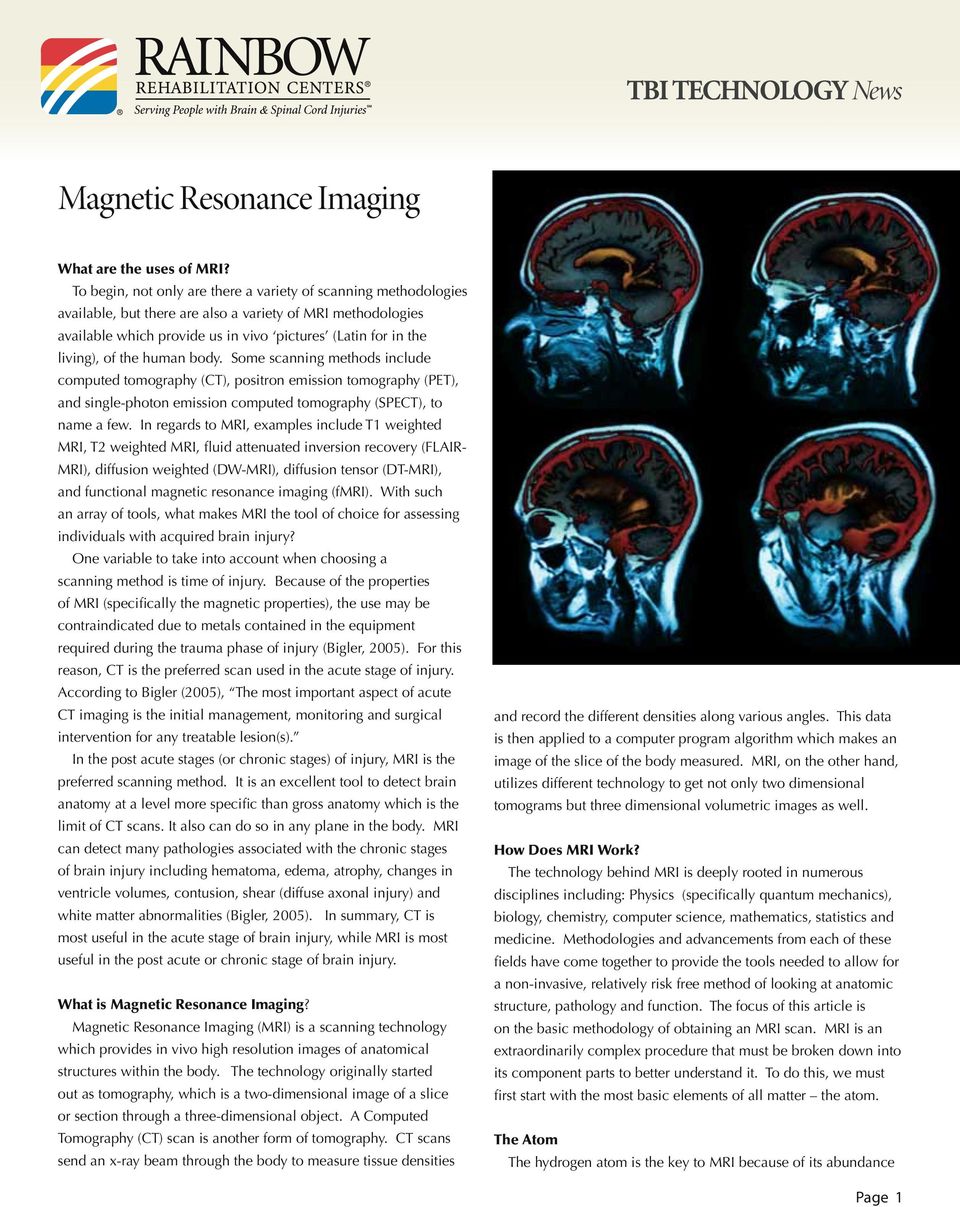
1 Magnetic Resonance Imaging What are the uses of MRI? To begin, not only are there a variety of scanning methodologies available, but there are also a variety of MRI methodologies available which provide us in vivo pictures (Latin for in the living), of the human body. Some scanning methods include computed tomography (CT), positron emission tomography (PET), and single-photon emission computed tomography (SPECT), to name a few. In regards to MRI, examples include T1 weighted MRI, T2 weighted MRI, fluid attenuated inversion recovery (FLAIR- MRI), diffusion weighted (DW-MRI), diffusion tensor (DT-MRI), and functional magnetic resonance imaging (fmri). With such an array of tools, what makes MRI the tool of choice for assessing individuals with acquired brain injury? One variable to take into account when choosing a scanning method is time of injury. Because of the properties of MRI (specifically the magnetic properties), the use may be contraindicated due to metals contained in the equipment required during the trauma phase of injury (Bigler, 2005). For this reason, CT is the preferred scan used in the acute stage of injury. According to Bigler (2005), The most important aspect of acute CT imaging is the initial management, monitoring and surgical intervention for any treatable lesion(s). In the post acute stages (or chronic stages) of injury, MRI is the preferred scanning method. It is an excellent tool to detect brain anatomy at a level more specific than gross anatomy which is the limit of CT scans. It also can do so in any plane in the body. MRI can detect many pathologies associated with the chronic stages of brain injury including hematoma, edema, atrophy, changes in ventricle volumes, contusion, shear (diffuse axonal injury) and white matter abnormalities (Bigler, 2005). In summary, CT is most useful in the acute stage of brain injury, while MRI is most useful in the post acute or chronic stage of brain injury. What is Magnetic Resonance Imaging? Magnetic Resonance Imaging (MRI) is a scanning technology which provides in vivo high resolution images of anatomical structures within the body. The technology originally started out as tomography, which is a two-dimensional image of a slice or section through a three-dimensional object. A Computed Tomography (CT) scan is another form of tomography. CT scans send an x-ray beam through the body to measure tissue densities and record the different densities along various angles. This data is then applied to a computer program algorithm which makes an image of the slice of the body measured. MRI, on the other hand, utilizes different technology to get not only two dimensional tomograms but three dimensional volumetric images as well. How Does MRI Work? The technology behind MRI is deeply rooted in numerous disciplines including: Physics (specifically quantum mechanics), biology, chemistry, computer science, mathematics, statistics and medicine. Methodologies and advancements from each of these fields have come together to provide the tools needed to allow for a non-invasive, relatively risk free method of looking at anatomic structure, pathology and function. The focus of this article is on the basic methodology of obtaining an MRI scan. MRI is an extraordinarily complex procedure that must be broken down into its component parts to better understand it. To do this, we must first start with the most basic elements of all matter the atom. The Atom The hydrogen atom is the key to MRI because of its abundance Page 1
2 in the human body and because of its specific atomic properties (NAS). The human body contains approximately 63% hydrogen atoms, due in large part to the fact that hydrogen is a main building block in both water and fat (Hornak). Take for example water, which is made up of 1 oxygen molecule and 2 hydrogen molecules (Figure 1). The hydrogen molecule is comprised of an electron (negative charge) that is bound with a proton (positive charge). The proton is the nucleus of the hydrogen atom (Figure 2). Figure 1 Water Molecule Figure 2 Hydrogen Atom Spin & Magnetic Moments All protons have a fundamental property termed Spin. Spin can be quantified, and can be thought of as a planet spinning about its axis (Hornak), as in Figure 3. This spinning generates a small magnetic field and creates what is called a Magnetic Moment. The magnetic moment can be weak or strong, and has direction much like a magnet has North and South poles (NAS; Figure 4). When the proton is placed in a strong external magnetic field, as happens when one is placed in an MRI machine, the proton either aligns with or against the magnetic field (Figures 5 and 6). Because the hydrogen atom has a strong magnetic moment, it has a strong tendency to flip direction when placed in an external magnetic field, causing it to align with or against the magnetic field. Once the hydrogen atoms align themselves, many of them cancel each other out. In other words, one proton aligned with the external magnetic field will cancel out one proton aligned against the magnetic field. Some of these protons are extra in that they do not cancel each other out (Figure 7). These extra protons are of high importance to MRI, because of another property of atoms related to spin. Figure 3 Proton Spin Figure 4 Proton North South Figure 5 Figure 6 Magnetization Wobble & Resonance Frequency When the proton spins about its axis, it also wobbles much like a spinning top. This wobble occurs at a particular frequency, which is specific to the type of atom (NAS). Again, this spin property of the hydrogen atom is taken advantage of for use in MRI. While in the external magnetic field, a radio frequency is pulsed through the magnetic field via a coil at an appropriate frequency (in this case the frequency specific to the hydrogen atom). The extra protons that did not cancel each other out are then induced to flip direction or spin in a different direction. When the frequency of the pulsed radio beam matches the frequency of the hydrogen atom, which induces the protons to Figure 7 X Magnetization X X X X Extra Protons X Page 2

3 flip, this is called the Resonance Frequency (Gould). The reason that the proton flips is due to the absorption of energy from the beam and is the next important element in MRI. Figure 8 T1 and T2 Relaxation Times Relaxation Times and Signal When the pulse of the radio frequency is stopped, the concept of Relaxation Time becomes important. The cessation of the pulse allows the proton to return to its previous un-flipped state. When it does so, it releases the energy it had absorbed, and this release of energy is a signal that can be recorded. The time it takes for the pulse to stop to the proton returning to its former state (and thus emitting the signal) is the relaxation time. Precisely when or how the signal is recorded is of great importance. One measure of relaxation time is T 1. This measure records the time from the cessation of the pulsed radio beam to the signal being emitted. This is called the spin lattice relaxation time. Another measure of relaxation time is T 2. This measures the length of the signal once the proton has un-flipped and released the signal. This is called the spin-spin relaxation time. Figure 8 illustrates these times. Lets take a moment and recap what we know so far. 1. Within our bodies, we have numerous hydrogen atoms. We know that they have a proton that spins and wobbles. 2. This spin and wobble creates a small magnetic field. 3. These hydrogen protons have a specific magnetic moment with direction and magnitude. 4. When the protons are placed in a strong external magnetic field, their magnetic moment property induces them to align with or against the magnetic field. 5. Most of these protons then cancel each other out, but some do not, leaving extra protons. 6. When a specific pulsed radio frequency is introduced through the external magnetic field which matches the wobble frequency of the hydrogen proton (called the resonance frequency), the extra protons flip direction. 7. When the pulsed frequency is stopped and the protons return to their original state, they emit a signal which can then be measured via various methods. The preceding is a basic rendering of how signals from living tissue can be captured. In reality, the processes and technologies that are used to capture that signal are far more complex. For example, varying pulses (by using short pulses versus continuous pulses) allowed for better information from the signal (NSA). Radio Pulse Frequency Signal T 1 T 2 Gradient Magnets & Signal Collection Now we are at a point where we are able to measure signals. But how does that translate to an image of the body? To understand this, we must begin to understand the components of the MRI machine itself. Within an MRI machine, there is the Main Magnet, which creates a large, stable magnetic field. In addition, there are 3 other magnets called Gradient Magnets. These magnets allow for scanning a slice at any angle, without requiring the person being scanned to move. But how do they work? The gradient magnets work in conjunction with the coils that send out the pulsed radio frequencies, allowing for precise measurement of any area within the field of view inside the scanner. The coils send out the radio frequency pulses while the gradient magnets turn on and off to change the magnetization of the hydrogen atoms at precise locations within the subject being scanned. There is one gradient magnet to vary the magnet field from top to bottom, one gradient magnet to vary the field from side to side, and a third to vary the magnetic field up and down. Page 3

4 Figure 9 illustrates a basic MRI schematic. To make MRI practical to use, the speed of collecting signals needs to be quite short, since it requires that the patient remain very still throughout the process. One way to speed up the process of collecting the signals is to send out multiple signals simultaneously (without affecting other signals) and recording the multiple signals that are emitted. The resulting signals are measured as are the combination of the 3 spatial coordinates of the signal from the gradient magnets. This allows for a map of the signals to be created. Figure 9 Basic MRI Schematic Main Magnet Patient Table Gradient Magnets Radio Frequency Coils Image Output The process of going from signals to an image involves the use of what is called the Fourier Transformation. This takes the raw signal data and transforms it creating the map of the signals. Early on, the use of the Fourier Transformation was only limited by the ability of computers to process the information quickly. When computer technology was able to process Fourier Transformations rapidly, the utility of MRI was realized. Given that the first MRI scan of a human body in 1977 took nearly 5 hours, it is evident that speed of capture would determine its practical utility (Tesla Society). Once the transformation is made, we are left with an image in the form of a slice that tells the reader what types of tissue were scanned. We know this, by and large, due to the known properties of hydrogen. For example the signal from healthy white matter (WM) will differ from unhealthy WM, because we know the difference in hydrogen properties from these tissues. Gray Matter (GM) will differ from WM, and will differ from cerebral spinal fluid (CSF), and so on. Determining what type of scan sequence to utilize will depend on what outcome is desired. For example a T 1 weighted sequence will show anatomy best, whereas a T 2 weighted sequence will show pathology best. The key to differentiating one tissue type from another is contrast. While the image from an MRI is not a photograph, the analogy of a black and white picture will help to explain contrast in MRI. When you see a black and white photo that has lots of gray tones but very little black and white tones, it tends to be dull and lifeless. When you see a black and white photo with good tonal range from dark blacks to white whites, it stands out due to the contrast between the tones. For an MRI image, it is the range of tones that help distingush the different tissue types. For normal tissue, a T 1 weighted scan will result in GM that is gray, WM that How is an MRI scanner rated? MRI scanners main magnets are rated in Tesla. A rating of 1 Tesla equals 10,000 Gauss or 20,000 times the earth s magnetic field. The stronger the main magnet the more stable the magnetic field, the better the MRI image. The following table shows current Tesla ratings. Low Field.2T and under Mid Field.2T to.6t High Field 1T to 2T Ultra High Field 3T and higher For clinical use, the current approved MRI rating is 3 Tesla. There are however, MRI s ranging from 4T to 35T+ used for imaging research. is white, and dense bone and water that is dark (Johnson). For a T 2 weighted scan, fat and water will appear bright, dense bone and Page 4

5 air will appear dark (Johnson). For abnormal tissue, a T 1 weighted scan will reveal blood as bright and a tumor as dark (Johnson). A T 2 weighted scan will show an infarct, blood, tumor or MS plaque as very bright (Johnson). To differentiate WM and GM from CSF, a T 1 weighted scan would be called for, and to determine if there is abnormal tissue, a T 2 weighted scan would be appropriate. The range of advanced techniques for MRI scans is absolutely dizzying. There are new techniques being created that find yet another use for this technology. While this article served to highlight the most basic components of MRI, it does not delve into the true complexity of the technology involved. For an excellent, thorough and technical review by J.P. Hornak, go to: The true potential of MRI at this point may not be fully realized, but its current utility is evident. MRI can detect abnormalities in the form of lesions, infarcts, dead tissues, changes in white matter, gray matter or cerebral spinal fluid volume changes. The use of MRI to further understand acquired brain injury is clearly evident, and one can expect continued use of MRI to help us understand how the brain responds to injury. Look to this space for continued illumination of this technology and others that can so greatly impact our knowledge of ABI and its long-term consequences. Written by Heidi Reyst, PhD, CBIT; Copyright March 2006 Rainbow Rehabilitation Centers, Inc. All rights reserved. Printed in the United States of America. No part of this publication may be reproduced in any manner whatsoever without written permission from Rainbow Rehabilitation Centers, Inc. For information, contact the editor at: RainbowVisions Magazine Rainbow Rehabilitation Centers, Inc Whittaker Road, Ypsilanti, MI 48197, USA [email protected] References: ohnson, K. A. Neuro-imaging Primer. AANLIB/htm Parrish. T.A. Image Processing in Magnetic Resonance Imaging. Gould, T. A. How MRI Works. Conlan, R. Magnetic Resonance Imaging. National Academy of Science. Hornak, J.P. The Basics of MRI. Bigler, E (2005). Structural Imaging. In the textbook of Traumatic Brain Injury, pp Etc. J.M. Silver, T.W. McCallister & S.C. Yudolsky. Page 5

Functional neuroimaging. Imaging brain function in real time (not just the structure of the brain).
 Functional neuroimaging Imaging brain function in real time (not just the structure of the brain). The brain is bloody & electric Blood increase in neuronal activity increase in metabolic demand for glucose
MRI for Paediatric Surgeons
 MRI for Paediatric Surgeons Starship David Perry Paediatric Radiologist Starship Children s Hospital CHILDREN S HEALTH What determines the brightness of a pixel in MRI? i.e. What determines the strength
GE Medical Systems Training in Partnership. Module 8: IQ: Acquisition Time
 Module 8: IQ: Acquisition Time IQ : Acquisition Time Objectives...Describe types of data acquisition modes....compute acquisition times for 2D and 3D scans. 2D Acquisitions The 2D mode acquires and reconstructs
Basic Principles of Magnetic Resonance
 Basic Principles of Magnetic Resonance Contents: Jorge Jovicich [email protected] I) Historical Background II) An MR experiment - Overview - Can we scan the subject? - The subject goes into the magnet -
Table 11: Pros and Cons of 1.5 T MRI vs. 3.0 T MRI; Safety and Technical Issues, and Clinical Applications
 Safety Issue 3.0 T MRI Pro 3.0 T MRI Con Immediate fringe field surrounding magnet A ferromagnetic object inadvertently brought into the scan room will experience a sharp increase in attraction toward
MRI SEQUENCES. 1 Gradient Echo Sequence
 5 An MRI sequence is an ordered combination of RF and gradient pulses designed to acquire the data to form the image. In this chapter I will describe the basic gradient echo, spin echo and inversion recovery
4. It is possible to excite, or flip the nuclear magnetic vector from the α-state to the β-state by bridging the energy gap between the two. This is a
 BASIC PRINCIPLES INTRODUCTION TO NUCLEAR MAGNETIC RESONANCE (NMR) 1. The nuclei of certain atoms with odd atomic number, and/or odd mass behave as spinning charges. The nucleus is the center of positive
Diffusione e perfusione in risonanza magnetica. E. Pagani, M. Filippi
 Diffusione e perfusione in risonanza magnetica E. Pagani, M. Filippi DW-MRI DIFFUSION-WEIGHTED MRI Principles Diffusion results from a microspic random motion known as Brownian motion THE RANDOM WALK How
Advanced MRI methods in diagnostics of spinal cord pathology
 Advanced MRI methods in diagnostics of spinal cord pathology Stanisław Kwieciński Department of Magnetic Resonance MR IMAGING LAB MRI /MRS IN BIOMEDICAL RESEARCH ON HUMANS AND ANIMAL MODELS IN VIVO Equipment:
How are Parts of the Brain Related to Brain Function?
 How are Parts of the Brain Related to Brain Function? Scientists have found That the basic anatomical components of brain function are related to brain size and shape. The brain is composed of two hemispheres.
Types of Brain Injury
 Types of Brain Injury The bones of your skull are hard and they protect your brain. Your brain is soft, like firm Jell-O. When your head moves, your brain moves inside your skull. When your head is hit
C1 Medical Imaging Modalities & Characteristics. 4005-759 Linwei Wang
 C1 Medical Imaging Modalities & Characteristics 4005-759 Linwei Wang Major Types of Medical Imaging Modalities X-ray Imaging Computed Tomography (CT) Magnetic Resonance Imaging (MRI) Nuclear Imaging Positron
The Hydrogen Atom Is a Magnet. http://www.seed.slb.com/en/scictr/watch/gashydrates/detecting.htm
 The Hydrogen Atom Is a Magnet Nuclear Magnetic Resonance Spectroscopy (NMR) Proton NMR A hydrogen nucleus can be viewed as a proton, which can be viewed as a spinning charge. As with any spinning charge,
Update: MRI in Multiple sclerosis
 Nyt indenfor MS ved MR Update: MRI in Multiple sclerosis Hartwig Roman Siebner Danish Research Centre for Magnetic Resonance (DRCMR) Copenhagen University Hospital Hvidovre Dansk Radiologisk Selskabs 10.
Chapter 10. Summary & Future perspectives
 Summary & Future perspectives 123 Multiple sclerosis is a chronic disorder of the central nervous system, characterized by inflammation and axonal degeneration. All current therapies modulate the peripheral
runl I IUI%I/\L Magnetic Resonance Imaging
 runl I IUI%I/\L Magnetic Resonance Imaging SECOND EDITION Scott A. HuetteS Brain Imaging and Analysis Center, Duke University Allen W. Song Brain Imaging and Analysis Center, Duke University Gregory McCarthy
Prof.M.Perucca CORSO DI APPROFONDIMENTO DI FISICA ATOMICA: (III-INCONTRO) RISONANZA MAGNETICA NUCLEARE
 Prof.M.Perucca CORSO DI APPROFONDIMENTO DI FISICA ATOMICA: (III-INCONTRO) RISONANZA MAGNETICA NUCLEARE SUMMARY (I/II) Angular momentum and the spinning gyroscope stationary state equation Magnetic dipole
RADIOLOGY SERVICES. By Dr Lim Eng Kok 1
 INTRODUCTION RADIOLOGY SERVICES By Dr Lim Eng Kok 1 Radiology is the branch of medicine that deals with the use of ionising (e.g. x- rays and radio-isotopes) and non-ionising radiation (e.g. ultrasound
Magnetic Resonance Imaging
 Magnetic Resonance Imaging North American Spine Society Public Education Series What Is Magnetic Resonance Imaging (MRI)? Magnetic resonance imaging (MRI) is a valuable diagnostic study that has been used
Nuclear Magnetic Resonance Spectroscopy
 Nuclear Magnetic Resonance Spectroscopy Introduction NMR is the most powerful tool available for organic structure determination. It is used to study a wide variety of nuclei: 1 H 13 C 15 N 19 F 31 P 2
ParaVision 6. Innovation with Integrity. The Next Generation of MR Acquisition and Processing for Preclinical and Material Research.
 ParaVision 6 The Next Generation of MR Acquisition and Processing for Preclinical and Material Research Innovation with Integrity Preclinical MRI A new standard in Preclinical Imaging ParaVision sets a
Emory University RT to Bachelor of Medical Science Degree Medical Imaging
 Emory University RT to Bachelor of Medical Science Degree Medical Imaging Courses: All RT-BMSc students must complete all of the program s core courses and the courses specific to their selected minor
BIOMEDICAL ULTRASOUND
 BIOMEDICAL ULTRASOUND Goals: To become familiar with: Ultrasound wave Wave propagation and Scattering Mechanisms of Tissue Damage Biomedical Ultrasound Transducers Biomedical Ultrasound Imaging Ultrasonic
Prepublication Requirements
 Issued Prepublication Requirements The Joint Commission has approved the following revisions for prepublication. While revised requirements are published in the semiannual updates to the print manuals
BME 501 - Introduction to BME. Bioelectrical Engineering Part: Medical Imaging
 BME 501 - Introduction to BME Bioelectrical Engineering Part: Medical Imaging Reference Textbook: Principles of Medical Imaging, by Shung, Smith and Tsui Lecturer: Murat EYÜBOĞLU, Ph.D. Dept. of Electrical
1.5 Tesla and 3 Tesla Magnetic Resonance Imaging (MRI) Guidelines for the Senza System
 1.5 Tesla and 3 Tesla Magnetic Resonance Imaging (MRI) Guidelines for the Senza System NEVRO CORP. All questions or concerns about Nevro products should be forwarded to: Nevro Corp. 1800 Bridge Parkway
PE finding: Left side extremities mild weakness No traumatic wound No bloody otorrhea, nor rhinorrhea
 Case report A 82-year-old man was suffered from sudden onset spasm of extremities then he fell down to the ground with loss of consciousness. He recovered his consciousness 7-8 mins later but his conscious
GE 3.0T NPW,TRF,FAST,F R NPW,TRF,FAST,F R
 GE 3.0T 3.0T WRIST Invivo 8CH Wrist Coil Sequence Ax T2 Cor PD Cor PDFS Cor T1 Cor PD (Small FOV) FOV (mm) 80 80 80 80 40 Matrix 384x224 384x256 320x256 384x320 320x192 Phase Direction RL RL RL RL RL #
Introducing MIPAV. In this chapter...
 1 Introducing MIPAV In this chapter... Platform independence on page 44 Supported image types on page 45 Visualization of images on page 45 Extensibility with Java plug-ins on page 47 Sampling of MIPAV
AI CPT Codes. x x. 70336 MRI Magnetic resonance (eg, proton) imaging, temporomandibular joint(s)
 Code Category Description Auth Required Medicaid Medicare 0126T IMT Testing Common carotid intima-media thickness (IMT) study for evaluation of atherosclerotic burden or coronary heart disease risk factor
Cognitive Neuroscience. Questions. Multiple Methods. Electrophysiology. Multiple Methods. Approaches to Thinking about the Mind
 Cognitive Neuroscience Approaches to Thinking about the Mind Cognitive Neuroscience Evolutionary Approach Sept 20-22, 2004 Interdisciplinary approach Rapidly changing How does the brain enable cognition?
A Three-Dimensional Correlation Method for Registration of Medical Images in Radiology
 A Three-Dimensional Correlation Method for Registration of Medical Images in Radiology Michalakis F. Georgiou 1, Joachim H. Nagel 2, George N. Sfakianakis 3 1,3 Department of Radiology, University of Miami
Musculoskeletal MRI Technical Considerations
 Musculoskeletal MRI Technical Considerations Garry E. Gold, M.D. Professor of Radiology, Bioengineering and Orthopaedic Surgery Stanford University Outline Joint Structure Image Contrast Protocols: 3.0T
5 Factors Affecting the Signal-to-Noise Ratio
 5 Factors Affecting the Signal-to-Noise Ratio 29 5 Factors Affecting the Signal-to-Noise Ratio In the preceding chapters we have learned how an MR signal is generated and how the collected signal is processed
MEDIMAGE A Multimedia Database Management System for Alzheimer s Disease Patients
 MEDIMAGE A Multimedia Database Management System for Alzheimer s Disease Patients Peter L. Stanchev 1, Farshad Fotouhi 2 1 Kettering University, Flint, Michigan, 48504 USA [email protected] http://www.kettering.edu/~pstanche
mri : Physics For anyone who does not have a degree in physics Evert J Blink Application Specialist MRI
 B A S I C mri : Physics For anyone who does not have a degree in physics Evert J Blink Application Specialist MRI 0 Preface Over the years Magnetic Resonance Imaging, hereafter referred to as MRI, has
Nuclear Magnetic Resonance (NMR) Spectroscopy cont... Recommended Reading:
 Applied Spectroscopy Nuclear Magnetic Resonance (NMR) Spectroscopy cont... Recommended Reading: Banwell and McCash Chapter 7 Skoog, Holler Nieman Chapter 19 Atkins, Chapter 18 Relaxation processes We need
Health Care Careers in the Field of Imaging. Shari Workman, MSM,PHR,CIR MultiCare Health System Senior Recruiter/Employment Specialist
 Health Care Careers in the Field of Imaging Shari Workman, MSM,PHR,CIR MultiCare Health System Senior Recruiter/Employment Specialist What is Health Care Imaging? Technologists working with patients, using
Physiological Basis of the BOLD Signal. Kerstin Preuschoff Social and Neural systems Lab University of Zurich
 Physiological Basis of the BOLD Signal Kerstin Preuschoff Social and Neural systems Lab University of Zurich Source: Arthurs & Boniface, 2002 From Stimulus to Bold Overview Physics of BOLD signal - Magnetic
Nuclear Magnetic Resonance Spectroscopy
 Nuclear Magnetic Resonance Spectroscopy Nuclear magnetic resonance spectroscopy is a powerful analytical technique used to characterize organic molecules by identifying carbonhydrogen frameworks within
USE OF DEMONSTRATIVE EVIDENCE IN THE TRIAL OF A MILD TRAUMATIC BRAIN INJURY CASE. Your client, who sustained a closed head injury in an
 USE OF DEMONSTRATIVE EVIDENCE IN THE TRIAL OF A MILD TRAUMATIC BRAIN INJURY CASE Your client, who sustained a closed head injury in an automobile crash one year ago, appears perfectly fine as his trial
NEW HYBRID IMAGING TECHNOLOGY MAY HAVE BIG POTENTIAL FOR IMPROVING DIAGNOSIS OF PROSTATE CANCER
 Media Release April 7, 2009 For Immediate Release NEW HYBRID IMAGING TECHNOLOGY MAY HAVE BIG POTENTIAL FOR IMPROVING DIAGNOSIS OF PROSTATE CANCER London, Ontario Improved hybrid imaging techniques developed
The Center for Prostate Cancer. Personalized Treatment. Clinical Excellence.
 The Center for Prostate Cancer Personalized Treatment. Clinical Excellence. The Center for Prostate Cancer Leaders in Prostate Cancer Treatment and Research The Center for Prostate Cancer at the North
Preserving Hyperpolarization of 129 Xe for Transport Submitted by: Zach Zytner Project Supervisor: Dr. Giles Santyr Medical Biophysics 3970 Date:
 Preserving Hyperpolarization of 129 Xe for Transport Submitted by: Zach Zytner Project Supervisor: Dr. Giles Santyr Medical Biophysics 3970 Date: April 1, 2011 Introduction and Theory The effective use
Steps to getting a diagnosis: Finding out if it s Alzheimer s Disease.
 Steps to getting a diagnosis: Finding out if it s Alzheimer s Disease. Memory loss and changes in mood and behavior are some signs that you or a family member may have Alzheimer s disease. If you have
CHILDREN S NEUROSCIENCE CENTER
 CHILDREN S NEUROSCIENCE CENTER W hen families come to Children s Memorial Hermann Hospital, they expect to find the technological advances and healing expertise of a university-affiliated, academic hospital.
THORACIC DIAGNOSTIC ASSESMENT PROGRAM (DAP) PATIENT INFORMATION FOR:
 central east regional cancer program in partnership with cancer care ontario THORACIC DIAGNOSTIC ASSESMENT PROGRAM (DAP) PATIENT INFORMATION FOR: Thoracic dap booklet March2012.indd 1 SCHEDULED TESTS YOUR
Award Number: W81XWH-10-1-0739
 AD Award Number: W81XWH-10-1-0739 TITLE: Voxel-Wise Time-Series Analysis of Quantitative MRI in Relapsing-Remitting MS: Dynamic Imaging Metrics of Disease Activity Including Prelesional Changes PRINCIPAL
Proton Nuclear Magnetic Resonance Spectroscopy
 Proton Nuclear Magnetic Resonance Spectroscopy Introduction: The NMR Spectrum serves as a great resource in determining the structure of an organic compound by revealing the hydrogen and carbon skeleton.
Embedded Systems in Healthcare. Pierre America Healthcare Systems Architecture Philips Research, Eindhoven, the Netherlands November 12, 2008
 Embedded Systems in Healthcare Pierre America Healthcare Systems Architecture Philips Research, Eindhoven, the Netherlands November 12, 2008 About the Speaker Working for Philips Research since 1982 Projects
Guide to Understanding X-ray Crystallography
 Guide to Understanding X-ray Crystallography What is X-ray Crystallography and why do I need to learn it? X-ray Crystallography is a scientific method of determining the precise positions/arrangements
PHYSICAL METHODS, INSTRUMENTS AND MEASUREMENTS Vol. III - Medical and Industrial Tomography - W.B.Gilboy
 MEDICAL AND INDUSTRIAL TOMOGRAPHY Department of Physics, University of Surrey, Guildford, Surrey, U.K. Keywords: Radiography, transmission tomography, emission tomography, microtomography, SPECT (single
The Field. Radiologic technologists take x-rays and administer nonradioactive materials into patients' bloodstreams for diagnostic purposes.
 Radiologic Technologist Overview The Field - Specialty Areas - Preparation - Day in the Life - Earnings - Employment - Career Path Forecast - Professional Organizations The Field Radiologic technologists
Two bar magnets are brought near each other as shown. The magnets... A) attract B) repel C) exert no net force on each other.
 Magnetic Fields and Forces Learning goals: Students will be able to Predict the direction of the magnet field for different locations around a bar magnet and an electromagnet. Relate magnetic field strength
NMR Techniques Applied to Mineral Oil, Water, and Ethanol
 NMR Techniques Applied to Mineral Oil, Water, and Ethanol L. Bianchini and L. Coffey Physics Department, Brandeis University, MA, 02453 (Dated: February 24, 2010) Using a TeachSpin PS1-A pulsed NMR device,
CREATIVE DEMONSTRATIVE EVIDENCE: ADDING THE MIDAS TOUCH. We all know that the use of demonstrative evidence can be crucial to the jury s ability to
 CREATIVE DEMONSTRATIVE EVIDENCE: ADDING THE MIDAS TOUCH A. Introduction We all know that the use of demonstrative evidence can be crucial to the jury s ability to understand complex issues at trial. There
Procedures/risks: Radiology (CT, DXA, MRI, ultrasound, X-ray)
 Procedures/risks: Radiology (CT, DXA, MRI, ultrasound, X-ray) Computerized Axial Tomography (CT): Procedure: A Computerized Axial Tomography (CT) scan [of your heart] involves holding your breath for a
Organic Chemistry Tenth Edition
 Organic Chemistry Tenth Edition T. W. Graham Solomons Craig B. Fryhle Welcome to CHM 22 Organic Chemisty II Chapters 2 (IR), 9, 3-20. Chapter 2 and Chapter 9 Spectroscopy (interaction of molecule with
13C NMR Spectroscopy
 13 C NMR Spectroscopy Introduction Nuclear magnetic resonance spectroscopy (NMR) is the most powerful tool available for structural determination. A nucleus with an odd number of protons, an odd number
3/30/2013. Disclosure. Advanced Neuro MRI: Imaging Techniques and Protocol Optimization. MRI, 35 year ago. MRI Today. Outlines
 http://www.magnet.fsu.edu Disclosure Advanced Neuro MRI: Imaging Techniques and Protocol Optimization Research funding provided by Siemens Healthcare. Chen Lin, PhD DABR Indiana University School of Medicine
NEURO M203 & BIOMED M263 WINTER 2014
 NEURO M203 & BIOMED M263 WINTER 2014 MRI Lab 1: Structural and Functional Anatomy During today s lab, you will work with and view the structural and functional imaging data collected from the scanning
COMPUTED MEDICAL IMAGING
 COMPUTED MEDICAL IMAGING Nobel Lecture, 8 December, 1979 BY GODFREY N. HOUNSFIELD The Medical Systems Department of Central Research Laboratories EMI, London, England In preparing this paper I realised
Radiation therapy involves using many terms you may have never heard before. Below is a list of words you could hear during your treatment.
 Dictionary Radiation therapy involves using many terms you may have never heard before. Below is a list of words you could hear during your treatment. Applicator A device used to hold a radioactive source
The MRI Study Guide for Technologists
 The MRI Study Guide for Technologists Kenneth S. Meacham The MRI Study Guide for Technologists With 51 Illustrations Springer-Verlag New York Berlin Heidelberg London Paris Tokyo Hong Kong Barcelona Budapest
Application of Nuclear Magnetic Resonance in Petroleum Exploration
 Application of Nuclear Magnetic Resonance in Petroleum Exploration Introduction Darko Tufekcic, consultant email: [email protected] Electro-magnetic resonance method (GEO-EMR) is emerging as the
Brain Tumor Treatment
 Scan for mobile link. Brain Tumor Treatment Brain Tumors Overview A brain tumor is a group of abnormal cells that grows in or around the brain. Tumors can directly destroy healthy brain cells. They can
Patient Prep Information
 Stereotactic Breast Biopsy Patient Prep Information Imaging Services Cannon Memorial Hospital Watauga Medical Center Table Weight Limits for each facility Cannon Memorial Hospital Watauga Medical Center
PROTON NUCLEAR MAGNETIC RESONANCE SPECTROSCOPY (H-NMR)
 PROTON NUCLEAR MAGNETIC RESONANCE SPECTROSCOPY (H-NMR) WHAT IS H-NMR SPECTROSCOPY? References: Bruice 14.1, 14.2 Introduction NMR or nuclear magnetic resonance spectroscopy is a technique used to determine
Watching the brain remember
 Watching the brain remember Neuroimaging techniques for studying learning and memory David A. Ziegler Image removed due to copyright reasons. Cartoon. Wednesday, Sept 12, 2007 Outline Imaging brain anatomy
Herniated Disk. This reference summary explains herniated disks. It discusses symptoms and causes of the condition, as well as treatment options.
 Herniated Disk Introduction Your backbone, or spine, has 24 moveable vertebrae made of bone. Between the bones are soft disks filled with a jelly-like substance. These disks cushion the vertebrae and keep
Brain scanning techniques (CT, MRI, fmri, PET, SPECT, DTI, DOT)
 Cerebra 2009 Brain scanning techniques (CT, MRI, fmri, PET, SPECT, DTI, DOT) Background Anthea Wright Brain imaging has greatly advanced in the last 20 years, due to better understanding of the electromagnetic
First Year. PT7040- Clinical Skills and Examination II
 First Year Summer PT7010 Anatomical Dissection for Physical Therapists This is a dissection-based, radiographic anatomical study of the spine, lower extremity, and upper extremity as related to physical
2 Neurons. 4 The Brain: Cortex
 1 Neuroscience 2 Neurons output integration axon cell body, membrane potential Frontal planning control auditory episodes soma motor Temporal Parietal action language objects space vision Occipital inputs
Volume visualization I Elvins
 Volume visualization I Elvins 1 surface fitting algorithms marching cubes dividing cubes direct volume rendering algorithms ray casting, integration methods voxel projection, projected tetrahedra, splatting
Disease/Illness GUIDE TO ASBESTOS LUNG CANCER. What Is Asbestos Lung Cancer? www.simpsonmillar.co.uk Telephone 0844 858 3200
 GUIDE TO ASBESTOS LUNG CANCER What Is Asbestos Lung Cancer? Like tobacco smoking, exposure to asbestos can result in the development of lung cancer. Similarly, the risk of developing asbestos induced lung
MEDICAL BREAKTHROUGHS RESEARCH SUMMARY
 TOPIC: PROTON THERAPY FOR KIDS REPORT: MB #3912 MEDICAL BREAKTHROUGHS RESEARCH SUMMARY BACKGROUND: Every year about 13,500 children are diagnosed with some form of cancer in the United States. Currently
RADIATION THERAPY guide. Guiding you through your treatment
 RADIATION THERAPY guide Guiding you through your treatment 2013_RADIATION_GUIDE_6PG.indd 1 Before Treatment Consultation with the Radiation Oncologist During your first visit with the radiation oncologist,
Anoxic Brain Injury and Neural Damage: Three Case Reports
 Anoxic Brain Injury and Neural Damage: Three Case Reports Abstract Anoxic brain injury (ABI) is common and can occur in a wide variety of disorders. This neural injury is associated with significant and
2. MATERIALS AND METHODS
 Difficulties of T1 brain MRI segmentation techniques M S. Atkins *a, K. Siu a, B. Law a, J. Orchard a, W. Rosenbaum a a School of Computing Science, Simon Fraser University ABSTRACT This paper looks at
Society of Nuclear Medicine 1850 Samuel Morse Drive Reston, VA 20190-5316 www.snm.org
 What is nuclear medicine? Nuclear medicine is a medical specialty that is used to diagnose and treat diseases in a safe and painless way. Nuclear medicine procedures permit the determination of medical
Andrew Rosen - Chapter 3: The Brain and Nervous System Intro:
 Intro: Brain is made up of numerous, complex parts Frontal lobes by forehead are the brain s executive center Parietal lobes wave sensory information together (maps feeling on body) Temporal lobes interpret
Hole s Human Anatomy and Physiology Eleventh Edition. Mrs. Hummer Hanover Area Jr./Sr. High School. Chapter 1 Introduction to Anatomy and Physiology
 Hole s Human Anatomy and Physiology Eleventh Edition Mrs. Hummer Hanover Area Jr./Sr. High School Chapter 1 Introduction to Anatomy and Physiology 1 Chapter 1 Introduction to Human Anatomy and Physiology
The multitude of symptoms following a whiplash injury has given rise to much discussion because of the lack of objective radiological findings.
 HELPFUL PERSONAL INJURY INFORMATION COURTESY OF RIVERVIEW CHIROPRACTIC FROM ABSTRACT: Dynamic kine magnetic resonance imaging in whiplash patients Pain Research and Management 2009 Nov-Dec 2009;Vol. 14,
.org. Fractures of the Thoracic and Lumbar Spine. Cause. Description
 Fractures of the Thoracic and Lumbar Spine Page ( 1 ) Spinal fractures can vary widely in severity. While some fractures are very serious injuries that require emergency treatment, other fractures can
Multiple Sclerosis. Matt Hulvey BL A - 615
 Multiple Sclerosis Matt Hulvey BL A - 615 Multiple Sclerosis Multiple Sclerosis (MS) is an idiopathic inflammatory disease of the central nervous system (CNS) MS is characterized by demyelination (lesions)
Contents. X-ray and Computed Tomography. Characterization of X-rays. Production of X-rays
 J. E. Wilhjelm Ørsted TU Technical University of enmark, Bldg. 348, K-2800 Kongens Lyngby, enmark. X-ray and Computed Tomography Contents History and characterization of X-rays Conventional (projection)
The Electronic Medical Record in its entirety can be found on pages 39-54. The EMR is the reading tool that students will use as they complete The
 The Electronic Medical Record in its entirety can be found on pages 39-54. The EMR is the reading tool that students will use as they complete The Virtual Stroke Lab. The idea of the EMR was that students
A Primer on Medical Device Interactions with Magnetic Resonance Imaging Systems
 This guidance was written prior to the February 27, 1997 implementation of FDA's Good Guidance Practices, GGP's. It does not create or confer rights for or on any person and does not operate to bind FDA
510(k) Summary. This summary of 510(k) safety and effectiveness is being submitted in accordance with the requirements of 21 CFR 807.
 MAR, 2009 / \MLECH MRI-TECH Sp. z o.o., ul. Zielihska 3, 31-227 Krak6w, Poland MRI-TECH Canada, Inc. 206-3820 Cambie Street Vancouver BC V5Z 2X7 510(k) Summary This summary of 510(k) safety and effectiveness
Introduction to Nuclear Magnetic Resonance Spectroscopy
 Introduction to Nuclear Magnetic Resonance Spectroscopy Dr. Dean L. Olson, NMR Lab Director School of Chemical Sciences University of Illinois Called figures, equations, and tables are from Principles
CPT CODE PROCEDURE DESCRIPTION. CT Scans 70450 CT HEAD/BRAIN W/O CONTRAST 70460 CT HEAD/BRAIN W/ CONTRAST 70470 CT HEAD/BRAIN W/O & W/ CONTRAST
 CPT CODE PROCEDURE DESCRIPTION CT Scans 70450 CT HEAD/BRAIN W/O CONTRAST 70460 CT HEAD/BRAIN W/ CONTRAST 70470 CT HEAD/BRAIN W/O & W/ CONTRAST 70480 CT ORBIT W/O CONTRAST 70481 CT ORBIT W/ CONTRAST 70482
09/05/2014. Painting pictures of the brain with numbers. Overview
 Painting pictures of the brain with numbers Neurology for Insurers Dr Ian Cox & Adele Groyer (Gen Re) Overview Critical Illness Product Background Why should we be interested in neurology? Consult our
Neuro imaging: looking with lasers in the brain
 Neuro imaging: looking with lasers in the brain Aim: To image life cells, label free, with cellular resolution in deep tissue Marloes Groot Vrije Universiteit Amsterdam Faculteit Exacte Wetenschappen Natuurkunde
MI Software. Innovation with Integrity. High Performance Image Analysis and Publication Tools. Preclinical Imaging
 MI Software High Performance Image Analysis and Publication Tools Innovation with Integrity Preclinical Imaging Molecular Imaging Software Molecular Imaging (MI) Software provides high performance image