
NCH Software WavePad Sound Editor
|
|
|
- Nigel Powell
- 10 years ago
- Views:
Transcription
1 NCH Software WavePad Sound Editor This user guide has been created for use with WavePad Sound Editor Version 6.xx NCH Software

2 Technica Support If you have difficuties using WavePad Sound Editor pease read the appicabe topic before requesting support. If your probem is not covered in this user guide pease view the up-to-date WavePad Sound Editor Onine Technica Support at If that does not sove your probem, you can contact us using the technica support contacts isted on that page. Software Suggestions If you have any suggestions for improvements to WavePad Sound Editor, or suggestions for other reated software that you might need, pease post it on our Suggestions page at Many of our software projects have been undertaken after suggestions from users ike you. You get a free upgrade if we foow your suggestion.

3 WavePad Sound Editor Contents Upgrading to WavePad Master's Edition... 5 Software License Terms... 6 Basics Overview... 7 Genera Audio Concepts... 8 WavePad Basics Main Screen Reference Undo and Redo Working With Fies Recording The Frequency Spectrogram View Bookmarks and Regions WavePad Projects Shortcut Keys Reference Editing Convert Sampe Rate and Channes Movement and Seection Cut, Copy, and Paste Paste Mix Deete Spit Batch Join Join Mono Fies to Make Stereo Dupicate Copy to New Mix With Fie Repeat Loop Sience Trim Edit Sampes Save Seected Region As Insert Fie Lossess MP3 Editing Effects 1

4 Effects and Audio Processes Effect Chain DirectX Effects VST Pugins Ampify Normaize Compressor Equaizer Enveope Stereo Pan Echo Reverb Phaser Fanger Vibrato Tremoo Dopper Wah-Wah Chorus Distortion AM Radio Effect Teephone Effect Reverse Fading Speed and Pitch Changing Reduce Vocas Voice Change Audio Ceanup Noise Reduction Cick/Pop Remova High-Pass Fiter Low-Pass Fiter Automatic Gain Contro DC Offset Correction Toos Frequency Anaysis (FFT and TFFT) Text To Speech Navigate Speech Batch Converter Create Ringtone Downoad From Sound Library Surround Sound Editor

5 Options Options Genera Audio Recording Appearance Payback Keys and Macros Fie Types Output Formats WavePad Output Formats WAV Settings MP3 Settings Vox/Raw Settings OGG Settings FLAC Settings AAC/M4A Settings AMR Settings RSS Podcast Settings M3U Payist Settings PLS Payist Settings WPL Payist Settings Advanced Command Line Options Suite Recommended Programs NCH Sound Library NCH Sound Library Other Links 3

6 Recommended HardwareRecommended MicrophonesRecommended Headphones Recommended Speakers Recommended Audio DevicesMPC SettingsAPE Settings SPX Settings 4
7 Upgrading to WavePad Master's Edition A number of professiona toos for WavePad are ony avaiabe if you have purchased an upgrade to WavePad Master's Edition. To view pricing and to purchase an upgrade to WavePad Master's Edition pease open Once you have purchased and activated your icense you wi receive a registration with your name and contact detais. Use the menu Fie -> Register Master's Edition Upgrade and enter the detais exacty as they appear in the registration. 5

8 Software License Terms 1. The copyrights in this software and any visua or audio work distributed with the software beong to NCH Software and others isted in the about box. A rights are reserved. Instaation of this software and any software bunded with or instaed-on-demand from this software is icensed ony in accordance with these terms. 2. By instaing, using or distributing this software you, on your own behaf and on behaf of your empoyer or principa, agree to be bound by these terms. If you do not agree to any of these terms, you may not use, copy, transmit, distribute, nor insta this software - return it to the pace of purchase within 14 days to receive a fu refund. 3. This software, and a accompanying fies, data and materias, are distributed "as is" and with no warranties of any kind, whether express or impied except as required by aw. If you intend to rey on this software for critica purposes you must test it fuy prior to using it, insta redundant systems and assume any risk. 4. We wi not be iabe for any oss arising out of the use of this software incuding, but not imited to, any specia, incidenta or consequentia oss. Your entire remedy against us for a caims is imited to receiving a fu refund for the amount you paid for the software. 5. You may not use this software in any circumstances where there is any risk that faiure of this software might resut in a physica injury or oss of ife. You agree to indemnify us from any caims reating to such unauthorized use. 6. You may copy or distribute the instaation fie of this software in its compete unatered form but you may not, under any circumstances, distribute any software registration code for any of our programs without written permission. In the event that you do distribute a software registration code, you wi be iabe to pay the fu purchase price for each ocation where the unauthorized use occurs. 7. Use of statistics coected by the software is subject to the NCH Software Privacy Statement which aows automatic anonymized coection of usage statistics in imited circumstances. 8. The contract arising out of this agreement is governed by the aws and courts of the Austraian Capita Territory. 6
9 Basics - Overview WavePad is a sound editor program for Windows and Mac OS X. This software ets you record and edit voice and other audio recordings. You can cut, copy and paste parts of recording and, if required, add effects ike echo, ampification and noise reduction. WavePad is designed to be very easy and intuitive to use. Within minutes you wi be abe to open or record a fie and edit it. But if you take time to expore the other features you wi find many powerfu toos designed with the professiona sound engineer in mind. WavePad Basic Edition is free, but we hope you wi consider upgrading to WavePad Master's Edition. With the Master's Edition you have a set a features designed with the professiona in mind. To view pricing or to purchase WavePad Master's Edition pease see Features Supports a number of fie formats incuding wav (mutipe codecs), mp3, fac, ogg, vox, gsm, rea audio and many more. A wide range of editing capabiities incuding Cut, Copy, Paste, Deete, Insert, Sience, Auto Trim and others. Effects incuding Ampify, Normaize, Equaizer, Enveope, Reverb, Echo, Noise Reduction, Sampe Rate Conversion and more. A Frequency Spectrogram View, with frequency-based editing. Sound effect and music ibrary with 1,000 free audio cips incuded. Surround sound editor to produce surround sound audio. Supports sampe rates from 6000 to Hz, stereo or mono, 8, 16, 24 or 32 bits. Abiity to work with mutipe fies at the same time. Incudes a CD ripper to oad audio direct from a CD-ROM. Payer incudes Scrub/Cue contro for precise editing. Recorder supports pause, retake, auto trim and voice activated recording. Support MDI (Mutipe Document Interface), which aows dispaying mutipe fies a on one screen. Support for MME, DirectSound and ASIO payback. Support for MME and ASIO recording. Fu support for VST pugins. System Requirements Windows XP/Vista/7/8/10 WavePad is just one component of the NCH Software suite of audio, video and business software. If you have not done so aready, pease visit to downoad many other reated programs. 7

10 Basics - Genera Audio Concepts This is a genera introduction to key audio concepts for those who have not worked with sound before. If you cass yoursef as an "audiophie", or if you have some other past experience earning about sound, you can skip this page. Sound The starting point for everything WavePad does is sound. Sound is vibrating air traveing very fast ike a wave. It is created by a vibrating object (e.g. our voca cords, a guitar string or a speaker) and can be detected by an ear or a microphone. A microphone converts these vibrations into aternating eectronic votage which the computer's sound card can turn into the data used by WavePad. Frequency One way to anayze sound is by ooking at the speed it vibrates as it traves through the air. The number of times this vibration happens per second is caed the "frequency" of the sound, and is measured in Hertz (Hz) or kiohertz (khz). It is quite often the case that sounds wi not consist of a singe wave vibrating at a certain frequency through the air, often they wi contain mutipe waves vibrating at different speeds and different voume eves. WavePad contains a coupe of toos that wi aow you to see this effect for yoursef, pease see Frequency Anaysis (FFT and TFFT) for further information. The human ear is said to be abe to hear sounds ranging from about 20Hz (20 vibrations per second) up to 20,000Hz (20,000 vibrations per second). In reaity, most of us ony hear to about 15,000Hz, but audio enthusiasts often caim they can hear sounds up to the 20,000Hz mark. The frequencies of a person's voice can range between 300Hz and 3000Hz. Loudness, Voume, Ampitude, Leve and Gain The terms oudness, voume, ampitude and eve mean roughy the same thing. The more voume a sound is given the more power has been used to create it and the ouder it sounds. When adjusting the voume eve of a sound (for exampe when using the Ampify Effect of WavePad), the "Gain" vaue signifies the amount of increase or decrease in the eve. This vaue can be represented in percent or in a scae caed the "decibe" or "db" scae (read on!). The human ear can hear a remarkaby broad range of sounds from very ow to very high power. The ear does not perceive differences in power in direct proportion to power but in a ogarithmic way. To more cosey match the way we hear oudness sound engineers use the decibe scae (db). To give you a fee for how this works, reducing the voume eve of a sound by 6dB means you are dropping the ampitude by 1/2 or the power by 1/4. Conversey, a 6dB increase in the eve corresponds to doubing the ampitude. A 20dB drop means 1/10 of the ampitude (or 1/100 of the power). The smaest unit of oudness change a person wi notice is around + / - 3dB. Audio Recording and Computers 8

11 In order to store and reproduce audio on your computer, the audio signa from the microphone is converted by your sound card into a series of numbers in quick succession. You can think of these numbers as representing the pressure on the surface of the microphone at different points over time. This process of converting audio into a series a numbers is caed "samping". Sampe Rate The sampe rate is the number of times that the ampitude is converted to a number per second. For exampe, at CD quaity recording, your computer stores numbers per second each representing the ampitude at the specific point in time. It can be shown that the maximum possibe frequency that can be carried in a samped sound is exacty haf of the sampe rate. In reaity it is a itte ess. So for exampe, a recording made with a samping rate wi carry frequencies up to 20000Hz. A quick guide to sampe rates foows: Very ow quaity voice Teephone quaity voice Reasonabe quaity voice - e.g., dictation Good quaity voice, Reasonabe quaity music - e.g., mutimedia CD CD Quaity. Higher sampe rates incuding 48000, 88200, and even are sometimes used but many sound engineers point out that they do not offer any rea audibe quaity improvement (aside from adding a bit more redundancy to the system). Tip: aways record and work with audio in the Sampe Rate that you wi use in the end, because every time you convert you ose a itte quaity. For exampe - if you are making a CD use If it is for teephone use Channes Stereo / Mono Mutipe "channes" of audio can be recorded at the same time. Most commony, "Stereo" recording is two channes (eft and right) with which our two ears give us a sense of audio direction and space. Recording with just one channe is referred to as "Mono" recording. Tip: If you are recording voice, be sure to record in Mono mode. If you are recording music with mutipe instruments then use Stereo mode. 8/16/24/32 bits You might have seen terms ike "8 bits" or "16 bits" when ooking at sound fies but are not sure what they mean. The number of bits, ike in the sampe rate, is an indicator of the quaity or resoution of the sound inside the fie. The more bits the better resoution. WavePad uses 32 bits internay for optima audio quaity. However 16 bits is usuay more than adequate for saving. Audio Fie Compression and Codecs One of the probems with high quaity audio is that you can end up with very arge-sized audio fies. In order to avoid this, you can use what is known as "compression" to reduce the size of your fies. The systems used to impement compression in audio fies are caed "codecs". 9
12 There are a number of different codecs around, incuding MPEG Layer-3/MP3, Ogg Vorbis (both good for music) and GSM (good for teephone or voice). Most codecs are designed for a specific function, usuay to store either music or voice. You can seect the compression codec to use when using the Fie -> Save As option in WavePad. You shoud note that amost a compression codecs are ossy, however - this means you ose audio quaity every time you save the fie. For this reason it is important that you do not save audio in a compressed form unti it is reay needed. For exampe, if you need to save a fie when you want to do further work on it, save it in an uncompressed form ike Hz, 16 bit PCM format Wave. Audio Fie Compression must not be confused with Audio Dynamic Range Compression. Fie Compression is a about reducing fie size whereas Dynamic Range Compression is about voume contro. For more about Dynamic Range Compression see Effects. Editing and Effects Editing means deeting or inserting audio. Effects are processes that change the audio in some way (e.g., add echo or make it softer). See the WavePad Edit and Effects menu. Each effect is fuy expained on the page Effects. 10
13 Basics - WavePad Basics Pay To pay from the current position press F9. Record To record (at the current position or over the seected region) press the F5 key. Moving Around the Fie To go to the beginning press the Home key or press the End key to move to the end. To rewind press and hod down the eft arrow key and to fast-forward press the right arrow key. You can aso move the position by cicking on one of the wave windows. Scrub To find accurate edit positions with your ears press F6 to activate scrub. This aows much finer movement (with the arrow keys) whie istening to the point you want to edit. Seecting Regions Before you can appy some effects or edit functions you need to seect the region to edit or appy the effect to. Press Ctr+A to seect the entire fie. To seect with the mouse cick on the wave window and drag over the part you want to seect. 11

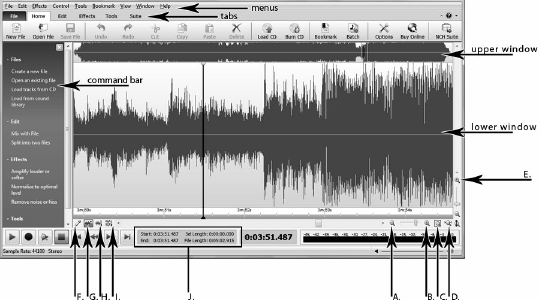
14 Basics - Main Screen Reference Wave form dispay There are two wave windows in the main screen. The upper window dispays the wave form of the audio fie aways in its fu ength - it is usefu for knowing where you are in the fie, and you can cick it to quicky jump to a new area of the waveform. The ower window 12

15 shows the wave form of the audio based on the zoom eve. To move the ower window side to side, use the horizonta scro bar just under the ower window. Cicking and dragging the waveform wi create a seection. Menu Bar The menus contain every action avaiabe within WavePad. To hide the menu, cick the arrow button to the eft of the Hep icon, which is ocated on the right side of the toobar. Tabs The tabs organize WavePad's features onto tabs to streamine your workfow. Cick a tab to see the features and toos reated to that tab. Command Bar The Command Bar contains inks to the most-used features in WavePad. You can minimize sections you don't use often by cicking the heading, or cose the Command Bar entirey by cicking the red X in its upper right corner. To contro the Command Bar's appearance, cick the View menu and then Command Bar. Zoom Buttons -A. Zoom Out -Cick on this button to zoom out the ower window view of the waveform. -B. Zoom In -Cick on this button to zoom in. -C. Show Entire Region -Cick on this button to zoom out to dispay the entire fie ength. -D. Zoom To Seection -Cick on this button to zoom to the region you have just seected. -E. Vertica Zoom -Cick on this button to increase the ampitude of the dispay (to see softer sounds). -F. Sampe Edit Mode -Aows you to modify the individua audio sampes in the waveform using the computer's mouse. -G. Wave dispay + up / - down -This combines the eft and right channes into one waveform. -H. Wave dispay eft channe up / right channe down -Dispays the eft channe on the upper side of the center ine and the right channe on the ower side of the center ine. -I. Wave dispay dua eft and right channes -Combines the eft and right channes into one waveform. There is aso a zoom track bar sider contro between the Zoom Out and Zoom In buttons that provides infinitey variabe zoom. J. Seection Dispay -Start -This dispays the start position of the seected region. -End -This dispays the end position of the seected region. -Se Length -This dispays the ength of the seected region. -Fie Length -This dispays the ength of the entire fie. To seect a region, you can either cick on the wave window and drag to the position you want or hod down the Shift key and press the eft or right arrow buttons. 13
16 Basics - Undo and Redo Undo (Ctr+Z) To Undo is to restore the fie to its state before the previous edit function. This is usefu if you want to try an edit or just make a mistake. To undo your ast action press Ctr+Z. Note: You can undo up to 32 ast actions. Redo (Ctr+Y) If, after undoing, you decide that the change reay was what you wanted, then you can redo. 14

17 Basics - Working With Fies Create a New Audio Fie To create a new fie press Ctr+N. When creating a new fie WavePad wi prompt you to seect the sampe rate and channes. You can disabe this prompt and set the defaut rate using WavePad Options. For more information to guide you when seecting sampe rates and channes pease see Genera Audio Concepts. Open an Existing Audio Fie To open and existing fie press Ctr+O, browse to ocate the fie you want to open and cick Open. You can aso oad audio tracks from the CDs by seect Fie -> Load Audio CD Track(s). Seect a track by cick on it or hod down the Ctr key for seecting mutipe tracks. Save an Audio Fie To save the current audio fie with the current name press Ctr+S. To save the fie with a different name or in a different format use the menu Fie -> Save As (or press Ctr+Shift+S). Note: When working with audio fies, you shoud not save the fie in a compressed format unti you have finished a editing because every time you save and reoad in a compressed format you ose some quaity. Save as a PCM wav fie to preserve quaity. See Output Formats section for more information. Copy fie(s) to CD Seecting this option wi et you burn any open fies to a CD by using Express Burn CD Recorder aso made by NCH Software. Just seect "Copy fie(s) to CD" then seect the CD Type (either Data CD or Audio CD), then foow the onscreen prompts. Open from Dropbox WavePad aows you to open fies from your Dropbox account. Dropbox is coud-based storage service that ets you upoad, store, access and share your fies from anywhere. The first 2 GB are free, but additiona storage packages are avaiabe for a monthy fee. To set up this option, you need to have an existing Dropbox account. 15

18 Using 'Open Fie from Dropbox...' option of WavePad, you can access the 'Apps\WavePad' foder of your Dropbox account, which woud be the root foder you wi see from WavPad. Then, you can navigate through the foder and fies to seect the desired fie to open in WavePad. Save to Dropbox WavePad aows you to save the fie to your Dropbox account. User have to seect the appropriate fie type to send. The audio fie wi be upoaded to the 'Apps\WavePad' foder of your Dropbox account. Send an Audio Fie WavePad aows you to send the fie by either emai or direct internet connection. You can seect how to send a fie by using the menu Fie->Send. Emai If you seect this option, WavePad wi send the fie as an attachment to an emai. Enter the emai address of the recipient in the Emai Address box. Emai - Settings By defaut WavePad uses the MAPI system to send emai using your existing emai software (Eudora, Outook, Lotus Notes etc.). To use this you must have emai software instaed and set as the "defaut MAPI server". The advantage of this system is that your emai software manages the emai. However, there can be some probems with some emai software. If you have MAPI probems, try the aternative interna SMTP. If you seect the "Interna Simpe SMTP" option, emai is sent directy by WavePad to your server. You must enter the SMTP mai host used by your ISP for sending of mai (ca them if you do not know it). If, when using Interna Simpe SMTP, it does not work, it might be that your server requires an authenticated ogin (a username and password) to send emai. If so, append :username:password to the SMTP server (i.e. smtp.yourserver.com:username:password). Direct Internet Connection WavePad can send fies directy to an internet server. This is faster than the emai option but requires that your recipient have access to a web hosting (FTP) service to store the fies. Seect the Direct Internet Connection option and enter the Server, User Name, Password and Directory as setup for your FTP server for your recipient. 16
19 Basics - Recording Recording To start recording, press the F5 key, or the Record button. The recording wi be made straight into your currenty open fie, at the position of your cursor. If you have some audio aready seected then this wi be repaced by your new recording. If you don't have a fie open then recording wi start in a new fie. To adjust recording settings, go to Options > Recording, where you can choose your recording device, adjust recording voume, and turn voice activation and automatic trimming on or off. The recording sampe rate wi automaticay match the sampe rate of the current fie, uness the recording device doesn't support this sampe rate, in which case you wi be asked whether to continue the recording at a sampe rate that the device does support. The number of channes in a recording (one for Mono, two for Stereo) wi aso automaticay match the current fie. Note that when you record in stereo from a device that ony supports mono (such as most microphones), then the eft and right channes wi be identica copies of the mono recording. When you start recording, the 'Scrub' button wi turn into a 'Pause' button, and the 'Go to start' button wi turn into a 'Retake' button. Press the 'Pause' button to pause recording. You can then resume recording by pressing it or the record button again. Press the 'Retake' button to discard your current recording and start again. 17

20 Basics - The Frequency Spectrogram View The frequency spectrogram view aows you to view the mix of sound frequencies in an audio fie. When enabed it appears beneath the waveform. Its horizonta axis represents time, just as the waveform does, but its vertica axis represents sound frequency, with ow frequencies at the bottom and high frequencies at the top. The magnitude of a given frequency at a given time is represented by the brightness at that point: White is very oud, back is sient. The spectrogram view aows you to: Visuaise the frequencies in your audio, Quicky navigate to a point of interest, Anayse the frequency content and quaity of a recording, and Seect a range of frequencies over a span of time, which you can: Payback to hear what you have seected, Cut, copy, paste or deete, Appy effects to, or Use to isoate a particuar sound within a mixture of sounds. The spectrogram view can be enabed through the View menu, or by using the buttons at the bottom eft of a fie window. There are two frequency spectrogram buttons: The first enabes the spectrogram view with a inear scae, the second with a ogarithmic scae. To hide the view cick on the button again. When first enabed, the spectrogram view may appear bank, but wi start fiing out from eft to right. This is because it takes time to perform the Fourier Transform on the audio data to generate the view. See Aso The Frequency Anaysis Toos, such as the FFT and TFFT windows. The Frequency Spectrogram view is cosey reated to the TFFT view. Paste Mix, for pasting an isoated sound into a mix. Movement and Seection Cut, Copy, and Paste Effects 18

21 Basics - Bookmarks and Regions Bookmarks Bookmarks are positions within fies that you might frequenty want to return to. For exampe you can use a bookmark to store the ocation of a interesting part in a recorded interview. To add a bookmark push Ctr+B and enter the name of the position. When you want to return to the bookmark push Ctr+Shift+B to open the bookmark ist, seect it from the ist and seect Go to Bookmark in the right cick menu. To seect from one bookmark to another bookmark, seect that bookmark from the ist then choose Seect to Bookmark... in the right cick menu. Bookmarks (unike Regions) are inked to an actua fie. So they persist even after you cose WavePad or the Project. You shoud deete bookmarks when they are not needed (using the Ctr+Shift+B ist). Regions Regions store a seected part of the recording. (A bit ike the copy cipboard but you can have many). To add a region seect it, cick Ctr+R and give it a name. Then at any point open the regions ist (Ctr+Shift+R) and use the right cick menu to pay, seect, rename, deete, copy to new, save the region or assembe the regions (see beow). You can aso export the seected region(s) into one foder by seecting "Export Region(s) to foder" Regions can be extremey usefu when working with a ong recording ike an interview that needs to be rearranged. As you find each interesting grab, seect it and make it a region. When done, use the assembe too to put a the regions together. Regions are not persistent. If you cose WavePad and you want to keep your region, you must save a WavePad project (see Working with WavePad Projects). Copy Region(s) to CD This option in Windows XP wi et you burn the seected regions to a CD. Access this feature by seecting Bookmark menu -> Open Region List, then right cick on a Region and seect "Copy Region(s) to CD..." from the menu that appears. If you wish to make an audio CD, make certain you have deeted any od audio tracks from Windows Media Payer before you burn the new fies. Note: This option wi ony work with Windows XP. In any other version of Windows it wi save the fies to a oca foder, and you woud need to use externa CD burning software to burn the seected regions. Export Region(s) to Foder 19
22 This option aows you to save the seected regions as separate fies in a foder and format of your choosing. Access this feature by seecting Bookmark menu -> Open Region List;, then right cicking on one or more regions and seecting "Export Region(s) to Foder" from the menu that appears. You wi be presented with a choice of which foder to export to, and which output format and format settings to use in the exported fies. Assembe Regions Too This too ets you quicky edit a series of regions together. This is particuary usefu when editing interviews. After you have added a the grabs of interest as regions open the Assembe Regions too (Bookmark -> Assembe Regions). Add the named regions in the order you want. And cick OK. By defaut WavePad inserts 300ms sience between each region. This can be changed by cicking on Options on the Assembe too window. 20
23 Basics - WavePad Projects A WavePad Project is a the open fies and the regions ist stored in perfect 32bit quaity audio. It is designed for when you are working on a arge job and need to save everything without any quaity oss to resume work ater. (It shoud not be used for ong term storage of audio). 21
24 Basics - Shortcut Keys Reference Fie Operations Create new fie Ctr+N Open fie Ctr+O Save fie Ctr+S Save fie as Ctr+Shift+S Cose fie Ctr+W Dupicate fie Ctr+D Pay Operations Record F5 Pay F9 Pay/Pause Space bar Pay Sow Speed F11 Pay Norma Speed F10 Pay Fast Speed F12 Pay Repeat Shift+F9 Scrub F6 Stop Esc Rewind Left Fast Forward Right Move and Seect Operations Note: hod down the shift key to seect whie moving the cursor. Go to Start Home Go to End End Page Forward Page Down Page Back Page Up Next Cutpoint Ctr+Right Previous Cutpoint Ctr+Left Inch Forward Ctr+At+Right Inch Back Ctr+At+Left Fine Forward At+Right Fine Back At+Right Seect A Ctr+A Seect None Ctr+At+A Seect Specified Time Ctr+G Find and Seect Peak SampeCtr+Shift+P 22
25 Edit Operations Undo Ctr+Z Redo Ctr+Y Cut Ctr+X Copy (or, Copy Cyce) Ctr+C Copy to System Cipboard Ctr+Shift+C Paste Ctr+V Paste Cyce Shift+V Paste from System Cipboard Ctr+Shift+V Paste Mix Ctr+At+V Deete Deete Spit Ctr+Shift+D Batch Join Ctr+J Dupicate Ctr+D Copy to New Ctr+Shift+N Repeat Loop Ctr+* Sience Ctr+0 Edit Sampe Ctr+I Trim Ctr+T Trim Start Ctr+M Trim End Ctr+E Zoom Operations Zoom In Ctr++ Zoom Out Ctr+- Zoom Fu Ctr+Shift+F Zoom To Seection Ctr+Shift+Z Vertica Zoom In Ctr+At++ Vertica Zoom Out Ctr+At+- Vertica Zoom Defaut Ctr+At+Shift+F Bookmarks and Regions Add Bookmark Ctr+B Open Bookmark List Ctr+Shift+B Add Region Ctr+R Open Region List Ctr+Shift+R Hep Hep Contents F1 23
26 Editing - Convert Sampe Rate and Channes Convert Sampe Rate and Convert Channes WavePad can convert a fie's sampe rate or number of channes. This change appies to the whoe fie (you cannot change just parts of the fie). To convert the sampe rate of the current fie use the menu Edit -> Convert Sampe Rate and seect the new sampe rate. The sampe rate must be between 6000 and sampes per second. Typica sampe rates are dispayed in the pu down ist. To convert the channes of the current fie (stereo to mono or vice versa) seect Edit -> Convert Channes. A typica reason for converting the sampe rate down is when you know it is going to be used on the teephone (8000 mono) or if you are about to compress the fie for internet transmission (e.g., GSM takes or 8000 mono). For a broad expanation about sampe rates see Genera Audio Concepts. 24
27 Editing - Movement and Seection Seect A (Ctr+A). To seect the whoe fie press Ctr+A. Seect To Start (Shift+Home). To seect from the beginning position to the current position, press Shift+Home. Seect To End (Shift+End). To seect from the current position to the end, press Shift+End. Seect Specified Time (Ctr+G). Use this option if you want to seect a particuar position or, to seect the exact start and end position. Just press Ctr+G, enter the cursor position and cick OK to go to that position. Or enter start and end position and cick OK. You can aso preview the seection by cicking the Preview button. Mark First Position / Mark Second Position / Reca Mark Seection These Edit menu options can be used to mark and then reca any segment of the current fie. Use Mark First Position to mark the beginning of the seection, and Mark Second Position to mark the end of the seection. The seected region between the first and second marked positions on the audio fie can then be returned to ater through use of the Reca Mark Seection option. Seecting Frequency Ranges A norma seection seects audio from a frequencies. If you want to seect a imited range of frequencies then you can make a seection in the frequency spectrogram view, and you can then payback, cut, copy, paste, and appy effects to that seection. 25
28 Editing - Cut, Copy, and Paste Cut (Ctr+X) To 'cut' is to deete the seected region but to keep a copy on the cipboard so it can be 'pasted' somewhere ese. This is usefu when moving parts of the audio around in the fie. To cut seect the region and then press Ctr+X. Copy (Ctr+C) To 'copy' is to make a copy of the seected region to the cipboard so you can paste it in another ocation. This is usefu if you want to dupicate a part of the audio and insert (or mix it) in another fie. To copy seect the region and then press Ctr+C. To copy the entire fie press Ctr+A-C. Paste (Ctr+V) Paste can ony be used after you have used the Cut or Copy functions (above) to take a seected region to the cipboard. The paste function repaces the current seected region (or inserts if there is no seection). To repace a seection press Ctr+V. To insert cick on the position and press Ctr+V. Paste Cyce (Shift+V) Wavepad stores 10 current regions from the 'cut'/'copy' command into its memory. These regions can be pasted using 'Paste Cyce' one after another to a seected region by using the command repeatedy. The region which was seected just before the region which is avaiabe in the norma 'Paste' command wi start the 'Paste Cyce'. Repeatedy using the command, the 'Paste Cyce' wi activate the previousy seected region in time. After pasting the region from the paste cyce, this region wi become active in the norma 'Paste' command. System Cipboard You can aso Copy to System Cipboard (Ctr+Shift+C) and Paste from System Cipboard (Ctr+Shift+V). The System Cipboard can be used to copy and paste audio to and from other appications. See Aso Copy to New Paste Mix Movement and Seection 26
29 Editing - Paste Mix Paste Mix This function takes the audio you have previous copied or cut and mixes it with the current seected region. After you have cut or copied the audio you want to mix seect the new region and used Edit -> Paste Mix from the menu (or use Ctr+At+V). You can specify the voume of the mix (that is the voume of the cipboard audio). Amost aways the ength of the seected regions wi be different. If the mix seection (in the cipboard) is shorter than the current seection then the mixed audio wi just end when it ends. If the mix cipboard is onger than the current seection then one of the foow can be seected. "Increase seection" means that the mix just continues past the end unti the mix fie ends. "Insert Sience" means at the end of the current seection, the mix wi be inserted unti it ends. The fade out mix means that as the end of the current seection is approach the mix fades out - this is usefu for background music beds and sfx. A typica exampe of Paste Mix is where you want to mix a music bed behind a voice over. To do this copy the music track from one fie, open the voice fie seect the voice (say with Ctr+A) then seect Edit -> Paste Mix and fade out mix. If the fie you are pasting into is stereo you can seect the stereo position of the fie to be pasted. For exampe if you are paste-mixing a sound effect you can pace that sound towards the eft by siding the pan fader eft. Audio can aso be pasted from the System Cipboard (Ctr+At+Shift+V). The System Cipboard can be used to copy and paste audio to and from other appications. See aso Mix With Fie, and Cut, Copy, and Paste. 27
30 Editing - Deete Deete (Deete) To deete the seected region press Deete. This is simiar to the cut function but a copy is not taken to the cipboard. 28
31 Editing - Spit Spit Fie At Cursor Use this option if you want to quicky spit the current fie into two sma tracks. To do this, cick on the position where you want to spit and seect Edit->Spit into two at this point. Note that each of your new fies shares the undo history of the origina fie, so the spit can be undone in any of the resutant spit fies. Spit Fie At Siences Use this option if you want WavePad to auto spit the fie by detecting sience beow a specified threshod eve for a specified duration. You can specify the threshod beow which is considered sience (defaut -36dB) and the minimum duration which wi be considered sience (defaut: 0ms). Spit Fie At Bookmarks This wi spit the fie at each bookmark, creating a new fie for each region between the bookmarks. Spit Fie into its Components Channes This wi create one new mono fie for each channe in the current fie. For exampe, when used on a stereo fie, this wi resut in two mono fies, one for the origina eft channe, and one for the origina right channe. To join the channes again, see Join Mono Fies to Make Stereo. See aso Convert Sampe Rate and Channes and Genera Audio Concepts. Spit Fie into Equa Duration This wi spit the fie into specified pieces with equa duration. Spit Fie into Intervas This wi spit the fie into specified intervas. 29
32 Editing - Batch Join Batch Join (Ctr+J) Use this option to join severa audio fies, regions or severa copies of the same fie. Batch Join can be used to join both fies open in WavePad and outside fies. The order of the joining fies can be handed through drag and drop. In the joining process the maximum channe count and the sampe rate are taken from the seected fies. For exampe, if we join one mono and one stereo fie, the merged fie wi be a stereo fie. If we join two fies with sampe rate and 64000, then the merged fie wi have the sampe rate of After the join process the merged fie is opened in WavePad. 30
33 Editing - Join Mono Fies to Make Stereo Join Mono Fies to Make Stereo To join two mono fies into a stereo fie, seect the fie you wish to use as the eft channe, then on the 'Edit' tab choose 'Join', 'Join as eft channe to', and choose the fie you wish to use as the right channe. A new stereo fie wi be created. Note that you can join a mono fie to itsef to make a stereo fie with identica eft and right channes, but it's easier just to convert the fie from mono stereo. To spit a stereo fie into two mono tracks see Spit Fie into its Component Channes. 31
34 Editing - Dupicate Dupicate (Ctr+D) Dupicate wi create a new fie window identica to the current open fie, except that a suffix wi be appended to the new fiename to distinguish it from the od fiename. The dupicated fie wi have the same undo history, bookmarks, cursor position, and seection. This is usefu if you want to make changes to a fie, but sti be abe to quicky refer back to the origina fie. 32
35 Editing - Copy to New Copy To New To create a new fie with a seected part of the current fie, seect the region and use the menu Edit -> Copy To New. Aternativey, you can hod down the contro key and drag the seected area with the mouse to a bank area of the WavePad workspace. 33
36 Editing - Mix With Fie Mix With Fie This is the same as Paste Mix except that you specify a fie to mix instead of having to copy the audio to the cipboard first. 34
37 Editing - Repeat Loop Repeat Loop This function repeats the seection a number of times (usefu for extending the ength of music beds). Seect the region you want to repeat and use the menu Edit -> Repeat Loop then enter the number of times to oop. 35
38 Editing - Sience Sience Seected Region This function siences the seected region. This function can be usefu to remove breaths or cicks from a voice recording without changing the timing of the words. Insert Sience The menu item Edit -> Insert Sience is used to insert sience of a specified duration at or over the seected ocation. See aso Auto Trim Sience from Start and End and Trim Siences. 36
39 Editing - Trim Trim (Ctr+T) To 'trim' is to cut off the beginning and the end of the fie so ony the seected region remains. This is usefu when you have just recorded a fie but there is sience or noise before the start or after the end. Seect the part of the fie you want to keep and then press Ctr+T. Trim Start (Ctr+M) To deete everything before the current position seect Edit -> Trim -> Trim Start. Trim End (Ctr+E) To deete everything after the current position seect Edit -> Trim -> Trim End. Auto Trim Sience from Start and End Auto Trim removes the sience at the beginning and the end of the seected region without you needing to find the exact position where recording starts. Auto Trim works by scanning the region for the peak eve then removing the start and end that is beow the Auto Trim Threshod Leve beow the peak. The Auto Trim Threshod Leve can be adjusted through the Toos -> Options -> Audio Processing tab. The defaut is -20 db. Increase this to -15 in noisy environments. Decrease to -24 in a studio. This feature wi not be usefu in an environment with high background noise, as WavePad wi be unabe to differentiate between the background sounds and your voice. Auto Trim appies to the seected region. Often you might want to Seect A (Ctr+A) first before using Auto Trim. Trim Siences The Trim Siences function can be used to remove or shorten sient regions. It is simiar to Auto Trim, but provides more advanced functionaity. It works by scanning the seected region for the peak eve, then searching for regions that are the Auto Trim Threshod eve beow that peak. These 'siences' can then be removed, or shortened. -Sience Threshod: -This is the eve beow the peak that wi be considered sience. The defaut is -20dB. Increase this to -15 in noisy environments, or decrease it to -24 in a studio. -Remove ony eading and traiing sience: -Check this if you ony want to remove eading and traiing sience. This wi make Trim Siences behave ike AutoTrim, but it wi do a more thorough, abeit sower, anaysis. -Minimum Sience Length: 37
40 -This is the time, in seconds, that a region must be beow the Sience Threshod before it wi be considered truy sient. The minimum is set to 25ms, which is haf the waveength of a sound at 20Hz, the owest audibe sound. If we were to remove siences shorter than this then we woud start to risk osing non-sient audio in a ow point of its wave. The defaut is 200ms. Note that this minimum does not appy to siences at the start and end of the fie. These wi be identified as sience regardess of ength. -New Sience Length: -In some cases you may want to repace ong periods of sience with shorter periods. Choose a fixed ength to reduce these onger periods to. Audio wi be removed from the midde of the origina period, to avoid cipping the ends of the audio surrounding the sience. Set this to 0 to competey remove siences. Note that sient regions wi not be extended to meet this ength, ony reduced to it. See aso 'Add Mutipe of Origina Sience' beow. -Add Mutipe of Origina Sience: -This is a mutipe of the origina sience, to be added to the New Sience Length (see above). This aows you to set the new sience time based on the origina sience time. Set this to 0 to competey remove siences, assuming that 'New Sience Length' is aso set to 0. 38
41 Editing - Edit Sampes Sampe Editing Mode Sampe edit mode aows you to modify individua audio sampes using your computer's mouse. It is usefu for manuay editing out cicks and pops from noisy recordings. To edit a sampe, zoom in on the audio waveform unti the individua sampes become visibe (they wi appear as vertica ines). Cick on Sampe Editing Mode from the menu or seect the pen icon from just beow the waveform and edit the ampitude of a sampe by hoding down the eft mouse button and adjusting it's height. 39
42 Editing - Save Seected Region As Save Seected Region As This function saves the seected region. This function can be usefu to quicky save out the part that you have just edited. 40
43 Editing - Insert Fie Insert Fie The menu item Edit -> Insert Fie is used to insert a specific audio fie at or over the seection ocation. 41
44 Editing - Lossess MP3 Editing Lossess MP3 Editing The MP3 format is inherenty ossy: every time a fie is encoded to MP3 some of its audio information is ost. The format is designed to minimize how audibe this oss is, but if a fie is repeatedy encoded and decoded then the cumuative oss can become audibe. To work around this probem, WavePad can operate in 'Lossess MP3 Editing' mode, in which you can edit an MP3 fie and then save it without re-encoding it. Usage Togge Lossess MP3 Editing mode by cicking on the Lossess MP3 Editing button in the Home tab, or in the menu at Toos > Lossess MP3 Editing Mode. You can then perform editing operations as usua, but bear in mind the imitations isted beow. Seection Granuarity A editing in Lossess MP3 Mode must be made in chunks of 1152 sampes, or about 26ms at a typica sampe rate of This is due to the nature of the MP3 format, in which MP3 frames aways decode to this fixed number of sampes. To make this easier, seections in Lossess MP3 Mode snap to 1152-sampe boundaries. If you zoom in cose enough then these boundaries become visibe as dashed orange ines. Saving To save an MP3 ossessy, simpy save the fie to MP3 whie in Lossess MP3 Mode. Any sections of unmodified audio wi be saved without re-encoding it, but modified sections of audio wi sti go through the usua ossy encoding process. Audio which is cut-and-pasted can sti be saved ossessy, except for a few of the frames on the boundary of a cut-and-paste, which may be re-encoded. Encoder Deay and Padding Some MP3 fies start and end with frames which are shorter than 1152 sampes. They achieve this by removing some audio from the start and end of the fie. The audio removed from the start is caed 'Encoder Deay', and the audio removed from the end is caed 'Encoder Padding'. To aow for consistent ossess editing, when you enter Lossess MP3 Mode these removed sampes are added back on to the start and end of the fie. They wi be removed again when you exit Lossess MP3 Mode. 42
45 Effects - Effects and Audio Processes Effects and Audio Processes WavePad comes with many effects and audio processes. Most are appied in a simiar way, by seecting where they shoud be appied, choosing settings, previewing, and then appying. Seected Region Most effects appy ony to the seected region. To mark the seected region you can either cick and hod down on the wave window and drag the mouse or press and hod down the shift key whie moving in the fie. To seect the entire fie press Ctr+A. If you do not have any region seected when accessing an effect, the entire waveform wi be seected as defaut. Presets Some effects come with a series of options known as "Presets". The idea behind presets is to save you having to fidde around with the numbers, which is great if the numbers don't mean a ot to you. Instead, you can just browse the preset ist and seect the option which best describes the effect you are trying to achieve. Previewing The resut of appying certain effects can be previewed using the pay button in the Effect diaog. If you modify the effect parameters whie previewing the fie, you shoud hear the changes taking pace. For this to work propery, we recommend using either ASIO or DirectSound as your sound payback system. Batch Converter If you have a arge number of fies that you want to process in the same way use the Batch Converter Too (Toos -> Batch Converter). You specify the ist of fies, the ist of effects to be appied and WavePad wi do them a in one 'batch'. For more information on doing this, pease see the topic Batch Converter. See Aso Genera Audio Concepts (Sampes, Channes etc..) Movement and Seection Recording Noise Reduction 43
46 Effects - Effect Chain Effect Chain The Effect Chain Diaog aows you to appy mutipe effects at once. You can aso use it to easiy appy the same set of effects to mutipe fies. Effect chains can be saved and oaded, or you can choose from a seection of predefined effect chains to get you started. Adding Effects to the Effect Chain The ist of avaiabe effects appears in the coumn on the eft. Doube-cick on an effect to add it to the end of the 'Appied Effects' coumn, which is your effect chain. Cick on an effect in your effect chain to see and adjust its settings. Cick and drag appied effects up or down to reorder them. Previewing your Effect Chain To hear how a fie wi sound with your effect chain appied, cick on the 'Pay With Effects...' button, and choose the name of the fie to pay. Appying the Effect Chain to a Fie To appy your effect chain to an open fie, cick on the 'Appy Effects...' button, and choose the fie to appy it to. Remember that you can sti undo this change ater. After you have appied the effect chain to one fie, you can sti appy it to another. This is an easy way to appy the same set of effects to mutipe fies. If you need to process a ot of fies then you coud aso try the Batch Converter Saving and Loading Effect Chains If you want to reuse your effect chain some other time, then cick on the 'Save Effect Chain' button. The effect chain wi be saved to a.ecf fie which you can ater oad with the 'Load Effect Chain' button. Loading an effect chain wi append it to the end of your current effect chain, so you can combine more than one effect chain. If this isn't what you want then first remove a the effects from your chain by seecting them and cicking the 'Remove Effect' button. Effect Chain Presets At the bottom of the 'Appied Effects' coumn you may notice the '<Add Preset>' menu. From this you can insert pre-configured effect chains into your effect chain. Note that these wi be added to the end of your current effect chain, rather than repacing it. 44
47 Effects - DirectX Effects DirectX Effects This feature aows you to use DirectX pugins to appy effects to the audio you are working with in WavePad. To use this feature, seect Effects menu -> DirectX pugins, and in the window that appears you shoud see a ist of DirectX pugins detected on your computer. Pick the effect you want to use, and cick the "Settings" button if you want to change the configuration settings around. Next, cick the "OK" button to appy the DirectX effect to your audio. 45
48 Effects - VST Pugins VST Pugins This feature aows you to use Virtua Studio Technoogy DLL pugins to appy effects to the audio you are working with in WavePad. To use this feature, seect Effects menu -> VST Pugins, and in the window that appears, you can browse for the directory on your computer that contains VST pugins - note that the pugins must be DLL fies! Once you have specified a directory name, you shoud see a ist of VST pugin names appear in a ist in the window. Press the "Refresh" button, if you don't see your desired pugin in the ist, but it is in the seected foder. Next, cick the "OK" button to see the seected VST pugin effect window. VST Pugin Effect In the VST pugin effect window, you can change the parameters provided by the pugin. You can hear the preview of the audio whie adjusting the parameters. Check "Bypass VST" if you want to hear the preview without the pugin effects. You can aso seect the desired preset from the pu-down ist provided by the VST. Otherwise, you can save your parameter settings in a fie (.fxp or.fxb format) and ater you can oad the settings from the fie. This wi enabe you to change the VST parameters without manuay handing them each time. Press the "Appy Effect" button to appy the effect to the seected audio. Aso pease visit which is a comprehensive information resource for a types of pugins, incuding VST and DirectX pugins. To see a ist of recommended free VST pugins for WavePad, visit 46
49 Effects - Ampify Ampify To 'ampify' is to increase the oudness or voume of the seected region. To make a part of the recording softer or ouder, seect it and then use the menu Effects -> Ampify. The voume is entered in percent (100 being no change, 50 being -6dB softer or 200 being +6dB ouder). 47
50 Effects - Normaize Normaize To 'normaize' is to adjust the voume so that the oudest peak is equa to (or a percentage of) the maximum signa that can be used in digita audio. Usuay you normaize fies to 100% as the ast stage in production to make it the oudest possibe without distortion. Another reason to normaize is to have mutipe tracks sound equay oud, or to have equa average oudness. The 'Peak' normaization method finds the sampe of the greatest magnitude within the fie. Normaization is then done with this vaue as the peak. With the Normaize Peak Leve set to 100% (0dB), the whoe fie wi be ampified so that the peak reaches 0dB. The 'Average Loudness (RMS)' normaization method normaizes according to the fie's average oudness, or voume. Mutipe fies normaized to the same peak eve using this method wi have equa average oudness. The 'Normaize Peak Leve' for this method shoud be set much ower than for the Peak method, because the average oudness wi aways be ower than the peak sampe. The 'Peak Loudness (RMS)' normaization method attempts to normaize according to how oud the oudest part of the fie wi sound. This is the best method to use to make mutipe tracks sound equay oud. As with Average Loudness, the 'Normaize Peak Leve' for this method shoud be set ower than for the Peak method, because the peak oudness is ower than the peak sampe. The actua agorithm used takes the RMS of each 50ms window in the fie, ranks the windows from oudest to quietest, and then takes the 95th percentie of these as the 'peak'. Note that no adjustment is made for humans' differing perception of different frequencies. 48
51 Effects - Compressor Dynamic Range Compressor A dynamic range compressor imits the voume eves of a sound recording so that it stays within a certain oudness range. An exampe of where it is used is in TV broadcasting, where it ensures that the voume eves of ads are perceived as being ouder than the teevision program itsef (without any change in the actua broadcast voume). It aso has a use for recording audio from one medium to another, where the two mediums are not capabe of handing the same range of voume eves (e.g. A CD can hande a much greater range than a cassette tape). The Dynamic Range Compressor diaog has two tabs: "Simpe" and "Graphic". Changing settings on the Simpe tab wi aso change the graph on the Graphic tab, but not vice versa as the graph aows more contro. There is aso an "Advanced Compressor Settings" diaog for adjusting more advanced features. The Simpe Tab The "Simpe" tab of the Dynamic Range Compressor diaog contains settings caed "Limiter", "Compressor", and "Noise Gate". Whie these sound ike three different things, they are more accuratey viewed as three different ways of using the dynamic range compressor. The "Limiter" defines the maximum decibe eve that the sound recording wi be aowed to rise up to. So if, for exampe, the Limiter Threshod was set to -2dB, then you woud never hear the voume eve of the recording get ouder than -2dB. Any signa over the imiter threshod woud be cipped, which woud probaby cause distortion. Note that setting the Limiter Threshod to 0dB effectivey turns the imiter off, because 0dB represents the oudest signa possibe in a digita recording. The "Compressor" reduces the voume of any sound which exceeds its "Threshod" setting. When a signa exceeds the threshod, the compressor graduay attenuates the sound to bring it down beow the db eve, and does it in such a way that the istener wi not be aware the attenuation is occurring. The compressor differs from the imiter in that the compressor does aow sounds to go above its threshod (for a short time), whereas the imiter does not. The "Ratio" setting defines the ratio of the reduction in voume of sounds which exceed the compressor threshod. For exampe, if the ratio is 4:1 and the voume exceeds the threshod by 4dB, then the voume wi be reduced to ony exceed the threshod by 1dB. Note that a ratio of 1:1 means that there wi be no change in voume; it effectivey turns the compressor off. The "Noise Gate" works simiary to the Compressor, except that is reduces the voume of sound beow its Threshod. This can be usefu for reducing or removing softer background noise from a recording. 49
52 You wi find that the maximum Compressor Threshod you can set is the same as the current Limiter Threshod vaue. This basicay means that, in any situation, the sound wi start to attenuate at the Compressor Threshod, but wi never be heard ouder than the Limiter Threshod. Simiary, the maximum Noise Gate Threshod you can set is the same as the current Compressor Threshod. The Graphic Tab The "Graphic" tab of the Dynamic Range Compressor diaog shows a graph which represents the reationship between input and output voumes. The horizonta axis shows input voumes in db from -60dB to 0dB. The vertica axis shows output voumes on the same scae. The graph wi be changed by changes to settings on the Simpe tab, but changes to the graph wi not be refected on the Simpe tab, because it is possibe to represent a wider variety of settings on the graph than is possibe in the contros on the Simpe tab. When the dynamic range compressor is appied it wi use the settings from the Graphic tab. To change the graph, cick and drag the back vertex markers, or cick anywhere ese to create a new vertex. To remove a vertex, right-cick on it. Advanced Compressor Settings Cicking on the "Advanced" button in the Dynamic Range Compressor diaog wi open the Advanced Compressor Settings diaog. In it are contros for the foowing properties of the compressor: -Input Leve Sensing - Peak or RMS: -This contros how the compressor determines the audio eve. "Peak" sensing ooks at the highest point in the window of audio which it examines. It wi amost aways give a higher reading than "RMS" sensing, which uses an average, or Root Mean Square of the window to determine the audio eve. RMS sensing more cosey corresponds to the audio eve which a human istener woud perceive. -Compressor Response: - -Attack: -The time (between 0 and 1000 miiseconds) that it wi take to appy the gain adjustment. The tota gain adjustment required wi be graduay introduced over this period. -Reease: -The time (between 0 and 5000 miiseconds) that it wi take to remove the gain adjustment once gain adjustment is no onger needed. This is the opposite of attack. -WindowLength: -The ength (between 10 and 50 miiseconds) of the window to use when cacuating the current audio eve. A shorter window responds to eve changes more rapidy, but anything ess than 50ms wi start to respond inconsistenty to bass, since 50ms (20Hz) is the waveength of the owest human-audibe sound. -LookAhead: -How far ahead (between 0 and 100 miiseconds) to ook at the input eve when determining the output gain adjustment. This can cause the compressor to start responding to a change in voume before it happens. If this vaue is the same as the attack time, then the fu gain adjustment coud be made by the time the ouder signa is reached. -Side-Chain Equaizer: 50
53 -This determines how strongy the compressor shoud weight different audio frequencies when determining the input eve. For exampe, to compress ony when there is a oud bass sound, turn the Bass eve up and/or reduce the MidRange and High eves. -Auto Makeup Gain: -When this option is seected compressor automaticay makes up the gain ost in the compression process. Seect this option if you want to ampify the compressor output to the origina audio eve. Dynamic Range Compressor Presets The foowing presets have been defined for your convenience. A preset wi change the settings of the dynamic range compressor, after which you can make further adjustments if necessary. The presets are: -Defaut: -Pressing the "Defaut" button wi cause the compressor to have no effect. It sets the output eves to be exacty the same as the input eves, and aso resets the advanced settings to their defauts. -Fast Compressor: -This compression preset wi cause any spikes over -20dB to be rapidy reduced, but wi not cause distortion. It uses peak input eve sensing and a fast attack, which wi reduce the voume of transient sounds (such as a snare drum hit), but may aso change their characteristic sound. Compare this with the Smooth Compressor preset beow. -Smooth Compressor: -This preset reduces the voume more graduay when the signa cimbs above -20dB. The sow attack time wi mean that transients (such as snare drum hits) wi not be changed, or if they are then they wi be uniformy reduced, thus their characteristic sound wi not be significanty atered. -Heavy Compressor: -This preset uses a ot of compression whenever the average voume cimbs over -30dB, resuting in a very uniform dynamic range. This can be usefu for making the quieter parts of music with a arge dynamic range (such as cassica music) easier to hear in noisier environments, such as in a car or a restaurant. -Hard Limit: -This preset does not aow any sounds to exceed -12dB. This may cause distortion due to cipping in some tracks. -Soft Limit: -This imit aows short spikes over -6dB, but wi prevent onger durations of audio over this threshod. -Noise Gate: -This wi remove soft sounds from a track. This can be usefu for removing the cracke of a record payer during siences, or background noises in a dictation. 51
54 Effects - Equaizer Equaizer An equaizer changes the frequency response of a signa so it has different tona quaities. After you seect Effects menu -> Equaizer you wi see a diaog containing three different Equaizer representations. Use the tabs at the top to seect between the FFT Equaizer, Graphic, and Parametric Equaizer views. FFT Equaizer Left cick on any point to create a new band point. To remove a band point right cick on it. To assist you with shaping the Equaizer graph in the way you want, there is a preset ist that dispays the most common sorts of fiters used in the Equaizer graph. You can choose any preset fiter from the ist and then manipuate the fiter to achieve the effect you desire. The ist of fiters to choose from and how you can shape them are expained beow. Note that a fieds where a frequency vaue is entered can have a maximum vaue of (Hertz). Graphic Equaizer The Graphic Equaizer uses discrete siders to set the gain or attenuation of a signa at a particuar frequency. You can seect how many siders you woud ike to manipuate by entering a vaue between 3 and 20 in the box at the top of the dispay. When you change the number of siders you woud ike to utiize, the frequencies are automaticay aocated to best span the audibe frequency range from 20Hz to 20kHz. Seecting presets aows you to easiy configure common fiters such as ow pass or high pass. Note that when you change the Graphic Equaizer, the FFT and Parametric Equaizer views are not changed, as the changes in the three views are not compatibe. Parametric Equaizer The Parametric Equaizer is simiar to the Graphic Equaizer, but with more contro. Here you can adjust the frequency and bandwidth of the individua siders by eft cicking on the frequency or Q vaues beow each sider. Frequency must be set between 20Hz and 20,000 Hz. The Q parameter must be set between 0.05 and 20. A higher Q causes the gain or attenuation peak at the frequency to be much sharper, and therefore ess ikey to impact adjacent frequency content, whie a ower Q appies the modification more smoothy across the frequency spectrum. -Band Pass Fiter - Keeps ony those frequencies in the audio between a certain range. -Start Frequency -The ower cutoff frequency vaue, in Hertz. -End Frequency -The upper cutoff frequency vaue, in Hertz. -Sope Length -The width of the sope extending from the ower and upper cutoff points, in Hertz. -Ampitude -The degree that the frequencies outside the cutoff range are suppressed. 6dB means the voume is reduced to one-haf, 12dB means the voume is reduced to one-quarter. Maximum vaue is 60dB. -Band Stop/Cut Fiter 52
55 - Keeps a frequencies in the audio except those between a certain range. -Start Frequency -The ower stop frequency, in Hertz. -End Frequency -The upper stop frequency, in Hertz. -Sope Length -The width of the sope extending from the ower and upper stop points, in Hertz. -Rejection -The degree that the frequencies inside the stop range are suppressed. 6dB means the voume is reduced to one-haf, 12dB means the voume is reduced to one-quarter. Maximum vaue is 60dB. -High Pass Fiter - Keeps ony those frequencies in the audio above a certain vaue. -Pass Frequency -The point at which a frequencies above are to be kept, in Hertz. -Sope Length -The width of the sope extending from the pass frequency, in Hertz. -Low Pass Fiter - Keeps ony those frequencies in the audio beow a certain vaue. -Pass Frequency -The point at which a frequencies beow are to be kept, in Hertz. -Sope Length -The width of the sope extending from the pass frequency, in Hertz. -Notch Fiter - Attenuates the frequencies in the specified range to very ow eves and passes a other frequencies unatered. There is no sope - frequencies are either attenuated or not. -Start Frequency -The ower cutoff frequency vaue, in Hertz. -End Frequency -The upper cutoff frequency vaue, in Hertz. -Boost Fiter - Either attenuates or boosts frequencies in the specified range and passes a others unatered. -Start Frequency -The ower boost/cut frequency vaue, in Hertz. -End Frequency -The upper boost/cut frequency vaue, in Hertz. 53
56 -Sope Length -The width of the sope extending from the ower and upper boost/cut points, in Hertz. -Ampitude -The degree that the frequencies inside the boost/cut range are either boosted or cut. 6dB means the voume is boosted to twice the origina amount, and 12dB means the voume is is boosted to four times the origina amount. 20dB. -High Pass Shef Fiter - Attenuates signas of frequencies beow the cut frequency and passes a others unatered. -Start Frequency -The ower cut frequency vaue, in Hertz. -Sope -The width of the sope extending from the ower and upper cut points, in Hertz. -Rejection -The degree that the frequencies inside the cut range are cut. 6dB means the voume is attenuated to about haf the origina eve, and 12dB means the voume is attenuated to about a quarter of the origina eve. -Low Pass Shef Fiter - Attenuates signas of frequencies above the cut frequency and passes a others unatered. -Start Frequency -The ower cut frequency vaue, in Hertz. -Sope -The width of the sope extending from the ower and upper cut points, in Hertz. -Rejection -The degree that the frequencies inside the cut range are cut. 6dB means the voume is attenuated to about haf the origina eve, and 12dB means the voume is attenuated to about a quarter of the origina eve. If you are using the equaizer simpy to drop ower frequencies, you shoud aways try the High Pass fiter first (Effects menu -> High Pass Fiter), because it is better and faster for very ow frequencies. 54
57 Effects - Enveope Enveope The 'enveope' is the change in voume of the seect region over time. This can be used to make fine adjustments to the voume over time or even more crude changes ike fade in or fade out. Seect the region you want to change the voume over and use the menu Effects -> Enveope. Cick on any point to adjust its voume (right cick removes the point). Cick the Set Fat button to reset the voume and remove extra voume points. 55
58 Effects - Stereo Pan Stereo Pan The stereo pan effect aows you to change how oud the sound is that comes out the eft or right speaker. For exampe if you had a stereo recording with a the sound coming out of ony one speaker, you coud use the pan effect to "center" the sound yoursef. You can aso make a centered sound change move one from speaker to the other as the sound fie pays. Seect the region you want to change the pan for and choose Effects -> Stereo Pan. Cick on a point and move it upwards for an increase in voume on the eft speaker, or move it downwards for an increase in voume on the right speaker. Pease note the stereo pan effect ony works on stereo fies. If your fie is not stereo you must first convert it to stereo by choosing Edit -> Convert Channes -> Stereo. 56
59 Effects - Echo Echo An echo is a repeat of the sound after a short time (usuay ms). It sounds a bit ike the person is in a arge stadium or is shouting between two mountains. To add echo seect the region and use the menu Effects -> Echo then specify the duration and ampitude of the echo. The duration is the ength of time after which the sound repeats - usuay this is between 400 and 1000ms. The ampitude can be between 1-99% (99 being a very oud echo). 57
60 Effects - Reverb Reverb Reverb is many sma refections of the sound that come after a set time. It usuay occurs when someone is speaking in a room, ha, etc. More reverb is caed wet, no reverb is caed dry. When you seect the reverb effect, you wi see a diaog with two tabs. Simpe The first tab of the reverb effect aows you to adjust the reverb eve and time. The reverb eve is the ampitude - 99 is very wet, 0 is dry. The time can be between 100 and 800ms - 200ms sounds ike a sma room or 800ms a arge ha. If you add too much reverb it can sound ike the person is in a pipe or in the bathroom. The Simpe tab aso incudes preset options to choose from, depending on how arge the space being simuated is. Cick the pay button at the bottom of the tab to preview the reverb effect on your audio. Room Design The second tab of the reverb effect aows you to specify the dimensions of a room, the position of the source and istener, and the room absorption with preset options for the materias that make up the was, foor and ceiing of the room. Cick the pay button at the bottom of the tab to preview the reverb settings on your audio. 58
61 Effects - Phaser Phaser The phaser sound effect is created by mixing a sighty deayed signa with the origina. You can set the deay in ms (defaut 5ms) and the wet dry gain in percent. 100% is wet. 0% is off/dry. 59
62 Effects - Fanger Fanger A Fanger sound effect is simiar to the phaser except that the deay is sowy moduated over time. You specify the starting deay time (defaut 5ms), the frequency of moduation in times per second (defaut 0.5Hz which is 2 seconds) the depth of moduation (defaut 50%) and the wet dry gain (100% for wet, 0% for dry). 60
63 Effects - Vibrato Vibrato The vibrato sound effect is a pusating of the pitch at a depth and frequency specified by the user. The higher the Frequency (Hz) set, the more often the puses wi be heard, and the higher the Depth (semitones), the wider the fuctuation in pitch wi be. 61
64 Effects - Tremoo Tremoo The tremoo sound effect is simiar to the vibrato effect, except that the ampitude pusates rather than the pitch. The higher the Frequency (Hz) set, the more often the pusation wi be heard, and the higher the Depth (%), the deeper the fuctuation in voume. 62
65 Effects - Dopper Dopper The dopper effect simuates the sound of a passing vehice, which has a high pitch whie approaching, shifting to a ow pitch when traveing away from the istener. Specify the Veocity (in km/h) of the passing source; a higher veocity wi resut in a higher starting pitch and ower ending pitch. Adjust the Listener Horizonta and Vertica Positions to indicate the istener's horizonta and/or vertica position to the passing source; pay around with the vaues to achieve different combinations of pitch. 63
66 Effects - Wah-Wah WahWah As the name suggests, the effect moduates a specified frequency band within the sampe, which resuts in the characteristic "Wah wah" sound. The effect is a bandpass fiter with its center frequency (not to be confused with the center frequency parameter, beow) aternating between a min frequency and max frequency (specified by the center frequency and depth parameters) and from max frequency to min frequency. The frequency of aternating direction is represented as a trianguar wave with a frequency specified by the wah frequency parameter. Resonance: aso known as Q or emphasis, this parameter contros the resonant peak of the bandpass fiter. This vaue determines the sharpness of the wah-wah effect. Higher vaues produce more resonant/peaky tones. Depth: this parameter determines the frequency range swept by the bandpass fiter. Its range is specified as a percentage of the range (0 to center frequency). If the vaue of the percentage of the range (0, center frequency) is specified as X, the min and max frequencies are (center frequency - X) and (center frequency + X). Center Frequency: This parameter is the center frequency of the bandpass fiter sweep, and is used to determine the min and max frequencies as mentioned above. Wah Frequency: This is the frequency of aternating the direction of the sweep, or the frequency of the wah-wah sound. It is the frequency of the trianguar wave described above. 64
67 Effects - Chorus Chorus The chorus sound effect is used to make one voice or one instrument sound ike 3 voices or instruments by paying the origina with variaby deayed and sighty pitch changed copies of the origina. Note: Chorus is a very usefu way to make a mono source sound more stereo. You shoud convert your fie to stereo first before using Chorus. 65
68 Effects - Distortion Distortion Whie normay we do everything to reduce distortion, sometimes you want to add it. It is popuar for use with guitars. The distortion is measured between 0.0 (off) and 1.0 (cipping). You aso specify the eve where it kicks in in db (defaut -8dB). For a more consistent sound, you shoud appy Dynamic Range Compression first before you add distortion. 66
69 Effects - AM Radio Effect AM Radio This simuates an AM Radio. We have made it accuratey simuate a 'good' AM radio. To make it worse, appy the effect twice. For a reay bad sound, paste mix some soft white noise (use the Tone Generator too) to simuate bad reception. 67
70 Effects - Teephone Effect Teephone This simuates the audio down a teephone ine. It simuates a 'good' teephone ine. To make it worse appy the effect twice and paste mix soft white noise. 68
71 Effects - Reverse Reverse This effect reverses the seection in the same way paying a record or tape backwards woud. 69
72 Effects - Fading Fade In To fade in use the menu Effects -> Fade In. Fade Out To fade out use the menu Effects -> Fade Out. Fade Out and Trim The fade out and trim option is a combined function which fades out over the seection then marks the end of the seection as the end of the fie. This is frequenty used at the end of music tracks. CrossFade The CrossFade too aows you to mix together voice and music in a variety of different ways. You can, for exampe: Fade out a music track whie fading in another track, fade out a music track and cue in a voice track at fu voume (or vice versa), or overay the end of one voice track with the start of another track. To use the too, first seect the region of audio you want to perform the crossfade on. If you want to crossfade between two fies, you must combine the two fies together first into one fie. Next, go to Effects menu -> CrossFade. A window wi appear, showing a graph and a number of data fieds. The graph is divided into two sections, the top section shows the fading in part of the audio, the bottom shows the fading out. The area that the crossfade is to be performed on is highighted in bue, and surrounded by markers showing the start and end of the crossfade region. There is a one second portion of the waveform on either side of the highighted section, which is there to provide a better view of the crossfade. If you hover your mouse over any part of the graph, you can see what parts of the graph correspond to what time in the audio waveform. The data fieds work as foows: -Start and End Seected Positions - Tes you the start and end times of the audio you seected in the waveform. Note: These times do NOT correspond to the start and end times you see in the graph window! Read on! -Gap Time - This says how ong the crossfade region wi be, in miiseconds. This time may be be modified when the crossfade is performed, if the fade in and fade out times are arger than this vaue. Note: If this time is shorter than the audio you seected then the midde of the seected audio wi be ost as a resut of the crossfade. 70
73 -Fade In Time -The ength of time to fade in the end of the seected audio. For exampe, if you seect 5000ms of audio and a Fade In Time of 1000ms, then the ast 1000ms of your seection wi fade in over the ast 1000ms of the crossfade. -Fade Out Time -The ength of time to fade out the beginning of the seected audio. So with the above information in mind, the crossfade wi work as foows: 1. A Fade-Out buffer wi be created with a ength of the Gap Time. At the start of the buffer wi be the start of your audio seection, fading out over the Fade Out Time. 2. A Fade-In buffer wi be created with a ength of the Gap Time. At the end of the buffer wi be the end of your audio seection, fading in over the Fade In Time. 3. The Fade-In and Fade-Out buffers wi be mixed together, and repace your audio seection. 71
74 Effects - Speed and Pitch Changing Simpe Speed and Pitch Change This pays the recording faster or sower which in turn increases or decreases the pitch too. This function is usefu to correct sow or fast tapes. Speed Change Norma speed changes (i.e. "Simpe Speed and Pitch Change" above) changes the pitch in proportion to the speed. If you want to change the speed but keep the pitch the same use this function. Speed can change the duration of the audio. The time duration (in seconds) can aso be adjusted using this effect. Pitch Change This changes the pitch of the recording without changing the speed (i.e. the converse of the above). Change of semitones can aso be adjusted using this effect Pitch Speed Profie This aows you to specify how much to change pitch, speed, or pitch and speed at any point in the fie, using a graph. 72
75 Effects - Reduce Vocas Reduce Vocas If you want to reduce the vocas from a music track you can use this effect. WavePad wi attempt to identify the voice in the eft-to-right spectrum of a stereo recording and remove it. The recording must be stereo (from an origina stereo source ike a CD - simpy converting a fie to stereo wi not work). It wi aso remove any instruments near the voice in the stereo spectrum. Note: it is impossibe to remove the vocas perfecty without the origina mix track. You wi notice some instruments might be removed too and some voca remain. The effect wi aso not work on some fies which have previousy encoded in a highy compressed form ike mp3 (because this remove some stereo depth). 73
76 Effects - Voice Change Voice Change The Voice Changer aows voca distortion by changing pitch, semitones, cents, and timbre, by moduating tone, and adding whisper/noise to the voice. 74
77 Audio Ceanup - Noise Reduction WavePad has two ways of reducing noise. The sow but accurate "Spectra Subtraction" method - usuay used where noise is reay a probem - and the fast "Mutiband Noise Gates" method - usuay just automaticay on batch voice recording jobs. Sometimes using both (spectra aways must be first) then mutiband gates works very we. -Spectra Subtraction - -Automatic Method -This approach eaves WavePad to estimate what is noise and what is not. It usuay works we on voice and is nice and easy to use just seect the region and appy the effect. -Manua Method - To use this you must: 1. Seect a short part of 'noise ony'. Usuay this is from a gap in the audio. 2. Seect Effects -> Noise Reduction -> "Grab Noise Sampe From Seected Area". 3. Seect the entire fie. 4. Seect Effects -> Noise Reduction -> "Appy Spectra Subtraction Based on Noise Sampe". -Mutiband Noise Gates -To use the a you need to do is enter the eve beow which you expect noise. Usuay this is between -30dB and -20dB. If not enough noise is reduced increase the vaue. If too much is reduced decrease it. Noise Gate A noise gate is a fiter which contros the voume of an audio signa. Any part of your audio which is beow the Threshod wi be attenuated by the amount you specify. -Threshod -Audio faing beow this threshod wi be attenuated. -Hod -The period of time (in miiseconds) to wait before appying the attenuation. -Reease -The period of time (in miiseconds) taken to fuy appy the attenuation. -Attack -The period of time (in miiseconds) taken to fuy remove the attenuation. -Attenuation -The amount to attenuate the audio signa when it fas beow the threshod. 75
78 Audio Ceanup - Cick/Pop Remova Auto Cick/Pop Remova This too aows you to appy a repair of a singe cick/pop artifact. To use it propery, you must zoom right in to the artifact and seect a sma region around it. Then seect Toos menu -> Auto Cick/Pop Remova. The repair wi be performed straight away. Parametric Cick/Pop Remova This too is designed to remove cick and pop sounds from recordings. It is idea for those who have recorded music onto their computer from LP records and want to repair any defects caused by dust and scratches on the viny. To use the too, cick Toos menu -> Parametric Cick/Pop Remova. In the window that appears, you can configure settings for the foowing fieds: -Cick Sensitivity -This is the degree of aggressiveness (as a percentage) that wi be appied by the too when searching for cick and pop artifacts. If you don't know what to enter, you can start by eaving it at 50%. The more a piece of audio is damaged, the higher you may have to set it. Moderatey damaged audio can require settings of 60% - 80%. Be carefu though - if you set it too high, the too wi start thinking parts of the audio are actuay cicks/pops. If you set it too ow of course, the too wi think some cicks/pops are part of the audio. Try experimenting to find the right vaue, and note that the eve you appy to one fie may be different to the eve you appy in another fie. -Maximum Cick Length -This is the maximum ength that a cick asts in your audio, in miiseconds. As a genera guide, use 450ms if you don't know what to enter. 350ms is appropriate for audio with ony sma amounts of defects, whereas 550ms or 650ms is appropriate for audio with ots of defects. 76
79 Audio Ceanup - High-Pass Fiter High-Pass Fiter A high-pass fiter (sometimes caed a ow cut fiter) removes a ow frequencies beow a specified Hz. This is usefu if you want to make your recording sound 'cearer' or ess 'muddy'. It is very usua to use a high-pass fiter of about 300Hz on a voice recordings to improve inteigibiity. 77
80 Audio Ceanup - Low-Pass Fiter Low-Pass Fiter A ow-pass fiter removes a high frequencies above a specified Hz. This is usefu if you want to make your recording sound 'cearer'. It is very usua to use a ow-pass fiter of about 1600Hz on a voice recordings to improve inteigibiity. 78
81 Audio Ceanup - Automatic Gain Contro Automatic Gain Contro Norma recordings can have the voume of the recording too high in parts and too soft in parts. 'Automatic Gain Contro' reduces the too oud parts and increases the too soft parts. This is sometimes a better aternative to normaization (above). To use AGC seect a (Ctr+A) then use the menu Effects -> Automatic Gain Contro. 79
82 Audio Ceanup - DC Offset Correction DC Offset Correction Often when you record audio using bad eectronics the recording has a constant 'DC' eve throughout the fie. Because the ear cannot hear this you wi not notice it unti you attempt to edit in other audio when you can hear horribe cicks. If you think this is the probem you can run DC Offset Correction over the entire recording before you begin to edit. Another (and possiby better) way to dea with this probem is to run a high pass fiter (say at 50Hz) over the recording. 80
83 Toos - Frequency Anaysis (FFT and TFFT) Frequency Anaysis (FFT) This too uses a Discrete Fast Fourier Transform (DFFT) to separate the audio at the current seected position of the waveform into its frequency components. To use it, set the waveform cursor to the point in the audio you want to anayze and seect Toos -> Frequency Anaysis. In the window that opens, you shoud see one or two graphs dispayed, known as FFT graphs. If the audio fie you are anayzing is of mono format, there wi be one bue graph shown. If the fie is stereo, there wi be one bue graph for the eft channe and one pink graph for the right channe. In the top right-hand hand corner are the frequency and decibe vaues of the point in the graph where the mouse cursor is currenty ocated. The decibe vaues range from 0dB (oudest) at the top, down to -127dB (softest). The frequency range depends on the sampe rate of the audio fie, ranging from 0Hz on the eft to haf the sampe rate of the audio at the right. To see the FFT graph in more detai, cick the Zoom In buttons on either the bottom of the window or aong the right-side (this wi zoom the graph horizontay or verticay respectivey). Whie zoomed in, you can use the scro bars aong the bottom and right-hand sides to scro horizontay or verticay. To zoom the graph out, either cick on the respective Zoom Out buttons, or cick the button in the bottom-right corner to set the view back to fu-scae. An aternative to using the Zoom In and Zoom Out buttons is simpy resizing the FFT graph window. To do this, move the mouse cursor to any edge or corner of the window, and hod the eft-mouse button down and move your mouse as appropriate. Tempora Frequency Anaysis (TFFT) This too cacuates an FFT anaysis over time (TFFT), and uses coor to dispay the intensities of the spectra information. To use it, seect an area of the audio waveform you woud ike to anayze and seect Toos -> Tempora Frequency Anaysis. In the window that opens, you shoud see a graph dispayed, known as the TFFT graph. Time is represented aong the horizonta axis and has a range the same as the region of the audio waveform you have seected. Frequency goes aong the vertica axis, and goes from zero to haf the sampe rate of the audio waveform. The coors represent the decibe eves for a specific frequency at a specific point in time, with brighter coors meaning stronger intensities. The decibe vaues range from 0 (oudest) down to -127dB (softest). The vaues of time, frequency and decibes can be viewed in the status bar at the bottom of the TFFT window, and wi depend on where your mouse cursor is currenty ocated in the graph. If you are performing an anaysis on a stereo waveform, you wi see the effect of both channes combined into the one graph. To view spectra information in the Hz range, cick on the zoom button in the top right-hand corner of the graph. To view the graph at norma zoom, cick the button directy beow it. 81
84 The sider bar ets you change the brightness eves of the graph to either dim or highight the ower intensity areas. Move the sider up to increase the brightness, and move it down to decrease the brightness. If you fee the gridines of the graph are obstructing your view of the anaysis, then you can turn them off by togging the button in the ower-right corner of the window ("Togge the gridines on or off"). You can aso pay the seected area of the audio waveform and watch the cursor move aong both the audio and the TFFT graph. This wi hep you to reate what's going on in the audio to what is going on in the graph. You can aso eft-cick your mouse on any point in either the audio or the TFFT graph to set the cursor at that point. If you have perchance ost the seection area being anayzed in the audio waveform, you can get it back by cicking the appropriate button in the ower-right corner of the TFFT window ("Reseect this anaysis region in the audio waveform"). Note that you cannot seect regions in the TFFT graph - to get the graph to anayze a different part of the audio, you must seect that part in the audio waveform itsef and re-run the TFFT anaysis. 82
85 Toos - Text To Speech Text To Speech (Speech Synthesis) This too ets you create computer generated speech from text you enter. Use the menu Toos -> Text to Speech, enter (or paste Ctr+V) the text and cick Synthesize Speech. Some tria and error can be required to get it right. For exampe spe out numbers "1 thousand 2 hundred" and acronyms "N. C. H. Software". This feature requires a speech engine which is not instaed on a computers. To downoad the Microsoft speech engine (or for foreign anguage speech engines) pease see 83
86 Toos - Navigate Speech Navigate Speech The Navigate Speech diaog uses a speech recognition engine to generate a rough approximation of the words spoken in an audio fie. You can then doube-cick on a word to move the cursor to that point in the audio window. This can be particuary usefu for finding a specific section in a ong recording of speech, because it means you don't have to isten a the way through. You can aso seect a region in the wave window by seecting the text in the Navigate Speech diaog. 84
87 Toos - Batch Converter The batch converter is used to appy the same operations (i.e. effects or conversions) to a whoe ist of fies. Open the Batch Converter using the menu Toos -> Batch Converter. Step 1: Seect Fies Cick on the Add button and browse to the fies you want to process. You can seect mutipe fies at the same time by hoding down the Shift or Contro keys whie seecting. Cick Next when you have added a the fies. Step 2: Seect Commands For each command you want to appy to the fies, cick Add seect the command and then cick Add again. You can reorder commands by dragging the items in the ist. Step 3: Seect Output Format and Foder By defaut WavePad wi save the fies in the same format they were oaded in. But if you want to convert the format seect "Convert to fie format", seect the extension. Some fies (e.g., wav or mp3) have other options (bitrate or codec) which can be changed using format options. Note: if you want to change the sampe rate use the Convert Sampe Rate comment in the commands (above). Fies are normay saved in the same foder they were oaded from. This means they wi be overwritten when saved. Aternativey you can seect a different foder to save the fies to. See Aso Effects 85
88 Toos - Create Ringtone Seect your audio cip Open an audio with WavePad, and seect an audio region to create ringtone. If nothing is seected, the whoe audio wi be converted to a ringtone. Seect target phone type Seect iphone - the ringtone type is m4r. Seect Android phones - the ringtone type is mp3. Seect others - the ringtone type is mp3. Input your emai Enter the emai address you use on the target phone, ringtones wi be sent to your phone as an attachment to the emai. Create ringtone and send emai This step may take a bit onger than other steps, you have to wait the appication convert the seected audio to ringtone and send it as an attachment to your target emai. 86
89 Toos - Downoad From Sound Library Downoad from Sound Library WavePad gives you access to a Sound Library containing 800 SFX fies and 200 music fies. Access the Sound Library from Toos -> Sound Library. This wi bring up a diaog containing fies with the sound effects organized by category. Preview a sound by seecting a sound category from the eft pane, and then a sound fie from the category ist. Cick the pay button at the bottom of the window to hear the sound. If you decide you woud ike to downoad the sound, cick the arge 'Downoad' button ocated in the bottom right corner of the window. The WavePad Master's Edition comes with unimited access to the Sound Library, otherwise, users wi be imited to three downoads. Note: You must have an Internet connection to preview and/or downoad from the Sound Library. 87
90 Toos - Surround Sound Editor Surround Sound Editor The Surround Sound Editor aows you to mix mutipe sound tracks to produce surround sound audio. The Surround Sound Editor supports standard speaker ayouts for 5.1 or 7.1 audio. It can aso be configured to support any 2-D speaker ayout. The foowing are the main eements of the Surround Sound Editor: -Radar Dispay: -Speakers and sound tracks can be positioned graphicay with the hep of the Radar Dispay. Speakers and sound tracks can be added or deeted. -Fie ist: -A currenty opened audio fies are isted in the Fie List. This aows seecting/deseecting of sound tracks to incude in the Radar Dispay. -Sound Tracks: -A sound tracks are mono. A mutichanne sound tracks are separated into mutipe mono sound tracks and added to the Fie List. A track number is dispayed aong with a track icon. -Speakers: -A speaker represents a channe in the surround audio mix, which wi be usuay payed back through a singe speaker. A channe number is dispayed aong with a speaker icon. -LFE Speaker: -An LFE speaker is a specia type of speaker. It usuay carries a Low Frequency Effects (LFE) sound track. Any sound track assigned to an LFE Speaker is payed back excusivey through that speaker (channe). -Voume Indicator: -The ength of a bue ine extending from the speaker icon towards the center of the Radar Dispay indicates the reative voume of a speaker. When a sound track is seected, the ength of the ine indicates the percentage of the tota voume of the seected track payed back through the speaker. -Pan Enveopes: -Pan the enveope of a sound track between mutipe speakers. This can be used to create a moving sound effect. The Pan Enveopes graphica dispay consists of two sets of points. The points on the yeow ine contro the horizonta movement and the points on the green ine contro the vertica movement. -Spatia Bur: -Spatia Bur is a parameter which contros the voume distribution of a sound track between mutipe speakers. Its main use is to bur the ocaization of a track. Lower vaues mean higher ocaization. -Speaker Weight: -By defaut a speakers carry equa weight in surround panning. This can be controed by assigning a weight to each speaker. Low weight means ow contribution in panning (Note: LFE speaker does not carry a weight). Setting the owest weight resuts in the tota excusion of a speaker from panning. The foowing are the options avaiabe in the surround sound editor diaog: -Add a speaker: -Cick on the Add button. -Add an LFE speaker: 88
91 -Cick on the Add LFE button. -Deete a speaker: -Seect the speaker using the mouse and cick on the Deete button. -Seect a preset speaker configuration: -Seect a speaker configuration avaiabe in the speaker configuration preset combobox. -Add/Remove a track: -Seect/deseect a track on the Fie ist. -Change the position a speaker/track: - Left cick and drag the speaker/track icon using the mouse. -Assigning a sound track to an LFE speaker: - Drag and position a track on top of an LFE speaker. The coor of the speaker icon wi change to bue on assignment. -Change speaker weight: -Seect a speaker and change the Speaker Weight sider. -Change the spatia bur: -Seect the desired spatia bur using Spatia Bur sider. -Enabe/Disabe Pan Enveope (Moving sound effect): -Seect a track and cick on Pan Enveopes check box. -Contro moving sound effect: -Seect a track and adjust the points on the yeow and green ines to contro position and timing. The yeow ine contros the horizonta movement and the green ine contros the vertica movement. Left cick and drag creates the new points and right cick deetes a point. Cick on the red cursor and drag to preview the sound movement graphicay. -Saving output: -Once you have positioned your sources, the Appy button wi create a new wave window with as many channes as the speakers that you chose. This can then be saved in a fie format which supports surround sound, such as WAV. 89
92 Options - Options Open the WavePad Options Diaog Box by using the menu Toos -> WavePad Options. Note.: Windows 8 and after DO NOT have Fie Types page on Options Diaog. If you are the users of these patforms, and woud ike to set WavePad as the defaut program, you have to use Windows Contro Pane -> Defaut Programs. Genera Audio Recording Appearance Payback Keys and Macros Fie Types 90
93 Options - Genera When creating a new fie Prompt for Sampe Rate and Channes Seect this option if you want WavePad to prompt for sampe rate and channes when you create a new audio fie. Use Defauts Seect this option if you want to use the defaut sampe rate and channes when creating a new audio fie. When this option is seected you wi be abe to change the defaut sampe rate and channes. The sampe rate must be between 6000 and sampes per second (see Genera Audio Concepts ). When saving a fie Don't Prompt for Fie Format Settings Seect this option if you don't want WavePad to prompt you each time you save a fie for the quaity settings you woud ike to use. This option is convenient if you aways want to save with the same fie format and format settings. You can choose to set this when using 'Save' or 'Save As', or for both. If you choose to set for both, WavePad wi use the ast used fie format settings as defaut for a future fie Save and Save As operation. If you choose to set for ony Save operation, then changing the fie format settings with Save As wi change the defaut settings of Save Operation, or vice versa. Other Add WavePad into Windows Exporer context menu Seect this option if you want to add WavePad into the right-cick context menu in Windows Exporer for a supported audio fie formats. For exampe, with this option seected, right-cick on a.wav fie in Windows Exporer and you shoud see an item caed "Edit with WavePad" in the menu that appears. VST Pugins VST Pugin Directory This is where you designate the foder where VST Pugins are stored and access from. You can aso change this directory in the VST Pugin window, accessed at the far right of the Effects tab toobar. 91
94 Options - Audio Sound Pay Device This is where you seect the sound device you woud ike to WavePad to use for paying back audio fies. If you have more than one sound card instaed, seect the sound card you want using the Sound Pay Device pu down ist. If you are an advanced user, you may aso ike to choose which sound driver mode you want to use. If your sound card supports DirectSound or ASIO, simpy seect your desired sound device from the ist prepended with [DirectSound] or [ASIO]. For advice about where to get audio devices, headphones, or speakers, visit the WavePad hardware page. Auto Trim Threshod This setting appies to the Auto Trim and Trim Siences functions for more information. Audio Working Foder When WavePad oads a fie it keeps a copy of the working audio (in fu quaity 32 bit) in the working foder for fast editing and processing. If you are running out of hard drive space on your C drive you can change this to be some other temporary foder. Pease note: This is a temporary foder and shoud not be used for storing any data you wish to keep. It is strongy advised not to save any fies to this directory as they may be deeted without warning. 92
95 Options - Recording Recording Device This is where you seect the device that WavePad shoud record from. Seect your preferred device from the 'Device' ist. The 'Input' ist wi change depending on your device. Many devices wi have two options: 'Windows Record Mixer', and 'Master Voume'. If you seect 'Windows Record Mixer' then a button wi appear that wi aow you to open the Windows Record Mixer and adjust recording eves there. If you seect 'Master Voume' then you can adjust the voume directy from the Recording Options window. Some devices wi ist which channes they have avaiabe. If you choose to record in stereo, then WavePad wi use more than one of these channes, but you ony need to seect one. There is a eve dispay beow the Voume contro, so you can see the effects of your voume changes. This eve dispay wi show the eve of any audio picked up through that device. If the eve dispay remains back then no audio is being received. You shoud adjust your recording voume to ensure that the eve never reaches 0dB during norma recording. Any audio over this eve wi be 'cipped', which means that it is distorted, osing audio quaity. For professiona grade microphones recommended for use with WavePad, see WavePad Recommended Microphones. Automatic Recording -Auto Trim Sience from End of Recording: -This wi remove traiing audio beow the Sience Threshod (see beow) from the end of recordings. -Voice Activated Recording: -With this activated, recording wi start when audio is received, such as when you speak into the microphone, and pause whenever there is sience. The eve that wi start recording is the Sience Threshod. The recording wi pause when the eve fas 4dB beow the Sience Threshod. The Sience Threshod shoud be adjusted so that it is high enough not to start recording when ony background noise is heard, and ow enough to aways start recording when you start speaking. This wi depend on your eve of background noise, the sensitivity of your microphone, and other factors. -Deay Before Deactivate: -This wi adjust the ength of the sience recorded between voice-activated recordings. Recording wi continue after you stop speaking for the given duration, before pausing to wait for further input. If you have a ow Sience Threshod set then you can safey eave this at 0. -Sience Threshod: -This is used by the Voice Activation and Auto Trim Sience from End of Recording features. It defines what eve shoud be considered sience. This is usefu because a microphone wi often pick up background noise, but this noise shoud not trigger the voice activation. You shoud set the Sience Threshod to be sighty higher than the background noise your microphone is picking up. You can gauge this background eve by ooking at the eve that is currenty being received in the Recording Device section (see above). See aso Recording. 93
96 Options - Appearance Options Use WavePad 'Cassic' coor scheme Seect this to use the high-contrast green-on-back coor scheme from previous versions of WavePad. Auto re-arrange fie windows so that they are a visibe Seect this option if you want WavePad to auto tie windows horizontay a fie windows on the Desktop whenever you oad a new fie into WavePad. This is usefu if you want to be abe to see a fies at anytime. Maximize newy opened fie windows if others are maximized Seect this option if you want WavePad to open fies in fuy maximized windows within the WavePad interface when other fies are maximized. Other fies wi by avaiabe to seect in tabs at the bottom of the work space. Show Decibe (db) markers on waveforms by defaut Seect this to dispay decibe ines on WaveForms. Lines are shown at 0dB, -6dB, -12dB, and -18dB. 0dB represents fu voume, with every reduction of roughy 6dB having the voume. Show Custom Too Tab Seect this to dispay a custom too tab at the end of a the tabs. You can add and remove your preferred commands to this custom tab. You can use this custom tab for commands which you use most frequenty. 94
97 Options - Payback Pay Options Pay fie automaticay when opened Seect this option if you want WavePad to automaticay pay the fie when opened. Automatic payback after any edit or effect Seect this option if you want WavePad to automaticay repay your audio fie after you have finished performing any edit or effects operation. Pay fie automaticay after go to bookmark Seect this option if you want WavePad to automaticay pay the fie after you seected a bookmark. Pay fie automaticay after seect region Seect this option if you want WavePad to automaticay pay the fie after you seected a region. Reduce voume by 8dB with rewind and fast-forward Seect this option if you want WavePad to reduce the pay voume by 8dB when rewinding or fast-forwarding. 95
98 Options - Keys and Macros If you find you need to perform a number of edit or effect functions in sequence often, you can use the Keys tab of Settings to assign key macros. When you press the specified key WavePad wi perform the ist of functions. To create a new key macro: 1. Open WavePad Options -> Keys. 2. Cick on Add. 3. Press the key you want to assign as a macro. 4. Cick Add to add a command to the ist. 5. Seect the command(s). 6. Cick OK. From then on, whenever you push the assigned key the ist of functions wi be performed on the current fie. If you have seected a function that requires data or settings you wi be prompted for that data when you press the key. 96
99 Options - Fie Types The users of Windows XP, Windows Vista and Windows 7 have two choices to set WavePad as the defaut programs Use the menu Toos -> Option -> Fie Types Seect from this ist of fie types those that you woud ike to open by defaut in WavePad. For exampe: if you were to seect.mp3 here, this woud mean that every time you doube cicked an mp3 fie, it woud be opened using WavePad. Use Windows Operating System's Contro Pane -> Defaut Programs Note.: Windows 8 and after DO NOT have Fie Types page on Options Diaog. If you are the users of these patforms, and woud ike to set WavePad as the defaut program, you have to use Windows Contro Pane -> Defaut Programs. 97
100 Output Formats - WavePad Output Formats In WavePad, most formats you can save to have settings diaogs where you can configure the options for a particuar format. This diaog is ony viewabe after you go to Fie menu -> Save As, and then specify your output format. The foowing sections detai the contents of the various settings diaogs avaiabe in WavePad. Formats with configurabe options: Wav Mp3 Vox / Raw Mpc Ape Spx Aif / Aiff / Aifc Au Ogg FLAC AAC / M4A / MP4 AMR Wma RSS Payists M3U Payists PLS Payists WPL Payists 98
101 Output Formats - WAV Settings Name This drop-down ist ets you choose from a series of pre-created settings. Choosing a particuar name wi automaticay configure the Format and Attribute options in a particuar way. You can additionay create new settings and remove existing settings. To make a new setting, make a custom seection from the Format and Attribute options, then cick on the "Save As..." button. To remove an existing setting, simpy seect its name and cick on the "Remove" button. Format This setting ets you choose the desired type of wave encoding you want for your fies. Attributes This setting ets you choose the bit rate, samping rate and number of channes for the wave encoding. Note that the ist of options avaiabe is dependent on the particuar type of encoding format chosen. 99
102 Output Formats - MP3 Settings Constant Bitrate Encoding (CBR) Seect this option to encode the audio using a constant bit rate. The specific bitrate vaue can be seected from the bitrate drop-down ist. The "High Quaity" checkbox option produces a better quaity output but sows down the audio encoding process. Variabe Bitrate Encoding (VBR) Seect this option to encode the audio using a variabe bit rate, which is considered to produce superior resuts to CBR encoding. For this mode you must seect minimum and maximum bitrates from the respective bitrate drop-down ists. The "Quaity" option affects the audibe quaity of the fie, with a higher quaity yieding a higher fie size for the resuting MP3 fie. Note that the number 0 wi produce the highest quaity and highest fie size. Note: Depending on what bitrate(s) are set, the encoder wi set the output sampe rate accordingy. Channes This seects if the MP3 fie wi be Stereo, Joint, Force or Mono. Force means that the encoding process wi force ms_stereo for a frames, which is faster. Note: If the source fie is Mono, the converted fie wi ikey end up being Mono as we. This is not a bug! Error Protection This option adds additiona CRC information into the MP3 fie, and protects against sma corruptions that may ater deveop due to fauty media on which the fie is stored. 100
103 Output Formats - Vox/Raw Settings Format Choose the data format of the fie from the drop-down ist. Sampe Choose the samping rate of the fie from the drop-down ist, or type in your own vaue. Channes Choose the number of channes encoded into the fie from the drop-down ist. Note that if you want to oad or pay any created vox or raw fies, you must remember the vox/raw encoder settings specified at the time of conversion. If the correct settings are not specified, the audio fie may sound different than expected. 101
104 Output Formats - OGG Settings Quaity Encoding Seect this option to encode the audio using a quaity setting. The setting vaues range from 0 to 10, with 0 being the owest quaity and fie size, and 10 being the highest quaity and fie size. The (average) bitrate that the encoder uses to encode the fie wi depend on what quaity setting you use and aso the sampe rate and number of channes in the origina fie. Variabe Bitrate Encoding (VBR) Seect this option to encode the audio using a variabe bit rate. For this mode you must seect minimum and maximum bitrates from the respective bitrate drop-down ists. Note: Depending on what bitrates are set, the encoder wi set the output sampe rate accordingy. Channes This seects if the output fie wi be Mono or Stereo (one channe or two channes respectivey). Note: If the source fie is Mono, the converted fie wi ikey end up being Mono as we. This is not a bug! Discard Comments This denotes whether or not to discard any existing comments present in the origina audio fie. This appies mosty to fies of OGG or OGG Fac format. 102
105 Output Formats - FLAC Settings Compression Leve This option defines to what degree to compress the FLAC fie. A higher eve does not produce a different quaity of audio, but does increase the audio encoding time. Sampe Rate Here you can seect the sampe rate to use for the output fie. A higher sampe rate wi resut in a better quaity output. Channes This seects if the output fie wi be Mono or Stereo (one channe or two channes respectivey). 103
106 Output Formats - AAC/M4A Settings Average Bitrate Encoding (ABR) Seect this option to encode the audio using an average bit rate. The specific bitrate vaue can be seected from the bitrate drop-down ist. Variabe Bitrate Encoding (VBR) Seect this option to encode the audio using a variabe bit rate, which is considered to produce superior resuts to ABR encoding. For this mode you ony need to seect a Quaity vaue from the respective drop-down ist. Vaues range from 10% to 500%, with higher vaues producing higher quaity audio and a arger output fie size. Advanced Options The advanced options box gives a choice of encoding options that are not normay used for encodings, but may be of vaue to advanced users who understand the compexities of the format. The options are presented as beow. Advanced Options - Force MPEG2 Output Forces encoding using AAC MPEG2 audio (if not checked the defaut is AAC MPEG4 audio). Advanced Options - Disabe Tempora Noise Shaping Disabes usage of Tempora Noise Shaping, a feature that may or may not produce better sounding output audio. Note: The option to seect the output number of channes (i.e. Mono or Stereo) is not presenty avaiabe, but wi be re-impemented in the software for a future reease. 104
107 Output Formats - AMR Settings AMR Narrowband is a popuar format used in mobie phones for creating truetone ringtones. To create your ringtone, simpy create and edit an audio fie in WavePad, and then save it to AMR format. The maximum ength of audio you can save wi depend on how much storage memory your mobie phone has. Transferring the AMR fie can be done via Buetooth, Infrared, or Cabe, depending on what features are avaiabe on your phone. Pease refer to your phone documentation for further information (pease aso refer to your documentation to see if your phone supports the AMR format, this format is not universa to a phones). The ony setting to specify for AMR is the bitrate setting. This determines the quaity of your AMR fie. A ower bitrate choice wi produce a ow quaity AMR fie that is smaer in size. A higher bitrate choice wi produce a high quaity AMR fie that is arger in size. Choose a bitrate according to your needs. 105
108 Output Formats - RSS Podcast Settings A podcast is an audio fie you create that can contain anything you ike, such as voice or music recordings. These audio fies get upoaded to an Internet server where anyone can then downoad them using a speciaized program designed to ook for podcasts. A podcast consists of two components: RSS fie: this is the fie that wi be interpreted by podcast programs. It contains information about your audio recording, such as the audio fie name, size and the URL where it is stored. MP3 fie: this is the actua audio recording. It wi ony get downoaded by podcast programs at the request of the user. To create your podcasts from scratch, you can use WavePad for both recording and editing. To upoad your podcasts to an Internet server, you can use the FTP feature of WavePad (assuming the server supports FTP). Go to Fie menu -> Send... and choose the FTP upoad option. Both RSS and MP3 fies must be upoaded. To downoad your podcast from the webserver, downoad a program such as ipodder ( The settings diaog for the RSS podcast is as foows: Root URL - The URL where you wi upoad the podcast. This must be an http URL, and shoud incude " at the beginning. MP3 Settings - Cick the "MP3 Settings" button to open the MP3 settings configuration where you can set the format for the MP3 recording (for more information see the MP3 Settings diaog). 106
109 Output Formats - M3U Payist Settings An M3U payist is a text fie that contains inks to the ocations of the actua audio fies specified within the payist fie. It does not contain any audio itsef. M3U fies can be oaded into WinAmp ( In WavePad, M3U support extends specificay towards streaming an audio fie off an Internet server - it is currenty imited in its other uses. When you save to an M3U fie the foowing components are generated by WavePad: M3U fie: the fie you pay in WinAmp. MP3 fie: the fie containing your audio recording. To create your M3U payist from scratch, you can use WavePad for both recording and editing. To upoad your MP3 fie to an Internet server, you can use the FTP feature of WavePad (assuming the server supports FTP). Go to Fie menu -> Send... and choose the FTP upoad option. Both M3u and MP3 fies must be upoaded if you want others to use your payist. To test your payist out, downoad the M3U fie from the Internet server and then pay it in WinAmp. The settings diaog for the M3U Payist is as foows: Root URL The URL where you wi upoad or store the audio fie. This URL can have the foowing formats: -Absoute URLs -After creating an M3U fie with an absoute URL, you can put the M3U fie anywhere and pay it as ong as you can access the audio fie via http or if its on your computer or LAN. -Standard http URL -e.g. -Fie URL on your oca computer - e.g. C:\music\ -Reative URLs -The M3U fies must be put in specific ocations reative to the audio fie. -Reative to the root foder -e.g. if you specify "\music" and you pay your M3U fie from anywhere on your C:\ drive, it wi ook for the audio fie in the path "C:\music" -Reative to the directory -e.g. if you specify "music" and you pay your M3U fie in the foder "C:\mp3s", it wi ook for the audio fie in the path "C:\mp3s\music" 107
110 MP3 Settings Cick the "MP3 Settings" button to open the MP3 settings configuration where you can set the format for the MP3 recording (for more information see the MP3 Settings diaog). 108
111 Output Formats - PLS Payist Settings PLS fies are text fies that contains inks to the ocations of the actua audio fies specified within the payist fie. It does not contain any audio itsef. PLS fies can be oaded into WinAmp ( In WavePad, PLS support extends specificay towards streaming an audio fie off an Internet server - it is currenty imited in its other uses. When you save to a PLS fie the foowing components are generated by WavePad: PLS fie: the fie you pay in WinAmp. MP3 fie: the fie containing your audio recording. To create your PLS payist from scratch, you can use WavePad for both recording and editing. To upoad your MP3 fie to an Internet server, you can use the FTP feature of WavePad (assuming the server supports FTP). Go to Fie menu -> Send... and choose the FTP upoad option. Both PLS and MP3 fies must be upoaded if you want others to use your payist. To test your payist out, downoad the PLS fie from the Internet server and then pay it in WinAmp. The settings diaog for the PLS Payist is as foows: Root URL The URL where you wi upoad or store the audio fie. This URL can have the foowing formats: -Absoute URLs -After creating PLS fies with absoute URLs, you can put the PLS fie anywhere and pay it, as ong as you can access the audio fie via http or if its on your computer or LAN. Standard http URL e.g. Fie URL on your oca computer e.g. C:\music\ -Reative URLs -The PLS fies must be put in specific ocations reative to the audio fie. Reative to the root foder e.g. if you specify "\music" and you pay your PLS fie from anywhere on your C:\ drive, it wi ook for the audio fie in the path "C:\music" Reative to the directory e.g. if you specify "music" and you pay your PLS fie in the foder "C:\mp3s", it wi ook for the audio fie in the path "C:\mp3s\music" MP3 Settings Cick the "MP3 Settings" button to open the MP3 settings configuration where you can set the format for the MP3 recording (for more information see the MP3 Settings diaog). 109
112 Output Formats - WPL Payist Settings WPL fies are text fies that contain inks to the ocations of the actua audio fies specified within the payist fie. It does not contain any audio itsef. WPL fies can be oaded into Windows Media Payer version 10 or ater ony ( In WavePad, WPL support extends specificay towards streaming an audio fie off an Internet server - it is currenty imited in its other uses. When you save to a WPL fie the foowing components are generated by WavePad: WPL fie: the fie you pay in Windows Media Payer. MP3 fie: the fie containing your audio recording. To create your WPL payist from scratch, you can use WavePad for both recording and editing. To upoad your MP3 fie to an Internet server, you can use the FTP feature of WavePad (assuming the server supports FTP). Go to Fie menu -> Send... and choose the FTP upoad option. Both WPL and MP3 fies must be upoaded if you want others to use your payist. To test your payist fie out, downoad the WPL fie from the Internet server and then pay it in Windows Media Payer. The settings diaog for the WPL Payist is as foows: Root URL The URL where you wi upoad or store the audio fie. This URL can have the foowing formats: -Absoute URLs -After creating WPL fies with absoute URLs, you can put the WPL fie anywhere and pay it, as ong as you can access the audio fie via http or if its on your computer or LAN. Standard http URL e.g. Fie URL on your oca computer e.g. C:\music\ -Reative URLs -The WPL fies must be put in specific ocations reative to the audio fie. Reative to the root foder e.g. if you specify "\music" and you pay your WPL fie from anywhere on your C:\ drive, it wi ook for the audio fie in the path "C:\music" Reative to the directory e.g. if you specify "music" and you pay your WPL fie in the foder "C:\mp3s", it wi ook for the audio fie in the path "C:\mp3s\music" MP3 Settings 110
113 Cick the "MP3 Settings" button to open the MP3 settings configuration where you can set the format for the MP3 recording (for more information see the MP3 Settings diaog. 111
114 Advanced - Command Line Options Note: This feature is ony avaiabe in WavePad Master's Edition. You can easiy contro WavePad from the command ine. The WavePad executabe is usuay ocated at "C:\Program Fies\NCH Software\WavePad\wavepad.exe". The usage of command-ine is: Usage: wavepad.exe [options] [fie(s) to edit] OPTIONS: is where you can issue a series of commands to WavePad. The options are: --save -Save the current fie. --saveas <fiepath> -Save the current fie with a new name or format, where 'fiepath' is the fu path of the output fie --pay -Pays the currenty active fie. --stop -Stops the currenty paying fie. --restart -Sets the cursor to the start of the current fie. --cose -Cose the current fie. --exit -Exit WavePad. --minimize -Minimize WavePad window into an icon in the system tray. --maximize -Maximize WavePad window fit the fu size of your monitor, with the exception of the task bar. --restore -If the WavePad window is minimized or maximized, the system restores it to its origina size and position. --window <width> <height> -Set the width and height of the WavePad window. where 'width' is the width of the window in pixes, and 'height' is the height of the window in pixes. --ist [istfiepath] -ListFiePath is a text fie containing a ist of fies that you want to oad into WavePad. One fie path per ine. --batch - --batch [fiepath] [fiepath] -Add the specified fie(s) to the WavePad batch converter fie ist. If fie path is not specified, WavePad wi just open the Batch Converter Window. where: [fiepath] the fu path of the fie that you want to add to the batch converter fie ist. --batch -inpdir [foderpath] [fiepath] [fiepath] --inpdir option adds the the fies from the foder and its sub-foders recursivey. Where [foderpath] is the fu path of the foder that hods the audio fies. Specific fie ist can aso be used with inpdir command. --batch [scriptfiepath] -inpdir [foderpath] [fiepath] 112
115 -[scriptfiepath] is the script fie which hods a the commands that s been appied to the fies. The Wavepad batch script fie hods the extension.wpb. If absoute path is not given for scrip fie, Wavepad wi try to find the script fie from the inpdir command. --batch [scriptfiepath] -inpdir [foderpath] [fiepath] destdir [OutputDir] --destdir specifies the destination directory of the output fies. Where [OutputDir] is the output directory of the output fies. If destdir is not used inpdir is used as the destination directory. --batch [scriptfiepath] -inpdir [foderpath] [fiepath] output.mp3 --output option specifies the output format of the converted fies supported by WavePad. The format type name shoud precede with a dot (.), e.g. '.mp3' or '.wav'. --batch [scriptfiepath] -inpdir [foderpath] [fiepath] output.mp3 run --run option executes the batch conversion command. This exits the BatchConverter but not WavePad. --batch [scriptfiepath] -inpdir [foderpath] [fiepath] output.mp3 quit --quit option executes the batch conversion and then exits WavePad. -FILE(s) TO EDIT: -Where you type in the fies you want to oad into WavePad. A typed fienames must use the fu fiepath of the name, and circumfixed with inverted commas. Exampes: wavepad.exe -save -cose wavepad.exe -saveas "C:\My Music\MyNewFie.mp3" -exit wavepad.exe -minimize wavepad.exe -maximize wavepad.exe -restore wavepad.exe -window wavepad.exe -batch "C:\My Music\MyNewFie.mp3" wavepad.exe -batch -inpdir "C:\MusicFoder" "C:\My Music\MyNewFie.mp3" wavepad.exe -batch -inpdir "C:\MusicFoder" "C:\My Music\MyNewFie.mp3" script.wpb wavepad.exe -batch -inpdir "C:\MusicFoder" script.wpb -destdir "C:\Convert" -output.wav -run wavepad.exe -batch "C:\My Music\MyNewFie.mp3" -destdir "C:\Convert" -output.wav -quit wavepad.exe -ist "C:\My Music\MyFieList.txt" wavepad.exe "C:\My Projects\WavePadProject.wpp" wavepad.exe "C:\My Music\Music1.wav" "C:\My Music\Music1.mp3" 113
116 Suite - Recommended Programs The foowing programs are avaiabe for downoad from the Suite tab. You can earn more from the NCH Software audio page. MixPad Muti-Track Mixing - Mix an unimited number of music, voca and audio tracks with this mixing and recording software for professiona audio production. SoundTap Streaming Audio Recorder - Record just about any audio that pays through your computer as an mp3 or wav fie. Voxa Voice Changer - A state of the art voice changing program designed to enhance any appication or game that uses a microphone. Zuu DJ Software - Be the DJ and mix music ive, appy effects, preview upcoming tracks and more. Express Burn Disc Burning Software - Create and record CDs, DVDs and Bu-rays quicky and easiy. Express Rip CD Ripper - Extract digita audio tracks directy from audio CDs to MP3 or WAV fies. Switch Audio Converter - Convert and encode audio fies between over 40 different audio fie formats. Goden Records Anaog to CD/MP3 Converter - Convert your LP records and audio cassettes to CD or MP3. VideoPad Video Editor - Create, edit and convert professiona quaity videos. ToneGen Tone Generator Software - Generate sine waves, sound frequencies, white noise, audio test tones, sweeps and other waveforms. 114
117 NCH Sound Library - NCH Sound Library The NCH Sound Library is a coection of thousands of royaty-free sound effects that can be added to your project. Once you have opened the ibrary, you' see the foowing: Foder Tree On the eft hand side, each foder represents a category of sounds. Expand a foder to either see its subfoders or a ist of sounds it contains. Sound List On the right hand side, a the sounds in the currenty seected category are isted. This wi be empty unti a category is seected. Preview Sound Seect a sound in the ist then cick the Pay button to hear it. When you have finished, cick Stop. Downoad Seect a sound in the ist then cick the Downoad button to downoad the sound (if it hasn't aready been downoaded). 115
NCH Software PlayPad Media Player
 NCH Software PayPad Media Payer This user guide has been created for use with PayPad Media Payer Version 2.xx NCH Software Technica Support If you have difficuties using PayPad Media Payer pease read the
NCH Software Warp Speed PC Tune-up Software
 NCH Software Warp Speed PC Tune-up Software This user guide has been created for use with Warp Speed PC Tune-up Software Version 1.xx NCH Software Technica Support If you have difficuties using Warp Speed
How To Make An Audio Fie On Mixpad
 NCH Software MixPad Mutitrack Recording Software This user guide has been created for use with MixPad Mutitrack Recording Software Version 3.xx NCH Software Technica Support If you have difficuties using
NCH Software Express Accounts Accounting Software
 NCH Software Express Accounts Accounting Software This user guide has been created for use with Express Accounts Accounting Software Version 5.xx NCH Software Technica Support If you have difficuties using
NCH Software MoneyLine
 NCH Software MoneyLine This user guide has been created for use with MoneyLine Version 2.xx NCH Software Technica Support If you have difficuties using MoneyLine pease read the appicabe topic before requesting
NCH Software Bolt PDF Printer
 NCH Software Bot PDF Printer This user guide has been created for use with Bot PDF Printer Version 1.xx NCH Software Technica Support If you have difficuties using Bot PDF Printer pease read the appicabe
NCH Software Crescendo Music Notation Editor
 NCH Software Crescendo Music Notation Editor This user guide has been created for use with Crescendo Music Notation Editor Version 1.xx NCH Software Technica Support If you have difficuties using Crescendo
NCH Software BroadCam Video Streaming Server
 NCH Software BroadCam Video Streaming Server This user guide has been created for use with BroadCam Video Streaming Server Version 2.xx NCH Software Technica Support If you have difficuties using BroadCam
NCH Software Copper Point of Sale Software
 NCH Software Copper Point of Sae Software This user guide has been created for use with Copper Point of Sae Software Version 1.xx NCH Software Technica Support If you have difficuties using Copper Point
NCH Software RecordPad Sound Recorder
 NCH Software RecordPad Sound Recorder This user guide has been created for use with RecordPad Sound Recorder Version 5.xx NCH Software Technica Support If you have difficuties using RecordPad Sound Recorder
NCH Software FlexiServer
 NCH Software FexiServer This user guide has been created for use with FexiServer Version 1.xx NCH Software Technica Support If you have difficuties using FexiServer pease read the appicabe topic before
Avaya Remote Feature Activation (RFA) User Guide
 Avaya Remote Feature Activation (RFA) User Guide 03-300149 Issue 5.0 September 2007 2007 Avaya Inc. A Rights Reserved. Notice Whie reasonabe efforts were made to ensure that the information in this document
Advanced ColdFusion 4.0 Application Development - 3 - Server Clustering Using Bright Tiger
 Advanced CodFusion 4.0 Appication Deveopment - CH 3 - Server Custering Using Bri.. Page 1 of 7 [Figures are not incuded in this sampe chapter] Advanced CodFusion 4.0 Appication Deveopment - 3 - Server
Chapter 3: JavaScript in Action Page 1 of 10. How to practice reading and writing JavaScript on a Web page
 Chapter 3: JavaScript in Action Page 1 of 10 Chapter 3: JavaScript in Action In this chapter, you get your first opportunity to write JavaScript! This chapter introduces you to JavaScript propery. In addition,
DISPLAYING NASDAQ LEVEL II DATA
 14 NASDAQ LEVEL II windows et you view Leve II data for NAS- DAQ stocks. Figure 14-1 is an exampe of a NASDAQ Leve II window. Figure 14-1. NASDAQ Leve II Window Exampe Information in Leve II windows is
Setting Up Your Internet Connection
 4 CONNECTING TO CHANCES ARE, you aready have Internet access and are using the Web or sending emai. If you downoaded your instaation fies or instaed esigna from the web, you can be sure that you re set
Teach yourself Android application development - Part I: Creating Android products
 Teach yoursef Android appication deveopment - Part I: Creating Android products Page 1 of 7 Part of the EE Times Network A Artices Products Course TechPaper Webinars Login Register Wecome, Guest HOME DESIGN
SNMP Reference Guide for Avaya Communication Manager
 SNMP Reference Guide for Avaya Communication Manager 03-602013 Issue 1.0 Feburary 2007 2006 Avaya Inc. A Rights Reserved. Notice Whie reasonabe efforts were made to ensure that the information in this
Early access to FAS payments for members in poor health
 Financia Assistance Scheme Eary access to FAS payments for members in poor heath Pension Protection Fund Protecting Peope s Futures The Financia Assistance Scheme is administered by the Pension Protection
Lexmark ESF Applications Guide
 Lexmark ESF Appications Guide Hep your customers bring out the fu potentia of their Lexmark soutions-enabed singe-function and mutifunction printers Lexmark Appications have been designed to hep businesses
Technical Support Guide for online instrumental lessons
 Technica Support Guide for onine instrumenta essons This is a technica guide for Music Education Hubs, Schoos and other organisations participating in onine music essons. The guidance is based on the technica
NUANCE The experience speaks for itself
 NUANCE The experience speaks for itsef PDF Soutions Comparison Professiona* Professiona 8 Compatibiity Features Compatibe with Microsoft Windows XP (32-bit), Vista (32- and 64-bit), Windows 7 (32- and
MOS 2013 Study Guide. Microsoft Excel EXAM 77-420. Microsoft IT Academy
 MOS 2013 Study Guide EXAM 77-420 Microsoft Exce Microsoft IT Academy Lambert Note This content aso pubished as MOS 2013 Study Guide for Exce spine =.39 Avaiabe at your favorite bookseers ISBN 978-0-7356-6920-8
Eaton Intelligent Power Protector (IPP) Quick Start Installation Manual
 Eaton Inteigent Power Protector (IPP) Quick Start Instaation Manua Eaton is a registered trademarks of Eaton Corporation or its subsidiaries and affiiates. Googe Chrome is a trademark of Googe, Inc. HyperTermina
NCH Software Doxillion Document Converter
 NCH Software Doxiion Document Converter This user guide has been created for use with Doxiion Document Converter Version 2.xx NCH Software Technica Support If you have difficuties using Doxiion Document
 eg Enterprise vs. a Big 4 Monitoring Soution: Comparing Tota Cost of Ownership Restricted Rights Legend The information contained in this document is confidentia and subject to change without notice. No
Hyperion Enterprise. Installation Guide RELEASE 6.5.1.1.000
 Hyperion Enterprise Instaation Guide RELEASE 6.5.1.1.000 Hyperion Enterprise Instaation Guide, 6.5.1.1.000 Copyright 1991, 2012, Orace and/or its affiiates. A rights reserved. Authors: EPM Information
Australian Bureau of Statistics Management of Business Providers
 Purpose Austraian Bureau of Statistics Management of Business Providers 1 The principa objective of the Austraian Bureau of Statistics (ABS) in respect of business providers is to impose the owest oad
Lucent Technologies Bell Labs Innovations. PARTNER II Communications System PARTNER Plus Communications System Release 4.1.
 Lucent Technoogies Be Labs Innovations PARTNER II Communications System PARTNER Pus Communications System Reease 4.1 System Panner 518-455-338 Issue 2 August 1996 Copyright 1996 Lucent Technoogies A Rights
Budgeting Loans from the Social Fund
 Budgeting Loans from the Socia Fund tes sheet Pease read these notes carefuy. They expain the circumstances when a budgeting oan can be paid. Budgeting Loans You may be abe to get a Budgeting Loan if:
WHITE PAPER BEsT PRAcTIcEs: PusHIng ExcEl BEyond ITs limits WITH InfoRmATIon optimization
 Best Practices: Pushing Exce Beyond Its Limits with Information Optimization WHITE Best Practices: Pushing Exce Beyond Its Limits with Information Optimization Executive Overview Microsoft Exce is the
NUANCE The experience speaks for itself
 NUANCE The experience speaks for itsef PDF Soutions Comparison Professiona Compatibiity Features Compatibe with Microsoft Windows XP (32-bit), Vista (32- and 64-bit) and Windows 7 (32- and 64-bit) Compatibe
NUANCE The experience speaks for itself
 NUANCE The experience speaks for itsef PDF Soutions Comparison Professiona* Compatibiity Features Compatibe with Microsoft Windows XP (32-bit), Vista (32- and 64-bit), Windows 7 (32- and 64-bit) and Windows
NUANCE The experience speaks for itself
 NUANCE The experience speaks for itsef COMPARISON CHART PDF Soution Famiy Comparison Executive Summary 8 Professiona 8 MSRP $49.99 $49.99 $99.99 $149.99 Compatibiity Features Compatibe with (But Does Not
ELECTRONIC FUND TRANSFERS YOUR RIGHTS AND RESPONSIBILITIES
 About ELECTRONIC FUND TRANSFERS YOUR RIGHTS AND RESPONSIBILITIES The Eectronic Fund Transfers we are capabe of handing for consumers are indicated beow, some of which may not appy your account. Some of
Operation Guide 3440 3441
 MO1504-EB 2015 CASIO COMPUTER CO., LTD. Operation Guide 3440 3441 Getting Acquainted Congratuations upon your seection of this CASIO watch. To get the most out of your purchase, be sure to read this manua
READING A CREDIT REPORT
 Name Date CHAPTER 6 STUDENT ACTIVITY SHEET READING A CREDIT REPORT Review the sampe credit report. Then search for a sampe credit report onine, print it off, and answer the questions beow. This activity
ELECTRONIC FUND TRANSFERS. l l l. l l. l l l. l l l
 Program Organization = Number "1060" = Type "123342" = "ETM2LAZCD" For = "502859" "TCCUS" "" Name "WK Number = Name "First "1001" = "1" Eectronic = "1001" = Financia "Jane Funds Doe" Northwest Xfer PG1
Vision Helpdesk Client Portal User Guide
 Hepdesk Hepdesk Vision Hepdesk Cient Porta User Guide VISION HELPDESK v3 User Guide (for Cient) CLIENT PORTAL DETAILS VISION HELPDESK v3 User Guide (for Cient) Hepdesk Index Cient Porta.....................................................
A Description of the California Partnership for Long-Term Care Prepared by the California Department of Health Care Services
 2012 Before You Buy A Description of the Caifornia Partnership for Long-Term Care Prepared by the Caifornia Department of Heath Care Services Page 1 of 13 Ony ong-term care insurance poicies bearing any
ELECTRONIC FUND TRANSFERS YOUR RIGHTS AND RESPONSIBILITIES
 ELECTRONIC FUND TRANSFERS YOUR RIGHTS AND RESPONSIBILITIES The Eectronic Fund Transfers we are capabe of handing for consumers are indicated beow, some of which may not appy your account Some of these
Enhanced continuous, real-time detection, alarming and analysis of partial discharge events
 DMS PDMG-RH DMS PDMG-RH Partia discharge monitor for GIS Partia discharge monitor for GIS Enhanced continuous, rea-time detection, aarming and anaysis of partia discharge events Unrivaed PDM feature set
Key Features of Life Insurance
 Key Features of Life Insurance Life Insurance Key Features The Financia Conduct Authority is a financia services reguator. It requires us, Aviva, to give you this important information to hep you to decide
Fast Robust Hashing. ) [7] will be re-mapped (and therefore discarded), due to the load-balancing property of hashing.
![Fast Robust Hashing. ) [7] will be re-mapped (and therefore discarded), due to the load-balancing property of hashing.](/thumbs/26/8145567.jpg "Fast Robust Hashing. ) [7] will be re-mapped (and therefore discarded), due to the load-balancing property of hashing.") Fast Robust Hashing Manue Urueña, David Larrabeiti and Pabo Serrano Universidad Caros III de Madrid E-89 Leganés (Madrid), Spain Emai: {muruenya,darra,pabo}@it.uc3m.es Abstract As statefu fow-aware services
Fast Robust Hashing Manue Urueña, David Larrabeiti and Pabo Serrano Universidad Caros III de Madrid E-89 Leganés (Madrid), Spain Emai: {muruenya,darra,pabo}@it.uc3m.es Abstract As statefu fow-aware services
Income Protection Options
 Income Protection Options Poicy Conditions Introduction These poicy conditions are written confirmation of your contract with Aviva Life & Pensions UK Limited. It is important that you read them carefuy
AA Fixed Rate ISA Savings
 AA Fixed Rate ISA Savings For the road ahead The Financia Services Authority is the independent financia services reguator. It requires us to give you this important information to hep you to decide whether
3.3 SOFTWARE RISK MANAGEMENT (SRM)
 93 3.3 SOFTWARE RISK MANAGEMENT (SRM) Fig. 3.2 SRM is a process buit in five steps. The steps are: Identify Anayse Pan Track Resove The process is continuous in nature and handed dynamicay throughout ifecyce
Oracle Hyperion Planning. User's Guide Release 11.1.2.2.300 Updated: May 2013
 Orace Hyperion Panning User's Guide Reease 11.1.2.2.300 Updated: May 2013 Panning User's Guide, 11.1.2.2.300 Copyright 2000, 2013, Orace and/or its affiiates. A rights reserved. Authors: EPM Information
Pay-on-delivery investing
 Pay-on-deivery investing EVOLVE INVESTment range 1 EVOLVE INVESTMENT RANGE EVOLVE INVESTMENT RANGE 2 Picture a word where you ony pay a company once they have deivered Imagine striking oi first, before
Normalization of Database Tables. Functional Dependency. Examples of Functional Dependencies: So Now what is Normalization? Transitive Dependencies
 ISM 602 Dr. Hamid Nemati Objectives The idea Dependencies Attributes and Design Understand concepts normaization (Higher-Leve Norma Forms) Learn how to normaize tabes Understand normaization and database
WINMAG Graphics Management System
 SECTION 10: page 1 Section 10: by Honeywe WINMAG Graphics Management System Contents What is WINMAG? WINMAG Text and Graphics WINMAG Text Ony Scenarios Fire/Emergency Management of Fauts & Disabement Historic
SABRe B2.1: Design & Development. Supplier Briefing Pack.
 SABRe B2.1: Design & Deveopment. Suppier Briefing Pack. 2013 Ros-Royce pc The information in this document is the property of Ros-Royce pc and may not be copied or communicated to a third party, or used
Audacity 1.2.4 Sound Editing Software
 Audacity 1.2.4 Sound Editing Software Developed by Paul Waite Davis School District This is not an official training handout of the Educational Technology Center, Davis School District Possibilities...
WHITE PAPER UndERsTAndIng THE VAlUE of VIsUAl data discovery A guide To VIsUAlIzATIons
 Understanding the Vaue of Visua Data Discovery A Guide to Visuaizations WHITE Tabe of Contents Executive Summary... 3 Chapter 1 - Datawatch Visuaizations... 4 Chapter 2 - Snapshot Visuaizations... 5 Bar
ELECTRONIC FUND TRANSFERS YOUR RIGHTS AND RESPONSIBILITIES. l l
 ELECTRONIC FUND TRANSFERS YOUR RIGHTS AND RESPONSIBILITIES The Eectronic Fund Transfers we are capabe of handing for consumers are indicated beow some of which may not appy your account Some of these may
S E C U R I T Y A D M I N I S T R A T I O N G U I D E
 H Y P E R I O N R E L E A S E 9. 3. 1 S E C U R I T Y A D M I N I S T R A T I O N G U I D E P / N : D H 0 9 9 9 3 0 1 A Hyperion Shared Services Security Administration Guide, 9.3.1 Copyright 2006, 2009,
Bite-Size Steps to ITIL Success
 7 Bite-Size Steps to ITIL Success Pus making a Business Case for ITIL! Do you want to impement ITIL but don t know where to start? 7 Bite-Size Steps to ITIL Success can hep you to decide whether ITIL can
The guaranteed selection. For certainty in uncertain times
 The guaranteed seection For certainty in uncertain times Making the right investment choice If you can t afford to take a ot of risk with your money it can be hard to find the right investment, especiay
Example of Credit Card Agreement for Bank of America Visa Signature and World MasterCard accounts
 Exampe of Credit Card Agreement for Bank of America Visa Signature and Word MasterCard accounts PRICING INFORMATION Actua pricing wi vary from one cardhoder to another Annua Percentage Rates for Purchases
Order-to-Cash Processes
 TMI170 ING info pat 2:Info pat.qxt 01/12/2008 09:25 Page 1 Section Two: Order-to-Cash Processes Gregory Cronie, Head Saes, Payments and Cash Management, ING O rder-to-cash and purchase-topay processes
Income Protection Solutions. Policy Wording
 Income Protection Soutions Poicy Wording Wecome to Aviva This booket tes you a you need to know about your poicy, incuding: what to do if you need to caim what s covered, and expanations of some of the
How to deal with personal financial problems
 How to dea with persona financia probems D I S P U T E R E S O L U T I O N Introduction Heping you face the future with confidence In 2014, the eve of consumer debt in the UK grew to reach a seven-year
ADVANCED ACCOUNTING SOFTWARE FOR GROWING BUSINESSES
 ADVANCED ACCOUNTING SOFTWARE FOR GROWING BUSINESSES Product Features 1. System 2. Saes Ledger Unimited companies with password protection User security Muti-user system: 1 user comes as standard, up to
LADDER SAFETY Table of Contents
 Tabe of Contents SECTION 1. TRAINING PROGRAM INTRODUCTION..................3 Training Objectives...........................................3 Rationae for Training.........................................3
Teamwork. Abstract. 2.1 Overview
 2 Teamwork Abstract This chapter presents one of the basic eements of software projects teamwork. It addresses how to buid teams in a way that promotes team members accountabiity and responsibiity, and
NUANCE. PDF Solution Comparison. The experience speaks for itself. Adobe Acrobat 9 Professional. ecopy PDF Pro Office. Adobe Acrobat 9 Standard
 NUANCE The experience speaks for itsef Professiona MSRP $299.99 $449.99 $179.99 $179.99 Footprint (required hard disk space) 985MB 2.13GB 500MB 500MB Compatibe with (But Does Not Require) Acrobat or Acrobat
Precise assessment of partial discharge in underground MV/HV power cables and terminations
 QCM-C-PD-Survey Service Partia discharge monitoring for underground power cabes Precise assessment of partia discharge in underground MV/HV power cabes and terminations Highy accurate periodic PD survey
Oracle Project Financial Planning. User's Guide Release 11.1.2.2
 Orace Project Financia Panning User's Guide Reease 11.1.2.2 Project Financia Panning User's Guide, 11.1.2.2 Copyright 2012, Orace and/or its affiiates. A rights reserved. Authors: EPM Information Deveopment
Breakeven analysis and short-term decision making
 Chapter 20 Breakeven anaysis and short-term decision making REAL WORLD CASE This case study shows a typica situation in which management accounting can be hepfu. Read the case study now but ony attempt
Health Savings Account 2013 2014 reference guide
 Heath Savings Account 2013 2014 reference guide Information at your fingertips This ist of chapters and page numbers wi hep you find the information you need quicky. A detaied ist of sections and topics
INDUSTRIAL AND COMMERCIAL
 Finance TM NEW YORK CITY DEPARTMENT OF FINANCE TAX & PARKING PROGRAM OPERATIONS DIVISION INDUSTRIAL AND COMMERCIAL ABATEMENT PROGRAM PRELIMINARY APPLICATION AND INSTRUCTIONS Mai to: NYC Department of Finance,
A short guide to making a medical negligence claim
 A short guide to making a medica negigence caim Introduction Suffering from an incident of medica negigence is traumatic and can have a serious ong-term impact on both the physica and menta heath of affected
Tutorial. Part One -----Class1, 02/05/2015
 2.1.1 Tutorial Part One -----Class1, 02/05/2015 Download Audacity and LAME Encoder Audacity is an open source cross-platform (It can be used in Windows, Macs, and Linux) audio editor. You can download
ELECTRONIC FUND TRANSFERS YOUR RIGHTS AND RESPONSIBILITIES. l l l. l l
 ELECTRONIC FUND TRANSFERS YOUR RIGHTS AND RESPONSIBILITIES The Eectronic Fund Transfers we are capabe of handing for consumers are indicated beow, some of which may not appy your account Some of these
professional indemnity insurance proposal form
 professiona indemnity insurance proposa form Important Facts Reating To This Proposa Form You shoud read the foowing advice before proceeding to compete this proposa form. Duty of Discosure Before you
Lecture 7 Datalink Ethernet, Home. Datalink Layer Architectures
 Lecture 7 Dataink Ethernet, Home Peter Steenkiste Schoo of Computer Science Department of Eectrica and Computer Engineering Carnegie Meon University 15-441 Networking, Spring 2004 http://www.cs.cmu.edu/~prs/15-441
I m pretty lucky as far as teen librarians
 feature Hot Spot: Teen Tech Week Onine Marketing Strategies for Reaching Today s Teens By Laura Peowski Horn I m pretty ucky as far as teen ibrarians go. The ibrary I work at is right next to the ony high
Telephony Trainers with Discovery Software
 Teephony Trainers 58 Series Teephony Trainers with Discovery Software 58-001 Teephony Training System 58-002 Digita Switching System 58-003 Digita Teephony Training System 58-004 Digita Trunk Network System
>2033DUPS UNINTERRUPTIBLE P O W E R SUPPLIES
 >2033DUPS UNINTERRUPTIBLE P O W E R SUPPLIES Mitsubishi The Leader in UPS Technoogy, Quaity & Reiabiity 2033D ONE-LINE DIAGRAMS Superior Performance, Reiabiity and Safety Come from Experience. Our Uninterruptibe
ELECTRONIC FUND TRANSFERS YOUR RIGHTS AND RESPONSIBILITIES. l l. l l. l l. l l
 ELECTRONIC FUND TRANSFERS YOUR RIGHTS AND RESPONSIBILITIES The Eectronic Fund Transfers we are capabe of handing for consumers are indicated beow some of which may not appy your account Some of these may
MICROSOFT DYNAMICS CRM
 biztech TM MICROSOFT DYNAMICS CRM Experienced professionas, proven toos and methodoogies, tempates, acceerators and vertica specific soutions maximizing the vaue of your Customer Reationships Competency
Health Savings Account 2014-2015 reference guide
 Heath Savings Account 2014-2015 reference guide www.seectaccount.com Information at your fingertips This ist of chapters and page numbers wi hep you find the information you need quicky. A detaied ist
GWPD 4 Measuring water levels by use of an electric tape
 GWPD 4 Measuring water eves by use of an eectric tape VERSION: 2010.1 PURPOSE: To measure the depth to the water surface beow and-surface datum using the eectric tape method. Materias and Instruments 1.
Powerful color performance for your workgroup. Lexmark X950 Color MFP Series
 Lexmark X950 Coor MFP Series Powerfu coor performance for your workgroup. Lexmark X950 Series Power up your office and increase productivity with the Lexmark X950 Series, featuring high-performance A3
Design Considerations
 Chapter 2: Basic Virtua Private Network Depoyment Page 1 of 12 Chapter 2: Basic Virtua Private Network Depoyment Before discussing the features of Windows 2000 tunneing technoogy, it is important to estabish
Advertising opportunities with the Irish National Teachers Organisation (INTO)
 Advertising opportunities with the Irish Nationa Teachers Organisation (INTO) 1. InTouch Magazine 2. Website 3. E Newsetter 4. INTO Members Diary: Advertising and sponsorship opportunities 5. Tips for
Xerox Document Centre User Guide 460 DC/ST 265 DC/ST 255 DC/ST 240 DC/ST
 Xerox Document Centre User Guide February 2000 701P34104 470 DC/ST 460 DC/ST 265 DC/ST 255 DC/ST 240 DC/ST Document Centre DC Document Centre ST Document Centre 470/460/265/255/240 DC/ST User Guide February
Documentation. OpenScape Voice OpenStage 20 E SIP, OpenStage 20/20 G SIP. User Guide. Communication for the open minded. V1 R3.x V1 R4.
 Documentation OpenScape Voice OpenStage 20 E SIP, OpenStage 20/20 G SIP User Guide Communication or the open minded V1 R3.x V1 R4.x Siemens Enterprise Communications www.siemens-enterprise.com Important
Human Capital & Human Resources Certificate Programs
 MANAGEMENT CONCEPTS Human Capita & Human Resources Certificate Programs Programs to deveop functiona and strategic skis in: Human Capita // Human Resources ENROLL TODAY! Contract Hoder Contract GS-02F-0010J