
Schedule. Logic (master program) Literature & Online Material. gic. Time and Place. Literature. Exercises & Exam. Online Material
|
|
|
- Anne Curtis
- 10 years ago
- Views:
Transcription
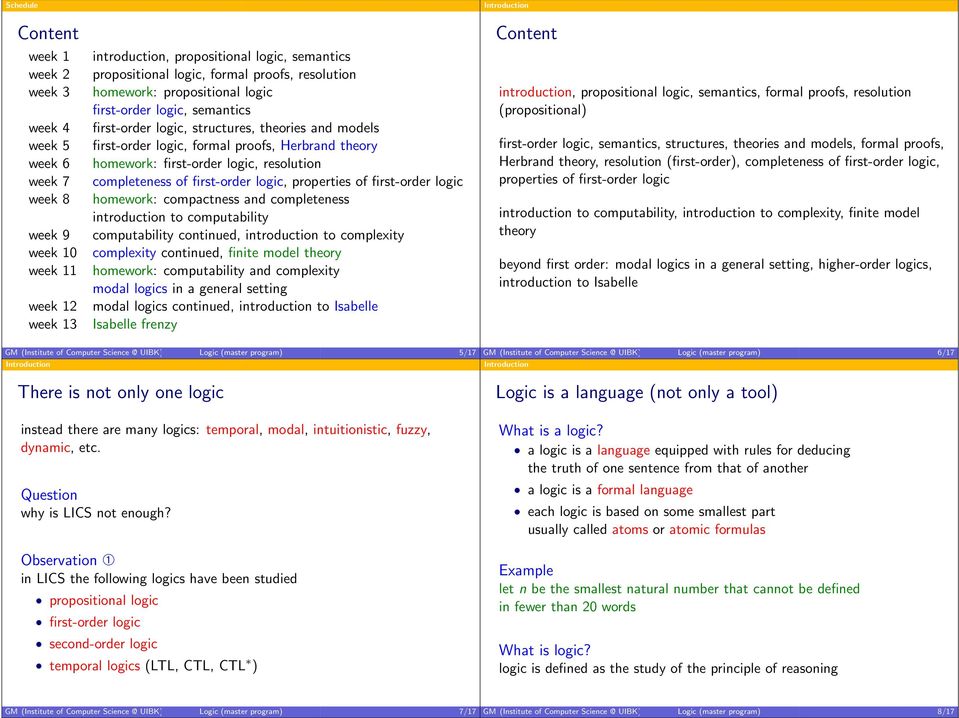
1 OLC mputational gic Schedule Time and Place Thursday, 8:15 9:45, HS E Logic (master program) Georg Moser Institute of Computer UIBK week 1 October 2 week 8 November 20 week 2 October 9 week 9 November 27 (LPAR 08) week 3 October 16 week 10 December 4 week 4 October 23 week 11 December 11 (FSTTCS 08) week 5 October 30 week 12 January 8 week 6 November 6 week 13 January 15 week 7 November 13 first exam January 22 Winter 2008 GM (Institute of Computer UIBK) Logic (master program) 1/17 GM (Institute of Computer UIBK) Logic (master program) 2/17 Literature & Online Material Literature Shawn Hedman A First Course in Logic Oxford University Press, 2008 ISBN Exercises & Exam officially there are no exercises as this course is labelled VO however, without exercises you ll simply fail the exam I ll give bi-weekly exercises which will be discussed in the lecture Online Material Any protest? Transparencies and homework will be available from IP starting with after the lecture; exercises and solutions will be discussed during the lecture GM (Institute of Computer UIBK) Logic (master program) 3/17 GM (Institute of Computer UIBK) Logic (master program) 4/17

2 Schedule week 1 week 2 week 3 week 4 week 5 week 6 week 7 week 8 week 9 week 10 week 11 week 12 week 13 introduction, propositional logic, semantics propositional logic, formal proofs, resolution homework: propositional logic first-order logic, semantics first-order logic, structures, theories and models first-order logic, formal proofs, Herbrand theory homework: first-order logic, resolution completeness of first-order logic, properties of first-order logic homework: compactness and completeness introduction to computability computability continued, introduction to complexity complexity continued, finite model theory homework: computability and complexity modal logics in a general setting modal logics continued, introduction to Isabelle Isabelle frenzy introduction, propositional logic, semantics, formal proofs, resolution (propositional) first-order logic, semantics, structures, theories and models, formal proofs, Herbrand theory, resolution (first-order), completeness of first-order logic, properties of first-order logic introduction to computability, introduction to complexity, finite model theory beyond first order: modal logics in a general setting, higher-order logics, introduction to Isabelle GM (Institute of Computer UIBK) Logic (master program) 5/17 There is not only one logic instead there are many logics: temporal, modal, intuitionistic, fuzzy, dynamic, etc. Question why is LICS not enough? Observation ➀ in LICS the following logics have been studied propositional logic first-order logic second-order logic temporal logics (LTL, CTL, CTL ) GM (Institute of Computer UIBK) Logic (master program) 6/17 Logic is a language (not only a tool) What is a logic? a logic is a language equipped with rules for deducing the truth of one sentence from that of another a logic is a formal language each logic is based on some smallest part usually called atoms or atomic formulas let n be the smallest natural number that cannot be defined in fewer than 20 words What is logic? logic is defined as the study of the principle of reasoning GM (Institute of Computer UIBK) Logic (master program) 7/17 GM (Institute of Computer UIBK) Logic (master program) 8/17
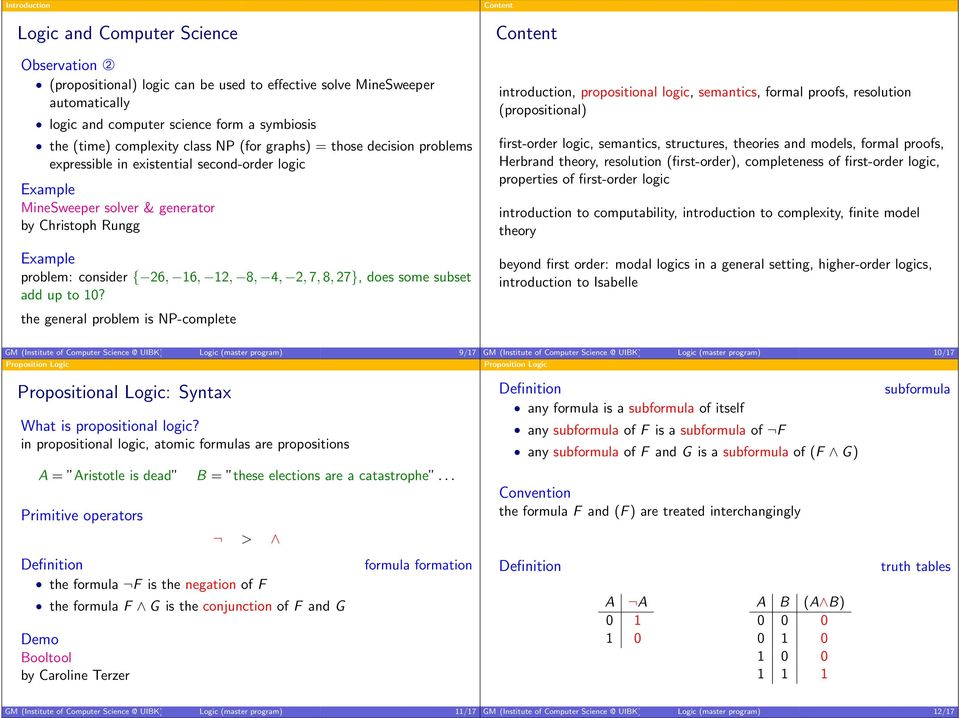
3 Logic and Computer Science Observation ➁ (propositional) logic can be used to effective solve MineSweeper automatically logic and computer science form a symbiosis the (time) complexity class NP (for graphs) = those decision problems expressible in existential second-order logic MineSweeper solver & generator by Christoph Rungg problem: consider { 26, 16, 12, 8, 4, 2, 7, 8, 27}, does some subset add up to 10? the general problem is NP-complete introduction, propositional logic, semantics, formal proofs, resolution (propositional) first-order logic, semantics, structures, theories and models, formal proofs, Herbrand theory, resolution (first-order), completeness of first-order logic, properties of first-order logic introduction to computability, introduction to complexity, finite model theory beyond first order: modal logics in a general setting, higher-order logics, introduction to Isabelle GM (Institute of Computer UIBK) Logic (master program) 9/17 Proposition Logic Propositional Logic: Syntax What is propositional logic? in propositional logic, atomic formulas are propositions A = Aristotle is dead B = these elections are a catastrophe... Primitive operators > the formula F is the negation of F the formula F G is the conjunction of F and G Demo Booltool by Caroline Terzer formula formation GM (Institute of Computer UIBK) Logic (master program) 10/17 Proposition Logic any formula is a subformula of itself any subformula of F is a subformula of F any subformula of F and G is a subformula of (F G) Convention the formula F and (F ) are treated interchangingly A A A B (A B) subformula truth tables GM (Institute of Computer UIBK) Logic (master program) 11/17 GM (Institute of Computer UIBK) Logic (master program) 12/17
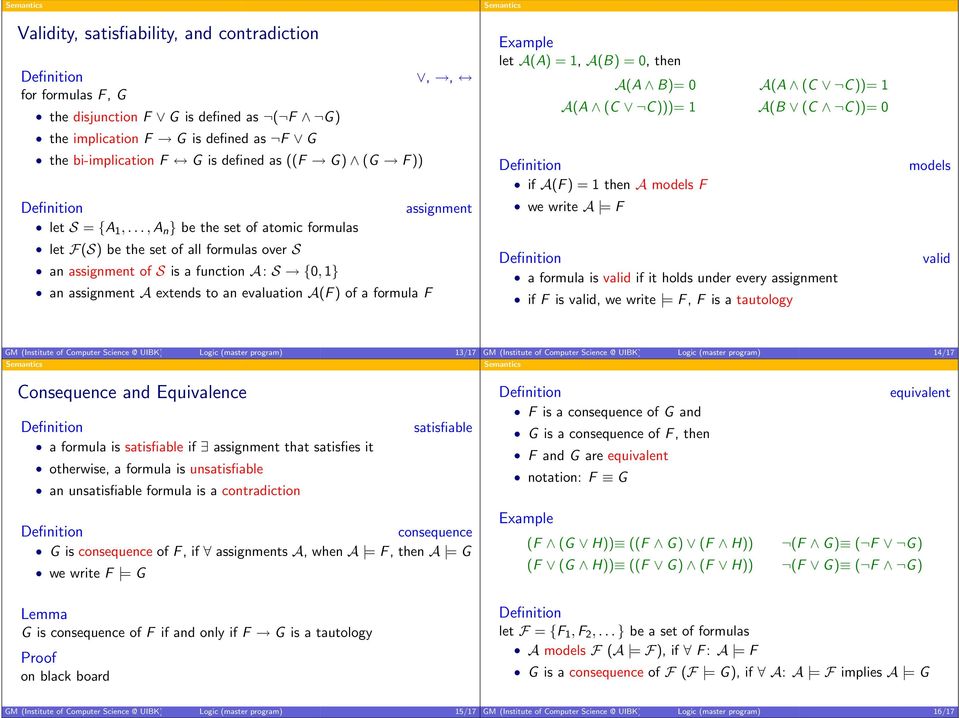
4 Validity, satisfiability, and contradiction,, for formulas F, G the disjunction F G is defined as ( F G) the implication F G is defined as F G the bi-implication F G is defined as ((F G) (G F )) assignment let S = {A 1,..., A n } be the set of atomic formulas let F(S) be the set of all formulas over S an assignment of S is a function A: S {0, 1} an assignment A extends to an evaluation A(F ) of a formula F let A(A) = 1, A(B) = 0, then A(A B)= 0 A(A (C C))= 1 A(A (C C)))= 1 A(B (C C))= 0 if A(F ) = 1 then A models F we write A = F a formula is valid if it holds under every assignment if F is valid, we write = F, F is a tautology models valid GM (Institute of Computer UIBK) Logic (master program) 13/17 Consequence and Equivalence a formula is satisfiable if assignment that satisfies it otherwise, a formula is unsatisfiable an unsatisfiable formula is a contradiction satisfiable consequence G is consequence of F, if assignments A, when A = F, then A = G we write F = G Lemma G is consequence of F if and only if F G is a tautology Proof on black board GM (Institute of Computer UIBK) Logic (master program) 14/17 F is a consequence of G and G is a consequence of F, then F and G are equivalent notation: F G equivalent (F (G H)) ((F G) (F H)) (F G) ( F G) (F (G H)) ((F G) (F H)) (F G) ( F G) let F = {F 1, F 2,... } be a set of formulas A models F (A = F), if F : A = F G is a consequence of F (F = G), if A: A = F implies A = G GM (Institute of Computer UIBK) Logic (master program) 15/17 GM (Institute of Computer UIBK) Logic (master program) 16/17
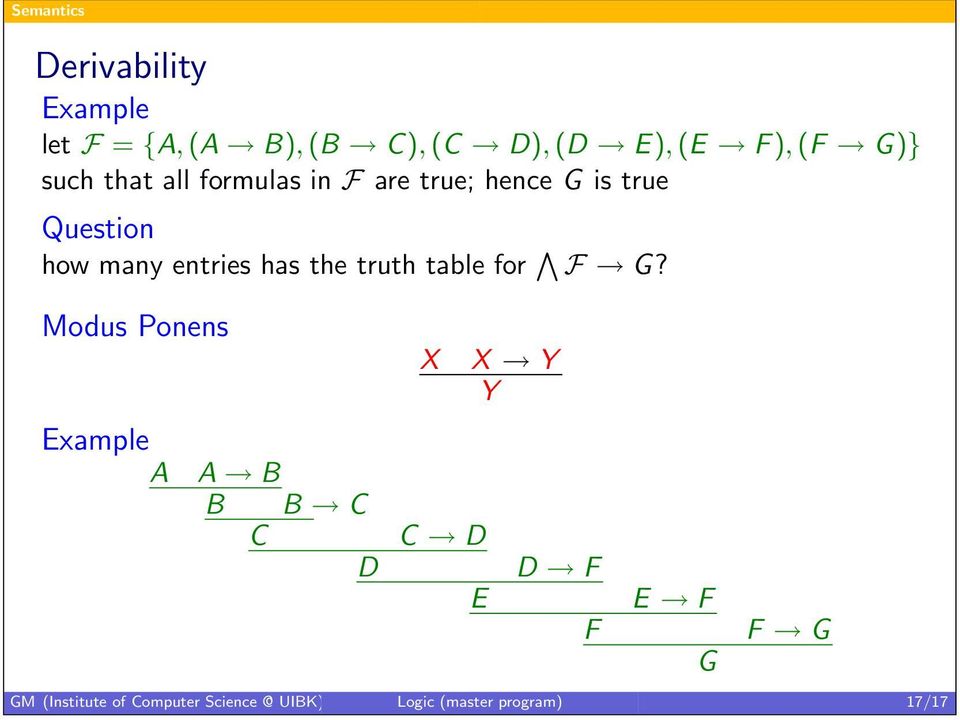
5 Derivability let F = {A, (A B), (B C), (C D), (D E), (E F ), (F G)} such that all formulas in F are true; hence G is true Question how many entries has the truth table for F G? Modus Ponens A A B B B C C D X C D X Y Y E D F F E F G F G GM (Institute of Computer UIBK) Logic (master program) 17/17
Summary Last Lecture. Automated Reasoning. Outline of the Lecture. Definition sequent calculus. Theorem (Normalisation and Strong Normalisation)
 Summary Summary Last Lecture sequent calculus Automated Reasoning Georg Moser Institute of Computer Science @ UIBK Winter 013 (Normalisation and Strong Normalisation) let Π be a proof in minimal logic
Likewise, we have contradictions: formulas that can only be false, e.g. (p p).
 CHAPTER 4. STATEMENT LOGIC 59 The rightmost column of this truth table contains instances of T and instances of F. Notice that there are no degrees of contingency. If both values are possible, the formula
Foundational Proof Certificates
 An application of proof theory to computer science INRIA-Saclay & LIX, École Polytechnique CUSO Winter School, Proof and Computation 30 January 2013 Can we standardize, communicate, and trust formal proofs?
CHAPTER 7 GENERAL PROOF SYSTEMS
 CHAPTER 7 GENERAL PROOF SYSTEMS 1 Introduction Proof systems are built to prove statements. They can be thought as an inference machine with special statements, called provable statements, or sometimes
Beyond Propositional Logic Lukasiewicz s System
 Beyond Propositional Logic Lukasiewicz s System Consider the following set of truth tables: 1 0 0 1 # # 1 0 # 1 1 0 # 0 0 0 0 # # 0 # 1 0 # 1 1 1 1 0 1 0 # # 1 # # 1 0 # 1 1 0 # 0 1 1 1 # 1 # 1 Brandon
Software Modeling and Verification
 Software Modeling and Verification Alessandro Aldini DiSBeF - Sezione STI University of Urbino Carlo Bo Italy 3-4 February 2015 Algorithmic verification Correctness problem Is the software/hardware system
CSL105: Discrete Mathematical Structures. Ragesh Jaiswal, CSE, IIT Delhi
 Propositional Logic: logical operators Negation ( ) Conjunction ( ) Disjunction ( ). Exclusive or ( ) Conditional statement ( ) Bi-conditional statement ( ): Let p and q be propositions. The biconditional
Handout #1: Mathematical Reasoning
 Math 101 Rumbos Spring 2010 1 Handout #1: Mathematical Reasoning 1 Propositional Logic A proposition is a mathematical statement that it is either true or false; that is, a statement whose certainty or
A Propositional Dynamic Logic for CCS Programs
 A Propositional Dynamic Logic for CCS Programs Mario R. F. Benevides and L. Menasché Schechter {mario,luis}@cos.ufrj.br Abstract This work presents a Propositional Dynamic Logic in which the programs are
Model Checking II Temporal Logic Model Checking
 1/32 Model Checking II Temporal Logic Model Checking Edmund M Clarke, Jr School of Computer Science Carnegie Mellon University Pittsburgh, PA 15213 2/32 Temporal Logic Model Checking Specification Language:
(LMCS, p. 317) V.1. First Order Logic. This is the most powerful, most expressive logic that we will examine.
 (LMCS, p. 317) V.1 First Order Logic This is the most powerful, most expressive logic that we will examine. Our version of first-order logic will use the following symbols: variables connectives (,,,,
First-Order Logics and Truth Degrees
 First-Order Logics and Truth Degrees George Metcalfe Mathematics Institute University of Bern LATD 2014, Vienna Summer of Logic, 15-19 July 2014 George Metcalfe (University of Bern) First-Order Logics
CS510 Software Engineering
 CS510 Software Engineering Propositional Logic Asst. Prof. Mathias Payer Department of Computer Science Purdue University TA: Scott A. Carr Slides inspired by Xiangyu Zhang http://nebelwelt.net/teaching/15-cs510-se
Introduction to Software Verification
 Introduction to Software Verification Orna Grumberg Lectures Material winter 2013-14 Lecture 4 5.11.13 Model Checking Automated formal verification: A different approach to formal verification Model Checking
Lecture 13 of 41. More Propositional and Predicate Logic
 Lecture 13 of 41 More Propositional and Predicate Logic Monday, 20 September 2004 William H. Hsu, KSU http://www.kddresearch.org http://www.cis.ksu.edu/~bhsu Reading: Sections 8.1-8.3, Russell and Norvig
Path Querying on Graph Databases
 Path Querying on Graph Databases Jelle Hellings Hasselt University and transnational University of Limburg 1/38 Overview Graph Databases Motivation Walk Logic Relations with FO and MSO Relations with CTL
3. Mathematical Induction
 3. MATHEMATICAL INDUCTION 83 3. Mathematical Induction 3.1. First Principle of Mathematical Induction. Let P (n) be a predicate with domain of discourse (over) the natural numbers N = {0, 1,,...}. If (1)
Which Semantics for Neighbourhood Semantics?
 Which Semantics for Neighbourhood Semantics? Carlos Areces INRIA Nancy, Grand Est, France Diego Figueira INRIA, LSV, ENS Cachan, France Abstract In this article we discuss two alternative proposals for
ON FUNCTIONAL SYMBOL-FREE LOGIC PROGRAMS
 PROCEEDINGS OF THE YEREVAN STATE UNIVERSITY Physical and Mathematical Sciences 2012 1 p. 43 48 ON FUNCTIONAL SYMBOL-FREE LOGIC PROGRAMS I nf or m at i cs L. A. HAYKAZYAN * Chair of Programming and Information
Predicate Logic. For example, consider the following argument:
 Predicate Logic The analysis of compound statements covers key aspects of human reasoning but does not capture many important, and common, instances of reasoning that are also logically valid. For example,
Introduction to Logic: Argumentation and Interpretation. Vysoká škola mezinárodních a veřejných vztahů PhDr. Peter Jan Kosmály, Ph.D. 9. 3.
 Introduction to Logic: Argumentation and Interpretation Vysoká škola mezinárodních a veřejných vztahů PhDr. Peter Jan Kosmály, Ph.D. 9. 3. 2016 tests. Introduction to Logic: Argumentation and Interpretation
Logic in general. Inference rules and theorem proving
 Logical Agents Knowledge-based agents Logic in general Propositional logic Inference rules and theorem proving First order logic Knowledge-based agents Inference engine Knowledge base Domain-independent
Algorithmic Software Verification
 Algorithmic Software Verification (LTL Model Checking) Azadeh Farzan What is Verification Anyway? Proving (in a formal way) that program satisfies a specification written in a logical language. Formal
Computational Logic and Cognitive Science: An Overview
 Computational Logic and Cognitive Science: An Overview Session 1: Logical Foundations Technical University of Dresden 25th of August, 2008 University of Osnabrück Who we are Helmar Gust Interests: Analogical
Mathematics for Computer Science/Software Engineering. Notes for the course MSM1F3 Dr. R. A. Wilson
 Mathematics for Computer Science/Software Engineering Notes for the course MSM1F3 Dr. R. A. Wilson October 1996 Chapter 1 Logic Lecture no. 1. We introduce the concept of a proposition, which is a statement
Formal Verification and Linear-time Model Checking
 Formal Verification and Linear-time Model Checking Paul Jackson University of Edinburgh Automated Reasoning 21st and 24th October 2013 Why Automated Reasoning? Intellectually stimulating and challenging
Model Checking: An Introduction
 Announcements Model Checking: An Introduction Meeting 2 Office hours M 1:30pm-2:30pm W 5:30pm-6:30pm (after class) and by appointment ECOT 621 Moodle problems? Fundamentals of Programming Languages CSCI
Predicate Logic. Example: All men are mortal. Socrates is a man. Socrates is mortal.
 Predicate Logic Example: All men are mortal. Socrates is a man. Socrates is mortal. Note: We need logic laws that work for statements involving quantities like some and all. In English, the predicate is
Aikaterini Marazopoulou
 Imperial College London Department of Computing Tableau Compiled Labelled Deductive Systems with an application to Description Logics by Aikaterini Marazopoulou Submitted in partial fulfilment of the requirements
Predicate logic. Logic in computer science. Logic in Computer Science (lecture) PART II. first order logic
 PART II. Predicate logic first order logic Logic in computer science Seminar: INGK401-K5; INHK401; INJK401-K4 University of Debrecen, Faculty of Informatics [email protected] 1 / 19 Alphabets Logical
Semantics and Verification of Software
 Semantics and Verification of Software Lecture 21: Nondeterminism and Parallelism IV (Equivalence of CCS Processes & Wrap-Up) Thomas Noll Lehrstuhl für Informatik 2 (Software Modeling and Verification)
Remarks on Non-Fregean Logic
 STUDIES IN LOGIC, GRAMMAR AND RHETORIC 10 (23) 2007 Remarks on Non-Fregean Logic Mieczys law Omy la Institute of Philosophy University of Warsaw Poland [email protected] 1 Introduction In 1966 famous Polish
WHAT ARE MATHEMATICAL PROOFS AND WHY THEY ARE IMPORTANT?
 WHAT ARE MATHEMATICAL PROOFS AND WHY THEY ARE IMPORTANT? introduction Many students seem to have trouble with the notion of a mathematical proof. People that come to a course like Math 216, who certainly
CODING TRUE ARITHMETIC IN THE MEDVEDEV AND MUCHNIK DEGREES
 CODING TRUE ARITHMETIC IN THE MEDVEDEV AND MUCHNIK DEGREES PAUL SHAFER Abstract. We prove that the first-order theory of the Medvedev degrees, the first-order theory of the Muchnik degrees, and the third-order
Computational Methods for Database Repair by Signed Formulae
 Computational Methods for Database Repair by Signed Formulae Ofer Arieli ([email protected]) Department of Computer Science, The Academic College of Tel-Aviv, 4 Antokolski street, Tel-Aviv 61161, Israel.
Resolution. Informatics 1 School of Informatics, University of Edinburgh
 Resolution In this lecture you will see how to convert the natural proof system of previous lectures into one with fewer operators and only one proof rule. You will see how this proof system can be used
Fixed-Point Logics and Computation
 1 Fixed-Point Logics and Computation Symposium on the Unusual Effectiveness of Logic in Computer Science University of Cambridge 2 Mathematical Logic Mathematical logic seeks to formalise the process of
WOLLONGONG COLLEGE AUSTRALIA. Diploma in Information Technology
 First Name: Family Name: Student Number: Class/Tutorial: WOLLONGONG COLLEGE AUSTRALIA A College of the University of Wollongong Diploma in Information Technology Final Examination Spring Session 2008 WUCT121
Rigorous Software Development CSCI-GA 3033-009
 Rigorous Software Development CSCI-GA 3033-009 Instructor: Thomas Wies Spring 2013 Lecture 11 Semantics of Programming Languages Denotational Semantics Meaning of a program is defined as the mathematical
196 Chapter 7. Logical Agents
 7 LOGICAL AGENTS In which we design agents that can form representations of the world, use a process of inference to derive new representations about the world, and use these new representations to deduce
Deterministic Discrete Modeling
 Deterministic Discrete Modeling Formal Semantics of Firewalls in Isabelle/HOL Cornelius Diekmann, M.Sc. Dr. Heiko Niedermayer Prof. Dr.-Ing. Georg Carle Lehrstuhl für Netzarchitekturen und Netzdienste
A first step towards modeling semistructured data in hybrid multimodal logic
 A first step towards modeling semistructured data in hybrid multimodal logic Nicole Bidoit * Serenella Cerrito ** Virginie Thion * * LRI UMR CNRS 8623, Université Paris 11, Centre d Orsay. ** LaMI UMR
Temporal Logics. Computation Tree Logic
 Temporal Logics CTL: definition, relationship between operators, adequate sets, specifying properties, safety/liveness/fairness Modeling: sequential, concurrent systems; maximum parallelism/interleaving
Lecture Notes in Discrete Mathematics. Marcel B. Finan Arkansas Tech University c All Rights Reserved
 Lecture Notes in Discrete Mathematics Marcel B. Finan Arkansas Tech University c All Rights Reserved 2 Preface This book is designed for a one semester course in discrete mathematics for sophomore or junior
On the Modeling and Verification of Security-Aware and Process-Aware Information Systems
 On the Modeling and Verification of Security-Aware and Process-Aware Information Systems 29 August 2011 What are workflows to us? Plans or schedules that map users or resources to tasks Such mappings may
x < y iff x < y, or x and y are incomparable and x χ(x,y) < y χ(x,y).
 12. Large cardinals The study, or use, of large cardinals is one of the most active areas of research in set theory currently. There are many provably different kinds of large cardinals whose descriptions
INTRODUCTORY SET THEORY
 M.Sc. program in mathematics INTRODUCTORY SET THEORY Katalin Károlyi Department of Applied Analysis, Eötvös Loránd University H-1088 Budapest, Múzeum krt. 6-8. CONTENTS 1. SETS Set, equal sets, subset,
Propositional Logic. A proposition is a declarative sentence (a sentence that declares a fact) that is either true or false, but not both.
 irst Order Logic Propositional Logic A proposition is a declarative sentence (a sentence that declares a fact) that is either true or false, but not both. Are the following sentences propositions? oronto
Software Verification and Testing. Lecture Notes: Temporal Logics
 Software Verification and Testing Lecture Notes: Temporal Logics Motivation traditional programs (whether terminating or non-terminating) can be modelled as relations are analysed wrt their input/output
Introduction to Logic in Computer Science: Autumn 2006
 Introduction to Logic in Computer Science: Autumn 2006 Ulle Endriss Institute for Logic, Language and Computation University of Amsterdam Ulle Endriss 1 Plan for Today Now that we have a basic understanding
MATHEMATICAL LOGIC FOR COMPUTER SCIENCE
 MATHEMATICAL LOGIC FOR COMPUTER SCIENCE Second Edition WORLD SCIENTIFIC SERIES IN COMPUTER SCIENCE 25: Computer Epistemology A Treatise on the Feasibility of the Unfeasible or Old Ideas Brewed New (T Vamos)
Development of dynamically evolving and self-adaptive software. 1. Background
 Development of dynamically evolving and self-adaptive software 1. Background LASER 2013 Isola d Elba, September 2013 Carlo Ghezzi Politecnico di Milano Deep-SE Group @ DEIB 1 Requirements Functional requirements
MATHEMATICS: CONCEPTS, AND FOUNDATIONS Vol. III - Logic and Computer Science - Phokion G. Kolaitis
 LOGIC AND COMPUTER SCIENCE Phokion G. Kolaitis Computer Science Department, University of California, Santa Cruz, CA 95064, USA Keywords: algorithm, Armstrong s axioms, complete problem, complexity class,
Iterated Dynamic Belief Revision. Sonja Smets, University of Groningen. website: http://www.vub.ac.be/clwf/ss
 LSE-Groningen Workshop I 1 Iterated Dynamic Belief Revision Sonja Smets, University of Groningen website: http://www.vub.ac.be/clwf/ss Joint work with Alexandru Baltag, COMLAB, Oxford University LSE-Groningen
6.080/6.089 GITCS Feb 12, 2008. Lecture 3
 6.8/6.89 GITCS Feb 2, 28 Lecturer: Scott Aaronson Lecture 3 Scribe: Adam Rogal Administrivia. Scribe notes The purpose of scribe notes is to transcribe our lectures. Although I have formal notes of my
First-Order Stable Model Semantics and First-Order Loop Formulas
 Journal of Artificial Intelligence Research 42 (2011) 125-180 Submitted 03/11; published 10/11 First-Order Stable Model Semantics and First-Order Loop Formulas Joohyung Lee Yunsong Meng School of Computing,
University of Ostrava. Reasoning in Description Logic with Semantic Tableau Binary Trees
 University of Ostrava Institute for Research and Applications of Fuzzy Modeling Reasoning in Description Logic with Semantic Tableau Binary Trees Alena Lukasová Research report No. 63 2005 Submitted/to
Bounded-width QBF is PSPACE-complete
 Bounded-width QBF is PSPACE-complete Albert Atserias 1 and Sergi Oliva 2 1 Universitat Politècnica de Catalunya Barcelona, Spain [email protected] 2 Universitat Politècnica de Catalunya Barcelona, Spain
2. The Language of First-order Logic
 2. The Language of First-order Logic KR & R Brachman & Levesque 2005 17 Declarative language Before building system before there can be learning, reasoning, planning, explanation... need to be able to
! " # The Logic of Descriptions. Logics for Data and Knowledge Representation. Terminology. Overview. Three Basic Features. Some History on DLs
 ,!0((,.+#$),%$(-&.& *,2(-$)%&2.'3&%!&, Logics for Data and Knowledge Representation Alessandro Agostini [email protected] University of Trento Fausto Giunchiglia [email protected] The Logic of Descriptions!$%&'()*$#)
Model Checking LTL Properties over C Programs with Bounded Traces
 Noname manuscript No. (will be inserted by the editor) Model Checking LTL Properties over C Programs with Bounded Traces Jeremy Morse 1, Lucas Cordeiro 2, Denis Nicole 1, Bernd Fischer 1,3 1 Electronics
EQUATIONAL LOGIC AND ABSTRACT ALGEBRA * ABSTRACT
 EQUATIONAL LOGIC AND ABSTRACT ALGEBRA * Taje I. Ramsamujh Florida International University Mathematics Department ABSTRACT Equational logic is a formalization of the deductive methods encountered in studying
Predicate logic Proofs Artificial intelligence. Predicate logic. SET07106 Mathematics for Software Engineering
 Predicate logic SET07106 Mathematics for Software Engineering School of Computing Edinburgh Napier University Module Leader: Uta Priss 2010 Copyright Edinburgh Napier University Predicate logic Slide 1/24
CHAPTER 3. Methods of Proofs. 1. Logical Arguments and Formal Proofs
 CHAPTER 3 Methods of Proofs 1. Logical Arguments and Formal Proofs 1.1. Basic Terminology. An axiom is a statement that is given to be true. A rule of inference is a logical rule that is used to deduce
Parametric Domain-theoretic models of Linear Abadi & Plotkin Logic
 Parametric Domain-theoretic models of Linear Abadi & Plotkin Logic Lars Birkedal Rasmus Ejlers Møgelberg Rasmus Lerchedahl Petersen IT University Technical Report Series TR-00-7 ISSN 600 600 February 00
logic language, static/dynamic models SAT solvers Verified Software Systems 1 How can we model check of a program or system?
 5. LTL, CTL Last part: Alloy logic language, static/dynamic models SAT solvers Today: Temporal Logic (LTL, CTL) Verified Software Systems 1 Overview How can we model check of a program or system? Modeling
def: An axiom is a statement that is assumed to be true, or in the case of a mathematical system, is used to specify the system.
 Section 1.5 Methods of Proof 1.5.1 1.5 METHODS OF PROOF Some forms of argument ( valid ) never lead from correct statements to an incorrect. Some other forms of argument ( fallacies ) can lead from true
Formal Specifications of Security Policy Models
 Wolfgang Thumser T-Systems GEI GmbH Overview and Motivation Structure of talk Position of FSPM within CC 3.1 and CEM 3.1 CC Requirements CEM Requirements National Scheme Realization of FSPM in terms of
Sudoku as a SAT Problem
 Sudoku as a SAT Problem Inês Lynce IST/INESC-ID, Technical University of Lisbon, Portugal [email protected] Joël Ouaknine Oxford University Computing Laboratory, UK [email protected] Abstract Sudoku
Lecture 8: Resolution theorem-proving
 Comp24412 Symbolic AI Lecture 8: Resolution theorem-proving Ian Pratt-Hartmann Room KB2.38: email: [email protected] 2014 15 In the previous Lecture, we met SATCHMO, a first-order theorem-prover implemented
WOLLONGONG COLLEGE AUSTRALIA. Diploma in Information Technology
 First Name: Family Name: Student Number: Class/Tutorial: WOLLONGONG COLLEGE AUSTRALIA A College of the University of Wollongong Diploma in Information Technology Mid-Session Test Summer Session 008-00
Outline. NP-completeness. When is a problem easy? When is a problem hard? Today. Euler Circuits
 Outline NP-completeness Examples of Easy vs. Hard problems Euler circuit vs. Hamiltonian circuit Shortest Path vs. Longest Path 2-pairs sum vs. general Subset Sum Reducing one problem to another Clique
Logic, Algebra and Truth Degrees 2008. Siena. A characterization of rst order rational Pavelka's logic
 Logic, Algebra and Truth Degrees 2008 September 8-11, 2008 Siena A characterization of rst order rational Pavelka's logic Xavier Caicedo Universidad de los Andes, Bogota Under appropriate formulations,
Lecture 7: NP-Complete Problems
 IAS/PCMI Summer Session 2000 Clay Mathematics Undergraduate Program Basic Course on Computational Complexity Lecture 7: NP-Complete Problems David Mix Barrington and Alexis Maciel July 25, 2000 1. Circuit
NP-Completeness and Cook s Theorem
 NP-Completeness and Cook s Theorem Lecture notes for COM3412 Logic and Computation 15th January 2002 1 NP decision problems The decision problem D L for a formal language L Σ is the computational task:
We would like to state the following system of natural deduction rules preserving falsity:
 A Natural Deduction System Preserving Falsity 1 Wagner de Campos Sanz Dept. of Philosophy/UFG/Brazil [email protected] Abstract This paper presents a natural deduction system preserving falsity. This new
Dedekind s forgotten axiom and why we should teach it (and why we shouldn t teach mathematical induction in our calculus classes)
 Dedekind s forgotten axiom and why we should teach it (and why we shouldn t teach mathematical induction in our calculus classes) by Jim Propp (UMass Lowell) March 14, 2010 1 / 29 Completeness Three common
A Problem Course in Mathematical Logic Version 1.6. Stefan Bilaniuk
 A Problem Course in Mathematical Logic Version 1.6 Stefan Bilaniuk Department of Mathematics Trent University Peterborough, Ontario Canada K9J 7B8 E-mail address: [email protected] 1991 Mathematics Subject
Using Patterns and Composite Propositions to Automate the Generation of Complex LTL
 University of Texas at El Paso DigitalCommons@UTEP Departmental Technical Reports (CS) Department of Computer Science 8-1-2007 Using Patterns and Composite Propositions to Automate the Generation of Complex
Validated Templates for Specification of Complex LTL Formulas
 Validated Templates for Specification of Complex LTL Formulas Salamah Salamah Department of Electrical, computer, Software, and Systems Engineering Embry Riddle Aeronautical University 600 S. Clyde Morris
Updating Action Domain Descriptions
 Updating Action Domain Descriptions Thomas Eiter, Esra Erdem, Michael Fink, and Ján Senko Institute of Information Systems, Vienna University of Technology, Vienna, Austria Email: (eiter esra michael jan)@kr.tuwien.ac.at
Analyzing First-order Role Based Access Control
 Analyzing First-order Role Based Access Control Carlos Cotrini, Thilo Weghorn, David Basin, and Manuel Clavel Department of Computer Science ETH Zurich, Switzerland {basin, ccarlos, thiloweghorn}@infethzch
Discrete Mathematics and Probability Theory Fall 2009 Satish Rao, David Tse Note 2
 CS 70 Discrete Mathematics and Probability Theory Fall 2009 Satish Rao, David Tse Note 2 Proofs Intuitively, the concept of proof should already be familiar We all like to assert things, and few of us
Predicate Logic Review
 Predicate Logic Review UC Berkeley, Philosophy 142, Spring 2016 John MacFarlane 1 Grammar A term is an individual constant or a variable. An individual constant is a lowercase letter from the beginning
Formal Engineering for Industrial Software Development
 Shaoying Liu Formal Engineering for Industrial Software Development Using the SOFL Method With 90 Figures and 30 Tables Springer Contents Introduction 1 1.1 Software Life Cycle... 2 1.2 The Problem 4 1.3
Lemma 5.2. Let S be a set. (1) Let f and g be two permutations of S. Then the composition of f and g is a permutation of S.
 Definition 51 Let S be a set bijection f : S S 5 Permutation groups A permutation of S is simply a Lemma 52 Let S be a set (1) Let f and g be two permutations of S Then the composition of f and g is a
Chapter. NP-Completeness. Contents
 Chapter 13 NP-Completeness Contents 13.1 P and NP......................... 593 13.1.1 Defining the Complexity Classes P and NP...594 13.1.2 Some Interesting Problems in NP.......... 597 13.2 NP-Completeness....................
A Working Knowledge of Computational Complexity for an Optimizer
 A Working Knowledge of Computational Complexity for an Optimizer ORF 363/COS 323 Instructor: Amir Ali Ahmadi TAs: Y. Chen, G. Hall, J. Ye Fall 2014 1 Why computational complexity? What is computational
Rules of Inference Friday, January 18, 2013 Chittu Tripathy Lecture 05
 Rules of Inference Today s Menu Rules of Inference Quantifiers: Universal and Existential Nesting of Quantifiers Applications Old Example Re-Revisited Our Old Example: Suppose we have: All human beings
Math 3000 Section 003 Intro to Abstract Math Homework 2
 Math 3000 Section 003 Intro to Abstract Math Homework 2 Department of Mathematical and Statistical Sciences University of Colorado Denver, Spring 2012 Solutions (February 13, 2012) Please note that these