
Athena SWAN Bronze and Silver Department award application
|
|
|
- Rodney Bennett
- 10 years ago
- Views:
Transcription
1 Athena SWAN Bronze and Silver Department award application Name of institution: Queen s University Belfast Date of application: November 2011 Department: School of Electronics, Electrical Engineering & Computer Science Contact for application: Professor Máire O Neill [email protected] Telephone: Departmental website address: Date of university Bronze and/or Silver SWAN award: Silver 2007/Bronze 2010 Level of award applied for: Silver

2 1. Letter of endorsement from the Head of Department maximum 500 words See attached.

3 2. The self-assessment process maximum 1000 words Self-Assessment Team Members: Professor Stan Scott is Head of School of Electronics, Electronic Engineering and Computer Science (EEECS). He has been an academic in the School for over 25 years. He has previously held the positions of Director of Education and Research Director of the High Performance and Distributed Computing research cluster. He is married to a female academic who works in another School in the University and has two daughters. He has experience of childcare responsibilities from young children to young adults. Professor Máire O Neill is the Athena SWAN Champion for the School and is Chair of the self-assessment committee. She is Technical Director of Data Security Systems in the School s Centre for Secure Information Technology (CSIT) and is Chair of the School s EEE REF Reading panel. She has one young child and her husband is also in full-time employment. Professor Danny Crookes is Research Director of the Speech, Image and Vision Systems research cluster in the School. He has been an academic within the School for over 30 years and is a former Head of Department of Computer Science. Dr Victoria Stewart completed her undergraduate and post-graduate degrees in the School. She was employed as a temporary lecturer in the School from 2008 to 2010 and is currently a post-doctoral researcher within the Intelligent Systems and Control research cluster. Dr Xin Yang is an Engineer in the School s Institute of Electronics, Communications and Information Technology (ECIT). She has one young child and a partner, who is also employed as a full-time Engineer in ECIT. Allister Lee is the School Manager and is responsible for administrative and technical staff within the School. He sits on all key committees within the School. Allister has worked in the University for over 16 years. He has three young children and a partner in full-time employment. Gemma O Donnell is the School Marketing and Student Recruitment Officer, having been recruited to the post from outside the University in Yvonne McKnight is the School s postgraduate administrator for both taught and research. She has one daughter and two grand-children and regularly assists with their childcare. Sable Campbell is a final year PhD student within the School. The Self-Assessment Team was initially set up in 2009 and was expanded in January 2011 to include the new Head of School, Professor Scott, and representation from a range of staff experiences, both professionally and personally. The team hold a meeting every 2 months to discuss the School s annual gender-related statistical information, on-going activities and also to plan future activities to address the gender imbalances identified at the key career transition points (a key area of concern in the School being the transition from PhD to post-doctoral studies).

4 After analysis of this year s data, an online survey was carried out by Ms O Donnell and Dr Stewart of PhD students and post-doctoral researchers (both male and female) within the School to ascertain their views on a career in academia. This was followed-up by a focus group targeting female PhD students. The results have helped to inform a number of the proposed actions outlined in the Action Plan. The School s Action Plan for October 2011-October 2014 has been reviewed by the University s SWAN Steering Group, which comprises the Director of the Queen s Gender Initiative, the Director of Human Resources, the University s Equal Opportunities Manager, the Dean of Engineering and Physical Sciences and senior staff from other Schools. Professor Máire O Neill also attends monthly SWAN Champion meetings, at which all of the University s SWAN Champions meet to discuss and share best practice. The presence of the Head of School on the self-assessment team has been of significant benefit. He reports on the School s SWAN activities to the School Management Committee, the most senior committee in the School, and has been able to help raise awareness among all staff in the School of the gender-related imbalances at key career stages. This has led to direct feedback and suggestions on SWAN activities from members of staff outside of the self-assessment team. School SWAN activities are reported by Professor O Neill at School Board meetings, which are held quarterly and attended by all staff (Action 6.2). The School has a dedicated webpage regarding the SWAN initiative ( which currently provides information on funding opportunities (including gender-specific schemes) for research staff (Action 5.2) and a direct link to the University s family-friendly policies and forms, and information on its crèche facilities. This is maintained by the School web co-ordinator. Future plans include using the website to promote the current and planned SWAN-related activities in the School. The team will continue to meet on a two-monthly basis to monitor the implementation and progress of current activities and those proposed in the Action Plan. (793 words) 3. A picture of the department maximum 2000 words EEECS is one of the largest Schools in Queen s University Belfast. The School was formed in 2005 through the amalgamation of the former Schools of Electrical and Electronic Engineering (EEE) and Computer Science (CS). It is based across 4 sites, including the 40m ECIT research centre which is situated in the Northern Ireland Science Park in Belfast, 5 miles from the main site. ECIT is also the location of CSIT (Centre for Secure Information Technologies) which is a UK EPSRC/TSB Innovation and Knowledge Centre. These different sites have led to highly autonomous research groups and researchers working in isolation. Therefore, to improve networking among researchers, the School has established a Research Society and an EEECS Doctoral Student network. The School offers a number of degrees, including core, professional accredited undergraduate courses alongside research-focussed postgraduate programmes, all of which span the broad disciplines of EEE and CS. In the past, the School has achieved top scores in teaching quality assessments. It also has an excellent record for research. Research within the School is divided into 9 research clusters. The School performed well in the 2008 RAE with 60% of research output across the School judged to be internationally excellent and 15-20% deemed to be world leading.
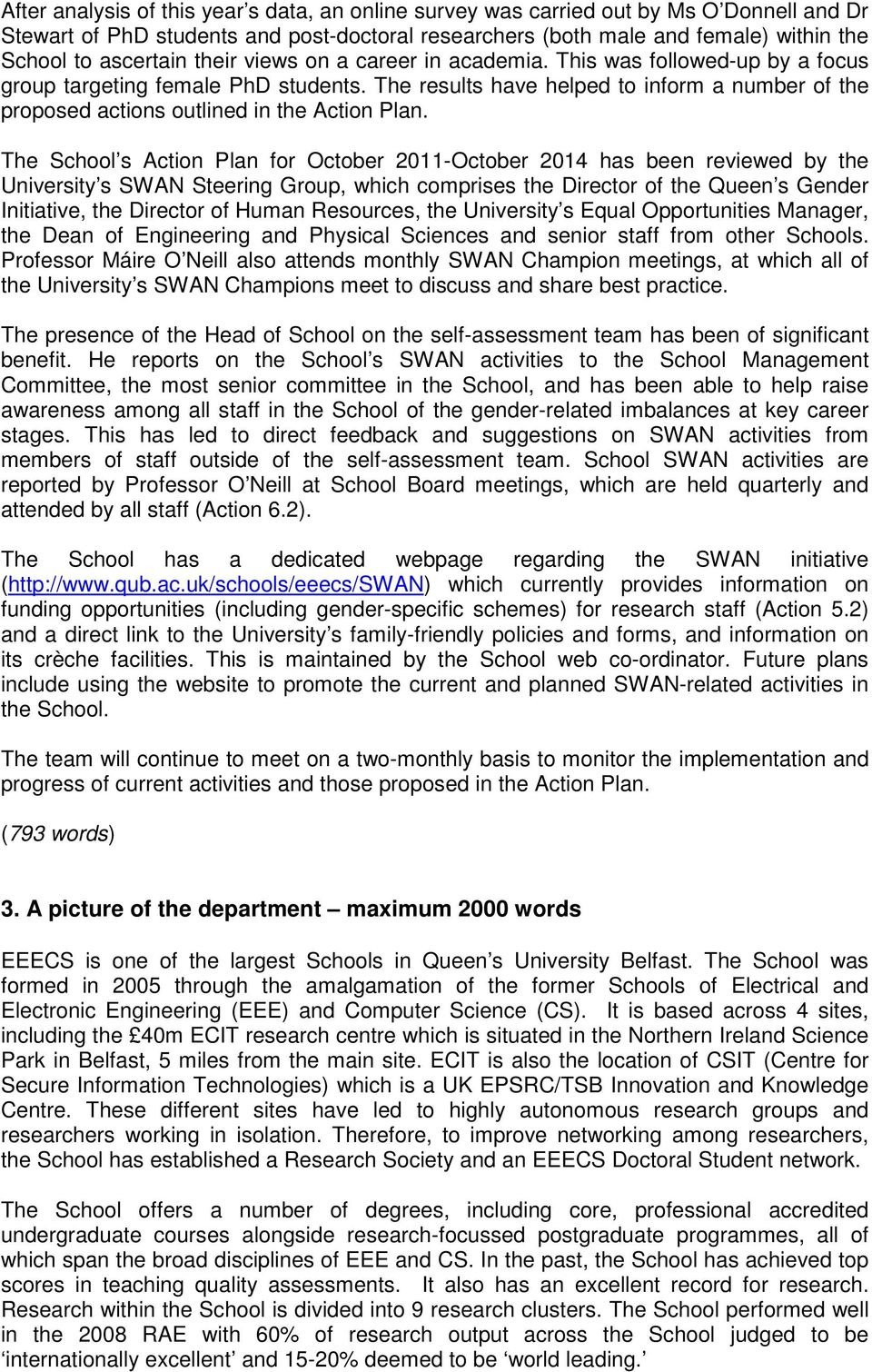
5 In 2009/10 the School had approximately 1000 undergraduate students, 220 postgraduate students, 45% of whom were PhD students, and 66 research staff. There were 59 members of academic staff, with 16 full professors, including 1 Fellow of the Royal Society, 4 Fellows of the Royal Academy of Engineering and 3 IEEE Fellows. Overall, females represented 22.5% of the School s population (overview in Fig. 1). Over the last three years ( ), the percentage of female undergraduates and postgraduates is in line with the UK national average for engineering and computer science. However, the School has identified a drop-off in the number of females continuing to post-doctoral research from PhD studies, in comparison to the UK average. The number of female academics in the School (10%) is also slightly lower than the UK average (12%). The management structure comprises a Head of School, Director of Education and 9 Research Directors who lead the research clusters. In 2010, two female staff members were promoted to professorial level, becoming the first female Professors in the School s history. One of these Professors was subsequently appointed to a Research Director position and a female senior teaching fellow appointed to Director of Education. This has resulted in a female academic presence in the School s senior management committees for the first time. The School feels that this is an ideal foundation on which to continue to build and develop its SWAN activities. (439 words) Fig. 1. Overview of female/male numbers at (a) Undergraduate level and (b) Postgraduate, Research and Academic level in the School of EEECS, 2009/10

6 Student data (i) Numbers of males and females on access or foundation courses Over the past few years, the School has run foundation degree courses in Web Technology and e-commerce and Creative Multimedia at two further education colleges in Northern Ireland (NI) targeting those returning to the workforce, or those who have not followed traditional career paths. The number of females on the foundation degrees has remained static for the last 3 years while the number of males has declined (Fig. 2). The School has been involved in a number of initiatives organised by the Widening Participation Unit in the University to attract non-traditional groups, including women to the courses. Examples include running taster events on the courses, giving talks at the schools and FE Colleges and providing additional information on vocational entry requirements for our courses beyond what is provided in standard University literature. However, in 2011, the colleges decided to close these foundation degrees. Therefore, no further action will be undertaken regarding these courses. (152 words) Fig. 2. Numbers of females/males on foundation courses in the School of EEECS for the past 3 years (ii) Undergraduate male and female numbers The overall F:M ratio in EEE in the School has increased slightly over the past 3 years and is higher than the UK average (Fig. 3a). The overall F:M ratio for CS has also increased since 2007 to 0.3:1, which is significantly higher than the UK average of 0.2:1 for CS courses (Fig.3b). This is due to one of the School s CS courses, Business and Information Technologies (BIT), which has a high percentage of females (40% on average) in comparison to our more traditional CS course (22%). Considering the CS course on its own, its F:M ratio is 0.21:1, which is in line with the national average. The percentage of part-time females undertaking undergraduate courses has fluctuated, but has improved since 2007, with the majority enrolling in CS courses only 3 females have enrolled in EEE part-time over the three years (Table 1). The School has a dedicated Marketing and Student Recruitment Officer, who is a member of the self-assessment team, and who undertakes a large number of activities to recruit

7 students. Over 30 schools in NI are visited each year for talks and careers conventions. In recent years, the School has aimed to visit at least half of the all-girls grammar schools. Last year, 69% of the schools visited were mixed, 12% were all-boys schools while 19% were all-girls grammar schools this accounted for 50% (6 out of 12) of the all-girls grammar schools in NI. The School hopes to increase this number further over the next three years (Action 2.1). The School works closely with Sentinus, an educational charity involved in promoting science and engineering. For the past few years we have helped to facilitate their GETSET Insight into Engineering programme for girls, a daylong visit each year of approximately 70 female school pupils who are considering engineering (Action 2.1). The School also holds an engineering parents evening with other engineering Schools in the University, which attracts over 600 people. For all these events, the School specifically employs female role models (>50%) from our existing undergraduate and postgraduate cohort in order to attract new female students (Action 2.1). This has proved very successful with the majority of female school students approaching the female rather than the male role models at these events. Although the F:M ratios are higher than the national averages, the School is keen to continue its efforts to attract females to undergraduate courses, as they are part of the pipeline that can help address the underrepresentation of female academic staff in the future. In 2011 the School introduced an Ambassador Scheme to formally recognise our female role models, who assist at recruitment events throughout the year. The Scheme is also open to male students and it now formally contributes towards the QUB Degree Plus Award 1 (Action 2.3). This year the School also supported the launch of an UG Computing Society ( the aim of which is to provide both social and academic networking opportunities for all UG students studying computing-related courses (Action 2.3). In the future, we intend to monitor the success of the current initiatives to attract females (Action 2.2). We will also provide support to females entering courses through the undergraduate Peer Mentoring scheme, which was launched in October 2011, by pairing them with female mentors (Action 2.3). (545 words) Table 1. Undergraduate full and part-time students in the School of EEECS, Full-time Part-time Total Female Male %F Female Male %F Female Male %F The QUB Degree Plus Award is a University initiative, which accredits skills developed through extra-curricular activities.

8 Fig. 3. Undergraduate students in the School of EEECS undertaking (a) Electrical and Electronic Engineering (EEE) courses and (b) Computer Science (CS) courses compared with the UK averages for the corresponding subject areas (HESA, 2010) (iii) Postgraduate male and female numbers completing taught courses The overall number of females completing PGT courses in the School has increased but the percentage has decreased (41% to 36% overall) as the number of male students has increased at a greater rate (Table 2). The F:M ratio on PGT EEE courses has fluctuated over the past 3 years, but is currently in line with the UK average (Fig. 4a). There have been no females undertaking part-time EEE courses. The F:M ratio on PGT CS courses is significantly greater than the UK average in this subject area (Fig. 4b). This is due to the MSc in Educational Multimedia which attracts a high percentage of females, both full-time and part-time. The figures suggest that there is no need to take action for the CS PGT courses. Many of our undergraduate EEE students pursue the MEng pathway so they do not see the benefit of completing an MSc qualification. In addition, a high percentage of students on the PGT EEE courses are international (80%). Therefore, we hope to attract more female international students to these courses by improving the marketing of the School s SWAN activities within our international recruitment initiatives aimed at PGT courses (Action 3.1). (195 words) Fig. 4. Postgraduate taught students in the School of EEECS undertaking (a) Electrical and Electronic Engineering (EEE) courses and (b) Computer Science (CS) courses compared with the UK averages for the corresponding subject areas (HESA, 2010)

9 Table 2. Postgraduate taught full and part-time students in the School of EEECS, Full-time Part-time Total Female Male %F Female Male %F Female Male %F EEE CS EEE CS EEE CS (iv) Postgraduate male and female numbers on research degrees The number of females and the F:M ratio in EEE PGR has remained static over the past three years and is on par with the UK average (Table 3, Fig. 5a). The number and percentage of females in CS PGR have improved; the percentage of females increased to 30% in 2010, bringing it above the national average of 22% (Table 3, Fig. 5b) 2. Very few females undertake part-time postgraduate research (Table 3). In addition to the usual literature provided to undergraduate students regarding PhD opportunities within the School, since 2008 dedicated Research Open Days have been organised to offer the undergraduate cohort a flavour of the research being undertaken in its research institutes, an initiative led by the School s SWAN champion (Action 3.2). As a result, a number of our undergraduate female CS students went on to study PhDs in the School in As a PhD is a vital step towards a career in academia, further actions are planned to continue to improve the F:M ratio at PGR level. These include providing all potential female applicants with information on the School s SWAN activities and sending them case studies of female PhDs highlighting their positive experiences at Queen s, in addition to offering 2 summer research internships for female undergraduate students so that they gain experience of life as a researcher (Action 3.2). (223 words) Fig. 5. Postgraduate students in the School of EEECS undertaking (a) Electrical and Electronic Engineering (EEE) research and (b) Computer Science (CS) research compared with the UK averages for the corresponding subject areas (HESA, 2010) 2 It is worth noting that due to the lack of programming content in the undergraduate CS Business Information Technology course, which attracts a high percentage of females at that level, it does not offer a route to PhD study within the School, and therefore, does not influence these figures.

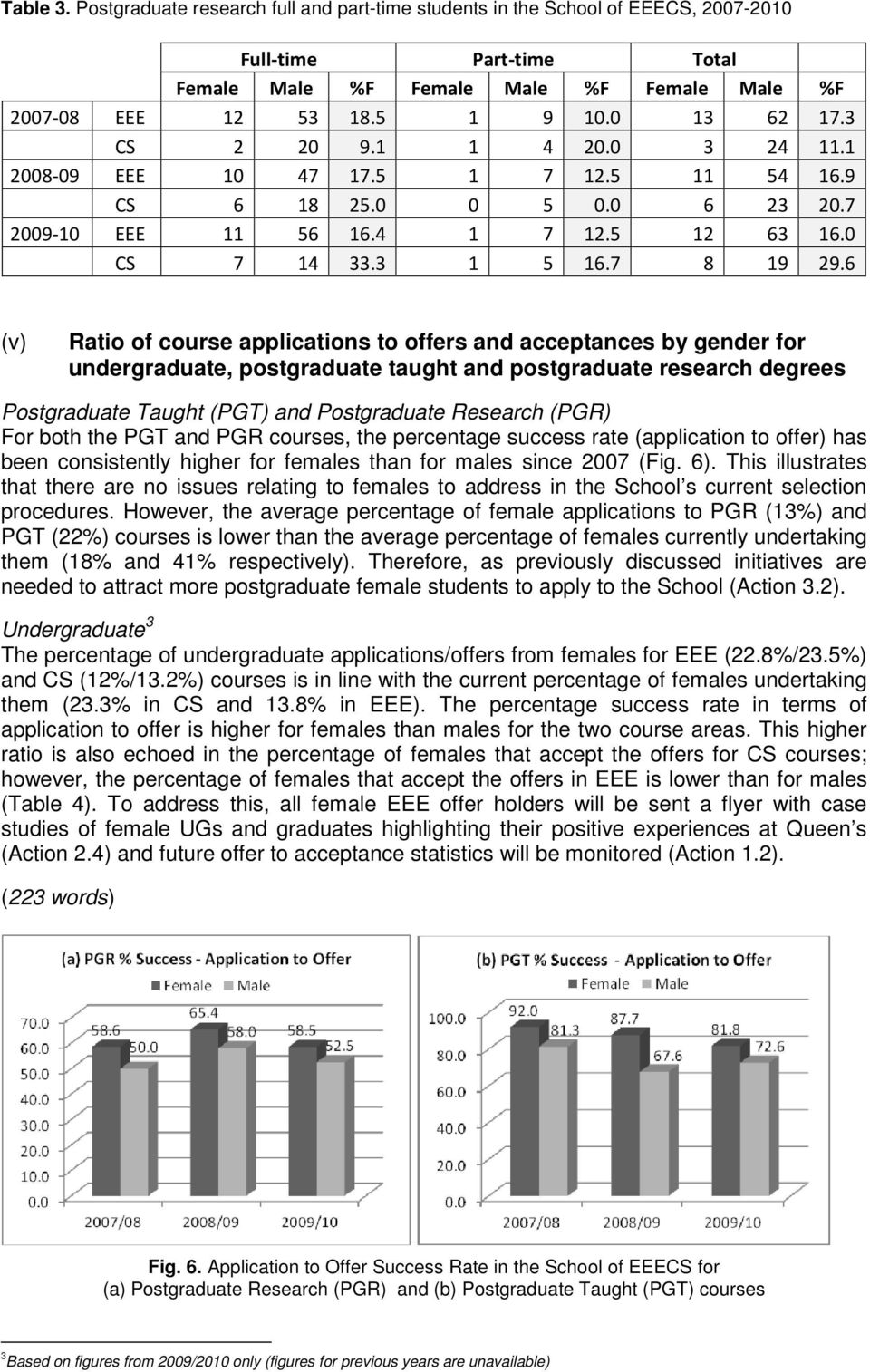
10 Table 3. Postgraduate research full and part-time students in the School of EEECS, Full-time Part-time Total Female Male %F Female Male %F Female Male %F EEE CS EEE CS EEE CS (v) Ratio of course applications to offers and acceptances by gender for undergraduate, postgraduate taught and postgraduate research degrees Postgraduate Taught (PGT) and Postgraduate Research (PGR) For both the PGT and PGR courses, the percentage success rate (application to offer) has been consistently higher for females than for males since 2007 (Fig. 6). This illustrates that there are no issues relating to females to address in the School s current selection procedures. However, the average percentage of female applications to PGR (13%) and PGT (22%) courses is lower than the average percentage of females currently undertaking them (18% and 41% respectively). Therefore, as previously discussed initiatives are needed to attract more postgraduate female students to apply to the School (Action 3.2). Undergraduate 3 The percentage of undergraduate applications/offers from females for EEE (22.8%/23.5%) and CS (12%/13.2%) courses is in line with the current percentage of females undertaking them (23.3% in CS and 13.8% in EEE). The percentage success rate in terms of application to offer is higher for females than males for the two course areas. This higher ratio is also echoed in the percentage of females that accept the offers for CS courses; however, the percentage of females that accept the offers in EEE is lower than for males (Table 4). To address this, all female EEE offer holders will be sent a flyer with case studies of female UGs and graduates highlighting their positive experiences at Queen s (Action 2.4) and future offer to acceptance statistics will be monitored (Action 1.2). (223 words) Fig. 6. Application to Offer Success Rate in the School of EEECS for (a) Postgraduate Research (PGR) and (b) Postgraduate Taught (PGT) courses 3 Based on figures from 2009/2010 only (figures for previous years are unavailable)
11 Table 4. Undergraduate % of Applications to Offers to Acceptances in the School of EEECS, 2009/2010 % Application to Offer % Offer to Acceptance Female Male Female Male CS EEE (vi) Degree classification by gender Overall, females achieve better degree classifications than males (Fig. 7). The average percentage of females achieving a 1 st or 2.1 is 81% in comparison to 68% for males over the three years. Therefore, in relation to degree classification, this illustrates that there are no issues relating to females that need to be addressed. In 2011, the five females graduating from UG EEE all came in the top six in their class. This highlights that the supportive environment the School endeavours to create for its female students allows them to excel in their studies. (93 words) Fig. 7. The percentage of each gender who gained each degree class in the School of EEECS

12 Staff data (vii) Female:male ratio of academic staff and research staff researcher, lecturer, senior lecturer, reader, professor (or equivalent). comment on any differences in numbers between males and females and say what action is being taken to address any underrepresentation at particular grades/levels Research Staff Although the numbers of both male and female research staff have remained static over the last 3 years (Fig. 8), the number of females taking up post-doctoral research positions in the School is extremely low (average of only 9%) in comparison to the UK average of 18.7%. There is clearly a significant drop-off in the numbers of females continuing to postdoctoral research from PhD studies (average of 18.6% female PhDs, ). This is a critical problem that needs to be addressed in order to improve the number of female academics in the future. Academic Staff The percentage of female academics in the School (10%) (Fig. 9) is slightly lower than the UK average of 12% for the same subject area (HESA, 2008/09). However, female staff have been promoted to higher grades since In 2010/11, the female at Lecturer level was promoted to Senior Lecturer and two of the females at Reader level were promoted to Professors, the first female Professors in the School s history. It is interesting to see that there appears to be no drop-off in the percentage of females between post-doctoral and academic stages within the School, whereas, in the UK in general, there appears to be a drop-off from 18.6% to 12%. Initiatives In 2008/09, a School SWAN network was set-up to support networking among female postgraduate, research and academic staff. This has now been merged into a School Research Society, which was established in early 2011 to enhance the quality of the research experience for all researchers within the School (Action 6.3). At the request of the School SWAN self-assessment team, the society aims to hold at least one specific female focussed event as part of its calendar of activities each year. Feedback obtained from a number of meetings held by the SWAN network in 2008/09 found that female students wanted networking opportunities to be available for students based across the School s four sites. Therefore, in 2008/09, an EEECS Doctoral Student network, led by two female academics, was established for PhD students, the aim of which was not only to improve networking among the students, but also to gain feedback on issues relating to their studies (Action 6.1). A range of social events have since been organised for students. In 2009/10 the number and percentage of female research staff improved (12%) over the previous two years (7% in 2007/08 and 6.7% in 2008/09). However, since the numbers of females are still well below the national average, in 2011, a further effort was made to identify the cause of the drop-off of females at post-doctoral level. An online survey was conducted of all current PhD students and post-doctoral researchers (male and female) to ascertain whether they planned to pursue a research/academic career (further information is provided in Section 8). The results revealed no specific gender-related issues to explain the drop-off effect. A follow-on focus group was then held with 21% of the female PhD students. This revealed similar feedback to previous SWAN meetings; that the female students wanted further networking opportunities to be made available. 100% of the female post-doctoral researchers stated that they wished to pursue an academic career. Interestingly, this matches the findings of the School s statistical results which show that

13 there is no drop-off in the percentage of females between post-doctoral and academic level. This survey will be repeated every 2 years (Action 4.1). Further planned actions to improve the F:M ratio at postgraduate research level include the launch of a peer mentoring scheme for PhD students and post-doctoral researchers in 2012/13, similar to that set-up this year for undergraduate students with female mentors paired with female mentees (Action 4.1). The School plans to also introduce a female academic support team for female PhD students and post-doctoral researchers in 2012/13 (Action 4.1) to provide direct mentoring and career advice for all female PhD students and researchers within the School. It is also intended to run coffee mornings across all the School s sites from 2012 (Action 6.3). (660 words) Fig. 8. The number of research staff by gender in the School of EEECS Fig. 9. The number of Academic staff by gender in the School of EEECS

14 (viii) Turnover by grade and gender No female academics have left the School in the past three years whereas 10 male academics have left. 49 male and 3 female researchers have left the School in the last 3 years. The ratio of males and females leaving is in line with the ratio actually employed. There do not appear to be any issues with retention of females in either academic or research posts. (66 words)

15 Supporting and advancing women s careers maximum 5000 words 4. Key career transition points a) (i) Job application and success rates by gender and grade Due to the small numbers of academic posts in any given year, the associated numbers and percentages have fluctuated (Table 5). Although, on average over the three years, the female success rate has been higher (4.5%) than for males, the number of applications from females for academic posts has declined. The number of females applying for research posts has increased since 2007 (Table 6) with the percentage of female appointees also increasing from 5.5 to 20%. Since 2010/11, the School includes a statement on advertised academic posts welcoming female applicants (Action 4.2). Future plans include further promotion and marketing of the School s SWAN activities via its website and in advertisement packs to help improve the number of female applicants for academic posts (Action 4.2). (124 words) Table 5. Academic Job Application and Success Rate in the School of EEECS Applications Received Appointees Success Rate Female Male Female Male Female Male 2007/ % 6.40% 2008/ % 0.00% 2009/ % 3.70% Overall total % 3.0% Table 6. Research Job Application and Success Rate in the School of EEECS Applications Received Appointees Success Rate Female Male Female Male Female Male 2007/ % 10.6% 2008/ % 6.1% 2009/ % 7.4% Overall total % 7.9% (ii) Applications for promotion and success rates by gender and grade Since 2010 the School has adopted a very proactive approach to promotions and start the process early each year (Action 5.1). Potential candidates are identified early so that they can get essential support and advice on their Academic CVs. Academics are encouraged to develop their online CVs in line with the University s academic profiles by their line managers during the appraisal process. In addition to this, advice can also be sought directly from their Research Director and the Head of School, who both sit on the School Promotion Committee. The School holds a dedicated seminar annually on Academic Career Development and Promotion, which is typically given by a senior academic external to the School who has experience of sitting on promotion committees. This
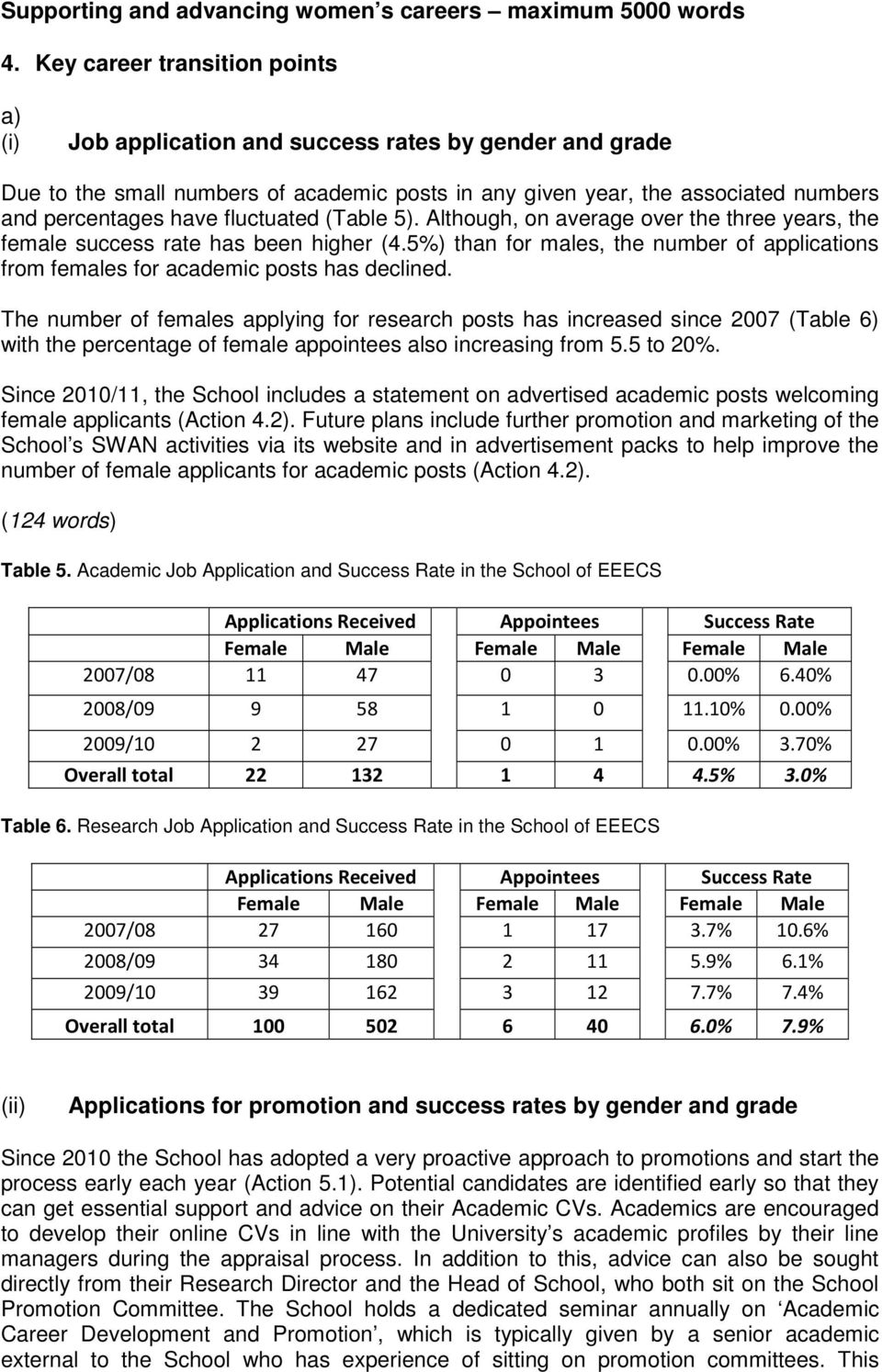
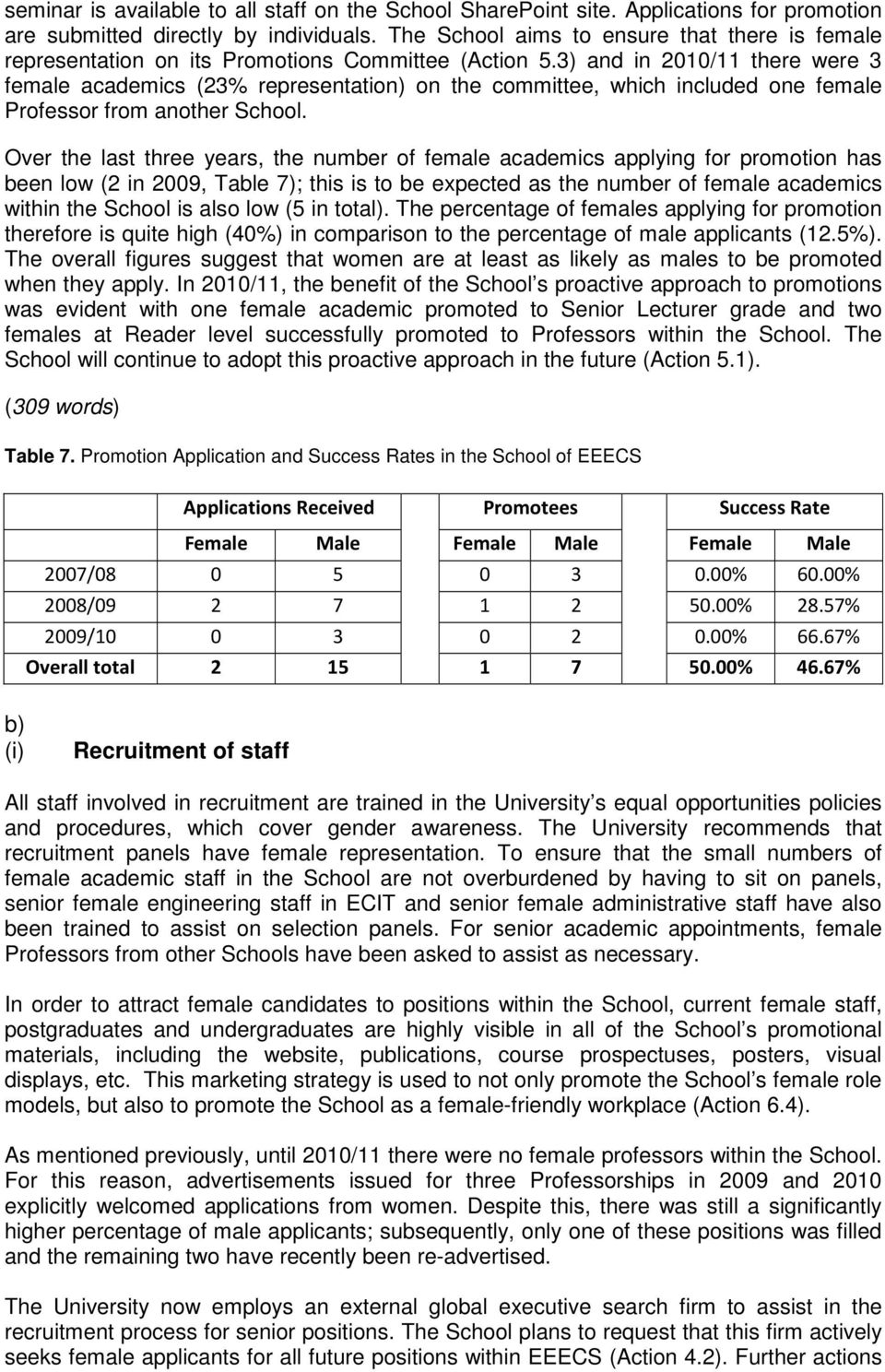
16 seminar is available to all staff on the School SharePoint site. Applications for promotion are submitted directly by individuals. The School aims to ensure that there is female representation on its Promotions Committee (Action 5.3) and in 2010/11 there were 3 female academics (23% representation) on the committee, which included one female Professor from another School. Over the last three years, the number of female academics applying for promotion has been low (2 in 2009, Table 7); this is to be expected as the number of female academics within the School is also low (5 in total). The percentage of females applying for promotion therefore is quite high (40%) in comparison to the percentage of male applicants (12.5%). The overall figures suggest that women are at least as likely as males to be promoted when they apply. In 2010/11, the benefit of the School s proactive approach to promotions was evident with one female academic promoted to Senior Lecturer grade and two females at Reader level successfully promoted to Professors within the School. The School will continue to adopt this proactive approach in the future (Action 5.1). (309 words) Table 7. Promotion Application and Success Rates in the School of EEECS Applications Received Promotees Success Rate Female Male Female Male Female Male 2007/ % 60.00% 2008/ % 28.57% 2009/ % 66.67% Overall total % 46.67% b) (i) Recruitment of staff All staff involved in recruitment are trained in the University s equal opportunities policies and procedures, which cover gender awareness. The University recommends that recruitment panels have female representation. To ensure that the small numbers of female academic staff in the School are not overburdened by having to sit on panels, senior female engineering staff in ECIT and senior female administrative staff have also been trained to assist on selection panels. For senior academic appointments, female Professors from other Schools have been asked to assist as necessary. In order to attract female candidates to positions within the School, current female staff, postgraduates and undergraduates are highly visible in all of the School s promotional materials, including the website, publications, course prospectuses, posters, visual displays, etc. This marketing strategy is used to not only promote the School s female role models, but also to promote the School as a female-friendly workplace (Action 6.4). As mentioned previously, until 2010/11 there were no female professors within the School. For this reason, advertisements issued for three Professorships in 2009 and 2010 explicitly welcomed applications from women. Despite this, there was still a significantly higher percentage of male applicants; subsequently, only one of these positions was filled and the remaining two have recently been re-advertised. The University now employs an external global executive search firm to assist in the recruitment process for senior positions. The School plans to request that this firm actively seeks female applicants for all future positions within EEECS (Action 4.2). Further actions
17 to improve the numbers of female applicants include promotion of our involvement in Athena SWAN activities, as previously discussed, as part of the School s marketing strategy, and particularly in advertisement packs and on our website, to illustrate the School s full support of female academics and their career development (Action 4.2). (298 words) (ii) Support for staff at key career transition points The critical drop-off point of female staff within the School that needs to be addressed is from PhD to post-doctoral level (18.6% down to just 9%). There is less of a drop-off rate between post-doctoral and academia; however, the low percentage of female applicants for academic positions is also a target area for action. As discussed previously, the results of an online survey and a focus group held with female researchers revealed that they were keen to have further support and peer networking opportunities offered to them by the School. There is already a wide range of personal development, training and networking opportunities on offer to staff and PhD students by the University and within the School: Mentoring: All new members of academic staff are provided with a mentor during their probation period, who is a senior member of staff from within the School. Linemanagers also provide mentoring to staff via the appraisal process, which provides staff at all levels with the opportunity to receive clear and consistent advice on career progression and continuing professional development. The Queen s Gender Initiative (QGI) also offers a mentoring scheme targeted specifically at female academic staff members. Personal Development Training: The University s Staff Training and Development Unit (STDU) offers a vast range of courses to PhD students, research staff and academic staff covering personal and career development, communications, research and enterprise skills, and supervision/management training. A number of career development training courses are also arranged in conjunction with the QGI that specifically target female research staff and PhD students. To date, there has been very poor attendance at the QGI-run courses from females within the School. Opportunities for Networking: As mentioned previously, in 2008, a School SWAN network was set-up to allow networking among female postgraduate, research and academic staff. This has now been merged into a School Research Society, which was established in early 2011, to provide a forum for all staff to network. The society aims to hold at least one specific female focussed event as part of its calendar of activities each year. Within the School s ECIT research centre, coffee mornings are held twice a month, which has proven to be a very successful networking event with a good attendance from both research and academic staff at all levels. It is intended to role this initiative out in the rest of the School (Action 6.3). Leadership Training: Specific Leadership and management development programmes are offered by the STDU for academic staff. A Next Generation Leadership Programme for Women is also organized annually by the QGI. Two of the recently promoted female members of academic staff in the School were encouraged to undertake these leadership training programmes early in their academic careers. Further actions to be taken include, as mentioned previously, establishing a Peer Mentoring scheme for PhD students equivalent to that being implemented at undergraduate level, which specifically considers gender when pairing new students with their mentees, and the introduction of a female academic support team (Action 4.1). From January 2011, female PhD students and research staff have also been actively

18 encouraged to attend the QGI career development training courses (Action 4.1) and female research staff encouraged to avail of the QGI mentoring scheme (Action 4.3). In addition, all female research staff leaving the School will be asked to complete the University s exit questionnaire to understand their reasons for leaving and if these include gender-related issues (Action 4.4). The results will be monitored and reported back to the Senior Management Committee. (584 words) 5. Career development (i) Promotion and career development The School has a formal structure for appraisals so that staff are given clear and consistent advice on how best to advance in their careers within the School. Based on performance, staff are encouraged to apply for promotion and this is applied equally to male and female staff. Training needs for the year ahead are also discussed in the appraisal. As outlined in Section 4(ii), the School takes a proactive approach to promotions and holds an annual seminar on career development and promotion, which is given by a senior academic external to the School (Action 5.1). The School employs the services of an external HR Consultant, 3 days each week, whose role includes the provision of School-specific staff training. She advises the Head of School on the appraisal process, on various HR related policies and procedures, and she also delivers training on topics such as applying for research grants etc. The School also uses the guidelines for the Investor in People (IIP) awards against which to benchmark School HR policies. The academic profiles used to inform the promotion process include: research contributions; performance, management and leadership in education; contribution to School management, i.e. administrative duties; pastoral responsibilities; recognised external University roles; and participation in community outreach programmes. Female staff within the School are also encouraged to attend the annual promotion seminar organised by the QGI (Action 5.1). To date, the female members of academic staff in the School have been pro-active in seeking promotion. (244 words) (ii) Induction and training The School follows the University guidelines on staff induction. The University has a mandatory Equality and Diversity e-learning programme and all new staff in the School are expected to complete this within the first month of commencing their employment as part of their induction (Action 6.5).Within the School itself, line managers provide induction training to new staff under their supervision and inform them of all University policies, such as health and safety, flexible working, leave procedures, IT-related procedures etc., as well as information on the career development and training programmes offered by the University. Specific training needs are identified during the appraisal process and accommodated where possible. The School encourages female staff to participate in QGI programmes and events, and in the past this has included, for example, providing financial support to attend the QGI s Next Generation Leadership programme. In addition, as mentioned above, all new staff are provided with a mentor who assists with career development. In the future, line managers will be asked to also provide information on the School s specific SWAN activities during this induction training (Action 6.6). (181 words)

19 (iii) Support for female students Significant support is available to female undergraduate and postgraduate students in the School including UG personal tutors, Advisors of Studies, UG project supervisors, PhD supervisors (two supervisors are allocated to each student) and through the UG peer mentoring scheme, where female mentors are paired with female mentees. A similar peer mentoring scheme is also to be established for PG students in The UG mentoring scheme (Action 2.3) is run by Ms. Angela Doherty, a Teaching Fellow, while the PG equivalent will be set up by Ms. Yvonne McKnight, the School s postgraduate administrator (Action 4.1). Female academics in the School have, to date, provided informal mentoring and career advice to female research staff and PhD students. This will be formalised next year with the introduction of a dedicated female academic support team (Action 4.1) and this responsibility will be recognised in the School s Work Allocation Model. As discussed previously, feedback received from female researchers in the School revealed that they were keen to have networking opportunities made available to them. As such, a number of networking activities were set up, including a School SWAN Network, which merged into the School Research Society, an EEECS Doctoral Student network, and coffee mornings. The Research Society is run by researchers and the Doctoral Student network is chaired by two female academics, and this responsibility is also included in the Work Allocation Model. QGI offer career development training courses that specifically target female PhD students and research staff. As mentioned earlier, females within the School will be actively encouraged to attend these courses. Ensuring that the School s SWAN webpage is kept up-to-date with the current and planned SWAN activities and information regarding the University s family-friendly policies and crèche facilities, should also provide an excellent point of reference for existing female students as well as potential female applicants to the School (Action 6.4). (308 words) 6. Organisation and culture a) (i) Male and female representation on committees The gender balance on the School s key committees has improved with the appointment of a female to the Director of Education position in 2009/10 and to a Research Director position in 2011/12. Previously there was no female academic representation on these committees. Given that the total percentage of female staff in the School is 10%, the percentage of female presentation now on key committees is excellent (Table 8). Since candidates are typically appointed to senior roles within the School for a period of 3 to 5 years, no further action with regards female representation is planned in the next 3 years. The Head of School selects committee members based on their roles within the School, their expertise and by considering their existing overall workload and administrative duties. (127 words)
20 Table 8. Number of Academic Staff on Key Committees in the School of EEECS Name of committee Size of committee No of Females % Females School Exam Board (EEE) % School Exam Board (CS) % School Board (EEECS) % School Education Committee % School Ethics Committee % School Senior Management Committee % School Management Group % School Postgraduate Research Committee School Promotions Committee % 23.1% (ii) Female:male ratio of academic and research staff on fixed-term contracts and open-ended (permanent) contracts There was one member of academic staff (female) on a fixed-term contract in 2009/10. This was a temporary lectureship post. The staff member in question has now taken up a fixed-term post-doctoral position within the School. The proportion of females on fixed-term research contracts over permanent contracts is higher than the proportion of males on such contracts (Table 9). The majority of permanent research contracts are for Engineer positions based in one of the School s research centres, ECIT. Since engineers are typically not on the pathway to an academic career, no actions will be taken to address this imbalance. However, it is hoped that all of the female staff members, in particular those on fixed-term contracts, will benefit from the proposed activities outlined in the Action Plan to encourage a transition to academia. (133 words) Table 9. Research Staff on Fixed-Term and Permanent Contracts in the School of EEECS Female Male Year Permanent Fixed-Term Total Permanent Fixed-Term Total N % N % N N % N % N 2007/ % % % % / % % % % / % % % % 58

21 b) (i) Representation on decision-making committees Membership of key committees within the School comprises those with senior roles, such as Head of School, Director of Education, Assistant Directors of Education, School Manager and Research Directors. With the appointment of a female to the Director of Education position in 2009 and to a Research Director position in 2011, the School has female representation on all of its key committees for the first time. Therefore, it has been identified that it is extremely important for women to apply for promotion to more senior levels within the School and as discussed earlier, the proactive approach introduced in 2010 has helped to encourage three female members of staff to successfully apply for promotion. The School attempts to ensure that there is female representation on its promotions committee each year. Where this has not been possible in the past and, this year, so as not to overload existing female staff, a female Professor from another School was asked to sit on the committee. Also, Professor Máire O Neill, the School s SWAN Champion, currently sits on the promotions committee for the School of Maths and Physics. (183 words) (ii) Workload model The School introduced a Workload Allocation Model (WAM) in 2010 to assist the Head of School and the Senior Management Committee in making a fair allocation of School duties to staff. It is a broad brush approach intended to give a reasonable indication of the relative weight of lecturing duties, administrative duties and research activity. PhD and grant information is collected at the beginning of each academic year. WAM scores are finalised during the second semester of each academic year and sent to individuals for consultation. The WAM scores from the current and previous years are then used to inform the allocation of lecturing and administration duties for the subsequent year. Information on the WAM scoring mechanism is available on the School SharePoint site. A number of key responsibilities within the School are rotated to ensure all staff gain experience in important roles, such as, UG Stage co-ordinators, UG and PG Admissions tutors and, UG and PG Advisors of Studies. Currently, a female academic member of staff, who was promoted to Senior Lecturer in 2010, is the School s UG Admissions tutor. (178 words) (iii) Timing of departmental meetings and social gatherings From October 2011, staff in the School have been encouraged to ensure all meetings are held between the core hours of 10am and 4.30pm to facilitate childcare responsibilities (Action 6.7). Where this may not be feasible, sufficient notice must be given to staff to allow for childcare arrangements. Over the past few years, social activities such as the Christmas lunch, Christmas colloquium, quizzes and barbeques have all typically been held during these working hours. (74 words)
22 (iv) Culture The School endeavours to create a supportive environment for female, and indeed all staff and students across its four sites. The Head of School is very approachable and holds monthly clinics, which provide an opportunity for all staff to discuss any concerns they have directly with him (Action 6.8). The School s culture of accommodating informal flexible working hours is particularly attractive for female staff with children and childcare responsibilities, as is the recently introduced policy for staff returning to work after taking leave (Action 7.2). Within this environment, the School s female staff and students have excelled in recent years. In 2010/11, the five females graduating from the undergraduate EEE degree were placed in the top 6 in their class, while at the other end of the academic pipeline the School promoted its first two female Professors. All of the School s marketing literature and promotional materials feature females prominently. Informal consultation with female academics within the School has indicated that they feel that their opinions are welcomed by their colleagues at all levels, both on Committees and across the School in general. In 2011, for the first time the School now has female representation on its key committees; this should help to ensure that the culture in the School continues to be inclusive and an attractive environment for potential female candidates. (220 words) (v) Outreach activities As stated in section 5(i), any outreach activities that staff have participated in are beneficial on an application for promotion, particularly if the other applicants have similar research and teaching experience and in these cases it may be the deciding factor. The School undertakes a large number of outreach activities. Female staff participate in a large number of these events, particularly in those targeted specifically at females. All staff in the School are expected to assist with outreach activities. Fortunately, the School has many staff who are very willing to commit time to outreach activities and many of them are STEM ambassadors; the majority of female staff being STEM ambassadors. In addition to receiving formal recognition for outreach activities through the appraisal and promotion processes, staff are also recognised informally within the School, through invitations to social events such as, being invited to be guests at the School s table at the Institute of Engineering and Technology (IET) Annual Dinner. (159 words)
23 7. Flexibility and managing career breaks a) (i) Maternity return rate Two academic members of staff have taken maternity leave in the past 3 years, one in 2007/08 and one in 2009/10. Both returned to full-time work following their leave. The female academic who returned to work in 2009/10 was promoted to Professor in 2010/11. Also, a female staff member who has just returned to work from maternity leave applied for promotion to Senior Lecturer while on leave and was successful. Therefore, it is clear that the School ensures that career breaks are not detrimental to staff members career development within the University. No female research staff took maternity leave during this period. Since 2008 a direct link to all of the University s family-friendly policies has been included on the School SWAN webpage so that all staff are aware of and can easily access the policies and associated forms (Action 7.1). (140 words) (ii) Paternity, adoption and parental leave uptake Queen s University provides three weeks paternity leave on full salary for fathers/partners of new/adopted babies. The number of staff within the School taking paternity leave has remained static over the last three years (Table 10). There is no evidence to suggest that staff who were entitled to paternity leave did not avail of it. There were no applications for adoption or parental leave in the School over this period. However, the School does offer flexibility for staff to work shorter hours, if needed, to care for a sick child, which may explain the lack of parental leave uptake. No further action will be taken. (104 words) Table 10. Paternity Leave uptake in the School of EEECS Year Academic Research Total 2007/ / / (iii) Numbers of applications and success rates for flexible working by gender and grade There have been no formal applications from academics, male or female, for flexible working. Three other female staff members in the School (2 clerical and 1 IT technician) were successful in applying for flexible working over the last three years. Due to the nature of their work academic staff are able to work flexibly without making a formal application. A large number of staff work flexibly on an informal basis, for example, they may vary their starting and finishing times due to childcare commitments. (84 words)
24 b) (i) Flexible working Due to the nature of academia, the majority of academic staff work flexibly on an informal basis. The School supports flexible working on an informal basis where appropriate. This includes occasions such as working from home for a short period of time or for one day a week, ensuring staff can take their holidays at the same time as the schools and their children, or for attendance at courses or related study-leave. A number of staff currently work flexibly and all formal requests for flexible working in the past three years have been granted. (94 words) (ii) Cover for maternity and adoption leave and support on return Cover for maternity/adoption leave is arranged such that all concerns that a staff member may have about both their departure and return are fully addressed. Teaching cover is achieved by either rescheduling lectures so that they can be completed before the member of staff goes on leave, or re-allocating the teaching duties between other staff members. Since all PhD students have two supervisors in the School, the second supervisor temporarily assumes responsibility for the student while the principal supervisor is on leave. Staff members can also remain in occasional contact with their research group while on leave. As a result of the School s SWAN initiative, the School now allows staff returning from maternity leave, caring responsibilities or long-term sick leave to have reduced teaching responsibilities for a period of 6 months. This policy did not apply to the last two females who returned from maternity in 2010 and 2011 as, coincidentally, their teaching duties did not commence for 6 months after their return dates. (164 words)
25 8. Any other comments maximum 500 words Survey and Focus Group: As mentioned in Section 3(vii), in 2011, an effort was made to identify the cause of the drop-off in the number of females continuing to post-doctoral research from PhD studies. An online survey was conducted of all current PhD students and post-doctoral researchers (both male and female) within the School to ascertain whether they planned to pursue a research/academic career in the long term. There was a 60% response rate from the PhD cohort but, disappointingly, only 26% of females responded. Interestingly, the results revealed no specific gender-related issues to explain the drop-off effect. However, a lower percentage of females (42.9%) indicated that they would consider a post-doctoral or lectureship position in comparison to 56.1% overall. A focus group was then held with 21% of the female PhD students. This revealed similar feedback to previous SWAN meetings; that the female students wanted further networking opportunities. Only 18% of the overall post-doctoral cohort responded to the online survey, with a 43% response rate from female research staff. 100% of the female researchers stated that they wished to pursue an academic career, which matches the findings of the School s statistical results which show that there is no drop-off in the percentage of females between post-doctoral and academic level. As a result of these findings, a number of new networking and mentoring initiatives will be introduced, including the peer mentoring scheme and female academic support team for PhD and post-doctoral researchers and coffee mornings at all the School s sites (Actions 4.1 and 6.3). Publicity of Female Success Stories: In recent years, the School has showcased and publicised all of its female staff and student successes, both on its website, its Facebook page ( and in local and national press, in order to highlight the School s female-friendly environment and to help attract potential female applicants. For example, Fig. 10 shows the five female EEE graduates in 2011 who placed in the top six in their class and Fig. 11 is a photo taken of one of our 2010 female graduates, who was awarded the Sir William Siemens medal for being one of the top engineering students in the UK. An interview with the School s first female professors was included in University s online TV Channel, QTV s monthly news bulletin earlier this year. (437 words) Fig. 10. First Ladies of Engineering, 2011 Fig. 11. Lisa is top Engineering Student, 2010 Action Plan Please refer to Appendix at end of application.
26 For Silver Department awards only 9. Case study: impacting on individuals maximum 1000 words Professor Máire O Neill Máire O Neill is the School s SWAN Champion and is chair of the self-assessment team. She undertook her undergraduate and postgraduate studies at Queen s, and graduated with a PhD in December During her PhD studies and her academic career to date she has benefitted from mentoring provided by Professor John McCanny, a past Head of School, who encouraged her to apply for a 5-year Royal Academy of Engineering research fellowship, which she was successfully awarded in She was appointed as a Lecturer in As Head of School, he also supported her attendance at the Queen s Gender Initiative s (QGI) Next Generation Leadership Programme for Women, which she completed in She has also received support in grant application writing from senior colleagues within the School and has secured a number of research council grants, including being awarded a prestigious 5-year EPSRC Leadership Fellowship in She was also promoted to Reader in She took a 6-month period of maternity leave in On her return from leave, she was successfully promoted to Professor. Máire has been interested in promoting women in engineering for many years and has participated in the majority of the School s undergraduate and postgraduate recruitment events and SWAN activities to date. Now as a Professor, she is keen to provide the same level of support to others in the School to that which she received. As she now also has childcare responsibilities, she is particularly keen to act as a role model for other females who have children or are thinking of starting a family and who may be considering a career in academia. As part of the School s SWAN activities, she proposed the introduction of a female academic support team to provide mentoring, support and career guidance to female PhD students and post-doctoral staff within the School; this activity is to be launched next year. She was also a keynote speaker at the 2011 Women in Leadership conference, jointly organised by the Queen s Gender Initiative and QUB s Management School s Leadership Institute. (337 words) Professor Weiru Liu Weiru Liu is the only female academic within Computer Science in the School of EEECS, who engages in both research and teaching, and she truly appreciates the role SWAN has played within the School. Having had a successful career, with world leading research while raising a family at the same time, Weiru knows how important it is to have an initiative like SWAN dedicated to female academics, providing support, encouragement, and guidance. Having completed her PhD under a prestigious Colin and Ethel Gordon Scholarship Award' in the Faculty of Science and Engineering at Edinburgh University in 1995, her academic career since then has seen her taking on a number of management and leadership roles. Since joining Queen s in early 2004, her career has been accelerated, especially under the positive attitude adopted by the School on cultural diversity and inclusion, as well as the excellent working practices and pro-active approach of the School on encouraging, promoting and mentoring junior staff. As a result, she received significant support from senior colleagues in the School on her applications to Readership (2006) and to Professorship (2010), and on her subsequent appointment as Research Director (RD) of the Knowledge and Data Engineering (KDE) cluster the only female RD within the School. In line with the School and University s aims to ensure female representation on key committees, she now sits on the School Promotion s Committee and has been
27 nominated to be a member of the Courses and Regulations Group at Queen s. Furthermore, she is the School Champion for recruiting a new Professor into the KDE cluster. She was the Program Chair/Conference Chair of the 11 th European Conference on Symbolic and Quantitative Approaches to Reasoning with Uncertainty in July 2011, the only female researcher so far who has taken on such a demanding role as Chair within this conference series since its establishment more than 20 years ago. Both the Vice Chancellor and Dr Stephen Farry, Minister for Employment and Learning, gave welcome speeches at the conference dinner held at Northern Ireland s Parliament Buildings, Stormont, to an audience coming from 22 countries. Weiru firmly believes that her career path has set an encouraging example to female PhD and post-doctoral researchers within computer science, as well as within the School, that excellent research and a hard working attitude will be fully recognized at universities such as Queen s. (389 words)
28 APPENDIX ACTION PLAN: OCT 2011 OCT 2014 School of Electronics, Electrical Engineering and Computer Science (EEECS), Queen s University Belfast Description of Action Actions Taken Future Actions Progress Log Responsibility TimeLine Measurable Outcome 1 Baseline Data and Supporting Information 1.1 Continue annual monitoring of School s student and staff statistic data by gender. 1.2 Monitor annual UGR applications, offers and acceptances in School 2 UG Students 2.1 Attract female students to UG courses. Data collected and analysed for Data collected for 2009/10 only. 1. Facilitate Sentinus GETSET programme for girls on an annual basis 2. To date employed >50% female role models from current UG and PG cohort at all recruitment activities. 3. Visited 50% of All-Girls Grammar schools in NI for career talks and conventions. Collect and analyse data each year. Collect and analyse data each year. 1. Continue to facilitate GETSET programme for girls. 2. Continue to employ >50% female role models at recruitment activities. 3. Increase number of All- Girls Grammar schools visited. 4. Advertise UG Peer Mentoring Scheme to potential applicants (see 2.3). Results incorporated into 2011 application. Results incorporated into 2011 application University Equal Opportunities office and Admissions office Female role models Marketing and have proved successful, Student with female students Recruitment approaching the (M&SR) officer female rather than the male role models at events. In last 3 years, 6 of the 12 All-Girls Grammar Schools have been visited. Continual Data available to help inform proposed activities and key areas to target. Admissions office Continual Data available to help inform proposed activities and key areas to target. Continual Increase in number of high quality UG female students on EEE and CS courses. >50% All-Girls Grammar Schools visited
29 2.2 Monitor success of all current initiatives targeting females Record attendance of female students at events. Marketing and Student Recruitment (M&SR) officer From Oct 2011 Applications received from females who attended School recruitment events. 2.3 Provide support for current and new UG female students 1. Introduced School Ambassador Scheme to formally recognise female UG role models. 2. Launched UG Peer Mentoring Scheme and paired female mentors with female mentees. 3. Supported the launch of an UG Computing Society. Ambassador Scheme now contributes towards QUB Degree Plus Award, a University initiative, which accredits skills developed through extra-curricular activities First networking activity (a quiz) of Computing Society held in Oct Ambassador Scheme: M&SR officer Mentoring Scheme: Ms. Angela Doherty (Teaching fellow) Computing Society: run by undergraduates From Oct 2011 Enhancement of career development opportunities for UG role models. Improvement in networking opportunities and supportive environment offered to UG students 2.4 Improve EEE female offer to acceptance rates. 3 PG Students 3.1 Attract International female students to PG taught EEE courses Send female EEE offer holders a flyer with case studies of female UGs and graduates. Improve marketing of School s SWAN activities within international recruitment initiatives. M&SR officer From 2012 M&SR officer From 2012 Improved offer to acceptance ratio in next 3 years Increase in number of female students on PG taught EEE courses.
30 3.2 Attract female students Research Open Days held for to PhD research UG cohort to demonstrate research undertaken in School s research institutes 4 Key Career Transition Points 4.1 Address drop-off rate in numbers of females continuing to post-doc research from PhD studies 1. Surveyed PhD and Post-doc students, and held focus group with female PhD students 2. Encouraged PhD and postdoc females to attend QGIrun female-specific career development training courses. 1. Continue holding Research Open Days annually. 2. Provide potential female applicants with info. on the School s SWAN activities and case studies of current female PhD students. 3. Offer 2 summer research internships targeting female UG students (Advertise in line with provisions under Articles 48&49 of Sex Discrim. (NI) Order 1976.) 1. Carry out survey every 2 years 2. Introduce peer mentoring scheme for PhD students and Post-doc researchers 3. Introduce female academic support team 4. Continue to encourage PhD and post-doc females to attend QGI-run training courses. As a result of the UG Open Day: Research Open Day, a number of our UG female CS students went on to study PhDs in the School in Survey and focus group revealed no genderspecific issues to explain drop-off; however, females were keen for the School to offer further networking opportunities. Prof. Máire O Neill (SWAN Champion) Provision of info on SWAN: M&SR officer UG Research Internships: Prof. Danny Crookes Survey: M&SR officer & Victoria Stewart (Post-doc rep.) Peer Mentoring: Yvonne McKnight (Postgrad. Administrator) Acad. Support Team & QGI Courses: Head of School Open Day: Started in 2008 Info. on SWAN: From 2012 UG Interns: From 2013 Survey: Every 2 yrs from Peer Mentoring: From Oct Support Team: From Oct 2012 QGI Courses: From 2011 Increase in number of female students on PG research EEE and CS courses. Improvement in number of females in post-doctoral research positions.
31 4.2 Address poor female application rate for academic positions 4.3 Support female postdoctoral students considering a career in academia 4.4 Monitor female research staff leaving the School 5 Career Advice and Support 5.1 Integrate mentoring and appraisals to ensure all staff are encouraged to apply for promotion at an appropriate time. 5.2 Continue to provide information on funding schemes to female researchers Included a statement on advertisements for academic posts welcoming female applicants. Encouraged post-doc females to avail of QGI mentoring scheme. 1. Potential applicants identified early and support provided & held a seminar on Career development and Promotions 2. Female academics encouraged to attend QGI promotion seminar Information on webpage regarding funding opportunities, including gender-specific schemes. 1. Further promotion of School s SWAN activities on website and in advertisement packs. 2. Request that University s external global executive search firm actively seeks female applicants for future positions in EEECS Continue to encourage postdoc females to avail of QGI mentoring scheme. Ask all female research staff leaving to complete the University s exit questionnaire. Monitor results and feed back to SMC. 1. Continue early promotion applicant preparation & hold seminar on academic career development annually 2. Continue to encourage female academics to attend QGI promotion seminar Ensure information on webpage regarding funding schemes is up-to-date. Females in School are proactive in applying for promotion. In 2010, 3 of the School s 5 female academics were successfully promoted. Lesley Moreland (HR Consultant) & Tony McHale (School Webpage Co-ordinator) Actions taken: From 2010 Future Actions: From 2012 Head of School From 2011 Head of School From 2012 Head of School & Research Directors Tony McHale (School Webpage Co-ordinator) From 2010 From 2008 Improve Female Application rate for academic positions Improvement in the support provided for females considering a career in academia. Increased awareness of reasons for leaving, including genderrelated issues. Improve number of females at senior academic grades. Improved career advice for PhD and postdoctoral researchers.
32 5.3 Ensure female representation on School Promotions Committee 6 Culture and Communications 6.1 Address difficulties of split sites, particularly for PhD students working in isolation. 6.2 Keep all staff informed of School SWAN activities Aimed to ensure that there was female academics on Promotions Committee since Established an EEECS Doctoral Student network. Reported updates of SWAN activities to all staff at School Board meetings Continue to ensure that there is at least one female academic on the School Promotion Committee Continue to update staff on SWAN at School Board meetings In 2011, there were 3 female academics (23% representation) on the committee. A range of team building and social events organised to improve networking. In 2011, staff updated on SWAN at quarterly School Board Meetings Head of School From 2010 Prof. Máire O Neill (School SWAN Champion) & Prof. Weiru Liu Prof. Máire O Neill (School SWAN Champion) From 2008 From 2011 At least one female representative on School Promotion Committee Improvement in culture & communications among PhD students. All staff aware of School SWAN activities. 6.3 Encourage networking among PhD and research staff 6.4 Promote School s image as a femalefriendly workplace. 6.5 Ensure all current and new staff complete Diversity Training Programme Set-up of School SWAN network and subsequently, School Research Society Female staff and students are now highly visible in all School promotional material. Head of School contacted all current staff regarding this training Hold coffee mornings across all of the School s sites. Update website to include current and proposed SWAN actions and provide this information in advertisement packs (see Action 4.2). Head of School to ensure all new staff undertake this training Feedback obtained from Research Society: SWAN network run by PhD and requesting further Post-doctoral networking opportunities researchers to be organised. All current staff in the School have completed the Diversity Training Coffee Mornings: Allister Lee (School Manager) Lesley Moreland (HR Consultant) & Tony McHale (Web Co-ordinator) Research Society: Set up Jan (orig. in 2008) Coffee Mornings: From Oct 2011 Head of School From 2009 Improved Networking among PhD and research staff positive feedback received on networking in next survey in Continual Improvement in female-friendly image portrayed by School All staff trained in equality and diversity policies and etiquette.
33 6.6. Include information on School s SWAN activities in Induction training for new staff 6.7 Staff meetings to be held, when possible, between hours of 10am and 4.30pm 6.8 Facilitate opportunities for staff to contact Head of School directly 7 Career breaks/flexible Working 7.1 Ensure all staff are aware of and can easily access the University s family-friendly policies and forms 7.2 Introduce policy for staff returning from leave. Head of School informed staff at School Board Meeting Head of School arranged clinics providing an opportunity for staff to discuss any concerns directly with him. A direct link to the University s family-friendly policies has been included on the School s SWAN webpage. School now allows staff returning from maternity leave, caring responsibilities or long-term sick leave to have reduced teaching responsibilities for a period of 6 months Information to be provided to all line managers to include in Induction training. Monthly Head of School clinics held since Jan In last 3 years, all staff entitled to maternity & paternity leave have availed of it. To date, no staff member has needed to avail of this policy Marketing and Student Recruitment officer Head of School & School Manager From 2012 From 2011 Head of School Monthly from Jan 2011 Tony McHale (School Webpage Co-ordinator) From 2008 Head of School From 2011 All new staff are aware of School s SWAN activities When possible, meetings to be arranged between 10am and 4.30pm. Improvement in communications in the School All staff aware of their entitlement to take leave. Staff returning from leave permitted to have reduced teaching responsibilities for 6 months.
Athena SWAN Action Plan. 1. Self Assessment and Sharing of Good Practice.
 Action Plan 1. Self Assessment and Sharing of Good Practice. Action # Objective Action already taken (if appropriate) 1.1 Monitor Athena SWAN Progress Action Planned Timescale Responsible person (s) A
Athena SWAN Bronze department award application
 Athena SWAN Bronze department award application Name of university: University of Nottingham Department: School of Computer Science Date of application: April 2013 Date of university Bronze and/or Silver
ATHENA PROJECT. Case Study No 9 UNIVERSITY OF OXFORD SWAN BRONZE AWARD MARCH 2006
 ATHENA PROJECT Case Study No 9 UNIVERSITY OF OXFORD SWAN BRONZE AWARD MARCH 2006 The University of Oxford, a founder member of the Athena SWAN Charter, was awarded Bronze SWAN recognition in March 2006.
British Antarctic Survey Action Plan
 The objectives and actions outlined below reflect the themes and issues identified by our Self Assessment Team (SAT). We have set targets, which are challenging yet realistic, given our starting point,
Objective Action Timescale Responsibility Success Measure
 Objective Action Timescale Responsibility Success Measure 1. Review Female Academic Progress and Support Networks 1.1 Implement Career Development Committee (to be held annually after appraisals) Expand
s/mechanical- engineering/index.aspx the department is working to promote gender equality and to address challenges particular to the discipline.
 Athena SWAN Bronze department award application Name of university: University of Birmingham Department: School of Mechanical Engineering Date of application: Date of university Bronze and/or Silver SWAN
Athena SWAN Bronze department award application
 Athena SWAN Bronze department award application Name of university: The University of Edinburgh Department: School of Engineering Date of application: April 2013 Date of university SWAN award: Bronze 2006,
JOB DESCRIPTION. 1. JOB TITLE: Senior Lecturer in Computer Science (Cyber Security)
 JOB DESCRIPTION 1. JOB TITLE: Senior Lecturer in Computer Science (Cyber Security) 2. HRMS REFERENCE NUMBER: HR14195 3. ROLE CODE: FINSLTSR4 4. DEPARTMENT: Department of Computer Science Faculty of Science
Experience of an Athena SWAN panellist
 Experience of an Athena SWAN panellist Peter Clarkson School of Mathematics, Statistics and Actuarial Science University of Kent, Canterbury, CT2 7NF [email protected] London Mathematical Society
JOB DESCRIPTION. 1. JOB TITLE: Senior Lecturer in Business and Management. 4. DEPARTMENT: Business Strategy, Finance and Entrepreneurship
 JOB DESCRIPTION 1. JOB TITLE: Senior Lecturer in Business and Management 2. HRMS REFERENCE: HR/15117 3. ROLE CODE: FINSLTSR5 4. DEPARTMENT: Business Strategy, Finance and Entrepreneurship 5. ORGANISATION
JOB DESCRIPTION. 1. JOB TITLE: Senior Lecturer in Computer Science (Cyber Security)
 JOB DESCRIPTION 1. JOB TITLE: Senior Lecturer in Computer Science (Cyber Security) 2. HRMS REFERENCE NUMBER: HR14196 3. ROLE CODE: FINSLTSR5 4. DEPARTMENT: Department of Computer Science Faculty of Science
Teaching Fellow in International Relations
 Teaching Fellow in International Relations College of Social Science Department of Politics and International Relations Salary Grade 7-31,644 to 36,661 per annum Fixed Term Contract from 1 August 2014
ABOUT LOUGHBOROUGH UNIVERSITY PLANNING OFFICE (VICE-CHANCELLOR S OFFICE) PLANNING OFFICER FIXED TERM FOR 2 YEARS JOB REF: REQ15117 FEBRUARY 2015
 ABOUT LOUGHBOROUGH UNIVERSITY PLANNING OFFICE (VICE-CHANCELLOR S OFFICE) PLANNING OFFICER FIXED TERM FOR 2 YEARS JOB REF: REQ57 FEBRUARY 205 As part of the University s ongoing commitment to redeployment,
This document covers the AHRC s expectations in respect of support and development for Early Career Researchers (ECR).
 0BAHRC RESEARCH TRAINING FRAMEWORK EARLY CAREER RESEARCHERS 1BIntroduction This document covers the AHRC s expectations in respect of support and development for Early Career Researchers (ECR). AHRC s
BANGOR UNIVERSITY CONCORDAT ACTION PLAN 2016-2020 AND 4 YEAR REVIEW
 BANGOR UNIVERSITY CONCORDAT ACTION PLAN 2016-2020 AND 4 YEAR REVIEW This document contains: The objectives included in the University s Strategic Plan (2015-2020) to support researchers and address the
Programme Specification for MSc Applied Sports Performance Analysis
 PROGRAMME SPECIFICATION Postgraduate Courses Programme Specification for MSc Applied 1. Awarding institution/body University of Worcester 2. Teaching institution University of Worcester 3. Programme accredited
1. Awarding Institution: Imperial College London. 2. Teaching Institution: Imperial College London
 Programme Specification for the MSc in Mathematics and Finance PLEASE NOTE. This specification provides a concise summary of the main features of the programme and the learning outcomes that a typical
Becoming a university academic
 Graduate School Brain glue?, Christopher Ugbode, Graduate School Research Images Competition 2012 The Graduate School guide to Becoming a university academic Many doctoral students start their PhDs with
COURSE OR HONOURS SUBJECT TITLE: PgDip / MSc in Health Psychology (with PGCert exit award)
 154 COURSE OR HONOURS SUBJECT TITLE: PgDip / MSc in Health Psychology (with PGCert exit award) PLEASE NOTE: This specification provides a concise summary of the main features of the course and the learning
Helen Best. Assistant Dean Planning and Resources Faculty of Health and Wellbeing (Chair of SHU's Athena Swan Self Assessment Team)
 Helen Best Assistant Dean Planning and Resources Faculty of Health and Wellbeing (Chair of SHU's Athena Swan Self Assessment Team) Introduction The current challenges for women developing their careers
JOB DESCRIPTION. 1. JOB TITLE: Senior Lecturer in Electronic and Electrical Engineering
 JOB DESCRIPTION 1. JOB TITLE: Senior Lecturer in Electronic and Electrical Engineering 2. HRMS REFERENCE NUMBER: HRMS/13173 3. ROLE CODE: FINSLTSR4 4. DEPARTMENT: Department of Electronic and Electrical
JOB DESCRIPTION. Line management. Programme leader BSc Applied Psychology
 JOB DESCRIPTION 1. JOB TITLE: Senior Lecturer in Psychology 2. HRMS REFERENCE NUMBER: HR14094a 3. ROLE CODE: FINSLTSR5 4. DEPARTMENT: Psychology 5. ORGANISATION CHART: Head of Psychology Deputy Heads Line
ABOUT LOUGHBOROUGH UNIVERSITY WOLFSON SCHOOL OF MECHANICAL, MANUFACTURING AND ELECTRICAL ENGINEERING LECTURER IN ENGINEERING PRODUCT DESIGN
 ABOUT LOUGHBOROUGH UNIVERSITY WOLFSON SCHOOL OF MECHANICAL, MANUFACTURING AND ELECTRICAL ENGINEERING LECTURER IN ENGINEERING PRODUCT DESIGN REQ15683 September 2015 As part of the University s ongoing commitment
UNIVERSITY OF BRADFORD Faculty of Social Sciences Division of Economics Programme title: MSc in Financial Economics
 UNIVERSITY OF BRADFORD Faculty of Social Sciences Division of Economics Programme title: MSc in Financial Economics Awarding and teaching institution: Final award and interim award(s): Programme title:
JOB DESCRIPTION. 1. JOB TITLE: Lecturer in Criminology. 4. DEPARTMENT: Social and Political Science
 JOB DESCRIPTION 1. JOB TITLE: Lecturer in Criminology 2. HRMS REFERENCE NUMBER: HR14491 3. ROLE CODE: FINLTSR3 4. DEPARTMENT: Social and Political Science 5. ORGANISATION CHART: Head of Department Deputy
We have introduced the title of Associate Professor for our grade 9 academic staff, which is equivalent to Senior Lecturer.
 Faculty of Engineering School of Computing Lecturer / Associate Professor in Computer Science We have introduced the title of Associate Professor for our grade 9 academic staff, which is equivalent to
The Importance of Female Staff in Mathematics
 1. Letter of endorsement from the head of department: maximum 500 words An accompanying letter of endorsement from the head of department should explain how the SWAN action plan and activities in the department
JOB DESCRIPTION. POST: Lecturer/Senior Lecturer in Forensic Psychology DATE: September 2015. FACULTY: Humanities and Social Sciences
 JOB DESCRIPTION POST: Lecturer/Senior Lecturer in Forensic Psychology DATE: September 2015 FACULTY: Humanities and Social Sciences POST NO: HSS-J25 START DATE: December 2015 SALARY RANGE: Lecturer Grade
Buckinghamshire New University (formerly Buckinghamshire Chilterns University) Access Agreement 2008/09
 Buckinghamshire New University (formerly Buckinghamshire Chilterns University) Access Agreement 2008/09 1. Introduction Buckinghamshire New University (BUCKS) has a long tradition of commitment to widening
JOB DESCRIPTION. 1. JOB TITLE: Senior Lecturer in Marketing and Public Relations. 4. DEPARTMENT: Warrington School of Management.
 JOB DESCRIPTION 1. JOB TITLE: Senior Lecturer in Marketing and Public Relations 2. HRMS REFERENCE NUMBER: HR14318 3. ROLE CODE: FINSLTSR4 4. DEPARTMENT: Warrington School of Management 5. ORGANISATION
continue to advance their Manufacturing Management knowledge and understanding, and develop new skills to a high level;
 PROGRAMME SPECIFICATION COURSE TITLES: PgD Manufacturing Management MSc Manufacturing Management PgC Engineering (Exit award only) PLEASE NOTE: This specification provides a concise summary of the main
ABOUT LOUGHBOROUGH UNIVERSITY WOLFSON SCHOOL OF MECHANICAL, ELECTRICAL AND MANUFACTURING ENGINEERING
 ABOUT LOUGHBOROUGH UNIVERSITY WOLFSON SCHOOL OF MECHANICAL, ELECTRICAL AND MANUFACTURING ENGINEERING LECTURER IN CONTROL SYSTEMS ENGINEERING JOB REF: REQ16103 WS17026 FEBRUARY 2016 As part of the University
JOB DESCRIPTION. 1. JOB TITLE: Senior Lecturer in Public Health Nutrition
 JOB DESCRIPTION 1. JOB TITLE: Senior Lecturer in Public Health Nutrition 2. HRMS REFERENCE NUMBER: HR15038 3. ROLE CODE: FINSLECTSR4 4. DEPARTMENT: Clinical Sciences and Nutrition 5. ORGANISATION CHART:
Future Research Leaders call 2015/16 Guidance notes for non-academic reviewers
 Future Research Leaders call 2015/16 Guidance notes for non-academic reviewers Introduction... 1 Aims and objectives... 1 Procedure... 3 Peer Review form on Je-S... 3 The decision-making process... 3 Assessment
PROGRAMME SPECIFICATION MSc Psychology
 PROGRAMME SPECIFICATION MSc Psychology 1. Awarding institution/body University of Worcester 2. Teaching institution University of Worcester 3. Programme accredited by British Psychological Society 4. Final
Programme Specification (2015-16)
 Date of Revision Date of Previous Revision Programme Specification (2015-16) A programme specification is required for any programme on which a student may be registered. All programmes of the University
Part one: Programme Specification
 Part one: Programme Specification Course record information Name and level of final award: Name and level of intermediate awards: Awarding body/institution: Status of awarding body/institution: Location
JOB DESCRIPTION. 1. ROLE TITLE: Lecturer in Digital Marketing and Business. 4. DEPARTMENT: Department of Marketing, Tourism, Events Management & HRM
 JOB DESCRIPTION 1. ROLE TITLE: Lecturer in Digital Marketing and Business 2. HRMS REFERENCE NUMBER HR14045 3. ROLE CODE: FINLEC 4. DEPARTMENT: Department of Marketing, Tourism, Events Management & HRM
PROGRAMME SPECIFICATION
 PROGRAMME SPECIFICATION Course Record Information Name and level of final award Intermediate awards Awarding body Status of awarding body / institution Location of Delivery Mode of Study Language of delivery
Strategic Vision Faculty and Staff Recruitment and Development
 Strategic Vision Faculty and Staff Recruitment and I. End Result: UAF engages in best practices in recruiting, hiring, evaluating, developing and promoting staff. Objective A: To implement regular staff
Engineering Design and Mathematics
 Opportunities in Engineering Design and Mathematics Professional development and capability Welcome Employees whether you are looking for short courses or academic learning to support your role in your
PROGRAMME SPECIFICATION COURSE TITLE: MSc Advanced Accounting
 PROGRAMME SPECIFICATION COURSE TITLE: MSc Advanced Accounting PLEASE NOTE. This specification provides a concise summary of the main features of the course and the learning outcomes that a typical student
ABOUT LOUGHBOROUGH UNIVERSITY WOLFSON SCHOOL OF MECHANICAL, MANUFACTURING AND ELECTRICAL ENGINEERING
 ABOUT LOUGHBOROUGH UNIVERSITY WOLFSON SCHOOL OF MECHANICAL, MANUFACTURING AND ELECTRICAL ENGINEERING LECTURER / SENIOR LECTURER / READER IN DYNAMICS: ENERGY AND PROPULSION SYSTEMS (SINGLE POST) REQ15740
MEng Engineering Management
 MEng Engineering Management PROGRAMME SPECIFICATION COURSE TITLES: MEng Engineering Management with DPP (6614) BEng Hons Engineering Management with DPP (Exit Award) AB Engineering Management with or without
ABOUT LOUGHBOROUGH UNIVERSITY SCHOOL OF SOCIAL, POLITICAL AND GEOGRAPHICAL SCIENCES DEPARTMENT OF SOCIAL SCIENCES
 ABOUT LOUGHBOROUGH UNIVERSITY SCHOOL OF SOCIAL, POLITICAL AND GEOGRAPHICAL SCIENCES DEPARTMENT OF SOCIAL SCIENCES LECTURER IN COMMUNICATION AND MEDIA STUDIES FIXED-TERM FROM 15 SEPTEMBER 2015 to 15 JUNE
JOB DESCRIPTION. 1. JOB TITLE: Senior Lecturer (MA Special Educational Needs)
 JOB DESCRIPTION 1. JOB TITLE: Senior Lecturer (MA Special Educational Needs) 2. HRMS REFERENCE NUMBER: HRMS/13233 3. ROLE CODE: FINSLTSR5 4. DEPARTMENT: Faculty of Education & Children s Services, Department
JOB DESCRIPTION. 4. DEPARTMENT: Faculty of Education and Children s Services - Department of Initial Teacher Education (ITE)
 JOB DESCRIPTION 1. JOB TITLE: Senior Lecturer in Art Education 2. HRMS REFERENCE NUMBER: HR14486 3. ROLE CODE: FINSLTSR5 4. DEPARTMENT: Faculty of Education and Children s Services - Department of Initial
Programme Specification (Postgraduate) Date amended: 25 th March 2015
 Programme Specification (Postgraduate) Date amended: 25 th March 2015 1. Programme Title(s): MSc/PGDip in Advanced Engineering with Management MSc in Advanced Engineering with Management and Industry Engineering
The key themes of the UEL's approach to learning and development are indicated below.
 HR Services Staff Training and Development Policy 1. Introduction Our continuing success of University of East London (UEL) is dependent on recruiting, engaging and developing staff who have the skills,
Cambridge Judge Business School Further particulars
 Cambridge Judge Business School Further particulars JOB TITLE: REPORTS TO: EMBA EXTERNAL RELATIONS MANAGER EMBA EXECUTIVE DIRECTOR Background The Executive MBA (EMBA) is a major teaching programme of Cambridge
Course/programme leader: Tina Cartwright (from Sept 2014)
 PROGRAMME SPECIFICATION Course record information Name and level of final award: Name and level of intermediate awards: Awarding body/institution: Status of awarding body/institution: Location of delivery:
How To Become A Data Scientist
 Programme Specification Awarding Body/Institution Teaching Institution Queen Mary, University of London Queen Mary, University of London Name of Final Award and Programme Title Master of Science (MSc)
PROGRAMME SPECIFICATION
 PROGRAMME SPECIFICATION Course Record Information Name and level of final & intermediate Awards Awarding Body Location of Delivery MSc Project Management PG Diploma Project Management PG Certificate Project
Lecturer Teaching and Research - Socio-Cultural Studies. Dean of School / Director of Learning and Teaching
 JOB DESCRIPTION Job Title: Post No: Location: Lecturer Teaching and Research - Socio-Cultural Studies SP3130 Cardiff School of Sport Grade: 7 Salary: 35,469-39,920 Accountable to: Dean of School / Director
COURSE SUBJECT TITLE: Master of Science in Management & Corporate Governance/Grad ICSA. 1. Awarding Institution/Body University of Ulster
 B1 COURSE SPECIFICATION COURSE SUBJECT TITLE: Master of Science in & Corporate Governance/Grad ICSA This specification provides a concise summary of the main features of the Course and the learning outcomes
JOB DESCRIPTION. 1. JOB TITLE: Senior Lecturer in Sport Management. 4. DEPARTMENT: Sport and Community Engagement
 JOB DESCRIPTION 1. JOB TITLE: Senior Lecturer in Sport Management 2. HRMS REFERENCE NUMBER: HR14176 3. ROLE CODE: FINSLTSR5 4. DEPARTMENT: Sport and Community Engagement 5. ORGANISATION CHART: 6. JOB PURPOSE:
Peer Mentoring and Professionalism
 EMPLOYABILITY Peer Mentoring and Professionalism Angela Doherty Queen s University Belfast, School of Electronics, Electrical Engineering and Computer Science, Bernard Crossland Building, Malone Road,
PROFESSORSHIP OF PSYCHOLOGY (HUMAN COMPUTER INTERACTION)
 PROFESSORSHIP OF PSYCHOLOGY (HUMAN COMPUTER INTERACTION) Duties of the Post: In accordance with the University s strategic objective as a research led institution, the duties of all academic staff will
Programme Specification. Course record information. Admissions requirements. Aims of the course
 Programme Specification Course record information Name and level of final award: Postgraduate Diploma in Professional Practice in Architecture Awarding body/institution: University of Westminster Status
B1.2 PROGRAMME SPECIFICATION. COURSE TITLE: MSc SPORT MANAGEMENT
 B1.2 PROGRAMME SPECIFICATION COURSE TITLE: MSc SPORT MANAGEMENT PLEASE NOTE: This specification provides a concise summary of the main features of the course and the learning outcomes that a typical student
John Shawe-Taylor Professor of Computational Statistics and Machine Learning & Head of Department
 UCL DEPARTMENT OF COMPUTER SCIENCE John Shawe-Taylor Professor of Computational Statistics and Machine Learning HEAD OF DEPARTMENT 7 th December 2012 I am pleased to confirm my wholehearted support for
Senior Lecturer / Lecturer in International Business / International Entrepreneurship
 About The Job. Management School Faculty of Social Sciences Senior Lecturer / Lecturer in International Business / International Entrepreneurship Pursue the extraordinary Overview The Faculty of Social
Psychology, Early Childhood Studies, Counselling Date specification last up-dated May 2014
 Child Psychology Final award Intermediate awards available UCAS code Details of professional body accreditation BSc (Hons) Cert. HE, DipHE, BSc C823 British Psychological Society Relevant QAA Benchmark
JOB DESCRIPTION. 1. JOB TITLE: Lecturer in Spanish//Hispano-American Studies 2. HRMS REFERENCE NUMBER: HR14497 3.
 JOB DESCRIPTION 1. JOB TITLE: Lecturer in Spanish//Hispano-American Studies 2. HRMS REFERENCE NUMBER: HR14497 3. ROLE CODE: FINLEC 4. DEPARTMENT: Modern Languages 5. ORGANISATION CHART: Reports to the
Programme Specification May 2012
 Faculty of Business Computing and Law Programme Specification May 2012 MSc Accounting and Finance Valid from September 2012 JACS code N400/N300 Programme code Valid for delivery at University of Derby
JOB DESCRIPTION. 1. JOB TITLE: 1.0 Lecturer/Senior Lecturer in Graphic Design (Network Media)
 JOB DESCRIPTION 1. JOB TITLE: 1.0 Lecturer/Senior Lecturer in Graphic Design (Network Media) 2. HRMS REFERENCE NUMBER: HRMS/11144 3. ROLE CODE: TSR3 4. DEPARTMENT: Art & Design 5. ORGANISATION CHART: Please
The following points have been raised by the Task and Finish Group regarding performance criteria:
 Performance criteria 1. Comments from T & F Group The following points have been raised by the Task and Finish Group regarding performance criteria: - Management of the University agreed to use a Balanced
FINAL ASSESSMENT REPORT Graduate Review of Electrical and Computer Engineering (MEng, MSc, PhD) March 2013
 Review Process FINAL ASSESSMENT REPORT Graduate Review of Electrical and Computer Engineering (MEng, MSc, PhD) March 2013 The self-study was produced with the assistance of a committee which included the
AWARDING INSTITUTION/BODY:
 B1: Programme Specification PROGRAMME TITLE: MSc in Applied Sport and Exercise Psychology/MSc Sport and Exercise Psychology (with PgDiploma exit award) PLEASE NOTE. This specification provides a concise
Athena SWAN Bronze department award application
 Athena SWAN Bronze department award application Name of university: University of Glasgow Department: Geographical & Earth Sciences Date of application: 29th November 213 Date of university Bronze and/or
Programme Specification for Computer Systems Engineering (Software Systems) MSc
 Programme Specification for Computer Systems Engineering (Software Systems) MSc This programme is only recruiting at Linton Education Group, Malaysia and FTMS, Malaysia. Recruitment to this programme at
Athena Swan: Ulster's Pathway to Bronze Success. Dr Mary Hannon-Fletcher
 Athena Swan: Ulster's Pathway to Bronze Success Dr Mary Hannon-Fletcher Overview Background to Athena SWAN SMT endorsement and setting up a Self Assessment Team Preparation for Ulster s Bronze Application
Quality Assurance and Enhancement Documentation. 1.0 Introduction. 2.0 Standard Format. 3.0 Programme Approval Form. 4.0 Validation Documentation
 Quality Assurance and Enhancement Documentation 1.0 Introduction 2.0 Standard Format 3.0 Programme Approval Form 4.0 Validation Documentation 5.0 Response to Conditions 6.0 Definitive Document 7.0 Programme
Academic Titles in Trinity College Dublin
 Academic Titles in Trinity College Dublin Contents 1.0 INVENTORY OF ACADEMIC TITLES... 1 2.0 PROFESSORIAL TITLES... 1 2.1 Professors holding established chairs... 1 2.2 Professors holding personal chairs...
Nottingham Trent University Programme Specification
 Nottingham Trent University Programme Specification Basic Programme Information 1 Awarding Institution: Nottingham Trent University 2 School/Campus: School of Education/ Clifton campus/ Offsite 3 Final
MSc Construction Project Management
 MSc Construction Project Management Programme Specification Primary Purpose: Course management, monitoring and quality assurance. Secondary Purpose: Detailed information for students, staff and employers.
PROGRAMME SPECIFICATION Postgraduate Diploma / Master of Science Psychology
 Faculty of Education, Health and Sciences PROGRAMME SPECIFICATION Postgraduate Diploma / Master of Science Psychology Valid from September 2012 www.derby.ac.uk/ehs 1 CONTENTS SECTION ONE: GENERAL INFORMATION...
JOB DESCRIPTION. 1. JOB TITLE: Lecturer in Human Resource Management
 JOB DESCRIPTION 1. JOB TITLE: Lecturer in Human Resource Management 2. REFERENCE NUMBER: HRMS/13161 3. ROLE CODE: FINLEC 4. DEPARTMENT: Marketing, Human Resource Management, Tourism and Events Management
Human Resources Report 2014 and People Strategy
 24 February 2015 Council 5 To consider Human Resources Report 2014 and People Strategy Issue 1 The annual report on Human Resources issues and a proposed People Strategy. Recommendations 2 Council is asked
FACULTY OF BUSINESS AND LAW
 FACULTY OF BUSINESS AND LAW Department of Politics and Public Policy Senior Lecturer in Project Management Full Time, Permanent Grade G: 36,672-46,414 per annum The Faculty of Business and Law wishes to
UCL Athena SWAN Guidence
 UCL Athena SWAN Guidence Harriet Jones Policy Adviser for Athena SWAN and women in SET Email: [email protected] Phone: 02076798220 Internal: 48220 Support for Athena SWAN The following document will
University Teacher in Journalism
 About The Job. Department of Journalism Studies Faculty of Social Sciences University Teacher in Journalism Pursue the extraordinary Overview The Faculty of Social Sciences is a large and diverse grouping
THE ROYAL COLLEGE OF ART
 Post: School: Responsible to: Tutor in Photography Fine Art Dean of School Grade: 9 Hours: 3 days (21 hours) per week THE ROYAL COLLEGE OF ART The Royal College of Art is the only entirely postgraduate
JOB DESCRIPTION. 1. JOB TITLE: Lecturer in Theology and Religious Studies. 2. DEPARTMENT: Theology and Religious Studies. 3. DATE: October 2012
 JOB DESCRIPTION 1. JOB TITLE: Lecturer in Theology and Religious Studies 2. DEPARTMENT: Theology and Religious Studies 3. DATE: October 2012 4. ORGANISATION: 5. JOB PURPOSE: This post is funded by a grant
THE PROFESSORSHIP OF EXPERIMENTAL PSYCHOLOGY DEPARTMENT OF PSYCHOLOGY
 THE PROFESSORSHIP OF EXPERIMENTAL PSYCHOLOGY DEPARTMENT OF PSYCHOLOGY 1 The Professorship Background The Professorship was established in 1931 and the four previous holders of the position have been leaders
ROYAL HOLLOWAY University of London PROGRAMME SPECIFICATION
 ROYAL HOLLOWAY University of London PROGRAMME SPECIFICATION This document describes the Doctorate in Clinical Psychology. This specification is valid for new entrants and current students from September
Strategic Plan 2012 2020
 Department of Economics College of Arts and Sciences Texas Tech University Strategic Plan 2012 2020 Mission The Department of Economics is dedicated to excellence in teaching, research, and service. The
Supervision policy for Postgraduate Research Degrees
 f Supervision policy for Postgraduate Research Degrees Research Office Graduate Education Team 1 CONTENTS 1. Introduction 2. Supervisory Teams 3. Appointment of Supervisors 3.1. Criteria for the Selection