
Framework 8.1. External Authentication. Reference Manual
|
|
|
- Florence Marsh
- 10 years ago
- Views:
Transcription
1 Framework 8.1 External Authentication Reference Manual
2 The information contained herein is proprietary and confidential and cannot be disclosed or duplicated without the prior written consent of Genesys Telecommunications Laboratories, Inc. Copyright Genesys Telecommunications Laboratories, Inc. All rights reserved. About Genesys Genesys is the world's leading provider of customer service and contact center software - with more than 4,000 customers in 80 countries. Drawing on its more than 20 years of customer service innovation and experience, Genesys is uniquely positioned to help companies bring their people, insights and customer channels together to effectively drive today's customer conversation. Genesys software directs more than 100 million interactions every day, maximizing the value of customer engagement and differentiating the experience by driving personalization and multi-channel customer service - and extending customer service across the enterprise to optimize processes and the performance of customer-facing employees. Go to for more information. Each product has its own documentation for online viewing at the Genesys Technical Support website or on the Documentation Library DVD, which is available from Genesys upon request. For more information, contact your sales representative. Notice Although reasonable effort is made to ensure that the information in this document is complete and accurate at the time of release, Genesys Telecommunications Laboratories, Inc., cannot assume responsibility for any existing errors. Changes and/or corrections to the information contained in this document may be incorporated in future versions. Your Responsibility for Your System s Security You are responsible for the security of your system. Product administration to prevent unauthorized use is your responsibility. Your system administrator should read all documents provided with this product to fully understand the features available that reduce your risk of incurring charges for unlicensed use of Genesys products. Trademarks Genesys, the Genesys logo, and T-Server are registered trademarks of Genesys Telecommunications Laboratories, Inc. All other trademarks and trade names referred to in this document are the property of other companies Genesys Telecommunications Laboratories, Inc. All rights reserved.the Crystal monospace font is used by permission of Software Renovation Corporation, Technical Support from VARs If you have purchased support from a value-added reseller (VAR), please contact the VAR for technical support. Technical Support from Genesys If you have purchased support directly from Genesys, please contact Genesys Technical Support. Before contacting technical support, please refer to the Genesys Care Program Guide for complete contact information and procedures. Ordering and Licensing Information Complete information on ordering and licensing Genesys products can be found in the Genesys Licensing Guide. Released by Genesys Telecommunications Laboratories, Inc. Document Version: 81fr_ref-exta_ _v
3 Table of Contents List of Procedures... 7 Preface... 9 About External Authentication... 9 Intended Audience Making Comments on This Document Contacting Genesys Technical Support Changes in this Document Changes in version Changes in version Chapter 1 External Authentication Process Introduction Architecture Enabling External Authentication Configuring the Master Configuration Server Synchronizing User Accounts Person Objects and External IDs Customizing External Authentication Configuration High-Availability External Authentication Configurations Disabling External Authentication Troubleshooting the External Authentication Connection Chapter 2 RADIUS External Authentication Overview Task Summary Deploying RADIUS Authentication Modifying the RADIUS Configuration Files Modifying the Servers File Modifying the radiusclient.conf File Deploying RADIUS on Configuration Server Proxy External Authentication Reference Manual 3
4 Table of Contents Chapter 3 LDAP External Authentication Overview External Authentication Files Task Summary Deploying LDAP Configuration Server Options Configuring LDAP Servers Deploying LDAP on Configuration Server Proxy Using LDAP in a Multi-Tenant Configuration Using LDAP Referrals Security Considerations Error Handling Error Codes Error Messages Technical Notes SSL Parameters Application Account Examples LDAP URL Configuration Options Setting Configuration Options Mandatory Options authentication Section gauth_ldap and gauth_ldap_n Sections Appendix A Importing User Data from External Sources Introduction Creating a User Record in the Genesys Configuration Manual Entry using Genesys Administrator or Configuration Manager.. 58 Import an XML data file using Configuration Import Wizard Import XML Data using the Genesys Configuration SDK Sample XML Data File Appendix B Sample Certificate Authority Certificates File CA Certificates File Output Using OpenSSL Utility Configuring Server Authentication Framework 8.1
5 Table of Contents Supplements Related Documentation Resources Document Conventions Index External Authentication Reference Manual 5
6 Table of Contents 6 Framework 8.1

7 List of Procedures Overriding defaults for Person objects by Tenant Deploying RADIUS external authentication during Configuration Server installation Deploying RADIUS external authentication on Configuration Server Proxy Deploying LDAP during Configuration Server installation External Authentication Reference Manual 7
8 List of Procedures 8 Framework 8.1

9 Preface Welcome to the Framework 8.1 External Authentication Reference Manual. This document introduces you to the concepts, terminology, and procedures related to integrating Genesys software with third-party authentication systems. This document is valid only for the 8.1 release(s) of this product. Note: For versions of this document created for other releases of this product, visit the Genesys Technical Support website, or request the Documentation Library DVD, which you can order by from Genesys Order Management at This preface contains the following sections: About External Authentication, page 9 Intended Audience, page 10 Making Comments on This Document, page 10 Contacting Genesys Technical Support, page 10 Changes in this Document, page 11 For information about related resources and about the conventions that are used in this document, see the supplementary material starting on page 65. About External Authentication A third-party External Authentication system can be used to control user access to Genesys applications. This manual contains the following information: How to implement in the Configuration Layer an integration with third-party authentication systems. How to enable external authentication in Configuration Server. How to configure the Genesys authentication client for Remote Authentication Dial In User Service (RADIUS). How to deploy, configure, and use the Lightweight Directory Access Protocol (LDAP) authentication system. External Authentication Reference Manual 9

10 Preface Intended Audience Intended Audience This document is intended primarily for system administrators. It has been written with the assumption that you have a basic understanding of: Computer-telephony integration (CTI) concepts, processes, terminology, and applications Network design and operation Your own network configurations You should also be familiar with your authentication system, Genesys Framework architecture and functions, and Genesys configuration data structure. Making Comments on This Document If you especially like or dislike anything about this document, feel free to your comments to [email protected]. You can comment on what you regard as specific errors or omissions, and on the accuracy, organization, subject matter, or completeness of this document. Please limit your comments to the scope of this document only and to the way in which the information is presented. Contact your Genesys Account Representative or Genesys Technical Support if you have suggestions about the product itself. When you send us comments, you grant Genesys a nonexclusive right to use or distribute your comments in any way it believes appropriate, without incurring any obligation to you. Contacting Genesys Technical Support If you have purchased support directly from Genesys, please contact Genesys Technical Support. Before contacting technical support, please refer to the Genesys Care Program Guide for complete contact information and procedures. 10 Framework 8.1

11 Preface Changes in this Document Changes in this Document Changes in version This is the first release of the Framework 8.1 External Authentication Reference Manual. In the future, this section will list topics that are new or have changed significantly since the first release of this document. Changes in version This document contains the following changes: The spelling of the enforce-external-auth option has been corrected on page 49. The new feature LDAP referrals is described in the new section Using LDAP Referrals on page 40. A example of a Certificate Authority (CA) certificate file is provided on page 61. External Authentication Reference Manual 11

12 Preface Changes in this Document 12 Framework 8.1

13 Chapter 1 External Authentication Process This chapter introduces the concept of external authentication and describes how Configuration Server communicates with a third-party authentication server in this schema. It also highlights the procedure for activating external authentication. This chapter contains the following sections: Introduction, page 13 Architecture, page 14 Enabling External Authentication, page 15 High-Availability External Authentication Configurations, page 22 Disabling External Authentication, page 22 Troubleshooting the External Authentication Connection, page 22 Introduction Genesys software allows you to integrate it with a third-party authentication system. That is, you can deploy a third-party authentication system to control user access to Genesys applications. This way, you can benefit from your established security system, which can be fairly sophisticated and can provide functions that Genesys does not provide. Using an existing authentication system saves you from creating an additional security schema in your Genesys configuration environment. Configuration Server release was the first generally available release that supported integration with external authentication systems. In release 7.0.1, Configuration Server supported the only external authentication system that was available at that time the Remote Authentication Dial In User Service (RADIUS) server. Release added support for external authentication using Lightweight Directory Access Protocol (LDAP). External Authentication Reference Manual 13
14 Chapter 1: External Authentication Process Architecture To enable and configure RADIUS external authentication, see Chapter 2 on page 25. To enable and configure LDAP Authentication, see Chapter 3 on page 33. User Verification To verify the identity of a user who logs in to a Genesys application, Configuration Server can: Check the user s permission in the Configuration Database. Pass the user s login information to a third-party server and perform the permission verification in the Configuration Database only in case of positive authentication results from the external system. Warning! There might be instances in which Configuration Server and the external authentication system interpret a blank password differently. To eliminate this possibility, make sure that Configuration Server does not accept a blank password as valid. Refer to the Framework 8.1 Configuration Options Reference Manual for instructions on configuring the allow-empty-password option to disallow a blank password. This document explains the authentication process that involves a third-party authentication server. Starting in release 8.1, only users with a valid External ID will be considered for external authentication, unless the option enforce-external-auth is set to true. Genesys recommends that the default user not be configured with an External ID, to allow for system access if all external authentication servers are down. When an external system handles the authentication process, Configuration Server communicates with the external authentication server by means of a pluggable module that Genesys has developed for a particular third-party server. Architecture Figure 1 on page 15 shows connections and information flows when a Genesys CTI installation is integrated with an external authentication system. When logging in to a Genesys application, a user types the user name and password in the standard Genesys Login dialog box. Using the pluggable module, Configuration Server passes the user name and password to the third-party authentication server. The third-party server checks this user s identity with whatever security system is set up and sends the results to Configuration Server. 14 Framework 8.1

15 Chapter 1: External Authentication Process Enabling External Authentication If the user is authenticated, Configuration Server continues processing the user login: If the user has permission for this application in the Configuration Database, he or she can work with the application and access data in the Configuration Database in a way appropriate to this application type. If the user does not have permission for this application in the Configuration Database, Configuration Server generates a login error. If the third-party authentication server does not authenticate the user, Configuration Server generates a login error. The error message appears on the graphical user interface (GUI) from which the user is trying to log in. The exact wording of the message depends on the specific external authentication system in use. To provide all diagnostics from the external system to the user, Configuration Server passes error and warning messages from external authentication systems to the client. Genesys CTI Installation External Authentication System Genesys GUI Application Configuration Server Pluggable Module Third-Party Authentication Server DB Server Smartcard System SecureID System Genesys Configuration Database Other Systems Figure 1: Authentication Architecture Involving an External System Enabling External Authentication External authentication works with Configuration Server. If you are installing Genesys software for the first time, you must first set up the Configuration Layer following the instructions in the Framework 8.1 Deployment Guide. By default, Configuration Server does not communicate with an external authentication server. External Authentication Reference Manual 15

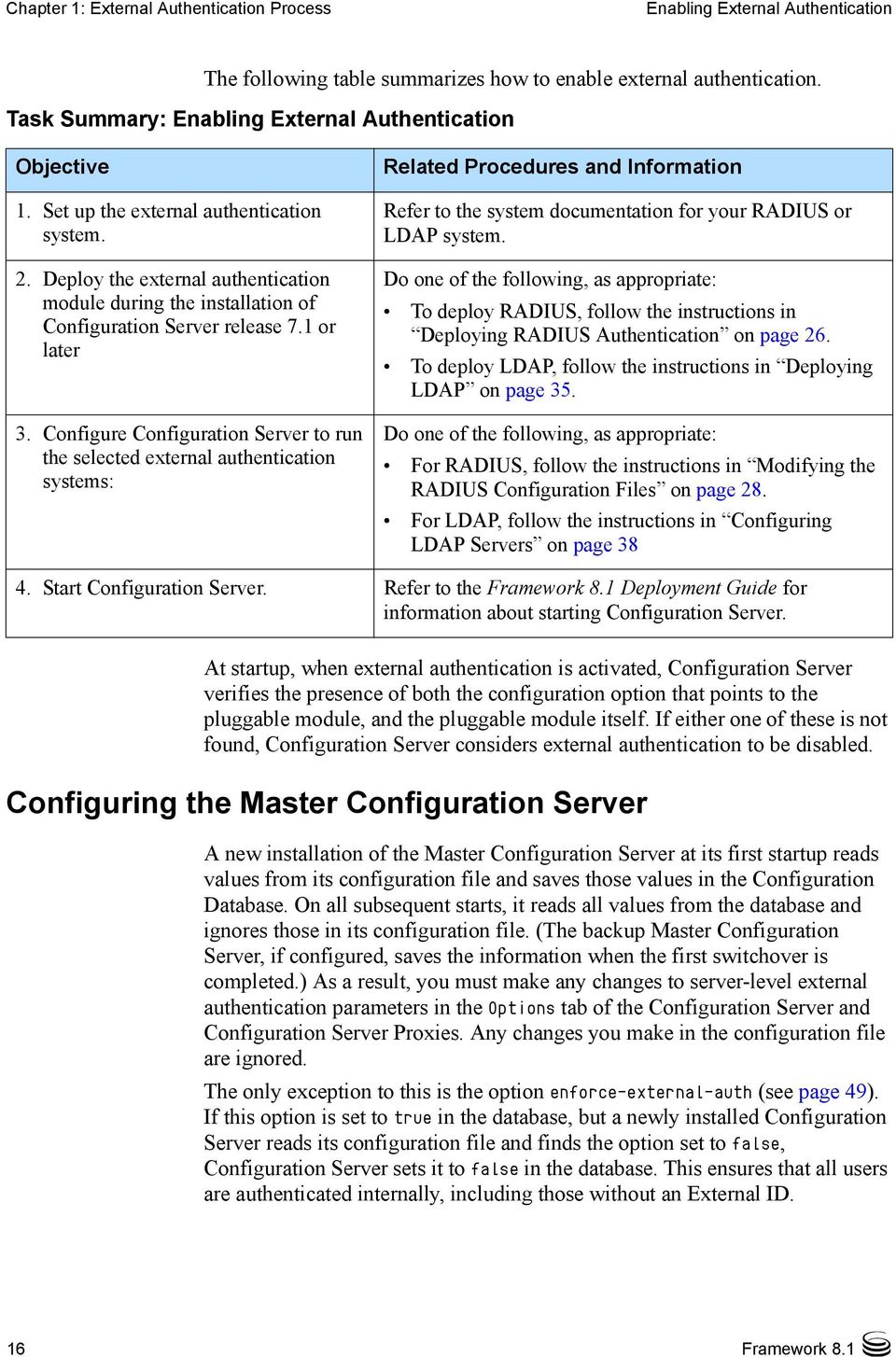
16 Chapter 1: External Authentication Process Enabling External Authentication The following table summarizes how to enable external authentication. Task Summary: Enabling External Authentication Objective 1. Set up the external authentication system. 2. Deploy the external authentication module during the installation of Configuration Server release 7.1 or later 3. Configure Configuration Server to run the selected external authentication systems: Related Procedures and Information Refer to the system documentation for your RADIUS or LDAP system. Do one of the following, as appropriate: To deploy RADIUS, follow the instructions in Deploying RADIUS Authentication on page 26. To deploy LDAP, follow the instructions in Deploying LDAP on page 35. Do one of the following, as appropriate: For RADIUS, follow the instructions in Modifying the RADIUS Configuration Files on page 28. For LDAP, follow the instructions in Configuring LDAP Servers on page Start Configuration Server. Refer to the Framework 8.1 Deployment Guide for information about starting Configuration Server. At startup, when external authentication is activated, Configuration Server verifies the presence of both the configuration option that points to the pluggable module, and the pluggable module itself. If either one of these is not found, Configuration Server considers external authentication to be disabled. Configuring the Master Configuration Server A new installation of the Master Configuration Server at its first startup reads values from its configuration file and saves those values in the Configuration Database. On all subsequent starts, it reads all values from the database and ignores those in its configuration file. (The backup Master Configuration Server, if configured, saves the information when the first switchover is completed.) As a result, you must make any changes to server-level external authentication parameters in the Options tab of the Configuration Server and Configuration Server Proxies. Any changes you make in the configuration file are ignored. The only exception to this is the option enforce-external-auth (see page 49). If this option is set to true in the database, but a newly installed Configuration Server reads its configuration file and finds the option set to false, Configuration Server sets it to false in the database. This ensures that all users are authenticated internally, including those without an External ID. 16 Framework 8.1
17 Chapter 1: External Authentication Process Enabling External Authentication Synchronizing User Accounts For Configuration Server to verify user permissions in the Configuration Database, you must synchronize the user accounts in the Configuration Database with the accounts in the external authentication system. In other words, you must create a Person object in the Configuration Database for each user who will operate in the Genesys environment. The properties of that object must correspond to the user s parameters in the external authentication system. To simplify the synchronization of user accounts, use the Genesys Configuration Import Wizard. For information about the wizard, refer to the Framework 8.0 Imported Configuration Data Formats Reference Manual. Person Objects and External IDs To be considered for external authentication, a Person must be configured with an ExternalID. In the simplest case, the External ID, it could be equal to the person's account name. Customizing External Authentication Configuration With release 7.2 and later, you can customize the configuration of external authentication for specific Person and Tenant objects. Values specified in the Configuration Server options enable External Authentication and are the default; but values defined at the Person or Tenant level can override them. Note: In release 8.1, it is possible to use the same configuration sections and options at the server-level, Tenant-level, and Person-level. Genesys recommends this approach. Furthermore, Genesys recommends that in a multi-tenant or otherwise distributed environment, external authentication be configured at the Tenant level to simplify the configuration process and ensure consistency system-wide. Establishing the Defaults The authentication section in Configuration Server options enables External Authentication, and defines the default External Authentication values for all Person objects within the configuration. For details, see Modifying the RADIUS Configuration Files on page 28 or Configuration Server Options on page 36. The library option in the authentication section must specify a value for each External Authentication provider that your implementation supports: The value gauth_ldap enables LDAP authentication. The value gauth_radius enables RADIUS authentication. External Authentication Reference Manual 17

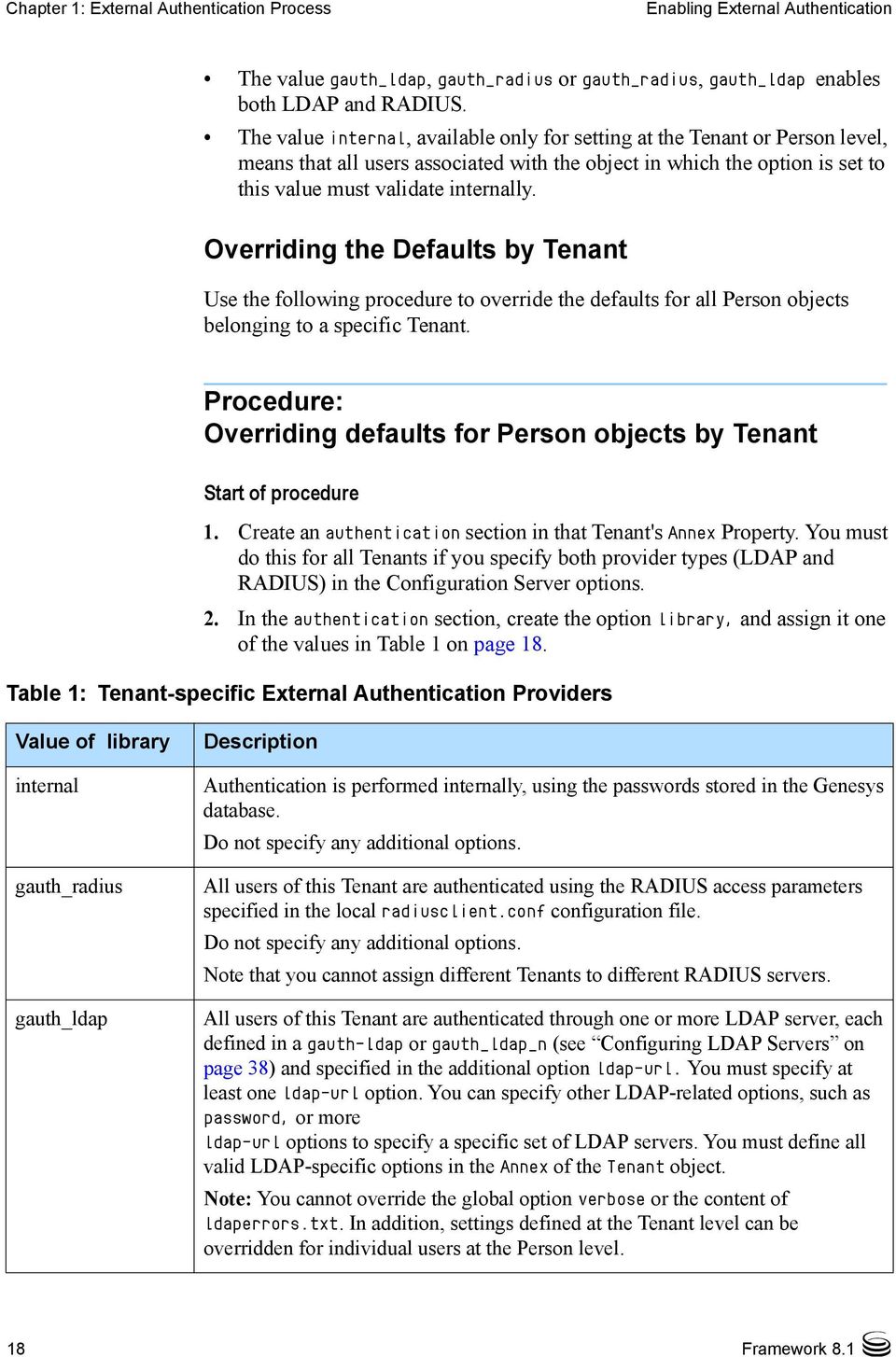
18 Chapter 1: External Authentication Process Enabling External Authentication The value gauth_ldap, gauth_radius or gauth_radius, gauth_ldap enables both LDAP and RADIUS. The value internal, available only for setting at the Tenant or Person level, means that all users associated with the object in which the option is set to this value must validate internally. Overriding the Defaults by Tenant Use the following procedure to override the defaults for all Person objects belonging to a specific Tenant. Procedure: Overriding defaults for Person objects by Tenant Start of procedure 1. Create an authentication section in that Tenant's Annex Property. You must do this for all Tenants if you specify both provider types (LDAP and RADIUS) in the Configuration Server options. 2. In the authentication section, create the option library, and assign it one of the values in Table 1 on page 18. Table 1: Tenant-specific External Authentication Providers Value of library internal gauth_radius gauth_ldap Description Authentication is performed internally, using the passwords stored in the Genesys database. Do not specify any additional options. All users of this Tenant are authenticated using the RADIUS access parameters specified in the local radiusclient.conf configuration file. Do not specify any additional options. Note that you cannot assign different Tenants to different RADIUS servers. All users of this Tenant are authenticated through one or more LDAP server, each defined in a gauth-ldap or gauth_ldap_n (see Configuring LDAP Servers on page 38) and specified in the additional option ldap-url. You must specify at least one ldap-url option. You can specify other LDAP-related options, such as password, or more ldap-url options to specify a specific set of LDAP servers. You must define all valid LDAP-specific options in the Annex of the Tenant object. Note: You cannot override the global option verbose or the content of ldaperrors.txt. In addition, settings defined at the Tenant level can be overridden for individual users at the Person level. 18 Framework 8.1
19 Chapter 1: External Authentication Process Enabling External Authentication 3. If the Tenant is using LDAP external authentication (library=gauth_ldap), create a gauth_ldap section for the first LDAP server and a gauth_ldap_n section for each additional server on the Tenant s Annex tab, and assign appropriate values to the options in each section. Refer to Configuring LDAP Servers on page 38 for detailed information about configuring multiple LDAP servers, and to Configuration Options on page 48 for detailed descriptions of the options. If you have existing Tenant, server, or Person objects that use legacy options (listed in Table 2) in the authentication section, Genesys recommends that you migrate to the gauth_ldap[_n] (where n is 1 to 9)] section format as soon as possible, for security reasons. If you have both current options (in gauth-ldap[_n] sections) and legacy options (in the authentication section) configuration, the legacy options will be ignored. End of procedure Table 2: Legacy Tenant-specific External Authentication Servers LDAP Option Name Option Value Description First LDAP server ldap-url <value> URL of first LDAP server app-user <value> Distinguished name of application user for first LDAP server. password <value> Application user password for first LDAP server cacert-path <value> Path to CA certificate for first LDAP server cert-path <value> Path to certificate of client s key for first LDAP server key-path <value> Path to client s private key for first LDAP server idle-timeout <value> Time interval that the LDAP connection to the first LDAP server will be kept open if there are no more requests retry-attempts <value> Number of authorization retries that will be generated by Configuration Server if the first LDAP server does not respond retry-interval <value> Time that Configuration Server waits for an authorization reply from the first LDAP server. connect-timeout <value> Time that Configuration Server waits after initial connection before deeming first LDAP server to be unavailable. External Authentication Reference Manual 19
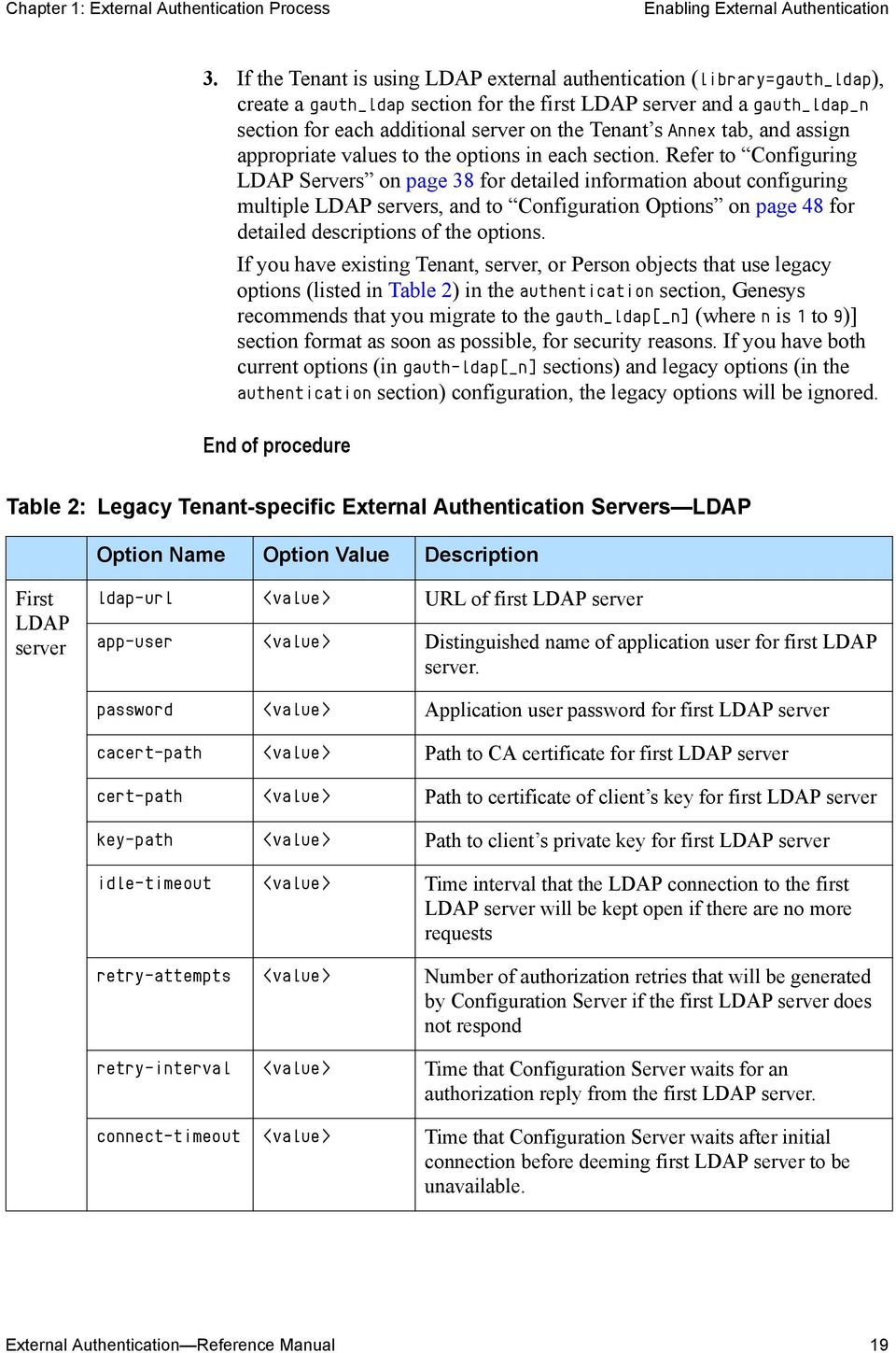
20 Chapter 1: External Authentication Process Enabling External Authentication Table 2: Legacy Tenant-specific External Authentication Servers LDAP (Continued) Option Name Option Value Description Second LDAP server ldap-url1 <value> URL of second LDAP server app-user1 <value> Distinguished name of application user for second LDAP server. password1 <value> Application user password for second LDAP server cacert-path1 <value> Path to CA certificate for second LDAP server cert-path1 <value> Path to certificate of client s key for second LDAP server key-path1 <value> Path to client s private key for second LDAP server idle-timeout2 <value> Time interval that the LDAP connection to the second LDAP will be kept open if there are no more requests. retry-attempts2 <value> Number of authorization retries that will be generated by Configuration Server if the second LDAP server does not respond. retry-interval2 <value> Time that Configuration Server waits for an authorization reply from the second LDAP server. connect-timeout 2 <value> Time that Configuration Server waits after initial connection before deeming second LDAP server to be unavailable. Third LDAP server Continue configuring groups of options for each LDAP server, as required, up to a maximum of 10 servers. Overriding the Defaults by Person Object Note: You cannot override RADIUS defaults for individual Person objects. To override the default or Tenant-specific LDAP access parameters for any individual Person object, specify one or more partial LDAP URLs in the External User ID field in the General section of the Configuration tab (in Genesys Administrator), or on the General tab (in Configuration Manager), of the Person object. 20 Framework 8.1

21 Chapter 1: External Authentication Process Enabling External Authentication You can also override the list of servers specified by default or by the Tenant by specifying LDAP servers in the Annex, in the same way as you do for a Tenant (see Step 3 on page 19). These settings override both default and Tenant-specific settings, and do not require that you restart Configuration Server. The scope of the override depends on whether there is an LDAP server address included in the LDAP URL given in the External User ID field. Generally: If the LDAP URL in the External User ID field includes a server address, the LDAP server given by this address is considered part of the set of servers specified in the Annex. In this case, the LDAP search parameters specified in the External User ID field URL apply only to this LDAP server. If the LDAP URL in the External User ID field does not contain a server address (only search and scope parameters), these search parameters are used to customize the search using the current set of LDAP servers, regardless of where, or at what level, they are defined. Examples Example 1 Example 2 Example 3 The External User ID field contains only a username. For example: user1 The username is used for authorization. If LDAP servers have been configured in the Person object s Annex, the username will be used for authorization with only those servers. The External User ID field contains an LDAP URL consisting of only the server address. For example: ldaps://luxor.us.int.vcorp.com:1636/ The server address in the External User ID field is used as the authentication server for this Person. Additional properties of the server can be specified in the Person object s Annex. Additional LDAP servers can also be specified in the Annex. In this case, the options for the first LDAP server (url_ldap) are ignored, as they are overridden by the server specified in the External User ID field. Only the subsequent servers (such as ldap-url1, ldap-url2, and so on) are used. The External User ID field contains an LDAP URL consisting of the search parameters but no server address. For example: ldap:///???([email protected]) The specified search parameters override the corresponding parameters for all servers used by the Person, whether they are default or defined at the Tenant or Person level. External Authentication Reference Manual 21
22 Chapter 1: External Authentication Process High-Availability External Authentication Configurations High-Availability External Authentication Configurations You can configure multiple external authentication servers to add to the reliability and efficiency of your system. If a system has multiple external authentication servers configured, a Tenant Annex should include the following: [authentication] library=gauth_radius or gauth_ldap or internal Tip: Genesys recommends that you always configure the proper provider at the Tenant level to ensure that external authentication works in a distributed environment. You can also configure RADIUS or LDAP external authentication on Configuration Server Proxies. Instructions for doing so are provided in the respective chapters that follow. Disabling External Authentication To disable external authentication at the Tenant or Person level, set the library option in the authentication section to internal in the object. For Configuration Server or Configuration Server Proxy, set the option to an empty value, and then restart the server to unload the authentication module and stop the authentication. Refer to page 27 (for RADIUS) or page 49 (for LDAP) for information about the library option.). Troubleshooting the External Authentication Connection To obtain debugging information about the connection between any Configuration Server, including Configuration Server Proxy, and the RADIUS or LDAP server, use the configuration option verbose described in this section. [authentication] Section This section must be called authentication. verbose Default Value: 0 22 Framework 8.1
23 Chapter 1: External Authentication Process Troubleshooting the External Authentication Connection Valid Values: 0 Disables this feature. 1 Produces debug information involving only unexpected situations, data, or internal states. 2 Produces debug information without OpenLDAP library output. (The newer OpenLDAP contains a much larger internal debug size, which reduces system performance. This is the recommended level. 3 Produces debug information, including all OpenLDAP library output. Changes Take Effect: If switching of OpenLDAP output occurs, the changes take effect when the next connection is created (after disconnecting, timeout expiry, or switching to a new LDAP server). Otherwise, the changes take effect immediately, when the next authentication request is processed. Specifies the output level for debugging information for the external authentication server. This information is used to troubleshoot the connection between Configuration Server and the RADIUS or LDAP server, from the Configuration Server side. For any Configuration Server, including Configuration Server Proxy, add this section and option to the Options tab of the Application object, using either Genesys Administrator or Configuration Manager. Example The following is an example of the authentication section, with the value set to the recommended maximum: [authentication] verbose=2 Specific log events may also help you determine the state of the connection between Configuration Server and those external authentication servers in your configuration. This is in addition to the troubleshooting functionality described elsewhere in this document. The following log events provide information about connections between Configuration Server and external authentication servers: Indicates that the connection between Configuration Server and the specified external authentication server has failed, and to which alternate external authentication server Configuration Server is trying to connect Identifies that no external authentication servers are available. In other words, the connections between Configuration Server and all external authentication servers have failed Indicates that connection to the specified external authentication server has been restored, and that the server is available for processing authentication requests. For more information about these log events, refer to Framework 8.1 Combined Log Events Help. External Authentication Reference Manual 23
24 Chapter 1: External Authentication Process Troubleshooting the External Authentication Connection 24 Framework 8.1
25 Chapter 2 RADIUS External Authentication This chapter describes how to set up Remote Authentication Dial In User Service (RADIUS) external authentication. This chapter contains the following sections: Overview, page 25 Task Summary, page 26 Deploying RADIUS Authentication, page 26 Modifying the RADIUS Configuration Files, page 28 Deploying RADIUS on Configuration Server Proxy, page 30 Overview Genesys Configuration Server supports all versions of RADIUS, an industry standard for authentication. The architectural schema is identical to the one shown in Figure 1 on page 15, where a RADIUS server acts as a third-party authentication server. To set up RADIUS: 1. Deploy the RADIUS module during installation of Configuration Server. 2. Modify the RADIUS configuration files. Starting in release 7.5, Configuration Server external authentication supports multiple RADIUS servers. The active, or responding, authentication server is used for authorization of all subsequent clients. When this server does not respond, the next server in the list (of servers, as specified in the servers file) is tried, and if it responds, it becomes the active authentication server. This process continues sequentially through the list of authentication servers. External Authentication Reference Manual 25
26 Chapter 2: RADIUS External Authentication Task Summary Starting in release 8.0, RADIUS messages concerning the success and failure of each RADIUS authentication attempt are relayed from the RADIUS server back through Configuration Server for display to the end user. In geographically distributed systems prior to release 8.0, RADIUS external authentication was configured only on the Master Configuration Server, and each Configuration Server Proxy passed authentication requests to it. Starting in release 8.0, RADIUS External Authentication can be configured on the Master Configuration Server and on each Configuration Server Proxy. Therefore, each Configuration Server Proxy can process authentication requests itself, and not pass them on to the Master Configuration Server. Task Summary The following Task Summary lists the tasks required to deploy RADIUS in your configuration. Task Summary: Deploying RADIUS External Authentication Task 1. Install Configuration Server and deploy RADIUS during the installation. 2. Modify the RADIUS configuration files. 3. (optional) Install as many Configuration Servers as required, deploying RADIUS during the installation. Related Procedures and Information This Configuration Server can be the primary or backup configuration server in a redundant configuration, or the Master Configuration Server in a geographically distributed configuration. Use the procedure Deploying RADIUS external authentication during Configuration Server installation on page 27. Modify the RADIUS configuration files servers and radiusclient.conf. Refer to Modifying the RADIUS Configuration Files on page 28. If you are deploying RADIUS in a geographically distributed configuration, install RADIUS on each Configuration Server Proxy using the procedure Deploying RADIUS external authentication on Configuration Server Proxy on page 30. Deploying RADIUS Authentication Use the following procedure to deploy RADIUS authentication during Configuration Server installation. 26 Framework 8.1
27 Chapter 2: RADIUS External Authentication Deploying RADIUS Authentication Procedure: Deploying RADIUS external authentication during Configuration Server installation Purpose: To install the RADIUS pluggable module for your environment where Configuration Server is installed and/or running. Start of procedure 1. Begin the installation of Configuration Server. 2. On the Configuration Server Run Mode page, select Configuration Server Master Primary. 3. Continue installing Configuration Server. 4. On the Configuration Server External Authentication page, select Remote Authentication Dial In User Service (RADIUS). 5. Finish installing Configuration Server. End of procedure During the installation of Configuration Server, a configuration options section named authentication is added to the configuration file, and is copied into the database when Configuration Server starts (see Configuring the Master Configuration Server on page 16). The authentication section indicates that RADIUS external authentication is to be used. [authentication] Section This section must be called authentication. library Default Value: No default value Valid Values: Depends on type configuration option, as follows: gauth_radius All gauth_ldap All gauth_radius, gauth_ldap Configuration Server, Configuration Server Proxy gauth_ldap, gauth_radius Configuration Server, Configuration Server Proxy internal Tenant, Person Changes Take Effect: Upon restart of the object for which this options is set. Specifies the section that specifies the external authentication parameters. This option is mandatory, and its value is set automatically during installation. You can deploy both RADIUS and LDAP on the same Configuration Server or Configuration Server Proxy. If this Configuration Server or Configuration Server Proxy was previously configured for another type of authentication, External Authentication Reference Manual 27
28 Chapter 2: RADIUS External Authentication Modifying the RADIUS Configuration Files Example such as RADIUS, you must manually add gauth_radius to the value of this option. When set to internal, all users associated with the object in which the object is set to this value are validated internally. The following is an example of the authentication section in a Configuration Server configuration file: [authentication] library=gauth_radius Modifying the RADIUS Configuration Files Table 3 lists the pluggable modules used for communication with the third-party authentication server. Table 3: Pluggable Module Names for RADIUS Operating System Module for 32-bit Version Module for 64-bit Version Windows gauth_radius.dll Solaris libgauth_radius_32.so libgauth_radius_64.so AIX libgauth_radius_32.so libgauth_radius_64.so HP-UX libgauth_radius_32.sl libgauth_radius_64.sl Red Hat Linux libgauth_radius_32.so libgauth_radius_64.so In addition to the pluggable module file, three RADIUS configuration files are copied to the destination directory when you install Configuration Server: servers specifies connection parameters of the RADIUS servers. radiusclient.conf specifies the RADIUS client parameters. dictionary contains communication protocol data. You must modify the servers and radiusclient.conf files. Do not modify the dictionary file. Note: Use the pound sign (#) to comment out a line in a configuration file. Modifying the Servers File The RADIUS Configuration Authentication Module uses the configuration file servers to determine to which RADIUS server it must connect. Each line of the file contains the connection parameters for one RADIUS server. 28 Framework 8.1
29 Chapter 2: RADIUS External Authentication Modifying the RADIUS Configuration Files For each RADIUS server, specify: 1. The name or IP address of each RADIUS server. 2. A key; that is, a word that matches the shared secret word configured for each RADIUS server. For example: #Server Name or Client/Server pair Key # server1 key1 server2 key2 server3 Key3 Modifying the radiusclient.conf File The RADIUS Configuration Authentication Module uses the configuration file radiusclient.conf to read its own configuration. In the file, specify values for the following parameters: 1. authserver the names or IP addresses of the RADIUS servers. These must be the same values as configured in the servers file. If necessary, also specify a port for the RADIUS server after a column. For example: authserver server1:1812 server2:1820 server3 where: server1 is the first RADIUS authorization server that will be used. server2 is the backup RADIUS authorization server that will be used if server1 does not respond. server3 is the backup RADIUS authorization server that will be used if server2 does not respond. If you specify only one RADIUS server, that server will continue to be used whether it responds or not. 2. radius_retries The number of authorization retries that will be generated by Configuration Server if the current external authorization server does not respond. Specify a value for this parameter if you are using multiple RADIUS servers. If Configuration Server does not receive a reply within this number of retries, it sends the request to the next RADIUS authentication server specified in the list. For example: #resend request 6 times before trying the next server radius_retries 6 If you are using only one RADIUS server, requests will always be sent to that server regardless of the value of radius_retries. External Authentication Reference Manual 29
30 Chapter 2: RADIUS External Authentication Deploying RADIUS on Configuration Server Proxy 3. radius_timeout The time, in seconds, that Configuration Server waits for an authorization reply. If Configuration Server does not receive a reply from the current RADIUS server during that time, it sends the request again, either to the same RADIUS server or, if you are using multiple RADIUS servers, to the next RADIUS server after the number of tries specified in radius_retries. For example: #wait 20 seconds for a reply from the RADIUS server radius_timeout default_realm the extension to add to a user name if the RADIUS server required names in this format. If a value is specified, the RADIUS module adds it after sign to all user names received from Configuration Server. For example, if you specify default_realm genesys.us and log in to a Genesys application with the user name scott, the resulting name that the RADIUS client passes to the RADIUS server is [email protected] Deploying RADIUS on Configuration Server Proxy In geographically distributed systems prior to release 8.0, RADIUS external authentication was configured only on the Master Configuration Server, and each Configuration Server Proxy passed authentication requests to it. Starting in release 8.0, RADIUS External Authentication can be configured on the Master Configuration Server and on each Configuration Server Proxy. Therefore, each Configuration Server Proxy can process authentication requests itself, and not pass them on to the Master Configuration Server. Procedure: Deploying RADIUS external authentication on Configuration Server Proxy Prerequisites RADIUS is installed on the Master Configuration Server. The servers configuration file contains all of the servers listed in radiusclient.conf. 30 Framework 8.1
31 Chapter 2: RADIUS External Authentication Deploying RADIUS on Configuration Server Proxy Start of procedure 1. Do one of the following: If Configuration Server Proxy is not installed, install it now as described in the Framework 8.1 Deployment Guide, being sure to select the RADIUS external authentication option when prompted. If Configuration Server Proxy has been installed but not configured to use external authentication, copy the following files from the Master Configuration Server installation directory to the Configuration Server Proxy installation directory: dictionary the appropriate pluggable file, as listed in Table 3 on page 28 radius.seq radiusclient.conf servers 2. In the Configuration Server Proxy Application object, configure the following options in the indicated sections, and set them to the specified values: If not set during installation, configure external authentication on Configuration Server Proxy by setting the option library in the authentication section to gauth_radius. To set the log level for monitoring the connection between Configuration Server Proxy and the RADIUS server, use the option verbose in the gauth_radius section of the options of the Configuration Server Proxy Application object, as described in the following section, Troubleshooting the External Authentication Connection on page Restart Configuration Server Proxy. End of procedure External Authentication Reference Manual 31
32 Chapter 2: RADIUS External Authentication Deploying RADIUS on Configuration Server Proxy 32 Framework 8.1
33 Chapter 3 LDAP External Authentication This chapter describes how to set up Lightweight Directory Access Protocol (LDAP) external authentication. This chapter contains the following sections: Overview, page 33 Task Summary, page 35 Deploying LDAP, page 35 Configuring LDAP Servers, page 38 Deploying LDAP on Configuration Server Proxy, page 39 Using LDAP in a Multi-Tenant Configuration, page 40 Using LDAP Referrals, page 40 Security Considerations, page 41 Error Handling, page 42 Technical Notes, page 46 Examples, page 47 Configuration Options, page 48 Overview Management Framework supports external authentication using LDAP as a way to verify a user's permissions to log on to Genesys applications. The LDAP Authentication Module (AM) delivers an authentication request to one of the supported LDAP Directory Servers and passes back the results of that authentication to the client. This LDAP implementation supports all versions of the following LDAP servers: Novell E-Directory External Authentication Reference Manual 33
34 Chapter 3: LDAP External Authentication Overview IBM Tivoli Directory Server (or Blue Pages) Microsoft Active Directory Oracle LDAP Proxy/Internet Directory Starting in release 7.6, Configuration Server external authentication supports multiple LDAP servers. The active, or responding, authentication server is used for authorization of all subsequent clients. When this server does not respond, the next server in the list of servers is tried, and if it responds, it becomes the active authentication server. This process continues sequentially through the list of authentication servers. Starting in release 8.0, LDAP messages concerning the failure (see Error Codes on page 42) of each LDAP authentication attempt are relayed from the LDAP AM back through Configuration Server for display to the end user. Starting in release 8.1, LDAP can be configured on each Configuration Server Proxy in a geographically distributed environment. Therefore, each Configuration Server Proxy can process authentication requests itself, and not pass them on to the Master Configuration Server. External Authentication Files Table 4 lists the pluggable modules that Genesys provides for LDAP. Table 4: Pluggable Module Names for LDAP Operating System Module for 32-bit Version Module for 64-bit Version Windows gauth_ldap.dll Solaris libgauth_ldap_32.so libgauth_ldap_64.so AIX libgauth_ldap_32.so libgauth_ldap_64.so HP-UX libgauth_ldap_32.sl libgauth_ldap_64.sl Red Hat Linux libgauth_ldap_32.so libgauth_ldap_64.so In addition to the pluggable module file, two LDAP files are copied to the destination directory when you install Configuration Server: ldaperrors.txt contains default LDAP errors. For its content, see Error Codes on page 42. randgen.rnd used with Transport Layer Security. 34 Framework 8.1
35 Chapter 3: LDAP External Authentication Task Summary Task Summary The following Task Summary lists the tasks required to deploy LDAP in your configuration. Task Summary: Deploying LDAP External Authentication Task 1. Install Configuration Server and deploy LDAP during the installation. 2. (Optional) Configure additional LDAP Servers. 3. (optional) Install as many Configuration Servers as required, deploying LDAP during the installation. Related Procedures and Information This Configuration Server can be the primary or backup configuration server in a redundant configuration, or the Master Configuration Server in a geographically distributed configuration. Use the procedure Deploying LDAP during Configuration Server installation on page 35. If you are using multiple LDAP servers, configure them on the Options tab of the Tenant object (preferred) or of the Configuration Server object. Refer to Configuring LDAP Servers on page 38. If you are deploying LDAP in a geographically distributed configuration, install each Configuration Server Proxy using the procedure Deploying LDAP during Configuration Server installation on page 35. Deploying LDAP Use the following procedure to deploy LDAP while you are installing Configuration Server or Configuration Server Proxy. Procedure: Deploying LDAP during Configuration Server installation Purpose: To deploy LDAP while installing Configuration Server or Configuration Server Proxy. Start of procedure 1. Begin installing Configuration Server or Configuration Server Proxy (multi-tenant or single-tenant). External Authentication Reference Manual 35
36 Chapter 3: LDAP External Authentication Deploying LDAP 2. On the Configuration Server Run Mode page, select one of the following, as appropriate: Configuration Server Master Primary If you are installing a Master or Primary Configuration Server. Configuration Server Proxy If you are installing a Configuration Server Proxy. 3. Continue installing Configuration Server or Configuration Server Proxy, as appropriate. 4. On the Configuration Server External Authentication page, select Lightweight Directory Access Protocol (LDAP). 5. On the LDAP Server Access URL page, enter the URL that the Configuration Server or Configuration Server Proxy will use to connect to the LDAP server. If you are going to use multiple LDAP authentication servers, specify the first LDAP server on this page. After Configuration Server or Configuration Server Proxy starts up for the first time, you can enter additional LDAP servers on the Options tab of the Configuration Server or Configuration Server Application object. Note: If you are going to use external authentication at the Tenant level, or are going to have a geographically distributed deployment of Configuration Servers, you can ignore this step, and configure the servers at the Tenant level after Configuration Server has been started. 6. Finish installing Configuration Server or Configuration Server Proxy. End of procedure Configuration Server Options Warning! There might be instances in which Configuration Server or Configuration Server Proxy, and the external authentication system interpret a blank password differently. To eliminate this possibility, make sure that Configuration Server does not accept a blank password as valid. Refer to the Framework 8.1 Configuration Options Reference Manual for instructions on configuring the allow-empty-password option to disallow a blank password. If you installed the LDAP pluggable modules during installation of a new Master Configuration Server, the following configuration option sections and options are added to the configuration file, and are copied into the database 36 Framework 8.1
37 Chapter 3: LDAP External Authentication Deploying LDAP when Configuration Server starts (see Configuring the Master Configuration Server on page 16), as follows: [authentication] library=gauth_ldap [gauth_ldap] ldap_url=<url as entered during installation> When you install the LDAP pluggable module on Configuration Server Proxy, you must manually add the same two sections and options to the Application object: The library option specifies gauth_ldap as the section that specifies the external authentication parameters. The ldap-url option specifies the URL of the LDAP server and directory that you entered during installation. Both values are set automatically. At this point, these two sections indicate that LDAP external authentication is to be used, and they are all that is required to use LDAP with one LDAP server that accepts anonymous LDAP binding. If your LDAP server requires authentication to perform searches using a query, specified in the option ldap-url (see page 51), you must set the app-user and password options (see page 53) before you can use external authentication. To maintain backwards compatibility, if an ldapclient.conf file exists, the Master Configuration Server will also read the contents of that file and translate those settings into Configuration Server options at first startup. also storing them in the database. Any changes to that file will also be ignored at subsequent startups. Warnings! If a legacy ldapclient.conf or confserv.conf file from a previous version exists, you must do the following before the first startup of the Master Configuration Server: If either of the files contains passwords, make sure that both of the following conditions are true: The passwords are encrypted. The confserv section of the confserv.conf file contains the option encrypted=true. If either of these conditions are omitted, Configuration Server may import the legacy passwords incorrectly. If the legacy ldapclient.conf file contains multiple servers, organize the servers list in the order in which the servers are indexed, that is gauth_ldap, gauth_ldap _1, gauth-ldap_2, and so on. If you don t do this, Configuration Server will index the servers in the order in which they are read. External Authentication Reference Manual 37
38 Chapter 3: LDAP External Authentication Configuring LDAP Servers Configuring LDAP Servers Configuration Server supports up to ten LDAP authorization modules, or servers. When you install Configuration Server, you can configure one LDAP server during the installation process. If you are using multiple LDAP Servers, you configure those additional LDAP servers on the Options tab of the Configuration Server object. Note: If you are going to use per-tenant external authentication targeting distributed deployment, Genesys recommends that you configure the LDAP servers at the Tenant level, as described in Deploying LDAP on Configuration Server Proxy on page 39. On the Options tab, there is one section for each LDAP server. The name of each section must be unique, and should appear in the order in which they are indexed. The first section is named [gauth_ldap], as described previously. Genesys recommends naming each additional section gauth_ldap_n], where n is a numeric index in the range of 1 to 9 for each LDAP server. A section for a single server has a format like this: [gauth_ldap] or [gauth_ldap_n] ldap-url= <value> app-user= <value> password= <value> cacert-path= <value> cert-path= <value> key-path= <value> The options, or server parameters, in a section are listed in Table 5, and described in detail starting on page 48. Table 5: LDAP Server Parameters Parameter ldap-url app-user password cacert-path cert-path key-path idle-timeout Definition of value URL used to access LDAP server Distinguished name of the application user Application user password Path to CA certificate for LDAP server Path to certificate of client s key Path to client s private key Time interval that the connection to the LDAP server will be kept open if there are no more requests 38 Framework 8.1
39 Chapter 3: LDAP External Authentication Deploying LDAP on Configuration Server Proxy Table 5: LDAP Server Parameters (Continued) Parameter retry-attempts retry-interval connect-timeout Definition of value Number of authorization retries that will be generated by Configuration Server if the LDAP server does not respond Time that Configuration Server waits for an authorization reply from the LDAP server. Initial timeout after which Configuration Server deems the specified LDAP server is not available. When you are finished configuring all LDAP servers, the Options tab will contain one or more sections that look like this, in addition to the mandatory gauth_ldap section for the first server.: [gauth_ldap_1] ldaps://fram.us.int.vcorp.com:636/ou=eng,o=vcorp,c=us??sub?(mail=x) app-user=cn=manager,o=vcorp,c=us password=12345abc9 cacert-path=keys/server.arm cert-path=keys/client.arm key-path=keys/private.pem idle-timeout= 5 retry-attempts=3 retry-interval=10 connect-timeout=10 Each section will have a different numeric identifier. Deploying LDAP on Configuration Server Proxy In geographically distributed systems prior to release 8.1, LDAP external authentication was configured only on the Master Configuration Server, and each Configuration Server Proxy passed authentication requests to it. Starting in release 8.1, LDAP External Authentication can be configured on the Master Configuration Server and on each Configuration Server Proxy. This allows each Configuration Server Proxy to process authentication requests itself, without passing them on to the Master Configuration Server. Use the procedure Deploying LDAP during Configuration Server installation on page 35. External Authentication Reference Manual 39
40 Chapter 3: LDAP External Authentication Using LDAP in a Multi-Tenant Configuration Using LDAP in a Multi-Tenant Configuration Note: Genesys strongly recommends that, if there are multiple distributed Configuration Servers, all LDAP servers should be configured at the Tenant level to simplify the configuration of external authentication. You can set LDAP configuration options at the Tenant level, in the Tenant object s Annex. This activates external authentication only for users belonging to that Tenant. You can override the Application-level settings at the Tenant level, by configuring the following in the Tenant s Annex, as follows: [authentication] library= internal This disables external authentication for all users who belong to that Tenant, and they are authenticated internally. You can also configure multiple servers at the Tenant level, one each in a gauth_ldap_n section, as described in Configuring LDAP Servers on page 38. Using LDAP Referrals Starting in release 8.1.2, Configuration supports the use of LDAP referrals. This enables authentication to occur at an LDAP server other than the server to which Configuration Server sent the authentication request. Note: Full referrals are supported for servers existing in a Microsoft Active Directory. Full referral is not yet supported for multiple directories contained in the referral. If the referral contains more than one server, only the first referral is processed; the rest of the referrals are ignored. When Configuration Server sends a request to the LDAP Server, it may receive in response not an authentication result, but a referral to another server. If activated, Configuration Server searches for the referred server, binds to it, and reissues the authentication request. To configure how Configuration Server handles referrals, or to deactivate the use of referrals, use the chase-referrals option (see page 55) in the gauth_ldap or gauth_ldap_n section at the Tenant, Application, or User level. 40 Framework 8.1
41 Chapter 3: LDAP External Authentication Security Considerations Tip: If the LDAP configuration at the customer site consists of multiple LDAP servers, Genesys recommends that you configure each Tenant and/or individual User to be authenticated using the LDAP server that holds the authentication information for those Users, instead of relying on referrals from a single LDAP server. Configuring Configuration Server to chase referrals might lead to delays during login, and increase the risk of login failures because of the timeout expiring. Use of referrals should be considered only if a small number of user accounts depend on it. If connection to the referred server fails, Configuration Server applies its configured retry-interval (see page 55) and retry-attempts (see page 55) to the LDAP server to which it originally sent the request. Security Considerations Warning! When using LDAP servers in a secure environment, all LDAP servers must use SSL server certificates issued by the same certificate authority or subordinate authorities of the same public root authority. Configuration Server must be provisioned (using the cacert-path option [page 53]) with a certificate of authority (or chain of certificates) that can validate all server SSL certificates. If mutual authentication is required on connections to LDAP servers, Configuration Server must be provisioned (using the cert-path and key-path [page 54]options) with the same local certificate that is accepted by all LDAP servers. Genesys does not support specifying different client certificates (and/or certificate authority certificates), for different connections. In addition, Genesys strongly recommends that you do the following: Set the Genesys URL used to access LDAP to use LDAPS (secure LDAP) protocol. Configure your LDAP server to prevent anonymous or unauthenticated access. For example, do not configure LDAP users with blank or empty passwords. This is in addition to not configuring users with empty passwords in the Configuration Database, as described on page 36. Configure your LDAP server to prevent the directory base being set to null. Restrict knowledge of the structure of your LDAP data. For example, some of this information is contained in the External ID field of User objects in the Configuration Database. Therefore, a user who has access to these objects could figure out the LDAP structure. External Authentication Reference Manual 41
42 Chapter 3: LDAP External Authentication Error Handling For more information and recommendations for securing your LDAP environment, refer to the LDAP benchmarks published by the Center for Internet Security and available on the Center s web site. Error Handling Error Codes When there is an error, the LDAP AM delivers two error-related properties to Configuration Server: error code and error description string. The property Error code is reported in the log files, but only the property error description string is shown on the client s GUI. The LDAP AM uses one of three methods to extract this property (listed from highest priority to lowest): 1. Explicit error description returned by the LDAP server. 2. Error description produced from an error code based on the mapping table inside the Authentication Module. This table is populated from a supplied and configured LDAP error description file (ldaperrors.txt). See Error Codes on page Error description produced from a standard LDAP error code. See Error Codes on page 42. Management Layer Configuration You can configure the Management Layer to generate various alarms in response to error codes sent from the LDAP AM. See the Framework 8.1 Management Layer User s Guide. Special Treatment If the LDAP AM receives an error code that is marked for retry in the error description file (see Error Codes ), it initiates retry attempts according to the policy described in the retry-attempts and retry-interval parameters specified for this connection. A negative response is returned back to the client only after all retry attempts on all available servers were completed without success. The LDAP Directory Administrator (Novel E-Directory, IBM Tivoli Directory Server, or Microsoft Active Directory) defines the error codes. Please refer to their documentation. 42 Framework 8.1
43 Chapter 3: LDAP External Authentication Error Handling The following is the content of the default error file (ldaperrors.txt) that corresponds to the error descriptions in the OpenLDAP client package: ; server codes 1 Operations error 2 Protocol error 3 Time limit exceeded 4 Size limit exceeded 5 Compare False 6 Compare True 7 Authentication method not supported 8 Strong(er) authentication required 9 Partial results and referral received 10 Referral 11 Administrative limit exceeded 12 Critical extension is unavailable 13 Confidentiality required 14 SASL bind in progress 16 No such attribute 17 Undefined attribute type 18 Inappropriate matching 19 Constraint violation 20 Type or value exists 21 Invalid syntax 32 No such object 33 Alias problem 34 Invalid DN syntax 35 Entry is a leaf 36 Alias dereferencing problem 47 Proxy Authorization Failure 48 Inappropriate authentication 49 Invalid credentials 50 Insufficient access 51 Server is busy 52 Server is unavailable 53 Server is unwilling to perform 54 Loop detected 64 Naming violation 65 Object class violation 66 Operation not allowed on non-leaf 67 Operation not allowed on RDN 68 Already exists 69 Cannot modify object class 70 Results too large 71 Operation affects multiple DSAs 80 Internal (implementation specific) error ; API codes 81 Can't contact LDAP server 82 Local error 83 Encoding error 84 Decoding error 85 Timed out External Authentication Reference Manual 43
44 Chapter 3: LDAP External Authentication Error Handling Error Messages 86 Unknown authentication method 87 Bad search filter 88 User cancelled operation 89 Bad parameter to an ldap routine 90 Out of memory 91 Connect error 92 Not Supported 93 Control not found 94 No results returned 95 More results to return 96 Client Loop 97 Referral Limit Exceeded ; Old API codes -1 Can't contact LDAP server -2 Local error -3 Encoding error -4 Decoding error -5 Timed out -6 Unknown authentication method -7 Bad search filter -8 User cancelled operation -9 Bad parameter to an ldap routine -10 Out of memory -11 Connect error -12 Not Supported -13 Control not found -14 No results returned -15 More results to return -16 Client Loop -17 Referral Limit Exceeded Content Sync Refresh Required No Operation Assertion Failed Cancelled No Operation to Cancel Too Late to Cancel Cannot Cancel ; retry-errors: This section describes error messages returned by the LDAP server. Note: The messages in this section correspond to standard LDAP messages. However, your particular LDAP server may be configured to produce different messages in the same situations. Inappropriate Authentication A message similar to that shown in Figure 2 on page 45 may appear when both of the following conditions are true: 44 Framework 8.1
45 Chapter 3: LDAP External Authentication Error Handling Option allow-empty-password is set to true (the default). A blank password has been passed to the LDAP AM. To correct this error, log on to your GUI application with a valid non-empty password. Figure 2: Error Message Blank Password Invalid Credentials A message similar to that shown in Figure 3 may appear when an incorrect password has been passed to the LDAP AM. Figure 3: Error Message Incorrect Password To correct this error, log on to your GUI application with a valid non-empty password. Can t Contact LDAP Server A message similar to that shown in Figure 4 may appear when the Configuration Server cannot contact any LDAP server for one or more of the following reasons: The LDAP server is down. The LDAP server cannot be accessed due to network problems. If you configured Genesys Security Using the TLS Protocol, one or more security parameters specified in the configuration file are not valid. External Authentication Reference Manual 45
46 Chapter 3: LDAP External Authentication Technical Notes Figure 4: Error Message LDAP Server is Not Accessible To correct this error, do the following: Check that at least one LDAP server is running. Check that at least one LDAP server is accessible over the network. If you configured Genesys Security Using the TLS Protocol, check that the security parameters specified in the configuration file are valid. Technical Notes SSL Parameters Genesys LDAP Authentication supports SSLv3 and TLSv1. It supports server authentication and server+client authentication. If the LDAP server is configured to perform server-only authentication, then the only SSL parameter to configure is cacert-path, which specifies a file where the Certificate Authority certificate file that is related to the LDAP server is stored. If the LDAP server is configured to perform server and client authentication, there must be two additional parameters configured besides cacert-path: cert-path which specifies a file where the client certificate is stored and key-path is stored where the client s private key is stored. Note: Genesys LDAP Authentication supports only the PEM (Base64) format of the certificates. You must convert certificates of all other formats to the PEM (Base64) format. Application Account Your LDAP server may not allow an anonymous BIND operation. Instead, configure a dedicated account (called the application account ) that will be able to BIND and perform searches for the distinguishing name of the user being authenticated as defined the search clause in the ldap-url option (see page 51) for this connection. 46 Framework 8.1
47 Chapter 3: LDAP External Authentication Examples Examples Note: All examples belong on single lines. They appear here in a large font, which causes the examples to wrap across multiple lines, for readability. LDAP URL Example 1 ldap-url=ldaps://fram.us.int.vcorp.com:636/ou=engineering,o=vcorp, c=us??sub?(mail=x) Corresponding LDAP search syntax: ldapsearch -p 636 -h fram.us.int.vcorp.com b ou=engineering,o=vcorp,c=us s sub mail= X dn In this example, the LDAP AM connects securely on host/port: fram.us.int.vcorp.com:636 and searches using the following variable values: base: ou=engineering,o=vcorp,c=us scope: sub filter: (mail=x) where X is the actual value of external user ID Example 2 ldap-url=ldap:///ou=engineering%20department,o=vcorp,c=us???(lastname=x ) Corresponding LDAP search syntax: ldapsearch -p 389 -h localhost -b ìou=engineering Department,o=vcorp,c=usî -s sub lastname= X dn In this example, the LDAP AM connects insecurely on host/port: localhost:389 and searches using the following variable values: base: ou=engineering Department,o=vcorp,c=us scope: sub filter: (lastname=x) where X is the actual value of external user ID External Authentication Reference Manual 47
48 Chapter 3: LDAP External Authentication Configuration Options Example 3 ldap-url=ldaps://fram.us.int.vcorp.com/ou=engineering,o=vcorp,c=us??? (mail=x) Corresponding LDAP search syntax: ldapsearch p 636 -h fram.us.int.vcorp.com -b ìou=engineering,o=vcorp,c=usî -s sub mail= X dn In this example, the LDAP AM connects securely on host/port: fram.us.int.vcorp.com:636 and searches using the following variable values: base: ou=engineering,o=vcorp,c=us scope: sub filter: (mail=x) where X is the actual value of external user ID Choosing this scope only verifies the existence of the DN specified in the search base parameter. Configuration Options This section describes the configuration options used to configure LDAP on Configuration Server and Configuration Server Proxy. Warning! Configuration section names, configuration option names, and predefined option values are case-sensitive. Type them in the configuration file, Genesys Administrator, or Configuration Manager exactly as they are documented in this chapter. Setting Configuration Options Unless otherwise specified, you set LDAP configuration options at any of the following locations: In the Options tab of the Configuration Server or Configuration Server Proxy Application object In a multi-tenant and distributed environment, on the Annex tab of a Tenant object In the Annex of individual Person objects This will turn on external authentication for all users enabled with External IDs, or for all users if the option enforce-external-auth (see page 49) is set to true. You can also fine-tune your LDAP configuration throughout your system by configuring some or all options in the Tenant object s Annex. Refer to Using LDAP in a Multi-Tenant Configuration on page 40 for more information. 48 Framework 8.1
49 Chapter 3: LDAP External Authentication Configuration Options Mandatory Options Table 6 on page 49 lists the options that are mandatory for LDAP external authentication on Configuration Server and Configuration Server Proxy. Both options are set automatically during the installation of Configuration Server and Configuration Server Proxy. Table 6: Mandatory LDAP configuration options Section Option Value authentication library gauth_ldap gauth_ldap ldap_url Valid URL of LDAP authentication module authentication Section This section is mandatory on the Server level to enable external authentication. It can, however, appear in other locations as mentioned in Setting Configuration Options on page 48. This section must be called authentication. enforce-external-auth Default Value: false Valid Values: true, false Changes Take Effect: Immediately Optional. Enforces external authentication for every user. If you omit this parameter, LDAP AM performs authentication only if external ID is specified in the Person object. Default value is false. If this option is set to true in the database, but a newly installed Configuration Server reads its configuration file and finds the option set to false, Configuration Server sets it to false in the database. This ensures that all users are authenticated internally, including those without an External ID. This option applies only at the server level. Warning! Do not set enforce-external-auth to true until you have configured all of the accounts in the configuration. library Default Value: No default value Valid Values: Depends on type configuration option, as follows: gauth_ldap All gauth_radius All gauth_ldap, gauth_radius Configuration Server, Configuration Server Proxy External Authentication Reference Manual 49
50 Chapter 3: LDAP External Authentication Configuration Options gauth_ldap All gauth_radius, gauth_ldap Configuration Server, Configuration Server Proxy internal Tenant, Person Changes Take Effect: Upon restart of Configuration Server or Configuration Server Proxy; immediately for Tenants and Persons. Specifies the section that specifies the external authentication parameters. This option is mandatory, and its value is set automatically during installation. If this Configuration Server or Configuration Server Proxy was previously configured for another type of authentication, such as RADIUS, you must manually add, gauth_ldap to the value of this option. When set to internal, all users associated with the object in which the object is set to this value are validated internally. gauth_ldap and gauth_ldap_n Sections Each of these sections contains information about one LDAP Authentication Module. If you are using only one LDAP server, the section is called gauth_ldap. This section is mandatory. If you are using more than one LDAP Server, you must identify one in the gauth_ldap section, and the rest in individual gauth_ldap_n sections. Configuration Server supports up to ten LDAP authorization servers. You can have up to nine of these sections, one section for each LDAP server. The name of each section must be unique, and Genesys recommends that they be in the same order as they are indexed. Each section must be named gauth_ldap_n, where n is a numeric index in the range of 1 to 9 for each LDAP server, as follows: [gauth_ldap_n> ldap-url= <value> app-user= <value> password= <value> cacert-path= <value> cert-path= <value> key-path= <value> idle-timeout=<value> retry_attempts=<value> retry-interval=<value> commit-timeout=<value> chase-referrals=<value> When you add a new section, it takes effect immediately. But if you remove a section, you must restart Configuration Server or Configuration Server Proxy to take the LDAP Server out of use. An LDAP Server is defined using the following options, described in this section: ldap-url app-user 50 Framework 8.1
51 Chapter 3: LDAP External Authentication Configuration Options password ca-cert-path cert-path key-path idle-timeout retry-attempts retry-interval connect-timeout chase-referrals To define an LDAP server, set these options on the Options tab of the object, in the gauth_ldap section. If you are using multiple LDAP servers, define the options for the additional servers in the appropriate gauth_ldap_n section. ldap-url Default Value: Empty string Valid Value: URL in RFC 2255 format, as described below. Changes Take Effect: Immediately This URL contains the information needed to access the LDAP server and directory from which it retrieves the user's distinguished name. Enter a URL of one LDAP server in this field. If you are using multiple LDAP servers, define the rest of your LDAP servers (a maximum of nine) in the gauth_ldap_n section in the Configuration Server or Configuration Server Proxy Application object s Options tab. The LDAP URL contains default settings that are common to all users in the Genesys configuration database. However, these settings may be overridden if the user's record in the configuration database also contains an LDAP URL with access parameters. The priorities used to obey configuration parameters, from highest to lowest, are: 1. LDAP URL in the user's record of the configuration database. 2. LDAP URL specified in the authentication section of the Tenant s Annex. 3. LDAP URL in the configuration file (at first start only), or the Configuration Server or Configuration Server Proxy Application object. 4. AM default parameters, which cannot be changed by the user. External Authentication Reference Manual 51
52 Chapter 3: LDAP External Authentication Configuration Options The following is a sample of an LDAP URL parsed into its parameters (as listed in Table 7 on page 52). Note that the URL contains no spaces and is a single expression that must be entered on a single line. Table 7: ldap-url parameters Parameter Definition of value 1 Protocol type Required. Range: ldaps (SSL/TLS secure) or ldap (unsecure). 2 LDAP server host name 3 LDAP server port Optional. Default is the local host. Example: fram.us.int.vcorp.com Optional. The default (636 for a secure connection and 389 for unsecured) is used if you omit this parameter. Unsecure means a simpler configuration, but also represents a risk. Genesys strongly advises using a secure connection. 4 Base DN Required. Defines the node in the LDAP tree to use as base for the LDAP search. Example: ou=engineering,o=vcorp,c=us 5 Search scope Optional. Default: sub. Defines the scope of the search operation (according to the RFC 2251 format). Range: base, one, sub. 6 Search filter Optional. Limits the search by searching for a match with a specified field. Default: empty string. In the example, X is a parameter that will be substituted with the value of the user s external ID. The filter expression must conform to the standard RFC 2251 format specification. Example: (displayname=x) Note: The user s external ID is defined in the properties of the Person object, as follows: In Genesys Administrator Person object > Configuration tab > General section > External ID In Configuration Manager Person object > General tab > External Authentication area > External User ID For examples of LDAP URLs, see page Framework 8.1
53 Chapter 3: LDAP External Authentication Configuration Options app-user Default Value: Empty string Valid Value: Valid path Changes Take Effect: Immediately Distinguished name (which includes location in the directory tree and in any containers) of the application account used by AM to search for the user's information that is needed to perform an authentication. password Default Value: Empty string Valid Value: A valid password Changes Take Effect: Immediately Password of the application account. Required if the app-user parameter is set. cacert-path Default Value: Empty string Valid Value: Valid path. Changes Take Effect: Immediately Full path to the file containing a certificate of a trusted Certificate Authority, which is used to negotiate a secure LDAP connection to the server. Required for a secured connection. Warning! When using LDAP servers in a secure environment, all LDAP servers must use SSL server certificates issued by the same certificate authority or subordinate authorities of the same public root authority. Configuration Server must be provisioned (using the cacert-path option [page 53]) with a certificate of authority (or chain of certificates) that can validate all server SSL certificates. If mutual authentication is required on connections to LDAP servers, Configuration Server must be provisioned (using the cert-path and key-path [page 54]options) with the same local certificate that is accepted by all LDAP servers. Genesys does not support specifying different client certificates (and/or certificate authority certificates), for different connections. cert-path Default Value: Empty string Valid Value: Valid path Changes Take Effect: Immediately Full path to the file containing a certificate of the LDAP client's private key. External Authentication Reference Manual 53
54 Chapter 3: LDAP External Authentication Configuration Options Note: The certificate must be in Base64 format. This parameter must be set if the protocol portion of the LDAP URL defines a secure connection to the LDAP server and if the LDAP server enforces client Secure Socket Layer (SSL) authentication. Warning! When using LDAP servers in a secure environment, all LDAP servers must use SSL server certificates issued by the same certificate authority or subordinate authorities of the same public root authority. Configuration Server must be provisioned (using the cacert-path option [page 53]) with a certificate of authority (or chain of certificates) that can validate all server SSL certificates. If mutual authentication is required on connections to LDAP servers, Configuration Server must be provisioned (using the cert-path and key-path [page 54]options) with the same local certificate that is accepted by all LDAP servers. Genesys does not support specifying different client certificates (and/or certificate authority certificates), for different connections. key-path Default Value: Empty string Valid Values: Valid path. Changes Take Effect: Immediately Full path to the file containing an LDAP client's private key. Note: The certificate must be in Base64 (PEM) format. This parameter must be set if the protocol portion of the LDAP URL defines a secure connection to the LDAP server and if the LDAP server enforces client SSL authentication. Warning! When using LDAP servers in a secure environment, all LDAP servers must use SSL server certificates issued by the same certificate authority or subordinate authorities of the same public root authority. Configuration Server must be provisioned (using the cacert-path option [page 53]) with a certificate of authority (or chain of certificates) that can validate all server SSL certificates. If mutual authentication is required on connections to LDAP servers, Configuration Server must be provisioned (using the cert-path and key-path [page 54]options) with the same local certificate that is accepted by all LDAP servers. Genesys does not support specifying different client certificates (and/or certificate authority certificates), for different connections. 54 Framework 8.1
55 Chapter 3: LDAP External Authentication Configuration Options idle-timeout Default Value: 0 Valid Values: 0 to MAX_INTEGER Changes Take Effect: Immediately Defines how long (in seconds) the LDAP connection to the server defined in this section will be kept open if there are no more requests to send. When set to zero (0), this connection will be kept open indefinitely. Genesys recommends that it be set to a value that does not exceed the idle timeout of the LDAP server. retry-attempts Default Value: 3 Valid Values: 0 to MAX_INTEGER Changes Take Effect: Immediately The number of authorization retries that Configuration Server will generate if the current LDAP server does not respond. Specify a value for this parameter if you are using multiple LDAP servers. If Configuration Server does not receive a reply within this number of retries, it sends the request to the next LDAP authentication server specified in the object s options. If you are using only one LDAP server, requests will always be sent to that server regardless of the value of retry-attempts. If Configuration Server has tried all the LDAP servers without getting a response, an error is generated. See Error Handling on page 42. retry-interval Default Value: 10 Valid Value: 0 to MAX_INTEGER Changes Take Effect: Immediately The amount of time, in seconds, that Configuration Server waits for an authorization reply. If Configuration Server does not receive a reply from the current LDAP server during that time, it sends the request again, either to the same LDAP server or, if you are using multiple LDAP servers, to the next LDAP server after the number of tries specified in retry-attempts. connect-timeout Default Value: 10 Valid Values: 0 to MAX_INTEGER Changes Take Effect: Immediately Defines the initial connection timeout (in seconds), after which Configuration Server deems the specified LDAP server to be unavailable. When set to zero (0), the default value (10) is used. chase-referrals Default Value: 0 External Authentication Reference Manual 55
56 Chapter 3: LDAP External Authentication Configuration Options Valid Values: 0 Configuration Server chases (follows) referrals and uses anonymous bind to connect to the referred servers. The user is bound to the original server to which the authentication request was sent (as specified by the LDAP configuration in Configuration Server). 1 Configuration Server chases referrals and uses the same login credentials specified in the configuration of the original LDAP server (in the gauth-ldap section).the user is bound to the server to where authentication occurs. 2 Configuration Server does not chase referrals, and returns an error if a referral is returned. Changes Take Effect: At the next authentication request. Specifies how Configuration Server handles a referral returned by a configured LDAP server. 56 Framework 8.1
57 Appendix A Importing User Data from External Sources This appendix describes how to create user records in the Genesys configuration that are required when using a RADIUS or LDAP external authentication system. This appendix contains the following sections: Introduction on page 57 Creating a User Record in the Genesys Configuration on page 58 Introduction To authenticate a user in a Genesys program using one of the external authentication systems (RADIUS or LDAP), create in the Genesys configuration a user record that matches a record in the external authentication system. When you create the user record, you must specify these three properties: User name, Employee ID, and External User ID. Table 8 describes these properties. Table 8: Mandatory User Record Properties Property User name Description Corresponds to name in the XML schema. This property is the user's Genesys logon ID, and it uniquely identifies the user in the Genesys configuration. It must be unique across the entire configuration. For a RADIUS server, this property corresponds to the user name in the RADIUS system. External Authentication Reference Manual 57
58 Appendix A: Importing User Data from External Sources Creating a User Record in the Genesys Configuration Table 8: Mandatory User Record Properties (Continued) Property Employee ID External User ID Description Corresponds to employeeid in the XML schema. This numeric user ID is assigned by the user's company. This ID does not participate in authentication, but is still required by Configuration Server. Corresponds to externalid in the XML schema. Required by LDAP configuration only. Configuration Server uses this ID to match a record in the Genesys configuration with a record in the LDAP directory server. Specifically, Configuration Server substitutes an X symbol in the LDAP URL filter with the value of this property. The filter is part 6 of the LDAP URL; see ldap-url on page 51. Therefore, if the filter in the LDAP URL is (mail=x), then the External User ID property in Genesys configuration represents the mail attribute of the user record in LDAP server. Note: You can also populate other fields for example, , First name, and Last name but neither the authentication process nor Configuration Server requires them. Creating a User Record in the Genesys Configuration This section describes three suggested methods to create a user record in your Genesys configuration: Manual Entry using Genesys Administrator or Configuration Manager Use Genesys Administrator or Configuration Manager to create user records manually, one by one. To do this, create a Person object under one of the folders designated to store Persons information. There is no bulk process available. Be certain to populate all three mandatory fields. 58 Framework 8.1
59 Appendix A: Importing User Data from External Sources Creating a User Record in the Genesys Configuration Import an XML data file using Configuration Import Wizard Create an XML file containing the user records and then import it using the Configuration Import Wizard (CIW). With this method, you can add several user records to Configuration Server in a single stroke. Use the CIW Import Agent Data and then Raw XML Data modes to import. You may create either the CfgAgent object (ordinary Call Center operator), or the CfgPerson object (Administrator). The XML file can also contain records which update or remove user information from Configuration Server. See Sample XML Data File. Import XML Data using the Genesys Configuration SDK Sample XML Data File Use the Genesys Configuration SDK to create custom programs which write user information to Configuration Server in XML format. These custom programs can be written in Java, Visual Basic script or JavaScript. They can monitor changes to the user information on the LDAP directory server, then transform those changes to the format described in the latest version of the Configuration SDK Web Services API Reference, and write them directly to Configuration Server. This sample XML data file contains the three properties that are required by external authentication: <CfgData mode="mt" xmlns=" <CfgReference> <CfgProviderTenantRef id="environment" name="environment"/> <CfgAgentRef id= AgentToUpdate name= smith /> </CfgReference> <CfgCreate> <CfgAgent id="betty" firstname="betty" lastname="smith" employeeid="00001" name="bettys" ownerdbid="environment" address="[email protected]" externalid="[email protected]"/> </CfgCreate> <CfgUpdate> External Authentication Reference Manual 59
60 Appendix A: Importing User Data from External Sources Creating a User Record in the Genesys Configuration <CfgAgentUpdate id= UpdateAgent DBIDref= AgentToUpdate [email protected]/> </CfgUpdate> <CfgRemove> <CfgAgentRef id= AgentToRemove name= Johnson /> </CfgRemove> </CfgData> You could use this data to import user information into the Genesys Database with either the Configuration Import Wizard or the Genesys Configuration SDK. 60 Framework 8.1
61 Appendix B Sample Certificate Authority Certificates File This appendix contains an example of a Certificate Authority (CA) certificates file that can be used to validate the LDAP server authentication without mutual authentication, and the output produced by running the openssl.exe utility. This appendix contains the following sections: CA Certificates File, page 61 Output Using OpenSSL Utility, page 62 Configuring Server Authentication, page 64 CA Certificates File The following sample CA certificates file is a concatenation of several CAs. The CA to validate the remote LDAP server certificate is selected automatically by Configuration Server. The first example is valid for the target host; the second is not BEGIN CERTIFICATE----- MIIErTCCA5WgAwIBAgIJAOGkFzNTb8KOMA0GCSqGSIb3DQEBBQUAMIGVMQswCQYD VQQGEwJSVTEVMBMGA1UECBMMU3QuUGV0ZXJidXJnMRUwEwYDVQQHEwxTdC5QZXRl cmj1cmcxedaobgnvbaotb0dlbmvzexmxczajbgnvbastalfbmrywfaydvqqdew0x OTIuMTY4Ljg1LjgyMSEwHwYJKoZIhvcNAQkBFhJyb290QDE5Mi4xNjguODUuMjIw HhcNMTIwMTI3MTMyODM4WhcNMTcwMTI1MTMyODM4WjCBlTELMAkGA1UEBhMCUlUx FTATBgNVBAgTDFN0LlBldGVyYnVyZzEVMBMGA1UEBxMMU3QuUGV0ZXJidXJnMRAw DgYDVQQKEwdHZW5lc3lzMQswCQYDVQQLEwJRQTEWMBQGA1UEAxMNMTkyLjE2OC44 NS44MjEhMB8GCSqGSIb3DQEJARYScm9vdEAxOTIuMTY4Ljg1LjIyMIIBIjANBgkq hkig9w0baqefaaocaq8amiibcgkcaqeaskkjtr7g4+xjohvuwrbt4az0tdi/wn5u EuSQSotxzGLqCmQQws77xM1/Xyy5W5ik7tJnbToZzYjVVkamucmWMu9bQkr6726Q S4ZHTLjFqAQ1L/E2vaHcTktmdx0EDXfH4uv9ghv7J88/m5ptqorM0T2uZwasjolI w9ehpt5uicirxo/ld8lvsp0sc5odhdqcvf/vcaoay8py+0mt2esph/trlyodfvmp External Authentication Reference Manual 61
62 Appendix B: Sample Certificate Authority Certificates File Output Using OpenSSL Utility jn4xa6wl2qwwzodztk6g5wuxerpgkpyj6gkv0ruykzmtritb+5ky82qogrtl2auc 6nlVJYc1ZlCY9rU9d0LDft5mdX5P+Aqq+pOUARRDELtP/AMyo96qSwIDAQABo4H9 MIH6MB0GA1UdDgQWBBTo7rdRmh9S/9AQKI+OHWVCvbo/UjCBygYDVR0jBIHCMIG/ gbto7rdrmh9s/9aqki+ohwvcvbo/uqgbm6sbmdcbltelmakga1uebhmculuxftat BgNVBAgTDFN0LlBldGVyYnVyZzEVMBMGA1UEBxMMU3QuUGV0ZXJidXJnMRAwDgYD VQQKEwdHZW5lc3lzMQswCQYDVQQLEwJRQTEWMBQGA1UEAxMNMTkyLjE2OC44NS44 MjEhMB8GCSqGSIb3DQEJARYScm9vdEAxOTIuMTY4Ljg1LjIyggkA4aQXM1Nvwo4w DAYDVR0TBAUwAwEB/zANBgkqhkiG9w0BAQUFAAOCAQEAGKdPXqZ9j13Ekz3G42vU CIvvEonhUSFO/nGV8pEJivHZ0O+oYXndRCeiORKF/6nzab17b+w15fbU0uEJyR+D S3IkVkEukBxguleu93kQ5Ds4vuj0JqcvZ9aM1cVVWXDj0jH9tWK++l7QUOD8Cj0Q T+kBWqhYgYwqZE7rcKapzQtKo0ZR6APgY4B8fUkb0qHbRJGEtLxlNsXBi9VGcYQh +LN1ZqdRPic8qqYuBt+7y4e9VBVseoiSNnIcPmaTkASOobvJx6qQhBu8NSIU5pIR RP93LtSqUm+Vj7nC8kAMpVje60MKNSNLC56mH4/TY47wMJ6JHh9q0jB4jbybDTu4 5A== -----END CERTIFICATE BEGIN CERTIFICATE----- MIIE2TCCA8GgAwIBAgIJAJ59nclvV1gRMA0GCSqGSIb3DQEBBQUAMIGjMQswCQYD VQQGEwJydTETMBEGA1UECBMKc29tZS1zdGF0ZTEZMBcGA1UEBxMQU2FpbnQtUGV0 ZXJzYnVyZzETMBEGA1UEChMKZ2VuZXN5c2xhYjELMAkGA1UECxMCUUExFjAUBgNV BAMTDTE5Mi4xNjguNzMuMjIxKjAoBgkqhkiG9w0BCQEWG3JvbWFuLnl1c2hpbkBn ZW5lc3lzbGFiLmNvbTAeFw0wOTA0MDkwNjA1NDZaFw0xNDA0MDgwNjA1NDZaMIGj MQswCQYDVQQGEwJydTETMBEGA1UECBMKc29tZS1zdGF0ZTEZMBcGA1UEBxMQU2Fp bnqtugv0zxjzynvyzzetmbega1uechmkz2vuzxn5c2xhyjelmakga1uecxmcuuex FjAUBgNVBAMTDTE5Mi4xNjguNzMuMjIxKjAoBgkqhkiG9w0BCQEWG3JvbWFuLnl1 c2hpbkbnzw5lc3lzbgfilmnvbtccasiwdqyjkozihvcnaqebbqadggepadccaqoc ggebaozgbia4dw878dtri7cuvo+r3hyd/vombobrspahhma64p0fttvpext8e7p5 5ysd0VLjf7593wHzcAYSfD5j3NTrO7Nui8OtoB77U/urTxMu1jq9o3LfRqN6rgg0 p0fbkuvis7vmciids1g0obiob6gaav3swc38t8rzv50ncmpiitxks3gww1edvfij dlfg7ookxe2wjalgp8hyygoqkqn2h5c+quhvg4t/nnv3up+li/1t4u269ek3nael Chf26q380H0BG/rYcX1iZJdPxiZ1L4BsspMfhgK3Zff3WJVWjEoN5xG/Igbl82vo Nk73WCotSWIa22cqxsPK/BvP7jUCAwEAAaOCAQwwggEIMB0GA1UdDgQWBBRLdA7o 98BjAragLk0L5rj89HsveDCB2AYDVR0jBIHQMIHNgBRLdA7o98BjAragLk0L5rj8 9HsveKGBqaSBpjCBozELMAkGA1UEBhMCcnUxEzARBgNVBAgTCnNvbWUtc3RhdGUx GTAXBgNVBAcTEFNhaW50LVBldGVyc2J1cmcxEzARBgNVBAoTCmdlbmVzeXNsYWIx CzAJBgNVBAsTAlFBMRYwFAYDVQQDEw0xOTIuMTY4LjczLjIyMSowKAYJKoZIhvcN AQkBFhtyb21hbi55dXNoaW5AZ2VuZXN5c2xhYi5jb22CCQCefZ3Jb1dYETAMBgNV HRMEBTADAQH/MA0GCSqGSIb3DQEBBQUAA4IBAQBZlUuooFJB4UFxlmrnVvywOatr sn7dcier418uk4vgcndrw+lga1pcmgeoivri0/ujuakc+gjxpl5whett+nihgw5b NpLam4PPikb3mo8GwdDldqXbbsVUmpI/9hL9eGNAh/IJ1CJD6Jkp7IKmiU6yTzv5 qqw84ekxddfvmhfnvnyu6sg1zouxg2w8h20bwufgix9w4wnmmpdh+salwrnrvgx7 ABv+AGNkhqCe8qmgw5Pkio/HbPd77jqgrSUmYtnWB6cEXhzqkV3T0kb9sFKN9APY x/l7aesd0+ldciil3ybjsy9kuicroebf7j1hgqlfnw0v+sy4oi+7m6qximmk Output Using OpenSSL Utility openssl.exe is the main utility in the OpenSSL toolkit. When it is run against the CA certificates file in the previous section, the following output is produced: 62 Framework 8.1
63 Appendix B: Sample Certificate Authority Certificates File Output Using OpenSSL Utility depth=1 /C=RU/ST=St.Peterburg/L=St.Peterburg/O=Genesys/OU=QA/CN= / Add verify return:1 depth=0 /C=RU/ST=St.Peterburg/L=St.Peterburg/O=Genesys/OU=QA/CN= / /em verify return:1 --- Certificate chain 0 s:/c=ru/st=st.peterburg/l=st.peterburg/o=genesys/ou=qa/cn= / address [email protected] i:/c=ru/st=st.peterburg/l=st.peterburg/o=genesys/ou=qa/cn= / address =root@ s:/c=ru/st=st.peterburg/l=st.peterburg/o=genesys/ou=qa/cn= / address =root@ i:/c=ru/st=st.peterburg/l=st.peterburg/o=genesys/ou=qa/cn= / address =root@ Server certificate -----BEGIN CERTIFICATE----- MIIDKTCCAhECCQCHnhoaG7KJ6jANBgkqhkiG9w0BAQUFADCBlTELMAkGA1UEBhMC UlUxFTATBgNVBAgTDFN0LlBldGVyYnVyZzEVMBMGA1UEBxMMU3QuUGV0ZXJidXJn MRAwDgYDVQQKEwdHZW5lc3lzMQswCQYDVQQLEwJRQTEWMBQGA1UEAxMNMTkyLjE2 OC44NS44MjEhMB8GCSqGSIb3DQEJARYScm9vdEAxOTIuMTY4Ljg1LjIyMB4XDTEy MDEzMDEwNDExNVoXDTE1MDEyOTEwNDExNVowgZoxCzAJBgNVBAYTAlJVMRUwEwYD VQQIEwxTdC5QZXRlcmJ1cmcxFTATBgNVBAcTDFN0LlBldGVyYnVyZzEQMA4GA1UE ChMHR2VuZXN5czELMAkGA1UECxMCUUExFjAUBgNVBAMTDTE5Mi4xNjguODUuODIx JjAkBgkqhkiG9w0BCQEWF3Z2b2xvZGluQGdlbmVzeXNsYWIuY29tMIGfMA0GCSqG SIb3DQEBAQUAA4GNADCBiQKBgQCrlZ+/59mVFg3sTGZrnQf0Ln5VdypLz55HoHlq FfxOnax70BLgGzqhvioUL7vwmwmhzUXqcpeJxBlAGKGYzHh6SPkBHinAqLfdKG5o 91O8Iu+S9RtdTBMGc8hQH1zuQQlaraSLvKS5TPTvkyd+mHMlKvDCGAg0cl/q585V +ir3pwidaqabma0gcsqgsib3dqebbquaa4ibaqbmr82yir/j0iyu9i1+sprv+gmv 9XTHSpqBKG7Xuwi+X4G3tGI+uS05gdHHzGz5or76nMIUUSYCsDC86aAapXDyGfxf llby/noqdn1fprjqperfrk1o4i7zfr2+lyyzfnr3jdbhlgspe6nohkznbfghxwpg ysjixxltbvdkcm5tj/pgsmqtscfwai0brm9p5l6yxx+ufdf+olya/he0v99dofyi syyocjkrymnngpkk2kpwuu8f1ugo1mhlaskihjyd2lt3mkposowphtmkdw6gnxz5 Z4YB2JJW2r//IEIhNvT/qhV+AOTv0EYL6Lo4BAHleTMwvhRWltDAK73LooDB -----END CERTIFICATE----- subject=/c=ru/st=st.peterburg/l=st.peterburg/o=genesys/ou=qa/cn= / addr [email protected] issuer=/c=ru/st=st.peterburg/l=st.peterburg/o=genesys/ou=qa/cn= / addre ss=root@ No client certificate CA names sent --- SSL handshake has read 2179 bytes and written 340 bytes --- New, TLSv1/SSLv3, Cipher is AES256-SHA Server public key is 1024 bit Compression: NONE Expansion: NONE SSL-Session: External Authentication Reference Manual 63
64 Appendix B: Sample Certificate Authority Certificates File Configuring Server Authentication Protocol : TLSv1 Cipher : AES256-SHA Session-ID: 7D705B895D61F2A BB8C74EDE80168B69FA96AF3AD5FE0F4F8 Session-ID-ctx: Master-Key: F1446F0B8F8B6E605AD923B0B24A08BADD91B82ABA24C13FCEB59D3B A331F 583C66EC F49F2F572C Key-Arg : None Krb5 Principal: None Start Time: Timeout : 300 (sec) Verify return code: 0 (ok) --- Configuring Server Authentication To configure LDAP server authentication, you must configure the cacert-path configuration option (see page 53) in the gauth_ldap section of the options of Configuration Server. Set this option to the path of the file that contains the CA certificate definition. This option is required whether the LDAP server requires mutual authentication or not. If your LDAP server requires mutual authentication, you must also set the cert-path (see page 53) and key-path (see page 54) options. 64 Framework 8.1
65 Supplements Related Documentation Resources The following resources provide additional information that is relevant to this software. Consult these additional resources as necessary. Genesys Framework Framework 8.0 Architecture Help, which will help you understand the Genesys Framework architecture. Framework 8.1 Deployment Guide, which will help you install and configure the Genesys Framework components. Framework 8.1 Genesys Administrator Help, which will help you configure and create any necessary configuration objects in Genesys Administrator. Framework 8.1 Configuration Manager Help, which will help you configure and create any necessary configuration objects in Configuration Manager. Framework 8.1 Configuration Options Reference Manual, which will provide you with the configuration option descriptions for Configuration Server and other Framework components. Genesys 8.1 Security Deployment Guide, which will help you understand Genesys security and permissions schema. Release Notes and Product Advisories for this product, available on the Genesys Technical Support website at Genesys Genesys Technical Publications Glossary, which ships on the Genesys Documentation Library DVD and which provides a comprehensive list of the Genesys and computer-telephony integration (CTI) terminology and acronyms used in this document. External Authentication Reference Manual 65
66 Related Documentation Resources Genesys Migration Guide, which ships on the Genesys Documentation Library DVD, and which provides documented migration strategies for Genesys product releases. Contact Genesys Technical Support for more information. Information about supported hardware and third-party software is available on the Genesys Technical Support website in the following documents: Genesys Supported Operating Environment Reference Manual Genesys Supported Media Interfaces Reference Manual Consult the following additional resources as necessary: Genesys Hardware Sizing Guide, which provides information about Genesys hardware sizing guidelines for the Genesys 8.x releases. Genesys Interoperability Guide, which provides information on the compatibility of Genesys products with various Configuration Layer Environments; Interoperability of Reporting Templates and Solutions; and Gplus Adapters Interoperability. Genesys Licensing Guide, which introduces you to the concepts, terminology, and procedures that are relevant to the Genesys licensing system. Genesys Database Sizing Estimator 8.x Worksheets, which provides a range of expected database sizes for various Genesys products. For additional system-wide planning tools and information, see the release-specific listings of System Level Documents on the Genesys Technical Support website, accessible from the system level documents by release tab in the Knowledge Base Browse Documents Section. Genesys product documentation is available on the: Genesys Technical Support website at Genesys Documentation wiki at Genesys Documentation Library DVD, which you can order by from Genesys Order Management at [email protected]. 66 Framework 8.1
67 Document Conventions Document Conventions This document uses certain stylistic and typographical conventions introduced here that serve as shorthands for particular kinds of information. Document Version Number A version number appears at the bottom of the inside front cover of this document. Version numbers change as new information is added to this document. Here is a sample version number: 81fr_ref-exta_ _v You will need this number when you are talking with Genesys Technical Support about this product. Screen Captures Used in This Document Screen captures from the product graphical user interface (GUI), as used in this document, may sometimes contain minor spelling, capitalization, or grammatical errors. The text accompanying and explaining the screen captures corrects such errors except when such a correction would prevent you from installing, configuring, or successfully using the product. For example, if the name of an option contains a usage error, the name would be presented exactly as it appears in the product GUI; the error would not be corrected in any accompanying text. Type Styles Table 9 on page 68 describes and illustrates the type conventions that are used in this document. External Authentication Reference Manual 67
68 Document Conventions Table 9: Type Styles Type Style Used For Examples Italic Document titles Emphasis Definitions of (or first references to) unfamiliar terms Mathematical variables Also used to indicate placeholder text within code samples or commands, in the special case where angle brackets are a required part of the syntax (see the note about angle brackets on page 68). Please consult the Genesys 8 Migration Guide for more information. Do not use this value for this option. A customary and usual practice is one that is widely accepted and used within a particular industry or profession. The formula, x +1 = 7 where x stands for... Monospace font (Looks like teletype or typewriter text) All programming identifiers and GUI elements. This convention includes: The names of directories, files, folders, configuration objects, paths, scripts, dialog boxes, options, fields, text and list boxes, operational modes, all buttons (including radio buttons), check boxes, commands, tabs, CTI events, and error messages. The values of options. Logical arguments and command syntax. Code samples. Also used for any text that users must manually enter during a configuration or installation procedure, or on a command line. Select the Show variables on screen check box. In the Operand text box, enter your formula. Click OK to exit the Properties dialog box. T-Server distributes the error messages in EventError events. If you select true for the inbound-bsns-calls option, all established inbound calls on a local agent are considered business calls. Enter exit on the command line. Square brackets ([ ]) A particular parameter or value that is optional within a logical argument, a command, or some programming syntax. That is, the presence of the parameter or value is not required to resolve the argument, command, or block of code. The user decides whether to include this optional information. smcp_server -host [/flags] Angle brackets (< >) A placeholder for a value that the user must specify. This might be a DN or a port number specific to your enterprise. Note: In some cases, angle brackets are required characters in code syntax (for example, in XML schemas). In these cases, italic text is used for placeholder values. smcp_server -host <confighost> 68 Framework 8.1
69 Index A allow-empty-password (configuration option) app-user (LDAP server parameter)....38, 53 architecture external authentication authentication (configuration section) LDAP RADIUS authserver (RADIUS parameter) B base DN (ldap-url parameter) C cacert-path (LDAP server parameter)...38, 53 Can t contact LDAP server (error message) cert-path (LDAP server parameter)....38, 53 chase-referrals (LDAP configuration option) , 55 configuration files LDAP ldapclient.sample.conf RADIUS dictionary radiusclient.conf , 29 servers configuration options authentication section , 31, 49 chase-referrals (LDAP) , 55 connect-timeout (LDAP) gauth_radius section idle-timeout (LDAP) library (RADIUS) , 31 retry-attempts (LDAP) , 55 retry-interval (LDAP) , 55 setting verbose (RADIUS) , 31 Configuration Server options setting connect-timeout (LDAP configuration option) connect-timeout (LDAP server parameter)..39 customizing external authentication establishing defaults overriding defaults by Person objects overriding defaults by Tenant D default_realm (RADIUS parameter) dictionary (RADIUS file) displaying messages LDAP RADIUS document audience commenting on conventions typographical styles version number E enforce-external-auth (LDAP configuration option) error code (LDAP property) error description string (LDAP property) error handling in LDAP default error codes error code (property) error description string (property) error messages , 45 error messages Can t contact LDAP server Inappropriate authentication External Authentication Reference Manual 69
70 Index Invalid credentials external authentication architecture customizing enabling external authentication files for LDAP G gauth_ldap (configuration section) , 50 gauth_ldap_n (configuration section)...38, 50 geographically distributed systems deploying LDAP deploying RADIUS I IBM Tivoli Directory Server idle-timeout (LDAP configuration option) idle-timeout (LDAP server parameter) Inappropriate authentication (error message) Invalid credentials (error message) K key-path (LDAP server parameter) , 54 L LDAP application account external authentication files in geographically distributed systems on Configuration Server Proxy referrals security considerations SSL parameters supported LDAP servers supported versions LDAP Authentication Module LDAP configuration files ldapclient.sample.conf LDAP configuration options , 38, 51 app-user , 53 cacert-path , 53 chase-referrals , 55 connect-timeout , 55 enforce-external-auth idle-timeout , 55 key-path , 54 ldap-url library , 49 password , 53 retry-attempts , 42, 55 retry-interval , 42, 55 LDAP default errors file LDAP error messages Can t contact LDAP server Inappropriate authentication Invalid credentials LDAP pluggable modules LDAP radio button LDAP referrals chase-referrals option LDAP server host name (ldap-url parameter) LDAP server parameters app-user , 53 cacert-path , 53 cert-path , 53 connect-timeout idle-timeout key-path , 54 ldap-url , 38, 51 password , 53 retry-attempts retry-interval ldapclient.sample.conf (LDAP file) ldaperrors.txt (LDAP file) ldap-url (LDAP server parameter)... 37, 38, 51 ldap-url parameters base DN LDAP server host name LDAP server port protocol type search filter search scope library (configuration option) LDAP , 49 RADIUS , 31 Lightweight Directory Access Protocol M Microsoft Active Directory multiple servers LDAP RADIUS N Novell E-Directory Framework 8.1
71 Index O Oracle LDAP Proxy/Internet Directory overriding defaults by Person objects establishing defaults overriding defaults by Tenant establishing defaults P password (LDAP server parameter)....38, 53 PEM (Base64) format role in LDAP pluggable module LDAP RADIUS protocol type (ldap-url parameter) servers (RADIUS file) configuring setting configuration options T Tivoli Directory Server, IBM V verbose (configuration option) , 31 R RADIUS disable in geographically distributed systems on Configuration Server Proxy supported versions RADIUS configuration files dictionary radiusclient.conf , 29 servers RADIUS configuration options library , 31 verbose , 31 RADIUS parameters authserver default_realm radius_retries , 30 radius_timeout RADIUS pluggable modules RADIUS radio button radius_retries (RADIUS parameter)....29, 30 radius_timeout (RADIUS parameter) radiusclient.conf (RADIUS file) , 29 configuring randgen.rnd (LDAP file) retry-attempts (LDAP configuration option) , 55 retry-attempts (LDAP server parameter) retry-interval (LDAP configuration option) , 55 retry-interval (LDAP server parameter) S search filter (ldap-url parameter) search scope (ldap-url parameter) server port (ldap-url parameter) External Authentication Reference Manual 71
72 Index 72 Framework 8.1
Orchestration Server Migration Guide
 Genesys 8.1 Orchestration Server Migration Guide TEMPORARY DOCUMENT: Available until the information contained herein is integrated into the Genesys Migration Guide. The information contained herein is
How To Deploy An Eservices On A Windows Server On A Microsoft Server On An Unix Server On Your Computer Or Ipad Or Ipa Server On The Netbook (For A Single Tenant) On A Server On Linux Or Sunsoft
 eservices 8.1 Deployment Guide The information contained herein is proprietary and confidential and cannot be disclosed or duplicated without the prior written consent of Genesys Telecommunications Laboratories,
Framework 8.1. Management Layer. User s Guide
 Framework 8.1 Management Layer User s Guide The information contained herein is proprietary and confidential and cannot be disclosed or duplicated without the prior written consent of Genesys Telecommunications
Using RADIUS Agent for Transparent User Identification
 Using RADIUS Agent for Transparent User Identification Using RADIUS Agent Web Security Solutions Version 7.7, 7.8 Websense RADIUS Agent works together with the RADIUS server and RADIUS clients in your
CA Performance Center
 CA Performance Center Single Sign-On User Guide 2.4 This Documentation, which includes embedded help systems and electronically distributed materials, (hereinafter referred to as the Documentation ) is
How To Take Advantage Of Active Directory Support In Groupwise 2014
 White Paper Collaboration Taking Advantage of Active Directory Support in GroupWise 2014 Flexibility and interoperability have always been hallmarks for Novell. That s why it should be no surprise that
Outbound Contact 8.0. Reference Manual
 Outbound Contact 8.0 Reference Manual The information contained herein is proprietary and confidential and cannot be disclosed or duplicated without the prior written consent of Genesys Telecommunications
Configuring the Cisco ISA500 for Active Directory/LDAP and RADIUS Authentication
 Configuring the Cisco ISA500 for Active Directory/LDAP and RADIUS Authentication This application note describes how to authenticate users on a Cisco ISA500 Series security appliance. It includes these
BlackShield ID Agent for Remote Web Workplace
 Agent for Remote Web Workplace 2010 CRYPTOCard Corp. All rights reserved. http:// www.cryptocard.com Copyright Copyright 2010, CRYPTOCard All Rights Reserved. No part of this publication may be reproduced,
http://docs.trendmicro.com/en-us/smb/hosted-email-security.aspx
 Trend Micro Incorporated reserves the right to make changes to this document and to the product described herein without notice. Before installing and using the product, review the readme files, release
Security Provider Integration RADIUS Server
 Security Provider Integration RADIUS Server 2015 Bomgar Corporation. All rights reserved worldwide. BOMGAR and the BOMGAR logo are trademarks of Bomgar Corporation; other trademarks shown are the property
How To Configure A Bomgar.Com To Authenticate To A Rdius Server For Multi Factor Authentication
 Security Provider Integration RADIUS Server 2015 Bomgar Corporation. All rights reserved worldwide. BOMGAR and the BOMGAR logo are trademarks of Bomgar Corporation; other trademarks shown are the property
BrightStor ARCserve Backup for Linux
 BrightStor ARCserve Backup for Linux Agent for MySQL Guide r11.5 D01213-2E This documentation and related computer software program (hereinafter referred to as the "Documentation") is for the end user's
Siebel Installation Guide for Microsoft Windows. Siebel Innovation Pack 2013 Version 8.1/8.2, Rev. A April 2014
 Siebel Installation Guide for Microsoft Windows Siebel Innovation Pack 2013 Version 8.1/8.2, Rev. A April 2014 Copyright 2005, 2014 Oracle and/or its affiliates. All rights reserved. This software and
Siebel Installation Guide for UNIX. Siebel Innovation Pack 2013 Version 8.1/8.2, Rev. A April 2014
 Siebel Installation Guide for UNIX Siebel Innovation Pack 2013 Version 8.1/8.2, Rev. A April 2014 Copyright 2005, 2014 Oracle and/or its affiliates. All rights reserved. This software and related documentation
Adeptia Suite LDAP Integration Guide
 Adeptia Suite LDAP Integration Guide Version 6.2 Release Date February 24, 2015 343 West Erie, Suite 440 Chicago, IL 60654, USA Phone: (312) 229-1727 x111 Fax: (312) 229-1736 DOCUMENT INFORMATION Adeptia
CA Spectrum and CA Embedded Entitlements Manager
 CA Spectrum and CA Embedded Entitlements Manager Integration Guide CA Spectrum Release 9.4 - CA Embedded Entitlements Manager This Documentation, which includes embedded help systems and electronically
SonicOS Enhanced 3.2 LDAP Integration with Microsoft Active Directory and Novell edirectory Support
 SonicOS Enhanced 3.2 LDAP Integration with Microsoft Active Directory and Novell edirectory Support Document Scope This document describes the integration of SonicOS Enhanced 3.2 with Lightweight Directory
CA Unified Infrastructure Management Server
 CA Unified Infrastructure Management Server CA UIM Server Configuration Guide 8.0 Document Revision History Version Date Changes 8.0 September 2014 Rebranded for UIM 8.0. 7.6 June 2014 No revisions for
CA Nimsoft Service Desk
 CA Nimsoft Service Desk Single Sign-On Configuration Guide 6.2.6 This Documentation, which includes embedded help systems and electronically distributed materials, (hereinafter referred to as the Documentation
Gplus Adapter 8.0. For Microsoft Dynamics CRM. User s Guide
 Gplus Adapter 8.0 For Microsoft Dynamics CRM User s Guide The information contained herein is proprietary and confidential and cannot be disclosed or duplicated without the prior written consent of Genesys
Connection Broker Managing User Connections to Workstations, Blades, VDI, and More. Quick Start with Microsoft Hyper-V
 Connection Broker Managing User Connections to Workstations, Blades, VDI, and More Quick Start with Microsoft Hyper-V Version 8.1 October 21, 2015 Contacting Leostream Leostream Corporation http://www.leostream.com
Gplus Adapter 8.0. For Microsoft Dynamics CRM. User s Guide
 Gplus Adapter 8.0 For Microsoft Dynamics CRM User s Guide The information contained herein is proprietary and confidential and cannot be disclosed or duplicated without the prior written consent of Genesys
Xerox Secure Access Unified ID System 5.4 Administration Guide
 2014 Xerox Secure Access Unified ID System 5.4 Administration Guide Xerox Secure Access Unified ID System 5.4 Administration Guide Document Revision History Revision Date Revision List September 12, 2014
Application Note. Gemalto s SA Server and OpenLDAP
 Application Note Gemalto s SA Server and OpenLDAP ii Preface All information herein is either public information or is the property of and owned solely by Gemalto NV. and/or its subsidiaries who shall
LogLogic General Database Collector for Microsoft SQL Server Log Configuration Guide
 LogLogic General Database Collector for Microsoft SQL Server Log Configuration Guide Document Release: Septembere 2011 Part Number: LL600066-00ELS100000 This manual supports LogLogic General Database Collector
CA Spectrum and CA Service Desk
 CA Spectrum and CA Service Desk Integration Guide CA Spectrum 9.4 / CA Service Desk r12 and later This Documentation, which includes embedded help systems and electronically distributed materials, (hereinafter
Tivoli Access Manager Agent for Windows Installation Guide
 IBM Tivoli Identity Manager Tivoli Access Manager Agent for Windows Installation Guide Version 4.5.0 SC32-1165-03 IBM Tivoli Identity Manager Tivoli Access Manager Agent for Windows Installation Guide
Strong Authentication for Microsoft SharePoint
 Strong Authentication for Microsoft SharePoint with Powerful Authentication Management for Service Providers and Enterprises Authentication Service Delivery Made EASY Copyright Copyright 2011. CRYPTOCard
Enterprise Toolbar User s Guide. Revised March 2015
 Revised March 2015 Copyright Notice Trademarks Copyright 2007 DSCI, LLC All rights reserved. Any technical documentation that is made available by DSCI, LLC is proprietary and confidential and is considered
Moving the TRITON Reporting Databases
 Moving the TRITON Reporting Databases Topic 50530 Web, Data, and Email Security Versions 7.7.x, 7.8.x Updated 06-Nov-2013 If you need to move your Microsoft SQL Server database to a new location (directory,
Installation and Configuration Guide
 Entrust Managed Services PKI Auto-enrollment Server 7.0 Installation and Configuration Guide Document issue: 1.0 Date of Issue: July 2009 Copyright 2009 Entrust. All rights reserved. Entrust is a trademark
Installing Management Applications on VNX for File
 EMC VNX Series Release 8.1 Installing Management Applications on VNX for File P/N 300-015-111 Rev 01 EMC Corporation Corporate Headquarters: Hopkinton, MA 01748-9103 1-508-435-1000 www.emc.com Copyright
Configuring SSL VPN on the Cisco ISA500 Security Appliance
 Application Note Configuring SSL VPN on the Cisco ISA500 Security Appliance This application note describes how to configure SSL VPN on the Cisco ISA500 security appliance. This document includes these
BlackShield ID Agent for Terminal Services Web and Remote Desktop Web
 Agent for Terminal Services Web and Remote Desktop Web 2010 CRYPTOCard Corp. All rights reserved. http:// www.cryptocard.com Copyright Copyright 2010, CRYPTOCard All Rights Reserved. No part of this publication
Installing The SysAidTM Server Locally
 Installing The SysAidTM Server Locally Document Updated: 17 October 2010 Introduction SysAid is available in two editions: a fully on-demand ASP solution and an installed, in-house solution for your server.
MGC WebCommander Web Server Manager
 MGC WebCommander Web Server Manager Installation and Configuration Guide Version 8.0 Copyright 2006 Polycom, Inc. All Rights Reserved Catalog No. DOC2138B Version 8.0 Proprietary and Confidential The information
CA Workload Automation Agent for Databases
 CA Workload Automation Agent for Databases Implementation Guide r11.3.4 This Documentation, which includes embedded help systems and electronically distributed materials, (hereinafter referred to as the
eservices 8.0 Deployment Guide
 eservices 8.0 Deployment Guide The information contained herein is proprietary and confidential and cannot be disclosed or duplicated without the prior written consent of Genesys Telecommunications Laboratories,
Cloud Services ADM. Agent Deployment Guide
 Cloud Services ADM Agent Deployment Guide 10/15/2014 CONTENTS System Requirements... 1 Hardware Requirements... 1 Installation... 2 SQL Connection... 4 AD Mgmt Agent... 5 MMC... 7 Service... 8 License
HYPERION SYSTEM 9 N-TIER INSTALLATION GUIDE MASTER DATA MANAGEMENT RELEASE 9.2
 HYPERION SYSTEM 9 MASTER DATA MANAGEMENT RELEASE 9.2 N-TIER INSTALLATION GUIDE P/N: DM90192000 Copyright 2005-2006 Hyperion Solutions Corporation. All rights reserved. Hyperion, the Hyperion logo, and
Open Directory. Apple s standards-based directory and network authentication services architecture. Features
 Open Directory Apple s standards-based directory and network authentication services architecture. Features Scalable LDAP directory server OpenLDAP for providing standards-based access to centralized data
Setup Guide Access Manager 3.2 SP3
 Setup Guide Access Manager 3.2 SP3 August 2014 www.netiq.com/documentation Legal Notice THIS DOCUMENT AND THE SOFTWARE DESCRIBED IN THIS DOCUMENT ARE FURNISHED UNDER AND ARE SUBJECT TO THE TERMS OF A LICENSE
Gplus Adapter 8.0. for Siebel CRM. Developer s Guide
 Gplus Adapter 8.0 for Siebel CRM Developer s Guide The information contained herein is proprietary and confidential and cannot be disclosed or duplicated without the prior written consent of Genesys Telecommunications
Portions of this product were created using LEADTOOLS 1991-2009 LEAD Technologies, Inc. ALL RIGHTS RESERVED.
 Installation Guide Lenel OnGuard 2009 Installation Guide, product version 6.3. This guide is item number DOC-110, revision 1.038, May 2009 Copyright 1992-2009 Lenel Systems International, Inc. Information
CA ARCserve Backup for Windows
 CA ARCserve Backup for Windows Agent for Microsoft SharePoint Server Guide r15 This documentation and any related computer software help programs (hereinafter referred to as the "Documentation") are for
USER GUIDE. Lightweight Directory Access Protocol (LDAP) Schoolwires Centricity
 USER GUIDE Lightweight Directory Access Protocol () Schoolwires Centricity TABLE OF CONTENTS Introduction... 1 Audience and Objectives... 1 Overview... 1 Servers Supported by Centricity... 1 Benefits of
OnCommand Performance Manager 1.1
 OnCommand Performance Manager 1.1 Installation and Setup Guide For Red Hat Enterprise Linux NetApp, Inc. 495 East Java Drive Sunnyvale, CA 94089 U.S. Telephone: +1 (408) 822-6000 Fax: +1 (408) 822-4501
http://docs.trendmicro.com
 Trend Micro Incorporated reserves the right to make changes to this document and to the products described herein without notice. Before installing and using the product, please review the readme files,
NovaBACKUP xsp Version 15.0 Upgrade Guide
 NovaBACKUP xsp Version 15.0 Upgrade Guide NovaStor / November 2013 2013 NovaStor, all rights reserved. All trademarks are the property of their respective owners. Features and specifications are subject
Oracle Enterprise Single Sign-on Logon Manager. Installation and Setup Guide Release 11.1.1.2.0 E15720-02
 Oracle Enterprise Single Sign-on Logon Manager Installation and Setup Guide Release 11.1.1.2.0 E15720-02 November 2010 Oracle Enterprise Single Sign-on Logon Manager, Installation and Setup Guide, Release
Using LiveAction with Cisco Secure ACS (TACACS+ Server)
 LiveAction Application Note Using LiveAction with Cisco Secure ACS (TACACS+ Server) September 2012 http://www.actionpacked.com Table of Contents 1. Introduction... 1 2. Cisco Router Configuration... 2
Installation Guide. Novell Storage Manager 3.1.1 for Active Directory. Novell Storage Manager 3.1.1 for Active Directory Installation Guide
 Novell Storage Manager 3.1.1 for Active Directory Installation Guide www.novell.com/documentation Installation Guide Novell Storage Manager 3.1.1 for Active Directory October 17, 2013 Legal Notices Condrey
HP Device Manager 4.6
 Technical white paper HP Device Manager 4.6 Installation and Update Guide Table of contents Overview... 3 HPDM Server preparation... 3 FTP server configuration... 3 Windows Firewall settings... 3 Firewall
BrightStor ARCserve Backup for Windows
 BrightStor ARCserve Backup for Windows Agent for Microsoft SQL Server r11.5 D01173-2E This documentation and related computer software program (hereinafter referred to as the "Documentation") is for the
HP Device Manager 4.7
 Technical white paper HP Device Manager 4.7 LDAP Troubleshooting Guide Table of contents Introduction... 2 HPDM LDAP-related context and background... 2 LDAP in HPDM... 2 Full domain account name login...
http://www.trendmicro.com/download
 Trend Micro Incorporated reserves the right to make changes to this document and to the products described herein without notice. Before installing and using the software, please review the readme files,
EMC Data Protection Search
 EMC Data Protection Search Version 1.0 Security Configuration Guide 302-001-611 REV 01 Copyright 2014-2015 EMC Corporation. All rights reserved. Published in USA. Published April 20, 2015 EMC believes
TIBCO Spotfire Server Migration. Migration Manual
 TIBCO Spotfire Server Migration Migration Manual Revision date: 26 October 2012 Important Information SOME TIBCO SOFTWARE EMBEDS OR BUNDLES OTHER TIBCO SOFTWARE. USE OF SUCH EMBEDDED OR BUNDLED TIBCO SOFTWARE
Use Enterprise SSO as the Credential Server for Protected Sites
 Webthority HOW TO Use Enterprise SSO as the Credential Server for Protected Sites This document describes how to integrate Webthority with Enterprise SSO version 8.0.2 or 8.0.3. Webthority can be configured
Introduction to Endpoint Security
 Chapter Introduction to Endpoint Security 1 This chapter provides an overview of Endpoint Security features and concepts. Planning security policies is covered based on enterprise requirements and user
HP Data Protector Integration with Autonomy IDOL Server
 HP Data Protector Integration with Autonomy IDOL Server Introducing e-discovery for HP Data Protector environments Technical white paper Table of contents Summary... 2 Introduction... 2 Integration concepts...
SC-T35/SC-T45/SC-T46/SC-T47 ViewSonic Device Manager User Guide
 SC-T35/SC-T45/SC-T46/SC-T47 ViewSonic Device Manager User Guide Copyright and Trademark Statements 2014 ViewSonic Computer Corp. All rights reserved. This document contains proprietary information that
Universal Routing 8.1. Business Process. User s Guide
 Universal Routing 8.1 Business Process User s Guide The information contained herein is proprietary and confidential and cannot be disclosed or duplicated without the prior written consent of Genesys Telecommunications
Group Management Server User Guide
 Group Management Server User Guide Table of Contents Getting Started... 3 About... 3 Terminology... 3 Group Management Server is Installed what do I do next?... 4 Installing a License... 4 Configuring
POLICY PATROL MFT. Manual
 POLICY PATROL MFT Manual MANUAL Policy Patrol MFT This manual, and the software described in this manual, are copyrighted. No part of this manual or the described software may be copied, reproduced, translated
[1]Oracle Communications Billing and Revenue Management Web Services Manager Release 7.5 E16724-11
![[1]Oracle Communications Billing and Revenue Management Web Services Manager Release 7.5 E16724-11](/thumbs/35/17199989.jpg "[1]Oracle Communications Billing and Revenue Management Web Services Manager Release 7.5 E16724-11") [1]Oracle Communications Billing and Revenue Management Web Services Manager Release 7.5 E16724-11 December 2015 Oracle Communications Billing and Revenue Management Web Services Manager, Release 7.5 E16724-11
[1]Oracle Communications Billing and Revenue Management Web Services Manager Release 7.5 E16724-11 December 2015 Oracle Communications Billing and Revenue Management Web Services Manager, Release 7.5 E16724-11
LogLogic Trend Micro OfficeScan Log Configuration Guide
 LogLogic Trend Micro OfficeScan Log Configuration Guide Document Release: September 2011 Part Number: LL600065-00ELS090000 This manual supports LogLogic Trend Micro OfficeScan Release 1.0 and later, and
http://docs.trendmicro.com
 Trend Micro Incorporated reserves the right to make changes to this document and to the products described herein without notice. Before installing and using the product, please review the readme files,
Sage 100 ERP. Installation and System Administrator s Guide
 Sage 100 ERP Installation and System Administrator s Guide This is a publication of Sage Software, Inc. Version 2014 Copyright 2013 Sage Software, Inc. All rights reserved. Sage, the Sage logos, and the
RSA Authentication Manager 7.1 Microsoft Active Directory Integration Guide
 RSA Authentication Manager 7.1 Microsoft Active Directory Integration Guide Contact Information Go to the RSA corporate web site for regional Customer Support telephone and fax numbers: www.rsa.com Trademarks
DS License Server. Installation and Configuration Guide. 3DEXPERIENCE R2014x
 DS License Server Installation and Configuration Guide 3DEXPERIENCE R2014x Contains JAVA SE RUNTIME ENVIRONMENT (JRE) VERSION 7 Contains IBM(R) 64-bit SDK for AIX(TM), Java(TM) Technology Edition, Version
How To Install Caarcserve Backup Patch Manager 27.3.2.2 (Carcserver) On A Pc Or Mac Or Mac (Or Mac)
 CA ARCserve Backup Patch Manager for Windows User Guide r16 This Documentation, which includes embedded help systems and electronically distributed materials, (hereinafter referred to as the Documentation
StruxureWare Power Monitoring 7.0.1
 StruxureWare Power Monitoring 7.0.1 Installation Guide 7EN02-0308-01 07/2012 Contents Safety information 5 Introduction 7 Summary of topics in this guide 7 Supported operating systems and SQL Server editions
BlackBerry Enterprise Service 10. Version: 10.2. Configuration Guide
 BlackBerry Enterprise Service 10 Version: 10.2 Configuration Guide Published: 2015-02-27 SWD-20150227164548686 Contents 1 Introduction...7 About this guide...8 What is BlackBerry Enterprise Service 10?...9
MobileStatus Server Installation and Configuration Guide
 MobileStatus Server Installation and Configuration Guide Guide to installing and configuring the MobileStatus Server for Ventelo Mobilstatus Version 1.2 June 2010 www.blueposition.com All company names,
Strong Authentication for Microsoft TS Web / RD Web
 Strong Authentication for Microsoft TS Web / RD Web with Powerful Authentication Management for Service Providers and Enterprises Authentication Service Delivery Made EASY Copyright Copyright 2011. CRYPTOCard
Deploying the BIG-IP System with Oracle E-Business Suite 11i
 Deploying the BIG-IP System with Oracle E-Business Suite 11i Introducing the BIG-IP and Oracle 11i configuration Configuring the BIG-IP system for deployment with Oracle 11i Configuring the BIG-IP system
White Paper. Installation and Configuration of Fabasoft Folio IMAP Service. Fabasoft Folio 2015 Update Rollup 3
 White Paper Fabasoft Folio 2015 Update Rollup 3 Copyright Fabasoft R&D GmbH, Linz, Austria, 2016. All rights reserved. All hardware and software names used are registered trade names and/or registered
LDAP and Active Directory Guide
 LDAP and Active Directory Guide Contents LDAP and Active Directory Guide...2 Overview...2 Configuring for LDAP During Setup...2 Deciding How to Use Data from LDAP... 2 Starting the Setup Tool... 3 Configuring
FileNet P8 Platform Directory Service Migration Guide
 FileNet P8 Platform Directory Service Migration Guide Release 3.5.1 November 2005 FileNet is a registered trademark of FileNet Corporation. All other product and brand names are trademarks or registered
Application Interface Services Server for Mobile Enterprise Applications Configuration Guide Tools Release 9.2
 [1]JD Edwards EnterpriseOne Application Interface Services Server for Mobile Enterprise Applications Configuration Guide Tools Release 9.2 E61545-01 October 2015 Describes the configuration of the Application
CA ARCserve Backup for Windows
 CA ARCserve Backup for Windows Agent for Sybase Guide r16 This Documentation, which includes embedded help systems and electronically distributed materials, (hereinafter referred to as the Documentation
Active Directory Management. Agent Deployment Guide
 Active Directory Management Agent Deployment Guide Document Revision Date: June 12, 2014 Active Directory Management Deployment Guide i Contents System Requirements...1 Hardware Requirements...1 Installation...3
WatchDox SharePoint Beta Guide. Application Version 1.0.0
 Application Version 1.0.0 Confidentiality This document contains confidential material that is proprietary WatchDox. The information and ideas herein may not be disclosed to any unauthorized individuals
Deploying the BIG-IP LTM system and Microsoft Windows Server 2003 Terminal Services
 Deployment Guide Deploying the BIG-IP System with Microsoft Windows Server 2003 Terminal Services Deploying the BIG-IP LTM system and Microsoft Windows Server 2003 Terminal Services Welcome to the BIG-IP
DSView 4 Management Software Transition Technical Bulletin
 DSView 4 Management Software Transition Technical Bulletin DSView, Avocent and the Avocent logo are trademarks or registered trademarks of Avocent Corporation or its affiliates in the U.S. and other countries.
Reporting 8.0. Deployment Guide
 Reporting 8.0 Deployment Guide The information contained herein is proprietary and confidential and cannot be disclosed or duplicated without the prior written consent of Genesys Telecommunications Laboratories,
HOTPin Integration Guide: DirectAccess
 1 HOTPin Integration Guide: DirectAccess Disclaimer Disclaimer of Warranties and Limitation of Liabilities All information contained in this document is provided 'as is'; Celestix assumes no responsibility
CA VPN Client. User Guide for Windows 1.0.2.2
 CA VPN Client User Guide for Windows 1.0.2.2 This Documentation, which includes embedded help systems and electronically distributed materials, (hereinafter referred to as the Documentation ) is for your
Copyright 2012 Trend Micro Incorporated. All rights reserved.
 Trend Micro Incorporated reserves the right to make changes to this document and to the products described herein without notice. Before installing and using the software, please review the readme files,
MicrosoftDynam ics GP 2015. TenantServices Installation and Adm inistration Guide
 MicrosoftDynam ics GP 2015 TenantServices Installation and Adm inistration Guide Copyright Copyright 2014 Microsoft Corporation. All rights reserved. Limitation of liability This document is provided as-is.