
[1]Oracle Communications Billing and Revenue Management Web Services Manager Release 7.5 E
|
|
|
- Tyrone Lindsey
- 9 years ago
- Views:
Transcription
1 [1]Oracle Communications Billing and Revenue Management Web Services Manager Release 7.5 E December 2015

2 Oracle Communications Billing and Revenue Management Web Services Manager, Release 7.5 E Copyright 2011, 2015, Oracle and/or its affiliates. All rights reserved. This software and related documentation are provided under a license agreement containing restrictions on use and disclosure and are protected by intellectual property laws. Except as expressly permitted in your license agreement or allowed by law, you may not use, copy, reproduce, translate, broadcast, modify, license, transmit, distribute, exhibit, perform, publish, or display any part, in any form, or by any means. Reverse engineering, disassembly, or decompilation of this software, unless required by law for interoperability, is prohibited. The information contained herein is subject to change without notice and is not warranted to be error-free. If you find any errors, please report them to us in writing. If this is software or related documentation that is delivered to the U.S. Government or anyone licensing it on behalf of the U.S. Government, then the following notice is applicable: U.S. GOVERNMENT END USERS: Oracle programs, including any operating system, integrated software, any programs installed on the hardware, and/or documentation, delivered to U.S. Government end users are "commercial computer software" pursuant to the applicable Federal Acquisition Regulation and agency-specific supplemental regulations. As such, use, duplication, disclosure, modification, and adaptation of the programs, including any operating system, integrated software, any programs installed on the hardware, and/or documentation, shall be subject to license terms and license restrictions applicable to the programs. No other rights are granted to the U.S. Government. This software or hardware is developed for general use in a variety of information management applications. It is not developed or intended for use in any inherently dangerous applications, including applications that may create a risk of personal injury. If you use this software or hardware in dangerous applications, then you shall be responsible to take all appropriate fail-safe, backup, redundancy, and other measures to ensure its safe use. Oracle Corporation and its affiliates disclaim any liability for any damages caused by use of this software or hardware in dangerous applications. Oracle and Java are registered trademarks of Oracle and/or its affiliates. Other names may be trademarks of their respective owners. Intel and Intel Xeon are trademarks or registered trademarks of Intel Corporation. All SPARC trademarks are used under license and are trademarks or registered trademarks of SPARC International, Inc. AMD, Opteron, the AMD logo, and the AMD Opteron logo are trademarks or registered trademarks of Advanced Micro Devices. UNIX is a registered trademark of The Open Group. This software or hardware and documentation may provide access to or information about content, products, and services from third parties. Oracle Corporation and its affiliates are not responsible for and expressly disclaim all warranties of any kind with respect to third-party content, products, and services unless otherwise set forth in an applicable agreement between you and Oracle. Oracle Corporation and its affiliates will not be responsible for any loss, costs, or damages incurred due to your access to or use of third-party content, products, or services, except as set forth in an applicable agreement between you and Oracle.

3 Contents Preface... Audience... Downloading Oracle Communications Documentation... Documentation Accessibility... Document Revision History... v v v v v 1 Installing Web Services Manager Software Requirements Supported Operating Systems Supported Servers Installing Web Services Manager Uninstalling Web Services Manager Deploying Web Services Manager About Deploying Web Services Manager Deploying and Launching Web Services Manager on WebLogic Server Deploying and Launching Web Services Manager on GlassFish Server Deploying and Launching Web Services Manager on Tomcat Server Deploying and Launching infranetwebsvc.war Deploying and Launching BrmWebServices.war Configuring Web Services Manager About Connecting Web Services Manager to the BRM System Connecting Web Services Manager to the BRM System Changing the Instance of BRM to which Web Services Manager Connects Configuring Security for Web Services Manager Configuring Security for Web Services Manager in WebLogic Server Configuring Authentication for WebLogic Server Configuring Role-Based Authentication for Apache Axis in WebLogic Server Configuring WebLogic Security Policy on BRM Web Services for JAX-WS in WebLogic Server 3-9 Configuring Security for Web Services Manager in GlassFish Server Configuring Authentication for Web Services Manager for Apache Axis in GlassFish Server 3-10 iii

4 Configuring Authentication for Web Services Manager for JAX-WS in GlassFish Server Configuring Security for Web Services Manager in Tomcat Server Configuring Authentication for Web Services Manager for Apache Axis in Tomcat Server Configuring Authentication for Web Services Manager for JAX-WS in Tomcat Server 3-15 Enabling SSL in Tomcat Server Configuring Java Logging for the Application Server Configuring Java Logging for WebLogic Server Specifying the Java Unified Logging (JUL) Mechanism Creating a Startup Class Customizing Web Services Setting Up Web Services Manager to Support Custom Opcodes Creating a Custom Web Service Generating the Schema Files for Your System Generating the Schema for Your Opcodes Generating the Schema for an Existing Opcode Creating Opcode Specification Schema Files Specifying the XSL Rules to Create the Opcode Schema Using Web Services About WSDL Files and BRM Opcodes About Validating Input and Output XML Data About Developing and Testing Client Applications with Web Services Manager Example of a Testing a Web Services Implementation Using a Client Application Testing the Web Service Using Sample Web Services Programs Example of Creating an Account in BRM Using Web Services Sample SOAP Request Input XML File Sample SOAP Response Output XML File About Data Masking in Web Services Responses iv

5 Preface This document contains guidelines for installing and setting up Oracle Communications Billing and Revenue Management (BRM) Web Services Manager. The sample procedures use Oracle WebLogic Server, but you can apply the concepts to supported application server. Before reading this document, you should be familiar with implementing Web services using WebLogic Server. See your WebLogic Server documentation for more information. Audience This document is intended for systems integrators, system administrators, database administrators, and other individuals who are responsible for installing, configuring, and customizing Web services for BRM. Downloading Oracle Communications Documentation Product documentation is located on Oracle Help Center: Additional Oracle Communications documentation is available from the Oracle software delivery Web site: Documentation Accessibility For information about Oracle's commitment to accessibility, visit the Oracle Accessibility Program website at Access to Oracle Support Oracle customers that have purchased support have access to electronic support through My Oracle Support. For information, visit or visit if you are hearing impaired. Document Revision History The following table lists the revision history for this book. v

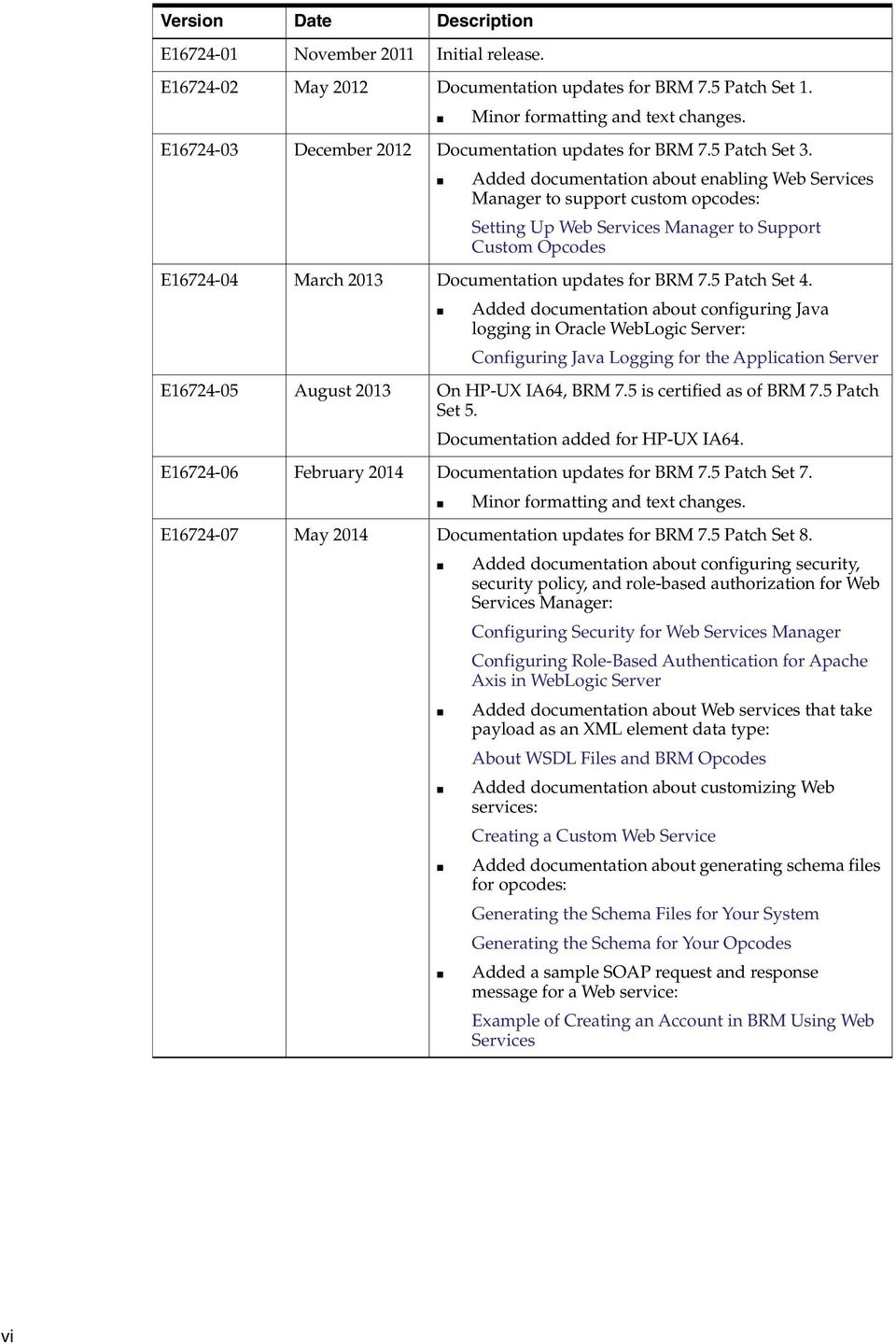
6 Version Date Description E November 2011 Initial release. E May 2012 Documentation updates for BRM 7.5 Patch Set 1. Minor formatting and text changes. E December 2012 Documentation updates for BRM 7.5 Patch Set 3. Added documentation about enabling Web Services Manager to support custom opcodes: Setting Up Web Services Manager to Support Custom Opcodes E March 2013 Documentation updates for BRM 7.5 Patch Set 4. Added documentation about configuring Java logging in Oracle WebLogic Server: Configuring Java Logging for the Application Server E August 2013 On HP-UX IA64, BRM 7.5 is certified as of BRM 7.5 Patch Set 5. Documentation added for HP-UX IA64. E February 2014 Documentation updates for BRM 7.5 Patch Set 7. Minor formatting and text changes. E May 2014 Documentation updates for BRM 7.5 Patch Set 8. Added documentation about configuring security, security policy, and role-based authorization for Web Services Manager: Configuring Security for Web Services Manager Configuring Role-Based Authentication for Apache Axis in WebLogic Server Added documentation about Web services that take payload as an XML element data type: About WSDL Files and BRM Opcodes Added documentation about customizing Web services: Creating a Custom Web Service Added documentation about generating schema files for opcodes: Generating the Schema Files for Your System Generating the Schema for Your Opcodes Added a sample SOAP request and response message for a Web service: Example of Creating an Account in BRM Using Web Services vi
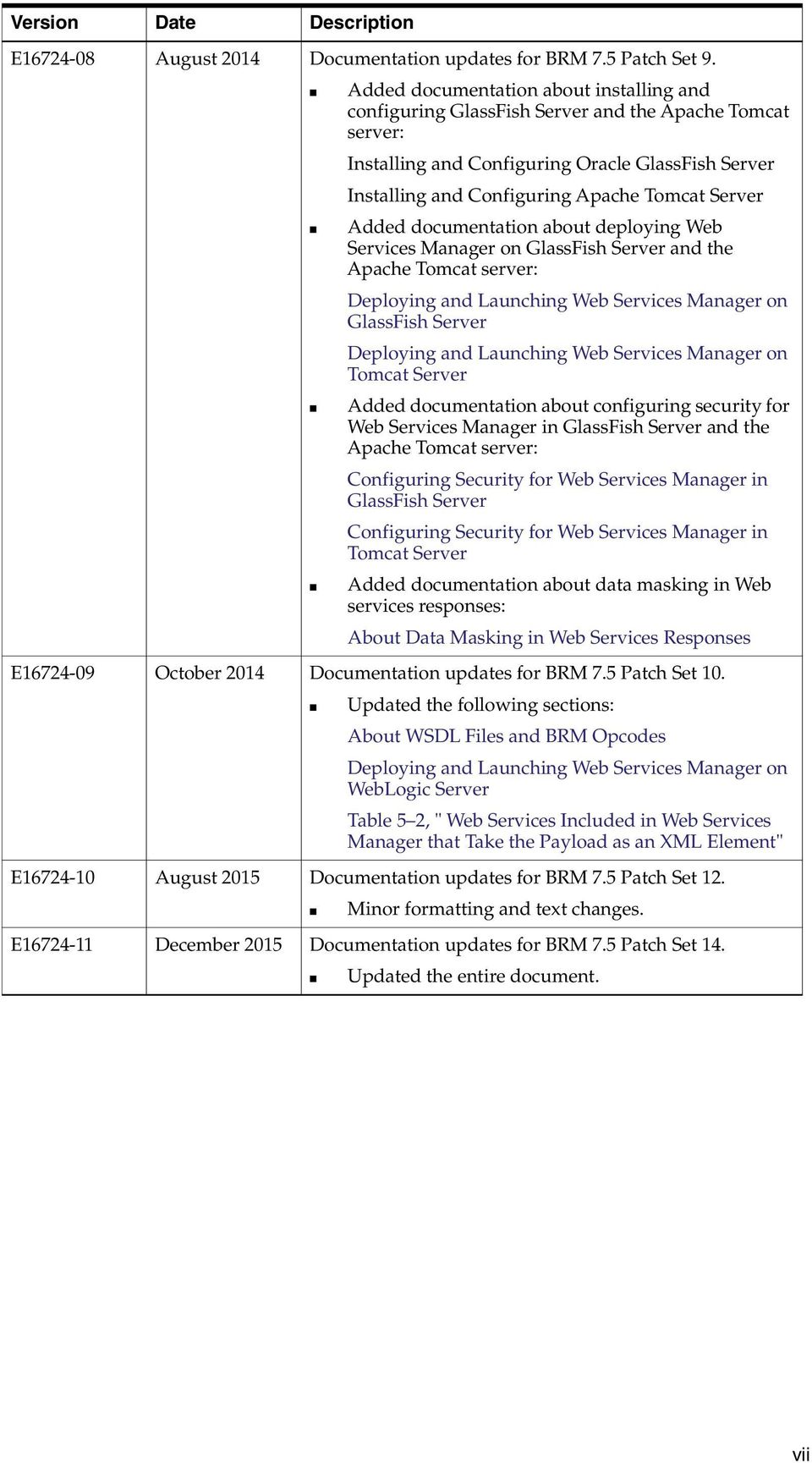
7 Version Date Description E August 2014 Documentation updates for BRM 7.5 Patch Set 9. Added documentation about installing and configuring GlassFish Server and the Apache Tomcat server: Installing and Configuring Oracle GlassFish Server Installing and Configuring Apache Tomcat Server Added documentation about deploying Web Services Manager on GlassFish Server and the Apache Tomcat server: Deploying and Launching Web Services Manager on GlassFish Server Deploying and Launching Web Services Manager on Tomcat Server Added documentation about configuring security for Web Services Manager in GlassFish Server and the Apache Tomcat server: Configuring Security for Web Services Manager in GlassFish Server Configuring Security for Web Services Manager in Tomcat Server Added documentation about data masking in Web services responses: About Data Masking in Web Services Responses E October 2014 Documentation updates for BRM 7.5 Patch Set 10. Updated the following sections: About WSDL Files and BRM Opcodes Deploying and Launching Web Services Manager on WebLogic Server Table 5 2, " Web Services Included in Web Services Manager that Take the Payload as an XML Element" E August 2015 Documentation updates for BRM 7.5 Patch Set 12. Minor formatting and text changes. E December 2015 Documentation updates for BRM 7.5 Patch Set 14. Updated the entire document. vii
8 viii

9 1 1Installing Web Services Manager [2]This chapter describes how to install Oracle Communications Billing and Revenue Management (BRM) Web Services Manager. BRM Web Services Manager allows BRM opcodes to be exposed as Web Services. Software Requirements Before you install and configure Web Services Manager, you must install the following: A supported, standards-compliant server. See "Supported Servers" foralistofthe servers supported by Web Services Manager. See server documentation for more information. Supported Operating Systems Supported Servers BRM. See BRM Installation Guide for more information. The Third-Party software package, which includes the Perl libraries and JRE required for installing BRM components. See "Installing the Third-Party Software" in BRM Installation Guide. Web Services Manager is available on for the following operating systems: HP-UX IA64 Oracle Solaris Oracle Linux AIX Web Services Manager is supported on the following servers: Oracle WebLogic Server Oracle GlassFish Server Apache Tomcat server Installing Web Services Manager 1-1

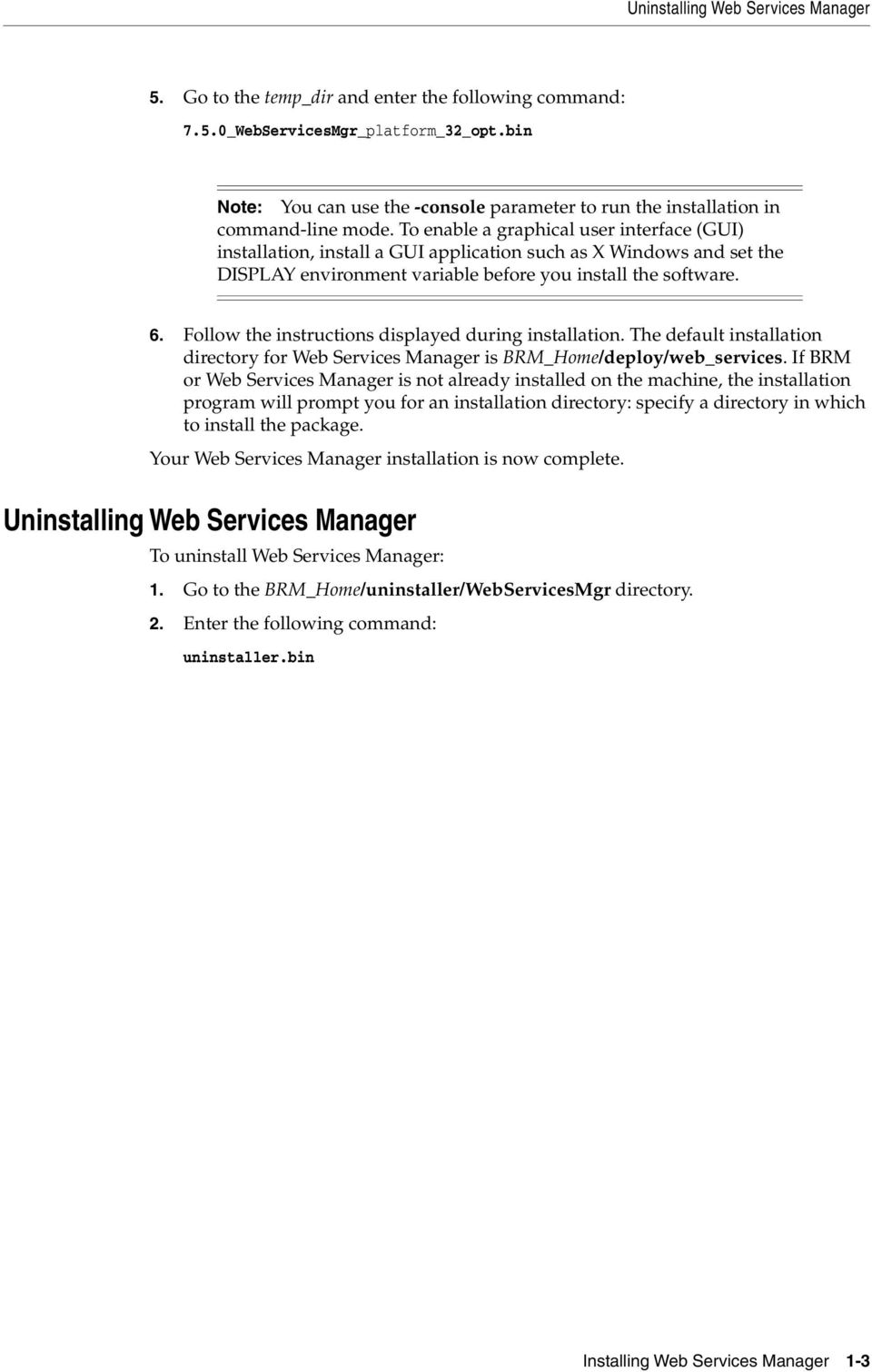
10 Installing Web Services Manager Installing Web Services Manager Note: If you have already installed Web Services Manager, features that are already installed cannot be reinstalled without uninstalling them first. To reinstall a feature, uninstall it and then install it again. The Web Services Manager package includes Web Services Manager, Synchronization Queue Data Manager, and JCA Resource Adapter. You must download the Web Services Manager package and extract these components before you can install Web Services Manager. For information about Synchronization Queue Data Manager and JCA Resource Adapter, see: Understanding the Synchronization Queue Data Manager in BRM Synchronization Queue Manager. Connecting J2EE-Compliant Applications to BRM in BRM JCA Resource Adapter. You must also increase the heap size used by the Java Virtual Machine (JVM) before running the installation program to avoid "Out of Memory" error messages in the log file. For information, see "Increasing Heap Size to Avoid "Out of Memory" Error Messages" in BRM Installation Guide Note: Oracle recommends that you install Web Services Manager on the system on which BRM is installed. To download Web Services Manager: 1. Go to the Oracle software delivery Web site: 2. Download the 7.5_WebServicesMgr_platform_opt.tar.Z software pack to a temporary directory (temp_dir), where platform is the operating system name. 3. In temp_dir, extract the 7.5_WebServicesMgr_platform_opt.tar.Z software pack: The following files are extracted: 7.5.0_BRM_JCA_Adapter_platform_opt.bin: JCA Resource Adapter 7.5.0_DM_AQ_platform_opt.bin: Synchronization Queue Data Manager 7.5.0_WebServicesMgr_platform_opt.bin: Web Services Manager 4. Go to the directory in which you installed the Third-Party package and source the source.me file. Caution: You must source the source.me file to proceed with installation; otherwise, "suitable JVM not found" and other error messages appear. Bash shell: source source.me.sh C shell: source source.me.csh 1-2 Web Services Manager

11 Uninstalling Web Services Manager 5. Go to the temp_dir and enter the following command: 7.5.0_WebServicesMgr_platform_32_opt.bin Note: You can use the -console parameter to run the installation in command-line mode. To enable a graphical user interface (GUI) installation, install a GUI application such as X Windows and set the DISPLAY environment variable before you install the software. 6. Follow the instructions displayed during installation. The default installation directory for Web Services Manager is BRM_Home/deploy/web_services. IfBRM or Web Services Manager is not already installed on the machine, the installation program will prompt you for an installation directory: specify a directory in which to install the package. Your Web Services Manager installation is now complete. Uninstalling Web Services Manager To uninstall Web Services Manager: 1. Go to the BRM_Home/uninstaller/WebServicesMgr directory. 2. Enter the following command: uninstaller.bin Installing Web Services Manager 1-3
12 Uninstalling Web Services Manager 1-4 Web Services Manager

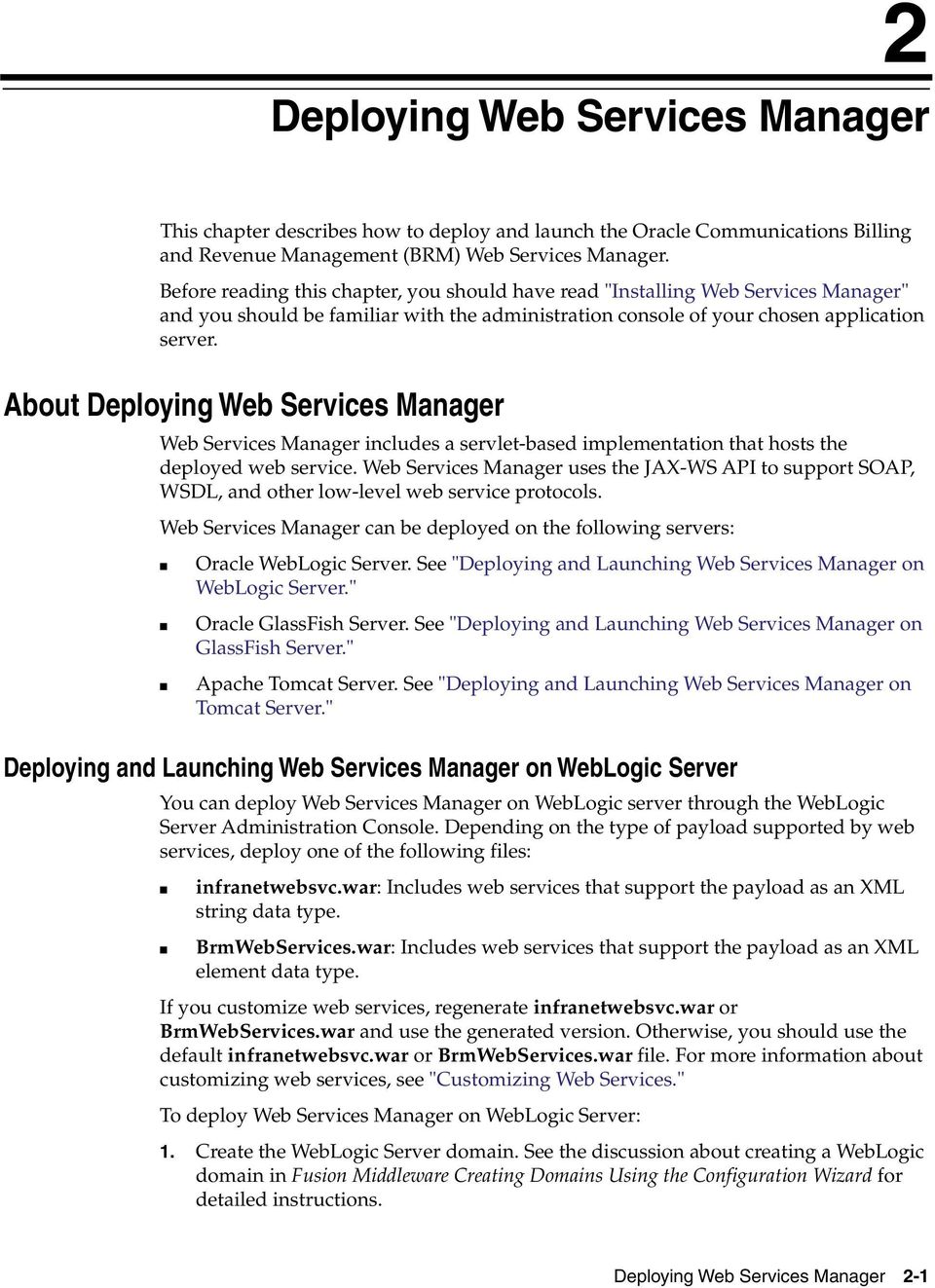
13 2 2Deploying Web Services Manager [3]This chapter describes how to deploy and launch the Oracle Communications Billing and Revenue Management (BRM) Web Services Manager. Before reading this chapter, you should have read "Installing Web Services Manager" and you should be familiar with the administration console of your chosen application server. About Deploying Web Services Manager Web Services Manager includes a servlet-based implementation that hosts the deployed web service. Web Services Manager uses the JAX-WS API to support SOAP, WSDL, and other low-level web service protocols. Web Services Manager can be deployed on the following servers: Oracle WebLogic Server. See "Deploying and Launching Web Services Manager on WebLogic Server." Oracle GlassFish Server. See "Deploying and Launching Web Services Manager on GlassFish Server." Apache Tomcat Server. See "Deploying and Launching Web Services Manager on Tomcat Server." Deploying and Launching Web Services Manager on WebLogic Server You can deploy Web Services Manager on WebLogic server through the WebLogic Server Administration Console. Depending on the type of payload supported by web services, deploy one of the following files: infranetwebsvc.war: Includes web services that support the payload as an XML string data type. BrmWebServices.war: Includes web services that support the payload as an XML element data type. If you customize web services, regenerate infranetwebsvc.war or BrmWebServices.war and use the generated version. Otherwise, you should use the default infranetwebsvc.war or BrmWebServices.war file. For more information about customizing web services, see "Customizing Web Services." To deploy Web Services Manager on WebLogic Server: 1. Create the WebLogic Server domain. See the discussion about creating a WebLogic domain in Fusion Middleware Creating Domains Using the Configuration Wizard for detailed instructions. Deploying Web Services Manager 2-1
14 About Deploying Web Services Manager 2. If you deploy the BrmWebServices.war file, set the heap size required to start WebLogic Server: a. Open the WebLogic_Home/user_projects/domains/Domain_ Name/setDomainEnv.sh file in a text editor. Where: WebLogic_Home is the directory in which WebLogic Server is installed. Domain_Name is the name of the domain you created in step 1. b. Add the following entry: USER_MEM_ARGS ="-Xms2048m -Xmx2048m" c. Save and close the file. d. Restart WebLogic Server. 3. Do one of the following: If you customized web services: Extract the BRM_Home/deploy/web_services/infranetwebsvc.war or the BRM_Home/deploy/web_services/BrmWebServices.war file to local_dir. Where: BRM_Home is the directory in which BRM is installed. local_dir is a directory on the machine on which you installed WebLogic Server. Copy the CustomFields.jar files to the local_dir/web-inf/lib directory. See "Setting Up Web Services Manager to Support Custom Opcodes" for more information. Note: The JRE version that was used to generate CustomFields.jar must be the same or lower than the version of the WebLogic Server JRE. Open the BRM_Home/deploy/web_services/Infranet.properties file in a text editor. Modify the following entry: infranet.custom.field.package = package where package is the name of the package that contains the CustomOp.java file; for example, com.portal.classfiles. Add all the custom fields to the Infranet.properties file. Save and close the file. Copy the BRM_Home/deploy/web_services/Infranet.properties file to the local_dir/web-inf/classes or in the home directory on the machine on which WebLogic Server is installed. Regenerate the WAR file by running one of the following commands: To regenerate the infranetwebsvc.war file: jar -cvf infranetwebsvc.war * 2-2 BRM Web Services Manager

15 About Deploying Web Services Manager To regenerate the BrmWebServices.war file: jar -cvf BrmWebServices.war * If you did not customize web services: Extract the BRM_Home/deploy/web_services/infranetwebsvc.war or the BRM_Home/deploy/web_services/BrmWebServices.war file to local_dir. Copy the BRM_Home/deploy/web_services/Infranet.properties file to the local_dir/web-inf/classes directory or in the home directory on the machine on which WebLogic Server is installed. Regenerate the WAR file by running one of the following commands: To regenerate the infranetwebsvc.war file: jar -cvf infranetwebsvc.war * To regenerate the BrmWebServices.war file: jar -cvf BrmWebServices.war * 4. Log in to WebLogic Server Administration Console. 5. In the Domain Structure pane, click Deployments. The Summary of Deployments page appears. 6. Click Install. The Install Application Assistant page appears. 7. Enter the local directory path for infranetwebsvc.war or BrmWebServices.war in the Path field and press Enter. 8. Select Install this deployment as an application and click Next. 9. Select the server or servers on which you want to deploy Web Services Manager and click Next. 10. Click Next. Note: When you deploy Web Services Manager on WebLogic Server, select the Custom Roles and Policies option in the Security section of WebLogic Server Administration Console. 11. Verify your deployment options and click Finish. WebLogic Server displays the deployed application on the Deployments page. To launch Web Services Manager for web services, do one of the following: If you have deployed infranetwebsvc.war, launch web services from the WebLogic Server Administration Console: 1. On the Home page, select Deployments in the Domain Structure pane. The Summary of Deployments page appears. 2. Click the infranetwebsvc link. The Settings page for the deployment appears. 3. Click the Testing tab. Deploying Web Services Manager 2-3
16 About Deploying Web Services Manager 4. Click the default url link. The Apache Axis Web page appears. 5. Click the link for the list of the supported BRM web services for this Web Services Manager deployment. If you have deployed BrmWebServcies.war, launch web services from the WebLogic Server Administration Console: 1. On the Home page, select Deployments in the Domain Structure pane. The Summary of Deployments page appears. 2. Click the BrmWebServices link, a list of all the web services is displayed. 3. Click on any of the web service. 4. Click the Testing tab. 5. The WebLogic Server Administration console displays an URL for the BRM web services. Deploying and Launching Web Services Manager on GlassFish Server You can deploy Web Services Manager on GlassFish Server through the GlassFish Server Administration Console. Depending on the type of payload supported by web services, deploy one of the following files: infranetwebsvc.war: Includes the web services that support the payload as an XML string data type. BrmWebServices.war: Includes the web services that support the payload as an XML element data type. If you customize web services, regenerate infranetwebsvc.war or BrmWebServices.war and use the generated version. Otherwise, you should use the default infranetwebsvc.war or BrmWebServices.war file. For more information about customizing web services, see "Customizing Web Services." To deploy Web Services Manager on GlassFish Server: 1. Create the GlassFish Server domain. See the GlassFish documentation for detailed instructions. 2. Copy the BRM_Home/deploy/web_services/infranetwebsvc.war file or the BRM_ Home/deploy/web_services/BrmWebServices.war to a local_dir. Where: BRM_Home is the directory in which BRM is installed. local_dir is a directory on the machine on which you installed GlassFish Server. 3. Log in to the GlassFish Server Administration Console. 4. In the Common Tasks pane, click Applications. The Applications page appears. 5. On the Applications page, click Deploy... The Deploy Applications or Modules page appears. 6. In the Location: Packaged File to Be Uploaded to the Server field, click Choose File. Do one of the following: 2-4 BRM Web Services Manager

17 About Deploying Web Services Manager To support the payload as an XML string data type, select infranetwebsvc.war from the list of available applications and click OK to deploy the infranetwebsvc.war file. To support the payload as an XML payload data type, select BrmWebServices.war from the list of available applications and click OK to deploy the BrmWebServices.war file. 7. GlassFish Server displays the deployed application on the Applications page. To launch Web Services Manager for web services, do one of the following: If you have deployed infranetwebsvc.war, launch web services from the GlassFish Server Administration Console: 1. On the Applications page, select the infranetwebsvc checkbox and click Launch. The GlassFish Server Administration console displays an HTTP and an HTTPS URL for the web services. 2. Click either the HTTP URL or the HTTPS URL. The Apache Axis Web page appears. 3. Click the Services link to view a list of the supported BRM web services for this Web Services Manager deployment. If you have deployed BrmWebServices.war, launch web services from the GlassFish Server Administration Console: 1. On the Applications page, select the BrmWebServices checkbox and click Launch. The GlassFish Server Administration console displays an HTTP and an HTTPS URL for the BRM web services. A sample URL for the BRMCUSTServices_v2Web service is as follows: where: ipaddress is the domain IP address of the application server on which Web Services Manger is deployed. port is the domain port number of the application server on which Web Services Manger is deployed. For more information on the BRM web services included in Web Services Manager that take the payload as an XML element data type, see the Table 5 2, " Web Services Included in Web Services Manager that Take the Payload as an XML Element". Deploying and Launching Web Services Manager on Tomcat Server You can deploy Web Services Manager on Tomcat Server through the Tomcat Web Application Manager. Depending on the type of payload supported by web services, deploy one of the following files: infranetwebsvc.war: Includes the web services that support the payload as an XML string data type. See "Deploying and Launching infranetwebsvc.war." BrmWebServices.war: Includes the web services that support the payload as an XML element data type. See "Deploying and Launching BrmWebServices.war." Deploying Web Services Manager 2-5
18 About Deploying Web Services Manager If you customize web services, regenerate infranetwebsvc.war or BrmWebServices.war and use the generated version. Otherwise, you should use the default infranetwebsvc.war or BrmWebServices.war file. For more information about customizing web services, see "Customizing Web Services." Deploying and Launching infranetwebsvc.war To deploy Web Services Manager for web services that support the payload as an XML string data type, on Tomcat server: 1. Create the Tomcat server domain. See Tomcat documentation for detailed instructions. 2. Copy the BRM_Home/deploy/web_services/infranetwebsvc.war file to a local directory on the machine on which you installed Tomcat server, where BRM_Home is the directory in which BRM is installed. 3. Log in to the Tomcat Web Application Manager. Note: The Tomcat Web Application Manager requires log in credentials from an authorized user. If you have not already done so, you must assign the manager-gui role to a Tomcat user. You configure users and roles by editing the Tomcat_Home/conf/tomcat-users.xml file, where Tomcat_Home is the directory in which Tomcat server is installed. See Tomcat server documentation for further information. 4. In the War file to deploy section, click Browse Select the infranetwebsvc.war file. 6. Click Deploy. Tomcat Web Application Manager displays the deployed application in the Applications list. Note: (UNIX only) The GUI user must have execute permissions for infranetwebsvc.war. If the GUI user does not have the appropriate permissions, Tomcat will deploy the application, but will be unable to start it. Verify that the Running column of the Applications list has a value of true for /intranetwebsvc to ensure that Web Services Manager has been deployed successfully. To launch Web Services Manager for web services that support the payload as an XML string data type, from the Tomcat Web Application Manager: 1. In the Applications list, click the /infranetwebsvc link. The Apache Axis Web page appears. 2. Click the Services link to view a list of the supported BRM web services for this Web Services Manager deployment. Deploying and Launching BrmWebServices.war To deploy Web Services Manager for web services that support the payload as an XML element data type, on Tomcat server: 1. Create the Tomcat server domain. See Tomcat documentation for detailed instructions. 2-6 BRM Web Services Manager
19 About Deploying Web Services Manager 2. Download JAX-WS RI library from the JAX-WS Reference Implementation page ( 3. Extract the jaxws-ri zip file and copy the following files to Tomcat_ home/lib,where Tomcat_Home is the directory in which Tomcat server is installed: gmbal-api-only.jar jaxb-api.jar jaxb-impl.jar jaxws-rt.jar management-api.jar policy.jar stax-ex.jar jaxb-core.jar ha-api.jar jaxws-tools.jar jaxb-xjc.jar jaxb-impl.jar jaxb-jxc.jar streambuffer.jar 4. Download xalan jar from the Download xalan jar web page ( and copy the file to Tomcat_home/lib. 5. Download jaxrpc.jar from the Download jaxrpc.jar web page ( and copy the file to Tomcat_home/lib 6. Copy the BRM_Home/deploy/web_services/BrmWebServices.war file to a local directory on the machine on which you installed Tomcat server, where BRM_Home is the directory in which BRM is installed. 7. Log in to the Tomcat Web Application Manager. 8. In the War file to deploy section, click Browse Select the BrmWebServices.war file. 10. Click Deploy. Tomcat Web Application Manager displays the deployed application in the Applications list. To launch Web Services Manager for web services that support the payload as an XML element data type, from the Tomcat Web Application Manager: 1. In the Applications list, click the /BrmWebServices link. 2. The Tomcat Web Application Manager displays an HTTP and an HTTPS URL for the BRM web services. A sample URL for the BRMCUSTServices_v2Web service is as follows: Deploying Web Services Manager 2-7
20 About Deploying Web Services Manager where: ipaddress is the domain IP address of the application server on which Web Services Manger is deployed. port is the domain port number of the application server on which Web Services Manger is deployed. For more information on the BRM web services included in Web Services Manager that take the payload as an XML element data type, see the Table 5 2, " Web Services Included in Web Services Manager that Take the Payload as an XML Element". 2-8 BRM Web Services Manager
21 3 3Configuring Web Services Manager This chapter describes how to configure the deployed Oracle Communications Billing and Revenue Management (BRM) Web Services Manager application. Configuring Web Services Manager requires connecting the deployed application to the BRM system and configuring security, authorization, and Java logging for the deployed application. This chapter is intended for system administrators and system integrators. Before reading this chapter, you should have installed BRM and Web Services Manager and deployed Web Services Manager on a supported application server. You should also be familiar with the administration console of your chosen applications server and with using BRM. For installation procedures, see "Installing Web Services Manager." For deployment procedures, see "Deploying Web Services Manager." For information about BRM, see BRM Concepts. About Connecting Web Services Manager to the BRM System Web Services Manager connects to the BRM system through a BRM Connection Manager (CM). Figure 3 1 shows how BRM and the SOAP client communicate with the deployed application. Web Services Manager translates Portal Communication Module (PCM) communications sent from a CM in the BRM system into SOAP requests sent to the SOAP client over HTTP. Web Services Manager translates SOAP responses sent from the SOAP client over HTTP into PCM communications that are returned to the CM. Configuring Web Services Manager 3-1
22 About Connecting Web Services Manager to the BRM System Figure 3 1 Architecture of Web Services Manager in the BRM System Connecting Web Services Manager to the BRM System Before you connect Web Services Manager to the BRM system, verify that your instance of Web Services Manager is deployed to an application server. If you customized Web services, use the custom infranetwebsvc.war or BrmWebServices.war file. Otherwise, you should use the default infranetwebsvc.war or BrmWebServices.war file. For more information about customizing Web services, see "Customizing Web Services." To connect Web Services Manager to the BRM system, do the following: 1. On your application server, copy the BRM_Home/deploy/web_ services/infranet.properties file to one of the following: local_dir/web-inf/classes directory, where local_dir isadirectoryonthe machine on which you installed your application server. Note: If you copy the Infranet.properties file to the local_ dir/web-inf/classes directory, extract the infranetwebsvc.war file or BrmWebServices.war file to a local directory (local_dir) onthesystem on which your application server is installed. home directory on the machine on which you installed your application server. 2. Open the Infranet.properties file in a text editor. 3. Locate the following lines: infranet.connection=pcp://root :password@ipaddress:port/ /service /admin_client 1 infranet.login.type=1 4. Do the following: 3-2 BRM Web Services Manager
23 About Connecting Web Services Manager to the BRM System a. Replace password with the password for the BRM server. b. Replace ipaddress with the IP address of the system on which BRM is installed. c. Replace port with the port number used by the application server on which BRM is installed. 5. If SSL is enabled in connection manager (CM), locate the following lines and update the parameters if necessary: infranet.pcp.ssl.enabled=true infranet.pcp.ssl.wallet.location=wallet_directory where wallet_directory is the path to your client Oracle wallet. The client Oracle wallet contains the optional client SSL certificate and the private key, and it contains the Trusted CA certificate. 6. If you added custom opcodes or custom fields for Web services, add the enum values of the custom fields. For example, if you created the custom_fld_usage_id custom field and the enum value for the custom_fld_usage_id field is 10001, add the following entry: infranet.custom.field.10001=custom_fld_usage_id For information about mapping enum values, see "Creating Custom Fields" in BRM Developer's Guide. 7. (Optional) To configure the connection pool parameters, modify the following entries: infranet.connectionpool.minsize=min_connections infranet.connectionpool.maxsize=max_connections infranet.connectionpool.timeout=connection_timeout where: min_connections is the minimum number of connections allowed in the pool. The default number is 1. max_connections is the maximum number of connections allowed in the pool. connection_timeout is the connection pool timeout in milliseconds. 8. (Optional) To configure logging for Web Services Manager, modify the following entry: webservices.log.enabled=log_value where log_value is one of the following: true enables logging. This option saves and displays the log files as standard output in the application server console. false disables logging. This option saves the log files in the /domain/logs/brmwebsvcmgr.log file. Configure the BRM_ Home/deploy/web_services/lib/weblogic_ws_startup.jar file to use this option. 9. Save and close the file. 10. If you are working in the local_dir/web-inf/classes directory, regenerate the WAR file by running one of the following commands: To regenerate the infranetwebsvc.war file: Configuring Web Services Manager 3-3
24 About Connecting Web Services Manager to the BRM System jar -cvf infranetwebsvc.war * To regenerate the BrmWebServices.war file: jar -cvf BrmWebServices.war * 11. Deploy the regenerated infranetwebsvc.war or BrmWebServices.warfile on the server. See "Deploying Web Services Manager." Changing the Instance of BRM to which Web Services Manager Connects If you customized Web services, use the custom infranetwebsvc.war or BrmWebServices.war file. Otherwise, you should use the default infranetwebsvc.waror BrmWebServices.war file. For more information about customizing Web services, see "Customizing Web Services." To change the instance of BRM to which Web Services Manager connects, do the following: 1. On your application server, copy the BRM_Home/deploy/web_ services/infranet.properties file to one of the following: local_dir/web-inf/classes directory, where local_dir isadirectoryonthe machine on which you installed your application server. Note: If you copy the Infranet.properties file to the local_ dir/web-inf/classes directory, extract the infranetwebsvc.war or BrmWebServices.war file to a local directory (local_dir) onthesystem on which your application server is installed. home directory on the machine on which you installed your application server. 2. Open the copied Infranet.properties file. 3. Locate the following lines: infranet.connection=pcp://root :password@ipaddress:port/ /service /admin_client 1 infranet.login.type=1 4. Do the following: a. Replace password with the password for the BRM server. b. Replace ipaddress with the IP address of the system on which BRM is installed. c. Replace port with the port number used by the application server on which BRM is installed. 5. If SSL is enabled in the Connection Manager (CM), locate the following lines and update the parameters if necessary: infranet.pcp.ssl.enabled=true infranet.pcp.ssl.wallet.location=wallet_directory where wallet_directory is the path to your client Oracle wallet. The client Oracle wallet contains the optional client SSL certificate and the private key, and it contains the Trusted CA certificate. 3-4 BRM Web Services Manager
25 About Connecting Web Services Manager to the BRM System 6. If you added custom opcodes or custom fields for Web services, add the enum values of the custom fields. For example, if you created the custom_fld_usage_id custom field and the enum value for the custom_fld_usage_id field is 10001, add the following entry: infranet.custom.field.10001=custom_fld_usage_id For information about mapping enum values, see "Creating Custom Fields" in BRM Developer's Guide. 7. (Optional) To configure the connection pool parameters, modify the following entries: infranet.connectionpool.minsize=min_connections infranet.connectionpool.maxsize=max_connections infranet.connectionpool.timeout=connection_timeout where: min_connections is the minimum number of connections allowed in the pool. The default number is 1. max_connections is the maximum number of connections allowed in the pool. connection_timeout is the connection pool timeout in milliseconds. 8. (Optional) To configure logging for Web Services Manager, modify the following entry: webservices.log.enabled=log_value where log_value is one of the following: true enables logging. This option saves and displays the log files as standard output in the application server console. false disables logging. This option saves the log files in the /domain/logs/brmwebsvcmgr.log file. Configure the BRM_ Home/deploy/web_services/lib/weblogic_ws_startup.jar file to use this option. 9. (Optional) To configure searching in BRM using the PCM_OP_SEARCH opcode, restrict the PCM_OP_SEARCH opcode to pre-defined search templates by modifying the following entry: allowed.search.template.ids=template_id where template_id is the template ID of the search template that you want the PCM_OP_SEARCH opcode to use for searching. Use a comma (,) to separate multiple template IDs. If you do not want to restrict the PCM_OP_SEARCH opcode to any pre-defined search templates, set template_id to None. For a list of template IDs, connect to the BRM database and check the list of POIDS and the respective templates in the SEARCH_T table in the BRM database. For more information, see "Searching for Objects in the BRM Database" in BRM Developer's Guide. 10. If you added custom opcodes or custom fields for Web services, add the enum values of the custom fields. For information about mapping enum values, see "Creating Custom Fields" in BRM Developer's Guide. For example, if you created the custom_fld_usage_id custom field and the enum value for the custom_fld_usage_id field is 10001, add the following entry: Configuring Web Services Manager 3-5
26 Configuring Security for Web Services Manager infranet.custom.field.10001=custom_fld_usage_id 11. Save and close the file. 12. If you are working in the local_dir/web-inf/classes directory, regenerate the WAR file by running one of the following commands: To regenerate the infranetwebsvc.war file: jar -cvf infranetwebsvc.war * To regenerate the BrmWebServices.war file: jar -cvf BrmWebServices.war * 13. Deploy the regenerated infranetwebsvc.war or BrmWebServices.war file on the server. See "Deploying Web Services Manager." Configuring Security for Web Services Manager By default, secure sockets layer (SSL) security for Web Services Manager is disabled. You can enable SSL security for Web Services Manager by configuring security parameters and enabling the SSL security feature in the application server on which Web Services Manager is deployed. Configuring Security for Web Services Manager in WebLogic Server Before you configure security for Web Services Manager, ensure that WebLogic Server and Web Services Manager are installed and that Web Services Manager has been deployed on a WebLogic Server domain. See "Installing Web Services Manager" and "Deploying Web Services Manager" for more information. To configure security for Web Services Manager in WebLogic Server, do the following: Configure authentication for Web Services Manager. See "Configuring Authentication for WebLogic Server." Configure authorization for Web Services Manager by doing one of the following: If you have deployed infranetwebsvc.war, configure role-based authentication for Apache Axis. See "Configuring Role-Based Authentication for Apache Axis in WebLogic Server." If you have deployed BrmWebServices.war, configure WebLogic security policy for JAX-WS. See "Configuring WebLogic Security Policy on BRM Web Services for JAX-WS in WebLogic Server." Configuring Authentication for WebLogic Server Before you configure authentication for Web Services Manager, create a user, group, and security realm for Web Services Manager in WebLogic Server. For more information about creating users and groups, see the discussion about users, groups, and security roles in Fusion Middleware Securing Resources Using Roles and Policies for Oracle WebLogic Server. For more information about security realms, see the discussion about security realms in WebLogic Server in Fusion Middleware Securing Oracle WebLogic Server. To configure authentication for Web Services Manager in WebLogic Server: 3-6 BRM Web Services Manager
27 Configuring Security for Web Services Manager 1. Open the local_dir/infranetwebsvc.war/web-inf/weblogic.xml file in a text editor, where local_dir is a directory on the WebLogic host where you copied the infranetwebsvc.war file. 2. Uncomment the following lines: # <security-role-assignment> # <role-name>brmws</role-name> # <externally-defined/> # </security-role-assignment> 3. Save and close the file. 4. Open the local_dir/infranetwebsvc.war/web-inf/web.xml file in a text editor. 5. Uncomment the following lines: # <security-constraint> # <web-resource-collection> # <web-resource-name>restricted web services</web-resource-name> # <url-pattern>/*</url-pattern> # <http-method>get</http-method> # <http-method>post</http-method> # </web-resource-collection> # <auth-constraint> # <role-name>brmws</role-name> # </auth-constraint> # <user-data-constraint> # <transport-guarantee>confidential</transport-guarantee> # </user-data-constraint> # </security-constraint> # <login-config> # <auth-method>basic</auth-method> # <realm-name>default</realm-name> # </login-config> # <security-role> # <role-name>brmws</role-name> # </security-role> 6. Save and close the file. 7. Log in to WebLogic Server Administration Console. 8. Expand Environment and select Servers. The Summary of Servers page appears. 9. Select the server for which you want to enable the SSL port. 10. Click the Configuration tab. 11. Click the General subtab. 12. Select the SSL Listen Port Enabled check box. 13. In the SSL Listen Port field, enter a free port number. The default is Click Save, which configures Web Services Manager with the following default port numbers: HTTP connection: 7001 Web services that take the payload as an XML element have the default connection set to HTTP. Configuring Web Services Manager 3-7
28 Configuring Security for Web Services Manager HTTPS connection: 7002 If you use a SOAP development application to generate a Web service client and use port numbers other than the default port numbers, the URLs for the Web services that take the payload as an XML element will show port numbers that do not match the port numbers you configured in WebLogic Server Administration Console. Populate the correct port numbers in the URLS for the WSDL files that are generated dynamically by your SOAP development application by doing either of the following: Change the port numbers manually in your SOAP development application request. Change the port numbers in the infranetwebsvc.war/web-inf/conf/axis2.xml file as follows: Open the local_dir/infranetwebsvc.war/web-inf/conf/axis2.xml file in a text editor. Locate the following line and change the HTTP port number: <parameter name="port">7001</parameter> Locate the following line and change the HTTPS port number: <parameter name="port">7002</parameter> Save and close the file. Regenerate the infranetwebsvc.war file by running the following command: jar -cvf infranetwebsvc.war * Deploy the regenerated infranetwebsvc.war file on WebLogic Server. See "Deploying and Launching Web Services Manager on WebLogic Server" for instructions on deploying Web Services Manager. Configuring Role-Based Authentication for Apache Axis in WebLogic Server You configure access restrictions for Web Services Manager by creating security roles and by adding conditions to the security roles. To configure role-based authorization for Apache Axis in WebLogic Server: 1. Log in to WebLogic Server Administration Console. 2. In the Domain Structure pane, click Deployments and click the infranetwebsvc link. 3. Click the Security tab. 4. Click the Application Scope subtab. 5. Click the Roles subtab. 6. Click New. The Create Stand-Alone Web Application Scoped Roles page appears. 7. In the Name field, enter a name for the role. For example brmws. 8. In the Provider Name list, select XACMLRoleMapper. 9. Click OK. 10. Click the link with the role name you created, for example the brmws link. 3-8 BRM Web Services Manager
29 Configuring Security for Web Services Manager 11. Click Add Conditions. 12. In the Predicate List list, select Group. 13. Click Next. 14. In the Group Argument Name field, enter the name of the desired group. 15. Click Add. 16. Click Finish. 17. Click Save. Configuring WebLogic Security Policy on BRM Web Services for JAX-WS in WebLogic Server You define access restrictions for Web services in security policies in WebLogic Server. To configure WebLogic Security Policy on BRM Web Services for JAX-WS in WebLogic Server: 1. Log in to WebLogic Server Administration Console. 2. In the Domain Structure pane, click Deployments and click the BrmWebServices link. A list of all the web services is displayed. 3. Click any of the web service. 4. Click the Configuration tab. 5. Click the WS-Policy subtab. 6. Click the WS-Policy files associated with this web service. 7. Select WebLogic in the Configure the Policy Type for a Web Service section. 8. Add the policies from the Available Endpoint Policies for the selected service. If you want to use the policy for HTTPS with basic authentication, add policy:policy_name-https-basicauth.xml, where policy_name is name of the policy for the selected service; for example, policy:wssp https-basicauth.xml. If you want to use the policy for HTTPS without authentication, add policy:policy_ name-https.xml, where policy_name is name of the policy for the selected service; for example, policy:wssp https.xml. 9. Click Finish. 10. Click OK in the Save Deployment Plan Assistant section. If you have multiple deployments, then the plan.xml, which is created when you assign a policy to the service, should be saved in its respective deployment directory. 11. Click the Security tab. 12. Click the Policies subtab. 13. In the Web Service Methods list, select the web method that you want to secure. 14. Click Add Conditions. 15. In the Predicate List list, select one of the following: Roles, Users, or Groups. 16. Click Next. 17. In the User Argument Name field, add the user/group. 18. Click Add. Configuring Web Services Manager 3-9
30 Configuring Security for Web Services Manager 19. Click Finish. 20. Click Save. If you have enabled SSL, add the following entry in the BRMWebServices.war/WEB-INF/web.xml file to enable cookie security: <cookie-config> <secure>true</secure> </cookie-config> Note: This entry should be added in the session-config element of the BRMWebServices.war/WEB-INF/web.xml file. Configuring Security for Web Services Manager in GlassFish Server Before you configure security for Web Services Manager, ensure that GlassFish Server and Web Services Manager are installed and that Web Services Manager has been deployed on a GlassFish Server domain. See "Installing Web Services Manager" and "Deploying Web Services Manager" for more information. To configure security for Web Services Manager in GlassFish Server, do the following: Configure authentication for Web Services Manager for Apache Axis in GlassFish Server. See "Configuring Authentication for Web Services Manager for Apache Axis in GlassFish Server." Configure authentication for Web Services Manager for JAX-WS in GlassFish Server. See "Configuring Authentication for Web Services Manager for JAX-WS in GlassFish Server." Configuring Authentication for Web Services Manager for Apache Axis in GlassFish Server To configure authentication for Web Services Manager for Apache Axis in GlassFish Server: 1. Open the local_dir/infranetwebsvc.war/web-inf/web.xml file in a text editor. 2. Uncomment the following lines: # <security-constraint> # <web-resource-collection> # <web-resource-name>restricted web services</web-resource-name> # <url-pattern>/*</url-pattern> # <http-method>get</http-method> # <http-method>post</http-method> # </web-resource-collection> # <auth-constraint> # <role-name>brmws</role-name> # </auth-constraint> # <user-data-constraint> # <transport-guarantee>confidential</transport-guarantee> # </user-data-constraint> # </security-constraint> # <login-config> # <auth-method>basic</auth-method> # <realm-name>default</realm-name> # </login-config> 3-10 BRM Web Services Manager
31 Configuring Security for Web Services Manager # <security-role> # <role-name>brmws</role-name> # </security-role> 3. Locate the following line and change the realm name to file: <realm-name>file</realm-name> 4. Save and close the file. 5. Open the local_dir/infranetwebsvc.war/web-inf/sun-web.xml file in a text editor. 6. Locate the following line and specify a name for your Web Services Manager user group: <group-name>groupname</group-name> where groupname is the name of your Web Services Manager user group for GlassFish Server. 7. Save and close the file. 8. Regenerate the infranetwebsvc.war file by running the following command: jar -cvf infranetwebsvc.war * 9. Deploy the regenerated infranetwebsvc.war or BrmWebServices.war file on the server. See "Deploying and Launching Web Services Manager on GlassFish Server" for more information. 10. Log in to GlassFish Server Administration Console. 11. In the Common Tasks pane, under Configurations, select server-config. 12. Click Security and select Realms. 13. Select file. The Edit Realm page appears. 14. Click Manage Users and add a user. See the GlassFish Server documentation for instructions about creating a user. 15. Associate the user to the group that you created in step 6. See the GlassFish Server documentation for instructions about associating a user to a group. 16. Click Save. 17. In the Common Tasks pane, under Configurations, select server-config. 18. Select Network Config. 19. Select Network Listeners. 20. Select the port that is enabled for an HTTPS connection. Note: By default, http-listener -1 is for an HTTP connection and http-listener-2 is for an HTTPS connection. 21. Click the SSL tabbed page. 22. Select the SSL3 check box. 23. Deselect the TLS check box. Configuring Web Services Manager 3-11
32 Configuring Security for Web Services Manager 24. Enter the details about the SSL certificate and the keystore in their relevant fields. For details about the SSL certificate and the keystore, open the local_ dir/glassfish/config directory on the server on which you installed GlassFish Server. 25. Click Save. Configuring Authentication for Web Services Manager for JAX-WS in GlassFish Server To configure authentication for Web Services Manager for JAX-WS in GlassFish Server: 1. Open the local_dir/brmwebservices.war/web-inf/web.xml file in a text editor. 2. Add the following lines: # <security-constraint> # <web-resource-collection> # <web-resource-name>restricted web services</web-resource-name> # <url-pattern>/*</url-pattern> # <http-method>get</http-method> # <http-method>post</http-method> # </web-resource-collection> # <auth-constraint> # <role-name>*</role-name> # </auth-constraint> # <user-data-constraint> # <transport-guarantee>confidential</transport-guarantee> # </user-data-constraint> # </security-constraint> # <login-config> # <auth-method>basic</auth-method> # <realm-name>default</realm-name> # </login-config> 3. Locate the following line and change the realm name to file: <realm-name>file</realm-name> 4. Save and close the file. 5. Go to the local_dir/brmwebservices.war/web-inf directory and create the sun-web.xml file. 6. Open the local_dir/brmwebservices.war/web-inf/sun-web.xml file in a text editor. Add the following lines: <?xml version="1.0" encoding="utf-8"?> <!DOCTYPE sun-web-app PUBLIC "-//Sun Microsystems, Inc.//DTD Application Server 9.0 Servlet 2.5//EN" " <sun-web-app error-url=""> <security-role-mapping> <role-name>rolename</role-name> <!--Add group name as configured in the security realm 'file' --> <group-name>groupname</group-name> </security-role-mapping> </sun-web-app> 3-12 BRM Web Services Manager
33 Configuring Security for Web Services Manager where: rolename is the name of your Web Services Manager role for GlassFish Server. groupname is the name of your Web Services Manager user group for GlassFish Server. 7. Save and close the file. 8. Regenerate the BrmWebServices.war file by running the following command: To regenerate the BrmWebServices.war file: jar -cvf BrmWebServices.war * 9. Deploy the regenerated infranetwebsvc.war or BrmWebServices.war file on the server. See "Deploying and Launching Web Services Manager on GlassFish Server" for more information. 10. Log in to GlassFish Server Administration Console. 11. In the Common Tasks pane, under Configurations, select server-config. 12. Click Security and select Realms. 13. Select file. The Edit Realm page appears. 14. Click Manage Users and add a user. See the GlassFish Server documentation for instructions about creating a user. 15. Associate the user to the group that you created in step 6. See the GlassFish Server documentation for instructions about associating a user to a group. 16. Click Save. 17. In the Common Tasks pane, under Configurations, select server-config. 18. Select Network Config. 19. Select Network Listeners. 20. Select the port that is enabled for an HTTPS connection. Note: By default, http-listener -1 is for an HTTP connection and http-listener-2 is for an HTTPS connection. 21. Click the SSL tabbed page. 22. Select the SSL3 check box. 23. Deselect the TLS check box. 24. Enter the details about the SSL certificate and the keystore in their relevant fields. For details about the SSL certificate and the keystore, open the local_ dir/glassfish/config directory on the server on which you installed GlassFish Server. 25. Click Save. Configuring Security for Web Services Manager in Tomcat Server Before you configure security for Web Services Manager, ensure that Tomcat server and Web Services Manager are installed and that Web Services Manager has been Configuring Web Services Manager 3-13
34 Configuring Security for Web Services Manager deployed on a Tomcat server domain. See "Installing Web Services Manager" and "Deploying Web Services Manager"for more information. To configure security for Web Services Manager in Tomcat server, do the following: Configure authentication for Web Services Manager for Apache Axis in Tomcat server. See "Configuring Authentication for Web Services Manager for Apache Axis in Tomcat Server." Configure authentication for Web Services Manager for JAX-WS in Tomcat server. See "Configuring Authentication for Web Services Manager for JAX-WS in Tomcat Server." Enable SSL in Tomcat server. See "Enabling SSL in Tomcat Server." Configuring Authentication for Web Services Manager for Apache Axis in Tomcat Server To configure authentication for Web Services Manager for Apache Axis in Tomcat server: 1. Open the local_dir/infranetwebsvc.war/web-inf/web.xml file in a text editor. 2. Uncomment the following lines: # <security-constraint> # <web-resource-collection> # <web-resource-name>restricted web services</web-resource-name> # <url-pattern>/*</url-pattern> # </web-resource-collection> # <auth-constraint> # <role-name>brmws</role-name> # </auth-constraint> # <user-data-constraint> # <transport-guarantee>confidential</transport-guarantee> # </user-data-constraint> # </security-constraint> # <login-config> # <auth-method>basic</auth-method> # <realm-name>default</realm-name> # </login-config> # <security-role> # <role-name>brmws</role-name> # </security-role> 3. Locate the following line and specify the Web resource name as follows: <web-resource-name>protected Resource</web-resource-name> 4. Locate the following lines and specify the realm name as follows: <login-config> <auth-method>basic</auth-method> <realm-name>apache version</realm-name> </login-config> where version is the Tomcat server version on which you deployed Web Services Manager. 5. Save and close the file. 6. Open the local_dir/apache-tomcat /conf/tomcat-users.xml file in a text editor BRM Web Services Manager
35 Configuring Security for Web Services Manager 7. Locate the following lines and specify the login details of the user: <role rolename="brmws"/> <user username="username" password="password" roles="brmws"/> where: username is the user name for accessing Web services. password is the password for accessing Web services. 8. Save and close the file. 9. Open the config/server.xml file in a text editor. 10. In the <Engine> section, add the following class path: <Realm classname="org.apache.catalina.realm.memoryrealm" /> 11. Save and close the file. 12. Restart the Tomcat server. Configuring Authentication for Web Services Manager for JAX-WS in Tomcat Server To configure authentication for Web Services Manager for JAX-WS in Tomcat server: 1. Open the local_dir/brmwebservices.war/web-inf/web.xml file in a text editor. 2. Add the following lines: # <security-constraint> # <web-resource-collection> # <web-resource-name>restricted web services</web-resource-name> # <url-pattern>/*</url-pattern> # <http-method>get</http-method> # <http-method>/post</http-method> # </web-resource-collection> # <auth-constraint> # <role-name>brmws</role-name> # </auth-constraint> # <user-data-constraint> # <transport-guarantee>confidential</transport-guarantee> # </user-data-constraint> # </security-constraint> # <login-config> # <auth-method>basic</auth-method> # </login-config> # <security-role> # <role-name>brmws</role-name> # </security-role> 3. Save and close the file. 4. Open the local_dir/apache-tomcat /conf/tomcat-users.xml file in a text editor. 5. Locate the following lines and specify the login details of the user: <role rolename="brmws"/> <user username="username" password="password" roles="brmws"/> where: username is the user name for accessing Web services. Configuring Web Services Manager 3-15
36 Configuring Java Logging for the Application Server password is the password for accessing Web services. 6. Save and close the file. 7. Open the config/server.xml file in a text editor. 8. In the <Engine> section, add the following class path: <Realm classname="org.apache.catalina.realm.memoryrealm" /> 9. Save and close the file. 10. Restart the Tomcat server. Enabling SSL in Tomcat Server To enable secure communication for Web Services Manager, enable secure sockets layer (SSL) in the Tomcat server domain on which you deploy Web Services Manager. To enable SSL for Tomcat server: 1. Generate the keystore by running the following command: keytool -genkey -alias mykes -keyalg RSA -keystore mykeystore where: mykes is the alias. mykeystore is the name of the keystore. 2. Open the conf/server.xml file in a text editor. 3. Uncomment the following lines and specify the path for the keystore file: # <Connector port="8443" protocol="org.apache.coyote.http11.http11nioprotocol" # address="ipaddress" # maxthreads="150" SSLEnabled="true" scheme="https" secure="true" # clientauth="false" sslprotocol="tls" # keystorefile="/glassfish/glassfish3/bin/filepath" # keystorepass="password" /> where: IPAddress is the IP address of the machine on which you installed the Apache Tomcat server. filepath is the keystore file path. password is the password for the keystore file. 4. Save and close the file. Configuring Java Logging for the Application Server Depending on your configuration, you may wish to change the level of Java logging on the application server. To configure the Java logging level, do the following: For WebLogic Server, see "Configuring Java Logging for WebLogic Server" for Web Services Manager-specific configuration. For more information, see the discussion about application logging and WebLogic logging services in Fusion Middleware Using Logging Services for Application Logging for Oracle WebLogic Server. For GlassFish Server, see the discussion about configuring logging services in GlassFish Server Administration Guide BRM Web Services Manager
37 Configuring Java Logging for the Application Server For Tomcat server, see the discussion about logging in Tomcat in Tomcat User Guide. Configuring Java Logging for WebLogic Server To configure Java logging in WebLogic Server: 1. Specify the Java Unified Logging (JUL) mechanism. See "Specifying the Java Unified Logging (JUL) Mechanism." 2. Create a startup class. See "Creating a Startup Class." Specifying the Java Unified Logging (JUL) Mechanism Specifying the JUL mechanism allows Web Services Manager to use JUL in addition to the WebLogic Server Administration Console logging. To specify the JUL mechanism: 1. Open the BRM_Home/deploy/web_services/Infranet.properties file in a text editor. 2. Uncomment the following entry: # webservices.log.enabled = true 3. Change the value to false: webservices.log.enabled = false 4. Save and close the file. Creating a Startup Class You define a startup class to enable JUL and create log files for the following Web service classes: com.portal.webservices.brmflisttoxml com.portal.webservices.brmxmltoflist com.portal.webservices.opcodecaller com.portal.webservices.webservicesutilities To create a startup class: 1. Copy the BRM_Home/deploy/web_services/weblogic_ws_startup.jar file to the server_domain/lib directory, where server_domain is the WebLogic Server domain in which Web Services Manager is deployed. 2. Log in to WebLogic Server Administration Console. 3. Click Lock and Edit. 4. In the Domain Structure pane, expand Environment and then click Startup and Shutdown classes. The Startup and Shutdown Classes pane appears. 5. Click New. The Configure a New Startup or Shutdown Class: Class Type pane appears. 6. Select Startup Class and click Next. Configuring Web Services Manager 3-17
38 Configuring Java Logging for the Application Server The Configure a New Startup or Shutdown Class: Startup Class Properties pane appears. 7. In the Name field, enter BRMWSLoggerStartUpClass. 8. In the Class Name field, enter com.portal.webservices.brmwsloggerstartup. 9. In the Argument field, set the log level. This field sets the log level for all the classes in Web Services Manager: 10. Click Next. To log problems that require attention from the system administrator, enter SEVERE. This is the default. To log the most detailed trace and debug messages, enter FINEST. To log highly detailed trace and debug messages, enter FINER. To log trace and debug messages for performance monitoring, enter FINE. The Configure a New Startup or Shutdown Class: Select Targets pane appears. 11. From the Servers list, select the server on which to deploy the class. The Startup and Shutdown Classes pane appears. 12. Click Finish. 13. Click BRMWSLoggerStartUpClass. The Settings for BRMWSLoggerStartUpClass pane appears. 14. Select Run Before Application Deployments and Run Before Application Activations and click Save. 15. Click Activate Changes. 16. Restart the WebLogic server, which applies changes. 17. Redeploy any existing Web Services Manager deployments. See "Deploying Web Services Manager." By default, log files are created in the WebLogic_Home/user_projects/domains/Domain_ Name/logs/BRMWebServicesMgrLogs/BRMWebServicesMgr.log file where: WebLogic_Home is the directory in which WebLogic Server is installed. Domain_Name is the name of the domain you are configuring BRM Web Services Manager
39 4 4Customizing Web Services This chapter contains information about customizing Oracle Communications Billing and Revenue Management (BRM) Web Services Manager. Before reading this chapter, you should be familiar with implementing Web services. Setting Up Web Services Manager to Support Custom Opcodes To expose custom opcodes as Web services, enable Web Services Manager to support custom opcodes. For more information on custom opcodes, see "Using Custom Opcodes" in BRM Developer's Guide. Note: Before you customize an opcode for a Web service in Web Services Manager, implement the custom opcode in BRM. To enable Web Services Manager to support custom opcodes: 1. Do one of the following: Create the CustomOp.java file by entering the following command: parse_custom_ops_fields -L pcmjava -I input -O output -P java_package where: input is the header file you create for your custom opcodes and fields. output is the memory-mapped file or directory for the output of the script. output must be a directory having some correspondence with the Java package. For example, if java_package is in com.portal.classfiles, output must be f:/mysource/com/portal/classfiles. java_package is the Java package in which to put the generated classes. For more information, see the discussion about the parse_custom_ops_fields utility in BRM Developer's Guide. Manually create the CustomOp.java file. 2. Verify that the CustomOp.java file contains the following: The opcode-name-to-opcode-number mapping for all the custom opcodes in the file. Customizing Web Services 4-1
40 Setting Up Web Services Manager to Support Custom Opcodes Important: Verify that the mapping includes the full name of each opcode. If any opcode name is truncated, replace the truncated name with the full name. The optostring method, which converts opcode numbers to opcode names. The stringtoop method, which converts opcode names to opcode numbers. The following is a sample CustomOp.java file: public class CustomOp { public static final int CUSTOM_OP_ACT_INFO= ; public static final int CUSTOM_OP_READ_ACT_PRODUCT = ; public static String optostring( int op ) { try { java.lang.reflect.field[] flds = CustomOp.class.getFields(); for( int i = 0; i < flds.length; i++ ) { try { int val = flds[i].getint(null); if( val == op ) { return flds[i].getname(); } } catch( IllegalAccessException e ) { continue; } catch( IllegalArgumentException e ) { continue; } } } catch( SecurityException e ) {} } return null; public static int stringtoop( String op ) { try { java.lang.reflect.field[] flds = CustomOp.class.getFields(); for( int i = 0; i < flds.length; i++ ) { try { String name = flds[i].getname(); if( name.equals(op) ) { return flds[i].getint(null); } } catch( IllegalAccessException e ) { continue; } catch( IllegalArgumentException e ) { continue; } } } catch( SecurityException e ) {} return -1; } } 3. Compile the CustomOp.java file into the CustomOp.class file by entering the following command: javac -d. path/customop.java For example: javac -d. com/portal/classfiles/customop.java 4-2 BRM Web Services Manager
41 Setting Up Web Services Manager to Support Custom Opcodes 4. Package the CustomOp.class file into the CustomFields.jar file by entering the following command: Note: Make sure the JRE version that was used to generate the CustomFields.jar file is the same or lower than the version of the WebLogic Server JRE. jar -cvf CustomFields.jar path.customop.class For example: jar cvf CustomFields.jar com.portal.classfiles.customop.class 5. Make the CustomFields.jar file available to Web Services Manager by doing one of the following: If you have not deployed Web Services Manager, do the following: a. Copy the path/customfields.jar file to the local_dir/web-inf/lib directory, where path isthepathtothecustomfields.jar file (for example, com/portal/classfiles). b. Open the BRM_home/deploy/web_services/Infranet.properties file in a text editor. c. Add or modify the following entry: infranet.custom.field.package = package where package is the name of the package that contains the CustomOp.java file; for example, com.portal.classfiles. d. Add all the custom fields to the Infranet.properties file. e. Save and close the file. f. Copy the BRM_home/deploy/web_services/Infranet.properties file to the local_dir/web-inf/classes directory or the home directory on the machine on which you installed WebLogic Server. If you have deployed Web Services Manager, do the following: a. Copy the path/customfields.jar file to the local_dir/web-inf/lib directory. where local_dir is the directory in which you deployed Web Services Manager on your application server. b. Open the Webservices_deployment_ dir/web-inf/classes/infranet.properties file in a text editor. c. Add or modify the following entry: infranet.custom.field.package = package where package is the name of the package that contains the CustomOp.java file; for example, com.portal.classfiles. d. Add all the custom fields to the Infranet.properties file. e. Save and close the file. Customizing Web Services 4-3
42 Creating a Custom Web Service Creating a Custom Web Service You can extend Web Services Manager to support custom Web services. Before you create a custom Web service or customize an existing Web service in Web Services Manager, implement your custom opcodes in the BRM system. For more information, see "Creating Custom Fields and Storable Classes" in BRM Developer's Guide. To create a custom Web service: 1. If you created an opcode with custom fields for your custom Web service, configure BRM to recognize the custom fields. See "Creating Custom Fields and Storable Classes" in BRM Developer's Guide. 2. Create a WSDL file for the Web service. See "Generating WSDL Files for Web Services" in BRM JCA Resource Adapter. To create a WSDL file manually, do the following: For Web services that support payload as XML string, see the deploy/web_ services/wsdl sample file and create the WSDL file. For Web services that support payload as XML element, see the deploy/web_ services/brmwebservices.war/web-inf/wsdl sample file and create the WSDL file. 3. Create the XML specifications for your custom opcodes. See "Creating Opcode Specification Schema Files". 4. Generate web service classes for your custom service by doing the following: a. Create the following directory structure in a local directory (local_dir) onthe machine on which your application server is installed. /wsdl /src /classes /jar b. Copy your custom WSDL files and schema (XSD) files into the local_dir/wsdl directory. c. Copy the BrmWebServices.war/WEB-INF/wsdl/BRMWebServiceException.xsd file into the local_dir/wsdl directory. d. Create the custom_services.xml as an ant build file. The following is a sample custom_services.xml file: <?xml version="1.0"?> <project name="custom BRM WebServices build file" default="all" basedir="."> <property name="builddir" value="classes"/> <property name="srcdir"value="src"/> <property name="wsdldir"value="wsdl"/> <property name="pinwsgen"value="pin_wsgen"/> <!-- define the classpath --> <path id="classpath"> <pathelement path="${builddir}"/> <pathelement path="jar/web_services.jar"/> <pathelement path="jar/webservicesutils.jar"/> 4-4 BRM Web Services Manager
43 Creating a Custom Web Service </path> <!-- create Source files from WSDL and XSDs --> <target name="custom_service_gen" description="create java source files from wsdl" > <exec executable="brm_home/deploy/web-services/pin_wsgen/pin_ wsgen" failonerror="true"> <arg value="-s"/> <arg value="src"/> <arg value="-d"/> <arg value="${builddir}"/> <arg value="-p"/> <arg value="com.portal.jax.'yourpackagesubdirname' "/> <arg value="${wsdldir}/'yourcustomservices_v2.wsdl'/> </exec> </target> <target name="all" depends="custom_service_gen, custom_jar" description="build everything" /> <!-- compile task --> <target name="compile" depends="custom_service_gen" description="compile source files" > <echo>" Compiling JAX-WS impl classes"</echo> <javac srcdir="${srcdir}" destdir="${builddir}" classpathref="classpath" debug="on" source="1.5" /> </target> <!--Create custom service jar --> <target name="custom_jar" depends="custom_service_gen, compile" description="generate jar file" > <jar jarfile="custom_services.jar" basedir="${builddir}" > </jar> </target> <!--ant clean task --> <target name="clean" description="remove derived objects" > <delete dir="classes/com"/> <delete dir="custom_service.jar"/> </target> </project> where: BRM_home is the directory in which BRM is installed. YourCustomServices_v2 is the custom service WSDL file name. yourpackagesubdirname is the package directory for your custom service. 5. Generate and build your custom web services by running the following command: ant -file custom_services.xml Customizing Web Services 4-5
44 Generating the Schema Files for Your System 6. Add all the custom field enum constants to the Infranet.properties file. See "Connecting Web Services Manager to the BRM System" for more information. 7. Package your custom web service with the BrmWebServices.war file by doing the following: a. Extract the BrmWebServices.war file to a local directory (local_dir) onthe machine on which you installed your application server. b. Do one of the following: (For WebLogic server) Modify the local_dir/web-inf/web.xml file to include your custom service URL mapping similar to existing URL mapping. (For Apache Tomcat and GlassFish server) Modify the local_ dir/web-inf/sun.jaxws.xml file to add your custom service implementation class. c. Copy your custom WSDL files and schema (XSD) files into the local_ dir/web-inf/wsdl/ directory. d. Copy your custom_services.jar into the local_dir/web-inf/classes directory. e. Copy your CustomFields.jar into the local_dir/web-inf/lib directory. f. Delete the existing BrmWebServices.war file. g. Create a new BrmWebServices.war file by running the following command: jar -cvf BrmWebServices.war * Generating the Schema Files for Your System Web Services Manager uses schema files to validate data it sends to or receives from BRM. To generate the schema files for your system, do the following: 1. If you modified any opcodes, generate schemas for the opcodes in your BRM system. See "Generating the Schema for Your Opcodes". 2. Generate schemas for the storable classes and subclasses in your BRM system. See "Generating the Schema for Your Storable Classes and Subclasses" in BRM JCA Resource Adapter. 3. In your opcode schema files, specify the location of your storable class schema files. See "Specifying the Location of the Storable Class Schema Files in the Opcode Schema Files" in BRM JCA Resource Adapter. Note: After generating the opcode and storable class schema files, copy the schema files to a location that is accessible to the Web Services Manager. Make sure that this location is the same as the location that is specified in the include section of the opcode schema files and in the opcode schema InteractionSpec attribute in the WSDL files. See "Specifying the Location of the Storable Class Schema Files in the Opcode Schema Files" and "Generating the WSDL Files for Your System" in BRM JCA Resource Adapter. 4-6 BRM Web Services Manager
45 Generating the Schema for Your Opcodes Generating the Schema for Your Opcodes The Web Services Manager package includes all the opcode schemas and flist specifications you need for a default integration. If you customized any of the opcodes that are supported by Web Services Manager or if you added support for new opcodes, you must generate XSD schema files for the opcodes. Note: Before you customize an existing opcode specification, ensure that you update the opcode specification in the BRM system. After you customize Web services, copy the customized schema files and the WSDL files to the infranetwebsvc.war file. Generating the Schema for an Existing Opcode To generate schema files for an opcode that you customized and Web Services Manager already supports: 1. Modify the opcode s XML specification file. By default, the opcode specification XML files are installed in the BRM_home/apps/brm_integrations/opspecs directory, where BRM_home is the directory in which you installed the BRM components. 2. Do one of the following: For Web services that take payload as XML string: Run the pin_opspec_to_schema utility. See "Creating Opcode Specification Schema Files". Copy the customized XSD files to the BRM_home/deploy/web_ services/schemas directory. For Web services that take payload as XML element: Run the pin_opspec_to_schema_v2 utility. See "Creating Opcode Specification Schema Files". Copy the customized XSD files to the infranetwebsvc/web-inf/services/infranetwebservices.aar/meta-i NF directory. Creating Opcode Specification Schema Files You must create opcode flist specification files for opcodes that you customize or add to the Web Services Manager. Create the specification XML files by following the BRM_home/apps/brm_integrations/stylesheets/opspec.xsd file. You then convert the opcode flist specification XML files into XSD schema by using the pin_opspec_to_schema and pin_opspec_to_schema_v2 utilities. To convert opcode flist specification XML files into XSD schema, go to the BRM_ home/apps/brm_integrations directory and do the following: For Web services that take payload as XML string, run the following command: pin_opspec_to_schema -i input_file [-o output_file] For Web services that take payload as XML element, run the following command: Customizing Web Services 4-7
46 Generating the Schema for Your Opcodes Note: Before you run the following command, specify the BRM installation directory in the pin_opspec_to_schema_v2 utility by replacing $PIN_HOME with BRM_home. pin_opspec_to_schema_v2 -i input_file > output_file where: input_file specifies the name and location of the opcode s XML flist specification. By default, the utility looks for the file in the current directory. output_file creates the XSD schema output file using the name you specify. By default, the utility creates a file named opcodename.xsd in the directory from which you run the utility. You can also create XSD schema for Web services that take payload as XML element by using the pin_opspec_to_schema_v2 XSD generator utility that is located in the BRM_ home/bin directory. To create the XSD schema file by using the pin_opspec_to_schema_v2 utility, run the following command using Groovy: groovy pin_opspec_to_schema_v2 -i input.xml > output.xsd where: input.xml specifies the name of the opcode s XML flist specification output.xsd creates the XSD schema output file using the name you specify Specifying the XSL Rules to Create the Opcode Schema The pin_opspec_to_schema utility uses the BRM_home/brm_ integrations/stylesheets/pin_opspec_to_schema.xsl style sheet to generate the schema for BRM opcodes. If your opcode references custom fields, you must customize the pin_opspec_to_schema.xsl style sheet to handle your custom fields. For a list of the supported BRM data types, see "Understanding the BRM Data Types" in BRM Developer's Guide. 4-8 BRM Web Services Manager
47 5 5Using Web Services This chapter contains information about using Oracle Communications Billing and Revenue Management (BRM) Web Services Manager. Before reading this chapter, you should be familiar with implementing Web services. About WSDL Files and BRM Opcodes Web Services Manager exposes BRM opcodes as operations through different Web services. The Web services included in Web Services Manager define the opcodes that can be called as Web service APIs and the attributes required to call a specific opcode. The Web service APIs (opcodes) are grouped by functional area into a Web service. For example, the BRMBillServices Web service defines the billing Web service APIs, and the BRMPymtServices Web service defines the payment Web service APIs. Web Services Manager includes one WSDL file for each Web service. BRM Web Services Manager contains different WSDL files for Web services that support payload as XML string data type and for Web services that support the payload as an XML element data type. For example: The BRMBalService Web service defines balances Web service APIs that take the payload as an XML string data type. The BRMBalService_v2 Web service defines balances Web service APIs that take the payload as an XML element data type. The file names of the WSDL files for Web services that support the payload as an XML element data type contain _v2 as a suffix. Note: The WSDL files and schema (XSD) files for Web services that support the payload as an XML string data type are included in the infranetwebsvc.war file. If you customize any Web services, copy the customized schema files and WSDL files to the infranetwebsvc.war file. The WSDL files and schema (XSD) files for Web services that support the payload as an XML element data type are included in the BrmWebServices.war file. If you customize any Web services, copy the customized schema files and WSDL files to the BrmWebServices.war file. Web services that support the payload as an XML element data type describe the input in a well-defined structure. Any standards-compliant SOAP development application Using Web Services 5-1
48 About WSDL Files and BRM Opcodes can generate a client stub. The WSDL files of these Web services describe the input as a well-defined message. Table 5 1 describes the Web services included in Web Services Manager that take the payload as an XML string. Table 5 1 Web Services Included in Web Services Manager that Take the Payload as an XML String Web Service Name BRMARServices BRMBalServices BRMBillServices BRMCollectionsServices Description Defines the accounts receivable Web service, which includes the following opcodes: PCM_OP_AR_ACCOUNT_ADJUSTMENT PCM_OP_AR_BILL_ADJUSTMENT PCM_OP_AR_GET_ACCT_ACTION_ITEMS PCM_OP_AR_GET_ACCT_BAL_SUMMARY PCM_OP_AR_GET_ACCT_BILLS PCM_OP_AR_GET_BAL_SUMMARY PCM_OP_AR_GET_BILL_ITEMS PCM_OP_AR_ITEM_ADJUSTMENT PCM_OP_AR_EVENT_ADJUSTMENT PCM_OP_AR_GET_ACTION_ITEMS PCM_OP_AR_GET_BILLS PCM_OP_AR_RESOURCE_AGGREGATION See "Accounts Receivable FM Standard Opcodes" in BRM Developer's Reference for more information. Defines the balances Web service, which includes the following opcodes: PCM_OP_BAL_GET_BALANCES PCM_OP_BAL_GET_BAL_GRP_AND_SVC PCM_OP_BAL_GET_ACCT_BAL_GRP_AND_SVC PCM_OP_BAL_GET_ACCT_BILLINFO See "Balance FM Standard Opcodes" in BRM Developer's Reference for more information. Defines the billing Web service, which includes the following opcodes: PCM_OP_BILL_GET_ITEM_EVENT_CHARGE_ DISCOUNT PCM_OP_BILL_GROUP_MOVE_MEMBER PCM_OP_BILL_MAKE_BILL_NOW PCM_OP_BILL_DEBIT PCM_OP_BILL_GROUP_GET_PARENT See "Billing FM Standard Opcodes" in BRM Developer's Reference for more information. Defines the collections Web service, which includes the following opcode: PCM_OP_COLLECTIONS_SET_ACTION_STATUS See "Collections Manager FM Standard Opcodes" in BRM Developer's Reference for more information. 5-2 BRM Web Services Manager
49 About WSDL Files and BRM Opcodes Table 5 1 (Cont.) Web Services Included in Web Services Manager that Take the Payload as an XML String Web Service Name BRMCustcareServices BRMCustServices BRMInvServices BRMPricesServices BRMPymtServices Description Defines the customer care Web service, which includes the following opcode: PCM_OP_CUSTCARE_MOVE_ACCT Defines the customer Web service, which includes the following opcodes: PCM_OP_CUST_COMMIT_CUSTOMER PCM_OP_CUST_MODIFY_CUSTOMER PCM_OP_CUST_UPDATE_CUSTOMER PCM_OP_CUST_UPDATE_SERVICES PCM_OP_CUST_DELETE_ACCT PCM_OP_CUST_DELETE_PAYINFO PCM_OP_CUST_CREATE_PROFILE PCM_OP_CUST_MODIFY_PROFILE PCM_OP_CUST_DELETE_PROFILE See "Customer FM Standard Opcodes" in BRM Developer's Reference for more information. Defines the invoicing Web service, which includes the following opcode: PCM_OP_INV_VIEW_INVOICE Important: You must configure your client application to convert the invoice data received from the PCM_OP_INV_ VIEW_INVOICE opcode into the appropriate format. See "About Invoicing Output XML Data" in BRM JCA Resource Adapter. See "Invoicing FM Standard Opcodes" in BRM Developer's Reference for more information. Defines the prices Web service, which includes the following opcodes: PCM_OP_PRICE_COMMIT_PRODUCT PCM_OP_PRICE_COMMIT_DISCOUNT PCM_OP_PRICE_SET_PRICE_LIST PCM_OP_PRICE_GET_PRICE_LIST See "Price List FM Standard Opcodes" in BRM Developer's Reference for more information. Defines the payment Web service, which includes the following opcode: PCM_OP_PYMT_COLLECT See "Payment FM Standard Opcodes" in BRM Developer's Reference for more information. Using Web Services 5-3
50 About WSDL Files and BRM Opcodes Table 5 1 (Cont.) Web Services Included in Web Services Manager that Take the Payload as an XML String Web Service Name BRMReadServices BRMSubscriptionServices Description Defines the read Web service, which includes the following opcodes: PCM_OP_READ_FLDS PCM_OP_READ_OBJ PCM_OP_SEARCH See "LDAP Base Opcodes" in BRM Developer's Reference for more information. Defines the subscription Web service, which includes the following opcodes: PCM_OP_SUBSCRIPTION_CANCEL_PRODUCT PCM_OP_SUBSCRIPTION_CANCEL_DISCOUNT PCM_OP_SUBSCRIPTION_CANCEL_SUBSCRIPTION PCM_OP_SUBSCRIPTION_CHANGE_DEAL PCM_OP_SUBSCRIPTION_PURCHASE_DEAL PCM_OP_SUBSCRIPTION_SET_BUNDLE PCM_OP_SUBSCRIPTION_SET_DISCOUNT_STATUS PCM_OP_SUBSCRIPTION_SET_DISCOUNTINFO PCM_OP_SUBSCRIPTION_SET_PRODINFO PCM_OP_SUBSCRIPTION_SET_PRODUCT_STATUS PCM_OP_SUBSCRIPTION_TRANSFER_SUBSCRIPTION PCM_OP_SUBSCRIPTION_GET_PURCHASED_ OFFERINGS See "Subscription Management FM Standard Opcodes" in BRM Developer's Reference for more information. Table 5 2 describes the Web services included in Web Services Manager that take the payload as an XML element. Table 5 2 Web Services Included in Web Services Manager that Take the Payload as an XML Element Web Service Name BRMACTServices_v2 Description Defines the activity Web service, which includes the following opcodes: PCM_OP_ACT_ACTIVITY PCM_OP_ACT_CALC_MAX_USAGE PCM_OP_ACT_FIND PCM_OP_ACT_LOAD_SESSION See "Activity FM Standard Opcodes" in BRM Developer's Reference for more information. 5-4 BRM Web Services Manager
51 About WSDL Files and BRM Opcodes Table 5 2 (Cont.) Web Services Included in Web Services Manager that Take the Payload as an XML Element Web Service Name BRMARServices_v2 BRMBALServices_v2 Description Defines the accounts receivable Web service, which includes the following opcodes: PCM_OP_AR_ACCOUNT_ADJUSTMENT PCM_OP_AR_ACCOUNT_WRITEOFF PCM_OP_AR_BILL_ADJUSTMENT PCM_OP_AR_BILL_DISPUTE PCM_OP_AR_BILL_SETTLEMENT PCM_OP_AR_BILL_WRITEOFF PCM_OP_AR_BILLINFO_WRITEOFF PCM_OP_AR_EVENT_ADJUSTMENT PCM_OP_AR_EVENT_DISPUTE PCM_OP_AR_EVENT_SETTLEMENT PCM_OP_AR_GET_ACCT_ACTION_ITEMS PCM_OP_AR_GET_ACCT_BAL_SUMMARY PCM_OP_AR_GET_ACCT_BILLS PCM_OP_AR_GET_ACTION_ITEMS PCM_OP_AR_GET_BAL_SUMMARY PCM_OP_AR_GET_BILLS PCM_OP_AR_GET_BILL_ITEMS PCM_OP_AR_GET_DISPUTES PCM_OP_AR_GET_DISPUTE_DETAILS PCM_OP_AR_GET_ITEMS PCM_OP_AR_GET_ITEM_DETAILS PCM_OP_AR_ITEM_ADJUSTMENT PCM_OP_AR_ITEM_DISPUTE PCM_OP_AR_ITEM_SETTLEMENT PCM_OP_AR_ITEM_WRITEOFF PCM_OP_AR_RESOURCE_AGGREGATION See "Accounts Receivable FM Standard Opcodes" in BRM Developer's Reference for more information. Defines the balances Web service, which includes the following opcodes: PCM_OP_BAL_CHANGE_VALIDITY PCM_OP_BAL_GET_BALANCES PCM_OP_BAL_GET_BAL_GRP_AND_SVC PCM_OP_BAL_GET_ACCT_BAL_GRP_AND_SVC PCM_OP_BAL_GET_ACCT_BILLINFO See "Balance FM Standard Opcodes" in BRM Developer's Reference for more information. Using Web Services 5-5
52 About WSDL Files and BRM Opcodes Table 5 2 (Cont.) Web Services Included in Web Services Manager that Take the Payload as an XML Element Web Service Name BRMBILLServices_v2 BRMCOLLECTIONSServi ces_v2 BRMCUSTCAREServices_ v2 Description Defines the billing Web service, which includes the following opcodes: PCM_OP_BILL_DEBIT PCM_OP_BILL_FIND PCM_OP_BILL_GET_ITEM_EVENT_CHARGE_ DISCOUNT PCM_OP_BILL_GROUP_GET_PARENT PCM_OP_BILL_GROUP_MOVE_MEMBER PCM_OP_BILL_ITEM_EVENT_SEARCH PCM_OP_BILL_ITEM_REFUND PCM_OP_BILL_MAKE_BILL_NOW PCM_OP_BILL_REVERSE PCM_OP_BILL_SET_LIMIT_AND_CR PCM_OP_BILL_VIEW_INVOICE See "Billing FM Standard Opcodes" in BRM Developer's Reference for more information. Defines the collections Web service, which includes the following opcode: PCM_OP_COLLECTIONS_SET_ACTION_STATUS See "Collections Manager FM Standard Opcodes" in BRM Developer's Reference for more information. Defines the customer care Web service, which includes the following opcode: PCM_OP_CUSTCARE_MOVE_ACCT 5-6 BRM Web Services Manager
53 About WSDL Files and BRM Opcodes Table 5 2 (Cont.) Web Services Included in Web Services Manager that Take the Payload as an XML Element Web Service Name BRMCUSTServices_v2 Description Defines the customer Web service, which includes the following opcodes: PCM_OP_CUST_COMMIT_CUSTOMER PCM_OP_CUST_CREATE_PROFILE PCM_OP_CUST_DELETE_ACCT PCM_OP_CUST_DELETE_PAYINFO PCM_OP_CUST_DELETE_PROFILE PCM_OP_CUST_FIND PCM_OP_CUST_FIND_PAYINFO PCM_OP_CUST_FIND_PROFILE PCM_OP_CUST_GET_NOTE PCM_OP_CUST_MODIFY_CUSTOMER PCM_OP_CUST_MODIFY_PROFILE PCM_OP_CUST_SET_NOTE PCM_OP_CUST_SET_STATUS PCM_OP_CUST_SET_TAXINFO PCM_OP_CUST_UPDATE_CUSTOMER PCM_OP_CUST_UPDATE_SERVICES See "Customer FM Standard Opcodes" in BRM Developer's Reference for more information. PCM_OP_CUST_POL_GET_PLANS PCM_OP_CUST_POL_GET_DEALS PCM_OP_CUST_POL_GET_PRODUCTS PCM_OP_CUST_POL_READ_PLAN See "Customer FM Policy Opcodes" in BRM Developer's Reference for more information. BRMINVServices_v2 Defines the invoicing Web service, which includes the following opcode: PCM_OP_INV_VIEW_INVOICE Important: You must configure your client application to convert the invoice data received from the PCM_OP_INV_ VIEW_INVOICE opcode into the appropriate format. See "About Invoicing Output XML Data" in BRM JCA Resource Adapter. See "Invoicing FM Standard Opcodes" in BRM Developer's Reference for more information. Using Web Services 5-7
54 About WSDL Files and BRM Opcodes Table 5 2 (Cont.) Web Services Included in Web Services Manager that Take the Payload as an XML Element Web Service Name BRMPRICESServices_v2 BRMPYMTServices_v2 BRMREADServices_v2 Description Defines the prices Web service, which includes the following opcodes: PCM_OP_PRICE_COMMIT_PRODUCT PCM_OP_PRICE_COMMIT_DISCOUNT PCM_OP_PRICE_SET_PRICE_LIST PCM_OP_PRICE_GET_DISCOUNT_INFO PCM_OP_PRICE_GET_PRICE_LIST PCM_OP_PRICE_GET_PRODUCT_INFO See "Price List FM Standard Opcodes" in BRM Developer's Reference for more information. Defines the payment Web service, which includes the following opcode: PCM_OP_PYMT_COLLECT See "Payment FM Standard Opcodes" in BRM Developer's Reference for more information. Defines the read Web service, which includes the following opcodes: PCM_OP_READ_FLDS PCM_OP_READ_OBJ PCM_OP_SEARCH PCM_OP_TEST_LOOPBACK See "LDAP Base Opcodes" in BRM Developer's Reference for more information. 5-8 BRM Web Services Manager
55 About Validating Input and Output XML Data Table 5 2 (Cont.) Web Services Included in Web Services Manager that Take the Payload as an XML Element Web Service Name BRMSUBSCRIPTIONServ ices_v2 Description Defines the subscription Web service, which includes the following opcodes: PCM_OP_SUBSCRIPTION_CANCEL_DEAL PCM_OP_SUBSCRIPTION_CANCEL_PRODUCT PCM_OP_SUBSCRIPTION_CANCEL_DISCOUNT PCM_OP_SUBSCRIPTION_CANCEL_SUBSCRIPTION PCM_OP_SUBSCRIPTION_CHANGE_DEAL PCM_OP_SUBSCRIPTION_GET_HISTORY PCM_OP_SUBSCRIPTION_PURCHASE_DEAL PCM_OP_SUBSCRIPTION_PURCHASE_FEES PCM_OP_SUBSCRIPTION_READ_ACCT_PRODUCTS PCM_OP_SUBSCRIPTION_SERVICE_BALGRP_ TRANSFER PCM_OP_SUBSCRIPTION_SET_BUNDLE PCM_OP_SUBSCRIPTION_SET_DISCOUNT_STATUS PCM_OP_SUBSCRIPTION_SET_DISCOUNTINFO PCM_OP_SUBSCRIPTION_SET_PRODINFO PCM_OP_SUBSCRIPTION_SET_PRODUCT_STATUS PCM_OP_SUBSCRIPTION_TRANSFER_SUBSCRIPTION PCM_OP_SUBSCRIPTION_TRANSITION_DEAL PCM_OP_SUBSCRIPTION_TRANSITION_PLAN PCM_OP_SUBSCRIPTION_GET_PURCHASED_ OFFERINGS See "Subscription Management FM Standard Opcodes" in BRM Developer's Reference for more information. About Validating Input and Output XML Data Web Services Manager validates the input and output XML by comparing the XML fields and values against the opcode XML schema. The opcode specifications, schemas, and WSDL files are packaged along with Web Services Manager. The package includes the opspec.xsd file and the pin_opspec_to_ schema utility. Use the opspec.xsd file to write opcode specifications for custom opcodes that need to be exposed as a Web service. Use the pin_opspec_to_schema utility to generate the schema files from the opcode specification files. To configure Web Services Manager to validate the input and output XML against the target opcode XML schema: 1. Open the local_dir/web-inf/classes/infranet.properties file. 2. Add the following entries to the file: webservices.input.validation.enabled=true webservices.output.validation.enabled=true 3. Do one of the following: Using Web Services 5-9
56 About Developing and Testing Client Applications with Web Services Manager If you are using WebLogic Server, copy the schema files packaged as a part of Web Services Manager installation from the BRM_Home/deploy/web_ services/schemas directory to the local_dir/common/lib directory. If you are using any supported server, copy the schema files from the BRM_ Home/deploy/web_services/schemas directory to the local_ dir/web-inf/classes directory. About Developing and Testing Client Applications with Web Services Manager You can develop custom applications that interact with BRM through Web Services Manager. Use a SOAP development environment that supports importing WSDL files, for example SoapUI, to develop and test your custom Web service applications. SOAP development applications may have minor differences in product configuration. Consult your SOAP development application documentation for configuration information. In general, do the following to develop and test your Web services applications: 1. Download and install a SOAP development application. 2. Configure a new project in your SOAP development application. 3. Write a client application that communicates with Web services using the SOAP protocol. 4. Import the Web service definitions using the WSDL files. See "About WSDL Files and BRM Opcodes" for more information on accessing WSDL files. 5. Run the required commands to set up your application server environment. 6. Configure the properties of the Web services operations in your SOAP development environment with valid credentials. 7. Send a Web service request to BRM from the SOAP development environment client. 8. View the Web service response in the SOAP development environment. Example of a Testing a Web Services Implementation Using a Client Application To test your Web services implementation, you must write a client application that communicates with the Web service using the SOAP protocol. The sample procedures use WebLogic Server, but you can apply the concepts to any other supported application server. This sample procedure demonstrates how to use the TestClient.java sample code with the PCM_OP_TEST_LOOPBACK opcode to verify communication between BRM and the Web service. Using WebLogic Server, for example: 1. Run one of the following commands, which set up the WebLogic Server environment: If WebLogic is installed on a UNIX host: WebLogic_ Home/wlserver/server/bin/setWLSEnv.sh If WebLogic is installed on a Windows host: WebLogic_ Home/server/bin/setenv.exe 5-10 BRM Web Services Manager
57 About Developing and Testing Client Applications with Web Services Manager where WebLogic_Home is the directory in which you installed the WebLogic Server. 2. Create an XML file (some_name_1.xml) using the following text: <project name="buildwebservice" default="all"> <property name="builddir" value="./myapps" /> <property name="jarfiles" value="jars" /> <target name="all" depends="jar" description="builds everything"> </target> <target name="generate-client"> <clientgen wsdl=" packagename="test_client" destdir= "./myapps"/> </target> <target name="compile" depends="generate-client" description="compile source files"> <echo> Compiling adapter files</echo> <javac destdir="${builddir}"> <src path="${builddir}"/> </javac> </target> <target name="jar" depends="compile" description="generate jar file(s)"> <jar jarfile="clientstub.jar" basedir="${builddir}"> <exclude name = "**/*.java"/> </jar> </target> <target name="clean" description="remove files created by target prepare"> <delete dir="${builddir}"/> </target> </project> This XML file uses the WebLogic Server clientgen task to automatically generate a utility library that provides low-level SOAP communication (client stubs). 3. Run the following command, which creates the client stubs: ant -file some_name_1.xml This process generates the clientstubs.jar file, which contains stubs used by the client. The test client code (Source_Home/TestClient.java, where Source_Home is the directory where your source code files are stored) then creates an flist, converts it to XML, and calls the PCM_OP_TEST_LOOPBACK opcode. The following is a sample listing of TestClient.java: import java.io.ioexception; import test_client.*; // corresponds to package name clientgen generated public class TestClient { public static void main(string[] args) { try { String wsdlurl = " InfranetWebServiceService service = new InfranetServiceService_ Impl( wsdlurl ); InfranetWebService port = service.getinfranet(); Using Web Services 5-11
58 About Developing and Testing Client Applications with Web Services Manager // convert flist to XML representation String XMLInput="<flist xmlns:xsi=\" /account </POID></flist>"; System.out.println("Input: " + XMLInput); // invoke web service opcode method String result = port.opcode("test_loopback", XMLInput); System.out.println("result: "+ result); } } } catch (Exception ex) { ex.printstacktrace(); } 4. Create another XML file (some_name_2.xml) using the following text: Note: Replace the paths for the JAR files as required. <project name="test_client" default="all"> <target name="all" depends="run"/> <path id="classpath"> <pathelement path="clientstubs.jar"/> <pathelement path=".\classes"/> <pathelement path="d:\webservices\webman\lib\jaxrpc.jar"/> <pathelement path="d:\bea\wlserver_10.3\server\lib\wseeclient.jar"/> <pathelement path="d:\bea\wlserver_10.3\server\lib\weblogic.jar"/> </path> c <target name="compile"> <mkdir dir="classes"/> <javac /> </target> srcdir="src" destdir="classes" classpathref="classpath" <target name="run" depends="compile"> <java classname="testclient" fork="yes" classpathref="classpath"> </java> </target> </project> 5. Build and run the test with the some_name_2.xml file using regular Ant tasks: ant -file some_name_2.xml 5-12 BRM Web Services Manager
59 Testing the Web Service Testing the Web Service To test your Web services implementation, use a SOAP development application that supports importing WSDL files, for example SoapUI. SOAP development applications may have minor differences in project configuration. Consult your SOAP development environment documentation for configuration information. To test your Web services implementation, write a client application that communicates with the Web service using the SOAP protocol. Note: You can test Web services using SoapUI version The sample procedures use WebLogic Server, but you can apply the concepts to any other supported server. For example, with WebLogic Server: 1. Run one of the following commands, which set up the WebLogic Server environment: If WebLogic is installed on a UNIX host: WebLogic_ Home/wlserver/server/bin/setWLSEnv.sh If WebLogic is installed on a Windows host: WebLogic_ Home/server/bin/setenv.exe where WebLogic_Home is the directory in which you installed the WebLogic Server. 2. Create an XML file (some_name_1.xml) using the following text: <project name="buildwebservice" default="all"> <property name="builddir" value="./myapps" /> <property name="jarfiles" value="jars" /> <target name="all" depends="jar" description="builds everything"> </target> <target name="generate-client"> <clientgen wsdl=" packagename="test_client" destdir= "./myapps"/> </target> <target name="compile" depends="generate-client" description="compile source files"> <echo> Compiling adapter files</echo> <javac destdir="${builddir}"> <src path="${builddir}"/> </javac> </target> <target name="jar" depends="compile" description="generate jar file(s)"> <jar jarfile="clientstub.jar" basedir="${builddir}"> <exclude name = "**/*.java"/> </jar> </target> <target name="clean" description="remove files created by target prepare"> <delete dir="${builddir}"/> </target> </project> Using Web Services 5-13
60 Testing the Web Service This XML file uses the WebLogic Server clientgen task to automatically generate a utility library that provides low-level SOAP communication (client stubs). 3. Run the following command, which creates the client stubs: ant -file some_name_1.xml This process generates the clientstubs.jar file, which contains stubs used by the client. The test client code (src\testclient.java) then creates an flist, converts it to XML, and calls the PCM_OP_TEST_LOOPBACK opcode. The following is a sample listing of TestClient.java: import java.io.ioexception; import test_client.*; // corresponds to package name clientgen generated public class TestClient { public static void main(string[] args) { try { String wsdlurl = " InfranetWebServiceService service = new InfranetServiceService_ Impl( wsdlurl ); InfranetWebService port = service.getinfranet(); // convert flist to XML representation String XMLInput="<flist xmlns:xsi=\" /account </POID></flist>"; System.out.println("Input: " + XMLInput); // invoke web service opcode method String result = port.opcode("test_loopback", XMLInput); System.out.println("result: "+ result); } } } catch (Exception ex) { ex.printstacktrace(); } 4. Create another XML file (some_name_2.xml) using the following text: Note: Replace the paths for the JAR files as required. <project name="test_client" default="all"> <target name="all" depends="run"/> <path id="classpath"> <pathelement path="clientstubs.jar"/> <pathelement path=".\classes"/> <pathelement path="d:\webservices\webman\lib\jaxrpc.jar"/> <pathelement path="d:\bea\wlserver_10.3\server\lib\wseeclient.jar"/> <pathelement path="d:\bea\wlserver_10.3\server\lib\weblogic.jar"/> </path> 5-14 BRM Web Services Manager
61 Example of Creating an Account in BRM Using Web Services c <target name="compile"> <mkdir dir="classes"/> <javac /> </target> srcdir="src" destdir="classes" classpathref="classpath" <target name="run" depends="compile"> <java classname="testclient" fork="yes" classpathref="classpath"> </java> </target> </project> 5. Build and run the test with the some_name_2.xml file using regular Ant tasks: ant -file some_name_2.xml Using Sample Web Services Programs Web Services Manager includes sample programs that demonstrate how to write code for various tasks when customizing Web services. For example, the sample program InfranetBALTestClient.java creates an flist, converts it to XML, and calls the PCM_ OP_BAL_GET_BALANCES opcode. Example of Creating an Account in BRM Using Web Services This section describes an example of creating a customer account using Web services. The example shows a sample SOAP request and a response message for creating a customer account in BRM by calling a Web service in Web Services Manager. To create an account in BRM using Web services, you call the pcmopcustcommitcustomer Web service API that maps to the PCM_OP_CUST_ COMMIT_CUSTOMER opcode. The pcmopcustcommitcustomer Web service API is included in the BRMCUSTServices_v2 Web service. The BRMCUSTServices_v2 Web service contains Web service APIs that are related to customer accounts. See "About WSDL Files and BRM Opcodes" for more information about the Web services included in the Web Services Manager package. You use URLs to create SOAP clients for Web services. The URL to create a SOAP client is generated by the JAX-WS in Oracle WebLogic Server. To generate the URL for a Web service: 1. Log in to the WebLogic Server Administration Console. 2. Go to the deployments section. 3. Click BrmWebServices link. The Settings page for the deployment appears and all the web services are listed in the Modules and Components section. 4. Click the web service in the Modules and Components section. 5. Click the Testing tab. Using Web Services 5-15
62 Example of Creating an Account in BRM Using Web Services 6. The WebLogic Server Administration console displays an URL for the BRM web services. A sample URL for the BRMCUSTServices_v2 Web service is as follows: To call a Web service, users are required to authenticate using a valid username and a password. Users can call only those Web services that they are authorized to call. Sample SOAP Request Input XML File The following sample shows a SOAP request for the pcmopcustcommitcustomer Web service API. - <soapenv:envelope xmlns:xsi=" 2001/XMLSchema" xmlns:soapenv=" xmlns:bus=" <soapenv:header /> - <soapenv:body> - <bus:pcmopcustcommitcustomer> - <PCM_OP_CUST_COMMIT_CUSTOMER_Request xsi:type="bus:pcm_op_cust_commit_ CUSTOMER_RequestType"> <flags xsi:type="xsd:int">1</flags> - <PCM_OP_CUST_COMMIT_CUSTOMER_inputFlist xmlns=" - <ACCTINFO elem="0"> <ACCOUNT_NO>a </ACCOUNT_NO> <BAL_INFO /> <BUSINESS_TYPE>1</BUSINESS_TYPE> <CURRENCY>840</CURRENCY> <POID> /account -1 0</POID> </ACCTINFO> - <BAL_INFO elem="0"> <BILLINFO /> - <LIMIT elem="840"> <CREDIT_LIMIT>"0"</CREDIT_LIMIT> </LIMIT> <NAME>Account Level Balance Group</NAME> <POID> /balance_group -1 0</POID> </BAL_INFO> - <BILLINFO elem="0"> <BAL_INFO /> <BILL_WHEN>1</BILL_WHEN> <BILLINFO_ID>88-CYZZ5</BILLINFO_ID> <CURRENCY>840</CURRENCY> <PAY_TYPE>10001</PAY_TYPE> <PAYINFO /> <POID> /billinfo -1 0</POID> </BILLINFO> <END_T> T22:37:49</END_T> <FLAGS>0</FLAGS> - <LOCALES elem="1"> <LOCALE>en_US</LOCALE> </LOCALES> - <NAMEINFO elem="1"> <ADDRESS>123 Hollywood Boulevard</ADDRESS> <CITY>Los Angeles</CITY> <CONTACT_TYPE>Account holder</contact_type> 5-16 BRM Web Services Manager
63 Example of Creating an Account in BRM Using Web Services <COUNTRY>USA</COUNTRY> < _ADDR>test_001</ _ADDR> <FIRST_NAME>Chetn3457</FIRST_NAME> <LAST_NAME>Chet8905</LAST_NAME> <STATE>NJ</STATE> <ZIP>90001</ZIP> </NAMEINFO> - <PAYINFO elem="0"> - <INHERITED_INFO> - <INV_INFO elem="0"> <ADDRESS>123 Hollywood Boulevard</ADDRESS> <CITY>Los Angeles</CITY> <COUNTRY>USA</COUNTRY> <DELIVERY_DESCR>test_001</DELIVERY_DESCR> <DELIVERY_PREFER>0</DELIVERY_PREFER> < _ADDR /> <INV_TERMS>0</INV_TERMS> <NAME>Chet3457 Chet8905</NAME> <STATE>NJ</STATE> <ZIP>90001</ZIP> </INV_INFO> </INHERITED_INFO> <INV_TYPE>0</INV_TYPE> <PAY_TYPE>10001</PAY_TYPE> <POID> /payinfo/invoice -1 0</POID> </PAYINFO> <POID> /plan -1 0</POID> </PCM_OP_CUST_COMMIT_CUSTOMER_inputFlist> </PCM_OP_CUST_COMMIT_CUSTOMER_Request> </bus:pcmopcustcommitcustomer> </soapenv:body> </soapenv:envelope> Sample SOAP Response Output XML File The following sample shows a SOAP response message for the pcmopcustcommitcustomer Web service API. - <soapenv:envelope xmlns:soapenv=" - <soapenv:body> - <brm:pcm_op_cust_commit_customer_outputflist xmlns:brm=" <brm:account_obj> /account </brm:ACCOUNT_OBJ> - <brm:acctinfo elem="0"> <brm:account_no>a </brm:account_no> <brm:bal_info elem="0" /> <brm:business_type>1</brm:business_type> <brm:currency>840</brm:currency> <brm:poid> /account -1 0</brm:POID> </brm:acctinfo> - <brm:bal_info elem="0"> <brm:account_obj> /account </brm:ACCOUNT_OBJ> <brm:billinfo_obj> /billinfo </brm:BILLINFO_OBJ> - <brm:limit elem="840"> <brm:credit_limit /> </brm:limit> <brm:name>account Level Balance Group</brm:NAME> <brm:poid> /balance_group </brm:POID> <brm:service_obj> </brm:SERVICE_OBJ> </brm:bal_info> Using Web Services 5-17
64 Example of Creating an Account in BRM Using Web Services - <brm:billinfo elem="0"> <brm:bal_grp_obj> /balance_group </brm:BAL_GRP_OBJ> <brm:billinfo_id>88-cyzz5</brm:billinfo_id> <brm:bill_when>1</brm:bill_when> <brm:currency>840</brm:currency> <brm:currency_secondary>0</brm:currency_secondary> <brm:effective_t> t22:37:49z</brm:effective_t> <brm:payinfo_obj> /payinfo/invoice </brm:PAYINFO_OBJ> <brm:pay_type>10001</brm:pay_type> <brm:poid> /billinfo </brm:POID> </brm:billinfo> <brm:end_t> t22:37:49z</brm:end_t> <brm:flags>0</brm:flags> <brm:group_info /> - <brm:host elem="1"> <brm:hostname>xxx.xxx.xxx.xxx</brm:hostname> <brm:type>1</brm:type> </brm:host> - <brm:host elem="2"> <brm:hostname>xxx.xxx.xxx.xxx</brm:hostname> <brm:type>1</brm:type> </brm:host> - <brm:host elem="3"> <brm:hostname>xxxxxxxxx.xxx</brm:hostname> <brm:port>0</brm:port> <brm:type>2</brm:type> </brm:host> - <brm:host elem="4"> <brm:hostname>xxxx.xxx</brm:hostname> <brm:type>3</brm:type> </brm:host> - <brm:host elem="5"> <brm:hostname>xxxx.xxx</brm:hostname> <brm:type>4</brm:type> </brm:host> <brm:http_url>xxxxxxxxxxxxxxx</brm:http_url> - <brm:locales elem="1"> <brm:locale>en_us</brm:locale> </brm:locales> - <brm:nameinfo elem="1"> <brm:address>123 Hollywood Boulevard</brm:ADDRESS> <brm:canon_country>us</brm:canon_country> <brm:city>los Angeles</brm:CITY> <brm:company /> <brm:contact_type>account holder</brm:contact_type> <brm:country>usa</brm:country> <brm:element_id>1</brm:element_id> <brm: _addr>test_001</brm: _addr> <brm:first_name>chetn3457</brm:first_name> <brm:last_name>chet8905</brm:last_name> <brm:middle_name /> <brm:salutation /> <brm:state>nj</brm:state> <brm:title /> <brm:zip>90001</brm:zip> </brm:nameinfo> - <brm:payinfo elem="0"> - <brm:inherited_info> - <brm:inv_info elem="0"> <brm:address>123 Hollywood Boulevard</brm:ADDRESS> 5-18 BRM Web Services Manager
65 About Data Masking in Web Services Responses <brm:city>los Angeles</brm:CITY> <brm:country>usa</brm:country> <brm:delivery_descr>test_001</brm:delivery_descr> <brm:delivery_prefer>0</brm:delivery_prefer> <brm: _addr /> <brm:inv_terms>0</brm:inv_terms> <brm:name>chet3457 Chet8905</brm:NAME> <brm:state>nj</brm:state> <brm:zip>90001</brm:zip> </brm:inv_info> </brm:inherited_info> <brm:inv_type>0</brm:inv_type> <brm:pay_type>10001</brm:pay_type> <brm:poid> /payinfo/invoice </brm:POID> </brm:payinfo> <brm:poid> /plan -1 0</brm:POID> <brm:start_t> t06:00:09z</brm:start_t> <brm:support_phone>xxxxxxxxxxxxxxx</brm:support_phone> </brm:pcm_op_cust_commit_customer_outputflist> </soapenv:body> </soapenv:envelope> About Data Masking in Web Services Responses SOAP output response XML files may contain masked fields as configured by your BRM implementation. Subscriber fields, including payment information and user credentials, may be hidden in responses for securing sensitive subscriber data. See "About Securing Sensitive Customer Data with Masking" in BRM Managing Customers for more information on configuring data masking. Using Web Services 5-19
66 About Data Masking in Web Services Responses 5-20 BRM Web Services Manager
NetFlow Collection and Processing Cartridge Pack User Guide Release 6.0
 [1]Oracle Communications Offline Mediation Controller NetFlow Collection and Processing Cartridge Pack User Guide Release 6.0 E39478-01 June 2015 Oracle Communications Offline Mediation Controller NetFlow
Collections Manager Release 7.5
 [1]Oracle Communications Billing and Revenue Management Collections Manager Release 7.5 E16698-09 October 2014 Oracle Communications Billing and Revenue Management Collections Manager, Release 7.5 E16698-09
Application Interface Services Server for Mobile Enterprise Applications Configuration Guide Tools Release 9.2
 [1]JD Edwards EnterpriseOne Application Interface Services Server for Mobile Enterprise Applications Configuration Guide Tools Release 9.2 E61545-01 October 2015 Describes the configuration of the Application
Oracle Enterprise Manager
 Oracle Enterprise Manager System Monitoring Plug-in Installation Guide for Microsoft Active Directory Release 12.1.0.1.0 E28548-04 February 2014 Microsoft Active Directory, which is included with Microsoft
Oracle Fusion Middleware. 1 Oracle Identity Management Templates
 Oracle Fusion Middleware Domain Reference for Oracle Identity and Access Management 11g Release 2 (11.1.2) E35961-01 July 2012 This chapter describes the WebLogic domain and extension templates that are
Oracle Cloud. Creating a Business Intelligence Cloud Extract 11.1.1.10.1 E59934 01
 Oracle Cloud Creating a Business Intelligence Cloud Extract 11.1.1.10.1 E59934 01 June 2015 Oracle Cloud Creating a Business Intelligence Cloud Extract, 11.1.1.10.1 E59934 01 Copyright 2014, 2015, Oracle
Oracle Enterprise Manager
 Oracle Enterprise Manager System Monitoring Plug-in Installation Guide for Microsoft Internet Information Services Release 12.1.0.2.0 E28547-05 February 2014 This document provides a brief description
Pre-Installation Instructions
 Agile Product Lifecycle Management PLM Mobile Release Notes Release 2.0 E49504-02 October 2014 These Release Notes provide technical information about Oracle Product Lifecycle Management (PLM) Mobile 2.0.
Siebel Installation Guide for Microsoft Windows. Siebel Innovation Pack 2013 Version 8.1/8.2, Rev. A April 2014
 Siebel Installation Guide for Microsoft Windows Siebel Innovation Pack 2013 Version 8.1/8.2, Rev. A April 2014 Copyright 2005, 2014 Oracle and/or its affiliates. All rights reserved. This software and
Oracle Enterprise Manager
 Oracle Enterprise Manager System Monitoring Plug-in Installation Guide for Apache Tomcat Release 12.1.0.1.0 E28545-04 February 2014 This document provides installation instructions and configuration information
Siebel Installation Guide for UNIX. Siebel Innovation Pack 2013 Version 8.1/8.2, Rev. A April 2014
 Siebel Installation Guide for UNIX Siebel Innovation Pack 2013 Version 8.1/8.2, Rev. A April 2014 Copyright 2005, 2014 Oracle and/or its affiliates. All rights reserved. This software and related documentation
Introduction to Virtual Datacenter
 Oracle Enterprise Manager Ops Center Configuring a Virtual Datacenter 12c Release 1 (12.1.1.0.0) E27347-01 June 2012 This guide provides an end-to-end example for how to use Oracle Enterprise Manager Ops
1 What Are Web Services?
 Oracle Fusion Middleware Introducing Web Services 11g Release 1 (11.1.1.6) E14294-06 November 2011 This document provides an overview of Web services in Oracle Fusion Middleware 11g. Sections include:
IBM WebSphere Portal Reference Guide Release 9.2
 [1]JD Edwards EnterpriseOne IBM WebSphere Portal Reference Guide Release 9.2 E53620-03 March 2016 Describes how to use this guide to supplement the use of the IBM WebSphere Portal with Oracle JD Edwards
Oracle Order to Activate Integration Pack for Siebel CRM and Oracle Communications Order and Service Management
 Oracle Order to Activate Integration Pack for Siebel CRM and Oracle Communications Order and Service Management 2.5: Installation Guide Addendum Release 2.5 E18738-03 January 2012 Oracle Order to Activate
StorageTek Library Attach for Window Servers
 StorageTek Library Attach for Window Servers Release Notes Version 1.4.3 Part Number: 316138001 May 2010, Revision AA Submit comments about this document by clicking the Feedback [+] link at: http://docs.sun.com
About Contract Management
 Contract Management System Architecture Data Sheet June 2015 About Contract Management Oracle Primavera Contract Management is a multi-user, multi-project Web-based application that manages all aspects
Oracle Fusion Middleware
 Oracle Fusion Middleware Getting Started with Oracle Business Intelligence Publisher 11g Release 1 (11.1.1) E28374-02 September 2013 Welcome to Getting Started with Oracle Business Intelligence Publisher.
Oracle WebLogic Server
 Oracle WebLogic Server Creating Templates and Domains Using the pack and unpack Commands 10g Release 3 (10.3) November 2008 Oracle WebLogic Server Oracle Workshop for WebLogic Oracle WebLogic Portal Oracle
Oracle Cloud E66330-01
 Oracle Cloud Known Issues for Oracle Data Visualization Cloud Service E66330-01 November 2015 Describes information about known software issues and their workarounds for this release of Oracle Data Visualization
Oracle Business Intelligence Publisher. 1 Oracle Business Intelligence Publisher Certification. Certification Information 10g Release 3 (10.1.3.4.
 Oracle Business Intelligence Publisher Certification Information 10g Release 3 (10.1.3.4.2) E12692-08 September 2011 This document outlines the certified hardware and software configurations for Oracle
Oracle Cloud E66791-05
 Oracle Cloud Using Oracle Managed File Transfer Cloud Service 16.2.5 E66791-05 June 2016 Oracle Managed File Transfer (MFT) is a standards-based, endto-end managed file gateway. Security is maintained
Oracle Audit Vault Administrator s Guide Oracle Audit Vault Auditor s Guide Oracle Enterprise Manager Cloud Control Administrator s Guide
 Oracle Enterprise Manager System Monitoring Plug-in Installation Guide for Oracle Audit Vault Release 12.1 (12.1.0.2.0) E26595-02 September 2012 Oracle Audit Vault is used to transparently collect and
Oracle WebCenter Content Service for Microsoft Exchange
 Oracle WebCenter Content Service for Microsoft Exchange Installation and Upgrade Guide 10g Release 3 (10.3) November 2008 Oracle WebCenter Content Service for Microsoft Exchange Installation and Upgrade
Oracle Cloud E37404-05
 Oracle Cloud Known Issues for Oracle Business Intelligence Cloud Service E37404-05 November 2015 Describes information about known software issues and their workarounds for this release of Oracle Business
http://support.oracle.com/
 Contract Management System Architecture Data Sheet October 2012 Legal Notices Copyright 1997, 2012, Oracle and/or its affiliates. All rights reserved. Oracle and Java are registered trademarks of Oracle
Oracle Fusion Middleware. 1 Oracle Team Productivity Center Server System Requirements. 2 Installing the Oracle Team Productivity Center Server
 Oracle Fusion Middleware Installation Guide for Oracle Team Productivity Center Server 11g Release 2 (11.1.2.1.0) E17075-02 September 2011 This document provides information on: Section 1, "Oracle Team
Oracle Retail Clearance Optimization Engine. Overview. About Patch Releases. Release Notes Release 14.0.1
 Oracle Retail Clearance Optimization Engine Release Notes Release 14.0.1 E53504-01 May 2014 Oracle Retail Clearance Optimization Engine (COE) Release 14.0.1 is a patch release for COE 14.0. COE 14.0.1
Oracle Retail MICROS Stores2 Functional Document Tax Free - Manual Receipt Number Assignment Release 1.35. September 2015
 Oracle Retail MICROS Stores2 Functional Document Tax Free - Manual Receipt Number Assignment Release 1.35 September 2015 Oracle Retail MICROS Stores2 Functional Document Tax Free - Manual Receipt Number
Oracle WebLogic Server
 Oracle WebLogic Server Creating WebLogic Domains Using the Configuration Wizard 10g Release 3 (10.3) November 2008 Oracle WebLogic Server Oracle Workshop for WebLogic Oracle WebLogic Portal Oracle WebLogic
Oracle Cloud. What s New for Oracle Compute Cloud Service (IaaS) Topics. July 2016. What's New for Oracle Compute Cloud Service (IaaS) Release 16.
 Oracle Cloud What's New for Oracle Compute Cloud Service (IaaS) Release 16.3 E71882-05 July 2016 What s New for Oracle Compute Cloud Service (IaaS) Learn about the new and changed features of Oracle Compute
Oracle Communications Network Charging and Control. Release: 4.4
 Oracle Communications Network Charging and Control SMS Email Interface Release: 4.4 June 2011 Copyright Copyright 2011, Oracle and/or its affiliates. All rights reserved. This software and related documentation
Oracle WebCenter Sites. Backup and Recovery Guide 11g Release 1 (11.1.1)
 Oracle WebCenter Sites Backup and Recovery Guide 11g Release 1 (11.1.1) April 2012 Oracle WebCenter Sites Backup and Recovery Guide, 11g Release 1 (11.1.1) Copyright 2012 Oracle and/or its affiliates.
Oracle Retail MICROS Stores2 Functional Document Sales - Reasons Release 1.34. September 2015
 Oracle Retail MICROS Stores2 Functional Document Sales - Reasons Release 1.34 September 2015 Oracle Retail MICROS Stores2 Functional Document, Sales - Reasons, Release 1.34 Copyright 2015, Oracle and/or
Oracle Virtual Desktop Infrastructure. VDI Demo (Microsoft Remote Desktop Services) for Version 3.2
 Oracle Virtual Desktop Infrastructure VDI Demo (Microsoft Remote Desktop Services) for Version 2 April 2011 Copyright 2011, Oracle and/or its affiliates. All rights reserved. This software and related
Oracle Hospitality OPERA Cloud Services Security Guide Release 1.20 Part Number: E69079-01. April 2016
 Oracle Hospitality OPERA Cloud Services Security Guide Release 1.20 Part Number: E69079-01 April 2016 Copyright 2016, Oracle and/or its affiliates. All rights reserved. This software and related documentation
Oracle Retail MICROS Stores2 Functional Document General - License Control Release 1.37.1. September 2015
 Oracle Retail MICROS Stores2 Functional Document General - License Control Release 1.37.1 September 2015 Oracle Retail MICROS Stores2 Functional Document General - License Control, Release 1.37.1 Copyright
Integrating Oracle Sales Cloud, Release 9 with JD Edwards EnterpriseOne release 9.1 Implementation Guide
 December 2014 Integrating Oracle Sales Cloud, Release 9 with JD Edwards EnterpriseOne release 9.1 Implementation Guide Doc version 1.0 Copyright 2005, 2014 Oracle and/or its affiliates. All rights reserved.
Oracle Virtual Desktop Client. Release Notes for Release 3.2
 Oracle Virtual Desktop Client Release s for Release 3.2 E36350-03 January 2013 Oracle Virtual Desktop Client: Release s for Release 3.2 Copyright 2013, Oracle and/or its affiliates. All rights reserved.
Oracle Enterprise Manager. Introduction to the Oracle Virtual Networking Plug-in. Requirements. Supported Versions
 Oracle Enterprise Manager System Monitoring Plug-in Installation Guide for Oracle Virtual Networking Release 12.1.0.2.0 E40873-02 October 2013 This document describes how to install and use the System
How To Customize An Orgsync App On Anorus Mobile Security Suite On A Microsoft Ipad Oracle 2.5 (Ios) On A Pc Orca 2.2 (Iphone) On An Android Orca2 (Ip
 Oracle Fusion Middleware Customization and Branding Guide for Oracle Mobile Security Suite Release 3.0 E51967-01 February 2014 Oracle Mobile Security Suite enhances employee productivity by allowing secure
MySQL Installer Guide
 MySQL Installer Guide Abstract This document describes MySQL Installer, an application that simplifies the installation and updating process for a wide range of MySQL products, including MySQL Notifier,
Oracle VM. Paravirtual Drivers Installation Guide for Microsoft Windows for Release 3.1.1. E27311-02 May 2012
 Paravirtual Drivers Installation Guide for Microsoft Windows for Release 3.1.1 E27311-02 May 2012 Copyright 2011, 2012, Oracle and/or its affiliates. All rights reserved. Oracle and Java are registered
Oracle Enterprise Manager Ops Center. Introduction. Tuning Monitoring Rules and Policies 12c Release 1 (12.1.1.0.0)
 Oracle Enterprise Manager Ops Center Tuning Monitoring Rules and Policies 12c Release 1 (12.1.1.0.0) E27340-01 August 2012 This guide provides an end-to-end example for how to use Oracle Enterprise Manager
Oracle Fusion Middleware
 Oracle Fusion Middleware Getting Started with Oracle Data Integrator 12c Virtual Machine Installation Guide December 2014 Oracle Fusion Middleware Getting Started with Oracle Data Integrator, 12c Copyright
Siebel Application Deployment Manager Guide. Siebel Innovation Pack 2013 Version 8.1/8.2 September 2013
 Siebel Application Deployment Manager Guide Siebel Innovation Pack 2013 Version 8.1/8.2 September 2013 Copyright 2005, 2013 Oracle and/or its affiliates. All rights reserved. This software and related
Contents Legal Notices... 2 Preface... 5 Introduction... 7 Installation Instructions... 8
 Unifier File Transfer Utility Instructions Release 9.13.0.0 August 2013 Legal Notices Oracle Primavera Unifier File Transfer Utility Instructions Copyright 1998, 2013, Oracle and/or its affiliates. All
Oracle Virtual Desktop Client for ipad. User Guide for Version 1.0
 Oracle Virtual Desktop Client for ipad User Guide for Version 1.0 Oracle Virtual Desktop Client for ipad: User Guide for Version 1.0 Published June 2011 Abstract Part Number: E23350-01 This manual describes
Oracle FLEXCUBE Direct Banking Android Tab Client Installation Guide Release 12.0.3.0.0
 Oracle FLEXCUBE Direct Banking Android Tab Client Installation Guide Release 12.0.3.0.0 Part No. E52543-01 April 2014 Oracle Financial Services Software Limited Oracle Park Off Western Express Highway
Third Party System Management Integration Solution
 Third Party System Management Integration Solution Oracle Hardware Management Connector Update Catalog 1.1 for Microsoft System Center Configuration Manager 2007 A complete list of currently supported
JD Edwards EnterpriseOne Tools. 1 Understanding JD Edwards EnterpriseOne Business Intelligence Integration. 1.1 Oracle Business Intelligence
 JD Edwards EnterpriseOne Tools Embedded Business Intelligence for JD Edwards EnterpriseOne Release 8.98 Update 4 E21426-02 March 2011 This document provides instructions for using Form Design Aid to create
Oracle Virtual Desktop Client for Android. Release Notes for Release 1.2
 Oracle Virtual Desktop Client for Android Release Notes for Release 1.2 E35974-01 February 2013 Oracle Virtual Desktop Client for Android: Release Notes for Release 1.2 Copyright 2013, Oracle and/or its
Oracle Cloud E54561-04
 Oracle Cloud Known Issues for Trial and Paid Subscriptions Release 15.3 E54561-04 August 2015 Documentation for Oracle Cloud administrators that lists the known issues related to subscription of Oracle
Review Employee Leave Balances
 COPYRIGHT & TRADEMARKS Copyright 1998, 2009, Oracle and/or its affiliates. All rights reserved. Oracle is a registered trademark of Oracle Corporation and/or its affiliates. Other names may be trademarks
Security Guide Release 7.3
 [1]Oracle Communications ASAP Security Guide Release 7.3 E61084-01 July 2015 Oracle Communications ASAP Security Guide, Release 7.3 E61084-01 Copyright 2012, 2015, Oracle and/or its affiliates. All rights
Oracle Retail Customer Engagement Cloud Service (Relate) Release Notes Release 11.4. March 2015
 Oracle Retail Customer Engagement Cloud Service (Relate) Release Notes Release 11.4 March 2015 Oracle Retail Customer Engagement Cloud Service (Relate), Release Notes, Release 11.4 Copyright 2015, Oracle
ORACLE USER PRODUCTIVITY KIT USAGE TRACKING ADMINISTRATION & REPORTING RELEASE 3.6 PART NO. E17087-01
 ORACLE USER PRODUCTIVITY KIT USAGE TRACKING ADMINISTRATION & REPORTING RELEASE 3.6 PART NO. E17087-01 FEBRUARY 2010 COPYRIGHT Copyright 1998, 2009, Oracle and/or its affiliates. All rights reserved. Part
PeopleSoft Enterprise Campus Solutions 9.0 Enrollment Web Services
 PeopleSoft Enterprise Campus Solutions 9.0 Enrollment Web Services DEVELOPER'S GUIDE July 2011 ORACLE PROPRIETARY AND C ONFIDENTIAL P AGE 1 OF 26 Enrollment Web Services Developer s Guide for PeopleSoft
Reference Process Models User's Guide for Oracle Application Integration Architecture Foundation Pack 11g Release 1 (11.1.1.9.0)
 [1]Oracle Fusion Middleware Reference Process Models User's Guide for Oracle Application Integration Architecture Foundation Pack 11g Release 1 (11.1.1.9.0) E17368-09 December 2014 Describes the modeling
Oracle Fusion Middleware
 Oracle Fusion Middleware Release Notes for Oracle HTTP Server 11g Release 1 (11.1.1) E55728-01 April 2015 This document describes issues and release-specific user information associated with Oracle HTTP
Copyright http://support.oracle.com/
 Primavera Portfolio Management 9.0 Security Guide July 2012 Copyright Oracle Primavera Primavera Portfolio Management 9.0 Security Guide Copyright 1997, 2012, Oracle and/or its affiliates. All rights reserved.
Revenue/Expenses Balance by Fund
 COPYRIGHT & TRADEMARKS Copyright 1998, 2009, Oracle and/or its affiliates. All rights reserved. Oracle is a registered trademark of Oracle Corporation and/or its affiliates. Other names may be trademarks
Oracle Secure Payment Gateway for HIS Profit Series SQL Server Upgrade Procedures. May 2016
 Oracle Secure Payment Gateway for HIS Profit Series SQL Server Upgrade Procedures May 2016 Copyright 2016, Oracle and/or its affiliates. All rights reserved. This software and related documentation are
Oracle Fusion Middleware
 Oracle Fusion Middleware Getting Started with Oracle Stream Explorer 12c Release (12.1.3) E58912-05 October 2015 Describes the prerequisites and how to install Oracle Stream Explorer on top of the existing
Oracle Sales Cloud Reporting and Analytics Overview. Release 13.2 Part Number E51666-02 January 2014
 Oracle Sales Cloud Reporting and Analytics Overview Release 13.2 Part Number E51666-02 January 2014 Copyright 2005, 2014 Oracle and/or its affiliates. All rights reserved. This software and related documentation
Oracle Identity Manager
 Oracle Identity Manager Connector Guide for Microsoft Active Directory Password Synchronization Release 9.1.1 E11218-15 November 2015 Oracle Identity Manager Connector Guide for Microsoft Active Directory
Reviewing Employee History
 COPYRIGHT & TRADEMARKS Copyright 1998, 2009, Oracle and/or its affiliates. All rights reserved. Oracle is a registered trademark of Oracle Corporation and/or its affiliates. Other names may be trademarks
Oracle Java Micro Edition Software Development Kit
 Oracle Java Micro Edition Software Development Kit Release Notes Release 3.0.5 for Windows E25309-04 April 2012 Contents Release Highlights Prerequisites Installation Installation and Runtime Security
1 Review Information About this Guide
 Oracle Database Client Quick Installation Guide 11g Release 2 (11.2) for Microsoft Windows x64 (64-Bit) E49700-03 December 2014 This guide describes how to quickly install the Oracle Database Client product
GlassFish Server Open Source Edition 3.1 Quick Start Guide
 GlassFish Server Open Source Edition 3. Quick Start Guide Oracle Corporation 500 Oracle Parkway Redwood City, CA 94065 U.S.A. Part No: 8 455 July 0 Copyright 00, 0, Oracle and/or its affiliates. All rights
1 What Are Web Services?
 Oracle Fusion Middleware Introducing Web Services 11g Release 1 (11.1.1) E14294-04 January 2011 This document provides an overview of Web services in Oracle Fusion Middleware 11g. Sections include: What
Oracle Banking Digital Experience
 Oracle Banking Digital Experience Merchant Payments User Manual Release 16.1.0.0.0 Part No. E71761-01 March 2016 Merchant Payments User Manual March 2016 Oracle Financial Services Software Limited Oracle
Note : It may be possible to run Test or Development instances on 32-bit systems with less memory.
 Oracle Enterprise Data Quality Customer Data Services Pack Installation Guide Release 11g R1 (11.1.1.7) E40736-01 October 2013 1 Installation This guide explains how to install Oracle Enterprise Data Quality
P R O V I S I O N I N G O R A C L E H Y P E R I O N F I N A N C I A L M A N A G E M E N T
 O R A C L E H Y P E R I O N F I N A N C I A L M A N A G E M E N T, F U S I O N E D I T I O N R E L E A S E 1 1. 1. 1.x P R O V I S I O N I N G O R A C L E H Y P E R I O N F I N A N C I A L M A N A G E
Oracle Virtual Desktop Client. Release Notes for Version 3.0
 Oracle Virtual Desktop Client Release s for Version 3.0 Oracle Virtual Desktop Client: Release s for Version 3.0 Published August 2011 Abstract Part Number: E23537-01 This manual provides information about
Oracle Health Sciences Network. 1 Introduction. 1.1 General Security Principles
 Oracle Health Sciences Network Security Guide Release 2.0.0.0 E50290-02 September 2015 1 Introduction The main challenge sponsors face in clinical trials is the elapsed time from the start of the protocol
C O N F I G U R I N G O P E N L D A P F O R S S L / T L S C O M M U N I C A T I O N
 H Y P E R I O N S H A R E D S E R V I C E S R E L E A S E 9. 3. 1. 1 C O N F I G U R I N G O P E N L D A P F O R S S L / T L S C O M M U N I C A T I O N CONTENTS IN BRIEF About this Document... 2 About
Oracle Human Capital Management Cloud Securing Oracle HCM Cloud. Release 10
 Oracle Human Capital Management Cloud Release 10 Oracle Human Capital Management Cloud Part Number E61339-03 Copyright 2011-2015, Oracle and/or its affiliates. All rights reserved. Authors: Suzanne Kinkead,
Vendor Performance Summary Report
 COPYRIGHT & TRADEMARKS Copyright 1998, 2009, Oracle and/or its affiliates. All rights reserved. Oracle is a registered trademark of Oracle Corporation and/or its affiliates. Other names may be trademarks
Oracle Beehive. Using iphone or ipad with Oracle Beehive Release 2 (2.0.1.6)
 Oracle Beehive Using iphone or ipad with Oracle Beehive Release 2 (2.0.1.6) November 2011 Document updated November 4, 2011 This page contains instructions on how to access Oracle Beehive from your iphone
New Features in Primavera Contract Management 14.1
 New Features in Primavera Contract Management 14.1 July 2014 COPYRIGHT & TRADEMARKS Copyright 2014 Oracle and/or its affiliates. All rights reserved. Oracle is a registered trademark of Oracle Corporation
SSL Configuration on WebSphere Oracle FLEXCUBE Universal Banking Release 12.0.2.0.0 [September] [2013] Part No. E49740-01
![SSL Configuration on WebSphere Oracle FLEXCUBE Universal Banking Release 12.0.2.0.0 [September] [2013] Part No. E49740-01](/thumbs/27/10153664.jpg "SSL Configuration on WebSphere Oracle FLEXCUBE Universal Banking Release 12.0.2.0.0 [September] [2013] Part No. E49740-01") SSL Configuration on WebSphere Oracle FLEXCUBE Universal Banking Release 12.0.2.0.0 [September] [2013] Part No. E49740-01 Table of Contents 1. CONFIGURING SSL ON WEBSPHERE... 1-1 1.1 INTRODUCTION... 1-1
SSL Configuration on WebSphere Oracle FLEXCUBE Universal Banking Release 12.0.2.0.0 [September] [2013] Part No. E49740-01 Table of Contents 1. CONFIGURING SSL ON WEBSPHERE... 1-1 1.1 INTRODUCTION... 1-1
MySQL and Virtualization Guide
 MySQL and Virtualization Guide Abstract This is the MySQL and Virtualization extract from the MySQL Reference Manual. For legal information, see the Legal Notices. For help with using MySQL, please visit
Oracle Endeca Information Discovery
 Oracle Endeca Information Discovery Quick Start Guide Copyright and disclaimer Copyright 2003, 2012, Oracle and/or its affiliates. All rights reserved. Oracle and Java are registered trademarks of Oracle
Required Ports and Protocols. Communication Direction Protocol and Port Purpose Enterprise Controller Port 443, then Port 11165 Port 8005
 Oracle Enterprise Manager Ops Center Ports and Protocols Guide 12c Release 2 (12.2.2.0.0) E51942-04 December 2014 This document contains the latest information on the ports and protocols that Oracle Enterprise
Oracle Enterprise Manager
 Oracle Enterprise Manager System Monitoring Plug-in Installation Guide for EMC Symmetrix DMX System Release 12.1.0.2.0 E27543-03 February 2014 This document provides installation and configuration instructions
Oracle Utilities Customer Care and Billing Integration to Oracle Utilities Meter Data Management
 Implementation Guide Oracle Utilities Customer Care and Billing Integration to Oracle Utilities Meter Data Management Installation Guide Release 12.1 Media Pack E64681-01 June 2015 Oracle Utilities Customer
ORACLE GOLDENGATE BIG DATA ADAPTER FOR FLUME
 ORACLE GOLDENGATE BIG DATA ADAPTER FOR FLUME Version 1.0 Oracle Corporation i Table of Contents TABLE OF CONTENTS... 2 1. INTRODUCTION... 3 1.1. FUNCTIONALITY... 3 1.2. SUPPORTED OPERATIONS... 4 1.3. UNSUPPORTED
New Features in Primavera P6 Professional 15.1
 New Features in Primavera P6 Professional 15.1 COPYRIGHT & TRADEMARKS Copyright 2015, Oracle and/or its affiliates. All rights reserved. Oracle is a registered trademark of Oracle Corporation and/or its
Siebel Social Media Guide. Siebel Innovation Pack 2013 Version 8.1/8.2 September 2013
 Siebel Social Media Guide Siebel Innovation Pack 2013 Version 8.1/8.2 September 2013 Copyright 2005, 2013 Oracle and/or its affiliates. All rights reserved. This software and related documentation are
Configuring Secure Network Communications for SAP
 Configuring Secure Network Communications for SAP Part No: 821 2598 March 2011 Copyright 2008, 2011, Oracle and/or its affiliates. All rights reserved. License Restrictions Warranty/Consequential Damages
Oracle Utilities Integration for Device Operations
 Oracle Utilities Integration for Device Operations Release Notes Oracle Utilities Meter Data Management v2.0.1.8 Oracle Utilities Operational Device Management v2.0.1 E36211-01 October 2012 Oracle Utilities
Oracle Enterprise Data Quality. 1 JMX Binding. 1.1 Examples. Java Management Extensions Configuration Release 11g R1 (11.1.1.7)
 Oracle Enterprise Data Quality Java Management Extensions Configuration Release 11g R1 (11.1.1.7) E40043-02 October 2013 Oracle Enterprise Data Quality (EDQ) provides a Java Management Extensions (JMX)
Oracle Hospitality Payment Gateway Services Release Notes Release 6.0.2 Part Number: E70291-01. January 2016
 Oracle Hospitality Payment Gateway Services Release Notes Release 6.0.2 Part Number: E70291-01 January 2016 Copyright 2006, 2016, Oracle and/or its affiliates. All rights reserved. This software and related
Universal Content Management Version 10gR3. Security Providers Component Administration Guide
 Universal Content Management Version 10gR3 Security Providers Component Administration Guide Copyright 2008 Oracle. All rights reserved. The Programs (which include both the software and documentation)
Oracle Field Service Cloud SmartCollaboration Administration Panel. Release 4.5
 Oracle Field Service Cloud SmartCollaboration Administration Panel Release 4.5 Copyright 2015 Oracle and/or its affiliates. All rights reserved. Part Number E62377-02. This software and related documentation
Oracle Enterprise Manager. Description. Versions Supported
 Oracle Enterprise Manager System Monitoring Plug-in Installation Guide for Microsoft SQL Server Release 10 (4.0.3.1.0) E14811-03 June 2009 This document provides a brief description about the Oracle System
Deploying Oracle Business Intelligence Publisher in J2EE Application Servers Release 10.1.3.2.0
 Oracle Business Intelligence Publisher Deploying Oracle Business Intelligence Publisher in J2EE Application Servers Release 10.1.3.2.0 Part No. B32481-01 December 2006 Introduction Oracle BI Publisher
ORACLE GOLDENGATE BIG DATA ADAPTER FOR HIVE
 ORACLE GOLDENGATE BIG DATA ADAPTER FOR HIVE Version 1.0 Oracle Corporation i Table of Contents TABLE OF CONTENTS... 2 1. INTRODUCTION... 3 1.1. FUNCTIONALITY... 3 1.2. SUPPORTED OPERATIONS... 4 1.3. UNSUPPORTED
Oracle Fusion Middleware
 Oracle Fusion Middleware Installation Guide for Oracle Business Intelligence 11g Release 1 (11.1.1) E10539-04 April 2012 Explains how to install and deinstall Oracle Business Intelligence products (including