
Modeling of Morphou (Güzelyurt) Flood and Remedial Measures 1
|
|
|
- Peter Wilson
- 10 years ago
- Views:
Transcription
1 Digest 2013, December 2013, Modeling of Morphou (Güzelyurt) Flood and Remedial Measures 1 Erdal ŞAHİN* Bertuğ AKINTUĞ** A. Melih YANMAZ*** ABSTRACT Flash floods are known to result in excessive damage and loss of lives due to lack of early warning systems. In this study, characteristics of a flash flood occurred in the Morphou region in Northern Cyprus on 18 th of January, 2010 are studied and some remedial measures are proposed. Hydrologic and hydraulic modeling of this flood event has been developed for decision-making concerning type and degree of implementation of these measures. Since there is no stream flow gauging station along the creeks in the investigated area, the synthetic unit hydrograph is developed by using the US Soil Conservation Service method to obtain design flood hydrographs. Two remedial alternatives are eventually tested. Based on cost analyses, the one that concerns building a detention basin for storing water and a lateral channel for diverting extra flow from Zodia Creek to Potami Creek, is found to be feasible. In addition, flow carrying capacities of the creeks are improved. Keywords: Flood, detention basin, diversion channel, remedial measure, Morphou 1. INTRODUCTION In recent years, short and sudden rainfall events, which cause flash flooding, have become more frequent. This kind of a flood is one of the most important natural hazards in the world. It can cause damage to various types of facilities and cause loss of lives. Effects of a flash flood can be pronounced by very intense rain falling on saturated or impermeable surface resulting in a high-volume surface runoff. In , the driest winter season on record was observed in Cyprus. However, in , there were heavy rainfalls which led to flooding during the winter season. On January 18, 2010, a 16 hour-long non-stop heavy rainfall in the Morphou region of Northern Cyprus, caused a flash flood. The amount of daily total rainfall was the highest in recorded history ( ). The highest total daily rainfall is 75 mm in Zümrütköy (Gadagopya), a nearby meteorological station in the flooded area up to 2010, but it was recorded as 160 mm on the day of the flood. * Middle East Technical Univ., Northern Cyprus Campus, North Cyprus - [email protected] ** Middle East Technical Univ., Northern Cyprus Campus, North Cyprus - [email protected] *** Middle East Technical Univ., Ankara, Turkey - [email protected] Published in Teknik Dergi Vol. 24, No. 3 July 2013, pp:
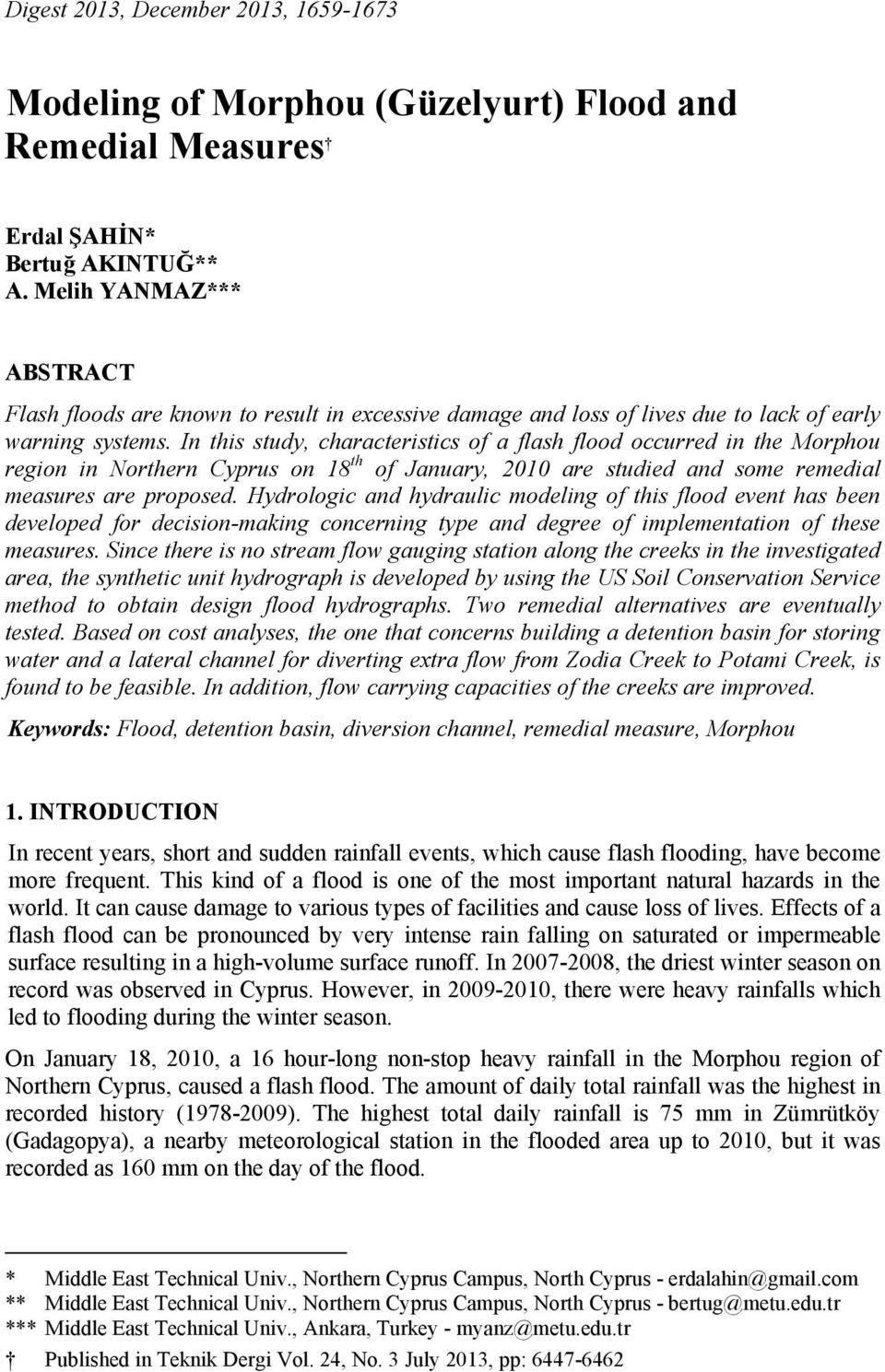
2 Modeling of Morphou Flood and Remedial Measures The observed amount of rainfall of all regions and the amount of rainfall on January 18, 2010 (d At ) can be seen in Table 1 in which d A and d max denote the annual average and maximum precipitation depth, respectively. The village of Zodia and the town of Morphou were affected badly by this flash flooding that has never been observed in the recorded history. This flood caused considerable damage in the order of 2.8 million US dollars in Morphou and its close proximity. Table 1 Precipitation data for Meteorological stations located in Morphou region Station Period d A (mm) d max (date) (mm) d At (mm) Çamlıbel (Mirtu) ( ) 169 Kozanköy (Lapitos) ( ) 182 Kalkanlı (Gabudi) ( ) 114 Güzelyurt (Morphou) ( ) 101 Bostancı (Zodia) ( ) 150 Zümrütköy (Gadagopya) ( ) 160 The objective of this study is to develop a feasible solution for flood protection for the Morphou region. Hydrologic modeling is essential for the establishment of flood mitigation systems. The boundaries of the basin are obtained using Arc-GIS [1]. Various relevant hydrologic and geomorphologic parameters are then obtained for determining the flood hydrographs. Furthermore, hydraulic modeling is performed by using HEC-RAS program [2] to obtain water surface profiles of the creeks in the study area such that the extension of the flooded areas can be obtained. These computations are also used for checking the adequacy of the creeks and appurtenant structures like bridges and culverts. Finally, solutions for protection from flood are proposed. Scouring depths at bridges are computed and applicable armoring type scour countermeasures are designed. Some protective measures for Morphou region against flooding events are proposed. The first solution involves building a detention basin on Zodia Creek and a diversion channel between this basin and Potami Creek. The second solution is building a diversion channel between Zodia Creek and Morphou Dam. 2. DESCRIPTION OF THE INVESTIGATED AREA With a semi-dry climate, the island of Cyprus is located in the Eastern Mediterranean Sea. The studied area covers the land close to the Morphou region located at the west coast of Northern Cyprus (Figure 1). There are a number of subbasins in the Morphou region but only two of them that were severely exposed to the January 2010 flood are considered in this study. Figure 2 shows the locations of the Zodia and Potami Creek basins. Extreme flows of a number of western creeks of the Morphou region are diverted to Morphou Dam 1660
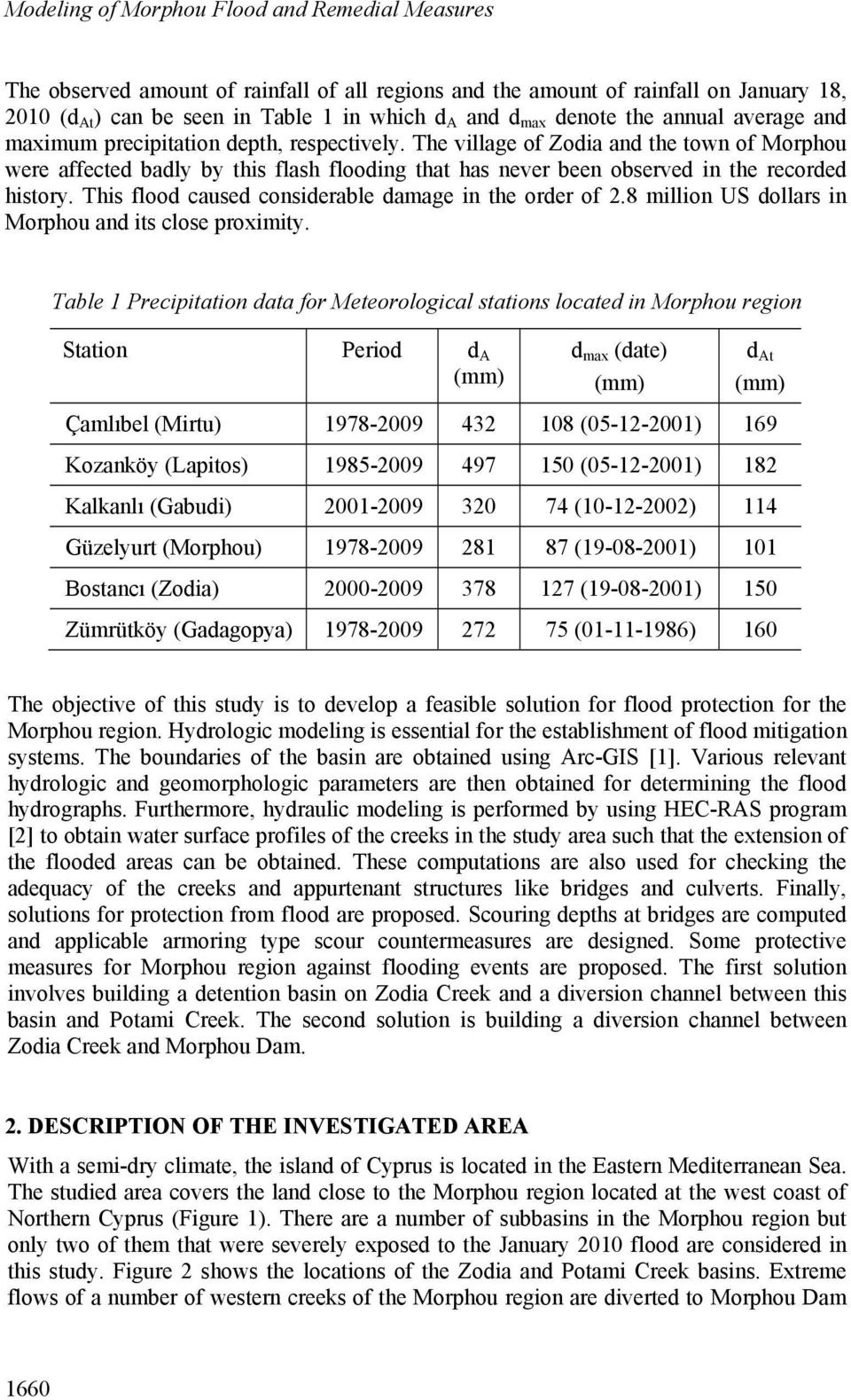
3 Erdal ŞAHİN, Bertuğ AKINTUĞ, A. Melih YANMAZ by means of a channel so that stored water can be used for recharging the Morphou aquifer. There are orange orchards, wheat and barley fields, and urban areas in the Zodia Creek basin, whereas the upstream part of Potami Creek basin is mountainous area and its downstream consists of citrous orchards, wheat and barley fields. There are only a few buildings in the downstream of Potami basin. Zodia Creek is composed of five branches. These branches are combined at the entrance of Zodia village (Figure 2). N Figure 1 Cyprus Island and the location of the town of Morphou (Google Earth, 2011) There are no stream gauging stations in the aforementioned basins. That is why a synthetic unit hydrograph needs to be developed and the geomorphologic characteristics of the basins should be determined. For this purpose, the software Arc-Hydro, which is an application of Arc-GIS software program, is used [1]. The digital elevation model of the region is created from 1/25000 scaled contour maps of the region. Arc-Hydro D8 algorithm is operated for forming the basins of both creeks with their network pattern. To catch a good agreement between the map and the findings of the Arc-Hydro, some adjustments are made in the Arc-Hydro medium. Basins of both creeks, generated by ArcGIS software program are depicted on Google Earth map as shown in Figure 2. After generating the boundaries of the basin, the basin properties are calculated. The necessary data to be used in the derivation of SCS unit hydrographs for six-hour duration (UH 6 ) are presented in Table 2 in which A is the basin area, t p is the time to peak, Q p is the peak discharge, t r is the duration of excess rainfall, t l is the basin lag, t b is the base time, L is the main stream length, S is the potential maximum retention, and S h is the bed slope of the main stream. Besides that, CN is the curve number and it is obtained with reference to local conditions, such as soil type, surface cover, and antecedent moisture condition [3]. 1661

4 Modeling of Morphou Flood and Remedial Measures N Figure 2 The study area (Google Earth, 2012) The downstream reaches of these basins have almost zero slopes where the river crosssections cover a very wide surface width. With highly pervious soil characteristics, flow feeds the groundwater partially and the rest of the flow that is not infiltrated is stored locally on the ground surface. That is why the outlets of these basins do not reach directly to the Mediterranean Sea on the surface. Table 2 Parameters for obtaining the synthetic unit hydrograph for creeks Parameter Zodia Creek Basin Potami Creek Basin CN L (km) S (cm) S h (%) t L (hours) t p (hours) A (km 2 ) Q p (m 3 /s) t r (hours) 6 6 Cross-sections of the Zodia Creek and Potami Creek are measured precisely using the Global Navigation Satellite System (GNSS) and Total Stations by the authors of the paper. 1662

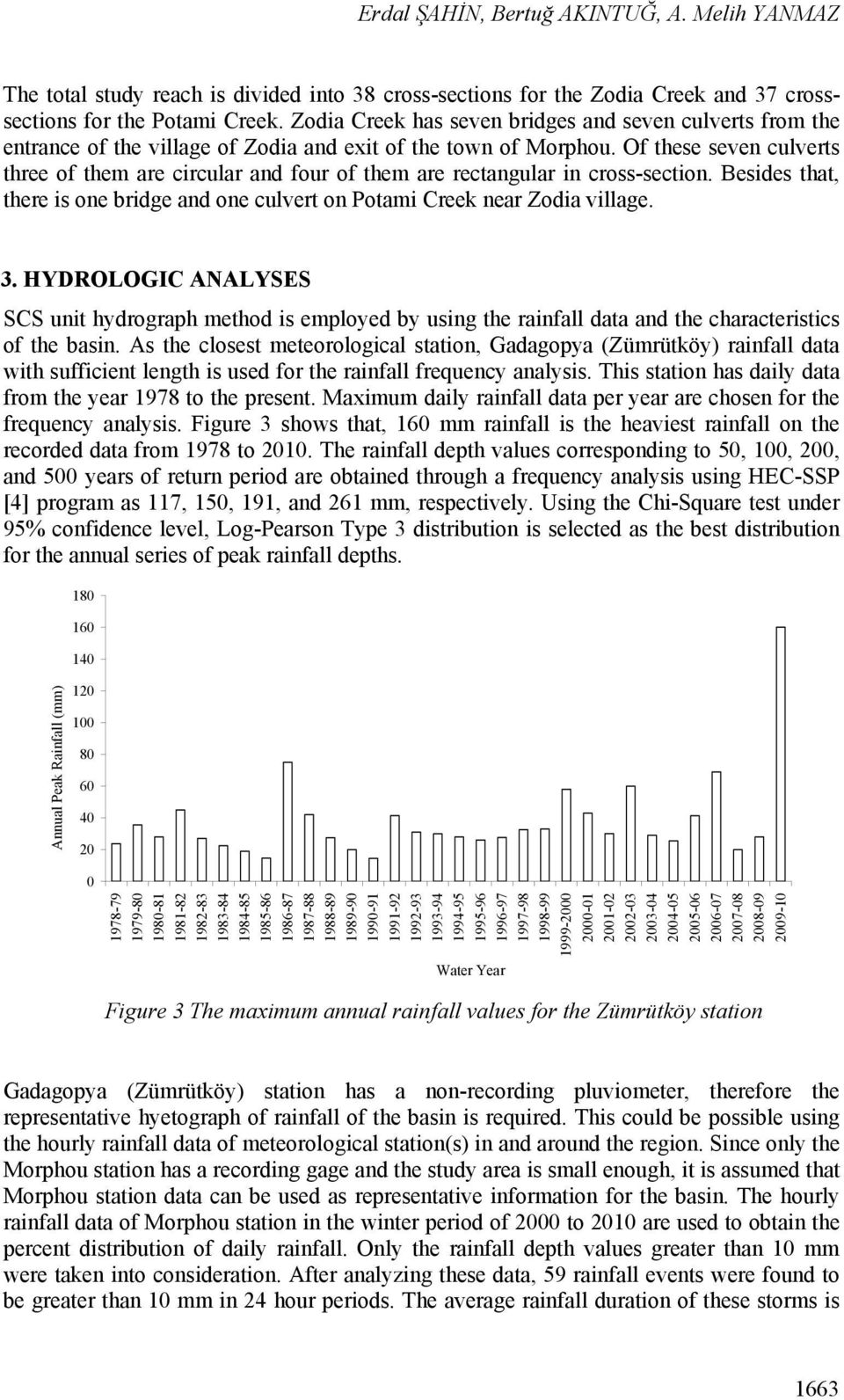
5 Erdal ŞAHİN, Bertuğ AKINTUĞ, A. Melih YANMAZ The total study reach is divided into 38 cross-sections for the Zodia Creek and 37 crosssections for the Potami Creek. Zodia Creek has seven bridges and seven culverts from the entrance of the village of Zodia and exit of the town of Morphou. Of these seven culverts three of them are circular and four of them are rectangular in cross-section. Besides that, there is one bridge and one culvert on Potami Creek near Zodia village. 3. HYDROLOGIC ANALYSES SCS unit hydrograph method is employed by using the rainfall data and the characteristics of the basin. As the closest meteorological station, Gadagopya (Zümrütköy) rainfall data with sufficient length is used for the rainfall frequency analysis. This station has daily data from the year 1978 to the present. Maximum daily rainfall data per year are chosen for the frequency analysis. Figure 3 shows that, 160 mm rainfall is the heaviest rainfall on the recorded data from 1978 to The rainfall depth values corresponding to 50, 100, 200, and 500 years of return period are obtained through a frequency analysis using HEC-SSP [4] program as 117, 150, 191, and 261 mm, respectively. Using the Chi-Square test under 95% confidence level, Log-Pearson Type 3 distribution is selected as the best distribution for the annual series of peak rainfall depths Annual Peak Rainfall (mm) Water Year Figure 3 The maximum annual rainfall values for the Zümrütköy station Gadagopya (Zümrütköy) station has a non-recording pluviometer, therefore the representative hyetograph of rainfall of the basin is required. This could be possible using the hourly rainfall data of meteorological station(s) in and around the region. Since only the Morphou station has a recording gage and the study area is small enough, it is assumed that Morphou station data can be used as representative information for the basin. The hourly rainfall data of Morphou station in the winter period of 2000 to 2010 are used to obtain the percent distribution of daily rainfall. Only the rainfall depth values greater than 10 mm were taken into consideration. After analyzing these data, 59 rainfall events were found to be greater than 10 mm in 24 hour periods. The average rainfall duration of these storms is 1663
6 Modeling of Morphou Flood and Remedial Measures 18 hours with an average rainfall depth of 19 mm. However, during the flood day, mm precipitation was observed at the Morphou station. It is assumed that the representative hyetograph of the basins consists of four equal parts having each a six-hour period. Using the available data, the rainfall pattern of the Morphou region is obtained as shown in Figure 4. It is assumed that, the 160 mm rainfall was distributed following the same rainfall distribution pattern as the Morphou station. Figure 5 shows the modified hyetograph of Morphou station with respect to Gadagopya (Zümrütköy) observation on the flood day. This hyetograph is accepted as the design hyetograph and the corresponding flood hydrographs are accepted to be the design hydrographs to be used for designing their mitigation facilities % 8% % of 24 hr Rainfall % % Time (hr) Figure 4 Percent distribution of daily rainfall of Morphou station Rainfall Intensity (mm/hr) Time (hr) Figure 5 Design hyetograph of Morphou station 1664

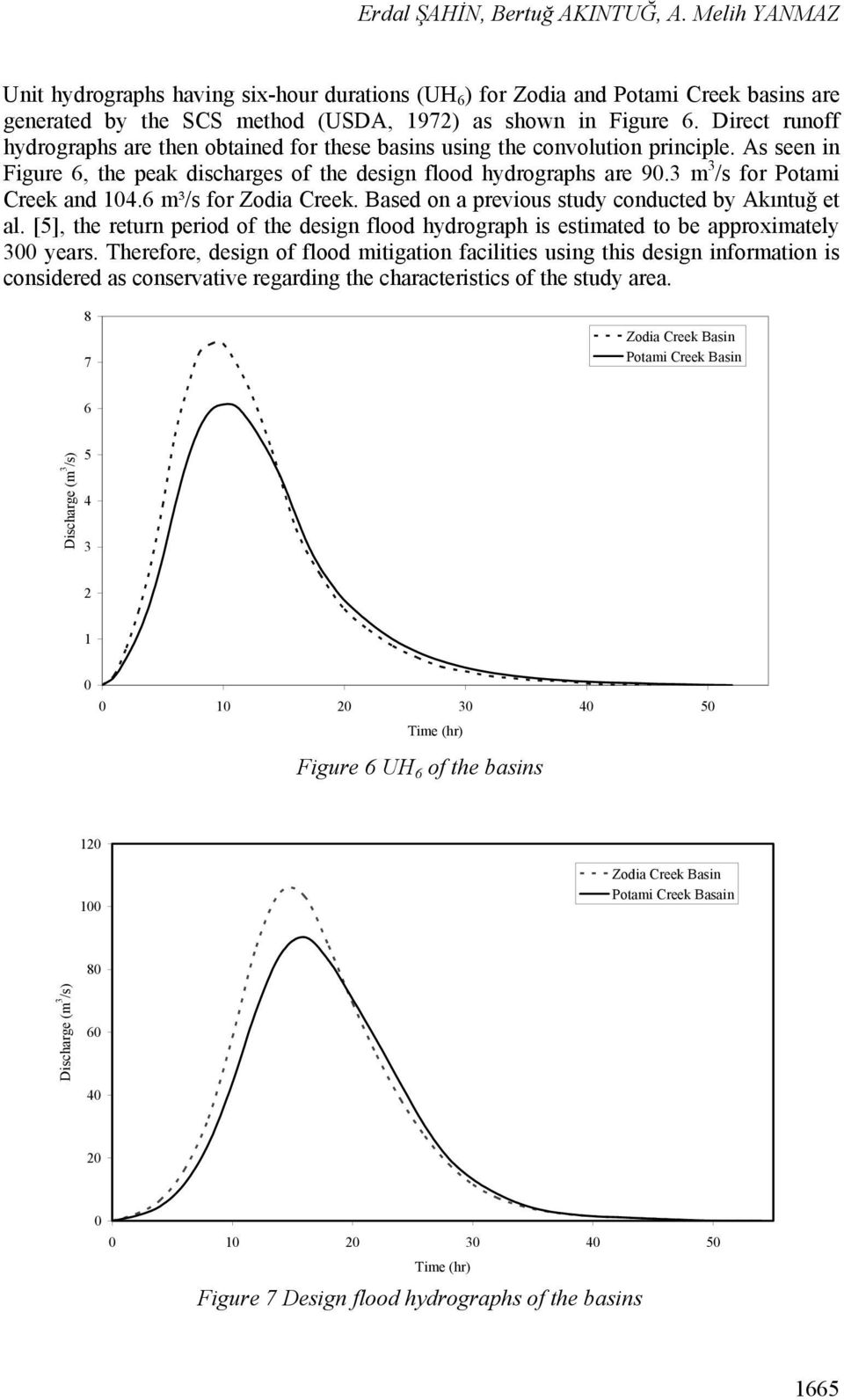
7 Erdal ŞAHİN, Bertuğ AKINTUĞ, A. Melih YANMAZ Unit hydrographs having six-hour durations (UH 6 ) for Zodia and Potami Creek basins are generated by the SCS method (USDA, 1972) as shown in Figure 6. Direct runoff hydrographs are then obtained for these basins using the convolution principle. As seen in Figure 6, the peak discharges of the design flood hydrographs are 90.3 m 3 /s for Potami Creek and m³/s for Zodia Creek. Based on a previous study conducted by Akıntuğ et al. [5], the return period of the design flood hydrograph is estimated to be approximately 300 years. Therefore, design of flood mitigation facilities using this design information is considered as conservative regarding the characteristics of the study area. 8 7 Zodia Creek Basin Potami Creek Basin 6 Discharge (m 3 /s) Time (hr) Figure 6 UH 6 of the basins Zodia Creek Basin Potami Creek Basain 80 Discharge (m 3 /s) Time (hr) Figure 7 Design flood hydrographs of the basins 1665
8 Modeling of Morphou Flood and Remedial Measures 4. HYDRAULIC ANALYSES Hydraulic analyses are required for deciding the degree of protective works and flood management practices. Water surface profiles are determined for the Zodia and Potami Creeks using HEC RAS program, Version 4.0 [2]. In this study, steady flow water surface profile computations are used. Necessary input data, such as geometric characteristics of the cross-sections of the creeks, bed material characteristics, details of the existing bridges and culverts, and Manning s roughness coefficient values are determined for these creeks. Topographic, geometric, and soil characteristics of the creeks are studied in detail. Soil samples taken at nine different sections are analyzed. The overall roughness coefficient to account for these effects is accepted to be After all sections, bridges, and culverts are simulated, the peak discharges of the computed hydrographs are inserted into HEC- RAS for determining flood inundation maps of the creeks according to the design flood. Bank-full capacities of the Potami Creek and Zodia Creek are calculated according to two options. The first one is determining the capacities of the creeks without any changes in the conditions of the creeks and hydraulic structures. The second option is modifying the existing structures like culverts and bridges for increasing capacities of the creeks. Based on the first option, Zodia and Potami Creeks are observed to transmit up to 5 m 3 /s and 25 m 3 /s, respectively, without overtopping the channel sides. If the creeks are cleaned from impurities and channel widening and deepening are applied, Manning s roughness coefficient is accepted to decrease to a value of Besides that, some culverts having smaller capacities must be replaced with new ones of higher capacity. With this modification, the capacities of Zodia Creek and Potami Creek will increase to 11 m 3 /s and 180 m 3 /s, respectively. Scouring at bridges is computed using the Colorado State University equation [6] which is a standard equation of HEC-18 software. Eight soil samples are taken around bridges piers and analyzed for local particle size distribution. The values of median sediment size (D 50 ), size of grain for 95% finer (D 95 ), and the maximum scour depth (d s ) of bridges are shown in Table 3. A quite big scour depth is obtained at Section 11 on Zodia Creek as 2.38 m because of severe hydraulic conditions. Among various types of scour countermeasures around bridge piers, riprap is the most commonly applied measure throughout the world because of ease in application and economy [7]. The median stone diameter D r50 needs to be determined for the design of rock riprap to be placed around the pier. In this study, Isbach equation, which is commonly used for determining the riprap size in American practice is used [8]. The flow conditions around Bridge No 7 are relatively tranquil, therefore no bed protection is required for that bridge. However, 1.42 m-diameter of riprap size is obtained at Bridge No 4 and 5. Since this size is not practical to apply, partially grouted riprap placement may be considered. For partially grouted riprap application, Class 2 gradation according to [9] standard classification can be used. Therefore, D r50 value can be taken between 0.22 m and 0.27 m. The thickness of the partially grouted riprap layer can be taken as 3D r50. Gradation details for riprap classes can be found in [9]. 1666
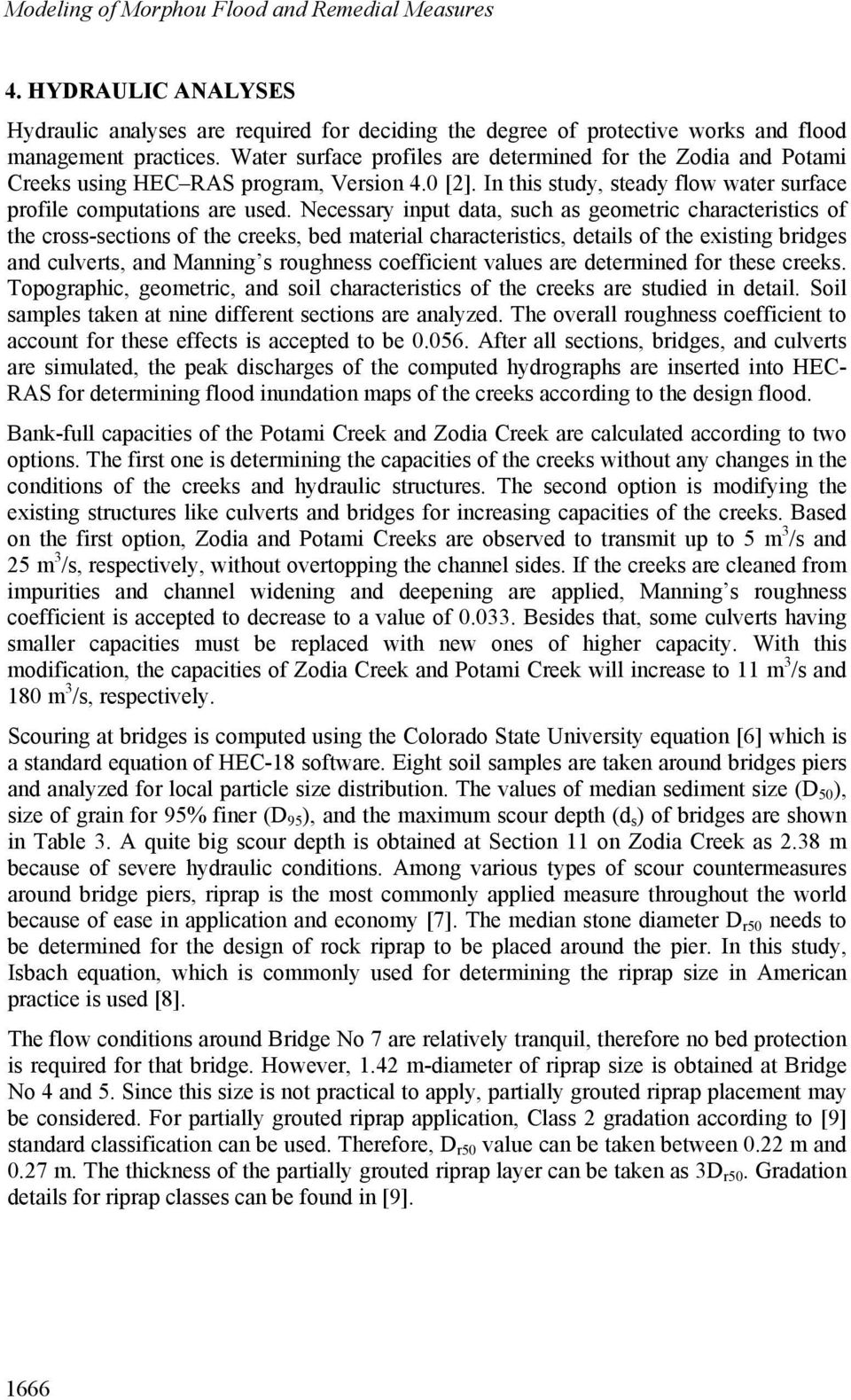
9 Erdal ŞAHİN, Bertuğ AKINTUĞ, A. Melih YANMAZ Table 3 Scour data for bridges on Zodia Creek Bridge No D 50 (mm) D 95 (mm) d s (m) REMEDIAL MEASURES Two remedial measures are proposed for flood protection in proximity of the Morphou- Zodia region. These measures are mainly categorized as storing a considerable flood volume at the upstream portions of these settlements by means of a flood detention basin on Zodia Creek and diverting a certain fraction of flows of Zodia Creek to the neighbouring Potami Creek by means of a diversion channel. The second measure is the diversion of a certain portion of flows of Zodia Creek to the Morphou Dam. These measures are described below together with the corresponding analyses and their results in a comparative manner. For decision-making, cost analyses are performed for these alternatives. Alternative 1 Construction of a flood detention basin at a suitable location is considered as an effective measure as it can accommodate considerable flood water volume behind its reservoir. Hence reduced flow rates can safely be transmitted to the downstream reaches. A detention basin is normally composed of a small embankment having an uncontrolled bottom outlet. A riser pipe is connected to the bottom outlet in order to facilitate formation of a dead volume. During low flows, river flow takes place through the bottom outlet without storing water in the reservoir. Considering the possibility of high flows, an overflow spillway can also be supplemented [11]. In this study, a reservoir routing procedure dealing with a numerical solution is used. Temporal variation of reservoir surface elevation, h, measured from the axis of the bottom outlet is determined from the following equation [11]: dh I( t) Q( h) (1) dt A( h) where t is the time, I(t) is the inflow, Q(h) is the outflow, and A(h) is the area-elevation relationship of the reservoir. When I(t), Q(h), and A(h) are expressed mathematically, the temporal variation of h can be obtained in iterative manner using a numerical solution, such as Euler or Runge-Kutta solutions [11]. This study is initiated by searching a suitable location for such a reservoir having adequate storage ability. Based on site investigations, 1667
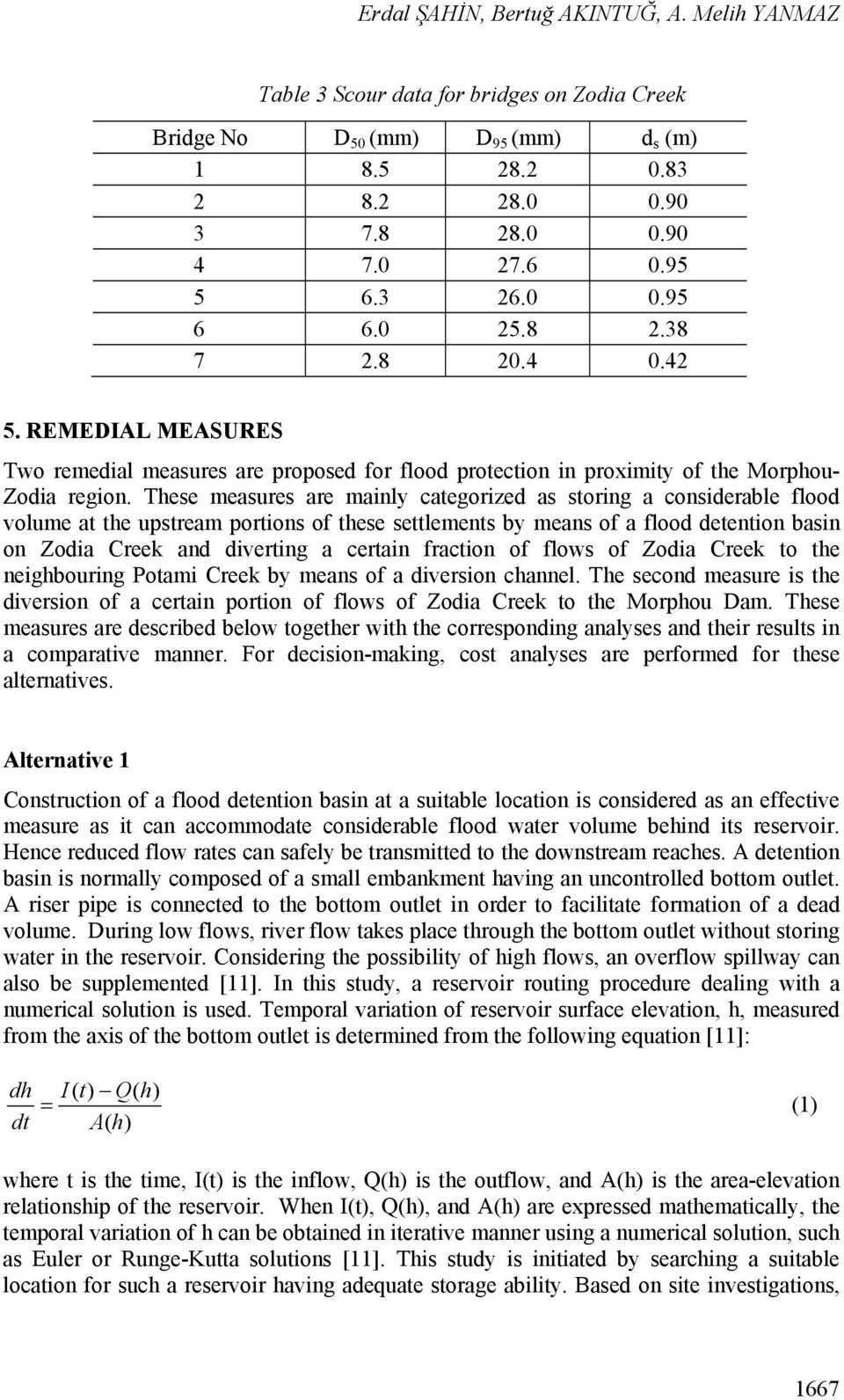
10 Modeling of Morphou Flood and Remedial Measures two choices are found to be suitable for the reservoir locations. The area-elevation data of the reservoirs are measured in the field. The following polynomials having correlation coefficients of are fitted to Zodia Creek Detention Basin (Equation 2) and Potami Creek Detention Basin (Equation 3): A (h) = h h h h (2) A (h) = h h h (3) A one-meter diameter bottom outlet and riser pipe is considered with the riser entrance height of 2 m. A homogeneous embankment having a height of 9 m, a crest thickness of 3 m, and a base width of 53 m is assigned according to the guidelines presented in [11]. The side slopes corresponds to 1V:2.8H, where V and H denote the vertical and horizontal values of the side inclinations, respectively. These values are reasonable for a homogeneous embankment [11]. The energy equation is used for calculating the outflow discharge. The following loss coefficients are taken for steel pipe with reference to [12] as 0.2, 0.2, and 1.0 for the entrance, bend, and exit, respectively. The friction factor is taken as Frictional headloss is computed using the Darcy-Weisbach equation. Taking the datum as the centreline of the bottom outlet and assuming negligibly small velocity at the reservoir side, the energy equation is simplified as the following outflow relation as a function of h [13]: Q( h) h (4) The form of inflow hydrograph recommended by Horn [14] is found to represent the local inflow hydrographs with relatively good agreement. So it can be used in the routing process. This hydrograph is obtained by fitting the dimensionless unit hydrograph of US Soil Conservation Service in the general form of a Pearson type 3 probability density function as 3.5 t t I ( t) I p exp (5) t p t p where I p is the peak discharge and t p is the peak time. Using the information given before, the I p and t p values are taken as m³/s and 14 hours for the Zodia Creek and 90.3 m 3 /s and 14 hours for the Potami Creek. With this alternative a diversion channel is proposed to divert a certain portion of flows of Zodia Creek to Potami Creek. Therefore, building flood detention basins on both Zodia Creek and Potami Creek is considered. With this configuration, flow is to be diverted to Potami Creek where it is to be stored in a detention basin on the Potami Creek. In this option, no spillway is proposed for the Zodia Detention Basin as it is desired to divert the majority of the flood waters to Potami Creek Detention Basin. A 600 m long lined trapezoidal channel having a height of 1.9 m and bottom width of 3.5 m can be built between both detention basins. The bed elevation at the beginning of the channel is desired to be 94 m at the edge of the reservoir on Zodia Creek, which finally joins Potami Creek at an elevation of 86 m. Flood routing computations are performed for both creeks. The minimum topographic elevations of the reservoir sites for Zodia Creek 1668
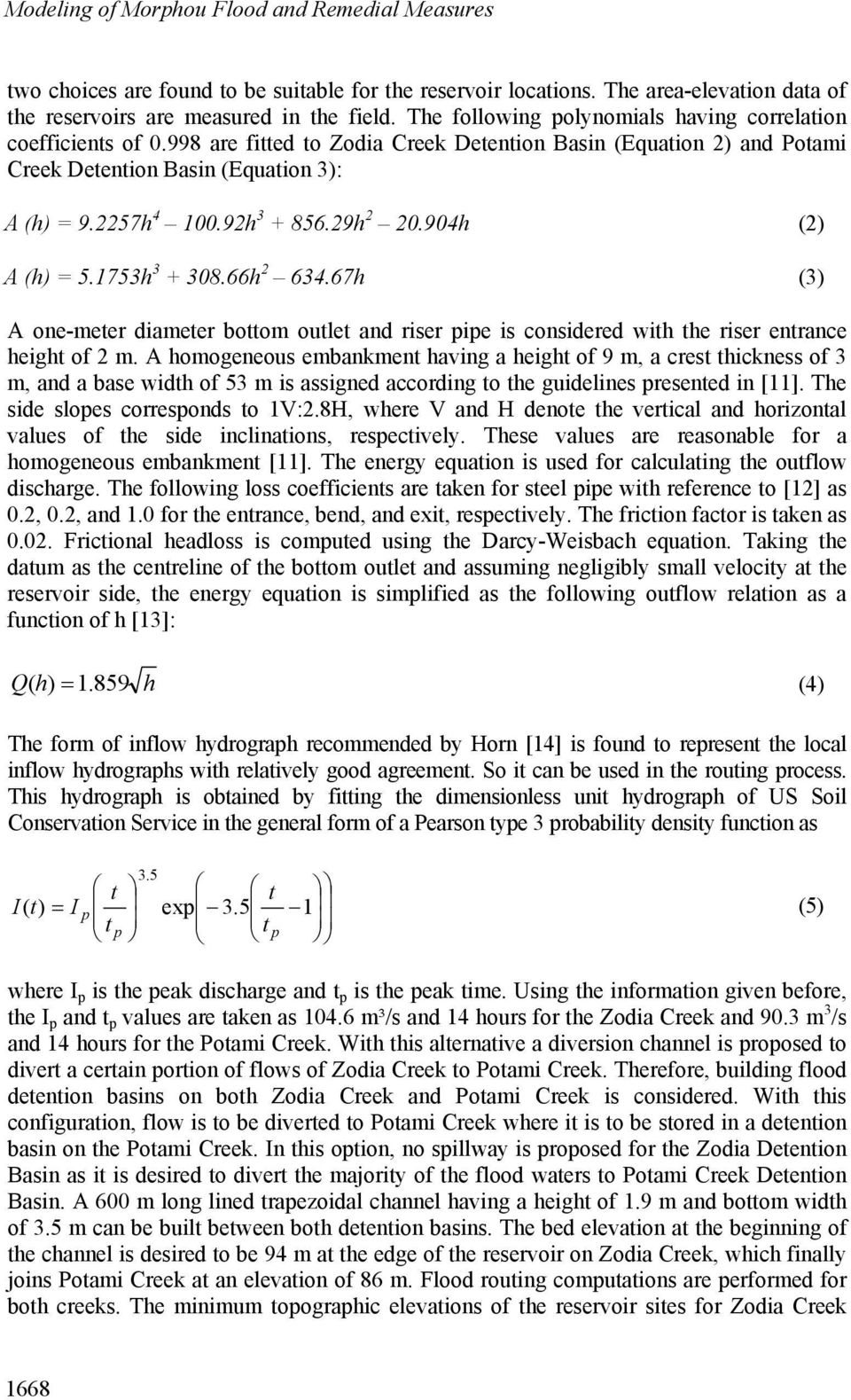
11 Erdal ŞAHİN, Bertuğ AKINTUĞ, A. Melih YANMAZ and Potami Creek are 88 m and 82 m, respectively. When water level reaches 94 m elevation at Zodia Creek reservoir, water starts to flow from Zodia Creek Detention Basin to Potami Creek by means of the diversion channel. The operation period of the diversion channel is between 4.25 hr after the design flood enters the Zodia Detention Basin and hr (See Figure 8). Therefore, inflow to the village of Zodia decreases as a result of operation of the diversion channel during this period as shown in Figure Discharge (m 3 /s) Time (hr) Figure 8 Flow transmission through the diversion channel in Alternative Inflow Outflow 14 Discharge (m 3 /s) Time (hr) Figure 9 Inflow-outflow relation for Zodia Creek Detention Basin 1669
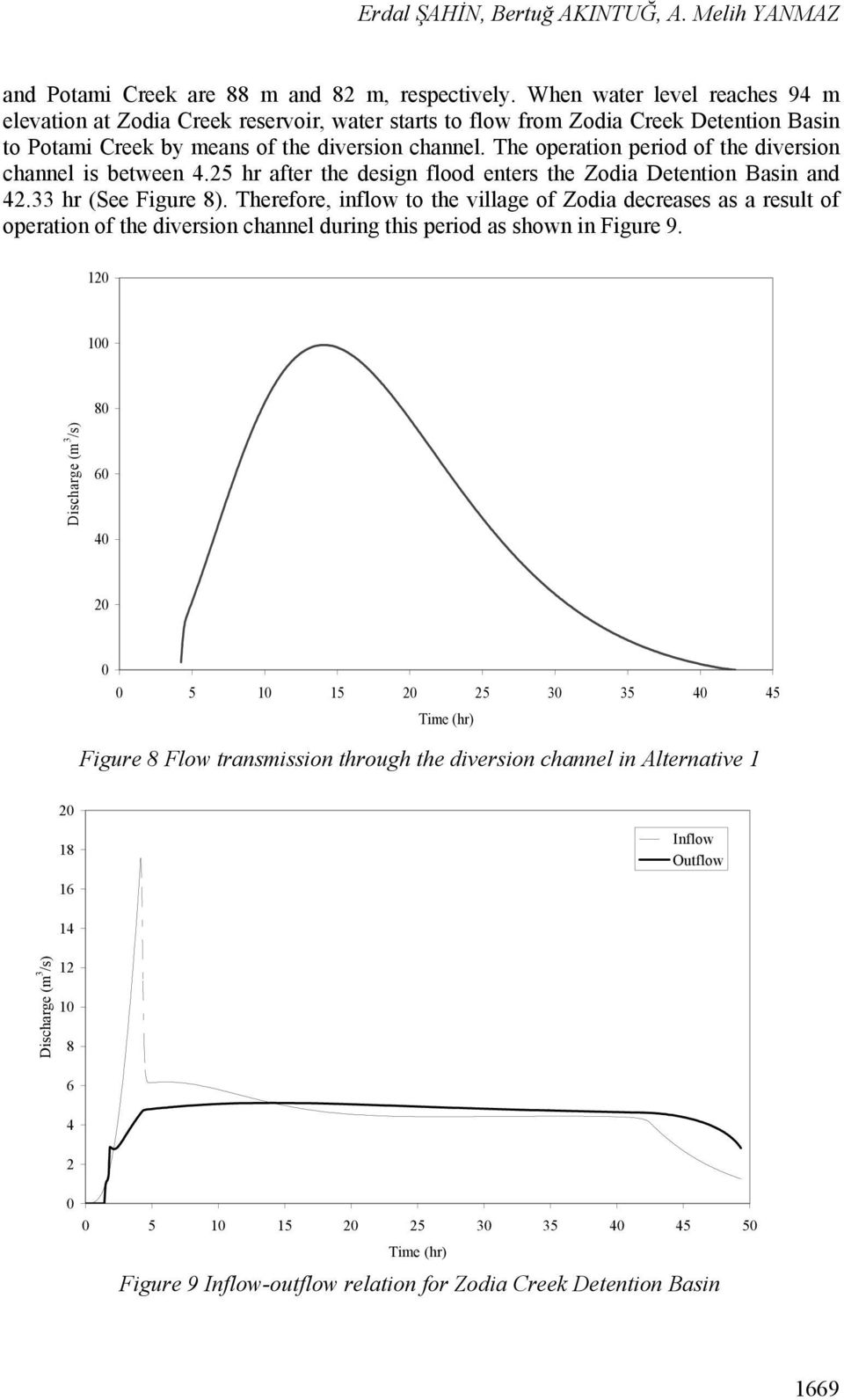
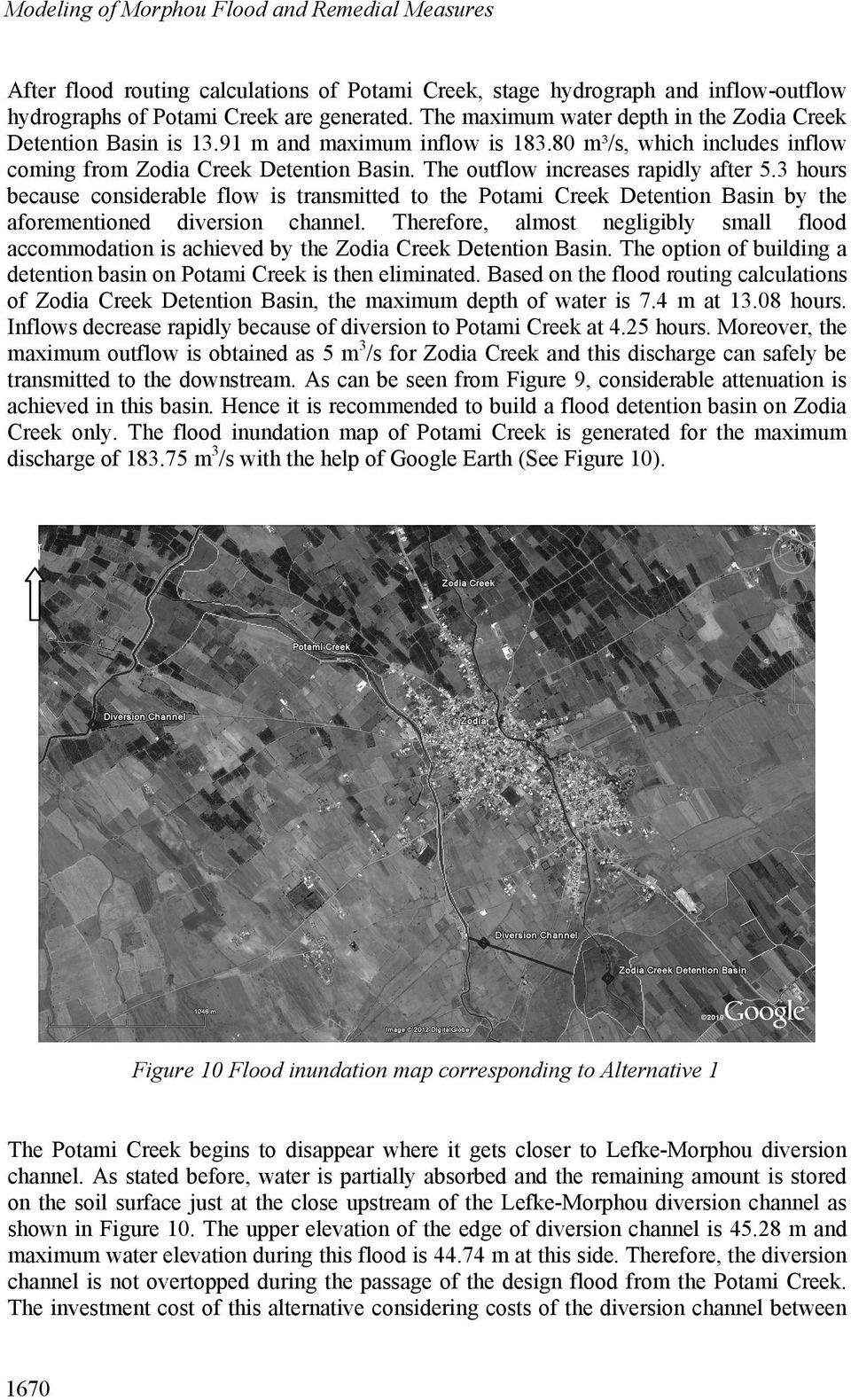
12 Modeling of Morphou Flood and Remedial Measures After flood routing calculations of Potami Creek, stage hydrograph and inflow-outflow hydrographs of Potami Creek are generated. The maximum water depth in the Zodia Creek Detention Basin is m and maximum inflow is m³/s, which includes inflow coming from Zodia Creek Detention Basin. The outflow increases rapidly after 5.3 hours because considerable flow is transmitted to the Potami Creek Detention Basin by the aforementioned diversion channel. Therefore, almost negligibly small flood accommodation is achieved by the Zodia Creek Detention Basin. The option of building a detention basin on Potami Creek is then eliminated. Based on the flood routing calculations of Zodia Creek Detention Basin, the maximum depth of water is 7.4 m at hours. Inflows decrease rapidly because of diversion to Potami Creek at 4.25 hours. Moreover, the maximum outflow is obtained as 5 m 3 /s for Zodia Creek and this discharge can safely be transmitted to the downstream. As can be seen from Figure 9, considerable attenuation is achieved in this basin. Hence it is recommended to build a flood detention basin on Zodia Creek only. The flood inundation map of Potami Creek is generated for the maximum discharge of m 3 /s with the help of Google Earth (See Figure 10). N Figure 10 Flood inundation map corresponding to Alternative 1 The Potami Creek begins to disappear where it gets closer to Lefke-Morphou diversion channel. As stated before, water is partially absorbed and the remaining amount is stored on the soil surface just at the close upstream of the Lefke-Morphou diversion channel as shown in Figure 10. The upper elevation of the edge of diversion channel is m and maximum water elevation during this flood is m at this side. Therefore, the diversion channel is not overtopped during the passage of the design flood from the Potami Creek. The investment cost of this alternative considering costs of the diversion channel between 1670
13 Erdal ŞAHİN, Bertuğ AKINTUĞ, A. Melih YANMAZ Zodia and Potami Creeks and detention basin on Zodia Creek is computed as 579,000 US dollars [13]. Alternative 2 Zodia Creek is considerably close to the Morphou Dam. Therefore, the design flow of m 3 /s is considered to be transferred directly to the Morphou Dam via a new lined channel. After field investigations, a channel, 5 km long with a bed slope of , is observed to be built between the Zodia Creek and the Morphou Dam in the direction of decreasing elevation from 88 m to 60 m. Manning s roughness coefficient of the channel can be taken as Considering the channel capacity, the width and height of the channel is 4 m and 3 m, respectively. Along the direction of the channel, there are two roads. Therefore, two small bridges are proposed to be constructed. The cost of this alternative, excluding the cost of bridges, is found as approximately 7,138,000 US dollars [13]. As a result, the first alternative is accepted to be effective and economical. CONCLUSIONS This study deals with flood management practices in Morphou region of Northern Cyprus. Rainfall frequency calculations are performed for hydrological modeling. Percentage distribution of daily rainfall of Morphou station is derived from the available rainfall data to obtain the representative rainfall hyetograph. The properties of the basins are obtained by using ARC-GIS software. SCS unit hydrographs are developed for obtaining the design flood hydrographs of the basins. Water surface profile computations are executed by using HEC-RAS software to obtain flood inundation maps of the basins. Flow carrying capacities of the creeks are observed and channel improvements concerning deepening and widening are proposed to decrease Manning s roughness coefficient. The dimensions of some of the existing bridges and culverts are modified to increase the flow transmission ability of the creeks. Partially grouted riprap is proposed to be placed around bridge piers as a suitable scour countermeasure. Construction of a flood detention basin on Zodia Creek with a supplementary diversion channel is proposed as an effective remedial measure. Symbols A : Basin area CN : Curve number d A d max D 50 D 95 d s : Annual average precipitation depth : Annual maximum precipitation depth : Median Sediment Size : Size of grain for which 95% is finer : Depth of scour 1671
14 Modeling of Morphou Flood and Remedial Measures I(t) I p L S h t t b t l t p t r t p UH Q Q(t) : Inflow : Peak discharge : The main stream length : The bed slope of the main stream : Time : Base time : Basin lag : Time to peak : Duration of rainfall excess : Time to peak : Unit Hydrograph : Discharge : Outflow Acknowledgments This research is supported by the Campus Research Fund (FEN 15 and FEN-11-D-5) of the Middle East Technical University, Northern Cyprus Campus. This support is gratefully acknowledged. The authors would like to thank The Meteorological Authority and The Map Authority of The Government of North Cyprus for the provided rainfall and digital map data used in this study. References [1] ESRI. ArcMap Users Manual Version 9.3, ESRI Inc., [2] USACE. HEC-RAS Users Manual Version 4.1, Davis, CA, ABD, [3] USDA. Soil Conservation Service, National Engineering Handbook, Washington D.C., [4] USACE, HEC-SSP Users Manual Version 4.1, Davis, CA, ABD, [5] Akıntuğ, B. Yanmaz, A. M. Akyürek, Z., ve Sürer, S. Modelling of Zodia-Morphou Flood and Determination of Flood Risk Areas in Morphou Region. Scientific Research Project (FEN-15) Report. METU Northern Cyprus Campus, [6] Richardson, E. V., and Davis, S. R. Evaluating Scour at Bridges, Fourth edition. FHWA Report No. FHWA NHI Virginia: Federal Highway Administration, [7] Yanmaz, A. M. Köprü Hidroliği, METU Press, Ankara,

15 Erdal ŞAHİN, Bertuğ AKINTUĞ, A. Melih YANMAZ [8] Lagasse, P. F., Zevenberg, L. W., Schall, J. D., ve Clopper, P. E. Bridge Scour and Stream Instability Countermeasures Experience, Selection, and Design Guidelines, Hydraulic Engineering Circular (HEC) No. 23, Second Edition. FHWA Report No. FHWA NHI Washington, D. C.: Federal Highway Administration, [9] Lagasse, P. F., Clopper, P. E. Zevenberg, L. W., ve Girard L. G. Countermeasures to Protect Bridge Piers from Scour, NCHRP Report 593, Transportation Research Board, Washington, D. C., [10] Yanmaz, A.M., ve Çam, E. Bridge Scour Countermeasure Design: A Case Study, 10. International Congress on Advances in Civil Engineering, Proceedings, Vol 1, [11] Yanmaz, A. M. Applied Water Resources Engineering, METU Press, Ankara, [12] Munson, R. B., Young, F. D., ve Okiishi, H. T. Fundamentals of Fluid Mechanics. ABD, John Wiley and Sons, [13] Şahin, E. A Study on Flood Management Practices for Güzelyurt, MSc Thesis, Department of Civil Engineering, METU, Ankara, [14] Horn, D. R. Graphic Estimation of Peak Flow Reduction in Reservoirs, J. Hydraulic Division, ASCE, 113(11) pp ,
![Washington, D. C.: Federal Highway Administration, 2001. [9] Lagasse, P. F., Clopper, P. E. Zevenberg, L. W., ve Gi](/docs-images/41/3811664/images/page_15.jpg "rard L. G. Countermeasures to Protect Bridge Piers from Scour, NCHRP Report 593, Transportation Research Board, Washington, D. C., 2007. [10] Yanmaz, A.M., ve Çam, E.")
16 Modeling of Morphou Flood and Remedial Measures 1674

FLOODPLAIN DELINEATION IN MUGLA-DALAMAN PLAIN USING GIS BASED RIVER ANALYSIS SYSTEM
 FLOODPLAIN DELINEATION IN MUGLA-DALAMAN PLAIN USING GIS BASED RIVER ANALYSIS SYSTEM Dr. Murat Ali HATİPOĞLU Fatih KESKİN Kemal SEYREK State Hydraulics Works (DSI), Investigation and Planning Department
Land Disturbance, Erosion Control and Stormwater Management Checklist. Walworth County Land Conservation Department
 Land Disturbance, Erosion Control and Stormwater Management Checklist Walworth County Land Conservation Department The following checklist is designed to assist the applicant in complying with the Walworth
Emergency Spillways (Sediment basins)
 Emergency Spillways (Sediment basins) DRAINAGE CONTROL TECHNIQUE Low Gradient Velocity Control Short-Term Steep Gradient Channel Lining Medium-Long Term Outlet Control Soil Treatment Permanent [1] [1]
AZ EGER-PATAK HIDROLÓGIAI VIZSGÁLATA, A FELSZÍNI VÍZKÉSZLETEK VÁRHATÓ VÁLTOZÁSÁBÓL ADÓDÓ MÓDOSULÁSOK AZ ÉGHAJLATVÁLTOZÁS HATÁSÁRA
 AZ EGER-PATAK HIDROLÓGIAI VIZSGÁLATA, A FELSZÍNI VÍZKÉSZLETEK VÁRHATÓ VÁLTOZÁSÁBÓL ADÓDÓ MÓDOSULÁSOK AZ ÉGHAJLATVÁLTOZÁS HATÁSÁRA GÁBOR KEVE 1, GÉZA HAJNAL 2, KATALIN BENE 3, PÉTER TORMA 4 EXTRAPOLATING
Flash Flood Science. Chapter 2. What Is in This Chapter? Flash Flood Processes
 Chapter 2 Flash Flood Science A flash flood is generally defined as a rapid onset flood of short duration with a relatively high peak discharge (World Meteorological Organization). The American Meteorological
ROSE CREEK WATERSHED HYDROLOGIC, HYDRAULIC, SEDIMENT TRANSPORT, AND GEOMORPHIC ANALYSES TASK 1 EXISTING DATA AND INFORMATION SUMMARY REPORT BACKGROUND
 ROSE CREEK WATERSHED HYDROLOGIC, HYDRAULIC, SEDIMENT TRANSPORT, AND GEOMORPHIC ANALYSES TASK 1 EXISTING DATA AND INFORMATION SUMMARY REPORT BACKGROUND The Rose Creek Watershed (RCW) consists of three planning
2.0 BASIC CONCEPTS OF OPEN CHANNEL FLOW MEASUREMENT
 2.0 BASIC CONCEPTS OF OPEN CHANNEL FLOW MEASUREMENT Open channel flow is defined as flow in any channel where the liquid flows with a free surface. Open channel flow is not under pressure; gravity is the
How To Understand And Understand The Flood Risk Of Hoang Long River In Phuon Vietnam
 FLOOD HAZARD AND RISK ASSESSMENT OF HOANG LONG RIVER BASIN, VIETNAM VU Thanh Tu 1, Tawatchai TINGSANCHALI 2 1 Water Resources University, Assistant Professor, 175 Tay Son Street, Dong Da District, Hanoi,
Outlet stabilization structure
 Overview of Sedimentation and Erosion Control Practices Practice no. 6.41 Outlet stabilization structure Erosion at the outlet of channels, culverts, and other structures is common, and can cause structural
Index. protection. excavated drop inlet protection (Temporary) 6.50.1 6.51.1. Block and gravel inlet Protection (Temporary) 6.52.1
 6 Index inlet protection excavated drop inlet protection (Temporary) 6.50.1 HARDWARE CLOTH AND GRAVEL INLET PROTECTION Block and gravel inlet Protection (Temporary) sod drop inlet protection ROCK DOUGHNUT
Hydrologic Modeling using HEC-HMS
 Hydrologic Modeling using HEC-HMS Prepared by Venkatesh Merwade School of Civil Engineering, Purdue University [email protected] April 2012 Introduction The intent of this exercise is to introduce you
URBAN DRAINAGE CRITERIA
 URBAN DRAINAGE CRITERIA I. Introduction This division contains guidelines for drainage system design and establishes a policy for recognized and established engineering design of storm drain facilities
Riprap-lined Swale (RS)
 Riprap-lined Swale (RS) Practice Description A riprap-lined swale is a natural or constructed channel with an erosion-resistant rock lining designed to carry concentrated runoff to a stable outlet. This
STORMWATER MANAGEMENT CHECKLIST
 STORMWATER MANAGEMENT CHECKLIST *This checklist must be completed and part of the Land Disturbing Permit submittal for review if the acreage disturbed is one (1) acre or more: I. SUPPORTING DATA Narrative
Appendix C - Risk Assessment: Technical Details. Appendix C - Risk Assessment: Technical Details
 Appendix C - Risk Assessment: Technical Details Page C1 C1 Surface Water Modelling 1. Introduction 1.1 BACKGROUND URS Scott Wilson has constructed 13 TUFLOW hydraulic models across the London Boroughs
2011 HYDRAULICS MANUAL
 STATE OF LOUISIANA DEPARTMENT OF TRANSPORTATION AND DEVELOPMENT P.O. Box 94245 Baton Rouge, Louisiana 70804-9245 http://www.dotd.la.gov/ HYDRAULICS MANUAL Hydraulics (225) 379-1306 PREFACE The following
2D Modeling of Urban Flood Vulnerable Areas
 2D Modeling of Urban Flood Vulnerable Areas Sameer Dhalla, P.Eng. Dilnesaw Chekol, Ph.D. A.D. Latornell Conservation Symposium November 22, 2013 Outline 1. Toronto and Region 2. Evolution of Flood Management
Prattsville Berm Removal Project. 1.0 Project Location
 Prattsville Berm Removal Project 1.0 Project Location The project site is located between the New York State Route 23 Bridge over the Schoharie Creek and the Schoharie Reservoir. The restoration plan encompassed
Topic 8: Open Channel Flow
 3.1 Course Number: CE 365K Course Title: Hydraulic Engineering Design Course Instructor: R.J. Charbeneau Subject: Open Channel Hydraulics Topics Covered: 8. Open Channel Flow and Manning Equation 9. Energy,
Evaluation of Open Channel Flow Equations. Introduction :
 Evaluation of Open Channel Flow Equations Introduction : Most common hydraulic equations for open channels relate the section averaged mean velocity (V) to hydraulic radius (R) and hydraulic gradient (S).
Environmental Data Management Programs
 Hydrologic Engineering Centre (HEC) Software CD Collection of programs, developed by the U.S. Army Corps of Engineers Environmental Data Management Programs Name: HEC-DSS Package Purpose: Data Storage
Estimating Potential Reduction Flood Benefits of Restored Wetlands
 Estimating Potential Reduction Flood Benefits of Restored Wetlands Kenneth W. Potter University of Wisconsin Introduction Throughout the summer of 1993 a recurring question was the impact of wetland drainage
CITY UTILITIES DESIGN STANDARDS MANUAL
 CITY UTILITIES DESIGN STANDARDS MANUAL Book 2 (SW) SW9 June 2015 SW9.01 Purpose This Chapter provides information for the design of open channels for the conveyance of stormwater in the City of Fort Wayne.
Impact of water harvesting dam on the Wadi s morphology using digital elevation model Study case: Wadi Al-kanger, Sudan
 Impact of water harvesting dam on the Wadi s morphology using digital elevation model Study case: Wadi Al-kanger, Sudan H. S. M. Hilmi 1, M.Y. Mohamed 2, E. S. Ganawa 3 1 Faculty of agriculture, Alzaiem
TENNESSEE GAS PIPELINE COMPANY, L.L.C.
 TENNESSEE GAS PIPELINE COMPANY, L.L.C. HYDROLOGIC & HYDRAULIC CALCULATIONS FOR WATERBODIES CROSSED BY CONNECTICUT PIPELINE EXPANSION PROJECT CONNECTICUT LOOP Submitted by: Tennessee Gas Pipeline Company,
Sample DEQ Plan Submitter s Checklist for Stormwater Management Plans
 APPENDIX IV Version: February 2, 2015 Sample DEQ Plan Submitter s Checklist for Stormwater Management Plans Please fill in all blanks and please reference the plan sheets/pages where the information may
Appendix 4-C. Open Channel Theory
 4-C-1 Appendix 4-C Open Channel Theory 4-C-2 Appendix 4.C - Table of Contents 4.C.1 Open Channel Flow Theory 4-C-3 4.C.2 Concepts 4-C-3 4.C.2.1 Specific Energy 4-C-3 4.C.2.2 Velocity Distribution Coefficient
Ruissellement du Bassin Précipitation Abstractions Hydrogramme Flux de Base. Superposition Routage
 HEC-1 Leçon 11 This lesson will focus on how WMS can be used to develop HEC-1 modeling parameters and not on the fundamental hydrologic principles simulated by HEC-1. 1 Vue D Emsemble Utilisés Couramment
Chapter 9. Steady Flow in Open channels
 Chapter 9 Steady Flow in Open channels Objectives Be able to define uniform open channel flow Solve uniform open channel flow using the Manning Equation 9.1 Uniform Flow in Open Channel Open-channel flows
CHAPTER 3 STORM DRAINAGE SYSTEMS
 CHAPTER 3 STORM DRAINAGE SYSTEMS 3.7 Storm Drains 3.7.1 Introduction After the tentative locations of inlets, drain pipes, and outfalls with tail-waters have been determined and the inlets sized, the next
STORM DRAINS CHAPTER 7
 CHAPTER 7 Chapter 7 - Storm Drains A storm drain is a drainage system that conveys water or stormwater, consisting of two or more pipes in a series connected by one or more structures. Storm drains collect
MIKE 21 FLOW MODEL HINTS AND RECOMMENDATIONS IN APPLICATIONS WITH SIGNIFICANT FLOODING AND DRYING
 1 MIKE 21 FLOW MODEL HINTS AND RECOMMENDATIONS IN APPLICATIONS WITH SIGNIFICANT FLOODING AND DRYING This note is intended as a general guideline to setting up a standard MIKE 21 model for applications
Lecture 22 Example Culvert Design Much of the following is based on the USBR technical publication Design of Small Canal Structures (1978)
 Lecture 22 Example Culvert Design Much of the following is based on the USBR technical publication Design of Small Canal Structures (1978) I. An Example Culvert Design Design a concrete culvert using the
CHAPTER 9 CHANNELS APPENDIX A. Hydraulic Design Equations for Open Channel Flow
 CHAPTER 9 CHANNELS APPENDIX A Hydraulic Design Equations for Open Channel Flow SEPTEMBER 2009 CHAPTER 9 APPENDIX A Hydraulic Design Equations for Open Channel Flow Introduction The Equations presented
Experiment (13): Flow channel
 Introduction: An open channel is a duct in which the liquid flows with a free surface exposed to atmospheric pressure. Along the length of the duct, the pressure at the surface is therefore constant and
USSD Workshop on Dam Break Analysis Applied to Tailings Dams
 USSD Workshop on Dam Break Analysis Applied to Tailings Dams Antecedents Newtonian / non-newtonian flows Available models that allow the simulation of non- Newtonian flows (tailings) Other models used
Hydrologic Engineering Techniques for Regional Water Resources Planning
 US Army Corps of Engineers Hydrologic Engineering Center Hydrologic Engineering Techniques for Regional Water Resources Planning October 1969 Approved for Public Release. Distribution Unlimited. TP-17
Methods for Determination of Safe Yield and Compensation Water from Storage Reservoirs
 US Army Corps of Engineers Hydrologic Engineering Center Methods for Determination of Safe Yield and Compensation Water from Storage Reservoirs October 1966 Approved for Public Release. Distribution Unlimited.
SUSTAINABLE URBAN DRAINAGE SYSTEMS
 overflow can lead into a permeable conveyance system to increase further the benefit and reduce the need for pipe systems. Pollutant removal rates have been shown to be high, with some pollutants being
APPENDIX B DESIGN GUIDELINES FOR APPROVED TREATMENT METHODS
 APPENDIX B DESIGN GUIDELINES FOR APPROVED TREATMENT METHODS PLANTER BOXES 1. Determine the impervious area contributing flow to the planter box (see Chapter 4.2). 2. Assumption: Typical soil infiltration
STATE OF FLORIDA DEPARTMENT OF TRANSPORTATION DRAINAGE HANDBOOK OPEN CHANNEL. OFFICE OF DESIGN, DRAINAGE SECTION November 2009 TALLAHASSEE, FLORIDA
 STATE OF FLORIDA DEPARTMENT OF TRANSPORTATION DRAINAGE HANDBOOK OPEN CHANNEL OFFICE OF DESIGN, DRAINAGE SECTION TALLAHASSEE, FLORIDA Table of Contents Open Channel Handbook Chapter 1 Introduction... 1
Travel Time. Computation of travel time and time of concentration. Factors affecting time of concentration. Surface roughness
 3 Chapter 3 of Concentration and Travel Time Time of Concentration and Travel Time Travel time ( T t ) is the time it takes water to travel from one location to another in a watershed. T t is a component
SECTION 6A STORM DRAIN DESIGN Mar. 2002 S E C T I O N 6A STORM DRAIN - DESIGN
 S E C T I O N 6A STORM DRAIN - DESIGN 6A.l Scope 6A.2 Storm Water Quantity 6A.3 Storm Drain Hydraulics 6A.4 Depths 6A.5 Locations 6A.6 Curved Storm Drains 6A.7 Manholes 6A.8 Catch basins 6A.9 Storm Drain
Please click on the tutorial most fitting of your expertise in order to learn about the features of the visualization tool.
 Introduction Welcome to the Indian Creek Conservation Reserve Program (CRP) visualization tool. This tool was developed by the University of Iowa - Institute for Hydroscience and Research (IIHR) as part
Flooding Hazards, Prediction & Human Intervention
 Page 1 of 10 EENS 3050 Tulane University Natural Disasters Prof. Stephen A. Nelson Flooding Hazards, Prediction & Human Intervention This page last updated on 19-Oct-2015 Hazards Associated with Flooding
SECTION 5 - STORM DRAINS
 Drainage Criteria Manual SECTION 5 - STORM DRAINS 5.1.0 GENERAL This The purpose of this section discusses briefly is to consider the hydraulic aspects of storm drains and their appurtenances in a storm
THE UNIVERSITY OF TRINIDAD & TOBAGO
 THE UNIVERSITY OF TRINIDAD & TOBAGO FINAL ASSESSMENT/EXAMINATIONS APRIL 2014 Course Code and Title: Programme: Date and Time: Duration: HYDRAULICS FLUD2006 BASc. Civil Engineering Wednesday 16 th April,
HYDROLOGIC/HYDRAULIC MODELING OF WESTMINSTER WATERSHED ORANGE COUNTY, CALIFORNIA
 HYDROLOGIC/HYDRAULIC MODELING OF WESTMINSTER WATERSHED ORANGE COUNTY, CALIFORNIA James Chieh, Ph.D., P.E., Senior Hydraulic Engineer, USACE, Los Angeles, California, [email protected]; Jay Pak,
10/4/2012. 40 slide sample of Presentation. Key Principles to Current Stormwater Management
 40 slide sample of Presentation Please contact [email protected] if you would like the complete presentation Key Principles to Current Stormwater Management Distributed Control Measures Integrated
City of London Climate Change Adaptation Strategy Dealing with Extreme Rainfall Events
 City of London Climate Change Adaptation Strategy Dealing with Extreme Rainfall Events May 29, 2014 Presented by: Berta Krichker M.Eng., FEC, P.Eng. Manager of Stormwater Unit Environmental and Engineering
Rational Method Hydrologic Calculations with Excel. Rational Method Hydrologic Calculations with Excel, Course #508. Presented by:
 Rational Method Hydrologic Calculations with Excel, Course #508 Presented by: PDH Enterprises, LLC PO Box 942 Morrisville, NC 27560 www.pdhsite.com Calculation of peak storm water runoff rate from a drainage
EXAMPLES (OPEN-CHANNEL FLOW) AUTUMN 2015
 EXAMPLES (OPEN-CHANNEL FLOW) AUTUMN 2015 Normal and Critical Depths Q1. If the discharge in a channel of width 5 m is 20 m 3 s 1 and Manning s n is 0.02 m 1/3 s, find: (a) the normal depth and Froude number
5.14 Floodplains and Drainage/Hydrology
 I-70 East Final EIS 5.14 Floodplains and Drainage/Hydrology 5.14 Floodplains and Drainage/Hydrology This section discusses floodplain and drainage/hydrology resources and explains why they are important
1. Carry water under the canal 2. Carry water over the canal 3. Carry water into the canal
 Lecture 21 Culvert Design & Analysis Much of the following is based on the USBR publication: Design of Small Canal Structures (1978) I. Cross-Drainage Structures Cross-drainage is required when a canal
SIMPLIFIED INUNDATION MAPS FOR EMERGENCY ACTION PLANS. National Dam Safety Review Board Emergency Action Plan Workgroup
 SIMPLIFIED INUNDATION MAPS FOR EMERGENCY ACTION PLANS National Dam Safety Review Board Emergency Action Plan Workgroup EXECUTIVE SUMMARY Development of Emergency Action Plans (EAPs) for all high and significant
Flood mitigation program for Gatun lake. Programa de mitigación de inundaciones del lago Gatún
 Flood mitigation program for Gatun lake Programa de mitigación de inundaciones del lago Gatún Moffatt & Nichol Engineers 10 de febrero de 2005 Contrato No. 126161 Introducción y Recomendaciones 1 INTRODUCTION
HEC-RAS. River Analysis System. Applications Guide. Version 4.1 January 2010. US Army Corps of Engineers Hydrologic Engineering Center CPD-70
 US Army Corps of Engineers Hydrologic Engineering Center HEC-RAS HEC-RAS River Analysis System Applications Guide Version 4.1 January 2010 Approved for Public Release. Distribution Unlimited CPD-70 REPORT
Stormwater Drainage Design for Parking Lots
 PDHonline Course C201 (4 PDH) Stormwater Drainage Design for Parking Lots 2012 PDH Online PDH Center 5272 Meadow Estates Drive Fairfax, VA 22030-6658 Phone & Fax: 703-988-0088 www.pdhonline.org www.pdhcenter.com
Management of flooding downstream of dams
 Management of flooding downstream of dams Attachment to Victoria State Flood Emergency Plan Version 1.0 (6 February 2013) This plan is produced by the Victoria State Emergency Service and Department of
C.3 Workshop Track 2: Sizing Calculations and Design Considerations for LID Treatment Measures
 C.3 Workshop Track 2: Sizing Calculations and Design Considerations for LID Treatment Measures Jill Bicknell, P.E., EOA, Inc. Santa Clara Valley Urban Runoff Pollution Prevention Program Presentation Overview
Project Manager. Geoff Masotti, P.Eng. T. 905.940.6161 Ext. 254 T. 905.940.6161 416.987.6161
 Rainbow Creek Master Plan Update Study The City of Vaughan june 2014 COLE ENGINEERING GROUP LTD. 70 Valleywood Drive Project Manager. Geoff Masotti, P.Eng. Markham, ON CANADA L3R 4T5 T. 905.940.6161 Ext.
Fort Dodge Stormwater Master Planning. Prepared By: Ralph C. Stark, Jr., P.E., C.F.M. Joel N. Krause, P.E., C.F.M.
 Fort Dodge Stormwater Master Planning Prepared By: Ralph C. Stark, Jr., P.E., C.F.M. Joel N. Krause, P.E., C.F.M. Project Location Project Background Flooding History Localized flooding and storm sewer
1 in 30 year 1 in 75 year 1 in 100 year 1 in 100 year plus climate change (+30%) 1 in 200 year
 Appendix C1 Surface Water Modelling 1 Overview 1.1 The Drain London modelling was designed to analyse the impact of heavy rainfall events across each London borough by assessing flow paths, velocities
Final. Contact person: Colin Whittemore Aurecon Centre 1 Century City Drive Waterford Precinct, Century City Cape Town, South Africa
 Review Report and Recommendations for the Remediation of Flood Damage at the Berg River Causeway and the Dam Bypass Channel on Portion of Farms 1646 and 1014, Franschhoek Contact person: Colin Whittemore
USING DETAILED 2D URBAN FLOODPLAIN MODELLING TO INFORM DEVELOPMENT PLANNING IN MISSISSAUGA, ON
 22nd Canadian Hydrotechnical Conference 22e Conférence canadienne d hydrotechnique Water for Sustainable Development : Coping with Climate and Environmental Changes L eau pour le développement durable:
Chapter 12 - HYDROLOGICAL MEASUREMENTS
 Water Quality Monitoring - A Practical Guide to the Design and Implementation of Freshwater Quality Studies and Monitoring Programmes Edited by Jamie Bartram and Richard Ballance Published on behalf of
Stormwater/Wetland Pond Construction Inspection Checklist
 : Construction Inspection ChecklistsTools Stormwater/Wetland Pond Construction Inspection Checklist Project: Location: Site Status: Date: Time: Inspector: SATISFACTORY/ UNSATISFACTORY COMMENTS Pre-Construction/Materials
Exercise (4): Open Channel Flow - Gradually Varied Flow
 Exercise 4: Open Channel Flow - Gradually Varied Flow 1 A wide channel consists of three long reaches and has two gates located midway of the first and last reaches. The bed slopes for the three reaches
City of West Linn Public Works Design Standards 2010. Table of Contents
 City of West Linn Public Works Design Standards Table of Contents SECTION TWO STORM DRAIN REQUIREMENTS... 1 2.0000 STORM DRAINS... 1 2.0010 General Design Requirements...1 2.0011 Site Drainage Plans...2
Town of Elkton & Cecil Soil Conservation District Checklist for Joint Agency Review Stormwater Management / Erosion and Sediment Control
 Town of Elkton & Cecil Soil Conservation District Checklist for Joint Agency Review Stormwater Management / Erosion and Sediment Control Project Name: Tax Map Parcel: Acreage: Plat: ADC Map & Grid Engineering
Swannanoa River Flood Risk Management Study
 Swannanoa River Flood Risk Management Study Measures Evaluated to Reduce Future Flood Damages City of Asheville U.S. Army Corps of Engineers Flooding History Part of the 132 square mile Swannanoa River
Chapter 13 OPEN-CHANNEL FLOW
 Fluid Mechanics: Fundamentals and Applications, 2nd Edition Yunus A. Cengel, John M. Cimbala McGraw-Hill, 2010 Lecture slides by Mehmet Kanoglu Copyright The McGraw-Hill Companies, Inc. Permission required
Computing Stormwater Runoff Rates and Volumes
 New Jersey Stormwater Best Management Practices Manual February 2004 C H A P T E R 5 Computing Stormwater Runoff Rates and Volumes This chapter discusses the fundamentals of computing stormwater runoff
Lecture 24 Flumes & Channel Transitions. I. General Characteristics of Flumes. Flumes are often used:
 Lecture 24 Flumes & Channel Transitions I. General Characteristics of Flumes Flumes are often used: 1. Along contours of steep slopes where minimal excavation is desired 2. On flat terrain where it is
Simulating Sedimentation Model in Balarood Dam Reservoir Using CCHE2D Software
 Bulletin of Environment, Pharmacology and Life Sciences Bull. Env. Pharmacol. Life Sci., Vol 4 [1] December 2014: 67-72 2014 Academy for Environment and Life Sciences, India Online ISSN 2277-1808 Journal
Construction Site Inspection Checklist for OHC000004 By making use of some simple Best Management Practices (BMPs) a construction site operator can
 Construction Site Inspection Checklist for OHC000004 By making use of some simple Best Management Practices (BMPs) a construction site operator can do his or her share to protect Ohio's water resources
Integrated Water and Sediment Management of Yellow River
 Keeping Health Life of Yellow River: Integrated Water and Sediment Management of Yellow River Shang Hongqi Yellow River Conservancy Commission 18 March 2009 Istanbul, Turkey Outline: I. Yellow River Characteristic
Chapter 7 Ditches and Channels
 Chapter 7 Ditches and Channels TABLE OF CONTENTS CHAPTER 7 - DITCHES AND CHANNELS... 7-1 7.1 Introduction... 7-1 7.2 Design Policy... 7-2 7.2.1 Federal Policy... 7-2 7.2.2 Commonwealth of Virginia Policy...
SIMULATION OF SEDIMENT TRANSPORT AND CHANNEL MORPHOLOGY CHANGE IN LARGE RIVER SYSTEMS. Stephen H. Scott 1 and Yafei Jia 2
 US-CHINA WORKSHOP ON ADVANCED COMPUTATIONAL MODELLING IN HYDROSCIENCE & ENGINEERING September 19-21, Oxford, Mississippi, USA SIMULATION OF SEDIMENT TRANSPORT AND CHANNEL MORPHOLOGY CHANGE IN LARGE RIVER
CHAPTER 5 OPEN CHANNEL HYDROLOGY
 5.4 Uniform Flow Calculations 5.4.1 Design Charts CHAPTER 5 OPEN CHANNEL HYDROLOGY Following is a discussion of the equations that can be used for the design and analysis of open channel flow. The Federal
The Alternatives of Flood Mitigation in The Downstream Area of Mun River Basin
 The Alternatives of Flood Mitigation in The Downstream Area of Mun River Basin Dr.Phattaporn Mekpruksawong 1, Thana Suwattana 2 and Narong Meepayoong 3 1 Senior Civil Engineer, Office of Project Management,
Open Channel Flow 2F-2. A. Introduction. B. Definitions. Design Manual Chapter 2 - Stormwater 2F - Open Channel Flow
 Design Manual Chapter 2 - Stormwater 2F - Open Channel Flow 2F-2 Open Channel Flow A. Introduction The beginning of any channel design or modification is to understand the hydraulics of the stream. The
Open channel flow Basic principle
 Open channel flow Basic principle INTRODUCTION Flow in rivers, irrigation canals, drainage ditches and aqueducts are some examples for open channel flow. These flows occur with a free surface and the pressure
Watershed Works Manual
 National Rural Employment Guarantee Act Watershed Works Manual DRAINAGE LINE TREATMENT: GABION STRUCTURE Baba Amte Centre for People s Empowerment Samaj Pragati Sahayog September 2006 Drainage Line Treatment:
Module 7: Hydraulic Design of Sewers and Storm Water Drains. Lecture 7 : Hydraulic Design of Sewers and Storm Water Drains
 1 P age Module 7: Hydraulic Design of Sewers and Storm Water Drains Lecture 7 : Hydraulic Design of Sewers and Storm Water Drains 2 P age 7.1 General Consideration Generally, sewers are laid at steeper
Catchment Scale Processes and River Restoration. Dr Jenny Mant [email protected]. The River Restoration Centre therrc.co.uk
 Catchment Scale Processes and River Restoration Dr Jenny Mant [email protected] The River Restoration Centre therrc.co.uk 3 Main Catchment Elements Hydrology Energy associated with the flow of water affects
National Disaster Management Institute
 National Disaster Management Institute CONTENTS one Cause of Urban Flood Disaster two Urban Flood Damage Case three Disaster Prevention Measures for Future Urban Flood four NDMI s Measures & Strategy for
Shooks Run Drainage Study Basic Terminology
 Shooks Run Drainage Study Basic Terminology PREPARED FOR: PREPARED BY: City of Colorado Springs CH2M DATE: April 9, 2015 Introduction This document is intended to provide an introduction to Colorado Springs
Storm Drainage Systems 11.9-1
 Storm Drainage Systems 11.9-1 11.9 Gutter Flow Calculations 11.9.1 Introduction Gutter flow calculations are necessary in order to relate the quantity of flow (Q) in the curbed channel to the spread of
Havnepromenade 9, DK-9000 Aalborg, Denmark. Denmark. Sohngaardsholmsvej 57, DK-9000 Aalborg, Denmark
 Urban run-off volumes dependency on rainfall measurement method - Scaling properties of precipitation within a 2x2 km radar pixel L. Pedersen 1 *, N. E. Jensen 2, M. R. Rasmussen 3 and M. G. Nicolajsen
Hydrologic Modeling System HEC-HMS
 Hydrologic Engineering Center Hydrologic Modeling System HEC-HMS Quick Start Guide Version 4.0 December 2013 Approved for Public Release Distribution Unlimited CPD-74D REPORT DOCUMENTATION PAGE Form Approved
How To Check For Scour At A Bridge
 Case Studies Bridge Scour Inspection and Repair Edward P. Foltyn, P.E. Senior Hydraulic Engineer ODOT Bridge Unit 2013 PNW Bridge Inspectors Conference April 2013 REFERENCES Stream Stability at Highway
CLEARWATER DAM BLACK RIVER, MISSOURI MAJOR REHABILITATION STUDY
 US Army Corps of Engineers Little Rock District CLEARWATER DAM BLACK RIVER, MISSOURI MAJOR REHABILITATION STUDY HYDROLOGIC AND HYDRAULIC ANALYSES NOTES: 1) All elevations listed in this report are referenced
Geoprocessing Tools for Surface and Basement Flooding Analysis in SWMM
 3 Geoprocessing Tools for Surface and Basement Flooding Analysis in SWMM Eric White, James Knighton, Gary Martens, Matthew Plourde and Rajesh Rajan A geoprocessing routine was used for the development
Employing Appropriate Software for Dam break Analysis and Flood Line rendering
 Employing Appropriate Software for Dam break Analysis and Flood Line rendering 1. Background The specialist field of Dam Safety has been developing in SA since about the 80 s. This has led to a well-developed
Chapter 3 CULVERTS. Description. Importance to Maintenance & Water Quality. Culvert Profile
 Chapter 3 CULVERTS Description A culvert is a closed conduit used to convey water from one area to another, usually from one side of a road to the other side. Importance to Maintenance & Water Quality
Storm Drainage Design and Technical Criteria Manual. City of Brookings, SD
 Storm Drainage Design and Technical Criteria Manual City of Brookings, SD May, 2006 City of Brookings Storm Drainage Manual Ecological Resource Consultants, Inc. Storm Drainage Design and Technical Criteria
PERFORMANCE OF DAMS AND SPILLWAYS 2009 GEORGIA FLOOD. Randall P. Bass, P.E. 1, 2. James R. Crowder, P. Joseph S. Monroe, P.E.
 PERFORMANCE OF DAMS AND SPILLWAYS 2009 GEORGIA FLOOD Randall P. Bass, P.E. 1, 2 James R. Crowder, P. Joseph S. Monroe, P.E. 3 ABSTRACT During the latter part of September 2009, the Atlanta metro area received
Open Channel Flow. M. Siavashi. School of Mechanical Engineering Iran University of Science and Technology
 M. Siavashi School of Mechanical Engineering Iran University of Science and Technology W ebpage: webpages.iust.ac.ir/msiavashi Email: [email protected] Landline: +98 21 77240391 Fall 2013 Introduction