
International GCSE. Spanish (4SP0) Specification. First examination June 2014 Issue 3
|
|
|
- Sharlene Bridges
- 10 years ago
- Views:
Transcription
1 International GCSE Spanish (4SP0) Specification First examination June 2014 Issue 3 This specification is Issue 3. We will inform centres of any changes to this issue. The latest issue can be found on the Edexcel website:
2
3 Introduction The Edexcel International GCSE in Spanish is designed for use in schools and colleges. It is part of a suite of qualifications offered by Edexcel. Key subject aims This qualification enables students to: develop understanding and use of written forms of the target language, in a range of familiar and practical contexts, and for a variety of purposes develop understanding and use of the spoken forms of the target language, in a range of familiar and practical contexts, and for a variety of purposes develop the ability to communicate effectively in the target language through the written word, using a range of vocabulary and structures develop the ability to communicate effectively in the target language through speaking, using a range of vocabulary and structures develop a knowledge and understanding of the target language grammar and its practical application develop a knowledge and understanding of countries and communities where the target language is spoken develop positive attitudes towards modern foreign language learning acquire a suitable foundation for further study of the target language, or another language. Key features and benefits of the qualification This qualification has been developed: to provide breadth, stretch and challenge to enable students to show what they know, understand and can do within a clearly defined list of topic and sub-topic areas to provide a single tier of entry which tests the whole ability range to provide written assessment in listening, reading and writing skills to provide assessment rubrics in both English and the target language in both Paper 1 and Paper 2 to provide assessment of spoken language to provide 100% external assessment to provide progression to GCE AS and Advanced GCE level, and other equivalent qualifications.
4
5 Contents Specification at a glance 1 Qualification content 3 Knowledge and understanding 3 Skills 3 Assessment 4 Paper 1: Listening 4 Paper 2: Reading and Writing 5 Paper 3: Speaking 7 Topic areas 11 Assessment criteria 12 Assessment 19 Assessment summary 19 Assessment Objectives and weightings 20 Relationship of Assessment Objectives to Papers 1, 2 and 3 for International GCSE 20 Entering your students for assessment 21 Student entry 21 Forbidden combinations 21 Access arrangements and special requirements 21 Equality Act Assessing your students 22 Awarding and reporting 22 Language of assessment 22 Malpractice and plagiarism 22 Student recruitment 23 Progression 23 Grade descriptions 23 Support and training 25 Edexcel support services 25 Training 25
6 Appendices 27 Appendix 1: Linguistic structures for Spanish 29 Appendix 2: Instructions for the conduct of examinations (Papers 1 and 2) 31 Appendix 3: Instructions for the conduct of examinations (Paper 3) 33 Appendix 4: Candidate cover sheet (Paper 3) 41 Appendix 5: CD insert label/usb record sheet (Paper 3) 43 Appendix 6: Suggested resources 45
7 Specification at a glance Edexcel International GCSE in Spanish qualification This qualification comprises three external assessments, Paper 1, Paper 2 and Paper 3. Each paper is targeted at grades A* to G. Students who fail to achieve grade G for their overall qualification will be awarded Ungraded. Paper 1: Listening Externally assessed Availability: June series First assessment: June 2014 Paper code: 4SP0/01 25% of the International GCSE qualification Overview of content: home and abroad education and employment house, home and daily routines the modern world and the environment social activities, fitness and health. Overview of assessment: Assessment is a 40-minute examination paper set and marked by Edexcel, plus five minutes reading time. The total number of marks for the paper is 50. UG Specification Edexcel International GCSE in Spanish (4SP0) Issue 3 February 2012 Pearson Education Limited
8 Paper 2: Reading and Writing Externally assessed Availability: June series First assessment: June 2014 Paper code: 4SP0/02 50 % of the International GCSE qualification Overview of content: home and abroad education and employment house, home and daily routines the modern world and the environment social activities, fitness and health. Overview of assessment: Assessment is through an examination paper lasting 1 hour and 30 minutes, set and marked by Edexcel. The total number of marks for the paper is 60, with 30 marks for reading and 30 marks for writing. Paper 3: Speaking Externally assessed Availability: June series First assessment: June 2014 Paper code: 4SP0/03 25 % of the International GCSE qualification Overview of content: home and abroad education and employment house, home and daily routines the modern world and the environment social activities, fitness and health. Overview of assessment: maximum 10 minutes the total number of marks for the paper is UG Specification Edexcel International GCSE in Spanish (4SP0) Issue 3 February 2012 Pearson Education Limited 2012
9 Qualification content Knowledge and understanding The qualification requires students to develop their knowledge of vocabulary and structures in a range of settings which: are of relevance and interest to the student correspond to the student s level of maturity reflect, and are appropriate to, the culture of countries and communities where the Spanish language is spoken. Skills This qualification gives students the opportunity to: develop their ability to listen to and understand the spoken Spanish language in a range of contexts and a variety of styles read and respond to different types of written language communicate in writing understand and apply a range of vocabulary and structures develop effective language learning and communication skills communicate in speech for different purposes. UG Specification Edexcel International GCSE in Spanish (4SP0) Issue 3 February 2012 Pearson Education Limited
10 Assessment All questions in each paper will be in the target language (Spanish). Students will be required to answer in the target language. Rubrics will be in the target language and in English. Students must not use dictionaries for any of the examination papers. Paper 1: Listening Assessment overview Assessment is a 40-minute examination paper, plus five minutes reading time. The paper is set and marked by Edexcel. The total number of marks for the paper is 50. The examination will cover a range of topic areas selected from those listed on page 11. The examination will consist of several short recordings played by the invigilator. Students will have five minutes reading time to read through the paper and familiarise themselves with it before the recordings are played. The recordings, each of which will be heard twice, will last no longer than 40 minutes including pauses. All texts will be spoken by Spanish speakers. Students will be required to listen to a range of factual and non-factual material of varying lengths, in different contexts and in different registers. The extracts will increase in length. The first passages will be the shortest and will be tested through non-verbal responses, such as ticked boxes or matching exercises. Subsequent passages will be tested through a range of question types, both verbal and non-verbal. The grammatical accuracy of students language will not be assessed in this paper. Answers written in English will score no marks. Students will be assessed on their ability to: identify and note main points deduce the meaning of words from context extract specific details identify points of view show some understanding of unfamiliar language recognise attitudes, emotions and opinions. The question types Question types, written in the target language, used in the Paper 1 listening test may include: grid, form or plan completion multiple choice box ticking 4 UG Specification Edexcel International GCSE in Spanish (4SP0) Issue 3 February 2012 Pearson Education Limited 2012
11 note taking gap filling true or false matching, for example ideas or sequences with pictures a named person with a statement summary. Detailed instructions for the conduct of this paper are available in Appendix 2: Instructions for the conduct of examinations (Papers 1 and 2). Paper 2: Reading and Writing Assessment overview Assessment is through an examination paper lasting 1 hour and 30 minutes, set and marked by Edexcel. The total number of marks for the paper is 60, with 30 marks for reading and 30 marks for writing. Reading Students will be required to read a range of authentic factual and non-factual written material of varying length, in different registers and contexts, and from different sources. These may include advertisements, short passages, letters, information leaflets, faxes, s, website pages, newspaper and magazine articles. The texts will be related to the topic areas on page 11. The aim of the reading tasks is to assess students abilities in understanding and using information from a range of texts of increasing length. The questions will require a combination of non-verbal responses and answers in Spanish. In order to answer the questions, students will need to use a range of reading techniques such as skimming, scanning and in-depth reading for details. Grammatical accuracy will not be assessed in this part of the paper. Assessment of the reading section Students will be assessed on their ability to: identify and note main points deduce the meaning of words from context extract specific details identify points of view show some understanding of unfamiliar language recognise attitudes, emotions and opinions understand grammatical structures and functions, in context. UG Specification Edexcel International GCSE in Spanish (4SP0) Issue 3 February 2012 Pearson Education Limited
12 Question types in the reading section A range of question types, written in the target language, will be used, which may include: grid, form or plan completion multiple choice true or false box ticking note taking gap filling matching, for example words from the text with synonyms, antonyms or definitions summary sentences with different paragraphs of the text two halves of one sentence ideas or sequences with pictures a named person with a statement summary. Writing In the first extended writing task (question 3b), students will be required to write about 50 words in the target language, on a topic related to the preceding reading passage. The response will be assessed for communication and content and knowledge and application of language according to the assessment criteria on page 12. For the second piece of extended writing (question 6), students will select one writing task from a choice of three. They will be expected to write a continuous response, of about 150 words, in Spanish. Students aiming at grade C and above will be expected to express opinions and to use a variety of structures, including a range of tenses. The tasks for question 6 will encompass a variety of writing styles, such as narrative, descriptive, discursive, and a range of formats such as a formal or informal letter, a report, an article, a page from a diary, the script of a speech etc. The 20 marks available for question 6 will be sub-divided into 10 marks for communication and content, 5 marks for knowledge and application of language, and 5 marks for accuracy. This question is marked according to the assessment criteria on page UG Specification Edexcel International GCSE in Spanish (4SP0) Issue 3 February 2012 Pearson Education Limited 2012
13 Paper 3: Speaking Assessment overview Maximum 10 minutes. The total number of marks for the paper is 40 (20 marks for Section A, 20 marks for Section B). The speaking test will recognise the achievement of the student in speaking the target language. The test will be divided into two sections. Each student chooses the topic area for Section A; the centre-appointed interviewer chooses two additional topic areas for the two conversations in Section B. Overall, each student will have covered three of the five topic areas listed on page 11. Edexcel will review each candidate cover sheet (see Appendix 4: Candidate cover sheet (Paper 3)) to ensure that a range of topics has been covered. Section A: Presentation and discussion based on a single picture Maximum four minutes: Presentation: maximum of one minute. Discussion: maximum of three minutes. Students will give a presentation for up to one minute on a picture they have chosen. A discussion with the centre-appointed interviewer will then follow, for up to three minutes. The discussion must relate to the picture, but may also include some questions prompted by the picture the student has chosen. Stage 1 Teaching and Learning As part of the teaching and learning phase for this assessment, each student must choose a single picture based on a topic area from page 11 in advance of the speaking exam. The student must write the relevant topic area on the back of the picture. The picture may be a photograph or a drawing. The pictures chosen should reflect students interests. They may, for example, be family photographs (copies or originals), or pictures of sporting or school events. They may be chosen from newspapers or magazines. The pictures should include objects, people and interaction, and should allow students to demonstrate their speaking proficiency appropriately. Pictures containing written text, which may give students assistance in the discussion, are not allowed. It is expected that the candidates presentations within a centre will usually reflect a range of topic areas. Note: The theme of the pictures can be the same for an entire teaching cohort, but each picture must be different. The pictures provided in Section A of the Sample Assessment Material are for illustrative purposes only and must not be used for the examination. The examples can be found in the Sample Assessment Materials document on the website ( UG Specification Edexcel International GCSE in Spanish (4SP0) Issue 3 February 2012 Pearson Education Limited
14 Stage 2 Preparation During the preparation phase, the teacher can: introduce various topics give guidance on how and where to research for necessary information give advice on the appropriateness of the pictures chosen as related to the topic chosen However, teachers (and language assistants) cannot: provide information and content of picture presentation/introduction (this should be candidate's own work) give feedback on the content of presentation prepared by the candidate reveal questions that are to be asked at the exam. The student must provide a copy of the picture for the centre-appointed interviewer in advance of the test. If it is in colour, a clear black and white copy for the centreappointed interviewer is acceptable. Stage 3 Assessment There will be no preparation time for the exam on the day of the examination. Students must not take notes into the exam. The candidate must not be able to predict exactly what will be asked during the exam or in what order. The objectives of this assessment are to: describe the picture take part in a discussion that relates to the picture. Students aiming at grade C or above will be required to: give a personal interpretation of the scene express opinions use a variety of language and structures respond imaginatively to the picture discuss issues arising from the content of the picture. The 20 marks available for this question are sub-divided into 10 marks for presentation, communication and fluency, 5 marks for knowledge and application of language, and 5 marks for accuracy. This question is marked according to the assessment criteria on pages A copy of the picture must be attached to each student s cover sheet (see Appendix 4: Candidate cover sheet (Paper 3)) before being sent to the Edexcel examiner with the audio files. If the picture cannot be sent, a description of the picture must be attached to the candidate cover sheet. Section B: Two conversations Maximum six minutes. Centre-appointed interviewers should ensure that the time is split evenly between the two topic areas (approximately 3 minutes for each topic). 8 UG Specification Edexcel International GCSE in Spanish (4SP0) Issue 3 February 2012 Pearson Education Limited 2012
15 Students will take part in conversations with the centre-appointed interviewer on two separate topic areas. These topic areas will be different from the topic area chosen by the student for Section A. Section B will last up to a maximum of six minutes, with approximately three minutes for each conversation. Note: The centre-appointed interviewer must ensure that two separate topic areas are covered in Section B by ticking the topic area covered and writing the title of the sub-topic covered in each conversation on the candidate cover sheet (see Appendix 4: Candidate cover sheet (Paper 3)). Throughout Section B, the centre-appointed interviewer should encourage genuine interaction by adopting a question and answer format. The centre-appointed interviewer should ask questions which are clear, precise and varied, to ensure that individual students demonstrate their potential. To ensure that students are given the opportunity to demonstrate their linguistic skills at the appropriate level, guidance on the types of questions to be asked are available in the Sample Assessment Materials document available on the Edexcel website ( These sample questions show how a conversation may be developed. The questions are not prescriptive, and should not be asked in a prearranged order. The aim is to engage in a spontaneous and authentic conversation. In both conversations in Section B, centre-appointed interviewers will be free to develop any area within their chosen topic from the list given on page 11. For example, a student asked to speak on the Education and employment topic could focus on one sub-topic, such as School. The conversations must not be rehearsed before the test. Conversation 1 The first conversation will be based on a topic area or sub-topic area, chosen by the centre-appointed interviewer, from page 11. The first conversation must be chosen from a different topic area from that chosen by the student in Section A of the test. In order to achieve grade C and above, students will be expected to express opinions and use a variety of structures, including a range of tenses. Conversation 2 The second conversation will also be based on a topic area or sub-topic area, chosen by the centre-appointed interviewer, from page 11. The second conversation must be from a different topic area from that chosen by the student in Section A of the test, and also different from that chosen by the centre-appointed interviewer in Conversation 1, Section B, of the test. As in the first conversation, in order to achieve grade C and above, students will be expected to express opinions and use a variety of structures, including a range of tenses. The 20 marks available for this part of the assessment are sub-divided into 10 marks for communication, interaction and fluency, 5 marks for knowledge and application of language, and 5 marks for accuracy. This question is marked according to the assessment criteria on pages UG Specification Edexcel International GCSE in Spanish (4SP0) Issue 3 February 2012 Pearson Education Limited
16 Assessment arrangements All speaking tests will be recorded on a date chosen by the centre during the period specified annually by Edexcel. This period is from mid-march up to and including the date of the written examinations. The test will be conducted by the centre-appointed interviewer. This will normally be a teacher of the target language from the centre, but could also be someone from outside the centre. Both the teacher and the candidate must sign the declaration of authentication on the candidate cover sheet (see Appendix 4: Candidate cover sheet (Paper 3)), confirming that the work is the candidate s own. Any candidate unable to provide an authentication statement will receive zero credit for the component. Centres are responsible for providing their own CDs or USBs, on to which the orals should be saved. CDs or USBs must be clearly labelled. Individual candidate cover sheets (which give students details and the topics covered) and the orals must be despatched directly to the Edexcel examiner on the day on which the tests are conducted. All speaking tests will be externally marked by Edexcel. Detailed instructions for the conduct of the speaking test are available in Appendix 3: Instructions for the conduct of examinations (Paper 3). 10 UG Specification Edexcel International GCSE in Spanish (4SP0) Issue 3 February 2012 Pearson Education Limited 2012
17 Topic areas All questions will be set in the context of the following topic areas and sub-topic areas. These will enable students and teachers to focus on appropriate vocabulary. Topic areas Topic area A Home and abroad Topic area B Education and employment Topic area C House, home and daily routines Topic area D The modern world and the environment Topic area E Social activities, fitness and health Sub-topic areas Life in the town and rural life Weather and climate Travel, transport and directions Holidays and tourist information Services (eg telephone, bank, post office) Customs and religion Everyday life, traditions and communities in a Spanish-speaking country Childhood School life and routine Work/careers Future plans Types of home Information about self, family and friends Helping around the house Food and drinks Current affairs and social issues Environmental issues The media (eg TV, film, radio, newspapers) Information and communication technology (eg internet, mobile phones, ) Special occasions Hobbies, interests, sports and exercise Shopping and money matters Accidents, injuries, common ailments and health issues Linguistic structures Students are expected to have acquired knowledge and understanding of Spanish grammar during their course. In the examination, students will be required to apply their knowledge and understanding to various tasks, drawing from the list given in Appendix 1: Linguistic structures for Spanish. UG Specification Edexcel International GCSE in Spanish (4SP0) Issue 3 February 2012 Pearson Education Limited
18 Assessment criteria Students are assessed positively in all components, and therefore the assessment criteria are designed to reward, not penalise. It will not be necessary for students to produce a faultless performance in order to attract the highest marks available in each grid. Major errors These may include repeated mismatching of subject and verb forms; use of inappropriate tenses; and/or incorrect and inappropriate vocabulary. Minor errors These may include occasional omission of accents; incorrect genders, articles, auxiliary verbs or adjectival agreements; slight spelling errors. Paper 2: Reading and Writing Question 3(b) Communication and content No rewardable material. 0 Little meaningful communication; only occasionally comprehensible. Most of the response may have been copied from the supporting passage without any attempt to adapt it. Limited communication; frequently lacking clarity. Some of the response may have been copied from the supporting passage but with some attempt to adapt it. Mostly clear communication with some ambiguity. The candidate s response is mostly independent; minimal reliance on the supporting passage Knowledge and application of language No rewardable material. 0 Narrow range of basic vocabulary and structures. Minimal accuracy in spelling and grammar. Adequate range of vocabulary and structures, with some repetition. Some accuracy in spelling and grammar with errors. Good range of vocabulary and structures. General accuracy in spelling and grammar, although there may be errors UG Specification Edexcel International GCSE in Spanish (4SP0) Issue 3 February 2012 Pearson Education Limited 2012
19 Paper 2: Reading and Writing Question 6 Communication and content No rewardable material. 0 Little meaningful communication; only occasionally comprehensible. The response is barely relevant to the task. Limited communication; frequently lacking clarity. The response is partially relevant to the task but there may be major omissions. Mostly clear communication with some ambiguity. The response is mostly relevant and addresses some aspects of the task. Clear communication with occasional ambiguity. The response is relevant and addresses most aspects of the task. Clear communication with no ambiguity. The response is relevant and fully addresses all aspects of the task Knowledge and application of language No rewardable material. 0 Narrow range of basic vocabulary and structures. Very little use of tenses to vary sentences. Adequate range of vocabulary and structures, with some repetition. Some use of tenses to vary sentences. Uses wide range of vocabulary and structures, including some complex lexical items. Use of a range of tenses to vary sentences Accuracy No rewardable material. 0 Very little evidence of correct verb formation, gender and agreement. Correct spelling is limited. Some evidence of correct verb formation, gender and agreement. Spelling is accurate for some of the response. Strong evidence of correct verb formation, gender and agreement. Spelling is generally accurate although there may be occasional lapses UG Specification Edexcel International GCSE in Spanish (4SP0) Issue 3 February 2012 Pearson Education Limited
20 Paper 3: Speaking Section A: Presentation and discussion Presentation, communication and fluency No rewardable material. 0 Minimal description of visual stimulus. Totally reliant on teacher-examiner prompting. Minimal expression of ideas and opinions. Minimal responses (mainly one-word replies). Limited communication related to chosen visual stimulus. Very hesitant and reliant on teacher-examiner prompting. Expresses some simple ideas or opinions, but these will lack clarity. Replies are limited and short. Communicates adequate information related to the chosen visual stimulus. Able to sustain a conversation but requires some prompting. Expresses simple ideas and opinions. Replies are simple and rarely expanded upon. Communicates in some detail information related to chosen visual stimulus. Speaks confidently, with minimal prompting necessary. Has little difficulty expressing and explaining ideas and opinions. Sometimes justifies and expands replies. Communicates a wide range of information related to chosen visual/stimulus. Speaks very confidently, with very little or no hesitation and with spontaneity. No difficulty in expressing and explaining a range of ideas and opinions. Interacts well in post-presentation discussion. Frequently justifies and expands replies UG Specification Edexcel International GCSE in Spanish (4SP0) Issue 3 February 2012 Pearson Education Limited 2012
21 Paper 3: Section A continued Knowledge and application of language No rewardable material. 0 Narrow range of basic vocabulary and structures. Simple and often incomplete sentences. Adequate range of vocabulary and structures, with some repetition Some use of tenses to vary sentences. Uses wide range of vocabulary and structures, including some complex lexical items. Use of a range of tenses to vary sentences Accuracy No rewardable material. 0 Very little evidence of correct verb formation, gender and agreement. Pronunciation and intonation often interfere with comprehensibility. Some evidence of correct verb formation, gender and agreement. Pronunciation and intonation sometimes interfere with comprehensibility. Strong evidence of correct verb formation, gender and agreement. Pronunciation and intonation seldom interfere with comprehensibility UG Specification Edexcel International GCSE in Spanish (4SP0) Issue 3 February 2012 Pearson Education Limited
22 Paper 3, Section B: Two conversations Communication, interaction and fluency No rewardable material. 0 Responds only to very basic questions. Very limited expression of opinions. Produces minimal responses (mainly one-word answers). Totally reliant on teacher-examiner prompting. Responds only to straightforward questions. Opinions limited to basic likes and dislikes. Replies are limited and short. Conversation very hesitant throughout and reliant on teacher-examiner prompting. Responds to more complex questions. Conveys simple opinions and offers some personal response. Copes with open-ended questions but rarely expands. Able to sustain a conversation although frequently hesitant and requires some prompting. Responds to a range of question types. Expresses opinions, attitudes and ideas. Takes initiative occasionally; sometimes justifies and expands replies. Able to sustain a relevant conversation with some hesitation and minimal prompting. Responds to a wide range of question types. Confident expression of opinions, attitudes, and a range of ideas. Takes the initiative; frequently justifies and expands replies. Able to sustain a relevant conversation with ease and with very little or no hesitation UG Specification Edexcel International GCSE in Spanish (4SP0) Issue 3 February 2012 Pearson Education Limited 2012
23 Paper 3: Section B continued Knowledge and application of language No rewardable material. 0 Narrow range of basic vocabulary and structures. Simple and often incomplete sentences. Adequate range of vocabulary and structures, with some repetition Some use of tenses to vary sentences. Uses wide range of vocabulary and structures, including some complex lexical items. Use of a range of tenses to vary sentences Accuracy No rewardable material. 0 Very little evidence of correct verb formation, gender and agreement. Pronunciation and intonation often interfere with comprehensibility. Some evidence of correct verb formation, gender and agreement. Pronunciation and intonation sometimes interfere with comprehensibility. Strong evidence of correct verb formation, gender and agreement. Pronunciation and intonation seldom interfere with comprehensibility UG Specification Edexcel International GCSE in Spanish (4SP0) Issue 3 February 2012 Pearson Education Limited
24 18 UG Specification Edexcel International GCSE in Spanish (4SP0) Issue 3 February 2012 Pearson Education Limited 2012
25 Assessment Assessment summary Paper 1 is an externally assessed examination paper lasting 40 minutes plus five minutes reading time. Paper 2 is an externally assessed examination paper lasting 1 hour and 30 minutes. Paper 3 is externally assessed through a speaking test lasting no more than 10 minutes. Summary of table of assessment Paper 1: Listening Paper code: 4SP0/01 The paper is assessed through an examination paper lasting 40 minutes, plus five minutes reading time, set and marked by Edexcel. The total number of marks for the paper is 50. Paper 2: Reading and Writing Paper code: 4SP0/02 The paper is assessed through an examination paper lasting 1 hour and 30 minutes, set and marked by Edexcel. The total number of marks for the paper is 60, with 30 marks for reading and 30 marks for writing. Paper 3: Speaking Paper code: 4SP0/03 Maximum 10 minutes. The total number of marks for the paper is 40. UG Specification Edexcel International GCSE in Spanish (4SP0) Issue 3 February 2012 Pearson Education Limited
26 Assessment Objectives and weightings Papers 1, 2 and 3 % International GCSE AO1: understand and respond to spoken language 25% AO2: communicate in writing, using a register appropriate to the situation, showing knowledge of a range of vocabulary in common usage and of the grammar and structures prescribed in the specification, and using them accurately 25% AO3: understand and respond to written language 25% AO4: communicate in speech, showing knowledge of a range of vocabulary in common usage and of the grammar and structures prescribed in the specification and using them accurately 25% TOTAL 100% Relationship of Assessment Objectives to Papers 1, 2 and 3 for International GCSE Assessment Objective Paper number AO1 AO2 AO3 AO4 Total for AO1, AO2, AO3 and AO4 Paper 1 25% 0% 0% 0% 25% Paper 2 0% 25% 25% 0% 50% Paper 3 0% 0% 0% 25% 25% Total for International GCSE 25% 25% 25% 25% 100% 20 UG Specification Edexcel International GCSE in Spanish (4SP0) Issue 3 February 2012 Pearson Education Limited 2012
27 Entering your students for assessment Student entry Details of how to enter students for this qualification can be found in Edexcel s International Information Manual, copies of which are sent to all active Edexcel centres. The information can also be found on Edexcel s website: Forbidden combinations It is forbidden for students to take this qualification at the same time as the Edexcel Level 1/Level 2 Certificate in Spanish qualification. Access arrangements and special requirements Edexcel's policy on access arrangements and special considerations for GCE, GCSE, International GCSE, Level 1/Level 2 Certificate and Entry Level qualifications aims to enhance access to the qualifications for students with disabilities and other difficulties without compromising the assessment of skills, knowledge, understanding or competence. Please see the Edexcel website ( for: the JCQ policy Access Arrangements, Reasonable Adjustments and Special Consideration the forms to submit for requests for access arrangements and special considerations dates for submission of the forms. Requests for access arrangements and special considerations must be addressed to: Special Requirements Edexcel One90 High Holborn London WC1V 7BH Equality Act 2010 Please see the Edexcel website ( for information with regard to the Equality Act UG Specification Edexcel International GCSE in Spanish (4SP0) Issue 3 February 2012 Pearson Education Limited
28 Assessing your students The first assessment opportunity for Papers 1, 2 and 3 of this qualification will take place in the June 2014 series and in each following June series for the lifetime of the qualification. All papers have to be taken in the same examination series. Your student assessment opportunities Paper June 2014 June 2015 June 2016 Paper 1: Listening Paper 2: Reading and Writing Paper 3: Speaking Awarding and reporting The grading, awarding and certification of this qualification will comply with the requirements of the current GCSE/GCE Code of Practice, which is published by the Office of Qualifications and Examinations Regulation (Ofqual). The International GCSE qualification will be graded and certificated on an eight-grade scale from A* to G. Students whose level of achievement is below the minimum standard for grade G will receive an unclassified U. Where unclassified is received it will not be recorded on the certificate. The first certification opportunity for this qualification will be Language of assessment Assessment materials contain questions written in Spanish and English. Work submitted for examination must be produced in Spanish, as required by the question. Malpractice and plagiarism For up-to-date advice on malpractice and plagiarism, please refer to the Joint Council for Qualifications Suspected Malpractice in Examinations and Assessments document on the JCQ website 22 UG Specification Edexcel International GCSE in Spanish (4SP0) Issue 3 February 2012 Pearson Education Limited 2012
29 Student recruitment Edexcel s access policy concerning recruitment to our qualifications is that: they must be available to anyone who is capable of reaching the required standard they must be free from barriers that restrict access and progression equal opportunities exist for all students. Progression This qualification offers suitable progression routes to GCE AS and GCE Advanced level as well as other Level 3 language qualifications (for example NVQ Spanish). In addition, the study of one language at this level can facilitate and help promote the learning of other languages. The qualification may also add to an individual s employability profile. Grade descriptions The following grade descriptions indicate the level of attainment characteristic of the given grade awarded for this qualification. They give a general indication of the required learning outcomes at each specified grade. The descriptions should be interpreted in relation to the content outlined in the specification; they are not designed to define that content. The grade awarded will depend in practice upon the extent to which the student has met the Assessment Objectives overall. Shortcomings in some aspects of the examination may be balanced by better performances in others. Grade A Candidates show understanding of a variety of spoken language that contains some complex language and relates to a range of contexts. They can identify main points, details and points of view and draw simple conclusions. They show understanding of a variety of written texts relating to a range ofcontexts. They understand some unfamiliar language and extract meaning from more complex language and extended texts. They can identify main points, extract details, recognise points of view, attitudes and emotions and draw simple conclusions. They write for different purposes and contexts about real or imaginary subjects. They express and explain ideas and points of view. They use a variety of vocabulary, structures and verb tenses. Their spelling and grammar are generally accurate. The message is clear but there may be some errors, especially when they write more complex sentences. They initiate and develop conversations and discussions, present information and narrate events. They express and explain ideas and points of view, and produce extended sequences of speech using a variety of vocabulary, structures and verb tenses. They speak confidently, with reasonably accurate pronunciation and intonation. The message is clear but there may be some errors, especially when they use more complex structures. UG Specification Edexcel International GCSE in Spanish (4SP0) Issue 3 February 2012 Pearson Education Limited
30 Grade C Candidates show understanding of different types of spoken language that contain a variety of structures. The spoken material relates to a range of contexts, including some that may be unfamiliar, and may relate to past and future events. They can identify main points, details and opinions. They show understanding of different types of written texts that contain a variety of structures. The written material relates to a range of contexts, including some that may be unfamiliar and may relate to past and future events. They can identify main points, extract details and recognise opinions. They write for different contexts that may be real or imaginary. They communicate information and express points of view. They use a variety of structures and may include different tenses or time frames. The style is basic. They convey a clear message but there may be some errors. They take part in conversations and simple discussions and present information. They express points of view and show an ability to deal with some unpredictable elements. Their spoken language contains a variety of structures and may relate to past and future events. Their pronunciation and intonation are more accurate than inaccurate. They convey a clear message but there may be some errors. Grade F Candidates show some understanding of simple language spoken clearly that relates to familiar contexts. They can identify main points and extract some details. They show some understanding of short, simple written texts that relate to familiar contexts. They show limited understanding of unfamiliar language. They can identify main points and some details. They write short texts that relate to familiar contexts. They can express simple opinions. They use simple sentences. The main points are usually conveyed but there are mistakes in spelling and grammar. They take part in simple conversations, present simple information and can express their opinion. They use a limited range of language. Their pronunciation is understandable. There are grammatical inaccuracies but the main points are usually conveyed. 24 UG Specification Edexcel International GCSE in Spanish (4SP0) Issue 3 February 2012 Pearson Education Limited 2012
31 Support and training Edexcel support services Edexcel has a wide range of support services to help you implement this qualification successfully. ResultsPlus ResultsPlus is an application launched by Edexcel to help subject teachers, senior management teams, and students by providing detailed analysis of examination performance. Reports that compare performance between subjects, classes, your centre and similar centres can be generated in one-click. Skills maps that show performance according to the specification topic being tested are available for some subjects. For further information about which subjects will be analysed through ResultsPlus, and for information on how to access and use the service, please visit Ask the Expert To make it easier for you to raise a query with us online, we have merged our Ask Edexcel and Ask the Expert services. There is now one easy-to-use web query form that will allow you to ask any question about the delivery or teaching of Edexcel qualifications. You ll get a personal response, from one of our administrative or teaching experts, sent to the address you provide. You can access the service at We ll also be doing lots of work to improve the quantity and quality of information in our FAQ database, so you ll be able to find answers to many questions you might have by searching, rather than submitting a question to us. Support for Students and Learners Learning flourishes when students take an active interest in their education; when they have all the information they need to make the right decisions about their futures. With the help of feedback from students and their teachers, we ve developed a website for students that will help them: Understand subject specifications Access past papers and mark schemes Find out how to get exams remarked Learn about other students experiences at university, on their travels and entering the workplace. We re committed to regularly updating and improving our online services for students. The most valuable services we can provide is helping schools and colleges unlock the potential of their learners. Training A programme of professional development and training courses, covering various aspects of the specification and examination, can be arranged by Edexcel. Full details can be obtained from our website at UG Specification Edexcel International GCSE in Spanish (4SP0) Issue 3 February 2012 Pearson Education Limited
32 26 UG Specification Edexcel International GCSE in Spanish (4SP0) Issue 3 February 2012 Pearson Education Limited 2012
33 Appendices Appendix 1: Linguistic structures for Spanish 29 Appendix 2: Instructions for the conduct of examinations (Papers 1 and 2) 31 Appendix 3: Instructions for the conduct of examinations (Paper 3) 33 Appendix 4: Candidate cover sheet (Paper 3) 41 Appendix 5: CD insert label/usb record sheet (Paper 3) 43 Appendix 6: Suggested resources 45 UG Specification Edexcel International GCSE in Spanish (4SP0) Issue 3 February 2012 Pearson Education Limited
34 28 UG Specification Edexcel International GCSE in Spanish (4SP0) Issue 3 February 2012 Pearson Education Limited 2012
35 Appendix 1: Linguistic structures for Spanish Students are expected to have acquired knowledge and understanding of Spanish grammar during their course. In the examination they will be required to apply their knowledge and understanding to various tasks, drawing from the following lists. The examples in brackets are indicative, not exclusive. For structures marked (R), only receptive knowledge is required. Nouns: Articles: Adjectives: Adverbs: Quantifiers/ intensifiers: Pronouns: gender singular and plural forms definite and indefinite lo plus adjective agreement position comparative and superlative: regular and mayor, menor, mejor, peor demonstrative (este, ese, aquel) indefinite (cada, otro, todo, mismo, alguno) possessive, short and long forms (mi, mío) interrogative (cuánto, qué) relative (cuyo) formation comparative and superlative interrogative (cómo, cuándo, dónde) adverbs of time and place (aquí, allí, ahora, ya) common adverbial phrases (muy, bastante, demasiado, poco, mucho) subject object position and order of object pronouns reflexive relative: que, quien, lo que, el que, el cual disjunctive (conmigo, para mí) demonstrative (éste, ése, aquél, esto, eso) indefinite (algo, alguien) interrogative (cuál, qué, quién) possessive (el mío, la mía) UG Specification Edexcel International GCSE in Spanish (4SP0) Issue 3 February 2012 Pearson Education Limited
36 Verbs: Prepositions: Conjunctions:, quantity, dates and time: regular and irregular forms of verbs, including reflexive verbs all persons of the verb, singular and plural modes of address: tú and usted radical-changing verbs negative forms interrogative forms reflexive constructions (se puede, se necesita, se habla) uses of ser and estar tenses: present indicative present continuous preterite imperfect imperfect continuous immediate future future gerund perfect pluperfect conditional passive voice (R) imperative: common forms present subjunctive in exclamatory phrases ( Viva! Dígame!), for formal positive and negative commands and for familiar negative commands present subjunctive after verbs of wishing, command, request, emotion, to express purpose (para que), future with cuando imperfect subjunctive (R) common including personal a coordinating and subordinating, including y (e), o (u), pero, sino, porque including the use of desde hace with the present and imperfect tense 30 UG Specification Edexcel International GCSE in Spanish (4SP0) Issue 3 February 2012 Pearson Education Limited 2012
37 Appendix 2: Instructions for the conduct of examinations (Papers 1 and 2) General Recordings are sent out in CD ROM format (hereafter referred to as CD ) or as sound files accessed via a secure download (hereafter referred to as MP3 file ). There is one attendance register for each paper. It is essential that each candidate is accounted for on the attendance register by indicating either absent or present. Paper 1: Listening Checking of CDs/MP3 files One CD/MP3 file per 20 candidates will be supplied. Immediately upon receipt the CDs/MP3 files should be played on site once in secure conditions and then locked away until required for the examination. Under no circumstances should any CDs/MP3 files be removed from the centre. If any significant defect is found, the CDs/MP3 files should be locked away. Edexcel should be informed immediately, so that replacement or additional CDs/MP3 files can be sent out. No transcript of the CD/MP3 file will be issued at the time of the examination. Transcripts will be issued to centres in the Schemes with Examiners Reports circulated a short while after the marking period ends. Equipment and conditions for listening tests As the listening tests are based on CD/MP3 file recordings, centres are reminded that adequate conditions for the conduct of these tests are essential if candidates are not to be disadvantaged. The organisation of examining rooms is a matter for individual centres. It is, however, recommended that candidates are examined in groups no larger than the size of their normal language class. The use of large rooms (particularly where only modest equipment is available) is to be avoided wherever possible. The volume should be set at a level which is comfortably within the capabilities of the equipment, and the tone controls (where available) adjusted to give clear, undistorted sound. Invigilators are reminded that distractions such as opening doors or extraneous noise are likely to be far more significant than in an ordinary written paper. Reading time before the start of the examination Candidates will have five minutes to read through the examination paper for the listening examination, prior to the playing of the CD/MP3 file. This is included in the published time on the timetable. No dictionaries are allowed in the listening examination. UG Specification Edexcel International GCSE in Spanish (4SP0) Issue 3 February 2012 Pearson Education Limited
38 Playing the CD/MP3 file After the 5 minutes reading time invigilators must start the CD/MP3 file. Time for candidates to read individual questions is built into the recording. Each text is played once, followed by a beep. The text is then repeated. Pauses, which give candidates time to write their answers, are included in the recording. As a result, once the CD/MP3 file is started it must not be stopped. Late arrival Listening Candidates arriving late should not be permitted to enter the examination room once the paper has begun, since this will inevitably affect the performance of other candidates. If candidates arrive late through no fault of their own, they should be supervised until the end of the examination and arrangements made for them to sit the paper after the other candidates have finished. In these circumstances, standard Edexcel procedures should be followed, including the completion of a Late Arrival Form. Paper details and materials required for Paper 1 One CD player/mp3 player per room. One combined Question and Answer booklet per candidate. No dictionaries are allowed in the Listening examination. If you plan to use more than two rooms please ensure you have enough CDs and remember to request extra CDs in good time. The same consideration will apply to MP3 files. Paper 2: Reading and Writing Paper details and materials required for Paper 2 One combined Question and Answer booklet per candidate. No dictionaries are allowed in the Reading and Writing examination. Additional answer sheets must be made available as required. 32 UG Specification Edexcel International GCSE in Spanish (4SP0) Issue 3 February 2012 Pearson Education Limited 2012
39 Appendix 3: Instructions for the conduct of examinations (Paper 3) General There is one attendance register. It is essential that each candidate is accounted for on the attendance register either by indicating absent or present. Timetabling Centres must conduct the tests during the period specified. This period is from mid- March up to and including the date of the written examination. Centres should aim to timetable all speaking tests in any one language on the same day or, where numbers are large, on consecutive days. Method of assessment The speaking tests will be conducted by a centre-appointed interviewer. In most cases this will be a teacher within the centre, but centres who do not have a suitably qualified teacher may arrange for someone from outside the centre to conduct the speaking tests. It is solely the responsibility of the centre to find this person, and to ensure they are suitably qualified to carry out the examination and are familiar with its demands and format. All tests must be recorded as an audio or MP3 file (or similar sound files) and saved onto CD or USB and all the recordings should be forwarded for marking to the designated examiner. A detachable label with the examiner s name and address will be supplied with the attendance register. Structure and timing of tests The timing of the conversation elements of the speaking tests must be respected, though timing to the precise second is not expected. The format and structure of the speaking test is described in detail in the main body of this specification on pages Accommodation As quiet a room as possible is required for the tests. Only one candidate is examined at a time. Normally, no person other than the centre-appointed interviewer conducting the test and the candidate should be present in the examination room. UG Specification Edexcel International GCSE in Spanish (4SP0) Issue 3 February 2012 Pearson Education Limited
40 Materials required for speaking tests Edexcel will supply the following: 1 An attendance register pre-printed with names and numbers of all candidates in the centre. 2 Address labels for examiners (to be detached from the attendance register). It is essential that each candidate is accounted for on the attendance register as either absent or present. Do not use examiner labels from other papers or other languages. The following are supplied in this document: 1 Candidate cover sheet (see Appendix 4: Candidate cover sheet (Paper 3)). 2 CD insert labels/usb record sheet (see Appendix 5: CD insert label/usb record sheet (Paper 3)). One candidate cover sheet to be completed with centre and candidate details. One CD insert label to be put in each box with centre and candidate details completed. It is the responsibility of the centre to supply the following: 1 CD player and microphone, digital recorder or similar. Test equipment before use. 2 CDs or USB drives. All CDs and cases and USB drives to be numbered, if appropriate, and labelled with centre name and number. NB. Centres should check recordings before despatch to the examiner. 34 UG Specification Edexcel International GCSE in Spanish (4SP0) Issue 3 February 2012 Pearson Education Limited 2012
41 Conduct of the speaking test Recording of candidates speaking test All candidates speaking tests must be recorded. The centre should keep a copy of all recordings. Where recordings fail or are unsatisfactory, re-examining is required as soon as possible. It is essential to check that: the microphone and recorder are connected correctly and that recording is taking place the position of the microphone favours the candidate extraneous noise is kept to a minimum the recorder is switched on at the start of the test and off at the end the language, CD number, centre name and number, and centre-appointed interviewer s name are announced at the start of every CD. If recording digitally, this information should be recorded once and saved as the first file on the CD/USB the candidate s name and number are announced at the start of each test the topic area is announced at the beginning of the presentation and each conversation recordings of previous candidates are not accidentally erased the CD is returned to the correct case after use and that both the CD and its corresponding case are labelled correctly. NB. More than one candidate s speaking test can be recorded on a CD, as long as each test is recorded as a separate track. Important The recording should on no account be paused or stopped during a test. If an emergency makes this unavoidable, a report should be written immediately for the Qualification Delivery and Award Manager for Spanish at Edexcel. The report must explain the circumstances and any subsequent action taken. A copy of the report must be included with the oral tests sent to the examiner. Summary of procedures The centre-appointed interviewer completes the top part of the candidate cover sheet, see Appendix 4: Candidate cover sheet (Paper 3). The candidate provides the centre-appointed interviewer with a copy of the picture. The centreappointed interviewer writes the topic area on the candidate cover sheet in the appropriate space. The centre-appointed interviewer must not enter any marks or comments in the lower part of the candidate cover sheet. This part is reserved for use by Edexcel. The recorder is switched on, the candidate name and number and the topic area of Section A is announced. UG Specification Edexcel International GCSE in Spanish (4SP0) Issue 3 February 2012 Pearson Education Limited
42 The presentation for Section A now begins. The candidate gives a presentation for up to one minute. After the one-minute presentation, the discussion begins. The centre-appointed interviewer must ask the candidate questions which relate to the picture. The centre-appointed interviewer may also ask some questions prompted by the picture. If the candidate s presentation lasts longer than one minute, the centre-appointed interviewer should interrupt with questions. These questions should last a maximum of three minutes, after which time the discussion should naturally be brought to a close. In total, Section A of the exam should not last longer than four minutes. Now Section B begins. The centre-appointed interviewer announces (in Spanish) the topic area that they have chosen for Conversation 1, and begins a conversation with the candidate on the chosen topic. The candidate will not know the topic for Conversation 1 until this announcement. This conversation should last a maximum of three minutes, after which the conversation should naturally be brought to a close. The centre-appointed interviewer announces (in Spanish) the topic area that they have chosen for Conversation 2, and begins a discussion with the candidate on the chosen topic. The candidate will not know the topic for Conversation 2 until this announcement. This discussion should last a maximum of three minutes, after which the conversation should naturally be brought to a close. At the end of the second conversation the recording should be stopped and the teacher should check that the test has been recorded. Where necessary, the CD should be changed, ready for the next candidate. The centre-appointed interviewer must attach (staple, for example) the picture which the candidate has used for the speaking test securely to the candidate cover sheet. If, for some reason, the picture cannot be sent, a description of the picture must be attached to the candidate cover sheet. The centre-appointed interviewer must indicate with a tick which topic is covered and write down the sub-topic covered in each part of the speaking exam on the candidate cover sheet (see Appendix 4: Candidate cover sheet (Paper 3)). Both the candidate and the teacher must sign the declaration of authentication on the candidate cover sheet (see Appendix 4: Candidate cover sheet (Paper 3)). 36 UG Specification Edexcel International GCSE in Spanish (4SP0) Issue 3 February 2012 Pearson Education Limited 2012
43 Checklist for conduct When conducting speaking test: At this point Record this Do this At the start of each new CD or for the first file if recorded digitally International GCSE in Spanish [state examination session], Paper 3, Interviewer [give name] Centre name Centre number On the CD label/usb, write your centre name and number, the language, specification number and the centre-appointed interviewer s name. At the start of each candidate s test Candidate number, [state name of candidate] On the photocopiable CD insert/usb record sheet, write the candidate s name and number. Make sure the candidate cover sheet is complete with relevant details. Start the test. Do not stop or pause the recording during the oral. At the start of the presentation and each of the two conversations Presentation Topic Conversation (1, 2), Topic [in Spanish] Do not stop or pause the recording. At the end of each candidate s test End of test Check that the test has been recorded clearly and audibly. Reset the controls ready to record the next candidate. Make sure that the topic areas are ticked and sub-topic areas are written down for each part of the speaking exam. Make sure the candidate has signed the declaration of authentication. If you are the candidate s teacher, sign the declaration of authentication on the candidate cover sheet. If you are not, give the cover sheet to the teacher for their signature. After the last candidate on each CD (if relevant) End of CD. The tests continue on CD/digital recorder number [state number of next CD/digital recorder] Check that all the details on the CD label/usb record sheet are completed. UG Specification Edexcel International GCSE in Spanish (4SP0) Issue 3 February 2012 Pearson Education Limited
44 Advice for centre-appointed interviewers on Section A discussion and Section B conversations Example questions are given in the Sample Assessment Materials document available on our website. Preparing sequences of questions may be helpful to the teacher but the candidate should not be able to predict exactly what will be asked or in what order. Do comment and respond naturally but briefly to what the candidate says. Avoid yes/no questions except as a lead-in to something more challenging. Ensure that questions allow candidates to achieve their maximum potential, for example by covering a range of tenses/time references and opinion as appropriate within the prescribed time for the conversation. Encourage candidates to expand beyond a simple reply to each question aim at a natural conversation. Never correct a candidate s language, however inaccurate, during a test. Do not interrupt candidates except when they are trying to deliver a prepared monologue (however this is permitted in the one-minute presentation at the beginning of Section A presentation). Avoid finishing sentences for candidates except where it would be in their interest to move on to something else. Preparation of materials to despatch to the examiner Centres should send all orals to the appropriate examiner. Candidate cover sheets must contain all the appropriate centre and candidate details correct candidate numbers are essential. Candidate cover sheets must include the details of the topic areas chosen. Each candidate cover sheet must have the picture which the candidate chose for their Section A presentation securely attached to it. In instances where the picture cannot be sent, a description of the picture must be attached instead. Both the teacher and the candidate must sign the declaration of authentication on the candidate cover sheet (see Appendix 4: Candidate cover sheet (Paper 3)), confirming that the work is the candidate s own. Any candidate unable to provide an authentication statement will receive zero credit for the component. All the candidate cover sheets (with each candidate s picture attached) must be arranged in candidate number order. Each CD, if relevant, must be numbered and the number indicated in the appropriate box on the candidate cover sheet. Every CD and CD case, if relevant, must be numbered and clearly labelled with centre name and number and the language being examined. Photocopiable CD inserts/usb record sheets are provided (see Appendix 5: CD insert label/usb record sheet (Paper 3)). 38 UG Specification Edexcel International GCSE in Spanish (4SP0) Issue 3 February 2012 Pearson Education Limited 2012
45 Despatch of materials to the examiner Printed address labels are included on the attendance registers, showing the name of the examiner. As soon as the centre-appointed interviewer has finished conducting the last candidate s test, all materials should be despatched to the examiner. The following must be included in the parcel: The top two copies of the attendance register (bottom copy to be retained by the centre). Please remember that attendance registers must not be folded or creased. All CDs or USB sticks and a copy of the candidate cover sheet (see Appendix 4: Candidate cover sheet (Paper 3)) for each candidate, with the picture from Section A (or a description of the picture). The candidate cover sheet must be completed in full and signed by both the teacher and the candidate. Where the size of the candidature makes it necessary to split parcels, the parcels should be numbered clearly on the outside (for example package 1 of 2). Centres are reminded that all candidates must be recorded and the recordings despatched to the examiner for marking. UG Specification Edexcel International GCSE in Spanish (4SP0) Issue 3 February 2012 Pearson Education Limited
46 40 UG Specification Edexcel International GCSE in Spanish (4SP0) Issue 3 February 2012 Pearson Education Limited 2012
47 Appendix 4: Candidate cover sheet (Paper 3) To be completed by the centre-appointed interviewer: Centre name: Centre number: Language: Candidate name: Candidate number: Specification number: Date of speaking test: Name of interviewer conducting test (Block capitals): CD number: Track number: Topic area Sub-topic Section A A B C D E Section B, Conversation 1 A B C D E Section B, Conversation 2 A B C D E Declaration of authentication I declare that the above assessments have been carried out without assistance other than that which is acceptable under the scheme of assessment. I also agree to samples of the work being used to support professional development and training of centre interviewers and Edexcel examiners. Signed (candidate): Date: Signed (teacher): Date: To be completed by the Edexcel Examiner: Section A Presentation, communication and fluency Knowledge and application of language Accuracy TOTAL: Edexcel Examiner Senior Examiner Edexcel Examiner Senior Examiner Edexcel Examiner Senior Examiner Edexcel Examiner Senior Examiner Section B Communication, interaction and fluency Knowledge and application of language Accuracy TOTAL: Edexcel Examiner Senior Examiner Edexcel Examiner Senior Examiner Edexcel Examiner Senior Examiner Edexcel Examiner Senior Examiner UG Specification Edexcel International GCSE in Spanish (4SP0) Issue 3 February 2012 Pearson Education Limited
48 42 UG Specification Edexcel International GCSE in Spanish (4SP0) Issue 3 February 2012 Pearson Education Limited 2012
49 Appendix 5: CD insert label/usb record sheet (Paper 3) Complete the required details. June speaking test Language/specification number: Centre number: Track number/ Audio file Candidate name: Candidate number: Name of interviewer: UG Specification Edexcel International GCSE in Spanish (4SP0) Issue 3 February 2012 Pearson Education Limited
50 44 UG Specification Edexcel International GCSE in Spanish (4SP0) Issue 3 February 2012 Pearson Education Limited 2012
51 Appendix 6: Suggested resources For this qualification, the following suggested title ranges are currently available as possible teaching aids. Although they are designed for GCSE, these course books are equally useful for students taking this qualification. The list is not exhaustive. In addition, students and teachers are reminded of the value of the internet as a tool for research and learning. Please note that while resources are checked at the time of publication, materials may be withdrawn from circulation and website locations may change at any time. Textbooks Calvert M and Gonzalez Florido H Así! (Nelson Thornes, 2005) ISBN a three-part course including student s textbooks and workbooks, teacher s book, resource and assessment file, CDs to accompany each volume and a CD ROM De Sudea I and Knill C Español de Primero Segunda edición (OUP, 2004) ISBN a two-part course including student s textbook, teacher s resource and assessment file and CDs to accompany each volume Ellis M and Martin R Aventura Nueva (Hodder & Stoughton, 2004) ISBN a three-part course including student textbooks and workbooks, teacher s book, resource and assessment file, CDs to accompany each volume and a CD ROM O Connor N and Rainger A Caminos Segunda edición (Nelson Thornes, 2003) ISBN a three-part course including a student s textbook, teacher s resource and assessment file and CDs to accompany each volume UG Specification Edexcel International GCSE in Spanish (4SP0) Issue 3 February 2012 Pearson Education Limited
52 Useful websites The list below represents a selection of the large number of language websites available. The list is not exhaustive. General websites Spanish CILT website containing current information on language teaching materials Contains details of teaching materials and learning resources online Provides access to authentic resources in its Websites for Languages section Much information about Spain nowadays, access to TV programmes, cinema, books, fashion etc Cervantes Institute website Spanish Ministry for Culture The United Kingdom Consejería de Educación Online edition of the newspaper Learnplus Spanish course A collection of games/puzzles worksheets Instructor zone allows teachers to prepare their own area for individual students and groups with access to their work and results Rail tickets and timetables Free Spanish pronunciation, vocabulary and grammar tutorials, verb drills and other activities. Teacher log-on facility to monitor students work and progress Spanish search engine ma250112g:\wordproc\lt\pd\international GCSES 2012\SPECS\UG INT GCSE IN SPANISH (4SP0) ISSUE 3.DOC.1-53/2 46 UG Specification Edexcel International GCSE in Spanish (4SP0) Issue 3 February 2012 Pearson Education Limited 2012
53
54
55 International GCSE Spanish (4SP0) Sample Assessment Material First examination June 2014 Issue 2
56
57 Contents Introduction 3 Sample transcript for Paper 1: Listening 5 Sample question papers 9 Paper 1: Listening 11 Paper 2: Reading and Writing 27 Paper 3: Speaking 39 Sample mark schemes 51 General ing Guidance 53 Paper 1: Listening 55 Paper 2: Reading and Writing 59 Paper 3: Speaking 65 Edexcel International GCSE in Spanish Sample Assessment Materials Pearson Education Ltd
58 2 Edexcel International GCSE in Spanish Sample Assessment Materials Pearson Education Ltd 2012
59 Introduction These sample assessment materials have been prepared to support the qualification. The aim of these materials is to provide students and centres with a general impression and flavour of the actual question papers and mark schemes in advance of the first operational examinations. Edexcel International GCSE in Spanish Sample Assessment Materials Pearson Education Ltd
60 4 Edexcel International GCSE in Spanish Sample Assessment Materials Pearson Education Ltd 2012
61 Sample transcript for Paper 1: Listening DE COMPRAS Ejemplo: M1: - Voy a comprar un CD Pause and repeat. Pregunta número 1 F1: - Me hace falta ropa Pause and repeat. Pregunta número 2 M1: - Busco una mochila Pause and repeat. Pregunta número 3 F2: - Quiero un libro Pause and repeat. PLANES FUTUROS M1:- Ejemplo: Quiero ser futbolista. Pause and repeat. Pregunta número 4. F1:- Me gustaría ser camarera. Pause and repeat. Pregunta número 5. M2:- Voy a ser mecánico. Pause and repeat. Pregunta número 6. F2:- Me encantaría ser policía. Pause and repeat. HABLANDO DE LA CASA M1:- Ejemplo: Me llamo Francisco. Pause and repeat. Pregunta número 7 M1:- Vivo en un piso. Pause and repeat. Pregunta número 8 M1:- Está en el centro. Pause and repeat. Pregunta número 9 M1:- Hay muchas tiendas. Pause and repeat. Pregunta número 10 M1:- Tenemos cinco habitaciones en total. Pause and repeat. Edexcel International GCSE in Spanish Sample Assessment Materials Pearson Education Ltd
62 Pregunta número 11 M1:- Vivo con mi padre. Pause and repeat. Pregunta número 12 M1:- Tenemos un gato. Pause and repeat. EL CUMPLEAÑOS Ejemplo: M1:- Loli, cuándo es tu cumpleaños? F1:- Es el quince de mayo. Pause and repeat. Pregunta número 13 M1:- Loli, qué tal el día de tu cumpleaños? F1:- Fue fantástico. M1:- Muy bien, qué hiciste? F1:- Fui a un parque temático con mis amigos. M1:- Y qué tiempo hizo? F1:- Bastante bien, un poco nublado pero no hizo frío M1:- Recibiste algunos regalos? F1:- Sí, un nuevo ordenador de mis padres. M1:- Algo más? F1:- Recibí dinero para mis vacaciones. M1:- Qué vas a hacer durante tus vacaciones? F1:- Voy a esquiar. Pause and repeat. EN EL INSTITUTO Ejemplo: M 1:- Andrés, qué asignatura te gusta más? M2:- Me encanta jugar al fútbol. Pause and repeat. Pregunta número 14 M1:- Y tú, Vanesa, te gusta el deporte? F1:- No. Es muy aburrido. Prefiero pintar. M1:- Y tú, Juan, qué prefieres hacer? M3:- Paso todo mi tiempo delante de mi ordenador. M1:- Mari Carmen, qué me dices? F2:- Me encanta cantar y tocar el piano. M1:- Alfredo, cuál es tu asignatura favorita? M4:- La biología, quiero ser médico. M1:- Isabel, qué te gusta más? F3:- Los idiomas. Hablo francés, inglés y español, por supuesto! M 1:- Javier, qué asignatura prefieres? M2:- Para mí los números son muy importantes. Pause and repeat. 6 Edexcel International GCSE in Spanish Sample Assessment Materials Pearson Education Ltd 2012
63 ENTREVISTA CON RAFAEL NADAL Pregunta número 15. F1:- Damos la bienvenida al famoso jugador de tenis, Rafael Nadal. Dime, Rafael, cuándo es tu cumpleaños? M1:- Nací a principios de junio. F1:- Gracias, y qué pasatiempos te gustan más? M1:- Hmm, los vídeo juegos, y pescar. F1:- Verdad? Y, qué tipo de persona eres? M1:- Según mi familia, soy muy perezoso. F1:- Gracias, Rafael. Pause and repeat. LA MODA Pregunta número 16. M1:- Hola! Soy Chus. Para mí la moda es muy importante pero el problema es que cambia demasiado de prisa. Además creo que todas las tiendas venden la misma ropa y yo tengo mi propio estilo. No me gusta llevar lo mismo que todos los demás. Cuando salgo con mis amigos me gusta ponerme guapo, pero durante la semana prefiero ropa más cómoda, así que normalmente me pongo un chándal con zapatillas de deporte y una gorra. Pause and repeat. MI BARRIO Pregunta número 17. F1:- Borja, ayer pasé por tu barrio! M1:- Barrio Lucero, sí. Qué te parece donde vivo? F1:- No es grande pero hay mucho ambiente, verdad? M1:- Sí. Siempre hay mucha gente y bastante que hacer. Además nunca tengo miedo de andar por allí. F1:- Entonces, es perfecto! M1:- No del todo cuesta mucho vivir aquí porque hay muchos edificios antiguos, iglesias y monumentos. F1:- Muy interesante! M1:- Sí, pero con tanta gente visitando el barrio siempre hay basura en las calles. F1:- Ya! Pause and repeat. UNA BUENA CAUSA Pregunta número 18 F1:- A mí me parece que hay que elegir la selva húmeda. Cada día se pierden más árboles y eso afecta al medio ambiente. M1:- Estás segura? No sería mejor hacer algo para los tigres y los osos? F1:- Ya sé que están en peligro, pero ya hay mucha ayuda para ellos. La selva es más importante en mi opinión para los humanos. F2:- Me gustaría ayudar a los niños, aunque tengo que admitir que deberíamos proteger las zonas bonitas de la tierra. M1:- Si mejoras el medio ambiente, también ayudas a los niños. F2:- Ahora que me lo dices creo que tienes razón. F1:- Pues yo voy con lo que decidís. Edexcel International GCSE in Spanish Sample Assessment Materials Pearson Education Ltd
64 M1:- Pues, ya está! Pause and repeat. LA COMIDA RAPIDA Pregunta número 19. M1:- Pues menos mal que tenemos comida rápida. Ahorra muchísimo tiempo y no hay que fregar los platos después. F1:- Tienes razón y tienes que reconocer que se lo pasa muy bien allí tomando algo con los amigos. Yo opino que hay mucha variedad o sea algo para todos los gustos. M1:- Puede ser, pero no te olvides de que no es nada buena para la salud. También, la comida puede ser bastante cara y el menú nunca cambia. F1:- Sí, además, noto que a menudo hay mucho ruido y demasiado humo. Pause and repeat. This is the end of the recording. You may continue to write and check your answers until the end of the test. 8 Edexcel International GCSE in Spanish Sample Assessment Materials Pearson Education Ltd 2012
65 Sample question papers Paper 1: Listening 11 Paper 2: Reading and Writing 27 Paper 3: Speaking 39 Edexcel International GCSE in Spanish Sample Assessment Materials Pearson Education Ltd
66 10 Edexcel International GCSE in Spanish Sample Assessment Materials Pearson Education Ltd 2012
67 Write your name here Surname Other names Edexcel International GCSE Spanish Paper 1: Listening Centre Candidate Sample Assessment Material Time: 40 minutes (plus 5 minutes reading time) You do not need any other materials. Paper Reference 4SP0/01 Total s Instructions Use black ink or ball-point pen. Fill in the boxes at the top of this page with your name, centre number and candidate number. Answer all questions in the spaces provided there may be more space than you need. Information recording. The total mark for this paper is 50. The marks for each question are shown in brackets use this as a guide as to how much time to spend on each question. Dictionaries may not be used in this examination. You have 5 minutes to read through the paper before your teacher starts the You will hear each extract twice. You may write whilst the recording is playing. There will be a pause between each question. Advice Read each question carefully before you start to answer it. Keep an eye on the time. Try to answer every question. Check your answers if you have time at the end. Turn over S42589A 2012 Pearson Education Ltd. 1/ *S42589A0116* Edexcel International GCSE in Spanish Sample Assessment Materials Pearson Education Ltd
68 Answer ALL questions. Some questions must be answered with a cross in a box. If you change your mind about an answer, put a line through the box and then mark your new answer with a cross. Qué van a comprar? What are they going to buy? Escribe la letra adecuada en cada casilla. Write the correct letter in each box. A B C De compras D E F Ejemplo: D (Total for Questions 1 3 = 3 marks) 2 12 Edexcel International GCSE in Spanish Sample Assessment Materials Pearson Education Ltd 2012 *S42589A0216*
69 Planes futuros Qué quieren ser? What do they want to be? Pon una equis en las casillas adecuadas. Put a cross in the correct boxes. A B C D E F Ejemplo: (Total for Questions 4 6 = 3 marks) *S42589A0316* Edexcel International GCSE in Spanish Sample Assessment Materials Pearson Education Ltd Turn over
70 Hablando de la casa Qué dice este chico? What does this boy say? Pon una equis en las casillas adecuadas. Put a cross in the correct boxes. Ejemplo: Cómo se llama? A B C Francisco Juan Santi 7 Dónde vive? A B C 8 Dónde está? A B C 4 14 Edexcel International GCSE in Spanish Sample Assessment Materials Pearson Education Ltd 2012 *S42589A0416*
71 9 Qué hay de interés? A B C 10 Cuántas habitaciones hay? A B C Con quién vive? A B C 12 Tiene animales? A B C (Total for Questions 7 12 = 6 marks) *S42589A0516* Edexcel International GCSE in Spanish Sample Assessment Materials Pearson Education Ltd Turn over
72 El cumpleaños 13 Loli habla de su cumpleaños. Loli is talking about her birthday. Pon una equis en las casillas apropiadas. Put a cross in the correct boxes. Ejemplo: Su cumpleaños es el... A B C 5 de mayo 15 de mayo 25 de mayo (i) El día fue A B C (ii) Loli fue al A B C (iii) El tiempo fue A B C 6 16 Edexcel International GCSE in Spanish Sample Assessment Materials Pearson Education Ltd 2012 *S42589A0616*
73 (iv) Recibió A B C (v) También A B C (vi) Loli va a A B C (Total for Question 13 = 6 marks) *S42589A0716* Edexcel International GCSE in Spanish Sample Assessment Materials Pearson Education Ltd Turn over
74 En el instituto 14 Unos jóvenes hablan de sus estudios. Some young people are talking about their studies. Qué asignaturas les gustan más? What subjects do they prefer? A Las ciencias. B Las lenguas. C La informática. D El deporte. E F La música. Las matemáticas. G El dibujo. H la geografía Pon la letra adecuada en cada casilla. Put the correct letter in each box. Ejemplo: Andrés D (i) (ii) (iii) (iv) (v) (vi) Vanesa Juan Mari Carmen Alfredo Isabel Javier (Total for Question 14 = 6 marks) 8 18 Edexcel International GCSE in Spanish Sample Assessment Materials Pearson Education Ltd 2012 *S42589A0816*
75 Entrevista con Rafael Nadal 15 Cómo es Rafael? What is Rafael like? Completa el formulario en español. Complete the grid in Spanish. Rafael Nadal Ejemplo: Profesión: Jugador de tenis... (a) Cumpleaños:... (b) Gustos:... (c) Carácter:... (Total for Question 15 = 3 marks) *S42589A0916* Edexcel International GCSE in Spanish Sample Assessment Materials Pearson Education Ltd Turn over
76 La moda 16 Chus habla de la moda. Chus is talking about fashion. Qué dice? What does he say? Pon una equis en las 4 casillas apropiadas. Put a cross in the 4 correct boxes. Ejemplo: Se llama Chus A La moda no le importa B La moda le interesa mucho C La moda no cambia nunca D Las tiendas venden lo mismo E F Sus amigos creen que es guapo Su estilo es único G Los pantalones no son cómodos H Le gusta la ropa deportiva (Total for Question 16 = 4 marks) Edexcel International GCSE in Spanish Sample Assessment Materials Pearson Education Ltd 2012 *S42589A01016*
77 Mi barrio 17 Borja habla de su barrio. Borja is talking about his town. Pon una equis en las 6 casillas apropiadas. Put a cross in the 6 correct boxes. Barrio Lucero es Ejemplo: pequeño A limpio B aburrido C sucio D barato E F comercial seguro G turístico H tranquilo I J caro animado K histórico L peligroso (Total for Question 17 = 6 marks) *S42589A01116* Edexcel International GCSE in Spanish Sample Assessment Materials Pearson Education Ltd Turn over
78 Una familia habla de apoyar una buena causa. A family are discussing support for a good cause. Una buena causa 18 (a) Qué deciden? What do they decide? (1) Pon una equis en la casilla adecuada. Put a cross in the correct box. A B C (b) Por qué eligen esa idea? Why do they select this idea? Completa las frases con las palabras correctas. Complete the sentences with the correct words. (5) los árboles conservar el cambio climático los animales el medio ambiente los niños los voluntarios más ayuda visitar menos atención (i) Cada vez son menos... que hay. (ii) Tiene efecto sobre.... (iii) La gente da... a los animales. (iv) Hay que... las zonas bonitas. (v) También es bueno para.... (Total for Question 18 = 6 marks) Edexcel International GCSE in Spanish Sample Assessment Materials Pearson Education Ltd 2012 *S42589A01216*
79 La comida rápida Dos amigos hablan de la comida rápida. Two friends are discussing fast food. 19 Escribe en español en la tabla 3 aspectos positivos y 4 aspectos negativos, según lo que dicen. Write in Spanish in the grid 3 positive aspects and 4 negative aspects according to what they say. Aspectos positivos Ejemplo: Es rápida (i) (ii) (iii) Aspectos negativos (i) (ii) (iii) (iv) (Total for Question 19 = 7 marks) TOTAL FOR PAPER = 50 MARKS *S42589A01316* Edexcel International GCSE in Spanish Sample Assessment Materials Pearson Education Ltd
80 BLANK PAGE Edexcel International GCSE in Spanish Sample Assessment Materials Pearson Education Ltd 2012 *S42589A01416*
81 BLANK PAGE *S42589A01516* Edexcel International GCSE in Spanish Sample Assessment Materials Pearson Education Ltd
82 BLANK PAGE Edexcel International GCSE in Spanish Sample Assessment Materials Pearson Education Ltd 2012 *S42589A01616*
83 Write your name here Surname Other names Edexcel International GCSE Centre Candidate Spanish Paper 2 Reading and Writing Sample Assessment Material Time: 1 hour 30 minutes You do not need any other materials. Paper Reference 4SP0/02 Total s Instructions Use black ink or ball-point pen. Fill in the boxes at the top of this page with your name, centre number and candidate number. Answer the questions in the spaces provided there may be more space than you need. Information The total mark for this paper is 60. The marks for each question are shown in brackets use this as a guide as to how much time to spend on each question. Dictionaries may not be used in this examination. Advice Read each question carefully before you start to answer it. Keep an eye on the time. Try to answer every question. Check your answers if you have time at the end. S42590A 2011 Edexcel Limited. 1/ *S42590A0112* Edexcel International GCSE in Spanish Sample Assessment Materials Pearson Education Ltd 2012 Turn over 27
84 Some questions must be answered with a cross in a box. If you change your mind about an answer, put a line through the box and then mark your new answer with a cross. 1 Las vacaciones Qué llevan? What are they taking? A B C D E F G Pon una equis en la casilla adecuada. Put a cross in the correct box. A B C D E F G Ejemplo: (i) (ii) (iii) (iv) (v) José lleva su pasaporte Antonio lleva dinero Marta lleva un bañador Ana lleva gafas de sol Silvia lleva una mochila Eduardo lleva pantalones cortos (Total for Question 1 = 5 marks) 2 28 Edexcel International GCSE in Spanish Sample Assessment Materials Pearson Education Ltd 2012 *S42590A0212*
85 2 Una visita al médico Mira los dibujos y las frases. Qué dibujo va con cada frase? Look at the pictures and the sentences. Can you match the pictures and the sentences? A B C D E F G Pon una equis en la casilla adecuada. Put a cross in the correct box. A B C D E F G Ejemplo: (i) (ii) (iii) (iv) (v) No me siento bien Voy a la farmacia Tengo dolor de cabeza Tomo tres pastillas al día Llamo al médico por la tarde Me duele la garganta (Total for Question 2 = 5 marks) *S42590A0312* Edexcel International GCSE in Spanish Sample Assessment Materials Pearson Education Ltd Turn over
86 3 El trabajo Lee estas frases. Read these comments. Rocío Mi especialidad es pintar cuadros modernos. Eduardo Doy clases de ciencias en un colegio privado. Paz Paso ocho horas al día en la tienda de mi padre. Es duro! Hernán Me gusta estar solo. El camión, la carretera y la libertad! Leonardo Me encantan los coches. Me gusta mucho trabajar en un garaje. María Trabajo cocinando comida típica de la región. Yolanda Mi trabajo es muy importante porque puedo curar a la gente. (a) Qué hacen? Escribe el nombre de la persona. What do they do? Write the person s name. Ejemplo: Es pintor/a Rocío... (5) (i) Es profesor/a... (ii) Es dependiente/a... (iii) Es médico/a... (iv) Es conductor/a... (v) Es mecánico/a Edexcel International GCSE in Spanish Sample Assessment Materials Pearson Education Ltd 2012 *S42590A0412*
87 (b) Te gusta tu trabajo? Escribe unas 50 palabras en español. Do you like your job? Write about 50 words in Spanish. (10) Aquí tienes algunas ideas. Here are some ideas. horas / hours días / days sueldo / salary fin de semana / weekend compañeros / workmates (Total for Question 3 = 15 marks) *S42590A0512* Edexcel International GCSE in Spanish Sample Assessment Materials Pearson Education Ltd Turn over
88 4 Lee este artículo. Read this article. Clara En mi opinión, mis padres se preocupan demasiado por mí. Siempre quieren que me quede en casa y no me dejan salir nunca. Es aburridísimo. Enrique La semana pasada mi madre habló con mi profesor de inglés. Qué desastre! Los dos dicen que nunca hago nada ni en clase ni en casa. Begoña Mi padre no se lleva bien con mi novio. Dice que es perezoso y que no me respeta bastante, pero estoy enamorada! No me importa su opinión. Carlos Cuando las chicas me hablan, siempre me pongo colorado. No sé cómo responder ni qué hacer. Estoy inquieto pero mis amigos se ríen de mí. José Antonio Siempre discuto con mis padres porque no me dejan tener una moto. Yo sé que soy responsable y que tendré mucho cuidado pero ellos no se fían de mí. Marisol Conozco a mucha gente. Salgo en grupo y siempre me divierto pero no quisiera tener un novio. Escoge la frase que más conviene con el texto. Choose the sentence which best matches the text. Ejemplo: Clara A Quiere salir más B No se aburre en casa C Se preocupa por sus padres 6 32 Edexcel International GCSE in Spanish Sample Assessment Materials Pearson Education Ltd 2012 *S42590A0612*
89 (i) Enrique A Le gusta estudiar B Es perezoso C Ayuda mucho a su madre (ii) Begoña A No tiene novio B No está de acuerdo con su padre C Respeta la opinión de sus padres (iii) Carlos A Es hablador B Es guapo C Es tímido (iv) José Antonio A Sus padres son irresponsables B Sus padres le regalaron una moto C Sus padres no tienen confianza en él (v) Marisol A No tiene hermanos B No le gusta salir C Lo pasa bien cuando sale (Total for Question 4 = 5 marks) *S42590A0712* Edexcel International GCSE in Spanish Sample Assessment Materials Pearson Education Ltd Turn over
90 5 Lee este artículo. Read this article. Zaragoza, ciudad en desarrollo En los últimos años Zaragoza se ha despertado con vigor, llena de ideas, proyectos y obras para incorporarse a la modernidad. Ya hemos visto la gran renovación que se hizo en Barcelona con los Juegos Olímpicos, en Sevilla con la Expo, y en Bilbao con el museo Guggenheim. Ahora le toca a Zaragoza, con la llegada del AVE (tren de alta velocidad) Zaragoza quedará a una hora y cuarto de Madrid en el más cómodo y veloz de los ferrocarriles y a lo mismo de la capital catalana Barcelona. La estación de ferrocarril es nueva y es considerada por muchos como la más bonita de España. Hoy en día Zaragoza se está convirtiendo en uno de los lugares más apasionantes y visitados de España; en los últimos años el número de vuelos que llegan al aeropuerto de la ciudad ha aumentado considerablemente. Otro gran símbolo de la renovación es la Feria de Zaragoza, una de las principales en España y donde se celebran buen número de eventos internacionales como la Exposición Internacional del Agua prevista para mayo y que contará con la participación de más de veinte paises Edexcel International GCSE in Spanish Sample Assessment Materials Pearson Education Ltd 2012 *S42590A0812*
91 Contesta las preguntas en español basándote en el texto. Answer the questions in Spanish based on the text. No necesitas escribir frases completas. You do not need to write in full sentences. (a) Cómo se moderniza Zaragoza? (1) (b) Da un ejemplo de este tipo de desarrollo en otras ciudades españolas. (1) (c) Cómo es el AVE? (1) (d) Cuánto tiempo se necesitará para ir de Zaragoza a Barcelona? (1) (e) Cómo es la estación de trenes? (Da 2 ideas) (2) (i)... (ii)... (f) Cómo se ve a Zaragoza hoy en día? (1) (g) Cómo sabemos que más gente visita Zaragoza? (1) (h) Qué pasará en mayo en la Feria de Zaragoza? (1) (i) Por qué será tan importante? (1) (Total for Question 5 = 10 marks) *S42590A0912* Edexcel International GCSE in Spanish Sample Assessment Materials Pearson Education Ltd Turn over
92 6 Escoge uno de los siguientes temas y escribe unas 150 palabras en español. Choose one of the following tasks and write about 150 words in Spanish. (a) Ves este folleto sobre un nuevo colegio en tu pueblo. Escribe una carta a tu amigo(-a) español(a) explicando por qué quieres cambiar de colegio. Menciona: COLEGIO SÁBETODO Un nuevo colegio para una nueva generación! Tiene: edificio completamente nuevo con ventajas ecológicas oportunidades para estudiar la tecnología de la música piscina cubierta y gimnasia moderna un ordenador para cada alumno Se abre en septiembre tu colegio actual las diferencias entre los dos colegios las ventajas que tendrás en tu nuevo colegio las desventajas del nuevo colegio las opiniones de tus padres (20) (b) Podemos salvar el planeta? Escribe un artículo para la revista de tu colegio. Menciona: los problemas las causas las posibles soluciones tus opiniones (20) (c) Has pasado una semana de vacaciones en España. Cuenta lo que pasó. Menciona: adónde fuiste cuándo fuiste qué hiciste tus opiniones tus planes para las vacaciones el año que viene (20) Edexcel International GCSE in Spanish Sample Assessment Materials Pearson Education Ltd 2012 *S42590A01012*
93 Indicate which question you are answering by marking a cross in the box. If you change your mind, put a line through the box and then indicate your new question with a cross. Qué tema has escogido? Which task have you chosen? 6(a) 6(b) 6(c) *S42590A01112* Edexcel International GCSE in Spanish Sample Assessment Materials Pearson Education Ltd Turn over
94 (Total for Question 6 = 20 marks) ToTAL FoR PAPER = 60 MARkS Edexcel International GCSE in Spanish Sample Assessment Materials Pearson Education Ltd 2012 *S42590A01212*
95 Edexcel International GCSE Spanish Paper 3: Speaking Sample Assessment Material Paper Reference 4SP0/03 You do not need any other materials. Turn over S42591A 2011 Edexcel Limited. 1/ *S42591A* Edexcel International GCSE in Spanish Sample Assessment Materials Pearson Education Ltd
96 BLANK PAGE 2 40 Edexcel International GCSE in Spanish Sample Assessment Materials Pearson Education Ltd S42591A 2012
97 The following pages provide exemplar assessment material for the speaking component (Paper 3). Centres and candidates should refer to the Specification for full details of the requirements of this paper. The pictures provided in this sample assessment material are for illustrative purposes only and must not be used for examination. Throughout this sample speaking test, questions are given in the informal tu form. This is not a compulsory requirement, and the centre-appointed interviewer should ask questions in either the formal usted form or informal tu form at their discretion. S42591A Edexcel International GCSE in Spanish Sample Assessment Materials Pearson Education Ltd Turn over
98 Section A: Presentation and discussion based on a picture 1 TOPIC AREA A HOME AND ABROAD Maximum 4 minutes 4 42 Edexcel International GCSE in Spanish Sample Assessment Materials Pearson Education Ltd S42591A 2012
99 The picture-based discussion begins with a short presentation by the candidate based on the picture which s/he has provided. The interviewer should then intervene with a series of questions based on the picture. The conversation must relate to the picture but may also include some questions prompted by the picture the candidate has chosen. The questions must not duplicate material already covered in the initial presentation. The aim is to develop the conversation as naturally as possible, following the candidate s lead and responding accordingly. The interviewer should ensure that the candidate is given the opportunity to fulfil the requirements of the assessment criteria and to have access to the full range of marks. The following list of questions is not prescriptive, but rather indicates the types of question to be asked. All three question types should be covered in the discussion, although the main focus should be the picture provided by the candidate. Questions relating to the picture Qué hacen las personas de la foto? Qué llevan? Qué tiempo hace? Cómo son las personas? Qué persona te parece la más interesante? Por qué? Questions indirectly related to the picture Qué crees que los turistas han hecho antes de llegar aquí? Qué van a hacer después? Qué persona de la foto va a usar el autobús? Qué tipo de transportes piensas que los turistas usan para moverse por la ciudad? Por qué? De dónde crees que son las personas de la foto? Questions relating to the wider topic area Qué pueden ver o hacer los turistas en tu ciudad/aréa? Cuando estás de vacaciones es importante el tiempo que haga? Te gusta hacer turismo? Por qué? Cuál es tu sitio ideal para ir de vacaciones? Por qué son las vacaciones importantes? S42591A Edexcel International GCSE in Spanish Sample Assessment Materials Pearson Education Ltd Turn over
100 2 TOPIC AREA C HOUSE, HOME AND DAILY ROUTINES 6 44 Edexcel International GCSE in Spanish Sample Assessment Materials Pearson Education Ltd 2012 S42591A
101 The picture-based discussion begins with a short presentation by the candidate based on the picture which s/he has provided. The interviewer should then intervene with a series of questions based on the picture. The conversation must relate to the picture but may also include some questions prompted by the picture the candidate has chosen. The questions must not duplicate material already covered in the initial presentation. The aim is to develop the conversation as naturally as possible, following the candidate s lead and responding accordingly. The interviewer should ensure that the candidate is given the opportunity to fulfil the requirements of the assessment criteria and to have access to the full range of marks. The following list of questions is not prescriptive, but rather indicates the types of question to be asked. All three question types should be covered in the discussion, although the main focus should be the picture provided by the candidate. Questions relating to the picture Describe a las personas de la foto. Qué más puedes ver en la foto? Quién crees que son las personas de la foto? Quién es tu persona favorita en la foto? Por qué? Por qué están sonriendo las personas? Questions indirectly related to the picture Qué piensas que están celebrando? Qué más van a hacer para celebrar? Por qué crees que hace diez años la foto habría sido diferente? Con qué frecuencia crees que se ven estas personas? Qué estaba pasando antes de sacar la foto? Questions relating to the wider topic area Cómo son las relaciones en tu familia? Qué celebráis juntos en tu familia? Qué están haciendo ahora los miembros de tu familia? Por qué es importante la familia? Describe tu último cumpleaños. S42591A Edexcel International GCSE in Spanish Sample Assessment Materials Pearson Education Ltd Turn over
102 3 TOPIC AREA E SOCIAL ACTIVITIES, FITNESS AND HEALTH 8 46 Edexcel International GCSE in Spanish Sample Assessment Materials Pearson Education Ltd S42591A 2012
103 The picture-based discussion begins with a short presentation by the candidate based on the picture which s/he has provided. The interviewer should then intervene with a series of questions based on the picture. The conversation must relate to the picture but may also include some questions prompted by the picture the candidate has chosen. The questions must not duplicate material already covered in the initial presentation. The aim is to develop the conversation as naturally as possible, following the candidate s lead and responding accordingly. The interviewer should ensure that the candidate is given the opportunity to fulfil the requirements of the assessment criteria and to have access to the full range of marks. The following list of questions is not prescriptive, but rather indicates the types of question to be asked. All three question types should be covered in the discussion, although the main focus should be the picture provided by the candidate. Questions relating to the picture Dónde está basada esta escena? Qué está haciendo la mujer más joven? Por qué lo está haciendo? Describe a las personas de la foto. Qué están haciendo los chicos del fondo? Questions indirectly related to the picture De qué crees que están hablando las dos personas en el primer plano? Cómo crees que se siente la mujer joven? Qué ha hecho la mujer joven antes de venir aquí? Qué va a hacer más tarde? Qué cambios habrá en el teatro al final del día? Questions relating to the wider topic area Has actuado en un escenario alguna vez? O en un concierto? Describe un concierto al que hayas ido. Qué tipo de música te gusta? Qué otras cosas te gusta hacer en tu tiempo libre? Es el entretenimiento una parte importante de tu vida? S42591A Edexcel International GCSE in Spanish Sample Assessment Materials Pearson Education Ltd Turn over
104 TOPIC AREA A HOME AND ABROAD Straightforward questions Section B: Two conversations Maximum 6 minutes Describe dónde vives. Qué tiempo hace? Qué se puede ver y hacer? Qué piensas de tu ciudad/región? Dónde te gusta pasar las vacaciones? Describe tus últimas vacaciones. Cuáles son tus planes para las próximas vacaciones? Cuál sería tu destino ideal para ir de vacaciones? Por qué? Extension questions Es tu ciudad un buen lugar para los jóvenes? Por qué? Por qué no? Cuáles son las ventajas y las desventajas de vivir en una ciudad/en el campo? Qué piensas del tiempo en tu país? Qué países hispanohablantes conoces tú? Que te parecieron? Prefieres ir de vacaciones con tu familia o con tus amigos? Por qué? Por qué es importante viajar al extranjero? Qué días festivos hay en tu país? Cuál es tu favorito? Por qué? TOPIC AREA B EDUCATION AND EMPLOYMENT Straightforward questions Describe tu instituto/y tu rutina escolar. Qué asignaturas te gustan?/no te gustan Por qué? Qué te pones para ir al instituto? Qué hiciste en tu instituto ayer? Qué planes tienes para el próximo año/para el futuro? Describe tu experiencia laboral. Cuál sería tu trabajo ideal? Has estado en otro instituto? Extension questions Qué te gusta/ no te gusta de tu instituto? Por qué? Cuáles son las asignaturas más importantes en tu instituto? Por qué? Estás a favor o en contra del uniforme escolar? Por qué? Qué opinas de las reglas que hay en tu instituto? Los deberes son importantes? Por qué? Por qué no? Es importante la experiencia laboral? Qué tienes que hacer para encontrar un buen trabajo? Es mejor ir a la universidad o comenzar a trabajar? Por qué? Edexcel International GCSE in Spanish Sample Assessment Materials Pearson Education Ltd S42591A 2012
105 TOPIC AREA C HOUSE, HOME AND DAILY ROUTINES Straightforward questions Describe a tu familia Dónde vives? Cómo es? Dónde te gustaría vivir en el futuro? Qué haces con tus amigos? Qué haces para ayudar en casa? Que hiciste el fin de semana pasado? Cuando estás con tu familia, qué sueles comer y beber? Describe la última vez que fuiste a un restaurante. Extension questions Cómo te llevas con los otros miembros de tu familia? Existe la familia ideal? Si tuvieras mucho dinero qué cambios harías en tu habitación? Quiénes son más importantes para tí tu familia o tus amigos? Cuáles son las cualidades que debe tener un buen amigo? Cómo te gustaría cambiar tu rutina diaria? Deberían los jóvenes ayudar en casa? Tu familia tiene una dieta sana? TOPIC AREA D THE MODERN WORLD AND THE ENVIRONMENT Straightforward questions Qué haces en casa para ayudar al medio ambiente? Qué haces para ayudar al medio ambiente en tu instituto? Por qué es importante el medio ambiente? Qué papel juegan los medios de comunicación en tu vida? Describe tu programa de TV, o película, o libro favorito. Tienes un móvil? Cuándo lo usas? Qué haces en el ordenador en tu casa/ en el instituto? Describe una persona famosa a quien admiras. Extension questions En tu opinión, cuál es el problema más grave en relación al medio ambiente? Crees que los jóvenes pasan mucho tiempo mirando televisión? Prefieres ver las películas en televisión o en el cine? Cuáles son las ventajas /desventajas de los móviles/internet? Qué importancia tiene internet en tu vida? Cuáles son los principales problemas sociales en tu país? Por qué los jóvenes (no) están interesados en las noticias? En el mundo actual, cuáles son los temas que más interesan a los jóvenes? S42591A Edexcel International GCSE in Spanish Sample Assessment Materials Pearson Education Ltd Turn over
106 TOPIC AREA E SOCIAL ACTIVITIES, FITNESS AND HEALTH Straightforward questions Describe tu último cumpleaños. Qué haces en tu tiempo libre? Qué tipo de música te gusta? Qué haces normalmente los fines de semana/ por las tardes? Vas de compras con frecuencia? Dónde? Qué compras? Qué haces para mantenerte en forma? Describe un fin de semana ideal. Qué harías tú? Extension questions Para tí, qué fiestas son las más importantes? Qué importancia tienen para tí el deporte y la música? Por qué es importante tener tiempo libre? El dinero de bolsillo es importante? Por qué? Por qué no? Cómo se podría mejorar la vida de los jóvenes en tu ciudad/región? Llevas una vida sana? Que piensas de fumar/del alcohol/de las drogas? Por qué son algunas personas vegetarianas? Edexcel International GCSE in Spanish Sample Assessment Materials Pearson Education Ltd S42591A 2012
107 Sample mark schemes General marking guidance 53 Paper 1: Listening 55 Paper 2: Reading and Writing 59 Paper 3: Speaking 65 Edexcel International GCSE in Spanish Sample Assessment Materials Pearson Education Ltd
108 52 Edexcel International GCSE in Spanish Sample Assessment Materials Pearson Education Ltd 2012
109 General ing Guidance All candidates must receive the same treatment. Examiners must mark the first candidate in exactly the same way as they mark the last. schemes should be applied positively. Candidates must be rewarded for what they have shown they can do rather than penalised for omissions. Examiners should mark according to the mark scheme not according to their perception of where the grade boundaries may lie. There is no ceiling on achievement. All marks on the mark scheme should be used appropriately. All the marks on the mark scheme are designed to be awarded. Examiners should always award full marks if deserved, i.e. if the answer matches the mark scheme. Examiners should also be prepared to award zero marks if the candidate s response is not worthy of credit according to the mark scheme. Where some judgement is required, mark schemes will provide the principles by which marks will be awarded and exemplification may be limited. When examiners are in doubt regarding the application of the mark scheme to a candidate s response, the team leader must be consulted. Crossed out work should be marked UNLESS the candidate has replaced it with an alternative response. Edexcel International GCSE in Spanish Sample Assessment Materials Pearson Education Ltd
110 54 Edexcel International GCSE in Spanish Sample Assessment Materials Pearson Education Ltd 2012
111 Paper 1: Listening Question Answer 1 E 1 Question Answer 2 F 1 Question Answer 3 A 1 Question Answer 4 B 1 Question Answer 5 A 1 Question Answer 6 F 1 Question Answer 7 A 1 Question Answer 8 C 1 Question Answer 9 A 1 Question Answer 10 B 1 Question Answer 11 C 1 Question Answer 12 A 1 Edexcel International GCSE in Spanish Sample Assessment Materials Pearson Education Ltd
112 Question Answer 13(i) A 1 Question Answer 13(ii) C 1 Question Answer 13(iii) B 1 Question Answer 13(iv) C 1 Question Answer 13(v) A 1 Question Answer 13(vi) B 1 Question Answer 14(i) G 1 Question Answer 14(ii) C 1 Question Answer 14(iii) E 1 Question Answer 14(iv) A 1 Question Answer 14(v) B 1 Question Answer 14(vi) F 1 Question Answer 15(a) junio 1 56 Edexcel International GCSE in Spanish Sample Assessment Materials Pearson Education Ltd 2012
113 Question Answer 15(b) video juegos/pescar 1 Question Answer 15(c) perezoso 1 Question Answer 16 B, D, F, H 4 Question Answer 17 C, F, G, I, J, K 6 Question Answer 18(a) B 1 Question Answer 18(b)(i) los árboles 1 Question Answer 18(b)(ii) el medio ambiente 1 Question Answer 18(b)(iii) más ayuda 1 Question Answer 18(b)(iv) conservar 1 Question Answer 18(b)(v) los niños 1 Question 19(a) Answer Any three from: No hay que fregar los platos. Comer/beber con amigos. Hay algo para todos. Mucha variedad. 3 Edexcel International GCSE in Spanish Sample Assessment Materials Pearson Education Ltd
114 Question 19(b) Answer Any four from: No es buena para la salud. Hay mucho humo. Nunca cambia el menú. Es caro. Es ruidoso Edexcel International GCSE in Spanish Sample Assessment Materials Pearson Education Ltd 2012
115 Paper 2: Reading and Writing Question Answer 1(i) C 1 Question Answer 1(ii) D 1 Question Answer 1(iii) G 1 Question Answer 1(iv) A 1 Question Answer 1(v) F 1 Question Answer 2(i) D 1 Question Answer 2(ii) C 1 Question Answer 2(iii) F 1 Question Answer 2(iv) B 1 Question Answer 2(v) E 1 Question Answer 3(a)(i) Eduardo 1 Question Answer 3(a)(ii) Paz 1 Edexcel International GCSE in Spanish Sample Assessment Materials Pearson Education Ltd
116 Question Answer 3(a)(iii) Yolanda 1 Question Answer 3(a)(iv) Hernán 1 Question Answer 3(a)(v) Leonardo 1 Question 3(b) Answer Communication and content This question will be assessed according to the standard assessment criteria below. No rewardable material. 0 Little meaningful communication; only occasionally comprehensible. Most of the response may have been copied from the supporting passage without any attempt to adapt it. Limited communication; frequently lacking clarity. Some of the response may have been copied from the supporting passage but with some attempt to adapt it. Mostly clear communication with some ambiguity. The candidate s response is mostly independent; minimal reliance on the supporting passage = Knowledge and application of language No rewardable material. 0 Narrow range of basic vocabulary and structures. 1-2 Minimal accuracy in spelling and grammar. Adequate range of vocabulary and structures, with some repetition. 3-4 Some accuracy in spelling and grammar with errors. Good range of vocabulary and structures. 5 General accuracy in spelling and grammar, although there may be errors. 60 Edexcel International GCSE in Spanish Sample Assessment Materials Pearson Education Ltd 2012
117 Question Answer 4(i) B 1 Question Answer 4(ii) B 1 Question Answer 4(iii) C 1 Question Answer 4(iv) C 1 Question Answer 4(v) C 1 Question Acceptable Answers Reject 5(a) Any of: (con/tiene) ideas, proyectos, obras 1 Question Acceptable Answers Reject 5(b) Barcelona (tiene) (los) Juegos Olímpicos/Sevilla (tiene) (la) Expo/Bilbao (tiene) (el) museo Guggenheim 1 Question Acceptable Answers Reject 5(c) Any of: (es) veloz/(de) alta velocidad/cómodo 1 Question Acceptable Answers Reject 5(d) Una hora y cuarto 1 Question Acceptable Answers Reject 5(e) - nueva - bonita (la más bonita de España) 2 Edexcel International GCSE in Spanish Sample Assessment Materials Pearson Education Ltd
118 Question Acceptable Answers Reject 5(f) Any of: (un lugar) apasionado/(muy) visitado 1 Question Acceptable Answers Reject 5(g) (hay) más vuelos/el número de vuelos ha aumentado hay un aeropuerto 1 Question Acceptable Answers Reject 5(h) (habrá) (la) Exposición Internacional del Agua 1 Question Acceptable Answers Reject 5(i) (participarán) (habrá) veinte/20 países 1 62 Edexcel International GCSE in Spanish Sample Assessment Materials Pearson Education Ltd 2012
119 Question 6 This question will be assessed according to the standard assessment criteria below. Communication and content No rewardable material. 0 Little meaningful communication; only occasionally comprehensible. The response is barely relevant to the task. Limited communication; frequently lacking clarity. The response is partially relevant to the task but there may be major omissions. Mostly clear communication with some ambiguity. The response is mostly relevant and addresses some aspects of the task. Clear communication with occasional ambiguity. The response is relevant and addresses most aspects of the task. Clear communication with no ambiguity. The response is relevant and fully addresses all aspects of the task = Knowledge and application of language No rewardable material. 0 Narrow range of basic vocabulary and structures. Very little use of tenses to vary sentences. Adequate range of vocabulary and structures, with some repetition. Some use of tenses to vary sentences. Uses wide range of vocabulary and structures, including some complex lexical items. Use of a range of tenses to vary sentences Edexcel International GCSE in Spanish Sample Assessment Materials Pearson Education Ltd
120 Accuracy No rewardable material. 0 Very little evidence of correct verb formation, gender and agreement. 1-2 Correct spelling is limited. Some evidence of correct verb formation, gender and agreement. 3-4 Spelling is accurate for some of the response. Strong evidence of correct verb formation, gender and agreement. 5 Spelling is generally accurate although there may be occasional lapses. 64 Edexcel International GCSE in Spanish Sample Assessment Materials Pearson Education Ltd 2012
121 Paper 3: Speaking SECTION A Presentation, communication and fluency No rewardable material. 0 Minimal description of visual stimulus. Totally reliant on teacher-examiner prompting. Minimal expression of ideas and opinions. Minimal responses (mainly one-word replies). Limited communication related to chosen visual stimulus. Very hesitant and reliant on teacher-examiner prompting. Expresses some simple ideas or opinions, but these will lack clarity. Replies are limited and short. Communicates adequate information related to the chosen visual stimulus. Able to sustain a conversation but requires some prompting. Expresses simple ideas and opinions. Replies are simple and rarely expanded upon. Communicates in some detail information related to chosen visual stimulus. Speaks confidently, with minimal prompting necessary. Has little difficulty expressing and explaining ideas and opinions. Sometimes justifies and expands replies Communicates a wide range of information related to chosen visual/stimulus Speaks very confidently, with very little or no hesitation and with spontaneity. No difficulty in expressing and explaining a range of ideas and opinions. Interacts well in post-presentation discussion. Frequently justifies and expands replies. Edexcel International GCSE in Spanish Sample Assessment Materials Pearson Education Ltd
122 Knowledge and application of language No rewardable material. 0 Narrow range of basic vocabulary and structures. Simple and often incomplete sentences. Adequate range of vocabulary and structures, with some repetition Some use of tenses to vary sentences. Uses wide range of vocabulary and structures, including some complex lexical items. Use of a range of tenses to vary sentences Accuracy No rewardable material. 0 Very little evidence of correct verb formation, gender and agreement. 1-2 Pronunciation and intonation often interfere with comprehensibility. Some evidence of correct verb formation, gender and agreement. 3-4 Pronunciation and intonation sometimes interfere with comprehensibility. Strong evidence of correct verb formation, gender and agreement. 5 Pronunciation and intonation seldom interfere with comprehensibility. 66 Edexcel International GCSE in Spanish Sample Assessment Materials Pearson Education Ltd 2012
123 SECTION B Communication, interaction and fluency No rewardable material. 0 Responds only to very basic questions. Very limited expression of opinions. Produces minimal responses (mainly one-word answers). Totally reliant on teacher-examiner prompting. Responds only to straightforward questions. Opinions limited to basic likes and dislikes. Replies are limited and short. Conversation very hesitant throughout and reliant on teacher-examiner prompting. Responds to more complex questions. Conveys simple opinions and offers some personal response. Copes with open-ended questions but rarely expands. Able to sustain a conversation although frequently hesitant and requires some prompting. Responds to a range of question types. Expresses opinions, attitudes and ideas. Takes initiative occasionally; sometimes justifies and expands replies. Able to sustain a relevant conversation with some hesitation and minimal prompting. Responds to a wide range of question types. Confident expression of opinions, attitudes, and a range of ideas. Takes the initiative; frequently justifies and expands replies. Able to sustain a relevant conversation with ease and with very little or no hesitation Edexcel International GCSE in Spanish Sample Assessment Materials Pearson Education Ltd
124 Knowledge and application of language No rewardable material. 0 Narrow range of basic vocabulary and structures. Simple and often incomplete sentences. Adequate range of vocabulary and structures, with some repetition Some use of tenses to vary sentences. Uses wide range of vocabulary and structures, including some complex lexical items. Use of a range of tenses to vary sentences Accuracy No rewardable material. 0 Very little evidence of correct verb formation, gender and agreement. 1-2 Pronunciation and intonation often interfere with comprehensibility. Some evidence of correct verb formation, gender and agreement. 3-4 Pronunciation and intonation sometimes interfere with comprehensibility. Strong evidence of correct verb formation, gender and agreement. 5 Pronunciation and intonation seldom interfere with comprehensibility. 68 Edexcel International GCSE in Spanish Sample Assessment Materials Pearson Education Ltd 2012
The New Forest Small School
 The New Forest Small School Spanish For Children Aged 11 to 16 OCR GCSE in Spanish J732 AIMS AND OBJECTIVES To provide: A meaningful and enjoyable educational experience Known and achievable but challenging
Sir John Cass Red Coat School Programme of Study Key Stage 4 Subject: Spanish
 Sir John Cass Red Coat School Programme of Study Key Stage 4 Subject: Spanish 1 Year 10 Year 11 Topics Covered/ Areas of Focus: Leisure - Free Time and the Media Free time activities Shopping, money, fashion
Year 10/13 Preparation to AS examination. Spanish tradition La romeria del Rocio reading comprehension.
 Subject SPANISH ADVANCED Year 10/13 Preparation to AS examination Week Unit Title Aims 1 My world My country, My family and Genealogical tree. Vocabulary: relatives Spanish tradition La romeria del Rocio
Modern Greek. Specification. Pearson Edexcel International GCSE in Modern Greek (4MG0) Issue 3. First examination 2011
 Modern Greek Specification Pearson Edexcel International GCSE in Modern Greek (4MG0) First examination 2011 Issue 3 INTERNATIONAL GCSE Modern Greek SPECIFICATION Pearson Edexcel International GCSE in
Introduction. About this specification. Key subject aims
 Introduction The Edexcel GCSE and Edexcel GCSE (Short Courses) in French are designed for use in schools and colleges. They are part of a suite of GCSE qualifications offered by Edexcel. About this specification
COURSE OBJECTIVES SPAN 100/101 ELEMENTARY SPANISH LISTENING. SPEAKING/FUNCTIONAl KNOWLEDGE
 SPAN 100/101 ELEMENTARY SPANISH COURSE OBJECTIVES This Spanish course pays equal attention to developing all four language skills (listening, speaking, reading, and writing), with a special emphasis on
Modern foreign languages
 Modern foreign languages Programme of study for key stage 3 and attainment targets (This is an extract from The National Curriculum 2007) Crown copyright 2007 Qualifications and Curriculum Authority 2007
Specification. For first certification 2014
 Specification Edexcel GCSE in Urdu (2UR01) Edexcel GCSE (Short Course) in Urdu: Spoken Language (3UR0S) Edexcel GCSE (Short Course) in Urdu: Written Language (3UR0W) For first certification 2014 Issue
GCSE (9-1) Spanish. q u al. io n. c r e dit. Specification DRAFT
 GCSE (9-1) Spanish io n FT at q u al ac Of DR A c r e dit This draft qualification has not yet been accredited by Ofqual. It is published enable teachers have early sight of our proposed approach Pearson
90 HOURS PROGRAMME LEVEL A1
 90 HOURS PROGRAMME LEVEL A1 GENERAL AIMS On completing this course, students should be able to: be familiar with the Spanish alphabet letters and signs and relate them to the corresponding sounds. recognise
GCE. Chinese. Edexcel Advanced Subsidiary GCE in Chinese (8CN01) Edexcel Advanced GCE in Chinese (9CN01) November 2008. First examination 2009
 GCE Chinese November 2008 Oral Training Guide Edexcel Advanced Subsidiary GCE in Chinese (8CN01) First examination 2009 Edexcel Advanced GCE in Chinese (9CN01) First examination 2010 Final draft Contents
Exam Information: Graded Examinations in Spoken English (GESE)
 Exam Information: Graded Examinations in Spoken English (GESE) Specifications Guide for Teachers Regulations These qualifications in English for speakers of other languages are mapped to Levels A1 to C2
SYLLABUS. Cambridge IGCSE Arabic 0544 For examination in June 2015. Cambridge Secondary 2
 SYLLABUS Cambridge IGCSE Arabic 0544 For examination in June 2015 Cambridge Secondary 2 Changes to syllabus for 2015 This syllabus has been revised. Some changes are significant and are outlined below.
An at a glance guide to GCSE orals for Arabic, Greek, Japanese and Russian
 An at a glance guide to GCSE orals for Arabic, Greek, Japanese and Russian Intro: Nick Page, a Principal Examiner for GCSE Russian Speaking has put together the following guidance to support you if you
A Guide to Cambridge English: Preliminary
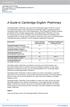 Cambridge English: Preliminary, also known as the Preliminary English Test (PET), is part of a comprehensive range of exams developed by Cambridge English Language Assessment. Cambridge English exams have
Guide to Pearson Test of English General
 Guide to Pearson Test of English General Level 3 (Upper Intermediate) November 2011 Version 5 Pearson Education Ltd 2011. No part of this publication may be reproduced without the prior permission of Pearson
LANGUAGE! 4 th Edition, Levels A C, correlated to the South Carolina College and Career Readiness Standards, Grades 3 5
 Page 1 of 57 Grade 3 Reading Literary Text Principles of Reading (P) Standard 1: Demonstrate understanding of the organization and basic features of print. Standard 2: Demonstrate understanding of spoken
Elementary (A1) Group Course
 COURSE DETAILS Elementary (A1) Group Course 45 hours Two 90-minute lessons per week Study Centre/homework 2 hours per week (recommended minimum) A1(Elementary) min 6 max 8 people Price per person 650,00
Curso académico 2015/2016 INFORMACIÓN GENERAL ESTRUCTURA Y CONTENIDOS HABILIDADES: INGLÉS
 Curso académico 2015/2016 INFORMACIÓN GENERAL ESTRUCTURA Y CONTENIDOS HABILIDADES: INGLÉS Objetivos de Habilidades: inglés El objetivo de la prueba es comprobar que el alumno ha adquirido un nivel B1 (dentro
How To Pass A Cesf
 Graded Examinations in Spoken English (GESE) Syllabus from 1 February 2010 These qualifications in English for speakers of other languages are mapped to Levels A1 to C2 in the Common European Framework
CHARTES D'ANGLAIS SOMMAIRE. CHARTE NIVEAU A1 Pages 2-4. CHARTE NIVEAU A2 Pages 5-7. CHARTE NIVEAU B1 Pages 8-10. CHARTE NIVEAU B2 Pages 11-14
 CHARTES D'ANGLAIS SOMMAIRE CHARTE NIVEAU A1 Pages 2-4 CHARTE NIVEAU A2 Pages 5-7 CHARTE NIVEAU B1 Pages 8-10 CHARTE NIVEAU B2 Pages 11-14 CHARTE NIVEAU C1 Pages 15-17 MAJ, le 11 juin 2014 A1 Skills-based
Livingston Public Schools Scope and Sequence K 6 Grammar and Mechanics
 Grade and Unit Timeframe Grammar Mechanics K Unit 1 6 weeks Oral grammar naming words K Unit 2 6 weeks Oral grammar Capitalization of a Name action words K Unit 3 6 weeks Oral grammar sentences Sentence
The. Languages Ladder. Steps to Success. The
 The Languages Ladder Steps to Success The What is it? The development of a national recognition scheme for languages the Languages Ladder is one of three overarching aims of the National Languages Strategy.
Thai Language Self Assessment
 The following are can do statements in four skills: Listening, Speaking, Reading and Writing. Put a in front of each description that applies to your current Thai proficiency (.i.e. what you can do with
CONTENT / ACTIVITY CAN DO PAGE LEVEL GRAMMAR
 Speakout Starter Speakout CEF ALTE UCLES IELTS TOEIC TOEFL ibt PTE Starter - - 0-245 9-18 Elementary /A2 1 KET 3.0 246-500 19-29 1 Pre-intermediate A2/B1 2 PET 4.0 500-650 30-52 2 Intermediate B1+/B2 3
Adlai E. Stevenson High School Course Description
 Adlai E. Stevenson High School Course Description Division: World Languages Course Number: SPA201, SPA202 Course Title: Spanish 2 Course Description: Students continue to develop listening, speaking, reading,
GCSE Speaking Support Meetings. GCSE Polish Speaking. Introduction 2. Guidance 3. Assessment Criteria 4-5. Student 1 - Speaking Commentary 6-7
 hij GCSE Speaking Support Meetings GCSE Polish Speaking Pages Introduction 2 Guidance 3 Assessment Criteria 4-5 Student 1 - Speaking Commentary 6-7 Student 2 - Speaking Commentary 8-9 BOOKLET 1 Spring
Administrative Support Guide
 Administrative Support Guide 2014 2015 Includes important information on Controlled Assessment submissions GCSE 2012 Chinese French German Italian Spanish Urdu 1 Pearson Edexcel is one of the leading examining
10th Grade Language. Goal ISAT% Objective Description (with content limits) Vocabulary Words
 Standard 3: Writing Process 3.1: Prewrite 58-69% 10.LA.3.1.2 Generate a main idea or thesis appropriate to a type of writing. (753.02.b) Items may include a specified purpose, audience, and writing outline.
How to become a successful language learner
 How to become a successful language learner By Alison Fenner English and German Co-ordinator, Institution Wide Language Programme Introduction Your success in learning a language depends on you! You may
English Language (first language, first year)
 Class contents and exam requirements English Language (first language, first year) Code 30123, Learning Path 1 Head Teacher: Prof. Helen Cecilia TOOKE Objectives pag. 2 Program pag. 2 Set and recommended
Information for candidates
 Information for candidates The test that opens doors around the world IELTS, the International English Language Testing System, is designed to assess the language ability of candidates who want to study
Accelerated Professional Program (APP) Absolute Beginner Varies (Typically 50+ units)
 APP English 1A Absolute Beginner emphasizes the development of practical language skills with a focus on business-related themes, vocabulary, and grammatical structures. The instructor will tailor the
National Quali cations SPECIMEN ONLY
 N5 SQ40/N5/02 FOR OFFICIAL USE National Quali cations SPECIMEN ONLY Mark Urdu Writing Date Not applicable Duration 1 hour and 30 minutes *SQ40N502* Fill in these boxes and read what is printed below. Full
Common European Framework of Reference for Languages: learning, teaching, assessment. Table 1. Common Reference Levels: global scale
 Common European Framework of Reference for Languages: learning, teaching, assessment Table 1. Common Reference Levels: global scale C2 Can understand with ease virtually everything heard or read. Can summarise
Cambridge Primary English as a Second Language Curriculum Framework
 Cambridge Primary English as a Second Language Curriculum Framework Contents Introduction Stage 1...2 Stage 2...5 Stage 3...8 Stage 4... 11 Stage 5...14 Stage 6... 17 Welcome to the Cambridge Primary English
SYLLABUS Cambridge IGCSE English as a Second Language 0510 (speaking endorsement) 0511* (count-in speaking) Cambridge Secondary 2
 SYLLABUS Cambridge IGCSE English as a Second Language 0510 (speaking endorsement) 0511* (count-in speaking) For examination in June and November 2015 * This syllabus is approved for use in England, Wales
SYLLABUS. German 0525 Greek 0543 Italian 0535 For examination in June 2016. Cambridge Secondary 2 Version 3
 SYLLABUS Cambridge IGCSE French 0520 For examination in June and November 2016. Also for examination in March 2016 for India only. Spanish 0530 For examination in June and November 2016 German 0525 Greek
Integrated Skills in English (ISE) examinations
 Integrated Skills in English (ISE) examinations Syllabus from 1 February 2010 These qualifications in English for speakers of other languages are mapped to Levels A2, B1, B2, C1 and C2 in the Common European
CELTA. Syllabus and Assessment Guidelines. Fourth Edition. Certificate in Teaching English to Speakers of Other Languages
 CELTA Certificate in Teaching English to Speakers of Other Languages Syllabus and Assessment Guidelines Fourth Edition CELTA (Certificate in Teaching English to Speakers of Other Languages) is regulated
MAP for Language & International Communication Spanish Language Learning Outcomes by Level
 Novice Abroad I This course is designed for students with little or no prior knowledge of the language. By the end of the course, the successful student will develop a basic foundation in the five skills:
Cambridge English: First (FCE) Frequently Asked Questions (FAQs)
 Cambridge English: First (FCE) Frequently Asked Questions (FAQs) Is there a wordlist for Cambridge English: First exams? No. Examinations that are at CEFR Level B2 (independent user), or above such as
Subject: Spanish as a Foreign Language, Middle School Program
 Subject: Spanish as a Foreign Language, Middle School Program Overview: The Spanish as a Foreign Language Program at BNS focuses on the development of communication and comprehension skills. The Middle
TELT March 2014 Exa miners Report
 TELT March 2014 Exa miners Report 1. Introduction 101 candidates sat for the TELT March 2014 examination session. 53 candidates were awarded Pass grades or higher. This is the equivalent to 52.5 % pass
Global Pre-intermediate CEF descriptors
 Global Pre-intermediate Listening A2 Unit Page I can understand what is said clearly, slowly and directly to me in simple everyday conversation; it is possible to make me understand, if the speaker can
EAS Basic Outline. Overview
 EAS Basic Outline Overview This is the course outline for your English Language Basic Course. This course is delivered at pre intermediate level of English, and the course book that you will be using is
Roane State Community College Spanish Program Humanities Divisions. Syllabus
 Roane State Community College Spanish Program Humanities Divisions Syllabus Syllabus for Spanish 2020 Instructor s Name: Instructor's Office Hours: Course Tentative Schedule: Note to Students: The students
Strand: Reading Literature Topics Standard I can statements Vocabulary Key Ideas and Details
 Strand: Reading Literature Key Ideas and Details Craft and Structure RL.3.1 Ask and answer questions to demonstrate understanding of a text, referring explicitly to the text as the basis for the answers.
0510 (speaking endorsement) 0511* (count-in speaking)
 Learner Guide Cambridge IGCSE English as a Second Language 0510 (speaking endorsement) 0511* (count-in speaking) *This syllabus is approved for use in England, Wales and Northern Ireland as a Cambridge
ANGLAIS LANGUE SECONDE
 ANGLAIS LANGUE SECONDE ANG-5054-6 DEFINITION OF THE DOMAIN SEPTEMBRE 1995 ANGLAIS LANGUE SECONDE ANG-5054-6 DEFINITION OF THE DOMAIN SEPTEMBER 1995 Direction de la formation générale des adultes Service
Level 4 Certificate in English for Business
 Level 4 Certificate in English for Business LCCI International Qualifications Syllabus Effective from January 2006 For further information contact us: Tel. +44 (0) 8707 202909 Email. [email protected]
Integrated Skills in English (ISE) Guide for Students ISE Foundation (A2) Reading & Writing Speaking & Listening
 Integrated Skills in English (ISE) Guide for Students ISE Foundation (A2) Reading & Writing Speaking & Listening Trinity College London www.trinitycollege.com Charity number 1014792 Patron HRH The Duke
Bilingual Education Assessment Urdu (034) NY-SG-FLD034-01
 Bilingual Education Assessment Urdu (034) NY-SG-FLD034-01 The State Education Department does not discriminate on the basis of age, color, religion, creed, disability, marital status, veteran status, national
SPANISH Kindergarten
 SPANISH Kindergarten Use Junior SYMTALK workbook Recognize 80+ Vocabulary words Recognize basic greetings and courtesies. Identify colors and numbers 1-10 Develop reading skills using pictures to identify
Pasadena City College / ESL Program / Oral Skills Classes / Rubrics (1/10)
 Pronunciation Classes Pasadena City College / ESL Program / Oral Skills Classes / Rubrics (1/10) ESL 246 SLO #1: Students will recognize and begin to produce correct American-English patterns in short
PTE Academic Preparation Course Outline
 PTE Academic Preparation Course Outline August 2011 V2 Pearson Education Ltd 2011. No part of this publication may be reproduced without the prior permission of Pearson Education Ltd. Introduction The
SPANISH 30 IB 2015-2016 SPANISH 30 IB. 2015 2016 SEMESTER ONE AND TWO (FULL YEAR COURSE) G. Noce Saporito Gina.NoceSaporito@ecsd.
 SPANISH 30-3Y IB-DP 2015 2016 SEMESTER ONE AND TWO (FULL YEAR COURSE) G. Noce Saporito [email protected] A. COURSE OBJECTIVES The aim of Alberta Learning s 2006 Spanish Language and Culture 10,
Index. 344 Grammar and Language Workbook, Grade 8
 Index Index 343 Index A A, an (usage), 8, 123 A, an, the (articles), 8, 123 diagraming, 205 Abbreviations, correct use of, 18 19, 273 Abstract nouns, defined, 4, 63 Accept, except, 12, 227 Action verbs,
Cambridge IELTS 3. Examination papers from the University of Cambridge Local Examinations Syndicate
 Cambridge IELTS 3 Examination papers from the University of Cambridge Local Examinations Syndicate PUBLISHED BY THE PRESS SYNDICATE OF THE UNIVERSITY OF CAMBRIDGE The Pitt Building, Trumpington Street,
Integrated Skills in English (ISE) Guide for Students ISE III (C1) Reading & Writing Speaking & Listening
 Integrated Skills in English (ISE) Guide for Students ISE III (C1) Reading & Writing Speaking & Listening Trinity College London www.trinitycollege.com Charity number 1014792 Patron HRH The Duke of Kent
GESE Initial steps. Guide for teachers, Grades 1 3. GESE Grade 1 Introduction
 GESE Initial steps Guide for teachers, Grades 1 3 GESE Grade 1 Introduction cover photos: left and right Martin Dalton, middle Speak! Learning Centre Contents Contents What is Trinity College London?...3
GCSE MFL Examinations
 GCSEs in first languages available from the three main GCSE examination boards: OCR, AQA and Edexcel. It does not list the IGCSE examinations. The languages covered by these boards are Dutch, Gujarati,
Correlation: ELLIS. English language Learning and Instruction System. and the TOEFL. Test Of English as a Foreign Language
 Correlation: English language Learning and Instruction System and the TOEFL Test Of English as a Foreign Language Structure (Grammar) A major aspect of the ability to succeed on the TOEFL examination is
Course Syllabus My TOEFL ibt Preparation Course Online sessions: M, W, F 15:00-16:30 PST
 Course Syllabus My TOEFL ibt Preparation Course Online sessions: M, W, F Instructor Contact Information Office Location Virtual Office Hours Course Announcements Email Technical support Anastasiia V. Mixcoatl-Martinez
Virginia English Standards of Learning Grade 8
 A Correlation of Prentice Hall Writing Coach 2012 To the Virginia English Standards of Learning A Correlation of, 2012, Introduction This document demonstrates how, 2012, meets the objectives of the. Correlation
Minnesota K-12 Academic Standards in Language Arts Curriculum and Assessment Alignment Form Rewards Intermediate Grades 4-6
 Minnesota K-12 Academic Standards in Language Arts Curriculum and Assessment Alignment Form Rewards Intermediate Grades 4-6 4 I. READING AND LITERATURE A. Word Recognition, Analysis, and Fluency The student
GCSE Spanish. Scheme of Work
 GCSE Spanish Scheme of Work It is important to have a Scheme of Work in place in order to guarantee that the specification is covered fully by the teacher or teachers charged with the delivery of the course.
Student Achievement in Asian Languages Education. Part 2: Descriptions of Student Achievement
 Student Achievement in Asian Languages Education Part 2: Descriptions of Student Achievement This report is in four volumes: Part 1: Project Report Part 2: Descriptions of Student Achievement Part 3: Appendices
COURSE TITLE: Spanish III/IV Honors GRADE LEVELS: 11-12
 COURSE TITLE: Spanish III/IV Honors GRADE LEVELS: 11-12 COURSE DESCRIPTION: Honors Spanish III/IV is the third and fourth course in the sequence in preparing students for the Advanced Placement Test in
PTE Academic Test Tips
 PTE Academic Test Tips V2 August 2011 Pearson Education Ltd 2011. All rights reserved; no part of this publication may be reproduced without the prior written permission of Pearson Education Ltd. Important
specification AS/A Level GCE Modern Foreign Languages version 4 September 2013
 AS/A Level GCE Modern Foreign Languages OCR Advanced Subsidiary GCE in French H075 OCR Advanced Subsidiary GCE in German H076 OCR Advanced Subsidiary GCE in Spanish H077 OCR Advanced GCE in French H475
HARRISBURG AREA COMMUNITY COLLEGE COMMUNICATIONS, HUMANITIES AND THE ARTS. SPANISH 102 ONLINE Spring 2015
 HARRISBURG AREA COMMUNITY COLLEGE COMMUNICATIONS, HUMANITIES AND THE ARTS SPANISH 102 ONLINE Spring 2015 Dr. Susan E. Bangs SENIOR PROFESSOR, ENGLISH /ESL/ SPANISH OFFICE: Arts Building 120B OFFICE PHONE:
Speaking for IELTS. About Speaking for IELTS. Vocabulary. Grammar. Pronunciation. Exam technique. English for Exams.
 About Collins series has been designed to be easy to use, whether by learners studying at home on their own or in a classroom with a teacher: Instructions are easy to follow Exercises are carefully arranged
Study Skills. Photos of Salamanca Dialogs with pictures Chats DVD
 Spanish curriculum (3rd Foreign Language) Grade 10 4 lessons a week Textbook : Encuentros 1, Edición 3000 (Cornelsen) Additional materials: Books, Newspapers, Comics, Pictures, Songs, Movies, News, Sketches
Handbook for Teachers
 Handbook for Teachers Content and overview Paper/timing Content Test focus 1 READING 1 hour 15 minutes Part 1 Part 2 Part 3 Three texts on one theme from a range of sources. Each text has two multiple-choice
Spanish III Curriculum Map. Nevada/National Standards
 Spanish III Curriculum Map Nevada/National s 1.1: Students engage in conversations, provide and obtain information, express feelings and emotions, and exchange opinions 1.2: Students understand and interpret
Knowledge. Subject Knowledge Audit - Spanish Meta-linguistic challenges full some none
 Knowledge Subject Knowledge Audit - Spanish Meta-linguistic challenges full some none Draw up a list of useful Proper nouns in Spanish eg la Península Ibérica, el Reino Unido, la Comunidad Europea, Don
Class contents and exam requirements Code 20365 20371 (20421) English Language, Second language B1 business
 a.y. 2013/2014-2014/2015 Class contents and exam requirements Code 20365 20371 (20421) English Language, Second language B1 business Program Master of Science Degree course M, MM, AFC, CLAPI, CLEFIN FINANCE,
Teacher: Course Name: Spanish I Year. World Language Department Saugus High School Saugus Public Schools
 Week 1 Week 2 Capítulo Preliminar 1. Intro to Spanish speaking world/nombres en Espanol 2. Frases útiles/ los cognados 3. El Alfabeto 4. Los Colores 5. Los números (0-30) and 1.3 Students present information,
English Appendix 2: Vocabulary, grammar and punctuation
 English Appendix 2: Vocabulary, grammar and punctuation The grammar of our first language is learnt naturally and implicitly through interactions with other speakers and from reading. Explicit knowledge
Spoken English for Work (SEW) exams Guide for Teachers (B1)
 Spoken English for Work (SEW) exams Guide for Teachers (B1) Trinity College London 89 Albert Embankment London SE1 7TP UK T +44 (0)20 7820 6100 F +44 (0)20 7820 6161 E [email protected] www.trinitycollege.co.uk
Pearson LCCI Level 5 Certificate in Teaching English as a Foreign Language (QCF) (ASE10252) Specification
 Pearson LCCI Level 5 Certificate in Teaching English as a Foreign Language (QCF) (ASE10252) Specification First teaching from February 2015 Edexcel, BTEC and LCCI qualifications Edexcel, BTEC and LCCI
OKLAHOMA PRIORITY ACADEMIC STUDENT SKILLS FOR LANGUAGES, INTERMEDIATE LEVEL RANGE
 Prentice Hall: Encuentros Maravillosos Gramática A Través De La Literatura 1998 (Foreign, Native American, and/or American Sign Language) Intermediate Level Range Students will exhibit these skills at
GESE Elementary steps. Guide for teachers, Grades 4 6
 GESE Elementary steps Guide for teachers, Grades 4 6 What is Trinity College London? Trinity College London is an independent international exams board, fully accredited in England as an awarding body.
Albert Pye and Ravensmere Schools Grammar Curriculum
 Albert Pye and Ravensmere Schools Grammar Curriculum Introduction The aim of our schools own grammar curriculum is to ensure that all relevant grammar content is introduced within the primary years in
Integrated Skills in English (ISE) Guide for Students ISE I (B1) Reading & Writing Speaking & Listening
 Integrated Skills in English (ISE) Guide for Students ISE I (B1) Reading & Writing Speaking & Listening Trinity College London www.trinitycollege.com Charity number 1014792 Patron HRH The Duke of Kent
Handbook for Teachers
 Handbook for Teachers Key English Test (KET) for Schools CEFR Level A2 Content and overview Paper/timing Content Test Focus 1 READING & WRITING 1 hour 10 minutes 2 LISTENING Approx. 30 minutes (including
Course Title: Spanish III Course Number: NM 112545101 RISD 08311 Open to grades: 9-12
 Course Title: Spanish III Course Number: NM 112545101 RISD 08311 Open to grades: 9-12 Credit: One unit Prerequisite: Successful completion of Spanish I and II with a grade of 80% or above or a significant
Masconomet Regional High School Curriculum Guide
 Masconomet Regional High School Curriculum Guide Course Title: Spanish II CP Course Number: 4311 Department: Foreign Languages Grade Level and Phase: 9 College Prep Length of Course: Year Course Description:
GMAT.cz www.gmat.cz [email protected]. GMAT.cz KET (Key English Test) Preparating Course Syllabus
 Lesson Overview of Lesson Plan Numbers 1&2 Introduction to Cambridge KET Handing Over of GMAT.cz KET General Preparation Package Introduce Methodology for Vocabulary Log Introduce Methodology for Grammar
SYLLABUS 0500 0522* Cambridge IGCSE First Language English. For examination in June and November 2015. Cambridge Secondary 2
 SYLLABUS Cambridge IGCSE First Language English 0500 0522* For examination in June and November 2015 *This syllabus is approved for use in England, Wales and Northern Ireland as a Cambridge International
English. Teaching Objectives and Learning Outcomes
 English Teaching Objectives and Directorate for Quality and Standards in Education Curriculum Management and elearning Department Malta 2012 FORM 1 - English Unit code and title Objective 1 7.1 The way
stress, intonation and pauses and pronounce English sounds correctly. (b) To speak accurately to the listener(s) about one s thoughts and feelings,
 Section 9 Foreign Languages I. OVERALL OBJECTIVE To develop students basic communication abilities such as listening, speaking, reading and writing, deepening their understanding of language and culture
CENTRAL TEXAS COLLEGE SYLLABUS FOR SPAN 1411/1412 BEGINNING SPANISH I & II. Semester Hours Credit: 4/4 INSTRUCTOR: OFFICE HOURS:
 CENTRAL TEXAS COLLEGE SYLLABUS FOR BEGINNING SPANISH I & II Semester Hours Credit: 4/4 INSTRUCTOR: OFFICE HOURS: I. INTRODUCTION A. This course is designed to help learners build proficiency in Spanish
Integrated Skills in English (ISE) Guide for Students ISE II (B2) Reading & Writing Speaking & Listening
 Integrated Skills in English (ISE) Guide for Students ISE II (B2) Reading & Writing Speaking & Listening Trinity College London www.trinitycollege.com Charity number 1014792 Patron HRH The Duke of Kent
English CEF. Pre-intermediate Portfolio Practice Book. Annie McDonald & Mark Hancock
 English Pre-intermediate Portfolio Practice Annie McDonald & Mark Hancock CEF 4 Contents Introduction What is a Language Portfolio? 3 The Language Passport What is a Language Passport? 4 How do I use it?
Handbook for Teachers
 Handbook for Teachers Content and overview Paper/timing Content Test focus 1 Reading & writing 1 hour 10 minutes 2 Listening Approx. 30 minutes (including 8 minutes transfer time) 3 speaking 8 10 minutes