
Handbook for Teachers
|
|
|
- Francine Hodges
- 10 years ago
- Views:
Transcription
1 Handbook for Teachers

2 Content and overview Paper/timing Content Test focus 1 Reading & writing 1 hour 10 minutes 2 Listening Approx. 30 minutes (including 8 minutes transfer time) 3 speaking 8 10 minutes per pair of candidates Nine parts: Five parts (Parts 1 5) test a range of reading skills with a variety of texts, ranging from very short notices to longer continuous texts. Parts 6 9 concentrate on testing basic writing skills. Five parts ranging from short exchanges to longer dialogues and monologues. Two parts: in Part 1, candidates interact with an examiner; in Part 2, they interact with another candidate. Assessment of candidates ability to understand the meaning of written English at word, phrase, sentence, paragraph and whole text level. Assessment of candidates ability to produce simple written English, ranging from one-word answers to short pieces of continuous text. Assessment of candidates ability to understand dialogues and monologues in both informal and neutral settings on a range of everyday topics. Assessment of candidates ability to answer questions about themselves and to ask/answer questions about factual non-personal information.

3 contents Preface This handbook is for teachers who are preparing candidates for Cambridge English: Key, also known as Key English Test (KET). The introduction gives an overview of the exam and its place within Cambridge ESOL. This is followed by a focus on each paper and includes content, advice on preparation and example papers. If you need further copies of this handbook, please [email protected] Contents About Cambridge ESOL 2 The world s most valuable range of English qualifications 2 Key features of Cambridge English exams 2 Proven quality 2 Introduction to Cambridge English: Key 3 Who is the exam for? 3 Who recognises the exam? 3 What level is the exam? 3 Exam content and processing 3 A thorough test of all areas of language ability 3 Language specifications 4 International English 6 Marks and results 6 Certificates 6 Paper 2 Listening 22 General description 22 Structure and tasks 22 Preparation 23 Sample paper 24 Answer key and candidate answer sheet 29 Paper 3 Speaking 30 General description 30 Structure and tasks 30 Preparation 31 Sample materials 32 Assessment 33 Cambridge English: Key Glossary 38 Exam support 7 Support for teachers 7 Support for candidates 8 Paper 1 Reading and Writing 9 General description 9 Structure and tasks 9 Preparation 11 Sample paper 13 Answer key 19 Assessment of Writing Part 9 20 Sample answers with examiner comments 20 Candidate answer sheet 21 CAMBRIDGE ENGLISH: KEY HANDBOOK FOR TEACHERS 1

4 ABOUT CAMBRIDGE ESOL About Cambridge ESOL Cambridge English: Key is developed by University of Cambridge ESOL Examinations (Cambridge ESOL), a not-for-profit department of the University of Cambridge. Cambridge ESOL is one of three major exam boards which form the Cambridge Assessment Group (Cambridge Assessment). More than 8 million Cambridge Assessment exams are taken in over 160 countries around the world every year. To find out more about Cambridge English exams and the CEFR, go to One of the oldest universities in the world and one of the largest in the United Kingdom Departments of the University In addition to our own programmes of world-leading research, we work closely with professional bodies, industry professionals and governments to ensure that our exams remain fair and relevant to candidates of all backgrounds and to a wide range of stakeholders. Key features of Cambridge English exams Cambridge English exams: Cambridge Assessment: the trading name for the University of Cambridge Local Examinations Syndicate (UCLES) Departments (exam boards) Cambridge ESOL: University of Cambridge ESOL Examinations Provider of the world's most valuable range of qualifications for learners and teachers of English University of Cambridge International Examinations The world s largest provider of international qualifications for year olds OCR: Oxford Cambridge and RSA Examinations One of the UK s leading providers of qualifications The world s most valuable range of English qualifications Cambridge ESOL offers the world s leading range of qualifications for learners and teachers of English. Over 3.5 million people take our exams each year in 130 countries. Cambridge ESOL offers assessments across the full spectrum of language ability. We provide examinations for general communication, for professional and academic purposes and also specialist legal and financial English qualifications. All of our exams are aligned to the principles and approach of the Common European Framework of Reference for Languages (CEFR). are based on realistic tasks and situations so that preparing for their exam gives learners real-life language skills accurately and consistently test all four language skills reading, writing, listening and speaking as well as knowledge of language structure and its use encourage positive learning experiences, and seek to achieve a positive impact on teaching wherever possible are as fair as possible to all candidates, whatever their national, ethnic and linguistic background, gender or disability. Proven quality Cambridge ESOL s commitment to providing exams of the highest possible quality is underpinned by an extensive programme of research and evaluation, and by continuous monitoring of the marking and grading of all Cambridge English exams. Of particular importance are the rigorous procedures which are used in the production and pretesting of question papers. All systems and processes for designing, developing and delivering exams and assessment services are certified as meeting the internationally recognised ISO 9001:2008 standard for quality management and are designed around five essential principles: Validity are our exams an authentic test of real-life English? Reliability do our exams behave consistently and fairly? Impact does our assessment have a positive effect on teaching and learning? Practicality does our assessment meet learners needs within available resources? Quality how we plan, deliver and check that we provide excellence in all of these fields. How these qualities are brought together is outlined in our publication Principles of Good Practice, which can be downloaded free from 2 CAMBRIDGE ENGLISH: KEY HANDBOOK FOR TEACHERS

5 introduction to cambridge english: key Introduction to Cambridge English: Key Cambridge English: Key is a qualification at pre-intermediate level. It demonstrates that a person can use English to communicate in simple situations and has achieved a good foundation in learning English. Candidates can choose to take Cambridge English: Key as either a paper-based or computer-based exam. Cambridge English: Key for Schools, a version of Cambridge English: Key with exam content and topics targeted at the interests and experience of school age learners, is also available. Who is the exam for? Cambridge English: Key is aimed at learners who want to: understand and use basic phrases and expressions introduce themselves and answer basic questions about personal details interact with English speakers who talk slowly and clearly write short, simple notes. Who recognises the exam? Cambridge English: Key is a truly international certificate, recognised around the world for business and study purposes. Thousands of employers, universities and government departments officially recognise Cambridge English: Key as a basic qualification in English. The exam has been accredited by Ofqual, the statutory regulatory authority for external qualifications in England, and its counterparts in Wales and Northern Ireland. For more information about recognition go to What level is the exam? Cambridge English: Key is targeted at Level A2 of the CEFR. Achieving a certificate at this level proves that a person can use English to communicate in simple situations. What can candidates do at Level A2? The Association of Language Testers in Europe (ALTE) has carried out research to determine what language learners can typically do at each CEFR level. It has described these abilities in a series of Can Do statements using examples taken from real-life situations. Cambridge ESOL, as one of the founding members of ALTE, uses this framework as a way of ensuring its exams reflect real-life language skills. Examples of Can Do statements at Level A2 Typical abilities Overall general ability Social & Tourist Work Study Reading and Writing CAN understand straightforward information within a known area. CAN complete forms and write short, simple letters or postcards related to personal information. CAN understand straightforward information on food, standard menus, road signs and messages on automatic cash machines. CAN complete most forms related to personal information. CAN understand most short reports or manuals of a predictable nature within his/her own area of expertise. CAN write a short, comprehensible note of request to a colleague or a known contact in another company. CAN understand the general meaning of a simplified textbook or article, reading very slowly. CAN write a very short, simple narrative or description. Listening and Speaking CAN understand simple questions and instructions. CAN express simple opinions or requirements in a familiar context. CAN understand straightforward directions, provided that these are not lengthy or complex. CAN express likes and dislikes in familiar contexts using simple language. CAN understand the general meaning of a presentation made at a conference if the language is simple and backed up by visuals or video. CAN state simple requirements within own job area. CAN understand basic instructions on class time, dates and room numbers. CAN express simple opinions using expressions such as I don t agree. Exam content and processing Cambridge English: Key is a rigorous and thorough test of English at Level A2. It covers all four language skills reading, writing, listening and speaking. Preparing for Cambridge English: Key helps candidates develop the skills they need to use English to communicate effectively in a variety of practical contexts. A thorough test of all areas of language ability There are three papers: Reading and Writing, Listening and Speaking. The Reading and Writing paper carries 50% of the total marks, the Listening paper and the Speaking paper each carry 25% of the total marks. Detailed information on each test and sample papers follow later in this handbook, but the overall focus of each test is as follows: Reading and Writing: 1 hour 10 minutes Candidates need to be able to understand simple written information such as signs, brochures, newspapers and magazines. They must also be able to produce simple written English. Listening: 30 minutes (approximately) Candidates need to be able to understand announcements and other spoken material when people speak reasonably slowly. Speaking: up to 10 minutes Candidates take the Speaking test with another candidate or in a group of three, and are tested on their ability to take part in different types of interaction: with the examiner, with the other candidate and by themselves. CAMBRIDGE ENGLISH: KEY HANDBOOK FOR TEACHERS 3

6 exam content and processing Each of these three test components provides a unique contribution to a profile of overall communicative language ability that defines what a candidate can do at this level. Language specifications Candidates who are successful in Cambridge English: Key should be able to satisfy their basic communicative needs in a range of everyday situations with both native and non-native speakers of English. The following is a summary of the language which is tested in Cambridge English: Key. In terms of vocabulary and grammatical structure, Cambridge English: Key candidates will have productive control of only the simplest of exponents for each category below; there is a wider, but still limited, range that they will be able to deal with receptively; and they will have strategies for coping with the unfamiliar. Language purposes Carrying out certain transactions: making arrangements making purchases ordering food and drink Giving and obtaining factual information: personal non-personal (places, times, etc.) Establishing and maintaining social and professional contacts: meeting people extending and receiving invitations proposing/arranging a course of action exchanging information, views, feelings and wishes Language functions There are six broad categories of language functions (what people do by means of language): Imparting and seeking factual information Expressing and finding out attitudes Getting things done Socialising Structuring discourse Communication repair. A more detailed inventory of functions, notions and grammatical areas covered by Cambridge English: Key is given below. Inventory of functions, notions and communicative tasks The realisations of these functions, notions and communicative tasks will be in the simplest possible ways. greeting people and responding to greetings (in person and on the phone) introducing oneself and other people asking for and giving personal details: (full) name, age, address, names of relatives and friends, occupation, etc. understanding and completing forms giving personal details describing education and/or job describing people (personal appearance, qualities) asking and answering questions about personal possessions asking for repetition and clarification re-stating what has been said checking on meaning and intention helping others to express their ideas interrupting a conversation asking for and giving the spelling and meaning of words counting and using numbers asking and telling people the time, day and/or date asking for and giving information about routines and habits understanding and giving information about everyday activities talking about what people are doing at the moment talking about past events and states in the past, recent activities and completed actions understanding and producing simple narratives reporting what people say talking about future situations talking about future plans or intentions making predictions identifying and describing accommodation (houses, flats, rooms, furniture, etc.) buying and selling things (costs and amounts) talking about food and ordering meals talking about the weather talking about one s health following and giving simple instructions understanding simple signs and notices asking the way and giving directions asking for and giving travel information asking for and giving simple information about places identifying and describing simple objects (shape, size, weight, colour, purpose or use, etc.) making comparisons and expressing degrees of difference expressing purpose, cause and result, and giving reasons making and granting/refusing simple requests making and responding to offers and suggestions expressing and responding to thanks giving and responding to invitations giving advice giving warnings and stating prohibitions asking/telling people to do something expressing obligation and lack of obligation asking and giving/refusing permission to do something making and responding to apologies and excuses expressing agreement and disagreement, and contradicting people paying compliments sympathising expressing preferences, likes and dislikes (especially about hobbies and leisure activities) talking about feelings expressing opinions and making choices expressing needs and wants expressing (in)ability in the present and in the past talking about (im)probability and (im)possibility expressing degrees of certainty and doubt Inventory of grammatical areas Verbs Regular and irregular forms Modals can (ability; requests; permission) could (ability; polite requests) would (polite requests) will (future) 4 CAMBRIDGE ENGLISH: KEY HANDBOOK FOR TEACHERS

7 exam content and processing shall (suggestion; offer) should (advice) may (possibility) have (got) to (obligation) must (obligation) mustn t (prohibition) need (necessity) needn t (lack of necessity) Tenses Present simple: states, habits, systems and processes (and verbs not used in the continuous form) Present continuous: present actions and future meaning Present perfect simple: recent past with just, indefinite past with yet, already, never, ever; unfinished past with for and since Past simple: past events Past continuous: parallel past actions, continuous actions interrupted by the past simple tense Future with going to Future with will and shall: offers, promises, predictions, etc. Verb forms Affirmative, interrogative, negative Imperatives Infinitives (with and without to) after verbs and adjectives Gerunds (-ing form) after verbs and prepositions Gerunds as subjects and objects Passive forms: present and past simple Short questions (Can you?) and answers (No, he doesn t) Clause types Main clause: Carlos is Spanish. Co-ordinate clause: Carlos is Spanish and his wife is English. Subordinate clause following sure, certain: I m sure (that) she s a doctor. Subordinate clause following know, think, believe, hope: I hope you re well. Subordinate clause following say, tell: She says (that) she s his sister. Subordinate clause following if, when, where, because: I ll leave if you do that again. He ll come when you call. He ll follow where you go. I came because you asked me. Interrogatives What; What (+ noun) Where; When Who; Whose; Which How; How much; How many; How often; How long; etc. Why (including the interrogative forms of all tenses and modals listed) Nouns Singular and plural (regular and irregular forms) Countable and uncountable nouns with some and any Abstract nouns Compound nouns Noun phrases Genitive: s & s Double genitive: a friend of theirs Pronouns Personal (subject, object, possessive) Impersonal: it, there Demonstrative: this, that, these, those Quantitative: one, something, everybody, etc. Indefinite: some, any, something, one, etc. Relative: who, which, that Determiners a + countable nouns the + countable/uncountable nouns Adjectives Colour, size, shape, quality, nationality Predicative and attributive Cardinal and ordinal numbers Possessive: my, your, his, her, etc. Demonstrative: this, that, these, those Quantitative: some, any, many, much, a few, a lot of, all, other, every, etc. Comparative and superlative forms (regular and irregular) Order of adjectives Participles as adjectives Adverbs Regular and irregular forms Manner: quickly, carefully, etc. Frequency: often, never, twice a day, etc. Definite time: now, last week, etc. Indefinite time: already, just, yet, etc. Degree: very, too, rather, etc. Place: here, there, etc. Direction: left, right, etc. Sequence: first, next, etc. Pre-verbal, post-verbal and end-position adverbs Comparative and superlative forms (regular and irregular) Prepositions Location: to, on, inside, next to, at (home), etc. Time: at, on, in, during, etc. Direction: to, into, out of, from, etc. Instrument: by, with Miscellaneous: like, about, etc. Prepositional phrases: at the end of, in front of, etc. Prepositions preceding nouns and adjectives: by car, for sale, on holiday, etc. Connectives and, but, or, when, where, because, if Note that students will meet forms other than those listed above in Cambridge English: Key, on which they will not be directly tested. Topics Clothes Daily life Entertainment and media Food and drink Health, medicine and exercise Hobbies and leisure House and home Language People Personal feelings, opinions and experiences Personal identification Places and buildings CAMBRIDGE ENGLISH: KEY HANDBOOK FOR TEACHERS 5

8 exam content and processing School and study Services Shopping Social interaction Sport The natural world Transport Travel and holidays Weather Work and jobs Lexis The Cambridge English: Key Vocabulary List includes items which normally occur in the everyday vocabulary of native speakers using English today. Candidates should know the lexis appropriate to their personal requirements, for example, nationalities, hobbies, likes and dislikes. Note that the use of American pronunciation, spelling and lexis is acceptable in Cambridge English: Key. A list of vocabulary that may appear in the Cambridge English: Key examination is available from the Cambridge ESOL Teacher Support website: The list does not provide an exhaustive register of all the words which could appear in Cambridge English: Key question papers and candidates should not confine their study of vocabulary to the list alone. International English English is used in a wide range of international contexts. To reflect this, candidates responses to tasks in Cambridge English exams are acceptable in all varieties and accents of English, provided they do not interfere with communication. Materials used feature a range of accents and texts from English-speaking countries, including the UK, North America and Australia. US and other versions of spelling are accepted if used consistently. Marks and results Cambridge English: Key gives detailed, meaningful results. All candidates receive a Statement of Results. Candidates whose performance ranges between CEFR Levels A1 and B1 also receive a certificate. Statement of Results This Statement of Results outlines: the candidate s result. This is based on a candidate s total score in all three papers. a graphical display of a candidate s performance in each paper (shown against the scale Exceptional Good Borderline Weak). a standardised score out of 100 which allows a candidate to see exactly how they performed. Certificates We have made enhancements to the way we report the results of our exams because we believe it is important to recognise candidates achievements. The Common European Framework of Reference C Proficient user B Independent user A Basic user C2 C1 B2 B1 A2 A1 * Pass with Distinction was introduced in September 2011 Cambridge English: Key Pass with Distinction* Pass with Merit Pass Level A A great first step in communicating in English... Cambridge English: Key Level B1 Pass with Distinction Exceptional candidates sometimes show ability beyond Level A2. If a candidate achieves a Pass with Distinction, they will receive the Key English Test certificate stating that they demonstrated ability at Level B1. Cambridge English: Key Level A2 If a candidate achieves Pass with Merit or Pass in the exam, they will be awarded the Key English Test certificate at Level A2. Level A1 Certificate If a candidate s performance is below Level A2, but falls within Level A1, they will receive a Cambridge English certificate stating that they demonstrated ability at A1 level. Special circumstances Cambridge English exams are designed to be fair to all test takers. This commitment to fairness covers: Special arrangements These are available for candidates with a permanent or longterm disability. Consult the Cambridge ESOL Centre Exams Manager (CEM) in your area for more details as soon as you become aware of a candidate who may need special arrangements. Special consideration Cambridge ESOL will give special consideration to candidates affected by adverse circumstances such as illness or bereavement immediately before or during an exam. Applications for special consideration must be made through the centre no later than 10 working days after the exam date. Malpractice Cambridge ESOL will investigate all cases where candidates are suspected of copying, collusion or breaking the exam regulations in some other way. Results may be withheld while they are being investigated, or because we have found an infringement of regulations. Centres are notified if a candidate s results have been investigated. 6 CAMBRIDGE ENGLISH: KEY HANDBOOK FOR TEACHERS

9 exam support Exam support A feature of Cambridge English exams is the outstanding free and paid-for support we offer to teachers and candidates. How to order support materials from Cambridge ESOL A wide range of official support materials for candidates and teachers can be ordered directly from the Cambridge ESOL eshops: Printed publications: Online preparation: Support for teachers Teacher Support website This website provides an invaluable, user-friendly free resource for all teachers preparing for our exams. It includes: General information handbook for teachers, sample papers, exam reports, exam dates Detailed information format, timing, number of questions, task types, mark scheme of each paper Advice for teachers developing students skills and preparing them for the exam Downloadable lessons a lesson for every part of every paper, there are more than 1,000 in total Forums where teachers can share experiences and knowledge Careers teaching qualifications for career progression News and events what s happening globally and locally in your area Seminars wide range of exam-specific seminars for new and experienced teachers, administrators and school directors. Past Paper Packs Past Paper Packs provide authentic practice for candidates preparing for Cambridge English paper-based examinations and are ideal to use for mock exams. Each pack contains: ten copies of each of the papers with photocopiable answer sheets CD with audio recordings for the Listening paper Teacher Booklet with: - answer keys - mark schemes and sample answers for Writing - tapescripts for the Listening paper - the assessment criteria and a copy of the Cambridge ESOL Common Scale for the Speaking paper - Speaking test materials, which include candidate visuals and examiner scripts. Speaking Test Preparation Pack This comprehensive teacher resource pack is designed to help teachers prepare students for the Cambridge English: Key Speaking test. Written by experienced examiners, it provides clear explanations of what each part of the Speaking test involves. The step-by-step guidance and practical exercises help your students perform with confidence on the day of the test. Each pack includes: Teacher s Notes Student Worksheets which you can photocopy or print a set of candidate visuals a DVD showing real students taking a Speaking test. Cambridge English Teacher Developed by Cambridge University Press and University of Cambridge ESOL Examinations (Cambridge ESOL), Cambridge English Teacher provides opportunities for English teachers to engage in continuing professional development through online courses, share best practice and network with other ELT professionals worldwide. For more information on how to become a Cambridge English Teacher, visit CAMBRIDGE ENGLISH: KEY HANDBOOK FOR TEACHERS 7

10 exam support Support for candidates Cambridge ESOL website We provide learners with a wealth of exam resources and preparation materials throughout our main website, including exam advice, sample papers and a guide for candidates. Official preparation materials A comprehensive range of official Cambridge English preparation materials are available from University of Cambridge ESOL Examinations (Cambridge ESOL) and Cambridge University Press. Materials include printed and digital resources to support teachers and help learners prepare for their exam. Find out more at Other sources of support materials A huge range of course books, practice tests and learning resources are produced by independent publishers to help prepare candidates for Cambridge English exams. We cannot advise on text books or courses of study that we do not provide, but when you are choosing course materials you should bear in mind that: Online Practice Test The Online Practice Test for Cambridge English: Key not only helps familiarise learners with typical exam questions but also includes a range of help features. The practice test can be taken in two modes. Test mode offers a timed test environment. In learner mode, there is additional support, including help during the test, access to an online dictionary, an option to check answers and the ability to pause audio and view tapescripts. Try a free sample on our website. Each practice test contains: a full practice test for Reading, Writing and Listening automatic scoring for Reading and Listening sample answers for Writing a detailed score report and answer feedback once answers are submitted. Cambridge English: Key requires all-round language ability most course books will need to be supplemented any course books and practice materials you choose should accurately reflect the content and format of the exam. Exam sessions Cambridge English: Key is available as a paper-based or computerbased test. Candidates must be entered through a recognised Cambridge ESOL centre. Find your nearest centre at Further information Contact your local Cambridge ESOL centre, or Cambridge ESOL direct (using the contact details on the back cover of this handbook) for: copies of the regulations details of entry procedure exam dates current fees more information about Cambridge English: Key and other Cambridge English exams. 8 CAMBRIDGE ENGLISH: KEY HANDBOOK FOR TEACHERS

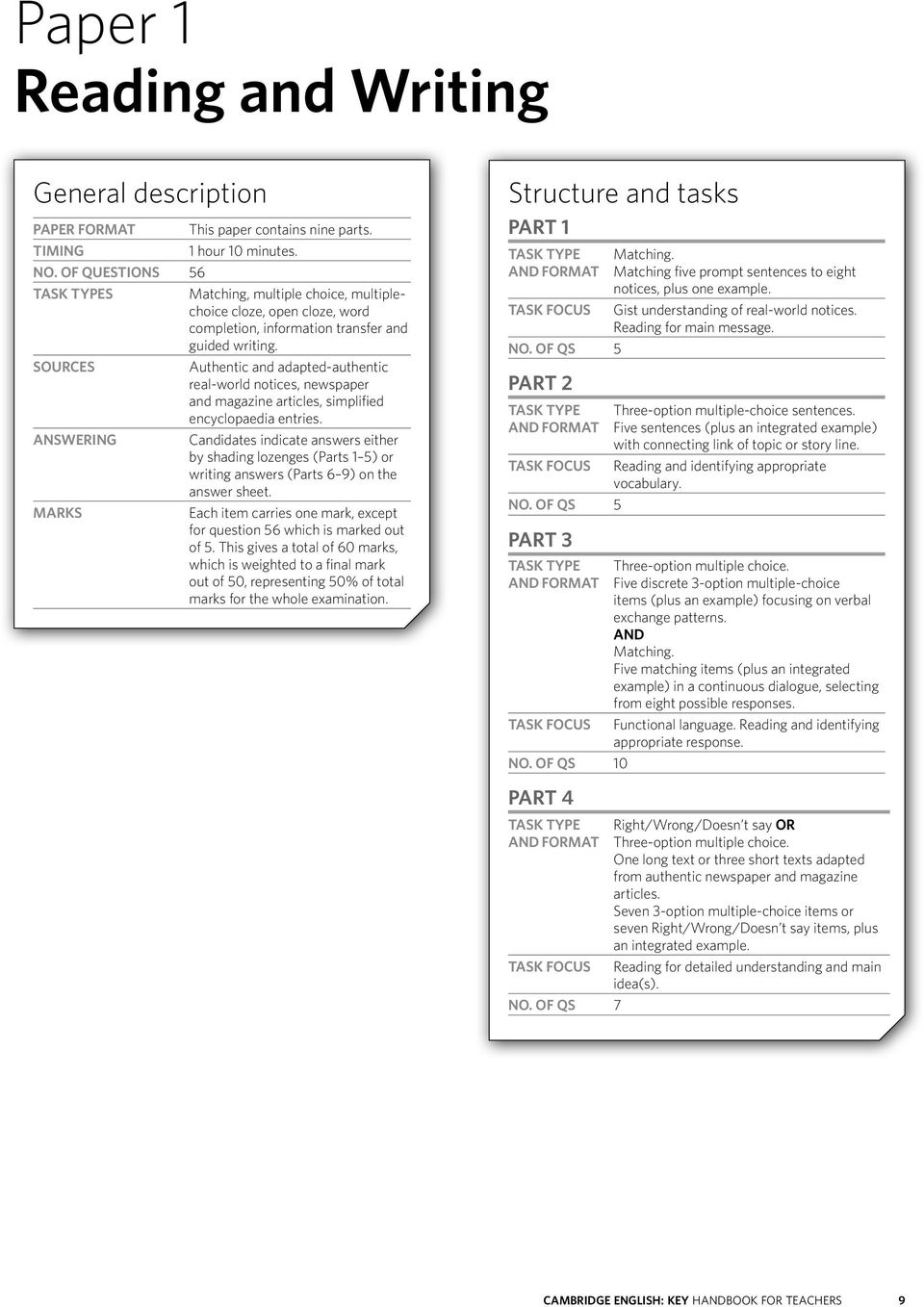
11 Paper 1 Reading and Writing General description PAPER FORMAT This paper contains nine parts. TIMING 1 hour 10 minutes. NO. OF QUESTIONS 56 TASK TYPES Matching, multiple choice, multiplechoice cloze, open cloze, word completion, information transfer and guided writing. SOURCES Authentic and adapted-authentic real-world notices, newspaper and magazine articles, simplified encyclopaedia entries. ANSWERING Candidates indicate answers either by shading lozenges (Parts 1 5) or writing answers (Parts 6 9) on the answer sheet. MARKS Each item carries one mark, except for question 56 which is marked out of 5. This gives a total of 60 marks, which is weighted to a final mark out of 50, representing 50% of total marks for the whole examination. Structure and tasks Part 1 TASK TYPE AND FORMAT TASK FOCUS NO. OF QS 5 Part 2 TASK TYPE AND FORMAT TASK FOCUS NO. OF QS 5 Part 3 TASK TYPE AND FORMAT TASK FOCUS NO. OF QS 10 Matching. Matching five prompt sentences to eight notices, plus one example. Gist understanding of real-world notices. Reading for main message. Three-option multiple-choice sentences. Five sentences (plus an integrated example) with connecting link of topic or story line. Reading and identifying appropriate vocabulary. Three-option multiple choice. Five discrete 3-option multiple-choice items (plus an example) focusing on verbal exchange patterns. AND Matching. Five matching items (plus an integrated example) in a continuous dialogue, selecting from eight possible responses. Functional language. Reading and identifying appropriate response. Part 4 TASK TYPE AND FORMAT TASK FOCUS NO. OF QS 7 Right/Wrong/Doesn t say OR Three-option multiple choice. One long text or three short texts adapted from authentic newspaper and magazine articles. Seven 3-option multiple-choice items or seven Right/Wrong/Doesn t say items, plus an integrated example. Reading for detailed understanding and main idea(s). CAMBRIDGE ENGLISH: KEY HANDBOOK FOR TEACHERS 9
12 Paper 1 Reading and Writing Structure and tasks Part 5 TASK TYPE AND FORMAT TASK FOCUS NO. OF QS 8 Part 6 TASK TYPE AND FORMAT TASK FOCUS NO. OF QS 5 Multiple-choice cloze. A text adapted from an original source, for example encyclopaedia entries, newspaper and magazine articles. Eight 3-option multiple-choice items, plus an integrated example. Reading and identifying appropriate structural word (auxiliary verbs, modal verbs, determiners, pronouns, prepositions, conjunctions etc.). Word completion. Five dictionary definition type sentences (plus an integrated example). Five words to identify and spell. Reading and identifying appropriate lexical item, and spelling. Part 8 TASK TYPE AND FORMAT TASK FOCUS NO. OF QS 5 Part 9 TASK TYPE AND FORMAT TASK FOCUS NO. OF QS 1 Information transfer. One or two short input texts, authentic in nature (notes, adverts etc.) to prompt completion of an output text (form, note, etc.). Five spaces to fill on output text with one or more words or numbers (plus an integrated example). Reading and writing down appropriate words or numbers with focus on content and accuracy. Guided writing. Either a short input text or rubric to prompt a written response. Three messages to communicate. Writing a short note, or postcard of words. Part 7 TASK TYPE AND FORMAT TASK FOCUS NO. OF QS 10 Open cloze. Text of type candidates could be expected to write, for example a short letter or . Ten spaces to fill with one word (plus an integrated example) which must be spelled correctly. Reading and identifying appropriate word with focus on structure and/or lexis. 10 CAMBRIDGE ENGLISH: KEY HANDBOOK FOR TEACHERS

13 PAPER 1: READING AND WRITING PREPARATION Preparation General The Reading and Writing part of the test takes 1 hour and 10 minutes with a total of 56 questions. Candidates have a question paper and a separate answer sheet on which they record their answers. Efforts are made to keep the language of instructions to candidates as simple as possible, and a worked example is given in Parts 1 8 of the test. Reading texts are authentic texts, adapted where necessary so that most of the vocabulary and grammatical structures are accessible to students at this level. However, candidates are expected to be able to make use of interpretation strategies if they encounter unfamiliar lexis or structures. Candidates do not need to follow a specific course before attempting Cambridge English: Key. Any general English course for beginners of approximately 200 learning hours which develops reading and writing skills alongside instruction in grammar and vocabulary will be suitable. In addition to coursebook reading texts, teachers are advised to give their students every opportunity to read the type of English used in everyday life, for example, short newspaper and magazine articles, advertisements, tourist brochures, instructions, recipes, etc. In dealing with this real-life material, students should be encouraged to develop reading strategies to compensate for their limited linguistic resources, such as the ability to guess unfamiliar words, and the ability to extract the main message from a text. A class library consisting of English language magazines and simplified readers on subjects of interest to students will be a valuable resource. Students should also be encouraged to take advantage of real-life occasions for writing short messages to each other and their teacher. They can, for example, write invitations, arrangements for meeting, apologies for missing a class, or notices about lost property. Here the emphasis should be on the successful communication of the intended message, though errors of structure, vocabulary, spelling and punctuation should not be ignored. To ensure that candidates fully understand what they will have to do in the Reading and Writing paper, it is advisable for them to become familiar in advance with the different types of test tasks. They should also make sure that they understand how to record their answers on the answer sheet (page 21). By part Parts 1 5 focus particularly on reading. PART 1 In Part 1, candidates are tested on their ability to understand the main message of a sign, notice or other very short text. These texts are of the type usually found on roads, in railway stations, airports, shops, restaurants, offices, schools, etc. Wherever possible these texts are authentic and so may contain lexis which is unfamiliar to the candidates, but this should not prevent them from understanding the main message. This is a matching question, requiring candidates to match five sentences to the appropriate sign or notice. PART 2 In Part 2, candidates are tested on their knowledge of vocabulary. They are asked to fill the gap in each of five sentences with one of the three options provided. There is a completed example sentence at the beginning. The six sentences are all on the same topic or are linked by a simple story line. Candidates should deal with each sentence individually but be aware that the overall context will help them find the correct answer. PART 3 In Part 3, candidates are tested on their ability to understand the language of the routine transactions of daily life. Questions are multiple choice (three options). Candidates are asked to complete five 2-line conversational exchanges. Questions are matching questions. Candidates are asked to complete a longer dialogue, by choosing from a list of eight options. These dialogues take place in shops, hotels, restaurants, etc., and in various work, study and social situations. PART 4 In Part 4, candidates are tested on their ability to understand the main ideas and some details of longer texts. These texts come from authentic sources, such as newspaper and magazine articles, but are adapted to make them accessible to candidates. Texts may include vocabulary which is unfamiliar to the candidates, but this should not interfere with their ability to complete the task. The questions in this part may be multiple-choice comprehension questions (with three options) or alternatively, candidates may be asked to decide whether, according to the text, each one of a set of statements is correct or incorrect, or whether there is insufficient information in the text to decide this. PART 5 In Part 5, candidates are tested on their knowledge of grammatical structure and usage in the context of a reading text. As with Part 4, texts are adapted from newspaper and magazine articles, encyclopaedias and other authentic sources. Words are deleted from the text and candidates are asked to complete the text by choosing the appropriate word from three options. Deletions mainly focus on structural elements, such as verb forms, determiners, pronouns, prepositions and conjunctions. Understanding of structural relationships at the phrase, clause, sentence or paragraph level is also required. Parts 6 9 focus particularly on writing. PART 6 In Part 6, candidates are asked to produce five items of vocabulary and to spell them correctly. The five items of vocabulary will all belong to the same lexical field, for example, jobs, food, things you can find in a house, etc. For each word they have to write, candidates are given a definition of the type you can find in a learner s dictionary, followed by the first letter of the required word and a set of dashes to represent the number of remaining letters in the required word. There is a worked example at the beginning. CAMBRIDGE ENGLISH: KEY HANDBOOK FOR TEACHERS 11

14 PAPER 1: READING AND WRITING PREPARATION PART 7 In Part 7, candidates are asked to complete a gapped text. Texts are short and simple and are of the type candidates at this level may be expected to write, for example, notes, s and short letters. A text may take the form of a note plus a reply to that note, or may be a single letter. Deletions in the text focus on grammatical structure and vocabulary. Candidates are only asked to produce words which students at this level can be expected to actively use. Correct spelling of the missing words is essential in this part. PART 8 In Part 8, candidates complete a simple information transfer task. They are asked to use the information in one or two short texts ( , advertisement, note, etc.) to complete a note, form, diary entry or other similar type of document. Candidates have to understand the texts in order to complete the task, and the focus is on both writing and reading ability. Candidates are expected to understand the vocabulary commonly associated with forms, for example, name, date, time, cost, etc. The required written production is at word and phrase level, not sentence. Correct spelling is essential in this part. PART 9 In Part 9, candidates are given the opportunity to show that they can communicate a written message (25 35 words) of an authentic type, for example a note, or postcard to a friend. The instructions indicate the type of message required, who it is for and what kind of information should be included. Candidates must respond to the prompts given. All three prompts must be addressed in order to complete the task fully. Alternatively, the candidates may be asked to read and respond appropriately to three elements contained within a short note, or postcard from a friend. In order to help teachers assess the standards required, there are several sample answers to the Writing Part 9 question on page 20, with marks and examiner comments. 12 CAMBRIDGE ENGLISH: KEY HANDBOOK FOR TEACHERS

15 PAPER 1: READING AND WRITING sample PAPER Questions 1 5 Part 1 Which notice (A H) says this (1 5)? For questions 1 5, mark the correct letter A H on your answer sheet. Example: 0 We can sell you a ticket if you want to go to a concert. Answer: 0 A B C D E F G H 1 If you want to learn to play this, call this number. A MUSIC SHOP New and used CDs great for the car! 2 Buy these here and listen to them while you are travelling. 3 You do not have to pay to go to these concerts. 4 You will learn about the history of music in this class. B C Play the Guitar Classes for children and adults Beginners welcome Pop group needs new singer Call Andy on Your age is not important for these lessons. D Live music here every Friday get your free ticket today! E Piano for Sale Looks and sounds beautiful only 300 F Piano lessons (only for people who can read music) Phone G Buy concert tickets here - Pop, Rock - even classical piano! H New Course! 1000 years of Music 12.30, Mondays and Wednesdays 2 PAPER EXAM 1 READING LEVEL AND PAPER WRITING SAMPLE PAPER CAMBRIDGE ENGLISH: KEY HANDBOOK FOR TEACHERS 13

16 PAPER 1: READING AND WRITING sample PAPER PAPER 1 READING AND WRITING 14 CAMBRIDGE ENGLISH: KEY HANDBOOK FOR TEACHERS

17 PAPER 1: READING AND WRITING sample PAPER PAPER EXAM 1 READING LEVEL AND PAPER WRITING SAMPLE PAPER CAMBRIDGE ENGLISH: KEY HANDBOOK FOR TEACHERS 15

18 PAPER 1: READING AND WRITING sample PAPER PAPER 1 READING AND WRITING 16 CAMBRIDGE ENGLISH: KEY HANDBOOK FOR TEACHERS

19 PAPER 1: READING AND WRITING sample PAPER PAPER EXAM 1 READING LEVEL AND PAPER WRITING SAMPLE PAPER CAMBRIDGE ENGLISH: KEY HANDBOOK FOR TEACHERS 17

20 PAPER 1: READING AND WRITING sample PAPER PAPER 1 READING AND Answer WRITING keys 18 CAMBRIDGE ENGLISH: KEY HANDBOOK FOR TEACHERS

21 PAPER 1: READING AND WRITING ANSWER KEY PAPER EXAM 1 READING LEVEL AND PAPER WRITING SAMPLE PAPER Answer key Q Part 1 Q Part 2 Q Part 3 Q Part 4 1 F 6 A 11 A 21 B 2 A 7 C 12 A 22 A 3 D 8 B 13 C 23 C 4 H 9 B 14 B 24 B 5 B 10 C 15 B 25 C 16 C 26 A 17 F 27 A 18 A 19 G 20 D Q Part 5 Q Part 6 Q Part 7 Q Part 8 28 A 36 husband 41 of 51 17(th) June 29 B 37 grandparents 42 much 52 Myra 30 C 38 single 43 at / during / on 53 2 / two 31 C 32 A 33 B 39 daughter 40 surname 44 for / in 45 there / here 46 with 54 ( )11(.00) / eleven (pounds) 55 (a) jacket 34 A 47 m / am / was 35 A 48 the 49 is 50 your CAMBRIDGE ENGLISH: KEY HANDBOOK FOR TEACHERS 19
22 PAPER 1: READING AND WRITING assessment of writing part 9 Assessment of Writing Part 9 There are 5 marks for Part 9. Candidates at this level are not expected to produce faultless English, but to achieve 5 marks a candidate should write a cohesive message, which successfully communicates all three parts of the message, with only minor grammar and spelling errors. A great variety of fully acceptable answers is possible. Mark Scheme for Part 9 Mark Criteria 5 All three parts of message clearly communicated. Only minor spelling errors or occasional grammatical errors. 4 All three parts of message communicated. Some non-impeding errors in spelling and grammar or some awkwardness of expression. 3 All three parts of message attempted. Expression requires interpretation by the reader and contains impeding errors in spelling and grammar. All three parts of the message are included but the context is incorrect. or Two parts of message are clearly communicated. Only minor spelling errors or occasional grammatical errors. 2 Only two parts of message communicated. Some errors in spelling and grammar. The errors in expression may require patience and interpretation by the reader and impede communication. 1 Only one part of the message communicated. Some attempt to address the task but response is very unclear. 0 Question unattempted, or totally incomprehensible response. Candidates are penalised for not writing the minimum number of words (i.e. fewer than 25). They are not penalised for writing too much, though they are not advised to do so. Candidates also need to think carefully about who the target reader is for each task and try to write in an appropriate style. It is important to write clearly so that the answers are easy to read. However, it is not important if candidates write in upper or lower case, or if their writing is joined up or not. Sample answers with examiner comments Candidate A Hi, Pat! I joined to a new sport club at the school last week. I am playing football every week there and it don t cost anything! It s great fun. Do you want to come too? Write soon, Joseph Examiner comments 5 marks All three parts of the message are clearly communicated with only minor grammatical errors. Candidate B From: Maria To: Pat My favorite sport is a the tennis. I go to new tennis club near my house and plays with my huband. I don t know how much is the cost, pays mine huband! Examiner comments 4 marks All parts of the message are communicated with some non-impeding errors in grammar and spelling, and awkwardness of expression. Candidate C Hi Pat, Thank you for your . I started go to my new football club with my work college. It cost $4 dollars for a match. Last game I was fist in team and we win! Examiner comments Two parts of the message are clearly communicated. Candidate D 3 marks From: Toni To: Pat Thank for . The sport is a favrite sport. I like a football. I play football in club. I very like. Yo like football? Write me soon. Examiner comments Only one part of the message is communicated. 1 mark Candidate E Dear Pat, You start going a sport club. Where is club? What the sport there? How it cost? Examiner comments The question is unattempted. 0 marks 20 CAMBRIDGE ENGLISH: KEY HANDBOOK FOR TEACHERS
23 PAPER 1: READING AND WRITING candidate ANSWER SHEET Candidate answer sheet PAPER EXAM 1 READING LEVEL AND PAPER WRITING SAMPLE PAPER CAMBRIDGE ENGLISH: KEY HANDBOOK FOR TEACHERS 21
24 Paper 2 Listening General description PAPER FORMAT This paper contains five parts. TIMING About 30 minutes, including 8 minutes to transfer answers. NO. OF QUESTIONS 25 TASK TYPES Matching, multiple choice, gap-fill. SOURCES All texts are based on authentic situations, and each part is heard twice. ANSWERING Candidates indicate answers either by shading lozenges (Parts 1 3) or writing answers (Parts 4 and 5) on the answer sheet. MARKS Each item carries one mark. This gives a total of 25 marks which represents 25% of total marks for the whole examination. Structure and tasks Part 1 TASK TYPE AND FORMAT TASK FOCUS NO. OF QS 5 Part 2 TASK TYPE AND FORMAT TASK FOCUS NO. OF QS 5 Three-option multiple choice. Short neutral or informal dialogues. Five discrete 3-option multiple-choice items with visuals, plus one example. Listening to identify key information (times, prices, days of week, numbers, etc.). Matching. Longer informal dialogue. Five items (plus one integrated example) and eight options. Listening to identify key information. Part 3 TASK TYPE AND FORMAT TASK FOCUS NO. OF QS 5 Part 4 TASK TYPE AND FORMAT TASK FOCUS NO. OF QS 5 Part 5 TASK TYPE AND FORMAT TASK FOCUS NO. OF QS 5 Three-option multiple choice. Longer informal or neutral dialogue. Five 3-option multiple-choice items (plus an integrated example). Taking the role of one of the speakers and listening to identify key information. Gap-fill. Longer neutral or informal dialogue. Five gaps to fill with one or more words or numbers, plus an integrated example. Recognisable spelling is accepted, except with very high-frequency words, e.g. bus, red, or if spelling is dictated. Listening and writing down information (including spelling of names, places, etc. as dictated on recording). Gap-fill. Longer neutral or informal monologue. Five gaps to fill with one or more words or numbers, plus an integrated example. Recognisable spelling is accepted, except with very high-frequency words e.g. bus, red, or if spelling is dictated. Listening and writing down information (including spelling of names, places, etc. as dictated on recording). 22 CAMBRIDGE ENGLISH: KEY HANDBOOK FOR TEACHERS
25 PAPER 2: LISTENING PREPARATION Preparation General The Listening paper is divided into five parts with a total of 25 questions. The texts are written or adapted by item writers specifically for the test and recorded in a studio to simulate real spoken language. The listening texts are recorded on CD, and each text is heard twice. There are pauses for candidates to look at the questions and to write their answers. The instructions to the candidates on the recording are the same as the instructions on the question paper. Candidates write their answers on the question paper as they listen, and they are then given 8 minutes at the end of the test to transfer these answers to an answer sheet. The complete Listening test, including time for the transfer of answers, takes about 30 minutes. Listening is a language skill which should be practised from the early stages of learning English. The teacher s first resource is the listening material included in the coursebook. These listening tasks should be made use of regularly in order to build up the confidence which comes from listening to a variety of speakers talking about a range of topics. A major advantage of using recorded material is that teacher and students are in control of the number of times a particular listening text is played, which should be varied. Sometimes students will need several repeats before they are able to extract the information required by a particular listening task, but at other times they should try to see how much they can understand after just one hearing. In addition to making regular use of coursebook materials, teachers should take every opportunity to maximise students exposure to authentic spoken English. Even with beginner level students, English should be used as much as possible as the language of classroom management. Thus from an early stage students become used to following instructions in English and to extracting relevant information from spoken discourse. Other sources of authentic listening material include: films, television, videos and DVDs, songs, the internet, British Embassies and Consulates, the British Council, language schools, clubs, hotels, youth hostels, airports, teachers of English and any other speakers of English, such as tourists, tourist guides, friends and family. In listening to real-life spoken English, students should be encouraged to develop listening strategies such as picking out important information from redundant material, and deducing meaning from context by focusing on important key words and ignoring unimportant or unfamiliar terms. Students should also become familiar with the task types in the Cambridge English: Key Listening paper, and make sure they know how to record their answers on the answer sheet (page 29). Candidates should tell the supervisor of the Listening test as soon as possible if they have difficulty hearing the recording. It is important to let the supervisor know this at the beginning of the recording before the Listening test begins properly. By part PART 1 In Part 1, candidates are tested on their ability to identify simple factual information in five separate short conversational exchanges. The short conversations are either between friends or relatives, or between a member of the public and a shop assistant, booking office clerk, etc. The information focused on in these dialogues is, for example, prices, numbers, times, dates, locations, directions, shapes, sizes, weather, descriptions of people and current actions. On the question paper, the candidates see a simple question and three multiple-choice options based on pictures. There are five questions in Part 1. PART 2 In Part 2, candidates are tested on their ability to identify simple factual information in a longer conversation. The conversation is an informal one between two people who know each other. The topic will be one of personal interest to the speakers, for example, daily life, travel, occupational activities, free-time activities, etc. Candidates show their understanding of the conversation by matching two lists of items, for example, people with the food they like to eat, or days of the week with activities. PART 3 In Part 3, candidates are also tested on their ability to identify simple factual information. The listening text is usually an informal conversation between two people who know each other about a topic of personal interest to the speakers. It is sometimes a transactional exchange, e.g. a person making enquiries in a travel agent s. In this part, candidates show their understanding of the conversation by answering five multiple-choice questions, each with three options. PARTS 4 AND 5 In Parts 4 and 5, candidates are tested on their ability to extract specific factual information from a dialogue or monologue and write it down. The dialogue or monologue is in a neutral context, for example, in shops, offices, etc. A monologue may be a recorded message. The information to be extracted is of a practical nature, for example, opening times, entrance fees, etc. Candidates are asked to complete a memo, message or notes by extracting information from the listening text and writing it down. Information to be written down consists of numbers, times, dates, prices, spellings and words. In each case, candidates are required to write down one or two words or numbers. Completely accurate spelling is not required, except where a name has been spelled out in the listening text or when it is a simple highfrequency word. CAMBRIDGE ENGLISH: KEY HANDBOOK FOR TEACHERS 23
26 PAPER 2: LISTENING sample PAPER PAPER 2 LISTENING 24 CAMBRIDGE ENGLISH: KEY HANDBOOK FOR TEACHERS
27 PAPER 2: LISTENING sample PAPER EXAM PAPER 2 LEVEL LISTENING PAPER SAMPLE PAPER CAMBRIDGE ENGLISH: KEY HANDBOOK FOR TEACHERS 25
28 PAPER 2: LISTENING sample PAPER PAPER 2 LISTENING 26 CAMBRIDGE ENGLISH: KEY HANDBOOK FOR TEACHERS
29 PAPER 2: LISTENING SAMPLE paper EXAM PAPER 2 LEVEL LISTENING PAPER SAMPLE PAPER Tapescript This is the Cambridge Key English Test Listening Sample Paper. There are five parts to the test. Parts One, Two, Three, Four and Five. We will now stop for a moment before we start the test. Please ask any questions now because you must NOT speak during the test. Now look at the instructions for Part One. You will hear five short conversations. You will hear each conversation twice. There is one question for each conversation. For questions 1-5, put a tick under the right answer. Here is an example: How many people were at the meeting? Woman: Were there many people at the meeting? Man: About thirty. Woman: That s not many. Man: No, but more than last time. The answer is 30, so there is a tick in box C. Now we are ready to start. Look at question one. 1 What s Jill s favourite food? Man: You like sweet food, don t you, Jill? Jill: Well, yes, but I really like apples and oranges and things like that best. Man: Don t you love cream cakes and chocolate? Jill: They make me feel rather ill if I eat too much. Now listen again. 2 What time will Barry phone back? Barry: Hello, this is Barry. Can I speak to Linda please? Woman: Sorry, she s not here. She ll be back at five o clock. Barry: Is it OK if I call at six because my music class doesn t finish until five thirty? Woman: Yes, that will be fine. Now listen again. 3 What was the weather like last weekend? Man: Hi, Anne. What s happened to your umbrella? Was it the wind? Anne: Yes, and I got wet this morning in the rain. Man: The weather s really changed, hasn t it? At the weekend I sat in the sun all day. Anne: Yes, it s good it didn t rain then. Now listen again. 4 Where are they going to meet? Shirley: Hi, John. It s Shirley. I m at the Aroma Café. Can you come and meet me here? John: Is that the café near the post-office? Shirley: It s the one near the station. Look, I ll walk to the post-office, you know where that is so wait for me there. John: Fine. Now listen again. 5 What s still in the car? Woman: Have you left anything outside in the car? Man: I think I brought everything inside. My coat, your bag, and you ve got the map, haven t you? Woman: No, I didn t see it was it on the back seat? Man: Now listen again. Yes, I ll go and get it. This is the end of Part One. Now look at Part Two. Listen to Sam talking to Jenny about his birthday presents. Which present did each person give him? For questions 6 10, write a letter A H next to each person. You will hear the conversation twice. Sam: Hello, Jenny. Is that for me? Jenny: Yes, Sam. Happy Birthday. I m sure you can see it s a CD! Have you had lots of nice presents? Sam: Yeah. My parents wanted to get me a new sweater, but I asked them for a computer game instead, and they agreed. Jenny: And I suppose your brother bought you chocolate again? Sam: Actually, he found a really interesting book on football for me. Jenny: That s good. And what about your sister? Last year, she bought you that sweater you re wearing, didn t she? Sam: Yes. Look, she bought me this brown belt. It s Italian leather. I m sure it cost a lot of money. Jenny: Lovely. Did your aunt remember to give you something? Sam: She sent me a cheque for twenty pounds. I may buy some CDs with it. Jenny: And what about your cousin? Sam: Jenny: Great. Well, he hasn t got much money but he gave me some of my favourite chocolate. We can eat it when we watch the football on TV. Now listen again. This is the end of Part Two. CAMBRIDGE ENGLISH: KEY HANDBOOK FOR TEACHERS 27
30 PAPER 2: LISTENING SAMPLE paper PAPER 2 LISTENING Now look at Part Three. Listen to James talking to a friend about a new music club. For questions 11 15, tick A, B or C. You will hear the conversation twice. Look at questions now. You have twenty seconds. Now listen to the conversation. James: You know that new music club - well, I ve been there. Woman: Oh yes, James. Is it near the university? James: No, it s in Park Street, next to the cinema. Woman: Oh, I know - aren t they still building it? James: Yes, but it s been open for four weeks now. When I was there yesterday, they said the work will finish this week. Woman: Was the music good? James: Well it wasn t fast enough for me or my friends, but some people who were dancing were excellent. I loved watching them. Woman: Can you wear jeans there? James: There s a notice saying no sports shoes, but jeans and t-shirts are fine. Woman: How much was it to get in? James: Usually a ticket costs ten pounds, but I paid less because the first time you go it s only seven pounds fifty. And I can get in for five pounds next time if I bring a friend. Woman: I ll come. What time does it close? James: Now listen again. I left at twelve when the band finished playing. After that there s a disco until two a.m. So not as late as some clubs which don t close until five. This is the end of Part Three. Now look at Part Four You will hear a man telephoning the Tourist Information Centre in Windfield. Listen and complete questions You will hear the conversation twice. Woman: Hello, Windfield Tourist Information. How can I help? Man: Hello. I m hoping to come to Windfield for a few days and I d like some information about places to stay. I m looking for somewhere in the centre. Woman: There s the Mill Hotel. That s at 24 Harvest Road that s H A R V E S T. It s in the centre. Woman: The rooms for one person are twenty-eight pounds per night and the double rooms are thirty-two pounds. Man: That s fine. Do you have the phone number? Woman: It s You can phone them any time. Man: I d also like to know something about interesting places to see in Windfield. Woman: Well, there s the Windfield Museum, and of course there s the castle. It s over five hundred years old. They re both quite close to the hotel. Man: And are they open every day? Woman: You can t visit the museum on Mondays, and the castle is only open on Saturdays and Sundays. Man: Woman: Goodbye. Now listen again. Thank you. That s a great help. Goodbye. This is the end of Part Four. Now look at Part Five You will hear some information about a food market. Listen and complete questions You will hear the information twice. Man: This is some information for shoppers at Elwood Food Market. There are three large food halls here. Turn left at the entrance for Hall 1. Here you can buy many different vegetables. Choose the vegetables yourself. Use the plastic bags and then pay for everything at the cash desk. This hall also has very good fish. It all comes here straight from the sea. In Hall 2, you can find lovely cakes and bread. And next to this hall there is a café. You can get sandwiches, snacks and drinks all day in the café, and a hot breakfast until Hall 3 is the biggest hall and sells cheese, eggs and meat. In this hall there is also a special Italian shop. You can buy different pasta and they make pizza daily. At 55p a piece, it s not expensive. Children will love our new playroom. It s at the end of the hall next to the telephones. You can leave them there safely when you shop. Happy shopping! Now listen again. This is the end of Part Five. You now have eight minutes to write your answers on the answer sheet. You have one more minute. This is the end of the test. Man: Do you know how much a room is? I don t want to pay more than thirty pounds. 28 CAMBRIDGE ENGLISH: KEY HANDBOOK FOR TEACHERS
31 PAPER 2: LISTENING ANSWER KEY AND candidate ANSWER SHEET EXAM PAPER 2 LEVEL LISTENING PAPER SAMPLE PAPER Answer key Q Part 1 1 C 2 C 3 A 4 A 5 B Q Part 2 6 E 7 B 8 A 9 G 10 D Q Part 3 11 C 12 A 13 C 14 B 15 B In parts 4 and 5, recognisable spelling is accepted except in question 16, where spelling must be correct. Q Part 4 16 Harvest / twenty eight castle 20 Monday(s) Brackets ( ) indicate optional words or letters. Q Part 5 21 (very good) fish 22 bread / eleven thirty 24 ( 0.) 55p / pence 25 telephone(s) Candidate answer sheet CAMBRIDGE ENGLISH: KEY HANDBOOK FOR TEACHERS 29
32 Paper 3 Speaking General description PAPER FORMAT This paper contains two parts. TIMING 8 10 minutes per pair of candidates. NO. OF PARTS 2 INTERACTION PATTERN TASK TYPES MARKS The standard format is two candidates and two examiners. One examiner acts as assessor and manages the interaction by asking questions and setting up the tasks. The other acts as assessor and does not join in the conversation. Short exchanges with the examiner and an interactive task involving both candidates. Candidates are assessed on their performance throughout the test. Candidates are not expected to produce completely accurate or fluent language, but they are expected to interact appropriately and intelligibly. The emphasis in assessment is on the ability to communicate clearly. Structure and tasks Part 1 TASK TYPE AND FORMAT FOCUS TIMING Part 2 TASK TYPE AND FORMAT FOCUS TIMING Each candidate interacts with the interlocutor. The interlocutor asks the candidates questions. The interlocutor follows an interlocutor frame to guide the conversation, ensure standardisation and control the level of input. Language normally associated with meeting people for the first time, giving information of a factual personal kind. Biodata-type questions to respond to. 5 6 minutes Candidates interact with each other. The interlocutor sets up the activity using a standardised rubric. Candidates ask and answer questions using prompt material. Factual information of a non-personal kind related to daily life. 3 4 minutes 30 CAMBRIDGE ENGLISH: KEY HANDBOOK FOR TEACHERS
33 PAPER 3: SPEAKING PREPARATION Preparation General The Speaking test has two parts and lasts 8 to 10 minutes, involving two examiners and a pair of candidates. One examiner is an interlocutor while the other, who takes no part in the interaction, is an assessor. The Speaking component contributes 25% of the marks for the whole test. It is important that the speaking skill is developed alongside the other language skills. This may best be done by making English the language of classroom management, and by encouraging students to communicate with each other and with the teacher in English. Candidates should be able to respond appropriately to questions asking for simple information about themselves. They should, for example, be able to give their name (including spelling it), country of origin, job or subject of study; give information about their family, home town, school, free-time activities and talk simply about their likes and dislikes. Simple role plays in which students are required to ask and answer questions will provide useful practice. Such role plays should focus on everyday language and situations and involve questions about daily activities and familiar experiences, or feature exchanging information about such things as charges and opening times of, for example, a local sports centre. Practising for the Cambridge English: Key Speaking component will help students prepare for possible real-life situations. This will encourage students to use spoken language, increase their confidence in their language ability and help them develop a positive attitude towards the language learning process. By part PART 1 This takes 5 to 6 minutes. In this part, each candidate interacts with the interlocutor, using the language normally associated with meeting people for the first time: giving factual information of a personal kind, for example, name, place of origin, occupation, family, etc. Candidates are also expected to be able to talk about their daily life, interests, likes, etc. PART 2 This takes 3 to 4 minutes. In this part, the two candidates interact with each other. This involves asking and answering questions about factual information of a non-personal kind. Prompt cards are used to stimulate questions and answers which will be related to daily life, leisure activities and social life (including references to places, times, services, where to go, how to get there, what to eat, etc.). CAMBRIDGE ENGLISH: KEY HANDBOOK FOR TEACHERS 31
34 PAPER 3: SPEAKING SAMPLE MATERIALS PAPER 3 SPEAKING 32 CAMBRIDGE ENGLISH: KEY HANDBOOK FOR TEACHERS
35 PAPER 3: SPEAKING assessment Assessment of Speaking Examiners and marking The quality assurance of Speaking Examiners (SEs) is managed by Team Leaders (TLs). TLs ensure all examiners successfully complete examiner training and regular certification of procedure and assessment before they examine. TLs are in turn responsible to a Professional Support Leader (PSL) who is the professional representative of Cambridge ESOL for the Speaking tests in a given country or region. Annual examiner certification involves attendance at a face-to-face meeting to focus on and discuss assessment and procedure, followed by the marking of sample speaking tests in an online environment. Examiners must complete standardisation of assessment for all relevant levels each year and are regularly monitored during live testing sessions. Assessment scales Throughout the test candidates are assessed on their own individual performance and not in relation to each other. They are awarded marks by two examiners: the assessor and the interlocutor. The assessor awards marks by applying performance descriptors from the analytical assessment scales for the following criteria: Grammar and Vocabulary Pronunciation Interactive Communication The interlocutor awards a mark for Global Achievement using the Global Achievement scale. Assessment for Cambridge English: Key is based on performance across all parts of the test, and is achieved by applying the relevant descriptors in the assessment scales. The assessment scales for Cambridge English: Key (shown on page 34) are extracted from the overall Speaking scales on page 35. CAMBRIDGE ENGLISH: KEY HANDBOOK FOR TEACHERS 33
36 PAPER 3: SPEAKING assessment Cambridge English: Key Speaking Examiners use a more detailed version of the following assessment scales, extracted from the overall Speaking scales on page 35. A2 Grammar and Vocabulary Pronunciation Interactive Communication 5 Shows a good degree of control of simple grammatical forms. Uses a range of appropriate vocabulary when talking about everyday situations. Is mostly intelligible, and has some control of phonological features at both utterance and word levels. 4 Performance shares features of Bands 3 and 5. 3 Shows sufficient control of simple grammatical forms. Uses appropriate vocabulary to talk about everyday situations. Is mostly intelligible, despite limited control of phonological features. 2 Performance shares features of Bands 1 and 3. 1 Shows only limited control of a few grammatical forms. Uses a vocabulary of isolated words and phrases. Has very limited control of phonological features and is often unintelligible. 0 Performance below Band 1. Maintains simple exchanges. Requires very little prompting and support. Maintains simple exchanges, despite some difficulty. Requires prompting and support. Has considerable difficulty maintaining simple exchanges. Requires additional prompting and support. A2 Global Achievement 5 Handles communication in everyday situations, despite hesitation. Constructs longer utterances but is not able to use complex language except in well-rehearsed utterances. 4 Performance shares features of Bands 3 and 5. 3 Conveys basic meaning in very familiar everyday situations. Produces utterances which tend to be very short words or phrases with frequent hesitation and pauses. 2 Performance shares features of Bands 1 and 3. 1 Has difficulty conveying basic meaning even in very familiar everyday situations. Responses are limited to short phrases or isolated words with frequent hesitation and pauses. 0 Performance below Band CAMBRIDGE ENGLISH: KEY HANDBOOK FOR TEACHERS
37 PAPER 3: SPEAKING assessment Overall Speaking scales Grammatical Resource Lexical Resource Discourse Management Pronunciation Interactive Communication Maintains control of a wide range of grammatical forms and uses them with flexibility. C2 Maintains control of a wide range of grammatical forms. C1 Shows a good degree of control of a range of simple and some complex grammatical forms. Grammar and Vocabulary Uses a wide range of appropriate vocabulary with flexibility to give and exchange views on unfamiliar and abstract topics. Uses a wide range of appropriate vocabulary to give and exchange views on unfamiliar and abstract topics. Uses a range of appropriate vocabulary to give and exchange views on familiar and unfamiliar topics. B2 Shows a good degree of control of simple grammatical forms, and attempts some complex grammatical forms. Uses appropriate vocabulary to give and exchange views, on a range of familiar topics. B1 Shows a good degree of control of simple grammatical forms. Uses a range of appropriate vocabulary when talking about familiar topics. A2 Shows sufficient control of simple grammatical forms. Uses appropriate vocabulary to talk about everyday situations. Produces extended stretches of language with flexibility and ease and very little hesitation. Contributions are relevant, coherent, varied and detailed. Makes full and effective use of a wide range of cohesive devices and discourse markers. Produces extended stretches of language with ease and with very little hesitation. Contributions are relevant, coherent and varied. Uses a wide range of cohesive devices and discourse markers. Produces extended stretches of language with very little hesitation. Contributions are relevant and there is a clear organisation of ideas. Uses a range of cohesive devices and discourse markers. Produces extended stretches of language despite some hesitation. Contributions are relevant and there is very little repetition. Uses a range of cohesive devices. Produces responses which are extended beyond short phrases, despite hesitation. Contributions are mostly relevant, but there may be some repetition. Uses basic cohesive devices. Is intelligible. Phonological features are used effectively to convey and enhance meaning. Is intelligible. Intonation is appropriate. Sentence and word stress is accurately placed. Individual sounds are articulated clearly. Is intelligible. Intonation is appropriate. Sentence and word stress is accurately placed. Individual sounds are articulated clearly. Is intelligible. Intonation is generally appropriate. Sentence and word stress is generally accurately placed. Individual sounds are generally articulated clearly. Is mostly intelligible, and has some control of phonological features at both utterance and word levels. Is mostly intelligible, despite limited control of phonological features. Interacts with ease by skilfully interweaving his/her contributions into the conversation. Widens the scope of the interaction and develops it fully and effectively towards a negotiated outcome. Interacts with ease, linking contributions to those of other speakers. Widens the scope of the interaction and negotiates towards an outcome. Initiates and responds appropriately, linking contributions to those of other speakers. Maintains and develops the interaction and negotiates towards an outcome. Initiates and responds appropriately. Maintains and develops the interaction and negotiates towards an outcome with very little support. Initiates and responds appropriately. Keeps the interaction going with very little prompting and support. Maintains simple exchanges, despite some difficulty. Requires prompting and support. A1 Shows only limited control of a few grammatical forms. Uses a vocabulary of isolated words and phrases. Has very limited control of phonological features and is often unintelligible. Has considerable difficulty maintaining simple exchanges. Requires additional prompting and support. CAMBRIDGE ENGLISH: KEY HANDBOOK FOR TEACHERS 35
38 PAPER 3: SPEAKING glossary of terms Cambridge ESOL Speaking Assessment Glossary of terms 1. GENERAL Conveying basic meaning Situations and topics Utterance Conveying basic meaning: the ability of candidates to get their message across to their listeners, despite possible inaccuracies in the structure and/or delivery of the message. Everyday situations: situations that candidates come across in their everyday lives, e.g. having a meal, asking for information, shopping, going out with friends or family, travelling to school or work, taking part in leisure activities. A Cambridge English: Key (KET) task that requires candidates to exchange details about a store s opening hours exemplifies an everyday situation. Familiar topics: topics about which candidates can be expected to have some knowledge or personal experience. Cambridge English: First (FCE) tasks that require candidates to talk about what people like to do on holiday, or what it is like to do different jobs, exemplify familiar topics. Unfamiliar topics: topics which candidates would not be expected to have much personal experience of. Cambridge English: Advanced (CAE) tasks that require candidates to speculate about whether people in the world today only care about themselves, or the kinds of problems that having a lot of money can cause, exemplify unfamiliar topics. Abstract topics: topics which include ideas rather than concrete situations or events. Cambridge English: Proficiency (CPE) tasks that require candidates to discuss how far the development of our civilisation has been affected by chance discoveries or events, or the impact of writing on society, exemplify abstract topics. Utterance: people generally write in sentences and they speak in utterances. An utterance may be as short as a word or phrase, or a longer stretch of language. 2. GRAMMAR AND VOCABULARY (cont.) Appropriacy of vocabulary Flexibility Grammatical control Appropriacy of vocabulary: the use of words and phrases that fit the context of the given task. For example, in the utterance I m very sensible to noise, the word sensible is inappropriate as the word should be sensitive. Another example would be Today s big snow makes getting around the city difficult. The phrase getting around is well suited to this situation. However, big snow is inappropriate as big and snow are not used together. Heavy snow would be appropriate. Flexibility: the ability of candidates to adapt the language they use in order to give emphasis, to differentiate according to the context, and to eliminate ambiguity. Examples of this would be reformulating and paraphrasing ideas. Grammatical control: the ability to consistently use grammar accurately and appropriately to convey intended meaning. Where language specifications are provided at lower levels (as in Cambridge English: Key (KET) and Cambridge English: Preliminary (PET), candidates may have control of only the simplest exponents of the listed forms. Attempts at control: sporadic and inconsistent use of accurate and appropriate grammatical forms. For example, the inconsistent use of one form in terms of structure or meaning, the production of one part of a complex form incorrectly or the use of some complex forms correctly and some incorrectly. Spoken language often involves false starts, incomplete utterances, ellipsis and reformulation. Where communication is achieved, such features are not penalised. 2. GRAMMAR AND VOCABULARY (cont.) Grammatical forms Range 3. DISCOURSE MANAGEMENT Coherence and cohesion Extent/extended stretches of language Relevance Repetition Simple grammatical forms: words, phrases, basic tenses and simple clauses. Complex grammatical forms: longer and more complex utterances, e.g. noun clauses, relative and adverb clauses, subordination, passive forms, infinitives, verb patterns, modal forms and tense contrasts. Range: the variety of words and grammatical forms a candidate uses. At higher levels, candidates will make increasing use of a greater variety of words, fixed phrases, collocations and grammatical forms. Coherence and cohesion are difficult to separate in discourse. Broadly speaking, coherence refers to a clear and logical stretch of speech which can be easily followed by a listener. Cohesion refers to a stretch of speech which is unified and structurally organised. Coherence and cohesion can be achieved in a variety of ways, including with the use of cohesive devices, related vocabulary, grammar and discourse markers. Cohesive devices: words or phrases which indicate relationships between utterances, e.g. addition (and, in addition, moreover); consequence (so, therefore, as a result); order of information (first, second, next, finally). At higher levels, candidates should be able to provide cohesion not just with basic cohesive devices (e.g. and, but, or, then, finally) but also with more sophisticated devices (e.g. therefore, moreover, as a result, in addition, however, on the other hand). Related vocabulary: the use of several items from the same lexical set, e.g. train, station, platform, carriage; or study, learn, revise. Grammatical devices: essentially the use of reference pronouns (e.g. it, this, one) and articles (e.g. There are two women in the picture. The one on the right...). Discourse markers: words or phrases which are primarily used in spoken language to add meaning to the interaction, e.g. you know, you see, actually, basically, I mean, well, anyway, like. Extent/extended stretches of language: the amount of language produced by a candidate which should be appropriate to the task. Long turn tasks require longer stretches of language, whereas tasks which involve discussion or answering questions could require shorter and extended responses. Relevance: a contribution that is related to the task and not about something completely different. Repetition: repeating the same idea instead of introducing new ideas to develop the topic. 36 CAMBRIDGE ENGLISH: KEY HANDBOOK FOR TEACHERS
39 PAPER 3: SPEAKING GLOSSARY OF TERMS 4. PRONUNCIATION Intelligible Phonological features Intelligible: a contribution which can generally be understood by a non-efl/esol specialist, even if the speaker has a strong or unfamiliar accent. Phonological features include the pronunciation of individual sounds, word and sentence stress and intonation. Individual sounds are: Pronounced vowels, e.g. the // in cat or the // in bed Diphthongs, when two vowels are rolled together to produce one sound, e.g. the // in host or the // in hate Consonants, e.g. the // in cut or the // in fish. Stress: the emphasis laid on a syllable or word. Words of two or more syllables have one syllable which stands out from the rest because it is pronounced more loudly and clearly, and is longer than the others, e.g. important. Word stress can also distinguish between words, e.g. protest vs PROtest. In sentences, stress can be used to indicate important meaning, e.g. WHY is that one important? versus Why is THAT one important? Intonation: the way the voice rises and falls, e.g. to convey the speaker s mood, to support meaning or to indicate new information. 5. INTERACTIVE COMMUNICATION Development of the interaction Initiating and Responding Prompting and Supporting Turn and Simple exchange Development of the interaction: actively developing the conversation, e.g. by saying more than the minimum in response to the written or visual stimulus, or to something the other candidate/ interlocutor has said, or by proactively involving the other candidate with a suggestion or question about further developing the topic (e.g. What about bringing a camera for the holiday? or Why s that?). Initiating: starting a new turn by introducing a new idea or a new development of the current topic. Responding: replying or reacting to what the other candidate or the interlocutor has said. Prompting: instances when the interlocutor repeats, or uses a backup prompt or gesture in order to get the candidate to respond or make a further contribution. Supporting: instances when one candidate helps another candidate, e.g. by providing a word they are looking for during a discussion activity, or helping them develop an idea. Turn: everything a person says before someone else speaks. Simple exchange: a brief interaction which typically involves two turns in the form of an initiation and a response, e.g. questionanswer, suggestion-agreement. CAMBRIDGE ENGLISH: KEY HANDBOOK FOR TEACHERS 37
40 cambridge english: key GLOSSARY Cambridge English: Key Glossary Answer Sheet Assessor Cloze Test Discourse Gap-Filling Item Gist Impeding Error Interlocutor Item Key Lexical Long Turn Lozenge Multiple Choice Multiple Matching Options Paraphrase Pretesting Register Rubric Target Reader Acronyms ALTE CEFR EFL ESOL UCLES the form on which candidates record their responses. the Speaking test examiner who assigns a score to a candidate s performance, using analytical criteria to do so. a type of gap-filling task in which whole words have been removed from a text and which candidates must replace. written or spoken communication. any type of item which requires the candidate to insert some written material letters, numbers, single words, phrases, sentences or paragraphs into spaces in the text. The response may be supplied by the candidate or selected from a set of options. the central theme or meaning of the text. an error which prevents the reader from understanding the word or phrase. the Speaking test examiner who conducts the test and makes a global assessment of each candidate s performance. each testing point in a test which is given a separate mark or marks. the correct answer to an item. adjective from lexis, meaning to do with vocabulary. the opportunity in the Speaking test for a candidate to talk uninterrupted for a period of time, enabling them to produce an extended piece of discourse. the space on the mark sheet which candidates must fill in to indicate their answer to a multiple-choice question. a task where candidates are given a set of several possible answers of which only one is correct. a task in which a number of questions or sentence completion items, generally based on a reading text, are set. The responses are provided in the form of a bank of words or phrases, each of which can be used an unlimited number of times. the individual words in the set of possible answers for a multiplechoice item. to give the meaning of something using different words. a stage in the development of test materials at which items are tried out with representative samples from the target population in order to determine their difficulty. the tone of a piece of writing. The register should be appropriate for the task and target reader, e.g. a letter of application is written in a formal register. the instructions to an examination question which tell the candidate what to do when answering the question. the intended recipient of a piece of writing. It is important to ensure that the effect of a written task on a target reader is a positive one. The Association of Language Testers in Europe. Common European Framework of Reference for Languages. English as a Foreign Language. English for Speakers of Other Languages. University of Cambridge Local Examinations Syndicate. 38 CAMBRIDGE ENGLISH: KEY HANDBOOK FOR TEACHERS
41 * * Cambridge English: Key, also known as Key English Test (KET), is at Level A2 of the Common European Framework of Reference for Languages (CEFR) published by the Council of Europe. Cambridge English: Key has been accredited by Ofqual, the statutory regulatory authority for external qualifications in England and its counterparts in Wales and Northern Ireland; for more information, see Cambridge English Key Handbook for Teachers University of Cambridge ESOL Examinations 1 Hills Road Cambridge CB1 2EU United Kingdom Tel: [email protected] UCLES 2012 EMC/4605/2Y03 ISBN
Handbook for Teachers
 Handbook for Teachers Key English Test (KET) for Schools CEFR Level A2 Content and overview Paper/timing Content Test Focus 1 READING & WRITING 1 hour 10 minutes 2 LISTENING Approx. 30 minutes (including
GMAT.cz www.gmat.cz [email protected]. GMAT.cz KET (Key English Test) Preparating Course Syllabus
 Lesson Overview of Lesson Plan Numbers 1&2 Introduction to Cambridge KET Handing Over of GMAT.cz KET General Preparation Package Introduce Methodology for Vocabulary Log Introduce Methodology for Grammar
Handbook for teachers
 Handbook for teachers Key English Test (KET) for Schools CEFR Level A2 Content and overview Paper/timing Content Test Focus 1 READING & WRITING 1 hour 10 minutes 2 LISTENING Approx. 30 minutes (including
Handbook for Teachers
 Handbook for Teachers Content and overview Paper/timing Content Test focus 1 Reading & writing 1 hour 30 minutes 2 listening Approx. 36 minutes (including 6 minutes transfer time) 3 speaking 10 12 minutes
Curso académico 2015/2016 INFORMACIÓN GENERAL ESTRUCTURA Y CONTENIDOS HABILIDADES: INGLÉS
 Curso académico 2015/2016 INFORMACIÓN GENERAL ESTRUCTURA Y CONTENIDOS HABILIDADES: INGLÉS Objetivos de Habilidades: inglés El objetivo de la prueba es comprobar que el alumno ha adquirido un nivel B1 (dentro
A Guide to Cambridge English: Preliminary
 Cambridge English: Preliminary, also known as the Preliminary English Test (PET), is part of a comprehensive range of exams developed by Cambridge English Language Assessment. Cambridge English exams have
What is the Common European Framework of Reference for language?
 What is the Common European Framework of Reference for language? The Common European Framework of Reference for Language was created by the Council of Europe as the main part of the project "Language Learning
Handbook for Teachers
 Handbook for Teachers Content and overview Paper/timing Content Test focus 1 Reading & writing 1 hour 30 minutes 2 listening Approx. 36 minutes (including 6 minutes transfer time) 3 speaking 10 12 minutes
PET content and overview
 The Preliminary English Test is at Level B1 of the Common European Framework of Reference for Languages: Learning, teaching, assessment published by the Council of Europe PET content and overview Paper
New language test requirements for UK visas and immigration. Visit www.cambridgeenglish.org for more information.
 New language test requirements for UK visas and immigration. Visit www.cambridgeenglish.org for more information. Handbook for teachers Preliminary English Test (PET) for Schools Preliminary CEFR Level
Handbook for Teachers
 Handbook for Teachers Content and overview Paper/timing Content Test focus 1 READING 1 hour 15 minutes Part 1 Part 2 Part 3 Three texts on one theme from a range of sources. Each text has two multiple-choice
Handbook for Teachers. for examinations from March 2013
 Handbook for Teachers for examinations from March 2013 Content and overview Paper/timing Content Test focus Part 1 Part 2 Part 3 Gapped text with eight multiple-choice cloze questions. Modified open cloze
TIP INTRODUCTION (TEST DE INGLÉS PRELIMINAR) A Detailed Specification
 TIP (TEST DE INGLÉS PRELIMINAR) A Detailed Specification INTRODUCTION The TIP exam has been scaled in accordance with the levelling specifications of the Council of Europe Common European Framework (CEF)
Cambridge Primary English as a Second Language Curriculum Framework
 Cambridge Primary English as a Second Language Curriculum Framework Contents Introduction Stage 1...2 Stage 2...5 Stage 3...8 Stage 4... 11 Stage 5...14 Stage 6... 17 Welcome to the Cambridge Primary English
Elementary (A1) Group Course
 COURSE DETAILS Elementary (A1) Group Course 45 hours Two 90-minute lessons per week Study Centre/homework 2 hours per week (recommended minimum) A1(Elementary) min 6 max 8 people Price per person 650,00
New language test requirements for UK visas and immigration. Visit www.cambridgeenglish.org for more information.
 New language test requirements for UK visas and immigration. Visit www.cambridgeenglish.org for more information. International Legal English Certificate (ILEC) CEFR Levels B2 C1 Handbook for Teachers
CAMBRIDGE EXAMINATIONS, CERTIFICATES & DIPLOMAS FCE FIRST CERTIFICATE IN ENGLISH HANDBOOK. English as a Foreign Language UCLES 2001 NOT FOR RESALE
 CAMBRIDGE EXAMINATIONS, CERTIFICATES & DIPLOMAS FCE FIRST CERTIFICATE IN ENGLISH English as a Foreign Language UCLES 2001 NOT FOR RESALE HANDBOOK PREFACE This handbook is intended principally for teachers
Teaching Qualifications. TKTModules 1 3. Teaching Knowledge Test. Handbook for Teachers
 Teaching Qualifications TKTModules 1 3 Teaching Knowledge Test Handbook for Teachers CONTENTS Preface This handbook provides information for teachers interested in taking TKT (Teaching Knowledge Test)
Conocimientos mínimos recomendados para quienes deseen cursar el Profesorado de Lengua Inglesa. Tenses:
 Conocimientos mínimos recomendados para quienes deseen cursar el Profesorado de Lengua Inglesa. Verbs: Regular and irregular Modals: Can (ability, requests, permission) Could (ability, possibility, polite
Exam Information: Graded Examinations in Spoken English (GESE)
 Exam Information: Graded Examinations in Spoken English (GESE) Specifications Guide for Teachers Regulations These qualifications in English for speakers of other languages are mapped to Levels A1 to C2
How To Pass A Cesf
 Graded Examinations in Spoken English (GESE) Syllabus from 1 February 2010 These qualifications in English for speakers of other languages are mapped to Levels A1 to C2 in the Common European Framework
Information for candidates For exams from 2015
 Ready for success in study, work and life Information for candidates For exams from 2015 First Certificate in English (FCE) www.cambridgeenglish.org/first How to use this guide You can print this document
GESE Initial steps. Guide for teachers, Grades 1 3. GESE Grade 1 Introduction
 GESE Initial steps Guide for teachers, Grades 1 3 GESE Grade 1 Introduction cover photos: left and right Martin Dalton, middle Speak! Learning Centre Contents Contents What is Trinity College London?...3
The New Forest Small School
 The New Forest Small School Spanish For Children Aged 11 to 16 OCR GCSE in Spanish J732 AIMS AND OBJECTIVES To provide: A meaningful and enjoyable educational experience Known and achievable but challenging
Guide to Pearson Test of English General
 Guide to Pearson Test of English General Level 3 (Upper Intermediate) November 2011 Version 5 Pearson Education Ltd 2011. No part of this publication may be reproduced without the prior permission of Pearson
Business Certificates
 Business Certificates Business English Certificates (BEC) CEFR Levels B1, B2, C1 Handbook for Teachers CONTENTS Preface This handbook is for teachers who are preparing candidates for Cambridge English:
Student Handbook. Part C Courses & Examinations
 Student Handbook Part C Courses & Examinations Student Handbook Part C Courses & Examinations CONTENT Testing & Progress Approach General English Course Descriptions Beginner to Pre-Intermediate Course
Integrated Skills in English (ISE) Guide for Students ISE Foundation (A2) Reading & Writing Speaking & Listening
 Integrated Skills in English (ISE) Guide for Students ISE Foundation (A2) Reading & Writing Speaking & Listening Trinity College London www.trinitycollege.com Charity number 1014792 Patron HRH The Duke
COURSE OBJECTIVES SPAN 100/101 ELEMENTARY SPANISH LISTENING. SPEAKING/FUNCTIONAl KNOWLEDGE
 SPAN 100/101 ELEMENTARY SPANISH COURSE OBJECTIVES This Spanish course pays equal attention to developing all four language skills (listening, speaking, reading, and writing), with a special emphasis on
CONTENT / ACTIVITY CAN DO PAGE LEVEL GRAMMAR
 Speakout Starter Speakout CEF ALTE UCLES IELTS TOEIC TOEFL ibt PTE Starter - - 0-245 9-18 Elementary /A2 1 KET 3.0 246-500 19-29 1 Pre-intermediate A2/B1 2 PET 4.0 500-650 30-52 2 Intermediate B1+/B2 3
Introducing Cambridge English: Key for Schools
 Introducing Cambridge English: Key for Schools Cambridge English Language Assessment Part of the University of Cambridge 100 years of experience Experts in language assessment 4.5 million candidates in
Touchstone Level 2. Common European Framework of Reference for Languages (CEFR)
 Touchstone Level 2 Common European Framework of Reference for Languages (CEFR) Contents Introduction to CEFR 2 CEFR level 3 CEFR goals realized in this level of Touchstone 4 How each unit relates to the
New language test requirements for UK visas and immigration. Visit www.cambridgeenglish.org for more information.
 New language test requirements for UK visas and immigration. Visit www.cambridgeenglish.org for more information. International Certificate in Financial English (ICFE) CEFR Levels B2 C1 Handbook for Teachers
English Language (first language, first year)
 Class contents and exam requirements English Language (first language, first year) Code 30123, Learning Path 1 Head Teacher: Prof. Helen Cecilia TOOKE Objectives pag. 2 Program pag. 2 Set and recommended
Straightforward Pre-intermediate Practice Online
 Macmillan Practice Online is the easy way to get all the benefits of online learning and with over 100 courses to choose from, covering all competence levels and ranging from business English to exam practice
English CEF. Pre-intermediate Portfolio Practice Book. Annie McDonald & Mark Hancock
 English Pre-intermediate Portfolio Practice Annie McDonald & Mark Hancock CEF 4 Contents Introduction What is a Language Portfolio? 3 The Language Passport What is a Language Passport? 4 How do I use it?
Integrated Skills in English (ISE) Guide for Students ISE I (B1) Reading & Writing Speaking & Listening
 Integrated Skills in English (ISE) Guide for Students ISE I (B1) Reading & Writing Speaking & Listening Trinity College London www.trinitycollege.com Charity number 1014792 Patron HRH The Duke of Kent
Integrated Skills in English (ISE) Guide for Students ISE I (B1) Reading & Writing Speaking & Listening
 Integrated Skills in English (ISE) Guide for Students ISE I (B1) Reading & Writing Speaking & Listening Trinity College London www.trinitycollege.com Charity number 1014792 Patron HRH The Duke of Kent
GESE Elementary steps. Guide for teachers, Grades 4 6
 GESE Elementary steps Guide for teachers, Grades 4 6 What is Trinity College London? Trinity College London is an independent international exams board, fully accredited in England as an awarding body.
New language test requirements for UK visas and immigration. Visit www.cambridgeenglish.org for more information.
 New language test requirements for UK visas and immigration. Visit www.cambridgeenglish.org for more information. Cambridge English First for Schools Handbook for Teachers UCLES 2014 CE/2387/5Y01 CONTENTS
English Discoveries Online Alignment with Common European Framework of Reference
 English Discoveries Online Alignment with Common European Framework of Reference COPYRIGHT NOTICE English Discoveries Online, its documentation, and all related materials are copyrighted. All rights are
Top Notch Second Edition Level 2 Unit-by-Unit CEF Correlations
 Top Notch Second Edition Level 2 Unit-by-Unit Correlations Full Course Correlation with International Standards and Exams LEVEL PTE ALTE UCLES IELTS TOEIC TOEFL (paper) TOEFL ibt Fundamentals A1 - - -
Top Notch Second Edition Level 3 Unit-by-Unit CEF Correlations
 Top Notch Second Edition Level 3 Unit-by-Unit Correlations Full Course Correlation with International Standards and Exams LEVEL PTE ALTE UCLES IELTS TOEIC TOEFL (paper) TOEFL ibt Fundamentals A1 - - -
CELTA. Syllabus and Assessment Guidelines. Fourth Edition. Certificate in Teaching English to Speakers of Other Languages
 CELTA Certificate in Teaching English to Speakers of Other Languages Syllabus and Assessment Guidelines Fourth Edition CELTA (Certificate in Teaching English to Speakers of Other Languages) is regulated
Cambridge English. Proficiency. Handbook for teachers for exams from 2015
 230 C2 220 210 200 Cambridge English Proficiency 190 180 170 160 150 140 130 120 110 100 Handbook for teachers for exams from 2015 90 80 Content and overview Paper/timing Content Test focus Part 1 Part
Global Pre-intermediate CEF descriptors
 Global Pre-intermediate Listening A2 Unit Page I can understand what is said clearly, slowly and directly to me in simple everyday conversation; it is possible to make me understand, if the speaker can
Integrated Skills in English (ISE) Guide for Students ISE II (B2) Reading & Writing Speaking & Listening
 Integrated Skills in English (ISE) Guide for Students ISE II (B2) Reading & Writing Speaking & Listening Trinity College London www.trinitycollege.com Charity number 1014792 Patron HRH The Duke of Kent
Business English Certificates
 Business English Certificates Handbook for teachers www.cambridgeesol.org EMC/1525/7Y2 UCLES 28 Preface The BEC examinations assess language skills in a business context. BEC is suitable for both professionals
Information for candidates
 Information for candidates English for high achievers in the professional and academic world Why Cambridge English: Advanced? Cambridge English: Advanced, also known as Certificate in Advanced English
PICAI Italian Language Courses for Adults 6865, Christophe-Colomb, Montreal, Quebec Tel: 514-271 5590 Fax: 514 271 5593 Email: picai@axess.
 PICAI Italian Language Courses for Adults 6865, Christophe-Colomb, Montreal, Quebec Tel: 514-271 5590 Fax: 514 271 5593 Email: [email protected] School Year 2013/2014 September April (24 lessons; 3hours/lesson
Reading Listening and speaking Writing. Reading Listening and speaking Writing. Grammar in context: present Identifying the relevance of
 Acknowledgements Page 3 Introduction Page 8 Academic orientation Page 10 Setting study goals in academic English Focusing on academic study Reading and writing in academic English Attending lectures Studying
openmind 1 Practice Online
 Macmillan Practice Online is the easy way to get all the benefits of online learning and with over 100 courses to choose from, covering all competence levels and ranging from business English to exam practice
Business Certificates
 Business Certificates Business English Certificates (BEC) CEFR Levels B1, B2, C1 Handbook for teachers contents Preface This handbook is for teachers who are preparing candidates for Cambridge English:
First. for Schools. Cambridge English. Ready for success in the real world. Specifications and Sample Papers for examinations from January 2015
 Cambridge English First for Schools Specifications and Sample Papers for examinations from January 2015 Ready for success in the real world First Certificate in English (FCE) for Schools CEFR Level B2
stress, intonation and pauses and pronounce English sounds correctly. (b) To speak accurately to the listener(s) about one s thoughts and feelings,
 Section 9 Foreign Languages I. OVERALL OBJECTIVE To develop students basic communication abilities such as listening, speaking, reading and writing, deepening their understanding of language and culture
How To Pass Cambriac English: First For Schools
 First Certificate in English (FCE) for Schools CEFR Level B2 Ready for success in the real world Cambridge English: First for Schools Cambridge English: First, commonly known as First Certificate in English
Information for candidates
 Information for candidates The test that opens doors around the world IELTS, the International English Language Testing System, is designed to assess the language ability of candidates who want to study
Integrated Skills in English (ISE) examinations
 Integrated Skills in English (ISE) examinations Syllabus from 1 February 2010 These qualifications in English for speakers of other languages are mapped to Levels A2, B1, B2, C1 and C2 in the Common European
Integrated Skills in English (ISE) Guide for Students ISE II (B2) Reading & Writing Speaking & Listening
 Integrated Skills in English (ISE) Guide for Students ISE II (B2) Reading & Writing Speaking & Listening Trinity College London www.trinitycollege.com Charity number 1014792 Patron HRH The Duke of Kent
Certificate of Proficiency in English
 Certificate of Proficiency in English Handbook for teachers UCLES 2008 EMC/2318/8Y12 CPE content and overview Part/timing Content Test focus 1 READING 1 hour 30 mins Part 1 Part 2 Part 3 Three short texts
Integrated Skills in English (ISE) Guide for Students ISE III (C1) Reading & Writing Speaking & Listening
 Integrated Skills in English (ISE) Guide for Students ISE III (C1) Reading & Writing Speaking & Listening Trinity College London www.trinitycollege.com Charity number 1014792 Patron HRH The Duke of Kent
Accelerated Professional Program (APP) Absolute Beginner Varies (Typically 50+ units)
 APP English 1A Absolute Beginner emphasizes the development of practical language skills with a focus on business-related themes, vocabulary, and grammatical structures. The instructor will tailor the
MAP for Language & International Communication Spanish Language Learning Outcomes by Level
 Novice Abroad I This course is designed for students with little or no prior knowledge of the language. By the end of the course, the successful student will develop a basic foundation in the five skills:
Modern foreign languages
 Modern foreign languages Programme of study for key stage 3 and attainment targets (This is an extract from The National Curriculum 2007) Crown copyright 2007 Qualifications and Curriculum Authority 2007
KET for Schools Reading and Writing Part 9 teacher s notes
 KET for Schools Reading and Writing Part 9 teacher s notes Description This is a guided discovery activity to find out what candidates need to do in KET for Schools Reading and Writing Part 9. Students
Cambridge English. First. First Certificate in English (FCE) CEFR Level B2. Ready for success in the real world
 Cambridge English First First Certificate in English (FCE) CEFR Level B2 Ready for success in the real world World-class recognition Cambridge English: First, also known as First Certificate in English
UNIVERSITÀ DEGLI STUDI DELL AQUILA CENTRO LINGUISTICO DI ATENEO
 TESTING DI LINGUA INGLESE: PROGRAMMA DI TUTTI I LIVELLI - a.a. 2010/2011 Collaboratori e Esperti Linguistici di Lingua Inglese: Dott.ssa Fatima Bassi e-mail: [email protected] Dott.ssa Liliana
How To Understand Your Job In A Unit 5
 UNIT 5 ON THE JOB IN THIS UNIT YOU learn language to talk about jobs, workplaces and schedules, and to tell the time read an article about different people s jobs learn to get someone s attention, for
Entry 1, 2 and 3 Levels 1 and 2
 Entry 1, 2 and 3 Levels 1 and 2 ULES 2015 E/2781/5Y05 ontents ontents Introduction 2 ambridge English: ESOL Skills for Life an overview 3 Grading and results 9 Valid and fair assessment 11 High-quality
Macmillan English Campus 4 Crinan Street London, N1 9XW United Kingdom. www.macmillanpracticeonline.com 9 780230 436824
 Macmillan English Campus 4 Crinan Street London, N1 9XW United Kingdom 9 780230 436824 Inspiring learners, enhancing teaching Introducing Macmillan Practice Online Macmillan Practice Online is an online
Speaking for IELTS. About Speaking for IELTS. Vocabulary. Grammar. Pronunciation. Exam technique. English for Exams.
 About Collins series has been designed to be easy to use, whether by learners studying at home on their own or in a classroom with a teacher: Instructions are easy to follow Exercises are carefully arranged
Thai Language Self Assessment
 The following are can do statements in four skills: Listening, Speaking, Reading and Writing. Put a in front of each description that applies to your current Thai proficiency (.i.e. what you can do with
CHARTES D'ANGLAIS SOMMAIRE. CHARTE NIVEAU A1 Pages 2-4. CHARTE NIVEAU A2 Pages 5-7. CHARTE NIVEAU B1 Pages 8-10. CHARTE NIVEAU B2 Pages 11-14
 CHARTES D'ANGLAIS SOMMAIRE CHARTE NIVEAU A1 Pages 2-4 CHARTE NIVEAU A2 Pages 5-7 CHARTE NIVEAU B1 Pages 8-10 CHARTE NIVEAU B2 Pages 11-14 CHARTE NIVEAU C1 Pages 15-17 MAJ, le 11 juin 2014 A1 Skills-based
Adult Ed ESL Standards
 Adult Ed ESL Standards Correlation to For more information, please contact your local ESL Specialist: Level Two www.cambridge.org/chicagoventures Please note that the Chicago Ventures correlations to the
Information for Candidates
 Information for Candidates Contents What is BULATS? What level is BULATS? Who is BULATS suitable for? Why take a Cambridge ESOL exam? Develop effective communication skills Worldwide recognition Quality
Assessing Writing Performance Level B1
 Assessing Writing Performance Level B1 Writing assessment by examiners in the Cambridge English: Preliminary (PET), Preliminary (PET) for Schools and Business Preliminary exams (BEC) Cambridge English
Integrated Skills in English (ISE) examinations
 Integrated Skills in English (ISE) examinations Syllabus from 1 February 2010 These qualifications in English for speakers of other languages are mapped to Levels A2, B1, B2, C1 and C2 in the Common European
International Certificate in Financial English
 International Certificate in Financial English Past Examination Paper Writing May 2007 University of Cambridge ESOL Examinations 1 Hills Road Cambridge CB1 2EU United Kingdom Tel. +44 1223 553355 Fax.
Cambridge English. First. Handbook for teachers for exams from 2015
 230 220 210 200 Cambridge English First 190 180 B2 170 160 150 140 130 120 110 100 Handbook for teachers for exams from 2015 90 80 Content and overview Paper/timing Test content Test focus 1 READING AND
Correlation table between Intelligent Business Pre-intermediate and English for Business Level 1 (CEFR A2/B1)
 Correlation table between Intelligent Business Pre-intermediate and English for Business Level 1 (CEFR A2/B1) English for Business Level 1 This qualification is intended for candidates who have achieved
Young Learners English
 University of Cambridge ESOL Examinations Young Learners English Flyers Information for Candidates Information for candidates YLE Flyers Dear Parent Thank you for encouraging your child to learn English
FIRST CERTIFICATE Reading and Use of English Writing Listening Speaking Reading:
 Page1 Cambridge FCE B2 FIRST CERTIFICATE Reading and Use of English (1h15min) Reading: 7 parts/52 questions Writing (1h20min) 2 parts. Listening (about 40 min) Speaking (14 min per pair of candidates)
CEFR Level A1 Level A1 Global Listening Reading Spoken Interaction Spoken Production Writing
 CEFR Level A1 Level A1 is the lowest level of generative language use - the point at which the learner can interact in a simple way, ask and answer simple questions about themselves, where they live, people
Young Learners English
 University of Cambridge ESOL Examinations Young Learners English Starters Information for Candidates Information for candidates YLE Starters Dear Parent Thank you for encouraging your child to learn English
Junior High School - online
 Programme Title: Module Title: Content Provider: General English - Beginner Junior High School - online Vital English Goal The goal of this course is to provide interactive language learning materials
Useful classroom language for Elementary students. (Fluorescent) light
 Useful classroom language for Elementary students Classroom objects it is useful to know the words for Stationery Board pens (= board markers) Rubber (= eraser) Automatic pencil Lever arch file Sellotape
Get Ready for IELTS Writing. About Get Ready for IELTS Writing. Part 1: Language development. Part 2: Skills development. Part 3: Exam practice
 About Collins Get Ready for IELTS series has been designed to help learners at a pre-intermediate level (equivalent to band 3 or 4) to acquire the skills they need to achieve a higher score. It is easy
10th Grade Language. Goal ISAT% Objective Description (with content limits) Vocabulary Words
 Standard 3: Writing Process 3.1: Prewrite 58-69% 10.LA.3.1.2 Generate a main idea or thesis appropriate to a type of writing. (753.02.b) Items may include a specified purpose, audience, and writing outline.
Roane State Community College Spanish Program Humanities Divisions. Syllabus
 Roane State Community College Spanish Program Humanities Divisions Syllabus Syllabus for Spanish 2020 Instructor s Name: Instructor's Office Hours: Course Tentative Schedule: Note to Students: The students
Speakout Pre-Intermediate
 Speakout Pre-Intermediate Lead in: Review: Classroom language Spelling Parts of Speech Tenses and structures Question words Auxiliary verbs Vocabulary Unit 1 Life Language Question forms Past Simple A2
ENGLISH FILE Pre-intermediate
 Karen Ludlow New ENGLISH FILE Pre-intermediate and the Common European Framework of Reference 2 INTRODUCTION What is this booklet for? The aim of this booklet is to give a clear and simple introduction
Spoken English for Work (SEW) exams Guide for Teachers (B1)
 Spoken English for Work (SEW) exams Guide for Teachers (B1) Trinity College London 89 Albert Embankment London SE1 7TP UK T +44 (0)20 7820 6100 F +44 (0)20 7820 6161 E [email protected] www.trinitycollege.co.uk
Young Learners English
 University of Cambridge ESOL Examinations Young Learners English Movers Information for Candidates Information for candidates YLE Movers Dear Parent Thank you for encouraging your child to learn English
English. Universidad Virtual. Curso de sensibilización a la PAEP (Prueba de Admisión a Estudios de Posgrado) Parts of Speech. Nouns.
 English Parts of speech Parts of Speech There are eight parts of speech. Here are some of their highlights. Nouns Pronouns Adjectives Articles Verbs Adverbs Prepositions Conjunctions Click on any of the
How to become a successful language learner
 How to become a successful language learner By Alison Fenner English and German Co-ordinator, Institution Wide Language Programme Introduction Your success in learning a language depends on you! You may
Delta. Handbook for tutors and candidates. Module 1, Module 2, Module 3. www.cambridgeesol.org/exams/teaching-awards/delta.html. www.cambridgeesol.
 Delta Module 1, Module 2, Module 3 Handbook for tutors and candidates ISBN 978-1-906438-41-8 www.cambridgeesol.org/exams/teaching-awards/delta.html 9 7 8 1 9 0 6 4 3 8 4 1 8 UCLES 2010 EMC/5278/9Y12 *9057096051*
SYLLABUS Cambridge IGCSE English as a Second Language 0510 (speaking endorsement) 0511* (count-in speaking) Cambridge Secondary 2
 SYLLABUS Cambridge IGCSE English as a Second Language 0510 (speaking endorsement) 0511* (count-in speaking) For examination in June and November 2015 * This syllabus is approved for use in England, Wales
EAS Basic Outline. Overview
 EAS Basic Outline Overview This is the course outline for your English Language Basic Course. This course is delivered at pre intermediate level of English, and the course book that you will be using is
Livingston Public Schools Scope and Sequence K 6 Grammar and Mechanics
 Grade and Unit Timeframe Grammar Mechanics K Unit 1 6 weeks Oral grammar naming words K Unit 2 6 weeks Oral grammar Capitalization of a Name action words K Unit 3 6 weeks Oral grammar sentences Sentence
Correlation: ELLIS. English language Learning and Instruction System. and the TOEFL. Test Of English as a Foreign Language
 Correlation: English language Learning and Instruction System and the TOEFL Test Of English as a Foreign Language Structure (Grammar) A major aspect of the ability to succeed on the TOEFL examination is