
Pearson LCCI Level 5 Certificate in Teaching English as a Foreign Language (QCF) (ASE10252) Specification
|
|
|
- Juliet Copeland
- 10 years ago
- Views:
Transcription
1 Pearson LCCI Level 5 Certificate in Teaching English as a Foreign Language (QCF) (ASE10252) Specification First teaching from February 2015
2 Edexcel, BTEC and LCCI qualifications Edexcel, BTEC and LCCI qualifications are awarded by Pearson, the UK s largest awarding body offering academic and vocational qualifications that are globally recognised and benchmarked. For further information, please visit our qualification websites at or Alternatively, you can get in touch with us using the details on our contact us page at qualifications.pearson.com/contactus About Pearson Pearson is the world's leading learning company, with 40,000 employees in more than 70 countries working to help people of all ages to make measurable progress in their lives through learning. We put the student at the centre of everything we do, because wherever learning flourishes, so do people. Find out more about how we can help you and your students at: qualifications.pearson.com Acknowledgements This specification has been produced by Pearson on the basis of consultation with teachers, examiners, consultants and other interested parties. Pearson would like to thank all those who contributed their time and expertise to the specification s development. References to third party material made in this specification are made in good faith. Pearson does not endorse, approve or accept responsibility for the content of materials, which may be subject to change, or any opinions expressed therein. (Material may include textbooks, journals, magazines and other publications and websites.) All information in this specification is correct at time of publication. ISBN All the material in this publication is copyright Pearson Education Limited 2015

3 Introduction LCCI qualifications LCCI qualifications are widely regarded by employers as preparing students to carry out the key functions of modern international business. The qualifications are recognised worldwide by employers, universities and professional bodies. This new and engaging range of qualifications has been developed in collaboration with professional bodies, employers and customers. We have conducted in-depth, independent consultation to ensure that the qualifications develop the breadth and depth of knowledge, skills and understanding that students need to be effective employees, and that the qualifications support progression pathways. LCCI offers a wide range of qualifications; they are available at levels 1 to 5 across the following subject areas: English Language Marketing and Customer Service Business, Administration and IT Finance and Quantitative.

4 Purpose of the specification This specification sets out: the objectives of the qualification any other qualification(s) that a student must have completed before taking the qualification any prior knowledge and skills that the student is required to have before taking the qualification any other requirements that a student must have satisfied before they will be assessed or before the qualification will be awarded the knowledge, understanding and skills that will be assessed as part of the qualification the method of assessment and any associated requirements relating to it the criteria against which a student s level of attainment will be measured (such as assessment criteria).
5 Rationale The Pearson LCCI Level 5 Certificate in Teaching English as a Foreign Language (QCF) meets the following purpose: The qualification is designed for people who have little or no experience of teaching English as a Foreign Language (EFL) but who wish to embark on a career as an EFL teacher. The Pearson LCCI Level 5 Certificate in Teaching English as a Foreign Language (QCF) is a highly practical course designed to give learners the initial skills they need for teaching English to adult students of other languages. Achievement of the Pearson LCCI Level 5 Certificate in Teaching English as a Foreign Language (QCF) will confirm that learners have a good understanding of the essential aspects of the EFL teacher s role, that they can organise and manage effective learning, and that they have developed professionally through on-going reflection and evaluation.

6 Qualification aim The aims of the Pearson LCCI Level 5 Certificate in Teaching English as a Foreign Language (QCF) are that by the end of the course, learners will be able to: evaluate the communicative needs of classes of adult speakers of other languages (both at higher and lower levels) meet these needs through effective teaching, and evaluate how effectively they are meeting these needs.
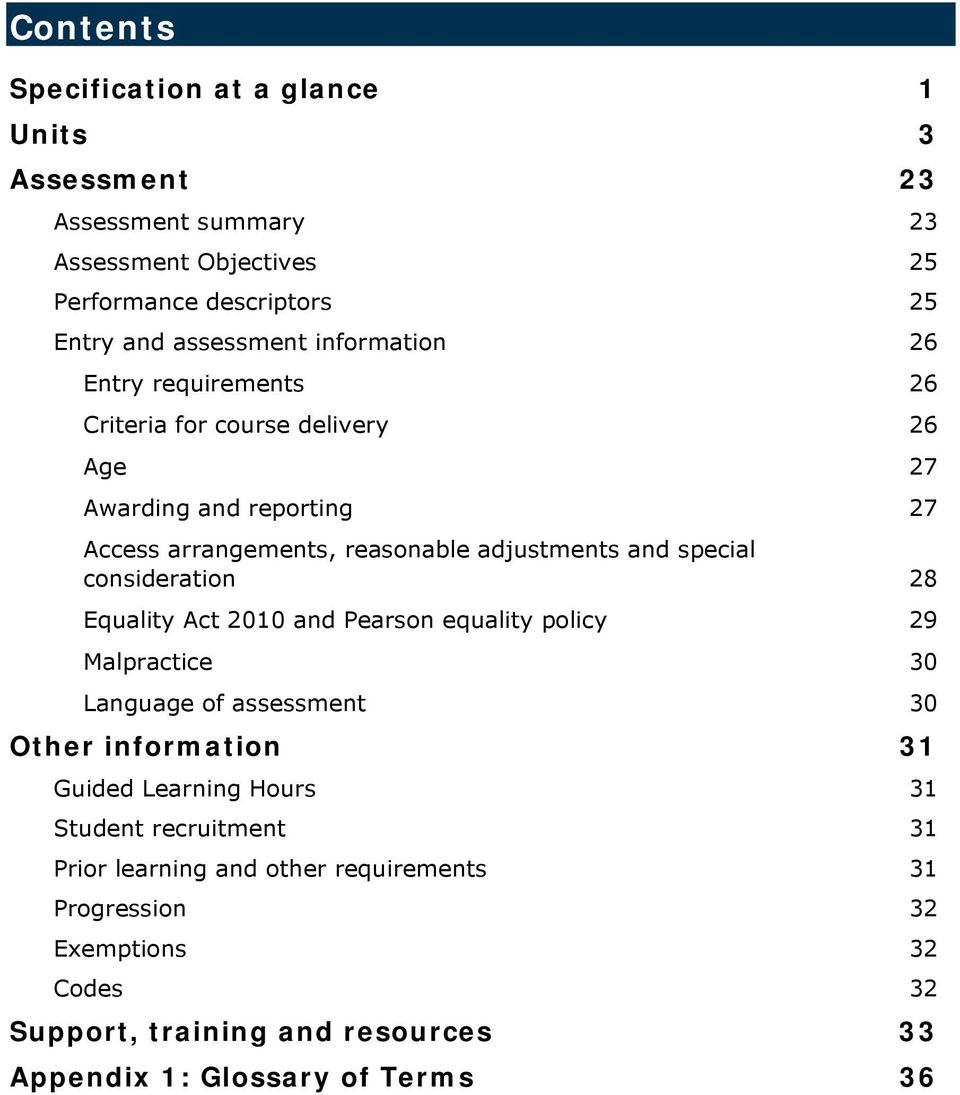
7 Contents Specification at a glance 1 Units 3 Assessment 23 Assessment summary 23 Assessment Objectives 25 Performance descriptors 25 Entry and assessment information 26 Entry requirements 26 Criteria for course delivery 26 Age 27 Awarding and reporting 27 Access arrangements, reasonable adjustments and special consideration 28 Equality Act 2010 and Pearson equality policy 29 Malpractice 30 Language of assessment 30 Other information 31 Guided Learning Hours 31 Student recruitment 31 Prior learning and other requirements 31 Progression 32 Exemptions 32 Codes 32 Support, training and resources 33 Appendix 1: Glossary of Terms 36
8

9 Specification at a glance Title: Pearson LCCI Level 5 Certificate in Teaching English as a Foreign Language (QCF) Internally assessed. Externally moderated. 100% of the total qualification Overview of content The Pearson LCCI Level 5 Certificate in Teaching English as a Foreign Language (QCF) has a unitised structure consisting of 6 mandatory units. The content of each unit is first presented showing the overall learning outcomes and assessment criteria. Each topic is then presented in more detail. Finally, the detailed assessment criteria are shown. The syllabus topics and learning outcomes for this qualification have been broadly mapped to the LLUK overarching professional standards and standards for teachers of EFL and are structured as follows: Unit 1: The Principles of Teaching and Learning in an EFL Context Unit 2: EFL Teaching Skills and Managing the Learning Environment Unit 3: Teaching Language within an EFL Context Unit 4: Teaching Speaking, Writing, Listening and Reading in an EFL Context Unit 5: Planning and Evaluation of EFL Teaching Unit 6: Assessment of EFL Learners 1

10 2

11 Units Unit 1: The Principles of Teaching and Learning in an EFL Context Level: 5 Credit value: 6 (60 learning hours) 1 Understand factors affecting learners and learners in different contexts 2 Know the roles and responsibilities of a teacher 1.1 Analyse the personal, social and cultural factors influencing ESOL learners literacy and language acquisition and use of this language 1.2 Explain the importance of the context of learning 1.3 Demonstrate an awareness of best practice planning for teaching and learning for ESOL learners, including how specialist knowledge of personal, social and cultural factors influence ESOL learners literary and language acquisition 2.1 Explain the roles and responsibilities of teachers both within the classroom and as a colleague and employee 2.2 Demonstrate an awareness of working within institutional codes of practice and institutional requirements 2.3 Demonstrate an awareness of the need for professional development and appropriate strategies for professional development of specialist knowledge and skills 3

12 In order to reach the requirements of this unit, learners must cover the topics below. Syllabus Topics Learners backgrounds Learning Outcomes Understand the importance of the diversity of learners backgrounds in the EFL classroom (with reference to age, gender, education, occupation, nationality, first language) Demonstrate an awareness of this information when teaching Learners motivations Understand the different motivations that learners have for learning English, such as: intrinsic motivation, instrumental motivation, integrative motivation Apply this understanding when planning and teaching Learner welfare Understand the limits of their responsibility concerning learner welfare Take responsibility for learner welfare where appropriate Refer learner welfare issues to colleagues or appropriate authority, where required Learning and teaching styles Understand and identify the range of learning styles that different learners may have Understand the different teaching styles that teachers can adopt in order to cater for these learning styles Apply this understanding when planning and teaching The learning context Understand the general importance of the context in which the learning is taking place Understand the variety of learning requirements that different learners may have Legislative requirements and codes of practice Apply this understanding when planning and teaching Understand and implement legislative and organisational codes of practice concerning: health and safety, equal opportunities, record keeping, time keeping 4

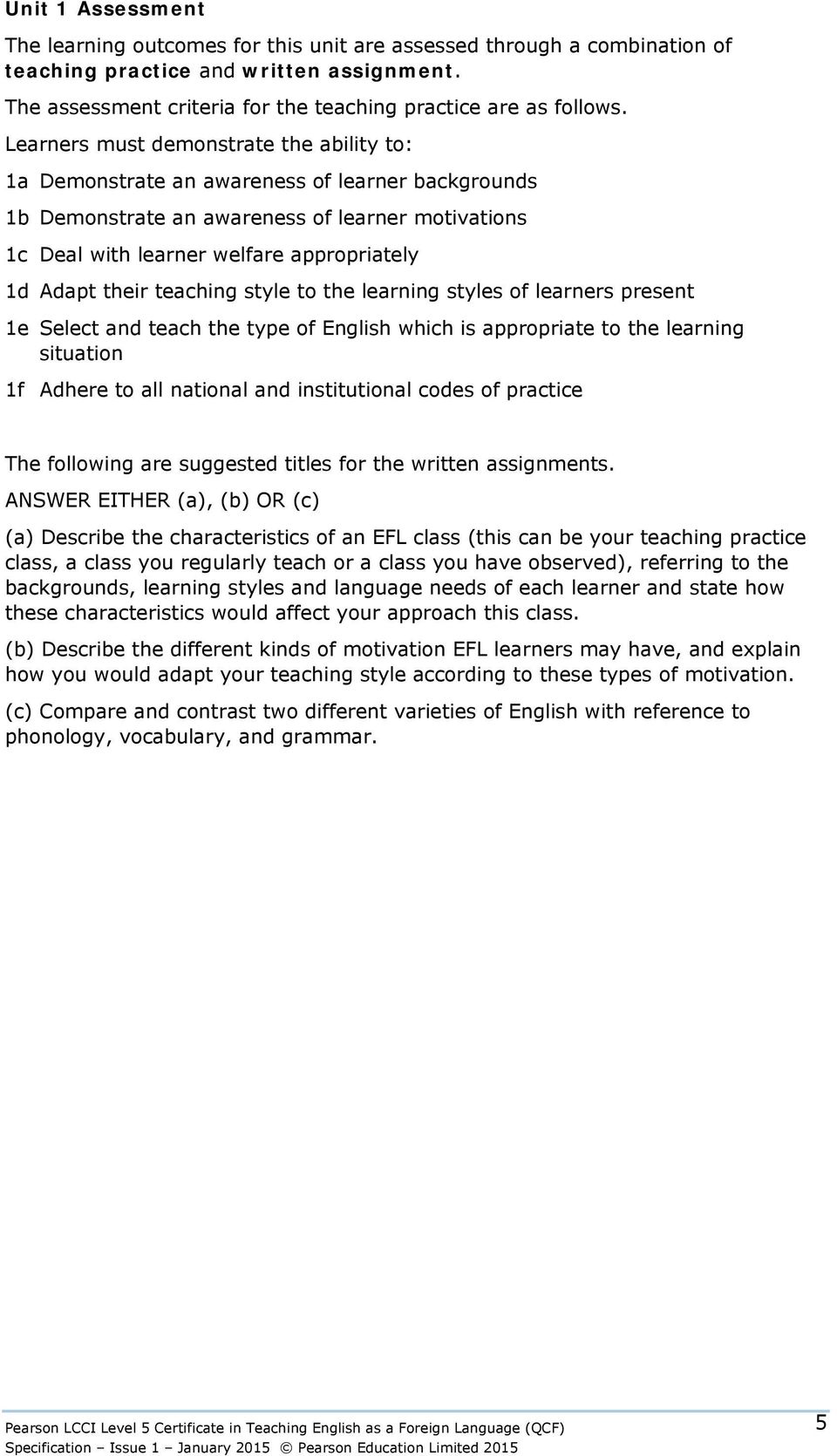
13 Unit 1 Assessment The learning outcomes for this unit are assessed through a combination of teaching practice and written assignment. The assessment criteria for the teaching practice are as follows. Learners must demonstrate the ability to: 1a Demonstrate an awareness of learner backgrounds 1b Demonstrate an awareness of learner motivations 1c Deal with learner welfare appropriately 1d Adapt their teaching style to the learning styles of learners present 1e Select and teach the type of English which is appropriate to the learning situation 1f Adhere to all national and institutional codes of practice The following are suggested titles for the written assignments. ANSWER EITHER (a), (b) OR (c) (a) Describe the characteristics of an EFL class (this can be your teaching practice class, a class you regularly teach or a class you have observed), referring to the backgrounds, learning styles and language needs of each learner and state how these characteristics would affect your approach this class. (b) Describe the different kinds of motivation EFL learners may have, and explain how you would adapt your teaching style according to these types of motivation. (c) Compare and contrast two different varieties of English with reference to phonology, vocabulary, and grammar. 5
14 Unit 2: EFL Teaching Skills and Managing the Learning Environment Level: 5 Credit value: 6 (60 learning hours) 1 Be able to manage the classroom environment to promote learning and achievement 1.1 Establish and maintain an appropriate, inclusive learning environment to maximise learners opportunities for success 1.2 Use appropriate individual, group and whole- class resources and activities to achieve lesson aims and learning outcomes 1.3 Use effective questioning checking and instructing techniques ensuring barriers to effective communication are overcome 1.4 Demonstrate good practice in giving feedback on progress and achievement 2 Be able to plan and deliver a range of appropriate classroom activities, including wholeclass activities, group work, pair work, and individual work 3 Be able to use new and emerging technologies 2.1 Select the classroom activities that could be used for whole-class activities, group work, pair work and individual work 2.2 Demonstrate a range of classroom activities that take account of the learners and the type of lesson 2.3 Know how to adapt to teaching situations where materials and resources are very limited 3.1 Give examples of how emerging technologies and their impact and potential for language learning can be used in the classroom 3.2 Demonstrate how to use technologies in the classroom 6

15 In order to reach the requirements of this unit, learners must cover the topics below. Syllabus Topics Organisation of the EFL classroom Classroom atmosphere Appropriate and effective communication Learning Outcomes Organise the classroom to suit the learners and lesson type Organise a range of appropriate classroom activities including whole-class activities, group work, pair work, and individual work Build rapport with all learners Establish and maintain a classroom atmosphere that is conducive to learning Address the whole class with sufficient clarity and volume Adjust their own language so as to meet that of the level of the class Avoid using language extraneous to the teaching process Give clear and appropriate signals concerning the accuracy of students language identifying both accurate and inaccurate English and involving learners in the identification process Nominate students individually so that they know they are meant to speak Adopt body language that is open and that is appropriate to the teaching situation Materials and resources Evaluate, select and use a range of materials and resources that are appropriate to the aims of the teaching Make appropriate use of new and emerging technologies Adapt to teaching situations where materials and resources are very limited Professional development in class Understand the need for the use of a variety of appropriate teaching methods 7

16 Unit 2 Assessment This unit is assessed by teaching practice. The assessment criteria for the teaching practice are as follows. Learners must demonstrate the ability to: 2a Establish rapport with all learners 2b Engage all learners in all aspects of the learning process 2c Adjust their own use of language to the level of the learners 2d Adjust their style of teaching to the learning styles of the learners 2e Arrange the classroom so that optimum teaching and learning can take place 2f Facilitate whole class/group/pair/individual work according to the desired learning objectives 2g Use classroom aids in such a way as to enhance learning 2h Speak with appropriate volume and sufficient clarity 2i Vary the pace of activities of a lesson according to the objectives of each activity 2j Monitor learners when they are engaged in free practice activities 2k Be punctual when starting/finishing the lesson 8

17 Unit 3: Teaching Language within an EFL Context Level: 5 Credit value: 6 (60 learning hours) 1 Understand key components of language and English language knowledge 2 Understand ways in which different strategies, approaches and techniques can be applied to develop learners language 1.1 Analyse standard and other varieties of English in both spoken and written forms with reference to phonology, grammar and lexis 2.1 Analyse different approaches to developing the understanding and use of language with ESOL learners 2.2 Evaluate lexis as appropriate target lexis for learners 2.3 Demonstrate an awareness of how to develop ESOL learners understanding and use of language using different strategies, approaches and techniques 2.4 Give examples of effective language activities and resources to develop ESOL learners understanding and use of language 2.5 Demonstrate an awareness of how to adapt effective language activities and resources in order to develop ESOL learners understanding and use of language 2.6 Give examples of how to use language models for teaching and learning appropriately 3 Understand the main ways that the varieties of English differ from one another 3.1 Explain the main ways that varieties of English differ from one another 3.2 Demonstrate an awareness of how to use this knowledge of varieties of English in planning and teaching 9

18 In order to reach the requirements of this unit, learners must cover the topics below. Syllabus Topics Terminology Lexis Learning Outcomes Understand key terminology used in EFL and ESOL to describe language, namely: lexis; grammar; phonology; speech functions; noun phrases; verb phrases; adjective phrases; preposition phrases Apply this knowledge to teaching Demonstrate an understanding of the properties of lexis, e.g. meaning, spelling, phonology, register, collocation Choose target lexis that is the right level of difficulty for the learners and relevant to learners future communicative needs Teach the meaning of lexis through: context, realia, pictures, mime, as appropriate Facilitate phonological practice of lexis, with careful attention to phonemes and word stress Teach lexis in a sentence when appropriate with due attention to sentence stress Grammar Demonstrate an understanding of the rules determining how lexis is combined together with grammar Demonstrate an understanding of determiners, auxiliary verbs, prepositions, pronouns, and conjunctions Choose target grammar that has the right degree of syntactic, phonological, and semantic complexity Teach grammar using the same principles as for lexis (see 2.3 to 2.5 above) Facilitate interaction so that less able students have the chance to produce difficult sentences after much exposure to the new language Set up, and manage, a genuinely communicative situation Speech functions Understand what the term speech functions means Analyse spoken and written language in terms of speech functions Choose target speech functions that have an appropriate degree of syntactic, phonological, and semantic complexity Phonology Demonstrate an understanding of the principles of teaching phonology, e.g. modelling, dividing, repetition Demonstrate an understanding of the components of phonology: phonemes, linking, word stress, sentence stress, intonation Apply this understanding to the classroom and intervene 10
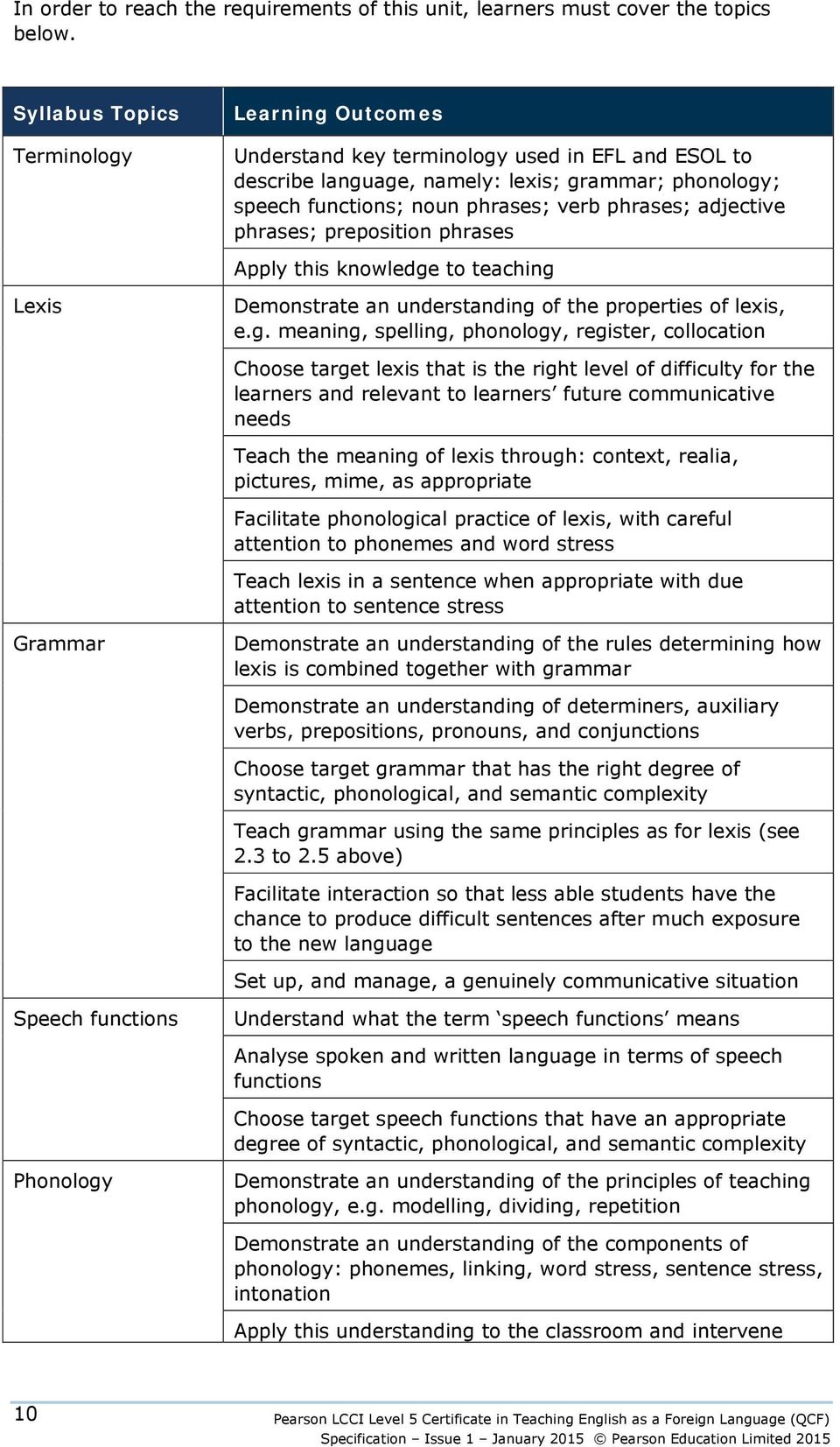
19 appropriately when learners encounter problems Varieties of English Show awareness of the different varieties of English and understand the main ways in which they differ from each other Make appropriate choices about varieties of English used when planning and teaching 11
20 Unit 3 Assessment This unit is assessed via a combination of teaching practice and written assignment. The assessment criteria for the teaching practice are as follows. Learners must demonstrate that they are able to: 3a Teach language for communicative purposes. 3b Provide clear, authentic, models both for speaking and writing, as appropriate. 3c Use different techniques to teach the meaning of target language, as appropriate. 3d Supply learners with sufficient, accurate, information about the syntax of the target language. 3e Facilitate sufficient oral practice of new language, using modelling, dividing, and repetition as appropriate. 3f Notice language errors and facilitate self/peer correction (at appropriate times). 3g Provide learners with feedback on both their communicative and linguistic performance and encourage learner evaluation of inadequate performance. The following are suggested titles for the written assignments. ANSWER EITHER (a), (b) OR (c) (a) Explain the different techniques that may be used for teaching the meaning of lexical items and give examples of the techniques you would use to teach ten items of your choice, justifying your decisions. (b) Examine what is meant by the terms noun phrase, verb phrase, adjective phrase and adverb phrase, giving examples of each and showing how one phrase may consist of other phrases. (c) Explain what kinds of phonological problems learners from three different nations of your choice have when they speak English. Include why they may have such problems and show how you would help them to overcome these problems in class. 12

21 Unit 4: Teaching Speaking, Writing, Listening and Reading in an EFL Context Level: 5 Credit value: 6 (60 learning hours) 1 Understand the key aspects of listening, speaking, reading and writing skills 2 Understand the different strategies, approaches and techniques that can be applied to develop the four language skills of ESOL learners 1.1 Explain the main processes involved in listening, speaking, reading and writing 1.2 Demonstrate an awareness of how to plan inclusive teaching and learning for ESOL learners using own specialist knowledge 2.1 Analyse different approaches to developing the four language skills of ESOL learners 2.2 Explain how to develop ESOL learners receptive and productive skills using different strategies, approaches and techniques 2.3 Evaluate possible listening and reading texts as appropriate for level and topic for learners 2.4 Demonstrate an awareness of how to select, adapt and use effective resources and activities to develop learners language and skills 13
22 In order to reach the requirements of this unit, learners must cover the topics below. Syllabus Topics Learning Outcomes Language Skills in General Recognition and production skills General principles of teaching language skills Teaching language skills to learners with low levels of literacy Listening Skills Concepts and terminology Understand the difference between recognition and production skills Understand the general principle of creating a communicative need for the target skill Understand the importance of eliciting (rather than telling) in the teaching process Understand the issues relating to teaching learners with low levels of literacy Apply this understanding to the practice of teaching and planning Demonstrate an understanding of what is meant by: predictive listening, extensive listening, intensive listening Apply this understanding to the practice of teaching Listening for everyday communication Demonstrate an understanding of why we listen in everyday communication, i.e. listening for gist, listening for specific information, listening for subtextual meaning Apply this understanding to the practice of teaching Potential difficulties in listening Demonstrate an understanding of the difficulties involved in everyday listening, i.e. speed of delivery, a speaker s accent, overlap of speakers speaking, extraneous noise Apply this understanding to the practice of teaching Discourse features Demonstrate an understanding of the discourse features (intonation, pauses, and discourse markers) that make listening more comprehensible Apply this understanding to the practice of teaching Choice of listening text Choose listening texts that are appropriate in level and topic for the learners 14
23 Reading Skills Concepts and terminology Demonstrate an understanding of what is meant by: predictive reading, extensive reading, intensive reading Apply this understanding to the practice of teaching Reading for everyday communication Demonstrate an understanding of why we read in everyday communication, i.e. reading for gist, reading for specific information, reading for subtextual meaning Apply this understanding to the practice of teaching Potential difficulties in reading Demonstrate an understanding of the difficulties involved in everyday reading, i.e. different cursive scripts, lack of coherence, style, cultural references Apply this understanding to the practice of teaching Discourse features Demonstrate an understanding of the discourse features (punctuation, capitalisation and paragraph spacing) that make reading more comprehensible Apply this understanding to the practice of teaching Choice of reading text Setting time limits Choose reading texts that are appropriate in level and topic for the learners Demonstrate an understanding of the reason why time limits are used when facilitating reading skills Use realistic time limits when teaching reading skills Speaking Skills Concepts and terminology Demonstrate an understanding of what is meant by: accuracy, fluency, appropriacy Apply this understanding to the practice of teaching Features of spoken English Demonstrate an understanding of the key features of spoken English: phonology, non-verbal communication, discourse markers, pauses Apply this understanding to the practice of teaching Facilitating speaking skills Demonstrate an understanding of when it is appropriate to facilitate speaking skills through different communicative tasks, e.g. unstructured discussions, ranking exercises, debates Apply this understanding to the practice of teaching Feedback Note down both examples of excellent English and less comprehensible English during free-speaking activities Encourage learners to evaluate these sentences in plenary 15
24 Writing Skills Concepts and terminology Demonstrate an understanding of what is meant by: accuracy; fluency; appropriacy Apply this understanding to the practice of teaching Writing models Demonstrate an understanding of the meaning importance of genre Demonstrate an understanding of why models are important for teaching writing skills Show an appropriate writing model for the target learning situation Encourage understanding of key features of the genre as seen in the model Stages of teaching writing Demonstrate an understanding of how a text is composed of separate units, such as sentences, paragraphs, and formal sections Apply this understanding to the practice of teaching 16
25 Unit 4 Assessment This unit is assessed via a combination of teaching practice and written assignment. The assessment criteria for the teaching practice are as follows. Learners must demonstrate that they are able to: 4a Arouse interest so that learners are primed for practising their skills 4b Encourage learners to predict the content of the text they are about to read or hear 4c Test understanding of reading and listening texts through appropriate comprehension tasks 4e Help learners to understand the meaning of language in both reading and listening texts 4f Help learners to develop oral fluency, accuracy, and appropriacy 4g Help learners to develop writing skills in appropriate genres The following are suggested titles for the written assignments. ANSWER EITHER (a), (b) OR (c) (a) Explain the differences between (i) spoken English and (ii) written English, and examine the pedagogic implications of these differences (b) How can you ensure that you are giving learners the best chance to understand a text? Provide a (listening or reading) text and show how you would teach a lesson with this in mind, justifying each stage of the lesson. (c) Outline and evaluate different communicative tasks that are used to help a learner become a more fluent speaker of English. 17
26 Unit 5: Planning and Evaluation of EFL Teaching Level: 5 Credit value: 6 (60 learning hours) 1 Be able to plan lessons to meet the needs of different learners 2 Be able to teach according to a lesson plan 3 Be able to evaluate own practice in planning and teaching 1.1 Plan ESOL teaching and learning, taking account of aims and needs of individual learners 1.2 Justify the selection and use of teaching and learning strategies with reference to theories and principles of communication and inclusive teaching and learning 1.3 Plan the appropriate use of a variety of delivery methods to enthuse the learners 2.1 Follow a lesson plan, covering all planned objectives and activities 2.2 Use appropriate individual, group and whole-class resources and activities to achieve lesson aims and learning outcomes 3.1 Evaluate the teaching and learning approaches used in specific sessions by self and colleagues 3.2 Use regular reflection and feedback from others, including learners, to evaluate and improve own practice 3.3 Make recommendations for modification as appropriate based on feedback received 3.4 Evaluate own approaches, strengths and development needs, in relation to professional practice 18
27 In order to reach the requirements of this unit, learners must cover the topics below. Syllabus Topics Planning schemes of work Principles of lesson planning Learning Outcomes Devise a scheme of work that meets the needs of learners and ensures syllabus coverage Understand the need for lesson plans and the role that lesson planning plays in effective teaching of English Understand the basic principles and components of a lesson plan Planning lessons for effective teaching Devise a coherent, structured lesson plan that is appropriate to learners requirements Formulate diverse lesson plans which have clear aims and objectives, are flexible, and use a variety of resources, including new and emerging technologies where appropriate Applying, evaluating and adapting lesson plans Including learners in the planning Demonstrate an ability to teach according to a lesson plan Demonstrate an ability to evaluate and adapt lesson plans according to the success of lessons and according to the individual needs of learners Allow opportunities for learner feedback to process inform planning and teaching Negotiate and record appropriate learning goals and strategies with learners Evaluating and responding to evaluation Professional development outside class Communication with colleagues Demonstrate an ability to make a balanced and constructive appraisal of their own teaching and planning Respond appropriately and effectively to feedback from (or evaluation by) others Evaluate their own strengths and development needs, make practical use of self-assessment and evaluation by others and set goals and targets for future development Implement a variety of teaching methods Understand the need for discussing students/classes with colleagues both at the planning stage and after lessons 19
28 Unit 5 Assessment This unit is assessed by teaching practice. The assessment criteria for the teaching practice are as follows. Learners must demonstrate the ability to: 5a Assess learners communicative needs effectively 5b Prepare a presentable lesson plan and give this to the tutor on time 5c Identify and state clear, appropriate, and communicative objectives for individual lessons 5d Sequence activities so that these objectives can be met 5e Indicate, on the plan, different scenarios according to the progress of the learning (as appropriate) 5f Select appropriate teaching aids/technologies/texts to meet the objectives set 5g Describe the teaching/learning procedure in a clear, methodical, way 5h Clarify what the teacher and students are doing for each stage of the lesson 5i Ensure that the lesson plan contains a balance of activities 5j Allocate appropriate timing for all stages of the lesson 5k Use appropriate terminology for both language and methodology 5l Anticipate, and state, potential learning difficulties 5m Suggest solutions to these problems 5n Collaborate with colleagues on the development of each plan as appropriate 5o Maintain accurate and up-to-date records on their teaching in their portfolio 5p Evaluate each plan after teaching practice 5q Make suggestions for improving lesson plans 5r Evaluate learner performance and consider ways of improving this 5s Be aware of their strengths and weaknesses as teachers of EFL in the light of feedback from peers and tutors 20
29 Unit 6: Assessment of EFL Learners Level: 5 Credit value: 6 (60 learning hours) 1 Understand the key aspects of assessing learners English language skills 1.1 Describe the principles involved in assessing learners' English language skills 1.2 Evaluate the strengths and limitations of a range of methods for assessing learners English language skills 1.3 Define what is meant by valid, reliable and sufficient information when making assessment of learners' competencies 1.4 Explain how appropriate methods of assessment can be guaranteed to be fair and effective 2 Understand the range of assessments methods available 3 Know how to apply appropriate methods of assessing learners English language skills 4 Know how to give appropriate feedback using assessment information 2.1 Understand the types of assessment activities available to teachers 2.2 Evaluate a range of assessment activities for assessing learners English language skills 3.1 Create assessment activities that are appropriate and effective 3.2 Explain how initial assessments should be conducted to ensure the results are reliable and valid 3.3 Describe the application of methods of assessing learners' English language skills 4.1 Explain the importance of giving constructive feedback to learners in order to promote learning of English 4.2 Explain how assessment information is used to give feedback 4.3 Identify those who may have a legitimate interest in a learner's progress 21
30 In order to reach the requirements of this unit, learners must cover the topics below. Syllabus Topics Assessing learner needs Assessing learners communicative competence Learning Outcomes Conduct initial assessments to determine individual learners English language skills and their needs Evaluate the strengths and limitations of a range of methods of assessing learners English language skills Design assessment activities that are appropriate and effective methods of assessing learners English language skills Apply appropriate methods of assessing learners English language skills in a fair and effective way Apply appropriate methods of assessment to produce valid, reliable and sufficient information about learners competencies Using assessment information Use assessment information to give constructive feedback to learners in order to promote learning of English Understand the importance of communicating assessment information to others who have a legitimate interest in a learner s progress Unit 6 Assessment This unit is assessed by written assignment only. The suggested assignment titles are as follows. ANSWER EITHER (a), (b) OR (c) (a) Imagine you have around one hundred EFL learners and you need to sort them out into eight classes. Explain, in detail, the placement test you would set, justifying each part of the test. (b) Explain what you understand by the terms validity and reliability in testing. Then discuss the advantages and disadvantages of ensuring validity and reliability in testing, reinforcing each point you make with examples. (c) Provide an authentic sample of English written by an EFL learner. Describe the learner and how the writing fits into their EFL programme. Then show which parts of the writing you would (i) praise and (ii) expect to see improvements in. Give specific examples, and justify the choices you make. 22
31 Assessment Assessment summary Pearson LCCI Level 5 Certificate in Teaching English as a Foreign Language (QCF) First teaching: February 2015 Overview of content Unit Overview of content 1: The Principles of Teaching and Learning in an EFL Context Unit 2: EFL Teaching Skills and Managing the Learning Environment Unit 3: Teaching Language within an EFL Context Unit 4: Teaching Speaking, Writing, Listening and Reading in an EFL Context Unit 5: Planning and Evaluation of EFL Teaching Unit 6: Assessment of EFL Learners Overview of assessment The Pearson LCCI Level 5 Certificate in Teaching English as a Foreign Language (QCF) is assessed through a combination of teaching practice, teacher observation and written assignments. Each candidate is required to keep a portfolio of work that includes all materials relating to the teaching practice, teacher observation and written assignments. This portfolio may be requested by Pearson at the end of the course for moderation. Teaching practice Centres are responsible for ensuring that a minimum of four classes, totalling six hours of supervised and assessed teaching practice, are included in the programme. This teaching practice will involve specially arranged classes of learners, and will take place on a regular basis throughout the course. Learners must complete lesson plans (ASNX1122) for each of the teaching practice sessions and must demonstrate that they can apply the theory (of the input sessions) to their teaching. In their lesson plans they must also show an ability to a) state achievable objectives and b) demonstrate clearly how they intend to achieve them. The four classes (minimum), totalling six hours of teaching practice, must be divided into: (a) three hours (a minimum of two classes) with a group of pre-intermediate students and (b) three hours (a minimum of two classes) with a group of post-intermediate students. The teaching practice classes should consist of no fewer than five learners. Centres should ensure that their learners plan and deliver lessons that are consistent with the content of the course units, while making sure that the learners needs are catered for too. Centres must complete a Teaching Practice 23
32 feedback form (ASNX1123) for every teaching practice class, for every candidate. An additional requirement is that at least one of the teaching practice sessions will be video recorded for each candidate. As the course progresses, the course tutors should expect candidate progress to be commensurate with how much of the course has been completed - and should assess learners on this basis. Teacher observation Each candidate must complete a minimum of three classes, totalling four hours, of teacher observation. This should involve observing qualified and experienced teachers while they deliver lessons. Details of the lessons that learners observe should be recorded on an Observation Record (form ASNX1121) pro-forma. Learners should ensure that they complete a record per lesson observed. Written assignments Learners must complete four written assignments of between words; any words over the limit will not be assessed. Each learner will complete one assignment for each of the following four topics: The EFL learner Teaching language Teaching skills Assessing learners Centres are provided with three suggested assignment titles for each of the four topics and learners must choose (or be given) one title for each. Alternatively, centres may choose to design their own assignment titles. If this option is chosen then the assignment titles and associated marking schemes must be sent to Pearson for approval by Cert TEFL moderators before being implemented. Marking schemes are provided for the suggested assignment titles. Please note that plagiarism is not acceptable. If the learner is using words that are not their own, they must be indicated clearly with a reference. Plagiarised assignments will be graded as a fail. 24
33 Assessment Objectives The Pearson LCCI Level 5 Certificate in Teaching English as a Foreign Language (QCF) will assess a candidate s ability to: conduct a needs analysis of target learners plan effective lessons implement lesson plans effectively manage a class effectively understand the basic principles of effective language teaching implement the basic principles of effective language teaching understand the basic principles of effective skills teaching implement the basic principles of effective skills teaching evaluate the efficiency of the teaching and learning. Performance descriptors Grade Pass Merit Distinction Descriptor A pass is awarded to learners who have met all the assessment requirements and who have met the criteria of all assessed components. Learners must achieve a minimum of 50% in all written assignments, with an average of between 50 59%. A merit is awarded to learners who have met all the assessment requirements and who have consistently met the criteria of all assessed components. Learners must achieve a minimum of 50% in all written assignments, with an average of between 60 74%. A distinction is awarded to learners who have met all the assessment requirements and who have consistently exceeded the criteria of all assessed components. Learners must achieve a minimum of 50% in all written assignments, with an average of between 75% or over. Note: learners who have not met all the assessment requirements and/or who have not met the criteria of all assessed components will not achieve the minimum pass grade in order for a certificate to be issued. Performance descriptors may be revised following the first award. 25
34 Entry and assessment information Please see the LCCI International Qualification Operations Guide for centres and the LCCI Examination Regulations, available on our website. Entry requirements Details on how to enter candidates for the examination for this qualification can be found at qualifications.pearson.com. In order to register for the Pearson LCCI Level 5 Certificate in Teaching English as a Foreign Language (QCF) qualification, learners must possess the qualifications required for entry to higher education in the UK (NQF/QCF Level 3) or their own country. If English is not the candidate s first language then they should possess an English language qualification at CEF level C2 or equivalent. It is the centre s responsibility to ensure that these entry requirements are met. Criteria for course delivery All centres are required to seek specific approval from Pearson in order to offer the Pearson LCCI Level 5 Certificate in Teaching English as a Foreign Language (QCF) qualification. This applies to new centres as well as centres that are already approved to offer other Pearson qualifications. To apply for approval, centres must submit a centre approval application. Those centre staff responsible for the delivery and assessment of the Pearson LCCI Level 5 Certificate in Teaching English as a Foreign Language (QCF) should have the following qualifications and experience: a TEFL, TESOL or ELT qualification that is equivalent to a UK NQF/QCF level 7 or greater (e.g. Dip TESOL, Dip TEFLA, DELTA, MA or MEd) extensive teaching experience and experience of delivering teacher training if English is not the first language of the staff responsible for delivering and assessing the course then they should possess an English language qualification at CEF level C2.2 or equivalent. 26
35 Copies of CVs and qualification certificates for the staff delivering and assessing the course will need to be sent to Pearson as part of the Pearson LCCI Level 5 Certificate in Teaching English as a Foreign Language (QCF) centre approval process. If a centre is unable to evidence all of the above criteria but feels that that their staff are sufficiently experienced to be able to deliver the course effectively then we recommend that the centre management contacts the Pearson quality assurance team to discuss the case further. Age Students must be a minimum of 19 years old to be entered onto this qualification. Awarding and reporting The Pearson LCCI Level 5 Certificate in Teaching English as a Foreign Language (QCF) qualification is graded and certificated on a three-grade scale: Pass/Merit/Distinction. 27
36 Access arrangements, reasonable adjustments and special consideration Access arrangements Access arrangements are agreed before an assessment. They allow students with special educational needs, disabilities or temporary injuries to: access the assessment show what they know and can do without changing the demands of the assessment. The intention behind an access arrangement is to meet the particular needs of an individual student with a disability without affecting the integrity of the assessment. Access arrangements are the principal way in which awarding bodies comply with the duty under the Equality Act 2010 to make reasonable adjustments. Access arrangements should always be processed at the start of the course. Students will then know what is available and have the access arrangement(s) in place for assessment. Reasonable adjustments The Equality Act 2010 requires an awarding organisation to make reasonable adjustments where a person with a disability would be at a substantial disadvantage in undertaking an assessment. The awarding organisation is required to take reasonable steps to overcome that disadvantage. A reasonable adjustment for a particular person may be unique to that individual and therefore might not be in the list of available access arrangements. Whether an adjustment will be considered reasonable will depend on a number of factors, which will include: the needs of the student with the disability the effectiveness of the adjustment the cost of the adjustment; and the likely impact of the adjustment on the student with the disability and other students. An adjustment will not be approved if it involves unreasonable costs to the awarding organisation, timeframes or affects the security or integrity of the assessment. This is because the adjustment is not reasonable. 28
37 Special consideration Special consideration is a post-examination adjustment to a student's mark or grade to reflect temporary injury, illness or other indisposition at the time of the examination/assessment, which has had, or is reasonably likely to have had, a material effect on a candidate s ability to take an assessment or demonstrate their level of attainment in an assessment. Further information Please see our website or [email protected] for further information about how to apply for access arrangements and special consideration. For further information about access arrangements, reasonable adjustments and special consideration please go to the JCQ website: Equality Act 2010 and Pearson equality policy Equality and fairness are central to our work. Our equality policy requires all students to have equal opportunity to access our qualifications and assessments, and our qualifications to be awarded in a way that is fair to every student. We are committed to making sure that: students with a protected characteristic (as defined by the Equality Act 2010) are not, when they are undertaking one of our qualifications, disadvantaged in comparison to students who do not share that characteristic all students achieve the recognition they deserve for undertaking a qualification and that this achievement can be compared fairly to the achievement of their peers. You can find details on how to make adjustments for students with protected characteristics in the policy document Access Arrangements, Reasonable Adjustments and Special Considerations, available on our website. 29
38 Malpractice For up-to-date information on malpractice please refer to the latest Joint Council for Qualifications (JCQ) Suspected Malpractice in Examinations and Assessments document, available on the JCQ website: Language of assessment Assessment of this specification will be in English only. Assessment materials will be published in English only and all work submitted for examination must be in English only. 30
39 Other information Guided Learning Hours Pearson recommends that 360 Guided Learning Hours (GLH) provide a suitable duration for the Pearson LCCI Level 5 Certificate in Teaching English as a Foreign Language (QCF) qualification. This figure includes direct contact hours as well as other times when learners work is being supervised by course teachers. Ultimately, however, it is the centres responsibility to determine the appropriate course duration based on their learners skills, ability and level of existing knowledge. In addition to the GLH, learners are expected to complete an appropriate amount of self-directed study. This self-directed study may include background reading, written assignments and other homework assignments set by the centre. Learners must also complete 6 hours of observed and assessed teaching practice and 4 hours of teaching observation. Student recruitment Pearson follows the JCQ policy concerning recruitment to our qualifications in that: they must be available to anyone who is capable of reaching the required standard they must be free from barriers that restrict access and progression equal opportunities exist for all students. Prior learning and other requirements There are no formal entry requirements for this qualification. Students may be studying in a local language but the assessment will be in English. Pearson recommends students have B1 level of English on the Common European Framework of Reference (CEFR). This will support access to the assessment materials and be able to communicate responses effectively. 31
40 Progression On completion of this qualification learners could: progress to the Diploma in Teaching English to Speakers of Other Languages (Dip TEFL) develop their knowledge of business English through taking further Pearson LCCI qualifications, for example the LCCI First Certificate in Teaching Business English (FTEB). Exemptions This qualification does not provide exemption to any other qualification in the suite or to qualifications with any other awarding organisation. Codes This qualification is approved by Ofqual and meets the Ofqual General Conditions for inclusion on the Register of Regulated Qualifications. The Qualification Number (QN) is: 601/5609/0 The subject code for the Pearson LCCI Level 5 Certificate in Teaching English as a Foreign Language (QCF) is: ASE The subject code is used by centres to enter students for a qualification. Centres will need to use the entry codes only when claiming students qualifications. 32
41 Support, training and resources Teacher Support Materials To find a list of the support documents available please visit our website. The following books are recommended reading before the start of the course. A Communicative Grammar of English (2003) G Leech, Longman ISBN A Course in Language Teaching: Practice and Theory: Trainee's Book (1999) P Ur Cambridge University Press - ISBN Grammar for English Language Teachers (2000) M Parrott, Cambridge University Press ISBN How English Works, Swan and Walter 2000, Cambridge University Press ISBN How to Teach English, (2007) J Harmer, - Longman ISBN How to Teach Pronunciation (2002), Gerald Kelly, Longman, ISBN Learning Teaching (2005) J Scrivener, - Macmillan ISBN Practical English Usage (2005), M Swan. Oxford University Press ISBN Principles of Language Learning and Teaching (2006) H D Brown (Pearson Education) ISBN Teaching by Principles: An Interactive Approach to Language Pedagogy (2001) H D Brown ISBN The Practice of English Language Teaching (2001) J Harmer, - Longman ISBN More comprehensive and unit-focussed reading lists can be provided by the centre. Resources To deliver the Pearson LCCI Level 5 Certificate in Teaching English as a Foreign Language (QCF) qualification, centres are required to provide learners with access to appropriate resources and an environment appropriate to learning. The layout of teaching rooms should facilitate discussions and presentations, and enable completion of written work. The room should be equipped with a blackboard/interactive whiteboard and overhead projector or electronic presentation facilities. Centres are also responsible for giving learners with opportunity to complete the mandatory sessions of teaching practice and teacher observation. These sessions must be completed at either the centre which is delivering the qualification (or a satellite / partner centre), or at the centre at which the candidate usually teaches. If a centre is unable to provide in house opportunities for learners to complete teaching practice and teaching observation then details of the centre that is proposed for the learners teaching practice and observation sessions must be provided as part of the centre approval process. 33
42 Examples of Teaching and Learning Strategies The programme should be a good model for learners in that a wide range of methods and strategies should be used for both teaching and learning. They should be given opportunities to include many of the following methods and strategies. Presentation / demonstration Group work Investigation / report / shared experience Workshop activity, for example preparing sessions Investigation / resource based learning followed by group discussion Sub-group activities Observation of a teacher teaching or trainer training Self-evaluation / evaluation with mentor 34
43 Appendix Appendix 1: Glossary of Terms 36 35
44 Appendix 1: Glossary of Terms These are brief definitions. For more comprehensive explanations, consult reference books such as: Key Concepts in Language and Linguistics, R.L. Trask, Routledge 1999; A Dictionary of Linguistics and Phonetics, D. Crystal, Blackwell 1991; Encyclopedic Dictionary of Applied Linguistics, K. Johnson and H. Johnson, Blackwell 1998; A Dictionary of Stylistics, K. Wales, Longman Words in italics within a definition are defined elsewhere in the glossary. accuracy: Using language in a way that native speakers consider standard. Some class activities concentrate on accuracy and some on fluency. acquisition: Unconsciously absorbing a language without explicitly studying rules or formally practising, as opposed to learning, where there is conscious attention to study and practice. action research: Research carried out by teachers in classrooms with the aim of examining their own practice reflectively and critically, and effecting change. active and passive: Verbs can be in the active voice (Rob stole a car) or the passive voice (e.g. Our car was stolen). In the active voice the subject does the action. In the passive voice the subject receives the action. Activity-based learning: In this approach learners work together in a structured way to solve problems that demonstrate the ideas to be learnt. adjective: A word like blue, silly, new that describes a person or thing. Adjectives come before a noun or after linking verbs like be and become. adverb: Adverbs modify (add meaning to) verbs, adjectives, other adverbs or sentences e.g. stop here, really useless, quite coldly. adverb phrase: An adverb and what modifies it: Jo sings much better than me. adverbial clause: A clause that performs the function of an adverb, e.g. Let s go while the going s good. affixation: One kind of derivation: adding something (prefix, suffix) to a word to change its meaning or word class: doubt doubtful, doubtless, undoubtedly. alliteration: Using the same sound to begin two or more neighbouring words. allusion: Indirect reference, e.g. to a person, an event or a state of affairs. analogy: A statement that two different things work in a similar way. anaphoric referencing: Adding coherence to a text by referring to something already stated. antithesis: The opposite of something already mentioned. antonym: A word with the opposite meaning to another word: stop/start. article: English has two forms of the indefinite article (a, an) and one definite article (the). Articles are one kind of determiner. 36
45 assimilation: The process by which a sound is modified by neighbouring sounds in spoken language, e.g. grown men is pronounced like grome men. audio-lingual method: A method based on learning the spoken language first and accurately, through oral drills, popular until the late 1960s. auxiliary verb: A verb such as be, have, can or should, which is used with a main verb to express aspect (finished/not finished or continuing/not continuing), voice or modality. (See active and passive, modal verb.) Basic Interpersonal Language skills used in everyday communication vs. Cognitive Communications Skills (BICS) Academic Language Processing (CALP). behaviourist model: An early 20th-century model that saw learning as an accumulation of stimuli and responses. bilingual method: In bilingual schools, pupils learn some of the normal school curriculum subjects in their first language and some in their second language. cataphoric referencing: Adding coherence to a text by referring to something to be explained later, e.g. It s scarcely any wonder that she didn t want to go. chaining: A system used to help with pronunciation: the learner repeats after the teacher, starting with the last syllable(s) or word or phrase and adding one or more words or syllables at a time. channel: Mode of communication: speaking/listening or writing/reading. cloze exercises: Learners complete texts in which a word is blanked out every so many words. code switching: The phenomenon of switching from one language to another in the same discourse. cognates: Words with similar forms in different languages, e.g. adult/adulto. Cognitive Academic Skills for academic literacy and cognitive development vs. Basic Language Processing (CALP) Interpersonal Communications Skills (BICS). coherent: A text that is logically well-constructed. cohesive: A text with a structure that is clearly indicated by grammatical devices and by discourse markers. collective noun: A noun designating a group, and which is used with a singular or a plural verb according to context: The team was/were furious. collocation: Two or more words or groups of words that typically occur together. common noun: A noun that applies to a whole class of objects, rather than a specific instance: (e.g. woman, letter). See proper noun. communicative approach: A teaching approach where class activities are, or resemble, real communication. communicative competence: Knowing how to use a language effectively. communicative situation: A real situation where meaning is to be communicated; it usually includes the context, the topic and relationship of speakers(s) and listener(s). community language: The language of an ethnic community, when it is not the dominant language of the region/country. comparative method: A method based on the differences between languages. complex noun phrase: A noun phrase that includes a clause, e.g. the flight that we took. 37
46 complex sentence: A sentence containing at least two clauses; the subordinate clause modifies one of the constituents of the main clause. compound sentence: A sentence containing at least two independent ( co-ordinate ) clauses joined by a word such as and, so, but. compound word: A word made by joining two or more words, e.g. bedroom. compounding: Making compound words. conjunction: A word that joins two words, phrases or clauses, e.g. and, or. connotation: The associations connected with a word (e.g. pig: dirt). consonant: 1) A speech sound (phoneme) where air flow is restricted or briefly stopped (there are about 24 consonants in English). 2) Sometimes also used to mean all the letters of the Roman alphabet except a, e, i, o, u. constituent: A unit of grammar that is part of a larger structure, e.g. the noun phrase the doctor with the shortest waiting list: premodifier (determiner) the; head (noun) doctor; postmodifier (prepositional phrase) with the shortest waiting list; the postmodifier can be further broken into constituents of its own. context: The immediate language and/or physical environment of a word or phrase. continuous aspect: A verb form that indicates an event lasting over time, e.g. I m waiting for a phone call, He was still working at 10. co-ordinate clause: One of the clauses in a compound sentence. corpora: (singular corpus) Collections of authentic spoken or written language, usually electronically stored, used for study of language phenomena. countable or count nouns: Nouns that occur in the singular with a or an and can form plurals cursive writing: What is familiarly called joined-up writing. DARTS: Directed Activities Related to Texts (DARTS) strategies and activities to involve readers actively related to texts with a text to foster independent reading. definite article: In English, the. deictic: A feature that points to places, times or people relative to the speaker or writer, e.g. this/that; here/there; then/now; come/go; bring/take. demonstrative determiner: This, that, these and those used as determiners, e.g. this car, that evening, these books, those people. demonstrative pronoun: This, that, these and those used as pronouns, e.g. What s that?, Are these yours? derivation, derivative: Building new words by affixation; a word so built. determiner: Words at the beginning of noun phrases. They can be articles (e.g. the, a); possessives (e.g. my, your etc.); predeterminers (e.g. all); or quantifiers (e.g. several, many, much). dialect: A regional or social variety of a language. diphthongs: Two vowels within a syllable that produce a single sound, e.g. coin, side direct method: A late 19th-century teaching method; instead of learning about the language, learners were taught directly, beginning with the language sounds. direct quotation: Quoting someone s exact words, e.g. He said, Stop that!. 38
47 discourse analysis: The study of stretches of language longer than the sentence, to see how they are structured. discourse marker: A word or expression that signals the structure and coherence of a text, e.g. nevertheless, in other words. discursive writing: Writing that treats a subject thoroughly, analysing all its aspects and including discussion of opposing views. drill: An exercise in which it is difficult for learners to make a mistake; it can be choral or individual, mechanical or contextualised; it practises accuracy. Dyslexia: A disability causing trouble in seeing and decoding words properly. ear-pinning exercises: Exercises in which learners listen specifically for certain items. emphatic adverb position: A marked position, e.g. Usually, she comes on time. English for Specific Examples are English for doctors, for pilots, for engineers. Purposes (ESP) There will be specialist vocabulary and more frequent use of some grammatical forms than in everyday general English. error analysis: Analysing the errors that a learner makes to help the teacher to describe their interlanguage and to decide how to proceed in teaching them. etymology: Word origins, e.g. eliminate is from the Latin for thrust out of doors (ex = out + limen = threshold). exophoric referencing: Referring to someone/something outside the text, e.g. Put that down this minute! finite verb: A verb that has tense and can show agreement, e.g. I m coming. fluency: The ease and speed of delivery. fossilisation of error: The persistence of an error when a learner s interlanguage fails to continue developing towards the target language for a particular form. functional approach: An approach in which teaching is based on the functions language performs (e.g. apologising) rather than, for example, on grammar. future tense: The future form of a verb, made with will/shall (not strictly a tense in English. NB use of present tense to refer to future time, e.g. going to gap fill: An exercise in which students put appropriate words into gaps in a text. genre: A variety of written text with standard conventions, e.g. novel, . genre analysis: Analysis of the distinctions between what distinguishes different genres. good language learner: Applied linguists have examined what differentiates successful language learners from less successful learners: good language learners are willing to risk making mistakes, decide when they want to be corrected, check that their listeners are following, create opportunities for using the language, etc. The implication is that teachers can help all learners to become good learners ; one might wish to examine this assumption. grammar-translation method: A method dating from the 19th century that gives rules in the first language and practises their application through translation. homonyms: Words that are said and written the same but have different meanings, e.g. bow = bending the body as a greeting or front part of a ship hyponyms: Specific instances of general terms, e.g. pork is a hyponym of meat. Idiom: An expression whose meaning cannot be guessed from its parts. 39
48 immersion approach: All school subjects are taught in the second language. indefinite article: A and an are the forms of the indefinite article in English. indirect quotations: Reporting what was said without using the exact words, e.g. She asked me to bring some glasses. information exchange/gap: An activity where each learner has only part of the information necessary for the task and works with one or more other learners. information gap: An activity where each student has only part of the information necessary for the task and works with one or more others. interlanguage: A step on the way between first language and target language. Interlanguage has its own fairly consistent rules that gradually evolve. Interlocutor: The person one is talking to. Intonation: Rises and falls in the pitch of the voice during speech. intransitive verb: A verb that does not take an object, e.g. Come here. language change: The process by which all languages slowly evolve. language function: One of the purposes of language. See functional approach. lexical chunks : Sequences of words that are typically found together. Storage of words in memory includes storage of chunks. lexical cohesion: The way the structure of a text is made clear by the use of related words and expressions, e.g. garden, flower, scent, petals. lexis: The vocabulary (words and lexical chunks) of a language. long vowel: A term used to talk about the vowels in words like far, scene, blue; and sometimes also food and saw. main clause: See complex sentence. main stress: In a word or utterance with more than one stress, the most prominent one; e.g. INforMAtion; ARE you SURE he s COMing? main verb: The only verb in a clause, or the last verb in a verb phrase, e.g. She hates it; I was looking away; Can you see him? marked form: See unmarked form. mass noun: A type of uncountable noun. matching exercise: Exercises in which learners match items from two or more lists or boxes; e.g. beginnings and ends of sentences, present and past forms of verbs. metaphor: A description of a thing or person as if it were something else, e.g. my tongue was flame / And my kisses burned (Carol Ann Duffy). modal verb: Auxiliary can, could, may, might, will, would, shall, should, must, ought (to), expressing obligation, certainty, or freedom/willingness to act. morpheme: The smallest grammatical unit in a language. Some words have only one morpheme (e.g. cat); some have more (e.g. mis/us/ing). Morphemes are characterised as free (e.g. cat, use) or bound (mis-, -ing). morphology, morphological: Morphology treats the structure of words and how it affects meaning, e.g. take/takes; faith/faithful/unfaithful/unfaithfulness. modelling text: In teaching writing, giving learners a model text to work from. neologisms: Newly-coined words. 40
49 nominalizations: Nouns based on verbs, e.g. participation, adjudicator. non-finite verb form: Infinitives and -ing forms are the non-finite forms of verbs: they are not marked for tense or person. onomatopoeia: The use of words that sound like their meaning, e.g. sizzle, pop. paradox: A seemingly self-contradictory statement. paralinguistic features: Body, eye and facial movement, intake of breath etc., which have meaning in communication but are not language. passive: See active and passive. past tense: One of the two English tenses; e.g. I saw / was seen / had seen. peer-editing: Learners working in groups to edit each other s written drafts. perfect: Verb forms are made with a form of have + the present participle: have done, had done, will have done, have been doing etc. perfect(ive) aspect: Co-occurs with simple or continuous aspects in these forms. The general meaning of perfect tenses is that of an event completed rather than ongoing. performative: A speech act that makes something happen, just by being said, e.g. You are under arrest; I now pronounce you man and wife; I swear it. personification: Talking or writing about a thing as if it were a person. phoneme: One of the smallest meaningful sounds in a language. Bit, bat, bought, beat, butt, boat each have three phonemes, and the middle phoneme is different in each case. phonemic chart: A chart showing the vowels and consonants (phonemes) of a language, and how they relate to one another. phonemic symbols: Standard ( IPA ) symbols for English phonemes. Phonics: Teaching reading by focusing on letter sound correspondences. Phonology: The study of the way sounds behave in languages. possessive determiner: The words my/your/his/her/its/our/their used at the beginning of noun phrases, e.g. My Beautiful Laundrette. post-modification: A modifier that follows the modified item: the Lady in the lake. pragmatics: Meaning resulting from the combination of language and situation. prefix: In affixation, a prefix is added at the beginning of a root word, e.g. uneasy. pre-modification: A modifier that comes before the modified item: plum jam. preposition: Words or groups of words (e.g. to, in front of) that go before noun phrases, to begin prepositional phrases expressing time, position etc. prepositional phrase: Phrase starting with a preposition and used adjectivally, adverbially, etc: in your wildest dreams, from the sea, like a broken puzzle. present tense: One of the two English tenses e.g. I go / am going / have gone. process writing: Concentrating on how skilled writing is done rather than exclusively on the text that is produced. productive: The productive skills are speaking and writing. productive purposes: Speaking and writing are productive skills; a person can always access fewer items of lexis for productive purposes than they can. 41
50 pronoun: A member of the word class that can substitute for a noun or noun phrase e.g. you, him, ours, myself, anybody. Some words can be either pronouns or determiners (e.g. Don t do that; Who is that man?). Note: the members of the series my/your etc are determiners rather than pronouns. proper noun: The name of a specific instance of a noun, written with a capital letter, e.g. Ibrahim, Scotland, Victoria Station. See common noun. receptive: The receptive skills are listening and reading. register: The features of language choice that are determined by social situation. Formal, scientific and religious are examples of language registers. rhythm: The pattern of stressed and unstressed syllables in speech. redundancy: Features of language are often indicated in more than one way; e.g. in The paper is here, the singular is indicated by both noun and verb. This duplication of information is known as redundancy. relative determiner: The wh- word in sentences such as: Whichever runner wins this race will go on to the finals. role play: A task in which learners assume roles. Roman script: The set of letters used to write English, Spanish, French etc. scanning: In reading, searching a text for (a) specific item(s) of information. schemata: (sing, schema): Structured information about familiar situations in longterm memory. Schemata help us understand new texts on familiar subjects. schwa: The neutral vowel sound, e.g. at the beginning and end of another, represented by the symbol. script: System of symbols for writing a language, e.g. Roman/Cyrillic script. secondary stress: In a word or utterance with more than one stress, the less prominent one(s) e.g. information; Are you SURE he s coming? semantic: Having to do with meaning or difference in meaning of words. semantic field: Words and expressions establish their meanings by comparison and contrast with words and expressions having similar, but not identical meanings. For example, colours form a semantic field: magenta is bluer than pink and redder than purple. sentence connective: A word such as however, indicating a link between sentences. sentence stress: In pronunciation, making the most important word in an utterance short vowel: A non-technical term used to talk about the vowels in words such as vat, bet, fit, rot, tub; and sometimes also good. simile: A comparison of one person/thing with another, using like or as. simple sentence: A simple sentence has only one clause, e.g. This is Jim. simple (aspect): A simple verb is marked for non-continuous action; e.g. I speak Punjabi (continuous: That woman is speaking Punjabi); We had tea at 5.00 (continuous: We were having tea when Hannah phoned). simulation: An extended roleplay that tries to imitate a real-world situation. skimming: Reading a text quickly in order to get the gist. speech act: An utterance, thought about from the point of view of the intention of the speaker and the effect on the listener, the phrases Shut up!, Please don t do that, and Could you lend me a pen? all belong to the speech act category of directives. 42
51 spider-grams: Notes taken in the form of spider s webs, with the main idea in the centre and other ideas radiating outwards. Standard English: The variety of English spoken by educated people, taught in schools, and used in formal public situations.standard English is a matter of grammar and vocabulary, not one of regional or class accent. statement: (also affirmative sentence) A simple expression of fact, rather than a question, instruction, interjection etc, e.g. Today it will be sunny in the East Midlands. stress: A stressed syllable is a bit louder and lasts a bit longer than an unstressed syllable, e.g. hippopotamus; Nice DAY? stress-timed language: English is said to be a stress-timed language: words have stressed and unstressed syllables; the (stressed syllables of the) more important words in an utterance carry additional stress, affecting the rhythm of speech. See syllabletimed language. structural linguistics: Structural linguists study language from the point of view of how it is structured, rather than, e.g. considering its social aspects. structuralist approach: An approach that bases a language syllabus on grammatical structures. structured dialogue: Exercise in which learners improvise dialogues based on a given frame. structured discussion: A discussion where learners have specific tasks. subordinate clause: See complex sentence. superordinate: A generalised noun whose meaning encompasses that of more specific nouns, e.g. fruit is a superordinate of pear, apple, grape etc. suffix: In affixation, a suffix is added at the end of a root word: exactly. summariser: A discourse marker that summarises, e.g. in other words. syllable-timed language: In a syllable-timed language, the syllables are said to occur in a regular rhythm. See stress-timed language. synonym: A word with the same meaning as another word, e.g. in/within. syntax, syntactic: The study of sentence structure. task-based learning/activities: Classroom activities (tasks) used as the basis of syllabus design, rather than, e.g. grammar. tense: The form or element of a verb that varies to show time relations. English has two main tenses, present and past, and a number of ways of referring to future time; verbs can also carry aspect (e.g. she drives / she s driving / she has driven) or voice (active and passive). tone system: In some ( tone ) languages, differences in the pitch of the voice make differences in meaning, so that the same sequence of sounds produced on a higher or lower pitch are different words. In English tone (intonation) is not used like this, but is used to convey attitude and emphasis. topic: What the utterance, text or conversation is about. topic markers: Discourse markers indicating topic, e.g. the vital thing is. topic sentence: (Usually in writing,) the sentence that states the topic of a text. topic shifters: Discourse markers introducing new topics, e.g. by the way. transitive verb: A verb that takes an object, e.g. Helen has written a short story. 43
52 triphthongs: Compound vowel sounds formed from the sounds of three distinct vowels, as in tyre and our. uncountable (or mass): Nouns that do not form plurals or take the indefinite article a. They are used with words such as some or much. See countable or count nouns. unmarked form: The neutral form of a language feature. A lexical example: dog is an unmarked form for a male/female canine, and bitch is a marked form for the female. A phonological example: the unmarked form of The ends in a schwa vowel (Where s the paper?) and the marked form ends in the vowel sound in feet: Do you mean Jude Law? unstressed syllable: See stress. Vowels in unstressed syllables are often reduced to schwa. utterance: A stretch of speech in a particular situation. verb phrase: Main and auxiliary verbs plus modifying adverbs or adverbials. verbal aspect: See continuous, perfect, simple. voicing: A voiced consonant is produced with vibrating vocal cords. voiceless consonant: Produced without the cords vibrating, with just the passage of air. vowel: 1) A speech sound (phoneme) in which air flow is not restricted (there are about 21 vowel sounds in English). 2) Sometimes also used to mean the letters a, e, i, o, u of the Roman alphabet. weak form: Words pronounced with unstressed schwa, e.g. in normal speech, the and a are pronounced as weak forms. word class: The category to which a word belongs. The main word classes are: noun, pronoun, verb, adjective, adverb, determiner, preposition and conjunction. Some words belong to more than one class, e.g. rock can be noun or verb. word family: Group of words linked by derivation or etymology, e.g. doubt, doubtful, doubtless, undoubted, doubtfully, indubitable, dubious etc. word root/stem: The basic part of a word that has affixes, e.g. unambiguously. word stress: In words of two or more syllables, pronouncing the most important syllable(s) louder and longer, e.g. invitation. writing frame: An outline guiding the learner in producing written text. ma241014\\wordproc\dtp Templates\LCCI Template\LCCI Regulated Template.dot.1-52/1 44
53 January 2015 For more information on Pearson and LCCI qualifications please visit our website: uk.pearson.com/lcciinternational Pearson Education Limited. Registered in England and Wales No Registered Office: 80 Strand, London WC2R 0RL. VAT Reg No GB
CELTA. Syllabus and Assessment Guidelines. Fourth Edition. Certificate in Teaching English to Speakers of Other Languages
 CELTA Certificate in Teaching English to Speakers of Other Languages Syllabus and Assessment Guidelines Fourth Edition CELTA (Certificate in Teaching English to Speakers of Other Languages) is regulated
TEFL Cert. Teaching English as a Foreign Language Certificate EFL MONITORING BOARD MALTA. January 2014
 TEFL Cert. Teaching English as a Foreign Language Certificate EFL MONITORING BOARD MALTA January 2014 2014 EFL Monitoring Board 2 Table of Contents 1 The TEFL Certificate Course 3 2 Rationale 3 3 Target
Edexcel Level 3 Awards and Certificate in Assessing the Quality of Assessment (QCF)
 Edexcel Level 3 Awards and Certificate in Assessing the Quality of Assessment (QCF) Specification Edexcel specialist qualification First teaching September 2010 Issue 2 Pearson Education Ltd is one of
Teaching Qualifications. TKTModules 1 3. Teaching Knowledge Test. Handbook for Teachers
 Teaching Qualifications TKTModules 1 3 Teaching Knowledge Test Handbook for Teachers CONTENTS Preface This handbook provides information for teachers interested in taking TKT (Teaching Knowledge Test)
Level 4 Certificate in English for Business
 Level 4 Certificate in English for Business LCCI International Qualifications Syllabus Effective from January 2006 For further information contact us: Tel. +44 (0) 8707 202909 Email. [email protected]
Teaching Framework. Framework components
 Teaching Framework Framework components CE/3007b/4Y09 UCLES 2014 Framework components Each category and sub-category of the framework is made up of components. The explanations below set out what is meant
CAMBRIDGE CERTIFICATE IN ENGLISH LANGUAGE TEACHING TO ADULTS CELTA COURSES 2016
 CAMBRIDGE CERTIFICATE IN ENGLISH LANGUAGE TEACHING TO ADULTS CELTA COURSES 2016 Information pack 1. Introduction to Cambridge CELTA and course description... 3 2. Overview of main course content... 3 Input
Pearson Edexcel Level 5 NVQ Diploma in Management (QCF) Specification
 Pearson Edexcel Level 5 NVQ Diploma in Management (QCF) Specification NVQ/Competence-based qualification First registration February 2014 Edexcel and BTEC qualifications are awarded by Pearson, the UK
Modern foreign languages
 Modern foreign languages Programme of study for key stage 3 and attainment targets (This is an extract from The National Curriculum 2007) Crown copyright 2007 Qualifications and Curriculum Authority 2007
LEVEL QCF. Accredited
 LEVEL QCF Accredited Issue 8 February 2015 Edexcel, BTEC and LCCI qualifications Edexcel, BTEC and LCCI qualifications are awarded by Pearson, the UK s largest awarding body offering academic and vocational
Programme Specification (Postgraduate) Date amended: March 2012
 Programme Specification (Postgraduate) Date amended: March 2012 1. Programme Title(s): MA in Applied Linguistics and TESOL 2. Awarding body or institution: University of Leicester 3. a) Mode of study Campus:
Specification. Edexcel NVQ qualification. Edexcel Level 3 NVQ Certificate in Management (QCF)
 Specification Edexcel NVQ qualification Edexcel Level 3 NVQ Certificate in Management (QCF) For first registration August 2010 Edexcel, a Pearson company, is the UK s largest awarding organisation offering
LEVEL QCF. Accredited
 LEVEL QCF Accredited Issue 9 February 2015 Edexcel, BTEC and LCCI qualifications Edexcel, BTEC and LCCI qualifications are awarded by Pearson, the UK s largest awarding body offering academic and vocational
2012-2013 Handbook. Trinity College London Certificate in Teaching English to Speakers of Other Languages (CertTESOL) at INTO University of Exeter
 2012-2013 Handbook Trinity College London Certificate in Teaching English to Speakers of Other Languages (CertTESOL) at INTO University of Exeter This handbook should be read in conjunction with INTO University
Supporting Teaching and Learning in Schools
 QCF Supporting Teaching and Learning in Schools OCR Level 3 Certificate in Supporting Teaching and Learning in Schools Scheme code 04468 Scheme code 04469 Scheme code 04470 Centre Handbook OCR Level 3
Integrated Skills in English (ISE) Guide for Students ISE II (B2) Reading & Writing Speaking & Listening
 Integrated Skills in English (ISE) Guide for Students ISE II (B2) Reading & Writing Speaking & Listening Trinity College London www.trinitycollege.com Charity number 1014792 Patron HRH The Duke of Kent
BTEC Level 3 Certificate, BTEC Level 3 Subsidiary Diploma, BTEC Level 3 90-credit Diploma, BTEC Level 3 Diploma and BTEC Level 3 Extended Diploma in
 BTEC Level 3 Certificate, BTEC Level 3 Subsidiary Diploma, BTEC Level 3 90-credit Diploma, BTEC Level 3 Diploma and BTEC Level 3 Extended Diploma in For first teaching September 2010 90-credit Diploma
Working towards TKT Module 1
 Working towards TKT Module 1 EMC/7032c/0Y09 *4682841505* TKT quiz 1) How many Modules are there? 2) What is the minimum language level for TKT? 3) How many questions are there in each Module? 4) How long
Welcome to your BTEC First 2012 specification
 BTEC Level 1/Level 2 First Certificate in Information and Creative Technology BTEC Level 1/Level 2 First Extended Certificate in Information and Creative Technology Specification First teaching September
Exam Information: Graded Examinations in Spoken English (GESE)
 Exam Information: Graded Examinations in Spoken English (GESE) Specifications Guide for Teachers Regulations These qualifications in English for speakers of other languages are mapped to Levels A1 to C2
Pearson BTEC Level 1/ Level 2 First Diploma in Business Specification
 Pearson BTEC Level 1/ Level 2 First Diploma in Business Specification First teaching September 2013 Pearson Education Limited is one of the UK s largest awarding organisations, offering academic and vocational
How To Pass A Cesf
 Graded Examinations in Spoken English (GESE) Syllabus from 1 February 2010 These qualifications in English for speakers of other languages are mapped to Levels A1 to C2 in the Common European Framework
Integrated Skills in English (ISE) Guide for Students ISE II (B2) Reading & Writing Speaking & Listening
 Integrated Skills in English (ISE) Guide for Students ISE II (B2) Reading & Writing Speaking & Listening Trinity College London www.trinitycollege.com Charity number 1014792 Patron HRH The Duke of Kent
BTEC Level 1/Level 2 First Award in Business Specification
 BTEC Level 1/Level 2 First Award in Business Specification First teaching September 2012 Issue 2 Pearson Education Limited is one of the UK's largest awarding organisations, offering academic and vocational
Personal and Professional Development in Health and Social Care
 Unit 6: Personal and Professional Development in Health and Social Care Unit code: QCF Level 3: Credit value: 20 Guided learning hours: 120 Aim and purpose D/600/8958 BTEC Nationals This unit aims to enable
Specification. Specification HEALTH AND SOCIAL CARE HEALTH AND SOCIAL CARE BTEC FIRST. From September 2012. Issue 2. Issue 2.
 BTEC FIRST Issue 2 For more information on Edexcel and BTEC qualifications please visit our website: www.edexcel.com BTEC is a registered trademark of Pearson Education Limited Pearson Education Limited.
Pearson BTEC Level 3 Diploma for Residential Childcare (England) (QCF) Specification
 Pearson BTEC Level 3 Diploma for Residential Childcare (England) (QCF) Specification Combined (Competence and Knowledge) qualification First registration January 2015 Edexcel, BTEC and LCCI qualifications
LEVEL QCF. Accredited
 LEVEL QCF Accredited Issue 5 March 2015 Edexcel, BTEC and LCCI qualifications Edexcel, BTEC and LCCI qualifications are awarded by Pearson, the UK s largest awarding body offering academic and vocational
LEVEL QCF. Accredited
 LEVEL QCF Accredited Issue 5 March 2015 Edexcel, BTEC and LCCI qualifications Edexcel, BTEC and LCCI qualifications are awarded by Pearson, the UK s largest awarding body offering academic and vocational
ENGLISH AS AN ADDITIONAL LANGUAGE (EAL) COMPANION TO AusVELS
 ENGLISH AS AN ADDITIONAL LANGUAGE (EAL) COMPANION TO AusVELS For implementation in 2013 Contents English as an Additional Language... 3 Introduction... 3 Structure of the EAL Companion... 4 A Stages Lower
The. Languages Ladder. Steps to Success. The
 The Languages Ladder Steps to Success The What is it? The development of a national recognition scheme for languages the Languages Ladder is one of three overarching aims of the National Languages Strategy.
Teaching Methodology Modules. Teaching Skills Modules
 3.3 Clarendon Park, Clumber Avenue, Nottingham, NG5 1DW, United Kingdom Tel: +44 115 969 2424. Fax: +44 115 962 1452. www.ilsenglish.com. Email: [email protected] Teacher Development Modules for Teachers
LANGUAGE! 4 th Edition, Levels A C, correlated to the South Carolina College and Career Readiness Standards, Grades 3 5
 Page 1 of 57 Grade 3 Reading Literary Text Principles of Reading (P) Standard 1: Demonstrate understanding of the organization and basic features of print. Standard 2: Demonstrate understanding of spoken
BTEC Level 3 Certificate, BTEC Level 3 Subsidiary Diploma, BTEC Level 3 90-credit Diploma, BTEC Level 3 Diploma and BTEC Level 3 Extended Diploma in
 BTEC Level 3 Certificate, BTEC Level 3 Subsidiary Diploma, BTEC Level 3 90-credit Diploma, BTEC Level 3 Diploma and BTEC Level 3 Extended Diploma in Issue 3 Pearson Education Ltd is one of the UK s largest
Cambridge International Certificate in Educational Leadership 6247 Cambridge International Diploma in Educational Leadership 6248
 Cambridge International Certificate in Educational Leadership 6247 Cambridge International Diploma in Educational Leadership 6248 For examination in 2015 Preface This syllabus sets out the details of the
Pearson Edexcel Level 3 Certificate in Hospitality Retail Outlet Management (QCF) Specification
 Pearson Edexcel Level 3 Certificate in Hospitality Retail Outlet Management (QCF) Specification NVQ/Competence-based qualification First registration January 2014 Pearson Education Limited is one of the
Specification. Issue 5. First teaching September 2010
 Pearson BTEC Entry Level Award in Business Administration (Entry 3) (QCF) Pearson BTEC Level 1 Award/Certificate/ Diploma in Business Administration (QCF) Specification Issue 5 First teaching September
QCF. Residential childcare. Centre Handbook
 QCF Residential childcare Centre Handbook OCR Level 3 Diploma for Residential Childcare (England) Entry code 10405 OCR Level 5 Diploma in Leadership and Management for Residential Childcare (England) Entry
Professional practice in foundation skills Final Report June 2015 Attachment 1. Attachment 1 Qualifications desk research
 Qualifications desk research Table 1: Training Package s, single units and skill sets that build foundation skill capability.. 2 Table 2: Accredited courses in VET sector that build foundation skill capability...
Specification. BTEC Entry 3, Level 1
 Specification BTEC Entry 3, Level 1 Edexcel Entry Level BTEC Award in Caring for Children (Entry 3) (QCF) Edexcel Level 1 BTEC Award/Certificate/Diploma in Caring for Children (QCF) For first teaching
Awarding Institution: Institute of Education, University of London. Teaching Institutions: Institute of Education, University of London
 PROGRAMME SPECIFICATION MA Teaching English to Speakers of Other Languages (TESOL) Awarding Institution: Institute of Education, University of London Teaching Institutions: Institute of Education, University
CHARTES D'ANGLAIS SOMMAIRE. CHARTE NIVEAU A1 Pages 2-4. CHARTE NIVEAU A2 Pages 5-7. CHARTE NIVEAU B1 Pages 8-10. CHARTE NIVEAU B2 Pages 11-14
 CHARTES D'ANGLAIS SOMMAIRE CHARTE NIVEAU A1 Pages 2-4 CHARTE NIVEAU A2 Pages 5-7 CHARTE NIVEAU B1 Pages 8-10 CHARTE NIVEAU B2 Pages 11-14 CHARTE NIVEAU C1 Pages 15-17 MAJ, le 11 juin 2014 A1 Skills-based
Programme Specification: BA Teaching English as a Foreign Language
 Programme Specification: BA Teaching English as a Foreign Language 1. Programme title Teaching English as a Foreign Language 2. Awarding institution Middlesex University 3. Teaching institution Middlesex
PTE Academic Preparation Course Outline
 PTE Academic Preparation Course Outline August 2011 V2 Pearson Education Ltd 2011. No part of this publication may be reproduced without the prior permission of Pearson Education Ltd. Introduction The
BTEC Level 3 Certificate, BTEC Level 3 Subsidiary Diploma, BTEC Level 3 90-credit Diploma, BTEC Level 3 Diploma and BTEC Level 3 Extended Diploma in
 BTEC Level 3 Certificate, BTEC Level 3 Subsidiary Diploma, BTEC Level 3 90-credit Diploma, BTEC Level 3 Diploma and BTEC Level 3 Extended Diploma in Issue 2 Pearson Education Ltd is one of the UK s largest
Cambridge Primary English as a Second Language Curriculum Framework
 Cambridge Primary English as a Second Language Curriculum Framework Contents Introduction Stage 1...2 Stage 2...5 Stage 3...8 Stage 4... 11 Stage 5...14 Stage 6... 17 Welcome to the Cambridge Primary English
CHARACTERISTICS FOR STUDENTS WITH: LIMITED ENGLISH PROFICIENCY (LEP)
 CHARACTERISTICS FOR STUDENTS WITH: LIMITED ENGLISH PROFICIENCY (LEP) Research has shown that students acquire a second language in the same way that they acquire the first language. It is an exploratory
Pearson Edexcel BTEC Level 7 Diploma in Strategic Management and Leadership
 Pearson Edexcel BTEC Level 7 Diploma in Strategic Management and Leadership at the London College of Business Programme Title Awarding Body Pearson Edexcel BTEC Level 7 Diploma in Strategic Management
Certificate in Teaching English to Speakers of Other Languages (CertTESOL) Syllabus from June 2013
 Certificate in Teaching English to Speakers of Other Languages (CertTESOL) Syllabus from June 2013 Trinity College London 89 Albert Embankment London SE1 7TP UK T +44 (0)20 7820 6100 F +44 (0)20 7820 6161
Integrated Skills in English (ISE) Guide for Students ISE III (C1) Reading & Writing Speaking & Listening
 Integrated Skills in English (ISE) Guide for Students ISE III (C1) Reading & Writing Speaking & Listening Trinity College London www.trinitycollege.com Charity number 1014792 Patron HRH The Duke of Kent
Guide to Pearson Test of English General
 Guide to Pearson Test of English General Level 3 (Upper Intermediate) November 2011 Version 5 Pearson Education Ltd 2011. No part of this publication may be reproduced without the prior permission of Pearson
MA APPLIED LINGUISTICS AND TESOL
 MA APPLIED LINGUISTICS AND TESOL Programme Specification 2015 Primary Purpose: Course management, monitoring and quality assurance. Secondary Purpose: Detailed information for students, staff and employers.
Modern Greek. Specification. Pearson Edexcel International GCSE in Modern Greek (4MG0) Issue 3. First examination 2011
 Modern Greek Specification Pearson Edexcel International GCSE in Modern Greek (4MG0) First examination 2011 Issue 3 INTERNATIONAL GCSE Modern Greek SPECIFICATION Pearson Edexcel International GCSE in
TASIS England Summer School. TASIS English Language Program (TELP) Description of Levels and Key Learning Objectives
 TASIS England Summer School TASIS English Language Program (TELP) Description of Levels and TELP Level Descriptions There are 6 levels of instruction, ranging from classes to serve those with very basic
Integrated Skills in English (ISE) Guide for Students ISE I (B1) Reading & Writing Speaking & Listening
 Integrated Skills in English (ISE) Guide for Students ISE I (B1) Reading & Writing Speaking & Listening Trinity College London www.trinitycollege.com Charity number 1014792 Patron HRH The Duke of Kent
Over 50 years of Teacher Training TEACHER TRAINING BRIGHTON EASTBOURNE LONDON CENTRAL LONDON HIGHGATE NEW YORK CITY SAN FRANCISCO
 Over 50 years of Teacher Training TEACHER TRAINING BRIGHTON EASTBOURNE LONDON CENTRAL LONDON HIGHGATE NEW YORK CITY SAN FRANCISCO TEACHING ENGLISH AS A FOREIGN LANGUAGE (TEFL) Whether you are starting
Minnesota K-12 Academic Standards in Language Arts Curriculum and Assessment Alignment Form Rewards Intermediate Grades 4-6
 Minnesota K-12 Academic Standards in Language Arts Curriculum and Assessment Alignment Form Rewards Intermediate Grades 4-6 4 I. READING AND LITERATURE A. Word Recognition, Analysis, and Fluency The student
For examination in 2015
 Cambridge International Certificate in Teaching with Digital Technologies 6224 Cambridge International Diploma in Teaching with Digital Technologies 6225 For examination in 2015 Preface This syllabus sets
THE POLICY AND PROVISION FOR PUPILS FOR WHOM ENGLISH IS AN ADDITIONAL LANGUAGE
 ROSSALL SCHOOL THE POLICY AND PROVISION FOR PUPILS FOR WHOM ENGLISH IS AN ADDITIONAL LANGUAGE Statement of Aims The school is committed to making appropriate provision of teaching and resources for pupils
LEVEL QCF. Accredited
 LEVEL QCF Accredited Issue 5 February 2015 Edexcel, BTEC and LCCI qualifications Edexcel, BTEC and LCCI qualifications are awarded by Pearson, the UK s largest awarding body offering academic and vocational
REGULATIONS FOR THE DEGREE OF MASTER OF ARTS IN TEACHING ENGLISH TO SPEAKERS OF OTHER LANGUAGES (MA[TESOL])
![REGULATIONS FOR THE DEGREE OF MASTER OF ARTS IN TEACHING ENGLISH TO SPEAKERS OF OTHER LANGUAGES (MA[TESOL])](/thumbs/22/1441440.jpg "REGULATIONS FOR THE DEGREE OF MASTER OF ARTS IN TEACHING ENGLISH TO SPEAKERS OF OTHER LANGUAGES (MA[TESOL])") REGULATIONS FOR THE DEGREE OF MASTER OF ARTS IN TEACHING ENGLISH TO SPEAKERS OF OTHER LANGUAGES (MA[TESOL]) (See also General Regulations) Any publication based on work approved for a higher degree should
REGULATIONS FOR THE DEGREE OF MASTER OF ARTS IN TEACHING ENGLISH TO SPEAKERS OF OTHER LANGUAGES (MA[TESOL]) (See also General Regulations) Any publication based on work approved for a higher degree should
Integrated Skills in English (ISE) Guide for Students ISE I (B1) Reading & Writing Speaking & Listening
 Integrated Skills in English (ISE) Guide for Students ISE I (B1) Reading & Writing Speaking & Listening Trinity College London www.trinitycollege.com Charity number 1014792 Patron HRH The Duke of Kent
stress, intonation and pauses and pronounce English sounds correctly. (b) To speak accurately to the listener(s) about one s thoughts and feelings,
 Section 9 Foreign Languages I. OVERALL OBJECTIVE To develop students basic communication abilities such as listening, speaking, reading and writing, deepening their understanding of language and culture
Cambridge International Certificate in Teaching and Learning 6208 Cambridge International Diploma in Teaching and Learning 6209
 Cambridge International Certificate in Teaching and Learning 6208 Cambridge International Diploma in Teaching and Learning 6209 Preface This syllabus sets out the details of the Certificate and Diploma
Pearson BTEC Level 3 National Diplomas in Fitness Services, Leisure Operations, Sports Performance and Excellence Specification
 Pearson BTEC Level 3 National Diplomas in Fitness Services, Leisure Operations, Sports Performance and Excellence Specification First teaching September 2016 Issue 1 Edexcel, BTEC and LCCI qualifications
Pearson BTEC Level 3 National Diploma in
 Pearson BTEC Level 3 National Diploma in Film and Television Production Film and Television Visual Effects Sound Production Digital Publishing Digital Games Design and Development Specification First teaching
Year 1 reading expectations (New Curriculum) Year 1 writing expectations (New Curriculum)
 Year 1 reading expectations Year 1 writing expectations Responds speedily with the correct sound to graphemes (letters or groups of letters) for all 40+ phonemes, including, where applicable, alternative
The Facilitating Role of L1 in ESL Classes
 The Facilitating Role of L1 in ESL Classes Çağrı Tuğrul Mart Ishik University, Erbil, Iraq Email: [email protected] Abstract It has been widely advocated that insistence on English-only policy and
Virginia English Standards of Learning Grade 8
 A Correlation of Prentice Hall Writing Coach 2012 To the Virginia English Standards of Learning A Correlation of, 2012, Introduction This document demonstrates how, 2012, meets the objectives of the. Correlation
Delta. Handbook for tutors and candidates. Module 1, Module 2, Module 3. www.cambridgeesol.org/exams/teaching-awards/delta.html. www.cambridgeesol.
 Delta Module 1, Module 2, Module 3 Handbook for tutors and candidates ISBN 978-1-906438-41-8 www.cambridgeesol.org/exams/teaching-awards/delta.html 9 7 8 1 9 0 6 4 3 8 4 1 8 UCLES 2010 EMC/5278/9Y12 *9057096051*
English Language Teaching 5000 Level Modules 2010/11 August 2010. 100 credits from ET5100 - ET5109, and 20 credits from ET5124 and ET5125
 Degree Programmes TESOL with TESOL with Trinity Diploma by TESOL with TESOL with Trinity Diploma by Programme Requirements (Full-time local mode): (Collaborative mode): TESOL with 100 credits from ET5100
BBSI Pre-Masters Courses in Finance & Financial Services
 Course Descriptions BBSI Pre-Masters Courses in Finance & Financial Services 1. BBSI delivers its Finance courses in different formats to suit the personal requirements and specific training objectives
Teaching English as a Foreign Language (TEFL) Certificate Programs
 Teaching English as a Foreign Language (TEFL) Certificate Programs Our TEFL offerings include one 27-unit professional certificate program and four shorter 12-unit certificates: TEFL Professional Certificate
Integrated Skills in English (ISE) examinations
 Integrated Skills in English (ISE) examinations Syllabus from 1 February 2010 These qualifications in English for speakers of other languages are mapped to Levels A2, B1, B2, C1 and C2 in the Common European
TESOL Standards for P-12 ESOL Teacher Education 2010. 1 = Unacceptable 2 = Acceptable 3 = Target
 TESOL Standards for P-12 ESOL Teacher Education 2010 1 = Unacceptable 2 = Acceptable 3 = Target Standard 1. Language: Candidates know, understand, and use the major theories and research related to the
Managing Physical Resources in a Business Environment
 Unit 20: Managing Physical Resources in a Business Environment Unit code: QCF Level 3: Credit value: 10 Guided learning hours: 60 Aim and purpose A/502/5451 BTEC National The aim of this unit is to introduce
Opportunities for multi-levelling
 Course rationale: Senior NCEA ESOL This course is designed to meet the English language learning needs of students who are working at ELLP stage 1 and stage 2 of The English Language Learning Progressions
Integrated Skills in English (ISE) examinations
 Integrated Skills in English (ISE) examinations Syllabus from 1 February 2010 These qualifications in English for speakers of other languages are mapped to Levels A2, B1, B2, C1 and C2 in the Common European
Integrated Skills in English (ISE) Guide for Students ISE Foundation (A2) Reading & Writing Speaking & Listening
 Integrated Skills in English (ISE) Guide for Students ISE Foundation (A2) Reading & Writing Speaking & Listening Trinity College London www.trinitycollege.com Charity number 1014792 Patron HRH The Duke
INTRODUCTION: COURSE OBJECTIVES AND CRITERIA FOR RECEIVING THE SIT TESOL CERTIFICATE
 INTRODUCTION: COURSE OBJECTIVES AND CRITERIA FOR RECEIVING THE SIT TESOL CERTIFICATE A. Course Objectives B. Course Requirements C. Course Competencies A. Course Objectives By the end of the course, participants
Speaking for IELTS. About Speaking for IELTS. Vocabulary. Grammar. Pronunciation. Exam technique. English for Exams.
 About Collins series has been designed to be easy to use, whether by learners studying at home on their own or in a classroom with a teacher: Instructions are easy to follow Exercises are carefully arranged
Professional Graduate Certificate in Education (Post-compulsory Education)
 PROGRAMME SPECIFICATION Professional Graduate Certificate in Education (Post-compulsory Education) Postgraduate Certificate in Education (Post-compulsory Education) Incorporating Lifelong Learning UK (LLUK)
Master of Arts in Teaching English to Speakers of Other Languages (MA TESOL)
 Master of Arts in Teaching English to Speakers of Other Languages (MA TESOL) Overview Teaching English to non-native English speakers requires skills beyond just knowing the language. Teachers must have
V2 Programme Specification HNC Level 4 Diploma in Electrical and Electronic Engineering
 V2 Programme Specification HNC Level 4 Diploma in Electrical and Electronic Engineering V2HE 1. Awarding Organisation Pearson 2. Teaching Institution Highbury College Portsmouth 3. Programme Accredited
Evidence Guide for the Proficient Teacher Standards
 Guide for the Proficient Teacher Standards Guide for the Proficient Teacher Standards Table of Contents Section One: Teaching Standards... 3 Section Two: for Accreditation... 8 Section Three: Examples
Internationally recognised English language qualifications
 Internationally recognised English language qualifications Contents About LCCI International qualifications from Pearson 3 English for specific purposes 4 - English for Business 4 - English for Business
IAM Levels 4 and 5. Certificate in Business and Administrative Management. Qualification handbook. 2011 edition
 IAM Levels 4 and 5 Certificate in Business and Administrative Management Qualification handbook 2011 edition Published by the IAM IAM 2011 Registered charity number 254807 Published 2011 All rights reserved.
University of Khartoum. Faculty of Arts. Department of English. MA in Teaching English to Speakers of Other Languages (TESOL) by Courses
 University of Khartoum Faculty of Arts Department of English MA in Teaching English to Speakers of Other Languages (TESOL) by Courses 3 Table of Contents Contents Introduction... 5 Rationale... 5 Objectives...
BTEC Level 3 Certificate, BTEC Level 3 Subsidiary Diploma, BTEC Level 3 90-credit Diploma, BTEC Level 3 Diploma and BTEC Level 3 Extended Diploma in
 BTEC Level 3 Certificate, BTEC Level 3 Subsidiary Diploma, BTEC Level 3 90-credit Diploma, BTEC Level 3 Diploma and BTEC Level 3 Extended Diploma in Issue 2 Pearson Education Ltd is one of the UK s largest
CELTA (Certificate in Teaching English to Speakers of Other Languages)
 CELTA (Certificate in Teaching English to Speakers of Other Languages) v2 240913 What is the CELTA course and who is it for? The CELTA (Cambridge Certificate in Teaching English to Speakers of Other Languages)
Welcome to your BTEC First 2012 specification
 Pearson Education Limited is one of the UK's largest awarding organisations, offering academic and vocational qualifications and testing to schools, colleges, employers and other places of learning, both
Specification. Functional Skills English, Entry Levels 1, 2, & 3
 Specification Functional Skills English, Entry Levels 1, 2, & 3 Why choose Edexcel for functional skills? There are sound reasons for choosing Edexcel if you want to be sure of giving your learners the
MA in English language teaching Pázmány Péter Catholic University *** List of courses and course descriptions ***
 MA in English language teaching Pázmány Péter Catholic University *** List of courses and course descriptions *** Code Course title Contact hours per term Number of credits BMNAT10100 Applied linguistics
Study Plan for Master of Arts in Applied Linguistics
 Study Plan for Master of Arts in Applied Linguistics Master of Arts in Applied Linguistics is awarded by the Faculty of Graduate Studies at Jordan University of Science and Technology (JUST) upon the fulfillment
Reading Listening and speaking Writing. Reading Listening and speaking Writing. Grammar in context: present Identifying the relevance of
 Acknowledgements Page 3 Introduction Page 8 Academic orientation Page 10 Setting study goals in academic English Focusing on academic study Reading and writing in academic English Attending lectures Studying
Professional Standards for Teachers in England from September 2007 1
 Professional Standards for Teachers in England from September 2007 1 Introduction Bringing coherence to the professional and occupational standards for the whole school workforce 1. The framework of professional
MA in Teaching English to Speakers of Other Languages (TESOL) 2015/16
 MA in Teaching English to Speakers of Other Languages (TESOL) 2015/16 Programme structure full time students Full time students must complete the programme in one year. All students complete the following