
Section 750 Key Phone. User Guide. Panasonic. User Guide. DBS 576 / DBS 576HD Ver. 5.1 Issued April 2002 Revised Dec 2002 for CPC V5.
|
|
|
- Oscar Rogers
- 10 years ago
- Views:
Transcription
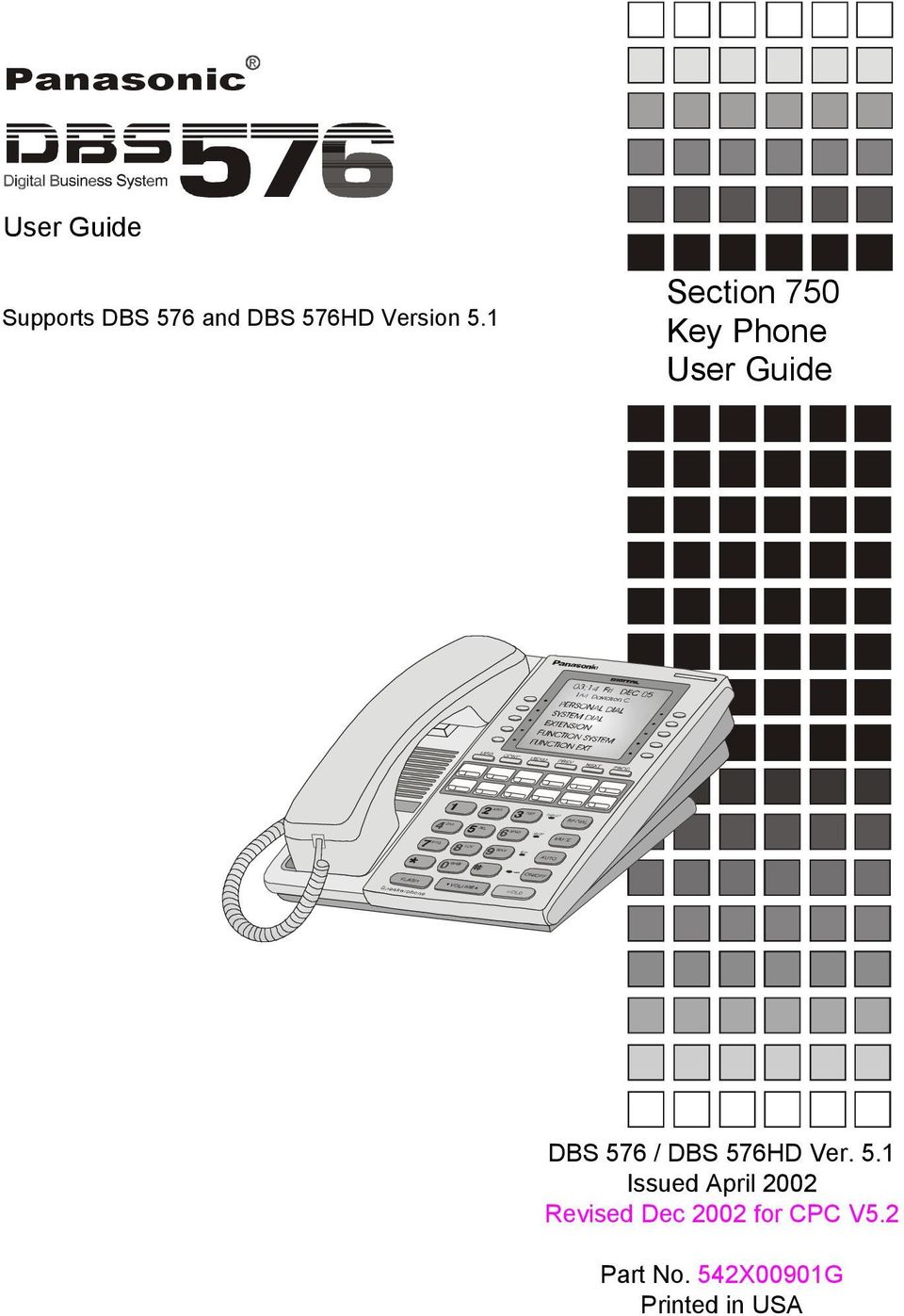
1 Panasonic a User Guide Supports DBS 576 and DBS 576HD Version 5.1 Section 750 Key Phone User Guide DBS 576 / DBS 576HD Ver. 5.1 Issued April 2002 Revised Dec 2002 for CPC V5.2 Part No. 542X00901G Printed in USA
2 The contents of this manual are subject to change without notice and do not constitute a commitment on the part of Panasonic Digital Communications & Security Company (PDCS). Every effort has been made to ensure the accuracy of this document. However, due to ongoing product improvements and revisions, Panasonic cannot guarantee the accuracy of printed material after the date of publication nor can it accept responsibility for errors or omissions. Panasonic will update and revise this document as needed. The software and hardware described in this document may be used or copied only in accordance with the terms of the license pertaining to said software or hardware. Reproduction, publication, or duplication of this manual, or any part thereof, in any manner, mechanically electronically, or photographically is prohibited without permission of the Panasonic Digital Communications & Security Company (PDCS). Copyright 2002 by Panasonic Digital Communications & Security Company (PDCS). All rights reserved.
3 Contents Preface... 7 How to Use This Manual... 7 What This Manual Contains... 7 Notation Used... 8 For More Information... 8 Understanding Your Phone... 9 Non-Display Phones... 9 Small-Display Phones Changing the Default Display Understanding Display Information Using Variable Mode Large-Display Phones Changing the Default Display Understanding Display Information Setting Up Your Phone Adjusting Volume and Display Settings Setting Up Flexible Function Keys Setting Up One-touch Keys Setting Up Speed Dialing Assigning and Deleting PSD Numbers Assigning SSD Numbers Linking System Speed Dial Numbers Assigning and Deleting Names for PSD Numbers Setting User Maintenance Functions About User Programming To Enter User Maintenance Mode: DBS 576 issued April

4 Placing Outside Calls Accessing an Outside Line Using Account Codes Non-verified Account Codes Verified Account Codes Redialing Outside Numbers Using Speed Dialing Dialing Speed Dial Numbers Checking Speed Dial Numbers Handling Incoming Calls Answering Calls Using Call Hold Transferring Calls Supervised Transfers Unsupervised Transfers Using Call Pickup Extension Group Pickup Extension Direct Pickup Trunk Group Pickup Trunk Direct Pickup Using Call Park Communicating Within Your Office Calling Other Extensions Switching Between Tone and Voice Calling Using Paging Answering a Page (Meet-Me Answer) Answering a Page with Universal Night Answer Making Announcements to Busy Extensions Answering an Announcement Transferring Calls with an Announcement DBS 576 issued April

5 Using Call Forwarding Using Camp-on (Call Waiting) Using Message Waiting/Callback Using Do-Not-Disturb Using Absence Messages Locking Your Extension Using Additional Features Using the Mute Key Using Off-Hook Monitor Using Handsfree Answerback and Handsfree Operation 80 Using Voice Recognition Using the Flash Feature Making Conference Calls Controlling Background Music Using Timed Reminders Using Caller ID Caller ID Call Log Call Log Operation for Small-display Phones Call Log Format for the Large-Display Phone Walking TRS Class of Service Directory Numbers Zip Mode Room Monitoring Silent monitor DBS 576 issued April
6 6 DBS 576 issued April

7 PREFACE The Key Telephone User Guide is for anyone who uses a Panasonic 44-Series digital telephone in conjunction with the Panasonic DBS 576. The DBS 576 and DBS 576HD are telephone systems that provides you with a powerful set of features for handling calls. This manual provides an overview of the following digital phones and offers detailed information about using the features provided by the DBS 576 and DBS 576HD: VB-44210A - 16 key standard phone VB-44220A - 22 key standard phone VB-44223A - 22 key small-display speakerphone VB key small-display speakerphone (voice recognition compatible) VB key large-display speakerphone VB key standard phone VB key small-display speakerphone HOW TO USE THIS MANUAL We recommend that you read the entire manual before using your digital phone, in order to get a clear idea of its capabilities. WHAT THIS MANUAL CONTAINS This manual contains the following chapters: Chapter 1, Understanding Your Phone - Describes features of Panasonic digital telephones. Chapter 2, Setting Up Your Phone - Provides procedures for setting up telephone features such as Flexible Function (FF) keys. Chapter 3, Placing Outside Calls - Provides procedures for making outside calls. Chapter 4, Handling Incoming Calls - Provides several procedures for answering calls. Chapter 5, Communicating Within Your Office - Provides procedures for handling internal calls. Chapter 6, Using Additional Features - Provides procedures for using additional features. Appendix A, Dial Code List. - Provides a list of dial codes used for programming FF keys DBS 576 issued April
8 Preface Appendix B, Customized PSD Bin Numbers. - Provides a table for documenting or tracking your personalized list of speed dial numbers. NOTATION USED This user guide uses the following conventions: References to chapters and sections are enclosed in quotation marks and include the title and page number. For example: Setting Up Flexible Function Keys on page 22. References to information you are to enter or dial are printed in boldface, mixed-case characters. For example: Enter 73*. References to the telephone keypad are printed in bold, uppercase characters. For example: Press the HOLD key. FOR MORE INFORMATION For more information about features available with the Panasonic DBS 576 and DBS 576HD system and digital phones, contact your system administrator or dealer, or refer to the Panasonic publication Section 700: Feature Operation. 8 DBS 576 issued April

9 1. UNDERSTANDING YOUR PHONE The following information in this chapter will familiarize you with your Panasonic digital phone and enable you to effectively use its call-handling features: Non-Display Phones (page 9) Small-Display Phones (page 11) Large-Display Phones (page 15) Using Variable Mode (page 14) Changing the Default Display (pages 13 and 17) Understanding Display Information (pages 13 and 18). NON-DISPLAY PHONES Non-display phones do not have a Liquid Crystal Display (LCD). Table 1 on page 10 describes the features (1-18 below) that are typical of non-display phones. Figure 1. Non-display phone PROG CONF DIGITAL BUSINESS SYSTEM * OPER DBS 576 issued April

10 1. Understanding Your Phone Table 1. Non-display phone features # Feature Description 1 Message Waiting Indicator Indicates that you have a message. 2 PROG Key Used to program Flexible Function (FF) and onetouch keys, to adjust ringer volume, and to send a flash signal. Depending on the setup of your system, may also be used to transfer calls CONF Key One-Touch Keys Flexible Function (FF) Keys DND/CF Indicator MUTE Indicator EXT Indicator ON/OFF Indicator REDIAL Key MUTE Key AUTO Key ON/OFF Key FLASH Key VOLUME Key HOLD Key Microphone Speaker Used to establish conference calls and to check FF key and one-touch features. Used to make outside calls or to access system features. Used to access outside lines or to access system features. Indicates that Do-Not-Disturb (DND) or Call Forwarding is set. Indicates that your voice is muted (i.e., party on the other end cannot hear you). Lights solid when your hands-free microphone is muted and flashes when your handset is muted. Lights when you are on a call and flashes when you hold a call. Lights when the ON/OFF key has been pressed. Used to redial the last number dialed. Used to activate/deactivate the Mute function. When activated, the party on the other end cannot hear you. (See item 7, MUTE Indicator.) Used to access speed dialing or enter account codes. Used to make a call without lifting the handset or to turn the speaker on and off. Used to end an outside call and to either restore outside dial tone or switch to external dial tone status without hanging up the receiver. Used to adjust the level of tones, background music, ringing, receiver volume, and display contrast. Used to hold calls, to retrieve held calls, and to complete FF key programming. Used to talk to another party without using the handset. Outputs tones and voice at your extension. 10 DBS 576 issued April

11 1. Understanding Your Phone SMALL-DISPLAY PHONES Small-display phones have a display containing two lines of text. Table 2 on page 11 describes the features (1-22 below) that are typical of small-display phones. Figure 2. Small-display phone 08:24 Tue NOV Sandy PROG CONF DIGITAL BUSINESS SYSTEM * OPER Table 2. Small-display phone features # Feature Description Message Waiting Indicator Display MODE Key END Key Indicates that you have a message. Displays information about the phone s status, menus, and dialing directories. Used to change display modes from Default Mode to Speed Dial Mode or Extension Directory Mode. Used to exit Directory Mode and return the display to Default Mode DBS 576 issued April

12 1. Understanding Your Phone # Feature Description 5 6 Soft Keys PROG Key Used to select speed dial directories or numbers. Used to program Flexible Function (FF) and onetouch keys, to adjust ringer volume, and to send a flash signal. Depending on the setup of your system, may also be used to transfer calls CONF Key One-Touch Keys Flexible Function (FF) Keys DND/CF Indicator MUTE Indicator EXT Indicator ON/OFF Indicator REDIAL Key MUTE Key AUTO Key ON/OFF Key FLASH Key VOLUME Key HOLD Key Microphone Speaker Used to establish conference calls and to check FF key and one-touch features. Used to make outside calls or to access system features. Used to access outside lines or to access system features. Indicates that Do-Not-Disturb (DND) or Call Forwarding is set. Indicates that your voice is muted (i.e., party on the other end cannot hear you). Lights solid when your hands-free microphone is muted and flashes when your handset is muted. Lights when you are on a call and flashes when you hold a call. Lights when the ON/OFF key has been pressed. Used to redial the last number dialed. Used to activate/deactivate the Mute function. When activated, the party on the other end cannot hear you. (See item 11, MUTE Indicator.) Used to access speed dialing or enter account codes. Used to make a call without lifting the handset or to turn the speaker on and off. Used to end an outside call and to either restore outside dial tone or switch to external dial tone status without hanging up the receiver. Used to adjust the level of tones, background music, ringing, receiver volume, and display contrast. Used to hold calls, to retrieve held calls, and to complete FF key programming. Used to talk to another party without using the handset. Outputs tones and voice at your extension. Note: * and # keys are used to scroll through SSD s, PSD s, and extensions. 12 DBS 576 issued April

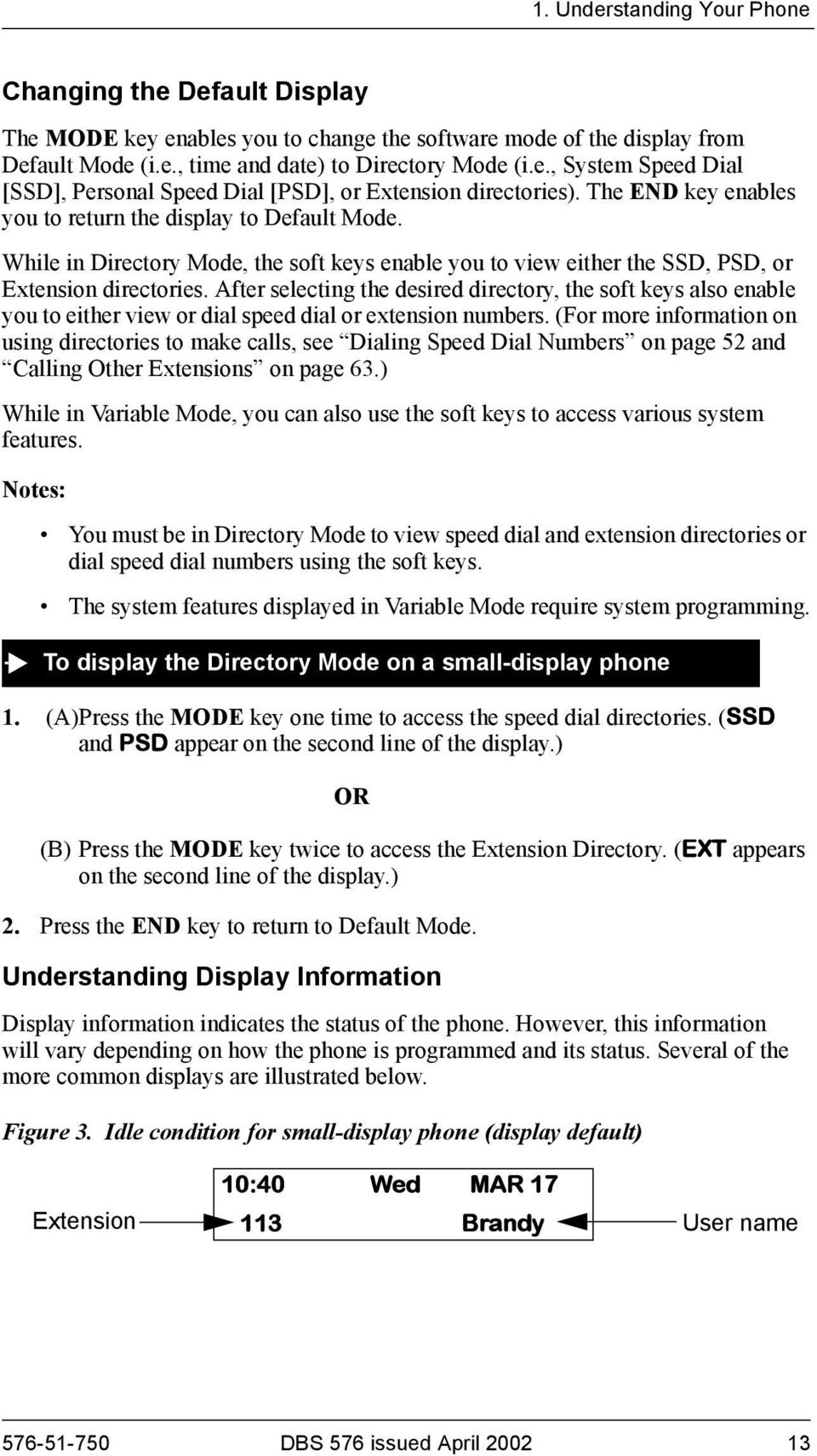
13 1. Understanding Your Phone Changing the Default Display The MODE key enables you to change the software mode of the display from Default Mode (i.e., time and date) to Directory Mode (i.e., System Speed Dial [SSD], Personal Speed Dial [PSD], or Extension directories). The END key enables you to return the display to Default Mode. While in Directory Mode, the soft keys enable you to view either the SSD, PSD, or Extension directories. After selecting the desired directory, the soft keys also enable you to either view or dial speed dial or extension numbers. (For more information on using directories to make calls, see Dialing Speed Dial Numbers on page 52 and Calling Other Extensions on page 63.) While in Variable Mode, you can also use the soft keys to access various system features. Notes: You must be in Directory Mode to view speed dial and extension directories or dial speed dial numbers using the soft keys. The system features displayed in Variable Mode require system programming. To display the Directory Mode on a small-display phone 1. (A)Press the MODE key one time to access the speed dial directories. (SSD and PSD appear on the second line of the display.) OR (B) Press the MODE key twice to access the Extension Directory. (EXT appears on the second line of the display.) 2. Press the END key to return to Default Mode. Understanding Display Information Display information indicates the status of the phone. However, this information will vary depending on how the phone is programmed and its status. Several of the more common displays are illustrated below. Figure 3. Idle condition for small-display phone (display default) Extension 10:40 Wed MAR Brandy User name DBS 576 issued April
14 1. Understanding Your Phone Figure 4. Messages received for small-display phone Number of messages 10:40 Wed MAR 17 MSG Carter Person that left the first message Figure 5. Reminder alarm for small-display phone Alarm time 10:40 Wed MAR 17 Alarm 12:30PM Alarm indicator Figure 6. Incoming outside call for small-display phone Incoming outside call INCM CO # Brandy Outside line number Figure 7. Outside call in progress for small-display phone Outside call in progress On Line Brandy Call duration Figure 8. Internal calling in use for small-display phone Intercom call Talk Greg 113 Brandy Called party Using Variable Mode Using Variable Mode allows you to use the soft keys to access programmed system features when your phone is in the following states: During an intercom call During a CO dial tone During a trunk call After dialing a busy extension. To activate Variable Mode on a small-display phone 1. Lift the handset or press the ON/OFF key. 14 DBS 576 issued April

15 1. Understanding Your Phone 2. Press the Variable Mode Key. 3. Replace the handset or press the ON/OFF key. To use Variable Mode on a small-display phone 1. After turning Variable Mode on, the display will reflect the programmed features during an intercom call, CO dial tone, trunk call, or after dialing a busy extension. 2. Press the > or < key next to the desired feature. LARGE-DISPLAY PHONES Large-display phones are distinguished by their large-displays. Table 3 on page 16 describes the features (1-23 below) that are typical of large-display phones. Figure 9. Large-display phone MSG 5 02:28 Thu N O V Langford S 2 PERSONAL DIAL SYSTEM DIAL EXTENSION FUNCTIO N SYSTEM FUNCTION EXT CONF MENU PREV NEXT PROG * GHI PRS ABC JK L TUV OPER DEF MNO WXY DND/CF MUTE EXT REDIAL MUTE AUTO ON/OFF FLASH VOLUM E HOLD Speakerphone DBS 576 issued April

16 1. Understanding Your Phone Table 3. Large-display phone features # Feature Description 1 Message Waiting Indicator Indicates that you have a message Display Soft Keys MSG Key CONF Key MENU Key PREV Key NEXT Key PROG Key Flexible Function (FF) Keys DND/CF Indicator MUTE Indicator EXT Indicator ON/OFF Indicator REDIAL Key MUTE Key AUTO Key Displays information about the phone s status, menus, and dialing directories. Used to select menus, directories, speed dial numbers, and to access call-handling features. Used for Auto-CallBack to a telephone which has left a text message or to access voice messages. Used to establish conference calls and to check Flexible Function (FF) and one-touch key settings. Used to return to the default Main Menu screen which contains the following items: Personal Dial System Dial Extension Function System Function Ext Used to return to the previous screen. Used to advance to the next screen. Used to program FF and one-touch keys, to adjust ringer volume and to send a flash signal. Depending on the setup of your system, may also be used to transfer calls. Used to access outside lines or to access system features. Indicates that Do-Not-Disturb (DND) or Call Forwarding is set. Indicates that your voice is muted (i.e., party on the other end cannot hear you). Lights solid when your hands-free microphone is muted and flashes when your handset is muted. Lights when you are on a call and flashes when you hold a call. Lights when the ON/OFF key has been pressed. Used to redial the last number dialed. Used to activate/deactivate the Mute function. When activated, the party on the other end cannot hear you. (See item 12, MUTE Indicator.) Used to access speed dialing or enter account codes. 16 DBS 576 issued April
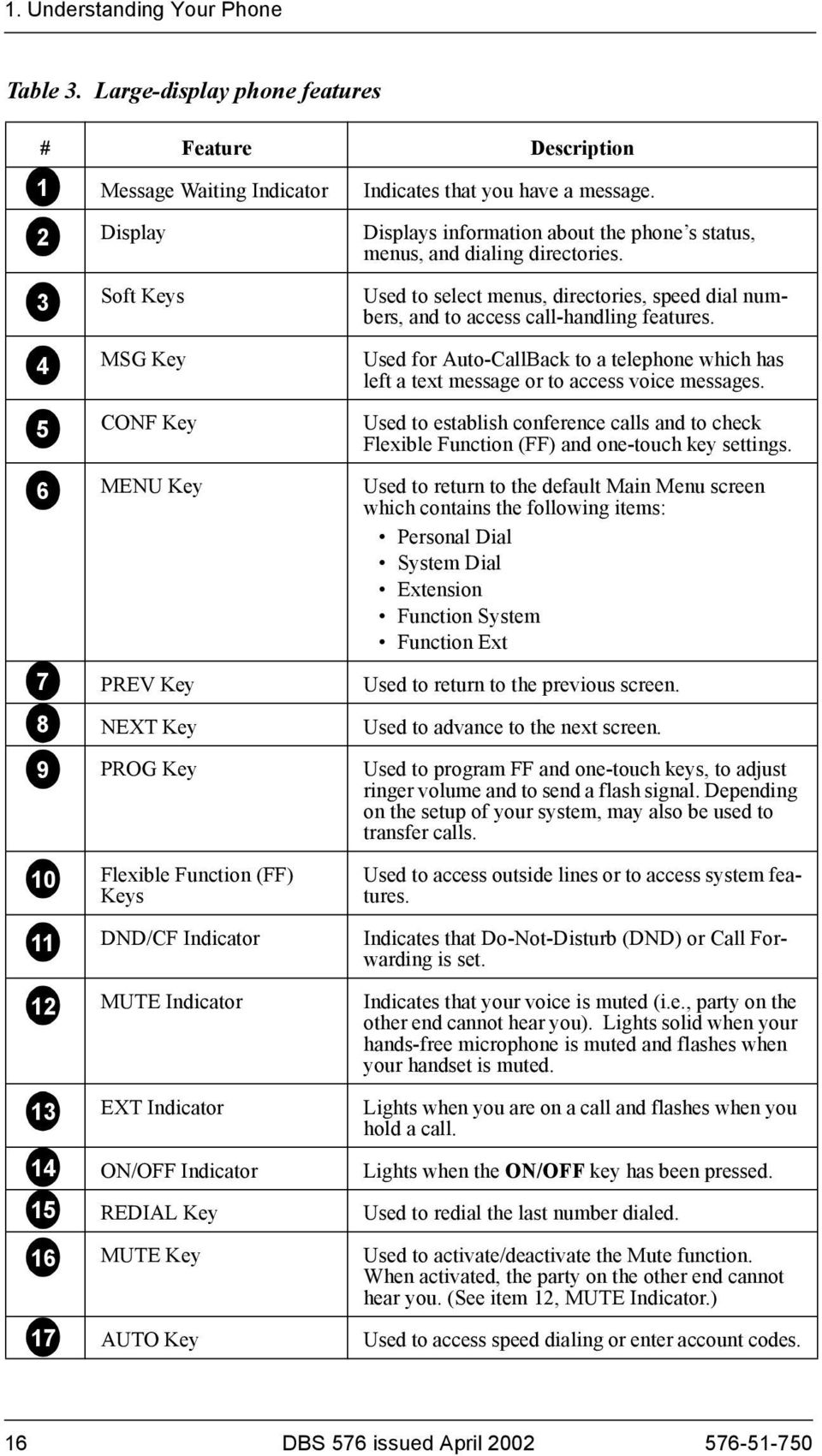
17 1. Understanding Your Phone # Feature Description ON/OFF Key FLASH Key VOLUME Key HOLD Key Microphone Speaker Used to make a call without lifting the handset or to turn the speaker on and off. Used to end an outside call and to either restore outside dial tone or switch to external dial tone status without hanging up the receiver. Used to adjust level of tones, background music, ringing, receiver volume, and display contrast. Used to hold calls, to retrieve held calls, and to complete FF key programming. Used to talk to another party without using the handset. Outputs tones and voice at your extension. Changing the Default Display The ten soft keys located alongside the display on a large-display phone allow you to change the software mode of the display. Instead of displaying the Main Menu (Default Mode) for instance, you can set your phone to display one of the following directories or menus: Personal Dial - Allows you to program, view, or dial PSD numbers using the soft keys. System Dial - Allows you to view or dial SSD numbers using the soft keys. Extension - Allows you to view or dial other extensions using the soft keys. Function System - Allows you to access most key telephone features, such as Call Forwarding, Do-Not-Disturb (DND), Microphone Mute, Background Music, Call Pickup, Account Codes, etc. Function Extension - Allows you to assign frequently used phone features for easy access. Most items found under the Function System Menu can be assigned to the Function Extension Menu in any order you desire. To display a directory or menu on a large-display phone 1. Press the soft key to the left of the desired directory or menu. (The selected directory or menu of feature displays.) 2. Press the MENU key to return to the Main Menu. Note: Menus are programmable or customizable per extension. Therefore, the actual menu that displays depends on your system configuration DBS 576 issued April

18 1. Understanding Your Phone Understanding Display Information Display information indicates the status of the phone. However, this information will vary depending on how the phone is programmed and its status. Several of the more common displays are illustrated below. Figure 10. Idle condition for large-display phone (display default) Extension 10:40 Wed MAR Brandy PERSONAL DIAL SYSTEM DIAL EXTENSION FUNCTION SYSTEM FUNCTION EXT User name Figure 11. Messages received for large-display phone Number of messages 10:40 Wed MAR 17 MSG Carter PERSONAL DIAL SYSTEM DIAL EXTENSION FUNCTION SYSTEM FUNCTION EXT Person that left the first message Figure 12. Reminder alarm for large-display phone Alarm time 10:40 Wed MAR 17 Alarm 12:30PM PERSONAL DIAL SYSTEM DIAL EXTENSION FUNCTION SYSTEM FUNCTION EXT Alarm indicator 18 DBS 576 issued April

19 1. Understanding Your Phone Figure 13. Incoming outside call for large-display phone Incoming outside call INCM CO # Brandy PERSONAL DIAL SYSTEM DIAL EXTENSION FUNCTION SYSTEM FUNCTION EXT Outside line number Figure 14. Outside call in progress for large-display phone Outside call in progress On Line Brandy PERSONAL DIAL SYSTEM DIAL EXTENSION FUNCTION SYSTEM FUNCTION EXT Call duration Figure 15. Intercom calling in use for large-display phone Intercom call Talk Greg 113 Brandy PERSONAL DIAL SYSTEM DIAL EXTENSION FUNCTION SYSTEM FUNCTION EXT Called party DBS 576 issued April

20 1. Understanding Your Phone This page intentionally left blank. 20 DBS 576 issued April

21 2. SETTING UP YOUR PHONE You can use the procedures in this chapter to customize your phone for the following: Adjusting Volume and Display Settings (page 21) Setting Up Flexible Function Keys (page 22) Setting Up One-touch Keys (page 23) Setting Up Speed Dialing (page 25) Assigning and Deleting Personal Speed Dial (PSD) Numbers (page 25) Linking System Speed Dial Numbers (page 28) Assigning and Deleting Names for PSD Numbers (page 29) Setting User Maintenance Functions (page 33) ADJUSTING VOLUME AND DISPLAY SETTINGS You can adjust the volume or display of the following by pressing the VOLUME key: Intercom and incoming ringer Handset Speaker Display contrast of your phone. To adjust the volume of your phone while it is in use 1. Press the VOLUME key: a. During ringing to adjust the intercom or incoming ring tone. b. During a call to adjust the handset or speaker volume. To adjust the ringer volume of your phone while it is idle 1. Press the ON/OFF key. 2. Press the PROG key. 3. Enter 9, then 1 to adjust the incoming ring tone. (The phone produces a tone.) DBS 576 issued April
22 2. Setting Up Your Phone OR Enter 9, then 2 to adjust the intercom ring tone. (The phone produces a tone.) 4. Press the VOLUME key. 5. Press the ON/OFF key. To adjust the display contrast of your phone Note: This task requires a display phone. 1. While the phone is idle, press the # key. 2. Press the VOLUME key several times as needed. SETTING UP FLEXIBLE FUNCTION KEYS You can set up Flexible Function (FF) keys to initiate system features or to assign specific extension numbers. Note: You cannot set up FF keys that are dedicated to outside lines. Contact your system administrator or DBS 576 and DBS 576HD dealer to make changes to dedicated FF keys. To set up FF keys 1. Pickup the handset or press the ON/OFF key. 2. Press the PROG key. 3. Press the FF key to be programmed. 4. Do one of the following: If... Then... You want one-key assess to a certain feature: Notes: You must enter a dial code when assigning features. (See Appendix A, Dial Code List on page 93.) Not all dial codes can be stored in FF keys **You want one-key access to a specific extension number, plus the ability to pick up the extension s calls and know when the extension is busy. a. For a fixed dial code, press the REDIAL key. For a flexible dial code, proceed to step b. b. Enter one of the dial codes listed in Appendix A, Dial Code List on page 93. Enter the extension number. 22 DBS 576 issued April
23 2. Setting Up Your Phone 5. Press the HOLD key. 6. Repeat steps 2-5 to program additional keys. 7. Replace the handset or press the ON/OFF key. 1. Pick up the handset or press the ON/OFF key. 2. Press the PROG key. 3. Press the desired FF key. 4. Press the HOLD key. If... Then... **If you assign an extension number to an FF key, the FF key will light red when the extension is busy. It will light green when Do-Not-Disturb (DND) or Call Forwarding is set. In addition, you can pick up a call that is ringing or on hold at the extension by simply pressing the FF key when it is flashing. To clear an FF key s programming 5. Replace the handset or press the ON/OFF key. To check the FF key s setup Note: This task requires a display phone. 1. Pick up the handset or press the ON/OFF key. 2. Press the CONF key. 3. Press the FF key. The assigned function appears on the display. 4. Replace the handset or press the ON/OFF key. SETTING UP ONE-TOUCH KEYS You can set up one-touch keys on a non-display or small-display phone to store phone numbers, speed dial numbers, or feature access codes. To program a one-touch key for an outside phone number 1. Pickup the handset or press the ON/OFF key. 2. Press the PROG key. 3. Press the one-touch key to be programmed DBS 576 issued April
24 2. Setting Up Your Phone 4. Dial the phone number to be stored. 5. Press the HOLD key. 6. Replace the handset or press the ON/OFF key. To assign an SSD number to a one-touch key 1. Pickup the handset or press the ON/OFF key. 2. Press the PROG key. 3. Press the one-touch key to be programmed. 4. Press the AUTO key. 5. Enter the SSD bin number to be programmed. 6. Press the HOLD key. 7. Replace the handset or press the ON/OFF key. To assign a feature code or extension number to a one-touch key Note: **When the system is set up for MCO Code level, one-touch keys automatically dial an outside line. (MCO Code level requires system programming.) 1. Pickup the handset or press the ON/OFF key. 2. Press the PROG key. 3. Press the one-touch key to be programmed. 4. **If the feature functions at the MCO Code level, press AUTO * #. 5. Enter the desired feature code or extension number. 6. Press the HOLD key. 7. Replace the handset or press the ON/OFF key. To check a programmed one-touch key Note: This task requires a display phone. 1. Pickup the handset or press the ON/OFF key. 2. Press the CONF key. 24 DBS 576 issued April
25 2. Setting Up Your Phone 3. Press the one-touch key to be checked. (Programmed data appears on the display.) 4. Replace the handset or press the ON/OFF key. SETTING UP SPEED DIALING You can set up the following speed dial features using your phone s one-touch or soft keys: Speed dial numbers Speed dial linking Speed dial names. Assigning and Deleting PSD Numbers You can assign frequently called numbers (or System Speed Dial [SSD] numbers) to your phone s one-touch or soft keys. These keys are preprogrammed to correspond to specific PSD codes or bins. You store your PSD numbers in these bins. When you press a one-touch or soft key containing a PSD number, the PSD bin associated with that key is accessed and the speed dial number is dialed. You can assign up to 10 PSD numbers to the one-touch keys on a non-display or small-display phone (PSD bins 80-89) and up to 20 PSD numbers to the soft keys on a large-display phone (PSD bins 80-99). When in the PSD Directory Mode, you can view the PSD bin numbers on the display. On a small-display phone, two bins are displayed at a time. To display the next two bins, press the # key. To display the previous two bins, press the * key. On a large-display phone, 10 PSD bins are displayed at a time. To display the next 10 bins, press the NEXT key. To display the previous 10 bins, press the PREV key. For a list of corresponding PSD bin numbers and one-touch or soft keys, see Figure 16 and Table 4 on page 26. Notes: On a small-display phone, you must be in the PSD Directory Mode to assign, access, or view numbers in PSD bins On a non-display phone, you access or assign numbers to PSD bins by pressing the AUTO key and entering the PSD bin number. (To review the PSD numbers on non-display phones, refer to your customized list of PSD numbers in Appendix B Customized PSD Bin Numbers on page 99.) Until you assign a name or string of characters to a PSD number, the PSD bin number will display when you press the one-touch or soft key. For more information, see Assigning and Deleting Names for PSD Numbers on page DBS 576 issued April
26 2. Setting Up Your Phone You can check PSD numbers or names that have been assigned to one-touch or soft keys. For more information, see Checking Speed Dial Numbers on page 54. Figure 16. One-touch and soft key numbering scheme PROG CONF Small-display phone one-touch keys :28 Thu NO V 14 Langford S 173 Large-display phone soft keys Table 4. Corresponding one-touch or soft keys and PSD bin numbers One-touch or soft key Corresponds to PSD bin on... etc Small-display and Large-display phone non-display phones or or or 92 To assign a PSD number to a one-touch or soft key Note: Before assigning PSD numbers, you must determine whether the system is set up for Intercom Level (programmed to dial an inside line) or MCO Code level (programmed to dial an outside line). Depending on the system set up, you must include the appropriate dialing code as part of the PSD number. To determine which code to use, see Table 5 on page Pick up the handset or press the ON/OFF key. 2. Either: Press the PROG key and then press the AUTO key. 26 DBS 576 issued April
27 2. Setting Up Your Phone OR Enter the Speed Dial Set/Clear code (default = 710). 3. Enter the PSD bin number (80-99). 4. Enter the phone number you want to be speed-dialed (maximum length = 16 characters). Remember to include the Intercom Level or MCO Code level code depending on how the system is set up. (Refer to the following table.) Table 5. Characters allowed when assigning PSD numbers To insert a... Enter/Press... Digit or character 0, 1-9, *, # Intercom Level* AUTO * # MCO Code** AUTO * 0 Pause REDIAL DP - DTMF Code AUTO * * SSD Code AUTO NN(N) Hyphen (-) (Appears when the number is dialed or PROG checked, but not during programming) Display Number (Start/Stop) *** AUTO * 2 DTMF Conversion After the Other Party Answers AUTO * 3 (Version 2.5 and higher) Hyphen (-) (Appears when the number is dialed or checked, but not during programming.) * Indicates that the digits that follow are either a feature access code or extension number. (Do not include if system is set for Intercom Level.) ** Indicates that the digits that follow are for an outside number. (Do not include if system is set for CO Level.) ** Indicates that the enclosed digits should not be displayed during dialing. Must precede and follow the digits that you do not want displayed. Example: AUTO* AUTO*2 5. Press the HOLD key. 6. Replace the handset or press the ON/OFF key. To delete a PSD number assigned to a one-touch or soft key Note: When deleting a PSD number from a non-display phone, be sure to record the change in your personalized list of PSD numbers. (See Appendix B, Customized PSD Bin Numbers on page 99.) DBS 576 issued April
28 2. Setting Up Your Phone 1. Pick up the handset or press the ON/OFF key. 2. Either: Press the PROG key and then press the AUTO key. OR Enter the Speed Dial Set/Clear code (default = 710). 3. Enter the PSD bin number (80-99). 4. Press the HOLD key. 5. Replace the handset or press the ON/OFF key. Assigning SSD Numbers Note: SSD numbers require system programming. SSD numbers are numbers that are frequently called by many different individuals at your location; such as a branch or corporate office, a package delivery service, or a travel agent. SSD numbers must be programmed from the attendant s phone. Once programmed, they are available for everyone to use. A maximum of 80 or 800 SSD numbers are allowed, depending on the system. In an 80 SSD number system, SSD numbers are stored in bins In an 800 SSD system, SSD numbers are stored in bins You dial SSD numbers by entering the appropriate bin number or by using one-touch or soft keys. For more information, see Dialing Speed Dial Numbers on page 52. Note: To dial an SSD number using the one-touch keys on a non-display or smalldisplay phone, you must first assign the SSD number to a PSD bin number. For more information, see Assigning and Deleting PSD Numbers on page 25. Linking System Speed Dial Numbers To handle phone numbers longer than 25 characters, you can link up to six SSD numbers in one PSD bin. You can then dial the entire number (each SSD number contained in the chain) by pressing the programmed PSD key or by entering the speed dial bin number. Notes: Before linking multiple SSD numbers to a PSD bin, the SSD bins must already have been programmed with the appropriate speed dial information. (This requires system programming.) If numbers do not appear on the display (00-79 or ) when you use SSD codes, your extension is not programmed to display that data. To link speed dial numbers to a PSD bin 28 DBS 576 issued April
29 2. Setting Up Your Phone 1. Pick up the handset or press the ON/OFF key. 2. Either: OR Press the PROG key and then press the AUTO key. Enter the Speed Dial Set/Clear code (default = 710). 3. Press the soft or one-touch key (for the PSD bin [80-99]) to be programmed. 4. Press the AUTO key. 5. Enter the SSD bin number that contains the first part of the number to be dialed. (If a pause is required, press the REDIAL key.) 6. Repeat steps 4-5 (up to 5 more times) for each remaining SSD number to be linked. 7. Press the HOLD key when you are finished. 8. Replace the handset or press the ON/OFF key. To use a PSD key that links multiple speed dial numbers 1. If necessary, select the trunk group (9, 81-84) to access an outside line. (Normally the trunk is selected by the speed dial numbers.) 2. Press the PSD key. Assigning and Deleting Names for PSD Numbers After assigning a PSD number to a one-touch or soft key, you can assign a name to the key (e.g., Home, John, etc.). You can then view the assigned PSD name when you are in the PSD Directory mode. Note: You need to know the PSD bin number for PSD number in order to assign a name to it. To determine the bin number, see Checking Speed Dial Numbers on page 54. To assign a name to a PSD number Note: This task requires a display phone. 1. Pick up the handset or press the ON/OFF key. 2. Press the PROG key. 3. Press the * key DBS 576 issued April
30 2. Setting Up Your Phone 4. Enter 0 for the Name Assignment mode. 5. Press the VOLUME key until the desired PSD bin number (80-99) is displayed. 6. Press the FLASH key to clear the current/default data. 7. (A) For a small-display phone (see Figure 17 on page 31 for an example): a. Press the appropriate one-touch key for the desired group of letters. b. Use the bottom row of FF keys to define your selection. c. Repeat steps a-b as many times as necessary to enter the desired name. Press the * key to erase an entry. Press the # key to enter a space. (B) For a large-display phone (see Figure 18 on page 32 for an example): a. Press the appropriate soft key next to the desired row of letters. b. Use the bottom row of FF keys to define your selection. c. Repeat steps a-b as many times as necessary to enter the desired name. Press the * key to erase an entry. Press the # key to enter a space. 8. Press the HOLD key when the name is complete. 9. To enter another speed dial name, repeat steps Hang up or press ON/OFF. 30 DBS 576 issued April
31 2. Setting Up Your Phone Figure 17. Name assignment example - small-display phone To enter a D: a Press the first one-touch key from the left on the bottom row. b Press the fourth FF key from the left on the bottom row. To enter an o: c d Press the third one-touch key from the left on the top row. Press the third FF key from the left on the bottom row. a-f g-l m-r s-x y-sp a b c d e f g h i j k l m n o p q r s t u v w x y z : & / sp A-F G-L M-R S-X Y- - A B C D E F G H I J K L M N O P Q R S T U V W X Y Z., - a c d b DBS 576 issued April
32 2. Setting Up Your Phone Figure 18. Name assignment example - large-display phone To enter a D: a Press the first soft key on the top left. b Press the fourth FF key from the left on the bottom row. To enter an o: c Press the third soft key from the top right. d Press the third FF key from the left on the bottom row. a ABC D EF abcdef 3 G H IJKL MNOPQR STUVW X Y Z.,'- ghijkl mnopqr stuvwx y z :& /sp MSG CONF MENU PREV NEXT PROG d b 32 DBS 576 issued April
33 2. Setting Up Your Phone To delete a name assigned to a PSD number Notes: This task requires a display phone. You need to know the PSD bin number for the PSD number in order to delete an assigned name. To check the bin number for a key, see Checking Speed Dial Numbers on page Pick up the handset or press the ON/OFF key. 2. Press the PROG key. 3. Press the * key. 4. Enter 0 for the Name Assignment mode. 5. Press the VOLUME key until the desired PSD bin number (80-99) is displayed. 6. Press the FLASH key to clear the current/default data. 7. Press the HOLD key. Notes: It is strongly recommended that you assign the PSD bin number as a name for the key at this point so that it will appear on the display for future use. The bin number should be entered in the following format: -PSDxx (or xxx) where xx or xxx = the actual bin number. Example: -PSD901. For more information, see Assigning and Deleting Names for PSD Numbers on page 29. If using a large-display phone, press the MENU key, then the key to the left of PERSONAL DIAL to have the change reflected on the display. SETTING USER MAINTENANCE FUNCTIONS You have the option of adjusting several User Maintenance functions. The telephone system dealer is not required to make these changes. These items include settings for: Date and Time - including date, time, and day of week Personal Speed Dial (PSD) Assignment - including PSD number and name System Speed Dial (SSD) Assignment - including SSD number and name Extension name Verified Account code DBS 576 issued April
34 2. Setting Up Your Phone Call Forward ID code Message Key ID code Walking Toll Restriction Service (TRS) Code TRF of CFID CID Logging Ext Send Text Messages Text Message Replies Absence Messages System mode. You can set the System to handle incoming calls, outbound call routing, and built-in voice mail call messages differently depending upon whether the system is in Day mode, Day 2 mode, or Night mode. With User Maintenance, you can program the System for mode schedule, mode schedule for special day, mode schedule for exception days, and day of the month patterns. About User Programming User Maintenance requires a Digital Display Key Telephone assigned to a Class of Service (COS) that allows User Maintenance. The procedures in the following sections describe the basic steps used for modifying parameters. However, there are many alternative ways to view and modify the parameters using special keys and procedures. Some of the more advanced keys include: REDIAL FLASH ON/OFF HOLD PROG CONF AUTO Menu PREV NEXT VOLUME (t) VOLUME (s) (At menu level) clears an entry (At data entry) retrieves the last entry setting (At menu level) ignored (At data entry) clears setting Begins programming log-in or exits programming (At menu level) moves to date and time (At data entry) saves the displayed setting and moves to the next setting Moves to the 81 User Maintenance Menu Moves to the first data setting Backs out of the address menu levels Ignored (At menu level) moves to the previous screen (At data entry) ignored (At menu level) moves to the next screen (At data entry) ignored Scrolls through the same address level (ascending) Scrolls through the same address level (descending) 34 DBS 576 issued April
35 2. Setting Up Your Phone FF1 Moves to Personal Speed Dial (PSD) Assignment menu FF2 Moves to System Speed Dial (SSD) Assignment menu FF3 Moves to Extension Name menu FF4 Moves to Verified ID Code menu FF5 Moves to Call Forward ID Code menu FF6 Moves to Message Key ID Code menu FF7 Moves to System Mode menu FF8 Moves to Walking /Station Lock TRS FF9 Moves to TRF of CWRD FF10 Moves to CID Logging Ext. Once in a data entry level, you must either enter an acceptable value or restore the previous value before proceeding. For instance, if you change an entry to an unacceptable value and then press FF1 to move to the PSD Assignment menu, you will not be able to proceed. You must first enter an acceptable value. See Section Feature Operations for additional information on Maintenance Mode. To Enter User Maintenance Mode: 1. Press the ON/OFF key on a telephone with a COS that allows user login. 2. Press the PROG key. 3. Press the * key twice. 4. Press the CONF key. Note: Your extension s Class of Service must be properly set to allow User Maintenance access. Also, only one user may enter User Maintenance or System Programming at a time. Absence Messages To create Absence Messages using either a large-display or small-display phone: 1. Enter User Maintenance by pressing: ON/OFF PROG * * CONF 2. Enter: 12 and press HOLD HOLD. 3. Enter: Message Number (0-9). 4. Enter: Absence Message (up to 15 characters): 5. If using a large-display phone, press the soft key next to the desired row of letters. 6. If using a small-display phone press the appropriate one-touch key. Note: Press the FLASH key to clear any existing data DBS 576 issued April
36 2. Setting Up Your Phone 7. Use the bottom row of FF keys to select a single letter. Notes: Press the * key to erase a single entry. Press the # key to enter a space. 8. Repeat steps 4-5 as many times as necessary to enter the desired Absence Message and press HOLD to store the entry. Note: Press the FLASH key to clear any existing data. 9. To set additional Absence Messages, press the VOLUME up or down key or press HOLD to move to the desired Send Text Message. 10. Repeat steps 4-7 until all Absence Messages are entered. 11. Press AUTO PROG to return to 81-User Maintenance (step 1 above). OR... Press AUTO ON/OFF to exit User Maintenance. Account Codes To create Verified Account Codes using either a largedisplay or small-display phone: 1. Enter User Maintenance by pressing ON/OFF PROG * * CONF. 2. Enter: 04 and press HOLD HOLD. 3. Enter: Verified Account Table Number and press HOLD HOLD. 4. Enter: Account Code - up to 10 digits, press HOLD, enter: TRS Class No. 1-50, and press HOLD. 5. Press the VOLUME up or down arrow or HOLD to toggle through the entry nos. for adding another Account Code. 6. Repeat steps 4-5 above until all account numbers are entered. 7. Press AUTO PROG to return to 81-User Maintenance (step 1 above). OR... Press AUTO ON/OFF to exit User Maintenance. 36 DBS 576 issued April
37 2. Setting Up Your Phone Call Forwarding To set or assign Call Forward Busy Destination for an extension using either a large-display or small-display phone: 1. Enter User Maintenance by pressing: ON/OFF PROG * * CONF 2. Enter: 09, press HOLD, enter: 0 and press HOLD. 3. Dial the Extension Number and press HOLD. 4. Enter: Destination Extension. 5. Press HOLD to store the entry. 6. To set Call Forward Busy destinations for additional extensions, press the VOLUME up or down arrow or HOLD to move to the desired Extension. 7. Repeat steps 5-6 until all extension are entered. 8. Press AUTO PROG to return to 81 - User Maintenance (step 1 above) OR... Press AUTO ON/OFF to exit User Maintenance. To set or assign Call Forward - No Answer Destination for an extension using either a large-display or small-display phone: 1. Enter User Maintenance by pressing ON/OFF PROG * * CONF 2. Enter: 09, press HOLD, enter: 1, and press HOLD. 3. Dial the Extension Number and press HOLD. 4. Dial the Destination Extension. 5. Press HOLD to store the entry. 6. To set Call Forwarding - No Answer destinations for additional extensions, press the VOLUME up or down arrow or HOLD to move to the desired Extension. 7. Repeat steps 5-6 until all extensions are entered. 8. Press AUTO PROG to return to 81 - User Maintenance (step 1 above) OR... Press AUTO ON/OFF to exit User Maintenance DBS 576 issued April
38 2. Setting Up Your Phone Caller ID Call Log To set or assign Caller ID Logging for an extension using either a large-display or small-display phone: 1. Enter User Maintenance by pressing: ON/OFF PROG * * CONF 2. Enter: 10, press HOLD HOLD, and enter: Log Control Number. 3. Press HOLD, dial the Extension Number, and press HOLD to store the entry. 4. To set CID Log for additional extensions, press the VOLUME up or down arrow or HOLD to move to the desired extension. 5. Repeat step 3 until all extensions are entered. 6. Press AUTO PROG to return to 81-User Maintenance (step 1 above). OR... Press AUTO ON/OFF to exit User Maintenance. Day/Night System Mode To set the Day of Week modes using either a large-display or small-display phone: 1. Enter User Maintenance by pressing: ON/OFF PROG * * CONF 2. Enter: 07, press HOLD, enter: 3, and press HOLD HOLD. 3. Enter pattern: (0 - no pattern, 1 - pattern 1, 2 - pattern 2, 3 - pattern 3) for the first Sunday and press HOLD to store the entry. Note: To clear an entry or existing data, press the FLASH key. 4. To set additional Day of Week modes, press the VOLUME up or down arrow or HOLD to move to the desired mode. 5. Repeat steps 4-5 until the remaining days in the month are set. Note: Entry positions are listed in Section Feature Operations. 6. Press AUTO PROG to return to 81-User Maintenance (step 1 above). OR... Press AUTO ON/OFF to exit User Maintenance. 38 DBS 576 issued April
39 2. Setting Up Your Phone To set the Exception Day Modes using either a largedisplay or small-display phone: 1. Enter User Maintenance by pressing: ON/OFF PROG * * CONF 2. Enter: 07, press HOLD, enter: 2, and press HOLD HOLD. 3. Enter: Start Date by Month - two characters and Day - two characters for Exception Period 1 and press HOLD to store the entry. Note: To clear an entry or existing data, press the FLASH key. 4. To set additional Exception Day modes, press the VOLUME up or down arrow or HOLD to move to the desired mode. 5. Repeat steps 4-5 until the remaining days in the month are set. 6. Press AUTO PROG to return to 81-User Maintenance (step 1 above). OR... Press AUTO ON/OFF to exit User Maintenance. To set the Mode Schedule using either a large-display or small-display phone: 1. Enter User Maintenance by pressing: ON/OFF PROG * * CONF 2. Enter: 07, and press HOLD HOLD HOLD. 3. Enter: Start Time in Hours (two characters) and Minutes (two characters) for Pattern 1 - first mode and press HOLD. Notes: To clear an entry or existing data, press the FLASH key. 4. Enter: Desired Mode for Pattern 1 - first (0 - None, 1 - Day 1, 2 - Day 2, 3 - Night, 4 - Night 1, 5 - Night 2) and press HOLD to store the entry. Note: To clear an entry or existing data, press the FLASH key. 5. To set additional mode schedules, press the VOLUME up or down arrow or HOLD to move to the desired mode. 6. Repeat steps 3-5 until all patterns and modes are set. (There are 3 total patterns with 5 start time/modes each.) Note: Entry Positions are listed in Chapter 4 of Section Feature Operations. 7. Press AUTO PROG to return to 81-User Maintenance (step 1 above). OR... Press AUTO ON/OFF to exit User Maintenance DBS 576 issued April
40 2. Setting Up Your Phone To set the Special Day Modes using either a large-display or small-display phone: 1. Enter User Maintenance by pressing: ON/OFF PROG * * CONF 2. Enter: 07, press HOLD, enter: 1, and press HOLD HOLD. 3. Enter: Start Time in Hours - 2 characters, and Minutes - 2 characters for the Special Day 1 mode and press HOLD to store the entry. Note: To clear an entry or existing data, press the FLASH key. 4. Enter: Desired mode for Special Day: 0 - None, 1 - Day 1, 2 - Day 2, 3 - Night, 4 Night 1, 5 - Night 2 and press HOLD to store the entry. Note: To clear an entry or existing data, press the FLASH key 5. To set additional Special Day modes, press the VOLUME up or down arrow or HOLD to move to the desired mode. 6. Repeat steps 3-5 until all Special Day modes are set. (Up to 20 Special Days may be entered.). Note: The entry positions are listed in Chapter 4 of Section Feature Operations. 7. Press AUTO PROG to return to 81-User Maintenance (step 1 above). OR... Press AUTO ON/OFF to exit User Maintenance. Message Key To set the Message Key ID code using either a largedisplay or small-display phone: 1. Enter User Maintenance by pressing: ON/OFF PROG * * CONF 2. Enter: 06 and press HOLD HOLD. 3. Dial the Extension Number of the Phone Being Programmed and press HOLD. 4. Enter: Message Key ID Code and press HOLD to store the entry. Note: The ID code may contain up to 16 digits and contain 0, 1-9, *, #, pause (REDIAL key). To clear an entry or existing data, press the FLASH key. 40 DBS 576 issued April
41 2. Setting Up Your Phone 5. To set additional Message Key ID codes, press the VOLUME up or down arrow or HOLD to move to the desired extension. 6. Repeat steps 4-5 until all Message Key ID codes are set. 7. Press AUTO PROG to return to 81-User Maintenance (step 1 above). OR... Press AUTO ON/OFF to exit User Maintenance. Name Assignments To set extension names using either a large-display or small-display phone: 1. Enter User Maintenance by pressing ON/OFF PROG * * CONF 2. Enter: 03 and press HOLD HOLD HOLD. 3. Dial the Extension Number and press HOLD. 4. Enter: Extension Name: If using a large-display phone, press the soft key next to the desired row of letters. If using a small-display phone press the appropriate one-touch key. Note: Press the FLASH key to clear any existing data 5. Use the bottom row of FF keys to select a single letter. Notes: Press the * key to erase a single entry. Press the # key to enter a space. 6. Repeat steps 4-5 as many times as necessary to enter the desired speed dial name. Note: Press the FLASH key to clear the entire entry. 7. Press HOLD to store the entry. 8. To set additional extension names, press the VOLUME up or down arrow or HOLD to move to the desired SSD. 9. Repeat steps 4-8 until all extension names are entered. 10. Press AUTO PROG to return to 81 - User Maintenance (step 1 above) OR... Press AUTO ON/OFF to exit User Maintenance DBS 576 issued April
42 2. Setting Up Your Phone Send Text Messages To create Send Text Messages using either a large-display or small-display phone: 1. Enter User Maintenance by pressing: ON/OFF PROG * * CONF. 2. Enter: 11, press HOLD, enter: 0, and press HOLD. 3. Press HOLD, enter: Message Number (0-9), and press HOLD. 4. Enter: Text Message (up to 15 characters): If using a large-display phone, press the soft key next to the desired row of letters. If using a small-display phone press the appropriate one-touch key. Note: Press the FLASH key to clear any existing data. 5. Use the bottom row of FF keys to select a single letter. Notes: Press the * key to erase a single entry. Press the # key to enter a space. 6. Repeat steps 4-5 as many times as necessary to enter the desired Text Message and press HOLD to store the entry. Note: Press the FLASH key to clear any existing data. 7. To set additional text messages, press the VOLUME up or down key or press HOLD to move to the desired Send Text Message. 8. Repeat steps 4-7 until all Send Text Messages are entered. 9. Press AUTO PROG to return to 81-User Maintenance (step 1 above). OR... Press AUTO ON/OFF to exit User Maintenance. 42 DBS 576 issued April
43 2. Setting Up Your Phone Speed Dial To set or assign PSD numbers using either a large-display or small-display phone: 1. Enter User Maintenance by pressing: ON/OFF PROG * * CONF. 2. Enter: 01 and press HOLD HOLD HOLD. 3. Dial the Extension Number and press HOLD. 4. Enter: PSD Bin Number (80-99) and press HOLD. 5. Enter: PSD Digits to be dialed and press HOLD to store the entry. Note: To clear an entry or existing data, press the FLASH key. 6. To set additional PSD numbers, press the VOLUME up or down key or HOLD to move to the desired PSD bin number. 7. Repeat steps 5-6 until all PSD numbers are entered. 8. Press AUTO PROG to return to 81-User Maintenance (step 1 above). OR... Press AUTO ON/OFF to exit User Maintenance. To set or assign SSD numbers using either a large-display or small-display phone: 1. Enter User Maintenance by pressing: ON/OFF PROG * * CONF. 2. Enter: 02 and press HOLD HOLD HOLD. 3. Enter: SSD Bin Number (00-79 or ) and press HOLD. 4. Enter: SSD Digits to be dialed and press HOLD to store the entry. Note: Press the FLASH key to clear an entry or any existing data. 5. To set additional SSD numbers, press the VOLUME up or down key or HOLD to move to the desired SSD. 6. Repeat steps 4-5 until all SSDs are entered. 7. Press AUTO PROG to return to 81-User Maintenance (step 1 above). OR... Press AUTO ON/OFF to exit User Maintenance DBS 576 issued April
44 2. Setting Up Your Phone To create SSD indexes using either a large-display or small-display phone: 1. Enter User Maintenance by pressing: ON/OFF PROG * * CONF. 2. Enter: 02, press HOLD, enter: 2, and press HOLD HOLD. 3. Enter: SSD Index Number (1-2) and press HOLD. 4. Enter: SSD Index Name: If using a large-display phone, press the soft key next to the desired row of letters. If using a small-display phone press the appropriate one-touch key. Note: Press the FLASH key to clear any existing data. 5. Use the bottom row of FF keys to select a single letter. Notes: Press the * key to erase a single entry. Press the # key to enter a space. 6. Repeat steps 4-5 as many times as necessary to enter the desired SSD name. Note: Press the FLASH key to clear the entire entry. 7. Press HOLD to store the entry. 8. To set additional SSD index names, press the VOLUME up or down key or HOLD to move to the desired SSD. 9. Repeat steps 6-9 until all SSD indexes are entered. 10. Press AUTO PROG to return to 81-User Maintenance (step 1 above). OR... Press AUTO ON/OFF to exit User Maintenance. System Clock: Date/Time/Day To change the system date, time, and day: 1. Enter User Maintenance by pressing: ON/OFF PROG * * CONF. 2. Enter: 000 and press HOLD. 44 DBS 576 issued April
45 2. Setting Up Your Phone 3. Enter: The Year (two characters), Month (two characters), and Day (two characters) and press HOLD. Note: Press the FLASH key to clear any existing data. 4. Enter: The Hour (two characters) and Minute (two characters) and press HOLD. Note: Press the FLASH key to clear any existing data. 5. Enter: The Day of Week where: 1 = Mon, 2 = Tues., 3 = Wed., 4 = Thurs., 5 = Fri., 6 = Sat., 0 = Sun and press HOLD to store the entry. Note: Press the FLASH key to clear any existing data. 6. Press AUTO PROG to return to 81-User Maintenance (step 1 above). OR... Press AUTO ON/OFF to exit User Maintenance. Text Message Replies To create Text Message Replies using either a largedisplay or small-display phone: 1. Enter User Maintenance by pressing: ON/OFF PROG * * CONF. 2. Enter: 11, press HOLD, enter: 1, and press HOLD. 3. Press HOLD, enter: Message Number (0-9), and press HOLD. 4. Enter: Text Message (up to 15 characters): If using a large-display phone, press the soft key next to the desired row of letters. If using a small-display phone press the appropriate one-touch key. Note: Press the FLASH key to clear any existing data. 5. Use the bottom row of FF keys to select a single letter. Notes: Press the * key to erase a single entry. Press the # key to enter a space. 6. Repeat steps 4-5 as many times as necessary to enter the desired Text Message and press HOLD to store the entry. Note: Press the FLASH key to clear any existing data DBS 576 issued April
46 2. Setting Up Your Phone 7. To set additional text messages, press the VOLUME up or down key or press HOLD to move to the desired Reply Text Message. 8. Repeat steps 4-7 until all Reply Text Messages are entered. 9. Press AUTO PROG to return to 81-User Maintenance (step 1 above). OR... Press AUTO ON/OFF to exit User Maintenance. Voice Mail: Set Call-Forward ID Codes To set the Call Forward ID code using either a largedisplay or small-display phone: 1. Enter User Maintenance by pressing: ON/OFF PROG * * CONF. 2. Enter: 05 HOLD HOLD. 3. Dial the Extension Number and press HOLD. 4. Enter: Call Forward ID Code and press HOLD to store the entry. Notes: The ID code may contain up to 16 digits and contain 0, 1-9, *, #, pause (REDIAL key). To clear an entry or any existing data, press the FLASH key. 5. To set additional additional Call Forward ID Codes, press the VOLUME up or down arrow or HOLD to move to the desired SSD. 6. Repeat steps 4-5 until all SSD indexes are entered. 7. Press AUTO PROG to return to 81-User Maintenance (step 1 above). OR... Press AUTO ON/OFF to exit User Maintenance. Walking TRS Class of Service To set Walking TRS codes using either a large-display or small-display phone: 1. Enter User Maintenance by pressing: ON/OFF PROG * * CONF. 2. Enter: 08 and press HOLD HOLD. 46 DBS 576 issued April
47 2. Setting Up Your Phone 3. Dial the Extension Number and press HOLD. 4. Enter: 4-digit Walking TRS Code. 5. Press HOLD to store the entry. 6. To set additional extension Walking TRS Codes, press the VOLUME up or down arrow or HOLD to move to the desired extension. 7. Repeat steps 5-6 until all extension are entered. 8. Press AUTO PROG to return to 81-User Maintenance (step 1 above). OR... Press AUTO ON/OFF to exit User Maintenance DBS 576 issued April
48 2. Setting Up Your Phone 48 DBS 576 issued April
49 3. PLACING OUTSIDE CALLS Your digital phone, in conjunction with the DBS 576 and DBS 576HD, provides the following ways for you to place outside calls: Accessing an Outside Line (page 49) Using Account Codes (page 50) Redialing Outside Numbers (page 51) Using Speed Dialing (page 52) ACCESSING AN OUTSIDE LINE You can place outside calls using the following features or under the following conditions: Outside line access group code Flexible Function (FF) keys Open line call back 1. Pick up the handset or press the ON/OFF key. 2. Enter an access code for an outside line access group (9, 81-84). 3. Dial the phone number. Notes: To make an outside call using an outside line access code If all outside lines in the group are busy, you will hear a busy tone. If the system is set up for Automatic Route Selection (ARS), dialing 9 automatically routes your call to a selected outside line. To make an outside call using an FF key 1. Pick up the handset or press the ON/OFF key. 2. Press an FF key that is dedicated to an outside line or to a group of outside lines. 3. Dial the phone number DBS 576 issued April
50 3. Placing Outside Calls To have a busy outside line call you back once it is open 1. Pick up the handset or press the ON/OFF key. 2. Attempt to access an outside line. 3. When you hear the busy tone, enter the Callback Request code (default = 3). 4. Press the ON/OFF key again and wait for the callback tone. (When the outside line is available, your phone rings and the FF key for the outside line flashes.) 5. Pick up the handset or press the ON/OFF key. 6. Dial the phone number. Note: You must respond to the callback tone within 15 seconds. To cancel a callback request (Version 2.0 and higher) 1. Pick up the handset or press the ON/OFF key. 2. Dial the Callback cancellation code (default = 769). 3. Replace the handset. USING ACCOUNT CODES You can assign account codes (both non-verified account codes and verified ID codes) to clients to help track a variety of information; such as, call dates and times, numbers called, and outside line numbers used. This information is then printed for each account on a System Message Detail Recording (SMDR) record. Note: An SMDR printer or external call accounting system is required to collect account code records. Non-verified Account Codes Non-verified account codes are voluntary and do not have to be entered before you make a call. They can also be assigned to both incoming and outgoing calls. You can enter a non-verified account code before making a call or during a call. To enter a non-verified account code before making a call 1. Pick up the handset or press the ON/OFF key. 2. Enter the Account Code code (default = 8#). 50 DBS 576 issued April
51 3. Placing Outside Calls 3. Enter the Account Code (up to 4 digits or up to 10 digits, depending on the setting). 4. Press the # key. 5. Dial 9 or press an FF key that is dedicated to an outside line. 6. Dial the phone number. To enter a non-verified account code during a call 1. During a call, press the AUTO key. 2. Press the # key. 3. Enter the Account Code (up to 4 digits or up to 10 digits, depending on the setting). 4. Press the # key. Verified Account Codes Verified ID codes are required by extensions that have restrictions on placing outgoing calls (i.e., a specific code is required to place an outgoing call). To make an outside call that requires an account code 1. Pick up the handset or press the ON/OFF key. 2. Enter the Verified Account ID feature access code (default = 8#). 3. Enter the Verified Account code. The entered code may be up to 4 digits or up to 10 digits, depending on the setting. 4. Press the # key. 5. Dial 9 or press an FF key that is dedicated to an outside line. 6. Dial the phone number. REDIALING OUTSIDE NUMBERS You can use the REDIAL key to redial the last number dialed or to redial a busy number. To redial the last number dialed 1. Pick up the handset or press the ON/OFF key DBS 576 issued April
52 3. Placing Outside Calls 2. Access an outside line. 3. Press the REDIAL key. (The phone displays and dials the last outside number dialed.) To automatically redial a busy number Note: The system will continue to redial the busy number until you hang up the phone, the called party answers the call, or a maximum of 15 redial attempts is made. 1. Pickup the handset or press the ON/OFF key. 2. Access an outside line. 3. Dial the phone number. 4. After hearing the busy tone, press the REDIAL key. (The phone continues to dial the busy number until the caller answers or the redial timer times out.) To cancel automatic repeat dialing 1. Replace the handset or press the ON/OFF key. USING SPEED DIALING After PSD numbers and SSD numbers have been assigned, you can quickly dial the number by pressing the appropriate one-touch or soft key or by entering the appropriate speed dial bin number. You can also check and see what PSD and SSD number or name is assigned to specific one-touch or soft keys. Notes: For information on deleting PSD numbers, see Assigning and Deleting PSD Numbers on page 25. You cannot delete SSD numbers assigned to one-touch or soft keys. These numbers are programmed from the attendant s phone. Dialing Speed Dial Numbers You can dial speed dial numbers by using preassigned one-touch keys on nondisplay or small-display phones, using soft keys and speed dial directories, or by entering speed dial bin numbers. To dial a speed dial number by pressing a one-touch key 1. Pickup the handset or press the ON/OFF key. 2. If necessary, access an outside line. 52 DBS 576 issued April
53 3. Placing Outside Calls 3. Press the desired one-touch key. To dial a speed dial number using the soft keys on a smalldisplay phone 1. Press the MODE key one time. (SSD and PSD appear on the second line of the display.) 2. Press the soft key next to SSD or PSD. (The first two speed dial entries appear on the second line of the display.) 3. Scroll through the speed dial directory until the desired speed dial entry is displayed. (To display the next two entries, press the # key. To display the previous two entries, press the * key.) 4. Pick up the handset or press the ON/OFF key. 5. If necessary, access an outside line. 6. Press the soft key next to the desired speed dial entry to initiate dialing. To dial a speed dial number using the soft keys on a largedisplay phone 1. From the Main Menu, press the soft key to the left of SYSTEM DIAL or PERSONAL DIAL. (In the PSD directory, the first 10 speed dial entries are displayed. In the SSD directory, 10 alphabetical entries are displayed.) 2. For the PSD directory, proceed to step 3. For the SSD directory, press the soft key to the left of the desired group of letters to display the first five speed dial entries. 3. Scroll through the speed dial directory until the desired speed dial entry is displayed. (To scroll forward in either directory, press the NEXT key. To scroll backwards in either directory, press the PREV key.) 4. Pick up the handset or press the ON/OFF key. 5. If necessary, access an outside line. 6. Press the soft key next to the desired speed dial entry to initiate dialing DBS 576 issued April
54 3. Placing Outside Calls To dial a speed dial number by entering the speed dial bin number Note: You must know the PSD or SSD bin number for the number to be dialed to perform this task. For information on determining speed dial numbers, see Checking Speed Dial Numbers on page Pick up the handset or press the ON/OFF key. 2. If necessary, access an outside line. 3. Press the AUTO key. 4. Enter the appropriate three digit speed dial bin number (PSD bins or SSD bins or ). Checking Speed Dial Numbers After speed dial numbers have been assigned, you can check to see what number has been programmed by entering the speed dial bin number. Note: The following task requires a display phone. To check speed dial numbers on a non-display phone, see Appendix B, Customized PSD Bin Numbers on page 99 for your personalized list of speed dial numbers. To check speed dial entries by entering the speed dial bin number 1. Pick up the handset or press the ON/OFF key. 2. Press the CONF key. 3. Press the AUTO key. 4. Enter the appropriate PSD bin number (80-99) or SSD bin number (00-79 or ). (The speed dial number appears on the first line of the display. The speed dial bin number appears on the second line of the display, along with any name that has been assigned to the speed dial number.) 54 DBS 576 issued April
55 4. HANDLING INCOMING CALLS You can handle calls that reach your phone in a variety of ways: Answer Calls (page 55) Use Call Hold (page 56) Transfer Calls (page 57) Using Call Pickup (page 59) Using Call Park (page 61) ANSWERING CALLS You can answer various types of calls using the following procedure: To answer a call 1. Pick up the handset or press the ON/OFF key. 2. Do one of the following: To answer... Do the following... A call ringing at someone else s phone a. Press the flashing FF key. OR a. Enter the Direct Call Pickup Set code (default = 704). b. Dial the number of the ringing extension. A call ringing a phone within your call pickup group An external call ringing a phone within your call pickup group A call ringing outside your call pickup group Enter the All Calls Pickup Set code (default = 701). Enter the External Call Pickup Set code (default = 702). a. Enter the Specified Group Pickup Set code (default = 703). b. Enter the number of the call pickup group (01-72) where the phone is ringing. 3. Complete the call, and replace the handset or press the ON/OFF key DBS 576 issued April
56 4. Handling Incoming Calls USING CALL HOLD Depending on the set up of your system, you can put one or more calls on hold and retrieve those calls using the HOLD key or a designated Floating Hold key. Notes: The Floating Hold feature assigns a Floating Hold number ( for DBS 576) ( for DBS 576HD) to a specific FF key. By placing a call on hold using the Floating Hold key, you can retrieve the call from any phone that has an FF key that is assigned the same Floating Hold number or by simply entering the Floating Hold number. Floating Hold requires system programming. The EXT indicator flashes when you hold an internal call or an outside line that is not assigned to an FF key. If you do not pick up a held call in a certain period of time, you will hear a tone indicating that the call is still waiting. To place a call on hold 1. While on a call, press the HOLD key or the Floating Hold FF key. To use Broker s Hold and toggle between two calls 1. While on a call, press the HOLD key to put the first call on hold. 2. Press the FF key that is flashing green to answer the second call. 3. Press the HOLD key to put the second call on hold. 4. Press the FF key that is flashing green to return to the first call. To retrieve a call placed on hold, do one of the following: To retrieve a call... Do... From the extension that placed the call on hold Press the FF key that is flashing green. OR Press the HOLD key (if no FF key is flashing). 56 DBS 576 issued April
57 4. Handling Incoming Calls To retrieve a call... Do... From a different extension than the one that placed the call on hold From Floating Hold (also known as Station Park Pick Up) Press the FF key that is flashing red. a. Press the Floating Hold FF key. OR a. Enter the Floating Hold Answer code (default = *9). b. Enter the Floating Hold orbit number ( [CPC-288/576], [CPC-96, HS, HM] or [CPC-288/576] or [CPC-96, HS, HM]. See the note below. Note: The number of floating hold orbits available may very depending on the Station/Floating Park Hold Pickup setting (FF ). The station/park pickup access code can set to *9 (default) or 733. The floating hold pickup access code (*9) operates as follows: System Size Virtual Line Number and Operation Floating Hold pick up 10-96: Station Park Hold pick up purpose Above 96 (DBS 576 only) Floating Hold pick up : Station Park Hold pick up purpose TRANSFERRING CALLS You can transfer a call to an open extension, a busy extension, or an outside line. These transfers can be either supervised or unsupervised. Note: If a transferred call is not answered within a specified time, the call rings again at the extension that transferred it. Supervised Transfers In a supervised transfer, you announce the call before transferring it. This allows you to give the recipient information about the call. To supervise the transfer of a call to another extension or an outside number 1. While on a call, press the HOLD key DBS 576 issued April
58 4. Handling Incoming Calls 2. Either dial the extension number or the outside line number to which the call will be transferred. 3. When the recipient answers, announce the call. 4. Complete the call by doing one of the following: a. If On-hook Transfer is enabled for your extension, replace the handset or press the ON/OFF key. b. If On-hook Transfer is disabled for your extension, press the PROG key. Note: On-hook Transfer requires system programming. Unsupervised Transfers In an unsupervised transfer, you do not announce the call to the person receiving the transfer. You hang up before the recipient answers the call. To transfer a call to another extension or an outside number without supervising the call 1. While on a call, press the HOLD key. 2. Either dial the extension number or the outside line number to which the call will be transferred. 3. Complete the call by doing one of the following: a. If On-hook Transfer is enabled for your extension, replace the handset or press the ON/OFF key. b. If On-hook Transfer is disabled for your extension, press the PROG key. Note: On-hook Transfer requires system programming. To transfer a call to a busy extension 1. While on a call, press the HOLD key. 2. Dial the extension number to which the call will be transferred. 3. If your extension does not have Auto Camp-on activated, enter the Camp-on (Call Waiting) Set code (default = 2). Otherwise proceed to step Complete the call by doing one of the following: a. If On-hook Transfer is enabled for your extension, replace the handset or press the ON/OFF key. 58 DBS 576 issued April
59 4. Handling Incoming Calls b. If On-hook Transfer is disabled for your extension, press the PROG key. Note: On-hook Transfer requires system programming. USING CALL PICKUP The System allows the following types of Call Pickup: Extension Group Pickup Extension Direct Pickup Trunk Group Pickup Trunk Direct Pickup Extension Group Pickup Extension Group Pickup allows you to pick up a direct ringing call (within your extension pickup group or in a different extension pickup group) without having to dial the number of the ringing extension. Three types of Extension Group Pickup are available: Call Pickup-All Calls: you can pick up a direct call ringing anywhere within your own extension group. Call Pickup-External Calls: You can pick up only direct external calls ringing within your own extension group. Specified Group Pickup: You can pick up a call ringing to an extension in another extension group. To use Extension Group Pickup All Calls 1. Lift the handset or press the ON/OFF key. 2. Enter the Extension Group Pickup- All Calls code (default = 701). 3. Complete the call and replace handset or press the ON/OFF key. To use Extension Group Pickup External Calls 1. Lift the handset and press the ON/OFF key. 2. Enter the Extension Group Pickup-External Calls code (default = 702). 3. Complete the call and replace the handset or press the ON/OFF key DBS 576 issued April
60 4. Handling Incoming Calls To use Specified Group Pickup All Calls 1. Lift the handset or press the ON/OFF key. 2. Enter the Specified Group Pickup access code (default = 703). 3. Enter the number of the Call Pickup Group (01-72) where the call is ringing. 4. Complete the call and replace the handset or press the ON/OFF key. Extension Direct Pickup Extension Direct Pickup allows you to answer a call to another extension by dialing the number of the ringing extension. To use Extension Direct Pickup 1. Lift the handset or press the ON/OFF key. 2. Enter the Extension Direct Call Pickup code (default = 704). 3. Dial the number of the ringing extension. 4. Complete the call and replace the handset or press the ON/OFF key. Trunk Group Pickup Trunk Group Pickup allows you to answer calls ringing to any extension within your own MCO incoming trunk group. To use Trunk Group Pickup 1. Lift the handset or press the ON/OFF key. 2. Enter the Trunk Group Pickup code (default = 709). 3. Complete the call and replace the handset or press the ON/OFF key. Trunk Direct Pickup Trunk Direct Pickup allows you to answer calls ringing on a specific trunk number. To use Trunk Direct Pickup 1. Lift the handset or press the ON/OFF key. 2. Enter the Trunk Direct Pickup code (default = *0). 3. Dial the number of the ringing trunk. 60 DBS 576 issued April
61 4. Handling Incoming Calls 4. Complete the call and replace the handset or press the ON/OFF key. USING CALL PARK You can use the Call Park function to transfer a call, even if you cannot locate the intended recipient of the call. There are two ways for an extension to park a call on the DBS. One way is to park the call at the receiving extension and to retrieve the call at another extension by dialing the park answer code plus the parking extension number. The other way is to park the call at another extension and dial the park transfer answer code at the other extension to retrieve the call. To park a call on this extension 1. While on a call, press the HOLD key. 2. Enter Call Park access code (default = 771) or press the PARK HOLD key. 3. If necessary, page the party that needs to receive the call. To retrieve a call parked at another extension 1. Lift the handset or press the ON/OFF key. 2. Enter the Call Park Answer/Other Extension access code (default = 773). OR Enter the Call Park/Floating Hold Answer feature access code (default = *9). 3. Dial the number of the extension that parked the call. To park a call at another extension 1. While on a call, press the HOLD key. 2. Enter the Call Park Transfer access code (default = 774) followed by the extension number to receive the parked call. OR Press the BLF Key. To retrieve a call parked on this extension 1. At the extension with the transferred park call, lift the handset or press the ON/ OFF key DBS 576 issued April
62 4. Handling Incoming Calls 2. Enter the Call Park Answer/Self Access Code (default = 772). 3. If necessary, page the party that needs to retrieve the call. 62 DBS 576 issued April
63 5. COMMUNICATING WITHIN YOUR OFFICE The DBS 576 and DBS 576HD provide a variety of ways to handle calls within your office: Calling Other Extensions (page 63) Switching Between Tone and Voice Calling (page 64) Using Paging (page 65) Answering a Page with Universal Night Answer (page 66) Making Announcements to Busy Extensions (page 66 ) Using Call Forwarding (page 67) Using Camp-on (Call Waiting) (page 70) Using Message Waiting/Callback (page 72) Using Do-Not-Disturb (page 73) Using Absence Messages (page 74) Locking Your Extension (page 76) CALLING OTHER EXTENSIONS You can call other extensions by entering the extension number or by using the soft keys and Extension Directory. While making a call, you can also specify whether to use tone calling or voice calling. To call another extension by entering the extension number 1. Pick up the handset or press the ON/OFF key. 2. Dial the desired extension or dial 0 for the operator. To call another extension using the soft keys on a small-display phone 1. Press the MODE key twice. (EXT appears on the second line of the display.) 2. Press the soft key next to EXT. (The first two extension entries appear on the second line of the display.) DBS 576 issued April
64 5. Communicating Within Your Office 3. Scroll through the directory until the desired extension entry is displayed. (To display the next two entries, press the # key. To display the previous two entries, press the * key.) 4. Pick up the handset or press the ON/OFF key. 5. Press the soft key next to the desired extension entry to initiate dialing. To call another extension using the soft keys on a large-display phone 1. From the Main Menu, press the soft key to the left of EXTENSION. (10 alphabetical entries are displayed.) 2. Press the soft key to the left of the desired group of letters to display the first five extension entries. 3. Scroll through the extension directory until the desired extension entry is displayed. (To scroll forward, press the NEXT key. To scroll backwards, press the PREV key.) 4. To scroll forward in the directory, press the NEXT key. To scroll backwards in the directory, press the PREV key. 5. Pick up the handset or press the ON/OFF key. 6. Press the soft key next to the desired extension entry to initiate dialing. Switching Between Tone and Voice Calling You can call another extension using tone calling or voice calling. Tone calling sends a ringing tone to the called extension, where voice calling performs like an intercom call and connects immediately without ringing the extension. (If desired, the called party can answer a voice call without lifting the handset.) System programming determines the default calling mode; however, you can switch between tone and voice calling by entering 1. To switch between tone to voice calling 1. Lift the handset or press the ON/OFF key. 2. Dial the extension number. 3. If your phone is set for tone calling and you want to make a voice call, enter 1. (Or if your phone is set for voice calling and you want to make a tone call, enter 1.) 4. Speak when the call is answered. 5. Replace the handset or press the ON/OFF key. 64 DBS 576 issued April
65 5. Communicating Within Your Office USING PAGING You can make both internal and external pages and announcements. Internal pages are made via the key telephone speakers and external pages are made through the speakers of an external paging system connected to the DBS 576 or DBS 576HD system. When you issue a page, you specify a paging group so that your announcement is heard only on the phones that are members of that group. You can answer a page from any extension using the Meet-Me Answer feature. Note: You can belong to more than one paging group. To page another party or make an announcement 1. Pick up the handset or press the ON/OFF key. 2. Enter the Page Group code (default = #). 3. Enter the number of the desired page group (0-9). 4. Make your announcement. 5. Do one of the following: If... Then... You want to end the page Replace the handset or press the ON/ OFF key. Note: To avoid an abrupt hang-up sound, press the FLASH key before replacing the handset. You want to get a response from someone answering the page at an extension Do not hang up; wait for the paged party to answer. Answering a Page (Meet-Me Answer) You can answer a page from any extension using the Meet-Me Answer feature. To answer a page using Meet-Me Answer 1. Pick up the handset or press the ON/OFF key. 2. Enter the Meet-Me Answer code (default = ##). (You are connected to the party trying to reach you.) DBS 576 issued April
66 5. Communicating Within Your Office ANSWERING A PAGE WITH UNIVERSAL NIGHT ANSWER During night mode, Universal Night Answer (UNA) sends incoming calls for selected trunks to ring external paging speakers. UNA calls can be picked up from any extension, provided the extension s COS allows UNA answer. This feature can also be programmed so that incoming calls ring on both external paging speakers and at extensions with CO/MCO appearances on FF keys (Key Telephones only). To answer a UNA call 1. Pick up the handset or press the ON/OFF key. 2. Enter the UNA to Page Pickup code (default = 705). To answer a UNA call using the assigned FF key 1. Pick up the handset or press the ON/OFF key. 2. Press the assigned FF or UNA key. MAKING ANNOUNCEMENTS TO BUSY EXTENSIONS Note: This feature requires system programming or a specific DBS 576 or DBS 576HD configuration, and may not be available. For information, see your system administrator or dealer. This feature (also known as Off-Hook Voice Announce [OHVA]) allows you to make an announcement to a busy extension. If party you called is using a digital key telephone, the announcement is heard only by the called party, not by the other party he or she is talking to. If, however, the party you called is using a single-line telephone, both the called party and the party he or she is talking to will hear the announcement. To make an announcement 1. Pick up the handset or press ON/OFF. 2. Dial the extension number. 3. Press 8 if you hear the busy tone. 66 DBS 576 issued April
67 5. Communicating Within Your Office 4. Make your announcement. (Your voice is heard on the extension, not on the other line.) Answering an Announcement To answer an announcement, you can use the OHVA Split key to speak to the announcing party or you may send a text message. The OHVA Split key is an FF key that has been assigned to the OHVA function. The OHVA function is typically used in situations where the extension user must handle more than one call. The Split key must be set up by the system administrator or dealer. To speak to the announcing party 1. While on a call, press the OHVA Split key. 2. Speak with the announcing party. 3. Press the OHVA Split key to return to the original call. Transferring Calls with an Announcement Note: This feature requires system programming or a specific DBS 576 or DBS 576HD configuration, and may not be available. For information, see your system administrator or dealer. To transfer a call while making an announcement 1. While remaining on the line with the original party, press the HOLD key. 2. Dial the extension number. 3. When you hear a busy tone, press Make your announcement. 5. When you are connected to the called party, replace the handset or press the ON/ OFF key. USING CALL FORWARDING You can send or forward your calls to another extension, an outside line, or to voice mail from either your extension or from an alternate extension. Notes: Any outside number used for Call Forwarding must already be programmed into system speed dialing DBS 576 issued April
68 5. Communicating Within Your Office Calls cannot be forwarded to an extension that already has Call Forwarding set or Do-Not-Disturb (DND) turned on. The system allows you to cancel Call Forwarding and DND for your extension in one step. Calls can be forwarded by an extension with an NPDN or PNPDN if the COS gives permission. To set Call Forwarding 1. Pick up the handset or press the ON/OFF key. 2. Do one of the following: To forward... Do... All incoming calls Enter the appropriate Call Forwarding - All Calls Set code: For your extension, enter 721 For another extension, enter 741 All incoming calls that ring a busy extension Enter the appropriate Call Forwarding - Busy Set code: For your extension, enter 722 For another extension, enter 742 All incoming calls that ring an extension that doesn t answer Enter the appropriate Call Forwarding - No Answer Set code: For your extension, enter If setting Call Forwarding for another extension, enter the number of the extension whose calls you are forwarding. Otherwise, proceed to step Enter the destination code: If you are forwarding to another extension, enter the extension number. If you are forwarding to an outside number, press the # key and enter the system speed dial code. 5. Replace the handset or press the ON/OFF key. For another extension, enter 743 To set for a PDN from an NPDN or PNPDN 1. Pick up the handset or press the ON/OFF key. 68 DBS 576 issued April
69 5. Communicating Within Your Office 2. Do one of the following: To forward... Do... All incoming calls Press an NPDN (or PNPDN key): Enter 721 Dial the Call Forward Destination extension number. All incoming calls that ring a busy extension All incoming calls that ring an extension that doesn t answer Press an NPDN (or PNPDN key): Enter 722 Dial the Call Forward Destination extension number. Press an NPDN (or PNPDN key): Enter 723 Dial the Call Forward Destination extension number. NOTE: See Directory Numbers on page 88 for additional information on NPDNs and PNPDNs. To cancel Call Forwarding 1. Pick up the handset or press the ON/OFF key. 2. Do one of the following: To cancel call forwarding... Do... For all incoming calls Enter the appropriate Cancel Call Forwarding - All Calls code: For your extension, enter 731 For another extension, enter 751 For all incoming calls that ring a busy extension Enter the appropriate Cancel Call Forwarding - Busy code: For your extension, enter 732 For another extension, enter DBS 576 issued April
70 5. Communicating Within Your Office To cancel call forwarding... Do... For all incoming calls that ring an extension that doesn t answer Enter the appropriate Cancel Call Forwarding - No Answer code: 3. If canceling Call Forwarding for another extension, enter the extension number whose Call Forwarding you are canceling. Otherwise, proceed to step Replace the handset or press the ON/OFF key. For your extension, enter 733 For another extension, enter 753 To cancel Call Forwarding and DND for your extension in one step 1. Pick up the handset or press the ON/OFF key. 2. Enter the Cancel Call Forwarding - DND code (default = 7**). USING CAMP-ON (CALL WAITING) Camp-on (Call Waiting) allows you to send a call waiting tone to a busy extension indicating that they have a call waiting. You then camp-on or stay on the line until the party you are trying to reach answers the call. Beginning with CPC Version 2.0, you can leave a text message that displays on the busy phone. Any one of the following messages can be selected. Messages 6 to 9 and 0 have no default message text. All the messages can be changed through system programming. Table 6. Send Text Messages Message No. Message Text Message No. Message Text 1 Visitor Here 6 User Defined 2 Need Help 7 User Defined 3 Important 8 User Defined 4 Urgent 9 User Defined 5 Emergency 0 User Defined Also beginning with CPC Version 2.0, the busy party can reply with a text message that displays on the camping on phone. Any one of the following messages can be selected. Messages 6 to 9 and 0 have no default message text. All the messages can be changed through system programming. 70 DBS 576 issued April
71 5. Communicating Within Your Office Table 7. Text Message Replies Note: Camp-on (Call Waiting) can be set manually or automatically. However, automatic Camp-on (Call Waiting) requires system programming. 1. Pick up the handset or press the ON/OFF key. 2. Dial the extension number. 3. After you hear a busy tone, enter the Camp-on (Call Waiting) Set code (default = 2). (The Called party hears an alert tone and you hear a ringback tone.) 4. Stay on the line until the called party answer. Notes: Message No. Message Text Message No. Message Text 1 Take A Message 6 User Defined 2 Please Hold 7 User Defined 3 Will Call Back 8 User Defined 4 Transfer 9 User Defined 5 Unavailable 0 User Defined To manually camp-on to a line and notify a party that they have a call waiting If call waiting is accepted, the busy tone changes to a ringing tone. You cannot send a call waiting message to an extension that has DND turned on. To use Automatic Camp-on (Call Waiting) Note: Automatic Camp-on (Call Waiting) requires system programming. 1. Pick up the handset or press the ON/OFF key. 2. Dial the extension number. (The called party hears an alert tone and you hear ringback tone.) 3. Remain on the line until the called party answers. To leave a text message while camp-on 1. Press the MSG key DBS 576 issued April
72 5. Communicating Within Your Office 2. Enter the send text message number (1-9, 0). ( See Table 6 on page 70 for the send text messages.) To reply to a text message 1. Press the MSG key. 2. Enter the reply text message number (1-9, 0). ( See Table 7 on page 71 for the text message replies.) To answer a Camp-on (Call Waiting) signal 1. Do one of the following: Answer a call To... Do... Toggle between two calls (using Broker s Hold) a. After receiving an alert tone, replace the handset or press the ON/OFF key to end the first call. b. Lift the handset or press the ON/OFF key again to connect to the waiting call.. a. After receiving an alert tone, press the HOLD key to put the first call on hold. b. Press the ON/OFF key to pick up the second call. USING MESSAGE WAITING/CALLBACK You can leave a callback request message (or message waiting indication) for a busy extension or one that does not answer. After sending the callback message, you hang up the phone and wait for the call back. The called party s message indicator lamp then flashes that a message has been received. When the message indicator lamp flashes, it indicates either a callback message from another extension or, if your system uses voice mail, a voice message. For a callback message, the display reflects the extension or name that sent the message. For a voice message, the display reflects that a new message has been received. If multiple messages have been received, the display reflects the number of messages and indicates the origin of the first message (i.e., the extension number or voice mail). Note: On a large-display phone, you can use the MSG key to answer callback requests. 72 DBS 576 issued April
73 5. Communicating Within Your Office To send a Message Waiting/Callback request 1. Pick up the handset or press the ON/OFF key. 2. Dial the extension number. 3. While the phone is still ringing or when you hear the busy tone, enter the Message Wait code (default = 4). (The message lamp flashes at the called extension.) (Note: You may need to dial 1 to change to tone calling before sending the message.) 4. Replace the handset or press the ON/OFF key. To respond to a Message Waiting/Callback request Note: Multiple messages are accessed in the order in which they are received. 1. Pick up the handset or press the ON/OFF key. 2. Do one of the following: To... Do... Answer a callback request Enter the Message Wait/Callback Set code (default = *6). Or, if using a large-display phone, press the MSG key. * Cancel a Message Waiting/ Callback request OR Replace the handset or press the ON/OFF key. Press the Flexible Function (FF) Key assigned as a Message Callback Key. Phone automatically dials the extension that sent the callback request Message lamp goes off when the call is answered Enter the Cancel Message Waiting/Callback code (default = *5). * Only the person receiving a Message Waiting/Callback request can cancel the request. (The sender of a callback request cannot cancel the request once it has been sent.) USING DO-NOT-DISTURB Use DND to temporarily stop calls from coming to your extension DBS 576 issued April
74 5. Communicating Within Your Office Note: If your phone is set for Call Forwarding-No Answer or Busy (such as to voice mail), only calls from other extensions will be blocked. External calls will still ring through to your extension before being forwarded to voice mail. Permanent call forwarding is determined through system programming. To turn DND on 1. Pick up the handset or press the ON/OFF key. 2. Do one of the following To turn DND on... Do... For your extension Enter the DND Set code (default = 720). For another extension a. Enter the DND Set by Other Phone code (default = 740). b. Dial the extension number. 3. Replace the handset or press the ON/OFF key. To cancel DND 1. Pick up the handset or press the ON/OFF key. 2. Do one of the following To cancel DND... Do... For your extension Enter the Cancel DND code (default = 720). For another extension 3. Replace the handset or press the ON/OFF key. a. Enter the Cancel DND Set by Other Phone code (default = 750). b. Dial the extension number. USING ABSENCE MESSAGES Absence messages appear on the display of any internal caller who calls your extension. To assign the Absence Message 1. Lift the handset or press the ON/OFF key 74 DBS 576 issued April
75 5. Communicating Within Your Office 2. Enter the Absence Message code (default = 729). 3. Enter the Absence Message number. (See Table 8 on page 75) 4. If desired, enter the 4-digit returning time 5. Press HOLD key. 6. Replace the handset or press the ON/OFF key. Note: Five absence messages (0-4) are supplied with the DBS. Messages 5 to 9 have no default message text. All the messages can be changed through system programming. Table 8. Absence Messages Message No. Message Text Message No. Message Text 0 In Meeting 5 Absence_No_5 1 At Lunch 6 Absence_No_5 2 Out of Office 7 Absence_No_5 3 Vacation 8 Absence_No_5 4 Another Office 9 Absence_No_5 Optionally, a return time can be input. Example Return Times for Absence Messages include: Input No input Return Display 9 Return 9:00 11 Return 11: Return 6: Return 10:35 To cancel the Absence Message 1. Lift the handset or press the ON/OFF key. 2. Enter the Absence Message code (default = 729). 3. Press HOLD key. 4. Replace the handset or press the ON/OFF key DBS 576 issued April
76 5. Communicating Within Your Office LOCKING YOUR EXTENSION Use the Station Lockout feature to limit use of your phone by others when you are away from your telephone. When the Station Lockout feature is in use, the Toll Restriction Service (TRS) Class of your telephone is changed. Anyone using your telephone is limited to the calling abilities defined by this Lockout TRS Class. In addition, with the appropriate COS, you can set or cancel Station Lockout for other telephones. To activate the Station Lockout feature 1. Lift the handset or press the ON/OFF key. 2. Dial the Station Lockout Set feature code (default = 746). 3. Replace the handset or press the ON/OFF key. To cancel the Station Lockout feature 1. Lift the handset or press the ON/OFF key. 2. Dial the Station Lockout Cancel feature code (default = 746). 3. Dial the Walking TRS/Station Lockout security code. 4. Replace the handset or press the ON/OFF key. To activate the Station Lockout feature for another extension 1. Lift the handset or press the ON/OFF key. 2. Dial the Station Lockout Set for Another Extension feature code (default = 747). 3. Dial the extension number to activate station lockout. 4. Replace the handset or press the ON/OFF key. To cancel the Station Lockout feature for another extension 1. Lift the handset or press the ON/OFF key. 2. Dial the Station Lockout Cancel for Another Extension feature code (default = 748). 3. Dial the extension number to activate station lockout. 4. Dial the Walking TRS/Station Lockout security code. 5. Replace the handset or press the ON/OFF key. 76 DBS 576 issued April
77 5. Communicating Within Your Office To change the Walking TRS/Station Lockout security code 1. Lift the handset or press the ON/OFF key. 2. Dial the Station Lockout Security Code change code (default = 749). 3. Dial the current Walking TRS/Station Lockout security code. 4. Dial the new Walking TRS/Station Lockout security code. 5. Replace the handset or press the ON/OFF key DBS 576 issued April
78 5. Communicating Within Your Office 78 DBS 576 issued April
79 6. USING ADDITIONAL FEATURES The DBS 576 and DBS 576HD provide a variety of additional features that you can use in your daily work: Mute or MUTE Key (page 79) Off-Hook Monitor (page 80) Handsfree Answerback and Operation (page 80) Voice Recognition (page 81) Flash Feature (page 81) Conference Calls (page 81) Background Music (page 83) Timed Reminders (page 83) Caller ID (page 83) Walking Class of Service (page 87) Directory Numbers (page 88) Zip Mode (page 90) Room Monitoring (page 91) Silent Monitor (page 92) USING THE MUTE KEY You can use the MUTE key on your phone or an FF key assigned as a Mute key to mute the handset or microphone so that the party on the other end cannot hear you. (The Mute indicator flashes when using handset mute and lights steadily when the microphone is muted.) Note: To use handset mute, you must assign an FF key as a Mute key. To block outgoing audio using the Mute key 1. Pick up the handset or press the ON/OFF key. 2. Dial the desired number. 3. To mute your conversation: Using the handset mute, press the Mute FF key DBS 576 issued April
80 6. Using Additional Features Using the microphone mute, press the MUTE key. 4. To turn the mute function off: Using the handset mute, press the Mute FF key. Using the microphone mute, press the MUTE key. USING OFF-HOOK MONITOR Off-Hook Monitor allows you to play a called or calling party s voice through the speaker on your phone, even if you are using the handset. This allows a third party to hear both sides of a conversation. Note: Off-Hook Monitor does not activate your phone s microphone. The party at the other end will hear only audio transmitted through your handset. To put a call on speaker 1. During a handset call, press the ON/OFF key. (The other party is audible through the speaker, but the handset is mute.) 2. Press the ON/OFF key again, to take the caller back off speaker and continue the call through the handset. USING HANDSFREE ANSWERBACK AND HANDSFREE OPERATION You can answer intercom calls as well as access all available system features without lifting the handset. Note: To answer intercom calls without lifting the handset, the system must be programmed for Voice Calling. You must press 1 during a call to switch from Tone Calling to Voice Calling. (For more information, see Using Voice Recognition below.) To answer calls without lifting the handset 1. When the intercom call arrives, make sure the MUTE LED is off. (If it is lit, press the MUTE key to turn it off.) 2. Speak into the microphone to answer the call. To use system features without lifting the handset 1. Press the ON/OFF key. 80 DBS 576 issued April
81 6. Using Additional Features USING VOICE RECOGNITION With the installation of additional hardware, you can use verbal commands to dial extensions, speed dial numbers, and access various phone features. Note: This feature requires system programming and addition hardware (VB Telephone and VM Voice Recognition Adaptor). For more information, see your system administrator or dealer. USING THE FLASH FEATURE You can send a signal to your phone to release an outside line by pressing the FLASH key or the PROG key. Once you press either key, your phone will either reseize the same outside line or switch to extension dial tone status. Note: This feature requires system programming. For more information, see your system administrator or dealer. MAKING CONFERENCE CALLS You can use your phone to create conference calls that include up to eight parties. The conference call can have any combination of extensions and outside lines, but must include at least one extension. Note: The maximum number of parties in a conference call is determined by system configuration. For more information, see your system administrator or dealer. To establish a conference call 1. While on a call, press the HOLD key or the outside line key you are using. 2. If adding an outside party, press a vacant CO key or dial a trunk access code. 3. Dial the number of the party you want to add to the call. 4. Press the CONF key when your call is answered. This adds the party to the call and establishes the conference. 5. To add another party repeat steps 1-4. To drop out of a conference call Note: If the originating party hangs up, all conference calls will be terminated. Hang up or press the FLASH key or the ON/OFF key DBS 576 issued April
82 6. Using Additional Features To establish a private conversation with a conference member 1. While in a conference call, press CONF + conference member number. For example, to have a private conversation with conference member 1, press CONF + 1. Note: To reestablish the conference, press CONF. For parties represented with an FF key (DN/CO key only) 1. Press HOLD. This places all parties on hold (Conference Hold). 2. Press the FF key for the conference member. Note: To reestablish the conference, press CONF. 1. Press HOLD. This places all parties on Conference Hold. Note: To place a conference call on hold Depending on system programming, one of the following occurs: Conference members hear a Hold tone, or Music on Hold. Conference members can talk to each other (Unsupervised Conference). Note: To reestablish the conference, press HOLD. To release a conference member For 3-party conference calls only 1. Press PROG + conference member number. For example, to release conference member 2, press PROG + 2. Note: The conference member numbers are shown on the display. For conference calls with 3 to 8 parties (members) 1. Press CONF + conference member number. 2. Do one of the following: Hang up. Lift the handset or press the ON/OFF key, and then press HOLD to re-enter the conference call. Press the DN key (or CO key) that indicates the Hold status, and then press CONF to re-enter the conference call. If you did not select the correct conference member, re-enter the conference by pressing CONF, and repeat the previous steps with a different member number. 82 DBS 576 issued April
83 6. Using Additional Features CONTROLLING BACKGROUND MUSIC If your system is set up with a music source, you can play music over the speaker of your phone. (If Music On Hold is provided with your system, callers will automatically hear music when you place them on hold.) To turn background music on or off 1. Pick up the handset or press the ON/OFF key. 2. Enter the Background Music code (default = *30). 3. Replace the handset or press the ON/OFF key. Note: On a large-display phone, you can turn background music on or off by pressing the BGM soft key while in the Function System menu. USING TIMED REMINDERS You can program your phone to act as an alarm clock and alert you at a designated time with an audible tone. To set a timed reminder (reminder alarm) 1. Pick up the handset or press the ON/OFF key. 2. Enter the Timed Reminder Set code (default = *31). 3. Enter the time, in 24 hour format, you want the timed reminder (alarm) to sound. (For example, 0100 = 1:00 am, 1300 = 1:00 pm) 4. Replace the handset or press the ON/OFF key. To cancel a timed reminder 1. Pick up the handset or press the ON/OFF key. 2. Enter the Cancel Timed Reminder code (default = *39). 3. Replace the handset or press the ON/OFF key. USING CALLER ID Caller ID displays a caller s name and number, if available. The information appears on the second line of the LCD display when a call is received during a conversation. If the call is from another extension, the extension name or number is displayed DBS 576 issued April
84 6. Using Additional Features Caller ID Call Log Note: This feature requires system programming or a specific DBS configuration, and may not be available. For information, see your system administrator or DBS dealer. The Call Log keeps a record of Caller ID calls that ring your extension. Calls are shown in order, with the most recent call appearing at the top of the display. Each Call Log entry includes the following call information: Calling number Calling name (if provided) Time and date How the call was answered How the call was routed. Call Log Operation for Small-display Phones You can view both the calling number information as well as the detailed information on each entry. In addition, you can outdial the displayed number or store the displayed number in a personal speed dial bin. To view, dial or store call log entries for a small-display phone 1. Go off-hook or press ON/OFF. 2. Dial the Call Log feature code (default = CONF 96). Note: You can assign an FF key to flash when there is a new entry in the log. You can then press the key to access the log (this turns off the LED). The following displays: (display mode 1 is shown) Call Result (blank) - Answered - Calling Party Hung Up - Answered by Someone Else 08:30 Fri Oct 24 Time and Date of Call 10: Calling Number Call Log Entry Number (01-10) Note: There are two Call Log display modes. See To change the way call log entries are displayed on page DBS 576 issued April
85 6. Using Additional Features 3. Press # to move forward in the call log and press * to move back in the call log. 4. To outdial the displayed call log number, Press the left EXEC key to outdial a leading digit (dial 9), dial the add digits (usually 1, only in the USA), and dial the displayed caller ID number. OR Press the right EXEC key to outdial a leading digit (usually 9) and dial the displayed caller ID number. 5. To store the displayed call log number in a personal speed dial bin, Press the PROG key, the speed dial bin number (80-99) and press the left EXEC key to dial the add digits (usually an area code) and press the HOLD key. OR Press the PROG key, the speed dial bin number (80-99), press the right EXEC key, and press the HOLD key. 6. To exit the Call Log, go on hook or press ON/OFF. To change the way call log entries are displayed 1. Go off-hook or press ON/OFF. 2. Dial the Call Log feature code (CONF 96). The Call Log is displayed. 3. Press the HOLD key to change the display mode. The following displays: MODE 1 MODE 2 08:30 Fri Oct 24 01: : Jones To delete all call log entries 1. Go off-hook or press ON/OFF. 2. Dial the Call Log feature code (CONF 96). 3. Press the CONF key DBS 576 issued April
86 6. Using Additional Features Call Log Format for the Large-Display Phone You can view both the calling number information as well as the detailed information on each entry. In addition, you can outdial the displayed number or store the displayed number in a personal speed dial bin. To view, dial, or store call log entry for a large-display phone 1. Go off-hook or press ON/OFF. 2. Dial the Call Log feature code (CONF 96). Note: You can assign an FF key to flash when there is a new entry in the log. You can then press the key to access the log (this turns off the LED). The following displays:: (display mode 1 is shown) Call Result (blank) - Answered - Calling Party Hung Up - Answered by Someone Else Call Log Entry Number (01-10) 08:30 Fri Oct 24 Time and Date of Call 10: Calling Number 10: : : : : Note: There are two Call Log display modes (for the first two lines of the display). See To change the way call log entries are displayed on page Press # to move forward in the call log and press * to move back in the call log. 4. Press NEXT to view the next 5 calls and PREV to view the previous 5 calls. 5. To outdial the displayed call log number, Press the left soft key to outdial a leading digit (dial 9) dial add digits (usually 1 in the USA), and dial the displayed caller ID number. OR Press the right soft key to outdial a leading digit (dial 9) and dial the displayed caller ID number. 86 DBS 576 issued April
87 6. Using Additional Features 6. To store the displayed call log number in a personal speed dial bin, Press the PROG key, the speed dial bin number (80-99), and press the left soft key to dial the add digits (usually an area code) and press the HOLD key. OR Press the PROG key, the speed dial bin number (80-99), press the right soft key and press HOLD. 7. To exit the Call Log, go on hook or press ON/OFF. To delete all call log entries 1. Go off-hook or press ON/OFF. 2. Dial the Call Log feature code (CONF 96). 3. Press the CONF key. WALKING TRS CLASS OF SERVICE Walking Toll Restriction Service (TRS) Class of Service (COS) allows you to use your own calling privileges at another phone. For example, you may be allowed to make long-distance calls from your phone, but a phone in your company s warehouse may be restricted from long-distance calls. To make long-distance calls from the restricted phone, you can go to that phone and enter a Walking TRS COS code before dialing the number. Notes: Before using this feature, a Walking TRS COS must be assigned for your phone by the system administrator or dealer. The same Walking TRS COS code may be used by more than one extension. To use a Walking TRS COS code 1. From an extension other than your own, pick up the handset or press the ON/ OFF key. 2. Enter the Walking TRS COS access code (default = 87). 3. Dial your extension number. 4. Enter your Walking TRS COS code. 5. Press the # key. 6. Access an outside line DBS 576 issued April
88 6. Using Additional Features 7. Dial the phone number. The Walking TRS COS will remain in effect until you hang up. DIRECTORY NUMBERS A Directory Number (DN) allows extension numbers to be assigned to an FF key. The same DN may be assigned to multiple keys on the same telephone and to keys on other telephones. When a telephone s extension number is assigned to a key on the same telephone, it is considered a Primary Directory Number (PDN). Up to three appearances of the PDN may be assigned to keys on a key telephone. This allows for multiple calls on the same Directory Number. When a DN is assigned to an FF key on another telephone, it is considered a Non- Primary Directory Number (NPDN). Up to three NPDN appearances of the same DN may be assigned to keys on a telephone. This allows calls to the DN to appear on multiple telephones. The calls ring in on a specified basis - immediate, delayed, or no-ring. A telephone may only have one PDN (on up to three keys) but may have multiple NPDNs with up to three appearances of any one NPDN. Figure 19. Example Directory Number assignments for Extension DBS 576 issued April
89 6. Using Additional Features When a caller originates a call, the call appears on the first available PDN key. If all PDNs are unavailable, the call will select the EXT LED. When calls come in to a DN, the call appears on the first available DN key. If the call is to your PDN and no PDN key is available, the call appears on the EXT LED. Directory numbers may be assigned to FF keys These are non-appearing keys. Intercom voice calls only go to the PDN extension but light the corresponding NPDN keys red. A tone call follows the appropriate ring status (immediate ring, delayed ring, etc.) for any extension. To originate a call 1. Lift the handset or press the ON/OFF key. 2. If dialing an outside call, dial the outside line group access code (9, 81-84). 3. Dial the phone number or extension number. To receive a call to a directory number (PDN or NPDN) 1. If ringing, go off-hook or press the green blinking PDN or NPDN key. If not ringing, press the red blinking PDN or NPDN key. To originate a call using a non-primary directory number 1. Lift the handset or press the ON/OFF key. 2. Press the desired NPDN key. 3. If dialing an outside call, dial the outside line group access code (9, 81-84). 4. Dial the phone number or extension number. To receive a call using a non-primary directory number 1. Lift the handset or press the ON/OFF key. 2. Press the desired NPDN key. To call a primary directory number extension (NPDNs not called) 1. Lift the handset or press the ON/OFF key. 2. Dial the Direct Call to PDN access code (default = 766) or press the Direct Call to PDN key DBS 576 issued April
90 6. Using Additional Features 3. Dial the extension number. To transfer a call to the primary directory number extension (NPDNs not called) 1. Place the current call on hold. 2. Dial the Direct Call to PDN access code (default = 766) or press the Direct Call to PDN key. 3. Dial the extension number. 4. If desired, wait until the PDN Extension answers and introduce the call. 5. Hang up. ZIP MODE The Zip mode feature (CPC version 2.5 or higher) automatically answers calls when you are operating a Key Telephone in headset mode. To enter or cancel Zip mode 1. Press the ON/OFF key. 2. Press the PROG key and dial 80. OR Press the ZIP key. 3. Press the ON/OFF key. 90 DBS 576 issued April
91 6. Using Additional Features ROOM MONITORING This feature allows you to monitor the sounds in a room from another extension or room. To activate Room Monitoring, the monitored extension mut enable the Room Monitor feature before the monitoring extension can listen to the sounds in the room. 1. To set up a monitored extension Action Dial the monitored extension access code (default = 775) Or... Press an FF key assigned with the monitored access code Result You will hear a confirmation tone after the monitored extension has enabled the Room Monitor feature. (If the monitored extension has an LCD display, a confirmation message will also be shown. Placing the monitored extension back on-hook, or pressing ON/OFF or FLASH will cancel the monitored mode. 1. To set up the monitoring extension Action Dial the monitoring extension access code (default = 776). Result The monitoring extension enters the monitoring mode. OR... Press an FF key assigned the monitored access code and the extension number of the monitored extension. OR... While the handset is on-hook, press an FF key assigned to the Room Monitor followed by the monitored extension number. The monitoring extension will automatically enter the monitoring mode. Placing the monitoring extension back on-hook, or pressing ON/OFF or FLASH will cancel the monitoring mode DBS 576 issued April
92 6. Using Additional Features SILENT MONITOR CAUTION When using the ACD Silent Monitor feature, in some states it is illegal (or civilly actionable) to monitor telephone communications without giving prior warning to all participants. These laws do not make the Silent Monitor feature on a telephone system illegal. Before activating this feature, please check applicable state and federal laws. The Silent Monitor feature allows an ACD supervisor to monitor a call between an ACD agent and a caller without the knowledge of either party. (See CAUTION, above.) If necessary, the ACD supervisor can initiate a three-way call by barging into the call. 1. To initiate Silent Monitor Action Press ON/OFF Extension number you want to monitor OR... Press the FF key assigned as a Silent Monitor Key + Extension number you want to monitor OR... Press only the Silent Monitor Key if the FF key has been preprogrammed to monitor a specific extension number. You do not need to enter the extension number. Result The Silent Monitor feature is active, and the extension is being monitored. (The Silent Monitor key flashes green when Silent Monitor is active.) Note:The Silent Monitor key is disabled when the extension assigned to that key is idle, dialing, or ringing. 1. Silent Monitor Key Color Definitions FF Key Color Definition Possible Operation Clear Cannot monitor None Solid Red Able to monitor Press Silent Monitor key Flashing Green Not monitoring On-hook or CONF Only one supervisor can initiate Silent Monitor on an individual extension at any given time. A supervisor cannot initiate Silent Monitoring on an extension when that extension is on a conference call. 92 DBS 576 issued April
93 Appendix A. Dial Code List This appendix summarizes the most commonly used dial codes. Additional features may be programmed as described in Section Feature Operation. The table includes the following information: Notes: Function - Lists the name of the function or feature Fixed Dial Code - This dial code is hard-coded and cannot be changed. Flexible Dial Code - This dial code can be used as a default or it can be customized. Customized Dial Code - This dial code is customized by the system programer. Fixed dial codes and flexible dial codes require different procedures. Be sure to determine which dial codes your system uses to ensure the use of the appropriate procedure for a specific task. Default dial codes use the same procedures as flexible dial codes. Table 9. Dial Code Table Function Fixed Dial Code (REDIAL + ) Flexible Dial Code Account Codes *57 8# Alarm Set *22 *31 Alarm Clear *23 *39 Answer Key *69 Background Music Set/Cancel *24 *30 BLF/DSS Outgoing 9 + extension number BLF/DSS Immediate Ring 81 + extension number BLF Delayed Ring 82 + extension number BLF/DSS No Ring 83 + extension number Busy Override Set *53 Call Forward (All Calls): Set 70 + extension number extension number Call Forward (All Calls): Cancel Call Forward (All Calls): Set from another ext. * extension number * Customized Dial Code DBS 576 issued April
94 Function Call Forward (All Calls): Cancel from another ext. Call Forward (All/Busy/No Answer/DND): Clear (Prior to Ver 2.0) Fixed Dial Code (REDIAL + ) * *21 7** Flexible Dial Code Customized Dial Code Call Forward (All/Busy/No Answer/DND and Absence Message): Clear (Ver 2.0 and higher) Call Forward (Busy): Set 72 + extension number extension number Call Forward (Busy): Cancel * extension number Call Forward (Busy): Set * from another ext. Call Forward (Busy): Cancel from an other ext. * Call Forward (No Answer): Set Call Forward (No Answer): Cancel Call Forward (No Answer): Set from another ext. Call Forward (No Answer): Cancel from another ext extension number extension number * extension number * extension number * extension number Call Park Hold/Answer *63 Call Park Hold * Call Park Answer (Own * Ext.) Call Park Answer (0ther * Ext.) Call Park Transfer * Call Pickup Group (All * Calls) Call Pickup Group (CO Calls only) * Call Pickup Group (designated) *33 + (call pickup group 1-99) Call Pickup - Direct Trunk *34 *0 Call Record Key 78 + extension number Callback at Busy Tone *49 N/A N/A Camp-on at Busy Tone *50 N/A N/A DBS 576 issued April
95 Function Fixed Dial Code (REDIAL + ) Conference Key *36 Day1/Night Toggle (Prior to * Ver 2.0) Flexible Dial Code Customized Dial Code Day 1/Day 2/Night Toggle (Ver 2.0. and higher) Day2 * Direct Call Pick-Up 73 + extension number 704 DND: Set/Cancel * Extension Call Extension number N/A N/A Extension Directory Name *41 Assignment Recall/Flash Key *39 Floating Hold: Answer Call Park Pickup (Ver 2.0 and higher) *04 *9 Headset Mode *35 Meet-Me Answer *30 ## Message Waiting (Callback): *07 *5 Cancel Message Waiting (Callback) *08 *6 Message and Voice Mail 76 + extension number Key Message Waiting Set at Busy *51 Tone Message Waiting Set at *55 Ringback Tone Night 1 * Night 2 (for Built-In Voice * Mail messages) Off-Hook Voice Announce *70 Paging *29 + (page group # + (zone number) number) Program Key *38 PSD Name Assignment *40 N/A Release Key *68 Room Monitoring Set Key *# Room Monitoring Initiate *# Key Silent Monitor Key 77 + extension number DBS 576 issued April
96 Function Fixed Dial Code (REDIAL + ) Flexible Dial Code Speed Dial Send *01 80 Split Key *71 System Speed Dial Name *42 Assignment Timed Reminder (alarm) - *22 *31 Set Timed Reminder (alarm) - *23 *39 Cancel Tone/Voice Switch *54 N/A Transfer Key *37 Variable Mode *61 Voice Mail Transfer Key Extension Number Voice Mail Transfer Key Extension Number Walking TRS Key *72 Note: The following feature keys were added with version 2.0 Customized Dial Code Station Lockout Set (Own *# Ext.) Station Lockout Set (Other *# Ext.) Station Lockout Cancel *# (Other Ext.) Walking TRS/Station Lockout *# Security Code Change Callback Cancellation * Zip Mode On/Off (toggle) *73 Direct Call to a PDN Ext. * UNA Pickup * Absence Message Code * Network Flash during Talk * on FF-Key PDN #1 Key 01 PDN #2 Key 02 PDN #3 Key 03 NPDN #1 Key 01 + (Ext No ) NPDN #2 Key 02 + (Ext. No ) 96 DBS 576 issued April
97 Function Fixed Dial Code (REDIAL + ) NPDN #3 Key 03 + (Ext. No ) ACD-1 Wrap Key *#83 ACD-21 Wrap Key *#88 Text Message Send *75 + (Msg Code No. 0-9) Text Message Reply *76 + (Msg Code No. 0-9) Login Key for CTAPI *#90 Flexible Dial Code Customized Dial Code DBS 576 issued April
98 98 DBS 576 issued April
99 Appendix B. Customized PSD Bin Numbers This appendix contains a table for documenting the Personal Speed Dial (PSD) numbers that you assign to PSD bins on non-display phones. When making changes to PSD numbers, be sure to record the change in this following table. Table 10. Customized PSD numbers (assigned to PSD bins) PSD Bin Number PSD Number PSD Name DBS 576 issued April
100 PanasonicTelecommunication Systems Company Division of Matsushita Electric Corporation of America Business Telephone Systems Division Headquarters Two Panasonic Way Secaucus, NJ /2002
Digital Business System 44-Series Key Telephones Please read these instructions completely before using this unit.
 STATION USER GUIDE Panasonic Digital Business System 44-Series Key Telephones Please read these instructions completely before using this unit. (Supports DBS 40/72/96 and 824 Systems) Section 755 Issued
NEC SV-8100 Multiline Telephone User Guide All Digital and IP Phones w/inmail Voice Mail
 Version 2.50G NEC SV-8100 Multiline Telephone User Guide All Digital and IP Phones w/inmail Voice Mail NEC SV-8100 - User Introduction for Display Phone TO TRANSFER A CALL DIRECTLY TO A MAILBOX: Press
NEC SV-8100. Multiline Telephone User Guide All Digital and IP Phones w/um-8000 Voice Mail
 NEC SV-8100 Multiline Telephone User Guide All Digital and IP Phones w/um-8000 Voice Mail NEC SV-8100 - User Introduction for Display Phone TO TRANSFER A CALL DIRECTLY TO A MAILBOX: Press Transfer Dial
NEC SV8100 Telephone System User Guide (for SV8100 12-button and 24-button phones)
 NEC SV8100 Telephone System User Guide (for SV8100 12-button and 24-button phones) KEYS AND BUTTONS ON YOUR PHONE Incoming Call/Message Waiting indicator light Flashes red quickly when a call is ringing
NEC SV8100 Telephone System User Guide (for SV8100 12-button and 24-button phones with CAP/PARK keys)
 NEC SV8100 Telephone System User Guide (for SV8100 12-button and 24-button phones with CAP/PARK keys) KEYS AND BUTTONS ON YOUR PHONE Incoming Call/Message Waiting indicator light Flashes red quickly when
DS-5000 Series. Keysets. Quick Reference Guide
 DS-5000 Series Keysets Quick Reference Guide This QUICK REFERENCE GUIDE provides the basic operation of your Samsung DS 5021D, DS 5014D and DS 5007S telephones.the DS 5007S operates the same as the DS
Panasonic Business Telephone and Voice Mail Systems. User Guide
 Panasonic Business Telephone and Voice Mail Systems User Guide Location of Controls Panasonic Telephone System Telephone Set 2 Explanation of Controls PAUSE: Used to insert a pause when storing a telephone
SAMSUNG HANDSET USER GUIDE FOR DS-5007S / DS-5014S / DS-5038S / DS-5014D / DS-5021D ITP-5107 / ITP-5114D / ITP5121D
 SAMSUNG HANDSET USER GUIDE FOR DS-5007S / DS-5014S / DS-5038S / DS-5014D / DS-5021D ITP-5107 / ITP-5114D / ITP5121D FOR TECHNICAL TIPS PLEASE VISIT OUR WEBSITE www.prptelecom.co.uk 2 Table of Contents
DP 5000 Series Telephone Button Overview.
 DP 5000 Series Telephone Button Overview. A. Status LED (message and ringing) B. LCD Display C. Softkeys D. Programmable Feature Buttons E. Message Waiting LED F. Microphone Mute Button G. Speaker Phone
Toshiba Business Phones Quick Reference Guide
 Toshiba Business Phones Quick Reference Guide Training Videos and User Guides are available online at www.cdcomm.net 1 Index. Phone Button Overview... 3 Making A Call... 4 Answering A Call... 4 Placing
Multiline Telephone User Guide
 NOTICE Note that when converting this document from its original format to a.pdf file, some minor font and format changes may occur. When viewing and printing this document, we cannot guarantee that your
NEC DTERM SERIES E USER GUIDE. For the Muskingum College Implementation 2 ABC 3 DEF 4 GHI 6 MNO 5 JKL 8 TUV 7 PQRS 9 WXYZ. Feature. Recall.
 NEC DTERM SERIES E USER GUIDE For the Muskingum College Implementation 1 2 ABC 3 DEF Feature 4 GHI 5 JKL 6 MNO Recall 7 PQRS 8 TUV 9 WXYZ Conf * 0 OPER # Redial Hold Transfer Answer Speaker Liquid Crystal
TABLE OF CONTENTS 816 AND 800 KEYSET USER GUIDE. GENERAL INFORMATION About This Book... 1 Keyset Diagrams... 2 3 Things You Should Know...
 TABLE OF CONTENTS 816 AND 800 KEYSET USER GUIDE PROSTAR 816 PLUS September 1996 GENERAL INFORMATION About This Book... 1 Keyset Diagrams... 2 3 Things You Should Know... 4 5 OUTSIDE CALLS Making a Call...
TOSHIBA. 1. While on a call, press the Cnf/Trn button. 2. Dial another station or outside number. 3. After the called party answers, press the
 Telephone User Instructions Your phone is programmed with a Direct Dial Number, which is. Your 4-digit extension is. You may also have a rollover line. If your first line is busy, calls to your main number
Ipiphony Phone System. User Manual. 1 P a g e
 Ipiphony Phone System User Manual 1 P a g e About this Guide This guide explains how to use the basic features of your new Aastra phones. Not all features listed are available by default. Contact your
OfficeSuite Mitel IP Phone User Reference Guide Release 4.1
 OfficeSuite Mitel IP Phone User Reference Guide Release 4.1 2004-2009 Broadview Networks & Natural Convergence Inc. All rights reserved. Table of Contents TABLE OF CONTENTS...I INTRODUCTION...4 WHAT'S
How To Use A Sim Sim Sims 3.2 On A Cell Phone On A Pc Or Mac Or Ipa (For A Sims) On A Simmer (For An Ipa) Or Ipb (For Mac) On An Ip
 Telephone and Voice Mail Quick Reference Guide ADTRAN IP 712 and IP 706 Phones ADTRAN Polycom IP 650, IP 601, IP 501, and IP 430 Phones Table of Contents 4 5 6 10 15 16 17 19 20 21 22 Voice Mail Quick
User s Guide EKT-824
 User s Guide EKT-824 The Communiqué Telephone Station Table of Contents Introduction 3 About This Guide 3 The Basics Answering and Making Calls 4 Answering an External Call 4 Answering an Internal Call
Multiline Telephone User Guide
 NOTICE Note that when converting this document from its original format to a.pdf file, some minor font and format changes may occur causing slight variations from the original printed document. When viewing
32 Switchboard User Guide
 Speed Dial Numbers # Telephone Number Telephone Destination Hymax Service Information When you require service from any Hymax Service Centre, please ensure that you supply as much information as possible
Station User Guide Including Attendant Features
 Station User Guide Including Attendant Features STARPLUS STS Telephone Systems Station User Guide December, 2002 - Issue 1.0 P/N: 3552-00 I Issue Release Date Changes 1.0 12-02 Initial Release LIFE SUPPORT
STARPLUS STS Telephone Systems
 STARPLUS STS Telephone Systems Station User Guide February 2003 - Issue 1.1 P/N: 3552-00 I Issue Release Date Changes 1.0 12-02 Initial Release 1.1 2-03 Minor revisions for correctness & clarity. LIFE
Mitel 5000 Telephone System
 Mitel 5000 Telephone System Phone Keys & Key Descriptions The following telephone feature descriptions identify the keys on the key panel of your 8528 phone. Handset If you are using a headset or if you
DIGITAL TELEPHONE USER GUIDE
 DIGITAL TELEPHONE USER GUIDE Xen IPK II DIGITAL TELEPHONE User Guide Table of Contents Xen IPK II Digital Telephones............................2 Key Descriptions......................................3
TABLE: The 2420 Telephone Components
 2420 Telephone TABLE: The 2420 Telephone Components 1. Display, Call Appearance and Feature buttons: Call Appearance Keys allow the user to handle multiple calls and the display shows call information.
NEC SL1100 Telephone System. Quick Reference Guide. For: Certified Customers Only! Notes: IP4WW-12/24 Series Desktop Digital Terminals with Voicemail
 Notes: For Questions or Service Contact: Certified Alarm Co. of Alabama Inc. 2904 Jackson Hwy Sheffield Al. 35660 (256) 383-1225 www.certified-alarm.com www.necsl1100.com NEC SL1100 Telephone System IP4WW-12/24
DS 24D KEYSET USER GUIDE
 DS 24D KEYSET USER GUIDE SAMSUNG idcs 16 SYSTEM March 2005 Samsung Telecommunications America reserves the right without prior notice to revise information in this guide for any reason. Samsung Telecommunications
DIGITAL TELEPHONE USER GUIDE
 DIGITAL TELEPHONE USER GUIDE Release 3 and 4 COPYRIGHT 1992 TOSHIBA AMERICA INFORMATION SYSTEMS, INC. All rights reserved. No part of this manual may be reproduced in any form or by any means graphic,
Hicom 300 optiset E standard optiset E advance / advance plus optiset E memory
 s Hicom 300 optiset E standard optiset E advance / advance plus optiset E memory 2 User Guide Introduction... 5 Executive / Secretary Features... 7 Dial Executive / Dial Secretary... 7 Answering Calls
How To Use A Mitel 5340 Ip Phone
 silhouette Mitel IP Phone User Reference Guide Release 4.0 Final Contents Introduction...1 Setting your language...1 Setting your language for the web interface...1 Setting your language for the phone
Cisco IP Phone 7960G and Cisco IP Phone 7940G for Cisco IOS Telephony Services
 CHAPTER 1 Cisco IP Phone 7960G and Cisco IP Phone 7940G for Cisco IOS Telephony Services Button Legend The Cisco IP Phone 7960G and the Cisco IP Phone 7940G differ only in the number of available line
Cisco IP Phone Models 7941 and 7945 Quick Reference Guide December 23, 2011
 Emergency Calls Dial 911 or 3 911 Cisco IP Phone Models 7941 and 7945 Quick Reference Guide December 23, 2011 Place a Call Lift handset (or press the Speaker button, the line button, or New Call soft key)
Multiline Telephone User Guide
 Notice Note that when converting this document from its original format to a.pdf file, some minor font and format changes may occur causing slight variations from the original printed document. When viewing
BCT Communication Systems Inc.
 BCT Communication Systems Inc. Basic Operating Instructions For the Panasonic PBX Telephone System Making Calls To an Extension: 1. Lift the handset of your telephone 2. Press the INTERCOM key 3. Dial
NDA-31586 ISSUE 1.0 SV9100 DT310/DT330/DT710/DT730 USER GUIDE
 NDA-31586 ISSUE 1.0 SV9100 DT310/DT330/DT710/DT730 USER GUIDE NEC Corporation of America September, 2014 NEC Corporation of America reserves the right to change the specifications, functions, or features
Digital / IP Phone DT3XX/7XX & Inmail Users Guide
 Digital / IP Phone DT3XX/7XX & Inmail Users Guide NEC SV-8100 - User Introduction for Display Phone HOLD. The red HOLD button at the bottom of the phone is used to put calls on hold. TRANSFER. The TRANSFER
NEAX 2000 IPS. D term SERIES I IP USER GUIDE
 NEAX 2000 IPS D term SERIES I D term IP USER GUIDE DIRECTORY EXIT LCD SOFT KEYS (4) CALL INDICATION LAMP DTR-16LD-1 (BK) TEL ITR-16LD-3 (BK) TEL FEATURE RECALL CONFERENCE REDIAL ANSWER HELP PROGRAMMABLE
Quick Reference Book. Cisco 7940 & 7960 Series IP Phones. Business Feature Set T6000 Release 6.0 SCCP Protocol
 Quick Reference Book Cisco 7940 & 7960 Series IP Phones Business Feature Set T6000 Release 6.0 SCCP Protocol 2007 Red Gap Communications, Inc. All rights reserved. Revision 20070309 Important Phone Numbers
Panasonic Telephone System
 Electro-Mechanical Technology 6677 W. State Rd. 38, Mulberry, IN 46058 Voice (765) 296-3661 E-Mail [email protected] Panasonic Telephone System Simplified User Guide Here are some of the basic features that
Mitel IP Phone User Reference Guide Release 5.0
 830 Parkview Drive North, El Segundo, CA 90245 Tel: 310 747 3232 Fax: 310 747 3233 WWW.UNIVOIP.COM OfficeConnect Mitel IP Phone User Reference Guide Release 5.0 Note: The information contained in this
OfficeSuite Cloud-Based Phone System Mitel IP Phone User Reference Guide Release 5.0 Final
 OfficeSuite Cloud-Based Phone System Mitel IP Phone User Reference Guide Release 5.0 Final Note: The information contained in this document is the property of Broadview Networks Inc. and is disclosed to
Station User Guide. August 2008 - Issue 2.1 P/N: 3551-00
 Station User Guide August 2008 - Issue 2.1 P/N: 3551-00 WARNING: Handling the cord on this product will expose you to lead, a chemical known to the State of California to cause [cancer, and] birth defects
D-Term Series E User Guide
 D-Term Series E User Guide Table of Contents Keys and Lamps... 2 Tones... 3 Making and Receiving Calls... 4 Hold... 5 Transfer... 6 Conference Calls... 6 Soft Keys... 7 Feature Keys... 8 Speed Dial Keys...
Important Safety Information
 Important Safety Information 3 Important Safety Information 4 Important Safety Information 5 Table of Contents Getting Started LDP-7000 Series Model 7016D & 7024D Input / Output Devices and Button Cable
DT310/DT330/DT710/DT730
 Doc. No. 10596 ISSUE 1.1 DT310/DT330/DT710/DT730 USER GUIDE NEC Infrontia Corporation October, 2008 LIABILITY DISCLAIMER NEC shall not be liable for any direct, indirect, consequential or incidental damages
silhouette Cloud-Based Phone System Mitel IP Phone User Reference Guide Release 5.0 Final
 silhouette Cloud-Based Phone System Mitel IP Phone User Reference Guide Release 5.0 Final Contents Introduction...1 Setting your language...1 Setting your language for the web interface...1 Setting your
Ericsson-LG LIP-8000 Series IP Telephone User Guide
 Ericsson-LG LIP-8000 Series IP Telephone User Guide 2041 N. Hwy 83, E Franktown, CO 80116 303.688.6191 www.systemcommunications.com Copyright 2013 System Communications All Rights Reserved This material
TABLE OF CONTENTS TABLE OF CONTENTS. 1. Introduction:
 TABLE OF CONTENTS TABLE OF CONTENTS 1. Introduction: General... 4 Telephone Layout... 4 Key Definitions... 5 IP Telephone Log In/Out Hot Desking... 16 Speed Dial Programming Personal or Station... 17 Speed
Excel 2000 Charts Level 2. NEC Telephone and Voice Mail Training
 Excel 2000 Charts Level 2 NEC Telephone and Voice Mail Training Table of Contents NEC PHONE SYSTEM... 1 Make Calls... 1 Types of Phones... 1 Display Box... 2 Phone Panel... 2 Soft Key Buttons... 2 Exit
How To Use A 9608 Phone On A Cell Phone On Sim Sims 2 (Satellite) On A Sims 3 (Cell Phone) On An Iphone Or Ipad Or Ipa 2 (Cellphone) On Sims 4
 AVAYA 9608 SIP DESKPHONE INSTRUCTIONS MESSAGE WAITING INDICATOR YOUR PHONE 9608 PHONE INSTRUCTIONS If there are messages in your Avaya Voice Mailbox, the light on the top right corner of your telephone
D-Term ACD-E User Guide
 D-Term ACD-E User Guide Table of Contents Keys and Lamps... 2 Tones... 3 Making and Receiving Calls... 4 Hold... 5 Transfer... 6 Conference Calls... 6 ACD Functions... 7 Logon... 7 Work... 7 Call Recover...
Quick reference guide. 1070 4-Line small business system with caller ID/ call waiting and speakerphone
 Quick reference guide 1070 4-Line small business system with caller ID/ call waiting and speakerphone 7 This quick reference guide provides basic instructions For additional installation options and complete
Using the Cisco IP Phone 7940/7960
 CHAPTER 3 Using the Cisco IP Phone 7940/7960 Your Cisco IP Phone 7940/7960 provides features you might not have had before on an office phone. You can learn how to use these features by exploring the available
User Guide. Digital Proprietary Telephone. Model No. KX-T7667. Please read this guide before using and save for future reference.
 Digital Proprietary Telephone User Guide Model No. KX-T7667 Please read this guide before using and save for future reference. Document Version: 6- Features List (ICD Group) Outside Line button Off-hook
Quick reference guide. 1080 4-Line small business system with digital answering system and caller ID/call waiting
 Quick reference guide 1080 4-Line small business system with digital answering system and caller ID/call waiting This quick reference guide provides basic instructions. For additional installation options
NEC Dterm Series E - 16 Line Display
 NEC Dterm Series E - 16 Line Display The smart, sensible model for those who need information displayed at the desktop perfect for administrative use, general tasks or Automatic Call Distribution (ACD)
USER GUIDE. Cisco Small Business Pro. SPA 500 Series IP Phones Models 504G, 508G, and 509G. Provided by
 USER GUIDE Cisco Small Business Pro SPA 500 Series IP Phones Models 504G, 508G, and 509G Provided by Understanding Your Phoneʼs Lines and Buttons Use the following graphic and table to identify the parts
D-Term ACD-IP User Guide
 D-Term ACD-IP User Guide Table of Contents Keys and Lamps... 2 Tones... 3 Making and Receiving Calls... 4 Hold... 5 Transfer... 6 Conference Calls... 6 ACD Functions... 7 Logon... 7 Work... 7 Call Recover...
MITEL IP PHONE USER REFERENCE GUIDE Release 4.0
 MITEL IP PHONE USER REFERENCE GUIDE Release 4.0 Simple as your phone. Smart as the internet. NOTICE The information contained in this document is believed to be accurate in all respects but is not warranted
DIGITAL TELEPHONE STATION USER QUICK REFERENCE GUIDE
 DIGITAL TELEPHONE STATION USER QUICK REFERENCE GUIDE INTRODUCTION HOLD/DND (Hold/Do Not Disturb) - This button is used to put a call on Hold to set the Do Not Disturb function to prevent any calls from
Release Date Version Supersedes Description. June 2006 Initial Release Initial Release
 45p SLT User Guide Record of Revision Release Date Version Supersedes Description June 2006 Initial Release Initial Release Copyright XBLUE Networks, LLC 2006 XBLUE Networks reserves the right to make
Inter-Tel Eclipse 2. Associate Display and Basic Digital Phone. User s Guide
 Associate Display Phone 560.4200 Basic Digital Phone 560.4100 Inter-Tel Eclipse 2 Associate Display and Basic Digital Phone User s Guide Page 1 of 23 Feature Key Functions Press IC or CALL OUTGOING Unlit
di git al u se r guide
 di git al t e le ph o n e u se r guide Xen Digital Telephones 1 9 6 10 2 5 3 4 1 9 7 6 Xen Talk 8 line non display 10 11 2 5 10 1 9 11 7 6 3 4 Xen Exec 16 line display 2 3 5 Xen Professional 16 line display
Personal Speed Dial Numbers
 Personal Speed Dial Numbers To dial a Personal Speed Dial number: Press [ Feature ] followed by the Dial Code. See panel 4 for programming instructions. Your system may also be programmed with System Speed
Wave ISM 1.5 SP3. Wave Phone User Guide
 Wave ISM 1.5 SP3 Wave Phone User Guide Release 1.5 SP3 Vertical Communications, Inc. reserves the right to revise this publication and to make changes in content without notice. 2009 by Vertical Communications,
Cisco Unified IP Phone 6945 User Guide for Cisco Unified Communications Manager Express Version 8.8 (SCCP)
 Cisco Unified IP Phone 6945 User Guide for Cisco Unified Communications Manager Express Version 8.8 (SCCP) First Published: July 22, 2011 Last Modified: July 22, 2011 Americas Headquarters Cisco Systems,
NEC SV8100 Telephone System. Quick Reference Guide. For: Certified Customers Only! Notes: DT330 Series Desktop Digital Terminals with Voicemail
 Notes: For Questions or Service Contact: Certified Alarm Co. of Alabama Inc. 2904 Jackson Hwy Sheffield Al. 35660 (256) 383-1225 www.certified-alarm.com www.necunifiedsolutions.com NEC SV8100 Telephone
Cisco IP Phone 7960 / 7940 Quick Reference Guide
 Cisco IP Phone 7960 / 7940 Quick Reference Guide CONTENTS CALLS... 5 Placing a Call... 5 Dialing... 5 Answering a Call... 5 Ending a Call... 5 Muting a Call... 5 Placing a Call on Hold... 5 TRANSFERS...
Part No.: GA68-00120A Printed in Korea
 Part No.: GA68-00120A Printed in Korea DS 24D/DS 24S KEYSET USER GUIDE SAMSUNG DCS SYSTEM AUGUST 2001 TABLE OF CONTENTS ABOUT THIS BOOK...1 THINGS YOU SHOULD KNOW...2 6 ASSEMBLING YOUR KEYSET...7 OUTSIDE
Model No. KX-TGP500. Model No. KX-TGP550
 User Guide SIP Cordless Phone Model No. KX-TGP500 Model No. KX-TGP550 Model shown is KX-TGP500. Model shown is KX-TGP550. Thank you for purchasing a Panasonic product. You can configure some of the features
KEYSET (DIGITAL) TELEPHONE USER GUIDE FOR SAMSUNG DIGITAL COMMUNICATION SYSTEMS
 KEYSET (DIGITAL) TELEPHONE USER GUIDE FOR SAMSUNG DIGITAL COMMUNICATION SYSTEMS Phone: (07) 4931 0333 Fax: (07) 4922 5647 Email: [email protected] TABLE OF CONTENTS ABOUT THIS BOOK... 1 THINGS YOU
AT&T. PARTNER Plus/PARTNER II. Quick Reference for Use with MLS-Series Telephones. Communications System
 AT&T PARTNER Plus/PARTNER II Communications System Quick Reference for Use with MLS-Series Telephones Copyright 1994 AT&T All Rights Reserved Printed in U.S.A. 518-455-327 Issue 1 August 1994 MLS-34D,
Quick reference guide. 1040 4-Line small business system with speakerphone
 Quick reference guide 1040 4-Line small business system with speakerphone This quick reference guide provides basic instructions For additional installation options and complete instructions that enable
Model No. KX-TGP500. Model No. KX-TGP550
 Panasonic Telephone Systems KX-TGP500/KX-TGP550 KX-TGP500, KXTGP500, TGP500, KX-TGP550, KXTGP550, TGP550 www.voicesonic.com Phone 877-289-2829 User Guide SIP Cordless Phone Model No. KX-TGP500 Model No.
ISDN 970 Telephone USER MANUAL. Copyright 1999 Lucent Technologies Inc. All rights reserved. Printed in Mexico. Issue L3 847937794
 ISDN 970 Telephone USER MANUAL Copyright 1999 Lucent Technologies Inc. All rights reserved. Printed in Mexico. Issue L3 847937794 Table of Contents ABOUT ISDN... 3 ISDN TERMS... 3 A GUIDE TO THIS MANUAL...
Telephone User Guide (3-digit Extensions) (337) 234-2828. Business phones that build business
 Telephone User Guide (3-digit Extensions) (337) 234-2828 Business phones that build business Volume Control To adjust Handset Volume During a call, press down Vol or Vol. When you hang up, volume returns
Panasonic DECT KX-TGP600 User Guide for 8x8 PBX Service
 Panasonic DECT KX-TGP600 User Guide for 8x8 PBX Service August, 2015 Contents Basic Calling... 4 Calling by Dialing...4 Making an Intercom Call...4 Easy Dialing... 5 Making a Call Using the Redial List...5
Single Line Telephone User Guide
 Record of Revision Release Date Version Supersedes Description March 2008 Initial Release Initial Release Copyright 2006 We reserves the right to make changes in specifications at any time without notice.
3904 USER GUIDE. Stores one phone number per key for quick dial.
 AUTO DIAL To Program NOTE To Dial CALL PARK - Park a call - Retrieve the call CALL PICKUP Without Call Pickup key With Call Pickup key CALLING PARTY PRIVACY Stores one phone number per key for quick dial.
Hosted Phone System User Guide
 Hosted Phone System User Guide GXP-2020 Phone System GXP-2010 Phone System Agency Number: 1234 585 Lifetime Street Sunny, FL 10024 904-646-5837 Last Updated 6/25/2009 User friendly guide to using your
How To Use Nokia Ncnet On A Cell Phone On A Ncnta 2.5V2.5A (Necnet) On A Sim Sim Sims 2.2 (Nokia) On An Ipa 2
 Notice Note that when converting this document from its original format to a.pdf file, some minor font and format changes may occur. When viewing and printing this document, we cannot guarantee that your
Avaya 9608 IP Phone Quick Reference User Guide
 Avaya 9608 IP Phone Quick Reference User Guide The phone supports 24 programmable call appearance/feature buttons. The labels for these are displayed in the main display and can be controlled by the adjacent
ultiline Telephone y User Guide NEC LEVEL II
 ultiline Telephone @ y User Guide NEC LEVEL II ELECTRA PROFESSIONAL TELEPHONES 8 Line Non Display 16 Line Display 16 Line Non Display with 20 DSS/BLF One Touch Keys 24 Line Display with 12 DSS/BLF One
4406D+, 4412D+. 4424D+, and 4424LD+ Telephones User s Guide
 4406D+, 4412D+. 4424D+, and 4424LD+ Telephones User s Guide Back Panels: Programming and Feature Codes Displays Front Panels: Your Telephone Call Handling Using Features Programming and Feature Codes 555-710-127
For customers in AL, FL, GA, KS, SC, TN. wowforbusiness.com MATRIX USER GUIDE. For Cisco SPA504 & SPA509 IP Phones MGCP.U.1304.O
 wowforbusiness.com MATRIX USER GUIDE For Cisco SPA504 & SPA509 IP Phones MGCP.U.1304.O Matrix User Guide Table of Contents Getting Started...3 CommPortal...3 Support...3 Understanding Your Phone s Lines
IP Phone System: Cisco 7960G and 7940G
 IP Phone System: Cisco 7960G and 7940G Table of Contents: IP Phone System 7940G and 7960G CISCO IP PHONE ROAD MAP...1 NAVIGATE THE PHONE SYSTEM AND USE THE LCD SCREEN...2 SOFT KEYS... 2 USE THE NAVIGATION
PN 58009805, Rev A 3300 ICP 6.1
 USER GUIDE PN 58009805, Rev A 3300 ICP 6.1 Contents ABOUT YOUR PHONE 1 Elements of Your Phone 4 Selecting Menu Options 7 Using Your IP Phone in Remote Mode 7 About Feature Access Codes 7 For Users on Resilient
SBX IP 320. Phone User Guide. SBX IP 320 Phone User Guide
 SBX IP 320 Phone User Guide 1-2 : Vertical Communications, Inc. reserves the right to revise this publication and to make changes in content without notice. 2008 by Vertical Communications, Inc. All rights
KX-TD816. Digital Super Hybrid System. Model KX-TD1232. Please read this manual before using the Digital Super Hybrid System. D816 Programming Guide
 D1232 DIGITAL SUPER HYBRID SYSTEM Digital Super Hybrid System D816 DIGITAL SUPER HYBRID SYSTEM Guide Panasonic Panasonic Please read this manual before using the Digital Super Hybrid System. KX-TD816 Model
ABOUT YOUR PHONE... 1 TIPS FOR YOUR COMFORT AND SAFETY... 2. Don't cradle the handset!... 2 Protect your hearing... 2 Adjusting the viewing angle...
 USER GUIDE Contents ABOUT YOUR PHONE... 1 TIPS FOR YOUR COMFORT AND SAFETY... 2 Don't cradle the handset!... 2 Protect your hearing... 2 Adjusting the viewing angle... 2 CUSTOMIZING YOUR PHONE... 4 Ringer
ELECTRONIC TELEPHONE USER GUIDE
 ELECTRONIC TELEPHONE USER GUIDE Release 1, 2, 3, and 4 COPYRIGHT 1992 TOSHIBA AMERICA INFORMATION SYSTEMS, INC. All rights reserved. No part of this manual may be reproduced in any form or by any means
If you have questions or comments about this User Guide, contact Inter-Tel Technical Publications at: [email protected]
 $;;(66 6WDQGDUGDQG%DVLF 'LJLWDO.H\VHWV DQG $;;(6625
ABBREVIATED DIALING (AD)
 8403 Voice Terminal Quick Reference Refer to the procedures on this card to use the voice features on your 8403 voice terminal. The features are listed in alphabetical order. In the spaces provided, write
User Guide. Model 8560 Display Phone Model 8660 IP Phone
 User Guide Model 8560 Display Phone Model 8660 IP Phone AXXESS MODEL 8000 SERIES QUICK REFERENCE GUIDE TO FREQUENTLY USED FEATURES These are the basic instructions for the most frequently used telephone
DT310/DT330/DT710/DT730
 NECIC-AP-101 ISSUE 1.0 DT310/DT330/DT710/DT730 USER GUIDE NEC Infrontia Corporation September, 2008 LIABILITY DISCLAIMER NEC Infrontia Corporation reserves the right to change the specifications, functions,
AVAYA 9608/9611G SIP DESKPHONE INSTRUCTIONS
 AVAYA 9608/9611G SIP DESKPHONE INSTRUCTIONS MESSAGE WAITING INDICATOR PHONE DISPLAY NAVIGATION ARROWS and the OK BUTTON PHONE BUTTON MESSAGE BUTTON CONTACTS HISTORY HOME HEADSET SPEAKER VOLUME BUTTON MUTE
Aristel. DV Series Key Phone Operation Manual 1 GENERAL DESCRIPTION... 1 2 KEY PHONE SPECIFICATION... 1 2.1 KEY PHONE LAYOUT... 1
 1 GENERAL DESCRIPTION... 1 2 KEY PHONE SPECIFICATION... 1 2.1 KEY PHONE LAYOUT... 1 2.2 KEY PHONE MODEL COMPARE HAVE;- HAVEN T... 2 2.3 KEY PHONE LED... 2 2.3.1 CO Line LED(Dual Color, Tri Status)...2
1608 PHONE INSTRUCTIONS FOR IP OFFICE. 1 Proprietary to CPCS 1608 Document
 1 Proprietary to CPCS 1608 Document CALL HANDLING FEATURES PLACING A CALL To Place an Outside Call Lift the handset and dial the number. To place a call using a headset, press the Headset button and dial
2 line (1 symbol, 1 display) / 16 character display
 Aastra Office 60 & 60IP Overview of the phone 2 line (1 symbol, 1 display) / 16 character display Message and Phone Status LEDs Absence Redial Phone Book Loudspeaker Microphone key Volume (+ / -) Call