
SETUP AND USER GUIDE. MediaAccess TC8305C
|
|
|
- Avice Logan
- 10 years ago
- Views:
Transcription
1 SETUP AND USER GUIDE MediaAccess TC8305C

2

3 SAFETY INSTRUCTIONS AND REGULATORY NOTICES Before you start installation or use of this product, carefully read these instructions!

4 ! When using this product, always follow the basic safety precautions to reduce the risk of fire, electric shock and injury to persons, including the following: Always install the product as described in the documentation that is included with your product. Avoid using this product during an electrical storm. There may be a remote risk of electric shock from lightning. Do not use this product to report a gas leak in the vicinity of the leak. Directive Unless express and prior approval by Technicolor in writing, you may not: Disassemble, de-compile, reverse engineer, trace or otherwise analyse the equipment, its content, operation, or functionality, or otherwise attempt to derive source code (or the underlying ideas, algorithms, structure or organization) from the equipment, or from any other information provided by Technicolor, except to the extent that this restriction is expressly prohibited by local law; Copy, rent, loan, re-sell, sub-license, or otherwise transfer or distribute the equipment to others; Modify, adapt or create a derivative work of the equipment; Remove from any copies of the equipment any product identification, copyright or other notices; Disseminate performance information or analysis (including, without limitation, benchmarks) from any source relating to the equipment. Such acts not expressly approved by Technicolor will result in the loss of product warranty and may invalidate the user's authority to operate this equipment in accordance with FCC Rules. Technicolor disclaims all responsibility in the event of use that does not comply with the present instructions. Environmental information The batteries use some hazardous substances which pollute the environment. Do not dispose of them with other articles. Take care to dispose them at special collecting points. Safety instructions Climatic conditions This product: Is intended for in-house stationary desktop use; the maximum ambient temperature may not exceed 40 C (104 F). Must not be mounted in a location exposed to direct or excessive solar and/or heat radiation. Must not be exposed to heat trap conditions and must not be subjected to water or condensation. Batteries (battery pack or batteries installed) shall not be exposed to excessive heat such as sunshine, fire or the like. Must be installed in a Pollution Degree 2 environment (Environment where there is no pollution or only dry, nonconductive pollution). Cleaning Unplug this product from the wall socket and computer before cleaning. Do not use liquid cleaners or aerosol cleaners. Use a damp cloth for cleaning. Water and moisture Do not use this product near water, for example near a bathtub, washbowl, kitchen sink, laundry tub, in a wet basement or near a swimming pool. Transition of the product from a cold environment to a hot one may cause condensation on some of its internal parts. Allow it to dry by itself before re-starting the product. Interface classifications The external interfaces of the product are classified as follows: Phone: TNV circuit, not subjected to over voltages (TNV-2) Cable, MoCA, RF: TNV circuit subject to overvoltages (TNV-1) All other interface ports (e.g. Ethernet, USB, etc.), including the low voltage power input from the AC mains power supply: SELV circuits. Electrical powering The powering of the product must adhere to the power specifications indicated on the marking labels. USB The device is to be connected to an identified USB port complying with the requirements of a Limited Power Source. Accessibility The plug on the power supply cord serves as disconnect device. Be sure that the power socket outlet you plug the power cord into is easily accessible and located as close to the equipment as possible. Overloading Do not overload mains supply socket outlets and extension cords as this increases the risk of fire or electric shock. Servicing To reduce the risk of electric shock, do not disassemble this product. None of its internal parts are user-replaceable; therefore, there is no reason to access the interior. Opening or removing covers may expose you to dangerous voltages. Incorrect reassembly could cause electric shock if the appliance is subsequently used. If service or repair work is required, take it to a qualified service dealer. Damage requiring service Unplug this product from the wall outlet and refer servicing to qualified service personnel under the following conditions: When the power supply or its plug are damaged. When the attached cords are damaged or frayed. If liquid has been spilled into the product. If the product has been exposed to rain or water. If the product does not operate normally. If the product has been dropped or damaged in any way. There are noticeable signs of overheating. If the product exhibits a distinct change in performance. Immediately disconnect the product if you notice it giving off a smell of burning or smoke. Under no circumstances must you open the equipment yourself; you run the risk of electrocution. Regulatory information You must install and use this device in strict accordance with the manufacturer's instructions as described in the user documentation that is included with your product. Before you start installation or use of this product, carefully read the contents of this document for device specific constraints or rules that may apply in the country where you want to use this product. In some situations or environments, the use of wireless devices may be restricted by the proprietor of the building or responsible representatives of the organization. If you are uncertain of the policy that applies on the use of wireless equipment in a specific organization or environment (e.g. airports), you are encouraged to ask for authorization to use this device prior to turning on the equipment. Technicolor is not responsible for any radio or television interference caused by unauthorized modification of the device, or the substitution or attachment of connecting cables and equipment other than specified by Technicolor. The correction of interference caused by such unauthorized modification, substitution or attachment will be the responsibility of the user. Technicolor and its authorized resellers or distributors are not liable for any damage or violation of government regulations that may arise from failing to comply with these guidelines. North-America - United States of America Important safety instructions The cable distribution system should be grounded (earthed) in accordance with ANSI/NFPA 70, the National Electrical Code (NEC), in particular Section 820,93, Grounding of outer Conductive Shield of a Coaxial Cable. Leave 5 to 8 cm (2 to 3 inches) around the product to ensure proper ventilation to it. Never push objects through the openings in this product. Federal Communications Commission (FCC) radio frequency interference statement This equipment has been tested and found to comply with the limits for a Class B digital device, pursuant to Part 15 of the FCC Rules. These limits are designed to provide reasonable protection against harmful interference in a residential installation. This equipment generates, uses and can radiate radio frequency energy and, if not installed and used in accordance with the instructions, may cause harmful interference to radio communications. However, there is no guarantee that interference will not occur in a particular installation. If this equipment does cause harmful interference to radio or television reception, which can be determined by turning the equipment off and on, the user is encouraged to try to correct the interference by one or more of the following measures: Reorient or relocate the receiving antenna. Increase the separation between the equipment and receiver. Connect the equipment into an outlet on a circuit different from that to which the receiver is connected. Consult the dealer or an experienced radio/tv technician for help. This device complies with Part 15 of the FCC Rules. Operation is subject to the following two conditions: 1 This device may not cause harmful interference, and 2 This device must accept any interference received, including interference that may cause undesired operation. RF-exposure statement When the product is equipped with a wireless interface, then it becomes a mobile or fixed mounted modular transmitter and must have a separation distance of at least 20 cm (8 inches) between the antenna and the body of the user or nearby persons. In practice, this means that the user or nearby persons must have a distance of at least 20 cm (8 inches) from the modem and must not lean on the modem in case it is wallmounted. With a separation distance of 20 cm (8 inches) or more, the M(aximum) P(ermissible) E(xposure) limits are well above the potential this module is capable to produce. For operation within 5.15 ~ 5.25GHz frequency range, it is restricted to indoor environment. This device meets all the other requirements specified in Part 15E, Section of the FCC Rules. This transmitter must not be co-located or operating in conjunction with any other antenna or transmitter. Restricted frequency band This product is equipped with an IEEE802.11b/IEEE802.11g/IEEE802.11n wireless transceiver and may only use channels 1 to 11 (2412 to 2462 MHz) on U.S.A. territory.

5 SETUP AND USER GUIDE MediaAccess TC8305C

6 Copyright Copyright Technicolor. All rights reserved. Distribution and copying of this document, use and communication of its contents is not permitted without written authorization from Technicolor. The content of this document is furnished for informational use only, may be subject to change without notice, and should not be construed as a commitment by Technicolor. Technicolor assumes no responsibility or liability for any errors or inaccuracies that may appear in this document. TECHNICOLOR WORLDWIDE HEADQUARTERS 1, rue Jeanne d Arc Issy-les-Moulineaux France Trademarks The following trademarks may be used in this document: AutoWAN sensing is a trademark of Technicolor. Adobe, the Adobe logo, Acrobat and Acrobat Reader are trademarks or registered trademarks of Adobe Systems, Incorporated, registered in the United States and/or other countries. Apple and Mac OS are registered trademarks of Apple Computer, Incorporated, registered in the United States and other countries. Bluetooth word mark and logos are owned by the Bluetooth SIG, Inc. DECT is a trademark of ETSI. DLNA is a registered trademark, DLNA disc logo is a service mark, and DLNA Certified is a trademark of the Digital Living Network Alliance. Digital Living Network Alliance is a service mark of the Digital Living Network Alliance. Ethernet is a trademark of Xerox Corporation. Microsoft, MS-DOS, Windows, Windows NT and Windows Vista are either registered trademarks or trademarks of Microsoft Corporation in the United States and/or other countries. UNIX is a registered trademark of UNIX System Laboratories, Incorporated. UPnP is a certification mark of the UPnP Implementers Corporation. Wi-Fi, WMM and the Wi-Fi logo are registered trademarks of the Wi-Fi Alliance. Wi-Fi CERTIFIED, Wi-Fi ZONE, Wi-Fi Protected Access, Wi-Fi Multimedia, Wi-Fi Protected Setup, WPA, WPA2 and their respective logos are trademarks of the Wi-Fi Alliance. Other brands and product names may be trademarks or registered trademarks of their respective holders. All other logos, trademarks and service marks are the property of their respective owners, where marked or not. Document Information Status: v1.0 (August 2013) Reference: DMS-CTC Short Title: Setup and User Guide MediaAccess TC8305C

7 CONTENTS About this Setup and User Guide Getting started Features at a glance Getting to know the Gateway Front panel Top panel Back panel Bottom panel Preparing for the installation Setup Connect the Gateway to your service provider s network Power on the Gateway Connect your wired devices Connect your wireless devices How to connect your wireless client via WPS How to manually connect your wireless client How to connect your phone Admin Tool Components How to change the default Admin Tool password The Gateway wireless access point How to configure the wireless settings How to start a WPS session via the Admin Tool Internet security Parental control Manage sites Manage services Manage devices View parental control reports Firewall Advanced configuration Port configuration for applications and services UPnP Port forwarding Port triggering Configure a DMZ Host Assigning a reserved IP to a device Support i

8 CONTENTS 7.1 Wireless connection troubleshooting Network diagnostic tools Gateway reset and restore options ii

9 ABOUT THIS SETUP AND USER GUIDE About this Setup and User Guide In this Setup and User Guide The goal of this Setup and User Guide is to show you: Set up your Gateway and local network Configure and use the main features of your Gateway. For more advanced scenarios and features visit the documentation pages on Used symbols The danger symbol indicates that there may be a possibility of physical injury. The warning symbol indicates that there may be a possibility of equipment damage. The caution symbol indicates that there may be a possibility of service interruption. The note symbol indicates that the text provides additional information about a topic. Terminology Generally, the MediaAccess TC8305C will be referred to as Gateway in this Setup and User Guide. Typographical conventions Following typographical convention is used throughout this manual: This sample text indicates a hyperlink to a Web site. Example: For more information, visit us at This sample text indicates an internal link. Example: If you want to know more about guide, see About this Setup and User Guide on page 1. This sample text indicates an important content-related word. Example: To enter the network, you must authenticate yourself. This sample text indicates a GUI element (commands on menus and buttons, dialog box elements, file names, paths and folders). Example: On the File menu, click Open to open a file. 1

10 ABOUT THIS SETUP AND USER GUIDE 2

11 1 GETTING STARTED 1 Getting started Introduction This chapter gives you a brief overview of the main features and components of the Gateway. After this chapter we will start with the installation. Do not connect any cables to the Gateway until instructed to do so. 3

12 1 GETTING STARTED 1.1 Features at a glance Introduction This section provides a brief overview of the main features of your Gateway. IPv6 Ready Your Gateway is IPv6 ready. Internet Protocol version 6 (IPv6) is the next generation of Internet technologies aiming to effectively support the ever-expanding Internet usage and functionality, and also to address security concerns that exist in an IPv4 environment. Internet connection features Broadband access via the integrated DOCSIS 3.0 (8x4) Cable Modem Parental control allows you to restrict access to specific websites, services or your network. For more information, see 5.1 Parental control on page 34. The Gateway has an integrated firewall to protect you from malicious attacks. For more information, see 5.2 Firewall on page 41. Advanced network tools like port forwarding, port triggering and DMZ. For more information, see 6 Advanced configuration on page 43. Local networking features Wireless access for your local network devices via the integrated IEEE b/g/n 2.4 GHz wireless access points. For more information, see 2.4 Connect your wireless devices on page 17. Wired access for your local network devices via the Ethernet interface. For more information, see 2.3 Connect your wired devices on page 16. Telephony features The Gateway offers connectivity for traditional phones and IP phones. Battery backup (sold separately) When the power is down the Gateway will automatically switch to the integrated rechargeable battery, if you purchased a battery. This guarantees that the following functions will not be impacted: The connected phones All voice-related features Easy configuration The Admin Tool allows you to configure your Gateway and network via your web browser. For more information, see 3 Admin Tool on page 25. 4

13 1 GETTING STARTED 1.2 Getting to know the Gateway This section introduces you to the different components of the Gateway: Topic Page Front panel Top panel Back panel Bottom panel 11 5

14 1 GETTING STARTED Front panel Introduction On the front panel of your Gateway, you can find a number of LEDs that allow you to check the state of the services offered by the Gateway. Power LED State Solid on Blinking Off Description The Gateway is powered on from the electrical outlet. Power failure or running on battery. The Gateway is powered off. US/DS LED State Solid on Blinking Off Description Upstream and downstream channel locked. Locking upstream or downstream channel. The Gateway is powered off. Online LED State Solid on Blinking Off Description Connected to your service provider s network. Connecting to your service provider s network. Not connected to your service provider s network. 6

15 1 GETTING STARTED WiFi LED State Solid on Blinking Off Description One or more wireless clients connected to the access point, no wireless activity One or more wireless clients connected to the access point, wireless activity. The access point is disabled. Tel1 LED State Solid on Blinking Off Description The telephone connected to the Tel1 port is on the hook. The telephone connected to the Tel1 port is off the hook. No telephone connected to the Tel1 port. Tel2 LED State Solid on Blinking Off Description The telephone connected to the Tel2port is on the hook. The telephone connected to the Tel2 port is off the hook. No telephone connected to the Tel2 port. Battery LED State Solid on Blinking Off Description Battery level is OK or recharging. If the Power LED is: Solid on: bad battery Blinking: low battery If the Power LED is: Blinking: the battery level is OK. Off: bad battery. 7

16 1 GETTING STARTED Top panel WPS button (item A) The WPS ( ) button allows you to add new wireless clients to your local network in a swift and easy way, without the need to enter any of your wireless settings (network name, wireless network key, encryption type). For more information about WPS, see How to connect your wireless client via WPS on page 18. 8

17 1 GETTING STARTED Back panel Overview Reset button (item A) The Reset button allows you to: Restart the Gateway. Restore the factory defaults of the Gateway. For more information, see 7.3 Gateway reset and restore options on page 56. USB port (item B) The USB ( ) port allows you to power or charge a USB device. Tel ports (item C) The Tel ( ) ports allows you to connect a traditional phone or DECT base station to your Gateway. For more information, see 2.5 How to connect your phone on page 24. Ethernet switch (item D) The Ethernet switch ( ) allows you to connect an Ethernet device (for example, a computer) to your local network. For more information, see 2.3 Connect your wired devices on page 16. All Ethernet ports on the Gateway are Gigabit Ethernet ports and have a maximum speed of 1 Gbps (Gigabit per second). Each Ethernet port has two LEDs:. LED LED status Description Left LED (Green) Right LED (Amber) Solid on Blinking Off Solid on Blinking Off Gigabit Ethernet device connected. Gigabit Ethernet device connected and sending/receiving data. No Gigabit Ethernet device connected. 100Mbps/10Mbps device connected. 100Mbps/10Mbps device connected and sending/receiving data. No 100Mbps/10Mbps device connected. 9

18 1 GETTING STARTED Cable port (item E) The Cable port allows you to connect to your local coax network and the broadband network of your services provider. Power inlet (item F) The power inlet (Power) allows you to connect the power cord. 10

19 1 GETTING STARTED Bottom panel A B Product label (item A) The label on the bottom of the Gateway contains information about your Gateway, like: Device information Wireless security settings Battery compartment (item B, optional) When the power is down the Gateway will automatically switch to the rechargeable battery (if installed). This to guarantee that the following functions will not be impacted: The connected phones All voice-related features. Do not remove the battery, unless instructed by your service provider. 11

20 1 GETTING STARTED 1.3 Preparing for the installation Local connection requirements Wireless connection If you want to connect your computer using a wireless connection, your computer must be equipped with a WiFi-certified wireless client adapter. Wired connection If you want to connect a computer using a wired connection, your computer must be equipped with an Ethernet Network Interface Card (NIC). Start with the installation You are now ready to start with the installation of your Gateway, proceed with 2 Setup on page

21 2 SETUP 2 Setup Setup procedure Complete the following steps to setup the Gateway: 1 Connect your Gateway to your service provider s network. For more information, see 2.1 Connect the Gateway to your service provider s network on page Power on the Gateway. For more information, see 2.2 Power on the Gateway on page Connect your wired devices to the Gateway. For more information, see 2.3 Connect your wired devices on page Connect your wireless devices to the Gateway. For more information, see 2.4 Connect your wireless devices on page Connect your phones. For more information, see 2.5 How to connect your phone on page 24. Optional configuration After completing the setup procedure, the Gateway is ready for use. Optionally, you can further configure the Gateway to your needs (for example, change the wireless security) using the Gateway s Admin Tool. For more information, see 3 Admin Tool on page
22 2 SETUP 2.1 Connect the Gateway to your service provider s network Introduction This section helps you to connect the Gateway to your service provider s network. Connecting the cables Proceed as follows: 1 Take one end of the coaxial cable and connect it to your cable splitter. 2 Connect the other end to the Cable port of the Gateway SN: CM MAC : ABCD E-MTA MAC : ABCD WAN MAC : ABCD 14
23 2 SETUP 2.2 Power on the Gateway Procedure Proceed as follows: 1 Take the power cord that is included with your Gateway. 2 Connect the small end of the power cord to the Power port on the back of the Gateway SN: CM MAC : ABCD E-MTA MAC : ABCD WAN MAC : ABCD 3 Plug the other end of the power cord into an electrical outlet. 4 Wait at least two minutes to allow the Gateway to complete the start up phase. 15
24 2 SETUP 2.3 Connect your wired devices Requirements Both your network device (for example, a computer, a gaming console, etc.) and Gateway must have a free Ethernet port. Your network device must be configured to obtain an IP address automatically. This is the default setting. All Ethernet ports on the Gateway are Gigabit Ethernet ports and have a maximum speed of 1 Gbps (Gigabit per second). Procedure Proceed as follows: 1 Take the yellow Ethernet cable that is included in your box. 2 Plug one end of the Ethernet cable into one of the yellow Ethernet ports on the back of the Gateway: 105+ SN: CM MAC : ABCD E-MTA MAC : ABCD WAN MAC : ABCD 3 Plug the other end of the Ethernet cable into the Ethernet port of your network device. 4 Your network device is now connected to your network. Use the same procedure to connect your other Ethernet devices (computers, network printers and so on). 16
25 2 SETUP 2.4 Connect your wireless devices Introduction The Gateway has an integrated 2.4 GHz access point that allows you to connect wireless devices to your home network. Procedure To connect your device via: Via WPS, proceed with How to connect your wireless client via WPS on page 18. By manually entering the settings, proceed with How to manually connect your wireless client on page
26 2 SETUP How to connect your wireless client via WPS WPS Wi-Fi Protected Setup (WPS) allows you to add new wireless clients to your local network in a swift and easy way, without the need to enter any of your wireless settings (network name, wireless network key, encryption type). Requirements Your wireless client must support WPS. Check the documentation of your wireless client for this. Your Gateway must use WPAWPA2-PSK (TKIP/AES) encryption (default encryption) or no encryption. WPS with WEP encryption is not possible. WPS methods The following WPS methods are supported by your Gateway: Push Button Configuration (PBC): You have to put both the wireless client and the Gateway in registration mode by pushing a hardware or software button. PIN code entry on the wireless client: You have to enter the Gateway s WPS PIN code on the wireless client. For more information, see Adding a wireless client using WPS PIN entry on the wireless client on page 31. PIN code entry on the Gateway: You have to enter the wireless client s WPS PIN code on the Admin Tool. For more information, see Adding a wireless client using WPS PIN entry on the Gateway on page 32. Procedure for PBC Windows 8, Windows 7 and Windows Vista Service Pack 1 have native WPS support. Proceed as follows: 1 On the Gateway, press and hold the WPS button for at least 5 seconds and then release it: 2 The WPS button LED starts blinking. This indicates that the Gateway is now searching for wireless clients that are in registration mode. You now have two minutes to start WPS on your wireless client. 3 Start WPS on your wireless client. 4 The Gateway is now exchanging the security settings. 5 Your wireless client prompts you that it is now connected to the access point. 18
27 2 SETUP Troubleshooting If you are having trouble connecting your wireless client via WPS, this may be caused by one of the following reasons: WPS can not be correctly executed: Configure your wireless manually. For more information, see How to manually connect your wireless client on page 20. Your wireless client is out of range: If possible move your wireless client closer to your Gateway or use a wireless repeater to extend the range of your wireless network. Another device is interfering on the selected wireless channel: Change the wireless channel of your Gateway. For more information, see Change the wireless channel on page
28 2 SETUP How to manually connect your wireless client Requirements Your network device must be equipped with a WiFi-certified wireless client. Your network device must be configured to obtain an IP address automatically. This is the default setting. Procedure If you want to connect a computer using the wireless network, configure the wireless client on your computer with the wireless settings printed on the Gateway's bottom panel label. Network Name (SSID) : *************** Encrytion : *************** Network Key (Password) : *************** To configure these settings on: Windows 8, proceed with How to connect your computer on Windows 8 on page 21. Windows 7, proceed with How to connect your computer on Windows 7 on page 21. Windows Vista, proceed with How to connect your computer on Windows Vista on page 22. Windows XP, proceed with How to connect your computer on Windows XP on page 22. Mac OS X, proceed with How to connect your computer on Mac OS X on page 23. On another operating system, consult the help of your wireless client or operating system. 20

29 2 SETUP How to connect your computer on Windows 8 1 Click the wireless network icon ( )in the notification area. 2 A list of available wireless networks appears. Double-click the Gateway access point. The Gateway is listed with the Network Name (SSID) which is printed on the Gateway's bottom panel label. For more information, see Product label (item A) on page Windows prompts you to enter the security key. Type the Network Key (Password) which is printed on the Gateway's bottom panel label in the Enter the network security key box and click Next. 4 Windows prompts you if it should turn on sharing. Click Yes. How to connect your computer on Windows 7 Proceed as follows: 1 Click the wireless network icon ( )in the notification area. 2 A list of available wireless networks appears. Double-click the Gateway access point. The Gateway is listed with the Network Name (SSID) which is printed on the Gateway's bottom panel label. For more information, see Product label (item A) on page Windows prompts you to enter the security key. Type the Network Key (Password) which is printed on the Gateway's bottom panel label in the Security key and click OK. 21

30 2 SETUP How to connect your computer on Windows Vista Proceed as follows: 1 Click Start and click Connect To. 2 A list of available wireless networks appears. 3 Double-click the Gateway access point. The Gateway is listed with the Network Name (SSID) which is printed on the Gateway's bottom panel label. For more information, see Product label (item A) on page Windows prompts you to enter the network security key. Type the Network Key (Password) which is printed on the Gateway's bottom panel label in the Security key or passphrase box and click Connect. How to connect your computer on Windows XP Proceed as follows: 1 Right-click the wireless network connection icon ( or )in the notification area and then click View Available Wireless Networks. 2 A list of available wireless networks appears. Double-click the Gateway access point.. The Gateway is listed with the Network Name (SSID) which is printed on the Gateway's bottom panel label. For more information, see Product label (item A) on page

31 2 SETUP 3 Windows prompts you to enter the network security key. Type the Network Key (Password) which is printed on the Gateway's bottom panel label in the Network key and Confirm network key box and click Connect. 4 You are now connected to the Gateway: How to connect your computer on Mac OS X Proceed as follows: 1 Click the WiFi icon on the menu bar. 2 A list of available wireless networks appears. Select the Gateway from the list. The Gateway is listed with the Network Name (SSID) which is printed on the Gateway's bottom panel label. For more information, see Product label (item A) on page The WiFi window prompts you to enter your WPA password. In the Password box, type the Network Key (Password) which is printed on the Gateway's bottom panel label and select the Remember this network box and click OK. 4 You are now connected to the Gateway network. 23
32 2 SETUP 2.5 How to connect your phone Procedure Connect your traditional phone, external DECT base station or fax to the Tel1 port on the back panel of your Gateway. 24
33 3 ADMIN TOOL 3 Admin Tool Introduction The Admin Tool allows you to configure the settings of your Gateway via your web browser. Requirements JavaScript must be enabled on your browser (this is the default setting). For more information, consult the help of your web browser. Accessing the Admin Tool Proceed as follows: 1 Open your web browser and browse to On Windows it is also possible to access the Admin Tool using UPnP. For more information, see UPnP on page The Gateway prompts you to enter the user name and password. Enter your user name (default: admin) and password (default: password) and click OK. 3 The Admin Tool appears. 25
34 3 ADMIN TOOL 3.1 Components Components overview The following diagram identifies the sections of the Admin Tool.: B C D A E F Menu (item A) The menu consists of the following menu items: Gateway: Provides basic information about the Gateway and allows you to configure the basic settings. Connected Devices: Allows you to manage the access settings of the devices in your network. Parental Control: Allows you to manage the access rights for Internet access Advanced: Allows you to configure more advanced Internet services. Troubleshooting: Allows you to perform some basic troubleshooting on the Gateway and network connections. Each of these items contain a number of sub-menu items. More detailed information about the pages can be found in the tips section of each page. For more information, see Tips section (item D) on page 27. Login section (item B) In the login section you can see the following details: User Name Option to logout Option to change the Admin Tool password 26
35 3 ADMIN TOOL Status section (item C) The diagnostics section provides a quick overview of: The battery level The status of the Internet interface The status of the wireless interface The selected firewall level Move your mouse pointer over one of these items to view additional information. Tips section (item D) The tips section provides helpful information about the settings displayed on the current page. To expand the tip, click more. Content panel (item E) The content pane displays the actual configuration page. Online support (item F) The online support section provides links to the web sites where your can find additional information. 27
36 3 ADMIN TOOL 3.2 How to change the default Admin Tool password We recommend you to change the default password of the Gateway. The default user name is admin and the default password is password. Procedure 1 Browse to the Admin Tool. For more information, see Accessing the Admin Tool on page On the Troubleshooting menu, click Change Password. 3 The Change Password page appears. 4 In the Current Password box, type your current password. The default password is password. 5 In the New Password and Re-enter New Password box, type your new password. Your new password must be at least 8 characters long. It may include letters or numbers or a combination of both (no symbols). For better security, try using at least one number and a mix of upper and lower case letters. 6 Click SAVE. 7 The Gateway prompts you to login with your new password. 28
37 4 THE GATEWAY WIRELESS ACCESS POINT 4 The Gateway wireless access point Introduction This section will help you set up your wireless network. What you need to set up a wireless network To set up a wireless network, you need the following components: A Wireless access point (already integrated into your Gateway) A Wireless client the device that you want to connect (for example, a computer, smartphone, network printer,...) Wireless access point The wireless access point is the heart of your wireless network. The wireless access point: Connects different wireless clients. Secures the data sent over wireless connection. The Gateway has a built-in 2.4 GHz access point. Wireless client The wireless client allows you to connect a device, typically a computer, to a wireless access point. Both built-in and external (for example via USB) clients are available. Devices like tablets and smartphones usually have a built-in wireless client. Check the documentation of your device for more information. Check the documentation of your computer if you are not sure if your computer is equipped with a wireless client. Configuring your wireless clients For more information on how to establish a wireless connection to the Gateway, see: How to connect your wireless client via WPS on page How to manually connect your wireless client on page 20 29
38 4 THE GATEWAY WIRELESS ACCESS POINT 4.1 How to configure the wireless settings 1 Browse to the Admin Tool ( For more information, see Accessing the Admin Tool on page On the Gateway menu, click Connection and then click WiFi. 3 The WiFi page appears. In the Private WiFi Network table, click the EDIT button. 4 The Edit page appears: The following fields are available for configuration: Network Name (SSID): To distinguish one wireless network from another, each wireless network has its own network name, often referred to as Service Set IDentifier (SSID). All your wireless clients on your network must use this network name (SSID). Mode: The standards that are allowed for wireless communication. Only devices that support one of the selected modes can connect to the Gateway. Security Mode: The encryption type used to secure your wireless communication. We recommend using the default encryption, WPAWPA2-PSK (TKIP/AES). Open and WEP are to be avoided for security reasons and should only be used if your wireless client does not support WPA. Channel Selection: When you select Automatic, the Gateway automatically selects the best channel for your wireless communication. Channel: The channel that is currently used for your wireless communication. Network Password: The wireless network key that is used for encrypting your wireless communication. Broadcast Network Name (SSID): By default, the Gateway broadcasts its network name. Wireless clients can then detect the presence of your network and inform the users that this network is available. Enabling SSID broadcast does not mean that everyone can connect to your network. They still need the correct wireless network key (password) to connect to the Gateway network. It only informs them that your network is present. 30
39 4 THE GATEWAY WIRELESS ACCESS POINT 4.2 How to start a WPS session via the Admin Tool Adding a wireless client using WPS PBC 1 Make sure that the WPS button of your wireless client is accessible. This button can be a hardware button or a software button. 2 Browse to the Admin Tool. For more information, see Accessing the Admin Tool on page On the Gateway menu, click Connection and then click WiFi. 4 The WiFi page appears, click ADD WIFI PROTECTED SETUP (WPS) CLIENT. 5 The Add WiFi Client page appears. 6 Click PAIR. 7 Within two minutes, press the PAIR button of your wireless client. Adding a wireless client using WPS PIN entry on the wireless client 1 Browse to the Admin Tool. For more information, see Accessing the Admin Tool on page On the Gateway menu, click Connection and then click WiFi. 3 The WiFi page appears, click ADD WIFI PROTECTED SETUP (WPS) CLIENT. 4 The Add WiFi Client page appears. 5 Write down the number displayed in AP PIN. 6 Open WPS Pin page of your wireless client and enter the PIN that you wrote down. 31
40 4 THE GATEWAY WIRELESS ACCESS POINT Adding a wireless client using WPS PIN entry on the Gateway 1 Locate and write down the WPS PIN of your wireless client. The WPS PIN is printed on the Gateway s bottom panel label or accessible from the software. 2 Browse to the Admin Tool. For more information, see Accessing the Admin Tool on page On the Gateway menu, click Connection and then click WiFi. 4 Click ADD WIFI PROTECTED SETUP (WPS) CLIENT. 5 The Add WiFi Client page appears. 6 In the Connection Options list, select Pin Number. 7 Enter the PIN from your wireless client in the Wireless Client s PIN box. 8 Click PAIR. 32
41 5 INTERNET SECURITY 5 Internet security Overview The Gateway offers various options to secure your Internet connection: Topic Page 5.1 Parental control Manage sites Manage services Manage devices View parental control reports Firewall 41 33
42 5 INTERNET SECURITY 5.1 Parental control Introduction The parental control function: Prevents access to specific website based on the URL or keywords. For more information, see Manage sites on page 35. Prevents access to specific application or services (for example, FTP). For more information, see Manage services on page 37. Prevents devices from accessing your network. For more information, see Manage devices on page
43 5 INTERNET SECURITY Manage sites Introduction The Managed Sites page allows you to: Block specific websites (always or for a specific time frame) Block keywords (always or for a specific time frame) Mark devices as trusted When a device is marked as trusted, all Managed Sites rules will be ignored. How to access the Managed Sites page 1 Browse to the Admin Tool. For more information, see Accessing the Admin Tool on page On the left menu, click Parental Control. 3 The Managed Sites page appears. 4 In the Enable Managed Sites list, click Enable. How to block a specific website Proceed as follows, from the Managed Sites page: 1 Under Blocked Sites, click + ADD. 2 The Add Blocked Domain page appears. 3 In the URL field type the address of the website (for example, facebook.com). 4 If you want this rule only to be applied at specific time frames, click No in the Always Block list and define when to apply the rule: a Under Set Block Time, enter a start time and end time b Under Set Block Days, select the days for which the selected block time should be applied. If you want to have different time schedules depending on the day, you will have to group these in separate rules: 5 Click SAVE. One rule for weekdays (for example, access to Facebook from 8:00 PM until 10:00 PM) One rule for the weekend (for example, access to Facebook from 4:00 PM until 10:00 PM). 35
44 5 INTERNET SECURITY How to block websites based on keywords Proceed as follows, from the Managed Sites page: 1 Under Blocked Sites, click + ADD. 2 The Add Keyword to be Blocked page appears. 3 In the Keyword box type the keyword that you want to block (for example, the webmail keyword will block all URLs that contain the word webmail in the URL). 4 If you want this rule only to be applied at specific time frames, click No in the Always Block list and define when to apply the rule: a Under Set Block Time, enter a start time and end time b Under Set Block Days, select the days for which the selected block time should be applied. If you want to have different time schedules depending on the day, you have to group them in separate rules: 5 Click SAVE. One rule for weekdays (for example, rule active from 8:00 PM until 10:00 PM) One rule for the weekend (for example, rule active from 4:00 PM until 10:00 PM). Mark computers as trusted for all websites The Gateway will block connections to websites on all untrusted computers, based on the specified rules. If you don't want restrictions for a particular computer, select Yes under Trusted Computers. 36
45 5 INTERNET SECURITY Manage services Introduction The Managed Services page allows you to: Create a service rule to block specific Internet services. Optionally, you can provide a time schedule for a rule. The rule will only be activated within the specified time frame. Mark computers as trusted. For trusted computer all service rules will be ignored. How to create a service rule 1 Browse to the Admin Tool. For more information, see Accessing the Admin Tool on page On Parental Control menu, click Managed Services. 3 The Managed Services page appears. 4 In the Enable Managed Services list, click Enable. 5 In the Blocked Services table, click + ADD. 6 The Add Service to be Blocked page appears. 7 Complete the following fields: In the User Defined Service box, type a name for the rule (for example, FTP). In the Protocol list, click on the protocol that is used (for example, TCP). In the Start Port box, type the start port of the port range (for example, 21). In the End Port box, type the end port of the port range. If the service only uses one port, enter the same value as in the Start Port box (for example, 21). 8 If you want this rule only to be applied at specific time frames, click No in the Always Block list and define when to apply the rule: a Under Set Block Time, enter a start time and end time b Under Set Block Days, select the days for which the selected block time should be applied. If you want to have different time schedules depending on the day, you have to group them in separate rules: One rule for weekdays (for example, block the service from 10:00 PM until 8:00 PM) One rule for the weekend (for example, block the service from 10:00 PM until 8:00AM). 9 Click SAVE. If the port range is not a contiguous range of numbers, you have to spread them over multiple service rules. Mark computers as trusted for all services The Gateway will block connections to websites on all untrusted computers, based on the specified rules. If you don't want restrictions for a particular computer, select Yes under Trusted Computers. 37
46 5 INTERNET SECURITY Manage devices On the Managed Devices page you can: Create a device rule to prevent a devices from accessing your network. Optionally, you can provide a time schedule for a rule. The rule will only be activated within the specified time frame. Mark computers as trusted. For trusted computers all service rules will be ignored. Procedure 1 Browse to the Admin Tool. For more information, see Accessing the Admin Tool on page On the Parental Control menu, click Managed Devices. 3 In the Enable Managed Devices list, click Enable. 4 In the Access Type list, click: Allow All to allow all devices by default. In this case you have to create a rule for each device that you want to block on your network. Block All to block all devices by default. In this case you have to create a rule for each device that you want to allow on your network. Adding allowed devices If you selected Block All in the Access Type list, proceed as follows: 1 In the Allowed Devices table, click +ADD ALLOWED DEVICE. 2 The Add Device to be Allowed page appears. 3 Under Set Allowed Device, select your device from the Learned Device(s) list. If your device is not listed, enter the computer name and MAC address under Custom Device. 4 If you want this rule only to be applied at specific time frames, click No in the Always Allow list and define when to apply the rule: a Under Set Allow Time, enter a start time and end time b Under Set Allow Days, select the days for which the selected block time should be applied. If you want to have different time schedules depending on the day, you have to group them in separate rules: One rule for weekdays (for example, block the device from 10:00 PM until 8:00 PM) One rule for the weekend (for example, block the device from 10:00 PM until 8:00 AM). 5 Click SAVE. Adding blocked devices If you selected Allow All in the Access Type list, proceed as follows: 1 In the Blocked Devices table, click +ADD BLOCKED DEVICE. 2 The Add Device to be Blocked page appears. 3 Under Set Blocked Device, select your device from the Learned Device(s) list. If your device is not listed, enter the computer name and MAC address under Custom Device. 4 If you want this rule only to be applied at specific time frames, click No in the Always Block list and define when to apply the rule: a Under Set Block Time, enter a start time and end time. 38
47 5 INTERNET SECURITY b Under Set Block Days, select the days for which the selected block time should be applied. If you want to have different time schedules depending on the day, you have to group them in separate rules: One rule for weekdays (for example, allow the device from 8:00 PM until 10:00 PM) One rule for the weekend (for example, allow the device from 8:00 AM until 10:00 PM). 5 Click SAVE. 39
48 5 INTERNET SECURITY View parental control reports Introduction The Reports page allows you to generate reports on possible infringements of the parental control rules. Procedure 1 Browse to the Admin Tool. For more information, see Accessing the Admin Tool on page On the Parental Control menu, click Reports. 3 The Report page appears. Under Report Filters, select a report type and time frame and click GENERATE REPORT. 4 The Generated report table now lists all log entries. 5 Optionally, you can: Click PRINT to print the log entries. Click DOWNLOAD to save the log entries as a text file. 40
49 5 INTERNET SECURITY 5.2 Firewall Introduction The Gateway comes with an integrated firewall that helps you protect your network from attacks from the Internet. This firewall has a number of predefined levels to allow you to adjust the firewall to your needs. The default Firewall setting is Minimum Security (Low). This means that all traffic passing through the Gateway (from and to the Internet) is allowed. Predefined security levels The Gateway has a number of predefined security levels. The following levels are available: Maximum Security (High): Blocks all the applications including voice applications (such as Gtalk, Skype) and P2P applications. Allows Internet browsing, , VPN, DNS and itunes services. Although BlockAll will block all connections, some mandatory types of traffic such as DNS will still be relayed between LAN and WAN by the Gateway. Typical Security (Medium): Blocks P2P applications and Ping to the Gateway, allows all other traffic. Minimum Security (Low): Allows all secure applications. This is the default configuration. The firewall levels only have impact on traffic passing through your Gateway. This means that the handling of traffic directly appointed from and to the Gateway is independent of the selected firewall level. Custom Security: Allows you to create your own security level. Changing the security level Proceed as follows: 1 Browse to the Admin Tool. For more information, see Accessing the Admin Tool on page On the Gateway menu, click Firewall. 3 The Firewall page appears. Under Firewall Security Level, select one of the predefined levels or select Custom Security to create a custom level. 4 Click SAVE SETTINGS. 41
50 5 INTERNET SECURITY 42
51 6 ADVANCED CONFIGURATION 6 Advanced configuration Introduction This chapters covers the more advanced features. The following topic are available: Topic Page 6.1 Port configuration for applications and services UPnP Port forwarding Port triggering Configure a DMZ Host Assigning a reserved IP to a device 51 43
52 6 ADVANCED CONFIGURATION 6.1 Port configuration for applications and services Introduction The Gateway allows you to use one Internet connection for multiple computers. This means that all your computers share one public IP address, as if only one computer were connected to the outside world. Issue When the Gateway receives an incoming message, the Gateway has to decide to which computer it has to send this message. If the incoming message is a response to an outgoing message originating from one of your computers, the Gateway sends the incoming message to this computer. Internet But the Gateway will not be able to resolve the destination if: Internet The incoming message arrives on a different port as the outgoing message. Then the Gateway will not know that the two messages are related. There is no outgoing message. Solutions To avoid this problem, the Gateway offers the following solutions: The Gateway supports automatic device discovery and port configuration for UPnP-enabled devices. For more information, see UPnP on page 45. The Gateway allows you to assign a port to a device. For more information, see Port forwarding on page 47. The Gateway allows you to define a number of trigger ports. When a device sends data over one of these ports, the Gateway will automatically assign a number of related ports to the device. For more information, see Port triggering on page
53 6 ADVANCED CONFIGURATION UPnP Introduction UPnP is designed to automate the installation and configuration of a (small) network as much as possible. This means that UPnP-capable devices can join and leave a network without any effort of a network administrator. Supported operating systems The following operating systems support UPnP: Windows 8 Windows 7 Windows Vista Windows XP If your computer is running Windows XP, you first have to install the UPnP component. For more information, see Windows help. UPnP and the Gateway UPnP offers you the following functions: You do not have to manually create port mappings to run services on a computer. The automatic port configuration mechanism for UPnP-enabled games and applications will do this for you. If the application is UPnP-enabled, UPnP will create these entries automatically. You can access the Admin Tool without having to remember the address of the Gateway. Enable UPnP on the Gateway 1 Browse to the Admin Tool. For more information, see Admin Tool. 2 On the Advanced menu, click Device Discovery. 3 The Device Discovery page appears. In the Enable UPnP list, select Enabled. 4 Click SAVE. How use UPnP to access your Gateway on Windows 7/Vista If you computer runs Windows 7/Vista: 1 On the Windows Start menu, click Computer. 2 An Explorer window appears. In the panel, click Network. 45

54 6 ADVANCED CONFIGURATION 3 If Explorer prompts you that network discovery and/or file sharing are turned off, click on the message and turn it on. 4 Right-click Technicolor TC8305C and click View device web page. 5 The Admin Tool appears. How use UPnP to access your Gateway on Windows XP If you computer runs Windows XP: 1 Go to My Network Places. 2 The My Network Places window appears: 3 Double-click Technicolor TC8305C. 4 The Admin Tool appears. 46


55 6 ADVANCED CONFIGURATION Port forwarding Introduction Port forwarding allows you to forward incoming Internet traffic arriving on a specific port to an internal IP address. For example: if you are running a web server and the Gateway receives a request on port 80, this request should be forwarded to your web server. Use a reserved IP address The target device of the port forwarding rules will be specified by an IP address. Make sure that your device uses a fixed IP address. If you do not do this, the device might get a new IP address after some time and the port forwarding rule will no longer be applied to the device. For more information, see 6.2 Assigning a reserved IP to a device. Procedure Proceed as follows to do so: 1 Browse to the Admin Tool. For more information, see Accessing the Admin Tool on page On the left menu, click Advanced. 3 The Port Forwarding page appears. In the Enable Port Forwarding list, click Enabled. In the Port Forwarding table, click +ADD SERVICE. 4 The Add Service page appears. 5 In the Common Services list, click the service you want to run on the computer or click Other if the service is not listed. 6 If you clicked Other, complete the following fields: In the Other Service box, type a name for the services that you want to configure. In the Service Type list, click the protocol that is used by the service. In the Starting Port box, type the start port number of the port range. In the End port box, type the last port number of the port range. If you only want to specify one port, use the same number as in the Starting Port box. 7 In the Service IP address box, type the IP address of the computer to which you want to assign the service. 8 Click ADD. 47
56 6 ADVANCED CONFIGURATION 9 Your service is now listed in the Port Forwarding table. All incoming requests for the selected service will now be directed to the selected device. The Gateway will also configure its firewall to allow this service. 48


57 6 ADVANCED CONFIGURATION Port triggering Introduction Port triggering allows you to define a set of dynamic port forwarding rules that will be activated as soon as a device sends traffic to the Internet over a specific port(s), the trigger port(s). The difference compared to the port forwarding function described in Port forwarding on page 47 is that: Port triggering rules will only be activated if a local device is sending traffic over one of the trigger ports. So there must be outbound traffic first. Port triggering rules forward the traffic to any device that has initiated the communication while port forwarding forward a fixed IP. Port triggering rules allow you to translate the port numbers. This means that the incoming port can differ from the target port. Procedure 1 Browse to the Admin Tool. For more information, see Accessing the Admin Tool on page On the Advanced menu, click Port Triggering. 3 The Port Triggering page appears. In the Enable Port Forwarding list, click Enabled. In the Port Triggering table, click +ADD PORT TRIGGER. 4 The Add Port Trigger page appears. Complete the following fields: In the Service Name box, type a name for the rule (for example, FTP). In the Service Type list, click on the protocol that is used (for example, TCP). In the Trigger Port From box, type the start port number of the trigger port range. In the Trigger Port To box, type the end port number of the trigger port range. If you only want to specify one port, use the same number as in the Trigger Port From box. In the Target Port From box, type the start port number of the target port range. In the Target Port To box, type the end port number of the target port range. If you only want to specify one port, use the same number as in the Target Port From box. 5 Click ADD. 6 Your service is now listed in the Port Triggering table. All incoming requests for the selected service will now be directed to the selected device. The Gateway will also configure its firewall to allow this service. 49
58 6 ADVANCED CONFIGURATION Configure a DMZ Host Introduction The Gateway allows you to configure one local device as a De-Militarized Zone (DMZ) host. This means that: None of the Gateway firewall rules will be applied to this device. All traffic originating from the Internet will be forwarded to this devices unless there is a port forwarding rule defined for this type of traffic. Port forwarding rules always have higher priority. Use a reserved IP address for the DMZ host Make sure that your DMZ host uses a fixed IP address. If you do not do this, the device might get a new IP address after some time and the port forwarding rule will no longer be applied to the device and another device may suddenly be acting as DMZ host. For more information, see 6.2 Assigning a reserved IP to a device. How to configure a device as DMZ host 1 Browse to the Admin Tool. For more information, see Accessing the Admin Tool on page On the Advanced menu, click DMZ. 3 The DMZ page appears: Complete the following fields: In the Enable DMZ list, click Enabled. In the DMZ Host box, type the IP address of the device. 4 Click SAVE. 50
59 6 ADVANCED CONFIGURATION 6.2 Assigning a reserved IP to a device Introduction By default, each device will get an IP address from the Gateway s DHCP server. When a device leaves, is turned off or the lease time of the address has expired, the IP address becomes available and can be re-used for other devices. When you want to run a service on a network device (for example, a web server, network printer, etc.), it is advised to assign a reserved IP to the device. This way, the device will always be reachable on the same address and there is no risk that you are accessing the wrong device. How to assign a reserved IP Proceed as follows to do so: 1 Browse to the Admin Tool. For more information, see Accessing the Admin Tool on page On the left menu, click Connected Devices. 3 The Devices page appears. If: Your device is already listed in one of the tables, proceed as follows: 1 Click Edit. 2 The Edit Device page appears. 3 In the Configuration list, click Reserved IP. 4 If needed, change the value in the Reserved IP Address box. Your device is not listed, proceed as follows: 1 On the Device, click ADD DEVICE WITH RESERVED IP. 2 The Add Device page appears. 3 Enter the settings of your choice. 4 Click Save. 51
60 6 ADVANCED CONFIGURATION 52
61 7 SUPPORT 7 Support Introduction This chapter suggests solutions for issues that you may encounter while installing, configuring or using your Gateway. If the suggestions do not resolve the problem, look at the support pages on or contact your service provider. Topics This chapter describes the following topics: Topic Page 7.1 Wireless connection troubleshooting Network diagnostic tools Gateway reset and restore options 56 53
62 7 SUPPORT 7.1 Wireless connection troubleshooting No wireless connectivity Try the following: Make sure that the wireless client is enabled (message like radio on ). Make sure that the wireless client is configured with the correct wireless settings (Network Name, security settings). If the signal is low or not available, try to reposition the Gateway or (if available) redirect the antenna(s) of the Gateway for optimal performance. Change the wireless channel. Poor wireless connectivity or range Try the following: Check the signal strength, indicated by the wireless client manager. If the signal is low, try to reposition the Gateway or (if available) redirect the antenna(s) of the Gateway for optimal performance. Change the wireless channel. Use WPAWPA2-PSK (TKIP/AES) as encryption. For more information, see 4.1 How to configure the wireless settings on page 30. Change the wireless channel Proceed as follows: 1 Browse to the Admin Tool. For more information, see Accessing the Admin Tool on page Under Gateway, click Connection and then click WiFi. 3 The WiFi page appears. Click the EDIT button. 4 The Edit page appears. 5 In the Channel Selection list, click Manual. 6 In the Channel list, click on one of the channels. 7 Click SAVE SETTINGS. Cannot connect via WPS If you are having trouble connecting your wireless client via WPS, try to configure it manually. For more information, see How to manually connect your wireless client on page
63 7 SUPPORT 7.2 Network diagnostic tools Introduction The Admin Tool offers a number of diagnostics tools to test your network connectivity. How to access the network diagnostics tools 1 Browse to the Admin Tool. For more information, see 3 Admin Tool on page On the Troubleshooting menu, click Diagnostic Tools. 3 The Network Diagnostic Tools page appears. The following tools are available: Test Connectivity Results Check for IPV4 Address Results Check for IPV6 Address Results 55
64 7 SUPPORT 7.3 Gateway reset and restore options Reset By performing a reset you will restart a specific set of services (or the complete Gateway). Restore By performing a restore you will reset a specific set of services (or the complete Gateway) and reapply their factory default settings. A reset to factory default settings deletes all configuration changes you made. Therefore, after the reset a reconfiguration of your Gateway will be needed. Also your wireless clients will have to be re-associated, as described in 2.4 Connect your wireless devices on page 17. Methods You can choose between: Performing a reset/restore via the Admin Tool. With this method you can choose to only reset/restore a specific module of the Gateway or perform a complete reset/ restore of the Gateway. Reset/restore the Gateway via the Reset button With this method you can only perform a complete reset/restore of the Gateway Performing a reset/restore via the Admin Tool Proceed as follows: 1 Browse to the Admin Tool. For more information, see 3 Admin Tool on page On the Troubleshooting menu, click Reset/Reboot Gateway. 3 The Reset/Reboot Gateway page appears. Click: RESET to restart the Gateway. RESET WIFI MODULE to restart just the WiFi module only. RESET WIFI ROUTER to restart the WiFi and router modules. RESTORE WIFI SETTINGS to activate the Gateway default settings for WiFi only. Only your WiFi settings will be lost. RESTORE FACTORY SETTINGS to activate all Gateway default settings. All your previous settings will be lost. 4 The Gateway prompts you to confirm your choice. Click OK. 5 If you selected Restore Factory Settings, the Gateway will restart. In all other cases, no restart is needed. Reset/restore the Gateway via the Reset button Proceed as follows: 1 Make sure that the Gateway is turned on. 2 If you want to: Reset the Gateway, use a pen or an unfolded paperclip to push the recessed Reset button on the back panel of the Gateway for approximately 5 seconds and then release it. 56
65 7 SUPPORT Restore the factory default settings of the Gateway, use a pen or an unfolded paperclip to push the recessed Reset button on the back panel of the Gateway for at least 15 seconds and then release it SN: CM MAC : ABCD E-MTA MAC : ABCD WAN MAC : ABCD 3 The Gateway restarts. 57
66 7 SUPPORT 58
67
68 TECHNICOLOR WORLDWIDE HEADQUARTERS 1, rue Jeanne d Arc Issy-les-Moulineaux France Copyright 2013 Technicolor. All rights reserved. All tradenames referenced are service marks, trademarks, or registered trademarks of their respective companies. Specifications subject to change without notice.
SETUP AND USER GUIDE. MediaAccess TC8717C
 SETUP AND USER GUIDE MediaAccess TC8717C SAFETY INSTRUCTIONS AND REGULATORY NOTICES Before you start installation or use of this product, carefully read these instructions! ! When using this product,
SETUP AND USER GUIDE. MediaAccess TG799vn v2
 SETUP AND USER GUIDE MediaAccess TG799vn v2 SETUP AND USER GUIDE MediaAccess TG799vn v2 Copyright Copyright 1999-2013 Technicolor. All rights reserved. Distribution and copying of this document, use and
THOMSON TG797n v2. Wireless-n Multi-Service VoIP ADSL2+ Gateway with DECT. Setup and User Guide
 THOMSON TG797n v2 Wireless-n Multi-Service VoIP ADSL2+ Gateway with DECT Setup and User Guide THOMSON TG797n v2 Setup and User Guide Copyright Copyright 1999-2011 Technicolor. All rights reserved. Distribution
SETUP AND USER GUIDE. Technicolor TG587n v3
 SETUP AND USER GUIDE Technicolor TG587n v3 SETUP AND USER GUIDE Technicolor TG587n v3 Copyright Copyright 1999-2012 Technicolor. All rights reserved. Distribution and copying of this document, use and
LTE Internet (Installed)
 LTE Internet (Installed) 1 Getting Started... 1 1.1 Basic Concepts... 3 1.2 Contents of the HBR Box... 4 1.3 Getting to Know the HBR... 5 1.3.1 Front Panel... 6 1.3.2 Back Panel...10 2 Setup... 12 2.1
SETUP AND USER GUIDE MediaAccess TG589vn v2
 SETUP AND USER GUIDE MediaAccess TG589vn v2 SETUP AND USER GUIDE MediaAccess TG589vn v2 Copyright Copyright 1999-2012 Technicolor. All rights reserved. Distribution and copying of this document, use and
User Manual. PePWave Surf / Surf AP Indoor Series: Surf 200, E200, AP 200, AP 400. PePWave Mesh Connector Indoor Series: MC 200, E200, 400
 User Manual PePWave Surf / Surf AP Indoor Series: Surf 200, E200, AP 200, AP 400 PePWave Mesh Connector Indoor Series: MC 200, E200, 400 PePWave Surf AP Series: Surf AP 200-X, E200-X, 400-X PePWave Surf
AC1900, N900, and N450 WiFi Cable Data Gateways
 AC1900, N900, and N450 WiFi Cable Data Gateways Models C6300BD, CG4500BD, and CG3000Dv2 User Manual March 2015 202-11434-03 350 East Plumeria Drive San Jose, CA 95134 USA Support Thank you for selecting
SETUP AND USER GUIDE Technicolor TG582n
 SETUP AND USER GUIDE Technicolor TG582n SETUP AND USER GUIDE Technicolor TG582n Copyright Copyright 1999-2011 Technicolor. All rights reserved. Distribution and copying of this document, use and communication
Quick Reference Guide
 Welcome to BT Business Total Broadband Quick Reference Guide Follow the steps in this Quick Reference Guide to set up and start using your new BT Business Total Broadband service. The CD will help you
Congratulations on your HomePortal purchase. To install your HomePortal and configure your home network, follow these steps.
 Notice to Users 2003 2Wire, Inc. All rights reserved. This manual in whole or in part, may not be reproduced, translated, or reduced to any machine-readable form without prior written approval. 2WIRE PROVIDES
User Guide. SURFboard SB6183. DOCSIS 3.0 Cable Modem
 User Guide SURFboard SB6183 DOCSIS 3.0 Cable Modem 2014 ARRIS Enterprises, Inc. All rights reserved. No part of this publication may be reproduced in any form or by any means or used to make any derivative
1.3 MEGAPIXEL WIRELESS NETWORK CAMERA SERIES
 1.3 MEGAPIXEL WIRELESS NETWORK CAMERA SERIES ADVANCED NETWORK SETUP Please read instructions thoroughly before operation and retain it for future reference. n812_813_network_v1.3 IMPORTANT SAFEGUARD All
USER GUIDE AC2400. DUAL BAND GIGABIT Wi Fi ROUTER. Model# E8350
 USER GUIDE AC2400 DUAL BAND GIGABIT Wi Fi ROUTER Model# E8350 Table of Contents Product overview E8350..................................... 1 Setting Up Your E-Series Router Where to find more help.........................
IEEE 802.11b WLAN PC Card
 IEEE 802.11b WLAN PC Card User s Guide Version: 1.3 August 2001 Please install the Utility/Driver first before inserting the PCMCIA Card. FCC Class B Radio Frequency Interference Statement The manufacturer
P-660HN-51. 802.11n Wireless ADSL2+ 4-port Gateway DEFAULT LOGIN DETAILS. Firmware Version 1.10 Edition 1, 9/2010. IP Address: http://192.168.1.
 P-660HN-51 802.11n Wireless ADSL2+ 4-port Gateway Firmware Version 1.10 Edition 1, 9/2010 DEFAULT LOGIN DETAILS IP Address: http://192.168.1.1 User Name: admin Password: 1234 www.zyxel.com Copyright 2010
WUA-0605 300Mbps Wireless USB Network Adapter
 WUA-0605 300Mbps Wireless USB Network Adapter User Manual V1.0 Certification FCC CE FCC Statement This equipment has been tested and found to comply with the limits for a Class B digital device, pursuant
THOMSON TG587n v2. Wireless-n Multi-Service ADSL2+ Gateway. Setup and User Guide
 THOMSON TG587n v2 Wireless-n Multi-Service ADSL2+ Gateway Setup and User Guide THOMSON TG587n v2 Setup and User Guide Copyright Copyright 1999-2010 THOMSON. All rights reserved. Distribution and copying
Wireless Gateway. User Guide D1UG 04/17/12
 Wireless Gateway User Guide D1UG 04/17/12 Table of Contents About Your Wireless Gateway 1 Overview 2 Front Panel... 2 Rear Panel... 3 Top Panel... 4 Bottom Panel... 4 Bottom Label... 5 Set Up 6 Step 1.
N600 WiFi USB Adapter
 Model WNDA3100v3 User Manual December 2014 202-11470-01 350 East Plumeria Drive San Jose, CA 95134 USA Support Thank you for selecting NETGEAR products. After installing your device, locate the serial
Box Camera Series Hardware Manual
 Encoder Firmware V4.06.09 User s Manual Box Camera Series Hardware Manual D21 (D21F / D21V) D22 (D22F / D22V) E21 (E21F / E21V) E22 (E22F / E22V) E23, E24, E25 2013/08/27 Table of Contents Precautions...
InnoMedia ESBC 9580-4B. Quick Install Guide. www.innomedia.com 1
 InnoMedia ESBC 9580-4B Quick Install Guide www.innomedia.com 1 Table of Contents Introduction 2 Package Contents 2 CAUTION 2 Installation 3 Wall-Mounting Instructions 5 Troubleshooting 6 Appendix A. LED
AIRAVE 2.5 User Guide
 AIRAVE 2.5 User Guide 2012 Sprint. Sprint and the logo are trademarks of Sprint. Other marks are trademarks of their respective owners. 911702 Rev. 51.13 Important Messages IMPORTANT: Sprint s policies
WLAN600 Wireless IP Phone Administrator s Guide
 WLAN600 Wireless IP Phone Administrator s Guide Trademark Acknowledgement All brand names are trademarks or registered trademarks of their respective companies. Disclaimer This document is supplied by
47611-GB4. Quick-Start Guide 10/100/1000 Mbps 4-Port Gigabit Router IMPORTANT INSTRUCTIONS SAFETY INFORMATION PRE-INSTALLATION CHECKLIST
 IMPORTANT INSTRUCTIONS 1. Read and understand all instructions. Follow all warnings and instructions marked on the product. 2. Do not use this product near water e.g., near a tub, wash basin, kitchen sink
Networking. General networking. Networking overview. Common home network configurations. Wired network example. Wireless network examples
 Networking General networking Networking overview A network is a collection of devices such as computers, printers, Ethernet hubs, wireless access points, and routers connected together for communication
Ethernet Radio Configuration Guide
 Ethernet Radio Configuration Guide for Gateway, Endpoint, and Repeater Radio Units April 20, 2015 Customer Service 1-866-294-5847 Baseline Inc. www.baselinesystems.com Phone 208-323-1634 FAX 208-323-1834
Home Wi-Fi Gateway Instructions
 Home Wi-Fi Gateway Instructions 1. Connect the gateway. Use the coaxial cable provided by BendBroadband to connect the cable port (A) to your cable outlet. 2. Connect your computer to the cable modem gateway
Wireless Router Setup Manual
 Wireless Router Setup Manual NETGEAR, Inc. 4500 Great America Parkway Santa Clara, CA 95054 USA 208-10082-02 2006-04 2006 by NETGEAR, Inc. All rights reserved. Trademarks NETGEAR is a trademark of Netgear,
Introduction. Overview. Contents. Linksys AC1200 Max Wi-Fi Range Extender. Front
 User Guide RE6500 Linksys AC1200 Max Wi-Fi Range Extender Introduction This User Guide can help you connect the extender to your network and solve common setup issues. You can find more help from our award-winning,
USER GUIDE AC2600 MU-MIMO GIGABIT ROUTER. Model# EA8500
 USER GUIDE AC2600 MU-MIMO GIGABIT ROUTER Model# EA8500 Table of Contents Product overview EA8500.....................................1 Setting Up Your Router Where to find more help.........................
NetComm Wireless NP920 Dual Band WiFi USB Adapter. User Guide
 NetComm Wireless NP920 Dual Band WiFi USB Adapter User Guide Contents Preface... 3 Important Safety Instructions... 3 Introduction... 4 Overview... 4 Features... 4 Package Contents... 5 Minimum System
Linksys WAP300N. User Guide
 User Guide Contents Contents Overview Package contents 1 Back view 1 Bottom view 2 How to expand your home network 3 What is a network? 3 How to expand your home network 3 Where to find more help 3 Operating
QUICK START GUIDE CX-MC200LE-VZ
 QUICK START GUIDE CX-MC200LE-VZ LTE/EV-DO Business-Grade Modem For use with Juniper Networks CX111 3G/4G Bridge with Enhanced Performance and Reliability GETTING READY TO USE YOUR CX-MC200LE-VZ MODEM Thank
User Guide. E-Series Routers
 User Guide E-Series Routers Table of Contents Table of Contents Product overview E900/E1200/E1500/E2500/E3200 1 Back view 1 Bottom view 1 E4200 2 Top view 2 Back view 2 Setting Up Your E-Series Router
High Speed Internet, Welcome Kit. If your apartment is served by Ethernet: How do I connect to the network if not using a router?:
 High Speed Internet, Welcome Kit We provide a WIRED High Speed Internet connection to your apartment. Your apartment will be served by a DSL modem or Ethernet jack. If you have multiple users in your apartment
WLAN660 Wireless IP Phone Administrator s Guide
 FEDERAL COMMUNICATIONS COMMISSION This device complies with Part 15 of the FCC Rules. Operation is subject to the following two conditions: (1) this device may not cause harmful interference, and (2) this
Quick Reference Guide
 Welcome to BT Business Total Broadband Quick Reference Guide Read the information in this Quick Reference Guide to help you start using your new BT Business Total Broadband service powered by fibre. The
VSG1432. User Setup Guide. 802.11n Wireless VDSL2 4-port Gateway. Default Login Details. www.zyxel.com. Firmware Version 1.10 Edition 1, 10/2011
 VSG1432 User Setup Guide 802.11n Wireless VDSL2 4-port Gateway Default Login Details IP Address http://192.168.1.254 Username admin Password telus Firmware Version 1.10 Edition 1, 10/2011 www.zyxel.com
WiFi Cable Modem Router C3700
 User Manual Note: This document is for certification purposes only. Images are for position only and might differ from the actual product. October 2013 350 East Plumeria Drive San Jose, CA 95134 USA Support
Cable Modem/Router. Cable Modem plus Dual-band Wireless-AC Router
 Cable Modem/Router Cable Modem plus Dual-band Wireless-AC Router U S E R M A N U A L NOTICE This document contains proprietary information protected by copyright, and this Manual and all the accompanying
Quick Start Guide. RV 120W Wireless-N VPN Firewall. Cisco Small Business
 Quick Start Guide Cisco Small Business RV 120W Wireless-N VPN Firewall Package Contents Wireless-N VPN Firewall Ethernet Cable Power Adapter Quick Start Guide Documentation and Software on CD-ROM Welcome
English version. LW320/LW321 Sweex Wireless 300N Router. Package Contents. Terminology list
 LW320/LW321 Sweex Wireless 300N Router Do not expose the Sweex Wireless 300N Router to extreme temperatures. Do not place the device in direct sunlight or in the direct vicinity of heating elements. Do
SAGEM F@st TM 1201/1241 V2
 SAGEM F@st TM 1201/1241 V2 Quick Installation Guide 253156400-A_GIR 1201 V2 STD-gb.i1 1 14/10/2008 16:59:35 Contents 1 contents of the pack...2 2 connecting YOUR MODEM...3 2.1 Connecting your router...3
LW310V2 Sweex Wireless 300N Router
 LW310V2 Sweex Wireless 300N Router Please notice! On the included CD-ROM you will find the Setup Wizard. This easy install procedure will show you how to setup the router step-by-step. Do not expose the
How To Use A Modem On A Pc Or Mac Or Ipad (For A Laptop)
 CLEAR MODEM with Wi-Fi USER GUIDE GET TO KNOW YOUR CLEAR MODEM WITH WI-FI 3 WHAT S IN THE BOX? 3 INFORMATIVE LED INDICATORS 3 USE WITH CARE 3 SET UP THE MODEM 4 PLACE THE MODEM ON A FLAT, STABLE SURFACE
What is Bitdefender BOX?
 Quick Setup Guide What is Bitdefender BOX? Think about Bitdefender BOX like an antivirus for your network. It s a hardware device that sits next to your Wi-Fi router and protects all Internet connected
User Guide. Guide d utilisation Guida dell'utente Benutzerhandbuch Guía del usuario Guia do Usuário WNA-100. Wireless Network Adapter
 WNA-100 Wireless Network Adapter User Guide Guide d utilisation Guida dell'utente Benutzerhandbuch Guía del usuario Guia do Usuário www.xerox.com/office/wna Copyright 2007 Xerox Corporation. All Rights
AC750 WiFi Range Extender
 Model EX6100 User Manual April 2014 202-11307-03 350 East Plumeria Drive San Jose, CA 95134 USA Support Thank you for selecting NETGEAR products. After installing your device, locate the serial number
N600 Wireless Dual Band Gigabit Router WNDR3700v3 Setup Manual
 N600 Wireless Dual Band Gigabit Router WNDR3700v3 Setup Manual NETGEAR, Inc. 350 E. Plumeria Drive San Jose, CA 95134 USA May 2011 208-10774-02 v1.0 2011 by NETGEAR, Inc. All rights reserved. Trademarks
ReadyNet Easy Jack 2 Voice/Data and Data Only Owner s Manual PX-211d and PX-211v
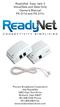 ReadyNet Easy Jack 2 Voice/Data and Data Only Owner s Manual PX-211d and PX-211v Phonex Broadband Corporation dba ReadyNet 6952 High Tech Drive Midvale, Utah 84047 801.566.0100 Phone 801.566.0880 Fax www.readynetsolutions.com
your Gateway Windows network installationguide 802.11b wireless series Router model WBR-100 Configuring Installing
 your Gateway Windows network installationguide 802.11b wireless series Router model WBR-100 Installing Configuring Contents 1 Introduction...................................................... 1 Features...........................................................
Disclaimers. Important Notice
 Disclaimers Disclaimers Important Notice Copyright SolarEdge Inc. All rights reserved. No part of this document may be reproduced, stored in a retrieval system, or transmitted, in any form or by any means,
Link Link sys E3000 sys RE1000
 User Guide High Performance Extender Wireless-N Router Linksys Linksys RE1000 E3000Wireless-N Table of Contents Contents Chapter 1: Product Overview 1 Front 1 Top 1 Bottom 1 Back 2 Chapter 2: Advanced
Panasonic. Proprietary Telephone for Electronic Modular Switching System MODEL NO. KX-17030. Illustrated Model: White 1
 Panasonic Proprietary Telephone for Electronic Modular Switching System MODEL NO. KX-17030 Illustrated Model: White 1 KX-T7030 is compatible with all of the Panasonic Electronic Modular Switching Systems
Bank. Wireless Portable Hard Drive. User s Manual
 Bank Wireless Portable Hard Drive User s Manual REGULATORY AND SAFETY INFORMATION FCC Compliance and Advisory Statement This device complies with Part 15 of the FCC rules. Operation is subject to the following
THOMSON TG580. Wireless-n Multi-User ADSL2+ Gateway. Setup and User Guide
 THOMSON TG580 Wireless-n Multi-User ADSL2+ Gateway Setup and User Guide THOMSON TG580 Setup and User Guide Copyright Copyright 1999-2009 THOMSON. All rights reserved. Distribution and copying of this
Cable Modem/Router with Wireless-N
 Cable Modem/Router with Wireless-N U S E R M A N U A L NOTICE This document contains proprietary information protected by copyright, and this Manual and all the accompanying hardware, software, and documentation
Installation Guide Wireless 4-Port USB Sharing Station. GUWIP204 Part No. M1172-a
 Installation Guide Wireless 4-Port USB Sharing Station 1 GUWIP204 Part No. M1172-a 2011 IOGEAR. All Rights Reserved. PKG-M1172-a IOGEAR, the IOGEAR logo, MiniView, VSE are trademarks or registered trademarks
Cable Modem/Router with Wireless-N
 Cable Modem/Router with Wireless-N U S E R M A N U A L NOTICE This document contains proprietary information protected by copyright, and this Manual and all the accompanying hardware, software, and documentation
NOTICE. All brand and product names are the trademarks of their respective owners. Copyright 2011 All rights reserved.
 X7N USER MANUAL NOTICE This document contains proprietary information protected by copyright, and this Manual and all the accompanying hardware, software, and documentation are copyrighted. No part of
FUTURE CALL PICTURE CARE PHONE MODEL: FC-1007 USER MANUAL
 FUTURE CALL PICTURE CARE PHONE MODEL: FC-1007 USER MANUAL Please follow instructions for repairing if any otherwise do not alter or repair any parts of device except specified. IMPORTANT SAFETY INSTRUCTIONS
Nokia Siemens Networks. CPEi-lte 7212. User Manual
 Nokia Siemens Networks CPEi-lte 7212 User Manual Contents Chapter 1: CPEi-lte 7212 User Guide Overview... 1-1 Powerful Features in a Single Unit... 1-2 Front of the CPEi-lte 7212... 1-2 Back of the CPEi-lte
NETGEAR genie Apps. User Manual. 350 East Plumeria Drive San Jose, CA 95134 USA. August 2012 202-10933-04 v1.0
 User Manual 350 East Plumeria Drive San Jose, CA 95134 USA August 2012 202-10933-04 v1.0 Support Thank you for choosing NETGEAR. To register your product, get the latest product updates, get support online,
RESIDENTIAL GATEWAY. Model TG784n USER MANUAL
 RESIDENTIAL GATEWAY Model TG784n USER MANUAL version 2011 CONTENTS TECHINICAL SPECIFICATIONS HARDWARE SETUP LED BEHAVIOR INSTALLATION REQUIREMENTS EASY SETUP MANUAL SETUP WIRELESS CONFIGURATION PORT FORWARDING
PCMCIA Wireless LAN Card User s Manual
 PCMCIA Wireless LAN Card User s Manual Rev 1.0 Regulatory compliance FCC Warning This equipment has been tested and found to comply with the limits for a Class B digital device, pursuant to part 15 of
Wireless Cable Gateway CG3100Dv3
 Wireless Cable Gateway CG3100Dv3 User Manual 350 East Plumeria Drive San Jose, CA 95134 USA October 2011 202-10942-01 v1.0 2011 NETGEAR, Inc. All rights reserved No part of this publication may be reproduced,
Advanced Configuration Guide. Vodafone Mobile Broadband Sharing Dock Vodafone R101
 Vodafone R101 Table of Contents Welcome...3 1. Getting Started Initial Connection and Security Settings... 4 1.1 Overview... 5 System Requirements... 5 Device overview... 5 Sharing Dock and USB Stick LEDs...
How To Connect To A Wireless Network On Your Computer (Wired) Or Ipv) On A Computer (Wireless) On Your Ipv Or Ipa (Wired Or Wireless) On An Ipv (Wired/Wired) On Pc Or Mac
 HI-SPEED INTERNET USER GUIDE Wireless Modem Router - 2704R 2013-11 VERSION 1-800-360-8555 TABLE OF CONTENTS 1. Installing Your Wireless Modem Router...4 1.1 Hardware Provided...4 1.2 Connecting Your Modem
HG659 Home Gateway. User Guide HUAWEI TECHNOLOGIES CO., LTD.
 HG659 Home Gateway User Guide HUAWEI TECHNOLOGIES CO., LTD. Product Overview...................................... 1 Ports and Buttons.................................................. Indicators.........................................................
LabelWriter. Print Server. User Guide
 LabelWriter Print Server User Guide Copyright 2010 Sanford, L.P. All rights reserved. 08/10 No part of this document or the software may be reproduced or transmitted in any form or by any means or translated
InnoMedia ESBC 9380-4B. Quick Install Guide. www.innomedia.com 1
 InnoMedia ESBC 9380-4B Quick Install Guide www.innomedia.com 1 Table of Contents Introduction 2 Package Contents 2 CAUTION 2 Installation 3 Wall-Mounting Instructions 5 Troubleshooting 6 Appendix A. LED
Quick Start. Nighthawk X8 AC5300 Tri-Band WiFi Router Model R8500. Package Contents. NETGEAR, Inc. 350 East Plumeria Drive San Jose, CA 95134 USA
 Support Thank you for purchasing this NETGEAR product. You can visit www.netgear.com/support to register your product, get help, access the latest downloads and user manuals, and join our community. We
Connect Box. Manual. Installation, Tips & Tricks. More Power, More Joy.
 Connect Box Manual Installation, Tips & Tricks More Power, More Joy. upc cablecom GmbH Postfach 8021 Zürich upc-cablecom.ch Help Line: 0800 66 88 66 Table of Contents 1 Overview 6 Contact Information 6
A quick Guide to your Super Hub 2ac
 A quick Guide to your Super Hub 2ac HELLO. W el c o m e t o t h i s h a n d y g u i d e t o y o u r n ew v i r g i n m e d i a b u s i n e s s b r o a d b a n d. What s inside Getting to know your Super
Wireless Cable Gateway CG3300CMR
 Wireless Cable Gateway CG3300CMR User Manual 350 East Plumeria Drive San Jose, CA 95134 USA September 2012 202-11068-02 v1.0 2012 NETGEAR, Inc. All rights reserved. No part of this publication may be reproduced,
RouteFinder SOHO. Quick Start Guide. SOHO Security Appliance. EDGE Models RF825-E, RF825-E-AP CDMA Models RF825-C-Nx, RF825-C-Nx-AP
 RouteFinder SOHO SOHO Security Appliance EDGE Models RF825-E, RF825-E-AP CDMA Models RF825-C-Nx, RF825-C-Nx-AP Quick Start Guide RouteFinder RF825 Series Quick Start Guide RouteFinder SOHO Security Appliance
LET S GO. Get your Ultra Broadband ready Business gateway up and running
 LET S GO Get your Ultra Broadband ready Business gateway up and running CONTENTS BUSINESS GATEWAY ULTRA BROADBAND READY 1 2 3 4 5 6 7 8 9 10 11 12 13 14 15 Equipment Check 2 Getting Started 3 Setting Up
CPEi 800/825 Series. User Manual. * Please see the Introduction Section
 CPEi 800/825 Series User Manual * Please see the Introduction Section Contents Introduction...iii Chapter 1: CPEi 800/825 User Guide Overview... 1-1 Powerful Features in a Single Unit... 1-2 Front of the
MN-700 Base Station Configuration Guide
 MN-700 Base Station Configuration Guide Contents pen the Base Station Management Tool...3 Log ff the Base Station Management Tool...3 Navigate the Base Station Management Tool...4 Current Base Station
Net USER GUIDE MEDIA SHARING DEVICE
 FCC DECLARATION OF CONFORMANCE This device complies with Part 15 of the FCC Rules. Operation is subject to the following two conditions: (1) this device may not cause harmful interference, and (2) this
2013 VTech Printed in China 91-009656-000 US
 Rechargeable Power Pack User s Manual 2013 VTech Printed in China 91-009656-000 US INTRODUCTION The Rechargeable Power Pack makes it easier than ever to keep the InnoTab 3 or InnoTab 3S charged and ready
RC8021 Indoor Camera Installation Guide
 RC8021 Indoor Camera Installation Guide P/N: 957YL502GJ Document Version: 1.0 Copyright 2011. All Rights Reserved. All trademarks and trade names are the properties of their respective owners i Package
User Guide. SURFboard SB6121. DOCSIS 3.0 Cable Modem
 User Guide SURFboard SB6121 DOCSIS 3.0 Cable Modem 2014 ARRIS Enterprises, Inc. All rights reserved. No part of this publication may be reproduced in any form or by any means or used to make any derivative
User Guide. SURFboard SB6141. DOCSIS 3.0 Cable Modem
 User Guide SURFboard SB6141 DOCSIS 3.0 Cable Modem 2014 ARRIS Enterprises, Inc. All rights reserved. No part of this publication may be reproduced in any form or by any means or used to make any derivative
Chapter 3 Safeguarding Your Network
 Chapter 3 Safeguarding Your Network The RangeMax NEXT Wireless Router WNR834B provides highly effective security features which are covered in detail in this chapter. This chapter includes: Choosing Appropriate
SoftRAID 5 QUICK START GUIDE. for OWC ThunderBay
 SoftRAID 5 QUICK START GUIDE for OWC ThunderBay TABLE OF CONTENTS INTRODUCTION...1 1.1 MINIMUM SYSTEM REQUIREMENTS 1.2 FEATURES 1.3 ABOUT THIS MANUAL SYSTEM SETUP...2 2.1 GETTING STARTED 2.2 INITIALIZING,
2Wire Gateway Installation Guide. For 1000 Series
 2Wire Gateway Installation Guide For 1000 Series Notice to Users 2005 2Wire, Inc. All rights reserved. This manual in whole or in part, may not be reproduced, translated, or reduced to any machinereadable
Get to Know Your Device 4G LTE BROADBAND ROUTER WITH VOICE
 Get to Know Your Device 4G LTE BROADBAND ROUTER WITH VOICE FRONT VIEW The Verizon 4G LTE Broadband Router with Voice is a wireless device that delivers Internet connectivity and telephone service. You
c. Securely insert the Ethernet cable from your cable or DSL modem into the Internet port (B) on the WGT634U. Broadband modem
 Start Here Follow these instructions to set up your router. Verify That Basic Requirements Are Met Assure that the following requirements are met: You have your broadband Internet service settings handy.
GETTING TO KNOW YOUR PRE-PAID TELSTRA WI-FI 4G
 GETTING TO KNOW YOUR PRE-PAID TELSTRA WI-FI 4G LET S GET THIS SHOW ON THE ROAD You must be excited about your brand new Pre-Paid Telstra Wi-Fi 4G. This guide will help you get connected as quickly and
mysensors mysensors Wireless Sensors and Ethernet Gateway Quick Start Guide Information to Users Inside the Box mysensors Ethernet Gateway Quick Start
 mysensors Information to Users mysensors Wireless Sensors and Ethernet Gateway Quick Start Guide This equipment has been tested and found to comply with the limits for a Class B digital devices, pursuant
TL-PS310U Single USB 2.0 Port MFP and Storage Server
 TL-PS310U Single USB 2.0 Port MFP and Storage Server Rev: 2.0.0 1910010313 Contents Chapter 1 Introduction... 1 1.1 Product Overview...1 1.2 Network Management...1 1.3 Components and Features...1 1.4 Hardware
Wireless Cable Voice Gateway CG3700EMR-1CMNDS
 Wireless Cable Voice Gateway CG3700EMR-1CMNDS User Manual September 2013 202-11324-01 350 East Plumeria Drive San Jose, CA 95134 USA Support Contact your Internet service provider for technical support.
GWA501 package contains: 1 Wireless-G Broadband Gateway 1 Power Adapter 1 Ethernet Cable 1 Manual CD 1 Quick Start Guide 1 Warranty/Registration Card
 Wireless-G Broadband Gateway GWA501 Quick Start Guide Read this guide thoroughly and follow the installation and operation procedures carefully to prevent any damage to the unit and/or any of the devices
N300 WiFi Range Extender
 Model EX2700 User Manual July 2014 202-11395-01 350 East Plumeria Drive San Jose, CA 95134 USA Support Thank you for selecting NETGEAR products. After installing your device, locate the serial number on
PePWave Surf Series PePWave Surf Indoor Series: Surf 200, AP 200, AP 400
 PePWave Surf Series PePWave Surf Indoor Series: Surf 200, AP 200, AP 400 PePWave Surf Outdoor Series: Surf AP 200/400-X, PolePoint 400-X, Surf 400-DX User Manual Document Rev. 1.2 July 07 COPYRIGHT & TRADEMARKS
P-2302HWUDL-P1. Quick Start Guide. 802.11g Wireless VoIP Station Gateway. with Built-in DECT Base Station
 P-2302HWUDL-P1 802.11g Wireless VoIP Station Gateway with Built-in DECT Base Station Quick Start Guide Version 3.60 Edition 1 3/2007 Overview The P-2302HWUDL-P1 model is a router with IEEE 802.11g wireless
User Manual. Page 2 of 38
 DSL1215FUN(L) Page 2 of 38 Contents About the Device...4 Minimum System Requirements...5 Package Contents...5 Device Overview...6 Front Panel...6 Side Panel...6 Back Panel...7 Hardware Setup Diagram...8